Wisconsin Weekly Advocate
Thursday, November 27, 1902
Milwaukee, Wisconsin
Page text (machine-generated)
WISCONSIN
WEEKLY
ADVOCATE
DEVOTED TO THE INTERESTS OF THE NEGRO RACE
CREAM CITY NOTES.
We will be glad to publish news of local and race interest if left at the office, 79 Fifth street, before 6 o'clock Wednesday evenings.
We would respectfully ask our readers to bestow at least a share of their custom upon those who advertise with us.
The various remedies and hair restorers advertised in this paper can be had at the advertised price at the office of this paper.
Parties who are sufferers from corns, bunions, ingrowing nails, etc., need no longer be so. Prof. De Lamotta Blackshear, a graduate from Clark's School of Chiropody, Philadelphia, since his residence in this city has proved himself a past master in his profession. He guarantees an absolute and painless cure in all cases. From all reports and also from personal experience we can confidently recommend Prof. Blackshear to all those in need of his services. He makes a specialty of calling at the residences of his patients and a note or postal to his address, 312 Fourth street, or Tel. Black 8501, will ensure his prompt attendance and best services.
* * *
Mrs. Adie Blackwell and Mrs. Grace Taylor are visiting friends in Chicago during the festive period.
☆ ☆ ☆
Those of our readers who are under the necessity of changing their residences at this or any other time could not do better than entrust their "flitting" to the Lightning Messenger and Express Company, 163 West Water street. The company's terms will be found reasonable and their service first class. Special rates are quoted for commercial men. Tel. Main 407.
Mr. J. D. Howard, representative of the Indianapolis Freeman, was in the city in the interests of that paper last week and paid a pleasant visit to the office of the Advocate.
* * *
No one is immune from accidents, and all should protect themselves and their families from care during the results of such. No better or fairer company towards this end than the Continental Casualty Company can be found. The district manager is W. J. Hackett, 1303 Pabst building, this city. Claimants are not only treated justly but with liberality.
* * *
The congregations of St. Mark's A. M. E. Church and Mt. Olive Baptist Church are both holding Thanksgiving services today.
* * *
Now that the cold season seems to be upon the city at last those in the downtown district who have not as yet supplied themselves with their supply of coal and wood could not better themselves than by dealing with Felton & Ratcliffe, 191 Fifth street. Tel. 9363 Black.
* * *
The companions of little Marguerite Carter will be glad to learn that she will return from Chicago Thanksgiving and resume her classes in the Fourth district school. That she will meet with a hearty and enthusiastic welcome from playmates and teacher is an assured fact, owing to her popularity during her previous stay in Milwaukee.
***
The Thanksgiving dinner being served today at the Turf Cafe is a marvel of excellence in every respect and reflects the utmost credit on the caterer, the chef and the attendants.
求 求 求
Mr. Adolph Therell paid a pleasant visit to the office of the Advocate Thanksgiving day, accompanied by his bright little boy Willie.
* * *
Rev. Fenwick preached a most appropriate Thanksgiving sermon this forenoon. He recounted to his hearers the origin of Thanksgiving day and impressed upon them the many blessings for which they had reason to be thankful. He took for his text the Thirty-eighth psalm. At last St. Marks has got a gentleman, a finished scholar and a praiseworthy preacher for its pastor.
ANNOUNCEMENT
We are glad to announce that Mr. J. D. Cook, agent for the Col. American Magazine, has been appointed by the American Publishing House of Chicago to represent them in the sale of their works, entitled "New Negro for a New Century," by Booker T. Washington, and "Under Fire with the Tenth Cavalry," a military history of the colored race
A Kansas Family Reunion.
The Atchison Globe describes what it calls the greatest family reunion ever known in Kansas. Eighty-nine members of the Pennington family are spending a whole week at the homes of J. E. Pennington and of his sister, Mrs. Robertson, twelve miles west of Atchison. There are eleven brothers and sisters in the Pennington family, and all of them are present with their descendants. The Globe gives the following account of how this great kin crowd is provided with material entertainment:
"Mrs. J. E. Pennington has twenty-four beds up. The corn crib was divided off like a Pullman sleeper, with curtains strung across on poles, and a carpet laid.
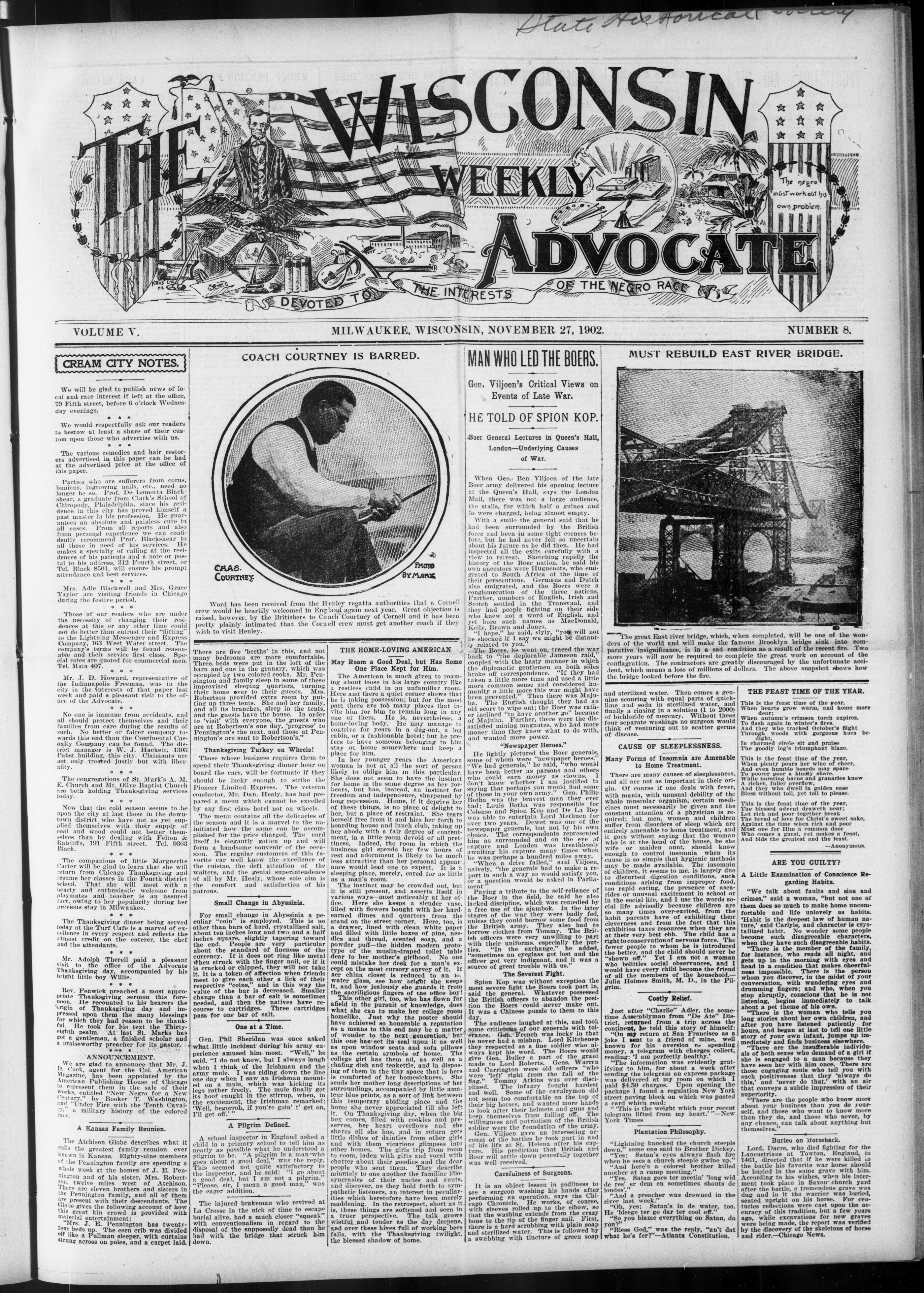
COACH COURTNEY IS BARRED.
CHAS.
COURTNEY.
PHOTO
BY MARX
Word has been received from the Henley regatta authorities that a Cornell crew would be heartily welcomed in England again next year. Great objection is raised, however, by the Britishers to Coach Courtney of Cornell and it has been pretty plainly intimated that the Cornell crew must get another coach if they wish to visit Henley.
There are five 'berths' in this, and not many bedrooms are more comfortable. Three beds were put in the loft of the barn and one in the granary, which was occupied by two colored cooks. Mr. Pennington and family sleep in some of these improvised sleeping quarters, turning their home over to their guests. Mrs. Robertson provided extra room by putting up three tents. She and her family, and all its branches, sleep in the tents, and the guests have the house. In order to 'visit' with everyone, the guests who are at Robertson's one day, 'progress' to Pennington's the next, and those at Pennington's are sent to Robertson's."
Thanksgiving Turkey on Wheels!
Those whose business requires them to spend their Thanksgiving dinner hour on board the cars, will be fortunate if they should be lucky enough to strike the Pioneer Limited Express. The veteran conductor, Mr. Dan. Healy, has had prepared a menu which cannot be excelled by any first class hotel not on wheels.
The menu contains all the delicacies of the season and it is a marvel to the uninitiated how the same can be accomplished for the price charged. The card itself is elegantly gotten up and will form a handsome souvenir of the occasion. The regular customers of this favorite car well know the excellence of the cuisine, the deft attention of the waiters, and the genial superintendence of all by Mr. Healy, whose sole aim is the comfort and satisfaction of his patrons.
Small Change in Abyssinia
For small change in Abyssinia a peculiar "coin" is employed. This is no other than bars of hard, crystallized salt, about ten inches long and two and a half inches square, slightly tapering toward the end. People are very particular about the standard of fineness of the currency. If it does not ring like metal when struck with the finger nail, or if it is cracked or chipped, they will not take it. It is a token of affection when friends meet to give each other a lick of their respective "coins," and in this way the value of the bar is decreased. Smaller change than a bar of salt is sometimes needed, and then the natives have recourse to cartridges. Three cartridges pass for one bar of salt.
One at a Time.
Gen. Phil Sheridan was once asked what little incident during his army experience amused him most. "Well," he said, "I do not know, but I always laugh when I think of the Irishman and the army mule. I was riding down the line one day when I saw an Irishman mounted on a mule, which was kicking its legs rather freely. The mule finally got its hoof caught in the stirrup, when, in the excitement, the Irishman remarked: 'Well, begorroh, if you're goin' t' get on, I'll get off.'"
A Pilgrim Defined
A school inspector in England asked a child in a primary school to tell him as nearly as possible what he understood a pilgrim to be. "A pilgrim is a man who goes about a good deal," was the reply. This seemed not quite satisfactory to the inspector, and he said: "I go about a good deal, but I am not a pilgrim." "Please, sir, I mean a good man," was the eager addition.
The injured brakeman who revived at La Crosse in the nick of time to escape burial alive, had a much closer "squeak" with conventionalism in regard to the disposal of the supposedly dead than he had with the bridge that struck him down.
MILWAUKEE, WISCONSIN, NOVEMBER 27, 1902.
THE HOME-LOVING AMERICAN
May Roam a Good Deal, but Has Some One Place Kept for Him.
The American is much given to roaming about loose in his large country like a restless child in an unfamiliar room. Here and there a quiet corner shows that he is taking possession; but for the most part there are too many places that invite him for him to remain long in any one of them. He is, nevertheless, a home-loving body. He may manage to contrive for years in a dug-out, a log cabin, or a fashionable hotel; but he prefers to have someone belonging to him stay at home somewhere and keep a place for him.
In her younger years the American woman is not at all the sort of person likely to oblige him in this particular. She does not seem to have the instinct for home in the same degree as her forbears, but has, instead, an instinct for freedom and independence, sharpened by long repression. Home, if it deprive her of these things, is no place of delight to her, but a place of restraint. She tears herself free from it and hies her forth to boarding house and lunch club, taking up her abode with a fair degree of contentment, in a little room devoid of all prettiness. Indeed, the room in which the business girl spends her few hours of rest and adornment is likely to be much less attractive than her personal appearance would lead one to expect. It is a sleeping place, merely, cared for as little as a man's room.
The instinct may be crowded out, but it is still present, and asserts itself in various ways—most noticeably at her office. Here she keeps a slender vase, filled with flowers bought with her hard-earned dimes and quarters from the stand on the street corner. Here, too, is a drawer, lined with clean white paper and filled with little boxes of pins, needles and thread, scented soap, and a powder puff—the hidden modern prototype of the muslin-draped toilet table dear to her mother's girlhood. No one could mistake her desk for a man's except on the most cursory survey of it. If her china closet is reduced to an ice water glass, see how bright she keeps it, and how jealously she guards it from the sacrilegious fingers of the office boy.
This other girl, too, who has flown far afield in the pursuit of knowledge, does what she can to make her college room homelike. Just why the poster should have achieved so honorable a reputation as a means to this end may be a matter of wonder to the next generation, but this one has set its seal upon it as well as upon window seats and sofa pillows as the certain symbols of home. The college girl has them all, as well as a chafing dish and teakettle, and in disposing of them in the tiny space that is hers is comforted of her homesickness. She sends her mother long descriptions of her surroundings, accompanied by little amateur blue prints, as a sort of link between this temporary abiding place and the home she never appreciated till she left it. On Thanksgiving day, when the big box comes, filled with cookies and preserves, her heart overflows and she shares all she has, and in return gets little dishes of dainties from other girls and with them vicarious glimpses into other homes. The girls trip from room to room, laden with gifts and vocal with chatter about their goodies and the dear people who sent them. They describe minutely to one another the familiar idiosyncrasies of their uncles and aunts, and discover, as they hold forth to sympathetic listeners, an interest in peculiarities which heretofore have been merely maddening. In the retrospect, short as it is, these things are softened and seen in a truer perspective. The talk grows wistful and tender as the day deepens, and over these hives full of working bees falls, with the Thanksgiving twilight, the blessed shadow of home.
MAN WHO LED THE BOERS.
Gen. Viljoen's Critical Views on Events of Late War.
Boer General Lectures in Queen's Hall, London—Underlying Causes of War
When Gen. Ben Viljoen of the late Boer army delivered his opening lecture at the Queen's Hall, says the London Mail, there was not a large audience, the stalls, for which half a guinea and 5s were charged, being almost empty.
With a smile the general said that he had been surrounded by the British force and been in some tight corners before, but he had never felt so uncertain about his future as he did then. He had inspected all the exits carefully with a view to retreat. Sketching rapidly the history of the Boer nation, he said his own ancestors were Huguenots, who emigrated to South Africa at the time of their persecutions. Germans and Dutch also emigrated, and the Boers were a conglomeration of the three nations. Further, numbers of English, Irish and Scotch settled in the Transvaal, and they had people fighting on their side who knew not a word of English, and yet bore such names as MacDonald, Kelly, Brown and Jones.
"I hope," he said, slyly, "you will not be shocked if I say we might be distantly related to you."
The Boers, he went on, traced the war back to "the deplorable Jameson raid," coupled with the hasty manner in which the diplomatic gentlemen on both sides broke off correspondence. "If they had taken a little more time and used a little more common sense and considered humanity a little more this war might have been prevented." Then there was Majuba. The English thought they had an old score to wipe out; the Boer was rather inclined "to have another go" because of Majuba. Further, there were the dissatisfied mining magnates, who had more money than they knew what to do with, and wanted more power.
"Newspaper Heroes."
He lightly pictured the Boer generals, some of whom were "newspaper heroes." "We had generals," he said, "who would have been better as parsons and others who could earn money as clowns. I don't know whether I am justified in saying that perhaps you would find some of those in your own army." Gen. Philip Botha was the bravest man they ever had; Louis Botha was responsible for Colenso and Spion Kop and De La Key was able to entertain Lord Methuen for over two years. Dewet was one of the newspaper generals, but not by his own choice. The correspondents represented him as surrounded and on the eve of capture and London was breathlessly awaiting his capture many times when he was perhaps a hundred miles away.
"When a drive failed," said Viljoen, naively, "the generals had to make a report in such a way as would satisfy you, or a question would be asked in Parliament."
Paying a tribute to the self-reliance of the Boer in the field, he said he also lacked discipline, which was remedied by a free use of the sjambok. In the later stages of the war they were badly fed, unless they could borrow some food from the British army. They also had to borrow clothes from Tommy. The British officers were very unwilling to part with their uniforms, especially the putties. "In the exchange," he added, "sometimes an eyeglass got lost and the officer got very indignant, and it was a source of great trouble with us."
The Severest Fight.
Spion Kop was without exception the most severe fight the Boers took part in, said the general. Whatever possessed the British officers to abandon the position the Boers could never make out. It was a Chinese puzzle to them to this day.
The audience laughed at this, and took some criticisms of our generals with tolerance. Gen. French was lucky in that he never had a mishap. Lord Kitchener they respected as a fine soldier who always kept his word. The Boers would give Gen. Buller a part of the grant made to Lord Roberts. Gens. Warren and Carrington were old officers "who were 'left' right from the fall of the flag." Tommy Atkins was over disciplined. The infantry fought hardest and well. Some of the cavalrymen did not seem too comfortable on the top of their big horses, and wanted more hands to look after their helmets and guns and keep themselves from falling off. The willingness and patriotism of the British soldier were the foundation of the army.
Gen. Viljoen gave an interesting account of the battles he took part in and of his life at St. Helena after his capture. His prediction that British and Boer will settle down peacefully together was well received.
Carefuiness of Surgeons.
It is an object lesson in godliness to see a surgeon washing his hands after performing an operation, says the Chicago Chronicle. He works, of course, with sleeves rolled up to the elbow, so that the washing extends from the crazy bone to the tip of the finger nail. First, there is a hard scrubbing with plain soap and sterilized water. This is followed by a swabbing with tincture of green soap
MUST REBUILD EAST RIVER BRIDGE.
9
The great East river bridge, which, when completed, will be one of the wonders of the world and will make the famous Brooklyn bridge sink into comparative insignificance, is in a sad condition as a result of the recent fire. Two more years will now be required to complete the great work on account of the conflagration. The contractors are greatly discouraged by the unfortunate accident, which means a loss of millions of dollars. The above snapshot shows how the bridge looked before the fire.
and sterilized water. Then comes a genuine scouring with equal parts of quicklime and soda in sterilized water, and finally a rinsing in a solution (1 to 2000) of bichloride of mercury. Without these four separate washings no surgeon would think of venturing out to scatter germs of disease.
THE FEAST TIME OF THE YEAR.
This is the feast time of the year,
When hearts grow warm, and home more dear;
When autumn's crimson torch expires,
To flash again in winter's fires.
And they who tracked October's flight
Through woods with gorgeous hues be
CAUSE OF SLEEPLESSNESS.
Many Forms of Insomnia are Amenable to Home Treatment.
There are many causes of sleeplessness, and all are not as important in their origin. Of course if one deals with fever, with mania, with unusual debility of the whole muscular organism, certain medicines must necessarily be given and the constant attention of a physician is required; but men, women and children suffer from disorders of sleep which are entirely amenable to home treatment, and it goes without saying that the woman who is at the head of the house, be she wife or maiden aunt, should know enough to control insomnia when its cause is so simple that hygienic methods may be made available. The insomnia of children, it seems to me, is largely due to disturbed digestion conditions, such conditions arising from improper food, too rapid eating, the presence of ascarides or unusual excitement in school or in the social life, and I use the words social life advisedly because children are so many times over-excited, from the habit parents have of exhibiting their cleverness and from the fact that this exhibition taxes resources when they are at their very best ebb. The child has a right to conservation of nervous force. The fewer people to whom he is introduced the better, and the child should never be "shown off." Yet I am not a woman who belittles social observances, and I would have every child become the friend of all the members of the household.—Julia Holmes Smith, M. D., in the Pilgrim.
Costly Relief.
Just after "Charlie" Adler, the sometime Assemblyman from "De Ate" District, returned from a trip across the continent, he told this story of himself:
"On my return at San Francisco as a joke I sent to a friend of mine, well known for his aversion to spending money, a telegram with charges collect, reading: 'I am perfectly healthy.'
"The information was evidently gratifying to him, for about a week after sending the telegram an express package was delivered at my room on which I paid $4.50 charges. Upon opening the package I found a regulation New York street paving block on which was pasted a card which read:
"This is the weight which your recent telegram lifted from my heart.'"—New York Times
Plantation Philosophy.
"Lightning knocked the church steeple down," some one said to Brother Dickey. "Yes; Satan's eyes always flash fire when he sees a church steeple gwine up." "And here's a colored brother killed another at a camp meeting."
"Yes. Satan goes ter meetin' 'long wid de res' er dem en sometimes shouts de loudes."
"And a preacher was drowned in the river last week."
"Oh, yes; Satan's in de water, too. He 'bleege ter go dar ter cool off."
"So you blame everything on Satan, do you?"
"Bless God," was the reply, "an't dat what he's fer?"-Atlanta Constitution.
THE FEAST TIME OF THE YEAR.
This is the feast time of the year. When hearts grow warm, and home more
dear;
When autumn's crimson torch expires,
To flash again in winter's fires.
And they who tracked October's flight
Through woods with gorgeous hues bed-
light
In charmed circle sit and praise
The goodly log's triumphant blaze.
This is the feast time of the year,
When plenty pours her wine of cheer,
And even humble boards may spare
To poorer poor a kindly share.
While bursting barns and granaries know
A richer, fuller overflow,
And they who dwell in golden ease
Bless without toil, yet toil to please.
This is the feast time of the year,
The blessed advent draweth near;
Let rich and poor together break
The bread of love for Christ's sweet sake,
Against the time when rich and poor
Must one for Him a common door
Who comes a guest, yet makes a feast,
And bids the greatest and the least.
ARE YOU GUILTY?
A Little Examination of Conscience Regarding Habits.
"We talk about faults and sins and crimes," said a woman, "but not one of them does so much to make home uncomfortable and life unlovely as habits. 'Habit is the deepest law of human nature,' said Carlyle, and character is crystallized habit. No wonder some people become such disagreeable characters, when they have such disagreeable habits. "There is the member of the family, for instance, who reads all night, and gets up in the morning with eyes and head in a condition that makes cheerfulness impossible. There is the person whom you discover, in the midst of your conversation, with wandering eyes and drumming fingers; and who, when you stop abruptly, conscious that he is not listening, begins immediately to talk about a pet theme of his own.
"There is the woman who tells you long stories about her own children, and after you have listened patiently for hours, and began at last to tell one little story of your own infant, jumps up immediately and finds business elsewhere. "There are the insufferable individuals of both sexes who demand of a girl if she is engaged to a man because they have seen her with him once. There are those engaging souls who tell you with such positiveness that they 'always do this,' and 'never do that,' with an air that conveys a subtle impression of their superiority. "There are the people who know more about your business than you do yourself, and those who want to know more than they do, and those who never, by any chance, can talk about anything but themselves."
Burieo on Horseback
Lord, Dacre, who died fighting for the Lancastrians at Towton, England, in 1461, directed that if he were killed in the battle his favorite war horse should be buried in the same grave with him. According to his wishes, when his interment took place in Saxon church yard after the battle, a tremendous grave was dug and in it the warrior was buried, seated upright on his horse. For centuries reflections were cast upon the accuracy of this tradition, but a few years ago, while excavations for new graves were being made, the report was verified by the discovery of the skeletons of horse and rider—Chicago News.
NEGOTIATIONS ARE OFF.
Washington Conference, which Promised to Adjust Miners' Differences, Rendered Fruitless.
Washington, D. C., Nov. 26.—Negotiations for settling the issues involved in the anthracite miners' strike, and which had been practically agreed upon between Wayne MacVeagh, representing the coal operators, and John Mitchell, representing the miners, were knocked in the head by the operators, who notified MacVeagh that they would not meet Mitchell as the representative of the miners' union and would therefore refuse to ratify any terms which MacVeagh and Mitchell might agree upon. The result is that the strike issues will again come before the arbitration commission for adjustment. Peace plans have been effectually blocked for the present.
The presidents of the coal roads had appointed MacVeagh, who was their principal counsel before President Roosevelt's arbitration commission, as agent to negotiate terms of settlement with Mr. Mitchell, the president of the miners' union. Mr. MacVeagh and President Mitchell had concluded a settlement by which the miners were to secure a nine-hour day and an increase of 10 per cent. in wages. Both conferences were conducted in a spirit of harmony and friendliness, and when the second one was nearly over Mr. MacVeagh, in behalf of the operators, and John Mitchell, in behalf of the miners, had reached a satisfactory agreement.
The only detail that remained to be considered related to the application of these concessions to the various coalmining companies in the anthracite region.
Such was the situation at 5 o'clock. Attorney Darrow was so confident about the outcome that he did not hesitate to predict that the prolonged battle between the miners and operators was practically over.
Operators Refuse to Meet Mitchell.
Suddenly the situation underwent a change. Mr. MacVeagh received a dispatch from New York which caused him to look very grave. He read and reread it with the air of a man who could not believe the evidence of his own eyes. It was from the operators who had been in session in New York all day, and it informed him that his employers had decided that they would not meet Mr. Mitchell, the representative of the miners' union, at Scranton, New York or elsewhere for any purpose whatsoever.
A feature of the day's plan had been to bring the miners and operators together at Scranton so that they might jointly sign the agreement to be submitted to the commission. Mr. MacVeagh had supposed that he was acting with complete authority. He was thunderstruck at the change of front which the dispatch indicated had taken place on the part of his employers. He exhibited the message to Messrs. Mitchell, Darrow and Lloyd and they decided to return to Scranton at once. They left Washington at 7 o'clock.
MacVeagh Angry Over Change.
Mr. MacVeagh hastened to New York, very much disturbed and exceedingly angry. It is not improbable that he will relinquish his connection with the case. He feels that he has been imposed on by the men who insulted and bulldozed the President of the United States. As a lawyer he is assured, moreover, that in view of the voluntary act of the operators in consenting to negotiate a settlement with the strikers outside of the court of arbitration, and the acceptance through their legal representative of definite terms proposed by the strikers' representtive, the case of the operators is so seriously prejudiced that they can hope for nothing but an adverse verdict. He will so inform the operators on his arrival in New York.
Miners Expect to Win Yet.
The miners' attorneys, especially Mr. Darrow, are extremely confident that, notwithstanding the change of front by the operators, the strike settlement will be reached soon after the commission reassembles. They propose to present to the commission all of the details of the conference between Mr. Mitcheli and Mr. MacVeagh, not only as a justification of their course in requesting a recess, but because they feel that the commission will be disposed to cut the inquiry short and command an immediate settlement. They believe also that the operators will change their minds again about the desirability of proceeding with the inquiry into the anthracite coal business. The belief in Washington is that the strike issues will be settled next week, regardless of the day's action by the operators.
Dig Coal on Holiday.
Pottsville, Pa., Nov. 26.—The United Mine Workers have decided to keep all the collieries at work with a full force of men on Thanksgiving day. The operators requested the men to remain at work, and this action is in compliance with their request.
MANHATTAN ELEVATED LEASED TO SUBWAY.
Former will Increase Its Stock to $55,
000,000 for Purpose of Com-
pleting Improvements.
New York, Nov. 26.—The official announcement was made today that the Manhattan Elevated Railway Company will be leased to the Inter-Borough Company, which is to operate the subway now being built, to take effect April 1, 1903, the rental from April 1, 1903, to January 1, 1906, will be the net earnings of the Manhattan Company, not exceeding 7 per cent. After January 1, 1906, the rental will be 7 per cent. flat on Manhattan stock, guaranteed by the Inter-Borough Company. The Manhattan Railway Company will increase its stock to $55,200,000 for the purpose of completing improvements. This is an increase of about $7,000,000. The Manhattan stockholders will be given the new stock at par.
BIG INTERNAL REVENUE LOSS.
Acts Abolishing War Taxes Cut Receipts of Department $100,000,000.
Washington, D. C., Nov. 26.—John W. Yerkes, the commissioner of internal revenue, in his report for the fiscal year ended June 30, 1902, says that by the two acts abolishing the war revenue taxes internal revenue taxes have been reduced about $100,000,000. There has been, however, an increase of revenue from taxes laid on distilled spirits and other objects that were not affected by war revenue legislation. The receipts of the bureau for the fiscal year ended June 30, 1901, were $306,871,660 and for the fiscal year ended June 30, 1902, $271,867,990.
DYNAMITE A BANK.
Safe-Blowers Take Forcible Possession of an Indiana Town.
Akron, Ind., Nov. 26.—Akron was this morning the scene of a desperate attempt to rob the Exchange Bank. The town was taken by a gang of safe blowers at 2:30 o'clock. The robbers captured and bound the two night telephone operators and cut all the telephone wires leading out of the local exchange. They bound and gagged a physician whose office is in the same block with the bank. The first explosion of dynamite at the bank roused the citizens, who hastened to the scene with firearms. Many shots were exchanged, but the robbers escaped without any booty. The bank building was badly wrecked.
Shot by Bank Robbers.
Warren, Mich., Nov. 26.—Clint E. Osborne, assistant postmaster and proprietor of the general store in this village, was shot dead about 2:30 a.m. today by one of a gang of robbers that entered the Warren bank and wrecked the safe with a charge of nitro-glycerine. The explosion aroused Osborne, who telephoned to one of his neighbors that he thought burglars were at work in either the bank or postoffice. All the telephones in the village are connected at night and it is thought that the cracksmen heard the telephone bell ring and listened to Osborne's conversation. Osborne then started down the street and had gone but a short distance when one of the robbers acting as an outside guard shot him in the face with a charge of buckshot, killing him instantly. The cracksmen then fled without securing anything of value. No trace of them has since been discovered.
Texas Bank Burglarized.
Dallas, Tex., Nov. 26.—The First National Bank at Morgan, Bosque county, was dynamited by robbers at an early hour this morning and $5000 in gold, silver and currency was secured by the burglars. The first intimation of the presence of the gang, believed to be three in number, was when a loud explosion was heard. Before citizens could reach the bank the bandits had secured the money in the outer safe and made their escape.
Robbed a Postoffice.
Colfax, Ind., Nov. 26.—The postoffice at Clarks Hill was entered early this morning and the safe dynamited. About $300 worth of stamps were taken. The safe and office furniture were completely demolished. All the mail pouches were looted, but there was not a great amount of money orders in them. There is no clue to the robbers.
NO BEEF COMBINE.
Proposed Merger of Packing Plants Encounters Insuperable Obstacles.
Chicago, Ill., Nov. 26.—The merger of Chicago's beef packing firms has been indefinitely postponed. This is not rumor; it is an authoritatively confirmed fact. Stock "tickers" in La Salle street offices gave out the following information yesterday: "The beef combine has been dropped indefinitely." The message was shown to the head of one of the big packing houses for confirmation. He said: "I guess that is about right." Tight money, an uncertain condition of affairs in Wall street, and an underwriting syndicate dubious of results have all combined to cause the postponement.
There are other reasons. Chief among them is the notice served in an unofficial way from the white house that the beef merger would certainly be attacked by the government the moment it was launched.
Again, the public pulse has been "felt" and found to be in no condition to absorb the $200,000,000 common stock, largely of a liquid character, which the merger proposes to float.
For some time it has been an open secret that the three big packers have been loading themselves up with properties bought at high figures to be put in the combine at still higher figures. It has been known that the indebtedness incurred for promotive purposes is already enormous, the total being placed as high as $50,000,000.
One single loan of $6,000,000 is known to have been made the packers by the Illinois Trust and Savings Bank.
CZAR AND CZARINA WELL.
Ambassador Tower Declares Ruler of Russia in Best of Health—Interested in America.
Vienna, Nov. 26.—Ambassador Charlemagne Tower has arrived here from Lividia, where he was received in farewell audience by the Czar. He said: "The Czar and Czarina are both enjoying the best possible health."
Mr. and Mrs. Tower took lunch informally with their majesties, no other guests being present. Both the Czar and Czarina talked freely on American affairs. The ambassador says he found the Czarina entirely recovered from her recent indisposition and she is now looking as well as he ever saw her.
Washington, D. C., Nov. 26.—Count Cassini, the Russian ambassador, speaking of the reports contained in the press dispatch from St. Petersburg relative to the Czar said:
"The statements contained in the press dispatch from St. Petersburg pertaining to the Czar can have no foundation. For instance, it is stated among other things that his ministers made certain remonstrances. Under no circumstances would the ministers take any such action. Without going into details, I will say that the statements are all entirely unfounded. As for the Czar's health, I received dispatches only yesterday which state that he is in the best of health."
PUNISH THE GUILTY.
State Department Waives Diplomatic Immunities in the Case of Young Hunter.
Washington, D. C., Nov. 26.—It is inferred here that the recent killing of Fitzgerald in Guatemala city by Godfrey Hunter, Jr., is to be investigated by the local authorities. A cablegram has been received at the state department from United States minister Hunter, father of the young man who shot Fitzgerald, asking permission for the appearance of Bailey, the secretary of the United States legation, before the local courts to testify as to the killing. The department has replied, waiving all diplomatic immunities that would interfere with the course of justice. The effect of this direction, it is expected, will be to put the local authorities in position to fix the responsibility for the shooting and to punish any person found to be guilty.
Offer Large Rewards.
Telluride, Col., Nov. 26.—Rewards aggregating $18,000 have been offered for the arrest and conviction of the murderers of Arthur L. Collins, general manager of the Smuggler Union Mining Company.
ORDER AGAIN RESTORED.
Armed Force Represses Riotous Elements in Havana.
STRIKERS DISPERSED.
Havana, Nov. 25.—The street cars are running today without interruption. No further disturbance has been reported. The veterans have taken steps to bring about a meeting between the strike leaders and President Palma. It will take place at noon.
The strong show of armed force made by the rural guard in the suburbs of Havana quieted the riotous feeling of the strikers. The police are now searching all suspicious persons. Strikers who congregate in the streets are immediately dispersed. The strike, however, remains general, so far as the trades people are concerned. No bread or meat can be bought. Both ice plants are closed, which has caused much food to be spoiled.
There were indications, however, that there will be a break in the general strike today. Several of the bakeshops opened during the morning and most of the bakers resumed work, though the central committee of the strikers was unyielding in its determination to continue the strike. Work along the water front was completely suspended. The mayor has issued another edict calling upon the strikers to preserve order and remain in their homes.
The returns from the hospitals give the total of persons wounded during the rioting of yesterday at 106, of which number four were seriously injured.
Two strikers and one fireman were killed today as the result of a collision between a fire engine and an electric car. Coaches and omnibuses began running at noon.
The managers of the Commercial Tobacco Company are confident that the strike will end tomorrow or Thursday. The veterans appointed a committee with Gen. Gomez as chairman, to wait upon the cigar manufacturers and try to arrange a peaceful settlement of the strike. The committee will afterward meet the strikers' committee if the latter will consent.
A general strike is reported to have been declared at Cienfuegos.
EIGHT STRIKERS KILLED.
More Than 100 Persons, Including Nine Policemen, Wounded.
Havana, Nov. 25.—Eight strikers were killed and more than 100 other persons, including nine policemen, wounded, in a series of conflicts between the police and the striking workingmen. All the rural guards in the vicinity of Havana have been concentrated in the city.
Gen. Rodriquese, chief of the rural guards, is patrolling the streets with his troops. All the theaters were closed last night.
Among the people attacked by the strikers was the German consul and an American boy who refused to leave an electric car because he claimed American citizenship. He was thrown out of a window, but was not injured.
Business is at a standstill in Havana, and American intervention is openly discussed.
In all shops in the town the shutters have been pulled down, as the proprietors are afraid of possible wrecking by the strikers.
All shipping work is paralyzed in the harbor, as the longshoremen are all out. No newspapers have been printed since Saturday, because the printers are in the general strike.
A meeting of the strikers was held last night, at which Gens. Maximo Gomez, Julio Sanguilly, Quintin Bandera, Juan Gualberto Gomez, and Senator Cisneros were the speakers. Gen Gomez urged the strikers to return to work, and it is believed his counsel may prevail.
The responsibility for the entire trouble is placed on the city authorities. The condition of affairs, which is regarded as serious, is charged to the action of the mayor in dismissing Chief of Police Cardenas a few days ago because he ordered his men to charge the rioting strikers. This interfered with the morale of the police force. The mayor says that his action was prompted by the fact that the police were ill-treating the people.
MRS. GORE'S DEATH WAS NOT SUICIDE.
Result of the Post Mortem Examination by American Physicians—Russian Actor Still Under Surveillance.
Paris, Nov. 25.—The independent post mortem examination of the remains of Mrs. Ellen Gore, made by the commission of four American doctors appointed by Consul General Gowdy at the instance of the state department at Washington, was made this morning at the morgue. It tended to establish the fact that Mrs. Gore did not commit suicide. The American doctors found that the bullet entered the pupil of the right eye, cutting the lower eyelid and emerging in the rear of the right side of the head at less than half an inch elevation from the point of entry. The body bore no marks of a struggle and there were no powder marks at the entrance of the wound.
The provisional release of De Rydzewski yesterday is considered as establishing the view of the French authorities of the innocence of the Russian, but he is still under surveillance and if he attempts to leave this city he will be liable to arrest as a fugitive from justice. The American officials do not expect that De Rydzewski will be further actively prosecuted, although he probably will be arraigned later on the minor charge of having possession of a revolver and of carelessly participating in the circumstances which caused the death of Mrs. Gore.
NO PROGRESS MADE
Canal Negotiations Have Come to a Dead Stop—Colombia Wants More Money.
Washington, D. C., Nov. 25. While presenting the subject of the canal negotiations to the cabinet Secretary Hay was not able to report that any progress had been made during the past week. In fact, it appears that the negotiations have come to a dead stop and while no such thing as an ultimatum has passed the precise situation may be described in the statement that the Colombian minister here, Concha, has distinctly informed the state department that he cannot, in behalf of his government, accept the last proposition of the United States as a basis of a canal treaty. The state department has already let it be known that it has come to the end of its concessions, so the chances of a renewal of the negotiations in the near future are not very bright.
TOM OCHILTREE DIES.
Former Congressman and Famous Story Teller Succumbs to Pneumonia and Heart Failure.
Hot Springs, Va., Nov. 26.—Col. Thomas P. Ochiltree, former congressman from Texas and who gained international fame as a wit, died here of heart trouble.
An attack of pneumonia about a year ago left Col. Ochiltree's heart weak and his condition was so aggravated by the cold caught at the funeral of J. W. Mackay, who was his lifelong friend, that there soon was little hope of his recovery. Col. Ochiltree came to Hot Springs about two weeks ago, but it was too late for him to be benefited by the change.
Ochiltree was educated in the Texas public schools and at the age of 17 he became a private in John G. Walker's company of Texas Rangers in the campaign against the Apaches and Comanche Indians in 1854-55.
He served with distinction in the Confederate army and honorable mention was made of his services under special orders from Gen. Longstreet, Taylor, Green and Maxey.
After the cessation of hostilities Col. Ochiltree "accepted the situation" and was appointed United States marshal of Texas by President Grant. He was appointed commissioner of emigration to Europe for Texas and in that capacity paid several visits to the continent.
In the canvass of 1882 Col. Ochiltree's district embraced 37,600 square miles of territory, containing twenty-seven counties, reaching from Galveston on the gulf to Eagle Pass on the upper Rio Grande. He was elected to the Forty-eighth Congress as an independent candidate. Long before Col. Ochiltree was elected to Congress he had entered the journalistic field, and his paper, the Jeffersonian, published at Jefferson, Tex., attracted considerable attention. He afterward engaged in other journalistic ventures. In 1892 he was correspondent of the Associated Press at the Brussels monetary conference, and his dispatches were models.
PRESIDENT TALKS TO LABOR COMMISSIONERS.
Combinations Have Great Possibilities for Good and Great Possibilities for Evil.
Washington, D. C., Nov. 26. President Roosevelt received today the members of the British Labor Commission who are making a tour of the United States as the guests of Alfred Moseley, the British philanthropist. After greeting the members of the party, the President said:
I am delighted to have the pleasure of meeting you gentlemen and Mr. Marks. I have had communication with Mr. Marks on more than one question leading up to the coal strike. Naturally, like any man who has anything to do with public affairs, I not only take, but am bound to take, the very deepest interest in all the manifold social problems which include, as one section of them, what we group together as the labor problem. More and more as our modern industrial progress goes on there is a tendency to work in federation or combination both among employers and among employees, incorporations and in unions; and of course, gentlemen, among the reasons why I take a very great interest in these combinations is the very fact that by their power they have such great possibilities for good—which necessarily implies that they have also great possibilities for evil. Whether you wish them or not it is idle in my opinion to protest against the inevitable tendency of the times toward both corporation and union. It is worse than folly to take exceptions to either corporation or union as such. The line should be drawn on conduct.
I greet you with all heartiness and am delighted to see you.
KAISER AS MOURNER AT KRUPP·OBSEQUIES.
Emperor William Follows Hearse on Foot from the House to the Cemetery.
Essen, Prussia, Nov. 26.—The remains of Herr Krupp were buried today. The obsequies were impressive. Emperor William followed the hearse on foot from the old home of the grandfather of the deceased to the cemetery. Practically the entire population of Essen attended the funeral.
The presence of Emperor William at Herr Krupp's burial today was designed by his majesty to show his absolute disbelief of the accusations that caused the gun manufacturer's death. A statement was issued that the Emperor was indignant at the cruelty and malice of the Social Democratic charges, and he is said to have personally expressed his feeling in the matter to a well-known personage.
PROPOSED REUNION OF SPANISH WAR VETERANS
Gen. Shafter, President of Association, Proposes a Grand Review and Parade on July 17, 1903.
San Francisco, Cal., Nov. 26.—An address has been issued from the office in this city of Maj.-Gen. Shafter, national president of the Society of the Army of the Santiago de Cuba, proposing a grand reunion of all who participated in the campaign, battle and siege of Santiago de Cuba. It is hoped that all who participated in the Santiago campaign, whether members of the society or not, will be able to join in a grand review and parade and other festivities of the occasion. No date has yet been definitely decided upon, but it is thought that July 17, 1903, the fifth anniversary of Gen. Toral's surrender, will be appropriate. The necessary committees will be appointed to arrange other details.
MAY SEIZE CUSTOMS.
Great Britain Considering Means to Enforce Claimus Against Venezuela.
London, Nov. 26.—Diplomatic relations between Great Britain and Venezuela have not been severed up to the present, though the foreign office would not be surprised if it was compelled to take a decisive step at any moment. Thus far Venezuela shows no signs of granting the reparation demanded, and the question of the seizure of the Venezuelan customs has been discussed between Berlin and London as one of the various possible methods of obtaining satisfaction. No decision, however, has been reached regarding the course which shall be finally adopted.
Freight Rates Increased
Washington, D. C., Nov. 26.—The Michigan Central today filed with the interstate commerce commission a new freight tariff schedule between New York and Chicago, making an increase of 5 cents in the export rate on provisions and 5 cents for dressed meats both for domestic and export.
KRUPP PENSION PLAN.
German Socialists Declare Employes of Deceased Gunmaker were Systematically Robbed.
Berlin, Nov. 25.—The Socialist organ Vorwaerts, in a page and a half today deals with what it calls the "hypocrisy of idealizing Herr Krupp as a benevolent genius." The paper does not touch on the immediate charges which it brought against the deceased, but analyzes the pension system of the Krupp firm, which it says is a "species of refined swind- ing" adding:
The enormous so-called benevolent funds have been built up by compulsory contributions from the employees who could be arbitrarily deprived of participation in the advantages. They are required to contribute $2\frac{1}{2}$ per cent. of their wages for twenty years before they are eligible to a pension upon disability. In the meantime, if an employee is discharged or resigns, he loses all he has contributed, often exceeding $250. Thus employees are morally and economically terrorized and must in humility accept every petty regulation of the firm's officials or lose $2\frac{1}{2}$ per cent. of what they have earned in the firm's service. This terrorism is applied to political opinions where they become known. The number of men leaving or discharged during the past three years averaged 7000 to 8000 yearly. The employees found the system so unsatisfactory that five great meetings were held this year for the purpose of seeking legal redress."
The Vorwaerts cites an instance of a labor representative on the advisory committee of the benevolent pension fund who mildly criticised the management and who, several days later, having in the canwhile paid his annual dues, was dismissed.
The paper also quotes the German budget committee proceedings as showing that the Krupp works have been charging the navy $100 per ton above what the United States pays for nickel steel plates amounting yearly to $750,000 for Her Krupp and the Stumm works. The attack on Herr Krupp and the intense sensation which it has created have caused a furious political discussion, the Socialists calling attention to the "degenerating influence of great wealth," and the Conservatives pointing out "the desperate character of the Socialist attack upon the existing order of society."
FUNDS MISAPPLIED.
Suit Begun Against the Estate of Collis
P. Huntington to Recover
$100,000,000.
New York, Nov. 25.—Papers in a suit to recover $100,000,000 from the estate of the late Collis P. Huntington have been served on the executors and their counsel on behalf of minority stockholders of the old Central Pacific railroad of California, represented by Walter Morshead of London, now a resident of this city.
Collis P. Huntington and his associates and fellow directors, Leland Stanford, Charles Crocker, and Mark Hopkins, known at the time as the "big four," controlled the management of the road. It is alleged that they gave contracts for the construction, equipment, and improvement of the road, turning over to the contracting companies in payment for the work $30,000,000 in United States government bonds, which had been lent by the United States government to build the road, and practically all of the stocks and bonds of the Central Pacific railroad.
Sav Funds were Misapplied.
The complaint sets forth that these securities amounted to $163,000,000 and that all the work done cost only some $60,000,000.
The minority stockholders say that the difference of something over $100,000,000 went to Huntington and his associates while they were directors of the Central Pacific railroad.
According to Robert L. Cutting, counsel for the complainants, the Huntington estate is liable in solido for the sum of which, as the minority stockholders say, the Central Pacific railroad was defrauded, and each of the remaining members of the "big four" directors or their estates is also liable in solido for the whole amount as if they were partners.
As a preliminary to the suit the executors of the estate were served with notice to show cause why they should not be compelled to give an inventory of the estate left by Mr. Huntington. The date of the hearing is set for December 2.
PROTEST AGAINST SMOOT.
Ministerial Alliance of Salt Lake Adopt Resolutions Denouncing the Mormon Apostle.
Salt Lake City, Utah, Nov. 25.—The ministerial alliance of Salt Lake adopted resolutions strongly opposing the proposed election to the United States Senate of Reed Smoot, one of the twelve apostles of the Mormon Church. A copy of the resolutions will be sent to every ministerial alliance of prominence in the country, to President Roosevelt, every congressman and United States senator, and others in political life. The resolutions protest against the endeavor to elect Apostle Smooth to the United States Senate as an endeavor to force upon the citizens of Utah a union of the church and the state.
As a consistent member of the Mormon apostolate, the resolutions say, Apostle Smoot cannot make an important move without getting permission or taking counsel of the quorum of Mormon high priests to which he belongs. By virtue of his apostolic vows he must act first as a Mormon apostle and second or third as a citizen of Utah and patriotic American. It is further asserted that the majority of the Mormon apostolate, to which he belongs and with which he works in harmony, are living in polygamous relations in violation of covenants made to the people of the United States as well as in violation of the criminal statutes of Utah.
A Monster Anchor
What is said to be the largest and heaviest anchor ever made was recently forged at the Charlestown (Mass.) navy yard. It weighs over eight tons and cost nearly $2000. It is 15 feet long over ail and 9 feet 6 inches wide over the points. The palms are 32 inches wide. The cable for this anchor is unique also, as regards weight, each link weighing sixty pounds. Three hundred and sixty fatimos (2160 feet) of it are to be supplied.
Bottled Bait.
Dutch fishermen make astonishing catches by means of a very simple expedient. They put a number of live worms and insects into a bottle partly filled with water, which is then securely corked. The bottle is dropped into the water, and the fisherman sinks his line alongside. It appears that the wriggling contents of the bottle so tempt the fish that they fall easy victims to the baited hooks.
CASH SALES.
If you want to increase your business and put it on a cash basis the Blue Trading Stamp System will do it. Unlike other premium plans, the merchant does not have to buy anything, nor advance one cent. We create a demand for our stamps in your store, and furnish you with a handsome catalogue in colors containing over one thousand articles for you customers to make a selection from. Write for descriptive matter giving full information.
MILWAUKEE TRADING ASS'N.
416 East W. St. Milwaukee, Wis.
BIG WHALE ON THE BEACH.
A Finback with a Lance in Its Side Cast Up by the Sea on Cape Cod.
A mammoth finback whale with a bomb lance fastened in its side was found on the beach at Ellisville, Mass. The whale was driven ashore by the gale. From appearances it had been dead only a short time. The fishermen say that it came from the whaling ground near the gulf stream. The whale was driven well up on the beach, the tide running high, owing to the gale. The fishermen who found the whale experienced little trouble in securing it, so that the outgoing tide would not carry it out to sea. The whale is nearly 70 feet long. While whales of one specie or another are frequently cast upon the shores of Cape Cod bay, it is rare that one of the size has been seen in this region.
The Blood.
The blood is life. We derive from the blood life, power, beauty, and reason, as the doctors have been saying from time immemorial. A healthy body, a fresh appearance, and generally all the abilities we possess depend on that source of life. It is therefore the duty of every sensible man to keep the blood as pure and normal as possible. Nature, in its infinite wisdom, has given us a thermometer indicating the state of the blood, which appeals to our reason by giving notice of its impurity. Small eruptions of the skin, to which we scarcely pay any attention, headache, ringing noise in the ears, lassitude, sleeplessness, are generally a sign that the blood is not in its normal state, but is filled with noxious substances. These symptoms deserve our full attention. If more attention were paid to those symptoms, and steps taken to remove them, then many illnesses from which we suffer would become unknown, and the human body would become stronger and healthier. Attention therefore should be paid to those warning signs, and the blood can be purified and poisonous substances removed from it by the use of Dr. August Koenig's Hamburg Drops, discovered more than sixty years ago.
Ararat.
Mount Ararat, on which sight mountaineers have just had a narrow escape from death, attracted the attention of explorers at an early date. Sir John Mandeville estimated that it was seven miles high. Tournefort, the French botanist, attempted the ascent early in the Eighteenth century, failed, and described the mountain as "one of the most dismal and disagreeable sights on the face of the earth." A little later a Persian Shah offered a large reward to anyone who should get up, but no one claimed it. Ultimately, the first ascent was accomplished by a climber who gave his name to the Parrot Spitze of Monte Rosa. The second ascent was made by one Sparsky Aflonomof in 1834, and the third by one Herr Abich, in 1845. The first English ascent was made by Mr. Bryce, in 1876, and since that date ascents have been tolerably frequent.—Westminster Gazette.
Original Meaning of Some Words:
Bug originally meant a goblin. The Welsh word bug means a ghost. The Hebrew word, which in Psalms xc., 5, is represented by "terror," was in the early translation rendered bug, the verse being, "Thou shalt not need to be afraid of any bugs by night." Fashion was the old name for a certain disease of the horse. It is alluded to in "The Taming of the Shrew," where Petruchio's horse is said to be "infected with the fashions." The complaint is a common one now, but not among horses.
Furniture of Horns.
Charles F. Klein of St. Louis has much of the furniture in his house made of horns of different animals which he gathered during his many years' residence in Western Texas.
ELY'S LIQUID CREAM BALM is prepared for sufferers from nasal catarrh who are used to an atomizer in spraying the diseased membranes. All the healing and soothing properties of Cream Balm are retained in the new preparation. It does not dry up the secretions. Price, including spraying tube, 75 cts. At druggists' or Ely Bros., 56 Warren street, New York, mail it.
—Edward Aeuhel was drowned at Fox lake in 18 inches of water. His body was found 35 feet from shore in front of Lippincott's Hotel.
FITS Permanently Cured. No fits or nervousness after first day's use of Dr. Kline's Great Nerve Restorer. Send for FREE $2.00 trial bottle and treatise. DR. R. H. KLINE, Ltd., 931 Arch St., Philadelphia, Pa.
—Of over 800,000 women employed in the German industries less than 25,000 are organized.
MRS. WINSLOW'S SOOTHING SYRUP for Children teething; softens the gums, reduces inflammation, allays pain, cures wind colic. 25 cents a bottle.
—Vaccination against distemper is to be tried in the case of a pack of hounds in North Wales.
PUTNAM FADELESS DYES cost but 10 cents per package.
—There are 1860 square miles of peat bogs in Ireland.
Libby's
Extract
of
Beef
We use the best
lean beef, get all the
AT THANKSGIVING.
They tell us that we eat too much,
And warn us not to be
Felled by the enervating touch
Of too much luxury.
Windy: A Thanksgiving Story. BY IDA SHEPLER.
"Now yo' Aberham Linkum Robert Lee Jimpsym, whar yo' g'wan agin, an' not a stick ob wood cut to do dat ar' washin' wiff?" and Aunt Mollie Jameson's fat sides shook with vexation.
Windy, as he was commonly called, not that he talked so much, as that he was always singing, with interjectional yawps and howls between the words of his tuneful melodies, good-naturedly answered:
"Ise g'wan a-git a T'anksgivin' tu'key. Ise done tard ob possum."
"Yaes, yo' is g'wan a-come some snide game aroun' de white folkses tu'key roost," snapped Aunt Mollie.
"Mammy, yo' is got so obstreperously hard to lib wiff sence you done got r'ligion. See; I'se g'wan a-git a wild tu'key," and from under his ragged coat Windy took a muskrat trap, and shook it in her sight.
"Be ca'ful yo' don' mus'rat somebody's tu'key into dat ar' trap. I'se done made ma peace wiff ma Creatah, an' I'se not g'wan a-have hit upset or onsettled by no dis-bedient snipe lak yo'."
But Windy was now out of hearing. Over in a heavily wooded bend of the river, the week before, Windy had come upon signs of wild turkeys and their roosting place. Visions of bringing one or more home for a Thanksgiving surprise to his widowed mother had taken possession of Windy's mind. He said nothing about the find for fear more expert hunters would get them away from him. The old gun in his mother's cabin was only to be slipped out as a last emergency. It went off always at its own pleasure, and then at both ends. Windy feared it on this last account. Traps and dead falls of various kinds he had set, but there is nothing so wary as a wild turkey. Today he would make his last effort in that line, and when he came tonight to reconnoiter, the old gun would come along. Windy came swinging up the lonely river road. In front of an old-fashioned frame house, young George Ashton was saddling his riding horse, while Maggie, his little wife, with her 10-months-old baby, stood watching him.
"I would much rather you would not go today, George, for you cannot be here for our Thanksgiving dinner tomorrow," she was saying.
"I must go, Maggie. Landers sent me word the land was to sell today. It will go cheap, and I want it. If it is already sold against I reach town, I will come back tonight. If it isn't I will not be home until tomorrow some time. Here is Windy. He can eat my share of the dinner. I leave my baby and wife in your care, and don't you forget that, Abraham, Robert and all the rest of your name."
Windy hurried by, his mouth spread open with a wide grim. Young Ashton invariably had a kind word or a joke for the little darkey.
When Windy came treading softly back that night, the old gun under his arm, every trick and contrivance had failed. The turkeys had been there, spied them and gone. He was not sure they would come back again to their roost in the thick sassafras bushes and fallen top of a tree. There was nothing more to be done now about it, but to hide away in the fallen leaves by a log and trust they would.
Some of them did finally come; but, scenting danger as they came, stepping and craning their necks and quirking so long, that Windy felt they never would settle. At last one old fellow placed himself so that Windy could distinguish him from out the rest of the gloom. But would he ever quit turning and quirking low notes of warning to the others? It certainly was late.
Silently, breathlessly Windy raised the gun and laid it on the log in range of that black mass. Just as he laid his finger on the trigger, with loud squawks and flutters of alarm, every turkey stamped, and as they did so from their midst came such a blood-eurdling scream and cry as Windy had never heard upon this earth before, and with it came a hideous apparition, swinging a club and springing almost over the boy, and away without seeming to see him.
Shivering, Windy arose. "And dat am de wey de debbel looks, am it?" he muttered, staggering off. As he struck the river road, he began to run, and then, to keep up his courage, to sing. A religious tune was what he tried to switch off on, but all that suggested was:
Hey day, Melindy, Cindy. Tell me whar
Melindy Cindy's gone.
Started to Hebben on de tall ob a kite,
Tell me, etc.——
Higher and wilder went the tune, as
faster and faster he ran.
Two hired men and one woman were kept in the Ashton house to attend to work and chores. At noon Mike came to Maggie, saying that word had come his mother was very sick and he must come home. Then Ann, the cook, began to look glum. When Maggie asked the reason of this, she said that herself and Joe, the other hired man, had intended going to a party that night, but now she supposed she could not go and leave her mistress alone. Maggie was so kind-hearted that she could not see any one disappointed. She told Ann that she did not believe she would be afraid to stay, if they would be back promptly at 12, which Ann promised.
After they had gone Maggie locked all of the doors, and then she set to work to iron the week's washing, to keep herself employed, so that she might not have time to think of being afraid. After a while the baby wakened, and Maggie put it down near the huge old fireplace, where she was heating her irons, and gave it some playthings. But now she began to be frightened, for she imagined she heard outside door-knobs slyly turned. The front windows over-
[Picture of a woman with dark hair styled in a bun, wearing a dark coat with a high collar.]
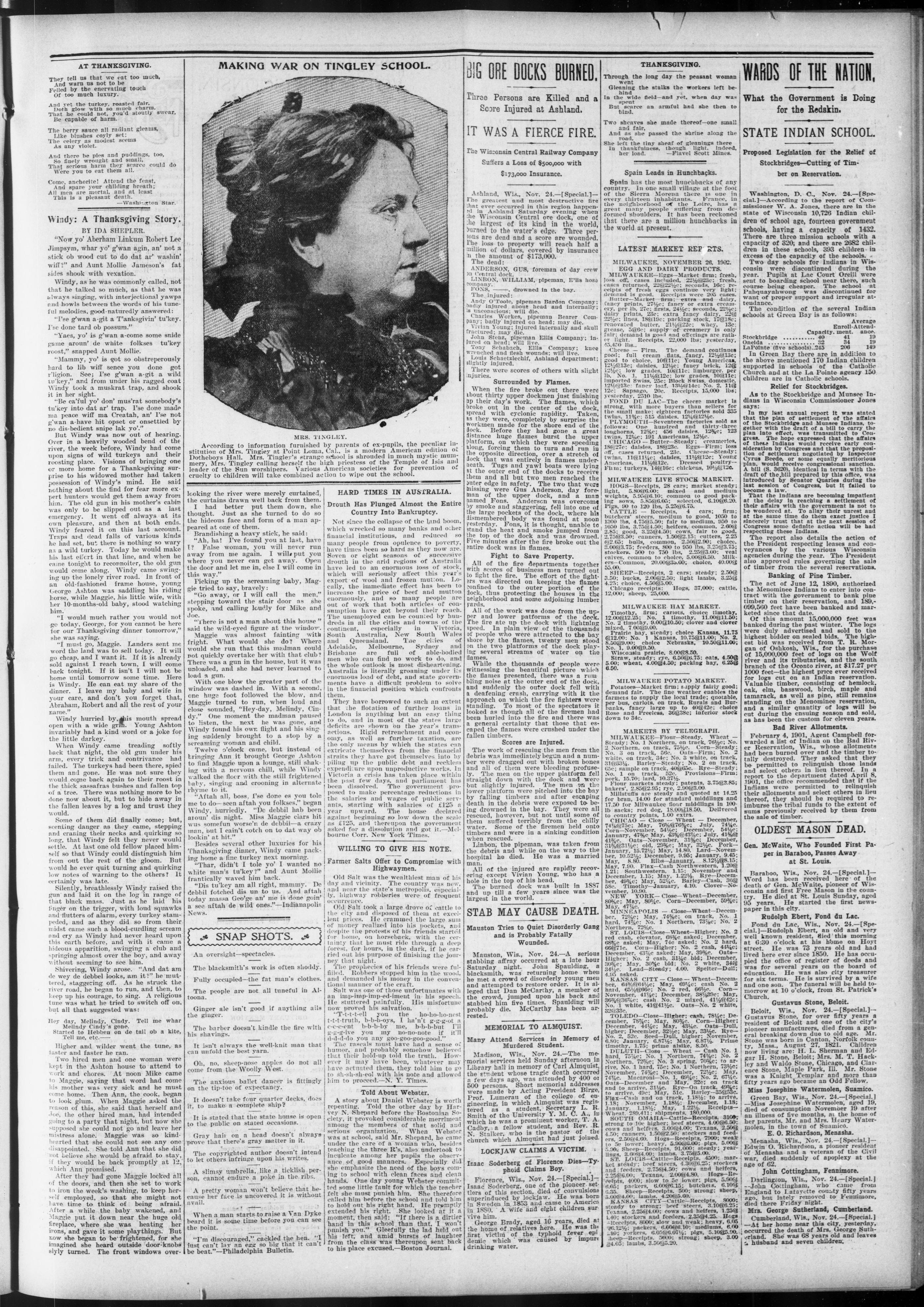
MRS. TINGLEY.
According to information furnished by parents of ex-pupils, the peculiar institution of Mrs. Tingley at Point Loma, Cal., is a modern American edition of Dotheboys Hall. Mrs. Tingley's strange school is shrouded in much mystic mummery, Mrs. Tingley calling herself the high priestess of the Temple of Isis and leader of the Sun worshipers. Various American societies for prevention of cruelty to children will take combined action to wipe out the school.
looking the river were merely curtained, the curtains drawn well back from them. I had better put them down, she thought. Just as she turned to do so the hideous face and form of a man appeared at one of them.
Brandishing a heavy stick, he said:
"Ah, ha! I've found you at last, have I? False woman, you will never run away from me again. I will put you where you never can get away. Open the door and let me in, else I will come in this way."
Picking up the screaming baby, Maggie tried to say, bravely:
"Go away, or I will call the men," stepping toward the stair door as she spoke, and calling loudly for Mike and Joe.
"There is not a man about this house" said the wild-eyed figure at the window. Maggie was almost fainting with fright. What would she do? Where would she run that this madman could not quickly overtake her with that club? There was a gun in the house, but it was unloaded, and she had never learned to load a gun. With one blow the greater part of the window was dashed in. With a second, one huge foot followed the blow, and Maggie turned to run, when loud and close sounded, "Hey-day, Melindy, Cindy." One moment the madman paused to listen, the next he was gone, and Windy found his own flight and his singing suddenly brought to a stop by a screaming woman and child.
Twelve o'clock came, but instead of bringing Ann it brought George Ashton to find Maggie upon a lounge, still shaking with a nervous chill, while Windy walked the floor with the still frightened baby, singing and crooning in alternate rhyme to it.
"Aftah all, boss, Ise done es you tole me to do—seen aftah you folkses." began Windy, hurriedly. "De debbil hab been aroun' dis night. Miss Maggie clars hit wus somefun worse'n de debbil—a crazy man, but I cain't cotch on to dat sat ob lookin' at hit."
Besides several other luxuries for his 'Thanksgiving dinner, Windy came packing home a fine turkey next morning.
"Thar, didn't I tole yo' I wanted no white man's tu'key?" and Aunt Mollie frantically waved him back.
"Dis tu'key am all right, mammy. De debbil fotched dis un to us. And aftah today massa Geo'ge an' me is done goin' a see aftah de wild ones."—Indianapolis News.
SNAP SHOTS.
Fully occupied—the fat man's clothes.
The people are not all tuneful in Altoona.
Ginger ale isn't good if anything ails the ginger.
The barber doesn't kindle the fire with his shavings.
It isn't always the well-knit man that can unfold the best yarn.
Oh, no, sheep-nose apples do not all come from the Woolly West.
The anxious ballet dancer is fittingly on the tip-toe of expectancy.
It doesn't take four quarter decks, does it, to make a complete ship?
It is stated that the state house is open to the public on stated occasions.
Gray hair on a head doesn't always prove that there's gray matter in it.
The copyrighted author doesn't intend to let others infringe upon his writes.
A slimsy umbrella, like a ticklish person, cannot endure a poke in the ribs.
A pretty woman won't believe that because her face is uncovered it is without avail.
When a man starts to raise a Van Dyke beard it is some time before you can see the point.
"I'm discouraged," cackled the hen. "I just can't lay an egg so big that it can't be heat"—Philadelphia Bulletin.
HARD TIMES IN AUSTRALIA
Drouth Has Plunged Almost the Entire Country Into Bankruptcy.
Not since the collapse of the land boom, which wrecked so many banks and other financial institutions, and reduced so many people from opulence to poverty, have times been so hard as they now are. Seven or eight seasons of successive drought in the arid regions of Australia have led to an enormous loss of stock, which will seriously affect this year's export of wool and frozen mutton. Locally, the immediate effect has been to increase the price of beef and mutton enormously, and so many people are out of work that both articles of consumption have got beyond their reach. The unemployed can be counted by hundreds in all the cities and towns of the continent, especially in Vivitoria, South Australia, New South Wales and Queensland. The cities of Adelaide, Melbourne, Sydney and Brisbane are full of able-bodied men who can find no work to do, and the whole outlook is most disheartening. Australia is literally groaning under its enormous load of debt, and state governments have a difficult problem to solve in the financial position which confronts them.
They have borrowed to such an extent that the flotation of further loans in London is anything but an easy thing to do, and in most of the states large deficits are shown on the year's transactions. Rigid retrenchment and economy, as well as further taxation, are the only means by which the states can extricate themselves from the financial straits they have got themselves into by piling up the public debt and reckless expenditure upon unproductive works. In Victoria a crisis has taken place within the past few days, and parliament has been dissolved. The government proposed to make percentage reductions in the salaries and wages of public servants, starting with salaries of £125 a year upward. The house declared against beginning so low down the scale as £125, and thereupon the government asked for a dissolution and got it.—Melbourne Corr. New York Times.
Farmer Salts Offer to Compromise with Highwaymen.
Old Salt was the wealthiest man of his day and vicinity. The country was new, and near the state's metropolis, especially, highway robberies were of frequent occurrence.
Old Salt took a large drove of cattle to the city and disposed of them at excellent prices. He crammed the large sum of money realized into his pockets, and despite the protests of his friends started for home, on horseback, with the certainty that he must ride through a deep forest, for hours, in the dark, if he carried out his purpose of finishing the journey that night.
The prophecies of his friends were fulfilled. Robbers stopped him in the wood, and demanded his money in the conventional manner of the craft.
Salt was one of those unfortunates with an imp-imp-imp-ed-iment in his speech. He stuttered painfully. His misfortune now proved his salvation.
"T-t-t-tell you the ho-ho-ho-nest t-t-t-truth, b-b-b-oys, I han't g-g-g-ot a c-c-c-ent b-b-b-by me, b-b-b-but I'll g-g-g-ive you my no-no-note if it'll d-d-d-do you any goo-goo-goo-good."
The rascals must have had a sense of humor, and probably somehow believed that their hold-up told the truth. However it may have been, whatever may have actuated them, they told him to go to sh-sh-sh-eol with his note and allowed him to proceed.—N. Y. Times.
A story about Daniel Webster is worth repeating. Told the other day by Harvey N. Shepard before the Bostonian Society, it provoked considerable merriment among the members of that solid and serious organization. When Webster was at school, said Mr. Shepard, he came under the care of a woman who, besides teaching the three R's, also undertook to inculcate among her pupils the observance of good manners. Especially did she emphasize the need of the boys coming to school with clean faces and clean hands. One day young Webster committed some little fault for which the teacher felt she must punish him. She therefore called him before the school and told him to hold out his right hand. He promptly extended his right. She looked at it a moment, then said: "If there is a dirtier hand in this school than that, I won't punish you." Gleefully the lad held out his left, and amid bursts of laughter from the class was thereupon sent back to his place excused—Boston Journal.
WILLING TO GIVE HIS NOTE.
Told About Webster.
BIG ORE DOCKS BURNED.
Three Persons are Killed and a Score Injured at Ashland.
$173,000 Insurance.
Ashland, Wis., Nov. 24.—[Special.]— The greatest and most destructive fire that ever occurred in this region happened in Ashland Saturday evening when the Wisconsin Central ore dock, one of the largest of its kind in the world, burned to the water's edge. Three persons are dead and a score are wounded. The loss to property will reach half a million of dollars, covered by insurance in the amount of $173,000. The dead:
ANDERSON, GUS, foreman of day crew on Central dock.
LINBON, WILLIAM, pipeman, E'lis hose company.
FONS, —, drowned in the bay.
The injured:
Andy O'Toole, pipeman Bardon Company;
badly injured about head and internally;
is unconscious; will die.
Charles Workes, pipeman Bearer Company;
badly injured on head; may die.
Vivian Young; injured internally and skull fractured; may die.
John Stenz, pipeman Ellis Company; injured on head; will live.
Tony Schabach, Ellis Company; knee wrenched and flesh wounds; will live.
Louis Schaetzlechif, Ashland department; slightly injured.
There were scores of others with slight injuries.
Surrounded by Flames.
When the fire broke out there were about thirty upper dockmen just finishing up their day's work. The flames, which broke out in the center of the dock, spread with cyclonic rapidity. Taken, as they were, completely by surprise the workmen made for the shore end of the dock. Before they had gone a great distance huge flames burst the upper platform, on which they were speeding along, forcing them to turn and run in the opposite direction, over a stretch of dock that was entirely in flames underneath. Tugs and yawl boats were lying at the outer end of the docks to receive them and all but two men reached the outer edge in safety. The two that were missing were Gus Anderson, day foreman of the upper dock, and a man named Fons. Anderson was overcome by smoke and staggering, fell into one of the large pockets of the dock, where his dismembered body was found at noon yesterday. Fons, it is thought, unable to stand the heat and smoke jumped from the top of the dock and was drowned. Five minutes after the fire broke out the entire dock was in flames.
Fight to Save Property.
All of the fire departments together with scores of business men turned out to fight the fire. The effort of the fighters was directed on keeping the flames confined to the outer portion of the dock, thus protecting the houses in the neighborhood and some adjoining lumber yards.
All of the work was done from the upper and lower platforms of the dock. The fire ate up the dock with lightning speed. In plain view of the thousands of people who were attracted to the bay shore by the flames, twenty men stood on the two platforms of the dock playing several streams of water on the flames.
While the thousands of people were witnessing the beautiful picture which the flames presented, there was a rumbling noise at the outer end of the dock, and suddenly the outer dock fell with a deafening crash, carrying with it the approach on which the fire fighters were standing. To most of the spectators it looked as though all of the firemen had been hurled into the fire and there was a general certainty that those that escaped the flames were crushed under the fallen timbers.
Scores are Injured.
The work of rescuing the men from the debris was immediately begun and a number were dragged out with broken bones and all of them were bleeding profusely. The men on the upper platform fell straight down with the dock and were but slightly injured. The men on the lower platform were pitched into the bay by falling timbers and after escaping death in the debris were exposed to being drowned in the bay. They were all rescued, however, but not until some of them suffered terribly from the chilly water. Some of the firemen held onto timbers and were in a sinking condition when rescued. Linbon, the pipeman, was taken from the debris and while on the way to the hospital he died. He was a married man.
All of the injured are rapidly recovering except Vivian Young, who has a hole in the top of his head. The burned dock was built in 1887 and up till a few years since was the largest in the world.
STAB MAY CAUSE DEATH.
Mauston Tries to Quiet Disorderly Gang and is Probably Fatally Wounded.
Mauston, Wis., Nov. 24.—A serious stabbing affray occurred at a late hour Saturday night. John Spaulding, a blacksmith, was returning home when he met a crowd of disorderly young men and attempted to restore order. It is alleged that Dan McCarthy, a member of the crowd, jumped upon his back and stabbed him five times. Spaulding will probably die. McCarthy has been arrested.
MEMORIAL TO ALMQUIST.
Many Attend Services in Memory of Murdered Student.
Madison, Wis., Nov. 24.—The memorial services held Sunday afternoon in Library hall in memory of Carl Almquist, the student whose tragic death occurred a few days ago, was attended by 400 or 500 persons. Short memorial addresses were made by Acting President Birge, Prof. Lumerau of the college of engineering, in which Almquist was registered as a student, Secretary L. R. Smith of the University Y. M. C. A., in which he was a prominent worker, T. A. Cadby, a fellow student, and Rev. R. N. Stalker, who is the pastor of the church which Almquist had just joined.
LOCKJAW CLAIMS A VICTIM.
Isaac Soderberg of Florence Dies—Typhoid Claims Boy.
Florence, Wis., Nov. 24.—[Special.]—Isaac Soderberg, one of the pioneer settlers of this section, died of convulsions superinduced by lockjaw. He was born in Sweden in 1853 and came to America in 1880. A wife and eight children survive him. George Brady, aged 16 years, died at the home of relatives here. He was the first victim of the typhoid fever epidemic which was caused by impure drinking water.
THANKSGIVING.
Through the long day the peasant woman went
Gleaning the stalks the workers left behind
In the wide field—and yet, when day was spent
But scarce an armful had she then to bind.
Two sheaves she made thereof—one small and fair,
And as she passed the shrine along the road. She left the tiny sheaf of gleanings there In thankfulness, though light, indeed, her load. —Flavel Scott Mines.
Spain Leads in Hunchbacks.
Spain has the most hunchbacks of any country. In one small village at the foot of the Sierra Morena there is one in every thirteen inhabitants. France, in the neighborhood of the Loire, has a great many people suffering from deformed shoulders. It has been reckoned that there are a million hunchbacks in the world at present.
LATEST MARKET REP RTS.
MILWAUKEE, NOVEMBER 26, 1902.
EGG AND DAIRY PRODUCTS.
MILWAUKEE—Eggs—Market firm; fresh, loss off, cases included, $22\frac{1}{2}@23c; fresh, cases returned, $22@22\frac{1}{2}c; seconds, 16c; receipts of fresh eggs continue very light; demand is good. Receipts were 205 cases. Butter—Market firm; extra and dairy, fancy prints, $27\frac{1}{2}c; fancy or extra creamery, per lb, 17c; firsts, $24\frac{1}{2}c; seconds, $22\frac{1}{2}c; dairy prints, 23c; extra fancy dairy, $22@22\frac{1}{2}c; lines, 18@18c; packing stock, 17@18c; renovated butter, $21\frac{1}{2}@22c; whey, 13c; grease, 5@6c; supply of creamery is only fair; demand is good and offerings are rather light. Receipts, 22,000 lbs; yesterday, 45,450 lbs.
Cheese — Firm. The demand continues good; full cream flats, fancy, 12½@13c; good to choice, 10@11c; Young Americas, 12½@13c; daisies, 12½c; fancy brick, 12½c; low grades, 10@11c; limburger. per lb. No. 1, 11½@12c; low grades, 10@11c; imported Swiss, 25c; Block Swiss, domestic, 12½@13c; fancy loaf, 13½@14c; No. 2, 11@12c; Sapsago, 20c. Recelpts, 15,000 lbs; yesterday, 2510 lbs.
FOND DU LAC—The cheese market is strong, with more buyers than sellers for the small make: eighteen factories sold 335 twins, 11½c; 515 daisies, 12½@12c.
PLYMOUTH—Seventeen factories sold as follows: One hundred and thirty-three longhorns, 12½c; 456 daisies, 12½c; 123 twins, 12½c; 191 Americans, 12½c.
CHICAGO—Butter—Steady; creameries, 18@27c; daisies, 18@23c. Eggs—Firm; loss off, cases returned, 23c. Cheese—Steady; twins, 11@11½c; daisies, 11½@12c; Young Americas, 11½@12c. Dressed poultry—Firm; turkeys, 14@16c; chickens, 10½@12c.
MILWAUKEE LIVE STOCK MARKET.
HOGS—Receipts, 28 cars; market steady; light, 5.80@6.00; mixed and medium weights, 5.95@6.10; common to good packing sows, 5.85@6.05; selected, 6.10@6.20. Pigs, 90 to 120 lbs, 5.25@6.75.
CATTLE — Receipts, 4 cars; firm; butchers' steers, medium to good, 1050 to 1300 lbs, 4.75@6.50; fair to medium, 950 to 1050 lbs, 4.75@6.50; helfers, common, 2.60@2.85; good, 3.25@4.50; cows, fair to good, 2.75@3.50; canners, 1.50@2.15; cutters, 2.25@2.65; bulls, common, 2.50@2.90; choice, 3.00@3.75; feeders, 800 to 950 lbs, 3.25@3.75; stockers, 500 to 750 lbs, 2.25@3.00; veal calves, common to choice, 5.00@6.50. Milkers—Common, 20.00@35.00; choice, 40.00@55.00.
SHEEP—Receipts, 2 cars; steady; 2.50@3.50; bucks, 2.00@2.50; light lambs, 3.25@4.25; choice, 4.50@5.00.
Chicago receipts: Hogs, 37,000; cattle, 12,000; sheep, 25,000.
Timothy, firm; carlots, choice timothy,
12.00@12.25; No. 1 timothy, 11.00@11.50;
No. 2 timothy, 9.00@10.50; clover and clover
mixed, 7.00@9.00.
Prairie hay, steady; choice Kansas, 11.75
@12.00; No. 1 Kansas, 10.75@11.00; No. 2,
8.50@9.00; choice Nebraska, 10.50@11.00;
No. 1, 9.00@9.50.
Wisconsin prairie, 8.00@8.50.
Straw, steady; rye, 6.50@6.75; oats, 4.50@
5.00; wheat, 4.00@4.50; packing hay, 6.25@
6.50.
MILWAUKEE POTATO MARKET.
Potatoes—Market firm; supply fairly good;
demand fair. The fine weather enables the
farmers to supply the local trade; quotable,
per bus, carlots, on track, Rurals and Bur-
banks, fancy large up to 40@42c; choice
Rose and Preeless, 36@38c; inferior stock
down to 34c.
MARKETS BY TELEGRAPH
MILWAUKEE—Floor—Steady. Wheat — Steady; No. 1 Northern, on track, 76½c; No. 2 Northern, on track, 75½c. Corn—Steady; No. 3 on track, 56c. Oats—Firm; No. 2 white, on track, 34c; No. 3 white, on track, 31@334. Barley—Steady; No. 2 on track, 65c; sample on track, 40@65c. Rye—Steady; No. 1 on track, 52c. Provisions—Firm; pork, 15.70; lard, 10.37%.
Flour markets steady; patents, 3.75@3.85;
bakers', 2.85@2.95; rye, 2.90@3.00.
Millstuffs are steady and quoted at 14.25
for bran, 14.00 for standard middlings and
17.50 for Milwaukee flour middlings in 100
lb sacks; red dog, 18.00@18.50. Delivered
to country points, 1.00 extra.
CHICAO - Close - Wheat - December,
74%@75c; May, 76%@76c; July, 74%c
Corn-November. 54%c; December, 54%c
January, 47%c May, 43%@43%c; July, 41%@
41%c. Oats-November, 31%c; December,
31%@31%c; old, 29%c; May, 32%c. Pork-
January, 15.72%; May, 14.80. Lard-Nov-
ember, 10.52%; December, 9.95; January, 9.45;
May, 8.80. Ribs-January, 8.12%@8.15;
May, 7.90. Flax-Cash Northwestern, 1.20@
1.21; Southwestern, 1.15; November and
December, 1.15; May, 1.22%2. Rye-December,
49%c; May, 52%c. Barley-Cash, 36@
58c. Timothy-January, 4.10. Clover-Nov-
ember, 10.90.
NEW YORK - Close-Wheat-December,
80%c; May, 80%c. Corn-December, 59%c;
May, 47%c
MINNEAPOLIS — Close—Wheat—December,
72%c; May, 74%c; on track, No. 1
hard, 74%c; No. 1 Northern, 73%c; No. 2
Northern, 72%c.
ST. LOUIS—Close—Wheat—Higher; No. 2
red cash, elevator, 68%c asked; December,
68%c asked; May, 74%c asked; No. 2 hard,
66@71c. Corn—Higher; No. 2 cash, 44%c;
December, 43%c asked; May, 39%c. Oats—
Higher; No. 2 cash, 31%c bid; December,
30%c; May, 30%c bid; No. 2 white, 34@
34%c. Lead—Steady; 4.00. Spelter—Dull;
4.95 asked.
KANSAS CITY — Close—Wheat—December,
64%@64%c; May, 69%c; cash No. 2
hard, 65%@66c; No. 2 red, 66%c. Corn—
November, 41%c; December, 38%39c; May,
36%@36%c; cash No. 2 mixed, 41%@42c;
No. 1 white, 41@41%c. Oats—No. 2 white,
32@39c.
TOLEDO—Close—Higher; cash, 78%c; December, 78%c; May, 80%c. Corn—Higher; December, 44%c; May, 43%c. Oats—Dull, higher; December, 32%c; May, 33%c. Rye—No. 2, 52c. Seed—Dull, higher; November, 6.80; January, 6.87%; May, 6.87%; Prime timothy, 1.75; prime alske, 8.50.
DULUTH—Close — Wheat — Cash No. 1 hard, 75%c; No. 1 Northern, 74%c; No. 2 Northern, 72%c; No. 3 spring, 70%c; to arrive, No. 1 hard, 75c; No. 1 Northern, 73%c; November, 74%c; December, 72%c; May, 74%c. Macaroni—No. 1, 69%c; No. 2, 67%c. Oats—December and May, 32c; on track and to arrive, 31%c. Rye—On track, 49%c; to arrive, 49c; May, 51c. Barley—35%@33c. Flax—Cash and on track, 1.18%; to arrive, 1.18; November, 1.18%; December, 1.18; January, 1.18%; May, 1.22%; Receipts—Wheat, 289,411; shipments, 180,000.
SOUTH OMAHA—Cattle—Receipts, 3109;
strong to 10c higher; beef steers, 4.00@6.50;
cows and heifers, 3.00@4.00; Texans, 2.50@
4.50; canners, 1.50@2.00; stockers and feeders,
2.50@4.00. Hogs—Receipts, 7900; weak to
5c lower; heavy, 5.90@6.00; pigs, 5.00@
5.90. Sheep—Receipts, 91,000; steady; year-
bugs, 3.00@4.00; lambs, 3.75@5.00.
ST. LOUIS—Cattle—Recelpts, 4500; market steady; beef steers, 4.30@6.25; stockers and feeders, 2.75@4.50; cows and heifers, 2.25@6.00; Texans, 2.00@4.80. Hogs—Recelpts, 4000; slow to 5c lower; pigs, 5.90@6.05; packers, 6.00@6.15; butchers, 6.10@6.35. Sheep—Recelpts, 500; strong; sheep, 3.00@4.00; lambs, 4.20@5.60.
KANSAS CITY—Cattle—Recelpts. 8000; steady to strong; beef steers. 3.10@6.25; Texans. 2.25@4.00; cows and heifers. 1.25@4.40; stockers and feeders. 2.35@4.25. Hogs—Recelpts. 8000; slow and weak; heavies. 6.05@6.12%; packers. 6.00@6.10; mediums. 6.00.14%; yorkers. 6.05@6.17%; plgs. 5.10@5.90. sheep—Recelpts. 5000; strong; sheep. 3.00@4.15; lambs. 3.50@5.20.
WARDS OF THE NATION.
What the Government is Doing for the Redskin.
Washington, D. C., Nov. 24.—[Special.]—According to the report of Commissioner W. A. Jones, there are in the state of Wisconsin 10,726 Indian children of school age, fourteen government schools, having a capacity of 1432. There are three mission schools with a capacity of 320; and there are 2682 children in these schools, 393 children in excess of the capacity of the schools. Two day schools for Indians in Wisconsin were discontinued during the year. Pupils at Lac Court Oreill were sent to boarding school near there, such course being cheaper. The school at Pahquayahwong was discontinued for want of proper support and irregular attendance. The condition of the several Indian schools at Green Bay is as follows:
Enrol-Attend
Capacity, ment. ance.
Stockbridge ..... 40 41 19
Onelda ..... 32 34 19
LaPointe (five schools)..245 206 149
In Green Bay there are in addition to
the above mentioned 170 Indian children
supported in schools of the Catholic
Church and at the La Pointe agency 150
children are in Catholic schools.
Relief for Stockbridges.
As to the Stockbridge and Munsee Indians in Wisconsin Commissioner Jones says:
In my last annual report it was stated that the plan of settlement of the affairs of the Stockbridge and Munsee Indians, together with the draft of a bill to carry the plan into effect, was transmitted to Congress. The hope expressed that the affairs of these Indians would receive early consideration by Congress and that the proposition of settlement negotiated by Inspector Cyrus Beede, or some equally meritorious plan, would receive congressional sanction. A bill (S. 3620), identical in terms with the draft of the bill prepared by this office, was introduced by Senator Quarles during the last session of Congress, but it failed to become a law.
That the Indians are becoming impatient at the delay in reaching a settlement of their affairs with the government is not to be wondered at. To allay their unrest and at the same time do them exact justice I sincerely trust that at the next session of Congress some definite action will be had respecting these Indians.
The report also details the action of the President respecting leases and conveyances by the various Wisconsin agencies during the year. The President also approved rules governing the sale of timber from the several reservations.
Banking of Pine Timber.
The act of June 12, 1890, authorized the Menominee Indians to enter into contract with the government to bank pine timber on their reservation, and 189,099,560 feet have been banked and marketed since that date.
Of this amount 15,000,000 feet was banked during the past winter. The logs were duly advertised and sold to the highest bidder on sealed bids. The highest bid was received from T. R. Morgan of Oshkosh, Wis., for the purchase of 15,000,000 feet of logs on the Wolf river and its tributaries, and the south branch of the Oconto river, at $17.27 per 1000 feet—the highest price ever received for logs cut on an Indian reservation. Valuable timber, consisting of hemlock, oak, elm, basswood, birch, maple and tamarack, as well as pine, still remains standing on the Menominee reservation, and a similar quantity of logs will be cut during the ensuing season and sold, as has been the custom for eleven years.
Bad River Allotments.
February 4, 1901, Agent Campbell forwarded a list of Indian on the Bad River Reservation, Wis., whose allotments had been burned over and the timber totally destroyed. They asked that they be permitted to relinquish those lands and select others in lieu thereof. In a report to the department dated April 8, 1901, the office recommended that if the Indians were permitted to relinquish their allotments and select others in lieu thereof, they should be required to reimburse the tribal funds to the extent of sums previously received by them from the sale of timber.
OLDEST MASON DEAD.
Gen. McWaite, Who Founded First Paper in Baraboo, Passes Away at St. Louis.
Baraboo, Wis., Nov. 24.—[Special.]—Word has been received here of the death of Gen. McWaite, pioneer of Wisconsin and first Free Mason in the country. He died at St. Louis Sunday, aged 95 years. He started the first newspaper in this city.
Rudolph Ebert, Fond du Lac.
Fond du Lac, Wis., Nov. 24.—[Special.]—Rudolph Ebert, an old and very well known resident, died this morning at 6:30 o'clock at his home on Hoyt street. He was 73 years old and had lived here ever since 1850. He has occupied the office of register of deeds and was for several years on the board of education. He was also city treasurer for six terms. He is survived by a wife and one son. The funeral will be held tomorrow at 10 o'clock, from St. Patrick's Church.
Gustavus Stone, Beloit.
Beloit, Wis., Nov. 24.—[Special.]—Gustavus Stone, for over fifty years a resident of Beloit and one of the city's pioneer manufacturers, died from a general breaking down due to old age. Mr. Stone was born in Canton, Norfolk county, Mass., August 27, 1821. Children now living are: H. L. Sherman and Edgar H. Stone, Beloit; Mrs. M. T. Hackley and Waldo Stone, Chicago, and Clarence Stone, Maple Park, Ill. Mr. Stone was a Knight Templar and mora than fifty years ago became an Odd Fellow.
Miss Josephine Watermolen, Suamico.
Green Bay, Wis., Nov. 24.—[Special.]—Miss Josephine Watermolen, aged 19, died of consumption November 19 after an illness of five months, at the home of her parents, Mr. and Mrs. Henry Watermolen, in the town of Suamico.
E. O. Richardson, Menasha.
Menasha, Wis., Nov. 24.—[Special.]—Edwin O. Richardson, a pioneer resident of Menasha and a veteran of the Civil war, died suddenly of apoplexy at the age of 62.
John Cottingham, Fennimore.
Darlington, Wis., Nov. 24.—[Special.]—John Cottingham, who came from England to Lafayette county fifty years ago, but lately removed to Fennimore, died there Friday night.
Mrs. George Sutherland, Cumberland. Cumberland, Wis., Nov. 24.—[Special.] At her home near this city, yesterday, occurred the death of Mrs. George Sutherland. She was 68 years old and leaves husband and seven children.
Printed in the Interests of the Negro Race, MILWAUKEE, WIS.
Any part of the United States and Canada,
postage paid.
postage paid.
One Year ..... $2.00
Six Months ..... 1.25
Three Months ..... 73
Send money by Express Money Order, P. O.
Money Order or Registered Letter to the
Wisconsin Weekly Advocate.
ADVERTISING RATES.
One inch, single insertion..... 25c
One inch, per year..... $9.00
Business locals 5c per line each insertion.
Apply for rates to the Advocate.
TO CONTRIBUTORS:
All communications must be sent with the name and address of the sender as an evidence of good faith, but not necessarily for publication. No manuscript returned if not accepted, unless accompanied by stamps.
The Wisconsin Weekly Advocate company wishes to notify the public that all contracts and business transactions with this company must have the company stamp, otherwise they will be void. Neither will this company be responsible for paid subscriptions unless given to duly-accredited agents, who, on request, will give the company's receipt for same. Subscribers failing to receive their papers regularly will kindly notify the general office. Address all business communications to the general manager, 79 Fifth street.
Entered in the Postoffice at Milwaukee as Second-class matter.
EDITORIAL PARAGRAPHS.
"I know of the bravery and character of the Negro soldier. He saved my life at Santiago, and I have had occasion to say so in many articles and speeches. The Rough Riders were in a bad position when the Ninth and Tenth cavalry came rushing up the hill carrying everything before them. The Negro soldier has the faculty of coming to the front when he is needed most. In the Civil war he came 400,000 strong, and I believe he saved the Union."—President Roosevelt.
Congressional Representation of the South.
All things come to those who know how to wait. The action of several Southern states in disfranchising the Negro will in all probability prove to be a "boomerang" to such states. President Roosevelt has shown his usual fairness and impartiality in his dismissal from office of Collector Bingham of Alabama of the notorious Lilywhite gang. Postmaster General Payne's scheme to reduce the representation in Congress from the Southern states in proportion to the number of qualified voters and not according to population is deserving of the unqualified support of the Negro press and people. To a large extent this point was lost sight of during the recent campaign. But to our personal knowledge the congressmen-elect from Wisconsin at any rate are in perfect accord with Mr. Payne in his endeavor to right the wrong which has been done at least so far as that can be done by causing the offending states to suffer a corresponding loss in the number of their congressional representatives. This gentleman makes a very strong point when he calls attention to the fact that in the Republican national convention the state of Minnesota is entitled to twenty delegates with a certain number of Republican votes recorded, while the whole of the Southern states with an almost identical number of Republican votes are at present entitled to 120 delegates (or six times the number) in this aforesaid convention. It is to be hoped that this matter will receive the attention of the President in his forthcoming annual message, or if not, that the Negro press at any rate will keep right on agitating the question, and upholding the policy which Mr. Payne advocates, until redress is obtained and the rights of all American citizens, "irrespective of race, creed, color or previous condition of servitude."
A White Brute.
The dastardly outrage committed upon a little girl of the tender age of 6 years by a brute in the likeness of a man, which occurred in this city a few days ago, should not be passed over with the slight notice it has received from the contemporary press of the city. Had the same allegation been made against a Negro we should have had flaring scare headlines and in all probability an incitement to the holding of a lynching bee. Instead we find the notice relegated to an obscure corner and published in the smallest possible type. "What is sauce for the goose is sauce also for the gander." We have such confidence in the administration of the law in this city that we are perfectly certain the man in question will meet with that punishment which his offense merits. We simply wish to draw a comparison between the publicity given to this affair and that given to the alleged outrage committed in Dane county some few months ago, and for which a poor ignorant Negro is now undergoing his sentence in the state penitentiary.
White Servant and Colored Employers. Mr. Widule, assistant postmaster, seems very much surprised (according to an interview granted to the Milwaukee Daily News) at the fact that a colored family living in the northwestern part of the city has a white servant as part of their establishment, and the medical gentleman called in to attend the girl makes it a nine-days' wonder that he finds her kindly and humanely treated. The circumstance is not exceptional by any means and the kindness displayed by the master and mistress is simply a part of their natural disposition. They are built that way and cannot help it.
That White House Dinner!
The Advocate very much doubts the accuracy of the dispatch from Memphis, Tenn., published in Tuesday's Journal
exclusively, to the effect that Gen. Wright had said that Mr. Booker T. Washington had not broken bread "en famille" with President Roosevelt. Gen. Wright is too much liked by the Negro population of the South, and has too much regard for them to try to belittle any incident which tends to give them a social lift up. It is, however, surely time that the last was heard of an incident which after all is of little importance to anybody and which in any other country except this free-and-equal republic would have been totally disregarded.
Thanksgiving, 1902.
Every one has something to be thankful for at all times; but at this especial time it becomes us to look back at the past year, and give thanks where they belong for the benefits received. Personally we have reason for gratitude for the increased and increasing circulation of the Advocate and the confidence and patronage of the general public. During the past year the race as a whole has reason to be thankful for the increased prosperity and also for constantly growing interest taken by outsiders in the general well-being of the Negro. We trust all of our readers will have a bountiful and happy reunion around the family table.
The English Parliament can say to the Austrian Reichsrath: "You're another!"
Q. Why is Carrie Nation like rheumatism? A. Because she makes trouble in the joints.
The admiral of the Swiss navy might pick up the job lot of obsolete warships that Great Britain wants to sell.
Now it transpires that people can be made fresh with salt, which has heretofore been regarded as a pickling agent only.
There will be no scramble for the small quantities of anthracite on the way to consumers, unless the weather gets a wintry edge.
None of the bears in the Mississippi swamp country rushed for the honor of being killed by a President of the United States.
The airship of the brothers Lebaudy, at Nantes, recently made good speed. Speed is excellent in an air-ship—when in the right direction.
Well, there are places not afflicted with soft coal smoke where the air is obscured by dust from volcanic eruptions—and that is worse.
When J. P. Morgan finds it necessary to take a pill, Wall street prices go off several points. They go up again, however, when Mr. Morgan is in perfect health.
Europe is having cold weather in advance of America in this year of grace, and nobody will begrudge her the experience,—not while the shortage of coal continues.
One of the reasons why meats have been dear was the shortness of the corn crop of 1901. The mammoth corn crop of 1902 may be followed by a lowering of the price of meats.
In order to give the German Emperor a score of eighty-four rabbits in twenty minutes, the gamekeepers must have fixed things for a wholesale drawing of the "bead."
The Chicago people who threaten to sue for damages because they went to a football match and came away with a stock of bruises must have a sort of parlor idea of the game.
The old exclamation, "What a country! What a people!" may be extended when the Kansas joint-smasher appears in her new play. "What a country! What a people! What a Nation!"
The record of forty miles an hour by an electric car, on the run between Cleveland and Toledo, foreshadows closer competition with the regular steam lines through a general improvement in speed on the electric lines.
Gen. Bragg is now in position to talk concerning Cuba, but he won't do it, because some "newspaper fellow" might construe it as Chinese, among whom the General isn't inclined to cultivate love by the making of enemies.
Ex-Minister Wu is going back to China with "that tired feeling," superinduced by the activity of American reporters in trying to steer not only China but the whole world. Wu takes things too seriously.
The express messenger who pinked the train robber near Trinidad, Colorado, should receive something more substantial than a medal, from his company, to encourage other messengers to utilize their marksmanship when occasion requires.
---
An account of the trial of a new French airship which is said to have attained a speed of twenty-five miles an hour fails to state whether the ship was going "down the wind" or against it. Of course this is a trivial matter from the standpoint of the promoter, but it is important for the would-be investor.
England is just now getting a deal of steel trade from the United States, but this only makes her suspicious as to whether her furnishing the raw material will not enable the United States to steal some of her machinery business. They are very suspicious of American prosperity, across the water.
Owing to the fact that it will be impossible to get anthracite coal to the interior towns in time for the approaching cold weather, there will probably be an attack on the small amount of standing timber still on Wisconsin farms. But there is generally a large amount of "dead and down" timber rotting in the woods that could be turned to advantage and the woods would be improved in appearance by the gathering of this material.
HOTEL CLERK IS WOUNDED
Cambria Man Shot by Robber He Tried to Capture.
THIEVES RAN AWAY.
There was Considerable Money in Hotel and it is Thought that Thieves
Cambria, Wis., Nov. 27.—Three burglars entered the Parry & Emery hotel here Tuesday through the front door, which they opened with a skeleton key. Frank Parry, the clerk, who was sleeping, was awakened by the noise. He rushed out and grappled with one of the men, who drew a revolver and fired three shots, one taking effect in Parry's right foot. The other two ran, one going up Towen street and the other down Main street. Finding that one of the group was missing, the burglar who had ran up Towen street returned and leveled a revolver at Parry's head and told him to let free the man he was holding or he would blow out his brains. As Parry was unarmed he submitted. The men went south from town, and have not been caught. They are unknown.
Considerable money belonging to traveling men was in the hotel at the time and it is supposed they knew of it. Nothing was secured
FASHIONABLE WEDDING.
Miss Mollie Hall Becomes the Wife of William Rahr, Jr., at Manitowoc
Manitowoc, Wis., Nov. 27.—[Special.]
The event in society circles for the season was the marriage here today of Miss Mollie Hall and William Rahr, Jr., which was solemnized at St. James' Episcopal Church at 11 o'clock. Rev. S. R. S. Gray officiated and 300 guests witnessed the ceremony. The service was very simple, there being no attendants to the bridal couple. Miss Hall is the leader in social circles in the city. Mr. Rahr is the son of Mayor and Mrs. William Rahr. The bridal pair will make an extended tour of the East and will return here to take up their home.
John Seykora, a resident of Manitowoc county for more than fifty-five years, died at Kossuth yesterday. He was one of the best-known Bohemian residents of the state and is survived by a large family of children.
John Nuss, a prominent farmer of Rapids, has reported to the police an attempt that was made last night by two men to hold him up. Nuss was returning from the city about 10 o'clock in the evening when two strangers set upon him. He succeeded in escaping after a brief encounter with the footpads in which one of them was laid low. It is thought that the holdup was the work of tramps as this is the second case reported within a short time. Emil Kretche, a farmer of Kossuth, this county, is at the hospital in Green Bay as the result of an accident in which the fingers of his right hand were so badly crushed as to necessitate amputation. Kretche had his hand caught in a feed cutter and nearly lost his arm.
CRUELTY TO WIFE SENDS MAN TO PRISON.
William Waltersdorf of Appleton will be Sentenced Under Old Conviction.
Appleton, Wis., Nov. 27.—William Waltersdorf was arrested yesterday on a bench warrant issued by Judge Goodland and will appear Friday to receive sentence for burglary, of which he was convicted over two years ago. His wife lately entered a complaint of cruel treatment, which resulted in the issuance of a bench warrant.
NEARLY MURDERED BY TWO TRAMPS.
Two Lanon Men Held Up and Robbed While Stealing a Ride in a Box Car.
Waupaca, Wis., Nov. 27.—[Special.]—Frank Bartel and Fred Schultz of Lanon, Wis., were nearly murdered by two tramps. The two entered a box car intending to steal a ride to Marshfield, where they were going to work. They discovered two tramps in the car after the train was in motion. They jumped on the men from behind and pounded them with such force that they lost consciousness. When the men recovered they found that the men were gone and $15 had evidently gone with them.
COLLEGE INSTRUCTRESS WEDS
Miss Alice Marie Cheney Marries Edwin Stanton Ela.
Beloit, Wis., Nov. 27.—The marriage of Miss Alice Marie Cheney to Edwin Stanton Ela took place yesterday at the home of Miss Cheney's parents, Dr. J. F. Eaton of Rochester, Wis., officiating. Miss Cheney is the daughter of Mr. and Mrs. George A. Cheney. Miss Cheney was graduated from Mt. Holyoke College in 1897 and since then has been an instructor in Milwaukee-Downer College and Rochester Academy. Mr. Ela is a graduate of Wisconsin University. For some years he has been on the United States geological survey, with headquarters at Washington, D. C.
A. C. TEMPLETON IS AGENT
Will Work Milwaukee End of Madison Hotel Deal.
Madison, Wis., Nov. 27.-The officers of the Metropolitan Hotel Company, incorporated to build a large new hotel in Madison, have elected A. C. Templeton of Milwaukee to succeed S. V. Davidor of the same place as Milwaukee agent of the company.
OSHKOSH PASTOR TO LEAVE
Rev. G. D. Lindsay is Going to Greensburg, Pa.
Oshkosh, Wis., Nov. 27.—Rev. George D. Lindsay, pastor of the Presbyterian Church, has accepted a call to the Westminster Church of Greensburg, Pa.
Found with Both Feet Frozen.
West Superior, Wis., Nov. 27.—[Special.]—With no hat, no shoes, no coat and feet frozen up to the ankles, an unknown man was picked up in the Great Northern railroad yards here today. He was evidently out of his mind and was making westward. He gave his name as Anderson and afterward Iverson, and said that yesterday he was in New York. He is now in the hospital and may have to lose both feet.
Gen. Joubert's silver-fitted jaunting car, which was captured in South Africa, is now at Woolwich arsenal.
FIRST OFFICIAL TABLE OF VOTE OF WISCONSIN.
Secretary of State Froehlich Announces the Exact Figures on the Governship as Rendered to Him by Officials of the Various Counties.
Madison, Wis., Nov. 26.—[Special.]--The secretary of state today made the first official announcement of the vote at the last election. All of the tables printed heretofore have been unofficial and not accurate. The total vote cast was 365,676, of which Gov. La Follette received, 183,417; Rose, 145,818; Drake, 9647; Seidel, 15,970; Puck, 791; with 33 scattering. Juneau county was the last to report. Milwaukee is the only county which has not yet reported on the amendments. It is stated, however, that the amendments have all passed. The first official table showing the vote by counties for governor is as follows:
OPERATION FAILS TO SAVE HIS LIFE.
Charles Anderson Dies of Appendicitis at Hospital in Sheboygan—Elkhart Railway's Bond.
Sheboygan, Wis., Nov. 27.—[Special.]
—Charles Anderson, aged 35 years, died last evening after an operation for appendicitis. He had been long in the employ of the M. Winter Lumber Company.
The Sheboygan-Elkhart Lake Electric Railway Company has filed a bond of $10,000 with the town board of Plymouth as a guarantee that the line will be in operation by July 1, 1903. The company has been granted a franchise through the town and work of grading has been resumed.
HUNTING ACCIDENT RESULTS IN DEATH.
Man Residing Near Rhinelander Shoots Himself and Dies Before Help
Rhinelander, Wis., Nov. 27.—Walter Ross, who was wounded while hunting deer near his farm, seven miles from the city, yesterday, by accidentally discharging the gun which he was carrying, died before a physician reached him.
IN MEMORY OF MISS SWAIN
Two Marble Bas Reliefs Given to Marianette School.
Marinette, Wis., Nov. 27.—Two marble bas reliefs were presented to the high school yesterday, purchased from the Katherine Swain memorial fund. Miss Swain was a Milwaukee girl and died after a short illness last winter, while she was a teacher in the Marinette high school.
MRS. AUGUST LUEK KILLED.
Wife of Milwaukee Railroad Man in Accident at Portage.
Portage. Wis., Nov. 27.—Mrs. August Luek, wife of a well-known Milwaukee railroad man, was run over by a wagon near her home yesterday and died from the effects of her injuries a short time afterward.
MAY NOT BE SUICIDE.
W. T. Perkins Supposed to Have Died of Natural Causes.
Racine, Wis., Nov. 27.—[Special.]—R. G. Thompson of Milwaukee came here yesterday and took charge of the body of W. T. Perkins, supposed to have committed suicide at the Hotel Racine Tuesday evening. The body was sent to Cincinnati for burial. It is now supposed that Perkins died of natural causes, as it has been found that he used none of the morphine which he purchased at the drug store Tuesday afternoon.
GROOM INTERPRETED VOWS OF BRIDE-ELECT.
Young Woman Could Not Speak English Strange Wedding at La Crosse. La Crosse, Wis., Nov. 27.—[Special.]—A wedding in which the groom acted as official interpreter and answered for the bride as well as himself occurred here last evening. The contracting parties were Arnond Hoff and Anna Ahren. Judge John Brindley tied the knot. When it came to the asking of the usual questions it became evident that the fair bride-to-be could not understand English so the judge was forced to ask them through the groom and he translated questions and answers.
DOG BURIED WITH MILITARY HONORS.
The Funeral of the Famous Mascot of Company G of Appleton.
Appleton, Wis., Nov. 27.—[Special.]—Gee, the famous war dog and mascot which followed Co. G of Appleton all through the Spanish-American war, was buried today with military honors by the members of the Charles O. Baer Spanish War Veterans' Camp and Co. G. The dog was accidentally killed by a small boy with a shotgun a few days ago.
OBITUARY MENTION
William Bent. Oshkosh
Oshkosh, Wis., Nov. 27.—[Special.]—William Bent, a well-known resident, died yesterday. Mr. Bent was born in England in 1832. He was a veteran of the Civil war.
Mrs. Joseph Bennett, Dodgeville.
Dodgeville, Wis., Nov. 27.—[Special.]—Mrs. Bennett, wife of Joseph Bennett, is dead of consumption. She had lived in Dodgeville more than fifty years.
Mrs. E. O. Kinsman, Whitewater.
Whitewater, Wis., Nov. 27.—[Special.]—The wife of E. O. Kinsman died very suddenly at 12 o'clock today. She leaves a baby 10 days old and a daughter 6 years old.
Green Bay Policeman Removed. Green Bay, Wis., Nov. 27.—As a result of a disturbance at Hotel Felch Monday night Officer Loftus was discharged from the police force by Mayor Taylor, and a preliminary investigation, prior to a police commission investigation, was held by the mayor on charges against Officers Geyer and Kitts.
Guilty of Holding Up Indian
Green Bay, Wis., Nov. 27.—[Special.] Allan Bryon was found guilty of highway robbery in the circuit court today. He held up an aged Indian near Depere and robbed him of his pension money.
SHEAR
NONSENSE
Teacher—"Bobby, name the largest known diamond." Bobby—"The ace."—Leslie's Weekly.
Advice to Suitors.—Before you pop the question you'd better question pop.—Princeton Tiger.
"Is that my umbrella you have?"
"Most likely. Just bought it in a pawnshop."—Kristianstads Bladet.
A theater party is a mistake. If the play is interesting, the people bore you; if the people are interesting, the play bores you.—Life.
Mother—"How do you like your new teacher?" "Oh, she's a splendid teacher. She don't care whether we know our lessons or not."
She—"My little brother will not bother us to-night." He—"That's good. When does the funeral take place?"—Chicago Daily News.
Von Blumer (roaring)—"Who told you to put this paper on the wall?" Decorator—"Your wife, sir." Von Blumer—"Pretty, isn't it?"—Bazar.
First Boy—"Dat kid t'inks he knows a lot about baseball." Second Boy—"Aw, he don't know de difference between a score card an' an injunction." Muffled at Nine-Thirty.—Fusser—"Up at Wellesley you can't call on a girl after 9:30." Cusser—"Gee! They must be a lot of curfew belles."—Harvard Lampoon. Logic, Male and Female.—She—"I know that it is not so, but I cannot help feeling that it is." He—"I don't care whether it's so or not—I don't believe it."—Judge.
Nod—"How did you manage to keep that burglar in the dining-room until the police came?" Todd—"Easy enough. I told him I could beat him at ping-pong."—Life.
Passenger—"I don't see why you fellows can't call out the stations plainer." Guard—"My dear sir, we are train guards, not trained elocutionists."—Chicago News.
"But, father," replied the erring son, "you know every young fellow has to sow his wild oats." "Yes," answered the father, but you ought to know when you have a big enough crop in."
Ma—"Willie, what's your little brother crying for?" Willie—"Aw! just because he don't want to learn anything. I just took his candy and showed him how to eat it."—Philadelphia Press.
Customer—"I think you should begin to charge me half price, Shears, there's so little to cut now." Barber—"Other way on, sir, I fancy. We ought to charge double. Look at the trouble I have to find it!"—Punch.
Buff—"Have you no memento of your mother-in-law, who came to so sudden an end in Africa?" Duff—"No, worse luck. We only succeeded in getting a photograph of the cannibal that ate her."—New York Sun.
Mrs. Seever—"I see you have a fine copy of Browning. I suppose you admire Browning?" Mrs. Twight—"So much so, that I never open the book. I wouldn't have it spoiled for the world."—Boston Transcript.
The Adorer—"It's wonderful, old man, what love will enable a man to see in a girl that he never saw before." The Onlooker—"No doubt! But it's equally wonderful what it won't let him see that he'll see later."
"Curious thing about a man with a watch is that if you ask him two seconds later what time it is, he never remembers. He has to look at it again." "Yes; I've noticed that he'll always do it—if his watch is a fine one."—Chicago Tribune.
His Useless Life Work.—"Yes, I consider my life a failure." "Oh, Henry, how sad! Why should you say that?" "I spend all my time making money enough to buy food and clothes; but the food disagrees with me, and my clothes don't fit."—What to Eat.
The proprietor of a German menagerie keeps caged together a lion, a tiger, a wolf and a lamb, which he labels "The Happy Family." When asked confidentially how long these animals had lived together, he answered: "Ten months, but the lamb has to be renewed occasionally."
Maude—"Charlie Wiggins sent me a handsome mirror for a birthday present." Clara—"That accounts for the funny question he asked me the other evening." Maude—"What did he ask you?" Clara—"If a woman ever got too old to be pleased with a looking-glass."—Chicago News.
An Item in Demand.—He was cutting an item from a newspaper. "It tells how a house was robbed, and I want to show it to my wife," he explained. "What good will that do?" a friend inquired. "A whole lot," was the reply; "you see, this house was robbed while the man was at church with his wife." "Say!" exclaimed the friend, excitedly, "you haven't got a duplicate copy of that paper, have you?"—Chicago Post.
Anything to Oblige.—Mr. Greatman—"I wish you'd stop printing my portrait every time any little thing happens to me, or else get a new one. You've had that old plate in seventeen times." Editor—"All right, my dear sir. Anything to oblige." Assistant Foreman (a week later)—"I can't find that picture of Sam, the sneak thief, anywhere." Foreman—"Well, dump in that old picture of Mr. Greatman. It ain't going to be used for him any more."—New York Weekly.
The Oliver Typewriter . .
SUPPER PHONA
Philadelphia, 1899. Earls Court, London, 1899. Omaha, 1899. Paris 1900. Venice, 1901. Lille (France), 1901. Buffalo, 1901.
It is displacing old style machines everywhere, and holds first place in the estimation of the majority of leading representative business and professional men. Write for Catalogue.
Wm. C. Kreul
484-480 Broadway, Corner Mason Street
MILWAUKEE
BARGAIN HUNTERS
Clothing to fit without being measured for. Prices less than you ever bought them for. Our specialty is misfit and uncalled-for custom tailor made clothing. Tailors' prices for full dress or Tuxedo suits from $30 to $60; our price from $15 to $18. English walking or good business suits made to measure by best of tailors from $18.00 to $35.00. Our price $8.00 to $18.00. Every suit bears our guarantee label. All garments bought of us are kept repaired and pressed free of charge for one year. To be convinced see our window display.
MILLER BROS.
213-15-17 West Water St.
Milwaukee, Wis.
Open evenings till 9 p. m.; Sundays
till 12 m.
MILWAUKEE...
GAS STOVE CO.,
MANUFACTURERS OF
PERFECTION GAS RANGES
AND SPECIALTIES
Instantaneous Cleanable Star Burners,
Adjustable Needle Valve,
For Natural, Artificial or Gasoline Gas.
139 Burrell St., Milwaukee, Wis.
Beware of Impostors
of different professions soliciting money in Wisconsin for purposes unknown to any person in that state and for use elsewhere. Driven out of other states they are overrunning this. We think it an imperative duty on us as being the only negro paper in the state, to protect its generous philanthropists. From now on, we shall warn the mayor and chief of police of every city in Wisconsin against such adventurers.
G. V. MASHEK
HARDWARE,
NAILS,
CUTLERY,
UNIVERSAL STOVES & RANGES
HOUSE
FURNISHING
GOODS.
KEWAUNEE, WIS.
S. F. PEACOCK & SON
Funeral Directors
AND
EMBALMERS
431 Broadway. MILWAUKEE, WIS.
---
THE POP
IS CHRISTIANITY DECLINING?
By William Pilot Griffith, D. D
Mr. Frederick Harrison, the great Comptist, declares that Christianity in this twentieth century is "discredited." His remark illustrates the absence of that sense of humor so often noted in earnest men, showing a defect where we should look for balance and complete sanity. In all ages, Christianity has been thoroughly "discredited" by those who did not accept it. A Latinized word need not confuse, when a plain Anglo-Saxon term makes the situation plain.
Nevertheless, if all there is of Christianity be in churches, their adherents have distinct cause for disquiet. If the prosperity of the religion of Jesus rests either upon the number of church members or the rate of increase, then the cause of the founder shows signs of at least temporary weakness. In the Church of England, though the statistics of the year book have a rosy hue, they are, upon analysis, disappointing. In the decade past, the number of confirmations in a year has fallen, with some fluctuations, from 214,730 to 105,673, and decrease during the last five years has been continuous and rapid. The same phenomena are seen in the Sunday schools, in the number of baptisms, and more strikingly in the field of total abstinence. Compare these figures, gloomy as they look, with the increase in population, and the reason for deep searchings of heart in England are even more manifest.
American churches tell the same story. Analyzing the material furnished by the United States census, we find that, though the statistics of church membership look very cheerful, the actual gain, as compared with the population, is very small—not 3 per cent. The rolls swell, but the rate decreases. The number of names given in individual church reports is never the minimum, nor do these, on the average, show close accuracy. If the names of those dead, absent or non-attendant, or of the myriads whose letters of dismission will lie in their trunks, were erased, there would be a veritable Black Friday in shrinkage. If anything seems certain, it is that net gain in church memberships is small, while decrease in its rate is certain. Whether ritualistic or with plain service, "orthodox" or "liberal," of Dives with social prestige, or of Lazarus ever in constant need of help, the churches tell the same story.
What is the reason for this state of affairs? Is Christianity declining? Are there discernible causes of the lack of growth in church membership—that is, of numerical Christianity? Do we listen to the doctors and experts? We are charmed or dismayed by their disagreement. The decay of preaching, the decline of pulpit ability, a lowering of personality in the clergy, the poor quality of the music, the lack of artistic resources, the hideous ugliness of the edifices or the stuffiness of the air in them, the defects of sextons, the stupidity of church officers, are causes assigned. The ordinary Protestant church, as to form and spirit, is alleged to be a survival, a village meeting house in a great city. Furthermore, the ideals of the preacher are non-strenuous—they appeal to the feminine rather than to the masculine mind and taste. Or, the church is monopolized by the rich. The workingman can find no food for his soul here. The people are cold and proud, there is no social atmosphere nor winsome personality, etc., etc., and so on to the end of the chapter.
No reasonable man can deny the force of these and other criticisms. Preachers are no longer eninent as scholars—pyramids of learning amid vast levels of ignorance. The brains are now in the pews. The clergy are not the ideal, but only the average of educated men. For ability in pulpit and at altar, we must depend upon what the fathers and mothers of each generation can furnish. Yet even now the people can make the parson far more than they imagine, and in general the congregation can have very much the sort of minister it wants. Undoubtedly music and art have in many communions a far larger part to play than in the past. Without a doubt, also, theology is too much the product of monastic, mediaeval and scholastic ages, instead of the real message of the living Christ. Men of to-day cannot live upon "cut straw 500 years old." They long for the juicy pasturage which blooms perennially, with every new springtime, in the Gospel records. There is certainly a hiatus between the life of Jesus, the outdoor teacher, and his commandments, direct, forceful, human, divine, and the ecclesiastical verbiage with which men are asked to feed their souls. It can not be denied that most of our preaching satisfies women more than men. The church seems to be a place for bonnets and fine dress, rather than for thinkers and devout worshipers. Often from the pulpit there is almost a morbidly feminine outlook upon life. Revivalism, which roots its success in emotion, has been the bane of popular religions. The vast majority of converts thus made are women and girls. The crop of "burnt-out" or hardened fathers, who talk before their children in a way that does not breed respect for the churches, is large. The clerical standard of conduct seems negative rather than manly. Religion is measured more by what a girl will not, than what a boy may do. Hence, the male goes where he is respected and invited—to the lodges, clubs and athletic games. The Sunday school works hand in hand with the church, and the ideal of religious life is rather a sweet young girl who will not do anything rough. In general, it is the mother and not the father who is ever lovely and of good report. We may not wonder that where the German and Dutch are spoken in our American churches, the men crowd them, for here no such morbid ideal prevails. That wealth and social ambition dominate many churches, keeping out the wage earners, cannot be denied. The working-man has a notion that the chief supporters of Protestant churches are those prominent in the corporations, which are soulless to a proverb. Perhaps all will agree that the rapid and almost unprecedented multiplication of amusements, the
multifarious attractions and luxuries which come in the wake of national prosperity, and the phenomenal revival of outdoor sports and recreations have much to do with the decline of the churches. Yet, granting all the facts, there is as yet no sign of decay of the influence of Jesus, nor of any real lessening of the inexhaustible fertility of Christianity. What we see is merely the transit of activities, a change of emphasis. Our age makes its appeal to life. It is none the less, therefore, religious. Faith is not credulity. It is vision of the eternal reality. Never was the power of the Founder more manifest than in our age. We see this in the spread of popular education and in the noble standards of public service set forth in our colleges and universities and their "settlements" and "extensions," in the humanization of law, in the increased sensitiveness to suffering, in the multiplication of hospitals, in the growth of an army of nurses, in prison reform, in social emelioration and in the clarification of the ideas which lie at the basis of human progress. Our true advance has been not in mechanical inventions, or in methods of communication and transit, but in the leavening of a larger mass by the forces inherent in Christianity. Ours is the era of spiritual expansion. Never was the army of faith larger, or missionary activity both at home or abroad greater. Many who least profess to be actuated by the commandments of Jesus are really doing his work,
In reality, this is a religious age. Though labels may be rewritten or transferred, the trend of things is nearness to the divine founder, and this is increasingly manifest—whether to whom tradition is hallowed like it or not—by the removal of many courses of intermediaries between the men of to-day and the Son of Man. To those who see the reality of things there is transformation, indeed, but it is of the tree, not of the cloud; that is normal and beautiful evolution. Those who realize that all true progress in Christianity consists in a deeper insight and closer apprehension of the original ideas of the Master will not be cast down, but cheered. This much is certain, that when the church lives more like her Master and goes forth seeking to save, when she more clearly apprehends the truth which he lived before he taught it, when she substitutes the simplicity of his teachings for the vast accumulations which have been deposited upon it, when she stands for righteousness and for righteousness only, there will be nothing to mourn over either in the phenomenon or the leavening. There are not two Gospels, but only one. Between those who seek worldly culture and selfish gain on the one hand, and those who are on fire for God in self-denial, there will always be contention. Yet, although renunciation and sacrifice will ever form part of true religion, yet self-culture and the wholeness of life are equal factors in the one undivided scheme of eternal evolution. The church that has the widest outlook and which most fully ministers to the needs and service of the human soul will never lack for members. Only as the good news of God are made convincingly clear and the church becomes more like her seeking, healing and saving founder, can the decline in church membership both as to quality and quantity be arrested. There is no other patient medicine or prescription of the faculty that can heal her disease.
DRAWING THE NET.
By Rev. P. E. Clark, D. D.
I believe the great danger in these days is not of asking people too often to decide for Christ, or of asking it in an unwise, perfunctory or unpleasant way, but of not giving the invitation at all. This is the danger in a hundred societies where one may overdo it, or do it wrongly.
P
"Now is the accepted time, now is the day of salvation," is a tremendous truth which should have place in every prayer meeting some time during the year; and immediate, decided, unconditional surrender to God should be urged far, far oftener than it is.
Do not veil the invitation to become Christ's follower. Sometimes, at least, make the decision clear-cut and definite. Do not always ask the unconverted to rise with the Christians, though that is sometimes a good way. Sometimes ask for a definite, individual decision, though it may be hard to make. It will mean much more if it is thus individual and particular.
Do not be discouraged or give up the plan because no one rises when the invitation is given. Repeat it at the next meeting and the next. To be sure, there is such a thing as repeating it too often until it becomes a formal and meaningless matter; but, as I said, the danger in these days is all the other way, that the invitation will not be given half often enough. The fisherman who catches no fish with the first cast of the net tries again and again until some are enclosed.
STRICT INTEGRITY PAYS.
One of Shakspeare's characters, be holding, with leering look, the vast accumulations of some Morgan or Carnegie or Rockefeller of his day, exclaimed "How in the name of thrift doth he rake this together?" The thoughtless world less gifted and fortunate, snaps and snarls and answers: "By theft, by corruption, by oppression of the poor, by double-dealing and highway robbery." Your answer, your explanation is not necessarily true; it may be absolutely false. Over against all such charges of corruption and oppression, of gougery and skulduggy and assertions that trickery and dishonesty are essential to financial success, I declare to you that righteousness, that religion pure and undefiled, that the strictest integrity pays not merely in morality and spirituality, but also in houses and lands and in dollars and cents, and that unrighteousness, that irreligion, that falsehood and prevarication are as disastrous financially as they are morally and spiritually
TEMPERANCE TOPICS
HOMES ARE RUINED BY STRONG DRINK.
Thousands of Lives, Characters and Fortunes Are Annually Wrecked Along the Gilded Pathway, Having Its Beginning in the Wine Room.
But things have changed; she doesn't bother
That was for him before—
A little crib is in the corner,
He's lovie's pet no more.
Degeneracy from Alcoholism.
The following is an extract from a paper read by Dr. MacNicholl at the recent meeting of the American Medical Temperance Association:
We are often met with the declaration that intemperance and immorality with their accompanying evils are the outgrowth of degeneracy, but a preponderating mass of evidence points to degeneracy as the outgrowth of alcoholism.
1. Alcohol is the most constant factor in the history of those physical and social disorders which demand state and municipal control.
In the etiology of crime, insanity and poverty, the records of our courts and charitable institutions rank alcohol foremost. 2. Alcohol retards and impairs the normal organic functions of the body. The results of the experimental researches of Abbott, Kraepelin, Laitinen and Kollogg, made under the most favorable circumstances and with the aid of the very best modern appliances, are overwhelmingly conclusive against alcohol, showing that it is a reducer of muscular strength, a disintegrator of nerve tissue, and an abetter of disease.
3. Alcohol is a cause of surgical shock.
In a record of cases presented to this association June 14, 1900, we reported that alcohol enhanced the dangers attending grave surgical operations, moderate drinkers showing 59 per cent and heavy drinkers 84 per cent greater liability to shock than did the total abstainers.
4. Alcohol hastens constitutional poisoning and increases the death rate in septic conditions.
Of those suffering from profound systematic toxemia at the time of operation we found $6\frac{1}{4}$ per cent of the moderate drinkers, and 100 per cent of the heavy drinkers. The mortality among the drinkers was 45 per cent greater than that among the abstainers. 5. Alcohol injures the germ protoplasm, altering and weakening the current of life at its source.
We found in a study of 463 children of drinkers that 76 per cent suffered from some neurosis or organic disease, while of 231 children of abstainers but 18 per cent were thus afflicted. In our mortality tables following septic and suppuratice peritonitis we find 27 per cent more deaths among children of drinking parents than we do among the children of total abstainers. How varied the manifestations, how subtle the influence, and how far-reaching the action of alcohol. How shall we as citizens and physicians prevent the steady increasing mass of such human wreckage? This is the question of paramount import.
Children Inebriates.
So common is the evil of drunkenness among children in New York City that the temperance societies are going to petition for a law making it a misdemeanor, punishable both by fine and imprisonment, for parents to give alcoholic beverages to their children under any circumstances whatever, unless for medicinal purposes and under the supervision of a doctor or apothecary, and there is a pretty fair chance that their petition will be granted.
Whatever may be the underlying cause, the amount of drunkenness among mere children is something appalling to contemplate. In certain sections of the town there are well organized gangs of boys, their ages ranging from 10 to 15, who make a practice of hopping onto weak-looking adult pedestrians and robbing them, in order to get together the price of a "kag" of beer, which they carry to a vacant lot and guzzle until they are in a state of brutalized intoxication.
At the political clambakes and other out-of-door affairs of the East Side population the number of miserably drunken young girls tottering around before the festivities are well under way is something sad to see, and yet such exhibitions attract little or no attention and elicit no other sensation than that of mild amusement from the grown individuals attending such affairs.—Omaha Bee.
There is to be found at Sandy Spring, Md., a unique community which has attained a singular industrial prosperity, and an unusual degree of mental and moral culture, as a result of the absence of the liquor curse. One of its successful citizens said a short time ago, that he considered the fact that successive generations of white and colored people have grown up in Sandy Spring free from the temptations and femoralizations of the saloon, the most telling condition in the environment of the settlement.
IT'S THE ONLY PLACE Just What You Have Been Looking For Afro-American News Office
Here all the best and leading weekly journals and magazines from all parts of the U. S. can be found every week, including all other standard magazines, weekly and daily publications. Following is a list of the leading weekly papers for sale:
Wisconsin Weekly Advocate, Milwaukee; Reformer, Richmond, Va.; Planet, Richmond, Va.; Odd Rellows Journal, Philadelphia, Pa.; Guardian, Boston, Mass.; Atlanta Age, Atlanta, Ga.; State Capitol, Springfield, Ill.; Cairo Standard, Cairo, Ill.; Gazette, Cleveland, Ohio; Kentucky Standard, Louisville, Ky.; Detroit Informer, Detroit, Mich.; Colored American, Washington, D.C.; New York Age, New York City, N. Y.; Freeman, Indianapolis, Ind.; Recorder, Indianapolis, Ind.; Conservator, Monitor, Broad Ax, Chicago, Ill.
Magazines Published Every Month:
The Colored American, Porters and Waiters Magazine also the Buffalo. Tragedy and Oration, entitled: "Climb, Rugged," by Alton H. Blak
A Full Line of Stationery
Papers sent through the mail to a call and see for yourself. If we your order and we will get it for you
REMEMBER THE N
Afro-American
E. H. FAULKNER, Manager. 310
SEE OUR B
Good Warm Cheaper T
HERMAN
Mercha
235 Thin
Milwaukee.
The Colored American, Boston, Mass.; R. R. Porters and Waiters Magazine, Philadelphia, Pa.; also the Buffalo. Tragedy by King Jefferson, and Oration, entitled: "Climb, 'Though the Rocks be Rugged," by Alton H. Blake (the Boy Orator.)
A Full Line of Stationery, Cigars and Tobacco
Papers sent through the mail to any part of the country. Give us a call and see for yourself. If we have not what you want, leave your order and we will get it for you.
REMEMBER THE NAME AND PLACE
Afro-American News Office
E. H. FAULKNER, Manager. 3104 STATE ST., CHICAGO.
SEE OUR BARGAINS!
Good Warm Clothes Are Cheaper Than Coal.
HERMANN NOLDE,
Merchant Tailor.
235 Third Street.
Milwaukee. Wisconsin.
Newest Novelties Seen in the Shops.
Tiny fringed table scarfs and napkins accompany many of the toy tea sets which are copying the embossed gold and silver-plated colonial services, intended for real housekeepers.
* * *
A pretty glove box is of braided leather in light tan shade, cut into one-half inch wide thongs and woven in basket pattern and daintily lined with perfumed wadding under pale blue satin.
Brazilian bugs are in favor again for neck brooches and belt pins, set very plainly in a rim of gold. They are, of course, the real beetles, though they have the appearance of carved stone.
* *
Nearly all the animals that came out of the ark, or, rather, their descendants, have been made to do duty, lately, as pincushions and the newest recruit is the elephant, an exceedingly docile specimen, who permits pins to be stuck all over his back and shoulders. He is quite a nice-looking creature, too, in his coat of dark gray velvet.
Even among the cheaper cushion covers, there is a constantly changing variety, and the latest offering is a pretty fencing girl seated at rest. Another is a group of four little Jap maidens, picturesquely grouped with outspread fans behind their heads. It is claimed for these cretonne coverings that they will retain their colors if carefully laundered.
The electrolier, which blooms in an imported jardiniere in one of the leading department stores, might well be taken for some wonderful new plant, so perfect are the leaves, the lily cups and the cattails, all of which are equipped with bulbs, from which a soft light shimmers through with a most charming effect. It can be utilized either as a centerpiece for a banquet table or for hall or library use.
One can easily have a place for everything and everything in its place, if the owner of one of those new little circular work baskets, fitted up with pockets that draw up like a purse and hold securely the pins, buttons, spools, darning balls, or whatever else may be intrusted to them. The baskets themselves consist of sections of cardboard, covered with bright colored chintz and joined together.
The newest imported bodice clasps are things of beauty indeed, being composed of rhinestone, set closely together without any visible metal between the stones, so that they flash like a great solid gem. The shapes, too, add a great deal to the beautiful effect, being butterflies with outspread wings, bowknots and elongated liamonds. One circle is arraigned in such a way that narrow velvet or satin ribbon can be laced through the openings, and it is shown with pale electric blue at a Twenty-third street store, where it is one of the most admired novelties.
Book covers for even the most commonplace of books are pretty and artistic this season. One intended for a grocery order book merely shows a pretty little Swedish peasant maiden trotting along to market, with a big basket in her hand.
---
\* \*
***
* * *
* * *
Boston, Mass.; R. R. Magazine, Philadelphia, Pa.; by King Jefferson, and 'Though the Rocks be free (the Boy Orator.)
y, Cigars and Tobacco
any part of the country. Give us have not what you want, leave u.
AME AND PLACE
News Office
4 STATE ST., CHICAGO.
BARGAINS!
Clothes Are Than Coal.
N NOLDE,
nt Tailor.
d Street.
- - Wisconsin.
ELK EXPRESS CO.
G. J. CHARLESTON, Mgr.
63 E. Sixth Street,
ST. PAUL, - - MINN.
THE NATIONAL TAILORING CO.
J. MAKAS,
Proprietor.
Tel. 8755
BLCK
Ladies' and Gents' Tailoring, Cleaning, Dying, Repairing and Pressing promptly and neatly done.
Pants Pressed.....10c
Suits Pressed.....40c
Suits Cleaned.....75c
Repairing at Reasonable Prices
405 Grand Ave.,
Milwaukee, - - Wisconsin.
A book which contains ready gummed labels for all sorts of storeroom use is decorated with the pictures of two mischievous urchins, engaged in testing grandma's jams and jellies, which they evidently find to their liking. The laundry list has for cover a smiling auntie, proudly exhibiting an immaculate shirt to her mistress, while she proudly asks: "How you like dat, honey?" All these are in embroidered linen. as well as the books, intended for jottings of various kinds, such as "Books I Have Read," "Places I Have Visited," "Some of the Things I Want to Remember," etc.-New York Mail and Express.
"Is this the best wurst you can send me?" asked the lady who walked into the meat store with a package of that edible in her hand.
"Madam," answered the meat man, "it is the best wurst we have."
"Well, it is the worst wurst I ever saw!"
"I am sorry to hear that. The best I can do is to try and send you some better wurst from today's lot, but, as I said, that was the best wurst we have at present. I am sure, however, that the wurst we are now making will not be any worse than this, and it ought to be better. I assure you that as soon as I get the wurst you shall have the best of it. We never gave any one the worst of it so long as we have been in the wurst business, and you may be sure that when we give you your wurst it will be the best, for our worst wurst is better wurst than the best wurst of our competitors."
But the lady, whose eyes had taken on a stare of glassiness, was seen to throw up her hands and flee from the place, for she was afraid the worst was yet to come.—Baltimore American.
Presumably Wu Ting Fang left with us the American clothes which he has recently been trying to wear. He won't need them in China, to which country he may have been recalled because of his inclination toward new fashions.
Wursted.
HE WAS UNABLE TO WED.
Financial Troubles Prevented W. T. Perkins from Marrying.
TAKES HIS OWN LIFE.
Kalamazoo (Mich.) Traveling Man Found Dying in Room at Hotel in Racine.
Racine, Wis., Nov. 25.—W. T. Perkins, a traveling salesman for a firm of Kalamazoo, Mich., committed suicide in his room at the Hotel Racine here by taking nine grains of opium. He was despondent over reverses in business, failure to meet his debts, combined with his love for a girl in Columbus, O., whom his lack of resources forbade him to marry.
Perkins' failure to come from his room to his meals in response to many calls induced John Williamson, the hotel clerk, to enter his room about 4:30 o'clock yesterday afternoon, and the man was found still alive and breathing faintly. Doctors were summoned, but the patient died while they were working over him. Perkins was last seen when he went to his room about 1 o'clock yesterday morning. Nothing definite can be learned as to where his home was or where his relatives lived. An unposted letter addressed to his sweetheart, which was found in his pocket, told of financial troubles.
CHILDREN DRAW FOR SHARE OF PROPERTY.
Luck and Chance Allowed to Rule the Division of a Rich Estate.
Muskegon, Mich., Nov. 25.—[Special.]
—In a unique division of the property of the late Alexander Rodgers, Sr., Hugh Rodgers, the former Tomahawk (Wis.) lumberman, has come into possession of the old Muskegon hospital and a block of valuable residence property in an excellent part of the city. Each description of real estate was written on a separate card and the six children in the order of their seniority each drew one of the cards, the description written on the card becoming his property. About $50,000 worth of property was disposed of in this manner. Lincoln Rodgers, who was formerly identified with Hugh Rodgers in the lumber business at Tomahawk, did not fare as well as his brother, he drawing vacant property entirely.
WILL LEAVE COLLEGE FOR SAKE OF LOVE.
Beloit Man will Marry His Sweetheart and Take Her West as Her Health is Failing.
Beloit, Wis., Nov. 25.—J. W. L. Kaufman, a senior, left college last week to marry Miss Ethel Clark, formerly of this city, now of Mukwonago. The couple did not plan to wed until he had competed his college term, but the failing health of the young woman led her physicians to urge her to go immediately to the Pacific coast. She would not go unless he accompanied her, and the wedding will take place Thanksgiving day. Mr. Kaufman was manager of this year's football team. President Eaton spoke of the romance at vespers yesterday.
JACKSON I. CASE NOT DANGEROUSLY ILL.
Prominent Racine Man is Not at Death's Door, as was Re-
ported.
Racine, Wis., Nov. 25.—[Special.]—Jackson I. Case, who was reported in the Milwaukee morning papers as being at death's door, is better today than he has been for several weeks. He has been taking treatment from a Chicago physician and is getting along nicely. He is not confined to his bed and expects to go to his office this week. He has been a sufferer with Bright's disease for some years, but there is no immediate danger of the disease taking on a serious form.
APPOINTS TWO JUDGES.
President Fills Vacancies on Court of Claims and on District of Columbia Supreme Bench.
Washington, D. C., Nov. 25.—The President has decided to appoint Ashley M. Gould, United States district attorney for the District of Columbia, as associate justice of the supreme court of the District of Columbia, to succeed the late Justice Bradley. He also decided to appoint Francis M. Wright of Illinois to the vacancy caused by the death of Judge Davis. He was endorsed by the Illinois congressional delegation.
TRIES SUICIDE IN JAIL.
Kaniecki was Not Insane When Crime was Committed.
Stevens Point, Wis., Nov. 25.—[Special.]—A man named Kaniecki has been on trial here for two days on the charge of criminal assault. His attorneys interposed a special plea of temporary insanity. The jury decided that he was sane when the crime was committed. Last night Kaniecki attempted to hang himself in his cell. He used a pair of suspenders, but was cut down by the sheriff in time to save his life.
INJURES MAN AND CHILD.
Darlington Man is Said to Have Broken Loose.
Darlington, Wis.. Nov. 25.—Ambrose Meighan, it is alleged, went to the house of Bart Gille and assaulted him, cutting open his face with a stove lid. He also hit a little child on the head with a hammer. He is now in jail awaiting trial.
No Turkey Raffles at Beloit
Beloit, Wis., Nov. 25.—[Special.]— There was something of a sensation at the common council meeting last night when August Gessler offered a resolution, which was passed, directing the mayor to prevent the raffling of turkeys in the saloons.
Hit by Train, but Not Killed.
Appleton, Wis., Nov. 25.—William Bleier of this city was struck by a wild freight on the North-Western road, thrown sixty feet and escaped with only the breaking of a leg in two places.
Taxes Increase $2000.
Portage, Wis., Nov. 25.—[Special.]— The apportionment of state and county taxes to the city of Portage has been received. The amount is $14,508.43, against $12,118.69 last year.
INSTITUTES WITH DATES AND CONDUCTORS.
Date. W. C. Bradley, Conductor. L. E. Scott, Conductor. R. J. Coe, Conductor. H. M. Culbertson, Conductor. F. H. Scribner, Conductor.
December.
9-10 Little Suamico... Algoma... Oconto Falls... Bevent... Welcome.
11-12 Harmony Corners... Valmy... Mountain... Marion... Shawano.
16-17 Luck... Custer... Dorchester... Star Prairie... Irma.
18-19 Barron... Withee... Prentice Junction... Prairie Farm... Hamburg.
January.
6-7 Dale... Weedens... Stockbridge... Valders... West Depere.
8-9 Edwards... Kellnersville... Greenleaf... St. Cloud... Stephensville.
13-14 Ono... Cream... Fall City... Eagle Point... Arcadia.
15-16 Nelson... Trempealeau... Spring Valley... Eau Galle... Taylor.
20-21 Berlin... Montello... Brownsville... Big Spring... Hancock.
22-23 Mt. Morris... Leola... Omro... Kingston... Medford.
27-28 Iola*... Steuben... Excelsior... Lone Rock... Rewey.
29-30 Stanley*... LaFarge... Twin Bluffs... North Andover... Hazel Green.
February.
17-18 Mauston... Hammond*... Osseo... Tomah... Merrillan.
19-20 Oxford... Neillsville*... Mondovi... Shamrock... Brackett.
24-25 Norwalk... Poynette... Bangor*... Dilly... Yuba.
26-27 Portland... Rockdale... Pardeeville*... Merrimac... Waunakee.
March.
3-4 New Munster... South Wayne... Delafield... Darlington... Palmyra.*
5-6 Raymond... Stewart... Menomonee Falls... D. 4 & 5, Bloomfield Newark.*
10-11 Monches... New Prospect... Brown Deer... Reeseville*... Belgium Station.
12-13 Hartford... Eden... Cascade... West Bend*... D. 6 & 8 Bloomfield.
Manitowoc, Wis., Nov. 26.—[Special.]
—Miss Ida Pennock, whose parents reside at Sturgeon Bay, is at a local hospital in a precarious condition. She came here last week and took a position in one of the local hotels. Sunday night she went to a party at the Turn hall and while there was taken suddenly ill. It is claimed that she was drugged. She was with two young men and a woman companion, and drank some wine and immediately she was taken very ill and has since that time been unconscious. The woman who was with her says she believes the young men put some drug in the wine. The police are investigating the case. The young woman has an uncle named Moss residing north of this city.
DANGER OF HAVING TWO STORES.
Strangers Work a Clever Trick on La Crosse Merchant.
La Crosse, Wis., Nov. 26.—[Special.]
Two strangers by a clever trick robbed S. Jensen, a local merchant, of $64 last evening. He has two stores connected, in one of which he keeps furniture and in the other hardware. Two men came in while his clerks were out, one asking to see furniture. The other remained in the hardware department and after they had gone Mr. Jensen found the latter had robbed the till.
TELLS OF DIAMOND PLOT.
One of the Accused at Oshkosh Turns State's Evidence.
Oshkosh, Wis., Nov. 26.—[Special.]—John Monson, alias J. P. Langdon, turned state's evidence and testified that he and Harry Hall had plotted to rob H. L. Mason of valuable diamonds and jewelry he was known to have in his possession. The men followed Mason from Chicago and were caught trying to rifle his trunk at the Tremont Hotel in this city. Both Monson and Langdon were held for trial.
TOOK REVENGE ON HORSE.
jealous Man Cuts Out Animal's Tongue and Chops Off Tail.
Ripon, Wis., Nov. 26.—If reports which are current here are true, a jealous man was responsible for the mutilation of a horse. It is said that it was because a woman chose to bestow her smiles upon another that the revenge of mutilating a favorite horse was resorted to. The animal's tail was chopped off and its tongue cut out.
S. V. DAVIDOR IS OUT.
Madison Hotel Promoter Released by Stockholders.
Madison, Wis., Nov. 26.—Selling of stock in the Metropolitan Hotel Company, recently incorporated in South Dakota with a capital of $1,000,000 to build a large hotel in Madison, has been stopped temporarily. The cause was the release by the leading stockholders of S. V. Davidor of Milwaukee, salaried promoter of the corporation.
ATTACKS NEIGHBOR'S WIFE
Racine Man Tries to Throw Woman in Furnace.
Racine, Wis., Nov. 26.—Nels Clemensen was, adjudged insane and will be committed to the Winnebago county hospital. A few days ago he attempted to throw a neighbor's wife into a big furnace. He thinks he is the President of the United States.
LOVERS WILL DEFY QUARANTINE RULES.
Sheboygan Couple will be Married by Minister Who will Stand Out or Bounds.
Sheboygan, Wis., Nov. 26.—[Special.]
While love laughs at locksmiths it also defies quarantine regulations. Miss Helene Aleff and Andrew Hager, a sailor bold, had planned to marry Saturday next. The young man is a boarder in the Aleff family, which was quarantined a short time ago on account of smallpox. By some means the bride-to-be managed to get word to the county clerk that she wanted a blank application for license, and this she received Monday. A little brother of hers has a slight attack of smallpox, and while the quarantine may not be raised by the wedding day the ceremony is to take place just the same, even if the minister officiating has to stand 60 feet away from the happy couple in performing the ceremony. Miss Aleff is very well known in this city.
BUY MISSISSIPPI TIMBER.
Lumber Company is Formed at Wausau.
Wausau, Wis., Nov. 26.—[Special.]—J. D. Ross of Chicago, C. J. Winton of Wausau, W. H. Bissell of Arbor Vitae and Jacob Mortenson of Oak Park, Ill., have met in this city and consummated a deal whereby they become possessors of 500,000,000 feet of standing pine. The tract comprises 33,000 acres and is situated in the counties of Wayne and Jones near Laurel, Miss., about ninety miles from Mobile, Ala. The purchase was made from Michigan parties. The company will erect a mill and will have at least twenty years' sawing.
FRESHMEN ORATORS CHOSEN.
Five Men Selected to Compete at Madison.
Madison, Wis., Nov. 26.—[Special.—]—The results of the preliminaries in the oratorical division of the freshmen declaration contest which was held yesterday in Library hall resulted in the choosing of five men to compete in a final contest to be held after Christmas. These men, selected out of the twenty-eight who competed, are in the order of rank: Ed McMahon of Manitowoc, J. Gipe of Indianapolis, R. Hetzel of Merrill, H. Canfield of Sparta and Max Loeb of Appleton.
PROF. TRUE'S POSITION.
Selected as Head of Agricultural Department at Reng Station.
Madison, Wis., Nov. 26.—John M. True, secretary of the state board of agriculture, has received word from his son, Gordon H. True, head of the department of animal industry in the United States agricultural experiment station at Phoenix, Ariz., that the latter has been appointed to and has accepted the position of professor of agriculture and animal husbandry in the experiment station at Reno, Nev.
HELD ON KIDNAPING CHARGE
Wausau, Wis., Nov. 26.—[Special.] John Röguska, a married man of family, charged with kidnapping 15-year-old Laura Kostusch, had his preliminary examination today. Sufficient evidence was offered to warrant binding him over to circuit court and he was held under $400 bonds, which he failed to furnish.
THREE MEMBERS OF FAMILY DIE
Mother and Two Sons Victims of Diphtheria at Wausau.
Wausau, Wis., Nov. 26.—[Special.]—Two more deaths have resulted from diphtheria in Wausau; Elvira and Fred Marston being the latest victims, their mother having preceded them in death a week ago.
Neenah, Wis., Nov. 26.—Mr. and Mrs. Heeman Miller yesterday observed the anniversary of their wedding fifty years ago.
GEO. McKERROW, Superintendent, Madison, Wis.
FIRST FALL OF SNOW.
First Touch of Winter Experienced in Western Wisconsin and Points in Iowa and Illinois.
La Crosse, Wis., Nov. 26.—The first snow of the season is falling here today. The weather has become considerably colder during the past twenty-four hours and it looks as if winter has started in in earnest. The weather bureau reports snow all around in the vicinity of La Crosse, though not very heavy. Bloomington, Ill., Nov. 26.—Thanksgiving will be white in Central Illinois. At Pontiac two inches of snow had fallen up to noon and east of Bloomington an equally heavy fall is reported. Des Moines, Ia., Nov. 26.—Snow, the first of the season, fell for several hours this forenoon in all parts of Iowa, except the northwest portion of the state. New York, Nov. 26.—Snow fell today throughout this state. In some places it turned into sleet and rain.
COAL IN WISCONSIN.
Deposit Found on a Farm Eight Miles East of Durand in Pepin
County.
Durand, Wis., Nov. 26.—[Special.]—Deposits of coal of good quality have been discovered on a farm eight miles east of here. The find was made during drilling for artesian water on the farm of Anton Schue. The vein is 30 feet thick and lies 600 feet below the surface. Experts from Minneapolis visited the farm yesterday and pronounced the substance taken out as genuine. Pieces taken out in the slush bucket while drilling were used in a forge and burned as well as the other coal being used.
CHILTON BANK ABLE TO PAY.
Five Per Cent. Dividend Paid to German Exchange Creditors.
Chilton, Wis., Nov. 26.—[Special.]—The German Exchange Bank of this city, which failed a year ago last July, made the 5 per cent. payment today, offered under the terms of settlement agreed upon last fall. Thirty per cent. was paid down last December, and the terms of the settlement stipulated that the balance of 65 cents on the dollar would be paid in yearly installments of 5 and 10 per cent. The city was thronged with creditors of the bank today, seeking to secure the promised dividend.
Comptroller of Currency Approves of Bank with $25,000 Capital. Washington, D. C., Nov. 26.—[Special.]—The application of William Larsen of Green Bay, J. H. Taylor, Samuel H. Cady, F. L. Forward, Peter Tubbs and others to organize the First National Bank of Seymour, Wis., with a capital of $25,000, has been approved by the comptroller of the currency. The First National Bank of Mijwaukee has been approved as a reserve agent for the First National Bank of Princeton, Wis.
DEATHS IN THE STATE.
Mrs. Reeder, Formerly of Sparta.
Sparta, Wis., Nov. 26.—[Special.]—A telegram announcing the death of Mrs. Charles Reeder was received here from Riverside, Cal. Mr. and Mrs. Reeder formery resided in Sparta, but moved to California, where Mr. Reeder is interested in fruit-growing. Deceased had been suffering from lingering consumption.
Mrs. Magdelina Reinger, Portage.
Portage, Wis., Nov. 26.—[Special.]—Mrs. Magdelina Reinger died of pneumonia, aged 57 years. She was born in Hamburg, Germany, and came to America nearly fifty years ago. She first located in Milwaukee. She afterward removed to Erie, Pa., and nineteen years afterward returned to Milwaukee.
Racine, Wis., Nov. 26.—[Special.]— Mrs. Mary Frances Frank, died, at her home in this city at the age of 78 years. She was one of the oldest settlers of Racine.
Tired
Nervous
Mothers
A nervous, irritable mother, often on the verge of hysterics, is unfit to care for children; it ruins a child's disposition and reacts upon herself. The trouble between children and their mothers too often is due to the fact that the mother has some female weakness, and she is entirely unfit to bear the strain upon her nerves that governing a child involves; it is impossible for her to do anything calmly. She cannot help it, as her condition is due to suffering and shattered nerves caused by some derangement of the uterine system with backache, headache, and all kinds of pain, and she is on the verge of nervous prostration.
When a mother finds that she cannot be calm and quiet with her children, she may be sure that her condition needs attention, and she cannot do better than to take Lydia E. Pinkham's Vegetable Compound. This medicine will build up her system, strengthen her nerves, and enable her to calmly handle a disobedient child without a scene. The children will soon realize the difference, and seeing their mother quiet, will themselves become quiet.
Mrs. May Brown, of Chicago, Ill., says:
"DEAR MRS. PINKHAM:—'Honor to whom honor is due,' and you deserve both the thanks and honor of the mothers of America whom you have so blessedly helped and benefited. I have used Lydia E. Pinkham's Vegetable Compound when I would feel run-down, nervous and irritable, or have any of the aches and pains which but few women escape, and I have found that it relieved me at once and gave me new strength. Several ladies, members of our Literary Union, speak in the highest praise of your Vegetable Compound, as they have been cured from serious female troubles. One lady, who thought she must submit to an operation, was cured without using anything in the world but Lydia E. Pinkham's Vegetable Compound and Sanative Wash. You have hosts of friends in Chicago, and
Berkham Helped Mrs. McKinny.
I feel it my duty to write and let you know the Compound are doing. I had been sick ever since at the birth of my second, my doctor, as well as live through it. After that menstruation never came I suffered terribly. I also had womb and of my husband's advised him to get Lydia E. Compound for me. At first I had no faith in it, me to be without it. Menstruation has become my woman. Your medicine is a God-send to sufferer will lead others to try Lydia E. Pinknan's Yours truly, Mrs. Mildred McKinny, 28 Pearl March 16, 1901).
MICAL ADVICE TO WOMEN.
In your case about which you would like help to Mrs. Pinkham. Address is Lynn, Lee, and her advice is always helpful.
Cannot forthwith produce the original letters and signatures of which will prove their absolute genuineness.
Lydia E. Pinkham Medicine Co., Lynn, Mass.
Mayer's
MEN'S FINE SHOES
Are nobby and up-to-date in style. They are made on perfect fitting lasts.
PRICE from $2.50 up.
ASK YOUR DEALER FOR OUR SHOES and make mark stamped on the sole.
F. MAYER BOOT & SHOE CO.,
MILWAUKEE, WIS.
CHESTER
LOADED SHOTGUN SHELLS
"Leader" "Repeater"
Looking for reliable shotgun am-
the kind that shoots where you gun, buy Winchester Factory Shells: "New Rival," loaded with Leader" and "Repeater," loaded Insist upon having Winchester Shells, and accept no others.
DEALERS KEEP THEM
How Mrs. Pinkham H
"DEAR MRS. PINKHAM:—I feel it is good you and your Vegetable Compound my first baby was born, and at the birth myself thought I should never live through came regular, and when it came I suffer ovarian trouble. A friend of my husband Pinkham's Vegetable Compound but now nothing could induce me to be regular, and I feel like a new woman. ing women. I hope this letter will lead Vegetable Compound. Yours truly St., San Francisco, Cal." (March 16, 1919)
FREE MEDICAL AD
If there is anything in your special advice, write freely to Mrs. Mass. Her advice is free, and her $5000 FORFEIT if we cannot forthwith above testimonials, which will provide
look for the trade mark
F. M
WINCH
FACTORY LOADED
"New Rival" "Le
If you are looking munition, the kind point your gun, Loaded Shotgun Shells: "Black powder; "Leader" with Smokeless. Insist Factory Loaded Shells,
ALL DEALERS
How Mrs. Pinkham Helped Mrs. McKinny.
"DEAR MRS. PINKHAM:—I feel it my duty to write and let you know the good you and your Vegetable Compound are doing. I had been sick ever since my first baby was born, and at the birth of my second, my doctor, as well as myself thought I should never live through it. After that menstruation never came regular, and when it came I suffered terribly. I also had womb and ovarian trouble. A friend of my husband's advised him to get Lydia E. Pinkham's Vegetable Compound for me. At first I had no faith in it, but now nothing could induce me to be without it. Menstruation has become regular, and I feel like a new woman. Your medicine is a God-send to suffering women. I hope this letter will lead others to try Lydia E. Pinknan's Vegetable Compound. Yours truly, MRS. MILDRED McKINNY, 28 Pearl St., San Francisco, Cal." (March 16, 1901).
FREE MEDICAL ADVICE TO WOMEN.
If there is anything in your case about which you would like special advice, write freely to Mrs. Pinkham. Address is Lynn, Mass. Her advice is free, and her advice is always helpful.
$5000 FORFEIT if we cannot forthwith produce the original letters and signatures of above testimonials, which will prove their absolute genuineness.
Lydia E. Pinkham Medicine Co., Lynn, Mass.
MILWAUKEE
F. MAYER B. & S. CO.
TRADE MARK
CUSTOM MADE
Mayer's
MEN'S FINE SHOES
Are nobby and up-to-date in style. They are made on perfect fitting lasts. PRICE from $2.50 up. ASK YOUR DEALER FOR OUR SHOES and look for the trade mark stamped on the sole.
F. MAYER BOOT & SHOE CO.,
MILWAUKEE, WIS.
FACTORY LOADED SHOTGUN SHELLS "New Rival" "Leader" "Repeater"
If you are looking for reliable shotgun ammunition, the kind that shoots where you point your gun, buy Winchester Factory Loaded Shotgun Shells: "New Rival," loaded with Black powder; "Leader" and "Repeater," loaded with Smokeless. Insist upon having Winchester Factory Loaded Shells, and accept no others.
ALL DEALERS KEEP THEM
—Out of a single pound of cotton 4770 miles of thread have been spun.
—Two million persons are attacked by malaria every year in Italy.
---
hone and have use po and wh that stre eran Veg
Rich and Rare.
Rich and rare were the gems she wore,
Making her rivals with envy sore;
Every stone in her necklace bright
Formed of a priceless anthracite.
—The Prophet, in Town Topics.
W. L. DOUGLAS
$3 & $3.50 SHOES UNION MADE
W. L. Douglas shoes are the standard of the world
W. L. Douglas shoes are the standard of the world.
W. L. Douglas made and sold more men's Good-
year Welt (Hand Sewed Process) shoes in the first
six months of 1902 than any other manufacturer.
$10,000 BEWARD will be paid to anyone who
can disprove this statement.
W. L. DOUGLAS $4 SHOES
CANNOT BE EXCELLED.
1899 sales, $1,103,820 | 1902 sales, $2,340,000
1st 6 months, 1st 6 months.
Best Imported and American leathers, Heyl's
Patent Calf, Enamel, Box Calf, Calf, Vic Kid, Corona
Colt, Nat. Kangaroo. Fast Color Eyelets used.
Caution! The genuine have W. L. DOUGLAS'
name and price stamped on bottom.
Shoes by mail, 25c. extra. Illus. Catalog free.
W. L. DOUGLAS. BROCKTON, MASS.
DO YOU
COUGH
DON'T DELAY
TAKE
KEMP'S
BALSAM
THE BEST COUGH CURE
It Cures Colds, Coughs, Sore Throat, Croup, Influenza, Whooping Cough, Bronchitis and Asthma. A certain cure for Consumption in first stages, and a sure relief in advanced stages. Use at once. You will see the excellent effect after taking the first dose. Sold by dealers everywhere. Large bottles 25 cents and 50 cents.
STEDMAN'S MENTHOL INHALERS
1
```markdown
```
The Medicated Air Treatment
BREATHE IT IN
will cure Coughs, Colds,
Catarrh, Headache, Asthma,
Bronchitis, and all
nasal and throat diseases.
Prevents La Grippe and
Pneumonia.
Sold by all druggists or sent
by mail on receipt of price.
send address on postal card for
further information.
STEDMAN & CO.
Milwaukee, Wis.
MILWAUKEE REFERENCE DIRECTORY.
Stocks, Bonds and Investment Securities.
ROGERS, C. C., Chamber of Commerce.
HADDEN-RODEE CO., THE, Chamber of Com.
Grain and Commission Merchants.
ROGERS, C. C., Chamber of Commerce.
BARTLETT & SON CO., L., Chamber of Com.
KRULL COMMISSION CO., ROB'T, Cham. of C.
Hay, Grain and Feed Dealers.
KRULL COMMISSION CO., ROB'T, Cham. of C.
Patent Attorney and Solicitor.
UNDERWOOD, H. G., 107 Wis. st. Tel. M. 502.
Architects.
EVANS & MARSHALL, 82 Wisconsin street.
Business College.
Creation City Business College, E. W. & Wis. sta.
Wines and Liquor Dealers.
KISSINGER CO., J. P., 278 East Water st.
Wholesale Grocers.
SMITH, THORNDIKE & BROWN CO.
Bicycles, Enameling and Sundries.
NAT. CYCLE SUPPLY & EN. CO., 155 W. W.
Printers' Supplies and Electrotypes.
GETHER & DREBERT CO., 91 Huron st.
Paper Boxes, Folding, Suit, Confectionery, Medicine Boxes.
MOLITOR, M., 118-120-122-124 Huron st.
SCHULZE & CO., A. GEO.
Gas, Gasoline Engines and Power
Pumps—New and Second Hand.
Wholesale Saddlery and Harness.
DYER SADDLERY CO.
Scales, Gasoline and Gas Engines and
Windmills.
FAIRBANKS, MORSE & CO., 134 Sycamore st.
Steam, Hotwater Heating Contractors
H. MOOERS CO., Second and Sycamore sts.
Boilers.
MIL. BOILER CO., 220 Oregon street.
The Most Light
FOR THE LEAST MONEY
CONSULT
FRANKE The Heavy
Light Man
The LITTLE WONDER LAMP
needs no glassware; bur's 90 per
cent, air, 10 per cent, gasoline, a bril-
lance 500 candle power light costs one-third cent
per hour; for stores, homes, halts and factories,
it has no equal; the lightest store and brightest
window is the store doing the most business.
Regular price of this lamp is $14.00, but to
introduce will sell the first 800 at $8.75
not complete. Every lamp guaruateed for one
year. Agents here is a chance for a bright
future; sells on sight; good man wanted in every
town. Write today. H. E. FRANKE, 138 Third
St., Milwaukee, Wis. Reference, Mil Nat. Bank.
HAMLIN'S WIZARD OIL
FOR
SORES.ULCERS
ALL DRUGGISTS SELL IT
THE UNFORTUNATE HUNTER
Behold the hunter going forth;
His dog and gun he takes,
And to the woodland's gracious shade
His way he straightway makes.
And there he hunts for grouse or quail,
For nimble rabbits, too;
So if he lacks for birds on toast,
He'll have a rabbit stew.
And all day long he tramps around
Searching the woods with care,
And oft his trusty rifle cuts
Great gashes in the air.
The which for void and vacancy
Are like his bag for game,
The vault of heaven is filled with air,
The bag filled with the same.
Lo, when the night begins to fall
The hunter starts for home,
And swears that ne'er again will he
The lonesome forests roam.
'Steen miles he's walked; likewise his pup, 'Steen other miles he's run; The only thing the man has shot Is powder from his gun.
THANKSGIVING HYMN.
The God of harvest praise;
In loud thanksgiving raise
Hand, heart, and voice.
The valleys laugh and sing.
Forests and mountains ring.
The plains their tribute bring,
The streams rejoice.
The God of harvest praise;
Hands, hearts, and voices raise
With sweet accord.
From field to garner throng;
Bearing your sheaves along,
And in your harvest song
Bless ye the Lord.
—James Montgomery.
FASHIONS FOR MEN.
They're Decidedly Quiet This Year Some Extraordinary Creations, but Who Wears Them.
It is one thing for tailors and haberdashers and others who are interested in the trade end of fashions to tell you what to wear, and quite another for the men who pay attention to dress to wear the garments and articles recommended. But the spirit of conservatism has swept over many. There are rumors of new frock coats, with wide skirts to be worn unbuttoned, and to be held together by a broad ribbon, but the question is, Who is going to wear them? The frock coat has been worn unbuttoned for the past ten years. Fancy waistcoats have been in fashion for about the same period. Well-dressed men of today confine themselves to white duck or buff, but Englishmen still wear the most hideous and extraordinary ill-fitting waistcoats—double-breasted, wide-labeled affairs.
The fashions are quiet this year. For morning suits the shades are gray in all variations—gray mixed with black, gray with a thread of red, or a faint indication of green, dark grays and light grays, the old pepper and salt, state color, and Oxford mixtures. Green is seen in many of the Scottish and homespuns, but it is not aggressive; it is simply suggested. In fact, there is nothing which would be in the least marked in the patterns. The material which Mr. Follansbee has selected for a morning suit has such faint lines of bluish green that you would not detect them unless you saw them in the sunlight. The suit is a sack, with a jacket coat not too short.
Tailors are again using the outside breast pocket, but it must be square and not perpendicular. These latter pockets appear on many of the ready-made suits and make the coats cheap and hideous. There is much black in vogue and little brown or green in positive colors.
The sack or morning suits which many will wear, even in the early afternoons at the show, have rather loose coats with broad backs. They are all long, and the semi-sack, semi-cutaway, with wide skirts, is quite fashionable. When these suits are made with very wide skirts they resemble so much the frock coat that it is permitted to wear with them a top hat. Black cutaways are also worn and are very serviceable for the afternoon. There are a few shepherd plaids of gray and white, which have been imported from England, and several Londoners are wearing these, with coat of the same material, cut semi-frock, and with double-breasted tan waistcoats. But otherwise one sees very few checks or squares in the prevailing patterns.
All trousers are made wide, and they fall in a straight line from the hips to the shoe. For afternoon, with frock coat, there is little variation of the old striped pattern on dark blue and gray backgrounds.
The frock coats are not so tight fitting and the skirts are wide. The frock overcoat, made from various Meltons and smooth goods, in blacks principally, are one of the semi-novelties of the year. They look exactly like frock coats and fit loosely, but with a waist effect over the ordinary frock or sack. The frock coats button high and silk is extended to half the width of the lapel.
There are, of course, many extraordinary things seen in the haberdasher's shops. There are shirts of brown linen, with blue sleeves and narrow brown cuffs, and much green and pink and ecu. There are scarfs of changeable silk, four-in-hands with wide stripes, and some in hideous purples, magentas and extraordinary shades. But the well-dressed man will stick to blacks or dark shades. Here and there red four-in-hands are being worn, and some of these will be seen at the Horse Show.
Evening clothes also remain about the same in style. The tails of the evening dress coat are long and are cut square. White waistcoats, double-breasted in U-shape, or black waistcoats, straight standing collars, and white lawn evening ties arranged in a stiff bow with square ends, patent leather pumps, and black silk hose are integral parts of evening dress. Even with the dinner coat many men are wearing straight, standing collars.
Evening gloves are of heavy white kid, with white stitching, although some of the haberdashers of fashion have been showing gloves with black stitching. This is a revival of a fashion of some years ago. For the morning and afternoon there are several species of ties. The shape untied of many of these is the same. They come in squares or in individual ties at all the haberdashers. The squares are great pieces of silk, from which one can have his own ties made. New York Times.
Gen. Trepoy's Mistake
Gen. Trepov, chief of the Moscow police, made one too many arrests and is now enjoying a leave of absence which is equivalent to removal from office. He was driving rapidly through the streets, spattering mud in every direction. One man opened his umbrella to protect himself, which act so angered the general that he had the presumptuous man arrested. When later the prisoner arrived at the jail he wrote a telegram to Gen. Von Pieve, minister of the interior, regretting his inability to join him in St. Petersburg, as Trepov had arrested him.
The telegram was signed the "Governor General of the Province of Vitebsk." Trepov, learning the mistake he had made, hurried to him with profuse apologies, but his victim refused to see him. Trepov then hastened to St. Petersburg to explain matters, but the sole result of his pleading was an enforced leave of absence.
FACTS AND FANCIES.
Judge—I see that Willie Swellton has given up automobiling. Fudge—When will the funeral take place?—Baltimore Morning Herald.
"It must be horrible to be buried alive."
"Well, it's no joke to be buried dead, either."—Ainslee's Magazine.
"He's quite a star as an after dinner speaker, isn't he?"
"Star? He's a regular moon. He becomes brighter the fuller he gets."—Philadelphia Press.
"What is a synonym?" asked a teacher.
"Please, sir," said the lad, "it's a word you can use in place of another if you don't know how to spell the other one."
—New York Times.
"Why do dismal?" "I am afraid our wedding trip will take all the cash I have saved up!" "What of it! A wedding trip only happens once in two or three years."—Life.
Yeast—I see a Russian is not considered of age until he is 26.
"Will you send a telegram to your 'old man' if you fail in your examination tomorrow?"
"Of course; I have it already in my pocket."—Fliegende Blaetter.
She—There goes a lucky young man. Some philanthropist sent him through college. "That's nothing. I've been through college." "Yes, but he got him a job as carpenter afterwards."—Life.
"Good heavens, old man, what have you got in your carriage?"
"Nothing, old fellow, but my usual box of Limburger. It helps me to bear with the automobiles I meet."—Life.
Edna—Do you think your marriage with Miss Lotta Coyne, the heiress, will have a pleasant outcome? Edward—I can't say—but the thing that attracts me is the income.—Baltimore Herald.
AVERSE.
O, may I write a verse to you,
The ardent lover cried—
No need; I am averse to you,
The malden proud replied.
—St. Paul Dispatch.
"Molly," he said, "I feel this mornin' as if the office was a-seekin' of me!"
as if the office was a-seekin' of me!"
"It may be only a twitch of the hoppin' rheumatism, John. Go out an' split a cord or two of wood, an' you'll feel better!"—Atlanta Constitution.
Knicker—Gassolene says he must cut down expenses. Can't afford to support a wife and five children and keep an automobile going any longer. Bocker—Can't he get some of his friends to adopt the children?—Harper's Bazar.
"Wot does it mean?" asked Penniless Percival, "where de song says, 'Drink to me only wit' your eyes'?" "It means," announced Wise Wilfred, "dat de loidy kin read de wine list, but dat's as far as it goes."—Baltimore American.
"Now, Johnny," said the Sunday school teacher, "can you tell me who carried off the gates of Gaza?" "No, ma'am," replied Johnny, promptly, "I wasn't out with the boys this Halloween, and so I didn't have anything to do with it."—Philadelphia Press.
Mrs. Touser—And after the way you have treated me, I suppose when you die you expect to go to heaven.
Mr. Touser—I don't know, dear, where I shall bring up; but I have no doubt it will seem like heaven to me—by way of contrast, you know.—Boston Transcript.
A Oueer Blunder.
The way Edward J. Morgan "warmed up" once to a part furnishes one of the best known incidents in the career of this excellent actor, who first appeared in America as a supernumary for Louis James.
Prior to coming to this country he sang in concerts and oratorios in England, and it was while in Manchester, England, that the "warming up" occurred.
"I was late, and, rushing from my cab," he says, explaining, "hurried into what I thought was the music hall where I was to sing. A servant met me. 'Show me the artists' room,' I cried. 'This way, sir,' he replied, and he led me to a little room.
"In increasing surprise, while I became hotter and hotter, I waited for my call. I grew more and more impatient. My stiff linen shriveled and curled. In desperation I tried to get out. The door was locked. Finally, after howling my lungs near out, 'Arry arrived. I grabbed him by the throat. 'This is not the artists' room,' I cried. 'What is it?"
"It's the 'ottest room in the 'ouse, sir; the 'ottest in the bawth."
"Bath!" I cried, 'where am I?'
"In a Turkish bawth establishment, he replied.
"And the music hall?' I cried, bewildered.
"Across the street.' he said.
"And that night," concluded Mr. Morgan, "I sang 'Greenland's Icy Mountains.'"—Baltimore World.
Mrs. Hildebrandt's Disuorum
Lake Sarah, Minn., Nov. 24.-Mrs. Hildebrandt of this place claims to have discovered a complete cure for Rheumatism and numerous people can testify that as Mrs. Hildebrandt had the terrible affliction and is now a well woman, she appears to have good grounds for her claim. Mrs. Hildebrandt speaks of her cure as follows: "I had the Rheumatism in my arms so bad that I could not sleep at night. I was induced to try Dodd's Kidney Pills, and before I had taken two boxes I was much better. When I had taken four boxes I was completely cured."
It is only fair to state that others have made the same discovery as Mrs. Hildebrandt, and that for Rheumatism and other diseases arising from the Kidneys, Dodd's Kidney Pills are recognized as the one sure and permanent cure.
A Kindly Providence.
A resident of the Ozark country went to Texas a few weeks ago to work on a cattle ranch. The other day a postal card was mailed him which read as follows: "Dear Jim: Got nothin' but good news fer you. The crop paid off the mortgage; your brother broke out of jail and your Pap jest got $400 out of a railroad company fer cutting off his right leg. Ain't Providence providin'?" — Kansas City Star.
Straight to the Spot
Will receive, free on application, a little pamphlet containing points from a
Cascarets
CANDY CATHARTIC
THEY WORK WHILE YOU SLEEP
ANNUAL SALE
10,000,000 BOXES
Greatest in the World
A MILLION HAPPY AMERICAN CHILDREN are kept healthy with CASCARETS Candy Cathartic. Good words spoken by their mamas for CASCARETS to other mamas have made CASCARETS successful until the sale now is nearly A MILLION BOXES A MONTH. Why do little folks like CASCARETS? Because they are a sweet, palatable, fragrant little tablet—taste good—do good—never grip nor gripe, but act gently, naturally, positively. Medicine that a child dislikes will not do it much good. Sensible parents give their little darlings medicine that tastes good and does good, and does not grip nor gripe; the kind they like themselves. Children are always ready to take CASCARETS, THE PERFECT HOME MEDICINE, ask for them and are kept healthy always and safe against the dangers of childhood's ailments. Best for the Bowels. All druggists, 10c, 25c, 50c. NEVER SOLD IN BULK. The genuine tablet stamped C C C. Guaranteed to cure or money back. Sample and booklet free. Address Sterling Remedy Co., Chicago or New York.
GRAND CAVES.
Two Just Discovered in Indian Territory.
At a spot eleven miles southeast of Sulphur Springs, I. T., in the level prairie is an opening about 40 feet in diameter and 60 feet in depth. By clinging to its rocky precipitous walls a person may descend to the bottom, and there find the openings to two caves, one leading westward and the other to the east. It is now proposed to explore them. For years this place has been known as Rock Prairie cave.
It is one of the most striking natural curiosities in the Chickasaw nation. The caves are of unknown length, and through one rushes a subterranean stream of great depth in places and of icy coldness. Exploring parties have ventured into these labyrinths for hundreds of yards, but the danger of becoming lost has prevented a thorough examination of the underground passages
The cave leading westward is easiest of access and contains a number of spacious chambers. The room is about 75 feet square and 50 feet from the floor to the ceiling. The floor is obstructed with huge bowlders. The darkness and stillness are intense. Picnic parties sometimes go there, and with a large bowlder for a table eat their lunch in the glare of torches that cast uncanny shadows along the massive walls.
Timid persons hesitate in venturing into the depths of the eastern cave. The passage slants at an angle that compels the explorer to crawl and slip and slide for nearly 100 feet before reaching a spot where he may stand upright and walk with safety. From the darkness comes the sound of rushing water, which is found to be a stream that runs from 8 to 30 feet in depth. Men have waded in the stream until the water reached their chins, and then have gone in a boat to points where they were unable to touch bottom. A farmer carried his boat into the cave several years ago, but never had the courage to follow the stream to its end. At a depth estimated to be 200 feet below the surface of the ground is a natural bridge formed by a huge stone. The water plunges underneath this bridge like a mill race. A boat can be pulled over the bridge, however, and launched on the other side.
About 100 feet below the bridge the stream widens into a broad, deep pool with a high vaulted roof. Beautiful stalagmites and stalactites adorn this chamber. Two hundred feet below this pool the passage is difficult. It is said that this cave has been explored for a mile. The stream is believed to find its outlet at a spring about three miles from the entrance to the caves. This spring is of great size and volume, and flows with remarkable swiftness. In rainy seasons the spring boils and gushes as if choked with the flood of water that pours from its mouth. The stream in Rock Prairie cave rises when there it a heavy rainfall in the surrounding country, and the increased flow of both spring and stream at such times is taken as evidence that they are connected.
Diamonds in California.
Diamonds so small as to possess no commercial value have been discovered near a spring in Lytle creek, twelve miles from San Bernardino, Cal.
THOUSANDS PROFIT BY THE FREE OFFER OF DOAN'S KIDNEY PILLS AND GET CURED.
Aching backs are eased. Hip, back, and loin pains overcome. Swelling of the limbs and dropsy signs vanish.
They correct urine with brick dust sediment, high colored, excessive, pain in passing, dribbling, frequency. Doan's Kidney Pills dissolve and remove calculi and gravel. Relieve heart palpitation, sleeplessness, headache, nervousness.
TELL CITY, IND.—I received the free trial of Doan's Kidney Pills. They are splendid. I had an awful pain in my back; on taking the pills the pain left me right away and I feel like a new man.—Stephen Schaefer.
Mrs. ADDIE ANDREWS, R. F. D. No. 1, BRODHEAD, WIS., writes: I received the free trial of Doan's Kidney Pills with much benefit. My little nephew was suffering terribly with kidney trouble from scarlet fever. Two doctors failed to help him and he finally went into spasms. His father gave him Doan's Kidney Pills and from the second dose the pain was less. He began to gain and is to-day a well boy, his life saved by Doan's Kidney Pills.
A PASTOR WHO WAS BEFRIENDED BY AN EMPEROR SAVED BY PE=RU=NA
REV.
H. STUBENVOLL
Rev. H. Stubenvoll, of Elkhorn, Wis., is pastor of the Evangelical Lutheran St. John's Church of that place. Rev. Stubenvoll is the possessor of two Bibles presented to him by Emperor William of Germany. Upon the fly leaf of one of the Bibles the Emperor has written in his own handwriting a text.
The Peruna Medicine Co., Columbus, Ohio.
Gentlemen:I had hemorrhages of and all despaired of me. I took Peruna and strength and courage, and made healthy, my weight, gave me a healthy color, and medicine in the world. If everyone kept would save many from death every year.
Gentlemen:—"I had hemorrhages of the lungs for a long time, and all despaired of me. I took Peruna and was cured. It gave me strength and courage, and made healthy, pure blood. It increased my weight, gave me a healthy color, and I feel well. It is the best medicine in the world. If everyone kept Peruna in the house it would save many from death every year."—H. STUBENVOLL.
o the Spot
Name......
Post-office......
Sales of f
Price $4000
Mack block
M. N. U.....
F ANIMALS on, a little pamphlet containing from a
Thousands of people have catarrh who would be surprised to know it, because it has been called some other name than catarrh. The fact is catarrh is catarrh wherever located; and another fact which is of equally great importance is that Peruna cures catarrh wherever located.
WONDERFUL RESULTS FROM A FREE TRIAL OF THE WORLD'S GREATEST KIDNEY MEDICINE. RUDDLES MILLS, Ky.—I received the free trial of pills. They done me great good. I had bladder trouble, compelling me to get up often during night. Now I sleep well; no pain in neck of bladder; pain in back is gone, also headache.—Jno. L. Hill.
DOAN'S KIDNEY PILLS
DOAN's Kidney Pills.
A SPECIFIC TAR
FOSTER-MILBURN Co., Buffalo, N. Y.
Please send me by mail, without charge, trial box Doan's Kidney Pills.
State..... (Cut out coupon on dotted lines and mail to Foster-Milburn Co., Buffalo, N. Y.)
If you do not derive prompt and satisfactory results from the use of Peruna, write at once to Dr. Hartman, giving a full statement of your case, and he will be pleased to give you his valuable advice gratis. Address Dr. Hartman, President of The Hartman Sanitarium, Columbus, O.
DR. McNAMARA.
DR. McNAMARA.
Established 1861 for the cure of Nervous Dobility, Exhaustion of Brain Energy. Sexual Weakness, Kidney Affections. Blood Diseases, Barrenness, Monthly Period and Marriage. Unsurpassed facilities and life-long experience. Apply in confidence at 580 Broadway, Milwaukee, Wis.
curing the most malignant cases. We will send a FREE bottle to any cancer sufferer who will send full description of their case. SEPTICIDE MFG. CO., Milwaukee, Wis.
RHEUMATISM CURED FREE
I have discovered a harmless remedy that will cure Rheumatism, and to prove its merits will give away 25,000 50c boxes fre. C. H. ROWAN, Sta. H. 900, Milwaukee, Wis.
OFFICE 411 GRAND AVE. Milwaukee.
FRUIT FARM BARGAIN. Oceana Co., Mich. 80 acres, 1500 fruit trees, 0-room house, all necessary buildings, one of the most successful fruit farms in the state. Sales of fruit the past season netted $2500. Price $4000. Particulars of J. H. MYERS, G-14, Mack block, Milwaukee, Wis.
M. N. U....NO.43,1902
WHEN WRITING TO ADVERTISERS please say you saw the Advertisement in this paper.
DENSION JOHN W.MORRIS Washington, D.C. Successfully Prosecutes Claims. Late Principal Examiner U.S. Pension Bureau 3 yrs in civil war, 15 adjuductible claims, atty since
IDLE MONEY judiciously invested, can be made to earn a handsome income. Earring power of my investments as high as 23 per cent. For particulars address JAMES BILLINGS, 27 William street, New York City.
IRON ORE Immense iron mine to develop. 20,000,000 tons—profit 50 cents a ton. Large contracts secured. Want small investors. Write for particulars to IRON ORE. 29 Broadway New York.
WANTED Ladies to become trained nurses or midwives; the best school is Red Cross, 468 Eighth street, Milwaukee, Wis., tuition reasonable. Send for booklet.
Always ask for tickets via the Monon Route THE SHORT LINE BETWEEN Chicago,
Indianapolis,
Cincinnati,
Louisville
Six trains daily between Chicago and
the Ohio river.
For folders, rates, etc., call at any
Monon ticket office or address
FRANK J. REED,
Gen'l Pass. Agent, Chicago.
S. B. JONES,
C. P. Agent, 232 Clark St., Chicago.
GEORGE HAYS
Turning Mill and
Box Factory
Rockers and all kinds of Restaurant Blocks, Extension Ladders, Tea Caddies, Boxes, Turning, Sawing, Mitchell Improved Washers, Trestels, Swinging Scaffolds. Repair Work PromptlyAttended to TELEPHONE MAIN 252. 228-230 Fifth St., Milwaukee, Wis.
WHEN IN MADISON
Call at the
Avenue
Hotel...
M. J. REGAN, Prop.
$2.00 Rate.....
Free 'Bus.
WILLIAM T. GREEN
Lawyer
Notary Public
Rooms 17-18 Birchard Block.
105 GRAND AVENUE.
Telephone White 9214
MILWAUKEE.
WANTED--AGENTS
We want 100 agents in every city, town and hamlet in the U. S. for the Wisconsin Weekly Advocate. It will be devoted to the interest of the Negro race and will contain the news of their sayings and doings throughout the world.
50 Per Cent. Commission
ADDRESS
WISCONSIN WEEKLY ADVOCATE
MILWAUKEE, WIS.
Before Starting on Your Travels
CALL ON
Geo. Burroughs & Sons
MANUFACTURERS OF
PREMIUM TRUNKS
VALISES, SAMPLE CASES, Etc.
424 & 426 East Water St., Milwaukee.
TONEY THE ARTIST
FINE ART
Shining Parlor
2164 GRAND AVENUE
Opposite Flanner's Music Store
MILWAUKEE, WIS.
50 YEARS' EXPERIENCE
PATENTS
TRADE MARKS
DESIGNS
COPYRIGHTS &c.
Anyone sending a sketch and description may quickly ascertain our opinion free whether an invention is probably patentable. Communications strictly confidential. Handbook on Patents sent free. Oldest agency for securing patents.
Patents taken through Munn & Co. receive special notices, without charge, in the
Scientific American.
A handsomely illustrated weekly. Largest circulation of any scientific journal. Terms, $3 a year four months, $1. Sold by all newsdealers.
MUNN & Co. 361Broadway. New York
Branch Office, 625 F St., Washington, D. C.
FARM AND GARDEN
I own my own cider mill, operated by steam power, consequently it is possible for me to keep it in good condition. Years ago I used to take my apples to a cider mill in the neighborhood. The person running it was not especially cleanly and I became so disgusted that I decided to purchase one of my own. Cider intended for vinegar should be put in clean barrels, which have not been used for anything else. Old vinegar barrels will answer fairly well, but it is advisable to burn sulphur in them a few days before they are to be used, then rinse out thoroughly. New barrels, of course, are best. Cider should never be put in a barrel which has held oil or anything but cider or vinegar. When the cider is to be kept for vinegar, the barrels should be placed in the upper story of a barn or fruit house. There they will be practically free from the little borer which makes holes in the barrels and causes cider to leak out. Where only a few barrels are made, and no house is available, simply put the barrels on blocks under a tree. Cover the bung with a piece of cheese-cloth or muslin, agitate every few days by rolling the barrel backward and forward. By the middle of the next summer, or at least by autumn, the cider will have turned into first class vinegar. I have often done this and have been uniformly pleased with results.—American Agriculturist.
For Lifting Wagon Boxes.
Ivan Densmore of La Salle County, Illinois, sends Iowa Homestead a sketch of a device which he uses for lifting off wagon boxes and racks. An ordinary cedar post was peeled and made smooth so as to answer for a windlass, which is put in the wagon shed as shown in the illustration. Holes have been bored through the post through which are thrust hickory levers for doing the lifting. A system of ropes is adjusted as will be seen in the illustration, and when the two swings are arranged under the box, one at the front and the other at the rear, a winding of the windlass will lift the box off
```markdown
```
FOR LIFTING WAGON BOXES. the wagon and up out of the way. The box is held in position by leaving one of the levers in place.
The Price of Eggs.
It may seem strange for a poultryman to interpose any objection to the high prices that prevailed throughout the past year for eggs, and yet, in one respect at least, it has not been an unalloyed blessing. Last spring very many of us yielded to the temptation of turning our eggs into ready cash instead of putting them in an incubator, or under hens. The result is a very perceptible shortage of fowls. The indications are that eggs will be still higher this winter than last year. The storage houses are short and all provisions rule high. The wise poultryman, therefore, will make an extra effort to produce eggs this winter. He can do this most successfully by careful attention to his feedings rations. Eggs are largely a question of diet. Feed the hen the right kind of food, and she cannot help but lay. It is a pretty well established fact that fresh cut green bone is the cheapest of all poultry foods, and at the same time, the greatest egg producer. The man who wants to produce eggs cannot do better than to get a green bone and vegetable cutter, and give his hens the food that makes them lay.—Huntington Farmers' Guide.
Progress on the Farm.
There is no progress being made in any line which is more noticeable than that being made in agriculture. The old slipshod, hit-and-go-miss, backbreaking type of farming is rapidly giving way before the newer and better way of doing things. There is a demand for scientific information on soils, crops, breeding, feeding, an awakening to the value of the improved breeds of stock of all kinds, a remarkable interest in the farm institute work and a growing appreciation of the fact that agriculture offers as wide a field and as rich returns for a man with brains and education as any of the so-called professions. Invention has robbed the farm of most of its pitiful drudgery and made it possible to do farm work with dispatch, economy and pleasure.—Farmers' Guide.
A Practical Fruit Drier.
A practical fruit drier that can be ordered at any tin shop is made of desired size of ordinary galvanized iron with provision for holding several trays. These trays are made of wood in the shape of a shallow box, open at
the top and the bottom formed of wooden slats, to allow the heat to rise, but sufficiently close so the fruit will not drop through. For drying corn cut from the cob, spread a piece of cheese-cloth over the bottom of each tray. The drier is set upon a cook stove.—Field and Farm.
Advice to Planters.
Select thrifty young trees in preference to old or very large ones; the roots are more tender and fibrous, they bear transplanting better and are far more apt to live. They can also be more easily trimmed and shaped to any desired form and in the course of a few years will easily outstrip the older ones in growth. Choose good rich soil with sufficient slope to the north or northeast if convenient. Avoid sandy bottoms or knobs and points. Prepare the soil thoroughly, laying off in rows north and south with the plow, as deeply as possible; it will save half the digging. Every sixteen to twenty feet in the row dig a hole deep enough to set the tree a little deeper than it stood in the nursery, and large enough to admit all the roots spread out in the natural position.—Green's Fruit Grower.
An Emergency Gate.
Here's a sort of emergency gate through a wire fence through which a person may go where stock is kept. A couple of posts are set in the line of
CONVENIENT GATE.
fence and properly braced to hold the wire taut, and in this opening made between the posts has been made a semi-circle composed of some lath fence, which is staked to the ground and made fast. One can pass through the semi-circle and thus keep out any of the stock that is in the pasture.
Keeping Seed Potatoes.
American Gardening tells how some have kept their potatoes intended for seed. Selecting them when digging, they store them in a dry shed or barn until the weather gets cold. About the middle of November they sort them, rejecting all that show signs of decay. They then spread a layer of straw eight or ten inches thick upon the ground, and place the potatoes on this. The best results are from mounds about three feet wide at the base and rising like a cone to about the same height. This is covered with straw, and then by a layer of soil from six to eight inches thick. Before the weather gets too severe more soil may be added, and when the ground is frozen put on more straw or strawy manure. They seem to winter much better than in cellars or when put in mounds or pits as soon as dry.
Popularity of Silos.
Reports from some of the dairy sections say that silos or silo stock is coming in by the carload and that the number in use will be largely increased this year and in future years. This feeling in favor of the silo is increased by the fact that in many cases those who feed ensilage are getting at the creameries credit for more butter fat and a better price for their milk than those who feed hay and do not expend any more for grain, though they may balance their rations a little better, and the good price paid for hay may have some influence, for dairymen would not object to having a few tons of hay to sell and yet be able to keep as many cows and sell as much milk or butter as they do when they feed out all of their hay.—Exchange.
A New Corn Husker.
Many attempts have been made to invent a machine that will husk the corn direct from the standing stalk, none of them particularly successful. Among the recently patented machines is one invented by a Nebraska man. By means of two large spiral coils on either side of an elevation projecting beyond the wagon tongue the corn is gathered from the stalk or from the ground if the ear happens to be down, and is run into a husker in the front end of the wagon box, which deposits the ears in the wagon and blows the husks through a pipe to the rear, where they are saved in bags if desired.
Old Plow-Point Proverbs
Don't let the noon hour eat up the other ten.
Keep a cat for the rat and the pig may get fat.
Rats in the crib give the teams pains in the ribs.
One fat cow is worth a poor coach and scrubby six.
A big farm sets too many chairs to the dinner table.
A razorback hog is a bad beast to ride to dinner on.
The corn row will not be straight if you look behind you.
A little salt on the farm helps to put salt in the dish.
Elbow-grease and self-denial will make a farmer rich on trial.
The farmer that burns much gunpowder will soon find a hole in his pocketbook. Waste leads to want, and want leads to woe; before you start consider which way to go. Double the manure pile and you may double the crop. It is better than buying a new farm. If nine-tenths of the dogs' tails were cut off to the ears, the country would be better off a thousandfold.
THE HOUSEHOLD Bag for Clothespins.
Here is a drawing with directions for making my clothespin bag. Take a piece of blue denim two-thirds of a yard long and a half a yard wide, and cut like A; then take another piece the same length and 21 inches wide and cut like b; bind the pocket edge with white
A CLEVER IDEA.
braid or tape; sew both pieces together and bind all around with the tape; sew around the top a waistband and finish with button and buttonhole. When hanging up clothes one can button the bag around herself, and it does away with continual stooping for clothespins and the unsanitary habit of putting them in the mouth.—Mrs. Norton, in Good Housekeeping.
Quince and Lemon Jam.
Quince and Lemon Jam. Peel, core, and slice the quinces, reserving the parings and cores to use for jelly. Put the quinces over the fire with just enough water to cover them, and stew them until they are soft; then stir and frequently beat with a thick wooden spoon. When the fruit is well broken in pieces add the sugar, allowing three-quarters of a pound of sugar to every pound of fruit and at the same time put in the juice of one large lemon for every two pounds of fruit. Boil it all for ten minutes after it has boiled up, and, having removed the jam from the fire, add the grated rind of one lemon to every five pounds of conserve.
Chocolate Caramels.
A quarter of a pound of chocolate, grated, one large cup of granulated sugar, one cup of milk and a heaping tablespoonful of butter, a quarter of a teaspoonful of cream of tartar. Boil all together, stirring all the time, until the syrup hardens in cold water, and just before taking from the fire add a teaspoonful of vanilla. Beat the syrup as soon as removed from the fire, and keep it up until it is too stiff to beat any longer—if it is beaten a minute and a half it will do well. Turn out of the saucepan into a greased pan, and before it is quite cold cut in squares.
To Make Good Starch.
In order to obtain the best results, put two tablespoonfuls of starch into a clean deep basin, pour a little cold water over it—about half a pint—stirring all the time with a wooden spoon until it is perfectly free from lumps and quite smooth. Then take the basin to the fire and while the water is actually boiling pour it over the starch. Stir all the time until the starch becomes quite clear. It will take about a quart of water to make this quantity. If made properly, the starch will not require boiling.
Use the liquor in which a fowl has been boiled for this soup, in order to get the best results. Have a quart of such stock, and cook it in a good-sized cauliflower cut in small pieces. Add to this one onion and pepper and salt. When the cauliflower is quite tender strain and press through a sieve. Add to it a pint each of milk and of cream. Heat up, thicken a bit and serve with fried croutons. Some small branches of the cauliflower may be kept out and added to the soup as it goes to table.
Quince Jam or Marmalade.
After rubbing the down all off the quinces cut them all up—skins, cores and all—in thin pieces; add a few tart apples after they are peeled and quartered, and covered with cold water; stew until very soft, pour in a colander and strain. Add three-fourths of a pound of sugar to one pound of pulp and cook twenty minutes, then dip into cups and tumblers. This is very nice to use for tarts.
Prune Whip.
Sweeten to taste and stew one pound of prunes till the pits will slip out. When cold add well-beaten whites of four eggs. Beat together until light. Put in a dish that can go on to the table, and bake twenty minutes. When cold serve with whipped cream. Half this amount is enough for a family of four persons.
Vanilla Wafer.
One cupful of sugar, two-thirds of a cupful of butter, four tablespoonfuls of milk, one tablespoonful of vanilla, one egg, two-thirds of a teaspoonful of soda, or its equivalent of baking powder, flour enough to roll out well. Roll very thin, and watch them well, as they burn quickly.
Lima Beans with Butter Sauce.
Boil the beans till quite tender, drain them and put into a saucepan with a good, generous supply of butter. Sprinkle with salt and pepper, and when the butter is quite melted serve. In place of the butter thick, rich cream may be used if preferred.
Quince Apple Sauce.
To half a peck of Tallman Sweets allow three good-sized quinces. Cook the quinces in water until soft, then add the apples with quarters cut once in two; cover with hot water and add about five cupfuls of yellow coffee-sugar. Cook two hours or until done.
WE CONTINUE TO WARN THE BENEVOLENT PUBLIC AGAINST THE NUMEROUS BEGGARS FOR ALLEGED CHARITABLE INSTITUTIONS IN BEHALF OF THE NEGRO RACE. LOOK WELL TO THE CREDENTIALS OF SUCH MENDICANTS AND INQUIRE OF SOME REPUTABLE NEGRO CITIZEN REGARDING THE TRUTHFULNESS OF THEIR STATEMENTS.
Banquet Rooms for Dinner Parties, Etc. Cuisine Par Excellent. Table D'Hote.
NOTE- We have neither private rooms, nor "private" people, but cater to the general public.
DINNER FROM 5:30 TO 8:00, 35c.
194 Third Street, Milwaukee "The Bachele
L. SLAUGHTER
eet, Milwaukee, Wis. Bachelors' H
J. L. SLAUGHTER, Prop. 194 Third Street, Milwaukee, Wis.
Steam Heat. Electric Light. Telephone in Every Room.....
...THE TURF EUROPEAN
A New and Modern Establishment Gentlemen Only.
URF EUROPEAN
New and Modern Establishmen
Gentlemen Only.
J. L.
ee.
Section: Prices Moderate and
h Accommodations Furnis
E. E. BAILEY; Vice-Pres. W. G. G
GOLD MEDAL
ing Furni
MANUFACTURED BY
Val Camp Furniture
february, 1892. RAGINE, W.
A New and Modern Establishment for Gentlemen Only.
Cafe in Connection: Prices with Accommodation
C. C. GITTINGS, Pres. E. E. BAILEY, Vice
GOLD M
Folding F
MANUFACT
Gold Medal Camp F
Incorporated February, 1892.
Cafe in Connection: Prices Moderate and Consistent with Accommodations Furnished.
C. C. GITTINGS, Pres. E. E. BAILEY, Vice-Pres. W. G. GITTINGS, Sec—Treas.
GOLD MEDAL
Folding Furniture
....MANUFACTURED BY....
Gold Medal Camp Furniture Mfg. Co.
Incorporated February, 1892.
RACINE, WIS., U. S. A.
w York Tailor 2 WELLS STRE
The New York 322 WELLS
The New York Tailoring Co.
The New York Tailoring Co.
322 WELLS STREET (Bet. 3d and 4th Sts.)
Ladies' and Gents' Suits Made to Order. We also Clean, Press, Repair and Dye All kinds of Ladies' and Gents' Garments. Satisfaction Guaranteed. . . . Milwaukee
Alfred A. C.
DEALER
Fresh, Salted & S
OF ALL K
Fresh Fish and Oys
MAIN 6253. 502 WELL
ELEGANT NEW
SORIAL PARK
Second to None in the World
rts to the city and those who a
business, Elegance and Comfo
size
er's Turf Hotel Tonsoria
217 Wells Street, Milwaukee,
Baths in Connection. Franklin
Wern House
ON, WIS.
- Proprietor.
0 Per Day.
et in the State. Wh
stop at the
While in city visit
STEP
HOTEL and
First-Class A
Home Cookin
TEL. MAIN 6253. ELEGANT TONSORIAL
ELEGANT NEW
TONSORIAL PARLORS,
Second to None in the World.
Visitors to the city and those who appreciate
Cleanliness, Elegance and Comfort should
patronize
Slaughter's Turf Hotel Tonsorial Parlors,
217 Wells Street, Milwaukee.
Hot and Cold Baths in Connection. Franklin A. Hackley, Mgr.
---
217 Walls Street,
Milwaukee.
A. BAIRD, Cutter.
Bison
DUGHTER, Prop. ee; Wis. ors' Home"
ROPEAN HOTEL.... Establishment for Only. J. L. SLAUGHTER, Prop. and Mgr.
Moderate and Consistent
ations Furnished.
ce-Pres. W. G. GITTINGS, Sec—Treas.
MEDAL
Furniture
TURED BY....
Furniture Mfg. Co.
RACINE, WIS., U. S. A.
Telephone Black 9343.
Tailoring Co.
S STREET
14th Sts.)
Milwaukee, Wis.
Fred A. Grunitz
DEALER IN
Salted & Smoked Meats
OF ALL KINDS.
Fish and Oysters in Season
502 WELLS ST.
NT NEW
L. PARLORS,
me in the World.
and those who appreciate
e and Comfort should
Hotel Tonsorial Parlors,
reet, Milwaukee.
on. Franklin A. Hackley, Mgr.
While in city visit . . .
STEPHENS'
HOTEL and RESTAURANT
First-Class Accommodations
Home Cooking a Specialty...
No. 2832 State St., CHICAGO, ILL.