Wisconsin Weekly Advocate
Thursday, December 4, 1902
Milwaukee, Wisconsin
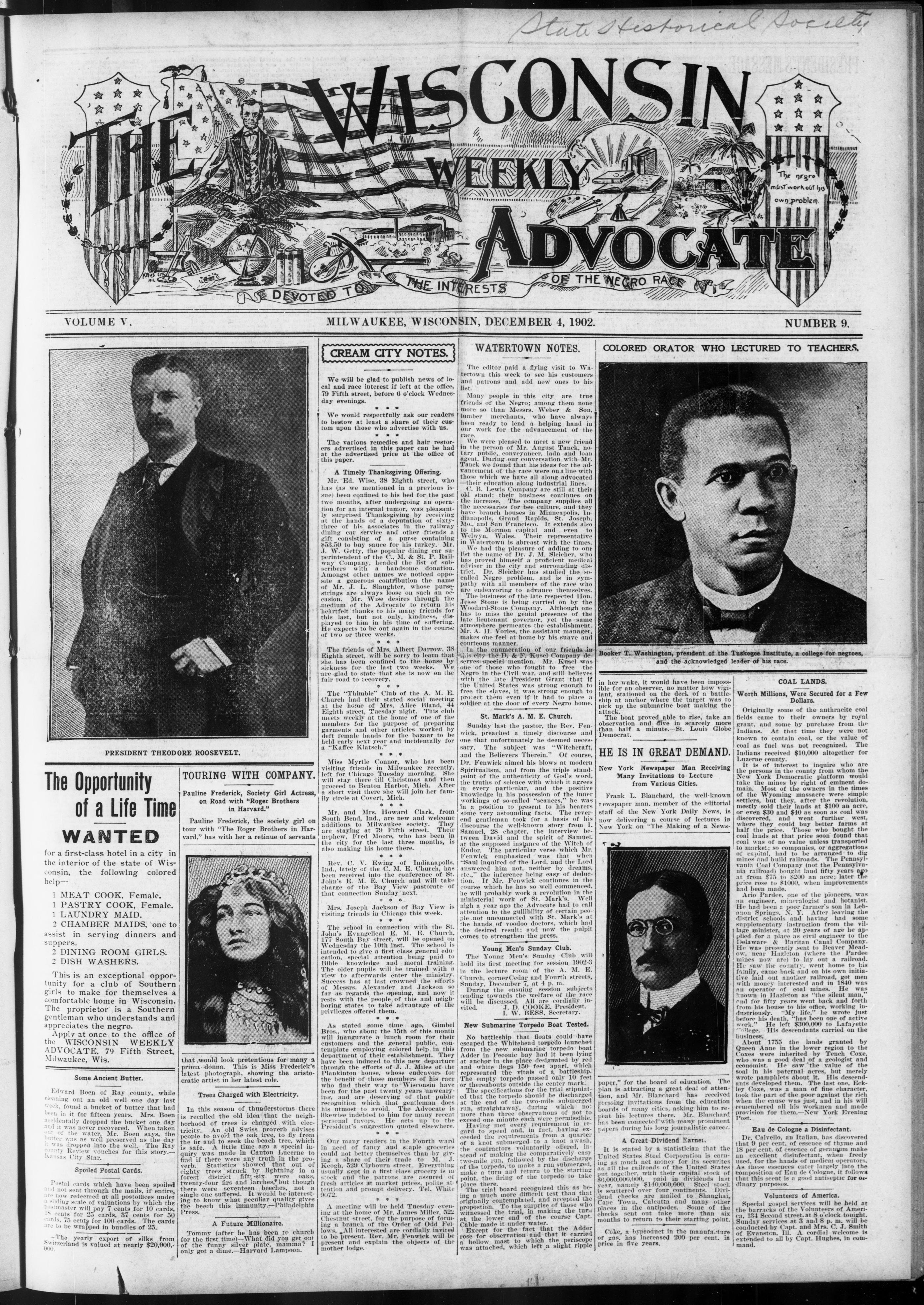
Page text (machine-generated)
WISCONSIN
WEEKLY
ADVOCATE
DEVOTED TO THE INTERESTS OF THE NEGRO RACE
VOLUME V.
T. E.
T. E.
PRESIDENT THEODORE ROOSEVELT.
The Opportunity of a Life Time
WANTED
for a first-class hotel in a city in the interior of the state of Wisconsin, the followlng colored help--
1 MEAT COOK, Female.
1 PASTRY COOK, Female.
1 LAUNDRY MAID.
2 CHAMBER MAIDS, one to assist in serving dinners and suppers.
2 DINING ROOM GIRLS.
This is an exceptional opportunity for a club of Southern girls to make for themselves a comfortable home in Wisconsin. The proprietor is a Southern gentleman who understands and appreciates the negro. Apply at once to the office of the WISCONSIN WEEKLY ADVOCATE, 79 Fifth Street, Milwaukee, Wis.
Some Ancient Butter
Edward Boen of Ray county, while cleaning out an old well one day last week, found a bucket of butter that had been in it for fifteen years. Mrs. Boen accidentally dropped the bucket one day and it was never recovered. When taken out of the water, Mr. Boen says, the butter was as well preserved as the day it was dropped into the well. The Ray county Review vouches for this story.—Kansas City Star
Spoiled Postal Cards.
Postal cards which have been spoiled and not sent through the mails, if entire, are now redeemed at all postoffices under a sliding scale of valuations by which the postmaster will pay 7 cents for 10 cards, 18 cents for 25 cards, 37 cents for 50 cards, 75 cents for 100 cards. The cards are to be wrapped in bundles of 25.
-The yearly export of silks from Switzerland is valued at nearly $20,000,-000.
TOURING WITH COMPANY.
Pauline Frederick, Society Girl Actress, on Road with "Roger Brothers in Harvard."
Pauline Frederick, the society girl on tour with "The Roger Brothers in Harvard," has with her a retinue of servants
THE WOMAN
that would look pretentious for many a prima donna. This is Miss Frederick's latest photograph, showing the aristocratic artist in her latest role.
Trees Charged with Electricity.
In this season of thunderstorms there is recalled the old idea that the neighborhood of trees is charged with electricity. An old Swiss proverb advises people to avoid the oak tree, to fly from the fir and to seek the beach tree, which is safe. A little time ago a special inquiry was made in Canton Lucerne to find if there were any truth in the proverb. Statistics showed that out of eighty trees struck by lightning in a forest district fifty-six were oaks, twenty-four firs and larches, but though there were seventeen beeches, not a single one suffered. It would be interesting to know what peculiar quality gives the beech this immunity.—Philadelphia Press.
A Future Millionaire.
Tommy (after he has been re church for the first time)—What did you get out of the funny silver plate, mamma? I only got a dime.—Harvard Lampoon.
CREAM CITY NOTES.
We will be glad to publish news of local and race interest if left at the office, 79 Fifth street, before 6 o'clock Wednesday evenings.
We would respectfully ask our readers to bestow at least a share of their custom upon those who advertise with us.
The various remedies and hair restorers advertised in this paper can be had at the advertised price at the office of this paper.
A Timely Thanksgiving Offering.
Mr. Ed. Wise, 38 Eighth street, who has (as we mentioned in a previous issue) been confined to his bed for the past two months, after undergoing an operation for an internal tumor, was pleasantly surprised Thanksgiving by receiving at the hands of a deputation of sixty-three of his associates in the railway dining car service and other friends a gift consisting of a purse containing $35.50 to buy sauce for his turkey. Mr. J. W. Getty, the popular dining car superintendent of the C., M. & St. P. Railway Company, headed the list of subscribers with a handsome donation. Amongst other names we noticed opposite a generous contribution the name of Mr. J. L. Slaughter, whose purse-strings are always loose on such an occasion. Mr. Wise desires through the medium of the Advocate to return his heartfelt thanks to his many friends for this last, but not only, kindness, displayed to him in his time of suffering. He expects to be out again in the course of two or three weeks.
***
The friends of Mrs. Albert Darrow, 38 Eighth street, will be sorry to learn that she has been confined to the house by sickness for the last two weeks. We are glad to state that she is now on the fair road to recovery.
* * *
The "Thimble" Club of the A. M. E. Church had their stated social meeting at the home of Mrs. Alice Bland, 44 Eighth street, Tuesday night. This club meets weekly at the home of one of the members for the purpose of preparing garments and other articles worked by deft female hands for the bazaar to be held early next year and incidentally for a "Kaffee Klatsch."
京 枣 枣
Miss Myrtle Connor, who has been visiting friends in Milwaukee recently, left for Chicago Tuesday morning. She will stay there till Christmas and then proceed to Benton Harbor, Mich. After a short visit there she will join her family circle at Covert, Mich.
* * *
Mr. and Mrs. Howard Clark, from South Bend, Ind., are new and welcome additions to Milwaukee society. They are staying at 79 Fifth street. Their nephew, Fred Moore, who has been in the city for the last three months, is also making his home there.
```markdown
```
Rev. C. V. Ewing of Indianapolis, Ind., lately of the C. M. E. Church, has been received into the conference of St. John's E. M. E. Church and will take charge of the Bay View pastorate of that connection Sunday next.
* * *
Mrs. Joseph Jackson of Bay View is visiting friends in Chicago this week.
The school in connection with the St. John's Evangelical E. M. E. Church, 177 South Bay street, will be opened on Wednesday the 10th inst. The school is intended to give a first class general education, special attention being paid to Bible knowledge and moral training. The older pupils will be trained with a view to afterwards enter the ministry. Success has at last crowned the efforts of Messrs. Alexander and Jackson so far as regards the opening, and now it rests with the people of this and neighboring states to take advantage of the privileges offered them.
***
As stated some time ago, Gimbel Bros., who about the 15th of this month will inaugurate a lunch room for their customers and the general public, contemplate employing colored help in this department of their establishment. They have been induced to this new departure through the efforts of J. J. Miles of the Plankinton house, whose endeavors for the benefit of those members of his race who find their way to Wisconsin have been for the past twenty years unwearying, and are deserving of that public recognition which that gentleman does his utmost to avoid. The Advocate is likewise indebted to him for many recent personal favors. He acts up to the President's suggestion quoted elsewhere.
* * *
Our many readers in the Fourth ward in need of fancy and staple groceries could not better themselves than by giving a share of their trade to M. J. Keogh, 529 Clybourn street. Everything usually kept in a first class grocery is in stock and the patrons are assured of fresh articles at market prices, polite attention and prompt delivery. Tel. White 9072.
A meeting will be held Tuesday evening at the home of Mr. James Miller, 522 Chestnut street, for the purpose of forming a branch of the Order of Odd Fellows. All interested are cordially invited to be present. Rev. Mr. Fenwick will be present and explain the objects of the mother lodge.
WATERTOWN NOTES.
The editor paid a flying visit to Watertown this week to see his customers and patrons and add new ones to his list.
Many people in this city are true friends of the Negro; among them none more so than Messrs. Weber & Son, lumber merchants, who have always been ready to lend a helping hand in our work for the advancement of the race.
We were pleased to meet a new friend in the person of Mr. August Tanck, notary public, conveyancer, ladn and loan agent. During our conversation with Mr. Tanck we found that his ideas for the advancement of the race were on a line with those which we have all along advocated—their education along industrial lines.
C. B. Lewis Company are still at their old stand; their business continues on the increase. The company supplies all the necessaries for bee culture, and they have branch houses in Minneapolis, Indianapolis, Grand Rapids, St. Joseph, Mo., and San Francisco. It extends also to the Mormon capital and even to Welwyn, Wales. Their representative in Watertown is abreast with the times. We had the pleasure of adding to our list the name of Dr. J. M. Sleicher, who has proved himself a proficient medical adviser in the city and surrounding district. Dr. Sleicher has studied the so-called Negro problem, and is in sympathy with all members of the race who are endeavoring to advance themselves.
The business of the late respected Hon. Jesse Stone is being carried on by the Woodard-Stone Company. Although one has to miss the genial presence of the late lieutenant governor, yet the same atmosphere permeates the establishment. Mr. A. H. Vories, the assistant manager, makes one feel at home by his suave and courteous manner.
In the enumeration of our friends in this city the D. & F. Kusel Company deserves special mention. Mr. Kusel was one of those who fought to free the Negro in the Civil war, and still believes with the late President Grant that if the United States was strong enough to free the slaves, it was strong enough to protect them even if it had to place a soldier at the door of every Negro home.
St. Mark's A. M. E. Church.
Sunday last the pastor, the Rev. Fenwick, preached a timely discourse and one that unfortunately he deemed necessary. The subject was "Witchcraft, and the Believers Therein." Of course, Dr. Fenwick aimed his blows at modern Spiritualism, and from the triple standpoint of the authenticity of God's word, the truths of science with which it agrees in every particular, and the positive knowledge in his possession of the inner workings of so-called "seances," he was in a position to present to his hearers some very astounding facts. The reverend gentleman took for a basis of his discourse the well-known story from I. Samuel, 28 chapter, the interview between David and the spirit of Samuel, at the supposed instance of the Witch of Endor. The particular verse which Mr. Fenwick emphasized was that when "Saul inquired of the Lord, and the Lord answered him not, neither by dreams, etc.," the inference being easy of deduction. If Mr. Fenwick continues in the course which he has so well commenced, he will probably work a revolution in the ministerial work of St. Mark's. Well nigh a year ago the Advocate had to call attention to the gullibility of certain people not unconnected with St. Mark's at the hands of voodoo doctors, which had the desired result: and now the pulpit comes to strengthen the press.
Young Men's Sunday Club.
The Young Men's Sunday Club will hold its first meeting for session 1902-3 in the lecture room of the A. M. E. Church, corner Cedar and Fourth streets, Sunday, December 7, at 4 p. m. During the ensuing session subjects tending towards the welfare of the race will be discussed. All are cordially invited. J. D. COOKE. President. J. W. BESS. Secretary.
New Submarine Torpedo Boat Tested.
No battleship that floats could have escaped the Whitehead torpedo launched from the new submarine torpedo boat Adder in Peconic bay had it been lying at anchor in the place designated by red and white flags 150 feet apart, which represented the vitals of a battleship. The empty torpedo passed only 10 feet or thereabouts outside the center mark. The specifications for the trial stipulated that the torpedo should be discharged at the end of the two-mile submerged run, straightaway, during which no more than three observations of not to exceed one minute each were permissible.
Having met every requirement in regard to speed and, in fact, having exceeded the requirements from a quarter of a knot submerged to a knot awash, the contractors voluntarily offered, instead of making the comparatively easy two-mile run, followed by the discharge of the torpedo, to make a run submerged, make a turn and return to the starting point, the firing of the torpedo to take place there.
The trial board recognized this as being a much more difficult test than that originally contemplated, and accepted the proposition. To the surprise of those who witnessed the trial, in making the turn at the lower end of the course Capt. Cable made it under water.
Except for the fact that the Adder rose for observation and that it carried a hollow mast to which the periscope was attached, which left a slight ripple
COLORED ORATOR WHO LECTURED TO TEACHERS.
Booker T. Washington, president of the Tuskegee Institute, a college for negroes, and the acknowledged leader of his race.
in her wake, it would have been impossible for an observer, no matter how vigilant, stationed on the deck of a battleship at anchor where the target was to pick up the submarine boat making the attack.
The boat proved able to rise, take an observation and dive in scarcely more than half a minute.—St. Louis Globe Democrat.
HE IS IN GREAT DEMAND.
New York Newspaper Man Receiving Many Invitations to Lecture from Various Cities.
Frank L. Blanchard, the well-known rewspaper man, member of the editorial staff of the New York Daily News, is now delivering a course of lectures in New York on "The Making of a News-
paper," for the board of education. The plan is attracting a great deal of attention, and Mr. Blanchard has received pressing invitations from the education boards of many cities, asking him to repeat his lectures there. Mr. Blanchard has been connected with many prominent papers during his long journalistic career.
A Great Dividend Earner.
It is stated by a statistician that the United States Steel Corporation is earning as much net money for its securities as all the railroads of the United States put together, with their capital stock of $6,000,000,000, paid in dividends last year, namely $140,000,000. Steel stock is scattered over four continents. Dividend checks are mailed to Shanghai, Cape Town, Calcutta and many other places in the antipodes. Some of the checks sent out take more than six months to return to their starting point.
Coke, a byproduct in the manufacture of gas, has increased 200 per cent. in price in five years.
Worth Millions, Were Secured for a Few Dollars.
Originally some of the anthracite coal fields came to their owners by royal grant, and some by purchase from the Indians. At that time they were not known to contain coal, or the value of coal as fuel was not recognized. The Indians received $10,000 altogether for Luzerne county.
It is of interest to inquire who are the persons in the county from whom the New York Democratic platform would take the mines by right of eminent domain. Most of the owners in the times of the Wyoming massacre were simple settlers, but they, after the revolution, mostly sold their lands at $100 an acre, or even $30 and $40 as soon as coal was discovered, and went further west, where they could buy better farms at half the price. Those who bought the coal lands at that price soon found that coal was of no value unless transported to market; so companies, or aggregations of capital, had to be arranged to dig mines and build railroads. The Pennsylvania Coal Company (not the Pennsylvania railroad) bought land fifty years ago at from $75 to $200 an acre; later the price rose to $1000, when improvements had been made.
Ario Pardee, one of the pioneers, was an engineer, mineralogist and botanist. He had been a poor farmer's son in Lebanon Springs, N. Y. After leaving the district schools and having had some supplementary instruction from the village minister, at 20 years of age he applied for a place as civil engineer to the Delaware & Raritan Canal Company. He was presently sent to Beaver Meadow, near Hazleton (where the Pardee mines now are) to lay out a railroad. He saw the country, went home to his family, came back and on his own initiative laid out another railroad, got men with money interested and in 1840 was an operator of coal mines. He was known in Hazleton as "the silent man," and for fifty years went back and forth from his house to his office, working industriously. "My life," he wrote just before his death, "has been one of active work." He left $300,000 to Lafayette College. His descendants carried on the business.
About 1755 the lands granted by Queen Anne in the lower region to the Coxes were inherited by Tench Coxe, who was a good deal of a geologist and economist. He saw the value of the soal in his paternal acres, but merely wrote pamphlets about it. His descendants developed them. The last one, Eckley Coxe, was a man of fine character, took the part of the poor against the rich when the cause was just, and in his will remembered all his workmen and made provision for them.—New York Evening Post.
Eau de Cologne a Disinfectant.
Dr. Calvello, an Italian, has discovered that 9 per cent. of essence of thyme and 18 per cent. of essence of geranium make an excellent disinfectant, when freely used, for the hands of medical operators. As these essences enter largely into the composition of Eau de Cologne, it follows that this scent is a good antiseptic for ordinary purposes.
Volunteers of America.
Special gospel services will be held at the barracks of the Volunteers of America, 134 Second street.at 8 o'clock tonight. Sunday services at 3 and 8 p.m. will be conducted by Capt. and Mrs. C. J. Smith of Evansten, Ill. A cordial welcome is extended to all by Capt. Hughes, in command.
PRESIDENT'S MESSAGE
Washington, D. C., Dec. 2. -The annual message of President Roosevelt to Congress was read in the Senate and House of Representatives today. The document in full is as follows:
To the Senate and House of Representatives: We still continue in a period of unbounded prosperity. This prosperity is not the creature of law, but undoubtedly the laws under which we work have been instrumental in creating the conditions which made it possible, and by unwise legislation it would be easy enough to destroy it. There will undoubtedly be periods of depression. The wave will recede; but the tide will advance. This nation is seated on a continent flanked by two great oceans. It is composed of men the descendthemselves; of men winnowed out from among the nations of the old world by the energy, boldness, and love of adventure found in their own eager hearts. Such a nation, so placed, will surely wrest success from fortune.
As a people we have played a large part in the world, and we are bent upon making our future even larger than the past. In particular, the events of the last four years have definitely decided that, for woe or for weal, our place must be great among the nations. We may either fall greatly or succeed greatly; but we cannot avoid the endeavor from which either great failure or great success must come. Even if we would, we cannot play a small part. If we should try, all that would follow would be that we should play a large part ignobly and shamefully.
But our people, the sons of the men of the Civil war, the sons of the men who had iron in their blood, rejoice in the present and face the future high of heart and resolute of will. Ours is not the creed of the weakling and the coward; ours is the gospel of hope and of triumphant endeavor. We do not shrink from the struggle before us. There are many problems for us to face at the outset of the Twentieth century—grave problems abroad and still graver at home; but we know that we can solve them and solve them well, provided only that we bring to the solution the qualities of head and heart which were shown by the men who, in the days of Washington, founded this government, and, in the days of Lincoln, preserved it.
High Average of Citizenship.
No country has ever occupied a higher plane of material well-being than ours at the present moment. This well-being is due to no sudden or accidental causes, but to the play of the economic forces in this country for over a century; to our laws, our sustained and continuous policies; above all, to the high individual average of our citizenship. Great fortunes have been won by those who have taken the lead in this phenomenal industrial development, and most of these fortunes have been won not by doing evil, but as an incident to action which has benefited the community as a whole. Never before has material well-being been so widely diffused among our people. Great fortunes have been accumulated, and yet in the aggregate these fortunes are small indeed when compared to the wealth of the people as a whole. The plain people are better off than they have ever been before. The insurance companies, which are practically mutual benefit societies—especially helpful to men of moderate means—represent accumulations of capital which are among the largest in this country. There are more deposits in the savings banks, more owners of farms, more well-paid wage-workers in this country now than ever before in our history. Of course, when the conditions have favored the growth of so much that was good, they have also favored somewhat the growth of what was evil. It is eminently necessary that we should endeavor to cut out this evil, but let us keep a due sense of proportion; let us not in fixing our gaze upon the lesser evil forget the greater good. The evils are real and some of them are menacing, but they are the outgrowth, not of misery or decadence, but of prosperity—of the progress of our gigantic industrial development. This industrial development must not be checked, but side by side with it should go such progressive regulation as will diminish the evils. We should fall in our duty if we did not try to remedy the evils, but we shall succeed only if we proceed patiently, with practical common sense as well as resolution, separating the good from the bad and holding on the former while endeavoring to get rid of the latter.
THE QUESTION OF TRUSTS
Corporations Must be Handled So as to Subserve the Public Good.
In my message to the present Congress at its first session I discussed at length the question of the regulation of those big corporations commonly doing an interstate business, often with some tendency to monopoly, which are popularly known as trusts. The experience of the past year has emphasized, in my opinion, the desirability of the steps I then proposed. A fundamental requisite of social efficiency is a high standard of individual energy and excellence; but this is in no wise inconsistent with power to act in combination for aims which cannot so well be achieved by the individual acting alone. A fundamental base of civilization is the inviolability of property; but this is in no wise inconsistent with the right of society to regulate the exercise of the artificial powers which it confers upon the owners of property, under the name of corporate franchises, in such a way as to prevent the misuse of these powers. Corporations, and especially combinations of corporations, should be managed under public regulation. Experience has shown that under our system of government the necessary supervision cannot be obtained by state action. It must therefore be achieved by national action. Our aim is not to do away with corporations; on the contrary, these big aggregations are an inexpensive development of modern industrialism, and the effort to destroy them would be futile unless accomplished in ways that would work the utmost mischief to the entire body politics. We can do nothing of good in the way of regulating and supervising these corporations until we fix clearly in our minds that we are not attacking the corporations, but endeavoring to do away with any evil in them. We are not hostile to them; we are merely determined that they shall be so handled as to subserve the public good. We draw the line against misconduct, not against wealth. The capitalist who, alone or in conjunction with his fellows, performs some great industrial feat by which he wins money is a welldoer, not a wrongdoer, provided only he works in proper and legitimate lines. We wish to favor such a man when he does well. We wish to supervise and control his actions only to prevent him from doing ill. Publicity can do no harm to the honest corporation; and we need not be overtender about sparing the dishonest corporation.
Curbing Injurious Enterprises
In curbing and regulating the combinations of capital which are or may become injurious to the public we must be careful not to stop the great enterprises which have legitimately reduced the cost of production, not to abandon the place which our country has won in the leadership of the international industrial world, not to strike down wealth with the result of closing factories and mines, of turning the wage-worker idle in the streets and leaving the farmer without a market for what he grows. Insistence upon the impossible means delay in achieving the possible, exactly as, on the other hand, the stubborn defense alike of what is good and what is bad in the existing system, the resolute effort to obstruct any attempt at betterment, betrays blindness to the historic truth that wise evolution is the sure safeguard against revolution.
No more important subject can come before the Congress than this of the regulation of interstate business. This country cannot afford to sit supine on the plea that under our peculiar system of government we are helpless in the presence of the new conditions, and unable to grapple with them or to cut out whatever of evil has arisen in connection with them. The power of the Congress to regulate interstate commerce is an absolute and unqualified grant, and without limitations other than those prescribed by the constitution. The Congress has constitutional authority to make all laws necessary and proper for executing this power, and I am satisfied that this power has not been exhausted by any legislation now on the statute books. It is evident, therefore, that evils, restrictive of commercial freedom and entailing restraint upon national commerce fall within the regulative power
of the Congress, and that a wise and reasonable law would be a necessary and proper exercise of congressional authority to the end that such evils should be eradicated. I believe that monopolies, unjust discriminations, which prevent or cripple competition, fraudulent overcapitalization, and other evils in trust organizations and practices which injuriously affect interstate trade can be prevented under the power of the Congress to "regulate commerce with foreign nations and among the several states" through regulations and requirements operating directly upon such commerce, the instrumentalities thereof, and those engaged therein.
Legislation Recommended.
I earnestly recommend this subject to the consideration of the Congress with a view to the passage of a law reasonable in its provisions and effective in its operations, upon which the questions can be finally adjudicated that now raise doubts as to the necessity of constitutional amendment. If it prove impossible to accomplish the purposes above set forth by such a law, then, assuredly, we should not shrink from amending the constitution so as to secure beyond peradventure the power sought.
The Congress has not heretofore made any appropriation for the better enforcement of the anti-trust law as it now stands. Very much has been done by the department of justice in securing the enforcement of this law, but much more could be done if Congress would make a special appropriation for this purpose, to be expended under the direction of the attorney general.
One proposition advocated has been the reduction of the tariff as a means of reaching the evils of the trusts which fall within the category I have described. Not merely would this be wholly ineffective, but the diversion of our efforts in such a direction would mean the abandonment of all intelligent attempt to do away with these evils. Many of the largest corporations, many of those which should certainly be included in any proper scheme of regulation, would not be affected in the slightest degree by a change in the tariff, save as such change interfered with the general prosperity of the country. The only relation of the tariff to big corporations as a whole is that the tariff makes manufactures profitable, and the tariff remedy proposed would be in effect simply to make manufactures unprofitable. To remove the tariff as a punitive measure directed against trusts would inevitably result in ruin to the weaker competitors who are struggling against them. Our aim should be not by unwise tariff changes to give foreign products the advantage over domestic products, but by proper regulation to give domestic competition a fair chance; and this end cannot be reached by any tariff changes which would affect unfavorably all domestic competitors, good and bad alike. The question of regulation of the trusts stands apart from the question of tariff revision.
STABLE ECONOMIC POLICY.
Violent and Radical Tariff Changes Not Desirable.
Stability of economic policy must always be the prime economic need of this country. This stability should not be fossilization. The country has acquiesced in the wisdom of the protective tariff principle. It is exceedingly undesirable that this system should be destroyed or that there should be violent and radical changes therein. Our past experience shows that great prosperity in this country has always come under a protective tariff; and that the country cannot prosper under fitful tariff changes at short intervals. Moreover, if the tariff laws as a whole work well, and if business has prospered under them and is prospering, it is better to endure for a time slight inconveniences and inequalities in some schedules than to upset business by too quick and too radical changes. It is most earnestly to be wished that we could treat the tariff from the standpoint solely of our business needs. It is, perhaps, too much to hope that partisanship may be entirely excluded from consideration of the subject, but at least it can be made secondary to the business interests of the country—that is, to the interests of our people as a whole. Unquestionably these business interests will best be served if together with fixity of principle as regards the tariff we combine a system which will permit us from time to time to make the necessary reapplication of the principle to the shifting national needs. We must take scrupulous care that the reapplication shall be made in such a way that it will not amount to a dislocation of our system, the mere threat of which (not to speak of the performance) would produce paralysis in the business energies of the community. The first consideration in making these changes would, of course, be to preserve the principle which underlies our whole tariff system—that is, the principle of putting American business interests at least on a full equality with interests abroad, and of always allowing a sufficient rate of duty to more than cover the difference between the labor cost here and abroad. The well-being of the wage-worker, like the well-being of the tiller of the soil, should be treated as an essential in shaping our whole economic policy. There must never be any change which will jeopardize the standard of comfort, the standard of wages of the American wage-worker.
Reciprocal Treaties Preferred.
One way in which the readjustment sought can be reached is by reciprocity treaties. It is greatly to be desired that such treaties may be adopted. They can be used to widen our markets and to give a greater field for the activities of our producers on the one hand, and on the other hand to secure in practical shape the lowering of duties when they are no longer needed for protection among our own people, or when the minimum of damage done may be disregarded for the sake of the maximum of good accomplished. If it prove impossible to ratify the pending treaties, and if there seem to be no warrant for the endeavor to execute others, or to amend the pending treaties so that they can be ratified, then the same end—to secure reciprocity—should be met by direct legislation.
Wherever the tariff conditions are such that a needed change can not with advantage be made by the application of the reciprocity idea, then it can be made outright by a lowering of duties on a given product. If possible, such change should be made only after the fullest consideration by practical experts, who should approach the subject from a business standpoint, having in view both the particular interests affected and the commercial well-being of the people as a whole. The machinery for providing such careful investigation can readily be supplied. The executive department has already at its disposal methods of collecting facts and figures; and if the Congress desires additional consideration so that which will be given the subject by its own committees, then a commission of business experts can be appointed whose duty it should be to recommend action by the Congress after a deliberate and scientific examination of the various schedules as they are affected by the changed and changing conditions. The unhurried and unbiased report of this commission would show what changes should be made in the various schedules, and how far these changes could go without also changing the great prosperity which this country is now enjoying, or upsetting its fixed economic policy.
The cases in which the tariff can produce a monopoly are so few as to constitute an inconsiderable factor in the question; but of course if in any case it be found that a given rate of duty does promote a monopoly which works ill, no protectionist would object to such reduction of the duty as would equalize competition.
In my judgment, the tariff on anthracite coal should be removed, and anthracite put actually, where it now is nominally, on the free list. This would have no effect at all save in crises; but in crises it might be of service to the people.
BANKING AND CURRENCY
All Kinds of Money Should be Interchangeable and Convertible Into Gold.
Interest rates are a potent factor in business activity, and in order that these rates may be equalized to meet the varying needs of the seasons and of widely separated communities, and to prevent the recurrence of financial stringencies which injuriously affect legitimate business, it is necessary that there should be an element of elasticity, in our monetary system. Banks are the natural servants of commerce, and upon them should be placed, as far as practicable, the burden of furnishing and maintaining a circulation adequate to supply the needs of our diversified industries and of our domestic and foreign commerce; and the issue of this should be so regulated that a sufficient supply should be al-
ways available for the business interests of the country.
of the country. It would be both unwise and unnecessary at this time to attempt to reconstruct our financial system, which has been the growth of a century; but some additional legislation is, I think, desirable. The mere outline of any plan sufficiently comprehensive to meet these requirements would transgress the appropriate limits of this communication. It is suggested, however, that all future legislation on the subject should be with the view of encouraging the use of such instrumentalities as will automatically supply every legitimate demand of productive industries and of commerce, not only in the amount, but in the character of circulation; and of making all kinds of money interchangeable, and, at the will of the holder, convertible into the established gold standard.
REGULATION OF IMMIGRATION.
The Need of a Proper Law Urged Upon the Attention of Congress.
I again call your attention to the need of passing a proper immigration law, covering the points outlined in my message to you at the first session of the present Congress; substantially such a bill has already passed the House.
CAPITAL AND LABOR.
Corporations and Unions Beneficial if Properly Conducted.
How to secure fair treatment alike for labor and for capital, how to hold in check the unsuperulous man, whether employer or employee, without weakening individual initiative, without hampering and cramping the industrial development of the country, is a problem fraught with great difficulties and one which it is of the highest importance to solve on lines of sanity and far-sighted common sense as well as of devotion to the right. This is an era of federation and combination. Exactly as business men find they must often work through corporations, and as it is a constant tendency of these corporations to grow larger, so it is often necessary for laboring men to work in federations, and these have become important factors of modern industrial life. Both kinds of federation, capitalistic, and labor, can do much good, and as a necessary corollary they can both do evil. Opposition to each kind of organization should take the form of opposition to whatever is bad in the conduct of any given corporation or union—not of attacks upon corporations as such nor upon unions as such, for some of the most far-reaching beneficent work for our people has been accomplished through both corporations and unions. Each must refrain from arbitrary or tyrannous interference with the rights of others. Organized capital and organized labor alike should remember that in the long run the interest of each must be brought into harmony with the interest of the general public; and the conduct of each must conform to the fundamental rules of obedience to the law, of individual freedom, and of justice and fair dealing toward all. Each should remember that in addition to power it must strive after the realization of healthy, lofty, and generous ideals. Every employer, every wage-worker, must be guaranteed his liberty and his right to do as he likes with his property or his labor so long as he does not infringe upon the rights of others. It is of the highest importance that employer and employee alike should endeavor to appreciate each the viewpoint of the other and the sure disaster that will come upon both in the long run if either grows to take as habitual an attitude of sour hostility and distrust toward the other. Few people deserve better of the country than those representatives both of capital and labor—and there are many such—who work continually to bring about a good understanding of this kind, based upon wisdom and upon broad and kindly sympathy between employers and employed. Above all, we need to remember that any kind of class animosity in the political world is, if possible, even more wicked, even more destructive to national welfare, than sectional, race, or religious animosity. We can get good government only upon condition that we keep true to the principles upon which this nation was founded, and judge each man not as a part of a class, but upon his individual merits. All that we have a right to ask of any man, rich or poor, whatever his creed, his occupation, his birthplace, or his residence, is that he shall act well and honorably by his neighbor and by his country. We are neither for the rich man as such nor for the poor man as such; we are for the upright man, rich or poor. So far as the constitutional powers of the national government touch these matters of general and vital moment to the nation, they should be exercised in conformity with the principles above set forth.
New Cabinet Officer
It is earnestly hoped that a secretary of commerce may be created, with a seat in the cabinet. The rapid multiplication of questions affecting labor and capital, the growth and complexity of the organizations through which both labor and capital now find expression, the steady tendency toward the employment of capital in huge corporations, and the wonderful strides of this country toward leadership in the international business world justify an urgent demand for the creation of such a position. Substantially all the leading commercial bodies in this country have united in requesting its creation. It is desirable that some such measure as that which has already passed the Senate be enacted into law. The creation of such a department would in itself be an advance toward dealing with and exercising supervision over the whole subject of the great corporations doing an interstate business; and with this end in view, the Congress should endow the department with large powers, which could be increased as experience might show the need.
RECIPROCITY IN TRADE.
President will Soon Send a Treaty to the Senate
I hope soon to submit to the Senate a reciprocity treaty with Cuba. On May 20 last the United States kept its promise to the island by formally vacating Cuban soil and turning Cuba over to those whom her own people had chosen as the first officials of the new republic.
Cuba lies at our doors, and whatever affects her for good or for ill affects us also. So much have our people felt this that in the Platt amendment we definitely took the ground that Cuba must hereafter have closer political relations with us than with any other power. Thus in a sense Cuba has become a part of our international political system. This makes it necessary that in return she should be given some of the benefits of becoming part of our economic system. It is, from our own standpoint, a short-sighted and mischievous policy to fall to recognize this need. Moreover, it is unworthy of a mighty and generous nation, itself the greatest and most successful republic in history, to refuse to stretch out a helping hand to a young and weak sister republic just entering upon its career of independence. We should always fearlessly insist upon our rights in the face of the strong, and we should with ungrudging hand do our generous duty by the weak. I urge the adoption of reciprocity with Cuba not only because it is eminently for our own interests to control the Cuban market and by every means to foster our supremacy in the tropical lands and waters south of us, but also because we, of the giant republic of the north, should make all our sister nations of the American continent feel that whenever they will permit it we desire to show ourselves disinterestedly and effectively their friend.
A convention with Great Britain has been concluded, which will be at once laid before the Senate for ratification, providing for reciprocal trade arrangements between the United States and Newfoundland on substantially the lines of the convention formerly negotiated by the secretary of state, Mr. Blaine. I believe reciprocal trade relations will be greatly to the advantage of both countries.
THE HAGUE ARBITRATION
The United States Congratulated Upon Its Attitude in the Matter
As civilization grows warfare becomes less and less the normal condition of foreign relations. The last century has seen a marked diminution of wars between civilized powers; wars with uncivilized powers are largely mere matters of international police duty, essential for the welfare of the world. Wherever possible, arbitration or some similar method should be employed in lieu of war to settle difficulties between civilized natlons, although as yet the world has not progressed sufficiently to render it pos
sible, or necessarily desirable, to invoke arbitration in every case. The formation of the international tribunal which sits at The Hague is an event of good omen from which great consequences for the welfare of all mankind may flow. It is far better, where possible, to invoke such a permanent tribunal than to create special arbitrators for a given purpose.
It is a matter of sincere congratulation to our country that the United States and Mexico should have been the first to use the good offices of The Hague court. This was done last summer with most satisfactory results in the case of a claim at issue between us and our sister republic. It is earnestly to be hoped that this first case will serve as a precedent for others, in which not only the United States, but foreign nations may take advantage of the machinery already in existence at The Hague.
HAWAIIAN FIRE CLAIMS.
Favorable Consideration of Congress is Commended.
I commend to the favorable consideration of the Congress the Hawaiian fire claims, which were the subject of careful investigation during the last session.
CANAL ACROSS ISTHMUS.
One of the Greatest Engineering Feats of the Twentieth Century.
The Congress has wisely provided that we shall build at once an isthmian canal, if possible at Panama. The attorney general reports that we can undoubtedly acquire good title from the French Panama Canal Company. Negotiations are now pending with Colombia to secure her assent to our building the canal. This canal will be one of the greatest engineering feats of the Twentieth century; a greater engineering feat than has yet been accomplished during the history of mankind. The work should be carried out as a continuing policy without regard to change of administration; and it should be begun under circumstances which will make it a matter of pride for all administrations to continue the policy.
The canal will be of great benefit to America, and of importance to all the world. It will be of advantage to us industrially and also as improving our military position. It will be of advantage to the countries of tropical America. It is carnethy to be hoped that all of these countries will do as some of them have already done with signal success, and will invite to their shores commerce and improve their material conditions by recognizing that stability and order are the prerequisites of successful development. No independent nation in America need have the slightest fear of aggression from the United States. It behooves each one to maintain order within its own borders and to discharge its just obligations to foreigners. When this is done, they can rest assured that, be they strong or weak, they have nothing to dread from outside interference. More and more the increasing interdependence and complexity of international political and economic relations render it incumbent on all civilized and orderly powers to insist on the proper policing of the world.
CABLE TO THE PHILIPPINES.
The Matter of Granting Permission to Lay One Still Open.
During the fall of 1901 a communication was addressed to the secretary of state, asking whether permission would be granted by the President to a corporation to lay a cable from a point on the California coast to the Philippine islands by way of Hawaii. A statement of conditions or terms upon which such corporation would undertake to lay and operate a cable was volunteered. Inasmuch as the Congress was shortly to convene, and Pacific-cable legislation had been the subject of consideration by the Congress for several years, it seemed to me wise to defer action upon the application until the Congress had first an opportunity to act. The Congress adjourned without taking any action, leaving the matter in exactly the same condition in which it stood when the Congress convened.
Meanwhile it appears that the Commercial Pacific Cable Company had promptly proceeded with preparations for laying its cable. It also made application to the President for access to and use of soundings taken by the United States Steamer Nero, for the purpose of discovering a practicable route for a trans-Pacific cable, the company urging that with access to these soundings it could complete its cable much sooner than if it were required to take soundings upon its own account. Pending consideration of this subject, it appeared important and desirable to attach certain conditions to the permission to examine and use the soundings, if it should be granted.
In consequence of this solicitation of the cable company, certain conditions were formulated, upon which the President was willing to allow access to these soundings and to consent to the landing and laying of the cable, subject to any alterations on additions thereto imposed by the Congress. This was deemed proper, especially as it was clear that a cable connection of some kind with China, a foreign country, was a part of the company's plan. This course was, moreover, in accordance with a line of precedents, including President Grant's action in the case of the first French cable, explained to the Congress in his annual message of December, 1875, and the instance occurring in 1879 of the second French cable from Brest to St. Pierre, with a branch to Cape Cod.
These conditions prescribed, among other things, a maximum rate for commercial messages and that the company should construct a line from the Philippine Islands to China, there being at present, as is well known, a British line from Manila to Hong Kong.
The representatives of the cable company kept these conditions long under consideration, continuing, in the meantime, to prepare for laying the cable. They have, however, at length acceded to them, and an all-American line between our Pacific coast and the Chinese empire by way of Honolulu and the Philippine islands, is thus provided for and is expected within a few months to be ready for business.
Among the conditions is one reserving the power of the Congress to modify or repeal any or all of them. A copy of the conditions is herewith transmitted.
PORTO RICAN GOVERNMENT.
It Stands as the Best Ruled Insular Possession.
Of Porto Rico it is only necessary to say that the prosperity of the island and the wisdom with which it has been governed have been such as to make it serve as an example of all that is best in insular administration.
END OF WAR IN PHILIPPINES
Peace and Amnesty Promulgated Throughout the Islands.
On July 4 last, on the 126th anniversary of the Declaration of Independence, peace and amnesty were promulgated in the Philippine islands. Some trouble has since from time to time threatened with the Mohammedan Moros, but with the late insurrectionary Filipinos the war has entirely ceased. Civil government has now been introduced. Not only does each Filipino enjoy such rights to life, liberty, and the pursuit of happiness as he has never before known during the recorded history of the islands, but the people taken as a whole now enjoy a measure of self-government greater than that granted to any other Orientals by any foreign power and greater than that enjoyed by any other Orientals under their own governments, save the Japanese alone. We have not gone too far in granting these rights of liberty and self-government; but we have certainly gone to the limit that in the interests of the Philippine people themselves it was wise or just to go. To hurry matters, to go faster than we are now going, would entail calamity on the people of the islands. No policy ever entered into by the American people has vindicated itself in more signal manner than the policy of holding the Philippines. The triumph of our arms, above all the triumph of our laws and the principles, has come sooner than we had any right to expect. Too much praise cannot be given to the army for what it has done in the Philippines both in warfare and from an administrative standpoint in preparing the way for civil government; and similar credit belongs to the civil authorities for the way in which they have planted the seeds of self-government in the ground thus made ready for them. The courage, the unfinching endurance, the high solemnity efficiency.
and the general kind-heartedness and humanity or our troops have been strikingly manifested. There now remain only some 15,000 troops in the islands. All told, over 100,000 have been sent there. Of course, there have been individual instances of wrongdoing among them. They warred under fearful difficulties of climate and surroundings; and under the strain of the terrible provocations which they continually received from their foes, occasional instances of cruel retaliation occurred. Every effort has been made to prevent such cruelties, and finally these efforts have been completely successful. Every effort has also been made to detect and punish the wrongdoers. After making all allowance for these misdeeds, it remains true that few indeed have been the instances in which war has been waged by a civilized power against semi-civilized or barbarous forces where there has been so little wrongdoing by the victors as in the Philippine islands. On the other hand, the amount of difficult, important, and beneficent work which has been done is well-nigh incalculable.
Display of Statesmanship.
Taking the work of the army and the civil authorities together, it may be questioned whether anywhere else in modern times the world has seen a better example of real constructive statesmanship than our people have given in the Philippine islands. High praise should also be given those Filipinos, in the aggregate very numerous, who have accepted the new conditions and joined with our representatives to work with hearty good will for the welfare of the islands.
NEEDS OF THE ARMY.
The System of Maneuvering Should be Diligently Prosecuted.
The army has been reduced to the minimum allowed by law. It is very small for the size of the nation, and most certainly should be kept at the highest point of efficiency. The senior officers are given scant chance under ordinary conditions to exercise commands commensurate with their rank, under circumstances which would fit them to do their duty in time of actual war. A system of maneuvering our army in bodies of some little size has been begun and should be steadily continued. Without such maneuvers it is folly to expect that in the event of hostilities with any serious foe even a small army corps could be handled to advantage. Both our officers and enlisted men are such that we can take hearty pride in them. No better material can be found. But they must be thoroughly trained, both as individuals and in the mass. The markmanship of the men must receive special attention. In the circumstances of modern warfare the man must act far more on his own individual responsibility than ever before, and the high individual efficiency of the unit is of the utmost importance. Formerly this unit was the regiment; it is now not the regiment, not even the troop or company; it is the individual soldier. Every effort must be made to develop every workmanlike and soldierly quality in both the officer and the enlisted man.
I urgently call your attention to the need of passing a bill providing for a general staff and for the reorganization of the supply departments on the lines of the bill proposed by the secretary of war last year. When the young officers enter the army from West Point they probably stand above their compeers in any other military service. Every effort should be made, by training, by reward of merit, by scrutiny into their careers and capacity, to keep them of the same high relative excellence throughout their careers.
The measure providing for the reorganization of the militia system and for securing the highest efficiency in the national guard, which has already passed the House, should receive prompt attention and action. It is of great importance that the relation of the national guard to the militia and volunteer forces of the United States should be defined, and that in place of our present obsolete laws a practical and efficient system should be adopted.
Provision should be made to enable the secretary of war to keep cavalry and artillery horses, worn-out in long performance of duty. Such horses fetch but a trifle when sold; and rather than turn them out to the misery awaiting them when thus disposed of, it would be better to employ them at light work around the posts, and when necessary to put them painlessly to death.
NAVAL MANEUVERS.
Appropriation for Improving Marksmanship is Asked.
For the first time in our history naval maneuvers on a large scale are being held under the immediate command of the admiral of the navy. Constantly increasing attention is being paid to the gunnery of the navy, but it is yet far from what it should be. I earnestly urge that the increase asked for by the secretary of the navy in the appropriation for improving the marksmanship be granted. In battle the only shots that count are the shots that hit. It is necessary to provide ample funds for practice with the great guns in time of peace. These funds must provide not only for the purchase of projectiles, but for allowances for prizes to encourage the gun crews, and especially the gun pointers, and for perfecting an intelligent system under which alone it is possible to get good practice.
There should be no halt in the work of building up the navy, providing every year additional fighting craft. We are a very rich country, vast in extent of territory and great in population; a country, moreover, which has an army diminutive indeed when compared with that of any other first-class power. We have deliberately made our own certain foreign policies which demand the possession of a first-class navy. The isthmian canal will greatly increase the efficiency of our navy if the navy is of sufficient size; but if we have an inadequate navy, then the building of the canal would be merely giving a hostage to any power of superior strength. The Monroe Doctrine should be treated as the cardinal feature of American foreign policy; but it would be worse than idle to assert it unless we intended to back it up, and it can be backed up only by a thoroughly good navy. A good navy is not a provocative of war. It is the surest guaranty of peace.
More Men for Ships.
Each individual unit of our navy should be the most efficient of its kind as regards both material and personnel that is to be found in the world. I call your special attention to the need of providing for the manning of the ships. Serious trouble threatens us if we cannot do better than we are now doing as regards securing the services of a sufficient number of the highest type of sailormen, of sea mechanics. The veteran seamen of our warships are of as high a type as can be found in any navy which rides the waters of the world; they are unsurpassed in daring, in resolution, in readiness, in thorough knowledge of their profession. They deserve every consideration that can be shown them. But there are not enough of them. It is no more possible to improvise a crew than it is possible to improvise a warship. To build the finest ship, with the deadliest battery, and to send it afloat with a raw crew, no matter how brave they were individually, would be to insure disaster if a foe of average capacity were encountered. Neither ships nor men can be improvised when war has begun.
We need a thousand additional officers in order to properly man the ships now provided for and under construction. The classes at the naval school at Annapolis should be greatly enlarged. At the same time that we thus add the officers where we need them, we should facilitate the retirement of those at the head of the list whose usefulness has become impaired. Promotion must be fostered if the service is to be kept efficient.
Scarcity of Officers.
The lamentable scarcity of officers, and the large number of recruits and of unskilled men necessarily put aboard the new vessels as they have been commissioned, has thrown upon our officers, and especially on the lieutenants and junior grades, unusual labor and fatigue and has gravely strained their powers of endurance. Nor is there sign of any immediate let-up in this strain. It must continue for some time longer, until more officers are graduated from Annapolis, and until the recruits become trained and skillful in their duties. In these difficulties incident upon the development of our war fleet the conduct of all our officers has been creditable to the service, and the lieutenants and junior grades in particular have displayed an ability and a steadfast cheerfulness which entitles them to the ungrudging thanks of all who realize the disheartening trials and fatigues to which they are of necessity subjected.
There is not a cloud on the horizon at
present. There seems not the slightest chance of trouble with a foreign power. We most earnestly hope that this state of things may continue; and the way to insure its continuance is to provide for a thoroughly efficient navy. The refusal to maintain such a navy would invite trouble, and if trouble came would insure disaster. Fatuous self-complacency or vanity, or short-sightedness in refusing to prepare for danger, is both foolish and wicked in such a nation as ours; and past experience has shown that such fatuity in refusing to recognize or prepare for any crisis in advance is usually succeeded by a mad panic of hysterical fear once the crisis has actually arrived.
GAIN IN POSTAL REVENUES
Clearly Indicating Increased Activity in Business of the Country.
The striking increase in the revenues of the postoffice department shows clearly the prosperity of our people and the increasing activity of the business of the country.
activity of the business of the country.
The receipts of the postoffice department for the fiscal year ending June 30 last amounted to $121,848,047.26, an increase of $10,216,853.87 over the preceding year, the largest increase known in the history of the postal service. The magnitude of this increase will best appear from the fact that the entire postal receipts for the year 1860 amounted to but $8,518,067.
Rural free-delivery service is no longer in the experimental stage; it has become a fixed policy. The results following its introduction have fully justified the Congress in the large appropriations made for its establishment and extension. The average yearly increase in postoffice receipts in the rural districts of the country is about 2 per cent. We are now able, by actual results, to show that where rural free-delivery service has been established to such an extent as to enable us to make comparisons the yearly increase has been upward of 10 per cent.
On November 1, 1902, 11,650 rural free-delivery routes had been established and were in operation, covering about one-third of the territory of the United States available for rural free-delivery service. There are now awaiting the action of the department petitions and applications for the establishment of 10,748 additional routes. This shows conclusively the want which the establishment of the service has met and the need of further extending it as rapidly as possible. It is justified both by the financial results and by the practical benefits to our rural population; it brings the men who live on the soil into close relations with the active business world; it keeps the farmer in daily touch with the markets; it is a potential educational force; it enhances the value of farm property, makes farm life far pleasanter and less isolated, and will do much to check the undesirable current from country to city.
It is to be hoped that the Congress will make liberal appropriations for the continuance of the service already established and for its further extension.
IRRIGATION. FORESTS AND GAME.
Important Legislation Needed for Regulation of Western Lands.
Few subjects of more importance have been taken up by the Congress in recent years than the inauguration of the system of nationally-aled irrigation for the arid regions of the far West. A good beginning therein has been made. Now that this policy of national irrigation has been adopted, the need of thorough and scientific forest protection will grow more rapidly than ever throughout the public-land states.
Legislation should be provided for the protection of the game, and the wild creatures generally, on the forest reserves. The senseless slaughter of game, which can by judicious protection be permanently preserved on our national reserves for the people as a whole, should be stopped at once. It is, for instance, a serious count against our national good sense to permit the present practice of butchering off such a stately and beautiful creature as the elk for its antlers or tusks.
So far as they are available for agriculture, and to whatever extent they may be reclaimed under the national irrigation law, the remaining public lands should be held rigidly for the home builder, the settler who lives on his land, and for no one else. In their actual use the desert land law, the timber and stone law, and the commutation clause of the homestead law have been so perverted from the intention with which they were enacted as to permit the acquisition of large areas of the public domain for other than actual settlers and the consequent prevention of settlement. Moreover, the approaching exhaustion of the public ranges has of late led to much discussion as to the best manner of using these public lands in the West which are suitable chiefly or only for grazing. The sound and steady development of the West depends upon the building up of homes therein. Much of our prosperity as a nation has been due to the operation of the homestead law. On the other hand, we should recognize the fact that in the grazing region the man who corresponds to the homestead may be unable to settle permanently if only allowed to use the same amount of pasture land that his brother, the homesteader, is allowed to use of arable land. One hundred and sixty acres of fairly rich and well-watered soil, or a much smaller amount of irrigated land, may keep a family in plenty, whereas no one could get a living from 160 acres of dry pasture land capable of supporting at the outside only one head of cattle to every ten acres. In the past great tracts of the public domain have been fenced in by persons having no title thereto, in direct defiance of the law for bidding the maintenance or construction of any such unlawful inclosure of public land. For various reasons there has been little interference with such inclosures in the past, but ample notice has now been given the trespassers, and all the resources at the command of the government will hereafter be used to put a stop to such trespassing.
In view of the capital importance of these matters, I commend them to the earnest consideration of the Congress, and if the Congress finds difficulty in dealing with them from lack of thorough knowledge of the subject, I recommend that provision be made for a commission of experts specially to investigate and report upon the complicated questions involved.
LEGISLATION FOR ALASKA
Commission Suggested to Visit the Territory and Report.
I especially urge upon the Congress the need of wise legislation for Alaska. It is not to our credit as a nation that Alaska, which has been ours for thirty-five years, should still have as poor a system of laws as is the case. No country has a more valuable possession—in mineral wealth, in fisheries, furs, forests, and also in land available for certain kinds of farming and stockgrowing. It is a territory of great size and varied resources, well fitted to support a large permanent population. Alaska needs a good land law and such provisions for homesteads and pre-emptions as will encourage permanent settlement. We should shape legislation with a view not to the exploiting and abandoning of the territory, but to the building up of homes therein. The land laws should be liberal in type, so as to hold out inducements to the actual settler whom we most desire to see take possession of the country. The forests of Alaska should be protected, and, as a secondary but still important matter, the game also, and at the same time it is imperative that the settlers should be allowed to cut timber, under proper regulations, for their own use. Laws should be enacted to protect the Alaskan salmon fisheries against the greed which would destroy them. They should be preserved as a permanent industry and food supply. Their management and control should be turned over to the commission of fish and fisheries. Alaska should have a delegate in the Congress. It would be well if a congressional committee could visit Alaska and investigate its needs on the ground.
DEALING WITH THE INDIAN.
Should Ultimately be Absorbed Into Body of the People.
In dealing with the Indians our aim should be their ultimate absorption into the body of our people. But in many cases this absorption must and should be very slow. In portions of the Indian Territory the mixture of blood has gone on at the same time with progress in wealth and education, so that there are plenty of men with varying degrees of purity of Indian blood who are absolutely indistinguishable in point of social, political, and economic ability from their white associates. There are other tribes which have as yet made no perceptible advance toward such equality. To try
to force such tribes too fast is to prevent their going forward at all. Moreover, the tribes live under widely different conditions. Where a tribe has made considerable advance and lives on fertile farming soil it is possible to allot the members lands in severity much as is the case with white settlers. There are other tribes where such a course is not desirable. On the arid prairie lands the effort should be to induce the Indians to lead pastoral rather than agricultural lives, and to permit them to settle in villages rather than to force them into isolation
The large Indian schools situated remote from any Indian reservation do a special and peculiar work of great importance. But, excellent though these are, an immense amount of additional work must be done on the reservations themselves among the old, and above all among the young, Indians.
The first and most important step toward the absorption of the Indian is to teach him to earn his living; yet it is not necessarily to be assumed that in each community all Indians must become either tillers of the soil or stock-raisers. Their industries may properly be diversified, and those who show special desire or adaptability for industrial or even commercial pursuits should be encouraged so far as practicable to follow out each his own bent.
Every effort should be made to develop the Indian along the lines of natural aptitude, and to encourage the existing native industries peculiar to certain tribes, such as the various kinds of basket weaving, canoe building, smith work, and blanket work. Above all, the Indian boys and girls should be given confident command of colloquial English, and should ordinarily be prepared for a vigorous struggle with the conditions under which their people live, rather than for immediate absorption into some more highly developed community.
The officials who represent the government in dealing with the Indians work under hard conditions, and also under conditions which render it easy to do wrong and very difficult to detect wrong. Consequently they should be amply paid on the one hand, and on the other hand a particularly high standard of conduct should be demanded from them, and where misconduct can be proved the punishment should be exemplary.
AIDS TO AGRICULTURE.
Valuable Work by the Government in the Interest of the Farmer.
In no department of government work in recent years has there been greater success than in that of giving scientific aid to the farming population, thereby showing them how most efficiently to help themselves. There is no need of insisting upon its importance, for the welfare of the farmer is fundamentally necessary to the welfare of the republic as a whole. In addition to such work as quarantine against animal and vegetable plagues, and warring against them when here introduced, much efficient help has been rendered to the farmer by the introduction of new plants specially fitted for cultivation under the peculiar conditions existing in different portions of the country. New cereals have been established in the semi-arid West. For instance, the practicability of producing the best types of macaroni wheats in regions of an annual rainfall of only ten inches or thereabouts has been conclusively demonstrated. Through the introduction of new rices in Louisiana and Texas the production of rice in this country has been made to about equal the home demand. In the Southwest the possibility of regrassing overstocked range lands has been demonstrated; in the North many new forage crops have been introduced, while in the East it has been shown that some of our choicest fruits can be stored and shipped in such a way as to find a profitable market abroad.
I again recommend to the favorable consideration of the Congress the plants of the Smithsonian Institution for making the museum under its charge worthy of the nation, and for preserving at the national capital not only records of the vanishing races of men but of the animals of this continent which, like the buffalo, will soon become extinct unless specimens from which their representatives may be renewed are sought in their native regions and maintained there in safety.
PURIFY THE NATIONAL CAPITAL.
Hygienic and Sanitary Regulation Needed in Washington.
The District of Columbia is the only part of our territory in which the national government exercises local or municipal functions, and where in consequence the government has a free hand in reference to certain types of social and economic legislation which must be essentially local or municipal in their character. The government should see to it, for instance, that the hygienic and sanitary legislation affecting Washington is of a high character. The evils of slum dwellings, whether in a shape of crowded and congested tenement house districts or of the back alley type, should never be permitted to grow up in Washington. The city should be a model in every respect for all the cities of the country. The charitable and correctional systems of the District should receive consideration at the hands of the Congress to the end that they may embody the results of the most advanced thought in these fields. Moreover, while Washington is not a great industrial city, there is some industrialism here, and our labor legislation, while it would not be important in itself, might be made a model for the rest of the nation. We should pass, for instance, a wise employer's liability act for the District of Columbia, and we need such an act in our navy yards. Railroad companies in the District ought to be required by law to block their frogs.
WASTE IN PUBLIC DOCUMENTS.
Congress Should Cut Down Materially All the Public Printing.
There is a growing tendency to provide for the publication of masses of documents for which there is no public demand and for the printing of which there is no real necessity. Large numbers of volumes are turned out by the government printing presses for which there is no justification. Nothing should be printed by any of the departments unless it contains something of permanent value, and the Congress could with advantage cut down very materially on all the printing which it has now become customary to provide. The excessive cost of government printing is a strong argument against the position of those who are inclined on abstract grounds to advocate the government's doing any work which can with propriety be left in private hands.
THE MERIT SYSTEM.
Necessity of Extension of the Law to the District of Columbia Urged.
Gratifying progress has been made during the year in the extension of the merit system of making appointments in the government service. It should be extended by law to the District of Columbia. It is much to be desired that our consular system be established by law on a basis providing for appointment and promotion only in consequence of proved fitness.
WHITE HOUSE RESTORED.
The House of the Nation's Executive Should be Carefully Preserved.
Through a wise provision of the Congress at its last session the white house, which had become disfigured by incongruous additions and changes, has now been restored to what it was planned to be by Washington. In making the restorations the utmost care has been exercised to come as near as possible to the early plans and to supplement these plans by a careful study of such buildings as that of the University of Virginia, which was built by Jefferson. The white house is the property of the nation, and so far as is compatible with living therein it should be kept as it originally was, for the same reasons that we keep Mount Vernon as it originally was. The stately simplicity of its architecture is an expression of the character of the period in which it was built, and is in accord with the purposes it was designed to serve. It is a good thing to preserve such buildings as historic monuments which keep alive our sense of continuity with the nation's past.
The reports of the several executive departments are submitted to the Congress with this communication. THEODORE ROOSEVELT. White House, December, 1902.
RAY FRAZIER FOR CONSUL.
Madison Man Selected to Succeed Prof. J. C. Freeman.
TO GO TO COPENHAGEN,
Senators Spooner and Quarles Decide on Him—Salary of $2000 with Fees.
Madison, Wis., Dec. 3.—[Special.]—Word has been received from Washington, D. C., that Raymond R. Frazier of this city has been agreed upon as consul at Copenhagen, Denmark, by Senators Spooner and Quarles, and that his name will be sent to the Senate by the President within a few days. Mr. Frazier was executive clerk to Gov. Scofied during his incumbency of the governor's office. The Copenhagen consulate is worth $2000 a year in salary and consular fees. and is regarded as one of the best positions in the service of Northern Europe. The position is at present held by Prof. J. C. Freeman of the State University, who desires to resign.
Mr. Frazier has resided here since January, 1895, when he was appointed stenographer in the executive office of Gov. Upham. Prior to that he had been associated with C. G. Porter, court reporter in Milwaukee; was employed in the office of the city engineer of Milwaukee, and during the latter half of 1894 was with H. C. Thom, chairman of the Republican state central committee.
Under Gov. Scofield's administration Mr. Frazier was made executive clerk, and in this capacity he inaugurated the system of executive records now in use. In the fall of 1895, after a preparatory course at the Wisconsin Academy, he entered the University of Wisconsin, and at once took a prominent place as a debater and a member of the Philomathea Literary Society. He represented his society in the freshmen contest of 1896 and undoubtedly would have been selected for the joint intercollegiate debate had he been able to continue his work at the university.
In 1898 Mr. Frazier was married to Miss Augusta Wood of the university class of 1898. Two boys are the result of the union. Mrs. Frazier is a sister of Mrs. J. L. O'Connor of Milwaukee. A brother, W. S. Frazier, a lawyer, is also a resident of Milwaukee.
REAL DAUGHTER OF REVOLUTION DIES
REAL DAUGHTER OF REVOLUTION DIES
Mrs. Eliza Manahan of Beloit, Cousin of Secretary Stanton, Passes Away at Beloit.
Beloit, Wis., Dec. 3.—Mrs. Eliza Manahan, a cousin of Secretary Stanton, died today, aged 87. Mrs. Manahan was one of the original Daughters of the American Revolution. Her father was Joseph Oliver of the continental army. She was the only surviving daughter of Revolutionary officers in Illinois or Wisconsin and was a member of the Chicago chapter and an honorary member of the New York chapter.
Old Steamboat Man Dead.
La Crosse, Wis., Dec. 3.—[Special.]—Lemuel Holmes of Denver, one of the oldest and best-known old-time steamboat men on the Mississippi, is dead. He was a brother of Comptroller Lafe Holmes of this city and formerly lived here.
George Brown, Trempealeau County.
Galesville, Wis., Dec. 3.—[Special.]—George Brown, a pioneer of Trempealeau county, died at his home on Decora Prairie, aged 72.
GIRLS GO TO PARTY DRESSED AS MEN.
Society Women of Kenosha are Tired of the Lack of Gallantry on Part of Men.
Kenosha, Wis., Dec. 3.—The lack of gallantry on the part of the Kenosha young men led the young women of this city to give a dancing party at St. Matthew's Guild hall last evening to which none of the male sex were invited. Instead half of the young women donned male attire and acted as escorts to the other half.
PICKS UP LIVE WIRE.
Fond du Lac Man Has 2000 Volts Pass Through His Body-Is Still Alive.
Fond du Lac, Wis., Dec. 3.—[Special.]
—Grant Thomas, superintendent of the Badger Sewing Company, picked up a live electric wire on the street last night and received a shock of 2000 volts. He is unconscious and in a critical condition today.
STURDEVANT AT MADISON.
Attorney General-elect Not Ready to Announce Staff.
Madison, Wis., Dec. 3.—Attorney-General-elect Sturdevant of Neillsville is here on court business and expects to remain several days. He had a short conference yesterday with Gov. La Follette and Attorney-General Hicks. He says that he is not yet ready to announce his full staff of assistants. Judge Levi H. Bancroft of Richland Center will be his first assistant, and Frank T. Tucker of Neillsville, secretary of the Republic-an state central committee will be the law examiner.
Assemblyman George Rankl and August Buchholz of Milwaukee had a conference with Gov. La Follette. They are seeking positions in the capitol for several of their constituents.
FEAR BOY IS DROWNED.
La Crosse Lad Disappears and No Trace of Him is Found.
La Crosse, Wis.. Dec. 3.—The little 7-year-old son of M. Fass of this city has disappeared and it is thought that the little fellow is drowned. He started home from school as usual Monday noon and has not been seen since. He has been traced to the river.
Germany's Centenarians.
Each time the census of Germany is taken there is a decrease in the number of persons of over 100 years. In 1871 there were 147 men and 287 women; in 1877, 141 men and 240 women; in 1880, 129 men and 231 women; in 1885, 24 men and 67 women; in 1890, 13 men and 59 women; in 1895, 15 men and 31 women, and in 1900, 5 men and 30 women.
Dates for Northwestern Fair.
Chippewa Falls, Wis., Dec. 3.—September 8, 9, 10 and 11 have been selec- eu as the dates for the Northwestern state fair in 1908.
ROUTINE OF CONGRESS.
The opening day of the session in the Senate on the 1st lasted only twelve minutes, adjournment being voted out of respect to memory of Senator McMillan of Michigan. No business was transacted beyond passing a customary resolution that the Senate was ready to begin business and fixing the daily hour for convening at noon.
There were two events of interest in the Senate on the 2d, the swearing in of Gen. Russell A. Alger as a senator from Michigan and the presentation of the President's annual message. Mr. Alger was heartily congratulated by his new colleagues. Upon the conclusion of the reading of the message, which occupied one hour and fifteen minutes, it was ordered to lie on the table and be printed. A concurrent resolution offered by Mr. Morgan (Ala.) providing for the printing of a compilation of bills and debates in Congress relating to trusts was referred to the committee on printing. A number of bills and resolutions were introduced following a brief executive session. The resignation of Rev. W. H. Milburn, the blind chaplain of the Senate, was received, but no action was taken on it. At 1:50 a.m. the Senate adjourned out of respect to the memory of the late Charles H. Russell, representative from Connecticut.
The Senate on the 3d, began the real work of disposing of the business, before it. When an adjournment until the following day was taken at 1:30 o'clock out of respect to the memory of Representatives De Graffenreid and Sheppard of Texas the bill to amend the immigration laws was under discussion. Early in the day Mr. Nelson, from the committee on territories, reported a substitute for the omnibus statehood bill with the recommendation that Oklahoma and Indian Territory be admitted into the Union as one state under the name of Oklahoma. When the immigration bill was brought up Mr. Quay precipitated a discussion over the status of the statehood bill, which was terminated by a ruling from the enail that beginning December 10 it would be the unfinished business and that at the closing hour each day it would be laid before the Senate unless displaced by a vote of that body.
Proceedings in the House.
A prayer, the calling of the roll, the swearing in of members elected to fill vacancies created by death or resignation during the recess, the adoption of the customary resolutions that the House was ready to transact business and fixing noon as the daily hour of meeting summarizes what was done in the House at the opening session on the 1st. Adjournment was then voted out of respect to the memory of Representative Charles G. Russell of Connecticut. The session lasted less than an hour.
The session in the House on the 2d lasted one hour and forty minutes. Immediately after the reading of the journal Gordon Russell, who was elected to fill the vacancy caused by the death of R. C. De Graffenreld of Texas, and Edward Swann, who was elected to fill the vacancy caused by the death of Amos J. Cummings of New York, took the oath. The speaker announced the following committee appointments: Mr. Hill (Conn.) on ways and means, Mr. Palmer (Pa.) on judiciary, Mr. Fowler (N. J.) director of the Columbian Institution for the Deaf and Dumb, and Mr. Jenkins (Wis.) as consulting trustee of the reform school of the District of Columbia. One hour was consumed in reading the President's message, which was referred without objection to the committee of the whole House on the state of the Union. Mr. Cannon, chairman of the committee on appropriations, gave notice that the bill to defray the expenses of the coal-strike commission would be called up on the 3d. The deaths of Representatives De Graffenreld and Sheppard of Texas, which occurred during the recess, were announced, and after adopting the customary resolutions of regret the House adjourned as a further mark of respect to their memories.
The House on the 3d passed the bill to appropriate $50,000 to defray the expenses of the anthracite coal strike commission and then adjourned until Friday, when the London dock charge bill will be considered. There were two hours of discussion on the commission bill, during which the President's course in creating the commission was highly commended except by Mr. Burton, a Missouri Democrat, who contended that the commission was created without authority of law or constitution. There was some criticism of the feature of the bill allowing double salaries to members of the commission now in government employ and also because the bill left the amount of the compensation of the members to the President, but all amendments were voted down. The bill was passed without division. The speaker announced these appointments: Member of the committee on public buildings and grounds, Mr. Shepherd, Democrat (Texas); to visit the naval academy, Messrs. Watson (Ind.), Adams (Pa.) and Clark (Mo.); to visit the military academy, Messrs. Hull (Iowa), Steele (Ind.) and De Armond (Mo.)
Chicago Items.
—Peter Keller, 50 years old, who was injured by a Belt Line engine, died at his home.
—Peter Peterson, 60 years old, was found dead in bed at his home. Peterson was a widower.
—Mrs. E. Ellen Noyes, widow of the late Rev. George C. Noyes of Evanston, died in New York of apoplexy.
—While crossing the Wabash railroad tracks Katherine Katges, 24 years old, was instantly killed by a freight engine.
—Mary J. Scholes, 49 years old, committed suicide by cutting her throat with a razor. She had been ill two weeks and it is said her mind was unbalanced.
—A fire that started in the rear of George Keller & Son's pottery store did damage to the amount of $1000 to the store and an-adjacent building owned by Lawrence Stall.
—From injuries received by falling down a flight of stairs at her home Mrs. Josie Lesner, 59 years old, died. She was carrying a bucket of coal upstairs when she slipped and fell, fracturing her skull.
—While sitting on an iron railing over a basement Michael Marek, 71 years old, lost his balance and fell into the basement ten feet below. A physician was summoned but the man died before he arrived.
—August Oist of Chicago, a member of the Bridge and Structural Iron Workers' Local Union No. 1, was run down by a fast mail train in the New York Central station at Rochester, N. Y., and his head cut off. Oist was working near the tracks when he was struck.
In less than an hour after he had received his appointment as a member of the fire department, Terrence O'Connor, 25 years old, received injuries which will confine him to his bed for some time. He was being taught how to slide down the pole. He lost his hold and fell fifteen feet, fracturing his right leg.
Enraged because passersby failed to give heed to his appeals for alms, Thomas Brady, blind and 65 years old, swung a heavy cane upon a group of persons, striking and painfully injuring Miss Gazalla Maskovitz. She sustained a dislocation of the jaw and three of her teeth were knocked out. The blind beggar was arrested.
—Dead burglars are quoted in Evanston at $1000 per head, with light offerings. The act of Policeman Edward Jamison in killing a burglar as the latter was leaving a house he had plundered, led the citizens of the suburb to start a fund for the policeman in appreciation of his deed. It is proposed to raise a fund of $1000 to be given to him as a token of what Evanston thinks of his efficiency.
His Exact Age
Asked his age in a court of justice, a Georgia darky replied: "Well, suh, I ez ol' ez de big white oak tree on Marse Tom's plantation." "And how old may that be?" inquired a lawyer. "Well, suh, ef I makes no mistakes, de white oak tree is de same age ez de mill dam, en de mill dam ain't a day older dan de red barn, what come nigh ter bein' burned up w'en de stars felled!"—Atlanta Constitution.
SAGASTA RESIGNS.
Spanish Premier Says He Has Been Treated with Distrust and Discourtesy.
Madrid, Dec. 3.—Premier Sagasta has resigned.
Senor Sagasta had an audience with King Alfonso this morning at which he presented his resignation and intimated that the step was irrevocable. He informed the King that the opposition had treated him with distrust and discourtesy, which he did not deserve. His majesty will not decide on the course he will pursue until tomorrow.
As announced from Madrid last night the Spanish cabinet suffered a defeat in
A.
PREMIER SAGASTA.
the chamber of deputies yesterday by the adoption of a motion of censure on the minister of marine for authorizing the contract for the construction of two training ships without previously obtaining the consent of the Cortez.
The resignation of the cabinet was then considered eminent and there was some talk of a new ministry being formed under the leadership of Senor Montero Rios and the Duke of Tetuan.
The cabinet which has just resigned was formed by Senor Sagasta on November 14 last.
VERDICT OF GUILTY IN STREETER TRIAL
Defendants will Go to the Penitentiary for Manslaughter—Clemency for Hoeldtke.
Chicago, Ill., Dec. 3.—The jury in the Streeter case rendered a verdict at 10 o'clock this morning finding Capt. George Wellington Streeter, Henry Hoeldtke and William McManners guilty of manslaughter and fixing their punishment at imprisonment in the penitentiary. The jury recommended clemency in the case of Hoeldtke.
The three defendants were accused of the murder of John S. Kirk, a watchman for Henry W. Cooper, to whom was entrusted the interest of the lake shore property owners, whose land adjoins the renowned district of Lake Michigan. Kirk was shot in a fight between the Cooper and Streeter forces on February 11. The three men were tried last July for the murder of Kirk, but the jury disagreed after many hours of deliberation.
BOILER BLEW UP.
Steamer Progresso Consumed by Fire at San Francisco—Several Workmen Badly Hurt.
San Francisco, Cal., Dec. 3.—A disastrous explosion occurred on the steamer Progresso today in which a number of employes of the Fulton Iron Works were seriously injured. The Progresso was being converted into an oil burner when one of her tanks exploded. A second explosion followed. The steamer was burned to the water's edge and will be a total loss. Ten men have been taken to the general military hospital at the Presidio. The Progresso was 265 feet in length, with a gross tonnage of 1919 tons. The boilers were being tested when the explosion occurred. There were about forty men on the vessel and of these about twenty were injured and fourteen are missing. The vessel has broken in two.
Youngstown, O., Dec. 3.—One man was killed and five others seriously injured at the works of the Sharon Steel Company at Sharon, Pa., this morning. The accident was the result of a "flash" from an open hearth furnace.
MALLEABLE MEN UNITE.
Practically All Big Plants in Country Enter $20,000,000 Combine.
Detroit, Mich., Dec. 3.—The various malleable iron companies of the country were merged yesterday afternoon. The concerns going into the joint company represent 85 per cent. of the output of the country. The capital stock is $20,000,000. William C. McMillan and John A. Penton of this city have been active in promoting the deal and its consummation in Detroit is the result of a year of work. The committee which closed the deal was composed of the following: W. C. McMillan, Detroit; O. P. Letchworth, Buffalo; E. P. Bottsford, Pittsburg; F. E. Nulsen, East St. Louis; T. H. Simpson, Detroit; F. W. Sivyer, Milwaukee; W. B. Ullman, St. Charles, Ill., and B. H. Whitely, Muncie, Ind. The plants which join in the merger represent 200,000 tons of annual output.
POLICE EXPOSE DUAL LIFE.
Philadelphia Manufacturer is Alleged to be Housebreaker Also.
Philadelphia, Pa., Dec. 3.—George Dickinson, Jr., a member of the well-known firm of Weyl & Dickinson, manufacturers of novelties at Eighth and Arch streets, is the man arrested on Wednesday morning last by Policeman Carroll after a severe battle which sent both Carroll and his prisoner to the hospital!
Dickinson is stated to have posed as a reputable business man, by day and to have been a burglar at night, and while the man's dual life and his record were being exposed over fifty people inspected the $2500 worth of silverware, jewelry and brie-a-brae which represented all of Dickinson's booty that has thus far been recovered by the police.
ELDERLY COUPLE WEDS.
Groom is Fifty and Bride is Four Years Younger.
Waukegan, Ill., Dec. 3.—[Special.]— Joseph Crane and Helen Hunt, both of Kenosha, aged respectively 50 and 46 years, secured a marriage license here yesterday and were immediately wedded.
Former Lord Mayor Dies.
London. Dec. 3.—Sir Frank Green, who was lord mayor of London in 1900-1901 is dead. He was born in 1835.
RESUME HEARINGS
RESUME HEARINGS
Members of the Coal Strike Commission Reassemble at Scran-
Scranton, Pa., Dec. 3.—The entire membership of the anthracite coal strike commission is now here ready to resume the hearings. Commissioners Watkins, Clark and Parker, who constitute the subcommission during the Thanksgiving adjournment, have been in the city ever since the commission adjourned ten days ago. An informal conference of the commissioners was held and the subcommission made a report of what it had done during the recess. When adjournment was taken the miners were still presenting their side of the controversy. It is the intention of the attorneys for the mine workers to take up the conditions in the Hazleton district. For this purpose about twenty Italians and Poles, among whom were some women and children, were brought here from the Hazleton region.
Chairman Gray Explains.
In opening the day's proceeding, Chairman Gray made an explanation of the attitude of the commission regarding the efforts for an outside settlement. He said the idea had gone out that the whole matter would be dismissed if an agreement was reached, which was incorrect. He read a statement made by the subcommittee stating that the committee would not abrogate its duties and that it would stand responsible for any agreement it approved or award it made. The chairman also added that parties to the controversy may not withdraw without the consent of the other parties before the commission.
"We would be glad to have everybody reported and have the whole field covered," he said.
Still Hope for Settlement.
On the outside agreement proposition Chairman Gray announced that the commission still "entertained the hope that efforts to agree would continue and the commission would gladly lend its good offices to that end."
Judge Gray said that unless some common sense agreement was reached as to the presentation of figures, expectation of life of most of the members of the commission would be insufficient to reach an end to the controversy.
President Mitchell was called to the stand and in answer to questions by his counsel said the 20 per cent. increase in wages would increase the labor cost less than 10 cents a ton. Taking President Baer's statement as a basis, he said the increase would be about 17 cents a ton.
Recognition of Union
The independent operators held a meeting and refused the request of the miners that they submit figures and books to the accountants of the miners in the same way that the other operators have done. The miners' accountants concluded the work of going over the figures and data presented by the Delaware & Hudson Company and pronounce them fair and satisfactory. It is denied here that the commission has refused to consider the question of recognition of the miners' union. The matter has never been considered by the commission in any way, it is stated authoritatively.
Calls Session of Miners.
Indianapolis, Ind., Dec. 3.—The official call for the national convention of the United Mine Workers was issued from national headquarters. It is signed by President Mitchell and Secretary Wilson and is addressed to local unions. The call says: Greeting: You are hereby notified that the fourteenth annual convention of the United Mine Workers of America will be held in Tomlinson hani, Indianapolis, commencing at 10 a. m. January 19, 1903.
SUPPOSED BANDITS HELD.
Ohio Police Arrest Three Men Suspected of Having Murdered Westville Bank Clerk.
Laporte, Ind., Dec. 3.—Sheriff Smail has struck a clue to the desperadoes who Sunday morning attempted the robbery of Smith's bank at Westville and killed Wesley Reynolds, the 16-year-old night guard. The officer was apprised by wire that three strangers, one crippled, had spent the day in a room in the hotel at Edgerton, O., had denied themselves to all persons, and were making preparations to leave on the first evening train. He immediately ordered the arrest of the men and they were taken into custody and will be held until it can be determined whether or not they are the guilty parties. It is said that the bandits, after fleeing in the stolen rig, caught a freight train on the Pennsylvania railroad for Chicago.
The remains of young Reynolds were laid at rest in the village cemetery, the funeral being the largest ever held in Westville.
BOX CAR ON MAIN TRACK.
Collision Followed by Fire Results in Loss of Three Lives—Engine and Cars Demolished.
Chattanooga, Tenn., Dec. 3.—The passenger train on the Queen & Crescent route which left Cincinnati last night, ran into a box car that had blown out on the main track at Sunbright, Tenn., early this morning. A fireman and express messenger are supposed to have been cremated in the fire which destroyed the mail car, baggage car, express and two passenger coaches. The remains of a negro tramp have also been found in the wreck. No passengers were hurt. One mail clerk had a leg broken. Two locomotives were demolished.
VICTIM:OF MELANCHOLIA.
Capt. E. K. Holton Kills Himself in Presence of His Young Wife.
St. Louis, Dec. 3.—Capt. Edward K. Holton, aged 61, retired capitalist and veteran officer of the Loyal Legion, committed suicide by shooting at his home in Westminster place last night. He was a victim of melancholia. He was talking with his young wife about preparations for their proposed trip to Japan, when she, intuitively feeling that something was wrong, put her arms about her husband and discovered a revolver in his pocket. He told her it was for family protection. She endeavored to persuade him to give it to her and in meeting refusal attempted to take it. Holton ran to his room and as his wife fell to the floor screaming, he killed himself.
SEVEN BOATS IN PERIL.
Anchored in Pigeon Bay with Wind Driving on Lee Shore.
Kingsville, Ont., Dec. 3.—During last night quite a fleet of downward-bound steamers sought shelter in Pigeon Bay, the weather being thick, with heavy rain, and the wind blowing a gale up Lake Erie. About 3 o'clock this morning, the wind suddenly shifted to the southwest, and a dangerous gale now prevails. Seven boats are now in the bay, exposed to the fury of the storm. One is a whaleback, with a large tow barge. So far as can be seen, none of the boats are trying to get away, although they are now exposed to the full sweep of the storm.
LATEST MARKET REPORTS
MILWAUKEE, DECEMBER 3, 1902.
EGG AND DAIRY PRODUCTS.
EGG AND DAIRY PRODUCTS.
MILWAUKEE—Eggs—Market firm; fresh, loss off, cases included, 22½¼c; fresh, cases returned, 22@22½¼c; seconds, 16c; receipts of fresh eggs continue very light; demand is good. Receipts were 150 cases.
Butter—Market higher; fancy prints, 28½¢; fancy or extra creamery, per lb, 28c; firsts, 25½¢; seconds, 23c; June creamery, 25@25½¢; dairy prints, 23c; extra fancy dairy, 22@23½¢; lines, 19@20c; packing stock, 17@18c; renovated butter, 21½¼@22c; whey, 13c; grease, 5@6c; supply of creamery is only fair; demand is good and offerings are rather light. Receipts, 13,630 lbs; yesterday, 22,300 lbs.
Cheese — Firm. The demand continues good; full cream flats, fancy, 12½¼¹³c; good to choice, 10@11c; Young Americas, 12½¼¹³c; daisies, 12½¼c; fancy brick, 12½¼c; low grades, 10@11c; limburger, per lb. No. 1, 11½¼¹²c; low grades, 10@11c; imported Swiss, 25c; Block Swiss, domestic, 12½¼¹³c; fancy loaf, 13½¼¹⁴c; No. 2, 11½¼¹²c; Sapsago, 20c. Receipts, 29,300 lbs; yesterday, 18,500 lbs.
PLYMOUTH—Fourteen factories offered 774 boxes cheesee, all of which sold, as follows: 86 longhorns, 13c; 298 daisies, 13c; 18 daisies, 12½³c; 56 twins, 12½³c; 33 twins, 12½³c; 88 Young Americas, 12½³c; 105 Young Americas, 12½³c.
CHICAGO—Butter—Firm; creameries, 18@28c; dairies, 17@24c. Eggs—Steady; loss off, cases returned, 24c. Cheese—Steady; twins, 11@11¼¹³c; daisies, 11½¼¹²c; Young Americas, 11½¼¹²c. Dressed poultry—Steady to firm; turkeys, 13@14c; chickens, 10½¼¹²c.
MILWAUKEE LIVE STOCK MARKET.
HOGS—Receipts, 14 cars; market higher; light, 5.75@6.00; mixed and medium weights, 6.00@6.25; common to good packing sows, 5.60@6.15; selected, 6.20@6.30. Pigs, 90 to 120 lbs, 5.25@5.60.
CATTLE—Receipts, 6 cars; 10@20 higher; butchers' steers, medium to good, 1050 to 1300 lbs, 4.75@5.50; fair to medium, 950 to 1050 lbs, 3.75@4.50; heifers, common, 2.60@3.00; good, 3.25@4.50; cows, fair to good, 2.65@3.40; canners, 1.50@2.25; cutters, 2.25@2.75; bulls, common, 2.50@2.90; choice, 3.00@3.75; feeders, 800 to 950 lbs, 3.25@3.75; stockers, 500 to 750 lbs, 2.25@3.00; real calves, common to choice, 5.00@6.50. Milkers—Common, 20.00@30.00; choice, 35.00@50.00.
SHEEP—Receipts, 1 car; higher; 2.50@3.00; bucks 2.00@2.50; light lambs, 3.25@4.25; choice, 4.50@5.00.
Chicago receipts: Hogs, 38,000; cattle, 14,000; sheep, 20,000.
MILWAUKEE HAY MARKET.
Timothy, lower; carlots, choice timothy,
11.25@11.50; No. 1 timothy, 10.50@10.75;
No. 2 timothy, 9.00@10.00; clover and clover
mixed, 7.00@9.50.
Prairie hay, steady; choice Kansas, 11.50
@11.75; No 1 Kansas, 10.75@11.00; No. 2,
8.50@9.00; choice Nebraska, 10.50@11.00;
No. 1, 9.00@9.50.
Wisconsin prairie, 8.00@8.50.
Straw, steady; rye, 6.50@6.75; oats, 4.50@
5.00; wheat, 4.00@4.50; packing hay, 6.25@
6.50.
MILWAUKEE POTATO MARKET.
Potatoes—Market firm; supply fairly good; demand fair. The fine weather enables the farmers to supply the local trade; quotable, per bus, carlots, on track, Rurals and Burbanks, fancy large up to 40@42c; choice Rose and Preeless, 36@38c; inferior stock down to 34c.
MARKETS BY TELEGRAPH
MILWAUKEE—Flour—Steady. Wheat — Firm; No. 1 Northern, on track, 76c; No. 2 Northern, on track, 75c. Corn—Steady; No. 3 on track, 53c. Oats—Firmer; No. 2 white, on track, 33½c; No. 3 white, on track, 30@ 33c. Barley—Steady; No. 2 on track, 66c; sample on track, 40@64c. Rye—Steady; No. 1 on track, 51½c. Provisions—Firm; pork, 16.00; lard, 10.25. Flour markets steady; patents, 3.75@3.85;
Flour markets steady; patents; 3.75@3.85;
bakers; 2.85@2.95; rye; 2.90@3.00.
Millstuffs are steady and quoted at 14.00 for bran, 13.75@14.00 for standard middlings and 15.75 for Milwaukee flour middlings in 100-lb sacks; red dog, 18.00@18.50. Delivered to country points, 1.00 extra.
CHICAGO — Close — Wheat — December, 73c; May, 75%@75%c; July, 73%c. Corn—December, 54%c; January, 48c; May, 43%c; July, 42%c. Oats—December, 31c; old, 29%c; May, 32%c. Pork—January, 16.00; May, 15.12%c. Lard—December, 10.22%c; January, 9.62%c. May, 8.87%@8.90. Ribs—January, 8.20; May, 9.02%@9.05. Flax—Cash Northwest, 1.20; Southwest, 1.14; December, 1.14; May, 1.22. Timothy—January, 4.20. Rye—December, 48c; May, 51%c. Barley—Cash, 36%@58c. Clover—December, 10.90.
NEW YORK — Close—december, wheat, 79%c; May, 79%c. Corn—December, 60%c; May, 48%c.
KANSAS CITY — Close—Wheat—December, 63%c; May, 69%c@66c; cash No. 2 hard, 65%@66c; No. 2 red, 66%@66c; Corn—December, 39%c; May, 37%c; cash No. 2 mixed, 40%@41c; No. 2 white, 40%@41c; Oats—No. 2 white, 33%c.
ST. LOUIS—Close—Wheat—Lower; No. 2 red cash elevator, 69c; nominal; December, 68%c asked; May, 74c asked; No. 2 hard, 66%@11c; Corn—Firm; No. 2 cash, 45%@46c; May, 39%c; Oats—Lower; No. 2 cash, 32c nominal; December, 31%c asked; May, 31%c asked; No. 2 white, 35c; Lead-Easier, 4.00 sellers. Spetter—Lower; 4.70 sellers.
TOLEDO—Wheat—Fairly active, lower, cash, 77c; December 77c; May, 79%c asked. Corn—Dull, lower; December, 44%c; May, 43%c; Oats—Dull, steady; December, 32%c; May, 33%c; Rye—No. 2, 51%c; Seed—Dull, steady; December, 6.75; January, 6.80; March, 6.80; prime timothy, 1.75; do alsike, 8.50.
MINNEAPOLIS — Close — Wheat — December, 71%c; May, 73%c; on track, No. 1 hard, 74%c; No. 1 Northern, 73%c; No. 2 Northern, 72%c.
ST. LOUIS—Cattle—Receipts, 4000; market steady; beef steers, 4.25@6.00; stockers and feeders, 2.00@3.85; cows and helfers, 2.25@4.75; Texans, 2.10@4.75. Hogs—Receipts, 6500; market stady to strong; plgs, 5.85@6.10; packers, 6.05@6.25; butchers', 6.15@6.45. Sheep—Receipts, 2500; market steady; sheep, 3.25@3.80; lambs, 4.25@5.40. KANSAS CITY—Cattle—Receipts, 11,000; market steady to strong; beef steers, 3.50@6.15; Texans, 1.85@4.00; cows and helfers, 2.50@4.15; stockers and feeders, 2.75@4.35; Western steers, 3.90@5.50; Western cows, 2.50@3.50. Hogs—Receipts, 12,000; market strong; heavy, 6.10@6.25; packers, 5.95@6.20; yorkers, 6.10@6.15; plgs, 5.50@6.00. Sheep—Receipts, 7000; market steady; sheep, 3.00@4.05; lambs, 3.50@5.25.
SOUTH OMAHA—Cattle—Receipts, 3500;
steady to 10c higher; beef steers, 3.75@6.50;
cows and heifers, 3.00@4.00; Texans, 2.50@
4.50; canners, 1.50@2.50; stockers and feeders,
2.50@4.40; calves, 3.50@6.00. Hogs—Receipts,
12,000; 5c higher; heavy, 6.12%@6.20;
pigs, 5.00@6.00. Sheep—Receipts, 7000;
steady; yearlings, 3.60@4.00; lambs, 4.00@
5.00.
"Bait" for Wild Turkeys
Wild turkeys are still quite plentiful in some portions of North Carolina, as they also are in Arkansas, Texas, Indian Territory, Oklahoma, and Southern Missouri, says the American Field, but just how long they will be plentiful in any of these states is a question, if the states possess a Gil McDuffie, as does North Carolina, who, it is said, only a short time since killed seven turkeys at one shot. It is claimed that McDuffie has killed 1500 wild turkeys and 700 deer in his time, besides countless numbers of smaller game. The way he makes his war on turkeys is by "baiting." He finds where a flock of turkeys use and he lays a train of corn to a locality where he can arrange a good blind. The blind is made and corn is put out in good quantity for the turkeys not far away, he being careful to place the corn in such shape that when the turkeys feed upon it they will be well bunched. He then secretes himself in his blind and lies in wait for the turkeys. When they come and get bunched up over the quart or two of corn, he turns loose with a shotgun, and the slaughter is tremendous.
Volunteers of America.
Special gospel services will be held at the barracks of the Volunteers of America, 134 Second street, at 8 o'clock tonight. Sunday services at 3 and 8 p.m. will be conducted by Capt. and Mrs. C. J. Smith of Evanston, Ill. A cordial welcome is extended to all by Capt. Hughes, in command.
The Wisconsin Weekly Advocate
Telephone Black No. 244.
SUBSCRIPTION RATES.
Any part of the United States and Canada,
postage paid.
One Year ..... $2.00
Six Months ..... 1.25
Three Months ..... 75
Send money by Express Money Order, P. O.
Money Order or Registered Letter to the
Wisconsin Weekly Advocate.
ADVERTISING RATES.
One inch, single insertion.....$250
One inch, per year.....$9.00
Business locals 5c per line each insertion.
Apply for rates to the Advocate.
TO CONTRIBUTORS:
All communications must be sent with the name and address of the sender as an evidence of good faith, but not necessarily for publication. No manuscript returned if not accepted, unless accompanied by stamps.
The Wisconsin Weekly Advocate company wishes to notify the public that all contracts and business transactions with this company must have the company stamp, otherwise they will be void. Neither will this company be responsible for paid subscriptions unless given to duly-accredited agents, who, on request, will give the company's receipt for same. Subscribers falling to receive their papers regularly will kindly notify the general office. Address all business communications to the general manager, 79 Fifth street.
Entered in the Postoffice at Milwaukee as Second-class matter.
"I know of the bravery and character of the Negro soldier. He saved my life at Santiago, and I have had occasion to say so in many articles and speeches. The Rough Riders were in a bad position when the Ninth and Tenth cavalry came rushing up the hill carrying everything before them. The Negro soldier has the faculty of coming to the front when he is needed most. In the Civil war he came 400,000 strong, and I believe he saved the Union."—President Roosevelt.
The President's Message.
President Roosevelt's message to Congress may be a disappointment to many who had expected from his recent utterances that it would deal more radically with certain questions. It must be remembered, however, that for these utterances he alone was responsible, while his annual message is supposed to be composed of the combined wisdom or his official family—the cabinet. Be this how it may the present message will go down to history as a masterpiece of sage counsel, breathing the spirit of true patriotism and advocating the divine principle of brotherly love and conciliation. It is probably more remarkable for high ideals than for specific recommendations, but it could only have been composed by a strong man and conceived by a strong mind. After congratulating the country on the general prosperity the message deals with the trust and tariff questions; the labor problem is handled sympathetically; the satisfactory state of foreign affairs affords matter of congratulation; the needs of the army and navy are pointed out; the postal service, the necessity of paying more attention to Alaska, the future of the Indian and the advancement of agriculture, the beautifying of Washington, D. C., protection for railroad men, extravagance in government printing, the merit system in the consular service; all receive their due share of attention. As last year, fault will no doubt be found that the so-called Negro problem does not come in for notice. The President has so recently shown his position in regard to the race that it should not be in doubt. So far as the domestic affairs are concerned, if Congress, the people at large, employer and employee, capitalist and laborer would only act upon the following recommendation all would be well with everybody all round "All that we have a right to ask of any man, rich or poor, whatever his creed, his occupation, his birthplace, or his residence is, that he shall act well and honorably to his neighbor and to his country. We are neither for the rich man as such, nor the poor man as such; we are for the upright man, rich or poor."
The President and Negro Appointments. President Roosevelt's letter to the Charleston gentleman concerning his recent action in appointing Negroes to positions under the federal government is characteristic of the man. It cannot be looked upon as in any way excusing his actions in this regard. He knows too well the French proverb, "Qui s'excuse, s'accuse." But it is a masterly justification of what he, along with all broad and fair-minded persons, regards as a just and equitable proceeding.
This paper has never advocated and never will advocate the appointment of Negroes for the sole reason that they are Negroes, but it does maintain that other things being equal, so far as ability, natural and acquired, and moral character are concerned, the Negro is entitled as an American citizen to his just share of the honors and emoluments of office holding. And this is exactly the stand which the President has taken in the matter. He lets it be plainly understood that his mind is open to conviction; that is, he is willing to hear what even the enemies of a proposed appointee may have to say to his disadvantage, but he most distinctly lays down the law by which he will govern his conduct and that is he will not in judging of a person's qualifications for office, reckon his color either for or against him. He does not intend to appoint any unfit man to office. "So far as I legitimately can," he says, "I shall always pay regard to the wishes and feelings of each locality; but I cannot consent to take the position that the door of hope—the door of opportunity—is to be shut upon any man, no matter how worthy, purely upon the grounds of race or color. * * * It seems to me that it is a good thing from every standpoint to let the colored man know that if he shows in a marked degree the qualities of good citizenship—the qualities
which in a white man we feel entitled to a reward—then he will not be cut off from all hope of similar reward." These sentiments, and we believe they express the sincere convictions of the President, could only be uttered by one who has the interest of the whole people of these United States at heart, and do honor to the bigness of the heart and brain which conceived them, and ought to earn the gratitude of the whole race, as we are confident they will, with the exception of some sore or swelled heads who from their very insignificance have been overlooked in hoped-for advancement.
Prof. Washington's Belittlers.
When will several of so-called race papers let up on their perpetual sneering at and belittling their betters, especially one who has done so much for his race as Booker T. Washington has? It was said by one of old time that "a man's worst foes are those of his own household," and this is doubly true of the Negro race. It is a sad trait of the Negro character, but, nevertheless, one which is very palpable, that they seem by their actions to begrudge to see any one of their own race advancing to the front ranks in the race of life. Last month there was a perfect howl of malignant joy when Miss Portia Washington was supposed to be not an acceptable pupil at. Wellesley College. Now some of these same papers have taken up the Memphis story of Gen. Wright and are rejoicing over it, pretending to believe it true, although the majority of the Anglo-Saxon papers have utterly discredited the story. So far have matters gone that Prof. Washington has deemed it necessary to write an open letter to the Alabama Age-Herald once for all defining his position, not as a politician, but as an educator. He, however, calls attention to the fact that although there are about 9,000,000 Negroes in this country, they have no representative in the lawmaking body, and it is right that those charged with making and executing the laws should at times seek information from members of the race when their interests are concerned. Therein is the milk in the cocoanut. Just because he HAS been consulted whom the whites recognize as eminently capable of giving advice, and not they, the editors of the newspapers referred to, whom the whites have no present perceptible reason for trusting as so qualified, hence the wailing and gnashing of teeth. Let us learn to recognize ability and also try to attain the pinnacle to which it reaches, rather than to futily attempt to drag through the mire one who has already attained it.
The law courts of Louisiana have given the first of the knockout blows to the "Jim Crow" car law by declaring that such a law is unconstitutional. If such is the case as regards the street car lines of New Orleans, the same will undoubtedly hold good in the case of the steam cars in those Southern states where such a distinction at present exists.
It would appear that there is a good opening for a colored barber shop in Buffalo, N. Y. Prof. Washington's secretary in an entire evening's perambulation in that city recently was unable to get the necessary shave. Wonder if the professor also went without, or scraped himself.
---
Going to South Africa with $2500 worth of "goodies" in the locker is a luxurious way of looking into things that "Tommies" who ate from vegetable tins behind sheltering kopjes will certainiy envy. This will enable the Chamberlains to view the hard side of life among the Boers from the extremely soft side.
---
Gen. Lord Roberts' refusal of the privileges of a recently conferred knighthood, because it would cost him $5000 to go through the necessary formalities, is warranted by the condition of the knight business in the world at large. Any number of lodges are willing to dub the Lord knights of various degrees for a much smaller amount.
The Michigan bears are not so shrinking as those of Mississippi. One of them in the upper peninsula turned the tables up on a hunter recently, and forced him to climb a tree. Judge Steere, who was the hunter in this case, now knows how a bear hunt looks to a man up a tree.
The members of the staffs of the scientific bureaus of the Department of Agriculture who have tendered their stomachs for a test of the effects of the various chemicals used in preserving food products may be tempting attacks by the enemy of the lunch counter pie fiend.
The Eastern joker who affirms that it is pleasanter to buy coal by the cart than the carat might be asked how he knows. Out West when one buys it by the cart he must pay for it by the carat, notwithstanding the fact that the strike is a thing of the past.
Henry Watterson does not coincide with Carrie Nation in regard to the horse show. He regards the horse show as clean and wholesome. There are other matters in respect to which Henry Watterson and Carrie Nation do not coincide.
The story from Kentucky of suicide during a somnabulistic condition will receive credence because the weapon was a "gun." Had it been a stiletto, the author of the story would probably have located the occurrence in an Italian quarter.
German students have denounced the revolver as the weapon of trappers, and will continue to settle their affairs of honor with the knives that are used for slicing Switzer, brickstein and Limburger.
That Carrie Nation is an extremist was demonstrated when she found fault with the costumes of the ladies in the Vanderbilt box at the horse show, recently, and shouted, "Take them off."
When the Twentieth Century limited of the Lake Shore road made 101 mile in 100 minutes it broke nothing but the record, which is evidence that American roads are fitted for going.
PAPERS BY THE PEOPLE
REFORMING INEBRIATE WOMEN IN ENGLAND.
The homes for friendless girls in London is lished, and the homes for inebriate women, so are well started, well patronized and are alre
By Lady Henry Somerset. homes for friendless girls in London are well estab- the homes for inebriate women, so sadly needed, started, well patronized and are already a success.
The homes for friendless girls in London are well established, and the homes for inebriate women, so sadly needed, are well started, well patronized and are already a success.
We use nothing but kind words to reclaim the unfortunate women with whom we come in contact, and that has proved to be the best way. Locking up a woman in prison is not the way to reform her. When a woman enters our home, she is given light work to do, and everything around her is arranged so that nothing of her old life will be present in her habits. Another factor contributing to the advance made in the cause of temperance in England is the conviction on the part of
England is the conviction on the part of the general public that there is too much drinking throughout Great Britain. The people themselves—the working class, the tradesfolk and the better middle class—are all beginning to see that drunkenness is one of the curses of civilization and that temperance is its only cure. As to the upper classes, the nobility, the cause has never been very popular there, but I really think that there are a better understanding and a beginning of sympathy among the upper classes. But in England we have centuries and centuries of custom back of us, and it is hard to break through and see that there is light on the other side.
the general public that there is too much drink out Great Britain. The people themselves class, the tradesfolk and the better middle cla- gingin to see that drunkenness is one of the cization and that temperance is its only cur upper classes, the nobility, the cause has ne popular there, but I really think that there understanding and a beginning of sympath upper classes. But in England we have centuries of custom back of us, and it is hard to and see that there is light on the other side.
real public that there is too much drinking throughout Britain. The people themselves—the working class tradesfolk and the better middle class—are all be- so see that drunkenness is one of the curses of civil- and that temperance is its only cure. As to the masses, the nobility, the cause has never been very there, but I really think that there are a better reading and a beginning of sympathy among the masses. But in England we have centuries and cen- custom back of us, and it is hard to break through that there is light on the other side.
D:SREGARD OF SUNDAY DEPLORED.
By Cardinal Gibbon
A close observer cannot fail to observe inroads that have been made Lord's day in this country during the years. Look at the railroad lines try; not only are the passangers on days, which I believe is unavoidable trains are in full operation. This is the employment of thousands of men, and engineers, as well as freemen, and engineers, as well as freemen on the Lord's day. Then observe our system cars. These lines are in full blast on Sunday conductors and motormen have to serve them of hours on that day as on week days.
On Sunday mornings the business man from going to his place of business, but seize paper and devours its contents of twenty or its news of stocks and bonds, or pleasures and of crime and scandal, until his whole being with this unhealthy diet. Like animals gorges he spends the morning in a comatose condition.
A close observer cannot fail to note the dangerous inroads that have been made on the Lord's day in this country during the last thirty years. Look at the railroad lines in this country; not only are the passangers carried on Sundays, which I believe is unavoidable, but freight trains are in full operation. This traffic involves the employment of thousands of conductors, firemen, and engineers, as well as freight handlers, Lord's day. Then observe our system of electric these lines are in full blast on Sundays, and the cars and motormen have to serve the same number on that day as on week days.
Sunday mornings the business man is debarred from his place of business, but seizes the morning and devours its contents of twenty or thirty pages, of stocks and bonds, or pleasures and amusements, and scandal, until his whole being is saturated in unhealthy diet. Like animals gorged with food, is the morning in a comatose condition.
on the Lord's day. Then observe our system of electric cars. These lines are in full blast on Sundays, and the conductors and motormen have to serve the same number of hours on that day as on week days. On Sunday mornings the business man is debarred from going to his place of business, but seizes the morning paper and devours its contents of twenty or thirty pages, its news of stocks and bonds, or pleasures and amusements, of crime and scandal, until his whole being is saturated with this unhealthy diet. Like animals gorged with food, he spends the morning in a comatose condition.
MONSTER EVIL OF OUR DAY.
Existing conditions challenge the attention of all thoughtful men. These conditions are confined to no particular section, but exist throughout the length and breadth of our country. Notwithstanding our boasted prosperity and the individual fortunes that have suddenly been acquired, the sad fact remains that to the mass of the people this oft repeated boast of prosperity is but a mockery. Within a brief time articles of daily
consumption—the foods essential to human comfort—have enormously increased in many tables is indeed an article of luxury. vaunted prosperity is that of the favored mass of the people conditions have seldom acting, rarely less hopeful, than at this more worse than idle to close our eyes to the feeling of unrest so general in this land. Its wisdom to ascertain the cause and, if poss the remedy.
The trust is the crying evil of to-day. By of capital unknown to our earlier days, again lcy, and in many instances in direct violation
ion—the foods essential to human health and have enormously increased in cost. Meat at tables is indeed an article of luxury. The much prosperity is that of the favored few. To the people conditions have seldom been more ex-errely less hopeful, than at this moment. It were an idle to close our eyes to the discontent, the unrest so general in this land. It is the part of to ascertain the cause and, if possible, to apply duty. Just is the crying evil of to-day. By combinations unknown to our earlier days, against public pol- in many instances in direct violation of State laws,
consumption—the foods essential to human health and comfort—have enormously increased in cost. Meat at many tables is indeed an article of luxury. The much vaunted prosperity is that of the favored few. To the mass of the people conditions have seldom been more exacting, rarely less hopeful, than at this moment. It were worse than idle to close our eyes to the discontent, the feeling of unrest so general in this land. It is the part of wisdom to ascertain the cause and, if possible, to apply the remedy. The trust is the crying evil of to-day. By combinations of capital unknown to our earlier days, against public policy, and in many instances in direct violation of State laws,
THE RUINED CAMPANILE.
Strange Spectacle of the Celebrated Square of Venice.
The crumbling of St. Mark's campanile, Venice, some months ago was extraordinary in that no one was killed or injured of the hundreds who might have been if it had swayed toward the old ducal palace forty feet distant from its base and tore its way through that musty pile which has been defying the ages for centuries.
THE WRECKED CAMPANILE IN VENICE.
The lofty tower started to its demolition after giving full warning and came down as gently as if some great genii had purposely held it back to save those near by from destruction. Not even great noise proclaimed its undoing, but a huge cloud of dust arose and settled for a time over the big square of which for centuries it was the crowning glory. In descending it leaned over enough to tear out part of the front wall of the ducal palace, otherwise no damage was done.
The immensity of the campanile could not be comprehended when it stood the lofty sentinel overlooking Venice and the Adriatic 330 feet in the air. Now that it was turned into debris, filling a space 300 feet long by 100 wide and 70 feet high, its colossal proportions could be understood. Even the Venetians who were born within its shadow, and lived beneath it to old age, did not realize its mighty di-
---
---
LADY SOMERSET.
QA
I
mensions until it was turned into a crumbling mass. To recover the figures and designs of various kind used to embellish the lofty pinnacles the great mass was fenced in, the public excluded and laborers set to work to sort over the debris before consigning it to the barges which carried it out to sea. Singularly enough all the iron and brass used to beautify the tower was recovered and found to be practically uninjured. For
a time a good-sized lump from the debris brought 25 cents. But the supply soon outran the demand and souvenirs of the catastrophe came to be had for the asking. To-day the foundation is laid bare and swept clean of everything tending to remind one of the catastrophe. Money to build another campanile has been freely subscribed and already more than half the amount that will be required to restore it is pledged. It is expected the balance will be raised before the new campanile is completed.
Buried on Horseback.
Lord Dacre, who died fighting for the Lancastrians at Towton, England, in 1461, directed that if he were killed in the battle his favorite war horse should be buried in the same grave with him. According to his wishes, when his interment took place in Saxon church yard after the battle a tre-
the small dealer has been driven from the field. He cannot compete with the trust. His occupation is gone. The field being clear, competition destroyed, the managers of various trusts fix prices to the consumer at their own pleasure. Is it possible that the people are indifferent to this growing evil? It virtually destroys competition, "the life of trade." In no small degree it usurps the functions of government. By intelligent machination, exclusively to its own gain, the trust has greatly increased to the consumer the cost of articles of daily necessity. The shadow of the trust has fallen upon every hearthstone in this land, and the end is not yet. The trust is the monster evil of our day, a constant menace to our welfare as a people.
VALUE OF GOOD LOOKS TO BUSINESS WOMEN.
By Zerlina Rosenfield, Stenographer, New York. It may be set down as a rule that good looks go a great way toward making a woman successful in business. But in saying this, I am not forgetful of the fact that plain-looking and even homely women have been known to distance the others in the race. Take two women of the same average ability and common sense, and the prettier of the two will make the more rapid headway in the matter of promotion, and therefore will earn more
It may be set down as a rule that good looks go a great way toward making a woman successful in business. But in saying this, I am not forgetful of the fact that plain-looking and even homely women have been known to distance the others in the race. Take two women of the same average ability and common sense, and the prettier of the two will make the more rapid headway in the matter of promotion, and therefore will earn more money. I have heard it said, or rather I have seen it stated in the newspapers, that good looks are a handicap to a girl in search of a position; that many employers will not have pretty girls in their offices, because they receive too much attention from the clerks.
Perhaps this is true in some cases—for instance, in an office in which the employer has a jealous wife; but generally it is not true. In most instances the young woman of prepossessing appearance who is seeking a place will secure an audience with the head of a firm when her plain-looking sister would be turned away. There is no use moralizing over the situation and saying that merit ought to discount good looks in such cases. We must take the world as we find it.
Now, I want to say a word about the treatment that young women in offices receive from the employers. If you were to believe all you see in the sensational newspapers you would have the opinion that a majority of the typewriters and stenographers accompanied their employers to lunch, to the theater and other places of amusement and were presented by them with boxes of bonbons and bouquets of American Beauty roses.
The truth is that the number of girls of this class is small indeed in comparison with the thousands of young women who earn their living in offices. Business men, as a rule, respect them and treat them in a gentlemanly manner. They have too much work to attend to during business hours to devote any of their time to paying compliments to their typewriters. Moreover, most men are proud and have too much regard for their reputations to pay marked attention to young women in their own offices. Girls who have been brought up properly, who are sensible and have will power need have no fear that they will not be treated with respect wherever they may be.
MORE MONEY IS NEEDED.
By James R. Keene, Stock Speculator. There are no signs of diminution in the general prosperity. Our foreign debt is smaller than at any period of our
history, and our resources are immeasurably greater. The industrial and railroad outlook of the country is thoroughly satisfactory. The greatest menace is our financial system. When our business is expanding and there is a growing demand for funds, the United States treasury withdraws money from circulation. The financial stringency which we have passed through has not been due to lack of prosperity; it has been the result of it. We must have circulation sufficient to meet the growing business of the country.
A.
mendous grave was dug and in it the warrior was buried, seated upright on his horse. For centuries reflections were cast upon the accuracy of this tradition, but a few years ago while excavations for new graves were being made close by the reputed burial place of Lord Dacre the pick of a digger struck into a great bone and upon further search being made the skull of a big horse was brought to the surface. As this was found almost at the very spot under which the body of Lord Dacre was said to lie it was accepted as confirmation of the tradition, particularly as the skull was found to be standing vertically in the soil. The skull was replaced carefully in its original position and the excavation filled up.
United States Patents.
The whole number of patents issued by the United States Patent Office is more than 650,000, of which 45,000 were to foreigners. The number of live patents is about 375,000.
The industries and appliances upon which the larger number of patents have been issued are, approximately, stoves and furnaces, 20,000; steam engines, 14,000; railways, tracks, and harvesters, each, 12,000; electric lights, 5,000; bicycles, 6,000; pumps, 5,000; refrigerating, 4,500; telephone, 4,000; electrical railways, 3,000.
It has been estimated that the fourmotion feed for sewing machine patients earned $32,000,000 for its owners, a larger amount probably than any other patent issued prior to the Bell telephone patent.
A Strange Story
The Engineer tells this story of an electrical plant in Montana being run all night by a corpse, the engineer having been killed: "The machinery continued to run with only the dead electrician in charge until the day men came to work the next morning. The body had evidently been lead since before midnight. That this plant should have continued to run all night by itself without the slightest mishap is another evidence of the almost human-like state of perfection that is being attained by modern machinery."
Gold in Rhodesia.
Southern Rhodesia's gold output in May was the highest recorded, being over 19,500 ounces.
Sometimes men blow out the gas after blowing in all their money.
CHICAGO,MILWAUKEE& ST. PAULRY
THE HOWARD CASSARD.
The Queer Ship Probably will be Broken Up.
Specter gaunt and gray the steamboat Howard Cassard, ghost of a visionary's day dream of railroad speed on the water, awaits at Sheperd's shipyard, Essington, the auctioneer's hammer, which will fall upon her next Wednesday. She has laid at the same spot in idleness for six or seven years. The coming sale will probably bring about her dissolution as a boat, and end an abortive career. Built for the energy and swiftness required for a three days' transatlantic trip, she lies stripped and dead in Delaware mud, a fitting shape of her designer's delusion, and the tombstone of his hopes and ambitions.
With the length of a good-sized ocean liner, the Cassard has the waist of a steam yacht. These points, her designer imagined, were to be her great virtues; they proved to be her undoing. So long and narrow, she nearly turned turtle when launched. She was staunchly built, but has been so long in her bed of mud at Essington that her slender sparts are without a shred of canvas; the ropes have long been rotted away and her funnels are corroded by the biting breezes that blow from the Delaware. Those bare spars and davits, the funnels, pilot house and bridge are all that is visible from the shore. She cost her builders $250,000; it is expected that at Wednesday's sale she will go as old iron.
Howard Cassard, who designed this unique craft, and gave her his name, was a Baltimorean. Ten years ago, when the craze for fast trips across the Atlantic was developing, he conceived an idea of ship construction which, to his mind, would revolutionize travel to Europe. His notion was that the arrow shape gave arrow flight as well on water as in the air, and he set about applying that fancy to fact. He came near getting the arrow's shape. The old forms which had been tried and proved methods of construction, based on the shipwright's careful calculations, would not yield the speed he was seeking, so he followed methods of his own.
The product of his ideas was a steamer with double steel plated hull, 240 feet long, 21 feet deep and only 16 feet wide at the waist—an extremely narrow beam for such a long boat. She was to be of 10 feet draught, with a 70-ton 4000-horse power engine, a 40-ton boiler, a 60-ton keel and of 250 tons displacement. He concluded that this tonnage would be sufficient ballast to hold her down. The workmanship upon her was excellent. Her sides were as stout as if she were three times the size and made for rough usage. She was so well built that even now there is no looseness about her.—Philadelphia Ledger.
```markdown
```
THE SHORT LINE BETWEEN Chicago, Indianapolis, Cincinnati,
Louisville
Six trains daily between Chicago and the Ohio river.
For folders, rates, etc., call at any Monon ticket office or address
FRANK J. REED,
Gen'l Pass. Agent, Chicago.
S. B. JONES,
C. P. Agent, 232 Clark St., Chicago.
GEORGE HAYS Turning Mill and Box Factory
Rockers and all kinds of Restaurant Blocks, Extension Ladders, Tea Caddies, Boxes, Turning, Sawing, Mitchell Improved Washers, Trestels, Swinging Scaffolds. Repair Work PromptlyAttended to TELEPHONE MAIN 252. 228-230 Fifth St., Milwaukee, Wis.
WHEN IN MADISON
Call at the
Avenue
Hotel...
M. J. REGAN, Prop.
$2.00 Rate.....
Free 'Bus.
WILLIAM T. GREEN
Lawyer
Notary Public
Rooms 17-18 Birchard Block.
105 GRAND AVENUE.
Telephone White 9214
MILWAUKEE.
WANTED--AGENTS
We want 100 agents in every city, town and hamlet in the U. S. for the Wisconsin Weekly Advocate. It will be devoted to the interest of the Negro race and will contain the news of their sayings and doings throughout the world.
WISCONSIN WEEKLY ADVOCATE MILWAUKEE, WIS.
Before Starting on Your Travels
CALL ON
Geo. Burroughs & Sons
MANUFACTURERS OF
PREMIUM TRUNKS
VALISES, SAMPLE CASES, Etc.
424 & 426 East Water St., Milwaukee.
TONEY THE ARTIST
FINE ART
Shining Parlor
2161 GRAND AVENUE
Opposite Flanner's Music Store
MILWAUKEE, WIS
50 YEARS' EXPERIENCE
PATENTS
TRADE MARKS
DESIGNS
COPYRIGHTS & C.
Anyone sending a sketch and description may quickly ascertain our opinion free whether an invention is probably patentable. Communications strictly confidential. Handbook on Patents sent free. Oldest agency for securing patents.
Patents taken through Munn* & Co. receive special notice, without charge, in the
Scientific American.
A handsomely illustrated weekly. Largest circulation of any scientific journal. Terms, $3 a year four months, $L Sold by all newsdealers.
MUNN & Co. 361Broadway. New York
Branch Office, 625 F St., Washington, D. C.
Chicago, Ill., Dec. 4.—Fourteen persons among the scores crowded into the Lincoln Hotel at 176 Madison street met death shortly before 6 o'clock this morning in a fire which will pass into local history as one of the most horrible Chicago has ever experienced.
Death came suddenly to a few, but with awful slowness to others who were penned in the death trap and suffocated or burned to death. Some died in their rooms, some chanced all in jumping and lost, while others were found in the hallways, where they had expired with their fingers dug into the cracks of the floor.
Names of the Victims.
All of the bodies were recovered, as the hotel was not destroyed. The dead:
ED TONER, Milwaukee, Wis.
B. F. BOSWELL, who lived at hotel.
M. M. FARDY, Janesville, Wis.
H. K. WOOD, Lebanon, Ind.
SAMUEL L. YOCUM, Davenport, Ia.
J. C. YOCUM, Danvenport, Ia.
F. L. EWING, Marletta, O.
A. B. COON, Marengo, Ill.
T. V. SLOCUM, Waconda, Ill.
WARD LOWE, Séchlersville, Wis.
F. W. CAREY, Bucyrus, O.
C. P. COWEN, St. Louis.
All Identified but Two.
Two others, including one who died on the way to the hospital, had not been identified up to noon. The victims were taken to Ralston's morgue and all day the place was filled with anxious people interested in the dead, or seeking to assure themselves of the safety of friends or relatives. The building was a fire trap of the worst kind, according to experts. There were but two exits, a narrow stairway leading down the four floors of the building and an uncompleted fire escape in the rear.
Fire Escape Breaks.
The fire started on the second floor, presumably from a lighted cigar dropped on the carpet. Guests occupying upper rooms in the front part of the hostelry aroused by the screams of a woman were able to escape down the stairway, and about thirty people reached safety by means of the fire escape. To add to the horror, however, this gave way while others were attempting to escape and three men were dashed to death on the pavement of the alley below.
For the people in the rear there was now no escape save by jumping. The stairway was in flames and the fire escape gone. Horror stricken faces appeared at the windows and cried frantically for help. Firemen cried back at them to wait until nets or mattresses could be brought and those who did in most cases escaped with slight injuries. But some, crazed with fright, jumped to the pavement and were either killed or badly hurt.
Made Crazy by Fright.
With great difficulty the fire, although comparatively a small one, was subdued, but it was some time before rescuers could penetrate the dense bank of smoke which filled the place. It was an awful scene which met their gaze. The dead or unconscious were lying stretched on the floors and in some cases on their beds. Some had attempted to slip on a garment before making for the street, but most of them were in their night clothes. Every store and other hotels in the vicinity were filled with men and women who had escaped with only their night clothes. An investigation will be made. A fire wall around the freight elevator and other precautionary alterations had been ordered some time ago, but the matter had been neglected.
Filled with Dense Smoke.
The halls and rooms of the hotel were so completely filled with dense smoke that the persons who met their death were overcome and died before assistance could reach them. Many jumped from the fourth story windows, or tried to save themselves by climbing down the fire escape in the front of the building, only to lose their grasp on the cold iron bars and fall to the street. The persons sleeping in the rear of the building on the top floors had no chance for their lives.
Blazing Stairway Cuts Off Escape.
A narrow stairway leading to all floors of the structure was afire and the escape of the lodgers in the rear of the building was cut off. Firemen and policemen were not reticent in speaking of what they witnessed at the catastrophe. They condemned the building as a "fire trap." Ambulances and patrol wagons from all parts of the city were called to the place and the dead and injured were quickly attended.
Guests Were Out-of-Town Persons. All but fourteen of the guests at the hotel were out-of-town persons. Most of them came to Chicago to attend the international live stock show. Up to 10 o'clock last night guests were taken in at the hotel and in every room or place in which a cot could be erected it is said they were accommodated. The hotel was filled. At that time a large number of stock men with their families were turned away. Shortly after the fire broke out the firemen rushed up the stairway into the place and began the work of rescue. Men, women and children were carried down ladders, fire escapes and smoke-filled halls.
Fireman Drops a Woman.
In one instance a fireman of Engine Co. 2 saved a woman from running to the rear of the building to certain death on the fourth floor only to be forced to drop her from the third floor to the roof of the building at 178 Madison street. The woman held her 7-year-old son in her arm. She was Mrs. J. Sheppard and her son is named Frederick. She was then carried from the roof of the building to the Breevort house, where a physician was summoned. It was found that their injuries were slight.
Warned by Woman's Screams.
A short time after the fire was discovered consternation reigned on the upper floors. Mrs. Sheppard's son was one of the first to be awakened by the presence of smoke. He awakened his mother and both began screaming. Many persons were thus warned of the danger and made their escape. The woman was so panic-stricken, however, that she was not among the first to attempt to get out of the hotel, and she was making her way into the most dangerous part of the building when a fireman seized her and her son and conducted them to the floor below, where he dropped them out of a window.
J. E. Herbert of Salineville, O., jumped from the fourth floor where he had been sleeping. He struck on the roof of 178 Madison street, near where Mrs. Sheppard fell. His right leg was broken and he suffered internal injuries. He was taken to the county hospital. W. J. Thomas, a mail clerk of Cedar Rapids, jumped through a window on the
fourth floor and in his blind haste narrowly escaped falling to the street. He managed to make his way to the fire escape and climbed to the ground. Previous to Thomas' escape twenty-five to thirty persons had climbed down the fire escape to the street. All were in their night clothing.
Started by Dropping Lighted Cigar.
From what could be learned from persons who escaped from the building it appeared that the fire was accidentally started, probably by dropping a lighted cigar on the carpet in the hallway on the second floor. The smouldering fire filled the building with heavy smoke and several were suffocated and died in their beds.
Made a Perilous Descent.
Allen Oldorf of Milwaukee made a perilous descent from the fourth floor by scaling the wall by means of the iron shutters. Oldorf stated that he had seen at least a dozen persons on the top floor vainly endeavoring to make their way from the building by means of the front stairway.
Dead Bodies Found in Beds.
Dead Bodies Found in Beds.
Many of the bodies were found in the beds in positions of slumber. Others were found in the hallways, lying face downward in positions that mutely portrayed how they had vainly endeavored to save their lives. Some were half clad and others wore nothing but night clothing. It was by means of articles and letters in the pockets of what little clothing some of the dead persons wore, that many identifications were made.
Of the persons injured, it was necessary to take only three to the hospital. Others, suffering from slight cuts and bruises, or from the inhalation of smoke, were cared for at neighboring drug stores and departed without their names being reported to the police.
Says He is Not to Blame.
F. A. Smith, proprietor of the hotel, said: "I am certainly not to blame for this awful catastrophe. Three weeks ago the agents of this building were notified to place a stairway in the rear of the building and also to build a firewall around the freight elevator shaft in the rear. The contractors came and looked the building over, but nothing was done. Last night our seventy rooms were all filled and I should judge that we had about 125 to 150 guests. From what I can learn the fire started in the rear of the building on the second floor. This probably accounts for the escape of guests who occupied front rooms on the upper floors. They had an opportunity to reach the stairway before the flames reached that part of the building, but the occupants of the rear rooms were cut off by the flames. Most of our guests last night were persons who came to Chicago to visit the stock show and knew little of the building."
Fire Trap of the Worst Kind.
Chief Musham of the fire department said that it was the worst fire he had attended during his career as a fireman, and that so dense was the smoke that it was impossible to reach the imprisoned guests. When the firemen finally managed to make their way into the room the sight they saw was appalling. Men and boys lay about the floors of the rooms and hallways where they had fallen in their eagerness to escape. "The building," said the chief, "was one of the worst fire traps I have ever seen. The floors in places had cracks in them large enough to drop a penny through and smoke just sifted through and suffocated the inmates of the rooms before they had time to make their way into the hallways."
Night Clerk Arrested.
The building is constructed of brick with but one stairway leading to the upper floors and a fire escape in the front of the building.
E. C. Weber, the night clerk, was one of the first persons to discover smoke on the second floor. It is believed that the fire began in this section of the building. Weber refused to make any statement and after he had secured possession of the register he was taken to the central station, where he is being detained.
JANESVILLE MAN A VICTIM.
M. M. Fardy Dies in Chicago Hotel Fire.
Janesville, Wis., Dec. 4.—[Special.]—M. M. Fardy of this city, who was killed in a hotel fire in Chicago, was about 52 years of age and born at Mukwonago, Wis. He came from Monroe to Janesville about twelve years ago and went into the saloon business, which he continued up to a year ago last April, when he sold out to F. W. Anderson. Since then he has been on the road for Kerchoff & Menbar of Chicago. He leaves a widow and three children, Leonard, 20 years old; Arthur, 17, and Nellie, 15. He also leaves four brothers—Martin of Waukesha, William of Mukwonago, James of Mukwonago and Richard of Chicago—and one sister, Mrs. J. H. Miller of Monroe. Mr. Fardy was universally respected and the news of his death created great excitement. His body will be brought here for burial.
Mrs. Fardy received word this morning of her husband's death. An undertaker left at noon to take charge of the body.
ONE LEGAL TENDER: GOLD.
New York, Dec. 4.—The finance and currency committee of the New York chamber of commerce made a report today on a "feasible measure" to provide against tightness in the money market. The report says in part:
"We must come right down to the proposition that the only thing which can be done to make our financial system safe and sound and solid is to get down to one legal tender, and that is gold, and then to bank upon a currency circulation enlarged beyond the present authorized issues of national banks and based upon the credit of the legitimate trade of the country and rigidly safe-guarded under the law."
The report suggests that banks be permitted to retire their circulation at will; recommends that the coinage, of $1,500,-000 silver dollars per month cense, and that the silver bullion and silver dollars in the treasury be coined into subsidiary silver coins, and that the secretary of the treasury be permitted to deposit customs receipts as well as internal revenue receipts in national banks.
The report was adopted and the committee was directed by resolution to present the report in person to the President of the United States.
THREE THOUSAND DEAD.
San Francisco, Cal., Dec. 4.—From the Guatemalan coast the Pacific Mail steamer City of Sydney brings the news that the deaths resulting from the recent eruption of Santo Maria volcano number about 3000. This estimate is based upon the latest information to the Sydney's departure for this port, but it is accompanied by the statement of Guatemalans that reliable information was still difficult to obtain. This death list is considerably smaller than that previously reported.
SHORT TEMPERANCE SERMONS.
Some men look upon this temperance cause as "whining bigotry," "narrow asceticism," or "a vulgar sentimentality," fit for little minds, weak women, and weaker men. On the contrary, I regard it as second only to one or two others of the primary reforms of this age, and for this reason—every race has its peculiar temptation; every clime has its specific sin. The tropics and tropical races are tempted to one form of sensuality; the colder and temperate regions, and Saxon blood, find their peculiar temptation in the stimulus of drink and food.
In old times, our heaven was a drunken level. We relieve ourselves from the overweariness of constant and exhausting toil by intoxication. Science has brought a cheap means of drunkenness within the reach of every individual. National prosperity and free institutions have put into the hands of almost every workman the means of being drunk for a week, on the labor of two or three hours. With that blood and that temptation, we have adopted democratic institutions, where the law has no sanctions but the purpose and virtue of the masses. The statute books rests not on bayonets in Europe, but on the hearts of the people.
A drunken people can never be the basis of a free government. It is the corner stone neither of virtue, prosperity, nor progress. To us, therefore, the title deeds of whose estates, and the safety of whose lives, depend upon the tranquility of the streets, upon the virtue of the masses, the presence of any vice which brutalizes the average mass of mankind and tends to make it more readily the tool of intriguing and corrupt leaders, is necessarily a stab at the very life of the nation. Against such a vice is marshalled the temperance reformation.
That my sketch is no fancy picture, every one of you knows. Every one of you can glance back over your own path, and count many and many a one among those who started from the goal at your side, with equal energy, and perhaps greater promise, who has found a drunkard's grave long before this. The brightness of the bar, the ornament of the pulpit, the hope and blessing and stay of many a family—you know, every one who has reached middle life, how often on your path has been set up the warning, "Fallen before the temptations of the streets!" Hardly one house in this city, whether it be full and warm with all the luxury of wealth, or whether it find hard, cold maintenance by the earnest economy, no matter which—hardly a house that does not count among sons or nephews some victim of this vice. The skeleton of this warning sits at every board.
The whole world is kindred in this suffering. The country mother faunches her boy with trembling upon the temptations of city life. The father trusts his daughter anxiously to the young man she has chosen, knowing what a wreck intoxication may make of the house-tree they set up. Alas! how often are their worst forebodings more than fulfilled! I have known a case—probably many of you recall some almost equal to it—where one worthy woman could count father, brother, husband and son-in-law all drunkards; no man among her near kindred, except her son, who was not a victim of this vice. Like all other appetites, this finds resolution weak when set against the constant presence of temptation.—Wendell Phillips.
Wine-Baths.
An American traveler, in the streets of Paris, seeing the words, "Wine-baths given here," exclaimed:
"Well, these French are a luxurious people!"
Then, feeling that he could afford whatever anyone else did, he walked in and demanded a "wine-bath."
Feeling wonderfully refreshed after it, and having to pay five francs, he asked, in some astonishment, how a wine-bath could be afforded so cheaply. His sable attendant, who had been a slave in Virginia, and enjoyed a sly bit of humor, replied:
"Oh, massa, we just pass it along Into anudder room, where we give baths for four frances."
"Then you throw it away, I suppose?"
No, massa, den we send it lower down, and charge three francs a bath. Dar's plenty of people who ain't so berry particular, who will bathe in it after this, at two francs a head. Den, massa, we let the common folks have it at a franc a piece."
"Then, of course, you throw it away?" exclaimed the traveler, who thought this was going even beyond Yankee profit.
"No, indeed, massa!" was the indignant reply, accompanied by a profound bow; "no, indeed, massa, we're not so 'stravagant as dat comes to. We just bottle it up den, and send it to 'Meriky for champagne."
The Best Argument,
The total abstainer preaches a temperance sermon by saying very little. In our day temperance principles are very generally understood, and the one who declines an invitation to drink, suggests by his simple refusal the whole line of temperance argument. Those who keep themselves out of the reach of temperance agitation and temperance literature cannot escape the "No, thank you," of the boy or man who has principles and is not afraid to show them.
WE CONTINUE TO WARN THE BENEVOLENT PUBLIC AGAINST THE NUMEROUS BEGGARS FOR ALLEGED CHARITABLE INSTITUTIONS IN BEHALF OF THE NEGRO RACE. LOOK WELL TO THE CREDENTIALS OF SUCH MENDICANTS AND INQUIRE OF SOME REPUTABLE NEGRO CITIZEN REGARDING THE TRUTHFULNESS OF THEIR STATEMENTS.
Open Day and Night.
The Tur
Oysters, Game, Fish, Ste
Delicacy the Sea
Banquet Rooms for Dinner Parties,
Table D'H
NOTE—We have neither private rooms, nor general pu
The Turf Cafe
Game, Fish, Steaks, Chops and
Delicacy the Seasons Afford.
rooms for Dinner Parties, Etc. Cuisine Pa
Table D'Hote.
have neither private rooms, nor "private" people, bu
general public.
Oysters, Game, Fish, Steaks, Chops and Every Delicacy the Seasons Afford. Banquet Rooms for Dinner Parties, Etc. Cuisine Par Excellent. Table D'Hote.
DINNER FROM 5:30 TO 8:00, 35c. J. L. SLAUGHTE 194 Third Street, Milwaukee, Wis. "The Bachelors' I
J. L. SLAUGHTER, R Street, Milwaukee, Wis.
J. L. SLAUGHTER, Prop. 194 Third Street, Milwaukee, Wis.
Steam Heat. Electric Light. Telephone in Every Room....... THE TURF EUROPEAN
TURF EUROPEAN HOUSE A New and Modern Establishment for Gentlemen Only.
217 Wells Street,
Milwaukee.
Cafe In Connection: Prices
with Accommodat
C. C. GITTINGS, Pres. E. E. BAILEY, Vice
GOLD M
Folding F
MANUFACTU
Gold Medal Camp F
Incorporated February, 1892.
Street, Milwaukee. J. L. SLAUCE Pro
Connection: Prices Moderate and with Accommodations Furnished.
GS, Pres. E. E. BAILEY, Vice-Pres. W. G. GITTING
GOLD MEDAL
Iding Furniture
....MANUFACTURED BY....
Medal Camp Furniture Mf
rated February, 1892. RACINE, WIS.,
217 Wells Street, J. L. SLAUGHTER, Milwaukee. Prop. and Mgr. Cafe in Connection: Prices Moderate and Consistent with Accommodations Furnished.
C. C. GITTINGS, Pres. E. E. BAILEY, Vice-Pres. W. G. GITTINGS, Sec—Treas.
GOLD MEDAL
Folding Furniture
....MANUFACTURED BY....
Gold Medal Camp Furniture Mfg. Co.
Incorporated February, 1892. RACINE, WIS., U. S. A.
A. BAIRD, Cutter.
New York Tailoring 322 WELLS STREET (Bet. 3d and 4th Sts.)
The New York 322 WELLS (Bet. 3d and
The New York Tailoring Co.
322 WELLS STREET
Ladies' and Gents' Suits Made to Order. We also Clean, Press, Repair and Dye All kinds of Ladies' and Gents' Garments. Satisfaction Guaranteed. . . .
Alfred A. Gru
DEALER IN
Fresh, Salted & Smoked
OF ALL KIND
Fresh Fish and Oysters
HOTEL. MAIN 6253. 502 WELLS ST.
ELEGANT NEW
INSORIAL PARLO
Second to None in the World.
Visitors to the city and those who appreciate cleanliness, Elegance and Comfort should patronize
Fighter's Turf Hotel Tonsorial P
217 Welles Street, Milwaukee.
Cold Baths in Connection. Franklin A. Hack
Western House
LETON, WIS.
RILL, - Proprietor.
$1.00 Per Day.
While in city visit .....
STEPHE
HOTEL and REST
BULL
TEL. MAIN 6253.
ELEGANT
TONSORIAL
Second to None
Visitors to the city and
ELEGANT NEW
TONSORIAL PARLORS,
Second to None in the World.
Visitors to the city and those who appreciate
Cleanliness, Elegance and Comfort should
patronize
Slaughter's Turf Hotel Tonsorial Parlors,
217 Wells Street, Milwaukee.
Hot and Cold Baths in Connection. Franklin A. Hackley, Mgr.
---
For Ladies and Gentlemen
rf Cafe
steaks, Chops and Every
seasons Afford.
es, Etc. Cuisine Par Excellent.
O'Hote.
nor "private" people, but cater to the
public.
UGHTER, Prop. ee, Wis. Oors' Home"
ROPEAN HOTEL...
J. L. SLAUGHTER,
Prop. and Mgr.
Moderate and Consistent
ations Furnished.
ice-Pres. W. G. GITTINGS, Sec—Treas.
MEDAL
Furniture
TURED BY....
Furniture Mfg. Co.
RACINE, WIS., U. S. A.
Telephone Black 9343.
Tailoring Co.
S STREET
d 4th Sts.)
Milwaukee, Wis.
fred A. Grunitz
DEALER IN
Salted & Smoked Meats
OF ALL KINDS.
Fish and Oysters in Season
502 WELLS ST.
NT NEW
L. PARLORS,
one in the World.
and those who appreciate
e and Comfort should
Hotel Tonsorial Parlors,
reet, Milwaukee.
on. Franklin A. Hackley, Mgr.
While in city visit . . .
STEPHENS'
HOTEL and RESTAURANT
First-Class Accommodations Home Cooking a Specialty...
No. 2832 State St., CHICAGO, ILL.
BLIZZARD IN THE STATE.
Telephone Wires are Down and Railroads are Blocked.
Madison Reports that it is Almost Entirely Cut Off from the Out-
side World.
Madison. Wis., Dec. 3.—[Special.]—A blizzard raged here all night and through the day. Telegraph wires in all directions are down and telephone lines suffered severely. Eight inches of damp snow has fallen and railroads and street car tracks are blocked. The electric light wires were wrecked early last evening and the city was wrapped in darkness. With the exception of one or two telephone wires the city is shut off from communication with the outside world.
In the Northwest
Chippewa Falls, Wis., Dec. 3.—[Special.]—The worst blizzard in years is raging through this section today. The storm started early last evening. Street car and railroad traffic is seriously hampered. About a foot of snow has fallen.
Racine in Darkness.
Racine, Wis., Dec. 3.—On account of the storm all electric lights on the north and west sides of the river were in darkness on account of wires being down and trouble with the dynamos at the power house. The police patrol telegraph system burned out and was temporarily useless. Many of the fire alarm wires were also disabled, as well as telephone wires. The street railway experienced some trouble with its lines.
Telegraph Service Crippled..
La Crosse, Wis., Dec. 3.—A snow storm which swept Western Wisconsin last night paralyzed telegraph service in several directions and many wires are down. Though snow did not fall fast it was wet and heavy. Trains are delayed from Southern Minnesota, where a bad storm is reported to be in progress. New Richmond, Wis., Dec. 3.—[Special.]—All yesterday, last night and today a blizzard raged here. The wind is blowing a gale from the northeast. Considerable snow has fallen and the temperature is going down. The storm, which is increasing in fury, is general over Northwestern Wisconsin.
Snow Storm in Central Wisconsin.
Plainfield, Wis., Dec. 3.—[Special.]—A heavy snow storm preyailed furiously over Central Wisconsin yesterday. The hay marshes are not frozen and as farmers have nearly all their marsh hay stacked on the marshes they fear if heavy snow comes it will keep the marshes from freezing, and many will be without hay. The marshes are now as soft as summer and the snow protects the marshes from freezing.
MANY BOATS SEEK SHELTER FROM STORM.
Much Damage is Done at Sheboygan by the Heavy Wind and Snow.
Sheboygan, Wis., Dec. 3.—[Special.]—The northeast storm last night did considerable damage in and neighborhood to the city. Electric and telephone wires were blown down, and this morning street car traffic is seriously interfered with. A number of boats sought shelter in this port; the steamer Empire State of the Barry line was detained in port eighteen hours, leaving for Milwaukee at 8 o'clock this morning. No boat left this port after noon of yesterday.
The Hickenbotham contested will case is being heard in the probate court today. Two sons and a daughter are contesting the will, each having been left $1 out of a $30,000 estate, while a third son was given $10,000.' Three attorneys are contesting the will, each contestant having retained a lawyer. One of the contestants is a clerk for the Goodrich Transportation Company of this city.
LOSS BY FOREST FIRES.
State Land Office Estimates that $17,920
Worth of Timber was Destroyed
During Year.
Madison, Wis., Dec. 3.+Forest fires in
the state of Wisconsin, as reported to
the state long office, destroyed during the
year ending November 1 property to the
value of $17,920. This is an increase
over the loss the year before, when the
estimated value of the property destroyd was $8995. The following table
has been prepared:
1902. 1901.
Number of fires ..... 79 122
Expense to extinguisl.. $1,373.80 $887.28
Estimated value of prop.
erty destroyed ..... $17,920.00 $8,905.00
Number of persons losing property ..... 102 74
Permits issued to set fires ..... 193 202
Wardens appointed ..... 257 ...
Wardens that reported. 161 203
MONROE GETS FACTORY.
Maurer Glove Plant will Move There from Chicago.
Monroe, Wis., Dec. 3.—Efforts made here for a week or more to raise money to induce the Maurer glove factory of Chicago to locate in Monroe have met with success, Mr. Maurer having accepted the proposition made to him by the Monroe Business Men's Association offering him $12,000 to move the factory. He will erect a building 150x40 and employ 200 hands. A five-year contract will be made. It has outgrown the present plant in Chicago and it is also driven out on account of labor trouble.
EXAMINE CHILDREN'S HEALTH
Each Pupil in La Crosse Schools will be Examined.
La Crosse, Wis., Dec. 3.—[Special.] The board of education has decided to make a physical examination of every pupil attending the public schools of the city. The work will begin in a few days and has been distributed among all the physicians of the city. The principal reason for the action is to see that no child with contagious disease is attending school.
Gift to Platteville Library.
Platteville, Wis., Dec. 3.—[Special.]—The public reading room for boys has been presented by Mrs. Cora Rountree-Hathaway of Orange, N. J., with 100 standard books and about 200 magazines in memory of her father Maj. J. H. Rountree, founder of Platteville. This reading room was instituted by the W. C. T. U. about eleven years ago with a capital of $7.50 and 125 volumes. Today the neat library contains over 500 volumes of the best books and many magazines, all by donation.
FARMERS CORNER
For Tying Cows. While the old-fashioned way of fastening cows by means of stanchions is fast going out of use, some of the substitutes, mainly the rope snap to the halter and the chain which is passed around the neck of the animal, are not entirely satisfactory. The method of using a chin tie as snown in the illustration is superior to the others. It passes around the neck as in the old methods, but is connected with two posts on which rings are used. Side chains connect the neck chain with
A
these rings by means of snap hooks, as shown in the cut.
By the use of these chains and rings one can adjust the tie to any width of stall one is likely to have, and have it as taut as needed. This plan of fastening gives the cow great freedom, enabling her to lie down with her head on either side of her body. She cannot move backward or forward any more with this method of fastening than when in stanchions. The plan of fastening is the best of the more modern methods and should have a thorough trial.
When kept in quantities, celery requires considerable room. An economical way to provide the necessary storage is by the covered ditch plan.
Dig a trench or trenches in well-drained soil, not more than four feet wide and about two feet deep. Put a board partition through the center of the trench to divide the mass of celery and prevent it becoming too solid. Rafters of 2x4 stuff are set at 1-3 pitch four feet apart. Make square box ventilators that may be stuffed with straw to keep out frost in severe weather.
Sweating takes place after storing
WINTER STORAGE PIT.
and keeps up for about two weeks. A great deal of moisture is thrown off at this time and sufficient ventilation must be provided to carry it away. Roof boards should be put on as soon as trenches are filled, to keep rain out, but the ends may be left open. At the approach of cold weather it is necessary to cover the boards with earth. The thickness of this covering must depend on the locality. If a very heavy earth covering is necessary, the rafters should be placed nearer together. Two essentials must be observed, sufficient air to prevent rotting, and frost must be excluded.—J. H. Kent, in Epitomist.
The Potato Crop:
A fair illustration of the difference between an average crop and a good crop may be found in the census report of the potato crop, as given in 1900. The average crop for all the States was placed at 80.8 bushels per acre. The average in Vermont was 134 bushels that year and in Maine 126 bushels. The new land in Montana averaged the same as Vermont in 1900, but they had 156 bushels in 1897 and 170 bushels in 1896. Nevada had 190 bushels in 1896 and 156 bushels in 1900. Of the other States, there were 136 bushels per acre in 1900 in Idaho, 116 in Washington, 110 in Oregon and 104 in California. The fact that Nevada and Idaho were the only States that exceeded Vermont in 1900, and Montana only equaled it, shows that the stony lands of New England can equal the newly settled and exceedingly fertile lands of the Northwestern States; and if the cost of manure and fertilizer and the labor of cultivation is not as much there as here, there is a gain in the better values that they have here when ready for market. American Cultivator.
Feeding Bees in Winter.
Don't feed syrup to bees in winter. Use the combs of honey and the candy. It is just as well, if not better, to feed right away. Very quietly remove the outside comb or combs at one side, so that you can put the frame of honey or candy right next to the bees. The bees will do the rest. Of course you will not use any smoke. If your work is carefully done, you will have no trouble in regard to colonies that are too light for winter and need feeding. American Bee Journal.
Nebraska's Dairy Products
According to the Nebraska Dairyman, the amount of money distributed to the farmers of the State each month
for cream runs up into the thousands. The Beatrice Creamery Company of Lincoln paid to the farmers of the State during the month of June between $135,000 and $140,000 for butter fat alone. An equal amount will be distributed for packing stock, or country butter. A conservative estimate places the amount of money that will be paid by the creameries of this State for butter fat alone at $400,000 during the month of June. A banker from one of the towns in the State said that in his town more money was being paid out to the farmers for dairy products than for grain.
Methods of Milking.
Methods of milking have much influence on the quantity of milk given by the cow, and some think that a faulty method also affects the proportion of butter fat in the milk. At a recent meeting of the British Dairy Association the subject was discussed and an interesting paper was read by Primrose McConnell on the subject. He described the stripping methods as that in which the fingers are forcibly drawn down the teat, sometimes down with energy, as if the milker was drawing the milk down from the horns of the cow. If the teats are scratched in the least or chapped this rough process opens and keeps irritated the broken skin so that there will be a considerable soreness, inevitably resulting in a decrease of the yield. The squeezing method is much the better. The operator grasps the teat, and, the arms and elbow moving, squeezes it only, without any pulling, and no cessation of the sound, for the stream is started from one teat before it is stopped to take a new hold at the other. The principal superiority of this method lies in the fact that it deals gently with the teat, so that where there is a tendency to soreness the sores are not continually reopened, and thus the animal stands more quietly during the operation. Sores heal up more quickly, new ones are not formed, and consequently the animal will be a better milker. A cow that could hardly be made to submit to the former method may stand quietly during the latter.—New England Farmer.
Home-Made Syrup.
Probably farmers will arrange for a supply of home-made syrup. They will plant sorghum for this purpose, also some for feed. The annual production of 25,000,000 gallons allows but a third of a gallon for each inhabitant, which is sufficient for about ten days' needs. Choice home-made syrup is much appreciated. It saves grocery bills and it is pure goods.
A ton of sorghum should make fifteen to twenty gallons of syrup. There are impurities in the syrup which should be extracted. First, the juice should be allowed to settle before being heated. After coming nearly to the boiling point empty in a tub and add coarse clay and puddle with a hoe. Let it settle half an hour and then carefully pour it into the pan again. Boil and be particular to skim it. When it is half reduced to syrup again let it cool again, in the tub, add clay, mix well and let stand over night. Next morning turn off the clear juice and boil to the finished syrup. Be particular to keep the utensils clean of skim, gum and all the waste, and the syrup will be a choice article that would sell readily. This work calls for strict attention and not a little skill, but it will pay in money and satisfaction.—Practical Fruit·Grower.
Sowing Alfalfa.
The best way to sow alfalfa is to plow the land deep in the spring or winter. Turn up a little new soil; harrow down and sow beardless spring barley at the rate of two bushels to the acre. Sow fifteen pounds, or a peck, of alfalfa seed at the same time. I usually roll the land well after sowing. This makes the alfalfa do better, but is sometimes hard on the barley. Alfalfa will come up through very firm soil and thrive better than when it is too loose. Let the barley ripen and cut it for grain. Then when the alfalfa starts up a little clip it with the mower. Clip it close. It will start again, and after a month or so clip again. It is better to keep stock off for two years. Begin mowing the second year as soon as the blossoms form. After the first crop is taken off it will mature another in exactly thirty days. Do not delay cutting this second crop. It will take about thirty-five days for the third crop to grow. Take it off promptly. Then in thirty-five or forty days there is the fourth crop. Take it or graze it.—St. Louis Globe-Democrat
Farm Notes.
Sugar beet harvest east of Colorado is a little late.
Ensilage grows more and more popular for beef cattle.
The Maltese or milking goat is talked of as another promising special industry.
Beefmaking on the "abandoned farms" of New England is among latest projects.
The Hawaiian Islands are said to be in need of foresters and eager to secure them.
There is quite a risk in holding hogs and just as soon as they are fit for market it is best to let them go.
The fruit grower who expects to have fair crops of fruit must begin with the use of insecticides early. He must not delay too late in the spring, as the first spraying is sometimes the most important of all. Paris green will not destroy the insects that live on sap.
It is not always the best and most elaborate poultry houses that shelter the choicest stock. Success, however, mainly depends on warm, dry coops with proper care and management, and freedom from overcrowding. This latter trouble is often the cause of ill-success
WHAT IT COST TO WIN.
EXPENSES OF REPUBLICAN STATE CENTRAL COMMITTEE.
Lancaster, Wis., Dec. 3.—[Special.]—The Republican state central committee spent $16,307.38 in the recent campaign. The statement of the treasurer of the committee, Dwight Parker of Fennimore, is ready for filing with the register of deeds of this county and will be put on record today or tomorrow. The contributions to the fund this year came from 368 persons and ranged from $1 to $1000. They averaged $44.31. There were two contributions of $1000 each, it is said, by Senator Spooner and Isaac Stephenson. There were four of $500 each besides the contributions of that amount from each of the nominees for office on the state ticket. Postmaster General Payne, Congressman Babcock and former Congressman Cook of Neenah are said to have contributed $500 each. Charles F. Pfister of Milwaukee, who has usually contributed liberally to the campaign fund, did not give a dollar this year. Following is the statement of the expenses as filed:
For What Purpose. Amount.
Printing and lithographing. $5,863.56
Railroad fare and speaker's expenses 3,803.09
Postage 2,703.91
Salaries and clerk hire 1,879.74
Buttons and badges. 568.57
Newspaper subscriptions 570.77
Telephone and telegraph companies 301.90
Express charges 286.88
Stationery and supplies 139.30
Other expenses 189.66
Total $16,307.38
In 1900, when there was a presidential campaign, the sum of $29,337.34 was expended and four years ago about $14,000.
WED IN ELKS' LODGE.
Miss Elizabeth Tramblay of Milwaukee Married to Frederick Jones of Chicago.
Kenosha, Wis., Dec. 3.—[Special.]—Miss Elizabeth Tramblay, daughter of Mr. and Mrs. Felix Tramblay of 2711 Wells street, Milwaukee, was married Monday afternoon in the local Elks' lodge room to Frederick Jones, a Chicago traveling man. The ceremony was performed by James Cavanagh, a court commissioner. The only guests were the members of the Elks' lodge, who had dropped in to spend the afternoon at the club rooms. John M. Kehlor, exalted ruler of the local lodge, acted as master of ceremonies, and in the absence of her father gave the bride away.
Mr. Jones and Miss Tramblay had been sweethearts for some time, and Monday morning Mr. Jones sent a telegram to Miss Tramblay asking her to meet him in Kenosha for the wedding. Miss Tramblay came to Kenosha on the first train and was met at the station by her lover. County Judge Slosson issued the necessary "hurry up" marriage order. In order to announce the wedding to their Milwaukee friends before leaving the city on the wedding tour, Mrs. Jones sent the marriage certificate and a short note to her mother in Milwaukee. Mr. and Mrs. Jones will make their home in Chicago and will be at home to their friends on Vincennes avenue after February 1.
IN COURT MANY YEARS.
The Estate of Lucius Bradley of Racine is Settled at
Last.
Racine, Wis., Dec. 3.—[Special.]—After eighteen years of probating in the county court, the estate of Lucus Bradley, one of the pioneer residents and prominent carpenter contractors of this city, was ordered settled by Judge Heck. In the last will of Mr. Bradley he gave bequests amounting to $17,600, and when the administrator presented his report today it was found that he had received $1738.58. The expenditures of the administrator were $752.18, leaving a balance of $16,630.34. This amount was ordered divided among the different heirs. There was some little trouble among them as to how the money was to be divided. Some agreement was made, however, and the estate was divided. Miss Minnie Bradley, an adopted daughter of the deceased, received $10,395, and among the other heirs was John B. Winslow, justice of the supreme court of this state, his sister, Louisa Winslow, Mary Lathrop, Horatio Seymour, publisher of the Chicago Chronicle, and Charles Seymour, a brother, and until a year ago managing editor of the Chronicle. In all there were twelve heirs, among them being the First Presbyterian Church Association, which received $472.
DOG'S BITE CAUSES DEATH OF CHILD.
Babe Dies in Awful Agony, Hydrophobia Setting In After Animal Bit Him.
New Richmond, Wis., Dec. 3.—[Special.]—The bite of a dog caused the death of a 3-year-old son of Ferdinand Bedtke, a farmer residing in Stanton, this county. Hydrophobia set in shortly after the child had been bitten and the little fellow died in awful agony.
DR. DALAND INSTALLED.
Interesting Exercises are Held at Milton College.
Milton, Wis., Dec. 2.—[Special.]—The installation service of President Daland convened at 2:30 o'clock yesterday afternoon. Dr. G. W. Post of Chicago presided. Addresses were given by W. P. Clarke of the board of trustees, Prof. Albert Whitford of the faculty, N. O. Moore, Jr., representing the students, President Salisbury of the Whitewater normal, President Plantz of Lawrence University, Dean Smith of Beloit College, President Davis of Alfred University, and George R. Peck, counsel of the Milwaukee railway. The president's address by Dr. Daland on the work of the small college was a masterly effort. A reception last night at the home of President Daland closed the day's exercises.
BIG PLANT FOR GRAND RAPIDS.
Business Men are Considering What Inducement to Offer.
Grand Rapids, Wis., Dec. 3.—[Special.]—The business men of this city held a meeting in the Wood County National Bank block, to consider what bonus or other inducement shall be offered to the George Wettlauer Manufacturing Company to locate its plant here. Should favorable action be taken a large plant will be built in spring, giving employment to many people. It will manufacture a combination wagon box, hay, grain, stock and bag carrier.
FREE BOXES TO ALL.
The First Test and What it Lead To—Cured Himself First, Then His Friends and Neighbors, and Now Proposes to Cure the World.
JOU
82 Years Old; Cure.1 of Rheumatism After Suffering 42 Years.
The YOUTH'S COMPANION
The Best Christmas Present for so Little Money—$1.75.
Can you better invest $1.75 for your entire family circle than in a subscription to the National Family Paper?
Christmas Present Coupon.
Cut Out this slip and send it at once with $1.75 and name and address and you will receive:
GIFT 1. All the issues of The Companion from time subscription is received to the end of 1902, FREE, including the Beautiful Holiday Numbers.
GIFT 2. The Companion Calendar for 1903, lithographed in twelve colors and gold—a beautiful souvenir. Then The Youth's Companion for the 52 weeks of 1903—till January, 1904—all for $1.75. SACH
THE YOUTH'S COMPANION, BOSTON, MASS.
Sale 10,000,000 Boxes a Year.
THE FAMILY'S FAVORITE MEDICINE
Cascarets
CANDY CATHARTIC
THEY WORK WHILE YOU SLEEP.
10c.
25c, 50c.
All
Druggists
BEST FOR THE BOWELS
THE BEST LINIMENT MADE FOR MAN OR BEAST, THERE IS NO TEST LIKE THE TEST OF TIME AND USE
On the theory "that seeing is believing." John A. Smith of Milwaukee wants everyone to try his remedy for the cure of rheumatism at his expense. For that reason he proposes to distribute 25,000 free boxes among all persons sending him their address. Mr. Smith had suffered all the agony and torture from rheumatism, tried all the remedies known and yet utterly failed to find relief.
At times he was so helpless that he had to take morphine and after considerable doctoring he gave up in despair. He began studying into the causes of rheumatism and after much experimenting, finally hit upon a combination of drugs which completely cured him. The result was so beneficial to his entire system that he called his new found remedy "Gloria Tonic." Those of his friends, relatives and neighbors suffering from rheumatism were next cured and Mr. Smith concluded to offer his remedy to the world. But he found the task a difficult one as nearly everybody had tried a hundred or more remedies and they couldn't be made to believe that there was such a thing as a cure for rheumatism. But an old gentleman from Seguin, Texas, wrote him saying if Mr. Smith would send him a sample he would try it, but as he had suffered forty-one years and wasted a fortune with doctors and advertised remedies he wouldn't buy anything more, until he knew it was worth something. The sample was sent, he purchased more and the result was astonishing. He was completely cured.
This gave Mr. Smith a new idea and ever since that time he has been sending out free sample boxes to all who apply. The result is that thousands of people have been cured of Rheumatism, Gout, Lumbago and Sciatica through Gloria Tonic. It has cured people from every locality and in all stations of life. Those cured have varied in ages from eight to eighty-four years, their suffering and afflictions varying from a few weeks and months to 58 years.
In Prosser, Neb., it cured a lady of 67 who had suffered 52 years. In Fountain
The YO
COMP
Cut Out this slip and send it at o
and you will receive:
GIFT 1. All the issues of The Compa
to the end of 1902, FREE, in
GIFT 2. The Companion Calendar for
gold—a beautiful souvenir
52 weeks of 1903—till Jan
THE YOUTH'S COMP
Sale 10,000,000
THE FAMILY'S FA
CANDY CA
10c,
25c, 50c.
THEY WORK WH
BEST FOR T
For Burns an
MEXICAN MUSTAN
THE BEST LINIMENT MA
THERE IS NO TEST LIKE T
DR J. CAVANEY
DISEASES OF THE LUNGS
A SPECIALTY
OFFICE 411 GRAND AVE. Milwaukee.
If afflicted with weak Eyes, use Thompson's Eye Water
City, Wis., it cured Hon. Jacob Sexauer, a gentleman of 70, who suffered for 33 years. In Perrisburg, Ohio, it cured a gentleman 70 years old. In Heron Lake, Minn., it cured a lady who had suffered for 30 years. Rev. C. Sund of Harrisville, Wis., tested this remarkable cure on two members of his congregation, one who had suffered 15 and the other 25 years, ooth were completely cured. In St. Louis, Mo., it cured Mr. F. Faerber of the Concordia Publ. House. In Vandalla, Ill., it cured Mrs. Many E. Stayles, 78 years of age, who was so crippled that she could not dress herself. In Bennington, Vt., it cured an old man whom the best physicians of Worms and Frankfurt, Germany, called incurable. This old gentleman had walked for 20 years on crutches, both legs having been lame. He can now walk like a young man. Even prominent physicians had to admit that "Gloria Tonlc" is a positive success, among them Dr. Quintero of the University of Venezuela, to whom it was recommended by the Untied States Consul.
In thousands of other instances the result has been the same. It cured many cases which defied Hospitals, Drugs, Electricity and Medical Skill, among them persons over 75 years old.
Mr. Smith is anxious that every sufferer should profit by this discovery. It therefore rests with you as a sufferer to send your name and address for a trial box today! You will also receive an illustrated BOOK on Rheumatism, Gout, and all other forms of uric acid alliments, with further proofs of the curative properties of "Gloria Tonic."
Seventy-five per cent. of discouraged sufferers apparently DO NOT want to be cured! BUT sufferers who are really desirous of finding a true and tried remedy are doing an injustice by not writing immediately, no matter what form their alliment is.
Send NO money, NOR stamps.
Mr. Smith's address in full is JOHN A. SMITH, 96 Germania Bldg., Milwaukee, Wils.
YOUTH'S
ANION
The Best Christmas
Present for so Little
Money—$1.75.
Can you better invest $1.75
for your entire
family circle
than in a sub-
scription to the
National Family
Paper?
Christmas
Present Coupon.
ance with $1.75 and name and address
union from time subscription is received
including the Beautiful Holiday Numbers.
or 1903, lithographed in twelve cologs and
Then The Youth's Companion for the
January, 1904—all for $1.75. SACH
UNION, BOSTON, MASS.
Boxes a Year.
Favorite Medicine
THARTIC
ILE YOU SLEEP
All
Druggists
THE BOWELS
And Scalds Use
NG LINIMENT
DE FOR MAN OR BEAST,
THE TEST OF TIME AND USE
WANTED Ladies to become trained nurses or midwives; the best school is Bed Cross, 468 Eighth street, Milwaukee, Wis., tuition reasonable. Send for booklet.
M. N. U.....NO.49,1902
WHEN WRITING TO ADVERTISERS please say you saw the Advertisement in this paper.
TOBACCO BUGS.
Insects Good Judges of Quality of Weed.
"Tobacco bugs are better judges of the higher brands of the weed that delights than most men," said an old tobacco man, "and it is an extremely rare thing to find these pestiferous insects in the grades of the cheaper kind. They will simply have nothing to do with the cheaper kinds of tobacco. They know a good thing when they see it, and despite the tricks of the trade there is absolutely no chance to fool the wise bug when he takes a notion to bore into a cigar, or into a plug of tobacco. You will always find him in the finest thing in the shop. Tobacco bugs are not without a curious sort of interest. They seem to come in cycles. I have known them to skip several years. Suddenly, as if by magic, you will find the whole place filled with them. They are not very large, and will not measure more than one-twelth of an inch in length. It would take a very delicate pair of scales to weigh one of them, they are so small. But they are active and as cunning as a fox. As a rule they are discovered by mere accident and after they have gotten under good headway.
Several years ago New Orleans was invaded by a regular army of these little creatures, and there was not a cigar store in the whole length and breadth of the city that was not infested with them. Dealers and customers alike complained of conditions. How they managed to get such a start no one has ever been able to learn. They suddenly appeared in all the cigar stands of the city, and there was great hustling to get rid of them by the men who did not want their reputations to suffer on account of the appearance of the bugs in their goods. There is but one way to get rid of them, and that is to get rid of the tobacco you find them in. This plan was pursued at the time to which I have referred. The bugs bore a very small hole. You never find the hole until the bug comes out. And when he is ready to come out he has done all the mischief he is capable of doing. He has ruined the tobacco and has grown a pair of wings, and is able to begin the new kind of life that is before him. Besides, a sufficient quantity of eggs have been left behind to bring a new supply of tobacco bugs into the world in due time. But the point I had in mind was that the bug always shows a decided preference for the better kind of tobacco, and really it is a very rare thing to find them in either cheap chewing or cheap smoking tobacco."—New Orleans Times-Democrat.
IN ITS ADVANCED and chronic form a cold in the head is known as Nasal Catarrh and is the recognized source of other diseases. Having stood the test of continued successful use, Ely's Cream Balm is recognized as a specific for membranal diseases in the nasal passages. It is not drying, does not produce sneezing. Price 50 cents at druggists or by mail. Ely Brothers, 56 Warren street, New York. Give up prejudice and try it. Messrs. ELY BROS.:—I have been afflicted with catarrh for twenty years. It made me so weak I thought I had consumption. I got one bottle of Ely's Cream Balm and in three days the discharge stopped. It is the best medicine I have used for catarrh.
FRANK E. KINDLESPIRE.
Proberts, Cal.
Japanese Ingenuity.
Here is a good instance of Japanese ingenuity. Cholera was epidemic at Fukuoka, and a well was suspected of spreading infection. A little boiler was constructed, the necessary tubes sunk, and all the water drawn for drinking purposes is now being boiled, thus checking the further spread of the disease. London Express.
Dr. August Koenig's Hamburg Drops, as a blood purifier, strength and health restorer, and a specific for all stomach, liver and kidney troubles, leads all other similar medicines in its wonderful sales and marvelous confidence of the people, especially our vast German population. It is not a new and untried product, but was made and sold more than sixty years ago.
A Suggestion.
"Put a little brilliantine on my mustache," said young Mr. Kallow. "Beg pardon," replied the polite barber, "but cold cream is better for the skin."—Philadelphia Press.
—The number of consumptives in Germany is estimated at over 225,000.
—Ireland has only one pinmaker, according to the last census returns.
THE PINKHAM CURES
ATTRACTING GREAT ATTENTION AMONG THINKING WOMEN.
M
Mrs.Frances Stafford, of 243 E. 114th St., N.Y. City, adds her testimony to the hundreds of thousands on Mrs. Pinkham's files.
When Lydia E. Pinkham's Remedies were first introduced skeptics all over the country frowned upon their curative claims, but as year after year has rolled by and the little group of women who had been cured by the new discovery has since grown into a vast army of hundreds of thousands, doubts and skepticisms have been swept away as by a mighty flood, until to-day the great good that Lydia E. Pinkham's Vegetable Compound and her other medicines are doing among the women of America is attracting the attention of many of our leading scientists, physicians and thinking people.
Merit alone could win such fame; wise, therefore, is the woman who for a cure relies upon Lydia E. Pinkham's Vegetable Compound. 10WA FARMS$4 PER ACRE CASH BALANCE CROP TIL PAID MICHALL SINGLE CITTLE
THEY HAD A CLOSE CALL.
Fourteen Men and One Woman Rescued from Great Peril.
Sault Ste. Marie, Mich., Dec. 3.—Fourteen men and one woman, representing the crew of the steamer Charles Hebard, which had been driven helpless in a fierce gale on Lake Superior and then dashed upon the rocks off Mamaise Point, are safe. They were brought to this port by the tug General and tell a thrilling story of peril and hardship, and of their heroic rescue when hope was almost gone.
After losing the barges Aloha, Warmington, and Franccomb, with which it started from West Superior, the Hebard tried to hold her course for Whitefish Point, intent on seeking shelter.
Saturday night passed with the steamer running before the storm, her crew striving to pierce the darkness and blinding snow for some sign of a guiding light. At 3 o'clock Sunday morning the lookout discovered that the steamer was in the breakers.
Wrecked on Rocky Coast.
The vessel went on the rocks bow on off Mamaise Point, sixty miles north of the Soo. The crew could just distinguish the outlines of the rocky shore and it looked as if no small boat could possibly live in the raging sea that was washing over the ship's decks.
Within a minute from the time the vessel struck she had swung broadsides to the shore and had begun to pound to pieces. The crew rushed to the boats, only to find them frozen to the rigging, so that it was impossible to launch them.
On the deck of the steamer lay a small flat bottomed boat, used by the crew for fishing when lying in port. This was dropped over the side, but had no sooner struck the water than it filled. In this extreme peril First Mate Burrell and Second Mate Jackson took the roles of heroes. Fastening lines about their bodies they went over the side and dropped into the waterlogged skiff. Held by their comrades, they succeeded in bailing the water from the boat and started for the shore in the craft. Twice their boat was drawn back by the undertow when they had all but reached the goal, but the third time the boat was lifted by a monster wave that spilled the two mates just inside the lines of safety. The mates carried a small line from the wrecked steamer.
Dragged Ashore on Life Line.
Shortly after daylight Oscar Carlson, keeper of the old copper mine near the scene of the wreck, saw the distressed steamer, and, with his son, hastened to render assistance to the crew. They found the two sailors vainly trying to effect the rescue of their fellows. When the Carlson's arrived the line was quickly rigged and a boatswain's chair attached. Between the steamer and the shore was a large rock. One member of the crew reached this by use of the chair, when it was signaled that the rest of the crew might begin coming ashore. Miss Jennie Barnes, cook on the steamer, was the first person to cross the gulf between the wreck and the mainland. The thirteen others of the crew followed in their turns, all reaching the shore drenched by the freezing spray from the breakers.
Captain Has Narrow Escape.
Captain Has Narrow Escape.
Capt. George D. Ryan was the last to leave the vessel and it was with the greatest difficulty that he was rescued. He was heavily clothed and numb from long exposure on the steamer's bridge. When trying to get hold of the line he slipped and fell into the hold of the vessel, which was then full of water. He finally succeeded in regaining the deck and by sliding along the rail gained the line. By this time the chair had been fouled in the lumber the seas were constantly breaking away from the ship. The captain was thus forced to make the long trip to safety hand-over-hand.
Three hours had been consumed in taking the crew from the rapidly disappearing steamer. Only a part of the upper works of what had a few hours before been a staunch craft was visible at daylight. The crew could do nothing in their exhausted and benumbed state but stand on the beach and watch the stranded boat batter itself into wreckage. The exhausted sailors were hauled to the Carlson House, where they were warmed and fed.
Two Missing Barges Found.
The tugs Philadelphia and Castle brought the barges Warmington and Frauncomb into the Soo last night, having taken them in tow where they anchored after being set adrift from the Hebard.
No further search will be made for the steamer Bannockburn, given up for lost on Lake Superior with her crew of twenty men. The tug Boynton, which has been looking for traces of the lost boat, has been ordered home from Michipicoten. This means that the search is given up.
The Aloha and Crew Safe
Sault Ste. Marie, Mich., Dec. 3.—Following the remarkable escape of the crew of the steamer Charles Hebard from death in Lake Superior comes a report from Michipicoten announcing the safety of the crew of the schooner Aloha. The missing boat of the Hebards tow, it is reported, was found deserted and afloat on the lake by the steamer Ossifrage. Later the crew were picked up on shore and put aboard the Aloha which was towed to Gargantun. The schooner now lies there, but nothing is known of her condition or that of the lumber she carried when cast adrift in the storm. The tug Philadelphia, has been dispatched to bring the Aloha to the Soo.
Fear for Overdue Ships.
Ashland, Wis., Dec. 3.—Fear is generally expressed here that the steamer S. S. Wilhelm and tow, which left the Soo Sunday noon, have fallen victims to the storm which swept Lake Superior Sunday night. The boats were bound for Ashland and are long overdue. No word has come that they have reached shelter at any place since leaving Sault Ste. Marie.
Unknown Wreck Sighted
Escanaba, Mich., Dec. 3.—The steamer Pasadena, which arrived here yesterday, reports a 400-ton two-masted schooner, painted white, on the beach at Point Aux Barques. Nothing further is known here of the wreck.
ENGLAND SENDS SHIPS.
Several Cruisers are Ordered to Proceed to Venezuela.
Hamilton, Bermuda, Dec. 3.—The British second-class cruiser Retribution sailed for Venezuela yesterday and the second-class cruiser Charybdis, sloop of war Alert and torpedo boat destroyer Quail followed today.
The second-class cruiser Tribune and the first-class cruiser Ariadne are under orders to proceed to the same destination.
Why Syrup of Figs is the best family laxative
It is pure.
It is gentle.
It is pleasant.
It is efficacious.
It is not expensive.
It is good for children.
It is excellent for ladies.
It is convenient for business men.
It is perfectly safe under all circumstances.
It is used by millions of families the world over.
It stands highest, as a laxative, with physicians.
If you use it you have the best laxative the world produces.
Because
Its component parts are all wholesome.
It acts gently without unpleasant after-effects.
It is wholly free from objectionable substances.
It contains the laxative principles of plants.
It contains the carminative principles of plants.
It contains wholesome aromatic liquids which are agreeable and refreshing to the taste.
All are pure.
All are delicately blended.
All are skillfully and scientifically compounded.
Its value is due to our method of manufacture and to the originality and simplicity of the combination.
To get its beneficial effects — buy the genuine.
Manufactured by
CALIFORNIA FIG SYRUP CO.
San Francisco, Cal.
Louisville, Ky.
New York, N. Y.
FOR SALE BY ALL LEADING DRUGGISTS.
ARCTIC RAILROAD.
A Swedish Line that Runs Through the Land of the Midnight Sun.
Since it became important to get men and goods into the Klondike region accounts of the railroads built and building there are often seen in the newspapers. Writers who speak of the White Pass and Yukon road, which rruns from Skagway, Alaska, to White Horse, generally refer to it as the most northern railroad in the world. The Wild Goose road, which maintains a precarious existence throughout its entire five miles, inland from Cape Nome, being quite devoid of ballast or grading, frozen solid during the long winter months and thawed to death in the summer, is also referred to as the northernmost bit of track in existence. But there is a regular railroad in regular operation, quite well ordered in construction and equipment, which lands passengers, freight and mail many miles nearer the north pole than do either the White Pass and Yukon or the Wild Goose lines, both of which terminate well south of the arctic circle.
At the head of the gulf of Bothnia, in Northern Sweden, is the port of Lulea, a town of almost 5000 inhabitants, distinguished as the southern terminus of a railroad which runs to a point fifty-two miles inside of the arctic circle. Nome is almost 200 miles south of this; White Horse over 450 miles. This Swedish railroad is a well-kept, well-built line of the standard Swedish gauge, which is the same as our own, and it carried iron ore to the gulf from the mines at Malmberget in Swedish Lapland.
From Lulea to Malmberget the distance by rail is about 160 miles, the line running slightly west of north through a country very sparsely inhabited, with almost continuous woods of light green, stunted evergreen trees, with their limbs slanting down instead of upward because of the long burden of snow they bear. Malmberget is far enough north so that it has the midnight sun in June, and even in August the sun just barely dips under the hills at 11 p. m., and then the crimson sunset travels through a short eclipse and becomes sunrise in the east at 2 in the morning, without losing a trace of its beauty in between.
There are two through trains daily in each direction, between Lulea and the northern termini at Gellivare and Malmberget, and the running time is not far from seven hours, including stops. The trains are made up of second and third-class cars, the second-class being quite clean and comfortable, and very exclusive, since travel as luxurious as this is seldom indulged in in Swedish Lapland. Besides the through traffic, there is some little local business between Lulea and the farming towns along the line, thirty or forty miles north. The country all along is pretty and green, and it is hard to realize in the summer time that the same parallel in which Malmberget is located, continued east and west, leaves Iceland and the Klondike to the southward and cuts across the White sea 195 miles north of Archangel.—Boston Herald.
Lost Twenty Years.
Kokomo, Ind., Dec. 1.—Twenty years is a long time to take out of one person's life, but that was the fate of Anna M. Willis of this place. For twenty years she suffered all the torments of Kidney Trouble, and anyone in that state is not living, but simply existing. Now Anna M. Willis is fully recovered. She appreciates the pleasure of living again and never forgets to tell you that it is all because a friend advised her to try Dodd's Kidney Pills. In speaking of her wonderful cure she says: "For twenty years I suffered from Kidney Trouble. The disease was terrible in itself and it was all the more terrible because I could get no relief and my case seemed hopeless.
"But one day I got six boxes of Dodd's Kidney Pills and by the time I had taken five boxes my pains had left me and I was a free woman."
Uses for Rafia.
Among the vegetable products peculiar to Madagascar is the fibrous substance known as rafia, which the natives weave on hand looms into a variety of fabrics, used for sacking, for draperies and occasionally for dress goods. Under the name "rabanas" a striped and colored variety of this material is sold for curtains in the American market. Recently a new use has been found for rafia fiber in the manufacture of cigarette paper, and our consul at Tamatave, Mr. Hunt, suggests it might prove valuable for making other kinds of paper. The rafia plant has long been grown for ornamental purposes in European gardens.
Her Bargain.
"Charley, dear," said young Mrs. Torkins, "I have such a bargain!" "Indeed?" "Yes; you told me that blue poker chips were worth a dollar apiece, and I got a whole lot of them for 75 cents!"—Judge.
—Chicago is the best organized city of carpenters in the country, having a membership of nearly 6000.
CATARRH OF LUNGS.
CATARRH OF LUNGS.
by Pe-ru-na.
Miss Maggie Welch, secretary of the Betsey Ross Educational and Benevolent Society, writes from 328 North State street, Chicago, Ill., the following glowing words concerning Peruna:
"Last fall I caught the most severe cold I ever had in my life. I coughed night and day, and my lungs and throat became so sore that I was in great dis-
A.
MISS MAGGIE WELCH. tress. All cough remedies nauseated me, and nothing afforded me relief until my doctor said rather in a joke, 'I guess Peruna is the only medicine that will cure you.' "I told him that I would certainly try it and immediately sent for a bottle. I found that relief came the first day, and as I kept taking it faithfully the cough gradually diminished, and the soreness left me. It is fine."—Maggie Welch. Address the Peruna Medicine Co., Columbus, Ohio, for free literature on catarrh.
FAMILY POISON BOOK.
Recommended for Persons Not Too Excited to Use It.
It would be an excellent idea for every family to have a little book giving briefly prompt antidotes for various poisons," said a prominent New York doctor. "Physicians know that there are scores of cases of accidental poisoning never heard of outside of the family concerned. I've had several cases of poisoning by an accidental dose of the chloroform and aconite liniment that almost every one keeps, and one woman gave her child muriatic acid that was kept for cleaning the marbles.
"Prompt action is the great thing in cases of poisoning. By the time one can get help from a doctor or druggist it is often too late to save the patient. A few antidotes for the common poisons would be easy to learn. Still, if there was such a book I suppose most persons would be too much excited to use it in time of emergency."—New York Times.
Benefit of Going Barefooted.
There is nothing like having both feet on the ground, says Medical Talk. If a man should go barefoot, the contact of his bare feet with the earth and his head projecting into the atmosphere would make a perfect electrical conductor, through which the electricity of the air would pass through his body to the earth. While no apparent harm is done, yet, being insulated from the electricity of the earth by wearing shoes, the electricity fails of its beneficial result. There can be no doubt that it would be better for everybody, especially nervous people, if their feet were on the ground instead of in shoes.
Cheap in a Bunch.
The following is an extract from the advertisement prospectus of a large Parisian emporium of artificial flowers near the opera:
Betrothal bouquets from.....20 francs
Marriage bouquets from.....20 francs
Baptismal bouquets from.....20 francs
Funeral wreaths from.....20 francs
Mortuary cross (large size) from.....20 francs
The lot, a bargain, from.....80 francs
Well-advised couples, then, from the time of their betrothal, will do well to take advantage of this opportunity for a marriage-to-burial economy of a very sensible kind.—London Express.
Ill Omens from Chinese Mild Weather.
Indications are not wanting that there is to be a second crop of lichees this year, the trees in the interior having again flowered. As a consequence, many wild rumors are in circulation, and pestilence, rebellion and war are foretold. A parallel is pointed to in the case of the Taiping rebellion, which was preceded by a double crop of lichees. Signs of the times point to a great rebellion in China, and complications between Russia, France, England and Japan are inevitable.—Hong Kong Daily Press.
—Two Roman coins, one a silver token of Domitian, A. D. 81-96, and the other a brass piece of Trajan, A. D. 98, have been unearthed in Dowgate Hill, London.
NOBODY WANTS THIS FUND
It is Held in a Bank for the First of Seven Men Who Dies.
There is $65 safely secured in the vaults at the German Savings Bank of this city awaiting the first death among seven of the oldest survivors of Hope Assembly, Knights of Labor. The sum will be used to defray the funeral expenses of the next to die. None of the survivors is anxious to claim the amount or to have the honor of being laid away by the six who survive.
The creation of the fund is environed with an interesting bit of labor union history. It was established about ten years ago, when Hope Assembly was disbanded and all its members affiliated with Painters' Union No.1 of the Brotherhood of Painters and Decorators of America. At that time a number of the members of Hope Assembly were too old to become entitled to full benefits in the Painters' Union, and so it was decided to set aside the balance in the treasury of the assembly, which amounted to about $700, for the establishment of a fund for the benefit of these old members.
There were nineteen of them at the time. Trustees were appointed and the amount deposited in an envelope with the bank instead of in the usual way, so that there would be no possibility of it being diminished in any way except by the amounts drawn from it on the death of a beneficiary.
From time to time the fund was drawn upon, until now but $65 .s left. If the fund had been placed on interest it is thought it would have grown large enough to defray the expense of all of the beneficiaries. The seven beneficiaries who remain are all over 70 years of age. One of them said yesterday that there is absolutely no jealousy as to the eventual disposition of the balance or as to whose relatives may receive it. The condition is regarded by local union men as unique and interesting.—Baltimore American.
Wonderful Work.
Case No. 18,977.—David M. Bye, P. O. Address Box 297, Midland, Mich., says: "Three months I was almost incapacitated from labor; could not sleep at night; had to walk the floor, owing to terrible pain in the hips, in the small of the back, in my instep and ankle of the right leg.
"I was treated for sciatic rheumatism in the hospital, but received no benefit. One month ago I returned home, and was given a box of Doan's Kidney Pills. To-day residents of this city can bear witness to the fact that I am able to work, and can also walk to my work without the aid of a walking stick or crutch.
"In speaking of the immediate effect of Doan's Kidney Pills, I did not find them to deaden the pain but quickly and surely to eradicate the cause of it.
"I am of the opinion that Doan's Kidney Pills is the best remedy for kidney ailments that can be procured.
"I was especially careful in my diet, in order to give the treatment fair play.
"In conclusion, I shall be pleased, at any time, to answer any inquiries regarding my case, from anyone desirous of obtaining it."
A FREE TRIAL of this great kidney medicine which cured Mr. Bye will be mailed on application to any part of the United States. Address Foster-Milburn Co., Buffalo, N. Y. For sale by all druggists, price 50 cents per box.
A perfect skeleton of the mastodon has been unearthed in a clay bed at Grove City, O. The tusks are about 12 feet long, and the well-worn teeth show that the animal was an old one.
CASTORIA For Infants and Children. The Kind You Have Always Bought
In the silk factories of Italy the usual work hours are from 4 in the morning till 8 at night, and the wages 10 cents a day.
All creameries use butter color. Why not do as they do—use JUNE TINT BUTTER COLOR.
In a Sussex village is part of a garden paling made wholly out of the swords of swordfish.
MRS. WINSLOW'S SOOTHING SYRUP for Children teething; softens the gums, reduces inflammation, allays pain, cures wind colic. 20 cents a bottle.
After Venice, Berlin has more bridges than any other town in Europe.
TRADE
MARK.
Happiness is the absence of pain, and millions have been made happy through being cured by St. Jacobs Oil of RHEUMATISM, NEURALGIA, TOOTHACHE, HEADACHE, LAMENESS, SCALDS, BURNS, SPRAINS, BRUISES and all pains for which an external remedy can be applied. It never falls to cure. Thousands who have been declared incurable at baths and in hospitals have thrown away their crutches, being cured after using St. Jacobs Oil. Directions in eleven languages accompany every bottle.
CONQUERS
PAIN
A Gift Worth Giving
and
A Present Worth Having
The best holiday gifts are the useful gifts. Every home should have a good Dictionary. This year why not give some one a
WEBSTER'S
International Dictionary
of ENGLISH, Biography, Geography, Fiction, etc.
The One Great Standard Authority.
The New Edition has 25,000 new words. 2364 pages.
5000 illustrations. New plates throughout.
Let Us Send You FREE
"A Test in Pronunciation"
Affords pleasant and instructive entertainment.
Also Webster's Collegiate Dictionary.
1100 pages. 1400 illustrations. Size x10 x 5-8 inches.
"First class in quality, second class in size."
ILLUSTRATED PAMPILLEL ALSO FREE
G. & C. MERRIYA CO., Pubs., Springfield, Mass.
AT BED TIME I TAKE A PLEASANT HERB DRINK
THE NEXT MORNING I FEEL BRIGHT AND NEW AND MY COMPLEXION IS BETTER.
My doctor says it acts gently on the stomach, liver and kidneys and is a pleasant laxative. This drink is made from herbs, and is prepared for use as easily as tea. It is called "Lane's Tea" or
LANE'S FAMILY MEDICINE
All druggists or by mail 25 cts. and 60 cts. Buy it to day. Lane's Family Medicine moves the bowels each day. In order to be healthy this is necessary. Address, O. F. Woodward, Le Roy, N.Y.
DR. McNAMARA.
Established 1861 for the cure of Nervous Debility, Exhaustion of Brain Energy, Sexual Weakness, Kidney Affections. Blood Diseases, Barrenness, Monthly Period and Marriage. Unsurpassed facilities and life-long experience. Apply in confidence at 560 Broadway, Milwaukee, Wis.
DR. McNAMARA.
Established 1861 for the cure of Nervous Debility, Exhaustion of Brain Energy, Sexual Weakness, Kidney Afections. Blood Diseases, Barrenness, Monthly Period and Marriage. Unsupassed facilities and life-long experience. Apply in confidence at 680 Broadway, Milwaukee, Wis.
POSITIONSGUARANTEED
Free Trial. Wages $45 to $70 per month.
Write for particulars at once. State age.
WISCONSIN SCHOOL OF TELEGRAPHY
H. O. HOWLAND, Manager, Oshkosh, Wis.
RHEUMATISM CURED FREE
I have discovered a harmless remedy that will cure Rheumatism, and to prove its merits will give away 25,000 500 boxes free. C. H. ROWAN, Sta. E,
900, Milwaukee, Wis.
cases. We will send a FREE bottle to any cancer sufferer who will send full description of their case. SEPTICIDE MFG. CO., Milwaukee, Wis.
POTATO FARM BARGAIN. Waupaca Co., Wis. in cultivation, 24 acres of good timber, heavy black sand loam, good house, barn and other buildings. A bargain. Price $2000, easy terms. Particulars of J. H. MYERS, G-14, Mack block, Milwaukee, Wis.
IRON ORE. Immense iron mine to develop. 20., 000,000 tons—profit 50 cents a ton. Large contracts secured. Want small investors. Write for particulars to IRON ORE.
some.
after-effects.
ble substances.
of plants.
ples of plants.
The Oliver
e
Typewriter ..
A,_f
ea See
i ean eee ays
¢ SA Been oS
rl Baten
Ria Stents |
: a Sere
i ey eal
The Standard Visible Writer
GOLD MEDALS AND FIRST AWARDS.
* Philadelphia, 1899. Earls Court, Lom
don, 1899. Omaha, 1899. Paris 1900.
Venice, 1901. Lille (France), 1901
Buffalo, i901.
It is displacing old style machine:
everywhere, and holds first place h
the estimation of the majority of lead.
ing representative business and pro
fessional men. Write for Catalogue.
s
* Wm. C. Kreul
434-436 Broadway, -. Corner Mason Street
MILWAUKEE
Clothing to fit without being measured
for. Prices less than you ever bought
them for. Our specialty is misfit and un-
called-for custom tailor made clothing.
Tailors’ prices for full dress or Tuxedo
suits from $30 to $50; our price from
$5 to $18. English walking or good
business suits made to measure by best
of tailors from $18.00 to $35.00. Our
price $8.00 to $18.00. Every suit bears
eur guarantee label. All garments bought
of us are kept repaired and pressed free
of chaige for one year. To be convinced
see our window display.
MILLER BROS.
: 213-15-17 West Water St.
1 Milwaukee, Wis.
Open evenings till 9 p. m.; Sundays
till 12 m.
MILWAUKEE...
GAS STOVE CO.,
MANUFACTURERS OF
ica
ected }
PERFECTION GAS RANGES
AND SPECIALTIES
Instantaneous Cicanable Star Burners,
Adjustable Need!s Valve,
Por Natural. Artificial or Gasoline Gis.
139 Burrell St., Milwaukee, Wiz
Rewre ot Ings
ot different professions solic-
iting money in Wisconsin for
purposes unknown to any per-
son in that state and for use
elsewhere. Driven out of
other states they are overrun-
ning this. We think it an im-
perative duty on us as being
the only negro paper in the
state, to protect its generous
philanthropists. From now
on, we shail warn the mayor
and chief of police of every
city in Wisconsin against such
adventurers.
G.V. MASHEK
i HARDWARE,
' _ NAILS,
CUTLERY,
UNIVERSAL rances
_ HOUSE
- FURNISHING
GOODS.
_KEWAUNEE, WIS.
0 PEACOCK & Sh
Funcral Directors
EMBALMERS
$31 Broadway, MILWAUKEE, WiS
. 4 . ; ‘ : ;
pial | OPU Line
,
IN
y ti 5
flat g hg F | yy
| 7 ies ihe a
a Wore: LW
de ar bs
YH day | VE iN Ve clear way of God, our feet may s
if ty Ne RAN grow heavy and we may need to walk
i Uy oan 6S the black darkness.. But know of a st
Cae. SR RSS ty that God is over all, and “the de
iy ee ee ness and the light are both alike”
SS him, He is fitting us for mighty thi
is or preparing to do mightier things
on which our sacrifice is a necessity.
THE TEST OF FAITH. ese
By Rev. Cassius M. Carter.
When the exiled Plgrims in Holand,
exiled for conscience sake, were grow:
ing weary of a foreign tongue and of for
eign customs, their hearts turned to the
far off New England beyond the seas.
Exile, hardships, unknown dangers, toi
und weariness were there, but with all
these was freedom. As they thought on
this their hearts began to grow hungry
for the new life and the new land, Then
they laid it all before God in prayer.
How earnestly they prayed we may only
imagine. But the answer came, and it
was to go. The Spirit revealed the mind
of the Father. Inner conviction, the still
small voice, providence, the open door, all
said go. The sequel we know: The long
and excruciating voyage, the rocky wel-
come, the stormy landing, the freezing
waiting, the suspicious and savage neigh-
bors, and the first bleak winter whose
name was Death. For when the summer
came almost one-half of that devoted
band which had prayed for guidance in
hospitable Holland lay beneath the soil
which gave cold welcome. We may im-
aging but in part that test of faith. They
had prayed fer guidance, it had come;
but had they not all been deceived, ¢ru-
elly deceived? Surely the providence of
God tiever would have sent them to death
and such direful deliverance as came to
the few who still survived. God seem-
ed to have sent them, in direct answer to
their prayers, into the very jaws of de-
struction. The majority of these disci-
ples never had an opportunity to know,
and of the rest few could have known,
the will of God concerning them. Their
lives closed in darkness of the purpyses
of God, and the sun of faith set amidst
the clouds of a howling winter's storm.
Even the brave eye of Brewster or of
Bradford or grim old Miles Standish
must at times have been filled with the
tear of doubt.
But were they really Spirit-led? When
they prayed unto God and felt sure they
had his answer to go to America were
they deceived? We know the answer;
they never did. The answer comes in
thanksgivings of 75,000,000 free people.
They trusted God and he sent them into
the dark and cold and death, but also into
the imperial, divinely imperial destiny of
founding a nation which should be above
every nation on all the face of the earth.
They walked in the dark, but God was
over all and he saw. They looked at the
snows and the howling wilderness and
the faces of their dead and dying, and
faith was tortured; but God looked down
the centuries at a nation to be made fit
for his use, a light to all others, a na-
tion which feared not man, but Him only,
and he rejoiced. Yes, the Pilgrims pray-
ed and God answered. They interpreted
aright his answer to arise and go into a
land he would give them—‘with nerse-
cutions.” But they never walked one
step by sight; all was by faith. Only
the succeeding generations ever saw. We
see, we know what was the will of God.
when we remember how hard was the
way for the Pilgrim band we realize how
brave and strong and full of faith they
were. God was making the mightiest
nation of all, and must start it in the be-
ginning with the mightiest test of faith
the world ever knew.
‘The Pilgrim Fathers were equal to the
test and worthy to be made into the
greatest nation of all. In the blackness
of the winter storms they looked beyond
the clouds into his face and faith failed
not. They suffered, and gave thanks.
They died, and blamed not God. Here
is a lesson for us. We pray, and the an-
swer comes. God reveals his will. We
stop at the cross-roads until the messen-
ger comes: “This is the way; walk you in
it.’ We set out confidently, our hearts
at rest with assurance of God’s leader-
ship. Lo, as we walk, the way becomes
more and more difficult, darkness gathers
deep, and the winter cold threatens
death, The heart pleads desperately for
light. But the face of God is hid, neith.
er speaks he a word. Yet on and on and
on we must go. To turn to the right o1
left is impossible, we are hedged in; te
turn back is, death; to go on looks like,
and may be death. Yet we were so hon.
est and earnest in trying to know the
will of God, and felt sure that we did
And we did. Awful as it is it is his way.
Walk we in it we should, or die in it, a:
he may will. Sometime some one wil
look to this test of our faith and tak
courage. God knows.
The supreme test of faith can onl;
come in the darkest night. God leads
his people, and when one has prayed
felt the warm assurance of answer, an¢
has set out to walk in the way of God, he
may know he is in the right road. The
very fact of silence is the assurance that
God has nothing to say, and his silence
means nothing else but go on. Yes, gx
on to suffering, death, or deliverance
never mind which. God knows what is
hest, and he rules over all. The Pil
grims prayed, they felt that they were
led, they thought led to triumph, but it
was to suffering and disaster, and ulti.
mate triumph came only after all were
dead! We pray, feel sure that we are
led, we presume to ease and assured vic
tory; but it may prove that we are led
in the path of disappointment and _ sore
trouble. What of it? We are God's sol
diers, and the business of soldiers is t«
fight and die. We should never be dis.
couraged because darkness settles abou!
ns, nor when defeat comes. If we hav:
prayed honestly the silence of God is
the assurance of: his approval. (od's
silences may mean approval as well a:
desertion. Go on. Some coming day w
may possibly know what God was doing
with us in the dark. If not, those wh«
come after us may. No matter; goon.
We know now what God was doin:
with the Pilgrims of Plymouth, and wb;
clear way of God, our feet may soon
grow heavy and we may need to walk in
the black darkness.. But know of a sure.
ty that God is over all, and “the dack
ness and the light are both alike” tc
him. He is fitting us for mighty things
or preparing to do mightier things for
which our sacrifice is a necessity.
PERFECTION MAN'S IDEAL.
By Rey. Joseph J. Kolmos.
It is a very simple inspiration that
comes from the imperfect, an inspiration
that points to perfection beyond.
Robert Browning, the poet of health,
vitality and faith is filled with a passion
for perfection, seeks it everywhere, rec-
ognizes the fact that he does not find it
and affirms that the glory of life con-
sists in the inability of men to attain it.
Among all English poets he stands dis-
tinctively for the glory of the imperfect.
And he feels that the divinity of life lies
in the fact that nope in this life comes
‘to perfection, an at everything is
‘stamped as provisional. Humanity may
be divided into three classes in its rela-
tion to the imperfect in life.
There are men who have striven to
find perfection and have deluded them-
selyes with the belief that they have
found it. Among such men was the over-
bearing, self-righteous Pharisee, who
stood on the boulevards of Jerusalem and
announced his perfection to the throngs
who passed him.
There is also a large class of men
who seek perfection and find it not, and
therefore yield to a despair more or less
complete. Among such was the bright
young ruler who came to Christ to as-
certain the qualifications for membership
in the kingdom of truth and love. Per-
fection was too far off for him. He was
filled with sadness, for the sacrifice was
too great.
But there are also men of the Paul
and Browning type. Among such was
the publican of Jerusalem. He saw his
imperfections and they inspired him to
strive for the perfect. The men of this
type feel that perfection is unattainable
because there is not time enough in life
nor room enough in the world for an im-
mortal soul perfectly to express itself
through art or perfectly to develop itself
through any achievement.
The value of this life is not finally to
be measured by its achievements, but by
its promises. It stands not for a finished
period, but for preparation, and nothing
ought to come to perfection, for perfec-
tion means finality.
There is no more subtle test of the pos-
sible greatness of men, intellectually and
spiritually, than the measure in which
they possess the passion for perfection.
This is what Goethe meant when he
said, “Perfection is the measure of heav-
en, and the desire to attain perfeetion
the measure of men.” But there will
be no desire for perfection unless man
has a passion for the infinite. This pas-
sion for the infinite has found noble ex-
pressions in all true art. But art ea.
only offer a glimpse of the infinite. This
inevitable limitation which all great art-
ists feel and which all great art reveals
is true in the development of character.
“So many promising youths,” says Em-
erson, “never a perfect man,” not be-
cause a great many fail to fulfill the
promise of their youth, but because no
earthly fulfillment can perfectly realize
what youth predicts.
There is not room enough for immortai-
ity to work itself out under mortal condi-
tions. But a grand advance can be made
if the soul is inspired by the imperfect
and has a passion for perfection. The
measure in which one feels the inspira-
tion of the imperfect will determine his
spiritual conception of life, and the pow-
er to receive consolation which flows
from such a message is a test of a su-
preme faith in God.
LESSON OF THE BURNING BUSH.
By Bishop Samuel! Fallows.
The burning bush was a forceful em-
blem of the condition of the Israelites
in Egypt. They were but as a bramble
bush in the midst of
Ze. a furnace. Oppress-
AX. ed, bowed = down,
| } ye groaning beneath in-
f a’; tolerable tasks, they
- nat by were burned but not
yy aad hij}, consumed. God was
‘Ummm (/, in the midst of
Las y them. It represent-
Bes fem 26cd:«stheir = condition
hei “wee from the exodus to
SS B/ ees the fall of Jerusa-
Y= em, when in tho
UX A 1
pisnor FaLLows, Promised land they
as NN
ty M//,
Wn, WES
Te es
Ce
“= 7
BISHOP FALLOWS.
their enemies. They were sold as slaves;
the eyes of their kings were put out,
their temple was desecrated and finally
destroyed. They were under the feet
of their haughty enemies. But in the
fiercest fires kindled by their own wick-
edness they were as the bush burning but
not consumed. The faithful in the church
have endured the most terrible suffer-
ings at the hands of bigoted Christians.
Pagan Rome has been surpassed in the
terrible cruelties inflicted by believer np-
on his fellow believer in Jesus of Naza-
reth. But the true church has been un-
consumed.
The burning bush was indicative of al]
the fiery struggles through which hu-
manity was to pass before it could reach
its pre-restored goal. Oaly the dross
shall be consumed. Character, like cold
seven times purified, shall emerge in
eplendor and power from the fire.
The Ethical sSociety.—The Ethical
society does not stand for moral im.
provement, for political reform, and
for better schools, but to find a new
way of living that will give the assur.
ance which fading, fainting creed no
longer supplies. The greatest thing in
life is activity, and we live most finely
and most sanely when we provoke 4
right reaction in others. The spiritual,
mental and moral nature of man is only
partially developed. We must so live
that by our influence we get out of
others the best that is in them.—Prof.,
Adler, Ethical Culture, New York City.
The Truest Way.—The truest way to
manifest our love to God is by doing
God's will, and the decalogue is a rey.
elation of his will—Rev. Robt. Had.
aa Presbyterian, Toronto, Canada,
Dg ee)
Lees ENT
There is nothing better for those whe
are subject to indigestion than char-
coal biscuits. They may be made as
follows: Take half a pound of corn
flour, one ounce and a quarter of the
best powdered charcoal, two ounces of
sugar, one egg, and a Httle milk. Beat
the egg well with a tablespoonful of
milk, mix all the dry Ingredients to-
gether, add the egg, and knead the
whole into a stiff paste; roll it out
about a quarter of an inch thick, cut it
into biscuits about two: imches in diam-
eter, and bake on buttered paper in a
slow oven until quite erisp.- When cool
pack in a tim box and keep for use.
In cases of heartburn or indigestion
take one biscuit after a meal.
Apple Duntpiings.
Chop tWo tablespoonfuls of firm but-
ter into a quart of flour that has been
sifted twiee with a saltspoonful of
salt and a heaping teaspoonful of bak-
ing powder. Wet with enough ilk
to make a soft dough and roll into a
sheet a little less than a quarter of
an inch thick. Cut the crust into
squares and set in the middle of each
square @ peeled and cored apple, the
center of each apple filled with sugar,
butter and a pinch of einnamon. Yold
the four corners of each square firmly
together, pinching them tightly. Tie
up in eloths, leaving room for swelling,
and bof! for an hour. Or bake in a
baking pan to a good brown. Eat with
a hard sauce.
Minced Tenderloin, Creole Style;
Cut six ounces of tenderloin of beef
lengthwise, shape the slices into es-
callops an ineh and a half in diameter,
by an eighth of an inch in thickness.
Saute them in butter, when ready take
the meat out and keep it watm be-
tween two dishes, adding beef stock,
with part of its fat, some halved to-
matoes peeled, pressed and fried in
butter, also some green peppers sliced
fine and fried in butter. Season highly,
arrange the minced meat in a border of
rice boiled in salted water, to which
half an ounce of butter has been.added,
and serve.
Oatmeal Ginger Biscuits.
The ingredients necessary for mak-
ing these biscuits are six ounces of
flour, six ounces of medium Scotch oat-
neal, four ounces of butter, two tea-
spoonfuls of ground ginger, one tea-
spoonful of baking powder, two eggs,
a quarter of a pound of golden syrup.
Rub the butter {nto the flour and oat-
meal, add the ginger and baking. pow-
dér, then the syrup, and lastly the eggs
well beaten. This should make a stiff
paste. Roll it out on a well-floured
board rather thin, cut in strips two
inches wide and four or five long, and
bake till hard.
; Lemon Tarts.
Peel and grate a good lemon, add
two-thirds of a cup of white sugar,
yolk of one egg, ome eup of cold water,
in which has been well mixed a dessert
spoonful of cornstarch; stir well to-
gether; cook in a new tin or porcelain
pan; stir until it is a smooth jelly.
This is good between layers of a cake.
Fill the tart shells, ice with the white
of one egg whipped to a froth with a
spoonful of sugar, and set them in a
hot oven one minute.
How to Boil a Ham.
To give a ham an excellent flavor,
soak it in vinegar and water for a few
hours, then put it on the fire in cold
water and when It boils add two heads
of celery, two turnips, three onions,
and a bunch of herbs. Let it simmer
very gently until tender. If it is to
be eaten cold, let the ham stay in the
water until nearly cold, take it out,
strip off the skin, and cover with bread
raspings.
Boiled Salad Dressing.
Take two tablespoonfuls of mustard,
one of sugar, one of salt and one of
melted butter. Mix these with two
tablespoonfuls of boiling water. Add
one cup of cream or milk. Boil all to-
gether in a double kettle, like soft cus-
tard. Add one cup of vinegar gradu-
ally, the last thing. This is a useful
dressing, and will keep in a cool place
for weeks. It can be used for all kinds
of salad.
Baked Stuffed Tomatoes.
Cut out the stem end of firm, round
tomatoes of even size, scoop out the
seeds and fill with this mixture: Have
a sufficient amount of bread crumbs,
moisten with melted butter, a spoonful
or so of good stock, as required. and
about two tablespoonfuls of sherry
wine. Season with salt and pepper.
Range the tomatoes in a baking dish,
and bake till the tops are slightly
browned.
Stewed Pears.
Cut the pears lengthwise in halves
and remove the cores. For a dozen of
them when put Into a saucepan have
half a cup of sugar, half a cup of sher-
ry and as much water. Cover very
closely and set in the oven for five or
six hours, to cook very, very slowly.
Add a bit more water occasionally, if
they threaten to get dry.
Oysters with Fine Herbs,
- Drain medium-sized oysters; dry
them on a cloth and roll them in flour,
then saute them in very warm butter,
and dress them on a hot dish; squeeze
over the juice of a lemon, and bestrew
tHe top with chervil, parsley and
chives, all finely and separately chop
ped up.
© oe
Holiday Sale
1000 GIFTS FROM 3c TO $50
SPECIAL BARGAINS IN EVERYTHING
1oc Collar Dine Sek
Silver-plated Pieces in boxes..................25¢
$2.00 Silver-plated Knives and Forks_...... -- $1.35
Clocks ooo clots. et 0l 2 FBO tO 1616.00
ee kas i) ee ee toe $50.00
ec. J. DEWEY
234 West Water St., MILWAUKEE
; . ee
Afro-American News Office
3104 STATE STREET
Here all the best and leading weekly. journals
and magazines from all parts of the U..S. can —
be found every week, including all other stand-
ard magazines, weekly and daily publications..
Following is a list of the leading weekly papers.
for sale:
Wisconsin Weekly Advocate, Milwaukee; Reformer,
Richmond, Va.; Planet, Richmond, Va.; Odd Fellows
Journal, Philadelphia, Pa.; Guardian, Boston, Mass.;
Atlanta Age, Atlanta, Ga.; State Capitol, Spring-
field, I1l.; CairoStandard, Cairo, Ill.; Gazette, Cleve-
land, Ohio; Kentucky Standard, Louisville, Ky.;
Detroit Informer, Detroit, Mich.; Colored Ameri-
can, Washington, D.C.; New York Age, New York
City, N. Y.; Freeman, Indianapolis, Ind.;. Recorder,
Indianapolis, Ind.; Conservator, Monitor, Broad
Ax, Chicago, III.
Magazines Published Every Month:
The Colored American, Boston, Mass.; R: R..
Porters and Waiters Magazine, Philadelphia,. Pa.;
also the Buffalo Tragedy by King Jefferson, and
Oration, entitled: ‘Climb, ’Though the Rocks. be
Rugged,” by Alton H. Blake (the Boy Orator.)
A Full Line of Stationery, Cigars and. Tobacca:
Papers sent through the mail to any part of the country. Give ue
a call and see for yourself. {f we have not what.you want,,. leave:
your order and we will get it for you.
REMEMBER THE NAME AND PLACE
Afro-American News Office
E. H. FAULKNER, Manager, #3104 STATE ST.,.CHICAGO..
SEE OUR BARGAINS!
Good Warm Clothes Are
HERMANN NOLDE,
anarianieeellie:
Taking Cold.
Many people are always taking cold,
and hence are almost chronically ca-
tarrhal, because the spine is weak. Find
measures to tone up the spinal cord; re-
lieve its susceptibility, and the patient
will cease to take cold.
If you will notice the spine of these
‘neurotic patients; you will see that, how-
‘ever young, they usually have round
‘shoulders and steep forward like vid
‘men. The museles of the back and ab-
domen are all feeble and relaxed. The
internal organs, under the control of the
spine, sag, prolapse and are ill-regulated,
because the spine has little power to ex-
ert over them, The sympathetic nervous
system has undue prominence, and a dis-
turbanee to one organ is exaggerated aud
rapidly spreads to others. It is like
anarchy where there is no law tc
cheek it.
The three most sensitive centers are:
The nap of the neck, the neighborhood
of the fourth and fifth dorsal vertebrae,
and the “small of the back, or lumba:
region.”
To relieve the tendency to spinal con.
gestion, Weakness, aud undne sensitive-
ness, the patient miist first train hin
self or herself to sit and stand ereet.
This requires an effort of will and can
stant attention in the beginning, but a
little practice will soon develop and make
firm and strong that long, Powerh
muscle which runs aloug the side of the
backbone, called erector spinae. Thez
arm and leg mevyemeut should be prac:
ticed a few moments daily to strengther
the several layers of muscle in the back
—Indian Medical Record,
ELK EXPRESS CO.
G. J. CHARLESTON, Mor.
63 E,. Sixth Street,
| ST. PAUL, - - MINN.
A iG Ae
THE NATIONAL J, MARKS, |
Praprictar.
| Tel. 8755
TAILORING GO. | =" |
Ladies’ and Gents’ Tailoring, Cleaning,
Dying, Repairing and Pressing prompt!y
and neatly done,
Pants Pressed......10c
Suits Pressed.......40c
Suits Cleaned........75¢
| Repairing at Reasonable Prices
| 405 Grand Ave.,
\Miwaukee, - - Wisconsin.
Onion Production.
| California ranks sixth as an onion pro
‘ducing state, according to the census re
ports, having 2207 acres that yieldec
514,859 bushels, worth $296,671. New
York takes first place, with an rereage
of 6033, producing 2.177.271 bushels.
——_—_>_—__—-
The negro who was legally hanged in
North Carolina achieved distiactian of &
certain kind.