Wisconsin Weekly Advocate
Thursday, December 25, 1902
Milwaukee, Wisconsin
Page text (machine-generated)
WISCONSIN
WEEKLY
ADVOCATE
DEVOTED TO THE INTERESTS OF THE NEGRO RACE
A. E.
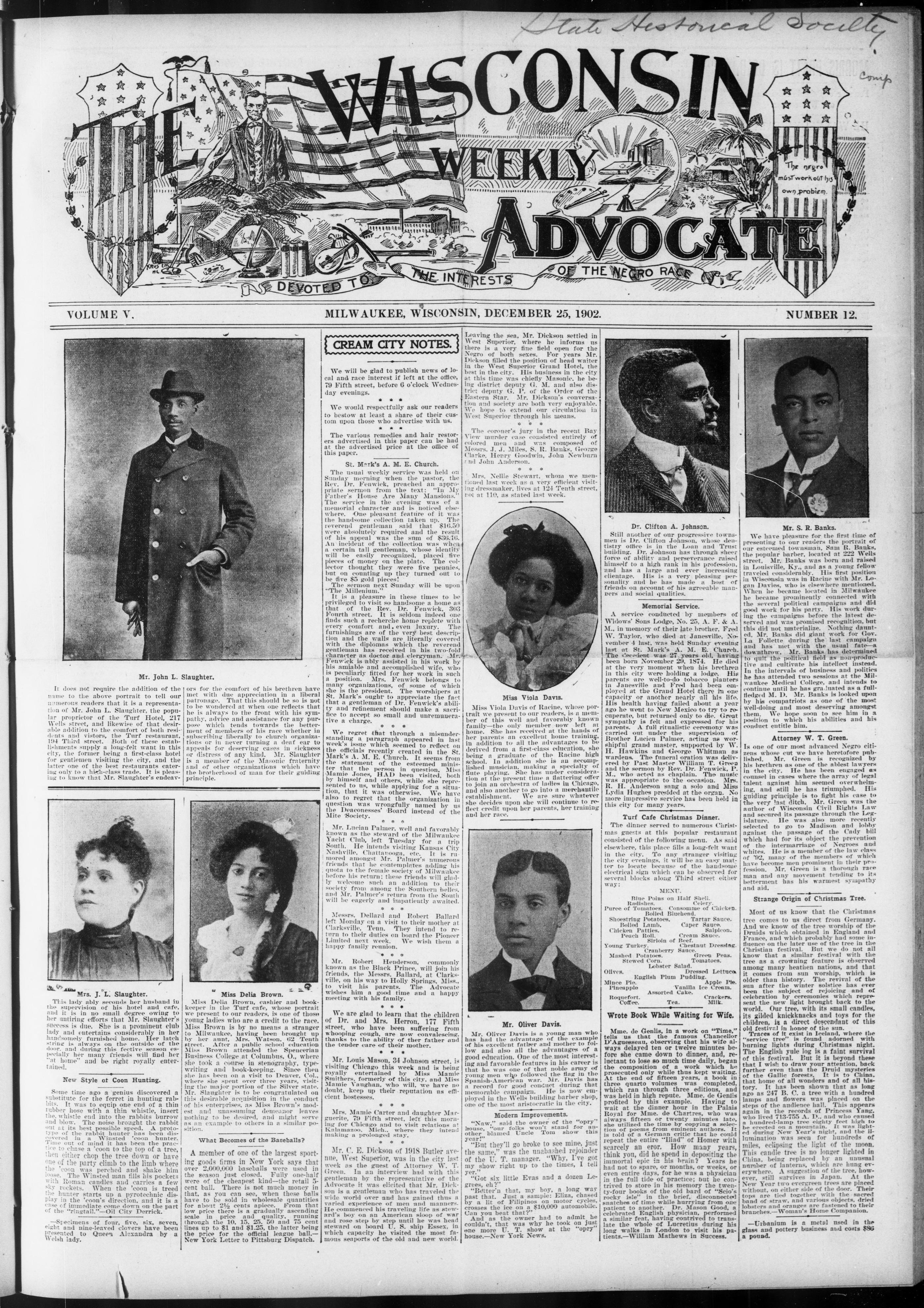
Mr. John L. Slaughter.
It does not require the addition of the name to the above portrait to tell our numerous readers that it is a representation of Mr. John L. Slaughter, the popular proprietor of the Turf Hotel, 217 Wells street, and likewise of that desirable addition to the comfort of both residents and vistors, the Turf restaurant, 194 Third street. Both of these establishments supply a long-felt want in this city, the former being a first-class hotel for gentlemen visiting the city, and the latter one of the best restaurants catering only to a high-class trade. It is pleasing to know that Mr. Slaughter's endeav-
M.
This lady ably seconds her husband in the supervision of his hotel and cafe, and it is in no small degree owing to her untiring efforts that Mr. Slaughter's success is due. She is a prominent club lady and entertains considerably in her handsomely furnished home. Her latch string is always on the outside of the door, and during this fective season especially her many friends will find her "at home" and be right royally entertained.
New Style of Coon Hunting.
Some time ago a genius discovered a substitute for the ferret in hunting rabbits. It was to equip one end of a thin rubber hose with a thin whistle, insert the whistle end into the rabbits burrow and blow. The noise brought the rabbit out at its best possible speed. A prototype of the rabbit hunter has been discovered in a Winsted 'coon hunter. Time out of mind it has been the practice to chase a 'coon to the top of a tree, then either chop the tree down or have one of the party climb to the limb where the 'coon was perched and shake him loose. The Winsted man fills his pockets with Roman candles and carries a few sky rockets. When the 'coon is treed the hunter starts up a pyrotechnic display in the 'coon's direction, and it is a case of immediate come down on the part of the "ringtail."—Oil City Derrick.
Specimens of four, five, six, seven, eight and nine-leaved clovers have been presented to Queen Alexandra by a Welsh lady.
Mrs. I. L. Slaughter.
ors for the comfort of his brethren have met with due appreciation in a liberal patronage. That this should be so is not to be wondered at when one reflects that he is always to the front with his sympathy, advice and assistance for any purpose which tends towards the betterment of members of his race whether in subscribing liberally to church organizations or in never turning a deaf ear to appeals for deserving cases in sickness or distress of any kind. Mr. Slaughter is a member of the Masonic fraternity and of other organizations which have the brotherhood of man for their guiding principle.
Mary
Miss Delia Brown, cashier and book-keeper in the Turf cafe, whose portrait we present to our readers, is one of those young ladies who are a credit to the race. Miss Brown is by no means a stranger to Milwaukee, having been brought up by her aunt, Mrs. Watson, 62 Tenth street. After a public school education Miss Brown attended the Spencerian Business College at Columbus, O., where she took a course in stenography, typewriting and book-keeping. Since then she has been on a visit to Denver, Col., where she spent over three years, visiting the major portion of the Silver state. Mr. Slaughter is to be congratulated on this desirable acquisition in the conduct of his enterprises, as Miss Brown's modest and unassuming demeanor leaves nothing to be desired, and might serve as an example to others in a similar position.
What Becomes of the Baseballs?
A member of one of the largest sporting goods firms in New York says that over 2,000,000 baseballs were used in the season just closed. Fully one-half were of the cheapest kind—the retail 5-cent ball. There is not much money in that, as you can see, when these balls have to be sold in wholesale quantities for about $1½ cents apiece. From that low price there is a gradually ascending scale in price and quality, running through the 10, 15, 25, 50 and 75 cent lines up to $1 and $1.25, the latter being the price for the official league ball.—New York Letter to Pittsburg Dispatch.
Miss Delia Brown.
CREAM CITY NOTES.
We will be glad to publish news of local and race interest if left at the office, 79 Fifth street, before 6 o'clock Wednesday evenings.
* * *
We would respectfully ask our readers to bestow at least a share of their custom upon those who advertise with us.
The various remedies and hair restorers advertised in this paper can be had at the advertised price at the office of this paper.
St. Mark's A. M. F. Church
The usual weekly service was held on Sunday morning when the pastor, the Rev. Dr. Fenwick, preached an appropriate sermon from the text: "In My Father's House Are Many Mansions." The service in the evening was of a memorial character and is noticed elsewhere. One pleasant feature of it was the handsome collection taken up. The reverend gentleman said that $16.50 were absolutely required and the result of his appeal was the sum of $36.16. An incident of the collection was when a certain tall gentleman, whose identity will be easily recognized, placed five pieces of money on the plate. The collector thought they were five pennies, but on counting up they turned out to be five $5 gold pieces!
The sermon next Sunday will be upon "The Millenium."
It is a pleasure in these times to be privileged to visit so handsome a home as that of the Rev. Dr. Fenwick, 303 Fourth street. It is seldom indeed one finds such a recherche home replete with every comfort and, even luxury. The furnishings are of the very best description and the walls are literally covered with the diplomas which the reverend gentleman has received in his two-fold character as doctor and clergyman. Mr. Fenwick is ably assisted in his work by his amiable and accomplished wife, who is peculiarly fitted for her work in such a position. Mrs. Fenwick belongs to many organizations, of some of which she is the president. The worshipers at St. Mark's ought to appreciate the fact that a gentleman of Dr. Fenwick's ability and refinement should make a sacrifice to accept so small and unremunerative a charge.
* * *
We regret that through a misunderstanding a paragraph appeared in last week's issue which seemed to reflect on the officials recently created in the St. Mark's A. M. E. Church. It seems from the statement of the esteemed minister that the person in question, Miss Mamie Jones, HAD been visited, both by himself and others, while she represented to us, while applying for a situation, that it was otherwise. We have also to regret that the organization in question was wrongfully named by us the Deaconesses' Board instead of the Mite Society.
☆ ☆ ☆
Mr. Lucian Palmer, well and favorably known as the steward of the Milwaukee Yacht Club, left Tuesday for a trip South. He intends visiting Kansas City Nashville, Chattanooga, etc. It is rumored amongst Mr. Palmer's numerous friends that he contemplates adding his quota to the female society of Milwaukee before his return; these friends will gladly welcome such an addition to their society from among the Southern belles, and Mr. Palmer's return from the South will be eagerly and impatiently awaited.
* * *
Messrs. Dellard and Robert Ballard left Monday on a visit to their mother at Clarksville, Tenn. They intend to return to their duties on board the Pioneer Limited next week. We wish them a happy family reunion.
* * *
Mr. Robert Henderson, commonly known as the Black Prince, will join his friends, the Messrs. Ballard, at Clarksville, on his way to Holly Springs, Miss., to visit his parents. The Advocate wishes him a good time and a happy meeting with his family.
* * *
We are glad to learn that the children of Dr. and Mrs. Herron, 177 Fifth street, who have been suffering from whooping cough, are now convalescing, thanks to the ability of ther father and the tender care of their mother.
* * *
Mr. Louis Mason, 34 Johnson street, is visiting Chicago this week and is being royally entertained by Miss Mamie Smithers, formerly of this city, and Miss Mamie Vaughan, who will, we have no doubt, keep up their reputation as efficient hostesses.
* * *
Mrs. Mamie Carter and daughter Marguerite, 79 Fifth street, left this morning for Chicago and to visit relations at Kalamazoo, Mich., where they intend making a prolonged stay.
---
Mr. C. E. Dickson of 1918 Butler avenue, West Superior, was in the city last week as the guest of Attorney W. T. Green. In an interview had with this gentleman by the representative of the Advocate it was elicited that Mr. Dickson is a gentleman who has traveled the wide world over and has gained thus a varied experience of men and manners. He commenced his traveling life as steward's boy on an American sloop of war and rose step by step until he was head steward on board U. S. ship Essex, in which capacity he visited the most famous seaports of the old and new world.
Leaving the sea, Mr. Dickson settled in West Superior, where he informs us there is a very fine field open for the Negro of both sexes. For years Mr. Dickson filled the position of head waiter in the West Superior Grand Hotel, the best in the city. His business in the city at this time was chiefly Masonic, he being district deputy G. M. and also district deputy G. P. of the Order of the Eastern Star. Mr. Dickson's conversation and society are both very enjoyable. We hope to extend our circulation in West Superior through his means.
* * *
The coroner's jury in the recent Bay View murder case consisted entirely of colored men and was composed of Messrs. J. J. Miles, S. R. Banks, George Clarke, Henry Goodwin, John Newburn and John Anderson.
* * *
Mrs. Nellie Stewart, whom we mentioned last week as a very efficient visiting dressmaker, lives at 124 Tenth street, not at 110, as stated last week.
A. E.
Miss Viola Davis. Miss Viola Davis of Racine, whose portrait we present to our readers, is a member of this well and favorably known family—the only member now left at home. She has received at the hands of her parents an excellent home training, in addition to all the advantages to be derived from a first-class education, she being a graduate of the Racine high school. In addition she is an accomplished musician, making a specialty of flute playing. She has under consideration at the present time a flattering offer to join an orchestra of ladies in Chicago, and also another to go into a merchantile establishment. We are sure whatever she decides upon she will continue to reflect credit upon her parents, her training and her race.
JACKSON
Mr. Oliver Davis.
Mr. Oliver Davis is a young man who has had the advantage of the example of his excellent father and mother to follow and also all the advantages of a good education. One of the most interesting and favorable features in his career is that he was one of that noble army of young men who followed the flag in the Spanish-American war. Mr. Davis has a record for good conduct during that memorable campaign. He is now employed in the Wells building barber shop, one of the most aristocratic in the city.
Modern Improvements.
"Naw," said the owner of the "opry" house, "our folks won't stand for another blamed Uncle Tom show this year!"
"But they'll go broke to see mine, just the same," was the unabashed rejoinder of the U. T. manager. "Why, I've got my show right up to the times, I tell yer."
"Got six little Evas and a dozen Legrees eb?"
"Better'n that, my boy, a long way past that. Just a sample: Eliza, chased by a lit of Filipinos on motor cycles, crosses the ice on a $10,000 automobile. Can you beat that?" And as the owner had to admit he couldn't, that was why he took on just one more U. T. show at the "opry" house.—New York News.
THE UNIVERSITY OF CALIFORNIA
Dr. Clifton A. Johnson. Still another of our progressive townsmen is Dr. Clifton Johnson, whose dentistry office is in the Loan and Trust building. Dr. Johnson has through sheer force of ability and perseverance raised himself to a high rank in his profession, and has a large and ever increasing clientage. His is a very pleasing personality and he has made a host of friends on account of his agreeable manners and social qualities.
Memorial Service
A service conducted by members of Widows' Sons Lodge, No. 25, A. F. & A. M., in memory of their late brother, Fred W. Taylor, who died at Janesville, November 4 last, was held Sunday evening last at St. Mark's A. M. E. Church. The Cecedent was 27 years old, having been born November 29, 1874. He died at the very moment when his brethren in this city were holding a lodge. His parents are well-to-do tobacco planters in Janesville and Fred had been employed at the Grand Hotel there in one capacity or another nearly all his life. His health having failed about a year ago he went to New Mexico to try to recuperate, but returned only to die. Great sympathy is felt and expressed for his parents. A full ritualistic ceremony was carried out under the supervision of Brother Lucien Palmer, acting as worshipful grand master, supported by W. H. Hawkins and George Whitman as wardens. The funeral oration was delivered by Past Master William T. Green and the sermon by Rev. Dr. Fenwick, P. M., who acted as chaplain. The music was appropriate to the occasion. Mrs. R. H. Anderson sang a solo and Miss Lydia Hughes presided at the organ. No more impressive service has been held in this city for many years.
Turf Cafe Christmas Dinner
The dinner served to numerous Christmas guests at this popular restaurant consisted of the following menu. As said elsewhere, this place fills a long-felt want in the city. To any stranger visiting the city evenings, it will be an easy matter to locate because of the handsome electrical sign which can be observed for several blocks along Third street either way: MENU.
MENU.
Blue Poins on Half Shell.
Radishes.
Celery.
Puree of Tomatoes. Consomme of Chicken.
Boiled Bluehead.
Shoestring Potatoes. Tartar Sauce.
Boiled Lamb. Caper Sauce.
Chicken Patties. Salpicon.
Peach Roll. Cream Sauce.
Sirloin of Beef.
Young Turkey. Chestnut Dressing.
Cranberry Sauce.
Mashed Potatoes. Green Peas.
Stewed Corn. Tomatoes.
Lobster Salad.
Olives. Dressed Lettuce.
English Plum Pudding.
Mince Pie. Apple Pie.
Pineapple Vanilla Ice Cream.
Assorted Cake.
Roquefort. Crackers.
Coffee. Tea. Milk.
Wrote Book While Waiting for Wife.
Mme. de Genlis, in a work on "Time," tells us that the famous Chancellor D'Aguesseau, observing that his wife always delayed ten or twelve minutes before she came down to dinner, and, reluctant to lose so much time daily, began the composition of a work which he prosecuted only while thus kept waiting. At the end of fifteen years, a book in three quarto volumes was completed, which ran through three editions, and was held in high repute. Mme. de Genlis profited by this example. Having to wait at the dinner hour in the Palais Royal for Mme. de Chartres, who was always fifteen or twenty minutes late, she utilized the time by copying a selection of poems from eminent authors. It is told of a German critic that he could repeat the entire "Iliad" of Homer with scarcely an error. How many years, think you, did he spend in depositing the immortal epic in his brain? Years he had not to spare, or months, or weeks, or even entire days, for he was a physician in the full tide of practice; but he contrived to store in his memory the twenty-four books of the old bard of "Scio's rocky isle" in the brief, disconnected snatches of time while hurrying from one patient to another. Dr. Mason Good, a celebrated English physician, performed a similar feat, having contrived to translate the whole of Lucretius during his long walks in London to visit his patients.—William Mathews in Success.
---
JOHN A. BROWN
Mr. S. R. Banks.
We have pleasure for the first time of presenting to our readers the portrait of our esteemed townsman, Sam R. Banks, the popular barber, located at 222 Wells street. Mr. Banks was born and raised in Louisville, Ky., and as a young fellow traveled considerably. His first position in Wisconsin was in Racine with Mr. Logan Davies, who is elsewhere mentioned. When he became located in Milwaukee he became prominently connected with the several political campaigns and did good work for his party. His work during the campaigns before the latest deserved and was promised recognition, but this did not materialize. Nothing daunted, Mr. Banks did giant work for Gov. La Follette during the last campaign and has met with the usual fate—a downthrow. Mr. Banks has determined to quit the political field as non-productive and cultivate his intellect instead. In the intervals of business and politics he has attended two sessions at the Milwaukee Medical College, and intends to continue until he has graduated as a full-fledged M. D. Mr. Banks is looked upon by his compatriots as one of the most well-doing and most deserving amongst them. We hope soon to see him in a position to which his abilities and his conduct entitle him.
Attorney W. T. Green.
Is one of our most advanced Negro citizens whose cut we have heretofore published. Mr. Green is recognized by his brethren as one of the ablest lawyers in the city. He has been engaged as counsel in cases where the array of legal talent against him seemed overwhelming, and still he has triumphed. His guiding principle is to fight his case to the very last ditch. Mr. Green was the author of Wisconsin Civil Rights Law and secured its passage through the Legislature. He was also more recently selected to go to Madison and lobby against the passage of the Cady bill which had for its object the prevention of the intermarriage of Negroes and whites. He is a member of the law class of '92, many of the members of which have become men prominent in their profession. Mr. Green is a thorough race man and any movement tending to its betterment has his warmest sympathy and aid.
Strange Origin of Christmas Tree.
Most of us know that the Christmas tree comes to us direct from Germany. And we know of the tree worship of the Druids which obtained in England and France, and which probably had some influence on the later use of the tree in the Christian festival. But we do not all know that a similar festival with the tree as a crowning feature is observed among many heathen nations, and that it comes from sun worship, which is older than history. The revival of the sun after the winter solstice has ever been the subject of rejoicing and of celebration by ceremonies which represent the new light brought back to the world. Our tree, with its small candles, its gilded knickknacks and toys for the children, is a direct descendant of this old festival in honor of the sun.
Traces of it exist in Iceland, where the "service tree" is found adorned with burning lights during Christmas night. The English yule log is a faint survival of this festival. But it is beyond these that I wish to draw your attention, back further even than the Druid mysteries of the Gallic forests. It is to China, that home of all wonders and of all history. It has been shown that as long ago as 247 B. C. a tree with a hundred lamps and flowers was placed on the steps of the audience hall. This appears again in the records of Princess Yang, who lived 713-755 A. D., and who caused a hundred-lamp tree eighty feet high to be erected on a mountain. It was lighted during New Year's night, and the illumination was seen for hundreds of miles, eclipsing the light of the moon. This candle tree is no longer lighted in China, being replaced by an unusual number of lanterns, which are hung everywhere. A suggestion of the tree, however, still survives in Japan. At the New Year two evergreen trees are placed without, on either side of the door. Their tops are tied together with the sacred band of straw, and various objects, dried lobsters and oranges are fastened to their branches.—Woman's Home Companion.
—Urbanium is a metal used in the glass and pottery business and costs $80 a pound.
THE STAR
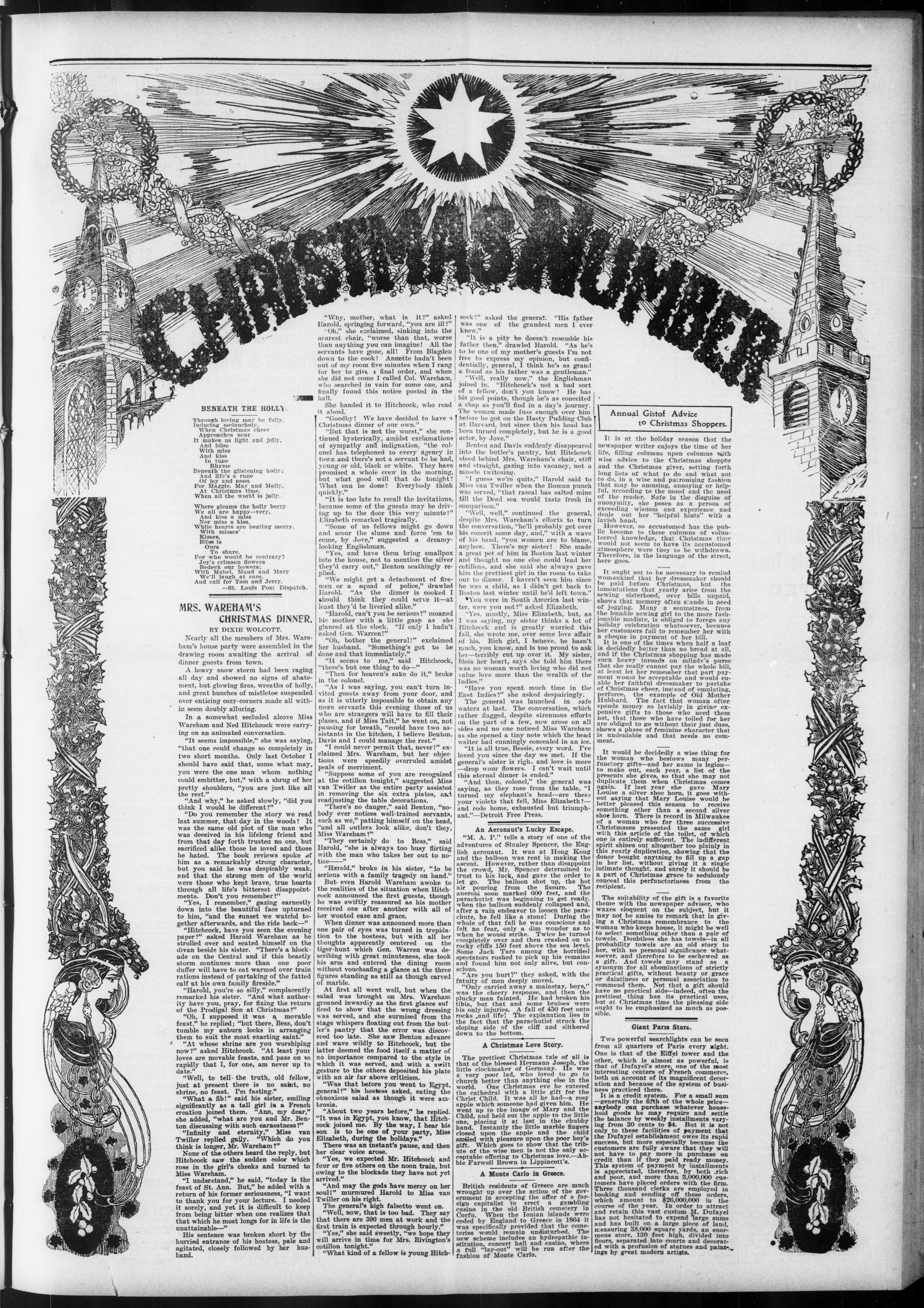
A decorative illustration of a church tower with a clock, surrounded by holly leaves and berries, and a figure in a flowing dress holding a chain.
BENEATH THE HOLLY
Through loving may be folly.
Inducing melancholy.
When Christmas cheer
Approaches near
It makes us light and jolly.
And bliss
With miss
And kiss
In tune
Rhyme
Beneath the glistening holly;
And life's a rune
Of joy and noon
For Maggle. May and Molly,
At Christmas time.
When all the world is jolly.
Where gleams the holly berry
We all are happy—very,
And kiss a miss
Nor miss a kiss.
While hearts are beating merry.
With misses'
Kisses,
Bliss is
Ours
To share.
For who would be contrary?
Joy's crimson flowers
Bedeck our bowers;
With Mabel, Maud and Mary
We'll laugh at care.
And call for Tom and Jerry.
—St. Louis Post Dispatch.
MRS. WAREHAM'S CHRISTMAS DINNER. BY DIXIE WOLCOTT
BY DIXIE WOLCOTT.
Nearly all the members of Mrs. Wareham's house party were assembled in the drawing room awaiting the arrival of dinner guests from town.
A heavy snow storm had been raging all day and showed no signs of abatement, but glowing fires, wreaths of holly, and great bunches of mistletoe suspended over enticing cozy-corners made all within seem doubly alluring.
In a somewhat secluded alcove Miss Wareham and Ned Hitchcock were carrying on an animated conversation.
"It seems impossible," she was saying, "that one could change so completely in two short months. Only last October I should have said that, come what may, you were the one man whom nothing could embitter, but," with a shrug of her pretty shoulders, "you are just like all the rest."
"And why," he asked slowly, "did you think I would be different?"
"Do you remember the story we read last summer, that day in the woods? It was the same old plot of the man who was deceived in his lifelong friend and from that day forth trusted no one, but sacrificed alike those he loved and those he hated. The book reviews spoke of him as a remarkably strong character, but you said he was despicably weak, and that the strong men of the world were those who kept brave, true hearts through all life's bitterest disappointments. Don't you remember?"
"Yes, I remember," gazing earnestly down into the beautiful face upturned to him, "and the sunset we watchd together afterwards, and the ride back—"
"Hitchcock, have you seen the evening paper?" asked Harold Wareham as he strolled over and seated himself on the divan beside his sister. "There's a blockade on the Central and if this beastly storm continues more than one poor duffer will have to eat warmed over train rations instead of partaking of the fatted calf at his own family fireside."
"Harold, you're so silly," complacently remarked his sister. "And what authority have you, pray, for fixing the return of the Prodigal Son at Christmas?"
"Oh, I supposed it was a movable feast." he replied; "but there, Bess, don't tumble my auburn locks in arranging them to suit the most exacting saint."
"At whose shrine are you worshiping now?" asked Hitchcock. "At least your loves are movable feasts, and pass on so rapidly that I, for one, am never up to date."
"Well, to tell the truth, old fellow, just at present there is no saint, no shrine, no feast. I'm fasting."
"What a fib!" said his sister, smiling significantly as a tall girl in a French creation joined them. "Ann, my dear," she added, "what are you and Mr. Benton discussing with such earnestness?"
"Infinity and eternity," Miss van Twiller replied gaily. "Which do you think is longer. Mr. Wareham?"
None of the others heard the reply, but Hitchcock saw the sudden color which rose in the girl's cheeks and turned to Miss Wareham.
"I understand," he said, "today is the feast of St. Ann. But," he added with a return of his former seriousness, "I want to thank you for your lecture. I needed it sorely, and yet it is difficult to keep from being bitter when one realizes that that which he most longs for in life is the unattainable—"
His sentence was broken short by the hurried entrance of his hostess, pale and agitated, closely followed by her husband.
---
"Why, mother, what is it?" asked Harold, springing forward, "you are ill?"
"Oh," she exclaimed, sinking into the nearest chair, "worse than that, worse than anything you can imagine! All the servants have gone, all! From Blagden down to the cook! Annette hadn't been out of my room five minutes when I rang for her to give a final order, and when she did not come I called Col. Wareham, who searched in vain for some one, and finally found this notice posted in the hall. She handed it to Hitchcock, who read it aloud. "Goodby! We have decided to have a Christmas dinner of our own."
"But that is not the worst," she continued hysterically, amidst exclamations of sympathy and indignation. "the colonel has telephoned to every agency in town and there's not a servant to be had, young or old, black or white. They have promised a whole crew in the morning, but what good will that do tonight? What can be done? Everybody think quickly."
"It is too late to recall the invitations, because some of the guests may be driving up to the door this very minute!" Elizabeth remarked tragically.
"Some of us fellows might go down and scour the slums and force 'em to come, by Jove," suggested a dreamy-looking Englishman.
"Yes, and have them bring smallpox into the house, not to mention the silver they'd carry out," Benton scathingly replied.
"We might get a detachment of firemen or a squad of police," drawled Harold. "As the dinner is cooked I should think they could serve it—at least they'd be liveried alike."
"Harold, can't you be serious?" moaned his mother with a little gasp as she glanced at the clock. "If only I hadn't asked Gen. Warren!"
"Oh, bother the general!" exclaimed her husband. "Something's got to be done and that immediately."
"It seems to me," said Hitchcock, "there's but one thing to do—"
"Then for heaven's sake do it," broke in the colonel.
"As I was saying, you can't turn invited guests away from your door, and as it is utterly impossible to obtain any more servants this evening those of us who are strangers will have to fill their places, and if Miss Tait," he went on, not pausing for breath, "could have two assistants in the kitchen, I believe Benton, Davis and I could manage the rest."
"I could never permit that, never!" exclaimed Mrs. Wareham, but her objections were speedily overruled amidst peals of merriment.
"Suppose some of you are recognized at the cotillon tonight," suggested Miss van Twiller as the entire party assisted in removing the six extra plates, and readjusting the table decorations.
"There's no danger," said Benton, "nobody ever notices well-trained servants, such as we," patting himself on the head, "and all outliers look alike, don't they, Miss Wareham?"
"They certainly do to Bess," said Harold, "she is always too busy flirting with the man who takes her out to notice——"
"Harold," broke in his sister, "do be serious with a family tragedy on hand." But even Harold Wareham awoke to the realities of the situation when Hitchcock announced the first guests, though he was swiftly reassured as his mother received one after another with all of her wonted ease and grace. When dinner was announced more than one pair of eyes was turned in trepidation to the hostess, but with all her thoughts apparently centered on the tiger-hunt which Gen. Warren was describing with great minuteness, she took his arm and entered the dining room without vouchsafing a glance at the three figures standing as still as though carved of marble.
At first all went well, but when the salad was brought on Mrs. Wareham groaned inwardly as the first glance suffered to show that the wrong dressing was served, and she surmised from the stage whispers floating out from the butler's pantry that the error was discovered too late. She saw Benton advance and wave wildly to Hitchcock, but the latter deemed the food itself a matter of no importance compared to the style in which it was served, and with a swift gesture to the others deposited his plate with an air far above criticism.
"Was that before you went to Egypt, general?" his hostess asked, eating the obnoxious salad as though it were ambrosia.
"About two years before," he replied. "It was in Egypt, you know, that Hitchcock joined me. By the way, I hear his son is to be one of your party, Miss Elizabeth, during the holidays."
There was an instant's pause, and then her clear voice arose.
"Yes, we expected Mr. Hitchcock and four or five others on the noon train, but owing to the blockade they have not yet arrived."
"And may the gods have mercy on her soul!" murmured Harold to Miss van Twiller on his right.
The general's high falsetto went on.
"Well, now, that is too bad. They say that there are 300 men at work and the first train is expected through hourly."
"Yes," she said sweetly, "we hope they will arrive in time for Mrs. Rivington's cotillon tonight."
"What kind of a fellow is young Hitch-
cock?" asked the general. "His father was one of the grandest men I ever knew."
"It is a pity he doesn't resemble his father then," drawled Harold. "As he's to be one of my mother's guests I'm not free to express my opinion, but confidentially, general, I think he's as grand a fraud as his father was a gentleman."
"Well, really now," the Englishman joined in. "Hitchcock's not a bad sort of a fellow, don't you know? He has his good points, though he's as conceited a chap as you'll find in a day's journey. The women made fuss enough over him before he got on the Hasty Pudding Club at Harvard, but since then his head has been turned completely, but he is a good actor, by Jove."
Benton and Davis suddenly disappeared into the butler's pantry, but Hitchcock stood behind Mrs. Wareham's chair, stiff and straight, gazing into vacancy, not a muscle twitening.
"I guess we're quits," Harold said to Miss van Twiller when the Roman punch was served, "that rascal has salted mine till the Dead sea would taste fresh in comparison."
"Well, well," continued the general, despite Mrs. Wareham's efforts to turn the conversation, "he'll probably get over his conceit some day, and," with a wave of his hand, "you women are to blame, anyhow. There's my sister! She made a great pet of him in Boston last winter and thought no one else could lead her cotillons, and she said she always gave him the prettiest girl in the room to take out to dinner. I haven't seen him since he was a child, as I didn't get back to Boston last winter until he'd left town."
You were in South America last winter, were you not?" asked Elizabeth.
"Yes, mostly, Miss Elizabeth, but, as I was saying, my sister thinks a lot of Hitchcock and is greatly worried this fall, she wrote me, over some love affair of his. Rich girl, I believe, he hasn't much, you know, and is too proud to ask her—terribly cut up over it. My sister, bless her heart, says she told him there was no woman worth loving who did not value love more than the wealth of the Indies."
"Have you spent much time in the East Indies?" she asked despairingly.
The general was launched in safe waters at last. The conversation, which rather flagged, despite strenuous efforts on the part of a few, now arose on all sides and no one noticed Miss Wareham as she opened a tiny note which the head waiter had cunningly concealed in an ice. "It is all true, Bessie, every word. I've loved you since the day we met. If the general's sister is right, and love is more—drop wour flowers. I can't wait until this eternal dinner is ended." "And then, colonel," the general was saying, as they rose from the table, "I turned my elephant's head—are these your violets that fell, Miss Elizabeth?—and rode home, exhausted but triumphant."—Detroit Free Press.
An Aeronaut's Lucky Escape.
"M. A. P." tells a story of one of the adventures of Stanley Spencer, the English aeronaut. It was at Hong Kong and the balloon was rent in making the ascent. However, rather than disappoint the crowd, Mr. Spencer determined to trust to his luck, and gave the order to let go. The balloon shot up, the hot air pouring from the fissure. The aneroid soon marked 600 feet, and the parachutist was beginning to get ready, when the balloon suddenly collapsed and, after a vain endeavor to loosen the parachute, he fell like a stone! During the whole of that fall he was conscious and felt no fear, only a dim wonder as to when he would strike. Twice he turned completely over and then crashed on to rocky cliffs 150 feet above the sea level. Some Jack Tars among the horrified spectators rushed to pick up his remains and found him not only alive, but conscious.
"Are you hurt?" they asked, with the fatuity of men deeply moved. "Only carried away a mainstay, boys," was the cheery response, and then the plucky man fainted. He had broken his tibia, but that and some bruises were his only injuries. A fall of 450 feet onto rocks, and life! The explanation lies in the fact that the parachutist struck the sloping side of the cliff and slithered down to the bottom.
A Christmas Love Story.
The prettiest Christmas tale of all is that of the blessed Hermann Joseph, the little clockmaker of Germany. He was a very poor lad, who loved to go to church better than anything else in the world. One Christmas eve he entered the cathedral with a little gift for the Christ Child. It was all he had—a rosy apple which someone had given him. He went up to the image of Mary and the Child, and held out the apple to the little one, placing it at last in the chubby hand. Instantly the little marble fingers closed upon the apple and the child smiled with pleasure upon the poor boy's gift. Which goes to show that the tribute of the wise men is not the only acceptable offering to Christmas love. Abbie Farwell Brown in Lippincott's.
A Monte Carlo in Greece.
British residents of Greece are much wrought up over the action of the government in accepting the offer of a foreign capitalist to erect a gambling casino in the old British cemetery in Corfu. When the Ionian islands were ceded by England to Greece in 1864 it was specifically provided that the cemeteries would remain undisturbed. The new scheme includes an hydropathic institution, concert hall and casino, where a full "lay-out" will be run after the fashion of Monte Carlo.
Annual Gistof Advice to Christmas Shoppers.
It is at the holiday season that the newspaper writer enjoys the time of her life, filling columns upon columns with wise advice to the Christmas shopper and the Christmas giver, setting forth long lists of what to do and what not to do, in a wise and patronizing fashion that may be amusing, annoying or helpful, according to the mood and the need of the reader. Safe in the disguise of anonymity, she poses as a person of exceeding wisdom and experience and deals out her "helpful hints" with a lavish hand.
However, so accustomed has the public become to these columns of volunteered knowledge, that Christmas time would not seem to have its accustomed atmosphere were they to be withdrawn. Therefore, in the language of the street, here goes.
It ought not to be necessary to remind womankind that her dressmaker should be paid before Christmas, but the lamentations that yearly arise from the sewing sisterhood, over bills unpaid, shows that memory often stands in need of jogging. Many a seamstress, from the humble sewing girl to the more fashionable modiste, is obliged to forego any holiday celebration whatsoever, because her customers fail to remember her with a cheque in payment of her bill.
It is one of the times when half a loaf is decidedly better than no bread at all, and if the Christmas shopping has made such heavy inroads on milady's purse that she really cannot pay the whole bill, at least let her remember that part payment would be acceptable and would enable her faithful dressmaker to partake of Christmas cheer, instead of emulating, perforce, the example of Old Mother Hubbard. The fact that woman often spends money so lavishly in giving expensive gifts to those who need them not, that those who have toiled for her are obliged to go without their just dues, shows a phase of feminine character that is undeniable and that needs no comment.
It would be decidedly a wise thing for the woman who bestows many perfunctory gifts—and her name is legion—to make out, each year, a list of the presents she gives, so that she may not duplicate them when Christmas comes again. If last year she gave Mary Louise a silver shoe horn, it goes without saying that Mary Louise would be better pleased this season to receive something other than a second silver shoe horn. There is record in Milwaukee of a woman who for three successive Christmases presented the same girl with this article of the toilet, of which one is entirely sufficient. The indifferent spirit shines out altogether too plainly in this yearly duplication, showing that the donor bought anything to fill up a gap in her list, without giving it a single intimate thought, and surely it should be a part of Christmas grace to sedulously conceal this perfunctoriness from the recipient.
The suitability of the gift is a favorite theme with the newspaper adviser, who waxes eloquent on the subject, but it may not be amiss to remark that in giving a Christmas remembrance to the woman who keeps house, it might be well to select something other than a pair of towels. Doubtless she has towels—in all probability towels are an old story to her, with no personal significance whatsoever, and therefore to be eschewed as a gift. And towels may stand as a synonym for all abominations of strictly practical gifts, without beauty or grace or daintiness or personal association to commend them. Not that a gift should have no practical side—indeed, often the prettiest thing has its practical uses, but at Christmas time the pleasing side ought to be emphasized as much as possible.
Giant Paris Store.
Two powerful searchlights can be seen from all quarters of Paris every night. One is that of the Eiffel tower and the other, which is almost as powerful, is that of Dufayel's store, one of the most interesting centers of French commerce, both on account of its magnificent decoration and because of the system of business practiced there.
It is a credit system. For a small sum—generally the fifth of the whole price—anybody can purchase whatever household goods he may require and settle the balance by weekly installments varying from 30 cents to $4. But it is not only to these facilities of payment that the Dufayel establishment owes its rapid success, but more especially because the customers are fully aware that they will not have to pay more in purchase on credit than if they paid ready money. This system of payment by installments is appreciated, therefore, by both rich and poor, and more than 3,000,000 customers have placed orders with the firm. Three thousand clerks are employed in booking and sending off these orders, which amount to $26,000,000 in the course of the year. In order to attract and retain this vast custom M. Dufayel has not hesitated to expend large sums and has built on a large piece of land, measuring 38,000 square yards, an enormous store, 130 feet high, divided into floors, separated into courts and decorated with a profusion of statues and paintings by great modern artists.
The Wisconsin Weekly Advocate
MILWAUKEE, WIS.
Telephone Black No. 244.
postage paid.
One Year ..... $2.00
Six Months ..... 1.25
Three Months ..... 75
Send money by Express Money Order, P. O.
Money Order or Registered Letter to the
Wisconsin Weekly Advocate.
ADVERTISING RATES.
One inch, single insertion ..... 25c
One inch, per year ..... $9.00
Business locals 5c per line each insertion.
Apply for rates to the Advocate.
TO CONTRIBUTORS:
All communications must be sent with the name and address of the sender as an evidence of good faith, but not necessarily for publication. No manuscript returned if not accepted, unless accompanied by stamps.
The Wisconsin Weekly Advocate company wishes to notify the public that all contracts and business transactions with this company must have the company stamp, otherwise they will be void. Neither will this company be responsible for paid subscriptions unless given to duly-accredited agents, who, on request, will give the company's receipt for same. Subscribers failing to receive their papers regularly will kindly notify the general office. Address all business communications to the general manager, 79 Fifth street.
Entered in the Postoffice at Milwaukee as Second-class matter.
EDITORIAL PARAGRAPHS.
"I know of the bravery and character of the Negro soldier. He saved my life at Santiago, and I have had occasion to say so in many articles and speeches. The Rough Riders were in a bad position when the Ninth and Tenth cavalry came rushing up the hill carrying everything before them. The Negro soldier has the faculty of coming to the front when he is needed most. In the Civil war he came 400,000 strong, and I believe he saved the Union."—President Roosevelt.
The Opportunity
of a Life Time
WANTED
for a first-class hotel in a city in
the interior of the state of Wisconsin, the followlng colored
help—
1 MEAT COOK, Female.
1 PASTRY COOK, Female.
1 LAUNDRY MAID.
2 CHAMBER MAIDS, one to assist in serving dinners and suppers.
2 DINING ROOM GIRLS.
2 DISH WASHERS.
This is an exceptional opportunity for a club of Southern girls to make for themselves a comfortable home in Wisconsin. The proprietor is a Southern gentleman who understands and appreciates the negro. Apply at once to the office of the WISCONSIN WEEKLY ADVOCATE, 79 Fifth Street, Milwaukee, Wis.
An Ungrounded Complaint.
Early this week two gentlemen called at the office of the Advocate to request the use of its columns to ventilate a supposed grievance they had against Dr. Herron of 177 Fifth street. It seems that one of these gentlemen during the night was suddenly taken ill with a serious throat trouble, and had tried to call up Dr. Herron, who is not a general practitioner, but a specialist. Naturally, Dr. Herron refused the case, and hence all this tempest in a teapot. The public must once for all understand that the Advocate, while perfectly willing and anxious to ventilate the grievances of the race as a whole or as a class, does not propose to be made the medium for regulating personal and petty grievances such as this. The gentlemen in question seemed to insinuate that the doctor did not seem to want their trade because they were colored. This is quite the opposite of being the case, as we know it to be a fact that there is no greater lover of his race than this same Dr. A. L. Herron.
Hold Up His Hands.
One of the best and certainly one of the most intelligent pastors St. Mark's Church has ever had is Rev. Dr. Fenwick, the present incumbent. He has only been stationed here a few short months, but in that time he has shown great executive ability.
He has broken up the old ring and has driven the money changers out of the temple. The church has prospered and the congregation has doubled. He has proven himself to be master of the situation, but as in the case of every true reformer he is beginning to meet with opposition. The old clique, who, if they cannot run a pastor try to ruin him, are at work and have begun to show their teeth. Keep right on, Brother Fenwick! There is nothing to fear. The better element of the church will always support you if you continue as you have done.
For the fifth time we have the pleasure of wishing our numerous readers the compliments of the season, and every good wish which usually accompanies these. We present them this week with short sketches and portraits of the most prominent local members of the race. On account of the sickness of the editor he has been unable to see many of his
patrons personally and he desires those who have not renewed their subscriptions and desire to do so to remit the same to him at the office, 79 Fifth street, Milwaukee.
The Conservator of Chicago takes, us to task in its latest issue because of our criticism of it in reference to Postmaster General Payne's attitude in regard to Southern representation. Lack of space compels us to refrain from dealing at length with this question this week. Surface it to say that it does not become the editor of that newspaper to try to besmirch Mr. Payne, from whom, to our knowledge, he has received many courtesies.
We trust that neither the Broad Axe of Chicago nor any other of our contemporaries or readers thought by our remark in last week's issue that we were not at one with it in showing up the too lamentable shortcomings of some of the members of the ministerial profession. The attitude which the Advocate has all along maintained in this regrettable state of matters should preclude such an idea.
The crusade of the Chicago authorities for the construction of fire escapes on the hotels of that city recalls the boom in fire escape ideas in Milwaukee after the burning of the Newhall House. When the horror of the Lincoln Hotel fire subsides, the fire escape will again fall into the position of something occasionally thought of.
The new monitor Nevada has achieved 12.95 knots an hour on a trial run, which is a good margin above the 11.5 knots called for by the contract with her builders. Speed is not a vital matter with the monitors, which are harbor defense craft, but it may be of service occasionally, in emergencies.
---
Reports concerning a rush of orders to the builders of skimming dishes indicate that inland lake yachting will be lively next season. The scow skimmer type is "just the thing" for inland lake yachting, and she ought to be seen at her best in Wisconsin, which has no lack of lakes.
Somebody has blundered in Florida, if the report be true that the sprayed solution with which the government experts are destroying the water hyacinth is killing the cattle on ranges bordering on the St. John's river. Almost any doctor can head off a disease by killing the patient.
---
Fear is said to be actuating Yang Lu, the first grand secretary of China, who in anticipation of a cutting of the apron string and the release of the much mothered Emperor, wants to resign. Perhaps gallantry impels him to the side of the apron rather than to the end of the string with its royal attachment.
This is an age of wireless telegraphy and horseless carriages, but any nation that thinks it has discovered a method of peaceful blockade is liable to be called upon to file specifications before the neutral countries doing business in the ports affected will consent to accept the situation.
The arrival at Santiago, Cuba, of the first through railroad train from Havana is evidence that American enterprise is taking hold on the island. If things are finally adjusted in an amicable way, between Cuba and the United States, the industries of the island will make rapid strides in the near future.
The action of the Henley regatta committee barring professional coaches from service within one month of the regatta should not deter American oarsmen from participating in the Henley races. They ought to be able to do their work on the same footing with their English cousins.
The killing of six members of a family at Fort Lee, New Jersey, by the explosion of an acetylene gas tank is proof that the possibilities of ignorance or carelessness in the use of the new illuminant are similar to those which imperil the keepers of powder magazines.
---
Carnegie and Rockefeller are beating the record of educational endowment made by Cecil Rhodes. It is a notable beneficence to make a $10,000,000 gift. It is still more notable to make it during life, instead of leaving it posthumously by will.
The trouble caused by a kicking mule in the Cleveland waterworks tunnel was small in comparison with the trouble caused in Chicago by the kicking of Mrs. O'Leary's cow, but both incidents prove that woe follows upon the heels of spite.
Considering the number of times the Count Boni de Castellane has been unable to pay his bills, the way he purchases historic chateaux and whatever else strikes his fancy is surprising. But the Count's wife has rich relatives.
---
A London professor argues to prove that "Breakfast is a Mistake." Now let it be demonstrated that dinner and supper are mistakes, and people may see their way to living on a dollar a day despite the high price of coal.
---
The Wausau, Wis., Civil War veteran who has given his hand, preserved in alcohol, to Congressman Brown, as evidence in his application for a pension, will give his heart too if the Congressman succeeds in making good his claim.
---
President Northrop's opinion that football is not an unmixed evil is sustained by the mixed state of things frequently resulting on the gridiron from a concentration of the energy of twenty-two human battering rams.
Chicagoans have long been used to finding all sorts of things in their drinking water, and fate is running them pretty hard now that the same kind of trouble has developed with regard to their mail.
Oatmeal and bran mash will of course figure in the horseflesh banquet offered by the German national organization of butchers to the home society for the prevention of cruelty to animals.
TO GO TO HAGUE COURT.
England Preiers the President as One Having Natural Fitness for Duties of the Position.
Washington, D. C., Dec. 24.—The British and German formal proposals to President Roosevelt to arbitrate the Venezuelan difficulty have been received here. They are in such shape that the President can accept or decline the proposition, but so far he has reached no decision, not having had an opportunity to carefully consider them. Berlin, Dec. 24.—Germany will consent to submit the question in dispute with Venezuela to The Hague tribunal if President Roosevelt refuses to act as arbitrator and if England agrees to such an arrangement.
This decision was given out unofficially by officials of the foreign office. It was stated that the government would much prefer to have President Roosevelt act on the question, on the ground that a settlement would be much more rapid than if the international court had to take up the whole dispute. Should England agree the case would be submitted to The Hague tribunal at once, the blockade would be lifted, the warships withdrawn, and the end of all the difficulty would be in sight.
England Prefers Roosevelt.
London, Dec. 24.—The decision of President Roosevelt respecting Venezuelan arbitration is awaited with keen interest in England. The Post proposed the President's name in advance of even the quick-witted German Emperor, and the suggestion has been received with a chorus of acclamation by the English press. This English preference is based upon respect for the President's character and recognition of his unique fitness for the duties of an arbitrator.
The English press is regaining its sobriety of judgment respecting Germany. Mr. Kipling's outbreak is generally condemned and the German Emperor is beginning to have something like justice for his evident desire to maintain the friendliest possible relations with the United States. The British solicitude for the maintenance and preservation of the Morge doctrine seems overwrought when two powerful European governments have virtually recognized it and deliberately nominated the American resident as arbitrator.
Criticism of British Government.
In a speech at Dunfermline Sir Henry Campbell-Bannerind, the Liberal leader, said that the position into which the government had allowed itself to glide with Venezuela was inexcusable. It was a paltry quarrel with a bankrupt, distracted, rickety state. He had nothing but condemnation for those who by rasping writings and foul gibes had fomented discord between Great Britain and Germany. If ever there was a case for arbitration it was this one. He hoped it would not become part of Great Britain's duty to be a debt collector throughout the world, to gather in the falling dividends of credulous bondholders, or to recover the lost property of risky investors.
ALLIES DO NOT AGREE.
American Vessel Driven Away from Port of La Guavra.
La Guayra, Dec. 24.—A merchant ship owned by citizens of the United States has been sent away from this port, and with half its cargo still aboard will have to go to Willemstad, Curacao, to land the goods now aboard.
The vessel, the Caracas of the Red "D" line, first was given permission to enter and discharge its cargo, but later was ordered out to sea for the night, and then was notified that it would not be allowed to re-enter to complete the landing of cargo.
Apparently there are serious differences of opinion among the allies, as the driving away of the United States vessel after once being admitted was the result of conflicting orders. First the British commander agreed to the entry of the Caracas and then the Italian commander forbade it admission. Later the captain was notified he would be allowed to disembark his cargo on condition that he would leave before nightfall, returning under the same terms tomorrow. These conditions were accepted, and with one-third of its cargo still aboard the Caracas put out last night. Then came the notice that the vessel must not return.
Extension of Time Refused
Lieut. Commander Diehl endeavored to obtain from the commanders of the foreign warships an extension of a few hours in the time given the Caracas to remain at its dock in order that it might finish unloading. His request was refused and he did not insist.
Rebel Port Not Blockaded.
The port of Coro, which is surrounded on the land side by the revolutionists, is not blockaded. This fact is believed to mean that the British and German fleets are working in harmony with the revolutionists and not blockading Coro in order to allow the free entrance of Dutch schooners from Curacao bringing arms and ammunition to the rebels.
LETS JUDGE OUT OF JAIL.
Federal Court Allows Him to Spend Christmas with Family.
Kansas City, Mo., Dec. 24.—Judge Thomas Nevitt of St. Clair county, who has been in jail in Marysville for failing to obey a mandate of the United States court, was released by Judge Philips so he could spend his Christmas with his family. After the holidays he will return to jail.
Judge Nevitt is the presiding judge of the county court of St. Clair. He has been in jail ever since he was elected. For many years the judges of that court have refused to vote money to pay railroad bonds, for which a judgment was obtained in the federal court, and Judge Philips has kept them in jail.
A week ago Judge Nevitt wrote to Judge Philips and begged the privilege of going home for Christmas. He promised Judge Philips that he would not hold court in St. Clair county, but would return after the holidays.
GOVERNMENT PAYS UP.
Settlement of Claim that Has Been Pending More Than a Century.
Ogden, Utah, Dec. 24.—Mrs. George A. Graves of this city has just received a check from the United States government for $250 in settlement of a claim that had been pending for 105 years. The claim was for the capture and destruction by the French about the year 1798 of a schooner belonging to Capt. Robert Patton of Gardner, Me. The claim was for $1850 and there are seven heirs.
IN SORE STRAITS.
President Castro Attacked by Foreigners and Besieged by His Own Countrymen.
Willemstad, Island of Curacoa, Dec. 23 (by boat from La Guayra).—The revolutionists, strengthened by the impossibility of the government's suppressing the smuggling of arms and ammunition into the country and by the fact that it has no longer any fleet at its disposal, have made answer to President Castro's proposition that they turn their arms against the foreigners who have attacked Venezuela, by referring him to Gen. Matos, their only chief capable of dealing with the matter. The rebels have regained courage. The government, which signed with them an armistice of ten days which ends tomorrow, has 3600 men at Barquisimeto and 2500 near Caracas, but all others who had enrolled themselves to fight against the foreigners have retired.
The revolutionists have planned a march on Caracas by three roads. The situation for President Castro is considered to be again perilous. Attacked by foreigners and his own countrymen he can with difficulty resist the shocks as the government's resources have vanished. The President's departure for La Victoria is for the purpose of trying to check the rear advance t othe capital of the revolutionists. Willemstad, Island of Curacao, Dec. 24 (by boat from La Guayra).—The revolutionists have answered President Castro's proposition that they should unite with the government and turn their arms against the foreigners who have attacked Venezuela by referring the President to Gen. Matos, their only chief capable of dealing with the matter.
DID NOT SEE SIGNALS.
Pere Marquette Engineer Unable to Avert Collision in Which Several Were Injured.
Grand Rapids, Mich., Dec. 24.—During the heavy snowstorm at 7:33 this morning Detroit train No. 2 on the Pere Marquette railroad crashed into the rear end of Saginaw train No. 32 at McCords, a flag station 15 miles east of here. Train 32 left Grand Rapids at 7 o'clock, ten minutes ahead of No. 2. It was flagged at McCords and was just starting out again when No. 2 came along. The engineer of No. 2 did not see the rear lights of the Saginaw train until too late to stop his train. No cars were telescoped, although the force of the collision smashed platforms and threw the passengers and train crew about. The following were injured: Mrs. M. J. Kiley, Grand Rapids, cut about the head and chest.
james Scovelle, Clarkgrille, mail clerk,
badly hurt.
Express Messenger Griffith, badly hurt. E. A. Wood, baggageman, slightly cut on the head. The passengers injured were on the Saginaw train and the others on the Detroit train.
HIGHEST WAGES PAID.
Eight Per Cent. Increase Granted to 20,000 Employes of Frick Coke Company.
Pittsburg, Pa., Dec. 24.—Notices will be posted throughout the Connellsville coke regions today granting the 20,000 employees of the Frick Coke Company a voluntary advance in wages averaging 8 per cent.
The increase will take effect January 1 and includes the miners, coke drawers, drivers, cagers and laborers. It means that the company will next year dispense in wages to its men $1,600,000 more than it has this year and that it will continue to pay the highest wages of any concern in the United States employing this kind of labor.
The Frick Coke Company is a subsidiary company of the United States Steel Corporation.
POPE IN GOOD HEALTH
No Foundation for Report that Pontiff is Ill—Celebrates Mass on Christmas Eve.
Rome, Dec. 24.—There is no foundation for the report that the Pope is ill. The pontiff is in good health and excellent spirits. He did not retire until 10 o'clock last night, rose at 7 this morning, celebrated mass in his private chapel, and proposes to celebrate a Christmas eve mass at midnight.
DAISY CARLETON ACQUITTED.
Girl Who Killed Woman Who Horse-
whipped Her is Set Free.
Bloomington, Ill., Dec. 24.—"Not guilty" Carleton murder case after being out twelve hours. Miss Carlton was charged with the murder of Mrs. Joseph Leslie, September 5. Mr. and Mrs. Leslie had been married five years, and Leslie was a cook at a chop house. Employed at the same place was Daisy Carleton, and she is alleged to have been guilty of flirting with Leslie.
Miss Carleton occupied a room with a girl friend on East Market street. The night of September 5 the two girls had reached the corner adjacent to their home when they saw Mrs. Leslie crouching behind a tree in front of the house. Mrs. Leslie ran out, and, approaching the girls, began lashing the Carleton girl on the face and shoulders with the small whip she carried. Miss Carleton drew a revolver and, pointing the muzzle at Mrs. Leslie's head, pulled the trigger. With a shriek of agony the victim fell to the ground and in two minutes she was a corpse. Self-defense was the plea.
ATTEMPT TO WRECK TRAIN.
Rail Fastened to Track Picked Up by Engine Pilot.
Springfield, Ill., Dec. 24.—An unsuccessful attempt was made to wreck the westbound express train on the Baltimore & Ohio Southwestern railway at the crossing six miles east of Springfield. While running at full speed the engine struck a rail that had been fastened to the track. The rail was picked up by the pilot of the engine, which ran a quarter of a mile down grade before being brought to a stop, tearing ties and ballast from the roadbed. Officials of the road incline to the belief that the deed was inspired by maliciousness.
DISPUTE OVER ROYALTY.
Eureka Mine Stripped and Closed to Avoid Injunction.
Bessemer, Mich., Dec. 24.—The Eureka mine, reopened two weeks ago by Corrigan, McKinney & Co., has again been abandoned. A crew of twenty men and teams worked night and day to strip the property of everything, and when the sheriff arrived to enjoin the removal, nothing was left to remove. Disagreement over increased royalty demanded is the cause of abandonment. New parties, however, will immediately take hold.
Packing House & Freezers, Foot of N. Jefferson St.
THE LATEST
Wheeler & Wilson
HAS ADVANTAGES CONTAINED IN
NO OTHER SEWING MACHINE.
Three Times
The Value of
Any Other
One Third Easier
One Third Faster
The only Sewing Machine
that does not fail in any
point.
406 Grand Avenue, Milwaukee.
A HUSBAND'S DEVOTION.
How He Decorates Tomb Where His Wife Has Been Buried for Years.
In Lake View, part of the Cemetery of the Evergreens, in Brooklyn, is a tomb to which even the eye of the most casual visitor must be attracted. Before it lies a tiny pond, in whose waters a willow dips its fringes, while the sun is reflected from the ripples made by every passing breeze.
As if to rival these beauties from nature's hand, the tomb that faces them had received more than the usual embellishment that love lavishes upon the housing of the bodies of dear ones.
Some six or eight years ago Jonathan Reed built this tomb to receive the body of his wife, Mary, who had died two years before. After the hand of the stonecutter had finished its work the husband's touch placed the crown of adornment upon the spot that was thereafter to be the spiritual meeting place of husband and wife. Through all these years he has gone, day after day, month after month, from his home in Williamsburg to the cemetery, bringing his offering to bedeck the abode of the woman he loved, and his tender care to keep fresh and beautiful the ornaments of her resting place. The heat of summer and the storms of winter do not deter him from his journey. His purpose always is alive.
Before the door of the tomb are huge vases filled with plants that are green and thriving even at this late season. More vases are on the sides of the bank, and others still rest upon the top of the mound, all hinting in their size and number the wealth of flowers that must run riot among them in the warm season. Now there are no blossoms, but their place is suggested in some of the vases by white china doorknobs on the ends of sticks arranged symmetrically around the edges. On the apex of the roof, above the door, is a polished granite ball. In the middle of the top of the tomb is a bronze tortoise bearing on its back a box containing more plants.
Stone blocks set in the bank make small but sufficient steps to the tomb's summit, and here, out of sight of curious eyes, are some of the implements that the provident caretaker uses in the fulfillment of his appointed duties. In a bathtub filled with earth are raised the plants that supply the vases with their abundant contents. A japanned crumbtray has served as a shovel. A one-time saucepan seems to hint a similar use, even from its present state of bottomless impotence.
A revolving chair, whose legs are preserved among those other relics, probably was the predecessor of the handsome iron furniture that stands before the tomb's door ready to receive its owner, weary from the exercise of his self-imposed tasks. Against the settee leans his broom, worn from constant use, and here Jonathan Reed sits when his work is done and dwells on the days that are past, and plans new embellishments for the ornamentation of the spot that he loves.—New York Tribune.
A Sparrowless Spot
It may seem impossible to most readers that there can be a single place in the united kingdom where the sparrow is never seen, and yet, on the authority of Prof. Newton, F.R.S., there is such a spot—the moorland village of Shepstor, in Devon. Why the ubiquitous bird should shun this place is not explained, but it is an indisputable fact that it does. It is all the more remarkable because the sparrow, like trade, "follows the flag." Wherever the British go there the sparrow is found. It has a tendency to gradually drive out all the native birds of the country in which it chooses to settle. Its pugnacity is well known, and it multiplies rapidly, the progeny of a singie pair in ten years amounting to no fewer than 275,000,000 birds.—Kansas City Journal.
London and New York.
Duding the nineteenth century London grew from a city of 800,000 people to one of 6,500,000—that is, increased eight fold. New York increased from 60,000 to 3,500,000—nearly 60 fold. London is now increasing 17 per cent. in a decade, and New York 35 per cent., or twice as fast. If this rate should hold good for fifty years more New York would have over 15,000,000 population and be a million ahead of London.
LESALE...
1 Oysters
Long Distance
Phone 80
Bay, Wis.
Freezers, Foot of N. Jefferson St.
The Opportunity of a Life Time
WANTED
for a first-class hotel in a city in
the interior of the state of Wisconsin, the following colored help—
1 MEAT COOK, Female.
1 PASTRY COOK, Female.
1 LAUNDRY MAID.
2 CHAMBER MAIDS, one to assist in serving dinners and suppers.
2 DINING ROOM GIRLS.
2 DISH WASHERS.
This is an exceptional opportunity for a club of Southern girls to make for themselves a comfortable home in Wisconsin. The proprietor is a Southern gentleman who understands and appreciates the negro.
Apply at once to the office of the WISCONSIN WEEKLY ADVOCATE, 79 Fifth Street, Milwaukee, Wis.
RAILWAYS
CHICAGO & NORTH-WESTERN RY. Office 99 Wisconsin St. Station Foot of Wisconsin St.
*Daily, jex. Sat., zMon. only, jex. Sun. $Sun. only.
LEAVE ARRIVE
*5:00 am +5:00 am
+7:15 am +6:15 am
+7:40 am +8:45 am
*6:00 am +11:00 am
*11:00 am +1:45 pm
*11:45 pm +4:30 pm
*4:00 pm +4:55 pm
*7:15 pm +7:15 pm
*7:15 pm +7:15 pm
*10:10 pm
*12:30 pm
*7:45 am +11:20 am
*11:35 am +1:55 am
*3:35 am +3:25 am
*7:20 pm +7:35 am
*7:30 pm +7:50 am
*8:00 pm +8:50 am
*9:40 am +7:50 am
*7:20 pm +8:50 am
*8:00 pm +8:50 am
*4:55 am +7:50 am
*6:20 am +8:05 am
*19:40 am +10:50 am
+5:30 am +3:55 am
*8:00 am +3:55 am
+4:55 am +3:55 am
+4:55 am +10:55 am
+9:40 am +3:55 pm
+5:30 pm +4:55 am
+5:15 am +4:55 am
+6:55 am +10:45 am
+11:05 am +12:15 pm
+2:10 pm +3:35 pm
*0:00 pm +7:05 pm
*10:15 am z12:45 am
*12:40 am
*7:20 pm +8:50 am
+5:15 am +4:55 am
+6:55 am +11:25 pm
+11:05 am +7:05 pm
+5:00 pm z12:45 am
*10:15 am
*12:40 am
*5:15 am +4:55 am
+10:15 am +7:05 pm
+5:15 am +4:55 am
*10:15 pm +7:05 pm
*4:55 am +7:50 am
*9:40 am +7:50 am
*8:00 am +8:50 am
*5:15 am +7:35 am
*7:30 pm +8:30 pm
*12:40 am +4:55 am +7:05 pm
*7:10 am +7:35 am
+6:55 am +10:55 am
+9:55 am +3:50 pm
+1:50 pm +6:40 pm
*7:30 pm +8:30 pm
*7:55 am +10:45 am
+5:00 pm +7:05 pm
CHICAGO, MILWAUKEE & ST. PAULRY
*Daily. Sun. only. †Ex. Sun. MILWAUKEE
Ex. Sat. ‡Ex. Mon.
Sat. only. ‡Mon. only.
LEAVE ARRIVE.
LaCrosse, Winona, St. Paul 12:40 am 12:20 am
and Minneapolis 11:05 pm 4:25 am
*The Pioneer Limited* 8:50 pm 7:00 pm
Sou, Minn. Points 11:05 am 4:25 am
7:15 pm 6:50 am
Iowa and Dakota Polats 7:15 pm 6:50 am
Prairie du Chien, Iowa and 11:30 am 6:50 am
Minnesota 7:15 pm 1:00 pm
Mineral Point Line 4:10 pm 7:10 pm
7:55 am 10:00 pm 7:50 pm
7:50 am 1:00 pm 7:10 pm
Janesville 11:30 pm 7:10 pm
7:15 pm 7:10 pm
9:00 am 8:40 am
Rac, & S. W. Div. 12:15 pm 3:10 pm
3:20 pm 8:40 pm
Counell Bluffs, Omaha and 7:20 pm 11:00 pm
Kansas City 7:29 pm 1:45 pm
4:45 pm 12:30 pm 4:45 pm
7:20 am 4:45 pm 11:00 am
9:00 am 11:00 pm 1:45 pm
11:00 am 1:45 pm 4:55 pm
4:00 pm 7:10 pm 7:20 pm
7:20 pm 8:40 pm
adison (via Watertown 7:45 am 10:50 am
via Pr. du C. Div. 7:50 am 6:50 am
(via Pr. du C. Div.) 11:30 am 2:00 am
(via Watertown) 5:00 pm 3:45 pm
(via Pr. du C. Div.) 7:15 pm 1:00 pm
(via Pr. du C. Div.) 7:40 am 10:45 pm
Northern Division 5:10 pm 7:50 pm 6:50 am
7:55 am 7:50 am 10:00 am
7:55 am 11:30 am 5:10 pm 1:00 pm
1:55 pm 1:00 pm 1:50 pm 4:10 pm 3:40 pm
6:10 pm 7:10 pm 7:15 pm
7:45 pm 4:05 am 7:00 am 1:05 am
1:05 am 8:40 am 10:50 pm 10:50 pm
4:45 pm 3:45 pm 5:00 pm 6:45 pm
8:50 pm 7:00 pm 10:35 am 5:05 pm
12:45 am 4:15 am 7:15 am
Lake Superior Points 6:55 pm
Waukesha 11:05 pm 10:50 pm 1:00 pm
4:10 pm 7:10 pm 6:19 pm 7:15 pm
4:50 am 4:05 am 7:00 am 1:05 am
1:05 pm 8:40 am 10:50 pm 10:50 pm
4:45 pm 3:45 pm 5:00 pm 6:45 pm
8:50 pm 7:00 pm 10:35 am 5:05 pm
12:45 pm 4:15
TICKET OFFICE, 400 EAST WATER ST. Tel. 624.
TO AND FROM LEAVE ARBIVE
St. Paul, Minneapolis, Iron Towns, Ashland, Superior, Duluth, Pacific Coast ... *5:00 am *7:15 am
Marshfield, Chippewa Falls, Eau Claire ... *8:45 pm *8:00 pm
Fond du Lac, Oshkosh, Neenah, Menasha ... *8:45 pm *8:00 pm
*7:35 am *10:15 am
*12:01 pm *3:20 pm
*4:35 pm *6:15 pm
*8:45 pm *8:00 pm
*Daily, †Daily except Sunday.
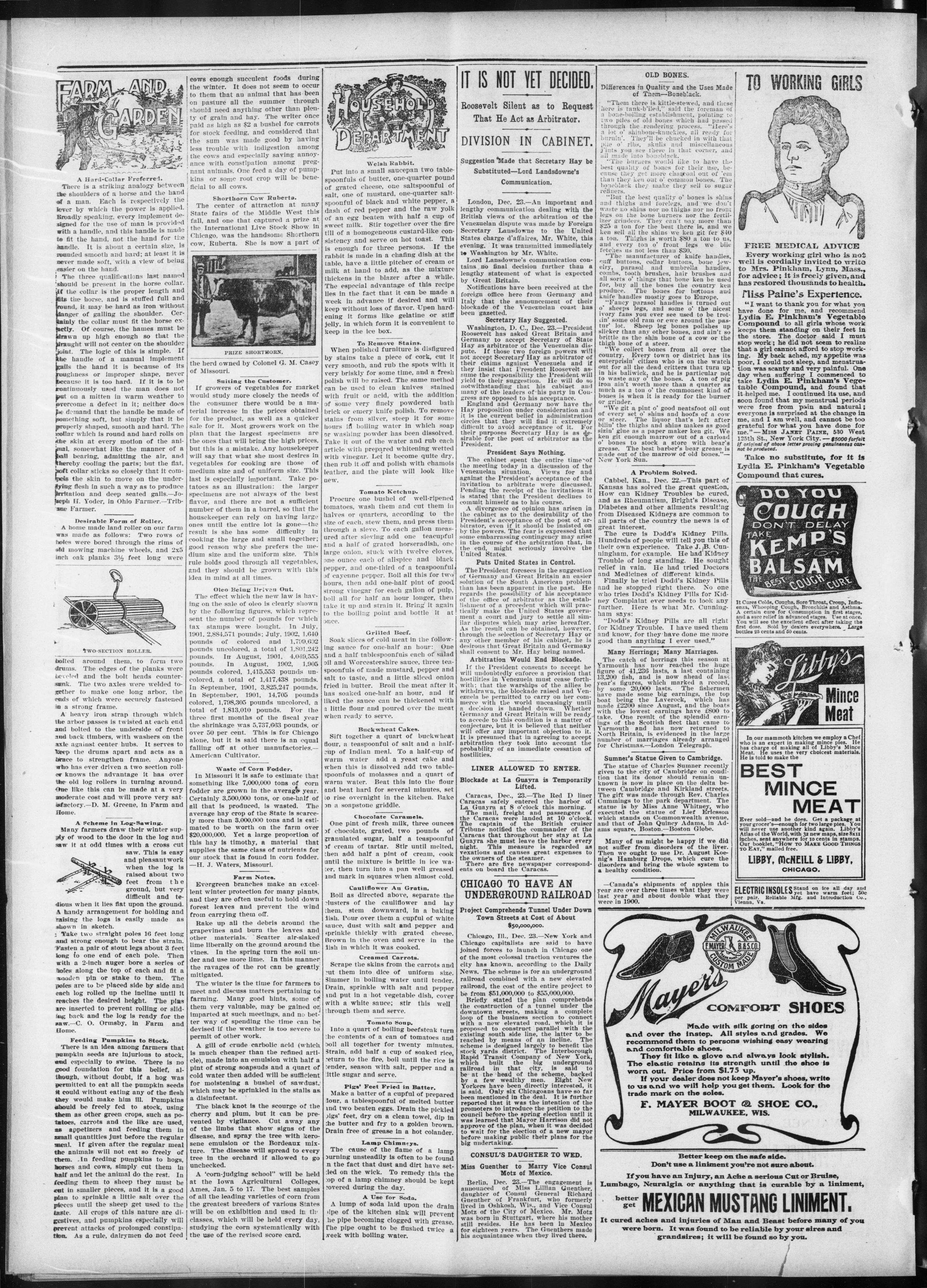
FARM AND GARDEN A Hard-Collar Preferred.
There is a striking analogy between the shoulders of a horse and the hand of a man. Each is respectively the lever by which the power is applied. Broadly speaking, every implement designed for the use of man is provided with a handle, and this handle is made to fit the hand, not the hand for the handle. It is about a certain size, is rounded smooth and hard; at least it is never made soft, with a view of being easier on the hand.
The three qualifications last named should be present in the horse collar. If the collar is the proper length and fits the horse, and is stuffed full and round, it may be hard as iron without danger of galling the shoulder. Certainly the collar must fit the horse exactly. Of course, the hames must be drawn up high enough so that the draught will not center on the shoulder joint. The logic of this is simple. If the handle of a manual implement galls the hand it is because of its roughness or improper shape, never because it is too hard. If it is to be continuously used the man does not put on a mitten in warm weather to overcome a defect in it; neither does the demand that the handle be made of something soft, but simply that it be properly shaped, smooth and hard. The collar which is round and hard rolls on the skin at every motion of the animal, somewhat like the manner of a ball bearing, admitting the air, and thereby cooling the parts; but the flat, soft collar sticks so closely that it compels the skin to move on the underlying flesh in such a way as to produce irritation and deep seated galls.—Joseph H. Yoder, in Ohio Farmer.—Tribune Farmer.
Desirable Form of Roller:
A home made land roller on our farm was made as follows: Two rows of holes were bored through the rims of old mowing machine wheels, and 2x5 inch oak planks 3½ feet long were
TWO-SECTION ROLLER.
bolted around them, to form two drums. The edges of the planks were beveled and the bolt heads counter-sunk. The two axles were welded together to make one long arbor, the ends of which were securely fastened in a strong frame.
A heavy iron strap through which the arbor passes is twisted at each end and bolted to the underside of front and back timbers, with washers on the axle against center hubs. It serves to keep the drums apart and acts as a brace to strengthen frame. Anyone who has ever driven a two section roller knows the advantage it has over the old log rollers in turning around. One like this can be made at a very moderate cost and will prove very satisfactory.—D. M. Greene, in Farm and Home.
A Scheme In Log-Sawing
Many farmers draw their winter supply of wood to the door in the log and saw it at odd times with a cross cut saw. This is easy and pleasant work when the log is raised about two feet from the ground, but very difficult and te-
and pleasant work when the log is raised about two feet from the ground, but very difficult and tedious when it lies flat upon the ground. A handy arrangement for holding and raising the logs is easily made as shown in sketch.
Take two straight poles 16 feet long and strong enough to bear the strain. Fasten a pair of stout legs about 3 feet long to one end of each pole. Then with a 2-inch auger bore a series of holes along the top of each and fit a wooden pin or stake to them. The poles are to be placed side by side and each log rolled up the incline until it reaches the desired height. The pins are inserted to prevent rolling or sliding back and the log is ready for the saw.—C. O. Ormsby, in Farm and Home.
Feeding Pumpkins to Stock.
Feeding Pumpkins to Stock. There is an idea among farmers that pumpkin seeds are injurious to stock, and especially to swine. There is no good foundation for this belief, although, without doubt, if a hog was permitted to eat all the pumpkin seeds it could without eating any of the flesh they would make him ill. Pumpkins should be freely fed to stock, using them as other green crops, such as potatoes, carrots and the like are used, as appetizers and feeding them in small quantities just before the regular meal. If given after the regular meal the animals will not eat so freely of them. In feeding pumpkins to hogs, horses and cows, simply cut them in half and let the animal do the rest. In feeding them to sheep they must be cut in smaller pieces, and it is a good plan to sprinkle a little salt over the pieces until the sheep get used to the taste. All crops of this nature are digestives, and pumpkins especially will prevent attacks of prolonged constipation. As a rule, dairymen do not feed
cows enough succulent foods during the winter. It does not seem to occur to them that an animal that has been on pasture all the summer through should need anything other than plenty of grain and hay. The writer once paid as high as $2 a bushel for carrots for stock feeding, and considered that the sum was made good by having less trouble with indigestion among the cows and especially saving annoyance with constipation among pregnant animals. One feed a day of pumpkins or some root crop will be beneficial to all cows.
Shorthorn Cow Ruberta.
The center of attraction at many State fairs of the Middle West this fall, and one that captured a prize at the International Live Stock Show in Chicago, was the handsome Shorthorn cow. Ruberta. She is now a part of
PRIZE SHORTHORN.
the herd owned by Colonel G. M. Casey of Missouri.
Suiting the Customer.
If growers of vegetables for market would study more closely the needs of the consumer there would be a material increase in the prices obtained for the product, as well as a quicker sale for it. Most growers work on the plan that the largest specimens are the ones that will bring the high prices, but this is a mistake. Any housekeeper will say that what she most desires in vegetables for cooking are those of medium size and of uniform size. This last is especially important. Take potatoes as an illustration: the larger specimens are not always of the best flavor, and there are not a sufficient number of them in a barrel, so that the housekeeper can rely on having large ones until the entire lot is gone—the result is she has some difficulty in cooking the large and small together; good reason why she prefers the medium size and the uniform size. This rule holds good through all vegetables, and they should be grown with this idea in mind at all times.
Oleo Being Driven Out.
The effect which the new law is having on the sale of oleo is clearly shown by the following figures, which represent the number of pounds for which tax stamps were bought. In July, 1901, 2,884,571 pounds; July, 1902, 1,640 pounds of colored and 1,799,602 pounds uncolored, a total of 1,801,242 pounds. In August, 1901, 4,049,555 pounds. In August, 1902, 1,905 pounds colored, 1,415,553 pounds uncolored, a total of 1,417,438 pounds. In September, 1901, 3,825,247 pounds. In September, 1901, 14,705 pounds colored, 1,798,305 pounds uncolored, a total of 1,813,010 pounds. For the three first months of the fiscal year the shrinkage was 5,737,663 pounds, or over 50 per cent. This is for Chicago alone, but it is said there is an equal falling off at other manufactories. American Cultivator.
Waste of Corn Fodder.
In Missouri it is safe to estimate that something like 7,000,000 tons of corn fodder are grown in the average year. Certainly 3,500,000 tons, or one-half of all that is produced, is wasted. The average hay crop of the State is scarcely more than 3,000,000 tons and is estimated to be worth on the farm over $20,000,000. Yet a large proportion of this hay is timothy, a material that supplies the same class of nutrients for our stock that is found in corn fodder. —H. J. Waters, Missouri.
Farm Notes.
Evergreen branches make an excellent winter protection for many plants, and they are often useful to hold down forest leaves and prevent the wind from carrying them off. Rake up all the debris around the grapevines and burn the leaves and other materials. Scatter air-slaked lime liberally on the ground around the vines. In the spring turn the soil under and use more lime. In this manner the ravages of the rot can be greatly mitigated.
The winter is the time for farmers to meet and discuss matters pertaining to farming. Many good hints, some of them very valuable, may be gained or imparted at such meetings, and no better way of spending the time can be devised if the weather is too severe to permit of other work.
A gill of crude carbolic acid (which is much cheaper than the refined article), made into an emulsion with half a pint of strong soapsuds and a quart of cold water then added will be sufficient for molstening a bushel of sawdust, which may be sprinkled in the stalls as a disinfectant.
The black knot is the scourge of the cherry and plum, but it can be prevented by vigilance. Cut away any of the limbs that show signs of the disease, and spray the tree with kerosene emulsion or the Bordeaux mixture. The disease will spread to every tree in the orchard if allowed to go unchecked.
A "corn-judging school" will be held at the Iowa Agricultural Colleges, Ames, Jan. 5 to 17. The best samples of all the leading varieties of corn from the greatest breeders of various States will be on exhibition and used in the classes, which will be held every day, studying the corn systematically with the use of the revised score card.
HOUSEHOLD DEPARTMENT Welsh Rabbit.
Put into a small saucepan two tablespoonfuls of butter, one-quarter pound of grated cheese, one saltspoonful of salt, one of mustard, one-quarter saltspoonful of black and white pepper, a dash of red pepper and the raw yolk of an egg beaten with half a cup of sweet milk. Stir together over the fire till of a homogeneous custard-like consistency and serve on hot toast. This is enough for three persons. If the rabbit is made in a chafing dish at the table, have a little pitcher of cream or milk at hand to add, as the mixture thickens in the blazer after a while. The especial advantage of this recipe lies in the fact that it can be made a week in advance if desired and will keep without loss of flavor. Upon hardening it forms like gelatine or stiff jelly, in which form it is convenient to keep in the ice box.
To Remove Stains.
When polished furniture is disfigured by stains take a piece of cork, cut it very smooth, and rub the spots with it very briskly for some time, and a fresh polish will be raised. The same method can be used to clean knives stained with fruit or acid, with the addition of some very finely powdered bath brick or emery knife polish. To remove stains from silver, steep it for some hours if boiling water in which soap or washing powder has been dissolved. Take it out of the water and rub each article with prepared whitening wetted with vinegar. Let it become quite dry, then rub it off and polish with chamois leather, and the plate will look like new.
Tomato Ketchup:
Procure one bushel of well-ripened tomatoes, wash them and cut them in halves or quarters, according to the size of each, stew them, and press them through a sieve. To each gallon measured after sieving add one teacupful and a half of grated horseradish, one large onion, stuck with twelve cloves, one ounce each of allspice and black pepper, and one-third of a teaspoonful of cayenne pepper. Boil all this for two hours, then add one-half pint of good strong vinegar for each gallon of pulp, boil all for half an hour longer, then take it up and strain it. Bring it again to the boiling point and bottle it at once.
Grilled Beef.
Soak slices of cold meat in the following sauce for one-half an hour: One and a half tablespoonfuis each of salad oil and Worcestershire sauce, three teaspoonfuls of made mustard, pepper and salt to taste, and a little sliced onion fried in butter. Broil the meat after it has soaked one-half an hour, and if liked the sauce can be thickened with a little flour and poured over the meat when ready to serve.
Buckwheat Cakes.
Sift together a quart of buckwheat flour, a teaspoonful of salt and a half-cup of Indian meal. To a half-cup of warm water add a yeast cake and when this is dissolved add two tablespoonfuls of molasses and a quart of warm water. Beat this into the flour and beat hard for several minutes, set to rise overnight in the kitchen. Bake on a soapstone griddle.
Chocolate Caramels.
One pint of fresh milk, three ounces of chocolate, grated, two pounds of granulated sugar, half a teaspoonful of cream of tartar. Stir until melted, then add half a pint of cream, cook until the mixture is brittle in ice water, then turn into a pan well greased and mark in squares when almost cold.
Cauliflower Au Gratin.
Boil as directed above, separate the clusters of the cauliflower and lay them, stem downward, in a baking dish. Pour over them a cupful of white sauce, dust with salt and pepper and sprinkle thickly with grated cheese. Brown in the oven and serve in the fish in which it was cooked.
Creamed Carrots.
Scrape the skins from the carrots and put them into dice of uniform size. Simmer in boiling water until tender. Drain, sprinkle with salt and pepper and put in a hot vegetable dish, cover with a white sauce; stir this well through them and serve.
Tomato Soup.
Into a quart of boiling beefsteak turn the contents of a can of tomatoes and boil all together for twenty minutes. Strain, add half a cup of soaked rice, return to the fire, boil until the rice is tender, season with salt, pepper and a little sugar and serve.
Pigs' Feet Fried in Batter.
Make a batter of a cupful of prepared flour, a tablespoonful of melted butter and two beaten eggs. Drain the pickled pigs' feet, dry on a clean towel, dip in the butter and fry to a golden brown. Drain free of grease in a hot colander.
Lamp Chimneys
The cause of the flame of a lamp burning unsteadily is often to be found in the fact that dust and dirt have settled on the wick. To remedy this the top of a lamp chimney should be kept covered during the day.
A Use for Soda.
A lump of soda laid upon the drain pipe of the kitchen sink will prevent the pipe becoming clogged with grease. The pipe ought to be flushed twice a week with boiling water.
IT IS NOT YET DECIDED.
London, Dec. 23.—An important and lengthy communication dealing with the British views of the arbitration of the Venezuelan dispute was made by Foreign Secretary Lansdowne to the United States charge d'affaires, Mr. White, this evening. It was transmitted immediately to Washington by Mr. White. Lord Lansdowne's communication contains no final decision further than a lengthy statement of what is expected by Great Britain. Notifications have been received at the foreign office here from Germany and Italy that the announcement of their blockade of the Venezuelan coast has been gazetted.
Secretary Hay Suggested.
Washington, D. C., Dec. 23.—President Roosevelt has asked Great Britain and Germany to accept Secretary of State Hay as arbitrator of the Venezuelan dispute. If those two foreign powers will not accept Secretary Hay as arbitrator of their claims against Venezuela and if they insist that President Roosevelt assume the responsibility the President will yield to their suggestion. He will do so notwithstanding that his cabinet and many of the leaders of his party in Congress are opposed to his acceptance. England and Germany now have the Hay proposition under consideration and it is the current belief in administration circles that they will find it extremely difficult to avoid acceptance of it. For their purposes Secretary Hay is as desirable for the post of arbitrator as the President.
President Says Nothing
The cabinet spent the entire time of the meeting today in a discussion of the Venezuelan situation. Views for and against the President's acceptance of the invitation to arbitrate were discussed. Pending the receipt of the invitations it is stated that the President declines to commit himself as to his course. A divergence of opinion has arisen in the cabinet as to the desirability of the President's acceptance of the post of arbitrator, even if it should be insisted on by the powers. The fear is expressed that some embarrassing contingency may arise in the course of the arbitration that, in the end, might seriously involve the United States.
Puts United States in Control.
The President foresees in the suggestion of Germany and Great Britain an easier solution of the South American problem than has been apparent in the past. He regards the possibility of his acceptance of the office of arbitrator as the establishment of a precedent which will practically make the United States government a court and jury to settle all similar disputes which may arise hereafter. As the result can be obtained, however, through the selection of Secretary Hay or any other member of his cabinet, he is desirous that Great Britain and Germany shall consent to Mr. Hay being named.
Arbitration Would End Blockade.
If the President consents to accept he will undoubtedly enforce a provision that hostilities in Venezuela must cease forthwith; that the warships of the allies be withdrawn, the blockade raised and Venezuela be permitted to carry on her commerce with the world unceasingly until a decision is handed down. Whether Germany and Great Britain will be ready to accede to this condition is a matter of conjecture, but it is believed that neither will offer any important objection to it. It is presumed that in agreeing to accept arbitration they took into account the probability of an immediate cessation of hostilities.
LINER ALLOWED TO ENTER.
Blockade at La Guavya is Temporarily Lifted.
Caracas, Dec., 23.—The Red D liner Caracas safely entered the harbor of La Guayra at 8 o'clock this morning.
The mail, freight and passengers of the Caracas were landed at 10 o'clock. The captain of the British cruiser Tribune notified the commander of the Caracas that throughout her stay at La Guayra she must leave the harbor every night. This measure is regarded as vexatious and causes great expenses to the owners of the steamer. There are five newspaper correspondents on board the Caracas.
CHICAGO TO HAVE AN UNDERGROUND RAILROAD
Project Comprehends Tunnel Under Down Town Streets at Cost of About
$50,000,000.
Chicago, Ill., Dec. 23.—New York and Chicago capitalists are said to have joined forces to launch in Chicago one of the most colossal traction ventures the city has known, according to the Daily News. The scheme is for an underground railroad combined with a new elevated railroad, the cost of the entire project to be from $51,000,000 to $55,000,000.
Briefly stated the plan comprehends the construction of a tunnel under the downtown streets, making a complete loop of the business section to connect with a new elevated road, which it is proposed to construct parallel with the existing south side line, the latter to be reached by means of an incline. The scheme is designed largely to benefit the stock yards district. The Interborough Rapid Transit Company of New York, which built the big underground railroad in that city, is said to be at the head of the scheme, backed by a few wealthy men. Eight New Yorkers have been directly interested, it is said. Only six Chicagoans have so far been mentioned in the deal. It is further reported that it was the intention of the promoters to introduce the petition to the council before the spring election until it was learned that Mayor Harrison did not approve of the plan, when it was decided to wait for the election of a new mayor before making public their plans for the big undertaking.
CONSUL'S DAUGHTER TO WED.
Miss Guenther to Marry Vice Consul
Motz of Mexico
Berlin, Dec. 23.—The engagement is announced of Miss Lillian Guenther, daughter of Consul General Richard Guenther of Frankfurt, who formerly lived in Oshkosh, Wis., and Vice Consul Motz of the City of Mexico. Mr. Motz was born in Stuttgart, where his mother still resides. He has been in Mexico for eighteen years. The Guenthers made his acquaintance when they lived there.
Mayer's
COMFORT SHOES
Made with silk goring on the sides and over the instep. All styles and grades. We recommend them to persons wishing easy wearing and comfortable shoes.
They fit like a glove and always look stylish. The elastic retains its strength until the shoe is worn out. Price from $1.75 up.
If your dealer does not keep Mayer's shoes, write to us and we will help you get them. Look for the trade mark on the soles.
F. MAYER BOOT & SHOE CO.,
MILWAUKEE, WIS.
Better keep on the safe side.
Don't use a liniment you're not sure about.
If you have an Injury, an Ache a serious Cut or Bruise, Lumbago, Neuralgia or anything that is curable by a liniment,
better get MEXICAN MUSTANG LINIMENT.
It cured aches and injuries of Man and Beast before many of you were born. It was found to be reliable by your sires and grandsires; it will be found so by you.
OLD BONES.
Differences in Quality and the Uses Made of Them-Bonehack.
"The them there is kittle-stewed, and these here is tank-billed," said the foreman of a bone-boiling establishment, pointing to two piles of old bones which had passed through the rendering process. "Here's a lot o' shinbone-knuckles, all ready for burnin'. They'll be chucked in with that pile o' ribs, skulls and miscellaneous joints you see there in that corner, and all made into boneblack.
"The burners would like to have the best quality of bones for their use, because they get more charcoal out of 'em than they ken out o' common bones. The boneblack they make they sell to sugar refiners.
"But the best quality o' bones is shins and thighs and forelegs, and we don't waste no shins nor no thighs nor no front legs on the bone burners nor the fertilizer grinders. They can't pay more than $25 a ton for the best there is, and we ken sell all the shins we ken git fer $40 a ton. Thighs is worth $80 a ton to us, and every ton o' front legs we bile fetches us not less than $30.
"The manufacturer of knife handles, cuff buttons, collar buttons, bone jewelry, parasol and umbrella handles, combs, tooth brushes, hair brushes and all sorts o' things that bone ken be used for, buy all the bones the country ken produce. The bones for buttons and knife handles mostly goes to Europe.
"Fancy parasol handles is turned out o' sheeps legs, and some o' the nicest ivory fans you ever see used to be trotin' some old ram or ewe around the pastur' lot. Sheep leg bones polishes up slicker than any other bones, and ain't so brittle as the shin bone of a cow or the thigh bone of a steer.
"We collect bones from all over the country. Every town or district has its enterprisin' citizen who is on the watch out for all the dead critters that turn up in his baliwick, and he is particular not to waste any o' the bones. A ton of pig iron ain't worth more than a quarter as much as a ton o' the commonest kind of bones is when it is ready for the burner or grinder.
"We git a pint o' good neatsfoot oil out of every set o' shins and hoofs of a cow or steer. The liquor that's left after bilin' the thighs and shins makes as good sizin' glue as a paper maker ken git. We ken git enough marrow out of a carload o' bones to stock a store with bear's grease. The best barber's bear grease is made out of the marrow of old bones."—New York Sun.
A Problem Solved.
Cabbel, Kan., Dec. 22.—This part of Kansas has solved the great question, How can Kidney Troubles be cured, and as Rheumatism, Bright's Disease, Diabetes and other ailments resulting from Diseased Kidneys are common to all parts of the country the news is of great interest. The cure is Dodd's Kidney Pills. Hundreds of people will tell you this of their own experience. Take J. B. Cunningham, for example. He had Kidney Trouble of long standing. He sought relief in vain. He had tried Doctors and Medicines of different kinds.
Finally he tried Dodd's Kidney Pills and he stopped right there. No one who tries Dodd's Kidney Pills for Kidney Complaint ever needs to look any further. Here is what Mr. Cunningham says: "Dodd's Kidney Pills are all right for Kidney Trouble. I have used them and know, for they have done me more good than anything I ever used."
Many Herrings; Many Marriages.
The catch of herrings this season at Yarmouth has now reached the huge figure of 41,236 lasts, a last containing 13,200 fish, and is now ahead of last year's figures, which marked a record, by some 20,000 lasts. The fishermen have made some big earnings, the top boat being the Laverock, which has made £2200 since August, and the boats with the lowest earnings have £800 to take. One result of the splendid earnings of the Scottish fleet that came to Yarmouth and has now returned to North Britain, is evidenced in the large number of marriages already arranged for Christmas.—London Telegraph.
Sumner's Statue Given to Cambridge
The statue of Charles Sumner recently given to the city of Cambridge on condition that its donor should remain unknown is now in place on the delta between Cambridge and Kirkland streets. The gift was made through Rev. Charles Cummings to the park department. The statue is by Miss Anne Whitney, who executed the statue of Lief Ericsson which stands on Commonwealth avenue, and that of John Quincy Adams, in Adams square, Boston.—Boston Globe.
Many of us might be happy if we did not suffer from disorders of the liver. Then we ought to use Dr. August Koenig's Hamburg Drops, which cure the disorders and bring the whole system to a healthy condition.
Canada's shipments of apples this year are over three times what they were last year and about double what they were in 1900.
TO WORKING GIRLS
A.
FREE MEDICAL ADVICE Every working girl who is not well is cordially invited to write to Mrs. Pinkham, Lynn, Mass., for advice; it is freely given, and has restored thousands to health.
Miss Paine's Experience.
"I want to thank you for what you have done for me, and recommend Lydia E. Pinkham's Vegetable Compound to all girls whose work keeps them standing on their feet in the store. The doctor said I must stop work; he did not seem to realize that a girl cannot afford to stop working. My back ached, my appetite was poor, I could not sleep, and menstruation was scanty and very painful. One day when suffering I commenced to take Lydia E. Pinkham's Vegetable Compound, and found that it helped me. I continued its use, and soon found that my menstrual periods were free from pain and natural; everyone is surprised at the change in me, and I am well, and cannot be too grateful for what you have done for me." —MISS JANET PAINE, 530 West 125th St., New York City. —$5000 forsit if original of above letter proving genuineness cannot be produced.
Take no substitute, for it is Lydia E. Pinkham's Vegetable Compound that cures.
DO YOU
COUGH
DON'T DELAY
TAKE
KEMP'S
BALSAM
THE BEST COUGH CURE
It Cures Colds, Coughs, Sore Throat, Croup, Influenza, Whooping Cough, Bronchitis and Asthma. A certain cure for Consumption in first stages, and a sure relief in advanced stages. Use at once. You will see the excellent effect after taking the first dose. Sold by dealers everywhere. Large bottles 25 cents and 50 cents.
Litty's
Mince
Meat
In our mammoth kitchen we employ a Chef who is an expert in making mince pies. He has charge of making all of Libby's Mince Meat. He uses the very choicest materials. He is told to make the
BEST MINCE MEAT
Ever sold—and he does. Get a package at your grocer's—enough for two large pies. You will never use another kind again. Libby's Atlas of the World, with 32 new maps, size 8x11 inches, sent anywhere for 10 cents in stamps. Our booklet, "How to Make Good Things to Eat," mailed free.
LIBBY, McNEILL & LIBBY CHICAGO.
ELECTRIC INSOLES Stand on ice all day and yet have warm feet; 500 per pair. Reliable Mfg. and Introduction Co., Vienna, Va.
GERM-PROOF BARBER SHOPS.
Boiling the Tonsorialist the Acme of Sanitary Precautions.
"This towel," said the attendant in the germ-proof barber shop, "has been subjected to an extreme heat and is thoroughly sterilized. We take every precaution against exposing our patrons to infection or contagion."
"Good thing," commended the patron. "This soap, went on the attendant, picking up the cake thereof, "has been debacterialized, and the comb and brush are thoroughly antisepticized." "Great scheme," said the patron. "The chair in which you sit is given a daily bath in bichloride of mercury, while its cushions are baked in an oven heated to 987 degrees, which is guaranteed to shrivel up any bacillus that happens along."
"Hot stuff" said the patron.
"Hot stuff," said the patron.
"The razor and lather brush are boiled before being used, and the lather cup is dry-heated until there is not the slightest possibility of any germs being concealed in it."
"Fine," said the patron.
"The hot water with which the lather is mixed is always double-heated and sprayed with a germicide, besides being filtered and distilled. It is as pure as it can be made."
"Excellent." said the patron.
"Even the floor and the ceiling and the walls and the furniture are given antiseptic treatment every day, and all change handed out to our customers is first wiped with antiseptic gauze."
"Well, look here," said the patron, who had been sitting wrapped in the towel during all this, "why don't you go ahead and shave me? Think I'm loaded with some kind of germ that you have to talk to death?"
"No, sir." answered the attendant.
"But I am not the barber."
"You're not? Where is he?"
"They are boiling him, sir."—New York News.
GIVES UP HIS PENSION
Kansas Soldier, a Christian Scientist, Thinks it Wrong to Take It.
Recently a Kansas old soldier sent the following letter to the pension department:
Topeka, Kan., Oct 3, 1902.—To the Hon. Pensloner Commissioner: Having become converted to the belief commonly known as Christian Science, I herewith voluntarily surrender all claim to the pension which I have been drawing for the past twelve years. My pension was allowed on account of alleged rheumatism and alleged stomach trouble contracted during my service in the Civil war, and the mortal error which made me think I had them also made the doctors who examined me think the same. But I am now convinced that there is no such thing as rheumatism or stomach trouble; that by the blessings of God I am free of error, and that I have no right to take money from the government on account of a cause which does not exist.
The official who sent the above letter to the Journal withheld the name of the old soldier who wrote it. In comment, however, he said: "If this Christian Science idea should spread to any great extent among the old boys it would solve the pension problem. It is the first instance of the kind, though, and I am not looking for any great rush of similar epistles."—Kansas City (Mo.) Journal.
---
There are plenty of people who have become depressed and discouraged, because that dry, hacking cough hangs to them continually. They have taken much medicine, mostly of the advertised quack sort, nothing like Dr. August Koenig's Hamburg Breast Tea, the discovery of a then noted German physician 60 years ago. We do not say that this will cure a case where the lungs are badly diseased, for it will not, and up to this date there is nothing that will cure under these conditions; but on the other hand, if the lungs are not hard hit, the patient should take Dr. August Koenig's Hamburg Breast Tea, a cup full every night on going to bed, have it hot, drink slowly, then every other night, rub the throat and top portion of the lungs with St. Jacobs Oil, cover with oil silk, let it remain an hour, then remove. Eat good, plain, nourishing food, live in the open air as much as possible. By all means sleep as near out of doors as possible, that is, windows wide open, except in very severe weather. Take a cold sponge bath every morning; then immediately rub the body vigorously with a coarse towel. Take Dr. August Koenig's Hamburg Drops every other day according to directions. One can buy the three remedies for $1.25 of any reliable drug-gist. Begin the treatment at once, and see how much better you will be almost within a week's time.
The Sturgeon
The development of the sturgeon as a great article of commerce is one of the most interesting stories connected with the fish industry. Fifteen years ago sturgeon sold for 25 cents apiece. One female sturgeon sold for $28 the other day. The value placed on the sturgeon for its eggs is familiar to all, but the flesh now, too, sells up with that of other staple fish. It brings 10 cents a pound fresh, while the smoked article sells at a much higher price. Smoked sturgeon is now on the market, and almost all of that caught is prepared in that way. The eggs of the sturgeon bring 50 cents a pound to the fisherman. They are made into caviar. The bladder sells for $1 a pound, and is used for isinglass.
Canada Cheese and Butter.
The exports of cheese and butter from Canada this year promises to make a record. When the season closes the value of the products shipped to Scotland and England and abroad will total $30,000,000. Ten years ago the total was only $10,000,000.
COUCH.
Special couch bargains are being offered for the Xmas trade by the well-known firm of F. W. Schenck & Co. of Milwaukee, whose ad. appears elsewhere in this paper.
—Thick blotting paper, which Canada formerly got from England, she now gets from this country.
FITS Permanently Cured. No fits on nervousness after first day's use of Dr. Kline's Great Nerve Restorer. Send for FREE $2.00 trial bottle and treatise. DR. R. H. KLINE, Ltd., 931 Arch St., Philadelphia, Pa.
—By the sale of stray dogs the Northumberland (England) county council made £4 10s 6d last year
MRS. WINSLOW'S SOOTHING SYRUP for Children teething; softens the gums, reduces inflammation, allays pain, cures wind colic. 25 cents a bottle.
Germany, England, France and Italy supply Canada with rubber balls.
Ostend is to hold an international exhibition of fashions in 1904.
M. Yushin, the Russian tenor, has insured his voice for $2500.
Ely's Cream Balm
WILL CURE
CATARRH
Druggists, 50 Cts.
Apply Balm into each nostril.
ELY BROS. 56 Wayne St. N.Y.
Druggists, 50 Cts.
Apply Balm into each nostril.
ELY BROS., 56 Warren St., N.Y.
DAIRY FARM 337 acres, Wood Co., Wis., 11 miles from station, good buildings, good soil, all machinery, tools, everything goes except household goods. Write to J. H. MYERS, G 14, Mack Block, Milwaukee, Wis.
ANOTHER ROYAL SCANDAL
Louise, Crown Princess of Saxony, Calls Husband a Beast.
CAUSE OF DESERTION.
Charges Intemperance, Cruelty and Infidelity—Hypocrisies of the Saxon Court.
Dresden, Saxony, Dec. 23.—King George and Crown Prince Frederick know where the Crown Princess Louise has sought refuge, but they have decided to accept the estrangement of the princess and her husband as irreparable. They have made the cabinet privy to the circumstances and a decree of divorce is talked of as a necessary sequence to the princess' resolution to leave the court forever.
This determination the princess announced to her husband early in November after one of their frequent violent scenes. She also confided to intimate friends her intention to separate herself utterly from the court and "all its wretchedness," and discussed with them the impossibility of her longer enduring the artificial etiquette of the court and the "forced companionship of a man who was loathsome to her."
Calls Husband a Beast.
The princess wrote to her mother at the end of November that it was her purpose to leave the crown prince. The queenship instead of being attractive, the princess frequently said, was detestable to her. She formally told members of her entourage that she was going to visit her parents at Salzburg. The letter of the princess to her mother brought the archduchess immediately to Dresden. She implored her daughter to reconsider her determination and make the best of an unpleasant situation for the sake of her children and see as little of the crown prince as permissible. The princess replied, according to her confidants, that she would see nothing of "that beast," that the tutelage of her children was largely taken out of her hands and that she could not bear to see them spoiled by the "hypocrisies of the court." What she complained of in the prince was his intemperance, his infidelities and, as her partisans affirm, his cruelty of disposition. They affirm that he has had for years a liaison with an actress named Baste, and it is credibly reported that at a review of troops at Grimma, a couple of years ago, the prince fell from his horse, intoxicated, in front of his regiment. The court and all Dresden know that a chasm separated the affections of the crown princess from the crown prince. Though he seemingly had genuine admiration for his wife, the prince did his share of quarreling and often tried to impose his will upon her, but always hoped that she would in the end humble herself.
His attitude recently, until she had actually gone, appears to have been that of disdainful indifference and diebelief that she really inteded to carry out her threat.
Becomes Intractable.
The crown princess' days at Salzburg were spent in controversy with her father and mother, who did not excuse her for a moment in her mad desire to leave her position and family. Her brother, Archduke Leopold Ferdinand, took his sister's part. The circumstances of the princess' flight are still obscure and no further reliable news is available. The only fact that seems clear is that the King and crown prince know where she is and are in communication with her, but it is learned that she is absolutely intractable. Dresden is absorbed by the sensation. The theory that the crown princess is suffering from mental aberration is now only feebly propagated by the Saxon court. The crown prince's adherents intimate that an illicit love affair is the cause of the princess' desertion.
The Dresdenener Nachrichten, one of the principal newspapers and having conservative leanings, after saying it could almost be sorry for the princess, with a disposition incompatible with that of the prince and disliking the etiquette of the court, suggests that "to find the reason for her departure one must find the man." The man in this case who is associated by gossip with the princess is a handsome Frenchman, who was tutor to the princess' children. He was peremptorily discharged by order of the crown prince December 2.
With an American Dentist
An instance of the princess' lawless disregard of court manners was her cycling through the streets of Dresden with an American dentist who at her request taught her to ride a wheel, though the King and crown prince commanded her not to learn. The name of this dentist was at first coupled with that of the princess when it was heard that she had disappeared, but as he is quietly living here with his family, the story was dropped.
The crown princess had a lively Viennese manner. She was independent and high spirited, and was inclined to ridicule the observances of the little Saxon court, which takes itself most seriously.
The crown prince, who has recovered from the injury that he recently sustained while hunting, drove out today with two of his sons.
Secret Correspondence Discovered.
Vienna, Dec. 23.—The flight of the Crown Princess of Saxony is the absorbing topic of the day here. All kinds of sensational reports are in circulation. When she left Salzburg, accompanied by her brother, Archduke Leopold Ferdinand, the princess went to Munich, where a French tutor awaited her. Her brother was also joined there by a beautiful Viennese woman, and the two couples proceeded to Brussels and thence to Geneva.
It appears that when the crown prince returned recently to Dresden after his hunting accident in the Tyrol he discovered secret correspondence existed between the princess and the French tutor, whose former relations with her had created a scandal resulting in the tutor's expulsion from Saxony. Besides disclosing the couple's relations the letters revealed another scandal. Immediately afterwards the princess left her home and went to Salzburg. The fact that she took a trunk filled with jewelry and other valuables indicates that she was prepared for an emergency.
It is reported that Archduke Leopold Ferdinand has written to Emperor Joseph renouncing his rank and dignities as a member of the imperial house and saying he will become a civil subject. The archduke's career is redolent with scandal, dating from the time when he started to accompany the heir to the throne on a tour of the world. He only got so far as Colombo, where he was obliged to leave the ship on account of his scandalous behavior. The archduke has since been mixed up in a number of affairs and was confined for some months in an asylum.
Drops Royal Title.
Geneva, Switzerland, Dec. 23.—The crown princess of Saxony is here under the title of Fraulein von Oben. Her brother, Archduke Leopold Ferdinand, and Prof. Giron are at the same hotel. The archduke has assumed the name of
De Buriano. The party are living quietly and propose to spend Christmas here.
Meets Frenchman at Geneva.
Berlin, Dec. 23.—A dispatch from Dresden this evening to the Lokal Anzeiger confirms previous advices from Geneva to the effect that the crown princess of Saxony is in Geneva with Prof. Giron, a French teacher of languages, whom she met during her last trip to Paris. He is described as 24 years of age and "a striking personality, with large, bright eyes." All the theaters in Dresden are closed tonight. The court of the fugitive princess has been dissolved.
When Quarrel Originated.
Berlin, Dec. 23.—The Tageblatt's Dresden correspondent says: "The difficulty between the princely couple dates from prior to King Albert's death. They had several painful scenes during the King's illness.
It is reported here that the crown prince's recent accident, ostensibly the breaking of one of his legs while hunting in the Bavarian mountains near Salzburg, was an invention, the fact being that he had a fight with his brother-in-law, Archduke Leopold Ferdinand, and the crown prince was so badly handled that he had to take to his bed.
"The Saxon ministers say the affair is definitely closed so far as the Dresden court is concerned. The letters of the crown princess have been seized. She is expected to give birth to a child in May."
Prince Friedrich August, crown prince of Saxony, married November 21, 1891, the Princess Luise of Tuscany. They have five children.
CANTERBURY DEAD.
London, Dec. 23.—Most Rev. Frederick Temple, Archbishop of Canterbury and primate of all England, who had been ill for some time past, is dead. The Archbishop of Canterbury passed quite peacefully at 8:15 o'clock in the presence of his wife and two sons. His death had been anticipated for some days and only the archbishop's remarkable vitality enabled him to counteract his extreme weakness. The final collapse occurred about 6 o'clock and he
PETER HENRY
was unconscious towards the end. The primate died of old age. The pathetic scene in Westminster Abbey at the coronation of King Edward was one of the earlier indications of his failing strength. Then came the collapse in the House of Lords at the conclusion of a vigorous speech in support of the education bill. He had not left his bed since. He will be buried at Canterbury. The bishop of Winchester is considered likely to be his successor.
The late Frederick Temple, D. D., whose death occurred in London this morning, was the ninety-fifth archbishop of Canterbury. He was born November 21, 1821, and was graduated from Balliol College, Oxford. For eleven years he was head master at Rugby, during which time his writings caused him to be assailed as a heretic. He was the target for unlimited theological rancor. When in 1869 he was nominated to the see of Exeter eight bishops opposed confirmation and indignation meetings were held all over the United Kingdom. Opposition finally subsided and in 1886 Dr. Temple was transferred from Exeter to London, and in 1896 Lord Salisbury made him Archbishop of Canterbury with but little opposition. He is described as a ripe scholar, a deep thinker, eminently fair-minded toward all factions in the church, an untiring worker and active in temperance movements.
ROBBER BANDS ACTIVE.
Agitator Declares Himself Pope of the Filipino National Church.
San Francisco, Cal., Dec. 23.—It is stated by officers arriving on the transport Thomas that the provinces of Cavite, Batangas and Tayabas in the Philippines are to be placed under military control because of the difficulties of the civil government with the Ladrones. In speaking of the situation, D. J. O'Connell, a Manila newspaper man said:
"The proposed change is due to the increase of robber bands which infest those provinces. Agliay a Filipino agitator, has declared himself Pope of the Filipino National Church. He is the head of a movement for the reorganization of the insurrection element. At present the Ladrones keep the constabulary in a state of constant fear. They come within a few miles of Manila and fire upon the mounted patrols. The military authorities do not interfere because the situation is in the hands of the civil government.
San Francisco, Cal., Dec. 23.—The transport Thomas brings news of a new cholera outbreak in Manila. When the Thomas left there thirty cases of cholera were being reported daily. Army surgeons arriving on the Thomas say that the disease is raging unchecked in the southern provinces. In Iloilo, the death rate is very heavy and the authorities seem powerless to check the epidemic.
GIRL MARRIES OCTOGENARIAN.
Violet Twining Quietly Weds the Marquis of Donegal
London, Dec. 23.—The octogenarian Marquis of Donegal was quietly married here today to Miss Violet Twining, a Canadian about 30 years of age. The Canadian high commissioner, Lord Strathcona and Mount Royal, gave away the bride.
Appointed Police Commissioner
New York, Dec. 23.—Gen. Francis Vinton Greene was today appointed police commissioner in succession to Col. Partridge, whose resignation takes effect on January 1.
THE SON OF EX- U.S. MINISTERTOENGLAND STEDMAN'S MENTHOL INHALERS
Hon. Lewis E. Johnson
Hon. Louis E. Johnson is the son of the late Reverdy Johnson, who was United States Senator from Maryland, also Attorney General under President Johnson, and United States Minister to England, and who was regarded as the greatest constitutional lawyer that ever lived.
In a recent letter from 1006 F street, N. W., Mr. Johnson says:
"No one should longer suffer from catarrh when Peruna is accessible. To my knowledge it has caused relief to so many of my friends and acquaintances, that it is humanity to commend its use to all persons suffering with this distressing disorder of the human system."--Louis E. Johnson.
FACTORY LOADED SHOTGUN SHELLS "New Rival" "Leader" "Repeater"
If you are looking for reliable shotgun ammunition, the kind that shoots where you point your gun, buy Winchester Factory Loaded Shotgun Shells: "New Rival," loaded with Black powder; "Leader" and "Repeater," loaded with Smokeless. Insist upon having Winchester Factory Loaded Shells, and accept no others.
ALL DEALERS KEEP THEM
$4.85 — That $4.85 means the price. FREIGHT-PAID to your address of one of the prettiest and cheapest couches ever put on this market. The cut shows you just what it is like, but it cannot show you how splendidly strong and well-made it is. Frankly, it is the biggest dollars' worth for every dollar that has ever been offered you, velours covered and guaranteed tempered steel springs, which make it the soundest couch that can be had, and its everlasting wear.
Send for our new COUCH CATALOGUE. It will give you a lot of interesting information, and
Cascarets
CANDY CATHARTIC
THEY WORK WHILE YOU SLEEP
ANNUAL SALE
10,000,000
BOXES
Greatest in the World
A MILLION GOOD FELLOWS have learned that "a CASCARET at night makes you feel all right—in the morning!" They have told other good fellows, until the sale of CASCARETS Candy Cathartic is nearly A MILLION BOXES A MONTH. Nature punishes every excess, and over-eating, over-drinking, under-sleeping result in stomach, liver, kidney and bowel troubles that are liable to become very serious. It is very unwise to wait until digestion is stopped, the bowels constipated, the tongue coated, the breath offensive, and the nerves tortured with a racking sick headache. Take a CASCARET just before going to bed, and wake up in the morning feeling fine and dandy. All druggists, 10c, 25c, 50c. Never sold in bulk. The genuine tablet stamped CCC. Sample and booklet free. Address Sterling Remedy Co., Chicago or New York.
Catarrh is capable of changing all the life-giving secretions of the body into scalding fluids, which destroy and inflame every part they come in contact with. Applications to the places affected by catarrh can do little good save to soothe or quiet disagreeable symptoms. Hence it is that gargles, sprays, atomizers and inhalants only serve as temporary relief. So long as the irritating secretions of catarrh continue to be formed so long will the membranes continue to be inflamed, no matter what treatment is used. There is but one remedy that has the desirable effect, and that remedy is
Peruna. This remedy strikes at once to the roots of catarrh by restoring to the capillary vessels their healthy elasticity. Peruna is not a temporary palliative, but a radical cure.
Send for Dr. Hartman's latest book, sent free for a short time. Address The Peruna Drug Manufacturing Co., Columbus, Ohio.
If you do not derive prompt and satisfactory results from the use of Peruna, write at once to Dr. Hartman, giving a full statement of your case, and he will be pleased to give you his valuable advice gratis.
Address Dr. Hartman, President of The Hartman Sanitarium, Columbus, O
1. Hold the nose with your fingers.
```markdown
```
The Medicated Air Treatment
BREATHE IT IN
will cure Coughs, Colds,
Catarrh, Headache, Asthma,
Bronchitis, and all
nasal and throat diseases.
Prevents La Grippe and
Pneumonia.
Sold by all druggists or sent
by mail on receipt of price.
Send address on postal card for
further information
STEDMAN & CO.
Milwaukee, Wis.
Capsicum Vaseline
Put Up in Collapsible Tubes.
A Substitute for and Superior to Mustard or any other plaster, and will not blister the most delicate skin. The pain allaying and curative qualities of this article are wonderful. It will stop the toothache at once, and relieve headache and sciatica.
We recommend it as the best and safest external counter-irritant known, also as an external remedy for pains in the chest and stomach and all rheumatic, neuralgic and gouty complaints.
A trial will prove what we claim for it, and will be found to be invaluable in the household. Many people say "It is the best of all your preparations." Price 15 cents, at all druggists, or other dealers or by sending this amount to us in postage stamps, we will send you a tube by mail. No article should be accepted by the public unless the same carries our label, as otherwise it is not genuine. CHESEBROUGH MANUFACTURING CO. 17 State St., New York City.
PAXTINE TOILET ANTISEPTIC we will mail large trial treatment with book of instructions absolutely free. This is not a tiny sample, but a large package, enough to convince anyone that it is the most successful preparation known to medicine as a cleansing vaginal douche and for the local treatment of woman's special ills, curing discharges and all inflammation, also to cleanse the teeth, mouth, and cure cataract. Send to-day; a postal will do. Sold by drugglats or sent postpaid by us, 50 cents large box. Satisfaction guaranteed. R. PAXTON CO., 216 Columbus Ave. Boston, Mass.
WESTERN CANADA has FREE HOMES for millions. Upwards of 100,000 Americans have settled in Western Canada during the past 6 years. THE FEDERAL PUPPY AND PROSPEROUS, and there is room still for MILLIONS. Wonderful and other grains. The best Grazingiment. Magnificent climate, plenties. Good schools, excellent churches, good facilities. All in the
FARM'S WESTERN CANADA FREE
WESTERN CANADA has FREE HOMES for millions. Upwards of KO.000 Americans have settled in Western Canada during the past 5 years. They are CONTENTED, HAPPY AND PROSPEROUS, and there is room still for MILLIONS. Wonderful yields of Wheat and other grains. The best Grazing Lands on the Continent. Magnificent climate, plenty of water and fuel. Good schools, excellent churches, and splendid railway facilities. All in the FREE HOMESTEAD LANDS OF MANITOBA, ASSINIBOIA, SASKATCHEWAN AND ALBERTA.
Send to the following for an Atlas and other literature telling of the great resources of the country, as well as for certificates giving you reduced rates, clear Superintendent of Immigration, Ottawa, Canada, or to T. O. Currie, 1 New Insurance Building, Milwaukee, Wis. Agent for the Government of Canada.
Saint Thomas Aquinas
DR. McNAMARA.
DR. McNAMARA
Established 1861 for the cure of Nervous Debility, Exhaustion of Brain Energy, Sexual Weakness, Kidney Afections, Blood Diseases, Barrenness, Monthly Period and Marriage. Unsurpassed facilities and life-long experience. Apply in confidence at 600 Broadway, Milwaukee, WI.
DR J. CAVANEY DISEASES OF THE LUNGS A SPECIALTY
PENSION JOHN W. MORRIS
Washington, D.C.
Successfully Prosecutes Claims
Late Principal Examiner U.S. Pension Bureau
3 yrs in civil war, 15 adjudicating claims, atty since
M. N. U. NO. 52, 1902
WHEN WRITING TO ADVERTISERS
please say you saw the Advertisement
in this paper.
Always ask for tickets via the Monon Route THE SHORT LINE BETWEEN Chicago, Indianapolis, Cincinnati,
Louisville
Six trains daily between Chicago and the Ohio river.
For folders, rates, etc., call at any Monon ticket office or address
FRANK J. REED,
Gen'l Pass. Agent, Chicago.
S. B. JONES,
C. P. Agent, 232 Clark St., Chicago.
GEORGE HAYS Turning Mill and Box Factory
Rockers and all kinds of Restaurant Blocks, Extension Ladders, Tea Caddies, Boxes, Turning, Sawing, Mitchell Improved Washers, Trestels, Swinging Scaffolds. Repair Work PromptlyAttended to TELEPHONE MAIN 252. 228-230 Fifth St., Milwaukee, Wis.
WHEN IN MADISON
Call at the
Avenue
Hotel...
M. J. REGAN, Prop.
$2.00 Rate . . .
Free 'Bus.
WILLIAM T. GREEN
Lawyer
Notary Public
Rooms 17-18 Birchard Block.
105 GRAND AVENUE.
Telephone White 9214
MILWAUKEE.
WANTED--AGENTS
We want 100 agents in every city, town and hamlet in the U. S. for the Wisconsin Weekly Advocate. It will be devoted to the interest of the Negro race and will contain the news of their sayings and doings throughout the world.
50 Per Cent. Commission
ADDRESS
WISCONSIN WEEKLY ADVOCATE
MILWAUKEE, WIS.
Before Starting on Your Travels
CALL ON
Geo. Burroughs & Sons
MANUFACTURERS OF
PREMIUM TRUNKS
VALISES, SAMPLE CASES, Etc.
424 & 426 East Water St., Milwaukee.
TONEY THE ARTIST
FINE ART
Shining Parlor
2161 GRAND AVENUE
Opposite Flanner's Music Store
MILWAUKEE, WIS
50 YEARS' EXPERIENCE
PATENTS
TRADE MARKS
DESIGNS
COPYRIGHTS & C.
Anyone sending a sketch and description may quickly ascertain our opinion free whether an invention is probably patentable. Communications strictly confidential. Handbook on Patents sent free. Oldest agency for securing patents.
Patents taken through Munn & Co. receive special notice, without charge, in the
Scientific American.
A handsomely illustrated weekly. Largest circulation of any scientific journal. Terms, $3 a year four months, $1. Sold by all newsdealers.
MUNN & Co. 361Broadway. New York
Branch Office, C25 F St., Washington, D. C.
Conditions almost anarchistic prevail in the United States. The American people have forgotten their duties in a mad rush for wealth and fame. It is every man for himself. The typical American rushes forward toward a gilded goal. He is heedless of how he achieves his end. Those that come in his way are trampled upon or pushed aside. Even life seems of little value to him compared to his own selfish ends. It is this lack of respect for the wishes and rights of others that has brought about conditions in this country that border on the anarchistic.
Irreverence is responsible for the evils enumerated. The American education tends to create irreverence and the strenuosity of American life has the effect of increasing the irreverent spirit.
Without wishing to be thought lacking in patriotism, I desire to advance the statement that the American people have little reverence for anything or anybody. Our institutions have had such a rapid growth and our progress has been so wonderful that we are filled with an admiration of ourselves that surpasses our admiration for anything else.
The American boy is irreverent in the beginning. It seems to be his delight to destroy life. The worm is crushed under his foot and the bird falls before his toy gun. He never pauses to consider that in destroying life he has destroyed a mission assigned to a creature by the deity. As he grows up he begins to consider his own desires and ambitions paramount. He has no reverence for the head of the family. It matters not to him whether his parents are pleased with his conduct or whether he is depriving his brothers and sisters of pleasure. If he is satisfied it is all right.
A little later in life he enters the employ of some of you. Do you wonder that after he has become imbued with the spirit if irreverence he shows no interest in the welfare of his firm and only in the welfare of himself? He forgets his duties to his employer and thinks only of his own "rights." There is too much of a tendency among the American people to emphasize the words "our rights" and forget the other words "our duties."
What I have said concerns the attitude of the American toward material things. What of his attitude toward the deity? He despises the things of God. The American Sunday is rapidly becoming a thing of the past. Clergymen preach to almost empty auditoriums. They appeal to the people, but the people answer by saying: "I can be as good a man outside the church as inside." They might as well say that they could do business as well without the appliances for it as with them.
The loss of the spirit of reverence is a dangerous one. Once let a man become possessed of the irreverent spirit and he is not likely to mend his ways. Why should he become converted when he has learned to laugh at the idea of conversion and even to laugh at his Creator?
WEAK AND SINFUL WELCOME.
By Dr. Pollena H. Smith
"A Gracious Reception for the Weakest and Worst." This is one of the grandest promises of the whole Bible. In hours when the heart is burdened with a consciousness of sin; when the soul is overwhelmed by a vision of its failures; when temptation is doing its dreadful work; when one sees before him the black gulf of despair how sweet the words of Him who spake as never man spake: "Him that cometh unto me I will in no wise cast out."
The ways of God are unlike the ways of man, as some of you have found out. Recall some of your experiences. You have been out of work, and have tramped the streets day after day in vain. You have been into one place after another and have been turned away with an aching heart. Some of you have gone to a friend when the black waves of financial ruin were beginning to dash around you. He might have helped you but he would not. You were turned down with a humble bow. Some of you have been to one place after another to borrow money when you needed it more than you needed anything else except God. You did not get it. Some of you have been to the doctor, only to hear him say, "My good man, there is not a blessed thing that I can do for you." But no soul ever went to the Lord Jesus Christ in vain. The Master never turned an earnest, honest soul away unblessed. The Gospels are full of the story of helpfulness.
He will never cast you off because you are too bad to be saved. Men sometimes think that a soul is beyond help. God never does. The weakest, the worst, the most sinful, the most desperate is not beyond the love of God. There is an old tradition that the first man converted on the day of Pentecost was the Roman soldier who thrust the spear into the heart of Jesus as he hung on the cross. The Bible tells us two things about God. He
is a father and loves with an infinite love. In the light of this revelation there is hope for every man.
He will not cast you off because He is not able to save you. He said: "All power in heaven and in earth is given unto me." There is no case beyond the reach of His ability to save. If you come to Him infinite love will bid you welcome and infinite power will do the rest. And what is it to come? Jesus explains that in the fortieth verse when He said: "Everyone who seeth the Son and believeth in Him hath everlasting life." Belief is taking Jesus at his word and acting on it. It is the surrender of the life to the truth that has been revealed. If you come to the Son of God with an earnest desire to be what He wants you to be and do what He wants you to do He will put the left arm of His love and the right arm of His power around you.
THE HOPE BEYOND.
By Rev. J. P. Brushingham, D. D. Christianity is no longer on trial. It has made a landing. It has a past memorable history as well as a future
hope. Its ordinances, its services, are the memorials of a divinely beautiful and progressive faith which has changed the world.
P. B.
As the picture of the soldier clad in military uniform reminds us
DR. BRUSHINGHAM. of the heroism which died upon the battlefield for liberty, the ordinances of our holy religion carries us back in memory to that great first Soldier who died for the world's moral betterment and regeneration.
This good news is also prophetic of a time to come, when Jesus shall appear in ultimate victory. We do not know just when this shall be; we know not the day nor the hour of His coming; but that He will come is an inspiring fact, and leads His followers to joyful service.
The man may journey toward that country from whose bourne no traveler returns, ruefully, dolefully, as if in a funeral cortege, but his great privilege is to move celestialward with an exuberant joy, sustained by the strong Son of God.
The good news of the gospel means a ministry of reconciliation. Its cup of communion is a loving cup in the divinest sense. It teaches men to be brothers, to dwell together in loving fellowship, not to seek cause of accusation against one another, but to help one another and bear one another's burdens.
It is not important what sectarian label we may bear, provided we have life in Him. Without Him we may exist forever but without Him we cannot live forever.
CHRISTIAN ARISTOCRACY.
By Bishop Samuel F.
The aristocracy of wealth has always prevailed in civilized communities, but it has been more distinctly recognized in later years. Riches bring with them the opportunities for social inclusion and exclusion. Along with them come all those things which are supposed to belong to a superior class.
PETER H. BURGESS
A much higher aristocracy is that of culture. One of BISHOP FALLOWS. our wealthy citizens once said to me: "It does not require a high order of talent to make money. If one is willing to pay the price to obtain it, which is often in violation of honor and honesty, he can get it. But to enter the aristocracy of culture there must be a well-developed brain, great genius, mental grasp, patient study and careful research."
Christian aristocracy, while including many who may belong to the classes enumerated, may yet embrace those who have neither rank, wealth nor culture. They have been loyal to God and to their commonplace duties in the sphere, however lowly in which they have been placed. They have displayed true heroism in the difficulties and dangers of life; they have manifested tenderness, sympathy, kindness and love, caring for their own and looking after the welfare of others. Like their Divine Master, the head of all principalities and powers, they have been going about doing good. These are they who are heirs presumptive to a crown of glory and a throne of enduring loyalty.
Godliness Profitable.—It is easy to throw the blame of our own failures upon the conditions under which we are living, and surely it is comforting, but the wise man thinks twice before he accepts such a plea. No one will deny that iniquity scores many seeming successes, but the fact remains that godliness is profitable for this world as well as the world to come.—Rev. Dr. Raymond, Schenectady, N. Y.
DIES ONE WEEK AFTER ORDINATION.
Rev. C. E. Fowler, Formerly of Kenosha, Passes Away at Rogers Park.
Kenosha, Wis., Dec. 24.—[Special.]—Rev. Charles E. Fowler, formerly of Kenosha, died Monday at Rogers Park. He was 32 years old. He had been ordained last Sunday as the pastor of the Congregational Church at Rogers Park. The deceased minister was well known in all parts of Southern Wisconsin.
Sister Josephine Dies.
Fond du Lac, Wis., Dec. 24.—[Special.]—The remains of the venerable sister Mary Josephine Meurer, assistant superintendent at St. Agnes' Convent, who died yesterday morning at St. Elizabeth's Hospital, Chicago, arrived at 10:55 o'clock last evening over the Wisconsin Central road. The decedent was born in Wilmot county, Ind., September 23, 1846, and she became a sister of St. Agnes on November 12, 1866. She was one of the first members of St. Agnes institution and has been assistant at the local convent for more than twenty-seven years. By her kind and unassuming manner she has won the love and esteem of all her associates. A few weeks ago she made a trip to Indiana, where she was stricken with pneumonia and was taken to Chicago, where she died. The funeral will be held Friday morning at 9:30 from the convent chapel. Interment will be held in the private burial ground at St. Joseph springs.
He Dies Believing Dowie Would Cure. Oshkosh, Wis., Dec. 24.—[Special.]—Horace Bachman, a barber of this city, who came here a few weeks ago from Kaukauna, died in Zion city yesterday. Bachman was taken ill upon his arrival at this city and would not allow physicians to attend him, but relied thoroughly upon the Dowieite religion. He became seriously ill, however, and relatives secured physicians to examine him. The doctors left some medicine which he refused to take.
Mrs. David White. Mondovi.
Mondovi, Wis., Dec. 24.—[Special.]—Mrs. David White of Modina, one of the oldest settlers of Buffalo county, died at the age of 75 years. She and her husband, who survives her, came to Modina in 1858 and have resided there ever since. They were the parents of fourteen children, among them John White of Marshfield, who is a candidate for sergeant-at-arms of the Assembly; Dan White of the Marshfield Times; William and Austin of this city.
Charles Langner, Neenah.
Neenah, Wis., Dec. 24.—[Special.] Charles Langner, a prominent citizen and former business man of this city, died yesterday, aged 72.
Robert McKay, Janesville.
Janesville, Wis., Dec. 24.—[Special.]—Robert McKay, one of the most prosperous farmers of Rock county, died in Janesville Tuesday, the result of a stroke of paralysis sustained five years ago. He was 76 years of age.
Louis Roggenbau, Racine.
Racine, Wis., Dec. 24.—[Special.]—Louis Roggenbau, son of the late David Roggenbau, died Tuesday afternoon at the family residence in Racine. He was one of the best known young men in the Belle City and a brother of Mrs. Henry Roggers, who recently inherited the wealth of Mr. Engel, a leading citizen of Kenosha. Mrs. George Nase of Milwaukee is a sister.
BOY NEARLY DROWNS.
North Fond du Lac Lad Breaks Through Ice and is Rescued with Difficulty
North Fond du Lac, Wis., Dec. 24.—[Special.]—John Bart, son of Mr. and Mrs. John Bart, broke through the ice in the lake yesterday and narrowly escaped drowning. He was rescued by Charles Bach.
FUNERAL ON CHRISTMAS.
Milwaukee Road Brakeman Dies of His Injuries.
Portage, Wis., Dec. 24.—[Special.]—Charles Marquardt, the Chicago, Milwaukee & St. Paul brakeman who fell under the cars at Schleisingerville Sunday night, died from the effects of his injuries Monday night. He was born in Germany in 1833 and came to this country when only 4 years old. He leaves a wife and four children. He was a member of the Brotherhood of Railway Trainmen and of the Ancient Order of United Workmen. The funeral will be held on Christmas day.
WILLING TO PLEAD GUILTY.
Men Accused of Robbing Reedsville Store Petition Court.
Manitowoc, Wis., Dec. 24.—[Special.]
—Five prisoners under indictment for the Reedsville burglary last month have petitioned the court to be permitted to plead guilty and receive sentence, and the appeal will undoubtedly be granted Friday. They give the names of Dan West, Racine; Charles Riley, Beloit; John Blachoc, St. Louis; Zeke Niccum, Janesville, and John Conners, Chicago.
ESCAPES FROM COURT ROOM.
During Preliminary Hearing at Park Falls Prisoner Gets Away.
Park Falls, Wis., Dec. 24.—During a preliminary hearing before Justice Flechsig, Roy McCarthy, formerly of Merrill, the prisoner, quietly took French leave, much to the surprise of the sheriff. McCarthy was under arrest on a criminal charge.
LITTLE CHILD BADLY BURNED.
Janesville Girl's Clothes Catch Fire from Stove.
Janesville, Wis., Dec. 24.—[Special.]— The 3-year-old daughter of Mr. and Mrs. Emery Phelps was so badly burned while playing about the stove that it is probable that she will die. Nearly all the clothing was burned from the child and she is suffering terrible agony.
IXONIA PASTOR TO WED.
Miss Hughes of Dodgeville to Become Wife of Rev. J. H. Jones. Dodgeville, Wis., Dec. 24.—[Special.]— Miss Annie Hughes of this city and Rev. J. H. Jones of Ixonia, Wis., will be married here tomorrow night.
A Double Wedding Ceremony
Portage, Wis., Dec. 24.—[Special.]—A double wedding will occur at the residence of Mr. and Mrs. George W. Ruman in the town of Caledonia on December 31, the contracting parties being Miss Lucretia Ruman and George S. Taylor and Miss Dora Ruman and August Achterberg.
Insurance Case on Friday.
Madison, Wis., Dec. 24.—State Insurance Commissioner Emil Giljohann decided to hold a hearing in the New York Equitable Society case at 2 o'clock next Friday afternoon.
WE CONTINUE TO WARN THE BENEVOLENT PUBLIC AGAINST THE NUMEROUS BEGGARS FOR ALLEGED CHARITABLE INSTITUTIONS IN BEHALF OF THE NEGRO RACE. LOOK WELL TO THE CREDENTIALS OF SUCH MENDICANTS AND INQUIRE OF SOME REPUTABLE NEGRO CITIZEN REGARDING THE TRUTHFULNESS OF THEIR STATEMENTS.
Open Day and Night.
The Tur
Oysters, Game, Fish, Ste
Delicacy the Se
Banquet Rooms for Dinner Parties
Table D'
NOTE- We have neither private rooms, n
general p
The Turf Cafe
Game, Fish, Steaks, Chops a
Delicacy the Seasons Afford.
rooms for Dinner Parties, Etc. Cuisine P
Table D'Hote.
ave neither private rooms, nor "private" people, b
general public.
The Turf Cafe Oysters, Game, Fish, Steaks, Chops and Every Delicacy the Seasons Afford.
Banquet Rooms for Dinner Parties, Etc. Cuisine Par Excellent. Table D'Hote. NOTE- We have neither private rooms, nor "private" people, but cater to the general public.
DINNER FROM 5:30 TO 8:00, 35c. J. L. SLAUGHTE 194 Third Street, Milwaukee, Wis. "The Bachelors'
J. L. SLAUGHTER, Street, Milwaukee, Wis.
194 Third Street, Milwaukee, Wis.
Steam Heat. Electric Light. Telephone in Every Room....... THE TURF EUROPEAN
A New and Modern Establishment for Gentlemen Only.
217 Welis Street,
Milwaukee.
Cafe in Connection: Prices
with Accommodat
C. C. GITTINGS, Pres. E. E. BAILEY, Vice
GOLD M
Folding F
MANUFACTU
Gold Medal Camp F
Incorporated February, 1892.
Street, Milwaukee. J. L. SLAUCE
Prop.
Connection: Prices Moderate and C
with Accommodations Furnished.
S, Pres. E. E. BAILEY, Vice-Pres. W. G. GITTING
GOLD MEDAL
Building Furniture
....MANUFACTURED BY....
Medal Camp Furniture Mf
dated February, 1892. RACINE, WIS.,
217 Welis Street, J. L. SLAUGHTER, Milwaukee. Prop. and Mgr. Cafe in Connection: Prices Moderate and Consistent with Accommodations Furnished.
C. C. GITTINGS, Pres. E. E. BAILEY, Vice-Pres. W. G. GITTINGS, Sec.—Troas.
GOLD MEDAL
Folding Furniture
....MANUFACTURED BY....
Gold Medal Camp Furniture Mfg. Co.
Incorporated February, 1892. RACINE, WIS., U. S. A.
A. BAIRD, Cutter.
New York Tailoring 322 WELLS STREET
The New York 322 WELLS
The New York Tailoring Co.
(Bet. 3d and 4th Sts.)
Ladies' and Gents' Suits Made to Order. We also Clean, Press, Repair and Dye All kinds of Ladies' and Gents' Garments. Satisfaction Guaranteed. . . .
Alfred A. Grue
DEALER IN
Fresh, Salted & Smoked
OF ALL KINDS
Fresh Fish and Oysters
HOTEL. MAIN 6253. 502 WELLS ST.
ELEGANT NEW
INSORIAL PARLO
Second to None in the World.
Visitors to the city and those who appreciate cleanliness, Elegance and Comfort should patronize.
Fighter's Turf Hotel Tonsorial F
217 Wells Street, Milwaukee.
Cold Baths in Connection. Franklin A. Hac
Western House
LETON, WIS.
GRILL, - Proprietor.
$1.00 Per Day.
the best in the State. When pleton stop at the
While in city visit . . .
STEPHE
HOTEL and REST
First-Class Accommodation
Home Cooking a Sp
```markdown
```
TEL. MAIN 6253.
ELEGANT
TONSORIAL
Second to None
Visitors to the city and
ELEGANT NEW
TONSORIAL PARLORS,
Second to None in the World.
Visitors to the city and those who appreciate
Cleanliness, Elegance and Comfort should
patronize
Slaughter's Turf Hotel Tonsorial Parlors,
217 Wells Street, Milwaukee.
Hot and Cold Baths in Connection. Franklin A. Hackley, Mgr.
---
For Ladies and Gentlemen.
rf Cafe
Steaks, Chops and Every
Seasons Afford.
es, Etc. Cuisine Par Excellent.
D'Hote.
, nor "private" people, but cater to the
public.
UGHTER, Prop. ee, Wis. lors' Home"
ROPEAN HOTEL...
J. L. SLAUGHTER,
Prop. and Mgr.
Moderate and Consistent
ations Furnished.
ice-Pres. W. G. GITTINGS, Sec--Troas.
MEDAL
Furniture
FURNED BY....
Furniture Mfg. Co.
RACINE, WIS., U. S. A.
Telephone Black 9343.
Tailoring Co.
S STREET
d 4th Sts.)
Milwaukee, Wis.
Fired A. Grunitz
DEALER IN
Salted & Smoked Meats
OF ALL KINDS.
Fish and Oysters in Season
502 WELLS ST.
NT NEW
L. PARLORS,
me in the World.
and those who appreciate
e and Comfort should
Hotel Tonsorial Parlors,
reet, Milwaukee.
on. Franklin A. Hackley, Mgr.
While in city visit . . .
STEPHENS'
HOTEL and RESTAURANT
First-Class Accommodations
Home Cooking a Specialty...
No. 2832 State St., CHICAGO, ILL.