Wisconsin Weekly Advocate
Thursday, January 22, 1903
Milwaukee, Wisconsin
Page text (machine-generated)
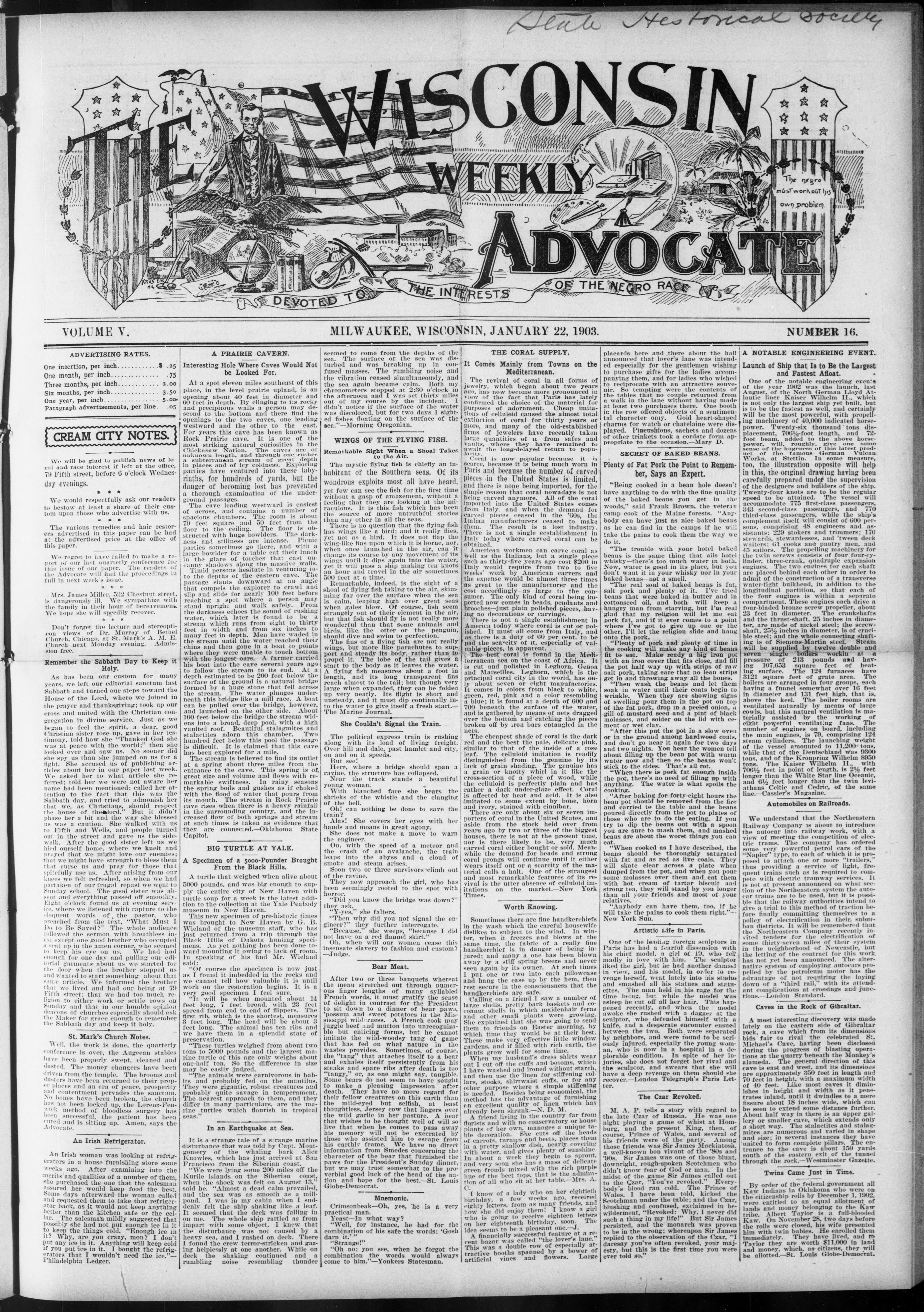
WISCONSIN
WEEKLY
ADVOCATE
DEVOTED TO THE INTERESTS OF THE NEGRO RACE
ADVERTISING RATES.
One insertion, per inch..... $ .25
One month, per inch..... .75
Three months, per inch..... 2.00
Six months, per inch..... 3.50
One year, per inch..... 5.00
Paragraph advertisements, per line..... .05
We will be glad to publish news of local and race interest if left at the office, 79 Fifth street, before 6 o'clock Wednesday
业 业 业
We would respectfully ask our readers to bestow at least a share of their custom upon those who advertise with us.
The various remedies and hair restorers advertised in this paper can be had at the advertised price at the office of this paper.
We regret to have failed to make a report of our last quarterly conference for this issue of our paper. The readers of the Advocate will find the proceedings in full in next week's issue.
Mrs. James Miller, 522 Chestnut street, is dangerously ill. We sympathize with the family in their hour of bereavement. We hope she will speedily recover.
Don't forget the lecture and stereopticon views of Dr. Murray of Bethel Church, Chicago, at St. Mark's A. M. E. Church next Monday evening. Admission free.
Remember the Sabbath Day to Keep it Holy.
As has been our custom for many years, we left our editorial sanctum last Sabbath and turned our steps toward the House of the Lord, where we joined in the prayer and thanksgiving; took up our cross and united with the Christian congregation in divine service. Just as we began to feel the spirit, a dear, good Christian sister rose up, gave in her testimony, told how she "Thanked God she was at peace with the world;" then she looked over and saw us. No sooner did she spy us than she jumped on us for a fight. She accused us of publishing articles about her in our paper last week. We asked her to what article she referred; told her we were not aware her name had been mentioned; called her attention to the fact that this was the Sabbath day, and tried to admonish her that we, as Christians, should respect the house of the lord." But it didn't phase her a bit and the way she blessed us was a caution. She walked with us to Fifth and Wells, and people turned out in the street and gave us the sidewalk. After the good sister left us we hied ourself home, where we knelt and prayed that we might love our enemies; that we might have strength to bless them that curse us and pray for those that spitefully use us. After arising from our knees we felt refreshed, so when we had partaken of our frugal repast we went to Sunday school. The good sister was absent and everything passed off smoothly. Eight o'clock found us at evening service, where we listened with rapture to the eloquent words of the pastor, who preached from the text, "What Must I Do to Be Saved?" The whole audience followed the sermon with breathless inest except one good brother who occupied a seat up in the amen corner, who seemed to keep his eye on us. We had had enough for one day and pulling our editorial garments about us we started for the door when the brother stopped us and wanted to start something about that same article. We informed the brother that we lived and had our being at 79 Fifth street; that we had too much religion to either work or settle rows on Sunday and that in our humble opinion deacons of churches especially should ask the Maker for grace enough to remember the Sabbath day and keep it holy.
St. Mark's Church Notes.
Well, the work is done, the quarterly conference is over, the Augeean stables have been properly swept, cleaned and dusted. The money changers have been driven from the temple. The brooms and dusters have been returned to their proper places and an era of peace, prosperity and contentment pervades the sanctum. No bones have been broken, the church has not been locked up, the Lorenz-Fenwick method of bloodless surgery has been successful, the patient has been cured and is sitting up. Amen, says the Advocate.
An Irish Refrigerator
An Irish woman was looking at refrigerators in a house furnishing store some weeks ago. After examining into the merits and qualities of a number of them, she purchased the one that the salesman assured her would keep food the best. Some days afterward the woman called and requested them to take that refrigerator back, as it would not keep anything better than the kitchen safe or the cellar. The salesman mildly suggested that possibly she had not put enough ice in it to keep the things cold. "Enough ice in it? Why, are you crazy, mon? I don't put any ice in it. Anything will keep cold if you put ice in it. I bought the refrigerators that I wouldn't need the ice."—Philadelphia Ledger.
A PRAIRIE CAVERN.
Interesting Hole Where Caves Would Not be Looked For.
At a spot eleven miles southeast of this place, in the level prairie upland, is an opening about 40 feet in diameter and 60 feet in depth. By clinging to its rocky and precipitous walls a person may descend to the bottom and there find the openings to the two caves, one leading westward and the other to the east. For years this cave has been known as Rock Prairie cave. It is one of the most striking natural curiosities in the Chickasaw Nation. The caves are of unknown length, and through one rushes a subterranean stream of great depth in places and of icy coldness. Exploring parties have ventured into these labyrinths, for hundreds of yards, but the danger of becoming lost has prevented a thorough examination of the underground passages.
The cave leading westward is easiest of across, and contains a number of spacious chambers. The room is about 70 feet square and 50 feet from the floor to the ceiling. The floor is obstructed with huge bowlders. The darkness and stillness are intense. Picnic parties sometimes go there, and with a large bowlder for a table eat their lunch in the glare of torches that cast uncanny shadows along the massive walls.
Timid persons hesitate in venturing into the depths of the eastern cave. The passage slants downward at an angle that compels the explorer to crawl and slip and slide for nearly 100 feet before reaching a spot where a person may stand upright and walk safely. From the darkness echoes the sound of rushing water, which later is found to be a stream which runs from eight to thirty feet in width and from six inches to many feet in depth. Men have waded in the stream until the water reached their chins and then gone in a boat to points where they were unable to touch bottom with the longest oars. A farmer carried his boat into the cave several years ago to follow the stream to its end. At a depth estimated to be 200 feet below the surface of the ground is a natural bridge formed by a huge stone that fell across the stream. The water plunges underneath this bridge like a mill race. A boat can be pulled over the bridge, however, and launched on the other side. About 100 feet below the bridge the stream widens into a broad, deep pool, with a high vaulted roof. Beautiful stalagmites and stalactites adorn this chamber. Two hundred feet below this pool the passage is difficult. It is claimed that this cave has been explored for a mile.
The stream is believed to find its outlet at a spring about three miles from the entrance to the cave. This spring is of great size and volume and flows with remarkable swiftness. In rainy seasons the spring boils and gushes as if choked with the flood of water that pours from its mouth. The stream in Rock Prairie cave rises when there is a heavy rainfall in the surrounding country, and the increased flow of both springs and stream at such times is taken as evidence that they are connected.—Oklahoma State Capitol.
BIG TURTLE AT YALE.
A Specimen of a 5000-Pounder Brought From the Black Hills.
A turtle that weighed when alive about 5000 pounds, and was big enough to supply the entire city of New Haven with turtle soup for a week is the latest addition to the collection at the Yale Peabody museum in New Haven.
This new specimen of pre-historic times was brought to New Haven by G. B. Wieland of the museum staff, who has just returned from a trip through the Black Hills of Dakota hunting specimens. As yet nothing has been done toward mounting it owing to lack of room. In speaking of his find Mr. Wieland said:
"Of course the specimen is now just as I found it imbedded in the rocks and we cannot tell how valuable it is until work on the restoration begins. It is a very good specimen I feel sure.
"It will be when mounted about 14 feet long, 7 feet broad, with 23 feet spread from end to end of flippers. The first rib, which is the shortest, measures 3 feet long. The head will be about 3 feet long. The animal has ten ribs and we have them in a splendid state of preservation.
"These turtles weighed from about two tons to 5000 pounds and the largest marine turtle of this age only weighs about one-half ton. So the difference in size may be easily judged.
"The animals were carnivorous in habits and probably fed on the mautilus. They were gigantic, robust creatures and probably quite savage in temperament. The nearest approach to them, and they differ in many particulars, are the marine turtles which flourish in tropical seas."
In an Earthquake at Sea.
It is a strange tale of a strange marine disturbance that was told by Capt. Montgomery of the whaling bark Alice Knowles, which has just arrived at San Francisco from the Siberian coast. "We were lying some 200 miles off the Kurile islands on the Siberian coast, when the shock was felt on August 13," said he. "Almost a dead calm prevailed, and the sea was as smooth as a millpond. I was in my cabin when I suddenly felt the ship shaking like a leaf. It seemed that the deck was falling in on me. The whole ship rattled as from impart with some object. I knew that the disturbance was not caused by a heavy sea, and I rushed on deck. There I found the crew terror-stricken and gazing helplessly at one another. While on deck the shaking continued and a rumbling noise resembling thunder
MILWAUKEE, WISCONSIN. JANUARY 22. 1903.
seemed to come from the depths of the sea. The surface of the sea was disturbed and was breaking up in confused masses. The rumbling noise and the vibration ceased simultaneously, and the sea again became calm. Both my chronometers stopped at 2:30 o'clock in the afternoon and I was set thirty miles out of my course by the incident. I didn't notice if the surface of the water was discolored, but for two days I sighted fishes floating on the surface of the sea."—Morning Oregonian.
WINGS OF THE FLYING FISH.
Remarkable Sight When a Shoal Takes to the Air.
The mystic flying fish is chiefly an inhabitant of the Southern seas. Of its wondrous exploits most all have heard, yet few can see the fish for the first time without a gasp of amazement, without a feeling that they are looking at the miraculous. It is this fish which has been the source of more untruthful stories than any other in all the seas. There is no question that the flying fish has wings like a bird; and it really flies, yet not as a bird. It does not flap the wing-like fins upon which it is borne, nor, when once launched in the air, can it change its course by any movement of its wings until it dips again into the water, yet it will pass a ship making ten knots an hour and travel in the air sometimes 500 feet at a time.
Remarkable, indeed, is the sight of a shoal of flying fish taking to the air, skimming far over the surface when the sea is calm, leaping high over great seas when gales blow. Of course, fish seem strangely out of their element in the air, but that fish should fly is not really more wonderful than that some animals and birds, like the otter or the penguin, should dive and swim to perfection.
The fins of a flying fish are not really wings, but more like parachutes to support and steady its body, rather than to propel it. The lobe of the tail gives a start to the body as it leaves the water. A flying fish measures about a foot in length, and its long transparent fins reach almost to the tail; but though very large when expanded, they can be folded up very neatly. Its flight is short and unsteady, and it must dip continually into the water to give itself a fresh start.—The Marine Journal.
She Couldn't Signal the Train.
The political express train is rushing along with its load of living freight. Over hill and dale, past hamlet and city, on and on it speeds.
But see!
Here, where a bridge should span a ravine, the structure has collapsed.
Near the track stands a beautiful young woman.
With blanched face she hears the shrieks of the whistle and the clanging of the bell.
Oh! can nothing be done to save the train?
Alas! She covers her eyes with her hands and moans in great agony. She does not make a move to warn the engineer. On, with the speed of a meteor and the crash of an avalanche, the train leaps into the abyss and a cloud of smoke and steam arises. Soon two or three survivors climb out of the ravine.
They now approach the girl, who has been seemingly rooted to the spot with horror.
"Did you know the bridge was down?" they ask.
"Y-yes," she falters. "Then why did you not signal the engineer?" they further interrogate
girl. She further interrogate.
"Because," she weeps, "because I did not have on a red flannel skirt."
Oh, when will our women cease this insensate slavery to fashion and custom?
—Judge.
Bear Meat.
After two or three banquets whereat the menu stretched out through numerous finger lengths of many syllabled French words, it must gratify the sense of delight in contrast for the President to sit down to a dinner of bear paws, 'possum and sweet potatoes in the Mississippi wilderness. A French cook may juggle beef and mutton into unrecognizable but enticing forms, but he cannot imitate the wild-woodsy tang of game that has fed on what nature in the wastes provides. Sometimes, of course, the "tang" that attaches itself to a bear and exhales itself persistently from his steaks and spare ribs after death is too "tangy," or, as one might say, tangible. Some bears do not seem to have sought to make a pleasing impression after death. They have no more regard for their fellow creatures on this earth than the mild-eyed but selfish, at least thoughtless, Jersey cow that lingers over the wild garlic in her pasture. A bear that wishes to be thought well of will so live that when he comes to pass away his memory will not be execrated by those who assisted him to escape from his earthly frame. We have no direct information from Smedes concerning the character of the bear that furnished the paws for the President's Sunday dinner, but we may trust somewhat to the proverbial good luck of the head of the nation and hope for the best.—St. Louis Globe-Democrat.
Mnemonic
Crimsonbeak—Oh, yes, he is a very practical man.
Yeast—In what way?
"Well, for instance, he had for the combination of his safe the words: 'Gosh darn it.'"
"Strange!"
"Oh no; you see, when he forgot the combination the words would always come to him."—Yonkers Statesman.
THE CORAL SUPPLY
It Comes Mainly from Towns on the Mediterranean
The revival of coral in all forms of jewelry, which began about two years ago, has now become more pronounced in view of the fact that Paris has lately confirmed the choice of the material for purposes of adornment. Cheap imitations of celluloid caused the almost total extinction of coral for thirty years or more, and many of the old-established firms of jewelers have recently taken large quantities of it from safes and vaults, where they have remained to await the long-delayed return to popularity.
Coral is now popular because it is scarce, because it is being much worn in Paris and because the number of carved pieces in the United States is limited, and there is none being imported, for the simple reason that coral nowadays is not being carved anymore. All of the coral imported into the United States comes from Italy, and when the demand for carved pieces ceased in the '60s, the Italian manufacturers ceased to make them. The result is a lost industry. There is not a single ec establishment in Italy today where carved coral can be obtained.
American workmen can carve coral as well as the Italians, but a single piece such as thirty-five years ago cost $200 in Italy would require from two to five weeks' work by American carvers and the expense would be almost three times as great to the manufacturer and the cost accordingly as large to the consumer. The only kind of coral being imported now comes in beads, pendants and brooches—just plain polished pieces, having no decorations or carvings.
There is not a single establishment in America today where coral is cut or polished. It must all come from Italy, and as there is a duty of 60 per cent. to be pad the scarcity of it, especially of valuable pieces, is apparent.
The best coral is found in the Mediterranean sea on the coast of Africa. It is cut and polished in Leghorn, Genoa and Marseilles. Leghorn, which is the principal coral city in the world, has only about seven or eight manufactories. It comes in colors from black to white, green, red, pink and a color resembling a blue; it is found at a depth of 600 and 700 beneath the surface of the water, and is gathered by means of nets dragged over the bottom and catching the pieces broken off by iron bars entangled in the nets.
The cheapest shade of coral is the dark red and the best the pale, delicate pink, similar to that of the inside of a rose leaf. The celluloid imitation is readily distinguished from the genuine by its lack of grain shading. The genuine has a grain or knotty whirl in it like the cross-section of a piece of wood, while the celluloid is perfectly plain and has rather a dark under-glaze effect. Coral is affected by heat and acid. It is also imitated to some extent by bone, horn and ivory, stained with cinnibar.
There are only about six or seven importers of coral in the United States, and aside from the stock held over from years ago by two or three of the biggest houses, there is not at the present time, nor is there likely to be, very much carved coral either bought or sold. Meanwhile the demand for beads and strung coral prongs will continue until it either wears itself out or a scarcity of the material calls a halt. One of the strangest and most remarkable features of its revival is the utter absence of celluloid imitations on the market.New York Times.
Worth Knowing
Sometimes there are fine handkerchiefs in the wash which the careful housewife dislikes to subject to the wind. In winter, when it freezes and blows at the same time, the fabric of a really fine handkerchief is in danger of being injured; and many a one has been blown away by a stiff spring breeze and never seen again by its owner. At such times I put one or two into each pillowcase and hang the case up by the hem, then rest secure in the consciousness that the handkerchiefs are safe.
Calling on a friend I saw a number of large shells, pretty bark baskets and coconut shells in which maidenhair ferns and other small plants were growing. She explained that she was going to send them to friends on Easter morning, by which time they would be at their best. These make very effective little window gardens, and if filled with rich earth, the plants grow well for some time. When my husband's dress shirts wear out I cut off the cuffs and bosoms, which I have washed and ironed without starch, and then use the linen for stiffening collars, stocks, shirtwaist cuffs, or for any other purpose where a simple stiffening is needed. Besides being economical, the method has the advantage of furnishing an excellent quality of linen which has already been shrunk—N. D. M.
A friend living in the country far from florists and with no conservatory or house plants of her own, manages a unique table decoration. She cuts off the heads of carrots, turnips and beets, places them in a pretty shallow dish, nearly covering with water, and gives plenty of sunshine. In about a week they begin to sprout, and very soon she has a mass of delicate green fronds mixed with the rich purple hue of the beet tops, that is the admiration of all who sit at her table.—Mrs. A. C.
I know of a lady who on her eightieth birthday, a few weeks ago, received eighty letters, from as many friends, and how she did enjoy them! I know a girl who is going to receive eighteen letters on her eighteenth birthday, soon. The idea seems to be a pleasant one.—J.
A financially successful feature at a recent bazar was called "the lover's lane." This was a double row of especially attractive booths spanned by a bower of artificial vines and flowers. Large
placards here and there about the hall announced that lover's lane was intended especially for the gentlemen wishing to purchase gifts for the ladies accompanying them, and for ladies who wished to reciprocate with an attractive souvenir. So tempting were the contents of the tables that no couple returned from a walk in the lane without having made at least two purchases there. One booth in the row offered objects of a sentimental character only. Gold heart-shaped charms for watch or chatelaine were displayed. Pineushions, sachets and dozens of other trinkets took a cordate form appropriate to the occasion.—Mary D.
SECRET OF BAKED BEANS.
Plenty of Fat Pork the Point to Remember, Says an Expert.
"Being cooked in a bean hole doesn't have anything to do with the fine quality of the baked beans you get in the woods," said Frank Brown, the veteran camp cook of the Maine forests. "Anybody can have just as nice baked beans as he can find in the camps if he will take the pains to cook them the way we do it.
"The trouble with your hotel baked beans is the same thing that ails hotel whisky—there's too much water in both. Now, water is good in its place, but you don't want it in your whisky nor in your baked beans—not a smell."
"The real soul of baked beans is fat, salt pork and plenty of it. I've tried beans that were baked in butter and in cottonseed oil, and both will keep a hungry man from starving, but I'm real glad that my religion will let me eat pork fat, and if it ever comes to a point where I've got to give up one or the other, I'll let the religion slide and hang onto the pork.
"Plenty of pork and plenty of time in the cooking will make any kind of beans fit to eat. Make ready a big iron pot with an iron cover that fits close, and fill the pot half way up with strips of raw salt pork, taking care that no lean strips get in and throwing away all the bones.
"Then wash the beans and let them soak in water until their coats begin to wrinkle. When they are showing signs of swelling pour them in the pot on top of the fat pork, drop in a peeled onion, a gill of mustard seed and a pint of black molasses, and solder on the lid with cement or wet clay.
"After this put the pot in a slow oven or in the ground among hardwood coals, and don't go near it again for two days and two nights. You hear the women tell about filling up the bean pot with warm water now and then so the beans won't stick to the sides. That's all rot.
"When there is pork fat enough inside the pot, there's no need of filling up with anything. The water is what spoils the cooking.
"After baking for forty-eight hours the bean pot should be removed from the fire and carried to the table and the beans poured directly from the pot to plates of those who are to do the eating. If you try to dip the beans out with a spoon you are sure to mash them, and mashed beans are about the worst things you can eat.
"When cooked as I have described, the beans should be thoroughly saturated with fat and as red as live coals. They will skate clear across a plate when dumped from the pot, and when you pour some molasses over them and eat them with hot cream of tartar biscuit and strong tea, they will stand by you longer than all your friends and most of your relatives.
"Anybody can have them, too, if he will take the pains to cook them right."-- New York Sun.
Artistic Life in Paris
One of the leading foreign sculptors in Paris has had a fearful dissension with his chief model, a girl of 19, who fell madly in love with him. The sculptor liked the girl, but he had another damself in view, and his model, in order to revenge herself, went lately into his studio and smashed all his statues and statuettes. The man held in his rage for the time being, but while the model was asleep he cut off all her hair. This happened recently, and when the model awoke she rushed with a dagger at the sculptor, who defended himself with a knife, and a desperate encounter ensued between the two. Both were separated by neighbors, and were found to be seriously injured, especially the young woman, who is now in a hospital in a deplorable condition. In spite of her injuries, she does not forget her rival and the sculptor, and swears that she will have a deep revenge on them should she recover.—London Telegraph's Paris Letter
The Czar Revoked.
M. A. P. tells a story with regard to the late Czar of Russia. He was one night playing a game of whist at Homburg, and the present King, then, of course, Prince of Wales, and several of his friends were of the party. Among those friends, was Sir James Mackintosh, a well-known bon vivant of the '80s and '90s. Sir James was one of those blunt, downright, rough-spoken Scotchmen who didn't know fear of God or man. In the midst of the game Sir James called out to the Czar, "You've revoked." Everybody's blood ran cold. The Prince of Wales. I have been told, kicked the Scotchman under the table; and the Czar, blushing and confused, exclaimed in bewilderment, "Revoked: Why, I never did such a thing in my life!" But Sir James persisted, and the monarch was proven to be in the wrong; whereupon Sir James replied to the observation of the Czar, "I daresay you've often revoked, your majesty, but this is the first time you were ever told so."
Launch of Ship that Is to Be the Largest and Fastest Afloat.
One of the notable engineering events of the year 1902 was the launch, last August, of the North German Lloyd Atlantic liner Kaiser Wilhelm II., which is not only the largest ship yet built, but is to be the fastest as well, and certainly will be the most powerful, with propelling machinery of 40,000 indicated horsepower. Twenty-six thousand tons displacement, 706½-foot length, and 72-foot beam, added to the above horsepower, will, roughly, give one some sense of the hugeness of this latest product of the famous German Vulcan Works, at Stettin. In some measure, too, the illustration opposite will help in this, the original drawing having been carefully prepared under the supervision of the designers and builders of the ship. Twenty-four knots are to be the regular speed to be attained. The vessel will accommodate 775 first-class passengers, 343 second-class passengers, and 770 third-class passengers, while the ship's complement itself will consist of 600 persons, comprising 48 engineers and assistants; 229 stokers and trimmers; 170 stewards, stewardesses, and 'tween deck waiters; 61 cooks and pantry men, and 45 sailors. The propelling machinery for the twin screws consists of four four-cylinder, three-crank, quadruple expansion engines. The two engines for each shaft are placed behind each other in order to admit of the construction of a transverse water-tight bulkhead, in addition to the longitudinal partition, so that each of the four engines is within a separate compartment. These engines each drive a four-bladed bronze screw propeller, about 23 feet in diameter. The crankshafts and the thrust-shaft, 25 inches in diameter, are made of nickel steel; the screwshaft, 25½ inches in diameter, is of crucible steel; and the whole connecting shafting is of Siemens-Martin steel. Steam will be supplied by twelve double and seven single boilers workin at a pressure of 213 pounds and having 107,653 square feet of heating surface. The 124 furnaces have 3121 square feet of grate area. The boilers are arranged in four groups, each having a funnel somewhat over 16 feet in diameter and 131 feet high, that is, above the keel. The boiler rooms are ventilated naturally by means of large cowls, but this natural ventilation is materially assisted by the working of eight powerful ventilating fans. The number of engines on board, including the main engines, is 79, comprising 124 steam cylinders. The launching weight of the vessel amounted to 11,200 tons, while that of the Deutschland was 9300 tons, and of the Kronprinz Wilhelm 8950 tons. The Kaiser Wilhelm II., with 706½ feet in point of length, is 2½ feet longer than the White Star line Oceanic, and 6½ feet longer than the twin leviathans Celtic and Cedric, of the same line.-Cassier's Magazine.
Automobiles on Railroads.
We understand that the Northeastern Railway Company is about to introduce the autocar into railway work, with a view of meeting the competition of electric trams. The company has ordered some very powerful petrol cars of the "Napier" type, to each of which it is proposed to attach one or more "trailers," thus providing a service of light, frequent trains such as is required to compete with electric tramway services. It is not at present announced on what section of the Northeastern system the autocar trains are to be used, but it is possible that the railway authorities intend to give a trial to this method of traction before finally committing themselves to a policy of electrification in their, suburban districts. It will be remembered that the Northeastern Company recently invited tenders for the electrification of some thirty-seven miles of their system in the neighborhood of Newcastle, but the letting of the contract for this work has not yet been announced. The alternative system of employing autocars propelled by the petroleum motor has the advantage of not requiring the laying down of a "third rail," with its attendant complications at crossings and junctions.—London Standard.
Caves in the Rock of Gibraltar.
A most interesting discovery was made lately on the eastern side of Gibraltar rock, a cave which from its dimensions bids fair to rival the celebrated St. Michael's Cave, having been disclosed during the progress of blasting operations at the quarry beneath the Monkey's alameda. The general direction of this cave is east and west, and its dimensions are approximately 350 feet in length and 70 feet in height, with a maximum width of 40 feet. Like most caves it diminishes in height and width as it penetrates inland, until it dwindles to a mere fissure about 18 inches wide, which can be seen to extend some distance further. About half way in there is an upper gallery or smaller cave, which extends only a short way. The stalactites and stalagmites are numerous and varied in shape and size; in several instances they have united to form complete pillars. The entrance to the cave is about 150 yards south of the eastern exit of the tunnel through the rock.—Westminster Gazette.
Twins Came Just in Time.
By order of the federal government all Kaw Indians in Oklahoma who were on the citizenship rolls by December 1, 1902, were entitled to an equal allotment of lands and money belonging to the Kaw tribe. Albert Taylor is a full-blooded Kaw. On November 28, two days before the rolls were closed, his wife presented him with twin babies. He enrolled them immediately. They have lived, and to Taylor they are worth $11,000 in land and money, which, as citizens, they will be allotted.—St. Louis Globe-Democrat.
AFTER THE THAW.
After the night the day,
After the crime the law,
After the work the pay,
And after the freeze the thaw.
And the street is a river wide,
A viscous, glutinous flood,
Bank-full from side to side
Of mucilaginous mud.
And it's Oh, for a stepping stone,
On which to place one's feet,
Or a bucket of ashes thrown
For a crossing over the street.
You rubber to find a way
To bottom the baffling flood,
But you find—Alack, and a-day!
That your rubbers are stuck in the mud.
For it's after the day the night,
After the crime the law,
After the bloom the blight.
And after the freeze the thaw.
St. Louis Post Dispatch.
All's Well that Ends Well.
A STORY OF FOUR-SIDED LOVE.
He looked for the most part straight in front of him as they walked across the field side by side. His forehead was puckered, his mouth set, his peculiarly youthful face paler than its wont.
"Life," he said, "is such a huge responsibility."
Unconciously his voice took the dogmatic tone which so often characterized it in the performance of his clerical duties.
"Life is such a serious matter; I do not think we half realize its tremendous seriousness."
"Talking—of—er—tigers?" said she.
His voice dropped to one of surprise, almost irritation. "What do you mean?" he asked.
"I haven't grasped the connection," she said. "It is only when I am in pain that I feel like that." Plainly he was seriously affected, for he even ignored her frivolous aside. "Oh, what is it?" she asked. "There must be something," she continued. "Has the vicar"—here she smiled, although unwillingly—"has his reverence been insisting on the fifteen minutes' limit for your sermons again?" "You couldn't neglect your mother for any one," she said, bravely.
"No," he admitted, "no; that's true." "So you are forced to make a duty of necessity," she said. He waited a moment, repeating her words over to himself, as though he had not reached their meaning. "Give me," he said, "one crumb of consolation to help me through the empty days. If there had not been this plain, straight way of duty for me, could you——?" "Yes, oh, yes!" she said. "I had to speak?" he questioned.
"I had to speak. he questions.
"I can hear it better," she said, "since you have spoken."
"If love were all?" he quoted.
"Nothing else could have made me love you like this," said she.
Only his look thanked her. "Now," he said, "you must forget that once I was tempted to play the man. You must only remember me as the conceived young curate who tried——"
"Don't!" she exclaimed, "don't hurt me like that!"
"Take your own way, then," he whispered, with a wintry smile. "And bless you always, my one love. You alone hold my secret—safe with you."
"Dear God, how safe!" she cried.
And so they parted. It was the only way.
But that was not the only confidence with which she was honored at about this time, and, strangely enough, it was the curate's mother who next put her powers of secret keeping to the test. She prefaced her confession with a touch of flattery.
"I hope you will not laugh at me for a silly old goose!"
"As if I should!"
"I don't know—wait and see. I suppose that in your idea no one could possibly fall in love after—well, 35?"
"Oh, why not?"
"Very well tried, dear! Very creditably said! But I am more than 35—and I am in love. I don't wonder you start."
"I don't—think—I did!"
"Not badly! But there, I don't want you to think that because experience has taught me to laugh in the face of misfortune I cannot still feel. Child, there is no love like a late love for tearing your heartstrings. Practice helps to make perfect, perhaps—I don't know. Women love and marry and live happily ever after—hundreds of women do that. But I have had experience, and I know what I am saying is true, that not one woman in a hundred ever finds her ideal as I, so late, have found mine."
"Oh," said the girl, "doesn't he—doesn't he—forgive my asking—but doesn't he love you?"
"Yes, dear, that's not the barrier. I think at my age, you know, a failure to return my affection would have marred the picture in the beginning, have broken up the likeness to the ideal too soon, would have stayed the springs of love before much harm had been done. No, I am spared that. But I think you know how I have lived for and in my son ever since his father died. I have brought him up to honor his dead father beyond all living men. How can I now acknowledge to him that a greater than his father has arisen for me? How can I publicly set another in the place death has made sacred? Wouldn't it be like sacrilege in his eyes? The seed I sowed in my boy's heart has flourished beyond belief—his very love of me is entwined with it. If I struck at the one, might I not endanger the other?"
The girl summoned all her store of courage to her aid.
"But if he should—think of marrying—himself, wouldn't that make a difference?"
"You think that because you are so young yourself, dear girl. And how patient you have been to me!" she said, coming back to her accustomed consideration for her companion. "Sometimes I have felt I must speak, just once, or it would kill me—and now I have spoken. You will respect my confidence, I know."
These were the questions which troubled her, filled her waking thoughts, sent her restless to bed.
And while she still waited she became the victim of yet another confidence, this time from a man again, but middle-aged and iron-gray.
"You look a sensible little girl," he began, abruptly. "Are you?"
"I hope so!" She smiled.
"Then, although we don't know much
of each other, you'll forgive me for asking you a question or two which may seem beyond my limit, believing that importinence is the last thing prompting me."
Suddenly arrested in interest, the girl nodded.
"Then, will you tell me if you ever get below the surface, as it were, in those long and seemingly confidential talks you have with our young curate?"
"Have you a right to ask?"
"I have, at any rate, a large interest at stake."
"That sounds almost the same thing. I am afraid of what I may and may not say; but I don't see at this moment any reason why I should not speak the truth."
"Then you have?"
"Sometimes," she admitted.
"Once in particular, perhaps?"
"I must not tell you."
"What are you going to do?" gasped the girl.
"I am going to tell our curate how matters stand between his mother and myself; he is between—and—"
"She didn't bind you to secrecy?"
"I have forgotten it if she did. And if she did, she will forgive me 'by results,' or I don't know her."
"And if there are no satisfactory results, she won't know anything about it?"
"Of course not. I thought you could help me."
She looked at the man's firm mouth, his pleasant, kindly eyes. "I want to help you much more than I've helped you at present," she said.
"But I can't get the woman I want unless I can secure a bride for our curate—clear him out of the way."
"Don't talk of him like that," she laughed.
"And a troublesome conscience won't let me go to him after watching him follow you about with his eyes, unless I can hold out some sort of hope that he would be successful in yielding to my prompting—in proposing to you, in fact, to—er—clear the way—for me."
"Can't you?"
She blushed and smiled. "I should not like to. Look here, little girl, I am as safe as a house; you can very well trust me. Has he told you he loves you?" "Oh, why," she cried, "must you put it round that way?" "Well done, little girl! Then I'll manage it. I'll settle things for the four of us out of hand."
And this is what he did.—N. Y. News.
ENGINEERS TWO FLIGHTS UP.
Some Giant Locomotives in Use on the Northern Pacific Road.
The Northern Pacific has received the last of a consignment of twenty-one of the biggest engines in America. The last one of the series arrived a few days ago, and Tacoma, the terminus, has the distinction of being also the greatest railroad center in the world in this respect. There are as big engines elsewhere in twos and threes, but on no line and at no point are there a score of engines like the 1200 class just received in Tacoma. Any ten of these engines could have done all the railroad business there was to be done here ten years ago, when the "sage heens" used to crawl up to Weston with eight and ten small cars that could be loaded into five modern cars, wheels and all. The public sees little of these engines, since they are confined to freighting on the mountain division. Any one of them can pull on a level track all the loaded cars that can be hung behind them. The only limit is the number of cars that can be handled by a single crew. In the graphic language of Master Mechanic Bruce, "You can string all the cars you can get between one of these engines, chop the train off at a mile or so, and swing 'em into Portland easy."
Technical language will not convey to the average reader the immensity of these wonders of locomotive building. The name given them by common consent all over the road is "battle ships," and a more descriptive name could not have been chosen. One goes up two flights of stairs to reach the cab, for the boilers are so big they cannot be squeezed between the drivers, and perforce must be put on top of them. Their height is of three men standing on each other's shoulders—just low enough to squeeze through the tunnels. Indeed, many tunnels had to be raised to let them through from the east. The cylinders are double on each side, being arranged "tandem," the word "tandem" being adopted as the class name of the engine.
Five years ago the "Mogul" engine, which could swing 500 tons up the 12-10 grade to Lester at the foot of the mountain, was considered a wonder, and many believed the limit had been reached as to size. But the "Mogul" and its load is not a mouthful to the present "battle ship," which weighs loaded nearly three times as much, and rolls along without apparent effort with 1000 tons. If the freighting over the mountain were still done with horseflesh, as forty years ago, it would take 50,000 horses to do in a week what a "battle ship" does in a day. She carries 210 pounds of steam. The "high-press" cylinders at the front of the "tandem," looking like young 15-inch cannon, discharge into the "low-press" cylinders at 70 pounds.
From end to end the engines are sixty-nine feet long, for, as the master mechanic says, "Since they can't build 'em any higher, the only thing they can do now is to build 'em longer." Roundly speaking, one of the engines would run all the mills in Tacoma if it were not a locomotive. Five years ago the company received the first of its "Klondike" engines, then considered a masterpiece of engine construction. Though monsters in size and power, the new engines exceed them just 20 per cent, in both dimensions. The "Klondiker" exceeded the "Mogul" by 300 tons up the grade to Lester, and the "battle ship" daily exceeds the "Klondiker" by 200 tons.
The engines are not comfortable for the engine crews and have occasioned a great deal of kicking. A bulletin was posted yesterday cutting down the loads of engines, and till further orders the "battle ship" will only be required to draw 900 tons-still far in excess of anything which has preceded them. The object of the order is the speeding up of trains during the great rush of business now on. It is positively announced now, as oftimes before, that the limit of locomotive building has been reached. It remains to be seen how many months it will be before the limit sign is torn down and a higher one substituted.-Tacoma Ledger.
Be These Siberian Squirrels.
It is noticed that for some time in Warsaw innumerable cats have disappeared. According to the local press this is due to the fact that a number of fur dealers from Leipsic have been endeavoring to secure 10,000 cat skins, which, apparently, are worked up and dyed so as to be like more valuable furs. These agents pay about $1\frac{1}{4}$ to $1\frac{1}{2}$ a cat—prices which have induced many hundreds of people to catch animals and steal others belonging to private individuals—London Daily Mail.
STEAMER ST. LOUIS IS IN
American Liner Comes Limping Into Port of New York.
PASSENGERS ARE WELL
Ship's Boilers Were Leaking for Several Days and the Ship Could Make but Five Knots an Hour.
Siasconset, Mass., Jan. 17.—Through the medium of the wireless system word came ashore to the station here at 6:45 o'clock last night that the American line steamer St. Louis, for whose safety there had been some anxiety, was within twenty-four hours' sail of Sandy Hook.
Just what the trouble is on board the line could not be ascertained, because of the inability of those on the south shoals lightship, forty miles southeast of here, to read its signals, but the conclusion reached was that either its steam power was low because of leaky boilers or the vessel had broken one of its twin shafts and was coming into port under one propeller.
As the steamer crept slowly along on the westward course a string of varicolored flags was run up on the triatic stay, with the evident intention of definitely informing the lightship just what the cause had been for the long delay. It was nearly dark and as there was a stiff gale blowing the conditions rendered it impossible for the observers to read the signals. The lightship men sent word to the station here that the St. Louis was proceedings on its course for New York at a slow speed, and unless it could increase it they judged from the rate the ship was traveling that it could not reach Sandy Hook until Saturday evening.
New York, Jan. 17.—The American line steamer St. Louis, of which news has been anxiously awaited since Monday, and which was sighted off Nantucket last evening, was off the Sandy Hook lightship at S o'clock this morning. She had been delayed the greater part of a week by leaking boilers, but there had been no further trouble and no accidents and she had declined assistance from at least one passing steamer.
The Hamburg American steamship Pennsylvania, from Hamburg, Boulogne and Plymouth, which arrived in port this morning, reported that on January 15, in latitude 45.35, longitude 49.20, she fell in with the St. Louis from Southampton and Cherbourg, proceeding very slowly. The Pennsylvania steamed close to her and asked the difficulty. Officers of the St. Louis replied that her boilers were leaking and sent a boat alongside the Pennsylvania in charge of the first officer with letters from the passengers. The first officer reported that the St. Louis' boilers were leaking so badly that the ship could only steam five knots per hour in fine weather. They had on board eight-days' provisions and water and all were in good health. The steamer required no assistance.
The St. Louis made slow progress coming into port. Although she was sighted off Fire island at 6 o'clock, it was not until 9 o'clock that she passed Sandy Hook. She reached the quarantine station at 9:47. From quarantine, where she will be kept for a time for the port doctor's examination, the steamship will come up to her pier at the foot of Fulton street, North river, where she is expected to arrive at about 11:30 o'clock.
The marine station at Sandy Hook displayed signal flags for the word "Welcome," as the overdue steamship came in and the St. Louis replied "Thank you." No further signals were displayed by the ship as she passed Sandy Hook.
A large crowd gathered at the American line pier to welcome the delayed passengers.
WRECKED THE FACTORY.
Boiler at Greenville, Mich., Blows Up Killing Two Men and Injuring Two Others.
Greenville, Mich., Jan. 17.—Two boilers in the Ranney refrigerator factory known as Factory A, blew up at 11 o'clock today, killing two men, injuring more than a dozen others and causing an estimated money loss of $25,000. The dead are: CHARLES PRICE, engineer, aged 45, married. R. A. STANTON, fireman, aged 35, married.
Seriously injured:
Ed. Hammond.
Matt Bailey.
The factory is a three-story brick structure 300 feet long and about 140 feet wide. The boiler room was located in a structure adjoining the main building, separated from it by a brick wall. When the boilers let go the force of the explosion was exerted outward but the side of the factory next the boiler room tumbled in ruins, tons of brick falling over toward the engine room and burying the engineer and fireman deep in the debris.
LOW WATER IN BOILER. TWO DIE IN EXPLOSION.
LOW WATER IN BOILER. TWO DIE IN EXPLOSION.
Sawmill at Bells Mills, Pa., is Wrecked Member of the Legislature Scalled
West Newton, Pa., Jan. 17.—A boiler exploded at Bells Mills, wrecked a sawmill, killed two men and injured two others, one probably fatally. The dead are William Hunter and Robert Poore. A. B. Hunter, former member of the Pennsylvania Legislature, was badly scalded and may die. It is thought the explosion was caused by low water.
IRON MILLS COMBINED
Independent Plants in Indiana, Ohio and Michigan Perfect Merger.
Muncie, Ind., Jan. 17.—Official information was given out here that a combine of the independent iron mills at Muncie, Hartford City, New Albany, Torre Haute and East Chicago, Ind.; Findlay, O., and Muskegon, Mich., had practically been completed. The American Rolling Mill Corporation, which owns the Muncie and Muskegon plants, will be the largest factor in the combine.
EXPRESS COMPANIES TO JOIN.
New York, Jan. 17.—Wall street believes that a $50,000,000 express company trust has been formed and that Edward H. Harriman is to be its president. The nucleus of the new combination is the combination of the Wells-Fargo, the Pacific, the United States and the American. These, in turn, are to absorb all the other companies of importance, notably the Denver & Rio Grande express, so that the entire parcel transportation business of the country will be dominated by Messrs. Harriman, Platt and Gould and their associates.
SULTAN OF JOLO DIES.
Cholera Carries Off Monarch of Group of Islands in Philippine Archi-
Manila, Jan. 20.—The Sultan of Jolo, better known as the Sultan of Sulu, is dead, a victim of the cholera epidemic prevailing in the islands of the Sulu group.
Since the United States took over the Philippine islands after the war with Spain the Sultan was permitted to reign as he did before. His authority was recognized by the Philippine commission and an allowance of $5000 a year was made for his support. Considerable opposition developed to this arrangement, as it was considered a legalization of polygamy by the United States—the Sultan, like most Oriental rulers, having a superfluity of wives—but the conditions in the islands were considered such that no other course was believed possible.
Had Absolute Power.
The Sultan was an absolute monarch, having the power of life and death over his subjects. He made less trouble for the United States than any other chief in the Philippines, despite the fact that he was in rank the most important of all. He accepted the inevitable with good grace and recognized the authority of the Washington government, only asking that he be permitted to continue as before, the nominal head of the island, and that the annuity paid him by Spain be granted him.
Lived in Barbaric Splendor.
The Sultan, although scarcely more than a boy, commanded the respect of all who came in contact with him. Advised by his mother, he ruled wisely and never got his dignity. He had a regular cabinet composed of subordinate chiefs called dattos, and lived a life of semibarbaric splendor. When he went out among his subjects he always rode a pony, was preceded by a candle bearer and a sword bearer, and a third court official walked beside him carrying a gigantic umbrella over the young ruler's head.
MUTUAL GOOD WISHES
President Roosevelt and King Edward Exchange Messages Over Marconi Wireless System.
South Wellfleet, Mass., Jan. 20.—Wireless communication between Marconi's Cape Cod station and England has been established, and messages were exchanged between President Roosevelt and King Edward. When everything was in readiness for the test Marconi sent the following message from President Roosevelt to the King—the first from the new Cape Cod station:
His Majesty, Edward VII., London, Eng.: In taking advantage of the wonderful triumph of scientific research and ingenuity which has been achieved in perfecting a system of wireless telegraphy, I extend, on behalf of the American people, most cordial greetings and good wishes to you and to all of the people of the British empire.
THEODORE ROOSEVELT.
Wellfleet, Mass., Jan. 19. 1903.
Later the instruments at the station showed that a message in reply from the King was coming, and soon the following was registered:
Sandlingham, Jan. 19, 1903.—The President, White House, Washington, America: I thank you most sincerely for the kind message which I have just received from you through Marconi's trans-Atlantic wireless telegraphy. I sincerely reciprocate, in the name of the people of the British empire, the cordial greetings and friendly sentiment expressed by you on behalf of the American nation, and I heartily wish you and your country every possible prosperity.
TO RESIGN HIS OFFICE.
Tillman Unable to Serve as Lieutenant Governor While Confined in Jail.
Augusta, Ga., Jan. 20.—A Columbia special from a Herald staff correspondent says: Lieut.-Gov. Tillman will resign his office as an official of the state of South Carolina today when the Legislature convenes.
Columbia, S. C., Jan. 20.—Arrangements for the funeral of N. G. Gonzales have been perfected. The services will be conducted at Trinity Church by Right Rev. Bishop Capers, the life-long friend of Mr. Gonzales. The honorary pall-bearers are: Judge A. C. Huskell, Dr. B. W. Taylor, Dr. J. W. Babcock, Prof. R. Mans Davis, Andrew Crawford; United States Marshal Coartes Ellis, William H. Tibbs, Julius Walker, John P. Thomas, Jr., Wade H. Gibbers, Jr., C. F. Fitzsimmons. The active pall-bearers were all fellow workers with Mr. Gonzales on the State. The Knights of Pythias, of which Mr. Gonzales was a member, will attend in a body, and many if not all the merchants will suspend business during the funeral.
YOUTHFUL DESPERADO.
Boy Attempts to Kill Wife and Daughter of Benefactor and Shoots Neighbor Who Interfered.
Pataskala, O., Jan. 20.—Elmer Artz, a boy who had been befriended and given a home, attempted to kill the wife and daughter of his benefactor, shot and killed a neighbor who interfered, and then put a bullet through his own head. Artz, who was 19 years of age, had been taken in by Joseph Stotthart, a railroad employee, because he had no other place to go. Mrs. Stotthart asked him to do an errand for her. He became surly, and when the woman upbraided him he drew a revolver and shot her in the head, inflicting a serious wound. John Hunt, a neighbor, attempted to take the weapon from Artz. In the struggle Hunt was shot through the head, dying instantly. Then Artz shot Miss Mary Stotthart, causing a bad wound. Then the boy turned the weapon upon himself.
FILIPINOS USED POISON.
Barbarous Methods of Warfare Told of in the Glenn Court- Martial
Manila, P. I., Jan. 20.—In the court-martial of Maj. Glenn the defense succeeded, in spite of numerous objections, in introducing enough hearsay evidence, through the testimony of Lieut. Cook, to prove that a fund had been established by the natives for the prosecution of the defendant.
Brussett, who was formerly a private in the Ninth Infantry, which took part in the Samar campaign, described some of the horrors of the Balangiga massacre. He testified that he found the body of Lieut. Bumpus. It had been horribly mutilated and sticks had been thrust through the nostrils.
Former insurgents who are now enlisted men in the Philippine scouts swore that they used poison against the American troops under orders from their commanders.
THIEVES TORTURE MAN.
Badly Beaten by Burglars in His Own Home at Sheboygan.
COULD FIND NO MONEY.
Sheboygan, Wis., Jan. 20.—[Special.]—Frank Chokan, an Austrian who came to this city Saturday to take a place in a local tannery, was held up at his home early this morning by two unknown men. Shortly after midnight two burglars, one over 6 feet tall and the other a medium height, both wearing masks, forced an entrance into the house and went to the room in which Chokan was sleeping. They awakened him and demanded money, and when he replied he had none they beat and kicked him until he was unconscious. They revived him and demanded money again, and upon his saying that he had nothing valuable in the house, they tortured him in a most brutal manner and left him lying in a semiconscious state. As soon as he was able he went to the police station and search was at once made for the criminals. No trace of them has been found.
Miss Hattie Hartmann, daughter of Mr. and Mrs. John Hartmann, is in a serious condition as the result of a brutal assault made by an unknown man last evening. She was beaten almost to insensibility. The assault was made near the city limits, between 7 and 8 o'clock. Miss Hartmann was going from her home to attend a dance and was accosted by a man who wore a mask. At the point of the revolver he asked her to go to the dance with him. She refused and he struck her over the head with a club or some other hard instrument.
After striking the blow the masked man left the prostrate girl. Soon afterward her brother, John Hartmann, Jr., came along and found her. She was assisted to a residence and later in the evening was brought to this city, where her wounds were dressed. Miss Hartmann is 19 years old.
PIONEER. LEGISLATOR.
William T. Sterling, Who Died at Scott, was in the Legislature in 1848
Prairie du Chien, Wis., Jan. 20.—[Special.]—William T. Sterling, one of the oldest pioneers of the state, died at the home of his daughter, Mrs. William Kast, in the town of Scott at the age of 95. He represented Crawford and Chippewa counties in the Legislature in 1848. He has been a resident of Crawford county since 1844.
Judge G. Goetze, Port Washington. Port Washington, Wis., Jan. 20—[Special.]—Judge Gustave Goetze died at his home in this city after an illness of two weeks of heart failure. He was born in Odenburg, Germany, in 1823, was educated in German, English and French for the position of a tutor to the children of the aristocracy, and pursued that occupation for several years. In 1850 he came to the United States and settled in Thiensville, in this county. He had served the county as register of deeds and clerk of the county board of supervisors. Twenty years ago he was elected as member of the Assembly and re-elected to that position. Judge Goetze was elected county judge in 1865 without opposition, but having made an error in filing his oath, the office was determined by the supreme court to be vacant. Judge Goetze was married in 1866 to Mrs. Betty Thien at Thiensville. His widow and two children, Mrs. M. D. Leek and Paul Goetze of this city, survive him.
MAY BUILD RAILWAY.
Plans for an Electric Railway Between Eau Claire and Menomonie—Business Men to Confer.
Eau Claire, Wis., Jan. 20.—A conference of business men of Eau Claire will be held soon in regard to the construction of an electric railway between Eau Claire and Menomonie, as an extension of the Chippewa Valley Electric Railroad Company's system, now embracing Eau Claire and Chippewa Falls.
The situation as understood here is that Mr. Appleyard, president of the Chippewa Valley Electric Railroad Company, has said that he would build a line between Eau Claire and Menomonie whenever the latter city would grant a franchise; that while some Menomonie mercantile interests appear to be opposed to it, on the ground that such connection would tend to draw trade from the smaller to the larger city, still the supposed hostility at Menomonie is much less now than it has been heretofore and it is believed by many leading citizens there, especially in educational circles, that the benefits to the two cities respectively would be equal; and it is further intimated that Senator Stout would look with favor on the enterprise.
MARRIAGE BUSINESS NEEDS PROTECTION.
West Superior Ministers Want License Law Amended as They are Losing Fees.
West Superior. Wis., Jan. 20.—[Special.]—The ministers of Superior want the marriage law amended. At their semi-monthly meeting today they appointed a committee to prepare resolutions to be forwarded to the state Legislature asking that the clause requiring a five-days' wait be cut out. They say that it is no remedy for any evils and simply injures the city and state financially by causing those that do not want to wait to go out of the state. It certainly injures the ministers' "financial interests" as their business in that line has been less than half what it was under the old law.
NO HOPE FOR MURDERER.
Trial Judge at West Superior Won't Sign the Petition for Pardon of Henry Lamont.
West Superior, Wis., Jan. 20.—[Special.]—Henry Lamont, who was sent from here in 1896 to spend the rest of his life in state's prison, will languish there for at least some time to come. Judge Vinje, who was the trial judge in the case, has refused to sign the petition asking for Lamont's pardon. Lamont had been convicted on circumstantial evidence which went to show that he had perpetrated a most cold-blooded act in killing a woodsman for his shoes and coat. No new evidence has been found and the judge holds that seven years was not enough punishment for the crime. The governor will not consider a petition not signed by the trial judge.
A former Kansas man, writing to his home paper, tells the following story: "Once while traveling in the Ozark mountains in Arkansas I came upon what looked to be an old well on the top of a low but thickly wooded hill. Not having watered my horse for half a day, I dismounted, tied him to a tree and lowered the bucket into the well, but to my surprise when the bucket came up again it contained a piece of pasteboard which read: 'Hike or die.' I can say that I gladly did the former. I knew at once that I had intruded upon an old moonshine whisky distillery, so numerous in that section of the country. They had placed a well curb over the entrance for a blind.—Kansas City Star.
It is related that a wit in Waterville College (now Colby), of the class of '45, one morning read in the classroom a sparkling essay. Prof. Martin B. Anderson, afterward the famed professor of Rochester University, knowing or suspecting it to have been cribbed from some public print, asked, as the reader sat down: "Is that essay original, Mr. Jones?" "Why, yes, sir," said Jones, with imperturbable coolness and that pasteboard look which he always wore: "I suppose it is. It had 'original' over it in the newspaper I took it from."—Argonaut.
The Order of Foresters
The Independent Order of Foresters has over 200,000 members, and its funds aggregate almost $6,000,000. The order pays out $500 every working hour of the year to the widows and orphans of its members. Since its organization it has paid over $12,000,000 on death claims.
LATEST MARKET REPORTS.
MILWAUKEE, JANUARY 21, 1908.
EGG AND DAJEY, MARKETS.
MILWAUKEE—Eggs—Market firm; strictly fresh, loss off, cases included, 23@231c; fresh, cases returned, 221/2@23c; seconds, 16c; fancy storage, 19@20c; pickled, 18@19; receipts of fresh eggs continue very light; demand is good. Receipts were 150 cases.
Butter—Market weak. A great deal of renovated butter and oleo is being used. Fancy prints, 261c; fancy or extra creamery, per lb, 26c; firsts, 23c; seconds, 20c; June creamery, 24c; dairy prints, 22c; extra fancy dairy, 2021c; lines, 17@18c; roll, 1617c; demand is rather light and stock is moving slowly; offerings very plentiful. Receipts, 16,339 lbs; yesterday, 20,650 lbs.
Cheese—Firm. The demand continues good; full cream flats, fancy, 13@14c; good to choice, 11@12c; Young Americas, 13@13l; low grades, 10@11c; limburger, per lb. No. 1, 111/2@12c; low grades, 10@11c; imported Swiss, 25c; Block Swiss, domestic, 14@15c; fancy loaf, 141/2@15l; No. 2, 12@13c; Sapsago, 20c. Receipts, 7130 lbs; yesterday, 2800 lbs.
CHICAGO—Butter—Easy; creameries, 17
@25½c; dairyes, 17@23c. Eggs—Dull; loss
off, cases returned, 23½c. Cheese—Steady;
twins, 13c; dalsies, 13½@14c; Young
Americas, 13½c. Dressed poultry—Quel; tur-
keys firm, 15@18c; chickens quiet, 8@12c.
MILWAUKEE LIVE STOCK MARKET.
HOGS—Receipts, 10 cars; market 10c higher;
light, 130 to 160 lbs, 5.90@6.25; mixed,
180 to 225 lbs, 6.25@6.55; good to choice, 200
to 250 lbs, 6.35@6.70; selected heavy, 250 to
300 lbs, 6.60@6.80; pigs, 80 to 110 lbs, 5.00
@5.60.
CATTLE—Receipts, 5 cars; steady;
butchers' steers, medium to good, 1050 to
1300 lbs, 4.15@5.00; fair to medium, 950 to
1050, 3.50@4.00; heifers, common, 2.75@
3.25; good, 3.50@4.00; cows, fair to good,
2.85@3.65; canners, 1.75@2.40; cutters, 2.50@
2.75; bulls, common, 2.75@3.25; choice, 3.50@
4.00; feeders, 800 to 950 lbs, 3.50@4.00;
stockers, 500 to 750 lbs, 2.50@3.25; veal
calves, common to choice, 5.00@6.25. Milk-
ers—Common, 15.00@25.00; choice, 35.00@
50.00
SHEEP—Receipts, 1 car; steady, 3.00@
4.00; bucks, 2.50@3.00; lambs, common to
choice, 4.00@5.75.
Chicago receipts: Hogs, 30,000; cattle,
16,000; sheep, 16,000.
MILWAUKEE HAY MARKET.
Timothy firm; carlots, choice timothy,
12.25@12.50; No. 1 timothy, 11.75@12.00;
No. 2 timothy, 9.50@10.50; clover and clover
mixed, 9.00@10.00.
Prairie hay steady; choice Kansas, 11.50
@12.00; No. 1 Kansas, 11.00@11.25; No. 2,
8.50@9.00.
Wisconsin prairie, 8.00@9.00.
Straw, steady; rye, 7.00@7.50; oats, 6.00@
6.50; wheat, 4.00@4.50; packing hay, 6.50.
MILWAUKEE POTATO MARKET.
Potatoes—Market firm; supply fairly good;
demand good; per bus, carlots, on track,
Rurals and Burbanks, fancy large up to 45@
48c; choice Rose and Peerless, 43@45c; inferior stock down to 38c.
MARKETS BY TELEGRAPH.
MILWAUKEE—Flour—Steady Wheat—
Firmer; No. 1 Northern, on track, 81½¢;
No. 2 Northern, on track, 80½¢. Corn—
Firm; No. 3 on track, 45c. Oats—Firm; No.
2 white, on track, 36c; No. 3 white, on
track, 35@35½¢. Barley—Steady; No. 2 on
track, 65c; sample on track, 43@65¢. Rye—
Dull; No. 1 on track, 51½¢. Provisions—
Firmer; pork, 19.00; lard, 10.30.
Flour market steady; patents, 3.85@3.95;
bakers, 2.85@2.95; rye 2.90@3.00.
Millstuffs are firm and quoted at 16.50
for bran, 16.50 for standard middlings and
18.50 for Milwaukee flour middlings in 100-
lb sacks; red dog, 20.00. Delivered to
country points, 1.00 extra.
CHICAGO—Close—Wheat—January, 76½c;
May, 80%@80½c; July, 75%c. Corn—January,
47½c; May, 44%@44½c; July, 42½%@43½c;
September, 42½c. Oats—January, 34c; May,
36½c; July, 32½c. Pork—January, 19.00;
May, 16.70%@16.72½; July, 16.45. Lard—January,
10.17½; May, 9.60; July, 9.45; February,
9.77½. Ribs—January, 9.07½; May,
9.20%@9.22½; July, 9.10; September, 9.05.
Rye—May, 52c. Flax—Cash N. W., 1.24; S.
W., 1.19; May, 1.23. Clover—January,
1.75. Barley—Cash, 42%@60c.
NEW YORK—Close —Wheat—May, 82%; July, 80%; Corn—May, 49%; July, 48%; DULUTH—Close —Wheat — Cash No. 1 hard, 78%; No. 1 Northern, 77%; No. 2 Northern, 75%; No. 3 spring, 72%; to arrive, No. 1 hard, 79%; No. 1 Northern, 78%; May, 79%; July, 79%; Oats—May, 35%; Rye—May, 50; on track and to arrive, 48; Barley—35@51c; Flax—Cash, on track, to arrive and January, 1.19; May, 1.22; July, 1.22%; Receipts—Wheat, 23,150. PEORIA—Whisky—On the basis of 1.36 for finished goods. TOLEDO—Close —Wheat—Dull, firm; cash and January, 79%; May, 82%; Corn—Dull, steady; January, 46%; May, 44%; Oats—Dull, firm; January, 36%; May, 37%; Rye—No. 2, 53%; Seed—Fairly active, strong; January, 7.11%; March, 7.25; prime timothy, 1.90; prime alsek, 8.35.
KANSAS CITY — Close — Wheat — May, 70%c; July, 67%c; cash No. 2 hard, 66%@ 68%c; No. 2 red, 69%@70c. Corn—January, 27%c; May, 38%c; cash No. 2 mixed, 39%c; No. 2 white, 40%c; Oats—No. 2 white, 35%@36c.
MINNEAPOLIS — Close — Wheat—May, 78%@78%c; July, 78%c; on track. No. 1 hard, 79%c; No. 1 Northern, 78%c; No. 2 Northern, 77%c.
ST. LOUIS—Close—Wheat—Higher; No. 2 red cash elevator, 73%c; May, 76%c; July, 72%c; No. 2 hard, 71%@73c. Corn—Higher. No. 2 cash, 42%c; May, 41c. Oats—Higher. No. 2 cash, 35%c; May, 36%c; No. 2 white, 37%c. Lead—Firm, 3.97%2. Spelter—Firm, 4.80.
SOUTH OMAHA—Cattle—Recelpts, 3500; active stronger; beef steels, 3.25@5.50; cows and heifers, 3.00@4.10; canners, 1.75@2.65; stockers and feeders, 2.75@4.20. Hogs—Recelpts, 6500; 10c higher; heavy, 6.50@6.70; pigs, 5.50@6.25. Sheep—Recelpts, 5000; steady; sheep, 4.25@5.10; lambs, 4.50@6.00.
ST. LOUIS—Cattle—Receipts, 5000; market strong for natives, steady for Texans; beef steers, 4.00@5.40; stockers and feeders, 2.00@4.00; cows and heifers, 2.25@4.50; Texans, 2.50@4.50. Hogs—Receipts, 6500; 100 higher; plugs, 6.25@6.60; packers, 6.06@6.70; butchers, 6.65@6.95. Sheep—Receipts, 1500; steady, sheep, 4.40@4.75; lambs, 4.75@6.00.
KANSAS CITY—Cattle—Receipts, 9000; market strong to 10c higher; beef steers, 3.50@5.50; Texans, 2.00@3.90; cows and heifers, 1.65@4.25; stockers and feeders, 3.25@4.25. Hogs—Receipts, 9000; strong, 10c higher; heavy, 6.60@6.80; packers, 6.40@6.60; yorkers, 6.45@6.52½; plugs, 5.95@6.15. Sheep—Receipts, 5000; strong, sheep, 3.50@4.70; lambs, 3.00@6.00.
The Wisconsin Weekly Advocate
Printed in the Interests of the Negro Race,
MILWAUKEE, WIS.
Telephone Black No. 244.
SUBSCRIPTION RATES.
Any part of the United States and Canada,
postage paid.
One Year ..... $2.00
Six Months ..... 1.25
Three Months ..... 75
Send money by Express Money Order, P. O.
Money Order or Registered Letter to the
Wisconsin Weekly Advocate.
ADVERTISING RATES.
TO CONTRIBUTORS:
All communications must be sent with the name and address of the sender as an evidence of good faith, but not necessarily for publication. No manuscript returned if not accepted, unless accompanied by stamps.
The Wisconsin Weekly Advocate company wishes to notify the public that all contracts and business transactions with this company must have the company stamp, otherwise they will be void. Neither will this company be responsible for paid subscriptions unless given to duly-accredited agents, who, on request, will give the company's receipt for same. Subscribers falling to receive their papers regularly will kindly notify the general office. Address all business communications to the general manager, 79 Fifth street.
Entered in the Postoffice at Milwaukee as Second-class matter.
EDITORIAL PARAGRAPHS.
"I know of the bravery and character of the Negro soldier. He saved my life at Santiago, and I have had occasion to say so in many articles and speeches. The Rough Riders were in a bad position when the Ninth and Tenth cavalry came rushing up the hill carrying everything before them. The Negro soldier has the faculty of coming to the front when he is needed most. In the Civil war he came 400,000 strong, and I believe he saved the Union."—President Roosevelt.
Royalty may not love like the common herd, but when it divorces it has to go through the same old mill.
The sinking of the scow Monitor with 100 tons of coal, is an incident to awaken the balladist, in these days of appeal and suffering.
Lieut. Peary would make a good trust buster. He is said to be preparing for another effort to break the ice combination at the north pole.
There is a fortune in sight for Chief Willis L. Moore of the weather bureau, if he can attach a reverser to his room cooler, and make it drive the mercury upward.
The streptococcus lanceolatus, which is found in some kinds of ice cream, will kill guinea pigs. But the American girl is not a guinea-pig, and will continue to fearlessly devour ice-cream.
A surprising thing happened at a Juarez, Mexico, bull fight; a banderillo was gored by a bull. Usually the bull fights are mere sticking matches in which sticking is made sure for the bull, on the slaughter house principle.
Secretary Wilson states that the cattle of the United States are healthy, the percentage afflicted with tuberculosis being only 10 as against 40 per cent. among the cattle of Europe. The only trouble here is that there are not cattle enough to go around.
---
The Leyland liner Mexican, which experienced a shortage of fuel on the broad Atlantic, and burned all of her spars, derricks and available woodwork to make steam enough to get to Queenstown, illustrated for householders how they can dismantle their premises temporarily to tide over fuel famines.
Barring a collision and the bare possibility of its opening up compartments enough to cause her to founder, the overdue liner St. Louis is able to withstand almost anything that is likely to be encountered in a run across the Atlantic. When she limps in, or is towed into port, it will be found that a break in the machinery caused the delay.
Curious, how a sound in this age travels through the world! "Hello" became at the outset of telephoning the word for getting into vocal relations with the person at the other end of the line. The telephone was originated in America, but soon gained favor abroad. Even the French, however, have not been able to improve upon the call word which was adopted at the outset here, and when one Frenchman rings another up by telephone, the first thing he shouts into the receiver is "Alo! Alo! Alo!"
The total shipments from the Beaumont oil fields, since the beginning of operations at the wells in the fall of 1901, have been 77,501 cars, or 13,008,450 barrels. Thousands of barrels from the gushers were wasted in the early stage of operations—some because the oil ran off before provision could be made for its collection, and some to afford a spectacle for the edification of visitors. If the yield should give out, as is now threatened, there will be those at Beaumont who will feel like the little boy that sang
A curious and unlooked-for consequence of the anthracite strike is the tarishing of silver. A Milwaukee housewife who has had more trouble keeping her table service bright of late than ever before, conversed with a jeweler on the subject, and the jeweler said that the silver watches in his show cases required more attention than he formerly found necessary to keep them from turning dark. He attributed the trouble to the general use of soft coal, the smoke from which is mixed with sulphurous fumes.
---
ADMITS THAT FATHER FRANK WILL LEAVE SHEBOYGAN.
Change will be Made at Easter Time and Prelate Says the Trouble is
Fond du Lac, Wis., Jan. 23.—[Special.]—Bishop C. C. Grafton of the Episcopal diocese of Fond du Lac has confirmed the report, published exclusively in the Evening Wisconsin, that Father Frank will leave Sheboygan. He said that a change will be made at Easter time.
Bishop Grafton considers the trouble settled and refuses to say anything more about it. He spent the evening with Canon Barry discussing church matters. In discussing church matters today Bishop Grafton said that eventually all the members of the Anglo-Saxon race would become united in one church and that he believes this unit will be the Episcopal Church. He added: "The Episcopal Church is broad and the members of the congregations are broad-minded. Of course, we have our little troubles like the one at Sheboygan, but no attention is paid to them."
GROOM FORGOT WEDDING
GOES TO WORK AS USUAL WHILE BRIDE WAITS AT ALTAR.
Grand Rapids, Wis., Jan. 23.—[Special.]—The wedding that was to have taken place yesterday, but failed owing to the non-appearance of the groom, was celebrated today with all the ceremony necessary on such occasions, Rev. Father Van Rosmallen officiating. It develops that the groom forgot all about the wedding and went to his work as usual early in the morning. He was reminded of the all-important event late in the afternoon by a friend. He straightway ordered preparations made for the wedding to take place this morning, and so Carrie Boyjesky and John Bord became husband and wife.
MRS BRAGG TELLS OF LIE.
Wife of Fond du Lac General Says Reporter Misrepresented Matters,
Besides Breaking Faith.
Fond du Lac, Wis., Jan. 23.—[Special.]—Just before starting for Hong Kong yesterday, Mrs. Edward S. Bragg gave her version of the incident of the letter of the general's from Havana which caused so much newspaper criticism, desiring to be set right before the public. Mrs. Bragg said:
"The alleged extract from my husband's letter, containing an implied criticism of the Cuban people was not in any respect correct. The reporter came to my house just as I had returned from Madison and had but opened my husband's letter. He asked for news from the general and I told him that I had not had time to read my letter. The light was poor and I had difficulty in making out the writing. One sentence I had partly read when I stopped and told the reporter that he must not print any such thing as I had read. He promised that he would not make any mention of it and went away.
"The next day I was horrified when informed that a paper had published an alleged extract from Mr. Bragg's letter and that it was likely to make him trouble with the Cubans. When I saw the paper I saw that the article was a gross perversion of what I had read from the letter, but the damage was done and it would have done no good to try to explain it. I never heard of a more dishonest act on the part of a newspaper man.
"The story that the publication referred to was the cause of my husband's transfer from Havana to Hong Kong is also untrue. That transfer was planned long before that lie was printed. The transfer was in fact a promotion for Mr. Bragg, so calculated by the state department, and so understood by the President, at whose suggestion it was made. Mr. Roosevelt was himself kind enough to say that we ought not to worry over such a matter as an incorrect newspaper statement, and that it had not affected the standing of the general in the least."
RAN THROUGH STREETS IN SCANT ATTIRE.
Marinette Man Gets in Row in Saloon and is Made to Un-
Marinette, Wis., Jan. 23.—With the thermometer below zero and clad only in his underclothes and socks a man ran through the streets yesterday. The cause of the proceeding began in a saloon. The man had been drinking heavily with others when another man entered and paid for a drink with a $5 bill. The change was left a moment on the bar and $2 was soon missed. A search was begun and the man who later figured in the street episode was made to take off his clothing. The money was found in his pockets and the man was so badly scared that he set off without waiting to put on even his shoes. He reached the Presbyterian parsonage and told Rev. T. S. Anderson a story of how he had been robbed of his clothing while he was asleep. The minister gave him trousers and an overcoat.
ENCOURAGE HOME COMPANY.
Outagamie Company Pays More for Independent Telephones.
Appleton, Wis., Jan. 23.—Outagamie county supervisors in official session set a precedent in awarding the county telephone contract for two years. The Fox River Telephone Company, whose instruments are now in the county buildings, made a bid of $126, the same as last year. The Wisconsin Bell Telephone Company offered to duplicate the service for $84. However, the board voted to encourage the independent company by giving it the contract, even though its price is the highest.
BROTHER CLEARED OF BLAME.
Coroner's Jury Decides to Make No Arrests in Granite City Case.
Manawa, Wis., Jan. 23.—[Special.]—The coroner's jury which investigated the cause of the death of the 14-year-old son of C. Close of Granite City, who died a few days ago under suspicious circumstances, has exhonorated his older brother from all blame and it was decided not to make any arrests.
SOLDIERS AT HOME.
THEY TELL SOME INTERESTING ANECDOTES OF THE WAR.
How the Boys of Both Armies Whiled Away Life in Camp-Foraging Experiences, Tiresome Marches-Thrilling Scenes on the Battlefield.
"N. S. Woodward," said the Captain, "tells a good story in the Express Gazette. Woodward served as agent of the Adams Express Company in the South during the civil war, and, put out of business early in 1864 by the operations about Knoxville, supported himself by cutting cordwood. He had a good supply on hand, in fact, quite a wood yard of his own, when Sheridan's division camped near, and the boys confiscated every stick and chip, and were jolly over finding wood chopped and piled up ready to hand.
"Of course, the men of Sheridan's division will plead guilty. It was a hard winter and at many camps wood was scarce. In this particular case there was abundance of wood, without the chopping, and the boys appreciated Woodward's work, and I have no doubt scores of them will write him at Knoxville. Tenn., expressing their thanks for favors rendered in the matter of cordwood thirty-nine years ago. This story reminds me of scores of incidents in which tired or freezing soldiers burned anything combustible, from shingles to saw logs, or from fence rails to houses, with enthusiasm and a reckless disregard of consequences.
"When we first camped at Shell Mound, after crossing the Tennessee in 1863, there was a neat, substantial brick building used as the railway station, and the orders were that the structure be strictly guarded. It was, but in the comings and goings, up and down the Tennessee, the boys needed brick for fire places in their little shanties and frame timbers for the same. A few bricks were torn out first from one corner and then from another, until the building was pronounced unsafe. Then the men of the regiment swooped down upon it like vultures, and in twenty minutes there was only a bare skeleton left, and that was carried off that night.
"Open campaigns in winter would have abounded in hardships had it not been that most of the men in the service were good fire builders. When we first entered Kentucky in January, 1862, every fence rail was tied down, as the boys put it, with the order 'don't touch,' and I have seen three thousand men shivering in rain and snow through a cold night without shelter and without fire because there was nothing to burn. There were trees and wood piles all about us, but none for soldiers. Several of our officers were put under arrest because they instructed their men to appropriate wood or rails to prevent great suffering.
"In one case a Colonel became popular at home and in the army because on a stormy night he took possession of a wood yard and a straw stack and worked energetically to make his men comfortable. When threatened with a court-martial the next day he paid for straw and wood and said nothing about it. The boys found it out, however, and the year after the war that Colonel received the vote of every man in our township, Republican and Democrat, for sheriff, and he was re-elected, without organized opposition in the county, until he insisted he was too old to serve. All because he believed that when the boys needed things to burn they must have things to burn.
"The men of some companies in the old army," said the Major, "called themselves 'destroying angels,' and when it came to building fires or providing shelter they were. In the early spring of 1864 our brigade was twenty or thirty miles east of Chattanooga and with no expectation of severe weather the men lay down under blankets or the thin shelter tents, and during the night were literally snowed under. When reveille sounded the next morning there were six inches of snow on the ground. The camp looked like a cemetery with its clusters and lines of little hillocks, and there was only one fire in the brigade, and that was at guard headquarters.
"As the men were roused from heavy sleep and three out their arms to lift overcoat, cape, or blanket from their faces the snow startled them to sitting or standing posture, and the scene was comical beyond any other I ever saw in the army. Those who had taken off their shoes could not find them. Many could not find their hats. All were chilled, but the boys laughed and swore by turns. Then they started to build fires, and while some cut down dead trees as big as saw logs, others tore down an old barn, and in half an hour dozens of big fires were going, coffee was boiling, breakfast was cooking, and with bodies warm the men were as frolicsome as children.
"It so happened that the barn destroyed belonged to one of the Brownlow clan, and when he saw the fires that had been built of its material he opened his eyes very wide and said 'shucks.' The boys joined in making out a certificate for him which read: 'This is to certify that the First Kentucky volunteer infantry, being buried in a snow storm and suffering dire distress and other things, did on this blank day of April, 1864, tear down and appropriate a barn worth about $25 belonging to the holder hereof, who is a good Union man, and if Uncle Sam can't pay him for the barn we will do it ourselves.' This was signed by about forty men who saw that the 'plucky man of the Brownlow clan' didn't lose a cent."
"The fence-rail habit," said the Sergeant, "grew on a man. There was no more exhilarating work than breaking up a seasoned cedar rail. A man who did it once wanted to do it again, and after doing it again he could split a cedar rail into coarse or fine splinters by the way he struck it on the hard ground or a log. I had a comrade who had a record of breaking up 500 rails, and he reasoned that over 5,000,000 cedar, walnut, and oak rails in the South were burned by soldiers, and that this wholesale destruction gave as much impetus to the barbed-wire business as the settling up of the prairie States.
"He located after the war in Nebraska, but got so lonesome with no fence rails in sight that he returned to Ohio, and moved from there when the people began to replace the old rail fences with board and wire fences. A year ago he came to Chicago and I took him out to Fort Sheridan, and incidentally called his attention to the fine grade of the wire fence enclosing the reservation. He was furious, and said that if the government really wanted first-class, experienced soldiers it ought to build at every fort, and camp an old-fashioned rail fence, and let the boys steal and burn the rails, as a reward for close attention to duty."—Chicago Inter-Ocean.
My Narrow Escape.
When the war broke out and a call was made for volunteers, my husband was among the first to join the regiment; and as we had been married but a short time it seemed hard that we must thus part, perhaps forever. But as we were both loyal to the Union we concluded that it was our duty to answer the call. Three months after my husband enlisted he was wounded in battle and desired me to send him something from home. I replied that I would send a trusty messenger with them soon. I then went out and purchased a suit of male attire, put them on and started for my husband's regiment. When I found him he did not know me, as I had my hair cut and face and hands stained; so I thought it best not to reveal myself or he would insist upon my returning home. I was with the regiment only a few days when the order came to march, and the Captain came to me and asked if I would volunteer to carry important dispatches for him to Sherman, about twenty miles away. As I had traveled over the same country before, I concluded it would be a good chance to make a heroine of myself, so I accepted the offer, and that night at dark I started on my lonely trip. It was a nice moonlight night, and I had no trouble until about midnight, when from a lonely clump of bushes by the roadside came the order to halt, accompanied by the ominous click of a musket. I had in my supposed security walked right into a trap. I was then led to headquarters, which was half a mile away, and there locked up for the night as a spy after first being searched in vain for papers. I dhl not think it probable they would find my dispatches, as I had them too well hidden. In the morning the Captain had me taken to his tent, and there I had to answer a string of questions; but he could get no satisfactory information. I was then returned to the guard house, with the orders to make a more rigid search for papers. I now saw I was in for it; therefore sent for the Captain, as I had information for him. He came, and I informed him of my sex and told him my father was in Sherman's army, wounded, and I had taken that plan to get to him. Of course, he did not believe me, and I was sentenced to be hung next morning at sunrise. I saw now that unless Providence interfered I was gone. Night came with all its horrors; but at midnight Sherman's army advanced and fired on the Confederate camp. All was now confusion, in which I was forgotten, and made a break for liberty. I had not gone far when I was detected and pursued; but I was too near the Union army to be overtaken. My pursuers fired on me with almost fatal result, one ball cutting my cheek and another breaking my left arm. I delivered my dispatches, was well received and cared for. I stayed with the army until the war broke up, and together with my husband went back to the farm.—Mrs. J. S., in American Tribune.
Obeyed Lee's Order.
Captain John Lamb, who represents the Richmond district in Congress, has become famous as a lecturer on the battle of Malvern Hill through his defense of General John Magruder from the charge that he was responsible for the slaughter of Confederate troops in that engagement.
Captain Lamb at the time of the battle was an orderly sergeant attached to the staff of General Magruder. The night after the battle he was in Magruder's tent when General Lee came in. The latter demanded to know why General Magruder had ordered his men to charge when inevitable defeat and disaster awaited them. "General Lee," Magruder answered, "I charged because you three times ordered me to. I was not able to get my men ready for the charge when you gave the order the first and second times, but when you gave the order a third time, we started."
General Lee, says Captain Lamb, admitted that this was true, and that it was not until recent years that General Magruder has been charged with responsibility for the disaster. Captain Lamb is the only man now living who has personal knowledge of the meeting between Lee and Magruder the night after the battle.—Washington Post.
Always speak politely and kindly to servants.
WE CONTINUE TO WARN THE BENEVOLENT PUBLIC AGAINST THE NUMEROUS BEGGARS FOR ALLEGED CHARITABLE INSTITUTIONS IN BEHALF OF THE NEGRO RACE. LOOK WELL TO THE CREDENTIALS OF SUCH MENDICANTS AND INQUIRE OF SOME REPUTABLE NEGRO CITIZEN REGARDING THE TRUTHFULNESS OF THEIR STATEMENTS.
Open Day and Night.
The Tur
Oysters, Game, Fish, Ste
Delicacy the Sea
Banquet Rooms for Dinner Parties
Table D'
NOTE-- We have neither private rooms, general pu
The Turf Cafe
Game, Fish, Steaks, Chops a
Delicacy the Seasons Afford.
rooms for Dinner Parties, Etc. Cuisine P
Table D'Hote.
ave neither private rooms, nor "private" people, b
general public.
The Turf Cafe Oysters, Game, Fish, Steaks, Chops and Every Delicacy the Seasons Afford.
Banquet Rooms for Dinner Parties, Etc. Cuisine Par Excellent. Table D'Hote.
NOTE-We have neither private rooms, nor "private" people, but cater to the general public.
DINNER FROM 5:30 TO 8:00, 35c.
J. L. SLAU 194 Third Street, Milwaukee "The Bachelo
J. L. SLAUGHTER, Street, Milwaukee, Wis.
J. L. SLAUGHTER, Prop. 194 Third Street, Milwaukee, Wis.
Steam Heat. Electric Light. Telephone in Every Room....... THE TURF EUROPEAN
TURF EUROPEAN HO A New and Modern Establishment for Gentlemen Only.
217 Wells Street,
Milwaukee.
Cafe in Connection: Prices
with Accommodat
C. C. GITTINGS, Pres. E. E. BAILEY, Vice
GOLD M
Folding F
MANUFACTU
Gold Medal Camp F
Incorporated February, 1892.
Street, Milwaukee. J. L. SLAUCE Pro
connection: Prices Moderate and with Accommodations Furnished.
RS, Pres. E. E. BAILEY, Vice-Pres. W. G. GITTING
GOLD MEDAL
Building Furniture
....MANUFACTURED BY....
Medal Camp Furniture Mf
rated February, 1892. RACINE, WIS.,
217 Wells Street, J. L. SLAUGHTER, Milwaukee. Prop. and Mgr. Cafe in Connection: Prices Moderate and Consistent with Accommodations Furnished.
C. C. GITTINGS, Pres. E. E. BAILEY, Vice-Pres. W. G. GITTINGS, Sec.—Treas.
GOLD MEDAL
Folding Furniture
....MANUFACTURED BY....
Gold Medal Camp Furniture Mfg. Co.
Incorporated February, 1892. RACINE, WIS., U. S. A.
A. BAIRD, Cutter.
New York Tailoring 322 WELLS STREET (Bet. 3d and 4th Sts.)
The New York 322 WELLS (Bet. 3d and
The New York Tailoring Co.
322 WELLS STREET (Bet. 3d and 4th Sts.)
Ladies' and Gents' Suits Made to Order. We also Clean, Press, Repair and Dye All kinds of Ladies' and Gents' Garments. Satisfaction Guaranteed. . . .
Alfred A. Grue
DEALER IN
Fresh, Salted & Smoked
OF ALL KIND
Fresh Fish and Oysters
HOTEL. MAIN 6253. 502 WELLS ST
ELEGANT NEW
TENSORIAL PARLO
Second to None in the World.
Visitors to the city and those who appreciate cleanliness, Elegance and Comfort should patronize
Fighter's Turf Hotel Tonsorial Hotel
217 Wells Street, Milwaukee.
Cold Baths in Connection. Franklin A. Hoad
BULL
TEL. MAIN 6253.
ELEGANT
TONSORIAL
Second to None
Visitors to the city and
Cleanliness, Elegance
patronize
Slaughter's Turf Hotel
217 Wells Street
Hot and Cold Baths in Connection.
ELEGANT NEW
TONSORIAL PARLORS,
Second to None in the World.
Visitors to the city and those who appreciate
Cleanliness, Elegance and Comfort should
patronize
Slaughter's Turf Hotel Tonsorial Parlors,
217 Wells Street, Milwaukee.
Hot and Cold Baths in Connection. Franklin A. Hackley, Mgr.
Northwestern House
APPLETON, WIS.
JOHN A. BRILL, - Proprietor.
Terms $1.00 Per Day.
Accommodations the best in the State. When in Appleton stop at the
NORTHWESTERN
LETON, WIS. RILL, - Proprietor. HOTEL and REST $1.00 Per Day.
---
For Ladies and Gentlemen.
rf Cafe
steaks, Chops and Every
seasons Afford.
es, Etc. Cuisine Par Excellent.
O'Hote.
nor "private" people, but cater to the
public.
DUGHTER, Prop. ee, Wis. Oors' Home"
OPEAN HOTEL...
J. L. SLAUGHTER,
Prop. and Mgr.
Moderate and Consistent
ations Furnished.
ce-Pres. W. G. GITTINGS, Sec.—Treas.
MEDAL
Furniture
FURNED BY....
Furniture Mfg. Co.
RACINE, WIS., U. S. A.
Telephone Black 9343.
Tailoring Co.
S STREET
4th Sts.)
Milwaukee, Wis.
fired A. Grunitz
DEALEB IN
Salted & Smoked Meats
OF ALL KINDS.
Fish and Oysters in Season
502 WELLS ST.
NT NEW
P. PARLORS,
one in the World.
and those who appreciate
e and Comfort should
Hotel Tonsorial Parlors,
Steet, Milwaukee.
on. Franklin A. Hackley, Mgr.
While in city visit . . .
STEPHENS'
HOTEL and RESTAURANT
First-Class Accommodations Home Cooking a Specialty...
No. 2832 State St., CHICAGO, ILL.
Louisville
Six trains daily between Chicago and the Ohio river.
For felders, rates, etc., call at any Monon ticket office or address
FRANK J. REED,
Gen'l Pass. Agent, Chicago.
S. B. JONES,
C. P. Agent, 232 Clark St., Chicago.
GEORGE HAYS Turning Mill and Box Factory
Rockers and all kinds of Restaurant Blocks, Extension Ladders, Tea Caddies, Boxes, Turning, Sawing, Mitchell Improved Washers, Trestels, Swinging Scaffolds. Repair Work Promptly Attended to TELEPHONE MAIN 252. 228-230 Fifth St., Milwaukee, Wis.
WHEN IN MADISON
Call at the
Avenue
Hotel...
M. J. REGAN, Prop.
$2.00 Rate .....
Free 'Bus.
WILLIAM T. GREEN
Lawyer
Notary Public
Rooms 17-18 Birchard Block.
105 GRAND AVENUE.
Telephone White 9214
MILWAUKEE.
WANTED--AGENTS
We want 100 agents in every city, town and hamlet in the U. S. for the Wisconsin Weekly Advocate. It will be devoted to the interest of the Negro race and will contain the news of their sayings and doings throughout the world.
WISCONSIN WEEKLY ADVOCATE MILWAUKEE, WIS. Before Starting on Your Travels CALL ON
Geo. Burroughs & Sons
MANUFACTURERS OF
PREMIUM TRUNKS
VALISES, SAMPLE CASES, Etc.
424 & 426 East Water St., Milwaukee.
TONEY THE ARTIST
FINE ART
Shining Parlor
2164 GRAND AVENUE
Opposite Fianner's Music Store
MILWAUKEE, WIS.
50 YEARS' EXPERIENCE PATENTS TRADE MARKS DESIGNS
Anyone sending a sketch and description may quickly ascertain our opinion free whether an invention is probably patentable. Communications strictly confidential. Handbook on Patents sent free. Oldest agency for securing patents. Patents taken through Munn & Co. receive special notice, without charge, in the Scientific American. A handsomely illustrated weekly. Largest circulation of any scientific journal. Terms, $3 a year four months, $1. Sold by all newsdealers. MUNN & Co. 361 Broadway. New York Branch Office, 625 F St., Washington, D. C.
FARM AND GARDEN How to Grow Peanuts.
Plow your land early in spring, and about the 5th or 10th of May crossbreak, harrow, lay your rows off 28 inches each way, put two kernels in a place, cover lightly with shovel plow, and in four or five days put another furrow on and drag off Be careful not to touch the peanuts; cultivate as level as possible with small plow. You can plow both ways; keep the vines uncovered and let them grow as fast as possible. When they go to blooming, never mind the bloom; just let it alone, it doesn't have anything to do with the peanut. Don't go to the trouble that I have heard of to cover the bloom up.
In the fall, before frost, when your peanut vines look matured and you know the nuts are matured, take a No. 19 or 20 chilled plow, take the wing off and you can plow them up without leaving too much dirt on vine. Run once or twice to the row; if your vines are small, once will do, but if large you will find it best to run twice. Take a four-pronged pitchfork, raise the vines up and shake the dirt off, and let it back; shake them up in the morning and stack in the afternoon. Now comes the particular part. Get your stack poles about 7 feet long, small poles, sharpen each end, jab it in the ground good and firm and lay some chunks, split pieces or anything else that is handy around. It is hard to stack them without molding or turning black unless you understand it. Pick the vine up by the root, let the root pass the pole; every time you put up a vine, or vines, let the roots pass the pole, and so on until the stack is finished. Take a nice bunch of grass and cap your stack. When they have stayed in stack four or five weeks they are ready to pick and sack and will keep in any quantity. J. W. Reeves in the Globe-Democrat.
Cheap Fencing Machine
It is not every farmer that has a few rods of picket fence to make that feels himself able to buy a fencing machine. I designed the following plan, and while it is not so rapid as a regular machine, I think the work is better. It makes no short twists in the wires which unfits them for use if the pickets should in time rot, or one should want to move the fence.
Cut a piece of plank for each pair of wires, $7 \times 1 \frac{1}{2} \times 6$ inch, as at a. Bore a $1 \frac{1}{2}$-inch hole in each corner of one end;
WIRE AND PICKET FENCE.
put a wire through each hole and fasten the wires in place to the post where you begin to weave. Then unroll and stretch the bottom wires first, the full length of the fence if straight, and staple them in place to the other end, or corner post, but not so tight as to not let them slip. Draw them straight and extend them beyond the last end post some 15 or 20 feet. Fasten them to some kind of heavy weight that will slip on the ground as the pickets are being woven in.—Cor. Farm and Home.
Profit Comes Slowly.
The profit from farming comes in slowly, and several years may elapse before the farmer is aware that his farm pays. This is due to the fact that fertility in the soil is cumulative, the results of the first year being but little apparently, though every year thereafter the farm will increase in productive capacity. The system of farming practiced will also influence the future of the farm. Where stock is a specialty the results are nearly always excellent, and rotation of crops aids in giving a profit, but the largest gain is when the farmer uses fertilizers liberally and gives his attention to the preservation of the manure produced on the farm.
The Orchard a Necessity.
An orchard is a necessity on the farm. It is well known that a farm containing an orchard will sell at a fair price, when farms with no orchards are sacrificed. The buyer always looks for the greatest number of advantages, and if apples, peaches, pears, plums and the small fruits can be found, instead of only an apple orchard, the value of the farm will be increased much more than the original cost of the orchard. If the farm is not for sale the orchard will be a source of profit to the farmer.
Deaths Among Farmers.
Deaths Among Farmers. It is sad to hear of the recent deaths or present desperate illness of several young and middle-aged farmers—men who before the present winter never knew from their own experience what it was to be seriously sick. They have been prostrated by such formidable diseases as pneumonia and typhoid fever. Sometimes the strong and robust neglect precautions to preserve health which those apparently much weaker have learned to observe. Farmers are more or less inured to exposure
to the elements, but, however strong and hardy, thy should not forget that the laws of Nature apply to all alike.— Exchange.
A Cave for Storing Apples. For storing fruit on the farm nothing can equal a good cave. One of the leading orchardists in southwestern Iowa built a cave seven years ago, and has found it an excellent place in which to store apples. The cave was dug into a north hill slope and the dirt removed with a spade and wheelbarrow. It is 16 feet wide by 50 feet deep and will hold two carloads of apples. The clay walls need nothing to hold them in place.
The roof is made of bridge plank, held in place by posts along the sides. The plank are covered with dirt and sodded over to turn the rain. Two 12-inch tiles at the top provide ventilation. Rats have not bothered much. A few got in, but were caught with a wire trap. A fruithouse 16 by 20 feet is built in front of the cave. Double doors open on the north, so that two wagons can be backed in for unloading. There is an orchard and timber on the south, so that hot south winds have no chance to enter this cave. Apples are stored in barrels, which are kept off the ground. American Agriculturist.
A Lifting Frame.
From the accompanying cut you will be able to get an idea of a handy arrangement for lifting, especially so on butchering day. The side pieces of the frame are made of 2x6x14 the legs are 2x4x12, and the roll A is a round block of wood 18 inches long with two
B
A
D
2-inch holes to insert the lever B; C is a stick between the lever and frame when the load is drawn up; D is a $ \frac{3}{4} $ - inch rope and E is a single block. The legs should be attached by a bolt running through the frame, and the holes in the legs be made oblong in shape so they will fit over a wagon. The bolt must be at least 4 inches longer than the frame is wide.—R. E. Clark in the Epitomist.
Feeding of Soft Corn.
There is very little difference in feeding value of the dry matter of soft, or thoroughly ripened corn, pound for pound, but it requires about 20 percent more soft corn to make an even amount of dry matter. Of course the same amount of cob is necessary to grow a soft ear that is required to grow a good ear. A good deal of soft corn is musty. This may or may not be injurious to stock. It is better to use caution in feeding soft corn until its effect on the animals eating it is determined. Ordinarily there is very little trouble from this source, but specific cases of stomach trouble have been traced to damaged or moldy corn. As there is so much of this class of stock food in the country this year, it is better to go slow.—Henry Payne, in Farm and Home.
Cotawold Sheep.
The Cotwood sheep possesses large frame and long fleece, but it is not suitable for farmers where pastures are not of the best quality. The Merinos, when used for crossing, do not increase in size, although the grade of wool is better. The Southdown is best for use on common flocks, as it is bred for mutton in preference to wool and, being hardy and active, the cross is less violent than those between Cotswolds and our small natives. The wool from the Southdown is not inferior, being classed with the middle grades, nor is it deficient in quantity as compared with common stock, but much above the average. Their excellence is in the superiority of the mutton, and in that respect they have no superiors.
Farm Notes.
When farmers are busy in the spring they are liable to neglect many matters which deserve their attention. Now is the opportunity for getting the implements in order and sharpening the tools. The grindstone is a valuable adjunct to good farming if thorough work is desired.
The goose is a forager and grazer, and even alongside of the sheep will utilize all kinds of grass very closely, and will assist poor land to earn a dividend. Geese can be kept in large flocks profitably, so that "specialty farming" in this line may be conducted on quite a large scale. They may be grown for less per pound than almost any other meat upon the farm.
Irish potatoes in the cellar should be covered with carpet and boards. Light and air spoil their eating qualities. Sweet potatoes are handy to have around during the winter and spring months, but they will not keep during the winter in the cellar. They must be kept in a room where there is fire enough to keep out dampness, and where there is no danger of freezing.
The free use of lime in the autumn, especially under fruit trees, will materially assist in destroying fungi. Use air-slaked lime and apply it freely. It is not as efficacious as some of the spraying mixtures, but is beneficial to a certain extent at this season. Some soils require lime, and it will prove as valuable under trees as on land intended for regular crops.
Some farmers prefer to save their seed potatoes, but before doing so there are precautions to be taken. The slightest indications of disease on potatoes should cause their rejection, as the crop of next year will be diseased from such seed. Every bushel of seed potatoes should be carefully examined and examinations of the potatoes in the bins should also be made during the winter.
ELECT BY POPULAR VOTE.
Bills Introduced Abolishing Caucuses and Conventions.
MODERATE IN TERMS.
Do Not Go as Far as the Famous Stevens Measure of Two Years Ago— Party Nominations.
Madison, Wis., Jan. 23.—[Special.] Two primary election bills, apparently having the sanction of the administration, were presented in the Assembly this morning. One was offered by Assemblyman Andrew and the second by Assemblyman Frear.
Both bills differ most radically from the Stevens bill in that each is far more moderate in its terms and does not carry primary election nearly so far, town, village and school elections being eliminated in each. The Andrew bill provides for party platforms to be formulated in such manner as the state central committee of each party shall determine. The Frear bill appears to make no provision for party platforms. The main provisions of the Andrew bill provide that all nominations for all offices except village, town and school district offices shall be made at primary elections to be held on the first Tuesday in September, 1904, and held biennially thereafter for all general elections.
Primary elections are also to be held on the second Tuesday preceding the municipal election days for municipal nominations. Notice of elections are to be given sixty days prior to election. Nominations of candidates to be voted at the primaries are to be secured through nomination papers. Petitions must have the names of 2 per cent. of the voters. In the case of minor parties which cast a lesser vote this provision is not to apply. A petition signed generally by 1 per cent. of the vote cast for that party will be sufficient.
In cases of non-partisan candidates nominations must be endorsed by 4 per cent. of the total vote cast at the last preceding general election. Poth residence and business addresses must be attached to petition by signers.
Nomination Papers.
Separate nomination papers must be circulated for state officers and congressmen. Affidavits must be also attached to the petitions of at least one citizen stating that he knows personally the signers of such petition. Nominations for state officers must be filed with the secretary of state and county officers with county clerks; city offices with city clerk. All nominations must be filed fifteen days before the primary election to insure names being placed on the primary election ballot. This ballot is to be prepared fourteen days before election.
The expenses for the primary election are to be borne by state, county and city respectively.
Ballots are to be similar to the present election ballot, and provision is made for primary officers similar to that at present obtaining.
The same qualifications for voting at primary elections are necessary as those obtaining under the present Milwaukee caucus law. The officers of the primary are to canvass the vote. One copy of the returns is to be sent to the county or city chairman of each political committee. Copies must also be sent to county clerk and city clerk. The official canvassing board is to be the county clerk and chairman and secretary of each political committee. Returns must be canvassed before Friday following the primary election and a list of candidates nominated in primary must be sent to city and county clerks.
Party Platforms.
In cases where offices are not wholly within the county the secretary of state and political district committees of each party are to form the canvassing board. No provision is made in the Andrew bill for party platforms. In case of a tie vote the tie is to be determined by lot of the canvassers.
Provision is made for the formation of precinct committees by the election of three members to be voted for at primary election. The three having the largest number of votes shall constitute the committee. Party committees of each city, county and Assembly district shall consist of party chairman of each precinct in such city, county or districts, the state senatorial committee of chairman of Assembly committees in districts, congressional committees of chairman of senatorial committees wholly or partially in congressional districts, the state central committee of party chairmen or county committees
Provision is made for election of committee officers. Any act declared an offense of the general laws of the state concerning election shall be deemed offense in all primary elections. The intention of the act is to place primary election under protection of laws now in force. The act is to take effect after May 1, 1903.
Form of the Ballot
The Frear bill is similar in many of its provisions to the Andrew bill, except it goes more into detail regarding definitions and form of the ballot. The ballot proposed in the Frear bill is about twenty inches long and twelve wide, one column set aside for each party, with spaces beneath names of candidates.
The state a 1 county superintendent of public instruction as well as judicial officers are omitted from the Frear bill. There is difference in time allotted for filing papers. Provision is made for nomination of delegates to the national conventions of parties at primary election. The provision for constitution of committees is similar to the provision of the Andrew bill. The elections for the national convention delegates are to be held in April of the year of the presidential elections. The present canvassing board for general elections together with state chairmen o.' parties is made state general canvassing boards under the Frear bill. Otherwise provisions for canvassing vote are same as in the Andrew bill.
A feature of the Frear bill not contained in the Andrew measure is that two ballot boxes are provided to further insure a secret ballot. Each voter is to receive one of each of the ballots. The one he marks is to be placed in one box and others are to be deposited in the second box.
Notwithstanding the presentation of two bills it is the general belief of those who have examined them that neither will be a measure that will eventually be recommended for passage. It is understood they are offered for the purpose of paving the way for discussion. The real bill, that is, one expected to carry, will not be presented on the floor, but will be offered in committee. This plan of policy is adopted so as to avoid the criticism which was showered on the Stevens bill at the last session.
Adams Memorial Services.
Madison, Wis., Jan. 23.—The Madison Choral Union will render a selection from Mendelssohn's "Elijah" at the Adams memorial services, which are to be held in the university gymnasium February 16. The glee club, together with the Woman's Glee Club, will sing.
IT'S THE ONLY PLACE Just What You Have Been Looking For Afro-American News Office 3104 STATE STREET
Here all the best and leading weekly journals and magazines from all parts of the U. S. can be found every week, including all other standard magazines, weekly and daily publications. Following is a list of the leading weekly papers for sale:
Wisconsin Weekly Advocate, Milwaukee; Reformer, Richmond, Va.; Planet, Richmond, Va.; Odd Fellows Journal, Philadelphia, Pa.; Guardian, Boston, Mass.; Atlanta Age, Atlanta, Ga.; State Capitol, Springfield, Ill.; Cairo Standard, Cairo, Ill.; Gazette, Cleveland, Ohio; Kentucky Standard, Louisville, Ky.; Detroit Informer, Detroit, Mich.; Colored American, Washington, D.C.; New York Age, New York City, N. Y.; Freeman, Indianapolis, Ind.; Recorder, Indianapolis, Ind.; Conservator, Monitor, Broad Ax, Chicago, Ill.
Magazines Published Every Month:
The Colored American, Porters and Waiters Mag, also the Buffalo Tragedy Oration, entitled: "Climb, Rugged," by Alton H. Blah
A Full Line of Stationers
Papers sent through the mail to a call and see for yourself. If we your order and we will get it for you
REMEMBER THE N
Afro-American
E. H. FAULKNER, Manager. 310
SEE OUR B
Good Warm Cheaper T
HERMAN
Mercha
235 Thin
Milwaukee.
ELK EXPRESS CO.
G. J. CHARLESTON, Mgr.
63 E. Sixth Street,
ST. PAUL, MINN.
The Opportunity of a Life Time
WANTED
Colored American, Boston, Mass.; issues and Waiters Magazine, Philadelphia; the Buffalo Tragedy by King Jefferson; entitled: "Climb, 'Though the Road,' by Alton H. Blake (the Boy Orator)
Line of Stationery, Cigars and
ent through the mail to any part of the country for yourself. If we have not what you and we will get it for you.
MEMBER THE NAME AND PLACE
American News
KNER, Manager. 3104 STATE ST., C
E OUR BARGA
Good Warm Clothes Are Cheaper Than Coal.
ERMANN NOLL
Merchant Tailor.
235 Third Street.
kee.
The Colored American, Boston, Mass.; R. R. Porters and Waiters Magazine, Philadelphia, Pa.; also the Buffalo Tragedy by King Jefferson, and Oration. entitled: "Climb, 'Though the Rocks be Rugged," by Alton H. Blake (the Boy Orator.)
A Full Line of Stationery, Cigars and Tobacco
Papers sent through the mail to any part of the country. Give us a call and see for yourself. If we have not what you want, leave your order and we will get it for you.
REMEMBER THE NAME AND PLACE
Afro-American News Office
E. H. FAULKNER, Manager. 3104 STATE ST., CHICAGO.
SEE OUR BARGAINS!
Good Warm Clothes Are Cheaper Than Coal.
HERMANN NOLDE,
Merchant Tailor.
235 Third Street.
Milwaukee. Wisconsin.
WANTED
for a first-class hotel in a city in
the interior of the state of Wis-
consin, the followlng colored
help—
1 MEAT COOK, Female.
1 PASTRY COOK, Female.
1 LAUNDRY MAID.
2 CHAMBER MAIDS, one to
assist in serving dinners and
suppers.
2 DINING ROOM GIRLS.
2 DISH WASHERS.
This is an exceptional opportunity for a club of Southern girls to make for themselves a comfortable home in Wisconsin. The proprietor is a Southern gentleman who understands and appreciates the negro.
Apply at once to the office of the WISCONSIN WEEKLY ADVOCATE, 79 Fifth Street, Milwaukee, Wis.
His Intimate Friends.
Years ago, an Englishman, one of that brand of Englishmen who know it all—wrong; a boastful cockney with a big nose, applied for a position on a New York newspaper.
"What are your credentials?" inquired the editor. "To whom can you refer?"
"I know every prominent man in England, sir!" replied the cockney.
"Indeed!" continued the editor, "and do you know Alfred Tennyson?"
"Very well, sir; smoked many a pipe with him, sir."
"Do you know Thackeray?"
"Yes, sir; worked with him on his 'Book of Snobs,' sir."
"Charles Dickens?"
"Was a reporter with him."
"George Elliot?"
"I roomed with him, sir."—Town Topics.
---
Boston, Mass.; R. R.
azine, Philadelphia, Pa.;
by King Jefferson, and
"Though the Rocks be
like (the Boy Orator.)
y, Cigars and Tobacco
any part of the country. Give us
have not what you want, leave
u.
AME AND PLACE
News Office
4 STATE ST., CHICAGO.
BARGAINS!
Clothes Are
Than Coal.
N NOLDE,
nt Tailor.
d Street.
- - Wisconsin.
SINGER SEWING MACHINE
THE LATEST
Wheeler & Wilson
HAS ADVANTAGES CONTAINED IN
NO OTHER SEWING MACHINE.
Three Times
The Value of
Any Other
One Third Easier
One Third Faster
The only Sewing Machine
that does not fail in any
point.
406 Grand Avenue,
Milwaukee.
One Thing at a Time.
C. T. Yerkes, the triumphant electric-tube king, has a reputation for doing things well. Perhaps the explanation lies in a rule which he always observes. This is never to take up more than one thing at a time. He was asked the other day whether he was going to engage in any new schemes. "If a man came to me with a guarantee that he could make golden sovereigns out of scrap iron," he said, "I would not join him or back him. One thing at a time has been my invariable rule."—London Express.
Mushroom Caves.
The annual crop of mushrooms in France is valued at $2,000,000, and there are sixty wholesale firms in Paris dealing exclusively in them. In the department of the Seine, it appears, there are some 3000 caves in which mushrooms are grown, and about 300 persons are employed in their culture.
FOR A PRIMARY LAW.
Democrats Favor Making Nominations by Direct Vote.
MR. MERTONS PLANS.
Would Apply Principle to United States Senators—Qualifications for Ad-
Madison, Wis., Jan. 21.—[Special.]—In the face of the fact that the Democratic state platform denounced the principles of primary elections in strong terms, condemning it as un-American and unpatriotic, many Democratic members of the Senate and the Assembly are enthusiastic believers in the primary election idea. It is their opinion that the interests of the state will be conserved by adopting primary elections and they propose to lend their support to a measure having that end in view.
Senator Merton of Waukesha is now at work on a bill which he will present some time next week. He has consulted with his two colleagues in the Senate, Messrs. North and Randolph, respecting the matter and they propose to stand with him.
The introduction of a primary election bill by a Democratic member, in view of the attitude of the Democratic convention respecting that theory, is something so entirely foreign to the minds of the Republican members of the Legislature that its announcement is certain to cause a sensation. The sensation is likely to be increased when it is found to what ends the Democratic primary election bill will go, for it will probably seek to carry the principle even further than the measure which will be presented by the administration.
Include the United States Senators. It is Senator Merton's plan to extend the principle to cover the selection of United States senators. While the federal constitution will have to be amended before United States senators can be elected by a vote of the people, Senator Merton's bill will provide that nominations be made by the people in the same way that it is proposed to make the nominations for state officers. His measure will require the secretary of state or some other suitable officer to canvass the returns and certify them to the Legislature. The individuals receiving the greatest number of votes of each party are then to be treated as the nominees of each party for United States senator, and members of the Legislature will be elected on a platform that will bind them to support the nominees of the people. In this way, Senator Merton asserts, the people of the state will have as much voice in the election of United States senators as though the matter were submitted to them by direct vote.
The Democratic measure will extend the principle of primary election to all state and county offices, upon the principle that what is good for the state at large is good for the county. Provision will be made, however, for the calling and holding of conventions to formulate party platforms.
Admissions to the Bar.
Madison, Wis., Jan. 21.—[Special.]—An effort will be made at the present session of the Legislature by the board of state bar examiners to raise the standard of qualifications for admission to the bar. At the present time anyone may practice law, providing he secures a certificate signed by two reputable lawyers saying that he is of good moral character and has studied law for two years and successfully passed the bar examination. The board proposes to ask that the law be so changed as to require that applicants must have a high school education or its equivalent. It transpires that there have been many applications from illiterate persons, and from persons of limited education, and some of them have successfully taken the examination. The commission will seek to have the law changed so that it may have the right to recommend the reading of certain text books. At the present time the examinations are said to be extremely difficult for those who have not read along the lines of the questions and easy for those who have. The commission would outline a course of study that would prove beneficial to the students and make the task much easier for the examiners. The examiners will also ask to have the time of holding the April examination changed from the last Tuesday in April to the first.
The changing of the law so as to raise the standard of qualification is in line with resolutions adopted by the Milwaukee Bar Association at a recent meeting. The Milwaukee bar wants a high school certificate as evidence that the applicant is sufficiently well versed in the arts and sciences as to entitle him to practice law, in the events that his knowledge of the law goes to the extent of enabling him to pass the examination. There are some lawyers who think that the profession is becoming too crowded, and they would like to oblige all applicants to take the law course at the State University.
Care of State Lands.
Madison, Wis., Jan. 21.—[Special.] The bill presented by Senator McDonough of Eau Claire providing for the creation of a state forestry commission is in line with the recommendations of Gov. La Follette touching the care and preservation of the state lands. By its provisions the forestry wardens is empowered to appoint one or more fire wardens for the counties of Ashland, Barron, Burnett, Bayfield, Chippewa, Clark, Douglass, Dunn, Eau Claire, Florence, Forest, Iron, Jackson, Langlade, Lincoln, Marathon, Marinette, Oneida, Oconto, Polk, Portage, Price, Sawyer, Shawano, Taylor, Vilas, Waupaca, Washington and Wood. These wardens are obligated to care for the extinguishment of all forest and marsh fires and are empowered to summon the aid of the villages if necessary. Reasonable compensation is provided for the fire wardens and the villagers who are called to assist him, but the amount that any of the towns may expend in one year is limited to $100. Refusal to assist the fire wardens is punishable by a fine of $10 and costs or ten days' imprisonment in the county jail or both. The sale of all state lands is forbidden. The forestry warden is authorized, however, to contract for the sale of all dead and down timber, the proceeds to go into the school fund. The lands withdrawn from sale are to constitute the state forest reserve. The fish and game wardens are made fire wardens.
Includes Legal Holidays.
Assembly bill No.1 was introduced by former Speaker Ray. It relates to education and so amends the statutes as to make legal holidays count as a day in making up a school month. Twenty days constitutes a school month and all legal holidays are to be counted as a day taught. Where school is in session on a legal holiday, however, the holiday shall not be counted as two days. This bill will affect all of the schools outside of Milwaukee, but it is presented so as to meet the same difficulty that the Milwaukee school board has been frequently confronted with. The Milwaukee school year is 200 days, and in order to close the schools on holidays difficulty has been ex-
perienced in devising means to grant the holidays and keep the year intact without giving the teachers a vacation with pay. It is the same with the other city and town boards and to avoid the criticism that might follow by allowing the teachers pay for holidays it is proposed to have the Legislature assume the responsibility.
TWO TRAINMEN HURT.
SIDE ROD ON ENGINE OF PASSENGER TRAIN BREAKS.
Sheboygan, Wis., Jan. 21.—[Special.] The breaking of a side rod on engine No. 985, pulling North-Western passenger train No. 3, this morning, caused injury to Engineer Pat Hayes and Fireman Wolf, both of Kaukauna. The fireman was seriously hurt, but the engineer's injuries are not severe. The cause of the breaking of the side rod is unknown. The cab was smashed to pieces. An engine was sent from here to haul the train to Kaukauna.
TO MAKE MEN VOTE.
La Crosse Attorney Would Levy Tax of
$3 Per Head on All Delinquents.
La Crosse, Wis., Jan. 21.—[Special.] Attorney Paul W. Mahoney, Democratic county chairman, has forwarded to Mr. Ray of the Wisconsin Legislature a bill which is designed to get out the vote of the people who usually stay at home on election day.
The bill calls for a tax of $3 per head on every person entitled to vote who at the time of the regular assessment of taxes appears on the registration lists as not having voted at the last preceding general election. The only ones excused from the levy are those physically incapacitated at the time or out of the voting precinct, and the facts have to be laid before the county chairman, town chairman, village president or mayor of the city in which the person lives.
Mr. Mahoney states that he has given the subject much thought and that it is constitutional.
He has another bill providing that the registration board before all elections shall make a house to house canvas and enroll all voters. No questions as to which party they belong shall be asked. Mr. Mahoney's idea is that this arrangement will enable the registration board to find out who is entitled to vote and thus all who do not can be easily found and the tax levied. This tax is to be collected the same as the present personal property tax.
GOLDIN WON'T RESIGN.
Will Pay No Attention to Action of Rock County Board of Super-
Madison, Wis., Jan. 21.—[Special.]— Theodore Goldin, chief clerk of the Senate, says he will pay no attention to the resolution of the Rock county supervisors demanding that he resign and return to Janesville to look after his duties as the clerk of court.
The county board, he says, has no jurisdiction over his office as it is elective. He has made arrangements whereby the business will be properly attended to and if the supervisors disallow his claims he will probably sue.
The action of the board, Goldin says, is simply a continuation of the fight begun against him last July at the time of the convention.
Janesville, Wis., Jan. 21.—[Special.]—The Rock county board of supervisors has formally summoned Theodore W. Goldin, clerk of the county court, who has been appointed chief clerk of the state Senate at Madison, to personally attend to the duties for which he was elected, and while no specific action was taken as to a penalty to be imposed for his failure to obey its injunction, it was the general sentiment that a personal disregard of his local duties will result in an order being issued for the withholding of his salary as clerk of the court during the three months he is absent in Madison.
ACCUSED MAN IS PROVEN NOT GUILTY.
State Sees that Gillett Did Not Commit Burglary at Mani-
Manitowoc, Wis., Jan. 21.—[Special.]
The Gillett case, which has been on trial in circuit court here for four days past, was brought to a sudden end yesterday by the request of the state's attorney that the action be dismissed and the prisoner discharged. The motion was based upon a conviction that the prisoner was innocent, the defense having met the state's case with testimony that overcame the proof presented. The prosecution was made on purely circumstantial evidence, much of which did not appear at the preliminary hearing. Gillett was charged with burglarizing a store. Peter Stelbel, arrested in connection with the same crime, will get his freedom also.
THREE LIVES SAVED BY RACINE CHILD.
Racine, Wis., Jan. 21.--Theodore Thomas, 6 years old, son of Fred Thomas, saved three patients confined in the Pasteur institute in Chicago from asphyxiation, early yesterday morning. Misses Lane and Hinzie, Mrs. Meyerhoff, all of this city, who, with the boy, are victims of the recent mad dog scare, were asleep when little Theodore went to awaken the girls to have them play with him and found the room filled with gas. He shut off the escaping fluid, opened all windows and then aroused the two girls and the woman asleep in the room. It required considerable effort to awaken them.
COULDN'T READ THE SIGN
Why La Crosse Man Didn't Know He was Partner in Business.
La Crosse, Wis., Jan. 21.—[Special.]—The jury in the case of La Crosse Boot and Shoe Company against H. Breuer has decided that he was a partner with his son and as liable for the debts of the concern as he. The defense was put in that although the father's name was on the awning as a partner, the old gentleman could not read it on account of the poor condition of his eyes and therefore did not know his name was being used.
TOLL LINE SYSTEM.
TO EXTEND THROUGHOUT STATE
Connect with Marinette, Green Bay, Oshkosh, Janesville, Madison, Kenosha, Eau Claire and Chippewa Falls.
Fond du Lac, Wis., Jan. 21.--[Special.]--The Little Wolf Telephone Company, through its executive board, has under consideration a proposition from a party of Wisconsin capitalists looking to the extension of its lines in a complete copper toll system throughout the state. The plan is to enter into an agreement with the independent companies of the state whereby connections may be made through the Little Wolf, thus forming one of the most complete telephone circuits in Wisconsin. It is thought by the stockholders that in this plan lies a happy issue out of the difficulties in which the company became involved some time ago.
The party of capitalists were in the city last week and held a conference with the local board with a view to consumating the desired end and it was decided by the board to take the matter under advisement and at some future date, which cannot at this time be given out, the new project will receive further attention.
While the executive board of the Little Wolf Telephone Company refuses to give out any definite confirmation as to the offer, its members do not deny that such a proposition is at the present time being dealt with. They are all sworn to secrecy, they affirm, and can give out no names. The local board at present consists of C. E. Plum, E. D. Sutherland, C. L. Hastings, J. C. Huber, M. C. Phillips and E. P. Worthing.
Two years ago the Little Wolf made an attempt to improve its toll lines but lacked the necessary capital and the project was abandoned. The offer of the circle of capitalists should meet their present desires and if it is practicable the work will be pushed to completion at the earliest possible date. In event that the company is reorganized under the new plan Fond du Lac will be made the head office of the concern. It is the present plan to connect the lines from Escanaba, Mich., touching Marinette, Menominee, Green Bay, Oshkosh, thence to Janesville and Madison; to Kenosha and west to Eau Claire and Chippewa Falls, together with all the intervening towns. It is proposed to make the line a complete copper circuit and one of the best in the country.
ELEVATOR BURNED.
Spencer Grain Company's Plant at McGregor, Ia., Swept Away
Prairie du Chien, Wis., Jan. 21.—[Special.]—The elevator of the Spencer Grain Company at McGregor, with its contents, was destroyed by fire at 3 o'clock this morning.
The loss is a complete one and is estimated at about $160,000, covered by insurance. The warehouses of the Huntling Elevator Company and Gilchrist & Co. were also Prairie du Chien, Wis., Jan. 21.—[Special.]—Fire consumed the Huntling building, which contained 2000 bushels of wheat, besides other grains, and the loss, which is fully covered by insurance, is about $10,000. Gilchrist & Co.'s loss is about $5000, covered by insurance. The building contained 700 bushels of wheat and 1000 bushels of oats. All trains of the Milwaukee road are blocked at that point until the debris can be cleared away.
Fireman Davidson was severely injured by the explosion of the boiler during the progress of the fire. A railroad fireman was also hurt.
FATHER REILLY DIES AT WHITEWATER.
Priest Passes Away Suddenly After Brief Illness-Once Professor at St. Francis.
Whitewater, Wis., Jan. 21.—[Special.]
—Father Francis Reilly died suddenly last night. He was born in Clayman, Dodge county, March 26, 1859. He attended the schools there and was educated at the St. Francis Seminary near Milwaukee. He was ordained priest in 1885 and became a professor at St. Francis seminary. In 1894 he spent some time in Europe and the Holy Lands. He was put in charge of St. Patrick's Church in this city in 1897. He was taken ill last Monday, but his condition was not considered serious until a few moments before death came. He had suffered with a chronic disease for some years. The funeral will be Friday morning at 10 o'clock. Father Ryan of St. Francis Seminary will conduct the services. Interment will be at Watertown. Father Reilly of Lake Geneva and Dr. Reilly of Chicago are brothers of the dead priest. One sister in Chicago also survives.
RAILROAD WANTED BY ADAMS COUNTY.
Fifty Thousand Dollar Bonus May be Offered to Induce Railway Company to Build.
Friendship, Wis., Jan. 21.—Adams, the only county in Wisconsin without a mile of railroad within its radius, may have a few miles of steel rails within a year if the efforts of the county board succeed. At a meeting of the board last Saturday a committee that was appointed to report in the matter of the county offering aid for the construction of a railroad through the county, recommended that Adams county negotiate with any railroad company to the end that a proposition be submitted to the voters whereby Adams county will grant $50,000 to any company that will submit a proposition to build a railroad extending north and south through Adams county, from Grand Rapids to Portage, and provided that there shall be seven stations within the limits of the county.
20 BELOW AT MONDOVI
Extremely Cold Weather in City of Buffalo County is Reported This Morning.
Mondovi, Wis., Jan. 21.—[Special.]—The thermometer registers 20 degrees below zero here today.
President May Lecture at Madison.
Madison, Wis., Jan. 21.—President Roosevelt will lecture before the students of the university in April, if the Oratorical Association is able to arrange a suitable date.
MILWAUKEE ROAD WILL BE HURT BY CHANGE OF TIME.
Ripon Merchants Say They will Give Business to the Opposition Railway.
Ripon, Wis., Jan. 21.—[Special.]—The people of this city are extremely indignant at the officials of the Chicago, Milwaukee & St. Paul Railway Company on account of the inconvenience they are put to on account of the lateness of the evening train from Milwaukee. Prior to the change the Milwaukee train arrived at Ripon at 6:46, whereas now the arrival is 8:14. All evening Chicago mail arrives on this train, but now it comes too late for general distribution. The inconvenience caused the business men by this new arrangement of things is being protested against in a manner that would surely not be pleasing to the officials of the road could they but hear it.
The Chicago, Milwaukee & St. Paul Company has always enjoyed a good freight business in and out of Ripon, but instead of showing any appreciation of the fact they seem to pass it as a matter of indifference. The company seems to go on the old line way of thinking that "we got the money and the people be damned." Such treatment will not be tolerated by the people of Ripon, and unless the evening train is put back to its former schedule there will be something doing between the local merchants and manufacturers with an opposition road. As it is the North-Western road is enjoying an increased business on account of the change.
In common with all other towns on the northern division, Ripon will fight the Milwaukee road to a finish until their demands for better evening train service are granted.
One heavy shipper says: "Heretofore we have divided our business equally between the two roads, but from now on we shall throw all our business to the North-Western and show the Chicago, Milwaukee & St. Paul Company how we feel in this matter."
WILL NOT AFFILIATE. State University Regents Turn Down the Medical College Plan
Madison, Wis., Jan. 21.—The Milwaukee College of Physicians and Surgeons will not be affiliated with the University of Wisconsin. This was decided at an adjourned meeting of the board of regents here. A resolution providing for affiliation, which had been laid before the board some weeks ago, was taken up and after being thoroughly discussed was laid upon the table by a large vote. In the discussion it was brought out that it would require about $65,000 to effect affiliation. The plan provided for the purchase of the grounds and buildings of the Milwaukee institution by the state, requiring an outlay for that purpose alone of over $50,000. The majority of the regents were of the opinion that the Legislature would not look upon the project with favor.
The board elected Melvin E. Tweeden of Oconomowoc instructor in pharmaceutical technique, and I. W. Brandel of Oshkosh instructor in pharmacy. Dr. Richard Fischer, professor of practical pharmacy, who was last week appointed state chemist, was relieved of a portion of his instructional work, which will now fall on Dr. Brandel. Some slight changes were made in the engineering courses, one of them being the abolishing of the rule requiring students in the civil engineering course to do a certain amount of shop work. The election of president of the university went over until the April meeting.
SOCIETY IS SCORED.
La Crosse Humane Society Roasts the Wisconsin Home-Finding Association.
La Crosse, Wis., Jan. 21.—[Special.] At a meeting of the local humane society last night the Wisconsin Home Finding Association, with headquarters in Milwaukee, was attacked by Poor Commissioner Bardick and the rest of the society as a very unsatisfactory organization where profit in worldly goods was intermingled with the taking care of homeless children. Mr. Bardick said within the past few days a woman had approached him imploring that her child be secured from a family where it had been sent by the Home Finding Society. She said the society had denied that it was her child and that one of its practices was to refuse to divulge the whereabouts of children once given over into the society's hands. He advocated the introduction into the Legislature of a bill providing for assistance from the state in providing a way whereby counties can care for homeless children both temporarily and permanently, instead of being compelled to give them to organizations such as that at Milwaukee, which was roundly scored for refusing to give up children when the parents became able to care for them.
GEN. E. S. BRAGG AT HOME
He will Start Thursday for His Post as United States Consul at Hong Kong
Fond du Lac, Wis., Jan. 21.—[Special.]—Gen. E. S. Bragg arrived home from Washington, D. C., yesterday evening. He is feeling quite strong now, despite his recent illness while in the East, and Thursday forenoon he will leave for Chicago, accompanied by his wife, on their way to the Pacific coast. The vice consul, Harry Hobbins of Madison, will be one of the party, and the three will set sail on January 28 for Hong Kong, where Gen. Bragg assumes the consulate for the United States.
LUSK GOES TO CHICAGO.
Manager of Fond du Lac fuel Company Goes to Answer Grand Jury Indictment.
Fond du Lac, Wis., Jan. 21.—[Special.]—D. S. Lusk, manager of the Fond du Lac Fuel Company, left last night for Chicago to answer to his indictment as one of the defendants of the alleged conspiracy on the part of certain coal dealers to regulate the price of coal. Mr. Lusk before leaving retained Attorney H. E. Swett of the law firm of Swett & Ecke as counsel. Mr. Lusk is vice president of the Illinois and Wisconsin Retail Coal Dealers' Association.
Three Appleton Girls Injured.
Appleton, Wis., Jan. 21.—While coasting with a party of friends, Miss Isabelle Patterson broke bones of her left arm. The accident was caused by the overturning of the double runner while going at a rapid rate, throwing the party to the ground. Miss Josephine King and Miss Mattie Pond sustained slight injuries.
REV.
H. STUBENVOLL
Rev. H. Stubenvoll, of Elkhorn, Wis., is pastor of the Evangelical Lutheran St. John's Church of that place. Rev. Stubenvoll is the possessor of two Bibles presented to him by Emperor William of Germany. Upon the fly leaf of one of the Bibles the Emperor has written in his own handwriting a text.
This honored pastor, in a recent letter to The Peruna Medicine Co., of Columbus, Ohio, says concerning their famous catarrh remedy, Peruna:
The Peruna Medicine Co., Columbus, Ohio:
Gentlemen: "I had hemorrhages of the lungs for a long time, and all despaired of me. I took Peruna and was cured. It gave me strength and courage, and made healthy, pure blood. It increased my weight, gave me a healthy color, and I feel well. It is the best medicine in the world. If everyone kept Peruna in the house it would save many from death every year."—H. STUBENVOLL.
Ask your druggist for a free Pe-ru-na Almanac.
IF you are looking for reliable shotgun ammunition, the kind that shoots where you point your gun, buy Winchester Factory Loaded Shotgun Shells: "New Rival," loaded with Black powder; "Leader" and "Repeater," loaded with Smokeless. Insist upon having Winchester Factory Loaded Shells, and accept no others. ALL DEALERS KEEP THEM
Capsicum Vaseline STEDMAN'S MENTHOL INHALERS
Capsicum Vaseline STEDMAN'S MENTHOL INHALERS
Thousands of people have catarrh who would be surprised to know it, because it has been called some other name than catarrh. The fact is catarrh is catarrh wherever located; and another fact which is of equally great importance, is that Peruna cures catarrh wherever located.
Ask your druggist for a
WINCH
FACTORY LOADED
"New Rival" "Le
IF you are looking
munition, the kind
point your gun,
Loaded Shotgun Shells: "Black powder; "Leader" with Smokeless. Insist Factory Loaded Shells,
ALL DEALERS
Capsicum Vaseline
Put Up in Collapsible Tubes.
A Substitute for and Superior to Mustard or any other plaster, and will not blister the most delicate skin. The pain allaying and curative qualities of this article are wonderful. It will stop the toothache at once, and relieve headache and sciatica. We recommend it as the best and safest external counter irritant known, also as an external remedy for pains in the chest and stomach and all rheumatic, neuralgic and gouty complaints.
A trial will prove what we claim for it, and it will be found to be invaluable in the household. Many people say "It is the best of all your preparations," Price 15 cents, at all druggists, or other dealers, or by sending this amount to us in postage stamps, we will send you a tube by mail.
No article should be accepted by the public unless the same carries our label, as otherwise it is not genuine. CHESEBROUGH MANUFACTURING CO. 17 State St., New York City.
FREE TOWOMEN!
To prove the healing and cleansing power of Paxtine Toilet Antiseptic we will mail a large trial package with book of instructions absolutely free. This is not a tiny sample, but a large package, enough to convince anyone of its value. Women all over the country are prais-
PAXTINE
TOILET
ANTISEPTI
To prove the healing and cleansing power of Paxtine Toilet Antiseptic we will mail a large trial package with book of instructions absolutely free. This is not a tiny sample, but a large package, enough to convince anyone of its value. Women all over the country are praising Paxtine for what it has done in local treatment of female ills, curing all inflammation and discharges, wonderful as a cleansing vaginal douche, for sore throat, nasal catarrh, as a mouth wash, and to remove tartar and whiten the teeth. Send to-day; a postal card will do.
Sold by druggists or sent postpaid by us, 50
sents, large box. Satisfaction guaranteed.
R. PAXTON CO., 218 Columbus Ave., Boston, Mass.
ARE YOU SATISFIED?
Are you entirely satisfied with
the goods you buy and with the
prices that you pay?
Over 2,000,000 people are trading with us and getting their goods at wholesale prices.
Our 1,000-page catalogue will be sent on receipt of 15 cents. It tells the story.
Montgomery Ward Co.
1
CHICAGO
The house that tells the truth.
Established 1861 for the cure of Nervous Debility, Exhaustion of Brain Energy, Sexual Weakness, Kidney Afections, Blood Diseases, Barrenness, Monthly Period and Marriage. Unsurpassed facilities and life-long experience. Apply in confidence at 580 Broadway, Milwaukee, Wis.
If you do not derive prompt and satisfactory results from the use of Peruna, write at once to Dr. Hartman, giving a full statement of your case, and he will be pleased to give you his valuable advice gratis.
Address Dr. Hartman, President of The Hartman Sanitarium, Columbus, O.
ESTER
SHOTGUN SHELLS
leader" "Repeater"
for reliable shotgun am-
that shoots where you
buy Winchester Factory
"New Rival," loaded with
and "Repeater," loaded
upon having Winchester
and accept no others.
KEEP THEM
STEDMAN'S MENTHOL INHALERS
1
The Medicated Air Treatment
BREATHE IT IN will cure Coughs, Colds, Catarrh, Headache, Asthma, Bronchitis, and all nasal and throat diseases. Prevents La Grippe and Pneumonia. Sold by all druggists or sent by mail on receipt of price. Send address on postal card for further information STEDMAN & CO. Milwaukee, Wis.
Salzer's Rape
gives Rich,
green
food at
25c a
ton
FARM
SEEDS
SALZER'S SEEDS NEVER FAIL!
1,000,000 Customers
Proudest record of any seedaman on earth,
and weave an缘out for more. We
desire, by July 1st, $80,000 more and hence
this unprecedented offer.
$10.00 for 10c.
We will mail upon receipt of 10c. in stamps
our great catalogue, worth $100.00 to any
wide awake farmer or gardener to-
gether with many farm seed samples,
Teosinte, Bearddale Browne, Bromus,
Rape, etc., etc., positively worth
$10.00 to get a start with,
upon receipt of but 10c.
Please
send this
adv. with
10c. to Salzer.
in stamps.
catalog
alone, bc.
Send at once.
DR J. CAVANEY
DISEASES OF THE LUNGS
A SPECIALTY
OFFICE 411 GRAND AVE. Milwaukee.
The Electrotonic Battery, marvelous beautifier
and for treatment of nervous disorders. A house-
hold necessity. Price $5.00 complete. Agents
wanted. Send for booklet. SWAN ELECTRIC
MFG. CO., 59 William street, New York.
FARM FOR SALE. 120 acres, Barron Co., Wis.
2½ miles from station and
good market. 90 acres cleared, good soil and
water. A bargain, easy terms. Particulars of J.
H. MYERS, G 14 Mack block, Milwaukee, Wis.
---
Twelve Times Married.
Zerad Pomeroy of Middlefield, Conn., has just, at the age of 89, married his twelfth wire. He began his matrimonial career in 1833, when he was 20 years old. In the early part of his career he not only married frequently, but rapidly. He had only been a husband a year when No. 1 died, and in a few months he married again, and when that wife died at sea his eye was speedily attracted to another, and a third marriage soon followed. In New York, where he settled for a time, he had six spouses, four of whom died, one disappeared, and one he divorced. His last wife is the granddaughter of Mr. Pomeroy's first wife.—Exchange.
Bad backsare caused by sick kidneys.
一
Most backache pains are kidney pains.
Backache is the first symptom of kidney disorders.
Neglect the warning of the back, serious troubles follow.
It's only a step to urinary derangements—
diabetes, dropsy, Bright's disease.
CASE NO. 24613.-Mr. Joseph Calmes, foreman of the Harter mills. Fostoria, O., says: "I just as ardently recommend Doan's Kidney Pills today, and it is the month of October, 1899, as I did in the summer of 1896, when, after taking a course of the treatment, they cured me of kidney complaint and backache, which was often so acute that I was unable to sleep at night and had difficulty in remaining on my feet all day. I am still free from the lumbago or any annoyance from my kidneys, and unhesitatingly declare that I am only too pleased to re-endorse my opinions of Doan's Kidney Pills."
A FREE TRIAL of this great kidney medicine which cured Mr. Calmes will be mailed on application to any part of the United States. Address Foster Milburn Co., Buffalo, N. Y. For sale by all druggists, price 50 cents per box.
Lively Old Chappie.
An Australian settler, an applicant for an old-age pension, who was born in 1801, stated he was father of eight children, and his descendants numbered 68 grandchildren, 218 great-grandchildren and 10 great-great-grandchildren, making a total of 304. The veteran was born in Stratford, England, is still in possession of his full faculties, notwithstanding his great age, and is able to get about with the aid of a stick. The application for a full pension was granted to him. London Express.
Mother Gray's Sweet Powders for Children.
Successfully used by Mother Gray, nurse in the Children's Home, in New York. Cure Feverishness, Bad Stomach, Teething Disorders, move and regulate the Bowels and Destroy Worms. Over 30,-000 testimonials. At all druggists, 25c. Sample mailed FREE. Address Allen S. Olmstead, LeRoy. N. Y.
A Swedish sculptor has solved the problem of casting statues in one piece.
$3.00
W·L·DOUGLAS
SHOES $3.50
UNION MADE
W.L. Douglas makes and sells more men's $3.50 and $3.00 shoes than any other two manufacturers in the world, which proves their superiority; they are worn by more people in all stations of life than any other make.
of e. aser and a n-m
Because W. L. Douglas is the largest manufacturer he can buy cheaper and produce his shoes at a lower cost than other concerns, which enables him to sell shoes for $3.50 and $3.00 equal in every way to those sold elsewhere for $4 and $5.00. W. L. Douglas $3.50 and $3 shoes are worn by thousands of men who have been paying $4 and $5, not believing they could get a first-class shoe for $3.50 or $3.00.
A gain of $2, 820, 436.79 in four years.
W. L. DOUGLAS $' W. 4.000 GILT EDGE LINE,
Worth $6.00 Compared with Other Makes.
The best imported and American leather, Heeg's
Patent Calf, Enamel, Box Calf, Calf, Vici Kid, Corona
Calf, and National Kangaroo, Fast Color Eyellets.
Caution: The genuine have W. L. DOUGLAS
name and price stamped on bottom.
Stores by mail, 25c. extra. Illus. Catalog free.
W. L. DOUGLAS, BROCKTON, MASS.
DO YOU
COUGH
DON'T DELAY
TAKE
KEMP'S
BALSAM
THE BEST COUGH CURE
It Cures Colds, Conghs, Sore Throat, Croup, Influenza, Whooping Cough, Bronchitis and Asthma. A certain cure for Consumption in first stages, and a sure relief in advanced stages. Use at once. You will see the excellent effect after taking the first dose. Sold by dealers everywhere. Large bottles 25 cents and 50 cents.
FARM'S
WESTERN
CANADA
FREE
WESTERN
CANADA
Is attracting more attention than any other district in the world.
THE NATURAL FEEDING GROUNDS for STOCK
Area under Crop in 1902-1,987,830 Acres.
Yield in 1902-117,922,754 Bushels.
Abundance of Water; Fuel; Plentiful. Cheap Building Material; Good Grass for pastures and Hay, a fertile soil, a sufficient rainfall, and a climate giving an assured and adequate season of growth. Homestead Lands of 160 Acres Free, the only charge being $10 curry, Close to Churches, Schools, etc.; Railways tap all fed districts.
Seed and other literature to Superintendent of Immigration, Ottawa, Canada, or to T. O. Carrie, Callahan Building, Milwaukee, and J. M. MacLachan, Wausau, Wis., the authorized Canadian Government Agents, who will supply you with certificate giving you reduced railway rates, etc.
ELY'S LIQUID CREAM Balm is prepared for sufferers from nasal catarrh who use an atomizer in spraying the diseased membranes. All the healing and soothing properties of Cream Balm are retained in the new preparation. It does not dry up the secretions; price, including spraying tube 75c. At drugstores or Ely Bros., 56 Warren St. N. Y., mail it.
ELY'S CREAM BALM
CATALINA
MOSCOW
HAY-FEVER
BEARD
BALMER
80 CT. WINES
MOSCOW
ELY'S JARS.
NEW YORK
FAVERSHAM AND HIS NEW WIFE.
THE FIRST WEDDING OF MARY AND JOHN
Partners on the boards as well as off is the plan of William Faversham, the famous actor who recently wedded Julie Opp, equally famous in their profession. This is the only first group photograph of the romantic pair. Both Mr. and Mrs. Faversham have been through the divorce courts, to make their marriage possible.
AN ILLUSTRATED PROVERB
A nice little boy had a nice piece of cake. Which he essayed to eat for his little wife's sake;
(For wifey on Saturday essayed to bake).
Nerve failed and he shied It out into the lake.
Geological curios cast on the waters.
Attract piscatorial mothers and daughters
And masculine fish of indefinite ages.
Competition is fierce and the finny fight rages.
On the breakwater, Friday, a fisherman caught
A strapping big fish, which young hubby bought;
And wifey and hub, as the ancient saw says
Indigestion acquired after only six days.
H. B. H.
FACTS AND FANCIES.
If you don't like granulated sugar, you can lump it.—Columbia Jester.
Bacon—The practical joker doesn't get paid for his jokes, does he?
Egbert—No; not in this world.—Yonkers Statesman.
"I hear you were cutting up capers last summer."
"Yes, I worked in a pickle factory."—Princeton Tiger.
First Chorus Girl—I did a good thing today.
Second Chorus Girl—What's his name?
—Baltimore World.
Wife—What are you doing?
Musician—Composing a funeral march to be played when my aunt is divorced.
—Almanach des Cocottes.
Mr. Ikeystein—Ikey, my son, I vas going to buy you a leetle brudder.
Little Ikey—Fader, buy tvins (twins), ve get a reduction!—Comfort.
B. Gruff—Get the check you expected?
A. Bluff—No; another one. Governor said if I don't spend less I must come home.—Pennsylvania Punch Bowl.
The Fellow—Are you looking for any one that I can help you find?
The Girl—Perhaps. I am looking for a son-in-law for my mother.—Princeton Tiger.
Captain of Militia—What do you mean by appearing without your sword?"
Private—Excuse me, cap'n, but my wife took it—she's going to kill a pig today.—Heitere Welt.
Mrs. Crimsonbeak—They say coaling at sea is a great problem. John.
Old Emdee—Well, how do you like your profession?
Young Emdee—Profession is O. K.
It's the practice I'm kicking about.—Town and Country.
Father (visiting son at college)—Pretty good cigars you smoke, my boy; I can't afford cigars like these.
Son—Fill your case, dad; fill your case.—Harvard Lampoon.
“Max, did you peel the apple that I gave you before you ate it, as I told you to?” “Yes, ma.” “That's a good boy! What did you do with the peel?” “Ate it.”—Unsere Gesellschaft.
Bertha—I don't know how it looks, dear; but it doesn't feel at all bad.—Boston Evening Transcript.
PLAGIARISM.
A musical pirate was he—
A terrible criminal, arch.
But all he had done you see
Was simply to steal a march.
—Columbia Jester.
First Gateman—Who is that woman who has asked twenty times in the last five minutes about the schedule for fear her train will get away? Second Gateman—She's headin' a bunch o' delegates goin' down t' a meetin' o' th' American
---
League o' Don't Worry Clubs.—Baltimore News.
"I hope Rocekefeller won't give away any more millions for a while!"
"Why?"
"Because I am paying all I can afford for oil now."—Houston Post.
Goes easiest and best
Is he who always gives his tongue
Rich—I see you have a silver watch now. What did you do with your gold one?
Short—Got poor, and you know circumstances alter cases.—Pennsylvania Punch Bowl.
THE FIRST SPRING POEM.
Clash the cymbals,
Snifte the drum.
New Year's over,
Spring has come.
—New York Sun.
Wiggle—He has one foot in the grave already.
Woggle—Why, he looks young enough; explain yourself.
Wiggle—He left it in the Philippines.—Harvard Lampoon.
Mother—Johnny, I am ashamed of you! What did you mean by laughing and giggling at your dear uncle's funeral?
Johnny—Gee! I was so glad it wasn't my own.—Princeton Tiger.
The Widow—I want a man to do odd jobs about the house, run on errands, one that never answers back and is always ready to do my bidding.
Applicant—You're looking for a husband, ma'am.—New York Life.
Carrie—I wonder if Harry really loves me. By the way, he is coming to hear me sing tomorrow evening at the church?
Della—Could you possibly ask for a greater proof of his love, dear?—Boston Transcript.
Bacon—A dog that runs under a carriage is called a carriage dog, is it not?
Egbert—Certainly.
Bacon—Well. what would you call a dog that runs under an automobile?
"Yes, I've got a little money put away," said the talkative speculator. "I've managed to get in on the ground floor once or twice."
"Me, too," whispered the burglar who sat next to him in the train. "Shake!"—Philadelphia Press.
Pastor—What are you crying for, my boy?
Boy-I've lost 20 cents.
Pastor—Is that all? Dry your eyes. Here's 20 cents for you. And now, how did you lose it?
Boy—Playing crap.—Volks Kalendar.
Story by Marshall P. Wilder.
I had, the other day, the following conversation at Sherry's with an Englishman who had just arrived in this country:
"You Americans," observed the Briton, "have a most peculiar way of twisting the English language."
"How so?" I asked.
"Well, take this turkey, for example. You call it turkey here, don't you?"
"Yes."
"In England we call it fowl."
"I know you do."
"Now, if you'd like a bit of the leg, you'd ask for the dark meat, wouldn't you?"
Yes."
"And if you'd want a bit of the breast you'd ask for the light meat, wouldn't you?"
"That's very awkward," added the Londoner. "Fancy a man calling on his sweetheart and saying. 'Sophie, you come here and sit on my dark meat and put your head on my light meat!"—Town Topics.
A Woman Guide and Hunter
Of the 1800 registered guides in Maine only three are women and only one of the trio is regarded by the men as thoroughly competent. This is Mrs. J. S. Freese of Riverton, who has shot every kind of game to be found in the Maine woods. She is also an expert at tanning skins, and has in her home some beautiful specimens of her handiwork. Mrs. Freese hunts all through the winter, spending weeks in camp during the coldest of weather.
Cascarets
CANDY CATHARTIC
THEY WORK WHILE YOU SLEEP
ANNUAL SALE
10,000,000
BOXES
Greatest in the World
A MILLION GRANDMAS all over America point to CASCARETS Candy Cathartic as the most perfect family medicine ever discovered. Good, kindly, tender-hearted old soul-grandma tries to help others by telling of the good things she has learned through experience, and so the sale of CASCARETS is nearly A MILLION BOXES A MONTH. The wisdom of years of experience with her own health, and grandpa's and her children's, and her children's children's has taught grandma that in CASCARETS Candy Cathartic has been discovered THE ONLY PERFECT FAMILY MEDICINE for all bowel troubles, children's diseases, diseases of the stomach and liver, sick headaches, billiousness and bad blood. Best for the Bowels. All druggists, 10c, 25c, 50c. Never sold in bulk. The genuine tablet stamped CCC. Guaranteed to cure or your money back. Sample and booklet free. Address Sterling Remedy Co., Chicago or New York.
TINTING OF ORANGES
Practice of Dyeing to Necessary Color is Common in the English Market.
Most people in this country imagine that in the orange they have the real thing, the whole real thing, and nothing but the real thing. The orange has a "complexion," however. Its color is not invariably satisfactory, and we are now to have the fruit dyed to captivate the eye of the connoisseur. The necessary tint is to be acquired by infusing anotto coloring into the rind of the orange. This, it is contended, will make the "wild seedlings" of Jamaica equal to the fruit from Spain, Algiers or Syria. An orange of any other color would taste as sweet, and probably the consumer will continue to prefer the unintended product of nature.—London Express.
A Struggle for Life.
Eagle River, Mo., Jan. 19.—Maggle E. Decker, a hard-working woman, 49 years of age, whose home is here, has just gone through a thrilling battle for her life. Many another would have lain down and died, for for twelve long years she has suffered the most awful pains. She had Kidney Trouble and Rheumatism combined with a very distressing stomach trouble. At last she got so bad that she could not sleep, for she ached all over and was so lame that she could scarcely walk. She spent over a hundred dollars in different medicines, but only to be disappointed, for everything failed to help her.
At last, however, just when she was beginning to despair of ever finding a remedy, she heard of Dodd's Kidney Pills and bought six boxes. She says: "Now I can eat well, sleep well, and am feeling splendid. God bless Dodd's Kidney Pills, for they saved my life. My troubles were many, but Dodd's Kidney Pills cured me completely. But for them I surely would have died."
Forro Rican Cigarettes.
Cigarettes from Porto Rico are now on the market in large quantities, and are meeting with considerable favor, even among the smokers of the more expensive Turkish and Egyptian brands. The tobacco is black and strong, and is totally different in flavor from either the Turkish or the Virginia leaf, affording a decided change. To the smoker of Turkish tobacco they do not appeal as a substitute, but merely as a pleasant diversion. As there is no duty on these cigarettes from Porto Rico the retail dealer is enabled to sell them at the same price as the cheaper brands of domestic cigarettes. In a few months they have leaped into great popularity.—Philadelphia Record.
The Peruana Almanac
The druggists have already been supplied with Peruna almanacs. There is sure to be a great demand for these almanacs on account of the articles on astrology which they contain. The subject of astrology is a very attractive one to most people. The articles on astrology in the Peruna almanac have been furnished by a very competent astrologist, and the mental characteristics of each sign is given, constituting almost a complete horoscope. A list of questions and answers on astrology sent free upon request. There will be a great rush for these books. Ask your druggist for one early before they are all gone.
From Billville.
In an obituary notice of a late esteemed citizen a Billville editor says: "He went away at a quarter to 11; but we are under the impression the clock, which was bought on the installment plan was about eight minutes slow—either that, or the noon passenger train was behind time."—Atlanta Constitution.
Milwaukee School of Millinery.
Millinery taught from foundation to finish. School opens February 2, 1903. New classes formed every Monday. Special attention given to custom work. French models always on hand. Evening classes Tuesday and Friday. Send for circular. Suite 9, 413 Milwaukee street, Milwaukee, Wis.
—It is estimated that about 3000 women and girls are employed in flower selling in the streets of London.
PUTNAM FADELESS DYES color more goods, brighter colors, with less work than others.
—Africa has nearly 700 languages, and this fact presents great difficulties to missionary effort.
MRS. WINSLOW'S SOOTHING SYRUP for Children teething; softens the gums, reduces inflammation, allays pain, cures wind colic. 25 cents a bottle.
—Near Kirton, Lincolnshire, a flamingo was shot recently by a wild-fowler.
FITS Permanently Cured. No fits or nervousness after first day's use of Dr. Kline's Great Nerve Restorer. Send for FREE $2.00 trial bottle and treatise. DR. R. H: KLINE, Ltd., 031 Arch St., Philadelphia, Pa.
Electricity is the motive force employed on 1625 miles of rail in Italy.
The inventor's recipe for a patent pill is to be sold by auction in London.
A.
A prominent club woman, Mrs. Danforth, of St. Joseph, Mich., tells how she was cured of falling of the womb and its accompanying pains and misery by Lydia E. Pinkham's Vegetable Compound.
"DEAR MRS. PINKHAM:—Life looks dark indeed when a woman feels that her strength is fading away and she has no hopes of ever being restored. Such was my feeling a few months ago when I was advised that my poor health was caused by prolapsus or falling of the womb. The words sounded like a knell to me, I felt that my sun had set; but Lydia E. Pinkham's Vegetable Compound came to me as an elixir of life; it restored the lost forces and built me up until my good health returned to me. For four months I took the medicine daily and each dose added health and strength. I am so thankful for the help I obtained through its use."—Mrs. FLORENCE DANFORTH, 1007 Miles Ave., St. Joseph, Mich.
A medicine that has restored so many women to health and can produce proof of the fact must be regarded with respect. This is the record of Lydia E. Pinkham's Vegetable Compound, which cannot be equalled by any other medicine the world has ever produced. Here is another case:—
"DEAR MRS. PINKHAM:—For years I was troubled with falling of the womb, irregular and painful menstruation, leucorrhoea, bearing-down pains, backache, headache, dizzy and fainting spells, and stomach trouble.
"I doctored for about five years but did not seem to improve. I began the use of your medicine, and have taken seven bottles of Lydia E. Pinkham's Vegetable Compound, three of Blood Purifier, and also used the Sanative Wash and Liver Pills, and am now enjoying good health, and have gained in flesh.
I thank you very much for what you have done for me, and heartily recommend your medicine to all suffering women."—MISS EMMA SNYDER, 218 East
MEDICAL ADVICE TO WOMEN."
Save time and much sickness if they would
ask for advice as soon as any distressing symp-
tise, and has put thousands of women on the
other violates the confidence thus entrusted to
her publishes thousands of testimonials from
her benefited by her advice and medicine,
ence has she published such a letter without
often by special request of the writer.
cannot forthwith produce the original letters and signatures of
which will prove their absolute genuineness.
Lydia E. Pinkham Medicine Co., Lynn, Mass.
Work makes Stiff Joints.
John Mustang Liniment
come comfortable and the stiff joints become supple.
ties and Injuries of MAN or BEAST.
"FREE MEDICAL AID
Women would save time and
write to Mrs. Pinkham for advice
toms appear. It is free, and has
right road to recovery.
Mrs. Pinkham never violates
her, and although she publishes
women who have been benefited
never in all her experience has sk
the full consent, and often by sp
$5000 FORFEIT if we cannot forthw
above testimonials, which will pro
Lydia
Hard Work m
Rub with
Mexican Mus
and the sore muscles become comfort
Good for the Aches and I
Women would save time and much sickness if they would write to Mrs. Pinkham for advice as soon as any distressing symptoms appear. It is free, and has put thousands of women on the right road to recovery.
Mrs. Pinkham never violates the confidence thus entrusted to her, and although she publishes thousands of testimonials from women who have been benefited by her advice and medicine, never in all her experience has she published such a letter without the full consent, and often by special request of the writer.
FORFEIT if we cannot forthwith produce the original letters and signatures of above testimonials, which will prove their absolute genuineness.
Lydia E. Pinkham Medicine Co., Lynn, Mass.
Mexican Mustang Liniment
and the sore muscles become comfortable and the stiff joints become supple.
Good for the Aches and Injuries of MAN or BEAST.
ENDLESS LINK.
BOX OF 50 10-CENT CIGARS FREE.
Send us your name and address to day, and we will send you a 10c coupon free of charge. This coupon will expire to you when the coupon is $2.50 in cash free. Is not this worth the little time that it is to send us your name and address? Think of it, $5.00 in Cigars absolutely Free. We do this to quickly introduce our Cigars into new localities. These Cigars are unguarded in their delightful smelling qualities and in their exquisite sound. They make a cool and lasting smoke. Write for Free coupon to day.
ENDLESS LINK CIGAR CO., Inc., Dept. L, NILWACKEE, WIS.
LATEST DISCOVERY. It will abundantly pay every reader of this paper, young and old, to know, and secure, what I have to offer them. Particulars free. Address JACOB REEDER, Fresno, Cal.
PENSION JOHN W. MORRIS Washington, D.C. Successfully Prosecutes Claims. Late Principal Examiner U.S. Pension Bureau 3yrs in civil war. 15 adjudicating claims, atty since M. N. U. No. 4, 1903
WHEN WRITING TO ADVERTISERS please say you saw the Advertisement in this paper.
arets
W
trouble and p down faint not s medi Lydi three Sana enjoy
LATEST DISCOVERY. It will abundantly pay every reader of this paper, young and old, to know, and secure, what I have to offer them. Particulars free. Address JACOB REEDER, Fresno, Cal.
PENSION JOHN W. MORRIS
Washington, D.C.
Successfully Prosecutes Claims.
Late Principal Examiner U.S. Pension Bureau,
3 yrs in civil war, 15 adjudicating claims, atty since
WHEN WRITING TO ADVERTISERS please say you saw the Advertisement in this paper.
The Oliver Typewriter ..
Philadeiphia, 1899. Eurls Court, London, 1899. Omaha, 1899. Paris 1900 Venice, 1901. Lille (France), 1901 Buffalo, 1901. It is displacing old style machines everywhere, and holds first place in the estimation of the majority of leading representative business and professional men. Write for Catalogue.
434-436 Broadway, Corner Mason Street
MILWAUKEE
BARGAIN HUNTERS
Clothing to fit without being measured for. Prices less than you ever bought them for. Our specialty is misfit and uncalled-for custom tailor made clothing. Tailors' prices for full dress or Tuxedo suits from $30 to $60; our price from $15 to $18. English walking or good business suits made to measure by best of tailors from $18.00 to $35.00. Our price $8.00 to $18.00. Every suit bears our guarantee label. All garments bought of us are kept repaired and pressed free of charge for one year. To be convinced see our window display.
MILLER BROS.
213-15-17 West Water St.
Milwaukee, Wis.
Open evenings till 9 p.m.; Sundays
PERFECTION
MADE IN THE USA
AND SPECIALTIES
Instantaneous Cleanable Star Burners,
Adjustable Needle Valve,
For Natural, Artificial or Gasoline Gas.
139 Burrell St., Milwaukee, Wis.
Beware of Impostors
of different professions soliciting money in Wisconsin for purposes unknown to any person in that state and for use elsewhere. Driven out of other states they are overrunning this. We think it an imperative duty on us as being the only negro paper in the state, to protect its generous philanthropists. From now on, we shall warn the mayor and chief of police of every city in Wisconsin against such adventurers.
G. V. MASHEK
HARDWARE,
NAILS,
CUTLERY,
UNIVERSAL STOVES & RANGES
HOUSE
FURNISHING
GOODS.
KEWAUNEE, WIS.
S. F. PEACOCK & SON
Funeral Directors
AND
EMBALMERS
431 Broadway, MILWAUKEE, WIS.
THE PO
The Holy Spirit is the soul-winner. The disciple of Jesus is His servant. "When he is come he shall testify of me, and ye also shall bear witness." (John 15:26, 27.) He is called "Holy" Spirit because it is his special mission to impart and develop in man the righteousness of God which is for man in Christ. Christ's work in redemption is followed by the Spirit's work in regeneration. He is engaged in making men holy. Luke deals largely in samples in the book of "Acts," or doings of the risen Christ, who continued to work after His ascension by the Holy Spirit, through the apostles and disciples whom He had chosen. In his eighth chapter we have what may properly be considered a typical case of soul-winning.
To study this we need first of all to look at the Soul-winner himself. We discern in Acts as nowhere else His passion for souls. That "God so loved" and that "the Son of God loved" are familiar thoughts, but we too often overlook the statement of "the love of the Spirit," who "maketh intercession with greanings that cannot be uttered." The "compassion" of Jesus, who was "full of the Spirit," may well illustrate the Spirit's yearning after men. Having this passion for souls, he plans for their salvation. The 120 in the upper room in Jerusalem are in His plan for reaching the multitudes in the streets below. So Philip is sent after the Ethiopian prince; Ananias is sent to Saul; Peter to Cornelius; Barnabas and Saul to Sergius Paulus; Paul to Lydia; and so on through the book. Each messenger is specially prepared and set apart. A deliberate plan was made to reach each of the individuals just mentioned. See, now, in the next step, how He prepares the souls for whom He has made the plan. When the 120 came to the multitude they had only to speak, and thousands cried out, "What must we do?" The Spirit had gone before, and was even then with the disciples, convincing men "of sin, of righteousness, and of judgment." When Philip reached the prince, what was he doing? "Reading the Prophet Isaiah." What did he do? Realizing that he needed "some man to guide" him, "he besought Philip to come up and sit with him." When God sends a man He goes before and prepares the way. Peter found Cornelius had been praying, had had a vision, and that he was desirous of hearing "what God would say." Ananias feared to go to Saul, but was reassured when the Spirit said: "Behold, he prayeth." When Barnabas and Saul, "being sent forth by the Holy Spirit," went from Antioch to Cyprus, they found "Sergius Paulus, a man of understanding. The same called unto him Barnabas and Saul, and sought to hear the word of God." Later a vision calls Paul to Europe, and almost immediately he is led to Lydia, "whose heart the Lord opened," that she "attended unto the word." At other times Luke simply says, "as many as were ordained to eternal life believed." In every case where he gives us any details we find a plan is made which includes the sending of a messenger, and that the soul to whom that messenger is sent is prepared by the great Soul-winner, the Divine Evangelist, whose servant he is.
The Soul-winner's servant is the Christian disciple whose mission it is to put divine life and message into human form and speech. It is the incarnation, the "in-flesh" mission, continued. "Greater works" could be done by the many than could be done by the one. It was "expedient" that Christ should "go away," and that the Spirit should take up the work. But he needs an "earthly tabernacle," an "earthen vessel," an incarnation. In other words, some one must do the talking for him if unspiritual men are to discern the soul-winner. He must share his passion before he will co-operate in his plan for souls. Moses cried out, "Blot me, I pray thee, out of thy book." Paul had "great heaviness" and "continued sorrow of heart." He could wish himself "accursed" rather than that men should not be saved. He warned men "day and night with tears."
One must also be within call if he would share the Spirit's blessed work of soul-winning. The bell may ring, but if the servant is engaged in talking with a fellow servant in the next yard, the call will be unheard. By Bible study, and much prayerful fellowship with the Spirit one may keep himself within call. Having heard the call, one must be quick to obey. Moses once said: "I cannot speak." Isaiah said: "I am a man of unclean lips." Jeremiah said: "I am a child." Thus each had his excuse. When the Spirit said to Philip, "Arise and go," "he arose and went." Later, he said: "Go near and join thyself to this chariot" and Philip "ran thither."
The soul-winning is also described in detail in this typical case introduced in Luke's wonderful story. It is clear that it is a case of an individual dealing with an individual. "Go near" is the command. The man may be a prince, but God's servant need not
fear to "go near" if the Spirit sends him. The means used is the word of God. Out of that word a message of Christ is presented to the inquirer. More than that, it is a message of Christ as Savior. The convicted sinner does not need to be argued with, or to have "difficult passages" explained, but to have a message of salvation. He must be told of Christ, and especially of 'Christ at his best,' that is, Christ "led as a lamb to the slaughter." 'He was wounded for our transgressions." "By his stripes we are healed." This is the message for the inquirer. It remains for Luke now to show us the work completed. The evangelized soul must confess his faith in a crucified and risen Savior in the divinely appointed way. It is remarkable that he asked for the baptism. There must have been something in the teachings which suggested the ordinance. Luke now, for the first time in his story, describes carefully the act of baptism. Burial and resurrection were plainly shown. The work of evangelization was ended, the convert was happy in believing, and "the Spirit of the Lord caught away Philip."
We notice, in conclusion, that one cannot carefully study this story without discovering the soul-winner's method. He sends a saved man after an unsaved man. As long before "the Spirit of the Lord clothed himself with Gideon" (margin, Judges 6), so now he put on Philip as a garment of flesh to reach a man in the flesh. It is his method. The Spiritual God reaches the unspiritual man through the two-natured disciple of Christ, who is in touch with both. We learn, too, the voluntariness of service. We are not "instruments," but agents. We can resist God if we will. We can refuse to hear and to heed his call. Instruments deserve neither blame nor glory. Agents do. To refuse to co-operate with the Spirit in witnessing to Christ the Savior is to thwart a plan of God, and it may be to cause the loss of a soul. Who is responsible? On the other hand, we see what great possibilities lie before the faithful disciple. As the servants of the Soul-winner we have it in our power to "save a soul from death," to "hide a multitude of sins" and, by the words that we speak, to pass on that eternal life which was with the Father, and which was manifested unto us, for "he that believeth on the Son hath eternal life." "This is the record." Let us count it all joy to be the devoted and active servants of the divine Soul-winner.
THE CHRISTIAN CALLING.
By Rev. T. R. Greene The Christian calling has characteristics in common with every honorable occupation. It resembles the calling of the husbandman in many particulars, as evidenced by the Master's words to His followers: "I send you forth to reap where ye have not sown. The harvest truly is plenteous, but the laborers are few." The Christian calling is like that of the fisherman's, requiring patience and a certain familiarity with external conditions, as well as sagacity to take advantage of those conditions.
Thus it is seen that the Christian's calling is one of greatest dignity and importance—for he is a "fellow citizen with the saints."
Paul addresses his fellow Christians as ambassadors of Christ. His comparison is at once apt and dignified. The qualities that are essential in a minister of state who represents his sovereign at a foreign court are essential in him who represents the sovereignty of the King of Heaven on this earth. One prime essential qualification of Christ's ambassadors is an unimpeachable character. This age demands that Christian men and women should be blameless in their lives.
Even that indefinite and undefinable something we call society very quickly gives that Christian his passports who does not maintain the highest standard of conduct and life.
Christ's ambassador must be forbearing. It is his business in this world to take reproach without murmuring; to overcome a lie with the truth; to face flaming anger with perfect self-control; to render good for evil; to promote peace and reconcile men to God.
The eye that is wearied by constantly looking at the small stitches of one's handiwork is rested as it looks at the mountain and the sea.
The very change from minutiar to majesty is restful. So.it is wonderfully restful and inspiring when one turns his thoughts away from the dull monotony of daily toil and gets a glimpse of his grander self—not now as an instrument of merchandise or a money-getting device, but as one of Christ's ambassadors, the exponent and representative of the kingdom of God on earth.
The Present Need.—It is a cheap sainthood which neglects the present need for the hope of future acquisition. What if there be aggrandizement of mammon, and reaction against any commercial success, as though thrift and industry were a high crime. Shall these unhealthy symptoms lead us to a useless and artificial religion and encourage a worse and bitter brand of atheistic socialism? Never should this be allowed, for whatever our civilization's fabric, it comes from the loom of God, or he is not sovereign of the past ages.—Rev. Dr. S. P. Cadman, Congregational, Brooklyn, N. Y.
THE LIQUOR TRAFFIC
SHORT, IMPRESSIVE TEMPERANCE SERMONS.
Dangers that Lurk in the Flowing Bowl-How Bright and Influential Men Have Been Dragged Down by the Demon Drink-Suppress the Traffic.
"O, it was too bad, but let him. go, judge. I had worked hard to get some holly and evergreen to brighten up the house and had a splendid Christmas dinner almost ready, when Arthur came home-drunk. Yes, he struck me, but the children ran away and hid. But he is a good, hard-working man when he is sober. Let him go this time, judge."
No matter what the man's name is. The case is a true one, and a typical. This man in the police court, who came home to the Christmas dinner, drooling drunk and abusive, was a laboring man, the last man in the world who should give way to drink.
It is the grievance of Labor, whether well founded or not is not in converse here, that it does not receive its just share of the product of its toil. How can the laborer expect to increase his earnings while diminishing his scanty wages by buying whisky? He is burning the candle at both ends. He dissipates his wages for drink and at the same time reduces his capacity for labor—unfits himself for work. He spends double—his wages and his capital, which is his strength. Besides, as his strength is dissipated his productive capacity grows less. That means lower wages. Instead of climbing up, he is sinking down.
And his family? What a pride the sacrificing wife takes in the little cottage home. How she will deck it with loving hands at Christmas and Thanksgiving. What dainties unheard of she will conjure up from an economical brain. When a woman marries a laboring man the chances are she loves him. But the husband drinks. Bye and bye the cottage is given up for a few rooms in a broken tenement, or a hovel. The woman is dragged to the man's level. Self-respect is lost and the, descent to Avernus is easy. Is not the picture true?
Laboring men: The labor question is largely the temperance question. Your leaders know it, and tell you so. Labor needs all its wit, all its judgment and all its strength to cope with capital. It must keep its brain keen and its passions in the leash. To be muddled is to be lost. Thousands of laboring men never drink. But tens of thousands do. Are you one? Did you forget yourself on Christmas? This newspaper, you know, is your true friend, and it appeals to you—Resolve to quit drinking. RESOLVE NOW. Let the rich man do the drinking and feed the saloon keeper's family. He may think he can afford it. You KNOW you can't. Des Moines News.
The Alcoholic Environment.
The Alcoholic Environment. The alcoholic environment is particularly prejudicial to the healthy mental and moral development of the children. As a people we live under conditions in which drink dominates the field. We live, breathe and have our being in an alcoholic environment, and we have become in great measure acclimated to our abnormal surroundings. Our senses have become accustomed to the evil. The reek of the public house is ever in our nostrils, the glare and glitter of the gin palace is always before our eyes, the untrammeled outbursts of the alcoholic fall on accustomed ears. We are habituated to the morbid. No wonder that we talk and act as though alcoholism was a necessary evil. Such an attitude is sadly detrimental to the highest interests of the race.
It has been well said that "If you want to judge of a man's character and nature you have only to find out what he thinks laughable." It is lamentable to know that the influence of our alcoholic environment is teaching the children to regard drunkenness as laughable. Educationalists are at last realizing the necessity of removing the public house, or rigorously restricting those pernicious influences inseparably connected with it, from the neighborhood of our public schools, playgrounds and resorts of the children.—Medical Temperance Review.
A Doctor Silenced.
A medical man, discoursing upon the absolute necessity of alcohol to the highest physical development, asserted positively that the mission of alcohol is a better physical development of man. A clergyman inquired: "Do you believe the Bible?" "Certainly I do, as sincerely as yourself," was the prompt reply. "If your position be correct," continued the clergyman, "what will you do with the fact that when God would make the strongest man that ever lived—Samson—He commanded not only the son to be a total abstainer, but the mother also, even before Samson's birth, lest some taint of physical weakness should be imparted to his constitution. God discarded alcohol in giving to the world the best example of physical strength on record. What will you do with that fact?" The doctor was silent.
Statistics have been prepared by English insurance companies which indicate that between the ages of twenty-five and forty-five the death rate of drink sellers is, on an average, double that of other people. In England where a hundred men of all occupations die, 174 "publicans" or saloon keepers die. In the country districts for every 100 males who die, 141 publicans die. In London the proportion is 100 to 193, and in some districts it is as high as 100 to 204.
Packing House & Freezers, Foot of N. Jefferson St.
Frank A. Burrelle's Tribute to the Great Pathfinder.
BURRELLE
A $5000 memorial tablet will be placed in the Burrelle building (formerly Fremont mansion) in New York to the memory of Gen. John C. Fremont, famous in history as the Pathfinder. The tablet will stand in the room which contains the 10,000 newspaper obituary notices collected by Frank A. Burrelle. This is the largest collection in the world.
AN OLD HULK
Speculation as to a Wreck Seen Under the Waters of San Diego Bay
Under the waters of San Diego bay, over by Point Loma, in the vicinity of the quarantine station, lies the hulk of some ancient galleon, which has probably lain there for generations. As to how it got there and as to whether it belonged to Cabrillo or the fleet of some other explorer, can be merely a matter of surmise, but its construction indicates that it is of very ancient date. It is said that the Portugese fishermen have known of its whereabouts for a long time past, as they sail over the water all about that section.
It remained, however, for two young men, John Skewes and a companion, yesterday to bring in the most tangible proof of its existence. In some manner they learned of the whereabouts of the old vessel, and there being an exceptionally low tide they started out to investigate it. After some little difficulty they located a part of the bow of what appeared to have once been a large vessel of very ancient construction.
As far as they could get out in the water they found some ten feet of the bow and the rest probably lies beyond that in deep water. To a considerable extent the heavy planking has been torn off by the tides which have swept over the old hulk for many years, leaving bare huge ribe over a foot in diameter, showing the vessel to have been a large one. Upon investigation of the planking which remained they found that in the whole construction not a single piece of iron or nails in any form had been used by the builders. Most of the planks had been attached by means of wooden pins, and, what was still more remarkable, they found in several places. spikes of copper.
With considerable difficulty they removed one or two of the spikes and brought them back to the city. The spikes are about 6 inches long and plainly forged out by hand. The wreck is a matter of much speculation among those who have known of its existence, and there might be an interesting tale in connection with it. The probabilities are that it is one of the deserted galleons of some old Spanish adventurer of ancient days, which was sunk in the sands and had been gradually worn away by the action of a century's tides.—San Francisco Call.
Criminals' Lucky Pieces.
"Nearly every criminal," said a detective, "carries some sort of lucky piece in his pocket, and will venture on no undertaking of moment if he has left this piece at home. Holmes, the murderer, carried a dime which he had found on a country lane in his boyhood. Mme. Humbert, the French swindler, has a lucky stone from Mount Vesuvius, one of the French detectives told me, and there is made in all her dresses a special pocket for this stone. Bredell, the counterfeiter, used to carry an Egyptian scarab. I know a pickpocket who carries the tooth of a cat that bit him and that he afterward killed, and it's a fact that this pickpocket hasn't come to grief since he took up the tooth. One of the most proficient card sharps in Philadelphia carries a lock of hair from the head of his divorced wife—not from sentiment or regret, as he will explain if you ask him, but because the lock of hair brings him luck. I don't believe, as a matter of fact, that I ever met a crook who didn't have some sort of pocketpiece to rely on."—Philadelphia Record.
Strange Employment for Women.
In Worchestershire 499 women are engaged making anchors, while 703 others make needles and 1044 mails. Nearly all are married women or widows.
Long Distance Phone 80
The Opportunity of a Life Time WANTED
for a first-class hotel in a city in the interior of the state of Wisconsin, the followlng colored help—
1 MEAT COOK, Female.
1 PASTRY COOK, Female.
1 LAUNDRY MAID.
2 CHAMBER MAIDS, one to assist in serving dinners and suppers.
2 DINING ROOM GIRLS.
2 DISH WASHERS.
This is an exceptional opportunity for a club of Southern girls to make for themselves a comfortable home in Wisconsin. The proprietor is a Southern gentleman who understands and appreciates the negro. Apply at once to the office of the WISCONSIN WEEKLY ADVOCATE, 79 Fifth Street, Milwaukee, Wis.
RAILWAYS.
WISCONSIN CENTRAL RAILWAY.
TICKET OFFICE, 400 EAST WATER ST. Tel. 624.
TO AND FROM LEAVE ARRIVE
St. Paul, Minneapolis, Iron
Towns, Ashland, Superior,
Duiuth, Pacific Coast ... *5:00 am *7:15 am
*2:45 pm *8:00 pm
Marshfield, Chippewa Falls,
Kau Claire ... *5:00 am *7:15 am
*12:01 pm *13:20 pm
*8:45 pm *8:00 pm
*5:00 am *7:15 am
*7:35 am *10:15 am
*12:01 pm *3:20 pm
*4:35 pm *6:15 pm
*8:45 pm *8:00 pm
Fond du Lac, Oshkosh, Neenah,
Menasha ... *7:35 am *10:15 am
*12:01 pm *3:20 pm
*4:35 pm *6:15 pm
*8:45 pm *8:00 pm
*Daily. †Daily except Sunday.