Wisconsin Weekly Advocate
Thursday, January 29, 1903
Milwaukee, Wisconsin
Page text (machine-generated)
WISCONSIN
WEEKLY
ADVOCATE
DEVOTED TO THE INTERESTS OF THE NEGRO RACE
ADVERTISING RATES.
One insertion, per inch..... $ .25
One month, per inch..... .75
Three months, per inch..... 2.00
Six months, per inch..... 3.50
One year, per inch..... 5.00
Paragraph advertisements, per line..... .05
CREAM CITY NOTES.
We will be glad to publish news of local and race interest if left at the office, 79 Fifth street, before 6 o'clock Wednesday evenings.
★ ★ ★
We would respectfully ask our readers to bestow at least a share of their custom upon those who advertise with us.
The various remedies and hair restorers advertised in this paper can be had at the advertised price at the office of this paper.
With a deep sense of bereavement and personal loss the Weekly Advocate announces to its readers the death of John C. Spencer. Many of us have heard his voice in the pulpit of our churches, first at Mt. Olive Baptist Church and later at St. Mark's. Those who heard him felt no doubt of his sincerity and that he was a man and brother full of sympathy for the despised and rejected of men, one ever ready to extend to us the right hand of fellowship, and whose pleasure it was to uplift the down-trodden. His influence and the good work he has done in our behalf, will long hold him in remembrance. He has entered "through the gates into the city," and his life is a benediction to us. The editor of this paper personally extends to the bereaved relatives him deepest sympathy.
Last Thursday evening, January 22, 1903, Mr. and Mrs. Ben Taylor of 256 Seventh street, celebrated the anniversary of there daughter, Miss Emma L. Taylor. Quite a number of friends were present. Miss Emma Taylor is highly esteemed by her many friends. She received quite a number of valuable presents. Those were as follows: Mr. and Mrs. W. A. Ross, Mrs. J. J. Miles, Mrs. J. C. Cox and daughter, Mrs. E. Darrows, Miss J. McNamee, Miss H. Dangerfield, Mr. W. D. Phillips, Mr. E. J. Porter, Dr. C Johnson, Mr. B. Wright, Mr. G. Bland.
Rev. L. M. Fenwick, pastor of the African M. E. Church at the corner of Fourth and Cedar streets, says he has reason to believe that money is being solicited by certain persons and that those who contribute believe that they are giving to the Fourth street church.
He is greatly aroused on the subject and threatens to call upon the police department to assist him in the matter. In a statement which he has prepared on the subject Rev. Mr. Fenwick says:
In view of the fact that the general public is not properly informed with reference to the African Methodist Episcopal Church, located at the corner of Fourth and Cedar streets, and the so-called St. John Evangelist Methodist Episcopal Church at 177 South Bay street, Bay View, Milwaukee, I wish to say that the African M. E Church has no connection with the Evangelist M. E. Church or the Colored Theological Industrial School said to exist at 177 South Bay street, Bay View. If there is such a denomination properly incorporated in the state of Wisconsin, I have no knowledge of the said fact. Of this I am certain, the African M. E Church does not indorse, nor has it any sympathy with the Colored Theological and Industrial School which is said to exist at 177 South Bay street, Bay View. I make this statement in view of the reports coming to me that contributions have been made to this school, believing that the A. M. E. Church was back of it. At present we have but two solicitors with books, viz. Augustus Kinner and S. A. Robinson, neither of whom has collected anything to date.
An Old Resident Passes Away.
Mrs. Annie M. Miller, formerly Mrs. Dorse, departed this life on Wednesday, January 28, at 4 p. m. after a short illness. Mrs. Miller was one of the best-known colored residents of this city, and had a large circle of friends, both white and colored. She was one of the most successful church workers in the city and had been connected with St. Mark's Church for more than twenty years. She was one of nature's noblest women and hundreds mourn her loss. She leaves a husband, Mr. James Miller, and a brother, Mr. Leroy Talley of Atway, Miss. She was prepared to go and died in the full triumph of faith. Her funeral was conducted from her late residence, 522 Chestnut street, and was largely attended. A large number of floral emblems were on the coffin. She was buried at Forest Home.
Plankinton House News.
The head-waiter delivered a very instructive lecture Sunday to his crew of men. Mr. Frank Charman was quite sick for a few days, he is now able to be at his post of duty again. Alexander Sanders had a slight accident last week, he let a table fall on his foot and it laid him up for a few days. Boys we used to get in late of evening, without saying anything to anyone, but we have to meet that time clock and have a word with it before we can get in now. Charlie Griham is working at the Plankinton, and Charlie Russell.
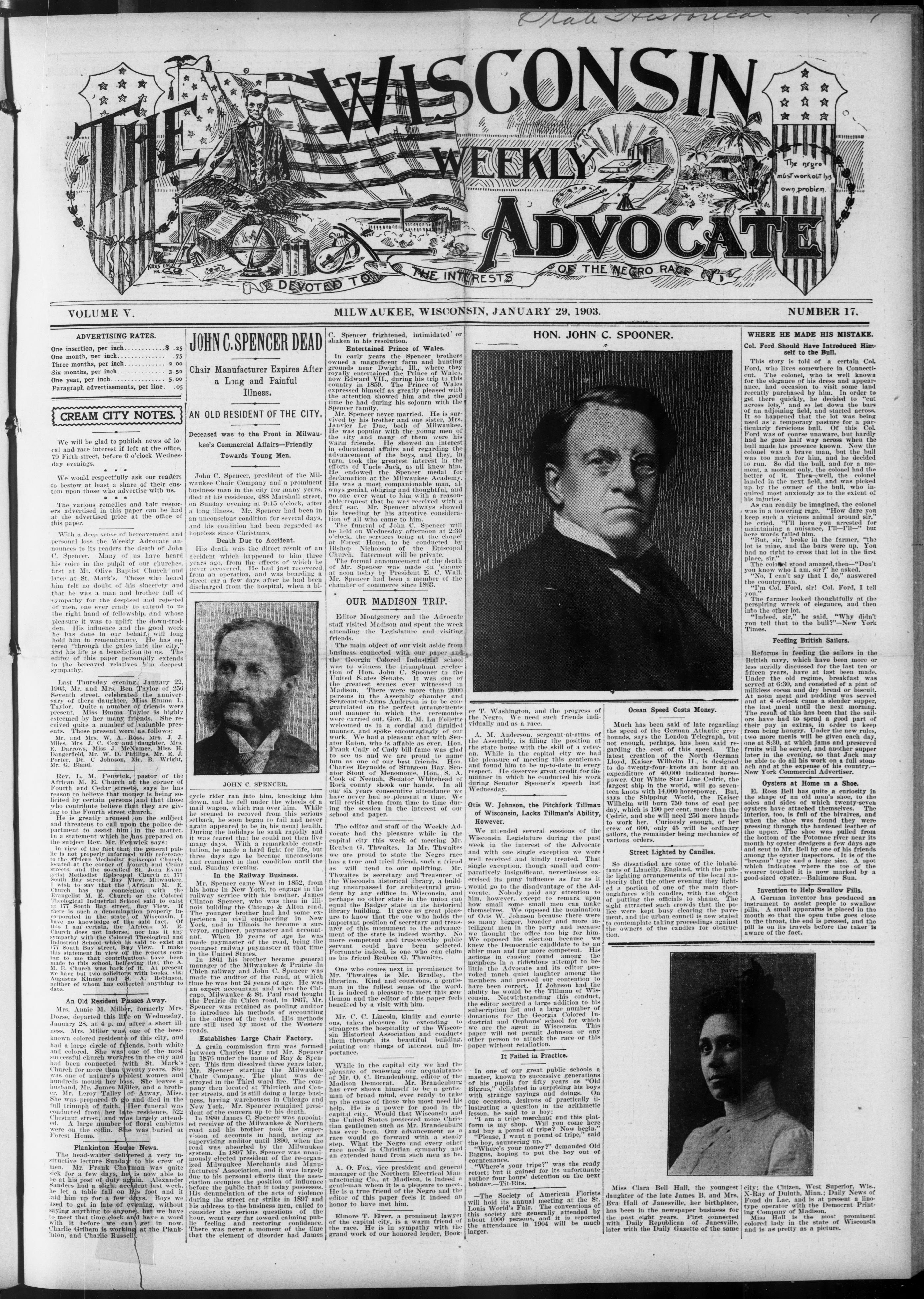
JOHN C.SPENCER DEAD
JOHN C.SPENCER DEAD
Chair Manufacturer Expires After a Long and Painful Illness.
Deceased was to the Front in Milwaukee's Commercial Affairs—Friendly
John C. Spencer, president of the Milwaukee Chair Company and a prominent business man in the city for many years, died at his residence, 488 Marshall street, on Sunday evening at 9:15 o'clock, after a long illness. Mr. Spencer had been in an unconscious condition for several days, and his condition had been regarded as hopeless since Christmas.
Death Due to Accident.
His death was the direct result of an accident which happened to him three years ago, from the effects of which he never recovered. He had just recovered from an operation, and was boarding a street car a few days after he had been discharged from the hospital, when a bi-
The quick brown fox jumps over the lazy dog.
cycle rider ran into him, knocking him down, and he fell under the wheels of a mail wagon, which ran over him. While he seemed to recoved from this serious setback, he soon began to fail and never appeared to be in his usual health. During the holidays he sank rapidly and it was feared that he could not then live many days. With a remarkable constitution, he made a hard fight for life, but three days ago he became unconscious and remained in that condition until the end. Sunday evening.
In the Railway Business.
Mr. Spencer came West in 1852, from his home in New York, to engage in the railway service with his brother, James Clinton Spencer, who was then in Illinois building the Chicago & Alton road. The younger brother had some experience in civil engineering in New York, and in Illinois he became a surveyor, engineer, paymaster and accountant. When 19 years of age he was made paymaster of the road, being the youngest railway paymaster at that time in the United States.
In 1861 his brother became general manager of the Milwaukee & Prairie du Chien railway and John C. Spencer was made the auditor of the road, at which time he was but 24 years of age. He was an expert accountant and when the Chicago, Milwaukee & St. Paul road bought the Prairie du Chien road, in 1867, Mr. Spencer was retained as pooling auditor to introduce his methods of accounting in the offices of the road. His methods are still used by most of the Western roads.
Establishes Large Chair Factory.
A grain commission firm was formed between Charles Ray and Mr. Spencer in 1876 under the name of Ray & Spencer. This firm dissolved three years later, Mr. Spencer starting the Milwaukee Chair Company. The plant was destroyed in the Third ward fire. The company then located at Thirtieth and Center streets, and is still doing a large business, having warehouses in Chicago and New York. Mr. Spencer remained president of the concern up to his death.
In 1880 James C. Spencer was appointed receiver of the Milwaukee & Northern road and his brother took the supervision of accounts in hand, acting as supervising auditor until 1890, when the road was absorbed by the Milwaukee system. In 1897 Mr. Spencer was unanimously elected president of the re-organized Milwaukee Merchants and Manufacturers' Association, and it was largely due to his personal efforts that the association occupies the position of influence before the public that it today possesses. His denunciation of the acts of violence during the street car strike in 1897 and his address to the business men, called to consider the serious questions of the hour, went very far toward calming public feeling and restoring confidence. There was never a moment of the time that the element of disorder had James
MILWAUKEE, WISCONSIN, JANUARY 29, 1903.
C. Spencer frightened, intimidated or shaken in his resolution.
Entertained Prince of Wales.
In early years the Spencer brothers owned a magnificent farm and hunting grounds near Dwight, Ill., where they royally entertained the Prince of Wales, now Edward VII., during his trip to this country in 1859. The Prince of Wales expressed himself as greatly pleased with the attention showed him and the good time he had during his sojourn with the Spencer family.
Mr. Spencer never married. He is survived by his brother and one sister, Mrs. Janvier Le Duc, both of Milwaukee. He was popular with the young men of the city and many of them were his warm friends. He showed an interest in educational affairs and regarding the advancement of the boys, and they, in turn, took the greatest interest in the efforts of Uncle Jack, as all knew him. He endowed the Spencer medal for declamation at the Milwaukee Academy. He was a most companionable man, always genial, obliging and thoughtful, and no one ever went to him with a reasonable request that he was received with a deaf ear. Mr. Spencer always showed his breeding by his attentive consideration of all who came to him.
The funeral of John C. Spencer will be held on Wednesday afternoon at 2:30 o'clock, the services being at the chapel at Forest Home, to be conducted by Bishop Nicholson of the Episcopal Church. Interment will be private.
The formal announcement of the death of Mr. Spencer was made on 'change at noon today by President E. C. Wall. Mr. Spencer had been a member of the chamber of commerce since 1863.
OUR MADISON TRIP.
Editor Montgomery and the Advocate staff visited Madison and spent the week attending the Legislature and visiting friends.
The main object of our visit aside from business connected with our paper and the Georgia Colored Industrial school was to witness the triumphant re-election of Hon. John C. Spooner to the United States Senate. It was one of the greatest scenes ever witnessed in Madison. There were more than 2000 persons in the Assembly chamber and Sergeant-at-Arms Anderson is to be congratulated on the perfect arrangements and manner in which the ceremonies were carried out. Gov. R. M. La Follette welcomed us in a cordial and dignified manner, and spoke encouragingly of our work. We had a pleasant chat with Senator Eaton, who is affable as ever. Hon. Frank Cady of Cady bill-fame was glad to see us and we are proud to name him as one of our best friends. Hon. Charles Reynolds of Sturgeon Bay, Senator Stout of Menomonie, Hon. S. A. Cook of Neenah, Senator Whitehead of Rock county shook our hands. In all our six years consecutive attendance we have never had so pleasant a time. We will revisit them from time to time during the session in the interest of our school and paper.
The editor and staff of the Weekly Advocate had the pleasure while in the capital city this week of meeting Mr. Reuben G. Thwaites. In Mr. Thwaites we are proud to state the Negro race has a true and tried friend, such a friend as will tend to our uplifting. Mr. Thwaites is secretary and treasurer of the Wisconsin historical library, a building unsurpassed for architectural grandeur by any edifice in Wisconsin, and perhaps no other state in the union can equal the Badger state in its historical library building. It gave us great pleasure to know that the one who holds the important position of secretary and treasurer of this monument to the advancement of the state is indeed worthy. No more competent and trustworthy public servant could have been selected. Fortunate indeed, is one who can claim as his friend Reuben G. Thwaites.
One who comes next in prominence to Mr. Thwaites is Mr. Bradley, the librarian. Kind and courteous, a gentleman in the fullest sense of the word. It is indeed a pleasure to meet this gentleman and the editor of this paper feels benefited by a visit with him.
Mr. C. C. Lincoln, kindly and courteous, takes pleasure in extending to strangers the hospitality of the Wisconsin Historical Association and conducts them through its beautiful building, pointing out things of interest and importance.
While in the capital city we had the pleasure of renewing our acquaintance of Mr. O. C. Brandenburg, editor of the Madison Democrat. Mr. Brandenburg has ever shown himself to be a gentleman of broad mind, ever ready to take up the cause of those who most need his help. He is a power for good in the capital city. Would that Wisconsin and the United States possessed more Christian gentlemen such as Mr. Brandenburg has ever been. Our advancement as a race would go forward with a steady step. What the Negro and every other race needs is Christian sympathy and an extended hand from such men as he.
A. O. Fox, vice president and general manager of the Northern Electrical Manufacturing Co., at Madison, is indeed a gentleman whom it is a pleasure to meet. He is a true friend of the Negro and the editor of this paper feels it indeed an honor to have met him.
Elmore T. Elver, a prominent lawyer of the capital city, is a warm friend of the race. He is in sympathy with the grand work of our honored leader, Book-
9
er T. Washington, and the progress of the Negro. We need such friends individually and as a race.
A. M. Anderson, sergeant-at-arms of the Assembly, is filling the position at the state house with the skill of a veteran. While in the capital city we had the pleasure of meeting this gentleman and found him to be up-to-date in every respect. He deserves great credit for the manner in which he conducted his work during Senator Spooner's speech last Wednesday.
Otis W. Johnson, the Pitchfork Tillman of Wisconsin, Lacks Tillman's Ability, However.
We attended several sessions of the Wisconsin Legislature during the past week in the interest of the Advocate and with one single exception we were well received and kindly treated. That single exception, though small and comparatively insignificant, nevertheless exercised its puny influence as far as it would go to the disadvantage of the Advocate. Nobody paid any attention to him, however, except to remark upon how small some small men can make themselves. We opposed the nomination of Olis W. Johnson because there were so many bigger, broader and more intelligent men in the party and because we thought the office too big for him. We opposed his election because we knew the Democratic candidate to be an abler man and far more competent. His actions in chasing round among the members in a ridiculous attempt to bellittle the Advocate and its editor provoked much quiet laughter among the members and proved our contention to have been correct. If Johnson had the ability he would be the Tillman of Wisconsin. Notwithstanding this conduct, the editor secured a large addition to his subscription list and a large number of donations for the Georgia Colored Industrial and Orphans' school for which we are the agent in Wisconsin. This paper will not permit Johnson or any other person to attack the race or this paper without retaliation.
It Failed in Practice.
In one of our great public schools a master, known to successive generations of his pupils for fifty years as "Old Biggus," delighted in surprising his boys with strange sayings and doings. On one occasion, desirous of practically illustrating a question in the arithmetic lesson, he said to a boy:
"I am a tripe merchant and this platform is my shop. Will you come here and buy a pound of tripe? Now begin."
"Please, I want a pound of tripe," said the boy, sauntering up.
"Where's your money?" demanded Old Biggus, hoping to put the boy out of countenance.
"Where's your tripe?" was the ready retort; but it gained for its unfortunate author four hours' detention on the next holiday.—Tit-Bits.
—The Society of American Florists will hold its annual meeting at the St. Louis World's Fair. The conventions of this society are generally attended by about 1000 persons, and it is reported the attendance in 1904 will be much larger.
Ocean Speed Costs Money.
Much has been said of late regarding the speed of the German Atlantic grey-hounds, says the London Telegraph, but not enough, perhaps, has been said regarding the cost of this speed. The latest creation of the North German Lloyd, Kaiser Wilhelm II., is designed to do twenty-four knots an hour at an expenditure of 40,000 indicated horsepower. Our White Star Line Cedric, the largest ship in the world, will go seventeen knots with 14,000 horespower. But, says the Shipping World, the Kaiser Wilhelm will burn 750 tons of coal per day, which is 190 per cent, more than the Cedric, and she will need 256 more hands to work her. Curiously enough, of her crew of 600, only 45 will be ordinary sailors, the remainder being mechanics of various orders.
Street Lighted by Candles.
So dissatisfied are some of the inhabitants of Llanellly, England, with the public lighting arrangements of the local authority that the other evening they lighted a portion of one of the main thoroughfares with candles, with the object of putting the officials to shame. The sight attracted such crowds that the police were kept busy clearing the pavement, and the urban council is now stated to contemplate taking proceedings against the owners of the candles for obstruction.
Mary E.
Miss Clara Bell Hall, the youngest daughter of the late James B. and Mrs. Eva Hall of Janesville, her birthplace, has been in the newspaper business for the past eight years. First connected with Daily Republican of Janesville, later with the Daily Gazette of the same
WHERE HE MADE HIS MISTAKE.
Col. Ford Should Have Introduced Himself to the Bull.
This story is told of a certain Col. Ford, who lives somewhere in Connecticut. The colonel, who is well known for the elegance of his dress and appearance, had occasion to visit some land recently purchased by him. In order to get there quickly, he decided to "cut across lots," and so let down the bars of an adjoining field, and started across. It so happened that the lot was being used as a temporary pasture for a particularly ferocious bull. Of this Col. Ford was of course unaware, but hardly had he gone half way across when the bull made his presence known. Now the colonel was a brave man, but the bull was too much for him, and he decided to run. So did the bull, and for a moment, a moment only, the colonel had the better of it. Then well, the colonel landed in the next field, and was picked up by the owner of the bull, who inquired most anxiously as to the extent of his injuries.
As can readily be imagined, the colonel was in a towering rage. "How dare you keep such a vicious animal around sir," he cried. "I'll have you arrested for maintaining a nuisance, I'll—I'll—" but here words failed him. "But, sir," broke in the farmer, "the lot is mine, and the bars were up. You had no right to cross that lot in the first place, sir."
The colonel stood amazed,then—"Don't you know who I am, sir?" he asked.
"No, I can't say that I do," answered the countryman.
"I'm Col. Ford, sir! Col. Ford, I tell
you.
The farmer looked thoughtfully at the perspiring wreck of elegance, and then into the other lot.
"Indeed, sir," he said. "Why didn't you tell that to the bull?"—New York Times.
Feeding British Sailors.
Reforms in feeding the sailors in the British navy, which have been more or less acridly discussed for the last ten or fifteen years, have at last been made. Under the old regime, breakfast was served at 6:30, and consisted of a pint of milkless cocoa and dry bread or biscuit. At noon meat and pudding was served and at 4 o'clock came a slender supper, the last meal until the next morning. The result of this has been that the sailors have had to spend a good part of their pay in extras, in order to keep from being hungry. Under the new rules, two more meals will be given each day, one at 8:30, at which jams and preserved fruits will be served, and another supper later in the evening, so that Jack may be able to do all his work on a full stomach and at the expense of his country.—New York Commercial Advertiser.
Oysters at Home in a Shoe.
E. Ross Bell has quite a curiosity in the shape of an old man's shoe, to the soles and sides of which twenty-seven oysters have attached themselves. The interior, too, is full of the bivalves, and when the shoe was found they were pressing through the hardened leather of the upper. The shoe was pulled from the bottom of the Potomac river near its mouth by oyster dredgers a few days ago and sent to Mr. Bell by one of his friends among the oyster inspectors. It is of the "brogan" type and a large size. A spot which indicates where the toe of the wearer touched it is now marked by a good-sized oyster.—Baltimore Sun.
Invention to Help Swallow Pills.
A German inventor has produced an instrument to assist people to swallow pills. A small apparatus is placed in the mouth so that the open tube goes close to the throat, the end is pressed, and the pill is on its travels before the taker is aware of the fact.
city; the Citizen, West Superior, Wis. X-Ray of Duluth, Minn.; Daily News of Fond du Lac, and is at present a linotype operator with the Democrat Printing Company of Madison.
Miss Hall is the most prominent colored lady in the state of Wisconsin and is as pretty as a picture.
TWO BANKS ROBBED.
Cracksmen Take $3000 fiom, Vault Whick
They Had Blown Open with
Nitro-Glycerin.
Steelville, Il., Jan. 27.—Robbers blew
open the vault of the Bank of Steelville
at 3 o’clock this -morning and secured
$3000 and escaped in a carriage. The
sheriff and a posse has started in pursuit.
Paul Zimmer, an engineer, was awak-
ened by the rere of the first explosion.
Dressing hurriedly, Mr, Zimmer went
down through the alley in the rear of
his house to the mill and informed the
mill employes. Zimmer and the men
then armed themselves and started to-
ward the bank. Three other explosions
were heard in quick succession. The last
explosion, more serious than any of the
pecans ones, was followed by a crasb-
ng of glass and sheets of flame poured
from the bank windows. te
Told Husband to Hurry Up.
Mrs. Zimmer in the meantime had
dressed herself and was standing on the
lawn of their dwelling watching the rob
bers. She screamed to her husband tc
hurry up or the robbers would get away
with the money. The robber on guard
turned toward the woman and, flourisb-
ing a revolver at her, said: “Shut up o1
I'll blow your head off.”
Turning to the bank the robber asked
his confederate: “Are you all right,
Jim? Hurry up and scrape up the cash
for they are after us, but I'll blow the
head off the first man I see.”
The mill is about two blocks from the
bank, but so rapidly had the robbers
worked that the vault was blown, the
money gathered and the two men were
running rapidly up the street by the time
Mr. Zimmer and his posse had armed
themselves and started toward the bank.
Nebraska Bank Robbed.
Waterloo, Neb., Jan. 27.—Four men
robbed the Citizens’ Bank of Waterloo
early today and escaped with $3500 in
cash after exchanging shots with a squad
of citizens attracted to the scene by the
explosion of the safe, which was
wrecked. While two of the robbers
worked inside the bank the other two
stood guard. A dozen citizens appeared
on the scene soon after the explosion,
gathered about the bank and opened fire
on the robbers. The fire was returned,
one of the robbers on guard shouting to
the citizens that they had come there to
rob the bank and intended to do it. Then
worker finished, the robbers made 2 dash
into the darkness. Another fusillade of
bullets was exchanged, but nobody was
hurt, the robbers finally getting away in
a stolen rig.
LYNCH AND BURN A NEGRO.
Louisiana Mob Avenges Sheriff Killed
While Making Arrest.
New Orleans, La., Jan. 27.—John
Thomas, a negro, who shot and killed
Sheriff Benjamin BE. Ory of St. Charles’
parish, near this city, was killed by a
anob and his body burned yesterday aft-
ernoon, Thomas shot Sheriff Ory while
the latter was attempting to arrest him |
and himself was wounded,in the arm.
He succeeded in making h®& escape, but
a posse was immediately organized to
search for, him.
The members of the posse finally lo-
cated him in the drainage ditch of the
Ashton plantation, a mile from the scene
of the murder. They opened fire on the
negro and riddled his body with bullets.
Then placing the body in the victim's
cabin near by they set fire to the building
and burned it to the ground.
—___—_-___—__
SCANDAL CAUSES SENSATION.
Attorney Yount of Covington Sued for
Divorce by Young Wife.
Crawfordsville, Ind., Jan. 27.—-Miss
Mary Hicks, a former society leader‘of
Indianapolis and a niece of E. H. Ne-
beker, former United States treasurer
under Harrisor, has filed a sensational
divorce against her husband, Hannibal
Yount, a well-xnown Covington, Ind., at-
torney, to whom she was married only
four months ago In her allegations she
charges cruel and juhuman treatment and
violation of marriage vows.
It is understood that Yount wiil not
deny the allegations or fight the vase.
He is owner of the Covington Water and
Light Company. a meniber of the school
board and has connections with the bank-
ing interests of that place,
—
. TRAINMEN ARE INJURED.
Collision Between Freight Engine and
Passenger Near Danville, Ill.
Danville, Ill., Jan. 27.—The _ south-
bound Chicago & Evansville mail train
on the Chicago & Eastern Ulinois raii-
road collided with a “light” freight en-
gine one and a half miles south of Dan-
ville early this morning, seriously iujur-
ing the passenger engineer and slightly
injuring one mail clerk and two jas-
sengers.
The impact was not violent, the trains
having slowed down considerably. En-
gineer William Titus jumped, striking on
his head. His fireman and the other ea-
gine crew remained on their engines and
were uninjured,
eee
FELL INTO EAS RIVER.
Woorkmen Drops from Center Span of
New Brooklyn Bridge.
New, York, Jan. 27.—Hundreds of per-
sons witnessed the death yesterday from
the center span of the new East river
bridge of Patrick McDermott, an iron
worker.
MeVermott fell.156 feet. He had been
working on the iron work on the Wil-
liamsburg side of the bridge, and with
his fellow workmen had just raised a
large iron girder, While standing near
the edge of the iron work he lost his bal-
ance. The men on the bridge thought
they saw McDermott swimming for the
shore, but they were evidently mistaken.
eee
PRINCE FOUND DEAD.
‘Whether Murdered or Accidentally Shot
is Not Known.
Nordhausen, Prussia, Saxony, Jan. 27.
—Prince Wolffgang Su Stolberg-Stolberg
was found shot dead in the park of his
castle at Rottleberode. His rifle was
nearby, but it is not known whether he
was murdered or accidentally shot. The
prince’s father died a few days ago.
_—_—
Origin of the Word Roorbach.
Over fifty years ago a writer of monn-
mental but plausible Nes in Thurlow
Wee's Albany Evening Journal signed
his letters “Baron Roorbach.” There
was no man named “Roorbach.” But
the absolute falsity of the writer’s state-
ments was such that a “Roorbach” be-
came a synonym for any kind of lie, espe-
cially for the kind against personal char-
acter, suddenly issued against a man for
his injury when he could not meet it in
time to avert the harm.
ee
Tallest Horse.
The greatest size a horse has been
known ae is 2014 hands high. This
is the r of a Clydesdale, which was
on exhibition in 1889.—San Francisco
Chronicle.
a
—Liverpool has just received its first
consignment of mahogany from Austra-
a
ROUTINE OF CONGRESS.
Dracecdince in the Senate.
Gen. Merriam, retired, to the grade of
major general on the retired lst, and a
¥iding for additional terms of court in the
western judicial district of South Carolina.
The legislative, executive and Andicial ae
ropriation bill was sent to conference, at
Genre Cullom, Warren and Cockrell nam
‘as conferees, At 5:15 the Senate went Into
executive session, and at 5:25 p. m. ad-
journed, Mr. Burnham not having finished
ifs speech on the statehood bill.
‘The statehood bill again occupied the at-
‘tention of the Senate on the 23d. During
the debate several spirited colloquies oc:
enrred, {n which senators on both sides of
‘the question charged the others wish ob-
structing tmportant legislation. Mr, Burn-
ham continued his remarks in opposition to
the admission of Oxlahoma, Arizona
and New Mexico. peeing the morning hour
Mr. Fairbanks made an ineffectual attempt
to secure consideration of the immigration
bill. Mr. Quay ylelded during the day to
rmit the passage of a House bill author-
Tics the President to place on the retired
list of the navy the name of Julius A. Kais-
er, as a passed assistant engineer. A bill
was also passed a, the construc-
tion of a revenue cutter to be employed im
Hawailan waters. After an executive ses-
sion the Senate adjourned.
‘The Senate had barely assembled on the
24th when Mr. Quay, in charge of the omni-
bus statehood bill, moved that when the
Senate adjourn !t he to mect at 11 a. m. on
the 26th, an hour in advance of the usual
time. He gave as his resaon for this mo-
tion the fact that the diplomatic appropria-
tion bill is to be taken up. Mr. Hale of
the committee on appropriations objected
to the motion as being oppored to the real
expedition of business, and the request was
withdrawn by Mr. Quay, who said he did
so in deference to the wishes of the appro-
riation committee. A bill Increasing the
fintt of cost of the public bullding at _In-
@anapolis to the extent of $400,000 was
passed. The Senate also agreed to a resolu-
tion introduced by Mr. Jones (Ark.) in-
structing the committer on naval affairs
to inquire whether it is not practical to
use other olls than naphtha and gasoline
on war vessels. On Mr. Quay's motion the
omnibus statehood bill was then taken up.
but he gave way while a number of bills
were passed. At 1:20 the statehood bill
was again called up, and Mr. Spooner took
the floor. He sald he did not propose to
speak to the pending bill, and began dis-
cussing the Indianola (Miss.) postoflice case.
The session closed with the passage of a
number of private pension bills, an execu-
tive session preceding adjournment.
In the Senate on the 26th Mr. Quay, in
charge of the omnibus statehood bill, insist-
ed upon its consideration to the exclusion
of other business. When Senator Piatt of
New York attempted to call np a commit-
tee report providing for the printing of a
dcenment Mr. Qnay objected. Mr. Tale
thereupon declared Mr. Quay was confiscat-
ing the time of the Senate. The latter re-
plied calmly that this could be obviated by
allowing a yote on the statehood bill. A
resolution offered by Mr. Morgan of Ala
bama, questioning the credentials of Dr.
Herran, the Colombian charge d'affaires.
who signed with Secretary Hay the canai
treaty. caused the Senate to go into a long
executive session. At its conclusion the
diplomatic and consular appropriation bili
was passed. The lndge amendment provid-
ing for a reorganization of the service was
Pated ont of order and debate thereby cut
off. The credentials of Senator Alger and
of Senator Kittredge to succeed ‘himself
were presented and the oath of office ad-
ministered to them. The statehood bill then
was taken up, and Mr. Foraker, having it
in charge in the absence of Mr. Quay, yield-
ed for the passage of a House bill making
an appropriation for the suppression and to
prevent the spread of contagious and infec-
tions diseases of live stock. Mr. Burnham
Was not ready to continue his statehood bill
speech today, and the Senate adjourned,
Senator Quay made an effort on the 27th
to hold the Senate in continuous session te
consider the statehood bill, but failed. to
hold a quorum, and was compelled on that
account to allow the Senate to adjourn at
6:20 p. m. He seenred another ballot. how:
ever, to test the sentiment of the Senate,
the ‘vote standing 17 to 29 in his favor.
The day was spent in consideration of the
statehood bill with the exception of an hour
devoted to a speech by Mr. Scott of West
Virginia, on the eo laws, He urged
the passage of his resolution providing a
pension of $12 a month to any Union vet-
eran who served ninety days and. had
passed the age of 62. ‘The feature. of the
statehood bill under. spcvial consideration
was the Arizona refunding proposition. It
was charged that the territory has sought
to repudiate bonds held by Bird &. Coler,
late Democratic candidate for governor of
New York. Bills were passed providing for
the allotment of lands in severalty to the
Indians of Lac Courte Oreille and Lae de
Flambeau reservation In Wisconsin,
In the Senate on the 28th, Mr. Rawlins
called up his resolution directing the sec-
retary of war to furnish the Senate the
Peeectere of a number of courts-martial
n the Philippines. A sharp debate ensucd,
in which Messrs. Lodge. Hever tage, Car-
mack. Proctor and Tillman part}cipated,
alleged abuses in the army being the sub:
Ject. Mr. Quay stopped the debate by de-
manding the regular order. Discussion of
the statehood bill thereupon was resumed,
and Mr. Lodge addressed the Senate in. e-
position to the omnibns mweasnre, speaking
for two hours and a half. An attempt. by
Mr. Aldrich to divide the time ef the Sen-
ate hetween the statehood bil! and other
business failed, Mr. Quay objecting.
Proceedings in the House.
The committce on naval affairs was
authorized by the House on the 224 to in-
vestigate the Lessler bribery charges in
connection with the submarine boat bill.
The Philippine coinage hill reported by the
insular affars committee was rejected and
the substitute presented by the minority
was adopted by a vote of 146 to 128, twen-
ty-eight Republicans voting with the Demo-
erats for adoption. A resolution was adopt-
ed calling upon the secretary of the treas-
ury for a list of national banks helding gov
ernment deposits other than deposits of dis-
bursing officers December 31, 1892, and on
each suceceding December 31 up to the
present time. with the amount held and the
average amount of such deposits In. each
year. The Alaska delegate bill was then
taken up.
‘The House passed 225 private pension bfils
on the 23d. They included pensions to the
widow of Gen. Franz Sigel at $100 a month.
the widow of Gen. Francis Negley at $50,
and the widew of Rear Admiral Menry
Pleking at $40. The Alaska delegate bill
Pras passed without division. It provides
for the representation of the territory nt
Alaska in the Honse of Representatives by
a delegate. It also defines the citizenship
and the qualification of electors aud creates
the michinery for the elections, the date
of which shail be the last Tnosday tn Sep-
tember. The first delegate is to be eiected
hext sutnumn, and fs to hold a seat in the
Fifty-elghth ro Mr, Lond (Cal.) re-
ported the postofice appropriation DiI.
After some routine business on the 24th
the Honse went Into commlitee of the
whole and took up the consideration of the
agricultnral appropriation bill. Mr. Wads-
worth, chairman of the committee on agri
culture, who was in charge of the bill, ex-
plained that it carried $5,228,800, being $29,-
000 in excess of the current law. One of
the {Increases consists of an appropriation of
$10.000 for investigating the besc method of
exterminating the cotton bell weevil, The
appropriation for the distribution of seed
was 'ncreased from $270.000 to €300.000 on
of holding court, ete., but two were of gen-
eral importance. One was, to meet sthe
original package decision of the supreme
court by making intoxicating liquors im-
ported into states subject to the jurisdiction
of such states. The bill is designed to pre-
‘Yent. evasion under the original package
‘decision of liquor laws in prohibition states.
The other bill is the Senate bill to increase
‘the salaries of federal judges. The pro-
vision ‘abolishing the payment of any ex-
penses of federal judges was stricken out.
“The bill raises the salaries of the chief jus-
tice of the supreme court to $13,000, the as-
-goclate justices to $12,500, circuit judges to
$7000, district judges to $6000, the chief jus-
$7000. aie court of claims to $6300, aaso-
elate justices to $6000 and the justices of
‘the supreme court of the District of Co-
lumbla to $6000, Other bilis passed create
additional district judges in the southern
district of New York and In the district of
Minnesota and provide an additional clreuit
judge in the eighth judicial cireult court,
The House on the 28th made slow prog-
ress with the Indian appropriation bill, coy-
ering only about eight pages in over four
hours. Mr. Burton of Ohio hung on the
flank of Mr. Sherman of New York, who
had charge of the bill, and tnsisted upon
an explanation of every item. He sue-
ceeded in having several appropriations ent
Gown. Amendments were agreed to appro-
priating $21,300 for a survey of the Pine
Ridge reservation, S. D., snd striking out
the appropriation of $10,000 for a ware-
house at St. Louls, ‘The Senate amenid-
ments to the bill to amend the bankruptey
act were agreed to, The speaker Spee
Messrs. Hildebrand (Rep.. ©.), Hughes
(tep., Va.) and Bartlett (Dem.. Ga.) mem-
hers of the temporary committee on ac-
counts of the next Congress, Mr. Smith
of Arizona replied to charges made in the
Senate during the debate on the statchood
bil, denying that Arizona had ever repudi-
ated a single dollar of her debt.
LATEST MARKET REPORTS.
MILWAUKEF, JANUARY 28, 1903.
Pee ANT DATRY PRODUCTS.
MILWAUKEE—Eggs — Market weak,
strictly fresh, loss off, cases included, 33c.
fresh, cases returned, 22%4c; seconds, le:
fancy storage, 184@19e: pickled, 16@16c:
‘receipts of fresh eggs continue fair; demand
is good. Receipts were 580 cases.
Butter — Market casy. Fancy _ prints.
‘25%e; fancy or extra creamery, pet
ib,” ‘"25¢; ‘firsts, 22c; — seconds, 17:
June creamery, 23c: extra fancy dairy. 18¢:
lines, 15@16¢; roll, 16@16e; whey, 10c! pack:
ing stock, 14¢; demand is rather light and
stock is moving slowly; offerings very plen-
tiful. Recelpts, 25,600 Ibs; yesterday, 26,-
000 Ibs.
Cheese — Firm, ‘he demand continues
good; full. cream dats, faney, 13@14e:
good to choice, 11@12c; Young Americas,
13@13%e; low grades, 10G@11c: limburger, per
Ib, No. 1, 114@12c: low grades. 10@11¢;
imported Swiss. 25c> Block Swiss. domestic.
14@l5c. fancy loaf. 144@15%4e: No. 2, 12@
3c: Sapsago, 20c. Receipts, 7152" Ibs:
yesterday. 1000 Ibs.
CHICAGO—RButter—Dull, weak; creamer.
les, 17a@24yc; dairies, | 17@28e. Eggs—
Weak; loss off, cases returned. 2c. Cheese
—Dull, firm; twins, 1c; daisies, 131g@i4e:
Young Americas, 13%c.' Dressed poultry-
Quiet; turkeys steady, 15@18e; chickens
firm, 8@1214c.
HERESY 2807 EE SESS Sse ee ee eee
HOGS—Receipts, 8 cars; market_10¢ low
er; light, 180 to 160 Ibs, 6.00@6.25; mixed.
180 to 225 Ibs, 6.30@6.50; good to choice, 20
to 250 Ibs, 6.35@6.60; selected heavy, 250 te
300 Ibs, 6.50@6.80; pigs, 30 to 110 Ibs, 5.254
5.65.
CATTLE — Receipts, 2 cars; lower:
butchers’ steers, medium to good. 1050 to
1300 Ibs, 4.25@5.00; fair to medium, 950. te
1050 ibs, 3.50@4.00: heifers. common, 2.735@
8.25: good, 3.00G@4.00; cows. fair to good.
2-85@3.65; canners, 1.75@2.40; cutters, 2.50G
2.73: bulls, common, 2.754%.25: choice. 3.5
@4.00; feeders, 800° to 950 Ibs, 3.50@4.00:
stockers, 500 to 750 Ibs. 2.50@3.25: veal
calves, ligit, 90 to 105 Ibs, 4.50@5.00; good,
110 to 150 Ibs,.5.75@6.25. Milkers—Common,
15.004 25.00; Choice, 35.00@50.00.
SHEEP—Receipts, 1 car; steady; 3.00@
4.00; bucks, 2.50@3.00; lambs, common to
choice, 4.00G5.75.
Chicago receipis: Hogs, 50,000; cattle,
28,000; sheep, 24,600.
MILWAUKEE HAY MARKET.
Timothy steady; carlots, choice timothy
12.25@12.50: No. '1 timothy, 11.75@12.00;
No. 2 timothy, 9.50@10.50; clover and clover
mixed, 9.00@10.00,
Prairle bay steady; cholce Kansas, 11,50
G12.00; No. 1 Kansas, 11.00@1195; No. 2,
.50@9.00,
Wisconsin prairie, 8.00@9.00.
Straw, steady; rye, 7.00@7.50; oats, 6.00@
6.00; wheat. 4.00@4.50; packing ‘hay, 6.50.
MILWAUKEE POTATO MARKET.
Potatoes—Market firm: prded fairly good;
demand good; per bus, carlots, on track.
Rurais and Burbanks, fancy large up to 43@
(50c; choice Rose and Peerless, 45c; inferior
stock down to 40c.
| MARKETS RY TELEGRAPH.
MILWAUKEE—Flour—Steady. Wheat —
Weak; No, 1 Northern, on track, 79¢: No. ‘
Northern, on track. 78i%c. Corn—Steady
No. 3.0n track, 424c¢. Oats—Firm; No. :
white, on track, 351%4c; No. 3 white, ‘o1
track, 35@35i¢c. ’ Barley—Weaker; No. 2 ot
track, 64c; sample on track, 43@64c. “Rye
Steady; No. 1 on track, 51%. Provisions
Firm; pork, 18.95; lard,’ 10.20. é
Flour market steady; patents, 3.85@3.05
bakers’, 2.85@2.95; rye, 2.90@3.00,
Millstuffs are firm and quoted at 17.0
for bran, 17.00 for standard middlings and
18.50 for Milwaukee flour middiings in 100
Ib sacks; red dog, 20.00. Dellyered te
country points, 1.00 extra.
CHICAGO—Close — Wheat — May, 78%
July, 74ec. Corn—January, 4540! May
s4umass%e; July, 484G43%e; September
48\4¢. Oats—January, 38c; May, 36G26%e
July, 82%. “Pork—January, 18.85; May,
16.55@16.50%4:; July, 16.25.” "Lard—January
10.15; February, 9.524%; May, 9.4749: July,
9.30." Ribs—Janvary, 8.00; May, 9.07!g; July
8.9714; September, 8.92%." Itve—May, 51%
Flax—Cash N. W., 1.23: 8. W., 1.18; May.
1.22@1,2214. "‘Timothy—January, 4.25) "Clo
ver—January, 11.75. Barley—Cash, 42@58e
NEW YORK—Close—Wheat—May, $1i¢e)
July, 78%e. Corn—May, G0We; July, 48%.
MINNEAPOLIS — Close —' Wheat—May
7%e; July, Té%e; on track, No. 1 hard
Tie; No. 1 Northern, 76%c; No. 2 North
ern, 73%.
DULUTH—Close —Wheat — Cash No. }
hard, 76%; No. 1 Northern, 75e: No. $
Northern, Te; No. 3 spring, Tike; te
arrive, No. 1 hard, 77%; No. 1 Northern
T6%e; May, T7%e; July, Tike. Oats—May
B6e; on track, 34c; to’ arrive, 84e. Rye—
May, Sle; to’ arrive, 49¢; on track, 49¢
Barley—25@5le. Flax—Cash, 1.17; on track
1.17; to arrive, 1.18%; January, 1.17; May
1.2016; July, 121%. Receipts—Wheat, 38,
870 bus. Shipments—None.
Divorces Here and Abroad.
No eruption of Vesuvius since the de-
struction of Pompeii and Herculaneum
has been more volcanic than the tre-
mendous agitation in Italy over the pro-
posed divorce law. The descendants of
the ancient Romans have been shaken
to their centers by the debates concerp-
ing the possible severances of marriage
relations under the findings of referees
confirmed by the courts. Roman legions
of this era protest earnestly against di-
voree express trains of the traditional
Chicago and Sioux City kind. “Five
minutes for passengers who want to be
divorced” was reported at one time to be
a regular announcement in palace cars
which made brief stops in Cook county.
on the shores of Lake Michigan, in the
course of their journeys westward. But
the tendency at present is in the direc-
tion of a more reasonable deliberation in
the setting apart of wedded couples. The
old reckless methods of divorce have
passed out of public favor. Divorces are
now looked upon askance, at least to
some extent, even in the Dakotas.—New
York Tribune.
—<$<$<__s___
Obiects to Its Beine Flatteneas
A scientist says that “if the earth was
flattened the sea would be two miles
deep all over the world.” And an Okla-
homa editor gives out the following: “It
any man is caught flattening out the
earth shoot him on the spot. and don't
be too particular about what spot.
There's a whole lot of us in Oklahoma
that can’t swim.”—Kansas City (Mo.)
Journal.
LEGISLATURE
Senate.
grain comnission to be composed of two
members Sie from Wisconsin and a
third from North Dakota, and its purpose
is to insure to bert bt the actual. grade
of their wheat, yield better prices to the
farmer, and give a superior product to the
consumer. A commuunicalon was ieceived
from the Arizona Legislature asking sup-
port, through a memorial to Congress, of
The omnibus statchood. Dill. A joint Lose:
lution on the death of Senator DeWayne
Stebbins, who died June 12. 1901, was in-
troduced by Senator McGillivray and laid
over to the 29th, when speeches will be
made. A joint resolution providing for the
building of good roads was introduced by
Senator MeGillivray. Senator Rogers’ me-
morilal to Congress urging lestalation to
give greater effectiveness to the interstate
commerce act, amended by excluding ref-
erence to the Elkins and Wanger bills,
was adopted. A messsuge was received
from the Assembly informing the Senate ef
its non-eoncurrence in the joint resolution
for adjournment over Saturday. Half of
the senators secured leave of absence till
Monday.
The Senate was in session just ten min-
utes on the 23d. Only eight senators were
on hand and the roll call was dispensed
with. The regular order of business was
called, the only response being a short mes-
sage from the Assembly.
Senator Merton introduced a primary elee-
tion bill in the Senate on the 26th. The bill
difers from the Stevens bill of two years
oga and from the bills introduced so far
this session in that it provides for an ex-
pression of the voters upon the selection
of United States senator; provides for the
holding of the state conyention and limits
the time for which any office covered by the
bill can be held to four terms. Senator Rog-
ers of Milwaukee introduced a bill appro-
priating $10.000 for the Wisconsin Industrial
chool for Girls. Senator Merton intro-
duced a bill providing that. In actions for
divorce, judgment shall not be entered until
one year after the findings of the court. A
Dil ‘providing for the refunding to coun-
ties of the inheritance tax money pald into
the state treasury was also introduced by
Senator Merton. A communication was re-
celved by the Senate from the central com-
mittee of the Wisconsin district of the
North American Gymnastic Union (Turner-
Bund) asking that school districts be coim-
pelled to furnish free text books to alt
pupils In the common schools.
Jn conformity with the United States law
preseribing the method of electing the Unit-
ed States senators, both houses of the Leg-
islature balloted ‘separately on the 27th.
Senator Miller of Madison presented the
name of Mr. Spooner on behalf of the Re-
publicans of the upper house, and Senator
Merton of Waukesha presented the name
of Mr. Brown. Senator Kreutzer of Wau-
sau seconded the nomination of Mr. Spoon-
cv, and Senator Randolph of Manitowoc
seconded the nomination of Mr. Brown.
Jobn C. Spooner received 30 votes in the
Senate, and Neal Brown received 3, every
member being present. Senator Roehr in-
troduced a bill providing for an amendment
to the law regarding the licensing of ped-
ders and transient merchants, to make the
general law applicable to Milwaukee. Sen-
ator Stout introduced two bills providing
for the return of taxes, unlawfully collect-
ed, to the estates of Andrew Taiptor and
John J, Carter, and another bill regulating
the certification of teachers of manual
training and domestie selence,
Senator Roebr's bill to permit Milwaukee
to establish a municipal fuel depot was
presented in the Senate on the 28th. The
committee on judiclary presented a favor-
able report on bill No. 25 8, relating to the
county court ef Waukesha comty: No. 3
S. relating to the muni pal court for. the
casiern district of Wankesha county; No, 6
8, to repeal an act establishing a superior
court for Milwaukee county, The Senate
proceeded to the Assembly chamber shortly
hefore noon to take part ip the meeting of
the Joint Assmbly for the election of a
United States senator, Upon the conven-
ing of the Joint Assembly the journals of
both houses were read by the respective
clerks. Joint roll call showed that not a
senator or_a member of the Assembly was
absent. Fach member arese as he an-
nounced the name of his candidate. John
C. Spooner received 105 yotes—the total Re-
publican strength—and Neal 8. Brown of
Wansan received the votes of the 27 Demo-
erats. Lient.-Gov. Dayidson ore de-
clared that John C. Spooner, having re-
ceived a majority of all the votes cast. was
elected United States senator to succeed
himself for the six-year term, begiuntug
March 4, 1902. A committee escorted Seu:
ator Spooner to the chamber aud te ad-
dressed the Joint Assembly.
Assembly.
By unanimous consent the Assembly on
the 22d turned down the joint resolution
which came from the Senate looking to ad-
journment over Saturday, The bill fav-
ored by the Milwankee county board to pro-
yide attorneys for poor persons was pre-
sented by Assemblyman Rankl. Assembly-
man Dinsdale presented a bill to permit
shooting of rabbits and oe pe all the
year reund on owner's land and establish-
ing close season for mink and muskrat.
There was unexpected objection to the
adoption of the Senate joint reselution eut-
ting off new business Febroary 13, hut it
finally was concurred In. Assewbiyman W.
M. Andrew of Sovth Superior introduced
a bill Joeking toward the establishment of
grain inspection. Mr. Lenreet announced
the Assembly members of the coal tuvest!-
gation comuilttee as Messrs. Dall, A. I.
Smith, Brittain, Westphal, eae: Jobnuson
and Martin, The contested election in Ra-
cine comnty was roferred to, the privtlege
and elections committees, Members who
asked for leave of absence were required to
give reasons,
Two primary election bills were presented
in the Assembly on the 23d. One was of-
fered by Assemblyman Andrew and the sec-
ond by Assemblyman Frear. Both bills
differ most radically from the Stevens bill
in that each ts far wore moderate in Its
terms and does not carry primary election
nearly so far, town, yillage and school elec-
tions being eliminated in cach. A bill pre-
sented by Assemblyman Cady seeks to
amend the laws wenn to taxation by plac-
ing a tax upon safety deposits in proportion
to the. amount. Bankers, under tts. pro-
visions, are required to open their books to
county’ assessors, who are directed to take
the nimes of depositors and amounts of de-
osits and include them In tax rolls, Other
fins Introduced were: To permit A. A.
Muek to maintain a dam over Brule river tn
Douglass county; to change the boundaries
of the Ninth and Third judicial circuits to
fix the term for holding court in Marquette
county. The Assembly concurred in the
Senate joint resolntion, relating to a me-
mortal to Congress asking that increased
ower be given the interstate commerce act.
E W, Evans introduced a bill refunding the
inheritance tax. The resolution ordering
additional keystone binders for the Assem-
bly journals was reconsidered and lost on
eall of ayes and nays. Adjournmeut was
until the evening of the 26th.
Ten new bills were Introduced at_ the
brief session of the Assembly on the 26th,
bringing the total number submitted to
fifty. Two of the most important were
passed up by David Evans, Jr., of Wau-
shara, one providing for the election of
coanty ree of assessment by yee
lar vote instead of by county boards of
supervisors, and the other furnishing the
means of the condemning of dangerous rai!-
road crossings and affording means of safe-
guarding them. Mr. Dudgeon of Dane in-
troduced two bills drawn by a special com-
ee en a a a
Children 16 years of age or under, who
are unable to read or write Rugligh, will
not be able to secnre employment in’ Wls-
consin if a bill Presented by Assemblyman
Rrittan on the 28th becomes a Jaw. The
antLlobby measure recommended . Gov.
La Follette was presented by Assemblyman
Irvine, pantie or pald agents =e pro-
hibited from In any way Scembtng o in-
fluence the vote of members, put they ay
iven the privilege of appeariig and eae
fig arguaenta Lefora. committees only. An
important measure touching Rees stock
resented Fi Assemblyman Cady, but com-
fag from MI a. amends the law so as
to require that all privileges accorded to
preferred stock shall be lees ou. omnes
stock certificates as well In preferre
See Assemblyman Britian present-
ed a bill to appropriate $1600 annually fer
Belolt interstate fair. A resolution provid-
ing for the printing of 250 additional copies
ot the primary election Dilis was adopted,
‘The resolution introduced by Mr. Fritzke,
perarbh pres the United States senator to be
elevted to work for an amendment to secure
election of senators by direct vote, came up
and Mr. Ray moved It reference to the
committee on FP vileges and clections. Mr,
Dahle, Republican, opposed reference and
thought this an Appropriate tine to vote.
On roll call the te jou to refer was carried
53 to 44, all = emocmts and twenty Re-
publicans rot! oe against it. The Assembly
adjourned sho: oe roe noon to go into
ag session with the Senate for the elec-
Hun of a United States senator.
IN AND ABOUT
THE STATE CAPITOL.
operation of a primary election law
comes from Milwaukee. It is as to the
manner in which voting by machines can
be carried on. The interrogatory is a
bewiidering one, for if the use ot voring
machines is to be permitted there can
be no definite form of a ballot or else
the law must include a provision cover-
ing voting by machines. It would be
impossibie to use the voting machines
under either the Frear or the Andrew
bill, particularly the Frear bill, whcih
provides for a bunch of ballots from
which the voter is to select the one he in--
tends to mark and cast. Milwaukee up
to the present time is the only city in the
state that makes use of the machines
und some of the members think it likely
that the machines will have to be dis-
carded altogether at the primaries, as
they can be easily made use of at the
election after the candidates have been
nominated,
According to members of the Milwau-
kee delegation an effort is to be made to
amend the Milwaukee school board law
so as to provide for the election of the
school directors. Duane Mowry, a Mil-
waukee lawyer who has always evi-
denced a great deal ef interest in the
schools, is said to be at work putting a
measure into form for presentation. The
Milwaukee members are not a unit in
their views concerning the present sys-
tem of school government. Because of
the recent disturbance growing out of
the musie book discussion a feeling has
been created that is at Jeast not friendly, |
The squabble over the music book, it is
stated, will be one of the contentions |
urged for a change to the elective system
when the movement finally assumes
form.
The De Neveu Lake Club, an associa-
tion composed mainly of Fond du Lac
residents, have begun a very active cani-
paign in order to carry the bill intro-
duced last week by Assemblyman Car-
berry of Fond du Lae, seeking to Sa
the fish and game laws so as to include
Lake de Neveu among the lakes that are:
to be protected by forbidding the caten-
ing of pike, pickerel and bass excepting |
during certain seasons. It also seeks to |
confer on the fish and game warden the
power to permit the destruction of carp
and suckers. The bill has the approval
of the fish commission. Lake de Neveu
is situated about five miles from Fond du
Lae and about its shores are clustered
the summer homes of many of the promi-
nent residents of that city. The fish
commission has frequently stocked the
lake with pike, pickerel and bass, but
the carp are so plentiful that they’ de-
stroy the fry almost as soon as they are
placed in the water. The bill was the,
first touching the game and fish laws and
Will be acted upon at an early day. |
Thomas M. Kearney, who was the per-
manent chairman of the Democratic
state convention last fall, is in Madison |
looking after the interests of Ernst Ra-
kow in the Racine election contest. Mr.
Kearney says he is out of politics and
this time out for good.
“You mean temporarily,” put in As-
semblyman Frear, who was_ standing
near. “No man,” continued Mr. Frear,
“is ever out of politics permanently.
There are times that he may think he is,
but despite our good resolutions we drift,
back again,”
“Well, I've never dabbled in polities |
very much,” responded the Democratic
convention chairman, “but this time 1
am out for good.” '
In the event that the Legislature fos
lows the adyice of Gov. La Folleite by
enacting a law that shall make it an
offense punishable by fine and imprison-.
ment for any lobbyist or lobby represen- |
tative paid by others to attempt person-
ally and directly to influence any mem-
ber of the Legislature to vote for or
against a measure affecting the interests |
represented by him, it will not be an
innovation. Attorney Kearney of Racine
yesterday said England had an anti-lobby
Jaw, but there provision was made for
advocates to appear before the commit-_
tees of Parliament to contend for or
against the passage of measures in the
interest of their employers. Gov. La
Follette’s recommendation, however. goes
to the extent of shutting out advocates
and if a law going to the extent that he
advises is enacted then only such persons:
may with good conscience approach the
legislators who come of their own vo-|
lition and without being paid for their
services. The passage of such a measure
would shut out the paid agent altogether
and lobbying would be confined to offi-
cers and stockholders of companies.
Col. Anderson, who prepared the ab-
stract of the tax commission report for
the members, compliments the commis-
sion very highly, saying that the report
shows very careful research and a judi-
cial temper, He says there is no evi-
dence of an effort to fortify preconceived
theories and that the complete disregard
of possible political effect of deduction
from the findings is pleasing. Speaking |
of the inheritance tax portion of the re-
port Mr, Anderson says so clearly is the.
wisdom of that form of taxaxtion pointed
out that there is little doubt of the Leg-
islature re-enacting, with proper changes,
the taw declared unconstitutional. Of the
taxation of credits, Col. Anderson's im-
pression of the chapter covering that
topie is that it will take rank as the
most important yet made to literature of
that phase of the general problem. Co-
cerninz that part of the report relating
to the ud valorem tax of railroad proper-
ty Col. Anderson says the commission
does not recede from the position taken
in the report two years ago, but that the.
present position is more advanced. The
findings, says Col. Anderson, are simply
the result of the commission’s best ef-
fort to get at the assessable value of
these complicated properties with a view
to equalizing the burdens of taxation.
The chapter on taxation of credits, Col.
Anderson says, is the most sensational
because of the advanced ground taken,
‘The report Col. Anderson concludes
‘is thorough, conservative and judicial.”
RAILWAY TAXATION IN WISCONSIN,
THE RAILROAD SIDE OF THE QuEs.
(issued in Behalf of Wisconsin Railways.)
The railroad companies of Wisconsin phe.
Meve they are already bearing their fui
share of the burdens of maintaining the
government of this sate Consequentiy
they feel that to add a: “he 3 whatever to
the taxes they are now paying would be
unfair, and to add such great sums as
have been proposed In some quarters would
be a long step toward the absolute confisca-
ton of their ra
| Such being their views, they ask the peo-
ple of Wisconsin to on judgment as
to this controversy until they have pre-
sented thelr side. They promise to do this
in the shortest space possible and in the
‘Simplest manner which the facts will permit.
‘They will submit the facts they wish to
present in a series of articles of which this
is the first,
THE ISSUE. It fs always wel! to have
the point at Issue clearly stated at the out-
set. If this is not done, much time ts
wasted in the discussion of questions that
have little, and very often nothing at al},
to do with the real question. To prevent
this waste ef words let us state what the
Issue In this controversy is and also what
{t is not. ‘This is the seen before us:
De the railroads pay thelr fail shave of the
taxes? If it can be shown that ther do pay
their full share, it makes uo difference to
the people of Wisconsin in what forth ths
taxes are collected or what they are calied.
We have stated what the question before
us is. Now let us state what it is not,
The question is often discussed as though
it could, with equal accuracy, be put this
way: Do the raitways pay on the FULL
value of their property the average rate of
taxation which ts paid by otber property
on its ASSESSED value. Of course tho
question is never put in this bald, direct
form because the injustice of sucha com-
parison would be seen by everybody; but
the question is nevertheless discussed ‘as if
It were falr to compare the tate on the
full and even much more than the fuil
value of railroad property with the rate
paid on the ASSESSED value of other prop-
erty which is almost invariably much less
than its full value.
If the statement of the subject we hace
before us, which has just been made, fs
correct, then it is fundamentally Important
to ascertain, on the one hand, what is the
total actual value of the real and personal
property In the state and the total amount
of taxes paid on this property; and, on the
other hand, the total value which sboald
be placed on the railroads and the total
taxes or license fees paid by the railroads.
The whole question of whether or not the
tallroads are bearing their full share of the
cost of running the government depends on
the correctness of these figures. This is
true because the total taxes collected from
all real and personal property in the state
puree to taxation divided by the full valne
of this property gives the average rate paid
by these forms of property; and the total
stim of license fees or taxes pald by the
rallioads divided by the full yalwe of the
railroads gives the average rate paid by
thig kind of property. A comparison of
thede two rates will show whether or not
the {different kinds of property are paying
theif 1ul share of taxes.
So\uuch has been said during the last
three) or four years about the outrageons
way In which the railways escape taxation
that a great many people now doubt
whether the railways pay any taxes at all.
fo show that we do pay taxes and that
the sums are really very large whatever
way they are taken we present helow the
‘otal sums paid by all the railways in Wis-
cousin during the last twelve years and
the amounts paid by the leading roads dur-
ing the year 1900,
‘The payment of Heense fees by the ratl-
ronds it Wisconsin, from the table present-
ed below, shows that as the state has de-
veloped ‘the payments have Increased.
These statements are fiom official data and
were carefully prepared.
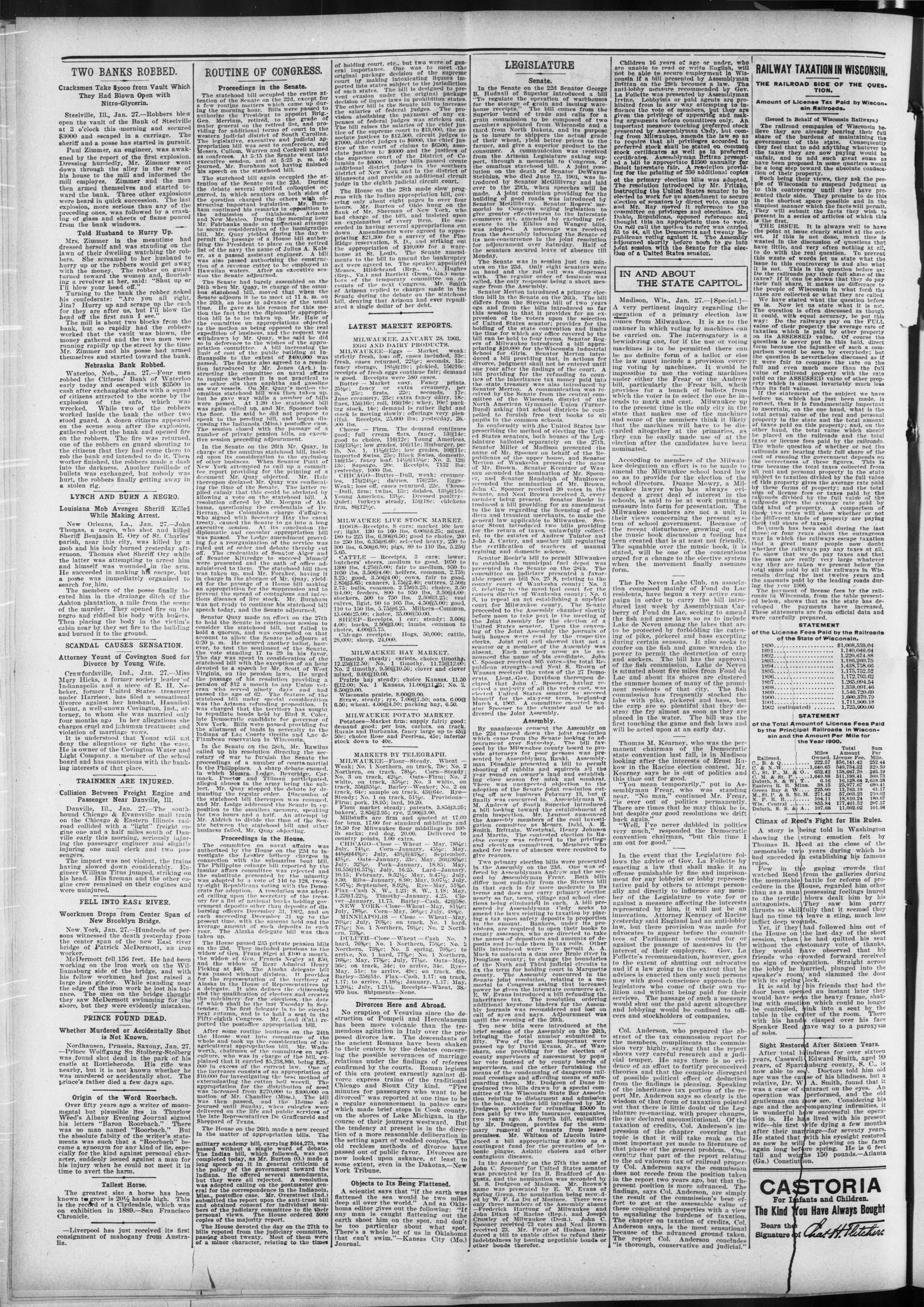
STATEMENT
of the License Fees Paid by the Railroads
of the State of Wisconsin.
1800.0... 0eececeeeeeecee $1,008,550,08
WBOL. ese esse ec eeee, 1,140,096.64
180223050. soss ee scshes BRON OTE SS
TRUS 2. Gh evacs ss ckdesevt , LASRQOOTS:
ISDE. ih cceeccenceecees Jia tOROD
ISM. 6c celsssecesecececee 1,175, 752.52
IRDG. .ceceeeseeeeeeeees 1,172,793.62
PRT. bss dioessasscsaqe: Sem EOS
1898, 21. \eceseseeee ences 3,858,001.46
IBOD.. sco pcsessccseceee | 3, S4G 72000
IMO. eee ee sees ee eee — 1,600,879.79
TODA sic4 2c cbs sexcocese cn 12, tRL OOO
1902 (estimated) ....... 1,725,000.00
| STATEMENT
of the Total een License Fees Paid
by the Principal Railroads in Wiscon=
sin and the Amount Per Mile for
‘the Year 1900.
\ Total Sum
Miles — Amount Per
Ratirosa. | Owned, License Fee. Mile.
Oe Be G.-.--bo-ee, BERET SOG 14143 252-44
Gl & N.-Wio sip. 51,640.65 540,784.32 329.50
6. 'St Pb, ML 02. "65242 158,067.70. 248.19
C.-M. & Bt. Pl} ..°51,649.88 511,198.41 | 309.73
Duluth, S. & WL'P.. " 6.16 "16,128-64 2,618.28
Eastern BR. MR. Minn. (88.15 25,977.67 “usv.41
Green Bay & W..-. 225.00 13,768.19 61.17
M..St.P. & S. SEM. 271.42 57,003.23 210.02
NOP. RR... 10811 18)810.24 180.67
Wis. Central ..(-... $55.84 177,461.52 207.37
Duluth, 8. 8. &) Al: 107-68 11,002.02 101.98
Climax of Reea’s Fight for His Rules.
A story is jbeing told in Washington
showing the (strong emotion felt by
Thomas B. Heed at the close of the
‘nemorable twlo years during which he
had suceeded in establishing his famous
rules. >
few in the gaping crowds that
watched Reed }from the galleries during
the memorable} battle for reform of pro-
cedure in the House, regarded him other
than as a man] possessing feelings inured
to the terrifle} blows dealt him by his
antagonists, They saw him parry
thrusts so skilfully that it seemed they
had no time td leave a sting, much less
inflict deep woyinds,
Yet, if they{had followed him out of
the House on \the last day of the short
session, when{he had quitted his seat
without the ciistomary vote of thanks,
they _ would ave observed that _ his
friends who ckowded forward received
no sign of reeggnition. Straight across
the lobby he lgurried, plunged into the
speaker's roo! and slammed the door
with its spring \lock.
It is said byf{his friends that had the
door been operjed an instant later they
would have segn the heavy frame, shak-
ing with emotifon which could no longer
be controlled, ¥ink into a seat by the
table in the cewiter of the room. There
with his hand} clasped over his face
Speaker Reed gave way to a paroxysw
at anha
Sight Restordd After Sixteen Years.
After total blindness for over sixteen
years, Casswell{ Edward Smith, aged 99
years, of SpartRuburg county, 8. C., is
now able to se¢. Doctors told him oid
age was the carse of his blindness. but 2
relative, Dr. W} A. Smith, found that it
was a case of cfataract on the eyes. An
operation was }performed, and the old
gentleman can ipow see. Considering bis
age and the a mpanying infirmities, it
is wonderful hpw_ successful the opera-
tion is, He hajs lived with his present
wife—his first Wife dying a few months
after their martriage—for seventy years.
He stated that vith his eyesight restored
as now he willf be plowing on tae farm
again long beffre spring. He is 6 feet
tall and weigths 150 pounds.—Atlanta
(Ga.) Constiutfion.
CASTORIA
The Kind ou Have Always Bought
I walker with her a little way,
And sidewise saw the rise and fall
Of lace upon her parasol.
And that was all I saw that day.
I could not speak, and what she said
Was only music; not a word
Meant anything to me. I heard
In ecstacy without a head.
And in a moment she was gone!
The music ceased, and then I dreamed
Her hand in mine—and straight she
seemed
A vision floating on the lawn.
Sometimes, when summer comes, a day
looks different from the rest, and I
The outlook from the window where Mrs. Craig sat idly looking out was charming. A long stretch of green sward rolled away into a clump of trees with bursting buds. She smiled with the pure joy of living and then—sighed.
"Poor Will," she said softly. Her husband had been dead three years, and a widow cannot mourn forever when life and love surge about her with their thousand allurements. Then she colored a little and left her seat by the window as a man came hurriedly up the gravel walk.
Mrs. Craig held out her hand to him as he stepped upon the broad veranda.
"How do you do, Mr. Lowrie?" she said. "I am going to receive you out here. It's such a charming day."
"Yes," said the man "It is nice. You received my note?" he added with some anxiety.
"Oh, yes; and I am very curious to know what I can do to help you."
"You may smoke, you know," said Mrs. Craig, as he sat on the step close beside her chair.
"Thanks—not now," he replied. "You can help me a great deal," he went on after a minute's pause, "but I hardly know how to begin. It is such an odd thing I am going to ask of you."
"Well, I am sure—" began the widow with a smile.
"Please don't laugh at me," interposed the young man, "I'm in deadly earnest."
"Well?"
"You know what my life has been," he said. "I've told you all that long ago. I'm rough and uncouth and I don't know the first thing about women. I can't do the things and say the things other men can. I don't know how. But I'm in love—dreadfully in love."
"Well?" said Mrs. Craig again.
"I want you to help me. I don't know how to make her care. You know what women admire in men—what men do to make a woman love them. Won't you tell me what to do to make this woman love me—Kitty?"
Mrs. Craig was sitting very straight, her hands folded in her lap. Her face was white, her lips tense and drawn. Lowrie blundered blindly along.
"You see, she's all the world to me. I can't do without her. I've tried—good God, how I've tried to make her care! But I can't. She is kind and gracious and friendly; but I don't want that. I want love. I've dreamed of it all my life," he went on slowly, "and I've hoped for it—yes, and I've prayed for it, too. I've worked and waited, and kept myself as I knew she'd want me to be, and now I've found her and I can't get her. I don't know how."
"What is she like?" The young woman started at the sound of her own voice. "You are sure she is worthy of this love of yours?"
"Worthy?" repeated Lowrie. "How you twist things! She's as far above me as the stars."
"Is she pretty?"
"She is the most beautiful woman in the world."
pause. Finally the woman spoke.
"I will help you all I can," she said,
"but you must not blame me if, when
you win this—er—paragon, you are
disappointed. Confidentially, you know,
we women are not always so nice as
we seem." She essaved a little laugh.
"First, then, who is she? Do I know
her?"
"I can't tell you that; please don't
ask me."
"Well, then," she said, "let this woman
know you are interested in her, but don't
let her know that you love her. What
is it they say in the West? 'Keep her
guessing. Yes, that expresses it. Slang
is so useful sometimes."
Yes, but now am I to do that?
"Oh, you stupid! Can't you understand? Pay her attentions. Always seem delighted to see her. Show by your manner that you would rather be with her than with any other woman—and act in exactly the same way to all other women when she is present. Now do you understand?"
"I—I think so," said Lowrie, doubtfully. "But"—with more certainty—"I know I can't do it. I simply can't talk to other women when she is there."
"You must," said Mrs. Craig sternly. "Where was I? Oh, yes. You see, a woman is interested in a man at first not because she sees anything particularly attractive in him, but because she sees that he sees something attractive in her. So your first move is to let her know that you are interested. Then, if you can make her a little jealous—"
"How can she be jealous if she doesn't care?" asked Lowrie.
"Not jealous of you—jealous of the other woman. A woman always likes a man whom she knows some other woman likes."
"I don't believe the woman I love is a bit like that," interposed Lowrie.
"Oh, yes, she is," said Mrs. Craig cheerfully. "We all are. That, of course, is just the beginning. When you can see that she is interested—"
"How can you tell that?" interposed the young man.
"Oh, dear! Oh, dear! Whatever am I to do with you? Don't you know when a man likes you?"
"Yes" said Lowrie—"generally."
"Well, you ought to be able to tell when a woman likes you. I can't tell you all our secrets. If a woman treats you badly, it means that she likes you very much—if it doesn't mean that she can't bear the sight of you."
"I'll never get along unless you stop interrupting. When you have found out that the girl likes you, begin to show her the thousand and one attentions that make a woman's life worth living. Don't get too intimate with her. Don't ever let her regard you as a brother. It is fatal. Keep your attitude as a lover always. Don't pose. Be as nearly yourself as you can. Don't boast of what you have done, and don't talk too much about yourself. Let there be many paths in you marked 'No thoroughfare.' A woman is always interested in these paths. She wants to be the first to travel them. Be masterly, but don't bully. Let her see that there is friendship as well as love for her in your heart. Nothing so strongly appeals to a woman. Let her see how you need her."
"How am I going to let her know all that?" asked Lowie in dismay.
"Oh, by your manner! If the feeling is there, she'll find 'it out. Gratify her slightest wish if you can, and do it quietly, entirely as a matter of course. Show her constantly that she is first in your thoughts. If she is leaving a room, get up and open the door for her." Lowrie colored painfully. "I know I
ought to do these things," he said, "but I've been away so long, I've gotten away from all the little niceties of life. I can't do them gracefully."
"I'm not nearly done," went on Mrs. Craig. "You must send her flowers, and candies, and books. You must do everything in good taste. These things are all important, but, above all, let her realize that she can trust you and depend on you and believe in you, and, oh, woo her, man, woo her!"
She rose suddenly and walked to the end of the piazza. Lowrie followed her, his face white and set.
"Thank you," he said. "Goodby."
"Goodby?" she repeated vacantly. "You are going away?"
"Back West, where I belong," he went on bitterly. "I've been in a fool's paradise long enough. Do you honestly think I can do the things you have said I must do to win the woman I love. You know me. Do you think I can do them?"
"No," she said slowly; "I am afraid you can't."
"Can you imagine me concealing any part of my nature from the woman I love? I'm not subtle. There are no paths in me marked 'No thoroughfare.' I would to God there were!" He laughed bitterly.
She put her hand on his arm. "Don't," she said.
"In every point you named I've failed," he went on more slowly, "and the one thing I've done and can do you never mentioned. I do love her; I always have; I always will love her; but it's no use. I came up here today hoping against hope. I knew you couldn't care."
The light of a great happiness came into the woman's eyes; but he was conscious only of his own misery.
"Then I thought if I could get you to tell me how to win you—you of course thinking I meant some other woman all the time—that maybe if I did everything you told me to I could make you love me a little some day. But you see how it is. I can't do the things I ought to do; the things you say a man must do to make a woman care for him. And I've loved you so long—since the first day I ever saw you."
"Not while—" she began.
"Yes," said Lowrie; "while your husband was alive. I loved you then. That's why I went away. And I've gone on loving you ever since, and shall love you until I die and, please God, after that. But that doesn't count. I can't do the things you say. I can't win you."
"No," said the woman, with a sob; "you can't win me—because I'm won." Then she held out her hands and smiled tremulously.—New York Daily News.
COURT TAILOR DIES POOR.
Joseph Swoboda, Once in Service of Sultan, Passes Away.
Joseph Swoboda, the aged tailor who died at Terre Haute, Ind., had been a "master tailor" of renown among the nobility of Europe and at one time tailor in chief for the Sultan of Turkey. He did not talk of his career in Europe, and what was learned from him was told incidentally in his conversations with his few friends. He was a misanthrope and lived the life of a recluse. Henry Meyer, who had known him since he came to Terre Haute twenty years ago and who has taken charge of his effects, says that the old man resented inquiry into his past life. He was born in Pilsen, Bohemia, in 1830.
When a young man he had a lover's quarrel and occasionally he referred to it as the blighting incident of his life. He served in the Austrian army until 1869, and then went to Russia. Among his effects there was the Austrian passport made out in 1872. He was in St. Petersburg several years, where he was known to the nobility as a designer of court costumes. On the back of the Austrian passport is the indorsement of the Russian authorities. A few years later he traveled to Paris, where he was a tailor to people of quality. He told how he was accustomed to go to customers in a carriage of his own when he fitted their garments. From Paris he went to Constantinople, on the advice and under the patronage of Count Zechy, a Hungarian nobleman, who had been appointed by the Sultan of Turkey to organize the police and fire departments of that city. Through Zechy's recommendation the Sultan put Swoboda at the head of his tailoring establishment, where he designed and directed the making of costumes for several years.
An organization of students became engaged in a conspiracy against the Sultan and Swoboda was suspected of being allied with some of the conspirators. The Sultan was causing the arrest of suspects, and an arrest meant either death or imprisonment. Count Zechy learned that the Sultan had Swoboda on the list of suspects, and no doubt for good reason, but the count got him out of the country.
He went to London and worked there for a year or two, when he moved to New York, where his fine workmanship caused him to be recommended to a firm of merchant tailors starting in business in Terre Haute. The business was unsuccessful, but Swoboda remained here He went to work on the bench in a room where he spent all his time except occasionally on bright Sundays, when he would attire himself in fine clothing, wear a silk hat, and carry a cane. He wore his beard trimmed after the style of the Emperor of Austria and was a distinguished looking man.
He scorned to be a dependent and his last illness was due to lack of proper nourishment. Two days later he was sent to the hospital. That was on Saturday last. At midnight the sisters saw that he was dying and asked him if he had any message to friends or anything to say about his life or of his relatives. He told them that there were no relatives and that in the morning he would be better and would then tell his story. In the morning he was dead. Through the description in the passport, which includes the date of his birth in Pilsen, Mr. Meyer will endeavor to notify any relatives there may be by writing the facts of his death to the authorities of that city in Bohemia.
The German-American.
The habits, conditions, intelligence and spirit of the masses are important elements in the industrial race, and we gave close attention to these as bearing upon our task. The German, as we know him at home and in the United States, is a valuable man, steady, sober, methodical, thorough, self-respecting, of fine domestic tastes, an admirable workman and superintendent. Thanks to the conscription of Germany, among other causes, we had many thousands of Germans in our service, of whom at least four whom I recall became partners and earned the millions of dollars they obtained. They fled from the conscription of their sons, and today the son of a German who left his country largely for the reason is at the head of the greatest manufacturing corporation in the world. We owe a valuable invention to one of these men. The value of the German element in America can scarcely be believed except by those who, like myself, know it by experience. The total emigration from Germany and Austria-Hungary has about equaled that from Great Britain and Ireland.—Andrew Carnegie in World's Work.
There are 301 monuments to Bismarck in Germany and other countries of Europe.
TWENTY-TWO ARE DEAD.
New York, Jan. 28.—The most appalling railroad wreck that has occurred in the vicinity of New York for many years, the loss of life being estimated at twenty-two persons, took place last night at Graceland, N. J.. near Westfield, on the Central railroad of New Jersey, when the Philadelphia & Reading express plunged at top speed into the rear of a local train.
Before the wreckage had cooled the work of getting out the charred bodies began. Men attacked the heap with poles and rods of iron taken from the pile of debris and raked out several arms, legs and heads. Many of those who died will never be recognized, the bodies being burned to a crisp.
Quick work was made in furnishing a train for the handling of the dead and injured. Railroad men tore out the iron frames of the seats in the special train and laid the cushions in two rows along the sides of the cars. These were later supplemented by pillows and mattresses from the Pullman coaches.
At Sixty Miles an Hour.
When the express, which left Jersey City at 5:45 o'clock, crashed into the local it was going at a rate of over 60 miles per hour, and in the twinkling of an eye the ponderous locomotive of the flyer had plunged its way through three passenger cars jammed with Plainfield and Netherwood commuters.
Men, women and children were killed and maimed, even before they realized the fate that had overtaken them. Sitting in their seats unconscious of harm, they did not know that the huge iron engine crashing through the train menaced their lives before death, in many instances, had come. The last three cars of the local train were smashed into kindling wood, and to add to the horror of the accident the wreckage took fire. Pinned under the debris, many who had been only slightly injured by the crash were roasted to death before the eyes of the survivors. The cries of the wounded were intermingled with the roar of escaping steam from the engine of the flyer.
Engineer is Blamed.
The blame for the accident is placed upon the engineer of the express train, who with his fireman was instantly killed in the collision. It is believed the engineer saw the red lights, signifying danger, looming ahead, but that his train was running at so terrific a speed that it was impossible to lessen its momentum in the short distance to be traversed before the crash came. The local train, which was running ten minutes ahead of the express, had stopped 100 yards beyond the station at Westfield on account of a hot box in one of the trucks of the forward cars. A red flag was sent back and the block signals also were up against the express, but for some reason yet unexplained, and which now probably never will be known, the engineer disregarded his signals.
Names of the Victims.
In all twenty-one bodies were taken from the wreckage and the following identifications have been made:
H. G. HAND, Plainfield.
HUGHES FAWCETT, Plainfield.
RALPH PHILLIPS, Plainfield.
JAMES BEEKMAN, Plainfield.
ROWLAND R. CHANDLER, Plainfield,
N. J.
THOMAS A. CUMMING, Plainfield.
EDWARD FLYNN, Plainfield.
R. B. SHANADO, Plainfield.
HARVEY S. FATTERSON, Dunellon, N.
J.
GEORGE E. REED, Scotch Plains, N. J.
C. P. THAYER, Plainfield.
THOMAS M'CARTHY, fireman of the Reading express, died today in the hospital in Painfield. W. A. DAVIS, engineer of the Reading express, died today as result of his injuries. HARRY ROGERS, Plainfield. FREDERICK HARDINGHAM, Plainfield. CRAIG BALDWIN, Plainfield.
The Injured
The injured so far as known are as follows:
Richard Clark, Plainfield, both legs broken.
William Sampson, Plainfild, cut and bruised about the body.
Wilson Frederick, Dunellon, scalded about the body.
Miss Lizzie Cutter, Plainfield, face cut, William Dunn, Plainfield, right leg broken, face cut and bruised. George Force, Plainfield, cut on head, J. H. Freeman, Plainfield, badly injured about the head and body
Howard R. George. Plainfield, leg broken and scalp injured.
Edgar George, slightly injured Miss Mildred Everett, Plainfield, badly injured about head.
Mrs. D. Caming, Injured about head and body.
Rose Bradford, Plainfield, injured on face and head.
Miss Fannie Canavoc, body and face badly cut.
Frederick Kannen, body and face badly cut. Roy Apgar, Dunellon, badly injured about head.
George Chandler, Plainfield, spine injured. Charles Longworthy, Plainfield, injured on body. Mrs. Beleh, Plainfield, legs broken and body injured.
Mary Ryan, Plainfield, injured about head. William Van Venter, Plainfield, cut about face and body. Everett Reighton, Plainfield, both legs cut off.
Miss Lizze Keller, Plainfield, scalp torn off.
Percy Irving, Dunellon, legs crushed. Mrs. Queloan, Plainfield, injured about body and head. James F. Clark, Philadelphia, seriously hurt about head and body.
An Official Statement.
W. G. Hesler, vice president and general manager of the Central Railroad of New Jersey, who was at the scene of the accident forty minutes after it occurred and has since made an investigation, gave out a statement today in which he said that the accident was due to the "element of human fallibility" in railroad operation.
"The company," he said, "has purchased and installed what is known as the electro pneumatic-automatic system of block signalling, the signals working before, during and after accidents.
"The signals were working all right before and after the accident as we found on investigation. It seems then that along came the Philadelphia express, one of our hourly trains between New York and Philadelphia, and, flying past all the warnings, was driven by its engineer into the local train with such force as to telescope three of its coaches.
Engineer at Fault
"So far as I can ascertain the only
explanation Davis, engineer of the express, gave, is that he did not see any red lights. But he was in such a critical condition that he barely knew what he was saying. I understand he jumped and his injuries were received in that manner. The airbrakes were applied just before the crash, I think by the engineer, though they might have been set by being torn apart in the crash. "Davis was a thoroughly competent engineer and had six years' experience running on the road, between New York and Philadelphia. He was 33 years of age, of good habits and had a very good record.
"The property loss is insignificant. The express train, apart from the engine, was not damaged 5 cents' worth. Soon after the wreck the Somerville local came through on another track, and its cars were scratched a little, but the reports that this train ran into the wreckage and caused further loss of life are wholly false."
Women and Children Suffer.
A number of women and children were among those burned alive in the blazing wreckage before assistance could reach them. Many of the survivors tell thrilling stories of marvelous escapes while crawling forth from the debris of burning wood. In the very center of the wreck stands the great engine of the flyer and piled high around it lie the remnants of the passenger coaches of the local. The local train is one that always is packed with Plainfield and Netherwood commuters from New York. It consisted of an engine, baggage car, two passenger coaches and two smoking cars that were filled with people.
The Reading train consisted of engine, combination baggage and smoking car, diner, two parlor cars and two passenger coaches. A number of these passengers were injured by the shock of the collision and by flying glass, but their lives were saved on account of the steel frame structure of the heavy coaches.
Baby's Miraculous Escape.
One of the rescuers relates an experience which startled him. He had climbed on to the worst wrecked car. The fire was burning below him. There were two men there. One of them begged for a drink and a bottle of whisky was passed up. The injured man grasped it eagerly and began to drink. While clutching the bottle he died. The rescuer took the bottle from him and passed it to the other man, but although he had been alive a few minutes before he was then dead.
The rescuer then started to get out, intending to drop out of a window. As he was climbing for the window he knelt on a body and found it to be that of a child. On reaching down for it he was startled to find the child was alive. The little one was taken out apparently uninjured and is now in a house at Westfield.
YOUTSEY'S CONFESSION.
Declares Howard Murdered Gov. Goebel Gives Details of Kentucky Assassination Plot.
Louisville, Ky., Jan. 28.—A Frankfort (Ky.) special to the Courier-Journal says: "James B. Howard of Clay county fired the shot that killed William Goebel," said Henry E. Youtsey in his confession as to his part in and knowledge of the conspiracy which terminated in the assassination of the Democratic claimant to the governorship. "The convicted man now says that he has made a clean breast of the details of the plot and has told everything he knows 'fully and frankly.' He said that the shot was fired from the front window in the private office of Secretary of State Caleb Powers and that he and Jim Howard were the only persons inside of the room.
"He named William S. Taylor, Charles Finley, Caleb Powers, John L. Powers, William H. Culton, Wharton Golden and William J. Davidson as conspirators with him."
URGE ACCEPTANCE.
Italian and British Ambassadors and British Charge d'Affaires Make Recommendation.
Washington, D. C., Jan. 28.—The Italian and British ambassadors and the British charge d'affaires at a joint conference today agreed to cable their governments urging a prompt acceptance of Mr. Bowen's last proposition to enable the lifting of the Venezuelan blockade at once. In this cablegram, which was sent at noon, it was suggested that the consideration of the details of the proposition be postponed until after the signing of the preliminary protocol. Paris, Jan. 28.—It was learned today that the Belgian charge d'affaires at Caracas, M. Van der Heyde, has informed his diplomatic and official colleagues that Belgium will undertake the administration of the Venezuelan customs, thus relieving the United States and other parties.
Berlin, Jan. 28. -The allies are awaiting Venezuela's reply to their conditional acceptance of the guarantee.
SIX MEN KILLED BY EXPLOSION OF BOILER.
Serious Accident in an Alabama Foundry—Several of Injured will Die.
Anniston, Ala., Jan. 28.—A large boiler in the malleable foundry of the Southern Car and Foundry Company blew up this morning at 7 o'clock, killing six persons and injuring probably twenty others, several of whom will die.
Parts of the boiler weighing several hundred pounds were blown over buildings 1000 feet distant. The cause of the explosion is not known.
REAR-END COLLISION.
Chicago, Ill., Jan. 28.—Three persons were killed, four seriously injured and eight slightly injured in a rear-end collision between stock trains on the Chicago & North-Western railway near La Fox, Ill., today. Among the dead are A. A. Amery of Scranton, Ia.; Mr. Coe, Woodbine, Ia.; Mr. Lane, Vail, Ia.
Upper Peninsula Lumbermen.
Houghton, Mich., Jan. 28.—Representatives of some of the largest lumber companies of the upper peninsula met here and organized the Upper Peninsula Lumber Manufacturers' Association, for the purpose of establishing uniform grades upon which Chicago and Eastern buyers will have to make their purchases in this section.
Potatoes to be Sold by Weight.
Chicago, Ill., Jan. 28.—Potatoes, feed and other articles of merchandise which have a legal standard of weight to the bushel or other measure must hereafter be sold by weight if the council agrees to an ordinance recommended for passage yesterday by the judiciary committee.
MANY PERISH BY FIRE.
London, Jan. 27. About fifty insane patients were burned to death by a fire at the Colney Hatch asylum this morning.
The outbreak occurred in the Jewish wing of the institution. The flames spread with great rapidity and before they could be gotten under control five wooden buildings, including dormitories and the doctors' apartments, were gutted.
All the efforts of the officials were directed to removing the insane inmates, but the latter became wild with excitement and so panic-stricken that not only were they unable to help themselves, but greatly impeded the operations of those trying to save them.
There were nearly 600 women in the burned annex at the time the fire was discovered, and most of them were safely transferred to the main building, which was uninjured. Some, however, escaped and are still at large, rendering it difficult to ascertain the exact number of those burned to death.
The work of searching the ruins continues. The officials admit that about fifty bodies have been recovered, but it is feared that the full extent of the disaster is not yet known. All the victims were lunatics. Their charred remains presented a horrible spectacle. The asylum was besieged by anxious relatives and friends of the patients who arrived from all quarters. Pitiable scenes were witnessed as weeping men and women left the premises after ascertaining that relatives or friends had perished in the flames.
The nurses had a terrible experience in trying to assist the insane people, who were so panic-stricken that they had literally to be driven to a place of safety. The inflammable premises almost immediately became a furnace.
Nothing was left standing. The corrugated iron roofs of the dormitories and the bedsteads of the patients were melted by the intense heat. Some of the lunatics were burned in their beds and the charred remains of others were found huddled together in corners, while groups of partially consumed bodies on the site of the corridors showed that many persons lost their lives and sacrificed those of others in their frantic efforts to force a passage through the flames to the main building.
The latest estimate places the number of deaths at fifty-two. All the victims were women.
TON OF POWDER GOES UP MARQUETTE IS SHAKEN.
Mill Two Miles from City Wrecked—No Loss of Life—Shock Felt 100 Miles Away.
Marquette, Mich., Jan. 27.—[Special.]
The separating plant at the powder works, two miles from the city, blew up at 5 o'clock this morning, causing heavy damage but no loss of life, the night shift fortunately having been laid off some time ago.
About a ton of powder exploded, shaking the city, breaking windows and arousing the people generally. The shock was felt at Houghton, nearly 100 miles distant, and in this city and other points up the line considerable alarm was felt until it was ascertained what had happened and that it was not an earthquake, as feared.
The cause of the explosion is unknown. The separating plant was blown to pieces, other buildings were badly damaged and trees in the vicinity were torn up.
CALUMET HAS COAL TO SPARE.
Northern Michigan Dealer Sends Some
to Waterloo, Wis.
Calumet, Mich., Jan. 27.—As an illustration of the scarcity of coal in Southern Wisconsin, the fact is noted that Paul Roehm, a coal dealer of Calumet, shipped a cargo of anthracite to Waterloo, Wis., in response to orders. Waterloo is but sixty miles from Milwaukee, and the freight on the coal from Calumet is about $4 a ton. An ample supply of anthracite was shipped by boat to the copper country last fall, and there is sufficient to last through the winter in all the various towns.
TURNERS START MOVEMENT
Would Erect Statue of Washington in Germany's Capital.
Louisville, Ky., Jan. 27.--The members of the Louisville Turngemeinde adopted resolutions urging that the German-Americans start a fund for the purpose of erecting in Berlin a statue of Washington in order to show their appreciation of the gift of a statue of Frederick the Great to this country by Emperor William. A committee was appointed to go to Indianapolis to take up the matter with the president of the National Turngemeinde.
TARIFF ON LUMBER.
Minnesota Senate Votes Unanimously in Favor of Abolition.
St. Paul, Minn., Jan. 27.—By a vote of 47 to 0, without one word of debate, the state Senate today adopted the joint resolution introduced by Senator Morgan, declaring that, as lumber was a natural product and a duty on it was not in accord with the principle of protection, the senators and congressmen from Minnesota be requested to favor the entire removal of such tariff on lumber.
Archbishop Ireland to Officiate.
Escanaba, Mich., Jan. 27.—Rt. Rev. John Ireland, archbishop of St. Paul, will preach the sermon at the dedication of the new St. Patrick's Church at Escanaba February 15. This will be the first visit of this distinguished churchman to Northern Michigan and people from all over the peninsula are expected to be in attendance. Special railroad trains will be run.
British Steamer Sunk
London, Jan. 27.—The Bristish steamer Graffo from Glasgow for Buenos Ayres was sunk off Ramsey island today. Six of her crew were saved by a lifeboat. one man lost his life and sixteen are missing.
Widow Awarded $40,000.
New York, Jan. 27.—Mrs. Elizabeth B. Fajardo, widow of Theodore H. Fajardo, who was killed in the accident in the Grand Central tunnel on January 8, 1902, received a verdict in the supreme court for $40,000. Mrs. Fajardo sued for $60,000.
JELLY IN THREE MINUTES.
Product Speedily Obtained from Apples in a Washington Orchard.
A. von Holderbeke, state commissioner of horticulture, has returned to Tacoma from a visit to Walla Walla. An important development of the fruit industry is reported by the state commissioner which is destined to be of great financial help to the fruit growers of the state. The famous Blalock fruit farm of Walla Walla county has demonstrated the profitableness of making a highly salable jelly from the cull of apples. This season Manager McArthur imported a newly-invented machine which does all the work automatically. Apples fed in at one end come out at the other in three minutes by the watch as perfect jelly, and this without the use of any sugar at all. The jelly is all sold ahead at 10 cents a pound. It takes seven pounds of apples to make one pound of jelly, and the machine is making 2000 pounds of the stuff each day, and therefore is using 14,000 pounds of apples. Says the Fruit Commissioner:
"I have brought back with me this sample, as I consider this development of the industry as of great importance. Only our best fruit should be shipped if we are to retain and build up the markets we have obtained, and what to do with the other fruit was a serious question. It has always been supposed that to make jelly of them required weight for weight of apple juice and sugar. This invention does away with all that. Even the best of orchards, such as the Blalock, have quantities of culls left over, this orchard having to my knowledge 100 tons of such waiting to be worked up. Farmers are shipping their culls from distant regions to the farm, the company paying $5 a ton for them. A curious thing about the machine is that if an improper temperature is maintained nothing comes from it but cooked cider, but this will keep forever, as it is germ proof. This sample, as firm as anything ever put on the market and called jelly, I saw run hot from the machine three minutes after the apples were fed into it. The machine will soon be introduced at other points, I am sure, and will help the fruit growers by keeping from the market anything but our best fruit. The cost of running the machine is inconsiderable, and in introducing it to the state I consider Manager McArthur has done us a service."—Tacoma (Wash.) Ledger.
Study of African Man.
The sociological character of African man is of great interest. It has not yet been treated scientifically. Travelers have confined themselves mainly to such novelties as they happened to meet. Anthropophagy is extensively practiced by some of the tribes near the equator, and it would be well to know why the practice is more general there than elsewhere. Another curious thing to know is whether stature is influenced by environment, climate or diet. The tallest men I found lived in high, altitudes—from 5000 feet above sea level upward; the sturdiest from 3000 to 5000 feet; the shortest, excepting the pygmies, from sea level to an elevation of 3000 feet. It deserves study as well as to what effect the different diets of tribes have on their physical systems. Some live on wild berries and fungi, and ground vermin; others on fish, others wholly on milk or on meat or grain, or solely on vegetables. I was often tempted to pursue the quesition as to whether such specific foods affected the strength or intelligence of tribes who thus limited themselves to one kind of food.—Henry M. Stanley in Success.
A.
Miss Menard cured after doctors failed to help her.
"Lydia E. Pinkham's Vegetable Compound cured me after doctors had failed, and I want other girls to know about it. During menstruation I suffered most intense pain low in the abdomen and in my limbs. At other times I had a heavy, depressed feeling which made my work seem twice as hard, and I grew pale and thin. The medicine the doctor gave me did not do me one bit of good, and I was thoroughly discouraged. The doctor wanted me to stop work, but, of course, I could not do that. I finally began to take Lydia E. Pinkham's Vegetable Compound and felt better after taking the first bottle, and after taking six bottles I was entirely cured, and am now in perfect health, and I am so grateful for it." — Miss Georgie MENARD, 537 E. 152nd St., New York City. $5000 forfelt if original of above letter proving virginness cannot be produced.
Lydia E. Pinkham's Vegetable Compound cures female ills when all other means have failed.
CONSTIPATION
"I have gone 14 days at a time without a movement of the bowels, not being able to move them except by using hot water injections. Chronicle constipation for seven years placed me in this terrible condition: during that time I did everything I heard of but never found any relief: such was my case when I began using CASCARETS. I now have from one to three passages a day, and if I was rich I would give $100.00 for each movement; it is such a relief." AYLER L. HUNT.
BEST FOR
THE BOWELS
Cancarets
CANDY CATHARTIC
REGULATE THE LIVER
FARM FOR SALE. 120 acres, Barron Co., Wis. 21/2 miles from station and good market. 50 acres cleared, good soil and water. A bargain, easy terms. Particulars of J. MYERS, G 14 Jack block, Milwaukee, Wis.
Telephone Black No. 244.
SUBSCRIPTION RATES.
postage paid.
One Year ..... $2.00
Six Months ..... 1.25
Three Months ..... .75
Send money by Express MoneyOrder, P. O.
Money Order or Registered Letter to the
Wisconsin Weekly Advocate.
ADVERTISING RATES
One inch, single insertion ..... 25c
One inch, per year ..... $9.00
Business locals 5c per line each insertion.
Apply for rates to the Advocate.
TO CONTRIBUTORS:
all communications must be sent with the name and address of the sender as an evidence of good faith, but not necessarily for publication. No manuscript returned if not accepted, unless accompanied by stamps.
The Wisconsin Weekly Advocate company wishes to notify the public that all contracts and business transactions with this company must have the company stamp, otherwise they will be void. Neither will this company be responsible for paid subscriptions unless given to duly-accredited agents, who, on request, will give the company's receipt for same. Subscribers failing to receive their papers regularly will kindly notify the general office. Address all business communications to the general manager, 79 Fifth street.
Entered in the Postoffice at Milwaukee as Second-class matter.
EDITORIAL PARAGRAPHS.
"I know of the bravery and character of the Negro soldier. He saved my life at Santiago, and I have had occasion to say so in many articles and speeches. The Rough Riders were in a bad position when the Ninth and Tenth cavalry came rushing up the hill carrying everything before them. The Negro soldier has the faculty of coming to the front when he is needed most. In the Civil war he came 400,000 strong, and I believe he saved the Union."—President Roosevelt.
Marconi's wireless telegraph is wonderful, but Chicagoans are to have a hello-girlless telephone.
Strawberries at 60 cents a box wouldn't look quite so high if the empty package had any value as fuel.
A Texas oil company has done something that is never promised in the prospectuses of promoters; it has failed.
Finland's deplorable condition should awaken practical sympathy in America, among those who are profiting largely from the existing prosperity. There are large margins for giving in many industries.
If Uncle Sam takes the Nicaragua route because Colombia holds out against the terms upon which he is willing to take the Panama route, his case will be like that of the man who was kicked upstairs.
A Massachusetts man claims to have invented a cheap process for converting seaweed into briquettes which make a fuel equal to coal. Now let some Iowa or Missouri man see what he can do with cornstalks.
The sixty St. Louis factory girls who have struck against an order which forbids them from using chewing gum during working hours, will probably stick to their guns if they have to utilize the gum for the purpose.
The judicial recognition of kerosene as kindling, at St. Paul, is based upon an abundance of evidence that it never fails if the match touches the right spot. But no court decision will ever make it other than blank blank foolishness to indulge in the starting of kitchen fires with kerosene.
---
The exports from the United States in 1902 were $38,600,000 less than they would have been but for the short corn crop of 1901. Last week's corn shipments were 2,856,986 bushels, compared with 136,873 bushels in the corresponding week of last year. Corn is resuming its old rank of king.
A German doctor claims to have discovered a rabbit serum that will cure sufferers from hay fever if they will remain indoors from six to eight weeks, while they are being rabbitized. Perhaps if hay fever subjects were to remain indoors that long every year they might need no long-eared treatment.
The "human fly," who didn't climb the sides of Milwaukee's City Hall tower "as advertised," during Carnival days, has been discovered at Washington, engaged in the steeple buzzy-ness. But he isn't climbing tower walls any more now than formerly, probably because the walls are not made of sticky fly paper.
A few weeks ago it was stated that farmers in Indiana were burning beans, finding them cheaper as fuel than coal—and now it is reported that the prospect of a bean famine confronts the people of Boston. The Western literary center used beans to do its baking, and the Eastern literary center is without beans to bake. It's a very trying winter.
One of the latest applications of electricity makes it compete with poison as sure death to rats. The game birds in the Zoo at Cincinnati are now protected from nocturnal rodent marauders by a trocha which consists of a live electric wire so placed that no rat can reach them without attempting to cross it. So far the rats that have made the attempt have been unsuccessful, and their corpses have been gathered up and thrown into the garbage receptacle by the attendants who clean up the place in the morning. The electric wire has been discarded by Marconi, but that does not argue that it cannot be usefully employed.
SPOONER'S ACCEPTANCE.
Following is the text of Senator Spooner's address to the Legislature:
Mr. President, Gentlemen of the Joint Convention: If this remarkable demonstration somewhat unmans me, I know you will not complain. Such a reception from the legislative representatives of the great commonwealth of which we are all so proud, participated in by neighbors and other friends, who through the years have been to my faults unduly blind and to my virtues unduly kind, participated in also by the enthusiastic young gentlemen who come from that splendid institution of learning which crowns the hill yonder soon to become their, as it long ago became my alma mater, would not fall to cause me more or less bewilderment, to bring huskiness into my voice, and halting into, my speech. If my heart could only speak to you, then only could you know the intensity of my appreciation.
Gentlemen of the convention, your committee has informed me that, proceeding under the constitution and federal law likewise conforming to the law of the state, you have declared me to be duly chosen to be my own successor in the Senate of the United States for the term beginning March 4, next. I havejourned a long way to speak a few words of thanks to you and through you to the Republican party of the state of Wisconsin for the honor just bestowed upon me, burdened every moment by the consciousness of my inability to fulfill the mission which brings me here. I observed in a Wisconsin press comment upon the caucus action which made me your nominee as candidate for the Senate a statement that the Republicans of Wisconsin have recognized the debt they owed to him, and have paid that debt in full. If the Republican party were indebted to me, the action of this day would indeed constitute prodigal and splendid requital of that obligation, but I am not a creditor of the Republican party of Wisconsin. On the contrary the only debt, which I know I cannot pay, is the debt which I owe to the Republican party of the state of Wisconsin, for the honors which it has showered upon me, for the opportunity it has afforded me for public service in exalted positions, for the unreserved confidence which it has given me, the steadfastness with which, through good report and evil report, it has maintained that confidence, and, not least, that it has never required of me that I assume the attitude of self-seeker.
My Senate record for the term soon to end is quite made up. I cannot change it. I am not satisfied with is. I wish I had been able to do more and better service for the advancement of public weal. Of course, I cannot assert that I have been always right in my judgment, but suppose I may say without justly subjecting myself to the charge of self-vaunting, that I have always endeavored to do right. I have no clients but the people, no desire but to conserve their interests, no ambition but to earn and thereby win their added confidence and respect.
I am inexpressably proud, gentlemen of the convention, of the conclusive judgments which the Republican party through your action enters here today of its approval and continued confidence. All things considered, it is an honor as rare and as fine in its quality as ever come from a generous people to a trusted public servant. I wish I might express to you and the constituents represented by you something of what is in my heart. I can only assure you and the Republican party of the state of Wisconsin that I am keenly and fully sensible of the magnitude of the honor which they and you have done me.
A seat in the United States Senate is a position of great dignity and honor, but it carries with it a great responsibility. To be one of ninety men charged with the duty of formulating and adopting legislation for 76,000,000 people, of determining public policies far reaching in effect, often complexed and sometimes irreducible, involves a continued sense of responsibility frequently oppressing, the fulfillment of which duty requires and demands the palestaking and thorough study of many intricate conditions, unremitting industry, great caution, independence of thought and action, and something. I beg you to believe, of personal service. It has been for two years no part of my own plans to continue in the Senate. The will of the Republican party of Wisconsin it otherwise and their will to me is law. (Applause)
From a full heart I thank them and you. You will of course not expect me under the limitation of this occasion to discuss problems of national policy and legislation. Yet I have been chosen by the Republicans and I have been chosen partly because I am a Republican. You need not be told that I am in harmony with the Republican party of the United States. I glory in its history, but I am not blinded by its past to the changed condition of the present and to the responsibility and new duties which the present brings. The Republican party has ever been a party of constructive genius. That it will so remain I have abiding faith. It will adopt established principles to change conditions, seek and find remedies for new evils and safeguards for new dangers, at the same time resisting in the interest of constitutional government such radicalism as is dangerous, and such tendencies as are revolutionary.
I fully understand, gentlemen, the obligation of labor, honor, judgment and purpose which an acceptance of this great trust involves, and I solemnly pledge you, and through you the people of Wisconsin, earnest and continued effort, limited only by my capacity to serve in the situation which you have again assigned me the interests of all the people of Wisconsin and the interest of all the people of the United States.
The years which have passed since by your authority I took a seat in the Senate of the United States have been crowded with great events and wonderful national developments and progress. Our industrial and commercial growth has been without parallel even in the history of this country, unlimitable in its resources, irresistible in the commercial genius and energy of its people. The American people during that period, inspired by a purpose as lofty and unselfish as any that has stirred the heart of man, lifted the gage of battle and gave ungrudgingly of its blood and treasure for liberty of Cuba and the right to the Cubans to establish on their own beautiful island their own free and independent republic. It has taken upon itself, this people of ours, with characteristic courage in the interests of civilization and upon the demand of national honor, obligations and burdens. There came to us from the Spanish war many problems extremely complicated, many of us thought dangerous. We had gone deliberately about their solution. Porto Rico is a territory of the United States covering one entrance to the great canal which is to connect the Atlantic and the Pacific seas. In the Philippine archipelago the work of education, government and liberty goes on in peace, and this nation is without a handicap of legislative or improvident pledge against it in the future. No man can deny that the relation of the United States to the governments of the world in respect to power and influence during the last five years has utterly changed. But for that change many things adverse to this people would have occurred. Among others I am convinced that that change in possession by the United States of the Philippine archipelago, China before this day would, have been partitioned to the probable detriment forever of the commercial interests of the United States. The progress and events of the years from 1897 to September 1901 will forever constitute a thrilling chapter in the history of this republic, and for all times on every page of it will be seen the calm, thoughtful, brave face of William McKinley. (Applause).
I took the oath of office as senator on the day he took the oath of office as President. I said to the caucus which nominated me for the election to the Senate in 1897: "And of course gentlemen of the caucus, it will be my pleasure to support to the best of my ability the administration of William McKinley, who was Wisconsin's first and only choice for the presidency, and whose record for patriotism, ability and statesmanship the people may well find a sure guaranty of eminent fitness to administer for the benefit the great trust with which he is soon to be entrusted."
I have kept the faith, not in a fulfillment of a pledge recklessly given, but because I was in harmony with his policles and in sympathy with his purposes. It will always be with me a source of pride that by your partiality it fell to my lot to be associated in the public service, even though in a co-ordinate and independence branch of it, with this stately American, at once a great executive and a gracious and christian gentlemen, whose tragic death brought gloom to
every fireside in America, chilled the hearts of all civilized people and placed the flag of all governments at half mast. It has been my pleasure and my duty and will without doubt continue so to be to give Theodore Koosevelt, the brave, brilliant and able man who succeeded President McKinley, my best support. He seems to have been born for the place, and he has brought the utmost of patience, of skill and of mental power to the solution of half-solved problems bequeathed to him by his lamented predecessor. He grasps with strong grasp and enlightened intellect the new problems, and there are many of them, and will move to their solution in a manner which I have no doubt will guarantee conservation of the best interests of our people and the lasting honor of our people.
republic.
It would neither be gracious, just nor generous for me, on this occasion, to omit a reference to the colleagues from Wisconsin in the Senate with whom during my term I have co-operated for the advancement of interests of our commonwealth. I found John L. Mitchell, although disagreeing with him as to politics, a genial gentleman, intelligently attentive to every interest of our people and of the state. You do not need to be told that I have found in his successor, Senator Joseph V. Quarles, a generous, quick and thorough student of public questions, unremittingly attentive to every detail of public duty; always solicitous for the public interests and quick to further them to accomplishment. By his industry and hard sense he has been enabled to impress himself on the whole Senate and the comrade in public service with whom constant and frequent co-operation so important to the interests of the state, has been always both naturally easy and helpful. But, gentlemen, I was to attempt only to thank you and I may not with propriety longer detain you.
After the applause following the conclusion of Senator Spooner's remarks, Senator O'Neil announced that Senator Spooner would like to shake hands with the members.
Holds a Reception.
Senator Spooner took his stand in front of the chief clerk's desk and, smiling cordially, grasped each hand as the assemblage, members and visitors, filed past.
One of the first to present his congratulations was Gov. La Follette. Those close at hand leaned forward to observe the meeting. Grasping the senator's hand firmly, Gov. La Follette greeted him and at the same time uttered his congratulations. With a smile and a hearty handshake, Senator Spooner responded and then the governor passed on, although the meeting was more prolonged than that accorded to any of the other gentlemen. It was an interesting scene and one that arrested the attention of everyone.
A most interesting incident was the meeting of Senator Spooner and Neal Brown, the Democratic candidate.
"Neal, I'm sorry," responded the senator, dramatically.
"I realized from the first you'd be hard to beat," put in Brown.
"You fellows are gathering strength," retorted Spooner. "If it had to go the other way there's no one I'd rather see have it than you, Neal."
"Yes, I suppose so," replied Brown.
"I don't know of any fellow of your kind I'd rather have it go to," and the two shook hands and laughed with the crowd. The reception came to an end at 1:20.
UTILITY OF THE STOVE LID.
A Fine Radiator for Baby's Crib-No Need of Incubator.
My first introduction to the comforting capacities of the stove lid was when the new baby came, two months before she was expected. There was naturally a domestic cyclone and the question of keeping the baby warm was thoroughly discussed. "This baby must have an incubator," said a college maiden who was visiting us. Her air of authority was convincing, but the only incubator on the ranch was for chickens, not babies, and I looked regretfully at the wee mite of humanity softly swinging in the beffrilled cradle beside me. The C. M. continued: "When the thermometer shows 65 degrees constantly, it is too cool for her young ladyship. We must give her steady artificial heat." As coal (which came from Australia) was then $22 per ton, I inwardly hoped that very little would be required. The C. M. looked at the cradle sagaciously, wrinkling her nose with an air of thought. Suddenly she left the room, but returned in a few moments with a strip of duck, which she tacked about the sides of the cradle, under the Swiss ruffle, completely enclosing it. Smiling mysteriously, she disappeared again. This time she returned flourishing something round and flat, wrapped in newspapers. "Here is our underheat," said she triumphantly, "a hot stove lid." The pillows in the cradle were carefully shaken up, the stove lid covered with folds of blanket placed among them, and the baby, having been fed and made comfortable, was carefully deposited thereon, "her solar plexus directly over the heat radiator," said our C. M. The frilled net curtains were let down and tucked in about the cradle. "Now," added the C. M., "put in a fresh, warm stove lid every three hours; feed the baby at the same time, and then let her sleep." Sleep she did, and grew fat and strong.—Good Housekeeping.
Looking Up Family Trees.
Now, and for some time past, nearly one-half of the number of readers in the Congressional Library reading room come there to read town histories, genealogies, and all that class of works which during the past two years have appeared in such number and which deal with historic towns, families, etc., of the different groups of states of the Union. Such subjects have become immensely popular of late years, and people who ten years ago probably did not know the names of their great-grandparents, and possibly cared less, are today poring over old directories, genealogies, town histories, and the like, in efforts to scratch up a distinguished ancestry. The Sons and Daughters of the American Revolution and kindred organizations have been largely responsible for this, and many of those who, evening after evening, may be seen rummaging through literature of this character, are either contemplating joining one or the other of the organizations, and are thus seeking a revolutionary ancestor upon whom to base their application, or else they are members of the societies looking up the record of those who are seeking membership. Washington Post.
Flying in Russia.
Russia has adopted for its navy a system of flying machines of which great things are expected. These are not navigable balloons, but aeroplanes which are attached to and controlled by ships by means of piano wire. In general features they are simply an adaption of the box kites that are flown for scientific purposes in this country. These "flying dragons," as they are called, are chiefly to be used for scouting purposes. By means of their own shapes when there is a wind, by means of the speed of the ship when it is calm, they will rise rapidly into the air to very considerable heights. Five in conjunction will raise a man, and from this lofty elevation an immense area of water can be inspected for hostile craft. It is hoped by this means greatly to increase the efficiency of destroyer flotillas at finding an enemy.
A representative of the German government has been sent to Canada to ascertain what trees can be profitably transplanted into Germany. He has already decided that white pine, cherry, spruce and black walnut would flourish on German soil, and experiments are to be made with those trees.
Santa Monica, Cal., Jan. 30.-Maj. A. E. Bovay, aged 85, a long-time resident of Ripon, Wis., died here yesterday. He settled in Ripon soon after his admission to the bar in Utica, N. Y., and became at once influential in shaping the sentiments of the new community. He is said to have been first in framing the earliest organization of what has been known as the Republican party. On March 20, 1854, during the pendency of the Nebraska bill in the House of Representatives at Washington, Mr. Bovay, with a few of his fellow townsmen, called the first mass meeting in Ripon to organize a new party. He served in the Union army during the Civil war and was made a major of Wisconsin Volunteers; also a provost marshal of Norfolk and Portsmouth, Va.
For the last few years Maj. Bovay had lived with his daughter, Mrs. Mary Bovay Coll, in New York city. His failing health caused the family to come to the Pacific coast about a year ago.
Maj. A. E. Bovay was born in Jefferson county, N. Y., July 12, 1818. He was graduated from Norwich University in 1841; afterwards he was principal of the Glens Falls and Oswego Academies in New York state; professor of languages in the Bristol (Tenn.) Military College, and professor of mathematics in the New York City Commercial Institute. In the meantime he read law and in July, 1846, was admitted to the state bar at Utica.
He was united in marriage in 1846 with Caroline E. Smith, at St. Luke's Church, New York city. He settled in Ripon, Wis., October 5, 1850, and in November following he laid out "Bovay's addition to the city of Ripon." He was in the Assembly for the First district of Fond du Lac county in 1859-60. He owned considerable property in Ripon and in Dakota. Maj. Bovay was said to be the framer of the earliest Republican organization ever formed. March 20, 1854.
BAD BLAZE AT RIO.
But for Timely Arrival of Aid from Portage Village Would Have Been Destroved.
Rio, Wis., Jan. 30.—[Special.]—But for the prompt response of Portage in sending a fire engine the village would probably have been totally destroyed by fire this morning. Rio is without any fire protection and when flames were discovered in the hardware store of Hanson & Wilson, shortly after 8 o'clock this morning, the citizens, who formed a bucket brigade, were unable to prevent a rapid spread of the flames. In a few moments the fire, fanned by a terrific gale, spread to the furniture store of G. B. E. Jackson and then to Mr. Jackson's dwelling house on the south. The Rio State Bank building was then found to be burning, and it was decided to call upon Portage, seventeen miles away, for help.
The Chicago, Milwaukee & St. Paul road was ready with an engine and flat cars and made the run in fifteen minutes arriving in time to prevent a further spread of the fire.
The stores, bank and residence were totally destroyed, but the bank's fireproof vault withstood the flames and none of the money or papers were touched.
The losses and insurance are estimated as follows:
Smith & Loven, owners of the hardware store building, loss on building $3000, insurance, $1800.
Hanson & Wilson, hardware stock, loss $5000, insurance, $3000.
G. B. E. Jackson, furniture store, loss on building, $3000, insurance $1000; loss on stock $3500, insurance $1600; loss on residence $2500, insurance $1500.
Rio State Bank, loss $3000, covered by insurance.
Just before the Portage engine arrived, the flames attacked the large store of Hanson Brothers, but the fire was soon extinguished by the efficient work of the department.
WOMAN IS BADLY BURNED.
Mrs. Franks of Kaukauna Saves Her Life by Rare Presence of
Kaukauna, Wis., Jan. 30.—[Special.]
—Mrs. Peter Franks' rare presence of mind saved herself from being burned to death. She set a can of mixed paint on her kitchen stove to warm up, it being rendered thick from the cold weather. Almost immediately it took fire and was blazing with terrific heat, when she threw it out of doors, terribly burning the right hand with which she grasped it, and setting her clothes on fire from head to foot. She immediately threw herself on the ground and rolling in the snow smothered the blaze. Her arm and one side of her face is badly burned, but her physician says she will recover.
SUICIDE OF LOVE SICK YOUNG MAN.
Arthur Frankenburg, Aged 17 Years, Puts a Bullet in His Head at
Greenwood, Wis., Jan. 30.—[Special.]
—Arthur Frankenburg, aged 17 years, shot himself in the temple last evening, and will die. Despondency, caused by his parents' objection to his sweetheart, is said to have been the cause of the act. He is a son of a prominent merchant.
RAILROADS WILL HELP.
Will Pay Part of Expense of Canal at Madison.
Madison, Wis., Jan. 30.—Mayor John W. Groves, E. W. Keyes and John M. Olin returned last night from Chicago, where they went as a citizens' committee to confer with the officials of the North-Western and Milwaukee roads about connecting Lakes Mendota and Monona with a canal. They reported that the railroads are willing to stand their share of the expense connected with the construction of the canal. The cost will be about $25,000.
FISHERMEN LOSE THEIR NETS.
Ice Moving Out of Green Bay Carries Seines and Shanties.
Marinette, Wis., Jan. 30.—For the third time this winter Green Bay fishermen have lost their nets by the ice moving. All the ice between here and Chambers island went out yesterday afternoon, carrying fully 100 nets and many shanties. The men had come in, fearing the effect of the soft weather.
Packing House & Freezers, Foot of N. Jefferson St.
PROPERTIES OF CLAY
Instances When it Turns to Mud—Irrigation as a Cause of Landslides.
Some years ago the writer found that ordinary clay, such as used in the manufacture of bricks, and commonly spoken of as plastic clay, would, if dried sufficiently to remove nearly all its moisture, lose its cohesive properties, and would, if water were afterwards applied to if in considerable quantities, become an almost liquid mud. On the other hand, clay which has not been so dried will not absorb any more water, and will lose only some of its outside particles in the washing. The writer has been unable to find any reference to this property of the material in question in the text books at his disposal.
It came to his notice under the following circumstances: The main line of the Canadian Pacific railway runs for nearly 150 miles through a portion of British Columbia, situated between the eastern slope of the Cascade range and the western slope of the Gold range. There is no regular rainfall over this area, and crops cannot be grown without irrigation. A good many thunderstorms do occur in the summer, but only over very limited areas, and the rainfall from them runs away quickly without soaking into the ground to more than a depth of one or two inches, and is dried off in a few hours by the rapid evaporation incident to the region. These characteristics are especially pronounced in the central part of the area mentioned. The farming lands are situated on benches, sometimes 200 feet or more above the level of the railway, which runs along the valley of the Thompson river, and at no great distance from the bank. Hay is the most valuable crop raised, and is used to winter cattle; with sufficient irrigation, several crops of it can be obtained in each season. Water has, therefore, been lavished upon the fields for nearly forty years, and has, in the opinion of the writer, been the cause of numerous landslides, one of the greatest of which occurred in 1881, when about 100 acres slid forward for nearly a quarter of a mile, falling in that distance about 300 feet, and completely blocking the Thompson river for about three days by forming a dam 75 feet or more in height. Many similar slides on a smaller scale have occurred since that date, but generally with slower movement and less disastrous effect. One of these is of large area and include a portion of the railway line; it has required constant watching and has been a cause of much anxiety to the railroad officials, because, although its forward progress has been slow, it has begun to move, year after year, at a date about three months after the beginning of the irrigation season, and has continued moving for about the same period of time. In 1886 the Canadian Pacific Railway Company took legal proceedings against the parties irrigating the fields above this slide, and it devolved upon the writer to furnish the legal advisers for the company with evidence to prove that the slide was due to the action of irrigation water. An investigation was made by the writer in consultation with Messrs. Stanton and Schuyler, who were employed by the company as experts in hydraulic engineering and particularly in irrigation practice, and with H. J. Warsap, manager of the Canadian Pacific Railway Portland Cement Works at Vancouver, an expert in clays. At the slides were found beds of clay so exceedingly dry and hard as to have the appearance of soft sandstone, and still retaining the marks of picks in the slopes of railway cuttings, where dressed many years ago. When a block of this dry indurated clay was placed in a soup plate and water dropped upon it, the clay absorbed 50 per cent. of its own weight without any change of form or other visible effect, but when it had absorbed about 60 per cent. of water, its structure completely collapsed, and it became as fluid as water. This was considered by us as conclusive evidence that the irrigation water which had been poured for weeks and months on these beds of clay had been the cause of the slide; but in court this argument was met by a demand from the opposing counsel to be told why the bluffs of this material, which were washed at their base by the river, did not disintegrate and slide. Several ingenious theories were offered to account for this, but were not convincing. The writer now thinks that it was because these bluffs had never been dried out below high-water mark, and the material in them, therefore, did not possess the property of soaking up water and of finally collapsing. In all probability the jury was influenced by the evidence that no slides had occurred before the commencement of irrigation, and that there was irrigated land in the rear of each slide.
A year or more after the trial the writer, while experimenting with Mr. Warsap on some clay which had been dried for other purposes, found that it gave the very same results as the dry clay from the interior of the province. This led to experiments with other clays, and it was found that they all lost their cohesive properties when the moisture was removed.
It is probable that this property of clay has been the cause of many of the landslides which have occurred this year in the valley of the Oldman and Belly rivers, between Medicine Hat and the Crow's Nest Pass, for there has been an exceedingly heavy rainfall over these valleys during the year for the first time since they have become known.—H. J. Cambie in Engineering News.
His Opportunity.
When John W. Yerkes, commissioner of internal revenue, was stumping Kentucky once in a gubernatorial campaign he had in his party a stump speaker who sought to make a good impression in that famous distillery town Owensboro by upholding whisky drinking.
"Whisky," said the stumper, "is a good thing. It hurts nobody when drunk with moderation. I have noticed in my study of history and biography that all great men drank whisky. It is true, and I challenge you to deny it. Whisky, ladies and gentlemen, makes men smart, it makes them great."
"What's that?" asked an old farmer down in the audience who was noted locally as a teetotaler.
"Whisky," repeated the speaker, "makes men smart. It makes them great."
"Well," said the farmer, "you'd better get ten barrels and begin on it at once."
Of the 12,398 German naval and military delinquents sentenced last year forty-two were punished for dueling.
for a first-class hotel in a city in the interior of the state of Wisconsin, the followlng colored help- 1 MEAT COOK. Female.
2 CHAMBER MAIDS, one to assist in serving dinners and suppers.
2 DINING ROOM GIRLS.
2 DISH WASHERS.
This is an exceptional opportunity for a club of Southern girls to make for themselves a comfortable home in Wisconsin. The proprietor is a Southern gentleman who understands and appreciates the negro.
Apply at once to the office of the WISCONSIN WEEKLY ADVOCATE. 79 Fifth Street, Milwaukee, Wis.
RAILWAYS.
*Dally, †Sun. only, †Ex. Sun. †Ex. Sat. †Ex. Mon. †Sat. only. †Mon. only.*
| MILWAUKEE | LEAVE | ARRIVE. |
| :--- | :--- | :--- |
| LaCrosse, Winona, St. Paul and Minneapolis | 12:40 am | 12:20 am |
| | 4:50 am | 4:25 am |
| | 11:05 am | 7:00 pm |
| | 8:50 am | 7:00 pm |
| | 4:50 am | 4:25 am |
| Sou. Minn. Points | 11:05 am | 7:00 am |
| | 7:15 pm | 7:00 am |
| Iowa and Dakota Points | 7:15 pm | 6:50 am |
| Prairie du Chien, Iowa and Minnesota | 11:30 am | 7:50 am |
| | 7:15 pm | 1:00 pm |
| Mineral Point Line | 7:55 pm | 1:00 pm |
| | 4:10 pm | 7:10 pm |
| | 7:55 am | 10:00 am |
| Janeville | 7:50 am | 1:00 pm |
| | 11:30 am | 7:10 pm |
| | 4:10 pm | 7:10 pm |
| | 7:15 pm | ... |
| Rac. & S. W. Div. | 12:15 pm | 3:10 pm |
| | 8:20 pm | 8:40 pm |
| Council, Bluffs, Omaha and Kansas City | 4:00 pm | 11:00 am |
| | 7:20 pm | 1:45 pm |
| | 4:45 am | 12:30 am |
| | 7:20 am | 4:45 am |
| | 9:00 am | 11:00 am |
| Chicago | 11:00 am | 1:45 pm |
| | 1:45 pm | 4:55 pm |
| | 4:00 pm | 7:10 pm |
| | 7:20 pm | 8:40 pm |
| adison (via Watertown) | 7:45 am | 10:50 am |
| " (via Pr. du C. Div.) | 7:50 am | 6:50 am |
| " (via Pr. du C. Div.) | 11:30 am | 10:00 am |
| " (via Watertown) | 5:00 pm | 3:45 pm |
| " (via Pr. du C. Div.) | 7:15 pm | 1:00 pm |
| " (via Pr. du C. Div.) | ... | 7:10 pm |
| Northern Division | 7:40 am | 10:45 am |
| | 5:10 pm | 7:15 pm |
| | 7:55 am | 6:50 am |
| | 7:50 am | 7:50 am |
| | 8:35 am | 10:00 am |
| Waukesha | 11:30 am | 10:50 am |
| | 1:55 pm | 1:00 pm |
| | 4:10 pm | 3:40 pm |
| | 6:10 pm | 7:10 pm |
| | 7:15 pm | ... |
| | 4:50 am | 4:05 am |
| | 7:45 am | 7:00 am |
| Oconemowee and Watertown | 11:05 am | 8:40 am |
| | 1:65 pm | 10:50 am |
| | 4:45 pm | 3:45 pm |
| | 5:00 pm | 6:45 pm |
| | 8:50 pm | 7:00 am |
| Green Bay | 5:05 pm | 10:35 am |
| Marquette, Houghton and Lake Superior Points | 12:45 am | 4:15 am |
| | 7:15 am | 6:55 am |
WISCONSIN CENTRAL RAILWAY.
TICKET OFFICE, 400 EAST WATER ST. Tel. 624.
TO AND FROM LEAVE ARRIVE
St. Paul, Minneapolis, Iron
Towna, Ashland, Superior,
Duluth, Pacific Coast ... *5:00 am *7:15 am
*8:45 pm *8:00 pm
Marshfield, Chippewa Falls,
Eau Claire ... *5:00 am *7:15 am
↑12:01 pm ↑3:20 am
*8:45 pm *8:00 pm
*5:00 am *7:15 am
*7:35 am ↑10:15 am
↑12:01 pm ↑3:20 am
↑4:35 pm *6:15 pm
*8:45 pm *8:00 pm
*Daily. †Daily except Sunday.
THE SHORT LINE BETWEEN Chicago, Indianapolis, Cincinnati, Louisville
Six trains daily between Chicago and the Ohio river.
For folders, rates, etc., call at any Monon ticket office or address
FRANK J. REED,
Gen'l Pass. Agent, Chicago.
S. B. JONES,
C. P. Agent, 232 Clark St., Chicago
GEORGE HAYS Turning Mill and Box Factory
Rockers and all kinds of Restaurant Blocks, Extension Ladders, Tea Caddies, Boxes, Turning, Sawing, Mitchell Improved Washers, Trestels, Swinging Scaffolds. Repair Work Promptly Attended to TELEPHONE MAIN 232. 228-230 Fifth St., Milwaukee, Wis.
WHEN IN MADISON
Call at the
Avenue
Hotel...
M. J. REGAN, Prop.
$2.00 Rate .....
Free 'Bus.
WILLIAM T. GREEN
Lawyer
Notary Public
Rooms 17-18 Birchard Block.
105 GRAND AVENUE.
Telephone White 9214
MILWAUKEE.
WANTED--AGENTS
We want 100 agents in every city, town and hamlet in the U. S. for the Wisconsin Weekly Advocate. It will be devoted to the interest of the Negro race and will contain the news of their sayings, and doings throughout the world.
50 Per Cent. Commission
ADDRESS
WISCONSIN WEEKLY ADVOCATE
MILWAUKEE, WIS.
Before Starting on Your Travels
CALL ON
Geo. Burroughs & Sons
MANUFACTURERS OF
PREMIUM TRUNKS
VALISES, SAMPLE CASES, Etc.
424 & 426 East Water St., Milwaukee
TONEY THE ARTIST
FINE ART
Shining Parlor
216½ GRAND AVENUE
Opposite Flanner's Music Store
MILWAUKEE, WIS.
50 YEARS' EXPERIENCE
PATENTS
TRADE MARKS
DESIGNS
COPYRIGHTS &C.
Anyone sending a sketch and description may quickly ascertain our opinion free whether an invention is probably patentable. Communications strictly confidential. Handbook on Patents sent free. Oldest agency for securing patents.
Patents taken through Munn & Co. receive special notice, without charge, in the
Scientific American.
A handsomely illustrated weekly. Largest circulation of any scientific journal. Terms. $3 a year four months, $L. Sold by all newsdealers.
MUNN & Co. 361Broadway. New York
Branch Office, 625 F St., Washington, D. C.
FARMERS CORNER
Enough spasmodic theorization on teaching practical agriculture and esthetic nature study in country districts has been expended to pay off the national debt, says the Rural World. Let us pass into the next stage of the argument and get down to ways and means. If our children are to receive elementary instruction in chemistry, soil physics, vegetable biology, botany and all the rest of the list, it follows that some one must teach them. How many are really capable of teaching anything beyond the "a, b, abs," with their hands tled behind them? It is not enough that a teacher may call up the class in geography and perfunctorily conduct a recitation with her eyes glued to the book. A teacher should inspire pupils with the love of study. He should make the recitation interesting. All this applies not only to the teachings of agriculture but to all branches taught in the country school, and serves to emphasize the need of adopting the central or township school system. It is very difficult for any teacher to develop the proper interest and enthusiasm in the work of any branch of study with only an attendance of two or three pupils. On the other hand, it is a great waste to employ good teachers for only two or three students when they can better instruct several times that number. Under the present system there is a large number of schools where the number of pupils is no larger than the above. When the centralized plan is adopted it will be possible with the same outlay to supply a much better class of instruction in all branches and with 94 per cent of the schools eliminated we believe it would be possible to obtain an instructor for each of the remainder that would be competent to give instruction in the elementary principles of agriculture. We believe our agricultural colleges have the capacity to turn out such instructors as fast as they would be wanted for such positions; and, as in all other things, whenever a demand is created the supply will be forthcoming. The instruction may be crude at the start, as are most new enterprises; but everything must have a beginning and strength is gained by growth and experience. Some of the European countries have been going ahead of us in putting these things into practice. For example, in the rural districts of Sweden a garden is attached to every school, and the children receive practical instruction in the cultivation of flowers, fruits and vegetables, and in the management of hot beds, greenhouses and so forth.
Handy Gates.
The following sketch shows a farmer's handy gate made of 1x3-inch slats throughout that need no braces and does not sag. The posts at the center and on hinge end rest on slats fastened
HANDY FARMER'S GATE.
to the posts, as shown in the diagram. The front has two slats extending five inches farther out than the main gate; these drop in a slot or notch cut in a 1x3-inch piece nailed on the front post at right angle. This gate can be constructed and hung in an hour.—E. F. Isley, in Epitomist.
How to Grind Kaffir Corn.
I thought it might be of interest to many of your readers to know how to grind Kaffir corn, as most sweep mills will not grind it fine, and the millers want too much for grinding it. If the burr is quite worn, so much the better. Have the Kaffir corn dry, put a basketful into a good, solid barrel, chop with a long-handled, sharp spade; add some more heads and chop, and so on. Fill your mill and continue to chop and grind. You can have it fine as flour if you like, and it makes fine swill to feed thick or thin. The Kaffir corn stem keeps the seed from feeding too fast and it grinds nicely, but not so fast as corn, probably about five bushels per hour. This depends on how fine you grind it.—C. J. Huggins, in Kansas Farmer.
Pasture for Hogs.
The value of a good pasture for hogs cannot be overestimated. It furnishes health giving, succulent forage, to secure which the hog takes early morning constitutionals and is made healthy thereby. He eats much of the grass and less of corn, and thereby is expense saved his owner, and he lays on fat faster than if on a full grain ration. Disease does not bother the pasture fed hog. A healthy hog, well fed, means profit in its owner's pocket. A good pasture insures this.—Farm Journal.
Storing Ice.
When filling an ice house, place a layer of sawdust fully a foot deep upon the bottom, then put in the ice, packing it closely to within a foot of the side walls, cutting the blocks carefully and evenly to make the mass solid and compact. A twelve-inch space should be allowed, and the sides should be filled with sawdust. Do not fill nearer than three or four feet of the roof, and put about six inches of the sawdust on top of the ice. If sawdust cannot be had, chopped straw, wheat chaff, or
marsh hay can be used, but sawdust is the best material.—New England Farmer.
Selling Produce by Mail. It is not hard for a farmer to work up an interest by advertising a desirable article in the right way and through the right means. But half the battle is in properly answering the inquiries received. By lack of promptness, clearness, definiteness and test some letter writers will drive away possible customers about as fast as good advertising brings them in. Use a typewriter, which can be bought second hand for a few dollars; answer letters the same day received; by next mail if possible. The first satisfactory reply that reaches the buyer is likely to get his order, and in making the reply satisfactory everything counts. Inclose a sample or picture of what is being sold, if expedient, and try to fix his choice on a definite article or specimen at an attractive stated price, judging what he wants from his letter. It is this tact in adapting the reply to the prospective customer which counts as much as anything in securing orders. His confidence is to be secured, his questions and scruples clearly and tactfully met, and his imagination aroused over some special and definite offer.—American Cultivator.
An Automatic Milker.
Here is a machine for milking cows. It is a can-shaped reservoir of special construction, made airtight so that a vacuum may be produced by the air pump on the cover. Rubber tubes con-
HOW THE MACHINE WORKS.
nect with the cow's teats, and the pressure, it is claimed, causes the milk to flow readily. We know nothing of the merits of the machine. The illustration is given to indicate the continued efforts that are being made along the line of dairy inventions.—Farm and Ranch.
How Fruit Men Co-operate.
Co-operation in fruit selling has reached an advanced stage in the Michigan apple belt. For instance, in the case of the Fruit Growers' Association of Ludington, the stock amounts to five hundred shares, and each subscriber must take at least one share for five acres of orchard. The company owns a large packing house, with a side track on one side and a wagon drive on the other. There is a wide veranda on both sides, enclosed with slats. Six roller grades, which separate the fruit into three sizes, are used. Baskets are stored in the second story, and drop down through chutes to the packing tables, which are covered with canvas. When the fruit is delivered, each man receives credit for the proper number of bushels of the given varieties. The fruit is then graded and packed, and each person receives his share of the proceeds when the fruit is sold. The secretary of the company looks after the buying and selling, and has charge of the packing house. In this way a uniform product is secured which large buyers can depend upon, and the middleman and his exactions are excluded. Massachusetts Ploughman.
Revelations of the Seed Tester
Revelations of the Seed Tester. In a test of five hundred varieties of lettuce by the United States Department of Agriculture, it was found that 132 of them were Black-Seeded Tennis-Ball under other names. A sample of crimson clover seed, costing $5.75 per bushel, contained so little live seed that $704 worth would contain only a bushel of good seed. Some Kentucky Bluegrass was so poor that a pound of live seed would have cost $2.18. and a sample of timothy tested at the rate of $47 per bushel for the live seed. Some of the seeds sprouted well enough, but the plants were of the wrong kind. Thus a sample of alleged clover seed contained 338,000 weed seeds in a pound, or at the rate of twenty million per bushel. Such results explain the cause of some mysterious crop failures and equally strange invasions of new weeds.
To Produce Good Wool.
Wool is affected by breed, climate and food. Sheep will thrive in some sections much better than in others, and wool from some flocks will bring higher prices than other wools. To produce good wool a sheep must be well fed, but not too much so. If the food is not sufficiently nutritious the wool will lack in strength, be dry, harsh, flabby and rough to the touch. Wool from sheep that are kept on pastures which provide an abundant herbage is long in fiber, soft, white and strong. It is claimed that all nutritious foods produce fine wool, but it is not necessary to make a selection of foods if the sheep have a variety.
Food for Fattening Fowls.
Always fatten a fowl as quickly as possible. Ten days is long enough to get a fowl fat, and it should be confined either in a coop or a number in a small yard. Give plenty of fresh water, and feed four times a day, beginning early and giving the last meal late. A mixture of corn meal, three parts, ground oats, one part, shorts, one part, crude tallow, one part, scalded, is the best for the first three meals, with all the corn and wheat that can be eaten up clean at night. Weigh the articles given, and do not feed by measure.
THE HOUSEHOLD
Cream a cup of butter with two of sugar until soft and smooth. Add the beaten yolk of five eggs and whip until light. Stir in a scant teacupful of cold water and about three cups of prepared flour or enough to make a good batter. Last of all fold in the stiffened whites of the eggs with as few strokes as possible to incorporate them; flavor with vanilla and turn at once into a greased loaf tin. Bake in a steady oven, covering for the first twenty minutes with brown paper. Bake until a straw comes out clean from the center of the loaf. If you have not prepared flour, sift two teaspoonfuls of baking powder and a salt-spoonful of salt with the flour.
Baked Custard.
One quart scalded milk, four to six eggs, one half cup seugar, one-quarter teaspoonful salt, few gratings nutimeg. Beat the eggs till smooth, add the sugar and salt and the scalded milk slowly; strain into a buttered dish or mould, or cups, and grate a little nutmeg over it, set in a pan of hot water and bake in a moderate oven until firm, and a knife blade put into the custard comes out clean. During the baking care must be taken that the water surrounding the mould does not reach the boiling point or the custard will whey. Use four eggs for the custard, excepting when it is put into a large mould to be turned out into a dish, then use six eggs.
Rice Flour Pudding.
Take a quart of milk, leaving out enough to mix with three ounces of rice flour, put the rest in a saucepan over the fire. When it boils add one ounce and a half of sugar, one-half ounce of sweet and a few bitter almonds, blanched and pounded, or chopped very fine, one ounce of butter, and a small piece of vanilla bean if convenient, if not, flavor at the last with vanilla extract. Mix the three ounces of rice flour with milk, reserved from the quart, and stir into the pudding. Beat one egg yolk with half a cpp of cream and stir in just before removing from the fire. Turn into a mould that has been dipped in cold water and serve very cold with fruit and sauce.
Duck and Olive Sauce.
Put two dozen olives into a china bowl and pour hot water over them; let them remain in this for twenty minutes to draw out the brine. Put two tablespoonfuls of salad oil in a frying pan and add one slice of onion, and when this commences to color, add one ounce of flour. Stir until smooth; after it has cooked for two minutes, add one pint of stock and let simmer. Pare the olives around, taking out the stone. Place the olives in the sauce; add the juice of one-half a lemon, salt and pepper. Have slices of cold duck ready and put them in the sauce. When hot turn out on a platter and serve.
Apple Jelly.
Quarter tart, ripe apples and bring slowly to a boil in a preserving kettle. You may add a very little water to prevent scorching. Stew until broken to pieces, then turn into a jelly bag and allow the juice to drip through. If you want clear jelly do not squeeze the bag. Measure the juice and to each pint of this allow a pound of sugar. Return the juice to the fire, heat the sugar in pans set in the open oven, and when the juice has boiled for twenty minutes turn in the sugar, bring to a boil and fill the glasses.
Cheese Souffle.
Melt one tablespoonful of butter in a spider, add to it a slightly heaping tablespoonful of flour and one cup of hot milk, half a teaspoonful of salt, a dash of cayenne pepper and one cup of grated Parmesan cheese; then add the yolks of three eggs beaten light, remove from the fire and let it cool; then add the whites of eggs beaten stiff, turn into a pudding dish, bake twenty-five minutes and serve immediately.
Suggestions for the Housewife.
All canned fruit should be kept in a cool, dark place.
Drop a little lump of sugar among the turnips while cooking; it improves them wonderfully.
To boil cream the day before enhances the richness of the coffee into which it is poured.
Salt should always be washed from butter before it is used for puff paste, as it retards its rising.
To remove the smell of onions from a saucepan fill it with water and drop into it a red-hot cinder.
Milk is better for being kept over night in small tins than if a large quantity is kept over in one vessel.
When scouring zinc, use a little kerosene or bath brick, pulverized, and lime. Wash in hot water and polish with common writing.
A stone jar with a close cover is one of the safest things to keep matches in. Place on a high shelf out of the reach of the children.
Bake custards by setting the cups in a pan of water. This cooks them very evenly and makes them less liable to become watery.
A tablespoonful of turpentine put into the copper will whiten the clothes boiled in it and will prove an economy both of soap and labor.
Scatter salt over soot when it falls upon a carpet. The soot will adhere to the salt when brushed up lightly, and leave the carpet perfectly clean.
IT'S THE ONLY PLACE Just What You Have Been Looking For Afro-American News Office 3104 STATE STREET
Here all the best and leading weekly journals and magazines from all parts of the U. S. can be found every week, including all other standard magazines, weekly and daily publications. Following is a list of the leading weekly papers for sale:
Wisconsin Weekly Advocate, Milwaukee; Reformer, Richmond, Va.; Planet, Richmond, Va.; Odd Fellows Journal, Philadelphia, Pa.; Guardian, Boston, Mass.; Atlanta Age, Atlanta, Ga.; State Capitol, Springfield, Ill.; Cairo Standard, Cairo, Ill.; Gazette, Cleveland, Ohio; Kentucky Standard, Louisville, Ky.; Detroit Informer, Detroit, Mich.; Colored American, Washington, D.C.; New York Age, New York City, N. Y.; Freeman. Indianapolis. Ind.; Recorder, Indianapolis, Ind.; Conservator, Monitor, Broad Ax, Chicago, Ill.
Magazines Published Every Month:
The Colored American, Porters and Waiters Magazin also the Buffalo Tragedy Oration, entitled: "Climb, Rugged," by Alton H. Blak
A Full Line of Stationer
Papers sent through the mail to a call and see for yourself. If we your order and we will get it for you
REMEMBER THE N
Afro-American
E. H. FAULKNER, Manager. 310
SEE OUR B
Good Warm Cheaper T
HERMAN
Mercha
235 Thir
Milwaukee.
ELK EXPRESS CO.
G. J. CHARLESTON, Mgr.
63 E. Sixth Street,
ST. PAUL, MINN.
The Colored American, Boston, Mass.; R. R. Porters and Waiters Magazine, Philadelphia, Pa.; also the Buffalo Tragedy by King Jefferson, and Oration, entitled: "Climb, 'Though the Rocks be Rugged," by Alton H. Blake (the Boy Orator.)
Papers sent through the mail to any part of the country. Give us a call and see for yourself. If we have not what you want, leave your order and we will get it for you.
SEE OUR BARGAINS!
Good Warm Clothes Are Cheaper Than Coal.
HERMANN NOLDE,
Merchant Tailor.
235 Third Street.
Milwaukee. Wisconsin.
The Opportunity of a Life Time WANTED for a first-class hotel in a city in the interior of the state of Wisconsin, the followlng colored help—
1 MEAT COOK, Female.
1 PASTRY COOK, Female.
1 LAUNDRY MAID.
2 CHAMBER MAIDS, one to assist in serving dinners and suppers.
2 DINING ROOM GIRLS.
2 DISH WASHERS.
This is an exceptional opportunity for a club of Southern girls to make for themselves a comfortable home in Wisconsin. The proprietor is a Southern gentleman who understands and appreciates the negro. Apply at once to the office of the WISCONSIN WEEKLY ADVOCATE, 79 Fifth Street, Milwaukee, Wis.
ATTRACTIVE UGLINESS.
Cleverness Makes Up for Excessive Plainness.
Ugliness may be divided into two classes—attractive and unattractive plainness—the first being nearly equal to good looks and far superior to mere prettiness. Attractive ugly women have been in power in all ages, the French having an old proverb which asserts that the love for a beautiful woman may last for years, but the love for an ugly woman is for life. One of the leaders of fashion during the brilliant second empire was the Princess Metternich, whose excessive plainness caused her to be known as "La singe a la mode," but she was chic and clever, which counted more with the Parisians than flesh and blood beauty, and her gowns and caprices in the way of hats and chiffons became the models for the world. If an ugly woman is so-
---
Boston, Mass.; R. R.
azine, Philadelphia, Pa.; by King Jefferson, and
Though the Rocks be
ke (the Boy Orator.)
y, Cigars and Tobacco
any part of the country. Give us
have not what you want, leave
u.
AME AND PLACE
News Office
4 STATE ST., CHICAGO.
BARGAINS!
Clothes Are
Than Coal.
N NOLDE,
nt Tailor.
rd Street.
Wisconsin.
SINGER
THE LATEST
Wheeler & Wilson
HAS ADVANTAGES CONTAINED IN
NO OTHER SEWING MACHINE.
Three Times
The Value of
Any Other
One Third Easier
One Third Faster
The only Sewing Machine
that does not fail in any
point.
406 Grand Avenue,
Milwaukee.
cially clever (a quality, by the way, which differers entirely from intellectual) and has style, she can accomplish much more than a pretty woman, for the very reason that her looks give her a freedom and courage which the other cannot feel, the latter being really handicapped in a way by her own beauty. With men agreeable ugliness is often a distinct advantage; but in every case, with women and men alike, what is known as style is essential, and a knowledge of dress. They must be beautifully gowned and very well turned out in every particular; but if they recognize their possibilities and make the most of them they need not fear comparison or competition.—New York Tribune.
Another storm of abuse is sweeping over the English literary censor because of the refusal to license a play called "Paradise Lost." It is founded on Milton's poem and the censor bars it because in his opinion it is "scriptural."
HIS ELECTION RATIFIED.
Senate and Assembly Meet in Joint Convention.
Notable Gathering Witnesses the Final Act in the Proceedings-An Enthusiastic Demonstration.
Madison, Wis., Jan. 28.—[Special.]—Amid the cheers and applause of an immense throng that filled the Assembly chamber the final act in the legislative proceedings necessary to make John C. Spooner United States senator for the six years commencing March 4 was consummated at high noon today.
Just as soon as the action of the joint session was recorded a committee was appointed to escort Senator Spooner to the chamber and his appearance was the signal for a volley of applause and cheers. It was the intention to make the welcome to Senator Spooner a memorable one and it succeeded.
Yesterday morning there were few prominent members of the party present from out of the city, but they began to come in last night on the evening trains. Scores came in today on the morning trains and the reception to Senator Spooner in progress this afternoon is marked by the presence of some of the best known Republican leaders and politicians in the state.
Great Crowd Present.
The visitors began to gather in the Assembly chamber early so there was a goodly crowd present when the lower house concluded its routine for the day. An adjournment was taken until five minutes to 12 o'clock. Before that time the galleries were choked by an immense assemblage, while every bit of available space on the floor, on either side of the speaker's desk was filled with chairs.
Chairs were placed for the members of the Senate in front of the desks of the assemblymen and in the front rank sat the justices of the supreme court. Just at noon the sergeant-at-arms announced the coming of the members of the supreme court and the members of the Senate. As the hands of the clock in the Assembly came together before the figure 12, Lieut. Gov. Davidson let his gavel fall sharply and in a moment the buzz and the hum of voices ceased. Speaker Lenroot sat at the left of the presiding officer and President pro tem McGillivray occupied the seat at the right
Chief Clerk Goldin of the Senate announced the result of the vote taken in that body yesterday and Chief Clerk Marsh related the vote of the Assembly, when the presiding officer declared John C. Speoner re-elected for the ensuing term of six years. Senator Stout and Assemblymen Ray and Frear were appointed to escort Senator Spooner to the chamber. Then as the gentleman arose to perform that duty a string orchestra began to play sweet strains. It was an innovation pleasing to spectators and members.
The "Rah Rah Rah Wisconsin" of the varsity yell gave notice of the coming of the Senator elect, a yell that everyone joined in. When Lieut. Gov. Davidson concluded his short address conveying to Senator Spooner, the appreciation of the people, through the Legislature, the yell broke forth afresh, and as it began to subside it was repeated again and again.
Senator Spooner was visibly moved as he stepped forward to reply.
A pause followed his opening remark, and it required a considerable effort for the distinguished gentleman, the leader on the floor of the United States Senate, to recover his composure.
Senator Spooner's utterances were slow, as though coming with much effort, and in marvelous contrast to his usual quick, brilliant manner of address.
When he began to tell of the responsibilities resting upon a United States senator, Senator Spooner began to read from manuscript and he continued to read until he concluded. His utterances were frequently interrupted by applause.
Presented to the Convention.
In introducing Mr. Spooner to the joint convention, Lieut.-Gov. Davidson said:
It is with pleasure that I present to you that distinguished statesman on whose shoulders you have again thrown the senatorial toga for six years. (Applause.) We now express to you the keen appreciation of the fame that you have drawn for yourself and this state. We assure you that there is with us today but one opinion and sentiment. We admire your great ability. We are proud of you and as a token of our confidence and esteem we have for the third time bestowed on you the greatest honors we, representatives of the sovereign people, have in our power to confer to any citizen. Gentlemen, I present to you your choice for the great office of United States senator. (Great applause.) After the applause following the conclusion of Senator Spooner's remarks, Senator O'Neil announced that Senator Spooner would like to shake hands with the members.
Holds a Reception.
Senator Spooner took his stand in front of the chief clerk's desk and, smiling cordially, grasped each hand as the assemblage, members and visitors, filed past.
One of the first to present his congratulations was Gov. La Follette. Those close at hand leaned forward to observe the meeting. Grasping the senator's hand firmly, Gov. La Follette greeted him and at the same time uttered his congratulations. With a smile and a hearty handshake, Senator Spooner responded and then the governor passed on, although the meeting was more prolonged than that accorded to any of the other gentlemen. It was an interesting scene and one that arrested the attention of everyone.
A most interesting incident was the meeting of Senator Spooner and Neal Brown, the Democratic candidate.
"Senator, my congratulations," said Mr. Brown.
"Neal, I'm sorry," responded the senator, dramatically. "I realized from the first you'd be hard to heat" put in Brown.
"You fellows are gathering strength," retorted Spooner. "If it had to go the other way there's no one I'd rather see have it than you, Neal." "Yes, I suppose so," replied Brown. "I don't know of any fellow of your kind I'd rather have it go to," and the two shook hands and laughed with the crowd. The reception came to an end at 1:20.
MESSMER ADVISES AN ARREST
Man Giving 'Name of Abraham Solicited Subscriptions at Green Bay.
Green Bay, Wis.; Jan. 28.—A man giving his name as Nicols Abraham had a narrow escape from being arrested and sent to prison: He had been soliciting subscriptions for the aid of the church in Armenia, and when asked to show up his credentials he was unable to do so. Bishop Messmer advised arresting the man, but the latter succeeded in getting out of town.
BALM FOR WOMAN'S WOUNDED FEELINGS.
Miss Wilhelmine Schley Given Judgment at Manitowoc for $1800 Against Edward Krueger.
Manitowoc, Wis., Jan. 28.—[Special.]
—Miss Wilhelmine Schley, the Gibson girl who alleged that she had been jilted by Edward Krueger, a Rockland man, three days before the date set for their marriage last June, was given judgment for $1800 against the defendant by a jury in the circuit court in this city.
The case had been on trial for a week. Miss Schley, who is a sister of Krueger's first wife, deceased a year ago, was his housekeeper after the demise of the first Mrs. Krueger. The wedding day had been set for June 17, according to the allegations set forth in the complaint, and on June 4 the couple is said to have visited this city, where the license was secured, the bride's outfit bought and a minister engaged. On June 14 the couple had a disagreement, it was alleged, and Krueger later married another woman, wherenupon Miss Schley brought suit. The defendant is a prosperous farmer and is said to be possessed of property valued at $10,000.
SHE IS HELD FOR TRIAL.
Miss Lucille Cobert Placed Under Bond to the Amount of
$2000.
New London, Wis., Jan. 28.—[Special.]—Miss Lucile Cobert has been held in bonds of $2000 for trial upon a charge of arson. Miss Cobert is a milliner and was the proprietor of the store in which a fire started last July which caused a loss of $25,000 and which resulted in the destruction of the village of Bear Creek. She was arrested yesterday. Her loss in the fire was covered by $300 insurance.
The arrest of the woman came about through the alleged confession of a man who, the confession claimed, was dying in a Chicago hospital. The statement purported to give a full account of how the fire was started. This statement was read by a Catholic priest to his congregation and it led to the arrest of Miss Cobert. It is claimed that Miss Cobert wrote the statement in order to shield herself and that there was no dying confession ever made.
EXPOSURE CAUSES DEATH
Lumberman Succumbs While Making a Twenty-Mile Walk to Marinette
Marinette, Wis., Jan. 28.—As a result of exposure to cold and in fear of wolves which surrounded him through the night, John Conto, a woodsman, died Monday while being taken to the hospital. Conto was employed in a logging camp twenty miles north of here and received word of the death of his sister-in-law Sunday. Although in poor health he determined to walk to Marinette to attend the funeral. Night and a snow storm overtook him and to add to his dismay he found he was off the road and was lost. For hours he stumbled through the woods, with wolves howling around him, and as a last resort he built a snow house and crept into it, huddled in his great coat. When daylight came he managed to reach a station and was brought here, succumbing, however, to exposure.
RACINE MAN REFUSES TO PAY ALIMONY.
Louis J. Brotherson is Arrested in Milwaukee and Taken to Racine for Contempt of Court.
Racine, Wis., Jan. 28.—[Special.]—Louis J. Brotherson, a brakeman on the North-Western road, is now lodged in the county jail on the charge of contempt of court. Last July he brought action for a divorce against his wife, Jeanette, and the case was adjourned until the next term of the court. The husband was ordered by the court to pay $25 attorney fees and $5 alimony, which he refused to do and the order for his arrest followed. He was found at the Y. M. C. A. building in Milwaukee last night and brought to Racine. Brotherson claims he will not pay the $160 due in alimony. Both persons are well known in Milwaukee.
DON'T LIKE THE CHANGE.
Business Men of Mayville Want the Old Time Schedule Adopted on Milwaukee Road.
Mayville, Wis., Jan. 28.—[Special.]—The people of Mayville are very much dissatisfied with the change of the evening passenger on the Northern division of the Chicago, Milwaukee & St. Paul railway. The evening papers and the mail do not get here until about 8 o'clock every evening. On the old schedule it used to arrive at 6:05. The business people would very much appreciate the old time table.
MAY EXPEL MORE STUDENTS
Report Has it that Four More Scholars are Called Up.
Madison, Wis., Jan. 28.—[Special.]— It was reported here today that four more students have been called before the faculty upon the charge of gambling and that they probably will be expelled from the university. It is also reported that two more instructors have been summoned to answer a similar charge, though this report is not so well defined. Acting President Birge denied that action had been taken in the matter and other members of the faculty refused to discuss the matter.
PREVENTED TRAIN WRECK
Appleton Man Finds a Broken Rail Near Kaukauna.
Appleton, Wis., Jan. 28.—While walking to Kaukauna E. C. Otto discovered a defect in two rails of the North-Western road that would undoubtedly have wrecked the first train. All the bolts at one of the joints of the rails had been broken, leaving the rails unprotected. The least strain would have caused the rails to spread. Otto reported the matter promptly to the railroad officials upon reaching Kaukauna and repairs were made at once.
MANITOWOC MAN'S TROUBLES
Frank Pearce Pays Alimony and is Released from Jail.
Manitowoc, Wis., Jan. 28.—[Special.]—Frank H. Pearce, the Randolph man who was in jail here for failure to comply with the court's order to pay his wife $40 per month alimony, settled for the sum claimed from him and was yesterday released from custody. Alimony was given pending the hearing of the divorce proceedings here next week, but Pearce was three months in arrears. He has returned to Randolph.
FIFTY PERSONS IN PERIL. HE ELOPES WITH THREE.
Many Lives Endangered by Fire in Big Block at West Superior.
West Superior, Wis., Jan. 28.—Fifty lives were endangered in a fire in the Keystone block last evening. The building was almost entirely destroyed and it is estimated that the loss will aggregate in the neighborhood of $150,000, partly covered by insurance. When the fire broke out there were fifty persons in the building and many narrow escapes are reported, but no deaths resulted, as all the inmates succeeded in making their way from the burning building.
The building was a three-story brick structure. William Luby of Hurley owned the north half and Peter Traux of Eau Claire the south half. The former was insured, but on the latter half no insurance was carried. The entire building was valued at about $60,000. Clothing and dry goods stores occupied the lower story of the building. Nothing was saved from either stock. Each was valued at about $20,000 and was covered by insurance. The second and third stories were occupied by offices of doctors and flats, thousands of dollars worth of medical instruments and household goods, part of which were insured, were destroyed.
The fire started in the basement from an explosion, it is thought. The blaze was discovered first in the front part of the dry goods store and from there it spread rapidly to the various other stores in the building. Several of the women on the third floor were carried out in a fainting condition. Mrs. Bloom, mother of the Bloom boys, created much consternation by declaring that one of her sons was in the basement at the time of the explosion and must have perished. Later he appeared.
MYSTERY SURROUNDS
OLD MAN'S MURDER.
No Motive Known for the Killing of La fayette County Man—Large Reward Offered.
Darlington, Wis., Jan. 28.—Rewards offered for the capture of the murderers of John Bradshaw, the farmer found on his doorstep with his head split open, will soon aggregate $1000. In addition to the reward of $500 offered by Gov. La Follette, the sheriff of Lafayette county offers a reward of $200 and it is understood that neighbors of the dead man will raise a furse of $300 more. Bradshaw's will, in which all his property was bequeathed to a nephew, Ralph Bradshaw, who lives in South Dakota, has been filed for probate. As far as can be ascertained nothing of value was taken from the house. His desk was broken open and papers were strewn about, but several certificates of deposit were not touched. The motive for the crime is a mystery.
MATTHEW MARKS IS FOUND IN KENOSHA.
Missing Elm Grove Man Left Home Because He Lost Some Money in Business Transaction.
Kenosha, Wis., Jan. 28.—[Special.]—Matthew Marks of Elm Grove, Waukesha county, who has been missing since January 13, was found in Kenosha by the police yesterday afternoon. He had just arrived here on a way freight from the West.
Marks, when asked why he left home, said the reasons were personal. Afterward he said it was on account of some money he had lost in a business transaction, and that he did not want to be home when it was found out.
Marks' son-in-law met him here last night and together they will go to Elm Grove.
Marks is all right and feels pleased over the fact that he will soon be with his relatives again.
OPEN INTERURBAN LINE.
Oshkosh-Fond du Lac Railway is Now in Regular Operation—Made
Fond du Lac, Wis., Jan. 28.—[Special.]—The Fond du Lac-Oshkosh interurban line was formally opened today. A carload of passengers, including Mayor John Mulva, City Attorney John Kluwin, City Clerk Dan Wetzl, City Engineer George Randall, Manager E. E. Downs of the Winnebago Traction Company, besides twenty-two aldermen of Oshkosh with F. C. Grover and C. C. Smith of the Fond du Lac Power and Light Company arrived here at noon today. After a banquet at the Palmer House they returned to Oshkosh with the Fond du Lac delegation, state officials, aldermen and newspaper reporters. They will be entertained at the Athern Hotel at Oshkosh.
INSTITUTE LEADERS TO MEET
State Supt. Cary Calls Sessions for March 31 and April 1-2.
Madison, Wis., Jan. 28.—[Special.]—State Supt. C. P. Cary has fixed the date of the annual convention of institute conductors at March 31 and April 1 and 2, in Madison. The convention will bring together 300 institute conductors and others who desire to become institute conductors, representing all the counties in the state. All who expect to do work in the summer institutes will attend. The meetings will be presided over and the general work of the convention will be in charge of the state superintendent. The purpose of the convention is to give the institute conductors the latest ideas in this branch of the educational system.
GREEN BAY INVITES FALCONIO.
Apostolic Delegate is Asked to Dedicate New Monastery.
Green Bay, Wis., Jan. 28.—Archbishop Falconio, the apostolic delegate to the United States from Rome, has been asked to come here to preside at the dedication of the new monastery, which will take place early next summer. The invitation was extended by Bishop Messmer.
Racine, Wis., Jan. 28.—If plans of promoters of sugar refineries at Menomonee Falls, Wis., and Bay City, Mich., are successful a sugar refinery will be erected at Corliss early next summer. Representatives of refineries are now at work arranging the plans.
TOOK BROTHER'S WIFE.
Madison, Wis., Jan. 27.—[Special.] To elope with three women from three different villages within two days is the alleged record of George King of Brooklyn, Wis. Sheriff Watkins of Green Lake county was here yesterday looking for King.
It is charged that King, who is a married man, 27 years old, started on his relay elopement Sunday morning at Mount Horeb, a little village in Western Dane county, by running away with his brother's wife, a mere girl of only 16 years. They left in a bob sled and went as far as De Forest, where King exchanged the sled for a light wagon, deserted the woman he had brought with him after taking, it is claimed, the $250 she had appropriated from her husband's purse, and left for Columbus with a woman of De Forest.
At Columbus the sheriff says that King left the De Forest woman and took up with a widow of that city and started for the woods, near Fall River. Since then he has not been seen.
The two deserted women are on their way home and Sheriff Watkins is hot after King and the other woman.
J. H. KIMBALL DIES.
Pioneer of Kenosha Passes Away, Aged 84 Years—Came to Wisconsin in 1837.
Kenosha, Wis., Jan. 27.—Julius Henry Kimball, a pioneer and one of Kenosha's wealthiest citizens, died yesterday, aged 84 years. Mr. Kimball was almost the oldest of the pioneers. His father settled here in 1836, took up a section of land and built a log house. His son followed him next year, coming to Milwaukee by boat and then staging to Southport. From then until the day of his death he resided here and became wealthy, always keeping the home which his father erected to replace the old log house. In this house he lived over sixty years.
Miss Elinor Knight, Hartland.
Hartland, Wis., Jan. 27.—[Special.]
--Miss Elinor Knight died this morning from the effects of an operation for appendicitis.
Mrs. Chris. Rosner. Pound.
Pound, Wis., Jan. 27.—[Special.]—Mrs. Chris Rosner died here of heart trouble. She was a German and mother of a large family. Her youngest daughter was married last Saturday.
Other Deaths in the State.
Fennimore—Harmon H. Earl, aged 65, a bachelor.
Kenosha—Philip Burkholder. 45.
TWO MEN CRUSHED TO DEATH BY LOGS.
Fatal Accidents at Camps Near Wausau
—Charles Hassenfuss and Joseph
Golinski the Victims.
Wausau, Wis., Jan. 27.—[Special.]—Charles Hassenfuss, an old citizen, died last night as the result of injuries received yesterday at a logging camp east of town. He was loading logs when the chain hook slipped, allowing the log to roll over him, injuring him internally. He was a veteran of the Civil war, enlisting August 18, 1862, in Co. C, Twenty-third Wisconsin Infantry, and served three years. He leaves a wife and nine children. He will be buried by the Cutler Post, G. A. R.
Joseph Golinski, aged 23 years, was killed yesterday at Gardner's logging camp, thirteen miles south of this city. He was loading logs and was struck in the stomach by a log and knocked to the ground. A log again struck him, pinning him to the ground. He died while being brought to the hospital here. His home was in Portage county.
THE JURY DISAGREES.
John J. Brickley of West Superior is Saved from Conviction by One Man.
West Superior, Wis., Jan. 27.—[Special.]—One man out of the twelve jurors who were trying the case of the state against John J. Brickley saved him from being convicted of embezzlement. The jury was out about thirty hours and during that time two minds were changed, but one remained firm for Brickley, thus ending in a disagreement as hard fought a criminal case as has ever been tried in this county. There were but two principal witnesses, the complainant, Rose Radzfenski of St. Paul, and the defendant, the Superior real estate man. The complainant claimed she sent him $500 to place on a certain property and that he fraudulently placed it on his own house, giving her a third mortgage. He claimed that she had accepted this security in lieu of the other. He may be tried again this term.
DETECTIVES LOOK FOR JOKERS.
Fake Marriage Announcement of Grand Rapids Young People.
Grand Rapids, Wis., Jan. 27.—Detectives are looking for a practical joker who mailed printed announcements of the marriage of Miss Matilda Bunge and William Nash. The wedding never took place and the interested persons are much aroused, not knowing whether more than fifty announcements received in Grand Rapids were sent out. Miss Bunge is a teacher in the public schools and Mr. Nash is the son of L. M. Nash, a prominent merchant and politician.
Artist's Collection Destroyed in Fire Near Evansville.
Evansville, Wis., Jan. 27.—While John Robinson, a farmer, was boiling a kerosene solution on the kitchen stove it caught fire, burning him severely and setting fire to the house, causing a loss of $2000. Robinson is a brother of Theodore Robinson, the artist, who died several years ago in New York city. Several valuable oil paintings given to Mr. Robinson by his brother were also destroyed, the loss on them amounting to $1000.
FACTORY FOR CHIPPEWA FALLS
Beet Sugar Plant to be Built at Cost of $600,000.
Chippewa Falls, Wis., Jan. 27.—[Special.]—The Wisconsin Sugar Company will build a $600,000 beet sugar factory in this city next fall.
Doan's Trial Triumph
The Free Trial of Doan's Kidney Pills daily carries relief to thousands. It's the Doan way of proving Doan merit with each individual case.
Use a good, penetrating liniment when there's a hurt, bruise, pain in your body or the body of your beast.
worms its way down through the swollen, fevered muscles to the very heart of pain and drives it out.
An Incident that Startled the Old Lady of Threadneedle Street.
Some years ago the directors of the Bank of England were startled to receive an invitation to meet an unknown man in the strong room of the bank at midnight. "You think you is all safe hand you bank is safe, but I knows better. I bin hinside the bank the last 2 nite hand you nose noffin about it. But I am nott a theaf, so hif yer will mett mee in the great squar room, with all the monelys, at twelf 2 nite, ile explain orl to you, let only thor 2 cum down, and say nuffin to nobody." The strong room was guarded the next night in spite of a disposition to regard the letter as a hoax by police and—nothing happened.
The next phase of the mystery was more astonishing than ever. A heavy chest of papers and securities taken from the strong room arrived at the bank, with a letter, complaining that the directors had set the police upon the writer, and that he had, therefore, not appeared as he promised, but to prove that he was neither a thief nor a fool he sent a chest of papers he had taken from the bank. Let a few gentlemen be alone in the room and he would join them at midnight, said the writer, and to cut short a long and strange chapter of bank history, a man with a dark lantern burst into the strong room of the bank at midnight after calling from behind the stone walls for the directors to put out the lights. He was one of a strange class of men who gained a living by searching the sewers at night, and through an opening from a sewer he had found his way into the richest room in the world.—St. James Gazette.
Thought She Would Go Crazy
Thought she Would Go Crazy. Hulls, Ill., Jan. 26.—"I couldn't sit longer than five minutes in one place. I was always tired, but could not rest or sleep. I couldn't help crying and feeling that something awful was just about to happen. I thought I would go crazy." In this way does Mrs. A. M. Fysh, of this place, tell of the illness from which she has just recovered.
Mrs. Fysh's case was remarkable. If she fell asleep she would wake up frightened, her mouth dry and her nerves all worked up. She was lonesome and melancholy even when surrounded by loving friends. Her bones ached, she had to make water four or five times every night. She was constipated. She had a voracious appetite, yet was always hungry between meals. She coughed up a great deal of white phlegm.
She heard of Dodd's Kidney Pills and after using them says:
"By the time I had taken five boxes I was a new woman. I cannot tell how much good they did for me. Before using Dodd's Kidney Pills life was such a drag to me. Now I can do my work and feel glad that I have work to do. I am completely restored."
Saintly Weather Prophets.
In the reign of Henry VIII, a proclamation was issued against almanac makers encouraging the belief in saints ruling the weather, says the London Chronicle of November 25. Notwithstanding this and similar efforts to explode a popular notion, certain saints' days are, however, still supposed to assist in what may be called long-distance forecasts. St. Catherine, whose festival falls on November 25, is such a saint, for "as at Catherine, foul or fair, so will be the next February." Yesterday there was all sorts of weather, the elements being under the control of a gale that was blustering in the West. Halos, too, have recently been seen round the moon, so that the omens for a fair St. Catherine's day was not very satisfactory.
Trust Those Who Have Tried.
I SUFFERED from catarrh of the worst kind and never hoped for cure, but Ely's Cream Balm seems to do even that.—Oscar Ostrom, 45 Warren avenue, Chicago, Ill.
I TRIED Ely's Cream Balm and to all appearances am cured of catarrh. The terrible headaches from which I long suffered are gone.—W. J. Hitchcock, late Major U. S. Vol. and A. A. Gen., Buffalo, N. Y.
MY SON was afflicted with catarrh. He used Ely's Cream Balm and the disagreeable catarrh all left him.—J. C. Olmstead, Arcola, Ill.
The Balm does not irritate or cause sneezing. Sold by druggists at 50 cts. or mailed by Ely Brothers, 56 Warren St., New York.
Sanerkraut for Soldiers
Fashion in foods changes with soldiers as much as with home-keeping civilians. When our troops were first in the Philippines the soldiers wanted candy, especially chocolate creams, and tons of the stuff were shipped away. Now the soldiers are asking for sauerkraut and the government, which always wants to gratify their taste when it is possible, is sending over great quantities of pickled cabbage. About 12,000,000 pairs of shoes were made in Brockton, Mass., last year.
Aching backs are eased. Hip, back, and loin pains overcome. Swelling of the limbs and dropsy signs vanish. They correct urine with brick dust sediment, high colored, excessive, pain in passing, dribbling, frequency. Doan's Kidney Pilis dissolve and remove calculi and gravel. Relieve heart palpitation, sleeplessness, headache, nervousness.
ROCKDALE, TEX., Dec. 30, 1902.—“When I received the trial package of Doan's Kidney Pills I could not get out of bed without help. I had severe pains in the small of my back. The Pills helped me at once, and now after three weeks the pain in my back is all gone and I am no longer annoyed with having to get up often during the night as formerly. I cannot speak too highly for what Doan's Kidney Pills have done for me. I am now 57 years old, have tried a great many medicines, but nothing did the work until I used Doan's Kidney Pills.”—JAMES R. ARTHUR.
CLEVELAND, KY., Dec. 28, 1902.—“I was laid up in bed with my back and
AT BED TIME I TAKE A PLEASANT HERB DRINK THE NEXT MORNING I FEEL BRIGHT AND NEW AND MY COMPLEXION IS BETTER. My doctor says it acts gently on the stomach, Hiver and kidneys and is a pleasant laxative. This drink is made from herbs, and is prepared for use as easily as tea. It is called "Lane's Tea" or
All druggists or by mail 25 cts, and 50 cts. Buy it to day. Jane's Family Medicine moves the bowels each day. In order to be healthy this is necessary. Address, O. F. Woodward, Le Rox, N.Y.
WESTERN
CANADA
THE REASON WHY more wheat is grown in Western Canada in a few short months, is because vegetation grows in proportion to the sunlight. Therefore 62 pounds per bushels is fair a standard as 60 pounds in the East.
Free Homesteads of 160 Acres Plantiful, the only charge being $10 for entry. Abundance of water and fuel, cheap building material, good grass for hay and hay, a fertile soil, a sufficient rainfall and a climate giving an assured and adequate season of growth. Send to the following for an Atlas and other literature, and also for certificate giving you reduced freight and passenger rates, etc., etc.: The Superintendent of Immigration, Ottawa, Canada, or to T. O. Currie, Callahan Building, Milwaukee, and J. M. MacLachlan, Wausau, Wis., the authorized Canadian Government Agents.
Are you entirely satisfied with
the goods you buy and with the
prices that you pay?
Over 2,000,000 people are trading with
us and getting their goods at wholesale
prices.
Our 1,000-page catalogue will be sent
on receipt of 15 cents. It tells the story.
Montgomery Ward Co.
CHICAGO
The house that tells the truth.
```markdown
```
DR. McNAMARA.
Established 1861 for the cure of Nervous Dobility, Exhaustion of Brain Energy. Sexual Weakness, Kidney Afections, Blood Diseases, Barrenness, Monthly Period and Marriage. Unsurpassed facilities and life-long experience. Apply in confidence at 580 Broadway Milwaukee, Wis.
OFFICE 411 GRAND AVE. Milwaukee.
Europe's Largest Cave.
In the Muotathal, near Schyu, Switzerland, there is probably the largest cave in Europe. The existence of the cave had long been known, but as it could only be entered by crawling no one had troubled to investigate the interior. This summer, however, three separate parties have explored it. The distance traversed amounts altogether to no less than 8000 yards, and the end of the cavern has not yet been reached.—Exchange.
kidneys. I could not get myself straight when I tried to stand, would have to bend in a half stooping position. I got a trial box of Doan's Kidney Pills and took all of them. At the end of two days they got me out of bed and I was able to go about. I take a delight in praising these Pills."—ABE GUNN, Jr.
FREE FOR THE KIDNEYS' SAKE.
DOAN'S KIDNEY PILLS.
A SPECIFIC TAB.
FOSTER-MILBURN Co., Buffalo, N. Y.
Please send me by mail, without charge,
trial box Doan's Kidney Pills.
The fact that thousand-dollar overcoats are worn by some men of fashion was made known the other day when D. O. Mills advertised a $100 reward for the return of one which had been stolen from him. Mr. Mills attended a dinner party given by a relative, and when the party broke up it was discovered that a hall thief had made away with his fur-lined coat.
The man who slapped a baby's face, kicked a consumptive woman in the stomach and docked a hired man for the time he was up in the air during an explosion has finally been outdone in low-down meanness by somebody who stole the crape off the door of the house of Abram S. Hewitt.
There is a restaurant within the shadow of the Waldorf-Astoria where the acutest case of hunger may be cured for a dime. Absolute repletion may be experienced for 15 cents. The proprietor says he has a number of customers who dine with him and later contrive to be seen emerging from the Waldorf throwing away toothpicks. These are the same fellows who get nickel shines at Tony Astel's and do their loafing around swell hotels. They know to the minute when the sideboard collations of Broadway hotel bars are set, and they are always to be seen jostling elbows with millionaires as they reach for the cold slices. The house detectives sometimes lead these fellows to the door, but threats of damage suits incline hotel attaches generally to handle them pretty gingerly.
It will be a dry Tenderloin every morning hereafter between 1 and 5 o'clock. Hotel and restaurant keepers in all parts of the city, and especially Capt. Miles O'Reilly's precinct, the Tenderloin, were dumbfounded at an edict which went out from police headquarters to the effect that no more all-night liquor licenses will be granted them even at $10 a night. Even the Waldorf-Astoria Hotel is without an all-night permit. Commissioner Greene says he is determined not to go over Capt. O'Reilly's head in this matter. He says he will positively refuse to grant any all-night licenses for the Tenderloin, unless the applications were first approve by Capt. O'Reilly.
Leader John Morrissey Gray of the Eighth assembly district, Brooklyn, astonished the members of the Democratic Club of that district by refusing to accept a $1000 silver service which had been purchased by subscription for him and engraved with his name. The committee in charge of the affair made out a list of names, fixing in advance what each one should give. Mr. Gray objected to this.
Fulton's new curfew ordinance has gone into effect. Three taps were sounded by the fire alarm at 8 o'clock and after that time children under the age of 16 were not allowed on the streets without proper guardianship.
Following is a copy of a sign which appeared on an Italian's push cart in Wall street the other day:
* Currants
* against
* the Chill, Cold
* and Catarrh,
* As more eat
* more want
* Very nice
* Of easy digestion.
Plans for the construction of a moving sidewalk from the Williamsburg end of the new East river bridge to the Wall street district in Manhattan will be submitted to the board of estimate and opportionment. The proposed scheme is said to be backed by powerful financial interests organized into the Multiple Speed and Traction Company. They will ask the city to build a subway, which they will equip with a moving sidewalk without further expense to the municipality. The idea is that a fare of only 1 cent shall be charged for each passenger during rush hours.
Maurice Grau will abandon his management of the Metropolitan Opera House Company this spring, and it is expected by his friends that his failing health will prevent him from taking much active part in the future in supplying grand opera. For the last few days the old rumors of Mr. Grau's retirement have been revived, and tonight he put an end to them all by saying: "You may say it is practically settled that the Maurice Grau Opera Company will give no opera next year and that in that time I shall take a long needed rest. The season after that I may continue to give operas here if my health permits. I have not heard from the board of directors of the Metropolitan Opera House itself, and, of course, can't say what its arrangements for next year's opera will be."
A petition in voluntary bankruptcy was filed by Adolph Philip, the theatrical manager, formerly of the firm of Philip & Bilbe of Philadelphia. The liabilities are $65,426, chiefly claims of theatrical people for breach of contract.
Among the passengers who arrived from Naples on the steamer Sicillia was Luigi Roversi, secretary of the United States commission at the first international exposition of decorative art in Turin, Italy. Mr. Roversi said the Americans were awarded several prizes, among them being a large bronze bust, the only prize assigned by the King of Italy. The different exhibits and awards are also on board the Sicillia.
James G. Cooper, for many years connected with the business office of the New York Tribune, is dead.
Miss Ada Rehan is to part with many of the objects of art and stage properties left to her by the late Augustin Daly. Scenery, bric-a-brac and costumes that cost many thousands of dollars and to which special interest attaches because of long association with the Daly theaters, are to be sold under the hammer. By will Mr. Daly left to Miss Rehan the greater part of the stage furnishings for many of the plays he produced here and in London.
The building of playhouses in and around Longacre square has more than doubled realty values within the past few years. This is due to the fact that the best paying business ventures—saloons, cafes, confection shops, florists' stores and the like—find the most profitable trade around the theaters. Oscar Hammerstein was the pioneer in this section when he built the big house at Forty-fifth street. In the past eight years he has seen values increase like a snowball rolling down hill.
The automobile has finally given the finish to the coach dog, the spotted canine which has been gradually disappearing from public life for some years past. No self-respecting pup could be induced, for a life of luxury and the finest brand of dog pabulum, to sneak along under one of these racers. In the first place, the canine would have heart failure, owing to his endeavors to keep up with the machine. Apart from this
the pounding, plunging and wheezing of a motor car would soon result in ruin to the nervous system of any hound that undertook even a brief career under an automobile.
A deal which will result in an outlay of more than $1,000,000 has just been made. It was the sale of 3 West Thirty-fourth street, a brown stone dwelling house. This property has a frontage of 25 feet in Thirty-fourth street and extends to Thirty-fifth street, comprising two full lots. It is opposite the Waldorf-Astoria. For some months there have been rumors that one of the best bachelor apartment houses ever built in this city was to be erected near the Waldorf-Astoria. It may be that the present purchase is one of the properties which will figure in such a project.
"Going on" is the habit of the day—on rather of the evening—as the prevalent phrase seems a little more virulent after dark. Nobody merely goes home nowadays or at least ever admits it. To be "going on" means that one's invitations of the evening are not exhausted by one entertainment. Others are to follow. So if you ask a New Yorker after a dinner or a dance whether they're "going on" be prepared for an affirmative answer.
In connection with the plan to remove Henry Ward Beecher's body to Plymouth Church, in Brooklyn, and erect a memorial building adjoining the church, it has been suggested that the entire half block to the west of the church be purchased, razed of its buildings and converted into a breathing place for the poor along the water frant, under the name of Beecher park. It is thought that the property could be secured for about $100,000 and the idea is receiving serious consideration, although it is entirely apart from the original plans, for which a fund of $150,000 is now being raised.
A woman who married a policeman a few weeks ago had him arrested because he hugged her too hard.
Surrogate Fitzgerald, on an application made by Gen. Frederick D. Grant, ruled that the statement of Mrs. Julia Dent Grant, the widow of President Grant, was not liable to pay inheritance tax.
Louis Dreyer, a wealthy Jersey City produce merchant who disappeared mysteriously from his home, has returned, in a dazed condition. A physician stated that Mr. Dreyer was suffering from the effects of knock-out drops, and refused to permit his family to interrogate him until he had entirely recovered. When Dreyer disappeared he had in his possession $4000 in bills and bonds valued at $7000. He did not have either the money or the bonds when he returned.
It developed through an order filed in White Plains that a deputy sheriff has been seeking to serve papers on Clara Morris, the author and actress, at her home in Yonkers ever since November 26 last. The order was issued by Supreme Court Judge Gaynor, and directs the service of a summons and complaint in the foreclosure proceedings brought by the Park Mortgage Company. Judge Gaynor orders if the papers cannot be served on Miss Morris that they be tacked on the front of her home, the Pines, and a copy mailed to her. The suit is brought to foreclose a mortgage for $2500, and unless the judgment is paid the property will be sold at auction. Miss Morris is still sick at her home.
The plans for still a third bridge connecting New York and Brooklyn across the East river have been approved. It will be a cantilever structure, 7449 feet long and 135 feet above high tide. There will be a center roadway 36 feet wide, allowing three teams to move in one direction abreast. The bridge will be a double-decker, and carry four trolley tracks besides tracks for elevated passenger trains. It will have a yearly carrying capacity of 150,000,000 passengers.
On a Tremont avenue car, bound for Westchester the other night, there were three passengers. One was a young woman. A quarter of a mile from Westchester she pulled out a pack of cigarettes, struck a match on the sole of her shoe, and began to smoke. The conductor, Thomas Quinn, told her she would have to stop, and was instructed to mind his own business. The car was stopped in front of the Westchester police station and again Quinn asked her if she would not stop smoking. She walked out to the rear platform, lit a fresh cigarette, and said: "You conductors are too fresh. We actresses can smoke wherever we please, especially out here in the woods." Quinn let it go at that and rang two bells.
Florence S. Pierson, the prettiest cloak model on Broadway, whose pictures have been printed in a thousand newspapers to illustrate how modish wraps should be worn, has seen her brief day of glory. Recently she was sent to Blackwells Island, a hopeless wreck from the opium habit, after having five times attempted suicide. In less than a year she lost home, husband, child and friends in the slavery of the fearful drug. An equally pathetic case came to light yesterday, when Mrs. Anna Cleg Taylor was sent to the Magdalen's Home as an habitual drunkard. Mrs. Taylor is the sister of Mrs. Herbert Bowen, wife of the brilliant young diplomat who is now being honored at Washington for his skillful handling of the Venezuelan episode. Mrs. Taylor has figured in many distressing dining room incidents recently at some of the most fashionable hotels in the city.
GLOVE SHOT THROUGH HOSE
Workman Had Left His Hand-Covering in a Water Main.
Besides water many and curious things are found in water mains. The New York Insurance Press pictures a glove which now reposes in the "Chamber of Horrors" of the Factory Insurance Association. Last winter some underground pipe was installed at one of its risks, and apparently one of the workmen left his glove inside of the pipe, because when the pump was tested in the spring the glove was forced out through the hose and through the $1\frac{1}{2}$-inch nozzle of the play-pipe. It is a very large glove, about 12 inches long and nearly 6 inches wide at its widest part, and does not look as though it could be forced through so small an opening. There seems no reason to question the statement, however, as the association's inspector had an assistant with him at the time, and both saw what took place. This shows the need of exercising great care when pipe is being laid to see that no overalls, tools, bagging or anything of the sort is left in the pipe. It shows also the desirability of flushing out the mains with the hydrant butts open before attaching hose. The association has found chisels, stones, blocks of wood, and even a large amount of bagging in water mains, but this is the first time it has come across a piece of wearing apparel.
Free to Choose
"Now, then," said the professor of logic, "give us an idea of your knowledge of the question in plain words."
"Why—er—I'm afraid," stammered the student, "that I can't just exactly—"
"Perhaps then you may give us an idea of your ignorance of it in any old words."—Philadelphia Press.
THE CHILDREN ENJOY
Life out of doors and out of the games which they play and the enjoyment which they receive and the efforts which they make, comes the greater part of that healthful development which is so essential to their happiness when grown. When a laxative is needed the remedy which is given to them to cleanse and sweeten and strengthen the internal organs on which it acts, should be such as physicians would sanction, because its component parts are known to be wholesome and the remedy itself free from every objectionable quality. The one remedy which physicians and parents, well-informed, approve and recommend and which the little ones enjoy, because of its pleasant flavor, its gentle action and its beneficial effects, is Syrup of Figs—and for the same reason it is the only laxative which should be used by fathers and mothers.
Syrup of Figs is the only remedy which acts gently, pleasantly and naturally without gripping, irritating, or nauseating and which cleanses the system effectually, without producing that constipated habit which results from the use of the old-time cathartics and modern imitations, and against which the children should be so carefully guarded. If you would have them grow to manhood and womanhood, strong, healthy and happy, do not give them medicines, when medicines are not needed, and when nature needs assistance in the way of a laxative, give them only the simple, pleasant and gentle—Syrup of Figs.
Its quality is due not only to the excellence of the combination of the laxative principles of plants with pleasant aromatic syrups and juices, but also to our original method of manufacture and as you value the health of the little ones, do not accept any of the substitutes which unscrupulous dealers sometimes offer to increase their profits. The genuine article may be bought anywhere of all reliable druggists at fifty cents per bottle. Please
EASTERN NACRE PLAQUES.
Many Uses to Which an Iridescent Shell is Put.
Travelers in the Philippines and Hong Kong are now beginning to bring with them to this country curios which promise to become very popular. They are irregular plates of mother-of-pearl anywhere from one-eighth to one inch in thickness, and from three by two inches up to twelve by twenty-four. The commonest kind is plain, and depends for its effect upon its wonderful iridescence, which is as marked as that of the opal. The rarer and more expensive kinds are carved sometimes in relief, but more frequently in intaglio. The home of the shell is the Phillippine coast. The catching is done by Tagals, Visayans and Mores alike. They secure the bivalves sometimes by diving, and sometimes with grappling irons from a small boat or raft. Nearly every shell fishery is owned by a wealthy native or chief, who employs expert divers either at a small wage or upon a commission.
When the living shells are taken from the water they are washed carefully and then thrown into pots of boiling yater. A few minutes' immersion kills the living animal within, when the shells are removed from the pot and the mollusk cut away with a sharp knife. The dead body is not wasted, the finer qualities being salted and dried and sold for food. The larger ones are chopped up and given to pigs and poultry, which devour them eagerly. The next operation is the splitting of each shell or the removal of the rough and ugly exterior. Some varieties can be split, although the operation is said to require great skill. From others the backs are removed by gringing on a grindstone. The irregularities on the face of the shell are cured by some secret process. They are then polished and are ready for the market or for the shell carver. So far as is known, there are no Philippine carvers of any great merit. Their workmanship is clumsy, and very obvious though poor copy of Chinese models. The finer grades of shell are sent over to the mainland to Amoy, Canton or Chow Chow Foo, where there are guilds of shell carvers, who possess rare skill. The favorite designs are illustrations of famous myths, legends and historical incidents; portraits of the great sages and poets; of landscapes or fanciful conceptions of dragons, griffins and genii riding upon tigers which resemble poodle dogs. The finest of the carvings come from Canton, and bring high prices.—New York Evening Post.
A New Carnegie Story
A new and interesting story is being told of Andrew Carnegie. He was walking along a country road not far from Skibo castle when he came across an old cottager busily engaged in putting a thatch roof on his cottage. He asked the man why he did not put on a tiled roof and was told that it was too expensive.
"How much?" he curtly asked.
"Fifty pounds," the man replied, and to his intense amazement and joy Mr. Carnegie there and then wrote him out a check for that amount. Going indoors, he told his wife the news.
"Mon," she said scornfully, "why dinna ye say £75? Go an' tell him ye made a mistake."
The cottager journeyed up to the castle and was shown into Mr. Carnegie's study. He explained that he had been wrong about the cost, saying it would be £25 more. The millionaire philanthropist asked for the check back, coolly tore it to pieces and the dismayed and disconsolate cottager was promptly shown the door.—London Tit-Bits.
Mother Gray's Sweet Powders for Children.
Successfully used by Mother Gray, nurse in the Children's Home, in New York. Cure Feverishness, Bad Stomach, Teething Disorders, move and regulate the Bowels and Destroy Worms. Over 50,000 testimonials. At all druggists, 25c. Sample mailed FREE. Address Allen S. Olmstead, LeKoy. N. Y.
Pay in the Australian Army.
The pay of officers in the new Australian federal army will not be extravagant. The minimum and maximum have been fixed as follows: Lieutenants, £200 to £300 a year; captains, £325 to £400; majors, £425 to £500; lieutenant colonels, £550 to £600; colonels, £650 to £700.—Tit-Bits.
CAUGHT BY THE GRIP. RELEASED BY PE-RU-NA
Congressman Geo. H. White's Case. A Noted Sculptress Cured.
MRS. M. C.
COOPER.
D.LWALLACE
MRS. T. W.
COLLINS.
MRS. THEO.
SCHMIDT.
MRS. C.
COVELL.
LIEUT. CLARICE
HUNT.
The world
of medicine
recognizes
Grip as
epidemic
catarrh.—
Medical Talk
LA GRIPPE is epidemic catarrh. It spares no class or nationality. The cultured and the ignorant, the aristocrat and the pauper, the masses and the classes are alike subject to la gripe. None are exempt—all are liable.
Have you the grip? Or, rather, has the grip got you? Grip is well named. The original French term, la grippe, has been shortened by the busy American to read "grip." Without intending
Prince Henry's Insurance
There is at least one royal personage who has thrown "an anchor to windward," so to speak, in view of a possible assassination. It is Prince Henry of Prussia, who has a policy of £180,000, which sum is payable only in the event of his being assassinated.
Milwaukee School of Millinery.
Millinery taught from foundation to finish. School opens February 2, 1903. New classes formed every Monday. Special attention given to custom work. French models always on hand. Evening classes Tuesday and Friday. Send for circular. Suite 9, 413 Milwaukee street, Milwaukee, Wis.
Meat purveyors in Brussels have advanced their prices 25 per cent.
CHILDREN E
ors and out of the games which they play, receive and the efforts which they are at healthful development which is so grown. When a laxative is needed they cleanse and sweeten and strengthen that should be such as physicians would sane have known to be wholesome and the remedy the quality. The one remedy which physician improve and recommend and which theasant flavor, its gentle action and its benefit for the same reason it is the only laxative and mothers.
is the only remedy which acts gently, gripping, irritating, or nauseating and wi without producing that constipated hare old-time cathartics and modern imitations should be so carefully guarded. If you and womanhood, strong, healthy and hien medicines are not needed, and whaay of a laxative, give them only the simi-figs.
due not only to the excellence of the coo of plants with pleasant aromatic syrups a method of manufacture and as you wi not accept any of the substitutes which wi or to increase their profits. The genuin of all reliable druggists at fifty cents pio to remember, the full name of
the front of every package. In order to get its beneficial effects it is always necessary to buy the genuine only.
Ask your druggist for a free Pe-ru-na Almanac.
to do so a new word has been coined that exactly describes the case. As if some hideous giant with awful Grip had clutched us in its fatal clasp. Men, women, children, whole towns and cities are caught in the baneful grip of a terrible monster.
Pe-ru-na for Grip.
Mrs. Theophile Schmitt, wife of the ex-Secretary of the German Consulate, our druggist for a free Pe-ru-na A
—As a precaution against infection small silver currency is now being disinfected by the municipal authorities at St. Petersburg.
If you want creamery prices do as the creameries do, use JUNE TINT BUTTER COLOR.
—There are now about 25,000,000 head of cattle in Argentina.
—There are 22,000 casual laborers in Liverpool, England.
MRS. WINSLOW'S SOOTHING SYRUP for Children teething; softens the gums, reduces inflammation, allays pain, cures wind colic. 20 cents a bottle.
—Plumbers in England receive $10.32 a week.
writes the following letter from 3417 Wabash avenue, Chicago, Ill.:
"I suffered this winter with a severe attack of la grippie. After using three bottles of Peruna I found the grip had disappeared."—Mrs. T. Schmitt.
Mrs. Celeste Covell writes from 219 N. avenue, Aurora, Ill.:
"Only those who have suffered with la grippie and been cured can appreciate how grateful I feel that such a splendid medicine as Peruna has been placed at the door of every suffering person."—Mrs. C. Covell.
Noted Sculptress Cured of Grip.
Mrs. M. C. Cooper, of the Royal Academy of Arts, of London, England, now residing in Washington, D. C., is one of the greatest living sculptors and painters of the world. She says:
"I take pleasure in recommending Peruna for catarrh and la gripe. I have suffered for months, and after the use of one bottle of Peruna I am entirely well."
—Mrs. M. C. Cooper.
D. L. Wallace, a charter member of the International Barbers' Union, writes from 15 Western avenue, Minneapolis, Minn.
"Following a severe attack of la gripe I seemed to be affected badly all over."
I seemed to be affected badly all over.
"One of my customers who was greatly helped by Peruna advised me to try it, and I procured a bottle the same day. Now my head is clear, my nerves are steady, I enjoy food and rest well. Peruna has been worth a dollar a dose to me."—D. L. Wallace.
Lieutenant Clarice Hunt, of the Salt Lake City Barracks of the Salvation Army, writes from Ogden, Utah:
"Two months ago I was suffering with so severe a cold that I could hardly speak.
"Our captain advised me to try Peruna and procured a bottle for me, and truly it worked wonders. Within two weeks I was entirely well."—Clarice Hunt.
Gentlemen:—I am more than satisfied with Peruna and find it to be an excellent remedy for the grip and catarrh. I have used it in my family and they all join me in recommending it as an excellent remedy."—George H. White, Member of Congress.
Mrs. T. W. Collins, Treasurer independent Order of Good Templars, of Everett, Wash., writes:
"After having a severe attack of la gripe I continued in a feeble condition even after the doctors called me cured. My blood seemed poisoned. Peruna cured me."—Mrs. T. W. Collins.
If you do not derive prompt and satisfactory results from the use of Peruna, write at once to Dr. Hartman, giving a full statement of your case, and he will be pleased to give you his valuable advice gratis.
Address Dr. Hartman, President of The Hartman Sanitarium, Columbus, Ohio. Imanac. STEDMAN'S MENTHOL INHALERS
1
```markdown
```
The Medicated Air Treatment
BREATHE IT IN
will cure Coughs, Colds,
Catarrh, Headache, Asthma,
Bronchitis, and all
nasal and throat diseases.
Prevents La Grippe and
Pneumonia.
Sold by all druggists or sent
by mail on receipt of price.
Send address on postal card for
further information
Capsicum Vaseline
Put Up in Collapsible Tubes.
A Substitute for and Superior to Mustard or any other plaster, and will not blister the most delicate skin. The pain allaying and curative qualities of this article are wonderful. It will stop the toothache at once, and relieve headache and sciatica.
A trial will prove what we claim for it, and it will be found to be invaluable in the household. Many people say "It is the best of all your preparations." Price 15 cents, at all druggists, or other dealers, or by sending this amount to us in postage stamps, we will send you a tabe by mail. No article should be accepted by the public unless the same carries our label, as otherwise it is not genuine.
CHESEBROUGH MANUFACTURING CO.
17 State St., New York City.
210 Kinds for 16c.
It is a fact that Salzer's seeds are found in more gardens and on more farms than any other in America. There is reason for this. We own and operate over 5000 acres for the production of your choice seeds. In order to induce you to try them we make the following unprecedented offer:
For 16 Cents Postpaid
25 sorts wonderful onions,
25 sorts elegant cabbage,
25 sorts magnificent carrots,
25 sorts beautiful peppers,
25 rare lascous radish,
20 splendid best sorris,
15 gloriously beautiful flower seeds,
in all 210 kinds positively furnishing bushes of charming flowers and lots and lots of choice vegetables, together with our great catalogue telling all about Macaroni Wheat, Billion Dollar Grass, Teocarpus, Bromus, Speltc, all for only 16c. in stamps and this notice.
Onion seed at but 60c. a pound.
JOHN A. SALZER SEED CO.,
La Crosse, Wis.
LATEST DISCOVERY. It will abundantly pay every reader of this paper, young and old, to know, and secure, what I have to offer them. Particulars free. Address JACOB REEDER, Fresno, Cal.
M. N. U.....No. 5, 1903.
WHEN WRITING TO ADVERTISERS please say you saw the Advertisement in this paper.
If afflicted with weak Eyes, use Thompson's Eye Water
The Oliver
.
lypewriter..
i 4
aoe) = Ae
aa Ree NS
Pee Pr ee
Oia Sheena |
The Standard Visible Writer
GOLD MEDALS AND FIRST AWARDS.
Philadelphia, 1899. Eurls Court, Loa
don, 1899. ° Omxha, 1899. _ Paris 1990
Venice, 1901. Lille (France), 1901
Buffalo, 1901.
It is displacing old style machine:
everywhere, and holds first place fi
the estimation of the majority of lead
ing representative business and pro-
‘fessional men. Write fer Catalogue.
Wm. C. Kreul
484-436 Browdway, - Corner Mason Street
MILWAUKEE
Clothing to fit without being measured
for. Prices less than you ever bought
them for. Our speciality is misfit and un-
called-for custom tailor made clothing.
Tailors’ prices for full dress or Tuxedo
suits from $30 to $50; our price from
$15 to $18. English walking or good
business suits madé to measure by best
of tailors from $18.00 to $35.00. Our
price $3.00 to $18.00. Every suit bears
our guarantee label. All garments bought
of us are kept repaired and pressed free
of chaige for one year. To be convinced
- see our window display.
MILLER BROS
A e
2153-15-17 West Water St.
Milwaukee, Wis.
Open evenings tili 9 p. m.; Sundays
ti ram.
MILWAUKEE...
GAS STOVE CO.,
MANUFACTURERS OF
Youu
i Sea i
Sea
PERFECTION GAS RANGES
AND SPECIALTIES
instantaneous Cleanable Star Burners,
Adjustable Needte Valve,
Por Natural, Artificial or Gasoline Gas.
139 Burrell St., milwaukee, Wis,
Beware ot Imngsiors
of different professions solic-
iting money in Wisconsin for
purposes unknown to any per-
son in that state and for use
elsewhere. Driven out of
other states they are overrun-
ning this. We think it an im-
perative duty on us as being
the only negro paper in the
state, to protect its generous
philanthropists. From now
‘on, we shail warn the mayor
and chief of police of every
city in Wisconsin against such
adventurers.
G. V. MASHEK
HARDWARE,
NAILS,
CUTLERY,
UNIVERSAL ances
HOUSE
FURNISHING
GOODS.
fee
SF. DEAGOGK & SON .
Funeral Directors
EMBALMERS
$31 Ereadway, MILWAUKEE, WIS
THE FIELD OF BATTLE
INCIDENTS AND ANECDOTES OF
THE WAR.
The Veterans of the Rebellion Tell of
Whistling Bullets, Bright Bayonets,
Bursting Bombs, Bloody Battles,
Camp Fire, Festive Bugs, Etc., Ete.
“I was never so startled in all my
army experience,” said the old cavalry-
man, “as I was by a newspaper para-
graph in June or July, 1865. I have
served my full time in the army ina
cavalry regiment and had located on
a farm within market range of Omaha,
Neb. It was stated in a dispatch from
Washington that in the case of Lewis
Payne, on trial before a military com-
mission for the murderous attack on
Secretary Seward on the night of April
14, and for participation in the con-
spiracy to assassinate President Lin-
coln, there had been unexpected de-
velopments. After his assault on Sec-
retary Seward and escape from the
house, Payne had remained in Wash-
ington and was arrested at the house
of Mrs. Surratt on the night of April
17. He was then dressed as a common
laborer, but was Identified as the as-
sailant of Secretary Seward and the
confederate of Wilkes Booth.
“During the trial, or at its close, while
public, sentiment was running more
strongly against Payne than any other
of the living conspirators, two old peo-
ple from Centerville, Va., came to
‘Washington to testify that Payne’s real
name was Powell, that he was really
a humane man, and that while he was
a member of Mosby’s cavalry, operat-
ing in Virginia, he saved the life of a
Union prisoner, whose four compan-
ions had been shot down after their
surrender by Mosby’s men. A great
deal was made of the incident in
Payne's behalf, and the inference
was that he could haye had no asso-
ciation with the assassins of Lincoln.
I was startled by this plea, because I
was the cayalryman whose life was
saved by the intervention of Powell or
Payne, and because I felt he was as-
sociated with the conspiracy to assas-
sinate the President.
“I enlisted in the cavalry when I was
17 years old. On Christmas day, 1863,
I was still a very young man. On that
day I, with four others of our com-
pany, moved out on a scouting expedi-
tion from Alexandria and were rounded
up by Mosby’s men. We were taken
without much ceremony to the little
town of Centerville, and drew up in
front of a saloon, where a number of
Mosby’s men were drinking. The
drunken men rushed out of the s2loon
with their carbines in their hands, and,
without a word of warning, opened fire
on the prisoners.
“One of my men was killed. Three
others were wounded. I dropped be-
hind my horse and escaped the bullet
meant for me. Thereupon my captor,
who had been riding by my side, placed
himself in front of me, drew his re-
volver, and swore that he would shoot
any man who fired at his prisoner.
‘There was a great commotion over this,
people running from the houses near,
others of Mosby’s command coming up
to re-enforce my protector, and I was
saved.
“T wore on that day a suit of cay-
alry blue, new from top to toe, and I
was very proud of it. In ten minutes,
however, I was stripped to shirt and
drawers and stockings, and stood shiv-
ering in the street, when two old people,
man and wife, come out of one of the
houses and gave me a shabby suit of
clothes, a pair of old boots, and an
overcoat. These I put on and was then
ordered to take my dead comrade to
a graveyard near and bury him. The
three wounded men I never heard of
afterward.
“We left Centerville at 4 p.m. My
captor and defender told me his name
was Powell; that he was the son of a
Methodist Episcopal minister in Texas;
that he had been frequently in Balti-
more and Washington, and could go
to the latter place whenever he pleas-
ed. In his free talk he said he would
be in Baltimore now, but his last trip
he shot a man,and the police were on
the lookout for him. He drew a re-
volver, made a pretense of aiming at
my head, and fired three shots at a
pest behind me. Then he asked me
to look at the holes in the post and said:
‘If you try any of your blamed Yankee
tricks on me, you know what to ex-
pect.’ I told him that I understood
the situation, and I did. I knew that
Mosby’s men could shoot.
“As we rode along toward Mosby's
“headquarters, Powell said the South
would never give up, and asked me
what I thought of the political and
military situation. I told» him that>
‘with the great resources of the North,
with thousauds on thousands of men
ready to re-enforce those already in the
army, I saw no hope for the South.
Thereupon Powell replied, ‘You don’t
‘know what you are talking about. If
| worse come to worst, we will kill Lin-
‘coln and all the others at the head of
the government. I am ready to do it
now, and I can go to Washington when-
ever I please!’
‘frozen ground to the woods, not far
away. There I took off my stockings
and put on my boots and started at
a full run northward. In three miles
I came to wide stream, ice running ir
‘eakes upon the surface of the water,
‘which was very cold. I knew that I
must cross, so I took off my clothes,
tied them in the old overcoat, put the
bundle on my head, and started into
the ice-cold water, slipping on the
bowlders in the bottom, staggering
among, the cakes of floating ice, but
finally reaching the other shore.
“Once across, I found that I could
not bend my chilled legs, I got my
‘shirt on but could not get my trous-
‘ers or stockings on because I could not
bend my legs at the knees. Finally
_I pulled my trousers and boots on with-
| out bending the legs and again started
northward. As I staggered along I got
the use of my legs and made fifteen
miles before daylight, Then I lay in
the woods all day without shelter and
without food. At 10 o'clock that night
I went to a house and was met in the
yard by an old colored woman, who
asked me where I ‘belonged. ‘I told her
I was one of Mosby’s men and that |
was starving. She went quietly into
the house, asking me to stay where I
was, brought out a piece of bacon and
a corn pone, .and said in a whisper:
‘I know you is a Yank, honey, an’ you
must run away as fast as yo’ legs can
carry you. Five of Mosby's men are in
the house.’
“I sneaked behind the house, start-
ing on a full run for the woods, and, to
make a long story short. In three weeks
reached our lines at Harper's Ferry,
and, after recuperation in the hospital,
went again to my own command.
From the night I waded that ice-cold
river there have come upon me periods
in which I could not bend my legs.
This infirmity drove me from the farm
into other business, but whenever that
old feeling of numbness comes over
me the face of Powell comes up before
me.""—Chicago Inter-Ocean.
A Test of Courage.
A little knot of naval veterans, gath
ered from the four points of the com
pass, were holding an informal camp
fire.
“IT was with Farragut,” said one o!
them, “just before the old man startec
to send the fleet past Fort Fisher. His
son, a boy of 12 years, was on board
The lad had been teasing his fathet
to send him to West Point, but the olc
man seemed doubtful about it.
“*T don't know about that,’ the ok
man would answer when the boy
baa es ’
2
Nee ks O
= Pan
eae <=)
| Sate — a
SY
iy \ oe
La :
aps iE.
We 17
teased him, ‘I don’t know whethet
you'd stand fire.’
“*O, yes, I would, father,’ the boy
would answer. “Just try me.’
“So just before we started to ge
by the fort the father called the boy.
“*Now, son, he said, ‘come with me
and we'll see whether you will make a
soldier.’
“The great Admiral and the little
boy climbed up together into the main-
top. They were lashed to it side by
side, and together they ran the gant-
let of tire at Fort Fisher. When the
fort was passed the father. turned te
his son.
“*All right, my boy, you'll do,’ he
said. ‘You shall go to West Point.’
“f wonder how many boys of the
present generation would stand that
kind of a test?’—Chicago Tribune.
Oueer Dishes.
“I will never forget the dish what
they called ‘bread pudding,’” said a
Southern veteran. “It was er kind o
softening of cold bread and putting
molasses into it and then bakin’ e1
crust on to It; and there was er kind
o’ weed that growed wild in Virginia
that they gathered and biled for vege-
tables—I forget the name o’ it now
but it erbout as good as poke salad.
“The Yankees had er plenty o° every:
thing, though. They had canned stuff
to make soup, and they had canned
vegetables, and they had er plenty o
everything that none o’ our fellows
didn’t get, ‘cepting they’d whip ’em
and run 'em outen their camps, and it
got so after erwhile that they couldn't
do ghat, and it was hard times, I tel
you.”
Let your heartiest meal be at night,
or whenever your work for the day is
over. Fruit, toasts, soft boiled eggs
and oatmeal makes a good breakfast.
When the intermission between the
hours of labor is short, ho heavy food
should be taken into the stomach,
Hundreds of people who eat heartily
and return to work almost immediate-
ly afterward have dyspepsia.
. At the funeral of an unmarried wo-
man in Brazil scarlet is the mourning
hue. The coffin, the hearse, the trap-
pings of the horses, and the livery of
the driver must be scarlet.
TEMPERANCE TOPICS
HOMES ARE RUINED BY STRONG
DRINK.
Thousands of Lives, Chivactexs and
Fortunes Are Annually Wrecked
Along the Gilded Pathway, Having
Its Beginning in the Wine Room.
Very striking utterances in regard te
drink and its ravages have recently
been made by Sir Thomas Barlow, King
Edward's official physician, and, com-
ing from such a source, have called out
much comment in the British press.
For instance, the London Daily News
Says:
| Very striking testimony has just been
given by Sir Thomas Barlow, M. D.,
4. . on the subject of the cure of in-
temperance. What the eminent physi-
clan had to say about the lamentable
spread of “alcoholism” among women
Was not so important as his strongly
expressed views on the means of arrest-
ing an evil of appalling magnitude. In
order to deal effectively with intemper-
anee, “the greatest hindrance to our
national efficiency,” Sir Thomas Bar-
low remarked, “half-and-half measures
were useless; we must banish alcohol
entirely.” . . . But still more strik-
ing was his denunciation of drunken-
hess as a moral wrong, which must be
dealt with by moral as well as physical
methods, and his statement that to deal
with it we “must strike at the drink-
ing habits of the people generally.” The
\dea that aleohol was ueeded for the
ordinary work of life he declared to be
a superstition. It is a pity that more
of our leading physicians are not equal-
ly outspoken. It would: help temper-
ance reformers immensely, not only in
withstanding that social pressure
which underlies the drinking habits
of society, but also in securing the
passage of more effective temperance
legislation. It is here, particularly,
that “half-and-half measures are use-
less,” and we are not sure that Sir
Thomas Barlow was not making a co-
vert allusion to ineffective legislation,
as well as to “mere prudential moral-
ity.’ It is a hopeful sign of the times
to see so eminent a physician as Sir
Thowas Barlow on the temperance
side.
“Wise Men on Wine.”
Wise men of ancient times have
spoken of wine and its bad effects,
Anacharsis, the Seythian, said: “Wine
bringeth forth three grapes—the first
of pleasure, the second of drunkenness,
and the third of sorrow.”
Demosthenes, the great orator of
Greece, said that “to drink well is a
property meet for a sponge, but not for
a man.”
Seneca, a grand Roman philosopher,
taught that to suppose “it possible for a
man to take much wine and retain a
right frame of mind is as bad as to ar-
gue that he may take poison and not
die, or the juice of black poppy and not
sleep.”
St. Augustine, speaking of the bad
affects of wine-drinking, declares it te
be “the mother of all mischief, the root
of crimes, the spring of vices, the whirl-
wind of the brain, the overthrow of the
sense, the tempest of the tongue, the
ruin of the body, the wreck of chns-
tity, a loss of time, a voluntary rage, a
shameful weakness, the shame of life,
the stain of honesty, and the plague
and corruption of the soul.”
Pliny the Younger, a great writer of
natural and = general history, relates
that “King Antiochus having forced his
minions at a banquet to take an excess
of wine, they killed him; from which
story he drew this moral: That if we
tempt others into error, the — couse-
quences will fall back on ourselves.”
As He Ordered.
London ‘Tit-Bits tells a story of an
anxious mother who breught her daugh-
ter to see a2 famous London physician,
The girl was suffering from what some
people call “general lowness.” ‘There
was nothing much the matter with her,
but she was pale and listless, and did
not care about doing anything, even
eating.
The doctor, after due consultetion,
prescribed for her a glass of claret ihree
times a day with her meals. The moth-
er was somewhat deaf, but apparently
heard all he said, and bore off her
daughter, determined to carry out the
prescription to the letter.
In two weeks she was back with the
girl, rosy-cheeked, smiling and the pic-
ture of health.
The doctor naturally congrateulated
himself on bis skill, and said, cordially:
“I am glad to see your daughter is so
inuch better.”
“Thanks to you, doctor.” exclaimed
the grateful mother. “She has had just
what you ordered. She has eaten car-
rots three times a day, and sometimes
oftener—and once or twice she had
them uncooked; and now look at her!”
Another instance of the truth of the
old saying, “God heals and the doctor
takes the fees.” a
Temperance Notes.
A Gospel settlement was started some
years ago in England, krown as the
Red House Settlement, the aim of
which is to take the place of the gin
palace.
The American Tract Society has re-
cently published a tract by E. P. Ham-
mond, entitled, “Help for the Drunk-
ard,” which forcibly emphasizes the
power of the Gospel to sustain the re-
penting drunkard in his struggles
against the liquor appetite.
In Missouri there is a most stringent
law which compels every liquor dealer
once a year to secure, through petition,
a majority of the names of the property
holders in his block, school district, or
township before he can enter no an-
other year of business.
WE CONTINUE TO WARN THE BENEVOLENT PUBLIC AGAINST
THE NUMEROUS BEGGARS FOR ALLEGED CHARITABLE INSTITU.
TIONS IN BEHALF OF THE NEGRO RACE. LOOK WELL TO THE CRE.
DENTIALS OF SUCH MENDICANTS AND INQUIRE OF SOME REPUTA.
BLE NEGRO CITIZEN REGARDING THE TRUTHFULNESS OF THEIR
STATEMENTS.
Open Day and Night. For Ladies and Gistionn,
The Turf Cafe
Oysters, Game, Fish, Steaks, Chops and Every
Delicacy the Seasons Afford,
Banquet Rooms for Dinner Parties, Etc. Cuisine Par Excellent,
Table D’Hote.
NOTE — We have neither private rooms, nor “private” peeple, but cater to the
general public,
DINNER FROM 5:30 TO 8:00, 35¢.
j. L. SLAUGHTER, Prop.
194 Third Street, Milwaukee, Wis.
“The Bachelors’ Home”
Steam Heat. Electric Light.
Telephone in Every Rooms
THE TURF EUROPEAN HOTEL...
A New and Modern Establishment for
Gentlemen Only.
217 Walls Street, J. L. SLAUGHTER,
Milwaukee. Prop. and Mgr.
Cafe in Connection: Prices Moderate and Consistent
with Accommodations Furnished.
Folding Furniture
Gold Medal Camp Furniture Mfg, Co.
A. BAIRD, Cutter. ne Telephone Black 9343.
The New York Tailoring Co.
S822 WELLS STREET
(Bet. 3d and 4th Sts.)
Ladies’ and Gents’ Suits Made to Order, . i
We cee Gee cress tore Milwaukee, Wis.
Satisfaction Guaranteed. ... -
wei Alired A. Grunitz
- s z | DEALER IN
@: Sit & Sled Hes
ne hase OF ALL KINDS.
“sees rsh Fish and Oysters in Season
TEL. MAIN 6253. 502 WELLSST.
( ______.eeant a
| TONSORIAL PARLORS, :
—————————————————————— B
Second to None in the World. E
i Visitors to the city and those who appreciate i
i Cleanliness, Elegance and Comfort should E
i patronize —— 5
i Slaughter’s Turf Hotel Tonsorial Parlors, =
i 217 Wells Street, Milwaukee. E
i Hot and Cold Baths in Connection. Franklin A. Hackley, Mgr. E
SE nee
Northwestern House
JOHN A. BRILL, - Acsintiags
Terms 81.00 Por Day.
NORTHWESTERN
| ile in city visit. ...
STEPHENS’
lL a SA
nanece at