Wisconsin Weekly Advocate
Thursday, February 5, 1903
Milwaukee, Wisconsin
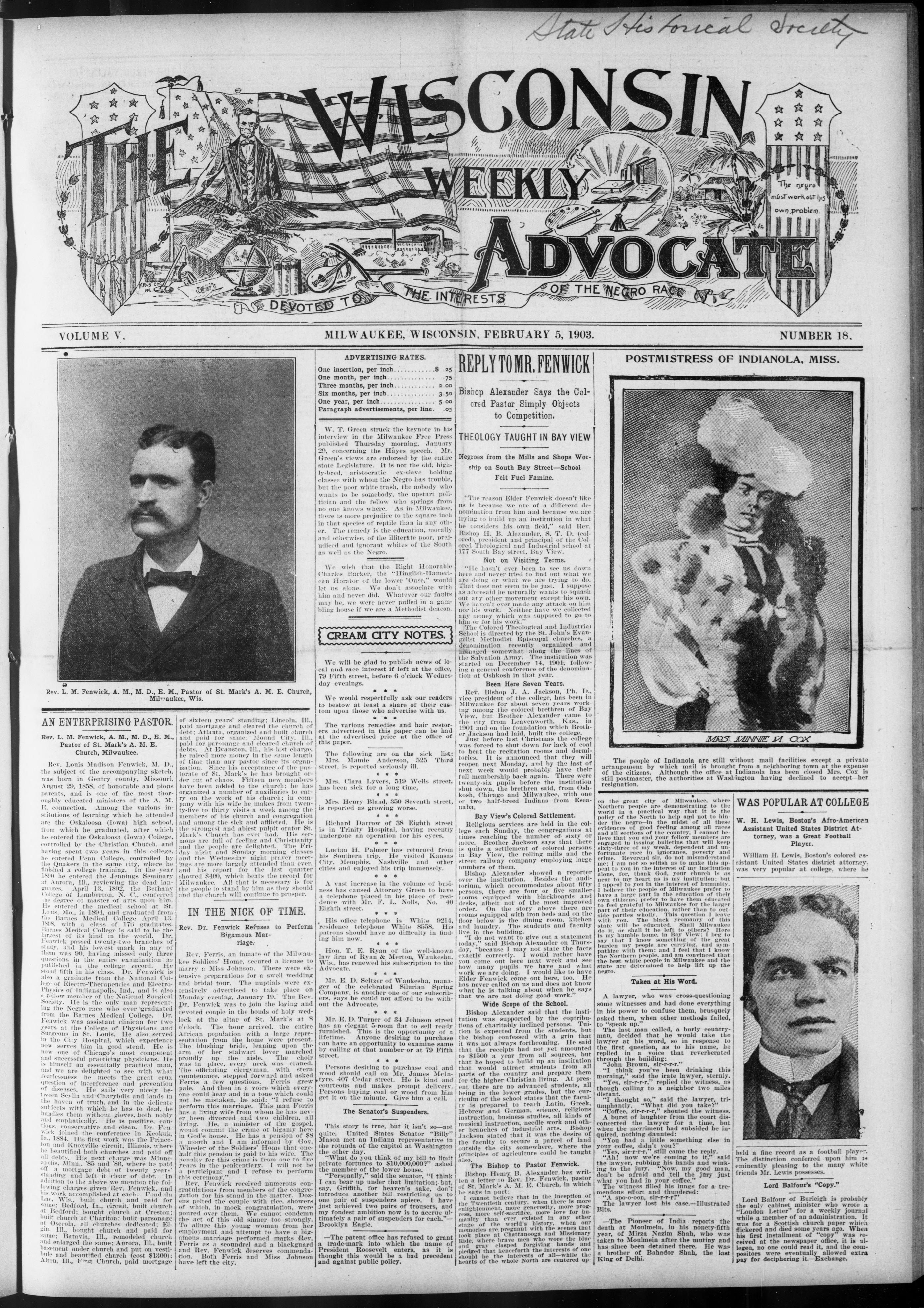
Page text (machine-generated)
State Historical Society
WISCONSIN
WEEKLY
ADVOCATE
DEVOTED TO THE INTERESTS OF THE NEGRO RACE
*
Rev. L. M. Fenwick, A. M., M. D., E. M., Pastor of St. Mark's A. M. E. Church, Milwaukee, Wis.
VOLUME V.
Rev. L. M. Fenwick, A. M., M. D., E. M. Milwaukee
AN ENTERPRISING PASTOR.
Rev. L. M. Fenwick, A. M., M. D., E. M. Pastor of St. Mark's A. M. E. Church, Milwaukee.
Rev. Louis Madison Fenwick, M. D., the subject of the accompanying sketch, was born in Gentry county, Missouri, August 29, 1858, of honorable and pious parents, and is one of the most thoroughly educated ministers of the A. M. E. connection. Among the various institutions of learning which he attended are the Oskaloosa (Iowa) high school, from which he graduated, after which he entered the Oskaloosa (Iowa) College, controlled by the Christian Church, and having spent two years in this college, he entered Penn College, controlled by the Quakers in the same city, where he finished a college training. In the year 1890 he entered the Jennings Seminary at Aurora, Ill., reviewing the dead languages. April 13, 1892, the Bethany College of Lumberton, N. C., conferred the degree of master of arts upon him. He entered the medical school at St. Louis, Mo., in 1894, and graduated from the Barnes Medical College April 13, 1898, with a class of 176 graduates. Barnes Medical College is said to be the largest of its kind in the world. Dr. Fenwick passed twenty-two branches of study, and his lowest mark in any of them was 90, having missed only three questions in the entire examination as published in the college record. He stood fifth in his class. Dr. Fenwick is also a graduate from the National College of Electro-Therapeutics and ElectroPhysics of Indianapolis, Ind., and is also a fellow member of the National Surgical Society. He is the only man representing the Negro race who ever graduated from the Barnes Medical College. Dr. Fenwick was assistant clinician for two years at the College of Physicians and Surgeons in St. Louis. He also served in the City Hospital, which experience now serves him in good stead. He is now one of Chicago's most competent and successful practicing physicians. He is himself an essentially practical man, and we are delighted to see with what fearlessness he meets the great crux question of interference and prevention of diseases. He sails very nicely between Scylla and Charybdis and lands in the haven of truth, and in the delicate subjects with which he has to deal, he handles them without gloves, both nobly and emphatically. He is positive, cautious, conservative and clean. Dr. Fenwick joined the conference in Keokuk, Ia., 1884. His first work was the Princeton and Knoxville circuit, Illinois, where he beautified both churches and paid off all debts. His next charge was Minneapolis, Minn., '85 and '86, where he paid off a mortgage debt of twenty years' standing and left it clear of debt. In addition to the above we mention the following charges given Rev. Fenwick, and his work accomplished at each: Fond du Lac, Wis., built church and paid for same; Bedford, Ia., circuit, built church at Bedford; bought church at Creston; built church at Chariton; built parsonage at Osecola, all churches dedicated; Elgin, Ill., bought church and paid for same; Batavia, Ill., remodeled church and enlarged the same; Aurora, Ill., built basement under church and put on vestibule and beautified church (cost $1300); Alton, Ill., First Church, paid mortgage
---
of sixteen years' standing; Lincoln, Ill., paid mortgage and cleared the church of debt; Atlanta, organized and built church and paid for same; Mound City, Ill., paid for parsonage and cleared church of debts. At Evanston, Ill., his last charge, he raised more money in the same length of time than any pastor since its organization. Since his acceptance of the pastorate of St. Mark's he has brought order out of chaos. Fifteen new members have been added to the church; he has organized a number of auxiliaries to carry on the work of his church; in company with his wife he makes from twenty-five to thirty visits a week among the members of his church and congregation and among the sick and afflicted. He is the strongest and ablest pulpit orator St. Mark's Church has ever had. His sermons are full of feeling and Christianity and the people are delighted. The Friday night and Sunday morning classes and the Wednesday night prayer meetings are more largely attended than ever, and his report for the last quarter showed $400, which beats the record for Milwaukee. All that is necessary is for the people to stand by him as they should and the church will continue to prosper.
IN THE NICK OF TIME.
Rev. Dr. Fenwick Refuses to Perform Bigamous Marriage.
Rev. Ferris, an inmate of the Milwaukee Soldiers' Home, secured a license to marry a Miss Johnson. There were extensive preparations for a swell wedding and bridal tour. The nuptials were extensively advertised to take place on Monday evening, January 19. The Rev. Dr. Fenwick was to join the loving and devoted couple in the bonds of holy wedlock at the altar of St. Mark's at S o'clock. The hour arrived, the entire African population with a large representation from the home were present. The blushing bride, leaning upon the arm of her stalwart lover marched proudly up the aisle. The choir was in place, every neck was craned. The officiating clergyman, with stern countenance, stepped forward and asked Ferris a few questions. Ferris grew pale. And then in a voice which everyone could hear and in a tone which could not be mistaken, he said: "I refuse to perform this marriage. This man Ferris has a living wife from whom he has never been divorced and two children, all living. He, a minister of the gospel, would commit the crime of bigamy here in God's house. He has a pension of $8 a month and I am informed by Gov. Wheeler of the Soldiers' Home that one-half this pension is paid to his wife. The penalty for this crime is from one to five years in the penitentiary. I will not be a participant and I refuse to perform this ceremony."
Rev. Fenwick received numerous congratulations from members of the congregation for his stand in the matter. Dozens pelted the couple with rice, showers of which, in mock congratulation, were poured over them. We cannot condemn the act of this old sinner too strongly. To allure this young woman from her employment and attempt to have a bigamous marriage performed marks Rev. Ferris as a scoundrel and a blackguard and Rev. Fenwick deserves commendation. Both Ferris and Miss Johnson have left the city.
ADVERTISING RATES.
One insertion, per inch..... $ .25
One month, per inch..... .75
Three months, per inch..... 2.00
Six months, per inch..... 3.50
One year, per inch..... 5.00
Paragraph advertisements, per line..... .05
W. T. Green struck the keynote in his interview in the Milwaukee Free Press published Thursday morning, January 29, concerning the Hayes speech. Mr. Green's views are endorsed by the entire state Legislature. It is not the old, highly-bred, aristocratic ex-slave holding classes with whom the Negro has trouble, but the poor white trash, the nobody who wants to be somebody, the upstart politician and the fellow who springs from no one knows where. As in Milwaukee, there is more prejudice to the square inch in that species of reptile than in any other. The remedy is the education, morally and otherwise, of the illiterate poor, prejudiced and ignorant whites of the South as well as the Negro.
We wish that the Right Honorable Charles Barker, the "Hinglish-Hamerican Horator of the lower 'Ouse," would let us alone. We don't associate with him and never did. Whatever our faults may be, we were never pulled in a gambling house if we are a Methodist deacon.
CREAM CITY NOTES.
We will be glad to publish news of local and race interest if left at the office, 79 Fifth street, before 6 o'clock Wednesday evenings.
We would respectfully ask our readers to bestow at least a share of their custom upon those who advertise with us.
☆ ☆ ☆
The various remedies and hair restorers advertised in this paper can be had at the advertised price at the office of this paper.
The following are on the sick list:
Mrs. Mamie Anderson, 525 Third street, is reported seriously ill.
* * *
Mrs. Clara Lyvers, 519 Wells street, has been sick for a long time.
* * *
Mrs. Henry Bland, 350 Seventh street, is reported as growing worse.
* * *
Richard Darrow of 38 Eighth street is in Trinity Hospital, having recently undergone an operation for his eyes.
Lucian H. Palmer has returned from his Southern trip. He visited Kansas City, Memphis, Nashville and other cities and enjoyed his trip immensely.
***
A vast increase in the volume of business has caused Attorney Green to have a telephone placed in his place of residence with Mr. F. L. Nolls, No. 40 Eighth street.
His office telephone is White 9214,
residence telephone White 8558. His
patrons should have no difficulty in finding him now.
Hon. T. E. Ryan of the well-known
law firm of Ryan & Merton, Waukesha,
Wis., has renewed his subscription to the
Advocate.
Mr. E. D. Seltzer of Waukesha, manager of the celebrated Silurian Spring Company, is another one of our subscribers, says he could not afford to be without the Advocate.
* * *
Mr. E. D. Turner of 34 Johnson street has an elegant 5-room flat to sell ready furnished. This is the opportunity of a lifetime. Anyone desiring to purchase can have an opportunity to examine same by calling at that number or at 79 Fifth street.
* * *
Persons desiring to purchase coal and wood should call on Mr. James McIntyre. 407 Cedar street. He is kind and courteous and makes prompt delivery. Persons buying coal or wood from him get it on the minute. Give him a call.
The Senator's Suspenders
This story is true, but it isn't so—not quite. United States Senator "Billy" Mason met an Indiana representative in the rotunda of the capitol at Washington the other day.
"What do you think of my bill to limit private fortunes to $10,000,000?" asked the member of the lower house.
"Personally," said the senator, "I think I can bear up under that limitation; but, say, Griffith, for heaven's sake, don't introduce another bill restricting us to one pair of suspenders apiece. I have just achieved two pairs of trousers, and my fondest ambition now is to accrue ultimately a pair of suspenders for each."—Brooklyn Eagle.
The patent office has refused to grant a trade-mark into which the name of President Roosevelt enters, as it is thought this would be a bad precedent and against public policy.
REPLY TOMR. FENWICK
REPLY TOMR. FENWICK
Bishop Alexander Says the Colored Pastor Simply Objects to Competition.
Negroes from the Mills and Shops Worship on South Bay Street—School Felt Fuel Famine
"The reason Elder Fenwick doesn't like us is because we are of a different denomination from him and because we are trying to build up an institution in what he considers his own field," said Rev. Bishop H. B. Alexander, S. T. D. (colored), president and principal of the Colored Theological and Industrial school at 177 South Bay street, Bay View.
Not on Visiting Terms.
"He hasn't ever been to see us down here and never tried to find out what we are doing or what we are trying to do. That does not seem to be just. I suppose as aforesaid he naturally wants to squash out any other movement except his own. We haven't ever made any attack on him nor his work. Neither have we collected any money which was supposed to go to him or for his work."
The Colored Theological and Industrial School is directed by the St. John's Evangelist Methodist Episcopal churches, a denomination recently organized and managed somewhat along the lines of the Salvation Army. The institution was started on December 14, 1901, following a general conference of the denomination at Oshkosh in that year.
Been Here Seven Years.
Rev. Bishop J. A. Jackson, Ph. D., vice president of the college, has been in Milwaukee for about seven years working among the colored brethren of Bay View, but Brother Alexander came to the city from Leavenworth, Kas., in 1901 and on the foundation which Brother Jackson had laid, built the college.
Just before last Christmas the college was forced to shut down for lack of coal to heat the recitation rooms and dormitories. It is announced that they will reopen next Monday, and by the last of next week would probably have their full membership back again. There were twenty-six pupils before the institution shut down, the brethren said, from Oskosh, Chicago and Milwaukee, with one or two half-breed Indians from Escanaba.
Bay View's Colored Settlement.
Religious services are held in the college each Sunday, the congregations at times reaching the number of sixty or more. Brother Jackson says that there is quite a settlement of colored persons in Bay View, the rolling mills and the street railway company employing large numbers of them.
Bishop Alexander showed a reporter over the institution. Besides the auditorium, which accommodates about fifty persons, there are four or five smaller rooms equipped with blackboards and desks, albeit not of the most improved order. On the story above there are rooms equipped with iron beds and on the floor below is the dining room, kitchen and laundry. The students and faculty live in the building.
"I do not want to give out a statement today," said Bishop Alexander on Thursday, "because I may not state the facts exactly correctly. I would rather have you come out here next week and see how many pupils we have and what work we are doing. I would like to have Elder Fenwick come out here, too. He has never called on us and does not know what he is talking about when he says that we are not doing good work."
Wide Scope of the School.
Bishop Alexander said that the institution was supported by the contributions of charitably inclined persons. Tuition is expected from the students, but the bishop confessed with a grin that it was not always forthcoming. He said that the receipts had not yet amounted to $1500 a year from all sources, but that he hoped to build up an institution that would attract students from all parts of the country and prepare them for the higher Christian living. At present there are no advanced students, all being in the lower grades, but the curriculum of the school states that the faculty is prepared to teach Latin, Greek, Hebrew and German, science, religious instruction, business studies, all kinds of musical instruction, needle work and other branches of industrial arts. Bishop Jackson stated that it was the desire of the faculty to secure a parcel of land outside the city somewhere, where the principles of agriculture could be taught also.
The Bishop to Pastor Fenwick.
Bishop Henry B. Alexander has written a letter to Rev. Dr. Fenwick, pastor of St. Mark's A. M. E. Church, in which he says in part:
I cannot believe that in the inception of the Twentieth century, when there is more enlightenment, more generosity, more progress, more self-sacrifice, more love for humanity than ever existed in any other stage of the world's history, when our memories are pregnant with the scenes that took place at Chattanooga and Missionary Ride, where brave men who wore the blue and gray clasped forgiving hands and pledged that henceforth the interests of one should be the interests of all—while the hearts of the whole North are centered up-
POSTMISTRESS OF INDIANOLA, MISS.
MRS. MINNIE M. COX
The people of Indianola are still without mail facilities except a private arrangement by which mail is brought from a neighboring town at the expense of the citizens. Although the office at Indianola has been closed Mrs. Cox is still postmaster, the authorities at Washington having declined to accept her resignation.
on the great city of Milwaukee, where Northern people are demonstrating to the world in a practical way that it is the policy of the North to help and not to hinder the negro—in the midst of all these evidences of good feeling among all races and all sections of the country, I cannot believe that you and your fellow members are engaged in issuing bulletins that will keep sixty-three of my weak, dependent and unfortunate race in ignorance, poverty and crime. Reverend sir, do not misunderstand me; I am not so selfish as to make this appeal to you in the interest of my institution alone, for, thank God, your church is as near to my heart as is my institution; but I appeal to you in the interest of humanity. I believe the people of Milwaukee prefer to have a large part in the education of their own citizens; prefer to have them educated to feel grateful to Milwaukee for the larger part of their education, rather than to outside parties wholly. This question I leave with you. The black yeomary of this state will be educated. Shall Milwaukee do it, or shall it be left to others? Here is my humble home, in Bay View; I beg to say that I know something of the great burden my people are carrying, and sympathize with them; and I feel that I know the Northern people, and am convinced that the best white people in Milwaukee and the state are determined to help lift up the negro.
Taken at His Word.
A lawyer, who was cross-questioning some witnesses and had done everything in his power to confuse them, brusquely asked them, when other methods failed, to "speak up." The last man called, a burly countryman, decided that he would take the lawyer at his word, so in response to the first question, as to his name, he replied in a voice that reverberated through the building:
"John Brown, sir-r-r-r."
"I think you've been drinking this morning," said the irate lawyer, sternly.
"Yes, sir-r-r-r," replied the witness, as though calling to a neighbor two miles distant.
"I thought so," said the lawyer, triumphantly. "What did you take?"
"Coffee, sir-r-r-r," shouted the witness.
A burst of laughter from the court disconcerted the lawyer for a time, but when the merriment had subsided he inquired, nothing daunted:
"You had a little something else in your coffee, didn't you?"
"Yes, sir-r-r-r," still came the reply.
"Ah! now we're coming to it," said the lawyer, rubbing his hands and winking to the jury. "Now, my good man, don't be afraid and tell the jury just what you had in your coffee."
The witness filled his lungs for a tremendous effort and thundered:
"A spo-o-oon, sir-r-r-r!"
The lawyer lost his case.—Illustrated Bits.
—The Pioneer of India reports the death at Moulmein, in his nonety-fifth year, of Mirza Nazim Shah, who was taken to Moulmein after the mutiny and has since been detained there. He was a brother of Bahador Shah, the last King of Delhi.
NUMBER 18.
INDIANOLA, MISS.
MINNIE M. COX
without mail facilities except a private act from a neighboring town at the expense Indianola has been closed Mrs. Cox isington having declined to accept her
WAS POPULAR AT COLLEGE
W. H. Lewis, Boston's Afro-American Assistant United States District Attorney, was a Great Football Player. William H. Lewis, Boston's colored assistant United States district attorney, was very popular at college, where he
J.
held a fine record as a football player. The distinction conferred upon him is eminently pleasing to the many white friends Mr. Lewis possesses.
Lord Balfour's "Copy."
Lord Balfour of Burleigh is probably the only cabinet minister who wrote a "London Letter" for a weekly journal while a member of an administration. It was for a Scottish church paper which flickered and died some years ago. When his first installment of "copy" was received at the newspaper office, it is alleged, no one could read it, and the compositors were eventually allowed extra pay for deciphering it.—Exchange.
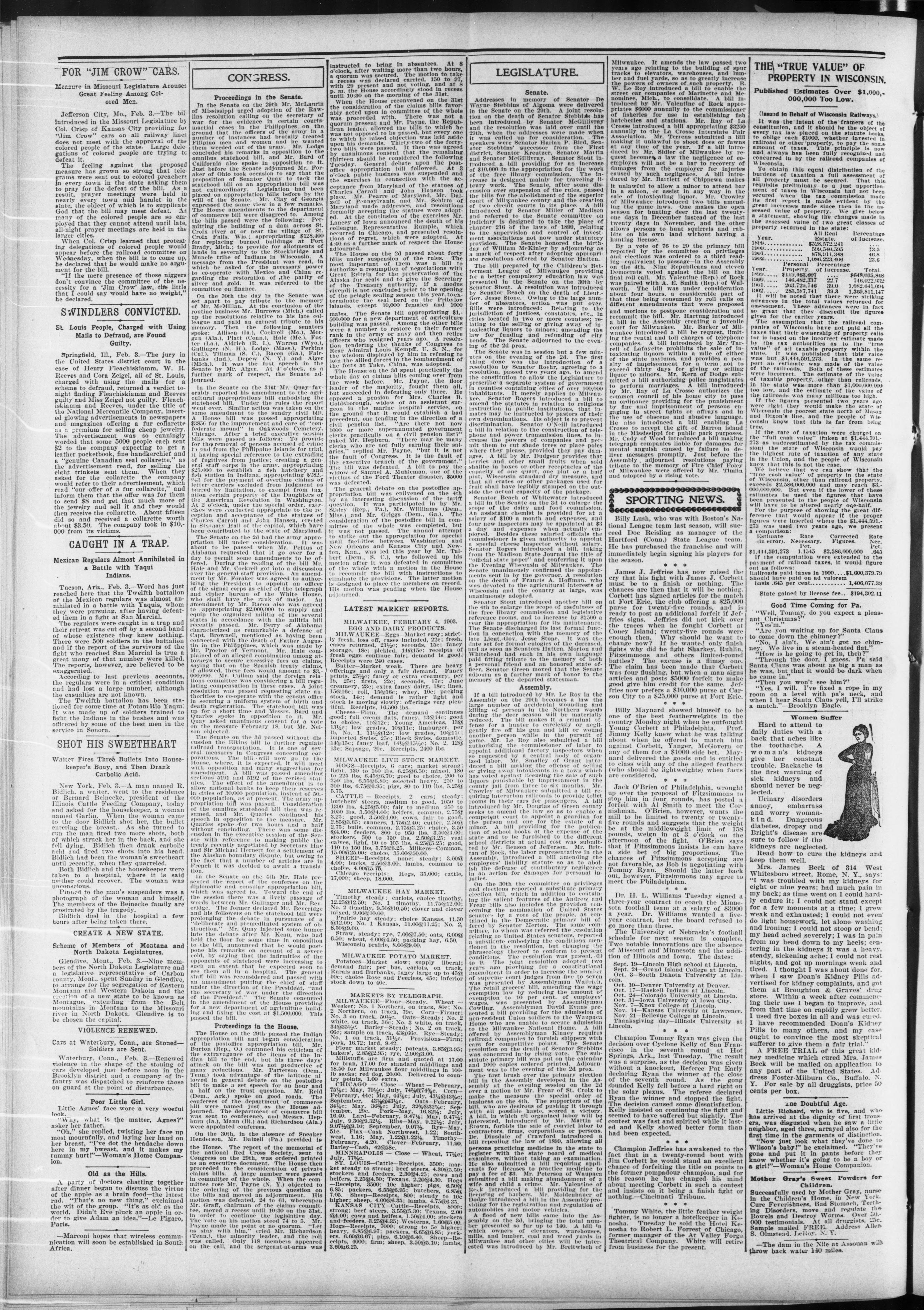
FOR "JIM CROW" CARS.
Measure in Missouri Legislature Arouses Great Feeling Among Colored Men.
Jefferson City, Mo., Feb. 3.—The bill introduced in the Missouri Legislature by Col. Crisp of Kansas City providing for "Jim Crow" cars on all railway lines does not meet with the approval of the colored people of the state. Large delegations of colored people are trying to defeat it.
The feeling against the proposed measure has grown so strong that telegrams were sent out to colored preachers in every town in the state asking them to pray for the defeat of the bill. As a result, prayer meetings were held in nearly every town and hamlet in the state, the object of which is to supplicate God that the bill may meet defeat. As many of the colored people are so employed that they cannot attend until late, all-night prayer meetings are held in the larger cities.
When Col. Crisp learned that protesting delegations of colored people would appear before the railroad committee on Wednesday, when the bill is to come up, he declared that he would make no argument for the bill.
"If the mere presence of those niggers don't convince the committee of the necessity for a 'Jim Crow' law, the little that I could say would have no weight," he declared.
S WINDLERS CONVICTED.
St. Louis People, Charged with Using Mails to Defraud, are Found Guilty.
Springfield, Ill., Feb. 3.—The jury in the United States district court in the case of Henry Fleachiskiamm, W. R. Reeves and Cora Zeigel, all of St. Louis, charged with using the mails for a scheme to defraud, returned a verdict tonight finding Fleachiskiamm and Reeves guilty and Miss Zeigel not guilty. Fleachiskiamm and Reeves, under the title of the National Mercantile Company, inserted glowing advertisements in newspapers and magazines offering a fur collarette as a premium for selling cheap jewelry. The advertisement was so cunningly worded that some 5000 people each sent $2 to the company expecting to get a leather pocketbook, fine handkerchief and a "guineau Canadian seal collarette," as the advertisement read, for selling the eight trinkets sent them. When they asked for the collarette the company would refer to their advertisement, which read "our offer of a fur collarette," and inform them that the offer was for them to send $8 and get that much more of the jewelry and sell it and they would then receive the collarette. About fifteen did so and received a collarette worth about $3.50. The company took in $10,-000 from its victims.
CAUGHT IN A TRAP.
Mexican Regulars Almost Annihilated in a Battle with Yaqui
Tucson, Ariz., Feb. 3.—Word has just reached here that the Twelfth battalion of the Mexican regulars was almost annihilated in a battle with Yaquis, whom they were pursuing, after having defeated them in a fight at San Marcial. The regulars were caught in a trap and their retreat was cut off by a second band of whose existence they knew nothing. There were 500 soldiers in the battalion and if the report of the survivors of the fight who reached San Marcial is true a great many of that number were killed. The reports, however, are believed to be exaggerated. According to last previous accounts, the regulars were in a critical condition and had lost a large number, although the casualties are not known.
The Twelfth battalion has been stationed for some time at PotamRio Yaqun. It was made up of soldiers trained to fight the Indians in the bushes and was officered by some of the best men in the service in Sonora.
SHOT HIS SWEETHEART
Waiter Fires Three Bullets Into House keeper's Body, and Then Drank Carbolic Acid.
New York, Feb. 3.—A man named R. Bidlich, a waiter, went to the residence of Bernard Beinecke, president of the Illinois Cattle Feeding Company, today and asked for the housekeeper, a woman named Garlin. When the woman came to the door Bidlich shot her, the bullet entering the breast. As she turned to run the man fired two more shots, both of which struck her in the back, and she fell dying. Bidlich then drank carbolic acid and fired two shots into his head. Bidlich had been the woman's sweetheart until recently, when they quarreled. Both Bidlich and the housekeeper were taken to a hospital, where it is said neither could recover. The woman was unconscious. Pinned to the man's suspenders was a photograph of the woman and himself. The members of the Beinecke family are prostrated by the tragedy.
Bidlich died in the hospital a few hours after being taken there.
CREATE A NEW STATE.
Scheme of Members of Montana and North Dakota Legislatures.
Glendive, Mont., Feb. 3.—Nine members of the North Dakota Legislature and a legislative representative of Carbon county, Mont., spent Sunday in Glendive, to arrange for the segregation of Eastern Montana and Western Dakota and the creation of a new state to be known as Montague, extending from the Belt mountains in Montana to the Missouri river in North Dakota. Glendive is to be chosen the capital.
VIOLENCE RENEWED.
Cars at Waterbury, Conn., are Stoned— Soldiers, are Sept.
Waterbury, Conn., Feb. 3.-Renewed violence in the shape of the stoning of cars developed just before noon in the Brooklyn district and a company of infantry was dispatched to reinforce those on guard at the point of disturbance.
Poor Little Girl
Little Agnes' face wore a very woeful look.
"Why, what is the matter, Agnes?" asker her father.
"Oh," she replied, twisting her face up most mournfully, and laying her hand on her breast, "I've dot the headache down here in my bweast, and it makes my tummy hurt!"—Woman's Home Companion.
Old as the Hills.
A party of doctors chatting together after dinner began to discuss the virtue of the apple as a brain food—the latest rad. "That's no new thing," exclaimed the wit of the group. "It's as old as the world. Didn't Eve pluck an apple in order to give Adam an idea."—Le Figaro, Paris.
Marconi hopes that wireless communication will soon be established in South Africa.
Proceedings in the Senate.
In the Senate on the 29th Mr. McLaurin of Mississippi urged adoption of the Rawlins resolution calling on the secretary of war for the evidence in certain court-martial cases in the Philippines on the ground that the officers of the army in a number of instances had brutally treated Filipino men and women and he wanted them weeded out of the army. Mr. Lodge concluded his remarks in opposition to the omnibus statehood bill, and Mr. Bard of California also spoke in opposition to it. Just before the Senate adjourned Mr. Foraker of Ohio took occasion to say that the proposition of Senator Quay to tack the statehood bill on an appropriation bill was not extraordinary. Legislation had been placed on appropriation bills before by the will of the Senate. Mr. Clay of Georgia expressed the same view in a few remarks. The House amendments to the department of commerce bill were disagreed to. Among the bills passed were the following: Permitting the building of a dam across St. Croix river at or near the village of St. Croix Falls, Wis.; appropriating $128.400 for replacing burned buildings at Fort Brady, Mich.; to provide for allotments of lands in severity to the Stockbridge and Muncie tribe of Indians in Wisconsin. A message from the President was read, in which he asked for the necessary power to co-operate with Mexico and China regarding the restoration of the parity of silver and gold. It was referred to the committee on finance.
On the 30th day in the Senate was set apart to pay tribute to the memory of Mr. McMillan. At the conclusion of the routine business Mr. Burrows (Mich.) called up the resolutions relative to his late colleague and paid an earnest tribute to his memory. Then the following senators spoke: Allison (Ia.), Cockrell (Mo.), Morgan (Ala.), Platt (Conn.), Hale (Me.), Foster (La.), Aldrich (R. I.), Warren (Wyo.), Gallinger (N. H.), Lodge (Mass.), Perkins (Cal.), Tillman (S. C.), Bacon (Ga.), Fairbanks (Ind.), Depew (N. Y.) and Alger (Mich.). It was the first speech in the Senate by Mr. Alger. At 4 o'clock, as a further mark of respect, the Senate adjourned.
In the Senate on the 31st Mr. Quay favorably reported his amendment to the agricultural appropriations bill embodying the statehood bill. Under the rules the report went over. Similar action was taken on the same amendment to the sundry civil bill. A House bill was passed appropriating $3850 for the improvement and care of "confederate mound" in Oakwoods Cemetery, Chicago. After a brief executive session bills were passed as follows: To provide for the removal of persons accused of crime to and from the Philippine Islands for trial, it having special reference to the extrading of fugitives from justice; creating a general staff corps in the army, appropriating $25,000 to establish a fish hatchery and fish station in Indiana, appropriating $282,953 for the payment of overtime claims of letter carriers excluded from judgment as barred by limitation, to exempt from taxation certain property of the Daughters of the American Revolution in Washington. At 2 o'clock, under the special order, exercises were conducted appropriate to the reception and acceptance of the statues of Charles Carroll and John Hansen, erected in Statuary Hall of the capitol, which have been contributed by the state of Maryland.
The Senate on the 2d had the army appropriation bill under consideration. It was about to be passed when Mr. Pettus of Alabama requested that it go over for a day to permit some amendments to be offered. During the reading of the bill Mr. Hale and Mr. Cockrell got into a discussion over the general staff provision. An amendment by Mr. Foraker was agreed to authorizing the President to appoint an officer of the signal corps as chief of the telegraph and cipher bureau of the White House, who shall have the rank of major. An amendment by Mr. Bacon also was agreed to appropriating $2,000,000 to supply and equip the organized militia of the several states in accordance with the militia bill recently passed. Mr. Berry of Alabama characterized as remarkable a defense of Capt. Brownell, mentioned as having been connected with the death of Father Augustin in the Philippines, which was made by Mr. Proctor of Vermont. Mr. Hale complained of an alleged combination among attorneys to secure excessive fees on claims, saying that on the Spanish treaty claims, if allowed, these fees would amount to $3,000,000. Mr. Cullom said the foreign relations committee was considering a bill regulating compensation in these cases. A joint resolution was passed requesting state authorities to co-operate with the census office in securing a uniform system of birth and death registration. The statehood bill was up for a short time and Messrs. Bard and Quarles spoke in opposition to it. Mr. Quay asked unantimious consent for a vote on the measure February 18, but Mr. Nelson objected.
The Senate on the 3d passed without dis cussion the Elkins bill to further regulate railroad transportation. It is one of several measures in Congress concerning corporations. The bill will now go to the House, where, it is expected, it will meet with opposition and many suggestions for amendment. A bill was passed amending sections 5191 and 5192 of the revised statutes. The effect of the amendment is to allow national banks to keep their reserves in cities of 30,000 population, instead of 50,000 population, as at present. The army appropriation bill was passed. Consideration of the omnibus statehood bill then was resumed, and Mr. Quarles continued his speech in opposition to the measure. Mr. Quarles spoke for two hours and a half without concluding. There was some discussion in the executive session of the Senate with reference to making public the treaty recently negotiated by Secretary Hay and Sir Michael Herbert for a settlement of the Alaskan boundary dispute, but owing to the fact that a number of articles are in French it was decided to await a translation.
In the Senate on the 4th Mr. Hale presented the report of the conferences on the diplomatic and consular appropriation bill, which was agreed to. Toward the end of the session there was a lively passage of words between Mr. Gallinger and Mr. Beveridge. The former declared Mr. Beveridge and his followers on the statehood bill were prolonging the debate in pursuance of a "deliberate and premeditated system of obstruction." Mr. Quay injected some humor into the debate after Mr. Kean, who had held the floor for some time in opposition to the bill, announced that he would postpone his remarks on account of a severe cold, by saying that the infirmities of the opponents of statehood were increasing to such an extent that he expected soon to see them all in a hospital. The general staff bill was reconsidered and passed with an amendment putting the chief of staff under the direction of the President, "and the secretary of war under the direction of the President." The Senate concurred in the amendment of the House providing for a new department of agriculture building and fixing the cost at $1,500,000. This passed the bill.
Proceedings in the House.
The House on the 29th passed the Indian appropriation bill and began consideration of the postoffice appropriation bill. Mr. Burton (Rep., O.) continued his criticism of the extravagance of the items of the Indian bill to the end, but his three days' attack on the bill was not productive of many reductions. Mr. Patterson (Dem., Tenn.) took advantage of the latitude allowed in general debate on the postoffice bill to make a set speech for an hour and a half on the trust question. Mr. Reid (Dem., Ark.) spoke on good roads. The conferees of the department of commerce bill were named just as the House adjourned. The department of commerce bill was sent to conference, and Messrs. Hepburn (Ja.), Mann (Ill.) and Richardson (Ala.) were appointed conferees.
On the 30th, in the absence of Speaker Hendeison, Mr. Dalzell (Pa.) presided in the House. The report of the memorial of the national Red Cross Society, sent to Congress on the 20th, was ordered printed as an executive document. The House then proceeded to the consideration of private claims bills. A large number were passed in committee of the whole. When the committee rose Mr. Payne (N. Y.) objected to the ordering of the previous question on the bills and moved an adjournment. His motion was defeated, 24 to 61, whereupon Mr. Graff, chairman of the claims committee, moved a recess until 10:30 on the 31st, in order to continue the legislative day. The vote on his motion stood 74 to 5. Mr. Payne made the point or no quorum. "Let us stay with him." cried Mr. Richardson (Tenn.), the minority leader, and the roll was called. Only 118 members appeared on the call, and the sergeant-at-arms was
instructed to bring in absentees. At 8 o'clock, after waiting more than two hours, a quorum was secured. The motion to take a recess was declared carried, 150 to 97, with 29 present and not voting, and at 8 p. m. the House accordingly stood in recess until 10:30 on the morning of the 31st.
When the House reconvened on the 31st the consideration of the claims bills favorably acted upon in committee of the whole was proceeded with. There was not a quorum present and Mr. Payne, the Republican leader, allowed the bills to which he was not opposed to be passed, but every one to which he raised objection was laid aside upon his demands. Thirty-two of the forty-two bills were passed. It then was agreed by unanimous consent that the remaining thirteen should be considered the following Tuesday. General debate upon the post-office appropriation bill followed. At 3 o'clock public business was suspended and the exercises in connection with the acceptance from Maryland of the statues of Charles Carroll and John Hanson took place. Mr. Pearre of Maryland, Mr. Dalzell of Pennsylvania and Mr. Schirm of Maryland made addresses, and resolutions formally accepting the statues were adopted. At the conclusion of the exercises Mr. Lancey of Iowa announced the death of his colleague, Representative Rumple, which occurred in Chicago, and presented resolutions of regret, which were adopted. At 4:40 as a further mark of respect the House adjourned.
The House on the 2d passed about forty bills under suspension of the rules. The most important of them was a bill to authorize a resumption of negotiations with Great Britain for the preservation of the Alaska fur seals and to give the Secretary of the Treasury authority, if a modus vivendi is not concluded prior to the opening of the pelagic sealing season this year, to exterminate the seal herd on the Pribylov islands, except 10,000 females and 1000 males. The Senate bill appropriating $1,-500,000 for a new department of agriculture building was passed. Among the other bills were a number to restore to their former rank in the army or navy and then retire officers who resigned years ago. A resolution tendering the thanks of Congress to Rear Admiral Louis Kempff, U. S. N., for the wisdom displayed by him in refusing to join the allied forces in the bombardment of the forts at Taku, China, was adopted.
The House on the 3d spent practically the whole day on claims bills coming over from the week before. Mr. Payne, the floor leader of the majority, fought them all, but succeeded in defeating only three. He opposed a pension for Mrs. Charles B. Goldsborough, widow of an assistant surgeon in the marine hospital service, on the ground that it would establish a bad precedent, one tending in the direction of a civil pension list. "Are there not now 1000 or more superannuated government clerks practically on a civil pension list?" asked Mr. Hepburn. "There may be many clerks who are not fully earning their salaries," replied Mr. Payne, "but it is not the fault of Congress. It is the fault of the executive branch of the government." The bill was defeated. A bill to pay the widow of Samuel A. Muhleman, one of the victims of the Ford Theater disaster, $5000 was defeated.
The general debate on the postoffice appropriation bill was enlivened on the 4th by an interesting discussion of the tariff question. It was participated in by Mr. Sibley (Rep., Pa.), Mr. Willliams (Dem., Miss.) and Mr. Griggs (Dem., Ga.). The consideration of the postoffice bill in committee of the whole was completed, but it was not passed. The annual attempt to strike out the appropriation for special mail facilities between Washington and New Orleans and Kansas City and Newton, Kan., was led this year by Mr. Talbert (Dem., S. C.), who followed up his motion after it was defeated in committee of the whole with a motion in the House to recommit the bill with instructions to eliminate the provisions. The latter motion is designed to place the members on record. His motion was pending when the House adjourned.
LATEST MARKET REPORTS
MILWAUKEE, FEBRUARY 4, 1903.
EGG AND DAIRY PRODUCTS.
MILWAUKEE—Eggs—Market easy; strictly fresh, loss off, cases included, 22c; fresh, cases returned, 21½c; seconds, 15c; fancy storage, 18c; pickled, 14@15c; receipts of fresh eggs continue fair; demand is good. Receipts were 240 cases.
Butter—Market weak. There are heavy offerings and only a fair demand. Fancy prints, 25½c; fancy or extra creamery, per lb, 25c; firsts, 22c; seconds, 17c; June creamery, 23c; extra fancy dairy, 18c; lines, 15@16c; roll, 15@16c; whey, 10c; packing stock, 14c; demand is rather light and stock is moving slowly; offerings very plentiful. Receipts, 16,500 lbs.
Cheese—Firm. The demand continues good; full cream flats, fancy, 13@14c; good to choice, 11@12c; Young Americas, 13@ 13½c; low grades, 10@11c; limburger. per lb. No. 1, 11½@12c; low grades, 10@11c; imported Swiss, 25c; Block Swiss, domestic. 14@15c; fancy loaf, 14½@15½c; No. 2, 12@ 13c; Sapsago, 20c. Receipts, 2400 lbs.
MILWAUKEE LIVE STOCK MARKET.
HOGS—Receipts, 6 cars; market strong; light, 130 to 160 lbs, 6.25@6.50; mixed, 180 to 225 lbs, 6.45@6.70; good to choice, 200 to 250 lbs, 6.55@6.80; selected heavy, 250 to 300 lbs, 6.75@6.95; pigs, 80 to 110 lbs, 5.25@ 5.75.
CATTLE — Receipts, 2 cars; steady; butchers' steers, medium to good, 1050 to 1300 lbs, 4.25@5.00; fair to medium, 950 to 1050 lbs, 3.50@4.00; milkers, common, 2.75@3.25; good, 3.50@4.00; cows, fair to good, 2.85@3.65; canners, 1.75@2.40; cutter, 2.50@2.75; bulls, common, 2.75@3.25; choice, 3.50@4.00; feeders, 800 to 950 lbs, 3.50@4.00; stockers, 500 to 750 lbs, 2.50@3.25; veal calves, light, 90 to 105 lbs, 4.25@5.25; good, 110 to 150 lbs, 5.75@6.25. Milkers—Common, 15.00@25.00; choice, 35.00@50.00.
SHEEP—Receipts, none; steady; 3.00@4.00; bucks, 2.50@3.00; lambs, common to choice, 4.00@5.75.
Chicago receipts; Hogs, 35,000; cattle, 17,000; sheep, 18,000
MILWAUKEE HAY MARKET
Timothy steady; carlots, choice timothy,
12.25@12.50; No. 1 timothy, 11.75@12.00;
No. 2 timothy, 9.50@10.50; clover and clover
mixed, 9.00@10.00.
Prairie hay steady; choice Kansas, 11.50
@12.00; No. 1 Kansas, 11.00@11.25; No. 2,
8.50@9.00.
Straw, steady; rye, 7.00@7.50; oats, 6.00@
6.50; wheat, 4.00@4.50; packing hay, 6.50.
Wisconsin prairie, 8.00@9.00.
MILWAUKEE POTATO MARKET
Potatoes-Market slow; supply liberal; demand fair; per bus, carlores, on track. Rurals and Burbanks, fancy large up to 45@ 50c; choice Rose and Peerless, 45c; inferior stock down to 40c.
MARKETS BY TELEGRAPH
MILWAUKEE—Flour—Steady. Wheat—Weaker; No. 1 Northern, on track, 80c; No. 2 Northern, on track, 79c. Corn—Firmer; No. 3 on track, 50½c. Oats—Steady; No. 2 white, on track, 36c; No. 3 white, on track, 34@35½¹c. Barley—Steady; No. 2 on track, 66c; sample on track, 43@66c. Rye—Steady; No. 1 on track, 51½c. Provisions—Firm; pork, 16.72; lard, 9.42.
Flour market steady; patents; 3.85@3.95; bakers', 2.85@2.95; rye, 2.90@3.00.
Millstuffs are firm and quoted at 17.00 for bran, 17.00 for standard middlings and 18.50 for Milwaukee flour middlings in 100lb sacks; red dog, 20.00. Delivered to country points, 1.00 extra.
CHICAGO — Close — Wheat — February, 75%c; May, 79%c; July, 74%@74%c. Corn—February, 44c; May, 44%c; July, 43%@43%c; September, 43%@43%c. Oats—February, 34%c; May, 36%c; July, 32%@32%c; September, 29c. Pork—May, 16.82½; July, 16.40. Lard—February, 9.47½; May, 9.47½; July, 9.30@9.32½. Ribs—May, 9.22½; July, 9.07½@9.10; September, 9.07½. Rye—May, 51c. Flax—Cash Northwest, 1.22. Southwest, 1.16; May, 1.22@1.22½. Timothy—February, 4.20. Clover—February, 11.90. Barley—Cash, 42@58c.
MINNEAPOLIS — Close — Wheat, 77%c; July, 77%c.
ST. LOUIS—Cattle—Recelpts, 3500; market steady to strong; beef steers, 4.30@5.50; stockers and feeders, 2.30@4.25; cows and halfers, 2.25@4.50; Texans, 2.20@4.30. Hogs—Recelpts, 3500; 10c higher; pigs, 6.50@6.85; packers, 6.55@6.95; butchers, 6.85@7.05. Sheep—Recelpts, 800; steady to 10c higher; sheep, 4.00@6.35; lambs, 4.75@6.35.
KANSAS CITY—Cattle—Recelpts, 8000; strong; beef steers, 3.55@5.30; Texans, 2.00@4.00; cows and halfers, 1.50@4.00; stockers and feeders, 3.25@4.35; Westerns, 1.60@5.00. Hogs—Recelpts, 7000; strong to 5c higher; heavy, 6.85@6.97; packers, 6.65@6.85; yorkers, 6.60@6.67; pligs, 6.10@6.40. Sheep—Recelpts, 4000; firm; sheep, 3.50@5.10; lambs, 3.60@6.25.
LEGISLATURE.
Senate.
Addresses in memory of Senator De Wayne Stebbins of Algoma were delivered in the Senate on the 29th. A joint resolution on the death of Senator Stebbins has been introduced by Senator McGillivray and the resolution was laid over until the 29th, when the addresses were made when it was called up for consideration. The speakers were Senator Harlan P. Bird, Senator Stebbins' successor from the First district, Senator Kreutzer, Senator Martin and Senator McGillivray. Senator Stout introduced a bill providing for an increase of $10,000 in the appropriation for the work of the free library commission. The increase is designed mainly for traveling library work. The Senate, after some discussion over suspension of the rules, passed the bills for the abolishment of the superior court of Milwaukee county and the creation of two circuit courts in its place. A bill introduced by Senator Miller of Madison and referred to the Senate committee on judiciary is designed to take the place of chapter 216 of the laws of 1899, relating to the supervision and control of investment associations not now under statutory provision. The Senate honored the birthday of William McKinley by adjourning as a mark of respect after adopting appropriate resolutions offered by Senator Hatten.
The bill prepared by the Children's Betterment League of Milwaukee providing for a better compulsory education law was presented in the Senate on the 30th by Senator Stout. A resolution was introduced by Senator Beach on the death of Lieut-Gov. Jesse Stone. Owing to the large number of absentees, action was put over. Bills were introduced: Relating to the jurisdiction of justices, constables, etc., in cities located in two or more counties; relating to the selling or giving away of intoxicating liquors to minors; amending the law for funding and refunding of city bonds. The Senate adjourned to the evening of the 2d prox.
The Senate was in session but a few minutes on the evening of the 2d. The first thing done was the introduction of a resolution by Senator Roehr, agreeing to a resolution, passed two years ago, to amend the constitution to allow the Legislature to prescribe a separate system of government in counties containing cities of over 100,000 inhabitants. It merely applies to Milwaukee. Senator Rogers introduced a bill to amend the statutes in relation to religious instruction in public institutions, that inmates may be instructed by pastors of their own denominations. Its object is to prevent discrimination. Senator O'Neill introduced a bill in relation to the construction of telephone and power transmission lines, to increase the powers of companies and permit them to cut shade trees or place poles where they please, provided they pay damages. A bill by Mr. Dudgear provides that berries and other small fruits when sold shall be in boxes or other receptacles of the capacity of one quart, one pint or a half pint, Wisconsin standard dry measure, and that all crates or other packages used for fruit shall have legibly stamped on the outside the actual capacity of the package.
Senator Beach of Whitewater introduced a bill in the Senate on the 3d to enlarge the scope of the dairy and food commission. An assistant chemist is provided for at a salary of $100 a month and expenses, and four new inspectors may be appointed at $3 a day and expenses when actually employed. Besides these salaried officials the commissioner is given authority to appoint a special cheese inspector without salary. Senator Rogers introduced a bill, taking from the Madison State Journal the title of "official state paper" and conferring it upon the Evening Wisconsin of Milwaukee. The Senate unanimously confirmed the appointments sent in by the governor. A resolution on the death of Francis A. Hoffman, who was devoted to the agricultural interests of Wisconsin and the country at large, was unanimously adopted.
Senator Stout introduced another bill on the 4th to enlarge the scope of usefulness of the free library commission and legislative reference rooms, and to increase by $2500 a year the appropriation for its maintenance. The Senate discharged its last formal function in concession with the memory of the late Lleut.Gov. Jesse Stone. It was the date set for formal eulogies of the deceased, and as soon as Senators Hatten, Morton and Whitehead had each in his own language paid fitting tribute to the memory of both a personal friend and an honored state officer. Senator Green moved that the Senate adjourn as a further mark of honor to the memory of the departed statesman.
Assembly.
If a bill introduced by Mr. Le Roy in the Assembly on the 20th becomes a law the large number of accidental wounding and killing of persons in the Northern woods during the deer season will be materially reduced. The bill makes it a criminal offense for a hunter to carelessly or negligently fire off his gun and kill or wound another person while in the pursuit of game. Mr. Le Roy also submitted a bill authorizing the commissioner of labor to appoint additional factory inspectors when so requested by a central body of organized labor. Mr. Smalley of Grant introduced a bill making the offense of selling or giving away intoxicants in a town which has voted against licensing the sale of such liquors punishable by imprisonment in the county jail from three to six months. Mr. Crowley of Milwaukee submitted a bill requiring interurban railroads to provide toilet rooms in their cars for passengers. A bill introduced by Mr. Douglas of Green county seeks to amend the law so as to enable a competent court to appoint a guardian for the person and one for the estate of a minor. A bill providing for the publication of school books at the expense of the state and to be furnished to the different school districts at actual cost was submitted by Mr. Benson of Jefferson. Mr. Brittan of Rock, the labor representative in the Assembly, introduced a bill amending the employers' liability statute so as to abolish the defense of contributory negligence in an action for damages for personal injuries
On the 30th the committee on privileges and elections reported a substitute primary election bill, which in addition to containing the salient features of the Andrew and Frear bills also includes the provision concerning the nomination of United States senators by a vote of the people, as contained in the Democratic primary bill offered by Senator Merton. The same committee, to whom was referred the resolution relating to United States senators, reported a substitute embodying the conditions mentioned in the resolution, but changing the phraseology thereof to conform to present conditions. The resolution was passed, 60 to 9. The joint resolution adopted two years ago providing for a constitutional amendment in order to increase the number of supreme court judges from five to seven was presented by Assemblyman Wailrich. The retail grocers' bill, amending the wage exemption law by reducing the amount of exemption to 10 per cent, of employees' wages, was presented by Assemblyman Cowling. Assemblyman David Evans presented a bill providing for the admission of non-resident Union soldiers to the Waupaca Home who are unable to secure admission to the Milwaukee National Home. A bill offered by Assemblyman Kinney requires railroad companies to furnish shippers with cars for competitive points. The Senate resolution on the death of Senator Stebbins was concurred in by rising vote. The substitute primary bill was put on the calendar and 1000 copies ordered printed. Adjournment was to the evening of the 2d prox.
The first brush over the primary election bill in the Assembly developed in the Assembly at the evening session on the 2d over a motion by Mr. Frear of St. Croix to make the measure the special order of business on the 4th. The supporters of the bill, who are desirous of pushing it through with all possible haste, scored a victory. A bill, in which all organized labor will be interested, introduced by Mr. Martin of Brown, forbids the sale of convict labor to contractors, firms, corporations or persons. Dr. Dinsdale of Crawford introduced a bill repealing the law of 1899, allowing all persons practicing medicine in the state to register with the state board of medical examiners, without taking an examination. He also submitted a bill requiring applicants for licenses to practice medicine to pay a fee of $3. Mr. Peterson of Waupaca submitted a bill making abandonment of a wife and child a crime. Mr. Valentine of Rock introduced a bill providing for the licensing of barbers. Mr. Moldenhauer of Dodge introduced a bill in the Assembly providing for the registration and regulation of automobiles and motor vehicles.
A flood of new bills came into the Assembly on the 3d, bringing the total number presented so far up to 140. A bill in which owners of elevators, warehouses, mills, and lumber, coal and wood yards in Milwaukee and other cities will be interested was introduced by Mr. Breitwisch of
Milwaukee. It amends the law passed two years ago relating to the building of spur tracks to elevators, warehouses, and lumber and fuel yards, so as to greatly increase the powers of owners of such property. E. W. Le Roy introduced a bill to enable the street car companies of Marinette and Menominee, Mich., to consolidate. A bill introduced by Mr. Valentine of Rock appropriates $6000 annually to the commissioner of fisheries for use in establishing fish hatcheries and stations. Mr. Ray of La Crosse introduced a bill appropriating $3250 annually to the La Crosse Interstate Fair Association. Mr. Teriens submitted a bill making it unlawful to shoot does or fawns at any time of the year. If a bill introduced by Mr. Sidler of Milwaukee by request becomes a law the negligence of co-employees will not be a bar to recovery of damages from the employer for injuries caused by such negligence. A bill introduced by Mr. Baitlett of Chippewa makes it unlawful to allow a minor to attend bar in a saloon, or assist in any way in the sale of intoxicating liquor. Mr. Crowley of Milwaukee introduced two bills amending the game laws. One makes the open season for hunting deer the last twenty-one days in December instead of the last twenty days in November, and the other allows persons to hunt squirrels and rabbits on his own land without having a hunting license.
By a vote of 76 to 20 the primary bill reported by the committee on privileges and elections was ordered to a third reading—equivalent to passage—in the Assembly on the 4th. Nine Republicans and eleven Democrats voted against the bill on the final roll call. Mr. Valentine (Rep.) of Rock was paired with A. E. Smith (Rep.) of Walworth. The bill was under consideration about four hours, a considerable part of that time being consumed by roll calls on different amendments that were proposed and motions to postpone consideration and recommit the bill. Mr. Hartung introduced a bill in the Assembly creating a juvenile court for Milwaukee. Mr. Barker of Milwaukee introduced a bill be request, limiting the rental and toll charges of telephone companies. A bill introduced by Mr. Tarrell of Lafayette prohibits the sale of intoxicating liquors within a mile of either of the state asylums, and provides a penalty of imprisonment for a term not to exceed thirty days for giving or selling liquor to minors. Mr. Kern of Dodge submitted a bill authorizing police magistrates to perform marriages. A bill introduced by Mr. Ray of La Crosse authorizes the common council of his home city to pass an ordinance providing for the punishment by fine and imprisonment of persons engaging in street fights or affrays and in the use of obscene and abusive language. He also introduced a bill enabling La Crosse to accept the gift of Barron island in the Mississippi for public park purposes. Mr. Cady of Wood introduced a bill making telegraph companies liable for damages for mental anguish caused by failure to deliver messages promptly. Just before the Assembly, adjourned resolutions paying tribute to the memory of Fire Chief Foley of Milwaukee were offered by Mr. Timlin and adopted by a rising vote.
SPORTING NEWS.
Billy Lush, who was with Boston's National League team last season, will succeed Doc Reisling as manager of the Hartford (Conn.) State League team. He has purchased the franchise and will immediately begin signing his players for the season.
```markdown
```
James J. Jeffries has now raised the cry that his fight with James J. Corbett must be to a finish or nothing. The chances are then that it will be nothing. Corbett has signed articles for the match at Fort Erie, the club offering a $25,000 purse for twenty-five rounds, and is ready to post an additional forfeit if Jeffries signs. Jeffries did not kick over the traces when he fought Corbett at Coney Island; twenty-five rounds were enough then. Why should he want to change now? If he wanted only finish fights why did he fight Sharkey, Ruhlin, Fitzsimmons and others limited-round battles? The excuse is a flimsy one. The claim has been made that Corbett was four flushing, but when a man signs articles and posts $5000 forfeit to make good give him credit for the same. Jeffries now prefers a $10,000 purse at Carson City to a $25,000 purse at Fort Erie.
* * *
Billy Maynard showed himself to be one of the best featherweights in the country Monday night when he outfought Young Corbett at Philadelphia. Prof. Jimmy Kelly knew what he was talking about when he offered to match him against Corbett, Yanger, McGovern or any of them for a $1000 side bet. Maynard delivered the goods and is entitled to class with any of the alleged feathers (who should be lightweights) when facts are considered.
Jack O'Brien of Philadelphia, wrought up over the proposal of Fitzsimmons to stop him in four rounds, has posted a forfeit with Al Smith to meet the Cornishman. O'Brien, however, wants the mill to be limited to twenty or twenty-five rounds and suggests that the weight be at the middleweight limit of 158 pounds, weign in at 3 o'clock on the afternoon of the fight. O'Brien says that if Fitzsimmons insists he can have a side bet of big proportions. The chances of Fitzsimmons accepting are not favorable, as Bob is negotiating with Tommy Ryan. Should the latter back out, however, Fitzsimmons may agree to meet the Philadelphia.
* * *
Dr. H. L. Williams Tuesday signed a three-year contract to coach the Minnesota football team at a salary of $3000 a year. Dr. Williams wanted a five-year contract, but the board refused to go more than three.
The University of Nebraska's football schedule for next season is complete. Two notable innovations are the absence of Missouri and Minnesota and the addition of Illinois and Iowa. The dates:
Sept. 19—Lincoln High school at Lincoln.
Sept. 24—Grand Island College at Lincoln.
Oct. 3—South Dakota University at Lincoln.
Oct. 10—Denver University at Denver.
Oct. 17—Haskell Indians at Lincoln.
Oct. 24—Colorado University at Lincoln.
Oct. 31—Iowa University at Iowa City.
Nov. 7—Knox College at Lincoln.
Nov. 14—Kansas University at Lawrence.
Nov. 21—Bellevue College at Lincoln.
Thanksgiving day—Illinois University at Lincoln.
Champion Tommy Ryan was given the decision over Cyclone Kelly of San Francisco in the seventh round at Hot Springs, Ark., last Tuesday. The result was a surprise, as the decision was given without a knockout, Referee Pat Early declaring Ryan the winner at the close of the seventh round. As the gong sounded Kelly fell before a hard right on the solar plexus. The referee declared Ryan the winner and stopped the fight. The decision caused some dissatisfaction. Kelly insisted on continuing the fight and seemed to have suffered but slightly. The contest was fast and spirited while it lasted and Kelly showed better form than had been expected.
***
Champion Jeffries has awakened to the fact that in a twenty-round bout with Jim Corbett he would stand an excellent chance of forfeiting the title on points to the former pompadour champion, and for this reason he has changed his mind about meeting Corbett in such a contest and insists on it being a finish fight or nothing.—Cincinnati Tribune.
* * *
Tommy White, the little feather weight fighter, is no longer a hotelkeeper in Kenosha. Tuesday he sold the Hotel Kenosha to Robert L. Forrest of Chicago, former manager of the At Valley Forge Theatrical Company. White will retire from business for the present.
THE "TRUE VALUE" OF PROPERTY IN WISCONSIN.
THE "TRUE VALUE" OF PROPERTY IN WISCONSIN.
Published Estimates Over $1,000,000,000 Too Low.
It was the intent of the framers of the constitution, and it should be the object of every tax law placed on the statute books, to oblige each $1000, whether invested in railroad or other property, to pay the sane amount of taxes. This principle is now and always has been fully recognized and concurred in by the railroad companies of Wisconsin.
To obtain this equal distribution of the burdens of taxation a full assessment of all property must be secured. That this requisite preliminary to a just apportionment of taxes in Wisconsin had not been secured when the tax commission made its first report is made evident by the great increases made since then in the assessed value of property. We give below a statement, showing the changes made in the assessed value of two great classes of property returned in the state:
Year. All Real Estate. Percentage of Increase.
1899 $528,572,241 ...
1900 599,540,395 13.5
1901 878,911,348 46.8
1902 1,086,221,406 23.6
Year. Personal Percentage of Increase. Total.
1899 $119,463,607 $648,035,848
1900 146,482,337 21.7 746,022,332
1901 203,729,746 39.0 1,082,641,094
1902 283,587,741 39.3 1,360,811,147
It will be noted that there were striking advances in the total values returned for assessment. These advances were in fact so great that they discredit the figures given for the earlier years.
The assumption that the railroad companies of Wisconsin have not paid all the taxes that their ownership of property calls for is based on the incorrect estimate made by the tax authorities as to the "true value" of all taxable property within the state. It was published that this value was but $1,444,591,273. In the same report an estimate was made of the value of the railroads. Both of these estimates were incorrect. The estimate of the value of taxable property, other than railroads, in the state was more than $1,000,000,000 too low, and the estimate of the value of the railroads was many millions too high.
If the figures presented two years ago were right they would make the state of Wisconsin the poorest state north of Mason and Dixon's line, and the people of Wisconsin know that this is far from being true.
If the rate of taxation were charged on the "full cash value" (taken at $1,444,501,273 as underestimated by the tax commission) the state of Wisconsin would pay the highest rate of taxation of any state in the Union, and the people of Wisconsin know that this is not the case.
We believe that we can show that the "true cash value" of property in the state of Wisconsin, other than railroad property, exceeds $2,586,000,000 and may reach $3,000,000,000. But even if the lower of these estimates be used the figures that have been presented to the people of Wisconsin will have to be altered nearly oqe-half.
For the purpose of showing the great difference that would appear if the proper figures were inserted where the $1,444,501,273 was used two years ago, we present a comparison:
Estimate Rate Corrected Rate (in error). Necessary. Figures. Nec.
$1,444,591,273 1.1545 $2,586,000,000 .645
If the computation were extended to the
payment of railroad taxes, it would figure
out as follows:
railroads paid taxes in 1900.....$1,600,379.79
Should have paid on ad valorem
basis 645 per cent 1,406,077.38
basis .645 per cent..... 1,406,077.38
State gained by license fee.. $194,302.41
Good Time Coming for Pa.
"Well, Tommy, do you expect a pleasant Christmas?"
"Yes'm."
"Are you waiting up for Santa Claus to come down the chimney?"
"No, I ain't. We ain't got no chimney. We live in a steam-heated flat."
"How is he going to get in, then?"
"Through the door, I guess. Pa said Santa Claus was about as big a man as he was, but that it would be dark when he came in."
"Then you won't see him?"
"Then you won't see him."
"Yes, I will. I've fixed a rope in my room on a level with pa's neck, and when I hear Santa Claus yell, I'll strike a match."—Brooklyn Eagle.
Women Suffer
1
Hard to attend to daily duties with a back that aches like the toothache. A woman's kidneys give her constant trouble. Backache is the first warning of sick kidneys and should never be neglected. Urinary disorders annoy, embarrass and worry womankind. Dangerous diabetes, dropsy and Bright's disease are sure to follow if the kidneys are neglected
Read how to cure the kidneys and keep them well.
Mrs. James Beck of 314 West Whitesboro street, Rome, N. Y., says: "I was troubled with my kidneys for eight or nine years; had much pain in my back; as time went on I could hardly endure it; I could not stand except for a few moments at a time; I grew weak and exhausted; I could not even do light housework, let alone washing and ironing; I could not stoop or bend; my head ached severely; I was in pain from my head down to my heels; centering in the kidneys it was a heavy, steady, sickening ache; I could not rest nights, and got up mornings weak and tired. I thought I was about done for, when I saw Doan's Kidney Pills advertised for kidney complaints, and got them at Broughton & Graves' drug store. Within a week after commencing their use I began to improve, and from that time on rapidly grew better. I used five boxes in all and was cured. I have recommended Doan's Kidney Pills to many others, and my case ought to convince the most skeptical sufferer to give them a fair trial."
A FREE TRIAL of this great kidney medicine which cured Mrs. James Beck will be mailed on application to any part of the United States. Address Foster-Milburn Co., Buffalo, N. Y. For sale by all druggists, price 50 cents per box.
One Doubtful Age.
Little Richard, who is five, and who has arrived at the dignity of first trousers, was disgusted when he saw a little neighbor, aged three, arrayed also for the first time in the garments of distinction. "Now just look what they've done to Wilson's baby!" he exclaimed. "They've gone and put it in pants before they know whether it's going to be a boy or a girl!"—Woman's Home Companion.
Mother Gray's Sweet Powders for Children.
Successfully used by Mother Gray, nurse in the Children's Home, in New York. Cure Feverishness, Bad Stomach, Teething Disorders, move and regulate the Bowels and Destroy Worms. Over 20,000 testimonials. At all druggists, 25c. Sample mailed FREE. Address Allen S. Olmstead, LeRoy, N. Y.
The dam in the Nile at Assouan will throw back water 140 miles.
GOD IN NATURE.
Oh, men that darken life, you dream
When you with idle words blaspheme,
And laugh at any ruling God
More mighty than a common clod.
Have you surveyed all Nature round.
Proved well the clod that you have found
As great as God o'er life and death?
Say, have you marked its living breath?
Take one poor little life from out
The common clod, you do not doubt,
And trace the wonder of design
Till justice falters, 'tis divine.
Can you with cunning learning make
An insect that shall warm breath take?
Nay Plato could not make it glow,
Nor even Michael Angelo.
Paint me the glory of the grass
That doth all purple state surpass:
Then tell me whence the wind doth come,
And where it goes when it is dumb.
Reveal why in the self-same bed
The lily's white, the rose is red.
Why color with unseeming power
Is different in each different flower.
Translate the language of the oak,
As though in living words it spoke
From out its mighty heart and strong,
The meaning of its ancient song.
Sing me the song of all the sea
In moving, wistful melody;
Unroll its sobbing swell and fall.
Say why waves make a song at all.
Then sweep the illimitable sky,
And with great wisdom tell me why
The everlasting stars are there,
And lay eternal mystery bare.
—Charles Lusted, in The Gentleman's Mag-azine
THE FALLACY OF A FACE.
Cranfield holds that the beginning of his courtship was unique; but that may be Cranfield's one-sided view. It was the night of the Hunt ball and he leaned against a pillar in the dancing room. At no time a dancing man, on this occasion he was excessively bored; he was out of sorts; the band was too loud; the crush was too great. He thought regretfully of his library fire, and shiveringly of the long drive home.
At the end of the room he saw heads turned toward the door. Following a very human impulse, he turned his own in the same direction. He was inquisitive, but the desire to know is quite as infectious as a disease.
In a brief space the crowd about the entrance parted, and his curiosity melted before another feeling—a feeling as rapid, if infinitely more strong. He closed his eyes; then he readjusted his glass.
It was Creighton—Tommy Creighton and his wife. He watched them move slowly up the room, and as they moved he felt, rather than heard, the admiration that hummed in their wake. He took a long look; then he leaned back against the pillar, seeking to realize exactly where he stood.
"If you ever fall in love, Cranfield," some one had once said, "you'll be the worst case on record, bar none."
The words occurred to him inopportunely. As a man he was not exceptional; but there were things at which he drew the line. Making love to a married woman, curiously enough, came first on the proscribed list. The feelings that surged through him as he let the pillar support him were largely made up of fear. The thing was preposterous—grotesque. He shied vigorously at the shadow of it. But not for an instant did his eyes stray from Mrs. Creighton's face.
He had seen her before—once before. That point alone wrought self-distrust. He had called one day with Bisherthorpe, and she had given them tea. His verdict had been, "Extremely pretty, sarcastic, and a trifle cold."
He screwed in his eyeglass and leaned still further back. He saw Creighton introduce four men. Then his control gave way. He forced an opening in the crowd; but when he reached her side and spoke, his voice had a tone that, even to him, was new.
"May I have the pleasure?"
She looked up with just the faintest surprise. Then her eyes fell on the facings of his red coat, and she smiled—the friendliest and most perfect smile he had ever seen.
He took the card and scrawled his initials. Then he looked at the obviously waiting men.
"No. 6 is also free," he said. "May I——?"
He would not have admitted the feelings with which he waited for her reply. He saw the negative trembling on her lips, and quailed. Then, to his absurdly great relief, the saving smile came again, and she blushed.
"You may."
The words seemed the frankest and most delightful he had ever heard.
There is nothing in the world so vivifying as hope. In a single moment the shifting crowd had become the universe, and he had found its core. Like a wonderfully deferred dream the fifth dance came round, and waiting was at an end. "Mine, I think," he said. She folded her fan, smiled at the man beside her, then laid her hand on Cranfield's arm. "Shall we dance?" he asked. "Oh! please." He hid his disappointment, though his ideas were curiously upset. She seemed so enthusiastic—so buoyantly young.
The music had quickened to its end, when he swung her out of the crush. His brain was still swaying to the beat of the tune as he drew her down a passage to a distant seat. In ten minutes of companionship she had grown straight into his life.
The carpet of the passage was very soft; the light of the hanging lamp was very dim. It seemed to him that he had only existed until now. He arranged the cushions on the divan, and she sat down.
"Do you believe in infatuation?" he
"Do you believe in infatuation?" he asked suddenly.
He felt afraid of what he was going to say. He felt that his principles, his honor—he used the word boldly—all staple things were drifting from him like a mirage.
"Have you ever heard of a man going off his head in a single night?" he asked afresh.
She looked up at him; and behind the uneasiness in her eyes he felt that she was measuring him inch by inch.
"I'd like to ask you something," she said, "if you don't mind."
She glanced down, then once more glanced up.
"I want you to tell me your name."
He met her gaze in blank surprise. It
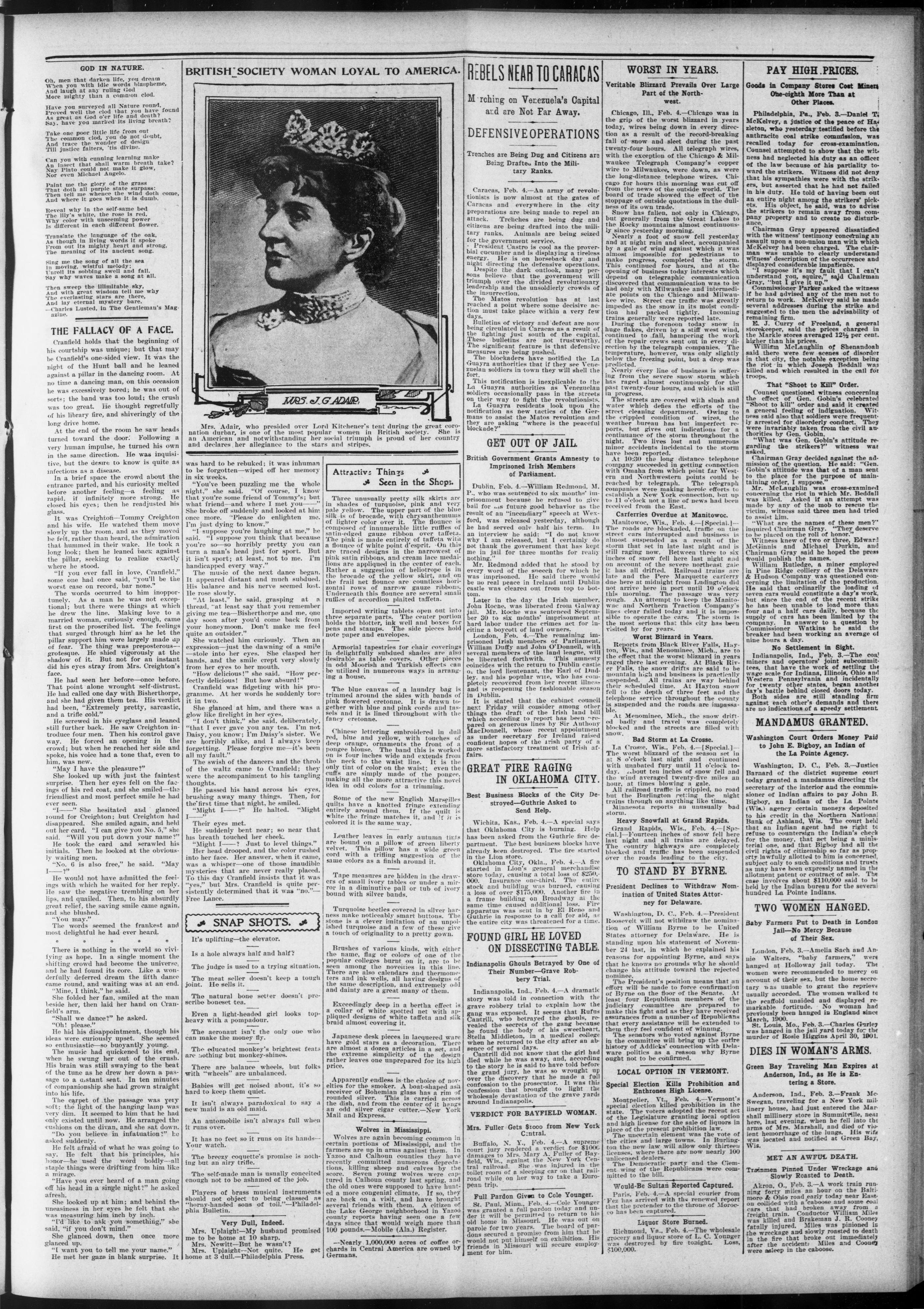
MRS. J. G. ADAIR
Mrs. Adair, who presided over Lord Kitchener's tent during the great coronation durbar, is one of the most popular women in British society. She is an American and notwithstanding her social triumph is proud of her country and declares her allegiance to the stars and stripes.
was hard to be rebuked; it was inhuman to be forgotten—wiped off her memory in six weeks.
"You've been puzzling me the whole night," she said. "Of course, I know that you're some friend of Tommy's; but what friend—and where I met you—" She broke off suddenly and looked at him once more. "Please do enlighten me. I'm just dying to know."
"I suppose you're laughing at me," he said. "I suppose you think that because you're so—so horribly pretty you can turn a man's head just for sport. But it isn't sport; at least, not to me. I'm handicapped every way."
The music of the next dance began. It appeared distant and much subdued. His balance and his nerve seemed lost. He rose slowly.
"At least," he said, grasping at a thread, "at least say that you remember giving me tea—Bisherthorpe and me, one day soon after you'd come back from your honeymoon. Don't make me feel quite an outsider."
She watched him curiously. Then an expression—just the dawning of a smile—stole into her eyes. She clasped her hands, and the smile crept very slowly from her eyes to her mouth.
"How delicious!" she said. "How perfectly delicious! But how absurd!"
Cranfield was fidgeting with his programme. At her words he suddenly tore it in two.
She glanced at him, and there was a glow like firelight in her eyes.
"I don't think," she said, deliberately, "that I ever gave you any tea. I'm not Daisy, you know; I'm Daisy's sister. We are horribly alike, and I always keep forgetting. Please forgive me—it's been all my fault."
The swish of the dancers and the throb of the waltz came to Cranfield; they were the accompaniment to his tangling thoughts.
He passed his hand across his eyes, brushing away many things. Then, for the first time that night, he smiled.
"Might I——?" He halted. "Might I——"
Their eyes met.
He suddenly bent near; so near that his breath touched her cheek.
"Might I——? Just to level things."
Her head drooped, and the color rushed into her face. Her answer, when it came, was a whisper—one of those inaudible mysteries that are never really placed. To this day Cranfield insists that it was "yes," but Mrs. Cranfield is quite persistently determined that it was "no."—Free Lance.
SNAP SHOTS.
It's uplifting—the elevator.
Is a hole always half and half?
The judge is used to a trying situation.
The meat seller doesn't keep a tough joint. He sells it.
The natural bone setter doesn't prescribe boneset tea.
Even a light-headed girl looks top-heavy with a pompadour.
The aeronaut isn't the only one who can make the money fly.
The educated monkey's brightest feats are nothing but monkey-shines.
There are balance wheels, but folks with "wheels" are unbalanced.
Babies will get noised about, it's so hard to keep them quiet.
It isn't always paradoxical to say a new maid is an old maid.
An automobile isn't always full when it runs over.
It has no feet so it runs on its hands—Your watch.
The breezy coquette's promise is nothing but an airy trifle.
The self-made man is usually conceited enough not to be ashamed of the job.
Players of brass musical instruments should not object to being classed as "horny-handed sons of toil."—Philadelphia Bulletin.
Mrs. Uplaight—My husband promised me to be home at 10 sharp. Mrs. Newitt—But he wasn't? Mrs. Uplaight—Not quite. He got home at 3 dull.—Philadelphia Press.
Attractive Things Seen in the Shops.
Three unusually pretty silk skirts are in shades of turquoise, pink and very pale yellow. The upper part of the blue silk is of brocade, with chrysanthemums of lighter color over it. The flounce is composed of innumerable little ruffles of satin-edged gauze ribbon over taffeta. The pink is made entirely of taffeta with a flounce of white point d'esprit. On this are traced designs in the narrowest of pink satin ribbons, and cream lace medallions are appliqued in the center of each. Rather a suggestion of heliotrope is in the brocade of the yellow skirt, and on the frail net flounce are countless horizontal rows of narrow gauze ribbons. Underneath this flounce are several small ruffles of accordion plaited taffeta.
Imported writing tablets open out into three separate parts. The center portion holds the blotter, ink well and boxes for pens and stamps. The side pieces hold note paper and envelopes.
Armorial tapestries for chair coverings in delightfully subdued shades are also desirable as table covers. Other pieces in odd Moorish and Turkish effects can be utilized in numerous ways in arranging a house.
The blue canvas of a laundry bag is trimmed around the sides with bands of pink flowered cretonne. It is drawn together with blue and pink cords and tassels and it is lined throughout with the fancy cretonne.
Chinese lettering embroidered in dull red, blue and yellow, with touches of deep orange, ornaments the front of a pongee blouse. The band this is worked on is four inches wide and extends from the neck to the waist line. It is the only tint of color on the waist; even the cuffs are simply made of the pongee, making all the more attractive this novel idea in odd colors for a trimming.
Some of the new English Marseilles quilts have a knotted fringe extending entirely around them. If the quilt is white the fringe matches it, and if it is colored it is the same way.
Leather leaves in early autumn tints are bound on a pillow of green liberty velvet. This pillow has a wide green cord with a trifling suggestion of the same colors as a finish around it.
Tape measures are hidden in the drawers of small ivory tables or under a mirror in a diminutive pail or tub of ivory bound with silver bands.
Turquoise beetles covered in silver harness make noticeably smart buttons. The stone is a clever imitation of an unpolished turquoise and a few of these give a touch of originality to a pretty gown.
Brushes of various kinds, with either the name, flag or colors of one of the popular colleges burnt on it, are to be seen among the noveities in this line. There are also calendars and thermometers and ink wells, all having designs of the same description, and extremely odd and dainty are a great many of them.
Exceedingly deep in a bertha effect is a collar of white spotted net with appliqued designs of white taffeta and silk braid almost covering it.
Japanese desk pieces in laequered ware have gold stars as a decoration. There are almost a dozen articles in a set, and the extreme simplicity of the design rather leaves one unprepared for its high price.
Apparently endless is the choice of novelties for the smoker. A boat-shaped ash receiver of Bohemian glass has a rim of rounded silver. This is carried across the dish, and from the center of it hangs an odd silver cigar cutter.—New York Mail and Express.
Wolves in Mississippi
Wolves are again becoming common in certain portions of Mississippi, and the farmers are up in arms against them. In Yazoo and Calhoun counties they have recently committed numerous depredations, killing sheep and calves by the score. Seven young wolves were captured in Calhoun county last spring, and the old ones were supposed to have hunted a more congenial climate. If so, they are back on a visit, and have brought several friends with them. A citizen of the Lake George neighborhood in Yazoo county reports having seen one a few days since that would weigh more than 100 pounds.—Mobile (Ala.) Register.
—Nearly 1,000,000 acres of coffee orchards in Central America are owned by Germans
REBELS NEAR TO CARACAS
Marching on Venezuela's Capital and are Not Far Away.
DEFENSIVE OPERATIONS
Trenches are Being Dug and Citizens are Being Drafted Into the Mili-
tary Ranks.
Caracas, Feb. 4.—An army of revolutionists is now almost at the gates of Caracas and everywhere in the city preparations are being made to repel an attack. Treunches are being dug and citizens are being drafted into the military ranks. Animals are being seized for the government service. President Castro is cool as the proverbial cucumber and is displaying a tireless energy. He is on horseback day and night directing the defensive operations
Despite the dark outlook, many persons believe that the government will triumph over the divided revolutionary leadership and the unsoldierly crowds of the insurrection.
The Matos revolution has at last reached a point where some decisive action must take place within a very few days.
Bulletins of victory and defeat are now being circulated in Caracas as a result of the fighting just south of the capital. These bulletins are not trustworthy. The significant feature is that defensive measures are being pushed.
The blockaders have notified the La Guayra authorities that if they see Venezuelan soldiers in town they will shell the fort.
This notification is inexplicable to the La Guayra authorities as Venezuelan soldiers occasionally pass in the streets on their way to fight the revolutionists. La Guayra residents look upon the notification as new tactics of the Germans to assist the Matos revolution and they are asking "where is the peaceful blockade?"
GET OUT OF JAIL.
British Government Grants Amnesty to Imprisoned Irish Members of Parliament.
Dublin, Feb. 4.—William Redmond, M. P., who was sentenced to six months' imprisonment because he refused to give bail for his future good behavior as the result of an "incendiary" speech at Wexford, was released yesterday, although he had served only half his term. In an interview he said: "I do not know why I am released, but I certainly do not thank the government that has kept me in jail for three months for really nothing." Mr. Redmond added that he stood by every word of the sneech for which he was imprisoned. He said there would be no real peace in Ireland until Dublin castle was cleared out from top to bottom.
Later in the day the Irish member, John Roche, was liberated from Galway jail. Mr. Roche was sentenced September 30 to six months' imprisonment at hard labor under the crimes act for inciting a boycott of land owners. London, Feb. 4.—The remaining imprisoned Irish members of Parliament, William Duffy and John O'Donnell, with several members of the land league, will be liberated forthwith. This amnesty coincides with the return to Dublin castle or the lord lieutenant, the Earl of Dudley, and his popular wife, who has completely recovered from her recent illness and is reopening the fashionable season in Dublin.
It is stated that the cabinet council next Friday will consider among other things the draft of the Irish land bill which according to report has been prepared on generous lines by Sir Anthony MacDonnell, whose recent appointment as under secretary for Ireland raised confident hopes of the Irish party of a more satisfactory treatment of Irish affairs.
GREAT FIRE RAGING IN OKLAHOMA CITY.
Best Business Blocks of the City Destroyed—Guthrie Asked to Send Help.
Wichita, Kas., Feb. 4.—A special says that Oklahoma City is burning. Help has been asked from the Guthrie fire department. The best business blocks have already been destroyed. The fire started in the Lion store.
Oklahoma City, Okla., Feb. 4.—A fire started in Lion's general merchandise store today, causing a total loss of $250,000. Insurance one-third. The entire stock and building was burned, causing a loss of over $175,000. Another fire in a frame building on Broadway at the same time caused additional loss. Fire apparatus was sent in by El Reno and Guthrie in response to a call for aid, as the entire city was threatened for a time.
FOUND GIRL HE LOVED ON DISSECTING TABLE.
Indianapolis Ghouls Betrayed by One of Their Number—Grave Robbery Trial.
Indianapolis, Ind., Feb. 4.—A dramatic story was told in connection with the grave robbery trial to explain how the gang was exposed. It seems that Rufus Cantrill, who betrayed the ghouls, revealed the secrets of the gang because he found the body of his sweetheart, Stella Middleton, in a medical college when he returned to the city after an absence of several days.
Cantrill did not know that the girl had died while he was away, and, according to the story he is said to have told before the grand jury, he was so wrought up over the discovery that he made a full confession to the prosecutor. It was this confession that brought to light the wholesale devastation of the grave yards around Indianapolis.
VERDICT FOR BAYFIELD WOMAN.
Mrs. Fuller Gets $1000 from New York Central.
Buffalo, N. Y., Feb. 4.—A supreme court jury rendered a verdict for $1000 damages to Mrs. Mary A. Fuller of Bayfield, Wis., against the New York Central railroad. She was injured in the toilet room of a sleeping car on that railroad while on her way to take a European trip.
Full Pardon Given to Cole Younger.
St. Paul, Minn., Feb. 4.—Cole Younger was granted a full pardon today and under it will be permitted to return to his old home in Missouri. He was out on parole for two years. The board of pardons secured a promise from him that he would not put himself on exhibition. His friends in Missouri will secure employment for him.
WORST IN YEARS.
Veritable Blizzard Prevails Over Large Part of the North-
Chicago, Ill., Feb. 4.—Chicago was in the grip of the worst blizzard in years today, wires being down in every direction as a result of the record-breaking fall of snow and sleet during the past twenty-four hours. All telegraph wires, with the exception of the Chicago & Milwaukee Telegraph Company's copper wire to Milwaukee, were down, as were the long-distance telephone wires. Chicago for hours this morning was cut off from the news of the outside world. The board of trade showed the effect of the stoppage of outside quotations in the dullness of its own trade. Snow has fallen, not only in Chicago, but generally from the Great Lakes to the Roeky mountains almost continuously since yesterday morning.
Nearly a foot of snow fell yesterday and at night rain and sleet, accompanied by a gale of wind against which it was almost impossible for pedestrians to make progress, completed the storm. This continued for hours, and at the opening of business today interests which depend on telegraphic communication discovered that communication was to be had only with Milwaukee and intermediate points on the Chicago and Milwaukee wire. Street car traffic was greatly impeded as the snow in its molst condition had packed tightly. Incoming trains generally were reported late.
During the forenoon today snow in huge flakes, driven by a stiff west wind, continued to fall, hampering the work of the repair crews sent out in every direction by the telegraph companies. The temperature, however, was only slightly below the freezing point, but a drop was predicted. Nearly every line of business is suffering from the severe snow storm which has raged almost continuously for the past twenty-four hours, and which is still in progress.
The streets are covered with slush and water which defies the efforts of the street cleaning department. Owing to the crippled condition of wires, the weather bureau has but imperfect reports, but gives out indications for a continuance of the storm throughout the night. Two lives lost and numerous minor accidents incidental to the storm have been reported.
At 10:30 the long distance telephone company succeeded in getting connection with Omaha from which point far Western and Northwestern points could be reached by telegraph. The telegraph companies were making heroic efforts to establish a New York connection, but up to 11 o'clock not a line of news had been received from the East.
Carferries Overdue at Manitowoc.
Manitowoc, Wis., Feb. 4.—[Special.]—The roads are blockaded, traffic on the street cars interrupted and business is almost suspended as a result of the storm that set in late last night and is still raging now. Between three to six inches of snow fell here last night and on account of the severe northeast gale it has all drifted. Railroad trains are late and the Pere Marquette carferry due here at midnight from Ludington did not arrive here in port until 10 o'clock this morning. The passage was very rough. An attempt to keep the Manitowac and Northern Traction Company's lines clear failed today and it is impossible to operate the cars. The storm is the most serious that this city has been visited by for years.
Worst Blizzard in Years.
Reports from Black River Falls, Hayton, Wis., and Menominee, Mich., are to the effect that the worst blizzard in years raged there last evening. At Black River Falls, the snow drifts are said to be mountain high and business is practically suspended. All trains are way behind their scheduled time. At Hayton snow fell to the depth of three feet and the telephone service throughout the county is suspended and the roads are impassable. At Menominee, Mich., the snow drifted badly and travel was completely blocked and the streets are filled with snow.
Bad Storm at La Crosse.
La Crosse, Wis., Feb. 4.—[Special.]—The worst blizzard of the season set in at 8 o'clock last night and continued with unabated fury until 11 o'clock today. About ten inches of snow fell and the wind averaged twenty-five miles an hour, at times blowing a gale. All railroad traffic is crippled, no road but the Burlington getting the night trains through on anything like time. Minnesota reports an unusually bad storm.
Heavy Snowfall at Grand Rapids.
Grand Rapids, Wis., Feb. 4.—[Special.]—Fourteen inches of snow fell here last night and all trains are delayed. The country highways are completely blocked and traffic has been suspended over the roads leading to the city.
TO STAND BY BYRNE.
President Declines to Withdraw Nomination of United States Attorney for Delaware.
Washington, D. C., Feb. 4.—President Roosevelt will not withdraw the nomination of William Byrne to be United States attorney for Delaware. He is standing upon his statement of November 24 last, in which he explained his reasons for appointing Byrne, and says that he knows no grounds why he should change his attitude toward the rejected nominee. The President's position means that an effort will be made to force confirmation of Byrne on the floor of the Senate. At least four Republican members of the judiciary committee are prepared to make this fight and as they have received assurances from a number of Republicans that every assistance will be extended to them they feel confident of winning.
The senators who voted against Byrne in the committee will bring up the entire history of Addicks' connection with Delaware politics as a reason why Byrne ought not to be confirmed.
LOCAL OPTION IN VERMONT.
Special Election Kills Prohibition and Enthrones High License.
Montpelier, Vt., Feb. 4.—Vermont's special election killed prohibition in the state. The voters adopted the recent act of the Legislature granting local option and high license for the sale of liquors in place of the present prohibition law. The uncertain element was the vote of the cities and large towns. In Burlington the new law will allow only thirteen licenses, where there are now nearly 100 unlicensed dealers. The Democratic party and the Clement wing of the Republicans were committed to the bill.
Would-Be Sultan Reported Captured.
Paris, Feb. 4.—A special courier from Fez has arrived with the renewed report that the pretender to the throne of Morocco has been captured.
Liquor Store Burned.
Richmond, Va., Feb. 4.—The wholesale grocery and liquor store of L. C. Younger was destroyed by fire tonight. Loss, $100,000.
Goods in Company Stores Cost Miners One-eighth More Than at Other Places.
Philadelphia, Pa., Feb. 3.—Daniel T. McKelvey, a justice of the peace of Hazleton, who yesterday testified before the anthracite coal strike commission, was recalled today for cross-examination. Counsel attempted to show that the witness had neglected his duty as an officer of the law because of his partiality toward the strikers. Witness did not deny that his sympathies were with the strikers, but asserted that he had not failed in his duty. He told of having been out an entire night among the strikers' pickets. His object, he said, was to advise the strikers to remain away from company property and to create no disturbance.
Chairman Gray appeared dissatisfied with the witness' testimony concerning an assault upon a non-union man with which McKelvey had been charged. The chairman was unable to clearly understand witness' description of the occurrence and displayed considerable impatience.
"I suppose it's my fault that I can't understand you, squire," said Chairman Gray, "but I give it up."
Commissioner Parker asked the witness if he had advised any of the men not to return to work. McKelvey said he made several addresses during the strike and suggested to the men the advisability of remaining firm.
E. J. Curry of Freeland, a general storekeeper, said the prices charged in the Markle stores averaged $12\frac{1}{2}$ per cent. higher than his prices.
William McLaughlin of Shenandoah said there were few scenes of disorder in that city, the notable exception being the riot in which Joseph Beddall was killed and which resulted in the call for troops.
That "Shoot to Kill" Order.
Counsel questioned witness concerning the effect of Gen. Gobin's celebrated "Shoot to kill" order and said it created a general feeling of indignation. Witness said also that soldiers were frequently arrested for disorderly conduct. They were invariably taken from the civil authorities by Gen. Gobin.
"What was Gen. Gobin's attitude regarding the strikers?" witness was asked.
Chairman Gray decided against the admission of the question. He said: "Gen. Gobin's attitude was that of a man sent to the place for the purpose of maintaining order, I suppose."
Mr. McLaughlin was cross-examined concerning the riot in which Mr. Beddall was killed. Asked if an attempt was made by any of the mob to rescue the victim, witness said three men had tried to assist him.
"What are the names of these men?" inquired Chairman Gray. "They deserve to be placed on the roll of honor."
Witness knew of two or three, Edward McGinnis and Michael Durkin, and Chairman Gray said he hoped the press would publish the names.
William Rutledge, a miner employed in Pine Ridge colliery of the Delaware & Hudson Company was questioned concerning the limitation of the production. He said that ordinarily the loading of seven cars would constitute a day's work, but since the end of the recent strike he has been unable to load more than four and a half cars daily, because the supply of cars has been limited by the company. In answer to a question by Commissioner Watkins he said the breaker had been working an average of nine hours a day.
No Settlement in Sight.
Indianapolis, Ind., Feb. 3.—The coalminers and operators' joint subcommittees, that have the work of settling the wage scale for Indiana, Illinois, Ohio and Western Pennsylvania and incidentally for twenty other states, began another day's battle behind closed doors today. Both sides are still standing firm against each other's demands and there are no indications of a speedy settlement.
MANDAMUS GRANTED.
Washington Court Orders Money Paid to John E. Bigboy, an Indian of the La Pointe Agency.
Washington, D. C., Feb. 3.—Justice Barnard of the district supreme court today granted a mandamus directing the secretary of the interior and the commissioner of Indian affairs to pay John B Bigboy, an Indian of the La Pointe (Wis.) agency certain moneys deposited to his credit in the Northern National Bank of Ashland, Wis. The court held that an Indian agent had no right to refuse to countersign the Indian's check for the money, that act being a ministerial one, and that Bigboy had all the civil rights of citizenship so far as property lawfully allotted to him is concerned, subject only to such conditions and trusts as may have been expressly named in the allotment patent or contract of sale. The case involves about $110,000 said to be held by the Indian bureau for the several hundred La Pointe Indians.
TWO WOMEN HANGED.
Baby Farmers Put to Death in London Jail—No Mercy Because of Their Sex.
London, Feb. 3.—Amelia Sach and Annie Walters, "baby farmers," were hanged at Holloway jail today. The women were recommended to mercy on account of their sex, but the home secretary was unable to grant the reprieve usually accorded. The women walked to the scaffold unaided and displayed remarkable fortitude. No woman had previously been hanged in England since March, 1900. St. Louis, Mo., Feb. 3.—Charles Gurley was hanged in the jail yard today for the murder of Rosie Higgins April 30, 1901.
DIES IN WOMAN'S ARMS.
Anderson, Ind., Feb. 3.—Frank McSwegan, traveling for a New York millinery house, had just entered the Marshall millinery store in Summitville, near here, last evening, when he fell into the arms of Mrs. Marshall, and died of violent hemorrhage of the lungs. His wife was located and notified at Green Bay, Wis.
MET AN AWFUL DEATH.
Treinmen Pinned Under Wreckage and Slowly Roasted to Death.
Akron, O., Feb. 3.—A work train running forty miles an hour on the Baltimore & Ohio road early today near Easton collided with a caboose and some coal cars that had broken away from a freight train. Conductor William Miles was killed and Brakeman J. R. Cooney fatally injured. Miles was pinioned in the wreckage and slowly roasted to death in the fire that broke out immediately after the accident; Miles and Cooney were asleep in the caboose.
The Wisconsin Weekly Advocate
Printed in the Interests of the Negro Race, MILWAUKEE, WIS.
Telephone Black No. 244.
Any part of the United States and Canada,
postage pald.
One Year ..... $2.00
Six Months ..... 1.25
Three Months ..... .75
Send money by Express Money Order, P. O.
Money Order or Registered Letter to the
Wisconsin Weekly Advocate.
ADVERTISING RATES.
One inch, single insertion..... 25c
One inch, per year..... $9.00
Business locals 5c per line each insertion.
Apply for rates to the Advocate.
TO CONTRIBUTORS:
all communications must be sent with the name and address of the sender as an evidence of good faith, but not necessarily for publication. No manuscript returned if not accepted, unless accompanied by stamps.
The Wisconsin Weekly Advocate company wishes to notify the public that all contracts and business transactions with this company must have the company stamp, otherwise they will be void. Neither will this company be responsible for paid subscriptions unless given to duly-accredited agents, who, on request, will give the company's receipt for same. Subscribers falling to receive their papers regularly will kindly notify the general office. Address all business communications to the general manager, 79 Fifth street.
Entered in the Postoffice at Milwaukee as Second-class matter.
EDITORIAL PARAGRAPHS.
"I know of the bravery and character of the Negro soldier. He saved my life at Santiago, and I have had occasion to say so in many articles and speeches. The Rough Riders were in a bad position when the Ninth and Tenth cavalry came rushing up the hill carrying everything before them. The Negro soldier has the faculty of coming to the front when he is needed most. In the Civil war he came 400,000 strong, and I believe he saved the Union."—President Roosevelt.
A Missouri legislator is the first one to attempt a goal kick with an anti-football bill.
When the trunk combination is formed, its first act should be to provide pensions for baggage-smashers.
Denver bars seem to be no obstacle to thieves; three saloons have been "held up" and robbed of $1000 in the aggregate.
One thousand dollars has been paid in England for a single hen. It would be interesting to know the quotation for married hens in England.
The Member of Parliament who has been convicted and condemned for treason undoubtedly regards his trial as an application of Lynch law.
The population of the world has doubled since 1830. Modern methods of production and distribution have had more to do with this than any other cause.
Chicago will introduce automobile fire apparatus for the purpose of doing away with the plunging horses on crowded streets. But what about the plunging autos?
The Negaunee, Michigan, man, who married his housekeeper rather than pay her the wages he owed her, had probably heard that old saying, "Two can live cheaper than one."
The co-operative coal company formed in Cleveland proposes to let its stockholders in some distance below the ground floor—as far as it has to go for the product in its mine.
An Oshkosh man has just received a letter which was mailed to him in 1863. For slowness of delivery there is no telegraph messenger boy living who has made a record equal to that.
---
Hygienic conditions rather than considerations of delicacy of course dictated the order of the authorities at Guaymas, Mexico, that fishermen shall hereafter bring no undressed fish ashore.
Chairman Gray's confidence that modern science will be able to find a way of mining coal at small cost is probably justified; but what the public yearns for is a chance to buy it at small cost.
The action of Francis Joseph toward the crown princess of Saxony is like effort to prove that royalty are common people when stripped of their titles. But it never required much to prove that.
Those who have been so sure that Great Britain has no anthracite coal will be interested to learn from the St. James Gazette that an Anthracite Trust has been formed with a capital of $15,000,000.
---
Hunters who claim that they like to shoot for the sport that there is in it, and that the game is a secondary consideration, might try their hands on the fierce wolves which are said to be roaming through the timber of Northern Michigan. The game wardens will not interfere.
The statement that the United Mineworkers' Association, notwithstanding its expenses last summer to sustain the strikers in the anthracite region, has $1,027,000 in its treasury, indicates that the wages for extracting black diamonds from the bowels of the earth are not below the subsistence point.
The effort of the enemies of butter substitutes to forbid the use of any mixture that will give oleomargarine the slightest shade of yellow may eventually result in the framing of a law to prevent hotelkeepers and restaurateurs from providing their patrons with yellow spectacles while they are eating oleomargarine.
MEMORIES
OF THE
WAR
"Apropos of the recent death of Thomas Nast, the cartoonist," said the Doctor, "I am reminded that I have at home Nast's double page picture representing the grief of the nation over the death of Lincoln. It was a magnificent emblamatic picture, published without title or line of explanation. In the center was the coffin, marked 'Lincoln,' and bending over it the figure of Columbia. To the right, in the upper corner, was the figure of a soldier, with head bowed and face half hidden, and in the left corner the figure of an army officer who had thrown himself down in utter despair.
"I kept the picture because of that officer's figure. The dropping of the arms, the drooping head, and nerveless body, expressed so truly my own feeling when Iheard of Lincoln's death that it seemed to me Nast had put himself in the soldier's place, and I have the picture now, as well as the ones that came later, emblematic of the victory won by the army and navy, and the dawn of peace. It is a mistake to say that Nast waited until his later years to give his idea of Lee's surrender. He gave it at the time of the surrender.
"In his double-page picture 'Blessed Are the Peacemakers,' he drew on one side Christ's entry into Jerusalem on Palm Sunday and on the other the surrender of Lee. In the latter Grant dominated the scene, and standing in the center of the picture seemed taller than Lee and the more stately figure. I know that Nast clung tenaciously to this idea, even when talking to Confederate officers, and that in his large painting he followed the lines marked out in the cartoon of April, 1865, 'Blessed Are the Peacemakers.'"
"I have one of Nast's pictures," said the Sergeant, "a little one published early in 1865, when Lincoln was at City Point. The President is seated on a stump, with his long legs stretched out to their full length and supporting a drum, on which the President is writing a note to Stanton, saying: 'All seems well with us.' Under the picture was the line 'From Our Regular Correspondent.' The picture was the more timely because at that time the War Department was publishing for the information of the people the President's brief notes from the front. The cartoon was very satisfying to the boys in the army, for just then things were indeed going very well with us.
"Nast never made a war scene as any other artist would have made it, and he always wanted to be first with an idea. Several times he was fretted because the slow work on Harper's Weekly made it appear that some of his cartoons, prepared days before, were not unlike those appearing about the same time in the daily newspapers. In 1872 he prepared a cartoon in which Horace Greeley was represented as going down into a pit crowded with the Democratic issues he had opposed and leaders he had abused. On the day that the cartoon was published, D. R. Locke, published in the Toledo Blade a Nasby letter elaborating the same idea.
"Nasby took Greeley down among the ghosts of his old political affiliations and described in his way the scene which Nast pictured. There were two greatly disturbed men that day—Nast, fearing that the public would jump to the conclusion that he had stolen his idea from Nasby and the latter fearing that Nast and the public would believe he had borrowed his idea from the cartoonist. A comparison of notes and dates, however, showed the two men had been working on the idea for two weeks, and that the suggestion came to each about the same time. But as Nasby was wont to remark, neither one of them could prove it to the satisfaction of the public."
"I was present," said the Colonel, "at the meeting in 1879, at which General Thomas L. Crittenden of our old corps presented to Nast, in the name of 3,500 army and naval officers, as testimonial of their regard, a loving cup shaped like a canteen. At that meeting it was clear that not a few Confederates had a liking for Nast, one of Mosby's men saying to me that Nast's pictures of rebel guerrillas were the real boys, and they forgave him his bitterness because of the fine spirit he put into men and horses."
"That reminds me," said the Captain, "of an unusual experience with some of Mosby's men. I was in hospital in Washington July, 1864, when Jubal Early made his raid on the capital and a little later I started to return to my command in the Shenandoah valley. When we reached the end of the railroad from Harper's ferry to Winchester we had to take ambulances and horses to reach the front. I was a little slow in leaving the car and as there was no room for me in the ambulance myself and comrade, much against our will, took horses and rode off.
"This saved us, because Mosby's men raided our line that night and every man in the ambulance was reported killed. This led to retaliation on Sheridan's part, who shot some of Mosby's men, and Mosby in turn shot some of Sheridan's men held as pris-
oners. After the war, I met the Captain who in one case carried out Mosby's orders to hang fifteen prisoners. He told me that on his way to the scene of execution one of the prisoners appealed to him because of some mystic tie, which he didn't explain, and another, a mere boy, because he was the only son of a widowed mother, his father having been killed earlier in the war.
"In the course of the march the Captain met other squads of Mosby's men with prisoners, and privately effected an exchange, letting his Masonic friend and the boy go forward to the ordinary fortunes of war and taking the unoffending substitutes to certain death. My Confederate Captain always insisted that the ambulance was fired upon by Mosby's men because the driver would not halt when ordered to, and at the urging of those inside tried to escape. He didn't defend the retaliatory measures, but thought his unauthorized exchange of prisoners right." — Chicago Inter-Ocean.
Not That Kind of a Stall.
"Did you ever hear," asked one of "Black Jack's" men, "how General Logan once met his match right here in Chicago? It was just before the capture of Savannah, and General Logan and three members of his staff went down to the railroad station to take the train for the East on his way to rejoin his command.
"The General, walking a little ahead of his staff officers, started to enter a car, but was stopped by an Irish attendant.
"You'll not be goin' in there,' said the Irishman to the General.
THE TRAIN
"'And why not?" said General Logan.
"'Because that's a leddies' car and no man'll be goin' in there widout a leddy. There's wan seat left in the nixt car there you kin have ef ye want it."
"'Yes, I see there's one seat vacant, but where will I put my staff?"
"'Bother yere staff,' 'answered the Irishman, 'go you and, take the seat and stick yere staff-out of the windy.'"
---Chicago Tribune.
A Remarkable Incident.
When the war broke out a young man named Roberts, living in Dodgeville, Wis., joined a company commanded by Captain Thomas Allen, which afterward incorporated in the Second Wisconsin Volunteers, and was present at the battle of Bull Run.
The intelligence came to young Roberts' family that he was slain upon the mattlefield, and his body left to be buried by the victorious enemy. This news nearly killed his affectionate mother, and she and all the family went into mourning for the patriotic youth. Four long months the family lamented the dead. What then could depict their unspeakable astonishment when, six months after the battle, the young man entered the door of his home, hearty and well.
Briefly told, his story was this: He had been left severely wounded with many others on the battlefield. After the fight was over and his friends retreated, a Confederate soldier, supposing Roberts dead, began to rifle his pockets. The Yankee revived, and objected to this whereupon the man returned the article he had taken and gave him a drink. Then he had the wounded foe carried to a hospital, where he was cared for until completely restored to health, after which he was sent to Libby Prison. He had tried to get a letter to his mother, but without success. When, at length, he was exchanged he made his way to Dodgeville without delay, where for many a day he was looked on as one who had risen from the dead.
There's the Rub.
Wiseman—Here's an account of another hunter lost in the woods. Every hunter should carry a pocket compass.
Dumley—Why, how would that help him?
Wiseman—Help him to get out, of course. The needle of the compass always points to the north—
Dumley—Ah! but suppose he wanted to go to the east, south or west?—Catholic Standard and Times.
Incredible.
Telegraph Editor—Here's a dispatch about a thief that broke into a house last night and stole an acordion valued at $100. Better head it "Strange Story?"
Night Editor—No, head it "Two Strange Stories"—first, that any accordion was ever valued at $100; and, second, that anybody on earth would ever want to steal it.—Chicago Tribune.
Terrence, the dramatist, was a slave.
Battle with Intemperance. The pleasure which accompanies the gratification of appetite is one of the great driving forces in human life. We expend time and strength in procuring our daily bread, not only because we dread the pangs of hunger, but because of the zest and enjoyment which we associate with appetizing food. The same is true of every other appetite, and we are liable, therefore, to temptation arising from this source. Because this pleasure is so great, we are apt to seek it as an end in itself, and to titillate appetite for the sake of the pleasure which we obtain from gratifying it. Temperance is the soul's answer to this temptation. It is an unrelenting refusal to be carried to excess by the inordinate graving of appetite.
There can be no doubt whatever that a temperate self-control is our true attitude in dealing with the ordinary and natural satisfaction of our appetites. To take a moderate amount of wholesome food, to permit ourselves such relaxation as shall recuperate our exhausted minds, to sleep for as many hours as may be necessary to re-enforce our physical strength—in short, to let appetite pull at the coach of life, but not control the pace—this is the ideal, and this is temperance.
But alcohol is a medicine, not a food. It is as deleterious to the adult as nicotine, imbibed through pipe or cigar, is to growing youth and young manhood. The appetite which craves it is not natural, but acquired. There is no need for it in the healthy human body, and there is every danger of its presence awakening or stimulating an inordinate desire, which shall defy the authority of reason and will.
The term "temperance" is therefore, in my judgment, inadmissible in regard to alcohol, and must make way for the more drastic and uncompromising phase of total abstinence. Temperance suggests that a moderate use is admissible and even necessary, whilst total abstinence insists that there must be no use at all, save that which is enforced by the medical faculty.
For the healthy man, then, the rule with regard to alcohol should be that of total abstinence. For the drinking man, who is in danger of being mastered by indulgence, there is absolutely no alternative except to be perfectly clear of that which cannot be taken into the system without exciting a raging appetite which will drown him perdition. For the Christian man the fear of indulging in anything which may be a stumbling block to others is an additional and more cogent reason, more forcible than even considerations of health. And if this be true for the individual, how much more for the entire church!
It seems to me that, however we look at the question, there is no other attitude for the Christian Church but to separate herself from all complicity with strong drink, which is her inveterate foe, resisting her progress, neutralizing her efforts, and decimating her ranks. Of course, we must not for a moment un-Christianize those who do not see as we do, probably because they are prepossessed by habit and custom, or because they have not given their attention to the matter. We have no right to judge one another, or suggest that we are more faithful and consistent than others. To indulge in a Pharisaic and censorious spirit is as destructive and deplorable as to overerulige in intoxicating liquor. But when all allowance is made that charity should make, it does seem, under the present stress, and in view of the havoc by strong drink; in view, too, of the Master's call for self-sacrifice, even unto death—that the Church has no alternative, but to lead the campaign against the evil, which is casting so deep a shadow on His foremost nations of our time, even threatens to drag them down from their supremacy.—Rev. F. B. Meyer, B. A.
Editorial Arrows.
Get thee behind me (Satan) intoxicating drink.
The vestibule to monstrous evil—the liquor vaults.
The very throat to disease and death—the saloon.
"Strong drink" in the head breeds vice in the heart.
Be sure strong drink will find you out—your weak spots.
"When the saloon dies, the devil will put on deep mourning."
Never intercept sunshine, but block the way to strong drink.
Compromise with strong drink is dangerous: indulgence is fatal.
With sobriety at the helm, the cargo is safely steered into port.
Where strong drink is ascendant, character will be descendant.
Where strong drink rules, there will be the companionship of fools.
As poisonous, fly-paper to files, so saisons to hosts of men and women.
From nearness to a precipice and the intoxicating cup—stand thou afar off.
Crime needs to be under lock and key, so does its stimulator, strong drink.
As a wrecker's false light to a ship's crew, so strong drink to men and women.
Strong drink—stands for poverty, vice, crime; never for thrift, virtue, honor.
If you lift the veil where strong drink is, misery of some kind is sure to be on view.
NO OPTION IN TRADING.
Measure Forbidding the Sale of Futures.
Actual Delivery of Commodities Bought or Sold is Required—Anti- Cigarette Measure.
Madison, Wis., Feb. 5.—[Special.]—Several bills are in course of preparation that will cause a flurry in various quarters the moment they are introduced because of the large interests that will be affected. One of them seeks to prevent the selling of futures at chambers of commerce and boards of trade by requiring there shall be an actual delivery of all commodities bought or sold. This bill is to closely follow the provisions of the Illinois act and is similar in many of its details to the measure that was presented at the last session. The agitation against the sale of cigarettes or cigarette paper has also been revived and a measure is being constructed to prohibit the sale of such articles.
A third measure in the course of preparation is an ice tax bill. The Legislature two years ago passed a measure providing for a tax upon ice shipped out of the state, but the supreme court declared it unconstitutional. A bill is being framed covering nearly the same provisions of the measure of two years ago, but designed to avoid the objection. A measure has been presented repealing the ice tax law. It was presented by Assemblyman Martin of Green Bay for the purpose of getting the measure off the statute books.
A measure presented in the Assembly provides for the recovery of damages for mental anguish. Its purpose is to make telegraph companies liable for mistakes in the transmission of messages and for damages because of delays. The present law makes companies liable for actual damages only. There is no recovery for suffering or anguish caused by the negligent acts of operators in failing to send or receive the messages correctly. In all cases the measure of damages is to be discretionary with the jury.
SWEEPING BRIBERY MEASURE.
Punishment for Soliciting as Well as Accepting Political Rewards.
Madison, Wis., Feb. 5.—[Special.]—A bill prepared by Assemblyman Barker of Milwaukee provides punishment for any public official soliciting a bribe. It applies to every state official, elective and appointive, and extends to every person in any way connected with state, county or municipal government in any form. There are laws in force providing punishment for public officials who accept a bribe, but the bill of Assemblyman Barker is so broad that public officials will have to be extremely careful and keep close to the line if they desire to avoid infringing any of its provisions. The text of the measure is as follows:
Section 1. Any executive, judicial, administrative or other officer of the state, or of any county, town, city, village, school District, or other municipal corporation, or subdivision therein, after his election or appointment, and either before or after he shall have qualified, or shall have taken his seat, who shall ask, solicit, or demand any gift, gratuity or any money, goods, things in action, personal or real property, or anything of value, or any appointment, or any pecuniary or other personal advantage present or prospective, for himself or another, as a consideration for his vote, influence, opinion or judgment upon any matter, question, cause or proceeding which may then be pending or which may by law come or be brought before him in his official capacity, shall be punished by imprisonment in the state prison not more than five years nor less than one year, or by a fine not exceeding $1000 nor less than $200.
In at least one respect the measure is similar to the anti-lobby bill, which punishes the person or lobbyists who approach the legislator. The Barker bill is to punish the legislator who may seek to approach the lobbyist. The bill was introduced today, together with a bill to provide immunity from punishment for any person accepting or soliciting a bribe who gives state's evidence. These bills were framed by Judge Brazee and to a large extent grow out of the Lydon case, when attorneys discovered that prosecutions of that kind were greatly hampered in that witnesses giving state's evidence could not be guaranteed immunity from punishment.
EDUCATORS DISTURBED.
Move to Repeal Law of 1901 Relative to Payment of Tuition Fees.
Madison, Wis., Feb. 5.—[Special.]—Educators throughout the state, particularly in the free high school districts, are disturbed because of the move to repeal the law adopted two years ago requiring municipalities where there are no free high schools to pay tuition fees for students who attend the schools in other districts. Assemblyman Potter of West Bend on the first day of the session presented a bill repealing the law known as chapter 188 of the laws of 1901. Other county boards have instructed their representatives in both houses to work for the repeal of the act, notably Waukesha, Jefferson and Fond du Lac. The claim is made that the law fails to accomplish the purpose for which it was created.
The objection raised is that the children of the poor sought to be benefited do not reap the benefit and that the rich, or persons possessed of property, are the only ones benefitted by the measure.
INDIANS PLAN A FEAST
Winnebagoes will Assemble Near Portage on Saturday.
Portage, Wis., Feb. 5.—The Winnebago Indians of this vicinity are planning a big love feast at one of the camps at Big Slough, six miles north of here for next Saturday. All the Indians from within a radius of thirty miles will participate in the affair. Big Bear and Henry De Korrah will conduct the ceremonies.
MISS GINZEL GETS $500.
Manitowoc Woman Receives that Amount in Breach of Promise Suit.
Manitowoc, Wis., Feb. 5.—Miss Ginzel was given a verdict for $500 in the breach of promise suit against Mr. Kettner. Suit was brought for $5000. Miss Ginzel received more than was expected, as the affair was only considered a lover's quarrel.
West Superior, Wis., Feb. 5. Capt. Olaf Johnson, who has been connected with the local fire department for twelve years, has been appointed chief by Mayor O'Hare. Assistant Chief Colon and Engineer Adsit were also candidates for the position.
Boy Accidentally Shot.
Baraboo, Wis., Feb. 5.—[Special.]— Russell Row, accidentally shot himself while cleaning a revolver. The ball entered his body about one inch above his heart and little hope is entertained for his recovery. He is about 16.
The Oliver Typewriter..
Oliver
Inventor
Philadelphia, 1899. Earls Court, London, 1899. Omaha, 1899. Paris 1900 Venice, 1901. Lille (France), 1901 Buffalo, 1901.
It is displacing old style machine everywhere, and holds first place in the estimation of the majority of leading representative business and professional men. Write for Catalogue.
Wm. C. Kreul
484-436 Broadway, - Corner Mason Street
MILWAUKEE
BARGAIN HUNTERS
Clothing to fit without being measured for. Prices less than you ever bought them for. Our specialty is misfit and uncalled-for custom tailor made clothing. Tailors' prices for full dress or Tuxedo suits from $30 to $60; our price from $15 to $18. English walking or good business suits made to measure by best of tailors from $18.00 to $35.00. Our price $8.00 to $18.00. Every suit bears our guarantee label. All garments bought of us are kept repaired and pressed free of charge for one year. To be convinced see our window display.
MILLER BROS.
Open evenings till 9 p. m.; Sundays till 12 m.
MILWAUKEE...
GAS STOVE CO.,
MANUFACTURERS OF
PERFECTION
INDUSTRIAL CRAFTSMAN
WESTERN MFG. CO.
AND SPECIALTIES
Instantaneous Cleanable Star Burners,
Adjustable Needle Valve,
For Natural, Artificial or Gasoline Gas.
139 Burrell St., Milwaukee, Wis.
Beware of Impostors
of different professions soliciting money in Wisconsin for purposes unknown to any person in that state and for use elsewhere. Driven out of other states they are overrunning this. We think it an imperative duty on us as being the only negro paper in the state, to protect its generous philanthropists. From now on, we shall warn the mayor and chief of police of every city in Wisconsin against such adventurers.
G. V. MASHEK
HARDWARE,
NAILS,
CUTLERY,
UNIVERSAL STOVES & RANGES
HOUSE
FURNISHING
GOODS.
KEWAUNEE, WIS.
S. F. PEACOCK & SON
Funeral Directors
AND
EMBALMERS
431 Broadway. MILW4UKEE, WIS.
```markdown
```
THE SHORT LINE BETWEEN Chicago, Indianapolis, Cincinnati,
Louisville
Six trains daily between Chicago and the Ohio river.
For folders, rates, etc., call at any Monon ticket office or address
FRANK J. REED,
Gen'l Pass. Agent, Chicago.
S. B. JONES,
C. P. Agent, 232 Clark St., Chicago.
GEORGE HAYS Turning Mill and Box Factory
Rockers and all kinds of Restaurant Blocks, Extension Ladders, Tea Caddies, Boxes, Turning, Sawing, Mitchell Improved Washers, Trestels, Swinging Scaffolds. Repair Work PromptlyAttended to TELEPHONE MAIN 252. 228-230 Fifth St., Milwaukee, Wis.
WHEN IN MADISON
Call at the
Avenue
Hotel...
M. J. REGAN, Prop.
$2.00 Rate.....
Free 'Bus.
WILLIAM T. GREEN
Lawyer
Notary Public
Rooms 17-18 Birchard Block.
103 GRAND AVENUE.
Telephone White 9214
MILWAUKEE.
WANTED--AGENTS We want 100 agents in every city, town and hamlet in the U. S. for the Wisconsin Weekly Advocate. It will be devoted to the interest of the Negro race and will contain the news of their sayings and doings throughout the world.
WISCONSIN WEEKLY ADVOCATE MILWAUKEE, WIS.
Before Starting on Your Travels
CALL ON
Geo. Burroughs & Sons
MANUFACTURERS OF
PREMIUM TRUNKS
VALISES, SAMPLE CASES, Etc.
424 & 426 East Water St., Milwaukee.
TONEY THE ARTIST
FINE ART
Shining Parlor
2164 GRAND AVENUE
Opposite Flanner's Music Store
MILWAUKEE, WIS
50 YEARS' EXPERIENCE PATENTS TRADE MARKS DESIGNS
COPYRIGHTS & C.
Anyone sending a sketch and description may quickly ascertain our opinion free whether an invention is probably patentable. Communications strictly confidential. Handbook on Patents sent free. Oldest agency for securing patents. Patents taken through Munn & Co. receive special notice, without charge, in the Scientific American.
A handsomely illustrated weekly. Largest circulation of any scientific journal. Terms, $3 a year, four months, $L. Sold by all newsdealers.
MUNN & Co. 361 Broadway. New York
Branch Office, 625 F St., Washington, D. C.
FARMS AND
The illustrations are from bulletin 156, entitled "The Home Vineyard," by W. H. Ragon. If you will apply to the United States Department of Agriculture you will get this interesting and valuable treatise on the grape without cost. Cut 1 of the illustrations represents a one year old grapevine at planting, showing how deep it should be planted and where the canes should be cut off leaving only two buds on the newly planted vine. Cut 2 represents the grapevine as it should look after one year's growth, and the line crossing the vine shows where it should be cut off, leaving two buds to grow to make the two arms that will be needed for the next year. Cut 3 represents the same grapevine the second year with two branches produced, all others having been removed. Cut 4 represents the manner of making a trellis, and of bracing the end posts so they will not pull over by the strain of the tightened wires that support the vine. Cut 5 shows how a grapevine may be propagated by lagering the new green growth in July. Cut 6 represents the grapevine as it should ap-
1
2
3
4
5
6
pear at the beginning of the third season's growth. The last cut shown is the vine in full fruiting properly trained.—Green's Fruit Grower.
Whitewash Formula.
Take half a bushel of unslacked lime, slake it with boiling water, cover during the process to keep in steam, strain the liquid through a fine sieve or strainer, and add to it a peck of salt, previously dissolved in warm water, three pounds of ground rice boiled to a thin paste and stirred in while hot, half a pound of Spanish whiting, and one pound of clean glue, previously dissolved by soaking in cold water and then hanging over a slow fire in a small pot hung in a larger one filled with water. Add five gallons of hot water to the mixture, stir well, and let it stand for a few days covered from dirt. It should be applied hot, for which purpose it can be kept in a kettle or portable furnace. The east end of the President's house at Washington is embellished by this brilliant whitewash. It is used by the government to whitewash lighthouses.
Value of Dry Earth.
Farmers are continually advised to use such materials as gypsum, dried swamp muck and kainit in the barns and stables, yet very few have anything of the kind on hand. Many who would like to use preservatives and absorbents are checked by the cost. These will find a hint in the foreign experiments in the use of dry earth, from which it appears a substance so abundant and easily handled will answer the purpose. A covering of dry garden soil, only two or three inches thick, proved enough to hold the ammonia in a large heap of manure. It is equally effective in the stable in taking up the liquid manure, preventing waste and odors. The earth when stored must be very dry, or there will be some trouble from freezing.—Massachusetts Ploughman.
Profit and Loss Accounts.
In a majority of cases the farmer who wishes he were in the class of the eminently successful will find that he has neglected entirely the important matter of keeping books. Now, keeping books consists not merely in making a rigid account of household expenses. Important as this is, it may much better be omitted than may those accounts which show how much a product costs to produce it and market it and how much was received for it. Such a record will necessarily show the dates of all that is done on the farm. This record of dates is in itself most valuable.—Kansas Farmer.
Packing Eggs.
A Danish experimenter, writing on the science of packing eggs, concludes after examining many thousand boxes, large eggs break much more easily than the small ones. To prevent breakage, he recommends that poultry be
supplied freely with lime throughout the year. The eggs, he says, should be graded carefully, and packing material should be used, since the loss by breakage exceeds the additional cost of the packing material.—New England Farmer.
Heating a Planthouse Cheaply. Here's a method for heating a planthouse measuring about 8 by 17 feet. I use a hot water circulation in iron pipes, and the heating is done by kerosene lamps under two tin boilers. The boilers are bell shaped and set up with mouth down. The hot air, after having done its work of heating the water, is controlled by a tin drum, at the top of which is a smoke pipe, by which all fumes are carried off. The lamps were made to order by the tinsmith
Drum
Hot Air
WATER
Hot Air
Hot Air
Flow Pipe
Drum
Return Pipe
Lamps
and are fitted with common flat wick burners. Four of them can be placed under each boiler. Thus in the severest weather there are eight lamps burning, and they may burn 25 cents' worth of oil in a day. The planthouse walls were built with care to make them warm, and I have a system of screens, made by stretching cotton cloth on wooden frames, which I put up every cold night under the glass and take down in the morning, this operation taking not over five or six minutes each day. Under these circumstances my heating system has worked admirably and has never failed. At 4 o'clock in the afternoon I can light as many lamps as I think necessary and leave them with the most perfect assurance that I shall find everything right the next morning or the middle of the forenoon, if I am as late as that.—Correspondence Rural New Yorker.
For Breaking Corn Stalks.
For Breaking Corn Stalks. When the ground is frozen hard, if the land is not too hilly or rough, the breaking of the corn stubble is not difficult if the farmer has the proper implements. For those living handy to a railway, it is a good plan to buy an old rail or part of a rail discarded from the track. About four feet from each end of it a hole is drilled through the narrow part. A chain is attached at each hole by a bolt or hook, and the chains being brought together at the other end, a ring is attached, to which three horses are hitched. The chains may be attached without drilling holes, if iron rods of suitable size be heated and bent round the rail at the proper places, so as to form eyes or hooks.
Another good stalk breaker may be made by selecting a wooden pole of as uniform diameter as possible and long enough to break five or seven rows of stalks. After ascertaining the center of gravity by balancing over a log or some like object, cut notches at $ 3 \frac{1}{2} $ or 4 feet on each side of this center. Fasten chains around the pole at the
notches and to a doubletree and single trees, as shown in the illustration.—J. G. Allshouse, in Ohio Farmer.
Farm Notes.
Nail a piece of raw fat salt pork up in the chicken house where feather eating hens can get at it.
Exposure of dairy cows to winter rains results in serious loss to the dairyman, and the dry cold of winter days calls for additional feed.
The idea that the Ben Davis is no longer a desirable or profitable variety will have to be told to the amateur to be believed and not to the commercial orchardist, said an Illinois speaker before the apple growers' convention.
Where there is a large herd the easiest plan is to spray with kerosene emulsion. This will not only destroy parasites, but will also clean the hogs as well. If only a few are kept, a thorough washing with warm water and soap and the free use of the scrubbing brush is exceedingly effective. The egg industry of the United States is still growing. Ten years ago we imported many eggs and exported few. Now the exports exceed the imports, but there is room for still greater development. There need be no fear of over-production of poultry and eggs in the near future.
Ground intended for onions should be plowed as early as the weather will permit, as the onion crop is the first to go in. One method of producing onions is to sow the seeds in hotbeds and transplant the small bulbs later. The seeds may be sown in the hotbeds in January or February. By thus growing them there is a saving of time and less difficulty with weeds. If preferred, the onion sets may be procured of seedsmen.
HOUSEHOLD
DEPARTMENT
A good old-fashioned dessert to serve after a parsnip stew is a baked Indian pudding. If made right, when taken from the oven it will quiver and be jelly-like.
The old way that has never been improved upon was to bring a quart of milk to boil in an iron pot, and then to add to it about one and one-half cupfuls finely granulated meal, holding the meal high in the left hand and sprinkling slowly, stirring constantly meanwhile with the right hand. When this has thickened and cooled a little, two teaspoonfuls of ginger, three-quarters of a cup of molasses and half a teaspoonful of salt were stirred in, and the mixture was beaten smooth. The pudding dish, which in old days was of stoneware tall and flaring at the top, was then thoroughly greased, the batter poured in and a quart of cold milk turned in last. After this addition but little stirring was done, and the batter should be about as thin as a pancake batter. Bake four or five hours in a slow, steady oven, remembering that the slower the oven the more delicious the pudding. Serve with cream or hard sauce.
To Fry Eggs.
These are so often hard in the yolk while the white is uncooked that a word as to the right way to fry eggs may not be amiss, although many housewives may be already instructed. The reason why fried eggs are so rarely satisfactory is because the heat of the pan at bottom cooks them while the top is still raw. They must always be fried in fat enough to baste them; tilt the pan a little and with a spoon pour the boiling fat over each egg in turn, till they have a white surface like poached eggs. They should not be in the pan over three minutes, and the basting begin as soon as they are slipped into it. The pan and fat of course must be very hot. In this way the fat cooks the surface and they are much easier to lift without breaking.
About Sponges
It is often possible to buy a good sponge at sales if the purchaser will be content with one rather dark in color, as these, even if good in texture, will never fetch a high price. Always avoid the light, glaringly yellow sponges, which have been bleached by sulphurous acid, and are thoroughly rotten in consequence. If you would prolong the life of a sponge and keep it in a wholesome condition many people would be surprised to learn how rare this is—always rinse it out in a good supply of cold water after using with soap. If the sponge becomes at all greasy or slimy, allow it to soak in salt and water, and once a month wash it in a weak solution of Condy's fluid, which will thoroughly disinfect and cleanse the sponge.
Old-Time Butter-Scotch.
To three cups of brown sugar add three-quarters of a cup of water, a tablespoonful of butter, a scant salt-spoonful of soda, and a tablespoonful of vanilla extract. Let it boil till it will harden when dropped from the spoon into a glass of water, then pour in thin sheets into buttered baking-pans. As it cools mark it off in squares with a knife dipped in water to keep it from sticking. Have ready squares of buttered paper, and when perfectly cold wrap the pieces of candy in them.
To Keep Lemon-Juice Ready for Use. Squeeze out the juice in the usual manner, strain free from pulp and pips, add white powdered sugar in the proportion of one pound to a pint of the juice; stir it until the sugar is quite dissolved, then put it away in very small bottles. Put a teaspoonful of salad oil in the top and cork it close. When wanted for use, take out the cork carefully and take up the oil with a bit of cotton-wool. To use for lemonade, add one large tablespoonful to a gill of water.
Hints for Housewives.
Apples, like tomatoes, can be more quickly and easily peeled by pouring boiling water over them and allowing them to stand in the water five minutes.
Furniture brushes are an essential article of a household outfit. A soft clothes brush is the best for silk or plush furniture, as it does not fray the fabric like a whisk broom.
If coffee is spilled on linen the stains can be removed by soaking the part in clear cold water, to which a little borax has been added, for twelve hours.
One-half of an egg will clear the coffee for a family of five or six as well as a whole egg. Beat the egg and add an equal quantity of water. Mix this with the amount of coffee required for one meal and pour the boiling water over it.
In these days when hardwood floors are in such general use broom bags form an important accessory of a housewife's closet. Heavy canton flannel is most suitable for them, or any old flannel garments can be employed to make them, especially the eiderdown variety. They should be sewed down on the sides, the top hemmed and a tape sewed equally on one side. It should be long enough to go around the handle of the broom several times.
WE CONTINUE TO WARN THE BENEVOLENT PUBLIC AGAINST THE NUMEROUS BEGGARS FOR ALLEGED CHARITABLE INSTITUTIONS IN BEHALF OF THE NEGRO RACE. LOOK WELL TO THE CREDENTIALS OF SUCH MENDICANTS AND INQUIRE OF SOME REPUTABLE NEGRO CITIZEN REGARDING THE TRUTHFULNESS OF THEIR STATEMENTS.
Open Day and Night.
The Tur
Oysters, Game, Fish, Ste
Delicacy the Sea
Banquet Rooms for Dinner Parties,
Table D'1
NOTE—We have neither private rooms, nor
general pu
The Turf Cafe
Game, Fish, Steaks, Chops a
Delicacy the Seasons Afford.
rooms for Dinner Parties, Etc. Cuisine Pa
Table D'Hote.
ave neither private rooms, nor "private" people, b
generat public.
Banquet Rooms for Dinner Parties, Etc. Cuisine Par Excellent. Table D'Hote.
NOTE—We have neither private rooms, nor "private" people, but cater to the general public.
DINNER FROM 5:30 TO 8:00, 35c.
J. L. SLAU 194 Third Street, Milwaukee "The Bachelo
J. L. SLAUGHTER, Street, Milwaukee, Wis.
J. L. SLAUGHTER, Prop. 194 Third Street, Milwaukee, Wis.
Steam Heat. Electric Light. Telephone in Every Room.....
...THE TURF EUROPEAN
TURF EUROPEAN HO A New and Modern Establishment for Gentlemen Only.
Street, Milwaukee. J. L. SLAU Pro
Connection: Prices Moderate and with Accommodations Furnished.
S, Pres. E. E. BAILEY, Vico-Pres. W. G. GITTING
GOLD MEDAL
Building Furniture
....MANUFACTURED BY....
Medal Camp Furniture Mf
rated February, 1892. RACINE, WIS.,
Cafe in Connection: Prices with Accommodation
C. C. GITTINGS, Pres. E. E. BAILEY, Vicor
GOLD M
Folding F
....MANUFACTU
Gold Medal Camp F
Incorporated February, 1892.
Cafe in Connection: Prices Moderate and Consistent with Accommodations Furnished.
C. C. GITTINGS, Pres. E. E. BAILEY, Vico-Pres. W. G. GITTINGS, Sec—Treas.
GOLD MEDAL
Folding Furniture
....MANUFACTURED BY....
Gold Medal Camp Furniture Mfg. Co.
Incorporated February, 1892.
RACINE, WIS., U. S. A.
A. BAIRD, Cutter.
New York Tailoring 322 WELLS STREET (Bet. 3d and 4th Sts.)
The New York 322 WELLS (Bet. 3d and
The New York Tailoring Co.
322 WELLS STREET (Bet. 3d and 4th Sts.)
Ladies' and Gents' Suits Made to Order. We also Clean, Press, Repair and Dye All kinds of Ladies' and Gents' Garments. Satisfaction Guaranteed. . . .
Alfred A. Gru
DEALER IN
Fresh, Salted & Smok
OF ALL KIND
Fresh Fish and Oysters
HOTEL. MAIN 6253. 502 WELLS ST
ELEGANT NEW
INSORIAL PARLO
Second to None in the World.
Visitors to the city and those who appreciate cleanliness, Elegance and Comfort should patronize
Fighter's Turf Hotel Tonsorial P
217 Wells Street, Milwaukee.
Cold Baths in Connection. Franklin A. Hac
Western House
LETON, WIS.
GRILL, - Proprietor.
$1.00 Per Day.
While in city visit . . .
STEPHE
HOTEL and REST
777
TEL. MAIN 6253.
ELEGANT
TONSORIAL
Second to None
ELEGANT NEW
TONSORIAL PARLORS,
Second to None in the World.
Visitors to the city and those who appreciate
Cleanliness, Elegance and Comfort should
patronize
Slaughter's Turf Hotel Tonsorial Parlors,
217 Wells Street, Milwaukee.
Hot and Cold Baths in Connection. Franklin A. Hackley, Mgr.
---
217 Wells Street, Milwaukee.
For Ladies and Gentlemen.
rf Cafe
steaks, Chops and Every
seasons Afford.
es, Etc. Cuisine Par Excellent.
O'Hote.
nor "private" people, but cater to the
public.
DUGHTER, Prop. ee, Wis. Oors' Home"
OPEAN HOTEL...
J. L. SLAUGHTER,
Prop. and Mgr.
Moderate and Consistent
ations Furnished.
ico-Pres. W. G. GITTINGS, Sec—Treas.
MEDAL
Furniture
FURNITED BY....
Furniture Mfg. Co.
RACINE, WIS., U. S. A.
Telephone Black 9343. Tailoring Co. S STREET d 4th Sts.)
Milwaukee, Wis.
fred A. Grunitz
DEALER IN
Salted & Smoked Meats
OF ALL KINDS.
Fish and Oysters in Season
502 WELLS ST.
NT NEW
L. PARLORS,
one in the World.
and those who appreciate
e and Comfort should
Hotel Tonsorial Parlors,
eot, Milwaukee.
on. Franklin A. Hackley, Mgr.
While in city visit . . .
STEPHENS'
HOTEL and RESTAURANT
First-Class Accommodations Home Cooking a Specialty...
No. 2832 State St., CHICAGO, ILL.
Madison, Wis., Jan. 30.—[Special.] The programme concerning the administration primary election measure, outlined last week, was carried out, when the committee bill, a substitute measure, was reported by the committee on privileges and elections and recommended for passage. The substitute in addition to containing the salient features of the Andrew and Frear bills also includes the provision concerning the nomination of United States senators by a vote of the people, as contained in the Democratic primary bill offered by Senator Merton.
The measure closely follows the provisions of the Stevens bill so far as the making of the platform is concerned. There is the same provision for a convention of candidates, and the inference is that they are to make up the platforms. The provision of the bill is rather vague concerning the making of the platforms, leaving it uncertain as to whether platforms are to be made up by party nominees or by the state central committee, which is to be selected by such nominees.
Provisions of the Substitute.
Following is a synopsis of the committee substitute bill unanimously reported this morning:
All candidates for elective offices, including candidates for United States senator, shall be nominated at a primary election to be held the first Tuesday in September, 1904, and biennially thereafter, excepting candidates for state superintendent of instruction, town, village, school district and judicial officers, excepting justices of the peace. Any other primary (excepting the September primary) shall be held two weeks before the election.
The secretary of state, at least sixty days before the September primary, shall notify each county, city and village clerk of the offices for which candidates are to be nominated. Each clerk must within ten days publish as much, at least one time, as may be applicable to his district. A form is provided for the use of candidates which must be used in order to insure the placing of a name upon the official ballot.
Signers of nomination papers are precluded from signing more than one petition for any one office and must attach his residence address. The affidavit of an elector is required to each paper setting forth that he is personally acquainted with all persons who have signed the same and knows they are electors. There may be any number of such affidavits necessary to identify all signers as electors.
Nomination papers for state officers must bear signatures of 1 per cent. of total vote of the party in the state and coming from six counties. Representatives to Congress must secure signatures of 2 per cent. of voters and papers must be circulated in at least one-tenth of district precincts. Candidates for county office must secure 5 per cent. of the voters' signatures of his party in one-third of the election precincts. Provision is made for a separate party ticket if the nominees receive 1 per cent. of the total vote cast at the last general election. Nonpartisan candidates must secure signatures of 2 per cent. of the total vote of the last general election, to be obtained in same way as other candidates for same office.
Filing of Nominations.
Nominations for city officers must be filed with city clerk; for county office with county clerk, and all others with secretary of state.
Twenty-five days before the primary election the secretary of state is to submit a list of candidates for nomination to county clerks who twenty days before the primary must publish at least once in two newspapers. The publication must contain the names and addresses of all candidates, the date of the primary and all necessary information relative to opening and closing of polls. Town, city and village clerks within forty-eight hours after receiving notices from the secretary of state shall post copies in conspicuous places. Provision is made for an official ballot for each voting precinct, on which the names of all candidates for whom nomination papers have been filed shall be printed.
Regarding the preparation and distribution of ballots the bill provides that sample official ballots shall be prepared by each county clerk at least twenty days before the September primary, containing the names of all candidates alphabetically and printed on colored paper. County clerks are required to submit the ticket of each party to each county chairman and mail a copy to each candidate. All expenses for supplies at primaries are to be paid out of the treasury of the city, county or state, as the case may be, and primary officials are to be paid in the same way.
Use Australian Ballot.
Polls at primaries in cities to be open from 6 to 9 o'clock and in country from 8 a. m. to 8 p. m. The Australian ballot is to be used, made up of the several party and non-partisan tickets, all fastened together at the top and folded. The names of all candidates are to be arranged alphabetically under proper party designation.
If any elector write upon his ticket the name of any person as a candidate for the same office on some other ticket than that on which the name is written, this ballot shall be counted for such person only as a candidate for the party upon whose ticket his name is written and shall in no case be counted for such person as a candidate on any other ticket. In case a person is nominated on more than one ticket he must file written declaration stating the party designation under which his name is to be printed on the official ballot.
Provision is made for separate ballot box for tickets not voted.
Vacancies occurring after the primaries shall be filled by the party committees. No person is entitled to vote at the primaries unless an elector of the precinct and duly registered, if registration is required by law.
Primary election day and the Monday preceding are designated registration days. Persons registered after the primaries must appear personally before the inspectors. Provision is made for the appointment of two challengers by the party committee in each precinct. The canvass of votes is to be conducted in the same manner at at present. The person receiving the greatest number of votes at a primary shall be the candidate of the party for the office to which he is nominated. As soon as a state canvass of a primary shall be certified to the secretary of state, he shall publish in the official state paper a certified statement of the
result as to candidates for state officers, United States senator, representatives in Congress, and for legislative offices which include more than one county. The secretary of state must certify to the county clerks the candidates nominated for county office. The returns of a city primary canvass shall be made by the mayor, city clerk and treasurer, who are to meet and canvass the returns the day following the primary. Copies of the returns are to be delivered to the respective city chairmen.
Precinct party committees are to be nominated at the primaries, each elector writing the names of three electors on his ticket. The three receiving the highest number of votes shall constitute such committee, the member receiving the largest vote to act as chairman.
Party Committees.
City and county party committees are to be made up of the party chairmen of each precinct in the city, county or district; the state senatorial committee of the chairman of the Assembly district committees in such senatorial district; the congressional committees of party chairmen of senatorial district committees.
Party platforms are to be made up at a meeting of the candidates for state offices and for the Senate and Assembly, to be held at the capital on the fourth Tuesday of September after the primaries. The candidates are to elect a state central committee, consisting of two members from each congressional district together with a chairman, and to perform "such other business as may properly be brought before said meeting. The platform of each party shall be formed at such time that it shall be made public not later than 6 o'clock of the following day."
In case of a tie vote, the tie is to be determined by the canvassers. The attorney general is to prepare all forms necessary, and every September primary day is a legal holiday. The penal provisions of the act are similar to those now in effect.
BRIDEGROOM BEATEN.
Mother-in-Law Whips Him with He: Umbrella and Demands Daughter Back.
Beloit. Wis., Jan. 30.—[Special.]—Miss Mabelle Reuschle and James C. Knox eloped to Rockford and were married yesterday. The bride's mother followed, but arrived too late.
The young lady went to Janesville yesterday to visit a friend. She was met there by her lover and they went to Rockford. They passed her mother on the way as she was going to Janesville to stop the marriage. When the mother learned that the couple had gone to Rockford she hurried there and met the bridegroom in the lobby of the Nelson House. There she started to hit the man with her umbrella, saying all the time that he had stolen her daughter. He said during the intermissions between slaps:
"I have not stolen your daughter; it was not my fault; she was the one who wanted to get married; I was not in a hurry."
Still the mother beat the young man and asked for her daughter. The man explained to the crowd that gathered he did not know why she acted that way, that he supposed that his bride had told her mother where they were going.
This morning all is quiet once more and the mother, who left last night, telegraphed to her children they were to come directly home, that they were forgiven.
The young lady is well known in musical circles in the city and is about 20 years old. The young man is in the tool department of the Fairbanks Morse Company and about 23 years old.
TO INVESTIGATE ASYLUM.
State Board will Take Up Walworth County Hospital Matter Next Tuesday.
Madison, Wis., Jan. 30.—The state board of control finished its regular monthly meeting today. All of its members, but Judge W. P. Lyon, will go to Elkhorn next Tuesday and investigate the charge of mismanagement made against Supt. Charles of the Walworth county insane asylum. Judge Lyon formerly resided in Walworth county and is personally acquainted with most of the persons interested. At its meeting the board audited bills aggregating $73,450.07 for current expenses and improvements at the various charitable and penal institutions during the past month. The amount expended at each institution during the month was as follows:
State Hospital, Mendota.....$10,327.54
Northern Hospital, Oshkosh.....13,100.04
School for Deaf, Delavan.....3,921.90
School for Blind, Janesville.....3,446.95
Industrial School for Boys, Waukesha.....9,889.04
State prison, Wannau.....10,926.95
State prison, Waupun..... 10,976.05
Public school, Sparta..... 3,867.40
Home for Feeble-Minded, Chippewa Falls..... 7,839.23
Reformatory, Green Bay..... 10,073.82
Total ..... $73,450.97
Kenosha Electric Railway Making Frantic Efforts to Get Power for Cars.
Kenosha, Wis., Jan. 30.—Despite the fire which destroyed the Kenosha Electric Railway Company's power house Wednesday the city will have cars running next Monday morning. Arrangements have been made to place a generator in the works of the Chicago-Rockford Hosiery Company. If the workmen fail to get the machinery set up the cars will be operated by horse power. The cars were started yesterday with horses as motive power. The franchise provides that they shall be run by electricity, but the electric plant burned just before the cars were given their initial trip.
GIRL KISSED BOY'S PICTURE
Evidence Helps Clear La Crosse Youth of Serious Crime
La Crosse, Wis., Jan. 30.—[Special.]
—Charles Labelle, charged with criminally assaulting 16-year-old Agnes Funger, on July 3 last, was this morning found not guilty by the jury. The testimony was highly sensational, but conflicting. The complaining witness testified that he caught her taking the cows home and dragged her by the hair of the head into the underbrush. The evidence also showed that the defendant fled immediately after and was found in the river with only his head out of water. To impeach the girl, one witness testified that she had seen her kiss the photograph of a boy. The defendant in the case is eighteen years old.
OSCEOLA BACHELOR INSANE.
John Anderson is Sent to the Mendota Asvlum.
Osceola, Wis., Jan. 30.—[Special.]—John Anderson, a bachelor, aged 38, was committed to the insane asylum at Mendota Wednesday by Sheriff N. N. Dueholm. This is the fourth person committed from this county since January 1, 1903
Chief and Three Others Overcome by Nitric Acid.
Milwaukee, Wis., Feb. 4.—[Special.]— James Foley, chief of the Milwaukee fire department, and three firemen died as the result of breathing fumes of nitric acid while extinguishing a fire in the Schwaab Stamp and Seal Works on East Water street. The dead are: JAMES FOLEY, chief, aged 57, married, 102 Fourteenth street. Died this morning at 4:16 o'clock. ANDREW WHITE, captain of truck company No. 1, aged 47, single 470 Cramer street. Died at 9 o'clock Tuesday evening. Body at Peacock's undertaking rooms. EDWARD HOGAN, pipeman chemical company No. 1, aged 26 years, single, 1301 Clybourn street. Died between 7 and 8 o'clock this morning. THOMAS DRONEY, pipeman chemical No. 1, aged 25 years, single; died at noon at his home, 1101 Hibernia street.
Ten other members of the department were more or less seriously affected by the fumes. Of these Dennis McCarthy of truck company No. 1 cannot live and Capt. Peter Lancaster of truck company No. 2 is also expected to die. Assistant Chief Thomas A. Clancy was among those who were overcome and during the entire day his recovery has been in doubt.
The noxious gases did not affect the firemen immediately after it was inhaled. Chief Foley died twelve hours after the fire. Hogan and Droney died nearly eighteen hours after they had inhaled the fumes.
Chief Foley had been connected with the Milwaukee fire department thirty-three years. He had been chief nearly twenty years and was known throughout the United States as one of the greatest fire fighters in the country. He was prominent in the national association of fire chiefs, having served several times as president. The funeral will likely be held Saturday. The common council will meet Thursday afternoon to take appropriate action on the death of the dead firemen. The funeral will probably be of a public character.
ASYLUM HEADS RESIGN.
Walworth Insane Hospital Investigation Causes Superintendent and Matron to Leave.
Elkhorn, Wis., Feb. 4.—[Special.]—H. R. Charles, the superintendent, Mrs. H. R. Charles, matron, and William Rehn, the second attendant of the Walworth county insane asylum presented their resignations to the state board of control yesterday. These were accepted and the board took charge of the asylum. The action of the asylum authorities was the result of the investigation of charges of cruelty. The only charge proven was that corporal punishment had been administered in the case of Melburn Hollister, an inmate. The board of control also found that the asylum had been conducted too economically and that the rule of the board, which requires one attendant for every twenty-five patients, had been disregarded. This infraction of the rules, it is claimed, is due to the refusal of the trustees to allow four attendants to be employed. The investigation shows that forty-nine women patients were most of the time in charge of one attendant, and that sixty-eight other patients were practically supervised by one attendant. The board will insist upon the appointment of two additional attendants.
During the investigation Charles Dunlap, one of the trustees, fainted, but gave the heat of the room as an explanation when he recovered.
ATTEMPT TO BLOW
SAFE IS TIPPED OFF.
Guards Surprised Would-Be Robber, but He Makes His Escape After Exchange of Shots.
Monroe, Wis., Feb. 4.—C. F. Hall, who has just sold a stock of goods here, got a tip Monday that his store at Dundee would be entered during the night and an attempt made to blow open the safe. Accordingly he placed two men on watch in his store. Early in the morning they were surprised to see a young plumber enter the building and crawl to the safe. Before he had finished drilling a hole in the strong box the watchmen ordered him to throw up his hands, but he refused and several shots were exchanged. The would-be robber escaped.
LIVELY MEE LING AT MADISON
Members of Dane County Agricultural Society Fight Over a Bill.
Madison, Wis., Feb. 4.—The Dane County Agricultural Society had an exciting meeting yesterday over a bill for $4000 by President S. M. Sheldon. The bill was referred to the arbitration committee and this committee wished to cut it down to $2000. This caused the rupture. The following officers were chosen: President, S. L. Sheldon; vice president, Eli Peterson; secretary, Mark W. Terwilleger.
MARRIED SIXTY YEARS
Mr. and Mrs. Mills of Racine Celebrate Their Anniversary.
Racine, Wis., Feb. 4.—Mr. and Mrs. Delos S. Mills, Racine's two oldest residents, yesterday celebrated their sixtieth wedding anniversary. Mr. Mills, who is 84 years old, is probably the oldest Mason in the state and the oldest traveling salesman in the Northwest. Mrs. Mills is 81.
SCALDED BY COFFEE.
Poynette Man will Probably Lose One Eye.
Portage, Wis., Feb. 4.—[Special.]—J. L. Lobdell of Poynette met with a peculiar accident yesterday. He had a pot of coffee boiling upon the stove and upon removing the cover the condensed vapor and boiling liquid burst into his face, badly scalding him and causing the probable loss of one eye.
MGR. FOX GOES TO MEXICO
Catholic Churchmen of Green Bay Accompany Him.
Green Bay, Wis., Feb. 4.-Mgr. J. J. Fox of the Catholic diocese of Green Bay departed yesterday for an extended visit in Old Mexico. He is accompanied on the trip by Rev. Fathers Bourgmeyer of Oconto Falls, Whiteman of Durand and Goebel of Janesville.
PRISON LABOR CONTRACT.
EVIDENCE THAT M. D. WELLS & CO. WILL HOLD W AUPUN SHOP.
Company Has Been Reorganized and a Larger Force of Outside Men will be Employed.
Waupun, Wis., Feb. 3.—[Special.]—The shoe manufacturing firm of M. D. Wells & Co. of Chicago, which has held the contract for the prison labor for twenty-four years, has been reorganized as a stock company with the following officers: President and treasurer, H. J. McFarlane; first vice president, B. R. Wells; second vice president, H. W. Heinrichs; secretary, Mr. Acke. M. D. Wells, A. J. Pratt and the officers constitute the board of directors. They are all Chicago men.
H. W. Heinrichs, who was with the Bradley & Metcalf Company in Milwaukee for five years, also is manager of the company's interests. The company has other large shops at De Kalb, Ill. The capital is from a million to a million and a half.
This is practically a concession that the prison contract, which expired January 1, will be renewed. "Go ahead" orders have been received, and the full working force will be put on with probably seventy-five more outside men to be employed. The present superintendent, Maj. A. J. Pratt, who has been with the company ever since it started here, retains his position as superintendent, with John Schmahl of Milwaukee as assistant and Duncan McEwan as book-keeper.
ASYLUM INVESTIGATION.
STATE BOARD OF CONTROL IN SESSION AT ELKHORN.
Looks Into Charges Against the Authorities of the Walworth County
Elkhorn, Wis., Feb. 3.—[Special.]—This afternoon began the investigation of the charges against the authorities of the Walworth county insane asylum, charged with cruelty to inmates. The board of control is conducting the investigation, assisted by the trustees of the asylum. Before the charges of maltreatment of Melbourne Hollister, a patient in the asylum, were made by letter to the state board, one of the asylum trustees, accompanied by a physician, went to the home of W. H. Cheney of Richmond, Hollister's brother-in-law, and inquired into the charges made by Cheney and into the condition of Hollister. Another physician was directed to examine Hollister and to give his opinion of the patient's condition.
Although the patient was in a deplorable state, at least one of the physicians is reported to have said that a careful diagnosis would not make it appear that this condition was due, in a great degree, to maltreatment. The patient, it is said, had been in unusually poor health since he was brought here from Mendota.
POOR LABORER MAY BE HEIR TO ESTATE.
La Crosse Man Thinks He is Lost Brother of Wealthy Colorado Man
La Crosse, Wis., Feb. 3.—Albin McCuen, a poor laborer, is believed to be the missing brother of John McCuen, who died at Warner, Col., a few days ago, leaving his entire estate to his brother, if found. McCuen was adopted by a man named Rush of Viroqua at an early age and is not certain of the relationship, but claims he had a brother in the West. Frank E. Eckel of Rye, Col., administrator of the estate of the late John McCuen, says the missing brother lived in Western Wisconsin at last accounts. A considerable, though indefinite, fortune is involved.
ASSAULTS WOMAN WHO CROSSED HIM IN LOVE
Kenosha Young Man Charged with Attacking Mrs. Wetzel and Seriously Injuring Her.
Kenosha, Wis., Feb. 3.—[Special.]—Hugo Suhm, it is alleged, waylaid Mrs. Lizzie Wetzel last night and struck her several times with stones. She was seriously injured, but will recover. Sühm is in love with a girl friend of the woman and he claims Mrs. Wetzel told the girl to have nothing to do with him. The man has disappeared and is supposed to be hiding in Milwaukee.
NORTH-WESTERN'S EARNINGS.
Road Files a Statement with the Secre tary of State.
Madison, Wis., Feb. 3.—The Chicago & North-Western Railway Company has filed with the railroad commissioner and the state treasurer a statement of the gross earnings of the road in Wisconsin for the year 1902, upon which the company will pay a license fee of 4 per cent for the year 1903. The gross earnings for the year were $14,893,920.29, and the license fee will amount to $595,756.82, or an increase of $30,891.81 over the tax collected in 1901. The gross earnings of the entire system amounted to $47,941,.181.38. The net earnings for the entire system amounted to $16,086,116.42. The gross earnings for Wisconsin in 1901 were $14,121,625.24. The net earnings in this state for the same year were $5,.515,756.91, or $71,829.55 more than in 1902. The total number of miles in operation in Wisconsin on December 31, 1902, were 1758.91. The total operating expense, including taxes for the year, for the Wisconsin lines, was $13,131,.701.39.
BEET FACTORY FOR MARINETTE.
Menominee Capitalist Offers to Build $800,000 Plant.
Marinette, Wis., Feb. 3.—[Special.]—A well known Menominee capitalist and an official of the $800,000 sugar beet factory to be built there offers to guarantee a similar factory for Marinette, work to commence next summer, if the Marinette people will contract for 4000 acres of beets in this county. A committee has taken the matter up.
The Oakwood Summer Resort Changes Hands.
Dartford, Wis., Feb. 3.—[Special.]—C. P. Haseltine & Son have disposed of the noted summer resort, the Oakwood, to T. D. Stone of Ripon, Mr. Stone giving in exchange the Ripon Opera House and other valuable interests. Mr. Stone will take personal supervision of the hotel.
Firemen Have Hard Time Getting to Conflagration on Account of
Raçine, Wis., Feb. 4.—[Special.]—The flouring mill of the Belle City Milling Company was completely wiped out by fire at 2:30 o'clock this morning, causing a loss of $85,000, on which there was an insurance of but $24,000. The building was equipped with most modern machinery and tons of flour and wheat were in stock. The fire is supposed to have been caused by electric wires. On account of the heavy snow drifts it was with the greatest difficulty that the hose carriages were taken to the fire, several trucks were stalled and two teams were needed to draw each carriage.
When water was at last plied, the fire had swept almost through the entire building and sparks were carried to the factory buildings of Driver & Sons and the Shoop Medicine Company and to stores in the business district.
There was great fear that these buildings would be destroyed, but the firemen saved them from being damaged. A gale from the east was blowing, but the 40-inch walls kept the fire confined to the building.
The milling company was owned by H. C. Williams and T. B. Powers, mill owners at Louisville, Ky. They purchased the local mill two years ago and expended large sums in putting in new machinery, and had recently been making large shipments of flour to Wisconsin and Illinois cities.
Mr. Powers stated that as Mr. Williams is at Louisville he could not say whether the plant would be rebuilt, but the fire has nearly ruined them financially.
LAWRENCE UNIVERSITY STUDENTS BREAK DOWN DOOR.
Also Carried Explosive Chemicals Through Halls and Classes Had to be Discontinued.
Appleton, Wis., Feb. 4.—[Special.] Thirteen Lawrence University students have been suspended because they used axes in breaking down doors and locks leading to the university main building dome and carried explosive chemicals and fire through stairways which were filled with paper and other inflammable matter, filling the building with obnoxious fumes, which made it impossible for students to attend classes yesterday.
The thirteen students who were conspicuously engaged in the freshman and sophomore class riot were this morning suspended for two weeks. They are as follows: John Dufer, Ashland; George Joliffe, Oconomowoc; Claude Paris, Waupaca; E. Reynolds, Robert Walters, Appleton; Roger Adams, Marinette; Blythe Garnet, La Crosse; A. Young, Ashland; Clarence Becker, Eureka; Lawrence Johnson, Brandon; C. Ellings, Green Bay; Charles Karnopp, Stevens Point, and C. Wingeuder, Hudson. President Plantz says there will be additional suspensions as soon as names are secured.
TRACTION COMPANY REFUSES FRANCHISE.
Will Not Accept the Conditions Made by the Common Council of Depere
Green Bay, Wis., Feb. 4.—The Knox Construction Company will not accept the franchise granted for an electric railway line by the city of Depere, and the completion of the interurban line from Kaukauna to Green Bay is blocked for the time being. Changes in the franchise offered is the cause for the refusal. The Depere council demanded that in addition to building a line through the city on the west side of the river, the Fox River Electric Railway and Power Company, an allied concern, extend its line into East Depere and give a local service. This was conceded by the companies, but the council then changed the franchise to provide for a 5-cent workingman's fare between Green Bay and Depere and reduced the time in which the two lines are to be completed to two years and increased the bond for the completion of the lines in that time from $5000 to $10,000.
ILL FROM EATING PORK.
Fond du Lac, Wis., Feb. 4.—[Special.]
—J. C. Huber and daughter, Miss Flora,
are ill at their home on Park avenue,
suffering with what is thought by the attending physician to be the result of poisoning from eating spoiled pork. The meat was eaten Friday afternoon and in the evening Miss Huber was seized with violent pains and much alarm was felt when Mr. Huber and also his wife were attacked similarly.
RIPON AND BELOIT TO DEBATE.
Freshmen of Two Institutions Meet Early Next Month.
Ripon, Wis., Feb. 4.—[Special.]—Ripon and Beloit college freshmen will debate next month upon the following question: "Resolved, that national ownership and operation of railways in the United States is preferable to ownership and operation by private corporations." Limitations: It being conceded that such change could be made legally and that just recompense be made to the present owners and that all appointments and promotion be made on a basis of business proficiency. Ripon will discuss the negative of the question.
ESTABLISHES STUDY HOURS.
President of Platteville Normal School Makes a New Ruling.
Platteville, Wis., Feb. 4.—[Special.]—The president of the normal school has issued a ruling re-establishing study hours. Students will be expected to be in their rooms from 7 to 9 o'clock on the evenings of the five school days unless school meetings, such as societies, committees, etc., have sessions. It has been many years since study hours have been observed here and renewal of the same will show a marked difference in the school work, as is known by past experience.
IS EASY TO LEARN.
Chinese Writing is Not Nearly as Diffacult as it Looks.
Chinese is an ideographic language. It conveys the idea and not the word for a thing, as the figure "8" represents the idea and not the word.
The Chinese have invented more than 40,000 marks for their writing, but it requires only about 3000 marks for mercantile correspondence, and it is said to be easier to learn them than the words of an ordinary foreign language. Russian is more difficult for an Englishman than Chinese.
It takes much longer to learn the spoken language because of the variety of dialects, but anyone can learn enough of the writings to answer ordinary purposes in a few months and have his knowledge perfected by a linguist within about a year.—London Express.
Few Old Men Can Say This.
Lakefield, Minn., Feb. 2.—Wm. E. Gentry of this place makes the following statement:
"For over forty years I suffered with misery in my back and at times I could not pass water without great pain and a burning sensation. I have had to make water as often as sixteen times during one night—just a little at a time. I tried many kinds of kidney medicines, but all without any good result till at last I tried Dodd's Kidney Pills and my pains are all gone.
"I took six boxes and I am cured completely. I am 77 years of age and I feel better now than I have for over fifty years and I attribute it all to Dodd's Kidney Pills."
Dodd's Kidney Pills have made some remarkable cures in this part of the State, and many old men and women are praising them highly as a cure for lame back, Kidney and bladder troubles.
Provincials.
First Chicago Man—I've been busy showing the sights to two friends from the country.
Second Chicago Man—Where were they from—St. Louis or New York?—Chicago Post.
Any one can dye with PUTNAM FADELESS DYE, no experience required.
United States prisoners are held in check by government bonds.
FITS Permanently Cured. No fits or nervousness after first day's use of Dr. Kline's Great Nerve Restorer. Send for FREE $2.00 trial bottle and treatise. DR. R. H. KLINE, Ltd., 931 Arch St., Philadelphia, Pa.
—The actual cost of making the Suez canal was £24,150,000.
MRS. WINSLOW'S SOOTHING SYRUP for Children teething; softens the gums, reduces inflammation, allays pain, cures wind colic. 25 cents a bottle.
Even empty-headed people may have a pain in the head.
STEDMAN'S MENTHOL INHALERS
1
The Medicated Air Treatment
BREATHE IT IN
will cure Coughs, Colds,
Catarrh, Headache, Asthma,
Bronchitis, and all
nasal and throat diseases.
Prevents La Grippe and
Pneumonia.
Sold by all druggists or sent
by mail on receipt of price.
Send address on postal card for
further information
BEST FOR THE BOWELS If you haven't a regular, healthy movement of the bowels every day, you're ill or will be. Keep your bowels open, and be well. Force, in the slrape of violent physic or pill poison, is dangerous. The smoothest, easiest, most perfect way of keeping the bowels clear and clean is to take
CANDY
CATHARTIC
Fancareth
THEY WORK WHILE YOU SLEEP
EAT 'EM LIKE CANDY
Pleasant, Palatable, Potent, Taste Good, Do
Good, Never Sicken, Weaken or Gripe; 10, 25 and
50 cents per box. Write for free sample, and book-
let on health. Address
433
MILWAUKEE REFERENCE DIRECTORY.
Business College.
Cream City Business College, E. W. & Wis. sta.
Paper Boxes, Folding, Suit, Confectionery, Medicine Boxes.
MOLITOR, M., 113-120-122-124 Huron st.
SCHULZE & CO., A. GEO.
Gas, Gasoline Engines and Power Pumps—New and Second Hand.
H. MOOERS CO., Second and Sycamore sts.
Scales, Gasoline and Gas Engines and Windmills.
FAIRBANKS, MORSE & CO., 134 Sycamore st.
Steam, Hotwater Heating Contractors
H. MOOERS CO., Second and Sycamore sts.
AM. FOUNDRY & FURNACE CO. Schools only.
Boilers.
MIL. BOILER CO., 220 Oregon street.
SAVE MONEY
Buy your goods at
Wholesale Prices.
Our 1,000-page catalogue will be sent
upon receipt of 15 cents. This amount
does not even pay the postage, but it is
sufficient to show us that you are acting
in good faith. Better send for it now.
Your neighbors trade with us—why not
you also?
Montgomery Ward Co.
CHICAGO
The house that tells the truth.
---
Don't
Don't wait until your sufferings have driven you to despair, with your nerves all shattered and your courage gone.
Help and happiness surely awaits you if you accept Mrs. Pinkham's advice. Disease makes women nervous, irritable, and easily annoyed by children and household duties; such women need the counsel and help of a woman who understands the peculiar troubles of her sex; that woman is Mrs. Pinkham, who with her famous medicine, Lydia E. Pinkham's Vegetable Compound, have restored more sick and discouraged women to health and happiness than any other one person. Her address is Lynn, Mass., and her advice is free. Write today, do not wait.
Will not the volumes of letters from women who have been made strong by Lydia E. Pinkham's Vegetable Compound convince others of the virtues of this great medicine?
When a medicine has been successful in more than a million cases, is it justice to yourself to say, without trying it, "I do not believe it would help me?"
Surely you cannot wish to remain weak and sick and discouraged, exhausted with each day's work. If you have some derangement of the feminine organism try Lydia E. Pinkham's Vegetable Compound. It will surely help you.
Mrs. Emilie Seering, 174 St. Ann's Ave., New York City, writes:
Mrs. Emilie Seering, 174 St. Ann's Ave., New York City, writes:
DEAR MRS. PINKHAM:—If women who are always blue and depressed and nervous would take Lydia E. Pinkham's Vegetable Compound they would find it the medicine they need to bring them to a more cheerful frame of mind. I was terribly worried and downcast, and was thin and bloodless. My back ached all the time, no matter how hard I tried to forget it or change my position to ease it, and the pain at the base of my brain was so bad that I sometimes thought that I would grow crazy; I had the blues so much and was always so depressed I could not seem to shake them off; half of the time I did not seem to have the courage to do my work; everything seemed to go wrong with me, and I was always worrying and fearing the worst. I began to take Lydia E. Pinkham's Vegetable Compound. After the first few doses a load seemed lifted from my shoulders, I felt better in every
and Veg
cine
fran
and
time
char
base
thou
muc
to sh
before long my back was better too, and six bottles in all; and it is with that present good health is due to the use Compound."
before long my back was better too, and I looked younger and stronger. I took six bottles in all, and it is with thankfulness that I acknowledge that my present good health is due to the use of Lydia E. Pinkham's Vegetable Compound."
FREE MEDICAL ADVICE TO WOMEN.
If there is anything in your case about which you would like special advice, write freely to Mrs. Pinkham. No man will see your letter. She can surely help you, for no person in America has such a wide experience in treating female ills as she has had. She has helped hundreds of thousands of women back to health. Her address is Lynn, Mass., and her advice is free. You are very foolish if you do not accept her kind invitation.
$5000 FORFEIT if we cannot forthwith produce the original letter and signature of above testimonial, which will prove its absolute genuineness.
Lydia E. Pinkham Medicine Co., Lynn, Mass.
If there is anything in your case about which you would like special advice, write freely to Mrs. Pinkham. No man will see your letter. She can surely help you, for no person in America has such a wide experience in treating female ills as she has had. She has helped hundreds of thousands of women back to health. Her address is Lynn, Mass., and her advice is free. You are very foolish if you do not accept her kind invitation.
$5000 FORFEIT if we cannot forthwith produce the original letter and signature of above testimonial, which will prove its absolute genuineness.
Lydia E. Pinkham Medicine Co., Lynn, Mass.
SALZERS SEEDS
Beardless Barley
is prodigally prolific,
yielding for Mr. J. E. Wells,
Urelands Co. N. Y., 121 bu. per a ve. Does well every wh're
2. h Century Oats.
The lat marvel, producing 200 to 300 bus. per acre.
The U.S. Agr. Department calls Salzer's Seed Oats the best. That Pays.
Golden Cate Corn.
(New) 300 bushels per acre; truly a wonderful variety.
Macaroni Wheat.
Greatest wheat on earth for arid, dry, hot soils—yields 63 bus. per acre. introduced by U. S. Dept. of Agriculture. It's a wonder.
Speltz.
Greatest cereal food on earth—80 bus. grain and 4 tons magnificent hay per acre. That Pays.
Victoria Rape
makes it possible to grow hogs, sheep and cattle at a cost of but 1c a lb. Marvelously prolific, does well everywhere. That Pays.
Bromus Inermis
this and Billion Dollar Grass are the two most wonderful grasses of the century. BROMUS produces 4 tons and Billion $ Grass 12 tons of hay and lots and lots of pasturage besides, per acre. Grows wherever soil is found.
Potatoes.
$2.50 and up a barrel.
1,000,000 bus. elegant seed.
$10,00 for 100.
We wish you to try our great farm seeds, hence offer to send 10 farm seed samples, Macaroni Wheat, Tosinor R. R. paw, Giant Clover, Speltz, etc. (worth $10 to get a start) with our great catalog, for 100 postage.
John A Salzer Seed Co. LA CROSSE WIS.
Capsicum Vaseline
Put Up in Collapsible Tubes.
A substitute for and Superior to Mustard or any other plaster, and will not blister the most delicate skin. The pain allaying and curative qualities of this article are wonderful. It will stop the toothache at once, and relieve headache and sciatica. We recommend it as the best and safest external counter-irritant known, also as an external remedy for pains in the chest and stomach and all rheumatic, neuralgic and gouty complaints. A trial will prove what we claim fond, and it will be found to be invaluable in the household. Many people say "It is the best of all your preparations."
Price 15 cents, at all druggists, or other dealers, or by sending this amount to us in postage stamps, we will send you a tube by mail.
No article should be accepted by the public unless the same carries our label, as otherwise it is not genuine.
CHESEBROUGH MANUFACTURING CO.
17 State St., New York City.
Natal was discovered 405 years ago.
W.L.DOUGLAS
SHOES $3.50
UNION MADE
W. L. Douglas makes and sells more men's Goodyear Welt (Hand-Sewed Process) shoes than any other manufacturer in the world.
hoat.
laser
and
a
on-
im
nd
Because W. L. Douglas is the largest manufacturer he can buy cheaper and produce his shoes at a lower cost than other concerns, which enables him to sell shoes for $3.50 and $3.00 equal in every way to those sold elsewhere for $4 and $5.00. W. L. Douglas $3.50 and $3 shoes are worn by thousands of men who have been paying $4 and $5, not believing they could get a first-class shoe for $3.50 or $3.00. He has convinced them that the style, fit, and wear of his $3.50 and $3.00 shoes is just as good. Give them a trial and save money. Notice Increase 1899 Sales: $2,203,883.21 in Business: 1892 Sales: $5,024,340.00 A gain of $2,820,456.79 in Four Years.
A gain of $8,250,436.60 in Four Years.
W. L. DOUGLAS $4.00 GILT EDGE LINE,
Worth $6.00 Compared with Other Makes.
The best imported and American leather, Heyl's
Patent Calf, Enamel, Box Calf, Calf, Vici Kid, Corona
Colt, and National Kangaroo, Fast Color Eyellets.
Caution: The genuine have W. L. DOUGLAS
name and price stamped on bottom.
Shoes by mail, 25c. extra. Illus. Catalog free.
W. L. DOUGLAS, BROCKTON, MASS.
DO YOU
COUGH
DON'T DELAY
TAKE
KEMP'S
BALSAM
THE BEST COUGH CURE
It Cures Colds, Coughs, Sore Throat, Croup, Influenza, Whooping Cough, Bronchitis and Asthma. A certain cure for Consumption in first stages, and a sure relief in advanced stages. Use at once. You will see the excellent effect after taking the first dose. Sold by dealers everywhere. Large bottles 25 cents and 50 cents.
Ely's Cream Balm
WILL CURE
CATARRH
Drugglets, 50 Cts.
Apply Balm into each nostril.
ELY BROS. 16 Warren St. N.Y.
Druggists, 50 Cts.
Apply Balm into each nostril.
ELY BROS., 56 Warren St., N.Y.
We tip the man who brings our hat,
The man who brings our cane,
The waiter in the restaurant,
The porter on the train.
But how about the man who risks
His life and knows no fear?
Did you ever hear of anyone
Who tipped the engineer?
We tip the man who cuts our hair,
The man who holds our coat,
The postmar and the bellboy,
The steward on the boat.
We're always generous with our change,
And still we never hear
Of anyone who ever thought
To tip the engineer. —Dallas News.
IN GAY NEW YORK.
IN GAY NEW YORK.
It is announced, semi-officially, that Daniel Frohman will assume the mattle to be relinquished by Maurice Grau at the close of this season and become the father-in-law, so to say, of grand opera in the United States—at least until Mr. Grau shall have recovered his health.
The New York Theater is to be remodeled and enlarged at an expense of $100,000, and the management (Klaw & Erlanger) expect to place the house in the front ranks of American theaters.
To test the constitutionality and standing of the laws for the protection of song birds, and with the intention of demanding a rigid enforcement of them if they are upheld by the courts, suits have been brought against several department stores to recover damages for having on sale the plumage of birds which are not allowed to be killed except for scientific purposes.
The engagement is announced of Miss Cora Oliver, daughter of Gen. and Mrs. Robert Shaw Oliver, to Joseph H. Choate, Jr., the son of the United States ambassador to the court of St. James. Mr. Choate was graduated from Harvard University in 1897, and, like his father, followed the law for a profession. Miss Oliver is the second daughter of Gen. and Mrs. Oliver, and a great favorite in Albany society.
The marriage of J. Clyde Oswald, publisher of the American Printer, New York, to Miss Marie Boesche was celebrated at the home of the bride in New Bremen, O.
A cab drove up to the office of the Western Union Telegraph Company's office in Broadway, near Thirty-first street, one night not long ago and three young men in evening dress jumped out. They were followed by a young woman, apparently a negress, who was dressed in a long raglan coat and a large white hat. She carried in one hand a green bag and in the other a brown hat box. She hesitated a moment, looked upon down Broadway, and then walked into the telegraph office. She approached Night Clerk Shubert and burst out suddenly:
Do you want your shoes shined?
Shubert looked at her in amazement. While at first she seemed to be a negress, he saw after a closer look that she had her face blackened with burnt cork.
"Who are you?" asked Shubert.
"Why, I'm a bootblack, and I want to shine somebody's shoes," said the young woman. And then, as if to encourage him, she added:
"And I will not charge you anything."
Shubert singled out one of the messenger boys who had gathered near the young woman.
"Here, Jocko," he said, "this lady wants to shine your 'clods'."
The young woman shuddered, but opened the hat box and brought forth a bootblack's outfit. She had produced a good polish on one shoe, and was about to start the other, when she dropped the brushes and, putting her hands up to her face, began to sob violently. At the sign of her breaking down one of the young men rushed into the office and assisted her to her feet.
"You are all rightt, Nell," he said, "and you win the bet. You can have 100 pounds of candy, if you want it, now."
"Nell" rushed to the carriage. The young man who entered the office said that he was her brother.
"We live on the upper west side, near Riverside drive," he said, in way of explanation, "and tonight there was a gathering of young people at our home. My sister is known for her daring, and one of the boys said: 'I dare you to dress up as a bootblack and go out and shine somebody's shoes.' My sister flared up in a minute. 'I'll bet you an even hundred that I will,' she declared. The young man took her at her word. She immediately left the room. To our astonishment she appeared a few minutes later with her face blackened.
"‘Now order a cab!’ she demanded. We thought we'd let her go the limit, so we got the cab. We drove to Broadway, but had to come down to Thirty-fourth street before we could hire this bootblack's outfit. You saw the rest."
John H. Burtis, formerly assemblyman and last commissioner of charities for Brooklyn, is dead.
Mrs. Clara Norton Fuller, a professional pianist of some prominence and well known in musical circles, was found dead in her apartments in the Metropolitan Hotel. Indications were that death had resulted from a hemorrhage and at least twenty-four hours before the body was discovered. Mrs. Fuller leaves a daughter, an actress, now said to be with "The Three Rosebuds" Company in Chicago.
The will of Abram S. Hewitt has been filed in the surrogate's office at Paterson, N. J. There are no public bequests and the value of the estate is not given. To the widow, Mrs. Sarah Hewitt, the testator left all his household furniture, all his estate known as Ringwood, in Passaic county, N. J., and all his real property in Rockland and Orange counties, N. Y. A trust fund of $100,000 is created, the income to be paid to various relatives. The residue of the estate goes to the testator's children.
Application for pardon has been made to Gov. Odell on behalf of Thomas Tobin, who was convicted of the murder of Capt. Craft, whose head was cut off in the basement of a drinking place in this city. It is asked on the ground that Tobin was insane and was illegally convicted.
Inch by inch two daring burglars fought with a butler through the lower room of E. Parmalee Printice's house at 5 West Fifty-third street the other afternoon until one of the thieves was forced to escape, badly bruised, into the street, while the other was held in the grasp of the butler in a corner of the parlor while a servant called the police. Mrs. Prentice is the daughter of John D. Rockefeller, and while the fight was going on she encouraged the butler-in his uneven battle. The burglars had about $150 worth of table silver in a bag when interrupted by the butler.
The question of dealing with ocean card sharps is now approaching a plausible solution. The various transatlantic companies have arranged with the police officials of London, Paris and New York
to secure duplicates of all pictures taken of this class of rogues, and it is their intention to display them prominently in the smoking rooms of the ships. There is scarcely one of the successful "operators" who at one time or another has not sat before a police camera, so the most dangerous element, at least, will be eliminated by the publicity cure. The wise lamb hereafter will do well to scrutinize the art collection of the smoking room before sitting into a game. Looks simple, doesn't it? Nothing in the new plan contemplates the discouragement of gentlemen's games, for the salt sea air breeds poker as some mysterious agency breeds the pip among chickens.
It is said that the great Idle Hour mansion of William K. Vanderbilt at Oakdaie is in constant danger of destruction. Though the house, which was built to replace the one destroyed by fire some years ago, had been supposed to be finished, a large number of mechanics have for several weeks been employed on it. It is now said that they have been engaged in repairing damage resulting from the settling of the main building. Like all of that region of Lord Island, the ground under Idle Hour is sand. Mechanics employed on the building say that apparently the weight of the building is slowly but surely driving out the sand beneath it or else is slowly compressing it. The result is, of course, disastrous. The walls, both inside and outside, are said to have cracked at times, and the damage has been so extensive as to call for the spending of a large sum of money.
The dread rider on the pale horse is now within clutching distance of one of Broadway's gayest and most popular actresses, Mabel Bouton. Oxygen is keeping the feeble spark alive, and the poor girl's mother, who had come all the way from Salt Lake City, has taken a last farewell. The story of Mabel Bouton is one which marks the easy downward tread of the primrose path. The youngest of the three beautiful Bouton sisters of Reno, Nev., she made an instantaneous hit when she appeared in "Little Christopher" when she was scarcely 16 years old. Madeline and Cloy, the two elder sisters, for a time kept Mabel under their protection, but Madeline married the Baron Von Nimptsch and went abroad and Cloy married a prize fighter and disappeared from New York. Life began to be filled with numerous gay affairs for Mabel now, with no restraining hand to keep her back from the dissipation which beset her. Her career on Broadway was marked with success, and, after the theater, there was no festivity of the gay midnight parties into which she did not enter with full vim and enthusiasm. When she has strength enough she reads the magazines and theatrical criticisms, and still holds, with a strange pertinacity, to the life from which she will soon be parted.
The Earl of Roslyn is ill from a congestion of the left lung, in his apartments in the Montauk in West Thirty-fifth street.
Richard Croker, in a letter written to a personal friend which was received on January 25, said that he was not coming to the United States early in April, but that he would be here later. He declared that he was not coming back to resume the open leadership of Tammany Hall. He explained, however, that he was still the real boss. He urged his friend to "stand by" Charles F. Murphy, and proceeded to discuss his personal plans. The letter was written to a man who has been a lifelong friend of Croker.
Paul Tisenhausen, who is a count and the private secretary of Nicolas Lodygensky, the Russian consul general in New York city, spent three hours in a cell in the Tombs prison because he did not have $1 to pay the fine imposed by Magistrate Pool in the police court. He was arrested by Policeman Cronin, who says that the count spat on the floor of the elevated station at Chatham square.
Lawrence Sluter Benson, author of "Benson's Geometry" and 'well known for years as a novelist, philosopher and mathematician, is dead at the City Hospital at Newark, N. J., penniless. Death was due to paralysis.
The court of appeals has affirmed the judgment of $62,165 obtained against the New York Central railway on account of the death of Henry G. Dimond, killed in the collision between trains in the tunnel in New York city on January 8, 1902.
Henry Siegel has authorized a statement to the effect that he has leased the ten-story building, running through from 56 West Fourteenth street to 55 to 61 West Thirteenth street. from Herman Sielcken, who purchased the property a few days ago. Mr. Siegel is also the lessee of the adjoining block front on the east side of Sixth avenue, between Thirteenth and Fourteenth streets. This is the old Macy site. The Rhinelander estate will erect for him a ten-story fireproof structure on the plat.
Owing to numerous recent robberies in the millionaire residential district of Fifth avenue and the side streets, between Forty-third and Fifty-ninth streets, for which Police Captain Lantry has been severely criticised by residents, the captain had recourse to a unique expedient for the purpose of showing that he was not to blame. He sent seven detectives to fifty-six houses of wealthy people to see if they were guarded. The detectives entered every one of them, and in many instances got to the second floor before they were discovered. On meeting someone in the house the detectives announced their errand, and in every instance, they say, were abused by the servants or mistress of the house.
That John D. Rockefeller has a grandson has been made public through the attempted robbery of the home of his daughter, Mrs. Parmelee Prentice. This new heir to the Rockefeller millions was born a few days before Christmas, but the fact was kept from the public. A name has been chosen for him, but he has not been baptized, and until that ceremony is performed the name will be kept secret. Mr. Rockefeller lost his first grandson, little Jack McCormick, about two years ago.
Julia Marlowe, who is playing at the Criterion Theater, and Charles Dillingham, her manager, have been sued in the United States circuit court by the Bowen-Merrill Company, a publishing house of Indianapolis, for $4000. This sum is alleged to be due by reason of the actress' failure to produce some time during last year a dramatization of "The Redemption of David Corson," a novel by Charles Frederick Goss. She, it is claimed, agreed to have a good dramatization made and to produce the play not later than November 1, 1902. In case of failure to produce the play, however, by October 1, 1902, Miss Marlowe and Mr. Dillingham agreed to pay the plaintiff $2000 and a second $2000 January 1.
Satisfied Quite.
Nervous Old Lady-I hope your horse is quiet, cabman.
Cabby-None to ekal her in that respect, mum.
Nervous Old Lady (with a gasp)—But what's she laying back her ears like that for—look! Cabby (complacently)—Oh, that's only her feminine cur'osity, mum. She likes to hear where she's a-goin' to!—Tit-Bits.
CATARRH THIRTY YEARS.
CONGRESSMAN MEEKISON OF OHIO.
CONGRESSMAN MEEKISON OF OHIO.
Hon. David Meekison is well known out America. He began his political career Mayor of the town in which he lives, due as the founder of the Meekison Bank of Fifty-fifth Congress by a very large major his party in his section of the State.
Only one flaw marred the otherwise of Catarrh with its insidious approach and foe. For thirty years he waged unsuccess At last Peruna came to the rescue, and Hartman as the result:
"I have used several bottles of thereby from my catarrh of the head I use it a short time longer I will be thirty years' standing."—David Meekison
Meekison is well known, not only in his own State, but through-began his political career by serving four consecutive terms as a lieutenant in which he lives, during which time he became widely known the Meekison Bank of Napoleon, Ohio. He was elected to the House by a very large majority, and is the acknowledged leader of action of the State.
Marred the otherwise complete success of this rising statesman. Insidious approach and enacious grasp, was his only unconquered wars he waged unsuccessful warfare against this personal enemy. Time to the rescue, and he dictated the following letter to Dr. Result:
And several bottles of Peruna and I feel greatly benefited by catarrh of the head. I feel encouraged to believe that if time longer I will be fully able to eradicate the disease of standing."—David Meekison, Member of Congress.
Hon. David Meekison is well known, not only in his own State, but throughout America. He began his political career by serving four consecutive terms as Mayor of the town in which he lives, during which time he became widely known as the founder of the Meekison Bank of Napoleon, Ohio. He was elected to the Fifty-fifth Congress by a very large majority, and is the acknowledged leader of his party in his section of the State.
Only one flaw marred the otherwise complete success of this rising statesman. Catarrh with its insidious approach and enacious grasp, was his only unconquered foe. For thirty years he waged unsuccessful warfare against this personal enemy. At last Peruna came to the rescue, and he dictated the following letter to Dr. Hartman as the result:
"I have used several bottles of Peruna and I feel greatly benefited thereby from my catarrh of the head. I feel encouraged to believe that if I use it a short time longer I will be fully able to eradicate the disease of thirty years' standing."—David Meekison, Member of Congress.
THE season of catching cold is upon us. The cough and the sneeze and the nasal twang are to be heard on every hand. The origin of chronic catarrh, the most common and dreadful of diseases, is a cold.
While many people have been cured of chronic catarrh by a single bottle of Peruna, yet, as a rule, when the catarrh becomes thoroughly fixed more than one bottle is necessary to complete a cure. Peruna has cured cases innumer
This is the way the chronic catarrh generally begins. A person catches cold, which hangs on longer than usual. The cold generally starts in the head and throat. Then follows sensitiveness of the air passages which incline one to catch cold very easily. At last the person has a cold all the while seemingly, more or less discharge from the nose, hawking, spitting, frequent clearing of the throat, nostrils stopped up, full feeling in the head, and sore, inflamed throat. The best time to treat catarrh is at the very beginning. A bottle of Peruna properly used, never fails to cure a common cold, thus preventing chronic catarrh
Ask your Druggist for a
WINCH
REPEAT
repeat. The
In a word, the
Winchester
calibers, wei
partially or el
purpose, ever
WINCHE
made for all k
FREE
WINCHESTER RE
Back up to the f
one rub
Mexican Mus
You'll sleep like
sound back free
WESTERN CANADA
HAS FREE HOMES
FOR MILLIONS!
NCHESTER
REPEATING RIFLES
repeat. They don't jam, catch, or fail to extract.
In a word, they are the only reliable repeaters.
Winchester rifles are made in all desirable calibers, weights and styles; and are plain, partially or elaborately ornamented, suiting every purpose, every pocketbook, and every taste.
WINCHESTER AMMUNITION
made for all kinds of shooting in all kinds of guns.
FREE—Send name and address on a Postal for our 164-page Illustrated Catalog.
WINCHESTER REPEATING ARMS CO., NEW HAVEN, CONN.
up to the fire to-night and have some one rub your LAME BACK with an Mustang Liniment
You'll sleep like a top and have a good, sound back free from pain in the morning.
Ask your Druggist for a free Pe-ru-na Almanac.
WINCHESTER
REPEATING RIFLES
repeat. They don't jam, catch, or fail to extract.
In a word, they are the only reliable repeaters.
Winchester rifles are made in all desirable
calibers, weights and styles; and are plain,
partially or elaborately ornamented, suiting every
purpose, every pocketbook, and every taste.
WINCHESTER AMMUNITION
made for all kinds of shooting in all kinds of guns.
FREE—Send name and address on a Postal
for our 164-page Illustrated Catalog.
WINCHESTER REPEATING ARMS CO., NEW HAVEN, CONN.
Back up to the fire to-night and have some one rub your LAME BACK with Mexican Mustang Liniment
You'll sleep like a top and have a good, sound back free from pain in the morning.
Upwards of 100,000 Americans have settled in Western Canada during the last 5 years. They are contented, happy and prosperous, and there is room still for millions Wonderful yields of Wheat and other grains. Best Grazing Lands on the Continent. Magnificent water and fuel. Good schools, covered land for facilities.
Free Homestead of 160 Acres, Free
the only charge being $10 for entry. Send to the following for an Atlas and other literature, as well as for certificate, giving you reduced railway rates, etc. Superintendent of Immigration, Ottawa, Can., or to T. O. Currie, Callahan Building, Milwaukee, and J. M. MacLachian, Wausau, Wis., the authorized Canadian Government Agents.
DR. McNAMARA.
Established 1861 for the cure of Nervous Debility, Exhaustion of Brain Energy. Sexual Weakness, Kidney Afections. Blood Diseases, Barrenness, Monthly Period and Marriage. Unsurpassed facilities and life-long experience. Apply in confidence at 580 Broadway, Milwaukee, Wis.
DR J. CAVANEY
DISEASES OF THE LUNGS
A SPECIALTY
OFFICE 411 GRAND AVE. Milwaukee.
—An Englishman has invented a brick-laying machine which lays and mortars the bricks.
---
While many people have been cured of chronic catarrh by a single bottle of Peruna, yet, as a rule, when the catarrh becomes thoroughly fixed more than one bottle is necessary to complete a cure. Peruna has cured cases innumerable of catarrh of twenty years' standing. It is the best, if not the only internal remedy for chronic catarrh in existence.
But prevention is far better than cure. Every person subject to catching cold should take Peruna at once at the slightest symptom of cold or sore throat at this season of the year and thus prevent what is almost certain to end in chronic catarrh.
Send for free book on catarrh. entitled "Winter Catarrh," by Dr. Hartman. "Health and Beauty" sent free to women only.
To prove the healing and cleansing power of Paxtine Toilet Antiseptic we will mail a large trial package with book of instructions absolutely free. This is not a tiny sample, but a large package, enough to convince anyone of its value. Women all over the country are prais
PAXTINE
TOILET
ANTISEPTIC
over the country are praising Paxtine for what it has done in local treatment of female ill, curing all inflammation and discharges, wonderful as a cleansing vaginal douche, for sore throat, nasal catarrh, as a mouth wash, and to remove tartar and whiten the teeth. Send to day; a postal card will do.
Sold by druggists or sent postpaid by us, 50
cents, large box. Satisfaction guaranteed.
R. PAXTON CO., 216 Columbus Ave., Boston, Mass.
Agents Wanted. One quart good blood medicine,
present of silver sugar shell or
butter knife, price 35 cents. Red hot teller. Out-
fit package medicine and present postpaid 25 ct.
Write today. One agent each town. CAINE
SUPPLY CO., Huntington, W. Va.
Farm for Sale. 80 ACRES, WAUKESHA CO.,
Wis. One mile from station
and good market, good buildings, 68 acres in culti-
vation, 8 acres timber, good soil and water,
$4,000, easy terms. Particulars of J. H.
MYERS, G-14, Mack block, Milwaukee, Wis.
WHEN WRITING TO ADVERTISEERS please say you saw the Advertisement in this paper.
10WA FARMS$4 PER ACRE
CASH BALANCE CROPTIL PAID
Not in a Trust
The Opportunity of a Life Time WANTED
for a first-class hotel in a city in the interior of the state of Wisconsin, the followlng colored help—
1. MEAT COOK. Female.
2 CHAMBER MAIDS, one to assist in serving dinners and suppers.
2 DINING ROOM GIRLS.
2 DISH WASHERS.
This is an exceptional opportunity for a club of Southern girls to make for themselves a comfortable home in Wisconsin. The proprietor is a Southern gentleman who understands and appreciates the negro.
Apply at once to the office of the WISCONSIN WEEKLY ADVOCATE. 79 Fifth Street, Milwaukee. Wis.
RAILWAYS.
CHICAGO,MILWAUKEE& ST,PAULRY
WISCONSIN CENTRAL RAILWAY.
TICKET OFFICE, 400 EAST WATER ST. Tel. 624.
TO AND FROM LEAVE ARRIVE
St. Paul, Minneapolis, Iron
Towns, Ashland, Superior.
Duluth, Pacific Coast ... *5:00 am *7:15 am
... *8:45 pm *8:00 pm
... *5:00 am ... *7:15 am
Marshfield, Chippewa Falls.
Kau Claire ... +12:01 pm +13:20 pm
... *8:45 pm *8:00 pm
... *5:00 am ... *7:15 am
Fond du Lac, Oshkosh, Neenah,
Mensaha ... *7:35 am +10:15 pm
... +12:01 pm +13:20 pm
... *4:35 pm *6:15 pm
... *8:45 pm *8:00 pm
PALMS AND FERNS.
Hints for the Promotion of Their Well-Being—A Cure for "the Sulks." Palms, ferns, ficuses and similar decorative plants should receive a great deal of attention at this season of the year. Perhaps the plants have a dry, withered look, and maybe the fresh deep green of the foliage has turned to a sickly yellow. Perhaps the tips of the leaves have turned brown; perhaps some of them have died aitogetner. Perhaps the plants were growing thriftly when brought in, but have since refused to do anything but sulk. If so, they have not been receiving good care, and should be seen to at once, for no plant will deport itself improperly unless willfully neglected or constitutionally weak.
With but few exceptions, the plants herewith considered—ferns, palms and rubber plants—require about the same care, and we will first examine the soil. Has it been in the pot for over a year, and have no fertilizers been applied to enrich it? If so, it is time it was removed. No plant can do justice to itself in poor, wormout soil, and this fact should be, but is not, remembered by all flower growers. Of course, when a plant is resting it does not matter so much about the soil—in fact, the specimen should be left more or less alone; but a resting plant and a diseased plant are different things, and require different treatment. The one should be allowed to rest, the other should be doctored. If a plant is thrifty and healthy, but stops sending forth new leaves for a few months at a time, it is resting; if it turns yellow and refuses to grow when it ought to be growing, it is sick and should be attended to. Many plants are at a standstill from fall until February, so judgment should be used about disturbing them, and no fertilizers should be given until growth begins.
Palms enjoy a rather firm soil in which there is a little clay; but if this element is not to be had, provide the next best thing. A light, spongy soil, like leaf-mould, is not admissible: but fine, clean stable manure may be mixed with other soil with good results; no fresh compost should ever be used. Ferns, however, are found of leaf-mould and sand, and whenever possible should be provided with the same. With these facts in mind remove the old soil from around the base of the plant and replace it with new, rich earth. Use a common table fork with care, and do not disturb the roots any more than can be heiped. After all the soil has been removed that can be got at, fill in the new dirt, pressing it down rather firmly. Have it a little lower than the rim of the pot and, where palms are concerned, arrange it higher directly around the base of the plant than anywhere else in the dish.
When the tips of the leaves turn brown it is generally a sure sign that something is wrong with the drainage. Good drainage is one of the secrets of raising fine pot plants. As a rule, I do not believe in repotting palms, etc., during the winter, because they have such unfavorable conditions to contend with in getting over the shock; but if it seems she only thing to do for a plant, I would rather kill it by repotting than have it die on my hands from neglect. Always remember never to pot or repot a palm, ficus, or fern without putting an inch—and after more—of charcoal, coarst pebbles, or broken crockery in the bottom of the pot, and cover this with sphagnum moss, or something of like nature, to hold the soil up where it belongs. This is an old story, but one that flower growers should listen to.—The Household.
LIKE, YET UNLIKE.
The "Setting" Has Much to Do with a Person's Attractiveness.
"Have you ever noticed," she said, "how much the setting of a person has to do with your liking for them? I mean the place, or the people they are with. Some persons who are charming in one situation are not at all attractive in another, although they themselves may be precisely the same. I remember, for instance," she continued pensively, "falling in love in Germany, and falling very much out of it in London—all on account of the different point of view, for the man himself had not changed, but my German soldier baron, who seemed like a hero of romance in Germany, looked so queer and different from the Englishmen I knew when he came over to see me in civilian's dress, that all my liking for him vanished."
"Yes, I know how that is," answered the man to whom she was speaking. "I, too, had the same experience. I happened one year to spend a few weeks on the coast of Maine, and there was a little maiden there in a pink sunbonnet, who was too fetching for anything. She was spending the summer with her people, plain sort of parties who didn't much count. Well, we became great friends, and I came very near making a great fool of myself. Fortunately, however, I waited to make sure of my feelings, but I was most impatient for her return to New York, and called immediately. Well, I had a shock! Gowned in a New York street dress she was a different creature—and her home looked stuffy and altogether unattractive. I had intended asking my sisters to call upon her, but I gave up that idea at once, and, although I am by no means of a fickle nature, that visit was my first and last, yet the girl was undoubtedly the same nice little thing that I had so nearly lost my heart to in the summer. It just shows, as you say, what creatures of circumstances we all are!"
Pink-Toothed Parisian Artists.
The newest turn in Parisian music halls will shortly be the appearance of a lady with pink teeth. She is a native of Canton, but born of French parents. Her teeth, which are perfect, are of a semi-transparent substance, resembling pale-colored coral. A dentist who has examined them says that they will never decay. They are as hard as diamonds, and the latter gems are the only material with which a mark can be made on their surface. The lady is very pretty, and her pink teeth are said to enhance her charm. She proposes to appear at Paris music halls with an electric lamp in her mouth. The light shines through the pink ivory, and is reported to produce an effect which is fascinating as well as weird. The lady is going on the stage for the purpose of collecting a dowry to enable her to marry a young Chinaman who has fallen in love with her pretty face and her pink teeth, and whose affection she returns.—London Telegraph.
THE POP
BRIGHT SIDE OF DEATH.
By Rev. A. C. Dixon, D. D.
As one approaches the gate of the cemetery in Brooklyn he sees above the arch a very sad picture in basrelief. It is the scene of a funeral procession; loved ones are carrying the body of their friend with tears and weeping to the grave. The sadness of the occasion is increased as you look up at that gloomy picture; but when you have passed under the arch, if you look back, you will see a picture as bright as the other was gloomy
—it is a resurrection scene. The loved ones are there to receive from the grave the one who has died, and thus we have the gloomy side and the bright side of death. In the externals of dissolution and decay it is gloomy, but when we look underneath the surface and gaze at the same time on the promises of God there is a brightness about death.
I, for one, do not desire death. I would rather be here when the Lord comes back in glory; I would rather be among those caught up to meet Him in the air. I am, therefore, not looking for death. It is cery probable I shall die, but if death comes it will find me not looking for it. I will be looking up in the sky for the return of the Lord. If death comes I will take it as a dose, and a dose is usually good for you.
When I was over in England, I went down to Liverpool and bought a ticket, paying $60 for it, knowing that I would be seasick six solid days, and I paid $60 for the privilege. I took that ocean voyage as a dose, because I knew that on this side there were wife and children and church and the best country in God's world. I was willing to be seasick for six days just to get back, and if death comes in God's providence, I am willing to go through it, though I am not attracted to it, for what is beyond. I know so many over there who are waiting to greet me that I think I should be glad to go. In the meantime, I am looking for the appearing of the Lord of life.
I don't like to live with people who are looking for death; they are the most disagreeable people on earth. If they are always wishing to die, I think their friends must wish that they would die. It is the most morbid condition in the world. The blessed hope of the return of Jesus never makes a man morbid, but happy; there is a wide difference between looking for the coming of the King and looking down for a hole to fall into. You may fall into the hole while you are looking up, as Dr. Gordon did, but you have a good time while you live.
Notice three things in these words: First, Paul is comforted that his life work is finished; second, that it is well finished, and third, that his finished and well finished life will end in the beginning of a larger life.
"I am now ready to be offered." Already on the altar. It will not take me by surprise; the work that God gave me to do has been done. Horace Bushnell's sermon, and I think the best one he ever preached, "Every Man's Life a Plan of God," must have been in substance before Paul. God has planned His child's life, and though it seems to be cut off suddenly, nevertheless I believe that in God's view it is complete. It is a bright side of death to realize that you have done the work that God gave you to do with the faithfulness of an honest heart.
But better than that is the conviction that this finished work is well finished. "I have fought a good fight, I have finished my course, I have kept the faith." Paul was a fighter. He believed in conflict. Every Christian ought to seek peace and pursue it, but the next best thing to peace is a fight and a man ought not to seek peace at a compromise of truth, virtue or righteousness. There is a kind of peace that comes as a result of victory. There is another kind that comes as a result of surrender. That is the world's peace. Jesus never gave the peace that General Lee got at Appomattox, the peace that Napoleon got at Waterloo—the Christian can have the peace that Grant got at Appomattox and Wellington got at Waterloo, and that is the peace of victory. Through Jesus Christ we have peace with God, but we can have the peace of God as well, and much of the peace of God is the result of victory. "To him that overcometh," "The peace of God that passeth all understanding shall keep your hearts and minds through Christ Jesus." You don't have to keep the peace. When you have to keep the peace, you have not any worth keeping. Did you ever know a family that had to keep the peace? Keep the peace between the husband and wife and between the children? If they have to keep the peace, there is no peace there, and when a nation has to keep the peace by marshaling out its army, there is no peace to keep. It is when peace keeps the family that things are in a happy condition.
"To be absent from the body is to be present with the Lord." Not sleeping in the grave. Some dear brethren seem to get comfort from that most awfully gloomy doctrine that a soul will sleep in the grave. "To depart
and be with Christ, which is far better." Stephen said when he was being martyred, "Lord, receive my spirit," and he fell asleep. His body fell asleep. Death to the Christian is the waking up of the soul rather than sleeping. You greatly puzzle me when you tell me about a soul sleeping in the grave. In what part of the body does it sleep? There is no thought of soul sleep in the "to depart and be with Christ." "Absent from the body, present with the Lord." "To-day shalt thou be with Me in paradise," and paradise is the Persian word for garden. The garden is the beautiful spot on the farm. Walk through the place and you may see beauty; go into the garden and you will see the spot made attractive by the farmer's best work. If the garden of God's universe is more beautiful than the mountains and stars and oceans of this world, there is attraction for me in the paradise of God.
BUSINESS OF THE CHURCH.
By Rev. G. Campbell Morgan The story of the church reveals the fact that the one business of the church is that of bringing men to submission to Christ. That may be stated in a hundred different ways, or at least it may be stated in as many different ways as there may be gathered in this hall representatives of ecclesiastical believers, and yet when you have said whatever you choose to say you are bound to come back to that; the church has only one business, and the business is that of bringing men into definite and immediate submission to Jesus Christ.
First of all, this was based upon the recognized fact of the Lordship of Jesus Christ to these New Testament Christians, whether you take the story of the apostles, of the evangelists, of the deacons or of the ordinary members of the fellowship. They all believed in and had submitted themselves to the actual Lordship of Christ, and you will discover that their faith in the Lordship of Jesus Christ was based upon the fact of his resurrection. If you have recently been reading the acts of the apostles you have been impressed with the truth that that which stirred up opposition and lay at the root of the reason of the first persecution of the church was the clear declaration of these men wherever they went of the fact that Jesus of Nazareth (the Man) had risen from the dead.
We are bound to face the fact that all failure of the church will be laid in the last analysis at the door of those of us who are in the ministry. I am here to say that wherever we realize our responsibility and are true to it, our people will almost invariably follow us along any line that we are prepared to go.
FRETTING DOES NO GOOD.
By Rev. L. A. Crandall.
The psalmist did not undertake to write a "don't worry" book, he said. He had trouble and did not hesitate to say so. We cannot imagine him going around with a wooden smile on his face declaring that night is day and that there is no such thing as evil. What he did advise was that we should not fret ourselves because of the prosperity of the wicked. He does not undertake to give all of the reasons for abstinence from fretting, but contents himself with saying that the wicked shall be cut off from the earth.
Out of our own experience we can add to the argument by declaring that it does not do any good to fret. The prosperity of the wicked is not decreased nor our prosperity increased by fretting. We expend nervous force for nothing when we fume and worry about the success of bad people.
Then David advances a little and tells us to trust in God and do good. No apologist for laziness is David. He does not propose that a man shall lie down and do nothing in the name of trust in God. The man that has real faith in God will bestir himself; will put his hand to the work of life by which his fellow men are helped. In this doing of God's work he will find delight in God. Happiness does not come from that which the world calls success. It is to be found in living as God would have us, in helping to make the world better. The man who patiently works to cheer the faint-hearted, to help the weak, to make life more worthy, will have neither time nor inclination for fretting.
THE SALOON AND ITS WORK.
So long as we have the saloon we shall have intemperance. It is always a favorite argument for the saloon that its owners deprecate intemperance. It may be possible to drink liquor so occasionally as never to go to excess. But it is a chimerical dream to talk of a system of saloons without intemperance.
A brand of whisky is announced with the one sentiment, "That's all." But the sentence is not complete. Does it mean something like this: A father came home yesterday afternoon crazy drunk and beat his little child. Why? "Whisky, that's all." A young wife lies in one of our hospitals this very hour suffering from the abuses of her husband. Why? "Whisky, that's all." A mother died last week of a broken heart as she saw her daughter disgraced and fallen. Why? "Whisky, that's all." The argument against the saloon may be summed up in four words. It is an enemy to yourself, to the nation, to weak men and to the kingdom of God.
IT'S THE ONLY PLACE Just What You Have Been Looking For Afro-American News Office 3104 STATE STREET
Here all the best and leading weekly journals and magazines from all parts of the U. S. can be found every week, including all other standard magazines, weekly and daily publications. Following is a list of the leading weekly papers for sale:
Wisconsin Weekly Advocate, Milwaukee; Reformer, Richmond, Va.; Planet, Richmond, Va.; Odd Fellows Journal, Philadelphia, Pa.; Guardian, Boston, Mass.; Atlanta Age, Atlanta, Ga.; State Capitol, Springfield, Ill.; Cairo Standard, Cairo, Ill.; Gazette, Cleveland, Ohio; Kentucky Standard, Louisville, Ky.; Detroit Informer, Detroit, Mich.; Colored American, Washington, D.C.; New York Age, New York City, N. Y.; Freeman, Indianapolis, Ind.; Recorder, Indianapolis, Ind.; Conservator, Monitor, Broad Ax, Chicago, Ill.
Magazines Published Every Month:
The Colored American, Porters and Waiters Mag, also the Buffalo Tragedy Oration, entitled: "Climb, Rugged," by Alton H. Blah
A Full Line of Stationers
Papers sent through the mail to a call and see for yourself. If we your order and we will get it for you
REMEMBER THE N
Afro-American
E. H. FAULKNER, Manager. 310
SEE OUR B
Good Warm Cheaper T
HERMAN
Merchan
235 Thir
Milwaukee.
The Colored American, Boston, Mass.; R. R. Porters and Waiters Magazine, Philadelphia, Pa.; also the Buffalo Tragedy by King Jefferson, and Oration, entitled: "Climb, "Though the Rocks be Rugged," by Alton H. Blake (the Boy Orator.)
A Full Line of Stationery, Cigars and Tobacco
Papers sent through the mail to any part of the country. Give us a call and see for yourself. If we have not what you want, leave your order and we will get it for you.
SEE OUR BARGAINS!
Good Warm Clothes Are Cheaper Than Coal.
HERMANN NOLDE,
Merchant Tailor.
235 Third Street.
Milwaukee. Wisconsin.
SINGER
THE LATEST
Wheeler & Wilson
HAS ADVANTAGES CONTAINED IN
NO OTHER SEWING MACHINE.
Three Times
The Value of
Any Other
One Third Easier
One Third Faster
The only Sewing Machine
that does not fail in any
point.
406 Grand Avenue,
Milwaukee.
"Cooking meat by cold instead of by heat," said a wholesale butcher uptown, "is the odd experiment that my firm has recently been trying. I suppose you are aware that the effect of intense cold is much like that of fire: You know that, if your finger is frozen, the injured tissues take on precisely the same condition that they would if the finger had been roasted. Well, that is the basis we went to work on, our motive being the idea that with our ice-making plant it would be cheaper, in our canning department, to freeze our meet than to cook it. So far, in our experiments, we have had good success. We have submitted the meat to a temperature of minus 33 degrees Fahrenheit, and then have packed it in cans. It has shown all the appearance of half-cooked meat; it has been impossible to tell the frozen and the half-cooked brands apart. So far, too, it has
---
Boston, Mass.; R. R. Magazine, Philadelphia, Pa.; by King Jefferson, and 'Though the Rocks be like (the Boy Orator.)
y, Cigars and Tobacco
any part of the country. Give us have not what you want, leave u.
AME AND PLACE
News Office
4 STATE ST., CHICAGO.
BARGAINS!
Clothes Are than Coal.
N NOLDE,
t Tailor.
d Street.
Wisconsin.
ELK EXPRESS CO.
G. J. CHARLESTON, Mgr.
63 E. Sixth Street,
ST. PAUL, MINN.
The Opportunity of a Life Time
WANTED
for a first-class hotel in a city in the interior of the state of Wisconsin, the followlng colored help—
1 MEAT COOK, Female.
1 PASTRY COOK, Female.
1 LAUNDRY MAID.
2 CHAMBER MAIDS, one to assist in serving dinners and suppers.
2 DINING ROOM GIRLS.
2 DISH WASHERS.
This is an exceptional opportunity for a club of Southern girls to make for themselves a comfortable home in Wisconsin. The proprietor is a Southern gentleman who understands and appreciates the negro. Apply at once to the office of the WISCONSIN WEEKLY ADVOCATE, 79 Fifth Street, Milwaukee, Wis.
kept well. But whether it will keep as well and as long as the meat treated with fire we do not yet know, as our experiments have not continued a sufficient length of time. We will save about an eighth of a cent a pound on tinned meats if we succeed in substituting cold for heat in their preparation."—Philadelphia Record.
Chud was Also a Humorist.
Nate Salsbury and Bill Nye were great friends. When the humorist first engaged in newspaper work and took a house on Staten Island, the showman went to dinner with him. Nye exploded some new stories and Salsbury, turning to his host's little girl, said:
"Very clever papa you've got, my dear."
"Yes," responded the demure little miss, "when there's company."—St. Louis Star.