Wisconsin Weekly Advocate
Thursday, February 12, 1903
Milwaukee, Wisconsin
Page text (machine-generated)
WISCONSIN
WEEKLY
Advocate
DEVOTED TO THE INTERESTS OF THE NEGRO RACE
WITH MALICE
TOWARD NONE
WITH CHARITY
FOR ALL
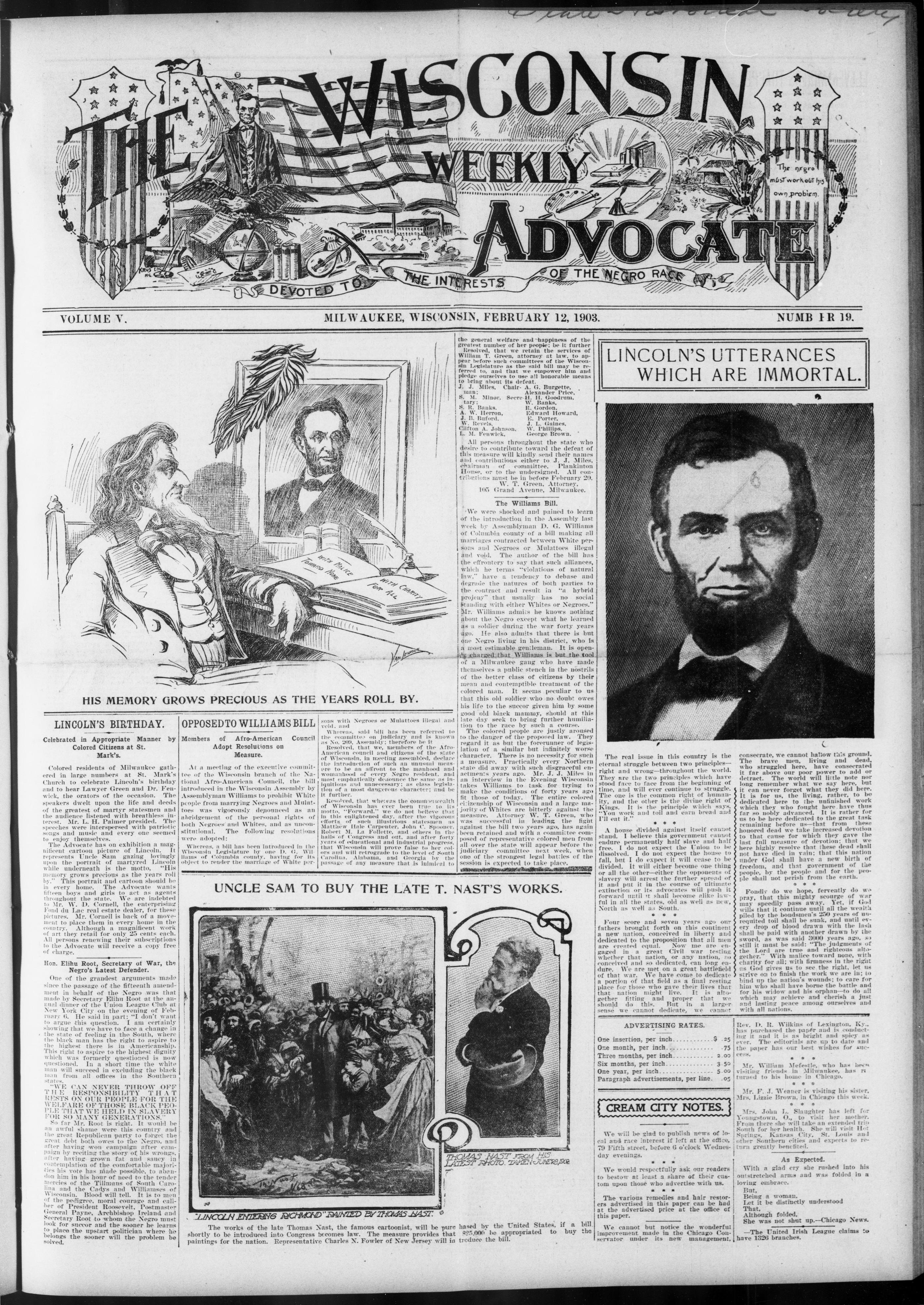
HIS MEMORY GROWS PRECIOUS AS THE YEARS ROLL BY.
VOLUME V.
HIS MEMORY GR
LINCOLN'S BIRTHDAY.
Celebrated in Appropriate Manner by Colored Citizens at St. Mark's.
Colored residents of Milwaukee gathered in large numbers at St. Mark's Church to celebrate Lincoln's birthday and to hear Lawyer Green and Dr. Fenwick, the orators of the occasion. The speakers dwelt upon the life and deeds of the greatest of martyr statesmen and the audience listened with breathless interest. Mr. L. H. Palmer presided. The speeches were interspersed with patriotic songs and music and every one seemed to enjoy themselves.
The Advocate has on exhibition a magnificent cartoon picture of Lincoln. It represents Uncle Sam gazing lovingly upon the portrait of martyred Lincoln while underneath is the motto, "His memory grows precious as the years roll by." This portrait and cartoon should be in every home. The Advocate wants fifteen boys and girls to act as agents throughout the state. We are indebted to Mr. W. D. Cornell, the enterprising Fond du Lac real estate dealer, for these pictures. Mr. Cornell is back of a movement to place them in every home in the country. Although a magnificent work of art they retail for only 25 cents each. All persons renewing their subscriptions to the Advocate will receive a copy free of charge.
Hon. Elihu Root, Secretary of War, the Negro's Latest Defender.
One of the grandest arguments made since the passage of the fifteenth amendment in behalf of the Negro was that made by Secretary Elihu Root at the annual dinner of the Union League Club at New York City on the evening of February 6. He said in part: "I don't want to argue this question. I am certainly showing that we have to face a change in the state of feeling in the South, where the black man has the right to aspire to the highest there is in Americanship. This right to aspire to the highest dignity which was formerly questioned is now questioned. In a short time the white man will succeed in excluding the black man from all offices in the Southern states.
"WE CAN NEVER THROW OFF THE RESPONSIBILITY THAT RESTS ON OUR PEOPLE FOR THE WELFARE OF THOSE BLACK PEOPLE THAT WE HELD IN SLAVERY FOR SO MANY GENERATIONS."
So far Mr. Root is right. It would be an awful shame were this country and the great Republican party to forget the great debt both owes to the Negro, and after having won campaign after campaign by reciting the story of his wrongs, after having grown fat and saucy in contemplation of the comfortable majorities his vote has made possible, to abandon him in his hour of need to the tender mercies of the Tillmans of South Carolina and the Cadys and Williamses of Wisconsin. Blood will tell. It is to men of the pedigree, moral courage and caliber of President Roosevelt, Postmaster General Payne, Archbishop Ireland and Secretary Root to whom the Negro must look for succor and the sooner he learns to place the upstart politician where he belongs the sooner will the problem be solved.
---
UNCLE SAM TO BUY THE LATE T. NAST'S WORKS.
THOMAS NAST FROM HIS
LATEST PHOTO. TAKEN JUNE 1908.
The works of the late Thomas Nast, the famous cartoonist, will be pure based by the United States, if a bill shortly to be introduced into Congress becomes law. The measure provides that $25,000 be appropriated to buy the paintings for the nation. Representative Charles N. Fowler of New Jersey will in troduce the bill.
OPPOSEDTO WILLIAMS BILL
Members of Afro-American Council Adopt Resolutions on Measure.
At a meeting of the executive committee of the Wisconsin branch of the National Afro-American Council, the bill introduced in the Wisconsin Assembly by Assemblyman Williams to prohibit White people from marrying Negroes and Mulattoes was vigorously defounced as an abridgement of the personal rights of both Negroes and Whites, and as unconstitutional. The following resolutions were adopted:
Whereas, a bill has been introduced in the Wisconsin Legislature by one D. G. Williams of Columbia county, having for its object to render the marriage of White per-
MILWAUKEE, WISCONSIN, FEBRUARY 12, 1903.
sons with Negroes or Mulattoes illegal and veid, and Whereas, said bill has been referred to the committee on judiciary and is known as No. 209. Assembly: therefore be it
Resolved, that we, members of the Afro-American council and citizens of the state of Wisconsin, in meeting assembled, declare the introduction of such an unusual measure to be an affront to the manhood and womanhood of every Negro resident, and most emphatically denounce the same as inquisitions and unnecessary; as class legislation of a most dangerous character; and be it further.
Resolved, that whereas the commonwealth of Wisconsin has ever been true to its motto, "Forward." we do not believe that in this enlightened day, after the vigorous efforts of such illustrious statesmen as Matthew Hale Carpenter, John C. Spooner, Robert M. La Follette, and others in the halls of Congress and out, and after forty years of educational and industrial progress, that Wisconsin will prove false to her colors and will retrograde to the level of South Carolina, Alabama, and Georgia by the passage of any measure that is inimical to
the general welfare and happiness of the greatest number of her people; be it further Resolved, that we retain the services of William T. Green, attorney at law, to appear before such committees of the Wisconsin Legislature as the said bill may be referred to, and that we empower him and pledge ourselves to use all honorable means to bring about its defeat.
J. J. Miles, Chair. A. G. Burgette,
man; Alexander Price.
S. M. Minor, Secreth. H. H. Goodrum,
tary; W. Banks.
S. R. Banks. R. Gordon.
A. W. Herron, Edward Howard,
J. B. Buford, E. Porter.
W. Revels, J. L. Gaines.
Clifton A. Johnson, W. Phillips.
L. M. Fenwick, George Brown.
All persons throughout the state who
desire to contribute toward the defeat of
this measure will kindly send their names
and contributions either to J. J. Miles,
chairman of committee, Plankinton
House, or to the undersigned. All contributions must be in before February 20.
W. T. Green, Attorney.
105 Grand Avenue, Milwaukee.
The Williams Bill.
We were shocked and pained to learn of the introduction in the Assembly last week by Assemblyman D. G. Williams of Columbia county of a bill making all marriages contracted between White persons and Negroes or Mulattoes illegal and void. The author of the bill has the effrontery to say that such alliances, which he terms "violations of natural law." have a tendency to debase and degrade the natures of both parties to the contract and result in "a hybrid projeny" that usually has no social standing with either Whites or Negroes." Mr. Williams admits he knows nothing about the Negro except what he learned as a soldier during the war forty years ago. He also admits that there is but one Negro living in his district, who is a most estimable gentleman. It is openly charged that Williams is but the tool of a Milwaukee gang who have made themselves a public stench in the nostrils of the better class of citizens by their mean and contemptible treatment of the colored man. It seems peculiar to us that this old soldier who no doubt owes his life to the succor given him by some good old black mammy, should at this late day seek to bring further humiliation to the race by such a course.
The colored people are justly aroused to the danger of the proposed law. They regard it as but the forerunner of legislation of a similar but infinitely worse character. There is no necessity for such a measure. Practically every Northern state did away with such disgraceful enactments years ago. Mr. J. J. Miles in an interview in the Evening Wisconsin takes Williams to task for trying to make the conditions of forty years ago fit those of today. The entire colored citizenship of Wisconsin and a large majority of Whites are bitterly against the measure. Attorney W. T. Green, who was successful in leading the fight against the bill two years ago, has again been retained and with a committee composed of representative colored men from all over the state will appear before the judiciary committee next week, when one of the strongest legal battles of the session is expected to take place.
LINCOLN'S UTTERANCES WHICH ARE IMMORTAL.
LINCOLN'S UTTERANCES WHICH ARE IMMORTAL.
A. B.
The real issue in this country is the eternal struggle between two principles—right and wrong—throughout the world. They are the two principles which have stood face to face from the beginning of time, and will ever continue to struggle. The one is the common right of humanity, and the other is the divine right of Kings. It is the principle which says, "You work and toil and earn bread and I'll eat it."
\* \* \*
A house divided against itself cannot stand. I believe this government cannot endure permanently half slave and half free. I do not expect the Union to be dissolved. I do not expect the house to fall, but I do expect it will cease to be divided. It will either become one thing or all the other—either the opponents of slavery will arrest the further spread of it and put it in the course of ultimate extinction or its advocates will push it forward until it shall become alike lawful in all the states, old as well as new, North as well as South.
* * *
Four score and seven years ago our fathers brought forth on this continent a new nation, conceived in liberty and dedicated to the proposition that all men are created equal. Now me are engaged in a great Civil war testing whether that nation, or any nation, so conceived and so dedicated, can long endure. We are met on a great battlefield of that war. We have come to dedicate a portion of that field as a final resting place for those who gave their lives that that nation might live. It is altogether fitting and proper that we should do this. But in a larger sense we cannot dedicate, we cannot
ADVERTISING RATES.
One insertion, per inch. $ .25
One month, per inch. .75
Three months, per inch. 2.00
Six months, per inch. 3.50
One year, per inch. 5.00
Paragraph advertisements, per line. .05
CREAM CITY NOTES.
We will be glad to publish news of local and race interest if left at the office,
79 Fifth street, before 6 o'clock Wednesday evenings.
We would respectfully ask our readers to bestow at least a share of their custom upon those who advertise with us.
The various remedies and hair restorers advertised in this paper can be had at the advertised price at the office of this paper.
We cannot but notice the wonderful improvement made in the Chicago Conservator under its new management.
---
NUMB 1R 19.
TERANCES
RE IMMORTAL.
consecrate, we cannot halow this ground. The brave men, living and dead, who struggled here, have consecrated it far above our poor power to add or detract. The world will little note nor long remember what we say here, but it can never forget what they did here. It is for us, the living, rather, to be dedicated here to the unfinished work which they who fought here have thus far so nobly advanced. It is rather for us to be here dedicated to the great task remaining before us—that from these honored dead we take increased devotion to that cause for which they gave the last full measure of devotion; that we here highly resolve that these dead shall not have died in vain; that this nation under God shall have a new birth of freedom, and that government of the people, by the people and for the people shall not perish from the earth.
* * *
Fondly do we hope, fervently do we pray, that this mighty scourge of war may speedily pass away. Yet, if God wills that it continue until all the wealth piled by the bondsmen's 250 years of unrequited toil shall be sunk, and until every drop of blood drawn with the lash shall be paid with another drawn by the sword, as was said 3000 years ago, so still it must be said: "The judgments of the Lord are true and righteous altogether." With malice toward none, with charity for all; with firmness in the right as God gives us to see the right, let us strive on to finish the work we are in; to bind up the nation's wounds; to care for him who shall have borne the battle and for his widow and his orphan—to do all which may achieve and cherish a just and lasting peace among ourselves and with all nations.
Rev. D. R. Wilkins of Lexington, Ky., has purchased the paper and is conducting it and it is as bright and spicy as ever. The editorials are up to date and the paper has our best wishes for success.
* * *
Mr. William Mefestle, who has been visiting friends in Milwaukee, has returned to his home in Chicago.
Mr. F. J. Weaner is visiting his sister, Mrs. Lizzie Brown, in Chicago this week.
Mrs. John L. Slaughter has left for Youngstown, O., to visit her mother. From there she will take an extended trip South for her health. She will visit Hot Springs, Kansas City, St. Louis and other Southern cities and expects to return greatly benefited.
As Expected.
With a glad cry she rushed into his outstretched arms and was folded in a loving embrace.
But,
Being a woman.
Let it be distinctly understood
That.
Although folded,
She was not shut up.—Chicago News.
—The United Irish League claims to have 1326 branches.
---
Blaze at Salt Lake City Does $275,000 Damage—Hotel Lodgers Have Miraculous Escapes
Duluth, Minn., Feb. 11.—A special to the World from Eveleth on the Mesaba range says: Fire broke out at 9 o'clock this morning in No. 3 shaft of the Spruce mine of the United States Steel Corporation. Eleven miners are imprisoned in the shaft below the mine and cannot get out until the fire is extinguished or burns itself out. It caught on the second level in the oil house and the shanties and timber construction of the interior of the mine at that part are burning fiercely. Dense smoke is rolling out of the shaft and there are grave fears that the entrapped men may be suffocated before the fire can be subdued.
The fire was subdued about 11 o'clock after burning two hours. The descent of the shaft was immediately made and at noon one man had been brought up in an unconscious condition. The ten others are believed to be in the same condition and have not yet been found. The one man brought out, however, will recover. The mine is now well cleared of smoke. All are Finlanders.
Lodgers Escape with Difficulty.
Salt Lake, Utah, Feb. 11.—Fire that started in the Atlas block, a large five-story office building, located on Second South street and in the heart of the business section, at 2:30 this morning, completely gutted that building, spread to the Central block, leaving that structure a wreck, and doing other damage that will bring the total loss close to $300,000, with about $250,000 insurance. The fire consumed the destroyed buildings with remarkable rapidity. Several lodgers on the top floor of the Atlas block had miraculous escapes from death.
Due to Imperfect Insulation.
Coshocton, O., Feb. 11.—Igniting from an imperfect electric insulation, the Park hotel took fire early this morning, resulting in a loss of $35,000. The fire started in the notion store of J. P. Seerbe under the hotel and had gained headway before discovered. Forty guests escaped in their night clothes.
Vast Store of Grain Burned.
Oswego, N. Y., Feb. 11.—Fire destroyed the plant of the Ontario Malting Company, owned by gillott B. Mott of Oswego and William A. Waite of Adams. One hundred thousand bushels of grain were destroyed, and the loss will aggregate $100,000, which is covered by insurance.
Kansas Elevator Destroyed.
Parsons, Kas., Feb. 11.—J. K. Davidson & Co.'s elevator "A," the largest elevator in this part of the state, was destroyed by fire. Loss $80,000; insurance. $40,000.
CHARGED WITH LIBEL.
Humbert Family Make Their First Appearance in the Criminal Court in Paris
Paris, Feb. 11.—The Humbert family made their first appearance in the criminal courts today, when the case of M. Cattani, the banker, was taken up in the ninth correctional chamber. There was great public interest manifested in the proceedings and the court room was packed with people. All the previous examinations of the Humberts had been held in secret and this was the first opportunity Parisians had to see and hear the prisoners. The Humberts were brought in like any ordinary prisoners and took seats in the prisoners' box. Mme. Therese Humbert displayed her usual bravado and coolness, her sister Marie d'Aurignac, was apparently much unnerved, and the latter's brothers, Romain and Emile d'Aurignac, maintained an attitude of calm defiance. The case does not involve the main question concerning the Crawford millions, but M. Cattani's charge that they libeled him in referring to him as a usurer indirectly affects the whole affair.
Mine. Humbert gave a long, rambling statement of her dealings with M. Cattani and alleged that his demands for excessive interest and her borrowings from him amounted to about $600,000. When M. Cattani was heard and repudiated the charge of usury, Mine. Humbert sprang from her seat and asked for the privilege of interrogating the banker, but the presiding magistrate repressed her.
The testimony furnished by Marie d'Aurignac today showed the intention of leaving to Mme. Humbert the plan for the prisoners' defense.
IN STATE OF SIEGE.
Outbreak in the Republic of Guatemala Reaches Serious Proportions
Berlin, Feb. 11.—Advices received here from Guatemala announce that the entire republic has been declared in a state of siege.
When the question of separate treatment of the allies is brought before The Hague court of arbitration the triple alliance will appear as one power, their interests being regarded as identical.
Willemstad, Curacao, Feb. 11.—Senor Myersten, the Venezuelan consul, has presented to the Dutch government officials a demand for the immediate seizure of the gunboat Restaurador now flying the German flag, and the return of the vessel to Venezuela.
The consul contends that as the captured ship belonged to the Venezuelan navy she could not enter Dutch waters under international law. He also protested against Germany using Curacoa as a base of supplies and as a coaling station. The Venezuelan officials assert that nautrol rights appear to be only for strong powers and that international law is a farce when feeble nations are involved.
A TWO-HEADED CHILD.
Born in a Lumber Camp Near Niagara, Wis.—Twenty-two Pound Boy Doing Nicely.
Iron Mountain, Mich., Feb. 11.—[Special.]—A two-headed child was born on Monday to Mr. and Mrs. Bob Eagan in a lumber camp a few miles from Niagara, Wis. The boy weighs 22 pounds and is doing well. One head is directly above the other and connected by a small cord. The upper head is of normal size and condition; the lower head is of a cartilage nature and has not a solitary bone in it. Four physicians are attending the mother and child. The mother was removed to the Norway (Mich.) Hospital, where she is critically ill.
WAR IS DECLARED.
Republics of Central America Involved and Hostilities May Begin at Any Moment.
Guatemala, Feb. 10.—War, which threatens to involve all of Central America, has been proclaimed between Guatemala on the one hand and Salvador and Honduras on the other.
A battle is likely to take place at any moment, as Salvador already has troops on the frontier, which are facing Guatemala's soldiery.
Not alone Salvador, Honduras and Guatemala are likely to be involved in the difficulty, but Nicaragua and Costa Rica are more or less involved. The declaration of war is a direct result of the efforts of other Central American powers to aid the Guatemalan revolutionists.
Central American union is the ostensible object of the expected war, the real motive for which is that the Presidents of Salvador, Nicaragua and Honduras wish to follow Mexico's precedent and establish a federated republic of the Central American states.
The Central American situation is further complicated by the intervention of Guatemala on one side and Nicaragua and Salvador on the other in the election of the President of Honduras. Guatemala is in favor of the President-elect, Manuel Bonilla, while Nicaragua and Salvador insist that the retiring President of Honduras, Gen. Sierra, shall continue in the presidency. The latter has refused to give up the presidential post and Senior Bonilla has declared a civil war. Senior Bonilla has taken his stand on Amapala island and has raised a force to maintain his claim to the presidency. A dispatch from the United States consul at Teguigalpa announced that the Honduran government had decreed a blockade of Amapala.
BIGAMY IS THE CHARGE.
Case at Marinette Which Involves Allieged Marriage and Death of Little Child.
Menominee, Mich., Feb. 10.—[Special.]
—William Spalsbury, who was arrested in Sturgeon Bay Saturday at the instigation of Sheriff Setright of Marinette on the charge of adultery, may have to answer a much more serious charge, as the authorities have been conducting an investigation and think that they have found proof that he has a wife living in Chicago besides the one which he claims to have in Marinette. Spalsbury was a former Menominee man and lived here with a woman who now goes by the name of Mary Pashek and who claims that a spurious marriage ceremony was performed when Spalsbury made her believe he married her and that it was a plot to dupe her. The arrest is the continuation of the investigation of the death of the babe of May Pashek of this city, while under the care of Dr. Tauver, a Marinette dentist, who was arrested for practicing medicine in the state of Wisconsin without a license.
MORE CAPITAL STOCK.
Action Taken at Special Meeting of Stockholders of North-Western Railway Company.
Chicago, Ill., Feb. 10.—Stockholders of the Chicago & North-Western railway held a special meeting today and voted to increase the capital stock of the company to $100,000,000. The directors were authorized to issue common stock from time to time in such amounts as they may determine and for any purpose allowed by law, whether authorized at this meeting or previously. It further determined to lease the railroad, franchises and property of the Fremont, Elkhorn & Missouri Valley road and later to purchase its franchises and property of all kinds. The latter road will be hereafter operated as an integral part of the North-Western system.
ANARCHIST CONVICTED.
Rubino, Who Attempted to Assassinate King Leopold, Sent to Prison for Life
Brussels, Feb. 10.—Gennaro Rubino, the Italian anarchist, who has been on trial here since February 6, charged with attempting to assassinate King Leopold November 15, by firing three shots at the King while he was returning from the cathedral after attending a Te Deum in memory of the late Queen Henriette, was found guilty today and was sentenced to imprisonment for life at penal servitude.
HEAVY DAMAGES GIVEN
Nellie Scully Awarded $20,000 for In
juries on Chicago Elevated Road.
Chicago, Ill., Feb. 10.—A verdict for $20,000 damages was returned by a jury in Judge Hanecy's court today in favor of Miss Nellie Scully of Austin, who brought suit against the Lake Street Elevated Railway Company. The plaintiff charged that she was permanently injured in a collision which occurred on the elevated road during a dense fog November 19, 1901, the train on which she was a passenger colliding with the one ahead of it.
TO CLEAR HER HUSBAND
Wife Makes Sworn Statement that She Cut Her Own Throat
Palmyra, Ill., Feb. 10.—Mrs. Grace Horton, whose husband, Luther Horton, of Modesto, has been indicted by the grand jury on the charge of attempting to murder her by cutting her throat, has made a sworn statement to the effect that she cut her own throat with a butcher knife while ill and supposing burglar were on the premises. Mrs. Horton is the daughter of B. F. Fletcher, a prominent politician.
Scents and Hearing.
It has taken the medical world a great many years to discover that a loss of hearing is almost invariably caused by some disease of the throat or nose, or both. Recent researches have demonstrated this fact beyond question. The use of strong smelling salts is one of the most prolific causes of deafness, operating by weakening the olfactory nerves, and through them the auditory system. All strong and pungent odors should be avoided as far as possible.—Health.
Although both more first
The Cathedral of Charters, in France, is said to contain the most beautiful and the best preserved Twelfth century windows in the world. They date from about 1145.
"What drove him crazy?"
"Trying to find the solution of a magazine sonnet."—San Francisco Town Talk.
—Three manuscript poems by Charles Lamb were sold for $370 the other day.
LEGISLATURE.
Senate.
Senator Roehr's bill to allow Milwaukee to secure easements for viaducts, bridges, etc., by either gift, grant or purchase, was passed by the Senate on the 5th. The Senate also passed the bills to increase the fees of the reporter for the Waukesha county court, and to increase the salary of the clerk to $800 a year. Senator Green introduced a bill providing that any life insurance company with a capital of $100,000 may, if it wishes, engage in the business of issuing accident and health policies. Senator Bird introduced a bill prohibiting the manufacture and sale of cigarettes or cigarette paper in the state. Senator Renkema presented a bill providing for the letting of county printing in Milwaukee, providing that, if the county board chooses, it may award the contract either in a lump or for each separate item. Senator O'Nell presented his bill giving women the right of unlimited suffrage, and it is understood will make a strong fight for its passage. Senator Mosher has introduced a bill to amend the game laws to declare all waters in the state to be inland waters, except Lakes Michigan and Superior. Senator Hudnall introduced a bill adding to the list of property exempt from taxation all the lodge paraphernalia of a secret society. Senator North introduced a bill at the evening session prohibiting the spring shooting of teal, mallard and wood duck, and limiting the number to twelve that any hunter may kill in a day. It also prohibits the selling of ducks so shot. The Senate committee on rules reported for passage the Assembly bill to increase the number of legislative employs.
At the opening of the session of the Senate on the 6th the chaplain spoke feelingly of the deaths of the members of the Milwaukee fire department. The Assembly resolution on the death of Chief Foley was concurred in. Bills were introduced: Changing the term of circuit court in Waupaca and Portage counties; prohibiting the use of public highways without permission and fixing a penalty therefor, the antigypsy law. The following bills were ordered engrossed and read a third time: Limiting appropriations by county boards for soldiers and sailors' monuments to $10,000; providing for the refunding of muni-pal debts; relating to seiling liquors to minors; relating to obnoxious and infectious animals running at large. The following bills were killed: Relating to sheriffs' fees for conveying prisoners to state prison; providing for examination of persons supposed to be insane; relative to security costs in criminal cases in justice courts. The Senate adjourned till 8:45 p.m. on the 9th.
The primary election bill, passed by the Assembly the week before, was received by the Senate at the evening session on the 9th, and after being read the first and the second time was referred to the committee on privileges and elections. Senator Hudnall, by request, introduced a bill to regulate the practice of barbering, providing for a commission of three members, who shall hold quarterly examinations and issue licenses to men wishing to work at the trade, and that with the exception of those now engaged in the trade, it shall be unlawful for any barber to practice his trade until he has a license. Senator N'ell introduced a bill to authorize the attorney general to bring suit against the secretary of the interior to quiet title to section 16 in townships within Indian reservations in this state, so as to determine who owns the sections enumerated above, especially in the Bad River and Flambeau reservations. Senator Beach introduced a bill increasing the annual appropriation to the State Dairymen's Association from $2000 to $4000 a year. Senator Miller presented two bills along the lines of the governor's message. They extend the term of office of the state labor statistician from four to six years, and provide for an additional clerk in his office. Senator Roehr has a bill providing that cities of the first class (Milwaukee) shall pay surety companies for bonds of officials. The Senate passed one bill. It provides that where the circuit judge deems it necessary he shall have power to appoint an assistant district attorney for a period not exceeding sixty days.
The session of the Senate on the 10th was considerably enlivened by debate concerning an Assembly measure providing for the appointment of twenty-two additional clerks. Senator Hatton wanted it referred to a committee, but the motion failed, and the bill will come up for third reading the following day. Among the bills introduced were the following: Making an additional appropriation to the University of Wisconsin for current expenses, additional sums for the equipment of agricultural hall, the construction of a chemical building, changes in science hall, extension of shops and foundry, construction of water tower, the inauguration of a school of domestic science and the purchase of apparatus, books and lands, total asked for being about $217,000; to prescribe the duties of school superintendents in cities of the third and fourth class; creating a grain commission and providing for the licensing and regulation of warehouses, the weighing and inspection of grain; giving aid in advancing the cranberry industry and making an appropriation therefor.
The city of Milwaukee's charter bill was introduced in the Senate on the 11th. Senator Roehr presented a bill requiring all insurance companies to make annual reports to each policy holder, showing amount of profit or surplus apportioned on his policy. Senator Willis has introduced a bill requiring that all bakeries must be constructed so as to exclude mice, rats and vermin and obliging bakers to wear cans, aprons and slippers. Others bills introduced were: To amend the charter of Ripon College; prescribing the standard measure for the use of the Babcock test in determining the percent. of butter fat in milk or cream and to prevent the sale of incorrect instruments for such tests and providing a penalty therefor; to amend the statutes relative to county aid in repairing bridges; permitting the filing of undertakings by surety companies in justice court; relating to the registration of pharamels.
Assembly.
In the Assembly on the 5th Mr. Barker of Milwaukee presented two bills designed to prevent public officials from accepting bribes of any nature. The bills, which were drawn by Judge Brazee of Milwaukee and introduced by Mr. Barker by request, are most sweeping in their scope. One defines the offense of bribe taking and provides the penalty, and the other grants immunity from punishment to accessories and other guilty persons turning state evidence. Assemblyman Johnston of Waukesha county introduced a bill authorizing cities or villages with a school census of 500 or more to establish and maintain truant ungraded day schools and parental boarding schools. Mr. Douglas of Green county introduced five bills pertaining to the Wisconsin live stock sanitary board, the state veterinarian and the suppression of contagious diseases among live stock. One of the measures increases the salary of the state veterinarian from $2000 to $3000. A bill introduced by Mr. Cady of Wood county authorizes any fire insurance company now operating in Wisconsin to transfer its business and reinsure its risks in any responsible company whose capital stock and surplus equal or exceed $100,000. The Assembly, by a rising vote, adopted a resolution introduced by Mr. Carberry of Fond du Lac county on the death of Raphael Katz, who was a member two years ago. A bill introduced by Mr. Crowley of Milwaukee provides for increasing the fees from insurance companies. The Assembly held a short evening session and received twelve new bills and some committee reports. Among the bills presented was one by Mr. Waterman of Milwaukee, providing for the licensing of engineers and treeners of stationary engines.
By a vote of 70 to 21, four members being paired and six absent, the primary election bill passed the Assembly on the 6th. The following Democrats voted for the bill: Messrs. Armanen, Becker, Crowley, Fritzke, Haderer, Hassa, Karel, Kehrein, Martin.
Potter, Szymarek, Terens. The following Republicans voted against the bill: Messrs. Barker, F. Johnson, Osborn, Reynolds, A. E. Smith, Thompson, Wallrich, Willott. The last act of the Legislature necessary in order to increase the number of supreme court judges from five to seven was taken when the joint resolution of the Senate was concurred in. Having passed the Legislature two years ago all that is now necessary is a vote of the people to put it in force. Senate bills doing away with Milwaukee superior courts and creating two additional circuit courts were favorably reported and passed to third reading, which in this instance is equivalent to passage. So also was the bill giving Milwaukee power to make contracts with land owners for building Twenty-seventh street vladuct. Another attempt is being made to prevent mar
riages between white and colored persons by declaring such marriage in future void. A similar bill was killed two years ago. A bill has been introduced to reimburse S. D. (Pump) Carpenter for losses sustained in a disastrous printing contract. Its purpose is to permit the claimant to bring suit against the state to recover the sum of $46,000. Other bills introduced in the Assembly: Prohibiting the manufacture or sale of cigarettes, cigarette paper or substitutes; amending the laws relative to the Oshkosh municipal court; anti-gypsy bill, prohibiting the use of public highways for camping places without permission; making bonds of guardians equivalent to those of administrators. The Assembly adjourned to 8:30 p. m. on the 9th.
Mr. Ekern of Trempealeau presented a bill in the Assembly on the 9th, prohibiting any party designations on ballots for school and judicial officers and providing separate ballots therefor. Mr. Whitson of Lincoln presented a bill providing a new system for securing and preserving vital statistics. The measure, which has the indorsement of the state board of health, and which was drawn in accordance with its desires, is practically identical with the Michigan law. A bill introduced by Mr. Dudgeon of Dane county appropriates $5000 for the relief of David Stephen and other subcontractors who suffered by the failure of a contractor who undertook to erect the State Historical Library building. A similar bill was before the last Legislature but it failed to pass. Mr. Stevens of Monroe county presented a bill appropriating $70 to pay for a medal presented by the state to Capt. Frank L. French of Sparta for distinguished services in the Philippines. Mr. Martin of Brown county introduced a bill repealing the co-employee act of 1898, which prevents an employee from recovering damages for personal injuries caused by the negligence of a co-employee, and he introduced another bill enabling an employee so injured to recover. Mr. Donald of Dane county presented a bill compelling owners of merry-go-rounds to pay a state license of $100. Two sweeping anti-trust measures were introduced in the Assembly by Mr. Dudgeon of Dane county by request.
Among the important measures presented in the Assembly on the 10th were the following: For referendum of all electric gas and street car franchises; creating state inspection of gas and steam launches; providing for monument at Andersonville for soldiers who died in prison; prohibiting railroad companies from giving rebates, and providing a fine of $500 for violations and compelling street car companies to report accidents: making an additional appropriation of $200,000 for an exhibit at the St. Louis world's fair and increasing the commission from five to seven; amending the act establishing a district court in Milwaukee county, providing that justices of the peace in towns shall not be deprived of jurisdiction; providing that after passage of the act no ordinance for granting a street railroad, electric lighting, gas, water or telephone franchise shall be operative in any city until after sixty days from the date of its passage, and for its submission to vote of the people on petition of 10 per cent. of the voters; providing for better protection of lives of persons on board vessels plying in waters of this state and not subject to United States laws. It provides for two inspectors to be appointed by the governor at $500 each; appropriating $400 per year to the Eastern Wisconsin Firemen's Association; appropriating $10,000 to the university regents for purchase of stock for the experimental station farm; providing that no sheriff on a salary basis shall receive less than $1200; in counties of 20,000 to 30,000, not less than $2000; counties of 30,000 to 40,000, not less than $2500; counties over 40,000, not less than $3000. The joint resolution introduced by Mr. Dudgeon calling for an investigation by the attorney general to be made into the Standard Oil Company in this state was on the calendar for action. On motion of Mr. Dudgeon it was referred without debate to the judiciary committee. One bill was passed, providing a fee of $2 to judges authorizing marriages without license or delay. The bill providing two years' term for aldermen in cities under special charter was re-referred to the committee on cities for further hearing.
Treating may become a thing of the past at elections under the provisions of a bill presented in the Assembly on the 11th. Not only is treating forbidden but candidates are restrained under penalty from hiring carriages for the purpose of conveying electors to and from the polls. A bill was offered for the benefit of lumbermen and companies who employ labor providing that it shall be an offense for any person to accept transportation to any given point for the purpose of performing labor without at least doing service after reaching such destination to the value of the transportation. Assemblyman Benson presented a bill to repeal Sec. 4542c. This is the provision of the statutes requiring candidates to file a list of election expenses. Forty bills were introduced at the session. Two petitions from Richland county against repeal of the high school tuition law and one from Oconto county to allow duck shooting in April were presented. A memorial to Congress was introduced by Mr. Whitson asking legislation to complete the survey of islands in the Wisconsin and Mississippi rivers within the state. There was another flood of bills, a total of sixty-eight.
Verdi's Charity.
The Hospice for Musicians, which Verdi designed in his lifetime and which was built under the supervision of Boito, the architect brother of the librettist, has just been duly inaugurated, the date happily chosen being Verdi's birthday. The "Casa di Reposo per i Musicisti" is intended as a sort of almshouse and residence for poor and aged musicians, and it has satirically been said that it promises to be a very happy home, always providing that the inmates in their conversation avoid the delicate subject of music. Nine persons were elected and admitted at the opening of the institution the other day, four of whom are women, namely: Mesdames Romano, a singing teacher; Ferrari, widow of the singer; de Michaelis, the widow of the vocalist, and Jotti, an old singer. The men included an operatic chorister (who, at the age of 75, has relinquished the profession), a player in one of the municipal bands, a street band conductor, and a couple of organists, who in Italy, as elsewhere, are among the most poorly paid members of the profession. There is further room in the hospice, so that a few months hence another election will be held.
Shot a Noted Old Buck
"Old Whiskers," the California buck with a charmed life that for years has!coolly watched intrepid hunters draw their finest "beed" and with scornful deision of their marksmanship gamboled nimbly away to enjoy the wild wood range, has finally been laid low by the huntsman's bullet. Saxe Shelton was the fortunate hunter. The famous old buck was sighted and shot on the Hyde ranch, located on Pine Ridge, a southern prong of the Mount Hamilton range. The prize was captured yesterday and brought to this city today, the last day of the open season.
"Old Whiskers" proved to be a rare specimen. He had eleven prongs and weighed 175 pounds, making him the largest specimen of deer ever shot in this county. A nine-pronged buck weighting 155 pounds shot two weeks ago was the largest previously recorded.—San Francisco Chronicle.
The Happy Medium
Wissum—I was surprised that you should hit that little fellow at the seance. He was somewhat intoxicated, I grant you, but he is one of the leaders among the Spiritualists, and they didn't like your assault upon him at all.
Harry—There's no pleasing you, Wissum. You have always told me to strike a happy medium and the first time I do it, you blame me.—Boston Evening Transcript.
—The ground floor of John Knox's house in High street, Edinburgh, has been transformed into an old-book store. It has been in turn a hairdresser's, public house, grocer's, restaurant and tobacconist's.
Proceedings in the Senate.
Discussion of the statehood bill in the Senate on the 5th turned on the question of polygamy. A number of senators who heretofore have taken no part in the debate participated in the discussion. The influence of the Mormon Church over politics occupied a large share of the debate. Mr. Spooner inquired if it is true that the first presidency could dictate whether or not a Mormon should hold a high political office. Mr. Dubols answered the question by stating that no Mormon would run for a high political office without the consent of the first presidency. Mr. Rawlins said that when the approval is given the man goes forth with the benediction of the church. Mr. McComas, concluding, characterized the prohibition of polygamy as contained in the Utah enabling act as an impotent pretense of restriction without any legal efficacy. Senator Morgan introduced a resolution asking the secretary of the navy to supply the Senate copies of any correspondence that may have occurred between the naval officers of the United States and persons on shore in Colombia during the recent stay of American vessels in Colombian waters. Mr. Morgan's purpose in introducing the resolution is to ascertain whether there is truth in the report that officers made an offer of $3,000,000 to the revolutionists to desist.
The time in the Senate on the 6th was largely occupied by discussion of the Isthmian canal question, the resolution introduced by Mr. Morgan calling on the secretary of the navy for correspondence regarding the military occupation of the bays of Panama and Colon being under debate in both open and secret session. A conference was agreed to on the general staff bill, and Messrs. Cockrel, Quarles and Foraker were appointed conferences. Bills were passed as follows: Senate bill amending the revised statutes so as to provide for the detail of retired officers of the army and navy to assist in military instruction in schools; Senate bill authorizing the President to reconstitute Alexander G. Pendleton, Jr., as a cadet in the United States Military Academy; Senate bill incorporating in the District of Columbia the American Academy in Home, the object being to establish and maintain an institution to promote the study and practice of the fine arts and to aid and stimulate the education and training of architects, painters, sculptors and other artists. The House amendments to the bill to expedite trials in cases under the Sherman anti-trust law were agreed to. A resolution offered by Mr. Stewart was adopted authorizing the committee on Indian affairs "to investigate and report upon such matters affecting the Indians or the Indian service as the committee shall consider expedient." The committee is empowered to sit during the sessions of the Senate or during the recess in Washington or such other places as it may desire to visit. Mr. Kean then resumed his remarks in opposition to the omnibus statehood bill. After he had spoken a short time the Senate adjourned out of respect to the memory of Representative Moody of North Carolina, who died yesterday.
At the opening of the session of the Senate on the 7th Mr. Gallinger presented a partial report of the conferences on the bill increasing pensions to ex-soldiers who have lost limbs. He stated that the House had changed the rates materially, increasing some of the pensions allowed under the act of 1890. The report was adopted and a further conference ordered. Mr. Morgan again called up his resolution requesting the secretary of the navy to forward papers on file in his department concerning the movements and correspondence of naval officers in Colombian waters, but was informed that the resolution had gone to the calendar under the rules. By unanimous consent the resolution was taken up, and a vote was taken on Mr. Hale's motion to refer to the committee on naval affairs. The motion prevailed by a strict party vote, 31 to 18. The resolution was therefore referred, and when Mr. Morgan complained that it would not be acted upon by the committee Mr. Hale replied that it would not be favorably reported in its present form with his consent. The statehood bill was taken up and Mr. Kean proceeded with his speech in opposition to the bill, but did not end it. Toward the close of the day there was a general debate on the allegation that the bill does not contain sufficient safeguards against polygamy.
The Littlefield anti-trust bill was received by the Senate on the 9th from the House and referred to the committee on judiciary. The army appropriation bill was sent to conference, Messrs. Proctor, Quarles and Cockrell being named as conferences. Mr. Carmack of Tennessee addressed the Senate on the Rawlins resolution calling for the records of courts-martial of officers serving in the Phillippines. The resolution went over, and the statehood bill was taken up, Mr. Kean of New Jersey speaking in opposition. He yielded to Messrs. Rawlins, Clay, Hale, Patterson and Elkins, who discussed the fitness of the people of New Mexico and Arizona for statehood and the influence of the Mormon Church in politics. After a brief executive session, in which was presented a memorial from the state of Washington protesting against the ratification of the Alaskan boundary treaty, the Senate adjourned.
The statehood bill again came up in the Senate on the 10th, and Mr. Morgan spoke on it for some time. He referred to bills regarding trusts, which he said have been kept back, and will be kept back until it is too late for discussion regarding them. The time of the Senate was being wasted on account of what he termed "a peaceful political blockade" on the statehood bill, when more important measures were awaiting action. Mr. Hanna presented the conference report on the department of commerce bill, a final vote on it being deferred in order that it might be printed. The conference report on the general staff bill was agreed to. The provision that the chief of staff shall be under the direction of the secretary of war by direction of the President is retained, as also is that provision which makes the act go into effect August 15, 1903, when Gen. Miles retires. The Kawlins resolution regarding courts-martial cases in the Philippines was referred to the committee on Philippines by a yea and nay vote of 36 to 23. Mr. McComas gave notice that he would call up the eight-hour bill on the 12th. Mr. Quay said he was in sympathy with the effort to secure the speedy passage of the bill, but he would interposs the statehood bill to antagonize it until a day is fixed for a vote on that bill.
In executive session on the 11th the Senate ratified the Alaskan boundary treaty and discussed the new commercial treaty with Greece. In open session Mr. Hanna called up the conference report on the department of commerce bill, and it was agreed to without debate. The bill now goes to the President. A House bill extending the homestead laws to Nebraska was passed. Mr. Morgan resumed his remarks on the statehood bill, but branched off on the subject of the proposed treaty with Colombia. He referred to the concordat of Pope Plus IX., which constituted a part of the organic law of Colombia, and said the United States intended to put the heel of ignominous contempt upon it. He predicted a return of the hostilities between the old church party in Colombia and the liberal party. Mr. Depew spoke in opposition to the statehood bill. He had not concluded when the Senate went into executive session.
Proceedings in the House.
The anti-trust bill debate, which opened in the House on the 5th, did not develop much animation, although there was a fairly large attendance in the galleries. The rule under which the House was to operate, however, precipitated a lively discussion. As soon as the rule had been read, Mr. Grosvenor offered an amendment to it providing that the Senate bill for the expediting of cases under the Sherman act be substituted for the House bill. This amendment was adopted. Under the rule the House then resolved itself into committee of the whole and took up the bill, which was then passed. The postoffice appropriation bill was passed before the trust bills were taken up.
The day on the 6th was devoted to general debate on the anti-trust bill, the vote upon which will be taken tomorrow. Mr. Foss (II) reported the naval appropriation bill. Adjournment was taken at 5:45 p. m.
In the absence of Speaker Henderson, who is confined to his hotel with a sore throat, Mr. Lacey of Iowa presided over the House on the 7th. Some routine business preceded the resumption of the consideration of the anti-trust bill. The Senate amendments to the army appropriation bill were nonconcurred in and the bill was sent to conference. Messrs. Hull (Iowa), Capron (R. I.) and Hay (Me.) were appointed conferences. After the debate under the five-minute rule the bill was passed on roll call by a vate of 245 to 0.
The House spent practically the entire
day on the 9th upon two District of Columbia bills, one to authorize the government to advance $6,000,000 to the district and the other to report on the union station bill. The former was defeated and the latter sent back to conference after a motion to recede from the amendment of the House to cut down the appropriations for the Pennsylvania and Baltimore & Ohio railroads from $1,500,000 to $1,000,000 had been voted down. Mr. Richardson took exception to the presentation of the conference report on the department of commerce bill at Sunday's memorial session, contending that the action was void. The speaker ruled that it was regular, as it had been repeatedly held that Sunday could be made a legislative day. Mr. Richardson protested against the ruling as a dangerous precedent, and moved to correct the journal so as to strike out the action of the day before. Eleven Republicans voted with the Democrats for his motion, but it was defeated on a rising vote, 80 to 88. Mr. Richardson demanded the yeas and nays and the motion was carried, 116 to 101. Twenty Republicans voted with the Democrats. This action had the effect to postpone the consideration of the conference report on the department of commerce bill for a day. The conference report on the bill to increase the salaries of federal judges was agreed to.
The conference report on the departments of commerce bill was adopted by a vote of 251 to 10 in the House on the 10th. The remainder of the day was devoted to the sundry civil appropriation bill. Mr. Cannon, chairman of the appropriations committee, gave notice he would move two amendments, one to provide for the purchase of a site and the erection of a three-story 400-room office building for members, to be connected with the capitol by a subway and to cost $3,800,000. and the other an appropriation of $2,500,000 to carry out the original plans for beautifying and enlarging the main wing of the capitol. A feature of the debate was a speech by De Armond (Mo.) on the Hanna bill to pension ex-slaves. He spoke in a sarcastic vein, but the subject assumed a serious phase when Mr. Richardson (Tenn.) sald adventurers in the South were using the bill to impose on ignorant, credulous negroes, and called on Mr. Cannon to give assurance that the passage of such a measure was not contemplated. This assurance Mr. Cannon gave. It was agreed that at the session Sunday, February 22, eulogies to the memory of the late Representative Rumble of Iowa and Moody of North Carolina should be in order.
The House on the 11th made fair progress with the sundry civil appropriation bill, covering 86 of the 150 pages of the bill. The amendments of which Mr. Cannon gave notice for the completion of the east front of the capitol and the erection of an office building for members were adopted, points raised against them being overcome by the adoption of a special rule making them in order. By the terms of the amendments $500,000 is appropriated for work on the main building of the capitol and a limit of $2,500,000 is fixed. Other items were incorporated, increasing the appropriation for investigating the water supply of the United States and the best method of utilizing water reservoirs from $100,000 to $200,000; continuing the office of railroad commissioner, which will terminate June 30, 1903, until June 30, 1904. Mr. Grosvenor from the ways and means committee called up the bill reported by that committee to amend the Dingley act so as to admit free of duty domestic animals for breeding purposes. It was passed. The further consideration of the sundry civil appropriation bill was then resumed.
HOW THE RAILROADS ARE TAX...
EXPLANATION OF LICENSE FEE SYSTEM.
RAILROADS DO NOT ASSESS THEMSELVES.
(Issued in Behalf of Wisconsin Railways.) How are the railroads of Wisconsin taxed? One would suppose, after all that has been said and written on this subject during the last few years, that everybody would now know. But this is far from being true. And if we may judge from the number of questions that have been put to us, we may say that those who are familiar with the provisions of the law, would not form a very large multitude.
LICENSE FEE SYSTEM.
In explaining the taxation of railways and of some other corporations that pay the so-called license fees, the Tax Commission on page 29 of its first annual report said: "Certain classes of corporations or persons engaged in quasi-public enterprises are required to contribute to the public revenues amounts not measured or apportioned by property valuations, but, usually, by a fixed percentage of the income produced from operation of the business engaged in. Generally it is in form a license fee or charge for the privilege of conducting the enterprise. But ordinarily it is more than a mere charge for a business privilege or franchise. In most instances it is essentially a measure of revenue, the fee or charge being imposed—with slight exceptions—in lieu of other forms of taxation."
That the fees collected from the railroads are something more than "a mere charge" for a business privilege appears pretty plainly from the provisions of the law. Under present statutes, the rate of taxation is graduated according to the average amount of annual gross earnings per mile of road, viz.:
On roads earning $3000 per mile or over,
4 per cent. of gross earnings;
On roads earning $2500 and less than
$3000 per mile, 3½ per cent. of gross earn-
ings;
On roads earning $2000 and less than
$2500 per mile, 3 per cent. of gross earnings;
On roads earning $1500 and less than
$2000 per mile, the tax is $5 per mile and
2½ per cent. of gross earnings in excess
of $1500 per mile;
On roads whose gross earnings are less than $1500 per mile the tax is $5 per mile.
GROSS EARNINGS.
The license fee or tax is based upon the annual gross earnings from operation in the state, including such earnings from interstate traffic as are earned within the state. The gross earnings, from which the amount of fees is determined, are ascertained from statements made annually, by each company under oath of an officer, to the State Treasurer and to the State Railroad Commission. The latter officer is required to approve the report made to the Treasurer before the license can be issued, authorizing the company to continue its business.
RAILROADS DO NOT ASSESS THEMSELVES
It is often said, generally by those who wish to uproot the license fee system, that under this system the railroads assess themselves. The railroads make returns annually to the state of their gross earnings and the law of the state does the rest. The reports are sworn to, and before a license can be issued the Commissioner of Railroads must approve the company's report. Thus it appears that the reports of the railway companies are not final and conclusive. It is not only the privilege but it is the duty of the Commissioner of Railroads to review them.
There is never so thorough a scrutiny of the ordinary taxpayer's schedule as there is of the railway company's statement of its gross earnings. If there were, much of the property which now escapes taxation would be on the tax roll and this will be admitted by every candid man.
Railway officials may not be more honest than other people, but they are surrounded by conditions which not only enable them, but which compel them to submit full and accurate returns. They are obliged to make many reports to the officials of the different states, to national officials and to their own stockholders. It would be impossible so to juggle the figures as to hide anything dishonest. Anything crooked would inevitably appear on a comparison of these different reports.
How many citizens of Wisconsin Pay 4 per cent. of their gross income for taxes? All the principal railroads pay 4 per cent.
Willing to be Overtaken.
Congressman Hill of Connecticut was talking on the Philippine currency bill. "I want American money to follow the American flag," he declared. "You'll find me carrying the banner the first thing tomorrow morning," said Cushman of Washington. "And you can bet that the money won't get out of breath trying to overtake me." added Crumpacker of Indiana.—Detroit Free Press.
VILLANELLE.
My love has gone across the sea—
O, my sweetheart, I am alone!
The woods are sad, and so are we.
Today her letter came to me,
I read it o'er at set of sun—
My love has gone across the sea.
O, my sweetheart, art cold to me?
I dreamed that I thy love had won—
The woods are sad, and so are we.
She wrote, indeed, it could not be
Till winter's frost and snow were done,
My love has gone across the sea.
O, my sweetheart, forget not me!
The weary days their web have spun--
My love has gone across the sea;
The woods are sad, and so are we.
—Julien Gordon in Alnslee's.
BEHIND THE SCREEN.
A TALE OF HARMLESS EAVESDROPPING.
"What is it, Mary?"
"Mr. Hunt and another gentleman to see master, please."
"Didn't you tell them Mr. Mowbray hasn't come home yet?"
"Yes'm, and they said they'd wait. I've shown them into the drawing room."
"Very well; I shall be down in a moment."
"The gentlemen told me not to disturb you, but I thought you would like to know they were here."
"Thank you, Mary."
"Will the gentlemen stay to dinner?"
"No, I hope—I mean I think not. You may sound the gong at the usual time. Don't forget, please."
"No'm, I won't forget." And Mary smiled significantly to herself as she retired to the kitchen. This would not be the first time she had been called upon to sound the dinner gong at Holly Lodge as a gentle hint to visitors that it was time for them to go.
Mary had discovered long ago that hospitality to "master's friends" was not one of her young mistress's virtues.
"And I don't blame her, neither," said Mary to herself; "it's only natural she shouldn't want them always hanging around and taking master's attention off of herself, and she only married six months."
Mrs. Mowbray gave a little petulent sigh.
"I suppose I must," she murmured, addressing her looking glass with a frown. And then she began to smile, half reluctantly, at the face she saw reflected there.
It was a pretty face. The frown clouded the prettiness, but the smile made it bewitching. Yet Mrs. Mowbray frowned almost as often as she smiled. But then so many things happened to annoy her.
Harry was a dear boy, of course, but—well, he certainly had his faults. What made him so late tonight, for instance? Surely he hadn't gone off again to play chess with that horrid Bob Jollibois, as he did only the other week.
But, no, he wouldn't be so selfish and horrid when he knew perfectly well how unhappy it would make her. She had told him so when he came home at 8:30 o'clock that other night, and he had vowed never to do it again.
Harry was a man of his word; she would say that for him. He had promised before they were married, to give up that hateful volunteering and football that always took up so much of his time, and he had kept his promise so far, though she was quite sure Bob Jollibois and the others were doing their best to tempt him to break it.
What was keeping him this evening? She had never felt quite easy in her mind since she found out that Harry was still a member of the Jackdaw Club. He had quite agreed with her when she declared that a married man with a comfortable home of his own had no business to go to a club, but all the same he had not resigned his membership. He had explained to her that it would be shabby to do so, and that paying a subscription to a club was a mere matter of form. He had never been near the place since, it is true. Still, she would have been happier had he severed his connection with the Jackdaws altogether. The club was a link with his bachelor days, in which she had had no part, and resented it as such.
The two men waiting down stairs were links of the same sort. They had known Harry when he was still a stranger to her, and they would talk to him of things that had happened before he had ever met her. It made her feel vaguely aggrieved. She would not have admitted it in so many words, but it always pained her a little to think that Harry could ever have had any absorbing interests and thoughts outside of herself.
Though she laughed to herself, she liked to cherish a delusion which Harry's friends always seemed to destroy—to wit, that Harry's life had been a dead and dreary blank before she came into it.
Mrs. Mowbray seized her silver-backed hair-brush—Harry's latest present—and administered half a dozen impatient and quite unnecessary dabs to her pretty, fluffy hair.
"I suppose I must," she sighed again, and tripped lightly downstairs, prepared to be civil to her husband's visitors.
"Poor old Mowbray! Take warning by him, Bundy, and don't get married."
"Oh. Nell's one in a thousand. She's not like Mrs. Mow—but, I say, I suppose one mustn't abuse a man's wife in his own house. And I daresay she's a charming little woman, really—but a bit jealous. Anyway, he adores her."
"Evidently. A man must be pretty far gone to give up everything, as Mowbray does. You don't think he'll come to the smoker?"
"No—I'm afraid he won't. Since he's been married he can't be induced to spend an evening away from her."
"Poor old Mowbray. He's bound to get tired of it."
"Yes, a man wants a little change, even if he's married an angel. Human nature can't stand monotony."
"Adam's relying on Mowbray to sing. The fellows will be horribly disappointed if he doesn't."
"So will Mowbray himself. He used to be uncommonly keen on it. Of course, he'll refuse, simply because he's afraid of hurting his wife's feelings."
"It strikes me he's carrying devotion a bit too far. Why, he seems to have thrown over every blessed thing he ever cared for. The Growlers are furious at his desertion. They've lost their best halfback. And old Harding was grumbling to me, only last night, because Mowbray hasn't put his nose inside the School of Arms for months."
"That must have been a blow to Mow-
bray, to give up those bayonet competitions. He was a dead certainty for at least one prize." "It's the same with everything. He's losing his form all round. It's a sin that such a good sportsman should be allowed to run to seed; and a woman who makes her husband sacrifice all his pet hobbies must be——"
The speaker paused expressively.
a speaker paused expressively.
"Well, of course, we don't know that it's her fault. He never so much as hinted at it. Pretends he's dropping out of things to please himself."
"But who believes that?"
"Nobody! Oh, you're quite right—it is my fault!"
It was not Jack Hunt's voice that answered his friend Bundy's question. The two men turned to the speaker with startled faces
with startled faces.
It was Mrs. Mowbray, who detached herself from the shadow of the screen at the door and came toward them with out-stretched hands.
"It was mean to listen," she said, flushing all over her pretty face, "but I couldn't help it. You didn't hear me come in, and—something you said—made me wait, and so I—I overheard. Oh, please don't think me a—a henpecker!" she added hurriedly. "But when you said that about taking warning by Harry, and not getting married, it—it wasn't in human nature not to listen. I've been thoughtless and selfish. It's done me good to hear the truth. Won't you shake hands?"
Ten minutes later, when Harry Mowbray came home, he was amazed to find that his wife had set her heart on his singing at the Jackdaw's smoker, and when she insisted on his spending the entire following evening at the club it dawned upon him that something extraordinary had happened.—New York News.
ELECTION ON THE RIO GRANDE
Methods of Getting Out the Full Vote of the Quick and the Dead
While in conversation with a knight of the road, whose business interests and route of travel frequently take him among the tamale population of the irrepressible and unterrified "Fifteenth." an interesting account of the "election baile" was given. Said he:
"Both parties, by common consent, and mutual understanding, use the 'baile,' there known, as a place of confinement for Mexican voters for an American congressman. In that land of independence and freedom it is said that a male Mexican begins to exercise the right of suffrage before he attains the age of majority, and never relinquishes it or ceases to exercise that privilege until many, many years after his immortal spirit has gone to that realm where 'the rainbow never fades.' In fact, it is said that the climate of the Brownsville region produces an inborn desire in a Mexican to vote, and he never knows or cares for what or for whom he is voting, provided he gets in the 'biley' and the 'biley' head man places the ballot between his cigar-ette-stained fingers.
"Two or three days before the election these naturalized as well as the unnaturalized citizens from the sister republic across the Rio Grande are rounded up and run into the baile like sheep or cattle through a chute. When once penned there he remains until he discharges the high and responsible function of citizenship, for the discharge of which duty he is prepared through 'biley' training. During his confinement in the 'biley' for purely patriotic purposes he is furnished with all the whisky, tobacco, cigarette papers, grub and music necessary for his comfort and enjoyment.
"On the night previous to the election the women and children are admitted into the 'biley,' and then begins a revelry and carousal calculated to arouse and startle Bacchus and his devotees from their slumbers in that torrid land where water freezes not and snow never falls. On the morning of the election these copper-colored gentlemen are taken from the 'biley,' carried in carriages to the polls, where they vote the ballots prepared for them by the proprietor of the 'biley.' Their voting privileges having been exercised, they become useless pieces of living clay, and are turned loose upon the range until the next election comes and they become valuable for political purposes again. The result of election in this free and independent territory depends largely upon the question of 'bileys.' Whoever is most energetic and corrals the greatest number of Mexicans wins the day. As this class of voters never or seldom gets a square meal until the 'biley' jubilee comes, we can readily imagine why they are inoculated with a burning desire for elections to come often. Since the adoption of the poll tax amendment I am puzzled to know how the dead Mexicans will get their polls paid for and continue to vote, a privilege they have so long exercised, both as living and dead citizens."—Galveston Daily News.
HIS CORNER IN OIL.
Commodore Kountz Has Been Waiting
Thirty Years to Get His Price.
At Enterprise in Warren county, Pa., is an iron tank of 7000 barrels capacity which at the present time contains about 5500 barrels of petroleum. It was erected in 1871 by Commodore W. J. Kountz of Pittsburg and three years later it was full of oil.
The commodore determined that he would not sell this oil for a less price than $5 a barrel and although the pipe line was extended into the Titusville district about that time he refused to connect the tank with it or to sell his product. Later on he disposed of 1500 barrels of the oil to Titusville refiners at $4 a barrel, the oil being hauled to Titusville in wagons.
The tank is far removed from the pipe line or any producing wells at the present time, but the owner still refuses to part with the oil for less than the price he has set upon it. The market price today is $1.50 a barrel and there seems little likelihood that he will realize on his product in the near future. There have been many cases in oil country history in which owners of oil property have stored their product and set a high price on it, but they have generally weakened after a few years. The commodore seems to be the only exception.
Second Husband Not Next of Kin
The circuit court decided on Saturday a suit in which was involved the question whether the surviving second husband of a woman who had been left a life estate in property by her first husband was "next of kin," within the meaning of the law, or within the terms of the will of that first husband. Henry Duncan left a widow to whom he bequeathed one-third of his estate for life with the remainder to her next of kin. She remarried, John H. McCormick being the second husband. She died, and as she bore no children by her first or second husband, McCormick claimed he was the next of kin within the meaning of the law and that he should have the one-third of the estate. This, the heirs of Duncan denied, and suit for a construction of the will was filed. The circuit holds that "it clearly appears that McCormick was not included within the term 'next of kin,' as used in the will, notwithstanding that term's legal or statutory significance." He is denied the money.—Cincinnati Enquirer.
WILL REGULATE LOANS.
Madison, Wis., Feb. 10.—[Special.] A complete revolution in methods of business employed by state banks is contemplated in the bill which State Bank Examiner Bergh has drawn. Every state bank will be compelled to either increase its capital or else keep down the size of its loans, while private banks will be virtually wiped out of existence.
Mr. Bergh proposes to limit the amount of loans to any one individual to 50 percent. of the amount of the capital; limit the field of operations; provide for an inspection of securities in foreign states and establish a rigid system of inspection that will not only redound to the benefit of the depositors but will also serve to protect the bankers. The bill will be a committee measure and is to be offered by Chairman N. E. Lane of the Assembly committee on finance, banks and insurance
Limit on Loans.
Out of the 120 state banks operating in Wisconsin, exclusive of the private banks, there will be but few that will not have strenuous objection to offer. The proposition to limit the amount of the loans will be bitterly contested because, it is stated, there is hardly a state bank that does not at times exceed the 50 per cent. limit. Unlike the national banks the state banks are usually capitalized at a very low figure. This saves taxes. It is stated there are banks with a capital of even less than $50,000 that do a business amounting to more than $500,000. The big loans are the most profitable, and many of the banks find it easier to make them than to place a number of small loans. Moreover, bankers say there is not as much risk in the big loans as in the small lones if secured by collateral in the shape of bonds and stocks. The banker can watch the market quotations each day and when the note is due can, if he is fearful of his holding, place the securities on the market and realize on them. It is different with the real estate loans, which form the major part of the business of the state bank; it is more difficult to realize.
Protection to Depositors.
The limitation placed on the amount of loans, however, will serve as a strong protection to the depositors. In nearly every instance where a state bank has gone under it was due to excessive loans to individuals. The failure of the Chilton bank was due to big loans and the same is said to be true of other similar institutions that have gone to the wall in recent years. With the limitation sought to be imposed by the bank examiner it is pointed out these failures would not have occurred.
The bank examiner at the present time is unable to afford any relief to banks that become involved. All that he can do is to close the bank and declare it insolvent. The new law will give him increased powers so that he will be able to place a check upon the operations of the banks and to oblige them to call in loans whenever it may be necessary; it will give him the power to take securities from the bank on giving his receipt so that he may satisfy himself as to the sufficiency of the security. At the present time he is obliged to accept the word of the banker for it. This provision will enable the bankers to protect themselves in that they can shut down on many loans and can also put off a customer who comes to make a loan without security.
Inspection of Securities
The bill seeks to limit the field of operation for mortgage loans to the county in which the bank is located and the adjoining counties. This will make it easier for the bank inspector to ascertain the value of the securities and it is one of the provision that will be strongly objected to. At the present time there is no inspection of the so-called private banks. The new law will give the bank inspector power to make inquiries concerning them and the method of regulation is such that there is likely to be no private banks in Wisconsin when the new law takes effect.
This is the first time in many years that a change is to be made in the methods of business pursued by the state banks. It is only made possible at the present time under the adoption of the amendment to the constitution voted upon favorably by the voters at the November election.
PREVENT DISCRIMINATION
Measure for Establishment of Grain and Warehouse Commission
Madison, Wis., Feb. 10.—A bill creating a grain and warehouse commission for the city of Superior, and for the licensing and regulating of elevators and warehouses, and the storage, weighing and inspection of grain in said city was brought to Madison last night for introduction in the Legislature. The measure is the outgrowth of a belief that Wisconsin farmers, as well as grain shippers from the Dakotas, are discriminated against through the existing system of inspection under Minnesota laws.
The proposed commission is to consist of three members, appointed by the governor and shall superintend the inspection, weighing and grading of all grain and flax milled or received for milling, bought or sold in the city of Superior, and of all grain received for storage, stored or shipped from any and all elevators and warehouses located there. The commission shall appoint a chief inspector and one or more deputies, a weighmaster and one or more deputies, and adopt and publish rules and regulations governing the inspection, weighing and grading of grain delivered into or shipped out from any and all of such elevators and warehouses, and at any mill, and all public markets in the city.
There is further granted to the commission full power and authority to make such farther regulations as to enable them to fully carry out all of the provisions of the act, including the granting of licenses to elevators and warehouses, and the establishment and collection of charges.
OVERHAUL STANDARD OIL
Rockefeller Monopoly to be Investigated by the Legislature.
Madison, Wis., Feb. 10.—[Special.] A joint resolution providing for an investigation of the Standard Oil Company was presented in the Assembly last evening. The resolution empowers and directs the attorney general to bring suit for the appointment of a receiver if necessary to supply the products of the company to the people at a reasonable price. The resolution was presented by Assemblyman Dudgeon, by request. It sets forth that the Standard Oil Company has for many years had a well-nigh complete monopoly in the production of petroleum
and the refinement and sale thereof, and various other accompanying products; that the capital stock is $97,500,000, a large part of which is fictitious; that said company has for many years been selling to the public in Wisconsin and elsewhere the refined products at such exorbitant prices as to enable it to pay dividends of said stock of between $40,-000,000 and $50,000,000 annually, most of which has been unjustly extorted from
Mr. Dudgeon also introduced by request a bill directing the attorney general to make inquiry relative to alleged illegal combinations in restraint of trade. Whenever the attorney general shall have reason to believe that any person or persons, corporation or corporations owning or controlling property or conducting business which is devoted to a use in which the public has an interest has or have combined, consolidated, associated or united in any way to restrain trade, prevent competition or to increase or control the prices of products or service to the public, or in any way to monopolize trade therein, and that unreasonable prices are being exacted from the public for such products or services, it is made his duty to investigate the same and if satisfied that any such combination exists, take such legal proceedings as may be effectual to enforce the use of such property and the sale of its products or services, in such manner and at such prices as may be reasonable.
AIDS COUNTY FAIRS.
Agricultural Societies Throughout the State Receive Money from State.
Madison, Wis., Feb. 10.—The various agricultural fair associations of the state have been awarded the regular 40 per cent. of the premiums paid at the last fair, according to the statute, which provides that any agricultural fair association not permitting gambling or the sale of liquor on the grounds, shall be entitled to an appropriation from the state equivalent to 40 per cent. of all the premiums paid at the fair. Following is a list of the fair societies receiving the state bonus:
Adams ..... $604.89 Manitowoc ..... $825.78
Ashland ..... 484.64 Marathon ..... 1,200.00
Barron ..... 728.12 Marquette ..... 651.02
Bayfield ..... 602.30 Oconto ..... 559.90
Brown ..... 1,026.17 Onelda ..... 1,200.00
Buffalo ..... 1,200.00 Outagamie ..... 788.89
Burnett ..... 200.00 Ozaukee ..... 967.92
Clark ..... 1,174.08 Pepin ..... 601.00
Columbia ..... 1,200.00 Plerce ..... 779.24
Dane ..... 867.00 Polk ..... 938.60
Dodge ..... 1,200.00 Portage ..... 514.30
Dunn ..... 1,200.00 Price ..... 200.00
Eau Claire ..... 1,198.29 Richland ..... 1,000.10
Grant ..... 932.46 Sauk ..... 700.44
Green ..... 1,050.97 Shawano ..... 867.76
Iowa ..... 919.10 Sheboygan ..... 714.15
Jackson ..... 843.88 Taylor ..... 621.68
Jefferson ..... 939.80 Trempealeau ..... 1,200.00
Juneau ..... 1,122.60 Vernon ..... 990.14
Kewaunee ..... 200.00 Walworth ..... 1,200.00
La Crosse ..... 967.26 Washington ..... 977.72
Lafayette ..... 1,200.00 Waukesha ..... 1,878.50
Langlade ..... 768.40 Waupaca ..... 881.50
Lincoln ..... 1,022.36 Waushara ..... 631.70
STAGE EMPLOYES STRIKE.
Try to Stop Performance of "King Dodo" at Green Bay Theater, but Fail
Green Bay, Wis., Feb. 10. An unannounced strike of the stage employees of the Green Bay Theater during the "setting" of the first act threatened to cause an interruption of the performance of "King Dodo" last night. The stage employees had made a demand for more pay. Manager Arthurs refused and the employees quit in a body. The "Dodo" company carries a large mechanical force and the strike was not allowed to "swamp" the performance. Performers doubled on "props" and so an and Manager Arthurs donned overalls and worked in the "flies." Although there was much confusion on the stage the trouble was not manifest to the 1500 persons in front to any further extent than a wait of a very few minutes.
HITS APPLETON HARD.
Many People Had Investment with Turf Pool Company Which Suspended at St. Louis.
Appleton, Wis., Feb. 10.—[Special.]—The announcement this morning of the suspension of business of the E. J. Arnold Turf Pool Company of St. Louis caused considerable consternation among the numerous concerns of this city. It is estimated that at least $20,000 of Appleton money was invested in the game, much of which was placed by people who will be financially crippled by the loss. Not more than a week ago there was a pool amounting to $900 sent in, and less than two weeks ago a prominent business man invested $1200. Most of the Appleton money was placed in sums ranging from $100 to $500. A great many bookkeepers, clerks, errand boys and stenographers will be losers by this suspension.
NEW GERMAN DAILY.
Die Columbia will Soon Make Its Appearance at Sheboygan—General City News.
Sheboygan, Wis., Feb. 10.—[Special.]
The Columbia Publishing Company will publish a new German daily in this city to be known as Die Columbia.
The marriage of Miss Elizabeth Braun, daughter of Mr. and Mrs. John Braun, and J. J. Jarhardt of Milwaukee will take place at Holy Name Church February 19. The young people will make their home at 763 Brown street, Milwaukee, after April 1.
EXAMINE HEALTH OF PUPILS.
Medical Inspection in the La Crosse Public Schools.
La Crosse, Wis., Feb. 10.—[Special.]
—The medical inspection of every pupil in the pubic schools and all buildings used as school rooms began today and the intention is to examine every boy and girl carefully and if any need medical attention to see that they get it. The examination is to take place each month.
B. J. Crane. Ripon.
Ripon, Wis., Feb. 10.—[Special.]—B. J. Crane, aged 75 years, for over fifty years a resident of this city and vicinity, died Sunday.
A STEAMER IS WRECKED
Hamilton, Bermuda, Feb. 10.—The Quebec Steamship Company's steamer Madiana, which sailed from New York on Saturday last for a special cruise among the Caribbean islands with a party of excursionists, has gone ashore on the reefs off this island and is likely to prove a total loss. Tugs have left here in endeavors to rescue the passengers. The Madiana is lying with a heavy list and broadside to the wind on the reef one and a half miles northeast of North Rock. The seas are breaking over her. The tug Gladisfen only succeeded in getting within a mile of the Madiana. Efforts are being made to transfer the latter's passengers to the Gladisfen by means of a lifeboat. A heavy sea is running.
As this dispatch is sent one of the tugs seems to have been able to get alongside the Madiana. The weather is moderating, but some hours must elapse before it is possible to obtain from the passengers details of the disaster, as the spot where she went ashore is quite some distance from here. A heavy sea is still running. The Madiana struck on the reef at 3 o'clock this morning. Later--The passengers and crew of the Madiana have just been landed. There was no loss of life.
Confirmed in New York.
New York, Feb. 10.—A. R. Outerbridge & Co., the local agents of the Quebec Steamship Company, have received cable advices from Hamilton confirming the Associated Press report of the wreck of the Madiana. According to their advices the ship is a total loss, but no mention is made of any loss of life.
The steamer Madiana was built in Glasgow in 1876 and is of 1983 tons net burden. She is 344 feet, 8 inches long, has 39 feet, 4 inches beam and is 29 feet deep.
The Madiara has on board about 100 passengers. The list of the passengers follows:
M. F. Bingham, Mrs. Bingham, Miss Mary Bingham, Miss Jessie Bingham, all of Chicago; Alfred Mallad, New York; Mrs. Edgar J. Bliss and Master Tyler H. Bliss. West Newton, Mass.; Mrs. Fanny H. Barrle, Springfield, Mass.; Mrs. Harriet Brown, Newtonville, Mass.; John R. Campbell and Mrs. Campbell, New York; James K. Crotut, Hartford, Conn.; John A. Cook, Brooklyn, N. Y.; W. W. Cheney, Hartford, Conn.; Townsend Church, Chicago; Rev. C. H. Dalrymple, Oakdale, Mass.; E. A. Dexter and Mrs. Dexter, Springfield, Mass.; Rev. E. J. Cagan, Seabright, N. J.; B. D. Field, Belfast, Me.; Frank F. Lee, Columbus, O.; L. W. Gumby, Sallsbury, Md.; E. W. Herrick, Chicago; George H. Hefflon, Dublin, N. H.; Thomas H. Hall, Boston; A. W. Hart and Miss Hart, Brooklyn, N. Y.; W. L. S. Jackson, New Rochelle, New York; W. O. Johnston, Pittsburg, Pa.; W. G. Jughardt, Brooklyn, N. Y.; F. H. Jones, Buffalo, N. Y.; August Koch and Mrs. Koch, Williamsport, Pa.; Mrs. James W. Kirkham, Springfield, Mass.; William J. Lounderphia; Arthur F. Luke and Mrs. Luke, New York; Mrs. Lydia H. Luke, West Newton, Mass.; Otis H. Luke, Boston; George Lupert and Mrs. Luppert, Williamsport, Pa.; Daniel Murphy and Mrs. Williamsport, Rochester, N. Y.; John Morrisson, East Boston, Mrs. W. H. Maynard, New York; S. I. Munson and Mrs. Munson, Albany; W. B. Miller, Sallsbury, Md.; Rev. S. H. McCellier, D. D., Marlboro, N. H.; Thomas McKenna, Miss Ellizabeth McKenna and T. Morrison McKenna, Pittsburg; John E. McKinney and Mrs. McKinney, St. Louis, Mo.; Miss Harriet McCarter, Boston; T. W. Noyes and Mrs. Noyes, Washington; D. C.; H. W. Patterson and Mrs. Patterson, Wayland, Mass.; H. B. Preston, Hartford, Conn.; R. E. Pendleton, Montclair, N. J.; James Parsons, Brooklyn; Isaac B. Rich. Boston; Mrs. Rich and Master Ralph E. Rich; Boston; Richard Shannon, Brooklyn; T. B. Simpson and Mrs. Simpson, Philadelphia; Benjamin Shepherd, Newark, N. J.; John F. Stark and Mrs. Stark, Nashua, N. H.; Mrs. Lillie F. Seaver and Miss Harriet F. Seaver, New York; Francis H. Smith, Washington, D. C.; Miss Kate H. Stevens, North Andover, Mass.; J. C. Thomas, Boston; Alfred Truman and Mrs. Truman, Brookville, Pa.; G. S. Tubbs and Mrs. Tubbs, Kirkwood, Ill.; F. H. White, Belfast, Me.; Brainard H. Warner and Mrs. Warner, Washington, D. C.
Bark Goes Ashore.
Astoria, Ore., Feb. 10.—What is supposed to be a German four-masted bark went ashore at Cape Disappointment last night. Capt. Richardson of the lighthouse tender Columbine, that returned at midnight from the scene of the disaster, says the vessel is resting easily. She is well up on the beach and her men are still aboard. Unless the gale continues the crew can be taken off at daylight and it is possible the vessel herself may be hauled back into deep water. The vessel is believed to be the German four-masted bark Alsternixie from San Francisco.
Part of the Crew Landed
Queenstown, Feb. 10.—The British bark Crown of Germany, from San Francisco for this port, arrived today and landed thirty of the crew of the Belgian steamer Haskelyne. Capt. Tanner, from New Orleans and Newport News for Antwerp. The steamer was abandoned in a sinking condition on January 31. The steamer had been quite unmanageable since January 24. All her fires were extinguished and water had flooded her stokeholds and engine room. When the steamer was abandoned she was so nearly full of water that she could not long remain afloat.
Five of the Crew Lost.
London, Feb. 10.—The steamer Watchful of Liverpool today sank the steamer Arthur of Cardiff in a collision off Barry. Most of the crew of the Arthur were asleep at the time of the accident, but eight of the men were saved. Five others were lost.
ESTATE FINALLY CLOSED
Property of Late Commodore Kittson Divided Among Eleven Children. St. Paul, Minn., Feb. 10.—The estate of Norman Kittson, valued at over $3,000,000, has just been closed in the probate court in this city, nearly fifteen years after that well-known capitalist died on a train between Chicago and St. Paul. The St. Paul Trust Company was in charge and the estate was divided equally among the eleven children. Various conflicting claims have been settled in the courts. Commodore Kittson was an associate of James J. Hill in early enterprises for the development of the Northwest, and was one of the best-known characters in Western history.
MADE A RICH HAUL.
Burglars Rob Episcopal Church of Vestments Valued at $10,000.
Newark, N. J., Feb. 10.—Burglar made a rich haul at Grace Episcopal Church today. They gained an entrance into the vestry and ransacked the church, securing vestments valued at $10,000. The burglars tried to break into the safe in which a costly chalice is kept but were unable to open it.
Changes in the Drink Habit.
It is known that cattle when turned into new pastures have died in great numbers from eating poisonous herbs. But some have survived and have learned by experience to avoid the herbs that nearly killed them; and in the processes of evolution they have communicated a strong distaste for these herbs to their offspring. Something like this has taken place among the people of Italy and Spain, who have never been subject to prohibitory laws or to any laws in restraint of their drinking habits. The literature of these nations shows that they were once very much addicted to drunkenness, and now they are the most sober people on the face of the earth in the midst of the most abundant means of gratifying the appetite for drink.
There is no question that a revolution like that in Italy in regard to drink is going on among the people of the United States. Making all allowance for the production of "moonshine" whisky under the temptation of evading an excessive internal tax, the decline in the consumption of distilled spirits is not merely relative but absolute. Thirty years ago the consumption of distilled spirits was not far from two gallons per capita, and in a former generation it was as high as four gallons per capita. Now the consumption is a little more than one gallon per head of population, while it should be borne in mind at the same time that there is much greater relative use of spirits in the arts and manufactures than in former periods. Despite this decline in the consumption of spirits there has been no corresponding increase in the consumption of beer and wine.—Philadelphia Record.
LATEST MARKET REPORTS
MILWAUKEE FEBRUARY 11, 1903.
EGG AND DAIRY PRODUCTS.
MILWAUKEE — Eggs — Market weak; strictly fresh, loss off, cases included, 18c; fresh, cases returned, 17½c; seconds, 18c; fancy storage, 14c; pickled, 12@13c; receipts of fresh eggs are liberal; demand is fair. Receipts were 650 cases.
Butter—Market weak. There are heavy offerings and only a fair demand. Fancy prints, 25½c; fancy or extra creamery, per lb, 25c; firsts, 22c; seconds, 17c; June creamery, 23c; extra fancy dairy, 18c; lines, 15@16c; roll, 15@16c; whey, 10c; packing stock, 14c; demand is rather light and stock is moving slowly; offerings very plentiful. Receipts, 18,200 lbs.
Cheese—Firm. The demand continues good; full cream flats, fancy, 13@14c; good to choice, 11@12c; Young Americas, 13@13½c; low grades, 10@11c; limburger, per lb, No. 1, 11½@12c; low grades, 10@11c; imported Swiss, 25c; Block Swiss, domestic, 14@15c; fancy loaf, 14½@15½c; No. 2, 12@13c; Sapsago, 20c. Receipts, 4150 lbs.
CHICAGO—Butter—Quilet, steady; creameries, 16@25c; dairyrs, 15@23c. Eggs—Wenk; firsts, cases included, 16c. Cheese—Steady; twins, 13c; daisies, 13½c; Young Americas, 13½c. Dressed poultry—Steady; turkeys, 15@18c; chickens, 10@13½c.
MILWAUKEE LIVE STOCK MARKET.
HOGS—Receipts, 6 cars; market lower; light, 130 to 160 lbs, 6.15@6.50; mixed, 180 to 225 lbs, 6.50@6.75; good to choice, 200 to 250 lbs, 6.60@6.85; selected heavy, 250 to 300 bs, 6.80@6.95; pligs, 80 to 110 bs, 5.25@6.00.
CATTLE — Receipts, 3 cars; lower; butchers' steers, medium to good, 1050 to 1300 lbs, 4.25@5.00; fair to medium, 950 to 1050 lbs, 3.50@4.00; heifers, common, 2.50@3.25; good, 3.50@4.25; cows, fair to good, 3.00@3.50; canners, 1.75@2.25; cutters, 2.40@265; bulls, common, 2.75@3.25; choice, 3.50@3.85; feeders, 800 to 950 lbs, 3.50@4.00; stockers, 500 to 750 lbs, 2.75@3.25; veal calves, light, 90 to 105 lbs, 4.50@5.25; good 110 to 140 lbs, 5.75@6.25. Milkers—Dull; common, 15.00@25.00; choice, 35.00@45.00.
SHEEP—Receipts, 1 car; steady, 3.00@4.25; bucks, 2.50@3.25; lambs, common to choice, 4.00@6.00.
Chicago receipts: Hogs, 40,000; cattle, 18,000; sheep, 20,000.
MILWAUKEE HAY MARKET
Timothy steady; carlots, choice timothy,
12.25@12.50; No. 1 timothy, 11.75@12.00;
No. 2 timothy, 9.50@10.50; clover and clover
mixed, 9.00@10.00.
Prairie hay steady; choice Kansas, 11.50
@12.00; No. 1 Kansas, 11.00@11.25; No. 2,
8.50@9.00.
Straw, steady; rye, 7.00@7.50; oats, 6.00@
6.50; wheat, 4.00@4.50; packing hay, 6.50.
Wisconsin prairie, 8.00@9.00.
MARKETS BY TELEGRAPH
MILWAUKEE—Flour—Steady. Wheat—Lower; No. 1 Northern, on track, 80c; No. 2 Northern, on track, 79c. Corn—Flrm; No. 3 on track, 44c. Oats—Steady; No. 2 white, on track, 36%c; No. 3 white, on track, 35@36c. Barley—Quiet; No. 2 on track, 69c; sample on track, 43@66c. Rye—Steady; No. 1 on track, 52c. Provisions—Steady; pork, 16.90; lard, 9.47. Flour market steady; patents, 3.85@4.05; bakers, 2.90@3.05; rye, 2.90@3.00.
Millstuffs are firm and quoted at 17.25
for bran, 17.50 for standard middlings and
18.50@19.00 for Milwaukee flour middlings
in 100-lb sacks; red dog, 20.00. Delivered
to country points, 50c extra.
CHICAGO—Close — Wheat — May, 78¼@
78½c; July, 74½c. Corn—February, 43½c;
May, 45½c; July, 43½c; September, 43½c;
Oats—February, 35½c; May, 37½@37½c;
July, 33½c; September, 30@30½c. Pork—
May, 16.90; July, 18.30. Lard—February,
9.52½c; May, 9.45; July, 9.20. Ribs—May,
9.20; July, 9.05; September, 9.02½. Rye—
May, 51½c. Flax—Cash N. W., 1.20; S. W.
1.15; May, 1.20½. Timothy—February, 4.05.
Clover—February, 11.75. Barley—Cash, 44@
58c.
NEW YORK—Close—May wheat, 81%c; July, 78%c. May corn, 51%c; July, 49%c.
TOLEDO — Close—Wheat — Fairly active, lower; cash, 77c; May, 80%c bld; July, 76%c. Corn—Dull, weak; February, 46%c; May, 45%c. Oats—Dull, stendy; February, 38c; May, 37%c. Rye—No. 2, 53%c. Seed—Dull, weak; February, 7.02%c; March, 7.07%c bld; prime timothy, 1.85; prime alske, 8.00.
KANSAS CITY — Close—Wheat — May, 68%c; July, 60%@60%c; cash No. 2 hard, 67%@68%c; No. 2 red, 69@70%c; Corn—April, 38%@38%c; May, 38%c; July, 38c; cash No. 2 mixed, 38%@39%c; No. 2 white, 40%@41%c. Oats—No. 2 white, 35%@36c.
MINNEAPOLIS — Close—Wheat—May, 76%c; July, 76%c; on track. No. 1 hard, 77%c; No. 1 Northern, 75%@76%c; No. 2 Northern, 75%@75%c.
ST. LOUIS—Close—Wheat—Lower; No. 2 red cash, elevator, 71½¢; No. 2 hard, 71@74; May, 73½¢; July, 71½¢. Corn—Lower; No. 2 cash, 41½¢; May, 42; July, 41½¢. Oats—Lower; No. 2 cash, 36¢; No. 2 white, 38½¢; May, 37¢. Lead—Firm; 3.97½¢. Spelter—Qulet; 4.80
DULUTH—Close—Wheat—Cash. No. 1 hard, 77½¢; No. 1 Northern, 76½¢; No. 2 Northern, 74½¢; No. 3 spring, 71½¢; to arrive, No. 1 hard, 78¢; No. 1 Northern, 77¢; May, 77½¢; July, 77½¢. Oats—May, 35½¢; to arrive and on track, 35¢. Rye—May, 50½¢; on track and to arrive, 49¢. Barley—35@51c. Flax—Cash, 1.14½; on track and to arrive, 1.15½¢; May, 1.17; July, 1.17½. Receipts—Wheat, 94.190. Shipments—None.
KANSAS CITY—Cattle—Receipts, 8000;
weak to 10c lower; beef steers, 3.75@7.33;
Texans, 2.50@4.20; cows and heifers, 1.50@
3.90; stockers and feeders, 2.75@4.50. Hogs
—Receipts, 9000; weak to 5c lower; heavy,
6.80@6.95; packers, 6.72%@6.82½; yorkers,
6.75@6.82½; plgs, 6.00@6.45. Sheep—Receipts, 3000; strong; sheep, 2.50@5.10; lambs,
3.00@6.25.
ST. LOUISE—Cattle—Receipts, 4500; market easy; beef steers, 4.00@5.50; stockers and feeders, 2.40@4.30; cows and heifers,
2.25@4.75; Texans, 2.10@4.30. Hogs—Receipts, 7000; 5@10c lower; plgs, 6.40@6.80; packers, 6.70@6.90; butchers', 6.80@6.95.
Sheep—Receipts, 2500; steady; sheep, 4.25@5.20; lambs, 5.00@6.55.
SOUTH OMAHA—Cattle—Receipts, 5500. Slow and lower; beef steers, 2.50@3.25;
cows and heifers, 2.80@3.80; canners, 1.15@2.65; stockers and feeders, 3.00@4.30. Hogs—Receipts, 12.500; 5c lower; heavy, 6.75@6.90; plgs, 5.75@6.50. Sheep—Receipts, 6000; steady; sheep, 4.75@5.50; lambs, 4.75@6.25.
-Apia, in Samoa, has been holding a cricket match, for the benefit of the church, that has lasted three months. There is no entrance fee for the spectators, but anyone who chooses can bat on paying a shilling, and when he is bowled out can go in again on paying once more.
Any part of the United States and Canada,
postage paid.
One Year ..... $2.00
Six Months ..... 1.25
Three Months ..... 7.75
Send money by Express MoneyOrder, P. O.
Money Order or Registered Letter to the
Wisconsin Weekly Advocate.
ADVERTISING RATES.
One inch, single insertion ..... 25c
One inch, per year ..... $9.00
Business locals 5c per line each insertion.
Apply for rates to the Advocate.
TO CONTRIBUTORS:
All communications must be sent with the name and address of the sender as an evidence of good faith, but not necessarily for publication. No manuscript returned if not accepted, unless accompanied by stamps.
The Wisconsin Weekly Advocate company wishes to notify the public that all contracts and business transactions with this company must have the company stamp, otherwise they will be void. Neither will this company be responsible for paid subscriptions unless given to duly-accredited agents, who, on request, will give the company's receipt for same. Subscribers failing to receive their papers regularly will kindly notify the general office. Address all business communications to the general manager, 79 Fifth street.
Entered in the Postoffice at Milwaukee as Second-class matter.
EDITORIAL PARAGRAPHS.
"I know of the bravery and character of the Negro soldier. He saved my life at Santiago, and I have had occasion to say so in many articles and speeches. The Rough Riders were in a bad position when the Ninth and Tenth cavalry came rushing up the hill carrying everything before them. The Negro soldier has the faculty of coming to the front when he is needed most. In the Civil war he came 400,000 strong, and I believe he saved the Union."—President Roosevelt.
The pugilistic challenge is always on hand. It is arranging the financial details that takes time.
When it comes to a long-distance estimate the groundrög is as good as any other weather prophet.
President Castro has managed to attain more fame than falls to the share of most South American leaders.
Mexico's claim that San Francisco sent her the plague is a serious libel on the metropolis of the glorious climate.
When the Kaiser was dining with one of the Armours he was presumably very courteously silent as to the pork edicts.
The rumor that the crown princess of Saxony and little Giron are coming to the United States will set the Dakota divorce colony agog.
---
Of course the wine allowance voted the French army by the chamber of deputies falls far short of giving the French private champagne and cake.
Capt. Richard P. Hobson should remember that "peace hath her victories no less renowned than war," and report for duty as a naval constructor.
Europe is wont to take our dust in the race for industrial and scientific achievements, but she is giving to Marconi more hearty and material aid than we are.
---
When the convention of newspaper wits and poets assembles in Baltimore in May next sparks will fly from the Maryland metropolis while a wave of seriousness will submerge the remainder of the country. All of the big pugilists have their fists up and their pockets open. They generally "jaw" each other for years, and then, when their bank accounts need replenishing, combine for a pull of the public's leg.
The King of England applauded the Star Spangled Banner and remarked that he wanted all American music on a future programme. But the music of "The Star Spangled Banner" is a good old English tune.
The dissolution of the Indianapolis Coal Exchange in the face of grand jury investigations constitutes a scurrying to holes that might occur in other cities if grand juries were to pry into the methods of the coal trade.
---
A Kansas City judge is the latest to decide that a person cannot sell his salary before it is earned. This is in line with the decisions handed down elsewhere to the effect that a person cannot dispose, to loan sharks or others, of that which he has not got.
---
A Massachusetts Yankee is going after the north pole, at the head of the reorganized Ziegler Arctic expedition, and the world will be interested to learn by what Yankee trick he expects to get over the water and ice hummocks that have so persistently barred the way to the pole.
British newspapers have been solemnly discussing Capt. Mahan's exposition of the Monroe doctrine. The captain's views may be interesting and important. Still, the essential thing is not his theories, but the united determination of 75,000,000 Americans to uphold the doctrine regardless of what outsiders think of it.
---
The farmers of the Northwest will certainly share their supplies with the starving people of Sweden and Finland if a special food-collecting train is sent out from Chicago. Help in this form will be produced more readily than cash, because of a belief that too great a percentage of cash relief gets away through handling, however honest that handling may be.
AGRICULTURAL
A
Manure may be easily and quickly unloaded from a dump sled. An old bob sled with an extra high bolster and an elevated cross piece built up from the race in front, works all right. The box is fastened to the high bolster by means of eye bolts. It is fastened down to the front support with a strong book.
With a little practice, manure may be spread with this rig in winter, with very little fork work. For spreading, a block is fastened to the runners behind that stops the box at the proper angle to let the manure slide down and pay out slowly as the team moves along. The angle must be different according to the kind of manure, the absorb-
HANDY DUMPING SLED.
ent used in the stable, and the amount of straw or other substance used for bedding. The driver can help or hinder it with his fork as he drives along. L. G. Spencer, in Farm and Home.
Concerning Corn Prices.
Concerning Corn Prices.
It is the deliberate opinion of the editor of the Fairfax Forum, who prints his paper in Atchison County, in the heart of one of the greatest corn producing sections in the world, that "the day of cheap corn in this country is a thing of memory only." The Forum gives several reasons for entertaining a belief that is so very comforting to the farmers of the Middle West. "Not so many years ago," it recalls, "a bountiful corn crop like that of the present year would have sent the price tumbling down until it reached a point almost too cheap to steal. The supply exceeded the demand. The corn crop raised the past season is a record breaker, but we see the price held at a figure which means a fair profit to the grower. Not only is the demand in this country greater than ever before, but the people of foreign countries are beginning to acquire a taste for cornbread and hominy, and it isn't at all probable that the American farmer will be able to grow enough corn to congest the market again."—Kansas City Journal.
Making Snow Paths.
Good winter walks about the farm buildings are as important as good summer walks. A handy plow for the snow is shown herewith, the construction being plainly shown in the cut.
HOME-MADE SNOW PLOW. The center board, it will be noticed, runs lower than the sides. This keeps the plow from running first to one side and then to the other. The flaring top boards greatly assist in making a clean-cut path.John Dibble, in Farm and Home.
Cost and Results of Potato Spraying. Spraying with bordeaux mixture to prevent potato blight is common and successful in the Aroostook district. Growers in the Michigan potato belt are beginning to believe that they must also spray. One of them who has tried it writes that the cost was about $12 per acre, and the result was seen in the prolonging of the season of growth. Untreated rows had died down early in September, while the treated ones continued to remain green nearly a month later. Another Michigan grower, Harold Jones, of Leeds County, also tried spraying, and found the cost to be below this estimate. Comparing his yield with those of his neighbors, who harvested from nothing to two hundred bushels per acre, Mr. Jones considers the practice profitable. Writing of his successful potato crop, H. P. West, Fayetteville, Wis., recommends for potato scab half a teaspoonful of sulphur planted with each piece of seed potato.—New England Farmer.
Creamery Versus Dairy.
One of the advantages of the creamery over the dairy is the making of butter on a large scale, which conduces to a greater uniformity of product, says an exchange. Where a creamery gets a good reputation for a nice and uniform quality of goods in any
quantity and style of package there is an advantage to both manufacturers and dealers in disposing of them without the necessity of personal inspection.
Farming by Steam.
In Pearson's is an interesting article by D. A. Willey, "Farming by Steam," in which is described some of the remarkable machinery used in modern farming. One of the most useful machines is the great traction engine, used in the place of horse-power. In California the new steam "tractors," as the engines are called, are finding high favor.
Of course, small steam engines have long been in use all the world over haul farm machinery along the country highways, to operate threshing machines and now and again for ploughing purposes, when the engine winds in a cable attached to the plough, and so draws the plough across the field. But the Western tractor does far more important work, and is quite a different type. In the first place, note its hugeness. The machinery is supported on three great wheels, having tires five or six feet in width, so that they appear like enormous barrels of steel. On either side a huge sprocket chain encircles the wheels, with links made of steel a foot long and an inch thick, each tested to withstand a pull of 250 tons. Every detail is on a similar scale of hugeness and strength.
In its wide tires lies one of the secrets of the tractor's strength. They gain such a grip on the surface, no matter how sandy or how soft the field or road may be, that they exert an enormous tracive force, and the wheels cannot slip under the heaviest load.
Handy Sawbnck.
For sawing limbs and poles light enough to handle and yet too heavy to saw with a bucksaw I have used a sawbuck about four feet long made upon the plan of connecting two horses with three cross rods. We had worn out two in the last dozen years, and about a month ago I built a combination buck which was convenient for both crossecut and buck sawing. It is
CONVENIENT SAWBUCK.
shown in the figure. It is made of 2 by 4 oak scantling halved together, and the two nearest X's are only twelve inches apart from outside to outside. Our range takes wood seventeen inches long, and I put the supports near enough together so that I can saw outside the end and not have the saw pinch. This would be inconvenient, and the buck would tip endwise if it were not for the third X, which gives support to long sticks and makes buck sawing much pleasanter, as much of the fatigue in this kind of work comes from keeping in place the sticks that are being sawed.-Cor Ohio Farmer.
Farm Notes.
It has long been known that heavily stocking an old garden with red clover, allowing it to remain two years without plowing, will bring the soil back to its fertility and vigor. Asparagus is greatly benefited by air, which should be given whenever the state of the weather and the atmosphere of the frame permits. At night preserve an equable temperature by covering up the frames with litter.
In transplanting trees all the roots which may have become bruised or broken in the process of lifting should be cut clean away behind the broken part, as they then more readily strike out new roots from the cut parts. In all such cases the cut should be a clean, sloping one, and made in an upward and outward direction.
Any farmer can try the experiment of innoculating the soil with the necessary bacteria for promoting the growth of a crop. Should the soil seem unadapted to clover it will be found of advantage to procure a few bushels of earth from a field upon which grew a luxuriant crop of clover, broadcasting the earth over the field and seeding to clover, the possibility being that a good stand of clover will be obtained.
Milk absorbs odor from the moment it is drawn from the cow until the time it is churned. Whenever milk reaches the temperature of one hundred it is claimed to be in an active state of decomposition. But while milk is easily affected by outside influences, the adherence to strict rules of cleanliness will greatly aid the dairyman to avoid the changes that often occur. Cooling the milk renders the germs inactive and prevents decomposition for a while, but it should not be overlooked that milk absorbs odors very rapidly when cool. Exposure to odors, gases or volatile matter of any kind should, therefore, be avoided and every utensil used in the dairy should be scalded with boiling water and thoroughly scoured.
THE RUM TRAFFIC SHOULD BE SUPPRESSED.
Dangers that Always Lurk in the Flowing Bowl-How Bright and Influential Men Have Been Dragged Down by the Demon Drink. At a recent meeting of the Victoria Mutual Assurance Society in London, England, Dr. Hawkins, one of the directors and a well-known medical man, in the course of an address said:
There is one matter in our report to which I want to call your attention, viz., the contrast between the mortality in the General Section and that in the Abstainers'. You will perceive that the number of life insurances brought to payment, in the Total Abstainers' Section, is proportionately only half of those that have fallen due in the General Section. A more surprising fact contained within a few lines of print I have never seen. Two things require mention; first, that this is not an overburried result attained within the course of a single year. When we settled the last five-year period of the society the profits in the Abstainers' Section were found to be twice as much as in the General Section. In addition to that we must take into account that these figures include more than seven years. And, secondly, we must remember that this is not a comparison between abstainers and the general public, but between abstainers and what we suppose to be moderate drinkers. I say moderate drinkers because our society has adopted every possible measure to keep drunkards at a distance. The candidate for insurance is obliged to submit to an examination by a physician fully aware of all the evils produced by the excessive use of alcohol, and if this physician concludes that the case in hand habitually uses alcohol to excess, we refuse the risk; and, besides, the candidate is obliged to subscribe to a solemn statement either that he is strictly moderate or a total abstainer. Consequently, I feel justified in affirming that these figures represent the longevity of abstainers in comparison with that of moderate drinkers.
I believe that as fellow citizens who think, it behooves us to draw correct conclusions from figures so striking. To me they are so very surprising that I am astonished that long ago they have not been proclaimed from the house tops by the total abstinence societies of Great Britain, and made the subject of further consideration among the remainder of our fellow-citizens who think. For us they are of especial importance because we are aware of the encroaching role alcohol plays in our daily life.
"What conclusions are we obliged to draw from the facts and the figures to which I am calling your attention? The only one I can reach is that alcohol is injurious. I do not maintain that these figures exactly demonstrate that alcohol in extremely small doses shortens life, but they do convince me that the quantity of alcohol consumed by so-called moderate drinkers doesorten life to a considerable extent."
What Whisky Makes of a Mother.
Can a mother forget her child? Yes, when she is addicted to the awful habit of strong drink. Poverty cannot make her forget, suffering cannot; but strong drink can. The following true story is calculated to make the blood curdle: A woman in Manchester, N. H., has six children—the oldest eleven years old, the youngest six weeks. In the police court she plead guilty to the charge of drunkenness, but asked the court to suspend sentence because of her helpless children, agreeing to leave the place and live with certain relatives in the country. When she was released, instead of going to her children, who were then suffering from hunger, she went back to the saloon and got drunk again. The oldest child went to the police station to look for her, which gave the officials the intimation that she had not returned to her family. The boy added that the children were entirely without food and crying from hunger. The officials took care of the children while the mother was again taken into custody.
It is no new thing for a man to become brutal and turn against his family, or neglect and starve them, but here is a case where the motherly instinct yields itself to the curse of strong drink. Rum can make a mother forget her child; rum can do what the most vicious and profligate child itself cannot do. The child may be bad, may abuse the mother, and bring her head in unspeakable sorrow to the grave, but the mother will not forget or turn against her child. Rum can do it. Rum can destroy the maternal passion. Rum can make her hopelessly indifferent to her offspring. Rum can destroy her motherly affection. O rum! great is thy power! Surely Satan has no agency so effective for destroying all that is good and true in human life.—New Voice.
Lawlessness Traceable to Faloons. There were six convictions for murder in the city of Buffalo, N. Y., in 1901, and of this number five could be traced to the saloon, and three of the murders occurred in saloons. Of thirteen manslaughter cases, ten were directly due to intoxication. Of thirty-nine assault cases, twenty-eight were connected with strong drink. Of 25, 957 arrests, over 15,000 were for drunkenness or disorderly conduct.
Many Saloons in San Francisco. San Francisco is said to have one saloon for every twenty-two adult male inhabitants.
"It is much easier to 'rectify' whisky than it is to rectify the evil it causes."
WE CONTINUE TO WARN THE BENEVOLENT PUBLIC AGAINST THE NUMEROUS BEGGARS FOR ALLEGED CHARITABLE INSTITUTIONS IN BEHALF OF THE NEGRO RACE. LOOK WELL TO THE CREDENTIALS OF SUCH MENDICANTS AND INQUIRE OF SOME REPUTABLE NEGRO CITIZEN REGARDING THE TRUTHFULNESS OF THEIR STATEMENTS.
Banquet Rooms for Dinner Parties, Etc. Cuisine Par Excellent. Table D'Hote. NOTE-We have neither private rooms, nor "private" people, but cater to the general public. DINNER FROM 5:30 TO 8:00, 35c.
194 Third Street, Milwaukee "The Bachele
J. L. SLAUGHTER, Street, Milwaukee, Wis.
194 Third Street, Milwaukee, Wis.
Steam Heat. Electric Light. Telephone in Every Room....... THE TURF EUROPEAN
TURF EUROPEAN HO A New and Modern Establishment for Gentlemen Only.
Cafe in Connection: Prices with Accommodation
C. C. GITTINGS, Pres. E. E. BAILEY, Vice
GOLD M
Folding F
....MANUFACT
Gold Medal Camp F
Incorporated February, 1892.
Connection: Prices Moderate and
with Accommodations Furnished.
S, Pres. E. E. BAILEY, Vice-Pres. W. G. GITTING
GOLD MEDAL
Building Furniture
....MANUFACTURED BY....
Medal Camp Furniture Mf
ated February, 1892. RACINE, WIS.,
Cafe in Connection: Prices Moderate and Consistent with Accommodations Furnished.
C. C. GITTINGS, Pres. E. E. BAILEY, Vice-Pres. W. G. GITTINGS, Sec--Treas.
GOLD MEDAL
Folding Furniture
....MANUFACTURED BY....
Gold Medal Camp Furniture Mfg. Co.
Incorporated February, 1892. RACINE, WIS., U. S. A.
A. BAIRD, Cutter.
New York Tailoring 322 WELLS STREET
The New York 322 WELLS
The New York Tailoring Co.
322 WELLS STREET (Bet. 3d and 4th Sts.)
Ladies' and Gents' Suits Made to Order. We also Clean, Press, Repair and Dye All kinds of Ladies' and Gents' Garments. Satisfaction Guaranteed. . . . Milwaukee
Alfred A. Gru
DEALER IN
Fresh, Salted & Smok
OF ALL KIND
Fresh Fish and Oysters
HOTEL. MAIN 6253. 502 WELLS ST
ELEGANT NEW
INSORIAL PARLO
Second to None in the World.
Visitors to the city and those who appre
cleanliness, Elegance and Comfort sho
atronize
Fighter's Turf Hotel Tonsorial I
217 Wells Street, Milwaukee.
Cold Baths in Connection. Franklin A. Hac
Western House
LETON, WIS.
GRILL, - Proprietor.
While in city visit . . .
STEPHE
HOTEL and RES
```markdown
```
TEL. MAIN 6253.
ELEGAN
TONSORIAL
ELEGANT NEW
TONSORIAL PARLORS,
Second to None in the World.
Visitors to the city and those who appreciate
Cleanliness, Elegance and Comfort should
patronize
Slaughter's Turf Hotel Tonsorial Parlors,
217 Wells Street, Milwaukee.
Hot and Cold Baths in Connection. Franklin A. Hackley, Mgr.
---
217 Wells Street, Milwaukee.
UGHTER, Prop. ee, Wis. Oors' Home"
EOPEAN HOTEL...
J. L SLAUGHTER, Prop. and Mgr.
Moderate and Consistent
ations Furnished.
ice-Pres. W. G. GITTINGS, Sec—Treas.
MEDAL
Furniture
TURED BY....
Furniture Mfg. Co.
RACINE, WIS., U. S. A.
Telephone Black 9343.
Tailoring Co.
S STREET
d 4th Sts.)
Milwaukee, Wis.
fred A. Grunitz
DEALER IN
Salted & Smoked Meats
OF ALL KINDS.
Fish and Oysters in Season
502 WELLS ST.
NT NEW
L. PARLORS,
one in the World.
and those who appreciate
e and Comfort should
Hotel Tonsorial Parlors,
reet, Milwaukee.
on. Franklin A. Hackley, Mgr.
While in city visit . . .
STEPHENS'
HOTEL and RESTAURANT
First-Class Accommodations Home Cooking a Specialty...
No. 2832 State St., CHICAGO, ILL.
The Oliver Typewriter .
The Standard Visible Writer
GOLD MEDALS AND FIRST AWARDS.
Philadelphia, 1899. Earls Court, London, 1899. Omaha, 1899. Paris 1900
Venice, 1901. Lille (France), 1901
Buffalo, 1901.
It is displacing old style machines everywhere, and holds first place in the estimation of the majority of leading representative business and professional men. Write for Catalogue.
434-430 Broadway, Corner Mason Street
MILWAUKEE
BARGAIN HUNTERS
Clothing to fit without being measured for. Prices less than you ever bought them for. Our specialty is misfit and uncalled-for custom tailor made clothing. Tailors' prices for full dress or Tuxedo suits from $30 to $60; our price from $15 to $18. English walking or good business suits made to measure by best of tailors from $18.00 to $35.00. Our price $8.00 to $18.00. Every suit bears our guarantee label. All garments bought of us are kept repaired and pressed free of charge for one year. To be convinced see our window display.
MILLER BROS.
Open evenings till 9 p. m.; Sundays till 12 m.
PERFECTION
AND SPECIALTIES
Instantaneous Cleanable Star Burners,
Adjustable Needle Valve.
For Natural, Artificial or Gasoline Gas.
139 Burrell St., Milwaukee, WI.
Beware of Impostors
ot different professions soliciting money in Wisconsin for purposes unknown to any person in that state and for use elsewhere. Driven out of other states they are overrunning this. We think it an imperative duty on us as being the only negro paper in the state, to protect its generous philanthropists. From now on, we shall warn the mayor and chief of police of every city in Wisconsin against such adventurers.
G. V. MASHEK
HARDWARE,
NAILS,
CUTLERY,
UNIVERSAL STOVES & RANGES
HOUSE
FURNISHING
GOODS.
KEWAUNEE, WIS.
S. F. PEACOCK & SON
Funeral Directors
AND
EMBALMERS
431 Broadway, MILWAUKEE, WIS
BETWEEN TWO FIRES.
BETWEEN TWO FIRES.
WAR ROMANCE OF AN IOWA DESERTER.
Love Enticed Him from Duty Beside His Comrades and Made Him the Prey of Endless Self-Reproach-A Fatal Surprise.
MABEL shaded her eyes with her hand and looked toward the hills. The sun was half way down toward the western horizon, shining from an unclouded sky, and everything was brought into full relief.
"Look, mother!" she cried, with outstretched hand.
"A man. He is coming this way." The widow presently saw him. He came rapidly over the crest of the hill, looked back, ran a little way down the slope, and then at a more deliberate pace descended to the level meadow. This he crossed without stopping, climbed the fence, came across the road, and made for the house, where he saw the women in the doorway. He took off his cap and spoke. "May I come in? I am tired and thirsty." "Yes," said Mrs. Gorton. "Come in." He followed them into the trim and tidy sitting-room. He hesitated at the door.
"I am dirty and dusty," he said, "I am not fit for so nice a room."
Mabel eyed him furtively from the kitchen doorway. Her mother went straight up to him.
"You are a soldier of the Union," she said; "I see that by your dress. You have been fighting to-day in the battle over yonder. My husband was killed at Ft. Donelson. You are welcome to all I can give you."
He looked his thanks; but under those powder-stained lips and dust and sweat-begrimmed features it was impossible to tell what kind of a face was hidden. Yet Mabel observed that his eyes were blue and bright, and that his hair, where not matted with sweat and dust, was brown and curly. The widow noted with swift compassion the ragged sleeve in his blue blouse. "Are you wounded?" she asked. "O, no; but 'twas a narrow escape. A hot piece of shell tore blouse and shirt-sleeve, and killed the man next to me; but I'm not hurt."
"Come up stirs," said Mrs. Gorton. "I'll lay out a suit of Abner's summer clothes. You shall take off this hot, dirty flannel, wash yourself clean, and put on a cool suit. Come, my boy; I'll see to you." In a few moments the widow came down again. Sudden shocks still agitated the air, but they came from points more and more remote, and near sunset all sounds of firing had died in the distance. It seemed quite plain, the widow observed, that the Union army had the better of it.
The table had been set for tea, when the soldier again made his appearance. Neither of the women would have known him had he entered the room from any other quarter of the stair from any other quarter than the stairway. He had a slight, boyish figure, a still more boyish face, ruddy cheeks, laughing eyes and mouth, and brown hair that ran in curls all over his head. Not even the ralment of the late Abner Gorton, decidedly large for him, could detract a particle from the manly beauty of this Union straggler.
He sat at the table with them, and as he ate and drank they heard his story of the battle. A flush covered his face as he eagerly sought to disclaim the character in which he feared they would regard him.
"I am not a deserter—not I!—and hardly a straggler; or, if I am a straggler, there were hundreds more like me, and I couldn't help it any more than they could. I belong to the—th Iowa Regiment; I have been in the service more than a year, and this isn't my first battle, nor my second. My regiment was on one of the flanks over there, and was harder pressed than it could stand. We fought for more than an hour, and broke when we couldn't help it. When a regiment breaks in battle, it's mighty hard to get the pieces together, now, I tell you! I wandered off this way, wanting to take a breath and get a drink of water, and I got here before I knew where I was. I shouldn't have thrown away my gun—but," and he laughed, "the best of soldiers get demoralized sometimes. A good night's rest will do everything for me, if you'll be so kind as to give me a bed; and then I'll brush up my soldier clothes, and, perhaps, you'll mend my ragged sleeve. ma'ani—and I'll hurry along after our army, and take one from the report of 'missing.'
He sat up late with the widow and her daughter that warm summer night, talking with them about the war, about the dead soldier of this little lonely family, about his own home and mother and sisters near Burlington, in distant Iowa. He talked well and pleasantly; he did most of the talking; and after he had retired, it was Mrs. Gorton who said, with a sigh:
"It seems too bad for that dear boy to go back to the army to-morrow. How beautifully he talked about your poor father!"
Mabel was silent.
"But I suppose he must."
The widow thought it hard; yet she slept with her accustomed serenity. But Mabel's thoughts kept her awake till well toward midnight. The morrow came; breakfast passed, the soldier dusted his uniform, the widow insisted upon washing it out, and, when it was dried, carefully
mended it. Dinner time was then at hand, and the guest remained. Mrs. Gorton's face was serious. Mabel's was more than serious as they thought of the parting at hand; but the guest lingered. He talked to them of his duty, of how glad and surprised "the boys" would be when they saw him come back unharmed; but he made no motion to go. The hearts of the two women were gladdened as he stayed.
This branch of his story need not be prolonged. For a week he fought out love and duty—and then he yielded. Mabel burned up his uniform in the kitchen stove; the widow, with her own hands, altered over the dead husband's clothes for him; to the few and scattered neighbors of that section who remarked his presence it was given out that he was the son of a Kentucky cousin, and in a fortnight from the day when he entered this house as a fugitive from the battle the soldier and Mabel were united in marriage.
For the next year unceasing torments of soul were his.
Dearly as he loved his young wife, the reproaches of duty were ever in his ears. He heard them, waking and sleeping. He worked the little patch of ground about the house, and marketed its produce with a mule and cart in the city; the theater of war in this State was now far removed from this vicinity; there was nothing but conscience and memory, and the frequent Nashville papers that he read, to remind him of the war and of the part that he ought to be playing in it. In silence he suffered, ever maintaining to Mabel and her mother a cheerful, satisfied demeanor. They never knew, never suspected the stings of disregarded duty born in silence by the ardent Northern volunteer; and when Mabel gave him an infant son she and her mother deemed that his allegiance to his humble home was fixed beyond change.
And so it might have been, but for one of those incidents, suddenly occurring, with which the war was filled. One of General Morgan's Confederate cavalry raids was threatening the railroads in this part of the State; an infantry brigade from the Union front was hurried back to the exposed point. It so happened that it embraced the regiment of the fugitive soldier. Disembarking from the cars at a point several miles down the road on which Mrs. Gorton's house was situated, the brigade marched past it on its way in the threatened point.
In the back yard, so close to the house that he had seen nothing of this our fugitive heard the crash of brass music. His wife, pale and agitated, beckoned him in. "They are Federal soldiers," she said. "Don't let them see you."
"Mabel, it's my brigade, my regiment!" he cried. "Let me go. I must join them."
For answer, she placed his baby in his arms. The chubby hands patted his cheeks and played with his hair. The soldier's head drooped on the window sill.
"Fetch some water, Mabel," said Mrs. Gorton. "He is faint."
He was dead!—American Tribune.
"I have just returned from a visit to the battle-fields of Cedar Mountain and the second Manassas after an absence of forty years," said Daniel L. Reynolds, of Canandaigua, N. Y. "It was while the last named battle was in progress that something happened to a member of my company, and with whom I had been raised, that has always been to me an unsolved mystery. His name was William Brown and his age at the date I speak of was 24 years. He had always pined for a life of adventure, and when Pope called for volunteer scouts he offered his services and was accepted. This was just prior to the Cedar Mountain affair. Prior to the second Manassas Brown had frequently disappeared for several days, but in due time returned all right, and at night time about the campfire would fire our imaginations and excite our envy over his marvelous hairbreadth escapes from capture and death. He was missing for good after the second day's fight at Bull Run, and the rest has always been conjecture as to his fate. The story told by a captured Confederate soldier is that he was caught red-handed and was hanged as a spy.
"It appears, according to the narrative related by the soldier mentioned, that during the battle of the first day a man, resembling Brown, dressed in Confederate gray, rode up to the commander of a division with written orders from Jackson to move his troops to a certain portion of the field where they could not possibly be of use and suddenly disappeared. The next forenoon Longstreet appeared on the scene and the same young man in gray again rode up to a division commander and attempted to duplicate the trick, when he was recognized by an officer present, handed over to a drumhead court-martial, and hanged on the spot. The most disquieting thing about the whole matter is that rumors have reached our post from time to time that Brown was not the martyr we pictured him, but a deserter to the enemy."—Washington Star.
Men going down in the new submarines for the first two or three times become almost stupefied by the strong fumes of the gasoline used in propelling the vessels.
JOLLY JOKER
"Gracious, Mr. Halton, you have eaten all the bird seed." "You don't say? I thought it was a new breakfast food."—Chicago Daily News.
"Henry, why do you smoke continually, from morning until night?" "It's the only time I get. I sleep from night till morning."—Tit-Bits.
Rodrick—"You say he has faced bursting shells. What battle was he in?" Van Albert—"None. He is a chestnut roaster." — Chicago Daily News.
Brown—"That sermon did me a lot of good." Rev. Longwind—"I'm glad to hear it, young man." Brown—"Yes; I'd been up every night for a week."—Judge.
A unique political announcement is as follows: "If my creditors will elect me to the office, and keep me in it, I'll pay the last blamed one of 'em!"—Atlanta Constitution.
Modern Way.—She—"And so they were married in June!" He—"Yes; and six months later they were divorced, and lived happily ever after."—Chicago Dally News.
He—"I don't see how you can say such terrible things about another woman." She—"You don't understand, you silly. Why, Carrie is my dearest friend."—Boston Transcript.
Led Astray.—St. Peter—"Which wife do you want to live with?" Shade—"Are they all here?" St. Peter—"Yes." Shade—"I thought you said this was Heaven?"—Detroit Free Press.
Tactless.—Blind Bill (who had just received a copper)—"Thankee, sir; thankee. I noo as you wouldn't fergit the poor blind man d'rectly I see yer come 'round the corner."—Tit-Bits.
Generosity.—Father (visiting son at college)—"Pretty good cigars you smoke, my boy; I can't afford cigars like these." Son—"Fill your case, dad; fill your case."—Harvard Lampoon.
Bertie—"Are we any kin to chickens?" Gertie—"Of course not; we're people." Bertie—"Well, Uncle Harry says papa was a mighty bad egg when he was young."—Town and Country.
"What, sir, I ask you, is as deeply profound, as majestically impressive, as the silence of eternity?" "H'm! What about the silence just preceding the curtain lecture?"—Baltimore News.
"Yes, father, when I graduate I am going to follow my literary bent and write for money." "Humph, John! you ought to be successful. That's all you did the four years you spent in college."—The Punch Bowl.
Uncle George—Come, Harry, you ought to get along better than you are. The world owes you a living, you know. Harry—Yes; that's the reason why there's no need of my working for one, you know.—Boston Transcript,
He—But you didn't object to my holding your hand when we went on hay rides and other foolish excursions this summer. And now that we are alone—— She—That's just it! There's not another girl in sight to be jealous of me.—Cincinnati Tribune.
"Herbert calls on me every evening," said the confiding girl. "Don't you think that is a sign he really cares for me?" "I can't be sure," answered Miss Cayenne, "whether it indicates that he is in love, or that coal is scarce at his house."—Washington Star.
Entirely Satisfactory.—The agent for a patent hair restorer received this testimonial: "Dear Sir: A few days ago I accidentally spilled some of your 'hair hatcher' on the straw mattress at my lodgings, and when I returned home I found a hair mattress."—Tit-Bits.
A Cheerful Chap: Maud—Dick proposed to me last night. Ella—What did you tell him? Maud—I said he had better ask mamma, and what do you think the wretch said? Ella—Goodness knows! Maud—He said he had asked her already, and she wouldn't have him.—Tit-Bits.
"And you're really a lord?" said the maiden. "Of course. Do you think I'm an impostor?" "No; oh, no; but papa says one can't be too cautious these days. Would you mind bringing me one of those abstracts of title I hear so much about before I give you my answer?"—Chicago Post.
Just Kittenish: "Men is sho' fickle," said Miss Miami Brown; "dey goes back on you on de slightest provocation." "What's been happenin'?" asked Miss Alice Jefferson Tompkins. "Mr. Rastus Pinkley come aroun' tryin' to kiss me, an' so as not to seem too willin' an' audacious I smashed 'im wif a flatiron, an' js' foh dat he jilted me"—Washington Star.
Mrs. Turtledove—I suppose you wouldn't object to mother coming to live with us for a week or two? Mr. Turtledove—No, dear, I wouldn't object. I've been waiting for a chance to go in town for a few days. I didn't want to leave you alone, you know. Mrs. T.—Come to think of it, Charles, I don't believe I care to see mother just now.—Boston Transcript.
A Great Cure: The Doctor—Yes; I understand what ails you. You can't sleep. Take this prescription to the druggist. (Next day)—Good morning; you look better to-day. Have you slept well? Petersen—Like a top. I feel like a new man. Doctor—How many sleeping powders did you take? Petersen (surprised)—I didn't take any. I gave a couple of them to the baby.—Dagbladet.
Packing House & Freezers, Foot of N. Jefferson St.
Most Comes from Brazil, Although Names Java and Mocha are Used. Coffee, like other things, is not always grown where the advertisements say. When the grocer is asked for a pound of Java or Mocha coffee he pours out several hundred dark brown beans which probably never saw the other side of the Atlantic. If the coffee could speak it would be apt to say it was raised in Brazil, where at the present time the greater part of the world's supply is grown.
The little island of Java, in the East Indies, and the little town of Mocha, with its 5000 inhabitants, on the banks of the Red sea, in Arabia, have now, in fact, if not in name, given way to the great South American republic. Travelers in the state of Sao Paulo, in the southern part of Brazil, tell of enormous coffee plantations, some of which contain more than a million coffee trees. At Buenopolis, for example, is a plantation which is said to be the largest in the world, and which has 5.000,000 trees. The coffee tree when wild grows as high as twenty feet, but when cultivated it is only half as large, with evergreen leaves and white flowers in the blossoming season.
The fruit is a pod containing one or two beans. The pods are spread out on an open field to dry, and often these drying grounds cover nearly a square mile. When thoroughly dry the pods are run through machinery, which separates the beans into two kinds, those flattened on one side and those of complete spherical shape. The first is called Java coffee and the second Morca.
The coffee raised on these great plantations of Buenopolis is sent by rail to the port of Santos, on the Atlantic coast, where it is shipped to all parts of the world. Brazil produces each year about 360,000 tons, although the world's consumption is estimated at only 600,000 tons. There is thus at present an overproduction of the coffee bean, which has frightened many dealers of this city to such an extent that recently they met to consider how they could get more people to drink coffee. They said that there had been so much talk about coffee hurting the nerves that the business, unlike almost every other business in these prosperous times, had been on the decrease. How far this movement to increase the drinking of coffee will succeed is still a question.—New York Tribune.
Grafting Pigskin.
A young girl having been so badly burned on the back that the skin refused to heal, the surgeon conceived the idea of using the cuticle of a young pig. A small black pig was obtained, chloroformed into insensibility and brought into the operating room swathed in sterilized towels. The skin was laid on in small pieces until it covered the bare space. It was then secured by bands. This is the first operation of the kind undertaken.—Exchange.
ECONOMY
LAUNDRY
174 Fifth Street
Shirts 6c Each Delivered
at Office.
Other Work Proportionate.
BEST WORK IN CITY.
---
SINGER SEWING MACHINE
THE LATEST
Wheeler & Wilson
HAS ADVANTAGES CONTAINED IN
NO OTHER SEWING MACHINE.
Three Times
The Value of
Any Other
One Third Easier
One Third Faster
The only Sewing Machine that does not fail in any point.
406 Grand Avenue.
Milwaukee.
ELK EXPRESS CO.
G. J. CHARLESTON, Mgr.
63 E. Sixth Street,
ST. PAUL, MINN.
for a first-class hotel in a city in the interior of the state of Wisconsin, the followlng colored help—
1 MEAT COOK. Female.
1 PASTRY COOK, Female.
1 LAUNDRY MAID.
2 CHAMBER MAIDS, one to assist in serving dinners and suppers.
2 DINING ROOM GIRLS.
2 DISH WASHERS.
This is an exceptional opportunity for a club of Southern girls to make for themselves a comfortable home in Wisconsin. The proprietor is a Southern gentleman who understands and appreciates the negro.
Apply at once to the office of the WISCONSIN WEEKLY ADVOCATE, 79 Fifth Street, Milwaukee, Wis.
TO PROHIBIT TREATING.
Purpose of a Measure Introduced in the Legislature.
Madison, Wis., Feb. 11.—[Special.]—Treating will become a thing of the past at elections under the provisions of a bill presented in the Assembly this morning. Not only is treating forbidden but candidates are restrained under penalty from hiring carriages for the purpose of conveying electors to and from the polls. The passage of the bill will remove many of the objections that are now urged by a class of citizens as reasons why they do not care to become candidates for public office. It will also make election campaigns comparatively inexpensive.
The bill provides that candidates at primary, general or special elections must not at any time, either before or during or after an election, either by himself or through another, buy, give or present cigars, drinks or any form of entertainment to any person whomsoever in order to insure or promote his or their election. Neither are any of the candidates to be allowed to hire or employ or make use of carriages in conveying electors to the polls. Any person so doing shall be guilty of treating and shall be fined from $100 to $500 or imprisoned for six months.
Make Return for Transportation.
A bill was offered for the benefit of lumbermen and companies who employ labor providing that it shall be an offense for any person to accept transportation to any given point for the purpose of performing labor without at least doing service after reaching such destination to the value of the transportation. It is claimed that many persons secure transportation to go to work in the pineries and on, farms but who refuse to work after the destination is reached
Assemblyman Frank Haderer of the Eleventh ward, Milwaukee, introduced a bill providing for the erection of the Milwaukee isolation hospital outside of the city limits. The isolation hospital is in Mr. Haderer's district and many attempts have been made to remove it. The outside towns, however, have strenuously resisted every movement that has been made. A similar bill was presented two years ago.
Voting in County Towns.
A bill directly affecting Milwaukee was presented by Assemblyman Waterman. It is calculated to bring out a larger vote in the towns. It provides that the polls shall open in Milwaukee county, in the towns at 6 o'clock in the morning and closing at 8 o'clock in the evening. The claim is made by Mr. Waterman that the workingmen who reside in the towns where the polls open at 8 o'clock in the morning and close at 6 have not time to vote before they go to their work in the city and they cannot get back in time to vote in the evening. Mr. Waterman claims that not more than two-thirds of the vote in the towns is ever gotten out.
Election Expenses.
Assemblyman Benson presented a bill to repeal Sec. 4543c. This is the provision of the statutes requiring candidates to file a list of election expenses. It is the general belief that many of the expenditures are either forgotten or overlooked when the lists are made up. It is claimed no necessity exists for the law. While the law provides penalties for failing to file lists of election expenses it is said that not all of the candidates or the committees have filed the accounts of money expended during the recent campaign.
Mr. Irvine's Measure Recommended for Indefinite Postponement. Madison, Wis., Feb. 11.—[Special.]—Mr. Irvine's bill making a criminal out of the legislative lobbyist, by providing a penalty for the use of personal influence with members of the Legislature, was taken up by the Assembly committee on cities yesterday afternoon, and after a short discussion it was unanimously decided to recommend it for indefinite postponement. No one appeared either for or against the bill, even its author. "It seems to me it would be a foolish thing to pass such a measure," said a member of the committee after the meeting. "Why, it wouldn't be safe for a man to talk to a member about a measure before the Legislature if such a bill should become a law."
The anti-gypsy bill was taken up by the Assembly committee on cities yesterday afternoon, and it was decided to recommend it for passage. The bill provides that no camping party shall occupy a highway for more than twenty-four hours without obtaining permission of the abutting property owners. The committee also decided to recommend passage the bill providing for the payment of a bounty for rattlesnakes, the amount of bounty to be fixed in each county by the county board.
Salary for State Superintendent
The committees on education of the two houses held a joint session yesterday afternoon and heard arguments by ex-Supt. of Public Instruction Harvey and present Supt. Cary in favor of a bill fixing the salary of the state superintendent, carrying out the purpose of the constitutional amendment adopted at the last election. Senator Stout was delegated to draw the bill, to be introduced in the Senate today. It fixes the salary of the superintendent at $5000 annually, and prescribes his duties, little change in these, however, being made from the present law. The constitutional amendment makes the term of the superintendent six years, and changes the time of his election to April, at the same time judges are elected.
CONSTITUTIONAL CONVENTION.
Movement to Secure Election of Senators by Direct Vote.
Madison, Wis., Feb. 11.—[Special.] Invitations will issue to the Legislatures of the several states asking them to unite in a call for a constitutional convention to be held in St. Louis in 1904, if a joint resolution presented by Assemblym R. W. E. Fritzke of the Thirteenth Milwaukee district is adopted. The purpose of the convention is to amend the federal constitution so as to provide for the election of United States senator by popular vote.
In the preamble Mr. Fritzke relates that while the House of Representatives has on numerous occasions adopted resolutions for the purpose of amending the constitution the resolutions have always been killed by the Senate. So long as the matter has to be passed upon by the senators themselves, Mr. Fritzke believes, there will be little likelihood of success and so he proposes that the Legislatures shall proceed. Under Art. 5 of the federal constitution Congress is directed to call a con-
stitutional convention for the purpose of proposing amendments on application of the Legislatures of two-thirds of the several states. The provision is mandatory and if two-thirds of the states join in the call Congress will have to issue the convention call. Mr. Fritzke's resolution empowers the president of the Senate and the speaker of the Assembly to issue invitations to the various Legislatures setting forth the reasons for and the purposes of the convention. St. Louis is fixed as the place of holding the convention because of the world's fair, which will then be in
Not Legally Authorized.
Insurance Commissioner Host after an investigation has found that the Supreme Home of Freeholders, an insurance order, is doing business in Wisconsin without lawful authority. The office of the supreme court of the order is given in one of its circulars as being in Chicago, but Commissioner Yates of that city, responding to an inquiry of Commissioner Host, stated the company was not legally authorized to do business in Illinois. One of the inducements held forth by the association was that it made loans to members without exacting interest, requiring 148 monthly payments of 75 per cent, for each $100 loaned.
Coal Investigation.
The troubles of the Wisconsin directors of the Retail Coal Dealers' Association of Illinois and Wisconsin who were fined $100 in Chicago Monday for conspiracy are not at an end. The coal investigation committee has taken the matter up and will hold a session either late in the week or early next week for the purpose of listening to what they have to say, as it is the purpose to command their appearance before the committee.
The dealers who admitted that they had conspired and were fined $100 are C. L. Marston, Appleton; F. M. Durkee, Lake Geneva; R. C. Brown, Oshkosh, and C. F. Lusk, Fond du Lac. Other members of the directory residing in Illinois also admitted their guilt and were fined.
WOMAN HAS AGED
EX-HUSBAND ARRESTED
Since Divorce They Have Been Living in the Same House at Manitowoc.
Manitowoc, Wis., Feb. 11.—[Special.]
—Mrs. Annie Lantry, who after a sensational attempt at suicide a year ago, secured a divorce from her aged husband on the grounds of cruelty, has lodged a criminal complaint against him and he is now held in $300 bonds to answer to the charge. Lantry is 70 years of age and the woman, who was his third wife, but 30. The couple were married nine years ago and never lived happily together, although since the separation was granted by the court they have occupied the same house. Lantry is well-to-do and the family was prominent here for many years.
BRIDE ATTEMPTS TO TAKE HER OWN LIFE.
Fond du Lac Woman Shoots Herself and will Die of Her Wound.
Fond du Lac, Wis., Feb. 11.—[Special.]—Mrs. Ole Larson attempted suicide this morning by shooting herself. She was formerly Miss Belthazor of North Fond du Lac and was married last September. No hopes are held out for her recovery. No reason for her rash act is known.
RAKOW DEFEATS KEMPER.
Democrat Wins the Special Assembly Election Held in Racine
County.
Racine, Wis., Feb. 11.—Rakow (Dem.) won by a majority of 637 over Kemper (Rep.) in the special election of the Second Assembly district held yesterday for the purpose of deciding the tie vote between the two in the last state election.
Women Athletes Must Play Among Themselves.
Madison, Wis., Feb. 11.—The faculty committee has refused to allow the woman of the university to play games with outside schools, either in Madison or out of the city. It was the intention of the Woman's Athletic Association to play games with Milwaukee-Downer, Upper Iowa University, Oak Park high and Minnesota. The women are indignant over the action of the faculty, as they can see no reason why they should not play with outside teams as well as among themselves. They maintain that the action of the faculty will tend to do away with all athletics for women in the university.
BALLOT RUINED NEGRO RACE.
It Has Been Deadly Poison to Black Man in America.
Janesville, Wis., Feb. 11.—[Special.]—An intercity meeting in which the Twilight Club of Janesville and the Six O'clock Club of Madison attended was a great success. Prof. Jerome Dowd, lecturer on sociology at the University of Wisconsin, was the principal speaker, his subject being the negro question. Prof. Dowd holds that the ballot has been the deadly poison of the negro race. He says that the right of franchise has breached the whites and blacks and has ruined the negro race in America.
WAS IN SEMINOLE WAR.
Joseph Moorey Dies at Crystal Lake in Waupaca County.
Waupaca, Wis., Feb. 11.—Joseph Moorey died at the home of his daughter, Mrs. Oliver Stratton at Crystal Lake, Waupaca county, Wis., at the age of 104 years. He was born in Canada on the banks of the historic Lake Champlain. In 1817, at the age of 18 years, he enlisted as a soldier in the war between the United States and Seminole Indians and fought in Florida.
STRUCK SON'S MOTHER-IN-LAW.
St. Paul Woman Got Into Trouble at Hudson. Wis.
Hudson, Wis., Feb. 11.—Mrs. Edmund Nelson of St. Paul came here to secure bonds for her son, Will C. Nelson, who is under arrest, charged with wife desertion and non-support. While here she was arrested, charged with assaulting her son's mother-in-law, and was fined. She returned to St. Paul on the first train without securing bonds for her son.
IT HAS NO LICENSE.
Free Home of Freeholders of America Insurance Company.
Madison, Wis., Feb. 10.—Complaint has been made to the insurance department in regard to the operations of the Free Home of the Freeholders of America, and Insurance Commissioner Host has upon inquiry learned that it is not only not entitled to do business in this state, but that it has no license to do business in Illinois, although the supreme office is in Chicago.
FIRE PANIC AT A BALL.
Dancers Rush for the Door and Many are Bruised.
SOME ONE CRIED FIRE.
The Charity Dance at Evansville is Broken Up by a False Alarm.
Evansville, Wis., Feb. 11.—Guests at the charity ball last night were thrown into a panic by a false alarm of fire. Several were bruised, but no one was seriously injured in the crush on a narrow stairway, the only accessible exit from the hall. Gowns of many of the frightened women were torn and soiled so that they could not return to the dance floor when the excitement had subsided. The panic was started by an unwise but unknown person who jumped on the orchestra platform and announced that the building was on fire. Everyone was advised to get out as quickly as possible and immediately there was a rush for the door.
The opera house in which the dance was held was crowded and one of the two exits was barred by a pile of chairs. The narrow stairway was quickly packed with people. It was with great difficulty that the crowd was convinced that the fire was on the other side of the city. A call for the firemen who were attending the dance evidently was responsible for the mistake which came near resulting seriously.
LUCILE COLBERT IS HELD FOR TRIAL.
Witnesses Tell of the Fire at Bear Creek
—Editor Lange Goes Bail
for Her.
New London, Wis., Feb. 11.—Mrs. Lucile Colbert was bound over to the next term of court charged with starting the fire that almost destroyed the village of Bear Creek. Her bond was fixed at $2000, which was furnished by Editor Lange of Fond du Lac. The complaint was entered by Isaac Thom, who alleges that he believes that Mrs. Colbert maliciously set fire to a frame building owned by Mary M. Dempsie and occupied by Mrs. Colbert. Thom's complaint says that his and other buildings were destroyed by reason of Mrs. Colbert's alleged act. Mrs. Colbert pleaded not guilty. L. L. Churchill testified that he saw Mrs. Colbert going toward the railroad station early in the morning and at the same time heard the alarm of fire. He said he saw the smoke and broke open the rear door, but could not enter. He says Mrs. Colbert begged him to help save her goods. E. Pusher said he could smell kerosene during the fire. P. J. Dempsie testified that Mrs. Colbert removed all her belongings to the depot the night before the fire.
LAWYER CITED FOR CONTEMPT OF COURT.
Marinette Attorney Says He will Have Justice Examined by Insanity Commission.
Marinette, Wis., Feb. 11.—[Special.]—Attorney A. E. Schwittag, who engaged in a fist fight with Attorney A. A. Alford in Justice Pardee's court at Coleman on Monday, was today summoned to appear before the justice and answer to a charge of contempt of court. If found guilty Schwittag says he will file an application with the county judge to have Pardee examined for insanity and that if the latter is found to be sound mentally he will commence action for malicious prosecution.
MISS SHATTUCK'S SHARE.
Guardians' Final Accounting in Oshkosh Estate Filed.
Oshkosh, Wis., Feb. 11.—The accounting of the guardians of the minor heir and daughter of the late F. C. Shattuck, Miss Vina A. Shattuck of Neenah, has been filed, showing that there was received from the estate in personal property, according to the terms of the will, the sum of $204,424.97. Her share of the life insurance was $1666.66, and other amounts, including interest, etc., bring the total up to $207,137.47, besides one-fourth interest in all the real estate owned by her father. The application of Mrs. Mary Wilson Viall for the admission to probate of the will of the late E. W. Viall has been filed. The petition says the personal property does not exceed $10,000.
LAST OF THE HAZEN-MARSHALS.
Member of Celebrated Band Dies at Ripon.
Ripon, Wis., Feb. 11.—[Special.]—Calvin Hazen, aged 91 years, a well-known resident of this vicinity for many years, was buried at Ladoga Monday. He was the last one of the celebrated Hazen-Marshal band of nine brothers, who toured the country in New York and Pennsylvania during the Harrison campaign in 1840, and also in Wisconsin and elsewhere in the campaign of the late Benjamin Harrison.
W. A. RUST DANGEROUSLY ILL.
Prominent Banker of Eau Claire and Former State Senator.
Eau Claire, Wis., Feb. 11.—[Special.]
—William A. Rust, a banker and lumberman, and who was formerly state senator, is dangerously ill at Boston. Grave doubts for his recovery are entertained.
Will of Gilbert W. Roe.
Oshkosh, Wis., Feb. 11.—The will of Gilbert W. Roe, the dead millionaire, which divides his property between his son, William J. Roe, and Mrs. A. J. Burgess, with bequests of $5000 each to two sisters and a brother, and of $1000 each to two grandchildren, was admitted to probate today.
Supt. Carv Calls Convention.
Madison, Wis., Feb. 11.—State Supt. C. P. Cary has sent out printed announcements of a convention of Wisconsin institute workers to be held here March 31 and April 1 and 2. It is expected that there will be about 300 institute conductors present.
Go After Mad Dogs.
Plainfield, Wis., Feb. 11.—Several dogs at this place are being attacked by hydrophobia, the result of having been bitten by a mad dog. Two men have already been bitten. Officers are shooting the afflicted dogs as fast as they can find them.
Intercity Whist Tournament.
Ripon, Wis., Feb. 11.—[Special.]—The Ripon Whist Club has invited the Oshkosh club to a match game to be played in this city February 23. About eight teams from the two clubs will compete.
That Cry == "Oh, My Back!"
The little missionary, Doan's Kidney Pills, "free trial," carries ease, rest, comfort. Most people need kidney help; they who choose Doan's get it—help that lasts.
COLONELS HAVE PASSED
South Carolina Has Passed a Law Limiting the Number.
South Carolina has deliberately cut herself off from one of the delights and glories of state sovereignty. She has passed a law limiting to barely a baker's dozen the number of colonels the governor may appoint on his staff. "Time was," says the News and Courier in a headline, "when colonels were as common here as in Georgia, but the Evil has been cured by legislation." The Evil! (with a capital E). Why, it is preposterous! How can a thing of beauty and a joy forever be an evil? Can anybody doubt that a handsome governor parading with 100 handsome colonels will make a braver and prouder showing than an equally handsome governor with only thirteen colonels?—Savannah News.
ORANGES FROM MEXICO.
Over 500 Carloads Coming from that Country.
More than 500 cars of Mexican oranges will be shipped to the United States markets this season. In the La Barca and Yurecuaro districts of the state of Jalisco alone, the Mexican Central has been shipping from fifteen to twenty cars daily for the past three weeks. Many of the cars go direct to California, the consignments being made to fruit men of that state. When the orange growing industry began to develop a few years ago an effort was put forth by some of the growers in California to cry down the Mexican fruit. The demand now far exceeds the supply.
Fighting a New Disease.
At a time when new remedies for diseases that have long baffled medical skill are being announced another malady known as the "sleeping sickness" comes into prominence. Its home is Africa, and it first attracted the attention of civilized people a few years ago, when it made its appearance in Uganda and British West Africa. The ravages of the disease became so marked that the British government sent out a special commission to study it. The person attacked at first becomes listless and later passes into a comatose condition that is followed by death. The course of the sleeping sickness runs from a month to six months, and so far as known is fatal. The number killed in the area under inspection is estimated at between 20,000 and 30,000, and the disease still prevails. Considerable districts have been nearly depopulated, it is said. While no remedy has been found, the commission considers that the germ causing the disease has been discovered and that some way may be devised for preventing the disease from spreading further.—Worcester Spy.
An Important Discovery
Granton, Okla., Feb. 9.—After ten years E. H. Gosney of Granton has at last found a cure for Kidney Trouble. Mr. Gosney suffered very severely with Kidney Complaint and some ten years ago made up his mind to find a cure if one was to be had. He has tried and tried and experimented with every kidney medicine he could hear of. Although he was always disappointed he kept on trying till at last his perseverance was rewarded and he found a complete cure. He is a well man to-day and explains it as follows:
"Everything failed to cure me and I was growing worse and worse till I tried a new remedy called Dodd's Kidney Pills and I had not taken many of them before I knew that I had at last found the right thing. I am entirely cured and I cannot say too much for Dodd's Kidney Pills."
Theory of the Aurora.
The latest theory, and a very ingenious one, writes Frank Wilbert Stokes in the Century, is that of Unterweger, who supposes that cosmic ether, which fills the celestial spheres, when met by the earth's movement, is compressed or condensed in front of the earth in the direction of its movement, and dilated or rarefied, on the contrary, behind it. This cosmic ether is more condensed before the earth than that which is borne along in the whirl of the world at from 33 to 44 miles per second, and is more rarefied behind. The result is that one-half of the earth, or the northern hemisphere, will be negatively electrified and the southern half positively electrified with the space regions which they are leaving. Only the magic of the spectroscope will probably push aside the curtains of this grand mystery and reveal the truth.
Women Sailors.
In France a woman can now become a sailor, as the following incident shows. A vessel was recently leaving one of the harbors of that country, and, being short of hands, the captain engaged a young woman who said that she was willing to do a sailor's work. At this point the local authorities interfered, on the ground that there was no percedent for employing a woman in this way, and the matter was referred to the minister of the navy, who decided in favor of the woman. He said that she might serve as a sailor, but that she could not become captain of a vessel.
Mother Grace's Sweet Powders for Children.
Successfully used by Mother Gray, nurse in the Children's Home, in New York. Cure Feverishness, Bad Stomach, Teething Disorders, move and regulate the Bowels and Destroy Worms. Over 30,000 testimonials. At all druggists, 25c. Sample mailed FREE. Address Allen S. Olmstead. LeRoy. N. Y.
—"Put my gun in my coffin," was the request made in his will by Francis Bagoly, a Hungarian big game hunter, who has died, aged 98.
DEERFIELD, IND.—"When I sent for the trial box of Doan's Kidney Pills I had been afflicted for two months with pain in my back so bad that I could not get from the house to the barn. It was called rheumatism. I could get no relief from the doctors. I began to improve on taking the sample and got two boxes at our druggist's, and, although 68 years of age, I am almost a new man. I was troubled a good deal with my water—had to get up four and five times a night. That trouble is over with and once more I can rest the night through. My backache is all gone, and I thank you ever so much for the wonderful medicine, Doan's Kidney Pills." JNO. H. HUBER, President Ridgeville, Indiana, State Bank.
BELDING, MICH., Jan. 14, 1903.—"I received trial box of Doan's Kidney Pills. They did me lots of good. I can now go to bed and lie on my right side—the pain there is all gone, also the stomach distress and belching of gas is all stopped, with the use of two boxes."—Mrs. E. S. BEEM, R. F. D. No. 2, Reading, Mich.
Mayer's SHOES
Mayer's shoes for the FARMER, MINER, LABORER, etc., are made of strong and tough leather. They are reliable in every respect and are guaranteed to give satisfactory wear.
PRICE from $2.00 up. Ask your dealer for our shoes and look for the trade mark stamped on the sole of every shoe.
F. MAYER BOOT & SHOE CO.,
MILWAUKEE, WIS.
Bromo-Seltzer Promptly cures all Headaches
out of muscles and joints. Heals old sores. Takes inflammation out of burns and bruises. Stops any pain that a perfect liniment can stop.
MEXICAN MUSTANG LINIMENT
MEXICAN MUSTANG LINIMENT
for injuries or aches of MAN or BEAST.
AVegetable Preparation for Assimilating the Food and Regulating the Stomachs and Bowels of
Promotes Digestion.Cheerfulness and Rest.Contains neither Opium,Morphine nor Mineral. NOT NARCOTIC.
Recipe of Old Dr. SAMUEL PITCHER
Pumpkin Seed
Alx. Sonna
Borrelle Salts
Anise Seed
Peppermint
Bitter Carbonate Soda
Worm Seed
Clarified Sugar
Watergreen Plaster.
Aperfect Remedy for Constipation, Sour Stomach, Diarrhoea, Worms, Convulsions, Feverishness and LOSS OF SLEEP.
Fac Simile Signature of
Charles H. Pitcher.
NEW YORK.
At 6 months old
35 Doses - 35 CENTS
EXACT COPY OF WRAPPER.
Mayer's Shoes
Mayer's shoes for the FAR etc. are made of strong and reliable in every respect satisfactory wear.
PRICE from $2.00 up. A and look for the trade mark every shoe.
F. MAY
Bromo-
Promptly
Head
IT TAKES OUT OF MUSCLES AND JOINS INFLAMMATION OUTSTOPS ANY PAIN THAT A PULSE
MEXICAN MUST FOR INJURIES OR ACHES
It is told of a Western Kansas man elected justice of the peace that at his first marriage ceremony he became so badly rattled that after he had pronounced the couple husband and wife he remembered one phrase he had forgotten and said: "Does anyone know of any reason why this couple should not wed? If they do, it's too late now."
—A German has invented an electric sand pump for cleaning stone buildings.
Oh, My Back!"
is Kidney Pills, "free trial"
Most people need kidney
man's get it—help that lasts.
Aching backs are cased. Hip, back, and loin pains overcome. Swelling of the limbs and dropsy signs vanish. They correct urine with brick dust sediment, high colored, pain in passing, dribbling, frequency, bed wetting. Doan's Kidney Pills remove calculi and gravel. Relieve heart palpitation, sleeplessness, headache, nervousness, dizziness.
Doan's
Kidney
Pills,
A SPECIFIC FOR
Please send me by mail, without charge,
trial box Doan's Kidney Pills.
Name.....
Post-office.....
State.....
(Cut out coupon on dotted lines and mail to
Foster-Milburn Co., Buffalo, N. Y.)
---
210 Kinds for 16c.
It is a fact that Salzer's seeds are found in more gardens and on more farms than any other in America. There is reason for this. We own and operate over 5000 acres for the production of our choice seeds. In order to move the market Westward, we make the following unprecedented offer:
For 16 Cents Postpaid
25 sorts wonderful onions,
25 sorts elegant cabbage,
25 sorts magnificent carrots,
25 sorts velvety radishes,
25 rare luscious radish,
20 splendid beet sorts,
75 gloriously beautiful flower seeds,
in all 210 kinds positively furnishing bushels of charming flowers and lots and lots of choice vegetables, together with our great catalogue telling all about Mangrove Wheat, Milton Bok, lar Grass, Teosinte, Bromus, Speltz, etc., all for only 16c. in stamps and this notice.
Onion seed at but 60c. a pound.
JOHN A. SALZER SEED CO.,
La Crosse, Wis.
DIOGRAPHY
DR. McNAMARA.
Established 1861 for the cure of Nervous Debility, Exhaustion of Brain Energy, Sexual Weakness, Kidney Afections, Blood Diseases, Barrenness, Monthly Period and Marriage. Unsurpassed facilities and life-long experience. Apply in confidence at 680 Broadway, Milwaukee, Wis.
Agents Wanted. One quart good blood medicine, present of silver sugar shell or butter knife, price 35 cents. Red hot seller. Outfit package medicine and present postpaid 25 cts. Write today. One agent each town. CAINE SUPPLY CO., Huntington, W. Va.
160 ACRES Waushara Co. Wis. Good buildings, near good markets, good soil, fine water, a bargain. Particulars of J. H. MYERS, G 14, Mack block, Milwaukee, Wis.
Chinese Beggars.
The chief dependence of the Chinese tramps is upon the women and children. They walk through the main streets begging from shop to shop, but depending as much upon what they can snatch from the counter from goods spread out for sale as upon what might seem a more legitimate mode of getting help. The children learn to pilfer from the pastryman, while their mothers pick up all the little articles that come in their way. If caught they usually get off with their booty, the shopman not caring to engage in a contest with a woman. If he has the petty thieves arrested the officer is likely to remind the plaintiff that according to law he cannot punish the culprits, as the goods were taken before his face and eyes!—London Globe.
The wives of Siamese noblemen cut their hair so that it sticks straight up from their heads. The average length of it is about $ 1 \frac{1}{2} $ inches.
TRADE MARK.
Mind This.
It makes no difference
whether it is chronic,
acute or inflammatory
Rheumatism
of the muscles or joints
St.Jacobs Oil
cures and cures promptly.
Price, 25c. and 50c.
Capsicum Vaseline
Put Up in Collapsible Tubes.
A Substitute for and Superior to Mustard or any other plaster, and will not blister the most delicate skin. The pain allaying and curative qualities of this article are wonderful. It will stop the toothache at once, and relieve headache and sciatica. We recommend it as the best and safest external counter-irritant known, also as an external remedy for pains in the chest and stomach and all rheumatic, neuralgic and gouty complaints. A trial will prove what we claim for it, and it will be found to be invaluable in the household. Many people say "It is the best of all your preparations."
Price 15 cents, at all druggists, or other dealers, or by sending this amount to us in postage stamps, we will send you a tube by mail.
No article should be accepted by the public unless the same carries our label, as otherwise it is not genuine.
CHESEBROUGH MANUFACTURING CO.
17 State St., New York City.
AT BED TIME I TAKE A PLEASANT HERB DRINK
THE NEXT MORNING I FEEL BRIGHT AND NEW AND MY COMPLEXION IS BETTER.
My doctor says it acts gently on the stomach, liver and kidneys and is a pleasant laxative. This drink is made from herbs, and is prepared for use as easily as tea. It is called "Lane's Tea" or
All drugists or by mail 25 cts, and 50 cts. Buy it to day. Lane's Family Medicine moves the bowels each day. In order to be healthy this is necessary. Address, O. F. Woodward, Le Roy, N.Y.
FARMS
WESTERN
CANADA
FREE
WESTERN
CANADA
Is attracting more attention than any other district in the world.
The NATURAL FEEDING GROUNDS for STOCK
Area under Crop in 1902—1,987,380 Acres.
Yield in 1902—117,972,754 Bushels.
Abundance of Water; Fuel; Plentiful. Cheap Buil-
dling Material; Good Grass for justures and Hay; a fertile soil, a sufficient rainfall, and a climate giving an assured and adequate season of growth. Homestead Lands of 160 Acres Free, the only charge being $10 entry. Close to Churches, Schools, etc.; Railways tail all settled districts.
Seller for books and other literature to Superintendent of Immigration, Ottawa, Canada, or to T. O. Caurie, Callahan Building, Milwaukee, and J. M. MacLachlan, Wausau, Wis., the authorized Canadian Government Agents, who will supply you with certificate giving you reduced railway rates, etc.
ELY'S
CREAM BALM
CATARRH
ROSE COLD
HEAD
HAY-FEVER
GREASES
HEADACHE
50 CTS.
TRADE BAR
ELY BROS.
NEW YORK
cleanses, soothes and heals the diseased membrane. It cures catarrh and drives away a cold in the head quickly.
Cream Balm is placed into the nostrils, spreads over the membrane and is absorbed. Relief is immediate and a cure follows. It is not drying—does not produce sneezing. Large Size, 50 cents at Drug-gists or by mail; Trial Size, 10 cents
ELY BROTHERS, 53 Warren Street, New York.
SAVE MONEY
Buy your goods at
Wholesale Prices.
Our 1,000-page catalogue will be sent
upon receipt of 15 cents. This amount
does not even pay the postage, but it is
sufficient to show us that you are acting
in good faith. Better send for it now.
Your neighbors trade with us — why not
you also?
Montgomery Ward Co.
CHICAGO
The house that tells the truth.
TRAINING SCHOOL FOR NURSES
The Milwaukee County Hospital Training School for Nurses
(incorporated under the laws of the State of Wisconsin) offers superior advantages to bright, intelligent women between the ages of 23 and 35 years who desire to become trained nurses. Applicants must be graduates from approved common schools. Diplomas granted after completion of the course, under direction of experienced instructors. Monthly cash allowance and no tuition or board expenses.
For further information address THE SUPEINTENDENT, Milwaukee County Hospital, Wauwatosa, Wis.
HOMESEEKERS ATTENTION. The best country on earth is the Great Palouse Country of North Idaho. For descriptive matter and prices write Spotweed & Veatch, Mosew, Idaho.
TERRORS OF POPULAR SCIENCE
Microbes in the snow drift
Melting in the street;
Microbes in the clothing
Of strangers that you meet;
Microbes in the street car,
Hiding in each nook—
Microbes in your money,
And microbes in your book.
Microbes in the hydrant,
Microbes in the well;
Perhaps you can avoid them
But it's mighty hard to tell;
Let us all be joyful,
There's no excuse to fret;
We must confess we're lucky
That they haven't caught us yet.
—Washington Star.
IN GAY NEW YORK.
Mrs. Jack Gardner, the Boston social leader, will have to pay her negro janitor $15 for violation of agreement in the cleaning of her sidewalk of snow and dust. She discharged him and he sued her for six months' pay, but the court held that one month's notice alone was required. Mrs. Gardner refused to answer a summons to appear in court and after disposing of the case Judge Brown announced that he had decided not to issue a capias for her.
The committee of aldermen in charge of the celebration of the 250th anniversary of the conferring of municipal powers on the original city of New York and the 100th anniversary of the building of the city hall has made preliminary plans for the ceremonies in May. There will be a display of historical pictures and relics by stereopticons at night simultaneously in public places, a similar display in all of the public schools, with a lecturer in attendance to explain the views, and an elaborate celebration in the aldermen's chamber, which will be artistically decorated, as will also the entire outside and inside of the city hall. The mayor, aldermen and all the other city officials will be present, as well as the prominent descendants of the old Knickerbocker families identified with the city's affairs at the time of its incorporation. A large collection of pictures and historic relics will be placed on view in the Metropolitan Museum of Art, these to be lent by historical societies and other owners.
Miss Ethel Smythe, composer of "Die Wald" and the protege of ex-Empress Eugenie of France, was among those who arrived on the Oceanic. She has come to America to supervise the production of her opera, which is to be given at the Metropolitan. Miss Smythe is one of four women who have written grand operas, and the only one of the quartette to have her production put on the stage. It is in one act and symbolical in character.
Florence Halliday, wife of Rev. Charles Brown, chaplain of the City Mission, will end her brief stage career. Mr. William of the Orpheum Theater says she has decided to cancel all her engagements because her husband has been called before the mission superintendent and Bishop Potter and told his salary would be increased $400 a year. When Mrs. Brown made the announcement that she intended to go on the vaudeville stage she explained it was because her husband received a small salary and that she was anxious to earn sufficient money to educate her 4-year-old son.
Bishop Henry C. Potter has strongly indorsed District Attorney Jerome's excise bill, now pending before the Legislature in Albany, which amends the liquor tax law so as to permit the opening of saloons on Sunday between the hours of 1 and 11 p. m. in cities of 1,500,000 population."
Because of Maurice Grau's determination to abandon the opera business for at least a year after June 1, the directors of the Maurice Grau Opera Company decided not to engage in the business again until Mr. Grau should resume the management of the company's affairs. Applications received from a number of men who desired to succeed Mr. Grau were disregarded and propositions to assume the lease of the company's opera house were not considered. After the meeting at which this action was taken Mr. Grau said: "The company has not gone out of existence. It will not engage in the opera business for at least a year after my retirement, June 1."
Robert Gould Shaw, second, better known as Bobbie, the Boston clubman and millionaire, who was divorced by his wife in Richmond February 4, was married on the 6th to Mrs. Mary Converse, widow of C. H. Converse of Newton, Mass. The first Mrs. Shaw before her marriage was Miss Nannie Langhorne of Mirador, Va. She is a sister of Mrs. Charles Dana Gibson. Mr. Shaw and his bride started on a journey to the West immediately after the wedding.
Since the first of last October the cost of a barrel of flour has advanced more than 30 cents in New York, and it promises to go still higher unless better freight facilities are furnished.
The will of Nate Salsbury, the showman, who died at Long Branch on December 24 last, was filed for probate He had personal property in this city to the amount of $210,000, but no real estate. There are two sons and two daughters living, Nathan, Milton, Rachel and Rebecca Salsbury. The estate is to be divided to support his family. Miss Rachel Salsbury is made sole legatee.
The proposal to erect a statue to President Monroe in the plaza at Fifty-ninth street and Fifth avenue is meeting with little favor. The Sun said: "What would we not give to wake up some morning and find that 99 per cent. of the memorials to the great erected in this city had disappeared over night? Would we spend a cent in the search of the vandals? Not a bit of it. Oh, that Shakespeare and Burns and the rest of the mighty whom the injunctions dishonored by erecting nightmares in their honor, were remembered only by their books, their inventions or their exploits."
The death is announced in Florence, Italy, of Mrs. Howard Townsend Martin, wife of a younger brother of Bradley Martin. She was Miss Camilla Thompson, daughter of Mr. and Mrs. William V. Thompson of St. Louis.
One of the devices adopted by some of the hotels to keep down the expense of coal is to limit the elevator service. Most of the city hotels are now providing less than half of the usual service.
The adamant foundations of the old hall of records, the famous Revolutionary prison, across from the World building in City Hall park, will be blown up by dynamite within a few days. In addition to the six dungeons which will soon be uncovered are two large rooms where the more docile prisoners were confined. The janitor of the building has a copy of the confession made by the infamous Cunningham when he was executed in London after the Revolution. This tells how he was appointed to take care of the jail, and thus obtained an opportunity to wreck vengeance on the Americans. He confessed that nearly 300 of the prisoners met death while he was provost. Cunningham describes the murders
in the courtyard of people whose bones now within a few days will be brought to light by the spade of the subway digger. All the people living in the neighborhood were ordered by a special messengers to shut their windows and not to look out on pain of death. Then the lesser prisoners in the upper part of the building were led to the front of the place. The doomed men were led to the courtyard through a rear door. After being hanged or shot thy were buried in the courtyard, or under the floors of the dungeons. Under the southernmost dungeon Cunningham is supposed to have buried most of his victims and this is the one whose excavation within a few days is being looked forward to with the most interest by those who are interested in the forthcoming work.
The statue of Liberty which "enlightens the world" from a small island in the upper New York bay, is not so popular as she was in the days of her youth. A dozen years ago 88,000 visitors made use of the small steam ferryboat that plies between the battery and her resting place, while the past year saw but 40,000. The gentlemen in charge of the statue and the boat—a private corporation—have become weary of their task and have requested the war department to take it over. Secretary Root has taken the matter into consideration. The government will doubtless take care hereafter of this lady from France, while the excursion line will be run by some private concern.
LAST TOUR IN AMERICA.
Mme. Blauvelt, Famous Singer, Now Giving Her Farewell Before Going Into Grand Opera at London. Mme. Blauvelt, who is now giving her last tour through America, before going into grand opera at Covent Garden, Lon-
1
don, enjoys the distinction of being the only American singer engaged for the grand cycle of musical festivals given this spring through the Dominion of Canada.
TOMB OF FRANCIS XAVIER
In the Church of Bon Jesus in the City of Goa.
Goa possesses one treasure of great interest. This is the tomb of Francis Xavier, the great Jesuit missionary to the East. It is to be found in the Church of Bon Jesus. It is a masterpiece of art which is lost to all but the casual visitors to old Goa. Some have ventured to suggest that no other mausoleum in India or even in Asia, except the Taj Mahal, can equal it. It is built of rich marble of variegated colors. The lowest stage is of red and purple jasper and Carrara alabaster, adorned with statuettes and cherubs. The middle stage is of green and yellow jasper decorated with beautiful bronze plates representing incidents in the life of the saint. The highest of the three stages is surrounded by a lovely railing of red jasper marked with white spots, the adornments being figures of angels, while its middle portion is graced with columns elegantly carved, whose intervening spaces are surmounted by arches showing further incidents in the life of the saint. The frizes of the four lateral columns are of black stone, and the plinths of yellow jasper. Surmounting this last stage lies the coffin overlaid with silver, a gorgeous receptacle embellished with many exquisite specimens of relief work. Lumps of silver depending around complete the adornment of the shrine. It is a worthy relic of Goa's departed glory.
The bell of the Augustine convent still rings forth its vesper peal above this old city of ghosts, and it is impossible to forget the effect of the deep, mournful notes as they strike upon the ear. Never was heard a more beautiful or more sadly musical summons than that which calls in vain from the tower of the Augustines to the forsaken and solitary city.
It is all summed up in the eloquent apostrophe of Sherer: "Goa the golden exists no more. Goa, where the aged Da Gama closed his glorious life; Goa, where the immortal Camoens sang and suffered. It is now but a vast and grassy tomb, and it seems as if its thin and gloomy population of priests and friars were only spared to chant requiems for its departed souls."—St. James' Gazette.
His Hands Divining Rods.
Henry Zachary, a Texas plowboy, 15 years old, who has been visiting in Pueblo for the last week, says the Denver Daily News, is possessed of a magic power in his hands by which he can locate minerals, water, or oil at a great depth with a certainty never before known. While holding the plow in one of his father's fields he felt a peculiar tingling sensation in his hands, which, as often as he returned to that part of the lot, was repeated, and at one spot with such force that he cried out for his father. The elder Zachary ridiculed the boy, and told him to go on with his work. But so surely was the strange tingling repeated that well diggers were put at work, and came upon a good depth of excellent water. Since then young Zachary has done little plowing. From every part of Caldwell county, where the family lived, came constant calls for the services of the boy from people who were anxious for a sure thing in well sinking. Not once did he fail.
Candles from the Sea.
For thirty years past after every gale candles have been cast ashore near Wimereux, three miles from Boulogne, evidently relics of a shipwreck.
At first they were found singly, but now they are cast ashore in packets. Though quite black, they still burn freely when lighted. There is no clue to the wreck or as to the reason for the candles being washed ashore.—London Mail.
SYRUP OF FIGS
Acts Gently;
Acts Pleasantly;
Acts Beneficially;
Acts truly as a Laxative.
Syrup of Figs appeals to the cultured and the well-informed and to the healthy, because its component parts are simple and wholesome and because it acts without disturbing the natural functions, as it is wholly free from every objectionable quality or substance. In the process of manufacturing figs are used, as they are pleasant to the taste, but the medicinal virtues of Syrup of Figs are obtained from an excellent combination of plants known to be medicinally laxative and to act most beneficially.
To get its beneficial effects—buy the genuine—manufactured by the
CALIFORNIA FIG SYRUP CO.
Louisville, Ky. San Francisco, Cal.
New York, N.Y.
For sale by all druggists. Price fifty cents per bottle.
ANKYLOSTOMIASIS
Queer African Disease that Attacks Cornish Miners.
A new medical name has been given to a disease to which the Cornish miners are specially addicted. Hitherto it has been called miners' anaemia, but in future it will be known as ankylostomiasis. The home office has issued a report by Dr. J. S. Haldane on an outbreak of the disease in a Cornish mine, from which it appears that the miners ower their liability to it largely to their own unsanitary habits in the mines. When a miner contracts ankylostomiasis his face becomes pale, particularly the lips, tongue and inner surface of the eyelids, just as in the case of anaemia commonly met with in young women.
Then he complains of palpitations, dizziness and shortness of breath. His appetite being abnormal, the puzzled sufferer puts the trouble down to heart disease. At length he dares not ascend a ladder on account of the risk of fainting, and then he has to leave off work. The disease is a common malady in Egypt. Brazil and in tropical and subtropical countries all over the world. About twenty-five years ago a disease known as miners' anaemia attacked the workers constructing the St. Gothard tunnel, causing great trouble and much loss of life. French and Belgian coal miners and German brickmakers are also subject to its attacks. Dr. Haldane is now engaged on a detailed investigation of the trouble in association with the government inspector of mines.
It is stated that the present outbreak of the disease in Cornwall is due to importation of the germ from South Africa.—London Express.
THE WATCH IS ALL RIGHT.
Left Hanging in a Tree by Owner Since Before the Civil War.
Hiram Woolfolk was born and reared in Hopkins county, near Madisonville, Ky., where he was a farmer. Long before the Civil war, while at work in a field he lost a valuable watch. Diligent search failed to reveal its whereabouts and it was given up as beyond finding. Since then Mr. Woolfolk has removed to Kansas and the farm he owned has changed hands several times, now being owned by a Mr. McClanahan, who while clearing up woodland, where the oil field once was, found the long lost watch hanging by its ring to the limb of a tree. Mr. Woolfolk was communicated with and replied that he now remembered hanging the watch there. The old timepiece was overhauled by a jeweler and now keeps as good time as ever.
Quinine in Typhoid Fever.
When the coal tar products were introduced as substitutes for quinine they we rereceived with an enthusiasm which only embittered the more the disappointment following the discovery that none of them is free from danger and even the safest are only limited in their applicability in the treatment of fevers. This realization of the shortcomings of these new antipyretics wrought a reaction which resulted in a sort of therapeutic nihilism, in so far as the drug treatment of the fever proper is concerned. Quinine is generally no longer thought of as an all-around antipyretic, and is used mainly as a tonic or as the specific against malaria. So grounded has become the general belief that large doses of quinine can be useful only in malaria that this drug is used for diagnostic purposes, and any remittent fever which yields to the administration of large doses of quinine pronounced at once by some clinicians to be malaria, without any examination of the blood, or, even, in spite of the absence of plasmodia. This view, however, is undergoing some modification and the time-honored quinine is again brought to the front as an antipyretic by some German clinicians.—Philadelphia Medical Journal.
Artificial Freezing.
Artificial freezing is a device much resorted to for sinking pit shafts through aqueous strata, holding the earth, in a compress of ice to ward off a sudden inrush of water. The system was first applied in 1852 by a mining engineer named Micaux, and after a long struggle against difficulties and imperfections is only just beginning to approach security and certitude.
SISTERS OF CHARITY RELY ON PE-RU-NA TO FIGHT Catarrh, Coughs, Colds and Grip
SISTER BEATRIX.
A letter recently received by Dr. Hartman from Sister Beatrix, 410 W. 30th street, New York, reads as follows:
Dear Sir:—"I cannot say too much in praise of Peruna. Eight bottles of it cured me of catarrh of the lungs of four years' standing, and I would not have been without it for anything. It helped several Sisters of coughs and colds, and I have yet to find one case of catarrh that it does not cure."
Dr. S. B. Hartman, Columbus, Ohio;
Dear Sir:—"I cannot say too much of it cured me of catarrh of the lungs not have been without it for anything and colds, and I have yet to find one
Interesting Letters From Catholic Institutions.
In every country of the civilized world the Sisters of Charity are known.
NOT only do they minister to the spiritual and intellectual needs of the charges committed to their care, but they also minister to their bodily needs. With so many children to take care of and to protect from climate and disease, these wise and prudent sisters have found Peruma a never-failing safeguard.
Dr. Hartman receives many letters from Catholic Sisters from all over the United States. A recommend recently received from a Catholic institution in Detroit, Mich., reads as follows:
Dr. S. B. Hartman, Columbus, Ohio: Dear Sir:—"The young girl who used
It is estimated that non-union men do not represent more than 20 per cent. of the various trades.
MRS. WINSLOW'S SOOTHING SYRUP for Children teething: softens the gums, reduces inflammation, allays pain, cures wind colic. 20 cents a bottle.
A woman's brain declines in weight after the age of 30.
the Peruna was suffering from laryngitis, and loss of voice. The result of the treatment was most satisfactory. She found great relief, and after farther use of the medicine we hope to be able to say she is entirely cured."—Sisters of Charity.
This young girl was under the care of the Sisters of Charity and used Peruna for catarrh of the throat, with good results as the above letter testifies.
If you do not derive prompt and satisfactory results from the use of Peruna, write at once to Dr. Hartman, giving a full statement of your case, and he will be pleased to give you his valuable advice gratis.
Address Dr. Hartman, President of The Hartman Sanitarium, Columbus, Ohio.
Last year 138,000 copies of the Bible in Japanese were circulated in Japan.
Dyeing is as easy as washing when PUTNAM FADELESS DYES are used.
Third-class railway fare in India is less than half a cent a mile.
Always ask for tickets via the
Monon Route
THE SHORT LINE BETWEEN
Chicago,
Indianapolis,
Cincinnati,
Louisville
Six trains daily between Chicago and the Ohio river.
For folders, rates, etc., call at any Monon ticket office or address
FRANK J. REED,
Gen'l Pass. Agent, Chicago.
S. B. JONES,
C. P. Agent, 232 Clark St., Chicago.
GEORGE HAYS Turning Mill and Box Factory
Rockers and all kinds of Restaurant Blocks, Extension Ladders, Tea Caddies, Boxes, Turning, Sawing, Mitchell Improved Washers, Trestels, Swinging Scaffolds. Repair Work PromptlyAttended to TELEPHONE MAIN 252. 228-230 Fifth St., Milwaukee, Wis.
WHEN IN MADISON
Call at the
Avenue
Hotel...
M. J. REGAN, Prop.
$2.00 Rate . . . .
Free 'Bus.
WILLIAM T. GREEN
Lawyer
Notary Public
Rooms 17-18 Birchard Block.
105 GRAND AVENUE.
Telephone White 9214
MILWAUKEE.
WANTED--AGENTS
We want 100 agents in every city, town and hamlet in the U. S. for the Wisconsin Weekly Advocate. It will be devoted to the interest of the Negro race and will contain the news of their sayings and doings throughout the world.
WISCONSIN WEEKLY ADVOCATE MILWAUKEE, WIS. Before Starting on Your Travels CALL ON
Geo. Burroughs & Sons
MANUFACTURERS OF
PREMIUM TRUNKS
VALISES, SAMPLE CASES, Etc.
424 & 426 East Water St., Milwaukee.
TONEY THE ARTIST
FINE ART
Shining Parlor
2161 GRAND AVENUE
Opposite Flanner's Music Store
MILWAUKEE, WIS.
50 YEARS' EXPERIENCE
PATENTS
TRADE MARKS
DESIGNS
COPYRIGHTS & C.
Anyone sending a sketch and description may quickly ascertain our opinion free whether an invention is probably patentable. Communications strictly confidential. Handbooks on Patents sont free. Oftest agency for securing patents. Patents taken through Munn & Co. receive special notice, without charge, in the Scientific American.
A handsomely illustrated weekly. Largest circulation of any scientific journal. Terms, $3 a year four months, $1. Sold by all newsdealers.
MUNN & Co. 361 Broadway. New York
Branch Office, 625 F St., Washington, D. C.
THE PO
I am not an agnostic because I believe that God can be known by the human mind. I do not believe in the unknown God; I believe that God is such a being that the pure in heart may see him, and the seeking soul may find him and may afterwards say, "I know him in whom I have believed." The agnostic would not agree with this. He would say there may be a God, but we do not know him and cannot know him, and it is not reasonable to suppose that we can know anything about him. I believe that it is reasonable to suppose that we can know him and that as a matter of fact men have known God, and held communion with him and talked with him as friend talks with friend.
Let us look first at the reasonableness of this, and then at the matter of fact. We have admitted that there is a God. And that God is an orderly being, a law giver, an artist, a mathematician, a mind, because he made a snowflake, and sent it down on my sidewalk for me to shovel off. The effect must have had a cause. I made a wooden snow shovel; I am the cause, the shovel is the effect. But what is my cause? Who made me? That great mind. Either immediately, at my birth, or mediately ages ago, back there in the sea slime of evolution God made me, or started going the evolutionary machinery which caused me (it makes little difference which so far as this argument goes). God is the great first cause. The effect cannot be greater than the cause. A man, however, is something more than a snowflake, a work of art, a beautiful construction. That is, some men are. But all the attributes that are found in man at his best must be found in his maker. Therefore God must be something more than a mathematician and an architect and a draughtsman in white lines. I love, God must be a lover; I hate, God must be a hater; I know the difference between good and evil. God must be a moral being; I am at liberty to choose between right and wrong, God must be a free mind bound up in no chains of pantheism; I have a will of my own. God must have a will which he wishes me to do in earth as it is in heaven; I have personality, God must be a personality; I have the power of communicating my will and my thought and my love to those whom I wish around about me, God must have the power of communicating his will and his thought and his love to those whom he wishes. In other words, it is reasonable to think that God is knowable. It is reasonable to think that God can make himself known to me if he wishes to do so.
The only question that remains; then, is it reasonable to suppose that God would wish to do this? Is this not the key to the situation? Can we not say this: God (if he is the infinite being, the creator of the universe must be) will have a care over all his works? And if he is a God of love (as he must be if there is love in the universe) he will wish to communicate his thought and his will and his love to all his creatures who are capable of comprehending and doing and loving the good, the true, the beautiful?
Now man is capable of this: He is so far superior to all other creatures that he lives as in a different world. He has a mind capable of meditation on the things that are true, the things that are pure, the things that are honest, the things that are lovely. He has things that are of good report. He has the thoughts that wander through eternity. He thrills with noble purpose and glows with high resolve. He grieves for sin and sighs for holiness. He lifts his forehead to the sun. Like a God he is capable of self sacrifice and deeds of heroism. Man is capable of loving God. Listen to this:
"As the heart panteth after the waterbrooks,
So panteth my soul after thee, O God!
My soul thirsteth for God, for the living God;
When shall I come and appear before God?"
Did ever lover write a more passionate letter than that love song to God? If, therefore, this satisfies us that man is capable of loving God, of thinking his thoughts, of doing his will, and if our former argument is sound, it follows that it is reasonable to think that God wishes to make himself known to men, and we cannot be agnostics because agnosticism is unreasonable to us.
In this our reasoning is supported by such masses of evidence and matters of fact that we could not begin to so much as look into them. For, all through the ages, from the day of Enoch, who walked with God by faith, to the days of Abraham, who was called the friend of God; from the days of Abraham to the days of David, who said, "I love the Lord because he hath heard my voice and my supplication," from the days of David to the year that King Uzziah died, when Isaiah "saw the Lord high and lifted up and his train filled the temple, and the voices cried, saying, "Holy, Holy, Holy, is the Lord of Hosts; the whole earth is full of his glory." from the
day of Isaiah to the last days of the Apostle John, who said, "Truly our fellowship is with the Father and with his son, Jesus Christ," to the day of Augustine, who prayed, "Lord, thou hast made us for thyself and our hearts are restless until they rest in thee;" to the day of Luther, who wrote, "I have much work to perform to-day. I must spend four hours in prayer that I may be strengthened for it;" even to the present time, there have been countless thousands, great and little, who have testified that they knew God and received from him guidance and consolation. Some of these I knew. One was my own mother. And when her testimony and theirs accorded with my reason—I could not be an agnostic.
THE RELIGIOUS ASSET.
It is one of the judgments of history which will be least challenged that the most fertile asset which a man can have, the personal resource which makes for the most things and makes in them for good, is the resource of a personal religious faith and life. It supplies for one thing a sufficient and a permanent motive for every appropriate activity in which a right-minded man can engage. It is not an accident that historically the most religious nations and in later centuries the distinctively Christian nations have out-stripped the rest in power, prosperity and strength and in the rulership of the world. It is not without a similar significance that the Christian manhood of the land holds so conspicuous a place in the government of the nation, especially in its large and world-wide aspect. Religion supplies the only sufficient motive to produce the needful sacrifice and industry and attention to detail which are the absolute requisites of an effective life. Men undertake under the influence of the religious motive what they would not dare or care to attempt under any other.
Religion, moreover, as a personal resource for an effective career supplies the factors of restraint and correction which are necessary to all growth and stability of life. Its moral restraint prevents the increment of falsehood and hence decay in the powers of discrimination and clearness of vision. Its spiritual uplift maintains a reserve for the hours of depression and seeming failure and gives recuperation and hope when the visual aspects of the case are disheartening and barren. The human mind needs nothing more in its moments of victory like a restraining power which scrutinizes every act and passes judgment on every motive that seeks to employ the energies of the heart and mind. In a similar way, when the burdens and the heaviness of failure or possible failure lie upon the mind, nothing has ever appeared in the history of man for recuperative power like the belief that God lives for men and that through failure he can and does guide them to success and power.
In Christianity these motives, which are inherent in the nature of all religion, are made concrete through the personality of Jesus Christ. Here we see a life utilizing all its powers at the same moment. Here we see the motives which we call religious, embodying sacrifice, self-forgetfulness and obedience to the higher will producing a singular, exceptional and well-poised life which has been from his day to ours the wonder of man. Here is unselfishness producing the most magnificent selfhood the world knows. Here is a personality appearing in an obscure corner of a forgotten and lost empire centuries ago, filling the whole world with hope and ambition because it supplies all the needful concrete illustrations of a perfect life in all relations. The study of such a model, the mastery of the motive that governed it, the patient imitation of it, are among the most powerful resources which a man can weave into the organization of his life. As knowledge of the Bible is the most useful knowledge in the world, so the personality of Christ is the most fertile and productive resource which man can bring into his life.
SERMONETTES
```markdown
```
Human Dignity.—Christ came to redeem mankind and teach the world the true lesson of human dignity.—Rev. Dr. Conaty, R. C., Washington, D. C.
Christ's Call.—Christ's call bids us serve humanity as he served them, with all our heart and soul and strength.—Rev. C. C. Moore, Congregationalist, Indianapolis, Ind.
Forgiveness.—There are many crises in modern life where forgiveness isn't the right thing at all. Forgiveness is like oil that in general lubricates beautifully, but when the machinery is hot makes it burst into flame.—Rev. D. Utter, Unitarian, Denver, Colo.
Tries His Children:—God tries his children. He tried his Son, whose temptation was intended to be of great help to every believer in Christ. Those who have proven themselves to be children of God may wander into forbidden paths, but they will return.—Rev. Dr. Holtzclaw, Baptist, Atlanta, Ga.
Key to the Highest Glory.—The truth is here revealed that allegiance to Jesus Christ is the key to the highest glory in human achievements. Men of God became conspicuous in the early church, and their history is as modern as it is ancient.—Rev. M. F. Negus, Baptist, Philadelphia, Pa.
HOUSEHOLD TALKS
Tomato Soup.
For this soup use one-half of a can of tomatoes, or one pint of fresh stewed tomatoes. If you use the canned goods, don't leave the other half in the can; pour it in a china bowl, and if convenient cook it a little before you put it away. It will keep in a cool place two or three days. It is said that people are poisoned by using canned goods, only because the article is allowed to remain in the can after it has been opened. But about the soup—one-half can of tomatoes, one pint of water, a small onion chopped, a bay leaf and a sprig of parsley boiled together for fifteen minutes. Press through a fine colander, return to the kettle and add a teaspoonful of salt, two of sugar and a shake of pepper. Rub together one tablespoonful of butter and one of flour, and stir into the soup when it boils; stir until it thickens. Serve with squares of toasted bread.
Chocolate Creams.
Dissolve two cups of fine confectioner's sugar in a half cup of water, set upon the fire, and let it boil rapidly for twenty minutes. Turn out on a platter and stir with a large spoon till cool, adding at the same time a tablespoonful of vanilla extract. When well creamed, butter the fingers and work it up in small balls. Prepare half a pound of chocolate by setting it over a steamer till melted; then thrust a long pin into the balls and dip them in the chocolate, laying them upon buttered paper to dry.
Escalloped Eggs.
Six hard-boiled eggs, one-fourth pint of cream, butter the size of an egg, a little parsley chopped fine, one-half tablespoon flour. Mix the cream, butter and flour and cook until thick. Place in a buttered baking dish alternate layers of sliced egg and breadcrumbs seasoned with salt and pepper, until the dish is filled, having a layer of crumbs and bits of butter on the top. Mix the cream and parsley together and pour over the whole. Bake in a quick oven till brown.
Cream Puffs.
Into a pint of boiling water stir a half-pound of butter. Stir until it boils; put in three-quarters of a pound of flour, boil for a minute, turn into a deep dish and cool. When cold beat into it, first, the well-whipped yolks and the stiffened whites of the eggs. Drop by the spoonful upon oiled paper spread in the bottom of a baking pan and bake to golden-brown puffs. When cold cut a slit in the side of each and fill with a cream filling.
Cream Toast.
One-half cup cream, one-half cup milk, one-half teaspoonful salt, a small lump of butter. Melt the butter and add enough sifted flour to make it stiff. Mix the milk, cream and salt and pour slowly over the butter and flour, keeping the mixture smooth by stirring. When thickened, strain and pour over toast. Serve hot.
Rice Cake.
Beat up three eggs to a stiff froth, put them in a double boiler, and stir briskly on the stove for eight minutes, then add slowly three ounces of fine sugar and quarter of a cup of ground rice, also flavoring to taste. When all is well mixed, pour into a buttered pan and bake in a hot oven for twenty minutes.
Peanut Brittle.
Boil-together a cup each of molasses and brown sugar, a tablespoonful of vinegar and two tablespoonfuls of butter. When a little dropped in cold water is brittle add a cup of blanched peanuts; remove at once from the fire, add a teaspoonful of baking soda, beat hard and pour into buttered pans.
Stewed Squabs
Clean, tie down the legs and wings and put a piece of bacon on the breast of each bird. Put a few slices of bacon in the bottom of a kettle and put the squabs on them; cover with stock and let them stew gently until tender. Serve on toast, and pour the stock slightly thickened around them.
Brief Suggestions.
a little salt will make a delicate, wholesome supper for children.
If mutton chops are rubbed over with lemon juice before broiling, their flavor will be much improved.
Rice cooked in milk instead of water has a much richer flavor. It must be watched closely while cooking, as it will burn quickly.
To soften hard water add a little borax. Water thus softened is wholesome for cooking purposes and is useful in laundry for whitening clothes and effecting a saving of soap.
A thin flexible steel knife is one of the most useful of kitchen utensils. This can be used for many purposes, for loosening cakes from the tins, for iceing cakes, scraping dishes or cutting delicate cakes and puddings whose lightness would be quite ruined by using a heavy dull knife.
If the paraffin paper, which comes in the packages of fancy biscuit is saved and used to wipe the bottom of the irons on ironing day the effect on the smoothness of the irons and the temper of the maid will be quite noticeable. There is just a sufficient quantity of wax in the paper to make it a splendid cleanser.
ZOMODONE, THE NEWEST AND MOST RAPID HAIR GROWER IN EXISTENCE.
Makes the Hair grow with lightning-like rapidity. No waiting for results. ZOMODONE prevents falling Hair, Grey Hair, Brittle Hair, Curly Hair, Harsh Hair, and Scurf. Cures Dandruff, Itch, Tetter, Eczema, and Ring-Worm. No more Bald Heads, Scanty Partings, Splitting Ends, and Bald Temples. ZOMODONE grows long, luxuriant, soft, fine, silky Hair. Makes the Hair grow down to and below the waist line in most every instance in which it is used. ZOMODONE is a direct Hair food, and softens and lengthens the Hair, so that it can be arranged in any style desired. Not a fraud or a fake, to get your money, but an honest remedy, tried and true. ZOMODONE acts quickly; results are seen at once. If you want Hair down to your waist, send in your order right now—do not delay. No free samples sent; a sample is not sufficient to do good. Send us only $1.00, and we will send promptly all of the following great remedies, worth at retail $4.50: 3 large jars of ZOMODONE, worth $3.00; 1 large package of ALBUNA (Egg Shampoo), worth 50c., and 1 large package of CORALINE, the most exquisite and absolutely certain skin brightener and perfector known to science, worth $1.00. We will send four complete treatments for $3.00.
AGENTS WANTED. Everyth
CREDIT EXTE
to make money. Write quick for territo
THE HELEN MARTIN TOILET CO
IT'S THE O
Just What You Hav
Afro-American
AGENTS WANTED. Everything is in favor of the Agent. LIBERAL CREDIT EXTENDED. This is an unprecedented chance to make money. Write quick for territory and particulars. Address THE HELEN MARTIN TOILET CO., 910 E. Leigh St., Richmond, Va.
IT'S THE ONLY PLACE Just What You Have Been Looking For Afro-American News Office
3104 STATE STREET
Here all the best and and magazines from all be found every week, in ard magazines, weekly. Following is a list of the for sale:
Wisconsin Weekly Advocat Richmond, Va.; Planet, Ri Journal, Philadelphia, Pa. Atlanta Age, Atlanta, Ga field, Ill.; Cairo Standard, land, Ohio; Kentucky St Detroit Informer, Detroit can, Washington, D. C.; N City, N. Y.; Freeman, Ind Indianapolis, Ind.; Conse Ax, Chicago, Ill.
All the best and leading weekly and magazines from all parts of the U.S. and every week, including all other magazines, weekly and daily publishing is a list of the leading weekly
Census Weekly Advocate, Milwaukee; Referee, Lond, Va.; Planet, Richmond, Va.; Odd Formal, Philadelphia, Pa.; Guardian, Boston, Ga Age, Atlanta, Ga.; State Capitol, St. Ill.; Cairo Standard, Cairo, Ill.; Gazette, Ohio; Kentucky Standard, Louisville, Int Informer, Detroit, Mich.; Colored A Washington, D.C.; New York Age, New N. Y.; Freeman, Indianapolis, Ind.; Recapolis, Ind.; Conservator, Monitor, Chicago, Ill.
Here all the best and leading weekly journals and magazines from all parts of the U. S. can be found every week, including all other standard magazines, weekly and daily publications. Following is a list of the leading weekly papers for sale:
Wisconsin Weekly Advocate, Milwaukee; Reformer, Richmond, Va.; Planet, Richmond, Va.; Odd Fellows Journal, Philadelphia, Pa.; Guardian, Boston, Mass.; Atlanta Age, Atlanta, Ga.; State Capitol, Springfield, Ill.; Cairo Standard, Cairo, Ill.; Gazette, Cleveland, Ohio; Kentucky Standard, Louisville, Ky.; Detroit Informer, Detroit, Mich.; Colored American, Washington, D.C.; New York Age, New York City, N. Y.; Freeman, Indianapolis, Ind.; Recorder, Indianapolis, Ind.; Conservator, Monitor, Broad Ax, Chicago, Ill.
Magazines Published Every Month:
The Colored American, Porters and Waiters Mag, also the Buffalo Tragedy Oration, entitled: "Climb Rugged," by Alton H. Blake
A Full Line of Stationer
Papers sent through the mail to a call and see for yourself. If we your order and we will get it for you
REMEMBER THE N
Afro-American
E. H. FAULKNER, Manager. 310
SEE OUR B
Good Warm Cheaper T
HERMAN
Mercha
235 Thir
Milwaukee.
Colored American, Boston, Mass.; Issues and Waiters Magazine, Philadelphia; The Buffalo Tragedy by King Jefferson; entitled: "Climb, 'Though the Roof,'" by Alton H. Blake (the Boy Orator)
Line of Stationery, Cigars and Ties
ent through the mail to any part of the county see for yourself. If we have not what you need we will get it for you.
MEMBER THE NAME AND PLACE
American News Co.
KNER, Manager. 3104 STATE ST., CH
E OUR BARGAINS
Good Warm Clothes Are Cheaper Than Coal.
ERMANN NOLD
Merchant Tailor.
235 Third Street.
The Colored American, Boston, Mass.; R. R. Porters and Waiters Magazine, Philadelphia, Pa.; also the Buffalo Tragedy by King Jefferson, and Oration, entitled: "Climb, 'Though the Rocks be Rugged," by Alton H. Blake (the Boy Orator.)
A Full Line of Stationery, Cigars and Tobacco
Papers sent through the mail to any part of the country. Give us a call and see for yourself. If we have not what you want, leave your order and we will get it for you.
REMEMBER THE NAME AND PLACE
Afro-American News Office
E. H. FAULKNER, Manager. 3104 STATE ST., CHICAGO.
SEE OUR BARGAINS!
Good Warm Clothes Are Cheaper Than Coal.
HERMANN NOLDE,
Merchant Tailor.
235 Third Street.
Milwaukee. Wisconsin.
Earache Cured wtih Ink.
An amusing story is told of a man who was suddenly attacked in the night by a violent fit of earache. His wife told him that here was on the window-sill by the bed a bottle of chloroform, and recommended him to rub some on his face.
Without striking a light he reached out for the bottle, pulled out the stopper, and pouring some of the contents into his hand, annointed his face from mouth to ear. Very soon he announced that the pain was better, lay down again and went to sleep. He was awakened in the morning by a cry of horror from his wife. "What is the matter?" he inquired. "Look at your face," was the reply. A glance in the glass showed him that his face on one side was black as a negro's. The bottle which he had grasped in the dark had contained not chloroform but ink.
Scattered Too Much.
"It always pays to be conservative," said Internal Revenue Commissioner Yerkes. "Now. I recall the case of the man from Dyersville, Dyer county, Tenn. 'I can lick any man in Dyersville,' he announced one day on the main street of that village. 'There was no response. 'I can lick any man in Dyer county,' he then proclaimed. 'Still there was no reply to the challenge. Emboldened by the success of his bluff, the man shouted, 'I can lick any man in Tennessee. 'At that a long, lank mountaineer peeled off his coat and wiped up the street with the boaster.
"Gentlemen,' said the braggart, as he brushed off his clothes, 'the trouble with me is that I scatter too durn much.'"—New York World.
Paper quilts are extensively used abroad by the poorer classes.
---
Actual Results from Baldness After Only 4 Months' Use of ZOMODONE.
leading weekly journals
parts of the U. S. can
including all other stand-
and daily publications.
leading weekly papers
te, Milwaukee; Reformer,
Richmond, Va.; Odd Fellows
Guardian, Boston, Mass.;
State Capitol, Spring-
Cairo, Ill.; Gazette, Cleveland,
Louisville, Ky.;
Mich.; Colored Ameri-
new York Age, New York
Ianapolis, Ind.; Recorder,
Servator, Monitor, Broad
Boston, Mass.; R. R. magazine, Philadelphia, Pa.; by King Jefferson, and 'Though the Rocks be like (the Boy Orator.)
y, Cigars and Tobacco
any part of the country. Give us have not what you want, leave u.
AME AND PLACE
News Office
4 STATE ST., CHICAGO.
BARGAINS!
Clothes Are than Coal.
N NOLDE,
t Tailor.
d Street.
Wisconsin.
The Opportunity of a Life Time
WANTED
for a first-class hotel in a city in the interior of the state of Wisconsin, the followlng colored help一
1 MEAT COOK, Female.
1 PASTRY COOK, Female.
1 LAUNDRY MAID.
2 CHAMBER MAIDS, one to assist in serving dinners and suppers.
2 DINING ROOM GIRLS.
2 DISH WASHERS.
This is an exceptional opportunity for a club of Southern girls to make for themselves a comfortable home in Wisconsin. The proprietor is a Southern gentleman who understands and appreciates the negro. Apply at once to the office of the WISCONSIN WEEKLY ADVOCATE. 79 Fifth Street, Milwaukee, Wis.
Some of the employes on Sir Redvers Buller's Devonshire (England) estate have been in the same service for over fifty years.