Wisconsin Weekly Advocate
Thursday, February 19, 1903
Milwaukee, Wisconsin
Page text (machine-generated)
WISCONSIN
WEEKLY
ADVOCATE
DEVOTED TO THE INTERESTS OF THE NEGRO RACE
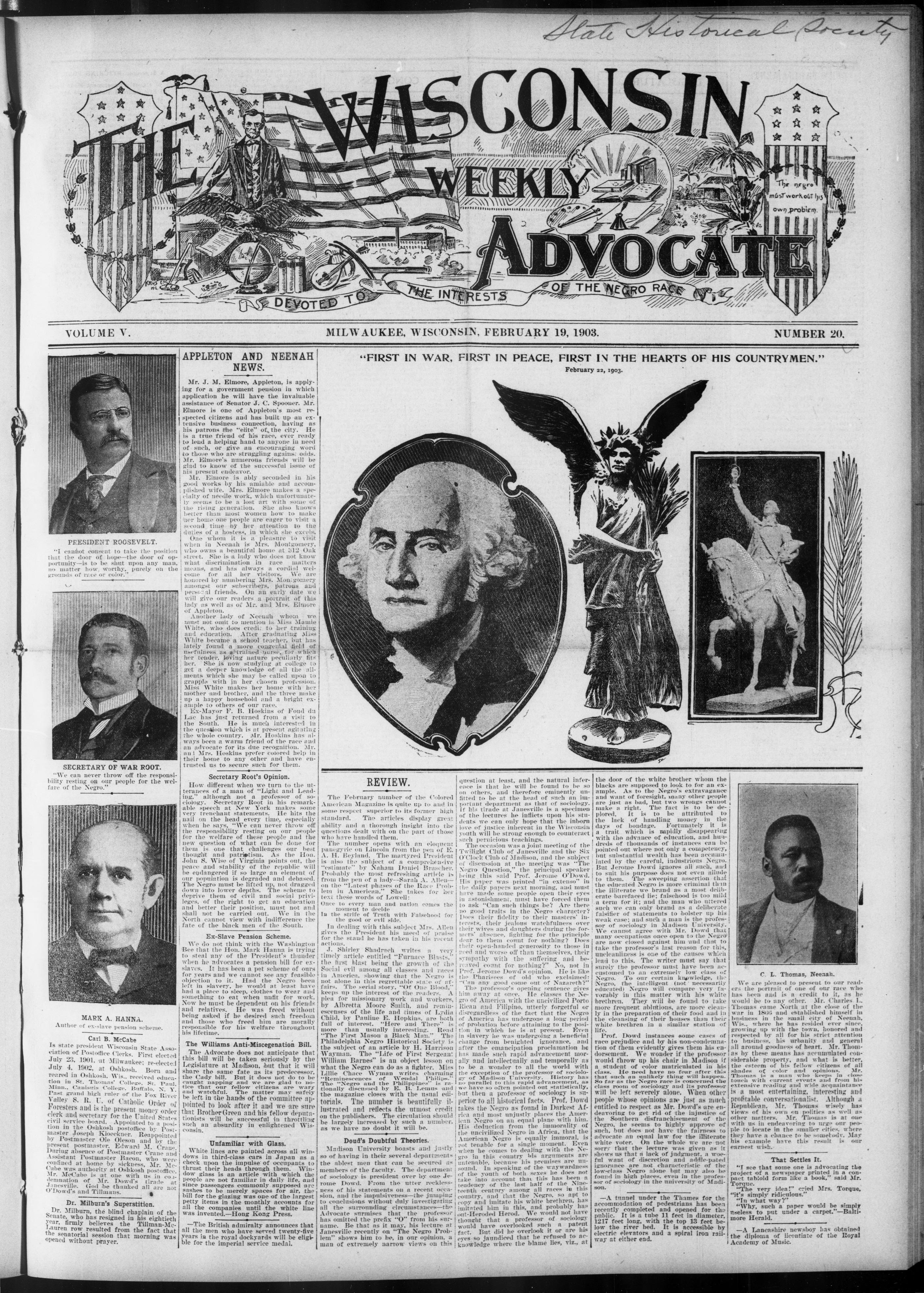
T. E. H.
PRESIDENT ROOSEVELT.
"I cannot consent to take the position that the door of hope—the door of opportunity—is to be shut upon any man, no matter how, worthy, purely on the grounds of race or color."
M. H.
SECRETARY OF WAR ROOT. "We can never throw off the responsibility resting on our people for the welfare of the Negro."
[Picture of a man in a suit with a bow tie].
Carl B. McCabe
Is state president Wisconsin State Association of Postoffice Clerks. First elected July 23, 1901, at Milwaukee; re-elected July 4, 1902, at Oshkosh. Born and reared in Oshkosh. Wis., received education in St. Thomas' College, St. Paul, Minn., Canisuis College, Buffalo, N. Y. Past grand high ruler of the Fox River Valley S. R. U. of Catholic Order of Foresters and is the present money order clerk and secretary for the United States civil service board. Appointed to a position in the Oshkosh postoffice by Postmaster Joseph Kloeckner. Reappointed by Postmaster Ole Oleson and by the present postmaster. Edward M. Crane. During absence of Postmaster Crane and Assistant Postmaster Bacon, who were confined at home by sickness, Mr. McCabe was authority at Oshkosh postoffice. Mr. McCabe is at one with us in condemnation of Mr. Dowd's tirade at Janesville. God be thanked all are not O'Dowd's and Tillmans.
Dr. Milburn's Superstition
Dr. Milburn, the blind chaplain of the Senate, who has resigned in his eightieth year, firmly believes the Tillman-McLauren row resulted from the fact that the senatorial session that morning was opened without prayer.
APPLETON AND NEENAH NEWS.
Mr. J. M. Elmore, Appleton, is applying for a government pension in which application he will have the invaluable assistance of Senator J. C. Spooner. Mr. Elmore is one of Appleton's most respected citizens and has built up an extensive business connection, having as his patrons the "elite" of the city. He is a true friend of his race, ever ready to lend a helping hand to anyone in need of such, or give an encouraging word to those who are struggling against odds. Mr. Elmore's numerous friends will be glad to know of the successful issue of his present endeavor.
Mr. Elmore is ably seconded in his good works by his amiable and accomplished wife. Mrs. Elmore makes a specialty of needle work, which unfortunately seems to be a lost art with some of the rising generation. She also knows better than most women how to make her home one people are eager to visit a second time by her attention to the duties of a hostess, in which she excels. One whom it is a pleasure to visit when in Neenah is Mrs. Montgomery, who owns a beautiful home at 312 Oak street. She is a lady who does not know what discrimination in race matters means, and has always a cordial welcome for all her visitors. We are honored by numbering Mrs. Montgomery amongst our subscribers, patrons and personal friends. On an early date we will give our readers a portrait of this lady as well as of Mr. and Mrs. Elmore of Appleton.
Another lady of Neenah whom we must not omit to mention is Miss Mamie White, who does credit to her training and education. After graduating Miss White became a school teacher, but has lately found a more congenial field of usefulness as a trained nurse, for which her tender, loving nature peculiarly fits her. She is now studying at college to get a deeper knowledge of all the ailments which she may be called upon to grapple with in her chosen profession. Miss White makes her home with her mother and brother, and the three make up a happy household and a bright example to others of our race.
Ex-Mayor F. B. Hoskins of Fond du Lac has just returned from a visit to the South. He is much interested in the question which is at present agitating the whole country. Mr. Hoskins has always been a warm friend of the race and an advocate for its due recognition. Mr. and Mrs. Hoskins prefer colored help in their home to any other and have entrusted us to secure such for them.
Secretary Root's Opinion.
How different when we turn to the utterances of a man of "Light and Leading," although not a professor of sociology. Secretary Root in his remarkable speech at New York makes some very trenchant statements. He hits the nail on the head every time, especially when he says, "We can never throw off the responsibility resting on our people for the welfare of these people and the new question of what can be done for them is one that challenges our best thought and patriotism. As the Hon. John S. Wise of Virginia points out, the peace and stability of the republic will be endangered if so large an element of our population is degraded and debased. The Negro must be lifted up, not dragged down into lower depths. The scheme to deprive them of civil and social privileges, of the right to get an education and better their position, must not and shall not be carried out. We in the North cannot view with indifference the fate of the black men of the South.
Ex-Slave Pension Scheme.
We do not think with the Washington Bee that the Hon. Mark Hanna is trying to steal any of the President's thunder when he advocates a pension bill for ex-slaves. It has been a pet scheme of ours for years and we cannot see any feasible objection to it. Had the Negro been left in slavery, he would at least have had a place to sleep, clothes to wear and something to eat when unfit for work. Now he must be dependent on his friends and relatives. He was freed without being asked if he desired such freedom and those who freed him are morally responsible for his welfare throughout his lifetime.
The Williams Anti-Miscegenation Bill.
The Advocate does not anticipate that this bill will be taken seriously by the Legislature at Madison, but that it will share the same fate as its predecessor, the Cady bill. But it does not do to be caught napping and we are glad to notice that our fellow citizens are wary and watchful. The matter may safely be left in the hands of the committee appointed to look after it and we are sure that Brother Green and his fellow deputationists will be successful in throttling such an absurdity in enlightened Wisconsin.
Unfamiliar with Glass.
White lines are painted across all windows in third-class cars in Japan as a check upon the impulse of occupants to thrust their heads through them. Window glass is an article with which the people are not familiar in daily life, and since passengers commonly supposed are sashes to be merely spaces for air, the bill for the glazing was one of the largest petty items in the monthly accounts for all the companies until the white line was invented.—Hong Kong Press.
—The British admiralty announces that all the men who have served twenty-five years in the royal dockyards will be eligible for the imperial service medal.
February 24, 1903.
REVIEW.
The February number of the Colored American Magazine is quite up to and in some respect superior to its former high standard. The articles display great ability and a thorough insight into the questions dealt with on the part of those who have handled them.
The number opens with an eloquent panegyric on Lincoln from the pen of E. A. H. Beyland. The martyred President is also the subject of a comprehensive "estimate" by Naham Daniel Brascher. Probably the most refreshing article is from the pen of a lady—Sarah A. Allen—on the "Latest phases of the Race Problem in American." She takes for her text these words of Lowell:
Once to every man and nation comes the moment to decide
In the strife of Truth with Falsehood for the good or evil side.
In dealing with this subject Mrs. Allen gives the President his meed of praise for the stand he has taken in his recent actions.
J. Shirley Shadrach writes a very timely article entitled "Furnace Blasts," the first blast being the growth of the Social evil among all classes and races in America, showing that the Negro is not alone in this regrettable state of affairs. The serial story, "Of One Blood," keeps up the interest of the readers. A plea for missionary work and workers, by Albretta Moore Smith, and reminiscences of the life and times of Lydia Child, by Pauline E. Hepkins, are both full of interest. "Here and There" is more than usually interesting. Read "The First Mason a Black Man." The Philadelphia Negro Historical Society is the subject of an article by H. Harrison Wayman. The "Life of First Sergeant William Barnes" is an object lesson on what the Negro can do as a fighter. Miss Lillie Chace Wyman writes charming "Reminescences of Wendal Philips." The "Negro and the Philippines" is rationally discussed by E. B. Lemus and the magazine closes with the usual editorials. The number is beautifully illustrated and reflects the utmost credit on the publishers. The circulation should be largely increased by such a number, as we have no doubt it will be.
Doud's Doubtful Theories.
Madison University boasts and justly so of having in their several departments the ablest men that can be secured as members of the faculty. The department of sociology is president over by one Jerome Dowd. From the utter recklessness of his statements on a recent occasion, and the impulsiveness—the jumping to conclusions without duly investigating all the surrounding circumstances—the Advocate surmises that the professor has omitted the prefix "O" from his surname. Be that as it may, his lecture at Janesville recently on "The Negro Problem" shows him to be, in our opinion, a man of extremely narrow views on this
question at least, and the natural inference is that he will be found to be so on others, and therefore eminently unfitted to be at the head of such an important department as that of sociology. If his tirade at Janesville is a specimen of the lectures he inflicts upon his students we can only hope that the inborn love of justice inherent in the Wisconsin youth will be strong enough to counteract such pernicious teachings.
The occasion was a joint meeting of the Twilight Club of Janesville and the Six O'Clock Club of Madison, and the subject of discussion at the meeting was "The Negro Question," the principal speaker being this said Prof. Jerome O'Dowd. His paper was printed "in extenso" in the daily papers next morning, and must have made some people open their eyes in astonishment, must have forced them to ask "Can such things be? Are there no good traits in the Negro character? Does their fidelity to their masters' interests, their jealous watchfulness over their wives and daughters during the formers' absence, fighting for the principle dear to them count for nothing? Does their open-handed generosity to those in need and worse off than themselves, their sympathy with the suffering and bereaved count for nothing?" No, not in Prof. Jerome Dowd's opinion. He is like the Pharisees of old who exclaimed: "Can any good come out of Nazareth?" The professor's opening sentence gives him away at once. He classes the Negro of America with the uncivilized Porto Rican and Filipino, utterly forgetful or disregardless of the fact that the Negro of America has undergone a long period of probation before attaining to the position in which he is at present. Even in slavery he was undergoing a beneficial change from benighted ignorance, and after the emancipation proclamation he has made such rapid advancement morally and intellectually and temporally as to be a wonder to all the world with the exception of the professor of sociology of Madison University. History has no parallel to this rapid advancement, as we have so often pointed out statistically, but then a professor of sociology is superior to all historical facts. Prof. Dowd takes the Negro as found in Darkest Africa and most unjustly places the American Negro on an equal plane with him. His deduction from the immorality of the uncivilized Negro in Africa, that the American Negro is equally immoral, is not tenable for a single moment. Even when he comes to dealing with the Negro in this country his arguments are untenable, because his premises are unsound. In speaking of the waywardness of the youth of both sexes he does not take into account that this has been a tendency of the last half of the Nineteenth century among all races in this country, and that the Negro, so apt to copy and imitate his white brethren, has imitated him in this, and probably has out-Heroded Herod. We would not have thought that a professor of sociology would have overlooked such a patent fact. But did he overlook it or are his eyes so jaundiced that he refused to acknowledge where the blame lies, viz., at
the door of the white brother whom the blacks are supposed to look to for an example. As to the Negro's extravagance and want of foresight, many other people are just as bad, but two wrongs cannot make a right. The fact is to be deplored. It is to be attributed to the lack of handling money in the days of bondage. Fortunately it is a trait which is rapidly disappearing with the advance of education, and hundreds of thousands of instances can be pointed out where not only a competency, but substantial wealth has been accumulated by the careful, industrious Negro. But Jerome Dowd ignores all such, and to suit his purpose does not even allude to them. The sweeping assertion that the educated Negro is more criminal than the illiterate we brand as a most deliberate barefaced lie; falsehood is too mild a term for it; and the man who uttered such we can only brand as a deliberate falsifier of statements to bolster up his weak case; and such a man is the professor of sociology in Madison University. We cannot agree with Mr. Dowd that many occupations once open to the Negro are now closed against him and that to take the professor's last reason for this, uncleanliness is one of the causes which lead to this. The writer must say that surely the professor must have been accustomed to an extremely low class of Negro. To our certain knowledge, the Negro, the intelligent (not necessarily educated) Negro will compare very favorably in this matter with his white brethren. They will be found to take more frequent ablutions, are more cleanly in the preparation of their food and in the cleansing of their houses than their white brethren in a similar station of life.
Prof. Dowd instances some cases of race prejudice and by his non-condemnation of them evidently gives them his endorsement. We wonder if the professor would throw up his chair in Madison if a student of color matriculated in his class. He need have no fear after this that such an unlikely thing will happen. So far as the Negro race is concerned the class room of sociology and its professor will be left severely alone. When other people whose opinions are just as much entitled to respect as Mr. Dowd's are endeavoring to get rid of the injustice of the Southern disfranchisement of the Negro, he seems to highly approve of such, but does not have the fairness to advocate an equal law for the illiterate white voter. On the whole we are not sorry that the lecture was given as it shows us that a lack of judgment, a woeful want of discretion andaddle-pated ignorance are not characteristic of the low-class Negro alone but may also be found in high places, even in the professor of sociology in the university of Madison.
A tunnel under the Thames for the accommodation of pedestrians has been recently completed and opened for the public. It is a tube 11 feet in diameter, 1217 feet long, with the top 13 feet below the river bed. It is accessible by electric elevators and a spiral iron railway at either end.
NUMBER 20.
S COUNTRYMEN."
M. B.
C. L. Thomas. Neenah.
We are pleased to present to our readers the portrait of one of our race who has been and is a credit to it, as he would be to any other. Mr. Charles L. Thomas came North at the close of the war in 1866 and established himself in business in the small city of Neenah, Wis., where he has resided ever since, growing up with the town, honored and respected by all for his strict attention to business, his urbanity and general all around goodness of heart. Mr. Thomas by these means has accumulated considerable property, and what is better, the esteem of his fellow citizens of all shades of color and opinions. Mr. Thomas is a man who keeps in close touch with current events and from his extensive reading and wide acquaintance is a most entertaining, interesting and profitable conversationalist. Although a Republican, Mr. Thomas wisely has views of his own on politics as well as other matters. Mr. Thomas is at one with us in endeavoring to urge our people to locate in the smaller cities, where they have a chance to be somebody. May his example have this result is our earnest wish.
That Settles It.
"I see that some one is advocating the project of a newspaper printed in a compact tabloid form like a book," said Mr. Torque.
"The very idea!" cried Mrs. Torque, "it's simply ridiculous."
"In what way?"
"Why, such a paper would be simply useless to put under a carpet."—Baltimore Herald.
—A Lancashire newsboy has obtained the diploma of licentiate of the Royal Academy of Music.
OPEN PARLIAMENT
King and Queen Participate in Pageant from Buckingham to Whitehall.
London, Feb. 17.—King Edward, accompanied by Queen Alexandra and surrounded by the court and all the officers of state, opened Parliament this afternoon.
Early in the morning the vaults of the houses were searched as usual for imaginary conspirators by the yeomen of the guard, carrying ancient lancers and useless halberds. The movements of the troops taking up positions along the route of the procession followed, so the crowds which had been attracted by the fine weather and desire to witness the royal pageant did not lack entertainment during the long wait. The royal procession, consisting of state carriages escorted by lifeguards, left Buckingham palace at 1:30 p. m. Their majesties were seated in the last carriage, which was drawn by the eight Hunoverian horses which have figured in all the recent royal ceremonies. The King and Queen reached the Victoria tower through the Mall, the Horse Guards and Whitehall. All the great officers of state, in varied uniforms, were assembled at the royal entrance of the House of Peers to receive the King. The procession, which was identical with that of the previous similar ceremony, formed and headed by the pursuivants and heralds, marched to the robing room, their majesties being immediately preceded by the sword of state, carried by the Marquis of Londonderry. After the robing, the procession re-formed, and, with a blast of trumpets, advanced to the peer's chamber, the Duke of Devonshire, lord president of the council, preceding their majesties with the imperial crown, which he carried on a cushion. The King then seated himself on the throne with the lords bearing the cap of maintenance and the sword of state standing on his right and left. The Queen sat on the left of the King and the Prince of Wales on his right.
The King's Speech.
The members of the House of Commons were then summoned and on their arrival the lord high chancellor, Earl Harlsbary, kneeling, handed the King the speech, which his majesty read from the steps of the throne.
The King spoke as follows:
My Lords and Gentlemen: My relations with all the foreign powers continue friendly.
The blockade of the Venezuelan ports has led to negotiations for the adjustment of all the matters in dispute. I rejoice that a settlement has now been arrived at which has justified the blockading powers in bringing all hostile operations to an immediate close.
Negotiations have taken place for an adjustment of the questions which have arisen in regard to the boundary of my possessions in North America and that of the territory of Alaska. A treaty for the reference of these questions to an arbitral tribunal has been signed and ratified.
The speech next referred to the Balkan question, saying:
The condition of the European provinces of Turkey gives me cause for serious anxiety. I have used my best efforts to impress upon the Sultan and his ministers the urgent need of practical, well-considered methods of reform.
After noting that Austria and Russia have been considering the reforms which the signatories of the Berlin treaty should recommend to the Sultan, the speech adds:
I trust that the proposals will prove sufficient for the purpose and that I shall find it possible to give them my hearty support.
Situation in South Africa.
The King next mentioned the Aden Hinterland dispute and the Somaliland expedition and then turned to South Africa, on which subject he said:
The progress of events in South Africa has been satisfactory. The visit of the colonial secretary has already been productive of the happiest results and the opportunity it has provided for personal conferences with Lord Milner and the ministers of the self-governing colonies and the representatives of all interests and opinions has greatly conduced to a smooth adjustment of many difficult questions and to the removal of many occasions of misunderstanding.
After referrring to the Nano (Nigeria) expedition and the durbar, the King said: I am glad to be able to state that the latter imposing ceremony coincided with the disappearance of the drought and agricultural distress in Western India, and that the prospects for both agriculture and commerce throughout my Indian empire are more encouraging and satisfactory than for some time past.
The speech concluded with an intimation that the budget estimates of the expenditure would inevitably be large, and with promising the introduction of bills dealing with the Irish land question, London education, sugar bounties and the London docks.
Promises for Ireland
In regard to the Irish measure the King said:
It will, I trust, complete the series of measures which have already done much to substitute single ownership for the costly and unsatisfactory conditions still attaching to the tenure of agricultural land over a large portion of Ireland.
The King and Queen returned to Buckingham palace at 3 o'clock. The crowd everywhere greeted them with enthusiasm.
VAN HISE LECTURES ON EXPLORER POWELL.
Geologist.
Washington, D. C., Feb. 17.—[Special.]—Prof. Charles R. Van Hise of the University of Wisconsin delivered an address at the meeting last evening for the late J. W. Powell of the geological survey, Dr. Van Hise told of Powell's explorations of the arid lands of the West and especially of the Colorado canyons. He said, in part:
Powell was an explorer with a broader and higher motive than that which controls many. His purpose was not to perform a difficult feat, and thereby gala personal glory. His purpose was not even to find a path. His purpose was to make observations along the whole realm of objective knowledge and to advance the philosophy of science. His purpose was to find the way by which the region explored would be of best service to the nation. Through the gauzy mask of the great explorer we see standing out in clear and dominating relief the comprehensive and philosophic scientist, the poet and the statesman.
Pat Balanced It.
An Irish soldier attending school, which is compulsory when starting, till after an examination has taken place, had great difficulty in bringing a sum to the correct answer.
"You are a shilling out, Magee," said the inspector; "therefore, you have failed again."
"Och!" says Pat, taking a shilling from his pocket, "take this, and it'll make the sum right. Hurroo! Succeeded at last!"—Spare Moments.
$5,000 a Year for Science
Prof. Atwater of Wesleyan University has been notified that the Carnegie Institute at Washington will allow him $5000 for the prosecution of his investigations of the relation of oxygen to the human system.
—London county council has introduced half-penny fares on all the cars running on the South London tramways.
LEGISLATURE.
All corporations and stock companies doing business in Wisconsin will have to file statements with the attorney general after June 4, 1904, showing exact standing of the companies if an anti-trust bill introduced by Senator Wylie in the Senate on the 12th becomes a law. All contracts or agreements in restraint of trade are declared void and persons making same are to be published. Property of illegal trust companies is to be forfeited. Senator McGillivray introduced the administration mortgage tax bill. It provides for separate assessment of reality and mortgages, the mortgage assessment to be deducted from the assessment of reality. Bills were passed as follows: Providing for refunding of municipal debts; relating to physicians' fees in insanity matters; relating to jurisdiction of justices, etc., in city in two or more counties; relating to sale of liquor to minors; relating to counsel of indigent persons in criminal cases; relating to additional legislative employees. The bill known as 54S, relating to the official state paper, was ordered to indefinite postponement.
The bill of Senator O'Nell to establish a health park for consumptives, introduced in the Senate on the 13th, is from an association of which ex-Judge Carpenter of the Dane county court is president. The late W. H. Bradley, the millionaire mgnate of Tomahawk, was much interested in the project. Senator Whipperman presented a bill of interest to brewers as it amends the law requiring brewers to pay $200 tax so that the brewers may deliver beer outside of cities where the breweries are located without additional licenses.. The bill ordered to engrossment relating to the sale of liquors to minors so amends the law as to extend it to all liquor dealers. At present its operation is confined to dealers who sell in quantities less than one gallon. Senator Roehr's bill amends the police and firemen's pensions fund law so as to provide a pension of $100 for widows of chiefs, in place of $75 and $75 for widows of engineers in place of $60. Mr. Sarau presented a bill preventing the over writing of insurance. This is to keep out the general agents and reserve the business for the local men. Senator Roehr introduced a joint resolution increasing the term for which municipal bonds can be issued to terms of fifty years instead of twenty years at at present. Senator Merton introduced a joint resolution for a national convention to endorse an amendment to the federal constitution for the election of senators by direct vote. This is similar to the Fritzke resolution introduced in the Assembly.
The inheritance tax bill prepared by the tax commission was introduced from the committees on assessment and collection of taxes in both houses at the evening session on the 13th. The bill adheres strictly to the provisions laid down in the report of the tax commission. The state tax commission bill for the creation of the tax commission as a board of assessment for the railroad property of the state and to tax the railroads under the ad valorum system, handed to the committees on assessment and collection of taxes of the Assembly and the Senate, were reported in both houses in the evening by those committees. The Senate did nothing at the evening session on the 16th beyond passing a bill to send copies of all bills introduced and the journals of both houses to the normal schools, colleges and public libraries of the state. There were only seventeen senators present and the calendar was put over until morning.
At the opening of the session of the Senate on the 17th Senator O'Nell presented a bill from a railroad man which had been delayed in the malls. The measure provides that railroads shall pension employees over 65 years of age and who shall have been in the employ of the companies for twenty-five years or more. The bill introduced by the committee on assessment and collection of taxes exempting all articles mentioned in the report of the tax commission except bicycles was ordered to a third reading. It exempts from taxation watches, sewing machines, five swarms of bees, $25 worth of firearms, $50 worth of poultry, and young animals. The bill from the committee on judiciary, fixing the terms of circuit judges for six years, was also ordered to a third reading. The Senate refused to concur in the Assembly resolution recalling the extra employees bill. Only two senators voted for the resolution. The joint resolution for a constitutional amendment authorizing cities of 25,000 or over to issue fifty-year bonds was referred to the committee on corporations.
In the Senate on the 18th the committee on assessment and collection of taxes introduced a bill to refund $59,767.14 received by the state under the inheritance tax law, since declared unconstitutional. The money is to be repaid to the various county treasurers and be by them refunded to the claimants. The same committee submitted a shorthand report of the railroad conference, held last week, and it was ordered spread on the journal. The Senate judiciary committee recommended for passage a bill relieving a railroad from garnishment process on any personal property in its possession as a common carrier. This bill is in line with declisions of the supreme court.
Assemhly.
A resolution was adopted by the Assembly on the 12th directing that 500 more copies of the primary election be printed. The committee on education reported for indefinite postponement 150A, relative to countersigning of high school diplomas. The committee reported favorably on 186A, permitting school boards to contract with teachers for terms of two, three or five years. A bill authorizing Oscar Malnz to construct a plier or dock extending into Sturgeon Bay was passed: The following bills were advanced to engrossment and third reading: Putting army nurses in the Civil war on the same footing as soldier veterans, entitling them to admission to soldiers' homes, etc.; authorizing cities under special charters to make terms of alder men two years, and continuing terms of present aldermen one year; providing for the protection, through better sanitation, of employees in factories, mercantile establishments, etc.; providing for the admission to the Veterans' Home, Waupaca, veterans who served in Wisconsin regiments but not now residents of the state; authorizing domestic life insurance companies to invest their funds in territories or the District of Columbia. The bill making lobbying by use of personal influence a crime was on the calendar for indefinite postponement. Its author, Mr. Irvine, asked that it be referred. There was objection, but the Assembly, by the close vote of 45 to 43, voted to refer.
Among the fifty-five bills introduced in the Assembly on the 13th was a novel primary election measure offered by Mr. Crowley, the Democratic member from the First Milwaukee district, by request. A Democratic mortgage taxation bill was also presented by Mr. Crowley. It is framed after the law of Maryland, and in place of fixing a tax upon the amount of the mortgage, by taxing it as an interest in reality, it provides for a tax upon the gross interest of all mortgages excepting such as are exempt. Mr. Benson presented a bill abolishing game wardens and reducing the number of employees in every department from one-half to one-third. Upon the request of the superintendent of the Wisconsin Humane Society a bill was presented making it unlawful to engage in trap shooting where live birds are used. A bill was presented providing for the appointment of a commission of five members to work with compilers of statutes. The bill directs that 2000 copies be printed and distributed. Mr. Barker introduced a bill providing that no person shall be eligible to the office of justice of the peace in Milwaukee county except he be an attorney at law. By a bill introduced by Mr. Cowling the governor is authorized to establish a free employment bureau in any city in the state having a population of 28,000. A bill requiring that railroads earning more than $3500 per mile shall not charge more than 2 cents per mile for passenger traffic was introduced. Mr. Dudgeon also presented a railroad bill that requires that coal shall be hauled at a rate not to exceed 1 cent per ton per mile and the charge for switching shall not exceed $1 per car. Assemblyman Karel introduced a bill requiring the railroad commissioner to compile a reasonable schedule of maximum charges for the transportation of passengers and freight. Mr. Frear introduced a joint resolution requesting Congress to forthwith issue a call for a constitutional question to pass on an amendment relating to the election of United States senators by popular vote. The joint resolution for a constitutional amendment increasing the number of justices of the supreme court from five to seven was adopted unanimous-
Two bills, having for their purpose to do away with the discrimination in railroad rates in this state, were introduced in the
Assembly at the evening session on the 13th one by Mr. Dahl and another by Mr. Andrew.
The Assembly passed two bills at the evening session on the 16th. One was introduced by Mr. Brittan of Beloit, and provides for the admission of army nurses who served during the Civil war to the Wisconsin Veterans' Home at Waupaca, and also entitles them to relief from county funds for the benefit of indigent soldiers. The other bill passed was introduced by Mr. Thoreson and provides for the creation of a new town named Anderson in the county of Burnett. Two bills that were on the calendar for passage were referred to committees. One was No. 22A, by Mr. Keney of Dunn county, giving county judges $5 per day for hearing any matter not pertaining to the probating of wills and administration of estates. The other bill referred was the Ray measure, allowing common councils of cities of the second, third and fourth classes by ordinance to extend the terms of some of the aldermen now in office.
A petition against the repeal of the law providing for payment of high school tuition by towns, from citizens of Baraboo, was presented at the opening of the Assembly session on the 17th. The Bartzen bill requiring better sanitation in factories, workshops, etc., was also re-referred to give parties opportunity to be heard. The Evans bill, providing that soldiers in Wisconsin regiments during the Civil war who are not now residents of the state may be admitted to the veterans' home, was passed, but the vote was reconsidered and the bill sent to the committee on claims. The Waterman bill, authorizing domestic life insurance companies to invest their funds in the territories and District of Columbia was passed. Mr. Bradford gave notice that he would next week move for Saturday and Monday sessions.
Gov. La Follette communicated his first veto of the present session to the Assembly on the 18th. The bill vetoed, the third to reach the executive, was that providing for additional legislative employees. The question of passing the bill, notwishstanding the veto of the governor, was laid over on motion of Mr. Cady. The judiciary committee reported in favor of the passage of the Cowling gypsy bill. The committee on cities introduced a bill authoriring cities of the third class to issue bonds for school purposes. The committee on military affairs reported favorably on the bill appropriating $3500 for the purchase of steel cases for the preservation of the state's was flags, and $300 for the binding of rare war records. Former Speaker Ray of La Crosse presided at a short session of the Assembly in the evening. Mr. Ekern of Trempealeau county presented petitions from the Good Templars of his county praying for the passage of the anti-cigarette and woman suffrage bills. The committee on education favorably reported No. 346A, introduced by Mr. Fritzke of Milwaukee, providing for the heating, lighting and ventilating of public school buildings.
LATEST MARKET REPORTS.
MILWAUKEE, FEBRUARY 18, 1903.
EGG AND DAIRY PRODUCTS.
MILWAUKEE—Eggs—Market firm. There is a good demand and the receipts are falling off owing to the cold spell. Some expect a 19@20c market before the cold spell ends. Strictly fresh, loss off, cases included, 17@17½c; fresh, cases returned, 16@17c; fancy storage, 12@13c. Receipts, 120 cases.
Butter—Market firm. There is a fairly good demand now for choice grades and the market is in good condition; creamy, per lb, 26c; prints, 26½c; firsts, 23c; seconds, 18c; June creamy, 24c; extra fancy dairy, 18@19c; lhees, 16@17c; roll, 16c; whey, 10c; packing stock, 14c; demand is rather light and stock is moving slowly; offerings very plentiful. Receipts, 8900 lbs.
Cheese—Firm. The demand continues good; full cream flats, fancy, 13@14c; good to choice, 11@12c; Young Americas, 13@13½c; low grades, 10@11c; limburger, per lb. No. 1, 11½@12c; low grades, 10@11c; imported Swiss, 25c; Block Swiss, domestic, 14@15c; fancy loaf, 14½@15½c; No. 2, 12@13c; Sapsago, 20c. Receipts, 5400 lbs.
CHICAGO—Butter—Steady: creameries, 18@26c; dairies, 14@23c. Eggs—Firm; at mark, cases included, 16½@17½c. Cheese—Steady; twins, 12½@12½c; dalsies, 13@13½c; Young Americas, 13@13½c. Dressed poultry—Steady; turkeys, 15@18c; chickens, 10@13c.
MILWAUKEE LIVE STOCK MARKET.
HOGS—Receipts, 4 cars; market lower; light, 130 to 160 lbs, 6.40@6.70; mixed, 180 to 225 lbs, 6.75@7.05; good to choice, 200 to 250 lbs, 6.85@7.15; selected heavy, 250 to 300 lbs, 7.00@7.30; pigs, 80 to 110 lbs, 5.25@6.00.
CATTLE — Receipts, 2 cars; higher; butchers' steers, medium to good 1050 to 1300 lbs, 4.25@5.00; falr to medium, 550 to 1050 lbs, 3.50@4.00; hefters, common, 2.50@3.25; good, 3.50@4.25; cows, falr to good, 3.00@3.50; canners, 1.75@2.25; cutters, 2.40@2.65; bulls, common, 2.75@3.15; choice, 3.50@3.85; feeders, 800 to 950 lbs, 3.50@4.00; stockers, 500 to 750 lbs, 2.75@3.25; veal calves, light, 90 to 105 lbs, 5.00@5.75; good, 110 to 140 lbs, 6.25@7.25; milkers, dull; common, 15.00@25.00; choice, 35.00@45.00.
SHEEP—Receipts, 1 car; steady; 3.00@4.25; bucks, 2.50@3.25; ambs, common to choice, 4.00@6.25.
Chicago receplts. Hogs, 30,000; cattle, 18,000; sheep, 15,000.
MILWAUKEE HAY MARKET
Timothy steady; carlots, choice timothy.
12.00@12.25; No. 1 timothy, 11.50@11.75;
No. 2 timothy, 9.50@10.50; clover and clover
mixed, 9.00@10.00.
Prairie hay steady; choice Kansas, 11.50
@12.00; No. 1 Kansas, 11.00@11.25: No. 2,
8.50@9.00.
Straw, steady; rye, 7.00@7.25; oats, 6.00@
6.50; wheat, 4.00@4.50; packing hay, 6.50.
Wisconsin prairie, 8.00@9.00.
MILWAUKEE POTATO MARKET
Potatoees—Market quiet and steady
Car lots, on track, per bus, Rurals and
Burbanks, fancy arge, 40@45c; Rose and
Peerless, 40@43c; small stock, 38@40c.
MARKETS BY TELEGRAPH
MILWAUKEE—Flour—Steady. Wheat — Steady; No. 1 Northern, on track, 80c; No. 2 Northern, on track, 79c. Corn—Firm; No. 3 on track, 43½c. Oats—Steady and unchanged; No. 2 white, on track, 36c; No. 3 white, on track, 35½@36c. Barley—Steady and unchanged; No. 2 on track, 65c; sample on track, 43@65c. Rye—Steady; No. 1 on track, 51½c. Provisions—Steady; pork. 17.47; lard, 9.60. Flour market steady; patents. 3.85@4.05; bakers. 2.90@3.05; rye. 2.90@3.00.
Millstuffs are firm and quoted at 17.25 for bran, 17.00 for standard middlings and 18.00@18.50 for Mlwankee flour middlings in 100-lb sacks; red dog, 20.00. Delivered to country points, 50c extra.
CHICAGO — Close — Wheat — May, 77%@77½c; July, 73%@73½c. Corn—February, 43c; May, 45½c; July, 43½@43½c; September, 43½@43½c. Oats—February, 33½c; May, 35½c; July, 32½c; September, 29½@29½c. Pork—May, 17.40; July, 16.80; September, 16.50. Laid—February, 9.57½; May, 9.57½; July, 9.35. Ribs—May, 9.50@9.52½; July, 9.35; September, 9.32½. Rye—May, 50½c. Flax—Cash Northwest, 1.19; Southwest, 1.14; May, 1.20. Timothy—February, 4.00. Clover—February, 11.75. Barley—Cash, 44@56c.
NEW YORK—Close — Wheat — May, 80½c; July, 78½c. Corn—May, 51½c; July, 49½c.
DULUTH—Close — Wheat — Cash No. 1 hard, 77%c; No. 1 Northern, 76%c; No. 2 Northern, 74%c; No. 3 spring, 71%c; to arrive, No. 1 hard, 77%c; No. 1 Northern, 76%c; May, 77%c; July, 76%c; Oats—May, 35c; to arrive and on track, 33%c; Rye—May, 50%c; on track and to arrive, 49c; Barley, 35@51c. Flax—Cash, 1.14; to arrive and on track, 1.14%; May, 1.16%; July, 1.16%. Receipts, wheat, 132,600. Shipments, none.
KANSAS CITY — Close — Wheat — May, 67%@68c; July, 65%c; cash No. 2 hard, 67%@68c; No. 2 red, 71c. Corn—April, 38%c; May, 38%@38%c; July, 38%@38%c; No. 2 mixed, 38%@40c; No. 2 white, 40%c; Oats—No. 2 white, 33@36c.
MINNEAPOLIS — Close — Wheat—May, 76%c; July, 76%@76%c; on track, No. 1 hard, 77%c; No. 1, 76%@76%c; No. 2 Northern, 75%@75%c.
TOLEDO—Close — Wheat — Dull, easier;
cash, 77½c; May, 80½c; July, 78c. Corn—Dull, steady; February, 46½c; May, 45½c;
July, 44½c; Oats—Dull, weak; February, 37½c; May, 36½c. Rye-No. 2, 53½c. Seed—Dull, firm; February, 7.12½c. March, 7.17½c, prime timothy, 1.80; do alske, 7.80.
ST. LOUIS—Cattle—Receipts, 3000; market strong; Texans higher; beef steers, 3.80@5.25; stockers and feeders, 2.25@4.00; cows and heifers, 2.25@4.50; Texans, 2.10@4.35.
Hogs—Receipts, 4000; market steady; pigs, 6.00@7.00; packers, 6.75@7.25; butchers, 7.25@7.45. Sheep—Receipts, 500; market strong; sheep, 4.25@5.25; lambs, 5.20@6.50
Proceedings in the Senate.
With the exception of a few minutes, during which some routine business was transacted, the session of the Senate on the 12th was behind closed doors, the Panama Canal treaty being under discussion. A bill was passed providing that any second lieutenant in the United States marine corps who may have been appointed a second lieutenant of artillery since February 2, 1901, shall receive credit for prior service as a lieutenant of volunteers. Mr. McComas gave notice that he would call up the eight-hour bill at the earliest opportunity, which brought from Mr. Quay the statement that "until the senator from Maryland and those obstructionists behind him" consent to the fixing of a day when a vote can be taken on the statehood bill. He would oppose any action on the eight-hour bill. A motion by Mr. Pettus to reconsider the vote by which the Alaskan boundary treaty was approved yesterday was tabled by a vote of 36 to 25.
An immense crowd was attracted to the Senate on the 13th to hear the invocation of Gen. William Booth, founder and commander in chief of the Salvation Army. Among the occupants of the galleries were Booth Tucker, the general's chief assistant and son-in-law, and a large number of Salvationists. Mr. Gallinger offered an amendment to the District of Columbia appropriation bill repealing the law fixing the charges for the use of telephones in the District of Columbia. After a long debate the amendment went out on a point of order by Mr. Heftfeld. The bill was then passed. The resolution of Mr. Morgan calling for the correspondence of naval officers regarding the military occupation of the bays of Panama and Colon, was agreed to. When the statehood bill came up Mr. Depew resumed his remarks. He attacked the Mormon Church, because, he said, he believed its members still cling to the practice of polygamy. Mr. Rawlins replied, saying that if the Mormons were not interfered with, they would work out their own destiny.
The Senate on the 14th agreed without discussion to the amendments made to the Elkins anti-rebate bill by the House. This completes congressional action upon the bill and it now goes to the President. Mr. Quay gave notice that beginning on the 16th he would ask the Senate to take up the statehood bill each day immediately after the conclusion of the routine morning business. Mr. Aldrich called up the bill introduced by himself authorizing the deposit by national banks in the treasury of other securities than government bonds, but Mr. Barry objected to present consideration and it went over. Mr. Aldrich saying he would call it up at the first opportunity. Mr. Lodge attempted to secure consideration of the Philippine tariff bill. The bill as passed by the House fixed the rate on Philippine products coming into this country at 25 percent, of the Dingley rates instead of 75 percent, as at present. The Senate committee amended the bill by granting free trade in all products except sugar and tobacco, and upon these products levying a duty of 50 per cent, of the Dingley rates. Mr. Foraker said he would object to the adoption of the amendment, as he believed any action less liberal than that proposed by the House would result disastrously. Further consideration of the bill was postponed, and the Senate entered upon its special order of business, which was that of eulogies upon deceased members of the House.
Soon after the Senate met on the 16th the District of Columbia appropriation bill was sent to conference. Messrs. Allison, Quay and Cockrell being named as conferees. Mr. Quay offered a resolution, which went over under the rules, declaring it to be the sense of the Senate that a date and hour prior to the 2d of March should be fixed for a final vote upon the statehood bill. Mr. Carmack introduced a resolution authorizing the committee on the Philippines to continue its investigation of conditions in the archipelago. The resolution went over on objection by Mr. Lodge. A resolution was agreed to calling on the President for information regarding the present status of the Isle of Pines and what action, if any, has been taken for the protection of the interests of citizens of the United States who have purchased property and settled there. Mr. Lodge then called up the Philippine currency bill. The amendment offered by Mr. Patterson providing for a conference between gold and silver standard countries to fix a commercial exchange was agreed to without division. Mr. Dubols offered a substitute for the entire bill and briefly explained its features. The substitute was expected and the bill then was passed. It is the measure recommended by the House committee on insular affairs, but which was rejected by the House. Consideration of the Indian appropriation bill was resumed and the measure finally passed. The statehood bill was taken up, but was not debated, Mr. Morgan occupying the remainder of the session speaking to a question of privilege. The recently negotiated commercial treaty with Greece was ratified in executive session.
The Senate on the 17th agreed to the conference report on the army appropriation bill. Discussion of the statehood bill was resumed, and Mr. Depew continued his remarks in opposition to it. Mr. Teller declared that himself and the country had been insulted by some of Mr. Depew's references to the unequal representation in the Senate. Mr. Hoar, from the committee on judiciary, reported the Littlefield anti-trust bill as amended. Mr. Platt (Conn.), of the committee, stated it was not a unanimous report and that he was opposed to the measure. A House bill was passed granting a pension of $30 a month to the widow of Representative John N. W. Rumple of Iowa, who was a captain of volunteers in the Civil war. The usual resolution providing for the reading in the Senate of Washington's farewell address was adopted and the president pro tempore designated Mr. Dubols of Idaho as the reader. The Quay resolution asking for a vote on the statehood bill went over. The Carmack resolution directing the committee on Philippines to visit the islands to investigate conditions was, on Mr. Lodge's motion, referred to the committee on Philippines on a yea and nay vote, 37 to 24.
There was lively debate in the Senate on the 18th over Senator Quay's resolution declaring it to be the sense of the Senate that there should be a vote on the statehood bill before the adjournment of Congress. To this proposition Senator McComas reoffered Senator Platt's cloture resolution, introduced two years ago, and a motion was made to refer the whole proposition to the committee on rules. This was pending when the Senate went into executive session. The discussion of the subject brought out the fact that the Senate was strongly opposed to cloture in any form. Messrs. Stewart, Platt (Connecticut) and Jones (Arkansas) were appointed conferees on the Indian appropriation bill. Mr. Mason reported the postoffice appropriation bill. An executive session of three and a half hours followed, being devoted to the Panama canal question.
Proceedings in the House.
The House made slow progress with the sundry civil bill on the 12th, covering only twenty-seven pages and leaving forty pages to be disposed of. The delays were occasioned by discussion of the item in the bill for the maintenance of the white house and debate upon the item appropriating $3,000,000 for the relief of distress in the Philippines, Mr. Galnes (Dem., Tenn.) and Mr. Fitzgerald (Dem., N. Y.) criticised the greatly increased cost of maintaining the white house. An amendment to cut in half the appropriation for the relief of distress in the Philippines was defeated, but the language of the paragraph was modified so as to require annual reports of the expenditure of the money. The conference report on the bill to create a general staff in the army was adopted.
The Elkins bill to prohibit rebates to shippers was passed in the House on the 13th by a vote of 241 to 6. those voting in the negative being Democrats. The remainder of the session was devoted to the sundry civil appropriation bill, which was practically completed. No effort was made to pass it, as there was no quorum present. and notice was given that a record vote would be demanded on an amendment to increase by $30,000 the $154,000 appropriation for the site of a military post at Indianapolis. The amendment was adopted in committee of the whole by a vote of 44 to 27. An amendment was adopted to appropriate $10,000 for additional land for the site of the government sanitarium for disabled volunteer soldiers at Hot Springs, S. D.
Without preliminary business the House on the 14th went into committee of the whole and resumed the consideration of the sundry civil appropriation bill. The amendment adopted the day before to appropriate $30,000 to add to the proceeds of the sale of the arsenal at Indianapolis ($154,000) for the purchase of 1800 acres near that city for an army post was again the subject of debate. Mr. Simms (Tenn.) said the land proposed to be purchased at $100 an acre was assessed for taxes at $30 an acre. Mr. Steele (Ind.) gave it as his opinion that the
land was worth $100 an acre. Mr. Richardson's amendment to prohibit the use of illustrations in bureau reports, except with the approval of heads of departments, was offered in a modified form, so as to escape a point of order, and adopted. When the bill was reported to the House Mr. Zenor (Ind.) demanded a separate vote upon the Indianapolis military post amendment. The amendment was adopted, 125 to 85. The bill was then passed and the House proceeded to the consideration of private pension bills, passing 325.
The House disposed of a number of bills on the 16th under suspension of the rules, and adopted a special order which practically will make the Fowler currency bill a continuing order for the remainder of the session, not, however, to interfere with conference reports, appropriation bills and other privileged matters. Among the bills passed was one to amend the act of March 2, 1893, to compel common carriers to equip their cars with automatic couplers so as to include tenders, which had been held not to be cars, and to require a more general use of air brakes. Mr. Ryan of New York objected to an amendment inserted by the House committee which would give the interstate commerce commission power to reduce the minimum number of cars to be equipped with power brakes below 50 per cent, but without avail.
After the reading of the journal in the House on the 17th Mr. Cooper (Texas) called attention to the fact that through an error in the record a bill passed yesterday relating to an appropriation in the river and harbor bill for Sabine Pass technically repealed the river and harbor bill. As the matter was somewhat complicated, it was allowed to go over. Mr. Dalzell, from the committee on rules, then presented a special rule making in order the legislation reported in the naval bill for the increase of the personnel of the navy and for the increase of the limit of cost of the naval academy. The resolution was adopted without division and the House went into committee of the whole and entered upon the consideration of the naval appropriation bill. On completing thirty of the sixty-five pages of the bill the committee rose. The Senate amendments to the Indian appropriation bill were disagreed to and the bill sent to conference, Messrs. Sherman, Curtis (Kansas) and Little (Arkansas), were appointed conferees.
The House on the 18th, by a majority of 2 to 1, rejected the conference report on the army appropriation bill, because of its provisions for the retirement of Civil war officers at an advanced grade, and permitting officers to deposit money with the government at 3 per cent. interest. The House emphatically voted against both propositions, and sent the bill back to conference. The proceedings on the conference report was enlisted by a sharp personal clash between Mr. Hull of Iowa and Mr. Slayden of Texas. The remainder of the day was devoted to the naval appropriation bill. Slow progress was made, only twenty pages being covered. An appropriation of $100,000 for the expenses incident to the occupation of the new naval station the government is to acquire from Cuba was placed in the bill at the request of the navy department. The speaker announced the committee on rules had considered the question raised yesterday by Mr. Cooper (Texas) concerning a bill passed Monday, which he thought technically repealed the river and harbor bill, and had found the assumption was incorrect.
The safe in the office of Alfred H. Anderson, foundryman, was blown open and checks and money amounting to $400 stolen.
Henry Berg, former proprietor of the Hotel Frankfort and father of Morris H. Berg of the jewelry firm of Hyman, Berg & Co., died in Omaha Friday morning, aged 76 years.
Lured to a Clark street hotel by a confidence man he met at the depot, Charles Didier, a young farmer from Russia, O., was robbed of $4000. He has since mysteriously disappeared.
William Galinski was probably fatally stabbed at the home of his mother-in-law. Galinski got into a quarrel with John Gurski and John Krafaik and in the melee was stabbed in the abdomen.
—Henry T. Henry, 25 years old, who was employed as a porter at the Regia Hotel, died suddenly while sweeping in the hallway. Dr. Fitzpatrick said he believed Henry's death was due to heart disease.
—Ethel M. Dana was granted divorce from Charles Clayton Dana because he was to oexpensive, having begun his matrimonial career by borrowing $100 given her by her father and never returning it.
—Sir Philip Burne-Jones' painting, "The Vampire," has been sent East. The number of those who paid to see the canvas was comparatively small, and no one cared to pay the $20,000 which the painter thought his work was worth.
A carriage containing Robert Shaw and wife and Mrs. E. B. Shaw was struck by a Wentworth avenue car. The occupants narrowly escaped serious injury, as the vehicle was hit with great force and shoved along the slippery rails for fifteen feet.
Edward Kantz, janitor of the Austin public school, was found unconscious in front of the residence of James Faven. He was removed to the county hospital and is dying. Faven insists that Kantz fell downstairs in leaving the house.
Edward Haerle, shot February 13 in a saloon at 50 North Clark street by Edward G. Emerson, a bartender, died at Polyclinic Hospital. Emerson, arrested after the shooting, will be held to await the action of a coroner's jury. Emerson says Haerle was trying to rob the cash register at the saloon when he fired at him
Daniel S. Mugridge, a former member of the board of trade, died, aged 69 years. Mr. Mugridge was born in Portsmouth, N. H., and came to Chicago at an early age. He was in his early years a director and member of the board of trade and was one of the charter members of the open board of trade and its first vice president.
Martin A. Smith, while cleaning machinery with gasoline at the building of the Chicago Belt Preserving Company, lit a match with a view to smoking a pipe. The next instant he was enveloped in the flames. Firemen extinguished the blaze after $1100 damage had been done, and Smith was taken to the Alexian Brothers' Hospital, suffering from severe burns. He will recover.
THE BEST OF FORTY-FIVE YEARS.
The Northwestern Writes More Business in 1902 Than in Any Year Since it was Organized at Janesville in 1857.
The group of men who organized the Northwetsern Mutual Life Insurance Company (then the Mutual Life of Wisconsin) at Janesville, forty-five years ago, undoubtedly foresaw the future greatness of the state of Wisconsin, but it is certain they had no idea that the organization then created would in forty-five years become one of the great institutions of the earth, with over $165,000,000 of assets, insuring over a quarter of a million policies for $620,000,000.
The Northwestern has 27,794 policies for $57,205,487 insurance outstanding in Wisconsin and since its organization has paid in death losses alone the enormous sum of $8,450,242.41 to residents of Wisconsin. Who can compute the amount of poverty and suffering such payments have prevented?
In 1902, the largest year of its history, the Northwestern wrote $68,421,657 of new business on which premiums were actually collected, and of this amount over $5,000,000 was in the state of Wisconsin. The company's detailed annual statement is printed elsewhere in this issue and will repay perusal to any who are interested in the success of home institutions.
A $1,000,000 HITCHING POST.
Relic of a Costly Experiment Made Upon the Erie Railroad Sixty Years Ago.
J. B. Posten of Bath. N. Y., has in front of his house what he calls a million-dollar hitching post. It is a white oak post, and was removed from a field near Canister, Steuben county, N. Y., and is believed to be the last of thousands of posts that were driven for a distance of more than 100 miles on the route of the New York & Erie railroad when it was being constructed through the Susquehanna, Canisteo and Alleghany valleys, sixty-two years ago. It was intended to elevate the rails for the railroad on these posts instead of laying them on a solid roadbed. This plan of railroad building was abandoned before a rail was put down. The money spent in the useless work amounted to more than $1,000,000, and drove the Erie into its first bankruptcy.
The owner of this relic of the old pile roadbed of the Erie obtained it last fall while visiting relatives in the vicinity of where it stood, a lone monument to the costly folly, that placed it there two generations ago.
New Cure for Lame Back
Rutledge, Minn., Feb. 16.—Mr. E. C. Getchell of this place relates a happy experience which will be read with interest by all those who have a similar trouble.
It appears that last winter Mr. Getchell was seized with a lameness and soreness in his back which grew worse and worse till at last it became very bad and made it very difficult for him to get about at all.
After a time he heard of a new remedy for backache which some of his friends and neighbors said had cured them and he determined to try it. The name of the remedy is Dodd's Kidney Pills and Mr. Getchell has proven that it is a sure cure. He says:
"I used two boxes of Dodd's Kidney Pills according to directions and my lame back was entirely cured and I am all O. K. again. Dodd's Kidney Pills are as good as represented."
This remedy is very popular here and has worked some remarkable cures of Backache and Kidney Trouble.
New Language Teaching Method.
Ald. Sir W. P. Treloar told an excellent after dinner story the other evening about the difficulties of magistrates in understanding witnesses, and how they try to deceive the court. A man was charged with causing an obstruction and using uncivic language. All he pretended to speak was German, of which he uttered a great deal. "For an hour," said the alderman, "I listened to a long harangue in Deutscher, which I did not understand, although I sent for an interpreter. At last I told the man I must fine him 2s6d. To the intense amusement of everyone in court the man (who, it had been said, could only speak German) suddenly exclaimed, 'I ain't got the ha'pence, Guv'nor!' He was, therefore, ordered to be compulsorily detained for three days at the expense of the country. Then," added Sir William, "his English became obstreperous."—London Telegraph.
DOAN'S Kidney Pills CURE Bad Backs
Bad backs are found in every household. A bad back is a back that's lame, weak or aching. Most backache pains come from kidney derangements and should be promptly attended to. Reach the cause of backache by relieving the kidneys and curing their ills. Doan's Kidney Pills are for the kidneys only and cure the dangers of urinary and bladder disorders from common
inflammation to Dropsy, Diabetes, Bright's disease. Case No. 40,321.—Mr. W. W. H. Hammer, well-known builder, residing at 125 N. Hinde street, Washington C. H., Ohio, says: "I am glad to indorse a remedy which possesses such inestimable value as Doan's Kidney Pills. They cured me of inflammation of the bladder which had caused me much annoyance and anxiety because of the frequency and severity of the attacks. I have advised others to take Doan's Kidney Pills and I know they will not be disappointed in the results."
A FREE TRIAL of this great kidney medicine which cured Mr. Hammer will be mailed on application to any part of the United States. Address Foster-Milburn Co., Buffalo, N. Y. For sale by all druggists, price 50 cents per box.
Sat Upon.
"What's the child a-cryin' for, Matilda?"
"Pie, ma'am."
"Well, for gracious' sakes, give him a pie, then"
"It ain't that he wants a pie, mum. He's had too much, mum; he sat in one, mum."—Yonkers Statesman.
Many School Children Are Sickly.
Mother Gray's Sweet Powders for Children, used by Mother Gray, a nurse in Children's Home, New York, Break up Colds in 24 hours, cure Constipation, Feverishness, Headache, Stomach Troubles, Teething Disorders, move and regulate the bowels and Destroy Worms.
Sold by all druggists or by mail, 25c. Sample mailed FREE. Address Allen S. Olmsted, Le Roy, N. Y.
Breaking Up Irish Estates.
It is anticipated that the Irish land bill soon to be introduced in Parliament will parcel out the great estates in small holdings to be paid for in annual installments of less amount than the rents now paid the landlords.
Bathing the Baby.
Young mothers naturally feel anxious about the baby's bath. It is best to begin at six weeks to put the little one in the water, first folding a soft towel in the bottom of the basin. Use only Ivory Soap, as many of the highly colored and perfumed soaps are very injurious to the tender skin of an infant.
ELEANOR R. PARKER.
—Willow is the lightest of British woods. A cubic foot of it weighs but 30 pounds. A cubic foot of boxwood weighs 57 pounds.
ELY'S LIQUID CREAM BALM is prepared for sufferers from nasal catarrh who are used to an atomizer in spraying the diseased membranes. All the healing and soothing properties of Cream Balm are retained in the new preparation. It does not dry up the secretions. Price, including spraying tube, 75 cts. At drugists' or Ely Bros., 56 Warren street, New York, mail it.
In Hawaii there are more Chinese than natives and the Japanese outnumber the natives two to one.
THE STUCK-UP GIRL.
She was dalty and petite,
And her costume trim and neat
And the town went ogle-eyed
When she rambled down the street;
And this item was described;
Of support she had no lack,
For she'd stuck
Where her shirtwaist met her skirt,
Marking out her wasp-like girt,
Not a seam or fold was wrong.
And the whole was sweetly pert
As she lightly tripped along,
Admiration on her back,
And a store
full of pins
Oh! the joy with which we sent
Up our card, when dusk had lent
To romancing such a charm,
All on winning her intent!
And we slyly placed our arm
In position, but, alack!
We were caught
on the pins
in
The middle of her back!
Never more will we essay
To allow our arm to stray,
When a small, inviting waist
With temptation blocks the way!
Lightsome romance is our taste—
Not waists gathered in the slack
With a half
ton of pins
in
The middle of the back!
—Baltimore News.
The Sentimentalist's Surprise.
Jane was a young person of great sensibility and imaginative power. Her enemies said she was sentimental, but that was only half true. Jane, having read countless romances in which love appeared to be the highest state of bliss, decided that if life were to contain anything important for her she must fall in love as soon as possible. This may seem an easy matter to the simply amorous, but to a strict romanticist it presents many difficulties. Jane's life led down a city street to school, and home again. It is true that many young ladies in Madame Estelle's seminary flirted from the windows with young gentlemen on the corner, but this innocent vulgarity was offensive to Jane's sense of romance. She continued reading and bided an auspicious occasion for the bestowal of her heart.
In her fifteenth year Jane's parents went to spend the summer in the Adirondacks. Jane decided that this summer should certainly mark the great year of her life. Some one must at once lie found upon whom to hang her affections. Had not Juliet lived, loved and died before she was 16? Jane made a calculating survey of herself before she launched upon her guest. Her blue eyes, black hair and pensive, drooping mouth were encouraging, but there was something offensively prosaic about her short, blue linen dress and large laced boots. A limp white muslin and a pair of sandal slippers are what Jane would have liked.
For many days Jane viewed the male population of the lakes with a searching eye. She looked at the venerable beaux with patent leather shoes and cynic smiles, the college men with blatant tongues and sweaters, the stodgy heads of families, the choicey dressed and vacuous looking youths from city offices, the agile, derisive little boys who moved in gangs. Her heart misgave her. Was it possible that ladies still found heroes in this throng? Still she did not despain. There might yet beat some soul of sentiment under a flannel blazer.
One night as she was standing on the wharf the little boat that brought new visitors to the hotel presented to her eyes a likely subject. He was leaning against the door of the steamer in a rather graceful way, with a soft hat almost imperceptibly tilted on his head. There was, to Jane's eye, something both subtle and dashing about his appearance. Her hopes beat high. He was shaking hands with an older girl whom she knew. There was to be a hop at the hotel that night. Perhaps the older girl would ask him to dance with Jane.
The would-be heroine was pink with excitement that evening. She watched the new guest as he crossed the dancing space. He had dark eyes with shadows under them and shadows round his mouth. Jane thought he must work very hard. She leaned over and touched her elder friend.
"Will—will you introduce me to that man?" she shyly whispered.
"Of course," said her companion gayly, beckoning to the loiterer. "Miss Craves, let me present Mr. Carson."
"Delighted," said Mr. Carson in a weary voice. "May I have the pleasure?" and he led Jane out to dance. Afterward they repaired to two veranda seats in the moonlight. Jane waited anxiously for her hero to speak, and the hero spoke. He told Jane that she danced beautifully; that it was the best dance he had had that evening. He jeered languidly at the college students and said it must be very dull here for a pretty girl. He broke off to admire a blond lady going past them. Jane once more felt the pangs of disappointment. Alas! his romantic exterior belied him. He was only rude and silly. She looked sadly at him. He was leaning back with drooping eyes.
"Beg pardon, but I have such a head ache?" he murmured.
"I am very sorry," said Jane.
"Jove, what a smile!" said the young man; "it's enough to make a fellow well again."
Jane rose. "There is my next partner," she said stiffly, and led the way across the room. Never, never again would Jane make a mistake about dashing young men with shadows under their eyes.
So Jane had to be begin her search again. There came upon her horizon an 18-year-old schoolboy by the name of Robert Smith—a tremendous young giant, with blue eyes, yellow hair and a face devoid of expression. Jane conversationally sounded him. He was sweet tempered and polite, but seemed quite colorless in mind and heart. Could not Jane tincture him to suit herself—convert this raw material into a hero? She would try. Robert soon got into the habit of seeking Jane to dance because she did all the talking. Then he began to take her rowing in the afternoons. Jane's heart began to warm to Robert. It was better to have a man say nothing than to let him spoil things with commonplace remarks. She made him row her to shady nooks, where she would take a little volume of Lord Tennyson and read it to him. She would gaze at him silently and mysteriously. Robert began to be listless and pale. The silence and poetry and adoration of Jane were enervating him. But whenever he made an
attempt to take any one else out rowing Jane's eyes would give him to understand that he had stabbed her to the heart; so poor, huge, sweet tempered Robert was finally bound head and foot. He followed Jane all day long, let himself be read to, quarreled with, admired, and often showed sparks of real emotion. Still Jane was conscious of a sense of disappointment. It was heavy work—this dragging of Robert through the proper paces.
At last her homemade hero was obliged to leave. Jane brightened up. Here was an opportunity for a touching farewell. That afternoon she and Robert rowed to a beautiful little island where, on a moss grown bank above the lake, they watched the setting sun "for the last time," as Jane said.
"Robert, let's carve P. L. on this log,' she cried enthusiastically.
"P. L.?" said Robert, in solemn astonishment.
"Yes, for Paradise Lost!"
"What's the joke?" he asked.
Jane felt it would be useless to explain.
The next morning as Robert departed on the little steamer Jane watched until she could no longer see shining on her hero's coat the silver heart she made him swear to keep for her sake always. Then she gave a little sigh of relief. Robert, indeed, was heavy work.
Jane now felt that she was either one of those to whom real love never comes, or that since romance was dead she would not continue to be its sole upholder. She began to join the other girls in singing coon songs in the evenings, and to play tennis with a shaggy, red-haired college boy. She often made attempts to go to the Lost Paradise and mourn in pensive solitude, but this red-haired boy was always getting up a party to fish or dig for worms, and dragged her with them. The red-haired boy was ugly, headstrong and had no ear for Tennyson, but he had a smile like those for which comedians on the stage have been known to receive large salaries.
One day the hotel guests hired the little steamer and toured the lakes for a picnic. The red-haired boy sat by Jane on the back deck and made puns. At luncheon he beat a boy over the head with a chicken bone because he didn't pass the cakes to Jane. When it began to rain, as it always does at picnics, he seized Jane by the hand and made her run along the road until she begged for mercy. Reaching the steamer, he pushed her into his overcoat, wrapped her feet in a potato sack and composed himself beside her to play the banjo all the way home. It wasn't at all romantic, but very pleasant in its way. Jane wished she had not wasted so much time looking for an heroic hero.
"How long do you stay here?" she asked. "Till tomorrow," he answered. "Only tomorrow!" she cried. The red-haired boy stopped singing and smiled at her. He wasn't such a very ugly boy. "Sure; on the 5:30 boat. Wave your hand as we go past," he said. In the early morning following Jane was waked by a toot from the steamer. Jumping out of bed she seized a towel and flapped it from the window. As the boat rounded the corner she could see the sunlight shining on the red-haired boy. He waved his straw hat—and he was gone.
Jane crept back to bed and wrung her hands in pleasurable anguish. "To think I loved him all along," she said, "and never even knew it."—Clare M. Howard in Columbia Literary Monthly.
DISAPPEARING BIRDS.
Magic Trick of the Little California Partridges.
Young birds have to be taught a great many things, but there are some feats which they know without instruction. In a large open-air cage in the New York Zoological park is a covey of six California partridges, about one-third grown, and their little bantam stepmother. She dozes at one end of the range or walks slowly about, pecking among the blades of grass. The small sexette keep close together, and if we watch them for several minutes, we will see some of the things which must have come to them as their feathers and little bills came—from the egg. Unlike the hen, they are suspicious of your every movement, but in a short time they forget that you are not a lifeless tree trunk or other harmless object near their cage. They select a sunny spot, always on the dead leaves, never on the green grass, and here, after much cuddling and pushing, but never a peep, they squat, usually in an irregular circle with heads onward. Unless there are dead leaves or some similarly colored surface in their cage, they never settle down contentdly for a sun bath.
We watch them nestle close to the ground and close their eyes; then some movement on the part of the hen may attract our attention for a moment, and, on looking back again, we are amazed to find the little birds have disappeared. It is a fact that if we lose sight of them even for a short time, the eye at first refuses to distinguish them from the dried leaves. Their little backs are dull, dark brown in color, broken by irregular fine white lines, very much like the mold lines on fallen leaves, while the lighter sides of the head, instead of being at all conspicuous, are exactly like the lighter shades of some old leaves, the imitation being more perfect from the fact of the coloring being thus broken up. Even the little brush of upraised feathers in their heads—hints of the beautiful recurved helmets of the old birds—appear like small, fraved out pieces of grass or leaf.
If we look toward them with halfclosed eyes not a trace of the birds is visible. All appear sound asleep, and the little heads sag drowsily to one side, but at the slightest noise each black bead of an eye is wide open, and six scurrying pairs of legs, or rounded, whirring wings, carry their owners to the further side of the cage, as if an unfelt wind had suddenly caught up some of the dead leaves before us and tossed them along the ground. It is all a beautiful bit of magic, which never becomes less wonderful, no matter how many times we witness it. New York Tribune.
REMINDER OF THE PAST.
Beech Tree Grove at Grand Haven to be Cut Down.
The famous Beech Tree grove at Grand Haven, Mich., has been sold to the Grand Haven Basket Company and the timber thereon will be cut down and converted into baskets and other manufactured articles. It was at this grove that the Ottawa tribe of Indians had a famous council with the early white settlers in the early '40s. The pipe of peace was smoked with the settlers at that time and from then on the pioneer settlers lived in peace with the aborigines. For years the old grove was a favorite meeting place for Indians and settlers, who assembled there to trade and barter. The ground, when plowed up, turns up arrow heads and other Indian relics by the hundred.
SUNK BY A CYCLONE.
SEVENTEEN DROWNED.
Norfolk, Va., Feb. 18.—A cyclone struck the passenger steamer Olive and sent it to the bottom of Chowan river, drowning seventeen persons.
The Olive is a river steamer plying between Franklin, Va., and Edenton, N. C. The accident took place off Woodley's wharf, between Mount Pleasant and Oliver's wharf.
Without any warning a furious blast of wind struck the shallow craft, careening it until the water rushed over the side. It righted, but sank immediately, and the passengers on the lower deck and in the cabin had no chance to seek safety in any direction. Nearly every one was in the cabin on account of the threatening storm.
Only the pilot house stood above the water when the steamer settled to the bottom. In it were Capt. George H. Withy and five others, the only ones saved. The river steamer Pettit rescued the almost frozen survivors. The Oliver was a small single screw steamer, owned by J. A. Pretlow of Franklin, Va. Baltimore, Md., Feb. 18.—The barge Wayne, in tow of tug Paoll, loaded with coal and bound for Fall River, is ashore in the Chesapeake near the mouth of the Patapsco river. The Paoll towed the barge Malvern, bound for the same place, to safe anchorage, and pulled on the Wayne for several hours.
STALLED IN SNOW.
Six Trains are Buried in Drifts Between Chaldron, Neb., and Lusk, Wyo.
Chadron, Neb., Feb. 18.—Six trains are buried in the snow between this point and Lusk, Wyo., on the North-Western line. Two of the trains contain a regiment of cavalry en route to San Francisco, Cal., from Fort Meade, S. D. A blizzard has been raging for the last twenty-four hours and some of the trains are partially covered up in the deep cuts. Reports received by stock men indicate that there will be a heavy loss on the open range. The snow is several feet deep on the level.
Herd of Elks Starving.
New York, Feb. 18.—A herd of 10,000 elks is standing on the Jeton-Yellowstone reserves in Wyoming. Snow seven feet deep covers their feeding ground, and temperatures as low as 40 below zero have added to their sufferings. News of the critical condition of the elk herds reached here from the chief of the United States rangers to A. A. Anderson, special superintendent of the Jeton-Yellowstone reserves, who spends his winters in New York. Mr. Anderson at one time ordered that a temporary supply of wild hay, at his own expense, be distributed as soon as possible at convenient points by the force of thirty rangers.
Blockade is Complete.
Cheyenne, Wyo., Feb. 18. The blizzard which has been raging in the southern part of Wyoming for a week continues fiercer than ever and the blockade on all railroads is practically complete. The storm on Sherman Hill is frightful and every cut is filled with snow. The average depth of the snow on the Union Pacific track over the hill is 4 feet and in places all telegraph poles and wire are completely buried by drifts. West from Sherman to Rawllins, the blizzard is terrific.
FIREMEN SAVE LIFE.
Threatening Blaze in Clark Street Building, Chicago—Hotel at Port Huron, Mich., Destroyed.
Chicago, Ill., Feb. 18.—Quick work by firemen saved the lives of a number of persons who lived in the five-story brick building at 1-3 North Clark street, early this morning when a fire broke out on third floor of the structure. Clayton Bush, proprietor of the beer and concert hall on the first floor of the building, and his wife and children were carried from the building and cared for by the police. Other persons living in the building were able to leave and still others were overcome and carried out by the fire and policemen. The loss is more than $75,000. Port Huron, Mich., Feb. 18.—The St. Claire Hotel, one of the largest hostelries of this city, was destroyed by fire at an early hour this morning.
A man named Worthy, employed at the hotel as a yard man, is missing, and is believed to have been burned to death; Milton Campbell, a fireman, was fatally crushed under falling walls. All the hotel guests made their escape, many of them rushing out in their night clothes. The fire started shortly after midnight in a bakery near the hotel and burned fiercely for three hours before the firemen made any headway against it. Several small stores were destroyed and loss is estimated at $100,000. Fireman Milton Campbell, who was crushed under a falling wall, died today. Yardman Albert Worthing of the hotel has not yet been found and it is believed that he was burned to death in the hotel. All of the guests have been accounted for and the loss of life will not exceed two.
Phoenix, Ariz., Feb. 18.—Telegraphic advices state that as a result of a saloon brawl a blaze started at Williams, Ariz., which is spreading rapidly and has already enveloped one-third of the business blocks. A brisk wind is blowing. Pittsburg, Pa., Feb. 18.—The foundry plant of Thomas Carlin's Sons Company, Allegheny, was destroyed by fire early this morning. Loss, $200,000, partly covered by insurance. The fire was caused by a boiler explosion.
Dragged by a Train.
Elgin, Ill., Feb. 18.—[Special.]—Because he was dragged some distance by a train and received severe injuries, Michael Carey of Beloit, Wis., will long remember Elgin. He was talking with a friend when his train moved out of the station. Running, he grasped the platform rail and was hauled some distance until compelled to release his hold. When the doctor reached him he was semi-conscious. He might have been killed.
Japanese Prince Dies.
Yokohama, Feb. 18.—Prince Kamatsu, who was the envoy of Japan at the coronation of King Edward, died today of an affection of the brain.
Man Frozen to Death.
Iron Mountain, Mich., Feb. 18.—[Special.]—Frank Forsburg, a tailor, was found frozen to death on the street at Norway at 3 o'clock this morning.
STILL INTENSELY COLD.
Frigid Weather Shows No Signs of Letting Up—Snowfall is Very Heavy.
New York, Feb. 18.—The snow storm of yesterday gave way to clearing skies and cold winds, accompanied by falling temperature. At 8 o'clock today the weather bureau thermometer stood at 6 degrees above zero, the lowest so far this winter. Dispatches today from various parts of the state report temperatures ranging from zero to 18 degrees below, the latter in the Adirondack region. The snowfall is the heaviest of the winter thus far at most points.
New Haven, Conn., Feb. 18.—Temperatures ranging from 5 to 10 degrees below zero, nearly equalling the lowest records of the winter, were reported today from a number of places in this vicinity.
St. Paul, Minn., Feb. 18.—The Northwest is still in the grip of the ice king, the lowest official temperature in this city last night being 18 below zero, while intense cold weather was reported from all weather stations in the Northwest. A biting wind intensifies the cold here.
Baltimore, Md., Feb. 18.—Today was the coldest of the winter here. At 8 a.m. the thermometer registered 7 degrees above zero.
Chicago, Ill., Feb. 18.—A "reinforcement" of the cold wage gave this city a temperature today which promised a beat the record for the winter. A biting wind added materially to the intensity of the cold. There is much suffering among the destitute. Fred Burgars died in a saloon from heart disease aggravated by the cold; Charles Fredlock died on the way from a hospital from exposure.
Indianapolis, Ind., Feb. 18.—One of the worst blizzards that has visited Indianapolis in years came this morning. Added to the severity of a 36-mile wind was a freakish temperature. At 4 o'clock this morning the temperature was 14 degrees above zero. At 9 o'clock it had recorded a fall of 16 degrees and the indications were for still colder weather. The blizzard paralyzed railroad traffic.
AMERICAN SHIP FIRED ON
Honduras Gunboat Stops and Searches a Schooner, Using Powder to Enforce Its Demands.
New Orleans, La., Feb. 18.—Charles Kuttler of Dubuque, Ia., arrived here from Puerto Cortez, Honduras, with the news that he and a party of ten business men of Cleveland, O., and other cities had been held, temporarily, as prisoners of the government of Honduras.
The party was on an American schooner, bound for the mouth of the Patusa river, to look after timber and fruit land investments. Off the north coast a Honduras ironclad gunboat stopped the schooner, put a number of sailors on board, and searched the ship for contraband goods.
"While a band of greasy soldier-sailors were going through our clothes and another bunch confined themselves to searching the schooner, a platoon of the crew of the gunboat stood on the deck of the tinclad boat with rifles leveled at us," Mr. Kuttler said. "We had to throw up our hands, and when the searching was over we were taken to Puerto Cortez as prisoners of war. We were finally released after experiencing many hardships." The commander of the gunboat attempted to smooth the matter over by inviting Kuttler and his party to a luncheon at his plantation across the bay from Puerto Cortez. He also entertained them on board the warship.
Those in the party besides Mr. Kuttler were: A. W. Miller, Clinton, O.; R. S. Rathburn, Clinton, O.; F. E. Wilson, Cleveland, O.; Fred W. Woodrich, Cleveland, O.; Fred Miller, Dubuque; J. G. Pomerene, Cleveland, and John C. Lincoln, Cleveland. Mr. Kuttler came home alone, the other members of the party remaining in Honduras.
MAIL POUCH FOUND IN THE STORAGE ROOM.
Mystery Concerning the Disappearance of Valuable Packages is Partially Cleared Up.
Indianapolis, Ind., Feb. 18.—The missing mail pouch, containing money, checks and drafts amounting to $50,000, that has caused the postoffice department so much concern, has been found and is now in the office of the superintendent of mails here. The pouch arrived here from Cincinnati over the Big Four road. How the pouch reached Cincinnati is a question yet to be settled. The mystery has been partly cleared, local officials believe, by the appearance of the pouch. It is not a leather pouch, such as is used in conveying valuable mail. The government is suffering from shortage of leather pouches, and it recently converted a lot of cloth bags into first-class mail pouches. The converted pouches are caught at the neck with a leather clasp.
The theory is that the pouch, in this instance, lost its destination tag, and the mail clerks mistook the pouch to be one containing other empty pouches that were being sent back to the Cincinnati office, where empty bags are stored. The pouch probably went to the Cincinnati pouch storage room and lay there unopened.
CASTRO'S SHARP MOVE.
Importers will be Compelled to Pay Higher Duties in Order to Meet Claims of European Nations.
Caracas, Feb. 18.—President Castro has taken measures to retrieve whatever losses may be sustained by Venezuela through the payment of the claims of creditor nations. This will be accomplished through a decree, issued by the government, increasing all import duties 30 per cent. The increase becomes effective immediately. An export duty of 40 cents per 100 pounds will be levied on all coffee, and $1.20 per 100 pounds on cocoa. These extra duties will be used in settling the claims of the foreign powers against Venezuela.
This increase will not, of course, realize the entire amount which Venezuela will have to pay, but it will put the burden of the loss upon foreign merchants and leave the government a comfortable balance with which to carry on the affairs of state.
CORTELYOU TAKES THE OATH.
Former Private Secretary Now Member of President's Cabinet.
Washington, D. C., Feb. 18.—George B. Cortelyou took the oath of office as secretary of the department of commerce and labor shortly after 11 o'clock this forenoon. At the same time William Loeb, Jr., was sworn in as secretary to the President. The oaths were administered by Chief Justice Fuller of the United States supreme court.
FATE OF CANAL PACT.
President's Cabinet Apprehensive that the Treaty will Not be Ratified.
Washington, D. C., Feb. 17.—The status of the Panama canal treaty in the Senate again was discussed by the cabinet today. Some apprehension is expected that the treaty may not be ratified at the present session owing to the oppo-
J. B.
sition of Senator Morgan. The option the United States holds on the Panama Canal Company's property will expire on March 4.
It is impossible, even if the treaty should be ratified by the Senate at this session, to effect an exchange of ratification until after the expiration of the option. It is proposed, however, to enter into a contract with the Panama Canal Company by the terms of which the amount agreed upon shall be paid the company by this government on the exchange of ratifications between the United States and Colombia. That arrangement would tide over the present emergency and keep alive the option.
COLE YOUNGER HOME.
Declares He Hasn't a Cent and is Looking Around for Some Honest Business to Engage In.
Lees Summit, Mo., Feb. 17.—Coleman Younger, the ex-bandit, is now at his old home here.
The representative of a brewing company of Chicago asked Younger to be the Missouri agent of the company.
Younger said: "I am glad to get back to this old town, although I haven't had time to see how much it has changed. I am grateful to all my old friends for their welcome, but I will not forget my Minnesota friends; they have been mighty good to me.
"I am going to stay here for two months and I shall decide what business I shall take up. I am going to write a book. I want to dispute some falsehoods that have been printed about me. I shall tell some facts of the Civil war. I am not going to write anything that will conflict with my pardon, and I am going to live strictly up to its provisions.
"I may go into the stock business. Anything in the business line that's honest. I want something that will make money, for I haven't a cent. I've been burled over twenty-six years, and I've got to hustle to make something."
Younger appears to be in exceedingly good health. He is fleshy and his face is ruddy and full.
While on the train which brought him to Kansas Clty Younger remarked to a reporter:
"I want to tell you something that I never have told a living man until I reached Missouri. Frank James was not present, and had no connection with the Northfield, Minn., affair." Younger declined to make any further statement on this subject.
PROSECUTE SWINDLERS.
Victims of Chicago "Get-Rich-Quick"
Concerns Attend Meeting
Called by Police.
Chicago, Ill., Feb. 17.—Nearly 100 persons claiming to have been made victims of the "get rich quick" turf concerns, whose offices were raided last week, gathered at the Harrison street police station today to attend a meeting called by the police. At the time the meeting was called it was announced that plans for prosecuting the arrested men would be discussed and means of getting back investments decided upon. As fast as the persons arrived today they were told to go to Inspector James Stuart at the post-office or to the office of the state's attorney, where plans of prosecution would be discussed. Anticipating federal action against them the concerns whose places were recently raided have given orders that their mail be delivered to other addresses. After sorting over the material taken in the second raid of Harry Brolaski's place yesterday afternoon the police assert that evidence was found that investors lost at least $15,700 in addition to the $20,500 known to have been lost when the first raid was completed.
TWO NAVAL STATIONS.
By Treaty Signed at Havana United States Secures Important Ports on Island of Cuba.
Washington, D. C., Feb. 17.—As a result of the treaty signed in Havana, of which official notice was cabled to the state department, the United States secures control of two permanent naval stations in the island of Cuba, one on the north coast, fifty-five miles west of Havana, and the other on the south coast, forty miles east of Santiago.
The importance of these two naval stations in guaranteeing the peace of Cuba and furnishing a base of operations for the West Indies can scarcely be overestimated. Under the terms of the treaty signed by Minister Squiers the republic of Cuba cedes to the United States the right of jurisdiction for a permanently equipped naval station on the beautiful sheet of water known as Bahia Honda on the north coast of the province of Pinar del Rio and also at Guantanamo bay, the finest harbor in Cuba within easy distance of Santiago.
MILES BACK IN WASHINGTON.
army Chief will Make Report of His Tour Around the World.
Washington, D. C., Feb. 17.—Lieut. Gen. Miles, with Mrs. Miles and Col. Maus of his staff and Mrs. Maus, have returned to Washington after their tour of the world. Gen. Miles will make a special report of his observations of European military methods.
Spectators Made Dash for Doors at Polo Game in Racine.
ly Hurt.
Racine, Wis., Feb. 17-[Special.] Many persons were injured, two it is believed fatally, in a panic among the 1000 spectators at the Lakeside auditorium last evening during the Horlick-Richmond polo game. A section of the seats gave way and 200 men were thrown among the broken timbers. The crash was heard throughout the building and alarmed all, and many rushed for the doors to escape. The police were summoned to preserve order. The cries of the men could be heard, and at once rescuers were at work clearing away the debris. The two men believed fatally injured are now at St. Mary's Hospital.
John Winterburger's left wrist was broken, his head was cut and he was injured internally. Albert Roseberg was caught between the broken timbers, his shoulder was dislocated and he was injured internally. The accident was caused by poor timbers being used in the bleachers supports.
PEOPLE WILL DECIDE
Question of Municipal Ownership of Waterworks to be Voted Upon at Sheboygan.
Sheboygan, Wis., Feb. 17.—[Special.]
At last night's council meeting a resolution was introduced to submit the question of building and operating a waterworks plant by the city to a vote of the people at the coming spring election. The resolution carries with it propositions as to bonds as follows: Fifty thousand dollars of general city bonds and $200,000 non-liability bonds. Furthermore $25,000 is to be incorporated in the tax levy of next year to provide preliminary funds to execute the will of the people if favorable. Though the Socialists fought the general bond proposition and desired to raise $75,000 by tax levy, in lieu of their proposition carrying they unanimously accepted the committee report. The resolution will pass at the meeting called for next Monday evening. During the debate Ald. Hanack, the silver-tongued Socialist from the Fifth ward, and Mayor Dennett came to warm words, the alderman having charged the committee, of which the mayor is chairman, with bad faith in not having reported on the proposition of building a municipal lighting plant at the same time. In explanation the mayor said that an intelligent report thereon could not have been submitted as the committee had no data to go by, but was willing to have the council authorize the engaging of a competent engineer to submit figures. A resolution embodying this suggestion was later introduced in the council.
HOMES ARE DESTROYED.
Beautiful Residence at Rib Lake Burned
—House Near Cumberland
is Consumed.
Rib Lake, Wis., Feb. 17.—[Special.]—The beautiful home of J. J. Kenneday burned yesterday. The local fire department saved the first story after hard fighting. The loss is estimated at $7000, partly insured. The furniture was saved. Cumberland, Wis., Feb. 17.—[Special.]—Fire partially destroyed the farm residence owned and occupied by E. E. Neby, four miles south of this city, yesterday. The loss was fully covered by insurance. Fort Atkinson, Wis., Feb. 17.—[Special.]—The residence of W. C. McMillan was damager several hundred dollars by fire and water yesterday.
CHARGES AGAINST RACINE POLICE CHIEF.
Claimed that He Has Allowed the Department to Become Demoralized by Showing Favoritism.
Racine, Wis., Feb. 17.—[Special.]—At the council meeting last night charges were preferred against Chief of Police Pfister by Ald. David Evans. In his complaint he alleges that the police department is demoralized due to weakness, lack of executive ability, favoritism, and the satisfaction of personal grudges. He also alleges that several changes were made in the department upon "manufactured charges of insubordination."
$40,000 "GYM" FOR BELOIT.
At Mass Meetings Students Grow Enthusiastic Over News—New Building will be Open Next January.
Beloit, Wis., Feb. 17.—[Special.]—Beloit College students held a jubilee at the chapel last night, when President Eaton told of the prospect of a new gymnasium, half of the money for which was promised by the family of the late Elisha D. Smith of Menasha. The new building, with its equipment, is to cost $40,000. It is hoped to have the new building ready January 1, 1904.
WOMAN SUES FOR INSURANCE.
Companies Claim that She Failed to Prove Her Loss.
Racine, Wis., Feb. 17.—[Special.]—Mrs. Katherine Rickeman, owner of the G. A. Rickeman grocery store, has started suit against seven insurance companies for $11,000 insurance carried on the store which was burned last August. The companies refuse to pay, claiming that the plaintiff has not proven her loss. She claims that she suffered $13,000 loss.
WANTS TO MAKE OIL GAS.
Manitowoc Gaslight Company Cannot Get enough Coal.
Manitowoc, Wis., Feb. 17.—[Special.] Owing to the high price of coal and the consequent high price of making gas, the Manitowoc Gas Light Company has applied to the city council for an amendment to the franchise granted it for permission to manufacture oil gas. It is claimed that the company is seriously handicapped by being compelled to supply only coal gas.
TRIED TO FREE PRISONERS.
James O'Rourke of Ashland Furnished Saws and Files.
Ashland, Wis., Feb. 17.—[Special.]—James O'Rourke pleaded guilty to attempting to rescue the prisoners at the county jail by furnishing saws and files. He has been held for trial.
Printed in the Interests of the Negro Race, MILWAUKEE, WIS.
Any part of the United States and Canada,
postage paid.
One Year ..... $2.00
Six Months ..... 1.25
Three Months ..... 75
Send money by Express Money Order. P. O.
Money Order or Registered Letter to the
Wisconsin Weekly Advocate.
ADVERTISING RATES
One inch, single insertion..... 25c
One inch, per year..... $9.00
Business locals 5c per line each insertion.
Apply for rates to the Advocate.
TO CONTRIBUTORS:
All communications must be sent with the name and address of the sender as an evidence of good faith, but not necessarily for publication. No manuscript returned if not accepted, unless accompanied by stamps.
The Wisconsin Weekly Advocate company wishes to notify the public that all contracts and business transactions with this company must have the company stamp, otherwise they will be void. Neither will this company be responsible for paid subscriptions unless given to duly-accredited agents, who, on request, will give the company's receipt for same. Subscribers failing to receive their papers regularly will kindly notify the general office. Address all business communications to the general manager, 79 Fifth street.
Entered in the Postoffice at Milwaukee as Second-class matter.
EDITORIAL PARAGRAPHS.
"I know of the bravery and character of the Negro soldier. He saved my life at Santiago, and I have had occasion to say so in many articles and speeches. The Rough Riders were in a bad position when the Ninth and Tenth cavalry came rushing up the hill carrying everything before them. The Negro soldier has the faculty of coming to the front when he is needed most. In the Civil war he came 400,000 strong, and I believe he saved the Union."—President Roosevelt.
So you don't believe there's anything in a name? Will you please observe how long it is taking to wind up the Waterbury strike?
Jeffries calls Corbett a "frapped, antique and advertising seeking individual," and then refuses James J. an opportunity to hit him for it.
When the proposed dynamite factory near Ashland is established the northern part of Wisconsin will be in position to hear something drop.
Little Giron has lost his princess and the Princess has lost her little Giron; and it is to be hoped that the public will now lose sight of both.
When Dowie quits trying to save New York he may want somebody to try to save him. Then there will be another opportunity for Bill Devery.
When the President opened the exhibition of the canning and allied industries in Washington it aprears that he did it with an electric touch-button instead of a can opener.
What is taking place in the Fair case illustrates that when people get ready to fight a will, they can always secure lawyers and witnesses-if the value of the property at stake is sufficient.
James J. Jeffries seems to have broken down under the persistency of challengers. Under the advice of physicians he will be able to hold the belt for another year at least, by laying up for repairs.
The Wausaukee man who was shot in the shoulder by a hunter who mistook him for a deer is tangible evidence of the need of game wardens in the north woods to capture hunters who have not yet heard that the season for deer hunting has closed.
There are those who will doubt the story that the Crown Princess Louise of Saxony lost her reason when deserted by M. Giron, her children's ex-tutor. The time when the Crown Princess lost her reason was earlier than that. It was when she forgot her duty to her husband, her children and herself, and became infatuated with the fortune-seeking foreigner.
The Indianapolis physician who pleads that he meant no wrong when he helped sustain a gang of grave robbers will probably only convince the jury that it is necessary to impress upon physicians the importance of proceeding with greater regard for the feelings of their fellow men when they seek subjects for dissection. The convincing evidence against the accused is the character of the men with whom he dealt.
Statistics of lake commerce show that there was a large gain in business during the season of 1902-9,000,000 tons, in round numbers. Half of the season's aggregate of 54,000,000 tons consisted of iron ore, coal and other minerals. It is to the development of the iron deposits in Northern Wisconsin, Northern Michigan, Minnesota and Canada that the tremendous increase in the shipping of the Great Lakes is largely due. Of course, topographical and statutory protection contribute largely, also.
---
The fire loss during 1902, it will be remembered, fell $15,000,000 short of 1901. It is gratifying to note that the first month of 1903 shows a diminished loss as compared with January in the two years immediately preceding. The fire loss in the United States and Canada was $13,166,350 in January, 1903, $15,032,800 in January, 1902, and $16,574,950 in January, 1901. Milwaukee, which had gone for a long period without destructive fires, was visited by one in the final week of December and two in January. But it would be unwise to estimate a tendency from a contracted survey. The returns from the country at large are certainly reassuring.
Accident Caused by the Contraction of the Rails.
DUE TO EXTREME COLD
W. J. Ducey of Milwaukee is Badly Injured and Hopes for His Re-
Kewaskum, Wis., Feb. 19.—[Special.]
One man was instantly killed and two were probably fatally injured in the wreck of a special freight train at 3:15 o'clock yesterday afternoon on the Wisconsin division of the North-Western road between Campbellsport and this place. The dead:
FIREMAN HENRY VANDERBROOK, aged 26, Green Bay.
The injured:
Brakeman W. J. Ducey, aged 25 years, married, 652 Buffum street, Milwaukee.
Engineer George Senida, Green Bay.
The accident was caused by the contraction of rails caused by the extreme cold. The train was an extra, south-bound from Green Bay. Conductor McEachron was in charge. In the engine were Engineer Senida and Fireman Vanderbrook. When the engine struck the loosened rails it plunged into the bottom of the ditch, fifteen feet below. On top of the fallen machine crashed fifteen of the following freight cars until the engine was buried in the wreckage.
Imprisoned in the tangled mass of steel, iron and wood were three men. Brakeman Ducey, on one of the cars near the engine, had no time to escape. Vanderbrook and Sensida also had no warning and went with the engine in its fall.
The only car of the train remaining on the track was the coach at the end. In this were Conductor McEachron and another brakeman.
The dead and injured were removed to the farmhouse of Christian Becker, a half mile away. Here physicians did everything possible to relieve their suffering.
A special train from Fond du Lac brought more physicians and following came the wrecking train and crews. Work on the removal of the wreckage began at once, but the task was found a hard one, and it was many hours before the tracks were cleared.
By a trick of fate Engineer Guy G. Nichols of Milwaukee escaped the fate of Engineer Sensida. He was a member of the crew of which the other members were on the ill-fated train, but while preparing for the return trip from Green Bay to Milwaukee he was injured in the roundhouse by falling into the ash pit under his engine. Engineer Sensida was summoned from his home in Green Bay to pull the throttle on the return trip, and it was he who went down with the engine, instead of Nichols.
FIRE AT MENASHA
Sixty Thousand Dollars' Worth of Shingles and Excelsior Totally Destroved.
Menasha, Wis., Feb. 19.—[Special.]—Sixty thousand dollars' worth of shingles and excelsior were burned here this morning. The shingles were sent in to the Wisconsin Central railroad from Washington and Oregon for reconsignment from Menasha.
The fire department had just finished subduing a small blaze at the Menasha Novelty Works when an alarm was sent in from the extreme western portion of the city and before the department had reached the fire it had gained such headway that it was impossible to save the two buildings which contained the shingles and excelsor. There were eighty cars of shingles in the building, its capacity being 100 cars.
The approximate loss of the shingles is $48,000.
Twelve carloads of excelsior owned by the McKennon Excelsior Company at Menasha, being worth $12,000, were also a total loss. The cause of the fire was flying sparks from a passing engine.
DEATH OF PRINCIPAL IN FAMOUS SUIT.
Mrs. Mary Sommervaille of Fond du Lac Passes Away at Her
Fond du Lac, Wis., Feb. 19.—[Special.]—Mrs. Mary Sommervaille of 16 Elm street died this morning at 6 o'clock after a week's illness. She is survived by two daughters, Jessie and Alice. She has been a widow for five years. She was a prominent figure in the McDermott-Sommervaille litigation which has occupied the attention of the courts for the past several years. The funeral will be held from St. Joseph Church Saturday morning at 10 o'clock, with interment at Calvary.
STEVENSON GETS TWENTY-FIVE YEARS.
Waterloo Murderer is Denied a New Trial and Must Go to
Jefferson, Wis., Feb. 19.—[Special.]— Judge Dunwiddie in the circuit court today denied a new trial to Frederick W. Stevenson of Waterloo, convicted last Friday of murder in the second degree. The judge sentenced Stevenson to twenty-five years in state prison and one day of each year to be spent in solitary confinement. Stevenson murdered Deputy Sheriff William Cooper February 8, 1902.
RIPON GLEE CLUB'S ROUTE
Will Give Concerts in Many Places in the State.
Ripon, Wis., Feb. 19.—The plans for the glee and mandolin club trip, now almost completed, are the most extensive in the history of the club. A preliminary concert will be given at Waupun March 20. The first concert of the tour will be given at Oshkosh March 23. From there the following towns will be visited:
Fond du Lac, Sheboygan, Manitowoc, Appleton, Neenah, Green Bay, New London, Clintonville, Wausan, Grand Rapids, Marshfield, Eau Claire, Chippewa Falls, Winona, La Crosse, Sparta, Portage and Horleon.
WISCONSIN MAN INJURED.
H. T. Lindsay of Forest Lake Hurt in Canadian Train Wreck.
Toronto, Ont., Feb. 19.—The Montreal express, west-bound on the Grand Trunk, jumped the track at Whitby Junction today. The engineer, William Stewart, had his leg broken. Twenty passengers were more or less injured, none, however, very seriously. Among the passengers injured was H. T. Lindsay of Forest Lake, Wis. The injured were taken to the hospital here. Most of them were bound for Chicago and continued their journey.
THE BOOMING CANNON
RECITALS OF CAMP AND BATTLE INCIDENTS.
Survivors of the Rebellion Relate Many Amusing and Startling Incidents of Marches, Camp Life, Foraging Experiences and Battle Scenes.
The signal service of the Federal army played a part during the civil war that is not generally understood nor sufficiently appreciated. In this way most important information was conveyed from one part of the army to another and in the face of the greatest danger. It was often the only means of communication at very critical times, says a writer in the Pittsburg Dispatch.
An interesting illustration of the nature of this branch of the service is furnished by the part it played in connection with the campaign around Atlanta in the early days of October, 1864, and on the eve of the terrible battle of Allatoona Pass. As usual, newspaper men were at the front, but the language of the signal service was one thing they did not understand. A New York Tribune man telegraphed home: "A signal station hard to the front is waving merrily its little flag—a flag that talks—but I do not comprehend its language."
At this time Gen. Sherman maintained his communication by signal for a distance of seventeen miles over the heads of the Confederate army, at the time when Gen. Hood had moved his position south of Atlanta and placed his forces between the Union army and Chattanooga. Gen Sherman told one officer of the signal corps that one dispatch sent by the corps was worth more than a million of dollars.
One of the most interesting incidents of the occasion was the reception of the famous dispatch from Gen. Sherman—"Hold fast; he is coming"—which inspired the popular hymn sung by Sankey the world around. The message was, taken by Robert J. Walker, who now lives at Osceola, Pa., and whom I recently visited. He answered the message of the flag: "We hold out, general. Corse is here." Mr. Walker served in the signal corps under Gen. Sherman through the entire Atlanta campaign.
It was on the evening of October 3, 1864, that the signal corps discovered the movements of the enemy near Lost Mountain. The news was promptly signaled to Gen. Sherman at Atlanta, who replied to watch closely, as Hood was passing around Sherman's right, going north. Mr. Walker says:
"We lost sight of the Confederate column for a time, but soon found it in the old line of earthworks near Big Shanty, a few miles north of Kennesaw Mountain. The distance from Kennesaw to Atlanta was about 21 miles, and to Allatoona Pass about 17 miles. We had great difficulty in reaching Allatoona Pass, as the Confederates were between us and were burning the railroad and other property that had fallen into their hands. "Allatoona was in immediate danger, only garrisoned by a brigade, and about to receive the attack of one of the largest divisions of Hood's army, that commanded by General French, General Corse, at Rome, had been ordered by signal to move his division to Allatoona, but there was doubt whether the order had reached him. It was then that General Sherman's dispatch was sent to Allatoona.
"October 5 dawned in all the glory of a dense fog that hung around the brown of Kennesaw. General Sherman came up early and requested the news from Allatoona. At 8 a. m. the fog lifted a little and I signaled. The answer came at 10:50 a. m.: 'We hold out; General Corse is here.'
"At this time the battle was raging around Allatoona. We could hear the roar of the cannon and with the telescope see the charging Confederates. Allatoona Pass, on which so much depended, the place where General Sherman had stored a vast amount of rations, ammunition and clothing, was besieged by a vastly superior force and we were the only means of communication. On our ability to dispatch and receive messages by the signal flag depended the fate of Allatoona.
"To say that the officers and men of the Signal Corps deserved great credit is saying no more than what General Sherman said in his report to the Secretary of War. General Sherman and his staff remained on the mountain all day, and at 3:15 p. m. we received the welcome message from General Corse at Allatoona:
"'To Captain L. M. Drayton, Adjutant-General—I am short a cheek bone and one ear, but am able to whip all h——yet. Corse.'
"When I handed the message to General Sherman he smiled and said: 'I knew Corse would hold Allatoona.'"
Soldiers on the March.
Marching is often more trying than figthing. The results of a campaign fighting. The results of a campaign heroism of the march as by heroism of the battle. The private soldier must carry his equipment and provisions. In the sixties these consisted of a knapsack containing his clothing, piece of tent, blankets and such toilet articles and writing materials as he chose to carry. His haversack contained three days' rations, consisting of pork, hardtack, sugar and coffee; also knife, fork, spoon, plate and tin cup. The knapsack, haversack and canteen for water were supported by straps over his shoulders. The belt supported the cartridge box, containing forty rounds, each bullet of an
ounce weight, cap box and scabbard for the bayonet. In addition to this was the musket; mine—the heaviest in the company—with the bayonet, weighed thirteen and a quarter pounds. The total weight was usually about forty-five pounds. In wet weather much more.
Troops march by the flank in columns of fours, using the route step. They ordinarily cover twelve or fifteen miles per day. Under urgent conditions they are sometimes forced to twenty-five or even thirty miles in a day. In the Gettysburg campaign the Army of the Potomac marched 125 miles in four days, and the Sixth Corps, on July 2, made the unprecedented march of over forty miles.
On July 1, 1863, 21,000 men under General Reynolds and Howard unexpectedly came face to face with over 40,000 Confederates a little west of Gettysburg. The terrible fighting of that day resulted in the death of Gen. Reynolds and the Union troops being forced back to Cemetery Hill. General Meade ordered the army to Gettysburg. His courier found the Sixth Corps at Manchester, Md., midway between Baltimore and Gettysburg. After wandering in the woods half the night the corps filed upon the pike at sunrise. July 2, and without breakfast began the race for Gettysburg. The troops were worn with long marching and weary from loss of sleep. Some of the men suffered with bleeding feet. A few were barefooted and all with shoes well worn. The sun rose with fervent heat. The mercury soon reached the nineties. The dust, fine and powdery, covered the marching column as with a cloud. Hour after hour passed without halt. Twenty minutes for dinner was the only halt in more than thirty-five miles. With the afternoon the pace of the hurried march increased. The reason thereof was evident. Great clouds of white smoke rising over yonder "round tops," and the boom! boom! boom! of distant cannon told that the battle was on. The heat increased. Thirst was intense. The power of endurance was almost exhausted, when refreshment came in an unexpected manner. Farmers having spiked boards on top of their dooryard fences were drawing water in barrels, and the women and children, God bless them, with cups, bowls and basins, were dipping the cool water and placing it within the thirsty soldier's reach. Men would rush from the ranks, drink the refreshing draught and double-quick back into place. Among the many monuments that mark deeds of valor on that field of carnage should be one to the women and children who served cold water to the soldiers on that memorable march.
At 5:30 p. m. the brigade to which the writer belonged reached the borders of the battlefield. At last, after innumerable movings and countermarching from place to place, and amid the groans that came through the darkness, the final halt was made in line of battle at 11 p. m. And then the deponent hereof was detailed to stand guard!—Epworth Herald.
The Baby and the Soldiers.
Rough and ready the soldiers ride—Great and bearded men, with swords by side;
They have ridden long, they have ridden hard;
They are travel-stained and battle scarred:
The hard ground shakes with their martial tramp.
And coarse is the laugh of the men of the camp.
They reach a spot where a mother stands,
With a baby clapping its little hands.
Laughing aloud at the gallant sight
Of the mounted soldiers fresh from the fight.
The captain laughs out, "I'll give you this.
A handful of gold, your baby to kiss!"
Smiles the mother, "A kiss can't be sold. But gladiy he'll kiss a soldier bold."
He lifts up the habe with a manly grace
And covers with kisses its smiling face,
Its rosy cheeks and its dimpled charms,
And it crows with delight in the soldier's
arms.
"Not all for the captain," the soldiers
call;
"The baby, we know, has a kiss for all."
To the soldiers' breasts the baby is
pressed
By the strong, rough men, and by turns
caressed;
And louder it laughs, and the mother fair
Smiles with mute joy at the kisses they
share.
"Just such a kiss," cries one trooper
grim
"When I left my boy I gave to him;
And just such a kiss on the parting day
I gave to my girl as asleep she lay."
Such were the words of the soldiers
brave.
And their eyes were moist as the kiss
they gave.
Tom—Oh, she'll never have me, I know.
Cousin Nell—I'm sure she likes you. Why don't you ask her?
Tom—I was going to last night, but she called me a lobster, and—
Cousin Nell—You're a goose, that's what you are. Don't you know she's passionately fond of lobsters. She meant to say you were nice enough to eat—Philadelphia Press.
Immaterial.
So he gained admission to a fashionable reception.
He came away disappointed.
For he couldn't remember that anybody had said anything.—Newark News.
Man in the Chair—No; if you don't sharpen that razor a little bit, you'd better give me chloroform.—Boston Herald.
Packing House & Freezers, Foot of N. Jefferson St.
THE LATEST
Wheeler & Wilson
HAS ADVANTAGES CONTAINED IN
NO OTHER SEWING MACHINE.
Three Times
The Value of
Any Other
One Third Easier
One Third Faster
The only Sewing Machine that does not fail in any point.
406 Grand Avenue,
Milwaukee.
ECONOMY
LAUNDRY
174 Fifth Street
Shirts 6c Each Delivered
at Office.
Other Work Proportionate.
BEST WORK IN CITY.
Northwestern House
APPLETON, WIS.
JOHN A. BRILL, - Proprietor.
Terms $1.00 Per Day.
Accommodations the best in the State. Who in Appleton stop at the NORTHWESTERN
While in city visit . . .
STEPHENS' HOTEL and RESTAURANT First-Class Accommodations Home Cooking a Specialty...
No. 2832 State St., CHICAGO, ILL.
ELK EXPRESS CO.
G. J. CHARLESTON, Mgr.
63 E. Sixth Street,
ST. PAUL, MINN.
Smoked His Wife's Pipe.
It was not generally supposed that the new woman idea had gained general acceptance in Arkansas, but one woman from that state who was waiting for a train at the Union depot yesterday demonstrated to the satisfaction of the spectators that she was the head of the family. Her husband had just lighted a pipe and taken a few puffs, and was settling back in comfort for a quiet smoke, when his wife made her appearance. She eyed him in indignant wonder for a few minutes, and then she made a swoop on her unsuspecting victim.
As she made a grab for the pipe most of the spectators thought that another Carrie Nation had made her appearance, but instead of smashing the pipe on the floor, as the leader of the home defenders would have done, the woman inserted the stem between her lips and proceeded to read her husband a lecture, in which she reproved him severely for daring to smoke her pipe. He seemed to take the situation philosophically and made no return to the torrent of abuse which she heaped upon him, showing that he had been well trained in the school of experience.—Kansas City Journal.
The honor of possessing the largest membership of any automobile club in the world rests with the Automobile Club of Great Britain and Ireland, which has now no less than 2180 members.
—Tuberculosis causes some 12,000 deaths annually in Paris.
Long Distance Phone 80
The Opportunity of a Life Time
for a first-class hotel in a city in the interior of the state of Wisconsin, the followlng colored help—
1 MEAT COOK, Female.
1 PASTRY COOK, Female.
1 LAUNDRY MAID.
2 CHAMBER MAIDS, one to assist in serving dinners and suppers.
2 DINING ROOM GIRLS.
2 DISH WASHERS.
This is an exceptional opportunity for a club of Southern girls to make for themselves a comfortable home in Wisconsin. The proprietor is a Southern gentleman who understands and appreciates the negro. Apply at once to the office of the WISCONSIN WEEKLY ADVOCATE, 79 Fifth Street, Milwaukee, Wis.
RAILWAYS.
*Daily, sex. Sat. zMon. only.
*sex. Sun. $Sun. only.
MILWAUKEE
LEAVE ARRIVE
Chicago, Racine, Kenosha and Waukegan.....*5:00 am
*7:15 am
*7:40 am
*9:00 am
*11:00 am
*1:45 am
*4:30 pm
*4:55 pm
*7:15 pm
*10:10 pm
*12:30 am
Racine, Cudahy and South Milwaukee Special.....*7:45 am
*11:35 am
*8:15 am
*7:20 am
*7:30 am
*7:50 am
*8:50 am
*8:50 am
*7:50 am
*8:05 am
Duluth and Superior.....*8:00 am
*9:40 am
*7:20 am
*8:00 am
*4:55 am
*6:20 am
*7:50 am
*8:50 am
*7:50 am
*8:05 am
Madison and Waukesha.....*9:40 am
*5:30 am
*8:00 am
*4:55 am
*4:55 am
*11:55 am
*3:55 pm
*5:30 pm
*4:55 am
*4:55 am
Freeport.....*4:55 am
*4:55 am
*11:55 am
*3:55 pm
*5:30 pm
*4:55 am
*4:55 am
Rockford, Janeville and Beloit.....*4:55 am
*9:40 am
*3:55 pm
*5:30 pm
*4:55 am
*4:55 am
Fond du Lac, Oshkosh, Neenah, Appleton and Green Bay.....*7:55 am
*11:55 am
*2:10 am
*5:00 am
*10:15 pm
*12:45 am
Appleton only via Fond du Lac and Oshkosh.....*7:20 am
*5:15 am
*6:55 am
*11:05 am
*7:05 am
*12:45 am
Marinette and Menominee, Mich.....*10:15 am
*5:00 am
*10:15 am
*12:40 am
Marquette, Houghton and Calumet.....*5:15 am
*10:15 am
*7:05 am
*4:55 am
Negaunee and Lupeming.....*5:15 am
*10:15 am
*7:05 am
*4:55 am
La Crosse, Winona, Minnesota and South Dakota.....*4:55 am
*7:05 am
*3:55 am
Ashland, Rhinelander, Ironwood and Hurley.....*7:30 pm
*7:30 pm
*8:50 am
*7:35 am
*8:30 pm
Iron Mountain and Florence.....*12:40 am
*7:15 am
*7:10 am
*7:35 am
*10:55 am
*3:50 am
*6:40 am
Port Washington, Shoboygan and Manitowoc.....*9:55 am
*7:50 pm
*7:55 am
*10:45 am
*7:05 pm
Ripon, Green Lake and Princeton.....*5:00 pm
CHICAGO,MILWAUKEE& ST. PAULRY
TICKET OFFICE, 400 EAST WATER ST. 161, 024
TO AND FROV
LEAVE
*5:00 am
*8:45 pm
*7:15 am
*8:00 pm
St. Paul, Minneapolis, Iron
Towna, Ashland, Superior,
Duluth, Pacific Coast ...
*5:00 am
*12:01 pm
*7:15 am
*13:20 pm
*8:00 pm
Marshfield, Chippewa Falls,
Ken Claire ...
*8:45 pm
*8:00 pm
*7:15 am
Fond du Lac, Oshkosh, Neen-
nah, Menasha ...
*7:35 am
*12:01 pm
*10:15 am
*13:20 pm
*8:15 pm
*8:00 pm
*Daily. Daily except Sunday.
The Oliver Typewriter . .
The Standard Visible Writer
GOLD MEDALS AND FIRST AWARDS.
Philadelphia, 1899. Earls Court, London, 1899. Omaha, 1899. Paris 1900
Venice, 1901. Lille (France), 1901
Buffalo, 1901.
It is displacing old style machines everywhere, and holds first place in the estimation of the majority of leading representative business and professional men. Write for Catalogue.
Wm. C. Kreul
434-430 Broadway, - Corner Mason Street
MILWAUKEE
BARGAIN HUNTERS
Clothing to fit without being measured for. Prices less than you ever bought them for. Our specialty is misfit and uncalled-for custom tailor made clothing. Tailors' prices for full dress or Tuxedo suits from $30 to $60; our price from $15 to $18. English walking or good business suits made to measure by best of tailors from $18.00 to $35.00. Our price $8.00 to $18.00. Every suit bears our guarantee label. All garments bought of us are kept repaired and pressed free of charge for one year. To be convinced see our window display.
MILLER BROS.
213-15-17 West Water St.
Milwaukee, Wis.
Open evenings till 9 p. m.; Sundays
till 12 m.
PERFECTION
AND SPECIALTIES
Instantaneous Cleanable Star Burners,
Adjustable Needle Valve,
For Natural, Artificial or Gasoline Gas.
139 Burrell St., Milwaukee, Wis.
Beware of Impostors
of different professions soliciting money in Wisconsin for purposes unknown to any person in that state and for use elsewhere. Driven out of other states they are overrunning this. We think it an imperative duty on us as being the only negro paper in the state, to protect its generous philanthropists. From now on, we shall warn the mayor and chief of police of every city in Wisconsin against such adventurers.
G. V. MASHEK
HARDWARE,
NAILS,
CUTLERY,
UNIVERSAL STOVES & RANGES
HOUSE
FURNISHING
GOODS.
KEWAUNEE, WIS.
S. F. PEACOCK & SON
Funeral Directors
AND
EMBALMERS
431 Broadway, MILWAUKEE, WIS.
FARM AND GARDEN
One of the troubles of the farmer located in sections where the snow fall is heavy is getting to his stock after a heavy fall of snow. All of us are familiar with the scene of a farmer shoveling snow all day when the barn contains several horses actually suffering for exercise. The use of a plow like that illustrated, which may be readily fashioned at home, would overcome all this trouble. The plow should be made of heavy planks of any desired size, and should be higher in front than at the back; eighteen inches is a good height for the front. The top is shown in the lower illustration, indicating how three boards are placed for the best support. The sides should be braced with two long iron bolts with nuts. The handle should be fashioned as shown and made with a ferule and a crooked piece of hoop iron. Arranged as indicated the plow may be
HOME-MADE SNOW-PLOW.
easily guided with one hand, the other being used in driving. The expense of such a plow will be small and most of the work may be easily done at home.—Indianapolis News.
A Horse's Sense of Smell.
A horse will leave musty hay untouched in his bin, however hurry. He will not drink of water objectionable to his questioning sniff or from a bucket which some odor makes offensive, however thirsty. His intelligent nostril will widen, quiver and query over the daintiest bit offered by the fairest of hands with coaxings that would make a mortal shut his eyes and swallow a mouthful at a gulp. A mare is never satisfied by either sight or whinny that her colt is really her own until she has a certified nasal proof of the fact. A blind horse now living will not allow the approach of any stranger without showing signs of anger not safely to be disregarded. The distinction is evidently made by his sense of smell, and at a considerable distance. Blind horses as a rule will gallop wildly about a pasture without striking the surrounding fence. The sense of smell informs them of its proximity. Others will when loosened from the stable go direct to the gate or bars opened to their accustomed feeding grounds, and when desiring to return after hours of careless wandering will distinguish one outlet and patiently await its opening.—Detroit Free Press.
Cooking Food for Stock.
Only a few years ago quite a number of appliances for cooking food for stock were advertised, but few are offered at this time, and the assumption is that there is no demand for them. In some sections cooking at least a portion of the food for the stock is still done, but the majority of feeders claim that the results do not warrant the expense. This is probably true where a number of animals are kept, but where there are but few animals it undoubtedly pays to at least warm a portion of the food given to them during the winter. It is known that with poultry this cooking of the food pays, for the majority of successful poultrymen consider the warm mash as an essential part of their feeding plans. Undoubtedly, too, if one has a large quantity of potatoes that are to be stock fed, it will pay to cook them, provided the apparatus used is not too expensive. Notwithstanding the fact that the concensus of opinion seems to be against the cooking of food for stock, it is a question that must be determined by each feeder for himself by actual experiment.—Exchange.
The Ice Supply.
The ice supply put up during the winter performs a merciful mission during the heated season. Not only does it add to the comfort of living, but prevents much waste that would otherwise take place in the foods used during the summer. Where one is located near towns where large ice supplies are stored it may be cheaper to purchase it at intervals during the summer than put up a supply in winter. For the ordinary farm home an ice house 10x12 and 10 feet high is considered to be of sufficient size. A dead air space around the walls will prevent melting, while ventilation is exceedingly important and should be arranged for when houses are constructed. Drainage is also essential. The cost of building an ice house varies from $10 to $50.—Iowa Homestead.
A Furrow 1,500 Miles Long. The longest piece of plowing ever undertaken is to be done by the French government in the near future. A furrow 1,500 miles in length is to be plowed across the North African
desert from Tunis to Lake Tchad. In it will be laid a telegraph cable to connect the points named. A steam plow will open a furrow thirty inches deep, and move at the rate of a mile an hour.
Building Potato Land.
In many sections of the country potatoes always bring a good price, but the soil is too light to grow heavy crops. A successful method of bringing up such soil to the point where it will bring good results is the following: Select a soil that is in fairly good condition, and if in sod dress with acid phosphate and muriate of potash, turn under and prepare thoroughly for corn. Follow the corn with rye, which should be plowed under in the spring. Sow cow peas after dressing soil again with acid phosphate and muriate of potash and harvest for forage. In the fall go over the ground with a disk harrow and break up thoroughly, sow rye and turn under the following spring; then prepare thoroughly for the potatoes, and the crop, under proper conditions of culture, will be all that is desired. Other methods quite as good will bring the same results without doubt, but this one has been repeatedly tested and found to be all that is claimed for it.
To Have Winter Eggs.
Those who hope to have a full supply of fresh-laid eggs during the winter months must do their part or be disappointed, says Country Gentleman. That all who follow these columns may be fully informed of methods needed for a successful winter egg yield, we shall treat the whole subject as if instructing a beginner in selecting and caring for hens. There cannot be anything more simple and easy to follow, but the trouble is it is so very simple and easy that the very little things necessary for success are neglected. And there is no use to hope for success unless these most necessary details are followed. You must have the hens properly selected, housed and cared for, then you will have the eggs; otherwise you will not.
The Horseradish Crop.
The Horseradish Crop. All our best horseradish comes from the middle West. Perhaps its soil is especially adapted to horseradish; perhaps the central State farmers are more skillful in culture; but this young merchant, though blindfolded, can instantly tell if a piece comes from New England or the West. The New England root does not hold its strength as long. Horseradish raising has become a very profitable business in certain sections of the middle West, whose farmers realize as high as $300 an acre from this crop. The Western horseradish root is well developed, with few pits, while the wild horseradish must be scraped by hand with the right sort of a knife.—New York Commercial.
Filling Bags Made Easy.
I have a bag holder of which I inclose a drawing. Any man can make and put it up ready for use in about the same time it would take to get his wife out to hold the bags. It is made of a piece of inch board, 2 feet long.
HANDY BAG-BOLDER.
and 4 inches wide. Two-thirds in wire nails are driven through from one side and crooked with a hammer to make a hook. The nails, a, are 12 inches apart. It can be fastened anywhere by simply driving two nails through it. James Dunlap, in Farm and Home.
Farm Notes
The intensive farmer keeps his soil busy all the time and the extensive farmer grows a single crop and lets his soil rest the remainder of the time. There is such a thing as letting land exhaust itself in the growth of weeds. All kinds of stock are subject to loss of appetite when the food does not consist of a variety. A mess of cooked turnips may improve an animal more than medicine. Always resort to a change of food when the animals seem to lose appetite.
It is stated that if turnips are fed after instead of before milking the odor is not imparted to the next milking. A teaspoonful of saltpeter added to a pail of lukewarm water as a drink for the cow is claimed as a remedy for the difficulty when turnips are fed. A drain that is stopped up is one that is not only not serviceable, but a menace to health. When foul there is always a disagreeable stench therefrom, and, being always damp, substances decompose quickly. Nothing is more important than to frequently examine the outlets of drain pipes and ditches in order to have a free flow of water in them.
When plowing or clearing fields for spring operations a most important matter is to clear out the fence corners. This should be done, even if it entails an extra job after the plowing is performed, as it is such sources from whence come most of the crops of weeds and seeds, which spread over the fields and cause endless labor throughout the entire growing season.
New varieties are often sold because they are "novelties" rather than because they are better than the old, tried and standard kinds. It is better to use varieties of trees and vegetables that are known to be the best for the section where they have been tested in preference to using others until experience gives an opportunity to know more of the newer varieties. Novelties should be tested in a limited way.
THE LIQUOR TRAFFIC
SHORT, IMPRESSIVE TEMPERANCE SERMONS.
Dangers that Lurk in the Flowing Bowl-How Bright and Influential Men Have Been Dragged Down by the Demon Drink-Suppress the Traffic. Ever since the active movement in favor of temperance began, stress has been laid chiefly on the moral side of the question. This is as it should be. The moral side is the side which is most important and most conspicuous. But the temperance question has also an industrial or financial, a business, aspect, which, although it has not been so generally considered, is too significant to be disregarded.
An English political economist who has been studying the causes of the wonderful progress of the United States gives most of the credit to the comparative abstinence of the Americans from intoxicating drinks.
In Collinwood, Ohio, a suburb of Cleveland, are large repair shops belonging to the Lake Shore Railroad. Just before the last election the company announced that if the town voted no on the license question the corporation would spend a million dollars there for additional shops. If the saloons remained the company did not care to increase its plant, because it could not get and keep the high class of workmen it required. The town voted for no license by a large majority, and in one month thirty-six saloons had been closed. The newspapers justly pronounced it "a great business victory."
The Southern Pacific Railroad has been in the habit of leasing bar privileges on its coastwise steamboats. It received one hundred and fifty dollars a day from each, yet it has lately abolished all the bars on the ground that they alienated more business and entailed more expense than they were worth. A book collector recently examined three magnificent private libraries which had unexpectedly come into the auction-room. Investigation revealed the fact that in each case the sale was due to the dissipation of the owner.
And now, to cap the climax, the liquor seller himself is urging temperance for business reasons. The National Association of Retail Liquor Dealers passed this amazing resolution: "Recognizing the weakness of human nature, we are ready to lend our influence to the reform of the drunkard and the curtailment of the evil resulting from excessive indulgence."—Youth's Companion.
For God and the Childgen.
For God and the Children.
Rouse, brothers, rouse, the foe is upon us,
Thousands already have fallen a prey:
The fight may be long, but the end is not doubtful,
For God is our Helper, and will be alway.
Shout, then shout, and this be the cry:
"For God and the children we conquer or die."
This be the watchword, till one and till all
Are won from the power of the drink demon's thrall.
Rouse, brothers, rouse, the wail of the widow
Is borne to our ears on each passing breeze;
The tears of the orphan in woe and in sadness.
Forbid us a moment from toiling to cease.
Rouse, brothers, rouse, around us are falling
The fairest, the noblest, the leal and the true;
The friends we love best, and for their sake we ask it
To-night take our pledge, and hence forth wear the blue.
Rouse, brothers, rouse, be bravely in earnest;
Be true to your colors, let none fall away.
For on the horizon, e'en now is appearing
The bright-spreading glory of the
Temperance day.
Rouse, brothers, rouse, march onward
with gladness,
For God is on our side, the demon
must fall:
Then Christ in the heart, the hope of bright glory,
The message of mercy we'll carry to all.
Shout, then, shout, and this be the cry:
"For God and the children we conquer or die."
This be the watchword, till one and till all
Are won from the power of the drink demon's thrall.
Better Sure than Sorry.
The gardener as he covered his flower beds in case of frost.
The farmer as he carted home his harvest before the storm came on.
The wise schoolboy as he did his sums over again in case they were wrong.
The traveler who went to the station five minutes too soon instead of rushing in too late.
The captain who got his compass adjusted before he sailed from the harbor.
The wise boy or girl who took the pledge in case they would begin to like strong drink.—National Advocate.
The Whisky Business.
The Government's share of the whisky business in the matter of revenue last month showed a marked increase; as the internal revenue receipts were nearly $1,250,000, an increase of $310,000 over the same month last year. The receipts from beer were about $1,112,000.
When a man has not a good reason for doing a thing, he has one good reason for letting it alone.—Sir Walter Scott.
ZOMODONE, THE NEWEST AND MOST RAPID HAIR GROWER IN EXISTENCE.
Makes the Hair grow with lightning-like rapidity. No waiting for results. ZOMODONE prevents falling Hair, Grey Hair, Brittle Hair, Curly Hair, Harsh Hair, and Scurf. Cures Dandruff, Itch, Tetter, Eczema, and Ring-Worm. No more Bald Heads, Scanty Partings, Splitting Ends, and Bald Temples. ZOMODONE grows long, luxurant, soft, fine, silky Hair. Makes the Hair grow down to and below the waist line in most every instance in which it is used. ZOMODONE is a direct Hair food, and softens and lengthens the Hair, so that it can be arranged in any style desired. Not a fraud or a fake, to get your money, but an honest remedy, tried and true. ZOMODONE acts quickly; results are seen at once. If you want Hair down to your waist, send in your order right now—do not delay. No free samples sent; a sample is not sufficient to do good. Send us only $1.00, and we will send promptly all of the following great remedies, worth at retail $4.00: 3 large jars of ZOMODONE, worth $3.00; 1 large package of ALBUNA (Egg Shampoo), worth 50c., and 1 large package of CORALINE, the most exquisite and absolutely certain skin brightener and perfector known to science, worth $1.00. We will send four complete treatments for $3.00.
AGENTS WANTED. Everythi
to make money. Write quick for territory
THE HELEN MARTIN TOILET CO
IT'S THE O
Just What You Have
Afro-American
3104 STAT
Here all the best and l
and magazines from all
be found every week, inc
ard magazines, weekly
Following is a list of the
for sale:
Wisconsin Weekly Advocat
Richmond, Va.; Planet, Ri
Journal, Philadelphia, Pa.;
Atlanta Age, Atlanta, Ga
field, Ill.; Cairo Standard,
land, Ohio; Kentucky St
Detroit Informer, Detroit
can, Washington, D.C.; N
City, N. Y.; Freeman, Ind
Indianapolis, Ind.; Conso
Ax, Chicago, Ill.
AGENTS WANTED. Everything is in favor of the Agent. LIBERAL CREDIT EXTENDED. This is an unprecedented chance to make money. Write quick for territory and particulars. Address THE HELEN MARTIN TOILET CO., 910 E. Leigh St., Richmond, Va.
IT'S THE ONLY PLACE Just What You Have Been Looking For Afro-American News Office 3104 STATE STREET
Here all the best and leading weekly journals and magazines from all parts of the U. S. can be found every week, including all other standard magazines, weekly and daily publications. Following is a list of the leading weekly papers for sale:
Wisconsin Weekly Advocate, Milwaukee; Reformer, Richmond, Va.; Planet, Richmond, Va.; Odd Fellows Journal, Philadelphia, Pa.; Guardian, Boston, Mass.; Atlanta Age, Atlanta, Ga.; State Capitol, Springfield, Ill.; Cairo Standard, Cairo, Ill.; Gazette, Cleveland, Ohio; Kentucky Standard, Louisville, Ky.; Detroit Informer, Detroit, Mich.; Colored American, Washington, D.C.; New York Age, New York City, N. Y.; Freeman, Indianapolis, Ind.; Recorder, Indianapolis, Ind.; Conservator, Monitor, Broad Ax, Chicago, Ill.
Magazines Published Every Month:
The Colored American, Porters and Waiters Mag, also the Buffalo Tragedy Oration, entitled: "Climba Rugged," by Alton H. Blain
A Full Line of Stationer
Papers sent through the mail to a call and see for yourself. If we your order and we will get it for you
REMEMBER THE M
Afro-American
E. H. FAULKNER, Manager. 310
SEE OUR B
Good Warm Cheaper T
HERMAN
Mercha
235 Thin
Milwaukee.
Colored American, Boston, Mass.; Issues and Waiters Magazine, Philadelphia; The Buffalo Tragedy by King Jefferson; entitled: "Climb, 'Though the Road,' by Alton H. Blake (the Boy Orator)
Line of Stationery, Cigars and
ent through the mail to any part of the country for yourself. If we have not what you need we will get it for you.
MEMBER THE NAME AND PLACE
American News
KNER, Manager. 3104 STATE ST., C
E OUR BARGAIN
Good Warm Clothes Are Cheaper Than Coal.
ERMANN NOLL
Merchant Tailor.
235 Third Street.
kee.
The Colored American, Boston, Mass.; R. R. Porters and Waiters Magazine, Philadelphia, Pa.; also the Buffalo Tragedy by King Jefferson, and Oration, entitled: "Climb, "Though the Rocks be Rugged," by Alton H. Blake (the Boy Orator.)
A Full Line of Stationery, Cigars and Tobacco
Papers sent through the mail to any part of the country. Give us a call and see for yourself. If we have not what you want, leave your order and we will get it for you.
SEE OUR BARGAINS!
Good Warm Clothes Are Cheaper Than Coal.
HERMANN NOLDE,
Merchant Tailor.
235 Third Street.
Milwaukee. Wisconsin.
Twenty-five Barrels of Snails Escape.
A dealer in edible snails in Paris received a consignment of twenty-five large barrels from the vineyard districts. Before retiring to bed he opened each barrel to make sure that the snails were alive and fresh.
Instead of fastening the barrels down again he merely spread tarpaulin covers over them, the result being that in the night the snails escaped. The man, who slept in a little room off his shop, was awakened in the dark by some of the snails crawling over his face.
For the moment he was too terrified to move. Then he sprang from bed in search of a light, but he trod on some of the snails, which were all over the place, and fell heavily to the ground, inflicting a serious wound on his head.
Screaming out that he was being murdered, he fled into the street, where a gendarme subsequently found him fainting from loss of blood. Through the open door was moving an innumerable procession of snails. The shop and bedroom were found to be crowded with them, and hours were occupied in returning them to their barrels.-London Express.
Ether-Drinking in Russia
The habit of ether drinking is known to be prevalent in some parts of Russia as of East Prussia, and all the efforts of the authorities to combat the evil have hitherto been almost fruitless. An idea of the extent to which the habit prevails may be gathered from reports given in the Russian newspapers of a recent accident which occurred at a place called Trossno. Ether is drunk by farmers on festive occasions, when it appears to be consumed in pailfuls. A farmer celebrating his son's wedding in the fullness of his hospitality got in two pails of ether. During the process of decanting the ether into bottles a violent explosion took place.
---
---
Actual Results from Baldness After Only 4 Months' Use of ZOMODONE.
Actual Results from Badness After Only 4 Months'
Use of ZOMODONE.
Boston, Mass.; R. R.
Magazine, Philadelphia, Pa.;
by King Jefferson, and
Though the Rocks be
like (the Boy Orator.)
y, Cigars and Tobacco
any part of the country. Give us
have not what you want, leave
you.
NAME AND PLACE
News Office
4 STATE ST., CHICAGO.
BARGAINS!
Clothes Are
Than Coal.
N NOLDE,
nt Tailor.
d Street.
Wisconsin.
The Opportunity
of a Life Time
WANTED
for a first-class hotel in a city in the interior of the state of Wisconsin, the followlng colored help—
1 MEAT COOK, Female.
1 PASTRY COOK, Female.
1 LAUNDRY MAID.
2 CHAMBER MAIDS, one to assist in serving dinners and suppers.
2 DINING ROOM GIRLS.
2 DISH WASHERS.
This is an exceptional opportunity for a club of Southern girls to make for themselves a comfortable home in Wisconsin. The proprietor is a Southern gentleman who understands and appreciates the negro. Apply at once to the office of the WISCONSIN WEEKLY ADVOCATE, 79 Fifth Street, Milwaukee, Wis. by which six children were killed and one adult dangerous and fourteen others more or less severely injured. British Medical Journal.
```markdown
```
GOVERNOR'S VETO.
EXECUTIVE GIVES REASONS
Reviews Previous Legislation on the Subject and Gives List of Subordinates in Each House.
PIE COUNTER SUPPLIES CUT OFF
Madison, Wis., Feb. 18.—Gov. La Follette sent up his veto of the bill providing for extra legislative employees with a message stating his reasons therefor, as follows:
Madison, Wis., Feb. 18, 1903.—To the Honorable the Assembly: I herewith return, without approval, bill No. 98, originated in the Assembly, entitled "An act to authorize the employment of a limited number of additional employees for the remainder of the present session of the Legislature, prescribe their duties and provide for their suitable compensation."
The proposed law provides for the appointment of twenty-one additional employees for the Senate and Assembly for the remainder of the session. Under ordinary circumstances I should not feel warranted in withholding approval of a measure making provision for such a force of employees as the Legislature should declare by its action in passing the same to be necessary. However, the reasons for the enactment of chapter 438, laws of 1901, are fresh in the minds of those who were members of that body, as well as the general public: The last Legislature having well nigh finished the work of the session with a full knowledge of the labor to be performed and the number of employees necessary to perform it, provided for the future by enacting chapter 438, limiting the number of legislative employees to ninety-five.
The reason for deferring action upon the subject until near the close of the session was plainly declared to be the difficulty attendant upon such action at the beginning of the session when members were much pressed to secure appointments for constituents and were not so fully cognizant of the actual requirements of the service as at the close of the session.
Chap. 438 provides besides the chief clerk, one journal clerk, one bookkeeper and index clerk, one general clerk, one engrossing clerk, one typewriter for the engrossing room, two stenographers and typewriters, two additional stenographers and typewriters to assist senators, one enrolling clerk, five enrolling copyists, and a like number of clerical employees for the Assembly with the addition of one general clerk, three stenographers and three additional enrolling copyists, and in addition thereto, five of the more important committees in either House are provided with a clerk for each, and additional thereto, five other clerks are held in readiness to be assigned the other committees as their services are required.
This law provides that these ten clerks in each House shall attend upon the committee rooms of the committees to which they are assigned, and that if other attendants are required for service for committees from time to time, it authorizes the sergeant-at-arms of either House to assign messengers for such service when not otherwise employed. It provides a force of thirteen appointees to assist the sergeant-at-arms of the Senate in the discharge of his duties, and twenty-one to assist the sergeant-at-arms of the Assembly in the performance of the duties assigned to him. It further provides that the entire service shall be subject to transfer from position to position as the progress of the legislative work requires. This seems especially wise, as it makes all of the force available at any point wherever the legislative business accumulates for the time being.
At the time of the enactment of this law, with all the legislative work fully in mind, it was he legislative judgment that a force of ninety-five employees could properly discharge the public business committed to them. It would seem that they were in a fairly good position to determine wisely, while the present session has only so far advanced as to make this the third bill which has reached the executive office. It was well understood that chapter 438 was prepared with great care by members of both houses of long legislative service, aided by those of large experience in the conduct of this branch of the public business. It is now, however, agreed that by error two cloakroom attendants were omitted from the draft of the bill as presented to the Legislature.
It may be determined upon further consideration that some other important omission was made in that connection. But if those who prepared the bill which now appears in the last volume of the session laws as chapter 438, and the Legislature which enacted it with but one dissenting vote in the Assembly and but two dissenting votes in the Senate were even approximately correct in fixing the number of legislative employees at ninety-five, it would seem that the proposed law to add twenty more to the legislative payroll had possibly not received that full consideration upon its passage which it merited. This view is strengthened by the report of the last session of your honorable body recording a vote of seventy-one to ten on the resolution to recall this bill for further consideration, as shown in the Assembly journal of this date.
In order that opportunity may be given for such further consideration of the proposed law in connection with chapter 438, laws of 1901, as the Legislature shall deem wise, it is hereby returned without approval. Respectfully submitted.
ROBERT M. LA FOLLETTE,
Doynor.
COMPULSORY EDUCATION.
To be Considered by Joint Committees on February 24.
Madison, Wis., Feb. 18.—[Special.]—The compulsory education bill has been made the order of the day for February 24 by the joint committees on education. The officers of the Children's Betterment League received notice to present their arguments today, but owing to the decision to meet jointly with the Senate committee the ladies were notified to come next week instead. At the same time the joint committee will listen to arguments on the parental school bill. Milwaukee educators are expected to attend the meeting. Among those interested in both of these bills who have signified a wish to be present are Mrs. A. W. Van Wyck and E. W.
Time Limit for Suicides.
The committee on judiciary discussed the bill striking out the suicide clause in life insurance policies. While no action was taken the committee was of the opinion that there ought to be some protection for the companies and will report an amendment providing that suicide after one year from the time when the policy was issued shall not be a defense against recovery. That is the requirement of the Northwestern Mutual at present.
General Appropriation Bills.
The committee on claims took up the recommendations of the special visiting committee that investigated the needs of the penal and charitable institutions and listened to members of the board of control, but took no definite action with respect to any of the recommendations. The committee on penal and charitable institutions briefly considered the general appropriation bills, which amount to $1,033,000, but deferred consideration for one week. The committee on manufactures is in session this afternoon listening to argument on the bill providing for the ap-
pointment of additional factory inspectors without pay whenever requested. There is some objection to the latter bill coming from Manitowoc. Fred Brockhausen appeared in the interest of the labor organizations.
Mortgages vs. Mechanics' Liens.
The Szymarek bill seeking to wipe out the preference given to mortgages of building and loan associations over mechanics' liens was recommended for indefinite postponement by the committee on finance, banks and insurance. Mr. Szymarek argues that preference tended to make secretaries of such organizations careless and apt to place larger loans upon property than the conditions would warrant. On the other hand the building and loan men argued that the associations would be at the mercy of the builders, who could easily persuade the owners to make improvements exceeding the cost of the loan of the companies, with the result that the associations would suffer. There was considerable hostility displayed toward mechanics' liens in general.
PENSIONS FOR RAILROAD MEN.
Measure is Certain to Meet with Strenuous Opposition.
Madison, Wis., Feb. 18.—[Special.]—The first of the committee bills to come into either House appeared in the Assembly this morning when the committee on cities reported a bill authorizing cities of the third class to issue bonds for school purposes. The measure is designed to enable the city of La Crosse to erect a high school building, which, with the site will cost $100,000.
The bill presented in the Senate in the form of a petition relative to the pensioning of railroad employees is certain to meet with strenuous opposition. The preamble recites that many employees are old men who have worked for wages so small that it has been impossible for them to accumulate savings to care for them in their old age. For that reason, the preamble recites, it is only right and just that the corporations that have benefited from their labors should provide for them in their old age. A pension is provided for all those of 65 years of age or upwards who have worked continuously in the employ of any one company for twenty-five years equal to 1 per cent. of the average amount of wages earned monthly for the ten years immediately preceding.
Coal Dealers Failed to Appear.
The meeting of the coal investigating committee was productive of no results because the coal dealers who were fined for conspiracy in Chicago failed to put in appearance. The only one of the four that the committee was able to reach resides in Fond du Lac and he is too ill to come to Madison. The other three have not returned to Wisconsin. The committee will wait for them.
Bill with Misleading Title.
Some one made a bad blunder in connection with the 'Cowling bill relative to making 10 per cent. of laborers' wages liable to garnishment and execution for necessaries. The title of the bill says it relates to property exempt from "taxation." The purpose was probably to make it relate to property exempt from "execution," but because of the blunder Speaker Lenroot opined, from the title, that the bill related to taxation and sent it to the committee on assessment and collection of taxes. Representatives of the Retail Grocers' Association, now in session in this city, appeared before the committee this afternoon to argue for its passage. It is bitterly opposed by the labor unions.
GOOD THING FOR SUPERIOR
Grain Commission Bill Would Bring to that City Fees Amounting to $80,000.
Madison, Wis., Feb. 18.—[Special.]—Committees from the North Dakota Legislature and from the Superior board of trade appeared before the joint committee on state affairs yesterday afternoon and presented arguments in favor of the passage of the bill providing for a state inspection of grain at Superior by a commission to be appointed by Gov. La Follette consisting of three members, one each to be recommended by the governors of New York and North Dakota.
The meeting was an informal one and arrangements were made for a further hearing on February 26, when the opposition will be given an opportunity to be heard. This was at the request of John A. Murphy of Superior, representing the Burlington road, which opposes the commission. The Superior board of trade was represented by M. P. Schmitt, F. R. Crumpton and Arthur McGuire. One of the most interesting statements made was to the effect that the inspection fees at Duluth of grain that would go to Superior in the event of the appointment of the commission, would amount to $80,000.
INTERURBANS MUST
PAY LICENSE FEE.
Opinion of Attorney General will Affect Electric Lines in All Parts of State.
Madison, Wis., Feb. 18.—Attorney General Sturdevant has given an opinion to Railroad Commissioner Thomas holding that interurban electric railway lines will have to pay a license fee to the state under the same conditions and upon the same basis as the steam railroads. Herefore, electric lines running between cities have paid a tax entirely to the municipality and the towns through which they passed.
One of the largest companies to be affected is the Milwaukee Light, Heat and Traction Company, operating the interurban line between Milwaukee and Waukesha and Milwaukee and Racine.
HEAD OF INSANE ASYLUM
Dewitt Stanford of Elkhorn Selected to Take Charge of Walworth County Institution.
Elkhorn, Wis., Feb. 18.—[Special.]—Dewitt Stanford of Elkhorn has been named as superintendent of the Walworth County Insane Asylum. Mr. Stanford has been conducting his farm, which is within the city limits of Elkhorn. He also has been engaged in the business of carpenter and contractor. In 1898 he was mayor of Elkhorn, being appointed to fill a vacancy. He is 50 years of age. Mr. Stanford's wife will be matron of the asylum.
DEATHS IN THE STATE.
Peter Rademaker. Depere.
Depere, Wis., Feb. 18.—[Special.]—The death of Peter Rademaker took place at his home in this city Tuesday morning, after a several months' illness. Death was caused by heart failure. Mr. Rademaker was about 50 years of age and leaves a widow and five children. The remains of Ira Woodward of this city, who died at Crystal Falls, were brought here for burial, the funeral taking place under the auspices of the M.
Johhn Pfahler, Prairie du Chien.
Prairie du Chien, Wis., Feb. 18.—[Special.]—John Pfahler, aged 73, died at his home in this city last night. He was among the earliest of the settlers on the upper Mississippi river and ran a steamboat to St. Paul when that city was a mere trading post.
SUFFER WITH THE COLD
La Crosse, Wis., Feb. 18.—[Special.]—A bad fire in the Stanek marble works early this morning caused several thousand dollars' damage and will probably cost Lieut. McLaughlin his life.
It was 14 below zero and McLaughlin, who belongs to one of the truck companies, became soaked and the water froze on him and the ladder on which he was standing in sheets. He was working at a second story window when an adjoining ladder fell, knocking his out from under him. He attempted to cling to the window, but his icy condition prevented and he fell, fracturing the base of his skull and breaking several ribs, which press hard on his heart and lungs.
He is growing weaker and advices from St. Francis' Hospital are to the effect that little hope is entertained for his recovery. The fire for a time threatened the residence portion of that part of town, a high wind was blowing and the bitter cold made fire fighting hard work.
WIPED OUT BY FIRE.
Business Block at Glenwood is Entirely Consumed by Flames
Glenwood, Wis., Feb. 18.—[Special.] Fire threatened the whole business district of Glenwood late yesterday afternoon. It was only after a hard fight by the local department that the flames were gotten under control at 9 o'clock last night. The fire originated in the Hotel Commercial from a defective chimney and destroyed nearly the entire block of business buildings on the north side of Oak street. The block was entirely of frame buildings and a stiff west wind made it impossible for the fire department to get the flames under control. The city water supply gave out after two hours of fighting and the fire then tore through building after building. It finally reached a gap in the row and at 1 p.m. it was under control.
Chippewa Falls sent a fire engine in response to an appeal for aid, but it arrived too late to do effective work. The buildings burned and the losses are:
Hotel Commercial, Schuster & Kroll, $3000; C. J. Booth, two store buildings and residence, $3000; W. S. Tuttle, saloon, $1500; Pabst Brewing Company, saloon, $1000; W. G. Mosher, agricultural implements, $1000; I. C. Heritage, three store buildings, $3500; Schuster & Kroll, saloon, $1500.
Loss on contents: Schuster & Kroll, hotel and saloon fixtures, $500; C. J. Booth, household goods, $300; Hans Anderson harness stock, $200; L. H. Runger, meat Market, $300; W. S. Tuttle, household and saloon outfit, $200; W. G. Mosher, agricultural implements, $100; Harriman & Vanderhiden, hardware, $350; I. C. Heritage, furniture, $200; J. E. Olson, jeweler, $100; J. L. Ruth & Son, confectionery, $150.
In many cases the losses on contents were small, because owners had time to remove everything of value. Several guests of the Hotel Commercial lost theils wardrobes and other personal belongings. All the buildings and most of the contents were partially insured, but owing to high rates light insurance was carried in most cases, and the net losses will be heavy.
MAKE MARRIAGE EASY, IS MINISTERS' PLEA.
Pastors of La Crosse Say Their Brothers in Minnesota are Getting the Wedding Business.
La Crosse, Wis., Feb. 18.—[Special.]—The clergymen of the city, assembled in pastor's union last evening, endorsed the action of the ministers of West Superior in asking that the five-day limitation on marriage licenses be abolished. They state that the law requiring a five-day licenses be abolished. They state that the law requiring a five-day lapse of time has thrown many dollars to the ministers across the river from here in the state of Minnesota. They also ask that the law be so modified that it be easier to get married as their business is badly injured by the present act requiring a license.
BADGERS SEEK DIVORCES
Mrs. James Jay Caper of Appleton Secures Separation from Her Husband at Omaha.
Omaha, Neb., Feb. 18.—Judge Day has granted Mrs. Clara Caper a divorce from her husband, James Jay Caper. Mr. and Mrs. Caper came here from Appleton, Wis., Mr. Caper being with the McCormick Harvester Company. The complaint charged that Mr. Caper lost his position and spent his money in bucket-shop operations, leaving his wife in destitute circumstances.
Application for a divorce was made by Mrs. Teresa N. Bainbridge of Kenosha, Wis., who seeks a separation from Charles N. Bainbridge on the grounds of desertion and nonsupport.
MILLS FORCED TO CLOSE.
Water and Steam Pipes are Frozen Thermometer Registers Forty Degrees Below Zero.
Mellen, Wis., Feb. 18.—[Special.] Many of the mills were forced to close down yesterday on account of the severe cold, the water and steam pipes freezing. The thermometer registered 40 degrees below zero.
CONCERTS AT MADISON
Hambourg is to Play Before School of Music.
Madison, Wis., Feb. 18.—Mark Hambourg, the European pianist, has been engaged by the University School of Music to appear March 4. Mr. Hambourg is only 23 years of age, but ranks with Paderewski.
The home concert of the glee and mandolin clubs of the university will be given March 19.
The Chicago Athletic Association has asked the musical clubs to give a concert in the auditorium under their auspices. The club will probably go some time in March.
The clubs will give a concert at Poynette March 6 under the auspices of the Poynette high school. Concerts in Tomah and La Crosse will be given in a few weeks. The Milwaukee concert to be given in April will be held in Plymouth Church.
Robert Hebblethwaite and Mrs. Herman Riemer.
DEED OF A RACINE MAN.
Racine, Wis., Feb. 17.—[Special.]—A murder and suicide was committed here at noon today. Robert Hebblethwaite, aged about 38 years, employed by the Thompson-Hanson Furniture Company, shot Mrs. Herman Riemer in the forehead, killing her instantly, and then placing the barrel of the revolver in his mouth, pulled the trigger and ended his own life.
The woman's body was left at her own home and the body of Hebblethwaite was brought to the city morgue.
It has been known that Hebblethwaite has been paying considerable attention to the woman, who was the wife of a well-known cigar manufacturer.
Woman Bade Him Farewell.
Shortly after 10 o'clock this morning Mrs. Riemer called at the store where Hebblethwaite was employed and had a long and earnest conversation with him. It is known that she said that she had decided to have nothing more to do with him as her husband had discovered their relations which had existed between them and that he would kill them both should he find them together. She said that she felt that it was wrong for them to see anything more of each other and that the interview this morning must be the last for the sake of her children and her husband. Hebblethwaite pleaded in vain with her and she left him warning him never again to see her or attempt to visit her.
Prepared for Awful Deed.
It nas nearly noon when Hebblethwaite left the store and went to the Riemer home, entered by the kitchen door and found the woman at work. He picked up a large carving knife and started toward the dining room door. Riemer was sitting in that room and when he heard Hebblethwaite he went to the kitchen. The two men met in the room and after a few angry words Riemer turned and ran from the room to get help. Mrs. Riemer ran after him. They had just reached the yard when Hebblethwaite came out of the house. He had left the knife on the table, but he carried a revolver concealed behind him.
Murdered in Cold Blood.
Mrs. Riemer paused when she heard him call and then started toward him, he advancing to meet her. She tried to pacify him, speaking gently to him. When they met, Hebblethwaite drew the revolver and pressing it against her heart pulled the trigger and she fell dead. He then put the barrel of the revolver in his mouth and killed himself. The terrified husband ran for help. The murder and suicide was witnessed by Peter Lui, who was entering the yard when the horrible tragedy was enacted.
For several days Riemer has suspected that the relations between his wife and Hebblethwaite were not as they should be. This morning he did not go to work, but instead waited until he could see his wife alone. He then cross-questioned her and at last made her confess to him.
Wife Repented of Her Sin.
According to his story he was ready to forgive her if Hebblethwaite would agree to stay away from her. She said that she was truly repentant and that she wanted to be given another chance. Her husband told her to tell Hebblethwaite never to visit her again and it was with his consent that she visited the man at his place of business this morning. The Riemers formerly lived in Sheboygan county, coming to this city four and a half years ago. The woman was very handsome and was about 35 years old. She leaves two children, aged 5 and 7. Riemer has two children by a former marriage, aged 15 and 12.
Met Woman When Wife Died.
Hebblethwaite was fairly well off. He became acquainted with Mrs. Riemer at the time of his wife's death, eight months ago. At that time the woman took charge of his house for him for several weeks.
Hebblethwaite leaves one son whose whereabouts is unknown. The boy is 12 years old. A few weeks ago he was arrested charged with burglary. At that time his father asked that he be sent to the industrial school, but the judge thought that the lad ought to be given another chance. The boy has been missing three days.
VARSITY REGENTS WILK HELP.
Decide to Co-operate with Governor in State Book-keeping.
Madison, Wis., Feb. 17.—[Special.] The regents of the university at a meeting yesterday decided to co-operate with the governor in putting the affairs of state institutions under a central system of book-keeping.
G. S. Brost. Fredonia.
Fredonia, Wis., Feb. 17.—[Special.] G. S. Brost, who came to Ozaukee county in the '40s, is dead in this village, aged 71, leaving a widow and four children, Albert E. of Newburg, Wis.; Mrs. M. J. Krause of Milwaukee, and Robert W. and Fannie, at home. He was born in Toronto, Canada, December 24, 1831, and removed to Milwaukee in the fall of 1843, going to Wauwatosa in the following spring. He came to this county in 1846, teaching school until he entered Oberlin College. After graduation he again taught for some time, but finally engaged in farming.
Want Pay for the Work He Did.
Racine, Wis., Feb. 17.—[Special.] After working three months as supervisor of assessment the county board decided that Edwin Morse was not legally elected to the place. He put in a bill for wages of $586, but this was not allowed. He has now brought suit against the county for that amount.
Hutton's Gift to Normal School.
Whitewater, Wls., Feb. 17.—[Special.]—Prof. A. J. Hutton presented a fine framed picture of Bobble Burns to the Whitewater normal school today to be hung in the library. Prof. Hutton, who is principal of the Waukesha industrial school, was a former faculty member here.
Debate May be Called Off.
Madison, Wis., Feb. 17.—A difference of opinion as to how the judges shall be chosen may result in calling off the annual debate between the universities of Wisconsin and Minnesota.
Mrs. Samuel Shaw Very Ill.
Crandon, Wis., Feb. 17.—Mrs. Louise Webb Shaw, wife of Samuel Shaw, founder of Crandon, is critically ill. She was the daughter of Robert Webb, a pioneer.
FORTY-FIFTH ANNUAL REPORT OF THE EXECUTIVE COMMITTEE OF The Northwestern Mutual Life Insurance Company
To the Trustees and Other Members:
In presenting the report of the trans-1902, and the statement of its present course so with more than ordinary satisfaction, successful in results accomplished of and forty-fifth annual report, will be read by usual interest. Not only was the volume but the increase of insurance in force as in any preceding year of the Company's in the following table which, like all and count only of business upon which the public office on or before December 31st:
Increase in Insurance in Force......
" Assets......
Income......
Since its organization, the business of the Company there has been but one year in its history which years, however, have experienced a more rapid end of the first twenty-five years the amount in pany amounted to 19,794,672. Ten years later to 603, and the assets to $6,236,089, an increase and $36,441,417 in assets. During the last ten year 31st, 1902, the insurance has increased $308,168,ble that during the last decade the insurance in it have increased more than 193 per cent., the last last $620,681,283, at which time the assets were the insurance in force has increased $91,033,993, the amount of business in force at the end of the first during the two years has been greater than the Company was twenty-seven years old. This is significant, not only of the growing popularity of life the public in the stability of the Northwestern results it has secured for them.
This is the day of wonderful and unexamined people are forced to depend on their daily wage, even a moderate provision for their families. The investments makes the accumulation of a company. When the rate of interest was seven per cent., that an annual income of $700 would at least family could after his death maintain a certain quire $15,000 to produce the same income which he even $10,000 must take a longer time. Life insurance satisfactory one, of this problem, and the tremened give sufficient evidence that the public is self of the protection afforded to family and est companies offer their policies on equal terms to the thousand dollar policy and to the man who is able that the average life insurance policy is less than in large amounts by the successful men of the of small means that its benefits are more general not dreamed of a few years ago, reinforcing their and their dependents after their death by supplementate amount of life insurance.
One of the causes which has largely contributed is the appreciation by the insuring public of the something over two years ago and now being increase of premium cover a wider range of conditions circumstances of insured and beneficiary men have been quick to see the advantage of having biggity, clear and explicit in their terms, and are without difficulty or expense modified to meet any tinnuance.
The remarkable record of growth which this Fraction either to the members of the Company or due cost in the transaction of the business or as risks. The management of the Company has always members of the Company and that their interests added only at such a rate and at such a cost and costs of the members of the Company. Acting up the business have been kept at a minimum and the average expense of other companies, and the quantity, has been diligently scrutinized. An illustration that the entire cost of management during the yrsurance, while the rate of all the companies for the insurance carried, a difference in favor of this force. During 1902 the ratio of total expense of it was $14.91, while the average of all companies for a single year would, perhaps, be of little the companies. The following table shows that this is a continuation of an experience which has been for many years:
In presenting the report of the transactions of the Company for the year 1902, and the statement of its present condition, the Executive Committee does so with more than ordinary satisfaction. The year just closed was the most successful in results accomplished of any in the Company's history, and this, the forty-fifth annual report, will be read by the members of the Company with unusual interest. Not only was the volume of business written and paid for greater, but the increase of insurance in force and the increase in assets were larger than in any preceding year of the Company's business. The results are summarized in the following table which, like all amounts stated in this report, take account only of business upon which the premiums had actually been paid at this office on or before December 31st:
Increase in Insurance in Force..... $45,976,283
" " Assets..... 13,097,679
" " Income..... 2,166,799
Since its organization, the business of the Company has shown a steadily increasing growth. There has been but one year in its history which has not shown an increase in assets. The later years, however, have experienced a more rapid expansion in all departments of its work. At the end of the first twenty-five years the amount insured was $83,355,424, and the assets of the company amounted to $19,794,672. Ten years later the insurance in force has increased to $312,512,603, and the assets to $56,236,089, an increase for the ten years of 1929, in insurance, and $36,441,417 in assets. During the last ten years, from December 31st, 1802 to December 31st, 1902, the insurance has increased $308,168,680, and the assets $108,806,346. It is remarkable that during the last decade the insurance in force has practically doubled, and the assets have increased more than 193 per cent., the insurance in force aggregating on December 31st last $620,681,283, at which time the assets were $165,043,435.33. During the last two years the insurance in force has increased $91,033,993, the increase for the two years exceeding the total amount of business in force at the end of the first twenty-five years, and the increase in assets the two years has been greater than the total assets of the Company in 1885, when the Company was twenty-seven years old. This continued and accelerating rate of increase is significant, not only of the growing popularity of life insurance in general, but of the confidence of the public in the stability of the Northwestern and the satisfaction of its members with the results it has secured for them.
This is the day of wonderful and unexamined opportunity, and yet the great majority of our people are forced to depend on their daily wage, and find it increasingly difficult to lay aside even a moderate provision for their families. The decline in the rate of interest obtains on investments makes the accumulation of a competence slower than formerly. When the rate of interest was seven per cent, a man who had accumulated $10,000 might feel that an annual income of $700 would at least provide for his actual necessities, and with it his family could after his death maintain a condition of comparative comfort, but now it would require $15,000 to produce the same income which $10,000 formerly did, while the accumulation of even $10,000 must take a longer time. Life insurance furnishes a solution, and thus far the only satisfactory one, of this problem, and the tremendous proportions which the business has attained give sufficient evidence that the public is keenly alive to the situation and is availing itself of the protection afforded to family and estate by life insurance. Mutual life insurance companies offer their policies on equal terms to the man who by rigid economy can carry only a thousand dollar policy and to the man who is able to carry the limit of the Company. The fact that the average life insurance policy is less than $2200 shows that while insurance is carried in large amounts by the successful men of the country, it is to the wage earner and the people of small means that its benefits are more generally extended, but all classes are, to an extent not dreamed of a few years ago, reinforcing their power to take care of themselves in old age and their dependents after their death by supplementing their possible estates with a proportionate amount of life insurance.
One of the causes which has largely contributed to the recent rapid growth of the Northwestern is the appreciation by the insuring public of the unusually favorable forms of policies adopted something over two years ago and now being issued by this Company. These policies without increase of premium cover a wider range of contingencies and are more easily adapted to changed circumstances of insured and beneficiary than any issued by other companies. Business men have been quick to see the advantage of having their life insurance policies free from ambiguity, clear and explicit in their terms, and at the same time so drawn as to be readily and without difficulty or expense modified to meet any circumstance which may arise during their continuance.
The remarkable record of growth which this Company has experienced would give little satisfaction either to the members of the Company or to the officers had it been obtained at an undue cost in the transaction of the business or as a result of lack of care in the acceptance of risks. The management of the Company has always believed that its first duty was to the members of the Company and that their interests were paramount; that new business should be added only at such a rate and at such a cost and of such a quality as best conserved the interests of the members of the Company. Acting upon this principle the expenses of conducting the business have been kept at a minimum and have been exceedingly low as compared with the average expense of other companies, and the quality of the business, a factor of prime importance, has been diligently scrutinized. An illustration of these statements is found in the fact that the entire cost of management during the year 1902 amounted to $7.00 per thousand of insurance, while the rate of all the companies for the year 1901 averaged $10.80 per thousand of insurance carried, while the cost of this company each $3.20 per thousand of insurance in force. During 1902 the ratio of total expense of management, including taxes, to total income, was $14.91, while the average of all companies for the preceding year was $20.54. The experience of a single year would, perhaps, be of little value as representing the settled practice of the companies. The following table shows that the experience of 1902 was not exceptional, but is a continuation of an experience which has been enjoyed by the policy holders of this Company for many years.
RATIO OF EXPENSES AND TAXES TO INCOME.
The average for the ten years of all the compen-
cern for the same period is 16.14. It will be noted
1802 (14.90) was less, notwithstanding the exceed-
other year of the last eight. The fact that all the
expenses in the above computation should also be
that the risks are selected with great care is
during the year were but .87 of one per cent. of
significant when comparison is made with other co-
data, the average of all the companies was 1.32
for this Company has been .93 of one per cent.,
same period was 1.31 per cent. This shows that
simply a result of the settled policy of the Comp-
unusually favorable mortality which this Company
the restriction of territory from which business has
tated to refuse to operate in, or to withdraw fro-
favorable, and there are now eight states and pa-
cepted and no business whatever is written out-
wise to conduct the business at the rate of expo-
nsions and to accept risks no better than the aver-
pany, large as it is, rapidly as it is growing, cou-
normal increase, however, would have been at the
compelled to contribute to the additional expenses
in increased dividends and consequently less.
During 1802 the mortgage loans increased $3,990
the amount loaned on policies $2,135,075.
The amount loaned on bond and mortgage ag-
terest earned on mortgage loans during the year be-
mount earned was due and unpaid at the end of
the bonds consist of United States bonds, State
mortgage bonds. These bonds are purchased by the
turity and when bought at a premium the purge
will produce a specified rate of interest and at the
of the premium, as at maturity the value of the
the case, the market value of the bond holdings
Company as an investment.
The policy loans amount to $10,746,187. These
security of their policies and are safely within the
which the loan is made. During the year 9429 s
and 6547 loans, amounting to $3,828,635, were repo-
$2,135,075 in amount.
The real estate held by the Company amount
building, valued at $752,080.67, and $2,509,465.21
latter item includes the entire real estate hold-
on real estate of over $213,000,000. During the
cent. of the amount at present loaned on mortgage
the same period the sales amounted to $489.5
which loans are made, as well as the value of the
clally in view of the fact that after paying all the
for this item, the property paid a net rent of ove-
t will be disposed of as rapidly as it can be do
the sales have amounted to over $106,000, and in its
cost a satisfactory rate of income in the form
The total income of the Company from all so-
$17,810,975.94, an excess of income over disburse-
The payments to policy holders during the year
as follows:
Matured endowments
Surrendered and lapsed policies
Dividends to policy-holders
Annuities
For death losses
This represents an increase in payments to po-
995.06. It is of interest that the payments on a
than the corresponding payment for the previous
in force from which to expect death losses, while
crease of $208,892.89 and dividends to policy hold-
on real estate of over $213,000,000. During the
cent. of the amount at present loaned on mortgage
the same period the sales amounted to $489.5
which loans are made, as well as the value of the
clally in view of the fact that after paying all the
for this item, the property paid a net rent of ove-
t will be disposed of as rapidly as it can be do
the sales have amounted to over $106,000, and in its
cost a satisfactory rate of income in the form
The total income of the Company from all so-
$17,810,975.94, an excess of income over disburse-
The payments to policy holders during the year
as follows:
Amount paid to policy holders and held for them.
Total premiums received.
Excess of assets and payments to policy holders o
In other words, the payments to policy holder
$30,000,000 more than the policy holders have paid.
The Examining Committee of the Board of T
E. P. Matthews and E. J. Lindsay, are now enqe
of the Company for the year 1902 and will sub-
be held on the 28th inst.
In accordance with the amended bylaws t
for the last six months of the year have also be
not connected with the Company.
H. L. PALMER,
CHAS. E. DYER,
C. A. LOVELAND,
WILLARD M.
GEQ. C. MA-
WM. P. McL.
FINANCIAL STATEMENT
Income
Disbursements
Assets, January 1, 1903.
Liabilities, including $25,424,594 held to meet to-
contracts
General Surplus
New business paid for in 1902.
Total insurance in force January 1, 1903.
New business paid for in Wisconsin in 1902.
Total insurance in force Wisconsin.
Total death losses paid in Wisconsin since organi-
H. L. PALMER, President.
J. W. SKINNER, Secretary.
MURPHY & SURLES, General Agents
Office, New Insurance
The ten years of all the companies being 20.22, while the bond is 16.14. It will be noted that the expense rate is notwithstanding the exceedingly large new business weight. The fact that all taxes paid by the Company computation should also be borne in mind.
Selected with great care is clearly shown by the fact that about .87 of one per cent. of the mean amount at risk Harrison is made with other companies. During 1901, all the companies was 1.32 per cent. During the last year, been .83 of one per cent., while the average of all the per cent. This shows that the record for 1902 was settled policy of the Company as regards the acceptability which this Company has experienced has been history from which business has been accepted. The Company in, or to withdraw from, any territory where there are now eight states and parts of six others from which whatever is written outside the United States. Business at the rate of expense used by the average risks no better than the average of all companies, the rapidly as it is growing, would have been enormously lower, would have been at the expense of policy holders, due to the additional expense and death losses instead of dividends and consequently lessened cost of their policies. Mortgage loans increased $3,934,935.80, the bond holding policies $2,135,075.
On bond and mortgage aggregates $76,543,348.60. On loan loans during the year but $50,621.64, or 1.51 per cent. and unpaid at the end of the year.
Of United States bonds, State, County and Municipalities bonds are purchased by the Company with a view to at a premium the purchase is made at a price one rate of interest and at the same time provide for the maturity the value of the bond will be its par or fair value of the bond holdings has no effect whatever upon amount to $10,746,187. These loans are made to policy holders and are safely within the cash surrender value. During the year 9429 such loans, amounting to $3,828,635, were repaid, an increase for the year amount to $4,261,545.88. This increase, 822,087.67, and $3,509,465.21 of real estate acquired under the entire real estate holdings of the Company resulting in $213,000,000. During the year but $79,193.64, about one sales amounted to $489,534.22. This statement indicates as well as the value of the real estate acquired under that after paying all taxes on and every expense paid a net rental of over 3 per cent. The remittance as rapidly as it can be done to advantage; in fact, to over $106,000, and in the meantime the entire rate of income in the form of rents.
Of the Company from all sources was $31,638,552.65, gross of income over disbursements of $13,827,606.71, or policy holders during the year amounted to $13,094,475.
In organization has paid to representatives of deceased members of dividends, matured endowments, surrendered policy holders.
In holders and held for them.
In payments to policy holders over premium receipts.
In the payments to policy holders added to the present as the policy holders have paid into the Company in pre committee of the Board of Trustees, consisting of Mess. J. Lindsay, are now engaged in an examination of the year 1902 and will submit their report to the Board.
With the amended bylaws the books, vouchers and accounts of the year have also been examined and audited by the Company.
WILLARD MERRILL, F. G.
GEO. C. MARKHAM, JOHN
W. P. McLAREN, F. C.
FINANCIAL STATEMENT—YEAR 1902.
1903.
$25,424,594 held to meet tontine and semi-tontine.
1902 in 1902.
Since January 1, 1903.
In Wisconsin in 1902.
In Wisconsin since organization.
1892..... 20.14 ..... 17.59
1893..... 20.70 ..... 15.27
1894..... 19.74 ..... 14.32
1895..... 19.99 ..... 16.93
1896..... 20.03 ..... 15.17
1897..... 19.49 ..... 17.42
1898..... 19.62 ..... 15.60
1899..... 20.89 ..... 17.31
1900..... 21.05 ..... 16.45
1901..... 20.54 ..... 15.36
The average for the ten years of all the companies being 20.22, while that of the Northwestern for the same period is 16.14. It will be noted that the expense rate of this Company for 1902 (14.90) was less, notwithstanding the exceedingly large new business written, than in any other year of the last eight. The fact that all taxes paid by the Company are included in the expenses in the above computation should also be borne in mind.
That the risks are selected with great care is clearly shown by the fact that the death losses during the year were but .87 of one per cent. of the mean amount at risk. This statement is significant when comparison is made with other companies. During 1901, the last obtainable data, the average of all the companies was 1.32 per cent. During the last ten years the average for this Company has been .98 of one per cent., while the average of all the companies for the same period was 1.31 per cent. This shows that the record for 1902 was not exceptional, but simply a result of the settled policy of the Company as regards the acceptance of risks. The unusually favorable mortality which this Company has experienced has been contributed to by the restriction of territory from which business has been accepted. The Company has never hesitated to refuse to operate in, or to withdraw from, any territory where the mortality is unfavorable, and there are now eight states and parts of six others from which no business is accepted and no business whatever is written outside the United States. Had it been deemed wise to conduct the business at the rate of expense used by the average company in its operations and to accept risks no better than the average of all companies, the business of the Company, large as it is, rapidly as it is growing, could have been enormously increased. Such abnormal increase, however, would have been at the expense of policy holders, who would have been compelled to contribute to the additional expense and death losses instead of enjoying such savings in increased dividends and consequently lessened cost of their policies.
During 1902 the mortgage loans increased $3,934,935.80, the bond holdings $7,727,650.72, and the amount loaned on policies $2,135,075.
The amount loaned on bond and mortgage aggregates $76,543,348.60. Of the $3,558,733.42 interest earned on mortgage loans during the year but $50,621.64, or 1.51 per cent. of the whole amount earned was due and unpaid at the end of the year.
The bonds consist of United States bonds, State, County and Municipal bonds and Railroad mortgage bonds. These bonds are purchased by the Company with a view to holding them to maturity and when bought at a premium the purchase is made at a price or cost upon which they will produce a specified rate of interest and at the same time provide for the gradual reduction of the premium, as at maturity the value of the bond will be its par or face value. This being the case, the market value of the bond holdings has no effect whatever upon their value to the Company as an investment.
The policy loans amount to $10,746,187. These loans are made to policy holders on the sole security of their policies and are safely within the cash surrender value of the policies upon which the loan is made. During the year 9429 such loans, amounting to $5,963,710, were made and 6547 loans, amounting to $3,828,635, were repaid, an increase for the year of 2882 in number
The real estate held by the Company amount to $4,261,545.88. This includes the Home Office building, valued at $752,080.67, and $3,509,465.21 of real estate acquired under foreclosure. This latter item includes the entire real estate holdings of the Company resulting from its total loans on real estate of over $213,000,000. During the year but $79,193.64, about one-tenth of one per cent. of the amount at present loaned on mortgages, was acquired under foreclosure, and during the same period the sales amounted to $489,534.22. This statement indicates the care with which loans are made, as well as the value of the real estate acquired under foreclosure, especially in view of the fact that after paying all taxes on and every expense for repairs and caring for this item, the property paid a net rental of over 3 per cent. The remainder of the real estate will be disposed of as rapidly as it can be done to advantage; in fact, since January 1st, the sales have amounted to over $106,000, and in the meantime the entire holding is paying upon its cost a satisfactory rate of income in the form of rents.
The total income of the Company from all sources was $31,638,552.65, the total expenditures $17,810,975.94, an excess of income over disbursements of $13,827,606.71, or 43.71 per cent.
The payments to policy holders during the year amounted to $13,094,472.01 and are divided as follows:
Matured endowments $1,835,615.66
Surrendered and lapsed policies 1,859,281.96
Dividends to policy-holders 4,180,268.13
Annuities 36,412.72
For death losses 5,182,893.54
This represents an increase in payments to policy holders over the preceding year of $749,995.06. It is of interest that the payments on account of death claims were $170,035.72 less than the corresponding payment for the previous year, notwithstanding the much larger business in force from which to expect death losses, while the item of matured endowments shows an increase of $208,832.89 and dividends to policy holders $602,764.77.
create the following table, summarizing the transactions of the Company from the beginning to the present time, will be of interest:
$30,000,000 more than The Examining Committee of the Board of Trustees, consisting of Messrs. A. K. Hamilton, E. ? Matthews and E. J. Lindsay, are now engaged in an examination of the affairs and assets of the Company for the year 1902 and will submit their report to the Board at the meeting to be held on the 28th inst.
In accordance with the amended bylaws the books, vouchers and accounts of the Company for the last six months of the year have also been examined and audited by export accountants. Contacted with the Company.
MURPHY & SURLES, General Agents for Wisconsin and Northern Michigan Office, New Insurance Bldg., Milwaukee.
Mr. Hanbury, the recently returned Arctic explorer who has been studying the Eskimos, says they have no religion not even a belief in a Supreme Being.
Considerably more than 100,000 tons of butter are made annually in the British Isles, and from 130,000 to 140,000 tons of cheese.
Perfectly simple and simply perfect is dyeing with PUTNAM FADELESS DYES.
Germany's tallest soldier is a noncommissioned officer 6 feet 8 inches in height.
---
---
All Companies Northwestern
20.14 17.59
20.70 15.27
19.74 14.32
19.99 16.93
20.03 15.17
19.49 17.42
19.62 15.60
20.89 17.31
21.05 16.45
20.54 15.36
Charles being 20.22, while that of the Northwestward, the expense rate of this Company for singly large new business written, than in any taxes paid by the Company are included in theorne in mind.
Clearly shown by the fact that the death losses the mean amount at risk. This statement is companies. During 1901, the last obtainable per cent. During the last ten years the average while the average of all the companies for the record for 1902 was not exceptional, but many as regards the acceptance of risks. The pay has experienced has been contributed to by has been accepted. The Company has never been, any territory where the mortality is units of six others from which no business is accrued used by the average company in its operation of all companies, the business of the Company have been enormously increased. Such abexpense of policy holders, who would have been and death losses instead of enjoying such saved cost of their policies.
49,35.80, the bond holdings $7,727,650.72, and
megates $76,543,348.60. Of the $3,358,733.42 in total, $50,621.64, or 1.51 per cent. of the whole year.
The Company with a view to holding them to manage loans, amounting to $5,963.710, were made paid, an increase for the year of 2882 in number to $4,261,545.88. This includes the Home Office of real estate acquired under foreclosure. This account of the Company resulting from its total loans year but $79,193.64, about one-tenth of one per period, was acquired under foreclosure, and durd. 24.22. This statement indicates the care with the real estate acquired under foreclosure, expenses on and every expense for repairs and caring over 3 per cent. The remainder of the real estate to advantage; in fact, since January 1st, the meantime the entire holding is paying upon of rents.
Sources were $31,638,552.65, the total expenditures of $13,827,606.71, or 43.71 per cent.
Amounted to $13,094,472.01 and are divided
$1,835,615.66
1,859,281.96
4,180,268.13
36,412.72
5,182,893.54
Policy holders over the preceding year of $749. account of death claims were $170,035.72 less year, notwithstanding the much larger business of the item of matured endowments shows an increase of the Company from the beginning to the representatives of deceased policy
$65,642,638.98
total endowments, surrendered policy
76,957,050.60
142,599,748.58
165,042,435.33
307,642,183.91
277,884,873.06
over premium receipts
29,737,310.85 added to the present assets, amount to nearly into the Company in premiums.
Businesses, consisting of Messrs. A. K. Hamilton, engaged in an examination of the affairs and assets, audit their report to the Board at the meeting to the books, vouchers and accounts of the Company been examined and audited by expert accountants.
MERRILL,
BARKHAM,
WAREN,
F. G. BIGELOW,
JOHN JOHNSTON,
F. C. WINKLER,
Executive Committee
MENT—YEAR 1902.
$31,638,582.65
17,810,975.94
$165,042,433.33
150,564,804.52
$5,477,830.81
$68,421,657.00
620,681,283.00
$5,038,749.00
57,205,487.00
8,450,242.41
Organized 1857.
Home Office, Milwaukee.
For Wisconsin and Northern Michigan
Bldg., Milwaukee.
The Nearest Star.
The nearest star, whose distance as tronomers think they know, is Alpha Centauri, and it is distant from us four light-years—that is to say, its light is four years in reaching us, although traveling at 186,000 miles a second. This estimate places it 252,000 times as far away as the sun.
—Hundreds of Indian laborers are being recruited for service in the Koffyfontein diamond mines, near Kimberley.
—"Street car colds" are principally responsible for the increased mortality from pneumonia.
---
States Having Ad Valorem System Get Less From Railroads Than Wisconsin Does.
(Issued in Befall of Wisconsin Railways.)
In our first article we published a statement giving the lump sum paid in license fees by the railroads of Wisconsin for a term of years. In that statement the amount paid in 1902 was "estimated" for the last three months of the year.
We give below a detailed statement prepared from data obtained from the secretary of state of the amount paid in 1902:
Road. License Fees.
C. B. & Q. R. R. $64,332.50
C., M. & St. P. R. R. 541,446.82
C. & N.-W. R. R. 564,865.00
C., St. P., M. & O. R. R. 174,349.18
D., S. S. & A. R. R. R. 10,894.36
D., Sup. & W. R. R. R. 24,022.49
Eastern R. R. of Minn. 80,278.14
Green Bay & W. R. R. R. 15,682.18
M., St. P. & S. St. M. R. R. 62,649.44
Northern Pacific R. R. 22,103.42
Wisconsin Central R. R. 190,227.38
1901. 1902.
Miles ..... 6,619.87 6,827.83
Fees paid ..... $1,711,900.18 $1,721,093.15
Per mile ..... 258.61 252.05
In addition to the license fees the railroads of Wisconsin pay large sums for taxes on property owned by them, but not "exclusively used for railroad purposes."
In 1902 the C. & N.W. Ry Co. paid $37,229.27 in this manner; the C., M. & St. P. Ry paid $19,158.95, and other roads in proportion. In the year 1901 the payment of taxes of this character amounted to $98,598, and it is safe to say that during 1902 they exceeded $100,000. In addition to these sums large amounts are paid in taxes by lessees of railroad property, one lessee alone in Milwaukee paying $1286.76 in 1902.
There are fifty states and territories in the United States, thirty-seven of which collect taxes on railroad property exclusively in the direct form, called an ad valorem tax. The states that were an exception to this general rule in 1901 were as follows: Connecticut, Delaware, Illinois, Maine, Maryland, Massachusetts, Michigan, Minnesota, New York, New Jersey, Pennsylvania, Vermont and Wisconsin.
According to the report of the statistician of the inter-state commerce commission for 1901, the states depending upon the ad valorem tax system exclusively, collected $25,698,078 in taxes on 134,373.74 miles of railroad, or an average of $191.25 per mile. While the states of Illinois and New York collect by far the larger portion of their taxes in this direct form, they are not included with the ad valorem states because in Illinois the sums collected from the Illinois Central are in large part a payment for land grants received from the state, payment being made in the form of a tax on the gross earnings, and in New York the major part of the excise tax paid by the railroads has been paid under protest, and suits are now pending for its recovery. For this reason New York has not been classed with the ad valorem states.
But to be perfectly fair in the presentation of the results of ad valorem taxation in the United States, we shall show what the results are with these two states included. With these two states included in the list of states which derive revenue from this form of tax, we have an aggregate of $34,847,336 taxes paid by companies owning 153,652.76 miles of railroad, or an average of $226.53 per mile. Wisconsin's average for the same year was $258.61. Gross Earnings Tax Yields Larger Returns than Ad Valorem System.
$3.00 W.L. DOUGLAS SHOES $3.50 UNION MADE
W. L. Douglas makes and sells more men's Goodyear Welt (Hand-Sewed Process) shoes than any other manufacturer in the world.
ho
as
er
nd
a
on-
m
ad
$25,000 REWARD
will be paid to anyone who
can disprove this statement.
can disprove this statement.
Because W. L. Douglas is the largest manufacturer he can buy cheaper and produce his shoes at a lower cost than other concerns, which enables him to sell shoes for $3.50 and $3.00 equal in every way to those sold elsewhere for $4 and $5.00.
W. L. Douglas $3.50 and $3 shoes are worn by thousands of men who have been paying $4 and $5, not believing they could get a first-class shoe for $3.50 or $3.00. He has convinced them that the style, fit, and wear of his $3.50 and $3.00 shoes is just as good. Give them a trial and save money.
Notice Increase 1189 Sales: $2,208,883,21
In Holding 1189 Sales: $5,024,340,00
called $8,208,883,21
A gain of $2,820,450.79 in Four Years.
W. L. DOUGLAS $4,000 CILT EDGE LINE,
Worth $6.00 Compared with Other Makes.
The best imported and American leathers, Heyl's
Patent Calf, Enamel, Box Calf, Calf, Vici Kid, Corona
Colt, and National Kangaroo. Fast Color Eyellets.
Caution: The genuine have W. L. DOUGLAS
name and price stamped on bottom.
Snow blades on top.
W. L. DOUGLAS HEOGKTON MANS.
DO YOU COUGH DON'T DELAY TAKE KEMP'S BALSAM THE BEST COUGH CURE
It Cures Cold, Coughs, Sore Throat, Croup, Influenza, Whooping Cough, Bronchitis and Asthma. A certain cure for Consumption in first stages, and a sure relief in advanced stages. Use at once. You will see the excellent effect after taking the first dose. Sold by dealers everywhere. Large bottles 25 cents and 50 cents.
SAVE MONEY
Buy your goods at
Wholesale Prices.
Our 1,000-page catalogue will be sent
upon receipt of 15 cents. This amount
does not even pay the postage, but it is
sufficient to show us that you are acting
in good faith. Better send for it now.
Your neighbors trade with us—why not
you also?
Montgomery Ward Co.
2 CHICAGO
The house that tells the truth.
The Idiot—Bet you don't know wherein lies the difference between a good cook and a poor printer's devil.
The Victim—Unburden your soul.
The Idiot—One forms the pie and the other ples the form.—Harvard Lampoon.
IN GAY NEW YORK.
May Warde, daughter of the tragedian, is to have the maid's role in "Resurrection." Miss Warde has been in her father's company four seasons, this being the first in which they have not been together.
The book committee of the Methodist Episcopal Church has declared a dividend from the profits of the book concern for superannuated preachers and for the widows and orphans of preachers. The amount so appropriated was $75,000, as against $50,000 last year.
Father Edmund Goetz, S. J., a famous South African astronomer, has sailed for France. He will go directly to Paris, where he will procure the astronomical, magnetic and meteorological instruments with which to begin work in the observatory to be located at Buluwayo, Rhodesia, South Africa.
It's a novel plan that Rev. James Townsend Russell, rector of St. Thomas' Church, Brooklyn, has adopted to assist his parish in raising a $50,000 fund for a new parish building, to be erected at Bushwick avenue and Cooper street, Brooklyn. He is to give dramatic readings and the proceeds are to be added to the $30,000 already donated for the purpose.
Henry P. Meyn, the champion tumbler of the Central Turnverein Athletic Club, died in the Presbyterian Hospital. Meyn started to master the triple somersaur, the most difficult of all tumbling tricks. He made several ineffectual attempts and was warned by his friends that his efforts might have a fatal ending. Finally, he made a last desperate turn and landed on his head, breaking his neck.
Plans for the Manhattan bridge, which will be the longest city bridge in the world, have been made public. It will stretch from the Bowery, near Canal street, to Flatbush avenue, Brooklyn, only a few yards less than 10,000 feet. The eye-bar link cables will be a feature of construction. There will be four cables, each a succession of nickel steel bars, joined together by bolts through eyes in each end of every bar.
The Rialto was greatly amazed the other day by the report that Richard Mansfield and Maude Adams had been quietly married recently at Hoboken, N. J. Investigation was made and it was found that while undoubtedly Mansfield and Adams had been married the bride and bridegroom were not the actress and actor of national fame, but by a curious coincidence both had names identical with those of the noted leaders of the stage.
It will be strange news, and hardly believable, to hear that May Robson has actually "adopted" Oscar Hammerstein. Nevertheless, such is the case—but the Oscar in question is one of a litter of five kittens considerately brought to the stage of Daly's by a discerning mother. Miss Robson declares that her new pet is already learning a "turn" for the second act of "The Billionaire." Any one who knows kittens and their tricks will believe in Miss Robson's statement implicitly.
John D. Rockefeller has returned to Lakewood and is staying with his son-in-law and daughter, Prof. and Mrs. Charles A. Strong, on the lake drive. Two watchmen guard the Strong cottage at night. A messenger boy was detained for half an hour before he succeeded in satisfying the guards that he was not a suspicious person. When Mr. Rockefeller came to visit them two months ago the Strongs hired a night watchman, who has been on duty regularly since then and has now been reinforced by another.
Walter Damrosch, who applied for the post of manager of the grand opera and failed to get it, asserts that he was not fairly treated. When he heard that Mr. Grau was going to retire he called upon him and obtained the promise of his support, and, he says, that support was not forthcoming at the critical time, although he has written several times. Receiving no reply to his letters, Mr. Damrosch called at Grau's residence and was told he could not see him. It is understood that Damrosch was not in favor with all of the board of directors of the Metropolitan Opera House.
All the literary honors of Mr. Frohman's brilliant galaxy of players are not to go to Cecilia Fortus, who was reported to be engaged on a play for May Irwin. E. H. Sothern has just arranged with Justin Huntly McCarthy to collaborate with him on a new life of Francois Villon. Mr. Sothern feels that posterity has not dealt kindly with the poet, as most of the meager biographies published paint Villon in dark colors. It will be the endeavor of Mr. Sothern to present Villon in much the same noble light he is pictured in "If I Were King."
Overcooking Trinity churchyard is a yellow brick building which has been the apple of the eye of every real estate speculator in Broadway property ever since the New York boom set in. According to report it has been sold for a paltry $2,200,000 to an insurance company, and presently there will arise and cast its shadow over the tombs of the veterans of three wars a new skyscraper. Let us only hope that the dead will lie quiet under this new infliction. No sane patriot can doubt that they would have objected to burial where they are if they had known what was coming.
Capt. Miles O'Reilly, the new "Czar of the Tenderloin," has distinguished himself by raiding the famous lair of "Paddy the Pig." The name of this joint is much more formidable than its nature. Its owner's name is Patrick O'Brien. He was arrested years ago, and a plain-clothes or "shoofly" copper of the Tenderloin gave him his sobriquet, for no more apparent reason than that he (O'Brien) has the proportions and facial expression of a Berkshire boar. His place is of a character only too common in the Tenderloin—a drinking saloon with a dubious "joint" overhead—presumed to be a poolroom.
Unlike the French, the Italian and most of the other foreign colonists of New York, those who speak Spanish do not live in any particular district. Although all have a common language that is about the only common tie. Their political affiliations are as varied and numerous as are the states from which they come. Some, like the Chileans and Bolivians, have an inborn hatred for one another. And then there are the Spanish from the mother country, which, from very natural reasons, keep more or less aloof from the Spanish-Americans. There are about 12,000 Spaniards in New York and nearly half of them are employed by the steamship companies.
The elaborate production which Miss Bingham has given "The Frisky Mrs. Johnson," at the Princess, represents an investment of $22,000, although there are but two scenes in the three acts. The set scenes are unique in that they are entirely of wood, instead of being chiefly canvas, as is the custom in other productions; the properties are real, and not simply imitations of aristocratic furnishings. The furniture would grace any salon in the city; the silver all bears the sterling stamp; the antiques and paint-
ings and screens would all be valuable acquisitions to any well-furnished house. And the gowns—but that's a task for the feminine pen—no mere man could do them justice.
News has reached New York by way of Atlanta, Ga., that Mrs. Eugene S. Spalding of that city is a legatee for $35,000 under the will of Charles Waldo Haskins, who died here of pneumonia on January 9. Mr. Haskins was senior member of the firm of Haskins & Sells, public accountants, and probably the best known accountant in the United States. He was dean of the New York University School of Commerce, Accounts and Finance. It was said that there is a likelihood of the widow contesting that provision of the will under which, according to the Atlanta story, Mrs. Spalding will inherit $35,000. Mrs. Spalding is about 35 years old, and not only a leader in the fashionable society of Atlanta, but is regarded as a great beauty. Whenever Mr. Haskins visited Atlanta he and Mrs. Spauling were often seen together.
The full power of the electric current conveyed by the third rail of the Ninth avenue elevated railroad broke bounds with a blinding flash, and tearing off the iron contact shoe of a train standing at the One Hundred and Sixteenth street station, followed the tracks under the train, struck and flashed along the iron work of the platform with a deafening explosion, and, striking a heavy iron chain and breaking it into sections, flung it across the station. A panic ensued and men and women made a wild rush for the station exit from the platform, while the passengers on the trains feared to attempt to leave the cars. Fortunately no one was seriously injured. A long section of the broken chain, while hot from the current, which had passed through it, gave a flash in front of the face of one of the men on the station platform, not touching him, but searing his flesh with the intense heat as it passed.
THE USEFUL GIRL.
We have all met her—the girl who assists at one function after another. Sometimes we wonder why she is so much in evidence. She may be less beautiful than her cousin, who, swathed in white broadcloth and furs, trails up to the receiving party, sips languidly at her tea, and trails out again to reception No. 2 or 22, according to her engagement book for the day. She may wear the simplest of point d'esprit, while her neighbor across the way sets off her brunette beauty in lace that cost the eyesight of more than one Irish lassie. She may carry her allowance in a miniature chatelaine, while Miss Millions signs her personal checks, but, just the same, at all functions where women do congregate will she be found, and usually numbered in the receiving or assisting party.
Why? By reason of those things which she leaves undone, rather than for those things she does.
In the first place, she never loses her head. If anyone has the right to feel anxious it is the hostess. No matter how admirably her plans are laid, some evil circumstance may arise to cause confusion. The invaluable social lieutenant is she who holds her nerves and her wits always at the service of the hostess.
Happy that hostess who may chat with her guests in the drawing room, conscious that some absolutely dependable friend has an eye to the servants in the dining room.
The best of caterers will sometimes fall below the standard of vigilance, and then the young woman presiding behind the coffee urn saves the reputation of the hostess.
The average guest at an afternoon affair makes a mere pretense at eating. She is there to see and to be seen. Incidentally, she has the eye which sees through her back hair if the dining room appointments are lacking. She who proves an assistant worthy of the name looks to it that the dining room arrangements are perfect.
Black-clad serving people are indispensable for the formal function, but for the daintier afternoon affair there is nothing prettier than a bevy of bright-faced girls passing the viands particularly pleasing to feminine tastes. A rosy frappe from the slender, white hand of a pretty girl, who tosses in a pleasant word, takes on a flavor indescribable, but aiways recognizable. The girl who is really indispensable in this office is she whose eye does not fail to see the latest arrival at the dining room door. She has a faculty, too, for grouping all comers, and never allows the incoming guests to take on the appearance of a line waiting their turn at a quick-lunch counter.
If the affair be a card party, she has a secret way (locked ir. the innermost recesses of her heart) for bringing the right sort of people together when she passes out the score cards. She knows that the success of the afternoon may be determined by gathering the most congenial people together during the few minutes while players are waiting for the tinkle of the bell, which means the starting of the race of wits and cards for a prize that may represent only a few dollars, but many heart-burnings. And she deals out consolation prizes with a graciousness that robs them of their sting. Moreover, she is an authority on cards, from casino to bridge. She can settle disputes without calling on her hostess or her Hoyle.
If no special duties be assigned her her magnetic personality pervades all the rooms. She does not cling tenaciously to the receiving party at the hostess' elbow, but is here, there, everywhere; never hurrying, yet never loitering longer than necessary to make a guest feel at home. She does not make the mistake of donning a half-worn evening frock for this occasion, but appears in something fresh and new—distinctly an afternoon gown. She does not devote herself to some intimate friend whose conversation is particularly pleasing, nor to the social lionesses, whose favor she would win. Neither does she add to the discomfiture of the bashful, constrained guest by singling her out and publishing the fact that she is a wallflower even in feminine gatherings. Rather, in a way quite her own, she scores by reason of discreetly chosen introductions.
When the guests have gone and the receiving party sits down for a chat around the library fire, or freshens the toilet preparatory to the arrival of the men for dinner, she does not drop one word that would mar the triumph of her hostess. She does not repeat one morsel of criticism, which the most discreet of tea drinkers will drop on occasions. She does not detail any slight contretemps in the afternoon's arrangements which has escaped her hostess' eye.
She does not mention the fact that she is tired to death. Not she—the girl who is in demand by experienced hostesses. She smiles and smiles and is a charmer to the very end, until she sinks back in her carriage, or trips lightly toward her home, her wise little head buried in a fleecy wrap, her arms filled with flowers from the hands of a grateful hostess, who, over her chocolate the next morning, murmurs to her dearest friend:
"My dear, if you want someone to pour tea for you at Helene's coming out, ask that pretty Douglas girl. She has such a faculty for doing the right thing at the right minute."—Washington Star.
A VENERABLE PASTOR CURED BY PE=RU=NA.
operation on all the mucous membranes of the body.
One bottle will convince anyone. Once used and Peruna becomes a lifelong stand-by with old and young.
Mr. Samuel Saunders of Blythedale, Mo., writes: "My disease was catarrh of the urethra and bladder. I got a bottle of Pe-ru-na and began taking it) and in a few days I was relieved and could sleep and rest all night. I think that Pe-ru-na is a valuable remedy. I had tried other very highly recommended medicines, but they did me no good. My physician told me that I could not expect to be cured of my trouble, as I was getting to be an old man (37 years). I feel very thankful for what Pe-ru-na has done for me."
In a later letter Mr. Saunders says: "I am still of the same mind with regard to your Pe-ru-na medicine."
Rev J. N. Parker.
years, but not so much affected but
friends; but in June, 1901, my sense of
no sound whatever. I was also trot
my limbs. I commenced taking Peruna
good as it was prior to June, 1901. My
speak too highly of Peruna, and now
vigorated my whole system. I cannot
feel very thankful to the all loving I
to live, and by your skill be such a l
humanity." - Rev. J. N. Parker.
years, but not so much affected but that I could hold converse with my friends; but in June, 1901, my sense of hearing left me so that I could hear no sound whatever. I was also troubled with severe rheumatic pains in my limbs. I commenced taking Peruna, and now my hearing is restored as good as it was prior to June, 1901. My rheumatic pains are all gone. I cannot speak too highly of Peruna, and now when 88 years old can say it has invigorated my whole system. I cannot but think, dear Doctor, that you must feel very thankful to the all loving Father that you have been permitted to live, and by your skill be such a blessing as you have been to suffering humanity."—Rev. J. N. Parker.
also a cough. Now my cough is all gone, and all the distressing symptoms of catarrh of the stomach and bowels have disappeared. I will recommend it to all as a rare remedy. I am so well I am contemplating a trip to Yellow Stone Park this coming season. How is that for one 71 years old?"
In a later letter she says: "I am only
Mayer's
WEN'S, FINE SHOES
Are nobby and up-to-date in style. They are made on perfect fitting lasts. PRICE from $2.50 up. ASK YOUR DEALER FOR OUR SHOES and stamped on the sole. MAYER BOOT & SHOE CO., MILWAUKEE, WIS.
ESTER
SHOTGUN SHELLS
Reader" "Repeater"
for reliable shotgun am-d that shoots where you buy Winchester Factory "New Rival," loaded with and "Repeater," loaded upon having Winchester and accept no others.
KEEP THEM
WESTERN CANADA
Grain Growing. Mixed Farming.
MILWAUKEE
F.MAYER B.&S.CO.
CUSTOM MADE
MEN'S FI
Are no
date i
are ma
ting la
PRICE
ASK V
FOR O
look for the trade mark stamped on
F. MAYER BOO
MILWAUKE
WINCHEST
FACTORY LOADED SHOTGUN
"New Rival" "Leader"
If you are looking for reliable
munition, the kind that shoot
point your gun, buy Winch
Loaded Shotgun Shells: "New Rival"
Black powder; "Leader" and "Rep
with Smokeless. Insist upon having
Factory Loaded Shells, and accept
ALL DEALERS KEEP TH
MILWAUKEE
F.MAYER B.&S.CO.
CUSTOM MADE
Mayer's
MEN'S FINE SHOES
Are nobby and up-to-date in style. They are made on perfect fitting lasts. ★ ★ ★
PRICE from $2.50 up.
ASK YOUR DEALER
FOR OUR SHOES and
look for the trade mark stamped on the sole. ★ ★
F. MAYER BOOT & SHOE CO.,
MILWAUKEE, WIS.
FACTORY LOADED SHOTGUN SHELLS "New Rival" "Leader" "Repeater"
If you are looking for reliable shotgun ammunition, the kind that shoots where you point your gun, buy Winchester Factory Loaded Shotgun Shells: "New Rival," loaded with Black powder; "Leader" and "Repeater," loaded with Smokeless. Insist upon having Winchester Factory Loaded Shells, and accept no others.
ALL DEALERS KEEP THEM
FARMS IN
WESTERN
CANADA
FREE
Free Homesteads of 160 Acres Plentiful, the only charge being $10 for entry. Abundance of water and fuel, cheap building material, good grass for pasture and hay, a fertile soil, a sufficient rainfall and a climate giving an assured and adequate season of growth. Send to the following for an Atlas and other literature, and also for certificate giving you reduced freight and passenger rates, etc., etc.: The Superintendent of Immigration, Ottawa, Canada, or to T. Q. Currie, Callahan Building, Milwaukee, and J. M. MacLachlan, Wausau, Wis., the authorized Canadian Government Agents.
---
Pe-ru-na Is a Catarrhal Tonic Especially Adapted to the Declining Powers of Old Age.
The Oldest Man in America Attributes His Long Life and Good Health to Pe-ru-na.
Mr. Isaac Brock, of McLennan county, Texas, has attained the great age of 114 years. He is an ardent friend of Peruna and speaks of it in the following terms. Mr. Brock says:
"After a man has lived in the world as long as I have he ought to have found out a great many things by experience. I think I have done so.
"One of the things I have found out to my entire satisfaction is the proper remedy for ailments due directly to the effects of the climate.
"I RELY UPON PE-RU-NA FOR ALL CATARRHAL DISEASES."
"I RELY UPON PE-RU-NA FOR ALL CATARRHAL DISEASES."
changeable climate of the United States. During my long life I have known a great many remedies for coughs, colds, catarrh and diarrhoea. I had always supposed these affections to be different diseases. For the last ten or fifteen years I have been reading Dr. Hartman's books and have learned from them one thing in particular: That these affections are the same and that they are properly called catarrh.
"As for Dr. Hartman's remedy. Peruna. I have found it to be the best, if not the only, reliable remedy for these affections. It has been my stand-by for many years, and I attribute my good health and my extreme old age to this remedy.
"It exactly meets all my requirements. I have come to rely upon it almost entirely for the many little things for which I need medicine. I believe it to be especially valuable to old people, although I have no doubt it is just as good for the young."—Isaac Brock.
A New Man at 79.
Major Frank O'Mahoney, West Side, Hannibal, Mo., writes: "I am professionally a newspaper correspondent, now 79 years old. I have watched the growing power of the Peruna plant from its incipiency in the little log cabin, through its gradations of success up to its present establishment in Columbus, Ohio, and I conclude that merit brings its full reward.
"Up to a few years ago I felt no need to test its medicinal potency, but lately when my system needed it, your Peruna relieved me of many catarrhal troubles. Some two years ago I weighed 210 pounds, but fell away down to 168 pounds, and besides loss of flesh I was subject to stomach troubles, indigestion, loss of appetite, insomnia, night sweats, and a foreboding of getting my eating system out of order. During some months I gave Peruna a fair trial, and it rejuvenated my whole system. I feel thankful therefor, for although 79 years old I feel like a young man."—Major Frank O'Mahoney.
In old age the mucous membranes become thickened and partly lose their function.
This leads to partial loss of hearing, smell and taste, as well as digestive disturbances.
Peruna corrects all this by its specific
—Funds to enable Yale University to collect phonographic records of American voices, especially those of the disappearing tribes of American Indians, have been granted by the Carnegie Institute.
MRS. WINSLOW'S SOOTHING SYRUP for Children teething; softens the gums, reduces inflammation, allays pain, cures wind colic. 25 cents a bottle.
—The cost of firing a single shot from a 16-inch gun would pay a private soldier for five years.
FITS Permanently Cured. No fits or nervousness after first day's use of U. Kline's Great Nerve Restorer. Send for FREE $9.00 trial bottle and treatise. DR. R. H. KLINE, Ltd., 981 Arch St., Philadelphia, Pa.
Electric railways are rapidly displacing the old-fashioned diligence in Switzerland.
Tolona, Ill., writes:
Peruna as a good medicine for
chronic catarrh of the stomach and
bowels. I have been troubled severally with it for over a year, and
THE REASON WHY more wheat is grown in Western Canada in a few short months, is because vegetation grows in pro-forest. Therefore 42 pounds per bushel is a standard as 45 pounds in the East.
המשפט
Strong and Vigorous at the Age of Eighty-eight.
Rev. J. N. Parker, of Utica, N. Y., writes: "In June, 1901, I lost my sense of hearing entirely. My hearing had been somewhat impaired for several
too thankful to you for your kind advice and for the good health that I am enjoying wholly from the use of your Peruna. Have been out to the Yellow Stone National Park and many other places of the West, and shall always thank you for your generosity."—Mrs. F. E. Little.
If you do not derive prompt and satisfactory results from the use of Peruna, write at once to Dr. Hartman, giving a full statement of your case, and he will be pleased to give you his valuable advice gratis.
Address Dr. Hartman, President of The Hartman Sanitarium, Columbus, Ohio.
Capsicum Vaseline
Put Up in Collapsible Tubes.
A Substitute for and Superior to Mustard or any other plaster, and will not blister the most delicate skin. The pain allaying and curative qualities of this article are wonderful. It will stop the toothache at once, and relieve headache and sciatica.
We recommend it as the best and safest external counter-irritant known, also as an external remedy for pains in the chest and stomach and all rheumatic, neuralgic and gouty complaints. A trial will prove what we claim for it, and it will be found to be invaluable in the household. Many people say "It is the best of all your preparations."
Price 15 cents, at all druggists, or other dealers, or by sending this amount to us in postage stamps, we will send you a tabe by mail. No article should be accepted by the public unless the same carries our label, as otherwise it is not genuine.
17 State St., New York City.
Will be worth you to you to send what
Salzer's catalog says about rape.
Billion Dollar Grass
will positively make you rich; 12 tons
of hay and lots of pasture per acre, so
also Bromus, Peasant, Spelt, Macaroni
wheat for arid, hot soils, 68 bus. per
acre. 20th Century Oats, 200 bus. per
acre and Teostine, Yields 100 tons
Green Fodder per acre.
DANIEL DE LA SALUTA
DR. McNAMARA.
Established 1861 for the cure of Nervous Debility, Exhaustion of Brain Energy, Sexual Weakness, Kidney Affections, Blood Diseases, Barrenness, Monthly Period and Marriage. Unsurpassed facilities and life-long experience. Apply in confidence at C80 Broadway, Milwaukee, Wis.
TRAINING SCHOOL FOR NURSES
The Milwaukee County Hospital Training School for Nurses (Incorporated under the laws of the State of Wisconsin) offers superior advantages to bright, intelligent women between the ages of 23 and 35 years who desire to become trained nurses. Applicants must be graduates from approved common schools. Diplomas granted after completion of the course, under direction of experienced instructors. Monthly cash allowance and no tuition or board expenses. For further information address THE SUPERIENTENDENT, Milwaukee County Hospital, Wauwatosa, Wis.
GREGORY'S SEEDS
For 40 years the standard for reil-
ability. Always the best. New catalogue free.
J. J. H. Gregory & Son, Marblehead, Mass.
Agents Wanted. One quart good blood medicine, present of silver sugar shell or butter knife, price 35 cents. Red hot seller. Outfit package medicine and present postpaid 25 cts. Write today. One agent each town. CAINE SUPPLY CO., Huntington, W. Va.
M. N. U.....No. 8, 1903.
WHEN WRITING TO ADVERTISERS please say you saw the Advertisement in this paper.
DENSION JOHN W. MORRIS,
Washington, D.C.
Successfully Prosecutes Claims.
Late Principal Examiner U.S. Pension Bureau
Jry in civil war, 15 adjudicating claims, atty since
160 ACRES Waushara Co. Yls. Good build
ings, near good markets, good soil,
fine water, a bargain. Particulars of J. H.
MYERS, G 14, Mack block, Milwaukee, Wis.
10WA FARMS$4 PER
CASH BALANCE $CROP PAID
Always ask for tickets via the Monon Route THE SHORT LINE BETWEEN Chicago, Indianapolis, Cincinnati,
Louisville
Six trains daily between Chicago and the Ohio river.
For folders, rates, etc., call at any Monon ticket office or address
FRANK J. REED,
Gen'l Pass. Agent, Chicago.
S. B. JONES,
C. P. Agent, 232 Clark St., Chicago.
GEORGE HAYS Turning Mill and Box Factory
Rockers and all kinds of Restaurant Blocks, Extension Ladders, Tea Caddies, Boxes, Turning, Sawing, Mitchell Improved Washers, Trestels, Swinging Scaffolds. Repair Work PromptlyAttended to TELEPHONE MAIN 252. 228-230 Fifth St., Milwaukee, Wis.
WHEN IN MADISON Call at the
Avenue Hotel...
M. J. REGAN, Prop.
$2.00 Rate.....
Free 'Bus.
WILLIAM T. GREEN
Lawyer
Notary Public
Rooms 17-18 Birchard Block.
105 GRAND AVENUE.
Telephone White 9214
MILWAUKEE.
WANTED--AGENTS
We want 100 agents in every city, town and hamlet in the U. S. for the Wisconsin Weekly Advocate. It will be devoted to the interest of the Negro race and will contain the news of their sayings and doings throughout the world.
50 Per Cent. Commission
ADDRESS
WISCONSIN WEEKLY ADVOCATE
MILWAUKEE, WIS.
Before Starting on Your Travels
CALL ON
Geo. Burroughs & Sons
MANUFACTURERS OF
PREMIUM TRUNKS
VALISES, SAMPLE CASES, Etc.
424 & 426 East Water St., Milwaukee.
TONEY THE ARTIST
FINE ART
Shining Parlor
2164 GRAND AVENUE
Opposite Flanner's Music Store
MILWAUKEE, WIS.
50 YEARS' EXPERIENCE
PATENTS
TRADE MARKS
DESIGNS
COPYRIGHTS & C.
Anyone sending a sketch and description may quickly ascertain our opinion free whether an invention is probably patentable. Communications strictly confidential. Handbook on Patents sent free. Oldest agency for securing patents.
Patents taken through Munn & Co. receive special notice, without charge, in the
A handsomely illustrated weekly. Largest circulation of any scientific journal. Terms, $3 a year, four months, $L. Sold by all newsdealers. MUNN & Co. 361 Broadway. New York Branch Office, 625 F St., Washington, D. C.
THE POR
Telephones have their uses and their dangers. Such conveniences, like other products of civilization, are liable to abuse. Christian worship is threatened, though it may not be seriously or permanently affected. It has been suggested as one of the advantages of this recent invention that the homes of the people may be connected with the public sanctuary, so that any one, with receiver in hand, though absent in person, can listen to what is going on. An air of self-conscious superiority may be assumed by those who thus indulge, but it has not been seriously considered what may be the ultimate effect on the public services.
If one can adopt the long-distance habit of worship, so may all, and congregational attendance would be at an end. A genuine preacher receives much of his inspiration from those whom he visibly addresses. If the time should ever come that human beings need not be moved by the conditions of sacred oratory, then human nature will have lost some of its phases which are at least very pleasing. Emotions, that can be stirred only in the presence of a crowd, when rightly directed are highly salutary. A person may thus be induced to acts, when if alone in calculating coldness, he never could be persuaded to rouse himself or help his fellow.
We need the stimulus of each other's presence. High-backed box pews, made so, as to hide the occupants from commongaze, are an aristocratic device that does not tend to popular salvation. It certainly is not proper for attendants on church service to be constantly starling about, to curiously observe the fashions in millinery or the expensiveness of broadcloth, or to harbor thoughts on other subjects that distract the devotional mind. However, while there is a time for absorbing meditation in song and prayer and inspired address, there is much to be gained by a quiet, subdued observation and contemplation of other worshipers. A thrilling life-story may be permanently impressed or brought out in bold relief while a venerable saint totteringly advances to his accustomed pew. There in the congregation is a patient sufferer, and not far away a strong, intelligent burden-bearer. In another pew is a mother with her five, all neatly, but perhaps plainly dressed—a sight to inspire, which perhaps many, especially the young, are incapable of fully appreciating. Such groups are a work of art in life size and living reality to produce reverent admiration and incite holy imitation. Nothing is lost in being early seated in God's house to catch these opportunities for the study of biography in operation. Hence, those who have succeeded in the world, and might dispense with these exercises, if selfish edification alone were sought, must not deprive others who need the example for instruction and encouragement. The telephone must not be allowed to intercept the communion of saints.
Some direct interest must be shown in the message-bearer himself. If in a critical moment shocking news must be told or a happy fortune be revealed, a near friend is chosen for the occasion. Only when great speed is required would the telephone be used. Seldom are important transactions of business conducted over the wires. Those who are engaged in negotiations of vital concern desire to look one another in the face.
The telephone, like the Sunday newspaper, tempts to Sabbath sloth. Dressing for public worship is itself a means of grace. Slouchiness on the first day of the week is a personal vice, and a crime against the community. The rule on costly apparel must never be interpreted to pardon a lazy sloven. A neat attire is symbolic of cleanly, beautiful holiness.
If a minister flatters himself, or his parishioners are simple enough to think that his discourse is specially helpful, let it be known that very good or even better sermons in print can be obtained at much less cost and effort. It is the personality of both the preacher and the worshipers that counts. One at the telephone contributes nothing to the service, cannot sing or say "Amen" so as to be heard. The desires of the sick and those unavoidably shut in may be regarded, but telephonic aids for all others should not be encouraged, scarcely countenanced.
This fad is not likely to stay. Its novelty has been its chief attraction. When that is worn off there will be no more disposition to listen to the average sermon by wire than to read a good book. For the sick there may be some diversion of thought from their allments. If there is any gain over reading the Bible, or any other good book or periodical, which may be perused at much less exhaustion of the physical or nervous system, it is largely in the imagination.
Herewith are some arguments for a better church attendance. If, too, some of our preachers could now and then imagine they were talking by telephone, they might speak more distinctly and
think more accurately, and thus better fulfill their mission.
USE YOUR POWER.
By the Late Dr. Joseph Parker.
Whatever power is held by the followers of Jesus Christ should have a bearing upon the education of the world. Have we money power? Go therefore and teach. Have we social power? Go therefore and teach. Have we intellectual power? Go therefore and teach. When the Christian church holds power, it holds it in trust for the education of the whole world; when men are converted, they are commanded to strengthen their brethren. Power is given not to terrify, but to enlighten; the rudest use of power is destruction, the divinest is education; and this is shown by the whole course of God's government, from which all the great alarms and portentous visitations have been eliminated. The earthquake and the fire, the whirlwind and the tempest have given their terrific lesson; and now we have the silent but penetrating teaching of the Holy Ghost.
We might well pause to put ourselves a practical question. Have we, individually and collectively, increased our teaching in the proportion in which our power has been increased? We have increased our money power, our intellectual power, our social power: we build palaces, we write books, we serve in parliament, we mix with the men who lead the civilization of the day. Have we done the work of Christian teaching upon the extending field, or as power has come into our hands have we hidden ourselves in it as in a proud castle, and forgotten that when power ceases to be an educator it ceases to be a blessing to its possessor?
It is possible that we may be deluding ourselves with the imagination that if we had more power we should teach more. Young men may think so. On the other hand, some may torment themselves by the flattering fancy that their power is in excess of their present sphere of education. Let us throw ourselves back upon first principles if we would escape the influence of such suggestions. If men are unfaithful in little they will be unfaithful also in much. Where mites are withheld, pounds would not be given; "the whole realm of nature" would never be surrendered by the hand which keeps back the "one box of spikenard very precious." As for our small spheres, does not the Master know just where we are and just what we are doing? Can he not find the corner in which we teach, and set us in a larger school when we are fit for it? Let us be faithful up to the measure of our power; and God, who is not unrighteous to forget our work of faith and labor of love will call us to wider dominion and honor when it so pleaseth him.
EVERY MAN CAN PLEASE GOD.
Bx. Rex, J. P. Brushingham
Enoch walked with God, and was not, for God took him. Before he was translated he had this testimony, that he pleased God; that is, it was generally believed and accepted that he pleased God.
PETER H.
Yet Enoch was not divine, but human.
He was not a statesman, a general, a prophet, or a priest, but a simple, humble - m inded man.
He might have done more things, but never could he have done a better thing or a greater thing than to please God. Enoch lived in the world's childhood, outside the fierce light which falls upon men in public life. He was true to conscience and character "in the daily round of the common task."
The word Enoch means initiated; initiated into divine fellowship. He was an entered apprentice in the free masonry of the Infinite and Eternal. Yet Josephus says he went home to God and there was no record of his death.
He was an humble man raised to heaven by pleasing God, while angels fell from heaven by displeasing God.
To succeed as God counts success requires no artificial human distinction, rank or station. The highest of all approval lies within the reach of the majority and not the few.
More Supreme.—The Bible stands more supreme at this hour than ever before.—Rev. W. A. Bartlett, Congregationalist, Chicago, Ill.
Spread the Gospel.—A Godless New York is not a fancy, but a certainty, unless the churches do something to spread the Gospel throughout the city. Rev. Dr. Haldeman, Baptist, New York.
Loving Kindness of God.—The Jews believed fully in the loving kindness of God; that all that was holy and noble was in Him. This is the belief that always draws quick response from human beings.—Rev. C. Crawford, Methodist, Akron, Ohio.
Charity.—Charity comes from God and depends on Him. It sees God in the poor, the needy, the afflicted and the outcast. It recognizes that there are no classes nor races, but one common brotherhood.—Rev. Dr. Conaty, R. C. Bishop, Washington, D. C.
HOUSEHOLD DEPARTMENT
After plucking a foul carefully, clean the skin with a wet cloth, remove the pin-feathers and singe off the hairs; then wipe the bird with a wet cloth, and cut the flesh in small pieces, separating the bones, but not breaking them so fine as to endanger their remaining in the soup after straining it. The head and feet are to be skinned and scalded after cutting off the beak and claws, and the heart, liver and gizzard properly cleaned and put into the soup. Allow a quart and a pint of water to each pound of chicken, and season rather below the taste, because the quantity of soup will be lessened by boiling. Cover the soup kettle, place it at one side of the fire where it will boil gently for several hours until the meat falls apart the soup will then be ready to strain, removing the bones, and finish for the table by the addition of some delicate dumplings, such as batter-flakes or egg-barley dumplings.
Floor Stain.
Floors that are stained and oiled are easily kept clean. The material costs very little, and any one can apply it. For an oak stain, take raw sienna, add a little umber to it, and mix half a pint of linseed oil and one quart of turpentine. A tablespoonful of Japan dryer put into the turpentine will make it dry quickly. A cheap dark brown stain, which is better for old floors than a lighter color, is made by mixing one-fourth of a pound of permanganate of potash in one quart of water. Apply with an old paint brush, and give the floor two coats if one does not make it dark enough. After the floor is stained, give it a coat of boiled linseed oil. If the oiling is repeated every spring or fall, your floor will always look well.
Whole-Wheat Bread.
Dissolve a cake of compressed yeast in a gill of lukewarm water. Pour into a bowl a pint of milk and stir into this a pint of boiling water, add a teaspoonful each of salt and sugar, and when the mixture is bloodwarm add the dissolved yeast. Stir in a quart of whole wheat flour—or enough to make a batter. Beat for ten minutes, adding toward the last enough whole-wheat flour to make a dough that can be kneaded. Turn upon a floured board and knead for ten minutes and set to rise with a towel over it. At the end of three hours knead for five minutes, make into loaves, knead each of these for two minutes and set to rise for about an hour before baking in a steady oven.
Fill the lamps by daylight. Lamps should be kept well filled. Never attempt to light a lamp that is only partly filled. Keep the oil can closed and in a cool place. Lamps to be carried should be of metal and have handles. See that any hanging lamps you may have are securely hung. When buying lamps select those in which the end of the burner is considerably elevated above the body of the lamp. Watch your wicks closely, and change them before they become too short.
If burning oil gets upon the floor, smother with woolen blankets'or rugs.
Eggs a la Creme.
Boil twelve eggs fifteen minutes. Line a dish with very thin slices of bread and fill with layer of eggs cut in slices, strewing them with a little grated bread, pepper and salt; rub a quarter of a pound of butter with two tablespoonfuls of flour, put it in a saucepan with a tablespoonful of chopped parsley, a little onion grated, salt, pepper and half a pint of milk or cream; when hot pour over the eggs; cover the top with grated breadcrumbs and put it in the oven, let it heat thoroughly and brown.
Corned Beef Hash.
Put in a large frying-pan one ounce of butter; when hot add four ounces of potatoes and six ounces of corned beef, both cut in three-sixteenths of an inch squares. Season with pepper and nutmeg and fry, slowly inclining the pan so that the hash assumes the shape of an omelet. When a fine color drain off the butter, and turn it on to a long dish the same as an omelet.
Chocolate Caramels.
Put together in a porcelain-lined saucepan two pounds of brown sugar, a half-pound of good chocolate broken into bits, and a cup of cold water. Boil until a little dropped in cold water hardens; stir in two teaspoonfuls of vanilla and two tablespoonfuls of butter, turn into buttered pans and cut into squares.
Lemon Butter Sauce.
Put a large tablespoonful of cornstarch, two heaping tablespoonfuls of granulated sugar, a pinch of salt, the grated rind of a lemon and the juice of an ounce of butter and the yolks of two eggs in a saucepan and beat them together until smooth and light; then add quickly a pint of boiling water; and cook until it begins to thicken.
Taffy Apples.
Make a thick sirup of sugar and a very little water. Do not stir while boiling. When it threads, take off the fire and in five minutes dip the apples in it. Set on paper to drip and dry.
WE CONTINUE TO WARN THE BENEVOLENT PUBLIC AGAINST THE NUMEROUS BEGGARS FOR ALLEGED CHARITABLE INSTITUTIONS IN BEHALF OF THE NEGRO RACE. LOOK WELL TO THE CREDENTIALS OF SUCH MENDICANTS AND INQUIRE OF SOME REPUTABLE NEGRO CITIZEN REGARDING THE TRUTHFULNESS OF THEIR STATEMENTS.
Do You Know
that singers are scoring a great hit with Lee Harrell's latest successes, "The Heart that I Love" and "My Nana Lou," and that professional piano players are more than pleased with his latest march hit "The Whirling Polka." You can obtain these pieces at any leading music store, and direct from the publisher by sending 25c a copy and they'll be forwarded to you at once. LEE HARRELL, Publisher of Music, 214 Fourth St., MILWAUKEE, WIS.
Open Day and Night.
The Tur
Oysters, Game, Fish, Ste
Delicacy the Sea
Banquet Rooms for Dinner Parties,
Table D'
NOTE- We have neither private rooms, nor
general pu
The Turf Cafe
Game, Fish, Steaks, Chops a
Delicacy the Seasons Afford.
oms for Dinner Parties, Etc. Cuisine P
Table D'Hote.
ave neither private rooms, nor "private" people, b
general public.
Banquet Rooms for Dinner Parties, Etc. Cuisine Par Excellent. Table D'Hote.
NOTE—We have neither private rooms, nor "private" people, but cater to the general public.
DINNER FROM 5:30 TO 8:00, 35c.
J. L. SLAU 194 Third Street, Milwaukee "The Bachelo
J. L. SLAUGHTER, I Street, Milwaukee, Wis.
194 Third Street, Milwaukee, Wis.
Steam Heat. Electric Light. Telephone in Every Room.....
...THE TURF EUROPEAN
TURF EUROPEAN HO A New and Modern Establishment for Gentlemen Only.
C. C. GITTINGS, Pres. E. E. BAILEY, Vice
GOLD M
Folding F
MANUFACTU
Gold Medal Camp F
Incorporated February, 1892.
Connection: Prices Moderate and C
with Accommodations Furnished.
S, Pres. E. E. BAILEY, Vice-Pres. W. G. GITTING
GOLD MEDAL
Building Furniture
....MANUFACTURED BY....
Medal Camp Furniture Mf
dated February, 1892. RACINE, WIS.,
Cafe in Connection: Prices Moderate and Consistent with Accommodations Furnished.
C. C. GITTINGS, Pres. E. E. BAILEY, Vice-Pres. W. G. GITTINGS, Sec—Treas.
GOLD MEDAL
Folding Furniture
....MANUFACTURED BY....
Gold Medal Camp Furniture Mfg. Co.
Incorporated February, 1892. RACINE, WIS., U. S. A.
A. BAIRD, Cutter.
New York Tailoring 322 WELLS STREET
The New York 322 WELLS
The New York Tailoring Co.
The New York Tailoring Co.
(Bet. 3d and 4th Sts.)
Ladies' and Gents' Suits Made to Order. We also Clean, Press, Repair and Dye All kinds of Ladies' and Gents' Garments. Satisfaction Guaranteed. . . .
Alfred A. Gru DEALER IN Fresh, Salted & Smok OF ALL KIND
BULL
TEL. MAIN 6253.
ELEGANT
TONSORIAL
Second to None
ELEGANT NEW
TONSORIAL PARLORS,
Second to None in the World.
Visitors to the city and those who appreciate
Cleanliness, Elegance and Comfort should
patronize
Slaughter's Turf Hotel Tonsorial Parlors,
217 Wells Street, Milwaukee.
Hot and Cold Baths in Connection. Franklin A. Hackley, Mgr.
217 Wells Street, Milwaukee.
For Ladies and Gentlemen.
of Cafe
kks, Chops and Every
cons Afford.
Etc. Cuisine Par Excellent.
ote.
"private" people, but cater to the
lic.
IGHTER, Prop. Wis. rs' Home"
PEAN HOTEL...
J. L. SLAUGHTER, Prop. and Mgr.
Moderate and Consistent
ons Furnished.
res. W. G. GITTINGS, Sec—Treas.
EDAL
urniture
RED BY.....
urniture Mfg. Co.
RACINE, WIS., U. S. A.
Telephone Black 9343.
Tailoring Co.
STREET
(h Sts.)
Milwaukee, Wis.
ed A. Grunitz DEALER IN 1ted & Smoked Meats