Wisconsin Weekly Advocate
Thursday, February 26, 1903
Milwaukee, Wisconsin
Page text (machine-generated)
WISCONSIN
WEEKLY
ADVOCATE
DEVOTED TO THE INTERESTS OF THE NEGRO RACE
VOLUME V.
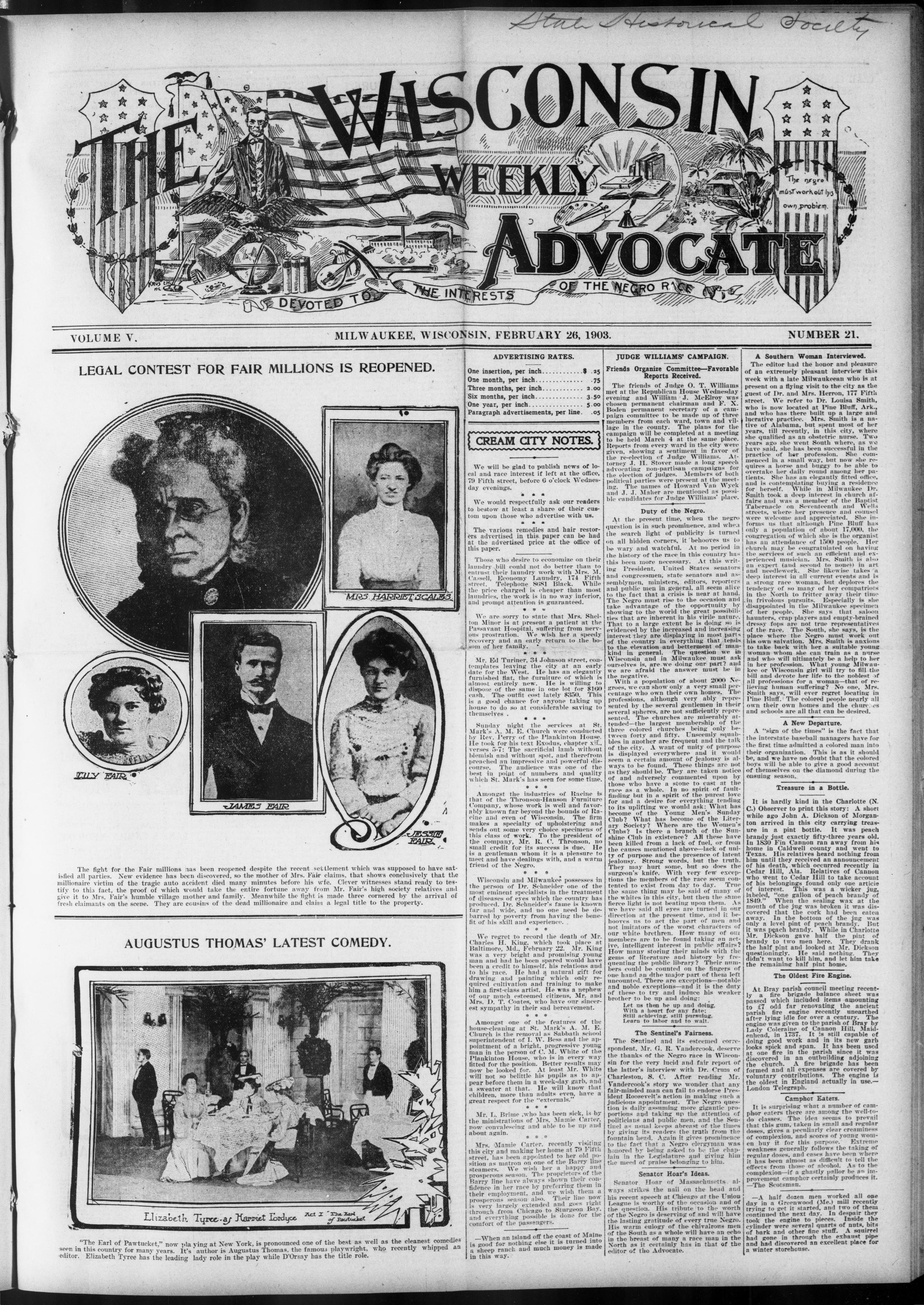
LEGAL CONTEST FOR FAIR MILLIONS IS REOPENED.
MRS. HARRIET SCALES
TILY FAIR
JAMES FAIR
JESSIE FAIR
The fight for the Fair millions has been reopened despite the recent settlement which was supposed to have satisfied all parties. New evidence has been discovered, so the mother of Mrs. Fair claims, that shows conclusively that the millionaire victim of the tragic auto accident died many minutes before his wfe. Clever witnesses stand ready to testify to this fact, the proof of which would take the entire fortune away from Mr. Fair's high society relatives and give it to Mrs. Fair's humble village mother and family. Meanwhile the fight is made three cornered by the arrival of fresh claimants on the scene. They are cousins of the dead millionaire and claim a legal title to the property.
AUGUSTUS THOMAS' LATEST COMEDY.
Elizabeth Tyree as Harriet Tordyce Act I "The Lord of Paustucket"
"The Earl of Pawtucket," now playing at New York, is pronounced one of the best as well as the cleanest comedies seen in this country for many years. It's author is Augustus Thomas, the famous playwright, who recently whipped an editor. Elizabeth Tyree has the leading lady role in the play while D'Orsay has the title role.
MILWAUKEE, WISCONSIN, FEBRUARY 26, 1903.
CREAM CITY NOTES.
We will be glad to publish news of local and race interest if left at the office, 79 Fifth street, before 6 o'clock Wednesday evenings.
We would respectfully ask our readers to bestow at least a share of their custom upon those who advertise with us.
The various remedies and hair restorers advertised in this paper can be had at the advertised price at the office of this paper.
Those who desire to economize on their laundry bill could not do better than to entrust their laundry work with Mrs. M. Cassell, Economy Laundry, 174 Fifth street, Telephone 8681 Black. While the price charged is cheaper than most laundries, the work is in no way inferior, and prompt attention is guaranteed.
```markdown
```
We are sorry to state that Mrs. Shelton Minor is at present a patient at the Passavant Hospital, suffering from nervous prostration. We wish her a speedy recovery and an early return to the bosom of her family.
Mr. Ed Turiner, 34 Johnson street, contemplates leaving the city at an early date for the West. He has an elegantly furnished flat, the furniture of which is almost entirely new. He is willing to dispose of the same in one lot for $160 cash. The outfit cost lately $350. This is a good chance for anyone taking up house to do so at considerable saving to themselves.
Sunday night the services at St. Mark's A. M. E. Church were conducted by Rev. Perry of the Plankinton House. He took for his text Exodus, chapter xif, verses 5-7: The sacrificial lamb without blemish and without spot, and therefrom preached an impressive and powerful discourse. The audience was one of the best in point of numbers and quality which St. Mark's has seen for some time.
***
Amongst the industries of Racine is that of the Thronson-Hanson Furniture Company, whose work is well and favorably known far beyond the bounds of Racine and even of Wisconsin. The firm makes a specialty of upholstering and sends out some very choice specimens of this class of work. To the president of the company, Mr. R. C. Thronson, no small credit for its success is due. He is a gentleman whom it is a pleasure to meet and have dealings with, and a warm friend of the Negro.
* * *
Wisconsin and Milwaukee possesses in the person of Dr. Schneider one of the most eminent specialists in the treatment of diseases of eyes which the country has produced. Dr. Schneider's fame is known far and wide, and no one need be debarred by poverty from having the benefit of his skill and experience.
\* \* \*
We regret to record the death of Mr. Charles H. King, which took place at Baltimore, Md., February 22. Mr. King was a very bright and promising young man and had he been spared would have been a credit to himself, his relations and to his race. He had a natural gift for drawing and painting which only required cultivation and training to make him a first-class artist. He was a nephew of our much esteemed citizens, Mr. and Mrs. D. T. Coates, who have our sincerest sympathy in their sad bereavement.
* * *
Amongst one of the features of the house-cleaning at St. Mark's A. M. E. Church is the removal as Sabbath school superintendent of I. W. Bess and the appointment of a bright, progressive young man in the person of C. M. White of the Plankinton House, who is in every way fitted for the position. Better results may now be looked for. At least Mr. White will not so belittle his pupils as to appear before them in a week-day garb, and a sweater at that. He will know that children, more than adults even, have a great respect for the "externals."
***
Mr. L. Brime, who has been sick, is by the ministrations of Mrs. Mamie Carter, now convalescing and able to be up and about again.
* * *
Mrs. Mamie Carter, recently visiting this city and making her home at 79 Fifth street, has been appointed to her old position as matron on one of the Barry line steamers. We wish her a happy and prosperous season. The proprietors of the Barry line have always shown their confidence in her race by preferring them in their employment, and we wish them a prosperous season also. Their line now is very largely extended and goes right through from Chicago to Sturgeon Bay, and everything possible is done for the comfort of the passengers.
-When an island off the coast of Maine is good for nothing else it is turned into a sheep ranch and much money is made in this way.
JUDGE WILLIAMS' CAMPAIGN.
Friends Organize Committee—Favorable Reports Received.
The friends of Judge O. T. Williams met at the Republican House Wednesday evening and William J. McElroy was chosen permanent chairman and F. X. Boden permanent secretary of a campaign committee to be made up of three members from each ward, town and village in the county. The plans for the campaign will be completed at a meeting to be held March 4 at the same place. Reports from every ward in the city were given, showing a sentiment in favor of the re-election of Judge Williams. Attorney J. H. Stover made a long speech advocating non-partisan campaigns for the election of judges. Members of both political parties were present at the meeting. The names of Howard Van Wyck and J. J. Maher are mentioned as possible candidates for Judge Williams' place.
Duty of the Negro
At the present time, when the negro question is in such prominence, and when the search light of publicity is turned on all hidden corners, it behooves us to be wary and watchful. At no period in the history of the race in this country has this been more necessary. At this writing President, United States senators and congressmen, state senators and assemblymen, ministers, editors, reporters and public men in general, all seem alive to the fact that a crisis is near at hand. The Negro must rise to the occasion and take advantage of the opportunity by showing to the world the great possibilities that are inherent in his virile nature. That to a large extent he is doing so is evidenced by the increased and increasing interest they are displaying in most parts of the country in everything that tends to the elevation and betterment of mankind in general. The question we in Wisconsin and in Milwaukee must ask ourselves is, are we doing our part? and we are afraid the answer must be in the negative.
With a population of about 2000 Negroes, we can show only a very small percentage who own their own homes. The professions, although very ably represented by the several gentlemen in their several spheres, are not sufficiently represented. The churches are miserably attended—the largest membership of the three colored churches being only between forty and fifty. Unseemly squabbles in another are frequent and the talk of the city. A want of unity of purpose is displayed everywhere and it would seem a certain amount of jealousy is always to be found. These things are not as they should be. They are taken notice of and adversely commented upon by those who have a stone to cast at the race as a whole. In no spirit of fault-finding but in a spirit of the purest love for and a desire for everything tending to its uplifting we would ask: What has become of the Young Men's Sunday Club? What has become of the Literary Society? Where are the Women's Clubs? Is there a branch of the Sunshine Club in existence? All these have been killed from a lack of fuel, or from the causes mentioned above—lack of unity of purpose and the presence of latent jealousy. Strong words, but the truth. They may hurt some, but so does the surgeon's knife. With very few exceptions the members of the race seem contented to exist from day to day. True the same thing may be said of many of the whites in this city, but then the same fierce light is not beating upon them. As we have said all eyes are turned in our direction at the present time, and it behooves us to act the part of men and not imitators of the worst characters of our white brethren. How many of our members are to be found taking an active, intelligent interest in public affairs? How many storing their minds with the gems of literature and history by frequenting the public library? Their numbers could be counted on the fingers of one hand an dthe major part of them left uncounted. There are exceptions—notable and noble exceptions—and it is the duty of these to try and induce his weaker brother to be up and doing:
Let us then be up and doing;
With a heart for any fate;
Still achieving, still pursuing,
Learn to labor and to wait.
The Sentinel's Fairness.
The Sentinel and its esteemed correspondent, Mr. G. R. Vandercook, deserve the thanks of the Negro race in Wisconsin for the very lucid and fair report of the latter's interview with Dr. Crum of Charleston, S. C. After reading Mr. Vandercook's story we wonder that any fair-minded man can fail to endorse President Roosevelt's action in making such a judicious appointment. The Negro question is daily assuming more gigantic proportions and taking up the attention of politicians and public men, and the Sentinel as usual keeps abreast of the times by giving its readers the truth from the fountain head. Again it gives prominence to the fact that a Negro clergyman was honored by being asked to be the chaplain in the Legislature and giving him the meed of praise belonging to him.
Senator Hoar's Ideas.
Senator Hoar of Massachusetts always strikes the nail on the head and his recent speech at Chicago at the Union League is worthy of the occasion and of the question. His tribute to the worth of the Negro is deserving of and will have the lasting gratitude of every true Negro. His warm eulogy of the chivalrous men of the South as a whole will have an echo in the breast of many a race man in the North as it certainly has in that of the editor of the Advocate.
NUMBER 21.
A Southern Woman Interviewed.
The editor had the honor and pleasure of an extremely pleasant interview this week with a late Milwaukeean who is at present on a flying visit to the city as the guest of Dr. and Mrs. Herron, 177 Fifth street. We refer to Dr. Louisa Smith, who is now located at Pine Bluff, Ark., and who has there built up a large and lucrative practice. Mrs. Smith is a native of Alabama, but spent most of her years, till recently, in this city, where she qualified as an obstetric nurse. Two years ago she went South where, as we have said, she has been successful in the practice of her profession. She commenced in a small way, but now she requires a horse and buggy to be able to overtake her daily round among her patients. She has an elegantly fitted office, and is contemplating buying a residence for herself. While in Milwaukee Dr. Smith took a deep interest in church affairs and was a member of the Baptist Tabernacle on Seventeenth and Wells streets, where her presence and counsel were welcome and appreciated. She informs us that although Pine Bluff has only a population of about 17,000, the congregation of which she is the organist has an attendance of 1500 people. Her church may be congratulated on having the services of such an efficient and experienced musician. Mrs. Smith is also an expert (and second to none) in art and needlework. She likewise takes a deep interest in all current events and is a strong race woman, but deplores the tendency of so many of her compatriots in the North to fritter away their time in frivolous pursuits. Especially is she disappointed in the Milwaukee specimen of her people. She says that saloon haunters, crap players and empty-brained dressy fops are not true representatives of the race. The South, she says, is the place where the Negro must work out his own salvation. Mrs. Smith is anxious to take back with her a suitable young woman whom she can train as a nurse and who will ultimately be a help to her in her profession. What young Milwaukee or Wisconsin girl will try to fill the bill and devote her life to the noblest of all professions for a woman—that of relieving human suffering? No one, Mrs. Smith says, will ever regret locating in Pine Bluff. The colored people nearly all own their own homes and the churches and schools are all that can be desired.
A New Departure.
A "sign of the times" is the fact that the interstate baseball managers have for the first time admitted a colored man into their organization. This is as it should be, and we have no doubt that the colored boys will be able to give a good account of themselves on the diamond during the ensuing season.
Treasure in a Bottle.
It is hardly kind in the Charlotte (N. C.) Observer to print this story: A short while ago John A. Dickson of Morganton arrived in this city carrying treasure in a pint bottle. It was peach brandy just exactly fifty-three years old. In 1830 Fin Cannon ran away from his home in Caldwell county and went to Texas. His relatives heard nothing from him until they received an announcement of his death, which occurred recently in Cedar Hill, Ala. Relatives of Cannon who went to Cedar Hill to take account of his belongings found only one article of interest. This was a wicker jug, labeled, "one gallon of peach brandy of 1849." When the sealing wax at the mouth of the jug was broken it was discovered that the cork had been eaten away. In the bottom of the jug was only a level pint of peach brandy. But it was peach brandy. While in Charlotte Mr. Dickson gave half the pint of brandy to two men here. They drank the half pint and looked at Mr. Dickson questioningly. He said nothing. They didn't want to kill him, and let him take the remaining half pint home.
The Oldest Fire Engine.
At Bray parish council meeting recently a fire brigade balance sheet was passed which included items amounting to £7 odd far renovating the ancient parish fire engine recently unearthed after lying idle for over a century. The engine was given to the parish of Bray by Lady Coleraine of Cannon Hill, Maidenhead, in 1737. It is still capable of doing good work and in its new garb looks spick and span. It has been used at one fire in the parish since it was discovered in an outbuilding adjoining the church. A fire brigade has been formed and all expenses are covered by voluntary contributions. The engine is the oldest in England actually in use. London Telegraph.
Camphor Eaters.
It is surprising what a number of camphor eaters there are among the well-to-do classes. The idea seems to prevail that this gum, taken in small and regular doses, gives a peculiarly clear creaminess of complexion, and scores of young women buy it for this purpose. Extreme weakness generally follows the taking of regular doses, and cases have been where it has been almost as difficult to tell the effects from those of alcohol. As to the complexion—if a ghastly pallor be an improvement camphor certainly produces it.—The Scotsman.
A half dozen men worked all one day in a Greenwood (Me.) mill recently trying to get it started, and two of them continued the next day. In despair they took the engine to pieces. Inside the cylinder were several quarts of nuts, bits of bark and other fine stuff. A squirrel had gone in through the exhaust pipe and had discovered an excellent place for a winter storehouse.
CZAR CHOSEN TO
SELECT ARBITRATORS.
CZAR CHOSEN TO
SELECT ARBITRATORS.
Mr. Bowen's Proposition to Allies in Determining Question of Preferential Treatment.
Washington, D. C., Feb. 24.—Mr. Bowen, the Venezuelan plenipotentiary, has proposed to the allies that the Czar of Russia be asked to name the three arbitrators who, as The Hague tribunal, shall decide the question of preferential treatment. The suggestion has been approved by the state department. Minister Bowen today submitted the draft of the protocols which he hopes will be signed by the allied powers, specifying the conditions under which The Hague tribunal will be called upon to settle the question of preferential treatment in the payment of Venezuelan indemnities.
Puerto Cabello, Venezuela, Feb. 24. The Venezuelan gunboat Restaurador, which was captured by the Germans, was handed over by them to the Venezuelan authorities here yesterday. Commander Chalbaud of this port, accompanied by an interpreter, and the German commodore, Scheder, went on board the Restaurador in order to effect the delivery of the ship to Venezuela. As the German flag was lowered, the German cruiser Vineta fired a salute. The Resturador hoisted the Venezuelan flag and was then handed over to Commander Chalbaud by Commodore Scheder. The Vineta immediately afterward steamed out of this port.
EXPRESS OFFICE CLERK WHO FAILED TO RETURN.
Fred Peterson of Hancock, Mich., Who Went to Menasha to Attend Wedding, is Sought.
Houghton, Mich., Feb. 24.—[Special.]
--When Fred Peterson, a clerk in the United States Express Company's office at Hancock, did not return from Menasha, Wis., where he went to attend the wedding of a friend, Agent A. O. Bram wired Route Agent Owens at Milwaukee to come to the scene.
Peterson went to Menasha a week ago last Saturday to attend a wedding. Agent Bram received a message last Wednesday from Peterson saying he would take the train for Hancock that day. When he did not appear, Bram wired Menasha. The reply was that Peterson had taken the train and since then had not been seen. The clerk was ambitious and regarded as faithful. It was known that he was about to be married to a young woman in Menasha. Gen. Supt. Averill of Milwaukee arrived here today to pursue the investigation. Both express and surety companies have detectives searching for the missing man.
PLAYS A FOXY GAME
Sultan will Seek Delay and Propose Modifications of Reforms— Situation is Difficult.
Vienna, Feb. 24.—Although it is stated that the Sultan is willing to accept the scheme of reforms submitted to him, it is believed in Constantinople that he will seek delay by discussing and proposing modifications of the reforms. It is evident that the Bulgarian government, even if it seriously attempts to control the Macedonian situation will find great difficulty in doing so. A violent press campaign has been started in Bulgaria, and meetings are being held in all the principal towns to protest against the suppression of the Macedonian committees.
DATE OF G. A. R. ENCAMPMENT.
To be Held in San Francisco During Week of August 17.
San Francisco, Cal., Feb. 24.-Gen. Thomas J. Stewart, commander-in-chief of the Grand Army of the Republic, members of the National Council of Administration and the local committee have decided to hold the national encampment during the week of August 17. Tickets will be put on sale by the railroads August 1 and they will be good for stopovers both coming and going. The time limit will probably be sixty days.
The executive committee will be empowered to invite President Roosevelt to attend the encampment.
ROBBERS GOT AWAY.
Citizens Heard Explosions, but Were Afraid to Give Chase.
Peru, Ind., Feb. 24.—Five masked robbers, all heavily armed, blew open the safes in the postoffice at Mexico and Denver, north of here, early this morning. Twenty-five citizens heard the explosions which blew the safe at Mexico to pieces, saw the robbers board a handcar, but were afraid to give chase. The men ran the car to Denver, three miles east of Mexico, and cracked the postoffice safe there. They left Denver on the same car. Small amounts were taken from both offices.
STATUE OF MISS WILLARD.
Second Appropriation Made by Illinois Legislature.
Springfield, Ill., Feb. 24.—The Brundage bill appropriating $9000 for a statue of Miss Frances E. Willard, to be placed in statuary hall in Washington, D. C. was passed by both houses of the state Legislature today. The appropriation was made originally in 1899, but before the work was completed the appropriation lapsed. The bill considered today reappropriated the amount.
MURDERED IN A BUNK CAR.
Railroad Laborer is Slain at Aurora and Camp Cook is Missing.
Aurora, Ill., Feb. 24.—With his throat severed and his body hacked with a hatchet Nicholas Dumars was found by his brother, Dominick Dumars, and Section Boss Morgan in a bunk car on the tracks of the Elgin, Joliet & Eastern railroad. Tony Romano, the cook of the camp, is missing.
How He Declined.
Lady—Doctor, I wish you would call around to see my husband some evening when he is at home. Do not let him know that I asked you, because he declares he is not sick; but know he has consumption or something. He's going into a decline.
Doctor—I am astonished, but I will call. What are his symptoms?
Lady—He hasn't any except weakness. He used to hold me on his lap by the hour, and now even the baby tires him. West Union (W. Va.) Record.
As Some Others Do.
"They say," said Willie's mother, as they were watching the "Armless Wonder" wind his watch, write his name, and do other remarkable things with his toes, "that he can play the piano; but I don't see how."
"That's easy, mamma," replied Willie. "He can play by ear."—Youth's Companion.
CONGRESS.
Proceedings in the Senate.
The Senate met at 11 a. m. on the 19th, but spent only an hour and twenty minutes in open session. This time was devoted to routine business. Senator Bailey secured consideration of the Sabine Pass port bill, which has been the subject of considerable controversy, but a vote on the measure was not reached. The House bill, amending the pensions laws applying to remarried widows, was passed. The rest of the day was devoted to an executive session debate on the Panama canal treaty, a night session being held, and a recess until morning being voted at 11 p. m.
until morning being
The Senate spent the entire day on the 20th in executive session considering the Panama canal treaty and at 5:25 p. m. took a recess until the following day. No vote was taken on any of the amendments prepared by Senator Morgan.
The Senate again on the 21st devoted practically all of its time to consideration of the Panama canal treaty in executive session. Bills were passed amending the law concerning the holding of real estate by aliens in the territories and authorizing the secretary of the interior to restore to entry public lands segregated for reservoirs. Mr. Mason gave notice that on the 23d he would ask the Senate to take up the postoffice appropriation bill immediately after the disposition of the routine morning business. The car weighing bill passed by the House was sent to conference, Messrs. Foraker, Millard and Foster being named as referees.
In the Senate on the 23d the chaplain referred to the life and character of George Washington. The galleries were crowded, many of the occupants being visiting Daughters of the American Revolution, who listened attentively to the reading by Mr. Dubols of Idaho of Washington's farewell address. The Rawilins resolution calling on the secretary of war for information concerning court-martial cases in the Philippines was adopted with amendments limiting the reply to summaries of the records and testimony and excluding the case of Maj. L. W. T. Waller. The agricultural appropriation bill was reported. Mr. Kerns of Utah presented the credentials of Senator-elect Smoot of Utah, which were read. Mr. Smoot was sitting in the chamber. Mr. Burrows stated that a protest had been filed with his committee against Mr. Smoot's admission. The credentials and protest were filed. A House resolution was agreed to providing for the erection in Washington of bronze equestrian statues of Count Pulaski and Baron Steuben of the Continental army and appropriating $50,000 for each. Mr. Mason called up the post-office appropriation bill, which was read for amendment. The statehood amendment was passed over for the time being. Consideration of the bill was not concluded. Mr. Fairbanks presented an omnibus public building bill which was passed. After an address by Mr. Tillman on the Indianola case the Senate adjourned.
The Indianola (Miss.) postoffice case occupied the major portion of the time of the Senate on the 24th. Mr. Tillman spoke for three hours in continuation of his remarks on the race question and was followed by Mr. Carmack. During the morning hour consideration was given the bill to further provide for the safe keeping of public money on deposit in national banks. Amendments were agreed to excluding the bonds of street railway companies as security for deposits in national banks; accepting as security the first mortgage bonds of any railroad company which has paid dividends of not less than 4 per cent, per annum "regularly and continuously" on its entire capital stock for a period of not less than ten years previous to the deposit of the bonds; that the United States shall have a lien on "current" assets of banks in which public moneys are deposited; that any legally authorized bonds issued for municipal purposes by any city or county may be accepted as security for deposits, and requiring the secretary of the treasury to report at each session of Congress the amounts deposited in individual national banks. A bill was passed authorizing the secretary of the treasury to issue a number of souvenir medallions for the benefit of the Thomas Jefferson Memorial Association of the United States. The agricultural appropriation bill was considered, and the committee amendments agreed to, except the statehood rider, which was passed over.
The Senate on the 25th made rapid progress. The statehood riders to the agricultural and postoffice appropriation bills were withdrawn and both bills passed, the former with an amendment appropriating $500,000 to stamp out the foot and mouth disease. The House amendments to the Philippine currency bill were agreed to with but slight discussion, thus sending the bill to the President. The sundry civil bill was nearly completed. Three hundred and twenty pension bills were also passed. In the course of the day Civil Service Commissioner Foulke was severely criticised on account of a letter written by him to Mr. Spooner regarding the dismissal of an employee of the surveyor general's office of Idaho, who had been charged with receiving campaign contributions. A Senate bill was passed amending the law relating to American seamen for the protection of such seamen and to promote commerce as well as to permit allotments of seamen's wages. The conference report on the Indian appropriation bill was agreed to.
Proceedings in the House.
The House on the 19th passed the naval appropriation bill at the end of a protracted session, numerous amendments being adopted. As passed, the bill provides for three new battleships and an armed cruiser, two steel training ships and one wooden brig for training purpose, in addition to the submarine boats discretionally authorized. The increase in the personnel of the navy went through as reported by the committee, an effort to limit the increase to two mildshipmen for each congressman in the period between now and 1911 having been voted down.
The House on the 20th passed the fortifications appropriations bill, adopted the conference report on the bill for the protection of the President and on the legislative, executive and judicial appropriation bill, and then spent three hours wrangling over the Fowler currency bill. The latter bill had been given privilege by the terms of a special rule, but when the decks had been cleared for the opposition began a filibuster, Mr. Bartlett (Ga.) declaring that it was useless to waste time on a measure which it was not intended should become a law. After half a dozen roll calls the House finally got into committee of the whole to consider the bill, but it then being 5 o'clock, on motion of Mr. Fowler the House adjourned. Earlier in the day the invitation to Congress to be present at the dedicatory exercises of the St. Louis Exposition April 30 to May 2, 1903, was accepted. A resolution was adopted to print 24,000 copies of the memorial address on President McKinley delivered in the House a year ago by Secretary Hay, 16,000 for the use of the House and 8000 for the Senate.
At the opening of the session of the House on the 21st, Mr. Hemmenway (Ind.) asked unanimous consent for the consideration of a bill to exempt from taxation the property of the Daughters of the Revolution in the District of Columbia, Mr. Moon (Tenn.) objected, saying he would continue to object to the consideration of any bill by unanimous consent. The House then went into committee of the whole to consider the currency bill, and Mr. Fowler, chairman of the committee on banking and currency, took the floor in support of his bill. He said all the secretaries of the treasury and practically all comptrollers of the currency for the last twenty years and all the students of this subject favored a credit currency, the principle upon which the pending bill was founded. Mr. Thayer (Mass.) followed with an argument in support of a bill presented by some of the minority members of the committee. After some further remarks by Mr. Lewis (Ga.) in opposition to the bill and Mr. Prince (Ill.) in advocacy of it, the committee rose. A communication from the President transmitting a request of the anthracite coal strike commission asking for authority to publish 5000 copies of its report when completed was laid before the House. The message of the President said he concurred in the request.
The House on the 23d passed the general deficiency appropriation bill, the last of the regular supply bills. It carried $13,698,781. The only amendment of importance was one appropriating $1,100,000 to replace the stores and storehouse at the Rock Island arsenal recently destroyed by fire. The oll carries an extra month's pay for all the employees of Congress. The bill to amend the railroad safety appliance act was sent to conference and the conferees were instructed not to insist on that portion of the House amendment giving the interstate commerce commission power to reduce below 50 per cent. the number of cars equipped with patent air brakes. A bill to exempt from taxation the property of the
Daughters of the Revolution in the District
Louisville, was passed.
The House on the 24th, by a vote of 139 to 100, passed the Philippine currency bill, accepting the Senate bill so far as it relates to the islands. The committee amendment striking out the international monetary conference was agreed to. The contested election case of Wagoner vs. Butler was under consideration for a time and the Democrats began a filibuster, which they threaten to continue if the case is pressed. The case was withdrawn with an agreement that it is not to come up for a week. Mt. Fowler then moved that the House go into committee of the whole to resume further consideration of the currency bill and after some delay the motion was carried, 136 to 57.
The House on the 25th adopted the conference report on the army appropriation bill and sent the bill to the President. The bill to establish a union station in Washington also was passed, the House abandoning its amendments to reduce the amount to be given to the Pennsylvania and Baltimore & Ohio railroads from $1,500,000 each, as fixed in the Senate bill, to $1,000,000 each, as fixed by the House. The Fowler currency bill was debated in a desultory way. Mr. Clayton (Ala.) delivered a mock funeral oration on the bill. The conference report on the bill to increase the pensions of those who have lost limbs in the military service of the country was adopted. The speaker appointed members to represent the House at the dedication of the Louisiana Purchase Exposition.
LATEST MARKET REPORTS.
MILWAUKEE, FEBRUARY 25, 1908.
EGG AND DAIRY PRODUCTS.
MILWAUKEE—Eggs — Market steady.
The demand is better and will improve as the Lenten season is on; storage eggs are dull and not wanted. Strictly fresh, loss off, cases included, 15c; fresh, cases returned, 14½c; fancy storage, 10@11c. Receipts were 730 cases.
Butter—Market firm. There is a good demand for all grades of creamy. Creamery, per lb, 27c; prints, 27½c; firsts, 23@21c; seconds, 17c; June creamy, 18@24c; extra fancy dairy, 19c; lines, 14@16c; roll, 14@15c; whey, 10c; packing stock, 13c; demand is rather light and stock is moving slowly; offerings very plentiful. Receipts were 43, 400 lbs.
Cheese—Firm. The demand continues good; full cream flats, fancy, 13@14c; good to choice, 11@12c; Young Americas, 13@13½c; low grades, 10@11c; limburger, per lb. No. 1, 11½@12c; low grades, 10@11c; imported Swiss, 25c; Block Swiss, domestic, 14@15c; fancy loaf, 14½@15½c; No. 2. 12@13c; Sapsage, 20c. Receipts were 1380 lbs.
CHICAGO—Butter—Firm; creameries, 13
@27½c; dairies, 14@24c. Eggs—Easy; at
mark cases included, 14½@14½c. Cheese—
Steady; twins, 12½@12½c; dalsles, 13@
13½c; young Americas, 13@13½c. Dressed
Poultry—Steady; turkeys, 15@18c; chickens,
10@13½c.
MILWAUKEE LIVE STOCK MARKET.
HOGS—Receipts, 2 cars; market lower;
light, 130 to 160 lbs, 6.35@6.65; mixed,
180 to 225 lbs, 6.70@7.05; good to choice,
200 to 250 lbs, 6.80@7.10; selected heavy,
250 to 300 lbs, 7.10@7.25; pigs, 80 to 110 lbs,
5.25@6.00
CATTLE — Receipts, 1 car; steady; butchers' steers, medium to good, 1050 to 1300 lbs, 4.25@5.00; fair to medium, 950 to 1050 lbs, 3.50@4.25; helfers, common, 2.50 @3.25; good, 3.50@4.25; cows, fair to good, 3.00@3.50; canners, 1.75@2.40; cutters, 2.50 @2.85; bulls, common, 2.75@3.15; choice, 3.50 @3.85; feeders, 800 to 950 lbs, 3.50@4.25; stockers, 500 to 750 lbs, 3.00@3.50; veal calves, light, 90 to 750 lbs, 5.00@5.50; good 110 to 140 lbs, 6.25@7.00; milkers, dull; common, 15.00@25.00; choice, 35.00@45.00.
SHEEP—Receipts, none; steady; 3.00@4.25; bucks, 2.50@3.25; lambs, common to choice, 4.50@6.50.
Chicago receipts: Hogs, 30,000; cattle, 21,000; sheep, 23,000.
MILWAUKEE HAY MARKET.
Timothy, dull; carriots, choice timothy, 12.00@12.25; No. 1 timothy, 11.50@11.75; No. 2 timothy, 9.50@10.50; clover and clover mixed, 9.00@10.00
Prairie hay steady; choice Kansas, 11.50
@12.00; No. 1 Kansas, 11.00@11.25; No. 2,
8.50@9.00.
Straw, steady; rye, 6.75@7.00; oats, 6.00@
6.50; wheat, 4.00@4.50; packing hay, 6.50.
IWsconsin prairie, 7.50@8.50.
MILWAUKEE POTATO MARKET.
Potatoes—Market quiet and steady. Car
lots, on track, per bus, Ruralis and Burb
banks, fancy large, 40@45c; Rose and Peer
less, 40@43c; small stock, 38@40.
MARKETS BY TELEGRAPH.
MILWAUKEE—Flour—Steady. Wheat —Steady; No. 1 Northern, on track, 80%c; No. 2 Northern, on track, 79%c. Corn—Steady; No. 3 on track, 43c. Oats—Lower; No. 2 white, on track, 36c; No. 3 white, on track, 34@341%c. Barley—Steady and unchanged; No. 2 on track, 65c; sample on track, 43@65c. Rye—Steady; No. 1 on track, 52c. Provisions—Steady; pork, 17.65; lard, 9.62. Flour market steady; patents, 3.85@4.05; bakers', 2.90@3.05; rye, 2.90@3.00.
From market study, parents, 3.80@4.00,
bakers', 2.90@3.05; rye, 2.90@3.00.
Millstuffs are firm and quoted at 17.25
for bran, 17.00 for standard middlings and
18.00@18.50 for Milwaukee flour middlings
in 100 lb sacks; red dog, 20.00. Delivered
to country points, 50c extra.
CHICAGO—Close — Wheat — May, 77½@
77½c; July, 73½c; September, 71½c. Corn
—February, 44½c; May, 46—46½c; July,
44½c; September, 44½c. Oats—February,
34c; May, 35½c; July, 32½c; September,
29½c. Pork—May, 17.72½; July, 17.20; Sept-
ember, 16.75. Lard—February, 9.65; May,
9.65; July, 9.55; September, 9.55. Rlbs—
May, 9.72½@9.75; July, 9.57½; September,
9.50. Rye—May, 51c. Flax—Cash N. W.
1.17; S. W., 1.13; May, 1.18. Timothy—
February, 3.95. Clover—February, 11.75.
Barley—Cash, 44@56c.
NEW YORK—Close—May wheat, 81c; July, 78%c; Corn—May, 52%c; July, 50%c.
DULUTH — Close — Wheat — Cash No. 1 hard, 77c; No. 1 Northern, 76c; No. 2 Northern 74c; No. 3 spring, 77c; to arrive, No. 1 Northern, 77%c; May, 77%c; July, 77c. Oats—To arrive and on track, 33%c; May, 94c. Rye—May, 50%c; on track and to arrive, 49c. Barley—35@51c. Flax—Cash, 1.11%c on track and to arrive, 1.12%c; May, 1.14; July, 1.15; September, 1.15. Receipts of wheat, 19,978 bus, shipments, none.
MINNEAPOLIS — Close — Wheat — May, 61%@76%c; July, 76%c; on track, No. 1 hard, 78%c; No. 1 Northern, 77%@77%c; No. 2 Northern, 76%@76%c.
KANSAS CITY—Close—Wheat—May, 67%@67%c; July, 65%@65%c; Cash No. 2 hard, 68%@70c; No. 2 red, 70%@71c. Corn—April, 38%c; May, 38%c; July, 38%c; cash No. 2 mixed, 38%@40%c; No. 2 white, 40@41c. Oats—No. 2 white, 35%@36c.
TOLEDO—Wheat — Dull, steady; cash,
77½c; July, 75½c; Corn—Fairly active, steady; February, 46c; May,
45½c; July, 45½c; Oats—Dull, lower; 37½c;
May, 36½c; Rye—No. 2, 54½c; Clover Seed
—Active; easier; February, 7.12½; March,
7.12½; prime timothy, 1.85; prime alske,
8.00.
ST. LOUIS—Close—Wheat—Easler; No. 2
red cash elevator, 71½c; May, 72½@72½c;
July, 70½@70½c; No. 2 hard, 71@73½c;
Corn—Firm; No. 2 cash, 41½c; May, 41½c;
July, 41½c; Oats—Firm; No. 2 cash, 35½c;
nominal; May, 35½c; No. 2 white, 37½@
30½c; Lead—Firm, 3.97½; Spelter—Easy,
4.82½@4.85.
KANSAS CITY—Cattle—Receipts, 700;
steady to 10c lower; beef steets, 3.50@5.25;
Texans, 2.00@4.20; cows and heifers, 1.50@
4.25; stockers and feeders, 3.00@4.90. Hogs
—Receipts, 9000; weak to 10c lower; heavy,
4.85@7.50; packers, 6.65@6.90; yorkers, 6.75
@6.80; pigs, 5.90@6.20. Sheep—Receipts,
5000; steady to lower; sheep, 3.00@6.00;
ambs, 3.00@6.75.
ST. LOUIS—Cattle—Receipts, 3500; market steady, quiet; beef steers, 4.15@5.25; stockers and feeders, 2.40@4.30; cows and eifers, 2.25@4.50; Teyans, 2.15@4.65. Hogs—Receipts, 6500; 5c lower; plugs, 6.40@6.90; packers, 6.75@7.00; butchers, 6.80@7.15. Sheep—Receipts, 1000; steady to strong; sheep, 3.25@5.50; lambs, 5.60@7.00.
SOUTH OMAHA—Cattle—Receipts, 4500; steady to easier; beef steers, 3.75@5.25; cows and helpers, 3.00@4.00; canners, 1.75@2.75; stockers and feeders, 3.00@4.50. Hogs—Receipts, 8500; 5c lower; heavy, 6.80@6.95; plugs, 6.00@6.70. Sheep—Receipts, 500; steady; sheep, 3.25@3.75; lambs, 5.00@7.00.
Honey from the Spelling Bee
Churchman—We had a spelling bee at the church last week. The pastor gave out the words. Did you hear about it? Ascum—No; was it interesting? Churchman—Rather. The first three words he gave out were "increase," "pastor," "salary."—Philadelphia Press.
Proceedings in the Senate.
The following bills were passed by the Senate on the 19th: Enabling married women to assign their interest in life insurance policies; prohibiting obnoxious and infectious animals running at large; conferring civil and criminal jurisdiction on the Waukesha county court; extending terms of regents until their successors are appointed. The committee on corporations reported in favor of McDonough's bill to allow the construction of a dam across the Chippewa river at Eau Claire. Senator Stout, from the committee on education, reported a bill to provide that in the department of education the chief clerk shall be reimbursed for expenses incurred in the performance of duty; also for paying the library clerk like expenses, and for the appointment of a malling clerk. The committee on assessment and collection of taxes introduced a bill providing that hereafter the commissioners of taxation shall be the state board of assessment for the taxation of express, sleeping cars, freight line, and equipment companies. The judiciary committee introduced a bill providing for the disposition of estates of infants or incompetent persons, residing in some other state or country, so that their guardians can be licensed by the courts here to dispose of or lease real estate, without unnecessary formalities.
Resolutions relating to election of United States senators by direct vote, Nos. 188 and 4A, asking Congress to call a constitutional convention, were laid over by the Senate on the 20th, for four days. No. 5A, agreeing to an amendment to the constitution increasing the number of justices of the supreme court from five to seven, was adopted by a vote of 26 to 2. Messrs. Green and Randolph voted against. The bill 330S, exempting from taxation certain school property, was laid over until the bill was printed. Bill 337S, fixing the terms of circuit judges at six years, was passed. Mr. Eaton desired that this bill be laid over for the same reason, and Mr. Rohr explained its provision, whereupon Mr. Eaton withdrew his objection. Two bills were killed—permitting divorce on insanity grounds; relating to investments by domestic insurance companies. Adjournment was to 9 p. m. on the 23d.
Both houses of the Legislature met on the evening of the 23d, only to adjourn as a mark of respect for the birthday of George Washington. In the Senate there was an innovation in the matter of prayer, a member of the colored race invoking divine blessing for the first time in the history of the Wisconsin Legislature, so far as the oldest habitue of the halls can remember. The opening prayer was delivered by Rev. H. W. Jameson, pastor of the African M. E. Church in Madison.
The Senate on the 24th concurred in bill No. 11A, detaching territory from the town of Grantsburg, Burnett county, and creating the town of Anderson. The Senate also concurred in 199A, relating to investments by local life insurance companies. The latter provides that the companies may invest in bonds issued in territories, and in the District of Columbia, as well as in bonds issued in the states.
At the evening session on the 24th the committee on assessments and collection of taxes introduced the measure drawn by the tax commission, which provides for the exemption of intangible property from taxation. The bill was referred back to the committee for consideration. The committee on education reported in favor of the passage of bill 248, a bill authorizing the school board of Milwaukee, subject to the approval of the common council, to establish and organize as many public schools as it considers desirable, in addition to those already in existence, for the accommodation of the children. Senator Rogers presented a petition from the Milwaukee Methodist Preachers' Association against legalizing gambling in the form of pool selling on horse races.
When the time came in the Senate on the 25th for the consideration of the Merton resolution for election of United States senators by direct vote Mr. Miller moved that action be deferred until Friday. Mr. Whitehead moved that it be amended so as to take up the matter March 25. Mr. Merton said that he did not see the use of deferring these resolutions further. Mr. Whitehead responded by stating that he desired the resolutions deferred so as to give the taxation committee's work the right of way. The vote on the amendment was then taken. The amendment was adopted by a vote of 27 to 6. The senators voting no were Martin, Merton, Munson, North, Randolph and Sarau. The motion as amended was then adopted. Bill 33A, relating to property exempt from taxation, and 156S, relating to garnishment, were passed. Bill 16A, relating to guardians for non-residents, was not concurred in. Bill 206A, relating to municipal court for Winnebago county, was laid over one week.
The Senate committee on town and county organization reported at the evening session on the 25th in favor of a bill to change town boundaries in Forest county and create the towns of Hiles and Laoaa. The Seahafe committee on military affairs reported in favor of a bill to allow counties to appropriate not to exceed $10,000 for the erection of soldiers' monuments. The special committee to investigate the late coal famine submitted its report to both houses.
Proceedings in the Assembly
After a spirited debate lasting more than an hour the Assembly, on the 19th, by a vote of 34 to 64, sustained the governor's veto of the bill providing for twenty-one additional legislative employees. The Assembly passed four bills. They were; No. 70A, introduced by Mr. Cady, providing the privileges accorded to preferred stock in corporations be state on all certificates of both preferred and common stock; No. 128A, by Mr. Martin, repealing the Overbeck law passed two years ago, imposing a tax on ice cut for shipment out of the state, and declared unconstitutional by the supreme court several months ago; No. 157A, by Mr. Dudgeon, providing that an individual bond may be required of each member of a soldiers' relief commission; No. 206A, by Mr. Cowling, amending the law establishing the municipal court of the city of Oshkosh so as to give that court exclusive jurisdiction in suits for violation of the ordinances and bylaws of that city. The Assembly adopted a joint resolution providing that when adjournment be taken on the 20th it be until 2 p. m. on the 24th. The 23d is a holiday. Mr. Ray introduced the resolution. At the Assembly evening session the state affairs committee reported for indefinite postponement the Irvine bill making lobbying a crime and punishable by a fine not exceeding $1000 or imprisonment from one to three years or both.
The Irvine anti-lobby bill, imposing a penalty for the use of personal influence in securing legislative votes, was indefinitely postponed in the Assembly on the 20th, without debate and without a vote in favor. The bills 257A, appropriating $10,000 for purchase of livestock for the university farm, and 189A, appropriating $1000 annually to the Wisconsin Agricultural Experiment Association, to be used in experimenting with varieties of seeds, were reported favorably by the committee on agriculture and sent to the committee on claims. The bill 180A, providing for the regulation of importation of Western range horses, was also reported favorably by the committee on agriculture. The bill repealing the law requiring registration of physicians, on the calendar for final passage, was re-referred to the committee on public health and sanitation. The Roebr bill, 4S, authorizing the city of Milwaukee to acquire easements for vladucts, easements, etc., was concurred in unanimously. The Bartlett bill, 214A, permitting town fire insurance companies to use adjoining properties was passed. The Alnsworth bill exempting beet sugar from taxation for a term of five years was ordered to engross and third reading by a vote of 46 to 23. Adjournment was to 8:45 p. m., on the 23d.
Only fifty-nine members of the Assembly were present at the evening session of the Legislature on the 23d. Because of this fact an adjournment was taken as soon as the clerk had finished the roll call.
The Assembly on the 24th adopted the judiciary substitute for No. 45A, introduced by Mr. Dudgeon, increasing the period of preliminary study of applicants for admission to the bar from two to three years. The Assembly also adopted the judiciary committee's substitute for No. 90A, introduced by Mr. Douglas, relating to the probating of wills and the assigning of lands thereunder. The judiciary committee reported five bills for indefinite postponement. One of them was the Benson bill, No. 292A, repealing the law of 1901 requiring candidates for political offices to file statements of campaign expenses. Another was the Strong bill, No. 10A, providing that cities of the second, third and fourth classes may pay their mayors a salary of from $1000 to
2000. A third was the Johnstone bill. No. 63A, providing that persons twice convicted of crime shall be regarded as habitual criminals, and upon subsequent conviction for a felony, shall be sentenced to the penitentiary for not less than twenty-five years. The two other bills, adversely reported, were the Peterson measure, No. 110A, making abandonment of wife or child, leaving such wife or child in destitute circumstances, a crime punishable by imprisonment for a term not exceeding two years, and the Ekern bill, No. 208A, giving courts discretion to require one or more suretles on a guardian's bond.
At the evening session on the 24th the judiciary committee of the Assembly reported back the governor's communication relative to the request of the supreme court for new or additional quarters with a resolution accompanying the report providing for the appointment of a joint committee of seven to investigate and report on the subject. The report went over under the rule. The judiciary committee tonight favorably reported the Wallrich bill, providing for submitting to the people at the next general election the proposed amendment to the constitution, increasing the membership of the supreme court from five to seven.
The bill providing for the regulation and licensing of automobiles was reported favorably in the Assembly on the 25th by the committee on state affairs, amended making the regulation more rigid and increasing the license fee from $1 to $5. Six bills were reported for indefinite postponement by the judiciary committee. A joint resolution was adopted providing for the appointment of a joint committee of seven to investigate the proposed enlargement of the supreme court quarters and report a bill. The Cowling anti-gypsy bill, prohibiting the use of highways for earming purposes, was passed without discussion. Other bills passed were: Authorizing police magistrates to perform marriage ceremony; prohibiting accident and health insurance without a license. The bill restricting the suicide clause in life insurance policies, on the calendar for engrassment and third reading, brought on a discussion, in which its author, Mr. Strong, and Messrs. Gillman, Cady, Ray, Barker and Waterman, participated. Mr. Strong said the opposition to the bill was so strong that further amendment might be necessary to pass it. Mr. Gillman thought if the companies are opposing the bill it ought to be passed. Mr. Barker said the suicide clause was put in to protect honest policy holders. Mr. Cady thought a one-year clause a reasonable restriction. Finally the bill and amendments were referred to the committee on finance, banks and insurance, on motion of Mr. Cady. The Benson bill repealing the law requiring candidates to file statements of their expenses, on the calendar for indefinite postponement, was laid over until Friday, owing to Mr. Benson's absence.
The Assembly committee on finance, banks and insurance at the evening session on the 25th reported for passage bill No. 541, introduced by Mr. Lane, providing for life insurance companies issuing policies under the provisions of which the holders thereof are entitled to share in the profits on surplus.
Chicago Items.
John A. Nelson, a switchman, died at the West Side Hospital. He was struck by a Great Western engine.
—Roswell Shinn, an attorney who had offices at 816 Ashland block, dropped dead, supposedly from heart disease.
—John Stalder, a native of Switzerland, was found dead from asphyxiation in his room. Gas was escaping from a radiator.
—Mrs. Kate Sherman, aged 42, and John Stalder, aged 50, were found dead at their respective homes, with their rooms full of illuminating gas.
—While grieving over the fact that his wife and six children had left him George A. Smith, an upholsterer, committed suicide by inhaling illuminating gas.
—Fred W. Vocke was shot in Leo Stein's saloon, the bullet passing through the right side of his neck. The shot is said to have been fired by Harry O'Neill, a bartender, employed by Stein.
—Judge H. W. Blodgett of Waukegan continues to improve slowly. He has been suffering with pneumonia, but his physician believes the danger point is passed.
—William H. Cairnduff, head of the real estate firm that bears his name, died at his residence at the age of 53. He had been ill several days with pneumonia.
—Isaac Levy, a resident of Chicago since 1842, died at his home. He came to Chicago from Prussia and for many years was in the clothing business on the north side. For the past eighteen years he lived in retirement.
—Fire in the Church of the Immaculate Conception, Polish Roman Catholic, caused damage to the extent of $10,000, and for a time threatened the nunnery, containing twenty sisters, and other buildings adjoining the church.
—Charles A. Hollister of Ravenswood died suddenly at his residence. His remains were taken to Evansville for burial. Mr. Hollister was 47 years of age, and has been an official of the Chicago & North-Western railroad for years.
—Fire Marshal Ener C. Anderson of the Seventh battalion is lying at his home seriously injured, and his driver, John, J. Costello, is suffering from a dislocated shoulder and sundry bruises, as the result of a collision between the marshal's buggy and a cable car.
Arthur Parr lost his life in a vain effort to save his overcoat in a fire which caused $30,000 loss in the factory of Sturges, Cornish & Burn, makers of creamy supplies. Twenty other employees had narrow escapes. Edward Sullivan, a fireman, was injured by a falling beam.
Harry Larsh, 23 years old, shot and probably fatally wounded Robert Eastwood, 52 years old, while the latter, unconscious of danger, sat beside him at a table in their home. Larsh escaped. The wounded man was taken to St. Luke's Hospital, where it was said he would die. Four shots were fired, all taking effect.
A bullet which is said to have been intended for a bull's eye found a resting place in a man's chest, inflicting a wound that may prove fatal. The shooting took place in the curio department of a museum on Clark street. The injured man is John Anderson, 55 years old, and who has charge of the target gallery in the museum. Roy Peavey, 20 years old, fired the shot.
After ten years had elapsed since the crime was committed, George Stone, who was captured in England, was found guilty of manslaughter, and a sentence of thirty-five years in the penitentiary recommended. The man was convicted of killing Robert Nelson. He spent a good deal of time in court in prayer, he having become a devout Christian during recent years.
—Charles C. Van Dyke, local manager for the Hoffman-Corr Manufacturing Company, cordage dealers, was found dead in a resort. Lou Fair and Jeanette Collins were taken in custody, but were released later when a coroner's jury decided that the man's death was due to fatty degeneration of the heart, caused by alcoholism. Van Dyke had a wife and children, who live in Philadelphia.
After entering the fruit house of N. K. Goodrich with pass keys and opening the safe in the office Edward J. Davies, a book-keeper formerly employed by the firm, was arrested by detectives who had been concealed in the office all night, awaiting the burglar who in the last two months has robbed the company of $1000. Since he left the employ of the firm, several months ago, Davies, the police say, has been leading a dual life. During the day he worked as a book-keeper in a downtown store, and at night operated as a burglar, it is charged, in the store of his former employers.
WESTERN CANADA AROUSING GREAT INTEREST.
The Wonderful Yields of Wheat Attracting Thousands.
Until the last five or six years but little attention was given to that vast area of grain-producing land lying north of the 49th parallel, and immediately adjoining the northern boundaries of Minnesota and Dakota.
The Canadians themselves were aware of the wealth that lay there, but being unable to fully occupy it, they have asked the Americans to assist them in converting the land from its virgin state to one that will largely supplement the grain producing area of the North American continent. And the response has been most liberal.
During the year 1901, upwards of 20,000 from the United States went over to Canada, being induced to settle there by the reports that reached them of the success of those who had preceded them during the previous years. This 20,000 was increased to 30,000 during the year 1902, and it is fully expected that there will be fully 50,000 during the present year. The work of the immigration branch of the Canadian government is not now being directed towards giving information as to the advantages of settlement in Canada as it is to extending an invitation to the American to follow those who have gone.
Those who have charge of the work point with considerable pride to the success of those who have been induced to take advantage of the offer of 160 acres of land free in Canada, and have no cause to hesitate in continuing the invitation. Many of those interested say there are no more free homesteads to be had in Canada, but the writer has most positive assurance from the Canadian Government that there are thousands of such homesteads to be had, and in one of the districts now being opened up fully as good as the best, and it is probably the best.
The Canadian Government has established agencies at St. Paul, Minn., Omaha, Neb., Kansas City, Mo., Chicago, Ill., Indianapolis, Ind., Milwaukee, Wis., Wausau, Wis., Detroit, Sault Ste. Marie and Marquette, Mich., Toledo, Ohio, Watertown, S. D., Grand Forks, N. D., and Great Falls, Mont., and the suggestion is made that by addressing any of these, who are the authorized agents of the Government, it will be to the advantage of the reader, who will be given the fullest and most authentic information regarding the results of mixed farming, dairying, ranching and grain raising, and also supply information as to freight and passenger rates, etc.
In six hours after leaving Yarmouth the fishing boat Tantallon returned with 105,000 herrings, caught after the nets had been only forty minutes in the water.
The Manitoba potato crop amounted to 3,459,325 bushels and the root crop to 3,230,995 bushels. There are 1824 threshing outfits in the province.
MRS. WINSLOW'S SOOTHING SYRUP for Children teething: softens the gums, reduces inflammation, allays pain, cures wind colic. 25 cents a bottle.
On engine-propelled cycles British makers can claim pre-eminence of the world.
No muss or failures made with PUT-NAM FADELESS DYES.
Recently fallen rainwater possesses radio-activity.
AT
BED TIME
I TAKE
A
PLEASANT
HERB
DRINK
THE NEXT MORNING I FEEL BRIGHT AND NEW
AND MY COMPLEXION IS BETTER.
My doctor says it acts gently on the stomach, liver and kidneys and is a pleasant laxative. This drink is made from herbs, and is prepared for use as easily as tea. It is called "Lane's Tea" or LANE'S FAMILY MEDICINE All drummists or by mail 25 cts, and 60 cts. Buy it to do. Lane Family Medicine moves the bowels each day. In order to be healthy this is necessary. Address. O. F. Woodward, Le Roy, N.Y.
THE ORIGINAL
WATERPROOF
OILED CLOTHING
TOWER'S
FISH BRAND
Made in black or yellow for all kinds
of wet work: On sale everywhere.
Look for the Sign of the Fish, and
the name TOWER on the buttons.
A. J. TOWER CO. BOSTON, MASS. U.S.A.
TOWLE CANADIAN CO. LIMITED, TORONTO, CAN.
SAVE MONEY
Buy your goods at
Wholesale Prices.
Our 1.000-page catalogue will be sent
upon receipt of 15 cents. This amount
does not even pay the postage, but it is
sufficient to show us that you are acting
in good faith. Better send for it now.
Your neighbors trade with us—why not
you also?
Montgomery Ward Co.
2
CHICAGO
The house that tells the truth.
WESTERN CANADA HAS FREE HOMES FOR MILLIONS!
Upwards of 100,000 Americans have settled in Western Canada during the last 5 years. They are contented, happy and prosperous, and they own a room still for millions of our fortuit yields of Wheat and other grains. Best Grazing Lands on the Continent. Magnificent water and fuel. Good schools, and soland id railway facilities.
FARMS
WESTERN
CANADA
FREE
Free Homestead of 160 Acres. Free
the only charge being $10 for entry. Send to the following for an Atlas and other literature, as well as for certificate, giving you reduced railway rates, et.; Superintendent of Immigation, Ottawa, Can., or to T. Q. Currie, Callahan Building, Milwaukee, and J. M. MacLachian, Wausau, Wis., the authorized Indian Government Agent.
The Wisconsin Weekly Advocate
Printed in the Interests of the Negro Race,
MILWAUKEE, WIS.
Telephone Black No. 244.
SUBSCRIPTION RATES.
One Year ..... $2.00
Six Months ..... 1.25
Three Months ..... 7.75
Send money by Express Money Order, P. O.
Money Order or Registered Letter to the
Wisconsin Weekly Advocate.
ADVERTISING RATES.
One inch, single insertion..... $25c
One inch, per year..... $9.00
Business locals 5c per line each insertion.
Apply for rates to the Advocate.
TO CONTRIBUTORS:
All communications must be sent with the name and address of the sender as an evidence of good faith, but not necessarily for publication. No manuscript returned if not accepted, unless accompanied by stamps.
The Wisconsin Weekly Advocate company wishes to notify the public that all contracts and business transactions with this company must have the company stamp, otherwise they will be void. Neither will this company be responsible for paid subscriptions unless given to duly-accredited agents, who, on request, will give the company's receipt for same. Subscribers failing to receive their papers regularly will kindly notify the general office. Address all business communications to the general manager, 79 Fifth street.
Entered in the Postoffice at Milwaukee as Second-class matter.
EDITORIAL PARAGRAPHS.
---
"I know of the bravery and character of the Negro soldier. He saved my life at Santiago, and I have had occasion to say so in many articles and speeches. The Rough Riders were in a bad position when the Ninth and Tenth cavalry came rushing up the hill carrying everything before them. The Negro soldier has the faculty of coming to the front when he is needed most. In the Civil war he came 400,000 strong, and I believe he saved the Union."—President Roosevelt.
After all, it may transpire that there isn't a patch of truth to the story about the President's trousers.
Hanna has his opinion of Baer; and presumably Baer has his opinion of Hanna. This makes things even.
The bill introduced in the Montana Legislature, to give the proud parents of triplets $3000, is the advance guard of the movement against "racial suicide."
There has been a mistake about the reported death of the Colombian warrior with the double-barreled name. Uribe-Uribe still lives, but the fellow he shot is dead.
Owing to the character of the opposition to the proposed abolition of the eighth keg, if the movement is defeated, it can truly be said that the bill was "coopered."
Milk and butter consumers will not object to effort on the part of the Wisconsin Dairyman's Association to secure more stringent regulations against the sale of impure milk.
The story that the Kaiser contemplates another naval demonstration for the collection of debts was probably started by somebody who believes that the German ruler is all kinds of a simian.
The Washington dispatch concerning a pair of patched presidential trousers would probably have been more truthful had the reporter been less fearful of an approach to profanity. It was simply a case of d-d-darned trousers.
When the wireless telegraph stations are erected on the Pacific coast and in Hawaii the telegraphers can become "sporty" in racing dispatches through the air against dispatches following the wire under the sea. The air line ought to win.
The tornado season opens in the South, as usual, where whirlwinds are thawed out early; and the overturning of the steamer on the Chowan river, with loss of life, shows that there is danger even on a "raging canawl," in the tornado belts.
The publicity feature of the winding up of get-rich-quick concerns may be a more influential deterrent than the experiences of friends who have had their fingers burned in previous financial traps. Few people like to be advertised as "easy marks."
---
The grand stand at Racine collapsed when the people took a stand simultaneously to emphasize applause. Unless structures of this kind are made strong enough to resist the combined energy of a howling crowd they cannot be considered safe.
There is a Milwaukee man who thinks that the terminology of grammar may be employed in the household. He says, "My wife is a proper noun, singular number, and agrees with John." As this philologist's, given name is John, why should he not be cheerful?
The German scientist who proposes to destroy mosquitoes by introducing an aquatic enemy of the songsters of the marshes ought to hesitate long enough to ascertain whether the mosquito slayer may not impose new ills, after the manner of Jamaica's pestilent mongoose.
"Battleships are cheaper than war," says Lord Charles Beresford; and so they are—if somebody else pays for them. The notion that the only way for a country to preserve the peace is to increase its navy as other nations increase theirs, is on a par with the notion which has led the governments of France and Germany to burden their people with the cost of enormous standing armies—for the navy is nothing else than the standing army of the sea. It is a foolish notion, and the nations which are guided by it will suffer.
---
PAPERS BY THE PEOPLE
DANGERS OF COMBINATION.
We still hear the question, "Shall labor be organized?" It must be. Modern conditions cannot exist without such organization. I do not know whether there was a garden of Eden, but I do know that to go back to Adam would be going backward, not forward. The real question before us to-day is, "Shall labor be autocratically or democratically organized? Shall thousands of workmen take what the master prescribes and not have a voice in the decision as to the hours of labor, the
wages and its conditions? Has not labor and legs? When a labor union demand may desire a brief display of authority, declaration of a right to speak in its own that the demand of labor is right. It must be democratic, not autocratic. The labor organizations is to say itself what of labor, the conditions and the wages of trades unions is not to be measured to demand of one of them.
There are dangers in great combination there are dangers in great combination we want is to get rid of the abuse of potent use of power when it gets into demagogue. Because there are bosses of politics we do not propose to abolish pol but rather to rid them of bosses and do
wages and its conditions? Has not labor a head and arms and legs? When a labor union demands recognition, it may desire a brief display of authority, but at bottom is its declaration of a right to speak in its own behalf. I believe that the demand of labor is right. Labor organizations must be democratic, not autocratic. The object of the great labor organizations is to say itself what shall be its hours of labor, the conditions and the wages. The phenomenon of trades unions is not to be measured by an unreasonable demand of one of them.
There are dangers in great combinations of wealth, and there are dangers in great combinations of labor. What we want is to get rid of the abuse of power and the incompetent use of power when it gets into the hand of the demagogue. Because there are bosses and demagogues in politics we do not propose to abolish political organizations, but rather to rid them of bosses and demagogues.
Because there are bosses and demagogues in New York we do not propose to abolish political organizations, her to rid them of bosses and demagogues.
AID FOR CONSUMPTIVES.
By Dr. Biggs, Bacteriologist, of New York.
I have always felt that much harm has been done by calling tuberculosis a contagious disease. It causes confusion in the lay mind, because the popular conception of a contagious disease is connected with such diseases as scarlet fever and small-pox, in which very limited contact may result in infection. Too much emphasis cannot be placed upon the fact that consumptives are a source of danger chiefly through the sputum, and were destroyed the most intimate contact with tuber patients is free from danger.
Frequent occurrence of several cases of pulmonary disease in a family is to be explained not on the supposition that the disease itself has been inherited, as this is edifying rare occurrence, but that it has been proffered birth by direct transmission from some affected real. The house which has been occupied by cones may have been infected, and if parents are affirment relations with their children are favorable for transmission by direct contact. May be safely estimated that there are at present in New York City 30,000 cases of tuberculosis in a stage of does not get used to that untrammeled men which is a second nature who brought up in a houseful of boys. A young girl is perhaps the best edible in the days of her girlhood.
There is a give-and-take attitude brothers, something more than a pradeshhip, and the certain knowledge pays her some attention, it does not marriage, or has "serious intention which old-fashioned mothers apply." The girl, on the other hand, who translates any civility as having an eloically if she is not quite so young or hopes to be married, for we know her father to the thought. Then, anxion not see that she has any such idea, to hide her thought. To do this, she attitude, and, so far from concealing her hand.
The girl who is brought up with older and some younger than herself correct the defects of her education, she will learn to avoid these faults. Quire a pleasant, companionable man will know that they do not like still women.
STATE AID FOR CONSUMPTIVES.
I have always felt that much done by calling tuberculosis a cause confusion in the lay popular conception of a connected with such diseases a small-pox, in which very little result in infection. Too much be placed upon the fact that a source of danger chiefly through if this were destroyed the most intimate bercular patients is free from danger.
The frequent occurrence of several of tuberculosis in a family is to be explain position that the disease itself has been of exceedingly rare occurrence, but thatuced after birth by direct transmission individual. The house which has been sumptives may have been infected, andfected their relations with their children the transmission by direct contact.
It may be safely estimated that there New York City 30,000 cases of tuberculosis the disease in which it could be easily competent physician. The State is annual millions for the care of the insane, andlately necessary for humanitarian reasonation in saying that far greater returns from the expenditure of one-fourth thevention and cure of tuberculosis. I have measures first begun in a small way 10 years ago have resulted in saving the 30,000 inhabitants.
The frequent occurrence of several cases of pulmonary tuberculosis in a family is to be explained not on the supposition that the disease itself has been inherited, as this is of exceedingly rare occurrence, but that it has been produced after birth by direct transmission from some affected individual. The house which has been occupied by consumptives may have been infected, and if parents are affected their relations with their children are favorable for the transmission by direct contact.
It may be safely estimated that there are at present in New York City 30,000 cases of tuberculosis in a stage of the disease in which it could be easily vanquished by a competent physician. The State is annually spending many millions for the care of the insane, and while this is absolutely necessary for humanitarian reasons I have no hesitation in saying that far greater returns would be obtained from the expenditure of one-fourth the amount on the prevention and cure of tuberculosis. I have no doubt that measures first begun in a small way in this city fifteen years ago have resulted in saving the lives of 20,000 or 30,000 inhabitants.
The State is annually spending many
miles for the care of the insane, and while this is abso-
necessary for humanitarian reasons I have no hesi-
nation saying that far greater returns would be obtained
by the expenditure of one-fourth the amount on the pre-
and cure of tuberculosis. I have no doubt that
its first begun in a small way in this city fifteen
ago have resulted in saving the lives of 20,000 or
inhabitants.
The chief aims of art in
the artistic blending of co-
that make beautiful the gr
most gorgeous and sumptu-
stance, what can be more
cal Greek costume, or me
Venetian sixteenth century
can impart dignity and
wearer. To be perfect, t
HOW TO DEAL WITH THE TIMID SUITOR.
Custom ordains that a man may choose while a woman must wait to be cursed; consequently, it behooves a modest maiden to guard against betraying her preference for any man who has not first openly shown his decided preference for her. Even then, if she is wise, she will be careful; it man's nature to pursue, and he is prone to resent any assumption of his masculine prerogative. The woman who, as the phrase is, runs after the men, is usually the woman from whom men flee, and the quarry whom she eventually captures is in most cases not worth the trouble of pursuit.
Still, there is moderation in all things. Men with proper self-respect object to being snubbed. No gentleman will
there is moderation in all things. Men with proper object object to being snubbed. No gentleman will cold fingers in winter, and gives a walk and attitude.
Still, there is moderation in all things. Men with proper self-respect object to being snubbed. No gentleman will
LIVES WITH THE PARIAHS.
American Millionaire Prefers a Residence Among Outcasts of Japan. An eminent American alienist, Dr. Barr, records the most peculiar case of mental perversion ever known, he believes, in the history of the world. It is that of an American millionaire, who instead of living in luxury and ease among those of his own kin, has chosen to reside among the outcasts in faraway Japan. Many years ago he was one of the greatset specialists in America and was provided with vast sums of money for the purchase of such instruments and assistance as he needed.
His reputation was very great and he amassed a fortune of over $10,000,000. Then he took to dissipation, which soon led to his downfall and, though rich and handsome, with cultured and aesthetic tastes, he wandered away from the United States and took up a life of revolting excesses among the "hanlins" or gravediggers and social outcasts of Japan.
He caused his body to be tattooed over every inch of its surface and after a time returned to America, exhibiting the work of the oriental tattoos to anyone who would care to look at it. A great dragon, perfectly shaded in every detail, adorned his back, while other designs were scattered over other parts of his body.
He was, however, cut by all his old friends and turned out of all the clubs, and subsequently returned to Japan, where, in the garb of one of the despised "hanlns," he wandered about the country with a performing bear and a harem.
His next freak was to hire a squad of Japanese boys, practically buying them outright from their parents. He dressed them in military costume and opposed to them an equal number of trained monkeys, dressed as Chinese soldiers.
Then for his entertainment the Chino-Japanese war was constantly renewed. The contests were bloody and brutal and rewards were offered to the boys to urge them on to further atrocities.
While thus describing the life and doings of this strange specimen of hu-
---
---
```markdown
```
Q
Q
persist in attentions to any woman who gives him plainly to understand that such attentions are distasteful. Common sense as well as courtesy forbids it. It is only in novels that men insist upon marrying wives who manifest open dislike for them, and who freely avow their aversion upon the housetops.
A clever woman, not inordinately vain, as even clever women sometimes are, can almost invariably distinguish between mere admiration and the warmer feeling which is the root of love. Moreover, admiration frequently blossoms into love if it be gently handled and wisely cultivated. The woman who possesses the sixth sense, which men name tact, will know by intuition just how and when to encourage a diffident admirer; how and where to allow a timid suitor to perceive that she prefers his attentions to those of other men, without advertising that preference to outsiders or disgusting her suitor by her boldness.
ADVANTAGE OF HAVING BROTHERS
It is an indisputable fact that the girl who grows up with plenty of brothers has a great advantage in knowing and understanding men when she arrives at years of discretion. What is more important, such a girl is much more companionable to a man. If young men exercise any thought when choosing their sweethearts they cannot do better than select a girl with brothers. The girl who has lacked brothers in her early life
it get used to that untrammeled attitude toward which is a second nature with the girls who are up in a houseful of boys. Indeed, tomboyism in the girl is perhaps the best education which she can the days of her girlhood.
It is a give-and-take attitude in the girl who has something more than a possible feeling of comfort, and the certain knowledge that, because a man for some attention, it does not follow that he means, or has "serious intentions," to use the words old-fashioned mothers apply under such conditions. On the other hand, who has not had brothers, is any civility as having an ulterior motive, especiesshe is not quite so young as she used to be, and will be married, for we know how often the wish is to the thought. Then, anxious that the man should that she has any such idea, she at once endeavors her thought. To do this, she adopts an unnatural land, so far from concealing her idea, she shows.
Girl who is brought up with plenty of brothers, some and some younger than herself, will have a chance to the defects of her education. If she has any sense learn to avoid these faults. She will insensibly accepant, companionable manner with men, and she saw that they do not like stiff, self-conscious young
does not get used to that untrammeled attitude toward men which is a second nature with the girls who are brought up in a houseful of boys. Indeed, tomboyism in a young girl is perhaps the best education which she can have in the days of her girlhood.
There is a give-and-take attitude in the girl who has brothers, something more than a possible feeling of comradeship, and the certain knowledge that, because a man pays her some attention, it does not follow that he means marriage, or has "serious intentions," to use the words which old-fashioned mothers apply under such conditions. The girl, on the other hand, who has not had brothers, translates any civility as having an ulterior motive, especially if she is not quite so young as she used to be, and hopes to be married, for we know how often the wish is father to the thought. Then, anxious that the man should not see that she has any such idea, she at once endeavors to hide her thought. To do this, she adopts an unnatural attitude, and, so far from concealing her idea, she shows her hand.
The girl who is brought up with plenty of brothers, some older and some younger than herself, will have a chance to correct the defects of her education. If she has any sense she will learn to avoid these faults. She will insensibly acquire a pleasant, companionable manner with men, and she will know that they do not like stiff, self-conscious young women.
THE LAW OF GOOD TASTE.
The chief aims of art in dress should be either the artistic blending of colors, the clever effects that make beautiful the greatest simplicity or the most gorgeous and sumptuous ralment. For instance, what can be more simple than the classical Greek costume, or more magnificent than a Venetian sixteenth century robe? And yet both can impart dignity and grace to the modern wearer. To be perfect, the former requires as
bought, study and taste as the latter. Above all, to probably clad is the keynote of the successful twentieth autolette. Since women have emulated men in the sport, and follow them on the moor, in the hunting of the golf links, and in the motor car, their dress naturally become more practical. Any foolish fashion can to be short-lived nowadays. The abominable use of wearing long skirts for the streets is dying out. It is to see a summer dress negligently trailed over on lawn jeweled with daisies, the sight of a woman her gown in the street, sweeping up the filth and big millions of microbes, is a revolting spectacle; with a long skirt the only alternative is to hold it practise which induces cramp in the arm, as well as agers in winter, and gives a decidedly ungraceful and attitude.
GREAT NEW ENTRY UNDER THE AMERICAN FLAG.
Public attention has been recently turned to Alaska, the announcement of a new discovery of gold on the waters of the Tanana, which may rival the Klon-but regardless of such gold strikes the development of the great peninsula goes steadily on. This equipment is now so much a matter of course that do not notice it any more than we notice the growth of the States. We have come to expect almost being of Alaska. It has immense coal fields, oil of great promise, and forests extensive enough to supply the whole American demand for many years. Copper ores of Alaska are probably more extensive than such deposits in any other part of the world, but only made a beginning in gold producing. Its lies are among the most profitable in the world,ulates that portions of Alaska have great agricultural time is coming when there will be a million acres of Copper Valley. The soil is deep and rich and crops of all the cereals, garden truck, and fruit; There is an abundance of excellent grazing land, which become an important industry. In the Tanana thousands of acres of excellent wild hay. "With the river" writes an enthusiastic correspondent, "the immigrant provinces in Canada will cease, as the Alasal advantages will become a successful competitor.
So is that projected from Port Valdez to Eagle City to Dawson City. The distance is 400 miles, or the Skaguay route. The engineering difficulties are of timber will tend to reduce the cost. The concession awarded to J. B. McDonald, of New York, who will work in the spring. At first it will run through country, but there is no possibility of developing this rolling transportation means.
ALASKA NOW THE GREAT NEW COUNTRY UNDER THE AMERICAN FLAG.
HE public attention has been recently turned to Alaska by the announcement of a new discovery of gold on the headwaters of the Tanana, which may rival the Klondike; but regardless of such gold strikes the development of the great peninsula goes steadily on. This development is now so much a matter of course that we do not notice it any more than we notice the growth of one of the States. We have come to expect almost anything of Alaska. It has immense coal fields, oil fields of great promise, and forests extensive enough to supply the whole American demand for many years. The copper ores of Alaska are probably more extensive than such deposits in any other part of the world. It has only made a beginning in gold producing. Its fisheries are among the most profitable in the world,
and daily the proof accumulates that portions of Alaska have great agricultural possibilities.
It is now asserted that the time is coming when there will be a million farmers and miners in the Copper Valley. The soil is deep and rich and is capable of yielding good crops of all the cereals, garden truck, and fruit; and the climate permits. There is an abundance of excellent grazing land, and cattle raising should become an important industry. In the Tanana Valley basin there are thousands of acres of excellent wild hay. "With the Alaskan railroad as a fact," writes an enthusiastic correspondent, "the immigration to Manitoba and other provinces in Canada will cease, as the Alaskan farmer with his natural advantages will become a successful competitor for the west coast trade."
The railroad referred to is that projected from Port Valdez to Eagle City on the Yukon and thence to Dawson City. The distance is 400 miles, or 175 miles less than by the Skaguay route. The engineering difficulties are few, and the abundance of timber will tend to reduce the cost. The contract for this road has been awarded to J. B. McDonald, of New York, who expects to put 5,000 men to work in the spring. At first it will run through an almost uninhabited country, but there is no possibility of developing this region without first providing transportation means.
manity, Dr. Barr has taken the greatest pains to conceal the identity of the man and has so far succeeded.
Cotton waste moist with lard or other animal oil will ignite from the sun's rays. So will damp lampblack. Nitric acid and charcoal create spontaneous combustion. New printer's ink on paper when in contact with a hot steam pipe will ignite quickly. Boiled linseed oil and turpentine in equal parts on cotton or linen rags or cotton waste will ignite in a few hours under a mild heat, and will in time create enough heat to ignite spontaneously.
---
By Rev. Dr. Lyman Abbott
T
Spontaneous Combustion.
Bituminous coal should not be stored where it will come in contact with wooden partitions or columns, or against warm boiler settings or steam pipes. This coal should not be very deep if it is to be kept on storage for a long period. If piled in the basement of a building it should be shallow and free from moisture and under good ventilation.
A man who works very hard is "talked about" almost as much as a loafer. He is said to be "greedy."
The more pious a man is, the more trouble he usually has in his church.
...WHOLESALE...
Green Bay, Wis. Packing House & Freezers, Foot of N. Jefferson St.
174 Fifth Street
Shirts 6c Each Delivered at Office.
Other Work Proportionate.
BEST WORK IN CITY.
SINGER'S SEWING MACHINE
Wheeler & Wilson
HAS ADVANTAGES CONTAINED IN
NO OTHER SEWING MACHINE.
Three Times
The Value of
Any Other
One Third Easier
One Third Faster
The only Sewing Machine that does not fail in any point. 406 Grand Avenue, Milwaukee.
Newest Novelties Shown in the Shops.
Decolletage ornaments of raised flower effects in jet are positively beautiful. They are arranged on stiffened waist forms to keep them immaculate until the pieces are transferred to the evening gown. One of these garnitures has clusters of the large jet ornaments on each shoulder, and from these fall ropes of jet to cover the whole upper part of the arm. The same idea forms the trimming of the front and back. The girdle is made of the jet flowers, and from one side fall long chains of the jet ropes over the skirt. The simplest of evening gowns with one of these garnitures added to it instantly becomes a very different looking creation.
Around a lovely hand-painted miniature on a violet suede bag, steel beads form a most effective sunburst design. The bag is lined with white silk, and inside is also a violet suede notebook and gold pencil and a tiny purse of the same kid.
Old-fashioned darning bags made of French cretonne have needle cases covered in the same daintily flowered material at one side, and at the other there is a pocket to hold scissors, thimble, etc. The main bag can be stretched to generous dimensions to hold all the family darning.
New veilings appear with fancy borders or lace edgings going entirely around them. Many freakish novelties are among them, such as scarlet or green chenile dots on black net.
Challies are conspicuous among the spring dress goods. Stripes of contrasting colors seem to be a favorite pattern, with following designs running through them.
The popular antique lace combined with insertions of white accordion plaited chiffon makes a delightful extra waist over a fitted lining of white silk. At the elbow the sleeves are effectively trimmed with the narrowest ruchings of white chiffon, causing them to flare out in a most becoming fashion.
Bolero jackets of black silk renaissance lace are very useful to cover up a favorite waist slightly the worse for frequent wear. Under this charitable exterior it can enjoy a new lease of life.
Tulle chaux in white, blue or pink have bits of ostrich tips mixed in with them in quite a fetching manner.—New York Mail and Express.
Excavations will shortly be commenced in a marsh near Sannazzaro, on the River Sarno, in the vicinity of Pompeii, because it has been ascertained that a very ancient city and necropolis were buried underneath during the eruption of Vesuvius several centuries before the destruction of Pompeii. A collection already exists in the museum at Naples of great historic value, consisting of indigenous vases and ornamental objects dating from the Eighth and Ninth centuries before Christ. The excavations are expected to lead to other important discoveries.
Work at Pompeii.
The Opportunity of a Life Time WANTED
for a first-class hotel in a city in the interior of the state of Wisconsin, the following colored help—
1 MEAT COOK, Female.
1 PASTRY COOK, Female.
1 LAUNDRY MAID.
2 CHAMBER MAIDS, one to assist in serving dinners and suppers.
2 DINING ROOM GIRLS.
2 DISH WASHERS.
This is an exceptional opportunity for a club of Southern girls to make for themselves a comfortable home in Wisconsin. The proprietor is a Southern gentleman who understands and appreciates the negro. Apply at once to the office of the WISCONSIN WEEKLY ADVOCATE, 79 Fifth Street, Milwaukee, Wis.
Ex. Sat. Ex. Mon.
Sat only. Mon only.
LEAVE ARRIVE
LaCrosse, Winona, St. Paul
and Minneapolis.
"ThePioneerLimited"
Sou. Minn. Points
Iowa and Dakota Points.
Prairie du Chien, Iowa and
Minnesota.
Mineral Point Line.
Janesville.
Rac. & S. W. Div.
Council Bluffs, Omaha and
Kansas City.
Chicago.
adison (via Watertown)
" (via Pr. du C. D.iv.)
" (via Pr. du C. D.iv.)
" (via Watertown)
" (via Pr. du C. D.iv.)
Northern Division.
Waukesha.
Oconomowee and Watertown
Green Bay.
Marguette, Houghton and
Lake Superior Points.
TICKET OFFICE, 400 EAST WATER ST. Tel. 824.
TO AND FROM
LEAVE
ARRIVE
St. Paul, Minneapolis, Iron
Town, Ashland, Superior,
Duluth, Pacific Coast
*5:00 am
*8:45 pm
*7:15 am
*8:00 pm
*5:00 am
*12:01 pm
*8:45 pm
*7:15 am
*3:20 pm
*8:00 pm
*7:15 am
*5:00 am
*7:35 am
*12:01 pm
*8:45 pm
*5:00 am
*10:15 am
*3:20 pm
*6:15 pm
*8:45 pm
Daily. Daily except Sunday.
RAILWAYS
The Oliver Typewriter . .
The Standard Visible Writer
GOLD MEDALS AND FIRST AWARDS.
Philadelphia, 1899. Earls Court, London, 1899. Omaha, 1899. Paris 1900
Venice, 1901. Lille (France), 1901
Buffalo, 1901.
It is displacing old style machines everywhere, and holds first place in the estimation of the majority of leading representative business and professional men. Write for Catalogue.
Wm. C. Kreul
434-430 Broadway, Corner Mason Street
MILWAUKEE
BARGAIN HUNTERS
Clothing to fit without being measured for. Prices less than you ever bought them for. Our specialty is misfit and uncalled-for custom tailor made clothing. Tailors' prices for full dress or Tuxedo suits from $30 to $60; our price from $15 to $18. English walking or good business suits made to measure by best of tailors from $18.00 to $35.00. Our price $8.00 to $18.00. Every suit bears our guarantee label. All garments bought of us are kept repaired and pressed free of charge for one year. To be convinced see our window display.
MILLER BROS.
213-15-17 West Water St.
Milwaukee, Wis.
Open evenings till 9 p. m.; Sundays
till 12 m.
PERFECTION
AND SPECIALTIES
Instantaneous Cleanable Star Burners.
Adjustable Needle Valve.
For Natural, Artificial or Gasoline Gas.
139 Burrell St., Milwaukee, Wis.
Beware of Impostors
Beware of Impostors
of different professions soliciting money in Wisconsin for purposes unknown to any person in that state and for use elsewhere. Driven out of other states they are overrunning this. We think it an imperative duty on us as being the only negro paper in the state, to protect its generous philanthropists. From now on, we shall warn the mayor and chief of police of every city in Wisconsin against such adventurers.
G. V. MASHEK
HARDWARE,
NAILS,
CUTLERY,
UNIVERSAL STOVES & RANGES
HOUSE
FURNISHING
GOODS.
KEWAUNEE, WIS.
FARMERS
CORNER
For Sagging Doors.
Obtain a wheel (one from an old machine will answer) and, after cutting a notch in the bottom of the door for the wheel, attach the latter to the door by means of an iron bar. This bar should be round and of a diameter that will work easily in the hole of the wheel. Have a blacksmith flatten the rod at either end, twist it to fit the door frame and make two or three holes in each end, so that it may be screwed to the door as shown. A large flat stone should be placed close to the door sill on which the wheel will rest when the door is closed. If the ground over which the door will swing is kept level and built up to the proper height the
1
attachment of this device to the door will absolutely prevent its sagging. It may be readily attached to an old door after first placing the door in the proper position, adding new hinges if necessary.—Indianapolis News.
Cruelty to Cows.
Men may regard cattle as mere machines, but the fact remains that they are of a sensitive organization, capable of suffering and enjoyment, and that to a degree too often lost sight of. The idea that it is just as well for a cow, either in point of comfort or health, to be tied up six months with no exercise, is contrary to all physiological teaching; and that nutritious food, light and exercise are necessary to the maintenance of health and a full development. Give cows chance to go out in the sunlight of the warm days in the winter and see how quickly they go and see the real enjoyment depicted on their expressive faces. Even though the milk flow may be somewhat lessened, will not what is lost in quantity be made up in quality? At any rate, I am sure I would much rather eat dairy products of strong, healthy cows than that of those weakened and enervated by close confinement and unnatural food, such as would be an exclusive diet of corn meal. It is not necessary, in order to give them a little exercise and sunlight to range over an extensive area. Let them out in an ordinary sized yard and they will not do traveling sufficient to waste any great amount of energy.—Earm, Stock and Home.
Simple Mouse Trap.
A strip of sheet metal, or wooden splint, three-quarters of an inch wide and six inches long, is bent into an oval loop. The ends project somewhat, and a wire is inserted to hold the bait. A bowl or small tin basin is inverted on a board and the loop inserted as shown
BOWL TRAP.
BOWL TRAP.
BOWL TRAP. inserted as shown in cut. Too many homes are pestered with mice, and the winter is a good time to clean them out.—E. Hallenbeck, in Farm and Home.
Value of Ground Grains.
In feeding grain to stock of any kind, there is no doubt but what the best results will come from feeding whole grain part of the time and ground grain on alternate days. It is known that feeders in some sections object to the feeding of ground products, but usually because of the supposed expense of grinding. True, this is considerable if one has to pay for grinding, but in a neighborhood where considerable stock is kept it will pay farmers to own a machine in common, buying one with a belt attachment so that an engine may be used. Usually any man owning an engine will do the work for twenty-five cents an hour, and a hundred bushels may be ground at small expense. In the feeding of this ground product, one must be guided by experience, but mixtures of corn an oats are generally desirable, while to still further vary the ration, these grains may be fed separately. This sort of feeding always gives the best results and at a cost comparatively small.—St. Paul Dispatch.
The Seed Supply.
No seedsman can guarantee an even quality of all his seeds every year. In some, unfavorable growing seasons occur; in others insects and fungus diseases assail the crops; in fact, there is not often a season when all seed crops are both large and of prime quality. Those who are interested in cucumber growing will be surprised at the high price they will have to pay for cucumber seed this year; in Nebraska last season, where immense crops of superior seed are now annually raised,
the crop was an entire failure and the crops elsewhere were variable. Of late years Michigan has become one of the largest producers of seed peas, but the crop there last season was very short, so that the cost of seed will be greater, if anything, than in 1902. Some beans too, are scarce, the wax varieties particularly. There was only a moderate crop of reliable seed of some sorts of squash, that of the Hubbard being less than moderate. The price of onion seed will be about the same, and cabbage seed will be lower. No grower should plant corn this year, at least without first carefully testing it. In many of the seed-growing sections the crop had not time to mature promptly, and there will probably be considerable unfit corn for sale.—Country Gentleman.
Wood Seeds in Grain
Several hundred samples of timothy, alsike and red clover on sale by local dealers in different provinces have been analyzed at Ottawa, Ont. In some 10 to 30 per cent by weight of sand was found; 63 per cent of the samples contained over two thousand weed seeds per pound, 44 per cent over five thousand and 25 per cent over ten thousand. Not more than 2 per cent of the samples were found free from weed seeds. These facts are in line with a recent complaint from a Massachusetts farmer in regard to the rapid spread on his farm of a "new weed with white blossom and a hot, bitter taste." Investigation showed the presence of wild carrot, that pest of the hay field in so many localities. The weed had first appeared in quantity along the borders of a field of oats. Better for the farmer to have paid double price all his life for the best grade of seed oats from a reliable dealer than to have introduced such a weed in cheap grain seed. It costs more to raise pedigree seed and to raise it on clean land, but the result is worth the difference. Better raise one's own seed grain on the farm than to buy hap-hazard at the store.—Massachusetts Ploughman.
Difference in Cows.
In a herd of twelve cows, tested for three years in connection with the Wisconsin dairy school, the milk of one cow was worth $110 more than the feed she ate, while that of five other cows added together only amounted to $114 more than their feed. One cow produced nearly as much profit as five cows in the same herd. The feed and labor cost about the same for a poor cow as for a good one, but what a difference in the net results. The results of actual weighing and tests of farm herds in various dairy sections of the country indicate that few herds exist in which at least one cow in ten does not fail to pay expenses when feed is reckoned at market value. Often it happens that a cow, supposed by the owner to be fairly good, has proved the poorest of the herd when her milk is weighed and tested for a year. American Cultivator.
Advertise Your Good Things
Study the pedigrees and breed into popular lines as your experience in breeding and management improves, and a demand is developed for your stock by judicious advertising. Some men pay big prices for breeding stock and never advertise, says the Holstein Friesian Register. They sacrifice their stock rather than pay out money for advertising, while others with plainer bred stock and liberal advertising will get far better prices and greater demands.
Dairy Notes.
Milk of different temperatures should never be mixed.
With cows long in milk, the butter will come slowly.
A little too much churning injures the butter by destroying the grain.
Any impurities in the drinking water are readily absorbed by the milk.
In profitable buttermaking it is all important to suit your customers.
A little feed will often save a good deal of time in milking a restless cow.
The growth of the heifer is so much deducted from what should go to milk production.
A great point of value in a dairy cow is to have the milking habit firmly established.
Dairy farming. if rightly managed, may be the means of greatly improving the land.
It is useless to expect a great flow of milk from a cow that has only enough feed to live upon.
Care should be taken never to overwork butter, so that the grain and texture may be preserved.
The fact that a cow gives a large mess of milk need not interfere with her bringing a good calf.
The colder butter can be churned the better, and the better it will stand after it has been churned.
A good dairy cow should always have her good qualities perpetuated by raising her heifer calves.
A stunted heifer will never make a breeder of thrifty, quick-maturing stock and will prove a failure.
The churn should never be filled more than half full, and then if the temperature is right the butter will come.
Stone or cement troughs are better than wooden ones for setting the milk cans in because they are easily kept clean.
Churning at too high a temperature or churning too long will produce greasy butter in which the grain is injured.
When cows have been long in milk, churning is difficult, because the milk has become glutinous and the fat globules will not adhere.
THE HOUSEHOLD
Melt half an ounce of butter in a small saucepan and add half an ounce of flour, then pour in by degrees half a pint of milk and stir quickly until the sauce is perfectly smooth and thick. Season it with cayenne, salt and a little grated nutmeg, and add two ounces of grated cheese. Have ready rather more than half a breakfast cup of cooked celery, cut into small pieces; stir it into the cheese sauce, and fill some little bread cases with it which have been quickly fried in boiling fat; scatter some grated Parmesan over the top of the celery and place the cases in a quick oven for a few moments.
Orange Pudding.
Orange Pudding.
Peel three large oranges, slice them in thin slices, and take out the seeds. Line a pudding dish with them and dust over them one cup of sugar. Now beat yolks of two eggs with one tablespoonful of cornstarch and two of sugar. Add a small pinch of salt and pour it into one pint of boiling milk, stirring constantly. As soon as it thickens, take it from the fire, and when cool spread it over the oranges. Beat the whites of two eggs, stiff and dry, with two large tablespoonfuls of sugar; spread this over the top and brown it slightly in a hot oven. Serve cold
Canned Corn.
Cut ripe sweet corn from the cobs and pack in glass cans, pressing the corn down as tightly as possible. To each quart can add one teaspoonful of salt, place the cans in a wash boiler, on the bottom of which has been placed a thick folded cotton cloth. Have the covers of the cans screwed down very lightly. Fill the wash boiler to the neck of the cans with cold water, cover and let boil for three hours and a half. Take the cans out and screw down airtight. When cool, set in the cellar and you have lovely sweet corn all winter for all purposes.
Graham Gems.
Cream together one and one-half tablespoonfuls of unmelted butter and two heaping tablespoonfuls of light brown sugar. Add one well-beaten egg and one cup of milk. Sift together one saltspoonful of salt, two teaspoonfuls of baking powder, one cup of white flour and three-fourths cup of graham flour. Bake in gem pans in a quick oven. These are excellent for little children who desire "a bite between meals," as well as a welcome adjunct to breakfast or tea.
Candied Orange Peel.
Cut orange peel into thin strips and lay in cold water for an hour. Make a sirup of sugar and just enough water to moisten it slightly. While this is boiling without stirring boil the orange skins in clear water until clear and tender and drain, laying on a towel to dry off the superfluous moisture. When the sirup threads drop the peeling in it, boil for a minute, remove, drain in a colander, sprinkle with granulated sugar and spread on a platter to dry.
Sealloned Oysters.
Do not drain the oysters, but take them up with a fork. Cover the bottom of a deep dish with a layer of bread crumbs; season with salt and pepper, and put bits of butter over, then moisten with a spoonful of cream. Next place a layer of oysters, then the bread, until the dish is filled. Cover the top with butter and cream, turn a plate over it, and bake half an hour, then remove the plate and brown the top.
Creamed Potatoes.
Make a white or cream sauce and stir into it cold boiled potatoes cut into dice. Season to taste, and when very hot beat in two teaspoonfuls of minced parsley. To make these delicious and produce a rich color, pour in gradually, just before adding the parsley, a well-beaten egg. Stir for half a minute, put in the parsley, and serve.
Raisin Pudding.
Cream two tablespoonfuls of sugar with one-half cup of butter, add to this two whipped eggs, one cup of sweet milk, two cups of flour sifted with two teaspoonfuls of baking powder and add one cup of seeded raisins chopped fine and dredged with flour. Steam for half an hour in cups. Serve with hard sauce.
Ovater Sausage.
Chop one pint of oysters with one pound of veal, and half a pound of suet; mix with bread crumbs, and pound; season with salt and pepper, and add a beaten egg; fry in hot lard.
Suggestions.
To prevent salt from caking add a little arrowroot.
Before cooking in new tin dishes boil water and ammonia in them.
Two pounds of melted suet added to five pounds of lard makes a frying fat superior to the lard alone.
If cauliflower is boiled with the head downward, well covered with water, it will come out much whiter than if exposed to the air while cooking.
Yolks of eggs may be boiled separately by dropping carefully into boiling water and cooking until hard. The whites may thus be saved for icings, meringues and other uses.
Lard or dripping can be used for frying instead of butter in almost all cases if the lard is allowed to become very hot before using; otherwise it will surely taste in the articles fried in it.
WE CONTINUE TO WARN THE BENEVOLENT PUBLIC AGAINST THE NUMEROUS BEGGARS FOR ALLEGED CHARITABLE INSTITUTIONS IN BEHALF OF THE NEGRO RACE. LOOK WELL TO THE CREDENTIALS OF SUCH MENDICANTS AND INQUIRE OF SOME REPUTABLE NEGRO CITIZEN REGARDING THE TRUTHFULNESS OF THEIR STATEMENTS.
Do You Know
that singers are scoring a great hit with Lee Harrell's latest successes, "The Heart that I Love" and "My Nana Lou," and that professional piano players are more than pleased with his latest march hit "The Whirling Polka." You can obtain these pieces at any leading music store, and direct from the publisher by sending 25c a copy and they'll be forwarded to you at once. LEE HARRELL, Publisher of Music, 214 Fourth St., MILWAUKEE, WIS.
Open Day and Night.
The Tur
Oysters, Game, Fish, Ste
Delicacy the Sea
Banquet Rooms for Dinner Parties,
Table D'T
NOTE—We have neither private rooms, nor general pu
The Turf Cafe
Game, Fish, Steaks, Chops a
Delicacy the Seasons Afford.
oms for Dinner Parties, Etc. Cuisine Pa
Table D'Hote.
ve neither private rooms, nor "private" people, bu
general public.
Banquet Rooms for Dinner Parties, Etc. Cuisine Par Excellent. Table D'Hote.
NOTE- We have neither private rooms, nor "private" people, but cater to the general public.
DINNER FROM 5:30 TO 8:00, 35c.
J. L. SLAU
194 Third Street, Milwaukee
"The Bachelo
J. L. SLAUGHTER, Street, Milwaukee, Wis.
J. L. SLAUGHTER, Prop. 194 Third Street, Milwaukee, Wis.
Steam Heat. Electric Light. Telephone in Every Room....... .....THE TURF EUROPEAN
TURF EUROPEAN HO A New and Modern Establishment for Gentlemen Only.
Connection: Prices Moderate and
with Accommodations Furnished.
SS, Pres. E. E. BAILEY, Vice-Pres. W. G. GITTING
GOLD MEDAL
Building Furniture
MANUFACTURED BY...
Medal Camp Furniture Mf
dated February, 1892. RACINE, WIS.,
Cafe in Connection: Prices
with Accommodat
C. C. GITTINGS, Pres. E. E. BAILEY, Vice
GOLD M
Folding F
MANUFACTU
Gold Medal Camp F
Incorporated February, 1892.
Cafe in Connection: Prices Moderate and Consistent with Accommodations Furnished.
C. C. GITTINGS, Pres. E. E. BAILEY, Vice-Pres. W. G. GITTINGS, Sec—Treas.
GOLD MEDAL
Folding Furniture
....MANUFACTURED BY....
Gold Medal Camp Furniture Mfg. Co.
Incorporated February, 1892. RACINE, WIS., U. S. A.
A. BAIRD. Cutter.
New York Tailoring 322 WELLS STREET (Bet. 3d and 4th Sts.)
The New York 322 WELLS (Bet. 3d and
The New York Tailoring Co.
322 WELLS STREET (Bet. 3d and 4th Sts.)
Ladies' and Gents' Suits Made to Order. We also Clean, Press, Repair and Dye All kinds of Ladies' and Gents' Garments. Satisfaction Guaranteed. . . .
Alfred A. Grus
DEALER IN
Fresh, Salted & Smok
OF ALL KINDS
```markdown
```
TEL. MAIN 6253.
ELEGANT
TONSORIAL
Second to None
Second to None in the World. Visitors to the city and those who appreciate Cleanliness, Elegance and Comfort should patronize
217 Wells Street,
Milwaukee.
For Ladies and Gentlemen.
of Cafe
kks, Chops and Every
sons Afford.
Etc. Cuisine Par Excellent.
ote.
"private" people, but cater to the
lic.
IGHTER, Prop. Wis. rs' Home"
PEAN HOTEL...
J. L. SLAUGHTER, Prop. and Mgr.
Moderate and Consistent
ions Furnished.
Pres. W. G. GITTINGS, Sec—Treas.
MEDAL
urniture
PRESSED BY.....
urniture Mfg. Co.
RACINE, WIS., U. S. A.
Telephone Black 9343.
Tailoring Co.
STREET
(h Sts.)
Milwaukee, Wis.
ed A. Grunitz DEALER IN Culled & Smoked Meals
A Commission to Assess Property of Railroad Corporations.
AD VALOREM SYSTEM.
Provides a New State Board so Constituted as to Remove All Danger
Madison, Wis., Feb. 25.—[Special.] An entirely new plan for the creation of the state board of assessment to assess the value of railroad companies under the ad valorem plan, is likely to be reported by the Assembly committee on assessment and collection of taxes. It is one designed to meet the claim of railroad companies that the tax commission is a prejudiced body, and one said to have the approval of the administration.
In place of making the present tax commission the state board of assessment, as provided in the ad valorem bill, it is proposed to have a commission made up of three persons, one to be appointed by the governor subject to the confirmation of the Senate; one to be elected by the people the same as the other state officers, and the third to be appointed by the judges of the supreme court.
Until an election can be had it is proposed that the railroad commissioner shall serve as the elective member, his term of office to be two years. The member appointed by the governor and subject to confirmation by the Senate is to serve four years and the members appointed by the supreme court to serve six years. Under this arrangement a new member will come in every two years.
Mr. Bradford's Plan.
The tax commission is to serve, under this plan, as the representative of the state in presenting the state's case to the commission while the railroad companies will have the opportunity of being heard as freely and as fully as they desire. In this way, by making the tax commission as the attorney and counsel of the state, it will be possible for the people to have just as able, and just as thoroughly informed counsel, as the railroad companies can bring into the field.
This plan was presented to the committee yesterday afternoon by Assemblyman Ira B. Bradford. He said he represented no one. He had given the subject a great deal of thought, and the favor with which his plan had been met by those to whom he had submitted it emboldened him to present it to the committee. He said he had explained it to persons of the highest authority, inferentially the governor; to those who had had the matter under consideration for weeks, and they had seized upon it as a solution of one of the most puzzling questions and would remedy the only weak spot in the
Remove Danger of Prejudice.
In explaining the plan and presenting his reasons for urging it, Mr. Bradford said no one had a higher opinion of the gentlemen who compose the tax commission than he has and no one had more implicit confidence in them. Nevertheless he considered there was a great deal of justice in the claim that the commission was a prejudiced body. The commission was created, he said, under the theory that the railroads were not paying their share of the taxes of the state. Its members, he thought, entered upon the discharge of their duties on the theory that the railroad companies ought to pay more than they were paying and all of the efforts of the commission to a considerable extent have been directed toward that view.
The railroads, Mr. Bradford said, naturally, under the circumstances had the right to complain and to assert that the tax commission was not an impartial tribunal and it would be possible for them to subject the Legislature to a great deal of adverse criticism on this claim. The end that was sought was not to overburden the railroad companies but to find out whether they are paying the same proportion of the taxes that the people of the state are paying and if a commission was had in which the railroads had confidence he could see no good reason why they should oppose, because certainly if the commission was impartial there was no reason why proper consideration should not be given to their views concerning the manner in which their property ought to be assessed.
An Unbiased Commission.
The appointment of two members, one by the governor, with the restraining influence of confirmation by the Senate, and one by such a body as the supreme court and the election of the third by the people. Mr. Bradford thought would bring together three persons wholly unbiased and unprejudiced. The presentation of the cause of the people by the tax commission would be able and exhaustive and everyone could have full confidence in the determination of the board as being as nearly equitable and proper as it was possible to make it. It would not be necessary to make any further changes in the bill as the appointment of the board in the manner he suggested, Mr. Bradford said, would in no wise conflict with the other provisions of the measure.
Mr. Bradford said he was anxious that the Legislature should deal fairly with all sides and he did not want to do anything which would subject the Assembly to criticism. "We want," he said, "a bill from the House which will be just as strong and fair as it is possible to make it. We don't want to present one and have the opposite House pick it to pieces."
Mr. Bradford then directed the attention of the committee to the fact that the bill proposed the repeal of the present laws under which the license fee system is in operation and then re-enacting the same system. This, he thought, was inadvisable. The present laws had been subjected to the test of the courts and if there was a re-enactment he thought it would be possible for the railroad companies to make the same fight over again regarding it and in that way tying up everything until the litigation was settled. While it was true that the principle had been tried and tested he was satisfied that the railroad lawyers would be inclined to quibble and anything to delay and obstruct. In place of repealing he would simply reaffirm. "Railroad lawyers," said Mr. Bradford, "are very ingenious and I have never seen a bill drawn but they have found ways to delay. By reaffirming we will make our position safer, but I offer this simply as a suggestion."
Mr. Dahl's Suggestion.
One of the members suggested that it might be well to allow the supreme court to appoint all three members, but Mr. Bradford thought it would tempt the railroad companies to take too great an interest in the election of judges for the supreme bench.
Mr. Dahl suggested the advisability of adding the governor and the attorney general to the board as ex-officio members, but Mr. Bradford said it would not do. They would be unable to devote a great amount of time and attention to the matter and he did not believe they would, in good conscience, want to vote
on a matter of such importance that they did not thoroughly understand. Mr. Bradford thought the appointment of a board according to his plan would remove all objections. The railroad companies, he thought, would, or at least ought, to welcome any suggestion that would put an end to the constant legislation. He could not understand their wish to retain the license fee system, because the people of the state had been led to believe, whether justly or unjustly he would not undertake to say, that the railroads were not paying their share, while the companies were insisting they were paying more than they ought to. To continue the license fee, or to raise or lower the rate, accomplished nothing in the way of settling the controversy. The railroad companies have had no further dealings with the committee, but Chairman Gilman says they will have the opportunity to thoroughly present their case. The committee will probably not report until next week.
ANTI-SALOON LEAGUE ACTIVE.
Dr. Colman Tells of Joints in Vicinity of State University.
Madison, Wis., Feb. 25.—[Special.]—The evil flowing from the existence of saloons in the vicinity of the state university and within easy reach were pictured in eloquent and vivid terms to the committee on public health and sanitation of the Assembly in support of the local ward option bill of Franklin Johnson. Rev. Dr. Colman, superintendent of the Wisconsin Anti-Saloon League, and Rev. Dr. Minor of Madison did the word painting in behalf of the supporters of the measure, Madison being used as the subject because some of the members have had the opportunity of witnessing incidents of student life.
The committee took no action on the bill as the saloonkeepers' association desired to be heard with reference to the matter. It is claimed that the existence of the saloons on the university side of the city is a constant and ever-growin menace to the morals of the student youth and the only manner in which it can be checked is claimed to be by ward option. The bill seeks to confer upon the residents the question of license or no license, if the call is joined in by 10 per cent. of the electors of the ward. If this right is given, it is claimed, the people in Madison will speedily eliminate the saloons.
Shuts Out Old Practitioners.
Dr. Shaeffer of Milwaukee, who was the subject of a great deal of prosecution by the Milwaukee health department on the charge of practicing medicine without a license, but who finally won his suit in the supreme court, appeared before the committee to point out that a mistake had been made in the medical bill by referring to the laws of 1897 in place of the Wisconsin statutes. The laws of 1897 provided a three years' course of study in a reputable medical college as a qualification for permission to practice. The Wisconsin statutes provide two years. Under the present medical bill if the change were not made, Dr. Shaeffer contended, many of the old practitioners would be refused licenses because they had attended school for but two years.
Compulsory Education.
The compulsory education bill fathered by the Children's Betterment League was given a hearing yesterday afternoon before the joint committees on education, but no action was taken, as a further hearing will be had in order to give anyone that wishes to oppose the bill an opportunity to be heard. So far as known there will be no opposition, but there is the possibility that some may develop and the committee does not want to act hastily.
The argument that was presented to the committee was along the same lines as presented to associations and boards throughout the state. Among those who addressed the committee were Mrs. Howard Van Wyck and Miss Marion Ogden of Milwaukee, Mrs. B. C. Gudden of Oshkosh, Rev. H. H. Jacobs, Rabbi Meyer, E. W. Frost and Burt Hall of Milwaukee. The ladies presented the committee with a printed list setting forth the endorsements of the bill. They have over 13,600 endorsements and resolutions, of these more than 2000 coming from clergy of various denominations. The Assembly judiciary committee recommended for indefinite postponement the bill of Mr. Barker providing a punishment for any official soliciting a bribe. This bill was considered a parody on the anti-lobby bill.
Pauper Bill Rejected.
Mr. Rupp's bill, presented on the request of Mr. Kerwin, providing for a fine of $10 for paupers who run away from county institutions, was also reported for indefinite postponement. The committee was unable to understand where the paupers would get the money with which to pay the fines. Other bills reported by the committee for indefinite postponement were bill 304A, by Mr. Kehrein, encouraging the acquisition of homes; 510A, by Mr. Rupp, relating to district attorneys; 280A, by Mr. Cowling, relating to limitations in certain actions; 317A, by Mr. Lang, relating to the duties of notaries public. Mr. Barker's bill relating to the granting of immunity to persons who give state's evidence was laid over for further action.
The Senate judiciary committee discussed and decided to recommend for passage the bills providing for the municipal refunding of debts. Favorable recommendation was given to the bills to cure defects in bonds issued by Racine, Janesville, Beloit and other cities where popular approval of bond issue is required but which was not given because of the failure to properly interpret the law.
The bill to restrict the number of court commissions in Milwaukee county to six was referred to Senator Roehr, who is himself a court commissioner of that city.
Municipal Lighting Plants.
The question of municipal ownership of lighting plants, the city having the right to do a commercial business, was taken up by the Assembly committee on cities yesterday afternoon, the question under consideration being the Dudgeon bill, which provides that in cities where both electric and gas lighting are done by the same company the city shall not be compelled to purchase the plant of the company which now has the business. Milwaukee is not subjected to this restriction under the present law.
Ald. C. N. Brown of Madison made an argument for the bill. He said it was designed especially for the benefit of Madison, where the same company operates both the gas and the electric plants. This city only proposes to put in an electric lighting plant, and it would not be fair to compel them to offer to pay for a gas plant also, as under the present statute they would be compelled to do.
Ex-City Attorney J. A. Aylward appeared for the Madison Gas and Electric Company in opposition to the bill. He said a lighting company is a quasi-public corporation, and is on a different basis than ordinary business concerns. He made the statement that the company is compelled to lay its mains or erect lights wherever ordered by the common council, often going to expense far greater than the receipts. To pass the proposed bill, he said, would amount to a confiscation of its property. The committee decided to hold another meeting on the bill next week Thursday.
Among recent finds at Lowestoft, England, was an old Norwich farthing dated 1667.
Racine, Wis., Feb. 25.—[Special.]— The mammoth factory of the J. I. Case plow works was partly destroyed by fire last night. The grinding, polishing, erecting and paint rooms and a large stock of plow goods are in ruins, together with all the machinery. A large three-story brick building is also in ruins. The firemen after a bitter fight held the flames to one building, although much damage was done by fire and water to machines and stock in other departments. The loss this morning is estimated at $70,000, with an insurance of $29,000, as follows: $5000 on buildings, $15,000 on stock, and $9000 on machinery. The entire plant was covered with a blanket policy for $30,700.
The buildings and departments destroyed last night are the most important at the works and will cause the company a large loss on account of many orders for spring season goods having to be canceled. A new factory building will be erected during the season, work to begin as soon as the loss is adjusted.
The fire started shortly before 9 o'clock, when 100 men were at work in the factory. The employees were panic stricken and ran out without turning in an alarm. Not until the flames had spread from the polishing rooms to the paint rooms was an alarm sounded.
The flames attacked the roof of the large building and it gave way and carried valuable machinery to the basement. The firemen were driven back by falling walls and the flames spread to adjoining buildings, but were extinguished. After two hours of hard work the fire was under control.
The officers of the company say work will be started at once to clear away the debris and erect a new building. The company is rushed with orders for the spring delivery.
The Case plow works was founded by the late Jerome I. Case and was bequeathed to his children. The plow trust has for two years been seeking to purchase the Racine plant, which employs 550 men, but all offers were refused. The origin of the fire is a mystery to the officers.
DR. MARTIN R. GAGE DIES.
Prominent Physician of Sparta Passes Away—Long and Useful Career of a Busy Man.
Sparta, Wis., Feb. 25.—[Special.]—Dr. Martin R. Gage died this morning. The funeral will be held Friday afternoon under Masonic auspices.
Dr. Gage was born in Bellona, N. Y., in April, 1825. He was a graduate of Geneva Medical College and came to Beloit, Wis., in the '50s, and then to Sparta in the early '60s. He was commissioned surgeon of the Twenty-fifth Wisconsin Regiment and resigned after two years' service on account of poor health. He returned to Sparta, where he had resided and practiced medicine ever since. He was the first superintendent of Monroe county schools and was an active Mason, having served several terms as master of that lodge. He was also high priest of the Royal Arch chapter. Dr. Gage was prominent in politics. He was greatly esteemed by all for his benevolence. For many years he was senior partner of the firm of Gage, Beebe & Sarles. His wife survives. Consumption caused his death.
Mrs. Martha A. Dodge, Scott.
Portage, Wis., Feb. 25.—[Special.]—Mrs. Martha A. Dodge, one of the pioneer residents of Columbia county, died at her home in the town of Scott, aged 57 years. She was born in Walworth county in 1845 and came to the town of Scott three years later. She leaves two children, Mrs. M. W. Roberts and Ray Dodge, both of the town of Scott.
Andrew Gissenaas. Pound.
Pound, Wis., Feb. 25.—[Special.]—Andrew Gissenaas died here yesterday at the age of 85 years. He was the father of Postmaster B. Gissenaas of this place and was one of the early pioneers.
Military Funeral at Tomah
Tomah, Wis., Feb. 25.—[Special.]— Brice McMullen, a Spanish-American war veteran, was buried here Sunday, being given a military burial by Co. K of this city.
LOCOMOTIVES COLLIDE.
One Fireman is Instantly Killed and His Companion is Fatally
Baraboo, Wis., Feb. 25.—[Special.]— As two firemen were comparing watches on a Chicago & North-Western switch engine this morning they were struck by a freight engine and Daniel Donahue, on the former engine, was instantly killed by the telescoping of cab and tender. Lawrence Maloy of Escanaba, also on the switch engine, had one leg cut off and the other broken. He will probably not recover. Both men are single and about 20 years old. Donahue was scalded so that the flesh fell away. The crew of the freight engine jumped.
MEDFORD'S PUBLIC LIBRARY.
Opened This Week Through Efforts of the W. C. T. U.
Medford, Wis., Feb. 25.—The free public library of Medford opened its rooms to the public for the first time on Monday. Miss Hislop of Portage is librarian. More than 1000 volumes are arrayed on the shelves. The library is located in two rooms on the ground floor of the Temperance hall owned by the W. C. T. U. To the ladies of the W. C. T. U. is largely due the credit of its establishment. They stirred up public interest in the undertaking by offering to fit up and give their rooms, rent free, for the purpose. No funds have been asked of the city council, and the institution relies wholly at present on private subscriptions from the citizens. Liberal gifts of books have been made by citizens, although the largest contributions have come from outside. A donation of 600 volumes came from the members of John Wanamaker's church in Philadelphia, of which Rev. J. W. Cochran, D. D., a son of Mr. and Mrs. Cochran and brother of Mrs. J. B. Ramsay of this city, is pastor. The Presbyterian Church of Madison also generously contributed 200 volumes.
Former Wisconsin Pioneer Dies
Lake Mills, Wis., Feb. 25.—[Special.]
—Word has been received here of the death of Mrs. Maryette Emily Bartlett at Quincy, Mich., aged 91 years. Mrs. Bartlett is the mother of Mrs. Elizabeth House of this city. She was a resident of this place from 1847 to 1870.
APPEALS FROM DECISION
Judge Lyon Says Ruling in Greta Muelke Case Must Not Stand.
Madison, Wis., Feb. 25.—One of the decisions of Judge Carpenter of Milwaukee probably will be taken to the supreme court on a writ of certiorari, if the attorney general is of the opinion of Judge Lyon of the state board of control, and the latter may for a time resume the practice of law before the tribunal of which he was an honored member for many years. In the case of Greta Muelke, alleged to be feeble minded, Judge Wallber committed her to the Home for the Feeble Minded at Chippewa Falls February 12, 1901. Soon after her arrival she was transferred to Dr. Shaw's home for Erring women, where she had a child. Soon afterwards she was returned to the Home for the Feeble Minded and has since been there. On February 20, 1903, Judge Carpenter reviewed the case and pronounced all proceedings illegal except the application for commitment. He therefore ordered the immediate discharge of the girl. Supt. Willmarth writes the board of control that in his opinion such action is not for the public good, and that with her tendencies and reputation, if given her liberty, it would not be long before she would again be a public charge. Judge Lyon says that so far as he can see by the papers the commitment was in accord with the law, which he drew and had passed five years ago.
"If proceedings under that law are unlawful," he said, "then every commitment to the Home for the Feeble Minded and all commitments of the insane for five years are illegal."
PEOPLE TO DECIDE MUNICIPAL OWNERSHIP.
Sheboygan Common Council Decides to Submit the Waterworks Question to Vote.
Sheboygan. Wis., Feb. 25.—[Special.]
Without division and two members absent the common council in an adjourned meeting held last evening adopted a resolution submitting to a vote of the people at the coming city election the proposition of the city's building, owning and operating its own waterworks. At the same time the people will vote for this purpose whether to include $25,000 in the next tax levy, issue $50,000 general city bonds and also $200,000 nonliability bonds, as provided for under the statutes, the plant to be a security for the payment of these bonds. When Mayor Dennett was a member of the state Legislature he was instrumental in having this law drawn and passed, the city at that time desiring to purchase the local plant, a project which fell down, as the appraisers placed a value on the franchise which the city was not inclined to pay.
By authority from the council Mayor Dennett will engage the services of a competent electrical engineer to ascertain the feasibility of the city's owning its own electric light plant. This is a project favored almost exclusively by the Socialists, the majority of the council being at present under the impression that a municipal lighting plant would prove a white elephant on the hands of the city. The present company receives about $90 per arc light from the city and its charges to the general public for light and power are in the same proportion.
HE VISITED HIS FIANCE
Missing Hancock (Mich.) Express Clerk was in Menasha—Woman Thinks He is Insane.
Menasha, Wis., Feb. 25.—[Special.]—Fred Peterson, the missing Hancock (Mich.) express clerk, was in this city ten days ago. He is the son of ex-Chief of Police Peterson of Neenah. The man called upon Miss Lulu Jones, daughter of Mr. and Mrs. William Jones, to whom it is said he is engaged to be married. Miss Jones says that he acted queerly and that she believes that he is insane. She thinks that it is probable that the stranger sent to the insane asylum from Manitowoc a week ago is Peterson. Peterson also called upon Dr. Smith and was treated for stomach trouble. The doctor says that Peterson had a big roll of money at that time. Peterson told Miss Jones a week ago last Monday that he was going north at 8:15 o'clock the next morning, but at noon on that day he was seen to take an electric car for Oshkosh. He is 28 years of age.
Manitowoc, Wis., Feb. 25.—[Special.]
It is not possible that the stranger sent to the insane asylum here a week ago is Fred Peterson, the missing express agent. The man sent from here is D. H. Ward, who was formerly an inmate of a lower Michigan insane asylum. He had about $400 in a bank at Menominee, Mich.
MANIAC KILLS HIS WIFE.
Farmer Shoots Woman Down as She Flees from the House
House.
Wausau, Wis., Feb. 25.—[Special.]—John Powell, a farmer living near Rozellville, shot and instantly killed his wife at 7 o'clock this morning. He fired through the wall of the room twice, the bullets passing close to the woman, when she ran outdoors. As she was going through the door he fired again with fatal effect.
The oldest boy ran to a neighbor's and reported the act. The neighbors now have the man under surveillance until the sheriff arrives.
Powell has been ill for three weeks past and his mind is supposed to be unbalanced.
Marshfield, Wis., Feb. 25.—[Special.]—John Powell of Rozellville, who shot his wife this morning, killing her instantly, is thought to have become insane as he has a brother who is now in an insane asylum.
ALLEGED CRACKSMEN CAUGHT.
Three Men Charged with Robbing Vault at Merdean.
Menomonie, Wis., Feb. 25.—[Special.] Sheriff John Steele returned this morning from Eau Claire with three prisoners who were wanted to answer a charge of wrecking a safe belonging to Ole Overson at Merdean Monday morning. The men were found at Eleva and taken to Eau Claire, where they were lodged in jail over night. They are now in the jail in this city. Burglar tools, nitroglycerin, skeleton keys and three revolvers were found on them. They refused to give their names.
CHARGES BOYS WITH THEFTS.
Two Rivers Lads Arrested on Complaint of North-Western Road.
Two Rivers, Wis., Feb. 25.—[Special.]
—Peter Kobatski, Frank Musel, Frank Bonk and several others employed in several of the factories here, were arrested yesterday on warrants sworn out by the officials of the Chicago & North-Western Railway Company on charges implicating them in several thefts of goods from cars of way freight in its yards at Manitowoc. They range in age from 14 to 17 years.
St. Jacobs Oil to cure Lumbago and Sciatica
Sir John Madden, chief justice of Victoria, presiding at a lecture in Melbourne on "The Gospel of Beauty," was somewhat severe on the shortcomings of the average colonial girl. He thought the standard of beauty was as high in Australia as in any other part of the world, but "why do our girls and young women walk and talk so badly?" Every intelligent visitor was struck with the vulgar, unintelligible chatter of the women and their graceless carriage in the streets. Care and thought would remedy the first defect; the gymnasium and the looking glass ought to correct the second.—London Chronicle.
Washington's New Senator
Mr. Ankeny will be an effective representative of the material interests of Washington in the United States Senate. He has not the equipment of the qualities of the senatorial tradition. He is no lawyer, no orator, no student of fundamental and basic principles. He is a very active and capable man of business—one of the most efficient and successful in the country, as his ample fortune, all created by himself, and in honorable ways, bears witness.—Portland Oregonian.
—Robert Samuel Rivers, who is stated to have been the first British soldier to do single sentry-go in Sebastopol on September 9, 1855, after it was entered by the allies, has died in Beccles, Suffolk.
PROVE DOAN'S Those who doubt, who think because no good, who feel discouraged, th of Doan's Kidney Pills. The won
DOAN'S FREED, who think because other Kidney Hael discouraged, they profit most from Pills. The wondrous results st
Aching backs are eased. Hip, back, and loin pains overcome. Swelling of the limbs and dropsy signs vanish. They correct urine with brick dust sediment, high colored, excessive, pain in passing, dribbling, frequency, bed wetting. Doan's Kidney Pills dissolve and remove calculi and gravel. Relieve heart palpitation, sleeplessness, headache, nervousness.
SALEM, IND., Feb. 5, 1903.—"I received the trial package of Doan's Kidney Pills and I must confess they did me wonderful good. It seems strange to say that I had tried several kinds of kidney medicines without doing me any good. I had backache, pain in my bladder and scalding urine, and the sample package sent me stopped it all in a few days, and with the package I am now using from our drug store I expect to be cured permanently. It is wonderful, but sure and certain the medicine does its work. I was in constant misery until I commenced the use of Doan's Kidney Pills."—CHAS. R. COOK, P. O. Box 90, Salem, Washington Co., Ill.
Sick, Ne
AND Ne
He
QUI
EMERSON'S
BROMO-SELTZER
10 CENTS.
CURES ALL
HEADACHES.
SOLD EV
Mayer
LADIES'S
Embrace every
style, grace,
durability—T
look well.
PRICE from
YOUR DEAL
SHOES.
F.
K, Nervous
AND Neural
Headac
QUICKLY CU
BROMO
SELT
SOLD EVERYWHERE.
Mayer's
DIES'SHOES
Embrace every feature of
style, grace, beauty and
durability—They wear well,
look well.
PRICE from $2.00 up. ASK
YOUR DEALER FOR OUR
SHOES.
F. MAYER BOOT
& SHOE CO.
MILWAUKEE, WIS.
Sick, Nervous
AND Neuralgic
Headaches
EMERSON'S
BROMO-SELTZER
10 CENTS.
CURES ALL
HEADACHES.
QUICKLY CURED BY
BROMO
SELTZER
SOLD EVERYWHERE. 10¢
Mayer's
LADIES'SHOES
Embrace every feature of
style, grace, beauty and
durability—They wear well,
look well.
PRICE from $2.00 up. ASK
YOUR DEALER FOR OUR
SHOES.
F. MAYER BOOT
& SHOE CO.
MILWAUKEE, WIS.
MILWAUKEE
F.MAYER
B.&S.CO.
CUSTOM MADE
As miles test the horse, so years test a remedy.
Mexican Must
Buy it now. has been cur a good, honest can cure for
has been curing everythi a good, honest penetrating can cure for the past 60 y
Mexican Mustang Liniment
Buy has been curing everything that it a good,honest penetrating liniment now. can cure for the past 60 years.
Australian Girls.
Convenient Characteristic:
If the head of a California redwood tree is cut off by lightning, a new one will grow out in its place, a shapely as the first.
TO ACCOMMODATE those who are partial to the use of atomizers in applying liquids into the nasal passages for catarrhal troubles, we prepare Cream Balm in liquid form, known as Ely's Liquid Cream Balm. Price, including the spraying tube, is 75 cents. Druggists or by mall. The liquid embodies the medicinal properties of the solid preparation. Ely Bros., 56 Warren St., New York.
Albert Lea, Minn., March 21, 1901. Messrs. ELY BROS.:—I suffered from a severe cold in the head. I could not breathe through my nostrils and was about dead from want of sleep. I used your Cream Balm and woke up with a clear head. I would not take five dollars for my bottle of Cream Balm if I could not get another. S. K. LANSDALE.
—The tubes in the boilers of a large ship would reach ten miles if placed end to end.
—It is anticipated that the world's supply of gold will be doubled in the next ten years.
S FREE HELP. Use other Kidney Remedies do them they profit most by the Free Trial androus results stamp Doan merit.
SOUTH BARTONVILLE., ILL., Feb. 8, 1903.—"I received the trial package of Doan's Kidney's Pills and have bought several boxes of my druggist. They have done me much good. I was hardly able to do any work until I began taking them; now I can work all day and my back does not get the least bit tired." BIRD GRAY.
DOAN'S KIDNEY PILLS.
A SPECIFIC TAB
FOSTER-MILBURN Co., Buffalo, N. Y.,
Please send me by mail, without charge,
trial box Doan's Kidney Pills.
Nervous
Neuralgic
Headaches
CICKLY CURED BY
ROMO
BELTZER
EVERYWHERE. 10¢
HOES
ery feature of
beauty and
they wear well.
$2.00 up. ASK
LER FOR OUR
MAYER BOOT
& SHOE CO.
MILWAUKEE, WIS.
MILWAUKEE
F.MAYER
B.&S.CO.
CUSTOM MADE
ang Liniment ing everything that st penetrating liniment the past 60 years.
TOTAL WEALTH OF WISCONSIN.
(Issued in Befaith of Wisconsin Railways.
In article number 2 we stated that the estimate made by the Tax Commission of the true value of the non-railroad property of Wisconsin was at least $1,000,000,000 too low. In the present article and in several of its immediate successors we shall point out some of the most important of the errors made by the Commission.
In the report that has just appeared the Tax Commission on page 215 says: "The commission from the investigation of facts and statistics covering a period of seven years from 1895 to 1901, has ascertained and determined the true cash value of all the taxable property of the state to be the sum of $1,504,346,000." On the next page or page 216 of its report the commission says: "The lowest amount of the market value of the stocks and bonds of the railways of the state on the average of seven years (1895-1901) after deductions of lands and collateral bonds, is $217,854.026." Having given these two sums the commission, although it does not draw this conclusion itself, presents and discusses these sums in such a way that the reader will say, "the railway companies have approximately one-eighth of the property of the state, therefore they ought in justice be called on to pay a like proportion of the taxes."
If the railway companies believe that their property represents one-eighth of the property of the state they would be willing to bear one-eighth of the taxes. But they do not believe that $1.504,346,000 fully represents the cash value of the non-railroad property in Wisconsin nor do they believe that their properties can on any equitable basis be valued as high as $217,854,026. If it is possible to show that the taxable non-railroad property of the state exceeds $2,500,000,000, then even if it be conceded that the railroad properties are worth $217,854,026, the railroad companies can in justice only be expected to pay a little more than one-twelfth of the taxes. We will now show that a very large part of the taxable non-railroad property was entirely overlooked by the commission in making its estimates and the property it did find it greatly undervalued. The farming industry will be considered first.
In discussing the value of farm property we have the results of the national census of 1900 to guide us. The census returns show very conclusively that the Tax Commission has a great deal of work yet to do. While it has succeeded better than many anticipated in getting property on the tax rolls that formerly to a greater or less degree escaped taxation its work along this line is, however, but half done. Let us now compare the value of farm property of Wisconsin as determined by the Tax Commission with the census returns. Of course it will be remembered that the valuations of the census are for the year 1900; and that even the census enumerators did not find all the property in the state.
The very first items compared show startling variations. The census gives the value on June 1, 1900, of the 19,862,727 acres of land in the 169,795 farms of Wisconsin as $530,542,630. This equals an average value of $26.70 per acre, and no fair minded man will contend that this is more than the farm lands of Wisconsin are worth. The census gives the value on June 1, 1900, of the buildings on the farms of Wisconsin as $155,604,970. Adding the two sums just given we find the value of the farms and buildings on June 1, 1900, was $686,147,690. The Tax Commission reported the value in 1900 of the 32,982,307 acres of land in Wisconsin, together with the value of the buildings on it as $655,325,230. Village and city land, regardless of whether or not it is subdivided into lots is of course not included in this item. This is simply the value of the acre land outside of villages and cities and of the buildings upon this land.
Those who have compared the census figures and the valuations of the Tax Commission, but have not examined the figures closely have jumped to the conclusion that the farm lands of Wisconsin are now assessed by the state board at very nearly their full value. But such persons have failed to note that the census returns only cover the land of the state that is already in farms, or 19,862,727 acres, while the Tax Commission's figures cover the whole area of the state that is outside of villages and cities, or 32,082,267 acres.
Now let us make a comparison of the valuations of the Tax Commission and the returns of the census after the latter figure have been supplemented by an estimate of the value of the acre lands of the state outside of cities and villages and not found in farms; and after all the values have been brought down to 1902, the date of the latest estimates made by the Tax Commission.
GENSUS RETURNS.
Farm lands and improvements other than buildings (1900) $730,542,600
Ten per cent for increase in value
Faim buildings (1900).....155,604,979
Ten per cent. for increase in value
from 1900 to 1902.....15,500,407
from 1900 to 1902..... 13,950,41
13,119,580 acres of standing timber,
ore lands, cut-over lands, etc..... 131,155,800
Total..... $885,958,226
TAX COMMISSIONER'S VALUATIONS.
Tax commissioner's valuation of the
acre land of the state and of the
buildings on the sald land was in
1900..... $455,325,230
Increase in value from 1900 to 1902,
it being assumed that country, city,
village lands and buildings have
increased at the same rate..... 18,400,080
Total. $613,744,319
These statements show that the Tax Commission's valuations instead of being nearly as high as the census returns fall short of the latter by $212,223,907, when the valuations are made to cover the same acreage.
A New Cure for Rheumatism—50,000 Boxes Free!
While an invalid from Rheumatism, when nothing in the world would even relieve me, I succeeded in combining five rare drugs into a compound, which completely cured me contrary to the predictions of my doctor. I then tried this remedy on my friends and neighbors suffering from rheumatism, also on hospital patients, with such wonderful results that even prominent physicians had to admit that my remedy was a positive success.
Since then the remedy has cured hundreds of decerept persons who could neither clothes nor feed themselves, among them persons of 70 and 80 years of age, who had suffered for more than 40 years. So positive am I what this remedy will do, that I have set aside 50,000 Boxes for free distribution so that other unfortunate sufferers may profit by my good luck. It is a wonderful remedy and there is no doubt that it will cure all cases given up by doctors and hospitals.
Remember that I ask you no money, simply send your name and address for free box, and should you need more you can have it at a trifling cost. It is not my intention to accumulate a big fortune out of my discovery, but what I want is to relieve misery and torture. Address JOHN A SMITH. 106 Germania building. Milwaukee, Wis. Send no money nor stamps.
A Long Shot.
Little Clarence (who reads and pond ers)—Pa, who was Pepys?
Mr. Callipers—I don't know, my son—in fact, I do not know anybody who does know; but I fancy he was the man who invented dyspepsia.—Judge.
—An assistant in the congressional library finds that 2200 books therein are written by colored persons. The authors are nearly all mulattoes, the straight blacks having alone almost nothing.
—W. L. Landfried, one of the trumpeters who sounded the charge at Balaclava, has died at Hove.
—A day on the planet Eros is five and a half hours.
—Zurich has its streets paved with paper.
CASTORIA
For Infants and Children.
The Kind You Have Always Bought
Bears the
Signature of Charles H. Hitchcock
Scenes and Incidents of Everyday Life in the Paris of America.
Ten thousand cloakmakers of New York have gained advances in wages, in many instances from 20 to 40 per cent.
Conrad N. Jordan, assistant treasurer of the United States in New York city, is seriously ill. He is 73 years of age and little hope is entertained for his recovery. He is suffering from a complication of diseases.
Amelia Bingham has a new manager. Frank McKee has begun to direct her theatrical affairs. W. A. McConnell managed her company for two seasons, but recently resigned after a row with her. Clyde Ritch tried to patch up the trouble, but failed.
Andrew Carnegie has added $125,000 to the endowment fund of the Carnegie laboratory of engineering at Stevens Institute of Technology. The gift was in railroad bonds. Mr. Carnegie in 1900 gave $65,000 for the erection of the laboratory. When the building was dedicated a year ago he gave $100,000 as an endowment fund.
Dr. Ashley A. Weber, the champion revolver shot of the world and an expert wing shot, died at his home in Brooklyn. His death is said to have been directly due to an auto smashup several months ago. His death is greatly regretted among sportsmen, especially those connected with the sportsmen's show, in which he was always actively interested.
At the beginning of the present year Horace White signified to his associates of the Evening Post Company his intention of retiring from the position of chief editor. Rollo Ogden, a member of the editorial staff for nearly twelve years, has become Mr. White's successor. Mr. White retains an editorial connection with the paper, and remains president of the Evening Post Company.
New York and Brooklyn are to be connected with a tunnel under the East river in which fast electric cars will be operated. The tunnel will run from the city hall in New York to the city hall in Brooklyn, and will be a mile and a quarter long. It is proposed to cover the distance in five minutes, and the fare will be 3 cents. The Brooklyn Rapid Transit, running over the bridge, charges 5 cents.
In his annual report to President Nicholas Murray Butler of Columbia University last June Dean James E. Russell of Teachers' College announced an anonymous gift of $250,000 to the college for the erection and equipment of a building for physical education. The trustees of the college announced that the giver was Mrs. Frederick F. Thompson and the gift has been increased by a subsequent donation of $100,000.
The directors of the New York National Exchange Bank adopted resolutions calling a special meeting of the stockholders for March 31 to vote on a proposition to issue $500,000 additional stock, so as to increase the capital to $1,000,000 and making a surplus of $750,000. The proposition will undoubtedly be adopted. The stock is to be issued at $200 per share pro rata to present stockholders, to whom it will be practically an extra dividend, as the book value of the stock is $300 per share.
"A Chinese 'Honeymoon' is running so long at the Casino that it should be held up for emulation in American matrimonial ventures. Little Katie Barry has aspired to be a lady in song so often that the "denned iteration" of the thing must be fearfully montonous to her. Except for "Adonis," which ran through 601 performances, and "Florodora," with 547 presentations, the "Honeymoon" has been the greatest long-winded success, with a good chance of passing both the famous runs before closing.
So rapid has been the growth of the apartment-house idea in New York that there are 1,700,000 people living in apartments in Manhattan alone—a population three times as great as that of the whole city in 1853, when the first apartment house was built. At the present time there are only 524 two-story residences in Manhattan, while there are 13,959 four-story and 21,937 five-story frame houses. In the past eight years we have expended $363,220,000 for apartment houses and hotels, last year topping the list with more than $70,000,000.
The Sturtevant House, at Broadway and Twenty-ninth streets, has been sold by the executors of the estate of Albert P. and John D. Sturtevant to the United States Realty and Construction Company. The property has been held at $1,200,000 and the price paid is close to that figure. In its day the Sturtevant House was one of the chain of hotels that made the name of Leland famous. It passed out of the control of the family long ago. It was opened in 1871 by George S. and Lewis Leland, their younger brothers, Jerome Leland and Horace S. Leland of the Leland Hotel in Springfield, Ill., subsequently coming into the firm.
Mrs. George Law, the newest star in the social firmament, attracted much attention recently at the third conference given by Count Montesquiou at Sherry's. She has long been a prominent figure in the brilliant cosmopolitan set in Paris, and began her triumphs in New York Christmas. Mrs. Law is a dazzling beauty, with dark-brown eyes, luxuriant brown hair, delicately tinted oval face and a style all her own. In addition she has wealth and a list of titled suitors that ought to warm the heart of America's most indifferent social dictator. As Alonga Smith she married George Law, the multi-millionaire, in 1894, and is now a widow with a fortune of $6,000,000.
The Manhattan Railway Company has completed a plan for a beautiful bridge which it says it proposes to substitute for the present unsightly structure carrying its lines across Battery park, if the company's holding in the park shall be legalized. According to the plan, this structure is to be much more ornate than any other part of the elevated road. Where the lines enter the park are to be massive piers of masonry, and the pillars that set in the park are to be of stone and of the Corinthian order. They will be thirty-five feet apart, and will be joined by iron girders, arched and fancy in design, but not so heavy as to obstruct the light in the park below, as the present structure does. The terminal near the ferry is to be of masonry, corresponding to the piers at the other side of the park.
Goose Fifty Years Old.
I own a goose that was hatched out in April, 1852. Eggs were placed under a hen and three goslings hatched. These when grown, proved to be two geese and a gander. Treated as pets by the old lady who had them in charge, they were always very tame, and she was never quite ready to part with them. So they were permitted to live on until their age unfitted them for market. And, besides, as the years went by, we began to ven-
erate them, and the younger members of the family politely doffed their hats when in their presence.
Thirteen years ago the gander died and five years later one of the geese.
The survivor is yet hale and hearty, eyesight as good as ever and in every way appears just as nimble and sprightly as her younger associates. People invariably pick out one of the 5-year-olds that keep her company as being the oldest, this perhaps because they are all much larger—she being the smaller one of the flock. She has laid eggs every year up to within three years, the last year laying five.
Francis Willoughby, 1635-1672, the naturalist, records an instance of one that reached the age of 80 years and was killed at last for its mischievousness.—Thomas R. Brown, in Kansas Farmer.
"SUPPOSING."
Lester followed the porter into the chair car, hung up his overcoat, and settled down to read; but he could not fix his attention upon his novel.
The occupant of the chair across the aisle disturbed him. Apparently she was asleep. She was pale and there was a pathetic droop to her lips. The book in her lap was slowly but surely slipping from her unheeding fingers.
Its slow progress troubled Lester. He wished the volume would travel faster and get the threatened catastrophe over with, so that he might attend comfortably to his own reading.
The expected happened at last, however. The owner of the book opened a pair of startled brown eyes and looked straight into Lester's interested blue ones.
"Why Sidney!" she exclaimed, flushing from throat to brow. "Is it really you? You're not a ghost?"
"Certainly no ghost," said Lester, crossing the aisle and taking the vacant chair facing the young woman. "To think I didn't know you, Margery! But it's been—let me see, how many years?"
"Don't speak of years; what are you doing in this part of the country? Are you on a wedding trip, or anything?"
"Certainly not on a wedding trip; and you?"
"Not guilty. I'm going to Washington to spend Sunday."
"So am I."
Lester did not think it necessary to state that the main purpose of his going was to ask a certain young woman an important question. Perhaps, as things turned out, it was quite as well that he refrained from going into details.
"Do you remember," asked Margery, "what good times we used to have in Cleveland, in the rose garden?"
"We were next door neighbors then, weren't we? I used to crawl through the hedge on my hands and knees to visit you. What was it we used to play?"
"Supposing. 'S'posin,' we called it then."
"Oh, I remember. You sat on the bench near the beehives, with your lap full of big pink and white roses, and I sat on the ground at your feet. It began like this: 'S'posin' a pirate should come and carry you away____'"
"'Off in a great big ship with lateen sails____'"
"'And a crew of murderous Lascars____'"
“‘And chests full of gold——’”
“‘Gold, certainly. I'd follow——’”
“Would you, Sidney?”
“Of course,” said Sidney, not noticing that the girl's voice had grown tremulous. "S'posin' this is the ship."
“Yes—yes—”
“And we're sailing—sailing—”
“To a far-off country, and the pirate is waiting at the wharf—”
Margery glanced apprehensively over her shoulder. "Waiting to seize me and to carry me to his dungeon. Yes, go on. I can see him." The girl shuddered.
"I'd draw my sword and slay him, and say: 'Fair one, be mine. Come to these arms. I love thee.'"
"O Sidney! you—didn't say it afterward, when—I used to wonder sometimes."
The girl's face flushed and then paled suddenly.
"But the pirate didn't come. You didn't need me. If he had, you know—"
"But I think—I have reason to believe I'll find him waiting for me at the station. He's a wealthy pirate with chests of gold, and—the family expects it."
"I'll run him through with my broadsword—my umbrella—if you say so."
"No, it's too late. I rather think I shall have to let him carry me off, and yet—s'posin'—s'posin' at the last moment—"
"Brush you, lady?"
It was the obsequious porter. Lester leaned forward: "The pirate?" he asked. "One of the fraternity, surely." smiled Margery. "A deckhand, possibly." "Let me take your satchel. You are sure—"
"Look! Just inside the gate."
"Not Dorniton, Margery! Surely not Dorniton, of all men?"
"Yes, Dorniton. The pirate, you know."
"Marjorie, s'posin'—O Margery, let me save you!"
"Do you mean——"
"Yes, everything. Quick; may I save you—now—always? I always meant to, Margery."
"Oh, do, do!" cried the girl, with a lovely color flooding her face and her eyes dewy with tears of joy.—Metropolitan Magazine.
A Fearless French Trumpeter
During a French campaign in Africa many brave deeds were done, but none braver perhaps than Trumpeter Escoffier's rescue of his captain.
The Arabs were pressing the cavalry of Capt. De Cott, and everything was in confusion, when De Cott's horse was killed under him and the capture of the officer and the whole troop seemed inevitable.
At that moment the trumpeter of the company leaped from his horse and gave it to De Cott, saying:
Take him. Your life is necessary, mine is useless. You can rally the men." De Cott mounted the horse, rallied the troop and continued the fight. Trumpeter Escoffler was taken prisoner, but the Arabs, who adore courage, had witnessed the whole of the scene, and, appreciating the nobility of the man, treated him with generosity. His trumpet was a source of great entertainment to his captors, who used often to make him give the signals of the various military movements. One day Escoffler gave the whole repertoire with great gusto, finishing up by blowing the summons for a charge with an extended flourish.
"What was that?" asked the Arab chief at its conclusion. "Ah," said Escoffier, "you will hear that soon. I hope. That is the signal for a charge!"
WASHINGTON
OREGON
IDAHO
N. DAKOTA
DAKOTA
S. DAKOTA
MINNESOTA
WIS. OWA
CATARRH OF THE STOMACH AND BOWELS
CATARRH OF THE PELVIC ORGANS
CATARRH OF THE LUNGS
CATARRH OF KIDNEYS AND BLADDER
CALIFORNIA
A heavy hand upon the land
CATARRH
PE-RU-NA CURES CATARRH
Peruna is recommended by fifty members of Congress, by Governors, Consuls, Generals, Majors, Captains, Admirals, Eminent Physicians, Clergymen, many Hospitals and public institutions, and thousands upon thousands of those in the humbler walks of life.
Capsicum Vaseline STEDMAN'S MENTHOL INHALERS
Put Up in Collapsible Tubes.
A Substitute for and Superior to Mustard or any other plaster, and will not blister the most delicate skin. The pain allaying and curative qualities of this article are wonderful. It will stop the toothache at once, and relieve headache and sciatica. We recommend it as the best and safest external counter-irritant known, also as an external remedy for pains in the chest and stomach and all rheumatic, neuralgic and gouty complaints. A trial will prove what we claim for it, and it will be found to be invaluable in the household. Many people say "It is the best of all your preparations."
Price 15 cents, at all druggists, or other dealers, or by sending this amount to us in postage stamps, we will send you a tube by mail.
No article should be accepted by the public unless the same carries our label, as otherwise it is not genuine.
CHESEBROUGH MANUFACTURING CO.
12 State St., New York City.
SALZER'S Rape
gives Rich.
green
food at
256 a
ton
FARM
SEEDS
SALZER'S SEEDS NEVER FAIL!
1,000,000 Customers
Proudest record of any seedman on earth,
and yet we are reaching out for more. We
desire, by July 1st, 800,000 more and hence
this unprecedented offer.
$10.00 for 10c.
We will mail upon receipt of 10c. in stamps
our great catalogue, worth $100.00 to any
wide awake farmer or gardener to-
gether with many farm seed samples,
Teosinte, Beardless Barley, Bromus,
Rapa, etc., positively worth
$10.00 to get a start with,
upon receipt of but 10c.
Please
send this
adv. with
10c. to Salzer.
SALZER SEED CO. LACROSSE WIS
in stamps.
CREGORY'S
SEEDS
Sold under
three warrants.
New catalogue free.
J. H. GREGORY & SON. Harblehead, Mass.
SAVE THE COUPONS
1. 用手指轻轻按住鼻梁,使鼻梁保持平整。
```markdown
```
The Medicated Air Treatment
BREATHE IT IN
will cure Coughs, Colds,
Catarrh, Headache, Asthma,
Bronchitis, and all
nasal and throat diseases.
Prevents La Grippe and
Pneumonia.
Sold by all druggists or sent
by mail on receipt of price.
Send address on postal card for
further information
I BUY BRAINS Agents wanted for "The New York Evening News," the Dollar-A-Year Daily. Easy to get subscriptions. I got 42 myself in 15 minutes. Keep posted! Latest markets, fashions, stories., politics, etc. Joseph Howard, Jr., the most famous Newspaper man in America, writes exclusively for us in New York. "Howard's Column" alone is worth more than the entire price of the paper. Only One Dollar per year for a Metropolitan Daily Newspaper! Address WALTER SCOTT, Editor and proprietor, New York Evening News, 187 Broadway, N. Y.
Agents Wanted One quart good blood medicine, present of silver sugar shell or butter knife, price 35 cents. Red hot seller. Outfit package medicine and present postpaid 25 cts. Write today. One agent each town. CAINE SUPPLY CO., Huntington, W. Va.
PAXTINE
TOILET
ANTISEPTIC
To prove the hearing and cleansing power of Paxtine Toilet Antiseptic we will mail a large trial package with book of instructions absolutely free. This is not a tiny sample, but a large package, enough to convince anyone of its value. Women all over the country are praising Paxtine for what it has done in local treatment of female ill, curing all inflammation and discharges, wonderful as a cleansing vaginal douche, for sore throat, nasal catarrh, as a mouth wash, and to remove tartar and whiten the teeth. Send to-day; a postal card will do.
Bold by druggists or sent postpaid by us, 50 cents, large box. Satisfaction guaranteed.
R. PAXTON CO., 216 Columbus Ave., Boston, Mass.
DR. McNAMARA.
Established 1861 for the cure of Norvous Debility, Exhaustion of Brain Energy. Sexual Weakness, Kidney Affections. Blood Diseases, Barrenness, Monthly Period and Marriage. Unsurpassed facilities and life-long experience. Apply in confidence at 580 Broadway, Milwaukee, Wis.
TRAINING SCHOOL FOR NURSES
The Milwaukee County Hospital Training School for Nurses (incorporated under the laws of the State of Wisconsin) offers superior advantages to bright, intelligent women between the ages of 23 and 35 years who desire to become trained nurses. Applicants must be graduates from approved common schools. Diplomas granted after completion of the course, under direction of experienced instructors. Monthly cash allowance and no tuition or board expenses. For further information address THE SUPERINTENDENT, Milwaukee County Hospital, Wauwatosa, Wis.
M. N. U.... No. 9, 1903.
WHEN WRITING TO ADVERTISERS please say you saw the Advertisement in this paper.
160 ACRES Waushara Co., Wis. Good buildings, near good markets, good soil, fine water, a bargain. Particulars of J. H. MYERS, G 14, Mack blok. Milwaukee, Wis.
THE BATTLE-FIELDS.
OLD SOLDIERS TALK OVER ARMY EXPERIENCES.
The Blue and the Gray Review Incidents of the Late War, and in a Graphic and Interesting Manner Tell of Camp, March and Battle.
"Yes," said the Sergeant, "I knew old John Brough, and like a good many other enlisted men I had good reason to remember him. He was literally swept into the Governor's office in Ohio on the anti-Vallandigham tidal wave in 1863. The election in October of that year was like a popular uprising and the unprecedented majority of 100,000 made Brough the hero of the hour. He regarded the overwhelming indorsement at the polls as a commission from the people to be first, last, and all the time, the soldiers' friend.
"As the soldiers' friend he went into the Governor's office, horns down, ready for trouble with any association or organization or officer that did not treat the soldier fairly, and when he said 'soldiers' he generally meant the enlisted men who carried rifles. Early in 1864 we began to hear of his rough, blunt ways of carrying his points, and a good many stories were told of hostility among the officers, engendered by his disposition to criticise them and to praise the men who served under them."
"I know that in a good many cases he was not fair. I know that, like Stanton, his prejudices were strong, and that, when irritated, his judgments were very harsh. But, after all, there was a tender spot in his heart for the men who saw hard service. At all events, the boys in front talked of old John Brough very much as they talked of old Pap Thomas or Uncle Billy Sherman, and a good many of them drew pictures of him as the ideal soldiers' friend.
"In the fall of 1864 I was sent home wounded. I reported to one of the State camps as soon as I had recovered, and was ordered on special duty. I did not like this, and it occurred to me that I would write to Governor Brough. I received no answer and remained unwillingly on duty, and in the meantime was reported by my regimental commander as absent without leave. This touched me on a sore spot, and, leaving camp without permission, I went to Columbus and asked to see the Governor. The military secretary asked my business, listened to my story very courteously and, I thought, sympathetically, but expressed no opinion. He said simply: 'I think the Governor had better see you himself.'
"I was shown into a large room where a heavy, short, large-headed man sat at a table. As I moved toward him, he was giving directions to a clerk in short, crisp sentences, peremptory in manner, but careful as to details. I stood for a moment at attention, and he turned on me a forbidding, impatient, irritable look, and said, not in the way I expected at all, 'Well, sir, what is it?' For a moment I was cruelly disappointed. Here was the ideal soldiers' friend greeting me very much as General Nelson had once spoken to me when I was under his displeasure, but the disappointment lasted only for a moment.
"I said at once that I had been wounded; that I had been sent home; that I wanted to go back to the front; that I had been detained against my wishes; that I had been reported absent without leave, and as I could find no help at Camp Dennison or Camp Chase, I had come to him. He listened without a word, and as I concluded said, 'You wrote me a letter. I put it aside to answer myself. It seemed almost incredible that a man who deserved rest should want to get back to the front, and I thought it just as well that you should have time to rest, but if you want to go back, we will send you back, and I will see that you are reinstated; that this absurd report of being absent without leave is wiped off the record.' Then he asked brusquely, 'How many men like yourself do you suppose are now in the State?'
"I replied that there were hundreds of them that felt just as I did, and I added that there were thousands of men on sick leave or absent from their companies because of wounds, who, under this general order, had been reported as absent without leave. I warmed up a little and told him that I thought it was a cruel injustice to brand such men as deserters, and that I knew the boys who had done good service would look to him to put them right. He glowered at me and said: 'That's what the boys think, is it?' I said that it was. He smiled and said, 'They think right. You tell them that John Brough is with the men who carry rifles every time.'
"Then he was silent, and supposing that his silence meant dismissal, I starfed to leave the room, when he said, taking up a paper that was near his hand on the desk. 'Wait a moment; sit down. I have agreed to help you; now I would like to have you help me. Complaints have been sent to me from the camp where you have been on duty that the sick and convalescent there are not receiving the right kind of food. I ordered an investigation, and the report is favorable to the management. Now, what have you to say?"
"As I hesitated he snorted, 'Speak, out, man; tell the truth!" Reluctantly, I told him that the complaints were justified; that the food was not what it ought to be, but I said: 'Governor, it is not the practice of the boys in
front to complain of their rations. We take what we get, and we make the best of it, so I think the boys down there are bearing a good deal for the sake of the cause.' He snorted again, wrote something on the paper, rang for his secretary, and instructed him to inform the officer in charge of the camp that the report exonerating him was not satisfactory to the Governor."
"Brough," said the Major, "was one of the strongest characters in Western politics. His best friends never excused many things that he did, but they stood by him. He was honest beyond question, and courageous to a fault. He was aggressive and merciless in his aggressiveness, but so was Stanton, and, by the way, I remember that in 1865, when Brough declined to be a candidate for re-election, it was understood among the public men in Ohio that the Governor who had done so much for Lincoln, who had been the strong arm of the War Department, was to succeed Mr. Stanton as Secretary of War. But events that were epochmaking in their influence followed one another rapidly. Lincoln was assassinated, Brough sickened and died, and Stanton remained Secretary of War.
"I remember the first week in April, 1865, when all Columbus was excited over Grant's pursuit of Lee. On Sunday, April 9, four or five of us went over to the State house hoping to hear news of Lee's army. All the offices were closed. We rapped on the door of the Governor's office, but received no answer, and we started out disappointed. In the hall we surprised Governor Brough, who had slipped out from the Adjutant General's office, and was alming to get quietly away.
"We surrounded him and asked for news. He looked at us coolly, and then said: 'Gentlemen, I have a dispatch from General Grant, but it is confidential. You understand that.' We all said we did. Then he said: 'General Lee has surrendered.' We dropped our hats and started, yelling like Indians, at a full run for the street. I looked back, and Brough was laughing—laughing with tears in his eyes, and with his head uncovered. That night I saw him stand in the rain and talk to the rejoicing people as I never heard man talk before."—Chicago Inter Ocean.
A War-Time Heroine.
There is a story connected with the earlier life of the late John M. Paler, of Illinois, that, though told before, will bear repeating.
It was nearing the close of the Civil War. Gen. Palmer, on one of his visits to his home at Carlinville, had brought with him a negro boy, Martin, from the South, and had turned him over to the care of his family when he went back to the army.
It was not long before it became evident that the whole proceeding was obnoxious to the Southern sympathizers living in the little town, and there were many. The Palmer family heard vague whispers about the "guerrillas," then flourishing about the country, and they kept Martin close at home. But early one morning, when the sun was just reddening the east, a bard of about thirty masked men rode to the house to demand the boy. Consternation reigned inside when the family heard the noise, for there were no men in the house—a fact the band outside very probably knew.
Then Miss Bettie, the 18-year-old daughter of the house, took command. Her brown eyes flashed as the knocking became imperative, and taking down a pistol from the shelf, order the ashen-hued Martin to go to his room and lock himself in. She said afterward that he had turned from coal-black to a leaden gray, after the manner of frightened darkies. Then to the door she stepped and opened it.
bravely, but with quick-beating heart. "We want the boy, Martin," the spokesman answered, "and be quick about it, too. We know he's here." "Well, you can't have him," said Miss Bettie, "and I'll shoot the first man that tries to step into the house!" and she flourished the revolver unflinchingly. The men cursed a little and made threats, but no one offered to move toward the determined little lady, and, after a whispered consultation, galloped away.
Then Miss Bettle went into the house—and wept. But she was called "the daughter of her father," and a heroine, and was presented with a fine pistol that to-day she shows to grown-up children.—St. Louis Globe-Democrat.
Anecdote of Gen. Butler.
The following story is told by a reliable authority of that remarkable character, General "Ben" Butler: "I will not go back to New Orleans," said the General to President Lincoln, "unless I can have more troops. Why can't you give them to me?" "Because," replied the President, "we haven't them to give." "Then why don't you raise more—put the draft upon New York—raise that forty thousand who should have been raised in that State last fall?" "Mr. Seymour says it will not do to draft New York," answered the President.
"Then," shouted Ben, "I'd draft Mr. Seymour!"
Too Warm for Him.
Hicks—Pecham's wife has quite a temper, hasn't she?
Wicks—I can't say. She lost it the last time I was there, and I didn't wait to see if she found it again.—Catholic Standard and Times.
There is no impossibility to him who stands prepared to conquer every hazard—the fearful are the failing.—Sarah J. Hale.
TEMPERANCE TOPICS
TEMPERANCE TOPICS
Thousands of Lives, Characters and Fortunes Are Annually Wrecked Along the Gilded Pathway, Having Its Beginning in the Wine Room.
The origin of tippling, says an editorial writer in "The Hospital," may sometimes be traced back to nursery habits. This is putting it mildly. The whole fact is that much of the drunkenness commonly considered hereditary is due to defective training in childhood. In this the mother who neglects her child is less at fault than the well-meaning but thoughtless one who overindulges in kindness.
The boy who is permitted to immediately relieve every internal discomfort by putting something into his stomach is acquiring the habit that in a little different form is known as drunkenness. These sensations of emptiness or faintness grow as they are pampered. It is but a short step from the biscuit and candy habit to tobacco and a still shorter one from tobacco to strong drink.
It may seem to those who know the liquor habit only superficially that this stomach uneasiness can have little to do with it, and that the real source is in desire for exhilaration of spirit, for wayward sociability and in general cussedness. But the man who knows what the thing is—knows it so well that he has tried to analyze it and master it—will tell you that the craving which he now seeks to satisfy with liquor is precisely the same as that which in his childhood was pampered by "piecing."
No fact is more clearly recognized and more seriously considered at all the properly managed drink cures than this very stomach craving. The cure will take the whisky out of a man and to a large degree restore his nervous system, but this constantly recurring longing for something in the stomach must be fought off by the man himself. Gold cure graduates meet it in different ways, some by sipping water, others by returning to first practices and nibbling candy or crackers, and some others, though few, bravely ignoring the uneasiness. Not until this longing is mastered is the cure complete.
Of course, not all children who are permitted to freely pamper their stomachs become drunkards—not liquor drunkards, at least. Other conditions may be lacking to make them that. But the tinder is prepared, and if it never comes into contact with the match, it is good luck more than anything else.—Des Moines News.
How One Man Put Twelve to Flight. On one day recently one young man named Helman went from Hanover, Kan., to Marysville, a distance of some twelve miles and got drunk, winding up in the city jail. That night his friends went down from Hanover and took him home in a carriage, and the following morning he began his crusade against the Hanover joints, which resulted in their closing up. Saloons had heretofore flourished in Hanover unmolested, and this is only the second protest entered against their existence since the prohibition law went into effect in Kansas, Helman and his four brothers swore out warrants for the arrest of five jointists, but when the sheriff arrived with his deputies the dramshops were closed and the proprietors had left town and the balance of the rum-sellers concluded the best thing they could do was to follow the example, going to Marysville on the train, where they hired livery teams and drove to Nebraska.
GROCERIES
AND
PROVISIONS
SALOON
FAMILY
ENTRANCE
It is said that there, are thirty-five "drink shops" in Nazareth and one hundred and thirty in Jerusalem. A new organization, formed upon a secret society plan and known as "The Temperance Volunteers," has been formed at Three Rivers, Mich., with a number of strong and well-known men behind it, who propose to enter upon an active propaganda.
At Berkeley, a town some twenty miles from San Francisco, Cal., where is situated the University of California, in a population of about 20,000 people there is not a single policeman employed. This state of affairs, it is claimed, is due entirely to the absence of saloons within its borders.
Milwaukee papers are boasting of the largest shipment of beer ever sent to the Orient, starting from the Cream City, and consisting of forty-seven caroads, containing 1,000,000 bottles. The cargo goes to Hongkong and Manila. It is to be evenly divided between the company's depots at Hongkong, and from there it will be distributed in the Philippine islands.
ZOMODONE, THE NEWEST AND MOST RAPID HAIR GROWER IN EXISTENCE.
Makes the Hair grow with lightning-like rapidity. No waiting for results. ZOMODONE prevents falling Hair, Grey Hair, Brittle Hair, Curly Hair, Harsh Hair, and Scurf. Cures Dandruff, Itch, Tetter, Eczema, and Ring-Worm. No more Bald Heads, Scanty Partings, Splitting Ends, and Bald Temples. ZOMODONE grows long, luxuriant, soft, fine, silky Hair. Makes the Hair grow down to and below the waist line in most every instance in which it is used. ZOMODONE is a direct Hair food, and softens and lengthens the Hair, so that it can be arranged in any style desired. Not a fraud or a fake, to get your money, but an honest remedy, tried and true. ZOMODONE acts quickly; results are seen at once. If you want Hair down to your waist, send in your order right now—do not delay. No free samples sent; a sample is not sufficient to do good. Send us only $1.00, and we will send promptly all of the following great remedies, worth at retail $4.50: 3 large jars of ZOMODONE, worth $0.00; 1 large package of ALBUNA (Egg Shampoo), worth 50c., and 1 large package of CORALINE, the most exquisite and absolutely certain skin brightener and perfector known to science, worth $1.00. We will send four complete treatments for $3.00.
AGENTS WANTED. Everythi CREDIT EXTER to make money. Write quick for territory THE HELEN MARTIN TOILET CO
IT'S THE O
Just What You Have
Afro-American
AGENTS WANTED. Everything is in favor of the Agent. LIBERAL CREDIT EXTENDED: This is an unprecedented chance to make money. Write quick for territory and particulars. Address THE HELEN MARTIN TOILET CO., 910 E. Leigh St., Richmond, Va.
IT'S THE ONLY PLACE Just What You Have Been Looking For Afro-American News Office
3104 STATE STREET
Here all the best and best magazines from all be found every week, in and magazines, weekly. Following is a list of the for sale:
Wisconsin Weekly Advocacy Richmond, Va.; Planet, Rich Journal, Philadelphia, Pa.; Atlanta Age, Atlanta, Garfield, Ill.; Cairo Standard, land, Ohio; Kentucky St Detroit Informer, Detroit can, Washington, D. C.; N City, N. Y.; Freeman, Ind Indianapolis, Ind.; Conse Ax, Chicago, Ill.
All the best and leading weekly or magazines from all parts of the U.S. and every week, including all other magazines, weekly and daily publishing is a list of the leading weekly
Insin Weekly Advocate, Milwaukee; Ref. Bond, Va.; Planet, Richmond, Va.; Odd Fail, Philadelphia, Pa.; Guardian, Boston, Ga. Age, Atlanta, Ga.; State Capitol, S. Ill.; Cairo Standard, Cairo, Ill.; Gazette, Ohio; Kentucky Standard, Louisville, Int Informer, Detroit, Mich.; Colored A Washington, D.C.; New York Age, New N. Y.; Freeman, Indianapolis, Ind.; Reedapolis, Ind.; Conservator, Monitor, Chicago, Ill.
Here all the best and leading weekly journals and magazines from all parts of the U. S. can be found every week, including all other standard magazines, weekly and daily publications. Following is a list of the leading weekly papers for sale:
Wisconsin Weekly Advocate, Milwaukee; Reformer, Richmond, Va.; Planet, Richmond, Va.; Odd Fellows Journal, Philadelphia, Pa.; Guardian, Boston, Mass.; Atlanta Age, Atlanta, Ga.; State Capitol, Springfield, Ill.; Cairo Standard, Cairo, Ill.; Gazette, Cleveland, Ohio; Kentucky Standard, Louisville, Ky.; Detroit Informer, Detroit, Mich.; Colored American, Washington, D.C.; New York Age, New York City, N. Y.; Freeman, Indianapolis, Ind.; Recorder, Indianapolis, Ind.; Conservator, Monitor, Broad Ax. Chicago, Ill.
Magazines Published Every Month:
The Colored American, Porters and Waiters Magazines also the Buffalo Tragedy Oration, entitled: "Climb, Rugged," by Alton H. Blair
A Full Line of Stationers
Papers sent through the mail to a call and see for yourself. If we your order and we will get it for you
REMEMBER THE NEW Afro-American
E. H. FAULKNER, Manager. 310
SEE OUR B
Good Warm Cheaper T
HERMAN
Mercha
235 Thir
Milwaukee.
Colored American, Boston, Mass.; Cars and Waiters Magazine, Philadelphia; The Buffalo Tragedy by King Jefferson; en, entitled: "Climb, 'Though the Roof,'" by Alton H. Blake (the Boy Orator).
Line of Stationery, Cigars and T
ent through the mall to any part of the county see for yourself. If we have not what you and we will get it for you.
REMEMBER THE NAME AND PLACE
American News Co.
KNER, Manager. 3104 STATE ST., CH
E OUR BARGAIN
Good Warm Clothes Are Cheaper Than Coal.
ERMANN NOLD
Merchant Tailor.
235 Third Street.
kee.
The Colored American, Boston, Mass.; R. R. Porters and Waiters Magazine, Philadelphia, Pa.; also the Buffalo Tragedy by King Jefferson, and Oration, entitled: "Climb, 'Though the Rocks be Rugged," by Alton H. Blake (the Boy Orator.)
A Full Line of Stationery, Cigars and Tobacco
Papers sent through the mail to any part of the country. Give us a call and see for yourself. If we have not what you want, leave your order and we will get it for you.
SEE OUR BARGAINS!
Good Warm Clothes Are
Cheaper Than Coal.
HERMANN NOLDE,
Merchant Tailor.
235 Third Street.
Milwaukee. Wisconsin.
Northwestern House
APPLETON, WIS.
JOHN A. BRILL, Proprietor:
Terms $1.00 Per Day.
Accommodations the best in the State. When in Appleton stop at the
NORTHWESTERN
While in city visit .... STEPHENS' HOTEL and RESTAURANT First-Class Accommodations Home Cooking a Specialty...
No. 2832 State St., CHICAGO, ILL.
ELK EXPRESS CO.
G. J. CHARLESTON, Mgr.
63 E. Sixth Street,
ST. PAUL, MINN.
A swallow, if in a hurry, travels 128 miles an hour.
---
Actual Results from Baldness After Only 4 Months' Use of ZOMODONE.
Actual Results from Baldness After Only 4 Months' Use of ZOMODONE.
leading weekly journals
parts of the U. S. can
including all other stand-
and daily publications.
leading weekly papers
e, Milwaukee; Reformer,
Amond, Va.; Odd Fellows
Guardian, Boston, Mass.;
State Capitol, Spring-
Cairo, Ill.; Gazette, Cleveland,
Louisville, Ky.;
Mich.; Colored Ameri-
new York Age, New York
Manapolis, Ind.; Recorder,
Servitor, Monitor, Broad
Boston, Mass.; R. R.
Magazine, Philadelphia, Pa.;
by King Jefferson, and
'Though the Rocks be
e (the Boy Orator.)
y, Cigars and Tobacco
any part of the country. Give us
have not what you want, leave
AME AND PLACE
News Office
N STATE ST., CHICAGO.
ARGAINS!
Clothes Are
than Coal.
N NOLDE,
t Tailor.
d Street.
Wisconsin.
The Opportunity of a Life Time
WANTED for a first-class hotel in a city in the interior of the state of Wisconsin, the followlng colored help—
1 MEAT COOK, Female.
1 PASTRY COOK, Female.
1 LAUNDRY MAID.
2 CHAMBER MAIDS, one to assist in serving dinners and suppers.
2 DINING ROOM GIRLS.
2 DISH WASHERS.
This is an exceptional opportunity for a club of Southern girls to make for themselves a comfortable home in Wisconsin. The proprietor is a Southern gentleman who understands and appreciates the negro.
Apply at once to the office of the WISCONSIN WEEKLY ADVOCATE, 79 Fifth Street, Milwaukee, Wis.
The average life of one and two dollar bills from issue to redemption as mutilated currency is little more than two years.
Always ask for tickets via the
Monon Route
THE SHORT LINE BETWEEN
Chicago,
Indianapolis,
Cincinnati,
Louisville
Six trains daily between Chicago and the Ohio river.
For folders, rates, etc., call at any Monon ticket office or address
FRANK J. REED,
Gen'l Pass. Agent, Chicago.
S. B. JONES,
C. P. Agent, 232 Clark St., Chicago.
GEORGE HAYS
Turning Mill and
Box Factory
Rockers and all kinds of Restaurant Blocks, Extension Ladders, Tea Caddies, Boxes, Turning, Sawing, Mitchell Improved Washers, Trestels, Swinging Scaffolds. Repair Work PromptlyAttended to TELEPHONE MAIN 252. 228-230 Fifth St., Milwaukee, Wis.
WHEN IN MADISON
Call at the
Avenue
Hotel...
M. J. REGAN, Prop.
$2.00 Rate .....
Free 'Bus.
WILLIAM T. GREEN
Lawyer
Notary Public
Rooms 17-18 Birchard Block.
105 GRAND AVENUE.
Telephone White 9214
MILWAUKEE.
WANTED--AGENTS
We want 100 agents in every city, town and hamlet in the U. S. for the Wisconsin Weekly Advocate. It will be devoted to the interest of the Negro race and will contain the news of their sayings and doings throughout the world.
50 Per Cent. Commission
ADDRESS
WISCONSIN WEEKLY ADVOCATE
MILWAUKEE, WIS.
Before Starting on Your Travels
CALL ON
Geo. Burroughs & Sons
PREMIUM TRUNKS
VALISES, SAMPLE CASES, Etc.
424 & 426 East Water St., Milwaukee.
TONEY THE ARTIST
FINE ART
Shining Parlor
2161 GRAND AVENUE
Opposite Flanner's Music Store
MILWAUKEE, WIS.
50 YEARS' EXPERIENCE
PATENTS
TRADE MARKS
DESIGNS
COPYRIGHTS & C.
Anyone sending a sketch and description may quickly ascertain our opinion free whether an invention is probably patentable. Communications strictly confidential. Handbook on Patents sent free. Oldest agency for securing patents.
Patents taken through Munn & Co. receive special notice, without charge, in the
Scientific American. A handsomely illustrated weekly. Largest circulation of any scientific journal. Terms, $3 a year, four months, $1. Sold by all newsdealers. MUNN & Co. 361 Broadway. New York Branch Office. 625 F St., Washington, D. C.