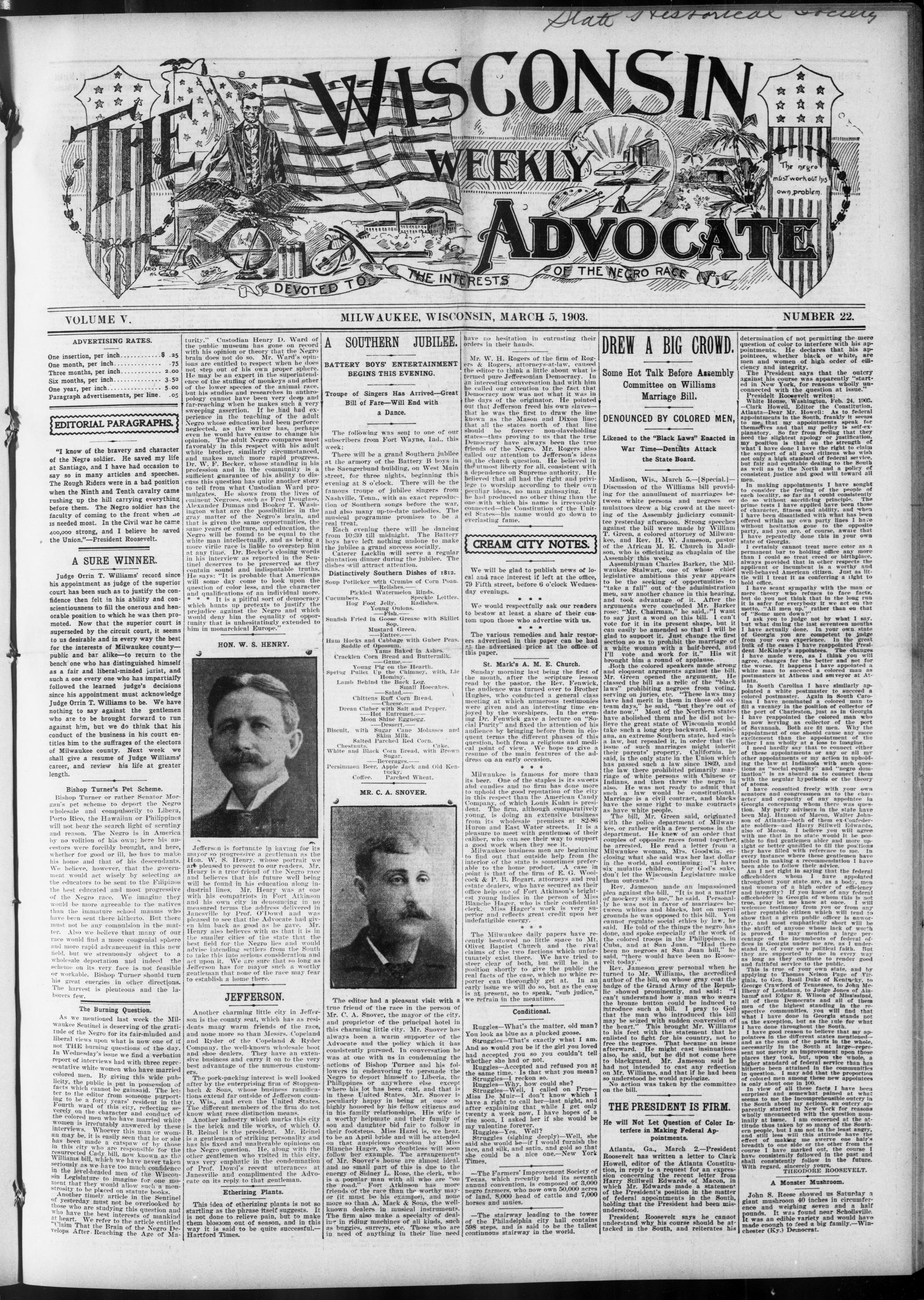
Wisconsin Weekly Advocate
Thursday, March 5, 1903
Milwaukee, Wisconsin
Page text (machine-generated)
WISCONSIN
WEEKLY
ADVOCATE
DEVOTED TO THE INTERESTS OF THE NEGRO RACE
ADVERTISING RATES.
One insertion, per inch..... $ .25
One month, per inch..... .75
Three months, per inch..... 2.00
Six months, per inch..... 3.50
One year, per inch..... 5.00
Paragraph advertisements, per line..... .05
EDITORIAL PARAGRAPHS.
"I know of the bravery and character of the Negro soldier. He saved my life at Santiago, and I have had occasion to say so in many articles and speeches. The Rough Riders were in a bad position when the Ninth and Tenth cavalry came rushing up the hill carrying everything before them. The Negro soldier has the faculty of coming to the front when he is needed most. In the Civil war he came 400,000 strong, and I believe he saved the Union."—President Roosevelt.
A SURE WINNER.
Judge Orrin T. Williams' record since his appointment as judge of the superior court has been such as to justify the confidence then felt in his ability and conscientiousness to fill the onerous and honorable position to which he was then promoted. Now that the superior court is superseded by the circuit court, it seems to us desirable and in every way the best for the interests of Milwaukee county—public and bar alike—to return to the bench one who has distinguished himself as a fair and liberal-minded jurist, and such a one every one who has impartially followed the learned judge's decisions since his appointment must acknowledge Judge Orrin T. Williams to be. We have nothing to say against the gentlemen who are to be brought forward to run against him, but we do think that his conduct of the business in his court entitles him to the suffrages of the electors of Milwaukee county. Next week we shall give a resume of Judge Williams' career, and review his life at greater length.
Bishop Turner's Pet Scheme.
Bishop Turner's Pet Scheme.
Bishop Turner or rather Senator Morgan's pet scheme to deport the Negro wholesale and compulsorily to Libera, Porto Rico, the Hawaiian or Philippines will not bear the search light of scrutiny and reason. The Negro is in America by no volition of his own; here his ancestors were forcibly brought, and here, whether for good or ill, he has to make his home and that of his descendants. We believe, however, that the government would act wisely by selecting as the educators to be sent to the Filipinos the best educated and most progressive of the Negro race. We imagine they would be more agreeable to the natives than the immature school maams who have been sent there hitherto. But there must not be any compulsion in the matter. Also we believe that many of our race would find a more congenial sphere and more rapid advancement in this new field, but we strenuously object to a wholesale deportation and indeed the scheme on its very face is not feasible or workable. Bishop Turner should turn his great energies in other directions. The harvest is plenteous and the laborers few.
The Burning Question.
As we mentioned last week the Milwaukee Sentinel is deserving of the gratitude of the Negro for its fair-minded and liberal views upon what is now one of if not THE burning questions of the day. In Wednesday's issue we find a verbatim report of interviews had with three representative white women who have married colored men. By giving this wide publicity, the public is put in possession of facts which cannot be gainsaid. The letter to the editor from someone purporting to be a forty years' resident in the Fourth ward of this city, reflecting severely on the character and conduct of the colored men who have married white women is irrefutably answered by these interviews. Whoever this man or woman may be, it is easily seen that he or she has been made a catspaw of by those in this city who are responsible for the resurrected Cady bill, now known as the Williams bill, which we have never taken seriously as we have too much confidence in the level-headed men of the Wisconsin Legislature to imagine for one moment that they would allow such a monstrosity to be placed on statute books.
Another timely article in the Sentinel of yesterday must not be overlooked by those who are studying this question and who have the best interests of mankind at heart. We refer to the article entitled "Claim That the Brain of the Negro Develops After Reaching the Age of Ma
turity." Custodian Henry D. Ward of the public museum has gone on record with his opinion or theory that the Negro brain does not do so. Mr. Ward's opinions are entitled to respect when he does not step out of his own proper sphere. He may be an expert in the superintendence of the stuffing of monkeys and other of the lower species of the animal race, but his studies and researches in anthropology cannot have been very deep and far-reaching when he makes such a very sweeping assertion. If he had had experience in the teaching of the adult Negro whose education had been perforce neglected, as the writer has, perhaps even he would have cause to change his opinion. The adult Negro compares most favorably in this respect with his adult white brother, similarly circumstanced, and makes much more rapid progress. Dr. W. F. Becker, whose standing in his profession and in the community is a sufficient guarantee of his ability to discuss this question has quite another story to tell from what Custodian Ward promulgates. He shows from the lives of eminent Negroes, such as Fred Douglass, Alexander Dumas and Booker T. Washington what are the possibilities in the gray matter of the Negro's brain, and that is given the same opportunities, the same years of culture, and education, the Negro will be found to be equal to the white man intellectually, and as being a more virile race is liable to overstep him at any time. Dr. Becker's closing words in his interview as reported in the Sentinel deserves to be preserved as they contain sound and indisputable truths. He says: "It is probable that Americans will some day come to look upon the question of color less, and the character and qualifications of an individual more. * * * It is a pitiful sort of democracy which hunts up pretexts to justify the prejudice against the Negro and which would deny him the equality of opportunity that is unhesitatingly extended to him in monarchical Europe."
HON. W. S. HENRY.
3
Jefferson is fortunate in having for its mayor so progressive a gentleman as the Hon. W. S. Henry, whose portrait we are pleased to present to our readers. Mr. Henry is a true friend of the Negro race and believes that his future well being will be found in his education along industrial lines. Mr. Henry was at one with his compatriots in Fort Atkinson and his own city in denouncing in no measured terms the address delivered in Janesville by Prof. O'Dowd and was pleased to see that the Advocate had given him back as good as he gave. Mr. Henry also believes with us that it is in the smaller cities of the state that the best field for the Negro lies and would advise intending settlers from the South to take this into serious consideration and act upon it. We are sure that so long as Jefferson has for mayor such a worthy gentleman that none of the race may fear to establish a home there.
JEFFERSON
Another charming little city in Jefferson is the county seat, which has as residents many warm friends of the race, and none more so than Messrs. Copeland and Ryder of the Copeland & Ryder Company, the well-known wholesale boot and shoe dealers. They have an extensive business and carry it on to the very best advantage of the numerous customers. The pork-packing interest is well looked after by the enterprising firm of Stoppenbach & Sons, whose business ramifications extend far outside of Jefferson county. Wis., and even the United States. The different members of the firm do not know what race distinction means.
Another industry which marks this city is the brick and tile works, of which O. B. Reinel is the president. Mr. Reinel is a gentleman of striking personality and has his fixed and unalterable opinions on the Negro question. He, along with the other gentlemen who visited in this city, was very emphatic in the condemnation of Prof. Dowd's recent utterances at Janesville and complimented the Advocate on its reply to that gentleman.
Etherizing Plants.
This idea of etherizing plants is not so startling as the phrase itself suggests. It is not done to relieve pain, but to make them blossom out of season, and in this way it is said to be quite successful.—Hartford Times.
A SOUTHERN JUBILEE.
BATTERY BOYS' ENTERTAINMENT BEGINS THIS EVENING.
The following was sent to one of our subscribers from Fort Wayne, Ind., this week:
There will be a grand Southern jubilee at the armory of the Battery B boys in the Saengerbund building, on West Main street, for three nights, beginning this evening at 8 o'clock. There will be the famous troupe of jubilee singers from Nashville, Tenn., with an exact reproduction of Southern songs before the war, and also many up-to-date melodies. The musical programme promises to be a real treat.
Each evening there will be dancing from 10:30 till midnight. The Battery boys have left nothing undone to make the jubilee a grand success socially.
Caterer Lacklin will serve a regular plantation dinner during the jubilee. The dishes will attract attention.
Distinctively Southern Dishes of 1812.
Soup Potlicker with Crumbs of Corn Poan.
—Relishes.—
Pickled Watermelon Rinds.
Cucumbers.
Speckle Letties.
Hog Foot Jelly.
Radishes.
Young Onions.
—Fish.—
Sunfish Fried in Goose Grease with Skillet Sop.
Mustard Green.
—Entree.—
Ham Hocks and Cabbage with Guber Peas.
Saddle of Opossum.
Yams Baked in Ashes.
Cracklen Corn Bread and Buttermilk.
—Game.—
Young Pig on the Hearth.
Spring Pullet Up the Chimney, with Lie Hominy.
Lamb Behind the Back Log.
Small Hoecakes.
—Salad.—
Chittens Ruff Corn Bread.
—Cheese.—
Drean Claber with Salt and Pepper.
—Hot Entremet.—
Moon Shine Eggnogg.
—Dessert.—
Biscuit, with Sugar Cane Molasses and Skim Milk.
Salted Parched Red Corn.
Chestnuts.
Cake.
White and Black Corn Bread, with Brown Sugar.
—Beverages.—
Persimmon Beer, Apple Jack and Old Kentucky.
Coffee. Parched Wheat.
MR. C. A. SNOVER.
[Name]
The editor had a pleasant visit with a true friend of the race in the person of Mr. C. A. Snover, the mayor of the city, and proprietor of the principal hotel in this charming little city. Mr. Snover has always been a warm supporter of the Advocate and the policy which it has consistently pursued. In conversation he was at one with us in condemning the actions of Bishop Turner and his followers in endeavoring to persuade the Negro to deport himself to Liberia, the Philippines or anywhere else except where his lot has been cast, and that is in these United States. Mr. Snover is peculiarly happy in being at once so highly honored by his fellow citizens and in his family relationships. His wife is a worthy helpmate and their family of son and daughter bid fair to follow in their footsteps. Miss Hazel is, we hear, to be an April bride and will be attended on that auspicious occasion by Miss Blanche Hager, who doubtless will soon follow her example. The arrangements of Mr. Snover's house are almost ideal, and no small part of this is due to the energy of Sidney L. Rose, the clerk, who is a popular man with all who are "on the road." Fort Atkinson has more friends of the race than the worthy mayor (it must be his example), and none more so than A. Mack & Sons, the well-known dealers in musical instruments. The firm also make a specialty of dealing in riding machines of all kinds, such as buggies, surreys, etc. Those who are in need of anything in their line need
have no hesitation in entrusting their orders in their hands.
Mr. W. H. Rogers of the firm of Rogers & Rogers, attorneys-at-law, caused the editor to think a little about what is termed pure Jeffersonian Democracy. In an interesting conversation had with him he called our attention to the fact that Democracy now was not what it was in the days of the originator. He pointed out that Jefferson freed his own slaves—that he was the first to draw the line known as the Mason and Dixon line; that all the states north of that line should be forever non-slaveholding states—thus proving to us that the true Democracy have always been the true friends of the Negro. Mr. Rogers also called our attention to Jefferson's ideas on the church question. He believed in the utmost liberty for all, consistent with a dependence on Supreme authority. He believed that all had the right and privilege to worship according to their own peculiar ideas, no man gainsaying. If he had produced no other thing than the one with which his name is irrevocably connected—the Constitution of the United States—his name would go down to everlasting fame.
CREAM CITY NOTES.
We will be glad to publish news of local and race interest if left at the office, 79 Fifth street, before 6 o'clock Wednesday evenings.
We would respectfully ask our readers to bestow at least a share of their custom upon those who advertise with us.
The various remedies and hair restorers advertised in this paper can be had at the advertised price at the office of this paper.
St. Mark's A. M. E. Church.
Sunday morning last being the first of the month, after the scripture lesson read by the pastor, the Rev. Fenwick, the audience was turned over to Brother Hughes, who conducted a general class meeting at which numerous testimonies were given and an interesting time enjoyed by the worshipers. In the evening Dr. Fenwick gave a lecture on "Social Purity" and fixed the attention of his audience by bringing before them in eloquent terms the different phases of this question, both from a religious and medical point of view. We hope to give a resume of the main features of the address on an early occasion.
***
Milwaukee is famous for more than its beer. One of the staples is its sweets and candies and no firm has done more to uphold the good reputation of the city in this respect than the American Candy Company, of which Louis Kuhn is president. The firm, although comparatively young, is doing an extensive business from its wholesale premises at 82-86 Huron and East Water streets. It is a pleasure to meet with gentlemen of their caliber, who can see their way to support a good work when they see it.
Milwaukee business men are beginning to find out that outside help from the interior of that state is sometimes preferable to the home product. A case in point is that of the firm of E. G. Woolcock & P. B. Bogart, attorneys and real estate dealers, who have secured as their office help one of Fort Atkinson's brightest young ladies in the person of Miss Blanche Hager, who is their confidential clerk. Miss Hager's work is very superior and reflects great credit upon her indefatigible energy.
* * *
The Milwaukee daily papers have recently bestowed no little space to Mt. Olivet Baptist Church and the rival claims of the two factions which unfortunately exist there. We have tried to steer clear of both, but will be in a position shortly to give the public the real facts of the case, which no white reporter can thoroughly get at. In an early issue we will do so, but as the case is at present, so to speak, "sub justice," we refrain in the meantime.
Conditional.
Ruggles-What's the matter, old man? You look as blue as a plucked goose.
You look as blue as a peacock geese.
Struggles—That's exactly what I am. And so would you be if the girl you loved had accepted you so you couldn't tell whether she had or not.
Ruggles—Accepted and refused you at the same time. Is that what you mean?
Struggles—I reckon so.
Ruggles—Why, how could she?
Struggles—Well, I called on Prue—Miss De Muir—I don't know which I have a right to call her—last night, and after explaining that while I get only twenty a week now, I have hopes of a rise soon, I asked her if she would be my valentine forever.
Ruggles—Yes. Well?
Struggles (sighing deeply)—Well, she said she would be—if I would furnish the lace, and silk, and satin, and gold so that she could be a nice one.—New York Times.
The Farmers' Improvement Society of Texas, which recently held its seventh annual convention, is composed of 3,000 negro farmers, who now own 50,000 acres of land, 8,000 head of cattle and 7,000 horses and mules.
The stairway leading to the tower of the Philadelphia city hall contains 598 steps, and is said to be the tallest continuous stairway in the world.
DREW A BIG CROWD.
DENOUNCED BY COLORED MEN,
Likened to the "Black Laws" Enacted in War Time—Dentists Attack the State Board.
Madison, Wis., March 5.—[Special.]—Discussion of the Williams bill providing for the annulment of marriages between white persons and negroes or mulattoes drew a big crowd at the meeting of the Assembly judiciary committee yesterday afternoon. Strong speeches against the bill were made by William T. Green, a colored attorney of Milwaukee, and Rev. H. W. Jameson, pastor of the African M. E. Church in Madison, who is officiating as chaplain of the Assembly this week.
Assemblyman Charles Barker, the Milwaukee Stalwart, one of whose chief legislative ambitions this year appears to be the seeking of opportunities to "take a fall" out of the administration men, saw another chance in this hearing, and took advantage of it. After the arguments were concluded Mr. Barker rose: "Mr. Chairman," he said, "I want to say just a word on this bill. I can't vote for it in its present shape, but it can easily be amended so that I will be glad to support it. Just change the first section so as to prohibit the marriage of a white woman with a half-breed, and I'll vote and work for it." His wit brought him a round of applause.
Both the colored speakers made strong and eloquent arguments against the bill. Mr. Green opened the argument. He classed the bill as a relic of the "black laws" prohibiting negroes from voting, serving on juries, etc. "These laws may have had merit in them in those old osteam days," he said, "but they're out of date now." Most of the Northern states have abolished them and he did not believe the great state of Wisconsin would take such a long step backward. Louisiana, an extreme Southern state, had such a law, but repealed it, in order that the issue of such marriages might inherit their parents' property. California, he said, is the only state in the Union which has passed such a law since 1869, and the law there prohibited primarily marriage of white persons with Chinese or Indians, and then threw the negro in also. He was not ready to admit that such a law would be constitutional. Marriage is a civil contract, and blacks have the same right to make contracts as have white people.
The bill, Mr. Green said, originated with the police department of Milwaukee, or rather with a few persons in the department. He knew of an order that couples of opposite races found together be arrested. He read a letter from a Milwaukee woman, Mrs. Goodwin, enclosing what she said was her last dollar in the world, and continuing: "I have six mulatto children. For God's sake, don't let the Wisconsin Legislature make them outcasts."
Rev. Jameson made an impassioned plea against the bill. "It is not a matter of mockery with me," he said. Personally he was not in favor of marriages between whites and blacks, but on moral grounds he was opposed to this bill. You cannot regulate social ethics by law, he said. He told of the things the negro has done, and spoke especially of the work of the colored troops in the Philippines, in Cuba, and at San Juan. "Had there been no negroes at San Juan hill," he said, "there would have been no Roosevelt today."
Rev. Jameson grew personal when he turned to Mr. Williams, the accredited author of the bill, on whose gray coat the badge of the Grand Army of the Republic showed prominently, and said: "I can't understand how a man who wears the bronze button could be induced to introduce such a bill. I pray to God that the man who introduced this bill may be seized with sudden conversion of the heart." This brought Mr. Williams to his feet with the statement that he enlisted to fight for his country, not to free the negroes. That became an issue afterward. He might cast insinuations also, he said, but he did not come here to blackguard. Mr. Jameson said he had not intended to cast any reflection on Mr. Williams, and that if he had been so understood he would apologize.
No action was taken by the committee on the bill.
THE PRESIDENT IS FIRM.
He will Not Let Question of Color Interfere in Making Federal Appointments.
Atlanta, Ga., March 2.—President Roosevelt has written a letter to Clark Howell, editor of the Atlanta Constitution, in reply to a request for an expression concerning the recent letter from Harry Stillwell Edwards of Macon, in which Mr. Edwards made a statement of the President's position in the matter of federal appointments in the South, holding that the President had been misunderstood.
President Roosevelt says he cannot understand why his course should be attacked in the South, and reiterates his
determination of not permitting the mere question of color to interfere with his appointments. He declares that his appointees, whether black or white, are men and women of high order of efficiency and integrity. The President says that the outcry against his course was apparently "started in New York, for reasons wholly unconnected with the question at issue." President Reagan writes:
President Roosevelt writes:
White House, Washington, Feb. 24, 1906.
—Clark Howell, Editor the Constitution,
Atlanta—Dear Mr. Howell: As to federal
appointments in the South, frankly it seems
to me that my appointments speak for
themselves and that my policy is self-ex-
planatory. So far from feeling that they
need the slightest apology or justification,
my position is that on the strength of
what I have done I have the right to claim
the support of all good citizens who wish
not only a high standard of federal service,
but fair and equitable dealing to the South
as well as to the North and a policy of
consistent justice and good will toward all men.
In making appointments I have sought to consider the feeling of the people of each locality, so far as I could consistently do so without sacrificing principle. The prime tests I have applied have been those of character, fitness and ability, and when I have been dissatisfied with what has been offered within my own party lines I have without hesitation gone to the opposite party, and you are, of course, awake that I have repeatedly done this in your own state of Georgia.
I certainly cannot treat mere cotor as a permanent bar to holding office any more than I could so treat creed or birthplace, always provided that in other respects the applicant or incumbent is a worthy and well-behaved American citizen. Just as little will I treat it as conferring a light to hold office.
I have scant sympathy with the man or mere theory who refuses to face facts, but do you not think that in the long run it is safer for everybody if we act on the motto, "All men up," rather than on that of "Some men down?" I ask you to judge not by what I say, but what during the last seventeen months I have actually done. In your own state of Georgia you are competent to judge from your own experience. In the great bulk of the cases I have reappointed President McKinley's appointees. The changes I have made were, as I think you will agree, changes for the better and not for the worse. It happens I have appointed a white man to succeed a colored man as postmasters at Athens and smiveyor at Atlanta.
In South Carolina I have similarly appointed a white postmaster to succeed a colored postmaster. Again in South Carolina I have nominated a colored man to fill a vacancy in the position of collector of the port of Charleston, just as in Georgia I have reappointed the colored man who is now serving as collector of the port of Savannah. Both are fit men. Why the appointment of one should cause any more excitement than the appointment of the other I am wholly at a loss to imagine.
I need hardly say that to connect either of these appointments or any or all my other appointments or my action in upholding the law at Indianola with such questions as "social equality" and "negro domination" is as absurd as to connect them with the regular hypothesis or the theory of atoms.
I have consulted freely with your own senators and congressmen as to the character and capacity of any appointee in Georgia concerning whom there was question. My party advisers in the state have been Maj. Hanson of Macon, Walter Johnson of Atlanta—both of them ex-Confederate soldiers—and Harry Stilwell Edwards, also of Macon. I believe you will agree with me that in no state would it be possible to find gentlemen abler and more upright or better qualified to fill the positions they have filled with reference to me. In every instance where these gentlemen have united in making a recommendation I have been able to follow their advice.
Am I not right in saying that the federal officeholders whom I have appointed throughout your state are, as a body, men and women of a high order of efficiency and integrity? If you know of any federal officeholder in Georgia of whom this is not true, pray let me know at once. I will welcome testimony from you or from any other reputable citizen which will tend to show that a given public officer is unworthy, and most emphatically short will be the shrift of anyone whose lack of worth is proved. I may mention a large percentage of the incumbents of federal offices in Georgia under me are, as I understand it, of your own political faith. But they are supported by me in every way as long as they continue to render good and faithful service to the public.
This is true of your own state, and by applying to Thomas Nelson Page of Virginia, to Gen. Basil Duke of Kentucky, to George Crawford of Tennessee, to John McIlheny of Louisiana, to Judge Jones of Alabama and Edgar S. Wilson of Mississippi, all of them Democrats and all of them men of the highest standing in the respective communities, you will find that what I have done in Georgia stands not as the exception, but as the rule for what I have done throughout the South.
I have good reason to believe that my appointees in the different states mentioned—and as the sum of the parts in the whole, necessarily in the South at large—represent not merely an improvement upon those places they took, but, upon the whole, a higher standard of federal service than has hitherto been attained in the communities in question. I may add that the proportion of colored men among these new appointees is only about one in 100.
In view of all these facts I have been surprised and somewhat paled at what seems to me the incomprehensible outcry in the South about my actions, an outcry apparently started in New York for reasons wholly unconnected with the question nominally at issue. I am concerned at the attitude thus taken by so many of the Southern people, but I am not in the least angry, and still less will this attitude have the effect of making me swerve one hair's breadth to one side or the other from the course I have marked out, the course I have consistently followed in the past and shall consistently follow in the future. With regard, sincerely yours,
A Monster Mushroom.
John S. Reese showed us Saturday a giant mushroom 40 inches in circumference and weighing seven and a half pounds. It was found near Schollsville. It was an edible variety and would have made enough to feed a big family.—Winchester (Ky.) Democrat.
FISHERMEN RESCUED.
It is Thought that All Who Were Carried Out on the Ice are
Menominee, Mich., March 3.—[Special.]—It is now thought that all of the fishermen who were carried out on the ice yesterday have gotten off safely, although not all have been heard from yet. Late yesterday afternoon the wind shifted and brought the ice back to the west shore, so that the men could get off on that side.
Charles Bailey, stage driven from Arthur Bay, came down this morning He says twelve men are now at Arthur Bay, where they got off the ice, the lighthouse keepers on Chambers island being among them. Eight of them are from Chambers island and four from Menekaunce.
Four of the men got off in rowboats in Arthur bay. People on shore saw the men on the ice and went to their rescue. A telephone message from Fish Creek, Door county, Wis., says a number of men got off there all right, although all the fishermen abandoned their nets, fish and everything to get ashore. The big floe of ice is still loose and, as the wind changed again to the north, will undoubtedly be carried out again so if any of the men are still on the ice they will be in danger of perishing. The names, so far as can be learned, of those saved are Rube Peterson, Ole Betson, George Boyd, John Williams, Ole Peterson, Frank Walker and son, William Boyd, Peter Peterson, Ole Olson, Henry Woodbeck and son, all of Menekaunee. Jack Hogan of Fish Creek is still unheard from.
Four fishermen, Ole Peterson of Menekaunee, Capt. Cox and C. Swanson of Chambers Island and one other fisherman came down here today. They said they got off the ice at Seizer's Bay and were cared for by the residents of that place. Peter Peterson lost 150 nets worth $3000. Hundreds of others are lost.
FIRED BY BURGLARS.
Large Block at Canaan, Conn., Destroyed
—Department Store at Portland,
Ore.. Burned.
Canaan, Conn., March 3.—The Cummings block, containing the postoffice, the private bank of Fuller & Peets and Collins' jewelry store, burned to the ground early today. It is believed the fire was started by burglars after they had cracked the safes in the building, but on account of the heat of the ruins it has been impossible yet to get at the safes to determine the loss. A posse of officers is in pursuit of the supposed burglars. Portland, Ore., March 3.—Fire broke out early this morning in the eighth floor of the Bekum block at the corner of Third and Washington streets and destroyed property valued at $185,000. The building is a brick structure, eight stories high, 100 by 100, and is one of the finest buildings in the city.
The large department store of Lipman, Wolfe & Co. occupied the first two stories and their stock of goods, valued at about $500,000, was badly damaged by water and smoke. The fire was confined to the three upper stories, which were gutted. It started on the top floor in the office of E. W. Moore, photographer, and it is supposed to have been caused by spontaneous combustion. It is believed that the occupants of the building were amply insured.
LADRONES ARE WORSTED.
Defeated Near Mariquina by Detachment of Scouts—Nineteen of Them Were Killed.
Manila, March 3.—A detachment of scouts under the command of Lieuts. Nickerson attacked and defeated a body of Ladrones near the village of Mariquina, seven miles from Manila. After an hour's fighting the Ladrones were scattered. Nineteen were killed and many wounded. There were no casualties on the side of the scouts. The constabulary last Wednesday surprised and captured the stronghold of the Ladrones in the mountains of Albay, Luzon, where a force of Ladrones attacked a small detachment of constabulary February 20. The 'constabulary on Wednesday met with some resistance from the Ladrones who were defeated with a loss of ten killed and four captured. The Ladrones' stronghold and supplies were burned.
OPTION EXTENDED.
Panama Canal Company Agrees to Request of Washington Authority
Washington, D. C., March 3. Attorney General Knox on leaving the cabinet meeting today announced that he had received from the Panama Canal Company an acceptance of the proposal which he recently made to it with respect to the extension of the option of the canal company's property held by this government. He said that the communication from the canal company was of such a nature that the option would be kept alive until the ratification of the pending treaty—it mattered not whether the treaty was ratified before or after the conclusion of the present session of Congress.
NO COPYRIGHT ON MESSAGES
House Committee Gives Decision on Public Documents.
Washington, D. C., March 3.—Representative Heatwole submitted a report to the House from the committee on printing on the resolution concerning the publication of the messages and documents of Presidents, declaring that the committee is of the opinion that publications authorized by Congress cannot be copyrighted.
The committee recommends a bill which makes it a misdemeanor to stamp as copyrighted any government publication. It is further provided that any person who shall, without lawful authority, make use for advertising purposes or anything which will tend to indicate that a government publication is printed, sold or distributed by the government, or shall represent that such person has the exclusive right or authority to sell or distribute such publication. shall be deemed guilty of a misdemeanor.
Will Get There
"I hear you want to sell your dog, Pat.
They tell me he has a pedigree."
I think he he has a pedigree.
"Shure, an' Oi niver noticed it, sor,
Anyhow, it's nothin' but a puppy yit, an',
I'm thinkin' as how he'll be after out-
growin' it, sor."—Glasgow Evening
Times.
Guiltv.
Judge (to tramp accused of having kissed the woman)—What have you to say in your defense?
Tramp—Nothing, your honor. I deserve to be punished.—San Francisco Call.
A Good Place for It.
She—Doctor, is Squeedunk a good place to go for rheumatism.
Doctor—Sure. That's where I got mine.—Indianapolis Journal.
—The average factory hand gets $1.40 a day and creates $3.75 worth.
CONGRESS.
Proceedings in the Senate.
In open session on the 26th the Senate discussed at length and finally passed the sundry civil bill, with many amendments. The most important of these are: Accepting the amendment providing for the construction of an office building for the House of Representatives; directing the superintendent of the capitol to prepare estimates of cost for a separate office building for the Senate; appropriating $2,000,000 for the purchase of a site for the postoffice in New York city was agreed to, the location to be on the west side of Elgthrade avenue, from Thirty-first to Thirty-third streets; appropriating $25,000 to enable the commissioner of labor to furnish statistics relating to marriages and divorces in the several states and territories since January 1, 1887; striking out the provision for the extension of the capitol, and increasing the an appropriation for the expenses of the Alaskan boundary commission to $100,000. The Senate then went into executive session and the Panama canal treaty was immediately taken up, Senator Morgan resuming his speech in opposition to that agreement. Senator Hoare spoke of his desire to bring up the conference report on the bill for the protection of the President, and after encountering some opposition at last moved to go into legislative session for the purpose of presenting the report. The motion prevailed. 20 to 20. Mr. Hoar thereupon presented a conference report and it went over for a day.
The Senate on the 27th passed the naval appropriation bill, which carries a total of $81,507,412. An amendment was adopted removing the restriction put upon the secretary of the navy that the four battle ships provided for shall be of the general type of the Oregon and the two armored cruisers shall be of the general type of the Brooklyn. The military academy appropriation bill was also passed, with an amendment to the general staff law providing that the chief of artillery shall hereafter serve as an additional member of the general staff and shall have the rank, pay and allowance of a brigadier general. The amendment further provides that when the next vacancy occurs in the office of colonel of artillery it shall not be filled, and that hereafter the number of colonels of artillery shall not exceed thirteen. The amendment takes effect August 15, 1903. The conference report on the Alaskan appropriation bill was agreed to. Mr. Blackburn then pressed the Littlefield anti-trust bill and demanded a vote on the question. The Senate refused to take a vote. The immigration bill failed of a vote on objection from New England senators, who feared it will exclude French-Canadan labor.
In the Senate on the 28th Mr. Platt (N. Y) offered a resolution, which was referred to the committee to control the contingent expenses of the Senate, providing for the printing of a special edition of the Congressional Directory "for the use of the special session of the Senate should one be called." Mr. Burrows submitted additional protests against the admission of Reed Smoot as a senator from Utah. Mr. Bacon (Go.) offered an amendment to the Littlefield anti-trust bill, and said that while he was in sympathy with the desire to have legislation which will prevent monopolies and those things which hinder competition, he was not willing to adopt the methods suggested by the committee with respect to the prohibition of interstate commerce, which he said was an interference with the rights of the states. The fortifications appropriation bill was taken up and passed. Mr. Hale reported the general deficiency bill. The conference report on the car-coupling bill was agreed to, as was that on the military academy appropriation bill. A motion to take up the Littlefield anti-trust bill was again rejected. The immigration bill was passed. The Aldrich financial bill was taken up, displacing the statehood bill, the vote on this proposition being 42 to 18, and debate upon the measure occupied the rest of the session. A Sunday session was held for the delivery of eulogies upon deceased members of the House.
The Senate on the 2d passed the general deficiency appropriation bill after agreeing to the committee amendments and amendments appropriating $3,000,000 to carry out the provisions of the omnibus public building bull and increasing the appropriation for the payment of claims to $1,370,000. Amendments limiting the fees of attorneys on claims under the Spanish treaty, appropriating an additional $50,000,000 for irrigation purposes (offered by Mr. Rawlins) and appropriating $1200 to reimburse residents of Indianola for expenses in carrying mails from other towns were rejected. The conference reports on the fortifications appropriation bill and the Alaska homestead bill were agreed to. The House amendments to the immigration bill were disagreed to and conferees were appointed. Mr. Quay made his usual unsuccessful attempt to secure a vote on the statehood bill by unanimous consent. The Aldrich financial bill was then taken up. After a speech by Mr. Teller against the bill and against the Cuban reciprocity treaty the Senate at 6 o'clock took a recess until 8 p. m. At the evening session the conference reports on the post-office and agricultural appropriation bills and the immigration bill were agreed to. The House bill allowing Porto Rico a delegate in Congress was presented and went over until tomorrow after Mr. Foraker had offered a substitute containing a provision for a commission of three to investigate and report on claims of the Roman Catholic Church to certain property in the island. The Aldrich bill again was taken up.
At 11 a. m. on the 8d, the Senate entered upon the last legislative day of the Fifty-seventh Congress. A resolution was adopted continuing until the next regular session the standing and select committees. The conference report on the sundry civil bill was agreed to. The conference report on the bill to protect the President was presented, but not acted upon. Mr. Bacon criticised the measure and Mr. Hoar defended it. A motion to take up the pure food bill was defeated, 28 to 32. Mr. Quay asked unanimous consent for a vote on the omnibus statehood bill, the Aldrich bill, the Philippine tariff bill, the pure food bill and the conference report on the bill to protect the President, but objection was made. After debate by Messrs. Foraker, Lodge, Teller and Elkins on the responsibility for the billbuster and the need of cloture in the Senate it was agreed that the Philippine tariff bill be taken up, displacing the Aldrich bill. Mr. Patterson opposed the bill and Messrs. Bacon. Lodge and Foraker supported it. After an executive session from 5:30 to 5:45 o'clock several minor bills were passed, and at 6 o'clock a recess was taken until 8 o'clock. When the Senate reconvened the bill providing for the appointment of three commissioners to report to Congress on claims of the Roman Catholic Church to certain property in Porto Rico was adopted. The conference report on the omnibus public building bill was agreed to. A joint resolution was agreed to transferring all the authority and jurisdiction conferred on the secretary of the treasury by the immigration bill to the secretary of the department of commerce and labor. The amendment increasing the duty on sugar and tobacco from 25 to 50 per cent. of the Dingley rate was agreed to on a yea and nay vote, 29 to 19.
When the Senate convened at 10 o'clock on the 4th, Mr. Allison presented a statement on the appropriations of the Congress. Mr. Bailey called up a bill amending the rivers and harbors act so as to provide that the $125,000 heretofore appropriated for certain river and harbor improvements in Texas be used for the construction of a channel in Sabine lake. Messrs. Hoard and Lodge discussed the Phillipine bill, the former saying that the failure of this legislation proves that "this nation is not fit to govern the destinies of people 8000 miles away, who have no voice in the government," and Mr. Lodge disputing this statement. Mr. Mason took the floor and talked until time of adjournment, killing the Bailey harbor bill. Messrs. Allison and Jones were appointed a committee to notify the President that the Senate was ready to adjourn. After their report and the adoption of a resolution of thanks to President Pro Tempore Frye, the Senate, at 12 o'clock, adjourned sine die.
Proceedings in the House.
Amid scenes which recalled the memorable and exciting days of the Fifty-first Congress, when party feeling ran fiercely, James J. Butler of Missouri was unseated on the 26th by the House and George C. R. Wagoner was seated in his place. The Democrats had decided at their caucus that if this case was called up they would fillbuster from now until March 4, regardless of consequences to legislation, and they began the fight as soon as the gavel fell at noon. Roll call followed roll call, and it took over three hours to approve the journal of the preceding day's proceedings. Then, when the decks were cleared, the case was called. A spirited debate of two hours followed and finally, after repeated roll calls, the matter was brought to a vote. The
Democrats then attempted to block action by leaving the hall, but enough absentees finally were brought in to make up the necessary quorum. The closing chapter was dramatic. Mr. Dalzell of Pennsylvania, who, was in the chair, refused to recognize a demand for a division, and Mr. Richardson, the minority leader, stood in his place and denounced his course in unmeasured terms amid the jeers of the Republican side. The handful of Democrats present were overriddden and Mr. Wagoner was seated.
The Democrats of the House on the 27th carried out their threat, that if Mr. Butler was unseated they would do everything in their power to block legislation from now until Congress expires March 4. The result was another stormy session, prolonged from 11 o'clock in the morning until almost 7 o'clock in the evening. Even with the special rules in operation getting appropriation bills into conference was a tedious and laborious process, thirteen roll calls being necessary to get the agricultural, sundry civil, military academy and postoffice appropriation bills into conference and to adopt the conference report on the Indian appropriation bill.
The time in the House on the 28th was again largely taken up by filibustering by the Democrats, numerous roll calls being necessary for the transaction of business. The naval appropriation bill was sent to conference with Messrs. Foss (Ill.), Dayton (W. Va.) and Tate (Ga.) as the conferees. The conference reports on the bill to amend the railroad safety appliance act and the bill relating to private corporations in Alaska were approved. The resolution directing the officer in charge of public buildings and grounds "in conformity with the act of April 7, 1900, to prepare an inventory of the public property at the white house, the cost, if still in use, the price received, if sold, to whom, etc." was laid on the table. The conference reports on the military, academy appropriation bill, the postoffice, the omnibus public buildings bill, carrying $790,000 for the Chicago postoffice, and the bill to settle the accounts of officers during the Spanish war period were adopted.
The House on the 1st, continuing the legislative session of the preceding Thursday, finally disposed of the District of Columbia appropriation bill and the Alaska homestead bill
The House on the 2d, by a vote of 207 to 3, agreed to the conference report on the Alaska homestead bill, the speaker declining to entertain a point of order that no quorum was present. Mr. Grosvenor, from the committee on rules, presented a special rule to put the immigration bill into conference by direct vote and to cut off the previous question on conference reports. On the rule, which is intended to check the Democratic filibuster, twenty minutes' debate was allowed. The previous question was ordered, 162 to 163, and the rule was adopted, 154 to 101. On the latter vote Mr. Loud (Republican, Cal.) voted with the Democrats. The conference report on the fortifications appropriation bill was adopted, 214 to 8. The immigration bill, with Senate amendments, was sent to conference, 190 to 1, under the operation of the new rule. Slimilar action was taken, 206 to 5, on the omnibus public building bill. A bill making provision for a delegate in Congress from Porto Rico was passed, 208 to 0. The Otjen bill to prohibit dealers in tobacco from giving prizes or prize coupons with their wares was passed, 164 to 9. A bill to authorize the appointment of Mnj. William Crawford Gorgas as assistant surgeon general of the army in recognition of his services in Cuba during the war was passed. The conference report on the postoffice and agricultural appropriations were agreed to.
When the House convened at 11 a. m. on the 3d, Mr. Richardson sought to make the point of no quorum, but the speaker overruled him and recognized Mr. Payne to demand the yeas and nayes on the pending question—the adoption of the conference report on the immigration bill. The speaker declined to entertain an appeal. The report was adopted 197 to 17. The conference report on the sunday civil bill was presented and adopted, 211 to 11. The President's veto of a Virginia claim bill was presented. A joint resolution to correct some clerical errors in the immigration bill required two roll calls to secure its adoption. A Senate bill to authorize the treasury department to provide souvenir coins for the Thomas Jefferson Memorial Association was passed, 187 to 3, after a protest from Mr. Grosvenor. The conference report on the omnibus bill was adopted, 202 to 11, without debate. The conference report on the bill to reduce the population requirements for "reserve" cities for bank deposits from 50,000 to 23,600 was presented, and after a recess from 7 o'clock until 10 o'clock, was adopted.
The conference report on the general deficiency, the last of the appropriation bills, was presented In the House at 3 a. m. on the 4th, and adopted, 181 to 16, after a speech by Mr. Cannon. The House then took a recess from 3:50 until 10 o'clock. When the House reassembled there were several calls to secure a quorum, after which Mr. Payne introduced a resolution of thanks to the retiring speaker, which was adopted without a division. The President's veto of a bill authorizing the use of the power of the Tennessee river at Mussel Shoals, Ala., was presented and referred after Mr. Richardson had made an unsuccessful attempt to have the bill passed over the veto. Messrs. Payne, Grosvenor and Richardson were appointed a committee to notify the President that the House was ready to adjourn. After this committee had reported and Speaker Henderson had delivered a valedictory address the House was declared adjourned sine die.
Through and Through.
New Bedford, Mass., March 2.—At 658 First street, this city, lives a very happy man. His name is Ulric Levasseur and he certainly has good reason to feel glad and proud.
Mr. Levasseur has been sick for a long time with general weakness and a sore pain in his back. At the last he got so very bad that he could not walk without great misery. Now he is well and in speaking of this wonderful change in him he says:
"I believe it to be my duty to tell everybody how I was cured. I was so weak that I could not stoop, in fact, I was unable to walk without great pain. I began taking Dodd's Kidney Pills and after a two months' treatment I am well and sound again.
"Dodd's Kidney Pills are a God-sent remedy. I will always praise them for their wonderful cure of my case. They cured me through and through. I am as strong and able a man now as I ever was."
—In falling from his wagon William Brown, 60 years old, a farmer, was instantly killed, his neck being broken.
—B. F. Miller, who sustained injuries to his back while working in the La Salle street tunnel July 28, died at Mercy Hospital. Miller was 43 years old and married.
—One hundred dollars in cash, thirty gold watches, and silverware and cutlery in quantities were taken by thieves from the store of Bullard & Gormley. The plunder is valued at $2000, and officers have found no trace of the guilty persons.
General improvement in the condition of Maj. Joseph H. Willard is reported at the Hotel Del Prado. Maj. Willard, who is in charge of the government's river and harbor improvement work in Chicago, has been confined to his room for over two weeks with erysipelas. Part of the property stolen from the real estate office of State Senator Lundberg was found wedged between an icebox and the wall in William E. Allen's saloon at Hammond, Ind. The plunder consisted of a package of negotiable papers and securities representing a value of $20,000.
—Denis J. Swenie's name is now borne by one of the fireboats of Chicago, formerly the Geyser, in accordance with the action taken by Mayor Harrison. Fire Marshal Musham has received from Collector Nixon information that the commissioner of navigation has authorized the change of name.
LEGISLATURE.
Proceedings in the Senate.
The bill changing the grand jury system of the state was laid over in the Senate on the 26th, owing to an error in the title. Bill No. 94S, authorizing the attorney general to institute suit relative to school land in Indian reservation, was amended by striking out words "with all convenient speed." The bill was then passed. Bill No. 145S, authorizing the city of Eau Claire to build and maintain a dam over Chippewa river, was passed. Bill 230S, to prevent conflict of dates for fairs receiving fixed aid from the state, was referred to the committee on agriculture on motion of Mr. Stout. This bill affects only the fairs at La Crosse, Chippewa Falls and the state fair. Bill No. 159S, creating a municipal court for Sawyer county, and bill No. 150S, changing the boundaries of towns in Forest county and creating certain other towns in said county, were ordered engrossed and read a third time. Mr. Hatten, when bill 198 was brought up, asked why the clause by which the proposed appropriation for sailors' and soldiers' monuments was to be submitted to a vote of the people had been cut out. Mr. Bird, chairman of the committee on military affairs, said that the committee believed that it was not necessary to go to the expense of an election if the county board was patriotic enough to make such an appropriation. Mr. Merton made a few remarks along the same line. Bill 239S, relating to the asphalt pavement around the capitol square, was referred to the committee on agriculture.
At the opening of the Senate on the 27th, Seantor Merton was granted an indefinite leave of absence owing to illness. He was threatened with pneumonia. The engineering college of the University of Wisconsin presented the presiding officer with a beautiful gavel. The report of the committed on privileges and elections in favor of the Merton primary bill was presented and the bill was placed on the calendar. Senators Whitehead and Morse dissent. The bill relating to the printing of journals, bills, etc., was passed. IBll 120S, to amend the charter of Ripon College, was passed. No. 67S, changing the method of selecting grand jurors and extending the system over the state, was passed; bill 51A was concurred in. 331S, the inheritance tax bill, was laid over. Bill 264S was killed, Mr. Munson voting against its indefinite postponement. The Assembly resolution thanking Prof. Freeman for his lecture was concurred in. Adjournment was to 9 p. m. on the 2d prox.
At the session of the Senate on the evening of the 2d the following bills were passed: Allowing county boards to appropriate up to $10,000 for soldiers' monuments, without submitting the question to the people; relating to school boards in first-class cities, and giving them authority to select sites for schoolhouses; providing that the state tax commissioners shall be a board of assessment to levy taxes on sleeping car and express companies; relating to delivery of dockets by justices; granting the United States jurisdiction over postoffice sites in Green Bay and Fond du Lac; relating to estates of infants. Senator Renkema's bill, providing that justices of the peace in Milwaukee shall have jurisdiction of cases not exceeding $300, was ordered engrossed. The Senate received a message from the governor vetoling No. 28, a bill increasing the pay of the stenographic reporter of the Waukesha municipal court from $5 to $10 a day.
The inheritance tax bill, known as 334S, was ordered engrossed and read a third time without debate in the Senate on the 3d. The Senate concurred in joint resolution 15A, authorizing Herman Miller to introduce a bill. The so-called baby farm bill was reported favorably for passage by the judiciary committee at the evening session of the Senate.
The Senate on the 4th, by a vote of 17 to 12, postponed action on the primary bill to March 26. The following bills were passed: Providing for the bulletin of arrival of passenger trains; validating contracts of municipal corporations; relating to the issuing of bonds by specially incorporated cities; relating to the Babcock test for milk and cream; amending statutes relating to mortgages; changing the boundaries of towns in Forest county, and creating new towns; relating to submerged lands in the city of Milwaukee granted for park purposes; to legalize bonds for the payment of money in cases not authorized by a vote of the people; granting the United States jurisdiction of land in Marathon county.
- Proceedings in the Assembly.
The committee on public health and sanitation reported favorably to the Assembly on the 26th, No. 442A, providing a hygienic laboratory at the state university for the use of the state board of health. The bill requiring city physicians to make monthly analyses of water and providing a contingent fund of $50,000 to guard against contagious diseases, was reported for indefinite postponement. The bill reducing the fee of sheriffs for conveying prisoners to $10 was among five reported for indefinite postponement by the judiciary committee. The Barker bill, providing punishment for officials soliciting bribes, was also recommended for death, while the Barker bill, 191A, providing immunity from punishment for bribery in certain cases, was recommended for passage, as was also 198A, providing for a bounty on rattlesnakes. The committee on agriculture reported for passage the bill requiring the state veterinarian to have an office at the capitol and be there all the time, and increasing his salary to $3000, and the bill making more stringent the law providing for the slaughter and appraisal of diseased animals. The Ainsworth bill exempting beet sugar factories from taxation for a period of five years brought on a protracted discussion which grew warm in spots. On roll call the bill was killed, 37 to 56. The following bills were passed: 170A, providing that fire insurance risks may be reinsured in any responsible company whose stock and surplus amounts to $100,000; 180, regulating the importation of western branded horses, to guard against bringing glanders into the state; 282A, requiring railroads and street railroads to make semi-annual reports of highway crossing accidents to the commissioner of labor statistics: 284A, amending the law permitting the mortgage of franchises, by defining the word "franchise" to meet a decision of the supreme court.
In the Assembly at the evening session on the 26th, the committee on cities favorably reported the Ranki bill extending the guarantee period for street pavements in Milwaukee from five to ten years, and the Westfahl bill, authorizing Milwaukee to establish building lines along boulevards and pleasure ways. The committee on military affairs favorably reported the Westfahl bill, appropriating $2500 annually for the First battery of Milwaukee. The railroad committee reported a substitute for the Crowley bill, requiring interurban railroad companies to provide toilet rooms in their cars for passengers. The committee favorably reported bill No. 516A, introduced by Mr. Rupp, providing that all county superintendents of schools shall hold a county superintendent's certificate of eligibility.
The bill providing for the examination and licensing of stationary engineers, which has been killed at several sessions, was reported in the Assembly on the 27th for indefinite postponement by the committee on state affairs, as was also the bill providing for the better protection of lives on vessels. The following bills were passed: Requiring three weeks' notice of special town meetings; removing the fifty-year limit for life of insurance corporations; providing for submission to vote of the people a constitutional amendment increasing the number of justices of the supreme court from five to seven; authorizing cities of the third class to borrow $100,000 annually for school purposes. They are now limited to $20,000. The bill repealing the law requiring candidates to file statements of their election expenses was on the calendar for indefinite postponement. Mr. Benson moved that it be ordered to third reading instead, but was ruled out of order. He made a brief speech for the bill. On the question of killing the bill to repeal the law the ayes and noes were called and
the Assembly refused, 55 to 37, to inden-
nitely postpone. The bill was then, on motion of Mr. Ekern, referred to the judiciary committee by a vote of 47 to 45. The Assembly decided to hold a Saturday session. Saturday sessions or no Saturday sessions was the question which occupied the attention of the Assembly on the 28th. Frank A. Cady opposed the proposition as championed by Ira B. Bradford, but found only thirteen out of the sixty members who agreed with him. The discussion lasted more than an hour, Assemblymen Fear, Barker, Smelker and Root taking part in it. The Cady resolution was defeated by a vote of 37 to 13, which, while not being a direct issue on Saturday sessions, was nevertheless a vote to favor them. The Assembly passed four unimportant bills and then adjourned to 2 p. m. on the 2d.
When the time arriving for calling the Assembly to order at 2 o'clock on the afternoon of the 2d a quorum was lacking and Speaker Lenroot was compelled to wait fifteen minutes until enough additional members arrived to bring the attendance up to the required fifty-one. Immediately after the roll had been called Mr. Becker of Ozaukee county made a motion to adjourn until evening, but the motion was lost. The Assembly ordered to third reading the Mosher bill, No. 34S, authorizing counties, towns, cities, villages, or school districts to refund their indebtedness for other than special street, sewer, or harbor improvements, provided they keep within the 5 per cent. limitation. There were several important bills on the calendar for advancement to engrossment and third reading, but the authors of most of them being absent, they were laid over. Among the bills laid over was the Crowley measure requiring interurban railroads to equip their
cars with toilet rooms. The Assembly was in session only half an hour and then adjourned until morning.
Chairman Cady of the judiciary committee reported to the Assembly on the 3d the condition of business in that committee. The total number of bills referred to it is 247, of which 89 have been reported, 38 for passage and 51 for indefinite postponement. The judiciary committee reported the bill providing counties with annotations of the supreme court reports without recommendation and with the request that it be sent to the committee on claims. It was so referred. The bill making Saturday afternoons legal holidays was reported for indefinite postponement by the judiciary committee. A similar fate was recommended for eight other bills. The Senate bill, 348, providing for the refunding of municipal debts, was concurred in. The railway taxation bill, 600A, as amended by the committee on assessment and collection of taxes, was on the calendar for engrossment and third reading, but the motion to lay it over without discussion carried, 60 to 13. The bill requiring interurban railways to provide toilet rooms on cars was advanced to third reading.
By a unanimous vote, after a debate covering nearly the entire morning, the Assembly on the 4th passed to engrossment the ad valorem taxation measure. There will be no further delay and the bill will be passed in its regular order without further change, it is claimed. Mr. Smalley, chairman of the committee on assessment and collection of taxes, offered a new amendment cutting out the provision providing for taxation of bonds. It was adopted. Mr. Crowley offered an amendment providing for the apportionment of the money realized from railway taxation among the counties of the state, by the state treasurer. Chalman Smalley opposed the amendment, which, he said, would give the large cities of the state the benefit of the railway taxes. The amendment was lost, 58 to 25. All the committee amendments were adopted, and the question then came on ordering the bill to engrossment and third reading. The motion to recommit was lost by a vote of 27 to 64. The question then reverted to ordering the bill to engrossment and third reading, and carried unanimously, not a vote being cast against it. A bill was introduced by the committee on state affairs providing for ceding to the United States jurisdiction of lands to be used for public buildings. The committee on lumber and mining introduced a bill providing for a dam across Copper river. The committee on state affairs reported against the bill providing for the survey and preservation of Indian mounds. The following bills were passed: Requiring that the state veterinarian must be a graduate of some approved veterinary college; giving the state veterinarian jurisdiction over the appraisement and slaughter of diseased animals.
Among the bills adopted at the evening session on the 4th were the following: Allowing the city of Milwaukee to establish building lines along boulevards and pleasure ways, to condemn buildings and structures within such lines and prevent the erection of new structures; enabling Milwaukee to exact a ten-year guaranty from contractors for asphalt pavements; providing that the state veterinarian shall be a graduate of a recognized veterinarian college of the United States, Europe or Canada, and requiring him to have an office in the capitol building and devote all of his time to his duties; providing for the slaughter of domestic animals afflicted with dangerous diseases, and relating to the abstract of tax sales in Shawano county.
SPORTING NEWS.
It looks very much as if the new wrestling light that has sprung so suddenly to the front in the person of Frank Gotch, the Iowa champion, fresh from the Klondike, is very likely to turn out to be the coming American champion. Many predictions have been made by experts during the last few years that before much time had elapsed some new man must be born of the interest in wrestling, a man capable of stepping into the shoes of such men as Dan McLeod, Tom Jenkins, Jim Parr and the other leaders, when they shall have retired. All those who saw Gotch work at Cleveland in his match with Jenkins last week do not hesitate to say that within a year or two, with the experience he has gained recently, Gotch will be able to take Jenkins' measure, if given the opportunity, and will become a dangerous antagonist for any man who aspires to the American championship. Gotch held Jenkins at bay for nearly two hours before he lost his first fall and then the big Clevelander was pretty well in himself when the snatched out victory just as it seemed he could not hope for better than a draw with the newcomer.
Another man that bears watching is Fred Beell of Marshfield, Wis. Beell is one of the best men at 160 pounds in the country today, and if he had twenty more pounds he would be a champion.
***
Griff Jones and Hughey McGovern have signed articles of agreement for a twenty-round bout before the Allegheny (Pa.) Athletic Club on March 23.
---
George Schuh, the Louisville lightweight, and Barney Furey of Cincinnati will box fifteen rounds at Louisville on March 16.
* * *
Crocky Boyle of Germantown, Pa., is after a match with Terry McGovern. The claim is made that Boyle practically outclassed Young Corbett in a six-round bout.
* * *
An effort is being made by a Boston boxing club to match Terry McGovern or Young Corbett with Jimmy Briggs, who claims the lightweight championship of New England.
**
There is a scarcity of welterweight boxers in Philadelphia. Jack Bennett is the only good man who can weigh in at 138 to 142 pounds. Bennett has been looking for a match for some time, but nobody of his weight wants to meet him.
***
Joe Tipman, the Baltimore featherweight, who enjoys the proud distinction of being the first boxer to knock down Terry McGovern, disposed of Buzzard Ingram in two rounds before the National Sporting Club of Philadelphia.
* * *
The Broadway Athletic Club of Butte, Mont., is anxious to secure the fight between Jack Munroe and Tom Sharkey, and offers a $10,000 purse for the battle.
* * *
John Steil, chairman of the registration committee of the Metropolitan Association of the Amateur Athletic Union, announces that the registration committee has reinstated Marcus L. Hurley, who was disqualified for playing in an unregistered basketball game. He made application to the Amateur Athletic Union officials and convinced them that he had not received money for playing and had violated the rule only in so far as it pertained to competing in an unsanctioned match.
Tax Commission's Estimate of Market Value of Personal Property in Wisconsin
Tax Commission's Estimate of Market Value of Personal Property in Wisconsin
It Was Based on a False Assumption. The Commission Cut Down the Valuation of the Local Assessors.
(Issued in Behalf of Wisconsin Railways.)
In the preceding article we discussed the Tax Commission's report of the true value of country real estate. We showed that its estimate was very much less than the census returns. We shall next consider the true value of personal property. But before we say anything in criticism of the commission's estimates of the true value of the personal property in Wisconsin we shall state, largely in the commission's own words, the basis on which it made its estimates.
On page 66 of its first biennial report the Tax Commission very briefly explains the plan on which it computed the value of personal property. Speaking of its own acts the commission said: "In their computations the commission first calculated the total value of the personal property, by taking the average ratio of assessed valuation to actual value shown by real estate in each assessment district it was deemed a fair presumption that the assessor applied to personal property, or that part of it discovered by him, the same ratio that he applied to real estate), then adding the total assessment of personal property in each district for five years and taking an average of that and applying to it the real estate ratio."
Stated in other words the commission arbitrarily increased the values of personal property fixed by the local assessors in the same ratio that it had already increased the values of the real estate fixed by the same local assessors. The commission assumed that only the same degree of under-valuation prevailed in the case of personal property that the commission had found to exist in the case of real estate. For example, if the average assessment for five years of the personal property of a certain assessment district amounted to $30,000 and the commission had previously found that the real estate of this district for the same five years had been assessed at but one-half its true value, the commission would double the local assessment of $30,000 to get its so-called "true" value of the personal property of the district.
We do not concede that the true value of the personal property of the state can be found in this way. First, because we believe assessors under-value personal property much more than they do real estate, especially in large cities, and, secondly, because they find practically all of the real estate while they find but a small part of the personal property. The latter contention the commission concedes in a measure for it says "it was deemed a FAIR PRESUMPTION that the assessor applied to personal property. OR THAT PART OF IT DISCOVERED BY HIM, the same ratio that he applied to real estate." In making its valuations, however, it proceeded as if it had not made this admission.
We protest against the rough and ready method adopted by the commission for finding the true value of the personal property in the state; and we insist that the estimates of the commission are not a safe guide for action. The whole controversy of whether or not the railroads are paying their fair share of taxes depends almost entirely on the valuations placed on the other property in the state and we shall not allow to go unchallenged the Tax Commission's estimate of the value of personal property based entirely on a "presumption" which neither appeals to common sense nor finds any support in experience.
The half-hearted attempt of the commission to discover the personal property which every one knows escapes taxation is to say the least both surprising and disappointing for here lay its greatest field for usefulness, and the position of the commission is not at all strengthened by the apology it makes for its failure to grapple with the problem of getting personal property on the assessment rolls.
We have now stated the assumption on which the Tax Commission based its estimate of the true value of the personal property in Wisconsin and we have also presented some objections to its methods of valuation and have called attention to the utter lack of zeal displayed by the commission in the discharge of this, its most important task. Having discussed its methods we are now free to discuss the statistical matter submitted by the commission.
It requires but a very superficial examination of the valuations made by the local assessors and those made by the Tax Commission to perceive that there was something radically wrong with the method of valuation adopted by the latter. Wherever a local assessor made an effort to find the personal property in his district he was able to discover much more of this class of property than the commission would acknowledge the district contained. In its first report the commission made an estimate which it raised $26,245,253 in its second report, of the total value of the personal property in the state.
The local assessors in 53 of the 71 counties of the state have discovered and assessed much more of this class of property than the Tax Commission will admit to be in existence. Notwithstanding the fact that the local assessors have actually found the property the commission still refuses to be convinced. Where the local assessors' returns of personal property were higher than its own estimates the commission scaled down the assessors' returns until they were approximately equal to its own estimates. It has calmly taken the position that if the facts conflict with the theory it has announced, or more accurately the presumption it has stated, so much the worse for the facts. The Tax Commission has practically given notice that the valuations of personal property in the different counties shall not exceed its own estimates. The acts of the commission suggest the story of Procrustes, the fabled highwayman of Attica, who is said to have reduced his captives in size by chopping off the limbs of all those whom he found too long for the bed he had prepared.
We do not believe the local assessors overvalued the property of their constituents at the last assessment. Such a metamorphosis of the assessors is not conceivable. It would be fully as easy to believe the leopard could change his spots or the Ethiopian his skin. Even the highest returns made by the local assessors fall short of the full value of the property in their districts.
We can see no ground on which the commission was justified in scaling down the valuations of the local assessors of 53 of the 71 counties of the state by the large sum of $45,105,732. It would be interesting to hear from the Tax Commission as to the basis on which it reduced the assessment of the personal property of Ashland county from $3,374,089 to $1,696,926 and the assessment of personal property in Chippewa county from $5,093,097 to $2,265,298 and the assessment of the personal property in Grant County from $9,092,637 to $5,465,863 and the assessment of the personal property in Waupaca county from $4,032,360 to $2,358,592.
RUNNING FOR COVER.
THE ORIGINAL
TOWER'S
FISH BRAND
OILED CLOTHING
(MADE IN BLACK AND YELLOW)
WILL COVER YOU
AND KEEP YOU DRY IN
THE WETTEST WEATHER
ON SALE EVERYWHERE.
TAKE NO SUBSTITUTES.
A.J. TOWER CO., BOSTON, MASS. U.S.A.
TOWER CANADIAN CO., LIMITED, TORONTO, CAN.
GREGORY'S
SEEDS
Found reliable
for 40 years. New
Catalogue free. J. J. M. Gregory & Son.
Marblockhead, Mash.
10WA FARMS $4 PER
CASH BALANCE CROP TIL FAULT HOLLALL SUPER CITIES.
—Whaley Abbey, a delightful residence
near the famous Vale of Avoca, in Coun-
ty Wicklow, has been offered for sale.
—Cholera is officially declared to have disappeared from Egypt.
AT THE INN OF OUT-OF-DOORS.
My soul is housed in a sunny place.
Where golden haystacks shimmer;
It breasts the mill wheel's suilen race
With the joy of a stalwart swimmer:
It dreams in the star-lit realms of space.
Or is led through the dark by the glimmer.
Of a glow-worm's spark from place to
place.
As the lights of the world grow dimmer.
—Charlotte Pendleton in Lippincott's.
MARIA OF THE MAVERICK.
Pecos Bill lay on the floor cursing a broken arm. Downstairs in the dance hall musicians were twanging their fiddles. The sound came through the boards to the boy. He was a tall, sunbrowned young fellow. His blue shirt was stained, and his boots were dusty. On the floor by him was his coat, rolled up for a pillow. The door opened and Maria came in. She was a small girl. Her eyes were as dark as her hair and her skin was of a rich olive color. She lighted a candle. "I've been trying to put up to see you all day, Bill, but I couldn't. Where were you shot?"
"In the arm," growled Pecos Bill, "and it's stiff as thunder."
"It's your right one, too," said Maria.
"No matter, my left's just as good. But I've got to get it fixed somehow, and then I've got to go away. When that sheriff's convention finds out I'm here the crowd'll tear the town down to get me."
Maria bared the boy's broken arm, disclosing a round, purple wound, cut a bandage from her petticoat and bound it.
"I don't see how a little thing like that queered me so," said Bill. "It made me sick all over."
"Now, fix my gun," said Pecos Bill. He passed it to her. "I suppose the crowd's all here by this time," he added, while he watched her fill the chambers of the six-shooter with cartridges. "Curse 'em, why couldn't they go some place else?" he growled. "It wasn't my fault, anyway. Graham was cheating, and he'd killed me sure if I hadn't got the drop on him first."
Maria clicked the gun playfully. "You'd been all right eef you hadn't got shot," she said.
"Guess I ain't any good any more," whined the boy. "Confound those sheriffs, I wish they'd held their convention in Jericho."
Maria left the candle on the floor, and opened the door. The crowd in the dance hall below was singing. There were loud laughs, and the noise of booted men lining up at the bar. She crept down the stairs.
The dance hall was crowded. Dark-skinned Mexicans and gayly-dressed Mexican girls from across the river, cowboys and gamblers, danced and chatted, or patronized the games of chance. Three grave-looking fiddlers played on a platform. Across one side of the long room was the bar.
Bob Cowan, who ran the El Paso Daily Maverick, and was reputed to be the best judge of stock and liquor in West Texas, and who was pointed out to strangers as "El Paso's next mayor," bought Maria a bottle of St. Louis beer, imported at great expense, and later danced with her, to the admiration of all. Maria, whirling over the slippery floor, frequently glanced at the ragged rafters cobwebbed overhead.
"Know that fellow?" asked Cowan, pointing to a tall, loose-jointed man. "Most prominent man in Texas today, bar none, sheriff, empire builder, he is. Bill Sopes of San Antone, president of the sheriff's convention."
Maria danced, and sang, and enjoyed herself with the others, until the sun came up. She danced often with Bill Sopes, her eyes shining, her loosened back hair falling around her face, and her white teeth glistening between her parted lips.
"Who's the girl?" asked Sopes, lounging up to Cowan.
Cowan glanced down the long room. Maria stood binding up her hair. "Oh," said Cowan, "that's Maria: Mexican girl. She's a typesetter on our paper. Ain't she a Jim Dandy?" "She is," said Sopes. At 7 o'clock Maria climbed upon the stool at her case in the dingy office of the Maverick, and began to set type busily. She could not read English, but she knew the alphabet.
At noon Cowan wrote the story of the sheriff's convention, then in session in El Paso, and dealt the takes to Maria and the other girls. Maria clicked the type merrily, until suddenly she saw the only two printed words she knew—Pecos Bill. She found the big capital P with a haze before her eyes. Then she found the small letters, and the big capital B with the other small letters, and set them up mechanically, faint with fear.
The two words were near the end of the take. She finished it, thrusting the remaining bits of type savagely into their places, and clinging by the heels of her slippers to the rung of the stool. Lunch time arrived. The girls filed out, followed by Bob Cowan, puffing at a black cigar.
Tommy remained. Tommy was foreman. He set heads, read proof, helped Cowan to "make up" the paper every day, and, when the proper time came, locked the forms and carried them to the press on his shoulder. Maria remembered a report, once current, that Tommy was in love with her, but she had never considered him seriously. He was always so drunk, or had just been drunk, or was in a fair way to become drunk, that she never cared to go near him. It occurred to her that this was an exceptional case.
She slid from her stool, with the stick of type in her hand, dodging between rows of cases, until she came to the long narrow shelf, where were ink and roller and struck off a proof.
Tommy was setting the head for the convention story, when Maria touched his grimy sleeve and smiled at him. "Please read this to me, Tommy," she begged.
Tommy took the proof. His eyes rolled wonderingly. "I want to learn to read, and I—want you to teach me," she explained. His face brightened under the ink. He gulped twice and read:
"The morning session was adjourned at 12 o'clock with twenty-six delegates present. Bill Sopes of San Antonio, president of the convention, made the announcement that a reward of $500 had been offered for the arrest of Pecos Bill—"
"Dias mia," said Maria
"——a well-known and prominent citizen of this place, for the shooting of Harvey Graham near Sheriff Sopes' city some weeks ago. Our fellow townsman is not now in El Paso, although there
was a rumor on the streets this morning that he was seen here early yesterday morning, and that he was engaged in a slight difficulty with a stranger in a Utah street dance hall." "Dias mia," cried Maria.
"There," said Tommy. He looked curiously at the girl, who swayed from side to side. She grasped his arm.
"They must be thrown off the track. Do you understand? Oh. Tommy, you will help me. Help me, before they come back from lunch. You must set up as I tell you."
Tommy followed her meekly and climbed upon her stool. "Word has just reached us," dictated the girl, laying her hand on the man's inky sleeve. Tommy swallowed hard and picked at the type.
"—that Pecos Bill is in hiding at Plume's ranch, about twenty miles from El Paso. He was seen there this morning, and was—and was slightly wounded in the arm."
"Etell sound natural to say he's wounded," she explained.
Tommy wagged his head. "You're a smart one." he said.
"Tommy, listen. I want you to put that in the paper, right after the convention. And don't tell, Tommy."
"I'll cost me my job," said Tommy with a husky voice, "but Maria, I will—if you will give me a kiss."
Maria put up her lips without a word, and Tommy kissed her on the mouth.
She toiled through the afternoon, tortured by a thousand fears, until at last Tommy, mallet in hand, pounded down the last form, and carried it to the press. The little machine rumbled, and the damp, sticky papers came out.
Maria washed, wound her mantilla around her head, seized a paper, and went straight to Pecos Bill.
"Find the end of the convention, and tell me what you see," panted Maria.
Pecos Bill spread the sheet on the rough floor, and, easing himself on one elbow, read down the column. The fire of knowledge flashed into his eyes. "Why, I ain't out to Plume's," he cried.
She knelt down by the boy, and put her arms around his neck. "I put that in the paper," she cried, "to lead 'em off, and send 'em out to the ranch, so I can get you away."
He crawled to his feet painfully. His eyes were bright, and the blood was in his cheek.
"Get down, can't you," snarled the girl. "Don't you know they'll see you?" She looked cautiously out of a window. Many of the bearded men were lounging on the porch of a saloon across the street. A rider dashed up to the group, waving a newspaper over his head. The crowd listened while he read to them from the saddle. Then the men jumped for their horses. Maria went out.
When she came back she beckoned to Bill. He followed her down a side stair. He drank and went out. In front of the dance hall was a horse. The street was deserted. Pecos Bill was climbing painfully into the saddle when Bob Cowan, a crumpled copy of the Maverick in his hand, dashed up the street on horseback. His face was red with anger. Bill's gun was in his belt. Maria drew it out and pointed it at Cowan. "Get down off that horse," she said.
Get down on that horse, she said.
Cowan dismounted fuming with rage.
"Somebody's sent the whole town on a wild goose chase. If I knew who meddled with my paper I'd break his neck."
"I did eet," said Maria. "Throw up your hands."
Cowan stood by the horse with both arms raised above his head. Maria grasped the bridle and swung herself into the saddle. "Hand me your gun," she commanded, still covering Cowan.
He gave his six-shooter to the girl.
"Now," she said, "everything ees all right."
"I'll get you for this, Bill," stormed Cowan, "and you, too, Maria."
"Just so ain't now," laughed Pecos Bill. "I don't care."
Before them, through the straggling town, lay the road to Mexico.—San Antonio News.
Pretty Novelties Seen in the Shops.
A kimono jacket of pale canary brocade and cream venice might pass for a swell afternoon bodice, were it not for a deep frill of lace about the hem, and the big sailor collar at the neck. Everything about the negligee is of the richest and handsomest materials, and it has a trim tidiness, not often found in this shaped garment.
New stands for small fruit knives are in the form of half an apple or a pear of porcelain, with the seeds and stem and even half the blossom end, accurately copied in colored enamel. On the outside of the fruit, are six little slits in which the blades fit.
To insure the safety of a valuable pin or brooch, or chain, etc., against the chance of loss, either by thieves or carelessness, there is a rather clever device. It consists of a simple little screw, which opens at one end to receive the object, and then holds it firmly in place, after being adjusted with one or two turns.
Some of the 1903 calendars are almost as aggressive as the comic valentines which fill the windows around the 14th of February. Down in Fulton street is one in burnt wood, having a design of two donkey heads, on either side of a small circular looking glass, under which appears the pertinent, or impertinent, question. "When shall we three meet again?"
Beautiful imported tiles are set in nickel frames in so many different forms that one can have a complete table service and storeroom outfit of these novelties. They come as fish and meat platters, sardines, cheese and salad dishes, and add greatly to the appearance of the table. What will be equally pleasing to the prudent housekeeper are the tea and bread boxes. These are fitted with a removable inner jar, which can be taken out and readily cleaned, and being moreover airtight, they keep the contents perfectly fresh and sweet.
Speaking of table decorations, nothing prettier or more simple has been seen in a long time than the little engraved glass centerpiece in a housefurnishing shop up town. Three little bulb-shaped vases swing from a deep round plate, near the top of a graceful standard, near the base of which is a similar, though rather smaller, one, all reflected in the etched mirror plateau which goes with the set.—New York Mail and Express.
Maritime Coiffures.
The indefatigable Pelletan, French minister of marine, has observed that the sailors of the French navy generally wear their hair too short for comfort and beauty. He has, therefore, issued an order that the hair of each and every sailor in the French service shall be not more than three centimetres in length and not less than two.
JUBILLEE OF POPE LEO.
Rome, March 3.—From sunrise today all Rome was on the alert and showing most unusual animation and interest in the celebration of the twenty-fifth anniversary of the coronation of Pope Leo XIII. This movement was especially noticeable at the large hotels, which were illuminated as though for a ball. An idea of the number of people congregating at the Vatican could be formed by the fact that it was utterly impossible to get a carriage, if the vehicle had not been ordered yesterday, especially as it was raining, and by the prices charged for those secured in advance. The scene on the piazza of St. Peter's was magnificent. There were assembled many hundreds of Italian troops in various modern uniforms, making a striking contrast with the mediaeval costumes of the Swiss papal guard on duty at the bronze doors of the cathedral.
Spoiled by Rain.
The crowds which gathered before the first cordon of troops were impatient as they stood dripping under the persistent rain. There was a great clashing of umbrellas and a general feeling of discomfort among the awaiting sightseers
PAPSTER
POPE LEO XIII. who included very many women in varied attire, comprising foreigners of all nationalities and Italians from all parts of the country, the uniformity of the crowd being pleasantly broken by groups of sisters in the different gowns of their orders, Catholic students and picturesquely attired friars.
Struggle to Enter St. Peter's.
When, finally, the doors of St. Peter's were opened an almost indescribable struggle occurred, in which all present forgot the rules of holiness and strove hard with push of elbows and feet to reach the interior of the sacred edifice, while on all sides were heard cries of fear and imprecations not very well suited to the spot where a notable religious ceremony was about to begin. Once inside the cathedral the ladies who wore lace gowns found them to be in a much mutilated condition and some of the women were carried away in a fainting condition. The tribunes were soon crowded to overflowing and all the best standing places were taken.
Waits for Pope to Appear.
A period of comparative calm succeeded this great rush and the attention of the people was attracted to the gilded throne near the high altar and to the immense pillars of the basilica, hung with red silk draperies. Some tribunes on each side of the altar were filled with men and women blazing with decorations. In a group of royal personages were the Crown Princess Victoria of Sweden and Norway, the Countess Mathilde of Trani, of the Bourbon-Naples family; the Grand Duchess of Saxe Weimar, Duke Robert of Parma, the Grand Duchess of Mecklenburg, the Prince of Lichtenstein and Prince Maximillian of Saxony.
In a special tribune was the Pope's family, the diplomatic corps and the members of the Order of Malta, all in full uniform.
The Papal Guards.
Special interest was shown in the innovation introduced in the uniforms of the different detachments of the papal guards. The Swiss guards wore red velvet knee breeches, red silk stockings, black shoes with red rosettes, burnished steel cuirasses inclaid with gold, and steel collars in addition to large white linen collars, starched stiff, falling over their shoulders. The silver mounted arms of the Swiss guard were also inlaid with gold and they wore steel hemlets with red ostrict plumes.
The noble guard wore their new uniforms of bright red.
After an hour of very fatiguing waiting a majestic procession began to appear. It was composed of the great dignitaries of the church, the forty-five cardinals present, gorgeous in their red robes, alone making a most imposing, characteristic and picturesque group.
Starts for the Basilica.
At 11 o'clock precisely the great bell of St. Peter's rang out a signal, which was followed by the clanging of the bells of about 500 churches in Rome as they sounded the announcement that the pontiff was on his way to the basilica. The life of the ancient city seemed to pause for a moment, hats were raised and the sign of the cross was made. Shortly after, inside St. Peter's, silver trumpets blared out their message and the pontiff appeared. The people held their breath for a moment and then all the pent-up enthusiasm burst forth in a tremendous roar of welcome.
From his elevation on the new sedia gestatoria carried by twelve men in costumes of red brocade flanked by the famous filabelli (spreading feather fans) and surmounted by a white and gold canopy, the Pope appeared to be more than a human being. He seemed to be a white spirit, this impression being added to by the pontiff's white robes and white mitre, delicate features, face white as alabaster and his thin hand moving slowly in benediction.
As the sweet-toned, well-trained voices of the Sistine choir sang Tu es Petrus thousands of voices shouted "Long Live Pope Leo," handkerchiefs fluttered in the air, the banners of the various societies represented were waved and many of those present, overcome with emotion, sobbed loudly, while others fainted from excess of feeling or fatigue.
Meanwhile the Pope proceeded slowly on what seemed a carpet of heads, ab
sorbing the entire attention of the vast throng.
Wears New Triple Crown.
When the Pope arrived at the throne, the ceremony proceeded rapidly. Leaving the sedia gestatoria the pontiff knelt and prayed and then rose without assistance, donned the falda and the new triple crown and the celebration of the mass began.
At the moment of the elevation of the host, a profound sidence fell on the assemblage, the guards presented arms, the people knelt where it was possible for them to do so, and from the cupola came the clear, thin sounds of silver trumpets, giving the idea of heavenly music.
The Pope then administered the papal benediction and retired to a room for restoratives, prepared every time he goes to St. Peter's. There, addressing Dr. Lapponi, his private physician, the pontiff said: "You see that after all your warnings the ceremony did me good. What touching loyalty?"
Many Notables Present.
It was calculated that there were about 75,000 people present. There were about 1000 Americans in the tribunes and the body of the church. The trans-Atlantic visitors present included Monsignor Kennedy, rector of the American college at Rome, with eighty-five American students; Monsignor Seton of St. Joseph's Church, Jersey City; Monsignor O'Connell, the new rector of the Catholic University at Washington; Monsignor Farrelly of Nashville, Tenn.; Very Rev. John A. Zahm, provincial of the Congregation of the Holy Cross of Fort Wayne, Ind.; Very Rev. Pius Rudolf Mayer, general of the Carmelite order; Rev. William Kieran, rector of St. Patrick's Church, Philadelphia; Mr. McLant and family of Lancaster, Pa.; Miss Troth, Mrs. McLaughlin and Miss Holmes of Philadelphia; Gen. and Mrs. Clous, Col. and Mrs. Tillman of West Point; Charles Bristed Astor of New York and Prof. Toy of Harvard.
Knights Send Congratulations.
New Haven, Conn., March 3.—Right Rev. Michael Tierney, bishop of Hartford, has sent to Pope Leo XIII. in the name of the Knights of Columbus of the United States the following cablegram: Hartford, Conn., March 2, 1903.—To His Eminence, Cardinal Rampolla, Vatican Palace, Rome, Italy: I offer to our holy father, Leo XIII., the filial congratulations of the Knights of Columbus of the United States on the twenty-fifth anniversary of his glorious pontificate, and I beg his holiness to impart to them his apostolic blessing.
PHILIPPINE COMMERCE.
Statement of Imports and Exports Show Considerable Increase—Reports to Insular Bureau.
Washington, D. C.; March 3.—The bureau of insular affairs of the war department has received the complete official figures of Philippine commerce for November, 1902, the importations for which month, exclusive of gold and silver and government supplies, were valued at approximately $3,000,000, or slightly in excess of the average trade during eleven months of the calendar year 1902. More than half this amount is credited to the purchase of food articles and is due in a great measure to prop failures.
The exports show a trade of nearly $3,500,000, being the largest monthly export showing since American occupation with the exception of that for September last. Hemp shipments approximated three-fourths of this amount, nearly $2,000,000 worth being sent to the United States. During eleven months ending November 30, 1902, the total imports were valued at $30,573,872, on which duty to the amount of more than $7,000,000 was collected, an increase over each of the two previous years.
A steady gain is shown in the exports for eleven months of 1902 as compared with the figures for each of the two preceding years. The total value of this trade during the last calendar year period amounted to $25,567,269. Exportations to the United States are valued at nearly $10,500,000, as compared with a showing of only $2,500,000 in 1900.
FELL INTO A TRAP.
Government Troops Win a Decisive Victory Over Insurgents—Rebels Almost Annihilated.
New Orleans, La., March 3. The steamer Breakwater, from Puerto Cortez, Honduras, brought news of a desperate battle between government troops and a force of insurgents under command of Lee Christmas, an American, which resulted in the defeat of Christmas and the almost complete annihilation of his little army.
Christmas is a close friend of Senor Bonilla, who now claims the presidency. At the outbreak of the recent revolution he cast his lot with Bonilla. He organized an army in the interior of Honduras and while marching at the head of a column of 200 men fell into a trap set by the government forces at Mani, in the valley of the Comeagua, about two days' march from the capital. He was attacked by the government troops from all sides and a fierce fight followed in which sixty of his men were killed and 100 wounded. Christmas, with forty men, cut his way through the lines of the government troops and escaped. The government has offered a large reward for his capture, either dead or alive.
The government forces lost one colonel and three noncommissioned officers. The commander of the Breakwater reports that the revolution has completely paralyzed all business in Honduras.
BRYAN WILL BOLT.
If National Convention Ignores Free Silver There will be Independent Nominations.
New York, March 3.—William J. Bryan has informed his intimate friends in this city, says the Tribune, that if the gold and plutocratic Democrats triumph in the next national Democratic convention he will lead his followers from the hall and nominate an independent Democratic ticket with a platform that will enlist the support of the radicals.
"The friends of Mr. Bryan," said one of the Nebraskan's coadjutors, "are keeping the fires of true Democracy burning on the altar of Democracy. There is something worse than defeat. It is a sacrifice of principles. Now, don't make any mistake. Not all the Democrats who voted the regular ticket in 1896 and again in 1900 were in favor of all the things in the platform, but the platform was nine-tenths right, and should have had the support of every Democrat."
TROOPS ARE CALLED OUT.
Protection of Reduction Company's Plant from Strikers.
Denver, Col., March 3. At the request of Sheriff Gilbert and the United States Reduction Company, operating at Colorado City, Gov. Peabody at noon today called out the state troops to proceed to Colorado City and protect the reduction company's plant from strikers.
OLD-TIMERS GO OUT.
Thirty Senators Retire, Including Vest, Mason and Others—Vacancies on Important Committees.
Washington, D. C., March 4.—The session of the Senate today was interesting, not alone by the official proceedings on the floor of the chamber, incident to the last day of a Congress, but by many occurrences which were purely social in their character, due to the fact that the day marked the close of many careers in the Senate.
Of the thirty senators whose terms expired when the presiding officer's gavel fell at noon, thirteen failed to secure reelection, either through defeat or through their own refusals to enter the contests in their various states. Included in the number whose official presence in the chamber will no longer be noted are six Republicans and seven Democrats, but of the Republicans two, Senator Jones of Nevada and Senator Wellington of Maryland, have in recent years each supported for a time the national candidates of the opposing party. Two other senators, Deboe of Kentucky and Pritchard of North Carolina, are Southern Republicans and both are succeeded by Democrats. The remaining two Republicans are Senators Mason of Illinois and Simon of Oregon. Of the seven retiring Democrats, Senators Harrison of Kausas, Turner of Washington and Heitfeld of Idaho, were elected as Populists and all are succeeded by Republicans. Senator McLaurin of South Carolina was elected as a Democrat and while still classed as such has acted independently during the greater part of the term. The other three senators, Vest, Jones of Arkansas and Rawlins, have from first to last been in the Democratic ranks and Jones and Vest have risen to places of conspicuous leadership in their party.
Served Thirty Years.
In Senator Jones of Nevada the Senate loses one of the two men who have served in that body for thirty consecutive years, the other being Senator Allison. In Mr. Jones the Senate loses one of its most popular as well as one of its most unique members. He has not made a speech since the days of the silver debate in 1893, and he has not during his entire thirty years' service introduced to exceed half a dozen bills, yet his influence in shaping legislation has been exceeded by that of few senators and his great ability has been recognized from the beginning of his national career. With a few exceptions during his term the personnel of the Senate has changed many times over. When Mr. Jones entered the body Simon Cameron and Hannibal Hamlin were still prominent characters there, Roscoe Conkling was at his best, and James G. Blaine had not yet entered the Senate. Gen. Logan, Curl Schurz, Allen G. Thurman, Oliver P. Morton, Thomas F. Bayard and John J. Ingalls were leading figures. Senator Jones has from the first been recognized as an authority on finance and his vast store of information has ever been at the command of his colleagues.
Senator Vest belongs to the next generation of senators. He entered the body in 1877 and has served for twenty-four years, winning a reputation for brilliancy of speech, classic learning and sharp repartee seldom excelled in the Senate. He has been in poor health for several years past, but notwithstanding he has been almost blind and has needed constant assistance in going into and out of the Senate chamber, he has continued to maintain his interest in the proceedings and his prestige as an orator. He has made several speeches on current topics during the past session and each time that he has taken the floor he has been given the closest attention by both senators and occupants of the galleries.
Jones of Arkansas Goes Out.
Senator Jones of Arkansas came to the front during the consideration of the Wilson-Gorman tariff bill on account of his knowledge of business details and his tact, in dealing with men, and he has easily held his place as a party leader since that time. He has been chairman of the Democratic conference since the retirement of Senator Turpie, and on this account and because of the fact that he is chairman of the Democratic national committee has been regarded much of the time as the official head of the party in the Senate and in the country at large.
The retirement of Vest and the two Joneses will make three vacancies on the finance committee and also cause vacancies on many other important committees. Senator Mason is chairman of the committee on postoffices and also a member of the committee on commerce. Senator Pritchard gives up the chairmanship of the committee on patents and also membership in a number of other important committees. Senator Rawlins' retirement will cause a Democratic vacancy on the committee on foreign relations and also in the committee on Philippines. Senator Turner retired from the judiciary committee and the committee on commerce.
Of the seven Democratic senators who retire, four are succeeded by Republicans and of the six Republicans who go out four are succeeded by Democrats. All the changes in favor of Republicans are in the Northwest and three of those in favor of the Democrats are in the Southern or border states.
OBEY INJUNCTION.
Wabash Railroad Strikers will Respect the Order of the Federal Court.
St. Louis, Mo., March 4.—The situation on the Wabash is unchanged this morning. At the headquarters of this system it was stated that the men who had threatened to strike are still at work and it is not believed they will go out. The injunction granted yesterday by United States District Judge Adams is being respected. It is stated that an attempt will be made today to dissolve the injunction.
Irwin of Peoria and E. V. Penny of Cleveland, attorneys for the Wabash trainmen, arrived here today and went at once to the circuit court to obtain copies of the petition on which the injunction was issued.
REBUILD PACKING PLANT.
Armour & Co. will Spend Million Dollars at Sioux City, Ia.
Sioux City, Ia., March 4.—A million dollar packing plant is soon to be built on the site of the Sioux City plant of Armour & Co., which was recently destroyed by fire. The new plant will employ 2000 men and will have a killing capacity of 4000 hogs, 1500 cattle and 1000 sheep daily.
Medal Recovered After Many Years.
After being lost for thirty-five years Dr. James H. Lenow of Little Rock is on the eve of recovering a medal which he won in his boyhood at the Kentucky Military Institute. The doctor has received a letter from a jeweler in Brownsville, Tenn., Dr. Lenow's former home, saying that the medal had been brought to him by a negro who had plowed it up in a field near town. It was buried in a box with other trinkets and medals. On the reverse side of the medal is engraved: "Awarded Lieut. James H. Lenow, 1870. Four Years at School Without a Demerit." Dr. Lenow remembered the loss of the medal well. He won it at the institute when a young man. When he returned to his home in Brownsville, Tenn., he gave it to his sister to keep while he was in New York studying medicine. Soon afterward the medal was stolen, and all search failed to reveal a trace of it.—Little Rock (Ark.) Gazette.
A Bird's Memory.
A writer in Bird Lore records an instance which seems to prove the possession of a surprising memory on the part of a bird. She so tamed a white-breasted nuthatch in Central park in the winter of 1900 that the bird came to her at sight whenever she appeared in the park. In April, 1901, the bird disappeared and did not return the succeeding winter; but in December, 1902, apparently the same bird reappeared, and, recognizing its friend, at once perched upon her hand in search of the nuts it had been accustomed to find there two years before.
LATEST MARKET REPORTS.
MILWAUKEE, MARCH 4, 1903.
EGG. AND DAIRY MARKETS.
EGG AND DAILY MARKETS.
MILWAUKEE—Eggs—Market steady. The demand is fairly good and a steady market is looked for during the next few weeks; storage eggs are dull and not wanted. Strictly fresh, loss off, cases included, 14%; fresh, cases returned, 14c; fancy storage, 10@11c. Receipts were 196 cases.
Butter—Market firm. There is a good demand for all grades of creamery, which is very scarce just now and wanted. Creamery, per lb, 27½c; prints, 28c; firsts, 22@4c; seconds, 17c; June creamery, 18@24c; extra fancy dairy, 19c; lines, 14@16c; roll, 14@15c; offerings very plentiful. Receipts were 27,000 lbs.
Cheese — Firm. The demand continues good; full cream flats, fancy, 14@15c; good to choice, 13c; Young Americas, 14½c; low grades, 10@11c; lilmburger, per lb. No. 1, 12½@13½c; low grades, 10@11c; imported Swiss, 25c; Block Swiss domestic, 14@15c; fancy loaf, 12½@13½c; No. 2, 12@13c; Sapsage, 20c. Receipts were 2000 lbs.
CHICAGO—Butter— Steady; creameries, 18@27½c; dalries, 14@24c. Eggs—Steady; at mark, cases included, 16@16½c. Cheese—Steady; twins, 12½@12½c; dalsles, 13@13½c; Young Americas, 13@13½c. Dressed poultry—Easy; turkeys, 15@18c; chickens, 10@12½c.
MILWAUKEE LIVE STOCK MARKET.
HOGS—Receipts, 6 cars; market slow; light, 130 to 160 lbs, 6.45@6.80; mixed, 180 to 220 lbs, 6.90@7.00; good to choice, 200 to 250 lbs, 7.05@7.35; selected heavy, 250 to 300 lbs, 7.25@7.45; plugs, 80 to 110 lbs, 5.30@6.25.
CATTLE — Receipts, 3 cars; steady; butchers' steers, medium to good, 1050 to 1300 lbs, 4.50@5.25; fair to medium, 950 to 1050 lbs, 3.75@4.50; helfers, common, 2.50@3.25; good, 3.75@4.50; cows, fair to good, 3.25@4.00; canners, 1.75@2.50; cutters, 2.50@3.00; bulls, common, 2.75@3.25; choice, 3.50@4.00; feeders, 800 to 950 lbs, 3.75@4.50; stockers, 500 to 750 lbs, 3.25@3.75; veal calves, lower; light, 90 to 105 lbs, 4.00@5.00; good, 110 to 140 lbs, 5.50@6.25. Milkers—Common, 15.00@25.00; choice, 35.00@45.00.
SHEEP—Receipts, 1 car; steady; 3.00@4.25; bucks, 3.00@3.50; lambs, common to choice, 5.00@6.75.
Chicago receipts: Hoge, 27,000; cattle, 20,000; sheep, 21,000.
MILWAUKEE HAY MARKET
Timothy, firm; carlots, choice timothy.
12.00@12.25; No. 1 timothy, 11.50@11.75;
No. 2 timothy, 9.50@10.50; clover and clover
mixed. 9.00@10.00.
Prairie hay steady; choice Kansas, 11.50
@12.00; No. 1 Kansas, 11.00@11.25; No. 2,
8.50@9.00.
Straw, steady; rye, 6.75@7.00; oats, 6.00@
6.50; wheat, 4.00@4.50; packling hay, 6.50.
Wisconsin prairie, 7.50@8.50.
Potatoes—Market quiet, Carriots, on track, per bus, Rurals and Burbanks, fancy large, 40c; Rose and Peerless, 38@39c; small stock, 36c.
MARKETS BY TELEGRAPH
MILWAUKEE—Flour—Steady. Wheat — Easy; No. 1 Northern, on track, 81½c; No. 2 Northern, on track, 80½c. Corn—Steady; No. 3 on track, 43c. Oats—Steady; No. 2 white, on track, 36c; No. 3 white, on track, 34½@35c. Barley—Steady and unchanged; No. 2 on track, 65c; sample on track, 46@65c. Rye—Steady; No. 1 on track, 52c. Provisions—Steady; pork, 18.20; lard, 9.92. Flour market steady; patents, 3.85@4.05; bakers', 2.90@3.05; rye, 2.90@3.00. Millstuffs are firm and quoted at 17.25 for bran, 17.00 for standard middlings and 18.00@18.50 for Milwaukee flour middlings in 100-lb sacks; red dog, 20.00. Delivered to country points, 50c extra.
CHICAGO — Close — Wheat — May, 77½¢@
77½¢; July, 73½¢; September, 717¢; Corn-
March, 45½¢; May, 47½¢; July, 45½¢; Sept-
ember, 44½¢; Oats—March, 34¢; May, 35½¢
@35½¢; July, 32½¢@32½¢; September, 29½¢
@29½¢; Pork—May, 18.30; July, 17.77½¢; Sept-
ember, 17.27½¢; Lard—May, 9.97½¢; July,
9.82½¢; September, 9.75. Ribs—May, 9.87½¢;
July, 9.63; September, 9.50@9.52½¢; Rye-
May, 51½¢; Barley—Cash, 44@56¢. Flax-
Cash Northwest, 1.17; Southwest, 1.14;
May, 1.17. Timothy—March, 3.95. Clover
— March, 11.95.
NEW YORK—Close—Wheat—May, 81½¢;
July, 78½¢; Corn—May, 53½¢; July, 51c.
KANSAS CITY—Close — Wheat — May,
67½¢; July, 64½¢@65¢; cash No. 2 hard, 69½
71c; No. 2 red, 71½¢@72c. Corn—April 38½
38½¢; May, 38½¢@38½¢; July, 38½¢@38½¢;
cash No. 2 mixed, 39½@40½¢; No. 2 white,
39½@41½¢; Oats—No. 2 white, 35½¢@35½¢.
DULUTH — Close — Wheat — Cash. No. 1 hard, 76%c; No. 1 Northern, 75%c; No. 2 Northern, 73%c; No. 3 spring, 70%c; to arrive, No. 1 Northern, 77%c; May, 77%@ 77%c; July, 76%c; Flax—Cash, 1.11%; to arrive and on track, 1.12%; May, 1.13%; July, 1.14; September, 1.11. Oats—To arrive and on track, 33%c; May, 34c. Rye—To arrive and on track, 49%c; May, 51c. Barley—35%51c. Receipts of wheat, 64,959 bus; shipments, none.
MINNEAPOLIS—Close — Wheat — May, 76%@76%c; July, 76%@76%c; on track, No. 1 hard, 78%c; No. 1 Northern, 77%c; No. 2 Northern, 76%c.
TOLEDO — Wheat — Dull, lower; cash, 76%c; May, 79%c; July, 78%c. Corn—Dull, unchanged; March, 45%c; May, 45%c; July, 45%c. Oats—Dull, unchanged; March, 44%c; May, 46%c. Rye—No. 2, 54%c. Seeds—Dull; March, 7.32%; April, 7.15; October, 5.35; prime timothy, 1.80, nominal; prime alsike, 8.00, nominal.
ST. LOUIS—Close—Wheat—Lower; No. 2 cash, elevator, 71%; May, 72%; July, 70%@70%c; No. 2 hard, 70@73c. Corn—Lower; No. 2 cash, 41%c; May, 41%@41%c; July, 41%c; nominal. Oats—Weak; No. 2 cash, 35%c; May, 35%c; July, 31%c; nominal; No. 2 white, 39c; Lead—Firm; 4.00. Spelter—Strong; 4.92%.
KANSAS CITY—Cattle—Receipts, 5000; steady to strong; beef steers, 3.75@5.40; Texans, 2.50@4.00; cows and helfers, 2.00@4.40; stockers and feeders, 3.10@4.55. Hogs—Receipts, 6000; steady; heavy, 7.12%@7.30; packers, 7.00@7.12%; yorkers, 6.95@7.05; pigs, 6.00@6.60. Sheep—Receipts, 3000; steady; sheep, 3.50@5.00; lambs, 3.00@6.90.
ST. LOUIS—Cattle—Receipts, 4500; steady to strong; beef steers, 3.50@5.25; stockers and feeders, 2.30@4.50; cows and helfers, 2.25@4.50; Texans, 2.25@4.65. Hogs—Receipts, 6000; 5@10c lower; pigs, 6.90@7.00; packers, 7.00@7.25; butchers, 7.15@7.50. Sheep—Receipts, 1000; strong; sheep, 5.00@5.25; lambs, 6.00@7.25.
OMAHA—Cuttle—Recelpts, 3500; market steady; beef steers, 3.75@5.25; cows and buffers, 3.00@4.25; canners, 1.75@2.85; stockers and feeders, 3.10@3.40. Hogs—Recelpts, 9000; weak, shade lower; heavy, 7.00@7.20; pligs, 6.00@6.75. Sheep—Recelpts, 11.50; sheep, 5.25@6.00; lambs, 3.50@7.00.
Insurance against automobile accidents can now be had.
Beware of Impostors
of different professions soliciting money in Wisconsin for purposes unknown to any person in that state and for use elsewhere. Driven out of other states they are overrunning this. We think it an imperative duty on us as being the only negro paper in the state, to protect its generous philanthropists. From now on, we shall warn the mayor and chief of police of every city in Wisconsin against such adventurers.
The Oliver Typewriter . .
The Standard Visible Writer
GOLD MEDALS AND FIRST AWARDS.
Philadelphia, 1899. Earls Court, London, 1899. Omaha, 1899. Paris 1900
Venice, 1901. Lille (France), 1901
Buffalo, 1901.
It is displacing old style machines everywhere, and holds first place in the estimation of the majority of leading representative business and professional men. Write for Catalogue.
434-436 Broadway, Corner Mason Street MILWAUKEE
BARGAIN HUNTERS
Clothing to fit without being measured for. Prices less than you ever bought them for. Our specialty is misfit and uncalled-for custom tailor made clothing. Tailors' prices for full dress or Tuxedo suits from $30 to $50; our price from $15 to $18. English walking or good business suits made to measure by best of tailors from $18.00 to $35.00. Our price $8.00 to $18.00. Every suit bears our guarantee label. All garments bought of us are kept repaired and pressed free of charge for one year. To be convinced see our window display.
MILLER BROS.
213-15-17 West Water St.
Milwaukee, Wis.
Open evenings till 9 p. m.; Sundays
till 12 m.
PERFECTION
AND SPECIALTIES
Instantaneous Cleanable Star Burners,
Adjustable Needle Valve,
For Natural, Artificial or Gasoline Gas.
139 Burrell St., Milwaukee, Wis.
The Wisconsin Weekly Advocate
Printed in the interests of the Negro Race MILWAUKEE, WIS.
Telephone Black No. 244.
postage paid.
One Year ..... $2.00
Six Months ..... 1.25
Three Months ..... 75
Send money by Express Money Order, P. O.
Money Order or Registered Letter to the
Wisconsin Weekly Advocate.
ADVERTISING RATES.
One inch, single insertion..... 25c
One inch, per year..... $9.00
Business locals 5c per line each insertion.
Apply for rates to the Advocate.
TO CONTRIBUTORS:
All communications must be sent with the name and address of the sender as an evidence of good faith, but not necessarily for publication. No manuscript returned if not accepted, unless accompanied by stamps.
The Wisconsin Weekly Advocate company wishes to notify the public that all contracts and business transactions with this company must have the company stamp, otherwise they will be void. Neither will this company be responsible for paid subscriptions unless given to duly-accredited agents, who, on request, will give the company's receipt for same. Subscribers failing to receive their papers regularly will kindly notify the general office. Address all business communications to the general manager, 79 Fifth street.
Entered in the Postoffice at Milwaukee as Second-class matter.
RIGHTS OF NEGRO.
Senator Hatten's Plan to Solve What Has Become Perplexing Political Problem.
ASSEMBLE AT ATLANTA.
PROCEEDINGS OF LEGISLATURE.
Would Have Governor Appoint Commissioners to Act with Like Boards from Other States.
Madison, Wis., March 5.—[Special.]—The initiatory steps for a convention to settle the race problem were taken in the Senate this morning, when Senator Hatten presented a joint resolution authorizing and requesting the governor to call upon governors of other states to appoint ten delegates to a convention to be held in Atlanta, Ga., commencing July 4. Senator Hatten's resolution is as follows:
The emancipation of the negro from bondage and the subsequent efforts to uplift the race constitute a part of the nation's history which the people of Wisconsin hold in sacred regard. That out of what has been done perplexing problems have grown up, which challenge the intelligence and patriotism of the day, is not surprising and should not be discouraging.
The present agitation of the race problem offers, we believe, the opportunity of such consideration of it as will bring a better understanding of its nature and bearings, and may point the run to a just solution.
and may point the way to a just solution. The people of the South equally with those of the North desire good government and are earnestly striving to secure it. The problem is for us as well as for them. It relates itself to the highest welfare of the people of the whole country, and whether we will or not, we must share the burden it imposes. It is not a problem of recent developments, but is the natural and inevitable outgrowth of conditions which had their genesis far back in our history. We believe the time has come when a conference of representative men from the several states should be called to consider these problems. In such a gathering it could be discussed apart from the passions of a political campaign; and in the spirit of Christian sympathy, and true patriotism, consideration be given to the highest welfare of all concerned. To the end, therefore, that this state shall do its part towards securing such a conference, be it Resolved, by the Senate, the Assembly concurring, that the governor be authorized and requested to appoint within two weeks from the passage of these resolutions ten men to represent Wisconsin at a conference to be held as hereinafter provided.
Resolved, that the governor be authorized and requested to transmit a copy of these resolutions to the governor of each state with the request that he appoint an equal number of delegates to attend a conference to be held in the city of Atlanta, Ga., beginning upon the 4th day of July, 1903.
THE PITCAIRN ISLANDERS.
Descendants of the Bounty Mutineers Well and Happy.
The schooner John Palmer, Capt. Delano, now at Honolulu, stopped at Pitcairn island on her way there from Australia and received a lot of fresh fruit and provisions from the descendants of the mutineers of the Bounty and gave them in return some news of the outside world that was most grateful to them.
"The islanders are well and happy," said Capt. Delano, "or at least they were all well and happy on the 7th of January, when I touched there. I laid the ship close into the island, where there is a first class anchorage on the northwest side, and they brought us off fruit and vegetables and fresh food of all kinds. I did not see the governor of the island. He was away on a visit to Mangariva, one of the Pomotus, to get the mail for the islanders. They have bought a little sloop lately and they run down to Mangariva often to get their mail and to mail letters to the outside world. It is ninety miles away, about, but they think little of that. In fact, that sloop is to the Pitcairn islanders something like what the cable is to Honolulu folks.
"There are 150 people on the island now, in the ratio of about three women to one man, and they all seem in the best of health and spirits. Miss Young is still a kind of queen among them. They all follow her lead in everything and her school is in a flourishing condition." The owners of the British ship Glencona and of the British ship Fortevit, both big foremasters bound around the Horn with wheat from Tacoma, will be glad to hear that those ships were off Pitcairn island on December 27, only twenty-eight days out from their sailing port. The American ship Susquehanna with wheat from San Francisco to New York passed Pitcairn island December 31.—San Francisco Bulletin.
In Washington, D. C., where laundry rates were advanced during the fuel famine, there is now a demand for a return to the old prices. Laundrymen who advanced rates because of conditions during the present winter are guilty of striving for the "whole hog." The soft coal soot has been so destructive to linen wear that the laundrymen have been doing a land office business that more than offset the drawback of extra fuel cost.
```markdown
```
What a Farmer Shonld Know.
In agriculture, as in manufactures, success consists in securing the largest and best production at the smallest expenditure of force, time and money. Evidently the farmer who aims at such success must have an understanding of plant life and what proportion of its sustenance it draws respectively from the air and the soil. He must know the chemical constituents of the latter and the treatment which it requires to restore the plant food exhausted by his crops. He must have a knowledge of the climates demanded by different cereals, vegetables and fruits. He must be acquainted with the diseases and insect pests which endanger both plant and animal life, and should know how to treat them. He should be familiar with the principles of animal nutrition and the value of food. In addition to all the expert knowledge required, there are those mental qualities which are developed by scientific training, a keen perception and an alert habit of mind, a full appreciation of the value of facts and hospitality to new ideas, together with that flexibility which enables its possessor to adapt himself more readily to changed conditions. Evidently the farmer of the future will not be "the man with the hoe."—Josiah Strong, in Success.
Tapping Maple Trees.
Improved bits are now used for tapping trees, instead of the rough old augers. Galvanized iron spouts are now much in use, having their wings to hold them firmly in the hole, without interrupting the sap flow. They have a flange on the end to fit the bark end of the hole, to prevent leaking. These spouts are easily kept
a
a
MODERN SPOUT AND ATTACHMENT.
clean-a very important item in the preservation of sap. Sap palls may be hung to them as portrayed and covers placed over both pall and spout, as shown at a, to keep out dirt and rain water. Sanitary conditions are thus very much improved over old ways, trees protected from damage and the first part of maple sugar making rendered considerably more cleanly and scientific.-W. M. Johnson, in Farm and Home.
When to Plow for Corn.
Usually it is better to plow for corn in the spring, because if the land is plowed in the fall it has a tendency to become solid—that is, "run together" more or less by the winter and spring rains, and this results in keeping the ground cold in the spring. Corn, above most other plants raised on the farm, requires a warm soil rather early in the season. Plow two to three weeks, if the land is in good condition, before the time of planting, and allow the furrows to lie for this period without being harrowed. Country Gentleman.
Feeding of Farm Animals.
Requests for the bulletin issued by the Department of Agriculture entitled "The Feeding of Farm Animals" have been so numerous that a reprint has become necessary. This little book makes a dozen or more suggestions and pointed remarks regarding the wants and desires of stock and what conduces to their happiness and contentment, and therefore to their best condition, which could probably be read with profit by almost every farmer in the country, certainly by those who do not make a specialty and a study of stock raising and breeding.
To Hold Your Egg Market
When once a poultryman gets a reputation for selling eggs that are guaranteed to be good there is no more trouble for him to hold his orders. Each year the writer is adding to his business of supplying families with table eggs, and the secret of that increase in business is due to the fact that we date each egg as we take it from the nest and always give the customers the freshest eggs we have on hand. The result is that we have such a demand for eggs that we seldom have an egg on hand that is over three days old.—Farm, Garden and Poultry.
Country Life
Country life has ever been celebrated in song and story for its freedom from the many shams and demoralizing influences of city life which tend so largely to narrow the sympathies of the city-bred person, and to make him callous, selfish and artificial, says the Small Farmer. Life in the country enables the mind to expand and the capacities for enjoyment to grow in a natural and healthy manner. The pleasures that are supplied by nature are not only more accessible than the
superficial pleasures of the city, but they are also more refining in their influence. The lives of America's great men bear a striking tribute to this truth. Most, if not all, of our illustrious men were born in simple country homes where "plain living and high thinking" early developed those sturdy, upright qualities of mind and heart which in after years helped to make them mighty leaders in every department of human effort.—Green's Fruit Grower.
Plant Trees on Farms.
The fuel situation in the Northwest the past winter further emphasizes the necessity for planting trees on the arms of the West. Corn has been burned in many localities where wood could not be had, where farmers have heretofore depended wholly upon coal. In other places hay, straw and beans were used for fuel. None of these products make good fuel and many of them are expensive. Probably nowhere in the West has the success of planting trees been more apparent than in South Dakota, and this State is an example of what may be done by tree culture. Twenty-five years ago the State was practically barren of timber. The timber claim law was the favorite with landseekers, who were after government land in those days, and this law is responsible for the great growth of trees that is now found in that State, and which places the farmers beyond dependence upon the railroads or coal barons.—St. Paul Dispatch.
Growing Catch Crops.
Less attention seems to be given to catch crops of late than their value warrants. In certain sections where the grain crops are harvested by the middle or last of June, both peas and sey beans may be sown and will furnish good food during the fall. In colder sections buckwheat may be made the catch crop and will be especially valuable on poor land where the straw may be plowed under after harvest to furnish much needed humus to the soil. Buckwheat is not appreciated as it should be, especially on poor soils. It is an excellent crop to raise where bees are a part of the farm outfit, and if grown after a grain crop or after an early hoed crop it will greatly benefit the poorest soil by disposing of the straw as suggested, the root growth by its nature also adding humus to the soil.
Cooling Milk.
Bottled milk cools quickly in a tank of ice water and can be kept cool by a small expenditure of ice. If bottles with pasteboard caps are used, they may be entirely submerged. In fact, several tiers may be placed in a vat, with thin boards between the tiers to keep them in upright position, and thus prevent breaking. If tin caps are used for closing bottles, submerge them up to the necks. Place the ice in first, then a little water—experience will determine how much—then place the bottles of milk and fill up with water to the desired height. Do not let the ice melt entirely. It is preserved somewhat longer by throwing a canvas or board covering over the top.—Denver Field and Farm.
Practical Ventilation.
Many farmers neglect ventilation because they cannot adopt scientific ways when really they could do some things that would help very much. N. C. Cubertson says: "I know of lots of farmers' stables where, when the door is open, a great steam comes out that is almost suffocating. I do not know anything about scientific methods, but I took some footboards and made boxes extending from the sill up to the roof, about thirty feet high, running above the ridge of the barn outside. This plan has done away with a large portion of the bad odors and all the steam, and the cost was simply nothing."
Benefits of Dairy School.
It has become a recognized fact that at least one dairy school course is absolutely essential to the education of the successful butter maker. Only a few short years ago this idea was seldom present in the mental collection of the average creamery man. How fast conditions and the popular idea of things do change!
Farm Notes.
Former Governor J. S. Hogg has become the largest cabbage grower in Texas. He said to-day that he had 186,000 head of cabbages growing on his plantation in Brazoria County, which would be ready for shipment to Northern markets next month. In raising chickens for the spring market it is not necessary that they should run outside in the cold. Many breeders who use incubators and brooders find the chicks may be hatched and raised to the age for broilers inside the building exclusively.
It is a fact that the farmer is prosperous wheen he combines with his farming the manufacture of pork and beef. The corn, grass, hay and fodder are his raw materials; the pork and beef and wool his finishing product. Moles, says the Wisconsin Farmer, are often erroneously condemned. They are insectivorous and not vegetarians as they have been accused. They live on insects which infest the soil, the earth worm constituting almost its sole diet. The mole gets credit for destroying roots of plants when it is digging for its favorite food.
Ladies Wishing to Have the Very Best
Easter Hats and Bonnets
Should pay a visit to the establishment of
M. MORGAN & CO.
513 Grand Avenue.
WE CONTINUE TO WARN THE BENEVOLENT PUBLIC AGAINST THE NUMEROUS BEGGARS FOR ALLEGED CHARITABLE INSTITUTIONS IN BEHALF OF THE NEGRO RACE. LOOK WELL TO THE CREDENTIALS OF SUCH MENDICANTS AND INQUIRE OF SOME REPUTABLE NEGRO CITIZEN REGARDING THE TRUTHFULNESS OF THEIR STATEMENTS.
The Turf Cafe
Game, Fish, Steaks, Chops a
Delicacy the Seasons Afford.
rooms for Dinner Parties, Etc. Cuisine P
Table D'Hote.
ave neither private rooms, nor "private" people, b
general public.
Banquet Rooms for Dinner Parties, Etc. Cuisine Par Excellent. Table D'Hote.
NOTE—We have neither private rooms, nor "private" people, but cater to the general public.
DINNER FROM 5:30 TO 8:00, 35c.
J. L. SLAU 194 Third Street, Milwaukee "The Bachelo
J. L. SLAUGHTER, I Street, Milwaukee, Wis.
J. L. SLAUGHTER, Prop. 194 Third Street, Milwaukee, Wis.
Steam Heat. Electric Light. Telephone in Every Room.....
...THE TURF EUROPEAN
TURF EUROPEAN HO A New and Modern Establishment for Gentlemen Only.
217 Wells Street,
Milwaukee.
Cafe in Connection: Prices
with Accommodat
C. C. GITTINGS, Pres. E. E. BAILEY, Vice
GOLD M
Folding F
MANUFACTU
Gold Medal Camp F
Incorporated February, 1892.
Street, Milwaukee. J. L SLAUCE Pro
Connection: Prices Moderate and G
with Accommodations Furnished.
S, Pres. E. E. BAILEY, Vice-Pres. W. G. GITTING
GOLD MEDAL
Building Furniture
....MANUFACTURED BY....
Medal Camp Furniture Mf
dated February, 1892. RACINE, WIS.,
217 Wells Street, J. L. SLAUGHTER, Milwaukee. Prop. and Mgr. Cafe in Connection: Prices Moderate and Consistent with Accommodations Furnished.
C. C. GITTINGS, Pres. E. E. BAILEY, Vice-Pres. W. G. GITTINGS, Sec--Treas.
GOLD MEDAL
Folding Furniture
....MANUFACTURED BY....
Gold Medal Camp Furniture Mfg. Co.
Incorporated February, 1892. RACINE, WIS., U. S. A.
A. BAIRD, Cutter.
New York Tailoring 322 WELLS STREET (Bet. 3d and 4th Sts.)
The New York 322 WELLS (Bet. 3d and
The New York Tailoring Co.
322 WELLS STREET
Ladies' and Gents' Suits Made to Order. We also Clean, Press, Repair and Dye All kinds of Ladies' and Gents' Garments. Satisfaction Guaranteed. . .
Alfred A. Gru
DEALER IN
Fresh, Salted & Smok
OF ALL KIND
Bison
Alfred A. Grunitz DEALER IN Fresh, Salted & Smoked Meats OF ALL KINDS. Fresh Fish and Oysters in Season N 6253. 502 WELLS ST.
TEL. MAIN 6253.
ELEGANT
TONSORIAL
Second to None in the World. Visitors to the city and those who appreciate Cleanliness, Elegance and Comfort should patronize
For Ladies and Gentlemen
of Cafe
inks, Chops and Every
sons Afford.
Etc. Cuisine Par Excellent.
ote.
"private" people, but cater to the
lic.
IGHTER, Prop. Wis. rs' Home"
PEAN HOTEL...
J. L SLAUGHTER,
Prop. and Mgr.
Moderate and Consistent
ons Furnished.
Pres. W. G. GITTINGS, Sec—Treas.
EDAL
urniture
RED BY.....
urniture Mfg. Co.
RACINE, WIS., U. S. A.
Telephone Black 9343.
Tailoring Co.
STREET
(h Sts.)
Milwaukee, Wis.
ed A. Grunitz
DEALER IN
Malted & Smoked Meats
THEY TELL SOME INTERESTING ANECDOTES OF THE WAR.
How the Boys of Both Armies Whiled Away Life in Camp-Foraging Experiences, Tiresome Marches-Thrilling Scenes on the Battlefield.
I was captured at Atlanta the day McPherson ren. in making a charge with about a dozen comrades we were surrounded by Confederates and made prisoners. We were taken to two or three places and finally to Andersonville about the 1st of October, 1864. I remained there until the latter part of November. I was out one evening with a detail of fellow-prisoners, under a guard, to get wood with which to cook our scant rations. I had been subject to occasional spells of sick headache ever since I could remember, and Southern prison life did not help them. I felt deathly sick at starting, but managed to stagger along with the others until we got to the place to get the wood. Here I gave out entirely, and I have since been told I looked as if dead. Two of the guard came up to me two or three times, and one of them gave me a punch with his bayonet which fortunately did not go very deep. They then left me, thinking I was dead. I lay there until some time in the night, when I came to, and after sitting up a little while found the dizziness gone, but felt terribly weak and hungry. I was very much confused at first, but as my head became clearer the hope of escape entered it, and I determined to use my little strength in getting as far from Andersonville as possible. So I rose to my feet, and getting a dead stick to lean on, staggered into the woods quite a distance. Then, as the moon was past full, and now getting pretty well toward the West, I determined to guide myself by it to keep from going in a circle. So, going very slowly, I kept on until daybreak, when I again dropped, this time from exhaustion. I lay about an hour, when I again rose and went slowly on, chewing twigs as I went, to try to stop the gnawings of hunger, until I came to a creek, not very wide, but deep, with a strong current. After bathing my head and face I followed its course a while, to find means to cross it, for the weather was quite cool, and I shivered in my rage. While keeping along the stream I found a vine with wild grapes that had hung on it and dried. I commenced eating them, and while doing so, I heard a sound that fairly frooze the little blood left in my veins with terror. It was the distant bay of a bloodhound.
They had gone to look for my body, and not finding any, had realized that I had given them the slip, and were now in pursuit. All this flashed through my mind as I stood there, fairly perspiring in my terror.
Then, with the strength of despair, I rushed to the stream, ran along the bank until I found a small dry log which I managed to get into the water and sprang in after it. It seemed to chill me to the bone; but it was my only chance of life, and I clung to the log and floated down stream for a while; then, when I came to a broader place where the water was not so deep, I let it go and worked across to the other bank. This would have been easy enough when I was myself, but now I was so weak that it was hard work. But I got there at last and was about to land in a thick bunch of bushes close by the edge when they were parted by a large bony-looking man, who must have been over six feet in height and who seemed to be all bone and sinew, without a pound of waste flesh on his frame. I started and gave it up for lost, but he said: "Well, boy, I guess you have give them the slip over at that rebel hell-hole" (pointing in the direction of the prison pen), "and if you want a friend I am yer man; but hurry or the hell-hounds will ketch ye. Go to that log thar with the end in the water and I'll git ye on my back and tote ye away so the hounds 'ill lose yer scent.' I did as directed and he took me on his shoulders and started off at a rapid pace through the woods. And there was need of haste, for the fearful yelps of the hounds could be heard coming perilously near. He also gave me his coat which he had removed to wrap around my shivering body, and hurried on while I clung to him, feeling more dead than alive. Now it sounds like a large tale that one man could take another on his back and carry him any distance, but he was a powerful man and I was always small, never weighing 150 pounds in my life, and do not suppose I weighed more than 120. Well, we kept on until we must have gone five or six miles, he carrying me most of the time. We heard no more sounds of pursuit after getting away from the creek, and my new friend chuckled and said, "They've gin ye up, boy; they think yer drowned." Then he turned up a deep hollow and came to huge rocks, with a kind of half-cavern at one side of one of them. Here he stopped, and said: "Hyar's whar I roost when I'm in these parts. Now, take off them wet rags and lay down thar" (pointing to a pile of dry grass and leaves and a couple of blankets), "and wrap up in the blankets and sleep, for yer safe." He then gave me a little food and drink; giving me a revolver, he told me if any one happened to find me to shoot, and, taking another pistol and his gun, he left me, telling me not to be uneasy, and when he returned he brought me some cloth-and and some fresh-cooked provisions, which seemed to put new life into me. He told me that he had been scouting around that morning for game, and had gone to the creek, and hearing the
distant bay of a bloodhound had waited developments, and, having seen me enter the water, had run down along the bank to assist if possible. And I know that if he had not been there I should never have been able to make my escape. But to make the story short, I stayed with him over three weeks, he getting our food cooked somewhere in the vicinity, I never knew where; he also brought me some books to read to pass away the time, as he was gone a great deal; and at the end of three weeks I was strong enough to travel, and we started to find Sherman again, traveling mostly by night and hiding by day, and my guide always seemed to know where to find hiding places and how to get plenty of food for us, and after a long, tedious spell of tramping, we finally reached the army at Savannah. There I found that nearly all of my regiment had been captured at about the same time I made my escape. Those who were left had been assigned to the Tenth Iowa Infantry, so I was put in with the rest and marched northward with them; took part in the grand review at Washington, and was then sent home, after being in the army three years and four months. I never saw or heard of my good friend after we got safe into Savannah. I would give you his name and business and what led him to it, but it would take too much time to write it now.—American Tribune.
An Incident at Gettysburg.
The incident which I am about to relate occurred on the second day of the battle of Gettysburg. I belonged to the Ninth Regiment Pennsylvania Reserve Volunteers, and in the same company with me were William W. Jeffery, Isaac N. McMunn (afterwards Captain), M. Copeland, J. Porter and J. Rigdon. I mention this as they were connected with the affair which I am about to relate.
We were lying behind a stone wall and the firing had almost ceased on our part of the line. There was a lull in the battle at this point, although it was raging furiously both to the right and left. In front of our lines a great many rebel wounded were lying, calling for help and begging piteously for water. The Colonel of our regiment rode along and asked who would volunteer to go out and give aid to the wounded. A dozen men, or more, instantly consented to go, the men named above being of the number. The rebels were withing speaking distance, and they were asked if our men would be unmolested if they should go out and bring in or give water to the suffering Confederates. They agreed that Union soldiers would certainly be unmolested if our men would take care of their wounded. The party immediately started out and one man had been carried in behind the stone wall. Another wounded Confederate was being lifted from the ground when a volley was opened on the humane Union soldiers, and I. N. McMunn was shot through the head, the bullet carrying away his upper jaw. The Confederate wounded were instantly dropped, and two of McMunn's comrades seized him and hurried him off the field. Another soldier, William W. Jeffery, had raised a wounded Confederate and was giving him a drink from his canteen when the volley came. Of course the poor Confederate wounded man got no more water from the Union soldier, for he speedily made his way, with his comrade, to a place of safety.
The Confederates numbered many honorable men in their ranks, but the affair above related is considered one of the most despicable on record, and some Union soldiers are loath to believe the truth of it. Mr. McMunn, after a great deal of suffering, recovered, and, with the aid of an artificial roof in his mouth, he speaks almost as well as he did before he received the wound. He is now a prominent man in the city of Pittsburg.—H. E. M., in American Tribune.
High-Priced Valor.
One of the Generals on Tid-Bits staff was interviewed regarding his feelings on entering his first battle. After some hesitancy, he loosened his tongue and made the following statement:
"Well, I was not the least bit daunted. I was stubbornly pale, and my pulse was much too high for a well man, though the surgeon wouldn't believe it. I was perfectly undismayed, and didn't know whether to disperse myself or retire in a solid body. Not a shiver of cowardice passed over my military system, though I trembled for my country with heroic firmness and resolution. Though I felt certain that the enemy would direct their fire upon me, and wished the craw-fish hole were larger, I was not scared in the least, and only wanted to get behind a tree to steady my aim. If I wished myself at home it was only for the purpose of settling a few debts I owed before I should be killed and fill a brave soldier's grave. I thought of my chances of never becoming President, and reflected with Spartan intrepidity that our country would need strong men at the helm, and with no chance of getting through the rear lines, I nerved myself for the fray. When the enemy fired the first volley I didn't feel it at all, for I was knocked senseless by an 18-pound cannon's roar, and was carried brilliantly from the field. Such valor was scarce, and commanded a high price during the war."—Brigadier General.
It was between twilight and candle light, the gentle half-hour when the kind old Sand Man steals up the stairs of houses where children are; when rustic lovers stroll with slow and quiet steps down country lanes, and old bachelors are loneliest and dream of things that might have been.—"The Two Vanrevels."
On the day when their baby was born John Jerowski, aged 27, promised his wife that he would drink liquor no more. He was locked up Thursday night, charged with intoxication. He made two attempts to hang himself, overcome by remorse. He went to a drug store Thursday, for medicine, and on the way home stopped in a saloon to telephone. Friends insisted upon his drinking to the health of the new baby. "I shouldn't have touched a drop," he says.
Just a little item from a Cleveland newspaper, but oh! what a life tragedy! The First Glass! Taste it, and you shall forget wife and babe and God and to-morrow, work and happiness, manhood and the struggles against the demond—all, save the newly roused fiend, who you thought was forever dead, within you. The First Glass! It is the one to shun in terror, to fight with all the resolution that recent right-living has given you. The First Glass! It is the certain predecessor of others that you will not worry about, for that first taste shuts and bolts the door of hell behind you!
Five years ago you staggered through the streets, dirty, ugly, blasphemous. Your acquaintances dodged into stores to avoid you. The big-hearted pitied you. The narrow-hearted pointed the finger of scorn at you. The thoughtless jeered at you. 'The boys of the street pelted you with ribaldry. You were a beast, a shame, a calamity, and people turned away from you. You abused those whom you loved. You neglected your work. You rebuffed the few friends who would have helped you. Your sleep was a sodden nightmare. Your waking was a horror of impending calamities which your diseased mind conjured up, until you had refilled yourself with liquor.
A change came. Either through some "cure" or by sheer force you managed to cut out the stuff and enter upon a period of total abstinence. How good it was to get up in the morning with a clear head! How good it felt to go to work with firm, steady muscles, instead of a trembling body! With what pride you began to look people in the eye! Friends began to stop you and talk with you, and in your heart you silently gave them thanks for the courage they put in you. And your wife's face began to fill out and wear roses, and home became a place dear beyond all previous conception.
One year fellows another, and you feel manly, self-confident, proof against temptation. You joke with friends about the olden times when you got the better of "John Barleycorn." You even point to yourself as an example of reform. The appetite could never get a hold on you again, you say to yourself, over and over again. What! Risk the happiness of wife and baby, your reputation, your job, that fine feeling of robust health, those home comforts, the love and respect of family and friends? No! You have learned much in those five years of abstinence. The drink demon has been exorcised for good, so far as you are concerned. Indeed!
Come, have just one drink, just the First Glass, as a health to the newly born baby! Man! Man! have you forgotten that old excuse of the drunkard get full because you have the "blues?"
In that First Glass are the happiness of wife and babe, reputation won by five years' hard fight, the comforts of fireside, your job, your friends' regard, your health, your life—a whole man made in the image of God! And you drain it to the last of its insidious dregs of misery, brutality, degradation and ruin! The First Glass! Its pure white, innocent-looking foam is the hiding place of demons who make hell on earth. Its smooth oiliness is the quick, slippery way to physical and moral ruin. Its sparklings are from steel hooks of Despair and Remorse which shall tear thy heart and torture thy soul, until thou shalt be coward enough to desert dying wife and new born babe and hang thyself twice, and thrice and yet again and again, if necessary, unto the end!
The First Glass! It is a barrel! Des Moines News.
Local Option in Sweden.
The Swedish Parliament has passed a bill giving the provincial governors the right to forbid the sale of malt liquors in country parishes after the parish assemblies have expressed a wish in that direction. Local option as to sale of spirits in country parishes has long been established, with the happiest results. The Gothenburg system is, it will be remembered, in force throughout Sweden.
Pledge:Signing Campaign.
The President of the Canadian Dominion Alliance for the Total Supression of the Liquor Traffic considers the inauguration of a great pledge signing campaign most important. is believed that such a campaign throughout Canada, similar to that of Great Britain and Ireland, would add impetus to the movement for the collateral reform of prohibition.
Effect of Temperance Legislation. At the opening of the Supreme Court of New Foundland at Harbor Grace both the justice and the grand jury congratulated the people on the utter absence of crime in that large judicial district, which creditable state they attribute to the wise temperance legislation so well enforced.
BRIEF OF THE CENTRAL
BRIEF OF THE CENTRAL
Railway Company Protests Against Taxation of Land Grants.
Wants Elective Commission to Consist of Eleven Members, One from Each Congressional District.
Madison, Wis., March 5.—[Special.]—The Wisconsin Central Railroad Company has presented a plan of an elective board of assessment to serve under the ad valorem system for the purpose of assessing the value of the railroad property in the state. The company makes no objection to the ad valorem system of taxation, but enters decided objection against the tax commission being created into the state board of assessment. The company's brief was presented to the Senate committee last night.
"In the utmost fairness," the brief says, "we submit a plan of an elective board; one member to be selected from each congressional district to be selected at the next spring election, if need be, and thereafter as might be deemed advisable."
Under this plan there would be eleven members on the board in place of three, as proposed by the administration, that being the number of members of the tax commission. The Central, however, favors a large board inasmuch as in a preceding paragraph the statement is made: "We feel that the greater the number of the board, the safer and more certain the results."
The company states that it has serious objection to the tax commission acting as the board of assessment. Twice the commission has decided against the railroads without affording them a hearing, the company claims. "Is it too much to suggest," the company continues, "that a fair and impartial consideration of the railroad values were better assured through a board which had not twice preindged the outcome."
Continuing, the Central says that "the companies only ask a fair hearing and welcome the efforts of the commission to exact every dollar that is justly due. But the trial should be before an impartial tribunal." The company advocates that the tax commission shall serve the state as counsel or as prosecutors. In addition to opposing the service of the tax commission as the state board of assessment the company argues that the power should not be vested in any state officer for obvious reasons.
Aside from its objections to the tax commission and the plan for an elective board, the Central presents arguments on three propositions. It contends that the definition covering real estate not necessarily used in the operation of the roads should be made more definite. If it is the intention to exclude from the valuation of the companies the land grants, the Central objects because it will subject the lands to local taxation. This should not be, the companies claiming that the lands are essentially a part of the railroad. Stock and bonds the companies argue represent the land grant values and to subject them to taxation would mean double taxation. The company objects to making reports in July or August, but proposes September. It also asks that there be some definiteness to the sum that the companies shall pay as a condition precedent to instituting action to restrain the collection of the tax. The bill provides that the sum to be paid be "the amount justly and equitably due."
Has Right of Way.
Now that the primary election question has been shelved until March 26 there is nothing in the way of a speedy determination of the ad valorem bill by the Senate committee. The committee will act with deliberation, however, and it is likely that another opportunity will be afforded the companies for a hearing. Senator Whitehead says no arrangements have been made for a hearing, but it is understood that the companies desire to present oral arguments. It is understood that the administration senators will ask that open hearing be had in order that the senators may attend the meetings and listen to the discussion and the debate the better to inform and prepare themselves for the argument when it reaches the floor. Senator McGillivray favors open meetings to be held in the Senate chamber.
Much dissatisfaction is expressed by the railroad representatives over the manner in which the bill was treated in the Assembly. It is generally believed the Senate committee will be more greatly impressed with the railroads' objection to the tax commission than the Assembly committee was with the objections urged by Mr. Bradford. Inasmuch as the Assembly has refused to adopt Mr. Bradford's amendment and because of the belief that the Senate will recommend that the state board of assessment be composed in some other manner than by the tax commission, the Assembly will either have to accept the Senate's idea of a state assessing board or else fall back on Mr. Bradford's suggestion. As between the methods proposed of forming the commission it is believed the Senate will be more inclined to adopt the Wisconsin Central's suggestion of an elective board.
To be Passed Tomorrow.
The administration ad valorem bill will be passed by the Assembly tomorrow morning. There will be no further attempt to delay the measure. All of the Democratic members except three will vote for passage. The committee on engrossment reported the measure back this morning as correctly engrossed. It will be ordered to its third reading tonight and go on the calendar tomorrow. This will send the bill to the Senate Monday evening.
Assemblyman Williams will carry his fight to prevent intermarriage of white and colored persons onto the floor of the Assembly. While the judiciary has decided to recommend the bill for indefinite postponement, Messrs. Cady and Strong dissent, and will present a minority report and will fight for passage of the measure. They will have considerable support and a lively contest is expected.
STATE FAIR DATE.
Board of Agriculture Selects Time for Holding Big Show at Milwaukee.
Madison, Wis., March 5.—[Special.]—The state board of agriculture has formally decided to hold the next State fair from September 7 to 11, inclusive. The following superintendents were elected: Gates, C. W. Harley, Beaver Dam; privileges, O. F. Roessler, Jefferson; speed, C. G. Wilcox, Depere; horses, George Wylie, Leeds; cattle, C. W. Everett, Racine; sheep, Grant N. Fisher, Janesville; swine, A. Emmerich, Emmerich; poultry, Mrs. Addie F. Howie, Milwaukee; agriculture and horticulture, J. L. Herbst, Sparta; dairy, J. W. Thomas, Madison; fine arts, James J. Nelson, Amherst; woman's work, Miss Mary Whitmore, Janesville; marshal, George G. Cox, Mineral Point. The board spent considerable time in considering the premium list and other minor matters.
174 Fifth Street Shirts 6c. Each Delivered at Office. Other Work Proportionate. BEST WORK IN CITY.
SINGER
THE LATEST
Wheeler & Wilson
HAS ADVANTAGES CONTAINED IN
NO OTHER SEWING MACHINE.
Three Times
The Value of
Any Other
One Third Easier
One Third Faster
The only Sewing Machine
that does not fail in any
point.
406 Grand Avenue, Milwaukee.
LEAD ALL THE WORLD.
American Women to the Fore in All that is Artistic.
That the women of the United States are more attractive, generally speaking, than those of other nations, is now generally admitted. A writer in a foreign journal, who is not an American, pays those of them whom she has met in Paris this well-deserved tribute:
"I am not an American; I am not acquainted with the lady who has founded the Dressmakers' Protective Association of America. I have never been to America and know nothing about American dressmakers; but I know a great deal about American women, and have seen them over and over again in clothes made in their own country, which fitted them and suited them and were far smarter than anything one sees here in Paris. Of course, I refer especially to hats, tailor-made dresses, coats, boots, blouses and toilet accessories in general.
"In my opinion, American women are to the fore in almost everything that is artistic and in common sense few can compete with them. And common sense is genius, the proof being that we often find small children far more sensible than grown-ups. Nearly all the best singers are Americans, not only because they are gifted with voices, but because they are intelligent and work hard—in fact, they are constantly digging—trying to find out things. Their genius is in knowing exactly what they do not know and 'getting there.'
"The American is the best-dressed woman—no matter where you find her—properly turned out in every detail; she is not only fitted, but dressed. She holds herself well, and a woman who holds herself well is never overlooked. No one knows better how to wear clothes than an American, and, when once she leaves her room, one never sees her arranging this or that part of her toilet before a glass in a corridor or elsewhere. She takes longer than others dressing, but everything is in the result; and who looks better and neater than the American?
"And it should be remembered that the greater number, even when possessing first-class maids, prefer to dress themselves, and nearly always do their own hair. And how beautiful and neat it always looks, how artistic and original, because they dress it according to their features, and not according to fashion. Now a woman who is well dressed has an enormous consciousness of her superiority, and this feeling explains and has certainly much to do with the American woman's vivacity and charm of manner.
"Many run away with the idea that the American woman is an extravagant creature. Never was a greater mistake made. She knows how to spend money, certainly, if she has it; but in reality she is most economical. Being clever, she makes the most of everything. Nothing is wasted. Also, the American is an excellent needlewoman. Not only can she do the most artistic embroideries, but, what is far more important, she can cut out, fit a blouse or skirt, make underlinen, and trim a hat quite as well as any professional. This being the case, I am quite ready to believe that American couturies must know their business pretty well in order to be able to cater for and meet the tastes of so exigente a clientele."
Jeffries threatens to kill Corbett in the ring, because the latter is trying to win the championship belt. "First honors" are not what is claimed for them when the possessor has to defend them with a gun.
The Opportunity of a Life Time
WANTED for a first-class hotel in a city in the interior of the state of Wisconsin, the followlng colored help—
1 MEAT COOK, Female.
1 PASTRY COOK, Female.
1 LAUNDRY MAID.
2 CHAMBER MAIDS, one to assist in serving dinners and suppers.
2 DINING ROOM GIRLS.
2 DISH WASHERS.
This is an exceptional opportunity for a club of Southern girls to make for themselves a comfortable home in Wisconsin. The proprietor is a Southern gentleman who understands and appreciates the negro.
Apply at once to the office of the WISCONSIN WEEKLY ADVOCATE, 79 Fifth Street, Milwaukee, Wis.
"Daily, § Sun. only, † Ex. Sun. § Ex. Sat. † Ex. Mon. § Sat. only. § Mon. only.
MILWAUKEE
LEAVE ARRIVE.
LaCrosse, Winona, St. Paul and Minneapolis.
"The Pioneer Limited".
Sou. Minn. Points.
Iowa and Dakota Points.
Prairie du Chien, Iowa and Minnesota.
Mineral Point Line.
Janesville.
Rac. & S. W. Div.
Council. Bluffs, Omaha and Kansas City.
Chicago.
adison (via Watertown)
"via Pr. du C. Div.)"
"via Pr. du C. Div.)"
"via Watertown")
"via Pr. du C. Div.)"
Northern Division.
Waukesha.
Oconomowoc and Watertown.
Green Bay.
Margarette, Houghton and Lake Superior Points.
TICKET OFFICE, 400 EAST WATER ST. Tel. 624.
TO AND FROM LEAVE ARRIVE
St. Paul, Minneapolis, Iron
Towna, Ashland, Superior,
Duluth, Pacific Coast
*5:00 am *7:15 am
*8:45 pm *8:00 pm
.....
*5:00 am *7:15 am
*12:01 pm *13:20 am
*8:45 pm *8:00 pm
*5:00 am *7:15 am
*7:35 am *10:15 am
*12:01 pm *3:20 am
*4:35 pm *8:15 pm
*8:45 pm *8:00 pm
*Daily, Daily except Sunday.
AD VALOREM TAXATION
Assembly Advances the Railway Measure to Engrossment.
Madison, Wis., March 4.—[Special.] By a unanimous vote, after a debate covering nearly the entire morning, the Assembly passed to engrossment the ad valorem taxation measure. The unanimity of opinion on the final vote was due to the fact that every attempt at amendment having been voted down, members realized that any attempt to defeat passage to engrossment was useless. There will be no further delay and the bill will be passed in its regular order without further change.
With twenty bills remaining on the calendar, the hour for the special order, the railway taxation bill, was reached at 11 o'clock today. Mr. Crowley moved that it be deferred until the calendar was completed, but this was lost and the bill providing for taxing railways on the ad valorem system was taken up, the first question being on the adoption of the committee amendments. Mr. Smalley, chairman of the committee on assessment and collection of taxes, offered a new amendment cutting out the provision providing for taxation of bonds. It was adopted
Mr. Crowley offered an amendment providing for the apportionment of the money realized from railway taxation among the counties of the state, by the state treasurer. Chairman Smalley opposed the amendment, which, he said, would give the large cities of the state the benefit of the railway taxes. The amendment was lost, 58 to 25. All the committee amendments were adopted, and the question then came on ordering the bill to engrossment and third reading. Mr. Smalley opened the discussion, giving the history of the bill, prepared by the tax commission after four years of investigation and study, and to which his committee had given long and careful consideration. He reviewed the provisions of the bill in detail.
Motion to Recommit Lost.
Mr. Bradford then moved that the bill be re-referred to the committee on assessment and collection of taxes with instructions to so amend it as to provide for the creation of a separate board to assess the value of railway property, instead of making the tax commission a board of assessment for that purpose. He did not want anyone to think that he intended any reflection on the tax commission or on the committee. But this change, he said, would remove every objection the railway people are making to the bill. He believed firmly in the principle of the ad valorem system, and wanted to see the bill passed which will be as perfect as possible. His amendment provided that one member of the board of assessment should be elected by the people, one appointed by the governor and one appointed by the supreme court. This board is to sit as a tribunal and determine the value of railway property from facts and arguments presented on both sides.
Mr. Smalley thought the change would weaken the bill. He did not think the tax commission has prejudged the matter. He thought it is in a position to give the railway companies a fair and impartial hearing. Mr. Smelker spoke against the amendment. He believed the tax commission will be entirely fair.
Mr. Cady thought the two questions in Mr. Bradford's motion, one of re-referring the bill, the other of instructing them to amend the bill, should be voted on separately. He thought the Assembly should stand by the report of the committee, which has given the matter much consideration in all its phases. The bill presented the mature judgment of three of the ablest men in the state. Criticising Mr. Bradford's plan, Mr. Cady conceded there could be no objection to the appointment of one member by governor with consent of the Senate, and he had no objection to the election of a member by the people, but he did object to an appointment by the supreme court, as that body might be called on to pass on the judgment of the commission. The present method of appointing the tax commission, subject to confirmation, he thought was a sufficient safety check. That commission was highly complimented even by the railroad companies and he could not accept the view that the commission was a prejudiced body.
Stop the Robbery.
Speaking on the merit of ad valorem. Mr. Cady pointed out that the railroads in their brief claimed they were being robbed under the present system. If that was so, he believed, it was time the people put an end to such oppression by instituting the ad valorem system and ridding the railroads of the unjust burden they claim they are made to bear by the license fee system. All the propositions Mr. Cady said simply tended to delay. The people of the state have demanded the enactment of an ad valorem system and he hoped that the motion to recommit would be voted down. He asked that the motion be divided and the two sections be voted on separately. Mr. Bradford said that under Roberts' rules of order the motion was not divisible.
Mr. Cady said the Assembly rules took precedence. The Assembly having adopted rules of its own, it did not make any difference what rules were adopted by other bodies. The chair was in doubt as to whether Mr. Bradford's claim was well founded, as the Assembly rules are founded on Jefferson's manual. Mr. Bradford thought the congressional rules from which he quoted also followed Jefferson's manual, but in order to settle the question it was submitted to a vote of the House. By a vote of 51 to 40 the Assembly decided that the motion was divisible.
The motion to recommit was lost by a vote of 27 to 64. Messrs. Barker, Benson, Bradford, Breitwisch, Carberry, Crowley. E. W. Evans, Hamm, Hannifin, Hartung, Hassa, Karel, Kehrein, Kern, Moldenhauer, Osborn, Rokaw, Reynolds, Rupp, Slade, A. E. Smith, C. H. Smith, Strong, Szymarck, Thiessenhusen, Westfahl and Willott voted ave.
Ordered to Third Reading.
A motion for a recess till 2:30 was lost, the temper of the majority being to dispose of the bill. Mr. Barker moved the previous question, and it carried unanimously, cutting off debate and further amendments. The question then reverted to ordering the bill to engrossment and third reading, and carried unanimously, not a vote being cast against it.
Jack the Hugger Sent to Jail
Racine, Wis., March 4.—Hans P. Nelson, a young west sider, tried the Jack the Hugger act on a woman at the corner of Liberty street and Mound avenue Thursday night and threatened to kiss her. He was given a fifteen days' sentence in jail.
LOVE AND BUSINESS.
They Get Sadly Mixed at Neenah and Lawyers are at a Loss How to Act.
Neenah, Wis., March 4.—[Special.]—Twin City society was all set agog yesterday over an unsuspected marriage that was quietly performed the night before, when Rev. Dr. J. E. Chapin reunited in marriage Emma Briggs, a charming and wealthy young lady of this city, and Edgar Eldredge, late of the West. The ceremony was performed through a special dispensation of the court in view of the fact that Emma Briggs Eldredge secured a divorce from Edgar Allen Eldredge three years ago, the plea being nonsupport. Mr. Eldredge left soon after for the West, where he has been located up to within two weeks ago, when he returned to Neenah to visit his father, E. A. Eldredge, who is in the cheese commission business. Emma Briggs, who has considerable money in her name, is a stockholder and secretary of the N. Simon Company, dairy product commissioners, having offices in different parts of the state, and only recently figured in a mysterious robbery in which she lost $3500 of the N. Simon Company's moneys, but which were afterwards recovered.
Following on the footsteps of the unforeseen reuniting of husband and wife comes the somewhat sensational introduction of a third party to the affair, in Charles Schumann, a popular young business man of Neenah. Ever since her divorce from Mr. Eldredge, Emma Briggs and Charles Schumann have been with each other a great deal and it is said that Cupid even went as far as to compel Miss Briggs to open the purse strings to her thousands to become financial backer to a sales stable which was opened in this city and where fancy roadsters were brought in from Chicago by the carload and sold to a fastidious public. Mr. Schumann assumed the active management of the stables.
And now comes the complicated part of love and business and the actors therein. Mr. Schumann was dumbfounded when made acquainted with the reuniting of the formerly Mr. and Mrs. Eldredge and to say that his heart and organs of surprise were considerably affected is putting it but very tamely.
What could be more humiliating to Mr. Schumann than to have Mr. and Mrs. Edgar Allen Eldredge call upon him at the sales stables yesterday afternoon and Mrs. Eldredge make demand for formal possession of the property and contents, eight fancy roadsters, buggies, sleighs and other paraphernalia which she would offer in love's esteem as a part of her dowry to her reunited husband. Mr. Schumann refused absolutely to part ownership with the dumb brutes or the vehicles, whereupon Mrs. Edgar Allen Eldredge and Mr. Eldredge departed in a somewhat irritated frame of mind to seek the aid of the law in recovering what Mrs. Eldredge claims to be her whole and not to be divided property and effects.
Mr. and Mrs. Eldredge and the minions of the law returned some time later at the sales stables to demand in the name of the law certain described chattels and effects, to-wit: Eight light harness horses, rubber-tired buggies, sleighs, etc. The sales stable doors stood invitingly open for their admittance, but the building was entirely devoid of contents and the strange part of it all is that there are as many young men in Neenah as there are missing horses who have possession and hold bills of sale to this self same property, to-wit: Eight fancy thoroughbred horses and accessory fixings.
Mrs. Eldredge's lawyers are at a loss what course to pursue next.
RUST ESTATE VALUED AT OVER A MILLION.
Eau Claire Man is Survived by His Wife, Two Sons and a Daugh-
Eau Claire, Wis., March 4.—[Special.]
—The estate of William Aloney Rust, who died yesterday while in Boston, is valued at over $1,000,000. He is survived by his wife, two sons and a daughter, who reside in Boston, whither the family removed several years ago; by a brother, Aloney J. Rust of Chicago, and a sister, Mrs. Gilchrist of Michigan.
Mr. Rust's health had been poor for several years and his death resulted from a complication of ailments. The funeral is to take place in Eau Claire next Friday afternoon. Interment is to be at Forest Hill, where three of his children are buried.
Mr. Rust was born May 3, 1844, at Marine City, Mich. At the age of 17 he was managing a sawmill for his father and in 1871 came to Eau Claire. He acquired large interests in a dozen or more great corporations, including the Eau Claire Lumber Company, of which he was secretary and general manager; the Rust-Owen, the Westville, the Brennan, the Chippewa, the West Superior, the Eau Claire and St. Louis and the Bow River Lumber companies. With others he organized the Bank of Eau Claire, now the new Bank of Eau Claire, of which he was president at the time of his death. Mr. Rust was active in Republican politics. He was elected state senator in 1886 and mayor of Eau Claire in 1887, and was high in the counsels of the party in the state.
LAD WILL DIE OF INJURIES.
Menasha Orphan Boy Run Over by a Passenger Train.
Menasha, Wis., March 4.—Sylvester Baldauf, 7 years old, was run over by a Wisconsin Central passenger train on the Manitowoc division yesterday and so badly mangled that he will die of his injuries. He was an orphan.
Will Abandon Wausau Exchange
Wausau, Wis., March 4. Within the next few weeks the Wisconsin Telephone Company will abandon the local field, except that its long distance connections will not be disturbed. The long distance lines will be connected with a booth at the headquarters of the Wausau Telephone Company, and that company will have full charge of all business over its lines and connections.
See Ghosts of Slain People.
Racine, Wis., March 4.—Ghosts are reported to be haunting the place where the Hebblethwaite-Riemer double tragedy was recently enacted on Hagerer street. Two girls coming from a dance at night claim they saw the spirits of the two dead, walking arm in arm, back and forth at the place where their blood was shed
Insane Man Sat on Track.
Appleton, Wis., March 4.—A supposed insane man was nearly run down by an interurban car near Little Chute. He was walking on a high trestle bridge and, seeing the car approaching, sat down deliberately in the middle of the track. He proved to be a simple old man of nearly 80. The car was stopped in time.
Club House for Oshkosh.
Oshkosh, Wis., March 4.—The Union Club, the business men's organization of the city, has pledged itself to the movement for the erection of a $50,000 club house.
STABBED IN THE NECK.
Quarrel at Neillsville Over Dog May Result in Murder.
way's Wound.
Neillsville, Wis., March 4.—[Special.]
—Walter Calway is in a critical condition from a knifewound in his neck and August Weingrath is locked up charged with assault with intent to kill which will be changed to murder should Calway die. Calway's fine bird dog, the bone of contention between the two men, lies dead, shot by Weingarth.
Both men are employees of the furniture factory and have known each other for a long time. Calway's dog continually annoyed Weingarth and many a dispute arose over the animal. Monday Weingarth, it is alleged, got mad and went after the canine with a gun and soon dispatched him to the "canine's happy hunting grounds." The men had a long and exciting quarrel over the matter soon after, but nothing of violence was done.
Late yesterday afternoon Weingarth met Calway on the street and he renewed the quarrel of the day before. It is alleged that Calway turned away and that Weingarth, without a word of warning, drew a large jack-knife from his pocket and plunged it deep into Calway's neck, inflicting an ugly wound. Had the knife entered an inch either way it would have caused almost instant death.
Weingarth was immediately arrested and Calway was taken in charge by physicians who are working over him to save his life.
STATE AGRICULTURAL BOARD NAMES OFFICERS.
McKerrow and True are Both Re-elected and Plans for Next Fair are Discussed.
Madison, Wis., March 4.—The Wisconsin state board of agriculture, at its yearly meeting, elected the following officers: President—George McKerrow of Sussex. Vice president—George G. Cox of Mineral Point. Secretary—John M. True of Baraboo. Board of managers—President McKerrow, Vice President Cox, C. G. Wilcox of Depere, C. W. Harvey of Beaver Dam, and P. R. Hannulfin of Milwaukee.
The auditing committee reported that the board had $11,000 on hand for the next fair, all outstanding debts and other obligations having been paid. The board appeared before the Assembly committee on agriculture and urged a favorable report on the bill appropriating $80,000 for permanent improvements on the State fair grounds. While the committee took no definite action on the bill, it is understood that it will be favorably reported.
ATTACKED BY MOB.
Police Fight with Crowd Which Stoned Nonunion Employes of Racine Factory.
Racine, Wis., March 4.—[Special.]—The officers of the Schoen Manufacturing Company have asked for police protection for their 250 employees from the attacks of the friends of the 29 girls who have been locked out. At 6 o'clock last evening 200 men, women and children gathered at the Schoen plant on the north side of the river and when the officers and employees attempted to leave the building they were stoned and forced to re-enter the building. The police were summoned and for over an hour could do nothing with the crowd. At noon today another crowd gathered around the building and stoned the employees and oncers and they were again forced to go back into the factory. The mob declares that if the factory will not enter the union the crowd will again surround the building this evening and destroy or attempt to destroy the building. The entire police department has been ordered to be at the plant again this evening to protect the property and to arrest anyone who attempts to create any disturbance or threaten the employees.
POISONS HER CHILDREN.
Constant Worry Over Domestic Matters Drives Madison Woman Out of Her Mind.
Madison, Wis., March 4.—[Special.]— Worry over domestic matters drove Mrs. Oscar Nebel, wife of a well-known barber, insane and she gave her three little children laudanum. A neighbor came to the house shortly after the drug had been administered and discovered what had happened. Physicians were summoned and the children were saved. Mrs. Nebel was examined for her sanity before the county judge and found insane. She was committed to the state insane asylum at Mendota. She is about 38 years old and will probably recover.
CORPSES MAY BE HIDDEN.
Fishermen May Hope for Larger Reward from Segelke Family.
La Crosse, Wis., March 4.—Relatives have received intimations that the bodies of C. F. Segelke and his grandson, who were drowned last fall while fishing in the Mississippi river, have been found by fishermen and that they are being held for an increase in the reward of $750. Mr. Segelke was a wealthy manufacturer.
Reunion of Wing Family.
Kewaunee, Wis., March 4.—Judge George W. Wing of this city, president of the Wing Family Association of America, has issued a call for the second annual reunion of the Wing family, to be held at Sandwich, Mass., June 27 to July 2. This family has the distinction of being the only one in America incorporated. Judge Wing estimates that fully 1000 members of the family will be present in Sandwich in June.
Assessors Not Paid Enough.
Racine, Wis., March 4.—[Special.] The assessors of this city, three in number, have threatened to resign their positions for the reason that the common council has denied the resolution to increase their salaries from $300 to $600 per year. The assessors claim that the work has increased since the present charter was drawn up.
Finfl Red Deer Hides
Berlin, Wis., March 4.—Game Wardens K. Knutson of Winneconne and F. Gerhardt of Milwaukee were in Berlin yesterday and overhauled the deer skins at the Sears tannery in search of red deer skins. They sorted out nearly 200 which they claimed were the kind they were looking for. It means a loss of $500 or $1000 if they are confiscated.
GIVEN LIGHT SENTENCE.
MAN WHO MURDERED HIS FRIEND SENT TO PRISON.
Judge Disregards Recommendation of Jury and Does Not Give the
West Superior, Wis., March 4.—[Special.]—Jacob Gustafson, the young man who murdered his friend, Isaac Niska, when both were drunk, was today sentenced to sixteen years in the penitentiary. If his behavior is good there he can cut this down to nine years and three months, which will get him out when he is 35 years of age.
In sentencing Gustafson, Judge Smith of the superior court disregarded the recommendation of the jury, that the full penalty for murder in the second degree be inflicted, twenty-five years at Waupun. It was evident that this was a compromise verdict between those that wanted to convict for first and for second degree murder as the jury was out several hours.
A motion for a new trial had been made and denied, but the court said he had misgivings and feared a new trial might be granted on appeal, thus adding expense to the county. This influenced him in giving a light sentence, but the fact that Gustafson is young and apparently not criminally inclined, influenced him more. He has spent some time over the case and has decided that Gustafson was not at all himself but was crazed by drink.
When on the stand in his own behalf Gustafson said that such was the case, that he had no idea what he was doing. He and Niska had been on a spree together for several days and the shooting followed upon hot words in a Third street saloon.
TWO CHARGED WITH BEING BOGUS PRIESTS.
Young Men Arrested at Sheboygan Charged with Swindling People Under Cloak of Religion.
Sheboygan, Wis., March 4.—[Special]
—The local police are confident that they have apprehended the two bogus "priests," who have recently worked this state under the guise of being divinity students seeking to raise the necessary sum needed to continue their studies and against whom warnings have been repeatedly published in the newspapers of the state. They were captured by Chief Scheck of Sheboygan Falls after having, it is alleged, swindled Mrs. Ben Gottsacker out of $9, calling at her home soliciting subscription to a Catholic journal. When Mrs. Gottsacker found she had not the requisite change to pay for the subscription one of the two volunteered to have her $10 bill changed. She acquiescing, he left the place, and soon thereafter the other left also, but gave her $1, probably to allay any suspicion, which, nevertheless, were aroused when the woman saw them take a car. The police were notified and the arrest followed. They gave their names as Henry Eisforth and Fred Preffer. Eisforth was the more clerical looking of the two and when he thought the chief was not looking toore up a letter which purported to have been written by the dean of St. John's Catholic Seminary of Collegeville, Minn., and was addressed to Father Thill, instructing him to have Joseph Burkhart return to the seminary, as arrangements had been made to have him continue his studies at a reduction of tuition. District Attorney Benfey moved, when the case was called against them, that it be continued a week to enable him to get into communication with the Minnesota authorities, against which motion they futilely objected. Their picture has been taken by the chief and sent to other cities whence complaints had come.
Chief Scheck has arrested J. J. Lawson. A few nights ago a one-armed young fellow held up two men near the outskirts of the town at the point of a revolver. Lawson yesterday went from house to house soliciting alms because of his crippled condition, claiming to have lost one arm. When arrested it was found that he was faking and that he had two as healthy arms as anyone might desire. He says his home is in Minneapolis and that this was his first venture away from home, but that he has no regular occupation. In his possession were found some cheap jewelry, a pawn ticket dated Duluth and a postal money order receipt dated Oshkosh.
JILTED GIRL TRIES SUICIDE.
Life is Saved and She is Lodged in County Jail.
Stevens Point, Wis., March 4.—Miss Flora Kramer of Spring Bluff, Waushara county, attempted to commit suicide in the woods north of this city by drinking a bottle of aconite. She was discovered in time to administer an antidote successfully. She was removed to the county jail. She is the daughter of Monroe Kramer of Spring Bluff, and had written a letter reproaching a local character with spurning her love and devoting his attention to other women.
TEACHERS TO MEET IN APRIL.
Convention of Southern Wisconsin Association to be held at Madison. Madison, Wis., March 4.—[Special.]—The Southern Wisconsin Teachers' Association will hold its annual convention in the high school building at Madison, Wis., on Friday and Saturday, April 3 and 4. An evening session will be held Friday night, April 3, in the First Presbyterian Church, at which Dr. George E. Vincent of the University of Chicago will deliver an address on "Education and Efficiency.
DENY THAT THEY ELOPED.
F. M. Klashanda and Miss Carrie Lucas of Green Bay Wed at Appleton.
Appleton, Wis., March 4.—[Special.]—Frank M. Klashanda and Miss Carrie Lucas, both of Green Bay, were married here this morning at the Methodist parsonage by Rev. Harker. They deny that they eloped, but offer no reason for having the ceremony performed in Appleton, rather than at their home in Green Bay.
No Case Against George Snyder.
Racine, Wis., March 4.—[Special.]— In the municipal court today George Snyder, formerly manager of the Up-to-date School of Music in Racine and Kenosha, was discharged in the case of the city against him, charging him with obtaining $750 under false pretences. It was found on investigation that Snyder did not receive the money under false pretences.
Miss Jennie Loriigan, Madison.
Madison, Wis., March 4.—[Special.]—Miss Jennie Lorigan, daughter of John Lorigan, general clerk in the office of Secretary of State Houser, died yesterday of rheumatism of the heart, aged 19 years. She was graduated from the Madison high school last June and was a teacher in one of the grades of the city schools.
HAPPY AND HEALTHY.
A Beautiful Canadian Girl Saved from Catarrh of the Lungs by Pe-ru-na.
MISS. FLORENCE. KENAH
MISS FLORENCE KENAH
Miss Florence E. Kenah, 434 Maria street, Ottawa, Ont., writes:
"I was advised to try Peruna, and although I had little faith I felt so sick that I was ready to try anything. It brought me blessed relief at once, and I felt that I had the right medicine at last. Within three weeks I was completely restored and have enjoyed perfect health since.
"I now have the greatest faith in Peruna." F. E. KENAH.
WOMEN should beware of contracting catarrh. The cold wind and rain, slush and mud of winter are especially conducive to catarrhal derangements. Few women escape.
Upon the first symptoms of catching cold Peruna should be taken. It fortifies the system against colds and catarrh.
The following letter gives one young woman's experience with Peruna:
bought a bottle to try. I am pleased that I did, for it brought speedy relief. It only took about two bottles, and I considered this money well spent.
"You have a firm friend in me, and I not only advise its use to my friends, but have purchased several bottles to give to those without the means to buy, and have noticed without exception that it has brought about a speedy cure wherever it has been used."—Miss Rose
Miss Rose Gerbing is a popular society woman of Crown Point, Ind., and she writes the following:
"Recently I took a long drive in the country, and being too thinly clad I caught a bad cold which settled on my lungs, and which I could not seem to shake off. I had heard a great deal of Peruna for colds and catarrh and I
An account of the simple life led by the imperial family at Livadia has been given by a high official lately returned from the Crimea. The imperial couple live as much as possible in bourgeois. The Emperor works till luncheon, after which he and the Empress usually play at lawn tennis. A few high officers and officials are generally invited to dinner. Three of the little grand duchesses are present at both meals, with their governesses, the Empress dining in a simple white dress, high in the neck. After dinner all adjourn to the drawing room for coffee. Sometimes a card party will be made up, during which the Empress embroiders. As a rule, the imperial party retires after half an hour to the private apartments. The Emperor and Empress have greatly benefited by their stay at Livadia, where, according to present arrangements, they will remain until after the Emperor's nameday, which falls on December 6 (old style).—London Chronicle.
Never know when or where backache pains will strike you. The Kidneys will go wrong, and when they do, the first warning is generally through the back. Do not fail to help the Kidneys when they're sick. Neglect means many serious ills; 'tis only a short step from common backache to Rheumatic pains, urinary disorders, Dropsy, Diabetes, Bright's Disease. Doan's
Kidney Pillis cure all ilis of the kidneys and bladder. Read this testimony. It tells of a cure that lasts:
Mr. A. W. Lutz, carriage wood worker, of 109 17th avenue. Sterling, Ill., says: "After procuring Doan's Kidney Pills in the month of November, 1897, I took a course of the treatment which cured me of backache and other annoyances due to over-excited or weakened kidneys. During the three years which have elapsed, I have had no occasion to retract one word of my statement made at that time. I now unhesitatingly and emphatically re-indorse the claims made for Doan's Kidney Pills.
A FREE*TRIAL of this great kidney medicine which cured Mr. Lutz will be mailed on application to any part of the United States. Address Foster-Milburn Co., Buffalo, N. Y. For sale by all druggists, price 50 cents per box.
The Consumers' League formed in New York city to make war upon the unsanitary and inhumane "sweatshops" now has forty-nine branches in eighteen states. Fifty-two stores in New York alone handle no clothing that has not the Consumers' League label on it, as that is a guaranty that it is made in sanitary surroundings by fairly paid workers. Forty manufacturers are now on the "white list" of "fair houses."
Many School Children Are Sickly.
Mother Gray's Sweet Powders for Children, used by Mother Gray, a nurse in Children's Home, New York, Break up Colds in 24 hours, cure Constipation, Feverishness, Headache, Stomach Troubles, Teething Disorders, move and regulate the bowels and Destroy Worms. Sold by all druggists or by mail, 25c. Sample mailed FREE. Address Allen S. Olmsted, Le Roy, N. Y.
Artificial butterflies are sometimes manufactured for sale as rare specimens to natural history museums and private collectors.
At the present time fifty German warships and one torpedo boat have been fitted with wireless telegraphy apparatus.
Habits of the Czar.
Strikes You Any Time.
Never know or where bad pains will strike. The Kidneys to wrong, and they do, the warning is get through the back not fail to he Kidneys they're sick. Me means many ills; 'tis only a step from backache to matic pains, u disorders, I Diabetes, B
Consumers' League Power.
bought a bottle to try. I am pleased that I did, for it brought speedy relief. It only took about two bottles, and I considered this money well spent.
"You have a firm friend in me, and I not only advise its use to my friends, but have purchased several bottles to give to those without the means to buy, and have noticed without exception that it has brought about a speedy cure wherever it has been used."—Miss Rose Gerbing.
If you do not derive prompt and satisfactory results from the use of Peruna, write at once to Dr. Hartman, giving a full statement of your case, and he will be pleased to give you his valuable advice gratis.
Address Dr. Hartman, President of The Hartman Sanitarium, Columbus, O.
Littlys
LIBBY LUNCHEONS made ready in a few moments. The Wafer Sliced Smoked Beef, Pork and Beans, Veal Loaf, Potted Chicken, and lots of good things to eat.
Keep in the house for emergencies-for suppers, for sandwiches-for any time when you want something good and want it quick. You simply turn a key and the can is open. An appetizing lunch is ready in an instant.
Libby, McNeill & Libby
Chicago, Ill., U. S. A.
Write for our free booklet "How to Make Good Things to Eat."
W.L.DOUGLAS
SHOES $3.50
UNION MADE
W. L. Douglas makes and sells more men's Goodyear Welt (Hand-Sewed Process) shoes than any other manufacturer in the world.
no
as
er
d
a
n-
m
d
$25,000 REWARD
will be paid to anyone who
can disprove this statement.
Because W. L. Douglas is the largest manufacturer he can buy cheaper and produce his shoes at a lower cost than other concerns, which enables him to sell shoes for $3.50 and $3.00 equal in every way to those sold elsewhere for $4 and $5.00. The Douglas secret process of tanning the bottom soles produces absolutely pure leather; more flexible and will wear longer than any other tannage in the world. The sales have more than doubled the past four years, which proves its superiority. Why not give W. L. Douglas shoes a trial and save money. Notice Increase {1899 Sales} $2,208,889.21 in Business: {1902 Sales} $5,024,340.00
A gain of $2,820,456.79 in Four Years.
W. L. DOUGLAS $4.00 CILT EDGE LINE,
Worth $6.00 Compared with Other Makes.
The best Imported and American leatherts, Heyl's
Patent Calf, Enamel, Box Calf, Calf, Vici Kid, Coron
Colt, and National Kangaroo, Fast Color Eyeglets
Caution: The genuine have W. L. DOUGLAS
name and price stamped on bottom.
Shoes by mail, 25c. extra. Illus. Catalog free.
W. L. DOUGLAS, BROCKTON, MASS.
DO YOU
COUGH
DON'T DELAY
TAKE
KEMP'S
BALSAM
THE BEST COUGH CURE
It Cures Colds, Coughs, Sore Throat, Croup, Influenza, Whooping Cough, Bronchitis and Asthma. A certain cure for Consumption in first stages, and a sure relief in advanced stages. Use at once. You will see the excellent effect after taking the first dose. Sold by dealers everywhere. Large bottles 25 cents and 50 cents.
160 ACRES Wawshara Co., Wis. Good buildings, near good markets, good soil, fine water, a bargain. Particulars of J. H MYERS, G. 14. Mack block, Milwaukee, Wis.
A MODERN LOVE SONG.
In the State of Mass,
There lives a lass
I love to go N. C.;
No other Miss,
Can e'er, I Wls.
Be half so dear to Me.
R. I. is blue.
And her cheeks the hue
Of shells where waters swash;
On her pink-white phiz
There Nev. Artz.
The least complexion Wash.
La.! could I win
The heart of Minn.
I'd ask for nothing more.
But I only dream
Upon the theme,
And Conn. it o'er and Ore.
IN GAY NEW YORK.
Miss Bertha Galland, who recently left the management of Daniel Frohman, will appear this spring and summer in a series of Shakespearian revivals at the Columbia Theater in Washington.
J. P. Morgan, accompanied by several members of his family and a party of friends, are on a Southern trip, which will probably take them as far as Cuba. The trip will be one of recreation.
At the annual meeting of the Chicago & Northwest Telegraph Company, William T. Noonan of Minneapolis was elected president and A. R. Brewer of New York secretary and treasurer.
Maude Adams, having recovered from the fatigue of returning from Europe late last fall, will sail again early in March. She will spend some time in London, where plans for her new play are under way.
William A. Brady has secured from Mrs. Frank Norris, widow of the novelist, the dramatic rights to "The Pit," the Chicago board of trade story which forms a part of the unfinished "Epic of the Wheat." Clyde Fitch probably will put the story into stage form.
Detectives made a careful search of the outgoing steamship La Champagne for Anarchists, but found none. Francoise Hertzel, who was arrested because he had confessed that four "reds" were going to Europe to attend an Anarchistic convention preliminary to killing a few kings, was held for examination.
The new type of cigar store, which came in with the trust management of retail depots, is quite as palatial as the smoking rooms of some of the fine hotels. The place in the Flatiron building was the pioneer, and a gorgeously decorated shop was opened in the St. James building. It is said that the decorations alone cost $50,000.
It is announced at the Casino that the Shubert brothers have leased the Madison Square Theater for five years from William H. Eno, the property being a part of the old Eno estate. The Shuberts' lease dates from October 1, when the old lease of Hoyt & McKee, under which Charles Frohman sublet the playhouse, will expire.
The ambition of many wealthy friends of Abram S. Hewitt to honor his memory has taken shape, as was disclosed by Mayor Low when he announced that J. Pierpont Morgan has subscribed $25,000, William E. Dodge $25,000 and Andrew Carnegie $50,000 to a fund of $500,000, to be known as the "Abram S. Hewitt Endowment of the Cooper Union."
A check for $500,000 has been received by the trustees of the Metropolitan Museum of Art as the first payment on the bequest made to the museum under the will of the late Jacob S. Rogers, the millionaire locomotive builder of Paterson, N. J. Further payments are expected to follow in the regular course of the settlement of the estate, and it is said the amount which the museum is likely to receive will aggregate at least $6,000,000.
Miss Mary Anderson may again act in New York. Friendship for Miss Clara Morris may bring Miss Anderson again before an audience in New York. She has expressed a desire to take part in the benefit which is being arranged to relieve the financial distress of her former rival on the stage, and in letters to friends here she declares her intention of gratifying it if she can order her personal affairs to permit the indulgence.
Mansfield Allen, an editor employed by Dodd, Mead & Co. and a writer for the Bookman and other magazines, was removed from a furnished room at 28 West Eighteenth street suffering from chloral poisoning. He died at the New York Hospital an hour later. He had taken 140 grains of the poison. While the police believe it is a case of suicide, they are trying to find Edward L. Engel, an editor and a friend of Allen, who was with him on the fatal evening.
It has just been learned that the Baroness de Fontenillart, who is an aunt of the Duchess of Marlborough and a sister of Mrs. Oliver H. P. Belmont, has obtained, in Paris, a divorce from the baron. The baroness has been permitted to resume her maiden name of Miss Mimi Smith. Baron de Fontenillart, with Count Fitzjames, secured some notoriety by reason of a thrilling boat adventure at the time of the Martinique disaster while attempting to explore the shores of St. Pierre.
Grant's monument, on Riverside drive, is at last to be finished. The commission in charge has authorized its president to appoint a committee of five to raise the necessary $150,000 for the purchase of the bronze figures which will complete the monument as originally designed. A triumphant figure of "Victory" is to be placed on the top of the monument; there are to be four emblematic figures in bronze at the four corners, four equestrian figures are to be erected over the facade and a splendid equestrian figure of Gen. Grant is to be placed in front.
Standing beneath a wedding bell of white roses and illies, Miss Mary Stone Field, daughter of the late Cyrus W. Field, Jr., was married to Dr. Henry S. Pfeiffer recently. The wedding was the climax of a romance which began when the young woman, overtaxed by social duties at home and abroad, sought rest in a sanitarium and found in the young physician, who was then chief of its medical corps, a lover, who became her husband. Returning from a European trip last autumn, Miss Field went to the sanitarium at Stamford, Conn., for nervous troubles. Dr. Pfeiffer attended her and won her heart.
One Parisian custom adopted recently by one or two New York restaurants is not regarded with favor by their patrons. It is the habit of serving glasses contain-
ing drinks upon colored plates, about as large as coffee saucers, and leaving the plates on the table until the bill is paid, to serve as tabs when reckoning time comes. The plates are colored according to the price of the drink served, and the price is also marked on the border so that there can be no mistake. The trouble with the practice is that the stack of plates in the center of half a dozen men seated at a table for a long conversation in use of these hostelries becomes undesirably high.
The Tenderloin is not dead, but sleeping. It is sleeping so soundly that nothing but the trumpet of Tammany can ever awaken it to its former gayety. Mold is gathering on the walls of the Empire; the trunk of the "White Elephant" is limp and lifeless; bats cling to the rafters of "Cairo," where once a hundred electric lights glowed; "Little Hungary" is closed and has become a rioting place for rats. Twenty-eighth and Twenty-ninth streets, once brilliantly illuminated corridors connecting Broadway and Sixth avenue, are now as dark and gloomy as the Catacombs. The men who sit on the hurricane decks of hansoms no longer rejoice in the fat double fares tossed them by the merry revelers of the night.
The Earl of Roslyn appeared in the Seventh district municipal court as defendant in a suit brought against him by a New York law firm for stopping payment on a draft for $150 in favor of Jacob Owens, better known as "Doc." The earl said he had wired his London bankers to stop payment because Owens' picture was in the rogues' gallery. The draft was given on board the steamer Pretoria last December to Jacob Owens for a gambling debt. The earl has always paid his debts on honor, and wouldn't repudiate a loss even to a professional gambler. But after he landed in New York he learned that Owens' picture was in the rogues' gallery and notified his London bankers to stop payment.
Marie and Belle Forest, young women from Champaign, Ill., astonished Wall street by offering to black the shoes of all brokers for 10 cents a shine. The young women did not take their tools of trade around with them, but they promised to be on hand with them at a barber cecshop at 71 Wall street.
"I'll just tell you how it was," said Miss Belle Forest, as she spread out fifteen tickets, fan-shaped, for speedy purchase by gallant brokers in the Consolidated Exchange. "Marie and I came from Champaign and we had a notion to start a manicure parlor here. Everybody seems to get rich in this place. We thought it would be easy to earn an honest living.
"But in about three weeks we had not found a thing to do and our funds were at the last ebb.
"‘Marie,’ I said one day, when we didn't know whether to have dinner or breakfast—only one meal a day for us—'I'll do any mortal thing rather than live like these others around here. I'll black boots.'"
"‘Well,’ Marie said, 'let's black boots,' and now you know it all."
There was a burial in old St. Paul's churchyard recently—an incident so rare these days as to be notable. Miss Mary White, grandddaughter of the Revolutionary patriot, Jacob LeRoy, was buried in the vault of her illustrious ancestor at noon. Great canvas shields were spread over the tall iron fence to prevent the gathering of a throng, but thus served only to whet curiosity. Thousands gathered on Broadway to witness the strange spectacle—a burial in the very heart's heart of New York.
Fayne Moore, once known as the queen of New York badger women, has returned to New York city after an exile of three years in London. Her husband, W. A. E. Moore, is now in Sing Sing for the crime of which they were jointly charged. While abroad Fayne Moore achieved a celebrity greater but no less odious than that which landed her in the Tombs prison here. She was one of the beauties of the Gayety Theater in London and won the love of a young English nobleman. She applied for a divorce from her imprisoned husband a few months ago, presumably to marry the prig of gentility. Moore bitterly resents her desertion and it is said a reconciliation may follow.
Australian Tax Experiments.
Australia has been long known as the home of sporting suggestions for taxation. Now that the single tax idea has been killed by ridicule and other weapons, a host of little innovations continually crop up in its stead. One of the latest ideas is to tax sports of all sorts. Melbourne, beyond dispute, is one of the finest sporting centers in the world. Most forms of sport flourish there, from horse racing to cricket, and it has not been observed that bad times have any effect at all on the "gates" of matches. It is, therefore, proposed that a penny tax should be levied on every shilling paid to see any sporting show. It is calculated that if this were adopted the revenue would benefit by £120,000. It is claimed as a virtue of the new proposal that it would tax people only for their pleasures, not at all for necessities. It is only in this country, where we are more or less free from the danger of personal experience of such fiscal experiments, that man can thoroughly enjoy such discussions. Nevertheless, even here there are few people who have not their own pet proposal for doing away with the necessity for the income tax. The commonest, perhaps, is the taxation of cats; and the weakness of this and most other amateur suggestions is that they would annoy a great many people and contribute to the exchequer an amount that would be almost imperceptible.—London Globe.
A Cheerful Ride.
Following a banquet at Orangeville, Pa., a party, consisting of five married pairs, was treated to a depressing ride as the result of an accident. When a few miles upon their homeward journey and in a heavy downpour of rain, their conveyance broke down, spilling out the occupants and compelling them to wait an hour in the rain while the driver scoured the surrounding country in search of a covered wagon. He finally returned with a hearse, borrowed from a local undertaker, and, although the women strongly protested against using a carriage of this description, they were finally convinced that it was the best thing obtainable at the time, and continued their journey, arriving home at an early hour in the morning.—Philadelphia North American.
The Next Oldest Man
If the Russian claim is true Manuel del Valle must rank second in point of age, because he is only 157 years old. He lives in Menlo Park, a suburb of San Francisco. According to his birth certificate he was born of Spanish parents in Zacatecas, Mexico, on November 24, 1745. He is very frail, weighing but ninety pounds and standing less than five feet high, but he can still walk without support of a cane. For a hundred years he has never used tobacco in any form or drunk alcoholic liquors. He says he has never wet his feet or been out in a frost. From 1814 to 1845 he was a supernumerary in the Franciscan Mission at San Quentin, Lower California. In the latter year he came to San Francisco, where he has since lived.
EARLLESS
COUpon
ELKAMS & CO.
PEERLESS STANDARD EXCELSIOR OLD TOM KING BIRD BADGER SMOKING TOBACCO.
MILWAUKEE
F. MAYER B. & S. CO.
CUSTOM MADE
Mayer's
SCHOOL
SHOES
Are made for boys and girls, in
every conceivable style—They
are made of the best material
only and will WEAR LIKE IRON.
PRICE from $1.50 up. ASK YOUR DEALER FOR OUR SHOES and
look for the trade mark stamped on the sole.
F. MAYER BOOT & SHOE CO.,
MILWAUKEE, WIS.
Why Syrup of Figs the best family laxative
It is efficacious.
It is not expensive.
It is excellent for ladies.
It is convenient for business men.
It is perfectly safe under all circumstances.
If you use it you have the best laxative the world produces.
PROSPERITY IN CANADA
The Farmer In Western Canada Achieves Wonderful Success.
One of the first things that the man who wishes to change his residence endeavors to find out is where he can go and succeed. It need be a matter of little doubt or indecision now. During the past four or five years the development of Western Canada has been so rapid, and the conditions of life there so widely known, that upwards of 100,000 Americans have taken up their homes there, and the experience of these people is that they are thoroughly satisfied with their choice of home.
The methods of farming there are similar to those adopted in the United States, but the operations are simpler, the yield of grain greater, and the profits more satisfactory. Ranching is carried on with lots of success. Mixed farming is always profitable, while the results in grain-raising are as certain as splendid soil, excellent climate and lots of sunlight can give. The yields of—but nothing is as satisfactory as the experience of the farmer himself, and extracts are selected from one.
A good intelligent farmer named Mears—John Mears, to be exact—left Cavallier County, North Dakota, two years ago, and followed the thousands who had already gone to Canada. He had twenty-five years' experience in Minnesota, in buying grain, including flax; but in all his experience he never saw a district so well suited to the growth of flax as Western Canada. The financial results of Mr. Mears' operations in a single season are as follows: Wheat, 3,000 bushels 1 hard at 57½c, $1,785.00; 2,630 bushels 1 Northern at 54c, $1,457.20; oats, 1,750 bushels at 35c, $612.50; speltz, 154 bushels at 75c, $115.50; flax, 924 bushels at $2, $628. Total, $4,598.20. A return of more than $4,500 from a little over 250 acres, an average of $18 per acre, is surely testimony sufficiently strong to satisfy the most incredulous as to the money to be made out of the soil of the Canadian West. It is to facts like these—arguments expressible and demonstrable in dollars and cents—that the steady northward movement of American farmers is due. Mr. Mears is settled near Arcola, Assa.
A number of Americans who have chosen Western Canada as a home had the idea that a man enjoyed less freedom in Canada, but they soon found their mistake, and say the laws of Canada are the most liberal in the world, and such as prevent the litigation which breeds so much bad feeling between people in the United States and costs them so dear in lawyers' fees.
The Government has established agencies at St. Paul, Minn.; Omaha, Neb.; Kansas City, Mo.; Chicago, Ill.; Indianapolis, Ind.; Milwaukee, Wis.; Wausau, Wis.; Detroit. Sault Ste. Marie and Marquette, Mich.; Toledo, Ohio; Watertown, S. D.; Grand Forks, N. D., and Great Falls, Mont., and the suggestion is made that by addressing any of these, who are the authorized agents of the Government, it will be to the advantage of the reader, who will be given the fullest and most authentic information regarding the results of mixed farming, dairying, ranching and grain-raising, and also supply information as to freight and passenger rates, etc.
Over 2,000,000 people are now buying goods from us at wholesale prices—saving 15 to 40 per cent on everything they use. You can do it too. Why not ask us to send you our 1,000-page catalogue?—it tells the story. Send 15 cents for it today.
Montgomery Ward Co.
CHICAGO
The house that tells the truth.
Inseparable Words.
"Say," asked the red faced man in the hotel writing room. "How do you spell 'unmitigated'?" "Why," replied the stranger next to him, "it's u-n-m-i-t—say, my friend, I wouldn't advise you to call a man a liar of any sort in a letter. You'll get yourself in trouble."—Philadelphia Press.
THE NATURAL FEEDING GROUNDS for STOCK
Area under Crop in 1902-1,987,880 Acres.
Yield in 1909-117,922,754 Bushels.
Economy is the road to wealth. PUTNAM FADELESS DYE is the road to economy.
Abundance of Water; Fuel; Plentiful. Cheap Building Material; Good Grass for pastures and Hay; a fertile soil, a sufficient rainfall, and a climate giving an assured and adequate season of growth. Homesteads Lands of 160 Acre Free, the only charge being 10 entry. Close to Churches, Schools, etc.; Railway taps
-Eighty-five years was the average age of the last four persons buried in Crediton churchyard, Devon, Eng.
Send for Atlas and other literature to Superintendent of Immigration, Ottawa, Canada, or to T. O. Currie, Callahan Building, Milwaukee, and J. M. MacLeachian, Wausau, Wis., the authorized Canadian Government Agents, who will supply you with certificate giving you reduced railway rates, etc.
MRS. WINSLOW'S SOOTHING SYRUP for Children teething; softens the gums, reduces inflammation, allays pain, cures wind colic. 25 cents a bottle.
The comet of 1843 was the only one during the last century visible in broad daylight.
ELY'S LIQUID CREAM Balm is prepared for sufferers from nasal catarrh who use an atomizer in spraying the diseased membranes. All the healing and soothing properties of Cream Balm are retained in the new preparation. It does not dry up the secretions; price, including spraying tube 75c. At drummists or Ely Bros., 56 Warren Bt. N. Y., mail it.
ELY'S
CREAM BALM
CATARB
COLOD
ELY-FOVER
MARRIAGE
50 CENT
MARRIAGE
ELY BROS
FIT8 Permanently Cured. No fits or nervousness after first day's use of Dr. Kline's Great Nerve Restorer. Send for FREE $2.00 trial bottle and treatise. DR. R. H. KLINE, Ltd., 981 Arch St., Philadelphia, Pa.
—It is estimated that there are 80,000 barmaids in England.
—Germany's navy costs $42,000,000 annually.
Because
Its component parts are all wholesome.
It acts gently without unpleasant after-e-
It is wholly free from objectionable subst
It contains the laxative principles of pla-
It contains the carminative principles of p
It contains wholesome aromatic liquids
agreeable and refreshing to the taste.
All are pure.
All are delicately blended.
All are skillfully and scientifically comp
Its value is due to our method of manufac
the originality and simplicity of the co
To get its beneficial effects — buy the ge
Manufactured by
CALIFORNIA FIG SYR
San Francisco, Cal.
Louisville, Ky.
New York
FOR SALE BY ALL LEADING DRUGGI
are all wholesome.
are unpleasant after-effects.
are objectionable substances.
are principles of plants.
areative principles of plants.
are aromatic liquids which are
lishing to the taste.
added.
scientifically compounded.
method of manufacture and to
simplicity of the combination.
effects — buy the genuine.
manufactured by
A FIG SYRUP CO.
francisco, Cal.
New York, N. Y.
ALL LEADING DRUGGISTS.
Its component parts are all wholesome.
It acts gently without unpleasant after-effects.
It is wholly free from objectionable substances.
It contains the laxative principles of plants.
It contains the carminative principles of plants.
It contains wholesome aromatic liquids which are agreeable and refreshing to the taste.
All are pure.
All are delicately blended.
All are skillfully and scientifically compounded.
Its value is due to our method of manufacture and to the originality and simplicity of the combination. To get its beneficial effects buy the genuine.
SAVE THE COUPONS
STANDARD
LSIOR OLD
NG BIRD
SMOKING TOBAC
Yer's
SCHOOL
SHOES
Are made for boys and girls, in
every conceivable style—They
are made of the best material
only and will WEAR LIKE IRON.
OUR DEALER FOR OUR SHOES and
d on the sole.
YER BOOT & SHOE CO.,
MILWAUKEE, WIS.
WE PUBLISH and would
be pleased
TANDARD
OLD TOM
BADGER
G TOBACCO.
THE HADDEN-RODEE CO. (Incorporated)
CHESEBROUGH MANUFACTURING CO.
17 State St., New York City.
TRAINING SCHOOL FOR NURSES
The Milwaukee County Hospital Training School for Nurses
(incorporated under the laws of the State of Wisconsin) offers superior advantages to bright, intelligent women between the ages of 23 and 35 years who desire to become trained nurses. Applicants must be graduates from approved common schools. Diplomas granted after completion of the course, under direction of experienced instructors. Monthly cash allowance and no tuition or board expenses. For further information address THE SUPERINTENDENT, Milwaukee County Hospital, Wauwatosa, Wis.
DR. McNAMARA.
Established 1861 for the cure of Nervous Debility, Exhaustion of Brain Energy. Sexual Weakness, Kidney Affections, Blood Diseases, Barrenness, Monthly Period and Marriage. Unurpassed facilities and life-long experience. Apply in confidence at 680 Broadway, Milwaukee, Wis.
---
---
to furnish upon application our weekly stock letter, giving very valuable information on stocks, also daily grain letter. Address
9 and 10 Chamber of Commerce Milwaukee, WIs.
Private Wires to Chicago, New York, Boston and Principal Wisconsin and Illinois Cities.
STEDMAN'S MENTHOL INHALERS
25c
The Medicated Air Treatment
BREATHE IT IN—
will cure Coughs, Colds,
Catarrh, Headache, Asthma,
Bronchitis, and all
nasal and throat diseases.
Prevents La Grippe and
Pneumonia.
Sold by all druggists or sent
by mail on receipt of price.
Send address on postal card for
further information
STEDMAN & CO.
Milwaukee, Wis.
Capsicum Vaseline
Put Up in Collapsible Tubes.
A Substitute for and Superior to Mustard or any other plaster, and will not blister the most delicate skin. The pain allaying and curative qualities of this article are wonderful. It will stop the toothache at once, and relieve headache and sciatica.
We recommend it as the best and safest external counter-irritant known, also as an external remedy for pains in the chest and stomach and all rheumatic, neuralgie and gouty complaints.
A trial will prove what we claim for it, and it will be found to be invaluable in the household. Many people say "It is the best of all your preparations." Price 15 cents, at all druggists, or other dealers, or by sending this amount to us in postage stamps, we will send you a tube by mail. No article should be accepted by the public unless the same carries our label, as otherwise it is
210 Kinds for 16c.
It is a fact that Salzer's seeds are found in more gardens and on more farms than any other in America. There is reason for this. We own and operate over 5000 acres for the production of our choice seeds. In order to induce you to try them we make the following unprecedented offer:
For 16 Cents Postpaid
28 sorris wonderful sunflower,
28 sorris elegant cabbage,
28 sorris magnificent carrots,
28 peppery lettuce varieties,
28 rare luscious radish,
28 splendid best sorris,
28 gloriously beautiful Power seeds,
in all 210 kinds positively furnishing bushels of charming flowers and lots and lots of choice vegetables, together with our great catalogue selling all about Maca, Maca, Willow Balsam Greens, Tecomite, Bromus, Speltis, etc., all for only 16c. in stamps and this notice.
Onion seed at but 60c. a pound.
JOHN A. SALZER SEED CO.,
La Crosse, Wis.
M. N. U.....No. 10, 1903.
WHEN WRITING TO ADVERTISERS please say you saw the Advertisement in this paper.
Always ask for tickets via the
Monon Route
THE SHORT LINE BETWEEN Chicago, Indianapolis, Cincinnati, Louisville Six trains daily between Chicago and the Ohio river.
For folders, rates, etc., call at any Monon ticket office or address
FRANK J. REED,
Gen'l Pass. Agent, Chicago.
S. B. JONES,
C. P. Agent, 232 Clark St., Chicago.
GEORGE HAYS Turning Mill and Box Factory
Rockers and all kinds of Restaurant Blocks, Extension Ladders, Tea Caddies, Boxes, Turning, Sawing, Mitchell Improved Washers, Trestels, Swinging Scaffolds. Repair Work PromptlyAttended to TELEPHONE MAIN 252. 228-230 Fifth St., Milwaukee, Wis.
WHEN IN MADISON
Call at the
Avenue
Hotel...
M. J. REGAN, Prop.
$2.00 Rate . . . .
Free 'Bus.
WILLIAM T. GREEN
Lawyer
Notary Public
Rooms 17-18 Birchard Block. 103 GRAND AVENUE. Telephone White 9214 MILWAUKEE.
WANTED--AGENTS
We want 100 agents in every city, town and hamlet in the U. S. for the Wisconsin Weekly Advocate. It will be devoted to the interest of the Negro race and will contain the news of their sayings and doings throughout the world.
50 Per Cent. Commission
ADDRESS
WISCONSIN WEEKLY ADVOCATE
MILWAUKEE, WIS.
Before Starting on Your Travels
CALL ON
Geo. Burroughs & Sons
MANUFACTURERS OF
PREMIUM TRUNKS
VALISES, SAMPLE CASES, Etc.
424 & 426 East Water St., Milwaukee.
TONEY THE ARTIST
FINE ART
Shining Parlor
2161 GRAND AVENUE
Opposite Flannar's Music Store
MILWAUKEE, WIS.
50 YEARS' EXPERIENCE
PATENTS
TRADE MARKS
DESIGNS
COPYRIGHTS &c.
Anyone sending a sketch and description may quickly ascertain our opinion free whether an invention is probably patentable. Communications strictly confidential. Handbook on Patents sent free. Oldest agency for securing patents.
Patents taken through Munn & Co. receive special notice, without charge, in the
Scientific American.
A handsomely illustrated weekly. Largest circulation of any scientific journal. Terms, $3 a year, four months, $1. Sold by all newsdealers.
MUNN & Co. 361 Broadway. New York
Branch Office, 625 F St., Washington, D. C.
THE PO
MODERNIZE SUNDAY SCHOOLS. By Rev. Dr. Gunsaulus
It is evidence of the permanent and inspiring elements in the Sunday school that no one of serious mind desires its overthrow as a commanding instrumentality for good. Its firmest friends realize that it has unwisely withstood the process of evolution which has saved so many other institutions from revolution. In the great field of education alone marked progress has been made in the direction which the truth presented in the Sunday school would naturally and logically have led the Sunday school to follow. The child-soul hae been reverently studied and the results of that study adopted, not so much by the Sunday school whose Christ emphasized the sacredness of the little child as by the day school, which has been criticised as too secular.
The kindergarten movement has adopted the Christian method without teaching Christian dogmas or the history of the early church; the Sunday school, on the contrary, has continued an unscientific and non-Christian method of teaching, while it has proclaimed the abstract doctrines and rehearsed the beautiful biography of Christ.
The first reform in Sunday school teaching ought to be the adoption of Chris's method, based on Christ's idea of a little child. This is more nearly exemplified in the kindergarten than anywhere else.
In the one hundred years since the death of the founder of the Sunday schools, the point of view occupied by those who would create and sustain faith as against infidelity has clearly changed. Atheism is unscientific in the eyes of a scientifically trained generation, and agnosticism occupies its place. Doubt is reverent where once it was irreverent. Objections to what is taught in the Sunday school are now scholarly, where once they were ignorant and vulgar.
The scientific method must be reverenced by our religious instructors; for this is the only way in which a child may be prevented from blundering over the incongruity of accurate and sound instruction in the day school and inaccurate and misleading instruction in the Sunday school. This has done vast harm. It has given the impression to many a youth that truths in the domain of religion cannot endure the scientific method.
The third need will be met when the Bible is rescued from bibiolatry. Never was the Bible surer of a greater future of influence than at this time when scholarship is showing it to be the natural record of a progressive revelation. The true conservative now is the thinker and teacher who will simply give the Bible a fair chance with all other books, interpret it as any other book is to be interpreted, and lead the children to see how all of the poetry and history lead up to the authoritative Christ.
SIN PIERCEDBY SEARCHLIGHT.
By Rev. A. H. Stephens
It is profitable now and then for us to throw our lives upon a pure background in order that by contrast we may see that sin is yet exceedingly sinful. Sin can never lose its sinfulness, however long may be its popularity or familiarity. Its wages have always been, are, and ever will be death.
Fellowship with wrong may deaden the conscience, but it can never kill sin or slay its offspring. No man can bring himself into alignment with Jesus Christ without seeing the sinfulness of sin and the sanity and sacredness of salvation. To correct vision in matters religious, social and civic there must be the recognition of God's law as supreme. To cast a people adrift without divine law and guidance is to send a ship to sea without pilot, compass or rudder, the inevitable result of whose passage must be disaster and ruin.
The searchlight is a great instrument, and by it the blackness of the darkest night may be pierced and a highway of safety opened up. God's commandment when thrown upon the dens of lustful thoughts and acts in the human heart causes the squirming and the writhing that an honest revelation always brings and shows the slime and grime of sin.
We need less of the poets and more of the prophets, less of the apologists and more of the apostles, less of the critics and more of the Christ. We have church of the new thought, churches of the old thought and churches of no thought; let us have more churches of the Christ thought, not less soap but more salvation.
Making sin appear as sinful is something more than a Sabbath day's journey or a May day's reverie; it is a long, tedious march full of fatigue through the enemy's country in the face of fearful opposition, with serious fighting by the way and beset on every hand by cavalry, infantry and artillery, but inspired along this dusty highway are the children of God by the conviction of certain victory.
The slumbering conscience is making the plea of its ancient ally, "I adjure thee that thou torment me not." That God demands personal purity needs to be burned into the heart of our times
by fire from heaven, and that the secret life of duplicity will one day be exposed upon the housetops our generation needs to understand.
Dishonesty and bribery and avarice and selfishness are sins for which atonement must be made, and the blood of the wronged brother or the berayed sister, the abandoned wife or the deserted children will cry out unto sinful men from the ground.
OBSTRUCT THE FAITHFUL.
There are obstructionists in every organization, and it is fearful to contemplate the evil they may do. One such may negative the efforts of a dozen faithful workers. There used to be a saying that a "woman can throw out with a spoon as fast as a man can throw in with a shovel," and this is doubtless true with some women. So an unfaithful or vicious member of a church can undo what a dozen faithful, hard-working ones can do.
A careless child once shattered in a moment a beautiful piece of carving which had cost the artist six months of time to execute.
It takes a man many years to build up a spotless reputation. An evil-minded person can tarnish it in a day. It sometimes requires many sermons to bring a man to a consciousness of his guilt and a feeling of love toward God and a desire to live a better life. Some faithless church members can drive away those fine impressions in an hour.
My dear friend, if you could realize that when you are faithless to God, you not only weaken your own character and imperil your own soul, but drive others away from God and heaven, it seems to me you would be a little more careful how you live.
A young man once said to me: "When I came to this city I had high ideals and a profound respect for Christianity, but I fell in with a lot of church members who did things which I, though not a Christian, had never been accustomed to do, and I made up my mind that religion was either a farce or I had placed my ideals too high, so I just lowered my ideals and ceased to pay any attention to religion."
Think of it! Professed Christian people had been guilty of influencing a man to lower his ideals.
Are men's ideals too high? Can a man be too pure, too honest, too noble? It is the devil's work to pull down men's ideals. He wants to lower men's estimate of honor and truth, and when church members engage in work of that character they become cat's paws for the devil.
God forbid that we should influence any man to lower his ideals.
Live for Christ.—To live for Christ is to seek His glory.—Rev. T. W. Campbell, Presbyterian, Long Island City, N. Y.
Stands Peerless.—The Bible stands peerless as the world's religious classic.—Rev. Dr. Levy, Hebrew, Pittsburg, Pa.
Spiritual Regeneration.—Men are anxious to see the fruits of spiritual regeneration.—Rev. George Adams, Methodist, Brooklyn, N. Y.
The Gospels.—The purpose of the Gospels is to interpret the life of Christ.—Rev. Dr. Cropsey, Episcopalian, Rochester, N. Y.
No Fellowship. The house of God has no fellowship with the temple of Baal. It must not be turned into a playhouse, although by such methods we attract crowds.-Rev. Dr. Wood, Methodist, Pittsburg, Pa.
Christian Growth.-The one who would grow adopts, as his first method, prayer. We must not only believe in prayer, but must pray and not faint. "Pray. without ceasing." Living a good, consistent, Christian life not only helps toward the end desired, but also is an evidence of the inward growth of the knowledge of our Lord and Savior, Jesus Christ.-Rev. J. F. Blair, Baptist, Brooklyn, N. Y.
Making Paths.—We are always makings paths in which others are prone to follow. Fathers, remember that you are making paths which your sons will follow in the future. Mothers, your daughters will walk in the paths your feet have worn. Christians, the lame are also walking in the paths which you are making, and God loves the lame and cares for them, and asks you to make level, straight paths, lest the helpless ones be turned out of their way. So, brethren, be careful of the paths which you prepare for others to travel.—Rev. A. B. Coats, Baptist, Akron, Ohio.
Church of the Future.—The first institutional church is the church of the future. The problem above all others with Protestantism is how to get the people to church, especially the working people. The only way is to get into personal vital touch with the people. This can be done in no other way better than the institutional plan. When the people come to really believe that they and their children can be bettered by the church and that the church is really interested in their betterment, then will they come to church and be of the church.—E. A. Nye, Chicago, Ill.
HOUSEHOLD TALKS
Salt Codfish Chowder.
Wash one pint of salt codfish broken into flakes and put to soak over night. Cut half a pound of salt pork into dice, fry crisp and brown, and in the fat fry two onions chopped into fine dice. Put in the soup pot a layer of flaked fish and a layer of thinly sliced raw potatoes. Sprinkle with onion, fried pork, add a dash of flour and pepper. Cover with a layer of split crackers. Continue in this order till the fish and one quart of sliced potatoes have been used. Over this pour two quarts of milk and allow the chowder to simmer very gently for one hour.
Graham Muffins.
For twelve muffins there will be required half a pint of graham, half a pint of flour, one generous tablespoonful of sugar, one tablespoonful of butter, half a teaspoonful of salt, one teaspoonful and a half of baking powder, one egg, and two gills and a half of milk. Mix the dry ingredients and rub through a sieve. Turn the bran from the sieve into the mixture. Beat the egg till light and add the milk to it. Stir this into the dry mixture. Add the butter, melted, and beat well for half a minute. Bake in buttered muffin pans for half an hour in a moderately hot oven.
Reception Rolls.
Scald one cup milk, add one tablespoonful sugar, one-quarter cup of butter and one-half teaspoon salt. When lukewarm add one yeast cake dissolved in three tablespoonfuls lukewarm water and one and one-half cups bread flour. Cover and let rise, then add yolks of two eggs and flour to knead. Let rise, shape, again let rise, and bake in a hot oven.
Pop-Overs.
Sift into a bowl one cupful of flour and a saltspoonful of salt. Beat one egg very light, add to it one cupful of sweet milk. Stir this gradually so that it will not be lumpy, into the flour, give it two or three vigorous beatings and pour it into heated gem pans that have been well greased. Fill them about half full and bake them in a very quick oven.
Codfish with Vegetables.
Freshen codfish and cut it in chops about three by six inches in size. Put into hot water and set on the stove where it will barely simmer. Boiling hardens the fiber of fish as it does of meat. When the fish is perfectly tender, drain; pour over it a butter sauce and serve for dinner with mashed potatoes, beet pickles and boiled carrots.
Creamed Oysters.
Clean and parboil one pint oysters. Drain and reserve liquor for making sauce. Melt three and one-half tablespoonfuls butter, add five tablespoonfuls flour and pour on gradually oyster liquor and milk or cream to make one and one-half cups liquid. Season with salt, pepper and celery salt. Reheat oysters in sauce.
Indian Meal Soup.
Prepare this as a hasty pudding, and then thin it with hot milk to a creamy consistency, and it can be served with a dish of crisp, hot pork scraps cut very small. Try it before you decide that you will not like it. Small dice of bread fried like doughnuts are good with it.
Fruit Puneh.
Pour one cup strong tea over one cup sugar. Add three-quarters cup orange juice, one-third cup lemon juice, one pint ginger ale, and one pint Apollinaris. Strain into punch bowl over a large piece of ice and garnish with slices of orange.
Boil together a half cup of sugar, three-quarters of a cup of cream and a tablespoonful of butter until it threads, then beat in four tablespoonfuls of caramel (burnt sugar) and vanilla to flavor. Fill and cover the cakes with this.
Yankee Brown Bread.
One quart corn meal, one quart rye meal (not flour), one cup of molasses, one-half cup of yeast; wet soft with warm water and allow it to rise three hours. Bake in a very slow oven, or, what is better, steam it for five hours.
Worked Both Ways.
"That sermon," remarked the parson, after the benediction had been pronounced, "was the result of great mental effort on my part. It's preparation kept me awake nearly two-thirds of the night."
"Queer what contrary effects a sermon will have on people," replied the old deacon. "I observed that the delivery of the one you speak of put nearly two-thirds of the congregation to sleep."
His Little Scheme.
Rentt—"I am going to open an engagement in Scranton next week."
He (bashfully)—May I—er—kiss your baby sister?
She (in disgust)—Oh, I suppose so—if you are too cowardly to tackle a girl nearer your own size.
ZOMODONE, THE NEWEST AND MOST RAPID HAIR GROWER IN EXISTENCE.
Makes the Hair grow with lightning-like rapidity. No waiting for results. ZOMODONE prevents falling Hair, Grey Hair, Brittle Hair, Curly Hair, Harsh Hair, and Scurf, Cures Dandruff, Itch, Tetter, Eczema, and Ring-Worm. No more Bald Heads, Scanty Partings, Splitting Ends, and Bald Temples. ZOMODONE grows long, luxuriant, soft, fine, silky Hair. Makes the Hair grow down to and below the waist line in most every instance in which it is used. ZOMODONE is a direct Hair food, and softens and lengthens the Hair, so that it can be arranged in any style desired. Not a fraud or a fake, to get your money, but an honest remedy, tried and true. ZOMODONE acts quickly; results are seen at once. If you want Hair down to your waist, send in your order right now—do not delay. No free samples sent; a sample is not sufficient to do good. Send us only $1.00, and we will send promptly all of the following great remedies, worth at retail $4.50: 3 large jars of ZOMODONE, worth $3.00; 1 large package of ALBUNA (Egg Shampoo), worth 50c., and 1 large package of CORALINE, the most exquisite and absolutely certain skin brightener and perfector known to science, worth $1.00. We will send four complete treatments for $3.00.
AGENTS WANTED. Everythi CREDIT EXTE to make money. Write quick for territory THE HELEN MARTIN TOILET CO
IT'S THE O
Just What You Have
Afro-American
AGENTS WANTED. Everything is in favor of the Agent. LIBERAL CREDIT EXTENDED: This is an unprecedented chance to make money. Write quick for territory and particulars. Address THE HELEN MARTIN TOILET CO., 910 E. Leigh St., Richmond, Va.
IT'S THE ONLY PLACE Just What You Have Been Looking For Afro-American News Office
3104 STATE STREET
Here all the best and magazines from all be found every week, in ard magazines, weekly Following is a list of the for sale:
Wisconsin Weekly Advocat Richmond, Va.; Planet, Ri Journal, Philadelphia, Pa.; Atlanta Age, Atlanta, Ga field, Ill.; Cairo Standard, land, Ohio; Kentucky St Detroit Informer, Detroit can, Washington, D.C.; N City, N. Y.; Freeman, Ind Indianapolis, Ind.; Conse Ax, Chicago, Ill.
All the best and leading weekly and magazines from all parts of the U.S. and every week, including all other magazines, weekly and daily publishing is a list of the leading weekly
Insin Weekly Advocate, Milwaukee; Referee, Lond, Va.; Planet, Richmond, Va.; Odd Fail, Philadelphia, Pa.; Guardian, Boston, Pa. Age, Atlanta, Ga.; State Capitol, S. Ill.; Cairo Standard, Cairo, Ill.; Gazette, Ohio; Kentucky Standard, Louisville; Informer, Detroit, Mich.; Colored A Washington, D.C.; New York Age, New N. Y.; Freeman, Indianapolis, Ind.; Recapolis, Ind.; Conservator, Monitor, Chicago, Ill.
Here all the best and leading weekly journals and magazines from all parts of the U. S. can be found every week, including all other standard magazines, weekly and daily publications. Following is a list of the leading weekly papers for sale:
Wisconsin Weekly Advocate, Milwaukee; Reformer, Richmond, Va.; Planet, Richmond, Va.; Odd Fellows Journal, Philadelphia, Pa.; Guardian, Boston, Mass.; Atlanta Age, Atlanta, Ga.; State Capitol, Springfield, Ill.; Cairo Standard, Cairo, Ill.; Gazette, Cleveland, Ohio; Kentucky Standard, Louisville, Ky.; Detroit Informer, Detroit, Mich.; Colored American, Washington, D.C.; New York Age, New York City, N. Y.; Freeman, Indianapolis, Ind.; Recorder, Indianapolis, Ind.; Conservator, Monitor, Broad Ax, Chicago, Ill.
Magazines Published Every Month:
The Colored American, Porters and Waiters Mag, also the Buffalo Tragedy, Oration, entitled: "Climba Rugged," by Alton H. Blair
A Full Line of Stationer
Papers sent through the mail to a call and see for yourself. If we your order and we will get it for you
REMEMBER THE N
Afro-American
E. H. FAULKNER, Manager. 310
SEE OUR B
Good Warm Cheaper T
HERMAN
Mercha
235 Thir
Milwaukee.
Northwestern House
APPLETON, WIS.
Colored American, Boston, Mass.; Times and Waiters Magazine, Philadelphia; The Buffalo Tragedy by King Jefferson; entitled: "Climb, 'Though the Roof,'" by Alton H. Blake (the Boy Orator)
Line of Stationery, Cigars and Ties
ent through the mail to any part of the county see for yourself. If we have not what you and we will get it for you.
REMEMBER THE NAME AND PLACE
American News C
KNER, Manager. 3104 STATE ST., CH
E OUR BARGAIN
Good Warm Clothes Are Cheaper Than Coal.
ERMANN NOLD
Merchant Tailor.
235 Third Street.
kee.
Western House
BETON, WIS.
The Opportunity of a L
The Colored American, Boston, Mass.; R. R. Porters and Waiters Magazine, Philadelphia, Pa.; also the Buffalo Tragedy by King Jefferson, and Oration, entitled: "Climb, 'Though the Rocks be Rugged," by Alton H. Blake (the Boy Orator.)
A Full Line of Stationery, Cigars and Tobacco
Papers sent through the mail to any part of the country. Give us a call and see for yourself. If we have not what you want, leave your order and we will get it for you.
SEE OUR BARGAINS!
Good Warm Clothes Are Cheaper Than Coal.
HERMANN NOLDE,
Merchant Tailor.
235 Third Street.
Milwaukee. Wisconsin.
JOHN A. BRILL, - Proprietor.
Terms $1.00 Per Day.
Accommodations the best in the State. Whe in Appleton stop at the
NORTHWESTERN
While in city visit . . .
STEPHENS'
HOTEL and RESTAURANT
First-Class Accommodations
Home Cooking a Specialty...
No. 2832 State St., CHICAGO, ILL.
ELK EXPRESS CO.
G. J. CHARLESTON, Mgr.
63 E. Sixth Street,
ST. PAUL, MINN.
—Outdoor musical performances are not permitted in St. Petersburg.
---
---
Actual Results from Baldness After Only 4 Months' Use of ZOMODONE.
leading weekly journals
parts of the U. S. can
including all other stand-
and daily publications.
leading weekly papers
te, Milwaukee; Reformer,
Richmond, Va.; Odd Fellows
Guardian, Boston, Mass.;
State Capitol, Spring-
Cairo, Ill.; Gazette, Cleveland,
Louisville, Ky.;
Mich.; Colored Ameri-
new York Age, New York
Manapolis, Ind.; Recorder,
Servitor, Monitor, Broad
Boston, Mass.; R. R.
Magazine, Philadelphia, Pa.;
by King Jefferson, and
'Though the Rocks be
like (the Boy Orator.)
y, Cigars and Tobacco
any part of the country. Give us
have not what you want, leave
u.
AME AND PLACE
News Office
4 STATE ST., CHICAGO.
BARGAINS!
Clothes Are
than Coal.
N NOLDE,
t Tailor.
d Street.
Wisconsin.
The Opportunity
of a Life Time
WANTED
for a first-class hotel in a city in the interior of the state of Wisconsin, the followlng colored help—
1 MEAT COOK, Female.
1 PASTRY COOK, Female.
1 LAUNDRY MAID.
2 CHAMBER MAIDS, one to assist in serving dinners and suppers.
2 DISH WASHERS. This is an exceptional opportunity for a club of Southern girls to make for themselves a comfortable home in Wisconsin. The proprietor is a Southern gentleman who understands and appreciates the negro. Apply at once to the office of the WISCONSIN WEEKLY ADVOCATE. 79 Fifth Street, Milwaukee, Wis.
—Saxony has one of the best-regulated systems of forestry in the world, the net profits from the forests amounting annually to over $2,000,000.