Wisconsin Weekly Advocate
Thursday, April 2, 1903
Milwaukee, Wisconsin
Page text (machine-generated)
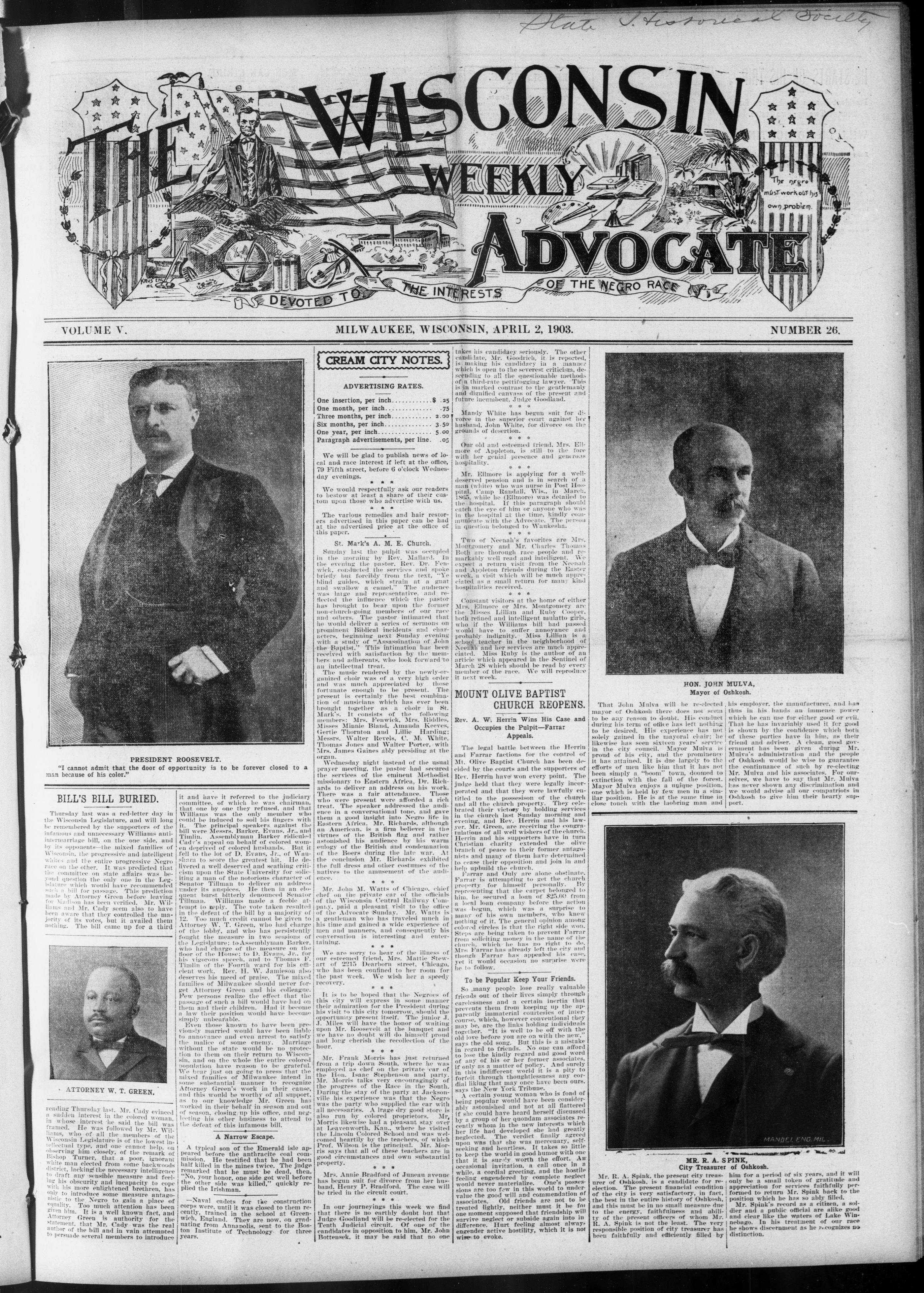
WISCONSIN
WEEKLY
Advocate
DEVOTED TO THE INTERESTS OF THE NEGRO RACE
T. E.
"I cannot admit that the door of opportunity is to be forever closed to a man because of his color."
VOLUME V.
PRESIDENT
"I cannot admit that the door of op man because of his color."
BILL'S BILL BURIED.
Thursday last was a red-letter day in the Wisconsin Legislature, and will long be remembered by the supporters of the infamous and unnecessary Williams anti-intermarriage bill, on the one side, and by its opponents—the mixed families of Wisconsin, the progressive and intelligent whites and the entire progressive Negro race on the other. It was predicted that the committee on state affairs was beyond question the only one in the Legislature which would have recommended such a bill for passage. This prediction made by Attorney Green before leaving for Madison has been verified. Mr. Williams and Mr. Cady seem also to have been aware that they controlled the majority of its votes, but it availed them nothing. The bill came up for a third
[Name]
ATTORNEY W. T. GREEN
reading Thursday last. Mr. Cady evinced a sudden interest in the colored woman, in whose interest he said the bill was framed. He was followed by Mr. Williams, who of all the members of the Wisconsin Legislature is of the lowest intellectual type, and one cannot help, on observing him closely, of the remark of Bishop Turner, that a poor, ignorant white man elected from some backwoods district, lacking the necessary intelligence to draft any sensible measure and feeling his obscurity and incapacity to cope with his more enlightened brethren, has only to introduce some measure antagonistic to the Negro to gain a place of equality. Too much attention has been given him. It is a well known fact, and Attorney Green is authority for the statement, that Mr. Cady was the real author of the bill and in vain attempted to persuade several members to introduce
---
it and have it referred to the judiciary committee, of which he was chairman, that one by one they refused, and that Williams was the only member who could be induced to soil his fingers with it. The principal speakers against the bill were Messrs. Barker, Evans, Jr., and Timlin. Assemblyman Barker ridiculed Cady's appeal on behalf of colored women deprived of colored husbands. But it fell to the lot of D. Evans, Jr., of Wanshura to score the greatest hit. He delivered a well deserved and scathing criticism upon the State University for soliciting a man of the notorious character of Senator Tillman to deliver an address under its auspices. He then in an eloquent burst bitterly denounced Senator Tillman. Williams made a feeble attempt to reply. The vote taken resulted in the defeat of the bill by a majority of 12. Too much credit cannot be given to Attorney W. T. Green, who had charge of the lobby, and who has persistently fought the measure in two sessions of the Legislature; to Assemblyman Barker, who had charge of the measure on the floor of the House; to D. Evans, Jr., for his vigorous speech, and to Thomas F. Timlin of the Fourth ward for his efficient work. Rev. H. W. Jamieson also deserves his meed of praise. The mixed families of Milwaukee should never forget Attorney Green and his colleague. Few persons realize the effect that the passage of such a bill would have had on them and their children. Had it become a law their position would have become simply unhearable.
Even those known to have been previously married would have been liable to annoyance and even arrest to satisfy the malice of some enemy. Marriage without the state would be no protection to them on their return to Wisconsin, and on the whole the entire colored population have reason to be grateful. We hear just on going to press that the mixed families of Milwaukee intend in some substantial manner to recognize Attorney Green's work in their cause, and this would be worthy of all support, as to our knowledge Mr. Green has worked in their behalf in season and out of season, closing up his office, and neglecting his other business to attend to the defeat of this infamous bill.
A Narrow Escape.
A typical son of the Emerald isle appeared before the anthracite coal commission. He testified that he had been half killed in the mines twice. The judge remarked that he must be dead, then, "No, your honor, one side got well before the other side was killed," quickly replied the Irishman.
Naval cadets for the construction corps were, until it was closed to them recently, trained in the school at Greenwich, England. They are now, on graduating from Annapolis, sent to the Boston Institute of Technology for three years.
CREAM CITY NOTES.
ADVERTISING RATES
One insertion, per inch..... $ .25
One month, per inch..... .75
Three months, per inch..... 2.00
Six months, per inch..... 3.50
One year, per inch..... 5.00
Paragraph advertisements, per line. .05
We will be glad to publish news of local and race interest if left at the office, 79 Fifth street, before 6 o'clock Wednesday evenings.
We would respectfully ask our readers to bestow at least a share of their custom upon those who advertise with us.
The various remedies and hair restorers advertised in this paper can be had at the advertised price at the office of this paper.
St. Mark's A. M. E. Church.
Sunday last the pulpit was occupied in the morning by Rev. Mallard. In the evening the pastor, Rev. Dr. Fenwick, conducted the services and spoke briefly but forcibly from the text, "Ye blind guides, which strain at a gnat and swallow a camel." The audience was large and representative, and reflected the influence which the pastor has brought to bear upon the former non-church-going members of our race and others. The pastor intimated that he would deliver a series of sermons on prominent Biblical incidents and characters, beginning next Sunday evening with a study of "Assassination of John the Baptist." This intimation has been received with satisfaction by the members and adherents, who look forward to an intellectual treat.
The music rendered by the newly-organized choir was of a very high order and was much appreciated by those fortunate enough to be present. The present is certainly the best combination of musicians which has ever been brought together as a choir in St. Mark's. It consists of the following members: Mrs. Fenwick, Mrs. Riddles, Misses Minnie Bland, Amanda Keeves, Gertie Thornton and Lillie Harding; Messrs. Walter Revels, C. M. White, Thomas Jones and Walter Porter, with Mrs. James Gaines ably presiding at the organ.
Wednesday night instead of the usual prayer meeting, the pastor had secured the services of the eminent Methodist missionary to Eastern Africa, Dr. Richards to deliver an address on his work. There was a fair attendance. Those who were present were afforded a rich treat. The speaker addressed the audience in a conversational tone, and gave them a good insight into Negro life in Eastern Africa. Mr. Richards, although an American, is a firm believer in the virtues of the British flag and rather astonished his audience by his warm eulogy of the British and condemnation of the Boers during the late war. At the conclusion Mr. Richards exhibited the full dress and other costumes of the natives to the amusement of the audience.
☆ ☆ ☆
Mr. John M. Watts of Chicago, chief chef on the private car of the officials of the Wisconsin Central Railway Company, paid a pleasant visit to the office of the Advocate Sunday. Mr. Watts is a gentleman who has traveled much in his time and gained a wide experience of men and manners, and consequently his conversation is interesting and entertaining.
※ ※ ※
We are sorry to hear of the illness of our esteemed friend, Mrs. Mattie Stewart of 2215 Dearborn street, Chicago, who has been confined to her room for the past week. We wish her a speedy recovery.
※ ※ ※
It is to be hoped that the Negroes of this city will express in some manner their admiration for the President during his visit to this city tomorrow, should the opportunity present itself. The junior J. J. Miles will have the honor of waiting upon Mr. Roosevelt at the banquet and we have no doubt will do himself proud and long cherish the recollection of the hour.
* * *
Mr. Frank Morris has just returned from a trip down South, where he was employed as chef on the private car of the Hon. Isaac Stephenson and party. Mr. Morris talks very encouragingly of the progress of the Race in the South. During the stay of the party at Jacksonville his experience was that the Negro was the party who supplied the car with all necessaries. A lrage dry good store is also run by colored proprietors. Mr. Morris likewise had a pleasant stay over at Leavenworth, Kan., where he visited the Lincoln Colored School and was welcomed heartily by the teachers, of which Prof. Wilson is the principal. Mr. Morris says that all of these teachers are in good circumstances and own substantial property.
※ ※ ※
Mrs. Annie Bradford of Juneau avenue has begun suit for divorce from her husband, Henry P. Bradford. The case will be tried in the circuit court.
\* \* \*
In our journeyings this week we find that there is no earthly doubt but that Judge Goodland will be re-elected for the Tenth Judicial circuit. Of one of the candidates in opposition to him, Mr. John Bottensek, it may be said that no one
takes his candidacy seriously. The other candidate, Mr. Goodrich, it is reported, is making his candidacy in a manner which is open to the severest criticism, descending to all the questionable methods of a third-rate petifogging lawyer. This is in marked contrast to the gentlemanly and dignified canvass of the present and future incumbent, Judge Goodland.
* * *
Mandy White has begun suit for divorce in the superior court against her husband, John White, for divorce on the grounds of desertion.
* * *
Our old and esteemed friend, Mrs. Ellmore of Appleton, is still to the fore with her genial presence and generoas hospitality.
Mr. Ellmore is applying for a well-deserved pension and is in search of a man (white) who was nurse in Post Hospital, Camp Randall, Wis., in March, 1865, while he (Ellmore) was detailed to the hospital. If this paragraph should catch the eye of him or anyone who was in the hospital at the time, kindly communicate with the Advocate. The person in question belonged to Waukesha.
```markdown
```
Two of Neenah's favorites are Mrs. Montgomery and Mr. Charles Thomas Both are thorough race people and remarkably well read and intelligent. We expect a return visit from the Neenah and Appleton friends during the Easter week, a visit which will be much appreciated as a small return for many kind hospitalities received.
Constant visitors at the home of either Mrs. Ellmore or Mrs. Montgomery are the Misses Lillian and Ruby Cooper, both refined and intelligent mulatto girls, who if the Williams bill had passed would have to suffer annoyance and probably indignity. Miss Lillian is a school teacher in the neighborhood of Neenah and her services are much appreciated. Miss Ruby is the author of an article which appeared in the Sentinel of March 28 which should be read by every member of the race. We will reproduce it next week.
MOUNT OLIVE BAPTIST CHURCH REOPENS.
Rev. A. W. Herrin Wins His Case and Occupies the Pulpit—Farrar Appeals.
The legal battle between the Herrin and Farrar factions for the control of Mt. Olive Baptist Church has been decided by the courts and the supporters of Rev. Herrin have won every point. The judge held that they were legally incorporated and that they were lawfully entitled to the possesison of the church and all the church property. They celebrated their victory by holding services in the church last Sunday morning and evening, and Rev. Herrin and his lawyer, Mr. Green, are receiving the congrulations of all well wishers of the church. Herrin and his supporters have in turn Christian charity extended the olive branch of peace to their former antagonists and many of them have determined to cease their opposition and join in and help uphold the church.
Farrar and Ouly are alone obstinate. Farrar is attempting to get the church property for himself personally. By representing that the carpet belonged to him, he secured a loan of $25.00 from a local loan company before the action was begun, which was a surprise to many of his own members, who knew nothing of it. The general opinion among colored circles is that the right side won. Steps are being taken to prevent Farrar from soliciting money in the name of the church, which he has no right to do. Mrs. Farrar has already left the city and though Farrar has appealed his case, yet it would occasion no surprise were he to follow.
To be Popular Keep Your Friends.
So many people lose really valuable friends out of their lives simply through carelessness and a certain inertia that prevents them from keeping up the apparently immaterial courtesies of intercourse, which, however conventional they may be, are the links holding individuals together. "It is well to be off with the old love before you are on with the new," says the old song. But this is a mistake in regard to friends. No one can afford to lose the kindly regard and good word of any of his or her former associates, if only as a matter of policy. And surely in this indifferent world it is a pity to forfeit through thoughtlessness any cordial liking that may once have been ours, says the New York Tribune.
says the New York Times.
A certain young woman who is fond of being popular would have been considerably astonished and not at all flattered if she could have heard herself discussed by a group of her quondam associates recently whom in the new interests which her life had developed she had greatly neglected. The verdict finally agreed upon was that she was mercenary, self-seeking and heartless. It takes so little to keep the world in good humor with one that it is surely worth the effort. An occasional invitation, a call once in a while, a cordial greeting, and the hostile feeling engendered by complete neglect would never materialize. One's possessions are too few in this world to undervalue the good will and commendation of associates. Old friends are not to be treated lightly, neither must it be for one moment supposed that friendship will survive neglect or subside again into in difference. Hurt feeling almost always engender active hostility, which it is not wise to evoke.
M. H.
MANDEL ENG. MIL.
That John Mulva will be re-elected mayor of Oshkosh there does not seem to be any reason to doubt. His conduct during his term of office has left nothing to be desired. His experience has not solely gained in the mayoral chair; he likewise has seen sixteen years' service in the city council. Mayor Mulva is proud of his city, and the prominence it has attained. It is due largely to the efforts of men like him that it has not been simply a "boom" town, doomed to extinction with the fall of the forest. Mayor Mulva enjoys a unique position, one which is held by few men in a similar position. He is at the same time in close touch with the laobring man and
MR. R. A. S.
City Treasure
Mr. R. A. Spink, the present city treasurer of Oshkosh, is a candidate for reelection. The present financial condition of the city is very satisfactory, in fact, the best in the entire history of Oshkosh, and this must be in no small measure due to the energy, faithfulness and ability of the present officers of whom Mr. R. A. Spink is not the least. The very responsible position of city treasurer has been faithfully and efficiently filled by
NUMBER 26.
MULVA,
Oshkosh.
his employer, the manufacturer, and has thus in his hands an immense power which he can use for either good or evil. That he has invariably used it for good is shown by the confidence which both of these parties have in him, as their friend and adviser. A clean, good government has been given during Mr. Mulva's administration and the people of Oshkosh would be wise to guarantee the continuance of such by re-electing Mr. Mulva and his associates. For ourselves, we have to say that Mr. Mulva has never shown any discrimination and we would advise all our compatriots in Oshkosh to give him their hearty support.
MANDEL ENG. MIL.
PINK,
of Oshkosh.
him for a period of six years, and it will only be a small token of gratitude and appreciation for services faithfully performed to return Mr. Spink back to the position which he has so ably filled.
Mr. Spink's record as a citizen, a soldier and a public official are alike good and clear like the waters of Lake Winnebago. In his treatment of our race he shows discernment as he recognizes no distinction.
HE STARTS ON HIS TRIP.
President Leaves Washington for Tour of Twenty-Two States.
Description of the Palatial Train in Which the Journey is Made-To Make Many Speeches.
Washington, D. C., April 1.—The President and his party left Washington for the Western tour at 9:05 this morning.
As the special train pulled out of the Pennsylvania station the President stood on the platform of his private car, tipping his hat and smiling in response to the enthusiastic cheers of hundreds of admirers and personal friends.
As early as 8 o'clock a crowd began to gather at the white house to witness the President's departure. As he entered his carriage to drive to the station the men made the historic grounds echo with cheers while women waved their handkerchiefs and many of the men their hats. As President Roosevelt alighted from his carriage he was joined by Secretary Hitchcock and they walked down the station platform arm in arm, the President stopping now and then to greet personal friends. He was attired in a black cutaway coat, dark striped trousers and wore a black felt hat. He was in the best of spirits and chatted enthusiastically to friends of the trip upon which the was about to start. Several members of the cabinet, including Secretaries Cortelyou, Wilson and Hitchcock, were present. The President and Secretary Cortelyou chatted several minutes, the President expressing regret that the secretary was not to accompany him. Other members of the cabinet had taken their formal leave of the President at the white house. In addition to those officially designated as members of the President's party, three secret service men and two postoffice inspectors accompanied the President as a personal bodyguard.
A Notable Incident.
The most notable incident connected with the President's departure arose out of the presence at the station of Baron Speck von Sternberg, the German minister. He was the only member of the diplomatic corps who went to the depot to see the President off and the President greeted him most cordially, telling him that he greatly appreciated the courtesy. During their chat the President asked the baron, whether he would be here in June when he returned, and upon receiving an affirmative reply the President said: "That is good; we will have some long rides together."
The baron told the President that his horses were in India and would not be here for some time. Instantly the President turned and gave orders that during his absence his riding horse and that of Mrs. Roosevelt should be placed at the disposal of Baron and Baroness von Sternberg. "I should be very much pleased," said he to the baron, "if you and the baroness would ride them while I am away."
Visits Twenty-two States.
The President's trip covers 14,000 miles through twenty-two states. He will be absent from the capital sixty-six days, returning here on the evening of June 5. The train will consist of six coaches, and will be one of the most handsome ever placed on the tracks. It will be lighted throughout by electricity, and every coach will be equipped with all the modern conveniences and the latest inventions. The President's car, the Elysian, will be the last in the train. This car is fitted with an observation parlor, three state rooms, a dining room in two sections, a kitchen and servants' quarters. On this car the President will take his meals. They will be prepared in a wonderful little kitchen by the best chef in the employ of the company.
From the rear platform of the Elysian the President will deliver many important addresses on numberless subjects and in this respect the trip will be an exacting one. Directly ahead of the Elysian will be the Texas, a compartment sleeper; then the Senegal, a section sleeper; next a dining car, then the Atlantic, a buffet parlor car, and next to the engine will be a baggage coach.
Reliable Train Crew.
The train crew will be made up of the same reliable men who have accompanied the President upon several of his former trips. Conductor William H. Johnson will have general charge of the train. The President is to be served while on the train by Spencer Murray, the little, bald, gray mustached waiter who has attended the chief executives upon their journeys for half a score of years.
The party accompanying the President will be small and will consist of Secretary Loeb, Assistant Secretary Barnes, Surgeon General Rixey and John Burroughs, the poet and naturalist, who will explore Yellowstone park with the President, and a number of newspaper representatives, photographers, telegraphers and stenographers.
President Roosevelt has announced positively that he will do no hunting on his trip and will not even take his trusty rifles and fowling pieces, with him.
BABCOCK MAKES DENIAL.
Not Fighting La Follette and will Not Retire from House of Representatives.
Washington, D. C., April 1.—Representative Babcock of Wisconsin, who was among the President's callers yesterday, made the following statement concerning his attitude toward Gov. La Follette:
"I see that I am credited with organizing a movement to defeat the political aspiration of Gov. La Follette, but people who know my methods of political fighting know that I never fight a man. Whenever I make a fight it is on the principle of a thing—issues and not men. These are the usual warm weather stories.
"I see it also published that I have decided to retire from Congress at the close of my present term and go to farming. Well, it is true that my son has bought a farm on which is situated a beautiful lake that is mighty attractive, but it will be several years before he gets it stocked with the right kind of fish to suit me, and I suppose I will not voluntarily retire anyhow for a much longer period than the story fixes."
OIL TANKS BURNED.
Standard Oil Company and Two Other Concerns Lose $1,200,000.
Calcutta, April 1.—A number of oil tanks at Bajbaq, province of Bengal, belonging to the Standard Oil Company and two other concerns, were burned yesterday. The damage amounts to about $1,200,000.
INDICTS NINETEEN.
Grand Jury at Seattle, Wash., Finds Evidence of Corruption in City Government.
Seattle, Wash., March 31. After a dramatic scene in court, in which representative members of the local bar resorted to every means in their power to prevent, the grand jury returned all the indictments which it had voted during the past two weeks, including those against the mayor, chief of police, justices and other prominent men in the community.
In all nineteen indictments were returned, seven of which are against petty offenders. A number of the more prominent ones are withheld from the minute of the court, but the following list embraces all save the minor ones referred to: Mayor T. J. Humes, malfeasance in office; Chief of Police Sullivan, malfeasance in office; Police Judge George, failure to perform his sworn duty; Justice T. H. Sann, extortion and perjury; George U. Piper, perjury; Jacob Furth, obtaining a valuable property by fraud; Walter S. Fulton, failure to perform his sworn duty; Charles F. Whittlesey, larceny by embezzlement; P. P. Padden, larceny by embezzlement; W. H. Whittlesey, larceny by embezzlement.
Judge Cann was indicted for failing to satisfactorily account to the jury the proper notation of $3.60 paid into his court by Fred Gardner, clerk in the United States attorney's office, in connection with the issuance of a warrant for a woman at San Francisco. It is claimed that Judge Cann's testimony relating to the alleged misappropriation of the fee incidentally convicted him of perjury. Messrs. Furth and Shuffelton were indicted for their connection with the granting of a lighting franchise to the former by the city council in the spring of 1902. Mr. Furth, as president of the Seattle Electric Company, acquired the franchise immediately it had been issued to Shuffleton, while several councilmen told the municipal body that he applied for it for his own use as the head of a rival lighting corporation and not for assignment to any other person.
ANNUAL LOG DRIVE.
No Trouble Experienced in Getting an Early Start on Peshtigo River
Menominee, Mich., March 31.—[Special.]—The Peshtigo river drive has been started and with a full head of water and the logs are fast being floated down the stream to the mill. The drive started earlier this season than last and there is every indication that all of the logs will be gotten out this spring.
The only other drive started is that of the Hamilton-Merryman Company, on the Pemene-Bum Won, although most all of them will be commenced in a few days. A crew of men has been sent up to this stream, which is open, as are now all of the streams tributary to the Menominee. The annual drive meeting will be held today, when the drives will be apportioned. At this meeting the report of Clem William, who made the estimate of the amount of timber to be floated down this season, will be made public and other important business will be transacted.
MEN ARE COVERED WITH MOLTEN METAL.
Explosion at Blast Furnace at Edgar Thompson Steel Works at Braddock, Pa.
Pittsburg, Pa., March 31.—Fourteen men were seriously burned and three fatally as a result of an explosion early today at the blast furnace "I" of the Edgar Thompson works at Braddock, Pa. The injured men were casting and without the least warning the big furnace suddenly let go, throwing the molten metal in all directions and covering the men in some cases from head to feet. Doctors were hurried to the scene and after dressing the injured seven of the victims were removed to the Mercy Hospital in this city on a special street car. One of the men died on the way to the hospital and several of the victims will not recover. All are foreigners and all are horribly burned about the head, face and upper portion of their bodies.
DEATH OF H. W. CORBETT.
Heart Trouble Carries Off Oregon Man Worth $5,000,000.
Portland, Ore., March 31.—H. W. Corbet, ex-banker and formerly United States senator from this state, died at his home in this city today from heart trouble. He had been in poor health for some time and only yesterday he resigned as president of the Lewis and Clarke exposition. Mr. Corbett was 76 years of age and had lived in Portland fifty-four years, coming from New York in 1851. His fortune is estimated at about $5,000,000.
HELD FOR MALICIOUS MISCHIEF.
Riotous Demonstration Against "Mc- Fadden's Row of Flats."
Philadelphia, Pa., March 31.—The eighteen men arrested last night as a result of a riotous demonstration during a performance of the farce "McFadden's Row of Flats," were arraigned for a hearing today and seventeen of them were held in $500 bail, charged with malicious mischief and assault and battery. The eighteenth man was discharged.
ANNA HELD AIDS AMES BOY.
Actress and Florence Ziegfeld, Jr., Patrons of Aspirant for Stage.
Minneapolis, Minn., March 31.—Marry Ames, 18 years old, son of Fred W. Ames, the former chief of police and brother of ex-Mgyor Ames, left yesterday for Chicago, where he will study singing and dramatic art. He is under the patronage of Florence Ziegfeld, Jr., and his wife, Anna Held, friends of his father. The boy's voice is considered remarkable.
No Escape for Him.
"How come Br'er Williams is takin' up de collection an' puttin' de money in his pocket?" said Brother Dickey, in an agitated whisper.
"He say." replied a deacon, "de hat what he had got a hole in it."
And then did Brother Dickey rise, and lifting his hand as a sign for the singing to cease, cried with a loud voice: "Dey's a col' win' comin' up de aisle throo' de front do'. Will some brother please lock dat do' en stand wid his back again' it ontel Br'er Williams gits thoo takin' up de collection?"—Atlanta Constitution.
Soldiers' Handkerchiefs.
The Russian government has decreed that in future all soldiers of the empire must use handkerchiefs—heretofore not one soldier out of a thousand has indulged in this luxury—and that all the handkerchiefs must contain pictures emblematic of a soldier's life, both in battle and in time of peace.—Exchange.
—Cotton has the same composition as wood.
Proceedings in the Senate.
The Merton bill, the primary election bill measure reported by the committee on privileges and elections, was killed at the forenoon session of the Senate on the 26th by a vote of 18 to 14, Senator Bird being absent. When No. 3428, to abolish the taxation of credits, came up in the Senate Senator Merton said he wanted to offer a substitute. He was ruled out of order, and Senator North moved to send the bill back to the committee. Recommitment was refused by a vote of 17 to 11. Senator Reukema said he could not see why it was not reasonable to give the substitute of Senator Merton a hearing, as a matter of courtesy. The bill then passed. The Frear bill, appropriating $4000 for the governor's contingent fund, was concurred in. No. 631A, relating to the terms of supervisors in cities and providing for annual elections, except where otherwise provided in the charters, was also concurred in. No. 350S, the bill to limit the school fund tax to 7-10 of a mill and take $350,000 from the general fund, was ordered engrossed after a short explanation. Senator Merton's bill, providing that no decree of divorce shall be entered until one year after it has been granted, was passed. Mr. Timlin's bill, to regulate the storage of acids was amended so as to permit Milwaukee to require sprinkling nozzles on standpipes, and then ordered to a third reading.
The Senate at the evening session on the 26th passed the Assembly primary election bill with an amendment that the provisions of the measure relating to state officers, congressmen, and members of the Legislature shall be submitted to the people in 1904 and ratified by them before taking effect. The vote on the bill as amended was 18 to 15, the three Democratic senators voting with the minority. On the adoption of the amendment the vote was 18 to 15, sixteen Republicans and a majority of the entire Republican membership of the Senate, and Senators Randolph and North, Democrats, voting in favor of it.
The anti-cigarette bill sent over from the Assembly caused a little stir between Senators Eaton and Bird in the upper house on the 27th. The president referred the bill to the committee on state affairs, but Senator Eaton asked for reference to his committee, the committee on health and sanitation. The latter yielded, however, when Senator Bird showed that all other bills of the same character were before the committee on state affairs. Bill 48S, the compulsory school measure, and the bill 207A, to prohibit the use of highways for camping purposes (the so-called gypsy bill) were laid over. Bill 253S (Bird), altering boundaries of territory in Marinette county and creating new towns, was ordered engrossed. The following bills were passed: 35S, permitting mutual fire insurance companies to insure property in any county in the state; 74S (Green), authorizing life insurance companies having $100,000 capital stock to engage in the business of personal, accident and health insurance; 219S (Roehr), amending the law relative to casualty, credit, title and surety insurance; 334S (Rogers), providing that a guardian may file election to take dower of widow who becomes insane. The following Assembly bills were concurred in: 65A (Lenroot), regulating the issue of warehouse certificates on cars; 119A (Reynolds), authorizing Oscar Mainz to build a pier in Sturgeon bay; 198A, authorizing counties to pay bounty for rattlesnakes; 315A (Timilin), regulating the storage of nitric and other dangerous acids; 502A (Crowley), extending city printing contracts in Milwaukee until new contract is awarded. The primary election bill as amended by the Senate was received in a message from that body. On motion of Mr. Andrew action on it was deferred. The Senate bill introduced by Senator Randolph, requiring railway companies to post a bulletin board at all stations having a telegraph office, on which, at least twenty minutes before the schedule time for arrival of a train, shall be posted the fact whether it is on time, and if late, how much, was concurred in. The Eaton bill, 63S, authorizing villages to borrow money to the amount of 3 per cent. of assessed valuation for construction of sewers, was also concurred. The limit is now 1 per cent.
The Senate on the evening of the 31st received a message from Gov. La Follette withholding his approval of No. 19S, a bill to allow county boards to appropriate not to exceed $10,000 for a soldiers' and sailors' monument without submitting the question to a vote of the people. After the message was read Senator North moved that it be laid over until the 9th, which motion prevailed. Senator Green discovered something wrong in No. 80A, relating to toilet rooms in interurban cars, in which the Senate had concurred and had it recalled from the Assembly. Senator Roehr's greater Milwaukee resolution came up for passage in the Senate and was laid over one week. On motion of Senator McGillivray leave was given the special committee that investigated the coal famine to introduce a bill.
In the Senate on the 31st after disposing of some routine business and concurring in Assembly bill 207A, prohibiting the use of public highways for camping purposes, the Frear bill taking game birds for propagating purposes, was taken up and Senator Wipperman moved passage under suspended rules. This gave rise to a parliamentary question. Senator McDonough moved to omit the roll call and to simply ask if there was any objection to suspending the rule, as this mode of procedure had been introduced long ago in the United State Senate and the House of Representatives. The president was of the opinion that a roll call was necessary, as two-thirds of the members must be in favor of it. He yielded, however, when Senators Kreutzer and Hudnall showed that no roll call was provided for. The bill was then passed. One bill, 481A, providing for a change of method in making contracts with asphalt companies in cities of the first class, was ordered to a third reading. On motion of Senator Martin all joint resolutions laid over to April 7 were made a special order for 7:30 p. m. April 9.
The Senate on the 1st refused to recode from its amendment to the primary bill. Senator Whitehead presented the resolution. There was no debate and the resolution was adopte, 19 to 14. Senator Hagemelster presented a joint resolution to adjourn Friday until Monday, April 13. Next week is Holy week, Tuesday is election day and the members will all go home and cannot return until Wednesday night. Many members do not want to have sessions on Monday, Thursday, Good Friday and Holy Saturday and will not attend. For that reason an adjournment for the entire week is favored. The bill giving T. J. Fleming the right to purchase a certain tract of land near the State Fair park from the state was adopted by a vote of 25 to 6. Two other bills were passed—488, the compulsory school bill, and 481A, providing for changing of method of making contracts with asphalt companies in cities of the first class.
Proceedings in the Assembly
The Assembly on the 26th killed the Williams negro marriage bill, and during a long and acrimonious discussion of it Assemblyman David Evans, Jr., of Waushara county, so fiercely attacked Senator Tillman of South Carolina, and so sharply criticised the state university for getting a man of his character to deliver an address under its auspices that he was hissed and the speaker was compelled to rap for order. The bill was killed by a vote of 51 to 39. Heated discussion marked the entire session. The Assembly passed the Dudgeon bill, absolutely prohibiting the manufacture, sale, or importation of cigarettes or cigarette paper in this state. It also passed the Barker bill, making it unlawful to take beer or other intoxicating liquors into a voting booth during the progress of an election. Both bills were passed without discussion. Among the bills passed was No. 581A, introduced by Mr. Dinsdale, authorizing the commissioner of labor statistics and the inspectors employed in his department to inspect tenement houses for the purpose of ascertaining their sanitary condition. Ten bills on the calendar for indefinite postponement were killed in a bunch. Among them were the
Westfahl bill authorizing the city of Milwaukee to employ a fire marshal and a deputy fire marshal.
An effort to reconsider the vote by which a Saturday session was decided on was the first business taken up by the Assembly on the 27th. The motion failed—45 to 22. The chief clerk read a statement of the condition of business, which showed 284 Assembly bills have been disposed of, and 358 are still in the hands of committees; 28 Senate bills have been concurred in and 68 are in committee. The bill providing a $50,000 contingent fund for the use of the state board of health, with the consent of the governor, in suppression of contagious diseases, was amended in the committee cutting out its application to smallpox and other contagious diseases, leaving
only bubonic plague and Asiatic cholera thus guarded against. The Assembly turned down the report of the claims committee, defeating the amendment 55 to 23. E. W. Evans offered an amendment making the fund $100,000, but it was voted down, 73 to 5, and the original bill with protection against smallpox included was ordered to engrossment and third reading. The following bills were killed: 332A, amending the law relative to assessments in joint school districts; 436A, limiting assessments for highway taxes; 530A, amending the law relative to apportionment of taxes by county boards. Adjournment was taken to 10 a.m. on the 28th.
Less than a score of members were present at the session of the Assembly on the 28th, and the roll call was dispensed with. Senator Reukena's bill granting the board of school directors of the city of Milwaukee power to determine the location and select plans for new school buildings was ordered to a third reading. The Assembly passed the bill providing that suicide more than a year after the issuance of a life insurance policy shall not make such policy void. It also passed the Douglas bill, No. 203A, providing for the assignment of estates and the giving of receipts therefor, and the Cosgrove bill, No. 445A, granting the Eau Claire, Chippewa Falls and Northwestern Railroad Company a right of way over a portion of the grounds of the home for the feeble minded at Chippewa Falls. Adjournment was to the evening of the 30th.
When the request from the Senate for the return of the bill relating to toilet rooms in interurban cars came before the Assembly on the evening of the 31st, Mr. Crowley, author of the measure, protested against granting it, but his protest was overridden by a vote of 34 to 17. The Reukema bill giving the Milwaukee school directors authority to select the location and plans for
The action of the Senate regarding the primary bill on the 1st was immediately messaged over to the Assembly. As soon as the Senate's message was received Mr. Hray urged that the Assembly insist on its position and moved a committee of confluence. Agreed to. The bill permitting the merger of public services was reported favorably to the Assembly for passage. Messrs. Cady, Douglas and Carpenter dissenting. The Senate amendment to 675, changing the method of selecting grand juris, was concurred in. Mr. Karrel asked and obtained permission to withdraw from committee the bill prohibiting the giving of trading stamps, etc., upon sale of goods. The bill 430A, making it unlawful for the insurance companies to make agreements fixing rates, was reported for indefinite postponement by the committee on finance, banks and insurance. The bill instructing the attorney general to institute suit to recover value of school lands on Indian reservations was reported for passage by the judiciary committee. The Assembly refused the request of the Senate to return the Crowley bill requiring interurban railways to provide cars with closets and then concurred in the Senate amendment extending the time when the law shall go into effect from January to April, 1904. The Senate joint resolution permitting the special committee which investigated the coal shortage to introduce a bill carrying out its recommendations as to filing reports of amount on hand, cost, etc., of coal, with the secretary of state, was concurred in. Senate bill 343S, authorizing a dam across Flinthe river, in Gates county, was concurred in.
The Assembly on the 31st, by a vote of 76 to 12, refused concurrence in the Senate amendment to the primary bill. The amendment to submit the entire question to the people was voted down by a vote of 22 to 65, give Democrats refusing to stand by the caucus action. The bill will now go back to the Senate, where it is expected a committee of conference will be asked for. The first vote was on the Confland amendment for a referendum on the entire bill. It was lost, 65 to 22. Without further debate the vote was taken on the Senate amendment for a referendum on all except county and city officers and the Assembly refused to concur by a vote of 74 to 12. Minor Senate amendments, as to some details, which have been agreed on, were concurred in. The Senate amendment to the 'Yimlin nitric acid bill, authorizing as an alternative the erection of standpipes and use of distributing nozzles in buildings where acids were passed: Providing a $50,000 contingent fund for prevention of asatic cholera, bulbonic plague, smallpox and other contagious diseases; requiring banks receiving deposits of state monies to deposit securities with the state treasurer; detaching territory from the town of Lawrence, Gates county, and creating the town of Hawkins. The following Senate bills were concurred in: Providing that unexpended balance of appropriations to the State Historical Society may be added to expenditures of the next year; legalizing certain city bonds not submitted to vote of the people; granting the United States jurisdiction over site for a federal building in Wausau. The Barker bill to suppress political lobbyists was at his request laid over. The Martin bill requiring town, city and village physicians to analyze the water, where there are water departments, was killed without debate. The Dudgeon bill, permitting church insurance companies to issuer property of church members, slated for a similar fate, was laid over.
new school buildings was on the Assembly calendar for concurrence, but on motion of Mr. Crowley it was referred to the committee on cities. The Assembly with out discussion passed the Smalley bill fixing the rate of taxation for the common school fund income at 6-10 of a mill. The vote was 68 to 10. There was a contest over the Coffland bill, providing that district attorneys shall represent their countries in civil actions appealed to the supreme court. Mr. Strong dially moved that it be laid upon the table, but the motion was lost by a vote of 54 to 24. Then it was indelinitely postponed by a vote of 50 to 24.
One Answer for All.
Lancaster, N. Y., March 30.—Postmaster Remers is still in receipt of many letters asking if his cure has held good.
It will be remembered that some time ago the particulars of Mr. Remers' case were published in these columns. He had been very low with Diabetes. Physicians could do nothing to save him and he grew worse and worse till someone recommended Dodd's Kidney Pills. A treatment of this remedy was begun and when eight boxes had been taken Mr. Remers began to see an improvement which continued as the treatment proceeded till he was completely restored.
He has since enjoyed perfect health and is as robust and able a man as any in Lancaster. Interviewed the other day, he said:
"Many people wrote to me when the story of my case was first printed and some write to me yet, asking if the cure was only temporary and if the diabetes has returned. I have only one answer to everybody. Three years ago I was very low with Diabetes. The best physicians failed to help me and Dodd's Kidney Pills cured me. I am well and strong and have not had the slightest return of the old trouble."
Novel Easter Gift.
Heralds of Easter, in the shape of dainty articles designed as gifts of the season, are making their appearance in the shops, and many clever girls are already evolving their intended gifts at home. One of the cunningest of these, which is a decided novelty as well, is a diminutive Easter bonnet made of raffia and designed to hang beside the dressing bureau to hold hairpins. The raffia should be braided as loosely as possible and then sewn into a small bonnet. Into the crown the hairpins are thrust. The trimming for the hat consists of cream lace and a tiny bunch of violets. Strings of violet satin ribbon are used to suspend it from.—Brooklyn Eagle.
While off the Azores a vessel was boarded by a carrier pigeon, which proved to belong to Ruabon, in Wales. It had not been seen since last July, when it was thrown up in a flying competition at Nantes, in France.
MEN CAN STRIKE.
Injunction Granted at St. Louis Against Wabash Railway Employes is Dissolved.
St. Louis, Mo., April 1.—In the United States, district court to Judge Elmer B. Adams handed down a decision dissolving the injunction granted March 3, restraining officials of the Brotherhoods of Locomotive Firemen and Railroad Trainmen and other labor leaders from influencing in any way or ordering the men employed on the Wabash system to strike. The temporary injunction had been granted by Judge Adams on allegations made by officials of the Wabash system that the defendants were conspiring to interfere with interstate traffic and the transmission of United States mails. The decision dissolving the injunction was rendered at 10:50 o'clock.
Charges Not Sustained.
In his decision Judge Adams first analyzes the bill of complaint upon which the provisional restraining order was issued, showing that the gravamen of the charge was that the defendants had entered into an unlawful and malicious conspiracy to secure recognition of their brotherhoods by falsely representing that the employes of the railroad who were members of the brotherhoods were dissatisfied with their wages and conditions of service when they were in fact entirely satisfied and contented with the same; that the defendants were about to exercise their powers as supreme and controlling officers of the Brotherhood of Firemen and Trainmen to force an undesired strike upon the men, who were members of their organizations; that defendants threatened and were about to further enforce their demands and to execute their conspiracy by preventing the railroad from performing duties as carriers of interstate commerce and the mails of the United States by preventing their members who were working for connecting lines from handling the traffic of the railroad and thus preventing such connecting lines from interchanging traffic with and affording the Wabash the facilities therefor required by the interstate commerce act.
To Precipitate a Strike.
The gist of the conspiracy coming within the jurisdiction of the federal courts as charged in the bill was to precipitate a strike undesired by the men and thereby and by other means specifically charged in the bill to interfere with interstate commerce and the mail service of the United States.
Upon the showing made that the first step of the conspiracy, namely, the ordering of such a strike, was contemplated by the defendants and that irreparable damage would necessarily befall the railroad unless a restraining order was forthwith issued, the same was done for the purpose of holding the property and the parties in statu quo until both sides could be fully heard on the motion to set aside or modify the order. Leave was given to file such a motion at any time within fifteen days. The decision then justifies the issuance of the preliminary injunction as authorized by the statutes on the showing made by the plaintiffs, and then reviews the denials made by the defendants, giving a complete history of the case.
Continuing, the court says;
The question now is, whether upon all of the proof before it the court should award a preliminary injunction or set aside the provisional restraining order already made.
The court, after fully considering all the proof finds that the statements of the bill of complaint to the effect that the employees were satisfied with their wages and conditions of service are not supported: that irrespective of the question whether the men of the committees of the brotherhoods representing them first suggested the increase of wages and change of rules, the employees themselves, at and for a long time prior to the filing of the bill of complaint were dissatisfied with their wages and condition of service, and a real difference of opinion existed between the railroad and a large majority of its employees, members of the brotherhoods, with respect to their wages, and that the defendants as officer and committees of the brotherhoods were fully authorized both by reason of their official relation to their members and also by direct written authority to represent them in the effort to secure higher wages and changed conditions of service, and that the proposed strike instead of being officiously ordered by defendants was a result of the vote of the employees acting without coercion and directly authorizing the same.
Privileges of Employes.
The court further finds after a full examination of the evidence that the charge of conspiracy to interfere with the interstate commerce of the United States or the mail service of the United States is not sustained.
In discussing these issues after reviewing many authorities, the court concludes and lays down the law governing the rites, duties and privileges of employees as found on the latter part of page 8 and the fore part of page 9 of the opinion.
The court finishes its opinion by stating its conclusions with a summary of the situation pertaining to the controversy.
F. N. Judson of St. Louis, special counsel for the brotherhoods, stated to the Associated Press that he and Col. Wells H. Blodgett, general solicitor of the Wabash, were making efforts to bring all the parties interested together, and that in his opinion an amicable agreement would be arrived at and that there would be no strike. Col. Blodgett, when seen after the court, was apparently depressed by the decision. When asked if an appeal would be taken, he said: "It is too early to say now whether or not we will appeal. That will be decided after the decision shall have been read."
Amicable Settlement Possible.
At Wabash headquarters, General Counsel Blodgett said to the Associated Press: "After the decision was rendered counsel for the brotherhoods and I conferred briefly, but no conclusions were reached. I cannot say anything as to the future. I want some time to go over the situation and cannot make any expression today."
"Do you think there will be a strike?"
"I am not prepared to answer that question as at present I have no idea what may be done."
"Will you notify President Ramsey of the decision?"
"No, we will not attempt it. President Ramsey, who is on his way to Cairo, Egypt, to attend the bedside of his daughter, left the steamer at Cherbourg last Monday and immediately took the train. He is scheduled to arrive in Cairo next Saturday and we do not know just where to reach him today. Doubtless he will see the news while en route." Col. Blodgett then returned to the room where the legal men of the Wabash were engaged in closely reading the court's decision.
VETERAN EDITOR DIES.
Dr. Thos. O. Foster Began with the Philadelphia Ledger in 1836.
San Francisco, Cal., April 1. After a lingering illness Dr. Thomas O. Foster died yesterday at the age of 85 years. He was one of the oldest newspaper men in the country, having been connected in an editorial capacity with the Philadelphia Public Ledger in 1836. He went to Minnesota in 1849 and there became editor of the Daily Minnesotan, published in St. Paul. He shortly afterward engaged in the practice of medicine and was government physician and surgeon for the Indians in Minnesota up to 1873.
Littly's
LIBBY LUNCHEONS made ready in a few moments. The Wafer Sliced Smoked Beef, Pork and Beans, Veal Loaf, Potted Chicken, and lots of good things to eat.
Are U. S. Government Inspected
Keep in the house for emergencies—for suppers, for sandwiches—for any time when you want something good and want it quick. You simply turn a key and the can is open. An appetizing lunch is ready in an instant.
Libby, McNeill & Libby
Chicago, Ill., U. S. A.
Write for our free booklet "How to Make Good Things to Eat."
W.L.DOUGLAS
SHOES $3.50
UNION MADE
W. L. Douglas makes and sells more men's Goodyear Welt (Hand-Sewed Process) shoes than any other manufacturer in the world.
$25,000 REWARD will be paid to anyone who can disprove this statement.
Because W. L. Douglas is the largest manufacturer he can buy cheaper and produce his shoes at a lower cost than other concerns, which enables him to sell shoes for $3.50 and $3.00 equal in every way to those sold elsewhere for $4 and $5.00.
$25,000 REWARD will be paid to anyone who can disprove this statement.
Because W. L. Douglas is the largest manufacturer he can buy cheaper and produce his shoes at a lower cost than other concerns, which enables him to sell shoes for $3.50 and $3.00 equal in every way to those sold elsewhere for $4 and $5.00.
The Douglas secret process of tanning the bottom soles produces absolutely pure leather; more flexible and will wear longer than any other tannage in the world.
The sales have more than doubled the past four years, which proves its superiority. Why not give W. L. Douglas shoes a trial and save money.
Notice Increase (1899 Sales) $2,203,883,21
In Business: (1892 Sales) $5,024,340,00
W. L. DOUGLAS $4.00 OILT EDGE LINE,
Worth $6.00 Compared with Other Makes.
The best Imported and American leatherts, Heyl's
Patent Calf, Enamel, Box Calf, Calf, Vicl Kid, Corona
Colt, and National Kangaroo, Fast Color Eyelets.
Caution: The genuine have W. L. DOUGLAS
name and price stamped on bottom.
Shoes by mail, 25c. extra. Illus. Catalog free.
W. L. DOUGLAS, BROCKTON, MASS.
DO YOU
COUGH
DON'T-DELAY
TAKE
KEMP'S
BALSAM
THE BEST COUCH CURE
It Cures Colds, Cough, Sore Throat, Croup, Influenza, Whooping Cough, Bronchitis and Asthma. A certain cure for Consumption in first stages, and a sure relief in advanced stages. Use at once. You will see the excellent effect after taking the first dose. Sold by dealers everywhere. Large bottles 25 cents and 50 cents.
1
```markdown
```
The Medicated Air Treatment
BREATHE IT IN
will cure Coughs, Colds,
Catarrh, Headache, Asthma,
Bronchitis, and all
nasal and throat diseases.
Prevents La Grippe and
Pneumonia.
Sold by all druggists or sent
by mail on receipt of price.
Send address on postal card for
further information
WESTERN CANADA Grain Growing. Mixed Farming.
THE REASON WHY more wheat is grown in Western Canada in a few short months, is because vegetation grows in proportion to the sunlight. Therefore 62 pounds per bushel is as fair a standard as 60 pounds in the East. p in Western Canada, 1902—
FARMS IN
WESTERN
CANADA
FREE
Free Homesteads of 160 Acre Plentiful, the only, charge being $10 for entry. Abundance of water and fuel, cheap building material, good grass for pasture and hay, a fertile soil, a sufficient rainfall and a climate giving an assured and adequate season of growth. Send to the following for an Atlas and other literature, and also for certificate giving you reduced freight and passenger rates, etc., etc.: The Superintendent of Immigration, Ottawa, Canada, or to T. O. Currie, Callahan Building, Milwaukee, and J. M. MacLachlan, Wausau, Wis., the authorized Canadian Government Agents.
ELY'S CREAM BALM
Cures CATARRH.
It is placed into the nostrils, spreads over the membrane and is absorbed. Relief is immediate. It is not drying, does not produce sneezing. Drummists, 50 cts. or by mail.
ELY BBOS 64 Warren St. N.Y.
ELY'S CREAM BALM
Cures CATARRH.
It is placed into the nostrils,
spreads over the membrane
and is absorbed. Relief is im-
mediate. It is not drying, does
not produce sneezing.
Drysize 50 cells on well.
Druggists, 50 cts. or by mall.
ELY BROS., 60 Warren St. N.Y.
WE WANT YOUR TRADE
You can buy of us at wholesale prices and save money.
Our 1,000-page catalogue tells the story. We will send it upon receipt of 15 cents. Your neighbors trade with us—why not you?
Montgomery Ward Co.
CHICAGO
The house that tells the truth.
THE AMBUSCADE.
In a thicket hid Cupid as Chloe passed by,
But his bow to the maiden betrayed him;
And loudly she shrieked—so loudly that I—
I wonder she had not affrayed him.
It curdled my blood, it lifted my hair,
That cry, so heartrending, for succor,
And I flew to her aid, like a bird through
the air,
To banish the terror that struck her.
She ran to my arms, and we strolled half a
mile,
Her beautiful head on my shoulder.
I soothed her wild fear, I coaxed back her
smile,
And kissed her at last, growing bolder.
But, alas, as we wandered through many a
bend.
The path so delightfully narrow,
'Chloe fled with a laugh from the stile at
the end—
Not her heart, but mine, caught the arrow!
—Samuel Minturn Peck in Boston Transcript.
A RECORDED IMPRESSION.
Dorothy Merrill had taken it into her head to be literary. The fact that she showed more decided talent for other things seemed to her no indication that she should not persevere in the matter of becoming an authoress.
She could make her own hats and dresses, she could play the piano, and she could sing. But all of these accomplishments, in her eye, were of pallid insignificance compared with the one burning ambition that possessed her.
She would be a writer. Just what steps to take she did not yet know.
Kindly disposed friends gave her varied advice. "Set about cultivating it just as you would anything else," said one who honestly thought she knew. "Take notes on people and things about you. Carry a writing pad and pencil with you always to record impressions. Get into the literary atmosphere."
Which advice sounded alluring indeed to the listener. Dorothy proceeded at once to lay in a stock of writing materials, and invested also in a brand new dictionary. This she supplemented by a book of synonyms and a wonderful volume which bore the luminous title of "How the Inexperienced Author May Succeed."
Miss Merrill congratulated herself that during the approaching vacation she would have ample time to follow the wonderful instructions contained in this book. By winter she would be seeing her name in print as a charming new writer of fiction. When she went on board the steamer which was to carry her to the resort where she purposed spending the summer she buoyantly took with her pencils and writing paper. No doubt this trip would afford her a most excellent opportunity to record impressions.
"There will be all sorts and conditions of people to study," she reflected. It happened, however, that she did not find assorted humanity quite so interesting as she had anticipated. After a few minutes' survey of the blank-faced, weary individuals who lounged about the cabin with parcels and lunch bags at their feet she went outside, hopeful of improvement. She found herself confronting people even more uninteresting than those she had just left. Lifting her trailing skirts gingerly and unconsciously her dainty nose as well
At her left a vexed mother scolded two fretful children. Yielding at length to their importunities, she opened the lunch basket. Thereupon the youngsters fell to and attacked with vigor some abnormally large sandwiches and homemade cake.
Miss Merrill was not hungry and withdrew her eyes.
At her left sat a young miss in an exceedingly pronounced pink lawn dress. It had a yoke and sleeves of very openwork lace. Her rose-laden hat was reminiscent of a draper's shop on bargain day.
She and her sweetheart were blissfully discussing chocolate and apples. His honest face shone above a candidly clean collar and an innocent blue tie.
Miss Merrill sighed impatiently. Any author who could gather inspiration from such discouraging material deserved fame and fortune. For her part, she would give it up for the present.
Certainly there was no one in sight who could serve as the hero of a charming romance. If only some really nice young man——
Miss Merrill glanced up suddenly as there appeared in the doorway of the cabin a person whom she had not seen before.
It was as if some unseen wand were wafted and she found her uncompleted wish gratified. The young man who stood there was handsome of face, well groomed and distinguished.
He crossed to a seat not far from her and she could observe him without being observed. He brought an impression of deep, healthful tan and a flashing sweetness of brilliantly clear blue eyes.
Miss Merrill produced writing paper from her magazine and forthwith proceeded to make jottings.
Now, it must be admitted that the young man in question, although most polite as to behavior, did not entirely conceal his interest in the maiden who wrote. Not that the fact of her writing concerned him. He was only vaguely aware that she was so engaged. The picture of the young woman herself was what engaged his thoughts. She looked so sweet and bright and fresh—so altogether wholesome and attractive.
More than once did he send a glance over his shoulder—a glance presumably aimed at the sea-green waves, but which nevertheless included the daintily clad maiden with the piquant face and dark gray eyes.
He was sorry when she left her place and went inside to listen to the music. Others followed, and soon the chairs near him were quite deserted.
There was no earthly reason why he should not follow, too, and hear the musical performance within. However, he wavered. A guilty soul is its own accuser. He felt somehow that she would divine his interest and hate him for his presumption.
So he lingered outside, still undetermined. Strolling abstractedly about among the chairs he picked up a magazine lying upon one of them.
The leaves opened at a definite page. Pages of penciled jottings faced him.
"He was well browned and athletic, my hero with the bluest of blue eyes, a strong but tender mouth, and—yes—a very stubborn jaw, which I like, and—"
He looked up and flushed guiltily to behold the unknown divinity beside him
M.
A. G. SPAULDING.
A. Spalding, former baseball magnate, has joined Mrs. Katherine Tingley's theosophical school at Point Loma, according to advices from San Diego. Spalding was married to Mrs. Elizabeth Churchill Maier, who has charge of the Isis Conservatory of Music and is an ardent theosophist. She induced him to lease ground inside of the community boundaries and build a pretty house overlooking the ocean.
Then she induced the ex-athlete to attend meetings at the community and he
She reached quietly for the magazine with a cool frown and a murmured "Pardon me," which expressed words of mingled contempt and chagrin.
"Pardon me," he said quickly, with emphasis on the pronoun. "I am exceedingly sorry—I——"
But she checked further words with a cool nod of disdain.
Her looks only faintly expressed the mortification and shame that burnt within her. He had actually read it!
Her lips drew closer, her face flamed a deeper crimson.
When she left the boat at her destination and climbed into the vehicle that would take her to the Langley hotel it was with a great sigh of relief.
The driver waited. Was it possible that she was the only party bound for the Langley hotel? Evidently so. But no—a young man was approaching, bag in hand. It was her hero of the blue eyes!
Dorothy Merrill gave a gasp and sat with exaggerated dignity in a far corner of the seat as he entered. She would show him that she was not so foolish as her penciled words might indicate.
As this narrative aims to tell the truth, however, it must be related that she unent from her hauteur before the journey was over. There was a beautiful sunset, and certain remarks concerning it were not only appropriate but unavoidable.
In short, all animosity had vanished when they reached the hotel.
The hero—Joseph Hanly by name—had intended to stay only one week. He remained four.
Her afflianced was not at all regretful when she decided to give up becoming an authoress.
"Bother the writing," he said. "I like you just as well without that accomplishment."—New York News.
FACTS AND FANCIES.
Hard Luck—Finding a gold nugget.
Paradoxical as it may seem, only people of loose morals ever become tight.—Columbia Jester.
He—Why did that old Miss Billyuns marry?
She—Oh, she needed to husband her wealth.—Columbia Jester.
"Yes; they named him something else for my sake."—Michigan Wrinkle.
"His face wears a pinched look," observed the magistrate, as the tramp slouched forward in the grasp of a brawny policeman.—Princeton Tiger.
History Prof.—Why wasn't Martin Luther adjusted to his environment?
Student—Because the Diet of Worms didn't suit his taste, I suppose.—Columbia Jester.
The following sign ought to attract a strong run of paying customers:
"Testimonials furnished promptly and no questions asked. Unsolicited testimonials a specialty."—Baltimore American.
Amy—The way you wear your hair is becoming.
Mamy—Oh, thank you, dear.
Amy—Becoming very common, dear, I was about to say.—Pennsylvania Punch Bowl.
Nervous Party—You are sure, driver, that those horses are perfectly safe?
Driver—The horses are safe enough; but they're pesky, and we can never tell how safe we are when we're behind 'em.
—Harry Lampoon.
The world is going round and round,
And round about in space;
And all the while it's going round
We're walking on its face.
—Columbia Jester.
Harris—Walters has been looking pretty sad since his daughter got married, hasn't he?
Correll—Yes; you see he had no sooner got his daughter off his hands than he found he would have to put her husband on his feet.—Town and Country.
—The value of the wheat crop is 3.7 per cent. less than that of the cotton crop.
"Re's a namesake of mine."
Mamy—Oh, thank you, dear.
SUCH CRUELTY
became greatly interested in the work done by Mrs. Tingley. He said when asked if he was a theosophist:
"I am, in the sense that I am in sympathy with the work done by this society, at whose head is Katherine Tingley. I am especially interested in the educational work they are doing for children. I find here at Point Loma many educated, cultured people, the equals of and perhaps superiors of any I have met anywhere. If all these things and more make me a theosophist, I am perfectly willing to stand for it."
O, can you tell me, mamma, dear,
If turnips grow on trees?
Why watermelons grow in hills,
And other things like these?
Why do the apples fall in fall?
Why are tomatoes red?
Why do some trees have apri-cots
And lettuce just a bed?
Why do the cabbages have heads?
How can the grape vines shoot?
What do the potatoes want with eyes
If they are just a root?
Why does the wheat stalk so, mamma?
Why does the mustard seed?
If folks have all the dough they want
Why do they knead and knead?
And how can folk make sheep's eyes, ma?
And how does sunshine grow?
And if the hens law all the eggs
Why do the roosters crow?
ORIGON'S "BEESWAX" DEPOSITS.
Scientists Still at Variance in Their Views of What the Substance Is.
Perhaps no solution of the question whether the substance which the curious have been collecting during many years at a locality on the coast of Oregon near the mouth of the Nehalem river is beeswax, or the material known as ozoerite, will ever be possible. One would think it should be possible; yet high authorities still differ about it. Dr. A. C. Kinney of Astoria, Ore., recurring to the subject, says he is sure it is ozoerite, since he has had several analyses made, all leading to this result. But Prof. Diller of the United States geological survey, who made examination of the locality and the "wax" some years ago, was by no means sure what it was; yet his conclusion was that, whether it was beeswax or ozoerite, it was not a product of the locality, but had been transported from some other place. Careful examination of the marks upon such pieces as he could find or was permitted to examine failed to convince him that any reliance could be placed on the assumption that they were trademarks. This conclusion would be a strong point against the beeswax theor
strong point against the beeswax theory. Ozocerite is a mixture of paraffle existing in bituminous sandstones. It is therefore a mineral product. Nothing, at first thought, would appear easier than to distinguish beeswax from mineral wax; yet it is not always easy, and Prof. Diller says that if well-selected ozocerite be placed before bees they will use it for their honeycombs. This, however, might prove nothing, for the bees, in the absence of other material, might use this natural paraffin, or anything they could get that would answer their purpose.
What is mainly curious or strange about this deposit is the apparent impossibility of reaching a sure conclusion whether the material is beeswax or ozoerite. The consistency and melting point of the two substances are about the same. The odor, which is very weak, if not wholly absent, gives no sure indication. While Dr. Kinney is so positive it is ozoerite, Prof. Stokes of the United States geological survey, after careful test, reached the conclusion that it is beeswax. Here is his statement: "The substance is sharply distinguished from ozoerite and other paraffins by its easy decomposition by warm, strong sulphuric acid and by being saponified by boiling with alcoholic potash, giving soaps which dissolve in hot wauer, and from which acides throw down insoluble fatty acids. In view of this behavior, the material is evidently wax, and not ozoerite." Who shall decide when doctors so widely disagree?
But But there is another enigma about it. There are two coal fields in the Nehalem country, but Prof. Diller assures us that nothing whatever occurs in connection with the coal in either field that resembles this wax, so it could not have been derived from the coal measures of that locality; and, moreover, the deposit is so placed as to make it very certain that it was not derived from the adjacent land, but was transported in a body by the sea and dumped in its present position. So that, even if it be ozocerite, the conclusion is that it was brought from elsewhere. The subject is an interesting one from the mysteries it involves.—Portland Oregonian.
Biscuits, which are quite a modern institution in Germany, are known there by the English word "cakes." A large firm of biscuit makers has now offered a prize of $250 for the best German word giving a correct rendering of the word "biscuit."—Exchange.
A BUNCH OF "WHYS."
$250 for a Word.
REFUSE TO WORK.
Five Strikes Involving More Than 5000 Men Inaugurated in Chicago.
Chicago, Ill., April 1.—Five strikes, involving over 5000 men, were inaugurated today in addition to the spreading of the tanners' and curriers' strike which began yesterday with 300 men out. Two thousand of the latter refused to go to work today. Lake vessels are tied up by a strike of marine firemen, oilers and water tenders to enforce a demand for $52 a month until October and $60 thereafter. Five hundred tailors demand rooms in which to work in lieu of using their homes as a workshop. Excavating teamsters demand an increase of 25 cents a day and called a strike in all barns where the union scale is not paid. Steamfitters, numbering 700, declined to work pending the settlement of a demand for $4.50 a day—an advance of 50 cents.
The threatened strike of bridge and structural iron workers was averted by the acceptance of a compromise offered by the employers of $56\frac{1}{2}$ cents an hour, an advance of 50 cents a day. They asked 60 cents.
Strike in Building Trades.
New York, April 1.—A general strike in the building trades which, it is believed, will involve between 15,000 and 20,000 men and extend throughout Westchester county to the Connecticut border, was inaugurated today. The strike, too, has extended to points further up New York state and to places in Connecticut. The contractors as well as the men are organized and are prepared for a siege. The men in Westchester county demand an eight-hour day with Saturday, half holiday and the following scale: Plumbers, $4 a day; lathers, $4.20; carpenters, $3.60; painters, $3.28; bricklayers, masons and plasterers, $4.20; tinners, $3.26, and bench and machine men, $17 a week. A proposition to meet the men half way was rejected. Work was stopped on several new mansions along the sound today, between 3000 and 4000 men failing to report to work.
At Glenn Falls the demand of the employees of the building trades for a 25 per cent, increase was acceded to.
Material Must Have Union Label
Greenwich, Conn., April 1.—Nearly 1000 men employed in the building trades in this and neighboring villages went on strike today to enforce a demand for an increase in wages and a Saturday half holiday and the use of material bearing the union label.
Painters Want Increase.
Cleveland, O., April 1.—Five hundred union painters went on strike here today to enforce their demand for an increase of $2 \frac{1}{2}$ cents an hour. Under the old scale the painters received 35 cents an hour and now ask $37 \frac{1}{2}$.
Coal Mines Shut Down.
Saginaw, Mich., April 1.—The bituminous coal mines of Michigan shut down today pending the result of tomorrow night's conference between the Michigan operators and a committee of the miners in President Mitchell's office at Indianapolis on the matter of pushing loaded cars out of the mines. This is the point the wage scale conference split on at Bay City. A settlement is expected.
Carpenters and Tinners Idle.
Wheeling, W. Va., April 1.—The building trade strike was inaugurated this morning as was predicted, and with but few exceptions finds the carpenters, tinners and roofers idle. The Carpenters' Union at their meeting unanimously decided that all men go out. All but two contractors refuse to sign the scale. The painters and paper hangers' local union went out. By the painters going out it means that nearly two-thirds of the entire number will be idle.
Bricklayers Want More Pay.
Pittsburg, Pa., April 1.—The furnace bricklayers at the Homestead, Duquesne and Rankin plants of the United States Steel Corporation struck today for an advance of 75 cents a day. The men are now paid $3.75 and they demand $4.50.
HURLED AGAINST ROCK AND HEAD SPLIT OPEN.
HURLED AGAINST ROCK AND HEAD SPLIT OPEN.
Nice, France, April 1.—Count Elliott Zborowski of New York was killed today in an automobile hill-climbing race between here and La Turbie.
Count Zborowski's car turned a sharp angle too quickly, turned over and was wrecked. The count was hurled against a rock and his head split open. He died instantly. His chauffeur is believed to be mortally injured.
The race was immediately stopped. Countess Zborowski was awaiting her husband at La Turbie, expecting to lunch together at the conclusion of the race.
Count Zborowski was an American. He lived in England for a number of years and was devoted to hunting at Melton Mowbray.
In addition to entering the Nice automobile races this week, he was to have entered for the James Gordon Bennett international automobile cup, which is to be competed for in Ireland. The accident occurred at the spot where there was a similar fatality two years ago, when another automobilist was killed.
POOR WOMAN'S LUCK.
Small Investment Nets Calumet Family a Fortune—Husband Nearly Spoiled Deal.
Calumet, Mich., April 1.—[Special.]—A Swedish woman purchased a small block of Calumet & Arizona stock at $10 per share when it went on the market here a year ago. When she informed her husband of the matter he became incensed and stated it was against his principles to buy mining stocks. The poor woman felt so bad about it that she went to Charles Briggs, president of the company, and told him her story. Mr. Briggs gave her the amount she paid for the stock. After the stock had advanced to about $80 per share the woman changed her mind. Her husband had changed his mind also by that time, and Mr. Briggs was approached for the stock. The certificate was found and returned to the woman by Mr. Briggs upon the payment of the original purchase price, $10 per share. Calumet & Arizona is now selling for $200 per share, and the Swedish woman's stock is worth a small fortune.
MANAGER MISSING
Sioux City, Ia., April 1.—Wallace H. Hopkins, for a year manager of Edwards Wood & Co. of this city, has disappeared. When Hopkins was confronted with evidence of irregularity in his accounts on March 21 he handed the inspectors $350 and asked leave to see his friends to get them to assist him. He was heard of next day in Chicago. He sent his wife and child to Chippewa Falls Wis., five days before. The United States Fidelity and Guaranty Company furnished his bond.
IN AND ABOUT THE STATE CAPITOL.
Madison, Wis., March 31.—[Special.]
There will be many empty seats in both houses of the Legislature next week. The first session of the week will take place Wednesday night and because it is holy week many of the members will remain at their homes, either to discharge their duties as devout churchmen or else attend to private business. There will be no Saturday session and consequently many of the members say it will hardly be worth while to come to the capital for two days and then go home again. This programme has already raised a protest, but there is no help for it; the members who propose to stay away intend to do so and nothing can bring them back excepting a call of the house. The farmer members who want to attend their town meetings will not be able to get back until Wednesday night. Thursday is Holy Thursday and then comes Good Friday and Holy Saturday. There are many members who think it is wrong to hold a session of the Legislature on Good Friday, but inasmuch as it will be impossible to get the rest of the members to accept that view they say they will not attend, so that if there is a quorum present in both houses the number of members present will not greatly exceed the required number. Because of the long adjournment an attempt will be made to hold a session Saturday, despite the lesson of last week, when less than a quorum was present.
The President will be warmly received when he gets here Friday. Workmen have been busy for the past few days in building arches and decorative stands. Although the administration has been accused of parsimony in the matter of supplies by the members, no economy is being attempted in preparing for the coming of the President and a sea of bunting has been brought into play in the capitol. Bunting is draped about every doorway while large streamers are festooned from the upper corridor. A large flag is hung from inside of the dome extending downwards. The effect when the decorators are through will be very pretty.
Much interest is being manifested in the action of the Assembly on Thursday as to Gov. La Follette's veto of Senator Merton's bill to provide a stenographer for the municipal court of Waukesha county. While Senator Merton will not be able to take the floor and present the merits of his bill in the way he did in the Senate it is understood that the measure will not suffer for want of proper presentment. An organized effort is being made to carry the bill over the governor's veto in the same way as it carried in the Senate. If it succeeds there is certain to be a great tooting of horns.
Much opposition is becoming manifest to the bill seeking to provide for pensioning the teachers of the city of Milwaukee. If the teachers were merely to confine their efforts to securing civil service there would not be half the difficulty there will be in endeavoring to inaugurate the pension system. Considerable feeling has been aroused growing out of the bills relating to the police and firemen's pension fund and it is all reacting against the movement of the teachers. In consequence it will be surprising if the bill passes. The general feeling seems to be that the Milwaukee teachers are pretty well paid and that there is no reason why they should be pensioned any more than there is for the pensioning of every other class of city employees. Some of the members from Milwaukee are treating the movement lightly and are talking of introducing a bill to provide for the pensioning of the Milwaukee aldermen.
Assemblyman Bradford made his appearance last night, after having been absent for the past two weeks. He was laid up with a severe attack of the grippe, but comes back in fairly good shape, though somewhat weakened by his long siege.
There will be trouble for rattlesnakes down in Grant county and all along the Mississippi bluces, because of the passage of the rattlesnake bounty bill. It empowers the county boards to provide bounties for killing rattlesnakes and some of the counties that are infested like Grant will speedily take advantage of the law. In the days when the hogs were allowed to run around they made short work of the snakes and killed them off as they multiplied, but of late years the hogs have been penned up and the snakes have been thriving. When the county makes it an object the populace will turn to and go snake hunting, and it will not take long to nearly exterminate the reptiles. While poisonous, the Wisconsin rattler is not nearly so venomous as his Southern brother, because he is constantly emptying his sack in killing animals he uses for food, and for that reason the bite is rarely fatal although it is serious.
The fate of Assemblyman Miller's crow bill still hangs in the balance. The committee on agriculture has not given it serious attention and unless it is taken up this week it is likely to get lost in the rush. Mr. Miller is very much interested in the measure, however, and will do everything in his power to urge the committee to action.
Mr. Dudgeon's bill, which passed the Assembly last night, relating to licenses in the districts surrounding no-license villages is the first relating to saloon licenses to pass the Assembly this year. It went through without much attention, but is likely to create a protest when the saloon men find out what has happened. It prohibits saloons within one mile of no-license communities and the effect is to considerably widen the no-license territory. The Senate has not acted on the measure yet and the saloon men will probably have little difficulty in killing the bill in the upper house if they set out to in real earnest.
Old Way Good Enough.
Booker Washington tells this characteristic story of one of his countrymen: "I called an old negro farmer into my office and explained to him in detail how he could make $30 an acre on his land if he would plant a portion of it in sweet potatoes; whereas, if he planted cotton, as he had been doing for years, at best he could make only $15 an acre. As I explained the difference, step by step, he agreed with me at every point, and when I came near to the end of my argument, I began to congratulate myself that I had converted at least one man from the one crop system to better methods. Finally, with what I fear was the air of one who felt that he had won his case, I asked the farmer what he was going to cultivate on his land the coming year. The old fellow scratched his head and said that, as he was getting old and had been growing cotton all his life, he reckoned he would grow it to the end of his few remaining years, although he agreed with me that he could double the product of his land by planting sweet potatoes on it."—Argonaut.
How a Woman in Maine Makes an Income.
From the various parts of the country we hear of new occupations taken up by women; some have gone in for kitchen gardening, others to raising poultry and yet others have undertaken the culture of nursery products or taken up the breeding of stock in its several branches. There is one woman on the coast of Maine who has made a very considerable income by conducting a cat farm. In that locality is a beautiful species of cat, called by some of the natives "coon cat" and by others "shag cats." These cats in many cases attain to a considerable size, eighteen and twenty pounds being not at all uncommon.
They vary in color, have large heads and many of them pronounced mutton chop whiskers in addition to their "smellers;" the fur on their chests grows very long and among the finest of the breed have a small fur tassel growing from the very center of the chest. In frequent instances these cats mature with blue eyes and it is not uncommon to see a full grown cat of this breed with one blue and one green eye. Years ago many of the Maine sea captains brought home from their trips to Eastern sports specimens of the beautiful cats of the Orient, which in after years developed into the present coon cat.
The price ranges from $5 upward, size, color, etc., determining the cost. She has a large house for them and spacious grounds screened off with wire netting, which prevents the cats straying off. The proprietor of this cat farm says that cats are easier to raise and command readier sales than dogs.—Brooklyn Eagle.
LATES MARKET REPORTS
MILWAUKEE, APRIL 1, 1903. EGG. AND DAIRY MARKETS.
EGG AND DAIRY MARKETS.
MILWAUKEE — Eggs — Market steady.
There is a good local demand. The receipts are heavy and are beginning to accumulate. The merchants here are expecting the market to decline to 11c or 11½c, as they claim it is necessary to reach that point in order to store the eggs at an assured profit. Fresh laid, at mark, cases included, 13c; do, cases returned, 12½c; seconds, 8c. Receipts were 785 cases.
Butter—Market steady. There is a good demand for all fancy grades of both dairy and creamery. Creamery, per lb, 28½c; prints, 29c; firsts, 22@23c; seconds, 17c; June creamery, 18@20c; extra fancy dairy, 19c; lines, 15@24c; roll, 15@16c; packing stock, 12½c; whey, 10c; grease, 5@6c. Receipts were 18,500 lbs.
Cheese — Firm. The demand continues good; full cream flats, fancy, 13@13½c; good to choice, 13c; Young Americas, 13@14c; low grades, 10@11c; daisles, 13½@14c; long horns, 12½@13c; limburger, per lb, No. 1, 12@12½c; low grades, 10@11c; fancy brick, 13½@13c; low grades, 11@12c; imported Swiss, 25c; Block Swiss, domestic, 12½@13c; fancy loaf, 14@15c; No. 2, 12@13c; Sapsago, 20c. Receipts were 14,200 lbs.
CHICAGO—Butter—Firm; fair creameries, 18@28c; dairies, 14@24c. Eggs—Steady; at mark, cases included, 13c. Cheese—Steady; twins, 13@13½c; daisles, 13½@13½c; Young Americas, 13½c. Live poultry—Steady; turkeys, 12@13c; chickens, 13½c.
MILWAUKEE LIVE STOCK MARKET.
HOGS—Recelpts, 6 cars; market steady; light, 130 to 175 lbs, 6.75@7.15; mixed, 180 to 225 lbs, 7.20@7.30; good to choice, 200 to 250 lbs, 7.20@7.40; selected heavy, 250 to 300 lbs, 7.40@7.50; pigs, 80 to 110 lbs, 5.75@6.50.
CATTLE—Recelpts, 2 cars; firm; calves steady; butchers' steers, medium to good, 1050 to 1300 lbs, 4.50@5.50; fair to medium, 950 to 1050 lbs, 4.00@4.50; helfers, common, 2.75@3.50; good, 3.75@4.50; cows, fair to good, 3.00@3.75; canners, 1.75@2.50; cutters, 2.50@3.00; bulls, common, 2.75@3.25; choice, 3.50@3.85; feeders, 800 to 950 lbs, 3.75@4.50; stockers, 500 to 750 lbs, 3.25@3.75; veal calves, light, 90 to 105 lbs, 4.50@5.50; good 110 to 140 lbs, 6.00@6.50. Milkers—Common, no demand; fancy heavy, 35.00@55.00.
SHEEP—Recelpts, 1 car; steady, 3.00@5.50; bucks, 3.00@4.00; lambs, common to choice, 5.00@7.25.
Chicago receipts: Hogs, 25,000; cattle, 21,000; sheep, 18,000.
MILWAUKEE HAY MARKET.
Timothy, higher, carlots, choice timothy, 13.25@13.50; No. 1 timothy, 12.75@13.00; No. 2 timothy, 9.50@11.50; clover and clover mixed, 9.00@10.00
Prairie hay steady; choice Kansas, 11.50
@12.00; No. 1 Kansas, 11.00@11.25; No. 2,
8.50@9.00.
Straw, steady; rye. 6.75@7.00; oats. 5.25@
5.50; wheat, 4.00@4.50; packing hay, 6.50.
Wisconsin prairie. 6.50@7.50.
MILWAUKEE POTATO MARKET.
Potatoes—Market quiet. Carlots, on track,
per bus, Ruralis and Burbanks, fancy large,
40c; Rose and Peerless, 38@39; small stock,
30c.
MARKETS BY TELEGRAPH
MILWAUKEE—Flour—Steady. Wheat—
Quilet. No. 1 Northern, on track, 78c; No.
2 Northern, on track, 76½c. Corn—Steady;
No. 3 on track, 40c. Oats—Steady and un-
changed; No. 2 white, on track, 35½c; No.
3 white, on track, 34@35c. Barley—Steady
and fair demand; No. 2 on track, 60c; sample
on track, 42@00c. Rye—Steady; No. 1
on track, 52c. Provisions—Firm; pork,
18:00; lard. 10:00.
Flour market steady; patents, 3.90@4.00;
talkers, 2.90@3.00; rsg, 2.90@3.00
bakers, 2.90@3.00, 1.9e, 2.60@4.00.
Millstuffs are lower and quoted at 13.50@
13.75 for bran, 14.00 for standard middlings
and 15.00 for Milwaukee flour middlings in
10-lb sacks; red dog, 16.00. Delivered to
country points, 50c extra.
CHICAGO - Close - Wheat - May, 73%@
73%c; July, 69%@69%c; September, 68%c;
Corn-April, 42c; May, 43c; July, 43%c;
September, 43%@43%c; Oats-April, 34c;
May, 33%c; July, 30%@30%c; September,
27%c; Pork-May, 17.92%c; July, 17.15; September,
16.90; Lard-May, 9.97%c; July,
9.80; September, 9.75; Ribs-May, 9.70;
July, 9.65; September, 9.55@9.57%c; Rye-
May, 50c; July, 50c; Flax-Cash Northwest,
1.10; Southwest, 1.08; May, 1.10; Timothy-April, 3.30; Clover-April, 12.00; Barley-Cash, 42@53c.
'NEW YORK-Close-Wheat-May, 77%c;
July, 75%c; Corn-May, 51c; July, 49%c;
KANSAS CITY-Close-Wheat-May, 64%@64%c; July, 61%c; cash No. 1 hard, 00%@67c; No. 2 red, 69@69%c; Corn-April, 35%c; May, 35%c; July, 35%@35%c; cash
No. 2 mixed, 36@36%4%c; No. 2 white, 36%c; Oats-No. 2 white, 34@36c.
MINNEAPOLIS-Close - Wheat - May,
73%c; July, 73%c; on track, No. 1 hard,
75%c; No. 1 Northern, 74%c; No. 2 Northern,
DULUTH—Close —Wheat—To arrive. No.
1 hard, 75%c; No. 1 Northern, 73%c; No. 2
Northern, 72%c; May, 75%@75%c; July,
74%c; Flax—Cash, 1.10%; to arrive and on
track, 1.11%; May, 1.12; July, 1.13%; Sept
ember, 1.15; October, 1.14; November, 1.10
Oats—To arrive and on track, 32%c; May,
33%c. Rye—To arrive, 49c; on track and
May, 50c. Barley-35@51c. Receipts—
Wheat, 29.683; shipments, 8000.
ST. LOUIS Cattle — Receipts, 2500;
steady; beef steers, 3.75@5.15; stockers and
feeders, 2.40@4.80; cows and heifers, 2.25@
4.50; Texans, 2.45@4.30. Hogs—Receipts,
6500; market barely steady; pigs, 6.90@7.20;
packers, 7.10@7.40; butchers, 7.25@7.55.
Sheep—Receipts, 2000; market strong;
sheep 4.50; lambs, 5.75@7.60.
KANSAS CITY—Cattle-Recipients, 6000;
market steady; beef steers, 3.80@5.20; Tex-
and, 3.50@4.60; cows and helfers, 1.50@
4.55; stockers and feeders, 3.00@4.65. Hogs
-Recipients, 9000; market weak; heavy, 7.30
@7.40; packers, 7.10@7.30; yorkers, 7.15@
7.25; plugs, 6.10@7.00. Sheep-Recipients,
4000; steady; sheep, 3.80@6.50; lambs, 5.70@
7.45.
OMAHA—Cattle-Recipients, 4000; market
steady, stronger; beef steers, 4.00@5.30;
cows and helfers, 3.25@4.25; stockers and
feeders, 3.00@4.70. Hogs-Recipients, 6500;
market steady; heavy, 7.30@7.40; plugs, 6.00
@7.00. Sheep-Recipients, 2500; market
steady; sheep, 5.75@6.10; lambs, 6.00@6.50.
Wonderful Traction Engines.
The Automotor Journal, London, describes a new traction engine called the "pedrail, which literally walks upstairs with the stride and sure-footedness of an elephant," and hauls loads far in excess of those the wheeled traction engine can move.
The Wisconsin Weekly Advocate
Telephone Black No. 244.
Any part of the United States and Canada, postage pald.
One Year ..... $2.00
Six Months ..... 1.25
Three Months ..... .75
ADVERTISING RATES.
One inch, single insertion..... 25c
One inch, per year..... $9.00
Business locals 5c per line each insertion.
Apply for rates to the Advocate.
TO CONTRIBUTORS:
All communications must be sent with the name and address of the sender as an evidence of good faith, but not necessarily for publication. No manuscript returned if not accepted, unless accompanied by stamps.
The Wisconsin Weekly Advocate company wishes to notify the public that all contracts and business transactions with this company must have the company stamp, otherwise they will be void. Neither will this company be responsible for paid subscriptions unless given to duly-accredited agents, who, on request, will give the company's receipt for same. Subscribers failing to receive their papers regularly will kindly notify the general office. Address all business communications to the general manager, 79 Fifth street.
Entered in the Postoffice at Milwaukee as Second-class matter.
EDITORIAL PARAGRAPHS.
"I know of the bravery and character of the Negro soldier. He saved my life at Santiago, and I have had occasion to say so in many articles and speeches. The Rough Riders were in a bad position when the Ninth and Tenth cavalry came rushing up the hill carrying everything before them. The Negro soldier has the faculty of coming to the front when he is needed most. In the Civil war he came 400,000 strong, and I believe he saved the Union."—President Roosevelt.
Beware of Impostors
of different professions soliciting money in Wisconsin for purposes unknown to any person in that state and for use elsewhere. Driven out of other states they are overrunning this. We think it an imperative duty on us as being the only negro paper in the state, to protect its generous philanthropists. From now on, we shall warn the mayor and chief of police of every city in Wisconsin against such adventurers.
LINCOLN AND TILLMAN.
The Milwaukee Daily News of March 30, in an editorial on the Race question seeks to show that the Martyred President, Abraham Lincoln, the author of the emancipation proclamation, was as bitterly opposed to the Negro as is the senator from South Carolina at the present day. This it attempts to do by quoting from a speech made by Lincoln during the Lincoln-Douglas debates in 1858. Granted that the words are as quoted by the News, it is a very far-fetched argument to bring forward now. Even Lincoln was not infallible and that he changed his views is shown by his subsequent actions. And, again, the Negro of 1858 was a vastly different kind of being from him of 1903. No, no, Mr. Editor, the contention is really too thin, and you must find something else if you wish to bolster up Tillman's unreasoning hatred of the Negro race.
Apropos of Tillman, we quote the following from an exchange: "How is this Mr. Tillman? Memphis is now blessed with separate street cars. Truly we live in a Jim Crow age. We wait to see a law passed and executed looking to separate beds for colored women and white men. It would be a good ending for all, this Jim Crow business."
MR. VANDERCOOK'S LETTERS.
Too much praise cannot be given to the enterprise of the Sentinel in sparing no expense in informing those of its readers to whom it is impracticable to make a personal investigation of the true condition of matters in the South, so far as they pertain to the Negro, and every one of that race, North or South, surely owes a deep debt of gratitude to its special correspondent, Mr. G. E. Vandercook, for the very judicious manner in which he has gone about his investigations and for the fair and impartial manner in which he has recorded the result of such. We wish that we could reproduce these letters in full, but can only trust that our readers have been privileged to follow them up. When Mr. Vandercook has completed his task we should like to prevail upon him to publish all his letters in pamphlet or book form, so that they might be preserved for future reference. They have, we have no doubt, had and will have an immense influence in molding public opinion and in showing that the Negro asks for nothing AS a Negro, but simply as a constituent part of this great republic.
The stand taken by Circuit Judge Taylor at St. Louis, against permitting children to hear the testimony of their quarreling parents in divorce suits, is one that will be endorsed by all who would guard the morals of the young. The participation of children in divorce proceedings is always a shocking commentary upon the practice of divorcing parents.
4
Mr. Dan Witzel, city clerk of Oshkosh, and again the nominee of his party, has proved himself to be the right man in the right place, and the good people of that city will surely return him again to the responsible position which he holds. Mr. Witzel is an Oshkosh man from the crown of the head to the sole of the foot having been born in that city, of German parentage, in 1858. He received his education in the city schools and the English Academy. He w office in 1890, and wif one term has enjoyed his fellow citizens ever sonally will be glad. Witzel to his old posi for that he will be el doubt. Mr. Witzel kn religion or prejudice a color.
The people call him rich: his lands
Stretch very far and very wide;
They call him rich, yet there he stands
Ill-clad and bent and hollow-eyed.
The people call him rich; his gold
Is piled in many a yellow heap,
But he is 'all alone and old.
And when he dies no one will weep.
They call him rich, but where he dwells
The floors are bare, the walls are bleak
They call him rich: he buys and sells,
But no fond fingers stroke his cheek.
They call him rich: he does not know
The happiness of standing where
Sweet winds across the meadows blow
And toss the verdant billows there.
ON A HAPPY DAY.
"Such a happy day!" Margery said ecstatically. She sat on a low stool and watched a red rose blossom marvelously under Auntie Lou's slim, white fingers. "Valentine's next best to Christmas, I think. Why, I had eight. How many did you get, Auntie Lou?"
Auntie Lou pushed back a rebellious curl before she answered, absently, "I did not get any. I do not care for valentines."
Margery stared wide-eyed at such heresy.
"But you used to care—you used to get them," she exclaimed.
"Ah, that was so long ago," with a hard little laugh. "I had forgotten."
"Then it depends whether people are old?" Margery asked, anxiously.
"Yes, it depends on that—and on other people."
"How could you forget," the child asked, accusingly, "when you saved one? It's in the little brown trunk up in the attic. I know it was naughty of me to look," she added in guilty haste; "but it was raining hours and hours, and I had nothing to do, so I explored and found the trunk. First I thought there was nothing but stupid letters, but down in one corner was the cutest box and inside a valentine, all lace paper and red hearts. You don't mind my looking?" and she gazed anxiously at her aunt.
The girl was silent. She bent closely over her embroidery, but the astonished Margery saw a tear splash down into the golden heart of the rose.
"Why, Auntie Lou, you're crying!"
"It's nothing." Auntie Lou interposed hastily. "I ran my needle into my finger. That's what made me cry."
Margery still stared. "I thought grown-up folks never cried over such little things," she said, a trifle contemptuously. "Nanette says they don't. And when she combs my hair and I cry, she scolds. Perhaps this is an extra bad prick, though. Let me see, Auntie Lou."
But Auntie Lou rose in haste. "It's all right now," she averred in some confusion. "And Margery, dear, it is time for your afternoon walk. Nanette must be waiting, so run along."
Margery went up to her nursery soberly. Auntie Lou had behaved strangely, that was certain.
"Nanette," she said, decidedly, when at last they were out in the sunshine, "we can't go to the park today. I have to go down town, to Dan Horton's office. I know the way, for Auntie Lou took me there one day—710 Broadway, that's the place.
"But Miss Margery," protested Nanette, "what will your mamma say?"
"Oh, that's all right," Margery answered easily. "It's most necessary I should go. I have to carry a message—for Auntie Lou."
Now Nanette was a firm believer in Auntie Lou, so at last she consented.
That is why the elevator of 710 Broadway was that afternoon honored by the presence of an anxious-faced child and a reluctant nurse-maid. You see, during the long trip down town, Margery had begun to doubt the wisdom of her course, while Nanette was not sure of what mamma would say.
But Margery's courage began to revive when Dan Horton glanced up from his desk. His smile was so reassuring that she stepped forward eagerly.
"Nanette's outside," she explained while he helped her into one of the big chairs. "I told her I had to ask you something very private."
Mr. Horton's eyes twinkled, though he
POVERTY.
city schools and the German and English Academy. He was first elected to office in 1890, and with the exception of one term has enjoyed the confidence of his fellow citizens ever since. We personally will be glad to welcome Mr. Witzel to his old position after election, for that he will be elected we have no doubt. Mr. Witzel knows no bigotry in religion or prejudice as regards race or color.
said gravely, "You want to consult me about a case?"
"I don't know whether you call it a case. It's about Auntie Lou."
"Auntie Lou?" Mr. Horton bent forward eagerly. "Did she send you?"
"No, I came all myself." Margery was too triumphant to notice how suddenly the young man's face changed. "It's about her and a valentine. She didn't get a single one, and she feels awful bad about it."
Mr. Horton was nervously playing with a paper cutter. He did not look at Margery as he asked very low: "And why do you think I could do anything to help?"
"It's just this way," Margery explained cheerfully. "She said she had forgotten all about valentines. And then I told her she ought not to forget when she had one saved up in the little trunk in the attic, all white paper iace and red hearts."
Dan Horton caught his breath sharply. "And then she ran a needle into her finger and cried. But grown-up folks don't cry over such little things, do they? She wouldn't even show me the place. So I've been thinking that she cried just because she didn't get any valentine."
She paused expectantly, but Mr. Horton seemed too much absorbed in the view of a straggling line of city roofs to answer. So she went on desperately. "You used to send her valentines—at least the one in the trunk had your name on it. So I thought—I thought you would not mind sending her one today. I had eight, but one would be better than nothing. Won't you do it—to please me?" she begged.
Dan Horton turned from the window. "Yes, I will do it," he said, slowly, "to please you."
Margery slipped down off the chair. "Let's go get it right away," she said joyfully.
So a tall, broad-shouldered man and a radiant child and a bewildered nursemaid went shopping. They bought a big box of bonbons—that was for Margery—and a bunch of red, red roses—that was for Auntie Lou.
"I've been thinking," said Mr. Horton, as he hailed a passing hansom, "that I might just as well take the valentine to her as send it. It would reach her more quickly."
Margery elapped her hands. "Yes, that would be best. Then we can see how pleased she is."
* * * * *
Auntie Lou heard footsteps, but she did not look up. Then came a red-rose fragrance, and Margery's voice cried: "See, Auntie Lou, a valentine!" And Auntie Lou looked up to see a tall figure holding out a bunch of red roses. The room swam before her as Margery flitted out of the door saying, reassuringly, "I'll be back as soon as Nanette takes off my things."
Nanette was unaccountably slow, so when the child ran down again Dan Horton had his arm around Auntie Lou. But Auntie Lou did not seem to mind. Her cheeks were very pink and her eyes were shining, and one of the red roses was in her hair.
"Now isn't Valentine's a happy day?" Margery asked.
"The happiest of days," Auntie Lou said, softly, blushing still redder under her lover's admiring gaze.—Leslie's Weekly.
The rural parts of Massachusetts are thickly dotted with small boozing kens, variously known as hotels, road houses, and (in some instances) farm houses. There hard cider has been sold to the hired man, with results recorded in the criminal courts. But the supreme judicial court has just decided that in any no-license town the sale of cider containing over 3 per cent. of alcohol is a violation of law. This lets loose the constabulary upon the road houses, and a sociological expert tells the Boston Advertiser that he's heartily glad of it. He believes they have been responsible for 90 obscure countryside tragedies in every hundred. "Hard cider brutalizes human beings," he says, "making them indescribably reckless, revengeful, and bestial."—Hartford Courant.
Japan is getting the bicycle craze. It imported $2,000,000 worth of wheels last year, mostly of the cheaper grades, costing from $12 to $25. They are chiefly used for business and army purposes.
Hard Cider.
Strong Language.
Will carlston in answer to a Boston daily says in his magazine, "Everywhere:"
A Boston paper refers to Carrie Nation as a "humbug." There never was a greater mistake in newspaperdom; Whatever Mrs. Nation is or is not, she is no humbug. She says what she means and means what she says; and those are not the distinguishing marks of a humbug.
She may be "a terror," but it is to evil-doers. She may be "a destroyer," but only of property that was being used to destroy the human race, and used in spite of the law. She may be "mad," but not in the insane sense of the term.
Thousands of the most respectable and enlightened women of this country would, if they dared, do the very same things that she has done. Many of them have said so, and still say so.
What is the use of sensible people making even an open secret of the fact that liquor is dragging our race down to ultimate failure, destruction, and everlasting perdition? Why not admit it, provide against it, and turn the procession another way?
No; the real humbugs are: Officers of the law, sworn to enforce it, and failing to do so for lack of nerve or fear of failing in the next election.
People who admit that intemperance is a great "evil," and then go on drinking and assisting or permitting others to drink.
Hypocritical old church members who draw incomes from the rent of buildings that they know are used for the sale of liquor.
People who are willing to let a man sow hell-seeds in a community, if he will only pay a high license to the town.
People who mourn because their children are going wrong, and then vote for those who lead them astray.
Newspapers that are willing to aid and abet the worst traffic in existence, for the sake of a politician who owns some of the stock in their company, or a few whisky advertisements.
Bey and Bar.
Wanted!-Wanted!-a Boy for a licensed bar!
Give him, at once, as the bar demands!
Home, where the Mother and Sisters are,
Cease to withhold him with tender hands!
Church, that would guide him in days of youth.
School, that would teach him in ways of truth,
Give him to teachers of shame and sin!
What is the Home, when the bar must be?
What is the Boy, when the bar must live?
Who should the Mother defend, when she Hears the Home-robber command her —"Give."
Give—of the blood of her inmost heart;
Give—of the life of her throbbing breast;
Give—of her body and soul a part;
Give—at the Home robber's bold behest!
What are the School and the Church, to men,
Greedy for gain at their cruel cost?
What do the barkeepers count it, when
Purity, learning, and love, are lost?
License them, Fathers, for price they pay!
Sell them your sons, for their paltry gold!
Millions of revenue far outweigh
Morals and love, when your sons are sold!
Nay! by the pain that the Mother knew,
Giving the boy to enrich the State!
Nay! by the hope in her heart that grew,
Holy and strong, for his Manhood
great!
Nay! by the crown that the Father
wears—
King in a nation of Kings indeed—
Silence forever the man who dares
Bid for the Boy in his grasping greed!
Close the saloon, with its ravening cry!
Silence the men for the bar who stand!
Lift the white banner of Manhood high,
Ever, for Home, with a Christian
hand!
Banish the foe of the soul and brain;
Stand for the Right as you bravely
can;
Go not with robbers for greed or gain!
Cast a clean ballot for Boy and Man!
—Alphonso Alva Hopkins.
No Drinks Between Meals.
A new temperance movement has been started in England which within the last few weeks has become very popular and promises soon to assume large proportions. It was started by Rev. F. S. Webster, rector of All Souls', Langham place, London, and its purpose is to form an association of those who while they do not wish to subscribe to any total abstinence pledge, are willing to work for the cause of moderation. The condition of membership is a pledge to take no drinks between meals. The movement has won the approval of the principal criminologists, jurists and physicians of England.
Prohibition Brings Prosperity. Reports show that the State of Mississippi, which is one of the strongest prohibition States in the Union, all but a few counties being by local option under prohibition rule, had a surplus of $1,000,000 in its treasury last year. Effects of Alcoholic Indulgence. Dr. Jones, the medical superintendent of the London County Asylum, estimates that there are in British asylums 10,900 males and 5,800 females, who are mentally deranged through the effects of alcohol.
LEE HARRELL'S LATEST HITS
Singers are scoring a magnificent success with "The Heart That I Love," and "My Nana Lou," the famous two-step song—the greatest of the day in the West. Piano players likewise are charmed with his latest march "The Whistling Polka." These can be obtained by the general public from music sellers or from the publisher at 25c a copy. Professionals who wish to sing or play these in public can have the same on request by sending 2c for mailing.
ZOMODONE, THE NEWEST AND MOST RAPID HAIR GROWER IN EXISTENCE.
Makes the Hair grow with lightning-like rapidity. No waiting for results. ZOMODONE prevents falling Hair, Grey Hair, Brittle Hair, Curly Hair, Harsh Hair, and Scurr. Cures Dandruff, Itch, Tetter, Eczema, and Ring-Worm. No more Bald Heads, Scanty Partings, Splitting Ends, and Bald Temples. ZOMODONE grows long, luxuriant, soft, fine, silky Hair. Makes the Hair grow down to and below the waist line in most every instance in which it is used. ZOMODONE is a direct Hair food, and softens and lengthens the Hair, so that it can be arranged in any style desired. Not a fraud or a fake, to get your money, but an honest remedy, tried and true. ZOMODONE acts quickly; results are seen at once. If you want Hair down to your waist, send in your order right now—do not delay. No free samples sent; a sample is not sufficient to do good. Send us only $1.00, and we will send promptly all of the following great remedies, worth at retail $4.50: 3 large jars of ZOMODONE, worth $3.00; 1 large package of ALBUNA (Egg Shampoo), worth 50c., and 1 large package of CORALINE, the most exquisite and absolutely certain skin brightener and perfector known to science, worth $1.00. We will send four complete treatments for $3.00.
AGENTS WANTED. Everythin CREDIT EXTEN to make money. Write quick for territory THE HELEN MARTIN TOILET CO. IT'S THE O Just What You Have Afro-American
AGENTS WANTED. Everything is in favor of the Agent. LIBERAL CREDIT EXTENDED: This is an unprecedented chance to make money. Write quick for territory and particulars. Address THE HELEN MARTIN TOILET CO., 910 E. Leigh St., Richmond, Va.
IT'S THE ONLY PLACE Just What You Have Been Looking For Afro-American News Office
3104 STATE STREET
Here all the best and lea and magazines from all be found every week, inc. ard magazines, weekly Following is a list of the for sale:
Wisconsin Weekly Advocate Richmond, Va.; Planet, Rich Journal, Philadelphia, Pa.; Atlanta Age, Atlanta, Ga. field, Ill.; Cairo Standard, O land, Ohio; Kentucky Sta Detroit Informer, Detroit, can, Washington, D.C.; Ne City, N. Y.; Freeman, Ind Indianapolis, Ind.; Conser Ax, Chicago, Ill.
All the best and leading weekly and magazine from all parts of the U.S. every week, including all other magazines, weekly and daily publication is a list of the leading weekly
Census Weekly Advocate, Milwaukee; Ref. Bond, Va.; Planet, Richmond, Va.; Odd Fail, Philadelphia, Pa.; Guardian, Boston, Ga. Age, Atlanta, Ga.; State Capitol, Sall.; Cairo Standard, Cairo, Ill.; Gazette, Ohio; Kentucky Standard, Louisville, It Informer, Detroit, Mich.; Colored A Washington, D.C.; New York Age, New H. Y.; Freeman, Indianapolis, Ind.; Recapolis, Ind.; Conservator, Monitor, Chicago, Ill.
Here all the best and leading weekly journals and magazines from all parts of the U. S. can be found every week, including all other standard magazines, weekly and daily publications. Following is a list of the leading weekly papers for sale:
Wisconsin Weekly Advocate, Milwaukee; Reformer, Richmond, Va.; Planet, Richmond, Va.; Odd Fellows Journal, Philadelphia, Pa.; Guardian, Boston, Mass.; Atlanta Age, Atlanta, Ga.; State Capitol, Springfield, Ill.; Cairo Standard, Cairo, Ill.; Gazette, Cleveland, Ohio; Kentucky Standard, Louisville, Ky.; Detroit Informer, Detroit, Mich.; Colored American, Washington, D.C.; New York Age, New York City, N. Y.; Freeman, Indianapolis, Ind.; Recorder, Indianapolis, Ind.; Conservator, Monitor, Broad Ax, Chicago, Ill.
Magazines Published Every Month:
The Colored American, Porters and Waiters Magazine also the Buffalo Tragedy Oration, entitled: "Climb, Rugged," by Alton H. Blak
A Full Line of Stationery
Papers sent through the mail to a call and see for yourself. If we your order and we will get it for you
REMEMBER THE NEW Afro-American
E. H. FAULKNER, Manager. 3104
SEE OUR B
Good Warm Cheaper T
HERMANI
Merchan
235 Third
Milwaukee.
Colored American, Boston, Mass.; Times and Waiters Magazine, Philadelphia; The Buffalo Tragedy by King Jefferson; en, entitled: "Climb, 'Though the Roof,'" by Alton H. Blake (the Boy Orator)
Line of Stationery, Cigars and Tins
ent through the mail to any part of the county see for yourself. If we have not what you need we will get it for you.
REMEMBER THE NAME AND PLACE
American News Co.
KNER, Manager. 3104 STATE ST., CH
E OUR BARGAIN
Good Warm Clothes Are Cheaper Than Coal.
ERMANN NOLD
Merchant Tailor.
235 Third Street.
kee. - - - W
The Colored American, Boston, Mass.; R. R. Porters and Waiters Magazine, Philadelphia, Pa.; also the Buffalo Tragedy by King Jefferson, and Oration, entitled: "Climb, 'Though the Rocks be Rugged," by Alton H. Blake (the Boy Orator.)
A Full Line of Stationery, Cigars and Tobacco
Papers sent through the mail to any part of the country. Give us a call and see for yourself. If we have not what you want, leave your order and we will get it for you.
SEE OUR BARGAINS!
Good Warm Clothes Are Cheaper Than Coal.
HERMANN NOLDE,
Merchant Tailor.
235 Third Street.
Milwaukee. - - - Wisconsin.
G. V. MASHEK
HARDWARE,
NAILS,
CUTLERY,
UNIVERSAL STOVES & RANGES
HOUSE
FURNISHING
GOODS.
KEWAUNEE, WIS.
---
---
Actual Results from Baldness After Only 4 Months' Use of ZOMODONE.
leading weekly journals
parts of the U. S. can
including all other stand-
and daily publications.
leading weekly papers
e, Milwaukee; Reformer,
Amond, Va.; Odd Fellows
Guardian, Boston, Mass.;
State Capitol, Spring-
Cairo, Ill.; Gazette, Cleveland,
Louisville, Ky.;
Mich.; Colored Ameri-
new York Age, New York
Anapolis, Ind.; Recorder,
Evator, Monitor, Broad
Boston, Mass.; R. R.
Zine, Philadelphia, Pa.;
by King Jefferson, and
Though the Rocks be
e (the Boy Orator.)
y, Cigars and Tobacco
many part of the country. Give us
have not what you want, leave
AME AND PLACE
News Office
STATE ST., CHICAGO.
ARGAINS!
Clothes Are
than Coal.
N NOLDE,
t Tailor.
d Street.
- - Wisconsin.
MILWAUKEE...
PERFECTOR
DESIGNED BY J. H. B. BURKE
MADE IN BOSTON
AND SPECIALTIES
Instantaneous Cleanable Star Burners,
Adjustable Needle Valve,
For Natural, Artificial or Gasoline Gas.
139 Burrell St., Milwaukee, WI.
THE SHORT LINE BETWEEN Chicago, Indianapolis, Cincinnati,
Louisville
Six trains daily between Chicago and the Ohio river.
For folders, rates, etc., call at any Monon ticket office or address
FRANK J. REED,
Gen'l Pass. Agent, Chicago.
S. B. JONES,
C. P. Agent, 232 Clark St., Chicago.
GEORGE HAYS Turning Mill and Box Factory
Rockers and all kinds of Restaurant Blocks, Extension Ladders, Tea Caddies, Boxes, Turning, Sawing, Mitchell Improved Washers, Trestels, Swinging Scaffolds. Repair Work PromptlyAttended to TELEPHONE MAIN 252. 228-230 Fifth St., Milwaukee, Wis.
WHEN IN MADISON
Call at the
Avenue
Hotel...
M. J. REGAN, Prop.
$2.00 Rate . . . .
Free 'Bus.
WILLIAM T. GREEN
Lawyer
Notary Public
Rooms 17-18 Birchard Block.
105 GRAND AVENUE.
Telephone White 9214
MILWAUKEE.
WANTED--AGENTS
We want 100 agents in every city, town and hamlet in the U. S. for the Wisconsin Weekly Advocate. It will be devoted to the interest of the Negro race and will contain the news of their sayings and doings throughout the world.
50 Per Cent. Commission
ADDRESS
WISCONSIN WEEKLY ADVOCATE
MILWAUKEE, WIS.
Before Starting on Your Travels
CALL ON
Geo. Burroughs & Sons
MANUFACTURERS OF
PREMIUM TRUNKS
VALISES, SAMPLE CASES, Etc.
424 & 426 East Water St., Milwaukee.
TONEY THE ARTIST
FINE ART
Shining Parlor
2161 GRAND AVENUE
Opposite Flanner's Music Store
MILWaukee, WIS
50 YEARS EXPERIENCE
PATENTS
TRADE MARKS
DESIGNS
COPYRIGHTS & C.
Anyone sending a sketch and description may quickly ascertain our opinion free whether an invention is probably patentable. Communications strictly confidential, Handbook on Patents sent free. Oldest agency for securing patents.
Patents taken through Munn & Co. receive special notice, without charge, in the Scientific American.
A handsomely illustrated weekly. Largest circulation of any scientific journal. (Terms, $8 a year, four months, $1. Sold by all newadealers.
MUNN & Co. 361 Broadway. New York
Branch Office, 625 F St., Washington, D.C.
THE POP
DIVINE CHRIST A NECESSITY.
By Rey, J. A. Milburn.
A divine Christ is not only the gratuitous gift of the love of God; He is also the necessity of the human intellect and the dire necessity of the human heart. Man has always known this, and through all history we find him looking not within himself, but looking without himself, and above himself, for his Redeemer. He has always believed in a divine humanity, in a Savior who should be the perfect fusion of the human and divine. The Jews looked forward to a Messiah; Greek poetry, Greek myth, Greek philosophy is full to the brim with the conception of a Son of God. And today, with all our science, with all our practical philosophy of life, with all our hard and prosaic materialism, the spirit of man demands something more than the natural. Bestow upon man the whole world of things—all wealth, all power, all honors, all fame; bestow upon him the whole earth and the fullness thereof, yet he is not satisfied. He reaches out toward a higher good. There is a divinity within him that claims the greater divinity about him.
Now, why does a man look for a Savior outside of himself? It is for this reason, that man must have an objective confirmation of the great faith in the world eternal that he finds in himself. He believes in God, but what witness has he that this belief is a reality? He believes that there is a providence that wisely orders and regulates and determines his life toward rational and noble issues. But what witness has he that this belief in a divine providence is true? He believes in a celestial world; he believes that beyond the world visible and material, the matter world that he can see with his eyes and touch with his hands, there is an invisible world, the world our Lord had in mind when He told His disciples that in His "Father's house there are many mansions." But what evidence have we that this faith of ours in an invisible world of ever-ascending and ever-increasing glories has any foundation in reality?
Man cannot, no matter with what vigor and penetration he may think, transcend the limits of the temporal. And if his faith is to pass out of the domain of glorious imagination, out of the domain of pure subjectivity; if it is to impinge upon a fact—in other words, if it is to terminate upon an objective reality—then it is quite clear, at least quite necessary, that the eternal must emerge from the silence and the secrecy of his own infinity, and manifest himself. And the only way in which he can manifest himself to man—to the deepest intellect, to the highest reason of man—is through man, through the perfect man. And when the divine speaks through the perfect man we have the higher Christ, the Jesus of history.
THE HARMONIES OF WORSHIP.
Worship the Lord in the beauty of holiness.—Psalm xxix., 22.
Reverence is the crowning grace of life. Worship is the universal solvent that everywhere disintegrates the rock of bigotry. Reverence makes melodious the iron bars of creed. On the horizon line of human ignorance, on the mountain peaks of human aspiration, in the deep valleys of humiliation, in the lonely desires of the heart, there are no sects, partisans, denominational antagonisms or race prejudices, and these are the places where worship becomes inevitable and prayer spontaneous.
Whatever we may think of prayers, however we may regard the formal words of ritual, we must all believe in prayer, for adoration in the presence of the adorable is inevitable to the spirit. Gratitude, admiration, the hunger for communion with the pure, the thirst for companionship with the divine, represent the soul at its maximum everywhere. This constitutes the power which exalts the heart that yields to its law.
Prayer is the hunger of the conscience for righteousness, the thirst of the heart for love. When by thinking we reach a sense of the ineffable; when thought lands us at the feet of the unthinkable; when the known is conscious of the measureless rim of the unknowable that surrounds it, this is prayer, and in this realm we are all brothers.
"Worship the Lord in the beauty of holiness." Holiness is wholesome. This is one element in the pentecostal language. The life of the individual is fractional. It comes to its wholeness only in the community. There is moving power, culture, helpfulness in the pure notes of the soloist whose voice gives adequate expression to the heart, but mighty deeds are inspired, communities acquire added momentum. The city is defended and the nation saved under the mighty inspiration of the great chorus that rolls from the throats of the unnumbered multitudes. Witness the power of the old chorals of the reformation, the battle hymn of Luther, "The Marseillaise." These represent not only the mighty harmonies of the
state, but the great harmonizing power of religion. The main universal element in literature is represented by the prayers of the ages. If the selection be high enough, Catholic saint, ostracized heretic, rescued infidel, Protestant believer and pagan infidel all join in the chorus.
Theodore Parker's great work was entitled "A Discourse of Religion." This book shows that the primal verities of religion, the thought of God, of duty and of the immortal life, were present and primal in all the great religions of the world. In the great parliament of religion held in Chicago in 1893 it was demonstrated that the "Our Father" was indeed a universal prayer. Over and over again did Catholic and Jew, Buddhist, Brahmin and Parsee join in this great topical anthem. They all were ready to pray for the coming of the kingdom of God. "And deliver us from evil" were words consonant and precious to the hearts and lives of the Hindu and Chinaman, European and American, black and white, rich and poor, learned and ignorant.
The Mohammedan calls his book the Koran "The Cry." The very title gives it a place in the breviary of mankind. All religions is but a cry of the finite toward the infinite, a cry from the seen to the unseen, a cry of the erring for virtue, a cry of the selfish for love. This cry, enforced by science, literature and travel, is bringing in a catholicism. The age of schism is gone or going. The sects in religion are doomed; the provincial appeal of the denominationalist falls upon unresponsive ears; aye, fails of clear utterance on the part of him who leads the task of sect building.
We talk much of the combinations of trade and the trusts of capital. But they are only the reverse side of the shield—the worldly and oftentimes wicked perversion of the great law of brotherhood. A great catholicism, a church of humanity, of which the church of Rome in its mighty achievements is a feeble prophecy, is the obverse side of this shield. The word in religion, as in statesmanship, is not clannishness, nor partisanship, nor patriotism, but cosmopolitanism, universalism of some kind or other. In time and eternity is the demand of the heart and the head, the necessity of science, the dream of the sage, the promise of the bard, the inspiration of the prophet, the gospel of the living God, as revealed in the slowly unfolding pages of history and reflected in the ever-clearing and climbing life of the soul of man.
STRENGTHENING THE CHURCH.
By Henry T. Colestock, Ph.
In the days of Christ many individuals were attempting to solve the problems of the inner life by regulating their conduct according to an external standard. Life was burdened with innumerable restrictions. Jesus denounced this method of living because, while it gave respectability to the man who obeyed the letter of these requirements, it did not necessarily change the man himself. Things were done or not done, taken into or excluded from life, without any reference to their effect on the individual's character. Thus many acts were regarded unlawful which were not in themselves unworthy or harmful; many acts were regarded with favor which did not minister to the needs of the soul nor enrich the spiritual life.
Would not many questions be simplified if we could approach them always with this thought in mind: Is this an aid or a hindrance to the development, the enrichment of the inner life? As this thought becomes a keynote in our lives, one of the greatest obstacles to the extension of Christ's kingdom will be removed. For, let Christians condemn things that are in themselves harmless, and exalt virtues which are beyond the general appreciation, and in this way the religious life is made repellant, and appears as an artificial way of living. Would not Christ condemn only what mars or destroys the true life of man, and commend only what ministers to the enrichment of the human spirit?
If Christians were only wise enough to condemn only those things which are hurtful to the best interests of humanity, and to commend all that does not destroy or mar these interests, the leadership of the church would be greatly augmented in every community. There are few greater sins than holding up an artificial standard of living; and in so far as the church does this, in so far as Christian parents do it, will the Christian religion fail in its appeal to the community conscience and to the younger members of the home.
Recall the homes where the parents are Christians and the sons grow up in perfect indifference to Christianity. What is the most common cause of this condition? Is it not in the fact that the Christian standard held up before the young does not always condemn what ought to be condemned and approve what ought to be approved? Granted that there are many other causes why young men in Christian homes do not more frequently identify themselves with the church, yet the cause named is doubtless the most prolific.
Patient waiting is often the highest way of doing God's will.—Collier.
HOUSEHOLD
DEPARTMENT
Cut into dice one pound of American cheese. Make a cupful of cream sauce, and while it is hot add the cheese and the yolks of two beaten eggs thinned with a little cream. Stir the mixture until well blended. Season with salt, red and white pepper, and a little nutmeg. Set aside in a cold place until it can be formed into croquettes, when roll in fine breadcrumbs, dip in egg, roll again in breadcrumbs, and fry in deep fat.—Good Housekeeping.
Sour Cream Layer Cake.
Cream a cup of powded sugar with a half cup of butter, add the beaten yolks of three eggs and add a half cup of sour cream. Beat hard, stir in a half teaspoonful of vanilla and a half teaspoonful of baking soda dissolved in a tablespoonful of boiling water. Add two cups of flour, or enough to make a smooth batter, fold in lightly the stiffened whites of the eggs and turn into greased layer-cake tins. Bake in a steady oven.
New Orleans Molasses Candy.
Take one cup of New Orleans molasses, one cup of sugar, a piece of butter the size of an egg (sweet, not salt), and a tablespoonful of vinegar. Boil these together, but do not stir until the mass hardens when dropped into cold water. When done, stir in a teaspoonful of soda, and beat well. Pour into buttered pans, and when cool cut into sticks. If flavoring is desired, it should be added just before pouring out to cool.
Scotch Toast.
To one cupful of chopped cold boiled tongue add the yolk of one egg and some chopped parsley. Season with salt, pepper, one teaspoonful of Worcestershire sauce and a dash of celery salt or seed. Moisten with cream. Heat the mixture in saucepan and spread on squares of buttered toast. Sprinkle with breadcrumbs, brown quickly, and serve with a garniture of lemon and parsley.
Veal Hash
Put one tablespoonful of butter and two tablespoonfuls of chopped onion over the fire; let this cook for five minutes; add one tablespoonful of flour and stir and cook a few minutes longer; then add one pint of fine chopped veal; one pint of chopped boiled potatoes, salt and pepper and one cup of stock. Let simmer for ten minutes and serve on slices or buttered toast.
Peppermint Drops.
Two cups of granulated sugar, half a cup of cold water, a tiny pinch of cream or tartar. Boil ten minutes without stirring, let the sugar melt slowly that it may not burn. Add eight drops of oil of peppermint while still on the fire. When removed from the stove beat with an egg-beater until it falls in long drops, when drop quickly on paraffine paper.
Oyster Omelet
Make the omelet according to the foregoing recipe, omitting the ham. Have ready a dozen large oysters, chopped, and made very hot in a little melted butter. Spread the omelet with these before folding it over. A good white sauce poured around the omelet is an agreeable addition to this dish.
Maple Sugar Frosting.
Add one cup of sweet cream to two cups of rolled maple sugar; boil slowly until it will thread from a spoon, about three-quarters of an hour. Then let it get about half cool, stir in half a cup of chopped English walnut meats, beat until it becomes creamy, then spread it over the cake.
Fried Celery.
Trim and thoroughly clean the celery, and cut it into pieces about three inches long. Have ready a thin batter, dip the celery into it, and fry in plenty of butter or cottolene till a golden brown. Serve very hot, with a garniture of parsley.
Nut Salad.
Remove the shells from English walnuts and blanch them by pouring boiling water over them. Throw into cold water, then drain and dry. Serve on crisp leaves of lettuce and pour a mayonnaise dressing over all.
Suggestions for the Housewife.
Baked beetroot is considered very delicious by many persons. It should be washed, then baked from two and a half to three hours, according to size. Remove the skin when hot, then cut into slices.
Two or three lumps of sugar added to starch made with boiling water will make it stiffer and more glossy. A teaspoonful of turpentine added to every quart of starch, either hot or cold, will give a brilliantly polished surface and prevent the irons sticking. A very convenient article to have in the house is a smooth, strong stick about forty inches long, with a deep notch in one end. With this pictures may be lifted by the wires from their hooks, cleaned and replaced without the trouble of climbing up and down a stepladder.
Coal dust, which is generally to be found at the bottom of coal cellars when the chunks are getting low, may be utilized by being mixed with salt and water and then made into fair sized lumps, which will prove to be the best possible backing for keeping a good fire in.
Packing House & Freezers, Foot of N. Jefferson St.
Not in a Trust
174 Fifth Street
Shirts 6c Each Delivered at Office.
Other Work Proportionate.
BEST WORK IN CITY.
SINGER
Wheeler & Wilson
HAS ADVANTAGES CONTAINED IN
NO OTHER SEWING MACHINE.
Three Times
The Value of
Any Other
One Third Easier
One Third Faster
The only Sewing Machine
that does not fail in any
point.
406 Grand Avenue,
Milwaukee.
MAKING A BIG HIT.
Miss Georgia Caine in Title Role of George Ade's New Opera, "Peggy from Paris."
Miss Georgia Caine is making a hit as Peggy in George Ade's new opera, "Peggy from Paris." Miss Caine has a new French dance which won for her eight
M.
encores on her first night. "Peggy from Paris" is now playing in Chicago and after a run in Boston and New York will be seen in many cities.
His Weight in Gold for the Poor.
His Weight in Gold for the Poor.
"A Hindoo stood in a scale, and his weight was measured in gold pieces; that," said the traveler, "was the strange spectacle that I once beheld in India. There was a great crowd looking on, and it took a great many gold pieces to equal the Hindoo's weight, for he was fat. Finally, though, the big scale balanced, and then everybody began to shout 'Tulabhara! Tulabhara! Tulabhara-' The fat man got out of the scale. He and his friends took the gold, and, going through all the poorer quarters of the town, they distributed it among the destitute. This, I was informed, was a kind of religious ceremony among a certain sect. Every male, at the time in his life when it was thought his weight would be greatest, was put in a scale, and gold to equal him in bulk was measured out and distributed in alms. As a rule, each man was 47 when his weight was taken. They hold, in India, that at 47 a man is at his fattest."—Philadelphia Record.
Under local option three-fourths of the population of Texas have voted the counties in which they live "dry."
Long Distance Phone 80
The Opportunity of a Life Time WANTED
for a first-class hotel in a city in the interior of the state of Wisconsin, the followlng colored help—
1 MEAT COOK, Female.
1 PASTRY COOK, Female.
1 LAUNDRY MAID.
2 CHAMBER MAIDS, one to assist in serving dinners and suppers.
2 DINING ROOM GIRLS.
2 DISH WASHERS.
This is an exceptional opportunity for a club of Southern girls to make for themselves a comfortable home in Wisconsin. The proprietor is a Southern gentleman who understands and appreciates the negro. Apply at once to the office of the WISCONSIN WEEKLY ADVOCATE, 79 Fifth Street, Milwaukee, Wis.
RAILWAYS
CHICAGO,MILWAUKEE&ST.PAULRY
TICKET OFFICE, 400 EAST WATER ST. Tel. 624.
TO AND FROM LEAVE ARRIVE
St. Paul, Minneapolis, Iron Towns, Ashland, Superior, Duluth, Pacific Coast ... *5:00 am *7:15 am
*8:45 pm *5:00 am
*5:00 am *7:15 am
*12:01 pm *7:32 am
*8:45 pm *8:00 am
*5:00 am *7:15 am
*7:35 am *10:15 am
*12:01 pm *3:20 am
*4:36 pm *6:15 pm
*8:45 pm *8:00 pm
*Daily, *Daily except Sunday.
NOT UNTIL LATE IN MAY.
Legislature Can Not Adjourn for Several Weeks.
All of the Important Measures, Including Those Involving Problems of Taxation, are Still Pending.
Madison, Wis., April 1.—[Special.]—The Legislature cannot possibly conclude the session before the latter part of May. Chief Clerk Goldin presented a statement to the Senate this morning showing the volume of business transacted and it demonstrated that fully half the work of the session remains untouched. The opinion obtains that the session will not adjourn until about May 23, although there will be resolutions fixing an earlier date.
Out of the 356 bills introduced in the Senate there are 193 that remain untouched in the committees. But 109 have been passed and of this number but 29 have been returned from the Assembly, having been concurred in. The Senate has received 149 bills from the Assembly and of this number 49 have been concurred in. One has been laid over, leaving 99 in the hands of the committees. All of the important measures are still pending. The Assembly has not finished more than one-third of the bills it has to deal with. Resolutions will be offered the latter part of the week probably fixing on May 8 as the date of final adjournment. The time will be extended so that it will be the last part of May before the Legislature adjourns sine die. The first night sessions of the committee were held last night when the Assembly judiciary committee met to consider the co-employe bills and other measures in executive session. The Assembly committee on fish and game also met and read over a number of bills, listened to a few arguments, but took no action.
FREIGHT COMMISSION BILL
Shippers Make a Demonstration Against the Measure.
Madison, Wis., April 1.—[Special.] After listening all the afternoon and evening to arguments pro and con, mostly con, on the freight commission bill Chairman Gilman announced late last night that there will be another hearing next week when Labor Statistician Erickson will present his facts and figures. Mr. Erickson was supposed to do so today, but the swarm of manufacturers and legislative attorneys who appeared to oppose the measure was so great that after E. P. Bacon of Milwaukee concluded his argument the opponents of the measure occupied all of the time.
The expected demonstration in behalf of shippers who favor the bill failed to appear. Instead there came another avalanche of shippers who oppose it and they made some very strong arguments. Neal Brown furnished the entertainment last night and he kept the spectators greatly interested. He argued that the measure was ill advised, uncalled for and not necessary to correct any evil. He thought it was absolutely impossible to put the measure in operation. He read a list showing the great number of manufacturers he represented; they embrace many of the important interests of Northern Wisconsin.
E. P. Bacon's Argument.
E. P. Bacon in arguing for the bill presented a number of tables of rates to show that the conclusions arrived at in the tables of the governor were correct. He said that if Mr. Hanson's contentions relative to the tables of the governor were correct they were capable of mathematical demonstration, but Mr. Hanson had not attempted such a demonstration. Mr. Bacon compared freight rates with those obtaining in Iowa under similar conditions and for similar distances, showing Wisconsin shippers were being discriminated against in the classifications. Articles placed in the "B" class in Iowa were rated under the "A" class in Wisconsin. He also compared the rates and the reduction in rates for a number of years showing that Wisconsin has not had as large a reduction in freight rates as Iowa and other neighboring states. He said the freight rates on sheep and hogs at the present time in Wisconsin are higher than they were in 1872. He claimed this was a violation of the law. He urged the passage of the bill because it would do equal justice to all shippers; it would protect the shippers and the people.
Brewers Want No Change.
E. L. Phillip, representing the Milwaukee brewers, said he was greatly surprised when he read the governor's message to find out how badly the shippers had been treated; he supposed they knew what they were paying, but on consideration it appeared as though the shippers did not give their businesses that careful consideration they should. The brewers, he said, pay $2,500,000 for freight charges annually and they ought to know something about freight rates. They were satisfied with the existing conditions and they did not want any change. The success of the brewers, he said, demonstrated the fairness of the rates and they were opposed to doing business with roads that were unable to charge rates without danger of going into the hands of a receiver.
HAD TO PAY IN THE END.
A Church Worker Who Appealed from a Court Verdict.
Racine, Wis., April 1.—[Special.]—Anna Leopole, who is one of the workers of the Church of the Holy Communion of Chicago, and who was arrested here three months ago on a Sunday afternoon for disturbing the peace and was fined $3 and costs in the municipal court, and who decided to carry her case to the circuit court, was today fined $2 and costs, amounting in all to about $20 in the circuit court. It appears that the people of the church, which is located in Chicago, did not desire to have any further trouble with the officials of the city and have during the past few weeks taken their church from this city.
BOOST LAND INTERESTS.
Effort to Improve Central and Northern Wisconsin.
Eau Claire, Wis., April 1.—[Special.]—A conference of land men will meet here this afternoon to consider plans for the development of industrial, commercial and landed interests of Central and Northern Wisconsin. An incorporated association, including about forty corporations and firms, will probably result. Col. Holway of La Crosse is likely to be the head of the organization.
An Abandoned Babe.
Portage, Wis., April 1.—[Special.]—A week-old baby was found at an early hour on the doorstep of Ernest Winkie's residence. The child was wrapped in some scant garment and was crying lustily from exposure and hunger. It was taken to the poor farm at Wyocena. There is no clue as to who abandoned the child.
M. B.
Robert G. Siebecker, judge of the Ninth Judicial circuit of Wisconsin, was born in Sauk county, this state, on the 17th day of October, 1854. His parents, William and Christian (Graff) Siebecker, were both natives of Prussia and emigrated directly to Wisconsin in 1851, purchasing land in Sauk county. By dint of hard, intelligent work this was soon transformed into a fine farm and the family homestead. The father still lives. The mother died April 13, 1876.
Until he had reached his 18th year Robert occupied his time alternately working upon the farm and attending district school. For two years he was a student in a private academy at Madison, Wis., preparing himself for entrance to the Wisconsin University. In September, 1874, he commenced a scientific course in that institution, graduating with the degree of B. S. in 1878. In September of that year he began his legal studies in the university law school, and was graduated in June, 1880. The determination and industry which have marked and molded his life were forcibly exhibited at this crucial period—in that, although he always stood in the fore rank of students, on account of his straitened circumstances he taught in several private academies while passing through the two university courses.
It is remarkable also—in fact, almost unique—that before graduating from the law school, while in the midst of his legal course, he was admitted to practice in the circuit court (September, 1879.) During this year Judge Siebecker formed a partnership with Charles L. Dudley, now deceased, and the firm, under the name of Dudley & Siebecker, continued until September, 1881. La Follette (R. M.) and Siebecker was the firm then organized, and it was not changed till Mr. La Follette went to Congress, in December, 1885. At that time the business had grown to such proportions that with the departure of the senior member to Washington it was necessary to secure able assistance. S. A. Harper was therefore made a third member of the firm, which continued as La Follette, Siebecker & Harper until January, 1890, when Gov. Hoard appointed Mr. Siebecker judge of the Ninth Wisconsin circuit, to succeed Judge Stewart, deceased.
Before his elevation to the bench Mr. Siebecker took an active part in politics, being a leader of the Democracy as well as a worker in the ranks. He had also served the public as city attorney for
LOST IN THE WILD WOODS
AN AGED WOMAN AND HER DOG WANDER AWAY.
the Country.
Tony, Wis., March 31.—[Special.]— Mrs. Mary Fink, mother of Ernest Fink, a homesteader living four miles south of Tony, wandered away in the woods on Sunday and to date nothing has been heard of her. Searching parties are out. The woman is 78 years of age and was accompanied by a small dog.
A LOTHARIO IN LIMBO.
The Fleeing Romeo Who Used a Deadly Gun, Now in Durance Vile.
Appleton, Wis, March 31.—John King, who recently eloped from Laone, Forest county, with a 15-year-old girl and who, it is said, stood off a crowd of pursuers with a revolver until they caught a train out of town, was arrested yesterday at Laone and brought here early this morning. He will be taken before Judge Goodland in the circuit court late this afternoon for sentence. The girl with whom he eloped is the daughter of the postmaster at Laone and King is alleged to have married her, though he already had a wife at Fish Creek, Jefferson county, who arrived in search of him just after he had escaped from Laone with the girl.
ANDREW IS LIBERAL.
Millionaire Carnegie Offers Columbus a
$10,000 Library.
Columbus, Wis., March 31.—[Special.] The directors of the Columbus free public library received a letter from Andrew Carnegie yesterday saying that he would be pleased to furnish $10,000 to erect a free public library building for Columbus, on condition that the council of the city would agree to maintain a library at a cost of not less than $1000 a year, and provide a suitable site. The city already has a large free public library which has outgrown the rooms provided for it in the city hall. The proposition is favorably received.
WORKED AN OLD GAG.
Menomonie Merchants Swindled by the Raising of Bills.
Menomonie, Wis., March 31.—[Special.]—Several local merchants have been the victims of a clever swindler, who purchased goods from them and in payment presented $10 and $20 bills. As the money appeared to be good, no notice was taken of them, but a closer investigation revealed the fact that the money had been transformed from $1 and $2 bills to $10 and $20. As yet no clue has been found of the guilty parties.
four years, and evinced the same industry, integrity and ability in the discharge of these duties, as in the conduct of his professional and private affairs. Judge Siebecker is a man of positive convictions, but charitable and liberal in his beliefs. Religiously, he is identified with the Unitarian Church. He was married May 15, 1879, to Josephine La Follette, three sons being the result of this union—Karl L., Robert L. and Lee L.
The appointment of Judge Siebecker to the circuit judgeship was made under circumstances somewhat peculiar, and was, therefore, looked upon with question by politicians and as experimental by some of the lawyers. The appointment was made by a Republican governor; Mr. Siebecker had always been a Democrat. So far as the writer's recollection goes, it was the first instance in which a circuit judgeship was bestowed, by appointment, upon a man of the opposing party. It is cause for congratulation by the friends of a nonpartisan judiciary that the precedent then made has been followed by a governor of each party—by Gov. Peck in appointing Judge Fish to succeed Judge Winslow, and by Gov. Scofield in appointing Judge Silverthorne to succeed Judge Bardeen. In each of these three cases the act of the executive has been ratified by the people at the polls. Judge Siebecker has twice been elected without opposition. This fact answers fully the doubts of the bar as to the wisdom of his appointment. Those doubts were based upon the youth and comparative inexperience of the appointee. But eight years' experience has set all questions at rest. This fact is highly creditable to Judge Siebecker. His predecessors on the bench were men of acknowledged ability; two of them became members of the supreme bench. His bar is one of the strongest in the state, as well as one of the most assertive and independent. The amount of business in the circuit is large, and much of it is "heavy litigation." By his courtesy, patience, industry, fairness, knowledge of the law and firm purpose to administer justice without fear, favor or hope of reward, Judge Siebecker has fully won the confidence of his bar and the respect of the people. His ability and character entitle him to these.
Should Judge Siebecker succeed to this high office he will be the first of the German nationality to occupy a seat upon the supreme bench.
BLOCK SWEPT AWAY.
Sparta, Wis., March 31.—[Special.]—A disastrous fire occurred at Kendall, a village situated about 30 miles southeast of here, this morning, destroying the Ingalls Hotel, Andrew Felker's hardware store, Adrion's general merchandise store, George R. Evans' jewelry store and George Weiss' saloon, a meat market and another general merchandise store. The buildings were mostly wooden structures. The fire originated in the Lilly building, a brick structure, but the cause is not known. There is no fire department at Kendall and the fire burned the entire block with out being checked. The buildings are mostly well covered by insurance. They will be replaced by brick buildings. No estimate of the loss has yet been obtained.
HELLO GIRLS ARE FIRM.
Effort to Arbitrate the Telephone Strike at Superior.
West Superior, Wis., March 31.—[Special.]—The strike of the telephone girls of the Douglas County (Bell) Company is still on and girls from Duluth are filling the places of the operators. The girls have submitted to the head offices of the company at the head of the lakes the person from subscribers asking that the differences be settled by arbitration. Pending an answer from the office the strikers are not active.
Mrs. Patrick Pursell of Grank Forks has scored her first point against her husband in getting him bound over to the superior court to be tried for alleged unfaithfulness. She claims that this is not the first time he has given her trouble and that now she will not relent.
Francis, Biedler & Co. of Chicago have just closed a lease for ten acres of ground here. They will put in a cedar and railroad tie distributing yard. This firm has just entered this section of the country as a large buyer of that class of material and the past winter has purchased a large amount that will be handled through the Superior yard.
SHOOTING PICKEREL
Game Wardens After Offenders on Beaver Dam Lake.
Beaver Dam, Wis., March 31.—[Special.]—Elmer W. Wardell of this city was arrested yesterday afternoon by Game Warden Rarth of Milwaukee for shooting pickerel on Beaver Dam lake. He was brought before Justice Stolz, where he pleaded guilty, and was fined $1 and costs. At this time of the year pickerel seek the shallow water in marshes and small bays to spawn, and for the past week certain parties at this place have speared and shot large numbers of them. They keep close together and as many as five have been speared at one thrust, some weighing as high as thirteen pounds.
A LITTLE GIRL IS BURNED
Her Clothes Catch Fire from Burning Grass in the Street.
HELP CAME TOO LATE.
Mother Mistook Her Little One's Cries for Help for a Part of Her Childish Games.
Grand Rapids, Wis., April 1.—[Special.]—Little Minnie Fritz, 9 years old, was burned to death in a horrible manner last night at about half-past 8 o'clock. She and a number of children were playing games in the highway near her home. The dry grass had been afire so as to clean up the street. The little girl sat down and while she was sitting there a gust of wind blew the flames to her clothing, which caught fire instantly. Her playmates, seeing her peril, began screaming for help and at the same time running to the house. The mother heard their cries, but paid no attention to them, thinking they were a part of the children's pranks, but a minute later she beheld her little pet enveloped in flames. She hurried out and fairly tore the clothes from its body, but it was too late, for the skin peeled off and the flesh was already baked. The little girl died an hour later after terrible agony. Three doctors were in attendance.
Racine, Wis., April 1.—[Special.]—The 5-year-old daughter of Michael Sasso, an Italian laborer employed at Ives, three miles north of this city, was fatally burned late yesterday afternoon and died during the night. The mother was also seriously burned, if not fatally, in attempting to save the child, and is at her home in a critical condition and the physicians fear she will not recover. The child's clothing caught fire while playing near a bonfire and the screams of the other children attracted the attention of the mother and she came running to the scene, tearing the clothing from the child's body and badly burning herself. The child died at an early hour this morning.
FORFEITED BY WIDOW.
An Ante-Nuptial Contract Held Binding by Judge Griswold of Waukesha.
Waukesha, Wis., April 1.—[Special.] Because she entered into an ante-nuptial contract with her husband prior to his death and their marriage, Mrs. John Mitchell of the town of Merton, according to a decision rendered yesterday in the county court by Judge Griswold, has forfeited all claims to the personal property of her late husband. Mr. Mitchell was killed last December by a large sawlog rolling from a wagon and crushing him to death.
Mrs. Mitchell was his second wife, and before her marriage to him she entered into an agreement that in case of his death she would waive all claims to her widow's rights and to all personal property left by him, and be satisfied with an allowance of $6000, which should be left to her in her husband's will. At the time of their marriage John Mitchell's estate was valued at about $40,000. After Mr. Mitchell's death Mrs. Mitchell, through her attorney, H. W. Goodwin of Hartland, asked that she be allowed personal property left by her husband, to the value of $250, to be selected by herself, and furniture valued at $200, and also an allowance to support herself during the time the estate was in probate.
At the time of Mr. Mitchell's death he was only worth about $20,000, having lost the residue of his estate in a number of unfortunate investments. Judge Griswold announced his decision in the matter of her share of the property yesterday, and dismissed the claims. He held that Mrs. Mitchell, having made the ante-nuptial agreement with her husband, whereby she would be satisfied with $6000, had no claim to a widow's right or to any personal property which should have been left by her husband.
HAVE A CLEAR TITLE
Favorable Report on Public Building Site at West Superior.
Washington, D. C., April 1.—[Special.]
The attorney general today made a favorable report to the treasury department on the public building site at West Superior, Wis., and now that it is ascertained that a clear title can be obtained by the United States, a treasury warrant will in the course of a few days be sent to the owners. The owners are Stratton and Hammond and the property is located at the southwest corner of Fourteenth and Tower avenues, and will cost the government $33,750.
SIX MEN INJURED.
Fall of a Scaffold in a Green Bay Sulphite Mill with Serious Result.
Green Bay, Wis., April 1.—[Special.]—An accident occurred at the Green Bay sulphite mills this morning and as a result six men are at the general hospital seriously hurt. The scaffolding on the interior of the digester broke and those on it fell to the ground a distance of fifteen feet.
DYNAMITED A SAFE
General Store and Postoffice at Auburndale Robbed of a Large Amount of Cash. Marshfield, Wis., April 1.—[Special.]— Robbers blew open a safe at Auburndale last night belonging to the R. Connor Co. general store and postoffice with nitroglycerine, securing $1100 in cash and postage stamps. They then took the railroad velocipede and escaped. No clue.
IT WAS NO JOKE.
La Crosse Painters Strike for Shorten Hours and Same Pay.
La Crosse, Wis., April 1.—[Special.]— All the painters in the city struck today, the bone of contention being the number of hours put in each day. They made a proposition to their employers some time ago for a change from ten to nine hours with the same pay. Not one of the firms granted the request. Today, however, one or two of them capitulated and a portion of the men will go back to work tomorrow. About seventy, however, will remain out.
Took Carbolic Acid.
New London, Wis., April 1.—[Special.]—Miss Edith Williams died on Monday night from carbolic acid poisoning. The jury decided that it was a case of suicide. She was but 19 years of age and came here a few weeks ago from Fond du Lac. Her people live in Michigan, where she will be taken for burial.
Mayer's
MEN'S FINE SHOES
Are nobby and up-to-date in style. They are made on perfect fitting lasts. ☺ ☺ ☺
PRICE from $2.50 up.
ASK YOUR DEALER FOR OUR SHOES and
look for the trade mark stamped on the sole. ☺ ☺
F. MAYER BOOT & SHOE CO.,
MILWAUKEE, WIS.
The Boom is Now on for Lemons as a Disease Preventive.
The daily press is just now much interested in exploiting a statement from Dr. Asa Ferguson of London that lemon juice kills the typhoid bacillus in drinking water. Although it has long been known that citric acid is a powerful germicide, Dr. Ferguson is apparently the first one to popularize lemonade on such a basis. The wholesome and effective manner in which a teaspoonful of lemon juice will destroy the pathogenic micro-organisms in a glass of water is certainly astonishing, if not spectacular. It is from both of these points of view that the experiment appeals to the public. The Chicago board of health hastens, in its disinterested and public spirited way, to confirm the conclusion, and the boom is launched accordingly. Something more than this confirmation will be needed by the profession before the adaptability of this wonderful discovery can be demonstrated. If in the end, however, it can be proven that lemon juice or citric acid can do all that has been promised, Dr. Ferguson will deserve all due credit for practically applying a new principle of typhoid prevention. In the meantime it may be somewhat comforting for the people to believe that they are protected from infection by the use of this new drink, but it is hardly fair to encourage them to feel any safety against the infected oyster merely because a few drops of lemon juice are sprinkled over its surface.—Medical Record.
Nothing will "lay you up." "play you out." "put you to bed" quicker than a kidney cold. Thousands feel the first effect of colds in the kidneys; backache, rheumatic pains, urinary disorders, retention of the urine, infrequent and too frequent urinary discharge tell of kidneys out of order. Doan's Kidney Pills cure all kidney ills from common backache to dangerous diabetes.
A. T. Ritenour, owner of the wood yard at 125 East Cork street, Winchester, Va., says: "Ever since I had la gripe I have been a sufferer from kidney troubles, which made themselves apparent in racking pains through the region of the kidneys and across the small of my back. The pains were always severe, and sometimes so sharp and biting that they compelled me to take to my bed. The kidney secretions furnished further evidence of disorder. They were off color, irregular and painful of passage. Added to this there was an annoying weakness. The newspaper advertisements of Doan's Kidney Pills attracted my attention, and I procured a box of that remedy at Franck Baker & Sons' drug store. The relief I experienced was magical. The pills lifted me from my bed of sickness, placed me on my feet, and made me a well man. I can work as well as ever. Doan's Kidney Pills, I believe, saved my life. They are a great remedy to stop kidney troubles resulting from colds."
A FREE TRIAL of this great kidney medicine which cured Mr. Ritenour will be mailed to any part of the United States on application. Address Foster-Milburn Co., Buffalo, N. Y. For sale by all druggists, price 50 cents per box.
Snow Mushrooms.
The curious formations known as "snow mushrooms" reach extraordinary development near Glacier House, in the mountains of British Columbia. At this place the tree trunks have the most favorable diameter, the stumps are always left several feet high and the snowfalls are usually damp, occurring at about 32 degrees Fahrenheit. Dr. Vaughan Cornish reports that on his visit in February, 1901, when the snow was five feet deep, he saw one stump 2 feet in diameter with a cap 9 feet across, and a broken tree 4 feet through with a snowcap 12 feet across. It is estimated that these snowcaps must often weigh a ton; they are symmetrically rounded, and they are so solidly frozen as to be not easily broken.—American Inventor.
Rivals in Misfortune.
People are very often proud of the properties to which they are heirs, but surely few landed estates are so vaunted, few castles are so boasted about as are the ills to which the flesh is heir to. Human nature fairly revels in its misfortunes. And this revelry leads to rivalry and to many complications. None is so proud, none is so jealous, as your traveling invalid.—Queen.
During a lull in his duties as a collecting agent the Kaiser has turned his attention to domestic science, and expelled from the royal palace all the pet animals and birds. His royal highness surmised that they might entertain michobes.
Three shillings per word is to be the charge for cable messages between England and Australasia via the Pacific.
A.
Many women and doctors do not recognize the real symptoms of derangement of the female organs until too late.
"I had terrible pains along my spinal cord for two years and suffered dreadfully. I was given different medicines, wore plasters; none of these things helped me. Reading of the cures that Lydia E. Pinkham's Vegetable Compound has brought about, I somehow felt that it was what I needed and bought a bottle to take. How glad I am that I did so; two bottles brought me immense relief, and after using three bottles more I felt new life and blood surging through my veins. It seemed as though there had been a regular house cleaning through my system, that all the sickness and poison had been taken out and new life given me instead. I have advised dozens of my friends to use Lydia E. Pinkham's Vegetable Compound. Good health is indispensable to complete happiness, and Lydia E. Pinkham's Vegetable Compound has secured this to me." —MRS. LAURA L. BREMEK, Crown Point, Indiana, Secretary Ladies Relief Corps. —$5000 forfeit if original of above letter proving genuineness cannot be produced.
Every sick woman who does not understand her ailment should write Mrs. Pinkham, Lynn, Mass. Her advice is free and always helpful.
LAZY LIVER
"I have been troubled a great deal with a torpid liver, which produces constipation. I found CASCARETS to be all you claim for them, and secured such relief the first trial that I purchased another supply and was completely cured. I shall be only too glad to recommend Cascarets whenever the opportunity is presented." J. A. SMITH.
BEST FOR
THE BOWELS
Cancarets
CANDY CATHARTIC
REGULATE THE LIVER
Pleasant, Palatable, Potent, Taste Good, Do
Good, Never Sicken, Weaken or Gripe, 10c, 25c, 50c.
CURE CONSTIPATION
Sterling Remedy Company, Chicago, Montreal, New York. 320
NO-TO-BAC Sold and guaranteed by all drug-
gists to CURE Tobacco Habit.
Four years student and assistant to Prof. M. Senn, M. D. Ph. D., L. L. D., world's greatest surgeon. Four years at Columbia University College of Physicians and Surgeons, world's greatest and best medical school. Dr. Nolte makes a specialty of curing PRIVATE.
NERVOUS, BLOOD AND SKIN DISEASES
Home treatment successfully given to those who cannot call in person. Write for rates of treatment. No charge over $1 to $2 per week for medicine and treatment.
X-Ray Examination ..... $1.00
Office Consultation ..... .50
Out-of-Town Consultation ..... $1.00
I don't pretend to cure in one sitting,
nor in a few days, but I guarantee a
complete cure with legitimate methods.
I pay NO railroad fare, nor give something
for nothing.
Office Hours----9-12 a. m., 2-5 and 7-9 p. m.
NORTH-SOUTH-EAST-WEST
YOU WILL FIND
TOWER'S
FISH BRAND
WATERPROOF
OILED CLOTHING
EVERYWHERE.
The best materials, skilled workmen and sixty-seven years experience have made TOWERS Slickers, Coats and Hats famous the world over. They are made in black or yellow for all kinds of wet work, and every garment bearing the SIGN OF THE FISH is guaranteed to give salt infaction. All reliable dealers sell them.
A.J. TOWER CO. BOSTON, MASS. U.S.A.
TOWER CANADIAN CO., Limited, TORONTO, CAN.
WILLIAM CROOKS
The election of William Crooks to a seat in Parliament from the same district Lord Charles Beresford recently represented points to a growth in the strength of the labor party which is causing alarm to the Conservatives. Mr. Crooks is a poor laboring man and was once an inmate of a poor house. His rapid rise to political position is due entirely to his own talents. He promises his constituents important revolutionary reforms.
Scenes and Incidents of Everyday Life in the Paris of America.
James K. Hackett's profits on "The Crisis" this season, which is being produced by himself and Isabel Irving, will be, it is said, about $138,000.
Edwin and Frank Gould have called at the tax office. Edwin, on the plea that he is a nonresident, swore off his entire assessment, while Frank had his assessment reduced to $50,000 on personality.
An agreement has been entered into between the Gold and Stock Telegraph Company and the New York Cotton Exchange to prevent bucket shops from receiving news sent over the former's tickers.
Miss Elsie Reasoner has been appointed Eastern press representative of the St. Louis exposition in place of the late Julian Ralph. Miss Reasoner was Mr. Ralph's assistant. She is a native of Leavenworth, Kan. Her father is a retired editor.
At the Manhattan Theater the other night the curtain, at the end of the second act, as it was raised for the recall of the actors, picked up a heavy parlor chair and carried it to the ceiling. Fortunately for the players standing beneath, it clung to the curtain until it met the floor again.
E. H. Sothern will have an unusually long season this year, the longest he has had since he became a star—Daniel Frohman having arranged for him to play across to the Pacific coast until July 18. After amonth's rest he is to open the new Lyceum here with "The Proud Prince," by Justin H. McCarthy.
Figures for March show that immigration is increasing in spite of the unusual strictness of inspection on both sides of the ocean. During the first twenty-five days of March 49,162 immigrants arrived, or 4000 more than during the same period last year. About 10,000 are due to land during the rest of the month.
The mystery surrounding the future plans of Maude Adams is dispelled by the announcement that she and William Gillette are to star together next season in James M. Barrie's play, "The Admirable Crichton." The announcement comes as a surprise following the statement that Gillette would appear as Hamlet next year. In consequence of the new arrangement Manager Daniel Frohman will defer the organization of his proposed stock company until the season following. Miss Adams is now in London, where the play is having a run.
---
Born in New York city in 1802, Isaac B. Price celebrated his 101st birthday on Thursday, March 26. During his life Mr. Price has only once been outside the city limits; he has never been out of the state; he has never ridden on a trolley car, and, although he has crossed the East river many times he has never been over the Brooklyn bridge. He takes great pride in his long life.
"I think it is due," he said, "to the fact that I thoroughly masticate my food and that I have never used liquor or smoked. I have chewed tobacco, however, since I was a boy."
Domestic life in hotels has become so popular in New York that many fashionable weddings are scheduled to take place in the leading hostelries here after Easter. Naturally the hotel wedding cannot altogether take the place of the expensive and ultra-fashionable church ceremony, with its special choir, flower-covered altar, imposing bridal procession, bridesmaids, trainbearers and other time-honored accessories. Society will never let that go. But among persons who like to do the swell thing within a reasonable limit of expenditure the hotel wedding has got a firm foothold in New York and is growing in favor.
Charles M. Schwab, president of the United States Steel Corporation, has been relieved of a personal tax assessment of $500,000 upon his declaration that his legal residence is in Pennsylvania.
---
Alfred G. Vanderbilt, it is learned, has visited the tax office and conferred with Commissioner Strasbourger, to whom he explained that most of his securities were invested in nontaxable properties not liable for personal assessment. He finally showed to the satisfaction of Mr. Strasbourger he was liable for assessment on only $190,000, but agreed to an assessment on $250,000.
J. J. Van Alen is making a tour in Japan, and is expected to sail for home toward the end of next month, with the
object of arriving at Newport in June. He will spend the summer there.
Alfred G. Vanderbilt is to become a citizen of the state of Rhode Island, giving up his residence in New York. For some time there have been reports to this effect, but it is now known for a certainty, as Mr. Vanderbilt has filed with the clerk of the court his declaration, in which he sets forth that he desires to become a citizen of Rhode Island, with a residence in Portsmouth, where his Oakland farm is. It is understood that Reginald C. Vanderbilt is to follow his brother's step and also become a citizen of the state.
A new fad in billiards is having an experimental tryout in one of the uptown halls. The game is called "electric billiards" and it is played on a table in the center of which is placed a plate of electrified material. The balls are of compressed pitch and the current is a short rod with a cork tip, prepared chemically. The balls are subject to the influence of the electrified plate in the center of the table, and owing to this fact it is difficult to make carroms. It is said to be purely a game of skill, and it is likely to become popular among champion billiard players who are thirsting for new difficulties to conquer; but the amateur, who has been longing for the introduction of a game with thirty-two balls, is not likely to take kindly to it.
The executors of the estate of Edward T. Hunt of Brooklyn have begun an action to recover to the estate $225,000, which Mr. Hunt had deposited with a life insurance company to buy an annual income to himself from the company of $17,154. Five months after the transaction Hunt, who was 54 years old, died.
Ex-President Grover Cleveland will preside at the meeting for which the Armstrong Association is arranging, according to an announcement, to be held in Madison Square concert hall on April 14 for the discussion of the methods and needs of the work of Booker T. Washington at the Tuskegee Institute.
Booker T. Washington will make the principal address and Mr. Cleveland probably will be presented to the meeting by Mayor Low.
It has become known that William George Tiffany of New York, Paris and Arkansas has secured a divorce from his wife, formerly Mrs. Fernando Yznaga (nee Smith) of Mobile, Ala. This divorce was secured in Walnut Ridge, Ark., on the ground of desertion. There were no other charges and the best of feeling is said still to exist between Mr. and Mrs. Tiffany. When the Arkansas judge was told Mrs Tiffany could not be induced to leave Paris to live in Arkansas he granted the decree without asking more evidence. This was a week ago. Mrs. Tiffany is about 50 years old. Her sister Alva formerly was Mrs William K. Vanderbilt and after getting a divorce in Paris became Mrs. O. H. P. Belmont. Mr. Tiffany is first cousin of Perry Tiffany, Perry Belmont, August Belmont and O. H. P. Belmont, who married Tiffany's sister-in-law. Mrs. Tiffany got a divorce from the late Fernando Yznaga in 1887 in California on the ground of incompatibility.
Workmen are tearing down the rear wall of the Savoy Theater, which must be moved back several feet to secure the necessary depth for one of the scenes in "The Taming of Helen"—a ball room.
In effecting an entrance into an alleged poolroom in the basement of a six-story business building on West Third street, two detectives were forced to chop a hole through the floor in the rear room of a saloon and drop into the room below, where other detectives were holding the men inside at bay with their revolvers. William Daly, said to be the proprietor, and a dozen others were arrested. The raid was a sensational one. According to the story told by the police the place was cunningly fortified and guarded. An elaborate system of signals had to be given by several sentries before a would-be bettor could gain entrance to the room. Pocket telephones, electric buttons, "buzzers," secret slides and a "maze" figure in the story. When the visitor finally satisfied the sentries that he was all right he was passed along to a room, the door of which was immediately bolted. There were five of these rooms leading directly into the alleged poolroom, and in some of the inclosures there were three or four doors built to bewilder an invading party. Detectives disguised as truck drivers had frequently visited the place, where they claim to have placed bets on the races at Bennings.
Mining Machine Perfected.
The Elgin Dairy Report says, in speaking of the Lawrence-Kennedy milking machine, a New Zealand invention: "So far as the experience of users has gone, the results are of such a satisfactory nature as to justify the belief that at length the mechanical milker has arrived."
WOMAN'S GENTLE NATURE CALLS FOR GENTLE TREATMENT
Delicately formed and gently reared, women will find, in all the seasons of their lives, as maidens, wives, or mothers, that the one simple, wholesome remedy which acts gently and pleasantly and naturally, and which may be used with truly beneficial effects, under any conditions, when the system needs a laxative, is -Syrup of Figs. It is well known to be a simple combination of the laxative and carminative principles of plants with pleasant, aromatic liquids, which are agreeable and refreshing to the taste and acceptable to the system when its gentle cleansing is desired.
Many of the ills from which women suffer are of a transient nature and do not come from any organic trouble and it is pleasant to know that they yield so promptly to the beneficial effects of Syrup of Figs, but when anything more than a laxative is needed it is best to consult the family physician and to avoid the old-time cathartics and loudly advertised nostrums of the present day. When one needs only to remove the strain, the torpor, the congestion, or similar ills, which attend upon a constipated condition of the system, use the true and gentle remedy—Syrup of Figs—and enjoy freedom from the depression, the aches and pains, colds and headaches, which are due to inactivity of the bowels.
Only those who buy the genuine Syrup of Figs can hope to get its beneficial effects and as a guarantee of the excellence of the remedy the full name of the company California Fig Syrup Co. is printed on the front of every package and without it any preparation offered as Syrup of Figs is fraudulent and should be declined. To those who know the quality of this excellent laxative, the offer of any substitute, when Syrup of Figs is called for, is always resented by a transfer of patronage to some first-class drug establishment, where they do not recommend, nor sell false brands, nor imitation remedies. The genuine article may be bought of all reliable druggists everywhere at 50 cents per bottle.
CALIFORNIA FIGSYRVPO
HICCOUGH. REMEDIES.
Home Methods Showered Upon a Phila delphia Sufferer.
"How to Cure Hiccoughs" is the subject of more than a hundred letters written within a week by persons who think they know just what will relieve the sufferings of Miss Martha Norris of 246 South Twelfth street, who hiccoughed continuously for seven weeks until five days ago. Physicians who are attending Miss Norris think they have found the cure without taking the advice sent them through the mails.
Miss Norris' malady is peculiar. Until last week it baffled many doctors. It is not a case of ordinary hiccoughs. "Inspiratory hiccoughs" is what the doctors call it. The patient uttered a bark-like sound with every convulsion, hiccoughing even in her sleep for five weeks, until her life was despaired of.
When Miss Norris was taken to the Jefferson Hospital it was found that her disease was a form of hysteria. The story of her plight was noised about, and as a result "home-made" cures were showered upon the girl's mother and the doctors at the Jefferson Hospital.
Here are some of the suggestions:
Red pepper snuff.
Extract of mugwamp root.
Horseradish.
Pistol shot scare.
Details as to how all these prescriptions should be given were supplied plentifully by the advisers.
The "yawning cure" was suggested as an old-fashioned cure for hiccoughs. The doctors were advised to arrange for a number of the patient's friends to visit her. The visitors, according to the prescription, should arrange themselves about the bedside. First one should yawn, then another, and so on, until there would be a regular concert of "gapes." Care should be taken to make the patient believe that the yawning is not done according to a prearranged plan.
The success of this prescription depends upon the influence of the yawns upon the patient. Judging from experience, the amateur physician says the patient would yawn—New York Times.
For the Dog.
"For awhile I sat next the prettiest woman in the hotel dining room." remarked the observant man, "and every time I saw her I thought what a pity she isn't sane. I couldn't imagine what her particular weakness was, but she had the queerest way of secreting the most impossible things in her lap—sweets or fruits would have been another story. A big hot sweet potato figured in the first of her disappearing acts, and at least once a day I'd see some bulky and often greasy article of food whisked beneath the edge of the table. I'd decided the poor creature had a mania in which she was haunted by the idea of dying hungry, when one day I passed her room and, the door being ajar, saw her produce something from her handkerchief and present it to a little dog tied to a table leg. So there was method in her madness. Well do I remember ladies of old, with surprisingly light appetites, who took dainties from the table with these much worn words of explanation, 'For the bird,' but this wholesale removal of vegetables and greasy meats for the dog is a later and messier proceeding."—Philadelphia Record.
The Bicycle's Low Estate.
Five years ago the League of American Wheelmen had a membership of 103,000 a regular army. In those days the "silent steeds" were as thick as mosquitoes are in the Fenway on a summer night.
A year ago the L. A. W. had dwindled to 10,500. People said that the dwindling was over; that the cranks had fallen by the wayside; that those who were left represented the real enthusiasts.
Today, we see, the L. A. W. has 5380 members. In 1898 there were fifty cycling papers in the land. Now there is only one such paper.
Lo! the poor biker will soon be a lonesome figure. The day of the striped shirt century meet is over and gone.—Boston Journal.
Abraham Lincoln, the oldest male survivor of the Lincolnns from which descended the President, is living at Lacy Springs, Va.
DAN GROSVENOR SAYS:
"Pe-ru-na is an Excellent Spring Catarrh Remedy---I am as Well as Ever."
M. T.
HON. DAN. A. GROSVENOR, OF THE FAMOUS OHIO FAMILY. Hon. Dan. A. Grosvenor, Deputy Auditor for the War Department, in a letter written from Washington, D. C., says: "Allow me to express my gratitude to you for the benefit derived from one bottle of Peruna. One week has brought wonderful changes and I am now as well as ever. Besides being one of the very best spring tonics it is an excellent catarrh remedy."---
"I consider Peruna really more meritorious than I did when I wrote you last. I receive numerous letters from acquaintances all over the country asking me if my certificate is genuine. I invariably answer, yes."---Dan. A. Grosvenor.
In a recent letter he says:
"I consider Peruna really more you last. I receive numerous letter country asking me if my certificate yes."===Dan. A. Grosvenor.
A County Commissioner's Letter.
Hon. John Williams, County Commissioner, of 517 West Second street, Duluth, Minn., says the following in regard to Peruna:
"As a remedy for catarrh I can cheerfully recommend Peruna. I know what it is to suffer from that terrible disease and I feel that it is my duty to speak a
Signor Marconi, the inventor of wireless telegraphy, is said to have discovered a method by which oxygen may be extracted from air at a very slight expense.
Many School Children Are Sickly.
Mother Gray's Sweet Powders for Children, used by Mother Gray, a nurse in Children's Home, New York, Break up Colds in 24 hours, cure Constipation, Feverishness, Headache, Stomach Troubles, Teething Disorders, move and regulate the bowels and Destroy Worms. Sold by all druggists or by mail, 25c. Sample mailed FREE. Address Allen S. Olmsted, Le Roy, N. Y.
Owing to the wonderful strides of the American cotton industry the consumption of the raw staple in the United States has increased 61 per cent. in ten years.
---
DAN. A. GROSVENOR.
meritorious than I did when I wrote
ers from acquaintances all over the
e is genuine. I invariably answer,
good word for the tonic that brought me
immediate relief. Peruna cured me of a
bad case of catarrh and I know it will
cure any other sufferer from that
disease."—John Williams.
A Congressman's Letter.
Hon. H. W. Ogden, Congressman from Louisiana, in a letter written at Washington, D. C., says the following of Peruna, the national catarrh remedy:
Very stringent laws have been enacted in Japan in regard to secret proprietary medicines.
MRS. WINSLOW'S SOOTHING SYRUP for Children teething; softens the gums, reduces in flammation, allays pain, cures wind colic. 20 cents a bottle.
The practice of fencing has been revived among Japanese young noblewomen.
FITS Permanently Cured. No fits or nervousness after first day's use of Dr. Kline's Great Nerve Restorer. Send for FREE $2.00 trial bottle and treatise. DR. R. H. KLINE, Ltd., 331 Arch St., Philadelphia, Pa.
Niagara is worth $1,000,000,000 as a source of electrical power.
PUTNAM FADELESS DYES color more goods, per package, than others.
The submarine cables, if joined, would reach to the moon.
"I can conscientiously recommend your Peruna as a fine tonic and all around good medicine to those who are in need of a catarrh remedy. It has been commended to me by people who have used it, as a remedy particularly effective in the cure of catarrh. For those who need a good catarrh medicine I know of nothing better."—H. W. Ogden.
W. E. Griffith, Concan, Texas, writes: "I suffered with chronic catarrh for many years. I took Peruna and it completely cured me. I think Peruna is the best medicine in the world for catarrh. My general health is much improved by its use, as I am much stronger than I have been for years."—W. E. Griffith.
Congressman H. Bowen, Ruskin, Tazewell County, Va., writes:
"I can cheerfully recommend your valuable remedy, Peruna, to any one who is suffering with catarrh, and who is in need of a permanent and effective cure."—H. Bowen.
Mr. Fred D. Scott, Larue, Ohio, Right Guard of Hiram Foot Ball Team, writes:
"As a specific for lung trouble I place Peruna at the head. I have used it myself for colds and catarrh of the bowels and it is a splendid remedy. It restores vitality, increases bodily strength and makes a sick person well in a short time. I give Peruna my hearty indorsement."
—Fred D. Scott.
Gen. Ira C. Abbott, 906 street, N. W. Washington, D. C. writes:
"I am fully convinced that your remedy is an excellent tonic. Many of my friends have used it with the most beneficial results for coughs, colds and catarrh trouble."—Ira C. Abbott.
Mrs. Elmer Fleming, orator of Reservoir Council No. 168, Northwestern Legion of Honor, of Minneapolis, Minn., writes from 2535 Polk street, NE.:
"I have been troubled my life with catarrh in my head. I took Peruna for about three months, and now think I am permanently cured. I believe that for catarrh in all its forms Peruna is the medicine of the age. It cures when all other remedies fail. I can heartily reco
"I have been troubled as my life with catarrh in my head. I took Peruna for about three months, and now think I am permanently cured. I believe that for catarrh in all its forms Peruna is the medicine of the age. It cures when all other remedies fail. I can heartily recommend Peruna as a catarrh remedy."—Mrs. Elmer Fleming.
The spring is the time to treat catarrh. Cold, wet winter weather often retards a cure of catarrh. If a course of Peruna is taken during the early spring months the cure will be prompt and permanent. There can be no failures if Peruna is taken intelligently during the favorable weather of spring.
As a systemic catarrh remedy Peruna eradicates catarrh from the system wherever it may be located. It cures catarrh of the stomach or bowels with the same certainty as catarrh of the head.
If you do not derive prompt and satisfactory results from the use of Peruna, write at once to Dr. Hartman, giving a full statement of your case, and he will be pleased to give you his valuable advice gratis.
Address Dr. Hartman, President of The Hartman Sanitarium, Columbus, Ohio
to furnish upon application our weekly stock letter, giving very valuable information on stocks, also daily grain letter. Address
9 and 10 Chamber of Commerce Milwaukee, Wis.
Private Wires to Chicago, New York, Boston and Principal Wisconsin and Illinois Cities.
Capsicum Vaseline
Put Up in Collapsible Tubes.
A Substitute for and Superior to Mustard or any other plaster, and will not blister the most delicate skin. The pain allaying and curative qualities of this article are wonderful. It will stop the toothache at once, and relieve headache and sciatica.
We recommend it as the best and safest external counter-irritant known, also as an external remedy for pains in the chest and stomach and all rheumatic, neuralgic and gouty complaints.
A trial will prove what we claim for it, and it will be found to be invaluable in the household. Many people say "It is the best of all your preparations."
Price 15 cents, at all druggists, or other dealers, or by sending this amount to us in postage stamps, we will send you a tube by mail.
No article should be accepted by the public unless the same carries our label, as otherwise it is not genuine.
CHESEBROUGH MANUFACTURING CO.
17 State St., New York City.
POTATOES $2.50
Bbl.
Largest growers of Seed Potatoes in America.
The "Hural New Yorker" gives Salzer's Early Wisconsin a yield of 742 bu. per a. Prices dirt cheap, Mammoth seed book and sample of Teosinte, Speltz, Macaroni Wheat, 68 bu. per a., Giant Clover, etc., upon receipt of 10c postage.
JOHN A. SALZER SEED CO. La Crosse, Wis.
DR. McNAMARA.
Established 1861 for the cure of Nervous Debility, Exhaustion of Brain Energy, Sexual Weakness, Kidney Afections, Blood Diseases, Barrenness, Monthly Period and Marriage. Unsurpassed facilities and life-long experience. Apply in confidence at 580 Broadway, Milwaukee, Wis.
DR. McNAMARA.
Established 1861 for the cure
of Nervous Debility, Exhaustion
of Brain Energy, Sexual Weak-
ness, Kidney Afections, Blood
Diseases, Barrenness, Monthly
Period and Marriage. Unsure
passed facilities and life-long
experience. Apply in confidence
at 580 Broadway, Milwaukee, Wis.
SALESMEN WANTED
sure to Make $20 Per Week
season Now at Its BEST
end for Terms.
THE HAWKS NURSERY CO.
Wauwatosa, Wis.
Farm For Sale Portage County, 200 acres, 135 acres under plow. Good house, barn, stable and other buildings. Good and diversified soil. Plenty of timber of good size. Price $4500. Particulars of HILES & MYERS, G. 14, Mack block, Milwaukee, Wis.
M. N. U.....No. 14, 1903.
WHEN WRITING TO ADVERTISERS please say you saw the Advertisement in this paper.
IOWA FARMS$4 PER CASH BALANCE CROPTIL PAID ROOMALL
THE BOOMING CANNON
RECITALS OF CAMP AND BATTLE INCIDENTS.
Survivors of the Rebellion Relate Many Amusing and Startling Incidents of Marches, Camp Life, Foraging Experiences and Battle Scenes.
"The queer things that happened in the army," said the Doctor, "would fill a volume as large as Webster's unabridged. In the Tullahoma campaign of 1863, there was not much heavy fighting, but there was a great deal of rapid maneuvering that brought on unlooked-for skirmishes between picket lines and advanced posts. In marching through bottom lands, just before we reached Manchester, we found a newly made grave at the roadside and there was much speculation as to how the man buried therein had been killed.
"On a pine board at the head of the grave was cut the name of a member of the Third Kentucky Infantry, C. S. A., with regimental and company designation. As some of the boys lounged about the grave, a member of the Third Kentucky Union regiment came up, and his eyes catching the number on the pine board he walked up close to investigate and said: 'Great Scott—my name and my regiment!' Seeing there the C. S. A., he said: 'Boys, I believe that is my brother. He enlisted in a Kentucky Confederate regiment, ten days before I enlisted in the Third Kentucky Union. I am going to open the grave.'
"The boys ran for picks and shovels and in ten minutes the dead body of a man in Confederate uniform was uncovered and was identified as that of the brother of our Third Kentucky friend. The living brother in the Union service stood for many minutes looking down into the face of the dead Confederate, not one of the men in the group saying a word. Then, at a sign from the captain, the grave was re filled, more distinctly marked, and the command moved on.
"On the same campaign, when our regiment had the advance, there was a sharp skirmish in the brush and our boys supposed the rebs had retreated when they saw not three hundred yards away a head thrust out of the brush and quickly withdraw. In a minute, the head came out again and again, and suspecting an ambush the skirmishers opened fire on the thicket and charged. They found they had killed a boy not more than 12 years old, who had been sent out from his home not fifty yards away to give the Union troops warning of a heavy cavalry force moving on a parallel road. The boys grieved more over the shooting of that boy than over the hundreds of men killed at Chickamauga."
"A most unusual thing," said the Sergeant, "happened in our company in West Virginia. There had been a skirmish in the mountains across the river from camp and our company was ordered up the road. We found signs of the enemy in less than a mile and finally heard the noise of a heavy advancing column. The company was posted to command the mountain road and the captain with two men went forward to reconnoiter. They came at a sharp turn of the road, not ten yards away, face to face with the enemy's advance guard, and the Captain, who was carrying a musket, blazed away without an instant's hesitation and killed the officer in command of the enemy. Thereupon the rebels threw themselves bodily on the Captain and his two men and all were sent to Richmond."
"I suppose," said the Corporal by brevet, "that the Captain was criticised for carrying a musket. But in the Thirteenth Massachusetts, which saw a good deal of service in the Army of the Potomac (we were in over twenty engagements), the adjutant, sergeant, major, captains and lieutenants generally come out of a fight with rifles in their hands and empty cartridge boxes. The boys were in the habit of saying that the shoulder straps picked up rifles to keep up their courage, but we knew they did it from choice. As the most of the commissioned officers had come up from the ranks they felt more at home in a fight with rifles than with swords.
"It is true, nevertheless, that men in battle often joked with each other to keep up their courage. At that time I had a very full eye, an ox eye, the boys called it, and as I was one of the shortest men in the company I came as a rule next to our left guide, old Jerry B., whose face showed how he felt when the bullets began to fly. But no matter how badly scared Jerry was, he always called my attention to the fact that my eyes were sticking out so that he could hang his hat on them. This was said to me a hundred times, and a hundred times I told Jerry that if he was half as scared as I was he would run.
"At the battle of Fredericksburg our regiment was on the skirmish line for eighteen hours, and hard at it all the time. When the assault was ordered we were directed to lie down that the advancing line migh run over us. Then we were to rally on the reserve, eighty rods to the rear. To reach the reserve we had to cross an open field over which bullets were flying like hail. Even in that crisis I hesitated to run the eighty rods fearing that after facing the enemy for eighteen hours I would get a bullet in my back. So I side-stepped that eighty rods and was laughed at by the boys who made a quick run.
"We had in our regiment one of the old-style bullies, who made a good deal of noise in battle. He was always
snouting threats to the enemy. Most of the younger men in the regiment thought the loud talker was a great fighter, but at Fredericksburg he received a slight flesh wound in the leg which took all the conceit out of him. He blubbered like a whipped boy under his trifling wound, while dozens of men with serious wounds stood grim and silent, fighting to the last. We never could get our bully into another fight, and came to the conclusion that he was brave through ignorance, and that when he learned from experience that bullets would hurt he lost his nerve."—Chicago Inter Ocean.
The Bride of the Battlefield.
Nellie Mayhood, gentle Nellie, of the Prairieland,
Walking with her soldier lover—walking hand in hand—
Where the lakelet's gentle ripple murmured at their feet,
With a music sweet as heart-throbs when true lovers meet.
And the heart of queenly Nellie throbbed with conscious pride—
Throbbed with patriot fire and ardor, walking side by side
With the one whose noble manhood shone with radiant light,
Vowing that he'd die, if need be, in the cause of right.
Spoke of his love for Nellie, who, when war's dread tide
Ceased to fill the land with slaughter, should become his bride.
Then a fond embrace and hand-clasp and the word "Farewell!"
Of the anguish and the heart-pangs tongue can never tell.
Robert Glendon loved his queenly Nellie well and true;
But when came the shouts of traitors on the winds that blew.
And the roar and smoke of battle, and the clash of strife,
On the altar of his country offer'd he his life.
On the blood-stained field of Shiloh a charmed life he bore;
Of his comrades—full one hundred—unscathed came a score.
Of that score was Robert Glendon, wearing as a charm
Next his heart portrait of Nellie—shielding him from harm.
Soon from Prairieland recruiting ranks were quickly filled,
And of those who came to take the place of heroes killed
Was a stripling youth of twenty, light of heart and free,
In whose blue eyes, clear and lustrous, shone in purity.
All the heart's and soul's devotion for the good and true;
And the heart of Robert Glendon, in those eyes of blue,
Seemed to see the soul of Nellie—she so good and grand—
And that voice recalled his Nellie of the Prairieland.
Ah, a strange but changeless friendship sprang up 'tween two—
Friendship blood-bound, pure, and noble
—friendship good and true.
In the smoke and roar of battle, with a manly pride.
Robert gazed on "Comrade Willie" fighting by his side.
On the field of Chickamauga—red with patriot blood—
In the thickest of the conflict, there where shot and shell Strewed the ground with dying heroes
Of the wounded, suffering hero—feebly then he said—
That her spirit then was with me my last hours to cheer."
With a wailing cry of anguish, kneeling by his side.
Willie threw his arms about him as he sobbing cried:
"O, my noble prince and hero! O my loved one dear!
Do not leave the one who loves you; your true Nellie's here!"
For an instant Robert Glendon gazed into that face;
Murm'ring words of love, he clasped her in a fond embrace.
Then a cruel leaden missile pierced her heaving breast—
Heart to heart, as if in slumber, they seemed then at rest.
There, when died the roar of battle at the close of day.
Robert Glendon and his Nellie, wounded, dying lay.
Comrades found them with life ebbing lying face to face,
Begged they of the gray-haired Chaplain, ere life's work was done.
Tears from weeping eyes were falling as the Chaplain spoke:
"Robert Glendon, do you take this woman for your bride?"
"Yes," the dying hero whispered—whisp- pring "yes," he died.
"Nellie, will you cleave to Robert?" "Yes, O yes, I will!"
Ah, no more could then be added; heart of each was still.
Then a star came out and twinkled in the azure sky.
And a comrade said 'twas angels light- ing them on high.
Then from each a prayer ascended, as those soldiers kneeled
Round the grave of Robert and his Bride of Battlefield.
—American Tribune.
Wise Young Man.
He—Will you be my wife?
She—Why—er—this is so sudden.
He—Will you marry me to-morrow?
She—Really, this is quite a surprise.
Why are you in such a hurry?
He—My salary won't stand for a long engagement. See?
With some persons one vaccination may be protective against smallpox for a lifetime; two vaccinations—one in infancy, another when about 15 years of age—protect most people for life; in comparatively few will vaccination "take" a third time.
---
TO TRY CHIEF OF POLICE
Charges Made Against Head of Racine Department.
Racine, Wis., April 2.—[Special.] David Evans, chairman of the police committee of the city council, has preferred charges against Chief of Police Pfister, which have been submitted to the police and fire commission. The board will take up the charges a week from tonight.
It is alleged that the chief has been guilty of misconduct in office and failing to raid a certain notorious resort when instructed to do so by the council. It is further charged that during the summer of 1902 he struck Albert Weisberg and beat and bruised him and damaged considerable property during the scuffle.
Says He Neglected His Duty.
Ald. Evans alleged that in September, 1902, the chief neglected to arrest a man named Collins charged with felony, and also failed to make other arrests when he held warrants for certain people. The charges state the chief punished certain members of the force by reducing them, not for the good of the service, but through malice and vengeance. It is stated that he kept at the station the driver of the patrol wagon, his assistant, a clerk, a desk sergeant, when he only had two men patrolling the city. He is also charged with protecting keepers of houses of ill-fame.
Chief Ready with Defense.
Chief of Police Pfister said this morning he was glad the charges had at last been preferred and that he was tired of continuous rumors that the council was to act against him. He said he followed the instructions of the council to close the resort in question last August. Shortly after that he went to Three Lakes, Wis., on a hunting trip and that during his absence the people who conducted the resort heard that he was out of town and returned. He says that before he came back the place was raided by subordinate policemen without any orders, and that the men that he reduced were punished for the good of the service and not for malice or vengeance.
He said that it was necessary for four men to be at the station in order to handle the patrol wagon and the ambulance. He says that Weisberg was wanted by the Milwaukee police on the charge of grand larceny and that he had made trouble for him continually since his arrest. He denies that he is guilty of the other charges. The chief says he will be ready with his defense on next Thursday when the police and fire commissions hear the charges.
FINDS DEATH NOT HEALTH IN THE WEST.
Mrs. Henry Groth of Manitowoc Passes Away at Los Angeles, Cal.—Mrs. Johanna Johnson Dies.
Manitowoc, Wis., April 2.—[Special.]—Word reached here today of the death of Mrs. Henry Groth at Los Angeles, Cal. The family left here a month ago, going there for the health of the wife. Mrs. Groth was 32 years of age and wife of Henry Groth, cashier of the German-American Bank.
Mrs. Johanna Johnson, one of the oldest residents of the city, died here today at the age of 94 years. She was a native of Norway and came here in 1866, where she has lived since. Mrs. Johnson was the last surviving member of the family.
Mrs. John Urbanek, a resident of Tisch Mills, died here today at the age of 66 years. She had been a resident of that place for 34 years. Wenzel Urbanek of this city is a son.
The annual meeting of the Manitowoc Building and Loan Association was held today, and officers reports adopted. Three new directors, A. G. Lehmkuhl, H. L. Markham and John Kellner, were elected. Henry Mulholland was again elected treasurer. A. C. Smith was re-elected secretary. The association declares dividends at 6 per cent.
BERT E. REID IS DEAD.
Right Eminent Grand Commander of the Knights Templar of Wis-
Chippewa Falls, Wis., April 2.—[Special.]—Bert E. Reid, right eminent grand commander of Knights Templar of Wisconsin, died at 8 o'clock this morning from Bright's disease, after an illness of several years, the last of which he had been an invalid.
Mr. Reid was born in Dubuque, Ia., December 5, 1844, and resided in Chippewa Falls since 1870. His wife is the only surviving member of the family.
The funeral has been arranged to take place Sunday afternoon at 2 o'clock from Christ Episcopal Church
Patrick Donovan, Waupun.
Waupun, Wis., April 2.—[Special.]—Patrick Donovan, one of the oldest settlers of the city, died at his home yesterday after a protracted illness. He came to Waupun in 1854 and has been in business here all his life. He was 78 years old and leaves a large family.
KILLED BY LIGHTNING.
Galesville, Wis., April 2.—[Special.]—Peter Solomonson, a cream hauler, was killed by lightning this morning while driving his team in the country. His horses were stunned.
Stevens Point, Wis., April 2.—[Special.]—Lightning struck the residence of August Timm last night doing damage to the amount of about $1000. Several trees in the city were also struck. The storm was the worst seen here in years.
Manitowoc, Wis., April 2.—[Special.]—A terrific thunderstorm visited this section of the state last night and a fire which was caused by lightning destroyed the barn owned by Henry Zeddy. Four horses owned by Henry Freicke were saved from the structure, but the rest of the contents are a total loss. The loss will not exceed $150. Lightning struck in several other places, but did no great harm.
REOPEN WOMAN'S CLUB FIGHT.
Mrs. Pierce will Try to Clear Herself of Charges Made Against Her.
Charges Made Against Her.
Racine, Wis., April 2.—It was authoritatively learned that the recent rupture in the Racine Woman's Club will soon be reopened from another direction. It is said that Mrs. A. J. Pierce, who was under fire and restrained the club women from expelling her, but who recently withdrew the injunction, will soon commence action of some character with a view to clearing herself of the charges said to have been made, and which are still in force. Just what the proceedings will be is not known.
WE CONTINUE TO WARN THE BENEVOLENT PUBLIC AGAINST THE NUMEROUS BEGGARS FOR ALLEGED CHARITABLE INSTITUTIONS IN BEHALF OF THE NEGRO RACE. LOOK WELL TO THE CREDENTIALS OF SUCH MENDICANTS AND INQUIRE OF SOME REPUTABLE NEGRO CITIZEN REGARDING THE TRUTHFULNESS OF THEIR STATEMENTS.
Ladies Wishing to Have the Very Best
Easter Hats and Bonnets
Should pay a visit to the establishment of
M. MORGAN & CO.
513 Grand Avenue.
The Turf Cafe Oysters, Game, Fish, Steaks, Chops and Every Delicacy the Seasons Afford.
Banquet Rooms for Dinner Parties, Etc. Cuisine Par Excellent. Table D'Hote.
NOTE- We have neither private rooms, nor "private" people, but cater to the general public.
DINNER FROM 5:30 TO 8:00, 35c.
"The Bachelors' Home"
Steam Heat. Electric Light. Telephone in Every Room.....
...THE TURF EUROPEAN
TURF EUROPEAN HO A New and Modern Establishment for Gentlemen Only.
Cafe in Connection: Prices with Accommodation
C. C. GITTINGS, Pres. E. E. BAILEY, Vice
GOLD M
Folding F
....MANUFACTU
Gold Medal Camp F
Incorporated February, 1892.
Connection: Prices Moderate and C
with Accommodations Furnished.
S, Pres. E. E. BAILEY, Vice-Pres. W. G. GITTING
GOLD MEDAL
Building Furniture
...MANUFACTURED BY...
Medal Camp Furniture Mf
dated February, 1892. RACINE, WIS.,
Cafe in Connection: Prices Moderate and Consistent with Accommodations Furnished.
C. C. GITTINGS, Pres. E. E. BAILEY, Vice-Pres. W. G. GITTINGS, Sec—Treas.
GOLD MEDAL
Folding Furniture
....MANUFACTURED BY....
Gold Medal Camp Furniture Mfg. Co.
Incorporated February, 1892. RACINE, WIS., U. S. A.
A. BAIRD, Cutter.
New York Tailoring 822 WELLS STREET
The New York 322 WELLS
The New York Tailoring Co.
The New York Tailoring Co.
(Bet. 3d and 4th Sts.)
Ladies' and Gents' Suits Made to Order.
We also Clean, Press, Repair and Dye
All kinds of Ladies' and Gents' Garments.
Satisfaction Guaranteed. . .
Milwaukee
Alfred A. Gru
DEALER IN
Crosh Salted X Smok
BULL
TEL. MAIN 6253.
ELEGANT
TONSORIAL
ELEGANT NEW
TONSORIAL PARLORS,
Second to None in the World.
Visitors to the city and those who appreciate
Cleanliness, Elegance and Comfort should
patronize
Slaughter's Turf Hotel Tonsorial Parlors,
217 Wells Street, Milwaukee.
Hot and Cold Baths in Connection. Franklin A. Hackley, Mgr.
217 Wells Street,
Milwaukee.
PEAN HOTEL...
J. L. SLAUGHTER, Prop. and Mgr.
moderate and Consistent
ns Furnished.
res. W. G. GITTINGS, Sec—Treas.
EDAL
urniture
ED BY....
urniture Mfg. Co.
RACINE, WIS., U. S. A.
Telephone Black 9343.
Tailoring Co.
STREET
Sts.)
Milwaukee, Wis.
d A. Grunitz DEALER IN
The Opportunity of a Life Time
WANTED
for a first-class hotel in a city in
the interior of the state of Wisconsin, the followlng colored help—
1 MEAT COOK, Female.
1 PASTRY COOK, Female.
1 LAUNDRY MAID.
2 CHAMBER MAIDS, one to assist in serving dinners and suppers.
2 DINING ROOM GIRLS.
2 DISH WASHERS.
This is an exceptional opportunity for a club of Southern girls to make for themselves a comfortable home in Wisconsin. The proprietor is a Southern gentleman who understands and appreciates the negro.
Apply at once to the office of the WISCONSIN WEEKLY ADVOCATE, 79 Fifth Street, Milwaukee, Wis.
The Oliver Typewriter ..
The Oliver Typewriter ..
The Standard Visible Writer
GOLD MEDALS AND FIRST AWARDS.
Philadelphia, 1899. Earls Court, London, 1899. Omaha, 1899. Paris 1900
Venice, 1901. Lille (France), 1901
Buffalo, 1901.
It is displacing old style machines everywhere, and holds first place in the estimation of the majority of leading representative business and professional men. Write for Catalogue.
Wm. C. Kreul
434-436 Broadway, - Corner Mason Street
MILWAUKEE
BARGAIN HUNTERS
Clothing to fit without being measured for. Prices less than you ever bought them for. Our specialty is misfit and uncalled-for custom tailor made clothing. Tailors' prices for full dress or Tuxedo suits from $30 to $60; our price from $15 to $18. English walking or good business suits made to measure by best of tailors from $18.00 to $35.00. Our price $8.00 to $18.00. Every suit bears our guarantee label. All garments bought of us are kept repaired and pressed free of charge for one year. To be convinced see our window display.
MILLER BROS.
213-15-17 West Water St.
Milwaukee, Wis.
Open evenings till 9 p. m.; Sundays
will be m.
While in city visit . . .
STEPHENS'
HOTEL and RESTAURANT
First-Class Accommodations
Home Cooking a Specialty...
No. 2832 State St., CHICAGO, ILL.
Northwestern House
APPLETON, WIS.
JOHN A. BRILL, - Proprietor.
Terms $1.00 Per Day.
Accommodations the best in the State. When in Appleton stop at the
NORTHWESTERN
S. F. PEACOCK & SON
Funeral Directors
AND
EMBALMERS
431 Broadway. MILWAUKEE. WIS.
ELK EXPRESS CO.