Wisconsin Weekly Advocate
Thursday, April 9, 1903
Milwaukee, Wisconsin
Page text (machine-generated)
WISCONSIN
WEEKLY
ADVOCATE
DEVOTED TO THE INTERESTS OF THE NEGRO RACE
VOLUME V.
CREAM CITY NOTES.
ADVERTISING RATES.
One insertion, per inch..... $ .25
One month, per inch..... .75
Three months, per inch..... 2.00
Six months, per inch..... 3.50
One year, per inch..... 5.00
Paragraph advertisements, per line. .05
We will be glad to publish news of local and race interest if left at the office,
79 Fifth street, before 6 o'clock Wednesday evenings.
☆ ☆ ☆
We would respectfully ask our readers to bestow at least a share of their custom upon those who advertise with us.
The various remedies and hair restorers advertised in this paper can be had at the advertised price at the office of this paper.
JENNIE HARRIS TAKES LIFE.
Trapeze Performer Who Married a Negro
Gambler. Swallows Poison.
Weary of the life she had been living Jennie Harris, white wife of Harry Harris, colored, committed suicide at 194 Fourth street yesterday morning in the presence of her husband. She had been out since early in the evening and returned to the room about 4 o'clock, and an hour later occupants of the house were awakened by a heavy thud on the floor and Harris rushed from the room and asked neighbors to get a doctor. She was conveyed to the Emergency Hospital, where she died soon after. Harris was the woman's second husband. Her former husband was Harry Costello, with whom she traveled about the country as a trapeze performer. She came to Milwaukee about two months ago from Racine, where her parents reside. Harris, who is employed at 208 Fourth street, running a crap game, went to Racine to inform her parents of the suicide yesterday. The body will be taken there for burial.
St. Mark's A. M. E. Church
Sunday morning last was the general class meeting, and was one of the most encouraging and beneficial to all present which has taken place during Dr. Fenwick's incumbency. Quite a number of strangers were present.
At the evening service Dr. Fenwick preached a very impressive and touching sermon, taking as his theme the words, "And they went and told Jesus." He said that John the Baptist's murder was the act of a revengeful woman, because he (John) had dared to point out to her and her paramour Herod that they were living unlawfully together. Persecution and death followed, and all the solace his disciples could find was in the fact that they could "tell Jesus." And so it was in this life. People who were sufferers from any cause—persecution or grief of any kind—could find their solace at the same source. The discourse was listened to with rapt attention. The newly formed choir rendered some very fine music, which was much appreciated.
For Sale
Guitar with canvas case, and instruction book; cost $18; has scarcely been used. Will sell for $8. Call 600 Grand avenue, flat 3, third floor.
Mrs. J. J. Ellis and Mrs. Mamie Carter will spend Easter Sunday in Chicago, visiting friends.
The Turf Cafe, which has been closed for a few days for spring cleaning and renovating, is now again in full working order under the management of Mr. Walter Collins.
It is to be hoped that Mr. Slaughter's efforts to provide a first class establishment will meet with that appreciation which it deserves.
***
We might with all propriety style this issue of the Advocate the "Presidential Edition" as a large number have been ordered to be sent to the Presidential train at Livingstone, Mont.
* * *
Mrs. J. J. Ellis, 1227 Columbia avenue, has been appointed our representative for Milwaukee and is empowered to solicit subscriptions and advertisements for this paper. Short notices of interest to the race, if handed to her, will receive the same attention as if given in at the office. We bespeak for Mrs. Ellis that consideration and courtesy which she as a thorough race woman deserves.
Rev. Dr. Brown of Beloit College occupied the pulpit of Calvary Presbyterian Church Sunday evening and preached an appropriate Palm Sunday sermon from the text. "Why trouble ye the woman for she hath wrought a good work upon me." The great lesson to be derived from the incident of the woman anointing the Savior's feet was that every one had his or her own particular niche to fill in this world, his or her own particular work to carry out. He emphasized the fact that a public confession of Christianity was incumbent on every Christian if only as an example to others.
***
Through the courtesy of Mr. McCoy, the Pennsylvania tourist agent in charge of the presidential train, the editor, accompanied by Mrs. Mamie Carter and her little daughter Marguerite, had the
privilege (which was accorded to no one else) of visiting it while in the yards of the Union depot. It is superfluous to say that the entire train was gotten up on a scale of magnificence and comfort never before excelled. The President's private car, the Elysian, is truly worthy of its name. Its equipment is indicative of the distinguished occupant. The scholar and writer has his books right at hand to refresh and rest himself after a strenuous day. The car is in charge of J. Spencer Murray, commonly known as "Cap..." who has been in a similar capacity with all the Presidents from Grant downwards. The other attendant in the car is John E. Boone and the kitchen department is under the charge of Chef Owen Brown. These three men were specially picked by the Pullman Company to look after the comfort of the President during his extensive tour; and they are proud of the honor and vie with each other in doing their utmost to promote this end. The other cars of the train were likewise visited. These are the Texas, Senegal and Atlanta under the charge of George Bailey, William B. Crumple, B. Penson, E. Pittman and George Williams with E. Robinson, George Bowen, W. H. Bell and William Brown as first, second, third and fourth cooks. The editor was at once recognized by some of these as having entertained them during the visit of the late President McKinley and now they were glad to in a manner reciprocate The whole train was in charge of Conductor E. J. Mosten.
***
Dr. A. L. Herron, the eminent specialist, has removed from his old location, 171 Fifth street, to more central and commodious premises in the Metropolitan block, corner of Third and State streets. His friends and patients will find him the same reliable adviser at room 5 on the second floor. We wish the doctor continued success.
※ ※ ※
We regret to hear that the wife of our friend, Harry Jones, is on the sick list. His removal to a hospital is necessary in order to undergo an operation. We wish her a safe and speedy recovery and return to her home.
* * *
Mrs. Mattie Stewart, 1525 Dearborn street, Chicago, who has been on the sick list, intends shortly going to Arlington, Mich., to spend three months with her brother, Charles Errol.
***
Mrs. Alice Brown, 318 Thirty-third street, Chicago, prominent in church circles, died Tuesday week last from a complication of diseases. Her funeral took place Thursday from Bethel Church, of which she was a member and leading contralto of the choir, besides being associated in all the several church organizations. The services were conducted by Dr. Bundy and Dr. Ramsey, and Prof. Morris rendered suitable music. She leaves a husband, mother, sister and brother to mourn her loss.
Lost! An Opportunity.
"Pity 'tis, but pity 'tis, 'tis true," that the Negro race in Milwaukee are years behind the times. They are behind on every hand. Should a meeting be called at 7 o'clock they turn up at 8. If to accommodate these the time is changed to 8, then they turn up at 9, and so on. This is no exaggeration, but an actual fact. But the matter we wish especially to comment upon at the present time is the splendid opportunity offered the Negro race during the recent visit of our esteemed President to in some manner show to him and to their fellow citizens their appreciation of his actions in regard to the race in spite of all the opposition, villification and even threats brought to bear upon him. We gave out the hint in last week's issue, but it was not acted upon. What a graceful act, and one which we are sure the President would have duly appreciated, it would have been for some bright colored girl or boy to have been sent forward to the platform at the Exposition with a bouquet of flowers and presented them in behalf of the race in Milwaukee! But nobody took the initiative, and so the opportunity was lost. Why? If the idea was entertained was it given up because of the prestige which would have been given to the person decided upon to perform the pleasant and coveted duty? The Negroes of Chicago on the previous day were to the front and presented an appreciative and appreciated address, but those of Milwaukee were conspicuous by their absence except at the banquet, and there they were present only in their capacity as waiters. Not that we have one word derogatory to say of these, many of them being highly cultured and highly educated men, whose color alone prevents them from succeeding in other walks of life. But the sad fact is painfully patent that the colored people of Milwaukee did not rise to the occasion, and missed their chance of showing their gratitude and esteem for the man who has so fearlessly championed their cause and their claim to be recognized as equal citizens of this their country.
The bestowing of some offering on the President was not the only opportunity which was lost on this occasion. The business and professional men of the race ought to have asserted their right to be represented on the reception committee and at the banquet: Chicago with its 2 per cent. of a Negro population had nine members on the reception committee. Milwaukee with its 2-3 per cent. ought at the same rate to have had three representatives. The fault can only be attributed to the business and professional men themselves. They would surely have been recognized had they asserted themselves. It is known to the editor that before retiring for the night the President remarked upon the lack of any representative of the Negro business man in the
day's proceedings. If any one has a grievance it is the editor of this paper who naturally wishing to represent his paper at the Exposition building visited Mr. E. W. Coleman of the Daily Herold to get supplied with the necessary credentials. Mr. Coleman proved an adept as an "artful dodger," but the editor "got there" just the same, thanks to the courtesy of Mr. Hanley, the sergeant-at-arms at the Exposition meeting. Let this be a salutary lesson to the Negro race in Milwaukee to grasp the opportunity when it offers. Remember the slogan "The door of opportunity!"
SHAMROCK'S WONDERFUL MAST.
Made of Hollow Steel and of Extraordinary Lightness.
The hollow steel mast which has been made for Shamrock III. is declared to be the most remarkable achievement in yacht construction in the United Kingdom. The workmen who built the spars for all three challengers say that the mast for the new boat is fifteen hundred-weight lighter than that of Shamrock II., while the whole spar is eighteen hundredweight lighter than the lower mast of Shamrock I. The workmen declare that they do not see how the steel shell is to withstand the enormous strain of a high wind, but they admit that the designer is apparently satisfied with the result, since there is no talk of building an extra spar for an emergency. The gaff and boom are about the same weight as previous spars.
The Greatest Depth of the Pacific
The soundings made in the Moser Basin and in Tonga-Kermadec Deep, were accompanied by great excitement. It was on a beautifully clear day the 20th of February, that the Albatross approached within a little more than 100 miles of Guam. The vessel lay to, and preparations were made for one of the frequent soundings. At length, the silence was broken by a brief order and the tinkling of a bell. Slowly the machinery of the engine began to work and slowly the tough wire rope began to sink beneath the water. Foot by foot, fathom by fathom, it slid from the ship. One thousand, 2000, 3000 and then 4000 fathoms disappeared. The record was passed. Five miles of rope! It was an anxious moment, for the strain caused by the immense length and weight of the wire rope on the machinery, was tremendous. But everything held firm; and at length, when the mark recorded 4813 fathoms, or 28,878 feet, practically the height of Mount Everest, bottom was touched. It was an added triumph for American geographical science.—Leslie's Monthly.
Too Good for This World
Father Ducey is telling about how he was accosted on Madison avenue the other day by an old woman to whom he had often given alms. She presented so disheveled an appearance that he mildly suggested she would do well to go home and make a fresh toilet.
Shrugging her shoulders, she said plaintively: "Sure, yer rivirince, I know I don't look clane or dacint, but I can't help it. I'm just a poor, miserable, dirty ould woman, not fit for this world at all at all—only fit for the kingdom of en!"—New York Times.
—Bonn is, relatively, the richest city in Prussia.
A Divil for Fruit.
Lillian Russell is telling a story of an Irishman who entered a fashionable fruiterer's shop on Broadway St. Patrick's day while she was making some purchases. He was evidently of recent importation and had a delicious brogue. He priced almost everything in the shop, but none of the fruit was within his means. Finally he pointed to a basket of tomatoes and asked how much they were. The shopman said curtly, "5 cents each." "They're new-fangled turnips, I suppose," he said. "Well, gimme wan—I was always the divil for fruit!"—New York Times.
Couldn't Understand
Maurice Gran is telling a story about a French singer who recently attended a reception at the home of a lady noted for her parsimoniousness. The hostess tried to converse with the Frenchman in his native tongue. He noticed that her lack of fluency was embarrassing her, and with commendable politeness exclaimed: "Pardon, madame, somewhat the French is difficult for you. But I am able to understand your meanness if you will the English speak!"—New York Times.
A Blotting Paper Linen.
Quite new is a thick, soft linen stuff, which suggests blotting paper. In fact, the French call it toile buvard, and a number of summer models are already shown in it. It makes smart summer tailored suits trimmed with many pattes of the same stuff and black cotton braid or ornaments.
Beetles as Saws.
Some large beetles are as good as circular saws. They seize a branch or twig with their deeply-toothed jaws, and whirl round and round until the twig is sawn off. They have been known to saw a twig as thick as a walking stick in this manner.
Changeable Hair.
In a Berlin insane asylum is a patient, it is said, whose hair changes color with her temperature. When she is cool and quiet her hair is a light yellow, but when she is restless and excited it becomes auburn.
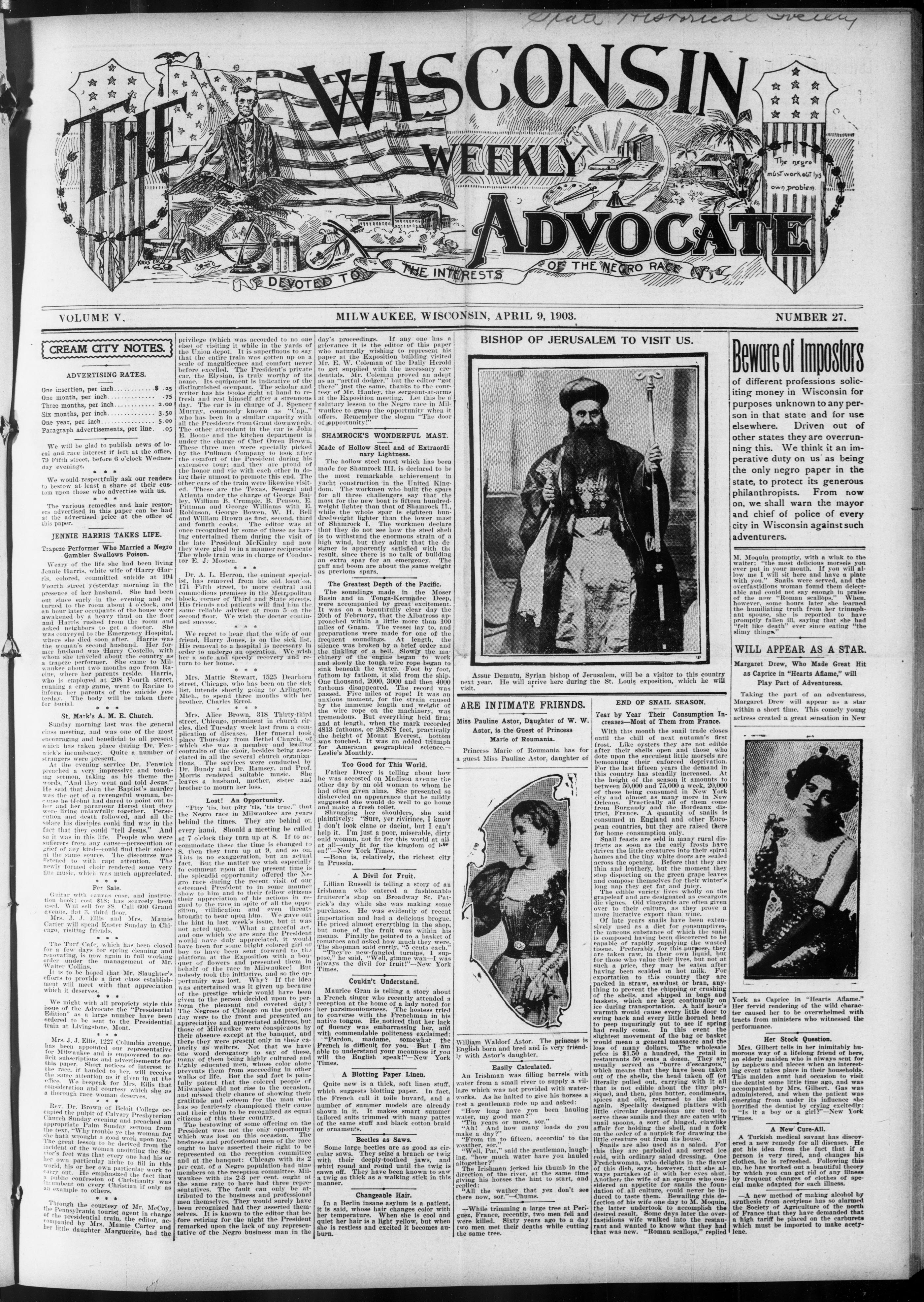
BISHOP OF JERUSALEM TO VISIT US.
P
Assur Demutu, Syrian bishop of Jerusalem, will be a visitor to this country next year. He will arrive here during the St. Louis exposition, which he will visit
ARE INTIMATE FRIENDS.
Miss Pauline Astor, Daughter of W. W. Astor, is the Guest of Princess Marie of Roumania. Princess Marie of Roumania has for a guest Miss Pauline Astor, daughter of
1
William Waldorf Astor. The princess is English born and bred and is very friendly with Astor's daughter.
Easily Calculated.
An Irishman was filling barrels with water from a small river to supply a village which was not provided with waterworks. As he halted to give his horses a rest a gentleman rode up and asked:
"How long have you been hauling water, my good man?"
"Tin years or more, sor."
"Ah! And how many loads do you make a day?"
"From tin to fifteen, accordin' to the weather, sor."
"Well, Pat," said the gentleman, laughing, "how much water have you hauled altogether?"
The Irishman jerked his thumb in the direction of the river, at the same time giving his horses the hint to start, and replied:
"All the wather that yez don't see there now, sor."—Chums.
While trimming a large tree at Periguez, France, recently, two men fell and were killed. Sixty years ago to a day two men met their deaths while cutting the same tree.
END OF SNAIL SEASON.
Year by Year Their Consumption Increases—Most of Them from France.
With this month the snail trade closes until the chill of next autumn's first frost. Like oysters they are not edible after their shells open and those who dote upon the succulent little morsels are bemoaning their enforced deprivation. For the last fifteen years the demand in this country has steadily increased. At the height of the season it amounts to between 50,000 and 75,000 a week, 20,000 of these being consumed in New York city and almost as many more in New Orleans. Practically all of them come from Burgundy and the Bordeaux district, France. A quantity of snails is consumed in England and other European countries, but they are raised there for home consumption only.
Snail feasts are sold in many rural districts as soon as the early frosts have driven the little creatures into their spiral homes and the tiny white doors are sealed across the opening. Before that they are thin and leathery, but the moment they stop disporting on the green grape leaves and compose themselves for their winter's long nap they get fat and juicy. The edible variety lives wholly on the grapeleaf and are designated as escargots die vignes. Old vineyards are often given over to their culture, as they prove a more lucrative export than wine.
Of late years snails have been extensively used as a diet for consumptives, the mucous substance of which the snail is composed having been discovered to be capable of rapidly supplying the wasted tissue. Preferably, for this purpose, they are taken raw, in their own liquid, but for those who value their lives, but not at such a price, they may be eaten after having been scalded in hot milk. For exportation to this country they are packed in straw, sawdust or bran, anything to prevent the chipping or crushing of the shells, and shipped in bags and baskets, which are kept continually on ice during transportation. A half hour's warmth would cause every little door to swing back and every little horned head to peep inquiringly out to see if spring had really come. In this event the slightest movement of the bag or basket would mean a general massacre and the loss of many dollars. The wholesale price is $1.50 a hundred, the retail in restaurants 50 cents a dozen. They are usually served as "burre d'escargots," which means that they have been taken out of the shells, the head taken off (or literally pulled out, carrying with it all that is not edible about the tiny physique), and then, plus butter, condiments, spices and oils, returned to the shell again. Specially designed platters with little circular depressions are used to serve these snails and they are eaten with snail spoons, a sort of hinged, clawlike affair for holding the shell, and a fork on the order of a nutpick for drawing the little creature out from its house.
Snails are also used as a salad. For this they are parboiled and served ice cold, with ordinary salad dressing. One Frenchwoman, who delights in the flavor of this dish, says, however, that she always partakes of it with her eyes shut. Another, the wife of an epicure who considered an appetite for snails the foundation of all culture, could never be induced to taste them. Bewailing this defection of his wife one day to M. Moquin, the latter undertook to accomplish the desired result. Some days later the overfastidious wife walked into the restaurant and wanted to know what they had that was new. "Roman scallous," replied
NUMBER 27.
Beware of Impostors
Beware of Impostors
of different professions soliciting money in Wisconsin for purposes unknown to any person in that state and for use elsewhere. Driven out of other states they are overrunning this. We think it an imperative duty on us as being the only negro paper in the state, to protect its generous philanthropists. From now on, we shall warn the mayor and chief of police of every city in Wisconsin against such adventurers.
M. Moquin promptly, with a wink to the waiter; "the most delicious morseis you ever put in your mouth. If you will allow me I will sit here and have a plate with you." Snails were served, and the overfastidious woman found them delectable and could not say enough in praise of the new "Roman scallops." When, however, some hours later she learned the humiliating truth from her triumphant spouse, she is reported to have promptly fallen ill, saying that she had "felt like death" ever since eating "the slimy things."
WILL APPEAR AS A STAR.
Taking the part of an adventuress, Margaret Drew will appear as a star within a short time. This comely young actress created a great sensation in New
THE FILM MAKES A SUCCESS IN THEATRE.
York as Caprice in "Hearts Aflame." Her fervid rendering of the wild character caused her to be overwhelmed with tracts from ministers who witnessed the performance.
Her Stock Question.
Mrs. Gilbert tells in her inimitably humorous way of a lifelong friend of hers, an elderly maiden who is always sent for by nephews and nieces when an interesting event takes place in their households. This maiden aunt had occasion to visit the dentist some little time ago, and was accompanied by Mrs. Gilbert. Gas was administered, and when the patient was emerging from under its influence she horrified the dentist by crying excitedly: "Is it a boy or a girl?"—New York Times.
A. New Cure-All.
A Turkish medical savant has discovered a new remedy for all diseases. He got his idea from the fact that if a person is very tired, and changes his clothes, he is refreshed. Following this up, he has worked out a beautiful theory by which you can get rid of any illness by frequent changes of clothes of special make adapted for each illness.
—A new method of making alcohol by synthesis from acetylene has so alarmed the Society of Agriculture of the north of France that they have demanded that a high tariff be placed on the carburets which must be imported to make acetylene
GOVERNMENT VICTORIOUS
Decision in Suit Against Northern Securities Company.
Defendant Enjoined from Acquiring Stock of Great Northern or Northern Pacific Companies.
St. Paul, Minn., April 9.—The United States circuit court of appeals today noon handed down a decision in the suit of the United States against the Northern Securities Company, enjoining the company from voting the stock of the Northern Pacific or the Great Northern Pacific companies, but allowing the return of such stock as had been delivered to that holding company. The opinion was unanimous, all four judges concurring, but the opinion was written by Judge Thayer. The substance of the order is in the decree, which is as follows:
Substance of the Order.
Conclusions of the Court.
Circuit Judge Thayer stated the conclusions of the court. He recites the petition which was brought under the anti-trust act of 1890, and adds that under the act of February 11, 1903, this case, being of "general public importance," has been given precedence over others and in every way expedited. It is declared that under the admissions of the defendants the matters of fact are that the roads were parallel and competing lines, that they had jointly secured control of the Burlington line, that in 1901 a holding company had been formed by large owners of stock of the Northern Pacific and Great Northern railways, by which new company large stock interests had been acquired at an agreed price, and the court holds that "the scheme which was thus devised and consummated led inevitably to the following results:
"First, it placed the control of the two roads in the hands of a single person, to-wit, the Securities Company, by virtue of its ownership of a large majority of the stock of both companies; second, it destroyed every motive for competition between two roads engaged in interstate traffic, which were natural competitors for business, by pooling the earnings of the two roads for the common benefit of the stockholders of both companies; and, according to the familiar rule that everyone is presumed to intend what is the necessary consequence of his own acts when done wilfully and deliberately, we must conclude that those who conceived and executed the plan aforesaid intended, among other things, to accomplish these objects."
Such Combination Unlawful.
On the point whether the present case comes within the inhibition of the antitrust act the court discusses the meaning of the word "trust" in the act, and adds that Congress "was careful to declare that a combination in any other form, if in restraint of interstate trade or commerce, that is, if it directly occasioned or effected such restraint, should likewise be deemed illegal. Moreover, in cases arising under the act, it has been held by the highest judicial authority in the nation and its opinion has been reiterated in no uncertain tone, that the act applies to interstate carriers of freight and passengers as well as to all other persons, natural or artificial; that the words 'in restraint of trade or commerce' do NOT mean in unreasonable or partial restraint of trade or commerce, but ANY direct restraint thereof; that an agreement between competing railroads which requires them to act in concert in fixing the rate for the carriage of passengers or freight over their respective lines from one state to another and which by that means restrict temporarily the right of any one of such carriers to name such rates for the carriage of such freight or passengers over its road, AS IT PLEASES, is a contract in direct restraint of commerce within the meaning of the act, in that it tends to prevent competition; that it matters not whether, while acting under such a contract, the rate fixed is reasonable or unreasonable, the vice of such a contract or combination being that it confers the power to establish unreasonable rates and directly restrains commerce by placing obstacles in the way of free and unrestricted competition between carriers who are natural rivals for patronage; and, finally, that Congress has the power, under the grant of authority contained in the federal constitution, to regulate commerce, to say that no contract or combination shall be legal which shall restrain interstate trade or commerce by shutting off the operation of the general law of competition."
Under these propositions it is also held that if the stock had been entrusted to one person, with instructions how to vote it, the "result would have been a combination in direct restraint of interstate commerce," because it gave power to suppress competition.
Power to Suppress Competition.
The organization of the Securities Company, it is held, "accompishes the object, which Congress has denounced as illegal, more effectually" than by other methods. The court continues: "So far as the New Jersey charter is concerned the question, broadly stated, which the court has to determine, is whether a charter granted by a state can
be used to defeat the will of Congress as expressed in a law relating to interstate trade and commerce over which Congress has absolute control. Presumptively, at least, no charter granted by a state is intended by the state to have that effect or to be used for such a purpose; and in the present instance it is clear that the state of New Jersey did not intend to grant a charter under cover of which an object denounced by Congress as unlawful, namely, a combination conferring the power to restrain interstate commerce, might be formed and maintained, because the enabling act under which the Securities Company was organized expressly declares that three or more persons may avail themselves of the provisions of the act and 'BECOME A CORPORATION FOR ANY LAWFUL PURPOSE.' Laws of New Jersey, 1899, p. 473. This language is not merely perfunctory; it means, obviously, that whatever powers the incorporators saw fit to assume they must hold and exercise for the accomplishment of lawful objects.
No Charter for Unlawful Purpose.
No Charter for Unlawful Purpose.
"The words in question operate, therefore, as a limitation upon all the powers enumerated in the articles of association which were filed by the promoters of the Securities Company, so that however extensive and comprehensive these powers may seem to be, the state of New Jersey has said, you shall not exercise them as to set at defiance any statute lawfully enacted by the Congress of the United States or statute lawfully enacted by any state wherein you see fit to exercise your powers."
The contention that whatever restraint upon interstate commerce there may be is indirect and remote and therefore not to be forbidden by Congress, is not found to be well sustained. The contention that if the existing combination is in violation of the anti-trust act then act unduly restricts the rights of the individual to make contracts and is invalid, is declared to be entitled to little consideration. The court says:
"The provision of the constitution does not, as we believe, exclude Congress from legislating with regard to contracts of the above nature while in the exercise of its constitutional right to regulate commerce among the states. On the contrary we think the proposition regarding the liberty of the citizen is to some extent limited by the commerce clause of the constitution, and that the power of Congress to regulate interstate commerce comprises the right to enact a law prohibiting the citizen from entering into those private contracts which directly, and substantially, and not merely indirectly, remotely, incidentally and collaterally, regulate to a greater or less degree commerce among the states."
All Five Judges Concur.
The further contentions that the antitrust law was not intended for such combinations as this, that this combination had been consummated before the bill was filed and was in reality in aid of commerce and not to restrain it, are held to be clearly untenable as to the first point, and that the second point is "a novel, not to say absurd, interpretation of the anti-trust act, and as to the last contention, it is said to be possible, but not a matter for decision of the court."
The decree is then entered, as already given above. Circuit Judges Caldwell, Sanborn, Thayer and Vandeventer heard the case and all concurred in the opinion, which was written by Judge Thayer and filed in the United States circuit court of appeals in this city.
The defendants are the Northern Securities Company, the Northern Pacific Railway Company, the Great Northern Railway Company, James J. Hill, William P. Clongh, D. Willis James, John S. Kennedy, J. Pierpont Morgan, Robert Bacon, George F. Baker and Daniel Lamont.
GEORGE GOULD HURT.
Railroad Magnate Jumps from Runaway in Denver, Col., Fearing Death
Denver, Col., April 9.—George Gould was severely hurt at Pueblo Saturday in a runaway and is now on his way to New York for medical attention. Mr. Gould has been making an inspection of the Rio Grande system and the Colorado Fuel and Iron Company's plant. In company with General Manager Kebler of the latter company and Edward Butler Mr. Gould started on a drive around the city after dinner. The horses were almost unmanageable from the start. Just as they struck the top of the hill leading to the railroad bridge from the bluff the carriage was seen to be swaying from side to side and the party was in danger of being hurled to the track, 200 feet below, where trains were passing.
Just as the vehicle seemed about to take the plunge Mr. Gould leaped out and rolled 100 feet down hill and landed against a pile of rubbish. He was stunned for several minutes. A physician was summoned and dressed several bad cuts and bruises. No bones were broken. Mr. Gould hurriedly ordered his car sent East.
PLOT AGAINST KINGS.
Anarchists at Lisbon Contemplated Assassination of Edward and
Lisbon, April 9.—During King Edward's visit to the city a plot to assassinate him and King Carlos was discovered, but all dispatches concerning the matter were suppressed, as the authorities were anxious that nothing be published until King Edward had taken his departure.
The chief conspirator was a French servant of Prince Alphonso (brother of King Carlos), and now known to be a notorious and dangerous Anarchist. He and a number of others were promptly arrested.
They had planned to perpetrate the crime during the gala performance of "The Barber of Seville" at the opera house last Sunday night.
The police refuse to divulge the exact nature of the plot.
ATTACK ON FORTRESS
Tribesmen Repulsed by Well-Directed Fusilades—Powder Supply Explodes.
Madrid, April 9.—A dispatch from Melilla, Morocco, gives details of the fighting at Frajana. It says 500 insurgents made a desperate attack on the fortress of Frajana April 8. After the customary prayers the tribesmen advanced with a wild rush to the accompaniment of religious exhortations. Twice they attempted to carry the fortress by assault but were repulsed by well directed fusillades, which killed numbers of the insurgents. During the attack the powder supply of the tribesmen exploded, killing many of them.
ATTORNEY'S LARGE FEES.
Harry Stratton Paid $115,000 to Lawyers in Will Contest.
Colorado Springs, Col., April 9.—Harry Stratton realized $235,000 net from the $350,000 paid him in the will contest compromise of his father's estate. He paid his attorneys $115,000 in fees, the larger portion going to former Senator Wolcott.
FAVOR EQUAL RIGHTS.
New York, April 9.—The members of the Union League Club of this city will take radical steps, it is said, favoring negro suffrage in the South at their April meeting, which occurs tonight. Congress will be appealed to to deal with the question along the line of a radical reduction of representation of the Southern states in Congress. The report of the club committee on political reform will create a sensation in the Southern states. After reciting that Southern states have taken steps to circumvent national legislation giving suffrage to negroes, the report recommends that Congress be asked to cut down Southern representation and that a large sum of money be appropriated to test the validity of the recently adopted constitutions in Alabama, Virginia and other states in the South.
Constitutions to be Tested.
The ablest counsel in this country will be employed to prepare and argue these test cases regarding the constitutions mentioned. One of the prime movers is said to be former Secretary of the Interior Cornelius N. Bliss. The club is expected to adopt resolutions following the adoption of the committee's report. The thousand copies of these resolutions will be circulated to state senators, to prominent churchmen and those in authority everywhere. President Roosevelt was vice president of the club in 1899. He is still prominent in its councils. Gen. Horace Porter, Joseph H. Choate, John Hay and George Ward have also acted as presidents of the club at different times. The late Hamilton Fish and William M. Evarts also had that distinction in their lifetime. So has Senator Chauncey M. Denew.
John D. Rockefeller, J. P. Morgan and Andrew Carnegie are members of the club, the two latter being on the governing committee. The list of members includes also William D. Sloane, George F. Baker, Whitelaw Reid, John Jacob Astor, D. O. Mills and many other prominent men.
SHAMROCK III. WON.
Lipton's New Challenger Given a Leeward and Windward Test of Thirty Miles.
Weymouth, England, April 9.—A 15-mile run to leeward and a beat home, giving a leeward and windward test of thirty miles under conditions as similar as possible to those expectable during the races for the America's cup off Sandy Hook, was the course set for the two Shamrocks today. The breeze was very light, not over five knots, as the boats under club topsail ranged up for the start and were sent off from a mark boat off Weymouth pier. The starting times were: Shamrock I., 10:00:55; Shamrock III., 10:01:00.
The older boat was just showing clear on the weather bow of the challenger as they rounded the mark boat. As the boats reached off free across the mouth of the bay to get clear water for a straight run down the wind. Shamrock III. showed the same form that puzzled yachtsmen yesterday.
The light breeze held well and the Shamrock III., again picking up her pace, overhauled her opponent. When abeam of St. Albans Head booms were squared away for the long run down the wind.
The trim of the challenger had been slightly altered from that of yesterday, her anchor and cable being carried today. The alterations were apparently valuable, for she outran the Shamrock I. fast and constantly, and was about five minutes ahead when the boats rounded the Erin, which acted as mark boat at the end of the leeward run.
The boats then started on the beat homeward. The wind had slackened and they made slow progress. Nevertheless the challenger showed the same good windward work as heretofore and steadily improved her lead.
Shamrock III. won by 17 minutes.
FUNERAL OF MRS. PORTER
French Government Joins in Services Over Remains of Ambassador's
Paris, April 9.—The funeral of Mrs. Porter, wife of the United States ambassador, held at 11 o'clock this morning at the American Church in the Rue de Berri, was an impressive tribute, the heads of the French government, the members of the diplomatic corps and many representatives of the American colony participating. The front of the church was draped with black and the walls and pillars of the interior hung with black draperies. The chancel was filled with tall palms, while immediately in front of the altar rested the casket hidden beneath a profusion of beautiful floral offerings. Ambassador Porter, who was accompanied by his daughter, Elsie, heavily veiled, bore the ordeal with fortitude. Accompanying the mourners were relatives, intimate friends of the family and officials of the embassy staff. To the left of the family sat Mme. Loubet, wife of the President of France; Paul Loubet, Gen. Dubois, the personal representative of the President, with a large staff of officers in full uniform; Foreign Minister Delcasse, Premier Combes and other members of the ministry, with their wives. Among others present were Ambassador Tower, who came on from Berlin; former Vice President Levi P. Morton, Consul General Gowdy, Count De Rochambeau, the Marquis De Chambrun, M. Hamard, the sculptor of the Rochambeau statue; the British ambassador, Sir Edmund Monson, and his staff and the ambassadors and ministers of various other countries with their staffs and a large number of Americans, taxing the capacity of the edifice. Rev. Dr. Thurber conducted the simple service. In his invocation Dr. Thurber made a feeling reference to the beauty of the character of Mrs. Porter. The choir sang Mrs. Porter's favorite hymns, "Jesus, Lover of My Soul," and "Lead, Kindly Light."
Scientific Tailoring
The tailor who cuts to fit his customer now studies anatomy with as much care as he studies spring patterns in cloth. Charts are prepared for him, giving the common name of each section of mankind's anatomy, and thus, instead of becoming acquainted with the "fovea axillaris," he is merely shown the hollow under the arm, while the "tibial indentation" becomes the hollow under the knee. Anatomical charts, showing a skeleton in three positions, are sold by a West End firm, and are much in demand among tailors who cut clothes on a scientific basis.—London Express.
—Of the 165 kinds of snakes found in the United States but 20 are venomous. They are the copperhead and water moccasin, which are closely related; the coral snakes of the Southwest, the two species of Sistrurus and the fifteen species of rattlesnake. The most dangerous of them—the water moccasin—is not seen north of Tennessee.
THREE SAILORS KILLED.
Disastrous Explosion on the Battleship Iowa.
A LARGE GUN BURSTS.
Occurs During Target Practice in Gulf of Mexico—Men Killed or Injured While at Mess.
Pensacola, Fla., April 10.—A disastrous explosion occurred on the battleship Iowa while the vessel was at target practice in the gulf. The forward port twelve-inch gun burst from a premature explosion of a shell, twelve feet of the piece outside the turret being demolished. Three men were killed and five injured, two seriously. The dead are:
Gaught, first-class seaman.
Thursdale, ordinary seaman.
Brown, ordinary seaman.
Monsdale, ordinary seaman.
Purcker, ordinary seaman.
Killed While at Mess.
The men killed and injured were on the second or gun deck at mess. Three pieces of the exploded gun each weighing over a ton, passed downward through the spar deck, falling upon the men at mess, instantly killing the three named. All of the men were horribly mutilated. The heavy missiles after passing through the gun deck continued down to the third deck, where they came in contact with the armored deck, the heavy steel bringing them to a stop, thus saving the engineers and firemen who were at work below. Although the upper decks were covered with men, no one there was seriously injured.
The explosion occurred just as the mess call had been sounded. Firing was to have ceased after the shot for the dinner hour. The range had been set and the Iowa was steaming along at a speed of twelve knots an hour, when Lieut. Reed, in charge of the forward twelve-inch turret, gave orders to load and fire. The time fuse was cut for the range, the piece charged, breech closed and the word given to fire.
Fragments Scattered Broadcast
Following the report of the gun there was a smothered noise as the shell exploded midway in the gun, and the pieces of the burst gun and shell were scattered broadcast. Three great holes were torn through the deck. Those who were below rushed on deck, some of them bloody and mutilated, while lying on the floor, crushed almost beyond recognition, were the three unfortunate men.
The Massachusetts, six miles distant, was signaled for aid and one of the cutters put off with the surgeon and assistant surgeons. The injured men were taken to the hospital and their injuries dressed. The dead were brought to Pensacola.
Some claim the explosion was caused by a defective shell and others think that the frequent firing of the pieces at Culebra during the winter added to the work done here during the last ten days, so strained the piece that the force of the charge burst the gun.
Shell Fuse Defective.
An investigation shows that the accident was caused entirely by a defective shell fuse, which, it is stated, burned faster than was calculated. It is understood that the shell exploded fully sixty seconds before it was timed to go off.
An examination of the ship this morning shows that the bursted gun is beyond repair and that the 12-inch forward turret will have to be repaired.
The funeral of the three men who were killed in the accident occurred this morning at 11 o'clock. The dead were buried in the national cemetery here with military honors, companies of blue-jackets from all the ships of the squadron participating in the exercises. It is understood that all of the injured men are almost entirely out of danger except First Class Seaman Paul Gough, who lost an eye and is in a critical condition. The Iowa steamed into the navy yard this morning at 11 o'clock.
KILLED 100 MOROS.
Capt. Pershing's Force Captures Bacolod a Hotbed of Insurrection.
tion.
Manila, April 10.—Capt. Pershing's force captured Bacolod, island of Mindanao, Wednesday, killed 100 Moros and wounded many others. Three Americans were wounded.
Pershing's force consisted of Shaw's battalion of the Twenty-seventh Infantry, Kilpatrick's troop of the Fifteenth Cavalry and Chacuair's Battery.
Pershing was surveying the west shore lands when the Bacolodians opposed his advance and provoked the fight. Pershing surrounded and attacked their stronghold, first shelling them and, rushing his troops forward, charged gallantly. After crossing a deep moat and entering the fort the Americans engaged the Moros, bayonets against krisses. A hundred of the defenders were killed including the datto of Panandungan, and many were wounded. Only three Americans were wounded. After the capture of the fort it was destroyed.
The Baccolod leaders and the majority of the people of that district had been hostile to the Americans and encouraged attacks on American camps. They rejected the tenders of friendship. It is expected that the defeat of the Baccolodians will result in all the Moros acknowledging American sovereignty.
Pershing's column is going to Marahue, which is also hostile.
ORDER RESTORED IN THE ETERNAL CITY.
ORDER RESTORED IN THE ETERNAL CITY.
All of the Strikers Except Compositors Resume Work—Rome Regains Normal Condition.
Rome, April 10.—All the strikers, with the exception of the compositors, have resumed work and Rome has regained its normal aspect. Many foreigners who left this city temporarily are returning.
JUDGE COWHIDES PREACHER
Why Virginia House of Delegates Votes to Remove from the Bench:
Richmond, Va., April 10.—The House of Delegates voted to remove from the bench Judge Clarence J. Campbell of Amherst county, who cowhided Rev. Dr. Crawford of the State Antisaloon League. The division was 63 to 18. The removal resolution now goes to the Senate for concurrence.
—When the recent act of Congress becomes effective the navy will have almost 30,000 officers and men.
```markdown
```
THE IMPRESSIONS OF A WOMAN.
What a Woman Says About Western Canada.
Although many men have written to this paper regarding the prospects of Western Canada, and its great possibilities, it may not be uninteresting to give the experience of a woman settler, written to Mr. M. V. McInnes, the agent of the Government at Detroit, Mich. If the reader wishes to get further information regarding Western Canada it may be obtained by writing any of the agents of the Government whose name is attached to the advertisement appearing elsewhere in this paper.
The following is the letter referred to:
Hilldown, Alberta, Feb. 5. 1903. Dear Sir-I have been here now nearly five years, and thought I would write you a woman's impression of Western Canada—in Alberta. There are several ranchers in this district who, in addition to taking care of their cattle, carry on farming as well. Their herds of cattle number from 100 to 200 or 300 head, and live out all winter without any shelter than the popular bluffs, and they come in in the spring in good order. Most of the ranchers feed their cattle part of the time, about this time of the year, but I have seen the finest fat cattle I ever saw that never got a peck of grain—only fattened on the grass. You see I have learned to talk farm since I came here—farming is the greatest business here. I know several in this district who never worked a day on the farm till they came here, and have done well and are getting well off.
I think this will be the garden of the Northwest some day, and that day not very far distant. There has been a great change since we came here, and there will be a greater change in the next five years. The winters are all anyone could wish for. We have very little snow, and the climate is fine and healthy. Last summer was wet, but not to an extent to damage crops, which were a large average yield, and the hay was immense—and farmers wore a broad smile accordingly.
We have good schools; the Government pays 70 per cent of the expense of education, which is a great boon in a new country. Of course, churches of different denominations follow the settlements. Summer picnics and winter concerts are all well attended, and as much, or more, enjoyed as in the East. Who would not prefer the pure air of this climate with its broad acres of fine farms, its rippling streams, its beautiful lakes, its millions of wild flowers, its groves of wild fruit of exquisite flavor, its streams and lakes teeming with fish and its prairies and bluffs with game, to the crowded and stiff state of society in the East? I would like to go home for a visit some time, but not to go there to live, even if presented with the best farm in Michigan. Beautiful Alberta, I will never leave it. And my verdict is only a repetition of all who have settled in this country. This year, I believe, will add many thousands to our population. And if the young men, and old men also, knew how easy they could make a home free of all incumbrance in this country, thousands more would have settled here. I would sooner have 160 acres here than any farm where I came from in Michigan; but the people in the East are coming to a knowledge of this country, and as they do, they will come West in thousands. All winter people have been arriving in Alberta, and I suppose in other parts as well, which is unusual, so we expect a great rush when the weather gets warmer.
We have no coal famine here; coal can be bought in the towns for $2 to $3, according to distance from the mines, and many haul their own coal from the mines, getting it there for 50 cents to a dollar a ton.
Very truly yours:
(Signed) MRS. JOHN M'LACHLAN.
Flogging in the German Army. A youth aged 20, belonging to a Uhlan regiment at Potsdam, was for some offense recently held down to a table by non-commissioned officers and beaten with a stick so severely that he had to remain for a considerable time in hospital. When released he hanged himself on a tree from fear of further ili-treatment. A sergeant and others were arrested in connection with the case.
WEATHERWISE
IS THE MAN WHO WEARS
TOWER'S
FISH BRAND
SLICKERS
A reputation extending over
sixty-six years and our
guarantee are back of
every garment bearing the
SIGN OF THE FISH.
There are many imitations.
Be sure of the name
TOWER on the buttons.
ON SALE EVERYWHERE.
A. J. TOWER CO. BOSTON, MASS. U. S. A.
TOWER CANADIAN CO. Limited, TORONTO, CAN.
WESTERN CANADA HAS FREE HOMES FOR MILLIONS!
FARMS
WESTERN
CANADA
FREE
Free Homestead of 160 Acres. Free
the only charge being $10 for entry. Send to the following for an Atlas and other literature, as well as for certificate, giving you reduced railway rates, et. c.; Superintendent of Immigration, Ottawa, Can., or to the Canadian Government Agents, Wausau, Wis., the authorized Canadian Government Agents.
WE WANT YOUR TRADE
You can buy of us at wholesale prices and save money.
Our 1,000-page catalogue tells the story. We will send it upon receipt of 15 cents. Your neighbors trade with us—why not you?
Montgomery Ward Co.
4
CHICAGO
The house that tells the truth.
Edwin M. Bernard died after an illness of two years. Mr. Bernard came to Chicago from St. Louis in 1883, and up to the time of his illness was employed on the various newspapers of the city as a reporter. He was 45 years old.
Richard Childs fell twenty-five feet from a window he was washing in the Western Electric Company's building. He sustained internal injuries which may result fatally. He used a safety belt, but one of the straps slipped from its fastening.
During a struggle between rival branches of the Sheet Metal Workers' Union officers of the two factions engaged in a revolver fight and M. M. Castleman, a labor organizer, probably was fatally shot. His assailant escaped and the police are not certain of his identity.
A gray felt hat bound about with cords of the same color may lead to the identity of the unknown woman who was swept away in the river just south of the Madison street bridge Wednesday evening. Whether she was the victim of a murder or whether she leaped willingly to her death is unexplained.
With his foot caught in a frog on a railway track, Charles Berbouski saw death approaching and was unable to help himself. He was instantly killed by an Illinois Central passenger train, although the engineer reversed the throttle and applied the brakes in an effort to stop the train. Berbouski was a switchman in the employ of the Illinois Central Company.
—Bravely facing death between a runaway horse and a hose cart, at full speed on its way to a fire, Samuel J. Lewis, a machinist, almost lost his life in an attempt to save scores of persons from the runaway. He now lies at his home, his chest and right side crushed, and head and face badly bruised. His condition is serious. He is only 21 years old and unmarried.
—As a climax to a feud of long standing between Bohemian and American youths, August Kirchman, 15 years old, son of Frank Kirchman, was shot and probably fatally injured. The injured boy is in a critical condition at his home, a bullet having been taken from his chest. His assailant, who was not identified, had not been arrested, but officers expect to make an arrest.
—Stephen Brown was shot and probably fatally wounded by Ernest O. Johnson, a saloonkeeper. During a quarrel Brown and two companions were put out of the saloon. They returned and at the door were met by Johnson, who, believing the men intended to assault him, Johnson fired two shots. One bullet struck Brown in the right breast and came out at the back.
—Benjamin F. Ayer, at one time corporation counsel for Chicago, and author of the revised city charter of 1863, died of acute pneumonia at his residence. Mr. Ayer was one of the pioneer lawyers of the city, and for over a quarter of a century had been connected with the Illinois Central Railway Company as its attorney and later its general counsel. He was born in Kingston, N. H., April 22, 1825.
LATEST MARKET REPORTS.
MILWAUKEE, APRIL 10, 1903.
EGG AND DAIRY MARKETS.
Butter—Market firm. There is a good demand for all fancy grades of both dairy and creamery. Creamery, per lb, 28½¢; prints, 29¢; firsts, 22@23¢; seconds, 17¢; June creamery, 18@20¢; extra fancy dairy, 19¢; lines, 15@16¢; roll, 15@16¢; packing stock, 12½¢; whey, 10¢; grease, 5@6¢. Receipts were 14,200 lbs.
Cheese — Firm. The demand continues good; full cream flats, fancy, 13@13½¢; good to choice, 13¢; Young Americas, 13@14¢; low grades, 10@11¢; daisies, 13½@14¢; long horns, 12½@13¢; limburger, per lb, No. 1, 12@12½¢; low grades, 10@11¢; fancy brick, 13@13½¢; low grades, 11@12¢; Imported Swiss, 25¢; Block Swiss, domestic, 13½@13¢; fancy loaf, 14@15¢; No. 2, 12@13¢; Sapsago, 20¢. Receipts, 8200 lbs.
CHICAGO—Butter—Firm; creameries, 18@28½¢; dairyies, 14@24¢. Eggs—Firm; at mark, cases included, 14½¢. Cheese—Easter; twins, 12½¢; daisies, 12½@12½¢; Young Americas, 12½¢. Live poultry—Weaker; turkeys, 12@13¢; chickens, 13¢.
MILWAUKEE LIVE STOCK MARKET.
HOGS—Receipts, 4 cars; market slow, light, 130 to 175 lbs, 6.70@7.00; mixed, 180 to 225 lbs, 7.10@7.25; good to choice, 200 to 250 lbs, 7.20@7.35; selected heavy, 250 to 300 lbs, 7.35@7.50; pigs, 80 to 110 lbs, 5.75@6.50.
CATTLE—Receipts, 1 car; strong; calves steady; butchers' steers, medium to good. 1050 to 1300 lbs, 4.50@5.50; fair to medium. 950 to 1050 lbs, 4.00@4.50; heifers, common. 2.75@3.50; good, 3.75@4.50; cows, fair to good, 3.00@3.75; canners, 1.75@2.50; cutters, 2.50@3.00; bulls, common, 2.75@3.25; choice, 3.50@3.95; feeders, 800 to 950 lbs. 3.75@4.50; stockers, 500 to 750 lbs, 3.25@3.75; veal calves, light, 90 to 105 lbs, 4.50@5.50; good, 110 to 140 lbs, 5.75@6.50. Milkers—Common, no demand; fancy heavy, 35.00@55.00.
SHEEP—Receipts, none; steady: 3.00@5.50; bucks, 3.00@4.00; lambs, common to choice, 5.00@7.25.
Chicago receipts: Hogs, 15,000; cattle, 2500; sheep, 5000.
MILWAUKEE HAY MARKET.
Timothy, steady; carlots, choice timothy,
13.25@13.50; No. 1 timothy, 12.50@13.00;
No. 2 timothy, 9.50@11.50; clover and clover
mixed, 9.00@10.00.
Prairie hay steady; choice Kansas, 11.50
@12.00; No. 1 Kansas, 11.00@11.25; No. 2,
8.50@9.00.
Straw, steady; rye, 6.75@7.00; oats, 5.25@
5.50; wheat, 4.00@4.50; packing hay, 6.50.
Wisconsin prairie, 6.50@7.50.
MIL.WAUKEE POTATO MARKET.
Potatoes—Market quiet. Carlots, on track,
per bus, Ruralis and Burbanks, fancy large,
40c; Rose and Peerless, 38@30c; small stock,
36c.
MARKETS BY TELEGRAPH
MILWAUKEE—Flour—Steady. Wheat — Firner: No. 1 Northern, on track, 70c; No. 2 Northern, on track, 78c. Corn—Steady, and fair demand: No. 3 on track, 40c. Oats — Steady; No. 2 white, on track, 35c; No. 3 white, on track, $33\frac{1}{4}@34\frac{1}{2}c$. Barley—Steady: No. 2 on track, 60c; sample on track, 42@ 60c. Rye—Firm and good demand; No. 1 on track, 52c. Provisions—Steady; pork, 17.60; lard, 9.85.
Flour market steady; patents. 3.90@4.00; bakers'. 2.90@3.00; rye. 2.90@3.00.
Millstuffs are lower and quoted at 13.25 for bran, 13.50 for standard middlings and 14.50@15.00 for Milwaukee flour middling in 10-lb sacks; red dog, 16.50. Delivered to country points, 50c extra.
KANSAS CITY—Cattle—Receipts, 2000; market strong; beef steers, 4.00@5.25; Texans, 2.50@4.90; native cows and heifers, 1.75@4.75; stockers and feeders, 3.35@4.75; Hogs—Receipts, 5000; market steady; heavy, 7.30@7.45; packers, 7.20@7.35; yorkers, 7.20@7.25; pigs, 5.75@7.02$_{2}$. Sheep—Receipts, 1000; market firm; sheep, 3.85@6.50; lambs, 5.75@11.00.
OMAHA—Cattle—Receipts, 2000; market steady to 10c higher; beef steers, 4.25@5.25; cows and heifers, 3.25@4.50; canners, 2.00@3.00; stockers and feeders, 3.00@4.75. Hogs—Receipts, 4500; market steady; heavy, 7.30@7.35; pigs, 6.00@7.00. Sheep—Receipts, 1500; market steady; sheep, 6.00@6.75; lambs, 6.00@7.50.
ST. LOUIS—Cattle—Receipts, 1000; market steady; beef steers, 3.50@5.20; stockers and feeders, 2.40@4.60; cows and heifers, 2.25@4.75; Texans, 2.35@4.60. Hogs—Receipts, 3000; market steady; pigs, 6.85@7.25; packers, 7.20@7.40; butchers, 7.25@7.50. Sheep—Receipts, 500; market steady; sheep, 5.00@6.25; lambs, 6.00@8.50.
Flogging in the German Army
Upwards of 100,000 Americans have settled in Western Canada during the last 5 years. They are contented, happy and prosperous, and there is room still for millions Wonderful yields of Wheat and other grains. Best Grazing Lands on the Continent. Magnificent water and fuel. Good schools, and sulendid railway facilities.
AGRICULTURAL
K. H.
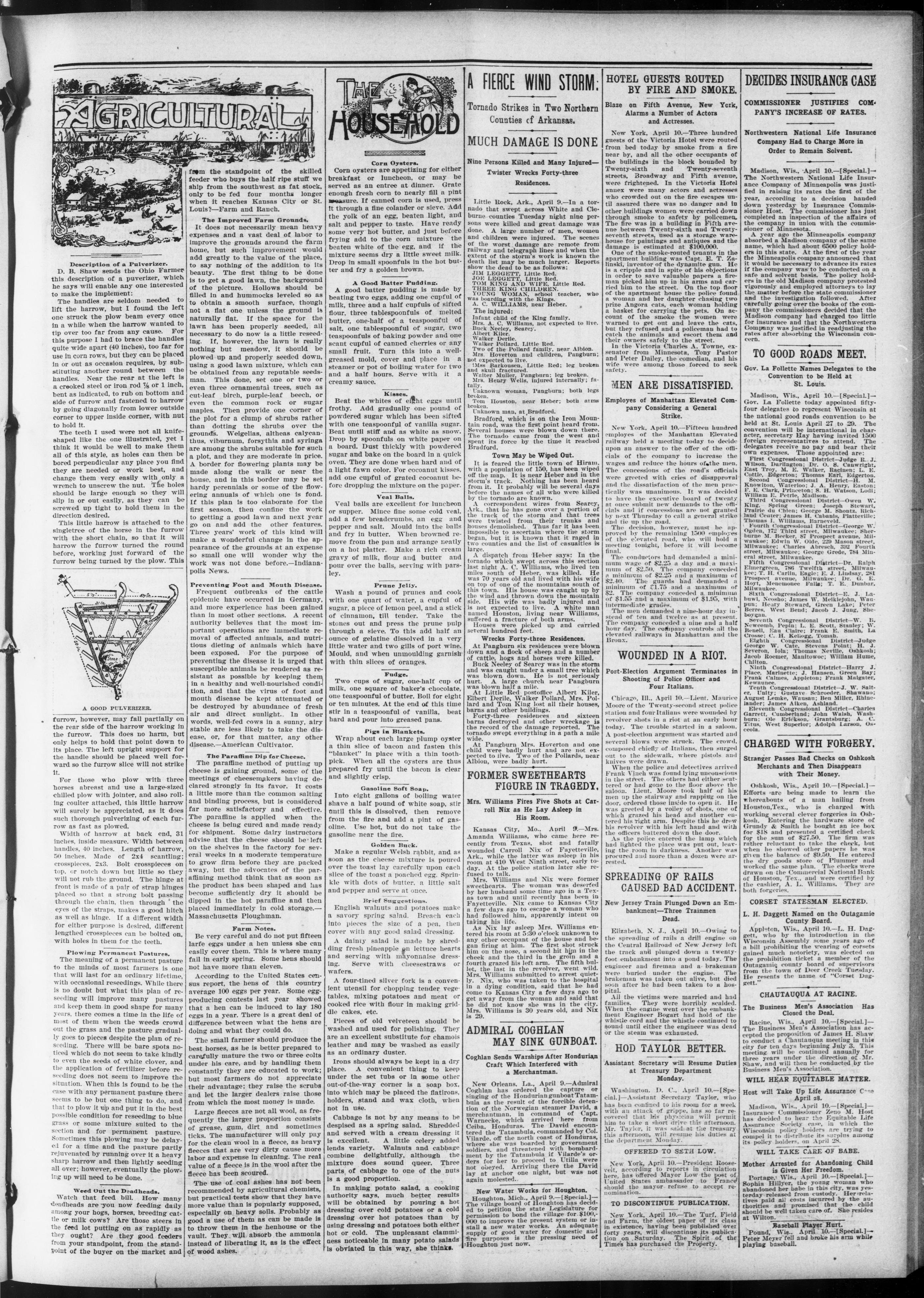
D. B. Shaw sends the Ohio Farmer this description of a puverizer, which he says will enable any one interested to make the implement:
The handles are seldom needed to lift the harrow, but I found the left one struck the plow beam every once in a while when the harrow wanted to tip over too far from any cause. For this purpose I had to brace the handles quite wide apart (40 inches), too far for use in corn rows, but they can be placed in or out as occasion requires, by substituting another round between the handles. Near the rear at the left is a crooked steel or iron rod $ \frac{7}{8} $ or 1 inch, bent as indicated, to rub on bottom and side of furrow and fastened to harrow by going diagonally from lower outside corner to upper inside corner, with nut to hold it.
The teeth I used were not all knife-shaped like the one illustrated, yet I think it would be well to make them all of this style, as holes can then be bored perpendicular any place you find they are needed or work best, and change them very easily with only a wrench to unscrew the nut. The holes should be large enough so they will slip in or out easily, as they can be screwed up tight to hold them in the direction desired.
This little harrow is attached to the singletree of the horse in the furrow with the short chain, so that it will harrow the furrow turned the round before, working just forward of the furrow being turned by the plow. This
5'1/2"
40 in.
31 in.
50 in.
Sine
furrow, however, may fall partially on the rear side of the harrow working in the furrow. This does no harm, but only helps to hold that point down to its place. The left upright support for the handle should be placed well forward so the furrow slice will not strike it. For those who plow with three horses abreast and use a large-sized chilled plow with jointer, and also rolling coulter attached, this little harrow will surely be appreciated, as it does such thorough pulverizing of each furrow as fast as plowed.
Width of harrow at back end, 31 inches, inside measure. Width between handles, 40 inches. Length of harrow, 50 inches. Made of 2x4 scantling; crosspieces, 2x3. Bolt crosspieces on top, or notch down but little so they will not rub the ground. The hinge at front is made of a pair of strap hinges placed so that a strong bolt passing through the chain, then through the eyes of the straps, makes a good hitch as well as hinge. If a different width for either purpose is desired, different lengthed crosspieces can be bolted on, with holes in them for the teeth.
Plowing Permanent Pastures
The meaning of a permanent pasture to the minds of most farmers is one that will last for an ordinary lifetime, with occasional reseedings. While there is no doubt but what this plan of re-seeding will improve many pastures and keep them in good shape for many years, there comes a time in the life of most of them when the weeds crowd out the grass and the pasture gradually goes to pieces despite the plan of re-seeding. There will be bare spots noticed which do not seem to take kindly to even the seeds of white clover, and the application of fertilizer before re-seeding does not seem to improve the situation. When this is found to be the case with any permanent pasture there seems to be but one thing to do, and that to plow it up and put it in the best possible condition for reseeding to blue grass or some mixture suited to the section and for permanent pasture. Sometimes this plowing may be delayed for a time and the pasture partly rejuvenated by running over it a heavy sharp harrow and then lightly seeding all over; however, eventually the plowing up will need to be done.
Weed Out the Deadheads.
Watch that feed bill. How many deadheads are you now feeding daily among your hogs, horses, breeding cattle or milk cows? Are those steers in the feed lot putting on as rapidly as they ought? Are they good feeders from your standpoint, from the standpoint of the buyer on the market and
from the standpoint of the skilled feeder who buys the half ripe stuff we ship from the southwest as fat stock, only to be fed four months longer when it reaches Kansas City or St. Louis?—Farm and Ranch.
The Improved Farm Grounds.
It does not necessarily mean heavy expenses and a vast deal of labor to improve the grounds around the farm home, but such improvement would add greatly to the value of the place, to say nothing of the addition to its beauty. The first thing to be done is to get a good lawn, the background of the picture. Hollows should be filled in and hummocks leveled so as to obtain a smooth surface, though not a flat one unless the ground is naturally flat. If the space for the lawn has been properly seeded, all necessary to do now is a little reseeding. If, however, the lawn is really nothing but meadow, it should be plowed up and properly seeded down, using a good lawn mixture, which can be obtained from any reputable seedsman. This done, set one or two or even three ornamental trees, such as cut-leaf birch, purple-leaf beech, or even the common rock or sugar maples. Then provide one corner of the plot for a clump of shrubs rather than dotting the shrubs over the grounds. Weigelias, altheas calycanthus, viburnum, forsythia and syringa are among the shrubs suitable for such a plot, and they are moderate in price. A border for flowering plants may be made along the walk or near the house, and in this border may be set hardy perennials or some of the flowering annuals of which one is fond. If this plan is too elaborate for the first season, then confine the work to getting a good lawn and next year go on and add the other features. Three years' work of this kind will make a wonderful change in the appearance of the grounds at an expense so small one will wonder why the work was not done before.—Indiana-polis News.
Preventing Foot and Mouth Disease. Frequent outbreaks of the cattle epidemic have occurred in Germany, and more experience has been gained than in most other sections. A recent authority believes that the most important operations are immediate removal of affected animals, and nutritious dieting of animals which have been exposed. For the purpose of preventing the disease it is urged that susceptible animals be rendered as resistant as possible by keeping them in a healthy and well-nourished condition, and that the virus of foot and mouth disease be kept attenuated or be destroyed by abundance of fresh air and direct sunlight. In other words, well-fed cows in a sunny, airy stable are less likely to take the disease, or, for that matter, any other disease.—American Cultivator.
The Paraffine Dip for Cheese.
The paraffine method of putting up cheese is gaining ground, some of the meetings of cheesemakers having declared strongly in its favor. It costs a little more than the common salting and binding process, but is considered far more satisfactory and effective. The paraffine is applied when the cheese is being cured and made ready for shipment. Some dairy instructors advise that the cheese should be left on the shelves in the factory for several weeks in a moderate temperature to grow firm before they are packed away, but the advocates of the paraffining method think that as soon as the product has been shaped and has become sufficiently dry it should be dipped in the hot paraffine and then placed immediately in cold storage. Massachusetts Ploughman.
Farm Notes.
Be very careful and do not put fifteen larfe eggs under a hen unless she can easily cover them. This is where many fail in early spring. Some hens should not have more than eleven. According to the United States census report, the hens of this country average 100 eggs per year. Some egg-producing contests last year showed that a hen can be induced to lay 180 eggs in a year. There is a great deal of difference between what the hens are doing and what they could do.
The small farmer should produce the best horses, as he is better prepared to carefully mature the two or three colts under his care, and by handling them constantly they are educated to work; but most farmers do not appreciate their advantage; they raise the scrubs and let the larger dealers raise those from which the most money is made.
Large fleeces are not all wool, as frequently the larger proportion consists of grease, gum, dirt and sometimes ticks. The manufacturer will only pay for the clean wool in a fleece, as heavy fleeces that are very dirty cause more labor and expense in cleaning. The real value of a fleece is in the wool after the fleece has been scoured.
The use of coal ashes has not been recommended by agricultural chemists, but practical tests show that they have more value than is popularly supposed, especially on heavy soils. Probably as good a use of them as can be made is to throw them in the henhouse or the vault. They will absorb the ammonia instead of liberating it, as is the effect of wood ashes.
THE
HOUSEHOLD
Corn Oysters.
Corn oysters are appetizing for either breakfast or luncheon, or may be served as an entree at dinner. Grate enough fresh corn to nearly fill a pint measure. If canned corn is used, press it through a fine colander or sieve. Add the yolk of an egg, beaten light, and salt and pepper to taste. Have ready some very hot butter, and just before frying add to the corn mixture the beaten white of the egg, and if the mixture seems dry a little sweet milk. Drop in small spoonfuls in the hot butter and fry a golden brown.
A Good Batter Pudding.
A good batter pudding is made by beating two eggs, adding one cupful of milk, three and a half cupfuls of sifted flour, three tablespoonfuls of melted butter, one-half of a teaspoonful of salt, one tablespoonful of sugar, two teaspoonfuls of baking powder and one scant cupful of canned cherries or any small fruit. Turn this into a well-greased mold, cover and place in a steamer or pot of boiling water for two and a half hours. Serve with it a creamy sauce.
Kisses.
Beat the whites of eight eggs until frothy. Add gradually one pound of powdered sugar which has been sifted with one teaspoonful of vanilla sugar. Beat until stiff and as white as snow. Drop by spoonfuls on white paper on a board. Dust thickly with powdered sugar and bake on the board in a quick oven. They are done when hard and of a light fawn color. For cocoanut kisses, add one cupful of grated cocoanut before dropping the mixture on the paper.
Veal Balls
Veal balls are excellent for luncheon or supper. Mince fine some cold veal, add a few breadcrumbs, an egg and pepper and salt. Mould into the balls and fry in butter. When browned remove from the pan and arrange neatly on a hot platter. Make a rich cream gravy of milk, flour and butter and pour over the balls, serving with parsley.
Prune Jelty.
Wash a pound of prunes and cook with one quart of water, a cupful of sugar, a piece of lemon peel, and a stick of cinnamon, till tender. Take the stones out and press the prune pulp through a sieve. To this add half an ounce of gelatine dissolved in a very little water and two gills of port wine. Mould, and when unmoulding garnish with thin slices of oranges.
Fudge.
Two cups of sugar, one-half cup of milk, one square of baker's chocolate, one teaspoonful of butter. Boll for eight or ten minutes. At the end of this time stir in a teaspoonful of vanilla, beat hard and pour into greased pans.
Pigs in Blankets.
Wrap about each large plump oyster a thin slice of bacon and fasten this "blanket" in place with a thin toothpick. When all the oysters are thus prepared fry until the bacon is clear and slightly crisp.
Gasoline Soft Soap
Into eight gallons of boiling water shave a half pound of white soap, stir until this is dissolved, then remove from the fire and add a pint of gasoline. Use hot, but do not take the gasoline near the fire.
Golden Buck.
Make a regular Welsh rabbit, and as soon as the cheese mixture is poured over the toast lay carefully upon each slice of the toast a poached egg. Sprinkle with dots of butter, a little salt and pepper and serve at once.
Brief Suggestions.
English walnuts and potatoes make a savory spring salad. Breach each into pieces the size of a pea, then cover with any good salad dressing. A dainty salad is made by shredding fresh pineapple on lettuce hearts and serving with mayonnaise dressing. Serve with cheesestraws or wafers. A four-tined silver fork is a convenient utensil for chopping tender vegetables, mixing potatoes and meat or cooked rice with flour in making griddle cakes, etc.
Pieces of old velveteen should be washed and used for polishing. They are an excellent substitute for chamois leather and may be washed as easily as an ordinary duster. Irons should always be kept in a dry place. A convenient thing to keep under the set tubs or in some other out-of-the-way corner is a soap box, into which may be placed the flatirons, holders, stand and wax cloth, when not in use.
Cabbage is not by any means to be despised as a spring salad. Shredded and served with a cream dressing it is excellent. A little celery added lends variety. Walnuts and cabbage combine delightfully, although the mixture does sound queer. Three parts of cabbage to one of the nuts is a good proportion.
In making potato salad, a cooking authority says, much better results will be obtained by pouring a hot dressing over cold potatoes or a cold dressing over hot potatoes than by using dressing and potatoes both either hot or cold. The unpleasant clamminess noticeable in many potato salads is obviated in this way, she thinks.
FIERCE WIND STORM:
Tornado Strikes in Two Northern Counties cf Arkansas.
MUCH DAMAGE IS DONE
Nine Persons Killed and Many Injured Twister Wrecks Forty-three Residences
Little Rock, Ark., April 9.—In a tornado that swept across White and Cleburne counties Tuesday night nine persons were killed and great damage was done. A large number of men, women and children were injured. The scenes of the worst damage are remote from railway and telegraph lines and when the extent of the storm's work is known the death list may be much larger. Reports show the dead to be as follows:
JIM LEGGETT, Little Red.
JOE LEGGETT, Little Red.
TOM KING AND WIFE, Little Red.
THREE KING CHILDREN.
YOUNG WOMAN, school teacher, who was boarding with the Kings.
A. C. WILLIAMS, near Heber.
The injured:
Infant child of the King family.
Irmaid child of the King family.
Mrs. A. C. Williams, not expected to live.
Buck Neeley, Searcy.
Albert Kiler.
Walker Derlle.
Walker Pollard, Little Red.
Two of the Pollard family, near Albion.
Mrs. Hoverton and children, Pangburn;
not expected to live.
1Mss Barkousen, Little Red; leg broken and skull fractured.
Walter Muller, Pangburn; leg broken. Mrs. Henry Wells, injured internally; fatally.
Unknown woman, Pangburn; both legs broken.
Tom Houston, near Heber; both arms broken.
Unknown man, at Bradford. Bradford, which is on the Iron Mountain road, was the first point heard from. Several houses were blown down there. The tornado came from the west and spent its force by the time it reached Bradford.
Town May be Wiped Out.
It is feared the little town of Hiram, with a population of 150, has been wiped off the map. It is near Heber and in the storm's track. Nothing has been heard from it. It probably will be several days before the names of all who were killed by the tornado are known.
A correspondent wires from Searcy, Ark., that he has gone over a portion of the track of the storm and that trees were twisted from their trunks and houses demolished. Thus far it has been impossible to ascertain where the storm began, but it is known that it raged in two counties and the list of casualties is large.
A dispatch from Heber says: In the tornado which swept across this section last night A. C. Williams, who lived ten miles south of Heber, was killed. He was 70 years old and lived with his wife on top of one of the mountains south of this town. His house was caught up by the wind and thrown down the mountain side. His wife was badly injured and is not expected to live. A white man named Houston, living near Williams, suffered a fracture of both arms. Houses were picked up and carried several hundred feet.
Wrecks Forty-three Residences.
Wrecks Forty-three Residences.
At Pangburn six residences were blown down and a flock of sheep and a number of cattle, hogs and horses were killed.
Buck Neeley of Searcy was in the storm and was caught under a small tree which was blown down. He is not seriously hurt. A large church near Pangburn was blown half a mile.
At Little Red postoffice Albert Kiler, Elbert Derile, Walker Pollard, Mrs. Pollard and Tom King lost all their houses, barns and other buildings.
Forty-three residences and sixteen barns destroyed and other wreckage is the record of the damage reported. The tornado swept everything in a path a mile wide.
At Pangburn Mrs. Hoverton and one child were badly hurt and are not expected to five. Two of the Pollards, near Albion, were badly hurt.
FORMER SWEETHEARTS FIGURE IN TRAGEDY.
Mrs. Williams Fires Five Shots at Carroll Nix as He Lay Asleep in His Room
Kansas City, Mo.. April 9.—Mrs. Amanda Williams, who came here recently from Texas, shot and fatally wounded Carroll Nix of Fayetteville, Ark., while the latter was asleep in his room at 410 West Ninth street, early today. At the police station later she refused to talk.
Mrs. Williams and Nix were former sweethearts. The woman was deserted by her husband some time ago in a Texas town and until recently has been in Fayetteville. Nix came to Kansas City a few days ago to escape a woman who had followed him, apparently intent on taking his life.
As Nix lay asleep Mrs. Williams entered his room at 5:30 o'clock unknown to any other occupant of the house and began firing at him. The first shot struck him on the nose, a second hit him in the cheek and the third in the groin and a fourth grazed his left arm. The fifth bullet, the last in the revolver, went wild. Mrs. Williams submitted to arrest quietly. Nix, who was taken to the hospital in a dying condition, said that he had come to Kansas City a few days ago to get away from the woman and said that he did not know she was in the city. Mrs. Williams is 30 years old, and Nix is 29.
ADMIRAL COGHLAN MAY SINK GUNBOAT.
Coghlan Sends Warships After Hondurian Craft Which Interfered with a Merchantman.
New Orleans. La., April 9.—Admiral Coghlan has ordered the capture or singing of the Hondurian gunboat Tatambula as the result of the forcible detention of the Norwegian steamer David, a merchantman, in command of Capt. Warnecke, which arrived here from Ceiba, Honduras. The David encountered the Tatambula, commanded by Col. Vilarde, off the north coast of Honduras, where she was boarded by government soldiers, and threatened with bombardment by the Tatambula if Vilarde's orders for her to proceed to Utilla were not obeyed. Arriving there the David lay at anchor one night, but was not again molested.
Water Works for Her
New Water Works for Houghton.
Houghton, Mich., April 9.—[Special.]—The village board of Houghton has decided to petition the state Legislature for permission to bond the village for $100,-000 to improve the present system or install a new water works. An adequate supply of good water for domestic and fire purposes is the pressing need of Houghton just now.
HOTEL GUESTS ROUTED BY FIRE AND SMOKE.
HOTEL GUESTS ROUTED BY FIRE AND SMOKE.
Blaze on Fifth Avenue, New York, Alarms a Number of Actors and Actresses.
New York, April 10.—Three hundred guests of the Victoria Hotel were routed from bed today by smoke from a fire near by, and all the other occupants of the buildings in the block bounded by Twenty-sixth and Twenty-seventh streets, Broadway and Fifth avenue, were frightened. In the Victoria Hotel annex were many actors and actresses who crowded out on the fire escapes until assured there was no danger and in other buildings women were carried down through smoke to safety by policemen. The fire was in a building in Fifth avenue between Twenty-sixth and Twenty-seventh streets, used as a storage warehouse for paintings and antiques and the damage is estimated at $100,000.
One of the smoke-routed tenants in the apartment building was Capt. E. T. Zalinski, inventor of the dynamite gun. He is a cripple and in spite of his objections in order to save valuable papers a fireman picked him up in his arms and carried him to the street. On the top floor of the apartment house the police found a woman and her daughter chasing two prize Angora cats, each woman holding a basket for carrying the pets. On account of the smoke the women were warned to get out and leave the cats, but they refused and a policeman had to catch the animals and escort them and their owners safely to the street.
In the Victoria Charles A. Towne, exsenator from Minnesota, Tony Pastor and Peter Dailey, the comedian, and his wife were among those forced to seek safety.
MEN ARE DISSATISFIED.
Employes of Manhattan Elevated Company Considering a General Strike
New York, April 10.—Fifteen hundred employes of the Manhattan Elevated railway held a meeting today to decide upon an answer to the offer of the officials of the company to increase the wages and reduce the hours of the men. The concessions of the road's officials were greeted with cries of disapproval and the dissatisfaction of the men practically was unanimous. It was decided to have the executive board of twenty at once submit new demands to the officials and if concessions are not granted by next Thursday to call a general strike and tie up the road. The decision, however, must be approved by the remaining 1500 employes of the elevated road, who will hold a meeting tonight, before it will become final.
The conductors had demanded a minimum wage of $2.25 a day and a maximum of $2.50. The company conceded a minimum of $2.25 and a maximum of $2.40. The guards had demanded a minimum of $1.75 and a maximum of $2. The company conceded a minimum of $1.55 and a maximum of $1.95, with intermediate grades.
The men demanded a nine-hour day instead of ten and twelve as at present. The company conceded a nine and a half hour day. The company controls all the elevated railways in Manhattan and the Bronx.
WOUNDED IN A RIOT.
Post-Election Argument Terminates in Shooting of Police Officer and Four Italians.
Chicago, Ill., April 10.—Lieut. Maurice Moore of the Twenty-second street police station and four Italians were wounded by revolver shots in a riot at an early hour today. The trouble started in a saloon. A post-election argument was started and several blows were struck. The crowd, composed chiefly of Italians, then surged out to the sidewalk, where pistols and knives were drawn.
When the police and detectives arrived Frank Vinch was found lying unconscious in the street. The others had either scattered or had gone to the floor above the saloon. Lieut. Moore took half of his men up the stairway and rapping on the door, ordered those inside to open it. He was greeted by a volley of shots, one of which grazed his head and another entered his right arm. Despite this he drew his revolver with his left hand and with the officers battered down the door. As the police entered the lamp which had lighted the place was put out, leaving the room in darkness. Another was procured and more than a dozen were arrested.
SPREADING OF RAILS CAUSED BAD ACCIDENT.
New Jersey Train Plunged Down an Embankment—Three Trainmen Dead
Elizabeth, N. J., April 10.—Owing to the spreading of rails a drill engine on the Central Railroad of New Jersey left the track and plunged down a twenty-foot embankment into a pond today. The engineer and fireman and a brakeman were buried under the engine. The brakeman was taken out alive, but died soon after he had been taken to a hospital. All the victims were married and had families. They were horribly scalded. When the engine went over the embankment Engineer Bogart had hold of the whistle cord and the whistle continued to sound until either the engineer was dead or the steam was exhausted.
HOD TAYLOR BETTER.
Assistant Secretary will Resume Duties at Treasury Department Monday.
Washington. D. C., April 10.—[Special.]—Assistant Secretary Taylor, who has been confined to his room for a week with an attack of gripe, has so far recovered that his physician will permit him to take a short drive this afternoon. Mr. Taylor, it was said at the treasury this afternoon, will resume his duties at the department Monday.
OFFERED TO SETH LOW.
New York, April 10.—President Roosevelt, according to reports in circulation here, has offered Mayor Low the post of United States ambassador to France should the mayor refuse to accept renomination.
TO DISCONTINUE PUBLICATION.
New York, April 10.—The Turf, Field and Farm, the oldest paper of its class in existence, having been published over forty years, will discontinue its publication on Saturday. The Spirit of the Times has purchased the Property.
DECIDES INSURANCE CASE
COMMISSIONER JUSTIFIES COMPANY'S INCREASE OF RATES.
Northwestern National Life Insurance Company Had to Charge More in Order to Remain Solvent.
Madison, Wis., April 10.—[Special.] The Northwestern National Life Insurance Company of Minneapolis was justified in raising its rates the first of the year, according to a decision handed down yesterday by Insurance Commissioner Host. The commissioner has just completed an inspection of the affairs of the company in union with the commissioner of Minnesota.
A year ago the Minneapolis company absorbed a Madison company of the same name, which had about 6500 policy holders in this state. At the first of the year the Minneapolis company announced that it would be necessary to advance its rates if the company was to be conducted on a safe and solvent basis. The policy holders in the old Madison company protested vigorously and employed attorneys to lay the matter before the state commissioner and the investigation followed. After carefully going over the books of the company the commissioners decided that the Madison company had charged too little for insurance and that the Northwestern Company was justified in readjusting the rates after absorbing the Wisconsin concern.
TO GOOD ROADS MEET.
Gov. La Follette Names Delegates to the Convention to be Held at St. Louis.
Madison, Wis., April 11.—[Special.]—Gov. La Follette today appointed fifty-four delegates to represent Wisconsin at the national good roads convention to be held at St. Louis April 27 to 29. The convention will be international in character, secretary Hay having invited 1500 foreign representatives to attend. The delegates receive no pay and bear their own expenses. Those appointed are:
First Congressional District—Judge R. J. Wilson, Darlington; Dr. O. S. Canwright, East Troy, M. E. Walker, Radnen; L. E. Cottle, Edgerton; Thomas Earl, Edgerton.
Second Congressional District—H. M. Knowlton, Waterloo; J. A. Henry, Easton; F. E. Clark, Princeton; S. H. Watson, Lodi; William E. Petrle, Madison.
Third Congressional District—Owen W. King, Spring Green; Joseph Stewart, Prairie du Chien; George M. Shontz, Richland Center; James H. Cabanis, Platteville; Thomas J. Williams, Barnervel.
Fourth Congressional District—George W. Ogden, 172 Third street, Milwaukee; Sherburne M. Becker, 87 Prospect avenue, Milwaukee; Edwin W. Olde, 229 Mason street, Milwaukee; Charles Abresch, 392 Fourth street, Milwaukee; George Grede, 784 Mineral street, Milwaukee.
Fifth Congressional District—Dr. Ralph Elmergreen, 786 Twelfth street, Milwaukee; T. H. Carlin, Eagle; E. J. Lindsay, 281 Prospect avenue, Milwaukee; Dr. G. E. Hoyt, Menemonee Falls; T. E. Dunbar, Milwaukee.
Sixth Congressional District—E. J. Labuwi, Neosho; James W. Meiklejohn, Waupun; Heary Steward, Green Lake; Peter Berres, West Bend; Jacob J. Jung, Sheboygan.
Seventh Congressional District—W. E. Newcomb, Pepln; L. E. Scott, Stanley; W. Benell, Eau Claire; Frank E. Smith, La Crosse; C. H. Keliogg, Tomah.
Eighth Congressional District—Judge George W. Cate, Stevens Point; H. J. Severon, Iola; Thomas Neville, Oshkosh; Jacob Roemer, Manitowoc; Willam Hume, Chilton.
Ninth Congressional District—Harry J. Place, Marinette; J. Hansen, Green Bay; Frank Calmes, Appleton; Frank Malgater, Kewaunee.
Tenth Congressional District—J. W. Salter, Unity; Gustave Schroeder, Shawano; August Lemke, Wausau; Ben Miller, Rhineland; James Alken, Ashland.
Eleventh Congressional District—Charles Garrett, Cumberland; John Walsh, Washburn; Ole Erickson, Grantsburg; A. C. Titus, West Superior; Adolph Larson, Osceola.
CHARGED WITH FORGERY.
Stranger Passes Bad Checks on Oshkosh Merchants and Then Disappears with Their Money.
Oshkosh, Wis., April 10.—[Special.]—Efforts are being made to learn the whereabouts of a man hailing from Houston,Tex., who is charged with working several clever forgeries in Oshkosh. Entering the hardware store of Grundy & Smith he bought an ice box for $18 and presented a certified check for the sum of $27.50. The firm was rather reluctant to take the check, but when he showed other papers he was given the balance of $9.50. He entered the dry goods store of Plummer and worked the same plan. The checks were drawn on the Commercial National Bank of Houston, Tex., and were certified by the cashier, A. L. Williams. They are both forgeries.
CORSET STATESMAN ELECTED.
L. H. Daggett Named on the Outagamie County Board.
Appleton, Wis., April 10.—L. H. Daggett, who by the introduction in the Wisconsin Assembly some years ago of a bill prohibiting the wearing of corsets gained much notoriety, was elected on the prohibition ticket a member of the Outagami county board of supervisors from the town of Deer Creek Tuesday. He resents the name of "Corset Daggett."
CHAUTAUOUA AT RACINE.
The Business Men's Association Has Closed the Deal.
Racine, Wis., April 10.—[Special.]—The Business Men's Association has accepted the proposition of James H. Shaw to conduct a Chautauqua meeting in this city for ten days beginning July 3. This meeting will be continued annually for three years under the direction of Mr. Shaw, and will then be conducted by the Business Men's Association.
WILL HEAR EQUITABLE MATTER.
Host will Take Up Life Assurance Cases April 28.
Madison, Wis., April 10.—[Special.]—Insurance Commissioner Zeno M. Host has decided to hear the Equitable Life Assurance Society case, in which the Wisconsin policy holders are trying to compel it to distribute its surplus among its policy holders, on April 28.
WILL TAKE CARE OF BABE.
Mother Arrested for Abandoning Child is Given Her Freedom
Portage, Wis., April 10.—[Special.]—Sophia Hillyer, the young woman who abandoned her babe in this city, was yesterday released from custody. Her relatives paid all costs incurred by the authorities and promised that the child should be well taken care of. She resides at Wilton.
Baseball Player Hurt.
Pound, Wis., April 10.—[Special.]—Peter Meyer fell and broke his arm while playing baseball.
Printed in the Interests of the Negro Race MILWAUKEE, WIS.
SUBSCRIPTION RATES.
Any part of the United States and Canada,
postage paid.
One Year ..... $2.00
Six Months ..... 1.25
Three Months ..... .75
Send money by Express Money Order, P. O.
Money Order or Registered Letter to the
Wisconsin Weekly Advocate.
ADVERTISING RATES.
One inch, single insertion..... 25c
One inch, per year..... $9.00
Business locals 5c per line each insertion.
Apply for rates to the Advocate.
TO CONTRIBUTORS:
All communications must be sent with the name and address of the sender as an evidence of good faith, but not necessarily for publication. No manuscript returned if not accepted, unless accompanied by stamps.
The Wisconsin Weekly Advocate company wishes to notify the public that all contracts and business transactions with this company must have the company stamp, otherwise they will be void. Neither will this company be responsible for paid subscriptions unless given to duly-accredited agents, who, on request, will give the company's receipt for same. Subscribers failing to receive their papers regularly will kindly notify the general office. Address all business communications to the general manager, 79 Fifth street.
Entered in the Postoffice at Milwaukee as Second-class matter.
EDITORIAL PARAGRAPHS.
"I know of the bravery and character of the Negro soldier. He saved my life at Santiago, and I have had occasion to say so in many articles and speeches. The Rough Riders were in a bad position when the Ninth and Tenth cavalry came rushing up the hill carrying everything before them. The Negro soldier has the faculty of coming to the front when he is needed most. In the Civil war he came 400,000 strong, and I believe he saved the Union."—President Roosevelt.
SPORTING NEWS.
The Clingman case, over which there has been much controversy between the Columbus, St. Paul & Milwaukee clubs, is not yet settled, and the chances are that it will not be for a few days. One thing is certain—the Columbus club will not give up the popular infielder without a mighty struggle—and from information at hand the Senators intend to retain him at all hazards. President Hickey has been at Columbus the past two days trying to settle the case, but so far has failed. The case has attracted the attention of major league ball men, who claim Columbus can hold Clingman. Unless settled before long it promises to be a thorn in the side of the association all season.
* * *
The Greater New York Baseball Association, which is the name in the charter of the new Gotham American League team, last week mortgaged the Washington Heights Ball park site for $75,000, the loan to carry 6 per cent. interest.
* * *
L. M. Houseman, manager of Jack Root, the Chicago light heavyweight, signed the articles of agreement last week and forwarded his $1000 forfeit money ta Stakeholder Joe Jackson of Detroit for a ten-round boxing contest between Jack Root and Kid McCoy before the Metropolitan Athletic Club of Detroit, April 22.
The announcement from Sam Harris that he would match Terry McGovern against Young Corbett again for $10,000 a side has been answered by George and John Considine. They stated Wednesday that they would back Corbett for that amount any time that Harris could arrange the match. It is possible that another meeting may yet be arranged between the two.
Billy Maynard has been matched to fight Tim Callahan before the Washington Club of Philadelphia.
After talking all winter about a new baseball park site at St. Paul Owner Lennon now announces that he will have to play at the old Lexington park, as he could not get permission to build the new park down town from the council.
* * *
The boxing game will be revived in Pittsburg. The next bout will be a ten round go between Matty Matthews and Martin Duffy of Chicago, on April 21.
* * *
Jimmy Briggs and Kid Goodwin fought fifteen rounds to a draw at Boston.
***
Kid Weller's future book in Chicago on the American Derby has been receiving some big plays on several of the candidates. Claude, the double Derby winner, is being played pretty generally. His sire, Missak, was a great mudder, and the son takes after him. His play is being induced by those hopeful of heavy track at Washington park on the day of the big race, and his price has been forced down from 60 to 50 to 1. Bardolph, the unbeaten Mirthful colt, has been hammered down from 60 to 40 to 1 under a heavy play. Early, the Troubadour colt, property of Pat Dunne, former owner and developer of the mighty Savable, is being played heavily on his sensational workouts on the Louisville track, and Weller has cut the price against him from 30 to 25 to 1. Linguist, a colt of good class and a many time winner on the Chicago tracks as a 2-year-old, belonging to Fred Cooke, the bookmaker, has received much play. Linguist is also a candidate for the Kentucky Derby.
The Corrigan entries, McGowan and Maxey Blumenthal, both by Riley, himself a Derby winner, are getting a lot of attention, as is Ravel, the English-bred colt owned by the ex-master of Hawthorne. Mr. Corrigan himself has played all three of his candidates with Weller. Blumenthal and Ravel have been played down from 150 to 100 to 1, and McGowan from 100 to 60.
Malory, a Chicago horse, now being worked at the Lakeside track, and the property of the horsemen who developed Dick Welles, is being backed heavily, and the price against him has been reduced from 200 to 150 to 1. Triad, by the sire of Articulate, has gone from 300 to 200 to 1.
Witful, the sensational filly of the year, which won the Crescent City Derby, and later at Memphis beat all of his fellow Derby candidates, including Claude, has been played from 60 to 40 to 1.
HEARD BY AN OLD MAN.
Here in my easy chair I sit,
An old, old man before the fire,
Deaf to all sounds of every day
And dead to every past desire.
Perhaps the failing outward sense
Quickens the spirit's inner ear,
For sitting here before the fire
You'd scarce believe the sounds I hear.
All this long afternoon I heard
The brook in the old orchard sing
Just as it used to, on the farm,
When first the grass grew green in
spring.
You know that gurgling, gladsome
noise
The voice of water wild with glee
When it has burst its icy bond
And finds itself alert and free.
The birds, too, in the beech-tree grove,
I hear them, as in days of yore
When I went forth at break of day,
Call through the sunrise hush once
more.
And that one bird that nested high—
I thought she had a silver throat—
A trickle of clear melody,
My mother's voice, too—oh, so plain
It calls across the fading light:
"Come, children, time to leave your play;
Come in the house, 'tis almost night!"
Sometimes when you have left the room,
And I alone am sitting here,
I speak the answer right out loud,
"Yes, yes, I'm coming, mother dear!"
Then there's one song comes back to me,
Your mother sang it, my dear wife,
A slender girl dressed all in white,
First time I saw her in my life.
She used to carol like a bird—
"Tis an old-fashioned song, I know,
But day by day I hear her still
Singing, "John Anderson, my Jo."
I sometimes think that when I go
To join her in the angel throng
Her voice, above the heav'nly hymn
Will rise once more in that loved song.
An old, old man—and common speech
But seldom reaches my dulled ear;
Yet sitting here before the fire
You'd scarce believe the sounds I hear.
—Youth's Companion.
A TALE OF A SALE.
MRS. MASON is what we call in in our village "a character," and as such I dearly love a chat with her when she is in the humor to be drawn out. The other afternoon I called to remind her of the annual rummage sale. She is a regular purchaser, but priding herself on possession of a judicial mind, she does not feel at all called upon to approve in the abstract of institutions in whose benefits she is quite ready to participate.
"Roomage sales? I don't hold with 'em! I call it a-nisultin' of the Almighty, the gentry offering Him their cast-off clothes and what not!" she said tartly. "Teck my word for 't, the gentry gets their fun out o' them sales same as bazars, and times they gets the best bargains, too."
"I don't see how that can be," I said; "the gentry don't buy at rummage sales."
"Don't they?" she chuckled. "Much you know about it. The best bargain ever I seed was got at a rummage sale. Sit 'ee down, and donnut fidget wi' yer chair; and I'll tell 'ee how it cum about. 'Twas worth half-a-sovereign to me.
"I was a slip of a girl, in service at Squolre Hargreaves, at the hall. Well, they had a guverness there for the children; a tall, handsome lass she was, as proud as if she was a duchess.
"Her father had been what they call a millionaire, but he lost all his money, and the daughter, who had been to college and was a great schollard, went out to help earn a living for the family. Before that she'd been engaged to be married, but it was broken off when her father lost his money.
"Well, one day I was cleaning the outside windows of the schoolroom when Mrs. Hargreaves comes in, and, 'Miss Alwyn,' says she, 'I want you to help the vicar's daughter, Miss Rogers, at the roomage sale.' So Miss Alwyn said she would.
"On the days of the sale, Mary, the housemaid, told me she'd asked Miss Alwyn for any of her old things to send to the parish hall. Miss Alwyn just looked up, and said:
"Very well, Mary, you can take what's hanging on the end peg in my room; I have nothing else I could spare."
"There was a pink frock as fitted Mary and a lavender muslin gown.
"Mary,' I said, 'there's a mistake. Miss Alwyn's always kept that put by so careful in her drawer, with sprigs of rosemary between; she don't mean that.'
"But Mary wouldn't listen. She'd set her heart on the lavender gown and took it down to the parish hall herself, for we two servants had a holiday for the afternoon.
"Mary took the dresses to Miss Rogers' stall and got them priced. She bought the pink one, but the lavender was too dear. 'I can't think,' says Miss Rogers, 'how anyone comes to send it. It's quite a Parisian creation.'
"There was a Mr. Bartram as was staying with the vicar standing by, and he laughed. 'Let's see the creation,' he said; and then he looked startled. 'Where did that come from?' he says, shortlike; and Miss Rogers said, 'from Mrs. Hargreaves.' 'Hargreaves! I don't know such a name! But it is—it must be the same gown!" he muttered. Then I knew that he was Miss Alwyn's for-
THE CELLO MUSICIAN
Kubellk's romantic engagement to the Hungarian countess, who is declared to be the most beautiful woman of her country, continues to form the subject of articles in European newspapers, and periodicals, and many stories are told of the intense devotion of the couple to each other.
Kubellk's romantic engagement to the Hungarian countess, who is declared to be the most beautiful woman of her country, continues to form the subject of articles in European newspapers, and periodicals, and many stories are told of the intense devotion of the couple to each other.
mer young gentleman and what Mary had done.
"Mr. Bartram tried to turn off all the seriousness of the joke. 'Look here!' he says, 'that's too smart a gown for your village folk. In the interests of parochial morality, I want to buy it!"
"So he paid the price and went off without seeing the other stalls.
"Presently Miss Rogers, as was keeping the stall, wanted to go away for something, and asked me to keep an eye on things. Miss Alwan had sold her lot, and came round to see how we was gettin' on.
"In a moment she catches sight of the gown, and—'Oh!' she cries. 'My lavender dress! How came that here? I must have it back; there has been a mistake! So I told Mary, miss,' says I; 'but now it's sold.' 'Sold!' she cries, with her face as white as my apron. 'No matter, I will buy it again. How much was given? 'Two sovereigns,' says I. She seemed a bit set back at that, but she pulled out her purse. 'Fortunately I have as much,' she said. 'Make it right for me, Betty.' And not staying for a 'By your leave!' she catches up the gown and offs with it hanging over her arm. I ran after her to wrap it up, but, lor' bless you! she never took no heed. So I came back to the stall. Mr. Bartram had returned. 'I've come for my bargain,' says he, smiling it. 'Oh, sir,' says I, 'Miss Rogers left me in charge of her stall and I've sold it!' 'Sold it?' said he. 'But it was sold! I bought it!' 'I'm very sorry, sir,' says I; 'but the young lady as is governess at Mrs. Hargreaves took it and left this for you,' and I showed him the money. 'But I don't understand. Why is she so anxious for it?' he says. 'Well, you see, 'twas her dress, and only sent by mistake,' I answered back. 'Her dress—Mrs. Hargreaves' governess! What is her name?' he asks. 'Miss Clarice Alwyn,' says I. And I could have laughed out loud, for with that he was off and away down the lane and all the folks looking after him.
"They were leaning on the stile leading to 'squire's fields, and the gown had fallen between them. As I came near I heard him say, 'And you wrote the letter because your father lost his money?' 'Of course I did. How could I keep you bound to a beggar?' she made answer. 'And I thought it was because you didn't love me!" he cried. 'Oh, Robert, how could you!' she said. And with that they looked up and saw me. I dropped a curtesy. Miss Alwyn blushed. 'Please'm, you've dropped your frock,' says I, demure-like. And at that Mr. Bartram laughs quite hearty. 'Betty,' says he, 'I see you've guessed the story. Here's half a sovereign. Run along, and tell Mrs. Hargreaves Miss Alwyn's found a bargain at the rummage sale, and won't be back to tea.'"—New York Dally News.
Sure to Come Later.
Doctor—I think you understand fully now the directions for these medicines, and this is for your dyspepsia.
Patient—Why, I haven't dyspepsia, doctor.
Doctor—Oh, I know, but you will have it when you have taken those other medicines.—Tid-Bits.
Hurleigh—How did you ever happen to pick out such a suit of clothes? Burleigh—Oh, I just went it blind. Hurleigh—And deaf?—Judge.
No Lineal Descendant
Of the twenty-five men who have been President of the United States ten have to-day no descendants.
How One Boarder Managed to Pay Her Room Rent.
The man with the bald spot at the back of his head was reading aloud from the reflections of Marcus Aurelius. The landlady told him to shut up.
"It's all very nice," she said, "but I don't feel like listening to it to-day."
The bald man closed the book over his index finger, which he generally uses for a book mark.
"What is the matter?" he asked.
"I have been imposed upon again," said the landlady. "The lady in the third-story back room is the guilty party this time."
The bald man said he was surprised "She seems to be a very nice wom an," he safd. "She is very popular."
"Exceedingly so," said the landlady, in acrid tones. "It is through her popularity that she imposed upon me. Day after day streams of people have called to see her. They were all women, and many of them came with bundles. There was one woman—the short one with the scar on her chin—who came regularly every morning about 9 o'clock. All day long I could hear a sewing machine running at full gait in there, and I thought the third-floor woman must be getting ready to get married, she was having so many clothes made. But the clothes were not hers. I found out about them this morning. They belong to the woman who came here with the bundles, and the short woman with the scar has been making them on the third-floor woman's machine. The short woman has actually paid rent for the 100m and the machine at the rate of $2 or $3 a week, but not a cent of compensation have I had for the wear and tear on my carpet, on my door bell, and on my servants.
"I have just been upstairs putting a stop to it. If the short woman wants to sew in my house, why doesn't she rent a room from me outright, instead of sneaking in on the pretense of visiting a friend? Without doubt that was the most high-handed arrangement I ever came across. I have heard of tenants in lodging houses carrying on all kinds of business in their own rooms, but I never before heard of sub-letting a third story back cupboard for enough money to pay the first rent."—New York Times.
1,750,000 Children at Work. The factories, the mines, the workshops, and the great mercantile establishments of our country teem with the labor of children, says W. S. Waudby in an article on Child Labor in Leslie's. Some of them are of the age required by the laws of the State, but innumerable thousands are much below the limit these statutory laws provide for, and far, far below the limit which the laws of nature demand. There are few branches of our great industrial life which are not overcrowded with child labor. I have been informed by William C. Hunt, chief statistician for population, that the report of the census office for the year 1900, when issued, will show that for the mainland of the United States, excluding Alaska and Hawaii, there were, approximately, one million seven hundred and fifty thousand persons from 10 to 15 years of age, inclusive, reported as engaged in gainful occupations.
The bigger the town the revivalist is from, the greater the distinction in being converted by him.
The average mother is very fond of saying, "I can do without myself, but I won't deny the children."
Singers are scoring a magnificent success with "The Heart That I Love," and "My Nana Lou," the famous two-step song—the greatest of the day in the West. Piano players likewise are charmed with his latest march "The Whistling Polka." These can be obtained by the general public from music sellers or from the publisher at 25c a copy. Professionals who wish to sing or play these in public can have the same on request by sending 2c for mailing.
ZOMODONE, THE NEWEST AND MOST RAPID HAIR GROWER IN EXISTENCE.
Makes the Hair grow with lightning-like rapidity. No waiting for results. ZOMODONE prevents falling Hair, Grey Hair, Brittle Hair, Curly Hair, Harsh Hair, and Scurf. Cures Dandruff, Itch, Tetter, Eczema, and Ring-Worm. No more Bald Heads, Scanty Partings, Splitting Ends, and Bald Temples. ZOMODONE grows long, luxuriant, soft, fine, silky Hair. Makes the Hair grow down to and below the waist line in most every instance in which it is used. ZOMODONE is a direct Hair food, and softens and lengthens the Hair, so that it can be arranged in any style desired. Not a fraud or a fake, to get your money, but an honest remedy, tried and true. ZOMODONE acts quickly; results are seen at once. If you want Hair down to your waist, send in your order right now—do not delay. No free samples sent; a sample is not sufficient to do good. Send us only $1.00, and we will send promptly all of the following great remedies, worth at retail $4.50: 3 large jars of ZOMODONE, worth $3.00; 1 large package of ALBUNA (Egg Shampoo), worth 50c., and 1 large package of CORALINE, the most exquisite and absolutely certain skin brightener and perfector known to science, worth $1.00. We will send four complete treatments for $3.00.
AGENTS WANTED. Everythi
CREDIT EXTEN
to make money. Write quick for territory
THE HELEN MARTIN TOILET CO.
IT'S THE O
Just What You Have
Afro-American
3104 STAT
Here all the best and l
and magazines from all
be found every week, inc
ard magazines, weekly
Following is a list of the
for sale:
Wisconsin Weekly Advocac
Richmond, Va.; Planet, Ri
Journal, Philadelphia, Pa.;
Atlanta Age, Atlanta, Ga
field, Ill.; Cairo Standard,
land, Ohio; Kentucky St
Detroit Informer, Detroit
can, Washington, D.C.; N.
City, N. Y.; Freeman, Ind.
Indianapolis, Ind.; Conse
Ax, Chicago, Ill.
AGENTS WANTED. Everything is in favor of the Agent. LIBERAL CREDIT EXTENDED: This is an unprecedented chance to make money. Write quick for territory and particulars. Address THE HELEN MARTIN TOILET CO., 910 E. Leigh St., Richmond, Va.
IT'S THE ONLY PLACE Just What You Have Been Looking For Afro-American News Office
Here all the best and leading weekly journals and magazines from all parts of the U. S. can be found every week, including all other standard magazines, weekly and daily publications. Following is a list of the leading weekly papers for sale:
Wisconsin Weekly Advocate, Milwaukee; Reformer, Richmond, Va.; Planet, Richmond, Va.; Odd Fellows Journal, Philadelphia, Pa.; Guardian, Boston, Mass.; Atlanta Age, Atlanta, Ga.; State Capitol, Springfield, Ill.; Cairo Standard, Cairo, Ill.; Gazette, Cleveland, Ohio; Kentucky Standard, Louisville, Ky.; Detroit Informer, Detroit, Mich.; Colored American, Washington, D.C.; New York Age, New York City, N. Y.; Freeman, Indianapolis, Ind.; Recorder, Indianapolis, Ind.; Conservator, Monitor, Broad Ax, Chicago, Ill.
Magazines Published Every Month:
The Colored American, Porters and Waiters Mag, also the Buffalo Tragedy, Oration, entitled: "Climb, Rugged," by Alton H. Blah
A Full Line of Stationer
Papers sent through the mail to a call and see for yourself. If we your order and we will get it for you
REMEMBER THE NEW Afro-American
E. H. FAULKNER, Manager. 310
SEE OUR B
Good Warm Cheaper T
HERMAN
Mercha
235 Thir
Milwaukee.
Colored American, Boston, Mass.; Issues and Waiters Magazine, Philadelphia; The Buffalo Tragedy by King Jefferson; entitled: "Climb, 'Though the Road,'" by Alton H. Blake (the Boy Orator)
Line of Stationery, Cigars and
ent through the mail to any part of the country for yourself. If we have not what you need we will get it for you.
MEMBER THE NAME AND PLACE
American News
KNER, Manager. 3104 STATE ST., C
E OUR BARGAIN
Good Warm Clothes Are Cheaper Than Coal.
ERMANN NOLL
Merchant Tailor.
235 Third Street.
kee.
The Colored American, Boston, Mass.; R. R. Porters and Waiters Magazine, Philadelphia, Pa.; also the Buffalo Tragedy by King Jefferson, and Oration, entitled: "Climb, 'Though the Rocks be Rugged," by Alton H. Blake (the Boy Orator.)
A Full Line of Stationery, Cigars and Tobacco
Papers, sent through the mail to any part of the country. Give us a call and see for yourself. If we have not what you want, leave your order and we will get it for you.
SEE OUR BARGAINS!
Good Warm Clothes Are Cheaper Than Coal.
HERMANN NOLDE,
Merchant Tailor.
235 Third Street.
Milwaukee. Wisconsin.
G. V. MASHEK
HARDWARE,
NAILS,
CUTLERY,
UNIVERSAL STOVES & RANGES
HOUSE
FURNISHING
GOODS.
KEWAUNEE. WIS.
---
---
Actual Results from Baldness After Only 4 Months' Use of ZOMODONE.
Boston, Mass.; R. R. Magazine, Philadelphia, Pa.; by King Jefferson, and Though the Rocks be (the Boy Orator.)
Cigars and Tobacco
any part of the country. Give us have not what you want, leave
AME AND PLACE
News Office
STATE ST., CHICAGO.
ARGAINS!
Clothes Are than Coal.
N NOLDE,
Tailor.
Street.
Wisconsin.
MILWAUKEE...
GAS STOVE CO.,
MANUFACTURERS OF
PERFECTION GAS RANGES
AND SPECIALTIES
Instantaneous Cleanable Star Burners,
Adjustable Needle Valve,
For Natural, Artificial or Gasoline Gas.
139 Burrell St., Milwaukee, Wis.
THE SHORT LINE BETWEEN
Chicago,
Indianapolis,
Cincinnatl,
Louisville
Six trains daily between Chicago and
the Ohio river.
For folders, rates, etc., call at any
Monon ticket office or address
FRANK J. REED,
Gen'l Pass. Agent, Chicago.
S. B. JONES,
C. P. Agent, 232 Clark St., Chicago.
GEORGE HAYS
Turning Mill and
Box Factory
Rockers and all kinds of Restaurant Blocks, Extension Ladders, Tea Caddies, Boxes, Turning, Sawing, Mitchell Improved Washers, Trestels, Swinging Scaffolds. Repair Work PromptlyAttended to TELEPHONE MAIN 252. 228-230 Fifth St., Milwaukee, Wis.
WHEN IN MADISON
Call at the
Avenue
Hotel...
M. J. REGAN, Prop.
$2.00 Rate . . .
Free 'Bus.
WILLIAM T. GREEN
Lawyer
Notary Public
Rooms 17-18 Birchard Block.
105 GRAND AVENUE.
Telephone White 9214
MILWAUKEE.
WANTED--AGENTS
We want 100 agents in every city, town and hamlet in the U. S. for the Wisconsin Weekly Advocate. It will be devoted to the interest of the Negro race and will contain the news of their sayings and doings throughout the world.
WISCONSIN WEEKLY ADVOCATE MILWAUKEE, WIS.
Before Starting on Your Travels
CALL ON
Geo. Burroughs & Sons
MANUFACTURERS OF
PREMIUM TRUNKS
VALISES, SAMPLE CASES, Etc.
424 & 426 East Water St., Milwaukee.
TONEY THE ARTIST
FINE ART
Shining Parlor
2164 GRAND AVENUE
Opposite Flanner's Music Store
MILWAUKEE, WIS
50 YEARS' EXPERIENCE
PATENTS
TRADE MARKS
DESIGNS
COPYRIGHTS &C.
Anyone sending a sketch and description may quickly ascertain our opinion free whether an invention is probably patentable. Communications strictly confidential. Handbook on Patents sent free. Oldest agency for securing patents. Patents taken through Munn & Co. receive special notice, without charge, in the
Scientific American. A handsomely illustrated weekly. Largest circulation of any scientific journal. Terms, $3 a year four months, $1. Sold by all newsdealers. MUNN & Co. 361Broadway. New York Branch Office, 625 F St., Washington, D. C.
THE PO
By H. O. Rowlands, D. D.
"The Son of man is come to seek and to save the lost."
"As the Father sent me, so I send you." So spake the Divine Master to his disciples.
From those words we learn, first, that the supreme errand of Jesus Christ into the world was to redeem the race of man from the power and consequences of sin and lift it into righteousness and blessedness.
Second: He organized and sent out his disciples on the same mission that had engaged him. The church is the enlargement and embodiment of our Lord to do his work and realize his purposes in the life of humanity. In doing this work the church is to be guided by his Spirit and even pursue his plan and methods of activity; therefore the great business of the church of Jesus Christ is to save men from the power of sin and build in them a character like that of the Great Head. The church is a home for its members, a center of social culture, an agency for benevolence and charity and a power to inspire social, political and moral improvements; yet, the ultimate purpose of these efforts is to save men for God-save them in body, mind, character and soul for time and eternity. Cut the church from this great purpose and she is like a sheared Samson, the sport of Philistines, her strength gone, her influence nothing.
This supreme aim of the church of God never changes; from the day of Pentecost to the organization of the last church on the arid hills of India this purpose has remained changeless; to change it would annihilate the church. However, methods of effecting that purpose change and vary as they are adapted to places, times and peoples. The Christian missionary in India, the Salvation Army soldier in the slums, and the preacher in a beautiful church edifice have the same purpose before them; they preach the same Jesus, it needs the same grace of God, and as much of it, to bring about results. Sin is as bad in one place as the other, but while there is the same spirit there are different operations.
A great change that is passing over the methods of Christian work in our day is the new emphasis given to the personal element in religious work.
However you may explain it, people now as in other times do not enthuse and rush in crowds after a strong leader whether it be politics or religion. The individual man to-day must be reached, convinced and persuaded by himself. This personality of influence is seen everywhere. In business life years ago offices and stores were opened. Men sat in office chairs in elegant insurance offices, or behind the desks of wholesale centers waiting for patrons or customers to come in regiments with no other inducements. Later on merchants sent out letters inviting trade; but these years great firms, corporations and business houses send out trained men, with masterly qualities and tact for trade. These commercial travelers are the evangelists of their firms to go out among men to persuade them personally to buy goods or to become insured, or to vote in a certain way.
To-day, trade and business depend not only on the value of the goods offered, nor entirely upon the integrity of the firm selling them; to those is added another powerful element, viz., the man sent out to persuade, induce and influence men to buy. It is the personal element in business emphasized. The same conditions have come into religious work. In the last twenty years efforts to support great evangelistic meetings have not well succeeded. For a time we are not likely to have great successes in such meetings, especially in larger towns and cities. People do not throng after evangelists unless they be peculiar and spectacular or sensational. For ten years before his death Mr. Moody had discovered this condition; so he had given up almost altogether holding meetings in great halls; he confined himself to churches, and there to personal work.
Bible Precedents.
These are not novel methods, but it was the method Jesus Christ used. They had then the Old Testament—they had all manner of religious privileges; but it was the personal touch and invitation of the great Master himself that brought souls to his feet.
The disciples sent forth were to go from house to house; when Peter was strengthened he was to go forth and convert his brethren. After Jesus preached one of his great sermons, then he waited to see a "young man," to pardon a sinning woman, and to invite them to "follow" him: The letters of the Apostle Paul show how closely he imitated his Lord in these methods of personal work. His references are to persons by name he had led to God and baptized. God saves men not in masses but in units. "One by one" is the quantity in which the Spirit of God deals.
I do not undervalue the need of the
best, most attractive and powerful preaching, the most captivating singing, and other means to attract people to hear the gospel-if the means are such the Spirit of God will use. After all, it is not the preachment, but the preacher; not the song, but the singer; not the church, but the church worker; not the Sunday school, but the teachers in it that are to lead men and women to Jesus Christ.
A church may distinguish itself by a strong pulpit, or by exquisite singing, or by the wealth and refinement of its membership and congregation—all of which are desirable features; but, with those only, such a church has no spiritual power to bring about the purpose Jesus Christ had in establishing the church, these can never take the place of the labor of the individual soul in going forth to seek its brethren. They are helps to, not substitutes for, personal work.
Another marked change of emphasis in Christian work these days is in the class of people to be reached. To-day the child—the boy, the girl—is more sought than in former years. Not that the conversion of matured people is to be overlooked; but the planting and growing of a religious life and character in the man is like the developing of any other life in him, early is life is the time. Business men, when they seek efficient helpers, go not to the old and inexperienced and "break them in;" they seek men who from their young life have been trained in business experience.
Railroad companies in some centers will accept no man into their service after he is 35 years old. Their presidents, superintendents and other leaders they bring up from office boys, engine wipers and window cleaners to be managing officers. So also in the professions—the teacher, the musician, the preacher, lawyer, physician, are prepared from their youth for their several callings. We account for some failures because the men were too old when they started.
This wisdom and prudence of business and education is entering the methods of religious work. It has been in the past that conversion of children was slightly considered. Even religious parents permitted their sons and daughters to grow up until they had the bitter taste of sin, their good name smirched, their self-respect scarred, their influence for good maimed, and then prayers were asked for them, the evangelist was sought to stir them, and if reached at all the event was hailed as the triumph of the grace of God, and all rejoiced.
To-day the plan is: Give the child to God before he is tainted and malmed by sin! No need of his becoming the child of the devil before he is the child of God. Give God his own at the beginning of life. This also was the method of our Savior. There is no record that he ever called as a convert an aged person—doubtless many people did find him as Lord and Deliverer; but the records are of young women and young men; some of them even depraved, and yet he called, converted, forgave and made him disciples.
Little children also were objects of his special attention. He gathered them into his arms and blessed them; he rebuked those disciples who slighted them; he threatened a terrible doom on those who offended them, and declared that his Father had a special oversight over them. We follow the example of our Lord when we care for the children and lead them to Jesus. The error in this work is the presumption that because children can be easily influenced therefore the task is cheap. That is not the way to treat children. They are not only to be brought to Christ, but "brought up in the nurture and admonition of the Lord," "trained in the way they should go," taught in the love of religion as boys and girls are trained in the daily school. The child is looming up as the first, the most hopeful, most promising care and charge of religious workers, and of the church. "Train a child in the way he should go." It is discovered that three-fourths of our church members, and the most intelligent and efficient of them, were converted before they were 15 years old! and that very few are brought to Jesus after they are 50, and then they are too far gone in years to become efficient and effective workers for God. People who undervalue the conversion of children are those while they may be earnest Christians, are least instructed in the laws of the kingdom of heaven. They are ignorant of the methods of Jesus Christ.
The cry of the age to-day is: "Back to the Christ!" Be filled with his spirit; go forth on his errand to seek and to save the lost; adopt his methods and we shall share in his victories. This is the evangelism of the age.
Education.—Education is not simply acquiring knowledge. It is a great deal more. It is a great developer of the mind. It trains and develops this great organ. There may be no practical use of Latin and Greek to many who study them, but they are of great use, and these studies so easily forgotten have done great work when the goal is reached.—Rev. G. S. Murphy, Lutheran, Mount Vernon, Ohio.
Self-respect is the corner stone of all virtue.—Sir John Herschel.
TEMPERANCE TALKS.
THE RUM TRAFFIC SHOULD BE SUPPRESSED.
Dangers that Always Lurk in the Flowing Bowl-How Bright and Influential Men Have Been Dragged Down by the Demon Drink.
Under this caption the New York Witness editorially says:
"Plant worth $400; profits, $50,000 a year—that is the apparently authoritative record of the business of Alderman Kenna, of Chicago, popularly known as 'Hinky Dink.' Mr. Kenna is a saloonkeeper. His plant consists in the saloon fixtures, valued at $400, and the brewery which supplies him has presented him with a diamond badge in recognition of the fact that he has disposed of 39,000 barrels of beer in five years. It seems Mr. Kenna pays $5 a barrel for the beer and gets 300 glasses out of each barrel, which he sells at 5 cents a glass, leaving him $10 a barrel profit. His expenses are said to be $1,000 a month. This, at least, is the statement of Mr. Kenna's business presented by a news item in the Sun."
Fifty thousand dollars per year profit from a $400 investment is certainly doing pretty well considering the case from a financial point of view. Such enormous profits ought to satisfy the most avaricious man. "But," says the Witness, and that quite appropriately, "Mr. Kenna and all the rest of us will have to look over our life's balance sheet again by and by, from a point of view which the biggest fortune will look much less than '30 cents' when contrasted with love and faith and obedience, and from which all profits derived from the injury of another—whether by cheating or by gambling or by selling him that which does him harm—will be seen to have been losses and not gains. All such profits will be found charged up against those who receive them when 'the books' are opened—the books in which the world's accounts are kept. (See Rev. 20:12.) In that day the significance will dawn in full and awful reality upon all who shall have been in complicity with the soul-destroying liquor traffic, of the "woe" pronounced by Jehovah on him "that putteth the bottle to his neighbor's lips."
Which Is the Enemy?
A boy, bright-eyed and fair-faced, was found in the street by Frank Hals, a celebrated Dutch painter. The lad knew no name only Hans, so Hals called him Hans Findling, and went at the work of teaching him.
The boy proved an apt pupil; but, as he progressed in art, and increased in years, his works took on a strange character for one so young. They were of drinking houses, and drinking scenes, painted with a truthfulness and vividness that was wonderful. He went in for a short life and a merry one. At the age of 30 he had drunk so much, so deeply and long, that his life was literally drowned out of him. "Give me wine!" he cried to his physician. "No, no; it must be water, Hans." "Must it? Ah, well, I'll try to love my enemy."
The physician took the young man's hand, and said, "Hans, I am going away for a time, as I have others to visit. Now, look you; I want to leave a solemn question for you to answer. There is a bottle of wine, and there is a flagon of pure water. Which is the enemy? Dear boy! if you will solve this problem, as I hope you will, you shall be saved, not for a merry life, but for a useful one. If you decide in behalf of the foul fiend, no power can save you."
The physician went away. When he returned he found the young painter in tears. "Doctor, save me! save me! and I will be a useful man!" He had docked that the bright wine was his enemy.
The good physician saved him, and Hans lived many years, an ornament to society, and a grand contributor to the world of art.—Youth's Companion.
The Curse of Grog.
(Now York Telegram).
Charged with felonious assault for the alleged beating of his aged mother with her own crutch when she refused to give him money, John Donaldson, forty-three years old, of Brooklyn, was arraigned in the Butler street police court. His mother, her skull fractured and badly beaten, lay at the point of death in the Long Island College Hospital. Donaldson was held to await the result of his mother's injuries. When he was arraigned before Magistrate Tighe he was very repentant.
"Whisky brought me to this," he said. "It was the 'red devil' which prompted me to do that. I don't remember beating my mother. I must have had the horrors. All my trouble is due to drink.
"Fifteen years ago I was given five years in Sing Sing for shooting a man. That was the result of drink. We met in a barroom, got drunk, had a quarrel, and I drew a pistol and shot him.
"I tell you, I'm done with drink forever."
Temperance Progress in Canada. Perhaps no country within the past fifty years has made more marked progress in temperance matters than the Dominion of Canada. The decrease in drinking is everywhere apparent. Since 1875 the tavern licenses have been reduced from 4,793 to 2,621; the shop license from 1,307 to 308; the wholesale licenses from 52 to 21, and the 33 vessel licenses have been done away with altogether.
Packing House & Freezers, Foot of N. Jefferson St.
174 Fifth Street
Shirts 6c Each Delivered
at Office.
Other Work Proportionate.
BEST WORK IN CITY.
SINGER
Wheeler & Wilson
HAS ADVANTAGES CONTAINED IN
NO OTHER SEWING MACHINE.
Three Times
The Value of
Any Other
One Third Easier
One Third Faster
The only Sewing Machine
that does not fail in any
point.=
406 Grand Avenue,
Milwaukee.
Rather Ancient.
Some few years ago, on one of our Indian troopships, an after-dinner argument was raised as to which officer could boast of the most ancient name. A young naval officer, thinking it rather hard that the army should have it all their own way, protested that he could lay claim to the oldest name. He said:
"My name is Ham—Edwin Ham."
The army officers taking his idea, a young lieutenant jumped up, and says he:
"My name is Adam—Adam Storr."
Then our genial first "luff" came to the front and said:
"Gentlemen, have you ever heard of the saying, 'As old as the hill?' My name is Hill."
He was speedily vanquished by a jolly captain of a cavalry regiment, who brought out very quietly: "You are all in the shade. My name is Ginning—Benjamin Ginning. I sign myself B. Ginning."—Illustrated Bits.
Woman's Perfect Age.
It was Thackeray who decided that the age of the Venus of Milo was 32. This we may take as expert authority, and so regard 32 as the era when a woman is at her perfect moment of full bloom. Certainly it would seem that from this on to 40 are the years when she is most apt to feel and to inspire great love. Some one has announced that Cleopatra was 38 when she and Antony "kissed away kingdoms," and some one else has declared that Helen of Troy was nearly 40 when Paris was smitten with her beauty and embroiled the gods and heroes in battle. And as these two ladies have a reputation for attractiveness unequaled since Eve gave ear to the serpent we may take it that the age of charm is nearer the days of Indian summer than the days of spring buds and young leaves.—Ainslee's Magazine.
A Privileged Character.
John Timms of Mulvane was in town last week. Timms is the fellow who shot a banker by the name of Butts at Mulvane some years ago. The bank had gone into insolvency, and Timms lost quite a sum of money. The loss of the money weighed on his mind, drove him insane and caused him to commit the crime. He was sent to an asylum, but was released some time ago, and has never been right since. Some months ago he came to Douglass and made a small deposit in one of our banks. He acted strangely at that time, and when the bankers learned who he was they always kept the amount of his deposit in readiness for him—even after banking hours. His visit here last week was to draw his money.—Douglass (Kan.) Tribune.
Compulsion.
An Atchison widower rents a house to a widow. He has proposed to her twice, and, upon being refused, advanced the rent. "A third proposal is now due," says the Globe. "Will she accept him or move?"—Kansas City Journal.
Cost of Teaching Cornell Students.
The School Journal is the authority for the statement that last year it cost $331.30 to teach each student at Cornell University. The average income from each student was $100.
Of the 165 kinds of snakes found in the United States but 20 are venomous. They are the copperhead and water moccasin, which are closely related; the coral snakes of the Southwest, the two species of Sistrurus and the fifteen species of rattlesnake. The most dangerous of them—the water moccasin—is not seen north of Tennessee.
for a first-class hotel in a city in the interior of the state of Wisconsin, the followlng colored help—
1 MEAT COOK, Female.
1 PASTRY COOK, Female.
1 LAUNDRY MAID.
2 CHAMBER MAIDS, one to assist in serving dinners and suppers.
2 DINING ROOM GIRLS.
2 DISH WASHERS.
This is an exceptional opportunity for a club of Southern girls to make for themselves a comfortable home in Wisconsin. The proprietor is a Southern gentleman who understands and appreciates the negro. Apply at once to the office of the WISCONSIN WEEKLY ADVOCATE, 79 Fifth Street, Milwaukee, Wis.
RAILWAYS
CHICAGO & NORTH-WESTERN R7.
Office 99 Wisconsin St. Station Foot of Wisconsin St.
MILWAURKEE.
Daily, tax. Sat. zMon. only.
tex. Sun. $Sun. only.
LEAVE ARRIVE
*8:00 am
+7:15 am
+7:40 am
+9:00 am
+11:00 am
+11:45 pm
+14:30 pm
+4:00 pm
+7:15 pm
*10:10 pm
12:30 am
11:20 am
11:35 pm
11:55 pm
12:35 pm
12:45 pm
12:50 pm
13:00 pm
13:15 pm
13:30 pm
13:45 pm
13:55 pm
14:00 pm
14:15 pm
14:30 pm
14:45 pm
14:50 pm
14:55 pm
15:00 pm
15:15 pm
15:30 pm
15:45 pm
15:55 pm
16:00 pm
16:15 pm
16:30 pm
16:45 pm
16:55 pm
17:00 pm
17:15 pm
17:30 pm
17:45 pm
17:55 pm
18:00 pm
18:15 pm
18:30 pm
18:45 pm
18:55 pm
19:00 pm
19:15 pm
19:30 pm
19:45 pm
19:55 pm
20:00 pm
20:15 pm
20:30 pm
20:45 pm
20:55 pm
21:00 pm
21:15 pm
21:30 pm
21:45 pm
21:55 pm
22:00 pm
22:15 pm
22:30 pm
22:45 pm
22:55 pm
23:00 pm
23:15 pm
23:30 pm
23:45 pm
23:55 pm
24:00 pm
24:15 pm
24:30 pm
24:45 pm
24:55 pm
25:00 pm
25:15 pm
25:30 pm
25:45 pm
25:55 pm
26:00 pm
26:15 pm
26:30 pm
26:45 pm
26:55 pm
27:00 pm
27:15 pm
27:30 pm
27:45 pm
27:55 pm
28:00 pm
28:15 pm
28:30 pm
28:45 pm
28:55 pm
29:00 pm
29:15 pm
29:30 pm
29:45 pm
29:55 pm
30:00 pm
30:15 pm
30:30 pm
30:45 pm
30:55 pm
31:00 pm
31:15 pm
31:30 pm
31:45 pm
31:55 pm
32:00 pm
32:15 pm
32:30 pm
32:45 pm
32:55 pm
33:00 pm
33:15 pm
33:30 pm
33:45 pm
33:55 pm
34:00 pm
34:15 pm
34:30 pm
34:45 pm
34:55 pm
35:00 pm
35:15 pm
35:30 pm
35:45 pm
35:55 pm
36:00 pm
36:15 pm
36:30 pm
36:45
WISCONSIN CENTRAL RAILWAY.
TICKET OFFICE, 400 EAST WATER ST. Tel. 624.
TO AND FROM LEAVE ARRIVE
St. Paul, Minneapolis, Iron
Towns, Ashland, Superior,
Duluth, Pacific Coast ..... 5:00 am 7:15 am
8:45 am 8:00 pm
.....
6:00 am 7:15 am
12:01 pm 13:00 pm
8:45 am 8:00 pm
6:00 am 7:15 am
7:38 am 10:15 am
12:01 pm 13:20 pm
14:35 pm 16:15 pm
8:45 pm 8:00 pm
Marshfield, Chippewa Falls,
Eau Claire ..... 6:00 am 7:15 am
8:45 am 8:00 pm
6:00 am 7:15 am
7:38 am 10:15 am
12:01 pm 13:20 pm
14:35 pm 16:15 pm
8:45 pm 8:00 pm
Fond du Lac, Oshkosh, Nee-
nah, Menasha ..... 6:00 am 7:15 am
8:45 pm 8:00 pm
SIEBECKER IS ELECTED.
Becomes Associate Justice of the State Supreme Court.
AMENDMENT ADOPTED
Circuit Judges are Re-elected with Two
Contests—Democrats Carry La
Crosse and Oshkosh.
SUPREME COURT JUSTICE.
Robert G. Siebecker of Madison.
CIRCUIT JUDGES.
Second Circuit—O. T. Williams of Milwaukee.
Tenth Circuit—John Goodland of Ap-
Tenth Circuit—John Goodland of Appleton.
pieton.
Sixteenth Circuit—W. C. Silverthorn of Wausau.
Seventeenth Circuit—James O'Neill of Neillsville.
AMENDMENT ADOPTED.
Amendment to section 1, article VII. of the constitution of the state of Wisconsin:
Section 1. The chief justice and associate justices of the supreme court shall be severally known as the justices of the said court, with the same terms of office of ten years respectively as now provided. The supreme court shall consist of seven justices, any four of whom shall be a quorum, to be elected as now provided, not more than one each year. The justice having been longest a continuous member of said court, or in case two or more such senior justices shall have served for the same length of time, then the one whose commission first expires shall be ex-officio, the chief justice.
Milwaukee, Wis., April 8.—[Special.]
—Judge Robert G. Siebecker of Madison will succeed Justice C. V. Bardeen as associate justice of the state supreme court. He was elected yesterday by an overwhelming majority. His term is for ten years and begins January 1, 1904. Gov. La Follette will appoint him to fill out Justice Bardeen's unexpired term and he will probably assume his place on the supreme court bench at once.
Judge Siebecker's election leaves a vacancy in the Ninth judicial circuit which the governor will fill.
Amendment Carried.
The constitutional amendment increasing the number of supreme court justices from five to seven was passed by an overwhelming majority.
Circuit Judge Results.
Judge O. T. Williams of Milwaukee was re-elected circuit judge without opposition, having 5838 votes.
There were contests in the Ninth and Sixteenth circuits, but both Judge Goodland and Judge Silverthorn were re-elected. Silverthorn carried Marathon county by 300 over Bump. He also carried Oneida and Vilas counties. Bump carried Lincoln by about 300.
Reports from Appleton say that Goodland is undoubtedly re-elected in the Tenth circuit. He carried Outagamie county by 1300 and Florence by a large majority. Goodrich carried Langlade. The returns from Shawano and Forest are meager.
Will Accept Carnegie Gifts.
Hudson and Berlin voted to accept the libraries which Andrew Carnegie offered to present to those cities.
Republican mayors were elected at Fox Lake, Palmyra and Racine and Democratic mayors at La Crosse, Oshkosh, Berlin, Prairie du Chien and Amherst.
Stoughton was about evenly divided on the question of erecting a memorial to the soldiers of the Civil war, those in favor, however, being in a small majority.
The attempt to divide the town of Lancaster was defeated.
In Marinette the question of the purchase of the water works and the charter amendment regarding the sale of franchises were carried.
Randolph voted $5000 for a municipal light plant and Brodhead $1600 for a new steel bridge.
Fond du Lac voted to issue $60,000 bonds for a city library.
The License Question
The majority of cities and villages which voted on the license question decided in favor of license. The results on this question are: For license—Waupun, Sturgeon Bay, Lake Mills, Fox Lake, Deerfield, New London, Sparta, Glenwood, Stoughton, Brodhead, Beloft, Ashland. bwaupun.com
head, Beloit, Ashland, St. Croix Falls, Randolph, Oconto Falls, Dodgeville.
Against license—Viroqua, Milton, Orford-
ville, Grantsburg, Crandon, Mt. Horeb, Blue
Mound.
Socialists Carry Sheboygan.
Sheboygan, Wis., April 8.—[Special.]
—After being out of office for two years,
during which he planned an active campa-
tion to again be in public office, C. A.
Born succeeded in having himself elec-
ted to the mayoralty on the Socialist
ticket. The results of the election are:
For Mayor—Dieckmann, D., 1274; Tall-
madge, R., 1531; Born, S., 1717.
For City Clerk—Frelhammer, D., 1170;
Armstrong, R., 1637; Bushop, S., 1678.
For Treasurer—Schilder, D., 1504; Giese,
R., 1449; Schoen, S., 1488.
For Comptroller—Kummer, D., 1636;
Lowe, R., 1194; Frochlich, S., 1579.
For City Attorney—Phalen, D., 1387;
Volgt, R., 1373; Dean, S., 1601.
For Assessor-Joerns, D., 1657; Zelle, R., 1151; Schmidt, S., 1631.
For Municipal Judge-Gibbln, D., 1704; Kulms, R., 1204; Riedel, S., 1493.
The Socialists besides electing their mayor and city attorney elected the following aldermen: W. F. Schulz, Fred Haack, W. Brockmann, Fred Kuster and Ed Pfister. This gives them the control of the council. The Republicans elected Ulrich Moeckli and G. A. Geisler, and the Democrats G. Klefsch and Ed Orten.
Wausau Won't Accept Library.
Wausau, Wis., April 8.—[Special.]—Wausau turned down Andrew Carnegie's offer to build here a $25,000 library. The proposition was submitted to a vote of the people and the anti-library element won by a majority of 32. Only two of the nine wards gave a majority for the library.
Mulva Wins at Oshkosh.
Oshkosh, Wis., April 8.—[Special.]—The general Democratic ticket headed by John Mulva, was elected by an average plurality of 200, a slight loss as compared with two years ago. The Democrats elected two justices, two or three assessors, eight of thirteen supervisors, and eight of fifteen aldermen. The common council will be Democratic by 15 to 11. The proposition to give the mayor a salary of $1000 a year and aldermen $130 was passed.
Reform Ticket Wins.
Janesville, Wis., April 8.—[Special.]—The election was a sweeping victory for the Municipal League. Every candidate on the citizens' nonpartisan ticket, which was indorsed by the Republicans, was
elected by a large majority, with the exception of one alderman and one school commissioner. Wilson, the citizens' candidate for mayor, defended Mouat, Democratic candidate, by over 600.
Democrats Carry Madison.
Madison, Wis., April 8.—[Special.]—Eight of the eleven aldermen are now Democratic. The propositions for a municipal lighting plant and a soldiers' memorial hall carried by a small majority. The vote for Siebecker and the supreme court amendment was almost unanimous.
Republicans Carry Racine.
Racine, Wis., April 8.—[Special.]—The Republicans won a complete victory, electing Peter B. Nelson mayor by a majority of 904; H. J. Schroff, clerk, by 318; P. A. Herzog, assessor, by 451, and C. F. Bliss, justice, by 998. The Republicans elected nine out of eleven aldermen, making the next council largely Republican. The Social Democrats cast 642 votes for mayor. Kenosha, Wis., April 8.—[Spcial.]—The Republicans won a victory at the city election in Kenosha, electing the city Republican ticket by a plurality of 193, and changing both the common council and board of education to the Republican column
La Crosse is Democratic.
La Crosse, Wis., April 8.—[Special.]—William Torrence (Dem.) was elected mayor over Ed Wallace (Rep.) by 58 votes, 5280 votes being cast. The entire Democratic ticket, with the exception of one member of the board or public works, was elected. The council is Democratic, 11 to 9. Beloit, Wis., April 8.—[Special.]—The result of the election was a victory for the candidates of the labor unions in four of the five wards. License carried by a large majority.
Will Contest Prairie du Chien Result.
Prairie du Chien, Wis., April 8.—[Special.]—Contest proceedings have been begun by Edward T. Martner, Republican candidate for mayor, against L. Cornelius, and a recount of the votes in the Third ward will be made.
Appleton, Wis., April 8.—[Special.]—Democrats elected four supervisors and Republicans two. Council is Democratic by same proportion as at present, but Republicans gain an assessor.
Green Bay Turns Down Siebecker.
Green Bay, Wis., April 8.—[Special.]
A mass meeting of the citizens will be held tonight to investigate alleged irregularity in the election in the Second ward. It is expected that a fight will follow. The people showed no interest in the supreme justice election here.
The vote was: Ruger, 486; Siebecker, 407, and Wittig, 325. On the amendment, for 468, against 229.
BOYS SAFE WHILE
PARENTS GRIEVE
Party Dragging Lake for Lads' Bodies Find the Boys Sitting on the Shore
Fond du Lac, Wis., April S.—[Special.]—Little suspecting the grief and fear they were causing to their parents or the labor they were occasioning to a crew of rescuers, little Joseph Adrian and his companion, Edward Holly, sat upon the east shore of Lake Winnebago yesterday evening while friends and officers were making a strenuous search for their remains in the deep, blue waters. The boys were missed about 2 o'clock in the afternoon and a party was organized to search for them. Joseph Adrian is the son of a widow, Mrs. C. Adrian, while the other is the 14-year-old son of Gustave Holly. All reside about two miles north of North Fond du Lac.
According to the story that was given out the two boys attended a school near the shore of the lake and after the noon recess they took to an old scow which was pulled up on shore and in it they put off from land. The strong wind from the west soon had their craft far out in the lake and Eli Hirte, who was watching it, said he saw it capsize and the boys precipitated into the water. This report was brought to the city and the authorities soon were out on a rescuing expedition. The boat had not tiped over but had drifted across the lake, a distance of several miles.
STUDENTS ON A STRIKE.
Over One Hundred Pupils at the Madison High School Refuse to Study.
Madison, Wis., April S.—[Special.]—Over 100 high school boys struck this morning for half-day sessions. For the past few years no afternoon sessions have been held in the hot months, morning sessions being longer and the total hours about the same, but the school board decided against it this year. In response to petitions from some of the parents the board last night compromised by deciding to begin half-day sessions on May 11. Notwithstanding this a few leaders induced 101 boys to strike this morning. They marched about the building and at the first recess tried to induce the girls to join them, but they showed better sense. Several parents who heard of the trouble came and took their boys home and the rest were dispersed by the police. As a result of their foolishness the board is likely to annul the partial half-day sessions and the leaders of the strike will probably be expelled.
TO WORK THE PEARL FISHERIES.
Forty Norwegian Families Living in
tents Near Prairie du Chien.
Prairie du Chien, Wis., April 8.—Five emigrant coaches containing forty families were unloaded at Ferryville Monday. These people are all Norwegians and come from Northern Ohio to work in the pearl and shell fisheries of the upper river during the summer. They have formed a tented settlement on the south edge of the village until shanties can be built on the river bank several miles down river. The alluring pearl finds together with the high price of shell is what brought them here.
PROSPECTING AT NORTH FREEDOM
Baraboo Iron Mining Company Formed
with $150,000 Capital.
Baraboo, Wis., April S.—The Baraboo Iron Mining Company has been organized here with a capital stock of $150,000 to prospect in the North Freedom fields. The organizers are Charles Wild, E. G. Marriott, U. von Wald and R. R. Grosinsky of this city, W. F. Hurtzen of Milwaukee, and W. E. Smith of Watertown. The officers are: Charles Wild, president; W. E. Hurtzen, vice president; H. A. Whipple, second vice president; E. G. Marriott, treasurer.
CALLED TO ARMOUR INSTITUTE.
Dr. George W. Wilder to Leave Wisconsin University.
Madison, Wis., April 8.—Dr. George W. Wilder, instructor in engineering physics at the university, has been elected to the position of assistant professor in electrical engineering at Armour Institute, Chicago, at a salary of $2000 a year. He will take up his duties in Chicago next fall. Dr. Wilder is a graduate of Wisconsin, '96.
RAY STEVENS IS NAMED.
RAY STEVENS IS NAMED.
Appointed by the Governor as Judge of Ninth Circuit.
Madison, Wis., April 10.—[Special.]— The governor has named Judge R. G. Siebecker to fill out the unexpired term of Justice C. V. Bardeen on the supreme bench and has appointed E. Ray Stevens of Madison to succeed Judge Siebecker as judge of the Ninth judicial circuit. Each will assume his new duties next week.
Judge Siebecker Resigns.
Late yesterday afternoon Judge Siebecker sent his resignation as circuit judge to the governor. Mr. La Follette immediately made the two appointments. Mr. Stevens will serve until next spring when the election takes place. It is probable that he will be elected to succeed himself. The salary of circuit judge is $4000 a year, with an expense allowance of $400 a year. His circuit includes Dane, Columbia, Sauk and Marquette counties, and is regarded as one of the principal ones of the state. Justice Siebecker will receive $6000 a year.
Partner of Burr W. Jones.
E. Ray Stevens is a law partner of former Congressman Burr W. Jones. While a student in the university Mr. Stevens made an exhaustive study of municipal problems, and in the summer of 1894 he made a trip to Europe to study municipal conditions especially with reference to municipal ownership of natural monopolies. Since that time Mr. Stevens has written a great deal on this subject. Born in Illinois, Mr. Stevens came to Wisconsin while a child, and lived in Janesville till he entered the University of Wisconsin in 1890, being graduated in 1893, when he entered the law school, from which he was graduated in 1896. He is 32 years of age.
He Enters Politics.
Believing that college men should enter politics he has been an active worker for his chosen party since he first entered the State University as a student. While still in the State University he did considerable newspaper work, and reported two sessions of the Legislature. Last fall Mr. Stevens was elected a special lecturer in the university law school. Two years ago he served in the Assembly, being one of the administration leaders on the floor and father of the administration primary election bill. Several years ago he was married to Miss Kate L. Sabin, a younger sister of President Ellen Sabin of Milwaukee-Downer College.
WISCONSIN SOLDIERS HAVE BEEN INVITED.
State Militia May Attend the Maneuvers at Fort Riley--war Department Wants Information.
Washington, D. C., April 10.—The Wisconsin National guard is included in the invitation sent out through the various department commanders in the United States with a view to ascertaining how many troops in the state militia can be secured to co-operate with the regulars at the contemplated maneuvers at Fort Riley. The plans for the gathering are purely tentative, as no final decision will be made until it is ascertained definitely the cost of transporting a large body of troops to Fort Riley. The maneuvers are authorized the militia will be entitled to all the pay and allowances of the regular army. The matter is of interest in Wisconsin, for the reason that the war secretary has strongly recommended to Congress that Camp Douglas be selected as a permanent camping ground for the mobilizing of the state troops of the Northwest in annual maneuvers with detachments of regulars.
MUST HAVE NEW JAIL.
Douglas County Prison Condemned by Board of Control.
West Superior, Wis., April 10.—[Special.]—This county must erect a new jail. The present one will not do, nor can the county workhouse be reopened to relieve the situation. That is what Messrs. Grotophorst and Kustermann of the state board of control are telling the members of the county board here today. The board of control men have looked over the jail and in spite of the fact that it has been cleaned, painted and refurnished the board men say that it won't do, that the county must build. They went out to the workhouse, but say that is no better and too far away from the city.
HIS BRAVERY REWARDED
Former Racine Man is Given a Diamond Watch and Chain.
Racine, Wis., April 10.—[Special.]—Word was received here that Capt. William A. Mohrbacher, a prominent resident of this county, now a member of the Cedar Rapids (Ia.) fire department, has been presented with a diamond watch and chain. Miss L. A. Gaylord of Belvedere, Ill., whom he rescued from a burning hotel on the evening of February 20, 1902, at Cedar Rapids, Ia., just as she was about to be burned to death, presented the gift. Mohrbacher climbed up a ladder on the outside of the building to the third floor and there rescued Miss Gaylord, who was lying on the floor in an unconscious condition.
WOMAN LEAVES FIFTY-TWO HEIRS
She Remembers Each of Them in Her Will.
Racine, Wis., April 10.—There are fifty-two heirs at law to the estate of Mary Ann Toelle, one of the wealthiest residents of the town of Wheatland, who died a few weeks ago. The will of Mrs. Toelle was filed for probate at Kenosha. The long list of heirs include people in every part of the United States. Mrs. Toelle remembered every one of the heirs with something. Of the bequests two are of a charitable nature. Each of the heirs will receive about $100.
HEAD CRUSHED TO A PULP
The Awful Death of.Ames Holbrook at Mosinee.
Mosinee, Wis., April 10.—[Special.]— Ames Holbrook was instantly killed today by a load of lumber falling on his head. Holbrook had crawled under the load to take out the kingbolt when the team started and the load dropped from the front trucks, catching his head between the lumber and the ground. He was 47 years old and is survived by a wife and six children. Australia has about 87,000,000 sheep.
DEATH HIDES IN COAL
Stove in Racine Residence Explodes When Flames Come in Contact with Anthracite.
Racine, Wis., April 10.—[Special.]—Powder in anthracite coal caused an explosion at the home of John Gilbay, a mail carrier, and his daughter may die of injuries she received. The coal had been placed in the stove a few moments before the explosion. The stove was blown to atoms by the explosion and coal was thrown in every direction. One of the pieces of iron from the stove struck the 14-year-old daughter of Mr. Gilbay and severely injured her. Pieces of coal were thrown into a cradle in which two little children were sleeping, but they escaped without injury.
Neighbors heard the explosion and rushed to the house. They found the room filled with deadly gas and the mother struggling to get her five children out into the open air. The little ones were carried out through the window. The room was badly wrecked and almost all of the furniture was completely demolished. Mr. Gilbay bought the coal from a local dealer yesterday and today was the first time he used any of it. It is thought that some of the blasting powder used in mining it did not explode when the blast was fired and that it remained in the coal. No other explanation of the explosion can be given.
MILWAUKEE & SOUTHERN.
Proposed Railway from Here to East St. Louis Files Articles of Incorporation.
Madison, Wis., April 10.—[Special.]— The Milwaukee & Southern Railway Company has filed articles of organization with the secretary of state, its purpose being to construct and operate a railway from Milwaukee to East St. Louis. The motive power is not specified in the articles, but it is understood that an electric line is proposed. The company is capitalized at $50,000 for the present and the incorporators are Earl Parcells, Roy B. Tabor and Robert A. Peet of Chicago and John B. Wallace and Harry A. Porter of Mukwonago.
The route is to be as follows: From some point hereafter to be decided within the city of Milwaukee southerly and southwesterly through Milwaukee, Waukesha, Racine, Kenosha, Rock and Walworth counties, thence through Illinois to East St. Louis, a total distance of about 500 miles.
JUDGE BUNN SEVERELY SCORES YOUNG LAWYERS
United States Judge Accuses Several Madison Attorneys of "Buying a Lawsuit"—Decides Westby Case. Madison, Wis., April 10.—[Special.] Judge Romanzo Bunu of the federal court, in deciding the Bank of Westby case, scored several young attorneys of Madison.
"Buying a lawsuit" was the way Judge Bunn characterized the act of the lawyers who bought up claims against the bank for the purpose of having it taken out of the hands of the receiver recently appointed by the state court and placed in charge of a receiver to be named by the federal court. After buying up several small claims the attorneys in question filed a petition to have the owner of the bank declared a bankrupt, and a receiver appointed to succeed the present receiver. The Bank of Viroqua, the Batavia bank of La Crosse and other large creditors opposed the petition. After listening to long arguments the court denied the petition.
CHILDREN START A SECOND BAD FIRE.
Play with Matches and Burn Father's House and Later They Repeat Performance with a Greater Loss.
Racine, Wis., April 10.—[Special.] Fire at the Besack farm, five miles northwest of this city yesterday afternoon destroyed the granaries and farm buildings and sixteen head of cattle and two horses and also threatened the house. Had it not been for men working near the farm the place would have been wiped out. The cause of the fire was children playing in the barn with matches. The loss is $3000. Six months ago the house of this same farmer was destroyed by fire, being caused by the same reason as that of yesterday.
REFUSE UNION'S DEMAND
Paper Mills will Not Adopt the Short Time Schedule.
Appleton, Wis., April 10.—A conference of paper manufacturers, upon whom was served the recent communication of the Brotherhood of Papermakers, announcing the discontinuance of Saturday night work, was held at Neenah, and the understanding is that a decision was reached to return no answer to the demands of the brotherhood; to continue to run the mills Saturday night, and to act unitedly in opposing the demands of the brotherhood. In such case a walkout is inevitable.
DEFACING CARNEGIE LIBRARY
West Superior Boys are Using the Building Shamefully.
West Superior, Wis., April 10.—[Special.].—The new Carnegie library is being vandalized to such an extent by small boys who have been given the free use of the building at all times, that the board is now offering a reward for the conviction of some boy as an example. The building is being marred both inside and out and the directors will demand that some one be sent to the reform school if a good example can be caught.
WILL SUE FOR MAN'S DEATH.
Fire Wagon Driver is Censured for Fatal Accident.
Beloit, Wis., April 10.—[Special.]—The coroner's jury in the case of the death of George Robinson, who was killed at Beloit Wednesday by being run over by a fire wagon, censured the driver. The relatives will sue the city for heavy damages.
Joseph Ostrander. Plainfield.
Plainfield, Wis., April 10.—[Special.]—The funeral of Joseph Ostrander, an early resident of this vicinity and a prominent member of the local G. A. R. of this city, was held today. He had been in poor health for several years. He was about 74 years old and leaves a wife and adult children.
No Action Against Chief Pfister.
Racine, Wis., April 10.—[Special.]—The members of the fire and police commission, which met last night, failed to take any action in regard to charges made against Chief of Police Pfister.
A.
Every working girl who is not well is cordially invited to write to Mrs. Pinkham, Lynn, Mass., for advice; it is freely given, and has restored thousands to health.
"I want to thank you for what you have done for me, and recommend Lydia E. Pinkham's Vegetable Compound to all girls whose work keeps them standing on their feet in the store. The doctor said I must stop work; he did not seem to realize that a girl cannot afford to stop working. My back ached, my appetite was poor, I could not sleep, and menstruation was scanty and very painful. One day when suffering I commenced to take Lydia E. Pinkham's Vegetable Compound, and found that it helped me. I continued its use, and soon found that my menstrual periods were free from pain and natural; everyone is surprised at the change in me, and I am well, and cannot be too grateful for what you have done for me."—MISS JANET PAINE, 530 West 125th St., New York City. — $5000 for felt if original of above letter proving genulineness cannot be produced.
Take no substitute, for it is Lydia E. Pinkham's Vegetable Compound that cures.
Farm For Sale Jackson Co., Wis., 120 acres, soil; good house, barn and other buildings; a bargain; price $6000. Write HILES & MYERS, G14, Mack block, Milwaukee, Wis.
—Out of 150,000 children whom a surgeon at Leeds, England, has examined as to their fitness for factory labor 50,000 were found to be rickety in consequence of improper feeding when babies.
LADY ON EDITORIAL
STAFF OF LEA
RELIGIOUS
Sends the Following Grand
the Merits of Cuticura Rem
Treatment of Humours
Blood, Skin and So
TORIAL
LEADING
NOUS WEEKLY
Grand Testimonial to
ura Remedies in the
Humours of the
and Scalp.
LADY ON EDITORIAL STAFF OF LEADING RELIGIOUS WEEKLY
Sends the Following Grand Testimonial to the Merits of Cuticura Remedies in the Treatment of Humours of the Blood, Skin and Scalp.
"I wish to give my testimony to the efficiency of the Cuticura Remedies in what seems to me two some- tended down into my chest was all gone, and my neck now seems to be perfectly well.
"About five or six years ago my sister had a similar experience. She had two large lumps come under her right arm, the result of a sprain. They grew rapidly, and our physician wanted to cut them out. I would not listen to it, and the tried the Cuticura Remedies (as I did a few months ago) with magical effect. In six weeks' time the lumps had entirely disappeared, and have never returned.
"I have great faith in the Cuticura Remedies, and I believe they might be as efficacious in similar cases with other people, and thus save much suffering, and perhaps life. I have derived so much benefit from the use of them myself that I am
A woman seated at a desk, writing on a typewriter, surrounded by shelves filled with books and papers.
and was unable to speak, when her daughter, at my suggestion, tried the effect of the Cuticura Ointment and Cuticura Resolvent. Strange to say, she was very shortly relieved of the most distressing symptoms. The swelling seemed to be exteriorized, and she is now able to be around her house, and can talk as well as ever.
"It seems to me that I have pretty good grounds for believing that Cuticura Remedies will prove successful in the most distressing forms of blood and skin humours, and if you wish to use my testimonial as herein indicated, I am willing that you should do so, with the further privilege of revealing my name and address to such persons as may wish to substantiate the above statements by personal letter to me."
ivilized world. PRICES: Cuticura Resolvent, 50c. per cal of 60), Cuticura Ointment, 50c. per box, and Cuticura curs of the Blood, Skin and Scalp, and How to Cure dimonials, and Directions in all languages, including house Sq., London, E. C. French Depot, 5 Rue de la ruey. POTTER DRUG AND CHEMICAL CORPORATION.
CUTICURA REMEDIES are sold throughout the civilized world. Potion bottle (in the form of Chocolate Coated Pills, 25c, per vial of 60), Cuticura Soap 25c, per cake. Send for the great work, "Humours of the Blood Them," 64 Pages, 360 Diseases, with Illustrations, Testimonials, and Dr. Japanese and Chinese. British Depot, 27-28 Charterhouse Sq., London Paix. Paris. Australian Depot, R. Towns & Co., Sydney. Potter De Sole Proprietors. Boston, U. S. A.
CUTICURA REMEDIES are sold throughout the civilized world. PRICES: Cuticura Resolvent, 50c. per bottle (in the form of Chocolate Coated Pills, 25c. per vial of 60), Cuticura Ointment, 50c. per box, and Cuticura Soap 25c. per cake. Send for the great work, "Humours of the Blood, Skin and Scalp, and How to Cure Them," 64 Pages, 800 Diseases, with Illustrations, Testimonials, and Directions in all languages, including Japanese and Chinese. British Depot, 27-28 Charterhouse Sq., London, E. C. French Depot, 5 Ere de la Paix, Paris. Australian Depot, R. Towns & Co., Sydney. POTTER DRUG AND CHEMICAL CORPORATION. Sole Proprietors, Boston, U. S. A.
Petit Larceny in Stamps.
"There is a fraud upon the public that we would like to root out," said a post-office inspector, "but it is almost impossible to reach the culprits, and to make out cases against them—difficult even to get evidence on which to base a stop order against their mail. This fraud is simply the larceny of 2-cent stamps by means of 'fake' advertisements in the 'help wanted' columns of reputable newspapers which have no means of knowing the fraudulent nature of the advertisements. It costs only a trifle to advertise for some kind of help, and some of these advertisements will bring from 1000 to 1500 replies from people who are looking for work or seeking to better themselves. Four-fifths of these applicants for the bogus 'job' will inclose stamps for reply. You can figure it out. Eight hundred stamps are worth $16. These stamps are taken out of the letters, done up in packages of twenty-five or fifty and sold at a small discount."—New York Times.
A Farmer's Good Story.
Velpen, Ind., April 6.—Wm. O'B. Sullivan, a highly respected farmer of this place, tells a personal experience to show that there is still some genuineness and honest worth to be met with in this age in which so many frauds are reported.
"Yes, I have been humbugged," said Mr. Sullivan, "and when I was so ill with the Rheumatism, Kidney and Heart Trouble, I used a good deal of stuff that claimed to be remedies for these diseases only to find them worthless.
"But, as you know, I did find the genuine remedy after all and I had not been taking Dodd's Kidney Pills very long before I knew that they were an honest remedy that would do all and more than was claimed for them. They cured me, made a well man of me and I am now as sound as I ever was. "I can testify that Dodd's Kidney Pills are a genuine remedy for Rheumatism and Kidney Trouble."
Nail Culture.
The nobles of Annam permit their nails to grow as long as Nebuchadnezzar's did in his grazing days; and the hands of these strange Oriental aristocrats are absolutely useless for any practical purpose. The nails on the second, third and fourth fingers attain a length of from four to five inches. They are almost straight in the main, with a slight inward curve, and have somewhat the appearance of great claws or talons. The thumb nail does not attain the size of the rest of the digits, and usually exhibits more tendency to twist. It is supposed by some that the abnormality in nail culture was adopted to indicate a lofty immunity from labor and frivolity.—Exchange.
—An electrically charged wire gridiron is the newest fly killer.
"I wish to give my testimony to the efficiency of the Cuticura Remedies in what seems to me two somewhat remarkable cases. I had a number of skin tumours—small ones—on my arms which had never given me serious trouble; but about two years ago one came on my throat. At first it was only about as large as a pinhead, but, as it was in a position where my collar, if not just right, would irritate it, it soon became very sensitive and began to grow rapidly. Last spring it was as large, if not larger, than a bean. A little unusual irritation of my collar started it to swelling, and in a day or two it was as large as half an orange. I was very much alarmed, and was at a loss to determine whether it was a carbuncle or a malignant tumor.
"My friends tried to persuade me to consult my physician; but dreading that he would insist on using the knife, I would not consent to go. Instead I got a small bottle of Cuticura Resolvent and a box of Cuticura Ointment. I took the former according to directions, and spread a thick layer of the Ointment on a linen cloth and placed it on the swelling. On renewing it I would bathe my neck in very warm water and Cuticura Soap. In a few days the Cuticura Ointment had drawn the swelling to a head, when it broke. Every morning it was opened with a large sterilized needle, squeezed and bathed, and fresh Ointment put on. Pus and blood, and a yellow, cheesy, tumorous matter came out. In about three or four weeks' time this treatment completely eliminated boil and tumor. The soreness that had ex-
TO WORKING GIRLS
FREE MEDICAL ADVICE
Miss Paine's Experience.
constantly advising others to use them. Recently I recommended them to an office boy for his father, who was disabled with salt rheum. The man's feet were swollen to an enormous size, and he had not worked for six weeks. Two bottles of Cuticura Resolvent and two boxes of Cuticura Ointment worked a perfect cure. You never saw a more grateful man in your life.
"I am very much interested in another case where I have recommended Cuticura just now. My housemaid's mother has a goitre which had reached a very dangerous point. The doctors told her that nothing could be done; that she could live only two or three weeks, and that she would die of strangulation. She was confined to her bed.
Chicago, Nov. 12, 1902.
COUNTING COINS QUICKLY.
Ingenious Invention of a Treasury Expert.
An old treasury employee has just invented an ingenious coin counting machine. It consists of a round metal hopper into which coins are poured. From this the coins are fed into an attachment, or head, as it is called, which is kept constantly revolving by a crank operated by hand. Each revolution carries six or more coins through a registering device which keeps track of the exact number. There is a different sized head for each coin and the change from nickels to pennies or from dimes to quarters or coins of large denomination can be made instantly. It is estimated that with one of these machines a strong boy can accurately perform the work of five or six clerks. A device has also been planned which will count the coins in 100 or 200 lots and by the use of a paper carton they may be done up in packages ready for handling or shipment. By running them consecutively through the various heads a lot of coins may be separated and counted at the same time. The machine is expected to revolutionize coin counting methods.—New York Evening Post.
-That the gas engine, large or small is now developed to an efficiency as which it can rival the steam engine in reliability is admitted.
ST. JACOBS
OIL
POSITIVELY CURES
Rheumatism
Neuralgia
Lumbago
Backache
Sciatica
Sprains
Bruises
Soreness
Stiffness
CONQUERS
PAIN.
EMERSON'S
BROMO-SELTZER
10 CENTS.
CURES ALL
HEADACHES.
WHEN
PAIN AND ANGUISH
WRING THE BROW,
A MINSTERING
ANGEL THOU:
BROMO-
SELTZER
10¢
SOLD EVERYWHERE.
PAXTINE
TOILET
ANTISEPTIC
PAXTINE TOILET ANTISEPTIC
To prove the healing and cleansing power of Paxtine Toilet Antiseptic we will mail a large trial package with book of instructions absolutely free. This is not a tiny sample, but a large package, enough to convince anyone of its value. Women all over the country are praising Paxtine for what it has done in local treatment of female ill, curing all inflammation and discharges, wonderful as a cleansing vaginal douche, for sore throat, nasal catarrh, as a mouth wash, and to remove tartar and whiten the teeth. Send to-day; a postal card will do.
Sold by druggists or sent postpaid by us, 50 cents, large box. Satisfaction guaranteed.
R. PAXTON CO., 218 Columbus Ave. Boston Mass.
AT
BED TIME
I TAKE
A
PLEASANT
HERB
DRINK
THE NEXT MORNING I FEEL BRIGHT AND NEW
AND MY COMPLEXION IS BETTER.
My doctor says it acts gently on the stomach, liver and kidneys and is a pleasant laxative. This drink is made from herbs, and is prepared for use as easily as tea. It is called "Lane's Tea" or LANE'S FAMILY MEDICINE All doctors or by mail 25 cts, and 50 cts. Buy it to day. Lane's Family Medicine provides bowels branch day. In order to be healthy this is necessary. Address, O. F. Woodward, Le Ro, N. Y.
Madge—He stole a kiss from me. Mabel—Well, that was only petit larceny. It wasn't—it was grand.—Town and Country.
"You say this cigar is a bad one. Why, I think it's mighty good." Well, I'll admit that it's of the 'first rank.'"—Baltimore Herald.
Lulu—I'm sure Mrs. Sweet gives short weight at her candy store. Reginald—That's a winning weigh she has.—Yonkers Statesman.
Bryte—What's the trouble, Dumhead? Dumhead—Somehow or other the more debts I contract the more they expand.—Princeton Tiger.
"The poor fellow went blind and crazy at the same time."
"Ah, I see! Out of sight, out of mind."
—The Smart Set.
The Governor (about to engage a new groom)—My man, do you drink? Enthusiastic Applicant—I never 'ave, sir, but I think I can learn, sir.—Harvard Lampoon.
Adelaide sat gazing very intently at the gold filling in her aunt's front teeth and suddenly exclaimed: "Oh, auntie! I wish I had copper-toed teeth like yours."
—Little Chronicle.
"I'm so sorry they can't go," said the wife of a distinguished actor-manager to a friend who had invited her children to tea, "but they're whooping the whoop."—London Daily News.
First Boy—My father's going to have a horseless carriage.
Second Ditto—Huh! That's nothing. We've had a coalless furnace at our house all winter.—Boston Transcript.
TROUBLE BREWING.
The sun kissed the hilltops,
The cook saw the act,
And a private detective
Made note of the fact.
—New York Evening Sun
—New York Evening Sun.
"He sent a copy of his dialect story down into the country where he studied the dialect."
"And did it make the natives angry?"
"Oh, no; they couldn't understand it."
—Leslie's Weekly.
"This, sir," thundered the victim of the "get-rich-quick" concern, "is what I call a downright outrage!"
"Well," retorted the swindler, "did you ever hear of an upright outrage?"—Kansas City Journal.
"I have seen the day when I would walk for miles for the sake of a good Shakespearean performance."
"And I," answered Mr. Stormington Barnes, "have seen many such days."—Washington Evening Star.
She—I suppose if a pretty girl came along you wouldn't care anything about me any more.
He—Nonsense, Kate! What do I care for good looks? You suit me all right.—Boston Transcript.
"Yes," said the actor. Starr, the tragedian, is mad, hopelessly mad." "Overstudy?" asked the Crittick. "No, it was his understudy that made him mad. He made a bigger hit in the part than Starr."—Philadelphia Press.
"I met the old 'squire this morning, and he tell me that Master Philip up in London 'ave been called to the bar, 'Called to the bar,' I says; 'from what I remember of Master Philip he didn't want much calling.'"—Tit-Bits.
"I am afraid," said the commodore's small son, as he saw his mother approaching with a frown and a slipper, "that those clouds on ma's face indicate a spanking breeze."
Thereupon he scuttled himself.—Smart Set.
A FAUX PAS.
A fellow who lived in New Guinea Was known as a silly young nulinea. He utterly lacked Good judgment and tact
Fuddy—I say, do you know of anything that's good for a cold?
Duddy—If I knew of anything that wasn't good for a cold, I'd buy up all there is in the market and make my eternal fortune.—Boston Evening Transcript.
Bacon—It is said that seven pounds of American flour will produce as much bread as eight pounds of English flour.
Egbert—I suppose that accounts for so many of those Englishmen coming over here in search of American "dough."—Yonkers Statesman.
Mr. Pansy—Just think, I was told today of a man who buried a wife and two children in the afternoon, and then went to the theater in the evening!
Mrs. Pansy—And yet, he wasn't inconsiderate; he was only an undertaker.—Town and Country.
Papa—You saw that big boy whipping the little one and you didn't interfere. Suppose you had been that little boy?
Bobbie—I did think of that an' was going to part 'em, but then I happened to think, s'pose I was the big boy? So I let 'em alone.—Tit-Bits.
Little Clarence (a youthful Solomon)—Papa, nobody can never tell what a woman will do next, can they?
Father—No, my son; and if you could tell it would not be advisable for you to do so, for if you did she would be sure to do something else.—Exchange.
Job E. Hedges of New York has a well earned reputation as a storyteller. He is quoted as saying that up in Livingston county, from which he hails, there are streams so full of trout that the fishermen have to pitch off the top layer, so that they won't get sunburnt fish!
The strange fancies of the insane were illustrated in an asylum in this state recently, when an inmate approached a visitor and said: "Have you a piece of toast?" "No," was the answer, "why do you want it?" "Oh," said the lunatic, "I'm a poached egg, and I want to sit down."
Mr. Newliwed—It didn't cost so much for provisions when there were only two of us before we got the hired girl, but now with four to provide for—
Ascum—Four? The servant girl makes
Ascum—Four? The servant girl makes three.
Mr. Newliwed—And the policeman four.—Philadelphia Press.
Jilkson—Dr. Bolus says he thinks that in the next world we shall do pretty much the same as we do in this.
Harkins—So? That must be why he sends so many of his patients there. Evidently, he expects to find a fine practice awaiting him when he reaches the other side.—Boston Transcript.
A Philadelphia contemporary has discovered a joke in a dictionary, no other than the learned and staid "Century."
It is one of those unconscious bits of humor:
Under the word "question is the following:
"To pop the question—see pop."
Cyrus Townsend Brady the other night apologized for cutting a speech short by saying that he did not wish to become like an acquaintance of his down South, an old darkey preacher, who exhorted his people with great fervor.
"I'se not a doctor of divinity, sah,' he explained; 'I'se jest a clerical exhauster.'"—New York Times.
Red Silk Stockings Will Soon be Disp'ayed.
Small calla blossoms are among the larger flowers which have been reduced in size for embroidery upon silk stockings, and the effect is very attractive. There are the white flowers, with the yellow centers and green leaves, and between the blossoms are bowknots of white. This pattern on pale blue silk stockings is exceedingly pretty. Seeing the same thing on black, it seems almost equally attractive, and on tan stockings it is also good. It is perhaps best on the pale blue.
Red silk stockings, in a rather deep shade, have graduated medallions in heavy black appliqued upon the instep. The embroidery is openwork, and the result is rich and effective.
Another pair of handsome red silk stockings has the feet and ankles of black, with openwork over the instep and patterns of red set in.
Other stockings of striking effect have narrow bands of lace inset, many of them of contrasting colors, the most striking being black in white. An inch band of lace in some of the stockings undulates serpentine fashion over the instep and up the leg. In other stockings the inch bands are put in to form conventional designs over the instep, and in others inch bands of lace are set around the stocking from the ankle, perhaps the length of it.
A simple little bracelet in a "horsy" design is formed of two round, undulating bands of gold, one of the ends that meet representing the handle of a crop and the other the looped end of a whiplash.
In plain colors there are innumerable toilet sets in porcelain, warranted to match any shade or color to be found in the pretty cretonnes used so much in the decoration of sleeping rooms. There are pale yellows, deep oranges, soft pale blues, peacock blues, and dark blues, pale pinks and old rose. The plain colors are much prettier with the figured draperies than the porcelains in flowered designs. These should be used where the draperies and furnishings are in plain colors.
Stunning things are to be seen in some of the hand-embroidered linen frocks. One of these in a heavy linen has a front panel and deep flounce to the skirt worked in a solid pattern of embroidery, almost covering the material. Around the sides are tucks and lace. Fine tucks, running down for several inches, shape the skirt over the hips, and below, between the perpendicular tucks and embroidered flounce, are three bands of crossway tucking, separated by their width in the plain linen. The bodice is simple in effect, the body of it being covered almost solidly with the embroidery. The stock and cuffs are plain embroidered bands. The tops of the sleeves are fitted with perpendicular tucks, and the lower halves below the elbows with bands of tucks carried around and set in with narrow bands of heavy linen lace, the same as the bands of tucking in the skirt.
In another gown, the embroidery covers the front of the skirt and is carried around to the back, the design shortening, as in the overdress fashion. On the lower part of the skirt are narrow bands of heavy lace set in and big medallions of lawn, with heavy patterns of embroidery in the center. These are among the most beautiful of the wash gowns.—New York Times.
STERN VIEW OF TARANTULA SHOWING SCREW.
William K. Vanderbilt, Jr., has purchased the Tarantula, a turbine steam yacht which is faster than any of our fleetest boats. It is built on the lines of a first-class torpedo boat, has a speed of 24 knots an hour and is 160 feet long.
Death in the Clay Pipe
Death, and a most terrible form of it, is declared to lurk in the tobacco pipe, if it is made of clay. Such is the statement made by the Irish registrar general in a special report on cancer in Ireland recently laid on the table of the House of Commons. The clay "dhudeen" is very common among the peasantry in Ireland, who, indeed, smoke scarcely any other sort of pipe. It is often smoked until the shank is quite short, and then it so irritates the lips of the smoker that cancer sometimes supervenes. This is one of the several explanations of the increase of cancer in Ireland offered by the Irish registrar general.
HOW A BEAUTIFUL WOMAN ESCAPED SPRING CATARRH BY USE OF PE-RU-NA.
Nothing Robs One of Strength Like Spring Catarrh— Spring I
MISS HELEN WHITMAN.
MISS HELEN WHITMAN
Miss Helen Whitman, 308 1/2 Grand avenue, Milwaukee
"There is nothing like Peruna for that tired you no ambition for work or play. After a pro a year ago I felt unable to regain my health, the runa made a wonderful change and restored it. As long as you keep your blood in good condition and Peruna seems to fill the veins with pure thoroughly endorse it." MISS H
3081/2 Grand avenue, Milwaukee, Wis., writes: Being like Peruna for that tired feeling, which gives her work or play. After a prolonged illness, about unable to regain my health, but four bottles of Powerful change and restored me to perfect health. To your blood in good condition you are all right, to fill the veins with pure, healthful blood. I it." MISS HELEN WHITMAN.
Miss Helen Whitman, 308 1/2 Grand avenue, Milwaukee, Wis., writes:
"There is nothing like Peruna for that tired feeling, which gives you no ambition for work or play. After a prolonged illness, about a year ago I felt unable to regain my health, but four bottles of Peruna made a wonderful change and restored me to perfect health. As long as you keep your blood in good condition you are all right, and Peruna seems to fill the veins with pure, healthful blood. I thoroughly endorse it." MISS HELEN WHITMAN.
Have you got nerves? Well, you ought to have nerves. But they ought to be strong nerves, good nerves. Does your hand tremble? You are living too fast. Does your heart flutter at times? You had better call a halt. Americans live too fast. They crowd too much into a single day. They have too little leisure. The hospitals and insane asylums are filling up. The quiet, pastoral scenes of yore are becoming rare. It's time that we quit this sort of business.
Shoestring belts are a recent discovery. They are made of black and white and brown and white shoestrings braided in strands enough to make a cincture of the desired width. The ends of the strings are to be tied in hard knots, then fringed, the result being a series of tassels. Some of the more festive belts are of plaid shoestrings, and others have baby ribbon in one or more colors braided into them. These belts, queer though they sound, are said to outline the waist very prettily, besides having castiron wearing properties.—New York Tribune.
The center of the mother-of-pearl industry is Singapore. The shell oyster is 6 to 10 inches long, the larger ones weighing as much as 10 pounds. It is found on hard bottom channels between islands, where the current is strong. In gathering it a diver takes with him a bag of coir rope one-fourth of an inch in diameter, made in large meshes, which, while suited for holding the shell, does not impede his traveling along the bottom. The apparatus for diving has not been introduced in the Phillipines, although Manila shell brings the high price of a dollar a pound.
You Can Get Allen's Foot-Ease FREE.
Write to-day to Allen S. Olmsted, Le Roy,
N. Y., for a FREE sample of Allen's Foot-
Ease, a powder to shake into your shoes.
It cures tired, sweating, damp, swollen,
aching feet. It makes new or tight shoes
easy. A certain cure for Corns and Bunions.
All druggists and shoe stores sell it. 25c
By the use of liquified gases extremely
low temperatures, in the neighborhood
of 392 degrees Fahrenheit below zero,
can easily be obtained.
Money refunded for each package of
PUTNAM FADELESS DYES if unsatisfactory.
From Hawe a French lady has sent
out to the cae a number of sheep as a
present to the Boers.
MRS. WINSLOW'S SOOTHING SYRUP for Children teething; softens the gums, reduces in flammation, allays pain, cures wind colic. 25 cents a bottle.
—The eye is most sensitive to green colors.
CLOSE TO T
Doan's Kidney Pills have leaped into Public to the makers and secure a trial free. and largest sale known to any Kidney
TO THE PEOPLE. Reaped into Public favor because the people can write directature a trial free. Thus has been builded the greatest fame in to any Kidney medicine in the world.
CLOSE TO THE PEOPLE.
Doan's Kidney Pills have leaped into Public favor because the people can write direct to the makers and secure a trial free. Thus has been built the greatest fame and largest sale known to any Kidney medicine in the world.
CURTICE, O.—I had such severe pain in my back that I could not walk. I used the sample of Doan's Kidney Pills with such good results I sent to Toledo for another box, and they cured me.—SARAH E. COTTRELL, Curtice, O.
FALMOUTH, VA.—I suffered over twelve months with pain in the small of my back. Medicines and plasters gave only temporary relief. Doan's Kidney Pills cured me.—F. S. BROWN, Falmouth, Va.
Aching backs are eased. Hip, back, and loin pains overcome. Swelling of the limbs and dropsy signs vanish.
They correct urine with brick dust sediment, high colored, pain in passing, dribbling, frequency, bed wetting. Doan's Kidney Pills remove calculi and gravel. Relieve heart palpitation, sleeplessness, headache, nervousness, dizziness.
FREE—GRAND FOR SPRING KIDNEY ILLS.
WEST HAVEN, CONN.—Eight months ago I took a severe pain in my back. The sample box of Doan's Kidney Pills helped me so much I purchased two boxes; am on my second box. My heart does not bother me as it used to and I feel well.—SARAH E. BRADLEY, No. 377 Elm Street, West Haven, Conn.
HOUSTON, Tex.—I took the sample of Doan's Kidney Pills with such great benefit I bought a box at our druggist's. Used over half and stopped, because my urine which before had only come dribbling, now became so free. I had medicine enough. I had lumbago and the pills rid me of it. I should have written sooner, but you know how soon a well person forgets about being sick.—Mr. C. H. HOENCKE, No. 2319 McKenny Ave., Houston, Tex.
---
---
Shoestring Belts.
Mother-of-Pearl Industry
How to Get Strong Nerves.
First, repair the injury already done to your nerves. The way to do this is to do exactly as did Mattie B. Curtis, Secretary of Legion of Loyal Women, Hotel Salem, Boston, Mass. She said in a recent letter: "I suffered for over a year with general weakness and debility manifested in severe headache and backache. I took four bottles of Peruna, and for two months have been entirely free from these maladies."
"It won't
rub off"
The Only Durable Wall Coating
Wall Paper is unisign. Kalimones are
temporary, rot, rub off and scale. ALABASTINE is
a pure, permanent and artistic wall coating, ready
for the brush by mixing in cold water. For sale
by paint dealers everywhere. BUY IN PACKAGES
AND NEWARE OF WORTHLESS IMITATIONS.
ALABASTINE CO., Grand Rapids, Mich.
ELY'S
CREAM BALM
CATARRH
ROSE COLD
HAY-FEVER
DEATNESS
HEAD
HEDACHE
50 CTS.
TRADE MARK
ELY BROS.
NEW YORK
Nasal CATARRH
In all its stages there should be cleanliness.
Ely's Cream Balm cleanses, soothes and heals the diseased membrane. It cures catarrh and drives away a cold in the head quickly.
Cream Balm is placed into the nostrils, spreads over the membrane and is absorbed. Relief is immediate and a cure follows. It is not drying—does not produce sneezing. Large Size, 50 cents at Drug-gists or by mail; Trial Size, 10 cents by mail.
ELY BROTHERS, 53 Warren Street, New York
A Raven and a Dog.
A raven, kept at the "Old Bear" inn at Hungerford, struck up a close friendship with a Newfoundland dog. When the dog broke his leg the raven waited on him constantly, catered for him, forgetting for the time his own greediness, and rarely, if ever, left his side. One night, when the dog was by accident shut within the stable alone, Ralph succeeded in pecking a hole through the door, all but large enough to admit his body.
Aching backs are eased. Hip, back, and loin pains overcome. Swelling of the limbs and dropsy signs vanish. They correct urine with brick dust sediment, high colored, pain in passing, dribbling, frequency, bed wetting. Doan's Kidney Pills remove calculi and gravel. Relieve heart palpitation, sleeplessness, headache, nervousness, dizziness.
FREE—GRAND FOR SPRING KIDNEY ILLS.
DOAN'S KIDNEY PILLS
A SPECIFIC TAR
FOSTER-MILBURN Co. Buffalo, N. Y.
trial box Donna's Kidney Pills.
State
(Cut out coupon on dotted lines and mail to
Foster-Milburn Co., Buffalo, N. Y.)
Medical Advice Free - Strictly Confidential.
Nervous Prostration.
Thousands of cases might be quoted in which Peruna has been used to rescue people from the perdition of deranged nerves, and put them on the good, solid foundation of health. The County Auditor of Erie County, New York, Hon. John W. Neff, in a recent letter written at Buffalo, New York, stated: "I was persuaded by a friend to try a bottle of your great nerve tonic, Peruna, and the results were so gratifying that I am more than pleased to recommend it."
A Spring Tonic.
Almost everybody needs a tonic in the spring. Something to brace the nerves, invigorate the brain and cleanse the blood. That Peruna will do this is beyond all question. Everyone who has tried it has had the same experience as Mrs. D. W. Timberlake, of Lynchburg, Va., who, in a recent letter, made use of the following words: "I always take a dose of Peruna after business hours, as it is a great thing for the nerves. There is no better spring tonic, and I have used about all of them."
Catarrh in Spring.
The spring is the best time to treat catarrh. Nature renews herself every spring. The system is rejuvenated by spring weather. This renders medicines more effective. A short course of Peruna, assisted by the balmy air of spring, will cure old, stubborn cases of catarrh that have resisted treatment for years. Everybody should have a copy of Dr. Hartman's latest book on catarrh. Address The Peruna Medicine Co., Columbus, Ohio.
Mrs. Lulu Larmer, Stoughton, Wis., says:
"For two years I suffered with nerv-
suffered with nervous trouble and stomach disorders until it seemed that there was nothing to me but a bundle of nerves. I was very irritable, could not sleep, rest or compose myself, and was certainly unfit to take care of a household. I took nerve tonics and pills without benefit. When I began
Mrs. Lulu Larmer.
taking Peruna I grew steadily better, my nerves grew stronger, my rest was no longer fitful, and to-day I consider myself in perfect health and strength. My recovery was slow but sure, but I persevered and was rewarded by perfect health."—Mrs. Lulu Larmer.
If you do not derive prompt and satisfactory results from the use of Peruna, write at once to Dr. Hartman, giving a full statement of your case, and he will be pleased to give you his valuable ad-Address Dr. Hartman, President of The Hartman Sanitarium, Columbus, O. vice gratis.
1
A
The Medicated Air Treatment
BREATHE IT IN will cure Coughs, Colds, Catarrh, Headache, Asthma, Bronchitis, and all nasal and throat diseases. Prevents La Grippe and Pneumonia. Sold by all druggists or sent by mail on receipt of price. Send address on postal card for further information STEDMAN & CO. Millwaukee, Wis.
Capsicum Vaseline
Put Up in Collapsible Tubes.
A Substitute for and Superior to Mustard or any other plaster, and will not blister the most delicate skin. The pain allaying and curative qualities of this article are wonderful. It will stop the toothache at once, and relieve headache and sciatica. We recommend it as the best and safest external counter-irritant known, also as an external remedy for pains in the chest and stomach and all rheumatic, neuralgic and gouty complaints.
A trial will prove what we claim for it, and it will be found to be invaluable in the household. Many people say "It is the best of all your preparations."
Price 15 cents, at all druggists, or other dealers, or by sending this amount to us in postage stamps, we will send you a tube by mail. No article should be accepted by the public unless the same carries our label, as otherwise it is not genuine.
CHESEBROUGH MANUFACTURING CO.
17 State St., New York City.
POTATOES $2.50
Bbl.
Largest growers of Seed Potatoes in America.
The "Rural New Yorker" gives Salzer's Early Wisconsin a yield of 748 cu. bu. per n. Prices dirt cheap, Mammothseed book and sample of Teosinte, Speltz, Macaroni Wheat, 68 cu. per n., Giant Clover, etc., upon receipt of 10e postage.
JOHN A. SALZER SEED CO., La Crosse, Wis.
SALESMEN WANTED
sure to Make $20 Per Week
season Now at Its BEST
end for Terms.
THE HAWKS NURSERY CO.
Wauwatosa, Wis.
DR. McNAMARA.
Established 1861 for the cure
of Nervous Debility, Exhaustion
of Brain Energy, Sexual Weak-
ness, Kidney Affections, Blood
Diseases, Barrenness, Monthly
Period and Marriage. Unsure
passed facilities and life-long
experience. Apply in confidence
at 680 Broadway, Milwaukee, Wis.
DR. McNAMARA.
Established 1861 for the cure of Nervous Debility, Exhaustion of Brain Energy, Sexual Weakness, Kidney Afections, Blood Diseases, Barrenness, Monthly Period and Marriage. Unsurpassed facilities and life-long experience. Apply in confidence at 680 Broadway, Milwaukee, Wis.
M. N. U. No. 15, 1903.
WHEN WRITING TO ADVERTISERS please say you saw the Advertisement in this paper.
If afflicted with weak Eyes, use Thompson's Eye Water
for a first-class hotel in a city in the interior of the state of Wisconsin, the followlng colored help—
1 MEAT COOK, Female.
1 PASTRY COOK, Female.
1 LAUNDRY MAID.
2 CHAMBER MAIDS, one to assist in serving dinners and suppers.
2 DINING ROOM GIRLS.
2 DISH WASHERS.
This is an exceptional opportunity for a club of Southern girls to make for themselves a comfortable home in Wisconsin. The proprietor is a Southern gentleman who understands and appreciates the negro. Apply at once to the office of the WISCONSIN WEEKLY ADVOCATE, 79 Fifth Street, Milwaukee, Wis.
The Oliver Typewriter ..
GUYER
MUSEUM
Philadelphia, 1899. Earls Court, London, 1899. Omaha, 1899. Paris 1900 Venice, 1901. Lille (France), 1901 Buffalo, 1901. It is displacing old style machines everywhere, and holds first place in the estimation of the majority of leading representative business and professional men. Write for Catalogue.
434-436 Broadway, Corner Mason Street
MILWAUKEE
BARGAIN HUNTERS
Clothing to fit without being measured for. Prices less than you ever bought them for. Our specialty is misfit and uncalled-for custom tailor made clothing. Tailors' prices for full dress or Tuxedo suits from $30 to $50; our price from $15 to $18. English walking or good business suits made to measure by best of tailors from $18.00 to $35.00. Our price $8.00 to $18.00. Every suit bears our guarantee label. All garments bought of us are kept repaired and pressed free of charge for one year. To be convinced see our window display.
MILLER BROS.
213-15-17 West Water St.
Milwaukee, Wis.
Open evenings till 9 p. m.; Sundays
till 12 m.
While in city visit....
STEPHENS'
HOTEL and RESTAURANT
First-Class Accommodations
Home Cooking a Specialty...
No. 2832 State St., CHICAGO, ILL.
Northwestern House
APPLETON, WIS.
JOHN A. BRILL, - Proprietor.
Accommodations the best in the State. When in Appleton stop at the
NORTHWESTERN
S. F. PEACOCK & SON
Funeral Directors
AND
EMBALMERS
431 Broadway. MILWAUKEE, WIS.
ELK EXPRESS CO.
G. J. CHARLESTON, Mgr.
63 E. Sixth Street,
ST. PAUL, MINN.
THE BATTLE-FIELDS.
OLD SOLDIERS TALK OVER ARMY EXPERIENCES.
The Blue and the Gray Review Incidents of the Late War, and in a Graphic and Interesting Manner Tell of Camp, March and Battle.
"We had an explosion near our school building the other day," said the Professor, "and I was greatly interested in the bearing of children under the unusual excitement. Of a group of boys nearest the scene of trouble all scurried away except two. One of these faced, in a dazed, mechanical way, toward the smoke, brought his heels together, and stood in the position of a soldier, straight and stolid, awaiting developments. The other threw himself flat on the ground, and with head slightly raised watched unexcitedly the turmoil about the scene of the explosion.
"I knew both boys well and their fathers before them. Going out from Nashville along the Murfreesboro pike on the 26th of December, 1862, our brigade, part of Rosencrans' army, moving on Stone River, came suddenly on the rear guard of the enemy. Our company was marching at the time in two ranks, in the middle of the white road, while other companies and battalions were in order of battle on either side of the road. As the advance, we were pressing forward, not anticipating any serious resistance, when we saw on a rise in front of us, and beyond our skirmishers and videttes, the flash of brass field guns, going into position.
"A minute later three cannon balls struck in quick succession on the road not three feet to the left of the center of our company as it halted in two-rank formation, extending back along the pike. Every one was taken by surprise by the suddenness and viciousness of the attack, but not a man moved. The man nearest the spot where the shots struck the hard, macadamized road, and whose face and clothes were covered with the dust and gravel thrown up, looked neither to right nor left, but straightening his figure, stood at attention, facing squarely to the front. The next shot might strike him, and it might come in an instant, but instinctively he faced the danger, whatever it was.
"The Colonel, not twenty feet away, noticed the bearing of the men with a gleam of pride in his eyes, and then said in a matter of course way: 'They have your range, men. Move off the road before they fire again.' The men moved deliberately to the line of fence on the roadside and a minute later three cannon balls were planted just where the company had stood, and again my stolid man faced to the front and said unexcitedly: 'There they go. They have skedaddled.' Four days later I saw this same man in the panic hour of a day's battle and in the midst of the terror and confusion he stood, stolidly facing to the front, and other men fleeing from crumbling lines, aligned themselves upon him.
"So it happened that he became the center of a new line, of desperate fighters looking for something to rally upon, for something to cling to in the storm of battle, for somebody who would stand against the pursuing enemy. He stood and they stood, and later it became a habit with all of them when confronted by danger to face as he faced that day, and to confidently await developments. The boy who faced the smoke on the day of our small explosion was the youngest son of my stolid soldier friend and my theory is that he did as he did because it was in his blood to do it, and that the instinct of facing to the front in time of danger will go down to his sons and grandsons.
"The other boy was the grankson of one of the best skirmishers in our regiment. Brown came into the army with some training and took more kindly to skirmish drill than to any other. He developed a system of his own and in the era of individual resourcefulness he became an expert. He knew how to use a tree or a log or a rock as a shield, and if fighting in the open he knew just the time to fall and just the time to rise. He always stood up boldly when an enemy's line was coming forward at a run, but dropped suddenly when there was a halt and the guns came to a ready. He followed the same tactics with the enemy's sharpshooters.
"On one occasion as we entered a field of standing corn we came upon an advancing rebel line. The regiments were marching in columns of four on a line parallel to our front. All of our men except our skirmishers were flat on the ground. He stood up smiling and went forward four or five paces to observe more clearly the marching rebels. They came into line by the left flank with sharp suddenness and fired almost in our faces. Brown, standing in front, and a dozen others, went down at that first fire and as our line gave back slowly, there was not a sound to indicate that one of the fallen men was alive. But in half an hour, Brown and two others came back to us to report that the rebels had swept on to the cost and had left only a few men to keep us occupied. Thereupon we charged and cleared the cornfield. "On another occasion Brown went forward, exposing himself, we thought, somewhat recklessly, but dropping whenever the sharpshooters on the other side fired. In a few minutes, however, they concentrated their fire on the cluster of brush and weeds in
which he was hiding and kept up their fire so persistently that they cut the tops off the hazel brush and the taller weeds. In fact, they seemed to trim down Brown's shield close to the ground and we took it for granted he was dead. In an hour he crept toward us from another direction, laughing at the trick he had played on the Johnnies, they wasting their ammunition on weeds while he was hugging the ground ten paces to the right. He came to believe that he could stand up straight, let a rebel sharpshooter aim at him, and drop when the fellow pulled the trigger and save himself. The inclination to drop in time of danger became a habit with him and my theory is that the habit was fixed in his blood and so came down to his grandson."
"The day of the Swift boiler explosion," said the Doctor, "I was called hurriedly to look after the wounded. I noticed as I drove up dozens of teamsters sitting erect on their wagon seats with their arms folded, looking over stolidly toward the turmoil about the boiler house. In some way their position and bearing reminded me of artillerymen sitting on caissons when the batteries were scurrying forward to go into action. I have no doubt that most of them were soldiers or sons of soldiers. I have noticed frequently workmen engaged on new buildings sitting on wheelbarrows in the same way. I have noticed cowboys in Montana sitting their horses or bronchos with arms folded. Why fold their arms? Because of the fixed habit that came with four years of war.
"I have been called here in the city to see patients and I knew they were men of soldier habits the minute I entered the room. You pass any one of the hack stands in the city and you will notice that some of the men sit erect in their seats with arms folded waiting, while others lounge. There is soldier blood in the folded arms. I am not the only one who has noticed all these things. Matthew Arnold and other observing Englishmen and German soldiers who have traveled through the several Sates all have remarked upon the unconscious military bearing of Americans, North and South. This is not the result of a liking for military life, because there is no such liking. It is a habit, independent of and distinct from any tendency toward militarism, and is worth study. Chicago Inter Ocean.
A New Method of Paroling:
When the Southern General, Jenkins, was in Hagerstown, Md., in 1863, a lieutenant and five men, wearing the uniform of Union soldiers, crept out of some of the houses of the town where they had been hiding, and delivered themselves up. When they made their appearance before General Jenkins the following conversation occurred:
Jenkins—Hello! Who are you, and where did you come from?
Lieutenant—We belong to the Union army, or did belong to it, but we didn't wish to fight any longer against our Southern brethren! so when our forces left here we stayed behind, and to-day we came out to be paroled.
Jenkins—What did you say about "Southern brethren?" If I thought I had a twenty-fifth cousin who was as white-livered as you are, I would kill him and set him up in my barnyard to make sheep own their lambs. I'll show you how I parole such as you are. You are too miserable to be paroled in military style.
So saying, he ordered a detail of six men and a sergeant—"good lusty fellows with thick boots"—who paroled the recreant Federals to the west border of the town, where the paroling process ceased, and the detail and the crowd returned, highly pleased with Jenkins' mode of paroling cowards.
Told by General Gordon.
General John B. Gordon, of Georgia, says that one day he was strolling over the field of a battle when he found one of his men, an Irishman, talking earnestly to a dead Federal soldier. "Faith," said the soldier, "I am sorry for ye, poor old fellow, but you don't need those shoes; you're dead now, an' I'll just take 'em." The Confederate General says the Irishman then pulled off the dead man's shoes and put them on his own feet.
Another one he tells is that a prayer meeting was held in camp, and one of the soldiers was called on to pray.
"Oh, Lord," said the praying soldier, "we are in the midst of a terrible battle and in an awful lot of trouble. We hope you will take a proper view of the matter and give us the victory."
"I sent my last order by a Federal soldier," the General said, jokingly, "but I had to send a Confederate private along to vouch for his veracity." —Cincinnati Enquirer.
Ancestor Raised First Flag.
Peter White, banker, philanthropist and pioneer of Marquette, Mich., is a descendant of the man who first unfurled the American flag to the breeze and of the woman from whose red petticoat the banner was made. According to a tradition handed down in the White family and proved by a late historian, Captain Stephen White raised the first stars and stripes in America, and Mrs. Stephen White was the woman from whose dress the stripes were made. These were the grandfather and grandmother of Peter White. Peter White's father, also surnamed Peter, son of Stephen White, removed from Rome, N. Y., in 1838, and settled his family at Astor on Green Bay, Wisconsin.
By sea San Francisco is farther from New York than it is from Liverpool.
WHAT A SNEEZE PORTENDS. Superstitions Which Are Associated with This Simple Act.
In almost every land, civilized and uncivilized, the act of sneezing is regarded with more or less of superstition. There is an equivalent in nearly all languages for the "God bless you of the Irish peasant when a person is moved to declare the presence of a tickling sensation in his nostrils. To this salutation in France is added sometimes the phrase "and preserve you from the fate of Tycho Brahe," who is believed to have got rid of a "death of cold" by a single sneeze—which killed him. In England a regular formula is used: "Once for a wish, twice for a kiss, three times for a letter and four times for a disappointment."
In Italy the salutation is simply "Felicita!" or "May you be fortunate!" In India it is customary when one sneezes to say, "May you live!" and the reply runs, "Long life to you!" Should a Hindu chance to sneeze while he is going through his peculiar ablution practices in the Ganges he will make a kind of sign over his face, stop in his ritual and begin all over again.
In ancient times the Romans, holding the idea that sneezing between noon and midnight was a good omen, believed that between midnight and noon it was most unlucky, and if they should chance to sneeze while getting up in the morning they would at once get into bed again. There must be something in this, especially on very cold mornings, but boys home for their holidays are not as a rule superstitious, and it might be difficult for them to impress their parents with a saving belief in this happy superstition.
The Germans say "Good health!" because they maintain, and not without reason, that sneezing is a warning of approaching cartarrh and also marks the moment when a charm, a wish or a suggestion may drive it away. The Persians go further in this idea; they say what practically amounts to "Thank God!" because they consider that the sneeze has actually driven away some evil spirit that has attempted to get into a man's body to feed upon his sacred fires.
The people of the Amazulu go even further than this into superstition and arrive at the stage of actual devil worship. No doubt they would style it "angel worship," but the things to which these so-called angels are supposed to lend themselves put that high-sounding name quite out of the question. Their uncivilized familiar spirits are said to give some sign when they are near and able to help their votaries.
THE FAMILY DOCTOR
Possibilities of Goat's Milk.—Believing that with a treatment of goat's milk he can accomplish the complete eradication of consumption, Dr. Robert Williams is establishing an immense goat camp in the Mogollon mountains of Arizona. Williams claims that he himself was cured of consumption by a diet of goat's milk and he has experimented on hundreds of others with similar results. The idea of the cure came to him by reading of the wonderful cures of goat lymph. He argued that if the lymph would cure locomotor ataxia, paralysis, chronic articular rheumatism and similar diseases, there must be virtue in goat milk for pulmonary affections.
Granular Eyelids.—The marked increase in the prevalence of granulated lids, or trachoma, in this country in recent years is attracting the attention of the sanitary authorities. The disease prevails chiefly in schools or wherever numbers of children are brought together in intimate relation. It is an inflammation of the conjunctiva lining the eyelids, running a slow, but obstinately progressive course, and in times including secondary changes in the cornea and conjunctiva covering the eyeball, which may seriously affect or even destroy the sight. The treatment is very difficult and can be carried out effectively only by a skilled physician, but much can be done in the way of prevention. The disease is contagious, and an entire school may speedily become infected from a single case. A child suffering from this trouble should not be allowed to attend school, and all cases which occur in institutions should be isolated as strictly as if they were cases of scarlet fever or smallpox. Above all, there must be no use of towels, soap or wash basins in common.
Jean Cheure is a French convict who, on being discharged recently from a Paris prison, requested that he be given another term. He could not be happy out of jail, and said he preferred being behind the bars to freedom. He gave as a reason that when in prison he was employed in kitchens, where life suited him and he grew fat.—Mexican Herald.
The average wife picks out the presents for both her kin and her husband's kin, and hers do not get the worst of it.
WE CONTINUE TO WARN THE BENEVOLENT PUBLIC AGAINST THE NUMEROUS BEGGARS FOR ALLEGED CHARITABLE INSTITUTIONS IN BEHALF OF THE NEGRO RACE. LOOK WELL TO THE CREDENTIALS OF SUCH MENDICANTS AND INQUIRE OF SOME REPUTABLE NEGRO CITIZEN REGARDING THE TRUTHFULNESS OF THEIR STATEMENTS.
Ladies Wishing to Have the Very Best
Easter Hats and Bonnets
Should pay a visit to the establishment of
M. MORGAN & CO.
513 Grand Avenue.
Open Day and Night.
The Tur
Oysters, Game, Fish, Stee
Delicacy the Sea
Banquet Rooms for Dinner Parties,
Table D'R
NOTE—We have neither private rooms, nor
general pub
DINNER FROM 5:30
J. L. SLAU
194 Third Street, Milwaukee
"The Bachelo
The Turf Cafe
Game, Fish, Steaks, Chops and
Delicacy the Seasons Afford.
rooms for Dinner Parties, Etc. Cuisine Pa
Table D'Hote.
ave neither private rooms, nor "private" people, bu
general public.
DINNER FROM 5:30 TO 8:00, 35c.
J. L. SLAUGHTER, P
Street, Milwaukee, Wis.
e Bachelors' Hom
Banquet Rooms for Dinner Parties, Etc. Cuisine Par Excellent. Table D'Hote.
NOTE-We have neither private rooms, nor "private" people, but cater to the general public.
DINNER FROM 5:30 TO 8:00, 35c.
J. L. SLAUGHTER, Prop.
194 Third Street, Milwaukee, Wis.
Steam Heat. Electric Light. Telephone in Every Room....... THE TURF EUROPEAN
TURF EUROPEAN HO A New and Modern Establishment for Gentlemen Only.
Cafe in Connection: Prices with Accommodation
C. C. GITTINGS, Pres. E. E. BAILEY, Vice
GOLD M
Folding F
MANUFACT
Gold Medal Camp F
Incorporated February, 1892.
connection: Prices Moderate and C
with Accommodations Furnished.
S, Pres. E. E. BAILEY, Vice-Pres. W. G. GITTINGS
GOLD MEDAL
Building Furniture
....MANUFACTURED BY....
Medal Camp Furniture Mf
rated February, 1892. RACINE, WIS.,
Cafe in Connection: Prices Moderate and Consistent with Accommodations Furnished.
C. C. GITTINGS, Pres. E. E. BAILEY, Vice-Pres. W. G. GITTINGS, Sec—Treas.
GOLD MEDAL
Folding Furniture
....MANUFACTURED BY....
Gold Medal Camp Furniture Mfg. Co.
Incorporated February, 1892.
RACINE, WIS., U. S. A.
A. BAIRD, Cutter.
New York Tailoring 822 WELLS STREET
The New York 322 WELLS
The New York Tailoring Co.
322 WELLS STREET (Bet. 3d and 4th Sts.)
Ladies' and Gents' Suits Made to Order. We also Clean, Press, Repair and Dye All kinds of Ladies' and Gents' Garments. Satisfaction Guaranteed. . . .
Alfred A. Gru
DEALER IN
Fresh, Salted & Smok
OF ALL KIND
```markdown
```
TEL. MAIN 6253.
ELEGANT
TONSORIAL
Second to None
ELEGANT NEW
TONSORIAL PARLORS,
Second to None in the World.
Visitors to the city and those who appreciate
Cleanliness, Elegance and Comfort should
patronize
Slaughter's Turf Hotel Tonsorial Parlors,
217 Wells Street, Milwaukee.
Hot and Cold Baths in Connection. Franklin A. Hackley, Mgr.
217 Wells Street, Milwaukee.
For Ladies and Gentlemen.
of Cafe
kks, Chops and Every
asons Afford.
Etc. Cuisine Par Excellent.
ote.
"private" people, but cater to the
lic.
TO 8:00, 35c.
GHTER, Prop.
Wis.
rs' Home"
PEAN HOTEL...
J. L. SLAUGHTER, Prop. and Mgr.
Moderate and Consistent
ions Furnished.
Pres. W. G. GITTINGS, Sec—Treas.
NEDAL
urniture
PRESSED BY....
urniture Mfg. Co.
RACINE, WIS., U. S. A.
Telephone Black 9343.
Tailoring Co.
STREET
(th Sts.)
Milwaukee, Wis.
ed A, Grunitz DEALER IN Culted & Smoked Meats