Wisconsin Weekly Advocate
Thursday, April 16, 1903
Milwaukee, Wisconsin
Page text (machine-generated)
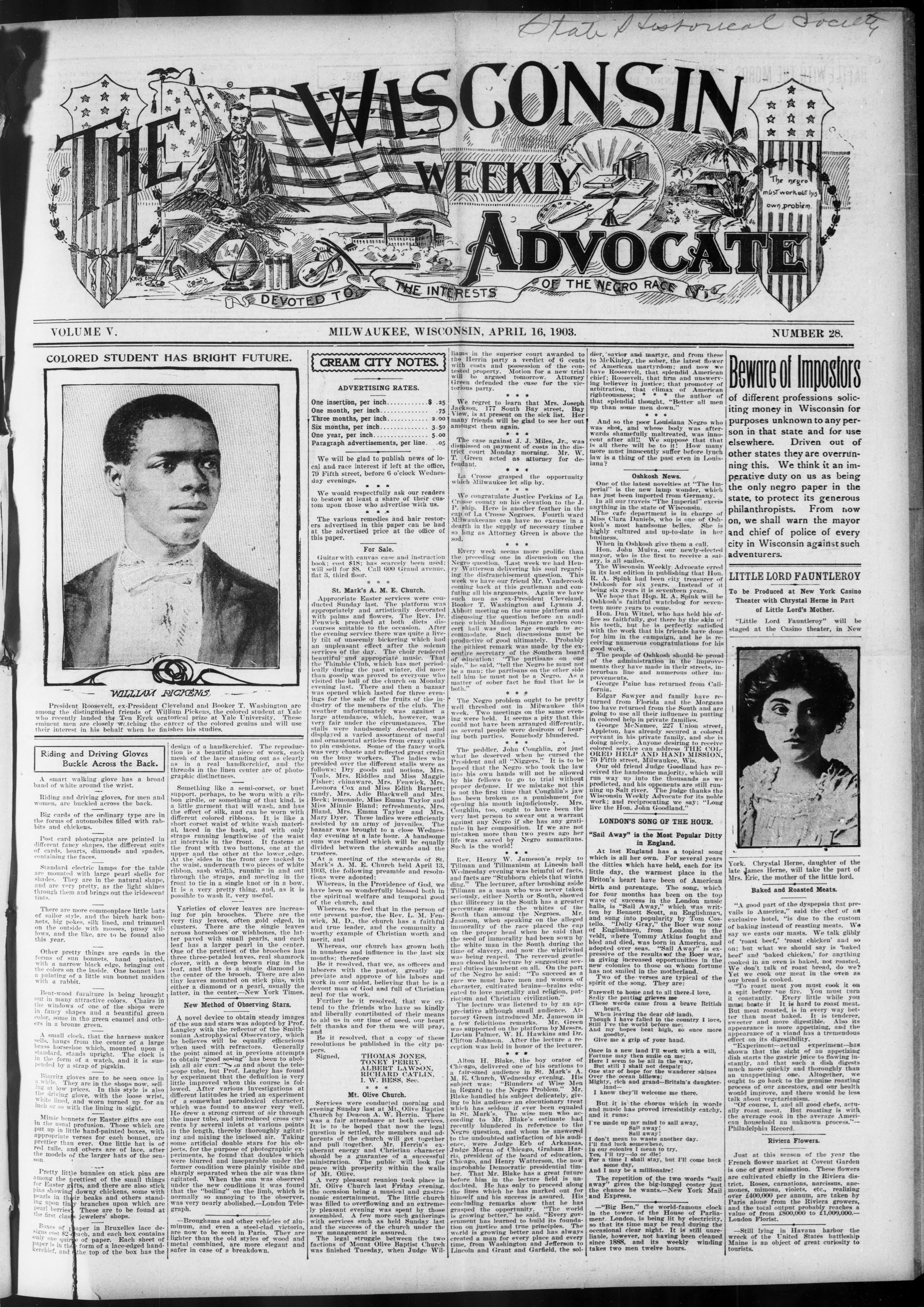
WISCONSIN
WEEKLY
ADVOCATE
DEVOTED TO THE INTERESTS OF THE NEGRO RACE
COLORED STUDENT HAS BRIGHT FUTURE.
[Name]
President Roosevelt, ex-President Cleveland and Booker T. Washington are among the distinguished friends of William Pickens, the colored student at Yale who recently landed the Ten Eyek oratorical prize at Yale University. These eminent men are closely watching the career of the colored genius and will use their interest in his behalf when he finishes his studies.
VOLUME V.
President Roosevelt, ex-President C
among the distinguished friends of W
who recently landed the Ten Eyek or
eminent men are closely watching the o
their interest in his behalf when he fin
Riding and Driving Gloves Buckle Across the Back.
A smart walking glove has a broad band of white around the wrist.
Riding and driving gloves, for men and women, are buckled across the back.
Big cards of the ordinary type are in the forms of automobiles filled with rabbits and chickens.
Post card photographs are printed in different fancy shapes, the different suits of cards, hearts, diamonds and spades, containing the faces.
Standard electric lamps for the table are mounted with large pearl shells for shades. They are in the natural shape, and are very pretty, as the light shines through them and brings out the iridescent tints.
There are more commonplace little hats of sailor style, and the birch bark bonnets, big pokes, silk lined, and trimmed on the outside with mosses, pussy willows, and the like, are to be found also this year.
Other pretty things are cards in the forms of sun bonnets, hand painted, with a narrow black edge, bringing out the colors on the inside. One bonnet has a painting of a little sun bonnet maiden with a rabbit.
Bent-wood furniture is being brought out in many attractive colors. Chairs in the windows of one of the shops were in fancy shapes and a beautiful green color, some in the green enamel and others in a bronze green.
A small clock, that the harness maker sells, hangs from the center of a large brass horseshoe which, mounted upon a standard, stands upright. The clock is in the form of a watch, and it is suspended by a strap of pigskin.
Biarritz gloves are to be seen once in a while. They are in the shops now, selling at low prices. In this style is also the driving glove, with the loose wrist, white lined, and worn turned up for an inch or so with the lining in sight.
Mimic bonnets for Easter gifts are out in the usual profusion. Those which are put up in little hand-painted boxes, with appropriate verses for each bonnet, are prettier than ever. One little hat is of red tulle, and others are of lace, after the models of the larger hats of the season.
---
Pretty little bunnies on stick pins are among the prettiest of the small things for Easter gifts, and there are also stick pins showing downy chickens, some with pearls in their beaks and others standing upon tiny branches upon which are pearl berries. These are to be found at the first class jewelers' shops.
Boxes of paper in Bruxelles lace designs cost $2 each, and each box contains only one quirce of paper. Each sheet of paper is in the form of a lace-edged handkerchief, and the top of the box has the
```markdown
```
design of a handkerchief. The reproduction is a beautiful piece of work, each mesh of the lace standing out as clearly as in a real handkerchief, and the threads in the linen center are of photographic distinctness.
Something like a semi-corset, or bust support, perhaps, to be worn with a ribbon girdle, or something of that kind, is a little garment that will wash, and has the effect of silk, and can be worn with different colored ribbons. It is like a short corset waist of white wash material, laced in the back, and with only straps running lengthwise of the waist at intervals in the front. It fastens at the front with two buttons, one at the upper and the other at the lower edge. At the sides in the front are tacked to the waist, underneath two pieces of white ribbon, sash width, running in and out through the straps, and meeting in the front to tie in a single knot or in a bow. It is a very pretty thing, and, as it is possible to wash it, very useful.
Varieties of clover leaves are increasing for pin brooches. There are the very tiny leaves, often gold edged, in clusters. There are the single leaves across horseshoes or wishbones, the latter paved with small pearls, and each leaf has a larger pearl in the center. One of the prettiest of the brooches has three three-petaled leaves, real shamrock clover, with a deep brown ring in the leaf, and there is a single diamond in the center of the brooch. There are also tiny leaves mounted on stick pins, with either a diamond or a pearl, usually the latter, in the center.—New York Times.
New Method of Observing Stars.
A novel device to obtain steady images of the sun and stars was adopted by Prof. Langley with the reflector of the Smithsonian Astrophysical Observatory, which he believes will be equally efficacious when used with refractors. Generally the point aimed at in previous attempts to obtain "good seeing" has been to abolish all air currents and about the telescope tube, but Prof. Langley has found by experiment that the definition is very little improved when this course is followed. After various investigations at different latitudes he tried an experiment of a somewhat paradoxical character, which was found to answer very well. He drew a strong current of air through the inner tube, and introduced cross currents by several inlets at various points in the length, thereby thoroughly agitating and mixing the inclosed air. Taking some artificial double stars for his objects, for the purpose of photographic experiments, he found that doubles which were blurred and inseparable under the former condition were plainly visible and sharply separated when the air was thus agitated. When the sun was observed under the new conditions it was found that the "boiling" on the limb, which is normally so annoying to the observer, was very nearly abolished.—London Telegraph.
Broughams and other vehicles of aluminum, and even a steel-clad victoria, are now to be seen in Paris. They are lighter than the old styles of wood and metal combined, are more elegant and safer in case of a breakdown.
ADVERTISING RATES.
One insertion, per inch..... $ .25
One month, per inch..... .75
Three months, per inch..... 2.00
Six months, per inch..... 3.50
One year, per inch..... 5.00
Paragraph advertisements, per line. .05
We will be glad to publish news of local and race interest if left at the office, 79 Fifth street, before 6 o'clock Wednesday evenings.
We would respectfully ask our readers to bestow at least a share of their custom upon those who advertise with us.
```markdown
```
The various remedies and hair restorers advertised in this paper can be had at the advertised price at the office of this paper.
For Sale.
Guitar with canvas case and instruction book; cost $18; has scarcely been used will sell for $8. Call 600 Grand avenue flat 3, third floor.
☆ ☆ ☆
St. Mark's A. M. E. Church.
Appropriate Easter services were conducted Sunday last. The platform was appropriately and artistically decorated with palms and flowers. The Rev. Dr. Fenwick preached at both diets discourses suitable to the occasion. After the evening service there was quite a lively tilt of unseemly bickering which had an unpleasant effect after the solemn services of the day. The choir rendered beautiful and appropriate music. That the Thimble Club, which has met periodically during the past winter, did more than gossip was proved to everyone who visited the hall of the church on Monday evening last. There and then a bazaar was opened which lasted for three evenings for the sale of the fruits of the industry of the members of the club. The weather unfortunately was against a large attendance, which, however, was very fair under the circumstances. The stalls were handsomely decorated and displayed a varied assortment of useful and ornamental articles from crazy quilts to pin cushions. Some of the fancy work was very chaste and reflected great credit on the busy workers. The ladies who presided over the different stalls were as follows; Dry goods and notions, Mrs. Toals, Mrs. Riddles and Miss Maggie Fisher; chinaaware, Mrs. Fenwick, Mrs. Leonora Cox and Miss Edith Barnett; candy, Mrs. Adie Blackwell and Mrs. Beck; lemonade, Miss Emma Taylor and Miss Minnie Bland; refreshments, Mrs. Bland, Mrs. Emma Taylor and Mrs. Mary Dyer. These ladies were efficiently assisted by an army of juveniles. The bazaar was brought to a close Wednesday evening at a late hour. A handsome sum was realized which will be equally divided between the stewards and the trustees.
At a meeting of the stewards of St. Mark's A. M. E. Church held April 13, 1903, the following preamble and resolutions were adopted:
Whereas, in the Providence of God, we have been so wonderfully blessed both in the spiritual welfare and temporal good of the church, and
Whereas, we feel that in the person of our present pastor, the Rev. L. M. Fenwick, M. D., the church has a faithful and true leader, and the community a worthy example of Christian worth and merit, and
Whereas, our church has grown both in numbers and influence in the last six months; therefore
Be it resolved, that we, as officers and laborers with the pastor, greatly appreciate and approve of his labors and work in our midst, believing that he is a devout man of God and full of Christian zeal for the work.
Further be it resolved, that we extend to the friends who have so kindly and liberally contributed of their means to aid us in our time of need, our heart felt thanks and for them we will pray, and
Be it resolved, that a copy of these resolutions be published in the city papers.
Signed, THOMAS JONES,
TONEY PERRY,
ALBERT LAWSON,
RICHARD CATLIN,
I. W. BESS, Sec.
Mt. Olive Church.
Services were conducted morning and evening Sunday last at Mt. Olive Baptist Church by Deacon A. W. Herrin. There was a fair attendance at both services. It is to be hoped that now the legal question is settled, the members and adherents of the church will get together and pull together. Mr. Herrin's exuberant energy and Christian character should be a guarantee of a successful ministration. The public will look for peace with prosperity within the walls of Mt. Olive.
A very pleasant reunion took place in Mt. Olive Church last Friday evening, the occasion being a musical and gastronomic entertainment. The little church was filled to overflowing and an extremely pleasant evening was spent by those assembled. A few more such gatherings with services such as held Sunday last and the success of the church under the new management is assured. The legal struggle between the two factions of Mount Olive Baptist Church was finished Tuesday, when Judge Wil-
liams in the superior court awarded to the Herrin party a verdict of 6 cents with costs and possession of the contested property. Motion for a new trial will be argued tomorrow. Attorney Green defended the case for the victorious party.
* * *
We regret to learn that Mrs. Joseph Jackson, 177 South Bay street, Bay View, is at present on the sick list. Her many friends will be glad to see her out amongst them again.
***
The case against J. J. Miles, Jr., was dismissed on payment of costs in the district court Monday morning. Mr. W. T. Green acted as attorney for defendant.
La Crosse grasped the opportunity which Milwaukee let slip by.
We congratulate Justice Perkins of La Crosse county on his elevation to the J. P. ship. Here is another feather in the cap of La Crosse Negroes. Fourth ward Milwaukeeans can have no excuse in a dearth in the supply of necessary timber so long as Attorney Green is above the sod.
* * *
Every week seems more prolific than the preceding one in discussion on the Negro question. Last week we had Henry Watterson delivering his soul regarding the disfranchisement question. This week we have our friend Mr. Vandercook coming back at this gentleman and confuting all his arguments. Again we have such men as ex-President Cleveland, Booker T. Washington and Lyman J. Abbott meeting on the same platform and discussing the question before an audience which Madison Square garden concert hall was not large enough to accommodate. Such discussions must be productive of good ultimately. Probably the pithiest remark was made by the executive secretary of the Southern board of education: "The partisans on one side," he said, "tell the Negro he must not be a man; the partisans on the other side tell him he must not be a Negro. As a matter of sober fact he find that he is both."
* * *
The Negro problem ought to be pretty well threshed out in Milwaukee this week. Two meetings on the same evening were held. It seems a pity that this could not have been arranged differently, as several people were desirous of hearing both parties. Somebody blundered.
* * *
The peddler, John Coughlin, got just what he deserved when he cursed the President and all "Niggers." It is to be hoped that the Negro who took the law into his own hands will not be allowed by his fellows to go to trial without proper defense. If we mistake not this is not the first time that Coughlin's jaw has been broken as a punishment for opening his mouth injudiciously. Mrs. Coughlin, too, ought to have been the very last person to swear out a warrant against any Negro if she has any gratitude in her composition. If we are not mistaken more than two years ago her life was saved by Negro samaritans. Such is the world!
***
Rev. Henry W. Jameson's reply to Tillman and Tillmanism at Lincoln hall Wednesday evening was brimful of facts, and facts are "Stubborn chiels that winna ding." The lecturer, after brushing aside Tillman as a man who was never taken seriously, either North or South, showed that illiteracy in the South has a greater percentage among the whites of the South than among the Negroes. Mr. Jameson, when speaking on the alleged immorality of the race placed the cap on the proper head when he said that the seed of immorality had been sown by the white man in the South during the time of slavery, and now the whirlwind was being reaped. The reverend gentleman closed his lecture by suggesting several duties incumbent on all. On the part of the Negro he said: "To succeed as a race we must have men and women of character, cultivated brains—brains educated to love mortality and religion, patriotism and Christian civilization."
The lecture was listened to by an appreciative although small audience. Attorney Green introduced Mr. Jameson in a few felicitious remarks. Mr. Green was supported on the platform by Messrs. Lucian Palmer, W. H. Hawkins and Dr. Clifton Johnson. After the lecture a reception was held in honor of the lecturer.
* * *
Alton H. Blake, the boy orator of Chicago, delivered one of his orations to a fair-sized audience in St. Mark's A. M. E. Church, Wednesday evening. His subject was: "Blunders of Wise Men in Regard to the Negro Problem." Mr. Blake handled his subject delicately, giving to his audience an elocutionary treat which has seldom if ever been equaled in St. Mark's. The wise men who according to Mr. Blake's estimate had recently blundered in reference to the Negro question, and whom he answered to the undoubted satisfaction of his audience, were Judge Erb of Arkansas, Judge Moran of Chicago, Graham Harris, president of the board of education, Chicago, and Henry Watterson, the now improbable Democratic presidential timber. That Mr. Blake has a great future before him in the lecture field is undoubted. He has only to proceed along the lines which he has marked out for himself and his success is assured. His concluding remarks show that he has grasped the opportunity. "The world is growing better," he said. "Every government has learned to build its foundation on justice and true principles. The world is growing better and has always created a man for every place and every time, from Washington and Jefferson to Lincoln and Grant and Garfield, the sol-
dier, savior and martyr, and from these to McKinley, the sober, the latest flower of American martyrdom; and now we have Roosevelt, that splendid American chief; Roosevelt, that firm and unswerving believer in justice; that promoter of arbitration, that climax of American righteousness; * * * the author of that splendid thought. "Better all men up than some men down."
***
And so the poor Louisiana Negro who was shot, and whose body was afterwards shamefully maltreated, was innocent after all!! We suppose that that is all there will be to it! How many more must innocently suffer before lynch law is a thing of the past even in Louisiana?
Oshkosh News
One of the latest novelties at "The Imperial" is the new lamp wonder, which has just been imported from Germany. In all our travels "The Imperial" exceis anything in the state of Wisconsin. The cafe department is in charge of Miss Clara Daniels, who is one of Oshkosh's most handsome belles. She is highly cultured and up-to-date in her business. When in Oshkosh give them a call. Hon. John Mulva, our newly-elected mayor, who is the first to receive a salary, is all smiles. The Wisconsin Weekly Advocate erred in its last edition in publishing that Hon. R. A. Spink had been city treasurer of Oshkosh for six years. Instead of it being six years it is seventeen years. We hope that Hon. R. A. Spink will be Oshkosh's faithful watchdog for seventeen more years to come.
Hon. Dan Witzel, who has held his office so faithfully, got there by the skin of his teeth, but he is perfectly satisfied with the work that his friends have done for him in the campaign, and he is receiving numerous congratulations for his good work.
The people of Oshkosh should be proud of the administration in the improvements they have made in their streets, interurban line and numerous other improvements.
George Paine has returned from California.
Edgar Sawyer and family have returned from Florida and the Morgans too have returned from the South and are going to use all their influence in putting in colored help in private families.
George McNamee, 227 Union street, Appleton, has already secured a colored servant in his private family, and she is doing nicely. Anyone desiring to receive colored service can address THE COLORED HELP AND HAND MISSION, 79 Fifth street, Milwaukee, Wis.
Our old friend Judge Goodland has received the handsome majority, which will run way up into the thousands as we predicted, and his opponents are still running up Salt river. The judge thanks the Wisconsin Weekly Advocate for its noble work; and reciprocating we say: "Long live the Hon. John Goodland."
LONDON'S SONG OF THE HOUR.
"Sail Away" is the Most Popular Ditty in England.
At last England has a topical song which is all her own. For several years the ditties which have held, each for its little day, the warmest place in the Briton's heart have been of American birth and parentage. The song, which for four months has been on the top wave of success in the London music halls, is "Sail Away," which was written by Bennett Scott, an Englishman, and sung into popularity by Tom Costello. "Dolly Gray," the Boer war song of Englishmen, from London to the veldt, where Tommy Atkins fought and bled and died, was born in America, and adopted over seas. "Sail Away" is expressive of the results of the Boer war, in giving increased opportunities in the new colonies to those on whom fortune has not smiled in the motherland.
Two of the verses are typical of the spirit of the song. They are:
Farewell to home and to all there I love,
Sadly the pairing grieves me
(These words came from a brave British heart,
And my hopes beat high, so once more goodby,
Give me a grip of your hand.
Once in a new land I'll work with a will,
Fortune may then smile on me;
Here I seem to be all in the way,
But still I shall not despair;
One star of hope for the wanderer shines
Over the ocean billows;
Mighty rich and grand-Britain's daughter
Mighty, rich and grand—Britain's daughter-
land—
I know they'll welcome me there.
But it is the chorus which in words
and music has proved irresistibly catchy,
and it runs:
I've made up my mind to sail away,
Sail away!
Sail away!
I don't mean to waste another day.
I'll find luck somewhere.
In our colonies I mean to try.
Yes, I'll try—do or die!
For a time I shall stay, but I'll come back
some day,
And I may be a millionaire!
The repetition of the two words "sail away" gives the big-lunged coster just the chance he wants.—New York Mail and Express.
—"Big Ben," the world-famous clock in the tower of the House of Parliament. London, is being lit by electricity, so that its time may be read during the occasional clear night. It is still unreliable, however, not having been cleaned since 1888, and its weekly winding takes two men twelve hours.
NUMBER 28.
Beware of Impostors
Beware of Impostors
of different professions soliciting money in Wisconsin for purposes unknown to any person in that state and for use elsewhere. Driven out of other states they are overrunning this. We think it an imperative duty on us as being the only negro paper in the state, to protect its generous philanthropists. From now on, we shall warn the mayor and chief of police of every city in Wisconsin against such adventurers.
LITTLE LORD FAUNTLEROY
To be Produced at New York Casino Theater with Chrystal Herne in Part of Little Lord's Mother. "Little Lord Fauntleroy" will be staged at the Casino theater, in New
THEATRE
York. Chrystal Herne, daughter of the late James Herne, will take the part of Mrs. Eric, the mother of the little lord.
Baked and Roasted Meats.
"A good part of the dyspepsia that prevails in America," said the chef of an exclusive hotel, "is due to the custom of baking instead of reasting meats. We say we easts our masts. We talk glibly of 'roast beef,' 'roast chicken' and so on; but what we should say is 'baked beef' and 'baked chicken,' for anything cooked in an oven is baked, not roasted. We don't talk of roast bread, do we? Yet we cook our meat in the oven as our bread is cooked.
"To roast meat you must cook it on a spit before 'ae fire. You must turn it constantly. Every little while you must baste it. It is hard to roast meat. But meat roasted, is in every way better than meat baked. It is tenderer, sweeter and more digestible. Also its appearance is more appetizing, and the appearance of a viand has a tremendous effect on its digestibility.
"Experiment—actual experiment—has shown that the sight of an appetizing dish starts the gastric juice to flowing instantly, and that such a dish digests much more quickly and thoroughly than an unappetizing one. Altogether, we ought to go back to the genuine roasting process of our ancestors, and our health would improve, and there would be less talk about vegetarianism.
"Of course, I, and all good chefs, actually roast meat. But roasting is with the average cook in the average American household an unknown process."—Philadelphia Record.
Riviera Flowers.
Just at this season of the year the French flower market at Covent Garden is one of great animation. These flowers are cultivated chiefly in the Riviera district. Roses, carnations, narcissus, anemones, mimosa, violets, etc., realizing over £400,000 per annum, are taken by Paris alone from the Riviera growers, and the total output probably reaches a value of from £800,000 to £1,009,000.—London Florist.
Still lying in Havana harbor the wreck of the United States battleship Maine is an object of great curiosity to tourists.
BATTLE WITH THE MOROS
American Troops Have Engagement with Enemy Near Calui.
Americans Shell the Fortifications for Eight Hours and Destroy Them
Manila, April 15.—Six hundred American troops under the command of Capt. Pershing, who are pursuing the Moros retreating from Bacolod, after the defeat by Pershing's force last Wednesday, had an engagement with a number of the enemy near Calui. Occupying a fortified position, they attempted to cover the retreat of the other Bacolod Moros by delaying the American pursuit.
The Americans shelled the position for eight hours, reducing the fortifications and killing many Moros. Pershing met no further opposition and marched to Marapul, which he occupied. Later he and his command joined the American camp on the north side of Lake Lanao, completing the occupation of all the lake district.
The Datto Nonucan, one of the most friendly of the Moros, has died of cholera. He sold some of his own land to Americans for a military post and sincerely co-operated with them. He caused his followers to assist the operations of the Americans, helped them with transportation, and furnished them food. Furthermore, he constantly sought to impress upon the other Moros the benefits to accrue to them under the rule of Americans. At the time Gen. Blanco, at the head of a Spanish force, invaded Mindanao to subdue turbulent Moros, the Datto aided him in his efforts.
A detachment of the Twenty-eightin Infantry surprised the camp of a Ladrone band at Cagayan Mindanao. Eighteen occupants of the camp were captured and thirteen bolomen wounded. The entire force of ladrones was not present when the camp was rushed, and it is estimated the full-band numbered 400 men.
SNOW IN UPPER MICHIGAN.
Fierce Storm Rages All Day in the Northern Peninsula—Snow in Central Wisconsin.
Marquette, Mich., April 15.—Several inches of snow covers the ground today. Yesterday the ground was bare. A storm general in the upper peninsula raged all day yesterday. The weather is moderate and the snowfall will have no effect other than to furnish more water for the log-drivers. Plainfield, Wis., April 15.—This place was visited by a heavy snowstorm early yesterday morning.
TRIES MATRIMONY AGAIN.
J. M. Sands, Formerly of This City, Married for Third Time.
Elgin, Ill., April 15.—[Special.]—Widowed once, divorced once, J. M. Sands has again launched his craft on the sea of matrimony. He recently married in Chicago Miss Lizzie Sullivan, proprietress of a fashionable dressmaking establishment, and they are living at the Ellis Park Hotel. Mr. Sands formerly resided at Dodgeville, Wis., where his first wife died. He came to Elgin to be agent for the North-Western road. While here he married the divorced wife of Ashley Abell of Elgin, now connected with a regalia factory of Kalamazoo, Mich. In course of time Mrs. Sands secured a divorce and was again married to Abell. After leaving Elgin a year or two ago Mr. Sands went to Milwaukee, and, it is said, made considerable money in mining ventures. He is now on the road for a Chicago house.
AMERICAN GIFT FOR POPE.
President Roosevelt Sends Books with All Messages of His Predecessors.
Baltimore, Md., April 15.—President Roosevelt has sent to Cardinal Gibbons and the cardinal has forwarded by special messenger to Pope Leo XIII, a gift to be presented to the pontiff on the celebration of his jubilee. The gift consists of ten handsomely bound volumes containing all the messages and official documents of the Presidents of the United States, from Washington to Roosevelt. The gift was intrusted by Cardinal Gibbons to a clergyman who sailed from New York to Naples on the steamboat Liguria. Autograph letters from the President and Cardinal Gibbons to Pope Leo accompany the gift.
STORM ON JERSEY COAST.
Atlantic City and Asbury Park Visited by Severe Northeaster.
New York, April 15.—At Atlantic City and Asbury Park, the severest northeastster that has visited that part of the Jersey coast since 1895 has been r.ging for twenty-four hours. The tide at 9 o'clock last night was the highest that has been known for eighteen years. Huge breakers are crashing against the piling beneath the piers and pavilions and heavy timbers from the board walk have been ripped up by the incessant bombardment of the waves and carried out to sea.
TWO-POUND BABY IS BORN.
Girl So Tiny She Can be Placed in a Quart Cup.
Danville, Ill., April 15.—A 2-pound baby girl was born to Mrs. Charles Knight and is doing well. The child is well developed and is healthy and active. It can easily be placed in a quart cup. The part of the leg above the knee is no larger than a man's thumb and a quarter will completely cover one of the hands. The head is smaller than a baseball.
COLLIDED IN THE MERSEY
White Star Liner Celtic Damaged by a British Steamer.
Liverpool, April 15.—The White Star line steamer Celtic and the British steamer Heathmor collided in the Mersey today. The Celtic was damaged amidships, but it is expected that she will be able to sail for New York tomorrow as scheduled.
Found Dead in Road
Calumet, Mich., April 15.—[Special.]—John Goddard, timber boss at Trimountain mine, was found dead on a county road near the Baltic mine. There are no marks of violence on the body and death evidently resulted from heart failure. He leaves a wife and family here.
Milwaukee Fireman is Married.
Escanaba, Mich., April 15.—[Special.]
—M. L. Quick of the Milwaukee fire department and Monica Lyons were married at St. Patrick's Church this morning. They leave tonight for a trip in the West.
—The first steamboat plied the Hudson in 1807.
NORTH SHOULD HELP BUT CANNOT DICTATE.
Grover Cleveland Gives Views on Negro Question at. Great Meeting in Madison Square Garden.
New York, April. 15.—Ex-President Grover Cleveland and Booker T. Washington sat side by side last night on the same platform and later spoke in behalf of the negro at a great mass meeting in Madison Square garden. Mr. Cleveland in his address analyzed the attitude of the South toward the negro and in suggesting a method of solving the negro question said the South could not be coerced into co-operation with the North and that the North should not gratuitously run counter to fixed Southern ideas or prejudices. The great burden of solving the problem lay on the South; the North could aid and at present the speaker could see no better way of aiding than by helping to educate the negro after the method of the Tuskegee Institute, of which Booker Washington is president.
In his address Booker T. Washington said the lifting up of the negro is not alone Tuskegee's problem, not alone the negro's concern, not alone the South's duty, but is the problem of the nation, because the whole people were responsible for the introduction and perpetuation of 'American slavery.
DISASTROUS FIRE IN TEXAS OIL FIELDS.
Flames Spread with Tremendous Rapidity and 265 Derricks Were Lost
Beaumont, Tex., April 15.—A fire on Spindle Top, which started early today, did damage estimated at from $800,000 to $1,000,000. Two hundred and sixty-five derricks were lost. Two-hundred rigs were producing wells.
The fire started from a lantern at the Caldwell Oil Company's well. The fly wheel of the engine struck the lantern and ignited the derrick and the flames spread with tremendous rapidity, three blocks, numbers 36, 37, and 38 being in ashes by 3 o'clock.
No effort was made to extinguished the fire for it was impossible to get within 100 feet of the flames. No one was inured.
It is estimated that two-thirds of the company's burned district will be unable to recover from the damage by the fire.
IMPLICATES TAYLOR.
Witness Says He was Offered $2500 if He Would Shoot Goebel—Howard Trial in Progress.
Frankfort, Ky., April 15.—Frank Cecil, who has been away from Kentucky since his indictment last year as accessory to the murder of Gov. William Goebel, and who recently surrendered, gave sensational testimony in the trial of James Howard today. Cecil corroborated Culton as to the alleged conspiracy. He also said that Caleb Powers, then secretary of state, told him that a man had been secured to come here from the mountains to kill Goebel. Powers told him, he (Cecil) would be paid $2500 if he would fire the shot. Cecil says he declined. Gov. W. S. Taylor, he testified, called him into his private office and told him the same thing. Gov. Taylor said he had saved $2500 from his campaign fund and that he would pay him. Gov. Taylor also mentioned Youtsey to the witness, and referred witness to him.
NO LIONS FOR ROOSEVELT.
President Refuses to Hunt, but is Enjoying His Outing.
Cinnabar, Mont., April 15.—President Roosevelt is slowly working his way to Maj. Pitcher's headquarters at Fort Yellowstone. He is expected to arrive at Yancey's this morning, and to reach the fort Thursday. He will remain there one day, and then will start for Norris and the geysers. There is heavy snow between the fort and Norris, and the engineer corps is at work opening the road
Word was received from the President that he is in the best of health, and thoroughly enjoying his outing. In addition to horsesback riding he takes long walks over the mountain trails. Notwithstanding reports to the contrary, the President has not fired a shot at a mountain lion, and says he has no intention of doing so. It is estimated that there are 500 of these animals in the park, and they are killing many deer and elk. Buffalo Jones, the game warden of the park, has offered to round up a lion or two for President Roosevelt to shoot at, but he declined.
HEMATITE QUARRY FOUND
Source of Indians' Ore Supply, Long a Mystery. Discovered in Missouri.
St. Louis, Mo., April 15.—The old quarry in which the ancient Missourian quarried the ore for his hematite axe has been discovered near Leslie, where men, in working a surface iron mine, found many grooved spauls of from one to fifteen pounds' weight. D. I. Bushnell of this city, chairman of the committee on archaeology of the Missouri Historical Society, investigated and found from 500 to 600 of the ancient relics thrown in a heap beside a tree. For 100 years these axes have been found throughout the Mississippi valley.
REBELS WILL ATTACK FEZ
Outbreak Said to be Spreading and Situation Serious.
London, April 15.—A dispatch from Fez says a large body of rebel Kabyles has left Tamiza to attack Fez. The rebellion is spreading and the situation is serious. The pillaging of Frajana, which was captured recently by the forces of the pretender, continues. As the result of quarrels over booty ten of the rebels have been killed and many wounded.
GOT THE WRONG MAN.
Negro Killed at Shreveport, La., was Innocent of Crime Charged.
New Orleans, La., April 15.—The Times-Democrat, Shreveport special, says: "It has been established beyond any cause for doubt that the negro, who was killed Saturday, and whose body was burned early Sunday morning, as the murderer of Mrs. Alice Matthews, was innocent of the crime."
OPPOSITION IN COLOMBIA.
Ratification of Canal Treaty Regarded as Extremely Doubtful.
London, April 15.—A private cable dispatch from Bogota, Colombia, received here today, says that the ratification of the United States Colombian Panama canal treaty is extremely doubtful.
Iowa Postoffice Robbed.
St. Paul, Minn., April 15.—A special to the Dispatch from Ireton, Ia., says: Cracksmen blew open the safe of the postoffice here last night and secured $150 in money and $50 worth of stamps.
JAS. J. HILL DENIES MERGER RUMORS.
New York, April 14.—Just before the close of the stock market today reports were current that the Northern Securities Company had decided not to appeal from the merger decision and would abandon that plan for one of several others. A representative of the company in a position to speak with authority declared that the report was absolutely false. He added that no plan of action had yet been determined upon and might not be for some time.
Another report circulated just before the closing hours of the stock exchange was that steps were being taken to compromise the Northern Securities case in some way. Just how this was to be done was not brought out. This report, apparently, was without authority.
Another rumor was to the effect that steps were being taken to dissolve the Northern Securities Company and that the Great Northern would be managed in some way as an independent organization. Of this rumor, President James J. Hill said: "There's not a word of truth in that story. There is no intention on the part of the Northern Securities people to dissolve the company. On the contrary, we are preparing our appeal papers." A Wall street news bureau this afternoon in connection with the report that an appeal would not be filed, quotes a "conservative authority" as follows:
"Counsel concerned with the Northern Securities Company have completed consideration of three alternative plans which were possibly drawn up and extensively considered long before the present decision and these counsel together with some of the largest bankers interested in the enterprise will proceed to Washington to lay their case before Attorney General Knox and arrange if possible with him a status for the securities involved which will entirely conform to the law.
"There is reason to think that the possibility of such an arrangement has already been strongly hinted at from Washington.
Washington, D. C., April 14. The department of justice has no information to indicate that the Northern Securities Company will abandon its case. On the contrary, all the information in the possession of the department is to the effect that the company will appeal to the United States supreme court and contest the case to the end.
NEW BOAT RAN AHEAD.
Shamrock I. Led by a Length at the Start, but was Easily Passed by Challenger.
Weymouth, Eng., April 14.—A race of sixteen miles to leeward from off Weymouth and a beat back was laid out for the Shamrocks today. When the boats got outside the shelter of the breakwater the wind came in hard gusts and the yachts seemed to have all they could stagger under and required an occasional luff up to ease them. The strain found a weak spot in the Shamrock III.'s peck halyard gear. A man was sent aloft and on his report the yacht fetched into sheltered water and anchored. All her sail was then dropped on deck. The Shamrock I. also anchored and dropped her head sails.
The wind subsequently softened and the boats were sent off on a trial spin to leeward and return. There was no formal start. The Shamrock I. led by a length, but the new boat in a few minutes closed the gap and ran clear ahead. The timings after a ten-mile run were as follows: Shamrock III., 2:24:03; Shamrock I., 2:26:23. The times at the finish were: Shamrock III., 3:33:39; Shamrock I., 3:39:42.
THEATER IN FLAMES
Playhouse at Rome, N. Y., Destroyed People are Injured by Falling Walls.
Rome, N. Y., April 14.—The Washington Theater here, owned by Wallace & Gilmore of Oswego, was destroyed by fire early today. The loss is between $125,000 and $150,000, about half covered by insurance. The Arlington Hotel, adjoining, took fire twice, but the flames were extinguished without much damage being done. The walls of the theater fell, injuring a score of persons who had crowded within the fire lines. The theater building also contained a number of offices and two club rooms. The property was all destroyed.
New Orleans, La., April 14.—An early morning fire swept the east side of West End, the summer resort on Lake Pontchartrain, destroying considerable property, today. The blaze started in the Capitol Hotel, which was destroyed along with a number of smaller business establishments and boat houses. A large number of sloops, catboats and yachts were at anchor in the open when the fire started and many were burned before they could be moved. The loss is about $75,000.
CHARGED WITH SHOOTING.
Atlantic Man is Said to Have Wounded His Brother-in-Law—Injured Man May Not Survive.
Houghton, Mich., April 14.—[Special.]—Eric Heikala, a miner at the Atlantic mine, is being held on an open charge for the alleged shooting of his brother-in-law, Jacob Pekala, also of the Atlantic. The bullet entered Pekala's breast and he may not live. Both were out driving Sunday, Pekala handling the reins. Heikala remonstrated with him for driving too fast and a quarrel ensued. Monday morning the quarrel was resumed in a saloon in Atlantic, when Heikala is said to have shot Pekala. Heikala fled, but was arrested by an under sheriff while boarding a train at Homestead Crossing, near Elm River.
Exposition for Potatoes.
There is being held in Berlin an exposition that includes all that relates to the culture and economic use of the potato. (1) as human food, (2) as food for domestic animals, (3) as material for the manufacture of alcohol, and (4) as material for starch and subsidiary products—starch, sugar syrup, dextrin, etc. The exhibition of a year ago covered only the uses of potato alcohol as motive power for various machines.
Live Boiled Fish
A Paris newspaper states that M. Marcellin Pellet, the French minister to Central America, has discovered close to the Lake of Amatitlan in Guatemala, a small fish which swims in the hot water of the springs close by. It is stated that in the Philippine islands there is a similar fish, which, like many politicians, thrives best in boiling water.—London Express. Every animal has its own kind of flea
LEGISLATURE.
Proceedings in the Senate
In the Senate on the evening of April 13 a resolution was introduced to adjourn May 2. April 28 is made the last day of receiving committee reports. The Senate passed a bill allowing all public officers to give surety company bonds, and providing that supervisors may pay for them. Assembly bills were concurred in as follows: Providing that in distribution of assets of a corporation preferred stock shall have no advantage over common, unless expressly provided; codifying laws respecting care of dependent children in Milwaukee; declaring spite fences over six feet high a public nulsance; and No. G14A, authorizing cities of the third class to issue bonds for school purposes. The Assembly bill providing that the property of a wife shall be jointly liable with that of her husband for deas contracted for provision and other necessaries was ordered to a third reading. The substitute bill for the regulation of bands came up for engrossment in the senate and was laid over until Thursday.
In the Senate on the 14th Senator Roehr, from the insurance committee, introduced a bill to amend the statutes so as to permit the wholesale druggists to organize a mutual insurance company. Bills were passed as follows; To prevent the docking of horses in Wisconsin, but not to prevent the importation of docked animals; validating franchises heretofore granted; authorizing the secretary of the state board of control to inspect county institutions; Assembly bills were concurred in; allowing state treasurer to give a surety company bond at state expense; regulating revocation of license to attorneys; increasing pay of drainage commissioners from $2.50 to $3 a day; allowing cities to borrow money for public improvements; providing for evidence of sale of property under chattel mortgages; extending law for education of the deaf by towns and villages; providing for permanent record and numbering of school districts. Senate bills were killed: To permit cities and villages to charge local license to peddlers; regulating the delivery of prepaid telegrams and express paskages. The governor's veto of No. 198, giving supervisors authority to expend $10,000 for a soldiers' monument without a vote of the people, came up in its order, and consideration was postponed until the 15th.
The Senate on the 16th passed the following bills: Authorizing the building of a dam across Long Lake creek; authorizing the governor to employ an agent on commission to settle war claims against the government, with an amendment making 2% per cent. the limit in case the amount reaches $50,000.
Proceedings in the Assembly.
In the Assembly on April 13 a resolution to adjourn fixes the time as May 2, with the limit for committees to report as April 30. The judiciary committee introduced a bill abolishing the position of law examiner in the attorney general's office. A substitute bill, introduced by the same committee, for the Cowling bill, No. 423A, provides for a general increase in the salaries of the attorney general and his assistants. It raises the salary of the attorney general from $3000 to $5000, that of the assistant attorney general from $2000 to $2500, and that of the second assistant attorney general from $1800 to $2000. It also provides for combining the positions of messenger and clerk and fixing the salary at $1000. The first stenographer is to receive a salary of $900 a year and the second stenographer $75 per month for the time the position is filled, which is not to be continuously unless absolutely necessary. The bill is to go into effect at the end of the attorney general's present term. The Assembly ordered the third reading of the Reukema bill, empowering the Milwaukee school directors to select the location and plans for a new school building, subject to the approval of the common council. The Assembly adopted, under suspension of the rules, the bill providing that no daily paper shall be awarded the contract for city printing and advertising in the city of Milwaukee, unless it has a circulation equal to at least 5 percent. of the registered voters of the city. It ordered engrossed the Fritzke bill, empowering the city of Milwaukee to apply the surplus of its water works to establishing a municipal lighting plant, and killed the Rankl bills, relating to the fire and police departments of the city of Milwaukee. Among other bills killed by the Assembly was one introduced by Mr. Waterman, providing for the taxation of all dogs, the Peterson and Waterman bills for the licensing of stationary engineers, and the Johnston bill for the registration and identification of criminals. The Assembly ordered the Dahl bill, appropriating $995,000 for the maintenance of the state charitable, penal and reformatory institutions to engrossment. The Root bill, making the term of office of the state commissioner of labor and industrial statistics six instead of two years, and the Timlin bill, making Lincoln's birthday a legal holiday, were laid over. The Senate bill empowering mutual fire insurance companies to operate outside their home counties was adopted. An amendment to the Barker anti-lobbyist bill, which was on the calendar for advancement to engrossment, making federal office holders as well as state office holders amenable to it, and it was laid over.
Senator North's joint resolution to enable Senator McGillivray to introduce a bill authorizing the chief clerk and sergeant-at-arms of the Senate to employ additional help, came up for consideration, and Mr. Cady offered an amendment, providing that it should be referred to the people at the general election in 1904. Both resolution and amendment were referred. The Assembly committee on claims reported the David Evans bill, No. 122A, with an amendment cutting the appropriation for improvements at the Wisconsin Veterans' Home at Waupaca from $35,000 to $17,000. The David Evans bill, No. 96A, providing that Wisconsin old soldiers who have lost their residence in the state be admitted to the veterans' home, was recommended, as was also the Karel bill, appropriating $1000 annually to the Wisconsin station for experiments with seeds, plants and fertilizers.
On the 14th the Assembly took up the Barker anti-trust bill and it was sent back to the judiciary committee. The committee on claims reported the bill appropriating $80,000 to the state board of agriculture, with an amendment cutting the appropriation down to $20,000. It was referred to the committee. The judiciary committee introduced a bill, prohibiting a person against whom a divorce has been granted to marry within a year from the time the decree granting such divorce has been entered. It also prohibits the marriage of nonresidents who come from other states, having such a restrictive law, for the purpose of evading such law, and forbids proscribed persons from going to other states for the purpose of evading the law. Marriages entered into in contravention of this law are declared invalid. The Assembly concurred in the bill empowering the board of school directors of the city of Milwaukee to select the location and plans of new school buildings, with the approval of the common council. It passed the Lord bill, providing for an annual tax of $220,000 for the maintenance of the state normal schools. The Timlin bill, making Lincoln's birthday a legal holiday, was killed.
In the Assembly on the 16th an amendment to the coemploye bill was reported by the judiciary committee. The substitute provides that a slight want of ordinary care on the part of the injured person shall not be a bar to an action for the recovery of damages for negligence on the part of the defendant, but can only be shown to reduce the damages. The Assembly killed the Root bill, increasing the term of office of the commissioner of labor and industrial statistics from two to six years. The Assembly committee on cities favorably reported several bills of interest to the city of Milwaukee. The Dahl bill authorizing the state tax commissioner to equalize the valuation of leaf tobacco when requested by the owner or other interested person was laid over until the 16th. The judiciary committee introduced a bill providing that street or electric railway companies may purchase any dam or water power for any purpose in connection with the operation of its road, and giving such corporations the right of eminent domain. It also introduced two other bills, one of which gives driving and logging companies power to use their water power for other purposes than for transporting logs, and the other provides that supervisors in cities operating under the general charter law may be made members of boards of review.
—Mosquitoes are so numerous near the coast of Borneo that the streams of that region are in summer often unnavigable. The insects swarm in such dense clouds that vision is obstructed.
WOMAN WITH HUMOR
It is She Who is the One Liked Best
If you consider the list of your friends, it will not take you long to discover that the woman you like best is the woman with a sense of humor. She is the one you think of first if you are getting up a picnic or a card party. You do not, perhaps, formulate it even to yourself, but in your mind she stands for the utmost good humor. If it rains, or it shines, if anybody else is cross and grumpy, the woman with a sense of humor can extract fun out of the dreariest proposition, and the first thing you know she has set everybody to laughing at her droll sayings, and turned defeat into a triumph, for who cares whether your original plan was carried out or not, just so everybody has a good time?
A sense of humor is said to be lacking in most women. Alas! I have found this only too true, but I have noticed that when a woman does have it the men are the first to find it out, and all she has to do to acquire a husband is to pick and choose. The day of the girl with the doll face is going out and the day of the girl with a sense of humor is coming in.—Harper's Bazar.
LATEST MARKET REPORTS.
MILWAUKEE, APRIL 15, 1903.
EGG AND DAIRY MARKETS
MILWAUKEE—Eggs — Market steady; strictly fresh laid, cases returned, 13c; cases included, do, 13½c; seconds, 10c; dirties, 11c. There is a good local demand. Many eggs are going to cold storage. Receipts were 580 cases. Butter—Market firm. There is a good demand for all fancy grades of both dairy and creamery. Creamery, per lb, 27½c; prints, 28c; firsts, 22@23c; seconds, 17c; June creamy, 18@20c; extra fancy dairy, 19c; lines, 15@16c; roll, 15@16c; packing stock, 12½c; whey, 10c; grease, 5@6c. Receipts were 12,200 lbs.
Cheese — Firm. The demand continues good; full cream flats, fancy, 13@13½c; good to choice, 13c; Young Americas, 13@14c; low grades, 10@11c; daisles, 13½@14c; long horns, 12½@13c; limburger, per lb. No. 1, 12@12½c; low grades, 10@11c; fancy brick, 13@13½c; low grades, 11@12c; imported Swiss, 25c; Block Swiss, domestic, 12½@13c; fancy loaf, 14@15c; No. 2, 12@13c; Sapsage, 20c. Recelpts were 6050 lbs. PLYMOUTH—Fifteen factories offered 656 boxes cheese, all but six of milch, sold as follows: 129 longhorns, 12½c; 263 daisies, 13½c; 199 twins, 12½c; 59 twins, 12½c. CHICAGO — Butter — Easier; creameries, 18@27c; dairies, 14@24c. Eggs—Steady at mark; cases included, 13½@14c. Cheese—Steady; twins, 12½@13c; daisles, 13@13½c; young Americas, 12½@13c. Live Poultry—Firm; turkeys, 12½@13c; chickens, 12½c.
MILWAUKEE LIVE STOCK MARKET.
CATTLE—Recelpts, 1 car; strong; calves steady; butchers' steers, medium to good, 1050 to 1300 lbs, 4.50@5.50; fair to medium, 950 to 1050 lbs, 4.00@4.50; heifers, common, 2.75@3.50; good, 3.75@4.50; cows, fair to good, 3.00@3.75; canners, 1.75@2.50; cutters, 2.50@3.00; bulls, common, 2.75@3.25; choice, 3.50@3.95; feeders, 800 to 950 lbs, 3.75@4.50; stockers 500 to 750 lbs, 3.25@3.75; veal calves, light, 90 to 105 lbs, 4.50@5.25; good, 110 to 140 lbs, 5.50@6.00. Milkers—Common, no demand; fancy heavy, 35.00@55.00.
SHEEP—Recelpts, none; steady; 3.00@5.50; bucks, 3.00@4.00; lambs, common to choice, 5.00@7.25.
Chicago receipts: Hogs, 21,000; catt'e, 23,000; sheep, 15,000.
MILWAUKEE HAY MARKET
Timothy, steady; carlots, choice timothy.
13.25@13.50; No. 1 timothy, 12.75@13.00.
No. 2 timothy, 9.50@11.50; crover and clover mixed, 9.00@10.00.
Prairie hay steady; choice Kansas, 11.50@12.00; No. 1 Kansas, 11.00@11.25; No. 2, 8.50@9.00.
Straw, steady; rye, 7.00@7.25; oats, 5.25@5.50; wheat, 4.00@4.50; packing hay, 6.50.
Wisconsin prairie, 6.50@7.50.
MILWAUKEE POTATO MARKET.
Potatoes—Market quiet. Carlots, on track, per bus, Rurnais and Burbanks, fancy large, 40c; Rose and Peerless, 38@39c; small sto
MARKETS BY TELEGRAPH.
MILWAUKEE—Flour—Steady. Wheat—
Firmer; No. 1 Northern, on track, 80c; No.
2 Northern, on track, 78½c. Corn—Steady;
No. 3 on track, 40½c. Oats—Steady; No. 2
white, on track, 35c; No. 3 white, on track,
33¼@34½c. Barley—Steady; No. 2 on
track, 58c; sample on track, 42@60c. Rye—
Steady; No. 1 on track, 52c. Provisions—
Steady; pork, 18.00; lard, 9.90.
Flour market steady; patents, 4.00@4.10; bakers', 3.00@3.10; rye, 2.90@3.00.
Millstuffs are lower and quoted at 13.25 for bran, 13.50 for standard middlings and 14.50@15.00 for Milwaukee flour middlings in 10-lb sacks; red dog, 16.50. Delivered to country points, 50c extra.
CHICAGO—Close—Wheat — May, 77%c; July, 71%@71%c; September, 69c. Corn—Aprll, 44%c; May, 44%c; July, 44%c; September, 43%@43%c; Oats—Aprll, 34c; May, 33%@33%c; July, 30%c; September, 27%@28c. Pork—May, 17.97%; July, 17.37%; September, 17.05. Lard—May, 9.90; July, 9.80; September, 9.77%; Ribs—May, 9.87%; July, 9.70@9.72%; September, 9.65. Rye—May, 50c; July, 50c. Barley—Cash, 42@44c. Flax—Cash N. W., 1.11; S. W., 1.09; May, 1.11. Timothy—Aprll, 3.60. Clover—Aprll, 12.00.
NEW YORK—Close—May wheat, 80%c.
July, 76%c; May corn, 52%c; July corn, 50c;
DULHUT—Close — Wheat — To arrive.
No. 1 hard, 78%c; No. 1 Northern, 76%c;
No. 2 Northern, 75%c; May, No. 1 hard,
78%c; July, 76%c. Flax—In store, 1.18; on
track and to arrive, May, 1.11%; July, 1.13;
September, 1.14; October, 1.14; November,
1.12. Oats—On track and to arrive, 32%c;
May, 33%c. Rye—On track and to arrive,
49c; May, 49%c. Barley—55%c1c. Receipts
—Wheat, 8439; shipments, 293,272.
MINNEAPOLIS—Close — Wheat — Cash,
77%c; May, 75%@75%c; July, 75%c; on
track, No. 1 hard, 78%c; No. 1 Northern,
77%c; No. 2 Northern, 76%c; No. 3 Northern,
74@75c.
ST. LOUIS—Close — Wheat — Higher;
No. 2 red cash elevator, 70%c; May, 70%@
70%c; July, 66%c; No. 2 hard, 71%@71%c;
Corn—Higher; No. 2 cash and May, 40%c;
July, 40%@40%c; Oats—Higher; No. 2
cash, 33%c; May, 34%; July, 39%@39%c; No.
2 white, 37%c. Lead—Weak, 4.52%; spelter,
6rm, 5.40
KANSAS CITY—Close — Wheat — May. 65%c; July, 62%c; cash No. 2 hard, 66%c; 67%c; No. 2 red, 68@69c. Corn—April, 35%c; May, 36%@36%c; July, 36%c. Cash—No. 2 mixed, 36%—37c; No. 2 white, 37c. Oats—No. 2 white, 34%c.
TOLEDO—Wheat—Fairly active, strong; cash, 76%c; May, 76%c; July, 717%c. Corn—Active, firm; April, 43c; May, 43%c; July, 44%c. Oats—Dull, steady; April, 34c; May, 33%c; July, 30%c. Rye—No. 2, 52%c. Cloverseed—Fairly active, firm; cash, 7.00 bid; April, 6.00 bid; October, 5.32½. Prime timothy, 1.50, nominal.
KANSAS CITY—Cattle—Recelpts, 10,000; market steady; beef steers, 4.00@5.40; Texans, 3.00@5.00; native cows and helpers, 2.00@4.90; stockers and feeders, 3.25@5.10. Hogs—Recelpts, 12,000; market weak to 5c lower; heavy, 7.20@7.40; packers, 7.00@7.20; yorkers, 7.15@7.17½; plugs, 6.00@7.00. Sheep—Recelpts, 7000; market steady, slow; sheep, 3.85@8.50; larks, 5.75@8.50
ST. LOUIS — Cattle — Receipts, 3000; steady; beef steers, 3.50@5.35; stockers and feeders, 3.25@4.50; cows and heifers, 2.25@4.75; Texans, 2.20@4.75. Hogs—Receipts, 8500; slow, 5c lower; pigs, 7.00@7.20; packers, 7.15@7.30; butchers, 7.25@7.50. Sheep—Receipts, 1000; market steady; sheep, 4.00@6.00; lambs, 6.00@8.00.
OMAHA—Cattle—Receipts, 5000; market steady to 5@10c lower; beef steers, 4.25@5.40; cows and heifers, 3.50@4.50; stockers and feeders, 3.00@4.90. Hogs—Receipts, 10.000; market 5@7½c lower; heavy, 7.20@7.30; pigs, 6.00@7.00. Sheep—Receipts, 3500; market 10@15c lower; sheep, 6.00@6.60; lambs, 6.50@7.25.
---
An Agreeable Form or Philanthropy. Mrs. Brown—We are going to give a progressive euchre for the poor. I love to do something for the poor. Mrs. Jones—So do I. I love to play progressive euchre for them.—Town and Country.
Secure a Free Home in the Fertile Wheat Fields of Western Canada
To the Editor: The emigration of well-to-do farmers from the United States to the Canadian Northwest has assumed such proportions that organized efforts are now being made by interested persons and corporations to stem the tide. The efforts are being initiated chiefly by railway and real estate interests in the States from which the bulk of the emigration takes place. The movement of population has taken from numerous States thousands of persons whose presence along railways in these States made business for the transportation companies. The movement has also become so widely known that it has prevented the settlement of vacant lands along these lines, parties who might have located there being attracted to the free and more fertile lands of Canada. The result of the movement has been that the railway companies not only see the vacant lands along their lines remain vacant, but they also see hundreds of substantial farmers who have helped provide business for these railways move away and so cease their contributions. The farmers have moved to Canada because they were convinced that it would be to their financial interest to do so. In moving they have been inconsiderate enough to place their own financial interests before those of the financial interests of the railway corporations.
In addition to the railway corporations, real estate dealers are working to stem the flow of emigrants. Of course every emigrant who goes to Canada means the loss of commissions on land deals by real estate dealers. Now a person has but to know what the interests are that are trying to stop the flow to know what motive is influencing their course. The emigration means financial loss to railway corporations and to real estate men. These interests therefore are not directing their opposition efforts out of any love for the departing emigrants or out of any high patriotic motives, either. They are doing so purely from selfish interests. It is a matter of dollars and cents with them. They are so patriotic, they are so consumed by love for their fellow citizens, that they want to prevent these fellow citizens going to Canada and getting free farms of the best wheat land in the world; and instead they want to make them stay on high-priced farms in the United States, where they will continue to pour money into the pockets of these railways and real estate men.
One of the methods employed by these interests to stem the tide is the distribution of matter to newspapers, painting Canada in the darkest colors. These articles emanate chiefly from a bureau in St. Louis. They are sent out at frequent intervals for simultaneous publication. A writer is employed at a high salary to prepare the matter.
Moreover, statements absolutely at variance with the truth have lately been published broadcast. These appear chiefly in what purport to be letters from persons who are alleged to have gone to Canada and become disgusted with it. Only a few of such have been published, and they contain statements that are absurd in their falsity. Whether the parties whose names appear in connection with these letters have ever been to Canada, and, if so, their history while there, is to be thoroughly looked into. The discovery of their motive, like the discovery of the motive of the interests who are engineering the opposition, may prove illumining. In the meantime, however, it may be pointed out that only a few of such letters have appeared, but since 1897 over 87,000 American settlers have gone to the Canadian West. Can any reasonable person suppose for a moment that if Canada was one-quarter as bad as represented in these letters, the 87,000 Americans now there would remain in the country; or, if the Canadian West had not proved the truth of all that was claimed for it, the papers of every State in the American Northwest would not be filled with letters saying so? Imagine 87,000 aggressive Americans deceived and not making short shrift of their deceivers. The fact is, the 87,000 are well satisfied and are encouraging their friends to follow them.
Anyone who sees any of these disparaging letters should remember that it is railway and real estate interests who have from purely selfish reasons organized a campaign to stem the flow to Canada. If Canada were half as bad as represented there would be no need of such an organization. The fact that such exists is of itself a magnificent tribute to Canada. Finally, it should not be forgotten that the letters published are brimful of falsehoods and that 87,000 satisfied Americans in the Canadian West constitute a living proof that such is the case.
The Canadian Government Agent, whose name appears in advertisement elsewhere in this paper, is authorized to give all information as to rates, and available lands in Western Canada.
The NATURAL FEEDING GROUNDS for STOCK
Area under Crop in 1902—1,987,380 Acres.
Yield in 1902—117,922,754 Bushs.
Abundance of Water; Fuel; Plentiful. Cheap Building Material; Good Grass for pastures and Hay; a fertile soil, a sufficient rainfall, and a climate giving an assured and adequate season of growth. Homestead Lands of 160 Acres Free, the only charge being $10 entry. Close to Churches, Schools, etc.; Railway stop all settled districts, and other literature to Superintendent of Immigration, Ottawa, Canada, or to T. O. Curris, Callahan Building, Milwaukee, and J. M. MacLachlan, Waunau, Wis., the authorized Canadian Government Agents, who will supply you with certificate giving you reduced railway rates, etc.
SALESMEN WANTED
sure to Make $20 Per Week
season Now at Its BEST
end for Terms.
THE HAWKS NURSERY CO.
Wauwatosa, Wis.
$2.50 for a silk elastic stocking for cure
of varicose veins, milk leg, sprains,
swellings, rheumatism, etc. Send for price list
and order slip. WM. BEIMLER, 98 Second avenue,
New York City.
Farm For Sale Wood County, Wis., 202 acres,
150 acres under plow; splendid
buildings; rich soil; stock, tools and machinery
included. Price $8500. Particulars of HILES &
MYERS. G14. Mack block, Milwaukee, Wis.
WHO SMILES IN THE RAIN.
The cewaid may smile
When there's sun all the while—
It's braver to smile in the rain.
The weakest may joy
When there's naught to annoy—
He's stronger who smiles through his pain.
And then when there's sun, when there's
bird song and breeze.
When Gloom's put to rout and Discourage- ment flees,
What need has the world
Of the mouth corners curled
In the cheeriest smiles, when the fields and trees
Are smiling so broadly that nobody sees
The wee bit of brightness you're giving tho while—
But days when it's rainy there's need for your smile.
The weakling may smile
The weakling may smile
When there's brightness the while—
It's better to smile when there's rain.
The gloomster may joy
When there's naught to annoy—
He's brave who can laugh through his pain.
pain.
When all the wide world is so full of song
That birds sing and brooklets go warbling
along.
With hearts light as chaff
All the earth seems to laugh—
The sunny-day courage says not you are
strong.
Though hearty good cheer one could never
call wrong—
But oh, when the day is all haggard and gray
And Nature weeps gloomily, sobbing away
Then laugh in the hope of the sweet after-
while:
On days when it's rainy there's need for your smile.
- S. W. Gillian in Baltimore American.
ZECKEL.
BY KATHLEEN O'CONNOR
"Well, Mr. Alliday, anybody 'ud think as you'd been turned into the streets a beggar, instead of bein' comfortably settled in as smart a little shop as ever I clapped eyes on, and free of expense, too!"
Ezekial Halliday groaned as his eyes wandered round the bright, gaudily papered room, and he bent his white head to hide a great tear that was slowly coursing down his cheek. Martha was a good soul, but why couldn't she leave him in peace?
"And 'ow any one could fret theirselves silly over that dirty old Bookseller's Row is beyond me. It ought to 'ave been done away with years ago, as any clean and sensible person could see! Why, never a day passed but I bumped my poor 'ead against them pesky doorways; and as for that parlor be'ind the shop, it wasn't larger than a mousetrap, and was just about as musty!"
"Me an' my old girl found it comfortable enough for fifty happy years, Martha," the old bookseller broke out at length, stung by the contempt in the charwoman's voice. "And the mustiness didn't prevent our living to a good old age. I'm 93 now, and she only died two years ago come Christmas. * * * I'm glad she didn't live to see the old place.
glad she didn't live to see the one place.
* * * Was it—was it there when you passed this morning, Martha?" he asked, piteously, folding his shaking hands over the worn head of his stick. Martha tossed her head as she laid the cloth for tea.
"It were standing there right enough then," she replied carelessly, "but they were at work on the house next to it."
"Next to it, Martha, next to it?"
Zeekel, as every one called him, tottered to his feet, stretching out a hand for his hat that hung on a peg. But Martha guessed his intention.
"Now, then," she said, with well meant firmness, "you don't leave this parlor till you've 'ad a fresh cup o' tea. The men 'ull be leavin' off work now, and if the old place is gone you won't bring it back by goin' off without a sup or bite." Zeckel fell back into his armchair with working lips.
"It's true," he moaned. "Nothing can bring the old things back, Martha! You're a young woman, and you don't see things like we do."
"Young, indeed!"
Martha was on the shady side of 40, so she was not ill pleased at the soft impeachment.
"Well," she returned, slightly mollified.
"I suppose we don't. All I know is that I'd—that I'd thank Providence on my bended knees if it 'ud give me a shop in the Charing Cross road. But there's the bell. The tea 'ull be ready by the time you come back."
Zeckel rose and attended to his customer with the accustomed care and genial bonhomie which had made him quite a personality in Bookseller's Row. Left alone the smile died out of his eyes, and he drooped wearily over the freshly polished counter. "Yes, it was fine enough," he reflected, "this shop, with its linoleum covered floor and shining brown shelves, its shrill electric bell and other modern conveniences; there was nothing missing—nothing but those subtle associations which alone created the real atmosphere of home. And no one knew, no one understood. * * *"
He took up a broken backed volume lying at his elbow, and fingered its yellow pages lovingly. It was a rare edition of "Pilgrim's Progress," much coveted by a certain celebrated novelist, who had imagined that the old man could not possibly understand its value. Understand! Zeckel straightened himself and chuckled at the idea. There wasn't a man in London that could hoodwink him into buying an imitation of the real article! Many a time Charles Dickens had tried to play a trick on him, and had declared him to be "a wily old beggar." Martha's impatient voice behind the glass door recalled him to the present realities of life.
"Come along now," she exclaimed. "Drink your tea, and eat this nice piece of buttered toast. I've cut all the crusts off."
The rough kindness of her tone, as she settled the cushion in his chair, comforted the old man somewhat, and he obeyed her meekly.
"You're very good to me, Martla," he said, suddenly.
"Nonsense. 'Aven't I known ye for the last twenty years, and didn't I lay out the poor old missus, avowin' all the time in my 'eart to see you comfortable every evenin', 'usband or no 'usband! And now," she added, with a quick change of voice, "I can't stay another minute; mine must be 'ome by this time and starvin!'"
Mrs. Martha Mugg was a typical charwoman. She invariably alluded to her "other half" as "mine," and no one had ever seen her without the bonnet with red roses which always graced her grizzled locks.
Zeckel insighed as the ample beshawled figure passed out into the warm gray evening. She had been a kind friend to him in her clumsy way. How would she get on, here wondered, with his grandson, the smart, up-to-date young man who was coming tomorrow to take charge of
the business. He had long been too feeble in health to manage the shop, and at length he had taken Martha's advice and written to his dead daughter's eldest son He could never have given in at the old place—but now—what did it matter!
Six o'clock struck from the old dim faced clock. How queer and strange was the sound as it reverberated in the wide, high ceilinged parlor!
Zeckel rose stiffly, having finished his tea with a great effort, and once more reached out for the broad wideawake he always wore.
"I shan't be long," he said to the boy whom he employed to do odd jobs about the shop.
A thin drizzle had set in as Zeckel hobbled along the Charing Cross Road.
It had been pouring wet weather for the last week or so, but every evening at about the same time the trembling old figure could have been seen making its way to the spot where the best of its life had been spent.
Zeckel reached his goal at last, his dim eyes bent on the ground for very fear of what he dreaded to see. * * * But he had come to know. * * * With a jerk he raised his head. * * * Ah, dear heaven! It had been standing this morning, and now a confused mass of stones, bricks and mortar alone marked the place.
Zeckel stood still for a space, a pitiful figure in the falling rain. His jaw had dropped, and the blue eyes were fixed in a piteous stare upon the ruins of what was once his kingdom.
"Why, Zeckel," said a kindly voice at the old man's elbow, "what are you doing standing there in the rain, as if you'd lost yourself?"
Zeckel recognized one of his customers.
"I was saying goodbye to the old place," he replied, huskily, making a feeble effort to raise his hat; "but I'd best be getting home now. Evening, sir."
The young journalist hurried on, and the old man crept feebly down the busy thoroughfare. A strange numbness and weariness was coming over him, and he leaned heavily on the gnarled stick. Somewhere near here Mooney's should be. He would go in and take his modest half pint of stout, and rest a while. Then he remembered Mooney's had gone, too, and its place knew it no more. Further on was Short's, transformed and magnificent in its white paint. No, he would not go there. * * * If only he could find a seat. There was the Embankment. It would be quiet there. Slowly and painfully Zeckel made his way down a steep turning until he reached the wide, gray river.
How far off seemed the roar of the traffic as Zeckel dropped heavily into an empty seat. Ah, he had no place in this new London, with its broadened streets and its intolerance of old ways and customs.
The river alone had not changed, but flowed on grandly, majestically. Zeckel watched it dreamily, conscious of a great, immense stillness that was stealing over everything. * * * He was in the old shop again, talking and bargaining with Mr. Dickens. Above the short blind of red muslin that screened the parlor door he could catch glimpses of the little wife's bonny face as she laid his tea. She was singing softly to herself the while:
My love. is like a red, red rose
The air was full of the sweet melody * * * and now the river, too, was taking it up. * * * But gradually even that sound faded. A barge passed by, and disappeared into the dream like blue mist that was rising.
Zeckel followed it with dazed, tired eyes for a second or so; then his head fell back, and he drew a deep sigh, as the stillness crept over his broken heart, lulling it to an everlasting sleep.—Black and White.
Snobbish British Officers
"The evening dress of the tropics—the dress that the Englishman and the American wear in India—is different from ours. It is all white—white shoes, white stockings, white trousers and a white coat, cut off at the waist, like an Eton jacket, or else made with tails, like the claw-hammer, only its collar stands up." The speaker, a bronzed young man who had just returned from India and who is quoted by the Philadelphia Record, frowned and resumed: "The arrogance of the British officer in India is an incredible thing. I had my first experience of this on the Bombay boat. The men passengers were all officers, and the first night out they all appeared at dinner in the clean white evening dress of the tropics. I of course wore my ordinary clothes; I had never even heard of this kind of an evening dress before, and I was determined not to roast myself in the black dress of home. Well, the next morning an officer waited on me—he said he had been delegated by the others. He wanted to request me not to eat in the first cabin saloon with his friends. Since I didn't wear evening dress, he said, I ought to eat with persons dressed like me—with the second cabin or the steerage people. I told him to go to the deuce, and I continued to eat in the first cabin, but the officers made it as unpleasant for me as they could."
Standing Up for Grandpa.
One man in town had social aspirations which have somewhat warped his admiration of his homespun father. The father actually sometimes relapses into the barbarism of eating with his knife. But the man has a little son whose eyes seek and find out the truth. The other day the little boy licked some mashed potatoes from his knife and his mother chided him.
"Sammy, dear," she said, "only stupid people eat with their knives."
"How can you say that, mamma?" cried the child. "Grandpa eats with his knife. And he made all our money."—New York Sun.
Why They Were Foolish
Bishop Potter is amusing his friends with an account of a recent visit he paid to a Sunday school class presided over by a staid young clergyman. The bishop was asked to question the children so that he might be edified by their knowledge of matters Biblical. As a starter he said to a little girl whose face beamed with intelligence, "Who were the foolish virgins, my dear?"
"Them as didn't get married!" was the prompt and emphatic answer.—New York Times
Fairbanks and the Bible.
Senator Fairbanks of Indiana, who is being spoken of as a possible Republican candidate for the presidency, has some reputation as an after-dinner talker. His speeches are a mosaic of anecdotes and quaint sayings picked up in political campaigns. Not long ago he told of visiting one of his constituents. He was ushered into the parlor, and the daughter of the house, aged 5, promptly hopped on to his
knee. He smoothed her curls, admired her doll, and evidently gained her confidence. By way of habit and entertainment she took up the illustrated family Bible to show him the pictures.
"What a nice, good little girl you are!" said the senator.
"That's what my Sunday school teacher says." was the reply.
"Your Bible is used often. It hasn't a speck of dust on it," returned the statesman. "Yes." exclaimed the child. "It's always clean now, ever since the piano stool broke."—New York Times.
APPEARS IN A NEW PLAY
Miss Daisy Thornton, Who will Shortly Tour the Country, Scoring Big Success
A
This charming little actress is scoring a big success in New York. She is making a tour of the United States.
Brandon Tynan Making Great Success in Portrayal of Famous Irish Character.
M.
With a stupendous triumph in New York to his credit, Mr. Tynan, in his portrayal of Robert Emmet, in the play of that name, will tour the country.
SPARKS OF VAUDEVILLE.
Nothing is so healthy as to sleep in the open air. Where will you find a healthier set of men than our police?
Coming down on a Fall River boat an old lady got frightened at the noise. She asked me what it was. "Oh," said I, "that's Long Island Sound."
My favorite hen laid an egg in the coal bin. Wasn't it thoughtful of the hen to lay in my coal?
Politicians are all sportsmen. Cleveland goes duck shooting; Low popped the head off a Partridge.
My wife said to me: "Ain't it tough when you have to pay 25 cents a pound for steak?" I told her it would be tougher if you paid 12 cents.
My mother-in-law said her ancestors dated back to the flood. I remarked that wasn't anything to boast about. In those days everybody was in the swim.
What do I think of aerial navigation? Oh, it's no good on earth.
To keep a dog from barking on Sunday, kill him on Saturday.
Wanted—A girl in a watch factory to make faces.
Wanted—A young man to handle dynamite in the subway. Splendid chance to rise in the world.
The truly good woman is one who can handle a hot lamp chimney and repeat the Lord's Prayer at the same time.
Carrol Johnson, billed as "The Beau Brummel of Minstrelsy," sings, dances and plays the tambourine. He also talks at random. "My brother Steve takes things as they come," he remarks; "he's a photographer. Henry has got such a case of hay fever that he sneezes every time he passes a grass widow." Mr. Johnson delivers a long lecture about automatic elevators. He tells how he was caught in one which refused to stop for four days. Finally it paused between the nineteenth and twentieth floors. "That was all right," says the minstrel, "for that very day a man came in to collect a bill. There was a notary in the house and it was easy to get him to swear that I was under twenty. Think about it!"
—France has a special association for discovering a remedy for seasickness. In September, 1901, it held an exhibition at Ostende. The investigations have since been continued, partly with the aid of a steamer lent by the Belgian government. The results are now made public in a book written by Dr. Madeuf of Paris. It contains various rules as to diet, clothing, etc., but points out no sure remedy.
YOUNG VANDERBILT WEDS
United in Marriage to Miss C. G. Neilson at Newport.
BRIDE IN PURE WHITE.
Magnificent Array of Presents in Gold and Silver—Groom's Mother Gives a Dinner.
Newport, R. I., April 14.—The wedding of Reginald C. Vanderbilt of New York; the youngest son of the late Cornelius Vanderbilt, and Miss Cathleen G. Neilson, also of New York, which occurred at "Arleigh" at noon today, was a brilliant as well as an early beginning of the social season of 1903 at Newport. As the marriage took place in a private villa, it lacked much of the splendor which usually attends a church function. About 150 guests, nearly all from New York, were present. The decora-
A.
tions were white on a background of green, the bridesmaids were gowned in white with white picture hats; the bridegroom, his best man and the ushers wore white puff cravats and white boutonniers and the bride of course was attired in the purest white. The day was gray and cold, with a misty northeast wind blowing in from the sea.
Approach of the Bridal Party.
For an hour preceding the ceremony, an orchestra played and just at noon the measured strains of the Lohengrin march signaled the approach of the briday party. Rev. Father Meehan, attended by two altar boys, previously had taken his place at a floral altar and just as the procession started down the grand staircase. Mr. Vanderbilt, accompanied by his elder brother, Alfred Vanderbilt, took positions beside the priest.
Miss Neilson advanced on the arm of her uncle, Frederick Gebhardt. Her four bridesmaids were Miss Isabelle May of Washington, Miss Florence Twombley, a cousin of Mr. Vanderbilt, Miss Evelyn Parsons and Miss Nathalie Schenck.
The ushers, who led the procession, were Jules B. Neilson, a brother of the bride; Ellis Adams of Orange, N. J.; Arthur I. Burden of New York, S. N. Stoue of Syracuse, Peter Goelet Gerry and Albert Gray of New York.
Description of the Bride's Dress.
The bride was gowned in heavy white silk with a costly veil of rare lace flowing back from the crown of her head to the end of the train. Around her throat was tightly clasped a serpent necklace of rarest pearls, the gift of the bridegroom.
The ceremony was brief. Its completion was indicated by the Mendelsohn march. A reception followed and an inspection was made of the bridal gifts, which were declared to be probably as
[Image of a young boy with a neat hairstyle, wearing a suit and bow tie, set against an oval frame with a black border. The boy's face is pale, and he looks slightly to the right. The background is white.]]
REGINALD VANDERBILT. costly an array as was ever bestowed on two young people at the advent of their married life. Then came the wedding breakfast. Mr. and Mrs. Vanderbilt left for their new villa at Sand Point, a few miles up the island, during the afternoon, where they will spend a few days previous to their three months' trip to Europe.
Some of the Presents
Frederick Neilson gave out a list gifts to the bride, which will be
Miss Gladys Vanderbilt—Chain of diamonds and rubles.
Mrs. Nelson-Emerald and diamond tiara and brooches of diamonds and emeralds.
Mr. and Mrs. Alfred G. Vanderbilt—A stomacher of diamonds.
Mr. and Mrs. Henry Payne Whitney—Diamond and emerald pin.
Mr. and Mrs. Frederick W. Vanderbilt—Diamond and emerald pin.
Mr. and Mrs. William D. Sloane—Ring set with diamonds and emeralds. Mr. and Mrs. W. Bayard Cutting—Dia-
Frederick Gebhard—String of turquoise and diamonds.
and tinnitus.
Senator and Mrs. Chauncey M. Depew—
solicitor and counselors.
Set of gold compoBers.
Mrs. Arthur T. Kemp—Two large fruit dishes of gold.
Mr. and Mrs. Bradish Johnson—Gold cup.
Mr. and Mrs. George G. Haven—Five-piece coffee service of gold.
Marshall Kernochan—Gold jewel box.
Mr. and Mrs. Elisha Dyer, Jr.—Handsome gold vase.
Miss Sybel Douglass—Gold and crysta1 vase.
Mr. and Mrs. Pembroke Jones—Toilet set of gold.
Miss Gladys Vanderbilt-Complete service of small table silver.
Peter Goelet Gerry-Huge loving cup of gold.
Mrs. Elliott F. Shepard—Set of twenty-four gold dessert plates.
four gold dessert plates. Jules B. Neilson—Center piece for fruit and flowers.
Mr. and Mrs. McK. Twombly—Pair of silver candelabra and four massive silver candlesticks. Mr. and Mrs. George Vanderbilt—Set of massive silver entree dishes of different sizes.
Mrs. Gouverneur Kortright—Bonboniere of silver and crystal.
Miss Laura Swan-Tete-a-tete silver and gold tea service. Mrs. John acob Astor-Handsome gold vase. Mr. and Mrs. Middleton S. Burrill-Large mirror framed in silver.
Gift of the Groom.
Mr. Vanderbilt's gift to his bride is a close-fitting necklace of pearls. Mrs. Neilson has given her daughter complete table and tea sets of massive silver which formerly belonged to her parents. Many gold dishes and vases as well as silver and crystal service are among the gifts.
It is impossible to place an estimate on the value of the wedding gifts, but it is stated the jewels alone are valued at $250,000. A special detail of officers is watching the gifts night and day, and it would be impossible for anything to happen to them.
Yesterday afternoon two special trains arrived with the New York guests. They will remain in Newport for the return to New York with the guests after the wedding
Miss Neilson yesterday made her marriage confessional and partook of the holy sacrament. This is usually done at a nuptial mass, but Reginald Vanderbilt being a Protestant, this had to be complied with beforehand.
Arleigh was the busiest place in Newport yesterday. An army of decorators and mechanics were hard at work on the floral decorations well into the night, in hopes of having them completed by morning.
The rehearsal last evening lasted only an hour, as the bridegroom had an engagement at Sand Point farm, Portsmouth, where, before starting for Europe, the couple will spend the honeymoon.
Mrs. Vanderbilt Gives Dinner.
Mrs. Cornelius Vanderbilt gave one of her state dinners at "The Breakers" last night, using her gold service. At the first table were the elder members of the family and relatives. At the second table were the bridesmaids, best man and ushers, and at the third table were the general guests, forty-five in all. The tables were decorated with white roses and gardenias. The general decorations of the principal rooms of the villa were American Beauty roses and on all the tables the flowers were in gold vases.
KNIGHT IS LOCATED.
Omaha Man Charged with Murdering His Wife was Seen at Cheyenne, Wyo.
Omaha, Neb., April 14.—Chief of Police Donahue has received information from Cheyenne that Frank Knight, wanted here in connection with the disappearance of his wife, formerly Miss Snyder of Waukesha, Wis., was seen in that city last night. The information states that Jeanie Dusenberry, an acquaintance who is living at Cheyenne, admitted that Knight called on her last evening and was with her for some time. Every effort is being made to apprehend him.
Letter Hints at Crime.
The letter in possession of the police, written by Knight to Mrs. Stiles, mother of Miss Dusenberry, contains the following:
"I took your advice and I think eluded the police all right. It was Mell's (Malvin Dusenberry) giving me away by saying I was going to store the trunk that did the business. I send you a letter to put in the box for me to keep the authorities thinking I am still in Omaha. Mrs. Knight intended the dose for me, but I caught on and changed the cups, and you know the rest."
The letter enclosed to be mailed was a decoy to cover his tracks, and throws no light on the alleged crime.
Mrs. Stiles called on Knight at his work after the investigation was begun by the police and, it is said, advised him to leave at once. In his haste he did not stop to secure his salary, and the letter states that an order for the amount will be sent to Mrs. Stiles.
Police Make Arrest.
The police have arrested Mrs. Lucy Stiles and her son, Malvin Dusenberry, in connection with the alleged murder of Mrs. Knight. Jeanie Dusenberry is Mrs. Stiles' daughter, and Knight is alleged to have been in clandestine correspondence with her.
Mrs. Knight last week disappeared suddenly, and neighbors asked the police to make an investigation. Her husband said the woman had gone to South Omaha to prepare a home to which they would move shortly, Knight being employed in a packing house there. Further investigation showed that Mrs. Knight had not gone to South Omaha.
Wagon Borrowed Late at Night.
It also was learned that Knight had borrowed from Dusenberry a wagon and horse late Saturday night, which he used to convey something from his home in this city. The police claim that he hauled away the body of his wife.
A letter to Mrs. Stiles from Knight from Columbus, Neb., finishes with: "Now, don't be anxious. I feel real good that I got rid of her so cheap, and am glad to be free."
Inclosed was a letter to a woman neighbor which blamed neighbors for "suspicion" him.
Mrs. Stiles and Dusenberry have refused to talk, and the police now are making a thorough search for the body of Mrs. Knight. A reward probably will be offered for the recovery of the body.
POLICE BOAT AT BUFFALO.
POLICE BOAT AT BUFFALO.
Incoming Steamers will Receive Protection from the Authorities.
Buffalo, N. Y., April 14.—In view of the recent tactics of striking marine firemen in boarding vessels from small boats before they dock, and the alleged intimidation of non-union men resulting therefrom, the police patrol boat Gov. Morton was hurried into commission today. It will be the work of the boat and its crew to meet all incoming boats and protect the crews. Several non-union firemen were set upon and beaten early today. President Livingstone of the Lake Carriers' Association arrived today. He is quoted as saying: "Any meetings that may be held today will depend entirely upon circumstances. If the men come to us with any tangible points to discuss I will call a meeting. Until there is some new point to be taken up, I cannot quite see the advisability of a conference."
San Salvador, Republic of San Salvador, April 14.—Juan Angel Arias, who was appointed President of Honduras by the retiring President, Gen. Sierra, has surrendered to the forces of Gen. Bonilla, the President-elect of Honduras, whose forces yesterday occupied Tegucigalpa, the capital of that republic.
A PEACE FORT.
Site Marked by a Monument Raised by the D. A. R.
At the lower end of Rock island, in the Mississippi, was built in 1816 a fort which was named after Gen. Armstrong, then secretary of war. The encroachments of the Indians and the need of a rallying place for the white settlers on the banks of the Mississippi made the fort a necessity. It was built of hewn logs and was strong enough to resist any attempt of the Indians to capture it. Happily there never arose an occasion to use the fort for warlike purposes and it became but a trading post. There was signed here, in 1831, the treaty by which the Sac and Fox Indians agreed to move to the Iowa side of the river and leave the village on the banks of Rock river, which they had occupied so long. The fort was 400 feet square, and having access to water and carrying a large supply of food, was equipped for a long siege.
There now remains nothing of it. Two cannon pointing down the river have been the only things to mark the spot where it stood till two years ago, when the Daughters of the American Revolution erected a monument there.-George H. Daniel's Four Track News.
A Veteran's Story.
Bath, N. Y., April 13.—The first consideration of the Commandant and Officers in the conduct of the Soldiers' and Sailors' Home here is the health of the veterans. Kidney Troubles are the most common cause of ailment, very few of the old men escaping these in some form or other. Of, course the comrades do as much as possible for themselves and one of the most popular and useful remedies employed is Dodd's Kidney Pills which seem to be almost infallible in cases of Kidney derangements. Indeed, there are among the veterans several who claim to owe their lives to Dodd's Kidney Pills.
For instance, A. E. Ayers, who came to the home from Minneapolis, Minn., was given up by four doctors in that city. He had Bright's disease and never expected to live through it, but his life was saved and his health restored by Dodd's Kidney Pills.
His experience has made the remedy very popular among the men, and no one who has used Dodd's Kidney Pills for any Kidney Trouble has been disappointed.
—King Oscar of Sweden has presented a gold medal for award every fifth year to the world's most prominent mathematician.
—Glasgow is pursuing a crusade against girl flower-sellers in the street.
—A recent important achievement is a smokeless locomotive.
DO YOU
COUGH
DON'T DELAY
TAKE
KEMP'S
BALSAM
THE BEST COUGH CURE
It Cures Colds, Coughs, Sore Throat, Croup, Influenza, Whooping Cough, Bronchitis and Asthma. A certain cure for Consumption in first stages, and a sure relief in advanced stages. Use at once. You will see the excellent effect after taking the first dose. Sold by dealers everywhere. Large bottles 25 cents and 50 cents.
Libby's
GOOD
THINGS
TO
EAT
Libby's Natural Flavor Food Products
These delicious preparations allow of all sorts of impromptu spreads without the impromptu appearance, and permit the hostess to enjoy rather than slave. Our booklet, "How to Make Good Things to Eat," free to housekeepers." Libby's Atlas of the World, containing 32 new maps, published expressly for us by the largest map and atlas publishers in America, is ready now. Indexed, and gives new maps of China, South Africa, the Philippines, Cuba, Porto Rico, and is of as much practical use as any atlas published. We mail it to any address for 5 two-cent stamps
Libby, McNeill & Libby, Chicago
The World's Greatest Caterers
WE PUBLISH and would be pleased to furnish upon application our weekly stock letter, giving very valuable information on stocks, also daily grain letter. Address
THE HADDEN-RODEE CO.
(Incorporated)
9 and 10 Chamber of Commerce
Milwaukee, Wis.
Private Wires to Chicago, New York, Boston and Principal Wisconsin and Illinois Cities.
WE WANT YOUR TRADE
You can buy of us at wholesale prices and save money.
Our 1,000-page catalogue tells the story. We will send it upon receipt of 15 cents. Your neighbors trade with us—why not you?
Montgomery Ward Co.
CHICAGO
The house that tells the truth.
---
Printed in the Interests of the Negro Race, MILWAUKEE, WIS.
Any part of the United States and Canada, postage paid.
One Year ..... $2.00
Six Months ..... 1.25
Three Months ..... .75
Send money by Express Money Order, P. O.
Money Order or Registered Letter to the
Wisconsin Weekly Advocate.
ADVERTISING RATES
One inch, single insertion..... 25¢
One inch, per year..... $9.00
Business locals 5¢ per line each insertion.
Apply for rates to the Advocate.
TO CONTRIBUTORS:
all communications must be sent with the name and address of the sender as an evidence of good faith, but not necessarily for publication. No manuscript returned if not accepted, unless accompanied by stamps.
The Wisconsin Weekly Advocate company wishes to notify the public that all contracts and business transactions with this company must have the company stamp, otherwise they will be void. Neither will this company be responsible for paid subscriptions unless given to duly-accredited agents, who, on request, will give the company's receipt for same. Subscribers falling to receive their papers regularly will kindly notify the general office. Address all business communications to the general manager, 79 Fifth street.
Entered in the Postoffice at Milwaukee as Second-class matter.
EDITORIAL PARAGRAPHS.
"I know of the bravery and character of the Negro soldier. He saved my life at Santiago, and I have had occasion to say so in many articles and speeches. The Rough Riders were in a bad position when the Ninth and Tenth cavalry came rushing up the hill carrying everything before them. The Negro soldier has the faculty of coming to the front when he is needed most. In the Civil war he came 400,000 strong; and I believe he saved the Union."—President Roosevelt.
Q
There is nothing sinister in the Kaiser's edict against decolletes on the square.
Indiana opens the tornado season this year, but no envy is felt throughout the tornado belt.
Figuratively, it was the traditional birch rod that brought the Madison high school strike to an end.
The proposed wireless news bureau is a reversion to time-worn newspaper practices without an abandonment of the telegraph.
The discovery of a hatchet in the ceiling of a house once occupied by the mother of George Washington is of no significance, because of the absence of the favorite cherry tree.
Shamrock III. continues to sail very fast in comparison with the performances of the first Shamrock, but it is recalled that every challenger that ever started for the America's cup has been a phenomenon in her home waters.
The intrepidity and address which the bullet-headed King Alexander is displaying in his contest with the legislative branch of the Servian government are the growth of experience. He had long practice in fighting-with his wife.
Reduced to its basis, Terry McGovern's complaint against Young Corbett amounts to a declaration that if the referee had stopped counting until he recovered his equilibrium, he would have gone on with the fight. Terry is an amusing philosopher.
A story from Scranton, Pennsylvania, to the effect that champion pugilist Jeffries is going at a fast pace foreshadows the coming of a new champion. Men who depend for success upon conditions of wind and muscle can't travel with the fast set and win.
The German professors and students who are to tour the United States officially to examine into agricultural methods will find in Wisconsin many practical schools in advanced dairy methods. Wisconsin is now one of the most successful dairy sections of the world.
It is evident, from the fact that the reliance is to be launched "in skirts," to defeat the snap-shot artists, that Herreshoff has made a wide departure from the lines of the Constitution and Columbia in shaping her hull. The "Lawson incident" and the performances of the Independence probably taught the designer a new trick.
Assisted by eleven grand dukes, the Emperor Francis Joseph of Austria, recently, in accordance with ancient custom, performed a friendly office for twelve aged men. He washed their feet. For some of the Austrian grand dukes the Emperor would be performing a friendly office if he could get them to soak their heads.
The dedication of the Indiana monuments on the battlefield of Shiloh gave Gen. Lew Wallace another opportunity to reiterate his contention that the Union army was needlessly surprised on the day of the battle. This question will probably never be settled; but one thing was settled before the armies got through fighting and that was that Grant's forces were masters of the field, despite any alleged surprise.
According to President Harris of Amherst a word that is looked upon as profanity in Boston may express the deepest sentiment out West, in proof of which he tells the following story: "A rough miner died out West, and was laid away by his fellow laborers, with a common slab of stone to mark his resting place. On the stone was this inscription: 'Bill Jenkins: died June 13, 1901. He done his damndest. Angels could do no more.'"
---
PAPERS BY THE PEOPLE
man! He who allows any of these, his natural faculties, to wither for want of exercise, is not and cannot hope to be the successful man! With the perversity of human nature, you study only the effect of success. Why not study its cause? Therein, and therein only, lies your chance. Remember, while you are talking and moaning, the other man is doing! Don't blame things to luck! It is work, work, work—faithful, persistent, unceasing work that wins success.
Could you but see the successful man produce his success, a little admiration and wonder might join and possibly precede your ire and envy. Day after day and far into the night he toils with body and brain, often putting in three times as much work as the meanest and most ill-paid of his employees—and does his work cease when success crowns his efforts? No! While it means hard work to gain success, it is none the less hard work to keep it!
BIBLE KNOWLEDGE DECLINING.
Unfortunately this breach pervades the church, and the fault is that of the latter. The duty of the church is to go out and get the workingman, not merely to passively wait for him to come in and become a part of it. If the church does not reach the workingman, it must broaden its field. New methods must be made use of which will bring him within its doors.
Churches and denominations are realizing that the situation is one which requires vigorous action. They are grasping the dilemma, and already wonderful progress has been made in overcoming the sentiment which has been growing among workingmen in the past that the church has no place for such as they. The ultimate result of these efforts to reunite the straggling elements will have a greater effect on church and society than most persons anticipate.
By Prof. Butler, President of Columbia University. Knowledge of the English Bible is passing out of the life of the rising generation, and with this knowledge of the Bible there is fast disappearing any acquaintance with the religious element which has shaped our civilization from the beginning. Teachers all over this land are trying to teach Chaucer and Spencer and Shakespeare, Tennyson and Browning.
How are they to understand men who refer Bible, that veritable treasure house of literature on page, if they cannot take children to the source from the supply is drawn? How are they to discuss and at the style of Ruskin, of Carlyle, of Emerson? How may to teach the history of the heroes of our own inince, many of whom were religious in every fiber being and whose work will continue to bear the but upon it at the beginning, utterly regardless of it become of religious faith in the interval? How is each the truth as history reveals it unless he teaches the truth? And yet see what has happened: The king of religious sects, of churches, each claiming k for its own and denying the truth of what other find in it, has brought about a state of affairs in the English Bible, a fountain of English literature, an practically stricken from the reading of a large of the American people.
How are they to understand men who refer to the Bible, that veritable treasure house of literature on every page, if they cannot take children to the source from which the supply is drawn? How are they to discuss and interpret the style of Ruskin, of Carlyle, of Emerson? How are they to teach the history of the heroes of our own independence, many of whom were religious in every fiber of their being and whose work will continue to bear the stamp put upon it at the beginning, utterly regardless of what has become of religious faith in the interval? How is one to teach the truth as history reveals it unless he teaches the whole truth? And yet see what has happened: The quarreling of religious sects, of churches, each claiming this book for its own and denying the truth of what other persons find in it, has brought about a state of affairs in which the English Bible, a fountain of English literature, has been practically stricken from the reading of a large portion of the American people.
tutors of the gentle arts and graces are engaged to teach his children the very latest foibles in culture. Take it all in all, the petals of roses are cast in thick, soft profusion in his path, while the thorns are thrown into the road that the unlucky ones may tread thereon.
"Luck—that's the thing," you grumble, enviously. Jealousy rankles in your breast, and you shuffle along, cursing the fates that deal thus fortunately with one man and harshly and ungenerously with another. "What's the good of striving?" you say. Luck is against you, and you might as well give up. "Down with the rich!" you cry, striking the universal chord of the unfortunate. Instead of studying the science of accumulating money, you study the evils of accumulated wealth.
Thus you go through life, bemoaning your own fate, and in your heart envying and hating the successful man. You like to tell the story of So-and-So, the successful man, who in your boyhood days was proud to be seen playing marbles with you; and you wind up dramatically: "See him to-day. He is rich—I am poor; we are farther apart than the poles. He scorns me. His money separates us. The Fates will it so!"
As a matter of fact—the fates had nothing to do with it. The man of sound mind and body, the man of will, energy, perseverance—the man of good heart and spirit—is master not only of his destiny, but of destinies! The qualities I have enumerated are the heritage, the birthright, of every
DEFINITION OF SUCCESS.
After all, what does count for in this workization that we are do low men? What a co of success of life as world's estimation of Humiliation and death of success in the care of the world's estimate that has either won martial glory, ach won laurels in a court of justice, great worldly goods or in sorrow for himself a path of roses, so the comforts of life, if not with is the ordinary view the world.
It is natural for us to view ideal of success is wrong. Le stride with superior tread, we umph on their brows. They are more successful than the lowly but keep on striving. Success The poor man may be far mo man, after all, for he is used to made all the stronger.
DEFINITION OF SUCCESS.
After all, what does fame, glory and wealth count for in this world if we have not the realization that we are doing something for our fellow men? What a contrast there is in the view of success of life as defined by Christ and the world's estimation of success in the present time. Humiliation and death itself are the conditions of success in the career of Christ, while to-day in the world's estimate the successful man is he who
for won martial glory, achieved victories in statecraft, reels in a court of justice as a great lawyer, amassed worldly goods or in some other way has strewn itself a path of roses, surrounded himself with all forts of life, if not with vainglory and pomp. Such ordinary view the world takes of success nowadays. Natural for us to view success this way, but our success is wrong. Let the proud and haughty with superior tread, with laurels of earthly triumph their brows. They are in the final analysis not successful than the lowly who patiently bear defeat, so on striving. Success is not measured by money. For man may be far more a success than the rich after all, for he is used to defeat and his character is the stronger.
ES KEENE
A GREAT FINANCIAL CENTER
ACTING BUSINESS FROM HIS BED.
The leader is ill in New York, but while unable to go along to his financial affairs. The result is that his financial center, from which he is "running" his acting several financial controversies. Telephones, and stenographers are part of the equipment of
has either won martial glory, achieved victories in statecraft, won laurels in a court of justice as a great lawyer, amassed great worldly goods or in some other way has strewn for himself a path of roses, surrounded himself with all the comforts of life, if not with vainglory and pomp. Such is the ordinary view the world takes of success nowadays. It is natural for us to view success this way, but our ideal of success is wrong. Let the proud and haughty stride with superior tread, with laurels of earthly triumph on their brows. They are in the final analysis not more successful than the lowly who patiently bear defeat, but keep on striving. Success is not measured by money. The poor man may be far more a success than the rich man, after all, for he is used to defeat and his character is made all the stronger.
SICKBED OF JAMES KEENE
THE MEDICAL CENTER
politician's public career to an ignominious end. Wolff, who is now 40 years of age, is one of the few Austrian public men whose names are known throughout the world. His fame, however, has not been gained for any deeds of merit, but for being the rowdiest member of
KARL H. WOLFF.
KEENE CONDUCTING BUSINESS FROM HIS BED. The famous Wall street leader is ill in New York, but while unable to go out, is not too ill to attend to his financial affairs. The result is that his sick-bed has become a financial center, from which he is "running" his vast enterprises and conducting several financial controversies. Telephones, a telegraph wire, clerks and stenographers are part of the equipment of the bedroom "office."
Seven million dollars will be the cost of the British battleship Edward VII., which is now in process of construction at the Devonport dock yards more money than has ever before been represented in an engine of war. The keel of the mammoth craft was laid by the king in March, 1902, and already the hull is virtually complete, over 4,000 tons dead weight of steel plating and armor having been built into her.
So quickly has this superb warship been brought forward that, although the original specifications did not allow for her being ready for the pennant before March, 1905, it is now officially stated that she will be completed many months earlier than this. The original estimates were for £1,500,000, and although they have been cut down, it is authoritatively stated by prominent officials at Devonport yard that the total expenditure will amount to well over 1,400,000. This outlay on a fabric which a well-
digitized
---
BREECH BETWEEN CHURCH AND WORKINGMEN.
The church and the workingman in this country have drifted apart. The breach is due to the social conditions of the age. The falling away of the workingman has been gradual, until now it has reached such proportions that it is plainly noticeable. The workingman seems to have lost interest in the church. The same breach that is between the workingman and the church exists between the workingman and other activities of the age. There is a
The church and the workingman in this country have drifted apart. The breach is due to the social conditions of the age. The falling away of the workingman has been gradual, until now it has reached such proportions that it is plainly noticeable. The workingman seems to have lost interest in the church. The same breach that is between the workingman and the church exists between the workingman and other activities of the age. There is a separation between the workingman and the professional man, the business man, or the man in any other walk of life. A much broader breach than that which separates him from the capitalist and the capitalist's class.
Unfortunately this breach pervades the church, and the fault is that of the latter. The duty of the church is to go out and get the workingman, not merely to passively wait for him to come in and become a part of it. If the church does not reach the workingman, it must broaden its field. New methods must be made use of which will bring him within its doors.
Q
Churches and denominations are realizing that the situation is one which requires vigorous action. They are grasping the dilemma, and already wonderful progress has been made in overcoming the sentiment which has been growing among workingmen in the past that the church has no place for such as they. The ultimate result of these efforts to reunite the straggling elements will have a greater effect on church and society than most persons anticipate.
SUCCESS—ITS CAUSE AND EFFECT.
When you hear of a successful man, you instantly conjure up visions of a pompous, self-satisfied gentleman, leaning back in his office chair and toying with his watch chain, while, complacently, he looks from the high pedestal of success down on the toiling mob at his feet. He entertains royally, his dinners are the talk of the town, his wife's gowns and jewels are the envy of the women of her set, and the finest tutors of the gentle arts and graces are engaged to teach his children the very latest foibles in culture. Take it all in all, the petals of roses are cast in thick, soft profusion in his path, while the thorns are thrown into the road that the unlucky ones may tread thereon.
"Luck—that's the thing," you grumble, enviously. Jealousy rankles in your breast, and you shuffle along, cursing the fates that deal thus fortunately with one man and harshly and ungenerously with another. "What's the good of striving?" you say. Luck is against you, and you might as well give up. "Down with the rich!" you cry, striking the universal chord of the unfortunate. Instead of studying the science of accumulating money, you study the evils of accumulated wealth.
Thus you go through life, bemoaning your own fate, and in your heart envying and hating the successful man. You like to tell the story of So-and-So, the successful man, who in your boyhood days was proud to be seen playing marbles with you; and you wind up dramatically: "See him to-day. He is rich--I am poor; we are farther apart than the poles. He scorns me. His money separates us. The Fates will it so!"
As a matter of fact—the fates had nothing to do with it. The man of sound mind and body, the man of will, energy, perseverance—the man of good heart and spirit—is master not only of his destiny, but of destinies! The qualities I have enumerated are the heritage, the birthright, of every
FOUGHT A DOZEN POLICEMEN. World's Most Riotous Legislator Nearing His Political End. Petition for divorce which Karl Herman Wolff's wife has filed against him seems likely to bring this astonishing
politician's public career to an ignominious end. Wolff, who is now 40 years of age, is one of the few Austrian public men whose names are known throughout the world. His fame, however, has not been gained for any deeds of merit, but for being the rowdlest member of
politician's public career to an ignominious end. Wolff, who is now 40 years of age, is one of the few Austrian public men whose names are known throughout the world. His fame, however, has not been gained for any deeds of merit, but for being the rowdiest member of the Austrian Reichsrath. the rowdiest legislative assembly in the world. KARL H. WOLFF.
Wolff was the son of middle-class parents, and studied at Prague University. He failed to take a degree, because he was always occupied with politics instead of with his books, and when he left college he at once entered political life by way of journalism. Within a year or two he had become the most prominent of Pan-German agitators. He and his party advocate the disintegration of Austria, and the addition of those Austrian provinces, in which the majority of the population are of German nationality, to the German empire. The result of this policy, if carried out, would be to extend Germany to the Adriatic, making her more than ever the predominant power in central Europe.
Wolff propagated this program of Pan-Germanism on hundreds of platforms and in the press, and organized a formidable Pan-German party in Bohemia. Some ten years ago he founded a Pan-German daily paper, the Ostdeutsche Rundschau, in Vienna, and he was editor-in-chief of this organ till recently, when he was forced to relinquish the position. In 1897 he was elected a member of the Reichsrath, and since the day he entered that assembly scarcely a sitting has occurred at which he has not caused a scene of some kind or other. At one of the great parliamentary riots toward the end of 1897 the police were called in to arrest Wolff in the chamber, and a free fight took place between him and about a dozen stalwart policemen, which ended in their carrying him out by main force. The same year he fought a duel with the prime minister, and a few years later met his former friend, Prof. Seidl, in a duel. His wife alleges abusive treatment.
Millions in a Battleship.
One man seeks justice, while another man flees from it.
directed torpedo would annihilate makes one realize how costly the game of modern naval war would prove.
Two more battleships of the same class have been laid down—the Dominion and the Commonwealth.
Result of Experience.
"I went to the church fair last night, and I think I see a new meaning in that old adage now."
"What's that?"
"It's my idea that none but the brave have any business there."—Philadelphia Press.
No Danger of Fire.
Guest—Any danger of fire in this hotel?
Bell boy( with his teeth chattering)
—N-not unless yer pay extra fer it.—
Judge.
Find a man who receives a great many apologies, and you will find a man who submits to a good many indignities.
THE Sample R Cor. Main and O GOTTLIEB PUEPKE, Proprietor.
LEE HARR
Singers are scoring a magna and "My Nana Lou," the West. Piano players Whistling Polka." These sellers or from the publisher play these in public can ha
LEE HA
214 4th Street
SEE OUT
Good W
Chea
HERM
23
Milwaukee.
IT'S THE
Just What You
Afro-America
3104 S
Here all the best and magazines from be found every ward magazines, w Following is a list for sale:
Wisconsin Weekly
Richmond, Va.; P
Journal, Philadelphia
Atlanta Age, Atlanta
field, Ill.; Cairo St
land, Ohio; Kent
Detroit Informer,
can, Washington,
City, N: Y.; Freee
Indianapolis, Ind.
Ax, Chicago, Ill.
LEE HARRELL'S LATEST HITS
Singers are scoring a magnificent success with "The Heart That I Love," and "My Nana Lou," the famous two-step song—the greatest of the day in the West. Piano players likewise are charmed with his latest march "The Whistling Polka." These can be obtained by the general public from music sellers or from the publisher at 25c a copy. Professionals who wish to sing or play these in public can have the same on request by sending 2c for mailing.
SEE OUR BARGAINS!
Good Warm Clothes Are Cheaper Than Coal.
HERMANN NOLDE,
Merchant Tailor.
235 Third Street.
Milwaukee. - - - Wisconsin.
IT'S THE ONLY PLACE Just What You Have Been Looking For Afro-American News Office 3104 STATE STREET
Here all the best and leading weekly journals and magazines from all parts of the U. S. can be found every week, including all other standard magazines, weekly and daily publications. Following is a list of the leading weekly papers for sale:
Wisconsin Weekly Advocate, Milwaukee; Reformer, Richmond, Va.; Planet, Richmond, Va.; Odd Fellows Journal, Philadelphia, Pa.; Guardian, Boston, Mass.; Atlanta Age, Atlanta, Ga.; State Capitol, Springfield, Ill.; Cairo Standard, Cairo, Ill.; Gazette, Cleveland, Ohio; Kentucky Standard, Louisville, Ky.; Detroit Informer, Detroit, Mich.; Colored American, Washington, D.C.; New York Age, New York City, N: Y.; Freeman, Indianapolis, Ind.; Recorder, Indianapolis, Ind.; Conservator, Monitor, Broad Ax. Chicago, Ill.
Magazines Published Every Month:
The Colored Art
Porters and Waiter
also the Buffalo
Oration, entitled:
Rugged," by Alto
A Full Line of St
Papers sent through the
a call and see for yourse
your order and we will go
REMEMBER
Afro-Amer
E. H. FAULKNER, Manager
ZOMODO
The Colored American, Boston, Mass.; R. R. Porters and Waiters Magazine, Philadelphia, Pa.; also the Buffalo Tragedy by King Jefferson, and Oration, entitled: "Climb, 'Though the Rocks be Rugged," by Alton H. Blake (the Boy Orator.)
A Full Line of Stationery, Cigars and Tobacco
Papers sent through the mail to any part of the country. Give us a call and see for yourself. If we have not what you want, leave your order and we will get it for you.
REMEMBER THE NAME AND PLACE
Afro-American News Office
E. H. FAULKNER, Manager. 3104 STATE ST., CHICAGO.
Makes the Hair grow with lightning-like rapidity. No waiting for results. ZOMODONE prevents falling Hair, Grey Hair, Brittle Hair, Curly Hair, Harsh Hair, and Scurr. Cures Dandruff, Itch, Tetter, Eczema, and Ring-Worm. More Bald Heads, Scanty Partings, Splitting Ends, and Bald Temples. ZOMODONE grows long, luxuriant, soft, fine, silky Hair. Makes the Hair grow down to and below the waist line in most every instance in which it is used. ZOMODONE is a direct Hair food, and softens and lengthens the Hair, so that it can be arranged in any style desired. Not a fraud or a fake, to get your money, but an honest remedy, tried and true. ZOMODONE acts quickly; results are seen at once. If you want Hair down to your waist, send in your order right now—do not delay. No free samples sent; a sample is not sufficient to do good. Send us only $1.00, and we will send promptly all of the following great remedies, worth at retail $4.50: 3 large jars of ZOMODONE, worth $3.00; 1 large package of ALBUNA (Egg Shampoo), worth 50c., and 1 large package of CORALINE, the most exquisite and absolutely certain skin brightener and perfector known to science, worth $1.00. We will send four complete treatments for $3.00.
AGENTS WANTED CREDIT to make money. Write quick THE HELEN MARTIN TO
AGENTS WANTED. Everything is in favor of the Agent. LIBERAL CREDIT EXTENDED. This is an unprecedented chance to make money. Write quick for territory and particulars. Address THE HELEN MARTIN TOILET CO., 910 E. Leigh St., Richmond, Wa.
Stop at Puepke's,
Turn in there,
Drink with each meal,
The Oshkosh Beer.
Actual Results from Baldness After Only 4 Months' Use of ZOMODONE.
"GESUNDHEIT!" RIAL restaurant Oshkosh, Wis. WILLIAM PUEPKE, Manager.
TEST HITS
The Heart That I Love," the greatest of the day in with his latest march "The general public from music nationals who wish to sing or by sending 2c for mailing.
MUSIC CO.
Milwaukee, Wis.
GAINS!
es Are Coal.
OLDE,
t.
- Wisconsin.
PLACE
Looking For News Office
STREET
weekly journals of the U. S. can all other stand-ly publications. weekly papers
Ukee; Reformer,
A.; Odd Fellows
Boston, Mass.;
Capitol, Spring-
Gazette, Cleveland,
Louisville, Ky.;
Colored Ameri-
Age, New York
Ind.; Recorder,
Monitor, Broad
Mass.; R. R.
Philadelphia, Pa.;
Jefferson, and
the Rocks be
by Orator.)
s and Tobacco
of the country. Give us
what you want, leave
ND PLACE
Always ask for tickets via the
Monon Route
THE SHORT LINE BETWEEN
Chicago,
Indianapolis,
Cincinnati,
Louisville
Six trains daily between Chicago and the Ohio river.
For folders, rates, etc., call at any Monon ticket office or address
FRANK J. REED,
Gen'l Pass. Agent, Chicago.
S. B. JONES,
C. P. Agent, 232 Clark St., Chicago.
GEORGE HAYS Turning Mill and Box Factory
Rockers and all kinds of Restaurant Blocks, Extension Ladders, Tea Caddies, Boxes, Turning, Sawing, Mitchell Improved Washers, Trestels, Swinging Scaffolds. Repair Work PromptlyAttended to TELEPHONE MAIN 252. 228-230 Fifth St., Milwaukee, Wis.
WHEN IN MADISON
Call at the
Avenue
Hotel...
M. J. REGAN, Prop.
$2.00 Rate .....
Free 'Bus.
WILLIAM T. GREEN
Lawyer
Notary Public
Rooms 17-18 Birchard Block.
105 GRAND AVENUE.
Telephone White 9214
MILWAUKEE.
WANTED--AGENTS
We want 100 agents in every city, town and hamlet in the U. S. for the Wisconsin Weekly Advocate. It will be devoted to the interest of the Negro race and will contain the news of their sayings and doings throughout the world.
50 Per Cent. Commission
ADDRESS
WISCONSIN WEEKLY ADVOCATE
MILWAUKEE, WIS.
Before Starting on Your Travels
CALL ON
Geo. Burroughs & Sons
MANUFACTURERS OF
PREMIUM TRUNKS
VALISES, SAMPLE CASES, Etc.
424 & 426 East Water St., Milwaukee.
TONEY THE ARTIST
FINE ART
Shining Parlor
216½ GRAND AVENUE
Opposite Flanner's Music Store
MILWAUKEE, WIS.
50 YEARS EXPERIENCE
PATENTS
TRADE MARKS
DESIGNS
COPYRIGHTS & C.
An anyone sending a sketch and description may quickly ascertain our opinion free whether an invention is probably patentable. Communications strictly confidential. Handbook on Patents sent free. Oldest agency for securing patents. Patents taken through Munn & Co. receive special notice, without charge, in the Scientific American.
A handsomely illustrated weekly. Largest circulation of any scientific journal. Terms, $3 a rear for four months, $1. Sold by all newsdealers.
MUNN & Co. 361 Broadway. New York
Branch Office, 625 F. E. L., Washington, D. C.
FARM AND GARDEN
Farm Water Supply.
I send sketch of my water supply which may be of interest to some. I find it very handy in summer. I hardly ever put my mill out of gear and I am never out of water, and water always cool in house. A is the windmill, B the pump. C is the manhole or dry well. D is pipe leading to house tank. E is house tank; holds thirty gallons. F is overflow to house tank leading back to supply tank. G is sink where I also have hot and cold water and well water. H is waste pipe to sink. I is the tile drain for sink, cellar and dry well, and supply tank overflows. J is pipe leading to supply tank. K is a 35-barrel supply tank about 100 feet from house and 40 feet from windmill. L is outlet for supply tank to stock tank about 60 feet off; the supply is governed in stock tank by a float, and other
THE FARM WATER WORKS.
tanks sit on a level with main stock tank that are supplied and governed by it.
I used galvanized $ \frac{3}{4} $ pipe for all but the outlet to house tank and supply tank, which must be $ 1 \frac{1}{4} $; pipes are laid $ 3 \frac{1}{2} $ feet under ground, through cellar wall and up into kitchen. My supply tank is near my feed yard where I put a stack of corn fodder around it and over it in the fall, to keep tank from freezing, and feed it off in late spring. My stock tanks are away from buildings far enough so I can heat them with tank heater and a little coal.----C. Ottgen, in Ohio Farmer.
Profit in Summer Feeding.
The greatest profit is usually derived from the live stock during the summer months. This is not due to the higher market prices, but to the advantages afforded by the spring and summer conditions, and to the cheap food that may be had in the form of pasture. Clover, rape and blue grass, with grain food, will so cheapen the cost of producing a pound of flesh that good profits are secured with a lower selling price. The farmer should plan to take every advantage of these favorable conditions afforded by the warm spring days. The young pigs, the frolicking lambs, the romping calves can at this season give the best account of the food they consume. It is the young animals that pay so well in the spring. The man with abundant pasture and a goodly number of well-bred young animals to use it is sure to reap a good harvest from his summer's investment. Indianapolis News.
Early Giant Crimson Radish.
Among garden novelties the Early Crimson Giant radish is presented as a new type of the early turnip radish, remarkable for its size, which is said to attain sometimes a circumference of six inches. It is claimed, however, that in spite of this fact it does not become pithy or hollow, but is solid, crisp and juicy.
```markdown
```
French Breakfast, Early Scarlet Turnip
GIANT RADISH. and Olive - shaped Scarlet are among various other desirable early varieties. For summer the large white varieties are sown, such as White Strassburg and Stuttgart, while the California White Mammoth, Long Black Spanish and Scarlet Chinese are winter kinds which keep well.
Keeping Eggs for Hatching.
Keeping Eggs for Hatching. Just how long eggs may safely be kept before setting is not known. Careful experiments along this line are needed. Last spring eggs kept five weeks seemed to hatch as well as those which were fresh laid. How much longer they would have kept is uncertain. Probably five or six weeks is close to the limit. These eggs were kept in a cool room in March and April and were not turned. The daily turning often advised and for which patent racks and cases have been devised is not strictly necessary. But old eggs and fresh eggs should not be mixed in the same setting, as the term of hatching will be uneven. The length and manner of keeping eggs for hatching is of importance at this season. If March eggs are fertile there is no reason why they should not be saved until hens enough can be had to start a number of them at once.—Exchange.
To Ward Off Potato Blight.
To Ward Off Potato Blight. As the seed of late potato blight seems to be planted with the seed potatoes, a European botanist suggests that by heating such infected tubers for about six hours at a temperature of 106 degrees to 108 degrees in a dry oven the fungus might be killed without injury to the tubers. It has not been fully demonstrated, however, that this treatment destroys the fungus, and
even if it does it is not practical for the ordinary potato grower unless some ingenious fellow will devise a machine from an old incubator that will regulate the heat at about the point needed. American Cultivator.
Dishwater for Swine.
It is a general custom among farmers to feed the dishwater to swine, the idea being that they are thus given the greasy water that comes from the dishes used on the table. This plan might be valuable were it not that soap is used in dishwashing, and soap of a cheap quality, as a rule. It does not seem as if it were necessary to use the dishwater for swine, and the practice should cease. Where there is a dairy of considerable size on the farm and the separation is done by hand, the skim milk can be used to advantage in mixing the bran or grain fed to the swine or the water used for cleansing the milk pails can be used for this purpose, and would be much better than using the dishwater. If it were possible to wash off the grease from the plates in clear, warm water which did not contain any soap, then there would be no objection to the use of dishwater, but it is doubtful if the value of this water would pay for the trouble in thus obtaining it. If the plates from the table were scraped clean of grease and all the particles thus gathered fed to the laying hens, the returns would be more profitable than when fed to swine.
Tile Draining:
Tile draining will undoubtedly be given more attention in the future than it has been during the past. On land that is naturally wet the drains will pay for themselves in two years, providing there is a good outlet and they are properly put down. It frequently happens that a thorough system of drainage is not necessary, providing the sloughs are under drained. These are generally the most productive parts of the farm when they are brought into condition by removing the water. On level lands one can make considerable fall by cutting the drains more shallow at the upper end. Tiling out land under any conditions is expensive work, and it will generally pay to employ the services of a surveyor, providing the owner is not expert in the use of the level. In the past there has been considerable waste on account of using small tile. Four-inch tile seem to be the smallest recommended for lateral drains. Outlets should be built up with brick or stone so as to keep them in good shape. Iowa Homestead.
Bracing Wire Fence Posts.
The most successful wire fences are those built of the smooth wires, with a single barbed wire at the top. Such a fence is generally animal proof, even BRACE FOR THE FENCE POST.
against hogs, if the wires are put close enough together. One of the difficulties one has in building wire fences is to find some way of effectually bracing the posts. No better plan is in use than the one shown in the cut, which consists simply of fastening a strong wire strand to the corner post of the fence, carrying it off eight feet and looping it about the brace post, as shown. This brace post should be made of tough wood and driven into the ground far enough to stand the strain on it. This is a simple plan and works successfully.
A Good Grafting Wax.
In response to several inquiries for a good grafting wax, the following formula is given, and may be relied upon to produce a good wax if directions are followed: Take four parts of resin, by weight, two parts of beeswax and one part of tallow. Melt together and pour into a pail of cold water. It should then be pulled until nearly white. It will be necessary to grease the hands well in order to properly handle the wax. It may be made into any convenient shape, and will keep for a long time. When wanted for use heat enough to soften it to the desired consistency.
Coloring Matter Not Injurious
Coloring Matter Not Injurious. The dairy commissioner of Minnesota has been carrying on scientific tests of the effect of butter color on animals to determine whether or not it is injurious. It is reported that he has fed colors to quite a number of rabbits, guinea pigs, cats, etc., and in every case death was the result. This is an old experiment; but, as no one is in the habit of drinking butter color as a hot weather beverage, we see no cause for alarm. Only a very small amount of it is used in a pound of butter—not enough to injure any one but the manufacturers of oleomargarine.
Garden Crops on Old Land. Experiments with wax beans indicate that the crop can be grown continuously on the same ground for at least eight years. The tomate crop has been grown for eight years in succession at the New Jersey station without much trouble from disease, but the vines were sprayed and the diseased fruit was promptly removed. Crosses of the red and yellow varieties appeared to have greater vigor than either of the pure kinds. Exchange.
Good Feed for Hogs.
Corn, oats, sorghum, alfalfa, sweet potatoes and Jerusalem artichokes are all good food for hogs, and hogs are good things to have for sale. And, furthermore, these are all exempt from the ravages of the boll weevil. These are facts worthy the consideration of our farmers.-Farm and Ranch.
HOUSEHOLD TALKS
Smoked Salmon Croquettes. Freshen the salmon a bit if it seems to be too salt, flake it up and just heat through in water that simmers. Chop it and then add to it a few cracker crumbs, a chopped Spanish pepper (better use the canned ones now), the juice of an onion, and moisten with a little melted butter and a bit of stock if needed. Shape and fry. Serve plain or with a sauce piquant. They should have a flavor quite peculiar to smoked salmon in order to be at their best, and care must be taken not to freshen or cook this flavor out of the salmon. And, if preferred, the piquant sauce may have the Spanish pepper chopped and added to that instead of the croquettes themselves.—The Epicure.
Brown Betty.
Into a greased pudding dish put a layer of peeled and chopped apples, sprinkle with bread crumbs, sprinkle sugar over these and dot with bits of butter and scatter over this a little cinnamon. Put in more apples, more crumbs, etc., and proceed in this way until the dish is full, having the top layer of buttered crumbs. Cover and bake for half an hour, then uncover and brown. Eat hot with a hard sauce, made by rubbing a half-cup of butter to a cream with a cup and a half of powdered sugar. When very smooth beat into it the juice of half a lemon, a teaspoonful of grated nutmeg and two tablespoonfuls of sherry or brandy.
Opera Caramels.
Stir into two quarts of granulated sugar just enough milk to dissolve it. add a quarter teaspoonful of cream of tartar and put over a slow fire. Stir constantly while boiling until a little dropped in cold water has the consistency of putty. Pour into a shallow pan and set aside to cool until so stiff that your finger pressed on it leaves a dent. Now beat to a soft doughlike mass. Knead this, then put upon a pastry board sprinkled with powdered sugar and roll into a sheet a half-inch thick. Cut into squares. If you wish to flavor the caramels, work in vanilla while kneading the mass.
Creamed Oysters.
Creamed oysters are easily prepared. Cook two dozen oysters in a tablespoonful of lemon juice until they plump. Drain off the liquor and turn them into a bowl, and, if possible, keep them hot. Cook together a tablespoonful of butter and two tablespoonfuls of flour with the liquor from the oysters for four minutes without browning. Add a cupful of milk and cook until it thickens, stirring constantly until it is smooth. Turn in a cupful of cream. Season with salt and pepper and heat thoroughly, but do not boil. Add an egg and serve at once. All milk in place of part cream may be used.
Scotch Egg Soup.
Two quarts of milk, into which slice an onion (and if the milk is over a day old as much baking soda as will half cover a dime may be added); boil till the onion is tender. Mix two tablespoonfuls of butter and two medium tablespoonfuls of flour into a paste, which stir into the soup until it dissolves smoothly and the soup boils; season with two teaspoonfuls of salt, and half a saltspoonful of pepper. Poach as many eggs as there are persons, drop them into the soup after it is in the tureen.
Bisque of Crabs.
Pound together in a mortar the meat of a dozen hard-shelled crabs and half a cup of boiled rice. Add this pulp to a quart of rich milk; let it come to a boil, then simmer for five minutes. stirring it meanwhile. Remove from the fire and press through a purée sieve; add one tablespoonful of butter, salt and pepper, then place upon the fire, allowing it to come to a boil before adding a cupful of whipped cream. Serve immediately.—What to Eat.
Chocolate Blanc Mange.
Dissolve an eighth of a box of gelatine in cold water and stir it into a pint of boiling milk. When at the boiling point add two ounces of grated chocolate and two ounces of pulverized sugar. Let this mixture boil until the chocolate is melted and a uniform color secured. Then stir in two well-beaten eggs and strain into a mold. Serve with whipped cream.
Suggestions for the Housewife.
Vinegar should never be kept in a stone jar, for the acid will affect the glazing and itself be rendered unwholesome. Varnish stains on the hands should be rubbed with a little methylated spirit, then wiped dry and finally washed thoroughly with soap and water. Brown marks on pie dishes, caused by the heat of the oven, may be removed by soaking the dishes in hot water to which a little borax has been added.
Potato peelings, if dried in the oven, are very useful for fire lighting. If sufficiently abundant they may entirely take the place of wood, but in any case they will economize it. Steel and iron may be brilliantly polished with a paste made of equal parts of brickdust and whiting, moistened with a little paraffin. Apply with an old piece of cloth or leather and polish with a clean leather.
Not in a Trust
ECONOMY
LAUNDRY
174 Fifth Street
Shirts 6c Each Delivered
at Office.
Other Work Proportionate.
BEST WORK IN CITY.
THE LATEST
Wheeler & Wilson
HAS ADVANTAGES CONTAINED IN
NO OTHER SEWING MACHINE.
Three Times
The Value of
Any Other
One Third Easier
One Third Faster
The only Sewing Machine that does not fail in any point.
406 Grand Avenue,
Milwaukee.
AWARDED THE PALM.
Ex-Gov. Francis of Missouri Declares Wife of Belgian Minister is Hand-somest Woman H Ever Met. In addition to his arduous duties as president of the St. Louis exposition, ex-Gov. Francis fills the role of a modern Paris. In this capacity he delivers him-
9
self of the judgment that the most beautiful woman he has met in all his travels is Mrs. Natalie Townsend, wife of our minister to Belgium.
A Remedy for Insomnia.
Even a simpler remedy for insomnia than the repetition of "go to sleep" is said to be found in German medical gymnastics, which prescribe a certain exercise to be done just before getting into bed. The patient must first stand upright, slowly raising the arms forward and up till they are stretched above the head. He must then as slowly bring them forward and down again, at the same time bending the body in the same direction, being careful not to bend the knees, till the finger tips almost touch the ground, by which time his head will be hanging downward and his body bent limply in two, a position that produces a relaxation of the muscles and a consequent feeling of laziness. This exercise, repeated two or three times, has been known to have excellent results; but, of course, everything depends on its being done slowly, and on the patient allowing himself to hang with absolute limpness when his head is pointed downward.—London Daily Chronicle.
A farmer of South Dakota has discovered that a sprinkling of hops in the brine when bacon and hams are put in pickle adds greatly to the flavor or both and enables them to be kept longer.
The Opportunity of a Life Time WANTED
for a first-class hotel in a city in the interior of the state of Wisconsin, the followlng colored help—
1 MEAT COOK, Female.
1 PASTRY COOK, Female.
1 LAUNDRY MAID.
2 CHAMBER MAIDS, one to assist in serving dinners and suppers.
2 DINING ROOM GIRLS.
2 DISH WASHERS.
This is an exceptional opportunity for a club of Southern girls to make for themselves a comfortable home in Wisconsin. The proprietor is a Southern gentleman who understands and appreciates the negro. Apply at once to the office of the WISCONSIN WEEKLY ADVOCATE, 79 Fifth Street, Milwaukee, Wis.
RAILWAYS.
CHICAGO & NORTH-WESTER I RY,
Office 99 Wisconsin St. Station Foot of Wisconsin St.
MILWAUKEE
*Dally, 2ex. Sat. & Mon. only.
tex. Sun. $Sun. only.
LEATS
*5:00 am
7:15 am
*7:40 am
*9:00 am
*11:00 am
*11:45 pm
*11:45 pm
*1:45 pm
*4:00 pm
*7:15 pm
*10:10 pm
*12:30 am
*7:45 pm
*11:20 pm
*11:35 am
*8:35 pm
*7:20 pm
*7:30 pm
*8:00 pm
*10:40 am
*8:50 pm
*7:20 pm
*8:00 pm
*4:55 am
*4:55 pm
*10:00 pm
*10:40 am
*10:50 pm
*10:55 pm
*11:05 pm
*11:25 pm
*12:10 pm
*12:35 pm
*12:40 am
*12:45 pm
*12:50 pm
*12:55 pm
*12:55 pm
*13:00 pm
*13:05 pm
*13:10 pm
*13:15 pm
*13:20 pm
*13:25 pm
*13:30 pm
*13:35 pm
*13:40 pm
*13:45 pm
*13:50 pm
*13:55 pm
*13:60 pm
*13:65 pm
*13:70 pm
*13:75 pm
*13:80 pm
*13:85 pm
*13:90 pm
*13:95 pm
*14:00 pm
*14:05 pm
*14:10 pm
*14:15 pm
*14:20 pm
*14:25 pm
*14:30 pm
*14:35 pm
*14:40 pm
*14:45 pm
*14:50 pm
*14:55 pm
*14:60 pm
*14:65 pm
*14:70 pm
*14:75 pm
*14:80 pm
*14:85 pm
*14:90 pm
*14:95 pm
*15:00 pm
*15:05 pm
*15:10 pm
*15:15 pm
*15:20 pm
*15:25 pm
*15:30 pm
*15:35 pm
*15:40 pm
*15:45 pm
*15:50 pm
*15:55 pm
*15:60 pm
*15:65 pm
*15:70 pm
*15:75 pm
*15:80 pm
*15:85 pm
*15:90 pm
*15:95 pm
*16:00 pm
*16:05 pm
*16:10 pm
*16:15 pm
*16:20 pm
*16:25 pm
*16:30 pm
*16:35 pm
*16:40 pm
*16:45 pm
*16:50 pm
*16:55 pm
*16:60 pm
*16:65 pm
*16:70 pm
*16:75 pm
*16:80 pm
*16:85 pm
*16:90 pm
*16:95 pm
*17:00 pm
*17:05 pm
*17:10 pm
*17:15
CHICAGO,MILWAUKEE&ST.PAULRY
*Daily. § sun. only. †Ex. Sun. ‡Ex. Sat. ‡Ex. Mon. ‡Sat. only. ‡Mon. only.
| MILWAUKEE | LEAVE | ARRIVE |
| :--- | :--- | :--- |
| LaCrosse, Winona, St. Paul and Minneapolis | *12:40 am* | *12:21 am* |
| | *4:50 am* | *4:25 am* |
| | *11:05 am* | *7:00 am* |
| | *8:50 am* | *7:00 am* |
| | *4:50 am* | *4:25 am* |
| Sou. Minn. Points | *11:05 am* | *6:50 am* |
| | *7:15 pm* | *7:00 am* |
| Iowa and Dakota Points | *7:15 pm* | *6:50 am* |
| Prairie du Chien, Iowa and Minnesota | *11:30 am* | *6:50 am* |
| Mineral Point Line | *7:15 pm* | *1:00 pm* |
| | *7:55 am* | *1:00 pm* |
| | *4:10 am* | *7:10 pm* |
| | *7:55 am* | *10:00 am* |
| Janesville | *7:50 am* | *1:00 pm* |
| | *11:30 am* | *7:10 pm* |
| | *4:10 am* | *7:10 pm* |
| | *7:15 pm* | *8:40 am* |
| Bac. & 8. W. Div. | *12:15 am* | *3:10 am* |
| | *8:20 am* | *8:40 am* |
| Council Bluffs, Omaha and Kansas City | *4:00 am* | *11:00 am* |
| | *7:20 am* | *1:45 pm* |
| | *4:45 am* | *12:30 am* |
| | *7:20 am* | *4:45 am* |
| | *9:00 am* | *11:00 am* |
| Chicago | *11:00 am* | *1:45 pm* |
| | *1:45 pm* | *4:55 pm* |
| | *4:00 pm* | *7:10 pm* |
| | *7:20 pm* | *8:40 pm* |
| adison (via Watertown) | *7:45 am* | *10:50 am* |
| " (via Pr. du C. Div.) | *7:50 am* | *6:50 am* |
| " (via Pr. du C. Div.) | *11:30 am* | *10:00 am* |
| " (via Watertown) | *5:00 am* | *3:45 am* |
| " (via Pr. du C. Div.) | *7:15 am* | *1:00 am* |
| | | *7:10 am* |
| Northern Division | | |
| | *7:40 am* | *10:45 am* |
| | *5:10 am* | *7:15 am* |
| | *7:55 am* | *6:50 am* |
| | *7:50 am* | *7:50 am* |
| | *8:50 am* | *10:00 am* |
| Waukesha | | |
| | *11:00 am* | *10:50 am* |
| | *1:00 am* | *1:00 am* |
| | *4:10 am* | *3:40 am* |
| | *6:10 am* | *7:10 am* |
| | *7:15 am* | | |
| | *4:50 am* | *4:05 am* |
| | *7:45 am* | *7:00 am* |
| | *11:05 am* | *8:40 am* |
| Oconemowec and Watertown | | |
| | *1:56 pm* | *10:50 am* |
| | *4:45 am* | *3:45 am* |
| | *5:00 am* | *6:45 am* |
| | *8:50 am* | *7:00 am* |
| Green Bay | | |
| Marquette, Houghton and Lake Superior Points | *5:05 pm* | *10:35 am* |
| | *12:45 am* | *4:15 am* |
| | *7:15 am* | *6:55 am* |
WISCONSIN CENTRAL RAILWAY.
TICKET OFFICE, 400 EAST WATER ST. Tel. 624.
TO AND FROM LEAVE ARRIVE
St. Paul, Minneapolis, Iron
Towns, Ashland, Superior,
Duluth, Pacific Coast.....
Marshfield, Chippewa Falls,
Kau Claire.....
Fond du Lac, Oshkosh, Nee-
nah, Menasha.....
*5:00 am *2:15 am
*8:45 pm *8:00 pm
*5:00 am *7:15 am
*12:01 pm *3:20 am
*8:45 pm *8:00 pm
*5:00 am *7:15 am
*7:35 am *10:15 am
*12:01 pm *3:20 am
*4:35 pm *6:15 pm
*8:45 pm *8:00 pm
*Daily. *Daily except Sunday.
OFFERS COMPROMISE
Kimberly & Clark Co. Returns Answer to the Ultimatum of Papermakers' Union.
WILLING TO MAKE CONCESSIONS
In Mills Where Book Paper is Manufactured They are Willing to Grant Short-Hour Schedule.
Appleton, Wis., April 15.—[Special.] At noon today the Kimberly & Clark Company returned an answer to the recent ultimatum of the Brotherhood of Paparemakers, demanding discontinuance of Saturday night work in the ten mills of that company and four mills of other companies in Appleton, Neenah and Menasha. The answer grants the demands to take effect next Saturday night in the Telulah, Vulcan and Tigo mills in Appleton, and the Neenah mill in Neenah, all of which are Kimberly & Clark Company's property and also in the mill of the Neenah Paper Company in Neenah, which is allied and partly owned by the Kimberly & Clark Company. All these mills manufacture book paper.
The concession is refused in the Atlas mill at Appleton and the Globe and the Badger mills in Neenah, which make print and fiber papers, until such time as 80 per cent. of the mills making similar grades in the West are induced to grant the short hours. On this basis the union demands are granted in mills running nine machines and refused in mills running five machines. The company asks the union to return an answer to the offered compromise by Saturday morning next.
The other mills upon which the ultimatum was served have not replied up to noon today, and their reply cannot be forecast. They are the Riverside Fiber and Paper Company of Appleton, the Howard Company and the Strange Company of Menasha and the Winnebago Company, Neenah. Union officers refuse to discuss the proposed compromise, but some of the union members declare that nothing in the nature of a compromise will be accepted.
TONS OF FISH ARE SUFFOCATED IN LAKE.
Ice is Supposed to Have Frozen So Thick that the Fish Could Get
West Superior, Wis., April 15.—[Special.]—The game wardens in this county are seeking for an explanation of a peculiar phenomenon in the fish line. A few years ago Twin lakes, near Solon springs, were stocked with bass and pike obtained from the state. Today Warden Waterbury reports that on his last trip to the lakes he found that all the fish in one of them had died. Tons of dead fish are now floating in the lake, the ice having just cleared away. It was supposed at first that some parties must have been dynamiting the lake, but the residents near there claim that nothing of the kind has been done. The only explanation that the warden can offer is that the ice must have frozen so as to prevent the fish from getting to the air. Whether this would be called dying of thirst or suffocation is being debated by the fishermen here. A report of the matter will be sent to Madison.
GET AFTER STREET RAILWAY.
Green Bay Aldermen Introduce Resolutions Affecting Road.
Green Bay, Wis., April 15.—[Special.]—Three resolutions affecting the Fox River Electric Railroad Company were introduced at the council meeting last night. Ald. Porth introduced a resolution authorizing the city attorney to determine by what right the company was operating two tracks over the Main street bridge. This was passed. The second resolution compels the company to build a 24-inch vitrified pipe culvert under the track in the second precinct of the Eighth ward. The third resolution orders the reconstruction of the company's lines on Broadway. Mather street and Zelp avenue, so as to conform the grade and surface of the streets and to maintain Mather street to its former condition. The city attorney was authorized to take legal steps to compel the completion of the work within twenty days, resorting to the forfeiture of the franchise if need be. Action on the two latter resolutions was deferred until Friday night.
RACINE FIRM WON'T DO WORK
Claims Its Bid for Life Saving Station was Too Low.
Racine, Wis., April 15.—[Special.]— Congressman H. A. Cooper today received word from the treasury department that Jensen Brothers, who had been awarded the contract to build the government lifesaving station at this port for $11,500, had refused and they had demanded that the certified check of $100 be returned to them, claiming that they were unable to do the work at that price. The firm's bid was $2700 below the next lowest bidder and the government has refused to return the check, and it is expected that the government will undertake the work itself. They consider other bids too high for the work.
FLOATER IS IDENTIFIED
It is Thought that Frank Novak of Manitowoc Committed Suicide.
Manitowoc, Wis., April 15.—[Special.]
—Relatives have identified the body taken from the river Monday as that of Frank Novak, the south side man who disappeared from his home last December. One stocking furnished the clue and although the body was in a condition that precluded positive identification the general appearance corresponds to that of Novak and the family has claimed the remains. Novak leaves a wife and family. He was 38 years of age and had always been a resident here. It is supposed that he committed suicide.
N. B. TREAT'S TERM EXPIRES
Governor Has Not Named Successor on Board of Control.
Madison, Wis., April 15.—[Special.]—The term of N. B. Treat of Monroe as a member of the state board of control expired at noon today. Gov. La Follette has not yet named his successor. The board is holding its regular session and will elect officers later this afternoon. President Lyon and Secretary Tappins will undoubtedly be re-elected.
FOUND WITH NECK BROKEN
Iver B. Kjos of Spring Grove Meets with Fatal Accident.
La Crosse, Wis., April 15.—[Special.]— Iver B. Kjos, a farmer living near Spring Grove, was found dead with his neck broken, the result of a fall down an embankment, not very high, but steep. He was unmarried.
FORT ATKINSON BELLE BECOMES A BRIDE.
Miss Hazel Dell Snover, Daughter of Maj. Snover, is Married to Jacob Christian Brandel.
Fort Atkinson, Wis., April 15.—[Special.]—At 3:30 o'clock this afternoon at the Hotel Snover, Miss Hazel Dell Snover, only daughter of Maj. and Mrs. Charles A. Snover, was united in marriage to Jacob Christian Brandel, one of the most prominent young business men of this city. The ceremony was performed by Rev. T. Pitaff of the Congregational Church and in the presence of 200 relatives and friends. The bridesmaids were Miss Blanche Hager of Milwaukee, Miss Edna Hoard, Miss Frances McMillen and Miss May Tousley of Fort Atkinson. W. H. Armstrong was the best man and Frank Imig, Glen Garlock, George Schelling and Edward Westcott acted as ushers. After the ceremony a wedding dinner was served in the hotel dining rooms.
The bride is one of the leading society young ladies of Fort Atkinson and the groom is engaged in the boot and shoe business. During the Spanish-American war he was first sergeant of Co. B, First Wisconsin Volunteer Infantry, and is senior vice commander of Robert G. Doole Camp, S. A. W. V., of Fort Atkinson.
AN EPIDEMIC OF LOVE.
Cupid Does Good Work at Janesville and a Large Number of Marriages is the Result.
Janesville, Wis., April 15.—The present week is a notable one among the younger members of society, a wedding taking place almost every evening. Miss Maude Nowlan and John L. Fisher will be married tonight at the home of the bride's parents, Postmaster and Mrs. O. F. Nowlan. Miss Helen C. Fifield and H. Ross King will be married Thursday evening at the home of the bride's parents, Mr. and Mrs. F. E. Fifield. Dr. Walter H. Merritt of this city and Miss Maude Snyder of Waterloo, Ia., will be married Wednesday evening at the home of the bride's parents in Waterloo and will make their home in this city. On Wednesday evening, April 22, will occur the marriage of Miss Katherine Smith, daughter of Mr. and Mrs. F. L. Smith, and Edward H. Peterson of this city. The first wedding of Easter week took place this afternoon, Miss Louisa Kent being wedded to William W. Watt at the home of the bride's parents. The groom is advertising manager for the Janesville Daily Gazette.
MAY CLOSE THE CHURCH.
Rector Frank will Probably Ask Bishop Grafton to Act in Grace Parish Matter at Sheboygan.
Sheboygan, Wis., April 15.—[Special.]
The fight in Grace parish still continues with no sign of relaxation. It is rumored that the next move will be made by the rector, who will ask the bishop to close the church. If such a move is made by him it is probable that the opposition to him will take steps to force him to vacate the rectory at the same time.
NEW MANAGER OF HOTEL AT MADISON.
C. R. Willie of Tomahawk will Assume Charge of the Avenue House. Madison, Wis., April 15.—[Special.] The Avenue Hotel, formerly owned by M. J. Regan, changed hands today. C. R. Willie of Tomahawk purchased it from O. E. Hunt, the present owner. Mr. Willie has conducted the Mitchell House at Tomahawk for the past two years and formerly was in the hotel busi-
KILLED FOR THE HIDES.
Many Deer are Slaughtered in Chippewa County, Mich.
Grand Rapids, Mich., April 15.—Deputy Game Warden Brewster has returned from Sault Ste. Marie with a report of the best work by the game warden's department and the most important seizure in years. For many years reports have been coming in about the illegal slaughter of deer during the closed season and Warden Chapman has gone after violators in earnest, and for the last two weeks has had Field Deputies Brewster and Coulter in the woods. Last week they found fifty-one carcasses of deer in the woods near an abandoned camp in Chippewa county, at the head of Gimlet creek, the animals having been killed for their skins. They took up the chase and seized 223 deer and 21 beaver skins in a warehouse at the Soo, where Warden Chapman resides. The officers have learned who killed the fifty-one deer, and also others, and several warrants are out, but the names of the men have not been disclosed.
CHANGES ON MILWAUKEE ROAD.
Shifting of Places on the Green Bay Division.
Green Bay, Wis., April 15.—[Special.]
A number of changes have been made recently on this division of the Milwaukee road. Herman C. Krueger, formerly bill clerk at the local office of the road, has been advanced to the position of station agent at Pembine Junction, to take the place of M. D. O'Herrin, who goes to take a position in the local freight office at Milwaukee. M. J. Smith takes the place of Mr. Krueger as bill clerk here. John V. Clee, agent of the road at Crystal Falls, has resigned his position and G. S. Sweetman, formerly cashier at the Falls, has been placed in temporary charge of the station.
SHOT BY UNKNOWN PERSON
Railway Employee Gets Bullet in His Arm at Marshfield.
Marshfield, Wis., April 15.—Ferdinand Hopp, an employee of the North-Western Railway Company, was mysteriously shot through the arm while hanging switch lights on the company's tracks. It is the general supposition that Hopp was the victim of someone shooting haphazard with a rifle.
RECTORY IS BURGLARIZED
La Crosse Minister is Robbed of $175 and Society Loses $25.
La Crosse, Wis., April 15.—[Special.]
—The parsonage of Rev. P. Ebinger of the German Lutheran Reformed Church was robbed yesterday of $200. Of this amount $175 belonged to the pastor and the balance to the Ladies' Society of the church.
Louis Grams, La Crosse
La Crosse, Wis., April 15.—[Special.]— Louis Grams, one of the best known young business men of the city was buried today. The funeral services were conducted by the Congregational minister, under the auspices of the Masonic lodge.
TO SAVE THE RATE BILL
Gov. La Follette Said to be Preparing a Second Message.
Madison, Wis., April 14.—[Special.] Gov. La Follette is said to be preparing a second message to the Legislature. It will be dependent upon the report of the Assembly committee on railroads, and will relate wholly to the so called railway commission bill.
Members of that committee and prominent members of the Assembly are said to have requested the governor to send a message to the Assembly concerning that measure, one that will supplement the statements contained in his message relative to the subject of railway tariffs and the creations of a commission to regulate freight rates. After a great deal of hesitancy it is stated the governor has consented. He has been very busy at his home office for some time and it is believed that he is hard at work on the message
The attorneys for the railroad companies and their representatives generally have very severely criticized the governor for statements made by him in his message. They have also disputed the vast array of figures and tables that he presented. In fact most of the argument against the bill were directed against the governor's statements. It is the desire of the Assembly leaders to have the governor reply to these arguments.
Opposition Gains Strength.
The opposition to the commission bill has been greatly strengthened. There will be a flood of petitions from every manufacturing district. The representatives of the manufacturing towns are receiving letters pointing out that the bill discriminates against localities and that the manufacturing towns will suffer greatest. The railroad lobbyists feel confident that the bill will be refused engrossment by the Assembly, asserting that at least fifty-four members will vote against it.
The administration leaders feel very confident that the bill will pass the lower House. "I am very certain," said one of them, "that the bill will pass the Assembly. The margin may be a narrow one, but I haven't a doubt but that it will pass."
The final public hearing is being held this afternoon in the Assembly chamber. D. C. Richmond, a lawyer of Madison, is making an argument in favor of the bill. All of the railroads have attorneys here. After today the committee will hold executive sessions in an endeavor to get its report ready by the latter part of the week.
CHANGE BOARDS OF ASSESSMENTS
Would Place Cities on an Equal Footing with County Towns.
Madison, Wis., April 14.—[Special.]—A new bill of very great importance to cities outside of Milwaukee that are organized under the general law, has been prepared and introduced by the Assembly judiciary committee. It changes the method of making up the boards of assessment and boards of review by making the supervisors of each ward a member of the boards in place of the aldermen. The purpose of this bill is to so adjust the law as to place the cities on an equal footing with the county towns before the county boards.
Chairman Cady presented the bill. Under the present conditions the supervisors from the towns come to the annual meetings of the county boards well equipped for the work of estimating values and apportioning the taxes. As chairmen of the town boards they have acquired experience, while the city members have had none, because in the cities the aldermen sit on the boards and the aldermen do not sit in the county board. In consequence the supervisors from the towns have been able to make up the tax budgets pretty nearly as they liked and the demand is coming from cities all over the state for a change. They say there is no reason why the supervisors cannot sit on the board of assessment and board of review just as intelligently as the aldermen. They can represent the city just as well and it qualifies them to more properly represent the city in the county board.
Compensate Walter Schmidt.
The Assembly judiciary committee has recommended for passage the bill to compensate Walter Schmidt of Madison for injuries received while an inmate of the industrial school for boys at Waukesha in 1900. Young Schmidt was directed to clean a polisher in the laundry, but because of defective apparatus his right arm was caught and wrenched so that he is limited in its use. He asked for $3000, but the committee cut down the amount to $1200. When the lad appeared before the committee he fainted, becoming unconscious. He is now about 18 years of age.
Mr. Bradford and Mr. Cowling dissent from the report. They favor giving the boy the right to sue the state, holding that the Legislature will establish a bad precedent in settling such claims. Mr. Cowling believed that if the case is a meritorious one it will be properly taken care of in the courts, and the boy will recover an adequate sum. He did not believe $1200 was sufficient to cover the injury.
FAIR APPROPRIATION CUT
Committee on Claims Reduces the Amount to $20,000.
Madison. Wis., April 14.—[Special.]—Twenty-one petitions and resolutions favoring the passage of the railway commission bill from citizens of Waukesha, Winnebago, Oconto, Portage, Chippewa and Langlade counties were presented to the Assembly at the opening of today's session; also two protests against the bill from Winnebago and Pierce counties. A petition was also received from Pierce county asking for a law to require fishermen from other states to pay license. The committee on claims reported the bill appropriating $80,000 to the State Agricultural Society with a substitute reducing the appropriation to $20,000 and cutting out some of the proposed buildings. Mr. Ainsworth urged the necessity of some of these, especially a dairy building, and on his motion the bill was re-referred to the claims committee for further hearing.
The judiciary committee reported several bills for indefinite postponement, among them the bill to provide attorneys for poor persons.
The bill prohibiting marriage of divorced persons within two years was reported by the judiciary committee with an amendment reducing the limit to one year for the husband or wife from whom the divorce is obtained, but permitting the one obtaining the divorce to marry at once.
New Postmaster &t Red Cliffs
Washington, D. C., April 14.—[Special.]—Paul Miethke has been appointed postmaster at Red Cliff, Bayfield county, vice Arthur E. Gilbert, resigned.
REOPEN CHURCH ROW.
Sheboygan, Wis., April 14.—[Special.]
—Two sets of vestrymen; two sets of church officers. This is the result of the row in Grace Episcopal Church. The annual parish meeting was held last evening at the rectory and a most bitter controversy took place between the two opposing factions of the church. There were present at the meeting Father Frank, his attorney, Judge Gilbertson, and five of his foliowers and fifty members of the church who had not attended services since the wholesale excommunication last September. The rector, finding himself largely outnumbered adjourned the meeting on the grounds that the majority of those in attendance had no standing under the church canons.
As Father Frank refused to recognize any nominations, his opponents, William Wolff as chairman and Joseph Schmitt as secretary, proceeded with the business against the strong protests of the rector, who asked them to hold the meeting at another place, as he said the proceedings were entirely illegal. His opponents, however, elected Leeds Green and William Wolff as wardens and Clarence Jeffrey, C. A. Dean, John Sell, Joseph Schmitt, Fay Manville, Ed Farrell and C. J. Ewer vestrymen. Six of these had been excommunicated by the rector and later reinstated.
STATE CROP REPORT.
The Prospects for the Coming Season are Excellent, Says Secretary True.
Madison, Wis., April 14.—[Special.] The first state crop report of the year, issued this afternoon by Secretary True of the state board of agriculture, states that crop prospects for the coming season are excellent and a few warm dry days will put the soil in the best condition for seeding, already well advanced on light soils. Farm labor is scarce and high. A large acreage of clover was sown and is in excellent condition. Winter grains are little injured by freezing, but there is a decided falling off in acreage from last season, estimated at 80 per cent. in winter wheat. The general condition of farm animals is reported good, with no more than the usual amount of disease.
Prices of farm products are lower this year than a year ago, though now fairly remunerative.
WORK TRAIN CRASHES INTO SECTION CREW.
Charles Shadow is Instantly Killed Near Mayville and Others are Badly Bruised.
Mayville, Wis., April 14.—[Special.]—Charles Shadow was instantly killed yesterday afternoon. The Mayville working train crashed into the section crew at work at Iron Ridge, a mile south of here, yesterday afternoon. Shadow was the only man killed, but several others were badly bruised. The dead man was 47 years old and leaves a wife and four children. The body was cut to pieces.
FIRE AT WILLIAM'S BAY.
Hotel, Store, Residence and Two Barns are Totally Consumed by Flames.
Williams Bay, Wis., April 14.—[Special.]—The Lake Vista House, the general store of O. P. Southwick, a residence and two barns were totally destroyed by fire this morning. There was no insurance on the hotel. The total loss is $11,000 with $4000 insurance. The fire started in the pool room of the hotel. The Lake Vista House was old and was not a large building.
BOTH FRANCHISES KILLED
Janesville Council Does Not Give Railroads Right of Way.
Janesville, Wis., April 14.—The interurban railway franchise fight between the Janesville Traction Company and the Southern Wisconsin Interurban Railroad Company for a right-of-way through Janesville was settled in the council last night by Mayor Richardson vetoing the ordinance granting a franchise to the Janesville Traction Company. The council tried to pass it over his veto, but could get only five votes, seven being necessary. The franchise of the Southern Wisconsin Interurban Railroad Company was then presented for third reading and passage and was killed. Both companies will now have to start over again, which will bring the question before the new council.
GETS WIRELESS DISPATCH.
Appleton Man Telegraphs His Wife While at Sea.
Appleton, Wis.. April 14.—On Sunday Mrs. George C. Sherman received from her husband, who was at that time 400 miles out at sea, a message transmitted by wireless telegraph, stating that he will land in New York Tuesday morning and reach his home here Wednesday or Thursday. The message was sent from the ship to New York by wireless telegraphy, and is the first one received in Wisconsin. Mr. Sherman is returning from Norway and Sweden.
STEAMERS ON THE ROCKS.
Two Liners on the Mississippi Wrecked Near La Crosse.
La Crosse, Wis., April 14.—The steamers Glenmont and Van Sant were hurled on the rocks last night by a terrific wind which swept down the Mississippi valley. A raft, containing more than 1000 logs, and attached to the Glenmont, went to pieces. No one was injured.
BENNETT FOR COMMANDER
Mineral Point Editor May Lead the State G. A. R.
Madison, Wis., April 14.—W. H. Bennett of Mineral Point, editor of the Tribune, has been brought out as a candidate for department commander of the G. A. R. of Wisconsin.
Depere City Officers.
Depere, Wis.. April 14.—[Special.]— The city council last night elected M. J. Maes, city clerk; Pat Whalen, marshal; E. F. Parker, attorney; Hendricks and Weiland, street commissioners; Duquette and Rasmussen, engineers; Phelps, poor commissioner. The salaries of street commissioners and engineers were raised $50 each.
Made Insane by Illness.
Marinette, Wis., April 14.—Michael Schultz, who was arrested for running about naked in a yard on Tenth street, laid on the floor of the hospital yesterday and prayed eight hours. His condition is ascribed to an attack of fever from which he recently recovered.
Nervous
Prostration
The Ills of Women Act upon the Nerves like a Firebrand.
The relation of woman's nerves and generative organs is very close; consequently nine tenths of the nervous prostration, nervous despondency, "the blues," sleeplessness, and nervous irritability of women arise from some derangement of the organism which makes her a woman. Herein we prove conclusively that Lydia E. Pinkham's Vegetable Compound will quickly relieve all this trouble.
Details of a Severe Case Cured in Eau Claire. Wis.
"DEAR MRS. PINKHAM: — I have been ailing from female trouble for the past five years. About a month ago I was taken with nervous prostration, accompanied at certain times before menstruation with fearful headaches. I read one of your books, and finding many testimonials of the beneficial effects of Lydia E. Pinkham's Vegetable Compound, experienced by lady sufferers, I commenced its use and am happy to state that after using a few bottles I feel like a new woman, aches and pains all gone.
"I am recommending your medicine to many of my friends, and I assure you that you have my hearty thanks for your valuable preparation which has done so much good. I trust all suffering women will use your Vegetable Compound." —MRS. MINNIE TIETZ, 620 First Ave., Eau Claire, Wis. (May 28, 1901).
Nothing will relieve this distressing condition so surely as Lydia E. Pinkham's Vegetable Compound; it soothes, strengthens, heals and tones up the delicate female organism. It is a positive cure for all kinds of female complaints; that bearing down feeling, backache, displacement of the womb, inflammation of the ovaries, and is invaluable during the change of life, all of which may help to cause nervous prostration.
Read what Mrs. Dav says:
"DEAR MRS. PINKHAM: — I will w
the benefit I have received from takin
time with nervous prostration, back
ation, pain in the stomach after eatin
would lose my mind. I began to tak
Compound and was soon feeling like
highly. It does all that it is recommen
"I hope that every one who suffer
remedies a trial." — Mrs. Marie Day
Free Medical Adv
Mrs. Pinkham invites
for advice. You need not
things you could not expla
ter will be seen only by ww
fidential. Mrs. Pinkham's
troubles enables her to tell
you, and she will charge y
Another Case of Nerv
"DEAR MRS. PINKHAM: — Allow me
derived from taking Lydia E. Pinkh
I started to take it I was on the ver
not sleep nights, and I suffered dread
heard of Lydia E. Pinkham's wonder
immediately restored my health.
"I can heartily recommend it to
E. DEIRKINS, 25½ Lapidge St., San Fr
$5000 FORFEIT if we cannot forthw
above testimonials, which will pro
Lydia
Mayer
LADIES'S
Embrace every
style, grace
durability—I
look well. W
PRICE from
YOUR DEAR
SHOES.
F.
MRS. PINKHAM: — I will write you a few lines to let you know of have received from taking your remedies. I suffered for a long nervous prostration, backache, sick headache, painful menstruation the stomach after eating, and constipation. I often thought I my mind. I began to take Lydia E. Pinkham's Vegetable and was soon feeling like a new woman. I cannot praise it too well all that it is recommended to do, and more.
What every one who suffers as I did will give Lydia E. Pinkham's usual.” — Mrs. Marie Day, Eleanora, Pa. (March 25, 1901.)
Medical Advice to Women.
Pinkham invites all women to write to her wife. You need not be afraid to tell her the you could not explain to the doctor—your letter was seen only by women and is absolutely con-
dicated. Mrs. Pinkham's vast experience with such enables her to tell you just what is best for she will charge you nothing for her advice.
Case of Nervous Prostration Cured.
MRS. PINKHAM: — Allow me to express to you the benefit I have making Lydia E. Pinkham's Vegetable Compound. Before take it I was on the verge of nervous prostration. Could it, and I suffered dreadfully from indigeston and headache. I a E. Pinkham's wonderful medicine, and began its use, which restored my health.
Heartily recommend it to all suffering women.” — Mrs. Bertha 25½ Lapidge St., San Francisco, Cal. (May 21, 1901.)
ORFEIT if we cannot forthwith produce the original letters and signatures of love testimonials, which will prove their absolute genuineness.
Lydia E. Pinkham Medicine Co., Lynn, Mass.
Mayer's LADIES'SHOES
Embrace every feature of style, grace, beauty and durability—They wear well, look well.
PRICE from $2.00 up. ASK YOUR DEALER FOR OUR SHOES.
F. MAYER BOOT & SHOE CO.
MILWAUKEE, WIS.
"DEAR MRS. PINKHAM:—I will write you a few lines to let you know of the benefit I have received from taking your remedies. I suffered for a long time with nervous prostration, backache, sick headache, painful menstruation, pain in the stomach after eating, and constipation. I often thought I would lose my mind. I began to take Lydia E. Pinkham's Vegetable Compound and was soon feeling like a new woman. I cannot praise it too highly. It does all that it is recommended to do, and more.
"I hope that every one who suffers as I did will give Lydia E. Pinkham's remedies a trial."—MRS. MARIE DAY, Eleanora, Pa. (March 25, 1901.)
Free Medical Advice to Women.
Mrs. Pinkham invites all women to write to her for advice. You need not be afraid to tell her the things you could not explain to the doctor—your letter will be seen only by women and is absolutely confidential. Mrs. Pinkham's vast experience with such troubles enables her to tell you just what is best for you, and she will charge you nothing for her advice.
Another Case of Nervous Prostration Cured.
"DEAR MRS. PINKHAM:—Allow me to express to you the benefit I have derived from taking Lydia E. Pinkham's Vegetable Compound. Before I started to take it I was on the verge of nervous prostration. Could not sleep nights, and I suffered dreadfully from indigeston and headache. I heard of Lydia E. Pinkham's wonderful medicine, and began its use, which immediately restored my health.
"I can heartily recommend it to all suffering women."—MRS. BERTHA E. DEIRKINS, 25½ Lapidge St., San Francisco, Cal. (May 21, 1901.)
$5000 FORFEIT if we cannot forthwith produce the original letters and signatures of above testimonials, which will prove their absolute genuineness.
Lydia E. Pinkham Medicine Co., Lynn, Mass.
Mayer's
LADIES'SHOES
Embrace every feature of
style, grace, beauty and
durability—They wear well,
look well.
PRICE from $2.00 up. ASK
YOUR DEALER FOR OUR
SHOES.
F. MAYER BOOT
& SHOE CO.
MILWAUKEE, WIS.
MILWAUKEE
F.MAYER
B.&S.CO.
CUSTOM MADE
ABOVE ALL OTHERS
TOWERS
FISH BRAND
WATERPROOF
OILED
CLOTHING
THE
MIGHEST STANDARD
OF QUALITY
FOR MORE THAN
HALF A CENTURY.
TOWER'S
FISH BRAND
MADE IN
BLACK OR YELLOW
BY
A. J. TOWER CO. BOSTON, MASS. U.S.A.
TOWER CANADA CO. LIMBER, TEXAS TO CAN
SOLD BY RELIABLE DEALERS EVERYWHERE.
DON'T
GET
WET
ELY'S
CREAM BALM
DURES COLD
CATARPH
SORRY COULD
HEAD
MAY-FEBRU
BREATHING
HEADNESS
50 CTS.
THRESHOLD MARK
ELY BROS.
YOUR
M. N. U. No. 16, 1903
WHEN WRITING TO ADVERTISERS, please say you saw the Advertisement in this paper.
10 WA FARMS $4 PER ACRE
CASH BALANCE 1 CROP TIL PAID HULCHALL Signature CITYA
---
MILWAUKEE REFERENCE DIRECTORY.
Paper Boxes, Folding, Suit, Confectionery, Medicine Boxes.
SCHULZE & CO., A. GEO.
Steam, Hotwater Heating Contractors
AM. FOUNDRY & FURNACE CO. Schools only.
Boilers.
MIL. BOILER CO., 220 Oregon street.
DR. McNAMARA.
Established 1861 for the cure of Nervous Debility, Exhaustion of Brain Energy, Sexual Weakness, Kidney Affections. Blood Diseases, Barrenness, Monthly Period and Marriage. Unsurpassed facilities and life-long experience. Apply in confidence at 580 Broadway, Milwaukee, Wis.
PENSION JOHN W. MORRIS,
Washington, D.C.
Successfully Prosecutes Claims.
Late Principal Examiner U.S. Pension Bureau
3 yrs in civil war. 15 adjudicating claims, atty since
THE ALLIGATOR PEAR.
It is Both Food and Medicine, Say Its Enthusiastic Admirers.
Many advocates of the use of the alligator pear, that lustrous green stranger with the tough skin, say that it has the merits of both food and medicine and is remarkably nutritious, besides having that quality of flavor that seems nicer the more you know about it.
It can be eaten one morning plain, the next with pepper and salt, like a salad, the next with lemon juice and sugar, and the partaker cannot tell in which guise it is most delicious, being so satisfactory in all.
Then it can be served with madera or sherry as a dessert and made into a pie if need be; only connoisseurs do not especially recommend the pie, except for those pie enthusiasts who can be taught to know and love a strange fruit only through that familiar medium. It gains in popularity in New York yearly.
It is said the oil in the alligator pear has superior nutritive value to the olive oil or to that yielded by peanuts, and that it is almost equal to a fresh egg in food value. It is in reality one of the laurel family, not the pear. Few people of the tropical cities would willingly do without it, and it is valued and beloved both in Mexico and in China. A small orchard of this fruit is bearing down by Palm Beach, Fla. It was founded by French growers who anticipate great success. California now has several orchards of it. The Brazilian variety is pronounced finer than either the Chinese or Mexican.—New York Sun.
TWO BENCHES
There are two serious signals of kidney ills. The first signal comes from the back with numerous aches and pains. The second signal comes in the kidney secretions; the urine is thin and pale or too highly colored and
showing "brick-dust-like" deposit. Urination is infrequent, too frequent or excessive. You should heed these danger signals before chronic complications set in - Diabetes, Dropsy, Bright's disease. Take Doan's Kidney Pills in time and the cure is simple.
J. F. Wainwright, of the firm of Bones & Wainwright, painters and contractors, Pulaski, Va., says: "Four or five times a year for the past few years I have suffered with severe attacks of pain in my back, caused from kidney trouble. During these spells I was in such misery from the constant pain and aching that it was almost impossible for me to stoop or straighten, and it really seemed as if the whole small of my back had given away. At times I also had difficulty with the kidney secretions which were discolored, irregular and scalding, and I was also greatly distressed with headaches and dizziness. I used a number of recommended remedies, but I never found anything so successful as Doan's Kidney Pills. When I heard of them I had an attack and procured a box of them. In a few days the pain and lameness disappeared, the trouble with the kidney secretions was corrected and my system was improved generally. I have every confidence in Doan's Kidney Pills."
A FREE TRIAL of this great kidney medicine which cured Mr. Wainwright will be mailed to any part of the United States on application. Address Foster-Milburn Co., Buffalo, N. Y. For sale by all druggists. Price 50 cents per box.
New Stamp for Iceland.
A new issue of stamps has been made for Iceland. The design consists of the heads of the King to the right, inclosed by four bands or scrolls containing the value above, the name of the country at the left, the word "postage" at the right, and the inscription "Chr.IX.R.D." below. The workmanship is about the same as that of the preceding issues, but the more elaborate design requires better engraving and printing in order not to appear inferior. These stamps, both regular and official, strike one as inferior to the former issue. Some of the stamps are in two colors, and collectors expect to find them, sooner or later, with inverted centers. The top and bottom of the frame being alike in the preceding issues of the stamps of Iceland, such a thing as inversion of the center could not occur; but with a frame like those now printed such errors may be expected, although great care will be taken to prevent their reaching the public.—St. Nicholas.
The Chances of Life:
According to vital statistics, the baby born in 1903 has three times as good chance of living as it would have had if born fifty years ago. However, the baby born fifty years ago, if still alive, will probably be satisfied with the chance that came his way.—Kansas City Journal.
—In view of the probable electrification of all railways the chief English railway companies are from time to time conferring privately in London with the object of securing uniformity of principle and equipment.
$3.00 W.L.DOUGLAS SHOES $3.50 UNION MADE W. L. Douglas makes and sells more men's Goodyear Welt (Hand Sewed Process) shoes than any other
o. srd a-nd
$25,000 REWARD
will be paid to anyone who
can disprove this statement.
Because W. L. Douglas
is the largest manufacturer
he can buy cheaper and
produce his shoes at a
lower cost than other con-
cerns, which enables him
to sell shoes for $3.50 and
$3.00 equal in every
way to those sold else-
where for $4 and $5.00.
The Douglas secret pro-
cess of tanning the bottom soles produces abs-
olutely pure leather; more flexible and will weas
longer than any other tannage in the world.
The longer it more than doubled the past four
years, which provides an superiority. Why not
give W. L. Douglas shoes a trial and save money.
Notice Increase 1899 Sales: $2,203,692.21
in Business: 1802 Sales: $5,024,640.00
At gain of $2,820,450.79 in Four Years.
W. L. DOUGLAS $4.00 GILT EDGE LINE,
Worth $6.00 Compared with Other Makes.
The finest imported and American leatherts, Heyl's
Patent Calf, Enamel, Box Calf, Calf, Vci Kid, Coron
Colt, and National Kangaroo. Fast Color Eyellets.
Caution: The genuine have W. L. DOUGLAS
name and price stamped on bottom.
Shapes by mail, 25c. extra. Illus. Catalog free.
W.L. DOUGLAS, BROCKTON, MASS.
A SUGGESTION TO THE "GRIPPE."
Oh why does father homeward come
With feeble step and slow?
His handkerchief is in his hand,
His voice is hoarse and low.
"Has business failed?" his fond wife cries
With nallid chook and lip
"Has business failed; his fond wire cries
With pallid cheek and lip,
"No, No!" the wretched man replies,
"I've only got the grippe!"
Oh why does mother wear a shawl
"Oh please don't ask me," she will say,
"I've simply had the grippe!"
Oh why does teacher wear a frown
Upon her lovely face?
"Stop talking, children, can't you see I'm coming down with grippe?"
Oh wretched foreign pestilence With strange Parisian name.
Why make us old before our time And cross, and sore, and lame?
Can nothing ever lay you low, And all your powers nip?
Oho, one plan would do I know,— Suppose you get the grippe!
—F. G. E., in the Evening Wisconsin.
SHE IS A BRIDE.
Late Henry George's Youngest Daughter Now Married to Churchill de Mille, Son of the Playwright.
Anna Angela, the youngest daughter of the late Henry George, the single tax exponent, is now the wife of William
THE FILM OF "THE LADY OF THE RING" BY JOHN H. HARRISON, WITH A FILM BY JOHN H. HARRISON, AND A FILM BY JOHN H. HARRISON.
Churchill de Mille, son of Henry de Mille, the playwright. The bride inherits her fathers' erudition and depth of thought.
FACTS AND FANCIES.
"Pa, what is the oldest inhabitant?"
"A liar, in most instances, my son."—Smart Set.
Now, children, lets have that verse over again. "Little drops of water," and put more spirit into it this time.—The Tatler.
"I am told that her fiance is wealthy—quite one of the 'landed gentry,' in fact." "Yes! It was her mother who 'landed' him!"—Brooklyn Life.
Dashaway—You don't mean to say she jilted you?
Cleverton—She did, old man. That girl has the heart of a motorman.—Life.
"There goes my pearl necklace into the washbasin and down into the trap! Send for the plumber at once, my dear."
"I guess not! Not for one pearl necklace!"—Life.
Tourist—Say, my good fellow, am I on the right road to the town? Native (after a pause)—Ya-as, stranger, but I reckon you're going in the wrong direcshun.—Lippincott's.
Sunday School Teacher—Well, who was sorry for the return of the Prodigal Son?
Little Girl—The fatted calf.—Boston Chronicle Register.
Mrs. Nervus—What do you think about my eye, doctor?
Dr. Noitawl (replacing the bandage)—Oh, your eye will come out all right in a week or two!—Town and Country.
In the burlesque "Encyclopedia Britannica" George Alexander, play actor and manager, is represented as writing the following "testimonial:" "Four volumes make a perfect press for trousers."
Nodd—What! You are out every night until 3! Isn't midnight late enough?
Todd—I found when I get home at midnight my wife could talk to me, but when I get home at 3 words fail her.—Life.
Adolphus (penitently)—So sorry, dearest, that I was angry with you yesterday evening and lost my temper. Olivia—Pray don't mention it, Dolly. It wasn't a very good one, and I'm sure you can easily find a better.—Punch.
"He seems anxious to give the impression that he's very exclusive and hates a crowd."
"You don't say?"
"Yes, he announces that he has joined the Democratic party."—Philadelphia Press.
"Got the gripe at your house? What are you taking for it?" "We take quinine and whisky." "Paw! Disagreeable mixture, isn't it?" "Don't know—never tried it. My wife takes the quinine and I take the whisky."—Kansas City Journal.
Cassidy—Oi want a wreath of flowers, an' put on it, "He rests in pieces."
Florist—Don't you mean "He rests in peace?"
Cassidy—Oi mane phwat Oi sed. 'Tis fur Casey, that was blowed up in the quarry.—Tit-Bits.
"Roast duck, terrapin, charlotte russe" —repeated the boy in the red sweater. "What are you talkin' about?" asked the boy in the golf cap. "Why, I'm only talking about good things. Didn't you say you was going to make me eat my words?" —Philadelphia Press.
Lawton, Okla., is becoming noted for the breezy character of the signs displayed by its business houses. The Kansas City Journal cites these examples: "The Goo-Oo Market. Credit if we
---
choose—after looking at you." "Welcome to All Nations (except Carrie)."
"I see that the skull of a monkey a million years old has been found in Wyoming.
"Now, our professors can treat the Indians' as they have treated ours."
"How's that?"
"Make monkeys of 'em."—Houston (Tex.) Iost.
Towne—Some people consider him a selfish cad. What sort of fellow is he, anyway?
Towne—Well, he's the sort of fellow who delights in getting a hair-cut and a shampoo during the Saturday rush while you're waiting to get shaved.—Philadelphia Press.
Employer—I understand, Mr. Back, that you have had half a day off to attend your aunt's funeral?
Clerk—Yes, sir.
Employer—Did all go well at the final ceremony?
Clerk (without thinking)—Oh, it wasn't the final, sir; it was the semi-final.—Exchange.
Mr. Newedd—How is that, my love? Nothing in the house to eat? I gave you money this morning.
Mrs. Newedd—Yes, I know; but I ran against the most exquisitely charming dinner gong—awfully fashionable, you know—and I couldn't resist the temptation to buy it.
"But what shall we do for dinner?"
"We can listen to the gong."—Tit-Bits.
Pretty Things in the Way of Easter Hats.
Queer as well as pretty things in the way of hats this year. Trimmings are put on in a tufted way. In one straw hat tufts of blue silk are pulled, or have the appearance of being pulled, through the straw, and give a rather pretty effect. Another hat has the whole top, inside folds of pale blue silk which outline it, tufted with small bunches of coryopsis, and these not only of the natural yellow, but every other color imaginable, different little bunches in different colors making a harlequin hat. It is at one of the best shops.
Rather attractive is a hat trimmed with red, white, green, and blue cherries to match the straw of the hat. This is put together in bands of different colors of the straw, the edge of the rim being of white or straw color, and inside this bands of the colored straw in deep shades, blue and green and red.
Openwork shoes are among the very pretty ones for summer wear. One pair in mat kid with high heels will cost $9. These have conventional designs cut out in the kid, finished with an embroidery of jet around the openings, the result being most effective. The shoes are low, lacing up with perhaps half a dozen holes. A pair of patent leather shoes are cut out similarly, but are without the embroidery, and the openings are more noticeable. These shoes can be worn with colored hosiery, but will be in better taste for most occasions worn with black.
A pretty gown of white crepe de chine shows the extent to which shirring is carried this year. The gown is made with a princesse effect and shirred around the waistline well up on to the bodice and down over the hips. At the front, back and two sides of the skirt below the shirring are set double box plaits, one in each place, and perhaps three or four inches wide. The panels between these plates are shirred across with several shirrings, perhaps three times in the length of the skirt, the lower part falling out into full lines. There is a yoke and stock of lace, the edges of the lace of the former falling over the full crepe in the bodice. The sleeves are shirred solidly at the top and have a deep fall of lace from the elbows.
Crowns of the small boy's sailor hats are inclined to be high this year. On the bands to many of them nautical designs—a ship on the front of the ribbon and perhaps two small ones on the ends—are to be seen. There is often a button of the silk to match the ribbon in the center of the crown of the hat. Bright-colored velvet ribbons form the bands on other of the sailor hats, finishing with a narrow bow and ends at the back.
Here is a pretty hat for a young girl. It is a white chip, with an inch edge to the rim of the same straw in black. The trimming is striped silk of many colors in very pale shades, carried around the crown and knotted loosely. There is another knot of the silk under the rim at one side, and on the top is a soft, low black silk pompon, large around, three or four inches in diameter.
A pair of Turkish slippers with a small chicken in each, for an Easter gift, will cost $1.
In the cut-out trimmings for gowns, one pretty design in one of the popular styles of the day is the clover pattern. It comes in all colors, but is prettiest in the green, which is particularly good on white.
The walking dolls are out, dressed in their summer suits, and are particularly attractive. The prettiest of these little peripatetic dolls have on white pique frocks finished with feather stitching in colors, pink or blue, and little white sunbonnets, also finished with feather stitching to match.
Copper is coming into use more and more as an artistic medium for fine work, the color giving a value frequently above that if silver. A beautiful toilet set in dull copper, which has a large mirror tray and a small standing mirror, has the small articles, as well as the mirror frame, of the copper in an art nouveau design which is very beautiful.
For toilet articles for men's use there are different pieces made in absolutely plain silver, with no ornamentation, but particularly massive in effect. There is a certain smartness to these articles.
Made on art nouveau lines in both copper and silver are standard frames for very tiny photographs, the lines simple and graceful and set with stones, frequently of green, which blend with the color of the metal used.
To Help the Hens.
Robert and Jamie are brothers. Robert is 6 years old and Jamie is 5. As they played together on a recent evening their mother overheard a discussion in which Robert settled an Easter problem which has no doubt perplexed many older heads. The question was: "Why do rabbits lay eggs every Easter?"
"It's funny rabbits don't lay eggs only on Easter," Jamie said.
"I know why they don't," said Robert promptly.
"Why, then?" persisted Jamie.
Robert was evidently thinking out a reason, for he did not answer at once. "You don't know why a-tall, or you'd tell." taunted Jamie. "Course I do," replied Robert, to whom a bright thought suddenly came. "It's because they're so many eggs et up on Easter 'at th' hens can't lay enuf an'—an' th' rabbits haf t' help 'em."—Exchange.
Happy Homes
One of the essentials of the happy homes of to-day is a fund of information as to right living and the best methods of promoting health and happiness. With proper knowledge, each hour of recreation, of enjoyment and of effort may be made to contribute to that end and are of not less value than the using of the most wholesome foods and the selecting of the best medicinal agents when needed. With the well-informed, medicinal agents are used only when nature needs assistance and while the importance of cleansing the system effectually, when billious or constipated, has long been known, yet until within recent years it was necessary to resort to oils, salts, extracts of roots, barks and other cathartics which were found to be objectionable and to call for constantly increased quantities.
Then physicians having learned that the most excellent laxative and carminative principles were to be found in certain plants, principally in the leaves, the California Fig Syrup Co. discovered a method of obtaining such principles in their purest condition and of presenting them with pleasant and refreshing liquids in the form most acceptable to the system and the remedy became known as Syrup of Figs—as figs were used, with the plants, in making it, because of their agreeable taste.
This excellent remedy is now rapidly coming into universal use as the best of family laxatives, because it is simple and wholesome and cleanses and sweetens the system effectually without disturbing the natural functions and without unpleasant after effects and its use may be discontinued when it is no longer required.
All who would enjoy good health and its blessings should remember that it is the one remedy which physicians and parents well-informed approve and recommend and use and which they and their little ones alike enjoy, because of its pleasant flavor, its gentle action and its beneficial effects.
Syrup of Figs is for sale by all reliable druggists, at the regular price of fifty cents per bottle, in original packages only, having the name of the remedy—Syrup of Figs—and the full name of the Company—California Fig Syrup Co.—printed on the front of every package.
CARVING MEERSCHAUM
Few Native-Born Americans Engaged in the Craft.
The trade of the carvers in bone, ivory, meerschaum and like materials has never fully recovered from the blow it received in the hard times beginning in 1893. There were at that time probably more than 300 such carvers working in this city. Many of them were driven out of the trade into other and cruder lines of carving, and only a few of those who thus changed their medium have been able to find work of the old kind. Only a very small part of those who do such carving belong to the class of true artists in ivory, bone and meerschaum. Of such highly skilled carvers the whole number could probably be counted on the fingers of the two hands. The business grows very slowly. There are few native Americans who have mastered the craft. Possibly a single employing carver, a native American of German parentage, is the only one now engaged in the art. Only two skilled Japanese carvers have come to town. Most of those engaged in the art are Germans, though a few Frenchmen have worked here. The German-American referred to thinks that most Americans lack the patience to become skillful carvers. The American haste is antagonistic to the attitude of mind that the successful carver must maintain.
German carvers of taste and skill could earn much higher pay here than at home, and if more should come over they would find permanent employment, but they are not attracted by conditions here. On the whole, they can live more cheaply in Germany than here, and amid more congenial surroundings. Another consideration that deters the skilled carvers from coming to New York is the rumors they hear of disagreements between employers and employed, strikes and trammeling union rules. They have a notion that trades union conditions here are such as to disturb the serenity of the artist. As a matter of fact, the artistic carver would probably be little disturbed by the wars of employer and employed, but the news that reaches Germany on this subject is alarming.
Chinese carvers of real artistic skill would be very welcome here, but the difficulties presented by the Chinese exclusion law help to keep them at home, for there might be some trouble in having such immigrants admitted as artists. Then, too, the Chinese skilled carvers are a contented body of men, earning good pay for China, and enjoying some social consideration. Few of them now have the skill of the earlier Chinese carvers, and many do only the crudest work.
The skilled carver in this city usually makes his own tools, forges them in the workshop, tempers, grinds and polishes them ready for use. The Japanese carvers use much the same tools, and almost exactly the same methods, as the Germans who work beside them. The pay of the skilled carver is excellent—from $3 to $10 a day, according to the character of the work and the ability of the carver to impress his worth upon his employer. There are unions of the artistic carvers, but the ablest of them have no need of union aid in maintaining their rights.—New York Times.
New Method of Making Milk Flour.
United States Consul Bergh at Gothenburg has transmitted to the state department a new method of making milk flour in Sweden. Skimmed milk transformed by an exsiccator into a highly soluble powder, when dissolved at a temperature of 60 degrees to 70 degrees C. above zero, gives a solution with the same taste, smell and other qualities as common milk. It is claimed that the flour or powder thus produced can be easily transported and kept for a long time without being spoiled. Apparatus is now being built for many dairies which are to manufacture milk flour.
Among the postoffices of this great republic there are 7 Pierces, 15 Roosevelts, 17 McKinleys, 20 to 29 Adamses and as many Jeffersons, Madisons, Jacksons, Johnsons, Grants and Garfields, 30 Washington, 30 Monroes, 31 Lincoln and 32 Cleveland.
The telephone can no longer be legally used by German physicians in dictating prescriptions to druggists because of the chances of fatal misunderstandings.
CONGRESSMAN WILBER SAYS
CONGREDIAN
D.F. WILBER.
FROM NEW YORK.
Congressman D. F. Wilber, of Oneonta, N. Y., writes: The Peruna Medicine Co., Columbus, Ohio: Gentlemen—"Persuaded by a friend I have tried your remedy and I have almost fully recovered after the use of a few bottles. I am fully convinced that Peruna is all you claim for it, and I cheerfully recommend your medicine to all who are afflicted with catarrhal trouble."—David F. Wilber.
Pe-ru-na a Preventive and Cure for Colds.
Mr. C. F. Given, Sussex, N. B., Vice-President of "The Pastime Boating Club," writes:
"Whenever the cold weather sets in I have for years past been very sure to catch a severe cold which was hard to throw off, and which would leave after-effects on my constitution the most of the winter.
In 1899 The Sangerlust celebrated its fiftieth anniversary with a large celebration in New York City. The following is his testimony:
"About two years ago I caught a severe cold while travelling and which settled into catarrh of the bronchial tubes, and so affected my voice that I was obliged to cancel my engagements. In distress I was advised to try Peruna."
"Last winter I was advised to try Peruna, and within five days the cold was broken up and in five days more I was a well man. I recommended it to several of my friends and all speak the highest praise for it. There is nothing like Peruna for catarrhal afflictions. It is well nigh infallible as a cure, and I gladly endorse it."—C. F. Given.
A Prominent Singer Saved from Loss of Voice.
Mr. Julian Weisslitz, 175 Seneca street, Buffalo, N. Y., is corresponding secretary of The Sangerlust, of New York; is the leading second bass of the Sangerlust, the largest German singing society of New York and also the oldest.
A freshly cut slice of pineapple laid on beefsteak will, in a comparatively short time, cause softening, swelling and partial digestion of the meat for a considerable depth from the surface.
Many School Children Are Sickly.
Mother Gray's Sweet Powders for Children, used by Mother Gray, a nurse in Children's Home, New York, Break up Colds in 24 hours, cure Constipation, Feverishness, Headache, Stomach Troubles, Teething Disorders, move and regulate the bowels and Destroy Worms. Sold by all druggists or by mail, 25c. Sample mailed FREE. Address Allen S. Olmsted, Le Roy, N. Y.
—Kite hawks have become so bold about the garrison in Burma that they swoop down on the mess tables and seize food from the soldiers' plates.
JUNE TINT BUTTER COLOR makes top of the market butter.
—Mrs. Harriet M. Foster has been postmistress of Troy Grove, Ill., for 50 years.
In 1899 The Sangerlust celebrated its fiftieth anniversary with a large celebration in New York City. The following is his testimony:
"About two years ago I caught a severe cold while traveling and which settled into catarrh of the bronchial tubes, and so affected my voice that I was obliged to cancel my engagements. In distress I was advised to try Peruma, and although I had never used a patent medicine before, I sent for a bottle.
"Words but illy describe my surprise to find that within a few days I was greatly relieved, and within three weeks I was entirely recovered. I am never without it now, and take an occasional dose when I feel run down."—Julian Weisslitz.
If you do not derive prompt and satisfactory results from the use of Peruna write at once to Dr. Hartman, giving a full statement of your case, and he will be pleased to give you his valuable advice gratis.
Address Dr. Hartman, President of The Hartman Sanitarium, Columbus, Ohio.
Heavier snows have fallen this winter on the inner ranges of the Himalayas bordering on the Pamirs than have been known for twenty-five years.
Always look for this trade mark: "The Klean, Kool Kitchen Kind." The stoves without smoke, ashes or heat. Make comfortable cooking.
Printed in English and devoted to commerce a new daily newspaper is about to be issued in St. Petersburg.
MRS. WINSLOW'S SOOTHING SYRUP for Children teething; softens the gums, reduces inflammation, allays pain, cures wind colic. 25 cents a bottle.
The hop growers of the Pacific coast predict that next year's crop will be the largest on record.
FITS Permanently Cured. No fits or nervousness after first day's use of Dr. Kline's Great Nerve Restorer. Send for FREE $2.00 trial bottle and treatise. DR. K. H. KLINE, Ltd., $81 Arch St., Philadelphia, Pa.
The East Indians called rock crystal an unripe diamond.
Running lessens the blood supply in the legs.
mes
s the
nses
tural
scon-
mber
armed
ones
l its
price
ne of
ny—
SYRVP CO
New York, N. Y.
The Opportunity of a Life Time
WANTED for a first-class hotel in a city in the interior of the state of Wisconsin, the followlng colored help— 1 MEAT COOK, Female.
2 CHAMBER MAIDS, one to assist in serving dinners and suppers.
2 DINING ROOM GIRLS.
2 DISH WASHERS.
This is an exceptional opportunity for a club of Southern girls to make for themselves a comfortable home in Wisconsin. The proprietor is a Southern gentleman who understands and appreciates the negro.
Apply at once to the office of the WISCONSIN WEEKLY ADVOCATE, 79 Fifth Street, Milwaukee, Wis.
The Oliver Typewriter ..
BUTTER
VISUAL
Philadelphia, 1899. Earls Court, London, 1899. Omaha, 1899. Paris 1900. Venice, 1901. Lille (France), 1901. Buffalo, 1901.
It is displacing old style machines everywhere, and holds first place in the estimation of the majority of leading representative business and professional men. Write for Catalogue.
Wm. C. Kreul
434-436 Broadway, Corner Mason Street
MILWAUKEE
BARGAIN HUNTERS
Clothing to fit without being measured for. Prices less than you ever bought them for. Our specialty is misfit and uncalled-for custom tailor made clothing. Tailors' prices for full dress or Tuxedo suits from $30 to $60; our price from $15 to $18. English walking or good business suits made to measure by best of tailors from $18.00 to $35.00. Our price $8.00 to $18.00. Every suit bears our guarantee label. All garments bought of us are kept repaired and pressed free of charge for one year. To be convinced see our window display.
MILLER BROS.
213-15-17 West Water St.
Milwaukee, Wis.
Open evenings till 9 p. m.; Sundays
till 12 m.
While in city visit.... STEPHENS' HOTEL and RESTAURANT First-Class Accommodations Home Cooking a Specialty...
No. 2832 State St., CHICAGO, ILL.
Northwestern House
APPLETON, WIS.
JOHN A. BRILL, - Proprietor.
Terms $1.00 Per Day.
Accommodations the best in the State. When in Appleton stop at the
NORTHWESTERN
S. F. PEACOCK & SON
Funeral Directors
AND
EMBALMERS
431 Broadway. MILWAUKEE, WIS.
ELK EXPRESS CO.
G. J. CHARLESTON, Mgr.
63 E. Sixth Street,
ST. PAUL, MINN.
THE PO
NEED OF HOME LIFE.
By Edward Everett Hale, D. D.
Home life is the center of all life. We shall have strong states if we have happy homes. We shall have peace among the nations if we have peaceable homes. We shall have good men and good women if we have glad and cheerful homes, and only so.
This is not to be gained by instruction in homes. Instruction is one ing and education is quite another. such education as one wants in a home is gained when the life of home is a large one, and not a small one. No. I am not asking to have instruction, as they call it, forced into home life; a catechism now, a code of manners half an hour hence, botany in thirteen lessons sandwiched in between; politics in six lessons and religion in three. We will not make home an annex of the high school or the grammar school run by power from the same steam engine by a band across the street. But we will see that life of home shall be a large life and not a small one. It must make home look outside to the common life of mankind, not satisfied with the two-penny talk of No. 27 or No 436. The rights of the little people at home are that they shall share with fathers and mothers and uncles and aunts and kings and queens and emperors and popes; whatever is nice and good, they shall have a share in. This means large life. It means infinite life. In the smallest family the father, the mother and the child, it means there shall always be present the fourth companion.
"That every house Thy house may be And every home'a home for Thee."
The daily bread at breakfast is God's bread. His sunshine ripened that grain and His steam drove the engine. The Mayflower by Mary's plate is God's Mayflower. He distilled its fragrance and He painted the petals. The song mamma sings is His song, for Robert Burns also was His child. The story-book John has brought from the library is His story-book, for He led Robert Stevenson up the highways and down the bay, taught His secrets and quickened his love so that He might write the story. Mamma loves her and papa loves her. You love me and I love you, and this is because the good God loves us all. This home is His home as it is ours. It is ours because it is His and we are always in His arms. If your children grow up in such life and such love there is no fear that home life will become petty. They will know what they mean when they say: "Thy kingdom come."
We must not stop here. If we have made our home what our home should be we shall all know what brothers owe to brothers the world over. We shall know as well what the whole world can give to each of us.
The leaf on the elm draws up from the damp soil, perhaps a hundred feet away, the moisture it needs. It draws up the material for its growth and also it sends down to the tree what the tree needs, and so we see the tree in its beauty of thousands and thousands of leaves and we enjoy its shelter. The leaf does its duty by the tree, the tree does its duty by the leaf. Now, each one of us in this world has such a duty to do for the world and in return the world for which he has been living its duty by him. "Each for all and all for each." This is the glad tidings of the gospel. This is the center of the gospel—"He who is greatest among you shall be your servant." As St. Paul says, "Bear ye one another's burdens." This geenration of ours hardly comprehends that muddy, slimy, dark loneliness into which men stumbled, led alas by what was called "religion," while they were only trying to save their own souls and bearing no burdens but their own. Their religion died out in such selfish devotion as men looked in and not out. They were like the Eastern faker contemplating his own machinery, counting their own pulse throbs. "Hosannas languished on their tongues and their devotion died." It is noticeable even to-day that until our own time the thrift of all poetry but the best was self-absorbed. The shield was polished—yes, that the knight might see his own face the better.
For this mutual life home is the school, brothers with brothers, sisters with sisters, sisters with brothers, brothers with sisters, really teach each other the great lesson of together, "all for each, each for all." This lesson, sooner or later, takes us out into the highways where the nations war, or into the byways where the beggar counts his crust.
"I have been learning to read. Where is the blind man I can read to?
"I have been learning to sew; God may send me, if He chooses, to clothe the naked.
"Did you say there was some one alone in an attic? Here am I, send me.
"Did you say that the widow Dorcas
had no time to plan her garden? You shall not say it again."
shall not say it again.
As the new century begins this is the lesson which you and I have to teach to the century. These are little things in comparison, but the age which has seen such little changes teaches in them its secret to another century. It knows that insurance must be mutual insurance. It knows that trade must seek the other man's profit as well as mine. It knows that justice is gained, not by the strength of a baron's tenantry, nor safety by the strength of a baron's castle. It is gained as all take care of each, of castle and cottage together. Health is the health of this community, and only so of this man or woman. Wealth comes from the prosperity of the community; it is not the stumbling upon a gold streak or the raking for a kohinoor. The century has learned by some lessons that each man must bear his brother's burden. To the next century we must teach that lesson, and place it on higher ground. The Son of God has shown us that all of us are God's sons and daughters
"If children, heirs—heirs of God." Such right have we to claim that His kingdom shall come; that all laws shall be His law; that the strong shall help the weak, and the weak the strong. The children are brothers and sisters, because they shall bear the other's burdens.
MURDERED WIVES.
There is no vow more sacred than that made at the marriage altar. When a man has voluntarily promised, in the presence of God and assembled witnesses, that having forsaken all others he has chosen the woman whose hand he holds to be his wife, to love and cherish as such until death shall separate them, he must not hasten death to break the bonds. When woman's hungry heart is starved to death by the man who withholds the love upon which she lives; when his neglect withers the flowers which bloom in the home; when a blow is given or a caress withheld that would have added years of life, the man is guilty of murder. "Heart failure" may be the doctor's return to the board of health—both truth and poetry.
A woman does not need to see another woman's arms around her idol to know that his heart is false. She reads between the lines of daily conduct the deadly truth that blanches her cheeks and quenches the joy in her tear-washed eyes. Sometimes she turns, the miserable crushed worm, and wrecks another home in revenge for her own broken heart. Then it is that sin joins hands with her sorrow and drags her the faster toward the grave of perdition. But more often she struggles on, hoping against hope, still worshiping toward the empty temple from whence her idol has long since fallen face downward in the dust. She keeps her ghastly secret to the last until her crucifixion is complete.
Society might exterminate the drink traffic, but does not. When wives are stricken down or slowly tortured into untimely graves by drunken husbands made brutal by rum, organized society has been accessory to the crime of wife murder.
When a man turns away from the wife he has loved, usually some other woman has taken her place.
"You take my life
When you do take the means whereby I live."
When any woman wins the love of a man upon whose faithfulness depend the joy and life of a devoted wife, that woman is guilty of cruel murder and should be held to answer at the bar of public justice. Divorce has become a craze. The church should read the New Testament. Jesus said: "Whoever shall put away his wife, saving for the cause of fornication, causeth her to commit adultery, and whosoever shall marry her that is divorced committeth adultery."
If you contemplate the murder of a once loved wife, better far crush out the life with a single blow and cremate the unfeeling clay and let the morning light shine on motherless children than to break her heart and eat away her life with slow indifference and hate.
SERMONETTES
Progress.Be progressive in all secular affairs. Be progressive in the secular phases of religious affairs. But remember that God's complete and final revelation is not to be reckoned with the automobile and wireless telegraphy and the skyscraper with all the modern conveniences.—Rev. Daniel Russell, Presbyterian, New York City.
Works of the Church.-The religious organizations of the United States represent a vast amount of energy and zeal and enthusiasm, and, no doubt, great good is accomplished. And yet it must be confessed that the work of these churches is a disappointment, and a good deal of failure. At least half of our population remains outside the churches, and is little influenced by their teachings or their efforts.-Rev. W. H. Ramsey, Episcopalian, Louisville, Ky.
THE LIQUOR TRAFFIC
SHORT, IMPRESSIVE TEMPERANCE SERMONS.
Dangers that Lurk in the Flowing Bowl-How Bright and Influential Men Have Been Dragged Down by the Demon Drink-Suppress the Traffic.
A beautiful private yacht, well known in European and Asiatic waters, has for skipper a silent man whose face bespeaks a history. He was formerly captain of the great steamship China, which, when but two years old, went aground at full speed in the Straits of Bab el Mandeb, near the Red Sea. During a banquet in the saloon a beautiful woman was claiming the captain's attention. Word was brought from the bridge that lights were in sight; then lights fifty yards away; then "Lights upon us!" But Lady X. urged the captain to take one more glass of wine with her, and while they drank that last glass the crash came. Fortunately no one perished, but the good ship was ruined, and the captain was dismissed from the service. It was small amends to a brave sailor for the loss of a reputation won by years of faithfulness that Lady X. employed him as skipper of her own yacht.
A different story is told in an anecdote of Wendell Phillips, recently revived. An acquaintance had asked the source of his bravery in the antislavery cause, and received this answer: One night, when the furious mobs surged about him in intimidation, a note from his wife, a bedridden invalid, was handed to him. "Wendell," it read, "no shilly-shallying tonight!" The warning lights were shining, but they marked the channel of duty, and the devoted wife urged him toward it.
"A friend," says Emerson, the centenary of whose birth is soon to be celebrated, "is one who makes us do what we can." Every woman and girl who reads these lines will be called upon for duty as a friend. Fortunate will she be if any father or son or brother or husband shall say to her, as Bunsen did to his wife: "If I have walked ever so little toward the Throne, it was by your help."
Not in the beer saloon.
Lost ones plodding their fatal way.
Trace their sorrows to that dark day
When they were tempted first to stray
Into the beer saloon.
Where is the role of duty learned?
Not in the beer saloon.
Where is the right to manhood earned?
Not in the beer saloon.
Not in the beer saloon.
Only the slave of the pewter pot,
The lover of rags and a wretched lot,
The idle hand and the hopeless sot,
Go to the beer saloon.
Where would you seek a faithful wife?
Not in the beer saloon.
Where would you look for a blameless life?
Where can old age its solace find?
Not in the beer saloon.
Where may our youth improve the mind?
Not in the beer saloon.
Not in the beer saloon.
Man and woman and lad and lass,
Strive these temples of sin to pass,
Danger lurks in the fatal glass—
The Drunkard and the Saloon. By a law which went into effect in England on Jan. 1st, any person found drunk and incapable of taking care of himself in a public place or on any licensed premises may be arrested, and punished by fine or imprisonment or both. Then if he succeeds in buying any liquor within three years after his conviction, or if any one treats him to liquor, both he and the person from whom he obtains the drink are liable to fine. Under the old law he was exempt from arrest until he was disorderly as well as drunk.
The prohibition against providing liquor to a convicted drunkard or to a person already intoxicated applies not only to saloons, but to social clubs of the highest standing. It places the rich drunkard on the same plane with the poor one. The law also assumes that the presence of a drunken person in a saloon is prima facie evidence that he obtained his liquor there, and the saloonkeeper must prove the contrary or suffer the penalty provided. Thus the accused saloonkeeper is assumed to be guilty until he proves himself innocent reversing the usual rule.
As drunkenness is made a punishable offense, it is regarded as sufficient ground for the separation of husbands and wives, and the law makes elaborate provisions for the relief of the wives or husbands of convicted drunkards, through separate maintenance.
The provisions of the new law are much more stringent than any that have ever been tried in England, and the effect of the enforcement of them will be watched closely by all who are interested in the suppression of the evil of intoxicating drink.
Condemned by Its Friends.
A popular liquor journal, considered perhaps the standard authority in the liquor trade, recently had this to say about "the average saloon:" "The average saloon ought not to be defended by our trade, but it ought to be condemned. In small towns the average saloon is a nuisance. It is a resort for all tough characters and in the South for all idle negroes."
WE CONTINUE TO WARN THE BENEVOLENT PUBLIC AGAINST THE NUMEROUS BEGGARS FOR ALLEGED CHARITABLE INSTITUTIONS IN BEHALF OF THE NEGRO RACE. LOOK WELL TO THE CREDENTIALS OF SUCH MENDICANTS AND INQUIRE OF SOME REPUTABLE NEGRO CITIZEN REGARDING THE TRUTHFULNESS OF THEIR STATEMENTS.
Ladies Wishing to Have the Very Best
Easter Hats and Bonnets
Should pay a visit to the establishment of
M. MORGAN & CO.
513 Grand Avenue.
The Turf Cafe
Game, Fish, Steaks, Chops and
Delicacy the Seasons Afford.
rooms for Dinner Parties, Etc. Cuisine Pa
Table D'Hote.
have neither private rooms, nor "private" people, be
general public.
DINNER FROM 5:30 TO 8:00, 35c.
J. L. SLAUGHTER, B
Street, Milwaukee, Wis.
e Bachelors' Hor
Banquet Rooms for Dinner Parties, Etc. Cuisine Par Excellent. Table D'Hote.
NOTE—We have neither private rooms, nor "private" people, but cater to the general public.
DINNER FROM 5:30 TO 8:00, 35c.
J. L. SLAUGHTER, Prop.
194 Third Street, Milwaukee, Wis.
"The Bachelors' Home"
Steam Heat. Electric Light. Telephone in Every Room.....
...THE TURF EUROPEAN
TURF EUROPEAN HO A New and Modern Establishment for Gentlemen Only.
217 Wells Street,
Milwaukee.
Cafe in Connection: Prices
with Accommodation
C. C. GITTINGS, Pres. E. E. BAILEY, Vice
GOLD M
Folding F
....MANUFACTU
Gold Medal Camp F
Incorporated February, 1892.
Street, Milwaukee. J. L. SLAUCE Pro
Connection: Prices Moderate and with Accommodations Furnished.
GS, Pres. E. E. BAILEY, Vice-Pres. W. G. GITTING
GOLD MEDAL
Building Furniture
....MANUFACTURED BY....
Medal Camp Furniture Mf
rated February, 1892. RACINE, WIS.,
217 Wells Street, J. L. SLAUGHTER, Milwaukee. Prop. and Mgr. Cafe in Connection: Prices Moderate and Consistent with Accommodations Furnished.
C. C. GITTINGS, Pres. E. E. BAILEY, Vice-Pres. W. G. GITTINGS, Sec.—Treas.
GOLD MEDAL
Folding Furniture
....MANUFACTURED BY....
Gold Medal Camp Furniture Mfg. Co.
Incorporated February, 1892. RACINE, WIS., U. S. A.
A. BAIRD, Cutter.
New York Tailoring 322 WELLS STREET (Bet. 3d and 4th Sts.)
The New York 322 WELLS (Bet. 3d and
The New York Tailoring Co.
322 WELLS STREET
Ladies' and Gents' Suits Made to Order. We also Clean, Press, Repair and Dye All kinds of Ladies' and Gents' Garments. Satisfaction Guaranteed. . .
Milwaukee
Alfred A. Gru
DEALER IN
Fresh, Salted & Smok
OF ALL KIND
```markdown
```
TEL. MAIN 6253. ELEGANT TONSORIAL
ELEGANT NEW
TONSORIAL PARLORS,
Second to None in the World.
Visitors to the city and those who appreciate
Cleanliness, Elegance and Comfort should
patronize
Slaughter's Turf Hotel Tonsorial Parlors,
217 Wells Street, Milwaukee.
Hot and Cold Baths in Connection. Franklin A. Hackley, Mgr.
For Ladies and Gentlemen
of Cafe
inks, Chops and Every
sons Afford.
Etc. Cuisine Par Excellent.
Note.
"private" people, but cater to the
public.
TO 8:00, 35c.
GHTER, Prop.
Wis.
rs' Home"
PEAN HOTEL...
J. L. SLAUGHTER,
Prop. and Mgr.
Moderate and Consistent
ions Furnished.
Pres. W. G. GITTINGS, Sec—Treas.
NEDAL
urniture
PRESSED BY.....
urniture Mfg. Co.
RACINE, WIS., U. S. A.
Telephone Black 9343.
Tailoring Co.
STREET
(th Sts.)
Milwaukee, Wis.
ed A. Grunitz DEALER IN alted & Smoked Meats