Wisconsin Weekly Advocate
Thursday, May 14, 1903
Milwaukee, Wisconsin
Page text (machine-generated)
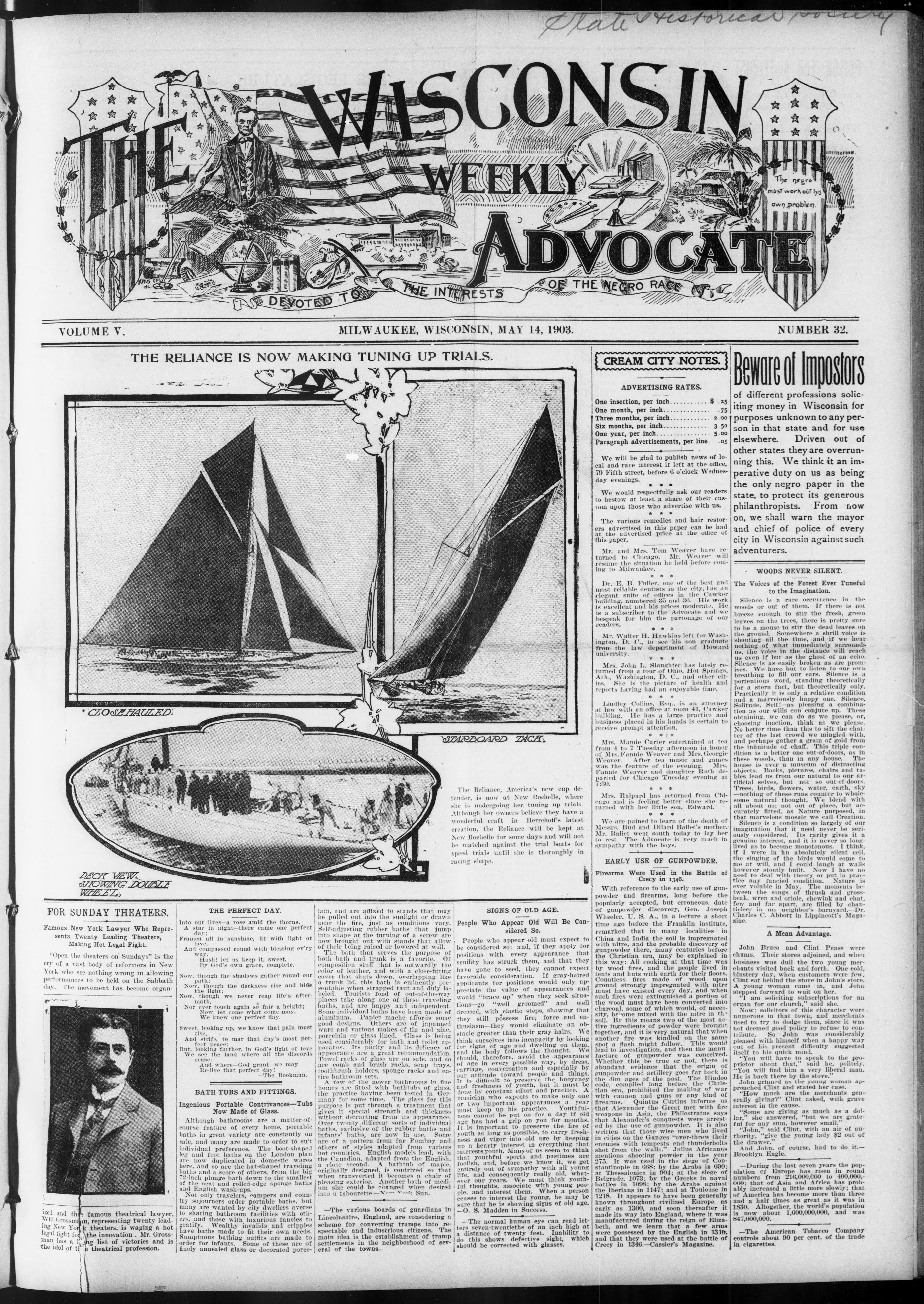
WISCONSIN
WEEKLY
Advocate
DEVOTED TO THE INTERESTS OF THE NEGRO RACE
CLOSE HAULED.
DECK VIEW
SHOWING DOUBLE
VOLUME V.
CLOSEHAULED
DECK VIEW
SHOWING DOUBLE
WHEEL
FOR SUNDAY THEATERS.
Famous New York Lawyer Who Represents Twenty Leading Theaters, Making Hot Legal Fight.
"Open the theaters on Sundays" is the cry of a vast body of reformers in New York who see nothing wrong in allowing performances to be held on the Sabbath day. The movement has become organ-
J. H.
ized and the famous theatrical lawyer, Will Grossman, representing twenty leading New York theaters, is waging a hot legal fight for the innovation. Mr. Grossman has a long list of victories and is the idol of the theatrical profession.
THE PERFECT DAY.
Into our lives—a rose amid the thorns. A star in night—there came one perfect day:
day;
Framed all in sunshine, lit with light of
love.
And compassed round with blessing ev'ry
Now, though the shadows gather round our path;
Now, though the darkness rise and hide the light:
Now, though we never reap life's after math.
Sweet, looking up, we know that palm must rise.
And strife, to mar that day's most perfect peace:
fect peace;
But, looking farther, in God's light of love
We see the land where all the discords
cease:
And where—God grant—we may
Re-live that perfect day!
—The Bookman.
BATH TUBS AND FITTINGS.
Ingenious Portable Contrivances—Tubs Now Made of Glass.
Although bathrooms are a matter-of-course feature of every home, portable baths in great variety are constantly on sale, and many are made to order to suit individual preference. The boot-shaped leg and foot baths on the London plan are now duplicated in domestic wares here, and so are the hat-shaped traveling baths and a score of others, from the big 72-inch plunge bath down to the smallest of the neat and rolled-edge sponge baths and English wash-ups.
Not only travelers, campers and country sojourners order portable baths, but many are wanted by city dwellers averse to sharing bathroom facilities with others, and those with luxurious fancies to gratify. Wealthy invalids and cripples have baths made to fit their own needs. Sumptuous bathing outfits are made to order for infants. Some of these are of finely annealed glass or decorated porce-
lain, and are affixed to stands that may be pulled out into the sunlight or drawn near the fire, just as conditions vary. Self-adjusting rubber baths that jump into shape at the turning of a screw are now brought out with stands that allow of their being raised or lowered at will.
The bath that serves the purpose of both bath and trunk is a favorite. Of composition stuff that is outwardly the color of leather, and with a close-fitting cover that shuts down, overlapping like a trunk lid, this bath is eminently presentable when strapped taut and duly labeled. Tourists fond of out-of-the-way places take along one of these traveling baths, and are happy and independent. Some individual baths have been made of aluminum. Papier mache affords some good designs. Others are of japanned ware and various makes of tin and zinc, porcelain or glass lined. Glass is being used considerably for bath and toilet apparatus. Its purity and its delicacy of appearance are a great recommendation. Towel racks of glass are on sale, and so are comb and brush racks, soap trays, toothbrush holders, sponge racks and entire bathroom sets.
A few of the newer bathrooms in fine homes are fitted with bathtubs of glass, the practice having been tested in Germany for some time. The glass for this purpose is put through a treatment that gives it special strength and thickness without detracting from its appearance. Over twenty different sorts of individual baths, exclusive of the rubber baths and infants' baths, are now in use. Some are of a pattern from far Bombay and others of styles adapted from various hot countries. English models lead, with the Canadian, adapted from the English, a close second. A bathtub of maple, originally designed, is contrived so that when transverted it becomes a chair of pleasing exterior. Another bath of medium size could be changed when desired into a tabourette.—New York Sun.
The various boards of guardians in Lincolnshire, England, are considering a scheme for converting tramps into respectable and industrious citizens. The main idea is the establishment of tramp settlements in the neighborhood of several of the towns.
The Reliance, America's new cup defender, is now at New Rochelle, where she is undergoing her tuning up trials. Although her owners believe they have a wonderful craft in Herrehoff's latest creation, the Reliance will be kept at New Rochelle for some days and will not be matched against the trial boats for speed trials until she is thoroughly in racing shape.
---
SIGNS OF OLD AGE.
People Who Appear Old Will Be Considered So.
People who appear old must expect to be considered so: and, if they apply for positions with every appearance that senility has struck them, and that they have gone to seed, they cannot expect favorable consideration. If gray-haired applicants for positions would only appreciate the value of appearances and would "brace up" when they seek situations—go "well groomed" and well dressed, with elastic steps, showing that they still possess fire, force and enthusiasm—they would eliminate an obstacle greater than their gray hairs. We think ourselves into incapacity by looking for signs of age and dwelling on them, and the body follows the thought. We should, therefore, avoid the appearance of age in every possible way, by dress, carriage, conversation and especially by our attitude toward people and things. It is difficult to preserve the buoyancy and freshness of youth, but it must be done by constant effort and practice. A musician who expects to make only one or two important appearances a year must keep up his practice. Youthfulness cannot be put on for a day if old age has had a grip on you for months. It is important to preserve the fire of youth as long as possible, to carry freshness and vigor into old age by keeping up a hearty interest in everything that interests youth. Many of us seem to think that youthful sports and pastimes are foolish, and, before we know it, we get entirely out of sympathy with all young life, and consequently really old, whatever our years. We must think youthful thoughts, associate with young people, and interest them. When a person ceases to interest the young, he may be sure that he is showing signs of old age.—O. S. Madden in Success.
The normal human eye can read letters seven-twentieths of an inch high at a distance of twenty feet. Inability to do this shows defective sight, which should be corrected with glasses.
CREAM CITY NOTES.
ADVERTISING RATES.
One insertion, per inch..... $ .25
One month, per inch..... .75
Three months, per inch..... 2.00
Six months, per inch..... 3.50
One year, per inch..... 5.00
Paragraph advertisements, per line. .05
We will be glad to publish news of local and race interest if left at the office, 79 Fifth street, before 6 o'clock Wednesday evenings.
We would respectfully ask our readers to bestow at least a share of their custom upon those who advertise with us.
The various remedies and hair restorers advertised in this paper can be had at the advertised price at the office of this paper.
Mr. and Mrs. Tom Weaver have returned to Chicago. Mr. Weaver will resume the situation he held before coming to Milwaukee.
***
Dr. E. B. Fuller, one of the best and most reliable dentists in the city, has an elegant suite of offices in the Cawker building, numbered 35 and 36. His work is excellent and his prices moderate. He is a subscriber to the Advocate and we bespeak for him the partonage of our readers.
Mr. Walter H. Hawkins left for Washington, D. C., to see his son graduate from the law department of Howard university.
Mrs. John L. Slaughter has lately returned from a tour of Ohio, Hot Springs, Aik., Washington, D. C., and other cities. She is the picture of health and reports having had an enjoyable time.
Lindley Collins, Esq., is an attorney at law with an office at room 41, Cawker building. He has a large practice and business placed in his hands is certain to receive prompt attention.
* * *
Mrs. Mamie Carter entertained at tea from 4 to 7 Tuesday afternoon in honor of Mrs. Fannie Weaver and Mrs. Georgie Weaver. After tea music and games was the feature of the evening. Mrs. Fannie Weaver and daughter Ruth departed for Chicago Tuesday evening at 7:30.
* * *
Mrs. Ralpard has returned from Chicago and is feeling better since she returned with her little son, Edward.
* * *
We are pained to learn of the death of Messrs. Bud and Dilard Ballet's mother. Mr. Ballet went south today to lay her to rest. The Advocate is very much in sympathy with the boys.
EARLY USE OF GUNPOWDER.
Firearms Were Used in the Battle of Crecy in 1346.
With reference to the early use of gunpowder and firearms, long before the popularly accepted, but erroneous, date of gunpowder discovery, Gen. Joseph Wheeler, U. S. A., in a lecture a short time ago before the Franklin institute, remarked that in many localities in China and India the soil is impregnated with nitre, and the probable discovery of gunpowder there, many centuries before the Christian era, may be explained in this way: All cooking at that time was by wood fires, and the people lived in tents and huts with earth for their floors. Countless fires made of wood upon ground strongly impregnated with nitre must have existed every day, and when such fires were extinguished a portion of the wood must have been converted into charcoal, some of which would, of necessity, be some mixed with the nitre in the soil. By this means two of the most active ingredients of powder were brought together, and it is very natural that when another fire was kindled on the same spot a flash might follow. This would lead to investigation, and then the manufacture of gunpowder was conceived. Whether this be true or not, there is abundant evidence that the origin of gunpowder and artillery goes far back in the dim ages of the past. The Hindoo code, compiled long before the Christian era, prohibited the making of war with cannon and guns or any kind of firearms. Quintus Curtius informe us that Alexander the Great met with fire weapons in Asia, the Philostratus says that Alexander's conquests were arrested by the use of gunpowder. It is also written that those wise men who lived in cities on the Ganges "over-threw their enemies with tempests and thunderbolts shot from the walls." Julius Africanus mentions shooting powder in the year 275. It was used in the siege of Constantinople in 668; by the Arabs in 690; at Thessalonica in 904; at the siege of Belgrade, 1073; by the Greeks in naval battles in 1098; by the Arabs against the Iberians in 1147; and at Toulouse in 1218. It appears to have been generally known throughout civilized Europe as early as 1300, and soon thereafter it made its way into England, where it was manufactured during the reign of Elizabeth, and we learn that a few arms were possessed by the English in 1316, and that they were used at the battle of Crecy in 1346.—Cassier's Magazine.
NUMBER 32.
Beware of Impostors
Beware of Impostors
of different professions soliciting money in Wisconsin for purposes unknown to any person in that state and for use elsewhere. Driven out of other states they are overrunning this. We think it an imperative duty on us as being the only negro paper in the state, to protect its generous philanthropists. From now on, we shall warn the mayor and chief of police of every city in Wisconsin against such adventurers.
WOODS NEVER SILENT.
The Voices of the Forest Ever Tuneful to the Imagination.
Silence is a rare occurrence in the woods or out of them. If there is not breeze enough to stir the fresh, green leaves on the trees, there is pretty sure to be a mouse to stir the dead leaves on the ground. Somewhere a shrill voice is shouting all the time, and if we hear nothing of what immediately surrounds us, the voice in the distance will reach us even if but as the ghost of an echo. Silence is as easily broken as are promises. We have but to listen to our own breathing to fill our ears. Silence is a portentious word, standing theoretically for a stern fact, but theoretically only. Practically it is only a relative condition and a marvelously happy one. Silence, Solitude, Self!—as pleasing a combination as our wills can conjure up. These obtaining, we can do as we please, or, choosing inaction, think as we please. No better time than this to sift the chatter of the last crowd we mingled with, and perhaps gather a grain of gold from the infinitude of chaff. This triple condition is a better one out-of-doors, as in these woods, than in any house. The house is ever a museum of distracting objects. Books, pictures, chairs and tables lead us from our natural to our artificial selves, but not so out-of-doors. Trees, birds, flowers, water, earth, sky—nothing of these runs counter to wholesome natural thought. We blend with all about us; not out of place, but accurately fitted, as Nature purposed, in that marvelous mosaic we call Creation. Silence is a condition so largely of our imagination that it need never be seriously considered. Its rarity gives it a genuine interest, and it is never so long-lived as to become monotonous. I think, if I were in an absolutely silent cell, the singing of the birds would come to me at will, and I could laugh at walls however stoutly built. Now I have no need to deal with theory or put in practice any fancied condition. Nature is ever voluble in May. The moments between the songs of thrush and grossbeak, wren and oriole, chewink and chat, few and far apart, are filled by chanticleer in my neighbor's barnyard.—Dr. Charles C. Abbott in Lippincott's Magazine.
A Mean Advantage.
John Bruce and Clint Pease were chums. Their stores adjoined, and when business was dull the two young merchants visited back and forth. One cold, blustery day, when customers were few. Clint sat behind the stove in John's store. A young woman came in, and John stepped forward to wait on her.
"I am soliciting subscriptions for an organ for our church," said she. Now: solicitors of this character were numerous in that town, and merchants used to try to dodge them, since it was not deemed good policy to refuse to contribute. So John was considerably pleased with himself when a happy way out of his present difficulty suggested itself to his quick mind. "You will have to speak to the proprietor about that," said he, politely. "You will find him a very liberal man. He is back there by the stove."
John grinned as the young woman approached Clint and stated her case.
"How much are the merchants generally giving?" Clint asked, with grave interest in the cause.
"Some are giving as much as a dollar," she answered, "but we are grateful for any sum, however small."
"John," said Clint, with an air of authority, "give the young lady $2 out of the drawer."
And John, of course, had to do it.—Brooklyn Eagle.
During the last seven years the population of Europe has risen in round numbers from 216,000,000 to 400,000,-000; that of Asia and Africa has probably increased a little more slowly; that of America has become more than three and a half times as great as it was in 1830. Altogether, the world's population is now about 1,600,000,000, and was 847,000,000.
The American Tobacco Company controls about 90 per cent. of the trade in cigarettes.
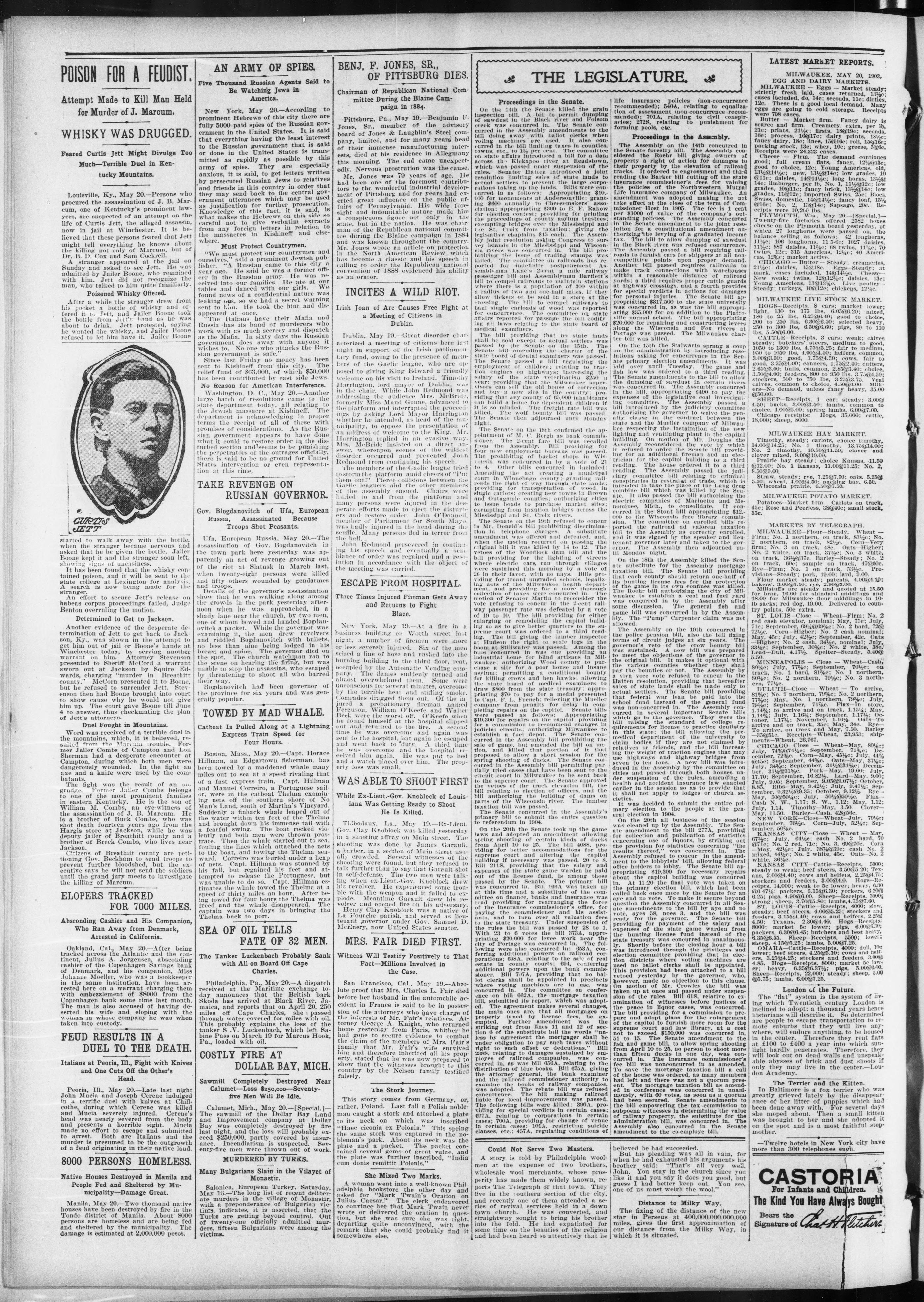
Attempt Made to Kill Man Held for Murder of J. Marcum.
WHISKY WAS DRUGGED.
Feared Curtis Jett Might Divulge Too Much—Terrible Duel in Kentucky Mountains.
Louisville, Ky., May 20.—Persons who procured the assassination of J. B. Marcum, one of Kentucky's prominent lawyers, are suspected of an attempt on the life of Curtis Jett, the alleged assassin, now in jail at Winchester. It is believed that these persons feared that Jett might tell everything he knows about the killing not only of Marcum, but of Dr. B. D. Cox and Sam Cockrell. A stranger appeared at the jail on Sunday and asked to see Jett. He was admitted by Jailer Boone, who remained with him. Jett did not recognize the man, who talked to him quite familiarly.
Poisoned Whisky Offered.
After a while the stranger drew from his pocket a bottle of whisky and offered it to Jett, and Jailer Boone took the bottle from Jett's hand as he was about to drink. Jett protested, saying he wanted the whisky, and Jailer Boone refused to let him have it. Jailer Boone
CURTIS
JETT
started to walk away with the bottle, when the stranger became nervous and asked that he be given the bottle. Jailer Boone kept it and the stranger soon left, showing signs of uneasiness. It has been found that the whisky contained poison, and it will be sent to the state college at Lexington for analysis. A search is now being made for the stranger. An effort to secure Jett's release on habeas corpus proceedings failed, Judge Benton overruling the motion.
Determined to Get to Jackson.
Another evidence of the desperate determination of Jett to get back to Jackson, Ky., was shown in the attempt to get him out of jail or Boone's hands at Winchester today, by serving another warrant on him. Attorney Stevenson presented to Sheriff McCord a warrant sworn out at Jackson by Squire Edwards, charging "murder in Breathitt county." McCorn presented it to Boone, but he refused to surrender Jett. Stevenson then had Boone brought into court to show cause why he would not give him up. The court gave Boone till June 4 to answer, thus checkmating the plan of Jett's attorneys.
Duel Fought in Mountains.
Word was received of a terrible duel in the mountains, which, it is believed, resulted from the Marcum trouble. Former Jailer Combs of Campton and Lon Sherman had a desperate encounter at Campton, during which both men were dangerously wounded. In the fight an axe and a knife were used by the combatants.
The fight was the result of an old grudge. Former Jailer Combs belongs to one of the most prominent families in eastern Kentucky. He is the son of William M. Combs, an eye-witness of the assassination of J. B. Marcum. He is a brother of Buck Combs, who was shot death fourteen years ago from the Hargis store at Jackson, while he was deputy jailer of Breathitt county and a brother of Breck Combs, who lives near Jackson.
Citizens of Breathitt county are petitioning Gov. Beckham to send troops to prevent further bloodshed, but the executive says he will not send the soldiers until the grand jury meets to investigate the killing of Marcum.
ELOPERS TRACKED FOR 7000 MILES.
Absconding Cashier and His Companion, Who Ran Away from Denmark, Arrested in California.
Oakland, Cal., May 20. After being tracked across the Atlantic and the continent, Julius A. Jorgensen, absconding cashier of the Copenhagen Savings bank of Denmark, and his companion, Miss Johanne Moeller, who was a bookkeeper in the same institution, have been arrested here on a warrant charging them with embezzlement of $8000 from the Copenhagen bank some time last month. The man is also accused of having deserted his wife and eloping with the woman in whose company he was when taken into custody.
FEUD RESULTS IN A DUEL TO THE DEATH.
Italians at Peoria, Ill., Fight with Knives and One Cuts Off the Other's Head.
Peoria, Ill., May 20.—Late last night John Mucia and Joseph Cerene indulged in a terrific duel with knives at Chill-cothe, during which Cerene was killed and Mucia severely injured. Cerene's head was nearly severed from the body and presents a horrible sight. Mucia made no effort to escape and submitted to arrest. Both are Italians and the murder is presumed to be the outgrowth of a feud originating in their native land.
8000 PERSONS HOMELESS.
Native Houses Destroyed in Manila and People Fed and Sheltered by Municipality—Damage Great. Manila, May 20.—Two thousand native houses have been destroyed by fire in the Tondo district of Manila. About 8000 persons are homeless and are being fed and sheltered by the municipality. The damage is estimated at 2,000,000 pesos.
AN ARMY OF SPIES.
Five Thousand Russian Agents Said to Be Watching Jews in America.
New York, May 20.—According to prominent Hebrews of this city there are fully 5000 paid spies of the Russian government in the United States. It is said that everything having the least interest to the Russian government that is said or done in the United States is transmitted as rapidly as possible by this army of spies. They are especially anxious, it is said, to get letters written by persecuted Russian Jews to relatives and friends in this country in order that they may send back to the central government utterances which may be used as justification for further prosecution. Knowledge of this fact, it is said, is what makes the Hebrews on this side so careful not to give verbatim extracts from any foreign letters in relation to the massacres in Kishineff and elsewhere.
Must Protect Countrymen.
"We must protect our countrymen and ourselves," said a prominent Jewish publisher. "A Russian came to this city a year ago. He said he was a former officer in the Russian army. He was received into our families. He ate at our tables and danced with our girls. We found news of a confidential nature was leaking our, so we had a secret warning sent to him. He took the hint and disappeared at once.
"The Italians have their Mafia and Russia has its band of murderers who work with as much secrecy and dispatch as the Mafia. In sixty days the Russian government does away with anyone it wishes to. No one who attacks the Russian government is safe."
Since last Friday no money has been sent to Kishineff from this city. The relief fund of $63,000, of which $50,000 has been contributed by east side Jews. No Reason for American Interference. Washington, D. C., May 20.—Another large batch of resolutions came to the state department today, all relating to the Jewish massacre at Kishineff. The department is acknowledging in proper terms the receipt of all of these with promises of considerations. As the Russian government appears to have done what it could to restore order in the disturbed section and seems to be punishing the perpetrators of the outrages officially, there is said to be no ground for United States intervention or even representation at this time.
TAKE REVENGE ON RUSSIAN GOVERNOR.
Gov. Blogdanovitch of Ufa, European Russia, Assassinated Because Troops Shot Peasants.
Ufa, European Russia, May 20.—The assassination of Gov. Bogdanovitch in the town park here yesterday was apparently an act of revenge growing out of the riot at Slatusk in March last, when twenty-eight persons were killed and fifty others wounded by gendarmes and troops.
Details of the governor's assassination show that he was walking along among the crowds in the park yesterday afternoon when he was approached, in a shady lane near the church, by two men, one of whom bowed and handed Bogdanovitch a packet. While the governor was examining it, the men drew revolvers and riddled Bogdanovitch with bullets, no less than nine being lodged in his breast and spine. The governor died on the spot. The church watchman ran to the scene on hearing the firing, but was unable to stop the assassins, who escaped by threatening to shoot all who barred their way.
Bogdanovitch had been governor of the province for six years and was generally popular.
TOWED BY MAD WHALE.
Catboat Is Pulled Along at a Lightning Express Train Speed for Four Hours.
Boston, Mass., May 20.—Capt. Horace Hillman, an Edgartown fisherman, has been towed by a maddened whale many miles out to sea at a speed rivaling that of a fast express train. Capt. Hillman and Manuel Correiro, a Portuguese sailor, were in the catboat Thelma examining nets off the southern shore of No Man's Land, south of Martha's Vineyard. Suddenly a finback whale leaped out of the water within ten feet of the Thelma and brought down his immense tail with a fearful swing. The boat rocked violently and both men were thrown prostrate. Then the whale started out to sea, fouling the lines which attached the nets to the boat, and towing the Thelma seaward. Correiro was buried under a heap of nets. Capt. Hillman was stunned by his fall, but regained his feet and attempted to release the Portuguese, but was unable to do so. Capt. Hillman estimates the whale towed the Thelma at a speed of thirty miles an hour. After being towed for four hours the Thelma was freed and the whale disappeared. The captain was two days in bringing the Thelma back to port.
The Tanker Luckenbach Probably Sank with All on Board Off Cape Charles.
Philadelphia, Pa., May 20.—A dispatch received at the Maritime exchange today announces that the British bark Skoda has arrived at Black River, Jamaica, and reports that on April 20, 250 miles off Cape Charles, she passed through water covered for miles with oil. This probably explains the loss of the tanker S.V. Luckenbach, which left Sabine Pass on March 19 for Marcus Hook, Pa., loaded with oil.
COSTLY FIRE AT DOLLAR BAY, MICH.
Sawmill Completely Destroyed Near Calumet—Loss $250,000—Seventy-five Men Will Be Idle.
Calumet, Mich., May 20.—[Special.]—The sawmill of the Dollar Bay Land and Improvement company at Dollar Bay was completely destroyed by fire last night, and the loss will probably exceed $250,000, partly covered by insurance. Incendiarism is suspected. Seventy-five men were thrown out of work.
MURDERED BY TURKS.
Many Bulgarians Slain in the Vilayet of Monastir.
Salonica, European Turkey, Saturday, May 16. The long list of recent deliberate murders in the village of Monastir, with a preponderance of Bulgarian victims, indicates, it is asserted, that the Turks are getting beyond control. Out of twenty-one officially admitted murders, fifteen Bulgarians were among the victims.
BENJ. F. JONES, SR., OF PITTSBURG DIES.
Chairman of Republican National Committee During the Blaine Campaign in 1884.
Pittsburg, Pa., May 19.—Benjamin F. Jones, Sr., member of the advisory board of Jones & Laughlin's Steel company, limited, and for many years head of their immense manufacturing interests, died at his residence in Allegmany this morning. The end came unexpectedly. Nervous prostration was the cause.
Mr. Jones was 79 years of age. He had been one of the foremost contributors to the wonderful industrial development of Pittsburg and for years had exerted great influence on the public affairs of Pennsylvania. His wide foresight and indomitable nature made him a conspicuous figure not only in the state, but in the nation. He was chairman of the Republican national committee during the Blaine campaign in 1884 and was known throughout the country. Mr. Jones wrote an article on protection in the North American Review which has become a classic and his speech in calling to order the Republican national convention of 1888 evidenced his ability as an orator.
INCITES A WILD RIOT
Irish Joan of Arc Causes Free Fight at a Meeting of Citizens in Dublin
Dublin, May 19.—Great disorder characterized a meeting of citizens here last night in support of the Irish parliamentary fund, owing to the presence of members of the Gaelic league, who are opposed to giving King Edward a friendly welcome on his visit to Ireland. Timothy Harrington, lord mayor of Dublin, was in the chair. While John Redmond was addressing the audience Mrs. McBride, formerly Miss Maud Gonne, advanced to the platform and interrupted the proceedings by asking Lord Mayor Harrington whether he intended, as head of the municipality, to oppose the presentation of an address of welcome to the King. Mr. Harrington replied in an evasive way. Mrs. McBride insisted on a direct answer, whereupon scenes of the wildest disorder occurred and prevented John Redmond from continuing his speech.
The members of the Gaelic league tried to storm the platform amid cheers of "Put them out!" Fierce collisions between the Gaelic leaguers and the other members of the assembly ensued. Chairs were hurled to and from the platform and many persons were injured in the desperate efforts made to eject the disturbers and restore order. John O'Donnell, member of Parliament for South Mayo, was badly injured in the head during the scuffle. Many persons fled in terror from the hall. John Redmond persevered in continuing his speech and eventually a semblance of order was regained and a resolution in accordance with the object of the meeting was carried.
ESCAPE FROM HOSPITAL
Three Times Injured Fireman Gets Away and Returns to Fight Blaze
New York, May 19. At a fire in a business building on Worth street last night, a number of firemen were more or less severely injured. Six of the men seized a line of hose and rushed into the burning building to the third floor, rear, occupied by the Automatic Vending company. The ilames suddenly turned and almost overwhelmed them. Some were unconscious for several minutes, overcome by the terrible heat and stifling smoke. Comrades dragged them out. Of the injured a probationary fireman named Ferguson, William O'Keefe and Walter Beck were the worst off. O'Keefe when he found himself at the hospital slipped out and returned to the fire. A second time he was overcome and again was sent to the hospital, but again he escaped and went back to duty. A third time he was overcome and the hospital received him again. He was put to bed and a watch placed over him. The property loss was small.
WAS ABLE TO SHOOT FIRST
While Ex-Lieut.-Gov. Knoblock of Louisiana Was Getting Ready to Shoot He Is Killed.
Thibodaux, La., May 19.—Ex-Lieut. Gov. Clay Knoblock was killed yesterday in a shooting affray on Main street. The shooting was done by James Garault, a barber, in a section of Main street usually crowded. Several witnesses of the shooting were found, but they refused to talk further than to say that Garault shot in self-defense. The two men were talking when ex-Lieut.-Gov. Knoblock drew his revolver. He experienced some trouble with the weapon and it failed to explode. Meantime Garault drew his revolver and opened fire on his adversary. Henry Clay Knoblock was a native of La Fourche parish, and served as lieutenant governor under Gov. Samuel D. McEnery, now United States senator.
MRS. FAIR DIED FIRST.
Witness Will Testify Positively to That Fact—Millions Involved in the Case.
San Francisco, Cal., May 19.—Absolute proof that Mrs. Charles L. Fair died before her husband in the automobile accident in France is said to be in possession of the attorneys who have charge of the interests of Mr. Fair's relatives. Attorney George A. Knight, who returned home yesterday from Paris, whither he had gone to secure evidence to combat the claim of the members of Mrs. Fair's family that Mr. Fair's wife survived him and therefore inherited all his property, stated that he was now prepared to show that the witnesses brought to this country by the Nelson family testified falsely.
the Stork Journey
This story comes from Germany, or, rather, Poland. Last fall a Polish nobleman caught a stork and attached a plate to its neck on which was inscribed "Haee ciconia ex Polonia." This spring the same stork was captured in the nobleman's park. About its neck was the plate and a packet. The packet contained several gems of great value, and the plate was further inscribed, "India cum donis remittit Polonis."
She Mixed Two Marks
A woman went into a well-known Philadelphia bookstore the other day and asked for "Mark Twain's Oration on Julius Caesar." The clerk endeavored to convince her that Mark Twain never wrote or delivered the oration in question, but she was sure she was right, departing quite unconvinced, with the remark that she could probably find it somewhere else.
Proceedings in the Senate.
On the 14th the Senate killed the grain inspection bill. A bill to permit dumping of sawdust in the Black river and Folsom creek was concurred in. The Senate concurred in the Assembly amendments to the bill doing away with ballet clerks when voting machines are used. It also concurred in the bill limiting taxes in counties, towns, etc., to 1½ per cent. The committee on state affairs introduced a bill for a dams across the Kickapoo river at Readstown, which was passed under suspension of the rules. Senator Hatten introduced a joint resolution limiting sales of state lands to actual settlers to prevent the large corporations taking up the lands. Bills were concurred in as follows: Appropriating $10,000 for monuments at Andersonville; granting $600 annually to Cheesemakers' association; appropriating $100 to E. F. Rakow for election contest; providing for printing the proceedings of county asylum trustees; exempting bridges over the Mississippi and the St. Croix from taxation; giving the legislative chaplains $15 each. The Assembly joint resolution asking Congress to survey islands in the Mississippi and Wisconsin rivers was concurred in. The bill prohibiting the issue of trading stamps was killed. The committee on railroads has reported for indefinite postponement Assemblyman Lane's 2-cent a mile railway passenger bill and Assemblyman Bartlett's bill to compel railroads to maintain stations where there is a population of 300 within a radius of two and one-half miles, if they allow tickets of be sold in a store at the crossing. The bill to compel railways to bail single carloads of wood was reported for concurrence. The committee on state affairs reported for passage the bill codifying all laws relating to the state board of medical examiners.
The bill providing that no state lands shall be sold except to actual settlers was passed by the Senate on the 15th. The Senate bill amending the charter of the state board of dental examiners was passed. The Senate passed a bill regulating the employment of children; relating to traction engines on highways; increasing the salary of the state veterarian $250 a year; providing that the Milwaukee supervisors can sell the old house of correction and buy a new site in the country; providing that any county of 65,000 inhabitants can build a home for dependent children if it is so minded. The freight rate bill was killed. The wolf bounty bill was passed. The Senate then adjourned until Monday night.
The Senate on the 18th confirmed the appointment of M. C. Bergh as bank commissioner. The 2-cent fare bill was recalled from the Assembly. Bill providing for four new employment bureaus was passed. The prohibiting of bucket shops in Wisconsin was concurred in by a vote of 21 to 4. Other bills concurred in included: Amending the act creating a municipal court in Winnebago county; granting railroads the right of way through state lands; providing for transportation of wood in single carriots; creating new towns in Brown and Outagamie counties; authorizing cities to issue bonds to purchase market sites; exempting from taxation bridges across the Mississippi and St. Croix rivers.
The Senate on the 19th refused to concur in Mr. Donald's bill prohibiting discrimination in telephone charges. A substitute amendment was offered and defeated, and, when the motion recurred on passing the original bill it was killed by 14 to 12. The vetoes of the Woodlock dam bill and the bill providing for the lighting of streets where electric cars run through villages were sustained this morning by a vote of 26 in their favor, with no nays. Bills providing for truant ungraded schools, legalizing acts of the Milwaukee health department, and providing for a more thorough collection of taxes were concurred in. The motion of Senator Martin to reconsider the vote refusing to concur in the 2-cent railway passenger rate was defeated by a vote of 19 to 10. The bill providing for either enlarging or remodeling the capitol building so as to give better quarters to the supreme court was ordered to a third reading. The bill giving the lumber inspector at Hudson the right to scale logs in the boom at Stillwater was passed. Among the bills concurred in was one providing an industrial home for blind artisans in Milwaukee; authorizing Wood county to purchase a site for a poor house and insane asylum; permitting a conditional bounty for killing crows and hen hawks; allowing the state board of medical examiners to draw $800 from the state treasury; appropriating $70 to pay for a medal presented to Capt. F. L. French; relieving the Mueller company from penalty for delay in completing repairs on the capitol. Senate bills were passed as follows: Appropriating $19,300 for repairs on the capitol; providing for a commission to recommend changes in judicial circuits; authorizing Milwaukee to establish a fuel depot. The Senate concurred in the Assembly bill prohibiting the sale of game, but amended the bill on motion, and killed that portion of it that proposed to allow a short session for the spring shooting of ducks. The Senate concurred in the Assembly bill permitting partially tried cases that have been sent to the circuit court in Milwaukee to be sent back to the superior court. The Senate approved the vetoes of the track elevation bill, the bill relating to election of officers, and the bill authorizing the building of dams on parts of the Wisconsin river. The lumber taxation bill was passed.
The Senate concurred in the Assembly's primary bill to submit the entire question to referendum in 1904.
On the 20th the Senate took up the game laws and adopted an amendment allowing spring shooting of certain kinds of ducks from April 10 to 25. The bill 4088, providing for better accommodations for the supreme court and altering the capitol building if necessary was passed, 20 to 8. Bill 211S, providing that the salary and expenses of the state game warden be paid out of the license fund, is among those passed by the Senate. The primary bill was concurred in. Bill 166A was taken up at this time and a substitute of the committee on finance, banks and insurance was read providing for rearranging the force of the insurance commissioner's office, for paying the commissioner and his assistants, and to turn over all valuation fees to the state treasury. Under suspension of the rules the bill was passed by 28 to 1. With 23 to 6 votes the bill 373A, appropriating $20,000 for levee work near the city of Portage was concurred in. The following were also concurred in: 653A, conferring additional powers on railroad corporations; 698A, relating to the sale of real estate in county courts; 694, conferring additional powers upon the bank commissioner. Bill 707A, providing that no ballot clerks shall be appointed in precincts where voting machines are in use, was concurred in. The committee on conference on bill 662A, the mortgage taxation bill, submitted its report, which was adopted. The agreement makes several changes, the main ones are, that all mortgages on property taxed by license fees, be exempted. Further amendment was the striking out from lines 11 and 12 of section 6 of the substitute bill the words "unless by agreement the mortgager shall be under obligation to pay such taxes without right to such offset or dedcutions." Bill 2388, relating to damages sustained by employees of railroad companies, was concurred in, as was bill 656A, relating to the distribution of blue books. Bill 675A, giving the attorney general, the bank examiner and the railroad commissioner authority to examine the books of railway companies, was adopted. The rebate bill was refused concurrence. The bill making railroad liable for local improvements was passed. The following bills were killed: 390A, providing for special verdicts in certain cases; 697A, relating to corporations in certain cases; 700A, providing for change of venue in certain cases; 161A, restricting suicide clauses, etc.; 457A, regulating conditions of
Could Not Serve Two Masters.
A story is told by Philadelphia woolmen at the expense of two brothers, wholesale wool merchants, whose prosperity has made them widely known, reports The Telegraph of that town. They live in the southern section of the city, and recently one of them attended a series of revival services held in a down town church. He was converted, and straightway sought to bring his brother into the fold. He had expatiated for some time on the beauties of the religion and had been heard so attentively that he
life insurance policies (non-concurrence recommended); 540A, relating to equalization of assessment (non-concurrence recommended); 701A, relating to civil conspiracies; 272S, relating to punishment for forming pools, etc.
Proceedings in the Assembly.
The Assembly on the 14th concurred in the Senate forestry bill. The Assembly considered the Roehr bill giving owners of property a right of action for damages to their property by the elevation of railroad tracks. It ordered to engrossment and third reading the Barker bill cutting off the state insurance commissioner's fees for valuing the policies of the Northwestern Mutual Life insurance company of Milwaukee. An amendment was adopted making the act take effect at the close of the term of Commissioner Host in 1905. The fee is 1 cent per $1000 of value of the company's outstanding policies. The Assembly concurred in the Senate amendment to the joint resolution for a constitutional amendment authorizing the levying of a graduated income tax. The bill to allow dumping of sawdust in the Black river was refused concurrence. The Assembly passed a bill requiring railroads to furnish cars for shippers at all non-competitive points upon proper demand. Another bill passed requires railroads to make track connections with warehouses within a reasonable distance of railroad yards; a third requires proper cattle guards at highway crossings, and a fourth provides for special verdicts in actions for damages for personal injuries. The Senate bill appropriating $317,500 to the state university was concurred in, as was the bill appropriating $35,000 for an addition to the Platteville normal school. The bill appropriating $20,000 for repairing and constructing levees along the Wisconsin and Fox rivers at Portage was passed. The Milwaukee charter bill was killed.
On the 15th the Stalwarts sprang a coup on the administration by introducing resolutions asking for concurrence in the Senate primary election amendments. It was laid over until Tuesday. The game and fish law was ordered to a third reading. The Senate amendments to the bill to allow the dumping of sawdust in certain rivers was concurred in. The Assembly concurred in the bill, appropriating $400 to pay the expenses of the legislative coal investigating committee. The Assembly passed a bill introduced by the judiciary committee authorizing the governor to waive the penalty clause in the contract between the state and the Mueller company of Milwaukee respecting the installation of the new lighting and ventilating plant in the capital building. On motion of Mr. Douglas the Assembly reconsidered the vote by which it refused to order the Senate bill providing for an additional fireman and an electrician for the capitol building to a third reading. The house ordered it to a third reading. The Assembly passed the judiciary committee bill relating to criminal conspiracies in restraint of trade, which is intended to take the place of the Lang drug combine bill which was killed by the Senate. It also passed the bill authorizing the electric companies of Marinette and Memoirine, Mich., to consolidate. It concurred in the Stout bill appropriating $12,000 to the Wisconsin free library commission. The committee on enrolled bills reported the railroad ad valorem taxation bill to the Assembly as correctly enrolled, and it was signed by the speaker and lieutenant governor later and taken to the governor. The Assembly then adjourned until Monday night.
On the 18th the Assembly killed the Senate substitute for the Assembly mortgage taxation bill. The Senate bill providing that each county should return one-half of its hunting license fees for the protection of the game in its own confines was killed. The Roehr bill authorizing the city of Milwaukee to establish a coal and fuel yard was concurred in by the Assembly after some discussion. The general fish and game bill was concurred in by the Assembly. The "Pump" Carpenter claim was not allowed.
The Assembly on the 19th concurred in the police pension bill, also the bill fixing terms of circuit judges at six years. The governor's veto of the crow bounty bill was sustained. A new bill was prepared to meet the objections of the governor to the original bill. It makes it optional with the various counties whether they shall pay the bounties or not. The Assembly by a viva voce vote refused to concur in the Hatten resolution, providing that hereafter sales of state lands shall be made only to actual settlers. The Senate bill providing that federal war loan be paid into the school fund instead of the general fund was non-concurred in. The Assembly concurred in several important Senate bills which go to the governor. They were the bill raising the standard of college requirements for license to practice dentistry in this state; the bill allowing the premedical department of the university to claim bodies if they are not claimed by relatives or friends, and the bill increasing the weight of traction engines that may use highways and highway bridges from seven to ten tons. A new bill was introduced in the Assembly by the committee on cities and passed through both houses under suspension of the rules, amending a health and accident insurance law enacted earlier in the session so as to provide that it shall not apply to lodges or church societies.
It was decided to submit the entire primary election to the people at the general election in 1904.
On the 20th all business of the session was cleaned up by the Assembly. The Senate amendment to the bill 277A, providing for collection and publication of statistics concerning use of liquors, by striking out the provision for statistics concerning "the results thereof," was concurred in. The Assembly refused to concur in the amendment to the lobbyists' bill, allowing federal office holders to lobby. The Senate bill appropriating $19,300 for necessary repairs about the capitol building was concurred in. At 11:20 the final vote was taken on the primary election bill, which had been called back once more by the Senate for an aye and no vote. To make it secure beyond question the Assembly concurred in all Senate amendments to the bill by aye and no vote, ayes 58, noes 3, and the bill was ready for the governor. The Senate bill providing for payment of the salary and expenses of the state game warden from the hunting license fund instead of the state treasury was concurred in unanimously. Shortly before the closing hour a bill was introduced through the privileges and election committee providing that in election districts where voting machines are used no ballot clerks shall be appointed. This provision had been attached to a bill vetored yesterday by the governor, who, however, made no objection to this clause. On motion of Mr. Crowley the bill was taken up at once and passed under suspension of the rules. Bill 618, relative to examination of witnesses before justices of the peace in liquor cases, was concurred. The bill providing for a commission to prepare and adopt plans for the enlargement of the capitol to furnish more room for the supreme court and law library, at a cost not to exceed $150,000 was concurred in, 51 to 15. The Senate amendment to the fish and game bill, to allow spring shooting from April 10 to 25, no person to shoot more than fifteen ducks in one day, was concurred in. The insurance commissioner's fee bill was nonconcurred in as amended. To save the mortgage taxation bill a call of the house was ordered, as many members had left and there was not a quorum present. The mortgage taxation bill as amended in conference was concurred in unanimously, with 60 votes, as soon as a quorum had been secured. Senate amendments to the bill empowering the tax commission to subpoena witnesses in determining the value of railway property, the substitute for the administration bill, was concurred in. The Assembly also concurred in the Senate amendment to the co-employe bill.
believed he had succeeded.
But his pleading was all in vain, for when he had exhausted his arguments his brother said: "That's all very well, John. You stay in the church since you like it and you say it does you good, but guess I had better keep out. You see, one of us must weigh the wool."
Distance to Milky Way.
The fixing of the distance of the new star in Perseus at 400,000,000,000,000 miles, gives the first approximation of our distance from the Milky Way, in which it is situated.
LATEST MARKET REPORTS
MILWAUKEE, MAY 20, 1903.
EGG AND DAIRY MARKETS.
MILWAUKEE — Eggs — Market steady; stricly fresh lald, cases returned, 13½¢; cases included, do, 14¢; seconds, 11¢; dirties, 12¢. These is a good local demand. Many eggs are going to cold storage. Receipts were 708 cases.
Butter — Market firm. Fancy dairy is scarce and firm. Creamery, extra, per lb, 21¢; prints, 21½¢; firsts, 18@19¢; seconds, 16¢; process, 16@17¢; dairy prints, 18½¢; fancy dairy, 18¢; lines, 15@16¢; roll, 15@16¢; packing stock, 13¢; whey, 10¢; greese, 5@6¢. Receipts were 24,323 cases.
Cheese — Firm. The demand continues good; full cream flats, fancy, 12½¢@13¢; good to choice, 12¢; Young Americas, old, 13½¢@14¢; new, 13½¢@14¢; low grades, 10@11¢; dalses, 14@14½¢; long horns, 13½¢@14¢; limburger, per lb, No. 1, 11½¢@12¢; low grades, 10@11¢; fancy brick, 13½¢@14¢; low grades, 11@12¢; imported Swiss, 25¢; Block Swiss, domestic, 14½¢@14¢; fancy loaf, 15½¢@16¢. No. 2, 13@14¢; Sapsago, 20¢. Receipts were 10,200 lbs.
PLYMOUTH, Wis., May 20.—[Special.]—Twenty-five factories offered 2582 boxes cheese on the Plymouth board yesterday, of which 27 longhorns were passed on, the balance selling as follows: 42 longhorns, 11½c; 106 longhorns, 11 5-6c; 1027 daisies, 11½c; 887 daisies, 11½c; 68 twins, 11½c; 70 twins, 12c; 315 Americas, 12¼c; 40 Americas, 12½c; market active.
CHICAGO — Butter — Steady; creameries, 21½c; dalries, 15@18c. Eggs—Steady; at mark, cases included, 14@14½c. Cheese—New weak; twins, 12@12¼c; daisies, 13c; Young Americas, 13@13½c. Live poultry—turkeys, 10@12c; chickens, 12½c.
MILWAUKEE LIVE STOCK MARKET
MILWAUKEE LIVE STOCK MARKET
HOGS—Receipts, 8 cars; market lower; light, 130 to 175 lbs, 6.05@6.20; mixed, 180 to 250 lbs, 6.25@6.40; good to choice, 200 to 250 lbs, 6.30@6.50; selected heavy, 250 to 300 lbs, 6.50@6.60; pigs, 80 to 110 lbs, 5.50@6.00.
CATTLE—Receipts, 3 cars; weak; calves steady; butchers' steers, medium to good, 1050 to 1300 lbs, 4.75@5.25; fair to medium, 950 to 1050 lbs, 4.00@4.50; heifers, common, 3.00@3.50; good, 3.75@4.50; cows, fair to good, 3.25@4.00; canners, 1.75@2.40; cutters, 2.65@3.00; bulls, common, 2.85@3.40; choice, 3.50@4.00; feeders, 800 to 950 lbs, 3.75@4.50; stockers, 500 to 750 lbs, 3.25@3.75. Veal calves, common to choice, 4.50@6.00. Milkers—No demand, unless fancy heavy, 35.00@50.00.
SHEEP—Receipts, 1 car; steady; 3.00@4.50; bucks, 3.00@3.50; lambs, common to choice, 4.00@5.00; spring lambs, 6.00@7.00.
Chicago receipts: Hogs, 35,000; cattle, 18,000; sheep, 8000.
MILWAUKEE HAY MARKET.
Timothy, steady; carlots, choice timothy,
14.00@14.25; No. 1 timothy, 13.75@14.00;
No. 2 timothy, 10.50@11.50; clover and
clover mixed, 9.00@10.00.
Prairie hay steady; choice Kansas, 11.50
@12.00; No. 1 Kansas, 11.00@11.25; No. 2,
8.50@9.00.
Straw, steady; rye. 7.25@7.50; oats. 5.25@ 5.50; wheat. 4.00@4.50; packing hay. 6.50. Wisconsin prairie. 6.50@7.50.
MILWAUKEE POTATO MARKET.
Potatoes—Market firm. Carlots on track, 45c; Rose and Peerless, 38@40c; small stock, 35c.
MARKETS BY TELEGRAPH.
MILWAUKEE—Flour—Steady. Wheat—Firm; No. 1 northern, on track, 88%c; No. 2 northern, on track, 82%c. Corn—Very firm; No. 3 on track, 48c. Oats—Higher; No. 2 white, on track, 37%c; No. 3 white, on track, 36%c@37c. Barley—Steady; No. 2 on track, 60c; sample on track, 47@60c. Rye—Firm; No. 1 on track, 53%c. Provisions—Steady; pork, 19.00; lard, 9.00.
Flour market steady; patents, 4.00@4.10; bakers', 3.00@3.10; rye, 2.90@3.00.
Millstuffs are steady and quoted at 15.50 for bran, 16.00 for standard middlings and 18.00 for Milwaukee flour middlings in 10 lb sacks; red dog, 19.00. Delivered to country points, 50c extra.
ST. LOUISE—Close — Wheat—Firm; No. 2 red cash elevator, nominal; May, 75c; July, 71c; September, 69%@69%c; No. 2 hard, 72@72%c. Corn—Higher; No. 2 cash nominal; May, 45c; July, 42%c; September, 42c. Oats—Higher; No. 2 cash, 34%c, nominal; July, 33%c; September, 30%c; No. 2 white, 38c. Lead—Dull, 4.17%c. Spelter—Steady, 5.40@5.50
MINNEAPOLIS — Close — Wheat—Cash, 80%c; July, 77%c; September, 70%c; on track, No. 1 hard, 81%c; No. 1 northern, 80%c; No. 2 northern, 79%c; No. 3 northern, 77%c.
DULUTH—Close — Wheat — To arrive, 81%c; No. 1 northern, 79%c; No. 2 northern, 77%c; May, No. 1 northern, 79%c; July, 79%c; September, 71%c; Flax—In store, 1.14%; to arrive and on track, 1.15%; May, 1.14%; July, 1.16%; September, 1.17%; October, 1.17%; November, 1.16%. Oats—To arrive and on track, 35c; May, 34c. Rye—To arrive, on track and May, 7.50. Barley—35@51c. Receipts—Wheat, 23,953; shipments—Wheat, 26,767.
CHICAGO—Close — Wheat—May, 80%c;
July, 74%@74%c; September, 71%c; December, 72%c. Corn—May, 45%c; July, 44%@45c; September, 44%c. Oats—May, 37%c;
July, 34%c; September, 31%@31%c; December, 31%@31%c. Pork—May, 19.00; July, 17.70; September, 16.82%c. Lard—May, 9.00;
July, 9.05; September, 9.05@9.07%c. October, 8.85. Ribs—May, 9.42%c; July, 9.47%c; September, 9.32%@9.35; October, 9.12%c. Rye—May, 50@50%c; July, 50%@50%c. Flax. Cash N. W., 1.17; S. W., 1.12; May, 1.12;
July, 1.14. Timothy—May, 3.50. Clover—May, 11.50. Barley—Cash, 42%@56c.
NEW YORK—Close—Wheat—July, 79%c;
September, 76%c. Corn—July, 52%c; September, 50%c.
KANSAS CITY—Close — Wheat — May, 67%c; July, 64%c; cash No. 2 hard, 70@71c. No. 2 red, 71c. No. 3, 69@70c. Corn—May, 42%c; July, 385%@39c; cash No. 2 mixed, 44%c. No. 2 white, 45c. Oats—No. 2 white, 36%c.
KANSAS CITY—Cattle-Receipts, 5000; steady to weak; beef steers, 3.50@5.20; Texans, 2.00@4.40; cows and heifers, 2.25@4.75; stockers and feeders, 3.00@4.0. Hogs-Receipts, 14,000; weak to 5c lower; heavy, 6.30@6.47½; packers, 6.15@6.30; yorkers, 6.20@6.25; pigs, 4.90@6.00. Sheep-Receipts, 3000; strong; sheep, 2.70@5.80; lambs, 4.75@7.60.
ST. LOUIS—Cattle-Receipts, 4000; slow, steady; beef steers, 4.00@5.25; stockers and feeders, 3.15@4.40; cows and heifers, 2.25@4.50; Texans, 2.30@4.40. Hogs-Receipts, 8000; market 5c lower; pigs, 6.00@6.30; packers, 6.30@6.45; butchers and best heavy, 6.35@6.55. Sheep-Receipts, 5500; lower; sheep, 4.15@5.25; lambs, 5.00@7.25.
OMAHA—Cattle-Receipts, 4000; dull, 10c lower; beef steers, 4.25@5.10; cows and heifers, 3.25@4.25; stockers and feeders, 3.00@4.85. Hogs-Receipts, 8000; market 5c lower; heavy, 6.35@6.37½; pigs, 5.00@6.00. Sheep-Receipts, 22,000; steady; sheep, 5.00@5.75; lambs, 6.00@7.25.
London of the Future.
The "flat" system is the system of living which Twentieth century London is inclined to adopt; a thousand years hence historians will describe it. So determined are people to escape transportation to remote suburbs that they will live anywhere, will endure anything, to be housed in the center. Therefore they rent flats at £100 to £400 a year into which sunlight hardly penetrates. Therefore, they will look out on dead walls and unspeakable abysses of brick and dust shoots if only they may live in the center.—Loudon Academy.
The Terrier and the Kitten.
In Baltimore is a fox terrier who was greatly grieved lately by the disappearance of her litter of puppies which had been done away with. For several days she moped about. Then a small kitten was brought to her and she adopted it on the spot and is a most faithful stepmother.
Twelve hotels in New York city have more than 300 telephones each.
CASTORIA
For Infants and Children.
The Kind You Have Always Bought
Bears the
Signature of
Chas H. Hitchc
MARRIED AND MATED
The vows were said which made them one
For happiness or woe;
They pledged themselves thro' light and
gloom
Together e'er to go.
The echo of the wedding bells
Came slowly, as if freighted
With more than bliss, to those who now
Were married—were they mated?
The bridal gown was put aside,
The veil was laid away:
A frock was donned to suit the needs
Of somber every-day:
Dropped threads of life were gathered up,
And two lives joined were fated
To walk the path of days as one,
Wedded—but were they mated?
"Two lives with but a single thought,
Two hearts that beat as one?"
Two souls to strive in unison
Till strife of life is done.
One life with doubled force for joy,
And usefulness, ne'er rated:
Thus is a marriage made in Heaven,
And two souls here are mated.
They "know not where His islands lift
Their fronded palms in air;
But only know they cannot drift
Beyond His love and care."
And as they climb to loftier planes—
Tho' slow, and oft belated—
With hand in hand, and heart to heart,
They'll go—for they are mated.
—Mildred Tate Wells in National
THE UNION OF TWO ARTS.
They had met—loved—and parted, promising to write. There was nothing absolutely original in the occurrence; thousands had done identically the same thing before in their time, and, in all probability, thousands will emulate their example years hence. But the promise made on a liner's deck, though sacred at the time, was soon forgotten; and five years elapsed without a line being exchanged between them. And this was the man's fault.
Charlie Montrose had bade Zara Hoste adieu at Vera Cruz, when she was but a girl of 16, or rather woman, as girls of that age are ranked out in Mexico; one matures early in Central America.
A year passed then Art had gradually blotted out the remembrance of her Madonna-like face. True, he had kept five of her letters, unanswered, by the way, which detailed to him her trusting love and her progress in sculpture; but they had lain on the mantelpiece of his study till dust had begrimed them and nearly obliterated the faintly written words. Then four years lapsed, and Zara was almost forgotten by the man on whom fortune had smiled. Therefore, it was somewhat strange that Charlie Montrose dreamt sadly of the past during an interval at a ball given by Lady Belmont at her house in Park lane.
"Why so glum, Mr. Montrose?" she queried gayly, tapping him playfully on the shoulder with her fan. "You have not done your duty by standing out three dances! I must find you a partner."
"May I have the pleasure, Lady Belmont?"
"With me? Oh, I should be delighted, only, alas! my programme is filled," she replied vivaciously. "But I will introduce you to Miss Vivian. You know the great sculptor?"
"Surely not the Miss Vivian of 'Sleep' renown?"
"The same."
A light step behind him caused Montrose to turn round. A brunette was coming toward him—a brunette whose beauty, surpassing even his ideals of feminine beauty so often depicted on his canvases, caused the master-artist to almost wonder as he gazed at the marvelous regularity of her finely-chiseled features. He rose, stretched out his hand mechanically to pull back the heavy portiere for her to pass into the ballroom, when she stopped suddenly, and, glancing swiftly up at the handsome face of the limmer, said impulsively:
"Mr. Montrose, the great artist, I believe?" He glanced straight into the eyes raised shyly to his, then replied:
"That is my name. As a great artist I believe I am a fraud!" Then added modestly: "I have been lucky, that is all!" "You are modest," she said gently. "I hope you will excuse my presumption in speaking to you without a formal introduction, but I was very anxious to speak to you. I only saw you once before tonight—at the Academy; you were pointed out to me."
"I am indeed honored by your remembering my features," he said, politely. Then glancing steadily at her face, said, thoughtfully: "But surely your face is familiar? It is—ah, yes!" he cried, bitterly, "I know whom you resemble. You are much prettier, yet so strangely—strangely like a girl I once knew!" He sighed, as he let the portiere fall from his grasp.
"Indeed?" The brown eyes opened widely. "I am pleased I resemble that lady—you—you were interested in. It is quite romantic, to be included, if even in so slight a degree, in a great man's life!" Montrose flushed dully.
"I am afraid I was speaking my thoughts," he said awkwardly. "I apologize. I must have bored you!"
"On the contrary," she replied brightly. "I am interested. As I resemble this lady, will you not tell me more about her? Or would it be indiscreet on my part to proffer such a request?"
"I am sorry to refuse," he replied, glancing at her. "It is very difficult to do so, but no man cares to record a shabby action of his own."
"But, Mr. Montrose," she murmured, "you have always been spoken of in the papers as the soul of honor!"
"So much for the truth of journalism!" he said bitterly.
"But, surely, Mr. Montrose"—her voice trembled a little—"you have never broken your word or—!" He laughed harshly.
"That is identically what I have done!" he said. "I broke a pledge made six years ago, and now dare not redeem it."
"Indeed!" said the brunette, smiling archly. "And why not?"
"Because she would despise me now!" He stopped short, blushing hotly as he realized that he had committed himself. "May I escort you to the ballroom?" She blissfully ignored his question. "So you had asked her to marry you," she said thoughtfully, "and then grew tired of her."
"You appear to be a thought reader!" exclaimed Montrose almost savagely. "you are, however, correct. I did ask her to marry me, then we drifted apart; four years passed and I did not write, and when I did my letters came back marked 'unkown.' You, however, are wrong when you say I got tired of her. I have loved her all these years, and now, when she has passed beyond my reach—— Bala! why do I speak to you, an utter stranger, in these terms?" he
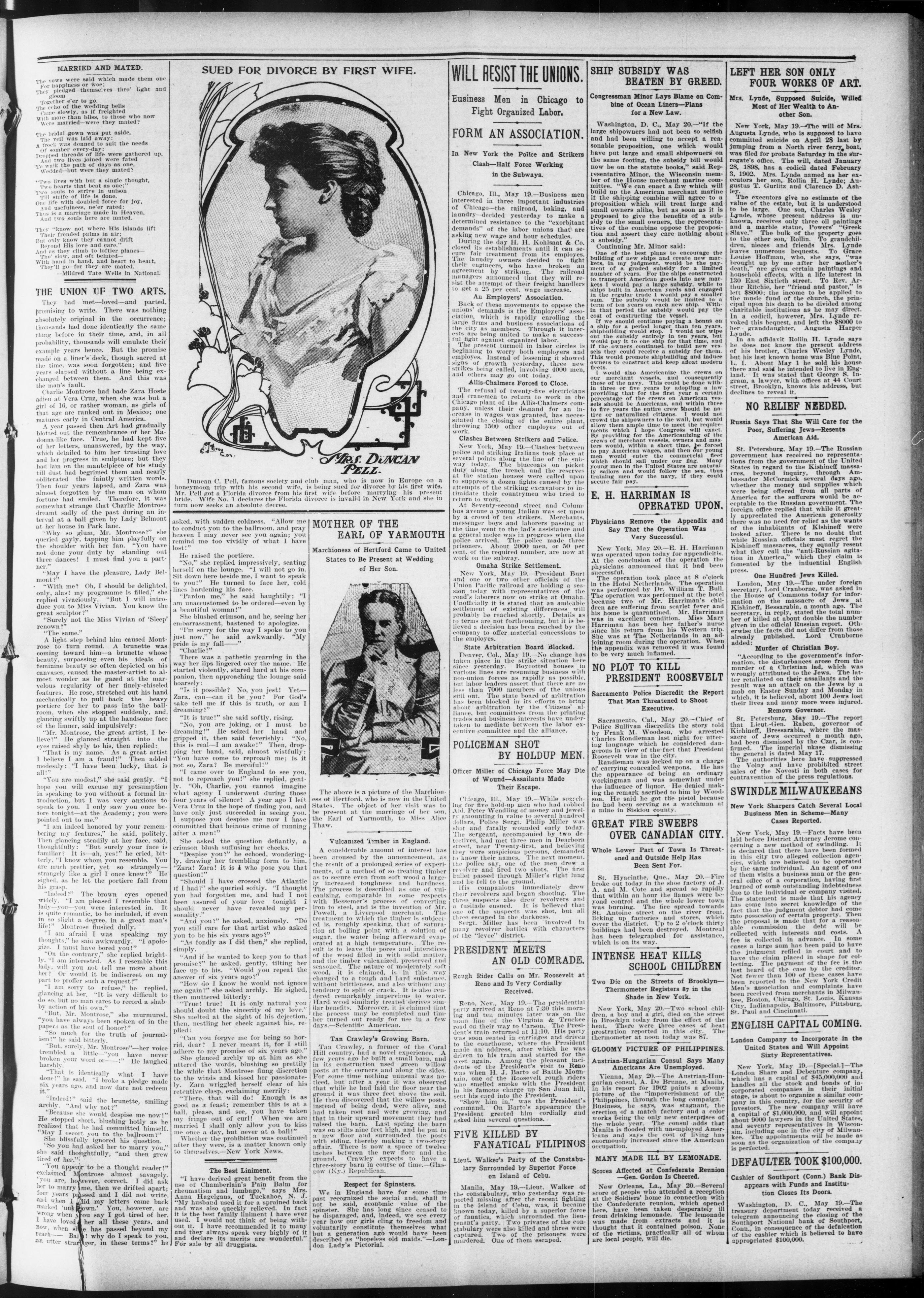
MRS. DUNCAN
PELL.
Duncan C. Pell, famous society and club man, who is now in Europe on a honeymoon trip with his second wife, is being sued for divorce by his first wife, Mr. Pell got a Florida divorce from his first wife before marrying his present bride. Wife No. 1 declares the Florida divorce is invalid in New York and she in turn now seeks an absolute decree.
Duncan C. Pell, famous society and club man, who is now in Europe on a honeymoon trip with his second wife, is being sued for divorce by his first wife. Mr. Pell got a Florida divorce from his first wife before marrying his present bride. Wife No. 1 declares the Florida divorce is invalid in New York and she in turn now seeks an absolute decree.
asked, with sudden coldness. "Allow me to conduct you to the ballroom, and pray heaven I may never see you again; you remind me too vividly of what I have lost!"
He raised the portiere.
MOTHER OF THE
EARL OF YARMOUTH
Marchioness of Hertford Came to United
"No," she replied impressively, seating herself on the lounge. "I will not go in. Sit down here beside me, I want to speak to you!" He turned to face her, cold lines hardening his face.
"Pardon me," he said haughtily; "I am unaccustomed to be ordered—even by a beautiful woman!"
She blushed crimson, and he, seeing her embarrassment, hastened to apologize.
"I'm sorry for the way I spoke to you just now," he said awkwardly. "My pride is my fall—"
"Charlie!"
There was a pathetic yearning in the way her lips lingered over the name. He started violently, stared hard at his companion, then approaching the lounge said hoarsely:
"Is it possible? No, you jest! Yet— Zara, can—can it be you? For God's sake tell me if this is truth, or am I dreaming?"
"It is true!" she said softly, rising.
"No, you are joking, or I must be dreaming!" He seized her hand and gripped it, then said feverishly: "No, this is real—I am awake!" Then, dropping her hand, said, almost wistfully: "You have come to reproach me; is it not so, Zara? Be merciful!" "I came over to England to see you, not to reproach you!" she replied, gently. "Oh, Charlie, you cannot imagine what agony I underwent during those four years of silence! A year ago I left Vera Cruz in the hope of finding you, and have only just succeeded in seeing you. I suppose you despise me now I have committed that heinous crime of running after a man!"
She asked the question defiantly, a crimson blush suffusing her cheeks.
"Despise you?" he echoed, wonderingly, drawing her trembling form to him.
"Zara! Zara! it is I who pose you that question!"
"Should I have crossed the Atlantic if I had?" she queried softly. "I thought you had forgotten me, and had I not been assured of your love tonight I should never have revealed my personality."
"And you?" he asked, anxiously. "Do you still care for that artist who asked you to be his six years ago?"
"As fondly as I did then," she replied, simply.
"And if he wanted to keep you to that promise?" he asked, gently, tilting her face up to his. "Would you repeat the answer of six years ago?"
"How do I know he would not ignore me again?" she asked archly. He sighed, then muttered bitterly:
"True! true! It is only natural you should doubt the sincerity of my love." She melted at the sight of his dejection, then, nestling her cheek against his, replied:
"Can you forgive me for being so horrid, dear? I never meant it, for I still adhere to my promise of six years ago."
"There, that will do! Enough is as good as a feast; remember this is at a ball, please, and see, you have taken my fringe out of curl! When we are married I shall only allow you to kiss me once a day, but never at a ball!" Whether the prohibition was continued after they were, is a matter known only to themselves.—New York News.
The Best Liniment.
"I have derived great benefit from the use of Chamberlain's Pain Balm for rheumatism and lumbago," says Mrs. Anna Hagelgans, of Tuckahoe, N. J. "My husband used it for a sprained back and was also quickly relieved. In fact it is the best family liniment I have ever used. I would not think of being without it. I have recommended it to many and they always speak very highly of it and declare its merits are wonderful." For sale by all druggists.
Marchioness of Hertford Came to United States to Be Present at Wedding of Her Son.
D
The above is a picture of the Marchioness of Hertford, who is now in the United States. The object of her visit was to be present at the marriage of her son, the Earl of Yarmouth, to Miss Alice Thaw.
Vulcanized Timber in England.
A considerable amount of interest has been aroused by the announcement, as the result of a prolonged series of experiments, of a method of so treating timber as to secure even from soft wood a largely increased toughness and hardness. The process is described as one of vulcanizing, comparable in some respects with Bessemer's process of converting iron to steel, and is the invention of Mr. Powell, a Liverpool merchant. The treatment to which the timber is subjected is, roughly speaking, that of saturation at boiling point with a solution of sugar, the water being afterward evaporated at a high temperature. The result is to leave the pores and interstices of the wood filled in with solid matter, and the timber vulcanized, preserved and seasoned. The nature of moderately soft wood, it is claimed, is in this way changed to a tough and hard substance, without brittleness, and also without any tendency to split or crack. It is also rendered remarkably impervious to water. Hard wood similarly treated derives similar benefits. Moreover, it is claimed that the process may be completed and timber turned out ready for use in a few days.—Scientific American.
Tan Crawley's Growing Barn.
Tan Crawley, a farmer of the Coral Hill country, had a novel experience. A few years ago he built a small barn, and in its construction used green willow posts at the corners and along the sides. For some time nothing unusual was noticed, but after a year it was observed that while he had laid the floor near the ground it was three feet above the soil. He then discovered that the willow posts, instead of being dead, were alive, and had taken root and were growing, and that in their upward movement they had raised the barn. Last spring the barn was on stilts nine feet high, and he put in a new floor and surrounded the posts with siding, thereby making a two-story affair. There is now a space of twelve inches between the new floor and the ground. Crawley expects to have a three-story barn in course of time.—Glasgow (Ky.) Republican.
Respect for Spinsters
We in England have for some time past recognized the social and, shall it not be said, economic value of the spinster. She has long since ceased to be disparaged, and, indeed, we see every year how our girls cling to freedom and voluntarily constitute themselves what but a generation ago would have been described as "hopeless old maids."—London Lady's Pictorial.
WILL RESIST THE UNIONS.
Eusiness Men in Chicago to Fight Organized Labor.
FORM AN ASSOCIATION.
Chicago, Ill., May 19.—Business men interested in three important industries of Chicago—the railroad, baking, and laundry—decided yesterday to make a determined resistance to the "exorbitant demands" of the labor unions that are asking new wage and hour schedules. During the day H. H. Kohlsaat & Co. closed its establishments until it can secure fair treatment from its employees. The laundry owners decided to fight their engineers, who have broken an agreement by striking. The railroad managers announced that they will resist the attempt of their freight handlers to get a 25 per cent wage increase.
An Employers' Association.
Back or these movements to oppose the unions' demands is the Employers' association, which is rapidly enrolling the large firms and business associations of the city as members. Through it interests are being united to make a successful fight against organized labor. The present turmoil in labor circles is beginning to worry both employers and employees. Instead of lessening it showed signs of growth yesterday, three new strikes being called, involving 4000 men, and others may go out today.
Allis-Chalmers Forced to Close. The refusal of twenty-five electricians and cranemen to return to work in the Chicago plant of the Allis-Chalmers company, unless their demand for an increase in wages was granted, has necessitated the closing of the entire plant, throwing 1500 other employees out of work.
Clashes Between Strikers and Police.
New York, May 19.—Clashes between police and striking Italians took place at several points along the line of the subway today. The bluecoats on picket duty along the trench and the reserves at the station houses were called upon to suppress a dozen fights caused by the attempts of the striking excavators to intimidate their countrymen who tried to return to work.
At Seventy-second street and Columbus avenue a young Italian was set upon by a crowd of ten strikers. Merchants, messenger boys and laborers passing at the time went to the lad's assistance and a general melee was in progress when the police arrived. The police made three prisoners. About 2000 men, or 50 per cent. of the required number, are now at work on the subway.
Omaha Strike Settlement.
New York, May 19.—President Burt and one or two other officials of the Union Pacific railroad are holding a session today with representatives of the road's laborers now on strike at Omaha. Unofficially it is stated that an amicable settlement of existing differences will probably be reached shortly. Details as to terms are not forthcoming, but it is believed a decision has been reached by the company to offer material concessions to the employs.
State Arbitration Board Blocked.
Denver, Col., May 19.—No change has taken place in the strike situation here since yesterday. Roycotted houses in various lines are resuming business with non-union forces as rapidly as possible, but labor leaders assert that there are no less than 7000 members of the unious still out. The state board of arbitration has been blocked in its efforts to bring about arbitration by the Citizens' alliance, but committees from the printing trades and business interests have undertaken to mediate between the labor executive committee and the alliance.
POLICEMAN SHOT BY HOLDUP MEN.
Officer Miller of Chicago Force May Die of Wound-Assailants Made Their Escape
Chicago, Ill., May 19. While searching for five hold-up men who had robbed Aid. Peter Wendling of money and jewelry amounting in value to several hundred dollars, Police Sergt. Philip Miller was shot and fatally wounded early today. The sergeant, accompanied by two detectives, had met three men in Dearborn street, near Twenty-first, and believing they were suspicious persons, demanded to know their names. The next moment, the police say, one of the men drew a revolver and fired two shots. The first bullet passed through Miller's right lung and he fell to the ground.
His companions immediately drew their revolvers and began shooting. The three suspects also drew revolvers and a fusilade ensued. It is believed that one of the suspects was shot, but all three escaped in the darkness.
Sergt. Miller has been involved in many revolver battles with characters of the "levee" district.
PRESIDENT MEETS AN OLD COMRADE.
Rough Rider Calls on Mr. Roosevelt at Reno and Is Very Cordially Received.
Reno, Nev., May 19.—The presidential party arrived at Reno at 7:30 this morning and ten minutes later was on the main line of the Virginia & Truckee road on their way to Carson. The President's train returned at 11:10. His party was soon seated in carriages and driven to the courthouse, where the President made an address, after which he was driven to his train and started for the west again. Among the pleasant incidents of the President's visit to Reno was when H. J. Barto of Battle Mountain, one of the Roosevelt rough riders who smelled smoke with the President in his famous charge up San Juan hill, sent his card into the President.
"Show him in," was the President's command. On Barto's appearance the President greeted him cordially and asked him several questions.
FIVE KILLED BY FANATICAL FILIPINOS
Lieut. Walker's Party of the Constabulary Surrounded by Superior Force on Island of Cebu.
Manila, May 19.-Lieut. Walker of the constabulary, who yesterday was reported missing after the recent fighting in the island of Cebu, was, it became known today, killed by a superior force of fanatics, which surrounded the lieutenant's party. Two privates of the constabulary were also killed and three were captured. Two of the prisoners were murdered. One of them escaped.
SHIP SUBSIDY WAS BEATEN BY GREED.
Congressman Minor Lays Blame on Combine of Ocean Liners-Plans for a New Law.
Washington, D. C., May 20.—"If the large shipowners had not been so selfish and had been willing to accept a reasonable proposition, one which would have put large and small shipowners on the same footing, the subsidy bill would now be on the statute books," said Representative Minor, the Wisconsin member of the House merchant marine committee. "We can enact a law which will build up the American merchant marine if the shipping combine will agree to a proposition which will treat large and small owners alike, but as soon as it is proposed to give the benefits of a subsidy to the small owners, the representatives of the combine oppose the proposition and assert they care nothing about a subsidy."
Continuing Mr. Minor said:
One of the best plans to encourage the building of new ships and create new markets, in my judgment, would be the payment of a graded subsidy for a limited number of years. For the ships constructed to transport American goods into new markets I would pay a large subsidy, while to ships built in American yards and engaged in the regular trade I would pay a smaller sum. The subsidy would be limited to a term of ten years on each new ship. Within that period the subsidy would pay the cost of constructing the vessel.
If we should continue paying a bonus on a ship for a period longer than ten years, shipbuilding would stop. I would not wipe out the subsidy entirely in ten years, but would pay it to one ship for that time, and if the owners continued to build new vessels they could receive a subsidy for them. This would promote shipbuilding and induce owners to construct and keep afloat modern fleets.
I would also Americanize the crews on our merchant vessels, and consequently those of the navy. This could be done within three or five years by adopting a law providing that for the first year a certain percentage of the crews on American vessels should be Americans, and within three to five years the entire crew should be native or naturalized citizens. I would not crowd the shipowners to the wall, but would allow them ample time to meet the requirements which I hope Congress will exact. By providing for the Americanizing of the crews of merchant vessels, owners and masters would, within a short time, be forced to pay American wages, and then our young men would enter the commercial fleet which should sail under our flag. Many young men in the United States are naturally sailors and would follow the sea, thus training men for the navy, if they could secure fair pay.
E. H. HARRIMAN IS OPERATED UPON.
Physicians Remove the Appendix and Say That the Operation Was Very Successful.
New York, May 20.—E. H. Harriman was operated upon today for appendicitis. At the conclusion of the operation the physicians announced that it had been successful.
The operation took place at 8 o'clock in the Hotel Netherlands. The operation was performed by Dr. William T. Bull. The operation was performed at the hotel because two of Mr. Harriman's children are suffering from scarlet fever and his home is quarantined. Mr. Harriman was in excellent condition. Miss Mary Harriman has been her father's nurse since his return from his Western trip. She was at The Netherlands in an adjoining room during the operation. When the appendix was removed it was found to be very much inflamed.
NO PLOT TO KILL
PRESIDENT ROOSEVELT
Sacramento, Cal., May 20.—Chief of Police Sullivan discredits the story told by Frank M. Woodson, who arrested Charles Rondleman last night for uttering language which he considered dangerous in view of the fact that President Roosevelt was in the city.
Randleman was locked up on a charge of carrying concealed weapons. He has the appearance of being an ordinary workingman and was somewhat under the influence of liquor. He denied making the remark ascribed to him by Woodson. He said he got the pistol because he had been serving as a watchman at a mine in Siskiu county.
GREAT FIRE SWEEPS OVER CANADIAN CITY.
Whole Lower Part of Town Is Threatened and Outside Help Has Been Sent For.
St. Hyacinthe, Que., May 20.—Fire broke out today in the shoe factory of J. A. and M. Cote and spread so rapidly that within an hour the flames were beyond control and the whole lower town was burning. The fire spread towards St. Antoine street on the river front, licking up factories and stores, which cover the district. Up to 2 o'clock thirty buildings had been destroyed. Montreal has been telegraphed for assistance, which is on its way.
INTENSE HEAT KILLS
SCHOOL CHILDREN
Two Die on the Streets of Brooklyn Thermometer Registers 87 in the Shade in New York.
New York, May 20.—Two school children, a boy and a girl, died on the street in Brooklyn today from the effect of the heat. There were three cases of heat prostration reported in this city. The thermometer at noon today was 87.
GLOOMY PICTURE OF PHILIPPINES.
Austrian-Hungarian Consul Says Many Americans Are Unemployed.
Vienna, May 20.—The Austrian-Hungarian consul, A. De Brunne, at Manila, in his report for 1902 paints a gloomy picture of the "impoverishment of the Philippines, through the long campaign." Business, he says, was stagnant, the erection of a match factory and a color works being the only new enterprises of the whole year. The consul adds that Manila is flooded with unemployed Americans and says the cost of living has enormously increased since the American occupation.
MANY MADE ILL BY LEMONADE.
Scores Affected at Confederate Reunion Gen. Gordon Is Cheered.
New Orleans, La., May 20.—Several score of people who attended a reception at the Soldiers' home in connection with the Confederate reunion, which opened here, have been taken desperately ill from drinking lemonade. The lemonade was made from extracts and it is thought that it contained poison. None of the victims, practically all of whom are local people, will die.
Mrs. Lynde, Supposed Suicide, Willed Most of Her Wealth to Another Son.
New York, May 19.—The will of Mrs. Augusta Lynde, who is supposed to have committed suicide on April 28 last by jumping from a North river ferry, boat, was filed for probate Saturday in the surrogate's office. The will, dated January 28, 1898, has a codicil dated February 3, 1902. Mrs. Lynde named as her executors her son, Rollin H. Lynde; Augustus T. Gurlitz and Clarence D. Ashley.
The executors give no estimate of the value of the estate, but it is understood to be large. One son, Charles Wesley Lynde, whose present address is unknown, receives only three oil paintings and a marble statue, Powers' "Greek Slave." The bulk of the property goes to the other son, Rollin. To grandchildren, nieces and friends Mrs. Lynde leaves numerous bequests. To Grace Louise Hoffman, who, she says, "was brought up by me after her mother's death," are given certain paintings and household effects, with a life interest in 130 East Sixtieth street. To Rev. Arthur Ritchie, her "friend and pastor," is left $8000; the income to be applied to the music fund of the church, the principal upon his death to be divided among charitable institutions as he may direct. In a codicil, however, Mrs. Lynde revoked this bequest, and left the $8000 to her granddaughter, Augusta Harper Lynde.
In an affidavit Rollin H. Lynde says he does not know the present address of his brother, Charles Wesley Lynde, but his last known home was Blue Point, L. I. About May 1 he sold his house there and said he intended to live in England. It was stated that George S. Ingram, a lawyer, with offices at 44 Court street, Brooklyn, knows his address, but declines to reveal it.
NO RELIEF NEEDED.
Russia Says That She Will Care for the Poor, Suffering Jews—Resents American Aid.
St. Petersburg, May 19.—The Russian government has received no representations from the government of the United States in regard to the Kishineff massacres, beyond inquiry, through Ambassador McCormick several days ago, whether the money and supplies which were being offered from all parts of America for the sufferers would be acceptable to the Russian government. The foreign office replied that while it greatly appreciated the American generosity there was no need for relief as the wants of the inhabitants of Kishineff were looked after. There is no doubt that while Russian officials must regret the Kishineff massacres, they equally resent what they call the "anti-Russian agitation in America," which they claim is fomented by the influential English
One Hundred Jews Killed.
London, May 19.—The under foreign secretary, Lord Cranborne, was asked in the House of Commons today for information on the massacre of Jews at Kishineff, Bessarabia, a month ago. The secretary, in reply, stated the total number of killed at about double the number given in the official Russian report. Otherwise the facts did not differ from those already published. Lord Cranborne added:
Murder of Christian Boy.
"According to the government's information, the disturbances arose from the murder of a Christian lad, which was wrongly attributed to the Jews. The latter retaliated on their assailants and the result was an attack on the Jews by a mob on Easter Sunday and Monday in which, it is believed, about 100 Jews lost their lives and many more were injured.
Remoys Governor.
St. Petersburg, May 19.—The report that Lieut.-Gen. Raben, governor of Kishineff, Bressarabla, where the massacre of Jews occurred a month ago, had been dismissed by the Czar, is confirmed. The imperial ukase dismissing the general is dated May 17. The authorities here have suppressed the Volny and have prohibited street sales of the Novosti in both cases for contravention of the press regulations.
SWINDLE MILWAUKEEANS
New York Sharpers Catch Several Local Business Men in Scheme—Many Cases Reported.
New York, May 19.—Facts have been laid before District Attorney Jerome concerning a new method of swindling. It is declared that there have been formed in this city two alleged collection agencies, which are believed to be operated by the same individual. An agent of one of them visits a business man or the general office of a corporation, having first learned of some outstanding indebtedness due to the individual or company visited. The statement is made that his agency has come into secret knowledge of the fact that the judgment debtor had come into possession of certain property. Then the proposal is made that for a reasonable commission the debt will be collected with interests and costs. A fee is collected in advance. In some cases a large sum has been paid to have the judgment refiled in court and to have the claim placed in shape for collecting. The payment of the fee is the last heard of the case by the creditor. Not fewer than 100 of these cases have been reported to the New York Credit Men's association and complaints have been received from merchants in Milwaukee, Boston, Chicago, St. Louis, Kansas City, Indianapolis, Baltimore, Pittsburg, St. Paul and Cincinnati.
ENGLISH CAPITAL COMING.
London Company to Incorporate in the United States and Will Appoint Sixty Representatives.
New York, May 19.—[Special.]—The London Share and Debenture company, which has a capital of $45,000,000 and handles all the stock and bonds of incorporated companies in their initial stage, is about to organize a similar company in this country, for the security of investors. The new company will have a capital of $1,000,000, and will appoint about 9000 lawyers in the United States, and seventy representatives in Wisconsin, including one in the city of Milwaukee. The appointments will be made as soon as the organization of the company is perfected.
DEFAULTER TOOK $100,000.
Cashier of Southport (Conn.) Bank Disappears with Funds and Institution Closes Its Doors. Washington, D. C., May 19.—The treasury department today received a telegram announcing the closing of the Southport National bank of Southport, Conn., in consequence of the defalcation of the cashier which is believed to have appropriated $100,000.
Telephone Black No. 244.
SUBSCRIPTION BAYES.
Any part of the United States and Canada,
postage paid.
One Year ..... $2.00
Six Months ..... 1.25
Three Months ..... .75
Send money by Express Money Order, P. O.
Money Order or Registered Letter to the
Wisconsin Weekly Advocate.
ADVERTISING RATES
One inch, single insertion..... 25c
One inch, per year..... $9.00
Business locals 5c per line each insertion.
Apply for rates to the Advocate.
TO CONTRIBUTORS:
All communications must be sent with the name and address of the sender as an evidence of good faith, but not necessarily for publication. No manuscript returned if not accepted, unless accompanied by stamps.
The Wisconsin Weekly Advocate company wishes to notify the public that all contracts and business transactions with this company must have the company stamp, otherwise they will be void. Neither will this company be responsible for paid subscriptions unless given to duly-accredited agents, who, on request, will give the company's receipt for same. Subscribers failing to receive their papers regularly will kindly notify the general office. Address all business communications to the general manager, 79 Fifth street.
Entered in the Postoffice at Milwaukee as Second-class matter.
EDITORIAL PARAGRAPHS.
"I know of the bravery and character of the Negro soldier. He saved my life at Santiago, and I have had occasion to say so in many articles and speeches. The Rough Riders were in a bad position when the Ninth and Tenth cavalry came rushing up the hill carrying everything before them. The Negro soldier has the faculty of coming to the front when he is needed most. In the Civil war he came 400,000 strong, and I believe he saved the Union."—President Roosevelt.
The rage for moleskin furs may overcome feminine fear of the mouse.
Sir Thomas Lipton will be satisfied with his new Shamrock until the races in August.
It is comforting to navigators to know that the new system of telegraph which is planned to cover the lakes is to be wireless.
Another Frenchman has managed to make a voyage in a steering balloon without dropping hard enough to hurt himself.
Instead of being with the departed, Joaquin Miller is in position to see what his friends of the press think of him—hose who rushed into obituaries.
Sir Thomas Lipton's new Shamrock is sailing fast enough to make the owners of the big American sloops feel the necessity of grooming their flyers for hot work.
The Utica man who has invented a face-mower to do the work of the barber could make the machine perfect by adding a phonographic attachment to do the talking.
San Francisco's Chinese question may solve itself, judging from the report that the Highbinders have planned to kill members of an opposing society by the hundred.
The discovery of an infernal machine among the baggage booked for passage on the steamer Umbria will for a time make the steamship people extremely cautious as to the character of freight.
There would be damages as well as benefits if the level of the lakes were raised by the construction of a dam between Lake Erie and the Niagara river; but the latter would far outweigh the former.
When the Boers are settled in Mexico, on the lands which have been secured from that government, if there are any Indians spoiling for a fight they will get it, even though kopjes may be few and far between.
Kentucky outlawry advertises her as a good state to pass by and leave severely alone. Men should not settle in a land where life is subject to the whims of neighbors whose fingers nervously toy with triggers.
Admiral Cervera's appointment to a life senatorship is a deserved recognition of self-sacrificing patriotism. The Admiral will stick to the Spanish ship of state, and obey orders even though they take him into the jaws of destruction, as he took his fine fleet out of Santiago against the Sampson blockading squadron.
Patriots will gasp with pleasure at the news that the Reliance has the largest clubtopsail that has ever been spread aloft on a cup contestant. It extends 36 feet above the truck, and 15 feet outboard beyond the end of the gaff. With this clubtopsail up, the height of the sail spread of the Reliance is 195 feet from the deck. If the Reliance can carry this wind catcher in any sort of breeze she ought to go like a scared dog.
Richard Henry Stoddard, who has died at the age of 77, will be remembered as an honest critic and a true poet. His lines were always simple and direct in sentiment and correct in feeling. Some of them sing in the memory of people who forget whence they came. For instance—these:
There are gains for all our losses,
There are balms for all our pain,
But when youth, the dream, departs,
It takes something from our hearts,
And it never comes again.
—The "reindeer moss" of Alaska is not a true moss, but a lichen, Cladonia, found in Scotland and the badge of the Mackenzie.
RUSHING MAIL OVER THE RAIL IN THE EARLY DAYS OF THE GREAT WEST.
THE recent war between the Atchison and Burlington for the mail haul between Chicago and Kansas City recalls an event about the middle of the last century that excited interest from ocean to ocean. The line now used by the Burlington from St. Joseph to Hannibal was completed in 1859, and was known as the Hannibal and St. Joseph Railroad. Before the track had time to get "solid" the managers were asked if they could transport the mail from the Mississippi to the Missouri River and there connect with the "Pony Express" in a certain fixed time. They said they didn't know, but that they'd die trying.
L. L. Coleman was yard master at Macon. What he saw of the great run against time he describes thus in the Kansas City Times:
"In those days all engines were wood burners. On that day I was at Macon City with my wood sawing outfit. There were about 2,000 cords of wood piled four ranks deep and eight feet high on the railroad bank opposite the main street of the town. The late E. F. Bennett, station agent, handed me a telegram from the fuel agent to wood the tender of the fast mail engine in less than no time. I got the exact measurement of a locomotive tender and erected a platform to that height. I then put every possible man that could find standing room on the platform, each one with an arm full of selected wood. A large crowd congregated to witness the loading of the tender. Way down the line we saw the smoke rolling out of the big balloonlike stack and a great cheer went up from a thousand throats.
"Yonder she comes! Ain't she a cuttin' it?"
"The engine came in, steam hissing from a dozen places and safety valve snorting grandly. The woodmen stepped over, emptied their arms, the engineer whistled and the train was off with a roar and clatter. The stop was just fifteen seconds by my watch. I had just had time to look into the car and see the occupants clutching their seats with both hands to prevent being spilled over the floor.
"The engine came in, steam hissing from a door snorting grandly. The woodmen stepped over, enneer whistled and the train was off with a roar just fifteen seconds by my watch. I had just a car and see the occupants clutching their seats being spilled over the floor.
"The engine was the 'Missouri,' Addison Clark then the finest one on the road. Men hunting a snip up their noses at it. The officials on board were who was 'elegantly' attired in a homemade suit, coat were velvet cuffs; Superintendent J. T. K. intendent O. N. Cutler and Jack Harris, holding a ductor.
"I thought the train would most certainly be St. Joseph if it continued at that reckless rate of it kept the track and the precious mail pouches minutes after arriving at St. Joseph on the way William Cody (Buffalo Bill), who carried them both under whip and spur, across the plains and moved New York Mail and Express.
CHICAGO'S PLAN TO PUT TRAFFIC
CHICAGO is planning a new system of subway the greater part of the street car traction, telephone wires are to be placed underground. All of these subways, built in connection with the automatic telephone system, is finished, and plan system are now maturing. It is proposed to co-furnish an improved system of rapid transit; and with the basements of stores and warehouses along freight will be sent to all parts of the city, and phone wires, cables, etc., together with additional conduits for the carrying of pneumatic tubes and it is also proposed to provide within the subway proved system of high and low level sewers.
A novel and useful feature will be the pro laying of electric wires and cables from within now, from the street. The cables, on rollers, are to the tunnel through shafts on private property through the conduits and laid upon racks. This necessity for interfering with public traffic on the plan, as outlined, means that in the near future be used only for pleasure-driving, without the ing and of the obstructions now necessary in real and mains. A part of the street railway system the street level.
"The engine was the 'Missouri,' Addison Clark, engineer. The coach was then the finest one on the road. Men hunting a smoking car would now turn up their noses at it. The officials on board were President Joshua Gentry, who was 'elegantly' attired in a homemade suit of blue jeans, and on his coat were velvet cuffs; Superintendent J. T. K. Hayward, Assistant Superintendent O. N. Cutler and Jack Harris, holding the proud position of conductor.
"I thought the train would most certainly be ditched before reaching St. Joseph if it continued at that reckless rate of speed, but by some miracle it kept the track and the precious mail pouches were delivered within four minutes after arriving at St. Joseph on the west bank of the river to William Cody (Buffalo Bill), who carried them by ten-mile relays of ponies, under whip and spur, across the plains and mountains to San Francisco.—New York Mail and Express.
CHICAGO'S PLAN TO PUT TRAFFIC UNDERGROUND.
1
2
3
4
5
HICAGO is planning a new system of subways, by means of which the greater part of the street car traction, traffic, and telegraph and tele
phone wires are to be placed underground. Already eighteen miles of one of these subways, built in connection with the plant to give Chicago an automatic telephone system, is finished, and plans for the completion of the system are now maturing. It is proposed to construct tunnels which will furnish an improved system of rapid transit; a separate tunnel connecting with the basements of stores and warehouses along the route, through which freight will be sent to all parts of the city, and which will also carry telephone wires, cables, etc., together with additional smaller galleries and conduits for the carrying of pneumatic tubes and electric and water mains. It is also proposed to provide within the subway region a modern and improved system of high and low level sewers.
A novel and useful feature will be the provision of facilities for the laying of electric wires and cables from within the tunnels, and not, as now, from the street. The cables, on rollers, are placed on cars and lowered to the tunnel through shafts on private property, and are then carried through the conduits and laid upon racks. This method will remove any necessity for interfering with public traffic on the street levels. The whole plan, as outlined, means that in the near future the streets of Chicago will be used only for pleasure-driving, without the interference of heavy trucking and of the obstructions now necessary in repairing underground wires and mains. A part of the street railway system will, however, be kept on the street level.
trained and paid nursing there is also a loss of something else, and the point to be settled is whether this loss is beneficial to all parties concerned. Personally, I doubt it. So far, indeed, as the slighter ailments are concerned, I believe—and I know many doctors will bear me out—that the growing habit of sending at once whenever possible for skilled shoulders on which to lay every tittle of responsibility cannot fail to weaken a woman's motherhood or loosen the tie of her wifehood.
"This is strong language, I know, but the subject deserves it. The nursing of the sick is something that no woman can afford to leave out of her life altogether without detriment to her own character. Let her call in skilled aid by all means should she be unfit for the technical part of the work, but that does not exonerate her from other work quite as important. For, without being a Christian Scientist, I assert that no reasonable person who has studied the marvelous influence of mind can doubt that the mental atmosphere in which we happen to be does affect the body."
A Century subscriber recently wrote to the publishers inquiring what the charge would be for a life subscription to the Century for a man 33 years of age. The question was submitted to one of the large life insurance companies, who reported that by the American experience table of mortality, assuming money to earn three per cent annual interest, a man 33 years of age should pay $81.64 for a life subscription to the Century. The publishers do not think it is worth while to open a department for life subscriptions, but it is interesting to know that a man of 33 can look forward to the probable enjoyment of over eighty dollars' worth of future Century Magazines.
One day's exercise with a wood saw is worth two weeks of physical culture.
---
CAUGHT IN A PATROL BOX.
Policeman Was Too Fat to Perform a Part of His Duty.
Stout policemen have their troubles, not the worst of which is running after small boys. Policeman James Treston of police station No. 6 one night recently wished he was several pounds lighter. When he made his usual call to the station-house at 9:30 o'clock he entered the call box at Highland and Penn avenues. He opened the door and then stepped inside. Mr. Treston has somewhat more than his share of avoirdupois and he comfortably filled the box.
The telephone hung on the wall directly opposite the door, and when Treston was busily engaged in telling the house sergeant that all was well on his beat he did not see the wind close the door on him. He heard the click of the lock, however, and then turned—or rather tried to turn—to see what had happened. But he could not get around, the door was securely locked and he fitted the box like the proverbial sardine.
What was to be done? He couldn't turn around to open the door, so he pounded against the tin wall of the box. This drew a crowd of spectators, but they were powerless to assist him. They had no key. He rang up the station-house again and explained his predicament. Amid the hearty laughter of the house sergeant he asked that a man be sent down with a key to let him out. Fifteen minutes later he stepped from the box in the middle of a crowd of laughing men, women and children. He was hot, perspiring and angry, but he went back to his beat.—Pittsburg Gazette.
Trained-Nurse Habit.
A writer in the Saturday Review contends that wives and mothers have too much given up a precious service in surrendering the sickroom, even in trivial cases, to the trained nurse. He says: "We have to face the fact that while there is great gain in
Life Subscriptions.
A Farmer's Daughter: What She Can Do.
In a paper read before the thirteenth annual convention of the Indiana State Dairy Association, Miss Edith Parsons, a student in Purdue University, gave an interesting account of her experience in dairying. Miss Parsons began with the three or four cows kept to supply their own family, and is now selling the product of between fifteen and twenty cows at a profitable price, because of its uniform excellence and regularity of supply.
After recounting her difficulties in getting a good herd, she said: "After you decide to begin dairying, the question arises: Who shall care for the milk and the butter? Shall it be the farmer and his sons who toll in the field all day, or shall it be the tired mother and wife who shall do this work, thinking it one of her many duties, instead of a source of pleasure to her? No!
"In my opinion, it should be the farmer's daughter who should come forward and say, I am young and know that I would enjoy taking full charge of the dairy work. How proud I will feel to think that I am making gilt-edged butter.
"Many mothers persist in saying that the work in a dairy is too hard for their daughters and would soon become a drudgery to them, but I believe mothers of this opinion forget that any work, no matter how hard, if entered into with the soul and willing hands, ceases to be drudgery and becomes an art.
"The dark side to dairying for the farmer's daughter is that it is an every day business that can not be put into inexperienced hands, without getting things out of balance, and that whole days off must be few. But a girl who has tact and judgment enough to get the best results from a Jersey cow, is well qualified to win by persuasive measure any favor she may covet.
"So I would say to the farmer's daughters, stick to the farm, keep up some profession that can be practiced on the farm, whether it be dairying or poultry raising, don't for a single moment let the tempter have possession of you, but think of your health, and of those little gold mines on the farm and remember that with health comes happiness and with happiness wealth."
HAS BUILT A PALACE FOR DOGS.
A $5,000 building for dogs has been completed at Mrs. P. A. Valentine's summer home, at Lake Oconomowoc, Wis. It is almost a palace, but notwithstanding this, its comforts will be shared by the plebeian watch dogs of the place, as well as the high-priced purps that have won blue ribbons at bench shows. The temperature of the
A
building will be kept at 70 degrees, and there are splendid facilities for bathing and cooking-for Mrs. Valentine has employed a man to cook for the dogs, and he is instructed to prepare their food with as much care as if he were cooking for human beings. The only other dog mansion in the country is that of E. W. Vanderbilt, at Biltmore, but it is not nearly so elegant as that of Mrs. Valentine. She was formerly the wife of Philip D. Armour, Jr., who died at Pasadena, Cal., three years ago.
TWO HANDSOME STOLE CAPES.
THE FASHION OF THE TWENTIETH CENTURY
Here are two chic stole capes. No. 1 shows heavy lace in deep cream with white, with a turnover collar to match. No. 2 displays a stole cape of heavy white linen trimmed with a narrow band of fadeless black canvas and openwork stitch done in black. White pearl buttons complete the trimming. There is a bishop turnover collar to match.
When a woman you never saw has her back turned toward you, in nineteen times in twenty, when she turns around, she is a disappointment.
It is easier to judge some men by their coats than by their promissory notes.
Why Suffer from Disease? Robinson's Alfalfa-Nutrient
Positively cures Rheumatism, Locomotor-Ataxia, all Stomach, Liver and Kidney Troubles and all Nerve and Blood Diseases. Send us your name and address and we will mail you absolutely free a ten days' trial treatment of this wonderful medicine together with a scientific booklet, "How to Secure Perfect Physical Health." Address
ALFALFA-NUTRIENT CO. Room 8, 59 Dearborn St., Chicago.
A.
Why Suffer for
Robinson's A
Positively cures Rheumatism,
Liver and Kidney Troubles
eases. Send us your name
you absolutely free a ten days
ful medicine together with
Secure Perfect Physical Health
ALFALFA-NU
Room 8, 59 Dear
TO PRESERVE TURKISH RUGS.
Great Pains Taken by Orientals to Sun, Shake and Clean Them.
There is a wide difference in the way a Turkish rug is cared for in the land of the "hubble bubble"—the home of its nativity—and the usage it is subjected to after reaching this land of hustle bustle. In the Orient familiarity does not breed contempt, for the housewife, appreciating the time and infinite labor required in the manufacture of a rug, counts its proper care one of the most important of her household duties.
Combined with this affection and appreciation of her rugs is also the laudable desire to keep the health of her family intact, for in spite of all our boasted civilization and higher culture for women, the Oriental housewife can still give points to her sister of the Occident in many of the first principles of household sanitation.
That anybody could be so grossly untidy as to come in from the dust and dirt of the streets and, without removing their shoes, walk upon the white scoured floor or precious rugs passes her comprehension. At the entrance to each Turkish home, every mosque, Turkish bath, or school, a pile of yellow babouches or wooden pattens stands waiting, and each individual as he comes in from outside slips off the street shoes and puts on the house slippers before entering. In view of these frequent puttings on and takings off a special style of footwear prevails in the Orient. All the women wear loose, untidy looking slippers, out of which they wriggle their toes at a moment's notice, while the boots of the men nave a spur-like projection at the back of each heel, enabling the wearer to undress one foot with the other with a remarkable dexterity born of long practice. Aside from all the pains taken to avoid
bringing dirt on to the rugs each one has a frequent sunning and shaking from the roof or balcony, and an annual or semi-annual bath. Sunlight and water are considered vastly improving agencies in the care of a Turkish rug. The colors, made of vegetable dyes, cannot fade, and the natural wool but tightens in the process of washing, becoming firmer and dustproof. Even when a rug is new the Turkish woman washes it in cold water, rubbing its surface vigorously with a bunch of twigs and sand soap, but always with the warp, not against it, in order to bring out the original luster of the material.
In the smaller cities of the interior the washing of the rugs usually takes place at the public fountain. The rug is folded with the surface side out and laid in the stone trough under the fountain. Then the woman with dress tucked up and barefoot, gets in and tramples and turns and scrubs and rinses her rug until the water runs clear. When this is accomplished the rug is lifted out, drained, carried home, and hung from the balcony in the sun until dry. The operation does not hurt the rug, but saves it.—Philadelphia Telegraph.
Activity of a Musician's Brain.
In the course of a lecture at the conference of musicians in Dublin, Ireland, some interesting particulars and some astonishing statistics were given relatively to the amount of work accomplished by the brain and nerves in piano-playing.
A pianist, in view of the present state of pianoforte playing, has to cultivate the eye to see about 1500 signs in one minute, the fingers to make about 2000 movements and the brain to receive and understand separately the 1500 signs while it issues 2000 orders. In playing Weber's "Moto Perpetuo" a pianist has to read 4541 notes for a little under four minutes. This is about 19 per second; but the eye can receive only about ten consecutive impressions per second, so that it is evident that in very rapid music a player does not see every note singly, but in groups, probably a bar or more at one vision. In Chopin's "Etude in E Minor" (in the second set) the speed of reading is still greater, since it is necessary to read 3950 signs in two minutes and a half, which is equivalent to about 26 notes per second.—Scientific American.
WONDERFUL DISCOVERY
TAKEN FROM LIFE:
BEFORE AND AFTER TREATMENT.
OZONIZED OX MARROW
THE ORIGINAL—COPYRIGHTED
This wonderful hair pomade is the only safe preparation in the world that makes hair straight as shown above. It nourishes the scalp, prevents the hair from falling out and makes it grow. Sold over 40 years and used by thousands. Warranted harmless. Testimonials free on request. It was the first preparation ever sold for questionable reasons and today it is the original Ozonized Ox Marrow. As the genuine never fails to keep the hair pliable and beautiful. A toilet necessity for ladies and gentlemen. Elegantly perfumed. The great advantage of this wonderful pomade is that by its use you can straighten your own hair at home. Ozonized Ox Marrow is the most economical. It is not possible for anybody to produce a preparation equal to it. Full directions with every bottle. Only 50 cents. Sold by dealers or send us $1.40 Postal or Express Money Order for 3 bottles, express paid. Write your name and address plainly to
OZONIZED OX MARROW CO.,
76 Wabash Ave., Chicago, Ill.
---
M. GUMBMET'S SUPERIOR METAL POLISH
50 Hartford Court, Chicago. TEL. HARRISON 2374.
CHICAGO,MILWAUKEE&ST.PAULRY
WISCONSIN CENTRAL RAILWAY.
TICKET OFFICE, 400 EAST WATER ST. Tel. 624.
TO AND FROM LEAVE ARRIVE
St. Paul, Minneapolis, Iron
Towns, Ashland, Superior,
Duluth, Pacific Coast ... *5:00 am *7:15 am
*8:45 pm *8:00 pm
Marshfield, Chippewa Falls
Eau Claire ... *5:00 am *7:15 am
*12:01 pm *12:20 pm
*8:45 pm *8:00 pm
*5:00 am *7:15 am
Fond du Lac, Oshkosh, Neebah, Menasha ... *7:35 am *10:15 am
*12:01 pm *12:20 pm
*4:35 pm *6:15 pm
*8:45 pm *8:00 pm
*Daily. *Daily except Sunday.
The Stork Journey.
This story comes from Germany, or, rather, Poland. Last fall a Polish nobleman caught a stork and attached a plate to its neck on which was inscribed "Haec ciconia ex Polonia." This spring the same stork was captured in the nobleman's park. About its neck was the plate and a packet. The packer contained several gems of great value, and the plate was further inscribed, "India cum donis remittit Polonis."
Crafty.
Peddler—Madam, I have here a fine complexion beautifier which—
Lady—No, you don't work any skin game on me.—Cornell Widow.
```markdown
```
The Opportanity
of a Life Time
for a first-class hotel in a city in
the interior of the state of Wis-
consin, the followlng colored
help—
1 MEAT COOK, Female.
1 PASTRY COOK, Female.
1 LAUNDRY MAID.
2 CHAMBER MAIDS, one te
assist in serving dinners and
suppers.
2 DINING ROOM GIRLS.
2 DISH WASHERS.
This is an exceptional oppor-
tunity for a club of Southern
girls to make for themselves a
comfortable home in Wisconsin.
The proprietor is a Southern
gentleman who understands and
appreciates the negro.
Apply at once to the office of
the WISCONSIN WEEKLY
ADVOCATE, 79 Fifth Street,
Milwaukee, Wis.
% 1S A |
cee LATEST |
Wheeler & Wilson
HAS ADVARTAGES CONTAINED IN |
NO OTHER SEWING MACHINE. 7
Three Times |
The Value of
Any Other
One Third Easier
Onc Third Faster
The only Sewing Machine
that does not fail in any
rt SS
406 Grand Avenue,
Milwaukee.
Always ask for tickets
via the
THE SHORT LINE BETWEEN
Chicago,
indianapolis,
Cincinnati, ©
Louisville
Six trains daily between Chicago and
the Ohio river.
For folders, rates, ete., call at any
Monon ticket office or address
FRANK J. REED,
Gen’! Pass. Agent, Chicago.
S. B. JONES,
C. P. Agent, 232 Clark St., Chicago.
WANTED-- AGENTS
We want 100 agents in every
city, town and hamlet in the
U.S. for the Wisconsin Week-
ly Advocate. It will be do-
Yoted to the interest of the
Negro race and will contain the
news of their sayings and
doings throughout the world.
50 Per Cent. Commission
—— ADDRESs————
t
WISCONSIN WEEKLY ADVOCATE
MILWAUKEE, wis,
a hit 50 YEARS*
Bin eee, EXPERIENCE
Ny EN AS}
Aiea Trace Marks
a Desicns
CopyricHts &c.
Anrone sdnding a sketch and description may
eniekly asc@rtain our opinion free whether an
vention is] probably patentable. Communzea-
Lone strietiseontidenitial. Handbook on Patents
sent free, Ollest agency for securing patents,
Patents taken through Munn & Co. receive
Speciak notice without charze, in the
Scientific American,
A handsomely Hiustrated weekly. Largest cir-
culation of ry scientific oarnel Terms, $3 a
pai gai Bouts. $1. Sold by all newsceslers.
MUNN &WGp,3618roadeas. New York
Branch Ongice, 625 F St, Washington, D.C,
se (2 (0) PU EAN
ee S .
Yi RR PS fe)
f Hi WoW wart A (7)
Hr Ya |W eT PaaS
i Sa si i A
tt oa Ro di R RB | the farmer's wife and the sewing
n/a ; a SN | have longer hours and more weariso
Hi 7 i? i WW toil than the vast majority of met!
Pe 1B NASD It is not because women have m
CE —————— need of religion than men have. T
KS {are less inclined to drink, gambl
| and dishonesty than men. Eve ate
SoS" | apple after much wily persuasion,
FAITH AND SERVICE. | Adam on the first invitation.
} By Rey. Louis Albert Banks.
ae ae ee eee eee ee A ek ee) LP ee
city was in sore trouble. He had one
of those living sorrows which are in-
finitely harder to bear than the grief
which death brings. He had a son
who had been caught in the toils of
strong drink. One Saturday night the
father had been trying to help him and
had failed. It seemed as though his
heart would break.
} At midnight he was still staying on
in his office on the brink of despair.
Vor two years he had been working
and praying, and it seemed to him
that he was to lose everything at last.
Almost unconsciously he took up from
his desk a paper lying there, and his
pRad eyes fell upon Katrina Trask’s
little poem, and he read these words:
| Lie down and sleep;
: Leave it with God to keep
This sorrow which is part
Now of thy heart,
When thou dost wake
If still "tis thine to take,
Utter no wild complaint;
| Work waits thy hands.
If thou shouldst faint
God understands.
The words of the poet so met his
desperate need that they aroused the
merchant from the lethargy of despair
that was settling down upon him and
he said out loud: “I will.”
He went home and slept in peace.
He arose the next morning refreshed
and full of power. It was the Sab-
bath, and setting himself to work with
new devotion, bis boy was brought to
trust in the Savior and was redeemed
from his sin that very day.
There are two thoughts suggested
by our text and by this story which
I have told to illustrate it. he first
I bave already indicated; that is, that
useful service nearly always has its
foundation In personal faith In God.
The man who trusts God is at peace:
the man who is worried and fretted
and desperately anxious cannot serve
you much. He is too worried about
his own affairs. It is the man whose
heart is stayed on God, whose faith
is sure and steadfast, who has an in
exhaustible fountain of good cheer in
his own soul, who can give you com-
fort and inspire your confidence in God
when you are in trouble.
It is also true that oniy the man
who trusts God has a proper apprecia-
tion of the desirability of serving
others. The man who loves and trusts
the Heavenly Father by that very
fact has his love and sympathy for
his feHow men deepened and made
more sacred. He feels that he is not
only helping his fellow men but is
pleasing God, and is, in the only way
he can, making some return for the
infinite blessings and mercies of God
to him.
The other thought suggested by our
theme is that service is necessary in
order that we may keep faith and
trust. We will not continue to get
the Joy and gladness which come from
a living faith in God unless we do
good. Trust is not given to us to fold
up in a napkin and put away as a
keepsake. The man who undertakes
‘to hoard up his faith in God and thus
save it from burglars is sure to lose
it. The only way to keep confidence
and trust and faith is to use them
generously, giving them away in lovy-
Ing service day by day.
It was Paul’s great joy as he neared
the end of his life that he had “kept
the faith.” But he did not keep it by
putting it away in the safe deposit
vault of bis own inner cdnsciousness.
He kept it by telling it to everybody
he met on the street, by carrying it
from land to land, and preaching it
under every conceivable circumstance
into all sorts and conditions of men;
and so the only way we can keep the
kind of a faith and trust in God that
will be a fountain of good cheer and
song in our hearts is by serving our
fellow men with unselfish love.
MEN WANTED TO GO TO CHURCH
By Rev. John D. Leek, D. D.
The membership of the Methodist
Episcopal Church is composed of about
two women to one man. Taking all
Protestants together the proportion
is only about one man to three women.
Only about three per cent. of the men
in New York city are members of
Protestant churches.
Countiand Myers counted in one
great church twenty women to one
man. At any rate the attendance of
Women is much greater than men in
most of our churches, and our aim
shall be to account for this fact. It
is not because it was always so.
Among the Jews and early Christians
the presence of men equaled if it did
not surpass that of women.
It is not because women as a rule
have more leisure. The busy mother,
the farmer's wife and the sewing girl
have longer hours and more wearisome
toil than the vast majority of men.
It is not because women have more
need of religion than men have. They
are less inclined to drink, gambling
and dishonesty than men. Eve ate the
apple after much wily persuasion, but
Adam on the first invitation.
It is not because women have less
intellectual vigor than men. The com-
-mencement exercises in our high
schools and colleges reveal the mental
‘equality of woman. Frances E. Wil-
lard, Harriett Beecher Stowe, Anna
Shaw, Queen Elizabeth and a host of
other women compare favorably with
the greatest men of their times.
There are reasons, however, both
numerous and adequate, for the com
parative indifference of men to the
claims of religion. Men and womer
receive different rearing. Girls are
carefully guarded at night by the
| sweet and gentle Influence of mothe!
_in many homes, while the boys are per
mitted to roam the streets and listen
| to the profanity, the obscenity and the
skepticism of loafers on the corners.
|The boy's room In most homes is less
attractive than the girl's room. Het
aa pleasures are in the home, his
are outside the home. Consequently
boys and men are under greater temp:
tations to form evil associations, evi
| opinions and evil habits than are girls
Se eae cane ae
CHRIST’S EXAMPLE.
By Bishop Samuel Fallows.
The synagogue and not the temple
expressed the true idea of the Chris-
tian chureh, The Christian minister
was not to be a
CaN. sacrificing priest,
"aS but a preacher and
f a a teacher of the
nf a7 truth. All the ser-
be i777, ~=—«Vices of the sanct-
‘Lie na /, uary were to be
Le sd 7 but aids in prepar-
en ee ing the hearer for
Teg Meee, the reception of the
ib ZA er gospel of Jesus
Vg =D Christ or for deep-
BISHOP FALLOWS. ening the impres-
coe.
Rae
44g : Wb
Wp. Mp
Ue
eran pe
EM Ni as
Vf
BISHOP FALLOWS.
sion it was designed to make upon his
mind and heart.
It was the custom of Christ to at-
tend the synagogues to join in the
songs of praise and thanksgiving, to
listen to the reading of the Old Testa-
ment and to its lessons as enforced
and illustrated by the appointed leader.
From His earliest boyhood to the
entering upon His ministry He had
been a regular attendant upon the
house of God, and when proclaiming
His Messiahship, still both as a hearer
and preacher, He was thus keeping
holy the Sabbath day.
Christ himself set the example of
going to church. The Christian’s re.
ligious needs demand the house of
prayer and the assembling of God’:
people regularly within its walls. “The
disciple is not above his Lord.” Chris
tians do not go to a theater, an opera
or a club; not to be amused, or to meet
their own set or coterie, or because it
is the fashion, but to worship God, tc
have the spiritual nature nurtured, tc
know the truth, to enjoy the commun.
ion of saints, to be refreshed and
strengthened for the active duties ot!
every ‘day life.
UNITY A VIRTUE.
BY Rev. A. G. Bergen.
Bishop Herder has said of this charm
ingly beautiful psalm (133d) that it has
the fragrance of a lovely rose. The
| sainted Augustine used to say of the
first verse that the sound of It was s«
sweet that it was chanted even by
persons who knew nothing of the rest
of the Psalter. Perhaps nowhere else
‘in all the Scriptures is the grace of
unity and fellowship so faithfully and
/so beautifully illustrated as in this
| short ode.
Dwelling together in unity. What is
| it and what is it like?
“Brethren,” as here used, means a
sorta relationship. For such te
dwell in unity is a blessed experience.
It means first of all that the members
of the family or of the church enter-
tain practically the same opinions with
reference to their common affairs.
When this is true joy thrills the whole
membership.
The dwelling of God in the hearts
of his people unifies them in thought
and sympathy. But God cannot dwell
in any heart where there is envy or
jealously or hatred or strife or evil
speaking. He does not abide in any
heart filled with hypocrisy and deceit
or with an unforgiving spirit. He
dwells only where love is, and if love
be not in our hearts we know that Goé
is not there, for God is love.
The similitude of the dew has taker
shape in a legend: An old pilgrim
narrates that every morning at sun
rise a handful of dew floated down
from the summit of Hermon and: de-
posited itself upon the Church of St.
Mary, where it was immediately gath-
ered up by Christian leeches, and was
found a sovereign remedy for all dis-
eases. It was of this dew, he declares,
David spoke prophetically in this beau-
tiful psalm.
Idleness.—God gives us our heads to
think with, not to loaf with. But many
a man, and woman, too, for that matter,
who sneers at the silly folk who hang
around street corners, loafing and sim-
pering, go themselves mooning after ali
sorts of curiosities and seances, loafing
with their brains.—Rey. L. A. Banks
Methodist, New York City.
TEMPERANCE TOPICS
HOMES ARE RUINED BY STRONG
DRINK.
Thousands of Lives, Characters and
Fortunes Are Annually Wrecked
Along the Gilded Pathway, Having
Ite Beginning im the Wine Room,
The greatest curse of the saloon is
not that men purchase liquor over its’
bar until they become intoxicated and
insene. If liquor would make all men
who drink it drunkards and penniless
tramps, one generation would see its
overthrow. The lowest, sin-cursed hell,
promotes no sentiment in favor of an
open saloon. The habit-bound, debased
and debauched being that goes stag-:
gering down the streets adds no infiu-
ence to the saloon crowd. The mur-
dered wife, the black bruised children
give no popularity to the gilded rum
palace,
The soiled white souls of purity and
virtue, the stifled cry of a fallen
daughter, the blinded eye of innocence
give no added charms to the summer
beer gardens and midnight dance halls.
The ragged child, barefoot and cold,
with shivering form carrying the brok-
en pitcher of beer to the dipalidated
home, receives but jeers and scorn,
from playmates, and pity from those
who think. The beastly face and soul-
less heart of the saloon-keeper adds no
grace to the business.
These all, and millions of tears, and
valleys of shame, and Niagaras of vice,
and deserts of starvation, and grave-
yards of love, and seas of sorrow, and
hells of crime, and oceans of blood
would sink the whole soul-wrecking
business into the abyss deeper than the
highest mounain peak, and blacker
than the sum of all the crimes it spon-
sors. But still it thrives.
What is the cause? Where lies the
blame?
The moderate drinker! The respect-
able tippler! The popular table malt
wagon in front of Christian Jones’
house! The friendships and associa-
tions of the church member with the
well-to-do, well-thought-of, moral citi-
zen who drinks when he feels like it!
The minister and bum, the deacon and
saloon-keeper, the Christian and scof-
| fer all voting for the same whisky-
clerk alderman!
These the boy sees. He is the raw
material. “If well-dressed, prosperous
Mr. Smith can, I,can.”
The drunkard is forgotten. Mr. Jones
is remembered.
~ Boys are raw material.
Give more attention to the raw ma-
terial to be used in the machine, rath-
er than the finished product, if you
would make the machine useless.
Make the saloon unpopular, make
thé drinker a “scab” in the business of
respectability, and the boys will not
follow.
Let the liquor crowd lose the boys
and we will lose the saloon.
Unless we can array the boys against
the liquor traffic, it will rule forever.
| Boys not only make men, but they
make the future public sentiment.
In twenty years shall the saloon be
here?
Ask the boys—Wiillis Brown, director
American Anti-Cigarette League, and
editor of Pluck.
The Law a Schoolmaster.
The anti-prohibitionists are fond of
telling us that the chief reason for the
“failure” of prohibition is to be found
in human nature itself. It is the old
story, they say, of the forbidden fruit.
Tell a man he shall not have the liquor
and he straightway begins to devise
ways and means to get it. Close the
saloons on Sunday and drinkers will
immediately be inspired with a defiant
determination to buy their grog across
the bar on that day.
' If these things be true, then the same
argument will apply to every one of
the restrictive features of a license
law. Close the saloons at midnight
and their patrons will find they are
more thirsty between that hour and
daybreak than in any other hour of
the twenty-four. Forbid liquor selling
to habitual drunkards or to minors and
‘saloon-keepers will discover that they
jhave a greater desire to sell to these
people than to any others.
| Wherein, then, may we ask, lies the
superiority of license over prohibition
in the matter of enforcement? It is
the prohibition in license laws, it
should be remembered, which makes
them regulative, yet we are told by
the high license advocate that the na-
tural tendency of prohibition is to
make law-breakers.
Curious that such reason is applied
to no law other than that concerning
the total prohibition of the liquor
traffic!
All laws are essentially prohibitive.
How demoralizing it must be to the
citizenship of the country because they
are sometimes, many of them with
great frequency, violated! According
to the logic of certain anti-prohibition-
ists, it was a mistake to forbid any-
thing to our first parents or to utter
any “thou shalt not” from Sinai.—
Union Signal.
Prohibition Prevents Sin.
Rey. John G. Paton, missionary to
the New Hebrides Islands, has written
to Dr. Crafts, of the reform bureau at
Washington, a letter overflowing with
joy and thanksgiving for the passage
by Congress of the bill prohibiting the
sale of liquor to the natives in the
south seas. He says: “When put in
force it will prevent many murders
and sin and misery among our 40,00€
to 60,000 cannibals yet in the New
Hebrides.”
G. Schiller, Jr. ==
Cog mer cr te Long
.. WHOLESALE... Dhitdnce
Fish and Oysters | Phone so
Green Bay, Wis. . ee
Packing House & Freezers, Foot of N. Jefferson St.
ae Alfred A. Grunitz
‘ = sy E 3 DEALER 1N
@: Soled & Sinoked Heals
if ey as OF ALL KINDS.
2 = Fresh Fish and Oysters in Season
'
Afro-American News Office
3104 STATE STREET |
Here all the best and leading weekly journals |
and magazines from ail parts of the U. S. can |
be found every week, including all other stand- _
ard magazines, weekly and daily publications.
Following is a list of the leading weekly papers
for sale:
Wisconsin Weekly Advocate, Milwaukee; Reformer,
Richmond, Va.; Planet, Richmond, Va.; Odd Fellows
Journal, Philadelphia, Pa.; Guardian, Boston, Mass.;
Atlanta Age, Atlanta, Ga.; State Capitol, Spring-
field, I!l.; CairoStandard, Cairo, Ill.; Gazette, Cleve-
land, Ohio; Kentucky Standard, Louisville, Ky.;
Detroit Informer, Detroit, Mich.; Colored Ameri-
can, Washingtes, D.C.; New York Age, New York
City, N. Y.; Freeman, Indianapolis, Ind.; Recorder,
Indianapolis, Ind.; Conservator, Monitor, Broad
Ax, Chicago, Ill.
Magazines Published Every Month:
The Colored American, Boston, Mass.; R. R.
Porters and Waiters Magazine, Philadelphia, Pa.;
also the Buffalo Tragedy by King Jefferson, and
Oration, entitled: “Climb, "Though the Rocks be
Rugged,” by Alton H. Blake (the Boy Orator.)
A Full Line of Stationery, Cigars and Tobacco
Papers sent through the mail to any part of the country. Give us
a call and see for yourself. If we have not what you want, leave
your order and we will get it for you.
REMEMBER THE NAME AND PLACE
Afro-American News Office
E. H. FAULKNER, Manager, 3104 STATE ST., CHICAGO.
Not
ina
Trust
MILWAUKEE...
GAS STOVE. CO.,
MANUFACTURERS OF
eat
set re eS oo
Pee
PERFECTION GAS RANGES
AND SPECIALTIES
Instantaneous Cleanabie Star Burners,
Adjustable Needle Vaive,
Por Natural, Artificial or Gasoline Gas.
139 Burrell St., milwaukee, Wis
TONEY ittier
FINE ART
Shining Parlor
| Before Starting on Your Travels
CALL ON
Geo. Burroughs & Sons
MANUFACTURERS OF
PREMIUM TRUNKS
VALISES, SAMPLE CASES, Etc.
424 & 420 Bast Water St, Milwanken
clad ahi ae eae Hi
ECONOMY
| 174 Fifth Street
Shirts 6c Each Deiieres |
Other Work Proportionate.
BEST WORK IN CITY.
WILLIAM 1. GREEN
Lawyer
Notary Public
Rooms 17-18 Birchard Block.
105 GRAND AVENUE. |
Telephone White’ 9214 mm |
MILWAUKEE. |
G.V. MASHEK
HARDWARE,
NAILS,
CUTLERY,
UNIVERSAL anaes
HOUSE
FURNISHING
GOODS.
KEWAUNEE, WIS. |
Will Concur.
Madison, Wis., May 19.—[Special.]—The primary election bill will be passed. The Assembly this morning adopted the Ray resolution with an amendment by Mr. Bradford whereby the entire bill will be submitted to the people for ratification at the general election next year. The proposition will be accepted by the Senate. "It is entirely satisfactory and acceptable to me," said Senator Whitehead, when advised of the Assembly's action, and there is no doubt that the senators will take the same view.
By its action the Assembly has yielded to the original demand of the Senate referendum for the entire measure, while the Senate amendment would have made primary election possible up to county offices next spring, but the administration members feared that it would jeopardize the balance of the measure. The Democratic members are greatly gratified over the course events have taken because of the Coffland resolution offered in March, which is in effect the same as the resolution offered today.
Surprise on Stalwarts.
The final struggle on the primary election bill opened in the Assembly at 10:30 p'clock this morning on the resolution offered Friday by Ray that the Assembly recede from its refusal to concur in the Senate amendment, and the motion by Mr. Andrew that the Assembly adhere to its refusal to recede, and that the conference committee be discharged. As the first step, Mr. Andrew withdrew his motion. Then Mr. Bradford sprung a surprise on the Stalwarts by offering as an amendment to the Ray resolution a provision for the submission of the entire primary bill to vote of the people at the general election in 1904. He made a short speech in which he said whisperings have gone out that the responsibility for the defeat of primary elections rested on the Assembly.
"We will meet the generosity of the gentlemen on the other side, who have offered us a little end of a referendum," he said, "and say to them, you may attach the referendum to the whole bill. We will meet them more than half way."
Mr. Ray's Position
Mr. Ray spoke briefly, saying he had not changed his position. He had voted for the primary election principle since its first introduction in the Legislature. He voted for the Stevens' bill, and then for the Hagemeister bill, believing it the best that could be had. He believed now that no other substitute can be passed except the Senate amendment.
Mr. Andrew said he wished he could bring himself to believe the resolution offered by Mr. Ray was in good faith. If so, he should not have waited until the last days of the session. He knew of the efforts the Assembly conference committee had made to reach an agreement.
Offer Final Compromise.
"We now offer the final compromise," he said, "in the amendment offered by the gentleman from Eau Claire. The people have spoken twice on the primary matter, and will speak again."
Referring to the Senate amendment providing for the submission of only one portion of the bill to vote of the people, he said efforts would be concentrated on its defeat, with unlimited money and the assistance of the railways and corporations. The last compromise now offered means a delay of two years for primaries, but he was willing to agree even at that cost.
Stalwarts Accept Amendment.
Mr. Wallrich, one of the most consistent of the Stalwarts, said he would accept the amendment. He wanted to see an end to factional fights, and the matter fought out on its merits. Personal abuse has gone too far. No man has a right, he said, to impugn the motives of the senators. Some of the best men in the state are opposed to primary elections.
Mr. Ray resented the suggestion that his resolution was not offered in good faith. He defied any man in this or previous Legislatures in which he served to point a finger at one act of his that had a dishonest motive behind it. He was willing to stand on his record. In concluding his remarks he withdrew his resolution and accepted Bradford's amendment
Happy Solution of Matter
Mr. Cowling welcomed the happy solution of the matter. It was a fair proposition and ought to be adopted unanimously. Mr. Frear and Mr. LeRoy spoke along the same lines. Mr. Barker said he was glad to be able to at last stand on the same platform with the gentleman from St, Croix, Mr. Frear. He closed with the quotation: "And now let thy servant depart in peace, for he has seen thy salvation."
Mr. Osborn said he only rose to say he thought the millennium had come.
Mr. Coffland reminded the members that he had offered an exactly similar amendment early in the session, which had been defeated 65 to 22, only five Republicans voting for it. He would stand today as he stood then.
Vote on Bradford Amendment.
It was nearly noon when the vote was reached and Bradford amendment was adopted yeas 79, nays 4. All the votes against it were by Democrats, Messrs. Benson, Hannifin, Moldenhauer and Rakow. Mr. Andrew then moved that the Assembly recede from its refusal to concur in the Senate amendment. This amendment was amended in accordance with the Bradford resolution and as amended was concurred in, providing for the submission of the entire bill to vote of the people at the general election in 1904, to take effect immediately upon such approval.
REBUKES SENATE.
Governor Signs School Tax Bill—Lesser of Two Evils.
Madison, Wis., May 19.—[Special.]—Gov. La Follette has signed the school tax bill, but it is signed under protest. Between two evils, the governor says, he has chosen the lesser, because by vetoing the bill the tax payers would be obliged to contribute nearly $500,000 more than they will have to under the bill. The evil provision of the measure the governor says is that it precludes a reduction in taxes for the next biennial term by depleting the general fund. In a note attached to the bill the governor sets forth his objections to the measure and the reasons why he signed it. It is taken as a direct rebuke to the Senate, inasmuch as it is of the action of the upper house that the governor complains. In the memorandum, the governor says: In 1899 the amount of money raised under
the mill tax law for the benefit of the common schools was $630,000. By 1902 the state board of assessment had so increased the total valuation of the taxable property of the state that the amount of money collected under the mill tax was $1,504,346.
That this enormous increase was unnecessary and, indeed, greatly in excess of the amount required by the best interests of the common schools was not open to dispute. In the session of 1901 effort was made to secure legislation limiting the amount which could be collected under the mill tax to $650,000. This was defeated by the Senate
In the first message at the beginning of the session of 1903 I recommended "limiting the amount which can be collected under the mill tax law to $650,000." The tax commission, in its reports submitted to the Legislature some time after the first message was presented, said with reference to this tax: "We believe the tax levied by the state should be reduced from one mill on each dollar of assessed valuation to a definite amount, and suggest that it be fixed at $700,000." The annexed and foregoing bill appropriates to this particular purpose an amount equal to seven-tenths of one mill on the dollar of the assessed valuation of the taxable property of the state; or upon the basis of the valuation of 1902, there would be collected the sum of $1,053,042, or $403,042 more than the amount recommended in the message, or $553,042 more than the amount recommended by the tax commission.
recommended by the tax commission.
The bill further provides that of the total amount to be raised under it the sum of $200,000 shall be taken annually from the license fees or taxes paid by the railroads and other public service corporations and the balance shall be raised by direct tax on all other taxable property. This provision—which means taking $400,000 from the general fund during this biennial period—was inserted in the bill by the Senate committee on taxation. What good purpose can it serve to withdraw this $400,000 from the general fund? If it is needed in the treasury to meet the expenses of state government, then it ought not to be drawn out under this bill. If it transpires that it is not needed in the general fund, when the time comes to apportion the state tax, it would be distributed as surplus under the statute, and the rate of taxation reduced thereby. The only purpose which this provision can serve is either to create a deficiency in the general fund or prevent the reduction of taxation during this biennial term.
It can in no way relieve the owners of other taxable property in the state, and it surely can serve no good purpose to resort to this circuitous method of maintaining an excessive tax by giving it the semblance of a reduction of $200,000 to the individual taxpayer and at the same time the appearance of an increase of $200,000 in the license fees or taxes paid by corporations. It depletes the general fund of the state treasury—out of which all of the general expenses of government must be paid—to the extent of $200,000 annually, or $400,000 for the biennial period. No such appropriation has heretofore been made from the general fund; consequently the appropriations are—by this singular provision of robbing one fund to increase another—apparently swelled to the extent of $400,000 for the next two years.
The possibility that this might create a deficiency in the general fund before the expiration of the present biennial period, and the manifest injustice of thus reducing that fund, to preclude a reduction in taxation during the next two years, would call for the exercise of the veto power were it not for the fact that this would lose to the taxpayers the reduction which does result by the change in rate, under another provision of this bill, from one mill to seventh of a mill, or upon the basis of the valuation of 1902, a saving of the sum of $451.304 per annum. Of the two evils I choose the lesser, and approve the bill.
VETOES THE CROW BOUNTY BILL.
Governor Does Not Like the Compulsory Feature of the Bill.
Madison, Wis., May 19.—[Special.]—The Miller crow bounty bill, making it compulsory for counties to give a bounty of 10 cents for crowds and 25 cents for hen-hawks, was sent back to the Assembly last evening with a veto by Gov. La Follette, his disapproval being upon the compulsory feature of the bill. "I am firmly convinced," the governor says, "that it is a mistaken policy to encroach by state legislation upon local government where the subjects pertain so especially to local interests, and where the expense must be borne by local taxation."
The governor recommended the modification of the bill by making it optional for county boards to pay such bounties, and a bill carrying out this recommendation was introduced by the state affairs committee and passed under suspension of the rules, the optional clause being the only change made from the original bill.
The bill changing the system of enrolling legislative bills, by having the work done by the state printer instead of by a force of enrolling clerks, was refused concurrence by a vote of 37 to 33, after determined opposition by Mr. Cady, who said the figures given in support of the bill were misleading, and that no such saving as was claimed would be made. It would merely mean another fat job for the printer, he said. Mr. Gilman argued for the bill, and when it was defeated changed his vote from aye to no in order to be able to move reconsideration.
The bill providing that assessments for asphalt pavements and sidewalks may be extended from five to ten years, or paid at once, at the option of the property owner, was concurred in by the Assembly without opposition.
NO MORTGAGE TAXATION BILL
Assembly Refuses to Concur in the Senate's Amendment to Its Bill.
Madison, Wis., May 19.—[Special.]—The Assembly last evening refused, by a vote of 46 to 26, to concur in the Senate amendments to the mortgage taxation bill, which at this stage of the session means that no bill will be passed. Mr. Smalley, chairman of the committee on assessment and collection of taxes, objected to the amendment, stating that it was practically a redraft of the Frost bill of two years ago, retaining the objectionable provision for an agreement between the mortgagor and mortgagee for the payment of the tax. Mr. Wallrich asked whether such an agreement could not be made under the bill as passed by the Assembly, and Mr. Smalley replied that while it might be possible, he did not believe that it should be made a provision of the bill.
The Assembly for a second time this session killed the "Pump" Carpenter bill last evening, refusing to concur in the Senate bill permitting the veteran printer to bring suit against the state on his old printing claim, amounting to over $40,000. The bill permitting the city of Milwaukee to establish fuel depots was concurred in by the Assembly last evening by a vote of 51 to 15, the opposition, headed by Mr. Wallrich, taking the ground that the city should not go into competition with private business, which brought the query as to where any competition now exists in the coal business.
Laborers about the capitol were given an advance from $55 to $62 per month by a bill passed by the Assembly last evening. An Amendment was offered by David Evans raising the pay of the janitors and policemen from $62 to $75 per month, but this was voted down, the main argument for increasing the pay of the laboring force being that they were entitled to the same pay as the janitors and policemen.
Mrs. Hadden of Dekorra
Portage, Wis., May 19.—[Special.]— Mrs. William Hadden of Dekorra, aged 65 years, died Saturday. The funeral occurred today.
Prominent Mason Dies at Portage.
Portage, Wis., May 19.—[Special.]— William B. Laughlin, aged 72 years, died suddenly yesterday. He was a prominent Mason.
La Crosse, Wis., May 20.—[Special.]—Wires to Holmen are working badly today and reports of last night's storm are meager. It is certain, however, that no lives were lost, although many buildings in the little village were twisted around on their foundations. The brunt of the storm passed to one side of the town, thereby saving it from total destruction. It was not felt here at all. The Gilbertson two-story brick saloon was badly cracked. Dahl's store was moved perceptibly. The Casberg Milling company's plant was unroofed and its stacks blown away. The mammoth barn of W. Doherty was lifted from its foundation and moved several feet. In the path of the fiercest part of the storm huge trees were torn from the ground bodily, showing the strength and fury of the elements. It is thought that up in the valleys more destruction was wrought, but no news from there is yet obtainable. The crop damage is large.
PURCHASE CONSUMMATED.
Sheboygan Selected by Eastern Capitalists for the Expenditure of $50,000 —Spratt Not Seeking Office.
Sheboygan, Wis., May 20.—[Special.]
The final step in what is said to be the purchase of the remaining 315 lots in the Lake View Park subdivision were taken yesterday when President Francis Williams resigned his office and W. E. Mitchell of the New York banking house of Wylie, Mitchell & Co. was elected in his place. The company of eastern capitalists who are said to be behind this move, and for whom the Thomasma agencies were negotiating, will spend in the neighborhood of $50,000 in improving this tract of land. George B. Mattoon of this city has already commenced with the erection of six $1500 cottages in the subdivision.
George Spratt is out with a statement that he is not seeking the office of commander of the Wisconsin department G. A. R., but that he will feel highly flattered if it is offered to him without his doing anything to consummate it.
Miss Effie Tibbitts of Hingham, a former teacher in the local schools, and Max L. Steinhaus, accountant of the North-Western, were married by Rev. W. A. Newing of this city at Prospect, Wis.
The Sunday Rest association has been reorganized with Revs. W. A. Newing as president, J. L. Runkel as vice president and W. F. Allen as secretary and Mr. Tully as treasurer.
The Grand Army of the Republic and the several societies affiliated with it will attend the 10 o'clock services at Holy Name church Sunday.
MISSISSIPPI STILL RISING AT LA CROSSE
Mill Forced to Shut Down—French Island Abandoned and Homes Surrounded.
La Crosse, Wis., May 20.—The Mississippi has risen another inch at this point during the past twenty-four hours. Trow's mill has been forced to shut down on account of high water. Many lumber piles are surrounded by water and some in danger of floating away. Farmers on French island, three miles north of here, have had to move their livestock to the mainland to save it from drowning. Their homes and barns are entirely surrounded by water.
WISCONSIN WOMAN SHARES A FORTUNE.
Mrs. Kalverson of Mondovi Inherits One-Sixteenth of Estate of Multi-millionaire Miner of Mexico.
Mondovi, Wis., May 20.—[Special.]
Mrs. Marie Kalverson of this city has fallen heir to one-sixteenth of the estate of August Sahlberg, a millionaire miner whose will was opened at Mexico City recently and who leaves property estimated at $3,000,000.
ENFORCED VACATION FOR ACTORS
Posters Consigned to Wrong Town So Dates Are Canceled.
Green Bay, Wis., May 20.—The story of a theatrical company's enforced vacation, the result of an unusual accident, was told yesterday, when the Melbourne MacDowell troupe reached here, three days ahead of its schedule, and Fond du Lac, Oshkosh and Appleton will get along without hearing "Resurrection."
The company, one of whose leading members is John Goodrich of Milwaukee, played at Kenosha Monday night. Yesterday it started for Fond du Lac, but learning that the date was canceled the company came on to Green Bay, where it was found that, in addition to Fond du Lac, Oshkosh and Appleton had not received their posters. The company will resume its original schedule here on Friday.
SATIRE ON "THE GAY DECEIVER."
Oshkosh Manager of Amateur Play Offered $500 to Suppress It.
Oshkosh, Wis., May 20.—Local amateurs will on May 22 bring out the play, "Something Doing About Nothing." It is a comic satire said to be based upon the breaking up of an amateur company that was to bring out "The Gay Deceiver" some time ago, but which went to pieces, it is said, because of the refusal of Mrs. Regina Halter of this city to go on with her part because her name was not first on the printed programme. The manager of the company claims to have received a letter offering him $500 if he would withdraw the play.
ASHLAND WORKMAN SUES.
Accident in Sawmill Made Basis for Action for $25,000.
Ashland, Wis., May 20.—The $25,000 damage case of August Jazdzewski versus C. C. Barker began this morning before Judge Vinji. Last July Jazdzewski was shoving boards in Barker & Stewart's mill when a board flew back, striking him in the chest, and, splitting in two, both pieces went through his body, one extending about 4 feet out from his back.
UNIVERSITY TO BUILD.
Increase of Attendance in Engineering Course Makes Larger Shops Necessary.
Madison, Wis., May 20.—[Special.] The steady increase in attendance at the College of Engineering of the University of Wisconsin is so great that a large part of the appropriation made by the Legislature will go toward enlarging the shops and laboratories. It has been decided to put a 60-foot wing on the west end of the shop building, the wing to be fitted out with electrical machinery for the use of the electrical engineering students. A new engine with a direct coupled generator will be installed in the addition and a large marble switchboard of the most modern type will be provided.
In the steam laboratories under Prof. Richter's supervision, there is to be installed a 75-horsepower vertical gas engine, and it is hoped that by next year a steam turbine may be bought. The $30,000 appropriation for engineering apparatus must be made to cover two years' expenditures, but will go far toward keeping the College of Engineering in the front rank.
The location of the new chemistry building has not yet been decided upon, but preliminary surveys and drawings are being made by Architect Riley's force. In view of the fact that there was not enough money to be had for erecting the much-needed water tower for the supply of the university buildings and the state capitol, the engineering faculty is working out a plan for storing the water in tanks at the level of the pumping station, and using compressed air to supply the pressure.
SOLD TO HERMAN ERB.
Kimberly & Clark Company's Mills Go for Face Value of Delinquent Taxes Will Sue Appleton.
Appleton, Wis., May 20.—[Special.]—At the sale of delinquent taxes of Outagamie county yesterday, the taxes on the Tioga and Vulcan Paper mills of the Kimberly & Clark company were sold to Herman Erb, cashier of the First National bank, who secured them without an opposing bid at their face value, $2154.49, plus the collection and advertising fees. The company had refused to pay the tax, claiming excessive assessment and valuation, and on Saturday applied to the Outagamie circuit court for an injunction restraining the sale today. This injunction was denied by Judge Goodland, who based his decision on a recent one of the Wisconsin supreme court that such was not the proper form of remedy. The valuation placed by the assessors upon the two paper mills was $105,000. The Kimberly & Clark company will now begin suit against the city of Appleton to recover the amount of the alleged excessive taxation.
SOCIAL FAVORITE OF PLATEVILLE DEAD.
Formerly Miss Georgia Virgin, Lately the Bride of Walter W. Drew of Grand Rapids, Mich.
Platteville, Wis., May 20.—[Special.]—The entire community is shocked at the intelligence of the sudden death of Mrs. Walter W. Drew of Grand Rapids, Mich. Mrs. Drew was formerly Georgia Irene Virgin, eldest daughter of Col. and Mrs. H. H. Virgin of this city. She was a young woman of many accomplishments and was a general social favorite in her home and school circles, having been a graduate of Wisconsin university. She had been a bride of one year. Her mother, Mrs. Virgin, and sister, Mrs. George O'Neil of Milwaukee, had gone to her bedside when the message of the demise reached her father here.
BRAWL RESULTS SERIOUS.
Manitowoc Resident Is Alleged Victim of Assault—Criminal Charge Against Will Wilke of Two Rivers.
Manitowoc, Wis., May 20.—[Special.]
—Michael Tadych, a resident of the Seventh ward, is alleged to have been the victim of an assault in a saloon brawl on the south side last night, and suffered injuries that may result seriously. Tadych has lodged a complaint against the proprietor of the saloon, and a suit for civil damages will be instituted. The physicians are uncertain as to whether Tadych will recover.
Will Wilke of Two Rivers was brought here today on a criminal warrant charging a statutory offense. The defendant, who is the father of a large family, was held in $500 bonds to appear May 26.
SUSPECT A COMBINATION.
Neeuah and Menasha Commissioners Charge Coal Dealers with Conspiracy.
Neenah, Wis., May 20.—Members of the Neenah board of education believe coal dealers of Neenah and Menasha have organized for the purpose of regulating the selling price of coal for local consumption. Some time ago bids were opened by the school board for the annual supply of coal and it was found that the lowest price for hard coal was $7.95 a ton. A school commissioner stated yesterday that he had secured positive evidence that the local dealers' association allowed a reduction of 25 cents per ton under the price on coal sold to public institutions.
KNOCKED DOWN BY TRAP DOOR.
Racine Hotel Girl, Exhibiting Her Prowess. Meets with Accident.
Racine, Wis., May 20.—Emily Balden, a dining room girl in the Merchants' hotel, entertained a half dozen other girls last night by giving an exhibition of climbing up and down a fire escape, but Jessie Mickelson, who was holding up an iron trap door dropped it and it struck the climbing girl, knocking her to the platform below bleeding and senseless. The girl will be at work tomorrow.
SCREEN DOORS BURNED AT ANTIGO.
Fire in Warehouse of Columbia Manufacturing Company—Loss Considerable.
Antigo, Wis., May 20.—[Special.] About 1 o'clock yesterday afternoon fire was discovered in the warehouse of the Columbia Manufacturing company, damaging their stock of screen doors to the amount of about $6000. The interior of the building, especially the first floor, was damaged to a considerable extent, the loss estimated at $1000. The cause of fire is not known.
BODY OF MABEL BICKFORD FOUND.
Girl Drowned in the Wisconsin River Recovered Near Sauk City.
Prairie du Sac, Wis., May 20.—[Special.]—The body of Miss Mabel Bickford, who was drowned last Tuesday afternoon, was found by Fred Kesler floating in an eddy near the Sauk City toll bridge, about a mile and a half from where she was drowned.
Just what it was 25 years ago,
St. Jacobs Oil is now.
The prompt, sure cure for SORENESS AND STIFFNESS
Price, 25c. and 50c.
SPRING PURIFICATION
I
of the Skin and Blood Should Begin NOW
BLOOD HUMOURS, Skin Humours, Scalp Humours, Baby Humours and every kind of Humour from Pimples to Scrofula, with Premature Loss of Hair, may now be speedily, permanently and economically cured by Cuticura Resolvent, greatest of Blood and Skin Purifiers, assisted by the external use of Cuticura Ointment and Cuticura Soap.
Thousands of the world's best people have found instant relief and speedy cure by the use of Cuticura Resolvent, Ointment and Soap in the most torturing and disfiguring of ITCHING, BURNING, and SCALY HUMOURS, ECZEMAS, RASHES, ITCHINGS and INFLAMMATIONS.
Thousands of Tired, Fretted Mothers, of Skin-Tortured and Disfigured Babies, of all ages and conditions, have certified to almost miraculous cures by the Cuticura Remedies when the best medical skill has failed to relieve, much less cure.
Cuticura Treatment is local and constitutional-complete and perfect, pure, sweet and wholesome. Bathe the affected surfaces with Cuticura Soap and Hot Water to cleanse the skin of Crusts and Scales and Soften the Thickened Cuticle, dry without hard rubbing, and apply Cuticura Ointment freely to allay Itching, Irritation, and Inflammation, and Soothe and Heal, and lastly take Cuticura Resolvent to Cool and Cleanse the Blood, and put every function in a state of healthy activity. To those who have suffered long and hopelessly from Humours of the Blood, Skin and Scalp, and who have lost faith in doctors, medicines, and all things human, Cuticura Remedies appeal with a force hardly to be realized. Every hope, every expectation awakened by them has been more than fulfilled. More great cures of Simple, Scrofulous, and Hereditary Humours are daily made by them than by all other Blood and Skin Remedies combined, a single set being often sufficient to cure the most distressing cases when all else fails.
CUTICURA REMEDIES are sold throughout the civilized world. PRICES: Cuticura Resolvent, 50c. per bottle (in the form of Chocolate Coated Pills, 25c. per vial of 60), Cuticura Ointment, 50c. per box, and Cuticura Soap, 25c. per cake. Send for the great work, "Humours of the Blood, Skin and Scalp, and How to Cure Them," 64 Pages, 300 Diseases, with Illustrations, Testimonials, and Directions in all languages, including Japanese and Chinese. British Depot, 27-28 Charterhouse Sq., London, E. C. French Depot, 5 Rue de la Palix, Paris, Australian Depet, R. Towns & Co., Sydney. POTTER DRUG AND CHEMICAL CORPORATION, Sole Propietors, Boston, U. S. A.
Sale 10,000,000 Boxes a Year.
THE FAMILY'S FAVORITE MEDICINE
ASCARETS
CANDY CATHARTIC
THEY WORK WHILE YOU SLEEP
10c.
25c, 50c.
All
Druggists
589
BEST FOR THE BOWELS
—Dr. Jameson, in reply to an address at Cape Town, referred to the raid as a blunder which he had expiated, and which he had hoped had been condoned.
Always look for this trade mark: "The Klean, Kool Kitchen Kind." The stoves without smoke, ashes or heat. Make comfortable cooking.
It is estimated that 425 public houses out of a total of 918 in Dublin voluntarily closed on St. Patrick's day.
All creameries use butter color. Why not do as they do—use JUNE TINT BUTTER COLOR.
Every year Germany's population increases at the rate of 800,000.
MRS. WINSLOW'S SOOTHING SYRUP for Children teething; softens the gums, reduces in flammation, allays pain, cures wounds colic. 25 cents a bottle.
There are now over 700 women university graduates in Ireland.
The lumber companies of Sweden have formed a trust.
AT BED TIME I TAKE A PLEASANT HERR DRINK
THE NEXT MORNING I FEEL BRIGHT AND NEW AND MY COMPLEXION IS BETTER.
My doctor says it acts gently on the stomach, lives and kidneys and is a pleasant laxative. This drink is made from herbs, and is prepared for use as easily as tea. It is called "Lane's Tea" or LANE'S FAMILY MEDICINE
All druggists or by mail 25 cts. and 50 cts. Buy it to day. Lane's Family Medicine moves the bowels each day. In order to be healthy this is necessary. Address, O. F. Woodward, Le Roy, N.Y.
—The first bicycle factory in Japan is about to start with large capital.
Trust Those Who Have Tried.
I SUFFERED from catarrh of the
worst kind and never hoped for cure, but
Ely’s Cream Balm seems to do even that.
—Oscar Ostrom, 45 Warren avenue, Chi-
cago, Ill.
I TRIED Ely’s Cream Balm and to all
appearances am cured of catarrh. The
terrible headaches from which I long
suffered are gone.—W. J. Hitchcock, late
Major U. S. Vol. and A, A. Gen., Buf-
falo, N. Y.
MY SON was afflicted with catarrh.
He used Ely’s Cream Balm and the dis-
agreeable catarrh all left him.—J. C.
Olmstead, Arcola, Ll.
The Balm does not irritate or cause
sneezing. Sold by druggists at 50 cts. or
mailed by Ely Brothers, 56 Warren St.,
New York.
cael ig ee
—A farthing has been found in_the
stomach of a codfish at Eyemouth, Eng-
land.
—_—_-—__—_—
—In Manchuria Japanese merchaxts
outnumber the Russian ten fo one.
Ss Sy Ee
MA @ & ae Pei
mB ~~ Bee
* oS tee:
a, So H
© Miss Gannon, Sec’y Detroit™
Amateur Art Association, tells
young women what to do to
avoid pain and suffering caused
by female troubles.
“1 can conscientiously recommend
Lydia E. Pinkham’s Vegetable
Compound to those of my sisters
suffering with female weakness and
the troubles which so often befall
women. I suffered for months with
general weakness and felt so weary
that I had hard work to keep up. I
had shooting pains and was utterly
miserable. In my distress I was ad=
vised to use Lydia E. Pinkham’s
Vegetable Compound, and it was
a red letter day to me when I took the
first dose, for % that time my restora-
tion began. In six weeks I was a
changed woman, perfectly well in
every respect. I felt so clated and
happy that I want all women who
suffer to get well as I did.”— Miss
Gviia GANNON, 359 Jones St., Detroit,
Corresponding Sec’y Mich. Amateur
Art Association. — $5000 forfeit if original of
above letter proving genuinenass eannot be produced.
It is clearly shown _in_ this
young lady’s letter that Lydia E.
Pinkham’s Vegetable Compound
will surely cure the sufferings of
women; and when one considers
that Miss Gannon’s letter is only
one of hundreds which we have, the
great virtue of Mrs. Pinkham’s medi-
cine must be admitted by all.
SOWERg
THERE 1S NO somzt,
SLICKER LIKE 54 sn0
Forty ‘S ago and after many years
of ine oenen coast, Tower's
Woterproof Oiled Coats were introduced
in the West. and were called Slickers by
the pioneers and cowboys. This graphic
Iname has come inte such general use’ that
it is frequently theugh wrongfully applied
‘to many substitutes. You want the genuine.
diy +2°k for the Sign of the Fish.end
“vy the nune Tower on the buttons.
4 MADE IN ELACK AND YELLOW AND
SOLD BY REPRESENTATIVE TRADE
74 z+... THE WORLD OVER. rs
‘A; J. TOWER CO. BOSTON, MASS.U.S.A.
TOWER CANADIAN CO, Limited, TORONTO, CAN.
C3 7
uy The Ae
ae Littte ¥e
f Folks 4
‘ i
yi Never F
A Turn their Backs AY {
Mie on ' .
i I e 1
fe avneey ie
1B ih Hires i '
Rg id Rootbeer
t cage fF itmakes nets tacea will ||
We Tight and re ie
AGE J oto nineta cites. \
ih AA RERAE where, or by mail,torzsc. Siam
18: tka CHARLES E. HIRES CO. Ag)
+h ise Hl Malvern, Pa. i i inc
ae af Ci 5
HAS FREE HOMES
FOR MILLIONS!
rrr E71 Upwards of 100,00 American
2 ve pe tl have settled in Western Canada
(iy BAG | during the last's years. ‘They are
51 pf contented happy ‘apd prosperous,
Be 9g ALA an: there ls room still for millions
cal Fiaa “onderful yields of Whear and
F other grains. Best Grazing Lands
Sian ene, ot Sa aad atl genteel
mate, 7 0 : 00)
trouilent churches and splendid railway facilities.
Free Homestead of 160 Acres, Free
the only charge being $10 f .. Send to th
fo lowing foray Adlon eh othe Western or ntl a
for certificate, giving you reanced railway Fates, ete.
oo Immigration, Ottawa, Can., or to
. O. Currie, Call Buil m raukee,
HM, Maclichfans “Wamnaus Wa, the suchorived
Sanudion Government Agente.
TWGRT Tay, £2 Prove the healing and
Pp. Us cleansing power of Pax-
Acid tine Toilet Antiseptic
7 iit we will mail a large trial
(eee packaye with book of in-
Ce structions absolutely
i free. This is not a tiny
i SR Ill sample, butalarge package,
= = enough to convince anyone
Peraeacatem, Of its value. Women all
Do === over the country are oe
ing Paxtine for what it has done in local
treatment of female ills, curing all inflam-
mation and discharges, wonderful as a cleans-
ing vaginal douche, for sore throat, nasal cae
tarrh, asa mouth wash, and to remove tartar
= wae the teeth. Send to-day; a postal
card will do.
gente lared bees Satistaation Geateela 27 Se BO
&. PAXTON{CO., 216 Columbus Ave., Boston, Mass.
A DR. McNAMARA,
Established 1864 forthe cure
GA eg YS] ot Nervous Debility, Exhaustion
4 |") of Brain Energy. Sexual Weak-
a Pf} ness, Kidney Affections. Blood
AN fq or , Diseases, Barrenness, Monthly
(SESSA Period and Marriage | Uneur
Set hn ay ao passed facllitise znd life-long
Wa a } exnerience. Applyin confidence
ESNIPS 680 Sreadieay, Milwacteo, Wis
The Procession.
ls follerin’ de puhcession;
J byahs de music raga
I goes ahead a-keepin’ time
An’ watchin’ de display.
T's follerin’ de pulcession
A steppin’ mighty fine;
An’ as long as folks is mahchin’
Lis gwineter be in dine.
I is follerin’ de pubcession;
De pubcession of de days;
Dem decorations is so fine
1 sho'ly gotter gaze;
Dar is roses in de summer
An’ de golden rod in fall:
I tells you, dat’s de purtiest
Puhcession of ‘em all.
—Washingten Star.
Rattlesnake Belts
for the Swagger Girl.
_ Now here is a bit of realism which
shows the stuff the up-to-date girl is
made of. Nothing could indicate more
clearly that she has passed the age when
fainting was feshionable. For belts
there are dried snake skins, not the
tanned jeather, but the genuine skin—a
rattlesnake skin at that and with the rat-
tles at the end of the tail. The skins,
which are soft and pliable, are sewed to
a strip of cloth, the ends turned in or not
aceording to taste. An appropriate
buekle must be selected and the rattles
hang below it, rattling as when the rat-
tlesnake, to whom they belonged, sound-
ed them as a signal of war.
Ostrich skin is one of the material:
which have been doing duty in hand
bags, chatelaine bags, fancy purses and
belts and it is also to be seen In a wateh
fob, a straight band of the skin with a
pretty pendant at the end. The ostrich
skin is usually finished in white, snd
shows that it is the skin of a bird and
uot that of an animal by its texture.
Thosé French embroidered shirtwaist
collars, the high turnover collars of stiff-
ly starched linen, embroidered in dots in
black or white, or with inset pieces of
color, blue or pink, outlined with ein-
broidery, are as high in proportion as
some of the new belts are wide.
A charming shirtwaist hat seen in one
of the smart shops is a Panama of a
lemon-white shade, and with rather a
low crown and broad, curling rim. ‘This
rim is bound with straw of a dead white,
and the hat is trimmed with white chit-
ton, the ends held out and finished with
several narrow bands of straw—a_brigh!
light green, a deep green, a deep browu-
ish ecru and a white. It'is a simple and
Yet a smart hat.
Souvenir mailing cards are to be found
with many folds as well as in the single
cards. One of these many-folded cards
shows the North river water front, which
has been such a popular picture for some
time. Another is the Flatiron building.
the height of the building running th
length of the card and requiring six or
seven folds to take it in,
Pretty round topped stands made of
the same combination of materials are a
trifle shorter perhaps and the tops are
larger round. There are center stand-
ards to these, and in the lower part the
bamboo supports are twisted around in a
peculiar manner where they rest upon
the floor,
Those pretty little tablecloths of white
cotton with figures in the Delft blue or
in colors, quaint figure designs in reds
and greens and blues, are something
more than a yard square—New York
Times.
Eight Great Secrets of Success.
A certain fellow who answered adver-
tisements in cheap story papers has had
some interesting experiences. He learned
that by sending $1 to a Yankee he could
get a cure for drunkenness. And he did.
It was to “take the pledge and keep it.”
Then he sent fifty 2-cent stamps to find
out how to raise turnips successfully. He
found out—‘Just take hold of the tops
and pull.”
Being young, he wished to marry, and
sent thirty-four 1-cent stamps to a Chi-
cago firm for information as to how to
make an impression, When the answer
came it read, “Sit down on a pan of
dough.” . It was a little rough, but he
was a patient man, and thought he would
yet succeed.
Next advertisement he answered read,
“How to double your money in six
months.” He was told te convert his
money into bills, fold them and he would
see his money doubled.
Next he sent for twelve useful house-
hold articles and he got a package of
needles.
He was slow to learn, so he sent $1 to
find out “how to get rich.” Work like
the devil and never spend a cent,” and
that stopped him.
But his brother wrote to find out how
to write without pen or ink. He was
told to use a lead pencil.
He paid $1 to learn how to iive without
work and was told on a postal card,
“Fish for suckers, as we do.”—London
(Kkv.) Echo.
The Bekissed Babies of Des Moines.
‘The precedent is to be found in an in-
cident in the election of a member of
Parliament in the ancient and patriotic
borough of Eatonswill, as reported by
Charles Dickens:
“There was a moment of awful sus-
pense as the procession waited for the
Hon. Samuel Slumkey to aa into his
carriage. Suddenly the crowd set up a
great cheering.
“‘He has come out,’ said little Mr.
Perker, greatly excited; the more so as
their position did not enable them to see
what was going forward.
“Another cheer, much louder.
“*He has shaken hands with the men,’
cried the little agent.
“Another cheer, much louder.
He fas potce the babies on the
head,’ sai@ Mr. Perker, trembling with
anxiety.
“A roar of applause that rent the air.
“He has kissed one of ’em,’ exclaimed
the delighted little man.
“A second roar.
“‘He has kissed another,’ zasped the
excited manager to a third roar.
“ ‘He's kissing ‘em all!” screamed the
enthusiastic little gentleman. And,
hailed by the deafening shouts of the
multitude, the pees moved on,”—
New Bedford Mercury.
A Point on Carpentry.
Senator Platt of _ Connecticut was
building a house. He had occasion to
hire a carpenter who was a plain, unvar-
nished son of New England.
“You know all about carpenter work?’
asked Senator Platt.
“Yes, sir,” was the reply.
“You can make windows, doors and
blinds?”
“Oh, yes, sir.”
“How would you make a Venetian
blind?”
The man thought steadily for several
minutes. “I think,” he remarked finally,
“that I would punch him in the eye.”—
Woman's Home Companion.
——__-—_____
Mallalieu and the Sailor.
Bishop Mallalieu, the distinguished
Methodist, is noted for the interest that
he takes in men’s lives and pursuits. An
indefatigable student-and an incorrigible
questioner, he has an extraordinary
knowledge of many out-of-the-way and
unlikely things,
One day in Boston the bishop entered
into conversation with a sailor on a street
corner, He asked the man, as is his
wont, questions about his life—how old
he was, what pay he got, whether he
drank, and whether he was married.
Then, getting technical, he questioned
the sailor about his work—abont sails
and ropes and winds. Finally he said:
“Can you box the compass?”
“Yes, sir,” returned the sailor, and he
boxed it.
“Now reverse it,” said the bishop.
Smiling, the sailor reversed it.
“Good, good,” said Bishop Mallalieu.
and he was about to depart. But the
sailor detained him and began to ask
questions in his turn. First they were
personal questions regarding the bishop's
age, salary and tastes; then they became
technical questions, regarding the nwn-
ber of pages in the Bible, the shortest
verse, the longest verse, and all those
other things that to a sailor would seem
necessary to a bishop's education, Mr.
Mallatien, smiling, replied to every ques-
tion fully.
“Now,” said the seaman at the end,
“repeat the Lord’s prayer.”
‘This the bishop did.
“Now reverse it?”
“I'm afraid I can't.”
“] reversed the compass,” muttered
the sailor in a reproachful voice.—Bos-
ton Post.
REFUSES NOMINATION.
pegs eae Se
Thomas Pollock Peters, Editor of Brook-
lyn Times, Prefers Newspaper
Work to Politics.
Cs ora
A
eee
Se
a
zz
Bee
ee eee
Q > oa
Re. a of A
‘agate é =
| . : i
pe 2 ‘ |
eek
| re
‘ : eae Oe
Newspaper men are of late coming
more and more to the front as the nom-
inees for public office. The latest case is
that of Thomas Pollock Peters, editor of
Brooklyn Times and president of the Re-
publican Editorial association of the
state of New York. Mr. Peters, who is
one of the best known newspaper work-
ers in the country, refuses to entertain
the idca of a nomination for president of
Brooklyn borough, one of the most im-
portant offices in New York government.
tae oa eclgeseacn Seca
FAMOUS POET SCOUT
GIVING LECTURES.
Capt. Jack Crawford Is Now Touring the
Country Reading His Own
Poems.
Sa
mA SRR EN
ors To '
ee OS
“a. 4
ee aS NS
SS oo
6 8
Capt. Jack Crawford is the latest celeb:
‘rity to take the lecture platform. ‘The
famous poet-scout is now touring the
country giving readings from his ow?
‘poems and lecturing on his thrilling ex:
periences. He is meeting with an enthu-
siastic reception wherever he goes.
poets Tah soa
| A Mighty Tough Witness.
|, The lawyer for the defendant was try-
ing to cross-examine a Swede who had
been subpoenaed by the other side as a
witness in an accident case.
“Now, Anderson, what do you do?’
asked the lawyer. «
“Sank you, but Aw am not vera well.”
“I didn’t ask you how is your health,
but what do you do?”
“Oh, yas. Aw vewrk.”
“We know that, but what kind of work
do you do?”
“Puddy hard vewrk; it ees puddy hard
vewrk.”
“Yes, but do yon drive a team, or do
you work on a railroad, or do you handle
a machine, or work in a factory?”
“Oh, yas: Aw vewrk in fact’ry.” 2
“Very good. What kind of a factory?”
. “It ees wery big fact’ry.”
“Your honor,” said the lawyer, addres*-
‘ing the court, “if this keeps on I think
| we'll have to have an interpreter.” Thes
he returned to the witness.
“Took here, Anderson, what do you do
in that factory—what do you make?” he
asked.
“Oh, yas, I_un’erstan’—yo’ want to
‘know vat I make in fact'ry, eh?”
“Exactly. Now tell us what you
make?”
| “Von dollar an’ a half a day.”,
- And the interpreter was called in to
earn his salt.—New York Times.
—Mackerel are notable as migrants.
They appear on the middle Atlantic coast
in the spring in poor condition, but they
work their way north with the sun,
feeding and improving as they move.
WORDS OF BIBLE COUNTED.
How, Where and When a Prisoner Found
Their Number.
| It is well known that the number of let-
ters, words, verses, etc., contained in the
| Bible have been counted, but by whom,
when, or where, is not generally known.
‘Treat’s rdligation, entitled “Curiosities
of the Bible,” speaks of the occurrence
as being of Spanish’origin, and that the
Prince of Granada, fearing usurpation,
caused the arrest of the supposed would-
be usurper, and by order of the Spanish
crown he was thrown into an old prison
called the place of ae situated in
| Madrid, where he was confined for thir-
‘ty-three years, with no other companion
than the rats, mice and other vermin
that frequented his dismal cell.
During his confinement he counted the
letters, ete., contained in the Bible, and
Scratched the several numbers on the
stone walls with a nail. When his work
Was discovered he was furnished with
writing utensils and ordered to make a
copy of the results of his long and tedious
task, and, on its being completed, he
finally received his liberty. The tollow-
ing is a correct copy of his great work;
The Bible contains 3,566,480 letters,
773,746 words, 31,173 verses, 1195 chap-
ters aud 66 books.
The word and occurs 10,684 times, the
word Lord 1853 times, the word Jehovah
6855 times. and the word reverend but
once, which is in the ninth verse of the
111th Psalm.
The middle verse is the cighth verse of
the 118th Psalm. The twenty-first verse
of the seventh chapter of Ezra contains
all the letters of the alphabet except the
letter j.
The finest chapter to read is the twen-
ty-sixth chapter of the Acts of the Apos-
tles. The most beautiful chapter is the
twenty-third Psalm. The nineteenth
chapter of IL Kings and the thirty-
seventh chapter of Isaiah are alike.
The four most inspiring promises are to
be found in the sixth chapter of St. John.
thirty-seventh verse, and fourteenth chap-
ter, second verse; also eleventh chapter
of St. Matthew, twenty-eighth verse, and
the thirty-seventh Psalm, fourth verse.
The longest verse is the ninth verse,
eighth chapter of Esther. The shortest
verse is the thirty-fifth verse, cleventh
chapter of St. John.
There are ten chapters in the book of
Esther in which the words Lord and God
do not occur. The eighth, fifteenth, twen-
ty-first and thirty-first verses of the 107th
Psalm are alike. Each verse of the 136th
Psalm end alike. The 117th Psalm con-
tains but two verses. the 118th Psalm
contains 176 verses. There are no words
or names of more than six syllables.
It has also been discovered by some
person unknown that in Joel, third chap-
ter, third verse, the word girl occurs,
and in the eighth chapter of Zachariah,
fifth verse, the word girl’s is mentioned
for the only time in the whole book.
The eighth chapter of Esther, ninth
verse, contains fifty-two ts. The word
snow appears twenty-four times in the
Old Testament and three times in the
New.—Boston Herald.
An Old Lady's Discovery.
Garnett, Ark., May 18.—Fer 18 years
Mrs. Mary Dunlop of this place has
suffered with Kidney trouble, which
was so bad at times that it made her
life a burden. She tried much medi-
cine and many treatments, but got no
better.
At last, however, Mrs. Dunlop
claims to have found a perfect remedy,
and she is so pleased at the wonderful
cure she herself has received, that she
is telling all her friends and praising
the medicine to everyone she meets.
‘The name of this medicine is Dodd’s
Kidney Pills, and it has done wonder-
ful work for Mrs. Dunlop.
Everybody is talking about it, and
some people are claiming to have been
cured of Rheumatism by it.
A Mrs. Garrett, who lives in Brazils,
this state, was at the point of death
with some Cerebro-Spinal trouble, and
was saved by Dodd's Kidney Pills.
It is certain that no other medicine
ever introduced here has done so much
good in such a short time.
ee
—One of the oldest of Australian bush-
men and explorers, John Ross, has passed
away at Adelaide, at the age of 36. He
The World’s Garden Spot.
PICTURESQUE CENTRAL MISSOURI.
‘THE LAND OF THE HOMESEEKER'S DREAM.
In a beautiful, healthy climate on the Ozark Pla-
teau, 1400 fect above the sea level; short win-
‘ters; pure sir, pure water abundant and fine
‘range; where all grains, grasses and fruits grow
to perfection; this section leads the Union tn
corn, wheat, ‘oats, apples, small fruits, poultry
and ‘stock taising; crop ‘failures unknown; no
other country on earth can offer you what this
does: Improved lands from $5 to $25 an acre;
cannot be bought for double the price a yeur frovi
now; the world’s best markets in easy reach for
all products; do not think of buying elsewhere
until you have investigated; a postal card will
Dring full particulars. Write at once to
J. HB. QUINN, Lebanon, Mo.
——_
—A representative of the Burlington
railway says that road has been robbed
of $1200 worth of coal a week during
this winter.
—___-__—___
Ask Your Dealer for Allen's Foot Ease,
A powder to shake into your shoes. It
Tests the feet. Cures Corns, Bunions,
Swollen, Sore, Hot, Callous, Aching,
piiettay feet and Ingrowlng Nails.
Allen’s Foot-Ease makes new or tight
shoes easy. Sold by all aroagiats and
shoe stores, 25e. Sample mailed FREE.
Address Allen S. Olmsted, Le Roy, N. Y.
————
—The pom-pom gun is to supersede the
Maxim gun in the navy.
What Everybody Says.
ovisviie, Kr.— Every one who uses Doan’s Kidney = Cyicaco, 11
ne yest one Pills free trial has a good word — I ee
ave been sufferin; sample
h severe pains is to say for, thear— that's Kidney Pills 1
eat of my peek why they are most salloring terribly
kidneys ; prominent the my Was sic!
dia Domber of wasn - * unfit to do anytl
sedies but without public eye. The several rem
ef. jecided to j ad used, th
by Aching backs are eased. Hip, back, and
ey Scaet Join pains overcome. Swelling” of the ata on noes,
boxes, and am limbs and dropsy signs vanish. rather irritated
d to state that aay correct urine with brick-dust sedi- trouble and mad
er taking the two ment, high colored, excessive, painin pass- worse. Before I
ces of ante was ing, dribbling, frequency, bed wetting. used up the sam:
— of all pains, Doan’s Kidney Pills dissolve and remove pene s0 0
perce Prior calculi and gravel. Relieve heart palpita- fom the jap
abled since. * Ty, tion, sleeplessness, headache, nervousness. | could not 7.
FREE—HOPE FOR THE HOPELESS.
wT oe
cy, Yoo
f/f, | Doan's FEXs
Fe] | Came Ki bo
iai| Sa idney (eae
KA ist? ate
AN Pills, Gey
RA — A Sees ic res 2 = VaR
ee ee
pPooren-Mrtacmn Co., Buffalo, X. Y.
Please send me by mail, without charge,
trial box Doan’s Kidney Pills.
| ame
| tf 0 a
FS en
= eee eae a
“Medical Advice Free— Strictly Confidential.
Lovisviute, Ky.—
For a baad or_more
Ihave been suffering
with severe pains in
the small of my back
and kidneys; bad
tried a number of
remedies but without
relief. I decided to
wh Doan’s mines
is, and purchase
two boxes, and am
glad to state that
after ae the two
boxes of rs 1 was
relieved of all pains,
and have not been
troubled since. Prior
to taking these pills
it was impossible for
me to get a full
night's sleep, but I arn
not experiencing any
difficulty in this re-
spect now. — Yours
truly, Jonn E. Kra-
MER, 2423 W. Main
Stree: .—(Foreman
American Tobacco
Co.)
ABERDEEN, WASE.—
I had a bad pain in
my back; I could
hardly walk or sit
down. I could not
write for sample, but
got a Ss ae
of druggist, and the:
haye made me all
oe No other med-
did me any
good. — Ave. Cari-
ton, 85 Ist St., East.
% Bo 4
j = “aN => yy
oe a
y Q : |
THD
t ee A Beautiful Young Societ
Que _|H Woman’s Li ri
a { 's Letter.
&) :
; \ / St. Paut, Mrxx.
| fp} oy neste Canto.
e 7a iumbus, O.,
Zi “
iS 4 ey - I took Peruna last sum-}
g aA mer when Iwas all run}
ZA ij down, and had a headach
f ty S a — ae and no ambi.
A bans bs | zon for anything. :
Lim y/ Seel as wellas I pat tan |
AST A WS | 242 my dife, and all thanks|
oy Ww } #s due to your excellent Pe.
Y hy sso i
Wh \ | cn Bess F. Healy.
\ , he 8 |
| iy Ae ymptoms of summer
| N fai f different scasees but Shes
1% a common ones are aeaieel fassi-
; é liece” pinsetoate treiet
| oe » tired-out,
an “up, run-down feeli ‘
> | combined with more or less
re Mi y eT stupid, listless, Scoeeal
ae condition. Relish for food and
, Ag “ pe oepege eg to digest food seems
| yi y ay Skin eruptions, sallow
| 1, fay plexion, _ biliousnes: ated
s, e
i, } pinatte fitful, irregular cory
| : i t ats ee the nine
| | , ' ae common at this
1 ‘A Peru ‘ t
NZ, jon ee eee ae
N Na mand is so great a a a
nn ra edy at this seas Not the Fee
: ly at t son of the ye:
N ” A, thas it is nearly ehpssebie-te ‘
{ ir Neo care “Pou : ee
' \ ‘ ee} suds atisfectony reams fei
‘ : “eae ory results from }}
' "s \ ie - Bo Peruna, write at
f i, ih) —. o Dr. Hartman, givin,
' ly, 5 ull statement of you: sod
Dy, Sapp Be win a nessa in gies sox
i cA Ge vahatindeieganes
| t a gratis,
: \ a‘ if Re ac haaress Dr. Hartman, Presi-
N my > 4 Dire | tarium, Columban Onin ea
ib * us, Ohio.
~ bel} Nag, Vee f :
Se, (7, CN ,
\ Ax me” W/) if \\ A y
(eeN NY |
hy, = ‘ie ae SNE (((( fo)
PsA Fd cee GO)
QL YA “za — .
a Wy a i
Sick. Nervous
?eNeuralgic
EMERSONS | @ QuIcKLy CURED BY
pane
(uincas] Vg E LTE A
| ee” g
WINCHESTER
Prone
Tf hy RIFLE @ PISTOL CARTRIDGES.
© @ “ It’s the shots that hit that count. ’’ Winchester
Ee Rifle and Pistol Cartridges in all calibers hit, that is,
al @ they shoot accurately and strike a good, hard, pene-
Es | trating blow. This is the kind of cartridges you will get,
p—— if you insist on having the time-tried Winchester make.
ay ALL DEALERS SELL WINCHESTER MAKE OF CARTRIDGES.
—In Lynn, Mass., 24,000,000 pairs of
shoes were made last year; in Brockton,
17,000,000 pairs, and in Haverhall, 12,-
000,000 pairs. These three cities, there-
fore, turned out enough shoes to supply
one pair for two-thirds of the population
of the country.
Cuicaco, ILL. —
When I received the
sample of Doan’s
Kidney Pills I was
suffering terribly with
my back, was sick and
unfit to do anything.
‘The several remedies
I had used, though
highly recommended,
did no good, but
rather {irritated the
trouble and made me
worse. Before I had
used up the sample I
was ers so much
better that I got more
from the =< store.
I could not sleep at
night. Had to get =
six or eight times, an:
the urine was eo red,
would almost think
it was part blood—
therewas athick sand,
like brick-dust sedi-
ment. I cannot tell
one-half that I suf-
fered, nor how re
I feel now that I am
cured by Doan’s Kid-
ney Pills; but here I
am, sixty-six years
old, able to do my
own work, feeling
well as I did See
Pee ape ee which
ts tea thousand
Pills ten
times. —Mre. E. T.
Govuxp, 914 W. Lake
Street. Doan’s Pills
cure when others
fail.
Violin Varnish.
The violin dealer was talking about
the mystery of the old violin varnishes.
“The wonderful tone of the old violins,”
he said, “depended on the varnish a great
deal. The secret has been lost. We
don’t know today how the old varnishes
were made. Charles Reade, who went
into this subject deeply, claimed that oil
with gum in solytion, and color evaporat-
ed in spirit, were the bases of the best
varnish. But whether he was right or
wrong no one knows. A violin consists
of from thirty to seventy pieces. Wo
make violins today just as they were
made in the past, but we don’t varnish
them the same. Some varnishes con-
tained ground amber. Recently, to the
ruin of a priceless sear its var-
nish was scraped off and analyzed and
an abundance of amber wder was
fonnd.”—Philadelphia Record.
Marathon County Lands...
The lands of this famous clover county are
justly preferred not only because they are unex-
celled but because in no other county im central
or northern Wisconsin can be found as good)
roads, as good public buildings, as smal) public;
indebtedness and as cheap lands. The home-
seeker sbould investigate fully before be leaves,
home if he wants to avoid mistakes. We sell our,
own lands. Write us for particulars.
G. D. JONES LAND CO., Wausau, Wis.
TORS ba:
FOR $i A WEEK foie or "interest
Fbile ros areparing fort. Lets #156 and wpwarde
ES aig Siw. WerSiosien St. Chicare |
Wanusba: Co. Wis.
chorale Seopa I Wa
ul yw. soil, ings. ey
tools, Machinery, etc. included. Price $5400.
Pariteulars of HILES & MYERS, G-14, Matthews
building, Milwaukee, Wis.
MW ei ck 55. 2s, fas 2-5, OE 29S,
a te elise oro
me HEN WRITING TO ADVERTISERS
please say you saw iver Usement
in this paper. os ey
wat tye n’s Eye Water
Weak Eyes, uss
The Opportunity
of a Life Time
for a first-class hotel in a city in
the interior of the state of Wis
consin, the followlng colored
help—
1 MEAT COOK, Female.
i PASTRY COOK, Female.
1 LAUNDRY MAID.
2 CHAMBER MAIDS, one to
assist in serving dinners and
suppers.
2 DINING ROOM GIRLS.
2 DISH WASHERS.
This is an exceptional oppor-
tunity for a club of Southern
girls to make for themselves a
cemfortable home in Wisconsin.
The proprietor is a Southern
gentleman who understands and
appreciates the negro.
Apply at once to the office of
the WISCONSIN WEEKLY
ADVOCATE, 79 Fifth Street,
“Milwaukee, Wis.
eed gE Tsao. ee
re °
fhe Oliver
ry .
Typewriter ..
AR :
2) (||
a ee
oh ae ETO
Wedapeeeeree l=
Sore oe
ty epee
Reed
! EL aa
The Standard Visible Writer
GOLD MEDALS AND FIRST AWARDS.
Philadeiphia, 1899. Maris Court, Lon
don, 1899. Omaha, 1899. Paris 1990.
Venice, 1901, Lille (France), 1901
Buffalo, 1901.
It is displacing old style machine:
everywhere, and holds first place ir
the estimation of the majority of lead
ing representative business and pro
fessional men. Write fer Catalogue.
,
Wim. C. Kreul
434-435 Broadway, - Corner Mason Street
MILWAUKEE
Clothing to fit without being measured
for. Prices less than you ever bought
them for. Our specialty is misfit and un-
called-for custom tailor made clothing.
Tailors’ prices for full dress or Tuxedo
suits from $30 to $50; our price from
$15 to $18. English walking or good
business suits made to measure by best
of tailors from $18.00 to $35.00. Our
price $8.00 to $18.00. Every suit bears
our guarantee label. Ail garments bought
of us are kept repaired and pressed free
of chatge for one year. To be convinced
see our window display.
MILLER BROS.
213-15-17 West Water St.
Milwaukee, Wis.
{Open evenings tili 9 p. mj Sundays
PERL ae
HOTEL nd RESTORAN
ee
Northwesiera House
APPLETON, WIS.
JOHN A. BRILL, - Proprietor.
Terms Si.00 Per Day.
ee Acute mopar
NORTHWESTERN ~+
§. F. PEACOCK & SON
Funeral Directors
EMBALMERS
ELK EXPRESS CO,
G. J. preppy Mor.
Sree
aie ee
iA Mea =
Aa
Conn
Except in certain small sections the
raising of geese for profit is an almost
untouched industry, yet one in which
good money may be made if the work
is carried on intelligently after obtain-
| ing the experience. This preliminary
ee is essential, for the raising
lof geese differs in many ways from
raising chickens. While both ducks
and hens are frequently used for
hatching goose eggs, the best results
generally come from letting the goose
incubate her own eggs, care being
taken not to give her more than eleven
for a sitting. The ganders are permit-
ted to mingle with the geese during
incubation mainly for the purpose of
protection when the goose leaves the
‘nest to feed. When the goslings are
‘hatched they should be kept indoors
on an earth floor and given some kind
of green food to pick at as they will,
their main food, however, being a mix-
ture of corn meal and bran, mois-
tened and fed when it may be crum-
bled up like bread. Water for drink-
ing should be supplied in abundance,
but so placed that the young goslings
can drink without getting into the wa-
ter and wetting their down, thus catch-
ing cold. This is an important part
of raising young goslings. It is essen-
tial that every effort be made to keep
the goslings from getting wet and
chilled when they are young, and not
to crowd too many of them in a pen.
As the weather gets mild they should
be given access to grass, yet have a
shelter where they may go in case of
storm. By midsummer they may have
free access to a shallow stream. The
Embden breed, a good specimen of
Fe
da:
ga 3
Sie J
SS te“ wn
ee ew? Yf :
eS eZ |
aoe:
ar =
Se ae
SSS |
A SHAPELY GOOSE.
which is shown in the illustration, is
attracting attention because of its
hardiness, size and the quality of both
feathers and flesh, and to those inter-
ested in geese raising is worthy of
consideration.
Poultry and Ecce.
‘The total number of chickens, includ-
ing guinea fowls, on farms and ranges
in 1900, according to the Government
census, just published, was 233,598,085;
the total number of turkeys, 6,599,367;
geese, 5,676,863 and ducks, 4,807,358.
According to the returns received poul-
try was kept on 88.8 per cent of the
United States. The total value of the
poultry raised on farms and ranges
in 1899 was $136,891,877. ‘The produc-
tion of eggs In 1899 was 1,293,819,186
dozens, an average of 5.5 dozens per
chicken. No consideration was given
to turkeys, geese or ducks in calcu-
lating this average, as eggs from those
fowis are used mainly for breeding
purposes.” The total value of the eggs
was $144,286,158, or an average value
of 11.2 cents per dozen.
Difference in Milkers.
A cow may be made to shrink great-
in milk yield when left to a rough, un-
skilled milker. This is generally
known, and the practice is common to
let the boys learn to milk by practicing
with cows which the owner is ready
to dry up. But the definite cash value
of quick, gentle, clean work is scarce-
ly realized. At one of the Western
experiment farms, where one of the
men was an especially skilled minker,
a reeord was kept of the average dif-
ference in product, as compared with
the other men, and it was found that
he was worth nearly $10 a month
more, on account of the extra milk
which he obtained. The milk was also
richer, owing to his care in getting all
the rich strippings.
Tilling the Garden.
The garden should be the best tilled
part of the farm. Rotation should be
practiced as well as in the case of
farm crops, because all plants will
grow better when they are not made to
succeed themselves on the same soil
each year. Some provision should be
made so that the horse cultivator can
be used for weeding purposes, other-
wise the garden is apt to run wild with
weeds. Every family should have an
abundant supply of small fruit as well
as vegetables, for the reason that these
are healthier foods than too much
meat. It often hapens that the garden
can be made to be the squrce of con-
siderable income in addition to sup-
plying the family wants.—lowa Home.
stead.
When to Gecax.
No date can be fixed upon, yet spray-
ing must be done at the right time if
the best results are to be obtained.
The right time is immediately after
the blossoms fall and before the calyxes
of the forming apples close. If there
are belated blossoms on the trees after
the great mass of bloom has fallen, do
not wait for them if some of the
calyxes are closing. If the trees do
not all bloom nearly together, spray
the early blooming trees first and then
in a few days spray the others. Repeat
the application in one week or at the
latest ten days.—C. P. Gillette.
Clean Up the Farm.
The necessity for cleaning up the
rubbish on the farm and burning it is
not entirely for the purpose of improv-
ing the appearance of the farm, al-
though it should be done for this effect
if nothing else were to be gained. Dur-
ing the winter large numbers of in-
sects injurious to farm crops pass
their time among the rubbish, and are
generally in good shape early in the
spring to make havoc among the first
crops which appear. Therefore, if the
rubbish is gathered into neaps as early
in the spring as the work can be done
and the mass burned the insects will
be destroyed. The work requires but
little time, and the results are so de-
sirable that one onght not to hesitate
a moment about doing it. It will pay
to get out the hay rake and go all over
the meadows and the fields on which
stubble of any kind has been left and
rake up the rubbish for burning.
TT. Peroatect Younc Chickens.
Those who haye raised chickens
know that one of the troubles with
which they have to contend is keeping
the little ones from being drowned by
i ) ,
eonenees = wae
SS <
SS eS Se
Se 4
COVERED RUN FOR CHICKS.
the hard and frequent showers of the
spring. Where brooders are used this
trouble is obviated, but, on the other
hand, the chicks ought to be given
some of the freedom of outdoors as
early as possible, so that even brooder-
raised chicks ought to have a run in
the open air. The illustration shows
a design for a coop with a covered run
attached which will prevent any trou-
ble with the chicks. This run may be
made so as to attach it to the coop
when desired, and may be of any
desired dimensions. It consists simply
of a light frame covered with muslin,
the frame being built on a slant in
the way shown in the cut. By having
hooks at each corner and eyes screwed
into the corners of the coop this frame
may be attached in a moment. If the
day looks stormy, simply attach this
covered run to the coop, and you will
then be certain that no harm will come
to the chicks should a sudden and
hard shower come up.
Dried Vegetables.
In Germany an important industry fs
being established in dried vegetables.
At one factory in West Germany last
year, which paid a dividend of twenty
per cent, the following materials were
dealt with: 150 tons of French beans
(sliced), 360 tons carrots, 140 tons say-
ory, fifty tons celery, 110 tons potatoes,
162 tons white cabbage, fifty tons on-
ions, fifty-four tons turnips; total, 1,076
tons. This firm is now doubling their
plant. When the factory was first start:
ed only twelve per cent of the vege-
tables could be obtained locally,’ last
year thirty per cent was obtained in
the immediate neighborhood of the fac-
tory, and the tenants of the farms in
the vicinity have found it so profitable
to grow a supply of the raw produce,
that they now have 125 acres under
cultivation for this company, and an-
other fifty acres at a little distance
away. .
Ingenious Scheme of Pulling Posts.
To pull out fence posts easily, says
J. W. Dysart, of La Porte, Ind., take
a 2x4 scantling 314 feet long and lean
it against the post at a 45-degree an-
gle. A % iron pin driven into the top
end to pass through a link of the chain
- y
|
a .
PULLS A POST STRAIGHT UP.
will prevent it from slipping. Hook a
chain close to ground, passing it up the
post over the top of the scantling.
One horse will pull all ordinary posts,
as this method will lift it straight up.
Asparagus from Seed.
By starting with rooted plants a
year is gained. But with some farm-
ers a little money counts more than
a great deal of time, and rather than
pay a couple of dollars for the root
they will go without. Sow seed early
in spring, in a bed by itself, making the
ground rich, but avoiding weedy ma-
nure, Keep dowa the weeds, and
transplant the asparagus the following
year, setting them a good distance
apart and deep enough so that harrows
and cultivators can be run over the
surface. Salt is of no use, but nitrate
of soda is one of the best chemical
manures.—American Cultivator.
FBFichtine Weeda.
To kill weeds which have perennial
root stocks a German authority ree.
ommends fallowing, and early in the
spring a thorough and deep harrowing
over of the land, after which the root
stocks are raked and burned. For the
eradication of equisetum or horsetail,
a thorough draining of the soil together
with cultivation are suggested. Fer-
tilizers, particularly of limey ones, are
recommended for combating sorrel.
Soil in which this plant grows abund-
antly are usually characterized by an
acid condition which requires the ap.
plication of lime for its correction,
age ere
aS Gini
WE CONTINUE TO WARN THE BENEVOLENT PUBLIC AGAINST
THE NUMEROUS BEGGARS FOR ALLEGED CHARITABLE INSTITU-
TIONS IN BEHALF OF THE NEGRO RACE. LOOK WELL TO THE Cre.
DENTIALS OF SUCH MENDICANTS AND INQUIRE OF SOME REPUTA-
BLE NEGRO CITIZEN REGARDING THE TRUTHFULNESS OF THEIR
STATEMENTS.
‘Open Day and Night. For Ladies and cinhiewn,
- The Turf Cafe
Oysters, Game, Fish, Steaks, Chops and Every
Delicacy the Seasons Afford,
Banquet Rooms for Dinner Parties, Etc. Cuisine Par Excellent.
Table D’Hote.
NOTE— We have neither private rooms, nor “private” people, but cater to the
General public.
DINNER FROM 5:30 LO 8:00, 35¢.
J. L. SLAUGHTER, Prop.
194 Third Street, Milwaukee, Wis.
While the little implement shown in
the drawing will be of special use in
cherry-canning time, it will have work
to perform nearly every week in some
households in removing seeds from rai-
sins, for which it is adapted also. The
one special feature which recommends
this device is its simplicity, there being
only the frame and plunger, with no
springs or other mechanism to require
extra care in washing. The frame itself
is nearly triangular !n shape, with a
small concave pocket formed just above
the opening through which the seed or
stone falls when driven from the fruit.
The plunger is a small rod, sliding
through an opening in the frame, and
the lower end is arched and double-
pointed to give it a firm grip ov the
stone. To put this stoner in operation
the fingers and thumb are inserted in
the proper openings and a cherry is
dropped into the pocket by the other
hand, when the depression of the
plunger will push the stone through the
“The Bachelors’ Home”
Steam Heat. Electric Light.
Telephone in Every Roomessees
.. THE TURF EUROPEAN HOTEL...
A New and Modern Establishment for
Gentlemen Only.
217 Wells Street, J. L. SLAUGHTER,
Milwaukee. Prop. and Mgr.
Cafe in Connection: Prices Moderate and Consistent
with Accommodations Furnished.
6 N
WdICEV)
BNY
SIMPLE CHERRY STONER.
bottom. Then hold the implement at an
augle over another receptacle, with-
draw the plunger and the stoned cherry
will fall from it into the dish.
C. C. GITTINGS, gestae - oe tie Sec-—Treas.
Folding Furniture
Cold Medal Camp Furniture Mfg. Co,
Anecl Cakes.
Sift a half cup of flour half a dozen
times with a teaspoonful of cream of
tartar. Beat the whites of six eggs
until they stand alone and beat into
them gradually a half cup of sifted
powdered sugar; add the flour in the
same way, beat steadily, then a tea-
spoonful of vanilla, and turn the mix-
ture into a clean, ungreased pan with
a funnei in the middle. Bake care
fully in a Steady oven. At the end of
twenty minutes test the loaf with a
broomstraw. When baked remove the
cake from the oven and let it stand
in the tin for ten minutes before loos-
ening it gently from the sides and
turning it out upon a clean cloth.
Cover with a white icing.
SEE OUR BARGAINS!
Cheaper Than Coal.
HERMANN NOLDE,
‘Sistastandince
Milwaukee. - = - - Wisconsin.
| Tomatoes Canned in Cold Water.
Wipe each tomato carefully and pack
| in perfectly clean jars. When the jars
are full stand each under the cold
water faucet and run the water in un-
‘til the jar is full and overflows. Let
the water run until every particle of
air has been forced out, then, while
the jars are still overfiowing, screw
on the covers and stand upside down.
‘See that the covers are as tight as
| they can be made. Pack the jars away,
head down, in a box of sand in a cool,
| dark place.
I do not vouch for this reelpe, but it
has been sent to me several times by
persons who have tried it and found it
sutisfactory.
Beaten RPiscnit.
Two quarts of sifted flour, a teaspoon-
ful of salt, a tablespoonful of sweet
lard, one egg. Mix with half a pint of
milk, or if milk is not to be had with
cold water. Beat well until the dough
blisters and cracks. Pull off a two-inch
square of the dough, roll it into a ball
with the hand, flatten, prick with a fork
and bake in a quick oven, It is not
the hard beating that mukes the bis-
cuit good, but the regularity of the mo-
tion.
% NE. THE NEWEST AND MOST RAPID
9 HAIR, GROWER IN EXISTENCE.
. Makes the Hair grow with lghtning-like rapidi 2 No
“waiting for. Ponts, ZOMODONE prevents ng Hair,
MS Grey Hair, Brittle Hair, Curly Hair, Hair, and Scurt.
Tia 7 Cures Dandruff, Itch, Tetter, Eczema, and Ring-Worm. No
hs more Bald Heads, Scanty we Splitting Ends, and Baid
= ey Temples. ZOMODONE, grows long, luxuriant, soft, fine,
= silky Hair. Makes the Hair grow down to and below the
i waist line in most every instance in which it is used.
| ZOMODONE is a direct Hair food, and softens and
. p| lengthens the Hair, so that it can be arranged in any style
ca) f| desired. Not a fraud or a fake, oO est your money, but an
x -“@eae| honest remedy, tried and true. ZOMODONE acts quiokty 3
550 Par <\"ee)| results are seen at once. If you want Hair down to your
eee \VASS? | waist, send in your order rigtit now—do not delay. No free
CORRS By’ samples sent; a sample is not sufficient eee. Send
SS? us only $1.00, and we will send one ‘the follow-
BRS stile eli tgs paseago ue AIBEWA Teas
Z » WO! % rge age
Actual Results from Bald- Shampoo), worth 60c., and 1 large package of CORALINE,
ness After Only 4 Months’ the most exquisite and absolutely certain skin prighvenct
Use of ZOMODONE. and perfector known to science, worth $1.00. We will send
four complete treatments for 83.00.
. AGENTS WANTED. Eve is in favor of the Agent. LIBERAL
CREDIT E ENDED: ‘This is an unprecedented chance
to make money. Write quick for Saves and particulars. ‘Address °@
THE HELEN MARTIN TOILET CO., 910 E. Leigh St., Richmond, Va.
Brief Sugwestions.
At least four roller towels are neces-
sary for the kitchen, and half a dozen
or more hand towels for bathing pur-
poses should be provided for the ser-
vant.
It may be well to remember the as-
sertion that grass stains can be re-
moved by rubbing the place with mo-
lasses and afterward thoroughly wash-
ing it.
When using sardines for savories the
first thing one has to do generally is to
skin them. This is easily done with a
knife if the fish is first dipped for a mo-
ment in boiling water.
The most durable floor covering is
linoleum and the best wall decoration
for kitchen, pantries and bathrooms is
tile. Where tiles cannot be had painted
wails or varnished paper can be ent-
ployed.
The care of gold decorations on china
has been a source of debate with house-
keepers. Many believe that it should
not be put into hot water. A dealer says
that it will stand unlimited was" ings
in hot water if soap is omitted.
A delicious preserve may be made by
this recipe, furnished by an old sailor
to many foreign ports. Take one cup of
large, plump raisins, seed and put into
a saucepan containing a quart of cold
water. Let this boil slowly until the
mixture is reduced to a pint, then add
four cups of cranberries and two and
one-half cups of sugar. Let this mix-
ture boil until it becomes as thick as
jam. Put into tumblers and seal
Fe anSansanGanseeaaccadsansseecnsecanouseaas oe
== ELEGANT NEW——— i
_ TONSORIAL PARLORS, :
3 Second to None in the World. i
i Visitors to the city and those who appreciate | ii
: Cleanliness, Elegance and Comfort should E
i patronize ———— E
| Slaughter’s Turf Hotel Tonsorial Parlgrs, §
: 217 Wells Street, Milwaukee. P
: Hot and Cold Baths in Connection. Franklin A. Hackley, (Mgr. E
3 He ao