Wisconsin Weekly Advocate
Thursday, May 21, 1903
Milwaukee, Wisconsin
Page text (machine-generated)
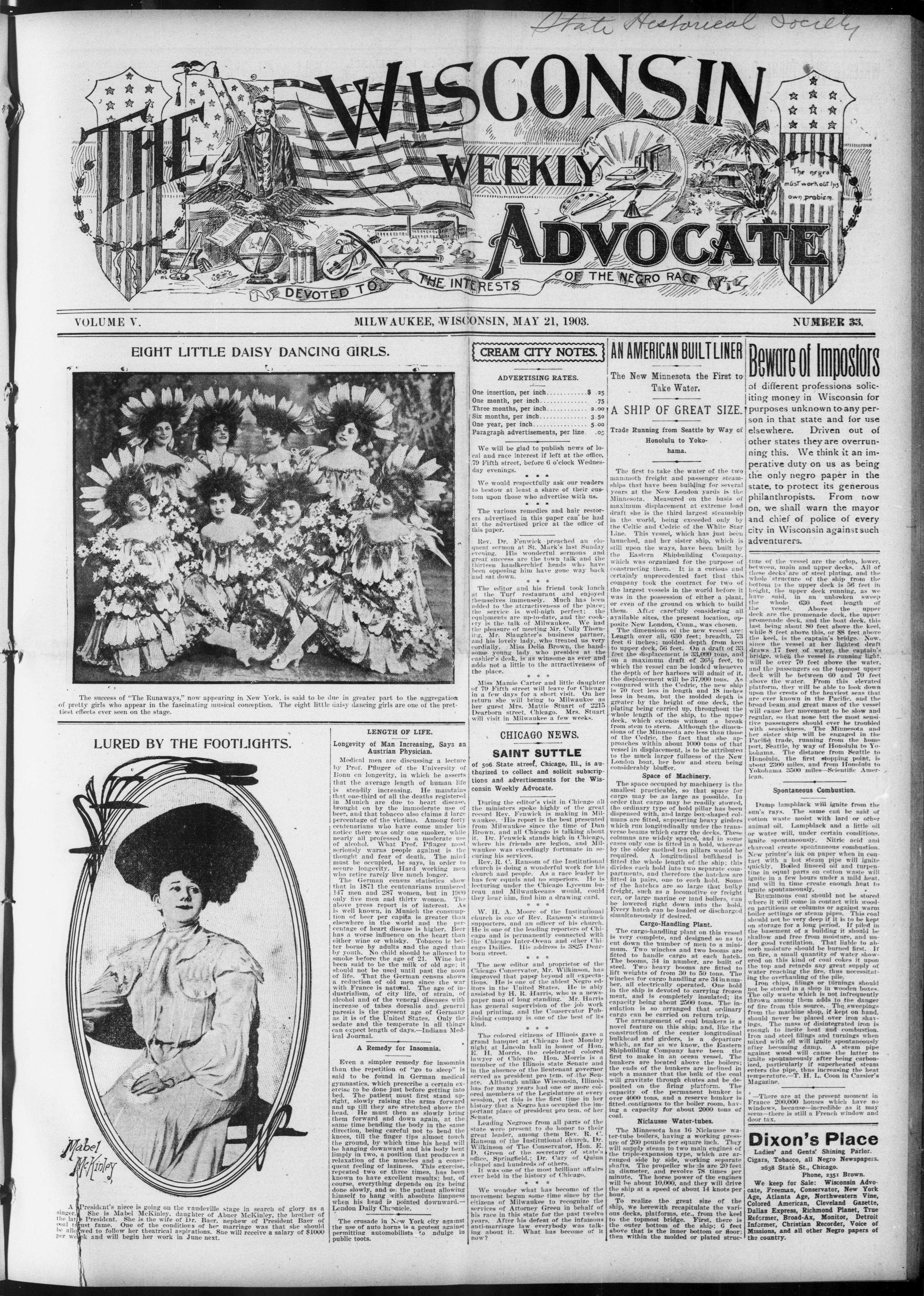
WISCONSIN
WEEKLY
ADVOCATE
DEVOTED TO THE INTERESTS OF THE NEGRO RACE
THE FLOWER DANCE COMPANY
The success of "The Runaways," now appearing in New York, is said to be due in greater part to the aggregation of pretty girls who appear in the fascinating musical conception. The eight little daisy dancing girls are one of the prettiest effects ever seen on the stage.
VOLUME V.
Mabel
McKinley
A President's niece is going on the vaudeville stage in search of glory as a singer. She is Mabel McKinley, daughter of Abner McKinley, the brother of the late President. She is the wife of Dr. Baer, nephew of President Baer of coal trust fame. One of the conditions of her marriage was that she should be allowed to follow her theatrical aspirations. She will receive a salary of $1000 per week and will begin her work in June next.
LENGTH OF LIFE
Longevity of Man Increasing, Says an Austrian Physician.
Medical men are discussing a lecture by Prof. Pfluger of the University of Bonn on longevity, in which he asserts that the average length of human life is steadily increasing. He maintains that one-third of all the deaths registered in Munich are due to heart disease, brought on by the immoderate use of beer, and that tobacco also claims a large percentage of the victims. Among forty centenarians who have come under his notice there was only one smoker, while nearly all professed to a moderate use of alcohol. What Prof. Pfluger most seriously warns people against is the thought and fear of death. The mind must be occupied, he says, in order to secure longevity. Hard working men who retire rarely live much longer.
The German census statistics show that in 1871 the centenarians numbered 147 men and 287 women, but in 1900 only five men and thirty women. The above press report is of interest. As is well known, in Munich the consumption of beer per capita is greater than elsewhere in the world and the percentage of heart disease is higher. Beer has a worse influence on the heart than either wine or whisky. Tobacco is better borne by adults and the aged than by youth. No child should be allowed to smoke before the age of 21. Wine has been said to be the milk of old age; it should not be used until past the noon of life. That the German census shows a reduction of old men since the war with France is natural. The age of industrialism, of city life, of strain, of alcohol and of the veneral diseases with increase of tabes dorsalis and general paresis is the present age of Germany as it is of the United States. Only the sedate and the temperate in all things can expect length of days.-Indiana Medical Journal.
A Remedy for Insomnia.
Even a simpler remedy for insomnia than the repetition of "go to sleep" is said to be found in German medical gymnastics, which prescribe a certain exercise to be done just before getting into bed. The patient must first stand upright, slowly raising the arms forward and up till they are stretched above the head. He must then as slowly bring them forward and down again, at the same time bending the body in the same direction, being careful not to bend the knees, till the finger tips almost touch the ground, by which time his head will be hanging downward and his body bent limply in two, a position that produces a relaxation of the muscles and a consequent feeling of laziness. This exercise, repeated two or three times, has been known to have excellent results; but, of course, everything depends on its being done slowly, and on the patient allowing himself to hang with absolute limpness when his head is pointed downward.—London Daily Chronicle.
The crusade in New York city against the use of auto horns is a protest against permitting automobilists to ndulge in public toots.
CREAM CITY NOTES.
ADVERTISING RATES.
One insertion, per inch. $ .25
One month, per inch. .75
Three months, per inch. 2.00
Six months, per inch. 3.50
One year, per inch. 5.00
Paragraph advertisements, per line. .05
We will be glad to publish news of local and race interest if left at the office, 79 Fifth street, before 6 o'clock Wednesday evenings.
We would respectfully ask our readers to bestow at least a share of their custom upon those who advertise with us.
The various remedies and hair restorers advertised in this paper can be had at the advertised price at the office of this paper.
Rev. Dr. Fenwick preached an eloquent sermon at St. Mark's last Sunday evening. His wonderful sermons and great success are the town talk and the thirteen handkerchief heads who have been opposing him have gone way back and sat down.
* * *
The editor and his friend took lunch at the Turf restaurant and enjoyed themselves immensely. Much has been added to the attractiveness of the place; the service is well-nigh perfect; the equipments are up-to-date, and the cookery is the talk of Milwaukee. We had the pleasure of meeting Mr. Cully Thorning, Mr. Slaughter's business partner, and his lovely lady, who treated us very cordially. Miss Delia Brown, the handsome young lady who presides at the cashier's desk, is as winsome as ever and adds not a little to the attractiveness of the place.
Miss Mamie Carter and little daughter of 79 Fifth street will leave for Chicago in a few days for a short visit. On her return she will bring to Milwaukee as her guest Mrs. Mattie Stuart of 2215 Dearborn street, Chicago. Mrs. Stuart will visit in Milwaukee a few weeks.
CHICAGO NEWS.
SAINT SUTTLE
of 506 State street, Chicago, Ill., is authorized to collect and solicit subscriptions and advertisements for the Wisconsin Weekly Advocate.
During the editor's visit in Chicago all the ministers spoke highly of the great record Rev. Fenwick is making in Milwaukee. His report is the best presented from Milwaukee since the time of Dan Brown, and all Chicago is talking about it. Dr. Fenwick stands high in Chicago, where his friends are legion, and Milwaukee was exceedingly fortunate in securing his services.
Rev. R. C. Ransom of the Institutional church is doing a wonderful work for his church and people. As a race leader he has few equals and no superiors. He is lecturing under the Chicago Lyceum bureau and Milwaukeeans would, could they hear him, find him a drawing card.
* * *
W. H. A. Moore of the Institutional church is one of Rev. Ransom's staunch supporters, and an officer of his church. He is one of the leading reporters of Chicago and is permanently connected with the Chicago Inter-Ocean and other Chicago Dailies. His address is 3825 Dearborn street.
The new editor and proprietor of the Chicago Conservator, Mr. Wilkinson, has improved that paper beyond all expectations. He is one of the ablest Negro editors in the United States. He is ably assisted by H. R. Harris, who is a newspaper man of long standing. Mr. Harris has general supervision of the job work and printing, and the Conservator Publishing company is one of the best of its kind.
* * *
The colored citizens of Illinois gave a grand banquet at Chicago last Monday night at Lincoln hall in honor of Hon. E. H. Morris, the celebrated colored lawyer of Chicago. Hon. Morris is a member of the Illinois state Senate and in the absence of the lieutenant governor served as president pro tem. of the Senate. Although unlike Wisconsin, Illinois has for many years had one or more colored members of the Legislature at every session, yet this is the first time in her history that a Negro has occupied the important place of president pro tem. of her Senate.
Leading Negroes from all parts of the state were present to do honor to their great leader, among them Rev. R. C. Ransom of the Institutional church, Dr. Wilkinson of The Conservator, Hon. E. D. Green of the secretary of state's office, Springfield: Dr. Cary of Quinn chapel and hundreds of others.
It was one of the most brilliant affairs ever held in the history of Chicago.
* * *
We wonder what has become of the movement begun some time since by the citizens of Milwaukee to recognize the services of Attorney Green in behalf of his race in this state for the past twelve years. After his defeat of the infamous anti-marriage law everybody was talking about it. What has become of it now?
AN AMERICAN BUILT LINER
The New Minnesota the First to Take Water.
A SHIP OF GREAT SIZE.
Trade Running from Seattle by Way of Honolulu to Yoko-
The first to take the water of the two manmoth freight and passenger steamships that have been building for several years at the New London yards is the Minnesota. Measured on the basis of maximum displacement at extreme load draft she is the third largest steamship in the world, being exceeded only by the Celtic and Cedric of the White Star Line. This vessel, which has just been launched, and her sister ship, which is still upon the ways, have been built by the Eastern Shipbuilding Company, which was organized for the purpose of constructing them. It is a curious and certainly unprecedented fact that this company took the contract for two of the largest vessels in the world before it was in the possession of either a plant, or even of the ground on which to build them. After carefully considering all available sites, the present location, opposite New London Conn, was chosen
The dimensions of the new vessel are: Length over all, 630 feet; breadth, 73 feet 6 inches; molded depth from keel to upper deck, 56 feet. On a draft of 33 feet the displacement is 33,000 tons, and on a maximum draft of $36\frac{1}{2}$ feet, to which the vessel can be loaded whenever the depth of her harbors will admit of it, the displacement will be 37,000 tons. As compared with the Cedric, the new ship is 70 feet less in length and 18 inches less in beam, but the molded depth is greater by the height of one deck, the plating being carried up, throughout the whole length of the ship, to the upper deck, which extends without a break from stem to stern. Although the dimensions of the Minnesota are less than those of the Cedric, the fact that she approaches within about 1000 tons of that vessel in displacement, is to be attributed to the much larger fullness of the New London boat, her bow and stern being considerably bluffer.
Space of Machinery.
The space occupied by machinery is the smallest practicable, so that space for cargo may be as large as possible. In order that cargo may be readily stowed, the ordinary type of hold pillar has been dispensed with, and large box-shaped columns are fitted, supporting heavy girders which run longitudinally under the transverse beams which carry the decks. These columns are widely spaced, and in some cases only one is fitted in a hold, whereas by the older method ten pillars would be required. A longitudinal bulkhead is fitted the whole length of the ship; this divides each hold into two separate compartments, and therefore the hatches are fitted in pairs, one to each hold. Some of the hatches are so large that bulky freight, such as a locomotive or freight car, or large marine or land boilers, can be lowered right down into the hold. Every hatch can be loaded or discharged simultaneously if desired.
Cargo-Handling Plant.
The cargo-handling plant on this vessel is very complete, and designed so as to cut down the number of men to a minimum. Two winches and two booms are fitted to handle cargo at each hatch. The booms, 34 in number, are built of steel. Two heavy booms are fitted to lift weights of from 30 to 50 tons. The winches for cargo handling are 34 in number, all electrically operated. One hold in the ship is devoted to carrying frozen meat, and is completely insulated; its capacity being about 2500 tons. The insulation is so arranged that ordinary cargo can be carried on return trip.
The arrangement of coal bunkers is a novel feature on this ship, and, like the construction of the center longitudinal bulkhead and girders, is a departure which, as far as we know, the Eastern Shipbuilding Company have been the first to make in an ocean vessel. The bunkers are located above the boilers; the ends of the bunkers are inclined in such a manner that the bulk of the coal will gravitate through chutes and be deposited on the firing platform. The capacity of the permanent bunker is over 4000 tons, and a reserve bunker is fitted contiguous to the boiler room, having a capacity for about 2000 tons of coal.
Niclausse Water-tubes.
The Minnesota has 16 Nielausse water-tube boilers, having a working pressure of 260 pounds per square inch. They will supply steam to two main engines of the triple-expansion type, which are arranged side by side, working separate shafts. The propeller wheels are 20 feet in diameter, and revolve 78 times per minute. The horse power of the engines will be about 10,000, and they will drive the ship at a speed of about 14 knots per hour.
To realize the great size of the ship, we herewith recapitulate the various decks, platforms, etc., from the keel to the topmost bridge. First, there is the outer bottom of the ship; 6 feet above that is the inner bottom or floor; then within the molded or plated struc-
NUMBER 33.
Beware of Impostors
of different professions soliciting money in Wisconsin for purposes unknown to any person in that state and for use elsewhere. Driven out of other states they are overrunning this. We think it an imperative duty on us as being the only negro paper in the state, to protect its generous philanthropists. From now on, we shall warn the mayor and chief of police of every city in Wisconsin against such adventurers.
ture of the vessel are the orlop, lower, between, main and upper decks. All of these decks are of steel plating, and the whole structure of the ship from the bottom to the upper deck is 56 feet in height, the upper deck running, as we have said, in an unbroken sweep the whole 630 feet length of the vessel. Above the upper deck are the promenade deck, the upper promenade deck, and the boat deck, this last being about 80 feet above the keel, while 8 feet above this, or 88 feet above the keel, is the captain's bridge. Now, since the vessel at her lightest draft draws 17 feet of water, the captain's bridge, when the vessel is running light, will be over 70 feet above the water, and the passengers on the topmost upper deck will be between 60 and 70 feet above the water. From this elevated platform, they will be able to look down upon the crests of the heaviest seas that are ever known in the Pacific, and the broad beam and great mass of the vessel will cause her movement to be slow and regular, so that none but the most sensitive passengers should ever be troubled with seasickness. The Minnesota and her sister ship will be engaged in the Pacific trade, running from the home port, Seattle, by way of Honolulu to Yokohama. The distance from Seattle to Honolulu, the first stopping point, is about 2300 miles, and from Honolulu to Yokohama 3500 miles—Scientific American.
Spontaneous Combustion
Damp lampblack will ignite from the sun's rays. The same can be said of cotton waste moist with lard or other animal oil. Lampblack and a little oil or water will, under certain conditions, ignite spontaneously. Nitric acid and charcoal create spontaneous combustion. New printer's ink on paper when in contact with a hot steam pipe will ignite quickly. Boiled linseed oil and turpentine in equal parts on cotton waste will ignite in a few hours under a mild heat, and will in time create enough heat to ignite spontaneously.
Bituminous coal should not be stored where it will come in contact with wooden partitions or columns or against warm boiler settings or steam pipes. This coal should not be very deep if it is to be kept on storage for a long period. If piled in the basement of a building it should be shallow and free from moisture, and under good ventilation. That liable to absorb moisture should be burned first. If on fire, a small quantity of water showered on this kind of coal cokes it upon the top and retards any great supply of water reaching the fire, thus necessitating the overhauling of the pile.
Iron chips, filings or turnings should not be stored in a shop in wooden boxes. The oily waste which is not infrequently thrown among them adds to the danger of fire from this source. The sweepings from the machine shop, if kept on hand, should never be placed over iron shavings. The mass of disintegrated iron is enough to incite heat and combustion. Iron and steel filings and turnings when mixed with oil will ignite spontaneously after becoming damp. A steam pipe against wood will cause the latter to ignite spontaneously after being carbonized, particularly if superheated steam enters the pipe, thus increasing the heat temperature.—T. H. L. Coon in Cassier's Magazine.
There are at the present moment in France 200,000 houses which have no windows, because—incredible as it may seem—there is still a French window and door tax.
Dixon's Place
Ladies' and Gents' Shining Parlor. Cigars, Tobacco, all Negro Newspapers. 2638 State St., Chicago. Phone, 2351 Brown. We keep for Sale: Wisconsin Advocate, Freeman, Conservator, New York Age, Atlanta Age, Northwestern Vine, Colored American, Cleveland Gazette, Dallas Express, Richmond Planet, True Reformer, Broad-Ax, Monitor, Detroit Informer, Christian Recorder, Voice of Missions, and all other Negro papers of the country.
WRECKED BY A TORNADO.
Home for Feeble Minded at Glenwood, Ia., Demolished.
TWO GIRLS ARE KILLED
Nine Deaths from Wind Storms in Iowa
—Small Town of Buxton Part-
tially Wiped Out.
Glenwood, Ia., May 26.—A tornado struck the state hospital for feeble-minded at this place last night. Two persons, Maggie Betnes, aged 11, and Hazel Wright, aged 10, were killed.
Eleven were injured, but all will recover. The old dormitory building and power house were blown down.
All the buildings were damaged more or less. Local physicians went to the scene from Des Moines to assist in taking care of the injured. Wires are down and details are meager.
The most seriously injured:
Mary Eckert.
Anna Delaney.
Myrtle Dickinson.
Etta Newton.
Harrison Johnson.
Two Killed at Buxton, Ia.
Des Moines, Ia., May 26.—Buxton, a small town fifty miles southeast of Des Moines, was partially wiped out by a tornado at 9:30 o'clock today. Two persons were killed outright, one was fatally injured and eight others more or less seriously injured. The dead:
Fatally Injured.
Mrs. Mary Rhodes.
Nine Killed at Davev.
Lincoln, Neb., May 26.—A special to
The Star from Hastings, Neb., says:
The Star from Hastings, Neb., says:
A tornado struck Hastings early today, wrecking many residences and damaging several business blocks. No deaths are reported.
Nine persons were killed at Davey, and heavy damage is said to have been done at Valparaiso and Raymond. No one was killed at the two last named towns. Wires are down and details are lacking. The storm seemed to have first struck north of Lincoln and to have branched out in several directions.
Tornado Sweeps Iowa Counties.
Oskaloosa, Ia., May 26.—A tornado in Monroe county and in the southwestern part of Mahaska county, last night, resulted in the death of two persons, fatal injury to seven, and minor injuries to a number of others. Coming from the southeast, the tornado swept a path 250 feet wide, first striking a mining settlement on the Chicago & North-Western. At West Buxton, the tornado destroyed several residences and a large number of barns and outbuildings. The dead: BLAKEY, GEORGE. RHODES, HERBERT. Partial list of fatally injured: Addison Rhodes. Mrs. Addison Rhodes. John Blakey. Mrs. John Blakey.
A Night of Horror
Owing to the breaking of wires it was impossible to secure adequate medical assistance for several hours and then it was extremely difficult to find the injured, as the town was in darkness. Rain which fell in torrents following the tornado greatly increased the distress. A messenger secured aid from Oskaloosa and Albia.
Cloud Burst in Kansas.
Abilene, Kan., May 26.—A cloudburst struck the northern part of this county last night. Great damage to crops was done. One-third of this city is flooded. No lives were lost.
Bad Storm in Omaha
Omaha, Neb., May 26.—A heavy rain and wind storm early today caused some damage in Omaha. An engine pulling the Union Pacific fast mail east-bound was derailed by the soft tracks, blocking west-bound trains. Several houses were unroofed. No one is reported hurt.
AUTO RACE CLAIMS SIX.
List of the Casualties in the Carnival of Death-Three of the Injured Will Die.
Paris, May 26. It is now possible to assemble from the many reports along the route of the first stage of the Paris-Madrid automobile list a complete list of casualties. This shows six persons killed, three so dangerously injured that they may die and ten seriously injured. During the day it was asserted here that seventeen persons had been killed and that seventeen were injured; but this was not warranted. A carefully revised list of the casualties follows: Dead: PIERRE, RODERIZ. Mr. Barrow's machinist, collision with a tree near Libourne. NIXON. Mr. Porter's machinist, burned under automobile.
NORMAND. M. Tourand's machinist, at Angouleme.
DUPUY, soldier, at Angouleme.
CAILLON, cyclist, at Angouleme.
UNKNOWN PEASANT WOMAN, at Abilis.
Injured:
Mr. Barrow, pelvis and thigh broken; amputation of leg expected.
T. Porter, cut and bruised.
Mr. Steady, overturned; badly injured.
Mr. Stead's machinist, head cut open.
Lesna, champlon cyclist, broken knee cap.
Georges Richard, chest crushed, ribs broken.
Henry Jeannot, Richard's machinist, shoulder fractured.
E. Chard, head cut open.
Tourand, severely bruised.
Gaston Raffet, boy, fractured skull, leg and arm broken.
Marcel Renault's machinist, severely
Marcel Renault's machinist, severely bruised.
Mme. Chayssas, both legs cut off under racing machine; likely to die.
MAFIA PLOT TO KILL OBJECTIONABLE BOSSES.
Italian Secret Society Plans to Murder Factory Foremen in All Parts of the Country.
Dunkirk, N. Y., May 26. A plot formulated by an Italian Mafia secretly to do away with objectionable bosses and foremen in the large manufacturing industries throughout the country has been discovered and as a result every Italian employed by a number of manufacturing concerns here has been summarily dismissed. The discharge of the men was caused by advices received from the officials of a large plant at Easton, Pa., where the murder of the superintendent by the members of the organization was only prevented by information given by a friendly Italian who was aware of the plot. The Easton officials are said to have communicated with every big concern in this country employing Italians informing them of the existence of the band, as the branches are believed to exist in all the larger cities.
---
MACHEN ARRESTED.
Superintendent of Free Delivery of Mail Is Charged with Brib-
Washington, D. C., May 27.—A. W. Machen, superintendent of the free delivery, who was relieved from duty some time ago, was arrested today at the instigation of the postoffice department charged with receiving bribes from contractors. These bribes are supposed to aggregate $20,000.
Official Statement.
Fourth Assistant Postmaster General Bristow this morning issued the following statement:
A. W. Machen, general superintendent free delivery service, was arrested at 1 o'clock today. He is charged with receiving bribes amounting in all to about $22,000 in connection with a contract held by Groff Brothers of Washington, D. C., for a patent fastener used on street letter boxes, known as the Groff fastener. The postoffice department in the past ten years has used about $160,000 worth of these fasteners and it is shown by ample evidence that for the past three years, at least, Mr. Machen has been receiving 40 per cent. of the amounts paid to the Groffs. The transaction of the business was conducted by Diller B. Groff, who controls the patent of his brother, Samuel M. Groff, a policeman.
Arrest Follows Examination.
The arrest of Mr. Machen was the concluding act of an examination of him, which was conducted for three hours today by Fourth Assistant Postmaster General Bristow, Inspector Fosnes, who relieved Mr. Machen as chief of the free delivery system, and Postoffice Inspector Myer. At the conclusion of the examination, Deputy United States Marshal Springman was called into Gen. Bristow's office and made the arrest.
Other Arrests to Follow.
The warrant on which Machen was arrested charges him with receiving a bribe. It is understood that other arrests are to follow. Machen will be immediately dismissed by the postmaster general. The amount of money paid during the past ten years to Groff Brothers in Fourth Postmaster General Bristow's statement was subsequently changed to $140,000.
Mr. Payne Issues Dismissal Order.
Postmaster General Payne has dismissed Mr. Machen in the following order:
A. W. Machen is this day removed from the position of general superintendent of the free delivery service. His removal is made by reason of malfeasance on his part in the discharge of duties of his office.
Held in $20,000 Bonds.
Mr. Machen was taken before United States Commissioner Taylor and through his attorneys, Douglas & Douglas, demanded an immediate hearing. The district attorney said he was not ready to proceed and asked for postponement for ten days. The preliminary hearings were set for the first Friday in June and bond was fixed in the sum of $20,000. Mr. Machen made arrangements with the Union Security & Guarantee company of Philadelphia to secure a bond in that amount. He declined to make any statement, but his attorneys stated that they felt confident that they would be able to show conclusively at the proper time that their client had been guilty of no wrongdoing in connection with the Groff contracts but on the contrary Mr. Machen's administration of the free delivery had been honest and upright.
Released on Bail.
Mr. Machen was released on $20,000 bond given by the Union Security and Guarantee company of Philadelphia. Postoffice Inspector Fosnes is trying to locate D. J. Groff, one of the members of the contracting firm.
"Merely Grandstand Play."
Mr. Machem said this afternoon: "This will come out all right. My arrest is merely a grandstand play."
Miller's Place Filled.
Edwin Lawrence of Rutland, Vt., was today appointed assistant attorney in the office of the assistant attorney general for the postoffice department, to succeed Daniel V. Miller, recently removed. Mr. Lawrence is a member of the Vermont bar. The investigation of affairs in the assistant attorney general's office continues.
Implicates a Senator.
Cincinnati, O., May 27.—John J. Ryan of the turf investment "get-rich-quick" concern which bore his name, and whose confessions to the postoffice department led to the arrest of Daniel V. Miller, an attorney for the department, and Joseph M. Johns, declared that he was told that if he "put up $25,000 for a certain senator," the postal department would stand by him. He says he declined the proposition. He did not divulge the name of the senator involved.
INCENDIARY |FIRE.
Four Suffocated and Three Dying of Injuries Received in New York.
New York, May 27.—Four persons were suffocated to death and three others were so badly burned that it is feared they will die in a fire early today in the five-story apartment house at 306 West One Hundred and Thirty-fifth street. The fire is said to have been of incendiary origin. The dead:
WANDLING, MRS. JULIA.
THREE CHILDREN of Mrs. Wandlling as follows: George, aged, 6; Helen E., aged 4, and Charles, aged 9 years.
Those believed to have been fatally burned are George Wandling and Victor Johnson. They were removed to a hospital. Johnson discovered the fire and avers to have seen the man who is said to have started it. Johnson said he saw a man lighting some shavings and waste at the foot of the stairs in the house. The stairs had been soaked with kerosene and some of the oil dripped on Johnson's clothing. With his clothes burning, Johnson asserts he chased the incendiary for several blocks before he fell exhausted. Other persons say they saw the man run from the house pursued by Johnson. Mrs. Wandling was found dead with her children on the top floor, where they lived.
PRESBYTERIANS ON DIVORCE QUESTION.
Los Angeles, Cal., May 27.—The Presbyterian General assembly received a report from Dr. Van Dyke enjoining Presbyterian ministers to refuse to perform the marriage ceremony for all divorced persons except those divorced on scriptural grounds. One commissioner tried to retard its adoption by declaring he had been authorized to ask the assembly to define what the Presbyterian church meant by "scriptural grounds." He was immediately laughed at so uproariously that he resumed his seat, and the report was accepted by a unanimous vote. The report as adopted was as follows:
"That the ministers of the Presbyterian church are hereby enjoined to refuse to perform the marriage ceremony for divorced persons except those who have been divorced on such grounds and for such causes as are recognized as scriptural by the standards of the church."
WIPED OUT BY TORNADO.
WIPED OUT BY TORNADO.
Town of Bonta in Shelby County Ia., Demolished.
NUMBER DEAD UNKNOWN.
Des Moines, Ia., May 27.—When wire communication with interior towns was opened up today it became apparent that yesterday's tornado caused far greater loss than was at first reported. A report early today from Bonta, in Shelby county, received by way of Audubon, says that the town of Bonta was completely demolished, and that many farmhouses near that place were wrecked. At Bonta a large church and the Great Western depot are among the buildings wrecked. No definite news of casualties from there had been received up to 11 o'clock today.
More Casualties.
At Creston ten dwellings were blown off their foundation and Mrs. S. E. Troop and daughter were injured in the wreckage of their home. Ten miles north of Gray in Audubon county two children are reported killed in the wreckage of a farmhouse and five others injured seriously. All were occupants of one house.
Child Burned to Death.
Another death was reported today as a result of the tornado in South Des Moines last night. The home of Richard Wallace, a carpenter, was destroyed and in a fire that resulted from the kitchen stove being overturned, a 3-year-old daughter was burned to death, being buried under the debris.
River Is Rising.
The Des Moines river is rising an inch every two hours today, with every prospect of exceeding the high water mark of a year ago. Many persons are leaving their homes in the bottom and stocks are being removed from factories with all possible speed.
Strikes Soldiers' Home.
Marshalltown, Ia., May 27.—A severe storm damaged the hospital of the Iowa Soldiers' home last night. A large brick smokestack was blown down, crashing through the roof, the inmates narrowly escaping injury. Trees in all parts of the city were blown down and many telegraph and telephone wires broken. Heavy rains caused the Iowa river to leave its banks and much damage is threatened in the lowlands.
Dies of Fright.
St. Elmo, Mo., May 27.—The casualties resulting from yesterday's tornado here today are placed at eighteen, with one man missing. Daniel C. Barker, a retired farmer, died during the night of apoplexy caused by fright: Edward Wiseman, a farmer, is missing, and C. Daniels and Mrs. John McMahon are seriously injured.
MANY LIVES LOST.
Antwerp, May 27.—The British steamer Huddersfield, which sailed from this port yesterday for Grimsby, Eng., collided with the Norwegian steamer Uto. The Huddersfield is reported to have foundered. From fifteen to twenty of her passengers are said to have lost their lives. The crew were saved. The passengers were mostly seamen returning to England. It is believed they were crushed in the collision. The bows of the Uto were damaged. It was ascertained here later that twenty-two Austrian and Italian emigrants perished when the Huddersfield sank.
London, May 27.—A telegram from Grimsby says the Huddersfield carried twenty-nine emigrants and five other steerage passengers. Twenty of the emigrants are missing. The remainder were taken ashore in boats with the crew of the Huddersfield.
AMERICAN GIRL IS TIRED OF BARON.
Girl Who Threw Over Marconi Sues for Divorce—Will Try to Win Back Rejected Lover.
Paris, May 27.—The Rappel says that the Baroness de Baross, an American, who, when she was Miss Holman, was affianced to Sig. Marconi, is suing for divorce. If she is successful she will return to America and resume her maiden name. The paper says she much regrets breaking the engagement with Sig. Marconi and hopes to win him back again.
Miss Holman was an Indiana girl, and she broke her engagement with Sig. Marconi after the latter had given a dinner in honor of an actress. She and her mother the same day sailed for Europe, and almost as soon as they landed her engagement to Baron de Baross was announced.
MEETS HIS OLD FRIENDS.
President Roosevelt Sees Men He Knew in the West—Spends Day in Montana.
Helena, Mont., May 27.—President Roosevelt's special train arrived here over the Northern Pacific at 8:30 this morning. An immense crowd was at the station to greet the President. Around the station a cordon of soldiers had been stationed, while a battalion of the Twenty-sixth United States infantry from Fort Harrison was drawn up opposite the train. Battery A, National guard, commenced firing a presidential salute on the arrival of the train. Among the delegation at the station were many old-time western friends of President Roosevelt. One of the first persons he inquired about was John Willis, hunter and trapper of Thompson, Mont., with whom he had camped years ago in this state.
THREE BURIED IN DEBRIS
Explosion at Powder Mill at Fontanel, Ind., Will Probably Cost Four Lives.
Terre Haute, Ind., May 27.—An explosion at the powder mill at Fontanel today caused the death of Harold Spencer and perhaps three others, Frank Archer, Fred Smith and James Riddle were burned. This explosion was followed by two others and the engine house was leveled. Three men are supposed to be buried in the debris.
WON BY RELIANCE.
The Constitution Gives the New American Cup Defender a Hard Race. .
Matinicock Point, L. I., May 26.—The Reliance beat the Constitution over the 30-mile course in a 12-knot breeze by one minute and 53 seconds and the Columbia by about two miles.
The Reliance finished at 3:12:17; Constitution at 3:14:10. As the Reliance started twenty-five seconds ahead of the Constitution, the new boat defeated the old one by one minute and twenty-eight seconds.
Matinicock Point, L. I., May 26. After a pretty thorough testing of the Reliance and the Columbia in light uncertain airs, in which the new boat certainly showed superiority, the yachting fraternity hailed with some satisfaction this morning a nice steady breeze of about five knots strength blowing in from the southeast.
The forenoon was well advanced when the first of the excursion fleet appeared beyond Execution Rock. Soon the excursion fleet began to appear in larger numbers and some lively bursts of speed were made by the big steam yachts in their rush for advantageous position at the starting line. Following these were a long line of small sailing craft and the regatta's committee boat the Privateer.
The wind increased as the morning advanced and at 10 o'clock had freshened to nine knots. At 10:20 there was every indication that the race would start on time and finish early in the afternoon. The wind was freshening rapidly and was hauling around to a light west of south, so that there was some doubt of the course to be sailed.
All three of the yachts were ready to get under way before 11 o'clock and at about the same time the tug with the turning marks arrived off the point.
The buoy for the starting line was set by the course tug at 10:45, when the Privateeer took up her position. The Reliance was then heading across the sound towards the committee boat under mainsail, staysail, jib and small club topsails.
Trinagular 15-Mile Course.
The boats were at the starting line half an hour before noon, and at 11:40 the committee hoisted the signal for the triangular course of fifteen miles with a broad reach to Lloyd point, another reach to Great Captain island, and beat to the finish. The wind at this time had veered to the south southwest and was blowing at ten or twelve knots. Meantime the yachts were having a fine fight for position, jockeying about the committee boat in a lively manner, the course being practically free from steam yachts.
The Race Is Started.
The preliminary gun was fired at 12 o'clock and fifteen minutes later the starting gun boomed forth. The starting time (unofficial) was:
The starting time (uniform) was:
Rellance 12:15:03
Columbia 12:15:08
Constitution 12:15:28
Constitution's Good Showing.
All the way down to the first mark the Reliance and Constitution had it very hot and to the surprise of everyone the latter held the new boat wonderfully well. When off Oyster Bay the Constitution had an accident to her jib top sail and was forced to take it in, so that she sailed the last mile of that leg with less sail spread than the Reliance.
The mix-up at the start of the race, when it seemed as the Columbia and the Reliance crossed the line ahead of the gun, but started off nevertheless, had put the Reliance in the lead, which she held to the first mark. She turned that mark but 28 seconds ahead of the Constitution, but it is estimated that she started twenty-five second ahead so that in actual time she only beat the 1901 boat by three seconds in a close reach and a strong breeze.
Columbia in the Rear.
The Columbia, by hesitating at the start, was considerably in the rear of the other two boats all the way to the first mark. She was only two minutes behind the Reliance. Her turning time, as seen from shore, was 12:45:22. On the run to the second mark the Constitution gained a trifle on the Reliance. As the boats ran down to the second mark the wind hauled a little more to the eastward and dropped a trifle. This affected the Columbia at first and she dropped behind very fast. At one time the Constitution drew up until she almost lapped the Reliance, but the new boat set her spinnaker quickly and succeeded in pulling away. Just before the Constitution got to the turning buoy her crew made poor work in getting in the spinnaker and the most of the gain of the Reliance was due to this.
Time at the Second Mark.
It was a close fetch for the boats to the finish mark, and they all set baby jib top sails. The time at the second mark was: Reliance, 1:14:07: Constitution, 1:15:01: Columbia, 1:23:58. On the way from the second mark the
On the Second Round
The boats turned the first mark on the second round: Reliance, 2:12:15; Constitution, 2:15:20.
The Columbia was still some distance astern.
The Constitution gained a minute and a half on the Reliance. The times (unofficial) at the second mark of the second round: Reliance, 2:40:28; Constitution, 2:41:39; Columbia, 2:55:32.
Thinks Shamrock Has No Chance
New York, May 26.—Not a possible chance for the America's cup is conceded to the Shamrock III, by a yacht owner and member of the New York Yacht club, who has wagered $1500 to $1000 that the Reliance will win in one, two, three order. David Barrie, Sir Thomas Lipton's commercial manager in this country, took the bet. Mr. Barrie acknowledged that his wager had been made, but refused to name the member of the New York club whose money he expects to win.
HEROIC POLICEMEN.
Rush Into Burning Building in Brooklyn to Save Sleeping Women and Children.
New York, May 26.—Prompt and heroic work by two policemen, one of whom was so badly burned that he was crazed by the pain, saved the lives of several women and children who had been caught in a burning building in Fulton street, Brooklyn, at an early hour today. When the police and firemen reached the scene, women and children were at the windows of the building calling for help.
Policeman James F. Haven entered the building and on the top floor found Mrs. Howard Murray unconscious. He carried her to a window and then succumbed, having been burned about the face and hands.
The pain from the burns crazed him and he had to be placed in a straight-jacket at the hospital.
In the meantime policemen and firemen had rescued the other women and children, who were asleep when the fire broke out. At the hospital it was said Haven could not live. Policemen McAulay and Cook were also seriously burned.
WILL EXPEL THE JEWS.
St. Petersburg, May 27.—The chief of police of Kieff has ordered the police commissaries within his jurisdiction to institute a fresh inquiry into the legal status of the Jews and to expel forcibly those who have no legal right of residence and who refuse to leave.
A Jewish deputation from Kishineff recently had a long audience with Minister Von Plehwe. The latter denied being a Judophobe and said he had not opposed taking proceedings against the former governor of Kishineff, Gen. Von Raaben, and the local administration of Kishineff.
The minister promised sympathetic consideration of the facts set forth in the petitions of the Jewish population for future protection. Consequently, the minister yesterday suppressed the distribution of Krousterous' new anti-Semitic organ, the Znamis.
The Russian laws do not permit of suits against the state for damages done by a mob, but the government can consent to the prosecution of negligent officials. It is not yet decided whether civil or criminal procedure will be adopted. The incriminated officials have no property, hence the purpose is not to obtain pecuniary recompense, but it is hoped the moral effect of the prosecution will prevent a repetition of the massacres.
An explicit denial appears in yesterday's Official Messenger of the allegation that Interior Minister Von Plehwe sent a confidential letter to the governor of Bessarabia shortly before the anti-Semitic outbreak at Kishineff, in which he referred to the possibility of disorders there and the steps to be taken to suppress them. The paper says the reports were inventions.
NINE MORE VICTIMS.
Tornado Destroys the Town of Elmo Mo., Just Across Iowa State Line.
Blanchard, Ia., May 27.—A most destructive and fatal tornado struck the town of Elmo, Mo., eight miles south of Blanchard and just across the Missouri state line, at 5 o'clock last evening. Nine persons were killed outright and five were injured, some of whom may die.
CALHOUN, C. C.
BELL, CASSIUS.
ALVIS, J. J.
BRADLEY, LEONARD.
HUSEN, MINTON.
HUFF, GUS.
STRANGLER, OREN.
STARKER, D. L.
PERRY, GEORGE.
Injured:
Ed Athetten.
George Huff.
A. L. McElvain.
Harry Moss.
Elmer Morgan.
The storm came from the northeast and first struck the Wabash depot. The Masonic temple was the next building in its path and it was demolished. On the lower floor of the temple was located a general merchandise store, and in the store was gathered a number of the citizens of the town. The building was torn to pieces before any warning was received and the victims were buried beneath the wreckage. Of the fourteen persons in the store only five escaped death, and these received injuries which in two or three cases may prove fatal. The storm passed on through the town, leaving but a few buildings standing.
The storm came on with great suddenness and had destroyed the town almost before the people realized what had happened. After leaving Elmo it continued into the country in a southwest direction, and it is feared that fatalities have occurred. Several dwellings are known to have been blown to pieces, but the fate of their occupants is unknown. Elmo is a small town on the Wabash road branch running from Omaha to Brunswick, Mo., and has about 200 inhabitants.
PLANS A NEGRO EXODUS.
Society Formed at Boston to Depopulate South of Blacks and Bring Them North.
Boston, Mass., May 27.—Plans have been completed by a secret organization, with headquarters here, for a great Negro exodus from the south. The plan of the society, which numbers 500 members, is to depopulate the entire south and southwest of Negroes, who will be brought north to Boston and thence distributed throughout the west in agriculture and mining communities. The first great body of emigrants, 5000 in number, will land in Boston about July 1, the society's leaders say. The southern headquarters of the society are in Georgia, but the precise location is kept secret in fear of mob violence or interference from the whites. Secret agents of the society are now gathering Negroes from all parts of the south.
WHY NEGROES DON'T LIKE THE COUNTRY.
Lack of Schools and Police Protection Drives Them to Cities, Says Booker Washington.
Tuskegee, Ala., May 27.—Booker T. Washington today submitted his annual report to the board of trustees of the Tuskegee institute. It is in part as follows:
There are several influences that are constantly exerting themselves against the Negro growing up on the soil at present. One of these is the lack of public school facilities in the country district and the frequent and unwise agitation of the question about dividing the school fund in proportion to the tax paid by each race. In the cities and larger towns the Negro parent finds a comfortable schoolhouse and a school in session eight or nine months. Another thing which sends a larger number of Negroes to the cities than many realize is the surety of getting police protection in the city when one is charged with crime. I think I do not overstate the matter when I say that for every lynching or attempt at lynching that takes place in the country a score of colored people leave the country for the city. This whole question is one that should receive very serious attention.
Fire Island Hotel Burns
New York, May 27.—The new hotel on Fire Island, built by Sire Brothers of New York, was destroyed by fire early today. The only occupant at the time was J. A. Bailey, the caretaker, who had a narrow escape from death.
Victims of Tornado.
Norman, Neb. 5
Upland, Neb. 4
Pauline, Neb. 6
Cowles, Neb. 3
Hartwell, Neb. 1
Rolfe, Ia. 1
Pern, Ill. 2
Hastings, Neb., May 26.—Nineteen persons were killed and an equal number badly injured during tornadoes which swept over the region south of here yesterday.
Every dwelling and outbuilding in the path of the tornado was blown to pieces, and the financial loss thus far accounted will reach about $60,000.
List of Known Dead.
The dead are:
NORMAN.
BACON, MRS. EARL.
M'CURDY, DANIEL.
M'CURDY, ROBERT.
TIPPLE, MRS. C. A.
WEHLEVER, MRS. JOHN.
UPLAND.
LAMERS, MRS. CHRIS.
PETERS, MRS. JOHN.
——, Lutheran minister.
——mother of Mrs. Lamers.
PAULINE.
MUMAW, JAMES.
MUMAW, MRS. JAMES.
MUMAW, ——, child.
PALMER, FLORA.
PALMER, JOHN.
QUIGG, FRANK.
Seriously Injured.
Among those seriously injured are:
NORMAN.
Earl Bacon.
Robert Chambers.
George Jmeer.
Mrs. George Jmeer.
John Kinear.
Mrs. John Kinear.
Icey McCurdy.
John Wehlever.
UPLAND.
Mrs. Isaac Casper.
Chris Lamers and two children.
Fred Pop.
Mrs. Pop.
Minnie Schultz.
William Schultz.
FAIRFIELD
Mrs. A. W. Broderick.
—— Broderick, child.
Mrs. Nobe Linsey.
John McReynolds.
Charles Taylor.
Entire Household Caught.
Near Norman, at the home of Daniel McCurdy, a number of relatives and friends were spending the day and not an inmate escaped death or serious injury.
Two miles south of Upland German Lutheran services were being held in a schoolhouse when the storm struck and demolished it, killing four of the occupants, including the minister, and injuring a number of others.
The storm was equally destructive at Fairfield, but the people were warned of its coming and sought cellars for safety. Six dwellings were blown to pieces at that place, but their occupants escaped injury with a few exceptions.
Three persons are reported killed at Cowles and one person killed and three injured at Hartwell.
Several Small Towns Wrecked.
From Norman, which is a town of about 100 inhabitants, situated on what is called the "high line," of the Burlington railway, the path of the storm lay east to Pauline, a little station on the Prosser branch of the Missouri Pacific railway.
From Pauline it proceeded in a southeasterly direction, finally losing its force southwest of Fairfield.
The entire town of Fairfield, which had about thirty-five houses, is reported wrecked.
The nine members of the family of Peter Hockinson, near Fairfield, were scattered in the storm after the Hockinson home was carried away:
The greatest loss of property was sustained by farmers. The heaviest individual loss reported is that suffered by Charles Taylor, who places the damage to his stock farm, including cattle and horses killed, at $21,000.
Two Dead at Peru, Ill.
La Salle, Ill., May 26.—Storms did $25,000 damage in this vicinity this afternoon. Fritz Hushno and Alexander Winters of Chicago were drowned by the capsizing of a houseboat in the Illinois river at Peru. An oak tree, planted by Daniel Webster on the Fletcher-Webster farm, now St. Bede college, was blown to the ground.
One Death at Rolfe. Ia.
Des Moines, In., May 26.—A tornado struck the town of Rolfe, seventy miles west of here, killing Fong Foo, a laundryman, fatally injuring a child and wrecking the State bank building, a general store, the Hotel de Main, and one other building. Several residences were damaged.
TEN INJURED IN WRECK
Big Four Work Train at Columbus, O. Smashed Up—Two of Those Hurt Will Die.
Columbus, O., May 26.—A Big Four work train with a gang of Italian laborers on board collided with a cut of boxcars near Armstrong street in the local yards at 10:45 a. m., and the following persons were injured:
James Rose, Italian, married, will die.
Antonio Rosea, Italian, probably fatally hurt.
Five other Italians were less seriously injured.
Engineer George W. Shormer, badly hurt
Engineer George W. Shermer, badly hurt. Fireman James Storey, stuck to his post, badly shaken and bruised. Brakeman George Greenwell, married, back wrenched and probably slight internal injuries.
GOVERNMENT WINS
BEEF TRUST CASE.
Chicago, Ill., May 26.—Judge Grossecup in the federal court today entered the final order in the so-called "beef trust" case, restraining the packers from combining to regulate the trade. The order covers all the points in the previous decision and is regarded as a complete victory for the government. An appeal will be taken.
Caffeine in Coffee Berries.
Coffee berries are understood to contain about 1 per cent of caffeine to which the stimulating properties are due. In a late analysis of nine kinds at the Pasteur institute, M. Bertrand has found that coffee canephora contains as much as 1.97 per cent. of caffeine, but that two species—C. Humboltiana and C. Mauritiana—are practically free from the stimulating alkaloid, not more than 0.07 per cent. appearing in either.
A Startling Request.
Percy is a little boy who makes plans to shirk his bath sometimes. But the other evening he came in from play, tired and hot and sticky.
"Do I get a bath tonight, ma?" he asked.
"Yes," answered his mother.
"Well," he said, cheerfully; "the Lord knows I need it."—Brooklyn Eagle.
IN MEMORY OF THE SOLDIER DEAD.
THE EAGLE
Decoration day, or Memorial day, as it is alternately called, is undoubtedly the most solemn of all the secular holidays in our calendar. It is the day set aside for the decoration of the graves of those who fell fighting for the preservation of the Union and the glory of the flag. By every northern state, May 30 is selected for this occasion. On that day the various cemeteries throughout the country are visited by those who wish to pay tribute to the soldier dead. Statues of famous men are decorated with laurel wreaths. All over the north, Grand Army veterans parade the streets and civic parades are much in evidence.
THE BANK ROBBERY
"It's an awful sum of money to lose or gain. Seventy-five thousand dollars." So said Charlie Morton to himself, as he rode into town in the tramcar. It was the morning after the discovery of an enormous shortage in the accounts of the cashier of the United National bank, and everybody was talking about the great "robbery," and wondering whether the defaulter would get away or not. Charlie was particularly interested in the matter for he was himself cashier in a bank—the Imperial.
"Now, it seems to me," he soliloquized, as he gazed abruptly out of the opposite window at the passing shop fronts., "it seems to me that if a chap was only smart enough he could do it. Why, it would be almost the easiest thing out if he and the teller—the receiving—could go it hand-and-glove together. But they are always caught sooner or later; the chaps that try it aren't smart enough by half."
And his thoughts came back to the case in hand. He soon found himself wondering which direction the runaway had taken, and speculating upon the quickest and safest route to foreign territory. It is an exciting thing, a race against time, telegraph, and the officers of the law. The manner and means of it are fascinating topics for thought, especially for bank cashiers. Charlie was still musing upon the thing as he alighted from the train and entered the bank.
A few moments afterward, Fred Allen, the receiving teller, came in and, laying upon a chair the "bank robbery" extra, which he had been reading, went to his desk. Charlie opened the safe, arranged his cash, and the business of the day began.
It was a weary day for every one in the bank. There was not much business, and things were slow, without any chance of relief by conversation. Alone, practically, with little to do and no one to talk to, Charlie thought often of the defalcation at the National bank. He pictured to himself all the fine things that could be done with $75,000. There were a carriage and horses, the opera, the theater, fine clothes, high living—and no work. Decidedly a fine prospect for any reasonable being. Charlie amplified the idea, divided it, and imagined each part to himself in detail. It was as pleasant a way as any of passing the time which hung with unusual heaviness upon him. And surely there could not be the slightest harm in thinking.
When he grew tired of this, which was not soon, he looked at the money around him, and at the various employees of the bark. Were they honest? Could they all be trusted? He ran over the whole list in his mind, weighing carefully in each case the evidence pro and con, till he came to Fred Allen. At the thought of him his mind reverted to his idea of the early morning. It would be so easy for a receiving teller and a cashier working together to "do" the bank. He smiled and laughed softly to himself as he carried the thing out mentally.
An impatient customer rapped sharply upon the glass before the desk. Charlie started violently, recovered himself and attended to the customer's business. After that calls were more frequent and things wont along more briskly. At last, banking hours drew to a close, the books were settled for the day; the safes were securely locked, and Charlie and his companions were free until tomorrow morning. As soore as duties were over Charlie joined Fredd Allen on the pavement. It was their claily custom to walk for a few minutes in the park before going home.
This evening they walked along for some time in silence; neither seemed to know just how to broach the subject which was uppermost in their minds—for they both were thinking about the same thing. The chance remark of a passerby which reached their ears got them started, however, and soon they were fairly launched in the discussion.
"It is a sure thing; no one ever could discover it," said Charlie.
"True," returned Allen, "the way you put it, it does seem pretty safe. But if we fail?"
The cashier shrugged his shoulders and coughed slightly.
"If we could do it and succeed, though," continued Allen; "it would be great, simply great." His eyes shone bright with the idea. "Besides," he went on, with a change of tone, "it's only a couple of days since Millie was complaining again about our being poor. Poor girl! I know it must be hard on her, living like we do after what she was used to once. More money would make things easier for her. Perhaps your scheme is worth trying after all, Charlie."
"And in case we find ourselves in danger of discovery, why, there is flight. I have it all planned out."
Sitting down on one of the benches, they talked it over. When they arose evening had already come, and it was growing dark rapidly.
"So late already," exclaimed Allen, looking around, "I must hurry or Millie will think something has happened to me."
"I am dining in the West End tonight and going to the theater after," said Morton. "To celebrate," he added, with a forced laugh.
Laughing harshly in return and nodding Allen went away.
Having dined, Charlie strolled aimlessly up and down one street after another, for he felt most strangely unlike celebrating. Somehow it was different from what he had thought it would be, this having determined to be disnonest. He felt restless and uncomfortable and weak.
"I need a bracer," he muttered, and, suiting the action to the word, he crossed the street and entered a saloon at the opposite corner. Strange to say, for the time and place, the room was empty save for one other customer.
"Whisky," said Charlie to the bartender who came forward to receive his order. It was placed before him, and the man watched him as he shakingly poured some water into the glass.
"Fine weather," said the bar attendant, trying to open conversation.
"Yes; a trifle chilly," replied Charlie.
"Everybody now is talking about the bank robbery."
Charlie made no answer.
"It's a tremendous lot of money to lose, isn't it—$75,000?"
It struck Charlie rather unpleasantly that this had been a reflection of his own. Why would everybody talk of this bank robbery, especially tonight.
He hastily swallowed the rest of his drink, said he was in a hurry, and went out into the street again.
Charlie stood for some time in deep thought upon the curb. Then he turned suddenly, hailed a passing cab, and bidding the driver hasten he drove rapidly into the suburbs.
He alighted before a large gray stone mansion.
"Is Mr. Wentworth in?" he asked of the footman. Mr. Wentworth was president of the Imperial bank.
"I beg you to pardon me for disturbing you at this time, Mr. Wentworth," said Charlie when Mr. Wentworth met him in the library; "but I felt that I
could not rest until I had seen you."
"What is it?" asked Mr. Wentworth, a trifle alarmed. "Has anything gone wrong?"
"No, sir, nothing has gone wrong yet," replied the cashier. And then he hesitated, wondering how he could go on. "You see," he finally broke out; "I was scared when I read the papers this morning. There have been so many defaulters lately, and the Imperial might be the next to suffer. You can't tell whom to trust." The words almost burned his mouth as he said them. "So after hours today I—I made a little experiment. I suggested to the receiving teller that he and I should take—take money from our bank. And he agreed to. We've made a lot of plans already. Of course, it was purely an—an experiment on my part," he added with a nervous little laugh. The president looked grave.
"You say he is willing to do it? I had a better opinion than that of Allen."
"Well, we can't take any action on what you have told me," said Mr. Wentworth, after a considerable silence. "All we can do at present is to watch closely. I depend upon your vigilance, Mr. Morton. I thank you for telling me, and will see that your attention to duty is not overlooked." He bowed the cashier graciously out of the room.
Scarcely half an hour after Charley's departure Fred Allen was shown into the library.
"Mr. Wentworth," he said. "I have come to tell you something terrible that happened this afternoon. The cashier at our bank, Charlie Morton, proposed to me that we rob the bank. Of course, I didn't scare him by refusing, but accepted his proposal to draw him out and tell you, so that you could protect yourself." And he laughed a nervous little laugh.
"You astonish me," said Mr. Wentworth. "I believed Morton fully trustworthy."
"We have been friends a long time, and I never suspected him capable of such a thing until today."
"Well," said Mr. Wentworth, suppressing a smile as he repeated himself, "we can't very well do anything about the matter as it stands now. About all that we can do is to watch carefully. I depend upon you to draw Morton out and to report any new developments to me. Be assured that your fidelity will not be allowed to go unrewarded." When he was alone again Mr. Wentworth leaned back in his chair and laughed heartily.
At the directors' meeting next day all wore anxious faces., except the president. All were considerably frightened by the United National embezzlement, the third in the city within six months. The president listened with a smile to the expression of their fears. Then he told them of the two who had called on him the evening before.
"So we have two honest men watching each other, and every one else like hawks. Why," he said, laughing, "it's safer than any patent lock ever invented."
The others joined in his laugh; but their faces became grave again about a month later, when the Imperial bank suddenly found itself poorer by one cashier, one receiving teller and nearly $60,000—New York Daily News.
After the Good Things
Spoart-You say he follows the race horses. He looks prosperous.
Nervitt—Yes, the race horses keep him busy. "Bookmaker?" "No; pawnbroker." - Philadelphia Ledger.
SHE DEFENDS HER LIFE
SHE DEFENDS HER LIFE
BROKE INTO THE HOUSE
In Desperation She Drew Revolver and Fired as He Was About to Cut Her Throat.
Marshfield, Wis., May 26.—[Special.]
—In a fight for her life and to save herself from having her throat cut by her husband, Mrs. Matthew Grosbeier drew a revolver from the bosom of her dress at noon yesterday and sent a bullet through his heart. There were no witnesses. The killing was, Mrs. Grosbeier says, the culmination of a series of difficulties between the couple, over which they had separated, the husband taking rooms in another locality and announcing to his friends that he would secure a divorce.
Grosbeier passed his wife's home Sunday night with another woman on his way to a dance, attracting her attention with the object, it is said, of exciting her jealousy. He succeeded, for she went to his room and tore a crayon portrait from its frame. Finding his picture destroyed Grosbeier went to the house and demanded admittance. Being refused he broke down the door, his wife says, and threw her upon the carpet, telling her he was going to kill her. The woman declares she screamed for help, but, the nearest residence being a half block distant she was not heard and, in desperation, drew her revolver and fired. The coroner took charge of the body and the woman was placed under arrest, pending the result of the inquest. Mrs. Grosbeier is well known in the community and the man is said by her friends to have beaten her before their separation. She is the daughter of Joseph Bry and a sister of Mrs. Edward O'Brien of Athens, Wis., Mrs. John Sicklinger of this city and Mrs. Michael Vogel of Wausau, Wis.
A STORM AT RACINE.
One of the Most Severe in History of the City—Does Considerable Damage.
Racine, Wis., May 26.—[Special.]— One of the most severe lightning, thunder and rain storms in the history of the city struck here this morning. The lightning struck several buildings in the city and country, doing great damage. The flagstaff of the city hall building was struck and a number of firemen and police officers in the building were stunned. Had it not been that the base of the staff was covered with tin, the bolt would have continued down through the building, wrecking it. The German Lutheran church was also struck, doing damage of about $1200. At the farm of Charles Bull, three miles west of the city, the lightning struck the barn, killing the cow and shocking one of the hired men, knocking him senseless. He was milking the cow within ten feet of where the bolt struck the ground.
FRANK WILL NOT RESIGN
Sheboygan Minister Intends to Hold the Fort Against All Comers as Long as He Pleases.
Shebcygan, Wis., May 26.—[Special!]—A rumor has been current in this city for some time that Rev. E. M. Frank, rector of Grace Episcopal church, contemplated resigning. It was ascertained that far from leaving, the rector is very much inclined to hold the fort against all comers until he gets good and ready. When seen today, Mr. Frank denied that he at any time had contemplated leaving the priesthood and going into the life insurance business. From present appearances, it seems likely that nothing in the way of a settlement will evolve, until after the council at Fond du Lac, which meets next month, unless Mr. Frank decides to accept one of the several offers he has been considering for some time.
CIVIL WAR VETERAN DIES.
Dr. Louis Lacount of Merrill Passes Away—Fought at Antietum and Wounded at Chancellorville.
Merrill, Wis., May 26.—Dr. Louis B. Jacount died at his home in this city yesterday. His death was hastened by a fall April 10. He was born February 18, 1843, at Manitowoc, Wis. In June, 1861, he enlisted for three years in Co. A, Fifth Wisconsin infantry. He was a member of the light brigade and fought at Golden's Farm, at Malvern Hill, Antietum and Fredericksburg. At Chancellorville he was struck below the knee by a minie ball, which carried away the bone. He leaves a wife and one daughter.
BELOIT CO-EDS HONORED.
For First Time Women Take Both First and Second Places.
Beloit, Wis., May 26.—For the first time in the history of Beloit college both first and second honors for commencement have been awarded to young women. Eight speakers will represent the class at the graduating exercises which are to be held on Wednesday, June 24. They are: Mary Alice Russ, Chicago; Clara Wright Stiles, Beloit; Edgard George Meinzer, Davis, Ill.; Oscar Edward Maurer, Beloit; Harold William Fisher, Beloit; Katrina Elizabeth Eaton, Beloit; Thomas Barney Thompson, Abbotsford, Wis.; Robert Lyman Scadel, Warren, Ill.
SWEENEY HELD ON BAIL.
Alleged Race Fixer Must Await Trial of Iowa Confederates.
Racine, Wis., May 26.—Court Commissioner A. Cary Judd yesterday refused to release Charles A. Sweeney after hearing arguments in the case in which Sweeney claimed he was unlawfully detained. Sweeney must now await trial in the case of Jacob Carbiener of Clinton, Ia., who claims that Sweeney, Connors and McCarren swindled him out of $3000 on a foot race run at Clinton, Ia., last January. He is held on $3000 bail.
BELL IN NEW CHURCH FALLS.
Paris Priest at Chippewa Falls Has Narrow Escape.
Chippewa Falls, Wis., May 26.—[Special.]—The bell in the belfry of the new brick Catholic church at Bloomer, which was dedicated by Bishop Schwebach on Sunday, fell at 6 o'clock yesterday morning while Father Glaser, the parish priest, was ringing the Angelus. He was warned of danger by cracking timber and had just time to escape before the crash. On Sunday fully 2000 people passed in and out under the belfry.
—J. O. Kettering, president of the Standard Rubber company, died at his home, Arlington place, after a few days' illness.
—In a desperate struggle with three policemen to resist arrest Joseph Lucas, said to be a noted criminal, was shot twice, and physicians say his wounds probably will prove fatal.
—Bricks from a chimney from which ropes were swung for lifting a piano struck Ray Smith, 7 years old, on the head, fracturing his skull. A physician said his injuries will prove fatal.
—Mrs. Margaret Beegan, an aged woman of Lafayette, Ind., who was struck by an electric car in front of the stock yards police station, died at the Englewood Union hospital.
The debts of the Porter Brothers' Fruit company, which failed recently, were said by Mr. Defreses of Defreses, Brace & Ritter to be known to be $800,000.
Nelson Thraine, a car inspector, was crushed in the train shed of the Union depot. He was coupling a passenger engine to a baggage car when the accident occurred. Thraine was 45 years old.
From injuries received in being struck by a Chicago & Eastern Illinois engine at Thirty-third street, Frank Armour, 35 years old, died at the Provident hospital.
LATEST MARKET REPORTS.
MILWAUKEE, MAY 27, 1903.
EGG AND DAIRY MARKETS.
MILWAUKEE—Eggs—Market easy; strictly fresh laid, cases returned, $13\frac{1}{2}$c; cases included, do, 14c; seconds, 11c; dirties, 12c. There is a good local demand. Many eggs are going to cold storage. Receipts were 650 cases.
Butter—Market firm on creamery and easy on dairy. The supply of dairy is increasing and dealers find it difficult to clean up. Creamery, extra, per lb, 21c; prints, $21\frac{1}{2}$c; firsts, 18@19c; seconds, 16c; process, 16@17c; dairy prints, $17\frac{1}{2}$c; fancy dairy, 17c; lines, 14@15c; roll, 14@15c; packing stock, 13c; whey, 10c. Receipts were 36,000 lbs.
Cheese—Easy. The demand continues good; full cream flats, fancy, 12@12!c; good to choice, 10@11c; Young Americas, 12!@13c; low grades, 10@11c; daisies, 12!@13c; long horns, 12@12!c; limburber, per lb. No. 1, 10!@11c; low grades, 8@9c; fancy brick, 11@11!c; low grades, 9@10c; imported Swiss, 25c; Block Swiss, domestic, 14!@14c; fancy loaf, 15!@16c; No. 2, 13@14c; Sapsago, 20c. Receipts were 11,000 lbs.
CHICAGO — Butter — Steady; cremeries, 15@21!c; dairies, 15@18c. Eggs—Easy; at mark, cases included, 14@14c. Cheese—New weak; twins, 10!@4c; daisies, 11!@41c; Young Americas, 11!@11!c. Live poultry—Steady; turkeys, 10@12c; chickens, 12!@14c.
PLYMOUTH, Wis., May 27.—[Special.]—Twenty eight factories offered 3572 boxes of cheese on the Plymouth board yesterday, and although quite a drop in prices over last week all sold as follows: 196 longhorns, $11\frac{1}{4}$ c; 1090 daisies, $10\frac{3}{4}$ c; 1307 daisies, $10\frac{7}{16}$ c; 521 twins, $10\frac{1}{4}$ c; 458 Americas, $10\frac{3}{4}$ c. Market active and firm.
MILWAUKEE LIVE STOCK MARKET.
HOGS—Receipts, 8 cars; market steady; light, 130 to 175 lbs, 5.50@5.75; mixed, 180 to 225 lbs, 5.75@6.00; good to choice, 200 to 250 lbs, 5.90@6.05; selected heavy, 250 to 300 lbs, 6.00@6.20; pigs, 80 to 110 lbs, 5.00@5.50; coarse heavy stags, 5.00@5.25.
CATTLE—Receipts 2 cars; grassers lower; calves higher; butchers' steers, medium to good, 1050 to 1300, 4.50@5.00; fair to medium 950 to 1050 lbs, 4.00@4.25; heifers, common, 2.50@3.25; good, 3.50@4.25; cows, fair to good, 3.00@3.75; canners, 1.50@2.25; cutters, 2.40@2.60; bulls, common, 2.75@3.25; choice, 3.50@4.00; feeders, 800 to 950 lbs, 3.75@4.25; stockers, 500 to 750 lbs, 3.00@3.50; veal calves, common to choice, 4.50@6.50. Milkers—No demand, unless fancy heavy, 30.00@42.00.
SHEEP—Receipts, none; steady, 3.00@4.00; bucks, 3.00@3.50; lambs, common to choice, 4.00@4.75; spring lambs, 2.50@6.50.
Chicago receipts: Hogs, 33,000; cattle, 23,000; sheep, 15,000.
MILWAUKEE HAY MARKET
Timothy, steady; carlots, choice timothy,
14.00@14.25; No. 1 timothy, 13.75@14.00.
No. 2 timothy, 10.50@11.50; clover and
clover mixed, 9.00@10.00.
Prairie hay steady; choice Kansas, 11.50
@12.00; No. 1 Kansas, 11.00@11.25; No. 2,
8.50@9.00.
Straw, steady; rye, 7.25@7.50; oats, 5.25@
5.50; wheat, 4.00@4.50; packing hay, 6.50.
Wisconsin prairie, 6.50@7.50.
MILWAUKEE POTATO MARKET.
Potatoes—Market firm. Carlots on track,
45c; Rose and Peerless, 38@40c; small stock,
35c.
MARKETS BY TELEGRAPH
MILWAUKEE—Flour—Steady. Wheat —
Firmer; No. 1 northern, on track, 83½c; No.
2 northern, on track, 82½c. Corn—Lower;
No. 3 on track, 46½c. Oats—Steady; No. 2
white, on track, 36½c; No. 3 white, on
track, 35@36c. Barley—Dull; No. 2 on
track, 59c; sample on track, 47@60c. Rye—
Firm; No. 1 on track, 53c. Provisions—
Firm; pork, 19.07; lard, 8.75.
Flour market steady; patents, 4.00@4.10;
bakers', 3.00@3.10; rye, 2.90@3.00.
Millstuff are steady and quoted at 15.25
for bran, 15.75 for standard middlings and
18.25 for Milwaukee flour middlings in 10-
lb sacks; red dog, 19.75. Delivered to coun-
try points, 50c extra.
CHICAGO—Close—Wheat—May, 76%c; July, 73%@74c; September, 71c; December, 71%c; Corn—May, 46%c; July, 45%@45%c; September, 45c; December, 42%c; Oats—May, 36c; July, 34%c; September, 31%c; December, 31%c; Pork—May, 19.05; July, 17.40; September, 16.77%c; Lard—May, 8.77%c; July, 8.85; September, 8.82%c; October, 8.62%c; Ribs—May, 9.32%c; July, 9.40@9.42; September, 9.20; Rye—May, 50c; July, 50%c; Flax—Cash northwestern, 1.16%; southwestern, 1.12; May, 1.12; July, 1.14; Timothy—May, 3.45. Clover—11.50. Parley—Cash, 42%@56c.
NEW YORK—Close—Wheat—July, 79%c; September, 76c; Corn—July, 52%@52%c; September, 51%c.
ST. LOUIS—Close—Wheat—Higher; No. 2 red cash, elevator, nominal; July, 71%c; September, 69%@69%c; No. 2 hard, 73%@76c; Corn—Higher; No. 2 cash, nominal; July, 42%@42%c; September, 42%c; Oats—Strong. No. 2 cash, 35%c; nominal; July, 33%c; September, 30%c; No. 2 white, 39%c. Lead—Dull: 4.15. Spelter—Steady: 5.50.
DULUTH—Wheat—To arrive, No. 1 hard,
80%c; No. 1 northern, 78%c; No. 2 northern,
86%c; May, 78%c; July, 78%c; September,
71%c; Oats—To arrive and on track,
34%12c; May, 34c; Rye—To arrive, on
track and May, 50c; Flax—In store, on
track, to arrive and May, 1.15%; July, Oct
ober and November, 1.16. Barley—35%12c.
Receipts, Wheat, 12,824. Shipments—
Wheat, 50,000.
KANSAS CITY—Close—Wheat—May,
67%c; July, 64c; September, 62%@62%c;
cash No. 2 hard, 70%71c; No. 2 red, 71%c;
Corn—May, 45%c; July, 39%@40c; September,
39%c; cash No. 2 mixed, 41%c; No. 2
white, 46%c; Oats—No. 2 white, 36c.
NEW YORK—Close—Money on call easy
at 2@2%c; closing offered 2. Time money
steady; sixty days, 3%@4; ninety days, 3%@
six months, 4%@4.
MINNEAPOLIS—Close — Wheat — Cash,
79%c; July, 77%c; September, 70%c;
ST. LOUIS—Cattle—Receipts, 1600; beef
steers, 4.00@5.25; stockers and feeders, 3.15
@4.35; cows and heifers, 2.25@4.50; Texans,
2.75@4.30. Hogs—Receipts, 7500; market 5
lower; pigs, 5.00@5.80; packers, 5.70@5.95;
butchers, 6.00@5.20. Sheep—Receipts, 3500;
market steady; sheep, 4.00@4.90; lambs,
5.00@7.25.
KANSAS CITY—Cattle—Receipts, 5000;
market 5@10c lower; beef steers, 2.75@5.15;
Texans, 2.00@4.40; cows and heifers, 2.00@
4.60; stockers and feeders, 3.00@4.60. Hogs
—Receipts, 11,000; market 5@10c lower;
heavy, 5.90@6.10; packers, 5.70@6.00; yorkers,
5.75@5.87½; pigs, 5.00@5.50. Sheep—Receipts,
7000; slow, weak; sheep, 3.70@5.80;
lambs, 4.75@5.70.
OMAHA—Cattle—Receipts, 400; market slow to 10c lower; beef steers, 4.25@4.90; cows and heifers, 3.25@4.25; stockers and feeders, 3.00@5.00. Hogs—Receipts, 12,500; market 15c lower; heavy, 5.75@5.90; pigs, 4.50@5.50. Sheep—Receipts, 12,000; market steady; sheep, 5.00@5.75; lambs, 5.75@7.25.
MILL STRIKE ENDED.
Mayor of New Richmond Posts a Proclamation Warning Against Violence.
PLANT OPENED WITH DAY CREW
Proposition to Pay Ten and a Half Hours' Wages for Ten Hours' Work Accepted by Both Sides.
New Richmond, Wis., May 25.—[Special.]—The sawmill of the Willow River Lumber company started up with a full day crew this morning at 7 o'clock, and the strike is broken. There was no violence or disturbance of any sort, although many threats were made. Mayor Epley issued a proclamation and posted it all over the city during the night in which he declared that, this being a free country and a free people, every citizen has a right guaranteed him by the federal constitution to labor and support his family, and to work for whom he pleases, when and where he pleases, so long as he does not interfere with the same privilege given to others; and warning all persons that any interference with that right in any overt act will be promptly recognized and the offender punished to the full extent of the law. The knowledge, which was general, that the mayor meant business, kept down trubulent spirits. All of the strikers whom the company cared to take back returned to work and more men than could be worked in the day crew reported for work. Mr. Glover's proposition to pay ten and a half hours wages for ten hours work was accepted. A night crew will be put to work in the mill in short time.
SUICIDE IS SUSPECTED.
Well Known Kenosha Man Has Been Missing Since Saturday Noon—Had Been Out of Employment.
Kenosha, Wis., May 25.—[Special.]—John O'Hare, one of the best known citizens of this city, has been missing from his home since Saturday afternoon and it is now believed he has been drowned. Mr. O'Hare is about 60 years of age, has a wife and a family of full grown children and for the past fifteen years has been an employee of the Chicago Brass mills in Kenosha. Last fall one of his feet was badly injured and since then he has been out of employment. When he left home Saturday afternoon he had about $20 in his pocket, but the family has found where he paid debts with most of it. Sunday morning search was begun for him by the police, but it is now firmly believed that he has thrown himself into the lake. A few weeks ago the body of his brother was taken from the lake and this, and the fact of his being out of employment so long, may have caused him to kill himself.
IS HELD FOR MURDER.
William Tibbets Charged with Killing Ira Shrake with Stick Has Preliminary Hearing at Desoto.
La Crosse, Wis., May 25.—[Special.]
The preliminary hearing in the case of William Tibbets, charged with being the murderer of Ira Shrake, is being held at Desoto today. The latter lived at Trempealeau and was a deckhand of the steamer Musser, and Tibbets owns a woodyard near Genoa on the Mississippi below here. In an altercation as to where the boat should tie up Tibbets, it is said, crushed Shrake's skull with a stick of hardwood. Shrake died at La Crosse some days after. The local police arrested Tibbets and turned him over to the Vernon county authorities. While here a strange woman, claiming to be his mother, appeared at the jail. The mother of Tibbets has been dead many years.
MADE FIRM PAY LOSS.
La Crosse Commission Man Charged
With Embzzling Nearly
$10,000.
$10,000.
La Crosse, Wis., May 25.—J. L. Van Wormer, who until a few months ago was representative here of Finley, Barrell & Co., the Chicago board of trade firm, was arraigned in circuit court this morning on the charge of embezzlement of nearly $10,000 of the firm's money. It is alleged that Mr. Van Wormer was conducting a "bucket shop" business, in addition to doing a legitimate commission business, that he got the two confused, owing to heavy losses in his private commission business, and finally began calling upon the firm to pay losses of which there was no record on their books.
FIRE AT MINERAL POINT.
to $4000.
Mineral Point, Wis., May 25.—[Special.]—Fire broke out in the plant of the Mineral Point Zinc company this morning and in a few minutes demolished the crusher room and kiln building.
The flames spread to the roasting plants and crushers and they were destroyed. The regular furnaces were considerably damaged. The loss is reported to be $4000, partially covered by insurance.
No one was injured. The cause of the fire is as yet unknown.
WIFE OFFERS REWARD.
Brownsville Woman Fears Her Husband Was Drowned While Boating on the Mississippi.
La Crosse, Wis., May 25.—[Special.]—The wife of Thomas Cain of Brownsville, a wealthy farmer, was here today offering a reward for the location of her husband, who came here Friday and has not been seen since. He came up in a little boat, but the wind made the waves so high that he tied up on the Minnesota side and walked here over the bridge, returning by the same route. It is thought he was drowned.
NEARLY DROWNS AT OSHKOSH.
Chicago Salesman Has Narrow Escape While Boating.
Oshkosh, Wis., May 25.—[Special.]—E. C. Krueger of Chicago, a candy salesman, narrowly escaped drowning Sunday afternoon while sailing on Lake Winnebago with two friends. The craft was overturned in a squall and Krueger had gone down twice when he was rescued and fastened to the craft by A. Laubach, one of the members of the party. It was two hours when the party was rescued in an exhausted condition.
Printed in the Interests of the Negro Race, MILWAUKEE, WIS.
Telephone Black No. 244.
Any part of the United States and Canada,
postage paid.
One Year ..... $2.00
Six Months ..... 1.25
Three Months ..... .75
Send money by Express Money Order, P. O.
Money Order or Registered Letter to the
Wisconsin Weekly Advocate.
ADVERTISING RATES.
One inch, single insertion..... 25c
One inch, per year..... $9.00
Business locals 5c per line
Apply for rates to the
advocate.
TO CON' CIRRUTORS:
All communications must be sent with the name and address of the sender as an evidence of good faith, but not necessarily for publication. No manuscript returned if not accepted, unless accompanied by stamps.
The Wisconsin Weekly Adroocate company wishes to notify the public that all contracts and business transactions with this company must have the company stamp, otherwise they will be void. Neither will this company be responsible for paid subscriptions unless given to duly-accredited agents, who, on request, will give the company's receipt for same. Subscribers failing to receive their papers regularly will kindly notify the general office. Address all business communications to the general manager, 79 Fifth street.
Entered in the Postoffice at Milwaukee as Second-class matter.
EDITORIAL PARAGRAPHS.
---
"I know of the bravery and character of the Negro soldier. He saved my life at Santiago, and I have had occasion to say so in many articles and speeches. The Rough Riders were in a bad position when the Ninth and Tenth cavalry came rushing up the hill carrying everything before them. The Negro soldier has the faculty of coming to the front when he is needed most. In the Civil war he came 400,000 strong, and I believe he saved the Union."—President Roosevelt.
When Prince Henry comes to the United States next year, in cog., he can enjoy the plebeian privilege of responding to the name "Hank."
M. Santos-Dumont should stay on terra firma. Lebaudy has taken the wind out of his airship with an aerial craft that seems to know how.
The appeal of the school principals of New York city for a return to corporal punishment is evidence that there is a wild and woolly East also.
Chicago claims a population of 2,220,009. In 1900 its population was 1,698,000. An increase of 500,000 in four years is certainly very noticeable.
This is the season for cataclysms, cyclones, tornadoes, or any other startling happenings that may be magnified from heavy windstorms by lurid reporters.
The Ann Arbor professor who has discovered that the blood of the rich is blue, might develop blue blood himself, by prospecting in the blood of gold cure patients.
Whatever their differences among themselves, when it comes to exacting from the public high prices for the commodity in which they deal, the coal men are a unit.
Chicago has begun to replenish her treasury by fining public park "mashers" $5 a head. There are millions in it for all cities, as the "masher" is not a product confined to Chicago.
The change in the Bulgarian ministry at Sofia is supposed to insure peace between Turkey and Bulgaria, as roving Bulgarian bands will no longer be permitted to make raids into Macedonia.
The German prince of the blood who has shocked high-born society by going into the oil business, has probably noted that petroleum princelings are able to fly as high financially as those who were born to spend money.
The Holland torpedo boats are demonstrating during trials in Peconic bay that they can steam fast for submerged craft, and send torpedoes with accuracy. This is all that can be expected of boats of that type.
Chicago will sell the three Spanish caravels that were among the marine features of the World's Columbian Exposition, and yachttsmen who incline to the freak type will have one of the opportunities of their lives.
Capt. Sverdrup's opinion that Americans will eventually discover the north pole, because they have the money, is eminently practical. But Americans are not rushing for blind investments. What is the market price of poles?
The reported accident to the yacht Constitution will, if it takes her out of the Glen Cove races, greatly reduce interest in the event among Eastern yachtsmen. If ill-luck continues to follow the craft she will always be an unknown quantity.
The arrest of three sons of prominent men for rowdyism while attending a private school at South Norwalk, Conn., seems to show that the blue blood discovered by the Ann Arbor professor in the veins of the rich is sometimes vitriolic in action as well as in color.
President Roosevelt's criticism of the tourists who pin their personal cards to the bark of the big California redwoods strikes at a common vanity that is in evidence wherever natural wonders are exploited. The lead pencil and the printed card are brought into requisition to advertise the fact that the owners thereof have honored the spots with their imposing presence.
SOLDIERS AT HOME
THEY TELL SOME INTERESTING ANECDOTES OF THE WAR.
一
How the Bore of Both Armies Whiled Away I in Camp-Foraging Experieces Thresome Marches-Thrillir Scenes on the Battlefield.
"All sorts of trades," said the Captain, "were represented in the old Union army. There were men who could repair watches, who could mend shoes, who could make trousers, who could shoe horses, repair wagons, and run locomotives. I remember on one occasion the General asked all the men in our brigade who knew anything about managing a locomotive to step ten paces to the front. Forty men stepped forward on the instant, and the General, nonplused, said simply: "Very well, let me see you fix that old engine down there.' In half an hour the engine was ready for business.
"The Twentieth Illinois, however, took the prize for novelty in occupations. We had two men, Henry C. Payne and Martin Bechtel, who, after Shiloh, made a medicine of yellow dock and some other roots, which they sold to the natives as a cure-all for ague, malaria, fever, headache, backache, and what they were fond of calling 'general debility.' They sent home for bottles, and they sold gallons of this medicine before the boys learned what they were doing. Then they dubbed them 'doctors,' and that name clung to them, not only in the army, but after they came home, and the last that I knew of them they were 'Doctor' Payne and 'Doctor' Bechtel.
"We had some rare old experiences in campaigns after Shiloh. After the fight at Britton's Lane our surgeons cared for the rebel wounded as well as our own. One rebel, shot through both legs, was brought to Dr. H. C. Goodbrake, and while the doctor was amputating the legs he recognized the wounded man as one who had visited our camp some days before selling pies. After the operation, the doctor said quietly: 'How do you sell pies?' and realizing the full import of the question, the poor fellow begged the doctor not to expose him. The truth was, he had come into camp as a spy, disguised as a countryman selling pies, and the doctor, feeling that his punishment was severe enough, kept his secret.
"At Shiloh, when the men of our division returned Monday night to the tents from which we had been driven Sunday morning, we came upon some strange scenes. Dr. Goodbrake went through the hospital tent to the annex, where his stores were kept, and was startled to find there a rebel who had been killed with his hands and mouth full of dried, or evaporated, fruit, taken from the boxes near. Our own Sibley tent had 125 bullet holes in it, and the pole had been cut in two by a cannon ball. This shows what a hot fire there was at the very beginning of the battle.
"A great many stories of soldiers' cruelty were told after Shiloh. One of them was to the effect that the boys had become so calloused, so inured to horrors, that burial parties were careless as to whether the fatally wounded were dead or not before throwing them in the trenches for burial. In one case, it was stated that the men of a burying squad, finding some of the wounded still living, instead of trying to revive the dying men, sat down and played cards until all were dead.
"This story had a basis of truth. A squad from our brigade had dug a long trench and placed in it, according to instructions, sixty of the dead, or, rather, fifty-nine bodies had been placed in the row, and covered with blankets, preparatory to the throwing in of dirt, when one of our men in lifting the sixtieth body insisted that there was still life in it. Examination showed that the body was not stiff and cold like the others, and the boys, sending for a surgeon, sat down, some of them to watch and others to play cards, while waiting for the doctor's report. The man was pronounced dead and the body was placed in line with others, but the fact that some of the members of the burial party played cards at such a time was enlarged upon as evidence of barbarous instincts."
"Shiloh," said the Doctor, "was a nightmare to the North. It was our first great battle in the West, and was, in fact, one of the bloodiest battles of the war. So many conflicting stories were told at the time that the people were in a frenzy and boat loads of doctors and helpers and investigating committees were hurried to Pittsburg Landing. The late Dr. E. P. Goodwin and myself were among those who went to Shiloh from Columbus, Ohio, to do what we could for the wounded and sick. We didn't expect the battlefield to be so big, and when we got there our party started to walk to Ohio headquarters.
"We were disappointed at the cheerfulness of the soldiers, and their indifference toward us and our mission. We were depressed by the repellant formalities at the several brigade headquarters, and kept moving on. At last darkness came upon us and we were practically lost. In due time we came upon a line of guards, one of whom Dr. Goodwin knew, and he took us to Gen. Garfield's headquarters. We had known Garfield in Columbus, and he received us all cordially, but with the dignity of his military position. I was just asking myself how we were to break the ice when Garfield caught sight of Dr. H., and shouted: 'Just in time, doctor, just in time. A wood tick has bored into my back and I want you to take him out.' Thereupon he pull-
ud his woolen shirt off over his hered and, handing the doctor a knife. ordered him to take the tick out. This broke the ice, and when the tick had been removed from the General's back we were on the footing of old friends and acquaintances."—Chicago Inter Ocean.
Viewed His Own Grave at Shiloh.
William C. Phipps, of Indianapolis, accompanied the Governor's party to Shiloh, April 4, for the dedication of the Indiana monuments, for the purpose of seeing whether he was still dead. He desired to view his resting place again.
"I was especially anxious to see this old battlefield," said Mr. Phipps, "for there I fought, bled and dled in my youth.
I was staggering about out of ranks when I was ordered to get to fighting. I told the officer that I was shot and he ordered me to the rear. My comrades saw me making my way to the nearest hospital, when a shell crashed into a decaying ash. The dirt and bark flew everywhere. I escaped with my eyes and mouth filled with debris. My comrades felt sure that I was killed, and long afterward they picked up the mangled body of a man near the site of the explosion. It was mangled beyond recognition. They tenderly bore it away and buried it, and the rough board above the grave bore the inscription:
"That night, when the fighting was done, they wrote home that I was killed.
"Strange as it was that I was not killed, I was not even injured by the explosion, and continued on my way to the rear. Ifnally a soldier overtook me and put me on his horse. Presently we came to a hospital in the woods and I asked the regiment. It was the Illinois regiment, of which my brother was surgeon, but his assistant said that he was on General Grant's staff. His assistant was very kind to me. I sat on a soap box while he dressed the wound in my breast.
"By the time he was through I was so weak I could hardly sit. He looked around for a cot, but there were only seven in the tent and all were occupied. He said, however, that they would die fast and that one of the cots would soon be ready for me. It may seem a terrible thought now, but it seemed all right then. Presently one of the men died and I got his place.
"I was awake most of the night, and I shall never forget the things that I heard and saw in that tent. By morning all seven men, with the exception of a man who had a great hole torn in his head, had died. The doctor came in occasionally to tell some poor fellow that he could not live to get back home. All night long they talked of their wives and mothers and sent loving messages to those at home. Some dictated letters.
"I was feeling a good deal better when morning came, and I crawled out to find my company. As I walked, my shirt, which was a mass of blood, flopped against me and the odor of the blood made me sick. I wanted another shirt. I finally came across a big fellow from a Pennsylvania regiment, chopping wood. I showed him my shirt and asked if he knew where I could find a clean one. He did not say a word but solemnly laid down his ax, pulled off his coat and skinned his shirt from his back. I thanked him as he put his coat back on, but he did not say a word as he went to chopping wood.
"When I arrived at camp, the men were mourning my death. The first man I met was Captain David Negley. "How in the h—— did you dig out?" "This was the first intimation I had that I was dead and buried. "I went with the boys to see my grave, and when I left for home on furlough, my silent partner was still on watch in my name. I went to old Shiloh to see if he was still serving in my name. Poor fellow, I presume that his friends at home never did find out what became of him."—American Tribune.
Romantic Volunteers.
Relating to the formative period of the Fifty-fifth Illinois Regiment, Captain L. B. Crooker recalles many a ludicrous idea entertained by the raw recruits and encouraged by the prospective officers.
"The average infantry volunteer," he says, "had a vague notion that sharp-shooters, to be used for the purpose of crawling up behind trees and killing the rebel Generals, were principally needed. Nearly every man who enlisted at this juncture intended to connect himself with that branch of the service, and to use in that connection some fantastic combination of telescopic sights and breech-loading rifles." Those who expected to have the offices when the regiment was organized exhibited a Colt revolving rifle, representing that this arm would be used by this regiment. At Benton Barracks a slouchy-looking man, without insignia or rank other than a row of gilt buttons, appeared. This was Brigadier General W. T. Sherman, who, "with his lack of fus and feathers, who bestrode no war horse and bellowed no commands, scarce came up to the ideal standard of the romantic volunteers." It was rumored he was crazy. "This same lunatic," Captain Crooker says, "the Fifty-fifth followed to the end of the war." At this place the regiment received a lot of miserable old guns, "most dangerous at the breech," and as Captain Crooker adds, with quiet satire, "Colonels Stuart and Malmborg and some other officers had their sabers ground so as to be prepared for future emergencies."
HOUSEHOLD TALKS
Sift a quart of flour with half a teaspoonful each of salt and sugar into a bowl. Scald a sup of milk and stir it into a teaspoonful of butter, melted in a half pint of boiling water. When this is lukewarm stir it into the sifted flour, then add a third of a yeast cake that has been dissolved in a gill of blood-warm water, and mix to a soft dough. Turn upon a floured pastry board and knead for ten minutes. Set to rise in a bread pan with a perforated top, set in a warm place for six hours. At the end of this time divide the dough into two loaves, knead each of these for five minutes and put into a greased pan. Cover with a light cloth and set to rise for an hour more before baking in a steady oven.
Tomato Catsup.
Boil together a peck of ripe tomatoes and four large onions until they are soft. Pass through a colander and then strain the liquid through a fine sieve. Put this over the fire with a dozen sprays of parsley, a couple of bay leaves, a teaspoonful each of ground cloves, mace, white pepper, sugar, salt and a very little cayenne. Tie up a teaspoonful of celery seed in a little muslin bag and drop in with the rest. Boil all together for five hours, stirring occasionally. When boiled down one-half, and quite thick, take out the bag of celery seed, add a plint of vinegar and take from the fire. When the catchup is stone cold bottle and cork, sealing the corks.
Cheese Croquettes.
Cut into small dice one pound of American cheese. Have ready one cupful of hot cream sauce in a saucepan; add the cheese and the yolks of two beaten eggs, diluted with a little cream. Stir until well blended, and let the mixture remain on the stove for a moment until the cheese gets "steady." Season with salt, red and white pepper and a little nutmeg. Set on the ice until cold, then form into croquettes and roll in fine bread crumbs. Dip in egg, then in crumbs again, and fry in deep, hot fat until a delicate brown.—Good Housekeeping.
Sausage with Buckwheat Cakes.
Cream of Celery Soup.
Cut the celery into inch bits, cover with a quart of water and boil tender. Rub through the colander and return the liquid to the fire. Make a roux of a tablespoonful of butter and one of flour, and when it bubbles pour upon it a pint of rich milk—part cream, if you have it. Stir until smooth and thick, then add gradually the celery puree. Season with salt and white pepper and serve.
Oxster Pic
Line a vegetable dish with mashed potato. Brush it over with the white of an egg, and put it in the oven to brown lightly. Take two dozen oysters, half a pint of milk, one tablespoonful of butter, pepper and salt to taste. Let it come to a boil, and thicken with a heaping teaspoonful of flour and put into the space left in the vegetable dish.—What to Eat.
Egg Gems.
To one cup of fine chopped meat add one cup of fine bread crumbs, one spoonful of fine chopped onion. Season with pepper and salt and a spoonful of melted butter; add enough milk to bind together. Have large gem pans well greased and nearly fill with the mixture; break an egg carefully on the top of each one; dust with salt and bake eight minutes.
Boiled Salad Dressing.
Stir together two beaten eggs, a cup of vinegar, a heaping teaspoonful of granulated sugar, a little mustard, a dash of salt and a quarter teaspoonful of made mustard. Bring very slowly to a boil, stirring frequently. When it boils add a teaspoonful of butter, beat until this meits, then remove from the fire.
Baked Bananas.
Tear a narrow strip of peeling from one side of each banana. Lay the bananas, open side up, in a baking pan, cover closely and bake for half an hour, or until very tender, but not so tender as to break when handled. Peel and send to table and serve as a vegetable, or with hot cream sauce as a dessert.
Potato Soufflee (Chafing-Dish).
Mix a pint of mashed potatoes with haff a cup of thick cream and the whites of two eggs, beaten stiff. Put two tablespoonfuls of butter in the chafing dish, and when very hot put in the potatoes in large tablespoonfuls. When brown on one side, turn, brown the other, and serve immediately.
Japan has developed a variety of maize with leaves beautifully striped with white.
Why Suffer from Disease? Robinson's Alfalfa-Nutrient
Positively cures Rheumatism, Locomotor-Ataxia, all Stomach, Liver and Kidney Troubles and all Nerve and Blood Diseases. Send us your name and address and we will mail you absolutely free a ten days' trial treatment of this wonderful medicine together with a scientific booklet, "How to Secure Perfect Physical Health." Address
Room 8, 59 Dearborn St., Chicago.
SOCIETY WOMEN KEEP YOUNG.
Look the Same Age as Their Daughters Though Middle-aged
In the bright lexicon of modern society there is no such word as old age. At least the modern society woman never grows old. She has discovered the spring of perpetual youth. There was a time perhaps a quarter of a century ago—when a woman of 45 was considered passe, and not generally looked upon as the object of grand passions and universal admiration. When a mother had a son at college she grew sober in her dress, wore her hair smooth and took no interest in her figure. She was just one remove from the rural English, who think when nature destroys a front tooth it is sinful to seek to remedy the omission by artifice. And when a mother had a married daughter and began to see in the offing grandchildren looming up, she put on black, gave up corsets and began to think the theater a too frivolous amusement.
These are the women who now look about the same age as their daughters. At any place where the idle and fashionable rich are represented in large numbers one sees a few real old ladies, venerable dames of between 70 and 80, a good many young girls in their teens, and a very large number of maids and matrons who look about 25 or 36, and range from that age to 50.
The middle-aged woman did not pass from this active and attractive sphere without a struggle. Youth is not thus prolonged without labor. They say the French actresses first taught New York matrons that they could be fresh and fair at 50. Women who charmed at the age when tradition said they sat in the chimney corner and knit stockings were something new, and the rich ladies who didn't enjoy doing the stocking act a bit took to the new idea like ducks to water. They have massaged and steamed and creamed themselves back to 25 years. Dress makes an enormous difference and they dress now as youthfully, as their daughters. As for corsets—a large part of the trick depends on them, and of the whole toilet of the coquette of 45 they are the most important item.
It would not have been so bad some years ago, when what the novelist called "opulent curves" were the fashion. But curves are out. To be as lean as a lath is now the mode. The ideal figure looks as if a deal board were bound to the front of it under the limpest of gowns, which is drawn so smooth and so tight in the skirt that it fits like a pair of trousers. A fashionable tailor says he is making skirts with a seam on the side from the ankle to the hip, and that this seam made the dresses so tight the wearers could not sit down. So he asked all his customers when the dress was being cut if they wanted a dress in which they expected to stand up and look smart or sit down and look sloppy.
Faced by such fashions, the anxieties of the women inclined to fat may be imagined. And nearly all the smart women in New York are inclined to fat. One can't eat three elaborate meals a day, with tea and muffins at 5 and candy off and on all the time, without increase of avordupois. Many of these women won't take exercise. When one has a superb open carriage, with sable rugs and eiderdown cushions, to go driving in, one must be made of heroic stuff to put on one's heavy boots and go for a walk.
Then they all give their opinions with the kindling eye and flushing cheek which denote the discussion of matters close to the heart. Some of the more determined and forceful bent almost starve themselves. A favorite cure is to drink no water at any time during the day. Some walk, taking constitutionals of miles at a brisk rate of speed. Some take patent medicines warranted to cure obesity and nearly kill themselves. But the favorite method is Turkish baths.
The Costly Ice Plant
Farmer Corntossel—We mout make money outen our summer boarders if we didn't have to pay so durned much for meat and ice.
Mrs. Corntossel—Well, naow, Josiah, why don't yew try and get a root o' one o' them air ice plants they hev in the city, so's we could grow our own ice an' mebbe get it cheaper.—Brooklyn Eagle.
WONDERFUL DISCOVERY Curly Hair Made Straight By
TAKEN FROM LIFE
This wonderful hair pomade is the only safe preparation in the world that makes kinky hair straight as shown above. It nourishes the scalp, prevents the hair from falling out and makes it grow. Sold over 40 years and used by thousands. Warranted harmless. Testimonials free on request. It was the first preparation ever sold for which the manufacturer made its innovations. Get the Original Ozonized Ox Manure as the genuine never fails to keep the hair pliable and beautiful. A toilet necessity for ladies and gentlemen. Elegantly perfumed. The great advantage of this wonderful pomade is that by its use you can straighten your own hair at home. It is the most economical. It is not possible for anybody to produce a preparation equal to it. Full directions with every bottle. Only 50 cents. Sold by dealers or send us $1.40 Postal or Express Money Order for 3 bottles, express paid. Write your name and address plainly to
OZONIZED OX MARROW CO.,
76 Wabash Ave., Chicago, Ill.
50 Hartford Court, Chicago.
TEL. HARRISON 2374.
TICKET OFFICE, 400 EAST WATER ST. Tel. 624.
TO AND FROM LEAVE ARRIVE
St. Paul, Minneapolis, Iron Towns, Ashland, Superior, Duluth, Pacific Coast ... *5:00 am *7:15 am *8:45 pm *8:00 pm
Marshfield, Chippewa Falls, Eau Claire ... *5:00 am *7:15 am +12:01 pm +3:20 pm *8:45 pm *8:00 pm *5:00 am *7:15 am
Fond du Lac, Oshkosh, Neenah, Menasha ... *7:35 am +10:15 am +12:01 pm +3:20 pm +4:35 pm *6:15 pm *8:45 pm *8:00 pm
*Daily. †Daily except Sunday.
An Inseparable Companion.
Every one of us casts a shadow. There hangs about us a sort of pehumbra—a strange, indefinable something—which we call personal influence, which has its effect on every other life on which it falls. It goes with us wherever we go. It is not something we can have when we will, as we lay aside a garment. It is something that always pours out from our life, like light from a lamp, like heat from flame, like perfume from a flower. J. R. Miller.
The expedition fitted out in France to be conducted by Dr. Charcot to the Arctic seas will go instead to the Antarctic pole.
The Opportunity of a Life Time WANTED
for a first-class hotel in a city in the interior of the state of Wisconsin, the followlng colored help—
1 MEAT COOK, Female.
1 PASTRY COOK, Female.
1 LAUNDRY MAID.
2 CHAMBER MAIDS, one to assist in serving dinners and suppers.
2 DINING ROOM GIRLS.
2 DISH WASHERS.
This is an exceptional opportunity for a club of Southern girls to make for themselves a comfortable home in Wisconsin. The proprietor is a Southern gentleman who understands and appreciates the negro. Apply at once to the office of the WISCONSIN WEEKLY ADVOCATE, 79 Fifth Street, Milwaukee, Wis.
The Oliver Typewriter ..
The Standard Visible Writer
GOLD MEDALS AND FIRST AWARDS.
Philadelphia, 1899. Earls Court, London, 1899. Omaha, 1899. Paris 1900
Venice, 1901. Lille (France), 1901
Buffalo, 1901.
It is displacing old style machines everywhere, and holds first place in the estimation of the majority of leading representative business and professional men. Write for Catalogue.
Wm. C. Kreul
434-436 Broadway, Corner Mason Street
MILWAUKEE
BARGAIN HUNTERS
Clothing to fit without being measured for. Prices less than you ever bought them for. Our specialty is misfit and uncalled-for custom tailor made clothing. Tailors' prices for full dress or Tuxedo suits from $30 to $60; our price from $15 to $18. English walking or good business suits made to measure by best of tailors from $18.00 to $35.00. Our price $8.00 to $18.00. Every suit bears our guarantee label. All garments bought of us are kept repaired and pressed free of charge for one year. To be convinced see our window display.
MILLER BROS.
213-15-17 West Water St.
Milwaukee, Wis.
Open evenings till 9 p. m.; Sundays
will no m
While in city visit . . .
STEPHENS'
HOTEL and RESTAURANT
First-Class Accommodations
Home Cooking a Specialty...
No.2832 State St., CHICAGO, ILL.
Northwestern House
APPLETON, WIS.
JOHN A. BRILL, - Proprietor.
Terms $1.00 Per Day.
Accommodations the best in the State. When
in Appleton stop at the
NORTHWESTERN
FARMS AND
Wagon Wrench and Jack.
When a team gets stalled with a heavy load and the driver uses every means of persuasion, from the whip to bad language, to urge the horses to start the wagon, nearly every passerby has a feeling of sympathy for the animals and a desire to caution the driver against cruelty. A more practical thought than these has entered the mind of a Missourlan, resulting in the invention of a simple apparatus, which can be carried on every wagon for use in emergency of this kind. Instead of "putting his shoulder to the wheel" the driver will get out his wrench, secure it in position and exert his strength at the end of the long lever, lifting and rolling the wheel out of the rut or up the grade. The arrangement consists of a pair of hook members, which engage the hub and are adjustably secured to the arms pivoted to the lifting lever. The latter has a tilting shoe, which engages the
```markdown
```
ASSISTS TEAM WITH A HEAVY LOAD. face of the wheel as pressure is exerted on the level. The device will fit any diameter of wheel by loosening the cams which connect the arms with the hooks, and adjusting the latter at the proper length. By placing the hook ends on the ground and the end of the lever beneath the axle this device can also be used as a wagon jack to replace the one which teamsters usually carry.
A Thing to Do.
Another thing we general farmers ought to do, and that is set out more forest trees. Did you notice the story of that old walnut bridge in Indiana that a certain company wanted so badly that they were willing to put up a good steel bridge in the place of it? The wood, they thought, would be worth more than the steel bridge. And the men who controlled the walnut bridge refused the offer. Now, this state of affairs is likely to continue. Our forests are vanishing, and unless you and I, the general farmers of the country, get right down to business and plant trees the day is near at hand when fencing and building material will be worth almost as much as gold. Every farm ought to be turned into a little forestry station. We can easily get the seeds of such trees as are indigenous to our locality and plant them. Time will do the rest, and some day the world will thank us for doing what we did.—Up-to-Date Farming.
Harness for Unruly Sow.
There are several devices for overcoming the proclivities of some swine to eat their young, but none of them better than the method shown in the illustration, which consists in making a harness and attaching it to the animal in such a manner that she
PIG
MUZZLE FOR UGLY PIG. can not get it off. At the same time this harness does not prevent the animal from eating slop or shelled grains. Little explanation is necessary about this harness, for the cut shows how it is made and adjusted. The essential feature is to have the strap back of the forelegs adjusted tightly enough so that the animal can not slip it over her head. It must also come close enough to the forelegs so that there will be no chance of its slipping. The harness should be made of heavy leather well joined with rivets. The expense of such a harness as shown is small and several of them can be made if necessary so that any and all of the pig-eaters may readily be kept from doing mischief.
Farmers and Canners.
The Farmers' Protective Association of Central New York is making trouble for the canning factories in setting prices for which the members are willing to grow their produce instead of taking the prices offered, as heretofore. The scale adopted is considerably in advance of what was received by farmers last year. Some factories have granted a slight increase. In Maryland there are much agitation and conflict between growers and packers of tomatoes along the eastern shore. Country Gentleman.
Sore Shoulders for Work Horses. The heavy work season of the farm nearly always occasions galled or sore shoulders of work horses. Here is a simple and cheap way to prevent this: "Take an ordinary sweat pad and cover the surface next to the shoulder with white soft oilcloth. Be very careful to have it put on very smooth, without any wrinkles or lumps on its surface. The cover is put on by neatly sewing it with strong thread, so that it will not become displaced. The
trouble with the horses' shoulders in this respect is caused by sweating, and as the oilcloth presents a cool, dry surface and does not hold the dampness as leather or cloth does, it prevents the shoulders from becoming sore in almost every instance." - Indiana Farmer.
The Mythical Corn Wheat.
The Department of Agriculture at Washington reports that an enormous number of letters are being received, from farmers in all parts of the country, asking for definite information concerning a so-called new grain designated as "corn wheat." Samples for trial are asked by most of these inquirers. The department says that these letters are obviously the result of widely published untruthful newspaper articles. The department authorizes the statement that there is no such thing as "corn wheat," and that it is not probable corn and wheat can ever be crossed, and that it is a certainty, if they were, that the hybrid would not be fertile. The grain which has caused the furor, the department says, is known correctly as Polish wheat, although the grain is not a native of Poland, as the name suggests. Its original home is in the Mediterranean region. The heads and grains of this wheat are very large, the grains being, in many cases, twice as large as those of ordinary wheat. The statement that it yields from sixty to 100 bushels per acre, however, is an exaggeration, although there may be instances in Idaho and Washington, where the ordinary wheat yield is large, where the crop may be sixty or seventy bushels per acre.
The experiments made by the department with the Polish wheat have generally shown that the yield is disappointing. The new wheat has been grown, except experimentally, in but few places in this country. From the experiments so far made the inference is that the grain may be very good as a hog food. But Polish wheat is much restricted in its adaptability, and, the department says, cannot be successfully grown anywhere east of the Mississippi River, but only in the great plains region in Washington, Montana, Idaho and the other parts of the Pacific States where the grain is grown.
Onion Culture Profitable.
Onion growers are feeling more hopeful over the prospects than for a number of years back, for the prospect is for good prices for several years ahead. While there is little chance that prices will reach the figures of twenty years ago, when onion growing was so profitable, the prospects are at least. SOUTHPORT.
SOUTHPORT.
southport. pects are, at least, encouraging. One of the best classes of onions for profit is the Southport Globe, illustrated herewith. The improved strain of globe onions was given the name Southport, and both the white and yellow sorts are superior to the old globe varieties. The red Southport does well in many sections, but is not so reliable as the red Weatherfield. Both the white and yellow Southports are of good size, most attractive in appearance and are excellent keepers. Both are also late sorts and heavy yielders. The Southport Globes are well worthy of attention on the part of onion-growers.
Wool Clip of 1892
The world's wool clip for 1902 is estimated at 2,711,061,571 pounds. Of this quantity Europe furnished 944,244,439 pounds, South America 510,000,000, Central America 5,000,000, Asia 274,000,000, Australasia 510,000,000, Africa 134,425,000, Oceania 50,000 pounds, and North America, including the United States, the British provinces and Mexico, 333,342,032 pounds.—Farm Stock Journal.
Farm Notes.
By cutting back the limbs of old peach trees so that the tree resembles a stump more than anything else new and vigorous fruit-bearing shoots will be put out and several good annual crops produced, while the young trees are coming into bearing. Unlike apple tree suckers, these shoots will bear fruit the second year.
The conformation of the dairy cow is of vital importance. The type of the cow is more essential than the breed as indicating the ability to produce milk and butter economically. Most records show that animals of the spare and angular type remain in good service for a much larger period than cows that have the tendency to lay on flesh.
If the beans have a tendency to rust, as they often do, especially in cold, wet weather, sprinkle or spray them with a solution of saltpeter or nitrate of soda and water. An ounce of the former to a gallon of the latter, applied occasionally, will prevent rusting and give wonderful growth and productiveness. This is excellent, also, for all of the vine crops.
The value of shelter and comfort for cattle is demonstrated in an experiment made by the Arizona station. A herd of milch cows were exposed for three days to a cold rain, at the end of which time the flow of milk had decreased just one-half, notwithstanding that the cattle were properly fed. It was a month before the cows gave as much milk as before the exposure.
"I don't want to go, mammer; please don't send me."
"You must; I'm tired."
Little Lester Oster, of St. Louis, pleaded hard with his mother to be let off from a trip to the corner grocery.
The object of the errand was a pitcher of beer for the fatigued parent, who had spent the day in scrubbing and ironing. She was worn out from the task. The tot was playing in the back yard. He didn't want his game of tag disturbed, but there was a ring of determination in the maternal voice which he well understood, and his pleadings were in vain. In childish vexation, little Lester jerked off his coat and hung it upside down behind the kitchen stove. He was mad--very mad.
Snatching the chipped stone pitcher off the table, he ran out the door and slammed it behind him. Then his anger was over. He didn't want to leave his mother feeling so bad, so he took one peep back through the opened screen. "I'm goin', mammer. I wuz just a-foolin'." Mingled mischeviousness and feligned anger were pictured on his chubby little face, but the big brown eyes told the story of love for the tired woman at the stove.
Five minutes later there were cries of distress in the street. It was at the hour when Franklin avenue is congested with vehicles and people. Policemen ran to a group that had gathered around a stopped sand wagon. Above the noise there came a feeble voice:
"Send for mammer! I'm dying!"
Mrs. Oster awaited the return of her child. An officer climbed the stairs, at 2617 Franklin avenue. "He's dyin' mum; you'd better hurry." he said.
"I didn't mean to disobey, matmer," he sobbed. "I'm going to heaven. I'm sorry I didn't get back to you and papa. I was comin' when the wagon hit me."
Then off to the hospital the ambulance carried him, still in the heartbroken mother's arms, and when the white-aproned doctors gathered around the operating table Lester passed away.
Fragments of the stone pitcher lay in the street.
Men wiped their eyes when they heard the story and the crowd at last moved on.
The Other Fool
(With apologies to Mr. Rudyard Kipling.)
A fool there was and she made her prayer—
Even as you and I—
To a selfish, corpulent, masculine bear,
We called him the fellow with rooms to
spare,
But she called him her hero beyond compare,
Even as you and I.
Oh, the years we waste, and the tears we waste,
And the meals we have left on hand,
Awaiting the husband who never comes home,
And now we know that he wouldn't come home,
As long as he could stand.
A fool there was and her store she spent—
Even as you and I.
Purity, youth and the price of the rent,
Till she'd threaten to leave, and then
he'd repent,
When the fool in her heart would grow
kind and relent,
Even as you and I.
Oh, the pain he cost, and the gain he
cost—
For she turned down houses and land,
To marry a beggar who couldn't come
home,
And now we know that he wouldn't come
home
As long as he could stand.
The fool cried on till her eyes were red—
Even as you and I—
Which he might have seen as she put him to bed.
But there isn't on record a word that he said.
She kept up pretense, but her anger was dead.
Even as you and I.
And it isn't the loss and it isn't the cross
Of waiting with meals on hand.
It's coming to know he was talking of home.
Hearing from others he started for home When he was unable to stand.
—Claw Clement in Story Book.
Legislation on Drunkenness.
Legislation on Drunkenness.
The laws at present existing in various countries, and those in force in olden times, for the repression of drunkenness are curious in their construction and scope. The prophet Daniel showed the Jews how drunkenness excited the wrath of God; in Athens, Solon doomed the drunken Archon to death; in Sparta, Lycurgus caused the vines to be pulled up; he also prohibited newly married people from drinking anything but water on their wedding day. In republican Rome, neither man nor woman was allowed to drink wine until the age of 30. Mahomet would not permit the faithful to use wine. In 1536, Francis I. ordained that whoever was drunk should for a first offense be imprisoned and kept on bread and water; for a second offense be beaten with rods; for a third offense be scourged, and if incorrigible be punished by the amputation of a toe, branded as infamous, and banished. In Russia every one found drunk on the public highway is taken into custody, and when he has slept off the effects of the drink in which he has been indulging, he is made to sweep the streets.
WE CONTINUE TO WARN THE BENEVOLENT PUBLIC AGAINST THE NUMEROUS BEGGARS FOR ALLEGED CHARITABLE INSTITUTIONS IN BEHALF OF THE NEGRO RACE. LOOK WELL TO THE CREDENTIALS OF SUCH MENDICANTS AND INQUIRE OF SOME REPUTABLE NEGRO CITIZEN REGARDING THE TRUTHFULNESS OF THEIR STATEMENTS.
Open Day and Night.
The
Oysters, Game, Fish
Delicacy
Banquet Rooms for Dinner
NOTE—We have neither private
DINNER
J. L. S.
194 Third Street, M
"The Back
Steam L
Telepho
...THE TURF
The Turf Cafe
Game, Fish, Steaks, Chops and
Delicacy the Seasons Afford.
rooms for Dinner Parties, Etc. Cuisine Pa
Table D'Hote.
ve neither private rooms, nor "private" people, be
general public.
DINNER FROM 5:30 TO 8:00, 35c.
J. L. SLAUGHTER, R
Street, Milwaukee, Wis.
e Bachelors' Hom
Banquet Rooms for Dinner Parties, Etc. Cuisine Par Excellent. Table D'Hote.
NOTE- We have neither private rooms, nor "private" people, but cater to the general public.
DINNER FROM 5:30 TO 8:00. 35c.
194 Third Street, Milwaukee, Wis.
"The Bachelors' Home"
Steam Heat. Electric Light. Telephone in Every Room.....
TURF EUROPEAN HO
A New and Modern Establishment for Gentlemen Only.
217 Wells Street,
Milwaukee.
Cafe in Connection:
with Acco
C. C. GITTINGS, Pres. E. E.
GOL
Folding
...MAN
Gold Medal Ca
Incorporated February, 18
SEE OU
Good W
Chea
HERM
M
235
Milwaukee. -
Street, J. L SLAU
Milwaukee. Pro
217 Wells Street, J. L SLAUGHTER, Milwaukee. Prop. and Mgr. Cafe in Connection: Prices Moderate and Consistent with Accommodations Furnished.
C. C. GITTINGS, Pres. E. E. BAILEY, Vice-Pres. W. G. GITTINGS, Sec.—Treas.
GOLD MEDAL
Folding Furniture
....MANUFACTURED BY....
Gold Medal Camp Furniture Mfg. Co.
Incorporated February, 1892. RACINE, WIS., U. S. A.
SEE OUR BARGAINS!
Good Warm Clothes Are
Cheaper Than Coal.
HERMANN NOLDE,
Merchant Tailor.
235 Third Street.
Milwaukee. Wisconsin.
ZOMODONE, THE NEWEST AND MOST RAPID HAIR GROWER IN EXISTENCE.
Makes the Hair grow with lightning-like rapidity. No waiting for results. ZOMODONE prevents falling Hair, Grey Hair, Brittle Hair, Curly Hair, Harsh Hair, and Scurf. Cures Dandruff, Itch, Tetter, Eczema, and Ring-Worm. No more Bald Heads, Scanty Partings, Splitting Ends, and Bald Temples. ZOMODONE grows long, luxuriant, soft, fine, silky Hair. Makes the Hair grow down to and below the waist line in most every instance in which it is used. ZOMODONE is a direct Hair food, and softens and lengthens the Hair, so that it can be arranged in any style desired. Not a fraud or a fake, to get your money, but an honest remedy, tried and true. ZOMODONE acts quickly; results are seen at once. If you want Hair down to your waist, send in your order right now—do not delay. No free samples sent; a sample is not sufficient to do good. Send us only $1.00, and we will send promptly all of the following great remedies, worth at retail $4.50: 3 large jars of ZOMODONE, worth $3.00; 1 large package of ALBUNA (Egg Shampoo), worth 50c., and 1 large package of CORALINA, the most exquisite and absolutely certain skin, brightener and perfector known to science, worth $1.00. We will send four complete treatments for $3.00.
AGENTS WANTED.
CREDIT
to make money. Write quick f
THE HELEN MARTIN TO
TONSOR
AGENTS WANTED. Everything is in favor of the Agent. LIBERAL CREDIT EXTENDED. This is an unprecedented chance to make money. Write quick for territory and particulars. Address THE HELEN MARTIN TOILET CO., 910 E. Leigh St., Richmond, Va.
ELEGANT NEW
TONSORIAL PARLORS,
Second to None in the World.
Visitors to the city and those who appreciate
Cleanliness, Elegance and Comfort should
patronize
Slaughter's Turf Hotel Tonsorial Parlors,
217 Wells Street, Milwaukee.
Hot and Cold Baths in Connection. Franklin A. Hackley, M.gr.
Actual Results from Baldness After Only 4 Months Use of ZOMODONE.
For Ladies and Gentlemen.
Of Cafe
Bakes, Chops and Every
Reasons Afford.
Etc. Cuisine Par Excellent.
ote.
"private" people, but cater to the
public.
TO 8:00, 35c.
GHTER, Prop.
Wis.
rs' Home"
PEAN HOTEL...
J. L. SLAUGHTER, Prop. and Mgr.
EDWARD WEST IS DEAD
CAME HERE IN EARLY DAYS.
Was the First to Note the Possibilities of Water Power Development on the Fox River.
Appleton, Wis., May 27.—[Special.]—Edward West, who in Milwaukee in the fall of 1837, was the first teacher of the first public school in the territory of Wisconsin, died at his home in Appleton this afternoon, aged 85 years. He is survived by a widow and one daughter. Mrs. Nellie M. Studley, wife of Dr. Frank C. Studley of Milwaukee.
The funeral arrangements have not yet been made.
First Developer of Water Powers.
Besides having the distinction of being the first teacher of the first public school in Wisconsin, Edward West was practically the father of the earliest effective development of the immense water power of the Fox river at Appleton, his water power canal through Grand Chute island in the Grand Chute rapids at Appleton, built in 1870 under his own
[Name]
EDWARD WEST. supervision, after his own plans and with his own means, being the nucleus of the systematic development of the energy of the river which has made Appleton widely known as a water power and manufacturing center.
Edward West was born March 20, 1818, on a farm in Perry county, Pa., where he lived until he was 14 years of age. From his father, who was a surveyor as well as a farmer, he learned the rudiments of surveying, which knowledge he perfected in a three years' course of study at the Washington College of Pennsylvania. Leaving college at the age of 18, he started for the west, his destination being the little village on Lake Michigan known by the Indian name of Mil-wauk-kee. Upon arriving at Detroit in April, 1836, he found it too early for vessels to pass the straits of Mackinac and accordingly walked 200 miles across the territory of Michigan to the port of St. Joseph, where he took a schooner across the lake to Milwaukee, where he arrived in the night with a cash capital of $3 and started out next morning to take up a home-stead claim a few miles distant, almost within what is now the limits of the city of Milwaukee.
First Milwaukee Teacher
Here, with the assistance of the Indians, he built a "shack," where he lived for a year or more, gaining the friendship of Chief Menominee, and learning to speak several Indian dialects. In the fall of 1837 was organized at the village of Milwaukee the first public school board in the territory of Wisconsin, and Mr. West, as one of the few educated men in the settlement, was offered the position of school teacher at $60 a month, which he accepted. His school began with forty pupils, which number was later increased to seventy, and on account of his youthful appearance Mr. West became known throughout the region as "the boy teacher." The school was a decidedly primitive one. The "boy teacher" made and mended all the quill pens for use in the school, set all the copies, and labored almost night and day to make up the deficiencies in books and materials, lack of grading and other shirtcomings incidental to the first public school in Wisconsin. Some men and women who afterward became famous in the state were among his pupils of those days, and during that time he also formed an intimacy with Solomon Juneau, which was in many ways valuable to the ambitions young man and continued to the day of Juneau's death.
"Pray On, Smith."
With money saved from his school teaching and surveying, Mr. West in the fall of 1838 purchased another tract of a half-section of land on Root river, about twelve miles from the village of Milwaukee, and lived with a man known as "Pioneer" Smith. While thus living with the Smith family he underwent with them the time of the famous "flour famine," and for two months he and the Smiths lived on potatoes and game. At another time, while living with "Pioneer" Smith, who was a devoutly religious man, a windstorm blew open the door and upset a barrel of pickles while Smith was praying. West jumped up to save the pickles, crying: "Pray on, Smith; I'll save the pickles." Smith finished his prayer in short order and rising cursed West fluently for his irreverence.
Mr. West a few years later removed to a farm near Summit, Waukesha county, where he remained until 1845, when he bought a larger farm, where he remained until 1852, when he removed to Appleton. For two years he operated a large farm just north of the village, a part of which afterward became the first fair ground and race track in Outagamie county.
Saw Water Power Possibilities.
What first attracted Mr. West's attention to Appleton was the water power possibilities which he plainly foresaw, and in 1855 he purchased a tract of over 500 acres known as "the flats" on the south side of Fox river, adjacent to the Grand Chute rapids and including Grand Chute island. Here he in the same year made the first move in the direction of water power improvement by building a rude dam across the south channel of the river, on what is now the "middle level" of the threefold system of water power levels within the limits of Appleton, and in 1857 the first factories, a woolen mill and a machine shop were established on the power. In 1858 he built a small
THE COURT HOUSE
Grand Rapids, Wis., May 27.—[Special.]—The new Lincoln high school, of which the above is a photograph, was dedicated with the usual ceremonies yesterday. This building is said to be one of the finest school buildings in the state. It was built at a cost of $65,000 and is considered an elaborate monument to education by the citizens of this city. The main or assembly room will accommodate 500 students and is situated on the second floor. On the third floor are the chemical, physical and botanical laboratories, especially fitted for the respective purposes. There are six special recitation rooms, superintendent's and principal's offices, lunch rooms, and
water power canal 300 feet long at the head of the island, providing power for a hub and spoke factory and other small plants. Then in the spring of 1870 he began his great work, the construction of "West's waterpower canal" through the entire length of Grand Chute island. The work was finished in December of that year, and was the occasion of a mass meeting, at which the mayor of the city, the late A. L. Smith, on behalf of the citizens, presented Mr. West with a silver tea service in commemoration of the event.
Looked After Investments.
This work was the crowning achievement of Mr. West's life, and its results fully realized all his expectations. Thereafter his time was devoted to managing the water power interests thus created, and looking after his investments in suburban property and wild lands, the only form of investment he favored aside from his water power interests.
Mr. West was married in September, 1865, to Miss Mary A. Fenno, a daughter of one of the pioneer families of the city.
THE GOLDEN JUBILEE.
Sheboygan Lodge of Odd Fellows Commemorate Granting of Charter—Administrator Files Interesting Suit.
Sheboygan, Wis., May 27.—[Special.]
—The celebration of the golden jubilee of Schiller lodge, I. O. O. F., last evening was attended by an audience which thronged the hall in which the exercises were held. After the singing of the opening ode, Otto Guessenhainer read a brief history of the lodge culled from the proceedings of the lodge, as well as a letter of regret from Charles Meyer of Milwaukee, the only surviving one of the charter members. J. W. Fisher addressed the audience on the purposes of odd fellowship, and called attention to the great progress the world had made in the half century of the lodge's existence. A. J. Whiffen also spoke briefly on the same subject and George W. Spratt spoke at some length on the reasons that prompted benevolent associations to do their work in secret. An elaborate banquet was served after the exercises, followed with a dance and social.
An interesting suit has been filed by Arthur T. Stehn, as administrator of the estate of the late John H. Stehn, who died testate in 1886, but whose estate has never been administered. Stehn was a partner in the firm of Kohler, Hayssen & Stehn, holding a one-fourth interest. When he died, the remaining partners with the widow of the deceased incorporated without first disposing of the interest of the decedent, but allowed the business to go on as before, using the interest of the decedent as if he were still alive. After the death of John M. Kohler, who owned a one-half interest, the firm name was changed to the John M. Kohler Sons company, the widow of the late Stehn and Herman Hayssen withdrawing and the sons and heirs of the late Kohler continuing the business. It is alleged that even at this time no accounting was made of the estate of the late Stehn, and that all accounting had been refused. The plaintiff demands the sum of $28,000, alleging that such is the worth of the interest of the late Stehn at this time. Many prominent people are involved in the suit, the Kohlers having always taken a leading part in society. They now operate the largest plant of its kind in the state and do a thriving business under the management of the sons, who are considered very efficient business men. The sympathy of the people is with them, but so far they have not told their version of the story.
THE LEGISLATURE
Proceedings in the Senate.
On the 21st only a handful of Senators were present. No business of importance was transacted. The report of the state treasurer relative to the receipts and expenditures of the game warden department during the past four years was received by each house and placed on file.
Nothing was done on the 22d in the Senate. On the 23d the Senate adjourned sine die.
Proceedings in the Assembly.
The committee on enrollment reported to the Assembly on the 21st, reported the mortgage taxation bill, the bill prohibiting the sale of game and providing for spring shooting, and the bill authorizing counties to pay a bounty for the killing of crows and hen hawks. A brief session was held on the 22d, to correct a few errors in bills made in the enrolling department.
On the 23d the Assembly adjourned sine die.
Appleton Architects Draw Specifications for Mammoth Paper Plant. Appleton, Wis., May 27.—C. B. Pride of Appleton and other American architects have been asked to figure on plans for the construction of a mammoth paper mill to be built at Madrid, Spain. According to the plans of the prospective builders, the new mill will be one of the largest in the world. The specifications call for an output of 250 tons of paper a day.
other rooms necessary for school purposes. The building is heated by the most perfect automatic heating system obtainable. An electric call bell system is also one of the attractive features. By the means of this system the classes in the entire building move in harmony. A gymnasium with running track, numerous athletic appliances, dressing rooms and bath rooms are also furnished. The city, a few years ago, deeded to the school board eight acres of land, which will make school grounds large enough to accommodate future generations. T. A. Taylor represented the city and has earned the gratitude of the citizens for his services.
HURDLEY DISCHARGED.
MAN ACCUSED OF MURDERING THOMAS BRADSHAW RELEASED.
Witnesses of Whom Much Was Expected Made Conflicting Statements—No Clue to Murderer.
Darlington, Wis., May 27.—The preliminary hearing of George Hurdley, accused of killing Thomas Bradshaw last January, came to a close yesterday when Justice McGinley discharged him. The lawyers for the state, in consenting to the discharge of the prisoner stated that some of the witnesses of whom much was expected had made many conflicting statements. There is no more clue to the murderer of John Bradshaw than before and it is possible that the guilty may never be brought to justice. The murder was one of the most brutal that the authorities have been called on to investigate in many years. Bradshaw lived alone on a farm not far from Warren, Ill., and on January 20 was killed, it is thought, by being struck over the head with a poker. The body was found in the back yard frozen stiff. Some time after the crime was committed a man named Ireland, with whom Hurdley lived, made statements implicating Hurdley.
GOVERNOR SIGNS CO-EMPLOYE BILL.
Gives His Qualified Approval of the Measure—Parental School Bill Becomes a Law.
Madison, Wis., May 27.—[Special.]—The co-employee bill passed by the last Legislature has received the qualified approval of Gov. La Follette, and was signed and deposited with the secretary of state late yesterday afternoon. The governor says it is an improvement over the present law, though far from satisfactory. In a memorandum attached to the bill the governor says: At the beginning of this session I had the honor to recommend that the present statutes respecting the right of recovery under what is known as the co-employee law for the benefit of railroad employees, be so amended as to afford a more substantial benefit to those engaged in that service.
Pursuant to this recommendation a bill much more favorable to railway employees than the present law was passed by one branch of the Legislature, but has been so modified by amendment that its scope and value are much narrowed, as it now comes to me for executive action. While it falls far short of the full measure of relief recommended in the message as justly due to railway employees, nevertheless it seems to embrace within its provisions a somewhat larger number of those engaged in this important service than are now within the protection of the existing statute. I am aware that this bill is unsatisfactory to those who expected a more liberal measure, and who in their disappointment would at this time prefer that it should not become a law; but I am impressed with the great difficulties that such legislation encounters, and regard it as wise to secure for the present whatever ground has been gained at this session. For these reasons I approve the bill.
The parental school bill, providing for the establishment of truant schools in Milwaukee, has also been signed by the governor and was deposited with the secretary of state late yesterday afternoon.
BALK AT REPORTING THEIR CLASSMATES.
Students at Lawrence University Refuse Proposition for Honor System Because of One Clause Required.
Appleton, Wis., May 27.—[Special.] At a chapel meeting this morning the faculty of Lawrence university submitted to the students a proposition to inaugurate the honor system in examinations. The proposition was discussed at great length, but the students balked at a clause in the proposed agreement, requiring any student having knowledge of cheating to report the same. This is objected to as fostering a spirit of spying and being contrary to the true spirit of the honor system. A committee of students was appointed to confer with the faculty on the point, but it is understood that the faculty will insist on the clause if the honor system is to be adopted at all.
LA CROSSE COUNTY CLERK ILL.
Lieut. Rawlinson, Who Served in Porto Rican Campaign, Operated Upon.
La Crosse, Wis., May 27.—County Clerk Charles H. Rawlinson, chairman of the Republican city committee and first lieutenant of Co. M, Third Regiment, was operated upon yesterday for appendicitis. Lieut. Rawlinson served through the Porto Rican campaign.
THE COUNTRY IS FLOODED
Landslides and Washouts Reported on All Railroads and Traffic Practically Blocked—Cloudburst at Baraboo.
La Crosse, Wis., May 27.—[Special.] Ten miles of farming country south of here are inundated and the loss is heavy. Several clamdiggers' houses have been swept away. Landslides and washouts are reported on all railroads and traffic is practically blocked. The weather bureau predicts a rise of two feet in the river.
Cloudburst at Baraboo.
Baraboo, Wis., May 27.—One of the worst cloudbursts ever known in this section centered over this city yesterday, doing great damage. Many streets are impassable and several blocks in the eastern residence portion are under water. Lightning struck two houses. Washouts are reported on the railroad. The water in the Baraboo river is high.
Appleton Store Struck.
Appleton, Wis., May 27.—Lightning last night struck the flag pole of the Petitbone-Peabody store and reduced it to splinters, which were scattered for blocks. No one was injured.
Algoma Farmer Killed.
Oshkosh, Wis., May 27.—Andrew Bunten, farmer of the town of Algoma, veteran of the Civil war and member of John W. Scott post, G. A. R., of this city, was struck and instantly killed by a bolt of lightning yesterday on the Omro road. He was 65 years old. The Smith school was struck by lightning. No one was injured, but the children were so scared that they rushed outdoors into the rain. Several residences were also struck and considerable damage done.
Big Washout Near Sparta.
Sparta, Wis., May 27.—[Special.]—Considerable damage has been caused in this section by the recent heavy rains. Last night about two miles of track of the Chicago, Milwaukee & St. Paul railway between Cashton and Melvina was washed out. It is impossible to tell the exact damage or when trains can reach Viroqua till the water recedes.
CLERGYMAN RUNS CAFE.
Oshkosh Episcopal Priest Gets Control of Woman's Exchange and Will Operate Restaurant at Low Prices. Oshkosh, Wis., May 27.—[Special.] Rev. Morton C. Andrews, rector of St. Paul's Episcopal church of this city, is about to embark in the restaurant business. He has purchased a cafe on Main street. He announces that he will maintain it on an elegant scale if the people
P.
of the city shall show by their patronage that they appreciate a first-class restaurant, and that he will lower the scale until he strikes a stratum that pays. Father Andrews is a protege of Bishop Grafton. He already operates a grocery store and an investment bureau. He is the priest who demanded an investigation on charges that were bruited about reflecting on his conduct, and when no one could be found to formulate the charges drafted a bill of particulars himself. He was subjected to an ecclesiastical trial and acquitted.
GRAND ARMY CHIEF PREPARES PROGRAMME.
Chippewa Falls Campfire Promises an Interesting List of Speakers—Attendance Will Be Large.
Superior, Wis.. May 27.—Commanderin-Chief James H. Agen of the Wisconsin department of the Grand Army has prepared an extensive programme for the campfire to be held on June 9, in the opera house at Chippewa Falls at the state encampment, as follows:
Chairman—Department Commander James H. Agen.
Selection—Department drum corps.
Invocation—Department Chaplain C. F. Brumley of Hudson.
Address of Welcome—Mayer George D. McCall.
Response—Gen. A. G. Welssert of Milwaukee.
Song—"Tenting on the Old Camp Ground"
—Audience, led by Col. E. O. Kimberley.
Address—Commander in Chief Thomas J. Stewart.
Address—"Son of a Veteran"—George B. Nelson of Amherst.
Address—John C. Black of Chicago.
Quartette—Chippewa Falls quartette.
Address—Senator J. V. Quarles of Milwaukee.
Address—Rev. O. A. Britton of Superlor.
Song—Col. Kimberley of Janesville.
Address—Gen. B. F. Bryant of La Crosse.
Address—John J. Jenkins of Chippewa Falls.
Address—Former Gov. George W. Peck of Milwaukee.
Quartette—Chippewa Falls quartette.
Address—Gen. Phil Cheek of Baraboo.
Address—Gen. A. H. De Groff of Nelson.
Address—Gen. C. H. Russell of Madison.
Song—Audience, led by Col. Kimberley.
Commander Agen says the attendance at the encampment, should the weather be favorable, will be large.
GOLDEN FOUND GUILTY.
Sentenced to One and One-half Years at Waupun for Destroying Property of Paper Mills.
Shawano, Wis., May 27.—[Special.]— William Golden was found guilty of destroying property of the paper mills and was sentenced to one and one-half years in Waupun. He was taken down this morning by Sheriff McDonald.
SOCIETY WRECKED HER HEALTH.
Mrs. Finn.
Address Dr. Hartman, President of The Hartman Sanitarium, Columbus, O., for free advice.
NEW YORK A BIT OF PARIS.
The Hotel Where the Frenchiest of French Cooking is Had.
The Frenchiest of French cooking in New York is that of a tiny hotel and restaurant not far from the French line pier.
A low, long, shabby house with two street doors, one leading to the hotel proper and usually locked, the other to the barroom, is distinguished from its fellows by the coarse lace curtains jealously covering all the windows both above stairs and below. The dining room has the single long, narrow table characteristic of the cheaper French restaurants. Oilcloth takes the place of linen and the chairs are of the cheapest. There is nothing in the way of decoration to conciliate the eye, and only the fact that the kitchen, a small room in the rear, is cleaner than the dining room, could reconcile a fastidious person to taking a meal in the place.
The aspect of the queer little restaurant has thus far prevented it from attracting the seekers after Bohemia, and it remains amazingly like a hundred such restaurants and shabby hotels in Paris and the other French cities. It is in fact a bit of Paris separated from the rest of the French capital by the intervening miles of land and water, for the patrons of the place are largely persons who come fresh from France, so that the Parisian tradition has never been lost.
When a ship of the French line comes in the little hotel fills up with guests—the petty officers of the ship and the humbler passengers. The latter sleep in the tiny chambers on the second floor behind the closely-drawn coarse lace curtains, and the former drink absinthe and eau sucre at the bar.
All day and half the night the little hotel resounds with the French tongue, and the newly expatriated forget that they are on an alien shore. Just a few blocks away waves the tri-color at the masthead, and the waters that wash the shores of Manhattan island are the same that lap the quays at Havre.
Familiar Parisian dishes help to make the guests feel themselves at home. Nothing has been spoiled to please the palate of the curiosity hunting New Yorker.
The poorest drink their cheap red wine at dinner and abundantly oil their salad. Onions and chives and all the other sharp or odorous dishes that the French palate loves are provided exactly as you find them in the brasseries of a hundred provincial towns of France and in the crowded quarters of Paris itself.
The bearded officers laugh and talk over their meal, sitting shoulder to shoulder with the newly arrived immigrant. Some of the latter see here in the restaurant perhaps for the first time the faces of colored people, for hither come occasionally men of color from the French West Indies, well dressed, lively and intelligent men, curiously unlike the native colored people of the United States in attitude and appearance, speakers of a soft French patois, such as is heard in the islands from the descendants of former slaves.
Few patrons of the house linger long, and each arriving ship sends in a fresh batch with, of course, the recurrent petty officers. The previous arrivals have scattered, some to the French quarter of this city, others east, west and south. Between ships the place has comparatively few patrons, and an English speaking visitor is a rarity.—New York Sun.
Russian Capitalists in Asia Minor
The whole northern part of Asia Minor, according to the treaty between Russia and Turkey, is now placed under such conditions that Russian capitalists have the area open to them, to the exclusion of foreign enterprises. A situation analogous is found in Persia, where the entire northern portion is acknowledged to be under the exclusive influence of Russia.
For the first time in the history of our government the imports have exceeded a billion dollars in a year. The exports are about $1,400,000,000.
M. Batelli of Geneva, by combining massage with electrization, has revived dead dogs and kept them alive for as much as twenty-four hours.
- Not more than 2500 persons in Paris have a capital of as much as $200,000, and nearly one-third of these are foreigners.
- Many makers are now building gas engines of 2500 horse power and are ready to double this efficiency.
- The southern states know but little of labor strikes in any line.
Tired, Nervous, Aching, Trembling, Sleepless, Bloodless.
Pe-ru-na Renovates, Regulates, Restores.
A Pretty New York Woman's Recovery the Talk of Her Numerous Friends. Mrs. J. E. Finn, 82 East High street, Buffalo, N. Y., writes: Peruna Medicine Co., Columbus, Ohio. Gentlemen:—"A few years ago I had to give up social life entirely, as my health was completely broken down. The doctor advised a complete rest for a year. As this was out of the question for a time, I began to look for some other means of restoring my health.
"I had often heard of Peruna as an excellent tonic, so I bought a bottle to see what it would do for me, and it certainly took hold of my system and rejuvenated me and in less than two months I was in perfect health, and now when I feel worn out or tired a dose or two of Peruna is all that I need."—Mrs. J. E. Finn.
Catarrh Causes Female Diseases.
America is the land of nervous women. The great majority of nervous women are so because they are suffering from some form of female disease. By far the greatest number of female troubles are caused directly by catarrh. These women despair of recovery. Female trouble is so common, so prevalent, that they accept it as almost inevitable. The greatest obstacle in the way of recovery is that they do not understand that it is catarrh which is the source of their illness. In female complaint, ninety-nine cases out of one hundred are nothing but catarrh. Peruna cures catarrh wherever located.
Libby's
GOOD
THINGS
TO
EAT
a delicately seasoned combination of Game, Ham and Tongue; or more appetizing for supper or breakfast than Libby's Corned Beef Hash? Libby's Home-made Pork and Beans are like all of Libby's (Natural Flavor) Food Products, cooked ready to serve. Put up in convenient key-opening cans.
FREE—the booklet "How to Make Good Things to Eat." Send five 2c stamps for Libby's big Atlas of the World.
Libby, McNeill & Libby
Chicago
DO YOU COUGH DON'T DELAY TAKE KEMP'S BALSAM THE BEST COUGH CURE
It Cures Colds, Coughs, Sore Throat, Croup, Infuenza, Whooping Cough, Bronchitis and Asthma. A certain cure for Consumption in first stages, and a sure relief in advanced stages. Use at once. You will see the excellent effect after taking the first dose. Sold by dealers everywhere. Large bottles 25 cents and 50 cents.
TYPHOID FEVER DIPHTHERIA SMALL POX
The germs of these deadly diseases multiply in the decaying glue present in all kalsomines, and the decaying paste under wall paper.
Alabastine is a disinfectant. It destroys disease germs and vermin; is manufactured from a stone cement base, hardens on the walls, and is as enduring as the wall itself.
Alabastine is mixed with cold water, and any one can apply it.
Ask for sample card of beautiful tints and information about decorating. Take no cheap substitute.
Buy only in 5 lb. pkgs. properly labeled.
ALABASTINE CO., Grand Rapids, Mich.
New York Office, 105 Water St.
ELY'S CREAM BALM
CATALOG GOLD
ROSE COLOR
HEAD
MAY-FECH
SG CTR
ELY BROS.
Druggists, 50 Cts.
Apply Balm into each nostril.
ELY BROS., 56 Warren St. N.Y.
Clover Lands.
Marathon county is the great clover county of Wisconsin. It embraces the choicest hardwood lands of the state. Its soil cannot be excelled. It has taken first premium at the state fair for county exhibit every year it has competed. We own and sell our own lands exclusively. We invite your investigation. Write us for particulars.
THE MOTHER-IN-LAW'S NAME.
Proposal to Bestow It Upon the Baby Caused Trouble in the Family.
Strife that grew out of the failure of a husband and wife to agree upon a name for their baby brought Fred Buckland of 2940 Susquehanna avenue, before Magistrate Kochersperger. Mrs. Buckland testified that her husband had left her on April 26, and had not contributed to her support since. She failed to make clear the origin of the trouble, and the magistrate was puzzled.
"What's this all about? What did he leave you for?" he queried.
"Well, he did not want me to name the baby Isabel. He said he did not care what else I called it—I could name it anything but that."
"What's the matter with the name Isabel?" inquired the magistrate.
"Ask him," said Mrs. Buckland, curtly.
Buckland, appealed to, said: "I'll tell you, judge. My wife's mother's name is Isabel, and you, see, she and I are not very good friends. I was satisfied that my wife should name the children anything she wanted to, but—"
A roar of laughter from the crowd in the courtroom drowned the rest of the explanation. Magistrate Kochersperger said to the defendant:
"Naming the baby is truly a very serious matter. I'll hold you in $600 bail for court." Buckland furnished bail.—Philadelphia North American.
A Da
A da
der troubles before the
gerous spot for pain is the small of the back; it tells of Kidney ills, as do most pains and aches in the back. Kidney ills begin with backache and end with Diabetes, Dropsy. Bright's Disease. Cure Kidney and Blady reach the seri- easily it can be
ous stage. Read how easily it can be done.
W. J. Hill, of 40 South Union street, Concord, N. C., proprietor of hardware and harness store, Justice of the Peace, and one of the best known residents of that city, says: "Doan's Kidney Pills proved a very efficient remedy in my case. I got a box at the Gibson Drug Store and used them for disordered kidneys and backache, from which I had experienced a great deal of annoyance, trouble and pain. The kidney secretions had bothered me for a long while, were very irregular, dark colored and full of sediment. The Pills cleared it all up and I have not had an ache in my back since taking the last dose. My back is much stronger and my health generally is improved a great deal. I am glad to make a public indorsement of the Pills, trusting that it may be the means of relieving some other sufferer."
A FREE TRIAL of this great kidney medicine which cured Mr. Hill will be mailed on application to any part of the United States. Address Foster-Milburn Co., Buffalo, N. Y. For sale by all druggists, price 50 cents per box.
Planets Seen in London Skies
Two planets only invite observation in our April skies—Venus and Mars. Mercury is well situated for observation toward the end of the mouth, but few observers without good telescopes are familiar with the sun's nearest neighbor. Copernicus went to his grave without ever seeing Mercury, so rarely is it visible to the naked eye. Venus as the evening star is brilliant after sunset; but the most interesting object is Mars. The ruddy planet was at its brightest on Sunday, and nearest to us, too far off, however, to allow close scrutiny of his surface except from favored positions and fine instruments. His diameter is only about half that of the earth and twice that of the moon; but what there is of him is of deep interest, for Mars is evidently much like our own world. He has a drier atmosphere, seasons almost twice as long, and two well-marked polar snow caps. At the present opposition he is showing us the north pole. The planet is visible all through the night, very near the celestial equator, in the constellation Virgo, and not far from the bright star Spica.—London Telegraph.
Fastest Typewriter.
The world's record for fastest type-
writing is now held by Miss Pretty of
the United States patent office, who wrote
20,400 words in six hours, with less than
one error to the page.
—The idea of curing rheumatism in
horses by the means of brine baths is
receiving the support of veterinary
surgeons.
FARMS IN
WESTERN
CANADA
FREE
WESTERN
CANADA
Is attracting more attention than
any other district in the world.
THE NATURAL FEEDING GROUNDS for STOCK
Area under Crop in 1902-1,987,380 Acres.
Yield in 1902-117,922,754 Bushels.
Abundance of Water; Fuel; Plontiful. Cheap Building
Material; Good Grass for pastures and Hay; a fertile
soil, a sufficient rainfall, and a climate giving an
assured and adequate season of growth. Homestead
Lands of 160 Acres Free, the only charge being $10
sury. Close to Churches, Schools, etc.; Railways tap
the attached districts.
Send to Atlas and other literature to Superin-
endent of Immigration, Ottawa, Canada, or to
T. O. Currie, Callie Building, Milwaukee, and
J. M. MacLachlan, Wausau, the agricultural
Canadian Government Agents, who will supply you
with certificate giving you reduced railway rates, etc.
In, the Spring
Pass the Glass of
Hires
Rootbeer
and keep passing it: nothing else so healthful. A package makes five gallons. Sold everywhere, or by mail for 25 cents.
CHARLES E. HIRES, CO.
Malvern, Pa.
DALTON
NERVOUS DEBILITY
Forty-two years of uninterrupted study and practice enable me to treat this wasting disease with unusual success.
Weak and wasting bodies become strong and healthy under my care. Sufferers from chronic and wasting diseases can find speedy relief by consulting F. S. McNamara, M. D.
580 Broadway, Milwaukee, Wis. (Est. 1861.)
PATENTS
48-page book free, highest references.
W. T. FILZGERALD & CO., Washington, D. C.
10 WA FARRMS $4. PER ACRE
CASH BALANCE CROP TILL FAID MUNCHALL SIGN CITY
A MOVING TABLE
Ould Mick McTegg, he lost wan leg,
A bullet shot it through the air,
So he stumped, avick, on a bit of a stick
Indures an' out an' iverywhere;
But he tired, McTegg, av that wooden leg
Whin he saw wan day at Ballyknock
A faine cork leg wild many a peg
A tome cork leg wid many a peg
An' wurks insoide like an eight-day clock.
He bought that leg, did Mickey McTegg.
An' screwed it on, an' made it stick.
Thin the key he wound, around an' around.
Wid a clickety, clickety, click, click, click.
Ah, musha me, but ye'i niver see
A leg that worked on such a plan.
For it took to tickin' an' clickin' an' kickin'
An' ran away wid the poor ould man.
To Rathnacusheran it carried him.
It wouldn't go slow at Ballyboe,
Nor Cork, nor Coyle, nor Boole, nor Bray
It behaved unnuly in Ballymagooly
An' acted outrageous in Ballybay.
They heard it crack at Ballinalack.
It bounced and jounced o'er Knockmeal
down.
Like the Flend it tore through Ballymore.
It raised a riot in Limerick town.
It scared the people by climbin' a steeple
It tumbled off an' fell into the sea.
If it kipt up the motion across the green
ocean.
Shure, Mickey is runnin' Amerky! —Robert Gilbert Welsh in Lippincott's.
SPONTANEOUS COMBUSTION
Persistent Watchfulness the Greatest Safeguard Against Fire.
Dealing with the subject of spontaneous combustion in a recent paper on insurance inspection and fire hazards before the New England Foundrymen's association, J. H. L. Coon mentioned a number of facts which it may be well to remember. Thus, damp lampblack will ignite from the sun's rays. The same can be said of cotton waste moist with lard or other animal oil. Lampblack and a little oil or water will, under certain conditions, ignite spontaneously. Nitric acid and charcoal create spontaneous combustion. New printers' ink on paper when in contact with a hot steam pipe will ignite quickly. Boiled linseed oil and turpentine in equal parts on cotton or linen rags or cotton waste will ignite in a few hours under a mild heat, and will in time create enough heat to ignite spontaneously. Bituminous coal should not be stored where it will come in contact with wooden partitions or columns or against warm boiler settings or steam pipes. This coal should not be very deep if it is to be kept on storage for a long period. If piled in the basement of a building, it should be shallow and free from moisture, and under good ventilation. That liable to absorb moisture should be burned first. If on fire, a small quantity of water showered on this kind of coal cokes it upon the top and retards any great supply of water reaching the fire, thus necessitating the overhauling of the pile. Iron chips, filings or turnings should not be stored in a shop in wooden boxes. The oily waste which is not infrequently thrown among them adds to the danger of fire from this source. The sweepings from the machine shop, if kept on hand, should never be placed over iron shavings. This mass of disintegrated iron is enough to incite heat and combustion. Iron and steel filings and turnings when mixed with oil will ignite spontaneously after becoming damp. A steam pipe against wood will cause the latter to ignite spontaneously after being carbonized, particularly if superheated steam enters the pipe, thus increasing the heat temperature.
To this Mr. Coon adds that as persistent watchfulness is the greatest safeguard against the breaking out of fires, it is important in a manufacturing or other large establishment to have a system of periodical inspections carried out by the managers, and a regular inspection by a competent man, one who is likely to persevere in its supervision. With most men immunity from fire occasions a feeling of security, and consequently after a few months of careful attention to duty men fall into neglect and perfunctory habits. A daily inspection is not too frequent, and will pay for itself ultimately. Every part of the premises should be looked after. Particular attention should be given to the line of every steam pipe. It should be ascertained that no part of it is in contact with wood, and that no cotton waste or other inflammable substance is near it. The surroundings of every steam boiler, stove or other heating apparatus should be examined, all inflammable material removed from the vicinity, and defects in smoke flues or flue connections or supports should be noted and reported. The open spaces beneath benches, tables and wide shelves and in enclosed belt boxes should be examined for inflammable materials, and these should be removed, and the attention of any person responsible for leaving such material in dangerous position be called to the matter. All places where oils, varnish, lacquers, japans or naphtha, etc., are used or stored, should be particularly examined and every precaution taken against fire. Special care should be taken against leakage of these inflammable materials, and to see if any cotton waste or rags or other substances liable to combustible ignition when fouled with oil have been left lying outside of their proper receptacle. The condition of the yard should have attention, and no accumulation of inflammable materials should be allowed against buildings. A careful examination of fire equipments should be made. Every part of the apparatus should be examined, and anything whatever missing should be promptly reported. These notes are general in their application.—Cassier's Magazine.
Chicago River Car Ferry.
Because of the delay occasioned in the transportation of freight between mercantile houses, railway freight depots and steamboat docks, a car ferry on the Chicago river is to be established by the Merchants' Lithterage company. Under present conditions, it is said, it takes in general as long to get a carload of goods switched to the Merchants' warehouse from the place where it is dropped by the delivering line, as it does to bring the car from New York to the railway yards in Chicago. The same delay is occasioned in shipping freight from the warchouses of manufacturing concerns. By means of the proposed ferry, loaded cars will be carried on the river between the mercantile houses and the yards of the receiving and delivering railway companies, relieving the congestion in the switching yards, giving more prompt delivery and, what is of equal importance to the shipper, materially reducing the cost of such transportation. It is proposed to have the railroads construct switch tracks and slips, so that cars can be loaded upon the proposed ferry boats. The lighterage company has been in operation for a few months, and already the demand on it is said to be sufficient to warrant a substantial increase in the capacity of its service. An immediate advance on the present plan of handling loose freight, which requires two handlings, is to transport the loaded trucks.—Engineering Record.
Caught Historic Words.
When the great historic scene of the surrender of Lee to Grant at Appomattox was ended, and Lee was riding off in the direction of his headquarters, Gen. Horace Porter, then a youthful aid on Grant's staff, much wrought up over the memorable event, full of enthusiasm and
believing that the first utterance of his chief after this magnificent day's work would be of historic significance, hastily mounted and rode after Grant and Ingalls. Grant did not open his lips for some minutes. Then, taking up the thread of a chat about old times he had been having in the morning before the crisis broke, and with a faint smile creeping over his sunburnt face, he said: "By the way, Ingalls, do you remember the fellow who drove that shave-tailed mule in the baggage train of the —th infantry the morning we went out to relieve Jones?"
FIRST IRON SAILING VESSEL
Called Richard Cobden—Thomas Lidbitt-
ter. Captain—Launched in 1844.
Some interesting facts have been published in England concerning the first iron sailing ship which set out from Liverpool, and its commander. The vessel with this unique distinction was the Richard Cobden, commanded by Thomas Lidbitter. This craft was built of Coalbrookdale iron, and was launched in 1844. She was a bark of 461 tons, and had a speed of ten knots per hour. She was constructed of iron throughout, including the rudder, rudder frame and steering gear. Her lines were very fine and she was five times her beam in length. She was without bulkheads and in sailing trim she lay on an even keel. She had a great rise of floor, falling in somewhat from her bilge to the rails. In 1844-45 she set sail for China, but was laid up twice for repairs at Cork and Rio de Janeiro respectively during the passage. She aroused considerable attention at the various ports at which she called, as she was the first iron vessel ever seen, and was regarded somewhat suspiciously by the superstitious, to whom the idea of making iron float was considered as flying in the face of Providence. Her second voyage was to Bombay via the Cape of Good Hope and back. She covered the round trip in some seven months, which was considered a remarkable performance. She made another journey to Bombay, which she reached in ninety-four days. On none of these trips did the vessel make any water, so that the feasibility of utilizing iron for vessels was firmly established.
The next vessel commanded by Capt. Lidbitter was also an iron vessel launched in 1853. She was 192 feet in length, 32 feet beam and 22 feet depth. She was a three-masted craft, and was provided with an iron bulkhead abaft each mast. Like the Richard Cobden, she was without steam power. Her first voyage was from London to Bombay, Calcutta and Melbourne. She covered the distance between the two last named ports in sixty days. In June, 1854, she left Melbourne for home with a large and valuable cargo of wool and 1300,000 in gold. The captain intended to round Cape Horn on this trip, but after passing Tasmania the ship sprang a leak during a gale, and as she listed with dangerous heaviness to port, the captain beat his way northward to Tahiti, and Papate was safely reached, but the vessel had only been kept afloat by three weeks' incessant pumping. At Papate the ship was pumped out and examined, and the leaks were found on both sides of the ship, abreast the mainmast. Three hundred rivets were knocked out and renewed before the vessel was again ready for sea. When the repairs had been satisfactorily completed, the captain set sail, and this time safely reached London in March, 1855. The vessel was again overhauled, and the springing of the leaks was found to be due to the keelson, which instead of being made solid from end to end, was constructed in three unconnected lengths separated at the fore, main and mizzen bulkheads respectively, and these bulkheads were found to be far too weak to withstand the enormous strains set up. The defects were remedied, and the vessel made numerous voyages, principally between Philadelphia and New Orleans, and was finally stranded in the northwest Providence channel. More than thirty salvage ships undertook to refloat her, but as they demanded a payment of $30,000 before commencing operations—a sum considered prohibitively excessive—her captain abandoned her, and she rapidly became a total wreck.—Scientific American.
CHAFFING MARIE
Cryptogram Proves that She Wrote Shakespeare's Plays.
Apropos of Marie Corelli's new book an ingenious literary man has worked out two "cryptograms" of Shakespeare's plays which tirow a new and startling light on the true authorship of the immortal dramas. In the first one note the third letter from the end of each line:
Ti M on
The Winter's T A le
Henry Fou R th
Merchantor Ven L ee
Macb E th
Titus Androni C us
Love's Labor L O st
Taming of the Sh R ew
The Temp E st
Othe L lo
Ham L et
Much Ado About Noth L ng
In the second arrangement note the fourth letter from the end:
Ha M let
Anthony and Cleop A tra
Comedy or Er R ors
Henry the F I fth
Oth E llo
Richard the Se C oud
Venus and Ad O nis
Midsummer Night's D R e a m
Lucr E tia
Romeo and Ju L iet
Cymbe L line
Twelfth N I ght
—Town and Country.
"The Life of the Wake."
This story, said to have originated with Chancey O'Dell, is going the route.
Chauncey Olcott, is going the rounds: "A friend of mine," said the actor, "had an Irish servant girl who one day asked leave to attend the 'wake' of a favorite cousin. The desired permission was granted and Norah graced the melancholy feast, clad in her best. A few weeks afterward she announced to her master that she must leave him within a month. "Are you dissatisfied with your work or your wages, Norah?" asked the master, taken by surprise and sorry to lose a faithful servant. "Oh, no, sir." said Norah quickly, "but I'm goin' to be married to my cousin's widower." "Isn't it rather sudden, Norah?" was the next question.
"It's suddint to me, sir," said Noraha twisting the corners of her apron, "but 'taint to him. He says I was the life of the wake, sir, and he marked me while he was mourning."—New York Times.
From Force of Habit.
"Absent minded? I should say he is! He did something this morning that broke the record."
"? ? ? ? ? ?"
"He was standing in front of that big French mirror and tackled himself for a fiver."—Baltimore News.
The Poet.
"There's that new author with his feet in a tub of cracked ice, and a whole block of it on his head. Has he gone crazy?"
"By no means. He's merely filling a spring order for a Christmas magazine poem."—Atlanta Constitution.
HomeDuties
AUTOMANIA.
Speed Madness Induces Boastfulness, Hatred and Violence.
The conviction is gaining ground among scientific men that indulgence in extraordinary speeds of transition voluntarily controlled breeds in the human species a form of disease capable of development to the degree of delirium. The disease is generally referred to as the speed craze or speed mania. By a rather strange coincidence a discussion of this subject took place at the Societe de Hypnologie et de Psychologie in Paris only a few days before the tragic death of Zborowski. One of the speakers, a Dr. Hachet-Souplet, maintained that persons in position to increase their speed of transition at will are simply carried away by the consciousness thereof. They have no longer control of themselves, they are intoxicated. They then develop characteristics which are foreign to them when in the normal state—boastfulness, combativeness, crabbedness, hatred, mischievousness and violence. These characteristics vary in form and degree, but may attain a maximum in the cyclist and automobilist.
According to Dr. Berillon, there is a strong analogy between the delirious intoxication of speed and that of morphine. Those who indulge in abnormal speed simply for its own sake and without any useful object in view, are mostly degenerates, devoid of all self-restraint, and having absolutely no control over themselves. They may sometimes be seen to dash furiously against even the most insignificant obstacles.—Horseless Age.
The real heroines of every day are in our homes. Frequently, however, it is a mistaken and useless heroism. Women seem to listen to every call of duty except the supreme one that tells them to guard their health. How much harder the daily tasks become when some derangement of the female organs makes every movement painful and keeps the nervous system unstrung? Irritability takes the place of happiness and amiability; and weakness and suffering takes the place of health and strength. As long as they can drag themselves around, women continue to work and perform their household duties. They have been led to believe that suffering is necessary because they are women. What a mistake!
A Sensational Catch
Alston, Mich., May 25.—Houghton County has never witnessed a more striking medical case than that of Mr. James Culet of this place. Mr. Culet had spent a small fortune with the best physicians in the county and in addition to this he has tried every medicine he could hear of.
The use of Lydia E. Pinkham's Vegetable Compound will banish pain and restore happiness. Don't resort to strong stimulants or narcotics when this great strengthening, healing remedy for women is always within reach.
He had a very bad case of Rheumatism and Kidney Trouble. from which he had suffered for twenty years. Nothing he could get seemed to do him any good, and he was gradually growing worse.
FREE MEDICAL ADVICE TO WOMEN. If there is anything in your case about which you would like special advice, write freely to Mrs. Pinkham. No man will see your letter. She can surely help you, for no person in America has such a wide experience in treating female ills as she has had. She has helped hundreds of thousands of women back to health. Her address is Lynn, Mass., and her advice is free. You are very foolish if you do not accept her kind invitation.
He has no Rheumatism now and explains it thus:
"One day I happened to see an advertisement of Dodd's Kidney Pills and decided to try them.
"I made up my mind to give them a good, fair trial, as my case was a very bad one and was of over twenty years' standing.
For proof read the symptoms, suffering and cure recited in the following letters:
"I used altogether 42 boxes and I can truthfully say that they have driven out every trace of the Rheumatism.
"DEAR MRS. PINKHAM:—I wish to express to you the great benefit I have derived from your advice and the use of Lydia E. Pinkham's Vegetable Compound. My trouble was female weakness in its worst form and I was in a very bad condition. I could not perform my household duties, my back ached, I was extremely nervous, and I could not eat or sleep, and the bearing-down pains were terrible. My husband spent hundreds of dollars to get me well, and all the medicine that the doctors prescribed failed to do me any good; I resorted to an operation which the physician said was necessary to restore me to health, but I suffered more after it than I did before; I had hemorrhages of the womb that nothing could seem to stop.
Ship Sights Five Waterspouts
Ship Sights Five Waterspouts.
Capt. List of the West India Fruit company's steamship Watson, which arrived Monday night from Port Antonio, told of having sighted five waterspouts on Sunday last. The Watson was ten miles south of Cape Hatteras on Sunday afternoon when the first waterspout loomed up some miles distant from the vessel. It had no sooner whirled out of sight, crossing the vessel's bows four miles ahead, when it was followed by three others in rapid succession. All these, like the first, cleared the vessel miles away, but they were hardly out of sight when a fifth suddenly appeared and whirled toward the ship. The steamship was put under all the steam she could carry and spurted to get out of the way. The vessel escaped the danger, the spout passing astern of her, about half a mile distant.—Philadelphia Public Ledger.
"I noticed one of your advertisements and wrote you for advice, I received your reply and carefully followed all instructions. I immediately began to get stronger, and in two weeks was about the house. I took eight bottles of Lydia E. Pinkham's Vegetable Compound and continued following your advice, and to-day I am a well woman. Your remedies and help are a Godsend to suffering women, and I cannot find words to thank you for what you have done for me."—Mrs. Lottie V. Naylor, 1328 N. J. Ave., N.W., Washington, D. C.
"DEAR MRS. PINKHAM:—I write to tell you what Lydia E. Pinkham's Vegetable Compound has done for me.
"I was suffering with falling of the womb and could hardly drag about, but after taking five bottles of Lydia E. Pinkham's Vegetable Compound I was completely cured. I am now a well woman and able to do all my work.
"I think your medicine one of the best remedies in the world."—Mrs. J. M. LEE, 141 Lyndal St., Newcastle, Pa.
"DEAR MRS. PINKHAM:—Lydia E. Pinkham's Vegetable Compound has done a great deal for me. I suffered so much from falling of the womb and all the troubles connected with it. I doctored for years with doctors and other remedies but received only temporary relief.
Go Your Feet Ache and Burn?
"I began taking your medicine, and had not taken it long before I was feeling better. My husband said that I should keep right on taking it as long as it gave me relief from my suffering, as I could not expect to be cured by one or two bottles. I did so and am now able to be on my feet and work hard all day, and go to bed and rest at night. Thanks to your Vegetable Compound I am certainly grateful for the relief it gave me. It is the mother's great friend. I would not be without it in my house, for when I feel tired or out of sorts I take a few doses and feel all right."
Shake into your shoes Allen's Foot Ease, a powder for the feet. It makes tight or New Shoes feel Easy. Cures Corns, Bunions, Swollen, Hot and Sweating Feet. At all Druggists and Shoe Stores, 25c. Sample sent FREE. Address Allen S. Olmsted, LeRoy, N. Y.
The value of the exports from New York in 1902 was $490,361,000, or 55 per cent. of the whole of the exports from Atlantic ports.
"I would recommend your medicine to all tired mothers, and especially to those suffering as I was." —Mrs. R. F. CHAMBERS, Bennet, Neb.
$5000 FORFEIT if we cannot forthwith produce the original letters and signatures of above testimonials, which will prove their absolute genuineness. Lydia E. Pinkham Medicine Co., Lynn Mass.
"The Klean, Kool Kitchen Kind" of stoves make no smoke, smell, soot, ashes or excessive heat. Always look for trade mark.
W. L. DOUGLAS
$3.50 and $3.00 Shoes Union Made
You can save from $3.00 to $5.00 yearly
by wearing W. L. Douglas $3.50 or $3 Shoes.
They are just as good in every way as those that
have been costing you from $4.00 to $5.00. The
immense sale of W. L. Douglas shoes proves
their superiority over all other makes.
Sold by retail shoe dealers everywhere.
The genuine have name and price
stamped on the bottom. Take no
substitute. Fast Color Eyelets used.
W. L. Douglas $4 Gilt Edge
Line cannot be equalled
at any price.
SHOES BY MAH.
25¢ EXTRA
CATALOG FREE
W.L.DOUGLAS.BROCKTON.MASS.
BEST $3.50 & $3.00 SHOES IN THE WORLD
Established 1876.
The Douglas secret process of tanning the bottom sales
produces more flexible and longer wearing leather
than any other tannage. The sales have more than dou-
bled the past four years, which proves his superiority.
1800 Sales: $2,208,883.91
1902 Sales: $5,024,340.00
W. L. Douglas makes and sells more men's
Goodyear welt (hand-sewed process) shoes
than any other manufacturer in the world.
$25,000 Reward will be paid to anyone who
can disprove this statement
Made of the best imported and American leathers.
Five years' abstention is said to be required if the inebriate's cure is to be absolutely permanent.
FITS Permanently Cured. No fits or nervousness after first death use of Dr. Kline's great Nurses Resistor. Send for FREE $2.00 trial bottle and treatise. DR. R. H. KLINE, Ltd., 901 Arch St., Philadelphia, Pa.
A North American rattlesnake taken to the museum of Paris refused all food for twenty-six months.
MRS. WINSLOW'S SOOTHING SYRUP for Children teething; softens the gums, reduces inflammation, allays pain, cures wind colic. 20 cents a bottle.
A person can now go from New York city to Seattle, on Puget sound, in four days.
Fruit acids will not stain goods dyed with PUTNAM FADELESS DYES.
-In Paris 256,000 families occupy but one room each.
CASCARETS
CANDY CATHARTIC
THEY WORK WHILE YOU SLEEP
ANNUAL SALE
10,000,000
BOXES
Greatest in the World
A MILLION GRANDMAS all over America point to CASCARETS Candy Cathartic as the most perfect family medicine ever discovered. Good, kindly, tender-hearted old soul—grandma tries to help others by telling of the good things she has learned through experience, and so the sale of CASCARETS is nearly A MILLION BOXES A MONTH. The wisdom of years of experience with her own health, and grandpa's and her children's, and her children's children's has taught grandma that in CASCARETS Candy Cathartic has been discovered THE ONLY PERFECT FAMILY MEDICINE for all bowel troubles, children's diseases, diseases of the stomach and liver, sick headaches, biliousness and bad blood. Best for the Bowels. All druggists, 10c, 25c, 50c. Never sold in bulk. The genuine tablet stamped CCC. Guaranteed to cure or your money back. Sample and booklet free. Address Sterling Remedy Co., Chicago or New York. 584
The Opportunity of a Life Time
WANTED
for a first-class hotel in a city in
the interior of the state of Wisconsin, the following colored help—
1 MEAT COOK, Female.
1 PASTRY COOK, Female.
1 LAUNDRY MAID.
2 CHAMBER MAIDS, one to assist in serving dinners and
suppers.
2 DINING ROOM GIRLS.
2 DISH WASHERS.
This is an exceptional opportunity for a club of Southern girls to make for themselves a comfortable home in Wisconsin. The proprietor is a Southern gentleman who understands and appreciates the negro.
Apply at once to the office of the WISCONSIN WEEKLY ADVOCATE, 79 Fifth Street, Milwaukee, Wis.
SINGER SEWING MACHINE
THE LATEST
Wheeler & Wilson
HAS ADVANTAGES CONTAINED IN
NO OTHER SEWING MACHINE.
Three Times
The Value of
Any Other
One Third Easier
One Third Faster
The only Sewing Machine that does not fail in any point.
406 Grand Avenue,
Milwaukee.
NORTH OR SOUTH
Always ask for tickets via the Monon Route THE SHORT LINE BETWEEN
Chicago,
Indianapolis,
Cincinnati,
Louisville
Six trains daily between Chicago and
the Ohio river.
For folders, rates, etc., call at any
Monon ticket office or address
FRANK J. REED,
Gen'l Pass. Agent, Chicago.
S. B. JONES,
C. P. Agent, 232 Clark St., Chicago
WANTED--AGENTS
We want 100 agents in every city, town and hamlet in the U. S. for the Wisconsin Weekly Advocate. It will be devoted to the interest of the Negro race and will contain the news of their sayings and doings throughout the world.
50 Per Cent. Commission
ADDRESS
WISCONSIN WEEKLY ADVOCATE MILWAUKEE, WIS.
50 YEARS EXPERIENCE
PATENTS
TRADE MARKS DESIGNS COPYRIGHTS & C.
Anyone sending a sketch and description may quickly ascertain our opinion free whether an invention is probably patentable. Communications strictly confidential. Handbook on Patents sent free. Oldest agency for securing patents. Patents taken through Munn & Co. receive special notice, without charge, in the Scientific American.
A handsomely illustrated weekly. Largest circulation of any scientific journal. Terms, $3 a year four months, $1. Sold by all newsdealers.
MUNN & Co. 361 Broadway. New York
Branch Office, 625 F St., Washington, D.C.
---
THE POP
By the Rev. H. M. Lowry.
Sir, we would see Jesus.—John, xii., 21.
The east came to the cradle of Christ, the west came to his cross. The Magi and the Greeks represent that enlightened religious instinct which, dissatisfied with that which cannot feed the soul, is able to rise above previous education and prejudice and seek the gratification of its deepest needs and its highest aspirations wherever that gratification may be found.
These who thus came to Christ stood for that large number of Greeks, so frequently alluded to, who, perceiving the vanity of popular religion, turned to something more satisfying, and found in the synagogue service of the Jews something which appealed to the cravings of that instinct for God which all men possess. Attaching themselves more or less to Judaism without submitting to the religious rites necessary to give them full standing they came to Jerusalem to worship the God in whom they had come to believe. Here they put themselves in communication with one of the disciples of Jesus and request an interview with the man who has created so great a stir in the popular mind.
Their action may well be regarded by us as suggesting the cry of an enlightened religious instinct for the personal Christ. Mere curiosity may prompt such a cry.
Now, as then, Jesus Christ is the problem of the ages. He is a personality that must be explained; a force that must be accounted for. This man, whom millions love and no one hates, thrusts himself before us in such a way that life is entirely changed for us after we meet him. "By what authority doest thou these things?" is a question we must have answered for the sake of our own peace of mind. "What shall I do with Jesus?" is the inquiry of a soul who is confronted by this perplexing personality, this masterful man. The age of inquiry in which we live finds its curiosity baffled by this teacher, whose character defies human analysis, whose truth transcends human philosophies, and whose influence is more living, more personal, more powerful in each succeeding age. Eager to wot what God would have us to do and be, we turn from all else to Jesus, in the hope that at last we can find an authority upon which we can rest.
Appreciation may lead us to him. Beyond mere curiosity a soul has come to know enough of Jesus to make him feel that life offers nothing better than the study of this character and life. Moral beauties disclose themselves in such a way as to charm us. We are fascinated by his graciousness, subdued by his tenderness, moved by his love. We cease to wonder why it is that those who reject him vie with those who accept him in laying their tribute of admiration at his feet, and can understand how it is that even an infidel can find the life of Jesus his highest theme and greatest satisfaction.
The motives which draw us to Jesus may be even deeper than those. There may be a strong personal desire on our part for Jesus because he has wooed and won us. We hold him not at arm's length; we look not at him in the spirit of inquiring criticism; we treat him not as something outside of ourselves, but as dearer to us than all the world; we desire to take him into our lives, to reign there king of love and life.
In any and every case that which this religious instinct cries for is a personality. When the church, by those rude methods which it once used, tried to convert the world to Christianity, it brought into its fold a mass of barbarous and unspiritual votaries, which left its impress upon church life for a thousand years. If the church Christianized paganism, paganism in turn paganized Christianity. As a result, the personality of Christ was largely lost. It is the glory of the present time that the church is swinging back more and more to the personal Christ. As the din of religious strife subsides there is presented in new beauty and power this one perfect personality. He, and he alone, meets the wants and answers the cry of the present day man. It is an age of individualism. The needs of man are paramount. As the monarch has gone down, man has gone up. Humanity wants a Christ who deals with individual men, and who addresses himself to individual wants. In the moment of sorrow we feel for the hand of the comforter; in the hour of loneliness we seek our companion; in the day of trouble we want the counsel of our friend. There is no one in all history who satisfies us so fully as Jesus of Nazareth, who, as "Man of Sorrows" and "Friend of Sinners," touches human hearts to cure, to comfort, to cleanse.
Systematic theology is as necessary as the bones of a man, but those bones must be covered with warm flesh if we are to have a friend. Delight in the study of Christian anatomy must not rob us of our living friend, the matchless Son of Man. The weary,
the sad, the forsaken are crying today, as never before, "Sir. we would see Jesus."
CARNEGIE IS CANNY DRIVER.
I am pleased when workingmen refuse to patronize the Carnegie libraries. The great steel magnate has only helped those who had no need of his help. He has been quite as shrewd and canny in posing as a philanthropist as he was in coining the sweat of other men's brows into the colossal fortune he now claims as his very own.
No able-bodied man, not even a preacher, can accept a charity without being debauched in doing so. Capitalists may practice cannibalism among themselves without greatly imperilling the republic, but the very moment the masses lose their healthy pride and self-respect everything will be lost. The poor man's choking at the offer of charity and request for honest employment instead is the strongest proof that he is still a man.
Do not be deluded into the idea that the fashionable avenues and boulevards where brown stone fronts and marble palaces predominate are the only or the most hopeful fields for evangelism. Down on the insignificant streets where the middle classes live, down in the so-called slums where haggard faces peer out of the window and nakedness runs and hides, there they wait with longing hearts for the sweet gospel of him who, like themselves, had not where to lay his head.
The toiling, struggling, often sorrowing masses are not agnostic or atheistic or anarchistic. The millions must not be condemned for the shortcomings of the few in the ranks of labor. The almost numberless masses have too much head and heart and immortality and inherent nobility of soul for such arrant nonsense and folly as that. The bigot who said in his heart, "There is no God." was a rich fool, and he said it in his heart because, in the absence of brains, that was his only resort.
My young friends, carry the gospel to the poor. Do not neglect or be uncharitable to or—burning shame—forget the poor. The poor ye have with you always. Win them to Christ. They stand on the doorstep, in the yard, at the gate, looking up and down the long and dreary streets and alleyways, looking for you and wondering why you do not come with the message of salvation. Alas, some of them are coming to think it is because you are too selfish and haughty and heartless and because you so much prefer the rich.
FOR A QUIET SABBATH.
No nation is more loyal to the Sabbath than our own. Our foundations were laid in deep reverence for the holy day. The Pilgrims, in 1620, half starved, shivered in the cold, rather than begin their work on the Sabbath. From that day to this there has been "American Sabbath." The necessity for the day is written deep in man's physical constitution. Like a clock, we run down. The sleep of the night is not enough. The seventh day is required to "knit up the raveled sleeve of care." The manual toiler needs it. The holy day is the north star of his deliverance from Sunday slavery. The home needs it. The highest type of home life demands Sabbath observance. It is no accident that the world map of safe popular freedom is made up on the Sabbath keeping nations. The Sabbath is the Gibraltar of law and order. It is simply patriotism to keep it.
It is being attacked by insidious foes. Sunday mails are wholly unnecessary. They compel the labor of thousands of men who are entitled to their Sabbath. The Sunday newspaper attacks it. It displaces what is vastly more of value than that which it gives. It projects the secular spirit into the Sabbath. So with Sunday amusements of all sorts. It is not best observed as a day of amusement. Sunday excursions and Sunday baseball will demoralize any town. It ought to be permanently enjoined as a violation of an express statute.
SERMONETTES
To Win Men to Christ.—It seemed to be difficult in the time of Christ to reach men, and it is as true to-day. The church stands as the means to the end, and he would win men to her that they may know her Master. Men specially need the help of the church, as they are subject to the severest temptations. A church that wins men is strong and manly herself. Christ was first a man, and won men.—Rev. A. D. Mink, Methodist, Pittsburg, Pa.
All Forces.—All forces are working for good or for evil. The central fact of life is work, not play. Some of the strongest forces that work for good are unconscious ones. They are organized for selfish or purely commercial purposes, and are caught up into the service of Christ without their own will. Put the church first always among organized forces.—Rev. Dr. McAfee, Presbyterian, Chicago, Ill. Hope is so sweet, with its golden wings that, at his last sigh, man still implores it.—De la Pena.
HOUSEHOLD DEPARTMENT
When Betty Bakes Cakes.
When Betty bakes the buckwheat cakes
My bosom swells with pride;
I then forget my life's mistakes
And smile, well satisfied.
The chilling wind outside the pane
To discord vainly wakes;
It cannot move me to complain
When Betty bakes the cakes.
Now, some there be whose broidering
Is ladylike and fine;
The syrup in a golden line
Sets forth to trace her name;
The coffee steam, an incense fine,
Arises to her fame.
And though the sunshine for a while
The wintry morn forsakes,
I ask no radiance save her smile
When Betty bakes the cakes.
—Washington Star.
Liver and Bacon.
Bacon and calves' liver is a common dish, but especially attractive to men who enjoy rich food. Calves' liver is much more delicate than beef or even lamb. Slice it fine and lay it in cold water for at least ten minutes. This draws out the blood and makes the liver better food. Fry a dozen pieces of bacon cut in wafer-like like slices to every quarter of a pound of calves' liver. Let the bacon be ice-cold and crisp it quickly on a very hot frying pan until it forms, in a few minutes, into little brown rolls. Take up the bacon and fry the calves' liver, which has been dried on a clean cloth, in the bacon fat for ten minutes, or until it is well browned on both sides. Dish it and decorate it with the crisp rolls of bacon. There should be no grease about this dish, and there will not be if it is properly cooked.
Curried Veal (Chafing-Dish).
Curried Veal (Chafing-Dish). Cut into small pieces, half an inch square, about a pound of cold roast veal; put in the chafing dish two tablespoonfuls of butter, an onion, a tart apple and a clove of garlic, all minced fine; then stir in a tablespoonful of curry powder, and half a tablespoonful of flour; add the meat and pour in half a pint of stock, or the same quantity of hot water, in which a dessertspoonful of fluid beef has been dissolved. Add a little lemon juice and salt, let all simmer slowly a few minutes, and serve hot.
Hollandaise Sauce,
Put two ounces of butter in a saucepan, with a little salt, nutmeg and a gill of water. Cook over the fire for five minutes. In another saucepan have two tablespoonfuls of vinegar cooked till reduced one-half. Add to the other ingredients with a tablespoonful of bechamel sauce and an ounce of butter. Mix the yolks of four eggs in a tablespoonful of water and remove the sauce from the fire; when it has ceased boiling add the egg yolks, the juice of a lemon, and strain before serving.
Boiled Dandelion Salad.
Wash dandelion leaves and break into inch lengths. Make a dressing of one beaten egg, a tablespoonful of sugar, salt, pepper and vinegar to taste and a wineglassful of milk. Add a lump of butter, put all over the fire and bring to a boil, stirring constantly. Add the dandelion, let all boil up once and take off the fire. Set in the ice after it is cool until chilled through, add two sliced hard-boiled eggs and serve.
Brief Suggestions.
Pastry should be cooled off in a warm room; taking it suddenly from the oven to a cold larder will make it heavy.
A too large cork will often fit a bottle quite well after it has been soaked in boiling water for a few minutes.
To shell shrimps easily, put them in a colander and pour boiling water over them. Shell them as soon as possible after they have drained.
Turpentine will cleanse zinc and make it look like new. Wash the zinc first in hot soda water and then rub with a flannel dipped in turpentine.
A large manila envelope, pasted in the inside of the cover at the back of a cook book, is a very handy receptacle for clippings and copies of recipes which one intends to try at once. The daily supply of food may be kept in the cellar if a wire safe is used, but this is doubtful wisdom unless the housekeeper is prepared to inspect the safe every day to see that no scraps are left lying around.
Never leave empty wooden tubs and pails standing in the sun, or in a hot part of the scullery. In very hot weather they should be left full of clean water to prevent the wood shrinking and cracking. At other times keep them in a cool, rather damp place.
When knives have steel blades they should be cleaned and polished after each using. This is best accomplished if a small basket is kept near at hand which contains a potato, a bathbrick and a polishing cloth. Scrape a little of the brick upon a board, dip the cut end of the potato into it, and use this to rub the blade of the knife free of all stains. Then polish with the cloth and wash the handle in warm but not hot water.
```markdown
```
Alfred A. Grunitz
DEALER IN
Fresh, Salted & Smoked Meats
OF ALL KINDS.
Fresh Fish and Oysters in Season
IN 6253. 502 WELLS ST.
IT'S THE O
Just What You Have
Afro-American
IT'S THE ONLY PLACE Just What You Have Been Looking For Afro-American News Office
3104 STATE STREET
Here all the best and best magazines from all be found every week, in and magazines, weekly Following is a list of the for sale:
Wisconsin Weekly Advocacy Richmond, Va.; Planet, Rio Journal, Philadelphia, Pa.; Atlanta Age, Atlanta, Ga. field, Ill.; Cairo Standard, land, Ohio; Kentucky St Detroit Informer, Detroit can, Washington, D. C.; N City, N. Y.; Freeman, Ind Indianapolis, Ind.; Conse Ax, Chicago, Ill.
all the best and leading weekly and magazines from all parts of the U.S. every week, including all other magazines, weekly and daily publishing is a list of the leading weekly
Insin Weekly Advocate, Milwaukee; Ref. Bond, Va.; Planet, Richmond, Va.; Odd Feral, Philadelphia, Pa.; Guardian, Boston, Ga. Age, Atlanta, Ga.; State Capitol, Ill.; Cairo Standard, Cairo, Ill.; Gazette, Ohio; Kentucky Standard, Louisville; Informer, Detroit, Mich.; Colored A Washington, D. C.; New York Age, New N. Y.; Freeman, Indianapolis, Ind.; Recapolis, Ind.; Conservator, Monitor, Chicago, Ill.
Here all the best and leading weekly journals and magazines from all parts of the U. S. can be found every week, including all other standard magazines, weekly and daily publications. Following is a list of the leading weekly papers for sale:
Wisconsin Weekly Advocate, Milwaukee; Reformer, Richmond, Va.; Planet, Richmond, Va.; Odd Fellows Journal, Philadelphia, Pa.; Guardian, Boston, Mass.; Atlanta Age, Atlanta, Ga.; State Capitol, Springfield, Ill.; Cairo Standard, Cairo, Ill.; Gazette, Cleveland, Ohio; Kentucky Standard, Louisville, Ky.; Detroit Informer, Detroit, Mich.; Colored American, Washington, D.C.; New York Age, New York City, N. Y.; Freeman, Indianapolis, Ind.; Recorder, Indianapolis, Ind.; Conservator, Monitor, Broad Ax, Chicago, Ill.
Magazines Published Every Month:
The Colored American, Porters and Waiters Mag, also the Buffalo Tragedy, Oration, entitled: "Climb, Rugged," by Alton H. Blah
A Full Line of Stationer
Papers sent through the mail to a call and see for yourself. If we your order and we will get it for you
REMEMBER THE N
Afro-American
E. H. FAULKNER, Manager. 310
MILWAUKEE...
GAS STOVE CO.,
MANUFACTURERS OF
Colored American, Boston, Mass.; Illustrated and Waiters Magazine, Philadelphia; The Buffalo Tragedy by King Jefferson; in, entitled: "Climb, 'Though the Roof,'" by Alton H. Blake (the Boy Orator)
Line of Stationery, Cigars and T
ent through the mail to any part of the county free for yourself. If we have not what you need we will get it for you.
REMEMBER THE NAME AND PLACE
American News Co.
KNER, Manager. 3104 STATE ST., CH
KEE...
TOVE CO.,
FACTURERS OF
The Colored American, Boston, Mass.; R. R. Porters and Waiters Magazine, Philadelphia, Pa.; also the Buffalo Tragedy by King Jefferson, and Oration, entitled: "Climb, 'Though the Rocks be Rugged," by Alton H. Blake (the Boy Orator.)
A Full Line of Stationery, Cigars and Tobacco
Papers sent through the mail to any part of the country. Give us a call and see for yourself. If we have not what you want, leave your order and we will get it for you.
REMEMBER THE NAME AND PLACE
Afro-American News Office
E. H. FAULKNER, Manager. 3104 STATE ST., CHICAGO.
PERFECTION
INC. OF THE MFG. CO. OF BOSTON
MADE IN BOSTON
AND SPECIALTIES
Instantaneous Cleanable Star Burners,
Adjustable Needle Valve.
For Natural, Artificial or Gasoline Gas.
139 Burrell St., Milwaukee, Wis.
TONEY THE ARTIST FINE ART Shining Parlor
216½ GRAND AVENUE
Opposite Flanner's Music Store
MILWAUKEE, WIS.
Before Starting on Your Travels
CALL ON
Geo. Burroughs & Sons
MANUFACTURERS OF
PREMIUM TRUNKS
VALISES, SAMPLE CASES, Etc.
424 & 426 East Water St., Milwaukee.
---
---
Not in a Trust
leading weekly journals
parts of the U. S. can
including all other stand-
and daily publications.
leading weekly papers
e, Milwaukee; Reformer,
Amond, Va.; Odd Fellows
Guardian, Boston, Mass.;
State Capitol, Spring-
tairo, Ill.; Gazette, Cleveland,
Louisville, Ky.;
Mich.; Colored Ameri-
w York Age, New York
Anapolis, Ind.; Recorder,
Evator, Monitor, Broad
Boston, Mass.; R. R.
Zine, Philadelphia, Pa.;
by King Jefferson, and
Though the Rocks be
(e the Boy Orator.)
y, Cigars and Tobacco
any part of the country. Give us
have not what you want, leave
AME AND PLACE
News Office
STATE ST., CHICAGO.
ECONOMY
LAUNDRY
174 Fifth Street
Shirts 6c Each Delivered
at Office.
Other Work Proportionate.
BEST WORK IN CITY.
WILLIAM T. GREEN
Lawyer
Notary Public
Rooms 17-18 Birchard Block.
105 GRAND AVENUE.
Telephone White 9214
MILWAUKEE.
G. V. MASHEK
HARDWARE,
NAILS,
CUTLERY,
UNIVERSAL STOVES & RANGES
HOUSE
FURNISHING
GOODS.
KEWAUNEE, WIS.
```markdown
```