Wisconsin Weekly Advocate
Thursday, May 28, 1903
Milwaukee, Wisconsin

Page text (machine-generated)
WISCONSIN
WEEKLY
ADVOCATE
DEVOTED TO THE INTERESTS OF THE NEGRO RACE
EXERCISES AT TUSKEGEE.
Report of Anniversary of the Tuskegee Normal and Industrial Institute, Tuskegee, Ala.
The closing exercises of the agricultural and mechanical department of Tuskegee Normal and Industrial institute were held Wednesday, May 27, in the school chapel. The various numbers were illustrated with practical work in the trades represented. The programme was:
"How Crops Grow," Wade Hammond, Attala, Ala.
"Truck Gardening," King S. Johnson, Columbia, Tex.
"Care of a Bedroom," Stella M. Spikes, Kosciusko, Miss.
"Preparation for an Emergency Operation," Mary E. Crittenden, Salisbury, N. C.
"The Office of a Mason's Tools," William W. Randall, Marion, Miss.
ham W. Kraman, Marion, Miss.
"How to Construct a Dynamo," John B. Twitty, Lenexa, Kan.
The following students received certificates for courses satisfactorily completed in the industrial departments:
—In Agriculture—
Wade H. Howard, Attalla, Ala.; William A. McIntyre, Trinidad, British West Indies; Hiram H. Wheeler, Chi-
A. B.
BOOKER T. WASHINGTON
cago, Ill.; Stephen T. Powell, Tuskegee; John Powell, Tuskegee; King S. Johnson, Brazoria, Tex.; William C. Cheers, Murfreesboro, Tenn.; Thompson Powell, Tuskegee; Joseph F. Lawson, Greensboro, Ala.; Birdie L. Early, St. Louis; Clara B. Williams, St. Louis.
—In Mechanical Industries—
-In Mechanical Industries-
Tinsley C. Hilsman, harness making, Atlanta; Moses Small, wood turning and carpentry, Darlington, S. C.; Ellis N. Warren, architectural drawing, San Antonio, Tex.; Harry S. Hasty, plumbing and steam fitting. Evansville, Ind.; Wright Veal, plumbing and steam fitting, Woodsville, Miss.; Robert L. Campbell, steam engineering, Athens, Ga.; Henry H. Keller, steam engineering, Gainesville, Tex.; Wheeler H. Boyd, steam engineering, Ironton, Mo.; Daniel McClellan, carpentry, Marshall, Tex.; Lucius Scott, carpentry, Gurley, Ala.; Buford C. Colson, shoe making, Grovina, Ala.; Rufus Smith, shoe making, East Lake, Ala.; William Randall, masonry, Macon, Miss.; George E. Hill, masonry, James, H. Montgomery, masonry, Charleston, S. C.; Dudley Oliver, masonry, Macon, Miss.; Alexander R. Stewart, carpentry, Darien, Ga.; Sarah H. Brown, tailoring, Beaufort, S. C.; James F. Brock, tailoring, Lafayette, Ala.; James H. Holmes, tailoring, Ocala, Fla. Department of Clerk's Industries
Department of Girls Industries. Jemline L. Moulton, laundering, Montgomery, Ala.; Effie E. Southworth, laundering, Atlanta; Mary V. Crum, laundering, Furman, Ala.; Emily Harper, dressmaking, Augusta, Ga.; Sarah Powell, dressmaking, Tuskegee; Sadie Dorsette, dressmaking, Montgomery; Alberta M. Dixon, dressmaking, Montgomery; Dena Robinson, dressmaking; Daisy E. Weston, upholstery, Baltimore; Rosa L. Baker, upholstery, Montgomery; Mattie Coleman, millinery, Pine Bluff, Ark; Della Williams, millinery, Bacontown, Ga.; Genie Marcrum, millinery, Columbus, Ga.; Alice Gomez, millinery, Tuskegee; May Griffin, millinery, Macon, Ga.; Maxie Osborne, millinery, Vernon, La.; Carrie V. Barnes, millinery, Denver; Annie Breedlove, millinery, Tuskegee; Elizabeth E. Thompson, millinery, College Hill, O.; Stella M. Spikes, housekeeping, Auburn, Ala.; Annie Perdue, housekeeping, Auburn, Ala.
Cooking.
Priscilla Bradford, Atlanta; Dora Lawrence, Galveston; Hattie Clowers, Atlanta; Alice Simmons, Hollandoli, Miss.; Roxana Menafee, Opelika, Ala.; Effie Southworth, Atlanta; Dollie Johnson, Tuskegee; Birdie Lee, Tuskegee; Florence Barker, Somerset, Ky.; Lena Jackson, Double Bayou, Tex.; Pearl Moore, Brooklyn, N. Y.; Annie Breedlove, Tuskegee; Ellen Wright, Middleton, Conn.; Hattie Wormack, Tuskegee; Cornelia Bascom, Tuskegee.
Nurse Training.
Mattie Commons, Birmingham; Mary E. Crittenden, Salisbury, N. C.; Hattie A. Dickerson, Columbia, Tenn.; Nellie C. Duncan, Kingstown, Jamaica; Ora F. Porter, Bowling Green, Ky.; Julia C. Richardson, Jefferson, Tex.; Lucy
James. Cleveland, O.; Annie Clark, Jacksonville, Ill.: Frank Adair, Memphis; Alfred T. Chisholm, St. George, S. C.; Benjamin Lawrence, Indian Springs, Ga.; Allen Walker, Cleveland, Tenn.
The twenty-second anniversary exercises of the Tuskegee Normal and Industrial Institute, Tuskegee, Ala., were concluded today with the commencement programme of the academic department and the presentation of diplomas and certificates in the institute chapel. The programme was:
Music—Anvil Chorus ........... Orchestra
Music—Unfold Ye Portals ........... Choir
Invocation.
Music—Let the Hills and Yales Resound.
School
Salutatory—The Mission of a School Teacher in a Southern Country School...
Lena V. Jackson
Roxana Menafee
Music—Hark They Come....Choir
The Necessity for Business-like Farm-
Valedictory—Responsibilities of a Tuskegee Graduate ..... Dora Lawrence
Music—Plantation Melodies..... School
Alumni Speakers.
Music—Suwannee River ..... School
Commencement Address.
Presentation of Diplomas.
Music—Tuskegee Song ..... School
The address to the graduating class was given by Bishop Evans Tyree of the A. M. E. church of Nashville, Teen.
When Principal Booker T. Washington presented the diplomas and certificates to the graduates he made a brief but earnest address to them in which he said in part:
"The young men and women who go forth into the world equipped with the spirit of the Tuskegee institute have great cause for gratitude. They should be grateful for the fact they do not have to seek service, but that service seeks them.
"Of all the men and women who have gone forth with the diploma or certificate of this institution, after diligent investigation I cannot find a dozen who are in idleness. They are busy in school room, field, shop, home or church. They are busy because they have placed themselves in demand by learning to do that which the world wants done in this generation. They are occupied, for an additional reason, because they have learned the disgrace of illness and the sweetness of labor. One of the greatest embarrassments that confronts our school at the present time is our inability to supply any large proportion of the demands that are constantly coming to us from the people of both races, north and south, for the services of men and women who have been trained at the Tuskegee institute.
"I believe that our men and women are in demand also because they have learned to forget themselves and to so immerse themselves in some kind of service that they do not have time to go up and down the country complaining and finding fault. One inch of progress is worth more than a yard of complaint. This lesson, too, our men and women have mastered in a large measure.
"The reputation which the institution has thus far enjoyed in these respects to which I have referred is to us a very precious heritage. What those who have gone out from here in former years have done, we wish you to do. We want you to so conduct yourselves—to render such perfect service in whatever is entrusted to you—that you shall continue to assist the school to maintain such a reputation as will continue to place its students in demand.
"Let me urge upon you, further not to overrate your own importance. Do not become overbearing and self-important. Be simple and humble, and if you have any element of value in your character the world will soon find it out. There is great strength in simplicity. Simplicity and humbleness are the signs of greatness.
"No man who actually does something, regardless of race or color, to help forward the progress of the world, is permanently left without reward and encouragement."
The graduates in the academic department who received diplomas were:
ment who received diplomas were:
Florence Barker, Somerset, Ky.
Wheeler H. Boyd, Ironton, Mo.; Nicie
A. Breedlove, Tuskegee; James F. Brock
Lafayette, Ala.; Eleby L. Burke, Mitchell Station, Ala.; Robert L. Campbell
Athens, Ga.; Lillian E. Cashin, Decatur;
Ala.; Marie N. Chambliss, Tuskegee;
Mary V. Crum, Furman, Ala.; William
C. Cheers, Murfreesboro, Tenn.; Hattie
F. Clowers, Atlanta; Ralph Daly, Tuscaloosa; Odie B. Fury, Dallas, Tex.; Lucinda A. Gilbert, Chicago; Alice Gomez,
Tuskegee; William W. Goins, Montgomery; Effie E. Houseworth, Atlanta; Lena V. Jackson, Double Bayou, Tex.; Benjamin H. Lawrence, Indian Springs, Ga.; Charles N. Nixon, Montgomery; Spencer E. Oliver, Dolph, Tex.; Roxanna A. Menafee, Opelika; Allen J. Walker, Cleveland, Tenn.; Milton W. Key, La Place, Ala.; Josiah E. Johnson, Montge Bay, Jamaca Island; John P. Powell, Tuskegee; Henry Keller, Gainesville, Tex.; Porter E. Smith, Eagle Lake, Tex.; Birdie E. Lee, Tuskegee; Joseph F. Lawson, Greensboro, Ala.; Eula M. King, Cussetsa, Ga.; Dora M. Lawrence, Galveston, Tex.; J. H. Stevens, Winchester, Tex.; William L. Powell, New Orleans, La.; Stephen T. Powell, Tuskegee; Paul F. Pierce, Greenville, Ala.; O. W. Sanders, Tallehasse, Fla.; Thompson Powell, Tuskegee; Hiram H. Wheeler, Chicago; Benjamin Jones, Charleston; Dorinda K. McMillan, Tuskegee; Howard W. Varner, Tuskegee; William W. Greene, St. Francisville, La.; Currie E. Thompson, Bessemer, Ala.; William S. Little, Livingston, Ala.; Howard C.
Parker, Canton, Miss.; Rufus C. Patton
Roanoke, Ala.; Rueben M. Patton, Roanoke, Ala.; King S. Johnson, Brazoria, Tex.; Edward W. Matthews, Dawson, Ga.; Samuel Young, Tuskegee; William A. Johnson, Macon, Ga.; Eugene Lecompte, San Juan, Porto Rico; Robert Evans, Charleston; Alice Simmons, Hollandoli, Miss.; Sumner George, Camden, S. C.; William Cassell, Versailles, Ky.
The entire number to receive diplomas
CREAM CITY NOTES.
ADVERTISING RATES.
One insertion, per inch.....$ .25
One month, per inch.....7.5
Three months, per inch.....2.00
Six months, per inch.....3.50
One year, per inch.....5.00
Paragraph advertisements, per line.....0.05
We will be glad to publish news of local and race interest if left at the office, 79 Fifth street, before 6 o'clock Wednesday evenings.
We would respectfully ask our readers to bestow at least a share of their custom upon those who advertise with us.
The various remedies and hair restorers advertised in this paper can be had at the advertised price at the office of this paper.
Miss Tillie Sharpe of this city was married to Mr. J. Bennett of Thomasville, Ga., May 24. The marriage took place at the A. M. E. church, Thomasville, Ga. Mr. and Mrs. Bennett will make Thomasville their home.
* * *
Mr. B. F. Taylor, formerly second head waiter at the Plankinton house, has left for Indianapolis, Ind., and will reside there in the future.
* * *
Mr. Ben Thompson, third head waiter, has resigned his position at the Plankinton and left for Chicago.
The United Afro-American club will meet at the home of Mrs. P. Clark, 708 Clark street, Thursday evening.
Rev. Odom of Chicago has been holding revival meetings at Mt. Olive Baptist church and is doing good work.
Mrs. Day of Mississippi is in the city.
Mrs. Blankenbicker has returned from an extended visit in the east.
Over 250 colored people have moved to this city in the last four months.
* * *
Rev. Mr. Odom preached an eloquent sermon last Sunday evening to a good congregation.
* * *
Attorney W. T. Green, who for the past eleven years has occupied a suite of offices in the Birchard block, 105 Grand avenue, has moved to the Empire building, 14 Grand avenue, just across the street from his old location. His offices are light and airy, fitted with electric lights and all modern appliances. His new office address is Rooms 216, 217 and 218. Empire building, 14 Grand avenue, Milwaukee Wis., where he will be pleased to receive all persons desiring his services.
```markdown
```
Robert Lewis, charged with the larceny of $94 from one Alice Miller at Ed Lay's was discharged after a trial in the district court last Friday morning, May 29, on the ground that there was not sufficient evidence to convict. He was defended by Attorney Green.
求 求
Mrs. Annie Vance, nee Chase, has brought suit for divorce from her husband. James Vance, on the grounds of desertion and non-support.
Beware of Impostors
of different professions soliciting money in Wisconsin for purposes unknown to any person in that state and for use elsewhere. Driven out of other states they are overrunning this. We think it an imperative duty on us as being the only negro paper in the state, to protect its generous philanthropists. From now on, we shall warn the mayor and chief of police of every city in Wisconsin against such adventurers.
.
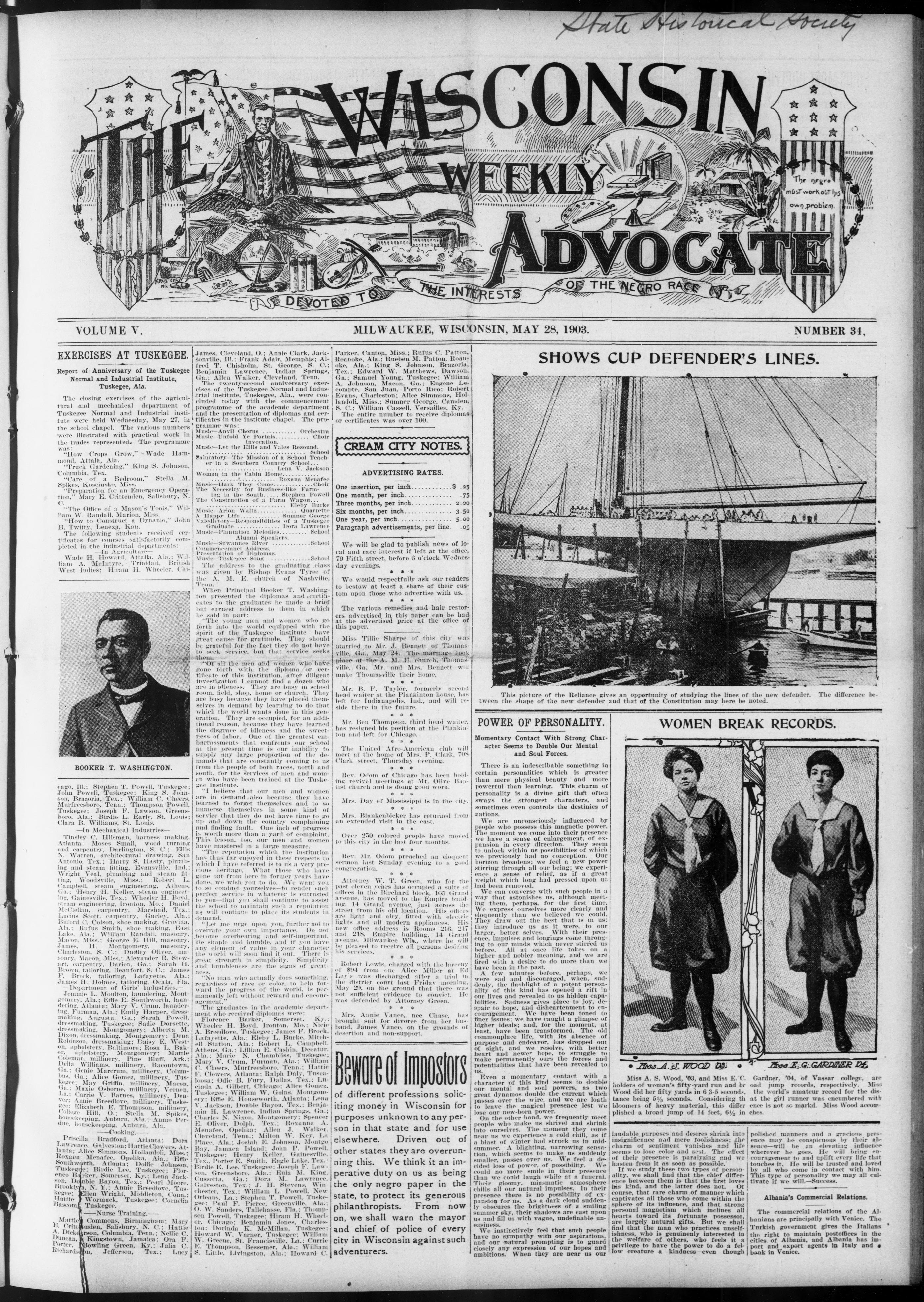
SHOWS CUP DEFENDER'S LINES.
THE BAY OF SAN FRANCISCO
This picture of the Reliance gives an opportunity of studying the lines of the new defender. The difference between the shape of the new defender and that of the Constitution may here be noted.
POWER OF PERSONALITY.
Momentary Contact With Strong Character Seems to Double Our Mental and Soul Forces.
There is an indescribable something in certain personalities which is greater than mere physical beauty and more powerful than learning. This charm of personality is a divine gift that often sways the strongest characters, and sometimes even controls the destinies of nations.
We are unconsciously influenced by people who possess this magnetic power. The moment we come into their presence we have a sense of enlargement, of expansion in every direction. They seem to unlock within us possibilities of which we previously had no conception. Our horizon broadens; we feel a new power stirring through all our being; we experience a sense of relief, as if a great weight which long had pressed upon us had been removed.
We can converse with such people in a way that astonishes us, although meeting them, perhaps, for the first time. We express ourselves more clearly and eloquently than we believed we could. They draw out the best that is in us: they introduce us as it were, to our larger, better selves. With their presence, impulses and longings come thronging to our minds which never stirred us before. All at once life takes on a higher and nobler meaning, and we are fired with a desire to do more than we have been in the past.
A few minutes before, perhaps, we were sad and discouraged, when, suddenly, the flashlight of a potent personality of this kind has opened a rift in our lives and revealed to us hidden capabilities. Sadness gives place to joy, despair to hope, and disheartenment to encouragement. We have been toned to finer issues; we have caught a glimpse of higher ideals; and, for the moment, at least, have been transformed. The old commonplace life, with its absence of purpose and endeavor, has dropped out of sight, and we resolve, with better heart and newer hope, to struggle to make permanently ours the forces and potentialities that have been revealed to us.
Even a momentary contact with a character of this kind seems to double our mental and soul powers, as two great dynamos double the current which passes over the wire, and we are loath to leave the magical presence lest we lose our new-born power.
On the other hand, we frequently meet people who make us shrivel and shrink into ourselves. The moment they come near us we experience a cold chill, as if a blast of winter had struck us in midsummer. A blighting, narrowing sensation, which seems to make us suddenly smaller, passes over us. We feel a decided loss of power, of possibility. We could no more smile in their presence than we could laugh while at a funeral. Their gloomy, miasmatic atmosphere chills all our natural impulses. In their presence there is no possibility of expansion for us. As a dark cloud suddenly obscures the brightness of a smiling summer sky, their shadows are cast upon us and fill us with vague, undefinable uneasiness.
We instinctively feel that such people have no sympathy with our aspirations, and our natural prompting is to guard closely any expression of our hopes and ambitions. When they are near us our
Kate A. of WODP
Kate F. C. CARRITR
Miss A. S. Wood, '03, and Miss E. C. holders of woman's fifty-yard run and br Wood did her fifty yards in 6 3-5 seconds. tance being $5 \frac{1}{2}$ seconds. Considering th bloomers of heavy material, this differ plished a broad jump of 14 feet, $6 \frac{1}{2}$ in
laudable purposes and desires shrink into insignificance and mere foolishness; the charm of sentiment vanishes and life seems to lose color and zest. The effect of their presence is paralyzing and we hasten from it as soon as possible.
If we study these two types of personality, we shall find that the chief difference between them is that the first loves his kind, and the latter does not. Of course, that rare charm of manner which captivates all those who come within the sphere of its influence, and that strong personal magnetism which inclines all hearts toward its fortunate possessor, are largely natural gifts. But we shall find that the man who practices unselfishness, who is genuinely interested in the welfare of others, who feels it a privilege to have the power to do a fellow creature a kindness—even though
NUMBER 34.
S LINES.
of the new defender. The difference be- noted.
AK RECORDS.
Mrs E. G. GARDINER D4
Gardner, '04, of Vassar college, are oad jump records, respectively. Miss the world's amateur record for the disat the girl runner was encumbered with ence is not so markd. Miss Wood accouches.
polished manners and a gracious presence may be conspicuous by their absence—will be an elevating influence wherever he goes. He will bring encouragement to and uplift every life that touches it. He will be trusted and loved by all who come in contact with him. This type of personality we may all cultivate if we will.—Success.
Albania's Commercial Relations.
The commercial relations of the Albanians are principally with Venice. The Turkish government gives the Italians the right to maintain postoffices in the cities of Albania, and Albania has import and export agents in Italy and bank in Venice.
ST. LOUIS MORE HOPEFUL
Weather Bureau Says That Water Is Receding-Three More Drowned
St. Louis, Mo., June 3.—The Mississippi continues to rise, a stage of 31.2 feet being shown at 7 a. m. This is a rise of 1.3 feet during the past twenty-four hours. It is expected that 32 feet will be reached some time today. In the meantime people all along the river front, both here and in East St. Louis, are preparing for the big flood. Rivermen and government officials predict that the water will be over the levee railroad tracks by noon today and officials of the different roads affected are busy making arrangements to place their rolling stock where it will be safe.
Move to Bluffs.
At the extreme northern end of St. Louis county the residents are moving their stock across to Bellefontaine bluffs and are preparing to follow it with their household furniture if the river continues to rise. Hundreds of acres in St. Louis and St. Charles counties near the Missouri's mouth and thousands of additional acres are so situated that a few feet additional in rise would cover them. Vast crowds of spectators throng Eads bridge and line the levee. The water is slowly creeping higher, but unless there is a rise of 4 feet it will not enter the buildings fronting on the levee.
East St. Louis in Danger.
East St. Louis being situated much lower is in far greater danger of heavy damage by a rise. Already large lakes have been formed in the low spots. To the north of East St. Louis viewing from Eads bridge the water can be seen extending back over the low lands between that place and Granite City and forming a veritable lake. The same condition prevails south of East St. Louis.
Back water has crowded the River: Des Peres out of its banks into the neighboring fields, but aside from overflowing the land, little damage can result in this vicinity. The Iron Mountain tracks follow the Mississippi for some distance below St. Louis, but it would take a rise of 9 feet more to seriously impede traffic.
Situation More Hopeful.
Weather Observer Bowie says of the situation:
"The river at Kansas City is reported ten miles wide. Whatever the cause of delay in the arrival of the waters from that flood stage, the outlook here becomes more encouraging. The Mississippi below Cairo is comparatively low, which means that the water at present in the St. Louis district will move out rapidly, thereby possibly permitting the Kansas City stage of water to reach here Friday or Saturday at a time when most of the flood from the Des Moines river and upper Mississippi will have passed here."
THE WORK OF RELIEF.
The Situation at Kansas City Is Wonderfully Improved.
Kansas City, Mo., June 3.—Flood conditions were materially bettered during the night and on all sides this morning the intense strain of the past four days had for the first time been relieved. Communication by steamer with Kansas City, Kan., having been opened permanently and the exact conditions there having become known, no further feeling of anxiety was felt for the sufferers in that locality. Now that the lay of the land is known and the relief committee of both Kansas cities are able to work together they have mapped and put into execution elaborate plans for relieving all distress, restoring order and returning business to its natural channels. These plans are being carried out today by an army of local men, reinforced by relief in the shape of food and boats sent in from St. Joseph and Leavenworth.
At 7 o'clock this morning the Missouri river registered 34.4 feet, a fall of nearly 12 inches in as many hours, and the weather bureau predicts that from now on the water at this point will fall gradually but steadily. The Kansas river continues to fall at the rate of one-half an inch an hour and the tops of submerged buildings are beginning to show above the water line. The sun shone today and this fact was a tremendous force for good.
Train Not in Danger.
Chicago, Burlington & Quincy train No. 3, from Chicago to Kansas City, due here at 4 o'clock Sunday afternoon, is known to be safe somewhere east or north of here. The train arrived at Liberty, Mo., twenty-five miles northeast from Kansas City, last Sunday afternoon. The tracks into Kansas City being unsafe and train service in all directions being badly demoralized, the train was split into two parts and sent east and north to accommodate the new conditions. Some of the passengers continued on to Kansas City by other means of transportation, while most of them remained on one of the two sections of the train and either returned toward their starting point or dropped off at different towns along the line east and north of Liberty, making connections with other roads. While the exact location of the train is not known, there is every reason to believe that all the passengers are safe.
Sixty-seven passengers from a St. Joseph & Grand Island train which arrived at the Milwaukee bridge, five miles east of Kansas City. Sunday night, were rescued by a steamer from the Randolph end of the bridge last night. Some of these were at first believed to be passengers from the stalled Burlington train, but this proved not to be the case. Among the stranded passengers were a number of prominent residents of this city. One of them, Judge W. P. Hall said:
"When we reached the Milwaukee bridge Sunday night the engineer and conductor feared to cross on account of the reported damage to the piers and held the train there all night. Monday morning the train returned to St. Joseph, leaving about twenty-five of us at Randolph. We hoped to cross the river in boats. Sunday night we slept in the train and Monday night at some farmhouses lying near by. We had plenty to eat and suffered nothing but inconvenience. We could see the city in the distance, but could not get a word of news about the flood."
Missouri Pacific Bridge Safe.
The report last night that the Missouri Pacific bridge had gone out proved this morning to be incorrect. The bridge which spans the Kaw is weighted down by seventeen engines and as well as can be judged today in an inspection made with the aid of a field glass from the bluff half a mile away, the bridge is still safe. The water about the structure is lower and the current less strong than yesterday. The weather forecast issued at 10 o'clock this morning says: "Both the Missouri and Kaw rivers
will continue falling today and Thursday. The flood level will be from one to two feet lower by Thursday morning." The waterworks plant will probably be reopened tonight.
CLOUDBURST CAUSES FLOOD.
Two Are Drowned in Lawyers Canyon, Idaho.
Nez Perce, Ida., June 3.—A terrific cloudburst, accompanied by a heavy storm of wind and hail occurred at the head of Lawyers' canyon, thirty-one miles southwest of here, yesterday. Hail fell to the depth of 20 inches along the canyon and destroyed grain on a strip two miles wide and six miles long. The only deaths reported are those of Joe Demissey and his sister Isabella, who were drowned in the flood of water which swept down the canyon in a solid wall 12 to 15 feet high, carrying everything before it.
TWO MAROONED FAMILIES SUFFER.
People Near Des Mcines Without Water or Food for Five Days.
Des Moines, Ia., June 3.—The work of caring for the five thousand destitute flood sufferers is still taxing the local committee to the utmost, but the committee has reaffirmed that there is no need of outside assistance. Ten thousand dollars has been subscribed here, in addition to a large quantity of clothing and food.
At Atlantic two marooned families were discovered in the Nisnabotna bottoms last night cooped up in their own homes by the flood. For five days they had been compelled to sit on tables with no drinking water and practically nothing to eat.
The river continues to fall rapidly between here and Keokuk.
COMMISSIONER WARE SAFE.
He Has Not Been in Danger—More Drowned at Topeka.
Topeka, Kan., June 3.—Eugene F. Ware, commissioner of pensions, is here safe. He has been in no danger at any time. He will not try to return to Washington for several days because of the demoralized condition of the railways. A dispatch last night from Washington indicated that uneasiness was felt over Mr. Ware's condition. The family of T. J. Coughlin, president of the Coughlin Hardware company, reported from the east last night as being lost, are safe at Perry, fifteen miles from here, where they went before the flood came up. Mr. Coughlin is at New Haven, Conn.
Three More Deaths.
Three deaths from drowning are reported since last night. There are still about 100 persons in houses in the flooded district, but all are safe.
The river fell during the night at the rate of an inch an hour, and today is still going down rapidly. The refugees are being taken care of in a systematic manner, and there is no acute suffering. Today there is plenty of fresh water, much provision is being sent in, and more in the flooded district is becoming available.
CONDITIONS OF POSTAL SERVICE.
Report of Flood Situation Received by the Postoffice Department.
Washington, D. C., June 3.—General Superintendent White of the railway mail service today received a telegraphic report from Supt. Taft, who is in charge at Kansas City, Mo., regarding the flood situation. The report is dated last night and says that there are prospects of more rain. The water has fallen about twelve inches. The Milwaukee bridge, it says, is not available for further use. In consequence the Wabash and Burlington trains east-bound are dispatched over the Missouri Pacific tracks to Sedalia, thence north to Moberly, via the Katy road. The Santa Fe (west) is getting trains in and out here over the Missouri Pacific tracks via Ottawa, Kan. 'Frisco trains are being operated on regular schedule from Rosedale, Kan., (near Kansas City). The daily papers here are handling their own mails. The transfer force at the old Union depot was transferred to the Twenty-second and Grand avenue station and while there is great congestion on account of insufficient room and facilities for handling mails, the service is doing as well as could be expected. The water has fallen about twelve inches at the union depot, but not sufficiently as yet to be of any benefit. The service is still very uncertain in the western portions of the railway postal routes running out from Kansas City to Quincy, Council Bluffs, Omaha, Caldwell and Colorado Springs over the Union Pacific and on practically all lines and branches in the eastern half of Kansas and western Missouri.
PHILADELPHIA SENDS MONEY.
Permanent Relief Committee Contributes $5000 to Sufferers.
Philadelphia, Pa., June 3.—A meeting of the permanent relief committee of Philadelphia was held in Mayor Weaver's office today and at its conclusion a telegram was sent to Mayor Bergunthal of Topeka, Kan., authorizing him to draw on Drexel & Co. of this city to the amount of $5000. If more money is needed for the flood sufferers it will be sent by the committee on request.
ASKS RECOGNITION.
Venezuelan Revolutionists Petition the United States to Recognize Them as Belligerents.
New York, June 3.—The Venezuelan revolutionists who have for over a year and a half been fighting the government of President Castro are to petition the United States for recognition as belligerents.
The request of the rebels is based on the fact that they are in absolute possession of all the ports of importance in the country except La Guayra, Maracaibo and Puerto Cabello, and hold also the entire eastern portion of Venezuela over which they exercise the power of government.
If the state department at Washington does not decide favorably on the application the revolutionary government, it it announced, will make the same request of Great Britain.
The reason that the United States is applied to first is that the rebels would like to maintain the good relations with this country which now exist between Washington and the Castro government, and also because the United States is most interested from a commercial point of view.
State Pawnbroking Establishment at Naples Burned and Strong Room Is Destroyed.
Rome, June 3.—The Monte di Pieta (state pawnbroking establishment) at Naples was destroyed by fire during the night. The strong room, filled with valuables, was gutted. The damage, according to some reports, amounts to $2,400,000.
EXCURSION BOAT SINKS.
Steamer Caught by Swift Current and Dashed Against Bridge.
THREE CHILDREN DROWN.
Two Hundred and Fifty Sunday School Pupils Thrown Into a Panic at Hannibal, Mo.
Hannibal, Mo., June 3.—Three children were drowned here about 11 o'clock today by the collision of the steamer Flying Eagle, towing a barge filled with Sunday school excursionists, and a pier of the Hannibal bridge. The dead: CURTS, LONNIE. aged 15.
About 250 children from the Park Methodist church Sunday school of Hannibal had boarded the barge and a number were on the steamer. The excursion left Hannibal shortly before 1 o'clock to run to Quincy and afford a view of the swollen Mississippi. As the boat swung out into the river the swift current seized the craft, and, despite all efforts, it bore it straight down toward the stone pier of the bridge nearest the shore. With a crash the steamer was hurled against the pier and wrecked, but did not sink immediately. For a time it was wedged against the pier by the current and held while the terror-stricken children and the accompanying adults climbed up the pier to the bridge. In this way almost half of the passengers were saved. Before all could reach safety the barge was veered around by the current and finally swung loose from the pier and floated down stream. In the sudden swinging out of the barge, the three children were thrown into the water and swept away to their death.
Carried by the surging waters at a rapid rate the barge, filled with screaming children, floated into the channel and for a time it seemed that all were doomed to perish. But from further down the stream the catastrophe had been witnessed and at hand were a number of skiffs and rowboats of different kinds. With one thought these boats were manned and like a miniature fleet they shot out into the swollen stream to meet the barge. Encouragement was called to the children and they were urged to sit down and be quiet. This had good effect. The rescuing boats surrounded the barge and the children were quickly taken from it and were safely landed.
JEWS ARMED AND WILL DEFEND THEMSELVES
Thousands of Revolvers Imported Into Russia Since Kishineff Massacre Hebrews Organizing.
Berlin, June 3.—Advices received here from Odessa under date of May 28 say the Jews there are now preparing to defend themselves intelligently. Several thousand revolvers have been imported since the Kishineff massacre, so that at present almost every Jew, man or woman, is armed. Those who were unable to buy weapons received them as gifts from the defense committee. A system of communication has also been agreed upon, so as to spread a warning throughout the city when there is an outbreak of violence in any quarter. Families residing near each other will concentrate for defense and every second man will join what might be called an expeditionary corps to take part in aggressive defense where rioting is actually going on.
The Jewish safety committee is also reported to have arranged with the workingmen's associations for aid in the event of outbreaks. Arms have been distributed from Odessa to the Jews in other cities of Russia.
The Tageblatt today prints a dispatch from St. Petersburg announcing that a law was published there this day giving a list of 101 towns in Russia in which Jews are allowed to acquire land and live without restriction. Jews are temporarily forbidden to buy land outside these places, where they will be legally settled.
NEGROES DIE IN WRECK.
Excursion Train Goes Into Washout and Many of the Passengers Are Killed.
Augusta, Ga., June 3.—An excursion train loaded with Negroes bound from Fair Bluff to Columbia, went through a washout near Wedgefield, fifteen miles from Sumter, S. C., this morning, and is reported to be a complete wreck. It is said a number of people were killed, but the list is not yet obtainable. Engineer George Wilson was fatally injured and his Negro fireman was killed. Conductor Clemens was also killed.
Columbus, O., June 3.—Word has been received at the general headquarters of the Pennsylvania lines that the Toledo, Walhonding Valley & Ohio will be tied up for probably two days on account of an accident near Coshocton, O., by which 150 feet of the trestle work over the Tuscarawas river is down and one of the heavy engines of the road in the river. As far as could be learned no one was injured.
BOOTH'S BODY LIES IN BALTIMORE CEMETERY.
Remains of Lincoln's Murderer Identified After Being Brought from Washington—Denial from Clara Morris.
Baltimore, Md., June 3.—In connection with the report from Enid, Okla., that John Wilkes Booth, assassin of President Lincoln, died there January 14, under the name of David E. George, it is declared by persons familiar with the case that there is no doubt whatever that Booth's body is buried here in Greenwood cemetery. The remains were brought to this city after the exhumation in Washington. When the coffin was opened here the dead actor was recognized by persons who had known him intimately in his lifetime. Among them were members of his family. The identification was absolute. The body now lies buried in the Booth lot, but without any headstone or mark over the grave
New York, June 3.—Clara Morris denies the report that she recently identified the body of "George" as Lincoln's assassin.
FELLOW AT JOHNS HOPKINS
Janesville Man, Graduate of Olivet College, Given Post in Zoology.
Baltimore, Md., June 3.—[Special.]—David Hill Tennent of Janesville, S. B., Olivet college 1900, was awarded fellowship in zoology at Johns Hopkins university.
T. B. REED WAS RICH.
Impression That Speaker Had Died in Moderate Circumstances Is Dispelled by Probating His Will.
New York, June 3.—Former Speaker Thomas B. Reed left $431,099 in personal property in this state, according to a report filed by the appraisers appointed by the surrogate's court to value the estate. This information is a good deal of a surprise, even to Mr. Reed's intimate friends, for at the time of his sudden death in Washington December 7 last there was an impression that Mr. Reed was in moderate circumstances.
Mr. Reed made considerable money from the practice of corporation law in this city after relinquishing his residence in Washington. It also appears that Mr. Reed, after coming to this city, dabbled extensively in the stock market, for at the time of his death there was a balance due Moore & Schley from him of $162.170, which has since been paid. It develops that prior to his death Mr. Reed had severed his connection with the law firm of Reed, Simpson, Thacher & Barmum.
At the time Mr. Reed took up the practice of law in this city he said his principal reason for abandoning politics was that it was about time for him to earn something for himself and his family. How well he succeeded is shown by the fact that his gross personal estate foots up $629,533, according to the official appraisement, which has just been completed. From this sum has to be deducted a total indebtedness of $198,434. Mr. Reed left a widow and a daughter, Katherine Reed. The entire estate goes to the widow, who will have to pay a tax of $4300 to the state.
The principal items comprising the estate are: 900 shares of Northern Securities, valued at $95,580; 2000 shares of American Car and Foundry company, preferred, $77,800; 1000 shares of American Smelting and Refining company, $38,000; 600 shares of Metropolitan Securities company, $18,187; 1200 shares of Metropolitan Street railway, $167,250; 400 shares of Brooklyn Union Gas company, $90,000, and 100 shares Great Northern Paper company, $100,000.
SCORES DROWNED
Awful Loss of Life Caused by Storm Off Valparaiso, (nuli
London, June 3.—A dispatch to Lloyds from Valparaiso, Chili, confirms the dispatch of The Associated Press from Santiago de Chili referring to the fears expressed there for the safety of the Pacific Steam Navigation company's steamer Arequiba, which during a lull in yesterday's storm at Valparaiso left that port in an endeavor to ride out the gale at sea. The agent cables that the steamer, which had eighty persons on board, was probably lost. The bodies of some of the Arequiba's crew, he adds, have been washed ashore.
Later advices from Valparaiso says the Arequiba foundered at her moorings and the captain, his wife and the majority of the crew were lost.
Valparaiso, Chili, June 3.—In the gale which has just swept the bay here, the British ship Foyledale, from Portland, Ore., with a cargo of timber, struck the breakwater. The captain's wife, his son and six men were drowned.
Near the Foyledale was wrecked the Chilian bark Chivilingo, and two of her crew were lost. Scores of craft went ashore or were sunk.
Santiago de Chili, June 3.—According to advices received here from Valparaiso Capt. Todd, his wife, fifty of the crew and many of the passengers of the Arequipa were drowned when the steamer foundered.
Valparaiso, Chili, June 3.—Seventeen persons were saved out of the eighty on board the Pacific Steam Navigation company's steamer Arequiba when she foundered during the gale which swept over this coast yesterday.
CZAR NOT TO BLAME FOR THE MASSACRE.
Ambassador McCormick Says Russian Governors Have Been Punished Open Door in Manchuria.
New York, June 3.—Joseph H. Choate, United States ambassador to London, arrived on the steamer Kronprinz Wilhelm from Southampton yesterday. He said he had come here to attend the wedding of his son and that he would return immediately to his post. In his party were Robert S. McCormick, ambassador to Russia, and Mrs. McCormick, Mrs. Charlemagne Tower, wife of the United States ambassador to Germany, and her two daughters. Mr. McCormick came to attend the wedding of his son, Joseph Medill McCormick, to Miss Ruth Hanna, daughter of Senator Hanna.
"I have been in Russia only three months," said Mr. McCormick, "and as a consequence I am not in a position to speak with authority on conditions there. The massacre at Kishineff occurred about the time I was leaving the country and I was not called upon by my government to take any official steps. So far as I knew the imperial government was not responsible for the killing of the Jews and it has, I understand, removed the governor of that section."
"The Czar has the most friendly feeling toward this country and he has made expression of his friendliness," said Mr. McCormick, when asked what effect a formal protest from this country over the killing of the Jews would have. Regarding Russia's intentions in Manchuria he said: "Russia will undoubtedly maintain the open door or she would not have put in the Manchurian railway, which is costing $2,500,000 a month."
GIVE IN TO THE STRIKERS.
Several Ingrain Carpet Manufacturers of Philadelphia Grant Demands for More Pay and Shorter Hours.
Philadelphia, Pa., June 3.—Today witnessed the break in the ranks of the ingrain carpet manufacturers. Several of the larger firms announced their intention of granting the demands of the weavers for a 55-hour week and an increase of 10 per cent. in wages. The plant of Lightenburger & Co. resumed operations on this basis today. James Pollock & Son and Robert Carson notified their men that they considered their demands just and were ready to make concessions of other manufacturers could be induced to submit. The hair cloth weavers left their looms today, closing the four mills located here.
NEW DEAN OF YALE LAW SCHOOL
Prof. Rogers, Formerly President of Northwestern University, Appointed.
New Haven, Conn., June 3.—Formal announcement has been made of the election by the trustees of Prof. Henry Wade Rogers as the new dean of the Yale law school. He succeeds Prof. Francis Wayland. Prof. Rogers was formerly president of Northwestern university, and before that was dean of the law school of the University of Michigan.
SOLDIERS PREVENT JEWISH MASSACRE.
DISPERSE A MOB WHICH WAS MARCHING ON THE HEBREWS AT KISHINEFF.
Anti-Semite Emissaries from Roumania Are Trying to Provoke Another Outbreak Against Jews.
London, June 2.—A dispatch to The Daily Graphic from Kishineff, dated May 28, says that about 700 riotously inclined persons assembled on Wednesday last, a mile and a half outside of the town, and after threatening harangues the leaders prepared to march on the Jewish quarters. Just at this time a strong body of cavalry arrived and dispersed the crowd.
The town is now being patrolled again by the troops. The acting governor has caused a strong warning to the rioters to be posted in the streets.
It is believed that anti-Semite emissaries from Roumania are trying to provoke another massacre. Little has yet been done to repair the havoc caused by the riot. The Jewish quarters still are partially deserted.
NIGHT OF HORROR.
Terrible Suffering Follows the Tornado Which Swept Over Georgia
Gainesville, Ga., June 2.—Today at noon a conservative estimate of the killed in yesterday's tornado is 100 and injured 200, many of them fatally. Property loss estimated at $600,000.
Gainesville, Ga., June 2.—The tornado which visited the towns of Gainesville, New Holland and White Sulphur, Ga., yesterday afternoon resulted in the killing of about eighty-five men, women and children, according to reports which are as yet incomplete. It is estimated that forty persons were fatally injured and many more hurt. Probably 1000 persons are homeless.
Two hundred houses besides the Gainesville cotton mills were destroyed by the storm, aggregating a property loss of $300,000.
Rain Adds to Misery.
Last night brought increased misery to the cyclone sufferers, for a steady rain set in late in the afternoon attended by cold weather which penetrated to the marrow. The weather and darkness greatly impeded the work of rescue and assistance. The town was in total darkness all night and the streets were filled with debris. All night long physicians pushed their way through the wreckage guided to the suffering victims by groans of agony. Here and there a fallen tree would block the way or a wrecked house would stop progress. Doctors and volunteers waded through mud and water knee deep, frequently compelled to crawl on all fours. All houses had been moved for blocks, others were missing altogether and no system could be employed in the work of relief. Mayor Parker says there are at least 1000 homeless and the number may be doubled later.
More Than 200 Homes Destroyed
More than 200 homes were destroyed. Every door in Gainesville is open to the victims. At the city hall, armory and courthouse many persons passed the night, shivering in the cold. A mass meeting was held this morning at which $5000 was subscribed to a relief fund. A message has been sent to the secretary of war asking for tents to shelter the homeless and an appeal for aid is made to the public. The main need of the sufferers now is clothing and tents. Gov. Torrell has ordered fifty tents sent to Gainesville from Atlanta. The dead in Gainesville alone will reach 100, according to reports submitted at the mass meeting. A committee was appointed by the meeting to bury the victims.
One Hundred Funerals.
The entire city will suspend business for the next twenty-four hours and every person will go to work. The dead have been prepared for burial, and graves are being made. The city pastors have been requested to act as a committee to see that every person has a suitable funeral. There will be 100 funerals here within the next twenty-four hours if caskets can be secured. Thirty days' rations for 1000 persons were also requested from Secretary Root. A committee of three citizens was appointed to see that caskets were secured by all who had relatives or friends dead and to take into hand the funeral arrangements.
More Deaths Reported.
Dr. Smith, the city physician, reports about fifteen deaths since last night, when the casualty list was placed at 85. Of the 200 or so injured it is believed 25 more will die.
MEAT VALUES GO UP.
Western Floods Cause an Advance on the Dressed Product—Shipments Aero Light
Chicago, Ill., June 2. Meat prices began to advance yesterday as the result of the western flood. Prices paid for cattle, sheep and hogs on the hoof were from 5 to 25 cents higher, and retail men were informed that they would have to pay from $ \frac{1}{2} $ to 1 cent per pound more for dressed meats. The advance in the dressed products is said to be only a forerunner of what the future will contain. Inability on the part of the railroads to move stock and supply the market, the cutting out of the Kansas City houses for the time and the threatened destruction of many head of stock and fields of corn is declared to be the cause of the advance.
Why Jacob Went.
"While Jacob still tarried at the well," said the superintendent of the Sunday school quoted by the Philadelphia Ledger, "Rachel, as we are told, drew near. She was fair to look upon, and Jacob kissed her. Then he lifted up his voice and wept. A great many whimsical explanations, children, have been advanced for this singular conduct on Jacob's part. What possible reason could he have had for weeping after kissing his beautiful cousin?" "He remembered about the microbes," ventured Tommy Tucker.
Gypsum Plaster.
The 10,000 dairy farmers of New York state with $25,000,000 capital will undertake to buy out all the dealers, wholesale and retail, in New York city. They will undertake to restrain trade, but their operations, being limited to one state, will not come under control of the interstate commerce commission.
—The name of the great new White Star steamer is pronounced "Sed-rick."
SPORTING NEWS.
Young Corbett has joined a burlesque troupe. The champion has been confined to his room ever since Thursday, when he met with an accident coming from the race track at New York. His left knee was injured. According to a dispatch from Denver Corbett is soon to become a benedict. His fiancee is said to be Miss Gladys Francks of Denver.
* * *
Jack Herman, manager of the Fort Erie Athletic club, is in Chicago trying to secure the Root-Gardner match for his club. The chances are that he will land it, as both Lou Houseman and Andy Craig, managers of the two boxers, are ready to give the Buffalo man the preference for the match. They do not like going to Mexico to hold the contest.
Eddie Connolly, the welter weight fighter; his manager, Jack Rutter, and Prof. Jimmy Kelly are back from Europe. Connolly has come in quest of fame and coin, but he is especially anxious to have a set-to with Martin Duffy of Chicago.
***
Sig Hart has a two years' contract to manage Buddy Ryan, as hard a 130-pound fighting proposition as Chicago has ever turned out.
President Garry Hermann of the Cincinnati National league baseball club held a long conference last Monday with Manager Joe Kelley. Both are dissatisfied with the make-up of the Reds and some radical changes are likely to be made in the near future.
Africander, the handsome son of Star Ruby—Afric Queen, which won the Belmont stakes at Morris park, further demonstrated his powers as a 3-year-old last Monday by giving away weight to older horses and winning the $1500 handicap at a mile and a quarter in 2:05 4-5.
Flying Torpedo, the racehorse which has been the subject of so much comment not only in the west but also even in the New York papers, because of his in and out running, was barred by the Hawthorne judges from further racing at that track after he had won the handicap Monday. Jockey Birkenruth, his regular rider, was suspended at the same time, "pending further investigation."
Lester Reiff will ride one of John A. Drake's horses in the American Derby at Chicago. He was granted a jockey's license by the Western Jockey club. Whether he will ride Savable or High Chancellor has not been decided.
***
A six days' bicycle race was started last Monday at the Coliseum, Providence, R. L., with eight teams competing. The men rode for two hours, completing forty-five miles in that time. At the conclusion of the racing the team of Frank L. Kramer and Charles Hadfield was ahead with Fenn and George Schreiber second, John and Menus Bedell third and Floyd A. McFarland and Lawson fourth. Hugh McLean defeated Bobby Waithour in a twenty mile motor paced contest, covering the distance in 27:29 4-5, four miles and one lap ahead of Waithour.
* * *
Alfred Shrubb, the Englishman who recently broke the two-mile record, set another mark at London Saturday when he ran the two miles in 9:11 on a grass track. This is away better than anything on this side of the pond. Schutt of Cornell ran the distance in 9:40 and Kellogg of Michigan in 10:02 2-5.
* * *
The Argonauts of Toronto have decided not to send a crew to Henley. An eight worthy of the event could not be gathered together this year.
```markdown
```
President Sexton has offered to transfer the Joliet baseball franchise to Springfield, Ill., if satisfactory arrangements can be made. The Illinois capital will be more centrally located in the Three Eye league circuit.
* * *
STANDING OF THE CLUBS
—American Asso.— W. L. Pc.
Milw'kee. 23 8.742 C. Springs 24 5.828
St. Paul. 20 14.588 Denver... 15 12.556
Indi'pl'is. 20 15.571 Milw'kee. 13 11.542
Kan. City 14 16.407 K. City... 13 12.520
Min'apolls 16 20.444 St. Joseph 10 14.417
Columbus 14 19.424 Peoria... 9 15.375
Louisville. 14 20.412 Omaha... 8 14.364
Toledo... 13 22.371 D. Moines 8 15.348
—American League.— W. L. Pc.
Boston... 20 15.571 Checiago... 28 11.718
St. Louis. 18 14.563 New York 26 11.703
Chicago... 19 15.559 Pittsburg. 25 17.593
Phil'lphia 20 16.556 Brooklyn. 20 18.541
Cleveland 17 15.531 Boston... 16 19.457
Detroit... 17 18.486 Cincn'atl 17 21.447
New York 15 19.441 Phil'lphia 11 26.297
W'hingt'n 10 24.294 St. Louis... 10 30.250
Bob Fitzsimmons and his former manager and brother-in-law, Martin Julian, have buried the hatchet and it is said that the latter will in the future look after the Cornishman's welfare. It is understood that Julian is now negotiating for a match between Fitzsimmons and one of the light heavy weights, to take place in San Francisco the same time that Jeffries and Corbett come together.
* * *
Manager Tim Keefe has resigned from the Superior team and in fact severed all connection with the team either as player or manager of the team. The backers of the club have put Left Fielder Lager of Duluth as manager of the team. Keefe complains that he has been held within the salary limit, while the officers of the league have allowed the other teams to pay much bigger salaries, sometimes exceeding the limit by $500 and $600.
* * *
Harry Gleason of the Columbus club is fielding at a 962 clip, which is excellent for a third baseman.
Only one of the regular men outside of the pitchers on the Columbus club is batting over 300. That is Roach. Mellor, Turner and Gleason are all batting near the 300 mark.
* * *
Bill Carrick, Toledo's best pitcher, was released Monday because the Central Labor union put the Toledo team on the unfair list. Carrick at one time got mixed up with a labor union in Chicago. The St. Paul club may sign him. Last season Carrick pitched for the Washington club.
WESTERN CANADA Grain Growing. Mixed Farming.
FARMS IN
WESTERN
CANADA
FREE
THE REASON WHY more wheat is grown in Western Canada in a few short months, is because vegetation grows in proportion to the sunlight. Therefore 62 pounds per bushel is as fair a standard as 60 pounds in the East.
Free Homestands of 160 Acre Plentiful, the only charge being $10 for entry. Abundance of water and fuel, cheap building material, good grass for pasture and hay, a fertile soil, a sufficient rainfall and a climate giving an assured adequate season of growth. Send to the following fax lines and other literature, and also for certificate giving you reduced freight and passenger rates, etc. etc. The Superintendent of Immigration, Ottawa, Canada, or to T. O. Currie, Callahan Building, Milwaukee, and J. M. MacLachlan, Wausau, Wis., the authorized Canadian
THE DEAF AND BLIND.
A boor who never saw but with his eyes,
Whose dull ears told him all he ever
heard,
Proved without doubt that “Soul” was
but a word
Without a meaning; and that “Para-
dise”—
“God”—“Heayen”—these were nothing
more than lies;
That “Immortality” was quite absurd,
“Created” a misprint—please read “‘oc-
curred.”
He proved all this, for he was very wise.
And not one flaw showed in his argu-
ments;
His word has stood the test of many
years,
And it will stand the tests of centuries;
Yet each true heart knows with a faith
intense
‘Tis true for those who hear but with
their ears—
| Only for those who see but with their
' eyes!
—Indianapolis Sentinel.
Love’s Strategy
jochesfosfoafoooofoateofosfoefesfoohesfootooeedeceokesfooteet
HIL tore down the steps of the
Pp Belvidere and headed for me.
“Ed,” he exclaimed, “I'm in an
awful hole!
“I don’t want to borrow money—It’s
worse. I invited-Mrs. Brittain and her
daughter to lunch this noon—you know
the Brittains?”
1 nodded.
“Now on my way to keep this ap-
pointment I met my aunt and cousin
‘Nathalie.
“Unforunately, I permitted the old
lady to understand my intention of
lunching ‘alone’ at the Belvidere, and
as a relative she forthwith invited her-
self.”
“Well?” I interrogated.
“It’s like this. Aunt Hall disapproves
of the Brittains, while my inclinations
tend toward Miss Agnes. Nevetheless,
I am dependent on my aunt’s bounty
for all extras and would be in a fix
should she decide to raise hades, so
‘you can see how I’m up against it.”
“How do you expect me——"
“That's all right, Ed. I've got the
Brittains In the Egyptian room and
auntie in the regular dining room.
Auntie is down on unnecessary €X-
penditure. I intend being present at
both tables.”
I followed, humbly glad of an oppor-
tunity to feast my eyes on the forbid-
den fruit of my desire.
Mrs. Hall stared stonily, but Nathalie
was condescendingly affable, and I em-
braced the chance offered by devoting
‘my entire conversation to her, leaving
to Phil the pleasant task of thawing
out his aunt.
“I say, Ed,” he exclaimed, after ex-
pending an amount of persuasive heat,
equal to three tons of best anthracite.
“There is considerable uneasiness on
the street to-day. Copper Range bal-
Jooning and Steel common depressed.
If the ladies could excuse me an in-
stant I should like to telephone a stop
order on Mohawk to Samuels.”
“Certainly, Philip,” replied Aunt
Hall, frigidly, and she turned her en-
deavors into an attempt to petrify me
by staring through my head at the
Grecian frets of the wainscoting.
I struggled on manfully until I turn-
ed with some relief to-an approaching
waiter.
“Mr. Fletcher, sir, wants to know,
sir, if you'll step down an’ see “im.
Says as ow ’e ‘as got an option ’e will
sell you, sir.”
I offered my apologies and, divining
Phil’s whereabouts, made for the Egyp-
tian room. My fellow conspirator met
me at the door.
“Now,” said Phil hurriedly. He pos-
sesses an insulting amount of energetic
hurry. “The Brittains are behind the
sixth palm, Tell ‘em I sent you—say
anything, only keep them busy.”
“Mr. Ackley? Why, delighted. Cer-
tainly! But while we are awaiting Mr.
Fletcher you might discharge one of
his promises, namely, that Agnes and
myself are shown Darien’s latest bit
of, portraiture on exhibition in the
green room.”
I piloted the couple through the maze
of passages with which the hotel
abounded, and finally emerged in the
green room.
An instant later Phil appeared be-
hind me.
“Ed, I beg pardon, Mrs. Brittain. So
shocking of me to treat you in this
way, but my duty to my firm and all
that, you know. Ed, Andrews wants
to see you about the purchase of some
Westinghouse rights.”
“A-er Andrews?” I ejaculated. |
“You idiot!” whispered Phil. “Go to.
Aunt Hall in the reception room.”
I turned on my heel and sought the
other couple, and Nathalie seemed gen-
uinely pleased at my reappearance. |
“Now, mother, Mr. Ackley can show
us the picture before Phil returns.”
“I'm sure that is Mrs. Brittain,” ex-
claimed Mrs. Hall, raising her lorgnon,
“and Philip,” she said, advancing be-
fore me.
“Do you know,” whispered Nathalie
to me, “mother heard of the Brittains’
invitation and foreed herself on Phil
accordingly. She thinks you are an ac-
complice.””
“Oh!” I murmured.
“Mother doesn’t like the Brittains!
Doesn't like you either, Mr. Ackley,”
she added, and I fondly hoped that I
detecfed regret in her voice. “And I
shouldn't talk to you.”
“Is {that so?” I said with interest,
blivifous of the trouble Phil was in.
“Yets, but——”
“Nalthalie, come!” announced Mrs.
Tall, sweeping by haughtily.
“G -morning, Mr. Ackley,” and she
lowetved -at me. T murthured my
dieuxf,
“Youlre a fool!” cried Philip, while
WHAT A PRETTY WORLD THIS IS.
BEAUTIES SURROUND COUNTRY DWELLER.
H, isn't the world pretty!’ exclaimed President Roosevelt, as he stood
on a hill in Yellowstone Park, with a plain filled with grazing elk and
other game spread out before him, with the morning songs of birds
in his ears and the early sun driving the great banks of dark clouds
into the west. What a boyish exclamation for the ruler of the greatest
nation’on earth! But it showed a trait of the man which is lovable, and
loved.
Did you ever sleep just below the rafters, in an old country house where
you could hear the rain playing on the shingles and the mice whispering in
the seed corn that hung in bunches on the wall? The sun woke you up, didn’t
it? It first crept across the old patchwork quilt at your knees. You saw it,
but the husk mattress was the most comfortable thing on earth and you'd
take Just one more snooze. The cows down in the lot wouldn't mind it
and maybe dad wasn’t up yet, anyway. But soon the sun got up the quilt
to your eyes, and mother was poking at the cook stove downstairs, and you
could lie abed no longer. Out you jumped and in ten seconds you had on shirt
and breeches—all dressed. Gosh! those were bully times—no collars, no
cuffs, no stockings, no shoes! Then you went to the tin wash basin on the
bench beside the kitchen door and doused yourself with cool water from the
rain butt. A bluejay was yelling murder in the old apple tree by the well.
The pigs were squealing peevishly. The red calf was bawling hungrily.
The spotted one was sucking the end of a fence rail and butting it occasion-
ally. ‘The turkey gobbler was making explosions by spreading his great tail
and his blue and red throat sent forth one continual roll of gobbles. A blue-
bird on ihe clothes line was whispering his pathetic little melody as If afraid
that the world would know be was happy and take his happiness away
from him.
Then you drove the cows from the pastures to the milking yard. You
walked in the long, winding path through the lot, because it was warm in the
sand there and there were thistles at the side that were not good for bare
feet. The bumble bees were already humming over the thistle blossoms and
quarreling with the yellow butterflies. The big bunches of purple thorough-
wort were allye with honey bees and wasps. How that red-headed wood-
pecker was hammering on the old chestnut stump! The cobwebs in the
grass were full of diamond dewdrops. The chipmunk that lived in the stone
heap near the pasture bars was on his highest reck washing his face with
his paws. And dad comes to do the milking, and he’s cross. He's had to
pass through the kitchen, where mother’s fixing up fried salt pork and milk
gravy and baked potatoes, and griddle cakes with new maple syrup and-—
Oh, Lord! Oh, Lord! who wouldn’t be cross, not to go at all those things
at once?
The world is pretty.
Did you ever Me on the grass under the big pig-hickory, across the road
from the house, and look up and up? Way up ever so far is a cloud, sailing
along in the blue, that looks like a great flake of snow. You can see its faint
shadow passing over the wheat like a wave. Where is It going? Is it possi-
ble that God is sending {t somewhere for a purpose? Does it mean rain
to famishing. people ‘way off in India? How many other farmer's boys
are watching it? Will it always keep together, or will it disappear as does
that halo of heat that is quivering over the woods, down beyond the pas-
ture? How cool it is under the hickory! What a blamed good idea was that
got up by the fellow who invented an hour’s rest at noon! Those sparrows
scouring themselves in the road kick up a lot of dust. The sun makes
the two new shingles on the house look like silver. There’s one of those
little woolly caterpillars hanging by his thread from that branch up there!
‘He’s coming down lower, and lower, and low-er-er-r. Then you are fast
asleep. 7
The world is pretty.
Did you ever grub for money ten hours every day, in a dirty office; ride
home in a crowded car; come down again in a crowded car for another ten
hours or more, next morning, and know all the time about the red clover
blossoms, the birds, the bees, the blue sky, the green woods, the singing
brooks and all the world which is indeed pretty? Oh! for five good angle-
worms, a fish pole and two hours in the world which is pretty—St. Louis
Chronicle.
the Brittains looked on with amused
comprehension.
I gazed after the disappearing Na-
thalie, and found her eyes directed to
my feet. Glancing down, I stooped and
picked up a card:
MISS NATHALIE HALL,
At home Thursdays.
The Thursdays was accentuated by a
shadowy penciled line.
“A fool!” repeated Phil, angrily.
“Certainly,” I agreed absently, and
my lips conveyed a silent answer to
Nathalle’s backward glance as she
turned the corner.
And, to make a long story short, we
are engaged.
QUAGMIRES SWALLOW ROAD@ED.
Cut-Off Across Salt Lake Proves Hard
to Build.
The attempt of the Union Pacific
railroad to build a roadbed across the
Great Salt lake has proved £ more
formidable undertaking than the en-
gineers expected. Roadbed after
roadbed has disappeared in the maw
of a quagmire, while human lives as
well as cars and locomotives have been
lost in these quicksands. There are
two of these quagmires and Southern
Pacific engineers belleve the eastern
quagmires is the result of the wash-
ing down for centuries of silt from
the Bear river. This has filled in a
deep canyon and they believe persist-
ence will result in finding the solid
bottom. While they do not offer to
explain the other quagmire, they be-
lieve the same result may be obtained
‘there.
| The greatest difficulty is expected in
the western quagmire, which is now
igiviug most trouble. Here the wind
sweeps the entire length of the lake
and the wayes are high. The water is
‘thirty feet deep. It is the intention
to build ten miles of trestle across this
portion, but so far the foundation has
not been secured.
The engineers have decided on an
experiment which they hope will solve
the problem. They have started on
the building of immense “cradles” of
timber, which will be filled with stone
and lowered into the lake. By anchor-
ing these carefully and binding them
closely together it {s hoped that they
will stand the strain.
All manner of expedients have been
necessary to carry on the work, says
the New York Herald. Trouble began
as soon as the lake was entered. Areas
were encountered where the salt and
sand made an apparently solid bot-
tom. Perhaps it was solid and the
pile driver would sink only a couple
of inches at a stroke. Again the pile
might go through the crust and sink
out of sight at the second stroke. In
other places the mud was so soft under
the crust that it would not bear the
weight of the construction train with-
out some device to aid in the support.
In such a case planks were laid eight
feet to the south of the permanent
roadbed, a temporary track laid and
light cars of rock were sent out to
be dumped over the side, forming the
permanent roadbed.
Whey the water was reached the
temporary track was extended by sand
bags. These were loaded on rafts and
piled out to the place desired. There
they were piled into piers, and timber
stringers were placed across, the track
being laid on these. It was in this
way that the first quagmire was
reached.
According to the best information
obtainable, the two quagmires haye
already cost the company about $1,000,-
000 more than estimated, while with
good luck from this time on the work
on’ the lake portion of the undertaking
cannot cost less than $4,000,000.
Strong Army for Mexico.
President Diaz does not believe in
limiting his military establishment.
Although the republic has long been at
peace, he is pursuing a policy of mili-
tary expansion which seems likely to
‘develop a highly efficient system of
national defense. It is the desire of
President Diaz that within two years
the Mexican government shall be able
on short notice to mobilize an army
of 200,000 thoroughly trained and per-
fectly equipped soldiers. To make this
result possible more than 300,000 boys
and young men are now receiving regu-
lar daily military instruction in 11,000
public schools of Mexico and the army
will be recruited from their number.
This program for the creation of a
greater Mexican army is supplemented
with plans for a larger nayal estab-
lishment, two vessels for which are
now under construction at the Cres-
cent shipyard, Elizabethtown, N. J.
In this development of her military re-
sources Mexico is following the natural
policy of enlightened nations. It is
believed in some quarters that the in-
tegrity of Mexican institutions will
be severely tested when President
Diaz retires from office and that a
strong government, including an effec-
tive military establishment, will be
needed to protect the republic against
serious internal disorder, It is pos-
sibly with a view to providing for such
an emergency that the present move-
ment for a large and trustworthy
army has been instituted.
Lessons from the Bee.
The bee teaches us to be industrious.
No bee ever shirks his work.
He teaches us to be loyal and oberi-
ent. Bees obey and love the queen
who rules them.
They teach us to be fond of our
homes. No bee leaves his home ex-
cept for a tinie if he can help it.
They teach us to be clean. Nothing
can be cleaner than the home of the
bee.
They show much sympathy or kind
fellow feeling for each other in dis-
tress, and will never leave a friend in
trouble without trying to help him.
They are very early, risers.
They delight in fresh air.
They are very peaceful, and seldom
quarrel or fight among themselves.
The Ring She Did Not Get.
Stella—Mabel lost a diamond ring.
Bella—Too bad! How did it hap-
pen?
“Jack didn’t propose.”—Smart Set.
A woman is never 30 until she is 40
or married.
BIG PLANTS ARE BURNED,
Flames Swept Over Racine Fac-
tories and Warehouses.
THE LOSS IS $375,000.
Milwaukee Asked to Send Help, but Pe-
quest Is Recalled—Boat Plant
in Ashes.
Racine, Wis., June 1,—[Special.]—At
noon Sunday fire broke out in the build
ings of the Racine Boat Manufacturing
company and in an hour property valued
at $375,000 had been destroyed. ‘The
flames swept over a district two blocks
square and city officials fearing that the
flames would be carried to the buildings
of the Case Plow works requested aid
from Milwaukee and Kenosha, but later
countermanded the requests as the local
tire department of twenty-one men had
the fire under control, but not until the
boat works, Case Threshing Machine
company’s warehouse, with 200 separat-
ors and engines; the ny ese Oil com-
pany’s warehouse, with 10,000 gallons cf
gasoline and 8000 galigns of naphtha;
Case plow works’ wareflouse, containing
a large number of cultivators and PRs
lumber yards and freight cars had been
destroyed.
Have Narrow Escape.
Nels Nelson, engineer at the boat
works, was cleaning the engine boiler
and knew nothing of the fire until hear-
ing the cackling of the flames and think-
ing there was a storm crawled from the
boiler to find the building in flames. He
ran to the river and jumping in was
picked up by men in a boat. Two other
men were working about the factory and
for a time it was feared that they had
perished.
At the time of the fire there was a gale
blowing from the northeast and the
flames were carried from the boat works
to the Standard Oil company’s ware-
house and then to the Case warehouses
‘and to lumber yards beyond. A lumber
yard two blocks distant was set afire by
burning embers carried by the gale.
Many Boats Destroyed.
Whether the boat works will be rebuilt
cannot be learned as Walter Reynolds
and August Frank, the owners, are out
of the eity. The company employed 200
| men, all of whom lost their tools. Not a
paper was saved and 200 launches, row-
boats, designs, drawings and models were
destroyed. Luckily there were no large
boats being built at this time. Howard
| Moors of Chicago had ordered a $30,000
yacht and it had been are a few days
ago. The designs for J. W. Gates’, the
Chicago millionaire, $80,000 yacht were
destroyed.
The boat company's loss is $150,000,
with $100,000 insurance; Case Thresh-
ing Machine company loss $150,000, fully
covered by insurance; Standard Oil com-
pany $15,000, no insurance; Case Plow
works loss $20,000, insured; lumber
yards, freight cars and other building
$20,000, partly insured,
Insurance Statement.
The insurance on the boat company’s
plant, so far as it is able to obtain, is as
follows: 5
Springfield Yire and Marine........ $5,000
Vhiladelphia Underwriters ......... 3,000
Western Insurance company ....... 2.000
Hartford Insurance company ...... 4,000
National Insurance company, Hart-
LOT oo. ee tece ee seescesnccsccese 8,000
Royal Insurance company ...-...... 3,500
Scottish Union and Natlonal........ 2,500
Aachen and Muenich ..........077. FR
‘Traders’. Insurance company ....... 5
Providence of Washington ......... 1.000
Connecticut company, Hartford .... 4,500
Phoenix, England .............66.. 3,500
German Alliance company ......... 3,500
Fiveman’s Fund .........:-+-0.0+... 2,500
London and Lancashire company... 2,000
Royal Exchange, London ........... 2,000
National of Ireland ........-...-+-- 1,500
Queen Insurance company ......... 3,000
Home Insurance company, New York 2,000
North American company .......... 2500
American of Phiiadelphia ......... 1,000
Equitable of Providence, R. I....... 1,000
Other companies .....1.....0.c200+ 18,309
Some of the insurance on the Case
Threshing Machine company's loss is as
follows:
Connecticut company .........++.+.$10,000
Queen company ......0. 220.2226 + 10,000
Firemen’s Fund ......-0+.+..++0+++- 10,000
German Alliance . 2.02... ....0...62. 10,000
Royal Exchange .......+,--+++s++-- 10,000
Northern Insurance company ...... 25,000
Chief Meminger received an appeal for
aid from Racine Sunday afternoon, but
it was rescinded before the apparatus got
started. The Milwaukee chief imme-
diately loaded engines No. 3 and No. 5
with their hose carts and complete crews
on flat cars at he North-Western station,
ready to respond, when a telegram ar-
rived stating that the fire was under
control. The Racine chief asked Chief
Meminger to send two steamers and two
hose wagons. A number of city of-
ficials and newspaper men had prepared
to take the trip with the fire fighters
and were disappointed when the chief
ordered the apparatus unloaded from the
cars.
——_—__-—____
CLUE TO BRADSHAW’S MURDERER.
Darlington District Attorney Thinks
Freeport Prisoner May Know.
Darlington, Wis., June 1.—District At-
torney Conley of Darlington has made
inquiry to Sheriff James McCoo! of Ste-
phenson county regarding Henry Sager,
the assailant of an old couple near Pearl
City, who is in jail at Freeport awaiting
developments in the case. District At-
torney Conley las an idea that Sager
might have had something to do with the
murder of John Bradshaw near Warren
last January. The sheriff has learned
that Sager was in this part of the coun-
try when the Wisconsin man was mur-
dered
sd ih alates
. GASOLINE LAUNCH ADRIFT.
Owners Both Injured and Unable to Con-
trol Craft.
Sturgeon Bay, Wis., June 1.—Two men
from Washington islind were picked up
in a gasoline launch on Green bay Fri-
day night by the steamer Sheboygan and
brought to this port. Abe Jessen was
seriously injured by being struck in the
head by the piston rod, Dr. Bossine suf-
fered a fracture of the arm. The two
men were the owners of the craft.
ghee EE
SAYS IT WAS SELF-DEFENSE.
John Mutter of Kenosha Confesses That
He Shot His Wife.
Kenosha, Wis., Jure 1.—John Mutter,
who was arrested Friday on a charge of
shooting with intent to kill his wife,
made a confession yesterday. He says
‘that the shot was fired in self-defense, as
his wife had attacked him with a club.
The condition of Mrs. Mutter continues
favorable and the doctors believe she will
recover.
HAS RETURNED FROM GERMANY.
Edward Wilde, a Violinist in Ripon, After
Two Years in Berlin.
Ripon, Wis., June 1.—[Special.]—Ed-
ward Wilde, a young violinist of this
city, has returned home from Berlin,
Germany, where he has been studying
for the past two years.
GIRLS’ IDENTITY FIXED.
La Crosse People Who Knew the Madi-
son Suicide as Miss May De Groat,
Recognize “Mae McLane.”
La Crosse, Wis., June 1.—Teachers,
schoolmates, and boarding house propri-
etors where the girl lived last night
identified Mae McLane, the young wom-
an who committed suicide by drawning
in Lake Monona Thursday night, as Miss
May De Groat, Spring Valley, Minn.
Miss De Groat came here last winter
and entered the Wisconsin Business uni-
versity as a shorthand student. While
at school she made the acquaintance of
Lillian Koethe, Jessie Foreman and
Emma Troutman, three girls whose
names were found in her room at Madi-
son.
_She remained indoors much of the
time and seemed to be brooding over a
secret trouble. Acquaintances thought
her worry was caused by weak eyes.
Shortly afterward she disappeared from
La Crosse and Prof. F. J. Toland, pro-
prietor of the shorthand school, received
a letter from the girl's mother at Spring
Valley, Minn., making inquiries. Her
family did not-know what had become of
her and was anxious to trace her. The
girl's reputation here was of the best.
The date of her departure from here
coincides with the time of her arrival in
Madison, the description tallies, and the
books found at Madison are the same
as were taken from here.
Miss Koethe lives here, and, when seen,
she said she thought Miss Qe Groat is
the suicide. Before leaving Miss De
Groat destroyed everything by which she
could be traced, ee | nothing except
one photograph, which she gave a friend.
Despondency caused by the fear of be-
coming blind is believed to be the reason
for the suicide.
Madison, Wis., June 1.—The body of
the young woman who committed sui-
cide in Lake Monona last Thursday even-
ing has not been recovered.
the belief that she had lived at La
Crosse is strengthened by the discovery
of the letters “Lax” on one of her tab-
lets of paper. She told Mrs. R. O. Mont-
gomery, at whose home she lited while
here, that she had studied shorthand at a
business college two weeks, when her
eyes failed and she had to give up study-
ing.
FARMER AT ARCADIA
SLAIN BY NEIGHBOR.
cea nates
Man Named Wellan Murdered with Stiot-
gun in Hands of Assassin—Second
Murder Within Week,
Arcadia, Wis., June 1.—A farmer
named Wellan, living in the town of Ar
cadia, six miles northeast of this village,
was murdered by a neighbor Saturday.
night. A shotgun was the weapon. The
assassin was arrested and is in jail at
Whitehall. This is the second murder
within a week, and there is much excite-
ment here. James Campbell, a farmer,
last Monday was found dead ‘in a creek
near his home, and tramps are suspect-
ed of committing the murder. ‘
ees
VICTIM OF THE FLOOD.
a ger
La Crosse Boy, 17 Years Old, Is Drowned
in Sight of Many Peo-
La Crosse, Wis., June 1.—While help-,
ing move small articles of furniture from’
a home isolated by the flood, Paul Wick-
ers, aged 17 years, drowned yesterday in
sight of several hundred people who were
viewing the flood damage from higher
land. The police and guards saved sey-
eral others from a similar fate.
The water has passed the government
danger line and is still rapidly rising.
On the north side small houses are afloat
and water is 2 feet in some handsome
dwellings. All tracks at Grand Cross-
ings, owned by four railroads, are under
water. Pettibone park, on which $50,-
000 has been expended within a year, Is
almost entirely ander water.
———_ —-—__—_
MOSINEE OFFICE LOOTED,
Burglars Enter Office of Dessert Lumber
Company, Blow Up Safe and
Secure $60.
Mosinee, Wis., June 1.—The office of
the Dessert Lumber company was bur-
glarized Saturday night. Entrance was
secured by the aid of skeleton keys and
three doors were dynamited off the safe.
About hee in currency was secured when
the robbers were frightened away. Had
they blown one more door open they
would have reached the vault, where the
deposits are kept. The inside of the
vault is a total wreck.
——____—_.
ALGOMA SOLDIER-JUDGE DEAD.
Frank Kwapil, Who Served Through the.
Civil War, Passes Away.
Algoma, Wis., June 1.—Judge Frank
‘KXwapil, for more than a quarter of a
century prominent in mercantile and po-
litical circles here, died at his residence
in this city Saturday. He was born in
‘Bohemia August 15, 1839, coun to this
country and settling in Wisconsin when
about _16 years of age. He enlisted in
Co. D, Twenty-sixth Wisconsin Volun-
teer infantry, and served through the
Civil war. He was appointed to the
county judgeship of Kewaunee county by
Gov. Peck in 1893. The funeral was
held held at 1 o'clock today, under the
auspices of the Masonic lodge of this
city.
Acc cae aes nea
SENATOR SPOONER RETURNS.
Will Remain in Madison Till Hot
Weather—In Gocd Health.
Madison, Wis., June 1.—Senator and
Mrs. John C. Spooner returned from
Sy sag oe Saturday. The family will
remain here until the hot weather, when
they will go to their summer home in
New England. The senator is in good
health.
ss
AGED WOMAN BURNED TO DEATH.
Mrs. Richards of Gresham Meets Fatal
Accident Making Soap.
Shawano, Wis., June 1.—While the
aged mother of Richard Brothers of
Gresham, Wis. was making soap her
clothing accidentally caught fire and she
was fatally burned. Her death occurred
yesterday.
—_—-—_——
A Ripon Wedding Promised.
Ripon, Wis., June 1.—{Special.]—In-
yitations have been issued for the wed-
ding, June 9, of F. G. Dillon and Miss
Hattie E. Barnes, daughter of Dr. H.
L. Barnes.
+ --_-—
Funeral of Mrs. Crandall.
Plainfield, Wis., June 1.—[Special.]—
The funeral of Miss Maggie Crandall,
aged 19, was held Saturday.
ae
—G: are supposed to have orig-
ii oer ene a, seoe
eir many e a strong, rad-
ieal resemblance to the ancient Sanskrit.
& Chicaco Matters.
*
—A bite of a supposed mad dog caused
the death of little Michael Kouratt.
—J. L. McCarthy of North Dalton,
Ga., aged 35, was killed by a cable car.
—Patrick Finnegan, 53 years old, of St.
Louis, was dangerously hurt by a car.
*“—John Dische and his wife, Marie.
were found asphyxiated in their home.
The coroner's jury brought in a verdict
of accidental death.
—William Grushaw, a traveling sales-
man, died at his home. Grushaw went
to Graceland cemetery Sunday to visit
a wife's grave, and while there became
ill.
—The Olympic theater was crowded on
the occasion of the benefit performance
for the family of the late Justice Willian:
T. Hall. The proceeds will be between
$2000 and $3000.
—John Gregil fell down the stairway
leading to elevated railroad station. He
was taken to the county ‘hospital. He
received a scalp wound three inches long
and was injured internally.
—Gustave Schultz, an iceman, is at
the Passavant hospital on account of a
wound in his back made by a hatchet
in the hands of a fellow workman, Wil-
Ham Snyder. Schultz is expected to die.
Snyder escaped.
—Rev. Alfred Menzel, who has been
pastor ef St. Paul's Evangelicai church
at Barrington for the past six years,
has resigned and has come to Chicago
te take charge of the Auburn Park
Evangelical chureh.
—In a collision between a car and a
buggy three people were severely in-
jured and scores of pedestrians were
foreed to flee to places of safety owing
te the wild antics of a frightened horse.
‘The injured: Dr. Louis W. Matthei,
Mrs. Louis W. Matthei, Richard
O'Brien.
LATEST MARKET REPORTS.
MILWAUKEE, JUNE 3, 1908.
Frac AND DAIRY MARKETS.
en ee ee firm; strict-
ly fresh laid, loss off, cases ence ee
cases Included, do, 14c; seconds, lic; les,
12e, There is a good local demand. Many
eggs are going to cold storage. Recelpts
were 722 cases.
Butter—Market firm on creamery and
easy on dairy. The supply of dairy is in-
creasing and dealers find it difficult to clean
up. Creamery, extra, per Ib, 21%c; prints,
220; —s 18@19c; seconds, 16c; process,
16@17ce; dairy prints, ie? fancy dairy,
17¢; lines, 14@15e; packing stock, 13¢;
whey, 19e, Receipts were 61,373 Ibs.
Cheese—Easy. The demand continues
good; full cream flats, fancy, 12@12%4c:
good to choice, 10@lic; Young Americas,
i2iyval3e; low grades, 10@11c; daisies, 1244
@i3e; long horns, 12@12%c; limburger, per
Ib, No. 1, 104%@lle; low grades, 8@9c;
fancy brick, 11@11%4ec; low grades, 9@10c;
imported Swiss, 25c; Block Swiss, domes-
tle, 14@14%4c; fancy loaf, 15%@16e; No. 2.
eae Sapsago, 20c. Receipts were 8830
3.
PLYMOULH—Twents-seven factories of-
fered 8731 boxes of cheese; 40 Americas
fae the balance selling as follows: 428
longhorns, le; 2150 daisies, 11¢; 370 twins,
10\e; 193 twins, 10%c; 490 Americas, 10%;
60 Americas, 105%e.
UTICA, N. ¥.—Market weak and tending
downward; 2000 large cheese sold at 104c;
3500 small at 10%ge.
She eae Sela creameries, 15
@2ikse; dalries, Gm iT Rare =
at mark, cases included, 13%@1 ac Cheese
—New steady; twins, 10%c; datsles, ec;
Young Americas, 114@11%ec._ Live poultry
—Firm; turkeys, 10@12c; chickens, 1244
13e.
MILWAUKEE LIVE STOCK MARKET.
HOGS—Receipts, 3 cars; market lower;
light, 130 to 175 Ibs, 5.00@5.90; mixed.
180 to 225 Ibs, ee good to cholce,
200 to 250 Ibs, 5. 15; selected heavy.
250 to 300 Ibs, 6.15@8.30; pigs, 80 to 110 Ibs,
5.00@5.50; coarse heavy stags, 5.00@5.25.
CATTLE—Receipts, 1 car; lower; calves
steady; butchers’ Steere, soda 2
1050 to 1300 Ibs, 4.50@5.00; fair to medium,
250 to 1050 Ibs, 4. .25; heifers, common,
2.50@3.25: good, 8.50@4.35; cows, fair to
good, 3.00@3.75; canners, 1.50@2.50; cutters,
340G2-75; bulls, common, 2.75G3.25; choles,
3 50G4.00; feeders, 800 to 960 1 3.15@4.25:
stockers, 500 to 750 Ibs, 3: 50; veal
calves, common to choice, 4. 25." Milk-
ers No demand; don’t ship them unless
choice.
SHEEP—Receipts, none; steady, 8.00@
4.00; bucks, 2.50@3.00; lambs, common to
choice, 3.50@5.00; spring lambs, 6.60@6.50.
Chicago ee Hogs, 37,000; cattle,
26,000; sheep, 15,000.
MILWAUKEE HAY MARKET.
Timothy, steady; carlots, cholce timothy,
14.00@14.25; No. '1 timothy, 13.75@14.00;
No. 2 timothy, 10.50@11.50; clover and
clover mixed, 9.00@10.00. es
Prairie hay steady; choice Kansas, 11,75
3 3 1 Kansas, 11.50@11.75; No.. 2,
Straw, steady; rye, 7.25@7.50; oats, 5.25@
5.50: wheat, 4.00@4.50; packing hay, 6.50.
Wisconsin praitle, GSRaNT.5D.
MILWAUKEE POTATO MARKET.
Potatees—Market firm. Cariots on track,
= Rose aud Peerless, 38@40c; small stock,
Be.
MARKETS RY TELEGRAPH.
MIL WAURKEE—Fiour—Steady. Wheat —
Firm; No. 1 northern, on track, Stic: No.
2 northern, on track, 83%e. Corn—Steady:
No. 3 on track, 48%c. Oats—Steady; No. 2
white, on track, 36ie; No. 3 white, on
track, 354@36c. Barley—Steady; No. 2 on
track, 59c; sample on track, 47@59ce. Rye—
Firm; No. 1 on track, 53%c. Provisions—
Lower; pork, 17.45; lard, 8.85.
Flour market steady; patents, 4.20@4.30;
bakeis", 3.20@3.30; ryey 2.90@3.00.
Millstuffs are steady and quoted at 15.00
for bran, 15.50 for standard middlings and
17.75 for Milwaukee flour middiings in 10-
Ib sacks; red dog, 18.50. Delivered to coun-
try points, S0c extra.
CHICAGO—Close—Wheat—Juhe, Te; July,
Tee; old, TYMiTS%ec; September, bir
Time; old, 723%; December, T2%4e; old,
T2%e. Corn—June, 47%e; July, 47%Hc; Sep-
tember, 46~@47e; December, 43%. Oats—
June, 354ac; July, 34%@85e; Sagneten 82
G@32ke; December, 32%; May, $4c. Pork—
July, 17.45; September, 16.87%. Lard—July,
S.8Utg; September, 8.87%; October, 8.67%.
Ribs— July, 0.524: September, 9.15G9 17%.
Rye—Jnly, SOc. Fiax—Cash N. W., 1.13; 8.
W.. 1.105 July, 1.12. Timothy —June, 8.75.
Clover—June, 11.50. Barley—Cash, 42@56e.
NEW_ YORK—Close—Wheat—July, Some:
September, 77\%c. Corn—July, 55%4c; ‘D-
tember, DIKGDs%e.
DULUTH—Close—Wheat—To arrive, No.
1 hard, S1%%e; No. 1 northern, 79%e; No. 2
northern, 7 3 July, Te; ee
izKaT2e. Flax—in store, on’ track and to
arrive, 1.12%;. July, 1.12%; September,
Lu4y; epee? 1.14; ee 1.13. Oats
—To arrive, 3444@35e; on track, 8444@35e.
Rye—To arrive, on track, Sec. Barley—35@
Sie Recelpts—Wheat, 16,104; shipments,
MINNEAPOLIS — Close — Wheat—Cash,
Tec; July, T7HETie; September, Tc;
on track, No. 1 hard. Nag, eae 1 northern,
Wee; No. 2 northern, 7 ; No. 3 north-
ern, T7@78e. .
ST. LOUIS—Close—Wheat—Higher; No. 2
red cash elevator nominal; Jniy, 75%¢; Sep-
tember, T2ye; No. 2 hard. T@ise. Corn
—Higher; No. 2 cash nominal; July, 46%ec;
September, 464c. Oats—Weak; No. 2 cash,
Sic; July, 35e; September, 31%e; No. 2
white, 42¢, Lead—Lower, 4.12%. Spelter—
Quiet, 5.50.
ST.’ LOUIS—Cattle—Receipts, 3000; mar-
ket steady; beef steers, 4.30@9.20; stockers
and feeders, 3.15@4.00; cows and helfers,
2.2504.00; Texans, 2.7004.45. Hogs—Re-
ceipts, $000; market 10¢ lower; pigs, —
5.00; packers, 5.8546.15; butchers, 6.
6.20. Sheep Receipts, 4000; market slow
Sore sheep, 4.00@4.90; lambs, 5.00@
2.
SOUTH OMAHA—Cattle—Receipts, 3000;
market 10c lower; beef steers, 4.25@5.10;
cows and belfers, 3.254435; stockers and
feeders, 3.2504.00. Hogs—Recel, 11,000;
market 10¢ lower; heavy, 5. ; pigs,
sae. Sheep—Recelpts, 12,000; market
sieady; sheep, 4.80@5.70; lambs, 6.75@6.25.
The Wisconsin Weekly Advocata
Telephone Black No. 244.
SUBSCRIPTION RATES.
Any part of the United States and Canada,
postage paid.
One Year . . . $2.00
Six Months . . . 1.25
Three Months . . . .75
Send money by Express Money Order, P. O.
Money Order or Registered Letter to the
Wisconsin Weekly Advocate.
ADVERTISING RATES.
One inch, single insertion ..... 25c
One inch, per year ..... $9.00
Business locals 5c per line each insertion.
Apply for rates to the Advocate.
TO CONTRIBUTORS:
All communications must be sent with the name and address of the sender as an evidence of good faith, but not necessarily for publication. No manuscript returned if not accepted, unless accompanied by stamps.
The Wisconsin Weekly Advocate company wishes to notify the public that all contracts and business transactions with this company must have the company stamp, otherwise they will be void. Neither will this company be responsible for paid subscriptions unless given to duly-accredited agents, who, on request, will give the company's receipt for same. Subscribers failing to receive their papers regularly will kindly notify the general office. Address all business communications to the general manager, 79 Fifth street.
Entered in the Postoffice at Milwaukee as Second-class matter.
EDITORIAL PARAGRAPHS.
---
"I know of the bravery and character of the Negro soldier. He saved my life at Santiago, and I have had occasion to say so in many articles and speeches. The Rough Riders were in a bad position when the Ninth and Tenth cavalry came rushing up the hill carrying everything before them. The Negro soldier has the faculty of coming to the front when he is needed most. In the Civil war he came 400,000 strong, and I believe he saved the Union."—President Roosevelt.
With Edison and Marconi in team, aerial telegraphy ought to cross the wire a winner.
Temporary insanity is the only rational explanation for the Paris-Madrid automobile slaughter.
Further particulars simply confirm the belief that the Paris-Madrid automobile race was a crazy affair.
Jeffries and Corbett are to meet on August 14 in a 24-foot ring. This will give the champions ample scope for backing away.
Spain's interdict of the Paris-Madrid automobile race is too late for those who have been gathered from the wayside by the undertakers.
The fakir who told Princess Louise of Saxony that she is possessed of the devil must have forgotten that she recently shipped little Giron under compulsion.
Perhaps the Italian who is in New York claiming to have a process of making illuminating oil for one cent a gallon can be purchased at that price by the Standard Oil company.
---
The ostrich egg will now take the place of the hen's egg in hail reports. A Nebraska coroner reports that he sat on a hailstone seventeen inches in circumference, after the recent destructive tornado.
The rain-makers of the west having failed, they might try their hands at tornado "busting." The man who can "do" a tornado will be quite as much a benefactor as one who can conjure rain, at least in the tornado belt.
---
The negress who caused the evacuation of Pine Bluff, Arkansas, by people of her race, by simply prophesying annihilation by cyclones, might be induced to lend her services in settling the race difficulties in other parts of the South.
The Indianapolis chambermaid who was reported to have been discharged for refusing to make up Booker T. Washington's bed has been presented by grateful Southerners with a purse of $3000. There are people who will give more for hate than for love.
---
There are four ships in Lipton's Shamrock fleet, to be present at Sir Thomas' third attempt to wrest the America's cup from American yachtsmen. Sir Thomas has said that this is to be his last "try," win or lose, but to be a real Shamrock he ought to have four instead of three.
The patriot who bet $1500 against $1000 that the American defense yacht will beat the third Shamrock by "three straights," hasn't made Reliance or her sisters a bit faster. Bets count only after a race is run, and the most confident bettor is often the one who loses
The painful burning of a score of curious New Yorkers who had gathered about a "lame" automobile just as the tank of gasoline exploded, is a warning that should be heeded by the eagerly curious, wherever accidents occur. People who run to fires have to be fairly driven from the danger zone by the police, and every steam engine that is straining under the burden of its urgent duty is surrounded by a crowd of on-lookers. When boilers and oil tanks explode those who are near them are liable to suffer.
English Engineering Schools
The engineering schools of Great Britain are in such an infantile condition that the advanced mechanical student is advised to go to the McGill university at Montreal or the Pilytechnikum at Zurich, says the Cornhill (London) Magazine.
—The output of the American furnace is more than double that the British.
THE FIELD OF BATTLE
INCIDENTS AND ANECDOTES OF THE WAR.
The Veterans of the Rebellion Tell of Whistling Bullets, Bright Bayonets, Bursting Bombs, Bloody Battles, Camp Fire, Festive Bugs, Etc., Etc.
"One of the most terrible catastrophes of the Civil War has never had its proper place in history," said W. F. Dixon, now in the treasury at Washington to a reporter recently.
"What was that?" the reporter asked. "The explosion of a transport on the Mississippi River at 2 o'clock in the morning, twelve miles above Memphis, with 2,200 soldiers, nineteen women and one child on board. I was one of the number, and I have a perpetual reminder of the occurrence in wounds received at the time and rheumatics from five hours in the water. Of the 2,200,1,700 were lost. Oh, it was terrible. And somehow a strange fatality seemed to follow that body of men. "Let me relate the incidents in their order:
"On the 17th of December, 1864, I was captured by the Confederates at Nashville, Tenn., and with others sent to Andersonville. Early in April arrangements were made for an exchange of prisoners, and, accompanied by a Confederate guard and officers, the Andersonville contingent set out for Vicksburg, where the exchange was to take place. Before reaching Vicksburg shortly after leaving Andersonville, in fact—we had a frightful wreck, with the train going at the rate of forty-five miles an hour. We got together again, and, would you believe it, there was another terrible wreck, worse than the first, and with the train going at full speed. What the casualties were in those wrecks I never knew, but they must have been numerous.
"We reached Vicksburg at last, and were waiting for an equal number of Confederate prisoners to arrive in order to effect an exchange when news came of the fall of Richmond and the assassination of Lincoln, when our guards and officers left without waiting for the exchange, and we—2,200 of us—were ready to take the transport to be distributed to our various destinations. We had been in Vicksburg long enough for the boys to write home to tell their people of their coming and to receive answers to their letters; so all was joy when the time was announced for us to take the transport, the Sultana, a big side-wheel steamer, and 2,200 soldiers, nineteen women and one child left Vicksburg for their homes—with only 500 to reach them and but one of the nineteen women. As it happened, it looked like offering a premium on sacrifice to load that boat with over two thousand souls. They were huddled on all the decks so thick that there was no passageway between them.
"Nothing occurred, however, before reaching Memphis. We landed there about midnight for supplies, and then proceeded up the river, when about 2 o'clock in the morning and about twelve miles above Memphis, something did happen, and all at once. Oh, it was terrible, terrible! The explosion, the shock, the quiver; boilers, pieces of boat, shattered timbers, bodies whole and bodies in fragments—arms, legs, one here, another yonder; headless shoulders and shoulderless heads! Ah, sickening, sickening! And the shrieks, the groans, the cries for help! It was pitiful. No language can describe it as it was. How many perished in midair and how many found death after struggling with the cold and muddy water of the Mississippi, only the recording angel knows. But of the 2,200 lives 1,700 were lost. It seems to me that no calamity of the war was so dreadful, shocking. Every soul left the boat. Such as were not blown overboard jumped, and to destruction, for they seemed to go in heaps and were drowned in groups and hundreds, as, instead of separating, they clung to one another, and so each helped to drown himself and his fellow. As for myself I had presence of mind enough to select a vacant place in the water away from the rest, who appeared to huddle all together, and jumped as far out as I could. I struck out to get clear of any struggling form, for contact meant death for both, or for as many as might be together.
I was fortunate enough to secure a small piece of plank about four feet long and six inches wide, and with this under my left arm I used my right for swimming. Singularly, I never came in contact with a single person, although the river was full of the five hundred who were saved. I drifted with the current and was floated back by the eddies, so that after five of the longest hours mortal ever spent, as it seemed to me, I found myself off Memphis, and would have passed on without knowing it had I not heard the voices of rescuers who had been picking up bodies and swimmers from the wreck. I called to them and they came out to me and hauled me in the boat, when I collapsed. I was practically dead from cold and numbness, and I am satisfied I could not have held out ten minutes longer.
"I was just able to sit upright in the bottom of the skiff, and as we approached the wharfboat at the landing what do you think I saw? The little child, the only one on the boat. A swimming survivor had saved it on a piece of timber—that is, saved it through all the perils of that awful night journey on the bosom of the great Mississippi, and brought it to the wharfboat at Memphis, twelve interminable miles they seemed, and five almost endless hours, only—well, perhaps it is what we call fate, but as I looked
on the child and almost forgot myself in the joy I felt over its more than wonderful escape, the soldier, in his eagerness to make the wharfboat and get his little charge quickly beyond all danger, somehow—pity, pity—turned the timber—and the little one rolled off and under it, and the water swept on by. No; it wasn't recovered. Singular, isn't it, that the little one should escape the dangers of night in mid-river to find death at last just at the moment of rescue? Truly, there are many things in life—and death—we poor benighted mortals can't comprehend.
"Well, the chapter of accidents to those soldiers was not yet complete. The survivors, I among them, took the next boat, up the river, and we hadn't gone twenty-five miles before it caught fire, and there was another time of panic and terror, but, fortunately, there were no fatalities, and the fire was put out. Then I got to thinking over the happenings since I started from Andersonville; two railroad wrecks, one steamboat explosion, and one boat fire, and I had about eleven hundred more miles to go; so I went to the captain, and, taking him aside, I told him quietly if he would kindly put me ashore I would walk the rest of the way.
"I got home finally, but I have never recovered from the shock of that explosion. I never hear a gun go off now that I don't look for a clear space to jump in the water."—New Orleans Times-Democrat.
Soldiers in the Senate.
Twenty-four members of the United States Senate in the Fifty-eighth Congress were soldiers in the Civil War, 11 on the Union and 13 on the Confederate side. One member of the Senate, Pettus of Alabama, served also in the Mexican War, in which he attained the rank of lieutenant.
The last battle of the Civil War was fought in Texas on May 11, 1865, and the practical end of the war is usually fixed either on that date or on May 22, when the grand review of the armies of the Union was held at Washington. The Senate of the Fifty-eighth Congress came into official being on March 4, 1903, and between the close of the war and the meeting of the Senate, 38 years elapsed.
There are 90 Senators-22 representing States which participated in the secession movement and 68 from States which were either on the other side or had not been organized, or admitted at the time of the close of the Civil War. From the 11 former Confederate States there are now 13 former veterans of the war, a majority of the whole number. From the 24 States which were represented in the Senate at the close of the Civil War there are only 11 Senators who were in the Union service.
The Senators who served in the Confederate army were Morgan and Pettus of Alabama, Money and McLaurin of Mississippi, McEnery of Louisiana, Daniel and Martin of Virginia, Mallory and Taliaferro of Florida, Bate of Tennessee, who was a general; Blackburn of Kentucky, Berry of Arkansas, and Bacon of Georgia.
Among the Senators who served in the Union army are Alger, Foraker, Spooner, Scott of West Virginia, Proctor, Quarles of Wisconsin, Nelson of Minnesota and Warren of Wyoming.
A majority of the members of the Flfty-eighth House who saw service on either side in the Civil War were in the Northern army. There are 30 former Confederates in the House.
Came from All the States
At the dinner of the Friendly Sons of St. Patrick, says the New York Tribune, Joseph L. Barbour, formerly Speaker of the Connecticut House of Representatives, told the following story to illustrate the "cosmopolitan spirit in which the Irishman becomes American."
"There was an Irishman connected with the sutler's department in the Civil War," he said, "who fell asleep on the battlefield after Bull Run. A party of Confederate scouts saw him, and as he had no uniform their leader prodded him awake and asked: 'Who are you? Where do you belong? What's your name?'
"Begobs,' says Pat, rubbing his eyes, 'them's too many questions, an' be yure leave, I'll be afther askin' yez th' same.'
"We're McClellan's men, just from Washington.'
"I knew yez were, gintlemen, and I'm that same.'
"Oho—that's where we've caught you. Put him under arrest, men! We belong to Beauregard's army.'
"Thin ye lied to me, an', suspectin' that same, I told ye the same thing yez told me,' retorted the Irishman promptly. 'Now, give me the truth an' I'll do the same by yez. What State do ye come from?'
" 'From South Carolina.' " 'So do I, an' from all the other States, begobs, an' that's where I'm thinkin' I've got the best of yez. Yez don't think I'd be sich a fule as to come all the way from Ireland to belong to wan State, do yez?' "
Novel Military Bridges.
Perhaps the most remarkable bridges in the world are the kettle bridges used in Russia and Siberia, of which Cossack soldiers are expert builders. They are built up of the soldiers' lances and cooking kettles. Seven or eight lances are placed under the handles of a number of kettles and fastened by means of ropes to form a raft. Each of these rafts will bear the weight of half a ton.
Pinole is a Mexican corn dalinty. The corn is roasted, ground to a coarse meal, mixed with sugar and spices and then stirred with water. It is very nutritious and often forms the sole food of travelers on long journeys.
Curious Condensations.
-Electric railways kill 100 persons a month.
-The average annual temperature of Sitka and Omaha is the same.
-Rich asbestos mines have been discovered near Irkutsk, Siberia.
-Ethiopia's railway being completed Americans are exploiting that kingdom.
-It has been decided that aliens in British prisons are not to be taught any trade in the future.
-The Canadian government has decided to add one-third to the tariff duties of all German goods.
—Miniature arrow heads cut out of jasper and carnelian are found to this lay by Arabs in the desert sands and strung in necklaces for charms.
—The secretary of the treasury of Prussia and Councillor of Commerce Boker are here to learn of our railways, canals and steel works.
—The greatest pumping plant in the world is one which draws 3,000,000 gallons of water a day 387 miles to the gold fields at Bulla Bulling, Australia.
—The production of pig iron in the United States last year was 17,821,307 gross tons; in 1901 it was 15,878,354, and in 1900 it was 13,789,242 tons.
—Liverpool has decided to try the suggestion of the city engineer to build workmen's dwellings with concrete slabs made from dust destructor clinkers.
-There are about 200 deaths yearly in England due to weather. One hundred and forty of these are due to cold and the rest to sunstroke and lightning.
-Machinery has been ordered for the Argentine Republic to turn out 250 tons a week of "molascuit," the new cattle food made from molasses and sugarcane fiber.
-The streets of Bombay are excellent, as are generally the main roads throughout India. They are thoroughly macadamized or metaled and made smooth by heavy rollers.
-Two hundred and eighty stars north of -20 have velocity through space of twenty miles per second. The speed of our solar system is but 12.4 miles per second.
—An inventor has perfected a device by which hand organs and similar instruments using perforated rolls can be kept playing continuously, with no pauses to change the music.
—Manchuria rivals Oregon in fertility, timber and climate and has abundance of gold, silver, iron and coal. It has the area of Texas and three times the population of the state of New York.
—Russia has invested in Manchuria millions for railways, millions for a standing army to protect them and twenty millions in building the city of Dalney. The total is hundreds of millions.
—There are not more than 1000 general advertisers in the whole country—an astonishingly small proportion of the total number of firms and corporations engaged in advertisable lines of business.
Before a recruit can be said to have joined the British army his name must be entered sixty-two times and that of his superior officer twenty-nine times in the documents required by the war office.
The Italian population of New York, which must now be toward 250,000, is increasing by immigration at so rapid a rate that it is likely to be somewhere about half a million in 1910, for its natural increase is also large.
There is only one statue in Great Britain with an umbrella. This is to be seen at Reading and represents G. Palmer of biscuit fame standing bare-headed with a silk hat and umbrella in hand.
- Radium rays may prove of inestimable value in the control of the various germ diseases, for Danjsz, in Paris, reports that they check the development of the anthrav bacillus.
- A small quantity of borax will act as a preservative just as well as a large quantity of salt. If preservatives are really injurious the injury is a necessary evil, unless the meats are preserved solely by the canning process.
- In Ireland great efforts are being made by the department of agriculture to improve the methods of farming. In County Donegal poultry, flax show, livestock and cottage, garden and farm prize schemes have been introduced.
Should present indications hold good it is said that the wheat crop of 1903 in this country may break all records. It is estimated that Kansas alone will harvest 100,000,000 bushels, Oklahoma 40,000,000 and Nebraska 60,000,000.
The Italian government has just erected a fortress on the great Chaberton summit, opposite Brincan, for the defense of the Simplon tunnel. This fort is 10,-600 feet high and is believed to be the most elevated fortified point in the world.
A German photographer named Kunwald, when taking a picture of a lady of doubtful age, places sheets of celluloid behind the negative and the printing paper, thus producing a very softening effect, which hides the discrepancies of age.
—Few people know that Baron Munchausen, the hero of so many extraordinary adventures, was a real person, a member of an ancient Hanoverian family. He served in the Russo-Turkish wars of the latter half of the Eighteenth century.
—The Russian minister of war has just discovered that only one man in a thousand in the Russian army possesses a pocket handkerchief. He has invited tenders for 500,000 handkerchiefs, which will be decorated with Russian flags and other patriotic devices.
—Almost every adult Manchu carries a Connecticut dollar watch. The United States had no trade worth mentioning with Manchuria until we began to furnish Russia ties, rails and engines for her railways. Now the trade in flour and cottons is important.
—Recently issued instructions prescribe that, in the garrison kitchens and canteens of the German army, home produce only shall be, so far as possible, used. American lard and fat are not to be eaten. The use even of foreign jams and conserves is forbidden.
—A curious medical fact was elicited lately at an inquest on a man who died from injuries received in falling out of bed in Hoxton House Lunatic asylum, London. The bones of a lunatic, stated a doctor, are far more brittle than those of a person of strong mind.
—Peaches and plums from the Cape, with such dainties as custard apples, grape fruit and pears, are now obtainable in the London fruiterers' shops. The peaches compare very unfavorably in appearance with representative home fruit, but the plums are very fine.
—Married men live longer than bachelors. In other words, conjugal life seems a necessary condition of longevity. An authority cites the cases of fifty centenarians, not one of whom is a bachelor. A curious fact, too, is that these fifty centenarians were all widowers.
—A wealthy resident of Beverly, Mass., advertised in a local paper recently that he would give a ton of hard coal as a reward for the return of a pet cat that had strayed away from his home. The whole town immediately turned out to hunt for the cat.
—A strange punishment is endured by Armenian maidens when they have attained their seventeenth year and are not engaged to be married. They are forced to fast three days; then for twenty-four hours their food is salt fish, and they are not permitted to quench their thirst.
Why Suffer from Disease? Robinson's Alfalfa-Nutrient
Positively cures Rheumatism, Locomotor-Ataxia, all Stomach, Liver and Kidney Troubles and all Nerve and Blood Diseases. Send us your name and address and we will mail you absolutely free a ten days' trial treatment of this wonderful medicine together with a scientific booklet, "How to Secure Perfect Physical Health." Address
A.
Why Suffer for
Robinson's A
Positively cures Rheumatism,
Liver and Kidney Troubles
eases. Send us your name
you absolutely free a ten days
ful medicine together with
Secure Perfect Physical Health
ALFALFA-NU
Room 8, 59 Dear
IMPORTANCE OF GOOD LUNGS.
Much Harm May Result from Failure to Observe Caution.
The lungs are the important organs of respiration. They ventilate the entire body. They are separated from each other by the heart and consist of air cells surrounded by capillaries and nerves. These cells communicate with the outside by means of the bronchial tubes, the trachea and the larynx. The larynx, also called Adam's apple, is the organ of the voice, and is the first part of the air passage. It is between the trachea and the base of the tongue.
The trachea or windpipe, is a cylindrical tube, extending from the larynx downward and dividing into right and left branches, finally subdividing and entering the lungs. In inspiration the thorax or chest is enlarged; there is a rush of air through the windpipe into the lungs, until an equal pressure is established between the outside air and the air in the lungs. This is called inspiration.
When the inspiratory muscles relax the chest contracts to its original size. The pressure within the lungs is now greater than that outside, thus causing the air to rush out of the windpipe until an equal pressure is again established; this is called expiration.
In proper breathing the current of air passes through the nose and not through the mouth. The air passing through the nasal passages is warmed more thoroughly before its passage into the lungs than it would be if it passed through the mouth. The red blood corpuscles are oxygen carriers. Hence the direct result of exercise is an increased demand for more oxygen by the tissues. The blood thus supplied with life-sustaining oxygen is distributed throughout the entire system, restoring muscular action, increasing the appetite, stimulating the circulation and aiding digestion
Great caution should be observed by people of sedentary habits in avoiding too vigorous exercise before the system becomes accustomed to the unusual activity. In such cases the exercise should be gradual, never exceeding the natural vitality of the exerciser. Much harm can be done by a failure to observe this caution, for the unexercised body may not be imposed upon without a prompt, harmful reaction.-Mrs. M. L. Bean in American Queen.
Brother of His Mother
An adoption of a child granted by the Berks county court caused an unusual change in relationship. Judge Endlich made a decree allowing James H. Angstadt to adopt Earl Wesley Helms as his son and heir. The child's name will be changed to Angstadt. He is a son of Charles and Amanda Helms and his father's whereabouts has been unknown since August, 1901. The mother joined in the petition for adoption. Mr. Angstadt is the father of Mrs. Helms and the grandfather of the boy he now adopts as his own child. By the adoption, the child becomes the brother of his mother, and instead of being a nephew to aunts and uncles is now their brother, and instead of being a cousin to cousins is an uncle to them.—Philadelphia North American.
The extensive water power of Mysore, India, generates an electric current that operates at gold fields 100 miles distant.
ESTABLISHED 1895 TEL. HARRISON 2575
C. C. McLAIN
TICKET BROKER
Member National Ticket Brokers' Association
Railroad Tickets Bought,
Sold and Exchanged
Baggage Transferred to All Parts of the City and Berths Secured.
I SELL CHEAP TICKETS TO ALL POIN S.
428 Dearborn St., Chicago.
WONDERFUL
DISCOVERY
Curly Hair Made Straight By
TAKEN FROM LIFE:
This wonderful hair pomade is the only safe preparation in the world that makes kinky hair straight as shown above. It nourishes the scalp, prevents the hair from falling out and makes it grow. Sold over 40 years and used by thousands. Warranted harmless. Testimonials free on request. It was the first preparation ever sold for a惊喜 kinky hair. Beward of institutions. Get the Original Ozonized 10 Milburn, as the genuine never fails to keep the hair pliable and beautiful. A toilet necessity for ladies and gentlemen. Elegantly perfumed. The great advantage of this wonderful pomade is that by its softness, it can be applied to its superior and lasting quality it is the most economical. It is not possible for anybody to produce a preparation equal to it. Full directions with every bottle. Only 50 cents. Sold by dealers or send us $1.40 Postal or Express Money Order for 3 bottles, express paid. Write your name and address plainly to
AZONIZED OX MARROW CO.,
76 Wabash Ave., Chicago, Ill.
---
Dixon's Place
Ladies' and Gents' Shining Parlor. Cigars, Tobacco, all Negro Newspapers. 2638 State St., Chicago. Phone, 2351 Brown. We keep for Sale: Wisconsin Advocate, Freeman, Conservator, New York Age, Atlanta Age, Northwestern Vine, Colored American, Cleveland Gazette, Dallas Express, Richmond Planet, True Reformer, Broad-Ax, Monitor, Detroit Informer, Christian Recorder, Voice of Missions, and all other Negro papers of the country.
M. GUMBMET'S SUPERIOR METAL POLISH
50 Hartford Court, Chicago.
TEL. HARRISON 2374.
RAILWAYS.
CHICAGO,MILWAUKEE& ST. PAULRY
*Daily, §Sun. only, †Ex. Sun.
‡Ex. Sat, ‡Ex. Mon.
‡Sat. only, ‡Mon. only.
MILWAUKEE
LEAVE ARRIVE
LaCrosse, Winna, St. Paul
and Minneapolis.
"ThePioneer Limited".
Sou. Minn. Points.
Iowa and Dakota Points.
Prairie du Chion, Iowa and
Minnesota.
Mineral Point Line.
Janesville.
Rac. & S. W. Div.
Council Bluffs, Omaha and
Kansas City.
Chicago.
adison (via Watertown...
" (via Pr. du C. Div.)
" (via Pr. du C. Div.)
" (via Watertown)
" (via Pr. du C. Div.)
" (via Pr. du C. Div.)
Northern Division.
Waukesha.
Oconomowoc and Watertown
Green Bay.
Marquette, Houghton and
Lake Superior Points.
WISCONSIN CENTRAL RAILWAY.
TICKET OFFICE, 400 EAST WATER ST. Tel. 624.
TO AND FROM LEAVE ARRIVE
St. Paul, Minneapolis, Iron
Towns, Ashland, Superior,
Duluth, Pacific Coast.
Marshfield, Chippewa Falls,
Eau Claire.
Fond du Lac, Oshkosh, Neenah,
Menasha.
*5:00 am
*8:45 pm
*5:00 am
*12:01 pm
*8:45 pm
*5:00 am
*12:01 pm
*8:45 pm
*8:45 pm
*12:20 am
*4:25 am
*7:00 pm
*7:00 am
*4:25 am
*6:50 am
*7:00 am
*6:50 am
*7:10 pm
*7:10 pm
*1:00 pm
*1:00 pm
*7:10 pm
*7:10 pm
*8:40 am
*3:10 am
*8:40 am
*11:00 am
*1:45 am
*12:30 am
*4:45 am
*11:00 am
*1:45 am
*4:55 am
*7:10 pm
*7:10 pm
*10:50 am
*6:50 am
*10:00 am
*8:45 am
*1:00 pm
*7:10 pm
*10:45 am
*7:15 pm
*6:50 am
*10:00 am
*8:45 am
*1:00 pm
*7:10 pm
*10:45 am
*7:15 pm
*6:50 am
*10:00 am
*8:45 am
*1:00 pm
*7:10 pm
*10:50 am
*3:45 am
*6:45 am
*7:00 pm
*10:35 am
*4:15 am
*6:55 pm
*7:15 am
*8:00 pm
*7:15 am
*3:20 am
*8:00 pm
*7:15 am
*10:15 am
*3:20 am
*6:15 am
*8:00 pm
*Daily. †Daily except Sunday.
The Opportunity of a Life Time
WANTED for a first-class hotel in a city in the interior of the state of W consin, the followlng colored help—
1 MEAT COOK, Female.
1 PASTRY COOK, Female.
1 LAUNDRY MAID.
2 CHAMBER MAIDS, one to assist in serving dinners and suppers.
2 DINING ROOM GIRLS.
2 DISH WASHERS.
This is an exceptional opportunity for a club of Southern girls to make for themselves a comfortable home in Wisconsin. The proprietor is a Southern gentleman who understands and appreciates the negro.
Apply at once to the office of the WISCONSIN WEEKLY ADVOCATE, 79 Fifth Street, Milwaukee, Wis.
The Oliver Typewriter . .
GILVER
MUSIA
Philadelphia, 1899. Earls Court, London, 1899. Omaha, 1899. Paris 1900. Venice, 1901. Lille (France), 1901. Buffalo, 1901.
It is displacing old style machines everywhere, and holds first place in the estimation of the majority of leading representative business and professional men. Write for Catalogue.
Wm. C. Kreul
434-436 Broadway, - Corner Mason Street
MILWAUKEE
BARGAIN HUNTERS
Clothing to fit without being measured for. Prices less than you ever bought them for. Our specialty is misfit and uncalled-for custom tailor made clothing. Tailors' prices for full dress or Tuxedo suits from $30 to $50; our price from $15 to $18. English walking or good business suits made to measure by best of tailors from $18.00 to $35.00. Our price $8.00 to $18.00. Every suit bears our guarantee label. All garments bought of us are kept repaired and pressed free of change for one year. To be convinced see our window display.
MILLER BROS.
213-15-17 West Water St.
Milwaukee, Wis.
Open evenings till 9 p. m.; Sundays
While in city visit . . .
STEPHENS'
HOTEL and RESTAURANT
First-Class Accommodations
Home Cooking a Specialty...
No. 2832 State St., CHICAGO, ILL.
Northwestern House
APPLETON, WIS.
JOHN A. BRILL, - Proprietor.
Terms $1.00 Per Day.
Accommodations the best in the State. When in Appleton stop at the
AGRICULTURAL
Check Draft Attachment.
Check Draft Attachment. While we are all looking forward hopefully to the day when the main roads shall be in perfect condition for light and heavy travel, with macadam or other improved surfaces, it will probably be many years before the ruts and mudholes are all removed. Until that time comes there will be frequent use for the wagon attachment which we here present, and many a teamster with a heavy load will have cause to thank the inventor who devised such
LIGHTENS THE WORK OF HORSES.
an ingenious arrangement to help him out when the wagon becomes stuck in the mud. The picture almost explains itself, showing, as it does, how the invention gives a leverage near the circumference of the wheel, instead of compelling the team to pull direct on the axle, as heretofore. From each lend of the doubletree a rod runs back to the upper end of a lever pivoted on the axle. Attached to these levers are pawls, which engage the teeth of the ratchet wheels, the latter being secured to the rear wheels of the wagon. When a team is pulling a heavy load the doubletree vibrates, owing to the fact that the two horses do not step in unison and do not pull exactly together. It is this vibration that is utilized in applying the device, as it enables the pawls to secure alternate hold on the teeth of either wheel, thus gradually working the wagon out of the rut or up the steep hill. When the team is traveling smoothly on a level road the pawls ride idly in the ratchets without interfering with the rotation of the wheel.
Machine for Cutting Timber.
Machine for Cutting Timber. The usual method of felling trees in large forests involves the use of the ax and saw in conjunction, and the woodsman is more than likely to choose the most comfortable height to begin his work. This, as is well known, means the loss of several feet of the best portion of the log, and as timber grows more scarce, complaint of this waste is sure to be made. If it had no other purpose than the saving of this lumber, the apparatus here shown would have much to recommend its use, but it is also recommended as a time-saver. It consists of two platforms, placed as shown, with pivoted handles rocking back and forth to oscillate the saw
PREVENTS WASTE OF LUMBER.
blade. To feed the blade into the tree a coiled spring is secured to either end of the saw, with the opposite ends attached to stakes driven in the ground on the opposite side of the tree, exerting a constant pull as the blade slides back and forth.
Housecleaning Time.
Housecleaning Time. Housecleaning time is not a period of unalloyed pleasure on the farm. In this matter the mode of attack depends very much upon circumstances, and especially upon the size of the house, the size of the family, as well as the amount of help available. There are so many things to be done in the spring of the year that it is sometimes impossible to clean house according to any organized system. The labors of housecleaning can be much lightened where rugs are used instead of carpets. The taking up, shaking and putting down of carpets is a most laborious task. It would seem that people learn the lesson slowly that rugs are much more healthful, are less expensive, are just as beautiful and involve much less labor when the period of housecleaning time comes about. Men should not complain if their lives are made miserable to the extent of one week during the fifty-two, because the results of the turmoil of housecleaning justify the measures generally used. There is a difference
of opinion as to whether it is advisable to tear up the entire house at one time or gradually do the cleaning room by room.—Iowa Homestead.
Pruning Before Planting.
The experienced fruit grower understands full well that his best success will come from giving the trees and plants he sets every opportunity to get a good start, hence he never concerns himself about the crop except as something he expects to have in the future. The inexperienced, in setting small fruit plants, keeps uppermost in mind a possible crop the next season, the one immediately following planting, and therefore his chief concern is to preserve all the growth the plant has at the time of setting. Raspberry and blackberry plants should be cut back close to the ground at the time they are set, while currant and gooseberry plants may be safely cut back at least one-half. With strawberry plants, it pays to keep the blossoms picked off the season directly following planting, unless, of course, the plants are those grown in pots and set in midsummer for fruiting the following season. The amount of pruning that should be done on newly set trees depends somewhat on the tree as received. Peach trees are usually cut back to a single whip, while the growth on other trees is reduced from one-third to two-thirds, depending, as stated, on the condition of the tree at the time it is received. This rigorous pruning means that the tree or plant has no old growth to sustain, but that all of its vitality may be thrown into the production of new wood after it gets a secure hold on the soil.
Shearing Table.
The shearing table shown in the illustration we have found indispensable at shearing, branding and other times when it becomes necessary to hold the goat in a position where it cannot get away or bother one. In shearing we place it upon its back in the trough and close the stanchions around its neck. Commencing at the brisket, shear back on the underside of the
A man working at a woodworking table.
belly; then take opposite fore leg and shear as far up the shoulder and neck as possible, then from the brisket on neck to stanchion, then near fore leg, and shear same as other side. This cleans all the hair from underside of animal. Next throw left leg across animal's body, release stanchion and bend the neck across your knee. Shear all the neck and replace in stanchion. Then take the animal by the hind leg and stretch flank muscles smooth and shear up leg and alongside to where you left off on fore leg. Drop one side of table, which will allow the back and sides to be sheared.—Breeder's Gazette.
Farm Notes.
It is noted that the hog is invariably healthier in the dairy sections of the country than in those where the cow is not kept, and this difference is attributed to the use of skim milk for the pigs when young. When a plant produces seed it will not afterward make an attempt to flower. Pansies, which bear flowers profusely, should be kept clean by picking the flowers off daily. If this is not done the supply of flowers will soon fall off.
Poor land on a farm may be used to better advantage for forest than any other purpose. Even in very fertile districts there are few farms without some uncultivable land. Land which is extremely dry or wet, or rocky or sandy, or land subject to washing, should be used for forest.
In making the well-known kerosene emulsion it is an easy matter to make a mistake, so that the kerosene separates from the water. Kerosene will mix with milk or soapsuds, but in making the emulsion plenty of soap should be used, as it will be difficult to mix the substances unless such is the case.
In an experiment made to determine the absorptive powers of milk there was inclosed in jars a portion of milk, and in different jars, but not in connection, different substances, giving off flavors. At the end of eight hours a portion of the milk was drawn from near the bottom of each jar by means of a pipette, so as not to disturb any part of the milk. In every one-of fifteen trials—the milk had absorbed the flavor to such an extent that it had penetrated the very lowest stratum.
TEMPERANCE TALKS.
THE RUM TRAFFIC SHOULD BE SUPPRESSED.
Dangers that Always Lurk in the Flowing Bowl-How Bright and Influential Men Have Been Dragged Down by the Demon Drink.
The temperence question is pre-eminently a young people's problem. Do not leave it to your elders, as if it did not concern you. Intemperance is settling the fate of young people every day that passes. It is time that the young people went to work to settle it.
To be indifferent to the advance of temperance because you have not suffered personally from the curse of intemperance, is a revolting form of selfishness. The temperance question comes home to every one with eyes to see and heart to sympathise. Every temperate life helps to settle the temperance question. Every community which does away with the saloon is hurrying the final victory. "If every one should mend one all would be mended," is a far more rational view to take of the problem than that expressed in the familiar cry "What can one do alone?"
Work for temperance in one way or another. If you cannot persuade others to co-operate with you on your favorite measures, lend a hand to help them in the work they hold especially dear. The temperance cause is hampered by people who are willing to go to work until the world gets in line with them. The temperance reform is a big measure. There is room for a variety of opinions and a variety of effective effort. If you cannot get people to lift at your corner, put your shoulder to the spot where others are at work.
Those who work for temperance are sure to win. There are no two ways about it. While God is on the throne of the universe, the trend of things is upward. Purity and truth are on the winning side. Those who oppose them are trying to withstand a current that is irresistible.—Young People's Weekly.
Drink and Athletics.
The Rev. A. F. Forrest of Glasgow, recently contributed to the Christian Leader an admirable article on "The Athlete." After dealing with the effects of a healthy body upon the mind, he propounds the question: But how is health to be secured? His answer is, (a) Beware of overwork; (b) Take plenty of sleep; (c) Do not neglect outdoor amusements; (d) Be temperate in all things. Under the latter head he says: "A greater proportion of disease than people imagine arises from over-eating of gluttony. Some men have lost control of their appetites. A dainty dish is partaken of to excess. This is the frequent cause of apoplexy; but, oftener, it is the cause of physical languor and weakness and incapacity. Frederick the Great, who resisted the united forces of France, Germany and Russia, succumbed, at last, to—eel pie.
"But there is a more common and serious mistake; strong drink does not make strong men. Eschew alcohol, if you would enjoy perfect health. Even in moderation it is an evil. That some are strong who use it is no argument in its favor. The strength of these men is not due to strong drink, any more than the strength of a horse is due to the whip of the driver. If they were to give it up they would find themselves healthier and stronger for their abstinence. Alcohol is the fruitful cause of disease. And its habitual indulgence, even temperately, explains many a troublesome stomach and sluggish liver and weariness after toil."
Transvaal Liquor Law:
A Pretoria correspondent writes to the London Times: "A new liquor ordinance has been published which contains several important innovations, including provisions for the application of local option by the decision of a majority or the exclusive control of the liquor traffic by trusts for public purposes. The employment of females, children under sixteen, and natives behind bars is prohibited. In an explanatory note the government states that it did not view with favor the many representations made to it for the government control of the liquor traffic, but now gives itself an opportunity for testing the principles of public house trusts as advocated in other countries. The ordinance also provides for the creation of liquor traffic inspection. Prohibition to natives is more stringent under the new ordinance, but employers of over fifty natives are allowed to brew Kaffir beer for the use of their employes. Side and back doors and screens are prohibited.
Lease Liquor. Less Crime.
The early saloon-closing ordinance in Mexico has more than fulfilled the expectations of its framers. The reports from all the comisarias show a marvelous diminution in crime and misdemeanors of all kinds as a result of the early closing rule.
For example, in the sixth comisaria, where the average number of arrests on a Sunday has ranged from 180 to 200, there were the first Sunday the early closing ordinance was in force but twenty-four men and four women locked up, and only four actas were drawn up. It may be affirmed that in view of the magnificent results given by this feature of the ordinance that, however it may be modified according to the dictates of experience, the early closing of drinking places on Sundays and at night on week days will remain unaltered.
It is better to suffer wrong than do it, and happier to be sometimes cheated than not to trust.—Samuel Johnson.
WE CONTINUE TO WARN THE BENEVOLENT PUBLIC AGAINST THE NUMEROUS BEGGARS FOR ALLEGED CHARITABLE INSTITUTIONS IN BEHALF OF THE NEGRO RACE. LOOK WELL TO THE CREDENTIALS OF SUCH MENDICANTS AND INQUIRE OF SOME REPUTABLE NEGRO CITIZEN REGARDING THE TRUTHFULNESS OF THEIR STATEMENTS.
Open Day and Night.
The
Oysters, Game, Fish
Delicacy
Banquet Rooms for Dinner
NOTE—We have neither priva
DINNER
J. L. S
194 Third Street, M
"The Back
Steam
Teleph
...THE TURF
The Turf Cafe
Game, Fish, Steaks, Chops and
Delicacy the Seasons Afford.
rooms for Dinner Parties, Etc. Cuisine Pa
Table D'Hote.
live neither private rooms, nor "private" people, bu
general public.
DINNER FROM 5:30 TO 8:00, 35c.
J. L. SLAUGHTER, P
Street, Milwaukee, Wis.
e Bachelors' Hom
Banquet Rooms for Dinner Parties, Etc. Cuisine Par Excellent. Table D'Hote.
NOTE- We have neither private rooms, nor "private" people, but cater to the general public.
DINNER FROM 5: 00 TO 8:00, 35c.
J. L. SLAUGHTER, Prop.
194 Third Street, Milwaukee, Wis.
Steam Heat. Electric Light. Telephone in Every Room.....
TURF EUROPEAN HO
A New and Modern Establishment for Gentlemen Only.
217 Wells Street,
Milwaukee.
Cafe in Connection:
with Acco
C. C. GITTINGS, Pres. E. E.
GOL
Folding
...MA
Gold Medal C
Incorporated February,
SEE OU
Good W
Chea
HERM
M
23
Milwaukee. -
ZOMODON
Street, J. L. SLAUU Milwaukee. Pro
217 Wells Street, J. L. SLAUGHTER, Milwaukee. Prop. and Mgr. Cafe in Connection: Prices Moderate and Consistent with Accommodations Furnished.
C. C. GITTINGS, Pres. E. E. BAILEY, Vice-Pres. W. G. GITTINGS, Sec—Treas.
GOLD MEDAL
Folding Furniture
....MANUFACTURED BY....
Gold Medal Camp Furniture Mfg. Co.
Incorporated February, 1892. RACINE, WIS., U. S. A.
SEE OUR BARGAINS!
Good Warm Clothes Are Cheaper Than Coal.
HERMANN NOLDE,
Merchant Tailor.
235 Third Street.
Milwaukee. - - - Wisconsin.
Makes the Hair grow with lightning-like rapidity. No waiting for results. ZOMODONE prevents falling Hair, Grey Hair, Brittle Hair, Curly Hair, Harsh Hair, and Scurf. Cures Dandruff, Itch, Tetter, Eczema, and Ring-Worm. No more Bald Heads, Scanty Partings, Splitting Ends, and Bald Temples. ZOMODONE grows long, luxurant, soft, fine, silky Hair. Makes the Hair grow down to and below the waist line in most every instance in which it is used. ZOMODONE is a direct Hair food, and softens and lengthens the Hair, so that it can be arranged in any style desired. Not a fraud or a fake, to get your money, but an honest remedy, tried and true. ZOMODONE acts quickly; results are seen at once. If you want Hair down to your waist, send in your order right now—do not delay. No free samples sent; a sample is not sufficient to do good. Send us only $1.00, and we will send promptly all of the following great remedies, worth at retail $4.50: 3 large jars of ZOMODONE, worth $3.00; 1 large package of ALBUNA (Egg Shampoo), worth $0.0c., and 1 large package of CORALINE, the most exquisite and absolutely certain skin brightener and perfector known to science, worth $1.00. We will send four complete treatments for $3.00.
Actual Results from Baldness After Only 4 Months' Use of ZOMODONE.
AGENTS WANTED. CREDIT to make money. Write quick f
THE HELEN MARTIN TO
AGENTS WANTED. Everything is in favor of the Agent. LIBERAL CREDIT EXTENDED. This is an unprecedented chance to make money. Write quick for territory and particulars. Address THE HELEN MARTIN TOILET CO., 910 E. Leigh St., Richmond, Va.
ELEGANT NEW
TONSORIAL PARLORS,
Second to None in the World.
Visitors to the city and those who appreciate
Cleanliness, Elegance and Comfort should
patronize
Slaughter's Turf Hotel Tonsorial Parlors,
217 Welle Street, Milwaukee.
Hot and Cold Baths in Connection. Franklin A. Hackley, Mgr.
MARIE DE BOURBON
For Ladies and Gentlemen.
of Cafe
kks, Chops and Every
sons Afford.
Etc. Cuisine Par Excellent.
ote.
"private" people, but cater to the
lic.
TO 8:00, 35c.
GHTER, Prop.
Wis.
rs' Home"
PEAN HOTEL...
J. L. SLAUGHTER, Prop. and Mgr.
FLOODS AT LA CROSSE
French Island Submerged, Pettibone Park Damaged and Railroads Find Track Bedding Weakened by Currents.
La Crosse, Wis., June 3.—[Special.]— Capt. Peter O'Rourke of this city, master of a Mississippi steamer, was last evening rescued from the second story of a hay barn in the bottoms several miles south of the city, surrounded by miles of water and in a semi-conscious condition from exposure. He had capsized in a skiff opposite the city, been carried by the current some miles down river, clinging to the upturned boat, and landed in the second story of the building by the same current that caused the mishap.
Carried to Safe Place.
Mr. O'Rourke lives in the city and his boat tied up opposite town the previous night on account of not wanting to tow a raft at night during the floods. At 3 o'clock yesterday morning Mr. O'Rourke went to a boat livery to get across, but no boatman being in sight took a seat in one of the boats and sitting in the stern started to paddle Indian fashion across the Mississippi. It was still dark and the water in the channel is rushing down stream with terrific rapidity. He was picked up like a feather and hurled against brush and other debris. The boat overturned and he clung to it. He became unconscious and when he recovered found himself safe in a haymow. After several hours he recovered sufficiently to attract the attention of two hunters in the neighborhood and they rescued him with their boat. Otherwise he would have died of exposure and starvation, as the waters at that point reach from bluff to bluff and only chance led the hunters by that way.
Crops Are Ruined.
The river has reached 11.9 feet, the highest of the year, and is stationary, with prospects of no further rise. Traffic on many of the city streets is being carried on by means of improvised water craft. This is especially true of the eastern portion of town, where skiffs ply the streets regularly. Hundreds of acres of crops are ruined. Many potatoes on French island are uprooted by the currents. Pettibone park, the property of the city, in the center of the Mississippi, is damaged to some extent and the railroads are beginning to find weak spots in their tracks where the currents have been washing against the riprapping. The crop damage is the worst feature of the losses in this section, as it will be too late to replant by the time the waters recede.
FIGHT ON THE RIVER.
Terrible Feud on Mississippi Steamer Hershey at La Crosse Results Seriously for Tom Wilson.
La Crosse, Wis., June 3.—[Special.]—Following the killing of Ira Shrake of Trempealeau on the steamer Musser by William Tibbets, comes the story of a terrible battle on the setamer Ben Hershey in which at least one man was badly injured. It arose out of a feud between two river factions of which Vincent Boland of the steamer Frontenac and Joseph Bronk of the Ben Hershey are said to be the moving spirits. Boland is alleged to have said that Bronk would not live a year even if he, Boland, had to ride to the destination of the boat to "get him." Last night the clash came. The Hershey came opposite the city and Boland rowed out and boarded her. Tom Wilson of the Hershey was the first man assaulted, receiving a terrible blow across the head, cutting a deep gash and felling him to the floor. Bronk witnessed the affair and tore Boland away. At this time the mate of the boat appeared and misconstruing the situation ordered Bronk onto the deck. It is alleged that Boland followed with a large knife and was prevented from injuring Bronk seriously only by the intervention of the boat crew. Arrests will be made the next time the boat touches shore.
CONFESSES TO COURT.
Manitowoc Boy Admits Being Member of Gang That Plotted Several Robberies of Late.
Manitowoc, Wis., June 3.—[Special.]—John Biel, a 16-year-old boy who has been causing officers trouble for a year past, was sentenced to serve three years at the Green Bay reformatory yesterday. Biel, it is allaged, was surprised in an attempt to rob the home of Mrs. Messerschmidt, an aged Two Rivers woman, May 18, but made his escape at that time. He confessed to the court of having been a member of a gang which had plotted several robberies of late. Fire completely destroyed the residence of Adam Kosminski at Elm Grove and the family had a narrow escape from death. The loss will be $2500.
NEW ENCAMPMENT DATES.
Premature Publication of Announcement Corrected as to National Guard Annual Outing.
Madison, Wis., June 3.—[Special.]— Orders announcing the dates of the encampment of the Wisconsin National guard will be sent out by Adjt.-Gen. Boardman today. Premature announcements published have contained errors. The dates fixed for each organization are: Thrd regiment and Tenth separate battalion. July 11 to 18 inclusive.
First regiment, Troop A and First battery, July, 18 to 25 Inclusive.
This year's camp is named Camp Ernest in honor of the general officer who commanded two Wisconsin regiments in the Porto Rican campaign.
ROB GENERAL STORE;
TAKE A WAGON LOAD.
Burglars Enter Shop, Cart Off $200
Worth of Goods, and Make
Escape.
Mondovi, Wis., June 3.—[Special.]—
Burglars entered the general store of B.
P. Ansen at Norden, a rural postoffice ten
miles east of here, Monday night, and
took what money there was in the drawer
and a wagon load of goods, probably $200
worth. They cut the telephone wires, but
were tracked in this direction, though
they have not yet been overhauled.
Mrs. Williams of Randolph Dead.
Randolph, Wis., June 3.—[Special.]— Mrs. Thomas Williams, 80 years of age, is dead at the home of her daughter, Mrs. Walter Roberts.
COL. NELSON HONORED.
COL. NELSON HONORED.
Eau Claire, Wis., June 3.—Officers elected yesterday at the opening session of the Wisconsin grand lodge, Independent Order of Odd Fellows, are: Grand Master—Col. N. R. Nelson, La Crosse. Deputy Grand—Ernest A. Kehr, Milwaukee. Secretary—Richard Hoe, Milwaukee. Treasurer—William George Thwaltes, Milwaukee.
Chaplain—J. H. McNeas, Richland Center. Representative—H. H. Stewart, Superior. Warden—C. W. Staples, Osceola. Dard, Schreiner.
Warden—C. W. Stapleton.
Trustee (three years)—David Schreiner,
Lancaster.
President of Odd Fellows' Home—J. L.
Jorgenson, Green Bay.
Directors of Home—Martin Rich, Horleon,
and Emma C. Rogers, Appleton.
David Adler of Milwaukee has served
in the position of grand treasurer for
thirty-two years. Mr. Adler declined a
re-election. He has been identified with
the Odd Fellows' lodge for over fifty
years.
Richard Hoe, who was re-elected
grand secretary, has served in that
position for fifteen years.
The grand lodge degree was conferred
on a class of 208.
The annual reports show the order to be in a most healthy condition. The report of the grand master reviews the work of the order during the year, and that of the secretary, Richard Hoe, shows the growth and present numerical condition, while that of the grand master shows the splendid financial condition. Secretary Hoe reported the following interesting facts:
The total number of lodges in the Wisconsin jurisdiction December 31, 1902, was 323; number of members at same time, 16,206; initiated during year, 1139; admitted by card, 202; number reinstated, 168; total, 17., 715; deduct, by reason of error in former report, withdrawn by card, suspended, expelled and removed by death, 1187, leaving the present total 16,528; the net gain during last year was 322. There are at the present time 5622 past gands; number of degrees conferred, 3050; number brothers relieved, 911; number widowed families relieved, 29; number brothers burled, 229; number of orphans cared for, 22.
The total amount paid for relief of unfortunate brothers, wildows, orphans, burying the dead and for special relief for the year was $30,927.56. The total amount of current expenses for the year, separate from benefits and charity, was $130,002.79. The revenues for the year from admission degrees, interest on invested funds, etc., amounted to $165,516.51. The total amount of assets at the close of the year was: Total assets, $714,761.62; amount of wildows and orphans' fund, $4585.29; amount of invested funds, $508,72.86. The total receipts of the order from all sources during the year amounted to $12,615.10, an increase of $337.71 over the previous year.
The report of the board of trustees of the Odd Fellows' home at Green Bay reported a total in receipts for the year of $8270.59 from all sources, and the disbursements to have been $5566.97. The present building found of the home amounts to $1284.23. There are at the home at the present time twenty-six residents exclusive of the manager, matron and four servants. The home is in excellent condition. Appleton was chosen the place of meeting for next year after a contest for the honor by Superior, Appleton, Milwaukee, Sheboygan and Madison. The Daughters of Rebekah heard the yearly reports of their officers during the day.
CHARGED WITH MURDER
Warrens Man Is Alleged to Have Killed His Wife—He Says Death Was Accidental.
Sparta, Wis., June 3.—Samuel Montgomery, residing near Warrens, this county, was arrested yesterday in this city, charged with assault and battery and suspected of causing the death of his wife. The dead woman had, on Friday, completed her teaching at Stowell, and, on Saturday, with her husband, was in Warrens to witness the Decoration day exercises. It is claimed that Montgomery desired to stay in town, and that it was with great difficulty his wife succeeded in starting him for their farmhouse. Several neighbors saw Montgomery driving his team on a keen gallop, with Mrs. Montgomery laying in the buggy with her head hanging out, and thought her neck was broken.
Hastening to the Montgomery home they found the woman dead and badly battered about the head, her husband claiming she had fallen over the dashboard and the horses had run away, dragging her, and that before he could stop them she received injuries from which she died.
The dead woman was buried near this city, at the home of her parents, Mr. and Mrs. John Howard. She was 25 years old, and her husband 45. Montgomery is now in the county jail awaiting a hearing before Justice Sholts, set for next Saturday.
PLEAD FOR OBSERVANCE.
Lucius Fairchild Post of the Grand Army Protests Against Desecration of Memorial Day.
Madison, Wis., June 3.—The Lucius Fairchild post of the Grand Army at Madison regrets the growing tendency to make of the annual memorial day legal holiday a time or sports, games and athletic contests. The particular cause for the post being aggrieved is the fact that the Wisconsin Interscholastic association held its annual meet here last Saturday, and this fact caused the street cars to be so crowded that the soldiers and others who desired to go to the cemetery were compelled to walk. At a meeting of the post a committee was appointed to draft resolutions which have been adopted, setting forth the purpose of Memorial day and asking for a more appropriate observance of the day. The resolutions close in the following language:
Have the remnant of that grand army that saved the Union to posterity forty years ago asked too much of the present generation when we ask them to devote part of one day to the memory of our dead comrades? We shall at least hope that such attempts have arisen more through thoughtlessness and not from any design to insult the memory of our departed comrades.
CONFESSES HE STOLE RIG.
Marshal at Sun Prairie Advised of Statement of Old Soldier in New Hampshire.
Sun Prairie, Wis., June 3.—[Special.]
—Marshal Beers of this place received word from Manchester, N. H., that a man had given himself up to the authorities of that place and confessed to having stolen a horse and buggy from Barr & La Loue's livery barn in Sun Prairie early in May. The rig was stolen by a man who claimed he wanted to drive into the country and would return in time to take the evening train. When the man failed to return messages were sent around the country, but no trace of him or the rig could be found. The man claims to have been an old soldier.
FATHER FRANK GOES
Rector of Grace Church, Sheboygan, Puts End to Difference With Vestry.
CHANGE PARISH INTO MISSION.
Sheboygan, Wis., June 2.—[Special.]—The trouble at Grace church in Sheboygan is practically settled. Father Frank, the rector of Grace church, has resigned to the bishop, his resignation to take effect immediately. Affairs in the church have been placed in the hands of the bishop, with the request that he change the parish into a mission. It is understood that the bishop will appoint a rector and set of vestrymen direct from Fond du Lac until affairs here are settled.
It is known that Father Frank has had under consideration for some time several offers coming from other parishes, notably one from a western diocese which would pay him $1200 as against $800 which he was drawing here, which larger sum he was told he could augment by teaching in the school connected with that parish. It is thought that he has accepted that offer.
RAILROAD OWNS SITE
Racine Boat Company Will Not Rebuild There Unless Under Long Lease.
Racine, Wis., June 2.—[Special.]—It remains with the officials of the St. Paul Railroad company as to whether the Racine Boat company will rebuild in this city and this afternoon officials of the road are expected here to confer with the officials of the Case Threshing Machine company and the Racine Boat company. The Racine Boat company demands room 300 feet long by 200 feet wide in order that they may erect brick buildings with steel roofs. The property which they have occupied is owned by the St. Paul railroad and is desired by the Case company. Heretofore the railroads have allowed a lease of but one year, and the boat company will demand a lease of at least twenty-five or thirty years. If this is not granted they will move from Racine. Tonight a meeting of the directors of the Racine Business Men's association will be held, and committees appointed to meet with the St. Paul railroad officials.
Among the boats which were being erected at the Racine Boat company's plant, but few were for Wisconsin parties. Two of them were to go to Lauderdale lakes, but the names of the owners cannot be learned, as the order books were all destroyed. The only boat of any great value destroyed owned by Wisconsin parties was the 21-foot "Badger," which is owned by a Milwaukee party and is one of the fastest sailing yachts on the inland lakes. It was built east and was sent here for repairs last fall, and for winter quarters. It had been repaired and was to have been shipped this week. There were about 200 launches in the plant. The boat company has not received contracts for any small work. The work all being on gasoline and naphtha launches and large steam crafts.
Estimates of losses by fire Sunday afternoon do not change the amounts. Figures given out by experts are as follows: Racine Boat Manufacturing Co.....$140,000
J. I. Case Threshing Machine Co.....130,000
Standard Oil company.....25,000
J. I. Case Plow company.....5,000
John Roberts, stone yard.....1,000
Miscellaneous losses.....2,000
On this loss there is an insurance of $82,500 on the Racine Boat Manufacturing company, the loss of the J. I. Case Threshing Machine company, doubly covered in sixty companies; Standard Oil company, no insurance; other losses covered.
The officials of Racine have decided not to permit the Standard Oil company to rebuild within the fire limits.
DAILY CARDINAL STAFF.
Association Makes Appointments and Promotions in Editorial Force of University Paper at Madison.
Madison, Wis., June 2.—The Wisconsin Cardinal association has made appointments and promotions to the editorial staff of The Daily Cardinal, the varsity paper, for the year 1903-1904. As a result of the recent meeting of the members of the association, President-elect Van Hise, Profs. C. S. Slicter and D. B. Frankenburger, and Attorney John B. Sanborn, Robert M. Davis, law '04, succeeds William F. Moffatt, law '05, as editor in chief, and H. J. Masters, law '04, becomes business manager in place of Richard H. Hollen, '03. The editorial staff for next year is:
Editor in chief, Robert M. Davis, law '04; managing editor, Ernest W. Landf, '04; assistant managing editor, John J. Moffatt, '05; university editor, Herman Canfield, '06; athletic editor, R. J. Neckerman, '05; exchange editor, W. J. Kelsey, '04; high school editor, D. C. Poole, '06; associate editors, Ernest W. Edwards, '04, J. G. McFarland, law '04, G. S. Wooledge, '04; business manager, H. J. Masters, law '04
ODD FELLOWS MEET AT EAU CLAIRE. WIS.
The Wisconsin Grand Lodge of the Organization Meets, as Do Also the Daughters of Rebekah.
Eau Claire, Wis., June 2.—[Special.]—The Wisconsin Grand lodge of Odd Fellows and the Wisconsin assembly of Daughters of Rebekah met this morning. Grand Master Stewart's report shows that Wisconsin has 323 Odd Fellows' lodges with 16,528 members, and 192 Rebekah's lodges with 9286 members. The grand treasurer reported to the lodge total expenses of $13,384.71; cash balance, $3013.76. The Odd Fellows' home report showed the success of the institution, which has twenty-six inmates.
EDITOR AT ELKHART LAKE DEAD
Herman Puls, Published German Paper Formerly Lived in Milwaukee
Elkhart Lake, Wis., June 2.—Herman Puls, publisher of The Libelle, died yesterday, aged 59 years. He was born in Berlin, Germany, and came to Milwaukee in 1883, working for Espenhain & Bartels for four years. He went to Elkhart in 1888. Later he leased the Belleview summer resort and did a flourishing business for three years and later failed. Of late years he published The Libelle, a small German four-page paper issued during the summer months. He was a thorough German Berliner society man.
TO PUBLISH BOOKLET.
Wisconsin State Board of Managers of the St. Louis Fair Will Exploit Resources.
Madison, Wis., June 2.—The Wisconsin state board of managers of the St. Louis World's fair, at a special meeting held here yesterday, practically decided to erect a state building on the fair grounds costing about $20,000, and appointed a committee consisting of Dr. W. A. Scott of this city, a member of the board, and Dr. R. D. Rood of Stevens Point, secretary of the board, to get suggestions from architects regarding the general style of building that would be best fitted for the state's needs. The committee will probably report at a meeting of the board to be held at the Plankinton house, Milwaukee, June 19. At that time also a general plan for the building will probably be adopted and the architects will be asked to submit plans for the structure.
Ex-Gov. W. D. Hoard, chairman of the board, said that the board seemed to be in favor of limiting the cost to $20,000.
The plan is to get a good building of a domestic nature; a place where the Wisconsin people can go and rest while "doing" the fair, and at the same time have it as pleasing to the eye as possible.
The board also decided to raise between $30,000 and $40,000 by popular subscription for the publication of a souvenir pictorial booklet exploiting the natural and industrial resources of the state. It was at first proposed to get out 150,000 copies of these books; but it has now been determined to double the number, making it 300,000.
In speaking of this matter one of the members of the board said:
"It is the opinion of the board of managers that it will require from $30,000 to $40,000 to carry out our idea in this state, and that the amount of money needed can be raised without much difficulty. The Merchants and Manufacturers' association of Milwaukee has appointed a committee to look after Milwaukee's portion of the funds."
WOMAN IS INVOLVED
Killing of John Wellen at Whitehall Thought to Have Been Murder.
Whitehall, Wis., June 2.—[Special.]—At the inquest held yesterday on the body of John Wellen, a prosperous retired farmer of the town of Lincoln, Trempealeau county, who was killed Saturday night, a verdict was reached and Oluf O. Aabakken was arrested and is now awaiting his preliminary hearing.
The killing occurred at the little tumble-down cabin of Isabel Borst, with whom Aabakken, who is a man of about 50 years old, and a widower with but one child, lived. It is supposed that Wellen went to the house at about 10 o'clock Saturday night, and that his visit excited the jealousy of Aabakken and caused the tragedy. Wellen was shot down and allowed to lie where he fell until neighbors notified his family and the authorities in the morning.
The assault was most vicious and brutal. Aabakken placed the muzzle of the gun within a foot of Wellen and discharged a full load of bird shot into his stomach. His clothing around the wound was burned and the wadding of the cartridge was found in the intestines. Wellen was well liked and respected in the community. He was 60 years old and leaves a wife and several children, all living in this vicinity.
GRAND ARMY BOYS AT CHIPPEWA FALLS.
Annual Encampment of Wisconsin Department on June 9, 10 and 11 Promises to Be Enjoyable Gathering.
Chippewa Falls, Wis., June 2.—Preparations are practically complete for the annual encampment of the Wisconsin department, Grand Army of the Republic, Tuesday, Wednesday and Thursday, June 9, 10 and 11. The programme will be:
8 to 10 a. m.—Arrival and reception of veterans, societies and guests. 9 a. m.—Business session of encampment begins at opera house. Address of welcome by Mayor George R.
Address of welcome by Mayor George B. McCall.
Response by Comrade A. G. Welssert, Milwaukee.
Song by Comrade Klimberly.
1:10 p. m.—Arrivals and reception of National Committeeman Thomas J. Stewart at Stanley house. Arrival announced by national salute of twenty-one guns.
2:30 p. m. Grand parade of veterans, mil
2:30 p. m.—Grand parade of veterans, military and civic societies.
4:30—Band concert at courthouse park.
WEDNESDAY, JUNE 10.
2:00—Session of elecampment continued.
3:00—Grand band concert in tent on school campus.
Balance of afternoon in sightsseeing.
The campfire will be held Wednesday night. The programme will be:
Music by band.
Address by department commander.
Song by Comrade Kimberly.
Address by Senator J. V. Quarles.
Musle.
8:30—Visit to Chippewa Lumber & Boom company's mill, one of the largest in the world.
10:00—Baseball game at Athletic park.
2:15 p. m.—Free excursion over Wisconsin Central Railway to Home for Feeble-minded.
Military ball at the opera house in the evening.
DRANK DEADLY ACID BEFORE HER FAMILY.
Mrs. George Vogelstein Kills Herself at Bridgeport in Presence of Her Husband, Sons and Daughter.
Prairie du Chien, Wis., June 2.—[Special.]—Mrs. George Vogelstein, aged 49, committed suicide in the presence of her husband, two sons and daughter at Bridgeport, by swallowing the contents of a two-ounce vial of carbolic acid. No particular reason for the act can be assigned and when about to take the deadly dose said, "God forgive me for what I am going to do." Death resulted ten minutes later. After taking the dose she refused to allow the family to help her.
ADVENTISTS AT OSHKOSH.
Convention on August 12 to 24—Guests Housed in Tents.
Oshkosh, Wis., June 2.—Oshkosh will entertain 1000 Seventh-Day Adventists from August 12 to 24. The convention will be held at North park and those in attendance will be housed in tents. Permission to use the park has been granted.
900 DROPS
CASTORIA
A Vegetable Preparation for Assimilating the Food and Regulating the Stomachs and Bowels of
INFANTS & CHILDREN
Promotes Digestion, Cheerfulness and Rest. Contains neither Opium, Morphine nor Mineral. NOT NARCOTIC.
Recipe of Old Dr. SAMUEL PITCHER
Pumpkin Seed -
Alx. Senna +
Rochelle Salts -
Anise Seed +
Peppermint -
Bitter Orange Soda +
Worm Seed -
Clarified Sugar
Wintergreen Flavor.
A perfect Remedy for Constipation, Sour Stomach, Diarrhoea Worms, Convulsions, Feverishness and Loss of Sleep.
Fae Simile Signature of
Cha H. Flitcher.
NEW YORK.
At 6 months old
35 Doses - 35 CENIS
EXACT COPY OF WRAPPER.
CASTORIA
For Infants and Children.
The Kind You Have Always Bought
Bears the Signature of
Cha H. Flitcher.
In Use For Over Thirty Years
CASTORIA
THE CENTAUR COMPANY, NEW YORK CITY.
THE TRACKLESS TROLLEY.
Successfully Operated in Germany at Lessened Cost.
The auto or trackless trolley has proved a success in Germany. Close by Dresden a road has been in active operation for several months, running at a cost surprisingly small as compared to the usual methods. Thousands of dollars are saved in the equipment of the trackless over the ordinary trolley. In the Biela valley, near Dresden, the system of trackless trolley has been thoroughly tested, and it has gone beyond the experimental stage. On its maiden trip the trackless trolley carried passengers only, but before long freight was being hauled over the road.
Auto-omnibuses, motor cars and trailed cars are all in use. The steering is done by the front wheels of the front car. The trolley is so arranged as to permit the train to turn aside for passing vehicles. When a wagon is overtaken there is no need of standing stockstill on one particular track, from which there is no swerving, until the wagon driver sees fit to get out of the way. All the auto-trolley has to do is to keep to the right, as the law demands, running over any road that any other vehicle can travel. Twelve kilometers an hour is the speed that the trackless trolley maintains on good roads. The trolleys are provided with a sliding contact. The motor car, having a weight of four tons, is capable of carrying a weight in packages of one ton. The trail car weighs one and five-tenths tons empty and five tons loaded. The total weight of the loaded train is ten tons.—New York Tribune.
TIMBER-SMOOTHING MACHINE
Buffalo Invention by Which Sand Is to Be Used Economically.
A machine, which, it is claimed, will revolutionize certain branches of the woodworking trade, is now on exhibition at the Frontier Engine company's plant at the foot of Illinois street. The machine is called Hall's evener and polisher, and was invented by A. M. Hall of this city. It was built for scraping, sanding and polishing wood or metal. It has all the advantage of handpower, but, being done by machinery, it gives a more perfect and even surface. The marvelous part of the machine is the delicacy of the adjustment of which it is capable, this being graduated to 5-100 of an inch. This can better be understood when it is explained that the machine cuts to the five-hundredth part of an inch all kinds of lumber and polishes it at the same time. From this fact alone its possibilities in the finishing of veneering are hardly measurable. Officials of the New York Central Railroad and Pullman Car companies inspected the machine and they pronounced it a marvel of mechanical construction.
Mr. Hall has received a patent for his invention and it is said has refused $100,-000 for the patent rights. The machine will be manufactured on a large scale. E. Van Denvouver of Pittsburg, Penn., it is said, is organizing a company with a capital of $250,000, and the machines may be made in Pittsburg or Buffalo.—Buffalo Courier.
Pigs' Feet for Sleeplessness
"The story sent out from Washington that the Siamese minister had not been able to sleep for a month, not even for a few minutes, may seem incredible to persons accustomed to their eight hours every night," said a New York specialist in neurasthenia, "but in the profession we are constantly coming across such instances. Most persons would suppose that a man or woman going without sleep for a month would succumb to sheer exhaustion. Nothing of the kind. Many patients refuse to take narcotics, no matter how long they go without sleep, and when they do feel that way the doctor seldom insists. I had a patient this winter who never slept a wink for forty-two days. He was suffering from a common form of insomnia. I got his digestion all right inside of a month by regulating his diet and giving him a hearty meal of pigs' feet about three hours before bedtime. It was as successful as it has been in other cases. No, I don't say that there is any virtue in pigs' feet as a sedative, but in the digestive process they induce restful slumber, quite different from the stupor sleep induced by heavy feeding."—New York Times.
Information Wanted.
"Say, Mr. Caller, my big brother said that sister's steady was a saphead and an 'it,' and me and Willie wants to know if you're sister's steady and what is a saphead and what is an 'it?'”—Pennsylvania Punch Bowl.
—In the schools of France one child in four, of both sexes, is a nail biter.
—The Transvaal's output of gold for March was 230,000 ounces.
TRADE MARK.
Mind This.
It makes no difference
whether it is chronic,
acute or inflammatory
Rheumatism
of the muscles or joints
St.Jacobs Oil
cures and cures promptly.
Price, 25c. and 50c.
TORTURING DISFIGURING
Skin, Scalp and Blood Humours
From Pimples to Scrofula
From Infancy to Age
Speedily Cured by Cuticura
When All Else Fails.
The agonizing itching and burning of the skin, as in Eczema; the frightful scaling, as in psoriasis; the loss of hair and crusting of the scalp, as in scaled head; the facial disfigurements, as in acne and ringworm; the awful suffering of infants, and anxiety of worn-out parents, as in milk crust, tetter and salt rheum,—all demand a remedy of almost superhuman virtues to successfully cope with them. That Cuticura Soap, Ointment and Resolvent are such stands proven beyond all doubt. No statement is made regarding them that is not justified by the strongest evidence. The purity and sweetness, the power to afford immediate relief, the certainty of speedy and permanent cure, the absolute safety and great economy, have made them the standard skin cures, blood purifiers and humour remedies of the civilized world.
Bathe the affected parts with hot water and Cuticura Soap, to cleanse the surface of crusts and scales and soften the thickened cuticle. Dry, without rubbing, and apply Cuticura Ointment freely, to allay itching, irritation and inflammation, and soothe and heal, and, lastly, take Cuticura Resolvent, to cool and cleanse the blood. This complete local and constitutional treatment affords instant relief, permits rest and sleep in the severest forms of eczema and other itching, burning and scaly humours of the skin, scalp and blood, and points to a speedy, permanent and economical cure when all else fails.
Sold throughout the world. Cuticura Resolvent, 50c. (in form of Chocolate Coated Pills, 25c. per vial of 60). Ointment, 60c., Soap, 25c. Depots: London, 27 Charterhouse Sq.: Paris, 5 Rue de la Paix; Boston, 157 Columbus Ave. Charleston and Charleston Square. Send for "How to Cure Every Humour."
PISO'S CURE FOR
CURES WHERE ALL ELSE FAILS.
Best Cough Syrup. Tastes Good. Use
in time. Sold by druggists.
CONSUMPTION
DYSPEPSIA OF WOMEN.
Mary
Mrs. E. B. Bradshaw, of Guthrie, Okla., cured of a severe case by Lydia E. Pinkham's Vegetable Compound. A great many women suffer with a form of indigestion or dyspepsia which does not seem to yield to ordinary medical treatment. While the symptoms seem to be similar to those of ordinary indigestion, yet the medicines universally prescribed do not seem to restore the patient's normal condition.
Mrs. Pinkham claims that there is a kind of dyspepsia that is caused by derangement of the female organism, and which, while it causes disturbance similar to ordinary indigestion, cannot be relieved without a medicine which not only acts as a stomach tonic, but has peculiar uterine-tonic effects as well.
Thousands of testimonial letters prove beyond question that nothing will relieve this distressing condition so surely as Lydia E. Pinkham's Vegetable Compound. It always works in harmony with the female system.
Mrs. Pinkham advises sick women free. Address Lynn. Mass.
The Neatest of Men.
It must go without saying that the neatest of men are navy officers. There is never a speck of dust on board ship, and white suits may be worn a week without receiving so much as a weather stain. Mentioning this to an officer the other day I was amused to hear him reply: "Yes; too — neat. I'd often give half a year's pay for a chance to knock around in a rainstorm on shore and get real muddy once again, as I used to do when a boy." Navy men live to a ripe age, as a rule. They are between the sun and the deep sea, deriving electricity from the one and lifegiving warmth from the other, and breathing an air uncontaminated.—New York Press.
-That cancer under certain conditions is infectious is proved in the president's address in the surgical section of the American Medical association recently held in New Orleans.
ALLEN'S
FOOT=EASE
For Hot, Tired, Aching
Swollen Feet.
ALLEN'S
FOOT=EASE
SHAKE
INTO YOUR
SHOES
Allen's Foot-Ease, a powder. It cures painful, smarting, nervous feet and ingrowing nails, and instantly takes the sting out of corns and bunions. It's the greatest comfort discovery of the age. Makes tight or new shoes easy. A certain cure for sweating, callous and hot, tired, aching feet. 30,000 testimonials. Try it to-day. Sold by all Druggists and Shoe stores, 25c. Don't accept a substitute. Trial package FREE. Address Allen S. Olmsted, Le Roy, N. Y.
AT
BED TIME
I TAKE
A
PLEASANT
HERB
DRINK
THE NEXT MORNING I FEEL BRIGHT AND NEW
AND MY COMPLEXION IS BETTER.
AND MY COMPLEXION IS BETTER.
My doctor says it acts gently on the stomach, lives and kidneys and is a pleasant laxative. This drink is made from herbs, and is prepared for use as easily as tea. It is called "Lane's Tea" or LANE'S FAMILY MEDICINE
All druggists or by mail 25 cts, and 50 cts. Buy it to day. Lane's Family Medicine moves the bowels each day. In order to be healthy this is necessary. Address, O. F. Woodward, Le Ro, N.Y.
FREE
PAXTINE
TOILET
ANTISEPTIC
To prove the healing and cleansing power of Paxtine Toilet Antiseptic we will mail a large trial package with book of instructions absolutely free. This is not a tiny sample, but a large package, enough to convince anyone of its value. Women all
over the country are praising Paxine for what it has done in local treatment of female illa, curing all inflammation and discharges, wonderful as a cleansing vaginal douche, for sore throat, nasal catarrh, as a mouth wash, and to remove tartar and whiten the teeth. Send to-day; a postal card will do.
Sold by druggists or sent postpaid by us, 50 cents, large box. Satisfaction guaranteed. R. PAXTON CO., 2165 Columbus Ave. Boston, Mass.
NERVOUS DEBILITILITY Forty-two years of uninterrupted study and practice enable me to treat this wasting disease with unusual successes. Weak and wasting bodies become strong and healthy under my care. Sufferers from Kidney Affections, Blood Diseases, Torsal Liver, Klienmatism, Asthma, Paralysis, Heart Diseases, Dyspepsia, Dropsy, Eczema, scrotula, Consumption, etc., can find speedy relief by consulting F. S. McNamara, M. D., 580 Broadway, Milwaukee, Wis. (Est. 1861.)
MY JENNIE
My Jennie was a dairy maid,
She dwelt in yonder leafy glade,
No girl was ever sweeter.
Farm work to her was all good sport,
But making butter was her forte,
And none on earth could beat her.
To see her on the milking stool,
Or in the dairy dim and cool,
To watch her fingers flutter;
It was a sight that well might move
An anchorite to fall in love,
My Jennie patting butter.
With graceful art she slowly churned,
Until the cream to butter turned,
And then manipulated
The golden mass, with fingers white,
To rolls and pats, a pretty sight,
As I before have stated.
But oh! One day when skies were fair,
A wandering billy goat came there,
And Jennie all a flutter
With ribbons red and Sunday gown,
As was her habit, bended down,
To gently "pat the butter."
Alas! Alack! None knows for sure
What happened by that dairy door,
The butter must have tossed her;
For Jennle, much to her surprise,
Went sailing up toward the skies,
And that is how I lost her.
—Brooklyn Eagle.
RUSSIAN COUNTRY LIFE.
The Russians do not take the pride and interest in their country homes that the English, and latterly the Americans, have taken in theirs.
The Russians prefer to know you and to be known from their life in the town, and they seldom extend invitations to foreigners to visit them in the country. But, it is only in the country that one finds them Russians; in the town they are cosmopolitan, with the language, the social arts and graces especially of the French.
It was upon an early autumn morning at 5 o'clock that a party of three foreigners found themselves at a small station in the Russian steppes after a night's railroad journey. A drive of nearly five hours lay before us to the home of our hostess, and the troika stood ready, having been sent over night. At the station there was plenty of hot tea—tea such as one gets only in Russia—and soon the horses dashed across the steppes, following some cartracks in the grass, and with nothing but grass in front, around, behind; grass carpeting the land for miles and miles, encroaching even upon the path itself.
Soon we came to a small stream, and the horses plunged in without a moment's delay. A bridge was there, but the driver laughed, as he looked with pride at his splendid Orloff horses, and said: "My horses do not need a bridge." Then we passed through a villa where the cottages stood upon the grass, no paths between them, nothing but grass, grass. The curtains were drawn at the windows, and apparently all the cottagers were asleep. But suddenly there was a terrific din, and we seemed surrounded by an army of wild-looking dogs of every size, which sprang yelling at the horses' noses, trying to bite them. There were a dozen or more of them, and they looked fierce enough to terrify anyone, but the driver was as cool and collected as though he had only some playful puppies gamboling about him. He turned to the one man in our party, said that he himself must hold the plunging horses, and directed him to take the knout, with its lash fifteen feet long, to stand on the step of the troika and drive off the dogs. They fell away, howling with pain, and as much frightened as the two women who crouched in the troika, clinging to one another and to the man. He by this time sat calmly triumphant, like a true British sportsman, and smiled condescendingly upon us, although we both declared we saw his hands tremble when he flung out that long lash of the laout.
We raced through another village like the first where the thatched roofs came down to about 3 feet from the ground, but the dogs did not molest us there, and then across a river too wide to ford. The horses galloped over the bridge, every plank shaking beneath us. They galloped through the gate of the park, so that we had but a glimpse of the stone lions which guarded it. They galloped faster than ever, up and down hill, fairly flying over the ground, and then came to a stop, sudden and exciting, before the broad steps of the house.
Russian country houses are not old, because, as a rule, they are built of wood, but this one dated from the time of the great Catherine. She gave it to one of her brave—and amorous—generals and his descendants. Its present owners have fitted it up entirely in the style of the period, with a few rooms in keeping with the Italian architecture. Marble steps led up to the terrace, where we entered through long glass doors into an immense hall with countless small tables and settees. Each guest room was correspondingly large; you could have danced a cotillon in it, even with the quantity of furniture which one finds always in Russian homes.
A guest is not supposed to be visible in Russia before 12 o'clock, so we had our breakfast in our rooms, a substantial meal, such as a traveler would need after a long drive and so thrilling in experience; but at 12 o'clock we were ready for the family breakfast. It was such a one as you would get in France—of many courses, with numerous sweet dishes, and served with ceremony, a servant for each person at table.
The library was the rendezvous for the afternoon, and there we lounged or read in the midst of books in many languages—Russian, Italian, French, English, German—wonderful old manuscripts on the shelves, and bronze figures of Catherine and her friend, the general of Russian warriors, poets, musicians, looking coldly down upon us. We had tea in the library at 5 o'clock—English afternoon tea, with the difference of a samovar, instead of the steaming kettle; lemon for the tea, and sweets again, candied peaches and pears, strawberries, every fruit almost; preserves so rich and withal so pretty that they seemed too good to eat.
To the left of the library lay the picture gallery; where Catherine figured again, resplendent in her imperial robes, and generations of family portraits hung quite as in an English ancestral hall. Glass doors opened out from the library upon a portico supported by marble columns; the step took one down to the terrace, and beyond there was a tiny path along the river, and a romantic little moving bridge pulled across by a rope—a French "bac," in fact.—London Mail.
Inconvenient Conventionalities.
"In London I met Consul General Henry Clay Evans," said a Washingtonian just returned from a European trip. "Mr. Evans, although a man of democratic simplicity, is adapting himself to the life of the British capital, and subscribes to the adage about adopting Roman customs in Rome. Recently a wealthy American visiting London was invited to an affair of some importance, and was perplexed as to what he should wear. Evening dress was an abomination to him, and as for the knee breeches and spangled slippers which he was informed might be the proper thing the traveler swore he would not don them. He looked up the consul general and placed the matter before him.
"My friend," said Mr. Evans, "you must learn to adapt yourself to the conditions of the hour. Where custom de-
crees a certain kind of dress it is mistaken independence to appear in anything else. All this opposition to dressing with conventional propriety for any occasion reminds me of a young fellow in Tennessee who was about to start barefoot for a Saturday night party. 'Where are you going?' demanded his mother. 'To the party,' he responded. 'Well, afore you go,' she ordered, 'you go right down to the crick and wash your feet.' 'Don't want to,' he retorted. 'See here,' exclaimed his mother, 'ef you don't wash your feet, you don't go that party, that's all.' Sullenly the young man slunk toward the place of ablution. 'If I'd a knowed there was goin' to be such fuss over gettin' ready,' he growled, 'I wouldn't hey agreed to go to the pesky party at all.'"—New York Tribune.
"THE VINEGAR BUYER."
Ezra Kendall, Veteran Mirthmaker, Who Is Now Giving His Funniest Acheivement to New Yorkers.
A
Ezra Kendall in "The Vinegar Buyer" is making New York laugh. It is hard to do this in the hot weather that has been prevalent, but the veteran mirtmaker is proof even against the elements and his latest role is said to be one of the funniest he has ever presented.
THE OLD BLIND CHAPLAIN
Got His Appointment by Rebuking a Party of Congressmen.
The death of William Henry Milburn, for many years famous as the "Blind Chaplain," recalls the romantic and heroic incident connected with his first election as a chaplain of Congress in 1841. When Milburn was 22, a very slight figure, his left eye entirely blind, his right eye having but one little transparent point not as big as the head of a pin, giving him but a glimmer of the outer world, he was traveling by Ohio river steamer from Cincinnati to Wheeling, W. Va. He was then entirely unknown to the world except to the little band of circuit riders among whom he had been preaching in the backdwoods for a year.
To his great delight he found on the steamer a large number of congressmen of both houses, who were on their way to Washington for the opening of a session. Milburn expected great profit from their conversation, but was soon shocked at their profanity, their gambling and their drunkenness. The Ohio river was low, and fogs coming on, they were detained over Sunday. At breakfast a committee of passengers invited Milburn to preach, and a congregation of 300 persons assembled. At the close of a brief sermon, to the astonishment of all, he bowed to the men before him and said:
"I understand that you are members of the Congress of the United States, and as such you are or should be the representatives, not only of the political opinions, but also of the intellectual, moral and religious condition of the people of this country. As I had rarely seen men of your class, I felt, on coming aboard this boat, a natural interest to hear your conversation and to observe your habits. If I am to judge the nation by you I can come to no other conclusion than that it is composed of profane swearers, card players and drunkards. Suppose there should be an intelligent foreigner on this boat, traveling through the country with the intent of forming a well-considered and unbiased opinion as to the practical working of our free institutions—seeing you and learning your position—what would be his conclusion? Inevitably, that our experiment is a failure and our country is hastening to destruction."
The congressmen were a plucky lot, and so admired the nerve and sincerity of the young preacher, and they at once bestowed a purse upon him, and on arriving in Washington secured his election as chaplain. He held the position for fifty-eight years.--Everybody's Magazine.
How the Preacher Proposed.
On the subject of neat and clever proposals of marriage Prof. Moore of the weather bureau is credited with the following story:
A bachelor preacher had occasion to drink tea with a maiden lady of his congregation. She regaled him with the bitterness of her life and surroundings and expressed a longing to be of some service to her neighbors.
The preacher listened attentively. At every pause in his parishioner's bewailment as asked for another lump of sugar. After at least a half dozen squares of sugar had been added to the tea, the maiden lady said inquiringly, "Why, doctor, you'll have more sugar than tea if you keep on."
"But it's not sweet," protested the doctor.
Then stir it, suggested the lady.
"That's what I've been waiting for," began the doctor "You are the sweetness lying idle in this community. For want of stirring your sweetness cannot communicate itself to others."
"Yet, doctor," said the maiden, demurely, "it required a spoon to stir your tea, the sugar would not act of itself."
"And would you be willing," faltered the reverend, approaching the seat of the other, "to take such an old spoon as me to stir—"
And then followed the same old story.
—Detroit Free Press.
GRIPPE HURT KIDNEYS.
The lingering results of La Grippe remain with the kidneys for a long time. They suffer from over exertion and the heavy drugs of Grippe medicines. Doan's Kidney Pills overcome this condition.
CAMELS IN LOUISIANA.
Lumberman Said to Have Introduced Them as Early as 1842.
James Boardman Cable of Longbeach, Miss., is authority for the statement that his father, the late George W. Cable, imported a herd of camels for utilitarian purposes in 1842. He was engaged in the manufacture of lumber under the firm name of Cable & Simpson, in the vicinity of Covington, in St. Tammany Parish, La. St. Tammany Parish has a very sandy soil, and Mr. Cable conceived the idea of using camels in the hauling of logs.
That was long before the days of the logging steam train. Horses and mules were unserviceable, because of the sandy soil. In 1842 a herd of camels was imported from Arabia, through New Orleans, and put to work hauling logs to the sawmill. The venture was a big success. The queer-looking beasts, with their slouchy gait, hauled logs to the mill and hauled the lumber to the river, which led to Lake Ponchartrain, over which the lumber was carried in schooners to New Orleans. Some years after the firm dissolved, and the camels were sold to a man out West. That was the last of the herd, so far as Mr. Cable knows.—New Orleans Picayune.
The Magic Ring.
The Sultan Amurath possessed a ring, given him by the Genius Slyndarac, which marked out to him the boundaries of good and evil by contracting and pressing his finger whenever he was engaged in any evil action. See "The Adventurer," xx. It was the Bracelet of Memory in Miss Edgeworth's "Rosamond" that by means of a clockworn alarm pricked the wearer at any set time as a reminder. The curious ring in general use among the young men in Zululand exactly answers George Eliot's description. It is of conical outline and is worn much as a thimble might be. Made of soft straw plaiting, all is covered and held together on the outside by broad slips of colored grass, fastened at the top by a knob of twine. Although I have only seen them worn by the Zulus, their singular aids to virtue are stated to be common among other tribes in South Africa.
The article is well known by a comprehensive name among old colonists, but I do not find the native one recorded in Gibbs' "Zulu Vocabulary," the only phrase book I possess upon that language. Forty years ago an advertising quack doctor lived in Berners street, W. He made a specialty of the ailments of debilitated young men, and was accustomed, I well recollect, to supply patients with a ring that, under given conditions, pricked its wearer, and was thus declared by him to be a check to sundry ills that flesh is heir to.—Notes and Queries.
Minnesota Mau's Discovery
Adrian, Minn., June 1.—Philip Doyle of this place says he has found out a medicine that will cure any case of Kidney Trouble. As Mr. Doyle was himself very sick for a long time with this painful disease, and is now, apparently, as well as ever, his statement carries the confirmation of personal experience.
The remedy that cured Mr. Doyle is called Dodd's Kidney Pills.
In speaking of the pills, Mr. Doyle says:
"In regard to Dodd's Kidney Pills, they are certainly a wonderful medicine—the best that I have ever taken.
"I was very bad for a long time with Kidney Trouble and could get nothing to help me till I tried Dodd's Kidney Pills.
"I used altogether about ten boxes, and I can say emphatically that I am completely cured. I am entirely well, without a symptom of Kidney Trouble left.
"I can heartily recommend Dodd's Kidney Pills to anyone who is suffering with Kidney Trouble, for they made me all right.
"I have advised several of my friends to try them, and not one has been disappointed."
The President and His Gun Needed
Tuesday evening a little girl, who lives four miles southeast of Matoy, I. T., started to carry water to her brothers, who were working in a field some distance from the farmhouse. While crossing a wooded ravine she was attacked by a powerful beast, which, from her description, was judged to be a panther, and carried some 200 or 300 yards through the brush, the animal jumping a fence with her, it having sunk its teeth in her clothes at the small of the back. The animal dropped its burden at the foot of a kind of bluff in the creek and covered the girl with rocks, leaves and dirt, leaving her alone, doubtless expecting to return soon and devour its prey. The girl regained consciousness meantime, and when she saw the animal disappear up the bank, she hastened toward her home and told her story.—Kansas City Journal.
Secured Her Wages.
Signora Bartelli, teacher in a boys' school at Florence, Italy, has won a suit against the city, which, contrary to the law, has been paying her less than it would have paid a man in the same position. She has also been awarded arrears of back pay due for eleven years.
—Food eaten without appetite always causes gastric disturbances, because unless the secretory glands of the stomach are stimulated by a desire for food no digestive juices are extruded into the stomach.
—The Wabash made a new record by running from Peru. Ind., to Danville, Ill., 100 miles, in 97 minutes, including stops.
AURORA, NEW MEXICO. — I received the free sample of Doan's Kidney Pills which I ordered for a girl nine years old that was suffering with bed wetting, and she improved very fast. The pills acted directly on the bladder in her case and stopped the trouble. J. C. LUCERO.
BATTLE CREEK, MICH. — My husband received the sample of Doan's Kidney Pills and has taken two more boxes and feels like a new man. He is a fireman on the Grand Trunk R. R., and the work is hard on the kidneys. Mrs. GEO. GIFFORD.
PLINY, W. VA. — The free trial of Doan's Kidney Pills acted so well with me, I wrote Hooff, the druggist, at Point Pleasant, to send me three boxes, with the result I have gained in weight, as well as entirely rid of my kidney trouble. My water had become very offensive and contained a white sediment and cloudy. I would have to get up six and seven times during the night, and then the voiding would dribble and cause frequent attempts, but, thanks to Doan's Kidney Pills, they have regulated all that, and I cannot praise them too much. JAS. A. LANHAM.
REGISTER OF THE U. S. TREASURY USES PE-RU-NA FOR SUMMER CATARRH.
HON. JUDSON W. LYONS, Register of the United States Treasury, in a letter from Washington D. C., says:
Miss Camilla Chartier, 5 West Lexington St., Baltimore, Md., writes:
"Late suppers gradually affected my digestion and made me a miserable dyspeptic, suffering intensely at times. I took several kinds of medicine which were prescribed by different physicians, but still continued to suffer. But the trial of one bottle of Peruna convinced me that it would rid me of this trouble, so I
continued taking it for several weeks and I was in excellent health, having gained ten pounds."— Miss, Camilla Chartier.
Mrs. Kate Bohn, 1119 Willoughby Ave., Brooklyn, N. Y., writes:
"When I wrote you I was troubled with frequent headaches, dizzy, strange feeling in the head, sleeplessness, sinking feelings, faintness and numbness. Sometimes I had heartburn. My food would rise to my throat after every meal, and my bowels were very irregular.
"I wrote you for advice, and I now take pleasure in informing you that my improvement is very great indeed. I did not expect to improve so quickly
WINCHESTER REPEATING
No matter what your preferen-
some one of the eight differen-
will suit you. Winchester R
ble for shooting any game,
and in many styles and we
select, you can count on its
reliable in action and a strong
FREE: Our 160-pa
WINCHESTER REPEATING A
WITH NERVES UNS
THAT
WISE W
BROMO - S
TA
WINCHESTER
REPEATING RIFLES
No matter what your preferences are about a rifle, some one of the eight different Winchester models will suit you. Winchester Rifles are made in calibers suitable for shooting any game, from rabbits to grizzly bears, and in many styles and weights. Whichever model you select, you can count on its being well made and finished, reliable in action and a strong, accurate shooter.
FREE: Our 160-page illustrated catalogue.
WINCHESTER REPEATING ARMS CO. NEW HAVEN, CONN.
WISE WOMEN BROMO-SELTZER TAKE
TRIAL BOTTLE 10 CENTS.
In England ninety-nine towns own their own gas works, the average net income being $1,947,125 per annum.
I can recommend Piso's Cure for Consumption for Asthma. It has given me great relief.—W. L. Wood, Farmersburg, Ind., Sept. 8, 1901.
One hundred dollars' worth of butter bears off from the soil less of its valuable elements than 5 cents' worth of hay.
"The Klean, Kool, Kitchen Kind" is the trade mark on stoves which enable you to cook in comfort in a cool kitchen.
England and the continent of Europe have suffered from frost and cold this spring more than for fifty years.
MRS. WINSLOW'S SOOTHING SYRUP for Children teething; softens the guns, reduces in flammation, allays pain, cures wind colic. 25 cents a bottle.
—The Salvation Army journal, The War Cry, appears weekly in thirty different languages.
Carpets can be colored on the floor with PUTNAM FADELESS DYES.
—Manchuria is primarily a grain-producing country.
RT KIDNEYS.
main with the kidneys for a long time. and the heavy drugs of Grippe medi- me this condition.
Aching backs are cased. Hip, back, and loin pains overcome. Swelling of the limbs and dropsy signs vanish. They correct urine with brick dust sediment, high colored, pain in passing, dribbling, frequency, bed wetting. Doan's Kidney Pills remove calculi and gravel. Relieve heart palpitation, sleeplessness, headache, nervousness, dizziness.
FOSTER-MILBURN Co., Buffalo, N. Y.
Please mail me free trial box Doan's Kidney Pills.
Name......
Post-office......
State......
Medical Advice Free.—Strictly Confidential.
Summer Catarrh Afflicts Men and Women.
"I find Peruna to be an excellent remedy for the catarrhal affections of spring and summer, and those who suffer from depression from the heat of the summer will find no remedy the equal of Peruna."--Judson W. Lyons. No man is better known in the financial world than Judson W. Lyons, formerly of Augusta, Ga. His name on every piece of money of recent date makes his signature one of the most familiar ones in the United States.
Two Interesting Letters From Thankful Women.
Summer Catarrh.
Doan's Kidney Pills.
PRICE 20 CENTS.
A SPECIAL FOR
KIDNEY COMPLAINTS
Mail this coupon with your address for free trial box.
W.
after suffering for five long years. I am feeling very good and strong. I thank you so much for Peruna. I shall recommend it to all suffering with the effects of catarrh, and I consider it a household blessing. I shall "never be without Peruna."
For those phases of catarrh peculiar to summer Peruna will be found efficacious.
Peruna cures catarrh in all phases and stages.
If you do not derive prompt and satisfactory results from the use of Peruna write at once to Dr. Hartman, giving a full statement of your case, and he will be pleased to give you his valuable advice gratis.
Address Dr. Hartman, President of The Hartman Sanitarium, Columbus, O.
ELY'S
CREAM BALM
CATARRH
GIRES COLD
IN
BREAK COLD
HEAD
MAY-FEVER
BEAUTY
HEALTH
BEAUTY
BOCTS.
BASIL BLAZER
ELY BROS.
NEW JOHN
Nasal CATARRH
In all its stages.
Ely's Cream Balm
cleanses, soothes and heals
the diseased membrane.
It cures catarrh and drives
away a cold in the head
quickly.
Cream Balm is placed into the nostrils, spreads
over the membrane and is absorbed. Relief is im-
mediate and a cure follows. It is not drying—does
not produce sneezing. Large Size, 50 cents at Drug-
glists or by mail; Trial Size, 10 cents
ELY BROTHERS, 56 Warren Street, New York.
HEADACHE
"I have been using your CASCARETS for headache and find them all you recommend them to be. I will certainly recommend them to anyone suffering from this dis-tressing complaint. I know from experience that they will be benefited if they take them according to directions. I will never be without CASCARETS in the future. Mrs. A. W. MATZ, 57 W. 18th Place, Chicago, Ill."
BEST FOR THE BOWELS
Cancarets
CANDY CATHARTIC
REGULATE THE LIVER
Pleasant, Palatable, Potent, Taste Good, Do Good, Never Sicken, Weaken or Gripe, 10c, 25c, 50c.
CURE CONSTIPATION
Sterling Remedy Company, Chicago, Montreal, New York. 217
NO-TO-BAC Sold and guaranteed by all drug
gists to CURE Tobacco Habit.
Homes for Homeseekers.
We own and will sell on liberal terms 30,000 acres of the famous MARATHON COUNTY CLOVER LANDS. No intelligent homeseeker should invest until he has fully investigated this great agricultural county. We have room for you here and will make you prosperous if you come. Write us for particulars.
G. D. JONES LAND CO., Wausau, Wis.
M. N. U. No. 23, 1903.
WHEN WRITING TO ADVERTISERS please say you saw the Advertisement in this paper.
FARM FOR SALE Clark Co., Wis. Eighty acres partly improved. Excellent soil, fair buildings, splendid water. Price $1400. Particulars of HILES & MYERS, G-14, Matthews building, Milwaukee, Wis.
Afflicted with Thompson's Eye Water
The Opportunity of a Life Time
WANTED
for a first-class hotel in a city in
the interior of the state of Wisconsin, the followlng colored
help—
1 MEAT COOK, Female.
1 PASTRY COOK, Female.
1 LAUNDRY MAID
1 LAUNDRY MAID.
2 CHAMBER MAIDS, one to assist in serving dinners and suppers.
2 DINING ROOM GIRLS.
2 DISH WASHERS.
This is an exceptional opportunity for a club of Southern girls to make for themselves a comfortable home in Wisconsin. The proprietor is a Southern gentleman who understands and appreciates the negro.
Apply at once to the office of the WISCONSIN WEEKLY ADVOCATE, 79 Fifth Street, Milwaukee, Wis.
SINGER
Wheeler & Wilson
HAS ADVANTAGES CONTAINED IN
NO OTHER SEWING MACHINE.
Three Times
The Value of
Any Other
One Third Easier
One Third Faster
The only Sewing Machine that does not fail in any point. 406 Grand Avenue, Milwaukee.
NORTH OR SOUTH
Always ask for tickets
via the
Monon Route
THE SHORT LINE BETWEEN
Chicago,
Indianapolis,
Cincinnati,
Louisville
Six trains daily between Chicago and the Ohio river.
For folders, rates, etc., call at any Monon ticket office or address
FRANK J. REED,
Gen'l Pass. Agent, Chicago.
S. B. JONES,
C. P. Agent, 232 Clark St., Chicago.
WANTED--AGENTS
We want 100 agents in every city, town and hamlet in the U. S. for the Wisconsin Weekly Advocate. It will be devoted to the interest of the Negro race and will contain the news of their sayings and doings throughout the world.
50 Per Cent. Commission
WISCONSIN WEEKLY ADVOCATE
MILWAUKEE, WIS.
50 YEARS'
EXPERIENCE
PATENTS
TRADE MARKS
DESIGNS
COPYRIGHTS & C.
Anyone sending a sketch and description may quickly ascertain our opinion free whether an invention is probably patentable. Communications strictly confidential. Handbook on Patents sent free. Oldest agency for securing patents. Patents taken through Munn & Co. receive special notice, without charge, in the
A handsomely Illustrated weekly. Largest circulation of any scientific journal. Terms, $3 p. year four months, $1. Sold by all newsdealers. MUNN & Co. 361Broadway. New York Branch Office, 625 F St., Washington, D. C.
THE PO
LEADER AND REAR GUARD.
By John Lloyd Lee, D. D.
The Lord will go before you, and the God of Israel will be your rear guard.
—Isaiah, xiii., 12.
There is somewhere the story of a crystal stream whose waters forever flow over rocks made red with human blood, and although this stream has flowed on and on for ages it cannot wash away the crimson stain, for a martyr here gave up his life and his blood remains as an eternal witness to the truth. And men approach this stream, it is said, and clasp each other's hands above the blood-stained rocks and renew their vows to heaven.
This strange story has its fulfillment now in our Memorial Day, when religion and patriotism clasp hands above the graves of the departed heroes, North and South, and renew their vows to God and man. To-day we place the garlands on the graves of the soldiers who gave their lives for our country, and it is well we do, for there are throngs of people coming daily to our shores from over the seas who do not know the matchless price paid for our liberty, and who do not know the rule of this land to be "The Lord will go before you."
We bow reverently at the graves of this silent army, whose lives still speak to us of sacrifice and triumph. We come not to look for scars and wounds. As nature in this springtime chastens to heal the blemishes of winter, so gentle time has covered the sorrows and sins of forty years ago, and there rises over all the glory of divine leadership, for "the Lord will go before you and the God of Israel will be your rear guard."
The man who examines the blade of grass will see the plan of God written there. The man who studies history of the past will see the divine plan unfolding with precision and grace, and will never doubt God leads the individual and the nation. Thank God, our days of doubt are past, for we have come to know that Christian manhood rises triumphant over all.
How, then, will the Lord go before you?
Not in visible form surely, for that would discredit man's mission. God does not come to earth to prepare everything for man—plan, path and all—and then lead him as though he had neither sight nor sense. No, God teaches man to use what He has given him. God leads by the preparation of the past. We travel the highways laid out years ago by our forefathers. We enjoy the liberty purchased for us by the patriots of former days. We take up the work prepared for us by those who have finished their journey. We possess the heritage of Christian citizenship, purchased by the blood of fallen heroes. We dig in one mountain, because there is in it the precious gold, and find the diamonds, for God attracts us by His treasures. Now, these are all the leadings of the Lord, though they seem so natural.
The Lord will go before you then, not in His dazzling form of majesty nor by a voice of thunder from the sky, but by the beauty of His truth revealed in His word, by His immediate and divine influence, which we often think is of ourselves, by the grandeur of Christian manhood, by the sweetness of forgiveness, by the infinity of His love, by all things good and beautiful which can remind us of our Heavenly Father. He goes before always if we love Him, unfolding with unseen hands the map of our lives and seeing that we fill the parts necessary to completeness. Yes, He goes before us even in His death of sacrifice, as the soldiers whom we honor to-day went before us preparing the glorious way. Let us ever follow Him as obedient children, saying: "The way that leads from banishment. We go the way our fathers went, The king's highway of holiness."
But we are told also that "the God of Israel will be our reward." There are dark deeds in the past of almost every life—deeds which we fain would forget, which, if unforgiven, will cast their shadow across our path. The future does not disturb us much; the present conflicts are soon over, but out of the past come the monsters of other days to wound and kill. To know that the everlasting God will be our rear guard if we will permit Him, and that He will settle all the past, is a source of infinite comfort. To know that God will forgive the past if we will permit Him, so that it will never come up in judgment to condemn us, is enough to bring the bloom of youth to the cheek of old age.
Now God works by human agency whenever He can. He rearguards by His power transferred to man. God expects each man to be the providence of his own little sphere up to the limit of his knowledge and ability. See how well the Puritans guarded their past by taking care of the present; see how William Penn left no enemy in his past to take away his reputation when he was gone. If then there is to be a glorious past, in family or in nation, following these days in which we live, we must see that the present is full of the means of defense. We must see that we have a surplus of confidence in men and of faith in God to make up
the scales towards the right. For every ignorant man who lands upon our shores you must add a little to your knowledge and influence, to balance the scales towards the dight. For every murder or other awful crime, such as have been committed in the past few days in Russia, you must increase your righteousness as much as possible. For the doubting, the faltering and the discouraged we need men of strong faith who will work out joyfully the great decrees of providence.
Colubanus once asked his friend Deicolus: "Why are you always smiling?" To this the other replied: "Because no one can take my God from me."
We rejoice in this our quiet confidence in God, which secures to us a settled past and a glorious future. We are glad to hear to-day this voice which in the incident of the text was spoken to God's people when in slavery in Babylon. Do not hurry, take your time, do your work well, you are safe, for "the Lord will go before you and the God of Israel will be your rear guard."
AMERICAN PATRIOTISM.
Well do I remember the day when the Sons of Veterans on parade following their fathers were greeted with jeers and ridicule and hailed as "tin soldiers." But the war with Spain came on and then the conflict in the Philippines, and every son of every veteran proved himself to be a genuine chip of the original block; that the heroes of Santiago and San Juan hill, of Manila Bay and of old Pekin were worthy of the sires who fought at Vicksburg and Shiloh; at Chickamauga and Chattanooga; at Gettysburg and Peach Tree creek; at South Mountain and Malvern Hill, and that the sons of "Johnny Reb" and "Billy Yank" were Americans all, true to the old flag, true to the inseparable and indivisible government at Washington, equally true to every high and noble instinct of deathless patriotism and humanity. When Hobson wanted eight men to join him in sinking the Merrimac, in a very tempest of Spanish bullets, at the mouth of Santiago Bay, and Admiral Sampson called for volunteers, the men of the entire fleet stepped to the fore.
When the legations of the world, our own included, were beleaguered in China's capital and "Boxer" fiends were gnashing and lapping for their blood and re-enforcements were ordered from Manila the only dread of each regiment was that some other regiment might be ordered to the arduous task. And when the transports sailed away, bearing the favored troops, those left behind bewailed their inability to show the world of what sort of stuff they were made.
Thank God for the brave, worthy, magnificent youthful yeomanry and soldierhood of our blessed republic, but before another war comes may the busy decades lengthen into centuries and the long unfolding centuries ripen, like golden grain, into the glad harvest time of universal and eternal peace, when all our swords shall be beaten into plowshares and all our spears into pruning hooks.
But let us not forget, my young friends, that great problems confront us to-day, problems as great and momentous as those that confronted our fathers in the antebellum days.
The negro problem yet vexes us; the trade unionist giant, refusing to incorporate and as a corporation become accessible and amenable to the law, and sometimes carrying on a bushwhacking and guerrilla warfare against the most vital agencies of material advancement and prosperity, utterly indifferent to the comfort, well being and downright losses sustained by an innocent and generous public; the liquor demon, as deadly and more defiant and strongly intrenched behind legal, commercial and political breastworks than ever; the widespread corruptions in political life and particularly in municipalities and State legislatures; the deadly miasma of official malfeasance; the invasion of a vast horde from France, the Philippines and other countries, many of whom have been expelled for immorality and treason, expelled to prevent them from destroying the government; the continual encroachment of the church upon the public school and the withdrawal of tens of thousands of our children from the one universal Americanizing and patriotism-begetting institution—these are problems that will test our patience, our wisdom and our loftiest statesmanship for many years to come.
"Doctored" Art.
An amusing instance of tampering with pictures has just come to light in Constantinople. A certain French artist of eminence, strolling in the fashionable quarter, cast his eye on a dealer's window, and there saw a picture which attracted him with all the force of things familiar unexpectedly recalled.
"I know that picture," which indeed bore his signature, "but it is Fontainebleau at Sunrise. I can only remember Fontainebleau at Moonrise." In the upshot the dragoman of the French Embassy was instructed to purchase the picture and obtain explanations. It then appeared that the moon, being deemed too melancholy for Turkish tastes, had been obliterated in favor of the sun.
He who flatters you is your enemy.—Cardan.
HOUSEHOLD TALKS Hot Strawberry Shortcake.
Chop a quart of berries and stir into them a heaping cup of granulated sugar. Let this mixture stand while you make the shortcake. Into a quart of prepared flour rub two heaping tablespoonfuls of butter and enough milk to make a tender dough. Roll this into a thick, round sheet. Bake in a quick oven and as soon as it is done quickly split the cake, spread the two halves with butter, cover the lower half with the sweetened berries, put the upper part on this and pour the remaining berries over all. Eat while hot, serving it with rich cream.—Chicago News.
Stewed Endive with Cream Sauce. Cut the outer leaves from the desired number of heads of endive and wash the endive thoroughly. Drain and then boil in salted water for about fifteen minutes. Remove, put into coolander and let cold water run through them. Chop and put into a saucepan with a considerable amount of butter. Cover and let cook for twenty minutes. Uncover, molsten a bit with cream, sprinkle paprika over and turn on to fried slices of bread. Those who have favored endive as a salad will be agreeably surprised at finding how subtly this way of cooking it appeals to them.—The Epicure.
Potato Croquettes.
Mix enough cream with cold mashed potato to make it easy to handle; add a little butter, a beaten egg (to two cupfuls of potato), a tablespoonful of flour and a sprinkle of salt; form into neat little cylinders or cone shapes, press closely in shape, and set them on ice to cool; when firm, roll in beaten white of egg and flour or breadcrumbs, then fry in boiling lard till brown. Take out with a skimmer and drain. These make a nice garnish for baked fish, or are a favorite luncheon or supper dish.
Raspberry Shrub.
Allow eight quarts of berries to one pint of acetic acid and four quarts of water. Put all the ingredients into a stone jar and allow the mixture to stand for forty-eight hours, stirring occasionally. For each pint of juice add a pound of sugar, boil for fifteen minutes, and bottle while hot. When cool, refill the bottles. Pound the corks in tightly, cut close to the bottle, and dip in hot wax to seal.
Potato Soup.
Peel, cut up and boil four large potatoes. When nearly done pour off the water and add one quart of hot water, and boil till the potatoes are thoroughly dissolved, adding more hot water if necessary. Then put through the colander and add three-quarters of a cupful of hot cream, a tablespoonful of finely cut parsley, and salt and pepper. Serve hot.
Boiled Cornstarch Pudding.
Heat a quart of milk to boiling in a double boiler and stir into it five heaping tablespoonfuls of cornstarch dissolved in a little cold milk. Stir until this thickens, then stir in a lump of butter, add gradually a beaten egg, and beat in a teaspoonful of vanilla and a dash of grated nutmeg. Serve hot, with butter and sugar or sugar and cream.
To each egg allow three tablespoonfuls of milk. Put this in a saucepan with a lump of butter and salt and pepper to taste. When very hot pour in gradually the beaten eggs, and stir to a thick mass; then serve on rounds of buttered toast, and sprinkle lightly with chopped parsley.
Short Suggestions.
Do not scrape a frying pan, as it is liable afterward to burn. Instead, rub well with a hard crust of bread and wash in hot water.
A new lampwick should be soaked in vinegar. If this is done there will be neither smell nor smoke, and a much brighter light will be given.
Before cleaning out a fireplace, sprinkle a good handful of tea leaves among the ashes. This makes the ashes lift easier and prevents the dust from flying about the room.
Do not throw old incandescent mantles away. They make a splendid polish for silver. Put a little on a soft duster and rub on the article to be cleaned. It will polish beautifully without scratching or marking the silver.
One of the best sauces for fish is made by chopping a tablespoonful of capers very fine and then rubbing them through a sieve with a wooden spoon. Mix this with an ounce of cold butter and season with salt and pepper.
To keep palms green and fresh looking and remove the dusty and faded appearance of the leaves, wipe each leaf separately with a cloth dipped in milk. This will at once give back their natural gloss and fresh green appearance.
Very often cakes stick to the tin, and it is difficult to get them out without breaking the cake. Wring out a cloth in cold water and wrap it round the sides and bottom of the tin. Leave it for five minutes, then tip it up, and the cake will slip from the tin without breaking.
Packing House & Freezers, Foot of N. Jefferson St.
Bison
Alfred A. Grunitz
DEALER IN
Fresh, Salted & Smoked Meats
OF ALL KINDS.
Fresh Fish and Oysters in Season
IN 6253. 502 WELLS ST.
IT'S THE O
Just What You Have
Afro-American
IT'S THE ONLY PLACE Just What You Have Been Looking For Afro-American News Office
3104 STATE STREET
Here all the best and best magazines from all be found every week, in and magazines, weekly. Following is a list of the for sale:
Wisconsin Weekly Advocacy Richmond, Va.; Planet, Rich Journal, Philadelphia, Pa.; Atlanta Age, Atlanta, Ga. field, Ill.; Cairo Standard, land, Ohio; Kentucky St. Detroit Informer, Detroit can, Washington, D. C.; N. City, N. Y.; Freeman, Ind. Indianapolis, Ind.; Conse Ax, Chicago, Ill.
All the best and leading weekly and magazines from all parts of the U.S. and every week, including all other magazines, weekly and daily publication is a list of the leading weekly
Here all the best and leading weekly journals and magazines from all parts of the U. S. can be found every week, including all other standard magazines, weekly and daily publications. Following is a list of the leading weekly papers for sale:
Wisconsin Weekly Advocate, Milwaukee; Reformer, Richmond, Va.; Planet, Richmond, Va.; Odd Fellows Journal, Philadelphia, Pa.; Guardian, Boston, Mass.; Atlanta Age, Atlanta, Ga.; State Capitol, Springfield, Ill.; Cairo Standard, Cairo, Ill.; Gazette, Cleveland, Ohio; Kentucky Standard, Louisville, Ky.; Detroit Informer, Detroit, Mich.; Colored American, Washington, D.C.; New York Age, New York City, N. Y.; Freeman, Indianapolis, Ind.; Recorder, Indianapolis, Ind.; Conservator, Monitor, Broad Ax, Chicago, Ill.
Magazines Published Every Month:
The Colored American, Porters and Waiters Mag, also the Buffalo Tragedy, Oration, entitled: "Climb, Rugged," by Alton H. Blah
A Full Line of Stationer
Papers sent through the mail to a call and see for yourself. If we your order and we will get it for you
REMEMBER THE N
Afro-American
E. H. FAULKNER, Manager. 310
ECONOMY
LAUNDRY
Colored American, Boston, Mass.; Times and Waiters Magazine, Philadelphia; the Buffalo Tragedy by King Jefferson; en, entitled: "Climb, 'Though the Roof,'" by Alton H. Blake (the Boy Orator)
Line of Stationery, Cigars and T
ent through the mail to any part of the county see for yourself. If we have not what you and we will get it for you.
REMEMBER THE NAME AND PLACE
American News
KNER, Manager. 3104 STATE ST., CH
ONOMY
MILWAUKEE
GAS STO
MANUFACTU
The Colored American, Boston, Mass.; R. R. Porters and Waiters Magazine, Philadelphia, Pa.; also the Buffalo Tragedy by King Jefferson, and Oration, entitled: "Climb, 'Though the Rocks be Rugged," by Alton H. Blake (the Boy Orator.)
A Full Line of Stationery, Cigars and Tobacco
Papers sent through the mail to any part of the country. Give us a call and see for yourself. If we have not what you want, leave your order and we will get it for you.
REMEMBER THE NAME AND PLACE
Afro-American News Office
E. H. FAULKNER, Manager. 3104 STATE ST., CHICAGO.
174 Fifth Street
Shirts 6c Each Delivered
at Office.
Other Work Proportionate.
BEST WORK IN CITY.
WILLIAM T. GREEN
Lawyer
Notary Public
Rooms 17-18 Birchard Block.
105 GRAND AVENUE.
Telephone White 9214
MILWAUKEE.
8 Birchard Block.
AND AVENUE.
White 9214
WAUKEE.
TONEY
FINE
Shining
G. V. MASHEK
HARDWARE,
NAILS,
CUTLERY,
UNIVERSAL STOVES & RANGES
HOUSE
FURNISHING
GOODS.
KEWAUNEE, WIS.
---
---
ay, Wis.
Freezers, Foot of N. Jefferson St
fred A. Grunitz
DEALER IN
Salted & Smoked Meats
OF ALL KINDS.
Fish and Oysters in Season
502 WELLS ST.
NLY PLACE
Been Looking For
News Office
leading weekly journals
parts of the U. S. can
including all other stand-
and daily publications.
leading weekly papers
e, Milwaukee; Reformer,
Dumond, Va.; Odd Fellows
Guardian, Boston, Mass.;
State Capitol, Spring-
Cairo, Ill.; Gazette, Cleve-
landard, Louisville, Ky.;
Mich.; Colored Ameri-
new York Age, New York
Manapolis, Ind.; Recorder,
levator, Monitor, Broad
Boston, Mass.; R. R. Magazine, Philadelphia, Pa.; by King Jefferson, and Though the Rocks be the (the Boy Orator.)
y, Cigars and Tobacco
any part of the country. Give us have not what you want, leave it.
AME AND PLACE
News Office
4 STATE ST., CHICAGO.
MILWAUKEE...
GAS STOVE CO.,
MANUFACTURERS OF
PERFECTION
PERFECTION GAS RANGES
AND SPECIALTIES
Instantaneous Cleanable Star Burners,
Adjustable Needle Valve,
For Natural, Artificial or Gasoline Gas.
139 Burrell St., Milwaukee, Wis.
TONEY THE ARTIST
FINE ART
Shining Parlor
216½ GRAND AVENUE
Opposite Flanner's Music Store
MILWAUKEE, WIS.
Before Starting on Your Travels CALL ON Geo. Burroughs & Sons
MANUFACTURES OF
PREMIUM TRUNKS
VALISES, SAMPLE, CASES, Etc.
424 & 426 East Water St., Milwaukee.
Long Distance Phone 80