Wisconsin Weekly Advocate
Thursday, June 4, 1903
Milwaukee, Wisconsin
Page text (machine-generated)
WISCONSIN
WEEKLY
ADVOCATE
DEVOTED TO THE INTERESTS OF THE NEGRO RACE
THE LEGEND OF THE WORLD
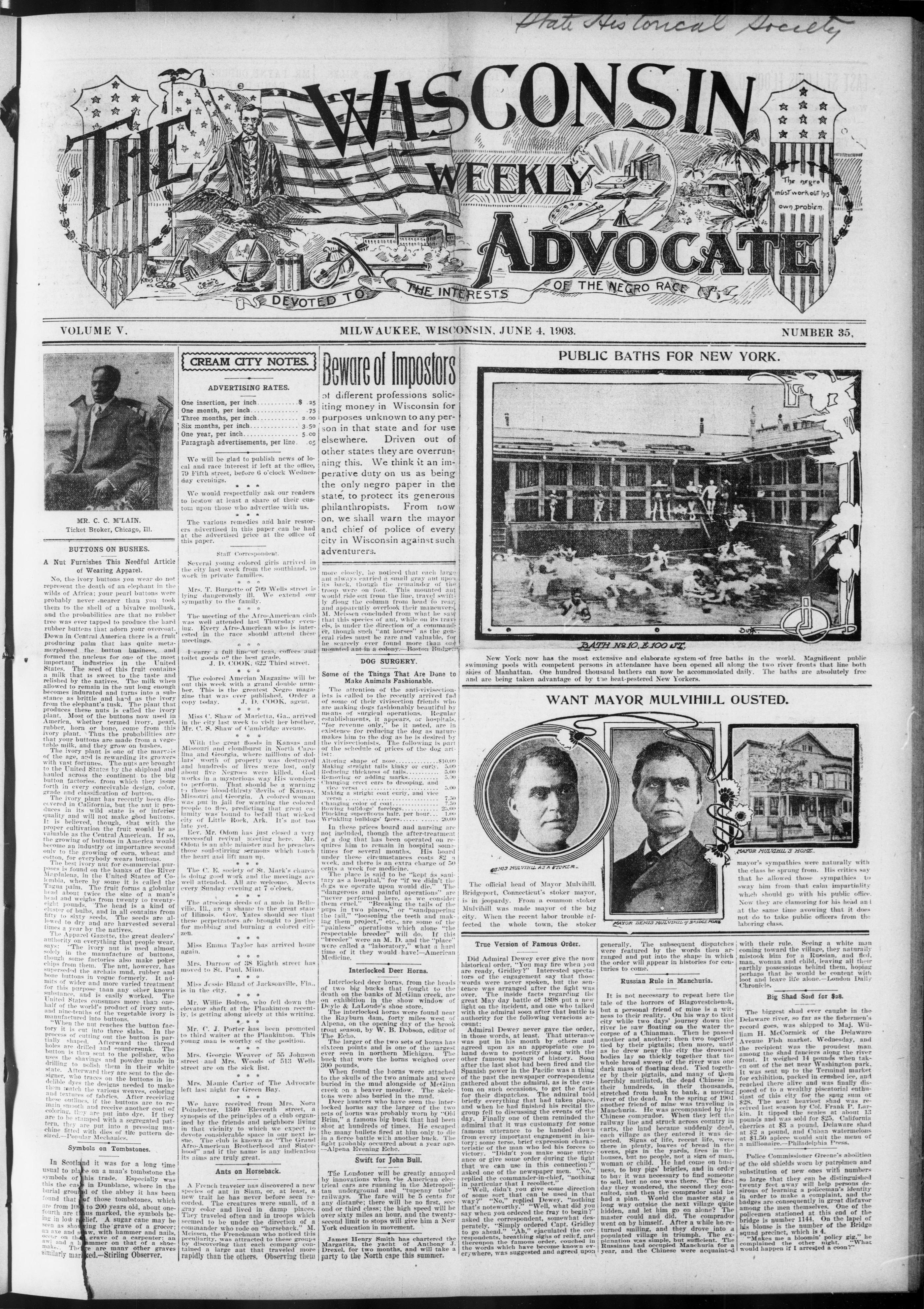
MR. C. C. M'LAIN. Ticket Broker, Chicago, Ill.
MR. C. C. M'LAIN. Ticket Broker, Chicago, Ill.
BUTTONS ON BUSHES
A Nut Furnishes This Needful Article of Wearing Apparel.
No, the ivory buttons you wear do not represent the death of an elephant in the wilds of Africa; your pearl buttons were probably never nearer than you took them to the shell of a bivalve mollusk, and the probabilities are that no rubber tree was ever tapped to produce the hard rubber buttons that adorn your overcoat. Down in Central America there is a fruit producing palm that has quite metamorphosed the button business, and formed the nucleus for one of the most important industries in the United States. The seed of this fruit contains a milk that is sweet to the taste and relished by the natives. The milk when allowed to remain in the nut long enough becomes indurated and turns into a substance as brittle and hard as the ivory from the elephant's tusk. The plant that produces these nuts is called the ivory plant. Most of the buttons now used in America, whether termed ivory, pearl, rubber, horn or bone, come from this ivory plant. Thus the probabilities are that your buttons are made from a vegetable milk, and they grow on bushes.
The ivory plant is one of the marvais of the age, and is rewarding its growers with vast fortunes. The nuts are brought to the United States by the shipload and hauled across the continent to the big button factories, from which they issue forth in every conceivable design, color, grade and classification of button. The ivory plant has recently been discovered in California, but the nut it produces in its wild state is of inferior quality and will not make good buttons. It is believed, though, that with the proper cultivation the fruit would be as valuable as the Central American. If so, the growing of buttons in America would become an industry of importance second only to the growing of corn, wheat and cotton, for everybody wears buttons.
The best ivory nut for commercial purposes is found on the banks of the River Magdalena, in the United States of Colombia, where by some it is called the Tagua palm. The fruit forms a globular head about twice the size of a man's head and weighs from twenty to twenty-eight pounds. The head is a kind of cluster of bulbs, and in all contains from fifty to sixty seeds. The seeds are allowed to dry and are harvested several times a year by the natives.
The Apparel Gazette, the great dealers' authority on everything that people wear, says: "The ivory nut is used almost solely in the manufacture of buttons, though some factories also make poker chips from them. The nut, however, has superseded the archais mud, rubber and bone buttons in vogue formerly. It admits of wider and more varied treatment for this purpose than any other known substance, and is easily worked. The United States consumes more than one-half of the world's product of ivory nuts, and nine-tenths of the vegetable ivory is manufactured into buttons.
"When the nut reaches the button factory it is cut into three slabs. In the process of cutting out the button is partially shaped. Afterward the thread holes are drilled and countersunk. The button is then sent to the polisher, who uses the shavings and powder made in drilling to polish them in their white state. Afterward they are sent to the designer, who traces on the buttons in indelible dyes the designs needed to make them match the various weaves, coloring and textures of fabrics. After receiving these outlines, if the buttons are to remain smooth and receive another coat of coloring, they are put into dye. If they are to be stamped with a segregated pattern, they are put into a pressing machine fitted with dies of the pattern desired.—Popular Mechanics.
Symbols on Tombstones.
In Scotland it was for a long time usual to place on a man's tombstone the symbols of his trade. Especially was this the case in Dunblane, where in the burial ground of the abbey it has been found that of those tombstones, which are from 1000 to 200 years old, about one-fourth are thus marked, the symbols being in low relief. A sugar cane may be seen as showing the grave of a grocer; an axe and shaw, with hammer and nails, occur on the grave of a carpenter; an awl and a hammer on that of a shoemaker. There are many other graves similarly marked.—Stirling Observer.
CREAM CITY NOTES.
ADVERTISING RATES
One insertion, per inch. $ .25
One month, per inch. .75
Three months, per inch. 2.00
Six months, per inch. 3.50
One year, per inch. 5.00
Paragraph advertisements, per line. .05
We will be glad to publish news of local and race interest if left at the office, 79 Fifth street, before 6 o'clock Wednesday evenings.
We would respectfully ask our readers to bestow at least a share of their custom upon those who advertise with us.
The various remedies and hair restorers advertised in this paper can be had at the advertised price at the office of this paper.
Staff Correspondent
Several young colored girls arrived in the city last week from the southland, to work in private families.
* * *
Mrs. T. Burgette of 709 Wells street is lying dangerously ill. We extend our sympathy to the family.
* * *
The meeting of the Afro-American club was well attended last Thursday evening. Every Afro-American who is interested in the race should attend these meetings.
* * *
I carry a full line of teas, coffees and toilet goods of the best grade.
The colored Amerian Magazine will be out this week with a grand double number. This is the greatest Negro magazine that was ever published. Order a copy today. J. D. COOK, agent.
```markdown
```
Miss C. Shaw of Marietta, Ga., arrived in the city last week to visit her brother, Mr. C. S. Shaw of Cambridge avenue.
```markdown
```
With the great floods in Kansas and Missouri and cloudburst in North Carolina and Georgia, where millions of dollars' worth of property was destroyed and hundreds of lives were lost, only about five Negroes were killed. God works in a mysterious way His wonders to perform. That should be a warning to these blood-thirsty devils of Kansas, Missouri and Georgia. A colored woman was put in jail for warning the colored people to flee, predicting that great calamity was bound to befall that wicked city of Little Rock, Ark. It's not too late yet.
Rev. Mr. Odom has just closed a very successful revival meeting here. Mr. Odom is an able minister and he preaches those soul-stirring sermons which touch the heart and lift man up.
```markdown
```
The C. E. society of St. Mark's church is doing good work and the meetings are well attended. All are welcome. Meets every Sunday evening at 7 o'clock.
枣枣枣
The atrocious deeds of a mob in Belleville, Ill., are a shame to the great state of Illinois. Gov. Yates should see that these perpetrators are brought to justice for mobbing and burning a colored citizen.
幸幸幸
Miss Emma Taylor has arrived home again.
* * *
Mrs. Darrow of 38 Eighth street has moved to St. Paul, Minn.
* * *
Miss Jessie Bland of Jacksonville, Fla., is in the city.
* * *
Mr. Willie Bolton, who fell down the elevator shaft at the Plankinton recently, is getting along nicely at this writing.
* * *
Mr. C. J. Porter has been promoted to third waiter at the Plankinton. This young man is worthy of the position.
* * *
Mrs. Georgie Weaver of 55 Johnson street and Mrs. Woods of 513 Wells street are on the sick list.
Mrs. Mamie Carter of The Advocate left last night for Green Bay.
枣枣枣
We have received from Mrs. Nora Poindexter, 1340 Eleventh street, a synopsis of the principles of a club organized by the friends and neighbors living in that vicinity to which we expect to devote considerable space in our next issue. The club is known as "The Grand Afro-American Brotherhood and Sisterhood" and if the name is any indication its aims are truly great.
Ants on Horseback
A French traveler has discovered a new species of ant in Siam, or, at least, a new trait he has never before seen recorded. The creatures were small, of a gray color and lived in damp places. They traveled often and in troops which seemed to be under the direction of a commander who rode on "horseback." M. Meissen, the Frenchman who noticed this peculiarity, was attracted to these groups by discovering that each company contained a large ant that traveled more rapidly than the others. Observing them
Beware of Impostors
Beware of Impostors
of different professions soliciting money in Wisconsin for purposes unknown to any person in that state and for use elsewhere. Driven out of other states they are overrunning this. We think it an imperative duty on us as being the only negro paper in the state, to protect its generous philanthropists. From now on, we shall warn the mayor and chief of police of every city in Wisconsin against such adventurers.
more closely, he noticed that each large ant always carried a small gray ant upon its back, though the remainder of the troop were on foot. This mounted ant would ride out from the line, travel swiftly along the column from head to rear, and apparently overlook their maneuvers. M. Meissen concluded from what he saw that this species of ant, while on its travels, is under the direction of a commander, though such "ant horses" as the general rides must be rare and valuable, for he scarcely ever found more than one mounted ant in a colony.—Boston Budget.
DOG SURGERY.
Some of the Things That Are Done to Make Animals Fashionable.
The attention of the anti-vivisectionists is called to the recently arrived fad of some of their vivisection friends who are making dogs fashionably beautiful by means of surgical operations. Regular establishments, it appears, or hospitals, "for revenue only," be it noted, are in existence for reducing the dog as nature makes him to the dog as he is desired by the vivisectionists. The following is part of the schedule of prices of the dog artist:
Altering shape of nose.....$10.00
Making straight tails kinky or curly. 5.00
Reducing thickness of tails.....5.00
Removing or adding marks.....5.00
Changing erect ears to drooping, and vice versa.....5.00
Making a straight coat curly, and vice versa.....7.50
Changing color of coat.....7.50
Bowing bulldogs' forelegs.....25.00
Plucking superfluous hair, per hour.....1.00
Wrinkling bulldogs' faces.....20.00
In these prices board and nursing are not included, though the after-treatment of a dog that has been operated on requires him to remain in hospital sometimes for several months. His board under these circumstances costs $2 a week, and there is an extra charge of 50 cents a week for medicine.
The place is said to be "kept as sanitary as a hospital," for "if we didn't the dogs we operate upon would die." The "dangerous and painful operations" are "never performed here, as we consider them cruel." "Breaking the tails of the pups in two places," or "sandpapering the tail," "loosening the teeth and making them project," etc., are some of the "painless" operations which alone "the respectable breeder" will do. If this "breeder" were an M. D. and the "place" were called a "laboratory," what a hard time of it they would have!—American Medicine.
Interlocked Deer Horns
Interlocked deer horns, from the heads of two big bucks that fought to the death on the banks of McGinn creek, are on exhibition in the show window of Doyle & LaLonde's shoe store.
The interlocked horns were found near the Rayburn dam, forty miles west of Alpena, on the opening day of the brook trout season, by W. B. Dobson, editor of The Echo.
The larger of the two sets of horns has sixteen points and is one of the largest ever seen in northern Michigan. The buck that wore the horns weighed over 300 pounds.
When found the horns were attached to the skulls of the two animals and were buried in the mud alongside of McGinn creek on a beaver meadow. The skeletons were also buried in the mud.
Deer hunters who have seen the interlocked horns say the larger of the two sets of horns was probably worn by "Old Brim," a famous big buck that had been shot at hundreds of times. He escaped the many bullets fired at him only to die in a fierce battle with another buck. The fight probably occurred about a year ago. Alpena Evening Echo.
Swift for John Bull.
The Londoner will be greatly annoyed by innovations when the American electrical cars are running in the Metropolitan underground and "tupenny tube" railways. The fare will be 5 cents for any distance; there will be no first, second or third class; the high speed will be over sixty miles an hour, and the twenty-second limit to stops will give him a New York education in movement.
James Henry Smith has chartered the Margarita, the yacht of Anthony J. Drexel, for two months, and will take a party to the North cape this summer.
DuX.
New York now has the most extensive and elaborate system of free baths in the world. Magnificent public swimming pools with competent persons in attendance have been opened all along the two river fronts that line both sides of Manhattan. One hundred thousand bathers can now be accommodated daily. The baths are absolutely free and are being taken advantage of by the heat-pestered New Yorkers.
WANT MAYOR MULVIHILL OUSTED.
The official head of Mayor Mulvihill, Bridgeport, Connecticut's stoker mayor, is in jeopardy. From a common stoker Mulvihill was made mayor of the big city. When the recent labor trouble affected the whole town, the stoker
True Version of Famous Order
Did Admiral Dewey ever give the now historical order, "You may fire when you are ready, Gridley?" Interested spectators of the engagement say that those words were never spoken, but the sentence was arranged after the fight was over. The inside facts regarding the great May day battle of 1898 put a new light on the incident, and one who talked with the admiral soon after that battle is authority for the following veracious account:
Admiral Dewey never gave the order, in those words, at least. That utterance was put in his mouth by others and agreed upon as an appropriate one to hand down to posterity along with the other famous sayings of history. Soon after the last shot had been fired and the Spanish power in the Pacific was a thing of the past the newspaper correspondents gathered about the admiral, as is the custom on such occasions, to get the facts for their dispatches. The admiral told briefly everything that had taken place, and when he had finished his recital the group fell to discussing the events of the day. Finally one of them reminded the admiral that it was customary for some famous utterance to be handed down from every important engagement in history; some terse, brief expression characteristic of the man who led his forces to victory. "Didn't you make some utterance or give some order during the fight that we can use in this connection?" asked one of the newspaper men. "No," replied the commander-in-chief, "nothing in particular that I recollect."
"Well, didn't you give some direction of some sort that can be used in that way?" "No," replied Dewey. "nothing that's noteworthy." "Well, what did you say when you ordered the fray to begin?" asked the correspondent, somewhat desperately. "Simply ordered Capt. Gridley to go ahead." "Ah," ejaculated the correspondents, breathing sighs of relief, and thereupon the famous order, couched in the words which have become known everywhere, was suggested and agreed upon
BATH N210, E100 ST.
most extensive and elaborate system of free bath persons in attendance have been opened all al- and thousand bathers can now be accommodated of by the heat-pestered New Yorkers.
NT MAYOR MULVIHILL C
MAYOR DENLS MULVIHIL of BRIDGL PORZ
generally. The subsequent dispatches were featured by the words then arranged and put into the shape in which the order will appear in histories for centuries to come.
Russian Rule in Manchuria.
It is not necessary to repeat here the tale of the horrors of Blagovestchensk, but a personal friend of mine is a witness to their reality. On his way to that city while two days' journey down the river he saw floating on the water the corpse of a Chinaman. Then he passed another and another; then two together tied by their pigtails; then more, until as he drew near the city the drowned bodies lay so thickly together that the whole broad sweep of the river was one dark mass of floating dead. Tied together by their pigtails, and many of them horribly mutilated, the dead Chinese in their hundreds, in their thousands, stretched from bank to bank, a moving river of the dead. In the spring of 1901 another friend of mine was traveling in Manchuria. He was accompanied by his Chinese comprador. When they left the railway line and struck across country in carts, the land became suddenly dead, each village as they entered it was deserted. Signs of life, recent life, were there in plenty, loaves of bread in the ovens, pigs in the yards, fires in the houses, but no people, not a sign of man, woman or child. He had come on business, to buy pigs' bristles, and in order to buy it was necessary to find someone to sell, but no one was there. The first day they wondered, the second they consulted, and then the comprador said he had a plan. Would the master stay a long way outside the next village quite hidden, and let him go on alone? The master could and did. The comprador went on by himself. After a while he returned smiling, and they drove into a populated village in triumph. The explanation was simple, but sufficient. The Russians had occupied Manchuria for a year, and the Chinese were acquainted
---
NUMBER 35.
YORK.
Baths in the world. Magnificent public baths on the two river fronts that line both daily. The baths are absolutely free.
DUSTED.
MAYOR MULVAHIL'S HOME.
mayor's sympathies were naturally with the class he sprung from. His critics say that he allowed those sympathies to sway him from that calm impartiality which should go with his public office Now they are clamoring for his head and at the same time avowing that it does not do to take public officers from the laboring class.
with their rule. Seeing a white man coming toward the village, they naturally mistook him for a Russian, and fled, man, woman and child, leaving all their earthly possessions behind them, hoping perhaps that he would be content with loot and leave life alone.—London Daily Chronicle.
Big Shad Sold for $28
The biggest shad ever caught in the Delaware river, so far as the fishermen's record goes, was shipped to Maj. William H. McCormick of the Delaware Avenue Fish market. Wednesday, and the recipient was the proudest man among the shad fanciers along the river front. It weighed 14 pounds when taken out of the net near Washington park. It was sent up to the Terminal market for exhibition, packed in crushed ice, and reached there alive and was finally disposed of to a wealthy piscatorial enthusiast of this city for the snug sum or $28. The next heaviest shad was received last season by Col. Frank P. Larkin. It tipped the scales at about 12 pounds and was sold for $25. California cherries at $3 a pound. Delaware shad at $2 a pound, and Cuban watermelons at $1.50 apiece would suit the menu of a millionaire.—Philadelphia Press.
Police Commissioner Greene's abolition of the old shields worn by patrolmen and substitution of new ones with numbers so large that they can be distinguished twenty feet away will help persons desirous of learning a policeman's identity in order to make a complaint, and the badges are consequently in great disfavor among the men themselves. One of the policemen stationed at this end of the bridge is number 1144. On the lapel of his blouse is the number of the Bridge squad precinct, which is 4.
"Makes me a bloomin' policy gig." he complained the other night. "What would happen if I arrested a coon?"
---
EAST ST. LOUIS FLOODED.
Water Breaks Through Levees and Peop'e Are Forced to Flee.
Flood Is Advancing and Soon the City Will Be Inundated-Efforts to Check Advance of Water.
St. Louis, Mo., June 10.—The river this morning reached a stage of 37.9 feet, the highest point during the present flood. East St. Louis, Ill., with a population of 32,000, having large manufacturing interests and the terminal point for railroads from the north, east and south, is partly under water and will probably be totally submerged by tonight. The southern half of East St. Louis is deep in the flood and the city's 2500 levee builders have fallen back on Missouri avenue in the attempt to save the remainder of the city, menaced by swelling waters from three sides. Broadway, the central east and west thoroughfare, has been abandoned to the flood. Lee Harper, former city engineer, says that the water will be two feet deep in front of the city hall before 6 o'clock this evening.
Flood Steadily Rising.
At 1 o'clock the water which has submerged the lower half of East St. Louis was rapidly filling the depressions between Broadway and Missouri avenue, the next street north. It was pouring through the Broadway embankment between Eighth and Ninth streets in a stream as large as a barrel, and all along from Seventh to Twelfth streets in smaller streams.
All the dwellings between Broadway and Missouri avenue are being vacated as fast as possible. It is feared that a cave-in may occur in Broadway at any moment. The walled embankment of sand appears to have been honeycombed by the water forcing its way through, and the brick-paved crown is expected to sink. If the water were to come through with a rush, it would not be possible to check it at Missouri avenue, where a last stand is being made and the flooding of the entire city will be almost inevitable.
A Break on the North.
A break has occurred in the Baltimore & Ohio levee, which protects the city on the north, and water is flowing into the low ground to the north and northeast of the city. The levee directly in front of the business section from the viaduct past the relay depot to Conestation is holding. There is good reason for believing that many lives were lost when the water rushed upon the lower part of the city early Wednesday morning.
Break Down City's Defense
Seven miles of water, pressing from the south and southeast, overcame the city's line of defense shortly before 1 o'clock this morning and 5000 persons were driven from their homes. One thousand men were working on the part of the levee which broke. For several hours before the final break they had the active assistance of hundreds of women and children. The break came at the St. Louis valley crossing of the Illinois Central embankment, two miles south of Relay depot. While as many men, women and children as could stand on the embankment were heaping sand bags between the rails to prevent the menacing waters from mounting over the top, the resistless current broke through the lower part of the wall of earth and spurted in rivulets in the faces of those who were carrying sandbags up the bank. Bags thrown into the openings by dozens of men were tossed by the waters like feathers. Then the workers fled from their useless task and the alarm was given by the ringing of bells and blowing of whistles in every part of the city. A few of the workers on the embankment remained at their posts until the rushing waters made it necessary for them to swim for their lives.
Awake to Find Flood at Doors.
Awakened families saw the water in the streets. When they were ready to leave with their hurriedly collected stock of necessities the flood was at their window sills. All fled to the north. The Washington school was the nearest point of safety. Many made for the high ground near the Illinois Central tracks. Men from Alta Sita and Denverside, who had been working on the abandoned levee hastened to those localities to tell their neighbors of their danger. Every locomotive and factory whistle joined in the clamor of alarm.
Rush to Build Dikes.
Undismayed by the defeat which has come in their seven days' battle with the flood, the greater part of the levee builders fell back to Broadway, where it was at first decided to resist the water. A half hour's work and survey of the prospect convinced those in charge that it was useless to try to keep the water from Broadway and the flood fighters fell back upon Missouri avenue, which runs east from the Relay station. Here the scenes of the past week were repeated as the street was rapidly transformed into a dike of sand bags and clay. An appeal from Mayor Cook to the governor of Illinois for state troops to aid in guarding property was answered by the promise that details of militia would be sent to East St. Louis at once.
Negro Shot Dead.
A few hours before the break in the levee Ned Roberts, a Negro employed as a levee builder, was killed by members of the levee patrol for attempting to tear down a portion of the dike. His act was caused by anger because he was not allowed to draw his pay at once. Relief boats started from St. Louis for East St. Louis early this morning. By order of Park Commissioner Ault the skiffs used for recreation on the park lakes were collected, to be sent on a wigging ferry boat to the east side. Congressman William A. Rodenburg has issued an appeal for aid for the nood sufferers. Food, he says, is mostly needed and means must be had for delivering it to the persons who are in upper stories of their homes or in boxcars.
Threatened in the North.
At 9 o'clock this morning the water was threatening the north and east sides, held temporarily by the Baltimore & Ohio railroad embankment and had reached to the viaduct only seven blocks east of the city hall. In this public building a foot and a half of seep water had already collected. All low points of the city are under water.
Messengers were sent to the main portion of the city, telling of the danger from the new point of attack and the greatest excitement prevailed. As the bottoms filled and the river gained a larger entrance, the terror in the business section of the city grew intense. It was all the greater because of the darkness and the fear that while guard was maintained in one direction the torrent would break through at another point and engulf the luckless inhabitants between two floods.
By the thousands they began to desert
their homes and run vainly up and down the streets, seeking a place of succor. Most of the refugees were scantily clad. Strong men carried aged women in their arms, followed by women with babies. Barefooted women were in the procession which continued steadily over the bridge. Hundreds of others sought protection in the second story of the public library building. As the water encroached about it many dashed through the shallow overflow to find a more secure refuge. In terror of the rising tide of water refugees in hundreds throng the street, crowd the cars and beseech public officials for aid. In the city hall alone 500 homeless persons were assembled, provision for the time being supplied them.
Estimate of Loss of Life.
At 9 o'clock, Congressman W. A. Rodenburg estimated that thirty lives were lost in the flooding of the lower portion of East St. Louis early this morning. While general alarms were given by the police and retreating levee workers with shouts and pistols, there was not time to call at every house in the thickly settled district and it is believed many families in first-story cottages awoke only when it was too late to escape. Even workers who laid down to rest on the embankment, worn out with hard labor, were caught by the flood and drowned like rats. It may never be learned how many died in this way.
Boat Is Overturned.
Among the drowned last night previous to the break in the Illinois Central levee were D. H. Sherwood and John Koolish and three children. They lost their lives by the overturning of a boat in the north part of the city. A Negro was drowned at 6 o'clock this morning in the waters which are climbing up the side of the embankment supporting Broadway, East St. Louis.
Rafts are being built and boats improvised to go to the rescue of people in second stories of residences. The naval militia of St. Louis and Alton are on duty. The Alton contingent, in a cutter, are rendering valuable service, rescuing men, women and children and transporting them to places of safety.
Negroes Try to Cut Levees.
Lieut. Gray, commanding the St. Louis naval militia has his force spread out along the embankments guarding against levee cutting and depredations by hordes of Negroes and bums that are to be seen everywhere. Arms are stacked at police headquarters, where reputable citizens may obtain carbines and ammunition to guard their property. A large number of arrests have been made by the police, who are marching their prisoners across the bridge to St. Louis, as there is no place to keep them in the flooded city. The East St. Louis city jail is also being emptied and the prisoners taken to the Four Courts in St. Louis for safety.
Rest of City in Danger.
Broadway running east and west through East St. Louis divides the city in two. It is built up in places, standing 15 feet above the surrounding country. It was first thought this street would serve as a protection to the northeast half of the city, but the flood that covers the southern part has broken through in a small stream between Eighth and Ninth streets. Should the embankment formed by Broadway give way suddenly as threatened, it will send a wall of water 15 feet high over the remainder of the city.
Extent of the Flood.
The flooded district in East St. Louis, due to the breaking of the embankments early this morning, is one mile wide south from Broadway and four miles long from east to west. It comprises about one-half of the city. That part of East St. Louis known as the "Island" was flooded several days ago. The district that is inundated includes the Second and Third wards, which are hknown as Illinois town and Denverside. Alta Sita, the suburb east of Denver side, was still above water at 9 o'clock this morning. The population of that district is about 8500, all of whom have abandoned their homes and fled to higher ground
Big Plants Under Water
Alta Sita, Denverside, and southern East St. Louis are devoted to manufacturing plants and the residences of their employees. The Tudor Iron workers, the Malleable Iron works, the Wiegraft-Tebben Manufacturing company, the St. Louis Syrup Refinery, the Elliott Frog and Switch works, the Central Brewery company, the Pittsburg Reduction works, the Oeters Bread company and other large manufacturing plants are under water.
Troops to Stop Lawlessness.
Springfield, Ill., June 10.—Upon solicitation of the mayor of Alton, five companies of Illinois militia under command of Maj. Watkins were ordered to Alton this morning by Acting Gov. Northcott. Pillaging has commenced in the flooded district of the city and local authorities are unable to cope with the lawlessness.
Armourdale Buildings Collapse.
Kansas City, Mo., June 10.—Ten small brick buildings at Armourdale have collapsed, weakened by the flood, and others are in a weakened condition. No one was hurt. The Kansas City, Kan., relief committee, after a thorough canvass, has issued an official statement placing the number of homeless in that city and its suburbs at 23,000 and says outside assistance is imperative. The Chicago & Alton is now included in the list of roads that have re-entered the Union station.
Killed by Cloudburst.
Bisbee, Ariz., June 10.—News reached here late last night of a cloudburst near Clifton, which occurred yesterday morning. A wall of water 8 feet high rushed down Chase creek without giving the inhabitants warning. Several dead bodies have already been recovered and it is believed the number of drowned will reach twenty. Chase creek was mostly inhabited by Mexicans, employed by the Arizona Copper country. The smelter, situated on the north side of Chase creek, is closed down at present on account of the miners' strike and is sustaining a heavy loss. Wires are all down to Clifton.
KANSAS GOVERNOR MARRIED
Wedding to Mrs. Weede Very Quiet and Simple.
Kansas City, Mo., June 10.—The marriage of Willis J. Bailey, governor of Kansas, and Mrs. Ida B. Weede took place at 6 o'clock last evening at the First Congregational church in this city. Rev. J. F. Fifield performed the ceremony, which was extremely brief and very simple. Only a few guests were present. Immediately after the ceremony Mr. and Mrs. Bailey left for Topeka. It had been Gov. Bailey's intention to make a trip to his old home in Illinois, but this was postponed because of pressing business relating to the flood.
SISTER SUPERIOR PRAXEDES DEAD.
Took Vows at Fond du Lac Eighteen Years Ago.
Menominee, MIch., June 10.—[Special.]
Sister Superior Praxedes, who for the last twelve years has had charge of the convent of the Epiphany, died last evening at St. Joseph's hospital of liver trouble, after an illness of six weeks. Sister Praxedes took her vows at the convent of St. Agnes at Fond du Lac eighteen years ago. Except a brother living in Ohio, she has no relatives in this country.
JEWESS ATTEMPTS TO ASSASSINATE.
RUSHES ON RUSSIAN POLICE OFFICIAL AND WOUNDS HIM WITH KNIFE.
She Was Being Interrogated While Under Arrest on Political Charge When She Made the Attack.
Kieff, Russia, June 10.—A Jewish midwife, named Frunskin, who was arrested on a political charge, was being interrogated yesterday by Gen. Novitsky, chief of the gendarmerie, when she rushed upon him with a knife, which she had concealed in her dress, and inflicted a wound in his neck. The general's injury is not serious.
MITCHELL INDORSES FIELD'S LABOR VIEWS.
Mineworkers' President Declares Merchant Prince's Warning to Workers in the Main Sound.
Chicago, Ill., June 10.—"Marshall Field in the main is right," said President John Mitchell of the United Mine Workers' Association of America yesterday, in referring to the recent statement of Marshall Field relative to the labor situation in this country.
"It certainly is the part of prudence," he continued, "to look into the future, and during labor agitations one must take further precaution in this line than at other times. One who is planning the erection of a large building or contemplating any other great project entailing great outlay must reckon with labor before he begins. These matters are to be considered deeply, and it certainly is the part of prudence to look well into the future and reckon thoroughly with labor before undertaking any project.
"The general labor situation of the country is good. There is no more labor agitation now and no more strikes than usual at this time of the year. There are always disputes at this season, for it is from the first of May until the first of July that labor makes its contracts and agreements with employers. I don't believe prosperity has anything to do with the number of strikes. Dissatisfaction among workmen is no more common in prosperous times than in others. There are no more strikes now than there were a year ago at this time or two years ago.
"The labor situation all over the country is better than it has been heretofore. The present agitation, which seems general in some places, is quieting down.. I think, and will be over in a few weeks. I look for the settlement of all disputes now being waged by the first of July. Unionism is growing stronger. We added 500,000 new members to union rolls during the last year."
NATIONAL CONVENTION OF MODERN WOODMEN.
Big Gathering of Choppers at Indianapolis, June 16 to 20, Will Attract About 65,000 People.
Indianapolis, Ind., June 10.—The thirteenth national convention of the Modern Woodmen of America meets in this city June 16-20. Preparations are practically completed for the entertainments of the 65,000 or more. On Tuesday, June 16, the Woodmen's convention opens at Tomlinson hall. There will be 469 delegates in the convention besides seventy-eight officers and members of standing committees. Each delegate will represent 1500 members, and they come from the thirty-three states in which the Modern Woodmen society is doing business at the present time.
AWFUL STORM RAGES AT PHILADELPHIA
Philadelphia, Pa., June 10.—The heaviest electrical and rain storm that has visited this city in thirty years was experienced today. The city for nearly half an hour was rendered almost as dark as at midnight and the storm raged for a full hour, trail accompanying the rain. Nearly two inches of rain fell. The New York Shipbuilding company in Camden was forced to shut down because of the flooding of its electrical plant and the Pennsylvania tracks were under water.
ADMITS POISONING WHOLE FAMILY.
Mrs. McKnight Confesses to Having Killed Her Brother, His Wife and Baby.
Kalkasa, Mich., June 10.—Prosecutor Smith announced at noon today that Mrs. Mary McKnight has confessed to the poisoning of her brother, John Murphy, and his wife and baby. The prosecutor said Mrs. McKnight confessed voluntarily to him last night that she administered strychnine to Baby Murphy, Gertrude Murphy and John Murphy.
MAY GET NECKLACE BACK.
Decision Declaring Forfeited Valuable Jewels of Philadelphia Woman Reversed and New Trial Ordered. New York, June 10.—The United States circuit court of appeals handed down an opinion today reversing the finding of the United States district court which declared forfeited the $15,000 pearl necklace imported by Mrs. L. Harrison Dulles of Philadelphia, who arrived here from Europe on July 22, 1902. The court holds that the court below arred and orders the case retried.
GREAT STRIKE IS ENDED.
By End of Week Hundred Thousand Men Will Return to Work in
New York. New York, June 10.-The great building tie-up practically ended today when the lumber and brick yards throughout Greater New York were thrown open for business. By the end of the week it is expected that between 100,000 and 130,000 men, idle since May 5, will be at work.
Increase Price of Coffins.
Indianapolis, Ind., June 10.—The National Association of Casket Makers yesterday increased the price of coffin boxes 20 per cent. and adjourned to meet at Chicago July 17.
TAFT ANSWERS MILES.
The Governor General Tells of the Conditions in the Philippine Islands.
Washington, D. C., June 9.—Gov.-Gen. Taft, in a reply to that portion of Gen. Miles' report relating to agricultural conditions in the Philippines, says the general statement of facts by the lieutenant general is correct so far as the depression due to loss of cattle is concerned. He declares, however, that Gen. Miles' recommendation that the remedy be found in the use of army transports for the importation of cattle and food, the latter from America, is not a good one, as the commission can more cheaply import cattle from northern China by means of chartered steamers exactly adapted to the purpose. Importation of wheat and corn from the United States for the relief of famine sufferers, Gov. Taft observes, would be much more expensive than importing rice—a food to which the natives are accustomed—on the twelve or fourteen coastguard vessels that can be spared for the work. It is estimated that the saving by this method as compared with the use of army transports would amount to from 20 to 25 per cent.
While a shortage in the natural food supply has existed, Gov. Taft says, the conditions have at no time been as bad as was expected. The response to the commission's proclamation to the people urging the planting of quick-growing crops, such as rice, sweet potatoes and corn, was gratifying and much suffering was thus averted. An unexampled drought in the islands rather militated against the efforts of the agriculturists, he says, and the commission may be called upon soon to aid those who may be in distress, but so far no provincial governor has made an appeal. The act of Congress appropriating funds to relieve famine sufferers is said to place the commission in position to meet any emergency that is likely to arise.
The great loss of cattle by rinderpest is the most serious feature of the situation. Gov. Taft's report says. The importation of 10,000 immunized cattle has been contracted for at $88, Mexican, a head. The commission will contract for the importation of additional cattle, which will be sold practically at cost, purchasers paying about 50 per cent. on delivery and the balance in six months.
OPENS FIGHT ON LABOR AGITATORS.
Arrest of Business Agent of Union First Move in War on Blackmailing Walking Delegates.
New York, June 9.—The first open move in the war District Attorney Jerome has started against alleged extortion and blackmail by walking delegates for labor organizations came with the arrest of Samuel Parks, a union business agent, accused of accepting $2000 to settle a strike.
For more than a month representatives of Mr. Jerome have been seeking evidence to prove that both workingmen and employers have been victimized by the "go betweens." Numerous charges of blackmail have been made during the recent labor troubles and although up to the present time no actual proof of dishonesty has been found, the district attorney hopes to be able to show that representatives of the workers have used their positions for their own financial profit and have called off strikes for a consideration.
Parks is business agent for the House-smiths and Bridgemen's union, the local branch of the structural ironworkers.
HE KILLED HIS WIFE.
Nick Thompson of Portage Entry Con fesses That He Murdered His Wife Years Ago.
Houghton, Mich., June 9.—[Special.]—Nick Thompson of Portage Entry confessed to the killing of his wife while being examined as to his sanity by Judge Gray yesterday. While the story told by Thompson is somewhat incoherent, the authorities believe it. Five years ago Thompson's wife was drowned at Portage Entry under suspicious circumstances, though a verdict of accidental drowning was brought in by the coroner's jury. Thompson in his confession says he drowned his wife because she continually nugged him, and life with her was a burden.
He pushed her off the dock one night while they were out boating. The case will be submitted to Prosecuting Attorney Larson. Thompson wrote notes to Sheriff Wills asking for a chance to make a confession and was arrested on the charge of insanity.
BANNERS AND GONGS POOR EXTINGUISHERS.
Big Fire in Pekin Is Too Much for the Native Method of Fighting Conflagrations.
Pekin, June 1. The extensive building occupied by the boards of revenue and rites are in flames from end to end. The revenue building contains 4,000,000 taels. The burning buildings adjoin the legations and the foreign military guards are doing effective service. The Chinese fire department, equipped chiefly with banners and gongs, is helpless.
NOT ILL WITH PLAGUE.
Case at Berlin Is Not Dread Disease Police Guarding Isolation Hospital.
Berlin, June 9.—The name of the sick attendant of Dr. Milan Sachs, who died from the plague Friday at the Berlin hospital, is Otto Marggraf. The isolation hospital in which Marggraf has been placed has been fenced in and is guarded by police. A bacteriological examination of the patient disproved the earlier diagnosis and showed that Marggraf was not suffering from the plague.
Lighthouse in a Desert.
There is at least one lighthouse in the world that is not placed on any mariner's chart. It is away out on the Arizona desert, and marks the spot where a well supplies pure, fresh water to travelers. It is the only place where water may be had for at least thirty miles in any direction. The "house" consists of a tall cottonwood pole, to the top of which a lantern is hoisted every night. The light can be seen for miles across the plain in every dijection.
Serum for Rattlesnake Bite.
Dr. S. Weir Mitchell, whose experiments on the venom or snakes are famous, announced at the meeting of the National Academy of Sciences that a serum had recently been prepared in Philadelphia which, when given to animals that had been inoculated with rattlesnake poison seemed to counteract the effect of the venom.
MR. PAYNE ORDERS RAND INVESTIGATED.
Before Leaving Washington Postmaster General Directs That Copper Mine Matter Be Looked Into.
Washington, D. C., June 10.—Before he left Washington for Cleveland Postmaster General Payne said he would instruct Fourth Assistant Postmaster General Bristow to make a careful investigation of H. H. Rand's connection with the Copper Mining company, of which August W. Machen was president and chief promoter. Rand is from Milwaukee and has been confidential clerk to the postmaster general ever since Mr. Payne entered the cabinet.
Mr. Rand, it is alleged, influenced the subordinates in the department to subscribe to the stock of the company. Because of the delicacy of the investigation of the confidential clerk of the postmaster general, Fourth Assistant Postmaster General Bristow has heretofore refrained from going into what might be regarded as an inquiry into the postmaster general himself, but Mr. Payne said it was his wish that Bristow should probe the matters which implicate Rand to the bottom. Moreover, Mr. Payne himself will make an examination of Rand's relations with Machen, Lorenz and others.
Mr. Payne has the utmost confidence in Rand, whom he has known for years. It is regarded as probable that the President has suggested to Mr. Payne that a complete dissipation of the persistent rumors involving the name of his confidential clerk might not only serve as an evidence of absolute good faith with which the current investigation must be conducted but might further relieve Mr. Bristow from any embarrassment resulting from uncertainty as to how extensive is the intimacy between Rand and the Machen crowd.
In addition to Rand, who is vice president of the Machen mining company, J. D. King, also of Wisconsin, chief of the division of rural free delivery and Machen's right hand man, is its secretary.
TO PROTECT PROPERTY.
United States Regulars Are Dispatched to Protect Mine in Arizona
Washington, D. C., June 10.—Acting Adjt.-Gen. Hall has ordered the commanding officers of the department of the Colorado to send troops from Fort Grant and Fort Huachuaca to Morenice, Ariz., at once with a discreet officer in command, to protect life and property. He directs that violence be avoided, if possible, the action of the troops to be governed by law in such cases. This order is in response to a telegram to the President from Acting Gov. Stoddard of Arizona, who states that 3000 men, mostly foreigners, are on a strike at Morenice.
HELD IN HEAVY BAIL.
Bond of Government Clerk Charged with Stealing $60,000 Is Fixed at $20,000.
Washington, D. C., June 10.—James A. Watson, Jr., the clerk in the auditor's office of the district government who was arrested yesterday for alleged embezzlement of large sums, appeared in the police court today, plended not guilty and waived preliminary hearing. Bail was fixed at $30,000. Gen. Bryant, the father-in-law of Watson, has expressed to the district officials confidence that he will make restitution of the amount of his son-in-law's alleged defalcation.
MURDERS LITTLE GIRLS.
Berlin Paper Says City Harbors a "Jack the Ripper," Who Slays
Berlin, June 10.—The Tageblatt, commenting on the recent increasing number of horrible murders of little girls in Berlin, expresses the opinion that the city harbors a fiend like Jack the Ripper. It points out the similarity in the methods of the perpetrators of the murders and that the Berlin miscreant, like his London prototype, disappears into impenetrable mystery.
JEWS NEED NOT FEAR.
Lord Mayor of London Receives Assurances Which Will Tend to Allay Anxiety.
London, June 10.—It is announced that the lord mayor of London, Sir Marcus Samuel, himself a Jew, has made urgent representations in the proper quarter touching the situation at Kishineff, and has received assurances which will tend to allay the anxiety throughout the world respecting a possible recurrence of outrages.
AMERICAN IS KIDNAPED.
Pirates on Way from Canton to Huenghan Hold Him for Ransom— Gunboat Sent to Rescue.
Washington, D. C., June 10.—The following cablegram has been received at the state department from United States Consul-General McWade at Canton, China, dated today:
American kidnaped by pirates while proceeding from Canton to Huenghan. Nine thousand dollars ransom is asked. I have sent the Callao (American gunboat) to the rescue and to demand that the viceroy secure the release of the man and the punishment of the pirates. Details later.
IS PROBABLY IN CANADA.
Missing ex-Treasurer of Brietung Left a Shortage in Acounts of Over $10,000.
Iron Mountain, Mich., June 10.—The alleged shortage of John H. Carey, the missing ex-treasurer of Brietung township, who was elected register of deeds of Dickinson county last fall, will aggregate over $10,000. Carey's whereabouts are unknown, but it is hinted he is in Canada.
CATCHES ENORMOUS TURTLE.
Michigan Boy Finds Amphibian Weighing Two Hundred Pounds.
Negaunee, Mich., June 10.—[Special.] Willie Dunstan captured a huge turtle this morning while fishing in Goose lake. He rendered it helpless by turning it over on its back. It weighs nearly 200 pounds. The turtle is very strong, bearing two large men on its shell with apparent ease. It is said to be the largest ever caught in this locality.
VETERAN NEWSPAPER MAN DEAD
Founder of Grand Rapids Eagle Succumbs to Painful Injuries.
Grand Rapids, Mich., June 10.--Aaron B. Turner, founder and editor of the old Grand Rapids Eagle, is dead, aged 81 years, as the result of a street car accident in Cincinnati several weeks ago, in which he sustained a fractured hip.
Mrs. Robert Brode rick, who resides at 1915 Virginia street, in San Antonio, Texas, tells an experience that will interest every reader; it shows as well that Doan's cures are lasting cures. She
A woman in a kitchen, leaning on a stool, with a fork in her mouth and a knife in her hand.
says: "Up to the early part of the year 1902 I had been a sufferer from kidney troubles for many years. The pain in my back became worse and worse until it was a daily burden that interfered with every duty. I was much afflicted with headaches and dizzy spells and was unable to rest well nights. In May, 1902, after using Doan's Kidney Pills I made a statement for publication declaring that they had entirely relieved me of the pain in my back. I have since then had a year's time in which to study the effects of the medicine, and while I have had slight touches of the trouble since, the use of the pills has always driven away all signs of the disorder and I have become convinced of the fact that the first treatment was practically permanent in its effects, and I know that a box of Doan's Kidney Pills kept on hand are a sufficient guarantee against any suffering from the kidneys or back. I should advise every sufferer to take Doan's Kidney Pills, and I know that they will be surprised and pleased with the result."
A FREE TRIAL of this great kidney medicine which cured Mrs. Broderick will be mailed on application to any part of the United States. Address Foster-Milburn Co.. Buffalo, N. Y. For sale by all druggists, price 50 cents per box.
SPORTING ITEMS.
"It'll be Jeffries all the way. Corbett hasn't got a chance with the big fellow and if the ex-champion's game is to stay away and try to make a draw of the fight he is going to get badly fooled. The end ought to come in less than six rounds and the contest may not last more than three." This is the prophecy of Robert Fitzsimmons, made in Chicago Tuesday, anent the coming championship battle at San Francisco.
Eddie Santry managed to stay ten rounds with Hughey McPadden at Indianapolis Tuesday, Hughey getting the decision. It was a fast bout and pleased the people. Ten years ago McPadden would not have toyed with Eddie as he did Tuesday, but Santry has seen his best days as a boxer and must be content to take second choice now.
* * *
Martin Duffy, the Chicago welterweight, is confined to his home by an attack of diphtheria, and all of his matches were canceled Tuesday by his manager, Harry Gilmore, Jr.
Harry Foley, the San Francisco middleweight, was awarded the decision on a foul, over Billy Woods at Los Angeles Tuesday in the fourth round of a bout which was to have gone twenty rounds.
STANDING OF THE CLUBS.
American Assn.— W. L. Pc.
Milwaukee. 27 11.711 C. Springs 26 8.765
St. Paul... 25 16.610 Milwaukee 15 12.556
Indi'apolis 22 18.550 Kan. City. 16 14.533
Kan. City. 15 18.455 Denver... 16 18.471
Min'apolis. 18 22.450 D. Moines. 13 17.433
Louisville. 18 23.439 Omaha... 11 16.407
Columbus. 15 24.385 St. Joseph. 11 17.393
Toledo... 15 23.250 Peoria... 11 17.393
American League.— W. L. Pc.
Boston... 26 16.619 New York. 31 13.705
Phil'epiphia 26 17.605 Chicago... 32 15.681
St. Louis... 21 16.568 Pittsburg. 32 17.653
Cleveland. 21 17.553 Brooklyn... 23 22.511
Chicago. 20 20.500 Cincinnati. 19 23.452
Detroit. 19 22.463 Boston. 17 25.405
New York. 17 23.425 Phil'lphia. 12 30.286
W'shing't'n 11 30.268 St. Louis. 13 34.276
The University of Columbia will give the Wisconsin university crew the use of their four-oared boat during the races at Poughkeepsie.
In speaking of the new rules in football, as arranged by the committee on rules in the east, Coach Stagg of the University of Chicago says: "I do not think the plan of having seven men in the rush line between the 25-yard lines is a move in the right direction. It will result in bringing about a punting game. Now, a punting game is interesting to the spectators, I know, but this rule will cause so much punting that it will become monotonous. Four men to carry the ball are not enough for consistent gains for long distances, and the teams will be forced to punt a lot. Some good punters will be developed, no doubt, but we shall need to have some accurate catchers developed, and I am afraid there will be a lot of fumbling. I think the ends will have so much work that their tongues will be hanging out.
"The rule allowing the quarter back, or, as I understand it, any man receiving the ball directly from the center, to carry the ball is all right, but I hardly think that play will be used a great deal. Long passes will be necessary, and long passes are too risky. The requirement that the quarter run five yards to right or left of the center will cause the officials a good deal more work.
"The new penalty for holding, I think, is an improvement. It hardly seems fair for the ball to change sides, because often when a team has the ball almost on the opponents' goal it is within the umpire's power to give it to the other team.
"The section preventing the full back's putting his men on side by running in front of them is good. It will protect the backs from much rough handling."
* * *
George Bothner of New York and Harvey Parker of Brockton, Mass., wrestled Tuesday at the Harlem River Casino, New York, for the lightweight championship. Bothner at present holds the title. The men weighed in at 135 pounds. They wrestled from about 10 o'clock until 1 o'clock this morning, when John O'Brien of the New York Athletic Club, the referee, decided the match a draw, as neither man had a fall. Most of the time Parker was aggressive and Bothner on the defensive.
The great pacer, Anaconda, 2:01%, was sold Tuesday to J. H. Bronson of New Haven, Conn., to C. E. Kenox of Johnstown, N. Y., for $10,000.
In the opening meet at Worcester, Mass., of the paced circuit, Gus Lawson of Salt Lake City won from Harry E. Caldwell of Manchester, N. H., and Will Stinson of Cambridge. The schedule was for a twenty-mile race, but they refused to go on the track together and five-mile heats were raced. Lawson beat Stinson in 6:53. Caldwell's motor went wrong in the final and he was beaten by a lap and a half by Lawson in 7:32 1-5.
The Opportunity of a Life Time
WANTED
for a first-class hotel in a city in
the interior of the state of W
consin, the followlng colored
help—
1 MEAT COOK, Female.
1 PASTRY COOK, Female.
1 LAUNDRY MAID.
2 CHAMBER MAIDS, one to
assist in serving dinners and
suppers.
2 DINING ROOM GIRLS. 2 DISH WASHERS. This is an exceptional opportunity for a club of Southern girls to make for themselves a comfortable home in Wisconsin. The proprietor is a Southern gentleman who understands and appreciates the negro. Apply at once to the office of the WISCONSIN WEEKLY ADVOCATE, 79 Fifth Street, Milwaukee, Wis.
The Oliver Typewriter ..
The Standard Visible Writer
GOLD MEDALS AND FIRST AWARDS.
Philadelphia, 1899. Eurls Court, London, 1899. Omaha, 1899. Paris 1900
Venice, 1901. Lille (France), 1901
Buffalo, 1901.
It is displacing old style machines everywhere, and holds first place in the estimation of the majority of leading representative business and professional men. Write for Catalogue.
434-436 Broadway, Corner Mason Street
MILWAUKEE
BARGAIN HUNTERS
Clothing to fit without being measured for. Prices less than you ever bought them for. Our specialty is misfit and uncalled-for custom tailor made clothing. Tailors' prices for full dress or Tuxedo suits from $30 to $50; our price from $15 to $18. English walking or good business suits made to measure by best of tailors from $18.00 to $35.00. Our price $8.00 to $18.00. Every suit bears our guarantee label. All garments bought of us are kept repaired and pressed free of charge for one year. To be convinced see our window display.
MILLER BROS.
213-15-17 West Water St.
Milwaukee, Wis.
Open evenings till 9 p. m.; Sundays
till 12 m.
While in city visit . . .
STEPHENS'
HOTEL and RESTAURANT
First-Class Accommodations
Home Cooking a Specialty...
No. 2832 State St., CHICAGO, ILL.
Northwestern House
APPLETON, WIS.
JOHN A. BRILL, - Proprietor.
Terms $1.00 Por Day.
Accommodations the best in the State. When in Appleton stop at the
NORTHWESTERN
THE PO
By Rev. W. Y. Fullerton.
Look unto me, and be ye saved, all the ends of the earth; for I am God, and there is none else.—Is. xlv., 22.
Salvation is not a luxury but a necessity. It is the greatest blessing because it lasts the longest. Temporal things are transient, but this is eternal.
Sometimes you say, when a man has done a foolish thing, "He will only rue it once." You mean he will rue it always. So God only saves us once, but his one salvation lasts forever.
But you say, "Perhaps it is not for me. I may not be one of those whom God intends to bless." Look again. To meet your difficulty there is another thought. This blessing is for the largest possible number.
This verse has a good, round sweep. Its scope surely embraces you. See, the earth is exhorted to look, and you, surely, are included in that. God so loved the world. Yea, his love is vast as creation, it is not an island, nor a country, nor a nation, that is to look. Not only Jews but Gentiles. For it is written, "In thee shall all families of the earth be blessed."
None have wandered too far, or have sinned too foully for the glorious invitation of the text.
"This blessing comes to us with the best possible security. "For I am God, and there is none else." God! "Why, if he be God," you say, "I dare not draw nigh to him, for it is God against whom I have sinned. Let me fly elsewhere for refuge. Elswhere for refuge."
And whither will you flee? There is none other who can save you. Let us rather be like Augustine, who said, "I fly to God, and hide in God from God." We must hide in God's mercy from his judgment.
Look only to Jesus, not to Satan and his temptation. You need not know all about the adversary and his wicked ways in order to be saved from them, and indeed, the less you know the better.
Look only to Jesus, not to sin and its consequences. But you say, "I must repent of my sin." True; but repenting of sin is not looking at it, but turning away from it, and looking only to Jesus.
Look only to Jesus, not to the obstacles and hindrances in your path. If you look at them they will be stumbling stones, but if you look from them to Jesus they will become stepping tones. A stone will do for either. Look only to Jesus, not to yourself, not to your intentions, your prayers, your repentances, your faith. Your faith is your looking. Do not look at your looking, but look only to Jesus.
You know how it is walking with a friend in the early night, when he sees the first star of the evening and points it out to you. You do not see it. He points again. "Why," he says, "it is just there, right opposite you. You are looking at it." Still you do not see it. Presently you catch a glimpse of it, and now you are surprised you did not see it before, and are so taken up with it that you can scarcely see anything else. So it is when we point men to Jesus. We are surprised that they do not see him, and when they do see him they will be surprised, too, and they will scarcely see any one else besides.
Jesus! Do you think we could make that name better? You think not. I think we could. How? By adding four more letters to it—Jesus only. Only look to Jesus. That is all.
A simple thing. It is not to strive, to philosophize, to argue—only to look. But you say, "I am charitable; will my charity avail me nothing?" Nothing. "But I belong to a good family; will that avail me nothing?" Nothing. The man who is not charitable, who does not belong to a good family, who has not been plausibly trained, can look just as well as you. You and he stand on the same level. The entrance is low down. Only look to Jesus.
Only look to Jesus. That is an instantaneous thing, and therefore the salvation is immediate. Find how long it takes to look, and you discover how long it takes to be saved. You may perhaps not know the moment; but one thing you will know, that whereas you were blind, now you see. Even if you feel powerless, yet look to him for power to look. "Behold the Lamb of God, that takest away the sin of the world." He takes the sin-you only look to Jesus.
You are not to look for Jesus. He is not lost. A friend of mine at a children's meeting told the little ones a thing right and proper—that if they found Jesus they would be saved. A little girl went and began to upset all the curtains in the house—bed curtains, window curtains. Her mother, in astonishment, inquired the cause, when the little innocent heart said, "Mother, teacher told us that if we found Jesus we should be saved, and, mother, I was looking for him." "Foolish child," you say. But more foolish souls who try to discover a Christ in some pet notion, or dream, or feeling, or imagination. Do not look for Christ, only look to him.
Look to him in the scripture, in his life, in his death, in his resurrection, in his glory. Look to him as God, as Man, as Mediator, or Redeemer, as Savior, as All in All. Look to him when weak, for strength; when sick, for healing; when hungry, for food; when dark, for light; when dead, for life. Look to him always.
When crossing a rushing torrent on a narrow bridge, the safest way is to fix your eye on a point on the opposite bank, and keep looking; so, in crossing life's stream, the only sure way is to keep looking off unto Jesus.
When Simeon went into the temple and saw the infant Christ he said, "Lord, now lettest thou thy servant depart in peace." What was his reason? "For mine eyes have seen thy salvation." Aye, that is it. To see Jesus is to see God's salvation, and to see God's salvation is to be ready to die, and to be ready to die is to be fit to live.
THE WITNESSING HOST
Wherefore, seeing we also are compassed about with so great a cloud of witnesses. Hebrews 12, 1, first clause.
The unseen world was very real to the apostle Paul. He had no hesitancy in ranging the great heroes of faith in a vast amphitheater, as interested spectators of the contests for the immortal crown to be awarded all who are "faithful until death." By
REV. J. M'LAGAN.
REV. J. M'LAGAN.
virtue of the figure which he uses, you can imagine you see, over there in the lower row, righteous Abel, and Enoch, "who walked with God." Higher up, you recognize Noah, founder of a new world, and Abraham, father of the faithful. Isaac, Jacob, Joseph, Moses and David are, one after another, singled out by the mind's eye. But with all the list enumerated by Paul in the eleventh chapter of Hebrews, there are an immense company besides, who, though not so well known, stand for a class in which you and I are most closely concerned. These are men and women who have helped mold our character by their witnessing power. Some wonderfully close ties bind us to the unseen world and we give them a place in Paul's cloud of witnesses, and know that they are helping us be strong, because they themselves have overcome. It is not necessary to give instances; you know, brother; you know, sister, "where your treasure is, there will your heart be also."
The mighty host of witnesses compassing us is composed of those who wrestled with the temptations of time and sense, just as you and I are doing. The same means by which they overcame are open to us. We have millions more witnesses than David or Joseph had, yet they were the stronger because of those that witnessed before them. Our opportunities are vastly superior, hence our responsibility is much greater, because of the added witnessing of the Christian centuries.
As a nation we do well to remember our beloved dead, and, better still, with Paul, to place them amongst that great cloud of witnesses, eagerly watching us who are left behind to guard the sacred liberty and institutions they safeguarded for us. The names of Washington, Lincoln and McKinley, together with a host of others on the American Roll of Honor, will incite to consecrated living the generations yet to come. These all died in faith, not having received the promise; but having a vision of the coming grandeur of their beloved country and its place in blessing the families of the earth. They have left us the inheritance that we, when our race shall have been run, may witness in turn to our successors. May you and I prove faithful, uniting our citizenship inseparably with our religion.
LABOR AN ARISTOCRACY.
I am the son of a workingman. Anybody who lays any claim to greatness is. The greatest aristocracy in America is the aristocracy of labor. God has no use for the idler.
If a man is not doing the useful, which is all God's work, he is doing the useless, which is the devil's work. Does God love the unions? I say yes, if the unions will follow the "golden rule" to do as they would be done by. If trusts or unions depart from that rule they will go to pieces and that speedily. God loves the American in men. The American is to give every man an equal chance. Americanism gives man a liberty of conscience. If he wants to belong to a union he can, but he is not obliged to in order to earn his bread and children's.
God puts his stamp on the toiler and expects freedom, not coercion. We have swung too far in our methods. A righteous cause does not need coercion. It grows. It pleads for itself.
Narrow Mindedness.—The man who thinks he is too intellectual to believe in the fundamental doctrines of Christianity and looks with a kind of sympathetic and patronizing gaze upon those who do believe in them, is not thereby giving evidence of intellectuality, but rather of narrow mindedness.
—Rev. J. B. Markware, Lutheran, Pittsburg, Pa.
THE LIQUOR TRAFFIC
SHORT, IMPRESSIVE TEMPERANCE SERMONS.
Dangers that Lurk in the Flowing Bowl-How Bright and Influential Men Have Been Dragged Down by the Demon Drink-Suppress the Traffic.
Some time ago, in a prominent social club in an adjoining city, I attended a distinguished gathering in celebration of the twenty-fifth anniversary of a political event. During the evening a very well known United States Senator, being called upon to speak, began by indulging in reminiscences of the time when this political event had taken place. He recalled the men who with himself had entered public life shortly before that time—men of brilliant talents and high education, some of whom had been classmates with him in college, many of whom were members of distinguished families, who began with high prospects and noble ambitions; and then he said, "Almost all these men are dead, and the majority of them died of drink!" The remark was made in a company of men who had been drinking, and some of whom were drinking in the intervals of the talk. There were a hundred wine glasses around him, and unless my memory is at fault, the Senator had a wine glass before him, if not in his hand, when he said it; but it seemed to me that I had never heard so strong a temperance lecture as was that. These young men were the flower of the community, the highest and the best according to all our standards of selection, fit to join in society and public life, fit to be useful for their fellow men and their country, and with sincere purpose to make the best of their opportunity and of themselves—and the majority had died of drink. Not one of them had ever contemplated or dreamed of such a thing when they began their career. Probably if such an ending had been held up before them they would have shrunk from it with the utmost horror. Every one of them would have resented with indignation the suggestion that such an end could possibly come to his career. But there was the awful fact, the majority of them had died of drink. The lights had gone out, the diamonds had turned to ashes, the usefulness to waste, the brilliant careers to disgrace, the hopes of themselves and their friends had been destroyed, the talents and the education, the ability and the strength and the manhood had been overthrown, quenched in everlasting darkness, and buried out of sight. The majority of them had died of drink. It was not what they expected; it was not what they wished; it was not what they deemed possible. But this insidious foe had deceived them, and the saying of the wise man comes back with an awful significance, "Whosoever is deceived thereby is not wise."—Hon. John I. Platt.
Nuggets of Gold.
He who would regulate the saloon should first try to regulate Mt. Sinai. Good laws cannot always make good people, but good people ought always to make good laws. You cannot legislate a sinner into a saint, but a saint can so legislate as to make himself a sinner. The further down you can drive the saloon, the further away you remove temptation from those who work in high places. Repentance is better late than never, but just as well never as too late. Thunder storms purify the air, but a burst of righteous indignation never was known to purify a saloon.
"Man is born unto trouble as the sparks fly upward." and the drunkard's wife is married to trouble, as sure as saloons drag downward. Better to be seen in a small company of those who try to do right than to be hid among a company of wrong-doers. Mixing politics with religion is not good, but religion is a good thing to mix with politics, especially if the religion be good and the politics bad.
The Young Man Who Drinks.
To the young man who drinks the great railroad corporations say, "Nothing in for you." When some large factory advertises for competent men and the answer is "Pass on," apply for life insurance and the answer comes back, "rejected," knock at the door of good society and hear the answer, "Not at home," over the gates of eternal kingdom is written "No drunkard shall enter here."
What then shall become of the young man who drinks? The education of the past generation has closed all responsible positions to him. If he labors, he must either work by the day or take some menial position where brains and character are not essential; no good society for him, he must take the scum. No church, he must take the saloon. No heaven—he is headed in the other direction. There is but one logical course for the young man of to-day who intends to make anything of himself and that is total abstinence.—Exchange.
"Nearer, My God, to Thee," was the work of Sarah Flower Adams, and first appeared in a volume of hymns and anthems published in 1840 by Rev. W. J. Fox. Several churches have objected to the theology of the hymn, and have endeavored to improve it, but no substitute was ever received with favor by the public.
"How did my heart rejoice to hear" is by Watts. It was originally entitled "Going to Church."
Bison
IT'S THE ON
Just What You Have
Afro-American
TEL. MAIN 6253. 502 WELLS ST.
IT'S THE ONLY PLACE Just What You Have Been Looking For Afro-American News Office
3104 STATE STREET
Here all the best and best magazines from all be found every week, inc. ard magazines, weekly Following is a list of the for sale:
Wisconsin Weekly Advocat Richmond, Va.; Planet, Ric Journal, Philadelphia, Pa.; Atlanta Age, Atlanta, Ga field, Ill.; Cairo Standard, O land, Ohio; Kentucky St Detroit Informer, Detroit can, Washington, D. C.; N City, N. Y.; Freeman, Ind Indianapolis, Ind.; Conse Ax, Chicago, Ill.
all the best and leading weekly in magazines from all parts of the U.S. every week, including all other magazines, weekly and daily publishing is a list of the leading weekly.
Insin Weekly Advocate, Milwaukee; Ref. Mond, Va.; Planet, Richmond, Va.; Odd B. al, Philadelphia, Pa.; Guardian, Boston, Pa. Age, Atlanta, Ga.; State Capitol, S. Ill.; Cairo Standard, Cairo, Ill.; Gazette, Ohio; Kentucky Standard, Louisville; Inst Informer, Detroit, Mich.; Colored A Washington, D. C.; New York Age, New N. Y.; Freeman, Indianapolis, Ind.; Ree Capolis, Ind.; Conservator, Monitor, Chicago, Ill.
Here all the best and leading weekly journals and magazines from all parts of the U. S. can be found every week, including all other standard magazines, weekly and daily publications. Following is a list of the leading weekly papers for sale:
Wisconsin Weekly Advocate, Milwaukee; Reformer, Richmond, Va.; Planet, Richmond, Va.; Odd Fellows Journal, Philadelphia, Pa.; Guardian, Boston, Mass.; Atlanta Age, Atlanta, Ga.; State Capitol, Springfield, Ill.; Cairo Standard, Cairo, Ill.; Gazette, Cleveland, Ohio; Kentucky Standard, Louisville, Ky.; Detroit Informer, Detroit, Mich.; Colored American, Washington, D.C.; New York Age, New York City, N. Y.; Freeman, Indianapolis, Ind.; Recorder, Indianapolis, Ind.; Conservator, Monitor, Broad Ax, Chicago, Ill.
Magazines Published Every Month:
The Colored American, Porters and Waiters Mag, also the Buffalo Tragedy, Oration, entitled: "Climb, Rugged," by Alton H. Blah
A Full Line of Stationer
Papers sent through the mail to a call and see for yourself. If we your order and we will get it for you
REMEMBER THE N
Afro-American
E. H. FAULKNER, Manager. 310
Colored American, Boston, Mass.; Illustrators and Waiters Magazine, Philadelphia; the Buffalo Tragedy by King Jefferson; an, entitled: "Climb, 'Though the Roofed,' by Alton H. Blake (the Boy Orator)
Line of Stationery, Cigars and T
sent through the mail to any part of the country free for yourself. If we have not what you need we will get it for you.
REMEMBER THE NAME AND PLACE
American News
KNER, Manager. 3104 STATE ST., CH
The Colored American, Boston, Mass.; R. R. Porters and Waiters Magazine, Philadelphia, Pa.; also the Buffalo Tragedy by King Jefferson, and Oration, entitled: "Climb, "Though the Rocks be Rugged," by Alton H. Blake (the Boy Orator.)
A Full Line of Stationery, Cigars and Tobacco
Papers sent through the mail to any part of the country. Give us a call and see for yourself. If we have not what you want, leave your order and we will get it for you.
REMEMBER THE NAME AND PLACE
Afro-American News Office
E. H. FAULKNER, Manager. 3104 STATE ST., CHICAGO.
ECONOMY
LAUNDRY
174 Fifth Street
Shirts 6c Each Delivered
at Office.
Other Work Proportionate.
BEST WORK IN CITY.
---
WILLIAM T. GREEN
Lawyer,
Notary Public
Rooms 216-217-218 Empire Bldg.,
14 GRAND AVENUE.
Office Telephone—White, 8075
Residence " " 8553
MILWAUKEE.
G. V. MASHEK
HARDWARE,
NAILS,
CUTLERY,
UNIVERSAL STOVES & RANGES
HOUSE
FURNISHING
GOODS.
KEWAUNEE, WIS.
---
---
y, Wis.
Freezers, Foot of N. Jefferson St.
Fred A. Grunitz
DEALER IN
Salted & Smoked Meats
OF ALL KINDS.
Fish and Oysters in Season
502 WELLS ST.
NLY PLACE
Been Looking For
News Office
leading weekly journals
parts of the U. S. can
including all other stand-
and daily publications.
leading weekly papers
e, Milwaukee; Reformer,
Diamond, Va.; Odd Fellows
Guardian, Boston, Mass.;
State Capitol, Spring-
Cairo, Ill.; Gazette, Cleveland,
Louisville, Ky.;
Mich.; Colored Ameri-
new York Age, New York
Manapolis, Ind.; Recorder,
Evator, Monitor, Broad
Boston, Mass.; R. R.
Magazine, Philadelphia, Pa.;
by King Jefferson, and
'Though the Rocks be
e (the Boy Orator.)
y, Cigars and Tobacco
any part of the country. Give us
have not what you want, leave
AME AND PLACE
News Office
4 STATE ST., CHICAGO.
MILWAUKEE...
GAS STOVE CO.,
MANUFACTURERS OF
PERFECTION
AND SPECIALTIES
Instantaneous Cleanable Star Burners,
Adjustable Needle Valve,
Per Natural, Artificial or Gasoline O.s.
139 Burrell St. Milwaukee, WI.
TONEY THE ARTIST FINE ART Shining Parlor
2161 GRAND AVENUE
Opposite Flanner's Music Store
MILWAUKEE, WIS.
Before Starting on Your Travels
CALL ON
Geo. Burroughs & Sons
MANUFACTURERS OF
PREMIUM TRUNKS
VALISES, SAMPLE CASES, Etc.
424 & 426 East Water St., Milwaukee.
Long Distance Phone 80
Snowy-Haired Members of the Grand Army Assemble at Chippewa Falls.
DECORATIONS ARE HANDSOME.
Chippewa Falls, Wis., June 9.—[Special.]—The Grand Army and its auxiliary organizations never had a more enthusiastic welcome at any department encampment than they have received here. The city is handsomely decorated and everybody is making it his particular business to see that the guests have a good time and enjoy themselves. The hotel accommodations of the city are limited, but the citizens are making up the deficiency by opening their houses to the visitors, and though the attendance is large all have been provided with accommodations.
communications. The five conventions all began business this morning. The Grand Army encampment is held at the opera house, the convention of the Woman's Relief corps in the Methodist church, the Ladies of the G. A. R. at the Presbyterian church, the Sons of Veterans at the court house and the Spanish-American War veterans at Maccahees' hall.
The topics which have occupied the attention of the members of the encampment since their arrival here yesterday are the election of department commander, the place for the next encampment and the war that is on against some of the trustees of the Wisconsin Veterans' home at Waupaca. There has been much quiet work done on the first and third of these propositions, but the location of the next encampment seems to have been virtually decided in advance in favor of Waukesha, provided that city wants it.
Candidates for Commander.
W. H. Bennett of Mineral Point appears to be the leading candidate for department commander, though there is a strong element in favor of George W. Peck. The other little booms did not make much of a showing last night. Spratt men are neither numerous nor enthusiastic. The movement that was started yesterday in favor of John M. Baer of Appleton has been sidetracked by information that he cannot possibly accept, since he has business on his hands that would render his acceptance impossible. At this time it looks as though Bennett would be a sure winner, but experience teaches that almost anything is possible in a department encampment and it is not often safe to predict what will be done.
There was considerable talk yesterday that the La Crosse contingent was coming over with a determination to capture the next encampment, but when they came they put a stop to all such talk by declaring that they did not want it, and that while they would always be glad to entertain the encampment if it came to them, they were not asking for it. The leading delegates from the Gateway city declared themselves in favor of Waukesha, and then nearly everybody joined in and said that Waukesha was all right. Fond du Lac might have been a formidable opponent of the Spring city, but the movement started there seems to have completely flattened out.
New Men for Veterans' Home.
There appears to be a stronger feeling than ever in favor of putting new men upon the board of trustees of the Veterans' home, but on the other hand the trustees are strong and united and have a strong following. The outcome is difficult to predict, since there are so many things to consider. The board of trustees held its meeting at the home Saturday and there was a clash there over the developments which have caused the renewal of the fight against the continued dominance of one set of men in the board. George L. Thomas, president of the board, declared there that he would be a candidate for re-election, and defied Commander Agen to do his worst. Agen is said to have retorted that he would not need to do anything personally to accomplish the defeat of Thomas, which was practically settled already, and so they parted.
James May Run Again.
About the James case there is a difference of opinion. James declares that he is not a candidate, but the opposition say his statement is a sham and that he will be found in the thick of the fight for what he calls a vindication. And the result hangs in the balance. The board is well organized and is entrenched in power. The sentiment exists which should accomplish the defeat of Thomas and James, but past experience shows that it is hard to crystallize it into efficient fighting capacity. There has not been good leadership in the past. There may be a change in that respect now, and there will have to be for success.
Live Eagle Likes Attention.
The live eagle brought to the encampment by the Sons of Veterans from Endeavor has attracted a great deal of attention and wears his honors modestly. The bird is very tame and seems to like attention. As soon as he saw the eagle Commander Agen began negotiations to have it taken to Superior for one of the attractions for the Fourth of July, when the Order of Eagles of that city will have charge of the celebration. The keeper said that he would go for day wages and expenses, and Mr. Agen said that he would probably give him an invitation. The bird is of the golden variety and is a handsome specimen of his kind.
Sons of Veterans.
Col. Geisler of Sheboygan, the commander of the Sons of Veterans, said that he had been asked to be a candidate for re-election, but that his business is such that he cannot possible serve another year. The order has increased greatly under his administration, having nearly doubled in membership during the year. There are now twenty-five camps in good standing and a membership of about 800.
A reception was given in the Methodist church last evening by the Relief Corps, the only function of the day.
The glare of numerous electric lights from arches the whole length of Main street was a very pleasing feature of the decorations.
· HAPPY OMEN AT A WEDDING.
Guests in Town of Center Impressed by Presence of Dove.
Appleton, Wis., June 9.—Residents of the town of Center, Outagamie county, are excited over what is regarded as a happy omen in connection with the marriage of Fritz Wagner of the town of Osborn and Miss Laura Ihde of the town of Freedom. During the service a white dove flew to the church entrance, walked slowly up the aisle to the chancel and flew onto the altar, where it remained until near the close of the ceremony, when it again took wing, flying several times just over the heads of the briday party, and then resumed its perch on the altar.
HIS FAMILY BUTCHERED.
Appleton, Wis., June 10. — Joseph Broun, a Jewish junk dealer who for the past few months has made his home in this city, received news yesterday that his wife and three children, whom he had supposed safely on their way to America, were butchered in the recent massacre of Jews at Kishineff, Russia. The shocking news is contained in a letter received by Broun from his brother, who describes the situation there as appalling, and begs for assistance to get away.
Broun came to America eleven months ago, having been aided by the Jewish Relief committee of this country to immigrate. A few weeks ago he had saved the price of a passage for his wife and half price passage for their oldest child, a boy of 11 years, to America. Two younger children were too young to need their passage paid. In addition to the price of the tickets he had saved $40, which he sent his wife to pay the incidental expenses of the journey. Another Appleton man, D. Baldzer, a fruit dealer, received on the same mail which brought the letter to Mr. Broun a letter from his brother, Louis Baldzer, who saved from the Kishineff riots nothing but the lives of himself and wife and six children. Two of the older children, girls, were terribly beaten and mistreated, and are in the hospital, but will not die, as perhaps they wish.
Hirsch Louis, senior member of the H. Louis Fruit and Produce company, is another Appleton man who is a native of Kishineff, and still has relatives and friends there. So far as he has heard, none of these have been killed or injured. At one time he cut off his right thumb with an axe, unfitting him for military duty, and succeeded in passing it off as an accident. Mr. Louis was afterward engaged in the hotel business in Kishineff, his house fronting on the Haymarket square, where the worst of the atrocities took place.
THEIR GIFT INCREASED.
Alumni of Racine College Donate $30,000 on Condition That Trustees Raise $20,000.
Racine, Wis., June 10.—Frank K. Bull, Richard and Fred Robinson of the Case Threshing Machine company of this city have increased their gift to $30,000. The trustees will raise the balance or $20,000 more. The trustees and Warden H. D. Robinson believe that the $20,000 can easily be raised, as there are many graduates of the college who are very wealthy. This is the largest amount ever given the Racine college and it is believed that from now on there will be many large gifts. It is the desire of the trustees to erect larger buildings and secure more competent professors and bring the standard of the Racine college to that of any eastern college. With 156 students the quarters are somewhat cramped and next year there will be 200 students.
The college was never as prosperous as it is today. It has been decided to raise the tuition from $400 to $500 a year. Thirty graduates of the college in 1869 to 1876 inclusive held a banquet in the college dining room. There were men present who had not been at the college for thirty years and it was the first time that the graduates had gathered. It was agreed to hold annual reunions. Warden Robinson will hold a reception at Taylor hall today.
AN EDITOR IS ARRESTED.
Thomas Bohen of the Trempealeau Gazette Is Taken in the Midst of the Woodmen's Picnic.
Trempealeau, Wis., June 10.—[Special.]—An execution issued by the clerk of Trempealeau county for the person of Thomas Bohen, editor of the Trempealeau Gazette, was served upon him yesterday. This is another procedure in the libel suit which it is said was decided against Mr. Bohen last March in the circuit court and it appears to be a strange one from the fact that it is said no levy has been made upon any of his real estate or other property. The case, it seems, has also been appealed to the supreme court by Mr. Bohen, who is secretary and treasurer of the Western Wisconsin Modern Woodmen Picnic association, which held its annual picnic here yesterday. Indignation runs high on account of the extraordinary procedure at this time and a large concourse of people accompanied Mr. Bohen to the train.
TREMPEALEAU SHOOTING.
James Phillips Injured as Result of Hot Words—C. S. Utter Is Placed Under Bonds.
Trempealeau, Wis., June 10.—[Special.]—James Phillips and C. S. Utter had some hot words here today and it is alleged Utter drew a revolver and fired two shots at Mr. Phillips. Mr. Phillips was slightly injured, one shot having grazed his wrist. Utter was immediately arrested and is now under $2000 bonds.
MISHICOT FARMER HURT.
John Hoffman Fell from Barn and Has Not Regained Consciousness in Forty-eight Hours.
Manitowoc, Wis., June 10.---[Special.]
--John Hoffman, a well-known farmer of the county, is lying at death's door at his home in Mishicott from injuries suffered by a fall from a barn which he was erecting. Hoffman has not regained consciousness since the accident, forty-eight hours ago, and there is little hope for his recovery. He fell a distance of forty-five feet and sustained injuries to the head and brain and was internally injured. He is 35 years of age.
VETERAN BADLY INJURED
Frank Forte of Lake Mills Falls Down Stairs at Hotel in Chippewa Falls.
Chippewa Falls, Wis., June 10.—[Special.]—Frank Forte, a veteran from Lake Mills, Wis., who is attending the encampment, fell down a stairway at the Taylor house thus morning. Two ribs were broken and his back and foot hurt. His injuries are serious.
NOT HEARD FROM FOR YEARS.
Janesville Man Who Left Home Fifteen Years Ago Is Dead.
Janesville, Wis., June 10.—[Special.]—J. J. Reilly, who died recently in the Philippines, left this city fifteen years ago and has not been heard from in thirteen years. He leaves a widowed mother, four sisters and two brothers, all but two of whom live in this city. Search is being made for information concerning his heirs by the administrator of his estate.
CONDUCTOR IS SLASHED.
Infuriated With Drink, Milwaukee Man Attacks Fare Collector.
ESCAPES A LYNCHING.
Motorman Secures the Man's Razor After Hard Fight and Waddell Is Subdued.
Racine, Wis., June 9.—[Special.]—When asked for his fare last night, on the interurban line of the Milwaukee Street Railway company, a man who gave his name as James Waddell of Milwaukee drew a razor and made a desperate attack on the conductor of the car. The infuriated man succeeded in slashing Ole Hanson, the conductor, across the face, inflicting painful though not serious wounds. The frightened passengers were unable to render any assistance until the motorman secured the razor, and then Waddell was thrown from the car and would have been lynched but for the interference of some cooler heads among the crowd.
Waddell boarded the car at Kenosha and seemed to be crazed with drink. He was taken to the jail in Racine, and a lot of court plaster found on his person leads to the conclusion that he was a peddler.
INCORPORATE A ROAD.
Milwaukee Men File Articles for Railway Company from Phillips to Chippewa Falls.
Madison, Wis., June 9.—[Special.]—Milwaukee men, including Melvin A. Hoyt, are incorporators of a new railroad company, the Phillips, Kennan & Chippewa Falls, which filed articles of organization with the secretary of state today. Its road is to run from Phillips through Price, Taylor and Chippewa counties to Chippewa Falls, about seventy-five miles. The company has acquired the right-of-way and properties of the Phillips & La Crosse road, from Phillips to Kennan. The capital stock is $25,000, and the incorporators are Rublee A. Cole of the homestead town of Fifield, Price county; John S. Maxwell, M. A. Hoyt, Ernest A. Brown and Henry Kloes, all of Milwaukee.
The Superior & Southeastern Railway company is to construct and operate a line from Pratt, Bayfield county, through Ashland and Sawyer counties, to a junction with the Chippewa Valley & Northwestern, about sixty miles, also filed articles of organization today. The capital stock is $50,000 and the incorporators are John E. Glover, George C. Glover, Levi E. Glover, L. A. Baker, all of New Richmond, and H. S. Baker of Hudson.
A DEDICATION AT RIO.
Appropriate Ceremonies Held in St. Joseph's Church, Father Shinner Officiating.
Rio, Wis., June 9.—[Special.]—The dedication of St. Joseph's Catholic church at this place was held this forenoon, the ceremonies being conducted by Rev. Father Shinner, vicar general of the archdiocese of Milwaukee, Archbishop Katzer being unable to attend.
About thirty Catholic priests from different parts of the state were in attendance and assisted in the ceremonies. Rev. Father Dowling of Argyle, Wis., delivered an able discourse to the largest audience ever assembled in this village. The building dedicated today was erected one year ago, through the untiring efforts of the pastor, Rev. Father Wrenn, who, for several years, has had charge of the parishes at Doylestown and Rocky Run, four miles west of here, the latter having been discontinued as a regular place of worship since the completion of the very fine edifice dedicated today.
PAINTER ENDS HIS LIFE.
Despondency Causes Harry Palmer, Residing Near Stanley, Wis., to Shoot Himself with Winchester.
Stanley, Wis., June 9.—[Special.]—Harry Palmer, a painted, committed suicide at his home, thirteen miles west of here, some time Friday, by firing two shots into his head from a Winchester rifle. Palmer leaves a wife, who was not at home at the time of the shooting, being away on a visit. Despondency, caused by a serious charge which had been preferred against him, is supposed to be the reason for his rash act.
SISTER OF MADISON MINISTER IS DEAD.
Miss Updike, Related to Rev. E. G. Updike of Wisconsin's Capital, Dies at Lake Mills.
Lake Mills, Wis., June 9.—[Special.]
—Miss Updike, sister of Rev. E. G. Updike of Madison, died at her summer home on the shore of the lake here yesterday afternoon, after an illness of about a week with heart trouble. The burial will probably take place at Beaver Dam, the old family home, tomorrow.
WILL GO TO NEW MEXICO.
Prof. Edmund J. Vert Resigns Position in Stevens Point to Accept One in Los Vegas.
Stevens Point, Wis., June 9.—[Special.]—Edmund J. Vert, superintendent of the city schools, resigned last night to accept the presidency of the normal school at Las Vegas, N. M., at a salary of $2400 per year.
Miss Lucy McGlachlin, principal of the high school, declined the position for another year, and it is rumored she is soon to assume more congenial duties.
RACINE EMPLOYERS CONSULT.
Builders and Traders' Exchange Members Meet and Discuss Problems.
Racine, Wis., June 9.—The members of the Racine Builders and Traders' exchange discussed last night the right of every man to use his power in his own way for obtaining support, comfort, improvement and independence, without dictation or interference; that it is the right of every contracting party to choose his assistants and determine from whom he shall receive material; that it is the right of any man to choose his employer upon terms agreed upon.
One of the members of the exchange stated that it was not the intention of the members to fight labor unions. No immediate action will be taken.
---
Racine, Wis., June 8.—Rev. Henry D. Robinson, warden of Racine college, will make an interesting report to the trustees at their meeting next Wednesday. It will state Frank K. Bull, Richard T. Robinson and Frederick Robinson of the J. I. Case Threshing Machine company will give $10,000 to the college, provided that the college can raise $20,000 more, the whole to be used for the erection of a new building.
Gymnasium to Be Built.
This building will contain a first class and modern gymnasium and natatorium; also a central heating and electric light plant. The offer of Messrs. Bull and the Robinsons will probably be accepted and action immediately taken to raise the $20,000. At present the college is in better condition than at any time in recent years. There are about 130 students; a military company and brass band have been added; a fine library equipped, interior of the buildings rebuilt, and grounds beautified, while the chapel has been made one of the handsomest in the southern part of the state.
Commencement Exercises.
Several hundred persons attended the first of the commencement exercises at Racine college Sunday. The baccalaureate sermon was delivered by Rt.-Rev. Charles P. Anderson, bishop coadjutor of Chicago. Following that was laying the class stone in the north wall of the chapel. In the stone were placed a photograph of the graduating class, their names and a copy of the Mercury, the college paper.
Honors for Graduates.
Bishop Anderson took for his subject "Truth." In his advice to the graduating class he told them to be reasonable in whatever they did. A reward for efficiency in performing their duties as dormitory officers during the year was given, and the students who are thus honored are L. Orton of Lincoln, Ill.; P. Clark of Pittsburg, Pa.; R. Hauser of St. Paul, Minn.; C. Ireland of Rochester, Minn.; A. St. George of Nashotah, Wis.; S. O'Neill of Milwaukee, Wis.; S. Haller of Blair, Neb.; C. Herrick of Racine, Wis. At the conclusion of the presentation short services were held over the graves of Drs. Parks and. Dekoven, founders of the college.
PREPARED FOR SUICIDE.
La Crosse Man Kills Himself After Dressing in His Best—No Cause for Deed Known.
La Crosse, Wis., June 8.—[Special.]—Anton Piesche, who committeed suicide last night, made careful preparations for death. He dressed himself in his best clothes and white dress shirt, collar and necktie, and then, reclining on his bed, killed himself with a 22-caliber rifle. No cause is assigned, unless it be that he brooded over the strange disappearance of C. F. Segelke, his employer, who is supposed to have been drowned last fall. He was 47 years old.
WILL AWARD CONTRACTS.
State Board of Control Meets to Accept Bid for New Boilers in Institutions.
Madison, Wis., June 8.—[Special.] The state board of control met this noon to award contracts for new boilers at the northern hospital, state prison and home for feeble-minded. A 100-foot smokestack at the prison and pipe covering at the prison and Mendota hospital are all provided for by special appropriations by the recent Legislature.
DIVORCE SUIT STARTED.
Prominent Oshkosh Woman Seeks Separation from Husband on Grounds of Alleged Cruelty.
Oshkosh, Wis., June 8.—[Special.]—Action has been begun for divorce by prominent Oshkosh people. Frances May Battis sues Allan P. Battis of the Battis boiler plant for a decree of separation on the ground of alleged cruel and inhuman treatment. She alleges that he is worth $60,000. Pending the action she is to receive $50 a month alimony and the use of the residence.
TO CROWN KING OF THE SHOOT.
Holland Club to Spend Day Shooting, Feasting and Dancing.
Green Bay, Wis., June 8.—[Special.]—The annual bird shoot of the Holland club will be held tomorrow at Zan Kessels in the town of Prevlle. Wooden birds erected on a high pole will be shot to pieces by the rifle balls of the club members. The entire day will be devoted to shooting feasting and dancing. The Holland shooting club is the growth of the St. Francis society of Holland town. It was an old Holland custom and the club was organized some years ago and since that time annual shooting contests were held at Zan Kessel's hall. The contest each year results in the crowning of the king of the shoot for the season.
A BURGLAR TRIES TO ESCAPE.
Rollins, Convicted at La Crosse, Attempts Jump from Car Window.
La Crosse, Wis., June 8.—[Special.]— "Kid" Rollins, colored, of St. Paul, convicted of burglarizing the Park department store of this city last November, made an attempt to escape from a moving train while being taken to the state prison at Waupun. He was handcuffed but had no leg irons on, as Sheriff Leuth had confidence in him. He asked to go to one of the rooms in the car and the sheriff granted the request, following shortly after to find him just in the act of attempting to jump through the window.
WISCONSIN BOYS GET HONORS.
Scholarships Awarded at Teachers' College, New York. Announced.
New York, June 8.—[Special.]—William C. Ruediger of the University of Wisconsin of Madison receives the graduate scholarship of $150 at the Teachers' college; Cliff W. Stone, University of Chicago, of Oshkosh, gets the Hoadley scholarship.
CHARLES SWEENEY RELEASED AT LAST.
Racine Judge Dismisses Complaint Against Man Charged with Running Fake Race in Iowa.
Racine, Wis., June 10.—[Special.]—In the circuit court this morning Judge Belden granted the motion of Charles Sweeney to dismiss complaint and vacate the order for Sweeney's arrest on the charge of defrauding Jacob Carbiener of Clinton, Ia., out of $3000. In his decision the judge states that the order for arrest was presented to him while au important trial was on in his court, and that he did not understand the entire case. Now, upon examination, he finds that neither the affidavit nor the complaint gave the court jurisdiction in the matter, as neither alleged that the cause of action arose within his state, but that the cause of action did arise in the state of Iowa. It is now expected that Sweeney will bring suit for damages against Jacob Carbiener, the plaintiff, and his attorneys, Doerfler and Eschweiler, and also officers of Racine county for false arrest and imprisonment.
LADIES ELECT OFFICERS.
Grand Army Dames Select Their Officers for the Year—Woman's Relief Corps Executives.
Chippewa Falls, Wis., June 10.—[Special.]—The Ladies of the Grand Army today elected the following officers: President, Miss Bessie M. Call of Milwaukee; senior vice president, Mrs. Simonson; junior vice president, Mrs. Paddleford of Omro; chaplain, Mrs. Hopkins of Milwaukee; treasurer, Mrs. Irene Jones of Milwaukee; secretary, Mrs. White of Milwaukee; chairman of the council, Mrs. Jennie Grunnex of La Crosse; members of the council, Mrs. Snyder of Oshkosh and Mrs. Clara B. Sloan of La Crosse.
The Woman's Relief corps elected the executive board as follows: Fannie McAllister of Waupaca, chairman; Kathryne Bleyer of Milwaukee, with one more to elect. Mrs. Martha Showalter of Lancaster was elected president.
FUNERALOFMR.MAYNARD
Late Postmaster Laid to Rest with Simple Ceremonies—He Never Had an Enemy.
Sheboygan, Wis., June 10.—[Special.]
The remains of the late Postmaster Maynard were laid to rest this morning at Plymouth. Brief services were conducted at his late home in this city, beginning at 9 o'clock, Rev. J. W. White of the Congregational church being the officiating clergyman. In spite of the weather, the little cottage was crowded by the many friends of the deceased who had come to pay their last mark of respect to the man they loved so well and who in this wide world never had a personal enemy.
SEVEN YEARS' SENTENCE.
Man Who Assaulted Street Car Conductor Gets Long Term for His Attempt to Kill.
Racine, Wis., June 10.—[Special.]—Thomas Waddell, who assaulted Ole Hanson, a conductor on the Milwaukee Street Railway company's line, today pleaded guilty in the municipal court to a charge of committing an assault with intent to kill, and was sentenced to serve seven years in the state's prison at Waupun. Waddell stated today in court that he had been for a number of years an ironworker in the rolling mills at South Chicago, but never worked in the Bay View mills, as he had claimed when arrested.
HUNT HIDDEN WEALTH.
Relatives of Oshkosh Man Searching for Fortune Thought to Be Secreted About the House
Oshkosh, Wis., June 10.—[Special.]—Relatives of the late Thomas Clark arrived in this city from Holland, Mich., believing that he left a large sum of money secreted in the house, and today they found $324 which had been sewed in the lining of his trousers. Every piece of furniture in the house is being searched for more money, as it was thought that he was quite well-to-do and was afraid to deposit money in the bank on account of the failure of the bank some years ago.
BESTOWS HANDSOME GIFT.
Grand Lodge of Knights of Pythias Honors Past Supreme Chancellor Ogden H. Fethers of Janesville.
Eau Claire, Wis., June 10.—[Special.] In the grand lodge of the Knights of Pythias this morning the past supreme chancellor, Ogden H. Fethers of Janesville, was presented on behalf of the supreme lodge with a magnificent jewel. The presentation address was made by the supreme keeper of records and seal. White of Nashville. Speeches were also made by Supreme Chancellor Bangs and Supreme Representative Hoskins of Fond du Lac.
ADMITS HE SHOT WELLEN.
Ole Aabakken Is Bound Over to Circuit Court on Charge of Murder at Whitehall.
La Crosse, Wis., June 10.—[Special.]—A special dispatch to The Republican and Leader from Whitehall says that Ole Aabakken was today bound over to the circuit court on a charge of murdering John Wellen. The defendant admitted shooting Wellen, but said he thought it was someone else attempting to enter his house.
Farmers' Institutes Announced.
Madison, Wis., June 10.—[Special.]—Supt. George McKerrow of the University of Wisconsin College of Agriculture requests the publication of the following notice:
Any farmer or public-spirited business man in Wisconsin who wishes to secure an institute for his locality during the winter season of 1903-1904 should send to us for a blank petition and letter of information. Any town, no matter how small or far from the railroad, is entitled to an institute, provided it is located in a farming district and has a good hall in which a meeting can be held.
Farmers should talk this matter up with their neighbors and if the sentiment seems favorable for an institute for their town they should write us at once for application blank.
Address all communications to George McKerrow, superintendent, Madison, Wis.
To Identify Suspected Criminals
Oshkosh, Wis., June 10.—[Special.]— The Oshkosh police department will have a Bertillon system of identification of criminals. The council authorized the purchase of the system last night.
Body of Mrs. Kathrina D. Wood Found With Skull Crushed.
DIVORCE SUIT WITHDRAWN
Husband Who Had Been Charged with Cruelty Was Three Miles Away and Is Not Suspected.
Cambria, Wis., June S.—The death of Mrs. Kathrina D. Wood, aged 65 years, who figured in a divorce suit brought against her husband on charges of cruelty last December, which she withdrew after the trial had been begun in Portage, is surrounded with mystery. The body of Mrs. Wood was found near her home on Friday with the skull crushed, evidently by a blunt instrument. The coroner called a jury, which returned a verdict of murder. The woman's husband proved to the jury that he was at work on a farm three miles away from the scene of the crime, and no charge has been made against him. Mrs. Wood, it is said, owned the farm upon which she and her husband, who is 45 years old, lived. She alleged at the trial last December that he married her for her property.
SECOND DIVORCE GRANTED
Miss Emma Briggs of Neenah Secures Her Freedom Once More from Edgar G. Eldridge.
Neenah, Wis., June 8.—Mrs. Edgar G. Eldridge was granted a divorce in the circuit court at Oshkosh and allowed to resume her maiden name. Edgar G. Eldridge was the defendant and did not contest the divorce, which was readily granted after the introduction of testimony by the attorneys for the plaintiff.
On March 12 Miss Emma Briggs and Mr. Eldridge were remarried after being granted a divorce in 1898. Shortly after their marriage an action for breach of promise to marry was begun against Mrs. Eldridge by Charles J. Schumann, a well-known Neenah young man, but it was discontinued. Mr. Schumann courted Miss Briggs between her marriages. Two weeks after Miss Briggs' second marriage to Eldridge she began an action against Mr. Schumann for the recovery of several horses which she alleged were purchased with her money. This case was also dropped at the time the breach of promise case was discontinued.
Miss Briggs, as she is now to be known, testified that she was married on March 12, 1903, to Edgar Eldridge, but that since that time he had done no work. She was left $6000 by her father and Mr. Eldridge, she said, relied upon her to support him. When she refused he would use low, profane, obscene and abusive language toward her, and upon one occasion when she did not give him money he struck her, she said.
About a year ago Mrs. Eldridge, then Emma Briggs by reason of a divorce, reported to the police that she had been robbed on a North-Western train while en route from Neenah to Oshkosh of $3000 in securities. After the officers had been kept busy for a day or two her purse was found in the Neenah station and returned to her.
HE DIED FROM MORPHINE.
Racine Contractor Succumbs to Dose of Drug—Whether Suicide or Accident Is Not Known.
Racine, Wis., June 8.—Simon Starke, a well-known contractor, died at St. Lu's hospital Saturday from the effects of taking morphine, but whether by accident or intent is not known. It was at first thought that he was stricken with apoplexy. Early Saturday morning Mrs. Starke noticed that her husband was not well. Physicians were summoned, but no assistance could be rendered. A wife and two children survive.
JUMPED FOR HIS LIFE.
Two Cars Precipitated Into Mississippi Give Brakeman Close Call—Saves Himself by Swimming.
La Crosse, Wis., June 8.—[Special.]—Brakeman G. Baker of the Chicago, Milwaukee & St. Paul railway, saved his life in a wreck by jumping into the seething waters of the Mississippi. A heavy timber had fallen across the track and the two first cars, on one of which he was standing, jumped the rails and were overturned. Feeling that he would fall under them, Baker jumped to the Mississippi at the side of the track and swam to safety.
CATHOLIC FORESTERS TO MEET.
Convention Will Be Held in Oshkosh June 9 to 12.
Oshkosh, Wis., June 8.—[Special.]—Beginning Tuesday, June 9 to 12, the state convention of the Catholic Order of Foresters will be held in Oshkosh, the chief ranger is Thomas J. Callen of Milwaukee. Bishop Messmer of Green Bay will be the celebrant of high mass at St. Peter's church Tuesday. The balance of the day is to be given over to business sessions, parades and a fire run Tuesday evening. An attendance of 5000 Foresters is expected.
DIES AS RESULT OF ACCIDENT.
Young Business Man of Hurley Succumbs to Recent Injuries,
Hurley, Wis., June 8.—[Special.]—As a result of an accident which befall him last Tuesday, while repairing the Presbyterian church of this place, Harry Jackson, one of the best known young business men of Hurley, died last night at 9:30 at Rinehart's hospital, Ashland. Jackson is survived by a mother and several brothers, all of whom are in England.
OMAHA ROAD FIXES DIVIDENDS.
Meeting of Directors Held at Hudson and Earnings Divided.
Hudson, Wis., June 8.—The directors of the Chicago, St. Paul, Minneapolis & Omaha Railway company held their annual meeting here Saturday. A semiannual dividend of 3½ per cent. was declared on the outstanding preferred stock, while a 3 per cent. dividend on common stock was ordered. The old officers were re-elected.
SUMMER INSTITUTE AT TOMAH.
Conducted by Prof. V. E. McCaskill of West Superior.
Tomah, Wis., June 8.—[Special.]—The annual summer institute will be held for this county from July 6 to 31. It will be conducted by Prof. V. E. McCaskill of West Superior, assisted by Prof. Lindsay Webb of Milwaukee and Prof. Maxson of this city.
WESTERN CANADA'S IMMIGRATION.
Rapid Settlement of the Fields Lying North of the 49th Parallel.
"Canada has anticipated a very heavy immigration this year, and she now has figures to show that she is actually getting it in a way to meet all her expectations. In the first four months of this year the doors of the Dominion opened to 40,672 persons, according to a report prepared by the committee on agriculture and colonization of the Canadian Parliament. This is almost twice as large as the immigration in the corresponding months last year, and fully three times as large as in 1901, the respective figures being 22,482 and 13,393.
"Most of these newcomers have been attracted by the wheat lands of the Northwest territories. They have moved direct from Winnipeg and they have turned that city into a great camp, in which they have been fitting themselves out for the last stage of their adventure for new homes.
"Of the immigration of this spring a little over a third has come from Great Britain, the figure being 16,457. This is three times as large as the British immigration of the corresponding months of the preceding year, and it is within 2.500 of the number of immigrants that the United States attracted from Great Britain and Ireland in the same period this spring. As to the remainder of the immigration into Canada, 13,770 settlers came from the United States, a 50 per cent increase over the preceding year, and 10,445 from Continental Europe, a 40 per cent increase.
"These 40,672 immigrants into Canada may appear trifling in comparison with the 297,070 persons who entered the United States in the same period, but they are proportionately more important to the country. Canada's population is one-fifteenth of ours, but her immigration is now two-fifteenth as large as ours. It is worth remembering also that Canada's immigrants are almost entirely of Anglo-Saxon and Teutonic races, while our immigration is now two-thirds made up of Romance and Slav elements.
"Speculation is natural as to the future of Canada in her relations to the United States when her Northwest territories are filled up, but the one absolutely certain fact of the near future is that the United States is to have a great competitor in the grain markets of the world."
The above editorial article taken from the columns of the Chicago Record-Herald of May 26 shows the condition of the Canadian immigration, which as pointed out, has had a constant growth—a marvelously increasing growth—for the past six or seven years, until this year, it is confidently assumed, the increase to Canada's population, by way of immigration, will exceed 100,000. This is accounted for by the great agricultural resources which abound there. It is no fairy tale, but the matter-of-fact experience of the tens of thousands bear ample testimony to the wealth and riches in store for all who choose to accept of the opportunities offered.
Those who wish to learn more of the country can secure illustrated atlases, pamphlets, etc., giving full and reliable data issued under government authority, by applying to any of the authorized agents of the Canadian Government. These agents, whose names appear below, will quote you the exceptionally low rates that take you to the free grant lands of Western Canada and render you any other assistance in their power:
T. O. Currie, Room 12B, Callahan building, Milwaukee, and J. M. MacLachlin, 307 Third street, Wausau, Wis.
Remodeling of Noses
In his recent lecture at the Medical Graduates' college, Stephen Paget said: "I have now done forty-three cases of the remodeling of noses. It is anxious work and heavy responsibility altering the shape of people's noses, and the more I see of these cases the more certain I am that you cannot manufacture perfect Greek noses out of nothing, and that the surgeon must be content if he succeeds in making a nose that shall be merely unnoticeable. But do not think that it is a small matter to accomplish this much. You can enable a man to get work and to get a girl to marry him."—London Lancet.
A railway is being constructed into the great anthracite coal fields recently discovered near Cumberland, British Columbia, and mines are being developed. It is expected that this coal will be in the market by autumn.
WESTERN CANADA HAS FREE HOMES FOR MILLIONS!
Upwards of 100,000 Americans have settled in Western Canada during the last 5 years. They are contented, happy and prosperous, with wonderful yields of Wheat and other grains. Best Grazing Lands on the Continent. Magnificent schools, and enclave of water facilities.
FARMS IN
WESTERN
CANADA
FREE
climate, plenty of
Free Homestead of 160 Acres. Free
the only charge being $10 for entry. Send to the following for an Atlas and other literature, as well as for certificate, giving you reduced railway rates, etc., Superintendent of Immigration, Ottawa, Can., or to T. O. Currie, Callahan Building, Milwaukee, and J. M. MacLachlan, Wausau, Wis., the authorized Canadian Government Agents.
FREE TOWOMEN!
To prove the healing and cleansing power of Paxtine Toilet Antiseptic we will mail a large trial package with book of instructions absolutely free. This is not a tiny sample, but a large package, enough to convince anyone of its value. Women all
PAXTINE
TOILET
ANTISEPTIC
To prove the healing and cleansing power of Pax-tine Toilet Antiseptic we will mail a large trial package with book of instructions absolutely free. This is not a tiny sample, but a large package, enough to convince anyone of its value. Women all over the country are praising Paxtine for what it has done in local treatment of female ill, curing all inflammation and discharges, wonderful as a cleansing vaginal douche, for sore throat, nasal catarrh, as a mouth wash, and to remove tartar and whiten the teeth. Send to-day; a postal card will do.
Sold by drugglats or sent postpaid by us, 50 cents, large box. Satisfaction guaranteed.
R. PAXTON CO., 218 Columbus Ave., Boston, Mass.
NERVOUS DEBILITY
Forty-two years of uninterrupted study and practice enable me to treat this wasting disease with unusual success. Weak and wasting bodies become strong and healthy under my care. Sufferers from chronic and wasting diseases can find speedy relief by consulting F. S. McNamara, M. D. 580 Broadway, Milwaukee. Ws. (Est. 1861.)
THE Inn OF THE SILVER MOON
What care if the day
Be turned to gray,
What care if the night come soon.
We may choose the pace
Who bow for grace
At the Inn of the Silver Moon.
Ah, hurrying sirs,
Drive deep your spurs.
For it's far to the steeped town—
Where the wallet's weight
Shall fix your state
And buy for ye smile or frown.
Through our tiles of green
Do the stars between
Laugh down from the skies of June
And there's naught to pay
For a couch of hay
At the Inn of the Silver Moon.
You laboring lout,
Pull out, pull out,
With a hand to the creaking tire,
For it's many a mile
By path and sille
To the old wife cronched by the fire--
But the door is wide
In the hedgerow side,
And they ask not bowl nor spoon,
Whose draught of must
Makes soft the crust
At the Inn of the Silver Moon.
Then here's to the Inn
Of the empty bin;
To the Host of the trackless dune,
And here's to the friend
Of the journey's end
At the Inn of the Silver Moon.
—Herman K. Viele.
FACTS AND FANCIES.
"I'm weary of this well-doing," said the bucket.—Cornell Widow.
A hard thing to overlook—the spite fence.—Philadelphia Bulletin.
De Style—Is he a chip of the old block?
Gunbusta—No; he's a claw of the old lobster.—New York Sun.
Clara—Is it true that Frank occupies first place in your heart? Nellie—Sure; counting from the bottom.—Chelsea Gazette.
Sunday School Teacher—Who dwelt in in the garden of Eden, Mabel? Little Mabel—Oh, I know—the Adamses!—Chicago News.
Wantanno—Why do you call that boy of yours "Flannel?" Duzno—Because he just naturally shrinks from washing.—Baltimore American.
"What do men do when they get in the legislature, pop?"
"Why, they do corporations, my son."—Yonkers Statesman.
Composer—That sailors' chorus was awful. What was the matter?
Stage Manager—The tars couldn't get the right pitch.—Tit-Bits.
He madly loved a horsy girl.
She was his very life.
When they were wed his friends all said
He had a nugging wife.
Delia—Why doesn't she smile any more?
Flora—The dentist hasn't sent home her teeth.—The New Yorker.
Wall street found a little lamb
With pockets full of dough;
Steered it to a bucket shop—
The rest of it you know.
—San Francisco Bulletin.
"Markley tells me he follows the races."
"That's the gospel truth. He never gets ahead of them."—Philadelphia Ledger.
Bill—They say raising the excise tax will hurt the business.
Jill—How can it? It has increased the number of growlers already.—Yonkers Statesman.
Miss Malaprop — I walked twenty-five miles yesterday. Mr. Parlormop—Did you wear a pedometer? Miss Malaprop —O, no indeed—just a short skirt.—Harvard Lampoon.
A can-ni-bal named Sam-mle Lee
Ate up his en-tire fam-I-lee—
And sald, the ample repast o'er:
"I could not stomach them before."
—New Orleans Times-Democrat.
Judge—How did you come to steal an automobile?
Prisoner—Why, your honor, I needed some gasoline with which to clean my gloves.—Sondags-Nisse.
Sunday School Teacher (to small pupil)
—Yes, Faith and Hope are correct. But what else is necessary to our happiness?
Small Pupil (promptly)—'Usbands, Miss.—Modern Society.
"Some folks' ideas," said Uncle Eben,
"is Jes' like an ostrich's feathers. Dey doesn' mount to nuffin' in partickler till dey gets into de possession o' somebody else."—Washington Star.
"I wish you'd send ma to one of those electricians' schools, pop."
"Why, what do you mean, my son?"
"She's altogether too careless with the switch, pop."—Yonkers Statesman.
"Well, what are you laughing at?" said the whale after Jonah had emerged. "At my good luck," replied Jonah, "if you hadn't been waterproof I would have got soaking wet."—Yonkers Statesman.
Recently a little Chicago girl, just beginning her classes, was asked if she knew who Homer was. She replied: "Homer was a fine old poet, whose chief works were the Oddity and the Idiot."—Life.
The deacon said, "Now we'll sing hymns; You should rise when you sing, Mrs. Symns." But the sister stayed sot And said, "Rise I will not! I can't; I've got cramps in my hymns!"—Houston Post.
Mrs. Bonton-I understand the duke is about to play the part of a heavy villain in a theatrical production.
Mrs. Gotrox-Why, how impossible! He only weighs about 135 pounds.-Yonkers Herald.
Another Version.
"Break, break, break."
The purling Sea did roar.
As it saw two lovers hugging
On the cold gray stones of the shore.
—New York Times.
Willis—Hawkins used to say that he wouldn't marry the best woman on earth.
Wallace—Well, he married, didn't he?
"Yes, but he kept his word."—Philadelphia Ledger.
Wasting time.
Wasting Time.
Way down in old Kentucky,
Where the smilin' sunbeams glint,
They're shootin' one another
When they might be pullin' mint.
—Washington Star.
Mr. Saphead (during the honeymoon)—
When did my little duckie darling first
discover that she loved me?
Bride (sweetly)—When I found my-
self getting mad every time any one called you a fool.—The Wasp.
Mrs. Crimsonbeak—This paper says it is estimated persons seeking divorce in South Dakota spend while gaining residence for that purpose $900,000 a year.
Mr. Crimsonbeak—Well, I guess it's worth it.—Yonkers Statesman.
Explained.—Mrs. Hauskeep—You said the job would cost $13. Here you've sent a bill for $14. Painter—Yes'm. You see, I got to thinkin' it over afterward, and I thought maybe you'd be superstitious about it.—Philadelphia Press.
"Well, Adam. I'll give you credit for one thing," said Eve.
"I'm surprised that you'll give me credit for anything. What is it?"
"You never said I couldn't cook as well as your mother did."—Yonkers Statesman.
THE MODERN NILE.
What the Traveler Sees from Alexandria to Omdurman.
Traveling by the ordinary methods you may go from Alexandria to Khartoum in about six days. Easily and smoothly you swing through the fertile cotton fields of the delta, and its populous cities and villages, prosperous but dirty, and at Cairo you settle down into a most comfortable sleeping car for the night journey to Luxor. Early next morning you are in the cane fields of upper Egypt, with the river close on one side and the desert on the other.
At Luxor you must change to the narrow gauge for Assouan, and there is time to refresh yourself with bath and breakfast and to look across at the plain of Thebes and the valley of the tombs of the kings, or to ride a donkey out to Karnak. From Luxor to Assouan it is hot and dusty enough, and you are glad to rest there for the night. Next day you embark at Shellal, above the dam, for Wady Halfa, a leisurely voyage of three days. It is a most beautiful reach of the river; the hills come down to the water in bold rugged outlines, showing to perfection in the pure, dry desert air. The effect of the dam is clearly seen as far as Korosko. First of all, at Shellal the boat is moored amid a grove of palm trees, the temples of Philae are kneedep in water, and the Nubian villages look quaint enough as they stand on the edge of the desert, forlornly mourning their strip of cultivated land, most of which the greedy reservoir has swallowed.
The boundary between Egypt and the Soudan, settled by the convention of 1899, runs along the twenty-second parallel; not far beyond this is the frontier town of Halfa. There is no mistaking the signs of British rule. The whole place is rigidly clean, an extraordinary contrast to the filth of the Egyptian villages. The streets are well laid out and scrupulously swept, and shady avenues of trees are springing up. Halfa is the railway terminus of the Soudan. It is twenty-eight hours to Khartoum. Nothing can be more comfortable than the well-appointed sleeping-car train, which runs twice a week. Starting at 8 in the evening, you strike right across the Baynda desert, most desolate and forlorn of countries. The stations have no names, but are known merely by their numbers. In the morning you come to Abu Hamed—back to the Nile once more. Here was the scene of one of the stiffest fights in the Soudan campaign, when Gen. Hunter made his dash from Korki, and here are the graves of the white officers of the Tenth Soudanese battalion, round which the black soldiers who died with them keep ghostly watch and ward forever, and so redeem the credit of the regiment, which came back from the battle without its leader.
From here onward the journey is full of interest. Berber is springing up again from its ruins; it even boasts two stations. Then comes the Atbara, with its famous bridges, and then Matiner, where there is this year a camp of exercise for the Egyptian army. The camp had a most business-like appearance. Just as we arrived a train came steaming in with a battalion of infantry, all in full marching order; it was exactly like a regiment detraining at the front in real war. Shendy is the Crewe of the Soudan, and, an hour or two later, we ran into the terminus at Halfaya.-London Standard.
THE OLDEST RAILROAD
It Is a Little One, Is in England, and Was Incorporated in 1819.
The traveler who leaves Plymouth for London by the Great Western railway will notice when he has proceeded two and three-quarters miles and is passing the 244th milepost from Paddington that the train crosses a single line of railroad almost at a right angle on the level. To it immediately succeeds an overbridge, and then, on the left hand or "off" side, may be seen the single line in question, laid upon rough stone blocks, but presenting a decidedly out of date appearance. Perchance a train of four or five little trucks, loaded with square lumps of china clay and drawn by a couple of horses, may be seen, but in half a mile the old line trends away northward and is lost sight of. It belongs to the oldest railroad company in the world.
The Plymouth & Dartmoor railway was incorporated on July 2, 1819, for "making and maintaining a tramroad or iron railway for the passage of wagons and other carriages" from Crabtree to near the prisons of war on Dartmoor. These prisons had been erected about ten years before, on the loneliest and wildest tract of land that could be found, to accommodate the French prisoners of war who inconveniently crowded Plymouth sound in hulks. The projector of the line, however, Sir Thomas Tyrwhitt, had a great idea that Dartmoor was capable of cultivation.
The Plymouth & Dartmoor Railway company was dissolved, and reincorporated by an act of 1865, for the purpose of bringing it under the provisions of modern acts as to using steam power, etc. The old rates were revised, and power was taken to carry passengers. It then owed £75,000 to the mortgagees, Messrs, Johnson, who released it on being paid in shares. The company has since constructed some local lines near Plymouth, which are worked by the Great Western and the London & Southwestern; in fact, it is virtually a joint line now. Still, though it owns no rolling stock, it has nominally an independent existence, receives its rents, maintains a London office, and it will undoubtedly be considered the oldest railway company in the world.—Railroad Gazette.
Men a Hard Lot to Please.
Miss Caroline Phelps Stokes, the heiress who will marry Robert Hunter, and afterward will work with Mr. Hunter and her brother, Anson Phelps Stokes, in the slums of New York, made a tour of the tenement house district recently, and was much amused by the wit of an old Irish woman whom she visited.
This good old woman said, among other things, that Miss Stokes, as her years increased, would find men hard to handle and difficult to please.
"I mind me, miss," she said, "of a talk my man and I once had.
"Pat,' I asks him, 'how many cowards, not including yourself, do you think live in our street?' Pat grumbled. 'What, woman, do you mean by that?' "Well, then, Pat, since you're not satisfied,' says I, 'how many cowards do you think live here, including yourself?'
CASCARETS
CANDY CATHARTIC
THEY WORK WHILE YOU SLEEP
ANNUAL SALE
10,000,000 BOXES
Greatest in the World
The most wonderful record in all history—merit made it. Advertising has served to make CASCARETS known, but the greatest advertisement ever printed could do no more than get a person to try CASCARETS once. Then comes the test, and if CASCARETS did not prove their merit there would not be a sale of nearly a MILLION BOXES A MONTH. This success has been made by the kind words of our friends. No one who tries CASCARETS fails to be pleased and talk nicely about them. CASCARETS are easiest to buy, to carry, to take, to give.
THE PERFECT HOME MEDICINE. They are a perfect cure for Constipation, Appendicitis, Billiousness, Sour Stomach, Sick Headache, Bad Breath, Bad Blood, Pimples, Piles, Worms and all bowel diseases. Genuine tablet stamped CCC. NEVER SOLD IN BULK. All druggists, 10c, 25c, 50c. Sample and booklet free. Address Sterling Remedy Co., Chicago or New York.
Evergreens for the Garden.
In the choice of plants for the formal garden too much emphasis cannot be laid upon the importance of securing the finer evergreens. The number of evergreens in proportion to the total number of plants should not be less than one-half. The very nature of the formal garden demands that its general effect should be stationary. It is a studied work of art, and its vital details should be permanent in effect. In order to define the principal lines of axes, the main points of intersection and the dominant proportions, evergreens only should be used and where practicable such evergreens as are hardy. It is not well to depend upon bay trees and the like, for in their absence the garden will appear forlorn and desolate in the early spring and late fall, which are, in many respects, the most enjoyable seasons. To plan the constituents of a formal garden so that its chief beauty will appear only during a certain portion of the year is undesirable, but is not infrequently practiced for the reason that our great gardens are often intended for use during a few months only.—Architectural Record.
Saved His Life.
Whitehall, Ill., June 8.—Mr. Lon Manley had Bright's Disease and after his home doctor had treated him for sometime he finally told him that he could do nothing more for him, and that he would surely die.
A friend who had heard of what Dodd's Kidney Pills had done in cases of Kidney Trouble, advised Mr. Manley to try a treatment of this remedy.
He did so and everyone was surprised and delighted to see an improvement in a very short time. This improvement gradually kept on as the treatment proceeded, till now Mr. Manley is well. He says:
"The doctor said he had done all he could for me. He gave me up. A friend advised me to take Dodd's Kidney Pills, and in a few weeks I was nearly all right again."
"I am not dead, and can truthfully say that I feel better to-day than I have for years. Dodd's Kidney Pills are a wonderful remedy and I will always praise them and recommend them to everyone suffering as I did."
Mr. Manley's recovery has caused a profound sensation, as no one ever thought he would recover.
A Dinnerless Land.
Today in England it would be difficult beyond the boundaries of London to find a dinner in tavern or hotel that is worth eating. Travelers hesitate to explore the British islands because they are afraid that they will find nothing to eat save cold beef or eggs and bacon. For the total disappearance of palatable food from our country inns, we are told, the railways are to blame. But this explanation is insufficient.—Macmillan's Magazine.
Your Feet Ache and Burn?
Shake into your shoes Allen's Foot-Ease, a powder for the feet. It makes tight or New Shoes feel Easy. Cures Corns, Bunions, Swollen, Hot and Sweating Feet. At all Druggists and Shoe Stores, 25c. Sample sent FREE. Address Allen S. Olmsted, LeRoy, N. X.
Stick to the Allevs.
Uncle Sam still has land enough to give us all a farm, more than 900,000,000 acres awaiting entry and settlement. But the inhabitants of the cities, who have grown to love the lights of the hurdy-gurdies, stick to their alley homes. Boston Globe.
ELY'S LIQUID CREAM BALM is prepared for sufferers from nasal catarrh who are used to an atomizer in spraying the diseased membranes. All the healing and soothing properties of Cream Balm are retained in the new preparation. It does not dry up the secretions. Price, including spraying tube, 75 cts. At drugists' or Ely Bros., 56 Warren street, New York, mail it.
Malta is the most thickly populated island in the world. It has 1360 people to the square mile. Barbadoes has 1054 people to the square mile.
The researches of the last few years have furnished us with the lost Constitution of Aristotle, fragments of Sappho, Isocrates and Hyperides.
Have used Piso's Cure for Consumption nearly two years, and find nothing to compare with it.—Mrs. Morgan, Berkeley, Cal., Sept. 2, 1901.
The Birmingham (England) police force consists of 709 Englishmen, 74 Irishmen, 29 Welshmen, 8 Scotchmen and 1 German.
Old Sofas, Backs of Chairs, etc., can be dyed with PUTNAM FADELESS DYES.
Trade follows the price current, not the flag, nor sentiment, nor oneness of race.
MRS. WINSLOW'S SOOTHING SYRUP for Children teething; softens the gums, reduces in flammation, allays pain, cures wind colic. 20 cents a bottle.
Rarely 10 per cent. of the children in Brittany can speak or understand French.
Nearly 11,000 tubercular patients are now in sanatoria in Germany.
"The Klean, Kool, Kitchen Kind" of stoves keep you clean and cool. Economical and always ready. Sold at good stove stores.
—Canada's export trade per capita is just two and one-half times as much as ours.
FITS Permanently Cured. Nofits or nervousness after first day's use of Dr. Kline's Great Nerve Restorer. Send for FREE $9.00 trial bottle and treatise. DR. R. H. KLINE, Ltd., 981 Arch St., Philadelphia, Pa.
—There are 4,500,000 miners and quarrymen in the world.
Mrs. Tupman, a prominent lady of Richmond, Va., a great sufferer with woman's troubles, tells how she was cured.
"For some years I suffered with backache, severe bearing-down pains, leucorrhoea, and falling of the womb. I tried many remedies, but nothing gave any positive relief.
"I commenced taking Lydia E. Pinkham's Vegetable Compound in June, 1901. When I had taken the first half bottle, I felt a vast improvement, and have now taken ten bottles with the result that I feel like a new woman. When I commenced taking the Vegetable Compound I felt all worn out and was fast approaching complete nervous collapse. I weighed only 98 pounds. Now I weigh 109% pounds and am improving every day. I gladly testify to the benefits received."—Mrs. R. C. TUPMAN, 423 West 30th St., Richmond, Va. — $5000 forseit if original of above letter proving genuineness cannot be produced.
When a medicine has been successful in more than a million cases, is it justice to yourself to say, without trying it, "I do not believe it would help me?" Surely you cannot wish to remain weak and sick. Mrs. Pinkham, whose address is Lynn, Mass., will answer cheerfully and without cost all letters addressed to her by sick women. Perhaps she has just the knowledge that will help your case—try her to-day—it costs nothing.
DO YOU
COUGH
DON'T DELAY
TAKE
KEMP'S
BALSAM
THE BEST COUGH CURE
It Cures Colds, Coughs, Sore Throat, Croup, Influenza, Whooping Cough, Bronchitis and Asthma. A certain cure for Consumption in first stages, and a sure relief in advanced stages. Use at once. You will see the excellent effect after taking the first dose. Sold by dealers everywhere. Large bottles 25 cents and 50 cents.
The Lass With a Glass
of Hires Rootbeer, brightens her
eyes, deepens the roses in her
cheeks, and acquires sound
health and buoyant spirits
from her favorite beverage.
Hires
Rootbeer
the great hot weather
drink, is sold every-
whaw, or sent by
mail for 25 cents.
A package
makes five
gallons.
Chas. E. Hires Co.
Malvern, Pa.
PATENTS 48-page book free, highest references.
W. T. FITZGERALD & CO., Washington, D. C.
10WA FARMS$4 PER
CASH BALANCE CROP TIL PAID MULMALL SINCE CITY, M.
PISO'S CURE FOR
CURES WHERE ALL ELSE FAILS
Best Cough Syrup, Tastes Good. Use
in time. Sold by druggists.
CONSUMPTION
Sale Greater Than the World's Product of Other Skin Soaps.
Sold Wherever Civilization Has Penetrated.
Millions of the world's best people use Cuticura Soap, assisted by Cuticura Ointment, the great skin cure, for preserving, purifying and beautifying the skin, for cleansing the scalp of crusts, scales and dandruff, and the stopping of falling hair, for softening, whitening and soothing red, rough and sore hands, for baby rashes, itchings and chafings, for annoying irritations, or too free or offensive perspiration, for ulcerative weaknesses, and many sanative, antiseptic purposes which readily suggest themselves to women, especially mothers, as well as for all the purposes of the toilet, bath and nursery.
Cuticura Soap combines delicate emollient properties derived from Cuticura, the great skin cure, with the purest of cleansing ingredients and the most refreshing of flower odours. No other medicated soap ever compounded is to be compared with it for preserving, purifying and beautifying the skin, scalp, hair and hands. No other foreign or domestic toilet soap, however expensive, is to be compared with it for all the purposes of the toilet, bath and nursery. Thus it combines in one soap at one price the most effective skin and complexion soap, and the purest and sweetest toilet, bath and nursery soap ever compounded.
Sold throughout the world. Cuticure Resolvent, 50c. (in form of Chocolate Coated Pila, 25c. per vial of 60). Ointment, 50c. Soap, 25c. Depota : London, 27 Charterhouse Sq. : Paris, 5 Rue de la Paix : Boston, 137 Columbus Ave. Potter Drug & Chem. Corp., Sole Props. Send for "All About the Skin, Scalp and Hair."
GOOD THINGS TO EAT
Libbys
Natural Flavor!
Foods.
Put a variety into Summer living—it's not the time of year to live near the kitchen range. Libby's
Veal Loaf Potted Turkey
Deviled Ham
Ox Tongue Etc.
Quickly Made Ready to Serve.
Send to-day for the little booklet,
"How to Make Good Things to Eat," full of ideas on quick, delicious lunch serving. Libby's Atlas of the World mailed free for 5 two-cent stamps.
Libby, McNeill & Libby
Chicago, U. S. A.
Marathon's Clover Lands.
We own and will sell in large or small parcels and on fair terms 30,000 acres of the famous Marathon county lands. This is conceded to be the greatest agricultural county in central or northern Wisconsin. We court investigation from all who have the intelligence to appreciate good lands. Write for particulars.
G. D. JONES LAND CO., Wausau, Wis.
PENSION JOHN W. MORRIS,
Washington, D.C.
Successfully Prosecutes Claims.
Late Principal Examiner U.S. Pension Bureau
Syrs in civil war. 15 adjudicating claims, atty since
WHEN WRITING TO ADVERTISERS please say you saw the Advertisement in this paper.
FARM FOR SALE. Jackson County, Wis., 200 acres, 50 acres under plow. All stock, machinery, tools, etc., included. Price $3000. A bargain. HILES & MYERS, G-14, Matthews Bldg., Milwaukee, Wis.
vets ARTIC YOU SLEEP
WE CONTINUE TO WARN THE BENEVOLENT PUBLIC AGAINST THE NUMEROUS BEGGARS FOR ALLEGED CHARITABLE INSTITUTIONS IN BEHALF OF THE NEGRO RACE. LOOK WELL TO THE CREDENTIALS OF SUCH MENDICANTS AND INQUIRE OF SOME REPUTABLE NEGRO CITIZEN REGARDING THE TRUTHFULNESS OF THEIR STATEMENTS.
Open Day and Night.
The Turf C
Oysters, Game, Fish, Steaks,
Delicacy the Seasons
Banquet Rooms for Dinner Parties, Etc.
Table D'Hote.
NOTE—We have neither private rooms, nor "priv
general public.
DINNER FROM 5:30 TO 8:00
J. L. SLAUGHT
The Turf Cafe
Game, Fish, Steaks, Chops a
Delicacy the Seasons Afford.
rooms for Dinner Parties, Etc. Cuisine Pa
Table D'Hote.
ave neither private rooms, nor "private" people, b
general public.
DINNER FROM 5:30 TO 8:00, 35c.
J. L. SLAUGHTER,
The Turf Cafe Oysters, Game, Fish, Steaks, Chops and Every Delicacy the Seasons Afford.
Banquet Rooms for Dinner Parties, Etc. Cuisine Par Excellent. Table D'Hote.
NOTE- We have neither private rooms, nor "private" people, but cater to the general public.
DINNER FROM 5:30 TO 8:00, 35c.
J. L. SLAUGHTER, Prop.
194 Third Street, Milwaukee, Wis. "The Bachelors'
e Bachelors' Hor
"The Bachelors' Home"
Steam Heat. Electric Light. Telephone in Every Room....... THE TURF EUROPEAN
TURF EUROPEAN HO
...THE TURF EUROPEAN HOTEL...
A New and Modern Establishment for Gentlemen Only.
C. C. GITTINGS, Pres. E. E. BAILEY, Vice-Pres.
GOLD MED
Folding Furniture
....MANUFACTURED
Gold Medal Camp Furniture
Incorporated February, 1892.
SEE OUR BARC
Good Warm Clothe
Cheaper Than C
HERMANN NO.
Merchant Tailor.
235 Third Street
Milwaukee.
ZOMODONE, THE NEW HAIR GRO
connection: Prices Moderate and with Accommodations Furnished.
Cafe in Connection: Prices Moderate and Consistent with Accommodations Furnished.
C. C. GITTINGS, Pres. E. E. BAILEY, Vice-Pres. W. G. GITTINGS, Sec.—Treas.
GOLD MEDAL
Folding Furniture
....MANUFACTURED BY....
Gold Medal Camp Furniture Mfg. Co.
Incorporated February, 1892. RACINE, WIS., U. S. A.
SEE OUR BARGAINS!
Good Warm Clothes Are Cheaper Than Coal.
HERMANN NOLDE,
Merchant Tailor.
235 Third Street.
Milwaukee. - - - Wisconsin.
ZOMODONE, THE NEWEST AND MOST RAPID HAIR GROWER IN EXISTENCE.
Makes the Hair grow with lightning-like rapidity. No waiting for results. ZOMODONE prevents falling Hair, Grey Hair, Brittle Hair, Curly Hair, Harsh Hair, and Scurr. Cures Dandruff, Itch, Tetter, Eczema, and Ring-Worm. No more Bald Heads, Scanty Partings, Splitting Ends, and Bald Temples. ZOMODONE grows long, luxuriant, soft, fine, silky Hair. Makes the Hair grow down to and below the waist line in most every instance in which it is used. ZOMODONE is a direct Hair food, and softens and lengthens the Hair, so that it can be arranged in any style desired. Not a fraud or a fake, to get your money, but an honest remedy, tried and true. ZOMODONE acts quickly; results are seen at once. If you want Hair down to your waist, send in your order right now—do not delay. No free samples sent; a sample is not sufficient to do good. Send us only $1.00, and we will send promptly all of the following great remedies, worth at retail $4.50: 3 large jars of ZOMODONE, worth $3.00; 1 large package of ALBUNA (Egg Shampoo), worth 50c., and 1 large package of CORALINE, the most exquisite and absolutely certain skin brightener and perfector known to science, worth $1.00. We will send four complete treatments for $3.00.
AGENTS WANTED. Everything is in favor
CREDIT EXTENDED. This
to make money. Write quick for territory and particu
THE HELEN MARTIN TOILET CO., 910 E. L
ELEGANT NE
TONSORIAL PA
AGENTS WANTED. Everything is in favor of the Agent. LIBERAL CREDIT EXTENDED. This is an unprecedented chance to make money. Write quick for territory and particulars. Address THE HELEN MARTIN TOILET CO., 910 E. Leigh St., Richmond, Va.
ELEGANT NEW
TONSORIAL PARLORS,
Second to None in the World.
Visitors to the city and those who appreciate
Cleanliness, Elegance and Comfort should
patronize
Slaughter's Turf Hotel Tonsorial Parlors,
217 Wells Street, Milwaukee.
Hot and Cold Baths in Connection. Franklin A. Hackley, Mgr.
217 Wells Street,
Milwaukee.
Actual Results from Baldness After Only 4 Months' Use of ZOMODONE.
For Ladies and Gentlemen.
Cafe
kks, Chops and Every
cons Afford.
Etc. Cuisine Par Excellent.
ote.
"private" people, but cater to the
lic.
TO 8:00, 35c.
IGHTER, Prop.
Wis.
rs' Home"
PEAN HOTEL...
J. L. SLAUGHTER, Prop. and Mgr. Moderate and Consistent ns Furnished.
MEMORIES
OF THE
WAR
"Ben, it did its work; you may come down now."
Nearly 40 years ago on the morning of the first day of July, 1863, these words were spoken by a Confederate officer, and a lanky, beardless youth clambered down from his perch in the top branches of a cherry tree with a rifle still smoking in his hands. GEN. REYNOLDS.
[Portrait of a military officer]
GEN. REYNOLDS. multaneously, and only 900 yards away, a gallant Union general, an army corps leader, on whose shoulders gleamed the stars betokening his rank, fell from his horse with a bullet hole in his head, and he died before his aids could reach his side. This is the story of the death of Maj. Gen. Reynolds, Pennsylvania's beloved soldier son, at the opening of the first day's battle of Gettysburg, told by the sharpshooter who had laid him low. The incident has been hitherto almost unvoiced, for the man who when only a boy of 16 years fired the fatal shot has bitterly repented of it.
His name is Benjamin Thorpe, and he is now, at the age of 56, what he was in 1863, the crack shot of North Carolina, and he still lives on his ancestral acres just outside the village of Satterwhite.
Ben Thorpe is not proud of his achievement and only to his more intimate friends will he talk of the shot fired from the tree top that July morning years ago. When he does speak of it there is poignant regret in his tone. He regretted it the day he learned who the distinguished target which his bullet struck was, and he has never ceased to regret it.
Lonely he lives upon his big plantation, his only companions, except for Northern visitors, being a half score of negro hands and 20 gaunt and ferocious looking deerhounds. He has never married. All day on the 30th of June, 1863, the legions of Lee, Longstreet and Hill had been sweeping up from the Southern plains in the direction of Gettysburg, intent upon destroying the Union army of Hooker and Meade and opening up the fairest and richest valleys and most populous cities of the North to pillage.
In the van were the Confederate brigades of Pettigrew and Archer, of Heath's division, Hill's corps, and swinging up the Chambersburg road this force, on the morning of July 1.
A man in a hat is standing on a tree branch, holding a rifle. The background is a blurred image of trees.
had taken up a commanding position just below Seminary Ridge. In MePherson's woods and about an old farmhouse which stood just beyond them lay the Twenty-sixth North Carolina Infantry, each man a sharpshooter, trained by long practice to pick a squirrel from the top of a tall tree. And a hundred or more of these sharpshooters lay snugly hidden in the tops of the trees under orders to single out Union Officers as their quarry. Facing them and holding a commanding position on the crest of Seminary Ridge were the Union artillery and cavalry under Buford.
Thus matters stood at 9 o'clock on the morning of July 1, when Gen. Reynolds, then commanding the First Army Corps and holding the left of the Union line, came galloping along the Emmetsburg road from headquarters in advance of Wadsworth's division, in which were included the Fifty-sixth Pennsylvania Regiment and the Second Wisconsin, the famed "Iron Brigade;" quickly he formed his plan of battle, and as soon as the Second Wisconsin arrived upon the field west of the seminary he ordered them to charge the northern end of McPherson's woods, where Archer's Confederate brigade lay hidden, and capture the position.
They obeyed and carried out the order given, but some idea of the cost may be gained from the fact that the Second Wisconsin left 233 dead in the woods. The death roll of the Twenty-sixth North Carolina in that same bloody affray was 588. As the gallant charge was made Gen. Reynolds sat upon his horse on a small eminence near the northern end of the woods issuing orders to his aides for the movements of other
troops. He had just turned his head to look for his supporting columns and hasten them on when a rifle ball struck him in the back of the head. Freed from the firm hand upon the rein, his horse plunged a few rods forward before its stricken rider fell to the ground dead. And 900 yards away, the Confederate officer seeing the fall, lowered the glasses he had held to his eye, and grimly said: "Ben, it did its work."
Ben Thorpe had been one of the hundred sharpshooters selected from the Twenty-sixth North Carolina despite the fact that he was but 16 years old, and the position assigned to him was in the top of a cherry tree which commanded the low ground or swale over which the Union troops must make their way to reach McPherson's woods. What followed is best told in his own words:
"I had been in the treetop perhaps half an hour when the Wisconsin regiment came charging across the low ground toward the woods, and had made a couple of shots, when the party of officers rode up on the little knoll and halted.
"I was trying to make up my mind which one I should try for when my lieutenant appeared under the tree and began observing the party through his field glasses. A moment later he glanced up and said:
"Ben, do you see the tall, straight man in the center of that group? He is evidently an officer of some high rank and is directing operations which threaten our line. Sight your gun at 700 yards and see if you can reach him."
"I did as he told me, but saw that the bullet struck far short of the mark.
"That was a little short, Ben,' said my lieutenant, and after another long and careful glance through his field glasses he said:
"Sight her at 900 yards this time and hold steady, for we must have him."
"Carefully I sighted my long-barreled rifle at the range given, and, steadying it on a big limb, took good aim and fired. I knew before the report died away, before I saw Gen. Reynolds fall, that the shot had been a good one and would reach its mark. "I saw the horse plunge forward, saw the rider sway and fall from his saddle and then heard the voice of my lieutenant saying: "Ben, it did its work. You may come down now, it's time for us to be moving."
"Not until long afterward did I learn who it was my bullet had brought down, and when I did learn, when I heard and read of what a great and good man and splendid soldier I had brought to death, I was genuinely sorry. I have been sorry ever since and when the war was over I took occasion to write to his relatives informing them of the facts and expressing my sorrow and regret.
"I have letters from them, splendid letters, in which they tell me not to worry over it, that was the fortune of war and that they could hold no animosity or hatred against a soldier boy who had fought as he believed and simply obeyed his superior officer's orders. These letters are among my most treasured possessions and no money could buy them.
"It was, of course, the fortune of war, but I cannot help feeling even at this late day that it was a cruel fortune which selected me, a mere boy, to bring to his death this gallant general who had won fame and escaped the enemies' bullets on so many fields.
"I have read his history since. He was a grand man on his record and from all I have otherwise heard, and I only wish I could undo my work now."
---
The Death of Gen. McPherson. I was a member of the signal corps, Army of the Tennessee, serving under Lieutenant Wier. On the evening before General McPherson was killed I was at his quarters when he and many of his officers were admiringly viewing a chestnut sorrel stallion, a present to the General from the members of his old regiment. Complying with the General's request, I mounted the animal and rode him around to exhibit his movements and style. As the horse had just arrived from Illinois, I do not think the General was ever astride of him.
On the next morning, while I was temporarily on duty at the signal station, the General came up, looked through his glass and asked me a few questions. Being then relieved, the General and I descended the ladder and joined the small cavalcade, consisting of members of the staff, Lieutenant Wier and Sergeant Thompson. We rode across an open space and entered a woodland in which the undergrowth was very thick. Suddenly the rebels, whose presence was not suspected, fired a volley, which was immediately followed by another. My horse became unmanageable and bolted, passing the General and his orderly, carrying me through the Johnnies; who fired another volley. I went into an open space, where I was joined by Sergeant Thompson. After a brief consultation we wheeled and rode back as fast as the undergrowth would permit. We found the General lying on the ground, his head resting on his faithful orderly's arm. I think the General was killed by the first volley. —R. H.
Sure Enough.
"The idea of calling him a "real estate conveyancer." "What's the matter with that?" "Why, the man is merely the driver of a dump cart." "Well, a dump cart is a conveyance for transporting real estate, isn't it?"—Philadelphia Press.
THE
HOUSEHOLD
A perfect salad can only be made of young potatoes. The Germans use a small, hard variety of potatoes. Boil the potatoes in their skins, peel and slice them. Lay them on a platter and sprinkle a teaspoonful of salt, two tablespoonfuls of oil and two of vinegar over every quart of sliced potatoes, while they are hot; add a few shakes of white pepper. Cover the potatoes and let them stand awhile. When they are cold, add two tablespoonfuls of chopped onions, a handful of chives and two tablespoonfuls of minced parsley.
Ginger Layer Cake.
Two cups of flour, one cup of Porto Rico molasses, one cup of milk, the third of a cup of butter, one egg, one slightly heaping teaspoonful of soda sifted with the flour, one heaping teaspoonful of ginger, one cup of currants. Beat the egg a little, add the molasses with the butter melted and stirred into it, then the currants, about half the milk, all of the flour; beat well and add the rest of the milk. Bake in two cakes in a quick oven from twelve to fifteen minutes.
Chicken Pancakes.
Cut the breast of a cold, cooked chicken into dice-shaped bits, mince some skinned and blanched mushrooms, add these with a tablespoonful of very finely chopped ham and a truffle finely chopped. Let these simmer in just enough good stock to keep them moist and free from burning. Make a thick, light pancake, spread some of the mixture over it, put another pancake on top, garnish with parsley, and send to table at once while hot and fresh.
Chicken Pancakes.
Cut the breast of a cold cooked chicken into dice-shaped bits, mince some skinned and blanched mushrooms, add these with a tablespoonful of finely chopped ham and a truffle finely chopped. Let these simmer in just enough good stock to keep them moist and free from burning. Make a thick light pancake, spread some of the mixture over it, put another pancake on top, garnish with parsley, and send to the table at once while hot and fresh.
Deviled Eggs.
Boil eggs hard and throw into cold water. Remove the shells and cut carefully in half. Remove the yolks and rub to a paste with salt, pepper, a saltspoonful of melted butter. Form this paste into balls and fit into the halved eggs. Put the halves together and fasten in place with a toothpick. Serve by themselves on or lettuce leaves with salad dressing.
Taffy.
Boil together a cup of water and three cups of sugar until a little dropped in cold water forms a ball between thumb and finger. Stir in four tablespoonfuls of butter and a dash of lemon juice and boil until a little dropped in cold water is brittle. Now you may if you wish flavor with vanilla. Turn into greased pans, and as it stiffens mark into squares.
Short Suggestions.
Cover a custard while cooling and a thick skin will not form on the top.
Cakes will not stick to their tins if placed on a damp cloth when removed from the oven.
Green vegetables preserve their color better if they are boiled rapidly and left uncovered.
To whiten clothes, put two teaspoonfuls of turpentine into the copper in which they are boiled.
Stains on knives, however obstinate, will disappear if rubbed with a piece of raw potato dipped in brickdust.
If a garment is badly scorched in ironing, lay it in the brightest sunshine you can find, and unless the fabric is burned the stain will all come out.
Paraffin will last longer and produce a better light if a lump of salt about the size of a walnut be placed in the reservoir of the lamp in which it is used.
To restore polish to the surface of marble, make a paste with oxide of tin or putty powder and water; rub well in with a piece of rag, then polish with clean rag.
The very best codfish is cured whole, consequently those who purchase the fish instead of the dessicated article get better quality. The choice cut of a codfish is a piece cut from the center. Clean your walls, whether tinted or papered, with bread which is not less than a day old. Directly the piece of bread you are using becomes soiled, take a clean piece, for rubbing with dirty bread only rubs in stains instead of removing them.
Borax is used in the laundry to soften the water and thus make washing easier and quicker than it would be otherwise. Borax, dissolved in a little boiling water and added to the starch, prevents the iron from sticking and gives a fine gloss to linen.
Don't keep food warm in the oven for late comers to meals. A better plan is to put it on a plate or in a basin, cover it down with a tin and stand it over a saucepan of hot water. In this manner the food may be kept hot without being dried up, as it is sure to be if put in the oven.
The Opportunity of a Life Time
WANTED
for a first-class hotel in a city in
the interior of the state of Wisconsin, the followlng colored help—
1 MEAT COOK, Female.
1 PASTRY COOK, Female.
1 LAUNDRY MAID.
2 CHAMBER MAIDS, one to assist in serving dinners and suppers.
2 DINING ROOM GIRLS.
2 DISH WASHERS.
This is an exceptional opportunity for a club of Southern girls to make for themselves a comfortable home in Wisconsin. The proprietor is a Southern gentleman who understands and appreciates the negro.
Apply at once to the office of the WISCONSIN WEEKLY ADVOCATE, 79 Fifth Street, Milwaukee, Wis.
SINGER
THE LATEST
Wheeler & Wilson
HAS ADVANTAGES CONTAINED IN
NO OTHER SEWING MACHINE.
Three Times
The Value of
Any Other
One Third Easier
One Third Faster
The only Sewing Machine that does not fail in any point. 406 Grand Avenue, Milwaukee.
NORTH OR SOUTH
Always ask for tickets
via the
Monon Route
THE SHORT LINE BETWEEN
Chicago,
Indianapolis,
Cincinnati,
Louisville
Six trains daily between Chicago and the Ohio river.
For folders, rates, etc., call at any Monon ticket office or address
FRANK J. REED.
Gen'l Pass. Agent, Chicago.
S. B. JONES,
C. P. Agent, 232 Clark St., Chicago.
WANTED--AGENTS
We want 100 agents in every city, town and hamlet in the U. S. for the Wisconsin Weekly Advocate. It will be devoted to the interest of the Negro race and will contain the news of their sayings and doings throughout the world.
WISCONSIN WEEKLY ADVOCATE
MILWAUKEE, WIS.
50 YEARS'
EXPERIENCE
PATENTS
TRADE MARKS
DESIGNS
Anyone sending a sketch and description may quickly ascertain our opinion free whether an invention is probably patentable. Communications strictly confidential. Handbook on Patents sent free. Oldest agency for securing patents. Patents taken through Munn & Co. receive special notice, without charge, in the Scientific American.
A handsomely illustrated weekly. Largest circulation of any scientific journal. Terms, $3 a year four months, $1. Sold by all newsdealers.
MUNN & Co. 361 Broadway. New York
Branch Office, 625 F St., Washington, D. C.