Wisconsin Weekly Advocate
Thursday, June 11, 1903
Milwaukee, Wisconsin
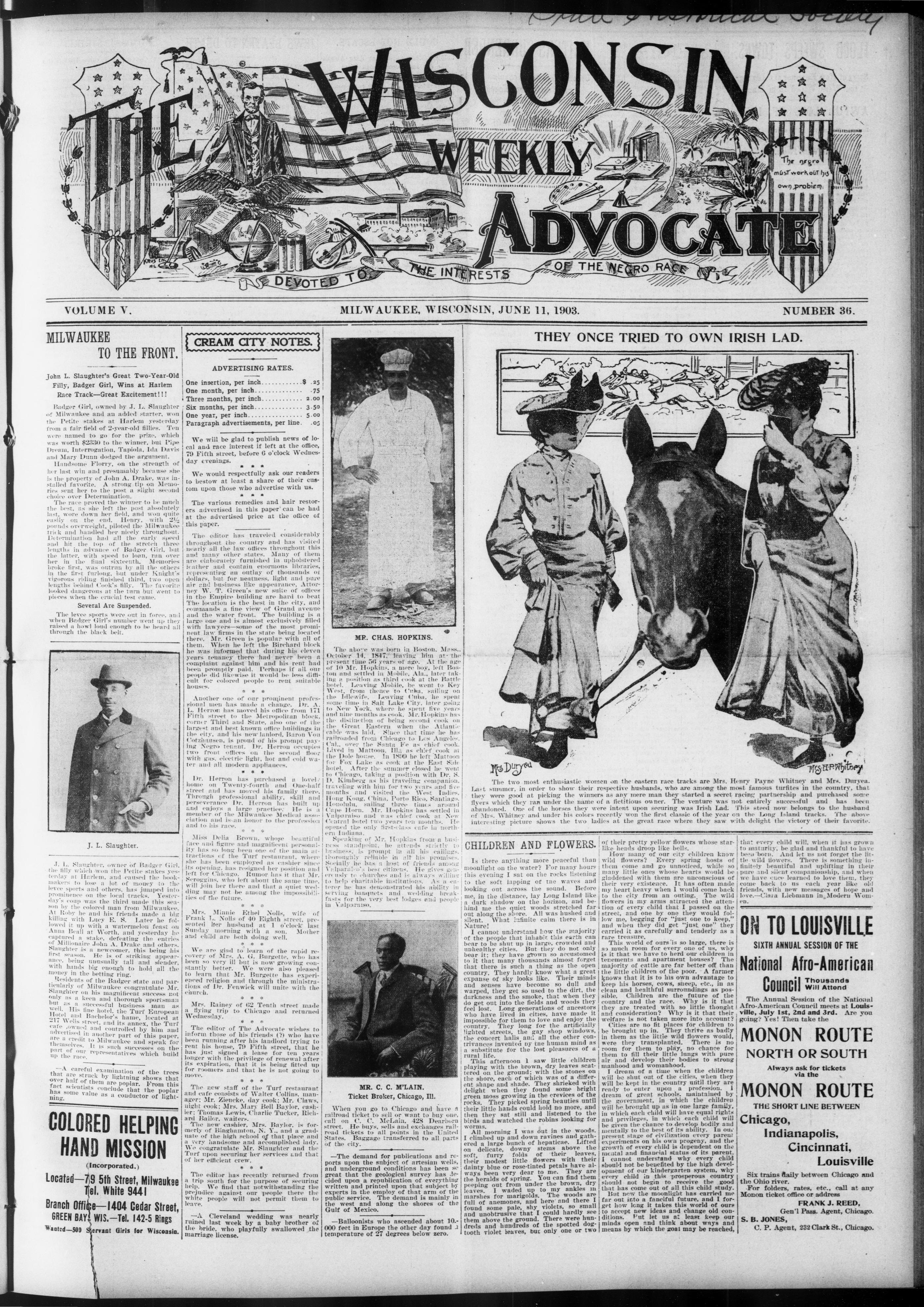
Page text (machine-generated)
WISCONSIN
WEEKLY
ADVOCATE
DEVOTED TO THE INTERESTS OF THE NEGRO RACE
VOLUME V.
MILWAUKEE TO THE FRONT.
John L. Slaughter's Great Two-Year-Old Filly, Badger Girl, Wins at Harlem Race Track—Great Excitement!!!
Badger Girl, owned by J. L. Slaughter of Milwaukee and an added starter, won the Petite stakes at Harlem yesterday from a fair field of 2-year-old fillies. Ten were named to go for the prize, which was worth $2330 to the winner, but Pipe Dream, Interrogation, Tapiola, Ida Davis and Mary Dunn dodged the argument.
Handsome Florry, on the strength of her last win and presumably because she is the property of John A. Drake, was installed favorite. A strong tip on Memories sent her to the post a slight second choice over Determination.
The race proved the winner to be much the best, as she left the post absolutely last, wore down her field, and won quite easily on the end. Henry, with 214 pounds overweight, piloted the Milwaukee trick and handled her nicely throughout. Determination had all the early speed and hit the top of the stretch three lengths in advance of Badger Girl, but the latter, with speed to loan, ran over her in the final sixteenth. Memories broke first, was outrun by all the others in the first furlong, but under Knight's vigorous riding finished third, two open lengths behind Cook's filly. The favorite looked dangerous at the turn but went to pieces when the crucial test came.
Several Are Suspended.
The levee sports were out in force, and when Badger Girl's number went up they raised a howl loud enough to be heard all through the black belt.
THE BOSTON EDITOR
J. L. Slaughter
J. L. Slaughter, owner of Badger Girl, the filly which won the Petite stakes yesterday at Harlem, and caused the bookmakers to lose a lot of money to the levee sports and others, has jumped into prominence on the local tracks. Yesterday's coup was the third made this season by the colored man from Milwaukee. At Roby he and his friends made a big killing with Lucy E. S. Later he followed it up with a watermelon feast on Anna Beall at Worth, and yesterday he captured a stake, defeating the entries of Millionaire John A. Drake and others. Slaughter is a newcomer, this being his first season. He is of striking appearance, being unusually tall and slender, with hands big enough to hold all the money in the betting ring.
Residents of the Badger state and particularly of Milwaukee congratulate Mr. Slaughter on his magnificent success not only as a keen and thorough sportsman but as a successful business man as well. His fine hotel, the Turf European Hotel and Bachelor's hame, located at 217 Welis street, and its annex, the Turf cafe owned and controlled by him and advertised in another part of this paper, are a credit to Milwaukee and speak for themselves. It is such successes on the part of our representatives which build up the race.
A careful examination of the trees that are struck by lightning shows that over half of them are poplar. From this fact scientists conclude that the poplar has some value as a conductor of lightning.
COLORED HELPING
HAND MISSION
(Incorporated.)
Located—79 5th Street, Milwaukee
Tel. White 9441
Branch Office—1404 Cedar Street,
GREEN BAY, WIS.—Tel. 142-5 Rings
Wanted—500 Servant Girls for Wisconsin.
CREAM CITY NOTES.
ADVERTISING RATES.
One insertion, per inch. $ .25
One month, per inch. .75
Three months, per inch. 2.00
Six months, per inch. 3.50
One year, per inch. 5.00
Paragraph advertisements, per line. .05
We will be glad to publish news of local and race interest if left at the office, 79 Fifth street, before 6 o'clock Wednesday evenings.
We would respectfully ask our readers to bestow at least a share of their custom upon those who advertise with us.
The various remedies and hair restorers advertised in this paper can be had at the advertised price at the office of this paper.
The editor has traveled considerably throughout the country and has visited nearly all the law offices throughout this and many other states. Many of them are elaborately furnished in upholstered leather and contain enormous libraries, representing an outlay of thousands of dollars, but for neatness, light and pure air and business like appearance, Attorney W. T. Green's new suite of offices in the Empire building are hard to beat The location is the best in the city, and commands a fine view of Grand avenue and the water front. The building is a large one and is almost exclusively filled with lawyers—some of the most prominent law firms in the state being located there. Mr. Green is popular with all of them. When he left the Birchard block he was informed that during his eleven years tenancy there had never been a complaint against him and his rent had been promptly paid. Perhaps if all our people did likewise it would be less difficult for colored people to rent suitable houses.
☆ ☆ ☆
Another one of our prominent professional men has made a change. Dr. A. L. Herron has moved his office from 171 Fifth street to the Metropolitan block, corner Third and State, also one of the largest and best known office buildings in the city, and his new lanlord, Baron Von Cotzhausen, is proud of his prompt paying Negro tenant. Dr. Herron occupies two front offices on the second floor with gas, electric light, hot and cold water and all modern appliances.
军 冰 海
Dr. Herron has purchased a lovely home on Twenty-fourth and One-half street and has moved his family there. Through professional ability, skill and perseverance Dr. Herron has built up and enjoys a large practice. He is a member of the Milwaukee Medical association and is an honor to the profession and to his race.
Miss Delia Brown, whose beautiful face and figure and magnificent personality has so long been one of the main attractions of the Turf restaurant, where she has been employed as cashier since its opening, has resigned her position and left for Chicago. Rumor has it that Mr. Scroggins, who left about the same time, will join her there and that a quiet welding may not be among the impossibilities of the future.
* * *
Mrs. Minnie Ethel Nolls, wife of Frank L. Nolls of 40 Eighth street, presented lter husband at 1 o'clock last Sunday morning with a son. Mother and child are both doing well.
```markdown
```
We are glad to learn of the rapid recovery of Mrs. A. G. Burgette, who has been so very ill but is now growing constantly better. We were also pleased to learn that Mr. Burgette has experienced religion and through the ministrations of Dr. Fenwick will unite with the church.
* * *
Mrs. Rainey of 62 Tenth street made a flying trip to Chicago and returned Wednesday.
* * *
The editor of The Advocate wishes to inform those of his friends (?) who have been running after his landlord trying to rent his house, 79 Fifth street, that he has just signed a lease for ten years longer with the privilege of renewal after its expiration, that it is being fitted up for roomers and that he is not going to move.
The new staff of the Turf restaurant and cafe consists of Walter Collins, manager; Mr. Ziencke, day cook; Mr. Claws, night cook; Mrs. Mary Bell Baylor, cashier; Thomas Lewis, Charlie Tucker, Richard Bailor, waiters.
The new cashier, Mrs. Baylor, is formerly of Binghamton, N. Y., and a graduate of the high school of that place and a very handsome and accomplished lady. We congratulate Mr. Slaughter and the Turf upon securing her services and that of her efficient crew.
* * *
The editor has recently returned from a trip south for the purpose of securing help. We find that notwithstanding the prejudice against our people there the white people will not permit them to leave.
A Cleveland wedding was nearly ruined last week by a baby brother of the bride, who playfully swallowed the marriage license.
MILWAUKEE, WISCONSIN, JUNE 11, 1903.
CHEF
MP. CHAS. HOPKINS
The above was born in Boston, Mass., October 14, 1847, leaving him at the present time 56 years of age. At the age of 10 Mr. Hopkins, a mere boy, left Boston and settled in Mobile, Ala., later taking a position as third cook at the Battle hotel. Leaving Mobile, he went to Key West, from thence to Cuba, sailing on the Idlewife. Leaving Cuba, he spent some time in Salt Lake City, later going to New York, where he spent five years and nine months as cook. Mr. Hopkins has the distinction of being second cook on the Great Eastern when the Atlantic cable was held. Since that time he has railroaded from Chicago to Los Angeles, Cal., over the Santa Fe as chief cook. Lived in Mattoon, Ill., as chief cook at the Dole house. In 1890 he left Mattoon for Fox Lake as cook at the East Side hotel. After the summer closed he went to Chicago, taking a position with Dr. S. D. Kimberg as his traveling companion, traveling with him for two years and five months and visited the West Indies. Hong Kong, China, Porto Rico, Santiago, Honolulu, sailing three times around Cape Horn. Mr. Hopkins has settled in Valparaiso and was chief cook at New Central hotel two years ten months. He opened the only first-class cafe in northern Indiana.
Speaking of Mr. Hopkins from a business standpoint, he attends strictly to business, is prompt in all his callings thoroughly reliable in all his promises. Socially he has a host of friends among Valparaiso's best citizens. He gives generously to churches and is always willing to help charitable institutions. As a caterer he has demonstrated his ability in serving banquets and wedding break fasts for the very best lodges and people in Valparaiso.
A.
MR. C. C. M'LAIN.
Ticket Broker, Chicago, Ill.
When you go to Chicago and have a railroad ticket to sell or want to buy one, call on C. C. McLain, 428 Dearborn street. He buys, sells and exchanges railroad tickets to all points in the United States. Baggage transferred to all parts of the city.
The demand for publications and reports upon the subject of artesian wells, and underground conditions has been so great that the geological survey has decided upon a republication of everything written and printed upon that subject by experts in the employ of that arm of the public service. The demand is mainly in the west and along the shores of the Gulf of Mexico.
Balloonists who ascended about 10,000 feet in Europe the other day found a temperature of 27 degrees below zero.
Mrs Duryea
Mrs HP Whitney
The two most enthusiastic women on the eastern race tracks are Mrs. Henry Payne Whitney and Mrs. Duryea. Last summer, in order to show their respective husbands, who are among the most famous turfites in the country, that they were good at picking the winners as any mere man they started a secret racing partnership and purchased some flyers which they ran under the name of a fictitious owner. The venture was not entirely successful and has been abandoned. One of the horses they were intent upon securing was Irish Lad. This steed now belongs to the husband of Mrs. Whitney and under his colors recently won the first classic of the year on the Long Island tracks. The above interesting picture shows the two ladies at the great race where they saw with delight the victory of their favorite.
CHILDREN AND FLOWERS.
Is there anything more peaceful than moonlight on the water? For many hours this evening I sat on the rocks listening to the soft lapping of the waves and looking out across the sound. Before me, in the distance, lay Long Island like a dark shadow on the horizon, and behind me the quiet woods stretched far out along the shore. All was hushed and silent. What infinite calm there is in Nature!
I cannot understand how the majority of the people that inhabit this earth can bear to be shut up in large, crowded and unhealthy cities. But they do not only bear it; they have grown so accustomed to it that many thousands almost forget that there is such a thing as the open country. They hardly know what a great expanse of sky looks like. Their minds and senses have become so dull and warped, they get so used to the dirt, the darkness and the smoke, that when they do get out into the fields and woods they feel lost. Long generations of ancestors who have lived in cities, have made it impossible for them to love and enjoy the country. They long for the artificially lighted streets, the gay shop windows, the concert halls, and all the other contrivances invented by the human mind as a substitute for the lost pleasures of a rural life.
This afternoon I saw little children playing with the brown, dry leaves scattered on the ground; with the stones on the shore, each of which was of a different shape and shade. They shrieked with delight when they found some bright green moss growing in the crevices of the rocks. They picked spring beauties until their little hands could hold no more, and then they sat still and listened to the birds and watched the robins looking for worms.
All morning I was out in the woods. I climbed up and down ravines and gathered a large bunch of hepaticae. Lifted on delicate, downy stems above the soft, furry folds of their leaves, their modest little flowers with their dainty blue or rose-tinted petals have always been very dear to me. They are the heralds of spring. You can find them peeping out from under the brown, dry leaves. I waded up to my ankles in marshes for marigolds. The woods are full of anemones, and here and there I found some pale, shy violets, so small and unobtrusive that I could hardly see them above the ground. There were hundreds and hundreds of the spotted dogtooth violet leaves, but only one or two
of their pretty yellow flowers whose starlike heads droop like bells. How many of our city children know wild flowers? Every spring hosts of them come and go unnoticed, while so many little ones whose hearts would be gladdened with them are unconscious of their very existence. It has often made my heart heavy when I would come back to the city from an outing. The wild flowers in my arms attracted the attention of every child that I passed on the street, and one by one they would follow me, begging for "just one to keep," and when they did get "just one" they carried it as carefully and tenderly as a rare treasure.
This world of ours is so large, there is so much room for every one of us, why is it that we have to herd our children in tenements and apartment houses? The majority of cattle are far better off than the little children of the poor. A farmer knows that it is to his own advantage to keep his horses, cows, sheep, etc., in as clean and healthful surroundings as possible. Children are the future of the country and the race. Why is it that they are treated with so little thought and consideration? Why is it that their welfare is not taken more into account? Cities are no fit places for children to be brought up in. They thrive as badly in them as the little wild flowers would, were they transplanted. There is no room for them to play, no chance for them to fill their little lungs with pure air and develop their bodies to strong manhood and womanhood.
I dream of a time when the children will be shut out of the cities, when they will be kept in the country until they are ready to enter upon a profession. I dream of great schools, maintained by the government, in which the children will be brought up as in one large family, in which each child will have equal rights and privileges, in which each child will be given the chance to develop bodily and mentally to the best of its ability. In our present stage of civilization every parent experiments on his own progeny, and the growth of every child is dependent on the mental and financial status of its parent. I cannot understand why every child should not be benefited by the high development of our kindergarten system, why every child in this prosperous country should not begin to receive the good that has come out of all this child study.
But new the moonlight has carried me far out into a fanciful future, and I forget how long it takes this world of ours to accept new ideas and change old conditions. Put let us at least keep our minds open and think about ways and means by which the goal may be reached.
NUMBER 36.
RISH LAD.
Henry Payne Whitney and Mrs. Duryea. Most famous turites in the country, that racing partnership and purchased some not entirely successful and has been this steed now belongs to the husband in the Long Island tracks. The above with delight the victory of their favorite.
that every child will, when it has grown to maturity, be glad and thankful to have been born. And let us not forget the little wild flowers. There is something infinitely beautiful and uplifting in their pure and silent companionship, and when we have once learned to love them, they come back to us each year like old friends, with new messages of hope and love.—Clara Liebmann in Modern Women.
ON TO LOUISVILLE
SIXTH ANNUAL SESSION OF THE
National Afro-American
Council Thousands
Will Attend
The Annual Session of the National Afro-American Council meets at Louisville, July 1st, 2nd and 3rd. Are you going? Yes! Then take the
MONON ROUTE
NORTH OR SOUTH
Always ask for tickets
via the
MONON ROUTE
THE SHORT LINE BETWEEN
Chicago,
Indianapolis,
Cincinnati,
Louisville
Six trains daily between Chicago and the Ohio river.
For folders, rates, etc., call at any Monon ticket office or address
FRANK J. REED,
Gen'l Pass. Agent, Chicago.
S. B. JONES,
C. P. Agent, 232 Clark St., Chicago.
---
Latest Estimates Place the Number Killed at 400—Hero's Wild Ride to Warn People.
Spokane, Wash., June 16.—Direct advices to The Chronicle from Heppner, Ore., at 10 o'clock this morning state that thus far the bodies of 200 victims of Sunday night's disaster have been found. Two hundred more are supposed to be hidden in the ruins or to have been swept down the valley by the torrent. An estimate this morning places the total number of dead at 400. Nearly all of these were in Heppner, it being thought few perished in the valley below the town. Today's reports indicate that the number of injured is comparatively small. "More provisions are needed" is the report from Heppner. Nearly all the eastern and northern parts of town are reported destroyed. The bodies are being buried in the cemetery rapidly, the summer weather making this course advisable. Though railway communication can hardly be expected before Friday, the county roads are reported to be almost impassable. The crops are reported to be destroyed.
Portland, Ore., June 16.—A special to The Oregonian from Ione, Ore., says: David McAtee, a business man of Heppner, whose residence is on a ranch above Heppner, was an eys-witness of the disaster. In company with Frank Spaulding he left Heppner about 10:30 o'clock Sunday night on horseback
A Wall of Water.
"On Sunday afternoon," said Mr. McAtee, "there has been a very severe rainstorm, accompanied with much wind and lightning. I was standing in front of the house and noticed that a cloud of remarkable denseness approached the top of the hill on the east side of the canyon. I turned for a moment, when a roar caused me to look again at the hill. I saw a wall of water, whose height I would be afraid to gauge, rushing down the mountain carrying immense trees and timbers on its crest and tearing the very rocks from their foundations.
Strikes the Town
"The terrific storm struck the upper part of the town first. The residence of Thomas Howard was the first to fall and his entire family was drowned. In the Krug home also every person was drowned, as was the case in the Hale and Saling residences. All of these houses were about four or five blocks above the business center. The house of Abram Hamsick was entirely demolished. The Palace hotel was the first building to stem the tide and all the guests were saved, but the houses below the hotel were blown out into the street, overturned and wrecked.
Whole Families Swept Away.
"The residence of G. A. Rhea was carried away and the entire family, consisting of both parents and three daughters and Miss Adkins, a cousin, were lost.
"Mr. Rhea himself was absent in Portland, attending the Masonic convention. C. E. Redfield, whose residence was completely destroyed, was also absent with Mr. Rhea in Portland and his wife and baby were drowned.
"The body of Mrs. Redfield is among the recovered. A. C. Gieger's house was carried away and Mr. Gieger was drawned. His family is in the east.
People Carried Away in Houses.
"George Concer's house was next, but the family succeeded in saving their lives by rushing to the upper stories, the house being carried down the creek three-quarters of a mile. When reached by the rescuers they found that the house had been cut in two and Mr. Concer was standing in water up to his neck, holding his wife upon the roof and keeping her from slipping with his outstretched arms. Dr. McSwatd and J. Ayers, who were living in the same residence, were drowned.
Cling to the Roof.
'Oscar Miner's house was next demolished and Mrs. Miner drowned. The rest of the family succeeded in saving their lives by clinging to the roof. All of the Wells family but two were lost and the house carried away. With the Wells residence went the house of George Swaggert. Mr. Swaggert's two married daughters were drowned with their five children. The Mallory house was carried 150 yards and was found lodged against a store, and Mr. Mallory, a crippled old man, was found safe, holding a baby. Jim Matlock's house was next. Mr. Matlock was drowned, but his family was saved. Dr. Higgs' house also went.
More Perish in Flood.
"Here one child was drowned, but the rest of the family escaped. Mrs. Elder was drowned in her residence. The houses of Mr. Boyd and Mr. Walton were also destroyed and both families lost. Mr. Barton succeeded in saving all persons in his residence, although they were badly bruised. The house itself was washed away.
Fifty Perish in Hotel.
"Perhaps the greatest loss of life occurred at the Heppner hotel. This house, which was run under the management of Jones & Ashbaugh, was carried away. It is supposed that there were about fifty guests in this hotel, all of whom are reported to be lost. The proprietors themselves were saved, but their families are among the dead.
"The houses of Ben Patterson, Mr. Dunn and Mr. Noble were entirely demolished and all persons in these three families drowned, as were the families of James Jones and Henry Blair. The barn of Dr. Swinneburn and the big livery stable of Whities & Meadows were entirely destroyed. E. J. Farnsworth and Philip Cohn were also drowned.
Business Portion Escapes.
The entire residence portion of Heppner was destroyed, but the business houses being on higher ground and being generally built of brick and stone were not so badly damaged. The schoolhouse and courthouse, which stands on a hill, were saved, but two churches, the Methodist and Presbyterian, were completely wrecked. "Around the depot the rising water left great heaps of driftwood piled higher than the roof of the station and the rescuing parties were forced to demolish these pyramids of timber in order to extricate the corpses which are tangled in the brush. Undoubtedly many of the drowned bodies were carried by the rushing waters down the valley.
Dead Strewn Along the Canyon.
"No systematic effort has been made to find the dead, who are undoubtedly strewn along the canyon.
"Every available man from a radius of sixty-five miles has been pressed into service at Heppner itself. Gangs of men are at work clearing away the piles of debris, rocks and timbers which lie
piled in heaps in Heppner's streets and taking out the corpses which are thus concealed. About 100 persons have been buried in Heppner's graveyard today. Owing to the entire absence of proper facilities for caring for the dead, the victims of the flood were for the most part interred in common crates.
Relief Train Arrives.
"A relief train sent from The Dalles reached Ione last night and will proceed to Heppner as soon as possible. A wrecking train with gangs of men to repair both the tracks and telegraph wires left Ione last night. It is expected that communication with Lexington, seventeen miles from Heppner, will be restored early today. On board The Dalles train are five doctors, six trained nurses, a committee of twenty Elks and another of six Eagles, with all necessary drugs and supplies to care for the sick and wounded. There is also a car of provisions."
Damage to Property Is $500,000.
Spokane, Wash., June 16.—A special to The Spokesman Review from Echo, Ore., quotes N. T. Tooker of Portland, who witnessed the Heppner disaster, as follows:
"It is estimated that the damage done to property alone was $500,000. Some of the brick and stone buildings were not torn away, but there were some of them moved from their foundations.
"The goods in several buildings were saved. When these merchants opened for business they sent word to the relief committee to come and take what goods were wanted. People were coming in from all directions to the assistance of the suffering and dead. They could not come by rail for nine miles of the track below town was washed away. All wire communication was prostrated."
Hero of the Dav.
"Leslie Matlock, a young man, was the hero of the day. When the flood first came he mounted a horse and rode at breakneck speed down the canyon in front of the rushing water to notify the people of Lexington, a small town nine miles below. He had to go over a rough and stony road, and the night was dark and stormy. He arrived at Lexington just a few minutes ahead of the flood. The people were warned and immediately left for the hillside. When the flood had passed only two houses were left standing."
NEW INDICTMENTS.
Federal Grand Jury at Washington Resumes the Consideration of Postoffice Cases.
Washington, D. C., June 16.—The federal grand jury here resumed the consideration of the postoffice department cases today. It is stated that two warrants were issued at the district attorney's office this morning for the arrest of persons involved in the scandals. No information can be obtained as to who the persons are against whom the warrants are directed.
Consider Toledo Case
The grand jury considered the case of George N. Lorenz, former postmaster at Toledo, O., whose name has been mentioned in connection with the case against August W. Machen, now under indictment. It is believed the grand jury will dispose of this case tomorrow.
President Takes Hold.
President Roosevelt had a long conference with Postmaster General Payne regarding the postal scandals. Mr. Roosevelt is now practically directing the course of the investigation, and will continue to do so until it is completed. He has confidence in Postmaster General Payne, but desires to be acquainted with every move and to be advised of all developments.
During the three hours' conference the entire situation was discussed, and President Roosevelt is advised fully now on every branch of the subject. The President asserted again that he proposes to leave no stone unturned until all who are guilty of bringing the postal system into disrepute have been dismissed from the service and punished.
Considerable time was devoted to several important cases which will be presented to the grand jury in New York this week. Out of these presentments will come several important arrests. While the department officials are reticent it is quite certain that the case of George W. Beavers, former superintendent of the salaries and allowance division, will be presented to the grand jury.
New Name in Scandal.
New York, June 16.—Ex-Congressman Edmund H. Driggs, a leading Democrat of Brooklyn and candidate against Borough President Swanstrom last year, has been brought into the investigation of the sale of stamp selling and change making machines to postoffices. Driggs does not deny that while in Congress he received $12,000 as vice president of the Brand Automatic Cash Register company, which sells the machines. It is alleged that while Driggs was in Congress his company sold to the government 250 machines for $175 apiece, or $25 above the market price. Inspectors Oldfield and Little had a talk with Driggs recently, and it is said he denied having used his influence with the postoffice department in the interest of the company.
Postmaster Van Cott does not seem disturbed because his attention has been called to the fact that Dr. W. H. Richardson, his son's brother-in-law, received a salary of $1700 a year from the post-office here. He is on the pay roll as "finance clerk."
COLOMBIA WON'T PASS CANAL TREATY.
Public Opinion Favors Turning Down Proposition and Congress Doesn't Dare Defy People.
Rogota, June 16.—The canal treaty will not be passed by the Colombian Congress called to meet on June 20. This is the consensus of the best informed opinion in the republic. Notwithstanding many rumors that have been sent from the capital, the fact remains that Congress does not dare defy the wishes of a majority of the people in the matter. Should it be left to a public vote the test would show an overwhelming majority antagonistic to the proposition. Public opinion is unanimously against the canal.
A BAD ACCIDENT AVERTED
Careless Fishermen Pack Loaded Revolver in Baggage and Charges Explode, Narrowly Missing Trainmen.
Negaunee, Mich., June 16.—[Special.]
—A quartette of careless fishermen of this city came near causing a catastrophe here yesterday. They had returned from a fishing expedition and had utensils in the baggage car of the Chicago & North-Western railway, packed among which was a loaded revolver. In unloading the stuff the revolver was discharged, the bullet just missing the baggageman and came within an ace of hitting a woman some distance away. The discharge of the revolver set the baggage on fire and five more shots were heard. It was looked upon as a miracle that no one was killed.
WAITERS SURRENDER
Unions Vote to Recognize Chicago Restaurant Keepers' Association.
GOMPERS URGES END OF STRIKE
Hotels and Restaurants Are All Running-Pickets Attack Women Who Seek Work.
Chicago, Ill., June 17.—The settlement of the hotel and restaurant strike appears today to hinge upon technicalities. The exact construction to be put upon the term "union recognition" is the stumbling block to a speedy adjustment of the difficulties between the parties to the controversy. The joint board of the strikers' unions is inclined to hold out for an agreement to employ union men and women only, while the hotel and restaurant owners declare they can do no more than promise not to discriminate.
The joint board in conference early today was unable to agree upon the acceptance of the employers terms and decided to submit the matter to President Gompers. The resumption of business by the large downtown restaurants precipitated several incipient fights, the pickets generally selecting women for their victims. On the whole, however, regular service with almost a full complement of help in the kitchens and dining rooms was effected by all of the strike-bound establishments.
President Gompers is said to have declared that the strike must not go on in the face of the fair offers made by the hotel and restaurant owners. He is not in favor of continuing the fight for the exclusive employment of unionists, holding that the union idea is strong enough to maintain and promote the growth of the unions. The steam power council, comprising engineers, firemen and elevator men, and the teamsters, advise the joint board to meet the employers in conference and not to continue the strike a day longer than is necessary.
After much discussion and a number of conferences, the joint board voted to surrender their former positions and to recognize the Restaurant Keepers' association and to ask for arbitration. It is generally believed that their action will be acceptable to the employers and that the end of the strike so far as the restaurants are concerned is in sight. A meeting of the restaurant keepers is called for tonight to receive the communication. Richmond, Va., June 17.—The long expected strike of trolley car men for higher wages was called a little after 3 o'clock this morning. It ties up the system in Richmond, Manchester and Petersburg.
WON'T EXCEED 200.
Confusion So Great at Heppner, Ore. That Accurate Estimate of Dead Is Impossible.
Heppner, Ore., June 17.—Confusion has been so great here that no accurate number of the lives lost by the flood could be made, and it is believed that all estimates sent out heretofore have been too high. Last night 130 bodies had been recovered and it is believed that the total number of dead will not exceed 200.
Montana Railroads Tied Up.
Big Timber, Mont., June 17.—The washouts on the Northern Pacific between this point and Billings were even worse than was first reported. Near Columbus a steel bridge 30 feet long was swept away. Oliver Bassett of Park City lost about 2500 head of sheep. The sheep shearing pens of Cabot Thomas were swept away. Traffic was resumed yesterday on the Northern Pacific. All trains are running late.
Breaks in Dike Closed.
Albuquerque, N. M., June 17.—The break in the dike at Alameda, eight miles above town, has been effectually closed, and with a falling river and a large force of men to guard the levee there is little further danger of a flood here. Six miles of the lower valley farms are under water and the people are living in tents on the highlands. It is feared that there will be severe suffering among those driven from their homes. The loss to crops is almost complete.
WILL PROSECUTE FORMER CONGRESSMAN.
E. H. Driggs of New York Alleged to Have Accepted $12,500 Bribe in Connection with Postal Scandals.
Washington, D. C., June 16.—Postmaster General Payne has decided to prosecute ex-Representative Edmund H. Driggs, a Democrat, of New York, who will be charged with bribery, growing out of acceptance of a fee from the Brandt Automatic Cash Register company for representing that company while Driggs was a member of the House. Driggs, who was charged with receiving a fee of $12, 500 a year for the four years he was in Congress, has admitted in a letter to the postmaster general that he did accept the fee, and asserts that he committed no wrong in doing so. One of the most significant facts in connection with this transaction is that as soon as Driggs' term expired, the Brandt Automatic Cash Register company ceased to pay Driggs the $12,500 a year. The members of the company will also be prosecuted.
MURDER IS FEARED.
Turkish Authorities Advise Son of Lake King Milan to Remain in Se-
Constantinople, June 17.—The Sultan has warned Mme. Christich, the mother of Milan, son of the late King Milan of Servia, to carefully guard her son. She is advised to keep her son in the house and not to allow him to appear on the streets.
It is presumed that this advice was the outcome of fears that an attempt may be made to murder young Milan, although it is not believed that there will ever be any prospect of his succeeding to the throne of Servia.
MEXICO PAYS DEBT PROMPTLY.
Breaks All Records in Settling Award of Arbitration Court
Washington, D. C., June 17.—Ambassador Clayton has cabled the state department that the Mexican government yesterday deposited to his credit $1,420.682 on account of the Pius fund award. This promptness on the part of the Mexican government in meeting its obligations has broken all records in arbitrations. The money will be remitted to Archbishop Riordan, bishop of San Francisco, the titular claimant, as there have been no assignments to attorneys in interest.
---
Soldiers Made Sure That King Alexander and Queen Draga Were Trapped.
Belgrade, June 17.—The correspondent of the Associated Press today was allowed to inspect the palace in which King Alexander and Queen Draga were murdered. The bedroom, which is furnished in Empire style, remains in the same condition as when the King and Queen fled from it on the approach of the assassins. French novels lie on the King's table and the Queen's toilet articles, perfumes and cosmetics, cover her dressing table.
Bed Full of Bullet Holes.
The costly silk bed coverings are full of bullet holes, the conspirators having shot wildly in all directions, through and under the bed, chairs and tables, in the efforts to find their victims.
A simple wardrobe room, leading directly from the bedroom, was the scene of the final act in the drama. The apartment is lofty, but scarcely 7 feet wide and 15 feet long, and is furnished only with three great wardrobes.
Where They Died.
The officers who attended the correspondent showed the latter the blood-stained floor at one end of the room, where the King and Queen fell, and the broken Venetian shutter at the window through which their bodies were thrown to the ground below.
A secret stairway leads through the floor to rooms in the southern end of the palace. By this stairway the hapless couple might have attempted to escape, but they were unable to do so, because the opening of this stairway was covered by a heavy chest.
Escape Cut Off.
Escape, in any event, would have been impossible, as the soldiers who had surrounded the palace were so determined to kill the King and Queen that they had even placed cannon in front of the palace and were prepared to destroy the building in the event of failing to find their prey. Each of the three rooms between the vestibule and the bedchamber showed marks of the tragedy. Mirrors were shattered, pictures were shot through, the furniture was broken, there were bullet holes in the doors and in the oil portraits of the King, which were in every room, and most of the latter were otherwise mutilated.
Not Repairing Palace
Contrary to the general understandings, but little effort had been made to renovate the apartments, except where the carpenters were making two new doors to replace those which had been blown to pieces at the time the conspirators forced their way into the rooms occupied by the King and Queen. The royal apartments were simply and tastefully furnished, chiefly in Oriental style, and presented a homelike appearance. The interior of the palace might have been that of a country house belonging to a prosperous American.
True Till Death.
The house of the King's adjutant, Lazar Petrovites, which was the first attacked, is even a greater wreck than the royal apartments in the palace. The entrance was completely destroyed by dynamite. The adjutant then escaped unhurt, but was killed later in the vestibule of the palace. A large bloodstain marks the spot where the officer died.
It was in a bare whitewashed room of the commandant's quarters, adjoining the palace, that Queen Draga's two brothers were shot while sitting on wooden chairs, which bear marks of the bullets.
The proceedings in the palace today showed the same absolute callousness which has characterized the actions and demeanor of everybody in Belgrade since the tragedy.
THREE MEN KILLED IN RAILWAY COLLISION.
Gravel Train Fails to Clear in Time for Passenger Train at Elmira, La
Cedar Rapids, Ia., June 17.—Three men were killed and four injured as the result of a collision of a Rock Island passenger train and a gravel train at Elmira, twenty miles south of here, early this morning. The accident was caused by the failure of the gravel train to clear the main track before the passenger train arrived. The dead:
HERRING, ELDON, Llsbon, and two unknown men, all stealing rides on the platform of the baggage car.
Injured:
T. A. Myers, passenger engineer, Cedar Rapids, internally; serious.
James Barnes, baggageman, leg, arm and thigh broken; serious.
thigh broken; serious.
Barnes, fireman gravel train, jaw broken.
Theo Hecht of Traer, passenger, ribs broken.
A number of passengers sustained minor hurts.
EMPLOYERS LOCK OUT 150,000 WORKMEN.
Will Force Unions to Sign Agreement to Submit All Questions to Arbitration.
New York, June 17.—Ten thousand employees of the George A. Fuller Construction company were thrown out of work today by order of the company, thus making the lockout in the building trades complete. While not joining the employers' association in membership, the Fuller company took this sympathetic action on the same grounds as those maintained by members of the association. Today the 150,000 laboring men who are idle because they are members of the building trades unions have been served with the ultimatum of the combined constructors that they will remain idle as long as the individual unions refuse to sign the plan or agreement of arbitration and conciliation proposed by the employers' association.
FRATERNITY INITIATON MAY CAUSE DEATH.
High School Lads Brand Candidates' Foreheads With Nitrate of Silver and Nitrate Acid.
New Bedford, Mass., June 17.—Clarence Mason is dying from an attack of blood poisoning as a result of being branded at an initiation of the secret society of the local high school. Joseph McIntyre, another student, is in a serious condition. One of the principal features of the initiation was the burning of Greek letters on the foreheads of the candidates by means of a preparation of nitrate of silver and nitric acid. The victims, if they recover, will be marked for life.
OFFERED BRIBE TO STAY AWAY.
Fcrmer Lieut.-Gov. Lee of Missouri Tells of $1000 Promised.
St. Louis, Mo., June 17.—It developed that an effort was made recently by an offer of money to have former Lieut.-Gov. Lee remain out of the state. The grand jury has information that Lee was offered $1000 to stay out of Missouri.
JEWS BEATEN TO DEATH.
RUSSIAN POLICE AND COSSACKS INJURE MANY OTHERS.
Young Hebrews March in Socialistic Parade and Authorities Attack Them at Lodz, Russian Poland
Berlin, June 17.—The Tageblatt today in mail advices from Lodz, Russian Poland, gives an account of disturbances there on Monday last. About 5000 young workingmen, Jews, paraded the streets in an orderly manner, but as a Socialist demonstration. The police, in view of the number of those engaged, called on the Cossacks for assistance and then the police and Cossacks charged the workingmen, beating them with the flat of their swords and with their fists and mercilessly continuing the beatings after a number of the men had been arrested and were helpless, and further beating them when the prisoners were taken into the police station, where, according to the mail advices, blood "ran in rivulets." It is reported that ten young men were beaten to death and that of the 100 who were arrested all were seriously wounded. Surgeons worked for five hours sewing up wounds after the fury of the police had been spent.
TO THE NORTH POLE.
Capt. Ammundsen's Magnetic Expedition Sets Out from Christiana,
Christiana, Norway, June 17.—The whaling ship Gjon, with Capt. Ammundsen's magnetic north pole expedition on board, sailed at midnight.
Capt. Ammundsen, who is a Norwegian, was the first officer of the Belgica in Gerlach's Antarctic expedition of 1897-99. After his return Ammundsen consulted with Prof. Neumayer of Hamburg, the leading authority on terrestrial magnetism, who informed him that expert determination of the earth's magnetic north pole would be of the very greatest value to science. The fitting out of the expedition which has just left Christiana followed
The Gjoa is classed as being one of the strongest and best vessels of the Arctic fleet. She can be handled by a crew of seven, is fitted with an auxiliary petroleum engine and is equipped for a four years' stay in the Arctic regions.
It has been announced that the Ammundsen expedition will first go to King William land on the east coast of Greenland, and will thence proceed for Bering Strait. If Capt. Ammundsen is able to follow the course projected, it will take him almost across the Pole.
GREAT VICTORY FOR THE SOCIALISTS.
Result of the Reichstag Election in Germany—Gained at Expense of Radical Parties.
Berlin, June 17.—The Socialists' victory at the Reichstag elections yesterday was largely at the expense of the two Radical parties, who voted as the Socialists did in the last Reichstag on tariff, military and naval affairs. Hence on these questions the new house is not distinctly different from the old one. The official returns from 330 constituencies are:
Socialists, 53; Center party, 60; Conservatives, 21; Free Conservatives, 4; National Liberals, 6; Poles, 5; other factions, 12. Total of members elected, 161.
Second elections are required in 169 constituencies.
The failure of either of the Radical parties to get a single seat does not mean that they will not get a number of members at the second elections, as their candidates will be supported by all the anti-Socialist parties.
KIDNAPED BOY WAS CAGED WITH MONKEYS.
Circus People Wanted to Train Him for "A Wild Boy"—Guilty Man Threatened With Lynching.
East St. Louis, Ill., June 17.—Locked up in cages with monkeys and other animals, his face and hands discolored to disguise him and his clothing taken away to make him as near to an animal as possible, was the experience of John Layton, a 6-year-old boy, according to his story just told to the police.
It was a training to be a "wild boy," with a circus the little fellow was given, and for a week after he was kidnapped from his parents he underwent the turtures that have driven him almost insane. The face and hands of the boy are stained and scratches and scars on his body bear evidence that the story of his treatment is true.
Sylvester Baker, a negro attache of the show, is under arrest and has been taken to Belleville to prevent a possible lynching.
PLAN FOR INSURANCE AGAINST STRIKES.
Policy Holders Will Be Kept Secret and Expert Legal Advice Will Be a Feature.
Indianapolis, Ind., June 17.—David M. Parry, president of the National Manufacturers' association, commenting on the proposed organization of a company to insure employers of labor against strikes, says the company will undoubtedly be formed. He said that it would necessarily be a mutual company and that the membership would be kept secret, only the officers being known.
"Organized labor will never know," he said, "when it orders a strike whether it is really fighting combined capital or merely making an onslaught on one individual. The object of the company will be to protect its policy holders from losses resulting from strikes and also protect independent workmen. The company will have a legal department and will prosecute any man who attempts any coercion or commits any violation of law."
BRIGANDS SEIZE AUTHOR.
Walter B. Harris Held in Mountains Near Tangier, Morocco—Troops Attack Stronghold Without Avail.
Tangier, Morocco, June 17.—Walter B. Harris, the traveler and author, who was a member of Sir Arthur Nicholson's special British embassy to the Sultan of Morocco last year, is a prisoner of the mountaineers at Zeenat, the headquarters of the bandit Raisuli. Government troops attacked the place yesterday, burning many farms, but they did not succeed in rescuing Mr. Harris.
Miners' Convention Decides That There Will Be No Walkout in Anthracite District.
Scranton, Pa., June 16.—President Mitchell's advice has prevailed and all talk of strike has been silenced.
The convention of the Anthracite Mine workers today adopted resolutions providing that each district should vote separately on the election of the representatives on the conciliation board. The resolutions were adopted without a dissenting vote. Following this the delegates in the different districts voted separately, after which the convention by a rising vote ratified the action.
Another resolution was adopted providing that all grievances instead of being thrashed out in debate should be given to the conciliation board for consideration.
The convention adjourned at 11:50 o'clock to meet again at 2 p. m. Adjournment was taken for the purpose of giving the operators an opportunity to either accept or reject the action of the convention in endorsing the action of the executive board in appointing the members of the board of conciliation. There is no doubt that the operators will accept the action of the convention.
President Mitchell told the convention there was no advance in wages yet due the miners. The average price of coal has not been higher than $4.52. By the end of June the average price will have reached $4.62, which will entitle the miners to a 2 per cent. increase. President Mitchell said he had seen these figures and had reason to believe they were correct.
The miners' convention adjourned sine die at 2:45 p. m.
Altoona, Pa., June 16.—Up to noon today the bituminous miners employed by the Webster Coal company had received no strike orders from their officials and all except the Bens Creek miners are at work.
CHICAGO WAITERS ARE BADLY BEATEN.
All the Restaurants and Hotels Are Either Open or Ready to Start in business.
Chicago, Ill., June 16.—So many of the waiters and striking hotel and restaurant employees have returned and asked to be reinstated that nearly all of the restaurants and cafes that have been closed for several days have either opened their doors again or have announced their intention of doing so tomorrow. Vogelsang's, the first place in which a strike was called and which has made no effort to serve patrons of the restaurant, resumed business today. The conditions in all the hotels are reported satisfactory. Everyone of them in which strikes were called is running in some fashion and most of them are giving regular service.
The strike leaders held an early conference to decide what reply should be returned to the peace proposal of the committee from the steam power council. All parties to the controversy were asked yesterday by that committee if they would submit their grievances to arbitration. Answers from all are looked for at a series of conferences today.
MAY BUY CORPORATIONS.
Missouri Court Holds Trust Law Not Violated by Absorption of One Concern by Another.
Jefferson City, Mo., June 16.—The supreme court decided against Attorney General Crow in his suit for a decree in ouster against the Continental Tobacco company, because of its alleged violation of Missouri's anti-trust laws. The court holds that a corporation in the legitimate pursuit of its business can buy up all the smaller corporations it has the money to pay for. The court says that the evidence fails to show a combination or trust.
The court also decided in favor of thirteen railroads against whom Attorney General Crow had instituted suits of ouster for violation of laws relating to re-consignment charges. The court held that the case was prosecuted solely for the vindication of private rights. The court says the statute provides ample relief for remedy at the hands of the railroad and warehouse commissioners.
BANK OFFICIAL COMMITS SUICIDE.
Frank Dean of New York Takes His Own Life—Despondent Over Domestic Afflictions.
New York, Wis., June 16.—Frank Dean, a vice-president of the Seaboard National bank, committed suicide today at his home in Orange, N. J., by shooting himself in the head. Mr. Dean's family advance no reason for his act, but at the bank the officers said Mr. Dean was despondent over domestic afflictions. Mrs. Dean has been an invalid for years and an only son, about 12 years old, was recently stricken with pneumonia. Mr. Dean's death was not influenced, by financial matters, as he was involved in no investments. Up to a few months ago Mr. Dean was cashier of the Fifth Avenue bank. He was 40 years old.
HOPE TO SAVE BROTHER.
Mrs. J. H. Raub of Racine Is Trying to Secure Release from Prison of Convicted Murderer.
Laporte, Ind., June 16.—[Special.]—Mrs. J. H. Raub of Racine, Wis., sister of Josephus Mallory, the Racine boy who is under life sentence for murder, has engaged an attorney to carry the case to the supreme court, where she is hopeful of securing a reversal of the judgment of the lower court. Mallory, who is an expert stenographer, has been assigned to the position of assistant to Rev. H. L. Henderson, chaplain of the penitentiary.
Saved.
Bookkeeper—I had to confess to the boss today that I had forgotten to post my books for February.
Clerk—Phew! I'll bet he jumped all over you.
Bookkeeper—No; as soon as I told him he said: "Gee whizz! That reminds me. I forgot to post the letters my wife gave me yesterday." So he forgot all about me—Philadelphia Press.
New Torpedo Boat.
The Erne, the first of the type of torpedo boats designed since those of the Cobra class, which had a tendency to break in two in the middle, is just launched on the Tyne. She has a forecastle instead of a turtle deck and is of greater displacement than the older class. The speed is $ 2 5 \frac{1}{2} $ knots.
The rural schools of New York average twenty-seven pupils each. In each of 3628 schools there are ten or less.
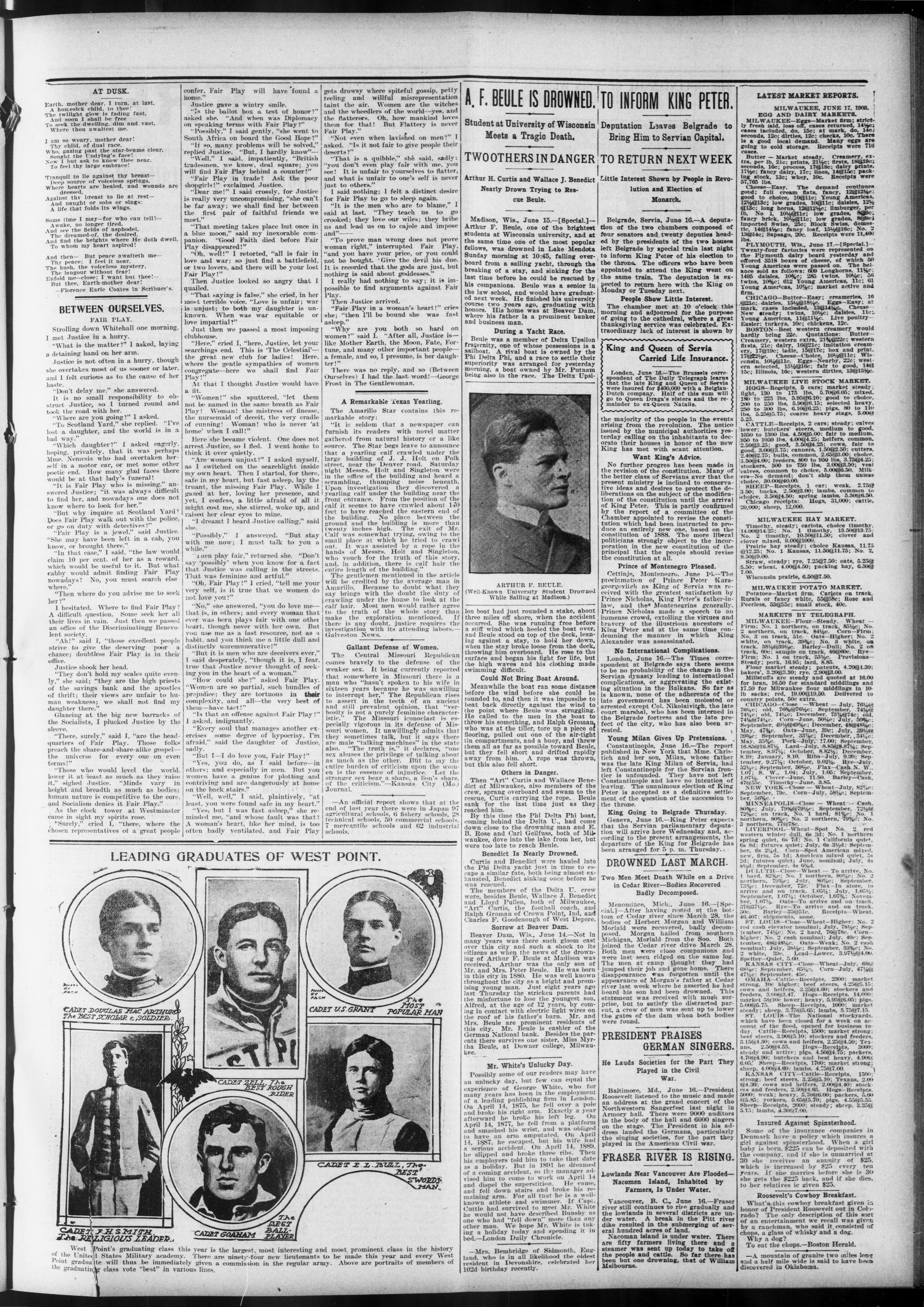
LEADING GRADUATES OF WEST POINT.
CADET DOUGLAS MAC ARTHUR
The BEST SCHOLAR & SOLDIER.
CADET U.S. GRANT
The MOST POPULAR MAN
CADET ZELL, The
BEST ROUGH
RIDER
CADET E. L. BULL, The
BEST SWORDS
MAN.
CADET F. H. S. MITH
The RELIGIOUS LEADER.
CADET GOAHAM
The BEST
BALL-PLAYER
West Point's graduating class this year is the largest, most interesting and most prominent class in the history of the United States Military academy. There are ninety-four new lieutenants to be made this year and every West Point graduate will thus be immediately given a commission in the regular army. Above are portraits of members of the graduating class vote "best" in various lines.
AT DUSK
Earth, mother dear, I turn, at last,
A honestick child, to thee!
The twilight glow is fading fast,
And soon I shall be free
To seek the dwelling, dim and vast,
Where thou awaist me.
Who, gazing past the star-beams clear,
Sought the Undyring's face!
Now I but ask to know the near,
To feel thy large embrace!
Deep source of life
Where hearts are healed, and wounds are
dressed,
Against thy breast to lie at rest—
And naught or sobs or sings:
A life that folds its wings.
Some time I may—for who can tell?—
Awake, no longer tired,
And see the fields of asphodel,
The dreamed-of, the desired,
And find the heights where He doth dwell,
To whom my heart aspired!
And then— But peace awaiteth me—
Thy peace: I feel it near.
The hush, the volceless mystery,
The langour without fear!
Enfold me—close; I want but thee!—
But thee, Earth-mother dear!
BETWEEN OURSELVES.
FAIR PLAY.
Strolling down Whitehall one morning, I met Justice in a hurry. "What is the matter?" I asked, laying a detaining hand on her arm. Justice is not often in a hurry, though she overtakes most of us sooner or later; and I felt curious as to the cause of her haste. "Don't delay me" she answered.
"Don't delay me," she answered.
It is no small responsibility to obstruct Justice, so I turned round and took the road with her.
"Where are you going?" I asked.
"To Scotland Yard," she replied. "I've lost a daughter, and the world is in a bad way."
"Which daughter?" I asked eagerly, hoping, privately, that it was perhaps Mme. Nemesis who had overtaken herself in a motor car, or met some other poetic end. How many glad faces there would be at that lady's funeral!
"It is Fair Play who is missing," answered Justice; "it was always difficult to find her, and nowadays one does not know where to look for her."
"But why inquire at Scotland Yard? Does Fair Play walk out with the police, or go on duty with detectives?" "Fair Play is a jewel," said Justice. "She may have been left in a cab, you know, or brought there." "In that case," I said, "the law would claim 10 per cent. of her as a reward, which would be useful to it. But what cabby would admit finding Fair Play nowadays? No, you must search else where." "Then where do you advise me to seek her?" I hesitated. Where to find Fair Play? A difficult question. Some seek her all their lives in vain. Just then we passed an office of the Discriminatingg Benevolent society
"Ah!" said I, "those excellent people strive to give the deserving poor a chance; doubtless Fair Play is in their office.
Justice shook her head.
"They don't hold my scales quite evenly," she said; "they are the high priests of the savings bank and the apostles of thrift; their views are unfair to human weakness; we shall not find my daughter there."
Glancing at the big new barracks of the Socialists, I plucked Justice by the sleeve.
"There, surely," said I, "are the headquarters of Fair Play. Those folks preach the share-and-share-alike gospel—the universe for every one on even terms!"
"Those who would level the world, lower it at least as much as they raise it," sighed Justice. "Minds vary in height and breadth as much as bodies; human nature is competitive to the core, and Socialism denies it Fair Play." As the clock tower at Westminster came in sight my spirits rose.
"Surely," cried I, "there, where the chosen representatives of a great people
confer, Fair Play will have found a home."
Justice gave a wintry smile.
"Is the ballot box a test of honor?" asked she. "And when was Diplomacy on speaking terms with Fair Play?"
"Possibly," I said gently, "she went to South Africa on board the Good Hope?"
"If so, many problems will be solved," replied Justice. "But, I hardly know"—"Well." I said, impatiently, "British tradesmen, we know, deal square; you will find Fair Play behind a counter!"
"Fair Play in trade? Ask the poor shopgirls!" exclaimed Justice.
"Dear me!" I said crossly, for Justice is really very uncompromising, "she can't be far away; we shall find her between the first pair of faithful friends we meet."
"That meeting takes place but once in a blue moon," said my inexorable companion. "Good Faith died before Fair Play disappeared!"
"Oh, well!" I retorted, "all is fair in love and war; so just find a battlefield, or two lovers, and there will be your lost Fair Play!"
Then Justice looked so angry that I quailed.
"That saying is false," she cried, in her most terrible voice. "Love is unfair; war is unjust; to both my daughter is unknown. When was war equitable or love impartial?"
Just then we passed a most imposing clubhouse.
"Here," cried I, "here, Justice, let your searchings end. This is 'The Celestial'—the great new club for ladies! Here, where the gentle sympathies of women congregate—here we shall find Fair Play!"
At that I thought Justice would have a fit.
"Women!" she sputtered, "let them not be named in the same breath as Fair Play! Woman! the mistress of finesse, the nursemaid of deceit, the very cradle of cunning! Woman! who is never 'at home' when I call!" Here she became violent. One does not arrest Justice, so I fled. I went home to think it over quietly. "Are women unjust?" I asked myself, as I switched on the searchlight inside my own heart. Then I started, for there, safe in my heart, but fast asleep, lay the truant, the missing Fair Play. While I gazed at her, loving her presence, and yet, I confess, a little afraid of all it might cost me, she stirred, woke up, and raised her clear eyes to mine.
"I dreamt I heard Justice calling," said she.
"Possibly," I answered. "But stay with me now; I must talk to you a while."
"Men play fair," returned she. "Don't say 'possibly' when you know for a fact that Justice was calling in the streets. That was feminine and artful."
"Oh, Fair Play!" I cried, "tell me your very self, is it true that we women do not love you?"
"No," she answered, "you do love me—that is, in others; and every woman that ever was born plays fair with one other heart, though never with her own. But you use me as a last resource, not as a habit, and you think me a little dull and distinctly unremunerative!"
"But it is men who are deceivers ever," I said desperately, "though it is, I fear, true that Justice never thought of seeking you in the heart of a woman."
"How could she?" asked Fair Play. "Women are so partial, such bundles of prejudice; they are tortuous in their complexity, and all—the very best of them—have tact!"
"Is that an offense against Fair Play?" I asked, indignantly.
"Every soul that manages another exercises some degree of hypocrisy. I'm afraid," said the daughter of Justice, sadly.
"But I—I do love you, Fair Play!"
"Yes, you do, as I said before—in others; and especially in men. But you women have a genius for plotting and contriving and are dangerously at home on the back stairs."
"Well, well," I said, plaintively, "at least, you were found safe in my heart."
"Yes, but I was fast asleep," she reminded me, "and whose fault was that? A woman's heart, like her mind, is too often badly ventilated, and Fair Play
gets drowsy where spiteful gossip, petty
feeling and willful misrepresentation
taint the air. Women are the witches
and the wheedlers of the world—yes, and
the flatterers. Oh, how mankind loves
them for that! But Flattery is never
Fair Play."
"Not even when lavished on men?" I
asked. "Is it not fair to give people their
deserts?"
"That is a quibble," she said, sadly:
"you don't even play fair with me, you
see! It is unfair to yourselves to flatter,
and what is unfair to one's self is never
just to others."
I said nothing; I felt a distinct desire
for Fair Play to go to sleep again.
"It is the men who are to blame," I said at last. "They teach us to go crooked; they love our wiles; they bribe us and lead us on to cajole and impose and"——
"To prove man wrong does not prove woman right," interrupted Fair Play, "and you have your price, or you could not be bought. Give the devil his due. It is recorded that the gods are just, but nothing is said about goddesses."
I really had nothing to say; it is impossible to find arguments against Fair Play.
Then Justice arrived.
"Fair Play in a woman's heart!" cries she; "then I'll be bound she was fast asleep."
"Why are you both so hard on women?" said I. "After all, Justice is like Mother Earth, the Moon, Fate, Fortune, and many other important people—a female, and so, I presume, is her daughter!"
There was no reply, and so (Between Ourselves) I had the last word!—George Frost in The Gentlewoman.
A Remarkable Texas Yearling
The Amarillo Star contains this remarkable story:
"It is seldom that a newspaper can furnish its readers with novel matter gathered from natural history or a like source. The Star begs leave to announce that a yearling calf crawled under the large building of J. J. Holt on Polk street, near the Denver road. Saturday night Messrs. Holt and Singleton were in the office of the building and heard a scrambling, thumping noise beneath. Upon investigation they discovered a yearling calf under the building near the front entrance. From the position of the calf it seems to have crawled about 140 feet to have reached the eastern end of the building. No place between the ground and the building is more than twenty inches high. The exit of Mr. Calf was somewhat trying, owing to the small place at which he tried to crawl out. It was assisted by a rope in the hands of Messrs. Holt and Singleton, who vouch for the truth of this story, and, in addition, there is calf hair the entire length of the building."
The gentlemen mentioned in the article will be credited by the average man in Amarillo. Because to doubt what they say brings with the doubt the duty of crawling under the house to look at the calf hair. Most men would rather agree to the truth of the whole story than make the exploration mentioned. If there is any doubt, justice requires the investigation with its attending labors. Galveston News.
Gallant Defense of Women.
The Central Missouri Republican comes bravely to the defense of the weaker sex. It being currently reported that somewhere in Missouri there is a man who "hasn't spoken to his wife in sixteen years because he was unwilling to interrupt her," The Republican rises to assert in the teeth of an ancient and still prevalent opinion, that "verbosity is not a purely feminine characteristic." The Missouri iconoclast is especially vigorous in its defense of Missouri women. It unwillingly admits that they sometimes talk, but it says there are male "talking machines" in the state also. "The truth is," it declares, "one sex abuses the privilege of talking about as much as the other. But to say the entire burden of criticism upon the women is the essence of injustice. Let the stronger sex bear a share, a lion's share, of the criticism."—Kansas City (Mo.) Journal.
An official report shows that at the end of last year there were in Japan 97 agricultural schools, 6 fishery schools, 28 technical schools, 50 commercial schools, 7 mercantile schools and 62 industrial schools.
A. F. BEULE IS DROWNED
Student at University of Wisconsin Meets a Tragic Death.
TWOOTHERS IN DANGER
Madison, Wis., June 15.—[Special.]—Arthur F. Beule, one of the brightest students at Wisconsin university, and at the same time one of the most popular fellows, was drowned in Lake Mendota Sunday morning at 10:45, falling overboard from a sailing yacht, through the breaking of a stay, and sinking for the last time before he could be rescued by his companions. Beule was a senior in the law school, and would have graduated next week. He finished his university course two years ago, graduating with honors. His home was at Beaver Dam, where his father is a prominent banker and business man.
During a Yacht Race.
Beule was a member of Delta Upsilon fraternity, one of whose possessions is a sailboat. A rival boat is owned by the Phi Delta Phi, and a race to settle their superiority was arranged for yesterday morning, a boat owned by Mr. Putnam being also in the race. The Delta Upsi-
[Image of a man in a suit with a tie].
ARTHUR F. BEULE. (Well-Known University Student Drowned While Sailing at Madison.)
lon boat had just rounded a stake, about three miles off shore, when the accident occurred. She was running free before a stiff wind which heeled the boat over, and Beule stood on top of the deck, leaning against a stay, to hold her down, when the stay broke loose from the deck, throwing him overboard. He rose to the surface and began his fight for life, but the high waves and his clothing made swimming difficult.
Could Not Bring Boat Around.
Meanwhile the boat ran some distance before the wind before she could be rounded to, and then it was impossible to beat back directly against the wind to the point where Beule was struggling. He called to the men in the boat to throw his something, and Ralph Groman, who was at the tiller, tore up a piece of flooring, pulled out one of the air-tight tin compartments, and a buoy, and threw them all as far as possible toward Beule, but they fell short and drifted rapidly away from him. A rope was thrown, but this also fell short.
Others in Danger.
Then "Art" Curtis and Wallace Benedict of Milwaukee, also members of the crew, sprang overboard and swam to the rescue, Curtis carrying the rope. Beule sank for the last time just as they reached him.
By this time the Phi Delta Phi boat, coming behind the Delta U., had come down close to the drowning man and E. B. Rose and Carl Geilfuss, both of Milwaukee, dove into the lake from her, but were too late to reach Beule.
Benedict Is Nearly Drowned.
Curtis and Benedict were hauled into the Phi Delta yacht just in time to escape a similar fate, both being almost exhausted, Benedict sinking once before he was rescued.
The members of the Delta U. crew were, besides Beule, Wallace J. Benedict and Lloyd Pullen, both of Milwaukee, "Art" Curtis, the football coach, and Ralph Groman of Crown Point, Ind, and Charles F. Goodenough of West Depere.
Sorrow at Beaver Dam.
Beaver Dam, Wis., June 14.—Not in many years was there such gloom cast over this city and such a shock to its citizens as when the news of the drowning of Arthur F. Beule at Madison was received. Arthur was the only son of Mr. and Mrs. Peter Beule. He was born in this city in 1880. He was well known throughout the city as a bright and promising young man. Just eight years ago last Thursday the stricken parents had the misfortune to lose the youngest son, Alfred, at the age of 12 years, by coming in contact with electric light wires on the roof of his father's barn. Mr. and Mrs. Beule are prominent residents of this city. Mr. Beule is cashier of the German National bank. Besides the parents there survives one sister, Miss Myrtha Beule, at Downer college, Milwaukee.
Mr. White's Unlucky Day.
Possibly some of our readers may have an unlucky day, but few can equal the experience of George White, who for many years has been in the employment of a leading publishing firm in London. On April 14, 1875, he fell over a pole and broke his right arm. Exactly a year afterward he broke his left leg. On April 14, 1877, he fell from a platform and smashed his wrist, and was obliged to have an arm amputated. On April 14, 1887, he escaped, but his wife had a serious accident. On April 14, 1889, he slipped and broke three ribs. Then his employers told him to take that date as a holiday. But in 1891 he dreamed of a coming accident, so the manager advised him to come to work on April 14 and dispel the superstition. He came, and fell down stairs and broke his remaining arm. For all that he is a well-known athlete and swimmer. If Capt. Cuttle had survived to meet Mr. White he would not have described Bunsby as one who had "fell down" more than any other man. We hope Mr. White is taking a holiday today and spending it in bed.—London Daily Chronicle.
—Mrs. Bembridge of Sidmouth, England, who is in all likelihood the oldest resident in Devonshire, celebrated her 102d birthday recently.
TO INFORM KING PETER.
Deputation Leaves Belgrade to Bring Him to Servian Capital.
TO RETURN NEXT WEEK
Little Interest Shown by People in Revolution and Election of
Belgrade, Servia, June 16.—A deputation of the two chambers composed of four senators and twenty deputies headed by the presidents of the two houses left Belgrade by special train last night to inform King Peter of his election to the throne. The officers who have been appointed to attend the King went on the same train. The deputation is expected to return here with the King on Monday or Tuesday next.
People Show Little Interest
The chamber met at 10 o'clock this morning and adjourned for the purpose of going to the cathedral, where a great thanksgiving service was celebrated. Extraordinary lack of interest is shown by
London, June 16.—The Brussels correspondent of The Daily Telegraph learns that the late King and Queen of Servia were insured for $400,000 with a Belgian-Dutch company. Half of this sum will go to Queen Draga's sisters and the remainder to ex-Queen Natalie.
the majority of the people in the events arising from the revolution. The notice issued by the municipal authorities yesterday calling on the inhabitants to decorate their houses in honor of the new King has met with scant attention.
Want King's Advice
No further progress has been made in the revision of the constitution. Many of the better class of Servians aver that the present ministry is inclined to conservative ideas and desires to protect the deliberations on the subject of the modification of the constitution until the arrival of King Peter. This is partly confirmed by the report of a committee of the Chamber appointed to revise the constitution which had been instructed to produce an entirely new one, based on the constitution of 1888. The more liberal politicians strongly object to the incorporation in the new constitution of the principal that the people should revise the constitution at all.
Prince of Montenegro Pleased.
Cettinje, Montenegro. June 16.—The proclamation of Prince Peter Karageorgevitch as King of Servia was received with the greatest satisfaction by Prince Nicholas, King Peter's father-in-law, and the Montenegrins generally. Prince Nicholas made a speech to an immense crowd, extolling the virtues and bravery of the illustrious ancestors of King Peter and at the same time condemning the manner in which King Alexander was assassinated.
No International Complications.
London, June 16.—The Times correspondent at Belgrade says there seems to be no probability of the change in the Servian dynasty leading to international complications, or aggravating the existing situation in the Balkans. So far as is known, none of the adherents of the late government has been molested or arrested except Col. Nikolaivitch, the late court marshal, who has been interned in the Belgrade fortress and the late prefect of the city, who has also been arrested.
Young Milan Gives Up Pretensions.
Constantinople, June 16.—The report published in New York that Mme. Christich and her son, Milan, whose father was the late King Milan of Servia, had left Constantinople for the Servian frontier is unfounded. They have not left Constantinople and have no intention of leaving. The unanimous election of King Peter is accepted as a definitive settlement of the question of the succession to the throne.
King Going to Belgrade Thursday.
Geneva, June 16.—King Peter expects that the Servian parliamentary deputation will arrive here Wednesday and, according to the present arrangements, the departure of the King for Belgrade has been arranged for 5 p. m. Thursday.
DROWNED LAST MARCH.
Two Men Meet Death While on a Drive in Cedar River—Bodies Recovered Badly Decomposed.
Menominee, Mich., June 16.—[Special.]—After having rested at the bottom of Cedar river since March 28, the bodies of Herbert Morgan and William Morlald were recovered, badly decomposed. Morgan hailed from southern Michigan, Morlald from the Soo. Both joined the Cedar river drive March 28. Both men were close companions and were last seen ridged on the same log. The men at camp thought they had jumped their job and gone home. There disappearance was forgotten until the appearance of Morgan's father at Cedar river last week where he asserted he had heard his son had been drowned. This statement was received with much surprise, but to satisfy the distracted parent, a crew of men was sent up to lower the gates of the dam when both bodies were found.
PRESIDENT PRAISES GERMAN SINGERS.
He Lauds Societies for the Part They Played in the Civil War.
Baltimore, Md., June 16.—President Roosevelt listened to the music and made an address at the grand concert of the Northwestern Sangerfest last night in Armory hall. There were 9000 auditors in the body of the hall and 6000 singers on the stage. The President in his address lauded the Germans, particularly the singing societies, for the part they played in the American Civil war.
FRASER RIVER IS RISING.
Lowlands Near Vancouver Are Flooded— Nacomen Island, Inhabited by Farmers, Is Under Water.
Vancouver, B. C., June 16.—Fraser river still continues to rise gradually and the lowlands in several districts are under water. A break in the Pitt river dike resulted in the submerging of several hundred acres of land.
Nacoman island is under water. There are fifty farmers living there and a steamer was sent up today to take off the people and cattle. So far there has been but one drowning, that of William Melbourne.
LATEST MARKET REPORTS.
MILWAUKEE, JUNE 17, 1908.
SC. AND DAIRY, MARKETS
MILWAUKEE-Eggs-Market firm; strictly fresh iald, loss off, cases returned, 141c; cases lacluded, do, 15c; at mark, do, 14c; seconds, 12c; dirtles, 12c; checks, 10c. There is a good local demand. Many eggs are going to cold storage. Receipts were 716 cases.
Butter — Market steady. Creamery, extra, per lb, 21c; prints, 211c; firsts, 18@10c; seconds, 16c; process, 17@18c; dalry prints, 171c; fancy dalry, 17c; lines, 14@15c; packing stock, 13c; whey, 10c. Receipts were 57,765 lbs.
Cheese-Easy. The demand continues good; full cream flats, fancy, 12@121c; good to choice, 10@11c; Young Americas, 1211c; low grades, 10@11c; daisles, 1211c; long horns, 12121c; limburger, per lb. No 1, 10111c; low grades, 8@0c; fancy brick, 10111c; low grades, 8@0c; imported Swiss, 25c; Block Swiss, domestic, 14141c; fancy loaf, 15116c; No. 21314c; Sapsago, 20c. Receipts were 11,460 lbs.
PLYMOUTH, Wis., June 17.—[Special.]—Twenty-four factories were represented on the Plymouth dairy board yesterday and offered 3518 boxes of cheese, of which 50 Young Americas were passed on. The balance sold as follows: 609 Longhorns, 11½¢; 1495 daisies, 10½¢; 285 twins, 10½¢; 56 twins, 10½¢; 612 Young Americas, 11¢; 61 Young Americas, 10½¢; market active and firm.
CHICAGO—Butter—Easy; creameries, 16 @21¢; dairies, 15½¢@18½¢. Eggs—Easy; at mark, cases included, 13@14½¢. Cheese—New steady; twins, 10½¢; daisies, 11¢; Young Americas, 11@11½¢. Live poultry—Easter; turkeys, 10¢; chickens, 12¢.
BOSTON—Best western creamery would hardly bring 22c. Quotations; Butter—Creamery, western extra, 21%@22c; western firsts, 21c; dalry, 16@21c; imitation creamery, 17@19c; ladle, 15@17c; box and print, 17@22%c. Cheese—Choice, 10%@11c; Wisconsin, 10%@11c. Eggs—Nearby, 22c; western selected, 15%@16c; fair to good, 14@15c; Illinois, 16c; western dirtles, 13@13%c.
MILWAUKEE LIVE STOCK MARKET.
HOGS—Reelips, 5 cars; market steady; light, 130 to 175 lbs, 5.70@6.05; mixed, 180 to 225 lbs, 5.95@6.10; good to choice, 200 to 250 lbs, 5.90@6.15; selected heavy, 250 to 300 lbs, 6.10@6.25; plugs, 80 to 110 lbs, 5.25@5.75; coarse heavy stags, 5.00@5.25
CATTLE—Receipts, 2 cars; steady; calves lower; butchers' steers, medium to good, 1050 to 1300 lbs. 4.50@5.00: fair to medium, 950 to 1050 lbs. 4.00@4.25; heifers, common, 2.50@3.25; good, 3.50@4.25; cows, fair to good, 3.00@3.75; canners, 1.50@2.50; cutters, 2.40@2.75; bulls, common, 2.65@3.00; choice, 3.50@4.25; feeders, 800 to 950 lbs, 3.75@4.25; stockers, 500 to 750 lbs, 3.00@3.50; veal calves, common to choice, 5.00@6.50. Milkers—No demand; don't ship them unless choice, 30.00@40.00.
SHEEP—Receipts, 1 car; weak, 2.75@3.50; bucks, 2.50@3.00; lambs, common to choice, 3.50@4.25; spring lambs, 5.50@6.50. Chicago receipts: Hogs, 31,000; cattle, 20,000; sheep, 12,000.
MILWAUKEE HAY MARKET.
Timothy, steady; carlots, choice timothy.
14.00@14.25; No. 1 timothy, 13.50@13.75;
No. 2 timothy, 10.50@11.50; clover and
clover mixed, 9.00@1000.
Prairie hay steady; choice Kansas, 11.75
@12.25; No. 1 Kansas, 11.50@11.75; No. 2,
8.50@9.00.
Straw, steady; rye, 7.25@7.50; oats, 5.25@
5.50; wheat, 4.00@4.50; packing hay, 6.50@
7.00.
Wisconsin prairie, 6.50@7.50.
MILWAUKEE POTATO MARKET.
Potatoes—Market firm. Carlots on track,
Rurals or fancy white, 55@58c; Rose and
Peerless, 53@55c; small stock, 40c.
MARKETS BY TELEGRAPH
MILWAUKEE—Flour—Steady. Wheat — Firm; No. 1 northern, on track, 85½c; No. 2 northern, on track, 84½c. Corn—Firm; No. 3 on track, 51c. Oats—Higher; No. 2 white, on track, 39½c; No. 3 white, on track, 38½@39½c. Barley—Dull; No. 2 on track, 60c; sample on track, 46@60c. Rye—Firm; No. 1 on track, 53½c. Provisions—Steady; pork, 16.95; lard, 8.85. Flour market steady; patents, 4.20@4.30; bakers, 3.20@3.30; rye, 2.90@3.00.
Millstuffs are steady and quoted at 16.00
for bran, 16.50 for standard middlings and
17.50 for Milwaukee flour middlings in 10-
lb sacks; red, 19.00@19.50. Delivered to
country points, 50c extra.
CHICAGO—Close —Wheat —July, 76½¢
76½¢; old, 76½¢@76½¢; September, 74½¢
74½¢; old, 74½¢; December, 73½¢@74¢; old,
74½¢@74½¢. Corn—June, 50½¢; July, 50½¢;
September, 49½¢@49½¢; December, 48½¢@48½¢;
May, 47½¢. Oats—June, 39¢; July, 39½¢
39½¢; September, 33½¢; December, 34½¢;
May, 35½¢. Pork—July, 17.00; September,
16.85½¢@16.87½¢ Lard—July, 8.85½@8.87½¢;
September, 8.97½¢; October, 8.82½¢; December,
8.10; January, 8.10. Ribs—July, 9.30; September,
9.27½¢; October, 9.02½¢. Rye—July,
52½¢; September, 50½¢. Flax—Cash N. W.,
1.07; S. W., 1.04; July, 1.05; September,
1.07½¢. Clover—June, 11.50. Barley—Cash,
47½55c. Timothy—June, 3.85.
NEW YORK—Close —Wheat—July, 82½¢;
September, 79c. Corn—July, 58½¢; September,
56½¢.
MINNEAPOLIS—Close — Wheat — Cash,
80%c; July, 79%@79%c; September, 72%@72%c;
72%c; on track, No. 1 hard, 81%c; No. 1
northern, 80%c; No. 2 northern, 79%c; No.
3 northern, 77@78c.
LIVERPOOL—Wheat—Spot No. 2 red
western winter dull, 6s 3d; No. 1 northern
spring quiet, 6s 7d; No. 1 California quiet,
6s 8d; futures quiet; July, 6s 3%d; September,
6s 2%d. Corn—Spot American mixed, new,
firm, 5s 1d; American mixed quiet, 5s
2d; futures quiet; June, nominal; July, 4s
8%d; September, 4s 6%d.
DULUTH—Close—Wheat — To arrive, No.
1 hard, 82%c; No. 1 northern, 80%c; No. 2
northern, 79%c; July, 80%c; September,
73%c; December, 72c. Flax-In store, to
arrive and on track, 1.05%; July, 1.05%;
September, 1.07%; October, 1.07%; November,
1.07%; Oats—To arrive and on track,
37@37%c. Rye—To arrive and on track,
50c. Barley—35@51c. Recelpts—Wheat,
46.407; shipments, none
ST. LOUI5-Close-Wheat-Higher. No. 2 red cash elevator nominal; July, 78%; September, 74½; No. 2 hard, 76@78e. Corn-higher. No. 2 cash nominal; July, 49; September, 48@48½. Oats-Weak; No. 2 cash nominal; July, 38½; September, 33½; No. 2 white, 39c. Lead-Lower, 3.97½@4.00. Spelter-Quiet, 5.60.
KANSAS CITY-Close-Wheat-July, 68½; 68½; September, 65½; Corn-July, 47½; 47½; September, 45¢.
OMAHA-Cattle-Recelpts, 2300; market strong, 10c higher; beef steers, 4.25@5.15; cows and heifers, 3.25@4.60; stockers and feeders, 3.00@3.47. Hogs-Recelpts, 14.00; feeders 5.00@3.47. Hogs-Recelpts, 14.00; feeders 5.00@3.47. Sheep-Recelpts, 1000; market steady; sheep, 3.75@5.15; lambs, 5.75@7.15.
ST. LOUIS—The National stockyards, which have been closed for a week on account of the flood, opened for business today. Cattle—Recelpts, 1500; market strong; beef steers, 3.30@5.10; stockers and feeders, 3.15@4.30; cows and heifers, 2.25@4.50; Texans, 2.50@4.55. Hogs—Recelpts, 3000; steady and active; pigs, 4.50@4.75; packers, 4.70@4.90; butchers and best heavy, 4.90@6.05. Sheep—Recelpts, 1700; market strong; sheep, 4.00@4.60; lambs, 4.75@7.00.
KANSAS CITY—Cattle—Recelpts, 1500; strong; beef steers, 3.25@5.10; Texans, 2.00@4.30; cows and heifers, 2.00@4.40; stockers and feeders, 2.50@4.65. Hogs—Recelpts, 5000; weak, heavy, 5.70@6.00; packers, 5.90@5.85; yorkers, 5.65@5.70; pigs, 4.55@5.55. Sheep—Recelpts, 2000; steady; sheep, 3.35@5.15; lambs, 4.30@7.00.
Insured Against Spinsterhood.
Some of the insurance companies in Denmark have a policy which insures a girl against spinsterhood. When a girl baby is born, $225 can be deposited with the company, and if she is unmarried at 30 she receives an annuity of $25, which is increased by $25 every ten years. If she marries before she is 30 she gets the $225 back, and if she dies, to her relatives it given $25.
Roosevelt's Cowboy Breakfast.
What's this cowboy breakfast given in honor of President Roosevelt out in Colorado? The only description of this sort of an entertainment we recall was given by a ranchman, who said it consisted of chops, a glass of whisky and a dog.
Why a dog?
To eat the chops.—Boston Herald.
—A mountain of granite two miles long and a half mile wide is said to have been discovered in Oklahoma.
Printed in the Interests of the Negro Race. MILWAUKEE, WIS.
Telephone Black No. 244.
Any part of the United States and Canada,
postage paid.
One Year ..... $2.00
Six Months ..... 1.25
Three Months ..... .75
Send money by Express Money Order, P. O.
Money Order or Registered Letter to the
Wisconsin Weekly Advocate.
ADVERTISING RATES.
One inch, single insertion.....$25c
One inch, per year.....$9.00
Business locals 5c per line each insertion.
Apply for rates to the Advocate.
TO CONTRIBUTORS:
All communications must be sent with the name and address of the sender as an evidence of good faith, but not necessarily for publication. No manuscript returned if not accepted, unless accompanied by stamps.
The Wisconsin Weekly Advocate company wishes to notify the public that all contracts and business transactions with this company must have the company stamp, otherwise they will be void. Neither will this company be responsible for paid subscriptions unless given to duly-accredited agents, who, on request, will give the company's receipt for same. Subscribers failing to receive their papers regularly will kindly notify the general office. Address all business communications to the general manager, 79 Fifth street.
Entered in the Postoffice at Milwaukee as Second-class matter.
EDITORIAL PARAGRAPHS.
"I know of the bravery and character of the Negro soldier. He saved my life at Santiago, and I have had occasion to say so in many articles and speeches. The Rough Riders were in a bad position when the Ninth and Tenth cavalry came rushing up the hill carrying everything before them. The Negro soldier has the faculty of coming to the front when he is needed most. In the Civil war he came 400,000 strong, and I believe he saved the Union."—President Roosevelt.
While Emperor William is advising his people to go to America to learn, Andrew Carnegie is buying fossils in Europe.
Emperor William's advice to German business men is not so bad: "Acquire American methods and then turn the key"—so they can't get away.
Among the other losses at the burning of the Chinese treasury was the Emperor's glorious opportunity to remark, "Taels I lose."
Sweden threatens to tax fat men, on the ground that plumpness is an evidence of prosperity. The fat and lazy hobo will therefore cut Sweden from his itinerary.
The 500,000 divorces which are said to have been granted in the United States during the past twenty years represent double opportunities for the marrying parsons.
In the light of President Baer's refusal to bring the Reading coal contracts into court, the marriage of his daughter without the exaction of the promise to obey is characteristic of the family.
The exposure of another get-rich-quick concern in New York proves that nothing will save some people from being victimized by men who are themselves bent on getting rich, by fair means or foul.
The Germans are interested in the working of everything that pertains to the military art, and when they found a Mormon Cannon in their country it was natural that they should want to see it go off.
---
There may be a grain of philosophy in the assertion that if the new shell for the Wisconsin University oarsmen is slow the crew will be handicapped. But sometimes superior muscle takes the slowest boat to the front.
What has happened to a surgeon in Berlin who was experimenting with disease germs should simply increase the public's admiration for medical scientists who thus place their lives in peril. The public runs some risk, it is true; but the investigators take the main risk, and the public the main benefit when benefit is achieved.
That there are business men who have faith in colleges is evident from the liberal gifts of money to those institutions which are made by business men. That a college education is not a sine qua non to success in business is evident from the number of men rich enough to confer such benefactions who never saw the inside of a college until they visited colleges in the role of munificent dispensers of money.
Snow's weekly crop report goes minutely into the subject of possible damage to the winter wheat crop as a result of the Southwestern floods. After showing that the overflowed district involves very few counties in the wheat-growing section of the states, and that as a rule bottom-lands in Kansas and Missouri are not seeded to wheat, it declares that the loss to the Kansas wheat crop by reason of the flood may be dismissed as insignificant.
---
The statue of the prophet Daniel in the new Gothic doorway of the Cathedral of Metz is a portrait statue, the face being that of the Kaiser Wilhelm, even to the detail of his warlike moustache. A photograph of the statue which the Kaiser recently presented to Leo XIII. is said to have greatly shocked the Pope. The artist was probably impressed by the incident of Daniel in the lions' den, and remembered that the Kaiser had visited England.
The income of the British postoffice from money in envelopes having no or insufficient address is $30,000 to $35,000 a day.
JOHN WESLEY.
Methodist churches all over the world recent
versary of the birth of John Wesley. In every
the apostles of Methodism have penetrated, sp
where the most gifted orators in the denomina-
the great reformer.
John Wesley was born in the rectory at Epi-
1703. As a boy young Wesley received his sch
Mrs. Wesley was the mother of nineteen child
fifteenth—she had little respect for the educati-
insisted on teaching her own children. At the
mitted to the Chartis-house school in London.
At the age of 17 he entered Oxford University
pointed Greek lecturer and moderator of Linco-
nated as master of arts, this being the only co-
though he was the greatest theologian and perk
his time.
While Wesley was in Lincoln College he was
a band of Oxford students called the Holy Clu-
certain rules or methods for their daily guidance
Methodists. They devoted much of their time
and the prisoners in jail. Like all great reform
of character. During the two years which he s
of Georgia, at the invitation of Lord Oglethorpe
work as a minister and to the education of the
Sunday school known.
D. D. Thompson, in his biography of Wes
who have made the deepest impression upon
world have been Moses, St. Paul, Martin Luth-
these, as a social reformer, Wesley was excelled
Dr. Rigg, in his character sketches of Wes
for centuries has moved the world as Wesley I
As regards his physical being, Wesley is
charming man, handsome, with fine face, smo-
bright, piercing eyes, and one who was scrub
habit. His manner was sprightly and studi-
winning, and his conversation delightful.
John Wesley never withdrew from the Esch-
ized, however, the Methodist Episcopal Church
for the continuance of his societies in England
leyan Church. His labors extended over a loo
before his death occurred in London, March
since divided on questions of government, tho-
there are now about thirty branches of the Mi-
of Wesley's death there were about 135,000
preachers. Now there are about 8,000,000 me-
ministers, and about 80,000 lay preachers.
From an Engraving Belonging to the Northwestern Christian Advocate.
Methodist churches all over the world recently celebrated the 200th anniversary of the birth of John Wesley. In every country under the sun where the apostles of Methodism have penetrated, special meetings will be held, where the most gifted orators in the denomination paid glowing tribute to the great reformer.
John Wesley was born in the rectory at Epworth, England, on June 17, 1703. As a boy young Wesley received his schooling at home, for, although Mrs. Wesley was the mother of nineteen children—of whom John was the fifteenth—she had little respect for the educational methods of the day, and insisted on teaching her own children. At the age of 11 Wesley was admitted to the Chartis-house school in London, where he spent six years. At the age of 17 he entered Oxford University, and when 23 he was appointed Greek lecturer and moderator of Lincoln College. In 1727 he graduated as master of arts, this being the only college degree he ever received, though he was the greatest theologian and perhaps the greatest scholar of his time.
While Wesley was in Lincoln College he was the acknowledged leader of a band of Oxford students called the Holy Club. These young men adopted certain rules or methods for their daily guidance, and in ridicule were called Methodists. They devoted much of their time to visiting the sick, the poor and the prisoners in jail. Like all great reformers, Wesley had much force of character. During the two years which he spent in the new-world colony of Georgia, at the invitation of Lord Oglethorpe, he devoted himself to his work as a minister and to the education of the children, starting the first Sunday school known.
D. D. Thompson, in his biography of Wesley, says: "The four men who have made the deepest impression upon the religious history of the world have been Moses, St. Paul, Martin Luther and John Wesley, and of these, as a social reformer, Wesley was excelled only by Moses and St. Paul."
Dr. Rigg, in his character sketches of Wesley, says: "No single man for centuries has moved the world as Wesley has moved it."
As regards his physical being, Wesley is described as having been a charming man, handsome, with fine face, smooth forehead, aquiline nose, bright, piercing eyes, and one who was scrupulously neat in person and habit. His manner was sprightly and studiously courteous, his laughter winning, and his conversation delightful.
John Wesley never withdrew from the Established Church. He organized, however, the Methodist Episcopal Church in America and provided for the continuance of his societies in England, and these became the Wesleyan Church. His labors extended over a long period of great usefulness before his death occurred in London, March 2, 1791. His followers have since divided on questions of government, though united in doctrine, until there are now about thirty branches of the Methodist family. At the time of Wesley's death there were about 135,000 Methodists and 541 itinerant preachers. Now there are about 8,000,000 members, about 50,000 itinerant ministers, and about 80,000 lay preachers.
---
POVERTY INEXCUSABLE.
So Says a Man Who Claims to Live Well on Five Cents a Day. Every little while some magazine or paper prints an article to the effect that we are spending too much for our
food; that by swearing off on this, and living on that, we can not only the better enjoy liberty and the pursuit of happiness, but can lay by much wealth as the result of a greatly lessened cost in obtaining the articles so essential to our in-
A. A. SANDERS.
limited joy. As most of these are untried theories, however, we continue beefsteak and dodging creditors. But there is no longer any excuse for our perversity of comfort. We are now confronted by tried and proven facts, not mere theories, and if anyone should be too poor by next Christmas to buy his wife a present he will have none to blame for his impoverished condition but himself; for after several years of personal experience, A. A. Sanders, of New York City, says that a man can live well and be strong and hearty for only five cents a day, and there is no longer any excuse for poverty.
Mr. Sanders became a vegetarian about ten years ago because of ill health. Two years ago he and his two sons adopted their present system of living, which they pronounced ideal. Arising at an early hour-four o'clock in summer and five in winter—they take a cold bath, and depart for the business of the day. Mr. Sanders usually rides his wheel to and from his place of business in the city, a distance of six miles. The young men quite frequently walk, making the trip in one hour and ten minutes. At noon they take an hour's rest, but no lunch. In the evening they partake of their one meal of the day, consisting principally of raw foods such as fruit, nuts, and some form of grain.
Their ilist of food articles includes wheat, oats, beans, corn, lentils, onions, raisins, dates, prunes, nuts and evaporated fruits such as peaches, apples and apricots during the winter, with the addition of all fresh fruits and vegetables in the summer time; milk, butter and eggs, like meat, are never used. These vegetables, Mr. Sanders asserts, furnishes them the best of living at an average expense of but five cents each per day.
Housekeeping is an easy proposition where this kind of living is adopted, as most of the foods are eaten raw. The beans, lentils, peas, cereals and the evaporated apples are thoroughly soaked and then slightly steamed in the way of preparation. Prunes, apricots and peaches are eaten raw after being soaked forty-eight hours; but no seasoning as sweetening of any kind is used in preparing any of the foods. Utica Globe.
Plague of Rats at Lisbon.
Lisbon, the Portuguese capital, has been attacked by a rat plague, and all means to check the pest have proven futile. The municipal doctors think they have found a way out of the difficulty. They have inoculated some rats with an infectious virus, harmless to man, and have let them loose. Many rats are now feeling the effects of the virus, and it is expected that the city will soon be rid of the plague.
Keep It in the Kitchen.
A new arrival had come into the family circle, and Tom, aged five, was taken to see the "little stranger." He looked the infant over with a calm, critical regard, and then, turning to them who accompanied him, he said, very decidedly:
"Jane, you can keep that in the kitchen."
Oxygen May Be Cheap.
Signor Marconi, the inventor of wireless telegraphy, is said to have discovered a method by which oxygen may be extracted from air at a very slight expense.
After the average man strikes it rich it keeps him busy trying to forget his old acquaintances.
TEMPERANCE TOPICS
HOMES ARE RUINED BY STRONG DRINK.
Thousands of Lives, Characters and Fortunes Are Annually Wrecked Along the Gilded Pathway, Having Its Beginning in the Wine Room.
Dr. A. MacNicholl, of New York, has recently published in the Quarterly Journal of Inebriety an account of a family in which the results of degeneracy and disease, arising mainly from alcoholism, have been traced and studied for four generations. The first generation comprised a married couple of good social position in the United States. Both indulged in social gaieties, lived well, and took wine habitually and daily. They had two daughters, each of whom developed in early life a fondness for wine and spirits. The elder of the two gave herself up to excesses of the wildest description, and died a living alcoholic maniac at the age of 40. The second daughter married a wealthy banker, and lived a life of excess, which led to temporary mental breakdown at the age of 35. She bore eight children, two males and six females. The two males grew up to be drunkards. Of the six daughters, five died from phthisis between the ages of 20 and 35 years. The surviving daughter married a man of good positio', who was healthy and a moderate d inker. They led a fashionable life, observing few social restraints. She became a drunkard and an opium-eater, and ended her days in poverty.
Of this last union 17 children were born, constituting the fourth generation. Ten died from phthisis below the age of 5 years. Of the seven surviving, the eldest, a female, became a concert singer and female prize-fighter, and led a drunken and immoral life. The second, a male, became a moderate drinker and showed signs of phthisis, but was alive when last seen, at the age of 45 years. The third, a male, was a moderate drinker and showed suicidal tendencies on more than one occasion. The fourth, a male, became a habitual drinker and morphia-eater, had delirium tremens several times, and ended his life at the age of 35 years by an overdose of morphia taken whilst drunk. The fifth, a female, married early, took to drink, and developed suicidal mania. The sixth, a male, at 23 was a confirmed drunkard; at 24 he abandoned his wife and two children, and at 28 he committed suicide by drinking carbolic acid. The seventh, at the age of 21, was the subject of moral perversion and suicidal impulses.
Is He Responsible.
"At what stage of intoxication does a man so completely lose control of his faculties that he ceases to be legally responsible for his acts," is a query which has been disturbing the minds of Kansas jurists. The question was occasioned by an habitual drunkard's signing another man's bond, then fleeing from the country, and when apprehended, setting up the defense that he was drunk at the time of signing the bond and did not know what he was doing. It being proved by a host of witnesses that even while intoxicated this man was notorious for getting the better of his fellows in a horse deal, the judge held him responsible. The question ought to read: "Is a man who wilfully contracts a disease responsible for the development later of some of its most violent and well known symptoms?" If the man is not to be held responsible, who is accountable for his condition of irresponsibility? The liquor dealer, of course, Who is responsible for the liquor dealer? The city government which licenses him, without doubt. And this composite municipal responsibility, of what is it made? Let every citizen propound to himself this instructive catechism.—Union Signal.
Charles Dickens.
"The principal reason that Charles Dickens died at the time he did was that he was in the habit of using vast amounts of alcoholic stimulants to keep himself up. When lecturing in this country he continued to drink the amounts that he drank when in England, regardless of the different effects of the climates of the two countries upon persons who use alcoholic liquors. He appeared to believe it was necessary to take a certain amount with his meals, and at other times, to maintain him. It was a grievous mistake. We would not be understood as saying that he was a drunkard in the ordinary acceptance of the term. If he had become drunk two or three times a month, and had not touched liquor the rest of the time, he might have lived longer than he did, though the moral consequences would have been worse. Whoever tries to keep himself up regularly by any stimulant, in the absence of which he would temporarily collapse, is nothing more than a moral and physical speculator; is like a concern that declares a dividend out of the principal, or a person who keeps up appearances of wealth by pawning their belongings and spending the proceeds." -- Dr. James M. Buckley.
The Meanest of All Trades.
If there is anything meaner than the American liquor trade, we know not what it is. Every technicality of law is taken advantage of when possible, and every provision of law is violated when a subterfuge is impossible, so as to place intoxicants in the hands of drinkers and reap the profits thereby.—Michigan Christian Advocate.
Stammering is practically unknown among savage tribes.
Why Suffer from Disease? Robinson's Alfalfa-Nutrient
Positively cures Rheumatism, Locomotor-Ataxia, all Stomach, Liver and Kidney Troubles and all Nerve and Blood Diseases. Send us your name and address and we will mail you absolutely free a ten days' trial treatment of this wonderful medicine together with a scientific booklet, "How to Secure Perfect Physical Health." Address
Room 8, 59 Dearborn St., Chicago.
A.
Why Suffer for
Robinson's A
Positively cures Rheumatism, Liver and Kidney Troubles and eases. Send us your name so you absolutely free a ten days' ful medicine together with Secure Perfect Physical Health
ALFALFA-NU
Room 8, 59 Dear
ON NEW YORK STAGE
Divorced Wife of Hawaii's Attorney General Is Now at New York's Casino in Chorus of the "Runaways." Mrs. Edmond P. Dole, formerly the wife of the attorney general of Hawaii, from whom she secured a divorce, is the latest recruit to the chorus of "The Run-
C
aways" at the Casino theater, New York. Mrs. Dole is both beautiful and clever and Mr. Shubert is confident that her rise will be rapid. She is the daughter of Col. Gallagher, well known on the Pacific coast.
William T. Green
Lawyer,
Notary Public
Rooms 216-217-218 Empire Bldg.,
14 Grand Avenue.
Office Telephone—Black, 8075 Residence " White 8553 MILWAUKEE. Beware of Impostors
of different professions soliciting money in Wisconsin for purposes unknown to any person in that state and for use elsewhere. Driven out of other states they are overrunning this. We think it an imperative duty on us as being the only negro paper in the state, to protect its generous philanthropists. From now on, we shall warn the mayor and chief of police of every city in Wisconsin against such adventurers.
50 YEARS
EXPERIENCE
PATENTS
TRADE MARKS
DESIGNS
COPYRIGHTS &C.
Anyone sending a sketch and description may
quickly ascertain our opinion free wheteth: an
invention is probably patentable. Communications
strictly confidential. Handbook on Patents
sent free. Oldest agency for securing patents.
Patents taken through Munn & Co. receive
special notice, without charge, in the
A handsomely Illustrated weekly. Largest circulation of any scientific journal. Terms, $3 a year, four months, $1. Sold by all newsdealers. MUNN & Co. 361Broadway. New York Branch Office, 625 F St., Washington, D. C.
Dixon's Place
Ladies' and Gents' Shining Parlor. Cigars, Tobacco, all Negro Newspapers. 2638 State St., Chicago. Phone, 2351 Brown. We keep for Sale: Wisconsin Advocate, Freeman, Conservator, New York Age, Atlanta Age, Northwestern Vine, Colored American, Cleveland Gazette, Dallas Express, Richmond Planet, True Reformer, Broad-Ax, Monitor, Detroit Informer, Christian Recorder, Voice of Missions, and all other Negro papers of the country.
M. GUMBMET'S SUPERIOR METAL POLISH
50 Hartford Court, Chicago.
TEL. HARRISON 2374.
RAILWAYS.
CHICAGO,MILWAUKEE&ST.PAULRY
Dally, $8un. only. ↑Ex. Sun.
↓Ex. Sat. ↓Ex. Mon.
↓Sat. only. ↓Mon. only.
MILWAUKKE
LEAVE
ABRIVR.
LaCrosse, Winona, St. Paul
and Minneapolis
"ThePioneer Limited"
Bou. Minn. Points
Iowa and Dakota Points
Prairie du Chien, Iowa and
Minnesota
Mineral Point Line
Janesville
Rac, & S. W. Div.
Council Bluffs, Omaha and
Kansas City
Chicago
adison (via Watertown
(via Pr. du C. Div.)
(via Pr. du C. Div.)
(via Watertown)
(via Pr. du C. Div.)
(via Pr. du C. Div.)
Northern Division
Waukesha
Oconomowoc and Watertown
Green Bay
Marquette, Houghton and
Lake Superior Points
WISCONSIN CENTRAL RAILWAY.
TICKET OFFICE, 400 EAST WATER ST. Tel. 624.
TO AND FROM
St. Paul, Minneapolis, Iron
Towne, Ashland, Superior,
Duluth, Pacific Coast
Marshfield, Chippewa Falls,
Kau Claire
Fond du Lac, Oshkosh, Neenah, Ménashas
Dally, ↓Daily except Sunday.
THE POP
BUILDING A CHRISTIAN HOME.
By Ray, Theodore L. Cuyler, D. D
"I never let fools or bairns see my work until it is done," said a famous Scotch painter; he knew that no production of human art could be rightly judged until it was completed. I remember that when I first saw Cologne Cathedral nearly fifty years ago, it had a stumpy and unimpressive appearance, for it was towerless. The next time I saw the edifice it was disfigured by scaffolding on which workmen were busy. But when, in the summer of 1894, I beheld the completed towers in their flashing splendor, I felt that it was a mighty and magnificent poem written in marble.
That illustrates the way in which the Master builds a true Christian. The Bible declares that the Christian is "Christ's workmanship created anew unto good works." Any one who looked at a company of church members in a prayer meeting or at a sacramental table might say that some of them were quite imperfect specimens of workmanship, as he could testify from intimate acquaintance. Very true; but if that same person wished to purchase a melodeon he would not go into the manufactory where, the different parts were being fashioned; he would go into the salesroom and inspect the completed instrument. This world is the great workshop in which Jesus Christ by his Spirit constructs Christian character. "Ye are God's building," wrote the Apostle Paul to his brethren at Corinth. Of himself he wrote at another time, "Not as though I have already attained, either one already perfect." He was still in the hands of his divine and loving Architect. The scaffoldings were not yet taken down, and the work of grace was not yet completed.
It is easy to discover some flaws in even the best men and women; but the critic must consider what materials our Master has to work with in frail and fallen human nature, so often disfigured and defaced by innate depravity. Napoleon used to say that "he had to make his marshals out of mud." Certainly no power less than that of the Holy Spirit could have constructed such a conscientious and effective Christian as John Newton out of so hardened and desperate a sinner. A very eloquent and spiritually minded minister once said to me, "Before I was converted I wonder how any one could live in the house with me." During my forty-four years of pastorates, when I received converts into the church, I often recognized the fact that one candidate for membership had been reared in a frivolous and worldly family—and another had a naturally violent temper—and another was constitutionally timid and irresolute—and still another had to contend with hereditary sensualities of temperament or practice. Some of the overhasty had to be held back and tested, and some desponding doubtless had to be encouraged. A study of the experience of our blessed Lord in building twelve desciples out of the material that came to his hand is full of solemn suggestion, and one of those twelve tumbled into ruin under the very eyes of the Master Builder.
Character building is like cathedral building—a gradual process. No Christian is born full grown, else there would be no sense in the divine injunction to "grow in grace" and to "press towards the goal of the high calling of God in Christ Jesus." The corner-stone of every truly regenerated character is the Lord Jesus; other foundation can no one build on without risking a wreck in this world and eternal ruin in the next world. The first act of saving faith is the joining of the new convert to the atoning Savior. Then upon that solid foundation must be added the courage, the meekness, the patience, the conscientiousness, the honesty, the loving kindness and the other graces that make for godliness. Let no young beginner be disheartened. Oaks do not grow like hollyhocks. A solid Christian character cannot be reared in a day—nor is it to be done simply by Sabbath services or by sacraments. Some poor pumice stone has to be thrown out, and not a little bad timber rejected in spite of the varnish on it.
The Bible is the only plumb-line to build by; and it must be used constantly. All the showy ornamentation that a man can put on his edifice amounts to nothing, if his walls are not perpendicular. Sometimes we see a flimsy structure whose bulging walls are shored up by props and skids to keep them from tumbling into the street. I am afraid that there are thousands of reputations in trade, in politics, in social life, and even in church life, that are shored up by various devices. No Christian can defy God's inexorable law of gravitation. It is a mere question of time how soon every character will "fall in," if it is not based on the rock, and built according to Jesus Christ's plumb-line. It may go down in this world; it is sure to go down in the next. Let every one, therefore, take heed how he or she buildeth; for the last great day will test the work, of what sort it is.
Finally, let us all bear in mind that if we are Christ's workmanship, we
must let our wise and loving Master take his own way. We must allow him to use his own tools. Oh, how much cutting and chiseling we often need! How keen, too, and sharp is the chisel which he sometimes uses! The sound of his hammers is constantly heard; and with it are also heard the wondering cries of some sufferer who exclaims, "Why are you applying to me the file, the saw and the hammers?" Be still and know that whom he loveth he chasteneth! If we are Christ's building, then let him fashion us according to his divine ideal of beauty, at whatever cost to our selfishness or pride, or indolence, or vainglory. Christ working in us, and upon us—and we working with Christ and for him—that is the process that produces such structures as he will present before his father and the holy angels.
Nothing is too small—and nothing is too great, that involves a Christian's influence before a sharp-eyed world. We are to be his witnesses; Jesus Christ builds Christians to be looked at and to be studied. He rears us to be spiritual lighthouses in a sin-darkened world. Michael Angelo said that he "carved for eternity." In an infinitely higher sense is every blood-redeemed Christian carved and fashioned and upbuilt to be a habitation of God through his Spirit, to his praise, and unto his everlasting glory.
AN UNSOLVED WORLD.
By Rev. W. A. Bartlett, D. D.
We keep hearing this word problem until we are impressed that ours is an unsolved world. There is the problem of the negro, and the problem of the trusts, and the problem of municipal government and clean streets. Not two voices suggest the same solution, although the dominating tone is recourse to the law.
But Jesus solved all these problems there by that little Lake of Galilee. When 5,000 people intruded on His privacy He had "compassion on them." To His sympathetic vision they were not wolves, but sheep unshepherded.
When men have compassion on the multitude and use their enormous powers to bring coal and bread and meat cheaply to all who need them the trust problem will be solved. When city officials take the view of Jesus and forget their politics and their own sordid ambitions, and tax dodgers pay what is their debt, and there is a common civic pride, the problem of good government and clean streets will be solved--but not till then.
The disciples said: "Send the multitude away to buy food." Jesus said: "Give ye them to eat." Then He showed them how it could be done. Selfishness says send the negro away, send the poor away, send anyone away who troubles us and makes a problem. Jesus says teach them and feed them and those you have thought were wolves will appear to be sheep after all.
SERMONETTES
---
Two Types of Religion.—History has been a struggle between two types of religion—one which makes the Delty a convenience, and the other which makes him a sovereign. The time is come for some stout, open denying of these superstitious notions, which have gathered like barnacles around Christianity.—Rev. W. B. Thorp, Congregationalist, Chicago, Ill.
Altars of Prayer.—In the home there should be more altars of prayer; many are tumbled down and need repairing. There is a wonderful power attached to the earnest prayer of a parent, and the home that has its altar for family devotion is apt to be a home of happiness, for God's blessing will rest upon that home.—Rev. L. M. Zimmerman, Lutheran, Baltimore, Md.
Life and Death.—In every sphere the wisest and most powerful and the richest move on between life and death. The foreign substances in the flesh may be seen, but the marrow in the bone is veled for the wisest of men, and the scholar who knows all the books of time can not tell what a day may bring forth. — Rev. J. B. Stoeffeb, Lutheran, Jersey City, N. J.
The Sense of Duty.—It is this sense of duty which calls upon you and upon me, which guides you and guides me, which pushes you and pushes me to do the thing we do not want, to stand in the strain, to lift heavy burdens, to go without the comforts, to seek weariness and not rest, sweat and not sleep, that is the greatest gift of God to us, because it makes of us creators with God, makers of something and through this making we prove our divinity.—Rev. J. L. Jones, Independent, Chicago, Hl.
The True Revival.—A true revival of religion would mean the smashing of many programs, the breaking up of many cherished places, the sacrificing of many personal interests. Theaters and card parties would have to be abandoned and business now conducted upon dishonest principles would have to be given up. There would have to be a general cleaning up in all our churches and all the ritualistic tomfooleries and red tape religion would have to go. God wants none of these things. All these things are in the way of a true revival of religion.—Rev. A. R. Holderby, Baptist, Atlanta, Ga.
SOLDIERS' STORIES.
ENTERTAINING REMINISCENCES OF THE WAR.
Graphic Account of Stirring Scenes Witnessed on the Battlefield and in Camp-Veterans of the Rebellion Recite Experiences of Thrilling Nature.
"It is hardly fair," said the doctor, "to say that the modern feuds in eastern Kentucky had their beginning in the conditions that prevailed in the first two years of the Civil War. There is an essential difference between the feud of war time and that of to-day. Men shot at each other then in the open, and the friends on either side rallied for desperate fight, just as soldiers would meet in conflict. East Tennesseeans and Eastern Kentuckians always were good haters, but they were not given to the sneaking methods of the assassin.
"I remember how surprised some of the young fellows were who went, early in 1861, to Eastern Kentucky with Lieutenant William Nelson, at the spirit of the men who came to our camps from the mountain districts. We had no personal hatred of the men in the Confederate army, but these mountain men had. Each neighborhood group had a score to settle with a group on the other side, and there were cases in which the sole survivor of a family was consumed with such hunger for vengeance on his enemies as to become a mystery to his comrades.
"The first recruiting in Eastern Kentucky was done under peculiar circumstances. The first regiments from the State were organized in Indiana and Ohio, and not a few mountain men joined these. In May, June, and July, 1861, there was recruiting in Eastern Kentucky, but with the understanding that no regiments were to be organized Immediately after that election there was a quick concentration of eager volunteers from East Tennessee and the eastern counties of Kentucky at Camp Dick Robinson.
"Before this the companies in the several counties had been secretly in service and had done some good work on their own hook, and possibly some work not so good. They were only loosely organized and the men scattered to their homes or hid in the mountains whenever the rebel cavalry appeared in their neighborhoods. When they came into camp in August they had had considerable experience in adventure and they soon became good soldiers, barring their disposition to roam at will, to fight independently, and to shoot an old enemy on sight.
"I remember how shocked some of the boys from Ohio were on one of our first scouting expeditions. We were prowling along a ravine when the scouts or skirmishers reported armed men on the other side of the stream. There was some confusion, but before instructions could be given one of our men fired at a man who had shown himself well up the hill, and whose body a minute later came tumbling down toward us. Our scout had recognized a man who, as the leader of a guerrilla band, had burned the house of his father and driven the family from the neighborhood, and had shot him through the head. Thereupon the guerrillas scattered and our own men discussed the shooting with many expressions of disapproval.
"That night several Kentuckians disappeared from camp, and we learned later that they had joined some men of another regiment, pursued the rebel prison, and at his death left it to General Hantranft.
"I never regarded the conspirators as murderers. Most of them, I believe, were inspired by sincere love of the Confederacy, and the belief that in removing Lincoln they were acting for the good of their country."
Appomattox Apple Tree.
The Appomattox apple tree fades and withers from time to time but never dies, says the Richmond Times-Dispatch. It is a perennial. Here it is blooming out again. An old soldier presented to the University of Georgia a piece of wood which he said came from the tree beneath which Lee surrendered to Grant, stating that he was present at the time the tree was cut down and took a portion of it to preserve as a relic.
The dean of the factulty believing that there must have been something upon which was based the widespread belief that the surrender took place under an apple tree, wrote to Gen. Gordon on the subject. He stated that he was familiar with the history of what occurred in the McLean house and knew that the articles of surrender were signed there, but he wanted to know how the apple tree came into the story. To this letter Gen. Gordon replied as follows:
Mr. Sylvanus Morris, Athens, Ga. Dear Professor: Yours received. Both guerrillas, and had killed three more of them. One day our company came suddenly on a superior force of the enemy and the order was to retreat. Some of the men took to the woods, however, and, rallying some of their old neighbors serving in other companies, ambushed the rebels and drove them back. As they put it, they were in the service to fight the rebels, and if they couldn't do it one way they would another. Many men of this character were in Wolford's First Kentucky Cavalry, and were notorious for their disposition to scatter over the country on a march."
"At Shiloh," said the Colonel, "two of Wolford's men rode along the lines on the second day of the battle, when we knew the regiment was 50 or 100 miles away. They wanted to see for themselves how the fight was going.
In the Knoxville campaign we came early one morning on some of Wolford's men on picket duty. The boys said if the pickets belonged to any other cavalry regiment we would know where we were, but as Wolford's men might be anywhere, their presence in our front gave us no hint as to where we were, except that we were near the enemy. Wilder's men, by the way, had the same sort of facility in being where no one expected to see them
"Colonel Wolford knew of the inclination of his men to roam, but he knew also that they were pretty sure to turn up at the right place at the right time. General Whitaker once said to him: 'It is reported, Colonel, that some of your men wandered over into the Army of the Potomac last week and took a hand in the Richmond campaign.' The unruffled Colonel answered: 'I reckon not. If they had been there they would have captured the place.'
"Nelson's first campaign carried several regiments through the counties in Eastern Kentueky which in recent years have been the scenes of outlawry growing out of personal feuds. Forty years ago the men from these counties who went to the Union army became soldiers in a shorter time than others. Trained in the rough school of experience in the mountains, and used to hardship, they required little seasoning. One regiment of mountain men went into battle six weeks after enlistment, and did so well that the opposing rebels thought they were fighting veterans.
"All the Kentuckians and East Tennesseeans in the commands of Nelson, Thomas, and Garfield had a consuming desire to drive the rebels out of Eastern Kentucky and East Tennessee. The cry, 'On to East Tennessee,' was as persistent in Kentucky as was the cry, 'On to Richmond' in the East, and Nelson, Carter, and Garfield were in sympathy with it. When, in November, 1861, Schoepf's division, moving toward East Tennessee, was ordered back from London, the mountain men were ready to mutiny, and they were abetted in this by Andrew Johnson and other Tennessee Unionists who were with the command. Many Kentuckians and East Tennesseeans threw down their muskets and left camp. They returned, however, in a few days, and many of them went to Knoxville with Burnside."
"The pet aversion of the Eastern Kentucky Unionists," said an ex-Confederate Captain, "was Humphrey Marshall's ragamuffin regiment, the Fifth Kentucky, C. S. A. This was composed exclusively of Kentucky mountaineers great raw-boned fellows, all good fighters, and the regiment was one of the best in the Confederate army. To illustrate their endurance and fortitude their Colonel used to tell the story that in the winter of 1861 over 300 of his men were barefoot, and that he had only 100 blankets to 700 men.
"Humphrey Marshall has been pictured as a harsh and cruel officer. He was the reverse so far as his men were concerned, and was in a fury against the Richmond government which made a parade of sending 1,000 light cotton suits for his suffering men in midwinter. When the suits were distributed Marshall made a speech explaining that the suits were made of the best Southern wool, and therefore might seem strange to Kentuckians, but he assured his men they were a very superior article. The boys knew the General was lying, but they accepted the 'Southern wool' in good spirit."—Chicago Inter Ocean.
"Dog Meat."
An old soldier of the Thirty-fourth Illinois tells an interesting reminiscence of the Fourteenth Army Corps, which occurred during its race after Hood. General Morgan had given orders one night that no one should leave camp: but, as the boys were hungry, they sneaked off on foraging expeditions. They succeeded in finding a large number of chickens, turkeys, etc., and knowing that trouble would follow their return to camp, one of them caught a dog, which he dressed nicely. Meanwhile the absence of the men was noted, and General Morgan ordered their arrest. When they were brought to camp under guard, they were made to pile up their booty in front of the General's tent. The dog attracted his eye (he thought it was mutton), and ordered his cook to prepare it for him.
When the march was again taken up, the General rode out, and looked as slick and happy as you please. The boys could even imagine that he was licking his chops over that mutton. Suddenly some one yelled "dog meat!" Instantly the word was taken up along the line. The General endeavored to hunt up the offenders, but it was of no use, and "dog meat" came to be the one thorn that was constantly irritating the General. It was a by-word of the Fourteenth Corps, and it was not long before Morgan understood the joke.
A Sad Predicament.
A sad Predicament.
Ethel—Mother, when I get married, shall I have a husband like father?
Mother—Certainly, my dear.
Ethel—And if I stay single, shall I be an old maid like Aunt Anna?
Mamma—I think you will.
Ethel (with a deep sigh)—Well, I am in a bad fix!
The Pursuit of the Infinite.
"Within me," cried the amateur poet,
"I feel a consuming fire!"
"I feel a consuming life.
Then his wife threw a wet blanket over him by calling out from the kitchen:
"Alfred, you'll have to split up another box. We're all out of kindling."
Laughing cheerfulness throws sunlight on all the paths of life.—Richter.
IT'S THE O Just What You Have Afro-American
IT'S THE ONLY PLACE Just What You Have Been Looking For Afro-American News Office
3104 STATE STREET
Here all the best and magazines from all be found every week, inc. ard magazines, weekly Following is a list of the for sale:
Wisconsin Weekly Advocat Richmond, Va.; Planet, Ric Journal, Philadelphia, Pa.; Atlanta Age, Atlanta, Ga field, Ill.: Cairo Standard, land, Ohio: Kentucky St Detroit Informer, Detroit can, Washington, D. C.; N City, N. Y.; Freeman, Ind Indianapolis, Ind.; Conse Ax, Chicago, Ill.
All the best and leading weekly magazines from all parts of the U.S. every week, including all other magazines, weekly and daily publication is a list of the leading weekly
Asin Weekly Advocate, Milwaukee; Ref. Bond, Va.; Planet, Richmond, Va.; Odd Fail, Philadelphia, Pa.; Guardian, Boston, Ga. Age, Atlanta, Ga.; State Capitol, S. Ill.; Cairo Standard, Cairo, Ill.; Gazette, Ohio; Kentucky Standard, Louisville, Int Informer, Detroit, Mich.; Colored A Washington, B. C.; New York Age, New N. Y.; Freeman, Indianapolis, Ind.; Redcapolis, Ind.; Conservator, Monitor, Chicago, Ill.
Here all the best and leading weekly journals and magazines from all parts of the U. S. can be found every week, including all other standard magazines, weekly and daily publications. Following is a list of the leading weekly papers for sale:
Wisconsin Weekly Advocate, Milwaukee; Reformer, Richmond, Va.; Planet, Richmond, Va.; Odd Fellows Journal, Philadelphia, Pa.; Guardian, Boston, Mass.; Atlanta Age, Atlanta, Ga.; State Capitol, Springfield, Ill.; Cairo Standard, Cairo, Ill.; Gazette, Cleveland, Ohio; Kentucky Standard, Louisville, Ky.; Detroit Informer, Detroit, Mich.; Colored American, Washington, D. C.; New York Age, New York City, N. Y.; Freeman, Indianapolis, Ind.; Recorder, Indianapolis, Ind.; Conservator, Monitor, Broad Ax, Chicago, Ill.
Magazines Published Every Month:
The Colored American, Porters and Waiters Mag, also the Buffalo Tragedy, Oration, entitled: "Climb, Rugged," by Alton H. Blah
A Full Line of Stationer
Papers sent through the mail to a call and see for yourself. If we your order and we will get it for you
REMEMBER THE N
Afro-American
E. H. FAULKNER, Manager. 310
Colored American, Boston, Mass.; Illustrators and Waiters Magazine, Philadelphia; The Buffalo Tragedy by King Jefferson, entitled: "Climb, 'Though the Roof, ' by Alton H. Blake (the Boy Orator)
Line of Stationery, Cigars and T
sent through the mail to any part of the country free for yourself. If we have not what you need we will get it for you.
REMEMBER THE NAME AND PLACE
American News Co.
KNER, Manager. 3104 STATE ST., CH
The Colored American, Boston, Mass.; R. R. Porters and Waiters Magazine, Philadelphia, Pa.; also the Buffalo Tragedy by King Jefferson, and Oration, entitled: "Climb, "Though the Rocks be Rugged," by Alton H. Blake (the Boy Orator.)
A Full Line of Stationery, Cigars and Tobacco
Papers sent through the mail to any part of the country. Give us a call and see for yourself. If we have not what you want, leave your order and we will get it for you.
REMEMBER THE NAME AND PLACE
Afro-American News Office
E. H. FAULKNER, Manager. 3104 STATE ST., CHICAGO.
ESTABLISHED 1895 TEL. HARRISON 2575 C. C. McLAIN TICKET BROKER
Railroad Tickets Bought, Sold and Exchanged
Baggage Transferred to All Parts of the City and Berths Secured.
I SELL CHEAP TICKETS TO ALL POINTS.
428 Dearborn St., Chicago.
MILWAUKEE...
GAS STOVE CO.,
MANUFACTURERS OF
PEOPLELTON
AND SPECIALTIES
Instantaneous Cleanable Star Burners,
Adjustable Needle Valve,
For Natural, Artificial or Gasoline Gas.
139 Burrell St., Milwaukee, WI.
WONDERFUL
DISCOVERY
Curly Hair Made Straight By
TAKEN FROM LIFE:
This wonderful hair pomade is the only safe preparation in the world that makes kinky hair straight as shown above. It nourishes the scalp, prevents the hair from falling out and makes it grow. Sold over 40 years and used by thousands. Warranted harmless. Testimonials free on request. First product of the straightening kinky hair. Beware of imitations. Get the Original Ozonized Ox Marrow, as the genuine never fails to keep the hair pliable and beautiful. A toilet necessity for ladies and gentlemen. Elegantly perfumed. The great advantage of this wonderful pomade is that by its use you can straighten your own hair at home. Owing to its superior and lasting quality it is the most economical. It is not possible for anybody to produce a preparation equal to it. Full directions with bottle. Only sold by dealer or send us $1.40 Postal or Express Money Order for 3 bottles, express paid. Write your name and address plainly to
OZONIZED OX MARROW CO., 76 Wabash Ave., Chicago, Ill.
---
---
Not in a Trust
leading weekly journals
parts of the U. S. can
including all other stand-
and daily publications.
leading weekly papers
te, Milwaukee; Reformer,
Richmond, Va.; Odd Fellows
Guardian, Boston, Mass.;
State Capitol, Spring-
Cairo, Ill.; Gazette, Cleveland,
Louisville, Ky.;
Mich.; Colored Ameri-
new York Age, New York
Ianapolis, Ind.; Recorder,
Servator, Monitor, Broad
Boston, Mass.; R. R. magazine, Philadelphia, Pa.; by King Jefferson, and "Though the Rocks be like (the Boy Orator.)
y, Cigars and Tobacco
any part of the country. Give us have not what you want, leave you.
NAME AND PLACE
News Office
4 STATE ST., CHICAGO.
The Opportunity of a Life Time
WANTED
for a first-class hotel in a city in
the interior of the state of Wisconsin, the followlng colored help—
1 MEAT COOK, Female.
1 PASTRY COOK, Female.
1 LAUNDRY MAID.
2 CHAMBER MAIDS, one to assist in serving dinners and suppers.
2 DINING ROOM GIRLS.
2 DISH WASHERS.
This is an exceptional opportunity for a club of Southern girls to make for themselves a comfortable home in Wisconsin. The proprietor is a Southern gentleman who understands and appreciates the negro.
Apply at once to the office of the WISCONSIN WEEKLY ADVOCATE. 79 Fifth Street, Milwaukee, Wis.
WANTED--AGENTS
We want 100 agents in every city, town and hamlet in the U. S. for the Wisconsin Weekly Advocate. It will be devoted to the interest of the Negro race and will contain the news of their sayings and doings throughout the world.
50 Per Cent. Commission
ADDRESS
WISCONSIN WEEKLY ADVOCATE
MILWAUKEE, WIS.
Before Starting on Your Travels
CALL ON
Geo. Burroughs & Sons
MANUFACTURERS OF
PREMIUM TRUNKS
VALISES, SAMPLE CASES, Etc.
The internal commerce of the United States last year has been estimated by the government statistician at $20,000,000. Fifty years ago it was only $2,000,000,000.
The Real Khartoum.
There have been some marvelous stories of the transformation of Khartoum under British rule. One writer saw a vision of "a stately city, with beautiful lawns and gardens, wide streets, churches, a college and magnificent government offices;" a "handsome palace built of red brick, faced with stone;" a "railway running into the city," and "fast steamers plying on the Nile." All this where there had been five years earlier "a reeking huddle of mud huts."
An unfortunate exile in the Soudan, who has been looking for this stately city, says Khartoum is still no more than a big village; the palace and government offices are nothing worth talking about; the churches are non-existent; the Gordon college, still quite incomplete, might pass for a red brick barn; there are no roads, except just around the palace; the railway is a narrow gauge track, on which a miniature engine draws the material for the new government buildings; the traveler can only enter the stately city on his own legs or on the back of a native donkey; and the fast steamers plying on the Nile would not compete with the fleet of the late Thames Steamboat company. Khartoum, therefore, hardly seems to rival Paris, or even London, at present—whatever it may do in time.—London Truth.
A Maryland Wonder
Upper Cross Roads, Md., June 15. Never in the history of medicine in this state has anything created such a sensation by its marvelous cures of the most extreme cases as Dodd's Kidney Pills. This wonderful medicine seems to know no limit in its wonder working power. Long-standing cases that have defied the most expert medical treatment seem to yield easily to this new conqueror of disease. Hundreds have testified to the virtue of Dodd's Kidney Pills. They tell of severe cases of Rheumatism, Lumbago, Backache, Female Trouble, Nervous Diseases and even Dropsy. Diabetes and Bright's Disease cured by this medicine.
Among those who have been benefited may be mentioned Mrs. John Cooney of this place.
Mrs. Cooney says:
"I believe Dodd's Kidney Pills the best remedy ever known for Kidney Trouble and weak back.
"They are without exception the best medicine I have ever used.
"I will always praise them highly.
"I will always praise them highly, for I know that they are good."
for I know that they are good." Mrs. Cooney is only one of many who say of Dodd's Kidney Pills: "The most wonderful remedy we ever heard of."
Napoleon's Character.
In character Napoleon may be said to have been not so much wicked as devoid of moral sense. The first principles of morality seem to have had no place in his mind, and it is difficult to see how they could have found entrance there. He had really no country, and consequently no patriotism. Born a Corsican, and setting out with bitter hatred of France as the destroyer of Corsican liberties, he never really became a Frenchman. He never learned to write the language, hardly to pronounce it. France was the seat and fulcrum of his power, his throne and the recruiting ground of his armies. Whatever he might say in proclamations, in his moments of sincerity he spoke of the French contemptuously as people who were to be governed through their vanity, which it was necessary to feed with a perpetual course of victories. Domiciled in France, he had consorted with a set of adventurers as profligate as any that the world has seen. The only sort of public morality with which he had ever been impressed was the fidelity of the soldied to military duty.—Goldwin Smith in The Atlantic.
The new nine-story hotel being built in Johannesburg will be the biggest establishment of its kind in South Africa. It is to be called the Carlton.
EQUACRE
FARMS IN
WESTERN
CANADA
FREE
WESTERN
CANADA
Is attracting more attention than
any other district in the world.
THE NATURAL FEEDING GROUNDS for STOCK
Area under Crop in 1902—1,987,830 Acres.
Yield in 1902—117,922,754 Buahs.
Abundance of Water; Fuel; Plentiful. Cheap Building Material; Good Grass for pastures and Hay, a fertile soil, a sufficient rainfall, and a climate giving an assured and adequate season of growth. Romestead Lands of 160 Acres Free, the only charge being $10 entry. Close to Churches, Schools, etc.; Railways tap all settled districts.
Bail for and other literature to Superintendent of Immigration, Ottawa, Canada, or to T. O. Currie, Cullahan Building, Milwaukee, and J. M. MacLachlan, Wausau, Wis., the authorized Canadian Government Agents, who will supply you with certificate giving you reduced railway rates, etc.
When
the sun gets big
and round,
Hires
Rootbeer
should be around.
A package makes five gallons.
CHARLES E. HIRES CO.
Malvern, Pa.
FREET
PAXTINE
TOILET
ANTISEPTIC
PAXTINE TOILET ANTISEPTIC
To prove the healing and cleansing power of Paxtine Toilet Antiseptic we will mail a large trial package with book of instructions absolutely free. This is not a tiny sample, but a large package, enough to convince anyone of its value. Women all over the country are praising Paxtine for what it has done in local treatment of female illies, curing all inflammation and discharges, wonderful as a cleaning vaginal douche, for sore throat, nasal catarrh, as a mouth wash, and to remove tartar and whiten the teeth. Send to-day; a postal card will do.
Sold by druggists or send postpaid by us, 50 cents, large box. Satisfaction guaranteed.
R. PAXTON CO., 216 Columbia Ave. Boston, Mass.
NERVOUS DEBILITY Forty-two years of uninterrupted study and practice enable me to treat this wasting disease with unusual success. Weak and wasting bodies become strong and healthy under my care. Sufferers from Kidney Affections, Blood Diseases, Torpid Liver, Rheumatism, Asthma, Paralysis, Heart Diseases, Dyspepsia, Dropsy, Eucoma, Serofula, Consumption, etc., can find speedy relief by consulting F. S. McNamara, M. D., 580 Broadway, Milwaukee, Wls. (Est. 1861.)
When Jones first to the suburbs moved He and his wife were sure
A trimly shaven lawn was what They wanted to procure.
He shaved it every other day,
Until his sprits grieved.
And then a haircut once a month
Was all that it received.
Among the prettiest of little top collars, with cuffs to match, are of flowered pique, pink roses, perhaps, on a white background. The edge is embroidered with a deep buttonhole stitch in white, and on some of the collars a design of stars is worked around the edge inside by the buttonhole stitching. These, too, are to be found already started.
Pretty things in covers for baby carriages are also made of flowered dimity, buttonhole stitched around the edge and with a ruffle of Hamburg set on the edge. These edges are not straight, but cut in delicate curves.
Smart things in embroidered waists are of grass linen, the front embroidered in dots in different shades of one color. One waist, for instance, is embroidered in three different shades of blue and another in shades of red. The dots are graduated in size, those in the center of the waist the largest and growing smaller on either side. The shades alternate. The red waist is good, but the blue is even better.
There are very pretty things in center pieces and doilies done in red and blue. These are new and very pretty. The patterns can be bought ready stamped, and the reds and blues are used in alternating lines. The edge will be red, perhaps, the next line of featherstitching in blue, another line of red and another blue, and this will perhaps finish the work. The designs are simple and the result effective.
A large center piece in a new design has a conventional design—something of a lotus effect. This is to be embroidered in white.
Small, square baskets of plaited straw are filled with bonbons for the traveler. They are small baskets two or three inches in diameter, and have a make-believe seal on the top. These seals, some of them, show the lucky pig, some a star, and others an anchor.
The bust support worn with the very low-front corsets has a fitted back, and joined to this under the arms is a broad white sash ribbon on each side. This is the support proper, and is brought around to the front and tied snugly in any kind of a bow desired.
The most charming things in artistic pottery are to be seen. One of these is a table lamp for electricity. There is a conventionalized orange tree, the top with blossoms and leaves massed together and all in soft greens in the shape of a big ball, with here and there over it a tiny half globe projecting. These are a deep russet orange color. The tree is supported by three trunks, and at one side is a female figure, draped below the waist, the drapery in soft tones contrasting with the green of the tree. The colors are exquisite.
Two other electric light burners are made of the porcelain and on similar lines. One is an eagle on a rock, this all in gray and white tones. Below the eagle on the rock is a crystal globe. This is the globe for the electric light. The second shows another rock with a similar crystal ball, and above this a beautiful female figure. The tones to this are all pink.
In the same pottery is an inkstand and pen tray. This again is in the gray tones. There is an eagle at one side bending above a small beetle, which is the handle to the top of the ink well. The natural idea of the whole piece is carried out, and the soft gray extending out to one side forms the pen tray.
Very charming is a clock and possibly a pen tray in the same beautiful pottery. This is a tall, narrow clock on the order of the grandfather clock, the front of it decorated with two heads and upright design in daisies. The pottery spreads out water.New York Times.
THE GREAT IRISH POTATO.
Will It Hibernicize the Neighbors Across the Channel?
If the mind and the morals are affected by the nature of the body's nutrition, Great Britain will soon be as gay and as merry and witty as Ireland, for the festive early potato of Ireland is in great demand across the channel, and the call for it is going to be met by extensive cultivation. Cork, Kerry and West Clare, because of the mildness of their climate, are able to produce fine potatoes in May, as has been proved by experiments made for the department of agriculture. So, next year, when the cockney will be feeding on early new potatoes from Clonakilty, interest will shift to the psychological phase of the question.
It is well known in Ireland that the Irish peasant is never so gay or bright as when full fed on early potatoes. Strangers—a bigoted crew—have often hinted that it was poteen made him merry, but it was largely because they did not know the difference between "porheen," the little new potato, and poteen, or between potatoes and potations.
Will the coster and his fellow denizens of murky London become so nimble of wit, when fed on Irish food, that no fog can dull their brains? Will they atone for the long disuse of the "h" by using it lavisly? Will their lips blossom with the blarney? Will they not cheer the dear departed on his journey with a good, old-fashioned wake? Will they, most important of all, become good home rulers?
Hail to the conquering potato of Ireland! Rain to it, too, to make it grow mealy and many and big! Who knows what even a prosy department of agriculture may effect, in ways that no one foresaw?—New York Daily News.
Dust from Souffriere
Although the surface wind was from the east, the dust cloud from the eruption of the Souffriere of St. Vincent, at 6:30 a. m. on March 22, reached Bridgetown, Barbadoes, one hundred miles to the eastward, by 9 a. m., so that its rate of motion was not less than forty miles an hour, after having attained an elevation of probably three miles at least above the Souffriere. Its altitude above Barbadoes was estimated at about 8000 feet, or double the height of the Souffriere. At several points the first fall of dust was observed at 11:15 a. m.; it increased until 1:30 p. m., then diminished and by 5 p. m. it had ceased. In the neighborhood of Bridgetown the fall was at the rate of about two and one-half tons an acre; considerably less at Bathsheba, fourteen miles to the northeast, while at Codrington House, two miles north of the town, it amounted
to 6.52 tons an acre. Taking three tons an acre as the average would give 300.000 tons for the whole island. The May dust was a very light gray, that of March very dark-almost black, Dr. Spencer describing the March dust cloud as of a deep Prussian blue color.-Nature.
New Hats Are Draped with Appropriate Veils.
The green veil is with us once more, though it is not as much to be seen on the streets as in other seasons. The milliners show their hats draped with appropriate veils. A white hat has a green veil worn with it.
A pretty hat trimmed with deep pink rose has a delicate pink veil worn with it, and a hat with deep red roses is shown with a veil of delicate blue.
A white canvas gown is made up with excellent effect with narrow panels of tucked cream batiste.
Piazza shades are made in different colors to suit the color of the house. Among the best of these shades are those made of strips of fiber, which keep out the sun without cutting off the light. These are raised and towered easily by means of strong cords and pulleys. They are put on around a piazza in different pieces like curtains and can be regulated with the appearance of the sun.
Similar shades come with a portable lawn pavilion. This has a heavy canvas top and six or eight shades for the sides, each working separately.
A treasure for the woman who delights in the chafing dish is the round chafing dish stove, which can be used with any gas burner and at the dining table or in the parlor. These stoves are nickel finished and cost $4 or less.
Some of the new wide leather belts fasten in front with a bow of leather instead of the buckles.
Any woman can have initials on her Turkish towels if she will. There are towels with red borders with initials in the center on each end. Any letter can be obtained.
"Rub dry" towels are said to be the best cotton bath towels made. They are peculiar, the thread in a loose open mesh one way and the cotton woven through the other way filling them with small tufts, making a rough towel.
There are increasing varieties of trinkets in gold and jewels. There are animals of all kinds, a menagerie of them. There are small hansom cabs, with horses attached. A glass filled with goldfish with a cat fishing for them is one that is unique. A mouse on a man's hat is another. There is a cart filled with fruit in the form of pearls, and there is of course the automobile, and the monkey, which climbs a gold chain with a pearl at each end. A donkey is on rockers. These are all small to be worn on a chain or bracelet.
Animals are as popular for household ornaments as they are for wearing. Many of them in porcelain are beautiful. There will be a lion and a lioness together or the lion alone: there are birds, the sea birds perched upon rocks in groups. The gulls are popular, and the domestic animals are to be seen. In gray and white is a cat with several kittens, and in cream tones a cat with a ball of twine. New York Times.
END OF THE FREAK MEAL.
Pink Teas and Yellow Dinners Losing Their Vogue.
Drop the pink teas and the yellow dinners and all such colored fads. They are no longer the style in Paris. Those who give dinners and teas there have returned to the normal and sane ideas of eating naturally. Freak foods and freak decorations have been brushed aside together, and things of the season must be eaten in season.
It is now the fashion to have everything in season, the flowers as well as the food. Forced hothouse plants and vegetables are to be avoided, as well as imported meats. Spring flowers are chosen for spring luncheons and dinners, just as summer flowers are chosen to decorate summer tables, with the vegetables that are in season, and consequently at their best.
The elaborate ribbon and lace accessories which formerly adorned tables are entirely dispensed with. The table cloth is of rich damask, handsomely embroidered, with the napkins to match, and decorated with a center piece of seasonable flowers, encircled with a wreath of green foliage or vine. Masses of silver and gold are left on the sideboard.
Only one knife and fork are placed for each person, and changed for others with each course, but the rows of knives and forks on each side of the plate are scrupulously avoided, together with all kinds of specially shaped knives and forks, invented by the jeweler to create a want, but which are to be dispensed with; even the oyster fork is made to resemble the ordinary fork as much as possible, and many smart hostesses do not even use a special fork for oysters.
As for the finger bowl, it has completely disappeared from all smart tables, and is caricatured, even in the salon, under the title of "Julie's Bath," a picture by Jean Veber, showing a big, fat woman washing her hands in a large finger bowl after dinner.—Chicago Tribune.
A Sad. Sad Tale.
He had a sure thing, and he was sure it was sure. But he missed the train to the racetrack, so he had to telegraph a friend:
"Put $30 on for me," was the message he sent.
Then he at once began the customary celebration by asking several friends what they would have.
"I've got a bit of money on a 20 to 1 shot that is a certainty," he explained.
"I happen to know that the thing is all framed up."
Later, just as he was ordering a few more bottles put on ice, he received this message from his friend at the track:
"Put $30 on what?"
Thereupon he made all haste to telegraph to this effect:
"Put $30 on Nancy to win in the second race. Don't fail."
Then he explained at some length how he happened to know that Nancy would win, and meanwhile, with the help of some of his friends, disposed of the contents of some of the bottles, after which he took up a position at the ticker. Presently this was reeled off:
"Second race—Nancy, first; Brown Bess, second."
"I told you so!" he cried jubilantly.
But immediately afterward this telegram was received from the friend at the track:
"Too late. Why didn't you name the horse in the first telegram?"
He walked wearily out.
"Where are you going?" his friends called after him.
"I am going," he replied sadly, "to get the address of some good asylum for feeble-minded sports."
The result in this case is about the same as in others where people bet on sure things, but the method of arriving at that result is a trifle different. Brooklyn Eagle.
MONEY IN DOUGHNUTS.
How a Woman Made a Neat Sum in Alaska.
"How did I get my start?" asked a successful business woman here in New York, as a customer of hers lingered to chat with the breezy proprietress. She has two extensive establishments for the cleaning and dyeing of women's fine wearing apparel. "Well," she continued, "I don't mind telling you. Doughnuts did it.
"I had the gold fever on me bad about ten years ago, and I went to Alaska to make a million dollars, as I believed I could. Of course I took my little savings along with me. But my gold prospecting served no purpose but to eat up my little capital. A few weeks after arrival on the ground found me stranded and on the lookout for some practical means of livelihood. I had learned from an aunt to make good doughnuts. She was a thorough New England housewife and set great store by cooking. I knew that the materials for doughnuts cost less than the materials for any other sort of cake. I heard that the people in Nome were crying out for something good to eat, and a friend lent me the money to go there and get the necessary tent, stove and other furnishings for starting business.
"At that time Nome consisted of miles of tents strung along the beach and extending back in rows as the houses in a city block are arranged. I planted my tent poles in a central place and from the first had all the custom I could tend to. Soon I had to get assistants to help serve and keep the cash, but the frying of doughnuts I trusted to no hands but my own. If the frying isn't done in lard actually at boiling heat a doughnut, however well made or of whatever good material, will be soggy and tough. And I wanted my standard kept up. At the end of the season I came away with my gains before I had time to be tempted in speculations. I expect to go back to Alaska? No, but only because I am tired of adventure and enjoy having a permanent home."
She brought more than $10,000 in gold back to New Yorw—all from doughnuts. They sold at 25 cents apiece, and most of that money was made during one summer season at Nome. She is now on Easy street—goes from one shop to the other in her own carriage and has expert managers and foremen from whom she receives reports twice a day at each establishment. She puts in about five hours a day in the business, but insists that it is not such a get-rich-quick scheme as frying doughnuts.—New York Commercial.
"Flat wheel" growled the old railroad brakeman, as the trolley car in which he sat went thumping along at twelve miles an hour, shaking the passengers uncomfortably at every revolution of the wheels.
"What makes flat wheels?" asked the man sitting next the old brakeman.
"Darn fools," said the brakeman. "It's this way: If a man doesn't know how to stop his car he makes a flat wheel. On the steam roads some brakemen flatten a wheel every time they put on the brakes. When the wheel suddenly stops revolving and the momentum of the train carries it on, the wheel slides along the track and a flat is started. Next stop, perhaps, makes it worse, and so the thing goes until the wheel is no good. If a brakeman knows his business he need never make a flat wheel unless he has to stop suddenly to avoid an accident. If he keeps his wheels turning slowly they don't flatten. Now these fellows on the trolleys take no care at all, and every other car in some places has a flat wheel."—New York Times.
Ask Your Dealer for Allen's Foot Ease, A powder to shake into your shoes. It rests the feet. Cures Corns, Bunions, Swollen, Sore, Hot, Callous, Aching, Sweating feet and Ingrowling Nails. Allen's Foot-Ease makes new or tight shoes easy. Sold by all druggists and shoe stores. 25c. Sample mailed FREE. Address Allen S. Olmsted, Le Roy, N. Y.
Manchuria rivals Oregon in fertility, timber and climate, and has abundance of gold, silver, iron and coal. It has the area of Texas and three times the population of the state of New York.
Two Russian papers asked for their readers to name the ten greatest men, and in both cases Tolstoi came out at the top of the poll.
The prevalence of rabies has reached such dangerous proportions in Chicago that education of policemen in the symptoms of the disease is urged as necessary.
DOAN'S GET BACK REST.
DOAN'S GET BACK REST.
Aching backs are eased. Hip, back, and loin pains overcome. Swelling of the limbs and dropsy signs vanish. They correct urine with brick dust sediment, high colored, pain in passing, dribbling, frequency, bed wetting. Doan's Kidney Pills remove calculi and gravel.
Doan's
Kidney
Pills.
PRICE 50 CENTS.
A SPECIFIC FOR
KIDNEY COMPLAINTS
NAME
P. O.
STATE
For free trial box, mail this coupon to
Foster-Milburn Co., Buffalo, N. Y. If above
space is insufficient, write address on sepa-
rate slip p.
WINCHESTER
'NEW RIVAL" BLACK POWDER SHELLS.
It's the thoroughly modern and scientific system of loading and the use of only the best materials which make Winchester Factory Loaded "New Rival" Shells give better pattern, penetration and more uniform results generally than any other shells. The special paper and the Winchester patent corrugated head used in making "New Rival" shells give them strength to withstand reloading.
BE SURE TO GET WINCHESTER MAKE OF SHELLS.
Sale 10,000,000 Boxes a Year.
THE FAMILY'S FAVORITE MEDICINE
CANDY CATHARTIC
THEY WORK WHILE YOU SLEEP
10c,
25c, 50c.
All
Draggists
BEST FOR THE BOWELS
Cause of Flat Wheels.
DEERFIELD, IND. — "It was called rheumatism. I could get no relief from the doctors. I began to improve on taking Doan's sample and got two boxes at our dru-gists, and, although 68 years of age, I am almost a new man. I was troubled a good deal with my water — had to get up four and five times a night. That trouble is over with and once more I can rest the night through. My backache, is all gone, and I thank you ever so much for the wonderful medicine, Doan's Kidney Pills."
JNO. H. HUBER,
President Ridgeville.
Indiana, State Bank.
DOCTOR ADVOCATED OPERATION---- PE-RU-NA MADE KNIFE UNNECESSARY.
CATARRH is a very frequent cause of that class of diseases popularly known as female wounds
known as female weakness. Catarrh of the pelvic organs produces such a variety of disagreeable and irritating symptoms that many people in fact, the majority of people—have no idea that they are caused by catarrh.
Mrs. Eva Bartho, 133 East 12th street, N. Y. City, N. Y., writes:
"I suffered for three years with leucorrhea and ulceration of the womb. The doctor advocated an operation which I dreaded very much, and strongly objected to go under it. Now I am a changed woman. Peruna cured me; it took nine bottles, but I felt so much improved I kept taking it, as I dreaded an operation so much. I am today in perfect health and have not felt so well for fifteen years."—Mrs. Eva Barthc.
Miss Maud Steinbach, 1399 12th St., Milwaukee, Wis. writes:
"Last winter I felt sick most of the time, was irregular and suffered from nervous exhaustion and severe bearing down pains. I had so frequently heard of Peruna and what wonderful cures it performed so I sent for a bottle and in four weeks my health and strength were entirely restored to me."—Miss Maud Steinbach.
Everywhere the women are using Peruna and praising it., Peruna is not a palliative simply; it cures by removing the cause of female disease.
Dr. Hartman has probably cured more women of female ailments than any other living physician. He makes these cures simply by using and recommending Peruna.
If you do not derive prompt and satisfactory results from the use of Peruna, write at once to Dr. Hartman, giving a full statement of your case and he will be pleased to give you his valuable advice gratis. Address Dr. Hartman, President of The Hartman Sanitarium, Columbus, Ohio.
Too Many Physicians.
There is one physician to each 600 inhabitants in the United States—in cities it is 1 to 500. Death and increase of population make room for about 3000 new doctors a year, but the 156 medical schools are turning out over 5000 a year, making a surplus of 2000.
Piso's Cure for Consumption promptly relieves my little 5-year-old sister of croup. Miss L. A. Pearce, 23 Pilling street, Brooklyn, N. Y., Oct. 2, 1901.
The fluctuations of the light of Nova Geminorum is often as much as half a magnitude in twenty-four hours, like that of Nova Persei No. 2.
Always look for this trade mark: "The Klean, Kool Kitchen Kind." The stoves without smoke, ashes or heat. Make comfortable cooking.
Thirty thousand people a year are going, from Ohio, Indiana, Illinois and Iowa into the Manitoba wheat regions of Canada.
Another lunatic asylum for London is to be built at Horton at a cost of $2,850,000.
PUTNAM FADELESS DYES color more goods, brighter colors, with less work than others.
Wisconsin has paid its state debt, which was but $2,500,000, during the last quarter.
MRS. WINSLOW'S SOOTHING SYRUF for Children teething; softens the gums, reduces in flammation, allays pain, cures wind colic. 25 cents a bottle.
The process of rapid tanning by electrolysis has failed.
Relieve heart palpitation, sleeplessness, headache, nervousness, dizziness.
Doan's Kidney Pills are now recognized as a known remedy for kidney, bladder, and urinary troubles. They bring relief and cure when despair shadows hope. The free trial is an open door to self proof.
BAXTER SPRINGS, KANSAS.
"I received the free sample of Doan's Kidney Pills. For five years I have had much pain in my back, which physicians said arose from my kidneys. Four boxes of Doan's Kidney Pills have entirely cured the trouble. I think I owe my life to these Pills, and I want others to know it." SADIE DAVIS.
Baxter Springs, Kans.
FALMOUTH, VA.—"I suffered over twelve months with pain in the small of my back. Medicines and plasters gave only temporary relief. Doan's Kidney Pills cured me." F. S. BROWN, Falmouth, Va.
MRS. EVA BARTHO.
and satisfactory results from the Hartman, giving a full statement to give you his valuable advice of The Hartman Sanitarium,
BROMO-
SELTZER
CURES ALL
Headaches
10 CENTS--EVERYWHERE
BABY'S FUTURE
Something for Mothers to Think About
Lives of Suffering and Sorrow Averted
And Happiness and Prosperity Assured by
Cuticura Soap,Ointmentand Pills When All Else Fails.
Every child born into the world with an inherited or early developed tendency to distressing, disfiguring humours of the skin, scalp and blood, becomes an object of the most tender solicitude, not only because of its suffering, but because of the dreadful fear that the disfiguration is to be lifelong and mar its future happiness and prosperity. Hence, it becomes the duty of mothers of such afflicted children to acquaint themselves with the best, the purest and most effective treatment available, viz., The Cuticle Treatment.
Warm baths with Cuticura Soap, to cleanse the skin and scalp of crusts and scales, gentle applications of Cuticura Ointment, to allay itching, irritation and inflammation, and soothe and heal, and mild doses of Cuticura Resolvent, to cool the blood in the severer cases, are all that can be desired for the speedy relief and permanent cure of skin tortured infants and children, and the comfort of worn-out parents. Millions of women use Cuticura Soap, assisted by Cuticura Ointment, for preserving, purifying and beautifying the skin, scalp, hair and hands, for annoying irritations and weaknesses, and for many sanative, antiseptic purposes which readily suggest themselves.
Sold throughout the world. Cuticula Resolvent. 50c. (in form of Chocolate Coated Pills, 25c. per visit of 60), Gintment, 50c., Soap, 25c. Denotes: London, 27 Charlthouse Sq.; Paris, & Rue de la Plaix; Boston, 137 Columbus Ave. Potter Drug & Chem. Corp., Proprietors. Send for "How to Cure Baby Humours."
BARRON CO., WIS. We offer for sale a numeer of improved and unimproved farms in Barron Co. Send for our list, or, better still, state just what you want and we will do the rest. You will miss it by not writing to HILES & MYERS, G-14, Matthews building, Milwaukee, Wis.
M. N. U. No. 25, 1903.
WHEN WRITING TO ADVERTISERS please say you saw the Advertisement in this paper.
If amicted with weak Eyes, use Thompson's Eye Water
PISO'S CURE FOR
CURES WHERE ALL ELSE FAILS.
Best Cough Syrup. Tastes Good. Use in time. Sold by druggists.
CONSUMPTION
The Opportunity of a Life Time
WANTED for a first-class hotel in a city in the interior of the state of Wisconsin, the following colored help— 1 MEAT COOK, Female.
1 LAUNDRY MAID.
2 CHAMBER MAIDS, one to assist in serving dinners and suppers.
2 DINING ROOM GIRLS.
2 DISH WASHERS.
This is an exceptional opportunity for a club of Southern girls to make for themselves a comfortable home in Wisconsin. The proprietor is a Southern gentleman who understands and appreciates the negro.
Apply at once to the office of the WISCONSIN WEEKLY ADVOCATE, 79 Fifth Street, Milwaukee, Wis.
The Oliver
Typewriter . .
Philadelphia, 1899. Euris Court, London, 1899. Omaha, 1899. Paris 1900. Venice, 1901. Lille (France), 1901. Buffalo, 1901. It is displacing old style machines everywhere; and holds first place in the estimation of the majority of leading representative business and professional men. Write for Catalogue.
Wm. C. Kreul
434-436 Broadway, Corner Mason Street
MILWAUKEE
BARGAIN
HUNTERS
Clothing to fit without being measured for. Prices less than you ever bought them for. Our specialty is misfit and uncalled-for custom tailor made clothing. Tailors' prices for full dress or Tuxedo suits from $30 to $50; our price from $15 to $18. English walking or good business suits made to measure by best of tailors from $18.00 to $35.00. Our price $8.00 to $18.00. Every suit bears our guarantee label. All garments bought of us are kept repaired and pressed free of charge for one year. To be convinced see our window display.
MILLER BROS.
213-15-17 West Water St.
Milwaukee, Wis.
Open evenings till 9 p. m.; Sundays
While in city visit . . .
STEPHENS'
HOTEL and RESTAURANT
First-Class Accommodations
Home Cooking a Specialty...
No. 2832 State St., CHICAGO, ILL.
Northwestern House
APPLETON, WIS.
JOHN A. BRILL, - Proprietor.
Terms $1.00 Per Day.
accommodations the best in the State. When in Appleton stop at the
NORTHWESTERN
S. F. PEACOCK & SON
Funeral Directors
AND
EMBALMERS
131 Broadway. MILWAUKEE, WIS
ELK EXPRESS CO.
G. J. CHARLESTON, Mgr.
63 E. Sixth Street,
ST. PAUL, MINN.
---
FARMERS CORNER
The Farmer's Garden.
The common expression that America is a nation of dyspeptics is generally understood to be true, and it is also true that, in proportion to the population, there are more dyspeptics among farmers and their families than among the city population. It is absurd that such should be the case, for if any class of people has a chance to be healthy it is the farming community. The fact remains, however, that the majority of farmers cling closely to a diet in which there is little variation. Probably the lack of fresh fruits and vegetables has more to do with their stomach troubles than anything else. The writer remembers visiting one of the most extensive growers of truck in the vicinity of Norfolk, Va. More than 500 acres of this man's farm was devoted exclusively to the raising of vegetables for market, yet during a stay of three days the only vegetable placed on the table was a scant supply of cabbage at one meal. For some unaccountable reason farmers seem to think that a kitchen garden is a waste of time and labor, and they go through the summer with scarcely a fresh vegetable of any kind. This is a mistake, for the expense of a garden sufficiently large to supply an entire family with vegetables is so small that it ought not to be considered. Make the garden near the house where an hour of spare time daily will keep it in good condition and give that variety in food which is necessary to good health. Surely there ought to be enough variety raised on the farm in all lines to give the best of each to the home table, and with proper management it can be done without cutting off the income materially.—St. Paul Dispatch.
Convenient Small Harrow. On every farm where small fruits and vegetables are grown a one-horse barrow is a great convenience. By its use the lighter weeding is done and the surface of the soil kept loose at small expense of labor. If one has a lever harrow two of the beams may be used for this one-horse harrow, or the beams may be readily made with lumber of proper length, using long wire nails for the teeth. The beams are fastened together in a V shape, as shown in the cut and a wooden
A HOME-MADE HARROW.
frame is constructed, as shown to support the handle. If a blacksmith is conveniently near the support for the handle may be two iron rods running from the corners of the harrow to the handle. A board may be placed over the frame and heavy stones set upon it to weigh down the tool if it is found too light for certain soils. This tool will be found especially useful in corn cultivation during the early growth of the plants.
Summer Shade for Poultry.
Summer Shade for Poultry. Where fowls are kept partially confined there should be some arrangement for furnishing the proper amount of shade. If the poultry yards can be built around a number of trees this will be all sufficient, but if this cannot be done, then plant a row of corn around the outside of the fence, on the sunny side, just far enough from the fence so that the fowls cannot reach it. A row of sunflower plants will answer the same purpose, or the plants may be castor beans, which will provide shade and ornamentation as well. A neighbor of the writer sets a double row of the tall growing cannas around the sunny side of his poultry yard, and thus obtains attractive bloom and the desired shade at the same time. Plant seeds of whatever is to be used of the seed kind now or set the plants of other sorts. Morning glory vines may be used by sowing the seeds a foot from the poultry yard fence and running strings to the top of the fence. This plan gives one shade quickly and at small expense.
Saving Clover Hay.
Saving Clover Hay. Saving clover hay is not a difficult matter if the climatic conditions are favorable, while it is almost impossible to cure it in good condition in catchy weather. Where large areas have to be cured it is impossible to adopt the method of shocking it, it being much better to cut after the dew is off, starting the tedder shortly after the mower and rake up and haul the next day. In this way hand labor, which is so expensive, is dispensed with. It is better, says Iowa Homestead, to allow the crop to stand until the first heads are brown rather than cut it during catchy weather, as it will spoil less standing than when cut.
Keep Accounts with the Cows. If farmers would open individual accounts with their cows, a great many of them would doubtless be surprised at the number of animals they are keeping merely as luxuries. It is not a safe rule to go by general impressions. Those who have tried keeping accounts have found that in many cases the cows that were thought to be the money makers of the herd did
not in fact yield any profit, while others which had been considered less valuable provided a good cash income.
Sheep on Small Farms.
It is a mistaken idea to suppose that large areas are required on which to raise sheep. It is true that it will not do to crowd too many on a small area with any idea that they will get their living from the vegetation there, but if, say, one hundred sheep were to be kept on fifteen or twenty acres, properly handled, together with proper feeding, would bring desirable results. Taking twenty acres as the area to be used, it would be a good plan to divide this into three fields; two fields of five acres each and one ten-acre field. The five-acre plots should be sown in rape or some other special feeding crop, and the ten-acre field used for general grazing. In this plot there should be shade and water, and the grain feeding should be done here also. The fields of rape should be used alternately: that is, give the flock of sheep access to one field four or five hours a day for one week, then to the other field in the same manner. If these fields were profitably pastured the result of the droppings would make them sufficiently rich for almost any crop when it was desired to use them in that way, which could be done by having movable fences, so that other fields could be used for the sheep in other years.
The Farmer Boy.
The lot of the farmer boy is undoubtedly lighter now than it was a half-century ago, as many old Davless County farmers can attest who have dropped corn all day by hand in a furrow "laid out" by a horse driven by a single line attached to a single shovel plow and keep it up for two or three weeks. Most old people who have lived on a farm have had this experience or have followed the boy who was dropping corn, day in and day out, covering it with a hoe. Forty years ago a boy who could drop for two coverers could earn his 50 cents a day, while the ordinary boy who was not so swift could earn 25 to 35 cents a day. As a matter of fact a boy could get over more ground and plant a much bigger acreage than a man, but then, as now, there was an unwritten law that he should not receive men's wages. Before the days of labor saving machinery, farm work for the boy especially, was a constant round of drudgery, and it was little wonder they wanted to get away from it. Now it is otherwise, and life on a farm is preferable to most other pursuits in life.—Exchange.
Depth of Corn Cultivation.
Depth of cultivating corn varies with circumstances. In wet seasons it is often absolutely necessary to stir a soil deeply in order to dry it out. Deep stirring is also necessary in wet seasons when weeds have once got the start of the cultivator. The practice of cultivating a uniform depth of four inches throughout the entire season is quite common, it being claimed that weeds are most effectively destroyed at this depth, while the four-inch mulch conserves the moisture as well as a deeper one. There are those who advocate plowing deeply at all times, although, on the other hand, they are taken to task by others who claim that it is just as prudent to remove the leaves from the stalk with a knife as to cut the root with a cultivator. One instance is given where a comparison of the deep and shallow method of cultivation gave a yield of twenty bushels per acre in favor of the shallow method. Iowa Homestead.
Farm Notes
If farmers were as careful and systematic in the management of their herds as the breeders of pure breeds are with their cattle, much better results would be secured from ordinary stock. Even the best breed will fail if not rightly managed, and all classes of stock can be made more productive if extra care is given.
Veterinary surgeons state that the milk is the first thing affected when a cow becomes ill, and that the milk will show indications of coming milkfever and garget a week before any outward sign can be discovered. A sore, or anything that may be liable to poison the blood also poisons the milk at the same time.
It is a mistake to expect that eggs will hatch precisely in twenty-one days. While this is the rule, it is not an invariable one. Some will hatch in nineteen days, others in twenty-one days, and others will require twenty-five days for incubation. The causes are various—such as getting too cold, too much heat, lack of moisture, want of vitality of either or both of the parents, and the age of the eggs.
In giving salt to animals it should be done in a manner to allow each animal to partake of as much as it desires and prefers, instead of giving the salt in the food, thereby compelling some animals to use more than they wish. Each animal has its individual preference, and the proper mode of allowing salt is to place it where the animals can have access to it at all times, as each will use only the amount needed.
The effort to produce the seeds of an apple exhausts the tree more than to produce the much better quantity of meat, because seeds contain a much larger proportion of the mineral elements. As much meat or pulp can be grown on 500 fine large apple trees as upon 1,000 small, inferior ones, but the production of seeds will be only one-half as great. Thus "thinning" not only adds to the value of the present crop, but economizes the energies of the tree for future ones.
HOUSEHOLD DEPARTMENT
Cream one cup of sugar with one-half cup of butter. Add one-half cup of milk, one and three-fourths cups of flour sifted with two level teaspoonfuls of baking powder. Beat well and fold in the beaten whites of three eggs and add one-half teaspoonful of vanilla. Bake in two round tins or one biscuit tin from twenty to thirty minutes. Frost with the yolks of two eggs, thickened with confectioner's sugar and flavored with vanilla. This same cake recipe, flavored with almond extract and frosted with a boiled icing containing one-half cup of chopped blanched almonds, makes a delicious almond cake.—Good Housekeeping.
Angel Food.
Sift a half-cup of flour six times with a teaspoonful of cream of tartar. Beat the whites of six eggs until they stand alone and beat into them gradually a half-cup of sifted powdered sugar; add the flour in the same way, beating steadily, then a teaspoonful of vanilla and turn the mixture into a clean, ungreased pan with a funnel in the middle. Bake carefully in a steady oven. At the end of twenty-five minutes test the loaf with a broomstraw. When baked remove the cake from the oven and let it stand in the tin for ten minutes before loosening it gently from the sides and turning it out upon a clean cloth. Cover with a white icing.
Hard Soap.
On six pounds of washing soda and three pounds of unslaked lime pour four gallons of boiling water. Set aside until clear, then drain off and add six pounds of pure fat. Boil, stirring often, until it begins to harden. This will take several hours. Thin occasionally with two gallons of cold water which was poured on the mixture after the water was drawn off after standing. When so thick that a little poured on a plate cools, add a handful of salt, stir and turn into a tub wet with cold water. When cold it may be cut into the sized cakes desired.
Baked Stuffed Peppers.
Cut green peppers in two lengthwise. Remove the seeds and let the peppers soak in cold water for half an hour. Dry them and fill with a stuffing made of breadcrumbs, chopped meat and seasoning—pepper, salt, sage and onion juice to taste. Place them in a pan and bake until brown on top. Add a little soup stock or melted butter and hot water before placing in the oven. Serve hot with fish or meat.
Canned Cherries.
Prick each cherry. To three quarts of cherries make a sirup of a quarter of a pound of sugar and a half-cup of water. Put the sugar and water over the fire until the sugar is dissolved, then turn the cherries carefully into the sirup and bring very slowly to the boil. Boil gently for five minutes, pack the cherries in jars and fill these to overflowing with the boiling sirup. Seal immediately.
For a Light Short Crust.
For a Light Short Crust.
Take three ounces of butter, clarified dripping, or lard, rub into six ounces of pastry flour. Add a pinch of salt and a teaspoonful of baking powder and make the whole into a stiff paste with three tablespoonfuls of cold water. Roll out the paste thinly and bake in a very hot oven.
Chocolate Tablets.
Put into a double boiler an equal quantity of unsweetened chocolate and melted fondant. When both are soft stir until smooth, flavor with vanilla, then drop by the small spoonful upon oiled paper to harden.
Brief Suggestions.
If a kettle or pot boil dry, pour boiling water into it at once, for this will prevent its cracking.
Add a little turpentine to hot starch and you will not find your iron stick when you come to the ironing of the linen.
Oil from the sewing machine may be removed from material by tacking a piece of cotton wool on each side of the stain. The cotton will soon absorb the oil.
When washing sateen or any cotton fabric with a satin finish put a little borax in the last rinsing water. This will cause the material to be glossy when ironed. When stitching thin fabrics by machine they very often pucker. This may be prevented by placing tissue paper under the material. When the work is done the paper can be easily torn off.
For grease spots on matting use fuller's earth. Make it into a thin paste with water and spread quickly over the spots. When dry brush off the loose powder and the spots will have disappeared.
To keep mattresses clean cover them with unbleached calico cases. Do the same to your pillows. The cases can be taken off and washed occasionally, and the mattresses will keep clean for years.
To stop the squeaking of new boots take a small oil can and put a few drops of oil round the boots, between the upper leather and the soles. This will stop the distressing noise new boots often make.
WE CONTINUE TO WARN THE BENEVOLENT PUBLIC AGAINST THE NUMEROUS BEGGARS FOR ALLEGED CHARITABLE INSTITUTIONS IN BEHALF OF THE NEGRO RACE. LOOK WELL TO THE CREDENTIALS OF SUCH MENDICANTS AND INQUIRE OF SOME REPUTABLE NEGRO CITIZEN REGARDING THE TRUTHFULNESS OF THEIR STATEMENTS.
Open Day and Night.
The
Oysters, Game, Fish
Delicacy
Banquet Rooms for Dinner
NOTE—We have neither private
DINNER I
J. L. S
194 Third Street, Mi
"The Bac
Steam I
Telepho
...THE TURF
The Turf Cafe
Game, Fish, Steaks, Chops and
Delicacy the Seasons Afford.
rooms for Dinner Parties, Etc. Cuisine Pa
Table D'Hote.
have neither private rooms, nor "private" people, but
general public.
DINNER FROM 5:30 TO 8:00; 35c.
J. L. SLAUGHTER, H
Street, Milwaukee, Wis.
e Bachelors' Hor
The Turf Cafe Oysters, Game, Fish, Steaks, Chops and Every Delicacy the Seasons Afford.
Banquet Rooms for Dinner Parties, Etc. Cuisine Par Excellent. Table D'Hote.
NOTE- We have neither private rooms, nor "private" people, but cater to the general public.
DINNER FROM 5:30 TO 8:00: 35c.
194 Third Street, Milwaukee, Wis.
Steam Heat. Electric Light. Telephone in Every Room.....
TURF EUROPEAN HO
A New and Modern Establishment for Gentlemen Only.
C. C. GITTINGS, Pres. E. E.
GOL
Folding
.... MAN
Gold Medal Ca
Incorporated February, 189
SEE OUR
Good W
Cheap
HERMA
M
235
Milwaukee. -
Connection: Prices Moderate and with Accommodations Furnished.
Cafe in Connection: Prices Moderate and Consistent with Accommodations Furnished.
C. C. GITTINGS, Pres. E. E. BAILEY, Vice-Pres. W. G. GITTINGS, Sec.—Troas.
GOLD MEDAL
Folding Furniture
....MANUFACTURED BY....
Gold Medal Camp Furniture Mfg. Co.
Incorporated February, 1892. RACINE, WIS., U. S. A.
SEE OUR BARGAINS!
Good Warm Clothes Are Cheaper Than Coal.
HERMANN NOLDE,
Merchant Tailor.
235 Third Street.
Milwaukee. - - - Wisconsin.
ZOMODONE, THE NEWEST AND MOST RAPID HAIR GROWER IN EXISTENCE.
Makes the Hair grow with lightning-like rapidity. No waiting for results. ZOMODONE prevents falling Hair, Grey Hair, Brittle Hair, Curly Hair, Harsh Hair, and Scurr. Cures Dandruff, Itch, Tetter, Eczema, and Ring-Worm. No more Bald Heads, Scanty Partings, Splitting Ends, and Bald Temples. ZOMODONE grows long, luxuriant, soft, fine, silky Hair. Makes the Hair grow down to and below the waist line in most every instance in which it is used. ZOMODONE is a direct Hair food, and softens and lengthens the Hair, so that it can be arranged in any style desired. Not a fraud or a fake, to get your money, but an honest remedy, tried and true. ZOMODONE acts quickly; results are seen at once. If you want Hair down to your waist, send in your order right now—do not delay. No free samples sent; a sample is not sufficient to do good. Send us only $1.00, and we will send promptly all of the following great remedies, worth at retail $4.50: 3 large jars of ZOMODONE, worth $3.00; 1 large package of ALBUNA (Egg Shampoo), worth 50c., and 1 large package of CORALINE, the most exquisite and absolutely certain skin brightener and perfector known to science, worth $1.00. We will send four complete treatments for $3.00.
AGENTS WANTED. CREDIT
to make money. Write quick for
THE HELEN MARTIN TOI
EL
TONSOR
Second
AGENTS WANTED. Everything is in favor of the Agent. LIBERAL CREDIT EXTENDED. This is an unprecedented chance to make money. Write quick for territory and particulars. Address THE HELEN MARTIN TOILET CO., 910 E. Leigh St., Richmond, Va.
ELEGANT NEW
TONSORIAL PARLORS,
Second to None in the World.
Visitors to the city and those who appreciate
Cleanliness, Elegance and Comfort should
patronize
Slaughter's Turf Hotel Tonsorial Parlors,
217 Wells Street, Milwaukee.
Hot and Cold Baths in Connection. Franklin A. Hackley, Mgr.
217 Wells Street, Milwaukee.
Actual Results from Baldness After Only 4 Months' Use of ZOMODONE.
For Ladies and Gentlemen.
Cafe
kks, Chops and Every
seems Afford.
Etc. Cuisine Par Excellent.
ote.
"private" people, but cater to the
lic.
) 8:00; 35c.
GHTER, Prop.
Wis.
rs' Home"
PEAN HOTEL...
J. L. SLAUGHTER, Prop. and Mgr. Moderate and Consistent Ins Furnished.