Wisconsin Weekly Advocate
Thursday, July 2, 1903
Milwaukee, Wisconsin
Page text (machine-generated)
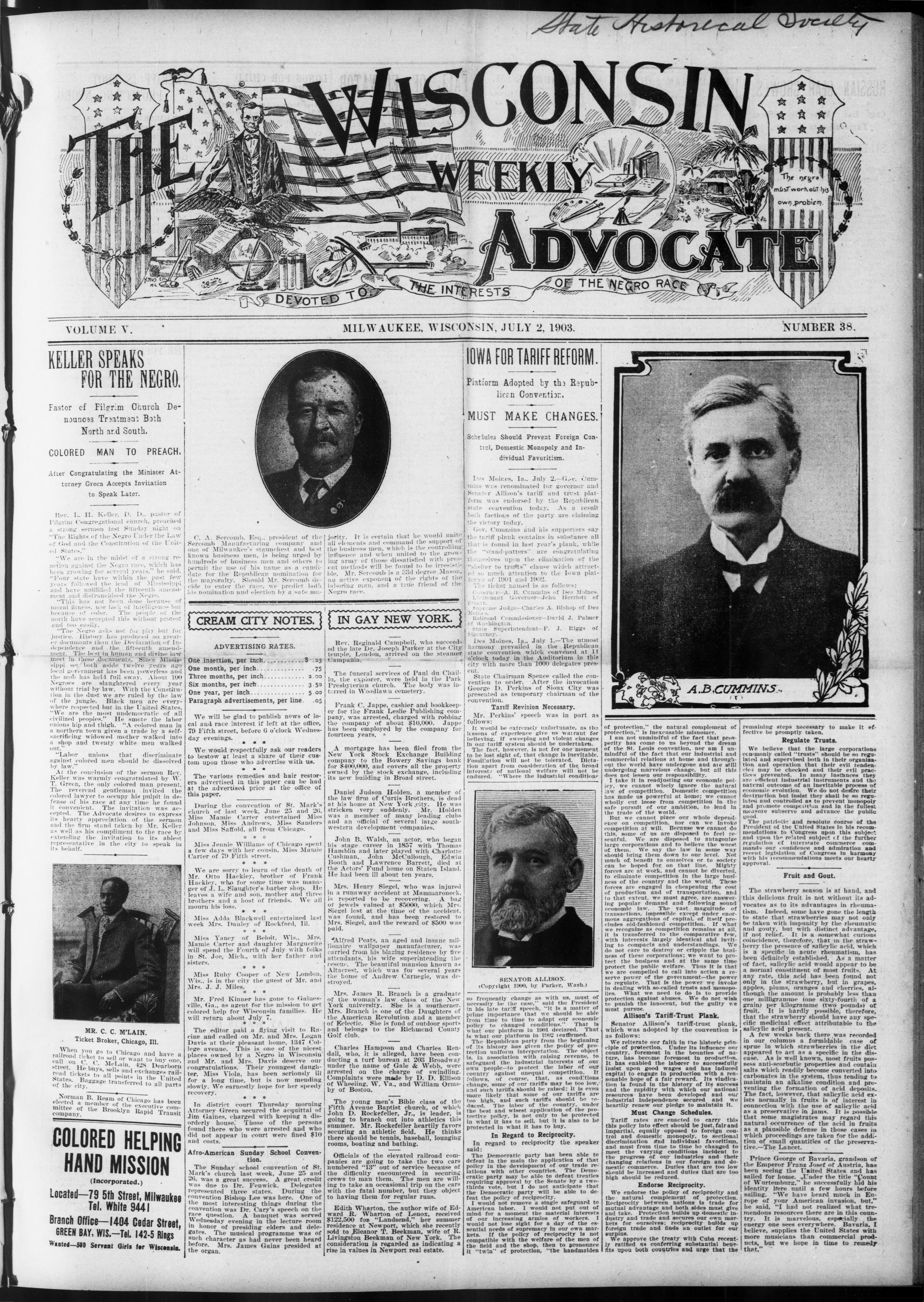
WISCONSIN
WEEKLY
The negro
must work out his
own problem.
ADVOCATE
DEVOTED TO THE INTERESTS OF THE NEGRO RACE
VOLUME V.
KELLER SPEAKS FOR THE NEGRO.
Fastor of Pilgrim Church Denounces Treatment Both North and South. COLORED MAN TO PREACH.
After Congratulating the Minister Attorney Green Accepts Invitation to Speak Later.
Rev. L. H. Keller, D. D., pastor of Pilgrim Congregational church, preached a strong sermon last Sunday night on "The Rights of the Negro Under the Law of God and the Constitution of the United States."
"We are in the midst of a strong reaction against the Negro race, which has been growing for several years," he said.
"Four state have within the past few years followed the lead of Mississippi and have nullified the fifteenth amendment and disfranchised the Negro.
"This has not been done because of moral fitness, nor lack of intelligence but because of color. The people of the north have accepted this without protest and too easily
"The Negro asks not for pity but for justice. History has produced no greater documents than the Declaration of Independence and the fifteenth amendment. The best in human and divine law meet in these documents. Since Mississippi set both aside twelve years ago local government has been powerless and the mob has held full sway. About 100 Negroes are slaughtered every year without trial by law. With the Constitution in the dust we are ruled by the law of the jungle. Black men are everywhere respected but in the United States. "We are the most undemocratic of all civilized peoples." He smote the labor unions hip and thigh. "A colored man in a northern town given a trade by a self-sacrificing widowed mother walked into a shop and twenty white men walked out."
"Labor unions that discriminate against colored men should be dissolved by law." At the conclusion of the sermon Rev. Keller was warmly congratulated by W. T. Green, the only colored man present. The reverend gentleman invited the colored lawyer to occupy his pulpit in defense of his race at any time he found it convenient. The invitation was accepted. The Advocate desires to express its hearty appreciation of the sermon and the firm stand taken by Mr. Keller as well as his compliment to the race by extending the invitation to its ablest representative in the city to speak in its behalf.
A.
When you go to Chicago and have a railroad ticket to sell or want to buy one, call on C. C. McLain, 428 Dearborn street. He buys, sells and exchanges railroad tickets to all points in the United States. Baggage transferred to all parts of the city.
Norman B. Ream of Chicago has been elected a member of the executive committee of the Brooklyn Rapid Transit company.
COLORED HELPING HAND MISSION
[Name not provided]
C. A. Sercomb, Esq., president of the Sercomb Manufacturing company and one of Milwaukee's staunchest and best known business men, is being urged by hundreds of business men and others to permit the use of his name as a candidate for the Republican nomination for the mayoralty. Should Mr. Sercomb decide to enter the race, we predict both his nomination and election by a safe ma-
CREAM CITY NOTES.
One insertion, per inch. $ .25
One month, per inch. .75
Three months, per inch. 2.00
Six months, per inch. 3.50
One year, per inch. 5.00
Paragraph advertisements, per line. .05
We will be glad to publish news of local and race interest if left at the office,
79 Fifth street, before 6 o'clock Wednesday evenings.
We would respectfully ask our readers to bestow at least a share of their custom upon those who advertise with us.
The various remedies and hair restorers advertised in this paper can be had at the advertised price at the office of this paper.
During the convention of St. Mark's church of last week, June 25 and 26, Miss Mamie Carter entertained Miss Johnson, Miss Andrews, Miss Sanders and Miss Saffold, all from Chicago.
* * *
Miss Jennie Williams of Chicago spent a few days with her cousin, Miss Mamie Carter of 79 Fifth street.
We are sorry to learn of the death of Mr. Otto Hackley, brother of Frank Hackley, who for some time was manager of J. L. Slaughter's barber shop. He leaves a wife and son, mother and three brothers and a host of friends. We all mourn his loss.
* * *
Miss Adda Blackwell entertained last week Mrs. Danley of Rockford, Ill.
* * *
Miss Yancy of Beloit, Wis., Mrs. Mamie Carter and daughter Marguerite will spend the Fourth of July with folks in St. Joe, Mich., with her father and sisters.
* * *
Miss Ruby Cooper of New London, Wis., is in the city the guest of Mr. and Mrs. J. J. Miles.
Mr. Fred Kinner has gone to Gainesville, Ga., as agent for the mission to get colored help for Wisconsin families. He will return about July 7.
* * *
The editor paid a flying visit to Racine and called on Mr. and Mrs. Logan Davis at their pleasant home, 1347 College avenue. This is one of the nicest places owned by a Negro in Wisconsin and Mr. and Mrs. Davis deserve our congratulations. Their youngest daughter, Miss Viola, has been seriously ill for a long time, but is now mending slowly. We earnestly hope for her speedy recovery.
In district court Thursday morning Attorney Green secured the acquittal of Jim Gaines, charged with keeping a disorderly house. Those of the persons found there who were arrested and who did not appear in court were fined $10 and costs.
Afro-American Sunday School Convention.
The Sunday school convention of St. Mark's church last week, June 25 and 26, was a great success. A great credit was due to Dr. Fenwick. Delegates represented three states. During the convention Bishop Lee was here. One of the most interesting things during the convention was Dr. Cary's speech on the race question. A banquet was served Wednesday evening in the lecture room in honor of presiding elders and delegates. The musical programme was of such character as had never been heard before. Mrs. James Gains presided at the organ.
day evenings.
MILWAUKEE, WISCONSIN, JULY 2, 1903.
jority. It is certain that he would unite all elements and command the support of the business men, which is the controlling influence and when united to the growing army of those dissatisfied with present methods will be found to be irresistible. Mr. Sercomb is a 33d degree Mason, an active exponent of the rights of the laboring man, and a true friend of the Negro race.
Rev. Reginald Campbell, who succeeded the late Dr. Joseph Parker at the City temple, London, arrived on the steamer Campania.
The funeral services of Paul du Chaillu, the explorer, were held in the Park Presbyterian church. The body was interred in Woodlawn cemetery.
Frank C. Jappe, cashier and bookkeeper for the Frank Leslie Publishing company, was arrested, charged with robbing the company of about $10,000. Jappe has been employed by the company for fourteen years.
A mortgage has been filed from the New York Stock Exchange Building company to the Bowery Savings bank for $400,000, and covers all the property owned by the stock exchange, including its new building in Broad street.
Daniel Judson Holden, a member of the law firm of Curtis Brothers, is dead at his home at New York city. He was stricken very suddenly. Mr. Holden was a member of many leading clubs and an official of several large southwestern development companies.
John B. Walsh, an actor, who began his stage career in 1857 with Thomas Hamblin and later played with Charlotte Cushman, John McCullough, Edwin Booth and Lawrence Barrett, died at the Actors' Fund home on Staten Island. He had been ill about ten years.
Mrs. Henry Siegel, who was injured in a runaway accident at Mammaroneck, is reported to be recovering. A bag or jewels valued at $5000, which Mrs. Siegel lost at the time of the accident, was found, and has been restored to Mrs. Siegel, and the reward of $500 was paid.
Alfred Peats, an aged and insane millionaire wallpaper manufacturer, was carried from his blazing residence by five attendants, his wife superintending the rescue. The beautiful mansion known as Altacrest, which was for several years the home of Andrew Carnegie, was destroyed.
Mrs. James R. Branch is a graduate of the woman's law class of the New York university. She is a southerner. Mrs. Branch is one of the Daughters of the American Revolution and a member of Eclectic. She is fond of outdoor sports and belongs to the Richmond County Golf club.
Charles Hampson and Charles Rendall, who, it is alleged, have been conducting a turf bureau at 203 Broadway under the name of Gale & Webb, were arrested on the charge of swindling. Complaints were made by D. D. Ellison of Wheeling, W. Va., and William Ormsby of Boston.
The young men's Bible class of the Fifth Avenue Baptist church, of which John D. Rockefeller, Jr., is leader, is going to branch out into athletics this summer. Mr. Rockefeller heartily favors securing an athletic field. He thinks there should be tennis, baseball, lounging rooms, boating and bathing.
Officials of the elevated railroad companies are going to take the two cars numbered "13" out of service because of the difficulty encountered in securing crews to man them. The men are willing to take an occasional trip on the cars with the fatal number, but they object to having them for regular runs.
Edith Wharton, the author wife of Edward R. Wharton of Lenox, received $122,500 for "Landsend," her summer residence at Newport, which she recently sold to Eleanor T. Beekman, wife of R. Livingston Beekman of New York. The consideration is regarded as indicating a rise in values in Newport real estate.
IOWA FOR TARIFF REFORM.
Platform Adopted by the Republican Convention.
Schedules Should Prevent Foreign Control, Domestic Monopoly and In-
Des Moines, Ia., July 2.—Gov. Cummins was renominated for governor and Senator Allison's tariff and trust platform was endorsed by the Republican state convention today. As a result both factions of the party are claiming the victory today. Gov. Cummins and his supporters say the tariff plank contains in substance all that is found in last year's plank, while the "stand-patters" are congratulating themselves upon the elimination of the "shelter to trusts" clause which attracted so much attention to the Iowa platforms of 1901 and 1902. The ticket named is as follows:
The ticket named is as follows.
Governor—A. B. Cummins of Des Moines.
Lieutenant Governor—John Herritt of Stuart.
Supreme Judge—Charles A. Bishop of Des Moines.
Railroad Commissioner-David J. Palmer of Washington.
Des Moines, Ia., July 1.—The utmost harmony prevailed in the Republican state convention which convened at 11 o'clock today in the Auditorium in this city with more than 1000 delegates present. State Chairman Spence called the convention to order. After the invocation George D. Perkins of Sioux City was presented as temporary chairman of the convention.
Tariff Revision Necessary.
Mr. Perkins' speech was in part as follows:
It would be extremely unfortunate, as the lessons of experience give us warrant for believing, if sweeping and violent changes in our tariff system should be undertaken.
The fact, however, is not for one moment to be lost sight of, that change is inevitable. Fossilization will not be tolerated. Dictation apart from consideration of the broad interests of national welfare will not be endured. "Where the industrial conditions
J. B.
SENATOR ALLISON. (Copyright 1900, by Parker, Wash.) so frequently change as with us, must of necessity be the case," said the President in his late tariff speech, "it is a matter of prime importance that we should be able from time to time to adapt our economic policy to changed conditions." That is what our platform in 1901 declared. That is what our platform in 1902 reaffirmed.
The Republican party from the beginning of its history has given the policy of protection uniform interpretation. The object is, in association with raising revenue, to safeguard the industrial interests of our own people—to protect the labor of our country against unequal competition. It follows, of course, that, as conditions change, some of our tariffs may be too low, and such tariffs should be raised; it is even more likely that some of our tariffs are too high, and such tariffs should be reduced. The labor of the country, under the best and wisest application of the protective policy, is not only to be protected in what it has to sell, but it is also to be protected in what it has to buy.
In Regard to Reciprocity.
In regard to reciprocity the speaker said:
The Democratic party has been able to defeat in the main the application of that policy in the development of our trade relations with other countries. The Democratic party may be able to defeat treaties requiring approval by the Senate by a two-thirds vote, but I do not anticipate that the Democratic party will be able to defeat the policy of reciprocity.
I would not remove a single safeguard to American labor. I would not put out of mind for a moment the material interests of our increasing armies of workers. I would not lose sight for a day of the essential needs of supremacy in our own markets. If the policy of reciprocity is not compatible with the welfare of the men of the field and the shop, then to pronounce it "twin" of protection, "the handmaiden
A.B. CUMMINS.
of protection," the natural complement of protection," is inexcusable misnomer.
I am not unmindful of the fact that prosperity has come to us beyond the dream of the St. Louis convention, nor am I unmindful of the fact that our industrial and commercial relations at home and throughout the world have undergone and are still undergoing marvelous change, but all this does not lessen our responsibility. I take it in readjusting our economic policy, we cannot wisely ignore the natural law of competition. Domestic competition has made us powerful at home; we cannot wholly cut loose from competition in the safe pursuit of our ambition, to lead in the trade of the world.
But we cannot place our whole dependence on competition, nor can we invoke competition at will. Because we cannot do this, some of us are disposed to feel resentful. We are disposed to antagonize large corporations and to believe the worst of them. We say the law in some way should bring them down to our level. Not much of benefit to ourselves or to society can be hoped for on that line. Mighty forces are at work, and cannot be diverted, to eliminate competition in the large business of the country and the world. These forces are engaged in cheapening the cost of production and of transportation, and to that extent, we must agree, are answering popular demand and following sound economic law. The vast magnitude of transactions, impossible except under enormous aggregations of capital, of itself precludes old-fashioned competition. If what we recognize as competition remains at all, it is transferred to the comparative few, with interests largely identical and inviting to compacts and understandings. We do not care to destroy or cripple the business of these corporations; we want to protect the business and at the same time protect the public welfare. Thus it is that we are compelled to call into action a reserve power of the government—the power to regulate. That is the power we invoke in dealing with so-called trusts and monopolies. What we need to do is to provide protection against abuses. We do not wish to punish the innocent, but the guilty we must pursue.
Allison's Tariff-Trust Plank
Senator Allison's tariff-trust plank, which was adopted by the convention is as follows:
We reliterate our faith in the historic principle of protection. Under its influence our country, foremost in the bounties of nature, has become foremost in production. It has enabled the laborer to successfully insist upon good wages and has induced capital to engage in production with a reasonable hope of a fair reward. Its vindication is found in the history of its success and the rapidity with which our national resources have been developed and our industrial independence secured and we heartily renew our pledge to maintain it.
Must Change Schedules.
Tariff rates are enacted to carry this policy into effect should be just, fair and impartial, equally opposed to foreign control and domestic monopoly, to sectional discrimination and individual favoritism, and must from time to time be changed to meet the varying conditions incident to the progress of our industries and their changing relations in our foreign and domestic commerce. Duties that are too low should be increased and duties that are too high should be reduced.
Endorse Reciprocity
We endorse the policy of reciprocity and the natural complement of protection. Reciprocity between nations is trade for mutual advantage and both sides must give and take. Protection builds up domestic industry and trade and secures our own markets for ourselves; reciprocity builds up foreign trade and finds an outlet for our surplus. We approve the treaty with Cuba recently ratified as conferring substantial benefits upon both countries and urge that the
NUMBER 38.
remaining steps necessary to make it effective be promptly taken.
Regulate Trusts.
We believe that the large corporations commonly called "trusts" should be so regulated and supervised both in their organization and operation that their evil tendencies may be checked and their evil practices prevented. In many instances they are efficient industrial instruments and the natural outcome of an inevitable process of economic evolution. We do not desire their destruction but insist they shall be so regulated and controlled as to prevent monopoly and promote competition and in the fullest measure subserve and advance the public good.
The patriotic and resolute course of the President of the United States in his recommendations to Congress upon this subject and upon the related subject of the further regulation of interstate commerce commands our confidence and admiration and recent legislation of Congress in harmony with his recommendations meets our hearty approval.
Fruit and Gout.
The strawberry season is at hand, and this delicious fruit is not without its advocates as to its advantages in rheumatism. Indeed, some have gone the length to state that strawberries may not only be taken with impunity by the rheumatic and gouty, but with distinct advantage, if not relief. It is a somewhat curious coincidence, therefore, that in the strawberry the presence of salicylic acid, which is a specific in acute rheumatism, has been definitely established. As a matter of fact, salicylic acid would appear to be a normal constituent of most fruits. At any rate, this acid has been found not only in the strawberry, but in grapes, apples, plums, oranges and cherries, although the amount is probably less than one milligramme (one sixty-fourth of a grain) per kilogramme (two pounds) of fruit. It is hardly possible, therefore, that the strawberry should have any specific medicinal effect attributable to the salicylic acid present.
A few weeks back there was recorded in our columns a formidable case of sprue in which strawberries in the diet appeared to act as a specific in the disease. As is well known, most fruits possess anti-scorbutic properties and contain salts which readily become converted into carbonates in the system, thus tending to maintain an alkaline condition and preventing the formation of acid deposits. The fact, however, that salicylic acid exists normally in fruits is of interest in connection with the use of salicylic acid as a preservative in jams. It is possible that some magistrates may regard this natural occurrence of the acid in fruits as a plausible defense in those cases in which proceedings are taken for the addition of small quantities of the preservative.—The Lancet.
Prince George of Bavaria, grandson of the Emperor Franz Josef of Austria, has been seeing the United States and has sailed for home. Under the title "Count of Wurtemburg," he successfully hid his identity ltere until a few hours before sailing. "We have heard much in Europe of your American invasion, but," he said, "I had not realized what tremendous resources there are in this country. It is marvelous, especially the energy one sees everywhere. Bavaria, I believe, supplies the United States with more musicians than commercial products, but we hope in time to remedy that."
---
Washington, D. C., July 1. The Associated Press is authorized to state that the Russian government most positively and absolutely denies the report that it has offered any official explanation to the American government either through the Russian embassy at Washington, or the American embassy at St. Petersburg, regarding the Kishineff incident, and declares that it has never been addressed by the American government on the subject. The Russian government most categorically refuses to receive from any power, any petitions, representations or communications relative to its internal affairs.
PROF. M. E. COOLEY WILT NOT ACCEPT.
Ann Arbor Professor Decides to Refuse Appointment to the University of Wisconsin Faculty.
Detroit, Mich., July 1.—Prof. M. E. Cooley of the University of Michigan has practically made up his mind to refuse the offer of the position of dean of the engineering department of the University of Wisconsin. Prof. Cooley was in Detroit last night, and when asked what his intentions are, he said: "I have not finally determined. I shall first have a talk with the dean about the matter, but I am inclined to think I shall remain in Michigan. The offer from Wisconsin was made in such a kindly way that it merited the fullest consideration, but, you see, I can't make up my mind to leave Ann Arbor and Michigan.
"There is now in progress of construction at Ann Arbor one of the finest engineering buildings in the country, and in it there will be several features entirely new to Ann Arbor. I hope to do several things in this new building which I have been unable to do before, and I should dislike very much to leave Ann Arbor at this juncture."
Prof. Cooley intimated that he might recommend to the Wisconsin authorities that James Walker, the Michigan tax commission engineer, be appointed for the work of appraising Wisconsin railroad properties. Walker has been the expert for the Michigan commission.
AN AGED WIDOW IS CRUELLY MURDERED.
Revolting Crime Near Kinnison, I. T., Related in Court—Woman Was Clubbed, Beaten and Shot.
Venita, I. T., July I.—Full details of a revolting crime were related in Commissioner Field's court at this place last evening. Cynthia Johnson, an aged widow, who lived near Kinnison, had been found alone by her slayer who attacked her with a club and beat her almost to death and escaped.
Mrs. Johnson had some means, but her money was not taken. Hogs had attacked her and had eaten the corpse until it was beyond recognition.
MACHEN TO DEMUR.
Indicted Postoffice Official Pleads No Guilty to the Indictments Returned by the Grand Jury.
Washington, D. C., July 1.—August W. Machen, against whom three indictments have been found for accepting a bribe in connection with government contracts for letter-box fasteners, was arraigned today before Justice Pritchard in criminal court No. 1. He pleaded not guilty and was given until July 20 to file a demurrer.
Later the Groff Brothers, indicted with Machen, appeared in court and pleaded not guilty. They will be tried at the fall term of the court, in October.
Trains Come Together Near Brussels and Twenty People Are Injured No Deaths Reported. Brussels, July 1. A serious collision occurred today at the railroad station at Schaerbeck, a suburb of this city. A train from Antwerp, filled with leading grain merchants who were on their way to attend the weekly grain market collided with a train which was leaving Schaerbeck. About twenty persons were badly injured, but there was no less of life.
ILLINOIS VILLAGE SUFFERS FROM FIRE.
Loss of $100,000 Sustained at Ocoya, on the Chicago & Alton—Immense Elevators Burned.
Bloomington, Ill.. July 1.—Fire at Ocoya, a village thirty miles north on the Chicago & Alton, caused loss of $100,000 today. Two immense elevators were destroyed, together with the railroad depot, a general store and many other buildings and residences.
CASE ENDED AFTER 24 YEARS.
Litigation Over Policies on Life of Man Who Disappeared.
Leavenworth, Kas., July 1.—The famous Hillman insurance case was finally taken from the docket of the United States circuit court today. The case had been on the docket for more than twenty-four years, during which time there were six long trials, was appealed twice and passed upon by the United States supreme court. In each of the appeals verdicts in favor of the widow were set aside. The original suit was brought against the New York Life for $10,000, the Mutual Life of New York for $10,000, and the Connecticut Mutual for $5000. The New York Life settled after the fifth trial, and the Mutual Life settled in August, 1901, nine months after a verdict had been rendered against it during the sixth trial for $22,068. The Connecticut Mutual carried the verdict against it for $11,054 to the supreme court, and it was set aside. This reversal left Mrs. Hillman Smith liable for an enormous amount of costs, estimated at $90,000, unless she secured a new verdict and one that would hold good. It is said that she has accepted an offer to settle by the Connecticut Mutual agreeing to take care of its own costs. F. W. Hutchings, one of her counsel, stated that she received several thousand dollars besides.
FILLINGHAM SAILS.
The Vicar of Hexton, England, Bids America Good-bye Until January Next.
New York, June 30.—Rev. R. C. Fillingham, vicar of Hexton, England, apostle of anti-ritualism, who sailed for England today, has sent another letter to Bishop Henry C. Potter in which he says:
"I had no idea of making a commotion in this city. Traveling for rest, I attended public worship, not the worship of God, at the Church of St. Mary the Virgin, on Sunday week, and I felt compelled to call your attention and that of the public to the idolatry of which I am the witness. Your reply was not worthy of a Christian or a gentleman and I have no doubt but that by this time you are heartily ashamed of it. For my part, I condone a letter evidently written in a moment of hot-headed passion.
Campaign Against Idolatry.
"I am, if God spares me, to return to this country early in the new year and conduct a campaign against idolatry here and in other cities of the United States. My American friends do not regard me as an impertinent interloper, but are glad to join hands with one of the Anglo-Saxon race from whichever side of the ocean he may happen to come.
Reminds Bishop of Vows.
"I wish to remind you of one thing before I leave. When you were consecrated to the high office of bishop, you were asked: 'Are you ready with all faithful diligence to banish and drive away from the church all erroneous and strange doctrines contrary to God's word, and both privately and openly to call upon and encourage others to do the same?' solemnly in the presence of God and the congregation, at the most serious moment of your life, you replied: 'I am ready, the Lord being my helper.'
Erroneous and Orange Doctrines.
"I merely want to ask you now, was that a lie or the truth? Were you lying to God when you were consecrated bishop of New York? You know as well as I do that the blasphemous memoirs, the mass and the 'bun worship,' are held by our common church to be 'erroneous and strange doctrine.' Will you do what you promised, calling on God to help you, or will you not?
"That is all I have to ask you. I hope the American public will find by your answer that you are a true man, a man resolved to do his duty and keep his word."
His Wisconsin Trip.
Mr. Fillingham is not at all disturbed by the reports from Milwaukee and Fond du Lac, Wis., of the reception he will receive from the extreme ritualists there should he attempt to interfere with the high church services in those dioceses.
"I will do my duty," was all he said, when he was told that Bishop Grafton would hand him over to the authorities, should he attempt to interfere with any of his services.
Bishop Potter was asked: "What do you think of this man Fillingham?"
"I think he's a raving lunatic," said the bishop, smiling, "and you should know there are lots of lunatics in orders. I shall not open any letters from him."
NEARLY LOSES MIND EATING HEALTH FOODS.
St. Louis World's Fair Employe Has Had Enough of the "Condensed Pabulum."
St. Louis, Mo., June 30.—Too much breakfast food is the cause Crampton Dubois assigns to an attack of insomnia so bad it compelled him to go to the City hospital for treatment. It is not his fault that he ate too freely, he says, for it was that or nothing, as he had to keep his brain in serviceable condition properly to perform the work of stenographer to Secretary Stevens of the World's fair commission.
According to his statement he took enough cereal at breakfast to last him all day. Soon he began to find difficulty in sleeping, and the trouble reached a climax Sunday, when he went to the hospital.
THEY BOYCOIT JEWS AND PROTESTANTS
Clerical Party in a Riotous Outbreak Neat Strassburg, Alsace-Lorrain—Much Violence Is Done.
Strassburg, Alsace-Lorraine, June 30.—The defeat of a clerical candidate for election to the Reichstag in a country district adjacent, to Strassburg caused a riotous outbreak today against the Anti-clericals. Mobs paraded the streets, shooting and stoning Jewish shops. The rioters attempted to liberate their arrested friends, which caused revolver shots to be exchanged. The Clericals have declared a boycott against the Jews and Protestants.
NEW ACTIVE HEAD OF STEEL TRUST.
William Corey of Pittsburg Is Named as Assistant to President Schwab—He Will Do the Work.
New York, June 30.—William Corey of Pittsburg, president of the Carnegie Steel company was today made assistant to the president of the United States Steel corporation. An official statement says that Mr. Corey "is to perform the active duties of the president."
SURVEYED THE NORTH-WESTERN.
Robert A. Conolly, Well Known Civil Engineer. Dead.
Waukegan, Ill., June 30.—Robert A. Conolly, a well-known civil engineer and railway constructor, died Sunday evening at his home. He was born in County Donegal, Ireland, and came ot America in 1834. He was past 73 years of age. He surveyed the line from Milwaukee to Chicago for the North-Western road. The funeral took place from the residence today.
Grandpa's Naughty Boys.
Marcus M. Marks tells this story of his 4-year-old boy who, noticing for the first time a lock of gray hair on his father's head, asked:
"Papa, why are some of your hairs gray?"
Thinking to drive home a moral lesson, the father answered: "Papa gets a gray hair every time his little boy is naughty."
The child seemed lost in thought, but after a short pause said naively:
"Well, then, grandpapa must have had awful naughty boys."—New York Times.
The Ideal Road.
"Of course you're interested in this movement for good roads," said the expert automobilist. "I'm afraid I can't have the sort of road I'd like," replied the beginner. "What sort's that?" "One that's hard while you're riding along it and soft when you sit down on it suddenly."—Philadelphia Press.
DEAD NUMBER 235.
More Perished in Mine Disaster at Hanna, Wyo., Than Was at First Reported.
Hanna, Wyo., July 1.—Of 282 men who went into the Union Pacific Coal company's No. 1 mine yesterday 235 were killed by the explosion of black damp that occurred at 10:30 yesterday. Most of the dead are Finlanders and Negroes.
Members of the rescuing parties tell of pitiful scenes about the seventeenth level, as deep as it has been possible to penetrate. Some of the survivors were driven insane and fought like fiends against the rescuers. Dazed, listless survivors were found sitting on cars or lying on the floor, careless of whether they lived or died.
Near the seventeenth level twenty bodies were found strewn over a pile of debris which the men had striven to surmount before overcome by the deadly fumes. Some were seared and blackened by flames, but all had died crawling toward fresh air. The eleven rescuers who had gone this far were too weak to bring out a body.
For hours the scene at the mouth of the level was heart moving. With clothes and hair awry, mothers, wives, sweethearts and children huddled together, weeping and wringing their hands. Many sat on shattered timbers blown from the mine's mouth, insensible to their surroundings. The most frantic pushed to the edge of the gap and tried to force a way into the slope.
An expert who went almost to the seventeenth level says the mine cannot possibly be cleared for a month. It is feared that men in the lower levels were torn to pieces by the explosion, which hurled great timbers high over the town and 1700 feet beyond the mouth of the slope.
Among the dead is Alfred Happgood, who turned the first shovel of dirt in starting the slope. The fire bosses, who had reported all safe before working time yesterday, met death while making a second inspection. Omaha, Neb., July 1.—Orders were received at Union Pacific headquarters this morning from Hanna, Wyo., for 150 coffins, which are being shipped to Hanna.
PRAISES RELIANCE.
Sir Thomas Says She Will Be Chosen to Defend the American Cup.
Newport, R. I., July 1.—The Reliance crossed the line at 4:21:7, more than 4 minutes ahead of the second boat.
Newport, R. I., July 1.—Sir Thomas Lipton arrived here today to attend the third race of the present series between the Reliance, Constitution and Columbia.
Praise for Reliance.
"She certainly looks like a wonderful boat," said Sir Thomas Lipton, turning to several of his friends on the after deck of the Erin, after they all had looked at the Reliance. He added that after yesterday's race there could be no doubt as to which boat would defend the cup against the Shamrock III.
Race Conditions Poor.
The starting times, as seen from this point, were: Constitution, 1:15:16; Reliance, 1:16:16; Columbia, 1:17. There was a fog and the conditions were not good for a race, although the wind was blowing about twelve knots.
Within twenty minutes after the start the Reliance had fore-reached the Constitution and was practically the leading boat. The Constitution, however, clung close to her and when the yachts disappeared in the fog, the two leaders seemed to be racing side by side. The Columbia was a short distance astern, but it did not seem as if she was being dropped to any great extent.
When the yachts were made out again it looked as if the Reliance was in the lead. This was at 2:30 p. m.
Reliance Ahead.
As the yachts neared Point Judith breakwater, it was seen that the Reliance was ahead by over a minute. Constitution had the weather position of Columbia.
RABBIS DISCUSS SABBATH QUESTION.
Central Conference of Hebrews at Detroit Consider Observing Sunday as a Day of Rest.
Detroit, Mich., July 1.—The Sabbath question was taken up at the session today by the central conference of American rabbis. The Sabbath committee presented a reports declaring that the conference had no jurisdiction in the matter and declared that the conference was incompetent to legislate any fundamental Jewish institution out of existence. The committee declare that historically they could not find any argument for changing from Sabbath to Sunday.
They recommended the creation of a national conference to which all questions might be referred. This plan is in effect a scheme to consolidate the conference of American rabbis and the union of American Hebrew congregations.
THE BODY BELONGS IN EVANSTON, ILL.
The Soldier's Corpse Unclaimed at Racine Is That of Fred Hesler, a Prominent Naval Surgeon.
Evanston, Ill., July 1.—[Special.]—The unclaimed body at Racine is that of Fred Hesler, who was a prominent surgeon in the United States army. He died while on duty in the eastern seas. He was the son of A. Hesler, a prominent photographer of Chicago, who lives in this city. The body was shipped by his wife, Agnes, to J. C. Dorchester, his uncle.
MINE WORKERS SUSPEND.
Thirteen Thousand Men Quit Work in Birmingham, Ala., Though No Formal Strike Has Been Declared.
Birmingham, Ala., July 1.—All the miners who are members of the United Mine Workers of America, numbering about 13,000 in this district, suspended work today, the old wage contract being agreed upon. No formal strike has been declared, the situation being referred to as a suspension.
ASK CZAR TO PROTEST AGAINST LYNCHINGS.
Colored Minister Will Send Petition to Russian Emperor Asking Him to Interfere in Outrages.
Wilmington, Del., July 1.—Rev. M. W. Thornton, a Negro clergyman, has made announcement that he will ask the European powers, and especially the Czar of Russia, to take immediate action toward putting an end to the lynching of Negroes.
Pittsburg, Pa., June 30.—The breaking of a shaft on the first floor of the H. J. Heinz company's plant in Allegheny yesterday released the ropes supporting a large freight elevator on which twenty-three persons were crowded. The cage fell from the fifth floor into the cellar, a distance of 45 feet, and everyone on the elevator was injured. It is thought that at least two will die.
The injured:
John Churney, Allegheny; both legs broken; will likely die.
Mrs. Edward Holman, Mount Hope, N. J.; injury to spline; probably will die.
Joseph Weber, Allegheny; both legs broken; condition serious.
O. P. Thomason, Allegheny; leg crushed.
Mrs. C. R. Sammons, east end, Pittsburg; spine injured.
Imogene Redmon, Paris, Ky.; ankle strained and spine injured.
Andrew Bolak, Allegheny; ankle sprained.
H. A. Morrison, Hazelwood; compound fracture of the leg.
Mrs. A. Lotha, Allegheny; concussion of spine and ankle sprained.
William Koncana, Cleveland, O.; ankle sprained and spine injured.
C. Howak, Cleveland; ankle sprained and injury to spine.
Mrs. A. Vodraska, Allegheny; cut by flying glass.
Charles Spurney, Cleveland; body badly bruised.
John Kotsybar, Cleveland; concussion of spine.
Mrs. George Sherlock, Hazelwood; compound fracture left leg.
Mike Demko, Cleveland: leg sprained.
John Zabouske, Cleveland: ankle sprained.
Mrs., William Mitchell, Hazelwood; leg fractured in two places.
Mrs. Victor Bailey, Hazelwood; leg fractured.
John Brotsky, Pittsburg; ankle sprained; Steven Jasco, Cleveland; ankle sprained; taken home.
Mrs. Minnie Spring, Glenshaw; ankle sprained.
Mrs. E. W. Thornton, Hazelwood; compound fracture of leg.
Drunken Men Cause Crash.
When the accident occurred the elevator was evidently overcrowded. According to what was told by Dr. J. S. Phillips, physician at the plant, the anties of two men on the elevator who were intoxicated caused the disaster. Dr. Phillips says the two men crowded on the car after being told by the operator to stay off. Once on they commenced jumping, with the result that the shaft snapped and left the elevator without control. According to the story told by William Koncano, a dry goods merchant of Cleveland, at the hospital there was no disorder in the crowd.
"I thought there were too many on the car," he said, "when I saw how crowded we were, and as soon as the car left the fifth floor I am certain everyone realized that something had happened to the machinery and that the elevator was slipping. There was not a sound or a cry uttered by anyone until we landed in a heap in the cellar."
Nearly All Are Visitors.
All but two of the injured were visitors to the Heinz plant. The Cleveland people are members of the Bohemian Catholic Central union and took part in the blessing of the guns of the cadets of St. George of Allegheny on Sunday. An examination of the shaft and machinery showed that those injured narrowly escaped instant death, as the 750-pound weight at the side of the shaft shot to the roof of the building, ripped through the timbers at the top and fell half its length through the ceiling over the sixth floor. Had the timbers been a little less stout the huge weight would have fallen nearly sixty feet upon the mass of injured people huddled in a heap on the floor of the demolished elevator.
NEGROES KILL WHITE MAN
John Cash Riddled with Bullets While Trying to Break Up Church Service.
Columbus, Ga., June 30.—John Cash, a white man, who entered a Negro church in Harris county and tried to stempede the congregation, was shot to death by the Negroes. Cash was a planter, and the Negroes have a church near his home. A revival was in progress at the church and there was much shouting. The noise disturbed Cash, and he decided to break up the meeting. He entered the church in a threatening manner and ordered the Negroes to get out. "He's profaning God's house. Kill him!" shouted the religion frenzied Negroes.
"Be merciful," cried the preacher, but the Negroes were overwrought, and began firing at Cash, who stood near the pulpit. Probably 500 shots were fired, many of them striking Cash, who fell in a pool of blood at the altar. Only one Negro, Henry White, has been arrested, but it is not believed he will be prosecuted. Henry White's father once killed a white man who was leading a white-cap party.
DR. VON HOLLEBEN QUITS.
Diplomatic Career of German Ambassa dor Ended—Was Noted Statesman and Skillful Duelist.
Washington, June 30.—Dr. Von Holleben, ambassador from Germany to the United States, ended his active career yesterday. Though one of the most eminent diplomats in the world, having spent a long life in the service, his retirement from Washington and thereupon from active work is due to his having become pensona non grata with the government. Dr. Von Holleben, though he has been prominent as a diplomatist, is perhaps even better known as a duelist. He is regarded as one of the most skillful swordmen of the world. Dr. Von Holleben first came to this country in 1892 as German minister. He was made ambassador in 1897.
LARGEST RAFT ON THE LAKES.
Tow Containing 7,000,000 Feet Brought to Baraga.
Baraga, Mich., June 30.—[Special.]— What is said to be the largest rafts of logs ever towed on the great lakes was brought into Baraga by the steamer Schoolcraft and the tug Bruce. The raft contained 7,000,000 feet of lumber.
Turkish Crops Seriously Damaged
Constantinople, June 30.—The crops in several provinces have been seriously damaged by recent torrential rains and hail.
LONGS FOR CHILD AND TURNS KIDNAPER.
Strange Story of Lonely Chicago Woman Who Stole a Baby—Detectives Find Little Alice Furlong.
Chicago, Ill., July 1.—Two-year-old Alice Furlong, in lace cap and ruffled frock, the like of which she has never known before, is at home again after a week's adventure with a kidnaper. The finding of the little girl in a Washington boulevard boarding house by Inspector Shea's detectives after a week's search reveals a strange story of a lonely woman's longing for a child, and how it impelled her to steal the baby. Mrs. Hazel Avery, the kidnaper, is in a cell at the police station, disconsolate over the loss of the child and fearful of her fate.
Mrs. Avery is a puzzle to the police. Capt. Haines can discover no motive of kidnaping for ransom in the woman's deed, and will prefer no such charge against her. Between sobs she told how she has yearned for years for the solace of a child to call her own, and how one night she saw the little Furlong child and carried it away. She bought an entire new outfit of clothes for the baby and gave up her work that she might stay at home and care for it. From the story told the police it appears that Mrs. Avery was separated from her husband some time ago after moving to Chicago from Kansas City. She worked as a chambermaid in boarding houses, earning $7 a week.
RIOT ATTENDS STRIKE.
Detectives and Girls Are Beaten Almost to Death by Unionists—One of Mcb Is Shot.
Chicago, Ill., July 1.—Three persons were beaten almost to death shortly before 6 o'clock last night, scores of women and girls were panic-stricken and two men were arrested, the result of a riot that grew out of the strike of employees of the Kellogg Switchboard and Supply company. Officials of the company assert the trouble was precipitated by the strikers, as a renewal of the difficulties, because of the failure of Monday's peace negotiations.
Six girls were under escort of two detectives when they were set upon by a mob. Revolver shots were exchanged, clubs were used freely and stones were thrown. One man, apparently at first a spectator, but later a member of the crowd, was shot. The injured:
George W. Quackenbush, detective; beaten and kicked by rioters after firing several shots, one of which struck a spectator who had joined the rioters; taken to the county hospital; under arrest.
George Robertson, nonunion cable spiller employed at the Kellogg plant; assisted Quackenbush in defending girls; beaten and kicked; under arrest at the Desplaines street police station.
Edward Wilson, waiter. 509 West Congress street; shot in the leg; taken to county hospital.
TRUST SENDS PRICE OF COAL UP AGAIN.
Able to Wipe Out Loss Caused by the Anthracite Strike in Less Than Seven Months.
New York, July 1. It is officially announced that the anthracite coal companies advanced the price of coal 10 cents a ton today. All of this is a part of the plan recently adopted by the coal trust to force dealers to lay in their supply during the summer months or earlier in the season. The new policy adopted by the coal trust after the strike is resulting in enormous earnings. The statement for the month of May issued by the Reading company caused a big surprise in Wall street. It shows that the enormous losses of the long anthracite coal strike have been overcome in seven months.
LEFT MILLIONS TO WISCONSIN WOMAN.
Children of Jonathan Clark of Chicago Say He Became Infatuated with Caroline Patterson.
Chicago, Ill., July 1.—The validity of the will of Jonathan Clark, a millionaire contractor who left an estimated fortune of $2,000,000, is attacked by Eunice M. Smith and Fred W. Clark, Emaretta M. Kaufman and Jonathan Yates Clark, all of whom are children of Jonathan Clark. The entire fortune was left to Caroline Patterson. The complainants declare that in 1880, while their father was engaged in construction work at Lake Geneva, Wis., he became infatuated with Caroline Patterson at the home of whose mother he boarded while there.
CHILD OF SEVEN SLAIN.
Mutilated and Decomposed Body Found Near Rockford, Ill.-Motive Is a Deep Mystery.
Rockford, Ill., July 1.—The remains of Richard Tebbetts, a newsboy 7 years old, who disappeared eight days ago, were found by section men near the Driving park, about two miles north of the city. The circumstances point to a brutal murder, but the motive is a mystery.
The child had been practically disemboweleed. Beside him lay his unsold papers, a bag of candy and some pennies. The body was badly decomposed. The boy was the son of Mr. and Mrs. A. L. Tebbetts, who are divorced.
GEN. CLAY WANTS HIS CHILD WIFE BACK.
Now That Her Second Husband Has Been Killed Sage of Whitehall Hopes Girl Will Return.
Lexington, Ky., July 1. Gen. Cassius M. Clay, the sage of Whitehall, has written to his former child-wife, Dora Richardson Brock, whose husband was killed by a train in Illinois several days ago, asking her to come back and remain with him the rest of her life. Gen. Clay realizes that he has only a short time to live and he has called continually for his young wife, even since she got a divorce from him and married Brock.
RUSH MEDICAL COLLEGE TO GET $7,000,000.
Trustees Raise a Million and Thus Secure the Rockefeller Gift of Six Millions More.
Chicago, Ill., July 1.—Trustees of Rush Medical college have succeeded in raising a fund of $1,000,000, which will be tendered to the trustees of the University of Chicago, thus assuring the gift of $6,000,000 promised by John D. Rockefeller and the construction in Chicago of the most magnificent medical institution in the world.
SHERIFF IS SHOT PROTECTING NEGRO.
HIS DAUGHTER AIDS HIM IN FU TILE BATTLE WITH MOB AT SCOTTSBORO, ALA.
Colored Man Is Finally Taken from Jail and Hanged-Confessed to Attempt to Rape Girl.
Scottsboro, Ala., June 30.—Andrew Diggs, a Negro, was taken from the jail last night and hanged by a mob. The Negro attempted to assault the 19-year-old daughter of Dr. B. B. Smith.
The sheriff seized two pistols when the mob arrived and mounting the stairs said he would kill anyone who attempted to come up. The threat was received with a volley of shots and the sheriff returned the fire. One shot took effect in the sheriff's right leg and the other in his pistol arm.
The daughter of the sheriff ran to his aid, but by threats of a member of the mob who had a pistol she was forced to deliver the keys to the cell in which the Negro was kept. One of the masked men summoned a doctor, who dressed the wounds of the sheriff, which are not dangerous.
The Negro made a confession to the brother of the young woman and others who visited the jail after his capture.
THE POPE'S VISIT TO VATICAN GARDENS.
The Pontiff Takes Carriage Ride in Open Air for the First Time This Year.
Rome, June 30.—The Pope descended to the Vatican gardens this morning for the first time this year and was driven about for an hour and a half. He seemed to enjoy the air immensely and noticed the changes made in the gardens since last year. He was specially interested in the growth of the vines planted by himself and made inquiries regarding the prospects of the vintage. When the Pope returned to his apartments he seemed not in the least fatigued and received several bishops.
He did not make his annual visit last night to the crypt under the high altar at St. Peter's, where the remains of St. Peter and St. Paul are buried, owing to his feebleness. This is the first time during his pontificate that the Pope has abstained from praying at the tomb of the apostles on St. Peter's eve.
The Italian government, in order to be prepared for any eventuality, has ordered two regiments in the provinces to be kept ready to come to Rome and reinforce the garrison in the city, so that the authorities will have a sufficient force to maintain order and insure the liberty of the conclave should it become necessary to hold one.
If the cardinals, as after the death of Pius IX., decide to meet at the Vatican, the government will surround the palace with troops to prevent any attempt against the freedom of the conclave and also the removal of valuables from the Vatican during the interregnum, as was customary before 1870.
None of the Catholic great powers exercised the right of veto on the election of the Pope at the last conclave, and it is claimed that it would not be just for them to do so at the next one. The Pope is determined to proclaim the veto inoperative at the next conclave.
MANY DIE IN EXPLOSION.
Reported That Two Hundred Men Were Killed or Injured in Accident in Wyoming.
Hanna, Wyo., June 30.—The worst coal mine disaster in the history of Wyoming occurred in Mine No. 1 of the Union Pacific Coal company today at 11 o'clock, when a terrific explosion took place. Two hundred men were working in the mine at the time.
The explosion set fire to the mine and at this time it is impossible to estimate the loss of life. Not less than twenty men were killed outright and although this mine is well ventilated and provided with many avenues of escape, the loss of life will be very large.
Not a man at this time has found his way to the surface.
Supt. E. D. Brooks is working diligently with the large force of men to rescue the imprisoned miners and extinguish the raging flames.
Rescue Party at Work.
Omaha, Neb., June 30.—At the Union Pacific headquarters in this city no details are known of the Hanna mine explosion. A report received here states that 200 men were in the mine at the time of the explosion and that a rescue party has been sent down the shaft. Until the rescuers shall have reached the scene of the explosion nothing will be known as to the extent of the damage and the number of casualties. The mines are operated by the Union Pacific Coal company.
May Be Burned or Suffocated.
Rawlins, Wyo., June 30.—A terrific explosion occurred in the coal mines at Hanna, Wyo., about 10 o'clock this morning. Nearly 200 men are said to have been in the mine at the time of the explosion.
It is said that the mine took fire immediately and the relief force which was organized at once to rescue the entombed miners have so far been unable to approach the entrance to the mine on account of the dense volumes of smoke.
Unless the workmen are soon relieved it is not believed that they will be found alive.
Hanna is on a branch line from Allen Junction and particulars of the explosion are hard to obtain.
MR. PAYNE TO TAKE A REST
Washington, D. C., June 30.—Postmaster General Payne, accompanied by Mrs. Payne, will leave Friday for the Catskills, to be the guest of Roswell Miller of New York, formerly president of the Chicago, Milwaukee & St. Paul railroad. Mr. Payne will remain over the Fourth of July.
As forecasted yesterday in these dispatches the grand jury brought in additional indictments against August W. Machen and the Groff brothers.
Sheriff Seizes a Ship.
New York, June 30.—The ship Young America, which is being built in a Perth Amboy shipyard for a nautical preparatory school of Rhode Island, was seized today by the sheriff of Middlesex county, N. Y., on an attachment for $4800 procured by the designer of the vessel, the cost of which was to be $150,000.
Servian Skupshtina Adjourns.
Belgrade, June 30. At the meeting of the Skupshtina today. Premier Avakumovics closed the session specially summoned by the provisional government June 11.
OH, DINNA ASK ME.
Oh! dinna ask me gin I lo’e thee;
Troth, I daurna tell;
Dinna ask me gin I lo’e thee;
Ask it o’ yoursel’.
Oh! dinna look sae at me,
For well ye ken me true;
Oh, gin ye look sae sair at me,
I daurna look at you. .
When ye gang to yon braw town,
And bonnie lasses see,
Oh, Jamie, dinna look at them,
Lest you should mind na me.
For I could never bide the lass
That ye'd lo’e mair than me;
And oh, I'm sure my heart wad break
Gin ye'd prove false to me.
—New York News.
A Woman’s Choice
—V——""
ARGARET ASHTON gazec
IM dreamily at her own reflectior
in the mirror, and a little smilk
of satisfaction played around the cor-
ners of her daintily curved lips.
Yes, she was beautiful, but to-night
she must look her loveliest, for she
was to attend the DeForsh’s ball, and
Charley was to be there.
She put a few last finishing touches
to her hair and clasped the pearl neck-
lace carefully about her throat, then
picked up the two separate bouquets
that lay awaiting her.
White roses and lilies of the valley;
she raised the latter to her lips softly,
for they were from Charley, of course.
They were her favorite flowers and
he always sent them, and the roses
were from Gerald Lorrimer.
She held them up against her dress
to note the effect, and instead of the
usual card a note fell from each.
She opened Charley Hamilton's first;
it ran as follows:
Dearest Margaret—You were to give
me my answer to-night. If It Is yes,
as I fondly hope, please wear my flow-
ers as a token.
Margaret, I plead my love for you
as the only basis of my hope, knowing
how unworthy I am to become your
husband.
But, Margaret, I love you with all of
a true man's devotion, and will work
for you as I never have before.
Perhaps some day I will be able to
give you all the luxuries you now have
and deserve. I pray God that I may.
Think of my love, and if you can
give me any hope, wear my flowers
this evening. Your old friend and true
lover. CHARLEY.
Her eyes shone softly and her lips
trembled, as she read it through the
third time.
She picked up the lilies of the valley
and pinned them tremblingly against
her corsage.
Life with Charley! What meant pov-
erty or care or anything else, so long
as she had his love?
Then she noticed the other note lying
all forgotten at her feet.
She picked it up and opened it.
Let us glance over her shoulder.
My Dear Miss Ashton—I take this
opportunity of proposing for your hand
in marriage.
Youmay be surprised, but I have had
you in mind for some time as a most
proper person to share my wealth and
position.
I can give you anything you desire,
as you well know, and shall think your
beauty and wit a fair return.
If your answer is favorable, wear
my roses to-night at the De Forsh's.
Yours truly,
GERALD LORRIMER.
It was short and to the point.
Her face grew pale and she shivered
slightly as she read it.
There was no mention of love. Well,
She was glad, for she hated him.
He was selfish and contemptible in
her sight.
She read the note again. 4
Yes, he certainly could give her ev-
erything to which she was accustomed.
He was wealthy beyond a doubt.
She was sorely tempted. Life with
him meant wealth and ease. Life with
Charley, economy and toil,
She held up one slim hand and ex-
amined it carefully. It was never
meant for hard work,
She umpinned the flowers and put
them in a bowl of water, then pinned
the roses in their place.
She sat back in the corner of the
carriage with her wrap drawn closely
around her, as she was driven away.
It was rather late, but what did it
matter? Nothing mattered now.
She deci
She must ome pe oe
ss ‘ and Charley
couldn't give it to her.
eee Toren be expected to
uries after she was
married, so—
She had put love and eae
ance, and gold ontwebetee 7:
tees Sc a oma
Bipc she be happy?
Sharley’s face was cont es
fore her white and hope ee we
couldn't shut it out, cane
Poor Charley, how he would miss hi
friendship, how lonely h ne
and she—— He epmeelnaee
What would she do
She loved him. SRE SRI?
They were nearly there now.
She called to the coachman, “James,
drive back to the house as quickly as
possible; I have the wrong flowers.”
And as the carriage turned she threw
the white roses far into the street, to
be trampled under foot.
Love had won.—Indianapolis Sun.
———————
GERMANY’S AFRICAN COLONY
Work Being Done to Develop Re-
sources of the Country.
Lady Curzon is not the only Ameri-
can woman whose husband rules over
Va Bee
White paper, without any detail,
does not represent snow in a picture,
and contrast is generally heightened
by the detail in tree-trunks and other
objects in the picture being lost in
solid black. Where such cases of un-
derexposure occur, throw away the
negative and try again with double
the exposure, developing in a metol-hy-
drokinone solution diluted with double
the quantity of water and at a normal
temperature. — Camera and Dark
Room.
Home Portraiture——The usual de-
fects in portraits made out of doors
by the amateur are heavy shadows
under the eyes, nose and chin. These
are due to the excessive amount of
light coming directly from above. To
remedy them, rig up some sort of a
sereen-a few feet above the sitter, and
also arrange a reflector—such as a
piece of white card, or a board covered
a colonial empire, says the Berlin
correspondent of the New York Times.
A similar position is also held by the
Countess von Goetzen, who Is now in
Berlin with her husband Count von
Goetzen, the governor of German East
Africa.
The count, while in Berlin on a re-
cent leave of absence, talked in an
interesting manner of the country of
which he is governor,
“German East Africa is double the
size of Germany,” he said, “and has a
population of 6,000,000, of which only
1,000 are Europeans. The country Is
very productive and rich in mineral
wealth. I am now seeking capital for
the purpose of building a railroad to
connect Kiwa, in the neighborhood
of our capital, Daaresaalam, with Lake
Nyassa. This road, if built, will be
of immense value, for it will make
possible the control of trade between
Lake Nyassa and Lake Tanganicka.
“Land is given to prospective set-
tlers in German East Africa under
the most favorable conditions, It is
interesting to note, in this connection,
that a large number of Boers have set-
tled in our colony. German East
Africa's mineral wealth has been only
partly exploited. At Tramba, in the
Kilimagaro; a twenty days’ journey
from the coast, gold mines exist. Ger-
man East Africa has an abundance of
cattle, which are exported. Game also
abounds.
“Slavery in East Africa is gradually
becoming a thing of the past, slave
dealers seing severely punished. The
‘result has been that many Arabs form-
erly engaged in the traffic have be-
‘come very poor. We are still permit-
ting the so-called house slavery, which
can be abolished only by gradual pro-
cesses,
“Daaresaalam, the capital, is increas-
ing in size and is becoming an im-
portant shipping center. It has the
best harbor on the African cost, and
is equipped with a dry dock.
. “The climate Is very enervating, but
no worse than that of India and Cey-
lon. In the highlands of the Interior
a delightful subtropical coolness pre-
vails. We are now planning to es-
tablish in the Usambara mountains,
where the good coffee is raised, a hill
station, in which to spend the warm
season, patterned after similar ones
in India. We shall also establish a
biological experiment station, similar
to the famous one at Buiten Zorg, on
the Island of Java.”
Count yon Goetzen’s rule of East
Africa has met the entire approval of
the German government. He was sent
to Africa not merely as a military man
but as one who by travel and numer-
ous explorations had become thorough-
ly acquainted with African Ife and
conditions. His methods have been
unbureaucratic, and in eyery possible
way he has given active support to
the merchants and planters living in
the colony. He frequently holds meet-
ings at which these elements are pres-
ent aud hears from them their griev-
ances. He has solved the difficult
problem of how to obtain men to
work on the plantations by bringing
natives from districts in the interior.
It is his aim to put the colony on
such a financial basis: that it shall
be self-sustaining and financially in-
dependent of the home government.
Gov. von Goetzen is popular with
the natives, whom he has endeavor-
ed to treat humanely and fairly. He
hopes to establish a native council,
somewhat on the same principle as
that adopted by the British in India.
OLD HAVILAND INN TO BE
TURNED INTO A MUSEUM
For 200 years the old Haviland inn,
in Rye, Westchestér County, New
York, made famous by the visits of
Washington, Lafayette, John Adams
and other fathers of the republic, has
escaped destruction, and now it is like-
ly to be turned into a historical mu-
seum.
William Raymond, owner of the
Property, was about to tear it down
and erect a business building on the
site, when John E. Parsons, William
H. Parsons and J. H. Whittemore,
their cousin, purchased the property
for $15,000.
The inn stands in the village square,
with a white sheet—inclined on the
ground so as to reflect light upward
on to the face. These measures will
modify the shadows and give a much
more pleasing portrait. Another point
to be borne in mind is to use a de-
yeloper of moderate strength. If pyro-
soda is employed, the pyro should not
be more than 2 grs. per ounce. With
many plates 1 gr. is sufficient. Those
who use the ready-made developers,
of which they do not know the compo-
sition, should add an equa! bulk of
water.—Exchange.
Reduction Formula.—Prof. Lainer
gives the following formula, by which
a very slowly proceeding reduction of
the negative is obtained: Fixing soda
solution 1:4, 100 c.em.; lodide potas-
sium, 1 gr. After an hour the reduc-
tion is perceptible; after eight to ten
hours’ action even a dense fog will
disappear.
and dates back to 1731, when Peter
Brown presided over its affairs. After-
wards the widow Haviland came into
possession, and in Washington's let-
ters mention is made of the “very neat
and decent inn” at Rye, at which he
stopped Oct. 15, 1789. The Rye people
gave Gen. Lafayette a great reception
y
0 07 WY
ih vi \
ie — N
(efi ree Ly
| I
fy) t= 1h RW.
ow Ti
Hl F| an eS
R dh aR Sie ah
ug Mlb! | ND leak
gin. We BRS Toa alee
—S Ca
as) eee
— ee
<=
HISTORIC HAVILAND INN.
in 1824, when he was touring from
Boston to New York, and the French
hero slept in the same room occupied
by Washington. For generations the
stage coaches from Boston and New
York stopped at the Rye inn and de-
posited travelers over night, many fa-
mous Americans being among the
guests."
The action of the Parsons family in
saving the old landmark Is greatly ap-
preciated by residents in the district,
and it is said the place is to be filled
with relies and souvenirs connected
with Rye, since it was a parish of
Great Britain in 1660. Z
GOLD FEVER IN VERMONT.
Inhabitants in Some Sections See Vis-
ions of Great Wealth.
The residents of several of the south-
ern towns in Bennington and Wind-
ham counties, Vermont, have for sev-
eral months been experiencing a se-
vere attack of gold fever. Many of
them have become convinced that they
are living in a new California, and that
untold wealth In mineral production
can be found in the rocky hills.
Many persons who have bought
claims have sent samples of their rock
to Prof. Mason of the Rensselaer Poly-
technic Institute of Troy, says the Bos.
ton Herald. In every case his replies
have been unfavorable, and he has
done his best to discourage confidence
in any profit from gold mining ‘n Ver-
mont.
In returning some of these samples
to a party with a decidedly unfavor-
able report, the professor says:
“There is no gold in paying quantities
to be found in the New England
States; and very little east of the Mis-
sissippi river. There are traces of
gold in suflicient quantity to reward
the worker everywhere, even in the
backyards of Bennington, but there is
no ‘pay dirt’ or gold in this part of
the country. When I have warned
some of your Vermont people who
have brought specimens to me, that
it would be better for them not to in
vest money in the hope of reward in
gold mining, I have discovered by the
long faces of some that the warning
was too late and that the property had
been purchased with the idea that it
would prove to be a bonanza.”
In the towns of Readsboro, Wilming-
ton and others near by, thousands of
dollars have been thrown away in the
last eighteen months in wildcat min-
ing enterprises.
An Anecdote of Dumas.
Speaking of Alexander Dumas a
writer says that his chief characteris-
tie was his utter disregard of money.
He made millions, but never bad a
france at his command. “For exam-
ple,” said he, “upon one occasion Du-
mas had invited company to dinner,
and, finding that he did not stand pos-
sessed of a single cent, drove to a
friend's and asked him to lend him
two louis. This his friend readily did,
and as Dumas was taking his leave
suggested, as he had just been get-
ting some very fine pickles, he would
be glad to give him a jar to add to
his dinner. The seryant was sent for
the pickles and when he put the jar
in the carriage, Dumas, having no
other change about him, dropped the
two louis In the man’s hand.”
MANY DIE IN A WRECK,
Awful Railroad Disaster in Spain,
Near Madrid,
FIND A HUNDRED CORPSES.
Dilterences Between the Civil and Mili-
tary Authorities Makes Work of
Rescue Difficult.
Madrid, June 29.—My midnight 100
bodies had been extricated from the
wreck of the Bilbao train which was ov-
erturned Saturday night from a bridge
into the Nejerilla river and it is estimat-
ed that seventy corpses remain in the
Wreckage. The bodies are badly mutilat-’
ed. Differences between the civil and
military authorities rendered the work of
rescue more difficult. That many pros-
perous persons are among the victims is
testified to by the great quantity of mon-
ey and jewelry collected by the gen-
darmes,
areantietiepieias
PROTESTS NO GUOD.
Se
Lord Mayor of London, a Jew, Says Rus-
sia Is Doing All She Can to
Aid Hebrews.
_London, June 29.—Lord Mayor Samu-
el, in a speech yesterday at the prize dis-
tribution of the religion classes at one of
the Londen synagogues, said it was quite
useless to bring agitation to bear in the
hope of influencing Russia in regard to
the treatment of the Jews. Their breth-
ren in Australia, animated by the most
generous feelings, had sent money and
lad passed a resolution which it became
his duty to submit to the foreign office.
In following their wishes he was aware
What the result would be. Therefore he
Was not surprised when assured that this
Was an internal matter and that the for-
eign office could do nothing.
The Jews of this country, the lord
mayor continues, desired for their breth-
reu in Russia religions equality and he
believed he was right in saying the Czar
Was most anxious that the boon should
be extended to his Hebrew subjects. But
there were other difficulties to overcome,
The case was different from. that of
Roumania, where treaty rights were vio-
lated. Russia was under no treaty ob-
ligations and was free to manage her in-
ternal affairs as she thought best. It
was only by appealing to the better side
of the Russian nation—and there was a
very large better side—that they could
hope to awaken that sense of right
Which he was convinced no amount of
agitation could bring about.
In this connection it_ has transpired
that shortly after the Kishineff outbreak
the Russian embassy conveyed a person-
al assurance to the lord mayor that if he
would discountenance anti-Russian agita-
tion in London he could depend not only
that there would be no repetition of such
attacks on the Jews, but that measures
would be undertaken to generally im-
Prove their position in Russia.
Are Not at Outs.
Washington, D. C., June 29.—The As-
sociated Press is authorized to state that
the reports in circulation that there is
friction between tne administration and
Count Cassini, the Russian ambassador,
are absolutely without foundation. It is
stated that the relations of the President
and the state department with Count
Cassini are officially and personally en-
tirely cordial. It is regarded as a serious
reflection upon the sincerity of the Pres-
ident to resent his action in forwarding
the petition relative to the Jews in Rus-
sia as in any way connected with inter-
national negotiations in the far east or
with the faithful manner in which Count
Cassini has represented his government
at Washington.
FENCE POSTS PLACED
ON THE CAR TRACK.
Nine Passengers, a Motorman and Con-
ductor Narrowly Escape Death
Near Hancock, Mich.
Hancock, Mich., June 29.—[{Special.]—
Lives of nine passengers on a street car
were jeopardized by some unknown per-
son who put a fence post on the track,
the car being derailed and plunged down
an embankment near Hancock. It was
running at a high rate of speed from
Calumet, when Richard Crook, the mo-
torman, saw the obstruction too late to
uyert an accident. The car plunged down
the embankment, striking a telephone
pole. Crook just escaped serious injfiry
or death. ‘The car was wrecked, but the
passengers and crew escaped with only a
severe shaking up. The police are look-
ing for the miscreants.
eee
ARREST PRESIDENT OF
GOLD MINE COMPANY.
Postoffice Inspectors Will Inspect the
Books of the Columbia Company and
Communicate with the Customers.
New York, June 29.—Henry Alton,
president of the Columbia Gold Mining
company, was arrested today charged
with violation of the penal code, which
makes it a misdemeanor to neglect to file
with the county clerk the names of the
persons composing a company or co-part-
nership. The arrest on a technical
charge is said to have been due to a fear
that the publicity given the case might
cause the men concerned to leave the
city. All the books of the company were
seized by the police. These records will
be gone over carefully and the company's
customers communicated with.
Se eg ata
AGAINST THE REBELS.
Chinese Viceroy Will Show No Mercy to
the Disturbers—Decrees That
All Must Die.
Washington, D. C., June 29.—The
state department has received the fol-
lowing cablebram from United States
Consul McWade at Canton:
Viceroy Thon is conductiong a war of ex-
termination against the alleged rebelx io
Kwang St with Wn Chow as his temporary
headquarters. Disturbers will receive no
mency.
ene
Erie Road’s Capital Increased.
Pittsburg, Pa., June 29.—The stock-
holders of the Pittsburg & Lake Erie
railroad met here today and increased
the capital stock from $8,000,000 to $10,-
000.000 to allow improvements to be
made. Half of this was taken by the
Vanderbilts.
—————_—___—_—
Bad Blaze in Pittsburg Suburb.
Pittsburg, Pa., June 29.—Fire visited
Wilkinsburg, a suburb, early today and
destroyed W. F. Younzk’s planing mill,
Firmin’s ink factory, a Awelling, a black-
smithsbop and a stable. The loss was
$75,000.
PAPAL DELEGATE
VISITS GREEN BAY.
Unsettled Weather Compels Mgr. Fal-
conio to Ride in Closed Carriage and
Crowd Are Disappointed.
Green Bay, Wis., July 1.—[Speciat.]—
Mgr. Falconio was received with great
enthusiasm upon his arrival from Mil-
waukee last night. He was met at the
Milwaukee depot and escorted through
brilliantly lighted streets to St. Francis
Xavier eathedral.
_About 600 members of Cathoiic s0-
cieties from Green Bay and eee and
Catholi¢ clergymen from Green iy and
a number of surrounding cities, in car-
Taare were in the procession. 3
e papal delegate pronounced a brief
benediction at the cathedral. Owing to
the unsettled condition of the weather,
the carriage containing Mgr. Falconio
and all others except one were closed.
The dedication of St. Ann's church and
monastery took place today at 10 o'clock.
Mer. Taconite will remain here until
Friday afternoon, as the guest of Bishop
Messmer. Before aoe. he will bless
the new portions of St. Mary’s Home of
Mothers and Infants and St. Joseph's
Orphan asylum and will visit the recently
completed St. Norbert’s college at De-
pere.
inci fenienie eam
PAPER MILL MERGER.
Wisconsin Firms Said to Be Arranging
to Sell Output Through General
Paper Company.
Appleton, Wis., July 1.—[{Special.]—
It has been reported: in Chicago jobbing
circles that after this date the paper
mills of this state and of Michigan will
sell their output through the General
Paper company, The mills concerned in
the plan are:
Telulah Paper company, Appleton; Patten
Paper company, Appleton: Menasha Paper
company, Menasha; Plover Paper company,
Stevens Point, Wis.; Winnebago Paper com-
pany, Neenah; Neenah Paper company, Nee-
nah; Berdeen Paper company, Otsego,
Mich.: Kalamazoo Baper company, Kalama-
zoo, Mich.: Superior Paper company, Kala-
mazoo, Mich.; King Paper company, Kala-
mazoo, Mich.; Michigan Paper company,
Plainwell, Mich.; Three Rivers Paper com
pany, Three Rivers, Mich.; Gibson Paper
company, Kalamazoo, Mich.
These mills have a daily capacity of
about 300 tons. The report of this pro-
posed merger is denied by the Fox river
companies mentioned as parties to it. It
is also denied by L. M. Alexander, secre-
tary and treasurer of the General Paper
company, Retailers and jobbers gene !
ly favor the plan.
WASHED UP BY FLOOD.
Se
Skeleton of Body Buried Twenty Years
Ago Near La Crosse Uncovered by
Recent Inundation.
La Crosse, Wis., July 1.—[Special.]—
To stumble upon the crumbling skeleton
of a man whom he helped to bury twenty
Years ago was the experience Carl G.
Foerster of this city had yesterday.
Twenty years ago the floating body of
a man was found in the Mississippi.
Two men stood near by and the three
got the body ashore and buried it on the
bank. Foerster, then but a small boy,
was told not to mention the occurrence,
and he did not for some time. The body
was buried on an island opposite the
city. While walking on the bank near
the spot, Foerster noticed the bones of a
man. He went to the place where he
had helped in the mysterious burial and
found that the water had washed the
skeleton partly away.
+
Negro Preacher at Minneapolis Preaches
Sermon in Answer to La Crosse
Divine’s Assertions.
La_ Crosse, Wis.. July 1.—{Special.]—
Dr. D. E. Butler, a colored preacher of
Minneapolis, bitterly attacked Dr. G. A.
Powell of this city on his statement ad-
vocating the legalization of the burning
of Negroes. Dr, Butler says: “Why
not legalize stealing. This = law is
violated, and to compel stealing by law
would certainly be a law respected.”
After severe general criticism, Dr. But-
ler ends his statement with: “Dr. Pow-
ell evidently bas been a friend of the
Negto, and may be now, but his argn-
ment is inconsistent and recommend-
tions to both races notoriously bad,”
ceases
LAWYER TO COLLECT
DEBTS OF STUDENTS
Madison Merchants Unite in Effort to
Force Payment from Pupils Who
Failed to Settle.
Madison, Wis., July 1.—Madison mer-
chants and business men, particularly
liverymen and confectioners, have com-
pared accounts of bad bills left by uni-
versity students and united to compel
payment. An attorney will be hired to
take the bills of a number of merchants,
go to the homes of the students leaving
bills, and ask the parents to pay up im-
mediately. Legal proceedings will be
brought against the sons and daughters
if payment is not made.
sie
HE FELL FROM THE BANK.
Thrifty Farmer Near West Superior
Taken with a Fit, Falls Into River
and Is Drowned.
West Superior, Wis., July 1.—[S;
cial.]—-While sitting on the bank of a Tit:
tle trout stream which runs into the Sr.
Louis river Aleck Resburg, a farmer
near here, was taken with a fit, fell in
and drowned. Coroner Downs has been
investigating the case today. Resbur;
was a thrifty farmer and had a 008
bank account in Duluth.
—_—__o—_____
POSTMASTERS NAMED.
Thomas Hagerty at Houlton and Stephen
Howard at White Creek.
Washington, D. C., July 1.—[{Special.]
_Fourth-elass Wisconsin postmasters ap-
pointed today: Houlton, St. Croix coun-
ty, Thomas Hagerty, vice Olaf M. Juell,
resigned; White Creek, Adams county,
Stephen A. Howard, vice Hiram A.
Howard, resigned.
ees
HE SJCCEEDS MISS NORTON.
A. L. Torgeson Made Stenographer in
Office of Dairy Commissioner.
Madison, Wis., July 1.—{Special.]—A.
L. Torgeson, former clerk of the circuit
court, has been appointed clerk and sten-
ographer in the office of the dairy and
food commissioner, to succeed Miss Char-
lotte Norton. The salary is $900.
——— ee
IN THE JANESVILLE COURT.
Action to Foreclose $30,000 Bond Issue
of Telephone Company.
Janesville, Wis., July 1.—[Special.]—
‘The action to foreclose a $50,608 bond ie
Wiephone company, brought by W. 'D.
‘Telephone company, . D.
Graf, is on tal i the clreuit court to:
iy. a
Public Men Who Are Not Wealthy.
There is a popular impression that all
public men of the first class are immense-
ly wealthy, whereas there are some of
whom the country hears a great deal
who are simply in comfortable circum-
stances. This is to a greater extent true
of southern public men than of those of
any other section. Professional earnings
are smaller in the south than in the
north or west. We have heard on good
authority that a ee southerner
who retired from the Senate a few years
ago stated that his income as a lawyer,
up to his entering that body, had never
exceeded the amount of his senatorial
salary ia any one year. Nor are al! the
nerthern or western men in Congress
rich. -We could mention one New Enz-
lander who went back t private life un-
der the necessity of working hard in old
age, his total estate being only about
$25,000. This gentleman was glad to
accept a position with a moderate salary
to assure himself against want, and that
was procured him by the exertions of
constituents who knew that he was poor-
er for his long service in Congress.—Bos-
ton Transcript.
——_—_-—____—
Berevian O11 Woellc
The oil wells of Peru yield an aver-
age of sixty barrels a day of a quality
corresponding to that of the Russian
petroleum from Batoum, being 84 pe=
cent. carbon. The oil of the United
States averages 5@ per cent. carbon.
tense tale unre
LATEST MARKET REPORTS.
MILWAUKEE, JULY 1, 1903.
EGG AND DAIRY MARKETS. ~
MILWAUKEE — Eggs — Market easy:
strictly fresh laid, loss off, cases returned.
isits: cases included, do, 15c; at mark, do.
13\%ec; seconds, 12c; dirties, 12c; checks, 10c.
There is a good local demand. Many eggs
are going to cold storage. Reveipts were
410 cases.
Butter — Market easy. Creamery. ex-
tra, per Ib, 20c; prints, 2lc; firsts, 17@18e;
seconds, 15c; process, 16@17c¢; dairy prints,
17%e; fancy dairy, 17c; Mnes, 14@15c; pack-
Ing stock, 13c; Whey, 10c. | Receipts were
18,400 Ibs.
Cheese—Kasy. The demand continues
Led American full cream, twins, 10%@1 1c:
‘oung Americas, U@1tKe; daisies, 1l@
11%c: long horns, 114%4@12c; low grades, M1
10c; Imburger, per Ib, old, No. 1, eee
low grades, Gabe: new, No. 1, 9@TUc: off
grades, 7T@S8c; fancy new brick, 94@10c;
low grades, S@0c; a Swiss, 25c:
Block Swiss, domestic, 1: hate fancy loaf,
I4@l6e; No. 2, 1@l4c; jpsago, Ie.
Receipts were 13,600 Ibs.
PLYMOUTH—On the Plymouth-board to-
day twenty-five factories offered 3004 boxes
of cheese, of which 410 daisies were, passed
on. The balance sold as follows: long-
horns, 11}%c; 131 longhorns, 11c; 979 daisies,
10%c; 758 datstes, 105c; 313 twins, 10%4c:
526 Young Americas, lic; 59 Young Ameri
cas, 11%e. Market steady, active and firm
CHICAGO — Butter—Steady; creamertes,
16@20c; dairies, 15@18e. Eggs—Steady; at
mark, cases included. 124@l4e. Cheese
Steady; twins, 10%c; daisies, l0¥@llc;
Young Americas, M@11%ec. Live poultrs-—
Steady; turkeys, 10c: chickens, lle.
MILWAUKEE LIVE STOCK MARKET.
HOGS—Receipts, 8 cars; market steady;
light, 130 to 175 Ibs, 5.65@5.90; mixer,
180 to 225 Ibs, 5.65g5.90: good to cholee,
200 to 250 Ibs,’ 5.70@5.80; selected heavy,
250 to 300 Ibs, 5.75@5.85; pigs, 80 to 110 Ibs,
5.50@9.75; coarse heavy stags, 5.00@5.25.
CATTLE—Receipts, 4 cars; lower; calves
steady; butchers’ steers, medium to good.
1050 to 1300 Ibs, 4.50@5.25; fair to medium,
250 to 1050 Ibs, 4.25@4.50; ‘heifers, common,
2.50@3.25; good, 3.50@4.25; cows, fair to
good, 3.00@8.75; caners, 1.50@2.25; cutters,
sae: bulls, common, 2.50@2.75; choice,
3.25@8.75; feeders, 800 to 950 Ibs, 3.50@4.00:
stockers, 50 to 750 Ibs, 2.73@8.25; veal
calves, common to choice, 4.50@8.00, " Milk-
ers—No demand; don’t ship them unless
chotce, 30.00@45.00.
SHEEP—Receipts, 1 car; lower, 2.5008
3.00; bucks, 2.5b@8.00; lambs, common to
choles, 8.50GM-25; spring lambs, 4.3086.00,
Chieago receipts: hoes 2 ; cattle,
20,000; ‘sheep, 19,000.
MILWAUKEE HAY MARKET.
Timothy. steady; carlota, choice timothy.
13.75@14.00; No. ‘1 thmothy, 13.25@13.50:
No. 2 timothy, 10.00@11.00; clover and
clover mixed, 8.00@9.00.
Prairie hay steady; cholce Kansas, 11.75
G1225; No. 1 Kansas, 11.50@11.70; No. 2
a w, steady: rye, 7.25@7.50; oats, 5.
5 30: wheat, ‘:00gh. bo; packing bay, $38
45.
Wisccnsin prairie. 6.50@7.50
MILWAUKEB POTATO MARKET.
Potatoes—Market steady. Carlots on Cape
Rurals or faney white, bows ggg Rose a
Peerless, 7@80c; small stock, 00c.
MARKETS BY TELEGRAPH.
MILWAUKEE—Flour—Steady. Wheat —
Lower: No. 1 northern, on track, 8740; No.
2 northern, on track, 86%c. Corn—Steady;
No. 3 on track, Sie. Oats—Steady; No. 2
white, on track, 40%c; No. 3 white, on
track, 38%—3%e. Barley—Steady; No. 2
on track, 60c; sample on track, 46@60c.
Rye—Steady; No. 1 on_track, one. Pro-
vislons—Steady; pork, 15.50; lard, 8.77.
| Flour markets steady; patents, '4.30@4.40;
bakers", 8.300340; rye, £903.00.
Millstuffs are firm and quoted at 16.50
for bran, 17.00 for standai maiddlings and
18.75419.00 for Milwaukee flour middlings
jn 10-Ib sacks; red, 21.00. Delivered at
country points, 50e extra.
CHICAGO—Close—Wheat—July, 76%c: old,
T6%c; September, Towa oe: old, 75%;
December, 75%c; old, T5igc; May, TT
Ti%ec. Corn—July, 49%; September, 5O%e;
December, SBHGss GC: May, C.
Oats—July, 39%e; ptember, cH =
cember, 34c; "May, ic. ' Pork—July,
45.52%; September, 15, Lard—July,
8.10; ‘September, "8.30; October, am
Ribs July, S.OTHYA8.T0; September. 8.70;
October, = are suly, SO%c; Septem-
ber, 0%c. Flax—Cash northwestern, 1.02;
youthweatern, 1.00%; July, 0c; October,
1.02. Timothy—July, 3.70. Clover—July,
11). Barley—Cash, 42@52c.
NEW YORK—Close—Wheat—Juiy, Sac;
September, SO\e. Corn—July, STKe; Sep-
tember, 56%c.
| KANSAS CITY — Close — Wheat — July,
Baye; September, S6i4c: cash No. 2 hard,
T0@T2e: No. 2 red, 73@%5e; No. 3, ie:
Lorn—July, 47%@ATKC: September, 45
454c; cash No, 2 mixed, 49ihe: No. 2 white,
S5%c; No. 3, 49¢. Oats—No. 2 white, 41c.
PEORIA—Whisky—-On the basis of 1.20
for finished goods.
DULUTH—Close—Wheat—To arrive, No.
4 hard, 83%c; No. 1 northern, S2%c; No. 2
northern, vc; July, 82\%c; September,
$otse7 December, me aan store, 99'4c;
to arrive, on track ai Bie; io.
ber, 1.01; October, 1.01%; November O1
‘Oais—To arrive ‘and on track, fe.
itye—To arrive and on track, 50c, Barley—
Swaole. — Recelpts—Wheat, " 58,626; p-
inents, 176,000.
MINNEAPOLIS — Close — Wheat — Cosh,
B3%c; July, B2ige; September, 74%c; No.
hard, 84%c; No. "1 northern, 2; Ne. 3
northern, 82%c; No. 3 northern,
ip ST; LOUIB-Close — Wyhent — Lower; No.
rr cash eleva’ . THe; 7Ohe; Sep-
fember, To%e; No. 2 bard, Toxegonge. Corn
—Lower; No. 2 cash, 48¢; July. 3
tember, 49%c. Oats—Dull; No. 2 cash,
42c; July, 40%; Sepaaten: 38%c; No.
white, 45c. Lead—Firm, 4.02%. Spelter,
steady, 5.50.
ST. LOUIS—Cattie—Receipts, 5000; mar-
ket steady; beef steers, &.00@f.20; stockers
and feeders, 3.00@4.25; cows and heifers,
2.25G4.0; Texas steers, 3.30@4.50. Hogs
Receipts, 6000; firm; pigs. 5.056 86, packe
ers, 5.65@6.75; butchers, 5.70@5. Sheep
Receipts, 4000; steady; natives, 4.00@4.T75;
lambs, 4.50@8.00.
KANSAS CITY—Cattle—Receipts, 5000;
steady to shade lower; beef steers, 3.600
5.45; Texans, 4.15@4.25; cows and belfers,
1.90@4.65; stockers and feeders, 3.05@4.40.
Hogs—Receipts, 12,000; weak to Sc lower:
heavy, 61%; packers, 5.50@6.00;
yorkers, 3.45@5.10; pigs, 5.10@6.00. ges
‘Receipts, ; market steady; sheep,
6.75; lambs, 4.15@6.75.
| {QMAHA—Cattle—Receipts, 2500; , market
steady to lower; beef steers, 4.25@5.25;
and heifers, 3.25@4.00; stockers and feed-
ers, 2.76@4.0. Hogs—! ts, 11,000; mar-
ket 10c lower; heavy, 5. 64; pigs, 5.00@
5.0. Sheep—Receipts, ; amrket slow;
sheep, 2000250; lambs, 8.00G5.00.
—The head instructor of the naval col-
lege of China is to be an American,
(he Wisconsin Weekly Advoctc
0 i {6
Printed in tra Interests of the Negro Race,
MILWAUKEE, WIS.
‘Telephone Black No. 244,
SUBSCRIPTION RATES.
Any part of the United States and Canada,
postage pald.
We SORE sc daviey oa sosesads caeacetoer See
Bix Months ........-ceccccsececeeese LB
Three Months ....--.2c.---0sserfecs> oT
Send money by Express Money Onder, PO:
Money. Order or Registered Letter to the
Wisconsin Weekly Advocate.
ADVERTISING RATES.
One inch, single Insertion............._ 25¢
One inch, pee FOAL. «2... cececceeess+ $9.00
Business locals 5e per line each insertion.
Apply for rates to the Advocate.
TO CONTRIBUTORS:
11 communications must be sent with the
name and address of the sender as an eyi-
dence of good faith, but not necessarily for
publication. No manuscript returned if not
accepted, unless accompanied by stamps.
The Wisconsin Weekly Advocate company
wishes to notify the public that all contracts
and business transactions with this com-
pany must haye the company stamp, other-
wise *hey will be vold. Neither will this
company be responsible for paid subserip-
tions unless given to duly-aceredited agents,
who, on request, will give the company’s re-
ceipt for same. Subscribers a, to re-
ceive their papers resp will kindly noti-
fy the general office. Address all business
communications to the general manager,
99 Fifth street.
Extered In the Postoffice at Milwaukee as
Second-class matter.
EDITORIAL PARAGRAPHS.
“I know of the bravery and character
of the Negre soldier. He saved my life
at Santiago, and I have had occasion to
say so in many articles and speeches.
The Rough Riders were in a bad position
when the Ninth and Tenth cavalry came
rushing up the hill carrying everything
before them. The Negro soldier has the
faculty of coming to the front when .e
is needed most. In the Civil war he came
400,000 strong, and I believe he saved
the Unicn.”—President Roosevelt.
———
The minister who undertakes to casti-
gate England’s vices will have a big job.
For the third time in his history, Sir
Thomas Lipton has arrived in New York
waters with a remarkable boat.
The idea of giving Plymouth Rock a
tour for the benefit of a gaping public
suggests the catapult for rapid transit.
The storm centers do not always begin
with K. True, there are Kischineff and
Keutucky, but there is also Belgrade.
Ante-bellum conditions in the South are
vividly recalled by the disfranchising
methods of the politicians and the brutal
peonage in Alabama.
The South Dakota farmer who went
to New Mexico and secured as his bride
a woman advertising for a husband says
she lost her mind on the trip north. But
that implies she had it when she started.
The pastors’ unions of La Crosse and
Winona are said to have had an oppor-
tunity in a friendly game of baseball to
see how a -row with the umpire can in-
volve the saintly spirit of brotherly love.
The gentleman at Rock Elm, Wiscon-
sin, who advertises the secret of flying
without a gasbag for the sum of $2,000,-
000 is revealing with his price the fact
that gas has not been entirely aban-
donned.
Municipal development is irresistible,
when cities get into the full swing of
growth, like New York, which is now wit-
nessing the razing of the buildings on
four squares, to make room for a new
railroad depot.
A study of the group photographs of
graduating classes at the various institu-
tions of learning indicates that the fad of
parting the hair in the middle is fad-
ing among young men. In the Yale grad-
nating cluss—a very large one—there are
so few wiih hair parted in the middle
that it takes work to pick them out.
One of the interesting items in the
Statistical bureau's exhibit of the foreign
commerce of the United States for the
eleven months ended with May, 1903, is
that which shows the exports of cotton
to have reached the aggregate value of
$808,747,095. This is $5,000,000 more
than in any previous period of eleven
months. It is due in part, however, to
the high price of cotton this year. The
cotton exports for the past eleven
months weighed 3,481,353,287, compared
with 3,721,310,000 pounds in the first
eleven months of the fiscal year 1898.
For the large quantity thus reported in
1898, however, the price obtained was
only $222,414,180.
——_——
Electric Furnace.
The electric resistance furnace made by
Heraeus of Hanan, Germany, depends
upon the incandescence of a spiral of fine
platinum wire. In an improved and
cheapened form of the furnace the wire
has a thickness of only 1-3500th of an
inch, and the glass tube around which
the spiral is wound can be heated to 1700
degrees centigrade, this being as great a
temperature as any tubes now produced
ean stand. Such furnaces are found use-
ful for determining melting points, or-
ganic chemical analysis and other pur-
poses. In organic analysis the cone, of
wire encircling the glass combustion tube
is cut up into several sections, each with
jts own current connections, so that suc-
cessive portions of the tube can be heated
as desired. Heat loss is lessened, with
corresponding increase in the chemist’s
comfort.—American Inventor,
————_-___.
Two Crops of Apples This Year.
A farmer in Jacksonwald, Pa., reports
that he owns an apple tree which
ploomed this spring and bore ripe apples
the size of walnuts. The tree is mow
blooming again on the stems of this
year’s growth, and already it has num-
pers of tiny apples the size of wild cher-
nes,
—Typewriters with Arabic letters are
now being used in Egypt.
doe a ee eee =
licisd AN! ee eo
SA(@RCUTUYALa
GRIGUWiWR Ales
< EA? EF | be the more easily and convenientl;
Kk, Oe Oa * - 4
(5 Bg - Pano
ae
K eee
(\ lee Ree.
Mes a
Sa RN et eh
ree
Iemnroved Stock Waterer.
No matter how pure a source of 8Up
ply may be at hand for watering
stock, if it is pumped into an open
trough and left exposed for any length
of time it soon becomes polluted and
unfit for the animals to drink. This
will not be the case, according to the
inventor, if the stock-watering aD
paratus here shown is put into use.
If pure water is furnished to the tank
or barrel to which this fountain is at
tached, it is claimed that there is no
way by which the animal that is
drinking can make it foul. The wa-
terer consists of a double drinking
bowl, made of cast iron, which is at
tached to the outside of a tank or bar
rel. On the inside is another chamber,
inclosed in which is a brass float and
ee STM
== («)
SS oe a
SS i en a Ue ii)
ew Ka el ]
=
ANIMALS CAN oe BEFOUL SUPPLY.
lever, controlling the flow of water to
the outside bowl. The fountain is au-
tomatic in its action, as the float rises
with the water in the bowl and cuts
off the supply when the proper height
has been reached. As the valve is al-
ways closed, except when water is
flowing from the tank to the drinking
bowl, there is no opportunity for for-
elgn matter to find its way to the inte-
rior of the storage reservoir.
Covering Peach Trees.
Several years ago the writer par-
ticipated in the work of laying
down peach trees in autumn and
covering them in various ways to
protect them through the winter and
spring. This plan has been tried in
various ways almost every year, and
nearly always with success. In a sea-
son like the present one, when peaches
promise to be a rarity, any scheme of
carrying the fruit buds through the
freezing weather is especially attract-
ive. Prof. W. Paddock has recently
reported the success of several grow-
ers in various parts of Colorado who
have been practicing this method.
They find it profitable as a commer-
cial venture. It looks like an {m-
practicability, te be sure, to lay down
and partially cover a fruiting tree
every fall, but it has been shown re-
peatedly that it is perfectly feasible.
The expense is only about 10 or 15
cents a tree, and even a dozen good
peaches will almost cover the cost.—
Country Gentleman.
Farm Notes.
Slightly moisten commercial fertiliz-
ers before sowing them on a windy
day. This will prevent no inconsider-
able loss, as the finer particles of avail-
able plant food may be frequently
blown long distances. This is a prac-
tical point of great importance.
The kind of crops and the manner of
cultivation determine the profit. While
some farmers barely subsist on a farm
of a hundred acres, it is not difficult
for others to make small farms of only
ten acres pay. There are some sec-
tions In which a twenty-acre farm is
considered a large one, and yet such
farms pay well and their owners are
prosperous.
A saving of labor may be made in
the garden by frequently using the
rake. Very young weeds may be easi-
ly destroyed by passing the rake be
tween the rows, while by allowing the
weeds to remain until well rooted a
hoe may be necessary. Economy of
labor is in keeping: weeds and grass
down as their seeds germinate, which
renders the task easier.
Sow some annual and biennial
grasses with the perennials for perma-
nent pasture, especially if the soil be
wanting in richness and moisture. The
perennials will make but little herbage
for two or three years, because their
first efforts are to establish strong
roots. Annuals, on the contrary.
make but little roots; their growth is
chiefly above ground, and what re
mains of them supplies some food ané
shelter.
A community of farms has many
advantages which are not known
where large farms are the rule. The
farms are better cultivated and care¢
for, and the whole section -bears 2
more thrifty appearance. Neighbors
are nearer, and generally of the most
intelligent class, while roads are bet
ter, and churches, schoolhouses, store:
and other conveniences necessary tc
the most advanced civilization are
more numerous, which advantages car
Farmers’ Wives anc the -ow
The wives of the farmers of Mis-
souri are getting so industrious and
thrifty that it is becoming a question
whether they or their husbands are
contributing more to the prosperity of
the State. They have stimulated the
activity of the Missouri hen until that
valuable member of barnyard society
is almost laying gold dollars, and now
they are making the Missouri cow ac-
-complish results that would have as-
‘tounded her ancestors. Here, for in-
stance, is Mrs. Anna Gowin, of Pop-
| lar Bluff, who, without, perhaps, being
the champion dairy woman of the
State, is doing an amount of business
in this line sufficient to keep her and
her husband comfortably without oth-
er resources, “I kept account of the
milk and butter we sold last year,”
Mrs. Gowin writes to her mother, Mrs.
W. H. Boulden, of Farber, “beginning
the Ist of last May, and by the Ist
of this month we had sold 2,190 gal-
lons of milk and 1,439 pounds of but-
ter. We got 25 cents a pound for all
the butter and 10 cents a gallon for
the milk. Charlie Dayault 1s always
bragging about how much the Audrain
| women sell, but I don’t think any of
them can beat that on milk and but-
ter.” Probably not. Mrs. Gowin's re-
ceipts from milk and butter were
$578.75, or almost $48.25 per month.
They show how much the farmers of
Missourl have lost by not giving the
Missouri cow the chance and encour-
agement she deserves.—Kansas City
Journal.
Using Bordeaux Mixture.
As fruit growers become more famil-
lar with the use of bordeaux mixture
they more fully appreciate its value,
although experiments during the past
season demonstrate that it has been
used stronger than is necessary ex-
cept where the plants have been in-
fested unusually bad. The most de-
sirable formula is four pounds of cop-
per sulphate and four pounds of un-
slaked lime to forty gallons of water.
Place the copper in an old bag and
hang it in a few gallons of water un-
til dissolved. The lime should be
slaked and then strained into the cop-
per solution, at the same time adding
the balance of the water. When the
mixture is to be used it should be kept
stirred, so that the ingredients will be
well mixed. As the mixture is given
it is used mainly for scale, and when
it is to be used on insects, such as po-
tato bugs, paris green may be added
at the rate of one pound to 150 gal-
lons of the bordeaux.—St. Paul Dis.
patch.
A Kettle Swing,
An exceedingly simple yet conyen-
ient hanger for a kettle is shown. Let
a represent a post 4x36 inches; b a
piece 3x4 edgewise, with a three-quar-
ter-inch bolt through it and the post,
so b can turn easily; ¢ is a small iron
ws Fi ks
= ee
|i
xy a
on
Hl 4
Sd ei
SWING FOR HANDLING KETTLE,
loop-like rod on wagon end gate, 80
chain can turn easily; d is a chain run-
ning from ¢ to e, which is a half-inch
hook for hanging chain. On the other
hook, e, at other end of rod, b, hang
the kettle. This arrangement allows
the kettle to be swung off the fire
easily at any moment, and without
legs or anything under the kettle to
interfere with building a fire. Such a
hanger is easy to make, but should be
made of only good, strong material
and put up substantial or firm.—E. C.
Beergisser, in Farm and Home.
. The Ant Nuisance.
Ant hillocks on lawns dull the lawn
mower and injure the sod. Slaked
lime or kerosene will drive most of
them away, and a little bisulphide of
carbon poured into each hillock and
covered over with the loose earth will
clear them out thoroughly. For ants
in the house, rat poison in molasses
,will kill a lot of them, and the rest
will take the hint and-leave. ;
The New Road Material.
Roadways of tar-macadam have
been in successful use for some years
in Southern Ontario. The cost is from
one-third to one-half that of asphalt or
vitrified brick, it is more enduring than
either, and appears te stand well the
wear and tear of heavy teaming.
Leose Bolts,
On plows, wheel holes, wagon frames
and the like, where the jolt and strain
comes directly against the bolt, it is
hard to keep them tight. Take off the
jolt and increase friction by using an
iron washer with a leather washer un-
der it. Turn very tight.
Wheat for Eggs.
Wheat contains a larger per cent of
albumen than any other grain, and for
this reason is one of the best grains to
feed for egg production. It should
not be made an exclusive ration, Low-
ever.—_Commercial Powtry.
|H oh, | RE
Og. EHO. ip
RON
A delicate rice cake for dessert may
be made as follows: Put a pint of cold,
fresh milk In a saucepan over a hot
fire. When it boils add a heaping cup
of well-washed rice. Let the rice cook
slowly in the milk for twenty minutes,
then cool it in the saucepan for half
and hour. Add six heaping table-
spoonfuls of sugar, and stir them in
well. Then add three whole eggs aw
flavor with a tablespoonful of orangg
flower water or orange extract. Box
some good puff paste very thin, line
a tin pudding would, holding about
three pints, with the paste; add the rice
with the eggs, sugar and flavoring, and
put the pudding in a moderate oven to
bake for forty minutes. Then cool the
pudding, cover it with an icing and
serve. This makes a firm cake, which
should be well flavored with orange
extract and garnished with a little
acid jelly. The orange extract is made
by soaking the yellow peel of a Calj-
fornia orange in ninety per cent.
alcohol for at least two weeks. Grate
the peel into the alcohol or pack it in
thin slices, and see that there is enough
of it to fill the bottle completely.
Stewed Prunes,
Weigh out eight ounces of prunes.
Look them over carefully, and soak
over night. In the morning drain
thoroughly, and cook in half a pint of
water, with the yellow peel of a lemon,
a two-inch piece of cinnamon, two
tablespoonfuls of butter and four heap-
ing tablespoonfulsof sugar. Simmer for
twohoursslowly, and at the end of this
time draw the saucepan forward and
add a pint of claret wine. Set the
prunes back on the stove to be thor-
oughly heated. Stir well, but do not
break them, and be careful not to let
them boil again. Then turn them into
a stone jar and boil when cold. ‘There
is a great variety in the quality of
the prunes offered in the market, but
excellent ones, which. rival the best
imported fruit, are now sent from Cali-
fornia,
Strawberry Shortcake.
Mix thoroughly a quart of flour, two
teaspoonfuls of baking-powder, a Ilitle
salt and a tablespoonful of sugar, and
into this chop three tablespoonfuls of
butter or butter and good sweet. lard
mixed. Add one cupful of sweet milk
and one well-beaten egg. Put together
as quickly and with as little handling
as possible. Roll into sheets one-half
inch thick. Bake in a well-greased
pan, laying one sheet on top’ of the
other. As soon as baked separate them
and spread between the crusts a thick
‘layer of well sweetened berries, also
cover the top with berries. Serve with
sugar and cream.
Chis Oe
Melt two tablespoonfuls of butter In
a spider, when it bubbles add four
large onions, washed, skinned and cut
in slices, let them simmer without
browning for about half an hour, then
stir in a slightly heaping tablespoon.
ful of flour. When it thickens pour
in gradually a pint and a half of boil.
ing milk, season with salt and pepper
to taste, press through a puree sieve
and return to the fire. While it 1s
getting hot, beat together two egg
yolks and half a cup of cream, remove
from the stove and stir the eggs and
cream into it rapidly, pour at once into
the tureen and serve.
Canned Corn.
It is hard to can this vegetable so
that it will keep well, unless it is put
up with some other vegetables, as
tomatoes or beans. But I give the
recipe as requested. Put ripe corn
on the fire In salted boiling water and
cook for twenty minutes. Take from
the fire and cut from the cob. Put
into jars, cover the corn with the
water in which it was boiled and set
the jars over the fire in a broad pot
or saucepan. Pour hot water all about
the jars, bring it to a hard boil and
seal at once. Keep in a dark place
or else wrap the jars in dark paper.
Rhubarb Brown Betty.
Skin rhubarb and chop very fine.
Put a thick layer in the bottom of
a buttered pudding dish and strew
this with a quantity of granulated
sugar. Cover with fine breadcrumbs,
dotted thickly with bits of butter. Put
in more rhubarb, more sugar, then
buttered crumbs and proceed in this
way until the dish is full, having the
top layer of buttered crumbs. Bake
covered for about an hour, then un-
cover and brown. Eat hot with sugar
and cream or with a hard sauce flay-
ored with nutmeg.
Strawberry Pie.
Line a pie plate with good paste,
prick over with a fork to prevent
shrinking and blistering; cut a top
crust out a little larger than the other,
prick also and bake; put the berries
and sugar in the lower crust and cover
with the top one. Serve with rich
cream. The berries may be cooked
in the ple, as you would make black.
berry pie, if preferred.
Tomato and Lettuce Salad.
Do not remove the skin from your
tomatoes by scalding but by carefully
peeling them. Then cut into halves.
Arrange on a cold dish the crispest
lettuce leaves, lay half a tomato on
each and scatter fincly crusted ice over
all. Fill a pretty glass bowl with
mayonnaise and in serving the salad
pour a ladleful of dressing over each
piece of tomato.
G. Schiller, Jr.
Fish and Oysters
Packing House & Freezers, Foot of
Just What You Have Been Looking For
a
Afro-American News Office
3104 STATE STREET
Here all the best and leading weekly journals
and magazines from ail parts of the U. S. can
be found every week, including all other stahd-
ard magazines, weekly and daily publications.
Following is a list of the leading weekly papers
for sale:
Wisconsin Weekly Advocate, Milwaukee; Reformer,
Richmond, Va.; Planet, Richmond, Va.; Odd Fellows
Journal, Philadelphia, Pa.; Guardian, Boston, Mass.;
Atlanta Age, Atlanta, Ga.; State Capitol, Spring-
field, Il.; CairoStandard, Cairo, Il!.; Gazette, Cleve-
land, Ohio; Kentucky Standard, Louisville, Ky.;
Detroit Informer, Detroit, Mich.; Colored Ameri-
can, Washington, D.C.; New York Age, New York
City, N. Y.; Freeman, Indianapolis, Ind.; Recorder,
Indianapolis, Ind.; Conservator, Monitor, Broad
Ax, Chicago, Ill.
Magazines Published Every Month:
The Colored American, Boston, Mass.; R. R.
Porters and Waiters Magazine, Philadelphia, Pa.;
also the Buffalo Tragedy by King Jefferson, and
Oration, entitled: ‘‘Climb, ’"Though the Rocks be
Rugged,” by Alton H. Blake (the Boy Orator.)
A Full Line of Stationery, Cigars and Tobacco
Papers sent through the mail to any part of the country. Give us
a call and see for yourself. If we have not what you want, leave
your order and we will get it for you.
REMEMBER THE NAME AND PLACE
s
Afro-American News Office
E. H. FAULKNER, Manager, 3104 STATE ST., CHICAGO.
The Opportunity
f a Life Time
for a first-class hotel ina city in
the interior of the state of Wis-
consin, the followlng colored
help—
1 MEAT COOK, Female. -
1 PASTRY COOK, Female.
1 LAUNDRY MAID.
2 CHAMBER MAIDS, one to
assist in serving dinners and
suppers.
2 DINING ROOM GIRLS.
2 DISH WASHERS.
This is an exceptional oppor-
‘tunity for a club of Southern
girls to make for themselves a
comfortable home in Wisconsin.
The proprietor is a Southern
gentleman who understands and
appreciates the negro.
Apply at once to the office of
the WISCONSIN WEEKLY
ADVOCATE, 79 Fifth Street,
Milwaukee, Wis.
WANTED-- AGENTS
ote, ies aud dais i ae
dy Adtoate Cle eik eerae
Resco as ann olinesntata the
dens thiveghonttie\tonae,
60 Per Cent. Commission
——ADDRESS———_
WISCONSIN WEEKLY ADVOCATE
MILWAUKEE, Wis,
Before Starting on Your Travels
CALL ON
Geo. Burroughs & Sons
MANUFACTURERS OF
PREMIUM TRUNKS
VALISES, SAMPLE CASES, Etc.
424 & 426 East Water St, Milwankea
—New York has the largest apartment
house in the world in the Ansonia. It
is 17 stories high, and has 16 elevators,
1800 people ean live in it, and the build-
ing alone cost $4,000,000.
a
Not
in a
Trust
ESTABLISHED 1895 TEL. HARRISON 2575
C. C. McLAIN
Member National Ticket Brokers’ Association
Railroad Tickets Bought,
Sold and Exchanged
Baggage Transferred to All Parts of
the City and Berths Secured.
1 SELL CHEAP TICKETS TO ALL POINTS.
428 Dearborn St., Chicago.
MILWAUKEE...
GAS STOVE CO.,
eae a =z
re a «
PERFECTION GAS RANGES
sichiiabiotaecienoue taetaceas
Per Natural, Artificial or Gasotine G3
139 Burrell St., Milwaukee. Wis,
WONDERFUL
DISCOVERY
Curly Hair Made Straight By
ean, ae
S RR
SSS SS
AG ope
TAN Gp by
} & X a WA 4
wo % ¢*
TAKEN FROM LIFE:
BEFORE AND AFTER TREATMENT.
THE ORIGINAL—COPYRIGHTED.
‘This wonderful hair pomade is the only safe
preparation in the world that makes kinky hair
Straight as shown above. It nourishe= the scalp,
prevents the hair from failing out and mokes 12
Gor asBold over 40 yenrs and used by thousands.
‘arranted harmless. Testimonials free on Fe
Sorigadiatag Mere RE Beet outs
Get the Gplsenl Seniacd Ox Marrow,
as the genuine never fails to keep the hair pliable
and beautiful A tollet necessity for ladies and
gentlemen. Elegantly perfumed. The erent 4d-
Vantage of this Condertat pomade is that by its
use you can straighten your own hair at bon:
Owing to its caper ‘and lasting quality it is the
fost economical. I¢ is not poseible for 32% pody
Hons with every bottle. Only G0 cents. Sold by
dealers or send Us $1.40 Postal or Express
Money Order for 3 bottles, express paid. Write
your name and address plainly to
AZONIZED OX MARROW CO.,
@ 76 Wabash Ave., Chicago, lll. @
Long
Distance
Phone 80
ras j
FE EID ORUDAIR
SS
<i
ties 2
Wy) No Ray 9
TPE a eat oa
fad Yj) NAN Calan
| VERN is
Ws) ee i es
Wir oan H i ea form of enteriainment or means of
oy ae ! My A struction. This kind of cathed
‘ a fi if IRS ehureh, not off in the slums, but
a os f i TERNS the best neighborhoods, would go {
on oe ern toward removing the impression tl
Sr religion is aloof fom our common li
and would deepen the interest of
0 SS classes in its progress.
CHURCH OF THE FUTURE, z WwW hile in this. way religion builds
a leaky condition, of when an army is
in a precarious state, or when there
is a sense of insecurity in business, the
first thing to do is to find out the ex-
tent of the damage. Know your prob-
jem and then you may do something
for its solution, Don’t walk up and
down the deck calling out that the ves-
sel’s all right when you can tell by the
water line she’s slowly sinking.
We have tried to state the true con-
dition of things religiously in citiés,
and we have pointed out the disturbing
and disquieting features as they are.
But we are no alarmists. I have not
the least idea that the ship will sink
or that the Lord’s army will be defeat-
ed. I have confidence in God and the
future. But he works by means and
not without them, and if we let things
drift we shall surely go on the rocks.
What we need to do is with all cour-
age and confidence undertake to rem-
edy the evils that exist and arrest the
tendencies which every serious thinker
recognizes.
What shall we attempt? The pro-
phet in our text exhorts us not to build
with untempered mortar, but to do
thoroughly what we set out to per-
form. Superficial remedies will not
mect the needs of the hour. More
robes for the clergy, vestments for
choirs, stereopticons for preachers, or-
chestras for worship and similar ap-
pliances will not change the situation.
There are churches where these things
exist and where preaching has been
minimized to the vanishing point, both
in length and in strength, and where
the congregations notwithstanding are
meager and the spiritual gains imper-
ceptible.
Such details are purely a matter of
taste or of ecclesiastical tradition. It
was not the surplice that made Phillips
Brooks a spiritual force, and the lack
of a Genevian gown did not impair the
pulpit power of Spurgeon. And the
people are too intelligent to be drawn
to church by the rustle of silk or the
gleaming of lawn, and they are not
likely to stay away because the minis-
ter prefers to wear an ordinary frock
coat. No; the efficiency of clergy and
churches, believe me, is not an affair
of dress or of special rites and cere-
monies.
We know that in the physical world
a great deal depends on atmosphere.
If the air is close, impure, overheated,
we suffer, So also, the dominant spirit
of a church goes far toward her real
influence for good. Let doubt, cheer-
lessness and general depression — pre-
vail, and let the members be cold, stiff
and exclusive, and naturally the out-
side public will be repelled. Why car-
ry our perplexities, sorrows and trials
iuto an atmosphere surcharged with
superciliousness, apathy and gloom?
But let the representatives of religion
be bright, joyous and by their mapner
make the stranger feel that he is wel-
come and that religion is really worth
having, and the sanctuaries will be
thronged.
Remeniber the world progresses not
ty the extraordinary but the ordinary;
uot by a coup de theater, but by the
natural and commonplace. The resus-
citation of evangelical religion fn Amer-
‘a does not really call for scenic dis-
jays, frenetic extravagances, fantas-
ic, erratic or erotic beliefs, but sim-
ply for the realization of the generous,
warm-hearted, sympathetic and broth-
erly spirit which it professes to in-
culeate.
‘The church has a real mission. She
ought to bring God and man closer to-
gether, and man with man into fellow-
ship, so that justice and righteousness
may prevail. Never has she taken her-
self seriously and brought things to
pass without crowding her pews and
blessing the whole community.
But she can never meet the new age
with small churehes open about six or
seven hours in the week. Fifty years
from now the drawing room and Sun-
day houses of worship will belong to
the past. There will come in their
stead a new order of things. The pre-
dominant type will be something like
this: A massive building, large enough
to be hospitable and where pew rents
will be so reasonable that persons of
mead cae taees im ae oe Sa
also Darvin Aap oe were
a and open
to all. The church room itself will be
dignified, simple, cheery, and will be
open every day in the week for rest
Seas a ttontancy 2 se aa
show sympathy fa ie
‘ympathy for those who may
need help. Sunday services will com-
mand the best in the way of music and
scholarship, and yet the music will not
degenerate into concerts or the scholar-
ship into pedantry and dullness, The
afternoon will be given up to children
for social instruction, aided by the
stereopticon and singing, and where
the lectures shall deal with natural as
well as revealed religion.
There will be a church house in con-
Pee ES Be RE ER EE AO Cate ada
form of enteriainment or means of in-
struction. This kind of cathedral
ehureh, not off in the slums, but in
the best neighborhoods, would go far
toward removing the impression that
religion is aloof from our common life,
and would deepen the interest of all
classes in its progress.
While in this way religion builds up
itself, as a social factor, it must con-
cern itself with civic matters. She
must stand for municipal purity and
efficiency, and not withhold her out-
spoken support from those who are leg-
islating to protect women and children
from the ravages of commercial greed.
Never should she forget that she is
dealing with human nature and not
with angelic nature. Here she stands
on her own ground and demonstrates
her value to society, and when the
church is thus primarily the guardian
of humanity, humanity will see to it
that her influence shall never decline.
church is thus primarily the guardian
of humanity, humanity will see to it
that her influence shall never decline.
THREE PICTURES OF JESUS.
By Rev. H P. Nichols.
And Jesus increased in wisdom and
stature, and in favor with God
and man.—Luke ii., 52,
The scripture is almost wholly silent
on the early life of Jesus Christ. The
circumstances of his birth are given
with detail, the visit of the shepherds.
and the wise men, the presentation in
the temple, the massacre of the inno-
cents, and the flight into Egypt. Then
for twelve years silence, and we see
the*matured boy again up to the great
feast of his people. Then again silence
for eighteen years more—a silence Il-
lumined by only two allusions found
in the biography of his three years’
ministry. “Is not this the carpenter's
son?” “As his custom was, he went
into the synagogue on the Sabbath
day.” Jesus Christ died a young man,
and thirty years of his youth are un-
written, save one week at the age of
12 and two retrospective incidental
hints. e
There are three pictures suggested to
us in these unrecorded years—Jesus
in his home, Jesus at worship, Jesus
at the carpenter's bench.
Jesus in his home. That home was
Nazareth, a quiet town isolated among
| the hills. Mary, the mother, sweetest
HRs of womanhood, kept aloof from
its roughness, guiding her household,
“cherishing the sweet mystery of her
_boy’s birth. Joseph, gentle, quiet, fath-
erly, protected and cared for the little
‘home. And Jesus, growing in height
to manly vigor, growing in wisdom
jot mind and heart, growing in favor
—the love of God, the love of the child-
ren in the market place, the love of
beasts and birds and flowers on the
steep slopes of the village.
Jesus at worship. Every Sabbath he,
with his household, attended the plain
little synagogue. At the proper age
he went up to Jerusalem for the great-
er worship, a narrative preserved for
lus in striking detail by St. Luke's
| graphic pen. In his father's temple
scents to have come to him the first
| deep breath of the divine tragedy and
triumph in which he was to be hero
and conqueror,
Jesus at the carpenter’s bench. His
fellow townsmen cried in contempt:
“Is not this the carpenter?’ Their
scoff is his glory; the carpenter is the
world’s Savior. A pious bishop in the
middle ages prayed often to God that
it might be manifested to him what
Jesus did in his youth. Then the
bishop had a dream. He saw a car-
penter working at his trade and a little
boy beside him gathering chips. Then
came forth a maiden clothed in green,
who called them to their meal, and set
porridge before them. And the bishop
stood looking from behind the door.
Then the little boy said: “Shall not
the man eat with us?’ The glimpse
of that reality is better than all the
medieval fancies of Madonnas and
Ameoles,
Three unrecorded lessons are sug-
gested to us from these thirty years of
the maturing life of Jesus, the Son of
God—lessons most ennobling for hu-
man living.
The first; the family is divine. The
Son of God for thirty years was a
child, a dutiful son, a brother, a mem-
ber of a home. Home comes to be
the dearest word of human life; home
comes to mean heaven. The hardest
place to be good is in the family;
there is no escape from the family
table; there seems nothing big or noble
in family righteousness. Jesus proved
family life to be the best school for
ripening divinity. Nothing is more true
in theology than that in these family
years Jesus was saving the world,
even by living through these closest
relations of life and making them beau-
tiful. Then it was the great work of
the second Adam was done rather than
in one transcendent moment on the
cross; then it was that by one man's
obedience many were made righteous;
then it was God came among men in
the glorious, cheerful, dutiful life this
one boy lived on to his manhood. We
may not follow Jesus in all his minis-
tratians, as he teaches and heals and
suffers a martyr’s death; we may share
the yet more effectual means of recoy-
ering God's children to their heavenly
father, by self-forgetful, self-sacrificing
home living.
, TR SE a ae,
Warm fresh milk to almost boiling
point, stir in as much pastry flour as
will turn out clean from the bowl,
without leaving anything adhering to
the sides. Roll out thin, cut into
rounds, bake lightly and quickly. Serve
buttered and hot.
ADVENTURES OF YOUNG LADS SMITTEN eG
WITH A DESIRE TO SEE THE WORLD.
* HEROIC attempt to have a vacatioa at all cost was made by a cer-
tain boy, whose experience is related in Chums. He joined a circus
with the intention of becoming @ lion-tamer; but there was no va-
caney in that department, and before he made up his mind what else
he would like to do, the circus people worked him in as “tent man.” He
had to help to put up and take down the great tents at each stopping place.
Incidentally, he worked all the rest of the time at odd jobs. The circus
men, in fact, found him so useful that they locked him up in an empty
leopard cage each night, in order that, after having been kept at work ali
day by a rope’s end, ne might not have a chance to abandon his circus eareer
after dark. Ultimately, the boy hid for twenty-four hours in a disused 'ime-
kiln in ‘one of tie towng he yisited, and finished his outing by giving him-
self up to the police authorities in order to be sent home.
Not long ago an American boy, thinking that a vacation spent on his
uncle’s farm was likely to be without adventure, stowed himself away and
journeyed a long distance on the buffers of a freight train. He thought he
had done a rather fine thing, but the railway people held a different opinion.
“It’s our turn now,” they said.
Then they explained to him that to send him back again would cost three
dollars, and he already owed them three dollars for the trip down. So he
was taken to the machine shops and directed to earn six dollars by filing
tubing smooth. A watchman was deputed to keep a fatherly eye on him
after hours.
The new hand managed to write to his people; but, very wisely, they
agreed that to “serve his time,” might teach him a useful lesson, so they
paid no ransom. It took the boy nearly three weeks to file his way to liberty.
At a harbor of Continental Europe, in which a submarine war vessel
was undergoing tests, a third young adventurer was smitten with a desire to
become a “stowaway.” He was continually begging one of the crew, whom
he knew, to smuggle him on board. At last, after a quiet little talk with the
boy's father, the sailor consented.
In the dusk of evening the boy arrived at the meeting place appointed,
close to the sea. “We must blindfold you,” said the sailor. This was
,done, and then the boy was led about here and there for some time, between
two grinning mariners, and watched by a grinning parent. When he was
thoroughly dazed, he was pushed into & narrow, cold metal apartment, and
cautioned to keep perfectly still until some one came for him.
“And mind you keep that bandage on till you're told to take it off,”
added the sailor.
The boy waited—for hours, it seemed to him—hardly daring to breathe,
but trying to think that he was having © zreat time. Then he took off the
bandage, he was in total darkness. More hours went by, and no one came
back for him. He was now not only hungry, and cold, but also frightened.
No sound reached him. Was he really alone in the submarine boat in the
depths of the sea?
No he was not. At 1 o'clock in the morning his father, still smiling,
rescued him from an old ship’s iron cistern, in which he had been imprisoned
on the beach. The submarine boat and her crew had, in the meantime, been
towed away to another seaport; but the boy was no longer interested in a
seafaring life.
ODDEST COUNTY JAIL IN THE UNITED STATES,
i
Cet iat 2 ait ed! w-- faye f vt _$ Byres
pe eer; Put a oe
BPs PEs ee Qe
Sg : Al Page hey: 24
id pie CF iy 7 2B fia“. o (fear SZ
ETS: 7 [ieee SS Ae ate
P55 fe Bef 4 gee ¥3 ‘4 Si) arte eee iad :
PA he Ree re rnit i
ee WE ee eee Pana
———— Are eA ESS seh eR BS sa ee
Ne aoe
ee ee
. Graham County Jail, at Clifton, Ariz., is probably the most unusual in
America. It comprises four large apartments, hewn in the side of a hill of
solid quartz rock. The entrance to the jail Is through a boxlike vestibule,
built of heavy masonry and equipped with three sets of gates of steel bars.
Here and there in the rocky walls holes have been blasted for windows, and
in these apertures a series of massive bars of steel have been fitted firmly in
the rock. The floor of the rockbound jail is of cement, and the prisoners
are confined wholly in the larger apartments. In some places the wall of
quartz about the jail is fifteen feet thick. Some of the most desperate crim-
jnals on the southwest border have been confined in the Clifton jail, and so
solid and heavy are the barriers to escape that no one there has ever
attempted a break for freedom. ‘The notorious Black Jack was there for
months. Clifton is one of the great copper mining camps in Arizona, and
has the reputation of being as depraved a community as yet exists on the
frontier of civilization. In summer the mercury there frequently rises to
120 in the shade, and in the winter it never goes below 40 degrees.
WITH THIS TRAINED OSTRICH | heard Mr. Darwin, tn dwelling upor
HE HAS A WINGED STEED | the pleasure a visit paid by Mr. Glad
eS a
|
G3
| Aen
t= £
| "\* Zee o>
») Say A
ag ete became] Ne
Sous ogee Ereeeey,
Ce Re 5 RET!
be ce wer y
| Ethan Allen Hitchcock, Secretary of
the Interior, recently visited the Hot
Springs ostrich farm, and had the ex-
perience of riding behind one of the
largest ostriches in the country. The
ostrich is known as “Black Diamond,”
who is big and fleet, and docile as a
well-trained horse. Black Diamond
was hitched to a runabout, and Sec-
retary Hitchcock had the novel sensa-
tion of riding behind this bird that
trotted as fast as a horse can run.
MODESTY OF THE TRULY GREAT
How Gladstone and Darwin Regarded
Themselves.
In “Studies in Contemporary Biogra-
phy,” which James Bryce has just
published, are two stories which have
caused some of the critics to express
astonishment at the “modesty of the
great,” says an exchange. The stories
are these:
Meeting Mr. Gladstone in the lobby,
and seeing his face saddened by the
troubles in Ireland, Mr. Bryce tried to
divert his thoughts by mentioning a
recent discovery—to wit: that Dante
had been saved frem want in his last
years by a lectureship at Ravenna. Mr.
Gladstone's face lit up at once, and he
said: “How strange it is to think that
these great souls, whose works are 4
beacon light to all the generations that
have come after them, should have had
cares and anxieties to vex them in their
daily life, just like the rest of us com-
mon mortals,”
“The words reminded me,” adds the
author, “that a few days before I had
WE CONTINUE TO WARN THE BENEVOLENT PUBLIC AGAINST
THE NUMEROUS BEGGARS FOR ALLEGED CHARITABLE INSTiTU-
TIONS IN BEHALF OF THE NEGRO RACE. LOOK WELL TO THE CRE-
DENTIALS CF SUCH MENDICANTS AND INQUIRE OF SOME REPU? «-
BLE NEGRO CITIZEN REGARDING THE TRUTHFULNESS OF THEIR
STATEMENTS.
Open Day and Night. For Ladies and Gentlemen.
The Turf Cafe .
Oysters, Game, Fish, Steaks, Chops and Every
Delicacy the Seasons Afford.
Banquet Rooms for Dinner Parties, Etc. Cuisine Par Excelleat.
Table D’Hote.
NOTE— We have neither private rooms, nor “private” people, but cater te the
2eneral public.
DINNER FROM 5: 30 TO 8:00; 35¢-
J. L. SLAUGHTER, Prop.
194 Third Street, Milwaukee, Wis.
5 3
“The Bachelors’ Home
| Steam Heat. Electric Light.
Telephone in Every Roomswse
... THE TURF EUROPEAN HOTEL...
A New and Modern Establishment for
Gentlemen Only.
217 Wells Street, J. L. SLAUGHTER,
Milwaukee. Prop. and Mgr.
Cafe in Connection: Prices Moderate and Consistent
with Accommodations Furnished.
Folding Furniture
Gold Medal Camp Furniture Mfg. Co,
SEE OUR BARGAINS!
Cheaper Than Coal.
HERMANN NOLDE,
secamuainas
heard Mr. Darwin, in dwelling upon
the pleasure a visit paid by Mr. Glad-
stone had given him, say: ‘And he
talked just as if he had been an ordin.
ary person like one of ourselves. The
two men were alike unconscious of
their greatness.”
It is only the little who think them-
selves great. They are like those whe
do not know much, and, therefore,
imagine that there is not much to
know. The great do not think them.
selves so, Just as the learned are over.
whelmed by their ignorance. In the
same way, it is not the socially {mport-
ant who are affected and impertinent,
but the unimportant.
THE NEWEST AND MOST RAPED
9 HAIR. GROWER IN EXISTENCE.
* es
Makes the Hair grow with Hegening me rapidity le
waiting for results. ZOMODO: events
FA Urey Hain Brittle Hatr, Curly Hair, Harsh Hair, and Seaee
OF Cures Dandruff, Itch, Tetter, Eczema, and Ring-Worm. He
4 more Bald Heads, scanty Pi Splitting Ends, and Baba
oo Temples. ZOMODON: ‘s , luxuriant, soft, fiom,
silky Hair. Makes the grow down to below the
wi line in most every instance in which it is used.
\| ZOMODONE is a direct Hair food, and softens an@
pages the Hair, so that it can be arranged in any style
NY b| desired. Not a fraud or, fake, to get your money, buss
i f| honest remedy, tried and true. (ODONE acts 3
be ES E| results are seen at once. if you want Hair down font
Se ) Be | wi send in your order right now—do not delay. No
Ey sampies sent; @ sample is not sufficient todo Sena
Bee us Only $1.00, and we will send prom; all of the follow—
great remedies, worth at retail 2 8 jars ef
ODONE, worth $3.00; llarge of ALBUNA
Actual Results from Bald- Shampoo), worth Blc., and 1 of CORA
bedi - gna ‘perfectos Keown to sctence worth $1.00. We will soma
os <t Eenneee four Complete treatments for ©3.00.
+ AGENTS WANTED. Evi is in favor of the Agent. L|
+ 6 ; This is an un)
to make money. waste, eee laters Bo: “ies. e
THE HELEN MARTIN TOILET CO., 910 E. Leigh St., Richmond, Va.
A Ball of Fire from the Sky.
One of the strangest freaks in elec-
trical phenomena ever reported oc-
curred in Northern California recently.
During the day the thermometer had
fallen, and about four o'clock there
was a slight fall of snow. There had
been no thunder or lightning during
the day. Suddenly and without warn.
ing, from what appeared a clear spot
in the heavy bank of clouds overhead,
a brilliant ball of fire shot from the
sky and struck the ground on a farm
about two miles east of Anderson, a
small hamlet. The illumination was
plainly visible in Redding, thirteen
miles distant. A few seconds after
the descent of the fire ball there was
a loud report, lke a mighty explo-
sion. The shock was felt in Redding,
where windows rattled and houses
shook. In the village of Anderson the
people were panic-stricken. Glass In
windows was broken, walls were
cracked, houses rocked as though
tossed by an earthquake, and tele
phone, telegraph and electric Nght
wires were put out of action for a
time.
ie ieee NXNEW———
TONSORIAL PARLORS, :
eee
Second to None in the World. |
Visitors to the city and those who appreciate
Cleanliness, Elegance and Comfort should
Baton 6
Slaughter’s Turf Hotel Tonsorial Parlors, E
217 Wells Street, Milwaukee.
Hot and Cold Baths in Connection... Franklin A. Hackley, uw §
Rid of an Aching Limb.
“Railroad took off his leg?”
“Yes, and so providential!”
“Providential?” :
“That's what. It was the leg with
the rheumatism in it.”—-Atlanta Con-
stitution.
nie skeletons
There is no earthly hope for a man
who is too lazy to acquire enemies,
SWEPT BY A TORNADO.
Storm Passes Over Town of Eagle |
. Point, Chippewa County.
[BUILDINGS WRECKED.
Rumors That Several Were Drowned at
Pewaukee During Storm Can’t
Be Confirmed. |
Chippewa Falls, Wis., July 1.—[Spe-
cial.|—A tornado of no small conse-
quence passed over the town of Eagle
Point during the night, blowing down
barns and other buildings. On Thomas
Kelly's four barns and four windmills
were blown down. On B. Dutton’s farm
a large barn and part of the house were
blown down and part of the latter car-
ried half a mile. Julia Hopkin’s barn
was biown over, also a hay shed and
granary. Five cows were killed. The
losses’ in that town may reach $10,000.
The Wisconsin Central road suffered
heavily from washouts.
At Holcomb, a new town on the Oma-
ha extension, the hotel was struck by
lightning, but no one was injured. Much
other damage is known to haye been
done, but roads and bridges are washed
out and farmers are unable to reach the
city.
Rumored Drownings at Pewaukee.
Pewaukee, Wis., July 1.—[{ Special. ]—
The effects of yesterday's storm were
far-reaching, although. no positive reports
of fatal accidents have been received.
‘There are persistent rumors that several
were drowned up the lake, at Waukesha
Beach, Bellevue and other boat liveries.
A number of rowboats rented yesterday
are still missing, though it is thought
that their occupants escaped to shore, as
the storm was slow in arising, and suffi-
cient warning was given to enable fisi-
ing parties to escape. Several sailboats
were capsized, including F. Pabst's
Comet, A. Lachapperes Sirrocco and
Luenzman’s Alice. The Comet and
Sirricco received severe damages. Pri-
vate wires around the lake are down,
and the local long-distance switchboard
was burnt out. At Waukesha Beach two
tents of the merry-go-round besides the
rowboats and piers were damaged.
Damage at Manitowoc.
Manitowoc, Wis., July t.—[Special.]-—
A severe electrical storm visited this see-
tion last night and considerable damage
resulted from lightning and the heavy
rain washed out the country roads mak-
ing travel almost impossible.
The power house of the Manitowoc
‘Traction company was damaged between
$500 and $1000 by lightning. Two fields
of the main generator were blown out,
and an expert has been summoned from
the factory at Fort Wayne, Ind., to repair
the damage. Service was interrupted
from §& o'clock last night until 10 this
morning. Lightning struck the house on
the premises of Peter Schass at Eastwin,
und the building was totally destroyed,
with its contents, ‘amounting to $1000.
On the Schroeder farm north of the city
lightning struck the barn, killing several
head of cattle and sheep, but no fire was
started.
Deaths in Minnesota Storm.
Wilder, Minn., July 1.—A _ cyelone
passed over this place at 7:30 last night,
demolishing farm buildings and taking
everything in its | forty rods wide
and about eight miles long. At the farm
of Dan Cee all buildings were de-
molished and Dan Gallagher and his two
daughters, Ella and Nettie, were killed.
St. Paul, Minn, July 1.+A special
from Heron Lake, in the vicinity of the
Jackson county tornado, states that eight
are now known to have been killed.
Mrs. Jo Fritcher and two children, who
lived two miles north of Heron Lake,
ure among the victims. Many buildings
were destroyed.
Milwaukee Party in Danger.
Racine, Wis., July 1.—The- sloop Vag-
abond of Milwaukee, bound from that
port to Chicago, was caught in a squall
off Wind point yesterday, and for an
hour H, Landauer, O. Christensen and
three other men, all of Milwaukee, were
in the greatest danger. Luckily the meu
saw the squall coming, and taking in sail
dropped the anchor a few miles north of
Wind point. For a few minutes the wind
was severe, followed by a heavy rain-
storm. The anchor held, but there was
the greatest danger. The boat arrived in
port at 7 o'clock last evening and the
men were well worn out and owe their
escape from drowning to the fact that
sails were furled at the first sight of
threatening clouds.
Storm at Menominee.
Menominee, Mich., July 1.—[Special.]
—Menominee was visited last night by the
hardest storm of the year. Several places
were struck by lightning aud a number
of big trees were blown down. ‘Twenty
inches of rain fell.
ADDITIONAL ROUTE ESTABLISHED.
Rural Free Delivery in Green County—
Carriers Appointed.
| Washington, D. C., July 1.—[Special
—An additional rural free delivery route
hwill be established July 15 at Berlin,
Green county, with one carrier, length of
route twenty-five miles, Ree cen G22.
‘The postoffice at Fargoville will be dis-
\continued. 5
4 ‘These rural carriers were appointed to-
\day:
Abel, regular, Lewis W. Gersmisel; sub.
stitute, Edward. Forbes; Cascade, regular,
“fhomas J. Henry; substitute, Henry Pres.
ton; Cedar Grove, regular, Henry ‘A. Hn-
berftse; substitute, P. J. Cruesse; Glen
Bulah, regulars, Franklin Puting, Pred
Gleman; substitutes, Rudolph Hurling, Giles,
Gilman; Haven, regular, Gus A. Sommer;
substitute, Charles C. Sommers; Mitwau-
kee (station C), regular, Graham’ @. Scott;
substitute, Isaac H. Seott: Ostberg, regular,
Peter J. ‘Delan: substitute, Arnold. ‘Rerte:
Sheboygan. Falls, Pogulanee Ernest P. Heid-
‘enereter, Mavin P. George, William D. San-
ford; substitute, Earnest Heldenereter,
Arthur Davis, Clarence Moluton; Wilder,
regulars, Reinhold Blering, James |S. Long;
substitutes, Dewett Brown, Fred J. Long.
peep ain
“FATAL ACCIDENT AT POUND.
Crfppled Girl Is Thrown from Buggy and
Is Killed.
Pound, Wis., July 1.—{Special.]—Miss
jAnna Murphy was killed in an accident
Monday: She and her sister, Gertrude,
jwere out driving and the horse jumped
‘to one side of the road, throwing them
‘both out of the buggy. Gertrude received
‘only slight injuries, but Anna, being a
‘eripple, could not help herself, and her
meck was broken.
eet
FIRE CHIEF WANTS HEARING.
‘West Superior Fire Department Head
‘ Will Fight Charges of Incompetency.
: West Superior, Wis., July 1.—[Spe-
ial,J—Fire Chief Johnson has made a
Gormal demand pon the police and fire:
commission for a hearing on the ex-parte.
omplaint to the effect that he is incom-
ipetent. Johnson was an secaptnin, but
{had entered the railway postoffice sery-
ace. —- eS
ST. CECELIA’S CHURCH IS DEDICATED.
Be Cs CE ae fer a
Bp oece aes pepe Ce RE as ay
eae gee S oo bie ee Ree ee
ee Be 3g eS oe ee a oe —
Eee ie fee wR ee Sapa oS Seige St er
ee — ee
ee
Te a Bee oe ee eee OB ee
Dee ——— — =: :
ee es baa, yet 3
t Cae fi S BA ee
os Smeg Gees: Seems Mees: FE 4 ide
ea
: a ke ee ue [ ae
Pe en saibmnnuummai eee
CHURCH DEDICATED AT KILBOURN LAST SUNDAY.
Kilbourn, Wis., June 26.—[Special.]— {quent manner. He referred
The dedication of St. Cecelia’s Catholic |ly way to the unity and per
church occurred at this place Sunday, | Catholic church. The new
Tune 21, The ceremony was conducted | of the finest in this section
by the Rt. Rev. S$. G. Messmer, bishop | both in architectural. desig
of Green Bay, assisted by his vicar, Rt.| ment. It is located on beat
Rey. Mgr. Fox. At the solemn high} upon which a fine parso:
mass which followed immediately after | erected in the not distant f
the blessing of the church, Rev. Thomas For the construction of t
J. Corgrove of Ripon, was the celebrant, | edifice of which all Kilboi
assisted by Rev. Fr. Nevin of Lyndon,!too much credit cannot be
Rey. O. T. Kolbe of Kilbourn and Rt.| Rey. O. T. Kolbe, pastor o
Rev. Mgr. Fox. Rev. Clifford of St.| gation. He holds the este
Mary’s church at Portage delivered a/dence of his own congreg:
very appropriate sermon in a most: elo- | whole community.
BAD WRECK ATSTOUGHTON *'S BANS ZS 0
eons
Grand Rapids Farmer Is t
‘ 2 - His Propensity for §
Freight and Stock Trains Meet in Cannon Fire Cracl
a Head-on Collision. Grand Rapids, Wis., June
Suet terete, VAkey had the misfortune |
[right hand blown to little p
A TRAINMAN IS HURT. jor the accidental explosio
SPS Se SiR SP aR aa dae”
Freight Ordered to Wait on Siding, but
Engineer Goes Forward a
Short Way.
Stoughton, Wis., June 30.—[Special.]
—An eastbound stock train, No. 64, in
charge of Conductor J. H. Callahan, ran
into No. 61, freight, from Milwaukee at
this station shortly before 2 o'clock this
morning. Charles Ray was conductor of
the freight, which left Milwaukee al:nost
two*hours late and had made up an
hour and a half when it pulled into this
station, where it was to switch off a car.
It had bareiy stopped when the stock
train came along and apparently with-
out noticing that the track was not clear,
Engineer Andy Slaney attempted to back
away, but without success.
Botk engines were badly damaged and
two cars of time freight were smashed.
Fortunately both Sianey and Engiueer
Egan of the stock train as well as their
firemen got away practically uninjured.
Egan received some bruises and a dis-
located kneecap.
———
LITTLE WOLF IS SOLD.
— :
Dea! Consummated Whereby the Wis-
consin Telephone Co. Becomes Owner
of the Fond du Lac System.
Fond du Lac, Wis., June 30.—[Spe-
cial.]—A deal was consummated here
today by which the entire system of the
Little Wolf River Telephone company
becomes a part of the Wisconsin Tele-
phone system. ‘The price in considera-
tion is not given out, but the sale means
a loss to former stockholders of $70,-
000. The Little Wolf went into the
hands of the receivers some time ago,
and the sale is the result of negotiations
between the two companies which has
been going on since that time. Presi-
dent A. Burt of Kansas City was here
and consummated the deal between the
company and Messrs. Henry and John
Boyle. Leander Choate of Oshkosh was
not jn the city. The, Wisconsin Tele-
phate company will expend $40,000 in
‘putting the Little Wolf system in shape
and will have engineers in the field at
once, They expect to install 12,000 new
phones in the local exchange, according
to J. D. MeLeod, manager.
———__-____—_.
—_— 4
Injured Man Walks to House and Is
Brought to Kaukauna, Where
Arm Is Amputated.
Kaukauna, Wis., Junt 30.—[Special.]
—Peter Kasper was struck by the south-
bound passenger train on the Chicago,
Milwaukee & St. Paul railroad near
Sherwood station and his right arm
nearly severed between the elbow and
shoulder.
The injured man showed great forti-
tude, as he walked about eighty rods to
a farmer's house, who brought him ‘to
this city, where his arm was amputated
near the shoulder.
——
———————
Burglars Are Especially Active—The
Home of Frank Kadow Twice
Attacked in One Night.
Manitowoc, Wis., June 20.-—[Spevial.]
--Sneak thieves are operating in the
city on an extensive scale, several re-
ports of attempted burglaries having
been made to the police during the past
few days. Two times im one night
burglars tried to force an entrance to
the home of Frank Kadow, but were
unsuccesstul both times. There is no
clue to the thieves.
LOCKJAW IS THE RESULT.
oe ere
A Slight Injury Received in Play Is
Likely to Prove Fatal to Kau-
kauna Boy.
Kaukauna, Wis., Junt 30.—[Special.]
—Several boys playing with a spear may
cost one of them his life. One of the
boys jabbed the spear into Johnnie
Filler’s foot. No harm was feared at
irst, but at the end of five days the lad’s
muscles began to grow rigid and physi-
sians pronounce it a dangerous case of
eckjaw, with almost certain death.
quent manner. He referred in a scholar-
ly way to the unity and perpetuity of the
Catholic church. The new church is one
of the finest in this section of the state,
both in architectural design: and» equip-
ment. It is located on beautifal grounds
upon which a fine. parsonage will be
erected in the not distant future.
For the construction of this handsome
edifice of which all Kilbourn is proud,
too much eredit cannot be given to the
Rey. O. T. Kolbe, pastor of this congre-
gation, He holds the esteem and confi-
dence of his own congregation and the
whole community,
HIS HAND IS BLOWN OFF.
Seek
Grand Rapids Farmer Is the Victim of
His Propensity for Shooting
Cannon Fire Crackers.
Grand Rapids, Wis., June 29.—[ Tiefell
Akey had the misfortune of having his
right hand blown to little pieces, because
of the accidental explosion of a large
eannon firecracker. Mr. Akey, who is
over 50 years of age, with a number of
his companions, were shooting large fire-
crackers for some little time, and as the
evening passenger train pulled in, he
thought if a good idea to salute the pas-
sengers and was about to throw a lighted
firecracker on the depot platform when
the thing suddenly exploded. It lacerat-
ed the hand terribly and several deep
gashes were cut in his scalp and face.
The hand was amputated just above the
wrist. Mr. Akey is a farmer and the
head of a large family. ‘he city coun-
cil some time ago passed an ordinance
that no firecrackers, especially the larger
kind, shall be exploded within the busi-
ness section of the city. It has been a
common practice to throw these danger-
ous articles under horse's feet and near
people.
peer ee
FUNERAL OF L. M. FAY.
Services to Be Conducted by Rev. F. A.
Gilmore at Homestead in Prospect
Place, Madison.
Madison, Wis., June 30.—[Special.]—
‘The funeral services of the late L. M.
Fay, who died suddenly at his home here
Sunday, will he held from the homestead
in P-ospect place at 4 o'clock this after-
noon. he services will be conducted by
Rey. F. A. Gilmore. The interment will
be at Forest Hill cemetery. The honorary
pallbearers will be former Congressman
A. R. Bushneil of Lancaster, Gen, BE. E.
Bryant, Col. George W. Bird, 0. D.
erie AUER H. B. Dodd, J. W. Hob-
bins, Gen. Henry Beemer, and George
Raymer. The active bearers will be hi.
C. Netherwood, Fred Smelskopf, Robert
E. Knoff, Herman Rowedell, C. M. Put-
nam, and W. J. Hobbins,
a
CAPT. HOWARD GREENE
PROMOTED TO MAJOR.
Succeeds Maj. Quentmeyer and Will
Command the Third Battalion—
Clinton Price Adjutant.
Madison, Wis., June 30.—{Special.]—
Capt. Howard Greene of Milwaukee was
today promoted to be major of infantry,
to be assigned to the First regiment, W.
N. G., to succeed Maj. H. W. Quent-
meyer of Madison.
Capt. Greene is relieved from duty as
adjutant of the first regiment, and is as-
apes to command of the Third battal-
ion,
Clinton G, Price of Milwaukee is com-
missioned to succeed him as captain and
adjutant of the First regiment.
pena La. bene
BURGLARS AT MENASHA.
—___
Dry Goods Store Entered and $200
Worth of Valuables Taken—Ad-
joining Store Also Broken Into.
Menasha, Wis., June 30.—[Special.]—
Burglars last night entered the dry
goods store of G. A. Schlegel and took
jewelry and dry goods amounting to
about $200. They also entered the
grocery store of R. W. Schlegel, which
adjoins the dry goods store, and carried
away several cuses of canned goods.
The entrance to both places was made
by cutting a pane of glass in the rear
window.
CLAIM HEAVY DAMAGES.
Women Alleged to Have Been Injured
in Eau Claire Accident Want
$22,000.
Eau Claire, Wis., June 30.—[ Special. }
—Claims against the city of Eau Claire
aggregating about $22,000 have been
filed by women as the result of the acci-
dent during the carnival when the side-
walk on the crowded approach of Madi-
son street fell down.
pt etek:
THE ELECTION IS RESTRAINED.
Executive Officers of Appleton Enjoined
from Taking Vote.
Appleton, Wis., June 30.—[Special.]—
An injunction was served on Mayor Da-
vid Hammel, City Clerk A. E. Hetamen
and Treasurer John Goodland last nee
against the holding of a special election
July 7 to vote on the question of issuing
bonds for the building of a new water
works system. The Injunction was is-
sued at Oshkosh. The water works con-
struction committee decided to abide by
the injunction.
LAST OF JUNE WEDDINGS.
“Sorority Girl at Oshkosh Matried to
Louis Belknap Reed of Ripon—
Other Weddings Mentioned.
Oshkosh, Wis., July *1.—[Special.]—
The marriage of Miss Madge Elizabeth
Thompson~to Louis Belknap Reed of
Ripon, took place at 8 o'clock last night
at the home of the bride’s parents. The
ceremony was performed by Rey E. H.
Smith, in the presence of relatives and
about 100 friends. Miss Thompson,
while oe the state university, was
a member of the Kappa Kappa Gamma
sorority and many of her sorority friends
were present at the wedding. Miss
‘Thompson is the onry daughter of Mr.
and Mrs. A. KE. Thompson of this city.
The groom is a son of Judge Reed of
Ripon, After a brief wedding trip, Mr.
and Mrs. Reed will spend six weeks at
Green Lake and later will be at home at
their residence on Normal avenue, this
city.
Lake Mills, Wis., July 1.—{Special.]—
Rey. Archie D. Ball of New York city
and Miss Laura Sap. of Lake Mills
were married at 4 o’clock yesterday in
the Methodist church. After the cere-
mony a reception was held at the home
of the bride.
Ashluad,-Wis., July ae eee
torney Walter Cate and Miss Edith
Clark of this city were married last
night. The wedding occurred at the
Presbyterian church.
Viroqua, Wis.. July 1.—[Special.]—
Miss Elizabeth Butt, youngest daughter
of Col. and Mrs. C, M. Butt, was mar-
ried to Allard Smith of Chicago last
night. Two hundred guests were pres-
ent. The young people are graduates of
the state university.
Ladysmith, Wis., July 1.—[Special.J—
A pretty double wedding was solemnized
last evening at 8 o'clock, when Miss
Agnes Sergeant and Chester S. Sergeant,
daughter and son of Sheriff and Mrs.
Marshall Sergeant, were united in mar-
riage, the former with Fred Vanhorn and
the latter with Miss Rosa May Cox at
the home of Sheriff Sergeant. Rev. John
Willan performed the ceremony.
RACINE DIVORCE SUITS.
Mrs. Biackhura’ Ouacede ‘About a Farm
and Mrs. Boge Disputes Division
of Fortune.
Racine, Wis., July 1.—[Special.]—Be-
canse of the inheriting of an 80-acre farm
by Mrs. Fannie Blackburn from Prof.
William Toase, a divorce suit has been
commenced in the circuit court against
the husband, George Blackburn, on a
charge of cruel and inhuman treatment.
‘in the complaint the wife alleges that he
threatened to kill her, while the husband
‘claims that upon his wife inheriting the
farm, valued at $4000, she demanded
that he pay her a certain sum each year
for rent, the remainder of the money
made on the farm to be used in
erecting buildings. This caused the trou-
ble. The will of Prof. Toase is being
contested in the county court. There is
an adopted danghter named Lee, who
claims that undue influence was used by
the niece. The stepdaughter had
been left $500 and the contents of a bu-
reau in which was found certificates of
a deposit amounting to $2000. Both
(Mrs. Bicticn and Mrs. Lee claim the
amount found in the bureau.
Another divorce case is being heard in
‘the same court, which is attracting great
‘attention because of the prominence of
the people, is that of Augusta Boge, who
ae suing Fred Boge, claiming cruel treat-
ment and attempt to murder and the
cause is a division of property valued at
$15,000, In her complaint she alleges
that onOctober25 the defendant attempt-
ed to murder her by discharging the con-
tents of a gun which lodged in her neck
and head. In her answer Boge denies
that he ever attempted to murder his
wife and knows nothing about the shoot-
ing, claiming insanity at the time.
_Coo s
M. D. Wentworth Asks Assistance of
Sheboygan Lifesaving Crew—Broke
Down South of Harbor.
Sheboygan, Wis., July 1.—[{Special.J—
Late yesterday afternoon the local life-
saving crew received a telephonic mes-
sage from Cedar Grove, a village about
fifteen miles south from this city, to the
effect that a barge had run ashore off
that place and needed assistance. The
crew found that instead of a barge
having rund aground a gasoline
launch had ventured too close in to the
shore and got stuck, but had released it-
self before the tug with its crew had
put in an Spussranne The Brus of
the craft, who occupied it with the en-
gineer, stoutly maintained that he had
not sent for assistance and that at no
time had he any thought of being in
peril. The launch carried no name and
its owner, M. D. Wentworth, a Milwau-
kee dentist, had left the launch with his
wife at Cedar Grove, and presumably
was the gentleman who asked for as-
sistance. The launch réfused to take a
line until late last night, when it broke
down about a mile south of the harbor.
EX-SHERIFF SUIT LOST.
Action by West Superior’s Former Of-
ficer for Back Salary Is Decided
Against Him.
West Superior, Wis., July 1.—[Spe-
cial.]—Ex-Sheriff Sommer lost today
when he tried to force the county clerk
to issue him orders for the salary during
the last four months of his office which
expired last January. Judge Smith de-
cided against him on all points, but the
case will go to the supreme court.
Saeed agile
BURGLAR BREAKS JAIL.
—_-—_—_
Jacob Moss Escapes from Eau Claire
Jail—Thought to Be Leader of
Organized Gang.
Eau Claire, Wis., July 1.—[Special.]—
Jacob Moss, believed to represent a large
gang of burglars with a fence in Chi-
cago, broke jail here this morning and
has not been caught yet. He had been
held for trial for burglarizing a fur store.
>
WELL KNOWN LAUNDRY MAN.
Robert Pritchard of Racine, Formerly of
‘Waukegan, Dies.
Racine, Wis., July 1.—[Special.]—
Robert Pritchard, age 34, formerly a
well known laundry man of this city and
Waukegan, died suddenly this morning.
He was taken ill at his home yesterday
morning and it is believed that he was
insane. He was removed to the county
jail and then to the hospital.
———_——_—_—
DIES FROM THE INJURIES.
Man Who Threw Himself in Front of
“ Car Succumbs.
Janesville, Wis., July 1.—[Special.]—
Bennett Anderson Horn, the insane man
who threw himself in front of an inter-
urban car near here aay ee died
this morning from his injuries. e gave
his home as in Norway, and was un
known here. .
A PROMINENT COLLEGE MAN
One of Indiana’s Useful Educators Says: “I
Feel Like a New Man.”
MR. JOHN W. MENG. |
_ Mr. John W. Meng, 54 Jefferson Ave., Indianapolis, Ind., State Representa-
tive of Indianapolis Business College, writes:
‘4 firmly believe that | owe my fine health to Peruna. Constant travel
and change of food and water wrought havoc with my stomach, and for months
I suffered with indigestion and catarrh of the stomach. I felt that the only
thing to do was to give up my occupation which I felt very reluctant to do.
Seeing an ad. of Peruna as a specific for catarrh I decided to give it a trial, and
used it faithfully for six weeks, when I found that my troubles had all disap-
peared and I seemed like a new man. I have a bottle of Peruna in my grip all
the time, and occasionally take a few doses which keeps me in excellent
health.’’—John W. Meng,
HE most, common phases of summer |need a good remedy. As a tonic it is ex-
I catarrh are catarrh of the stomach /cellent. In the short time I have used
and bowels. Peruna is a specific for|it it has done me a great deal of good.” —
summer catarrh. Willis Brewer.
Hon. Willis Brewer, Representative If you do not derive prompt and satis-
in Congress from Alabama, writes the|factory results from the use of Peruna,
following letter to Dr. Hartman: write at once to Dr. Hartman, giving a
House of Representatives, full statement of your case, and he will
Washington, D. C. be pleased to give you his valuable ad-
The Peruna Medicine Co., Columbus, O.: | vice oe
Gentlemen—"I have used ove bottle} Address Dr. Hartman, President of
of Peruna for lassitude, and I take pleas-|The Hartman Sanitarium, Columbus,
ure in recommending it to those who! Ohio.
EY
eeeleaeReR EERE EE
He Shocked Them. ! Raussen 4S ee
A Missouri paper tells of a man named
Jones, a newcomer, Berirs cevontes $100
in the preacher's salary box one Sunday
recently. The preacher asked why he
had been so generous, and he said he had
just engaged in business in the town and
he wanted to help along the cause. Then
the preacher announced that he would
surely patronize Mr, Jones, and he asked
all the congregation who would do like-
wise to stand up. The whole congrega-
tion arose, and then the preacher asked
Mr. Jones what his business was, and he
replied, “I am a saloon keeper.” Some of
the good brethren and sisters almost fell
dead. The shock was simply awful.—
Roller Monthly.
ecient
Try It Free—Pavy Only if It Helps.
To every reader of this paper we will
mail a treatment of Camp’s Curative
‘Tablets, a tzied and remarkable remedy
for stomach, bowel, kidney and blood
diseases; dyspepsia, rheumatism, nervous
diseases, and all diseases arising from in-
digestion, together with testimonial of
many remarkable cures,
We make this offer because we have
unbounded faith in our remedy and know
it will eure. Remember you do not pay
one penny. We take all the risk, You
have ao to lose—much to gain.
Health and life is too precious to delay
answering this offer one minute. Write
now, Camp’s Curative Co., Milwaukee,
Wis., Dept. A.
ee
The Answer Was Easy.
‘The teacher was explaining to her pu-
pils the use of the words senior and ju-
nior,
“Now if John Smith had a son John
Smith, they would call the son John
Smith, Junior, The father would be
John ‘Smith, ‘Senior. Now, supposing
John Smith, Senior, had a grandson John
Smith, can anyone tell me what the
grandson would be called?”
Promptiy went up the hand of a boy
on the front seat.
“Well, Eddie?” said the teacher.
“He'd be called John Smith, sopho-
more, ma’am.”—New York Times.
eng
A Body Blow to the Airship.
The resistance of the air to moving
bodies of various shapes has been tested
by M. Canovetti by attaching each form
to a enrriage sliding down a wire 400
yards long, one of whose ends was 75
yards higher than the other. From the
time made with and without the load
the resistance was calculated. It was
shown that more power was necessary
for driving an aeroplane through the air
than for propelling an automobile of
equal weight along a road, and that the
weight of engine necessary must make
this form of airship impracticable.
Want Safes Taken to Pieces.
On the strength of the Sultan's irade,
says the Constantinople correspondent of
the London Times, the Turkish customs
authorities have refused to pass six Eng-
lish safes, pretending that the stuffing
must be opened in case smuggled goods
are hidden in it. As the opening would
destroy the safes, the merchants refuse
to comply with the demand. The British
embassy has done its utmost on the mer-
chants" behalf, but orders obtained from
the grand vizier and the porte have been
ineffective against the irade.
i rg
Ask Your Dealer for Allen's Foot Ease,
A powder to shake into a shoes. It
rests the feet. Cures Corns, Bunions,
Swollen, Sore, Hot, Callous, -Aching,
ayeaine. feet and Ingrowing Nails.
Allen’s Foot-Ease makes new or tight
shoes easy. Sold by all Saree and
shoe stores, 25c. Sample mailed FRED.
Address Allen S. Olmsted, Le Roy, N. Y.
—The most striking facts to be found
in the history of commerce, just issued
by the treasury department, are those
relating to the growth of the foreign
trade of the United States. Belgium and
Japan. Our foreign business has trebled
in thirty years and that of Belgium has
multiplied by four and a half, while Eng-
land’s has increased 62 per cent. and
Germany's 60. per cent. Japan’s trade
with other countries in 1879 was sa
000,000, and is now over $350,000,000.
need a good remedy. As a tonic it is ex-
‘cellent. In the short time I have used
it it has done me a great deal of good.”—
Willis Brewer.
If you do not derive prompt and satis-
factory results from the use of Peruna,
write at once to Dr. Hartman, giving a
full statement of your case, and he will
be pleased to give you his valuable ad-
vice gratis.
‘Address Dr. Hartman, President of
‘The Hartman Sanitarium, Columbus,
ra
“For six years I was a victim ofdys-
popete in its worst form. I could eat nothing
but milk toast, and at times my stomach would
not retain and digest even that. Last March I
began taking CASCARETS and since then I
have steadily improved, unt? I am as well as I |
"ever was in my life.”
Davi H. Munpry, Newark, 0.
BEST FOR
THE BOWELS ‘
CANDY CATHARTIC
| Pleasant, Palatable, Potent, Taste Good, Do
Good, Neve? Bicken, Weaken or Gripe, 10e, 25c, 5c.
CURE CONSTIPATION
Sterling Remedy Company, Chicago, Montreal, New York. 311
MO. Sold and teed by all 4
NO-TO-BAG fa Uber ae akc
HAS FREE HOMES
FOR MILLIONS!
Upwards of 109.000 | Amertoan
IN | have settiod in. Wostern Consde
ree datlag: the last 6 years. “They are
e>, moe God theres room still for millions,
iN. Wonderfat yields of Wheat and
ae other grains. Bost Grazing Lands
climsin, plenty. of. weter and fost Good panesin
Sioollout Sisurches and splondid railway facilities.
Free Homestead of 160 Acres, Free
the only charge being $1 . Send
ta mi stores bee oP Se See 2
for certificate, sing. you reduced railway rates, etc :
Superintendent of Immigration, Ottawa, Can., or to
v. ©. Currie, Callahan Building, Milwaukee,
Wis.; J. M. MacLachlan, Wausau, Wis., and ©
A. Laurier, Marquette,’ Mich., the authorized
Canadian Government Agents.
THE
CLEANSING
AND HEALING
CURE FOR AB
7 ALY
CATARRH Sees:
is va 0
'
Ely's Cream Balm hs,
Easy and pleasant to f
nse. Contains no in- 2
furious 4r0g ed cE ;
tis quicily absorbed. A
ees Relief a once. on Ny
pens ant sleanses:
the Nasal Passages.
Be smel ame COLD 'n HEAD
Heals and Protecta tha Memhrane. Restores the
Senses of Taste aud Smell. Large Size, 50 cents;
Trial Size. 10 cents, at Druggists or by mail.
KLY BROTHERS, 56 Warren Street, New Yori.
must have their walls tinted and decor-
ated with ALABASTINE, the only
durable wall coating, to insure health
and permanent satisfaction. Write for
full information and free suggestions by
our artists. Buy only in packages prop-
erly labeled “‘Alabastin,”
ALABASTINE COMPANY,
GRAND RAPIDS, MICH.
@nd 105 Water Street, New York City
cise Pak ee wie. Partly
FARM FOR SALE Piro. uC°120" Macros, 2)
acres under plow, 40 acres wild mentor ot
Tevet, PAN fenced. Weite HILES _& MYERS,
G-14, Matthews bidg., Milwaukee. Wis
G-14, Matthews bidg., Milwaukee. Wis,” __
Taticted wilt Thompson’
oz ace 's Eye Water
—There are more wrecks in the baltic
sea than in any other place in the world.
‘The average is one wreck a day through-
out the year.
FOUGHT BIG PORPOISES.
Men in a Boat Killed a Monster Fish in the Sound.
James Plant and George Porter had a terrific fight on Long Island sound with two monster porpoises. When they countered the fish they were about two miles off shore. The fish attacked the men, and there was a fierce battle for half an hour. Finally Porter struck one of the fish a heavy blow with a boathook. The porpoise sank beneath the surface, and its body soon came to the surface. The other porpoise swam away. The men tied a rope around the dead fish and pulled for the shore. Swarms of smaller fish followed them, they said, and at times it was feared they would capsize the boat. The porpoise was finally pulled on shore. It was 13 feet long and weighs over 800 pounds.
A Woman's Back.
Dublin, Mich., June 29.—To the many women who suffer with weak back and pains and tired feelings in the small of the back, the experience of Mrs. Fred Chalker of this place will be interesting and profitable.
Mrs. Chalker had suffered a very great deal with these back pains and although she had tried many things, she could find nothing that would relieve her. The pain kept on in spite of all she could do.
At last she chanced to read the story of another lady who had suffered with the backache, and said she had been cured by a remedy called Dodd's Kidney Pills, and Mrs. Chalker thought she would try the same thing.
After the first two boxes had been taken according to directions, she began to feel some better, and she kept on till at last she was cured.
Her pains are all gone, and she is very grateful. She says: "Dodd's Kidney Pills helped me greatly, and I will always recommend them as a cure for Pain in the Back."
A speed of 40,000 words an hour was reached in a recent test of the Pollak and Virag system of telegraphy between Berlin and Frankfort, Germany.
Piso's Cure for Consumption is the best medicine I have ever found for coughs and colds.—Mrs. Oscar Tripp, Big Rock, Ill., March 20, 1901.
The flying electrons will whirl through sheet iron with no diminution of speed and photograph an object afterward.
As candy eaters and water drinkers Americans rank first.
CHANGE OF LIFE.
R
Some sensible advice to women passing through this trying period. The painful and annoying symptoms experienced by most women at this period of life are easily overcome by Lydia E. Pinkham's Vegetable Compound. It is especially designed to meet the needs of woman's system at the trying time of change of life. It is no exaggeration to state that Mrs. Pinkham has over 5000 letters like the following proving the great value of her medicine at such times.
"I wish to thank Mrs. Pinkham for what her medicine has done for me. My trouble was change of life. Four years ago my health began to fail, my head began to grow dizzy, my eyes pained me, and at times it seemed as if my back would fail me, had terrible pains across the kidneys. Hot flashes were very frequent and trying. A friend advised me to try Lydia E. Pinkham's Vegetable Compound. I have taken six bottles of it and am to-day free from those troubles. I cannot speak in high enough terms of the medicine. I recommend it to all and wish every suffering woman would give it a trial." — BELLA Ross, 88 Montclair Ave., Roslindale. Mass. — $6000 forfeit if original of above letter proving genuineness cannot be produced.
Cooling as a
shower on a hot day
Hires
Rootbeer
Sold everywhere or by mail
for 25 cents. A package
makes five gallons.
CHARLES K. HIRES
COMPANY,
Kalvero, Pa.
PAXTINE
TOILET
ANTISEPTIC
To prove the healing and cleansing power of Paxtine Toilet Antiseptic we will mail a large trial package with book of instructions absolutely free. This is not a tiny sample, but a large package, enough to convince anyone of its value. Women all
Over the country are praising Paxtine for what it has done in local treatment of female ill, curing all inflammation and discharges, wonderful as a cleansing vaginal douche, for sore throat, nasal carrh, as a mouth wash, and to remove tartar and whiten the teeth. Send to-day; a postal card will do.
Sold by druggists or sent postpaid by us, 50 cents, large box. Satisfaction guaranteed.
R. PAXTON CO., 216 Columbus Ave. Boston, Mass.
NERVOUS DEBILITY Forty-two years of uninterrupted study and practice enable me to treat this wasting disease with unusual success. Weak and wasting bodies become strong and healthy under my care. Sufferers from Kidney Affections, Blood Diseases, Torpid Liver, Rheumatism, Asthma, Paralysis, Heart Diseases, Dypepsia, Dropsy, Eczema, Scrofula, Consumption, etc., can find speedy relief by consulting F. S. McNamara, M. D., 580 Broadway, Milwaukee, Wis. (Est. 1861.)
SCORING A BIG SUCCESS.
SCORING A BIG SUCCESS.
Blanche Ring Is Making a Genuine Hit in "The Blonde in Black."
"The Blonde in Black," in which dainty Blance Ring is making a genuine hit, is scoring a big success despite the fact that
THE MUSICAL
the theatrical season is drawing to a close. This shows Miss Ring in one of her stunning costumes.
FACTS AND FANCIES.
Everything strikes but our ball club.—Rochester Herald.
Teacher—What is velocity, Johnny? Johnny—Velocity is what a chap lets go of a wasp with.—Cincinnati Enquirer.
One Trouble: Some girls know too much about pyrography and too little about piemaking.—Ohio State Journal.
It is no longer the hand that rocks the cradle which rules the world, but the hand that cradles the rocks.—Cornell Widow.
A shoemaker has this card in his window: "Any respectable man, woman or child can have a fit in this shop."—Printer's Ink.
"Do you intend to see the game?"
"Why, certainly."
"Then you aren't going to take a girl after all."—Yale Record.
Hewitt—You're a liar.
Jewett—You're a liar.
Both—We seem to be in pretty bad company.—New York Evening Sun.
She—He can't bear to have girls get ahead of him.
He—Then why doesn't he stop running after them?—Harvard Lampoon.
"So, you consider me a sponge?"
"Indeed I do; if you got hold of a centipede he wouldn't get away with a single leg unpulled."—New York Times.
Ping—How did that old deaf mute injure his knuckles so?
Pong—Why, he tried to crack one of Chauncey's latest jokes.—Columbia Jester.
Miss Thirtyodd—Softleigh nad the audacity to propose to me last evening.
Miss Twenty-even—Indeed! And when is the wedding to take place?—Illustrated Bits.
He—I hope you are better today. I thought you were not looking well when I was at your house yesterday. She—I had rather a bad headache, but it passed off soon after you left!—Punch.
Sockson Buskin—How did you like my Hamlet?
Olde Stager—Oh, it was your Hamlet, was it? Well, I did not recognize it as Shakespeare's.—Brooklyn Life.
Mrs. Nuwed—The proof of the pudding is in the eating.
Mr. Nuwed—Not that pudding you made yesterday. The proof of that was in the dream.—Indianapolis Sun.
Mrs. Knicker—Is Mrs. Jones a well-informed woman?
Mrs. Bocker—Yes, indeed; her cook has lived with all the other families in the neighborhood.—Harper's Bazar.
The monkey lost his hold and fell into the crocodile's waiting jaws. Even then his wits did not desert him.
"I just dropped in for dinner," he said, with an engaging smile.—Yale Record.
'Arry 'Awkins (just over)—'Ow is it the sky is so much clearer in New York than hit is in Lunnon?
Night Hawk—Oh! We have skyscrapers in New York.—Brooklyn Life.
r'first Tramp—Yes, Ragsby killed himself because of work.
Second Tramp—How was that?
First Tramp—He had the asthma, an' his breathin' got labored.—Toledo Blade.
"Yes, sir, Billy spoke one hour in Greek, an' 'nuther hour in Latin'"
"An' what wuz the old man doin' all that time?"
"Sweatin' in dialect!"—Atlanta Constitution.
"Two A. M."
Backward, turn backward.
O. Time in thy flight.
So wifey will think
It's eleven last night.
—New York Herald.
"I was just telling my daughter," said Mrs. Noosens, "that it's really a shame for her to play the piano on Sunday."
"Why did you mention Sunday particularly?" asked Mrs. Pepprey.—Philadelphia Press.
Beryl—Why did Cholly Pnoodles stop automobiling in his "Titian Terror?"
Sibyl—You see, the deah boy couldn't sound his automobile horn without people
---
rushing to their doors, thinking the fishman.—Baltimore Herald.
Limerick Intelligence.
A beautiful lassie named Florence.
Once wept till her tears flowed in torence.
When asked why she cried.
She sighed, and repiled.
"The Sheriff's been here with some wor-
ence." —Columbia Jester.
Si Slocum—Josh Medders is back from
New York, an', b'gosh, he's got money
tew burn.
Hi Korntop—Gosh! Dew tell?
Si Slocum—Yaas; he bought $5000 worth o' the stuff for $150.—Philadelphia Press.
The man who sent $1 to find out an infallible preventive of indigestion found out.
The preventive proved as simple as it was effective. It necessitated but one formula—"Stop eating!"—Cleveland Plain Dealer.
Miss Youngthynge—Are you a collector of pottery, Mr. Lushforth?
Lushforth—No, miss; never had such a fad. Why do you ask?
Miss Youngthynge—Why, I am sure I heard my father say you were inordinately fond of your cups.—Baltimore American.
"No," said Woodby, "I don't see Wiseman at all any more. He has dropped out of our social set."
"He tells a different story," remarked Sinnickson.
"Indeed?"
"Yes; he claims he has climbed out."
—Catholic Standard and Times.
Hotel Proprietor—Yes sir, we have college men as waiters.
Uncle Hank—Then I don't care to stop here.
"Why not, sir?"
"Wal, every time a man stumbled in pronouncein' those French dishes them college waiters would laugh on the sly."
—Philadelphia Record.
WHEN ONE'S NERVE FAILS.
Emergencies in Which Men's Self-Possession Deserts Them.
It is a curious thing, and one that remains a standing puzzle even to those connected with the business all their lives, that tightrope, trapeze and other daring performers who chiefly work in the open air at galas and so on are far more liable to sudden nerve failure and to "stage freight," if it may be so called, than are their fellows who only show their prowess under a roof.
Another fact equally well known is that once a woman performer has heard the ringing shouts of an applauding public, once she has learned some dangerous feat, she will run risks and quite fearlessly perform tricks that no male in the same line would ever dream of. The woman athlete has not to be urged on; she has to be restrained, more often than not. It may be said at once that few among the public know how near death such people occasionally are.
As illustrating both the facts stated above the writer can never forget a woman tightrope walker whose rope had been left too slack. She was performing at a great height and when she got to a certain distance along the rope the latter sagged so that she could neither advance nor retire. The public knew nothing of the danger till the manager in an agony tried to get two immense ladders, tied together, up to the rope. But this arrangement fell short, and even if it had not done so no one would have dared to rest it against the swaying rope. At last the ladders were held bodily upright by strong men till the topmost rung just touched the rope, and then a gallant young fellow, a sailor, went up while the ladders swayed about as though in a breeze. He snatched the woman on the rope and held her, just as she fainted and dropped the balancing pole.—Tit-Bits.
Romany Blood
The late Charles Godfrey Leland, author of the "Hans Breitmann" ballads, had a passion for studying the race of gypsies, and at the same time great human sympathy with them. The fact that he was the greatest living authority on the gypsy tongue and customs gave him little pleasure compared with the delight of being hailed as brother by gypsy horse traders at English fairs and gypsy musicians in Russia and Austria.
One day, in Philadelphia, he met three dark men whom he knew to be of an ancient stock. He was quite sure that they could speak a language which contained roots of Sanscrit, Hindoo and Persian. Yet they would make no display of it. They would, like all their race, deny all knowledge of it as well as the fact of their gypsy blood.
He addressed them in Italian, and they answered fluently. He changed to obscure tongues of the east, and again they replied.
"Have you got through all your languages?" he inquired, at last.
"Yes, signor, all of them."
"Isn't there one left behind, which you have forgotten? Think a minute."
"No, signor, none."
"What, not one?"
"Signor, you have seen every egg in the basket."
Leland looked the man fixedly in the eye, and put a question in Romany. There was a startled glance from one to the other, and then a silence. He asked them, again in Romany, "Won't you talk with a gypsy brother?"
That opened the gates. They shook his hands in great emotion, and tried to tell him how happy they were in having met someone who knew them.—Youth's Companion.
A Norse Hat Saga.
A felt hat blew off a tourist's head last year as he was leaning out of a railway train window, in Sweden. Of the man himself nothing further is known, but the felt hat has become famous all over the north of Europe. An employee of the line picked up the hat where it lay, and being an honest man, he tried high and low to find its owner. Finally, all local efforts failing, he ticketed it and sent it to the next station, to be claimed by the owner. No such person appeared, and the hat was sent on from station to station, an additional ticket being stuck on each time it set out. Thus it has run through the whole of Sweden and Norway, has been at Upsala and Trondhjem, at Christiania and Goteborg and Malmo, has been sent on to Zealand and Finland and is now being sent through the north of Germany, covered with labels inside and out. And if it is no longer fit for headgear, it is at all events a remarkable monument of northern honesty and perseverance.—Westminster Gazette.
American Tools in Germany.
For high-grade work, requiring great precision and excellence there is to be found in nearly every leading machine shop in Germany a group of American tools—a silent tribute to the remarkable position held in the world today by the American machine tool's work.
KEEP A SNAKE TO CATCH MICE. In Manila the Reptile Performs a Cat's Duties.
"I imagine keeping a snake in the house to fill a cat's duties. That is what they do in Manila," says an American woman who has just returned from spending a year in the Philippines with her journalist husband. "The first night I spent in our own home was hot and smothering, so I lay wide awake, hoping for a breeze. Suddenly I heard a strange noise overhead. Manila houses are built of bamboo and are about as substantial as a bandbox, so one hears every rustle. I had listened to the scamper of a rat overhead, then came a queer noise like a stealthy slide. The rat gave a shriek of agony. I could hear the last of the snake's tail and a terrible scrimmage all over the thin floor. They seemed to be rolling over each other and the snake was swallowing the rat. I heard it as distinctly as if I could see it. I shrieked louder than the rat had done, and in a moment every Chinese boy in our establishment was in my room to see what had happened. Before I left Manila I grew as accustomed to finding a house snake on my floor as if it had been a cat. The house pests of the Philippines drive an American woman to distraction. Lizards are everywhere; you find them in your bed, in the dishes in the pantry, clinging to your gowns or napping in your bureau drawers. Some are no bigger than the chameleons we used to pet; others are a foot long. Ants of every size and sort simply inhabit everything you own. Every good housekeeper in Manila keeps the feet of her dining table standing in pots of oil. If you did not take that precaution one would be eating ants in every dish served."—Good Housekeeping.
Supreme Court Sustains the Foot-Ease Trade-Mark.
Buffalo, N. Y., June 26.—The Supreme Court has ordered a permanent injunction, with costs, and a full accounting of sales, to issue against Paul B. Hudson, the manufacturer of the foot powder called "Dr. Clark's Foot Powder," and also against a retail dealer of Brooklyn, restraining them from making or selling the Dr. Clark's Foot Powder, which is declared, in the decision of the court, an imitation and infringement of "FOOT-EASE," the powder to shake into your shoes, now so largely advertised and sold all over the country. Allen S. Olmsted, of Le Roy, N. Y., is the owner of the trade-mark, "FOOT-EASE." and he is the first individual who ever advertised a foot powder extensively over the country. The decision in this case upholds his trade-mark and renders all parties liable who fraudulently attempt to profit by the extensive "FOOT-EASE" advertising, in placing upon the market a spurious and similar appearing preparation, labeled and put up in envelopes and boxes like FOOT-EASE. Similar suits will be brought against others who are now infringing on the FOOT-EASE trade-mark and common law rights.
Countiy and City Boys Changing Places.
For years the country boys have been deserting the farms for the village, the town boys have been winning success in the cities, and the city boys have been making their mark in the metropolis. The process, however, threatens to leave the farm without its workmen. As the urban population which must be fed from the farms increases, the tillers of the soil become fewer in number and poorer in quality. Those who remain to care for the crops have one fault which the city dweller is quick to notice. The worker somehow does not put the spirit into his tasks that the eight-hour-day man in town exhibits. The city boy grows up in an atmosphere of hustle. With his ability to make every moment count, the city-bred man may get out of a farm immeasurably more than the average rural resident. Agricultural schools and a business instinct and training are not bad substitutes for farm breeding; and it will not be surprising if the next few years witness an exodus of city-bred workmen, filled with spirit and speed, to the districts which produce the original matter for all the breakfast foods.—Roy E. Downer in Booklovers' Magazine.
"Old Wine" Theory Exploded.
There is hardly a man who does not believe that old wine is the best wine yet a short time ago some cases of claret were sold in London at $25 a bottle, of the famous "Comet" vintage of 1811, and the wine was found to be utterly worthless. It was simply worn out with age. Wine experts and wealthy connoisseurs had come from great distances to buy the wine at any price, and were edified upon opening it, to find it as flat as soda water. In the same way, not long since, a quantity of hock from the cellars of a country house, of the year preceding Napoleon's retreat from Moscow, fetched $20 per bottle, and was found to have lost everything except its color.
We offer One-Hundred Dollars Reward for any case of Catarrh that cannot be cured by Hall's Catarrh Cure. F. J. CHENEY & CO., Props., Toledo, O. We, the undersigned, have known F. J. Cheney for the last 15 years, and believe him perfectly honorable in all business transactions and financially able to carry out any obligations made by their firm.
West & Truax, Wholesale Druggists, Toledo, O. Walding, Kinnan & Marvin, Wholesale Druggists, Toledo, Ohio. Halls' Cataract Cure is taken internally, acting directly upon the blood and mucous surfaces of the system. Price 75c. per bottle. Sold by all Druggists. Testimonials free.
Extremes in the Andes.
A curious effect is noted in the Andes. There is an inn half way up the direct route where ascenders and descenders frequently meet, the former half perished with increasing cold, the latter overwhelmed by increasing heat.—Exchange.
Within two years 150 lepers have been discovered in the Sandwich islands and added to the leper colony on Molokia.
The highest tower in the world, 750 feet high, will be erected at the Central station in New York city.
MRS. WINSLOW'S SOOTHING SYRUP for Children teething: softens the gums, reduces inflammation, allays pain, cures wind colic. 20 cents a bottle.
An elephant's jaw has been unearthed in Halleck canyon, Wyoming.
—A Maine man is trying to teach his dog to talk. English.
THE FREE KIDNEY DOCTOR.
Doan's Kidney Pills.
PRICE 50 CENTS.
A SPECIFIC FOR
KIDNEY COMPLAINTS
NAME
P. O.
STATE
For free trial box, mail this coupon to Foster-Milburn Co., Buffalo, N. Y. If above space is insufficient, write address on separate slip.
How's This?
It's the people who doubt and become cured while they doubt who praise Doan's Pills the highest.
Aching backs are eased. Hip, back, and loin pains overcome. Swelling of the limbs and dropsy signs vanish.
They correct urine with brick dust sediment, high colored, pain in passing, dribbling, frequency, bed wetting. Doan's Kidney Pills remove calculi and gravel. Relieve heart palpitation, sleeplessness, headache, nervousness, dizziness.
TAYLORVILLE. MISS. — "I tried everything for a weak back and got no relief until I used Doan's Pills."
J. N. LEWIS.
AVegetable Preparation for Assimilating the Food and Regulating the Stomachs and Bowels of
Promotes Digestion.Cheerfulness and Rest.Contains neither Opium,Morphine nor Mineral. NOT NARCOTIC.
Recipe of Old Dr. SAMUEL PATCHER
Pumpkin Seed -
Aix.Senna +
Rochelle.Salix -
Anise.Seed +
Peppermint -
Bt Carbonate.Salix +
Worm.Seed -
Clarked.Sugar
Wintergreen Flavor.
Aperfect Remedy for Constipation, Sour Stomach, Diarrhoea Worms, Convulsions, Feverishness and LOSS OF SLEEP.
Fac Simile Signature of
Charles H. Hutcher.
NEW YORK.
At 6 months old
35 DOSES - 35 CENTS
EXACT COPY OF WRAPPER.
H WINCHES .22 CALIBER RI Winchester .22 Caliber them to and where you tried Winchester make stamped on the head. T a box than the unreliable FOR SALE BY ALL
EMERSON'S
BROMO-SELTZER
10 CENTS.
CORES ALL
HEADACHES.
WHEN
PAIN AND ANGUISH
WRING THE BROW,
A MINSTERING
ANGEL THOU:
BROMO-
SELTZER
10¢
SOLD EVERYWHERE.
A woman came wailing and almost hysterical out of one of the rescue boats sent to North Topeka. She clutched to her bosom a bundle which everyone thought contained a baby. But when she reached dry land she carefully unrolled the bundle and displayed a female poodle dog with four young puppies.
---
Winchester .22 Caliber Cartridges shoot when you want them to and where you point your gun. Buy the time-tried Winchester make, having the trade-mark " H " stamped on the head. They cost only a few cents more a box than the unreliable kind, but they are dollars better. FOR SALE BY ALL DEALERS EVERYWHERE.
The reason you can get this trial free is because they cure Kidney Ills and will prove it to you.
WEST BRANCH, MICH.—Doan's Kidney Pills hit the case, which was an unusual desire to urinate—had to get up five or six times of a night. I think diabetes was well under way, the feet and ankles swelled. There was an intense pain in the back, the heat of which would feel like putting one's hand up to a lamp chimney. I have used the free trial and two full boxes of Doan's Pills with the satisfaction of feeling that I am cured. They are the remedy par excellence."
B. F. BALLARD
For Infants and Children. The Kind You Have Always Bought
Bears the Signature of
Char. H. Hitchens.
In Use
For Over
Thirty Years
CASTORIA
THE CENTAUR COMPANY, NEW YORK CITY.
IM FIRE CARTRIDGES.
Cartridges shoot when you want to point your gun. Buy the time-e, having the trade-mark "H" They cost only a few cents more kind, but they are dollars better.
DEALERS EVERYWHERE.
FOR WOMEN
Much That Every Woman Desires to Know
About Sanative Antiseptic Cleansing
And about the Care of the Skin, Scalp, Hair and Hands.
Too much stress cannot be placed on the great value of Cuticura Soap, Ointment and Resolvent in the antiseptic cleansing of the mucous surfaces and of the blood and circulating fluids, thus affording pure, sweet and economical local and constitutional treatment for weakening ulcerations, inflammations, itchings, irritations, relaxations, displacements, pains and irregularities peculiar to females. Hence the Cuticura remedies have a wonderful influence in restoring health, strength and beauty to weary women, who have been prematurely aged and invalided by these distressing ailments, as well as such sympathetic afflictions as anemia, chlorosis, hysteria, nervousness and debility.
Women from the very first have fully appreciated the purity and sweetness, the power to afford immediate relief, the certainty of speedy and permanent cure, the absolute safety and great economy which have made the Cuticura remedies the standard skin cures and humour remedies of the civilised world.
Millions of the women use Cuticura Soap, assisted by Cuticura Ointment, for preserving, purifying and beautifying the skin, for cleansing the scalp of crusts, scales and dandruff, and the stopping of falling hair, for softening, whitening and soothing red, rough and sore hands, for annoying irritations, and ulcerative weaknesses, and for many sanative, antiseptic purposes which readily suggest themselves, as well as for all the purposes of the toilet, bath and nursery.
Bold throughout the world. Cuticura Resolvev, 36c. (in form of Chocolate Coated Pills, 32c. per vial of 60). Ointment 60c., Soap, 32c. Deposits London, Charterhouse Bath, 32c. Deposits London, IW Columbus Ave. Potter Drug & Chem. Corp. Stock Propisters. Soad for "A Book for Women."
Do You Want Your Money
TO EARN
7% INTEREST
PER ANNUM?
Write me for particulars of a safe, secure invest-
ment, paying seven per cent, on amounts of one
hundred dollars or more. Bank references.
W. H. HOKE, York, Penna.
M. N. U. No. 27, 1903.
WHEN WRITING TO ADVERTISERS
please say you saw the Advertisement
in this paper.
FISO'S CURE FOR
CURES WHERE ALL ELSE FAILS
Best Cough Syrup. Tastes Good. Use
in time. Sold by druggists.
CONSUMPTION
---
The Opportunity
fa Life Time
for a first-class hotel ina city in
the interior of the state of Wier
consin, the following | colorea
lielp—
1 MEAT COOK, Female.
1 PASTRY COOK, Female.
1 LAUNDRY MAID.
2 CHAMBER MAIDS, one to
assist in serying dinners and
suppers.
2 DINING ROOM GIRLS.
2 DISH WASHERS.
This is an exceptional oppor-
tunity for a club of Southern
girls to make for themselves a
eemfortable home in Wisconsin.
The proprietor is a Southern
gentleman who understands and
appreciates the negro.
Apply at once to the office of
the WISCONSIN WEEKLY
ADVOCATE, 79 Fifth Street,
Milwaukee, Wis.
The Oliver
Typewriter
yp rae
deh
a ee
| ATMA
Ui eran
: aes Ser
: The Standard Visible Writer
i GOLD MEDALS AND FIRST AWARDS.
* Pbiladeiphia, 1899. Exrls Court, Lom
don, 1899. Omaha, 1899. Paris 1900
Venice, 1901. Lille (France), 1901
Bnéfilo, 1901.
lt is displacing old style machine:
everywhere, and holds first place ii
the estimation of the majority of lead.
ing representative business and pro:
fessional men. Write for Catalogue.
Wm. C. Kreul
434-435 Prowdway, - Corner Mason Streei
MILWAUKEE
Clething to fit without being measured
for. Prices less than you ever bought
them for. Our specialty is misfit and un-
ealled-for custom tailor made clothing.
Tailors’ prices for full dress or Tuxedo
suits from $30 to $60; our price from
@xs5 to $18. English walking or good
business suits made to measure by best
ef tailors from $18.00 to $35.00. Our
Brice $8.00 to $18.00. Every suit bears
ur guarantee label. All garments bought
of us are kept répaired and pressed free
of charge for one year. To be convinced
see our window display.
MILLER BROS.
‘ 213-15-17 West Water St.
Milwaukee, Wis.
Open evenings till 9 p. m.; Sundays
till 12 m.
"” STEPHENS
HL THR
i
Northwesiera House
JOHN A. ean, = Proprietor.
NORTHWESTERN
Sf. EAGOGK & SON
Funeral Directors
EMBALMERS
ELK EXPRESS CO,
G. J. CHARLESTON, Mor.
THE BOOMING CANNON
RECITALS OF CAMP AND BAT-
TLE INCIDENTS.
Survivors of the Rebellion Relate
Many Amusing and Startling Inci-
dents of Marches, Camp Life, Forag-
ing Experieuces and Battle Scenes.
NT eae ne ee Te) eo Sent eS eee, ES =
a war style habit was pure obstinacy.
Most of the soldiers returned to civil
life with an ill-concealed contempt for
many of the convieniences of polite
| society, and I did not expect this class
to yleld to any demand of fashion.
“This theory of mine would not hold
water. I found many of the general
officers of the old volunteer army fa-
vorites in society, and still they clung
to their beards. I found many of the
senior officers in the regular army al-
ways proud of their social standing
clinging to the full beard, and I came
to the conclusion that general ané colo-
nel and eaptain and private who wore
full beards were influenced consciously
or unconsciously by association with
the events of the civil war. When the
Cleveland administration came in, with
j its beardless President and its beard-
less Secretary of State, I expected to
see the generals at least yield a point.
They did not.
“I mght have accounted for this on
i theory of stubbornness again, but
the rule would not work. In fact, I
have framed a dozen rules to apply to
the situation, and none of them fits the
case. The full beard so common in the
| army during the war 1s still worn by
a majority of those who participated,
| and yet there are thousands who bore
a leading part in the war whose faces
are smooth and who are as much con-
trolled by sentiment as those who wear
a full beard. General Crook, one of
our greatest Indian fighters, wore a full
beard to the last. General Miles, also
a great Indian fighter, has not worn a
beard for years.
| “General Crook’s beard was asso-
elated in the minds of soldiers with
‘some of the most daring enterprises
‘and some of the most highly colored
adventures of the war. It was associ-
ated in the minds of the Indians and
of the Western frontiersmen with per-
sistence, courage and tenacity of pur-
pose. It would have been convenient
for him, in his long campaigns, to have
had that beard shorter. There were
times in the hurried rides and charges
when it had to be tied or braided to
| keep it out of the way, but he wore it
| to the end, although the barber who
performed the last services after his
death trimmed it, and I remember well
that when a man who had followed
| Crook in e dozen campaigns came to
| the casket, looked down on the face of
| the old general and saw his beard
trimmed, he said: ‘Why couldn’t they
have let it alone? He associated that
| long, full beard, as did the Indians,
with some of the great exploits in
Western campaigns.”
“Certainly,” said the Captain, “no
one is complaining about the old sol-
diers wearing full beards. I think my-
self they would look better if some of
them had them trimmed. I concede,
however, that they have a right to
wear them as they please, and I think
the people very generally feel that
way. The clinging to the long beard
with many of these old veterans Is like
a fixed habit of mind. It is a sort of
principle. They do not want to make
themselves conspicuous. They do not
care much for what they call style.
But they do care for the associations
of old army life. Some of them re-
gard the full beard very much as they
do the slouch hat of army days. I
know men of the highest social stand-
ing whe have money to buy what they
wish who go into a hat store and prow]
| around until they find hats that look
like the hats they wore in the army.
| “No one can quite understand this
except the soldier. The pictures of
| army life are full of men with full
beards. I remember in one of the
| battles, in which our regiment -was
roughly handled, the colonel’s horse
was shot and the two went down. The
boys thought the colonel was dead and
they began to waver. Suddenly thers
came an order that was like a roar
The men turned their heads, saw the
colonel struggling to get up. Still or
all fours, he looked, with his full, red
beard and his heavy head of turning
hair, like a raging lion. He could no
get up, but, crouching there like a lion,
he roared out his orders that brough
the men around him. Sitting on th
ground, wrathful and furious, he lit
erally drove those men into the ver;
faces of the enemy. Now, you cat
never get that picture out of the mind:
of the men who made that terrific
fight. They may remember Colonel En
yart in a dozen different moods, not al
of them to his credit, but they wil
never forget the time when he looked
with his tawny hair and beard, like :
lion in.a fight.
“When General Stanley came to th
command of our division he wore th
finest and the longest beard in th
Army of the Cumberland. The boy
did not like him for his disposition t
‘| march men at the speed of cavalry, an
they began to make sport of that lon;
| beard. One day, in an unexpected fight
of the situation and he showed it, and
after that there were no criticisms of
Stanley from the ‘foot cavalry.’”
“My recollection of the full-bearded
general,” said the doctor, *is of Grant,
Sherman, McPherson, Thomas and
Sess. Their beards, however, were
not like those of Stanley and Crook.
They were usually trimmed to the
style now in vogue with most of the
| veterans. For example, General Bates
| wears his beard cut to the standard of
Grant and Thomas, while scores of the
veterans cling to style made notable
by officers like Stanley and Crook. But
the bearded man was not always the
center of the great war pictures. There
was Logan in front of Atlanta, McClel-
Jan in front of Richmond, Hooker on
Lookout Mountain. Lincoln wore a
beard and Stanton a heavy one, but
Seward had a smooth face.
“Of the Presidents after Lincoln,
Grant, Hayes and Garfield were beard-
ed men, but not one of them was more
stubborn than Johnson, Cleveland or
McKinley, who did not wear beards.
Of the Confederate Generals, Lee,
Longstreet and Gordon were bearded
men, but Bureaugard, who took the
initiative at Charleston, wore no beard.
My own theory about the beards of old
soldiers is that the boys cling to the
full beards through disinclination to
break away from army associations
and habits. Many of them have never
shaved. The beards they wear to-day
date from their enlistment in the army,
when, as beardless boys, they turned
their backs on the old life and groped
their way through bewildering expe-
riences to reach the standard of the
best soldiers in the world.”—Chicago
Inter Ocean.
Captain Christian Rath.
Captain Christian Rath, of Detroit,
is a remarkable man. He served his
country from 1862 to 1865, and closed
his military career by hanging the
four conspirators condemned to death
for the murder of Abraham Lincoln.
For this he was breveted Major and
Lieutenant-Colonel of United States
Volunteers. It has been generally un-
derstood that Captain Rath hanged
Wirz, the notorious governor of the
prison pens at Andersonville. He de-
nies this, however, with fine scorn and
the characteristic remark: “I would
have spit on Wirz, but I wouldn’t have
hanged him. He was too low.”
Captain Rath is rather small in stat-
ure, but not at all insignificant. He
is, moreover, a well-built soldier, with
clear-cut, resolute features, and a
round, neatly trimmed, Grant-like
beard. In fact, he bears quite a facial
resemblance to the great Commander.
Captain Rath’s eyes are bright and
keen, his manner quick and neryous,
and he likes to talk, although he ob-
jects to being interviewed.
“I could sit and talk about those
people for a whole day,” said he to a
correspondent. “I know enough about
them to fill volumes. You see, there
weren’t so many reporters then as
there are now, and there was so much
excitement and so many things to
write about that many things were
‘missed or crowded out which would
make excellent reading. I had charge
of those prisoners through their en-
tire confinement, and at the last super-
intended their execution, so I had a
good opportunity to study them. I al-
ways regarded Herold as an unthink-
ing boy—spoiled child. He was a great
sportsman, though, fond of shooting,
and the owner of a splendid pointer
dog. We kept the dog for him in the
Gen. Longstreet and myself were pres-
ent in the room when the formal sur-
render took place at Appomattox, as
was also Col. Marshall. The account,
therefore, which states that only Col.
Marshall was present is incorrect.
The apple-tree incident is a romance.
No surrender tcok place except in the
room of the McLean house. The only
connection of the surrender with the
apple tree is the fact that Gen. Lee
and Gen. Grant met there for a few
moments and agreed upon the place
for formal meeting. Probably the most
appropriate inscription you could place
on the piece of wood would be to the
effect that it was taken from the apple
tree near which Gens. Lee and Grant
met prior to the surrender. With be%t
wishes, I am sincerely yours,
| “J. B. GORDON.”
War Prices.
Toward the close of the war, dur-
ing the years of 1864 and 1865, the
plainest texture of Southern manufac-
ture was sold at an almost incredu-
lous high price. Southern calico was
very coarse and sleazy! but at this
time it sold for $30 per yard. Aside
from the fact that few could afford
to purchase it, homespun goods were
really preferred by many. All grades
of these goods would be found at the
‘stores, but those desiring really nice
dresses prepared the material and had
it woven, if possible, at their homes.
All the ancestry an’ family trees an’
blue blood royal on earth cayn’t keep
a woman's heart from floppin’ jest the
way it wants to flop. They all descend-
ed from Eve, an’ when she was a sky-
larkin’ around Eden in short skirts
she tuck the man of her choice—but,
come to think of it, my argument's
bad, fer men was as scarce then as
winter clothes was; thar was only one
two-legged creature, an’ she owed ’im
fer a rib. That trouble has kept up
to the present day. Women are too
dependent on men to be independent.
—Will N. Harben, in “The Substitute.”
Diocletian lived in retirement rather
than exile after his abdication. He
was born at Salona, in Dalmatia, and
after laying down the reins of empire
he removed to that place, where he
had a palace whose magnificence still
astonishes the antiquarian. He lived
for eight years after his abdication,
and was highly esteemed by the people
of his native province.
TEMPERANCE TALKS.
THE RUM TRAFFIC SHOULD BE
SUPPRESSED.
—_
Dangers that Always Lurk in the
Flowing Bowl-How Bright and
Influential Men Have Been Dragged
Down by the Demon Drink.
The French government has com-
nenced a crusade against alcohol. One
of the means used is the placing of
'1 placard on the doors of the different
oublic buildings in Paris, the purport
of which is a warning to*topers. The
following is a translation of the plac-
ard:
“Alcoholism is chronic poisoning, due
to the habit of drinking spirits, even
though such indulgence does not lead
:o unruly drunkenness or even tipsi-
aess. It is a mistake to say that al-
cohol is of service to men engaged
in work that puts a strain upon the
nuscles, or that it gives heart to the
workman and enables him to with-
stand fatigue. The artificial excite-
ment it gives rise to is soon followed
oy nervous depression and weakness.
The truth is that alcohol is of no use
| <0 anyone, and is injurious to everyone
‘who drinks it. The habit of drinking
spirits rapidly leads to alcoholism, or
‘the alcoholic state. But the drinks
| ‘lassed as hygienic also contain alcohol.
The only difference is in the quantity
taken at a time. The man who im-
ibes often these drinks becomes after
some time as certainly alcoholic, as if
‘he drank spirits. The so-called aper-
tive drinks (absinthe, vermouth, bit-
ters), the aromatic liqueurs (mint, juni-
per, meadow-sweet, ete., extracts) are
the most ruinous to health of all, they
containing, besides alcohol, essences
that are rank poison.
“The habit of toping wrecks the
home, destroys family life, the health,
the sense of duty, brings on a splenetic
lisgust for work, and poverty and
crime. Its least evil is to lead aleo-
holized workmen to the hospital, for
alcohol is the parent of many diseases
n their worst form—of paralysis, epi-
epsy, madness, affections of the liver
and stomach, and dropsy. It 1s the
most common source of tuberculosis,
and it so aggravates typhoid fever,
pneumonia and erysipelas that any of
these diseases kill off the habitual
toper, though a sober man would only
suffer from a mild attack.
“The alcoholic state into which
drunkard or toper falls is visited on
nis children. If the latter survive the
2arly months of infancy, they are
threatened with idiocy, epilepsy, or,
should their lives be spared beyond
nfancy, with tubercular meningitis or
consumption. Alcoholism is one of
the most terrible enemies of the toper
and his family.”
Ont af the Dentha.
Dut of the midnight, rayless and cheer
less,
Into the morning’s golden light;
Out of the clutches of wrong and ruin,
Into the arms of truth and right;
Out of the ways that are ways of sor
row,
Out of the paths that are paths of
pain,
Yea, out of the depths has a soul arisen,
And “one that was lost is found
again.”
Lost in the sands of an awful desert,
Lost in the region of imps accursed,
With bones of victims to mark his path
way,
And burning lava to quench his thirst;
Lost in the darknéss, astray in the shad
ows;
Father above, do we pray in vain?
Hark! on the winds come gleeful tidings,
Lo! he was lost, but is found again.
Found! and the sunlight of God's great
merey
Dispels the shadows, and brings the
morn;
Found! and the hosts of the dear Re
deemer
Are shouting aloud o’er a soul new
born—
Plucked, like a brand, from the confla
gration,
Cleaned, like a garment, free from
stain,
Baved, pray God, for ever and ever;
Lost for a season, but found again.
“Out of the depths” by the grace o!
heaven,
Out of the depths of woe and shame
And he blots his name from the roll o
drunkards,
To carve it again on the heights o:
fame.
“Wine is a mocker, and strong drink
raging;”
Glory to God, he has snapped the chai
Yhat bound him with fetters of stee
and iron,
And he that was lest is found again.
Down with the cup, though it glean
like rubies!
Down with the glass, though it spark!
and shine!
“It bites like a serpent and stings lik
an adder,”
There is woe, and sorrow, and sham
in wine.
Keen though the sword be, and deadl,
its mission,
Three times its number the wine-cu
has slain.
God, send Thy grace unto those it ha
fettered—
God grant the lost may be foun
again!
—Ella Wheeler Wilcox.
Alcohol in Wine.
Two of our finest California wines
sontain six tablespoonfuls of alcohol in
1 pint. One much vaunted American
wine has a little over eight tahlespoon-
tuls of pure alcehol in one pint. One
French wine, imported and much ad-
rertised, contains five tablespoonfuls
»f-aleohol to a pint. The highest wine,
4 California brand, contains four ta
‘lespoonfuls of alcohol to a pint.—
‘Medical Record. 3
aes I
Why Suffer from Disease?
s s
Robinson's Alfalfa-Nutrient
Positively cures Rheumatism, Locomotor-Ataxia, all Stomach,
Liver and Kidney Troubles and all Nerve and Blood Dis-
eases. Send us your name and address and we will mail
you absolutely free a ten days’ trial treatment of this wonder-
ful medicine together with a scientific booklet, “How to
Secure Perfect Physical Health.” Address
ALFALFA-NUTRIENT CO
a
Room 8, 59 Dearborn St., Chicago.
POMnre Ol IMNOSIONS
ot different professions solic-
‘iting money in Wisconsin for
purposes unknown to any per-
son in that state and for use
elsewhere. Driven out of
other states they are overrun-
ning this. We think it an’ im-
perative duty on us as being
the only negro paper in the
state, to protect its generous
philanthropists. From now
on, we shail warn the mayor
and chief of police of every
city in Wisconsin against such
adventurers.
50 YEARS”
fs 7 EXPERIENCE
aE Trape Marks
Desicns
CopyricHts &c.
Anyone sending a sketch and cece as may
quickly ascertain our opinion free whether ai:
nvention is probably patentable. Communica-
tions strictly confidential. Handbook on Patents
sent free. Oldest agency for securing patents.
Patents taken through Munn & Co. receive
special notice, without charge, in the
Scientific American,
A handsomely iinstrated weekly. Largest cir-
culation of any eee rarati Terms, $3 a
year four months, $L. Sold by ali newsdealers.
MUNN & Co,2¢18-20ua». New York
‘Branek Office, (25 F St. Washington, D. C.
William T |
illiam 1. Green
Lawyer, |
Notary Public
Rooms 216-217-218 Empire Bldg.,
14 Grand Avenue.
Office Telephone—Black, 8075
Residence ++ White 8553
MILWAUKEE.
So iheeno nnn oman aaa
SIXTH ANNUAL SESSION OF THE
| . .
National Afro-American
> Baume saree
| The Annual Session of the National
Afro-American Council meets at Louis-
| vilie, July 1st, 2nd and 3rd. Are you
going? Yes! Then take the
_ NORTH OR SOUTH
| Always ask for tickets
via the
| THE SHORT LINE BETWEEN
Chicago,
Indianapolis,
Cincinnati,
Louisville
Six trains daily between Chicago and
the Ohio river.
For folders, rates, etc., call at any
Monon ticket office or address
FRANK J. REED,
Gen’l Pass. Agent, Chicago.
S. B. JONES,
| O. P. Agent, 282 Clark St., Chicago.
Monster Nugget of Lead.
A chunk of pure lead has been uncoy-
ered twenty miles northeast of Harrison,
Ark., and on nue it is found
that the one een 10 feet long, 214 to 3
feet wide and 18 inches to 2% feet thick,
and estimated to weigh twelve tons. It
was struck at a depth of about 18 feet in
a cut in the hillside. Practical miners
in this section believe it to be the largest
piece of pure galena ever mined, and it is
proposed to take it to the World’s fair, it
| arrangements ean be made to trans-
por a
i 3
Dixon’s Place
Ladies’ and Gents’ Shining Parlor.
Cigars, Tobacco, all Negro Newspapers.
2638 State St., Chicago.
Phone, 235: Brown.
We keep for Sale: Wisconsin Advo-
cate, Freeman, Conservator, New York
Age, Atlanta Age, Northwestern Vine,
Colored American, Cleveland Gazette,
Dallas Express, Richmond Planet, True
Reformer, Broad-Ax, Monitor, Detroit
Informer, Christian Recorder, Voice of
Missions, and all other Negro papers of
the country. :
M. GUMBMET’S
1.
50 Hartford Court, Chicago.
TEL, HARRISON 2374
_RAILWAYS. SEN a =
CHICAGO & NORTH-WESTERY RY,
Office 99 Wisconsin St. Station Foot of Wisconsin St.
Ghiiv: ton. ta DE
tex.Sua. §Sun. only. | TRAVE | ARRIVE
\"s5:00 am! 45299 um
| #7:15am! sg:13 am
| 42:25 am! pesiaeee
},28:00 um 11:00 am
Chicago, Racine, Kenosha and J (“11:0 am) +1545 pm
WaukOgan..ccurssersrernvee || TE'S5 0") $1230 Gm
4:00 pm! 84:33 pm
| °7:15 pm) 97:15 pm
Jeresereenes *HO:19 pra
seeeceeeess /*12530 Om
Racine, Cushy and South | “7:45am #14220 am
Milwaukee Special...e+--+- } Je1n:35 am{ *1:55 pm
$3:35 pm) 5:35 pm
97:20 pm] 77:35 am
Duluth and Baperor.soeseenf 37:30 pm! 7:50 am
*8:00pm, 8:50am
‘Bt. Pani, Minneapolis and the t8:40 am) 17:50 am
Northivesircseesceseesneef 97:20pm) *8:50.am
*8:00 pin) 94:30 pra
74:55 am) +7:50 am
$6:20 am| §3:05 am
Madison and Wankosha....0-4 ("45°75 455 (310150 atm
5:300m| 43:55 pm
a tta| aatee
| Freeport, veceee| {4:58 am] $5:36 por
f° “Janesvilie "an t4:35.am|+10:55 am
Rago Stevi" sod | 30a 19:88 pm
| $5:30pm|...,...-...
45:15 am |" “4265 ain
| Frias am ia ata
Fond du Lac, Oshkoen, Neo- m a
; +11:05am) ft:
| Be Aerie ont Oren PAopm| 4:38 bas
BaG <scecor-oceoeccesteevere || SBsBo ba] THbo te
‘ eae doen 212:450in
| 922 :40 am |... cae
onty via Pood du $2200 22| ce
APES end Gebhard | Sra pial SsbO am
Reskee
265 am| 12:
Muztnette and Menominee, |/+/7:05 am| 17-08 pm
steteeseenensensseeseee | | 48:00 pin [aba 185 am
910:15 pin |-e-ne-nenee
158m 3
| MaEgugtt®, Mocahton sod {610.38 pel 17:98 om
reeset nap rgisce 17:08 pro
28am] +7:
Ta Minnesota :40am| 8:55pm
aad Sone Deestes et $g.9epm) 29:50 pm
215m | 97:35 0
| Avood tnd Hurlagaensooces *7:30pm| t8:30 pm
413 :40ain|" “S55 am
| 3708 Mountats and Prereace, EBs To3na
110 am), °7:33 am
Port Washington, Sheboygan 256 am |t20:55 am
and Manowoe...eecceeeee-] | (9:55 ant} 13:50 pm
$1:50pm| °6:40 pm
*7:30pm| 18:30 pm
Ry Grees Lake and “$786'am |H10245 aa
| BrincetoO seecerveceseeeseee4 | $0:00pin| 17:03 pmt
CHICAGO, MILWAUKEES& ST. PAULRY
“Dally, §§un,only, Tz. 5un.) SMM AVAL
Vex 'Sex, §Ex, Mon |————____.
1Sat. only, Mon. only. | Leave orale
Lacrosse, Winona, St Paul aaron
Minneapolis........--+- {|911:05 sani 7.0) pis
~ThePioneer Limited”. .\" 9:50 ul+ 7-0y am
It 4:50 am/l¢ 425m
Bon. Minn. Pointe .....ece++++ j 511205 an v 50am
If 7:16 pmi¢ 7:0vem
Jown and Dakote Potts... :-- eee polg 6:50 am
Chien, Iowa and { |#11:30 an\" 5:50 ax
Missemeisct dh 7:15 pmit 1:90pm
:neral Point 255 ain|t 1:00 pu
u Uae eevseesee} 4:10 pm)! 7:10 pa
7:98 aaa 210:00 sm
i} 7:50 amit 1:00 pra
Janesville ...eevee ence eeeeeese4 [FHT 230 ani|* 7:10 poe
t 4:10piniy 7:10pm
§ 2:i6pm
9:00 am| 3:40 am
Race BBW. Div eccsenecsnees f{tTB AS omit 3:10 por
220 punt 8:40 pm
Council Binff, Omaha and {|* 4:00 pun|*11:00 am
nama Clipereccercrsseeccee {He 720 aft t 43 pn
3:45 vmlea2:s0 am
7:20 am)* 4:45 am
fe @:yu anien 1:0 am
ne BR ee a ert bee tacd
> 4:00 pale Topm
je 739) mule w 40 pio
adison seseeelt F243 amipiy -0 amt
: pan CDI). 7:90 me g.3ba
aa C. Diy.) /t12 :3u <11/*. 0:00 an
. fatertown).......|7 5:Vsonl+ s:4. pin
S freke dae Divj-c ye 715mm): 1: pa
da C. Div.).22|:..,....-...f° 710 pm
Rorthera Division..csse.ee... {it 7740 snitiy +, am
aera B:lopm)t 7:5 pin
bt 7:85 anf 6:50 am
4 7S cult 7:50 am
Fyfe Steere!
Plis.0 m'biO30ar
Weukeaas sessceseescessereees Vir 155 0g t LeOu pin
it 4:10 oat S240 pm
it B:do nf 7:10pm
Jt 7:45 pmij.....-2---.
| 4:50 am|* 4;05 am
7:45 am{* 7:00 om
°11:05au)t 5:40 om
1:55pm|t10:50 om
Oconomowoe and Watertown 4.45 pmit 3:45pm
5:00 pm|* 6:45pm
8:60 pm|* 7:00 »m
oa cabe actisiosonde gonift 6100 D221 10:35 oS
Moughtoa”” aid 2:45 am/* 4:15am
ae tit TiS awl! 6:55pm
WISCONSIN CENTRAL RAILWAY.
2 yicxar OFFICE, 400 EAST WATER ST._ Tel. 624
amp Fox LEAVE ABRIVE
at SaieY Sep Tron 332 oT:15 am
Gaperser. | °6:46pm| *8:00pm
eee 9560 aia 37 Fam
ree egies Pa 100 bm
95:00 am| *7:15 am
Pet paseo ee 3 ts
; onssensconcees 2:33 a eeen
c i *6:45 pm! °8:00 om