Wisconsin Weekly Advocate
Thursday, July 16, 1903
Milwaukee, Wisconsin
Page text (machine-generated)
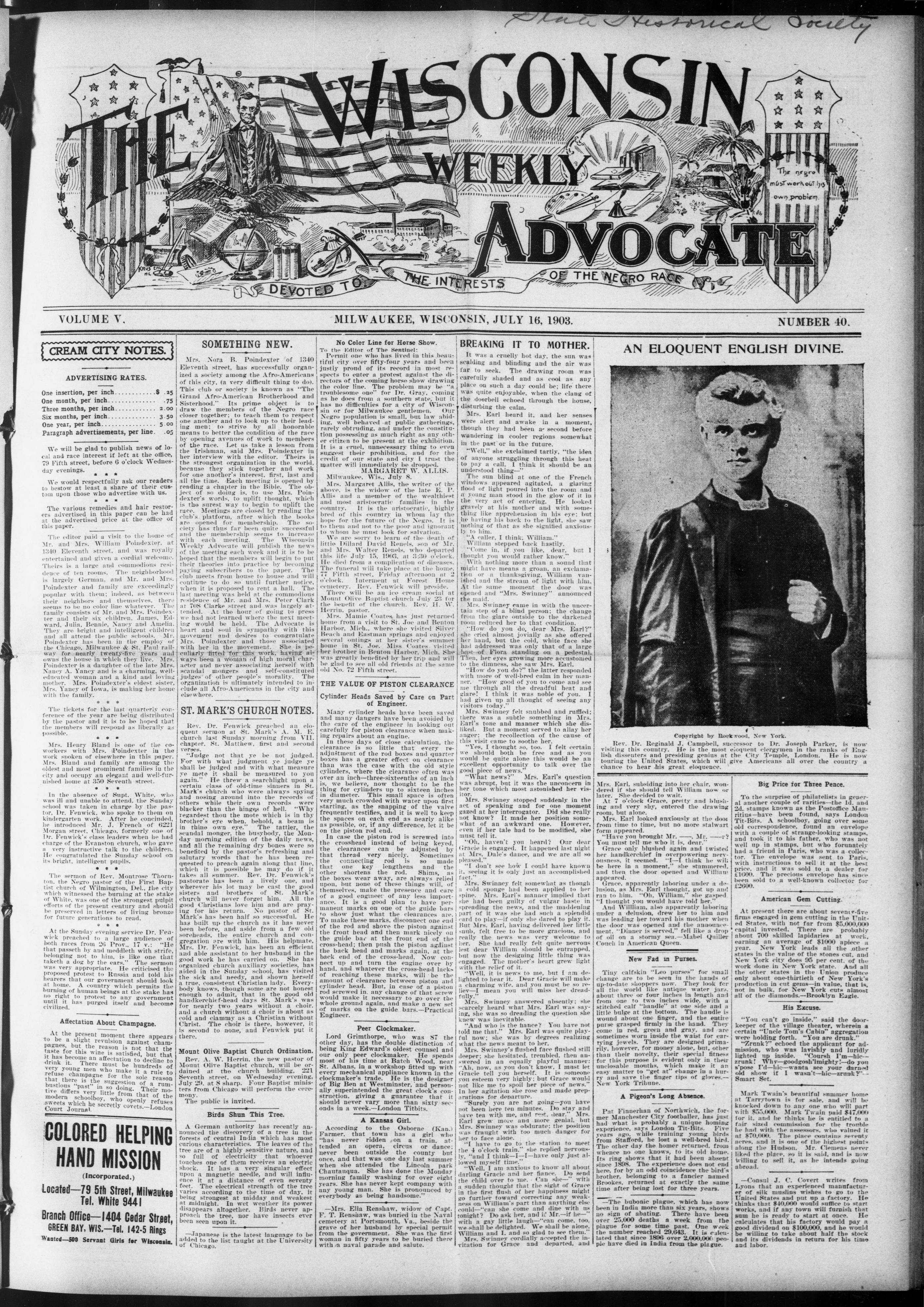
WISCONSIN
WEEKLY
ADVOCATE
DEVOTED TO THE INTERESTS OF THE NEGRO RACE
VOLUME V.
CREAM CITY NOTES.
ADVERTISING RATES.
One insertion, per inch. $ .25
One month, per inch. .75
Three months, per inch. 2.00
Six months, per inch. 3.50
One year, per inch. 5.00
Paragraph advertisements, per line. .05
We will be glad to publish news of local and race interest if left at the office, 79 Fifth street, before 6 o'clock Wednesday evenings.
We would respectfully ask our readers to bestow at least a share of their custom upon those who advertise with us.
The various remedies and hair restorers advertised in this paper can be had at the advertised price at the office of this paper.
The editor paid a visit to the home of Mr. and Mrs. William Poindexter, at 1340 Eleventh street, and was royally entertained and given a cordial welcome. Theirs is a large and commodious residence of ten rooms. The neighborhood is largely German, and Mr. and Mrs. Poindexter and family are exceedingly popular with them; indeed, as between their neighbors and themselves, there seems to be no color line whatever. The family consists of Mr. and Mrs. Poindexter and their six children, James, Edward, Julia, Bennie, Nancy and Amelia. They are bright and intelligent children and all attend the public schools. Mr. Poindexter has been in the employ of the Chicago, Milwaukee & St. Paul railway for nearly twenty-five years and owns the house in which they live. Mrs. Poindexter is a daughter of the late Mrs. Nancy A. Yancy and is a charming, well educated woman and a kind and loving mother. Mrs. Poindexter's eldest sister Mrs. Yancy of Iowa, is making her home with the family.
* * *
The tickets for the last quarterly conference of the year are being distributed by the pastor and it is to be hoped that the members will respond as liberally as possible.
* * *
Mrs. Henry Bland is one of the coworkers with Mrs. Poindexter in the work spoken of elsewhere in this paper. Mrs. Bland and family are among the oldest and most prominent families in the city and occupy an elegant and well-furnished home at 350 Seventh street.
\* \* \*
In the absence of Supt. White, who was ill and unable to attend, the Sunday school was taken in charge by the pastor, Dr. Fenwick, who spoke to them on kindergarten work. After he concluded, he introduced Mr. J. French of 6221 Morgan street, Chicago, formerly one of Dr. Fenwick's class leaders when he had charge of the Evanston church, who gave a very instructive talk to the children. He congratulated the Sunday school on its bright, intelligent pupils.
* * *
The sermon of Rev. Montrose Thornton, the Negro pastor of the First Baptist church of Wilmington, Del., the city which witnessed the burning at the stake of White, was one of the strongest pulpit efforts of the present century and should be preserved in letters of living bronze for future generations to read.
宋 宋 宋
At the Sunday evening service Dr. Fenwick preached to a large audience of both races from 26 Prov., 17 v.: "He that passeth by and meddleth with strife, belonging not to him, is like one that taketh a dog by the ears." The sermon was very appropriate. He criticised the proposed protest to Russia and told his hearers that our government should look at home. A country which permits the burning of human beings at the stake has no right to protest to any government until it has purged itself and become civilized.
Affectation About Champagne.
At the present moment there appears to be a slight revulsion against champagnes, but the reason is not that the taste for this wine is satisfied, but that it has become an affectation to decline to drink it. There must be hundreds of very young men who make it a rule to refuse champagne for the soile reason that there is the suggestion of a rum-bustious "past" in so doing. Their motive differs very little from that of the modern schoolboy, who openly refuses sweets which he secretly covets.—London Court Journal.
COLORED HELPING HAND MISSION
(Incorporated.)
Located—79 5th Street, Milwaukee
Tel. White 9441
Branch Office—1404 Cedar Street,
GREEN BAY, WIS.—Tel. 142-5 Rings
Wanted—500 Servant Girls for Wisconsin.
SOMETHING NEW.
Eleventh street, has successfully organized a society among the Afro-Americans of this city, (a very difficult thing to do). This club or society is known as "The Grand Afro-American Brotherhood and Sisterhood." Its prime object is to draw the members of the Negro race closer together; to teach them to respect one another and to look up to their leading men; to strive by all honorable means to better the condition of the race by opening avenues of work to members of the race. Let us take a lesson from the Irishman, said Mrs. Poindexter in her interview with the editor. Theirs is the strongest organization in the world, because they stick together and work for one another's interest, first, last and all the time. Each meeting is opened by reading a chapter in the Bible. The object of so doing is, to use Mrs. Poindexter's words, to uplift thought, which is the surest way to begin to uplift the race. Meetings are closed by reading the club's platform, after which the books are opened for membership. The society has thus far been quite successful and the membership seems to increase with each meeting. The Wisconsin Weekly Advocate will publish the news of the meeting each week and it is to be hoped that the members will begin to put their theories into practice by becoming paying subscribers to the paper. The club meets from house to house and will continue to do so until further notice, when it is proposed to rent a hall. The last meeting was held at the commodious residence of Mr. and Mrs. Peter Clark at 708 Clarke street and was largely attended. At the hour of going to press we had not learned where the next meeting would be held. The Advocate is heart and soul in sympathy with this movement and desires to congratulate Mrs. Poindexter and those associated with her in the movement. She is peculiarly fitted for this work, having always been a woman of high moral character and never associating herself with scandal mongers and self-constituted judges of other people's morality. The organization is ultimately intended to include all Afro-Americans in the city and elsewhere.
ST. MARK'S CHURCH NOTES.
Rev. Dr. Fenwick preached an eloquent sermon at St. Mark's A. M. E. church last Sunday morning from VII. chapter. St. Matthew, first and second verses.
"Judge not that ye be not judged. For with what judgment ye judge ye shall be judged and with what measure ye mete it shall be measured to you again." He threw a searchlight upon a certain class of old-time sinners in St. Mark's church who were always spying and nosing around into the records of others while their own records were blacker than the hinges of hell. "Why regardest thou the mote which is in thy brother's eye when, behold, a beam is in thine own eye." The tattler, the scandal monger, the busybody, the Monday morning edition of the daily news, and all the remaining dry bones were so benefited by the pastor's refreshing and salutary words that he has been requested to preach again along that line, which it is possible he may do if it takes all summer. Rev. Dr. Fenwick's pastorate has been a lively one, and wherever his lot may be cast the good sisters and brothers of St. Mark's Church will never forget him. All the good Christians love him and are praying for his return. No pastor of St. Mark's has been half so successful. He has built up the church as it has never been before, and aside from a few old soreheads, the entire church and congregation are with him. His helpmate, Mrs. Dr. Fenwick, has been an efficient and able assistant to her husband in the good work he has carried on. She has organized church auxiliary societies, has aided in the Sunday school, has visited the sick and needy, and shown herself a true, consistent Christian lady. Everybody knows, though some are not honest enough to admit, that in the good old handkerchief-head days St. Mark's was for nearly two years without a choir, and a church without a choir is about cold and clammy as a Christian without Christ. The choir is there, however, it is second to none, and Fenwick put it there.
Mount Olive Baptist Church Ordination. Rev. A. W. Herrin, the new pastor of Mount Olive Baptist church, will be ordained at the church building, 221 Seventh street, on Wednesday evening, July 29, at 8 sharp. Four Baptist ministers from Chicago will perform the ceremony.
The public is invited
Birds Shun This Tree.
A German authority has recently announced the discovery of a tree in the forests of central India which has most curious characteristics. The leaves of the tree are of a highly sensitive nature, and so full of electricity that whoever touches one of them receives an electric shock. It has a very singular effect upon a magnetic needle, and will influence it at a distance of even seventy feet. The electrical strength of the tree varies according to the time of day, it being strongest at midday and weakest at midnight. In wet weather its power disappears altogether. Birds never approach the tree, nor have insects ever been seen upon it.
Japanese is the latest language to be added to the list taught at the University of Chicago.
No Color Line for Horse Show. To the Editor of The Sentinel: Permit one who has lived in this beautiful city over fifty-four years and been justly proud of its record in most respects to enter a protest against the directors of the coming horse show drawing the color line. The problem may be "a troublesome one" for Dr. Gray, coming as he does from a southern state, but it has no difficulties for a city of Wisconsin or for Milwaukee gentlemen. Our Negro population is small, but law abiding, well behaved at public gatherings, rarely obtruding, and under the constitution possessing as much right as any other citizen to be present at the exhibition. It is a cruel, unnecessary thing to even suggest their prohibition, and for the credit of our state and city I trust the matter will immediately be dropped.
MARGARET W. ALLIS.
Milwaukee. Wis. July 8.
Mrs. Margaret Allis, the writer of the above, is the widow of the late E. P. Allis and a member of the wealthiest and most aristocratic families in the country. It is the aristocratic, highly bred of this country in whom lay the hope for the future of the Negro. It is to them and not to the poor and ignorant to whom he must look for salvation. We are sorry to learn of the death of little Dillard David Renels, son of Mr. and Mrs. Walter Renels, who departed this life July 15, 1903, at 3:30 o'clock. He died from a complication of diseases. The funeral will take place at the home, 77 Fifth street, Friday afternoon at 2 o'clock. Interment at Forest Home cemetery. Rev. Fenwick will preside. There will be an ice cream social at Mount Olive Baptist church July 23 for the benefit of the church. Rev. H. W. Herrin, pastor.
Mrs. Mamie Coates has just returned home from a visit to St. Joe and Benton Harbor, Mich., where she visited Silver Beach and Eastman springs and enjoyed several outings at her sister's summer home in St. Joe. Miss Coates visited her brother in Benton Harbor, Mich. She was greatly benefited by her trip and will be glad to see all old friends at the same old No. 72 Fifth street.
THE VALUE OF PISTON CLEARANCE
Cylinder Heads Saved by Care on Part of Engineer.
Many cylinder heads have been saved and many dangers have been avoided by the care of the engineer in looking out carefully for piston clearance when making repairs about an engine. In these days of close calculation, the clearance is so little that every readjustment of the rod boxes and quarter boxes has a greater effect on clearance than was the case with the old style cylinders, where the clearance often was over an inch—three-sixteenths of an inch is, we believe, now thought to be the thing for cylinders up to sixteen inches in diameter. This small space is often very much crowded with water upon first starting, as the snapping of the valve frequently testifies, and it is well to keep the spaces on each end as nearly alike as possible, or, if any difference, let it be on the piston rod end.
In case the piston rod is screwed into the crosshead instead of being keyed, the clearances can be adjusted by that thread very nicely. Sometimes the connecting rod is so made that one key lengthens and the other shortens the rod. Shims, as the boxes wear away, are always relied upon, but none of these things will, of themselves, make the presence and care of a good engineer of any less importance. It is a good plan to have permanent marks on one of the guide bars to show just what the clearances are. To make these marks, disconnect one end of the rod and shove the piston against the front head and then mark nicely on the guide bar at the front end of the cross-head; then push the piston against the back head and marks again, at the back end of the cross-head. Now connect up and turn the engine over by hand, and whatever the cross-head lacks of reaching these marks, will be the amount of clearance between piston and cylinder head. But, in case of a piston rod screwed in, any change of that screw would make it necessary to go over the whole ground again, and make a new set of marks on the guide bars.—Practical Engineer.
Peer Clockmaker
Lord Grimthorpe, who was 87 the other day, has the double distinction of being King Edward's oldest counsel and our only peer clockmaker. He spends most of his time at Batch Wood, near St. Albans, in a workshop fitted up with every mechanical appliance known in the clockmaker's trade. He is the designer of Big Ben at Westminster, and personally superintended the great clock's construction, giving a guarantee that it should never vary more than sixty seconds in a week.—London Titbits.
A Kansas Girl.
According to the Osborne (Kan.) Farmer, that town has a girl who "has never ridden on a train, attended an opera, circus or dance, never been outside the county but once, and that was one day last summer when she attended the Lincoln park Chautauqua. She has done the Monday morning family washing for over eight years. She has never kept company with any young man. She is pronounced by everybody as being handsome."
—Mrs. Ella Renshaw, widow of Capt. F. T. Renshaw, was buried in the Naval cemetery at Portsmouth, Va., beside the grave of her husband by special permit from the government. She was the first woman in fifty years to be buried there with a naval parade and salute.
BREAKING IT TO MOTHER.
It was a cruelly hot day, the sun was scalding and blinding and the air was far to seek. The drawing room was carefully shaded and as cool as any place on such a day could be; life there was quite enjoyable, when the clang of the doorbell echoed through the house, disturbing the calm.
Mrs. Earl heard it, and her senses were alert and awake in a moment, though they had been a second before wandering in cooler regions somewhat in the past or in the future.
"Well," she exclaimed tartly, "the idea of anyone struggling through this heat to pay a call. I think it should be an understood thing—"
The sun blind at one of the French windows appeared agitated, a glaring flood of light poured into the room and a young man stood in the glow of it in the very act of entering. He looked gravely at his mother and with something like apprehension in his eye; but he having his back to the light, she saw nothing of that as she signified anxiously to him.
"A caller, I think, William."
William stepped back hastily.
"Come in, if you like, dear, but I thought you would rather know."
With nothing more than a sound that might have means a groan, an exclamation or a thanksgiving. William vanished and the stream of light with him. At the same moment the door was opened and "Mrs. Swinney" announced the maid.
Mrs. Swinney came in with the uncertain step of a blind person; the change from the glare outside to the darkened room reduced her to that condition.
"How do you do, dear Mrs. Earl?" she cried almost jovially as she offered her hand, but the cold, white face she had addressed was only that of a large bust of Flora standing on a pedestal. Then, her eyes growing more accustomed to the dimness, she saw Mrs. Earl.
"How do you do?" the latter responded with more of well-bred calm in her manner. "How good of you to come and see me through all the dreadful heat and glare! I think it was noble of you. I had given up all thought of seeing any visitors today."
Mrs. Swinney felt snubbed and ruffled; there was a subtle something in Mrs. Earl's tone and manner which she disliked. But a moment served to allay her anger; the recollection of the cause of this visit came to soothe her.
"Yes, I thought so, too. I felt certain we should both be free and as you would be quite alone this would be an excellent opportunity to talk over the good piece of news."
"What news?" Mrs. Earl's question was abrupt, but it was the unconcern in her tone which most astonished her visitor.
Mrs. Swinney stopped suddenly in the act of speaking and for one moment gazed at her interrogator. Did she really not know? It made her position somewhat of an awkward one. However, even if her tale had to be modified, she must tell it.
"Oh, haven't you heard? Our dear Gracie is engaged. It happened last night at Mrs. Dale's dance, and we are all so pleased."
"I don't see how I could have known it, seeing it is only just an accomplished fact."
Mrs. Swinney felt somewhat as though a cold sponge had been applied to her spine. Mrs. Earl's manner implied that she had been guilty of vulgar haste in spreading the news, and the maddening part of it was she had such a splendid card to play—if only she dared to play it. But Mrs. Earl, having delivered her little snub, felt free to be more gracious, and really the news was very welcome to her. She had really felt quite nervous lest dear William should be entrapped, but now the designing little thing was engaged. The mother's heart grew light with the relief of it.
"Well, it is news to me, but I am delighted to hear it. Dear Gracie will make a charming wife, and you must be so reliev—I mean you will miss her dreadfully."
Mrs. Swinney answered absently; she scarcely heard what Mrs. Earl was saying, she was so dreading the question she knew was inevitable.
"And who is the fiance? You have not told me that." Mrs. Earl was quite playful now; she was by degrees realizing what the news meant to her.
Mrs. Swinney's flushed face flushed still deeper; she hesitated, trembled, then answered in an equally playful manner: "Ah, now, as you don't know, I must let Gracie tell you herself. It is someone you esteem very highly; but Grace would not like me to spoil her piece of news."
In her agitation she rose and made preparations for departure.
"Surely you are not going--you have not been here ten minutes. Do stay and have tea with me, and rest, dear." Mrs. Earl grew more and more genial, but Mrs. Swinney was obdurate; the position was fraught with too much danger for her to face alone.
"I have to go to the station to meet the 4 o'clock train." she replied nervously. "and I think-I-I-have only just allowed myself time."
"Well. I am anxious to know all about darling Gracie and her fiance. Do send the child over to me. Can she—" with a sudden thought that the sight of Grace in the first flush of her happiness might go further toward correcting any weakness on William's part than anything else could—"can she come and dine with us tonight? Do ask her, and if Mr.—if he—" with a gay little laugh—"can come, too, we shall be delighted. We shall be alone, William and I, and so glad to see them." Mrs. Swinney cordially accepted the invitation for Grace and departed, and
AN ELOQUENT ENGLISH DIVINE.
19
Mrs. Earl, subsiding into her chair, wondered if she should tell William now or later. She decided to wait.
At 7 o'clock Grace, pretty and blushing and very shy, entered the drawing room, but alone.
Mrs. Earl looked anxiously at the door from time to time, but no more stalwart form appeared.
"Have you brought Mr. ——, Mr. ——r? You must tell me who it is, dear."
Big Price for Three Pence.
To the surprise of philatelists in general another couple of rarities—the 1d. and 2d. stamps known as the Postoffice Mauritius—have been found, says London Tit-Bits. A schoolboy, going over some old correspondence, found an envelope with a couple of strange-looking stamps, and took it to his father, who was not well in stamps, but who
Grace only blushed again and twisted her handkerchief in overpowering nervousness, it seemed. "I—I think he will be here in a moment," she stammered, and then the door opened and Williams appeared.
Grace, apparently laboring under a delusion, as Mrs. Earl thought, got up and ran to him. "Oh, William," she gasped. "I thought you would have told her."
And William, also apparently laboring under a delusion, drew her to him and was leading her toward his mother when the door was opened and the announcement, "Dinner is served," fell like a drop of oil on a stormy sea.—Mabel Quiller Couch in American Queen.
New Ead in Purses
Tiny calfskin "Leo purses" for small change are to be seen in the hands of up-to-date shoppers now. They look for all the world like antique water jars, about three or four inches in length and from one to two inches wide, with a stitched calf "handle" at one side and a little bulge at the bottom. The handle is wound about one finger, and the entire purse grasped firmly in the hand. They come in red, green and gray, and are sometimes worn inside the waist for carrying jewels. They are designed primarily, however, for money alone, but, other than their novelty, their special fitness for this purpose is evident only in their unclosable mouths, which make it an easy matter to "get at" change in a hurry and save the finger tips of gloves.—New York Tribune.
A Pigeon's Long Absence
Pat Finnerhan of Northwich, the former Manchester City footballer, has just what is probably a unique homing experience, says London Tit-Bits. Five years ago, while training young birds from Stafford, he lost a well-bred bird. The other day the homer returned, from whence no one knows, to its old home. Its ring shows that it had been absent since 1898. The experience does not end here, for by an odd coincidence the bird's brother, belonging to a fancier named Brookes, returned at exactly the same time after being lost for three years.
The bubonic plague, which has now been in India more than six years, shows no sign of abating. There have been over 25,000 deaths a week from the plague for some time past. One week the number reached 29,643. It is calculated that since 1896 over 2,000,000 people have died in India from the plague.
ENGLISH DIVINE.
accessor to Dr. Joseph Parker, is now eloquent clergymen in the ranks of Engl the City Temple, London. He is now give Americans all over the country a
Big Price for Three Pence.
To the surprise of philatelists in general another couple of rarities—the 1d. and 2d. stamps known as the Postoffice Mauritius—have been found, says London Tit-Bits. A schoolboy, going over some old correspondence, found an envelope with a couple of strange-looking stamps, and took it to his father, who was not well up in stamps, but who forunately had a friend in Paris, who was a collector. The envelope was sent to Paris, with instructions to sell it at the best price, and it was sold to a dealer for £1600. The precious envelope has since been sold to a well-known collector for £2600.
American Gem Cutting.
At present there are about seventy-five firms engaged in gem cutting in the United States, with not far from $5,000,000 capital invested. There are probably about 700 skilled lapidaries at work, earning an average of $1000 apiece a year. New York leads all the other states in the value of the stones cut, and New York city does 95 per cent. of the work done in New York state. And all the other states in the Union produce only about one-thirtieth of New York's production in cut gems—in value, that is, not in bulk, for New York cuts almost all of the diamonds.—Brooklyn Eagle.
"You can't go inside," said the door-keeper of the village theater, wherein a certain "Uncle Tom's Cabin" aggregation were holding forth. "You are drunk."
"Zrunk?" echoed the applicant for admission, who was lavishly and luridly lighted up inside. "Coursh I'm—hic—zrunk! Why—goodgosh'lmighty!—do you s'pose I'd—hic—wanta see your darned old show if I wasn't—hic—zrunk?" Smart Set.
Mark Twain's beautiful summer home at Tarrytown is for sale, and will be knocked down to any one who will part with $55,000. Mark Twain paid $47,000 for it, and he thinks he is entitled to a fair sized commission for the trouble he had with the assessors, who valued it at $70,000. The place contains seventy acres, and it is one of the highest points along the Hudson. Mr. Clemens never liked the place, so it is said, and is now willing to sell it, as he intends going abroad.
Consul J. C. Covert writes from Lyons that an experienced manufacturer of silk muslins wishes to go to the United States and put up a factory. He thinks that $40,000 would suffice to start works, and if any town will furnish that sum he is ready to start at once. He calculates that his factory would pay a good dividend on $100,000, and he would be willing to take about half the stock and its dividends in return for his time and labor.
NUMBER 40.
His Excuse.
ALFRED KNAPP IS GUILTY.
STRANGLED MANY WOMEN.
Jury at Hamilton, O., Does Not Recom mend Mercy for Criminal-Awful Career of Murderer.
Hamilton, O., July 16.—Alfred A. Knapp was convicted of murder in the first degree for the murder of his wife, Hannah Goddard Knapp, by Judge Belden's jury here today. The verdict was reached at 7:30 o'clock, the jury having been out since 5 o'clock last night. To the suprise of everybody there was no recommendation of mercy and the famous criminal must go to the electric chair. It was thought that the long deliberation argued that the degree of the crime would be reduced. The jury stood 10 for conviction without mercy and two for conviction with mercy, being unanimously for guilt.
Repeated ballots were taken and shortly after 7 o'clock it was found that an agreement had been reached. Judge Helden was sent for and arrived about 7:30. Knapp was brought into court by Sheriff Bisdorf. There were but a few spectators present and there was no excitement.
Knapp Does Not Appear Alarmed.
Knapp took his seat quietly and did not appear alarmed. When the verdict was returned, convicting him without recommendation of mercy, he did not show any sign of emotion or make any comment. He seemed to have prepared himself for the ordeal.
Knapp was taken back to jail at once and Sheriff Bisdorf will allow no outsiders to see him. The result of the trial is accepted with great satisfaction, as hope of a conviction became low when the jury remained out so long. Knapp's mother and sister were much affected when they heard the verdict.
The case will be carried higher on the usual appeals, but it is generally believed that Knapp will now be electrocuted.
Insanity Was Only Defense.
Insanity was the only defense made by his parents and sisters as well as by attorneys. All of his victims were strangled.
Knapp's first wife was Emma Stubbs of Fort Wayne. She secured a divorce. Knapp's fourth and surviving wife lives at Indianapolis, where he was arrested last February.
No visitors were allowed to see Knapp today. Three hours after Knapp said: "I suppose it's all off with me."
Motion for New Trial
A motion for a new trial will be filed this afternoon by Knapp's counsel. It will not be heard until next fall, as Attorney Darby will go away to recuperate. Knapp's relations visited him at the jail. The meeting was pathetic as he tried to comfort his mother.
Knapp's Criminal Career.
Knapp was born in Greensburg, Ind., in 1862, and for twenty years led the usual life of a boy in his station. In 1882 his criminal record began with a conviction for burglary at Chicago, and a sentence to Joliet prison. Since that time Knapp has been five times convicted of felonies, mostly crimes against women and children, and has served terms in the penitentiaries at Jeffersonville, Ind.; Michigan City, Ind., and Columbus, O. More than half of the last twenty years of his life have been passed in prison and it was during his intervals of liberty that he committed the five murders which made his name known throughout the civilized world.
Knapp's last arrest was due largely to his sister, Mrs. Edward King of Cumminsville, near Cincinnati, who, on February 24, notified the local police that Knapp's third wife, Hannah Goddard, had been missing since December 22, 1902, and that Knapp had subsequently married Anna Gamble of Indianapolis.
After a careful investigation Captain of Police Lenehan went to Indianapolis and in the early morning of February 25 arrested Knapp in his bedroom. The prisoner got the impression that he was wanted on a charge of bigamy and consented to come to Hamilton. He was taken to police headquarters and diligently "sweated," but maintained throughout the day that he knew nothing of his third wife's fate, except that he was sure she was dead. Finally, in the evening, he weakened, and to Mayor Charles S. Bosch made a detailed confession of the murder, afterward leading the police over the ground.
Desire to Strangle.
He said that upon awakening on the morning of December 22 he had been seized with an uncontrollable desire to strangle his wife, and had done so. He then went at 7 a. m. to the Red Trunk shoe store, where he bought a storebox, and in this storebox he nailed up the body of his victim.
He hired a horse and wagon at the Shollenbarger livery barn, where he was formerly employed, and after loading the box into the wagon he hauled it to the "old sucker hole" on the Miami river, two miles below the city, and threw it into the stream.
Police inquiry verified the box and wagon stories, and the finding of the woman's body by George Pursley, Albert Rusk and Marion Scott, deckhands on the steamer Bellevue, at New Albany, Ind., on March 2, provided the last link in the chain of evidence. The body was fully identified by a ring and a few remnants of clothing which clung to it. On the morning after his first confession Knapp was taken to the county jail, where, in the presence of Sheriff Bisford, Chief of Police Kuemmerling and Captain of Police Lenehan, he wrote his famous confession. It was as follows:
Confession of Murders.
"On June 21, 1894, I killed Emma Littleman in a lumber yard in Gest street, in Cincinnati. On August 1, 1894, I killed May Eckhart in Walnut street, opposite the Y. M. C. A. building, in Cincinnati. On August 7, 1894, I killed my wife, Jennie Knapp, under the canal bridge of Liberty street, and threw her body into the canal, in Cincinnati. On December 22, 1902, I killed my wife, Hannah Knapp, at 329 South Fourth street, in Hamilton, O., and threw her into the river out by Lindenwald. This is the truth. I made this confession by my own free will and not by the request of any officer or anyone else.
LOSS OF LIFE ENORMOUS.
About Five Thousand People Perish in Awful Typhoon in Southern China.
Paris, July 16.—A typhoon swept over a large portion of Tonquin, the French possession in southern China, which is said to have been one of the most destructive ever known there. Haoi, the capital of Tonquin, was devastated and Namidink was literally swept out of existence. Scarcely a house is left standing for miles. All the natives who were caught in the typhoon perished and it is estimated that the loss of life is between 2000 and 5000.
MANCHURIA OPEN TO ALL.
Chinese Government Agrees to Open Ports Which Are Now Closed to World's Trade.
Washington, D. C., July 16.—The Manchurian question has been settled satisfactorily to this government. Assurances have been received from the Chinese government that it will in the near future open as treaty ports several ports now closed to the world's trade. The Russian government has conveyed formal assurance to the United States government that it will not in any way oppose such opening. While the ports to be opened are not yet specified it is gathered from the communications received that they are Monkden, the principal inland port of Manchuria, and Ta Tung Kao, at the mouth of Yalu river.
The state department is highly gratified at this outcome, feeling that it has secured not only for American commerce, but for the commerce of the world at large, a very substantial gain.
It now develops that the meeting of the officials at Port Arthur just concluded was but one of the steps, though an important one, which the St. Petersburg government had planned in execution of its purpose to place matters of internal administration in Manchura in such condition that the ports desired by the United States and Japan could be opened to trade without causing disturbance or involving undue sacrifice of proper Russian interests. It already has been represented that much of the friction that had grown out of the Manchurian question was caused by a sort of triple yet independent administration of affairs in Mancruia, by representatives of the different branches of the Russian government. The result was that one official would not feel bound by the pledges made by another so that foreign nations complained of bad faith.
It is understood that now, following the Port Arthur conference, a compact and responsible direction of affairs has been arranged for and orders issued from St. Petersburg are certain to meet with speedy and exact compliance. Although no set time is mentioned in the promise to open the port, it is believed that this will follow soon after the Russian evacuation in September.
It is now known that the negotiations which have terminated so successfully today so far as broad lines are concerned, for only details remain to be adjusted, were practically brought to their present phase by Secretary Hay and Count Cassini at a meeting at the Russian embassy on June 28. It now remains for Mr. Conger to define in the trade treaty which he is negotiating with China the terms and conditions under which the new ports are to be opened. It may be stated that had the United States government cared to pursue a selfish policy in this matter it might easily have secured promises of special privileges from Russia, but Secretary Hay has held to the broader doctrine of the open door in Manchuria for the whole world.
Respecting the two ports mentioned as likely to be opened, namely Moukden and Ta Tung Kao, it may be said that both politically and from a trade point of view, the latter point is apt to prove the more important, though the place is now so little known that the name is not to be found on many of the best charts. It lies on the right bank of the Yalu river, not far from its mouth and close to it is the Corean town of Weju, an important trade center, which will undoubtedly prove tributary to the new port. At present Ta Tung Kao does not amount to much, but rapid development is looked for as soon as it becomes a treaty port. Moukden is at the head of navigation on Liao river and is the point from which caravans start through Manchuria and Siberia. It is at present the largest port in Manchuria, next to Niu Chwang.
REVOLUTIONISTS BEG CASTRO FOR MERCY.
American and German Consuls Prevent Bombardment of Ciudad Bolivar.
Soledad, Venezuela, Wednesday, July 15.—The situation is unchanged. The attack on Ciudad Bolivar by the Venezuelan government troops which appeared imminent yesterday morning has been deferred at the request of United States Consul Henderson, Herr Brokmen, the German consul, and the bishop, who transmitted to President Castro through Gen. Gomez, the commander-in-chief of the government forces, a long telegram asking him to be magnanimous and to show mercy to all if the revolutionists surrender. It is known that the President answered as follows: Yes, for everyone except the traitor Ferrera, the author of so many tears and the cause of making so many orphans.
The final period of delay given by Gen. Gomez for a definite answer to his request for the surrender of Gen. Rolando and his followers expires today, but the correspondent of the Associated Press is informed that at the last minute President Castro, wishing to save the lives of the inhabitants of Ciudad Bolivar and to avoid the horrors which must follow the storming of the city, ordered Gen. Gomez not to open fire if he is not attacked, but to simply besiege the city. The revolutionists, having no provisions, cannot resist more than ten days. The Venezuelan man-of-war Bolivar has left for the island of Trinidad to fetch provisions for the government troops.
The United States gunboat Bancroft and the French cruiser Jouffroy arrived off this port during the afternoon. They reported all well on board.
The armistice ends at midnight.
FLEE FOR THEIR LIVES.
Guests at Mountain Inn Hotel, Kingston, N. Y., Have Narrow Escape—Building Destroyed by Fire.
Kingston, N. Y., July 16.—Mountain Inn hotel at Pine Hill was destroyed by fire early today. Guests were compelled to flee for their lives in their night clothes. So far no loss of life is known. The hotel accommodated 230 guests. The origin of the fire is unknown.
ANOTHER FLOOD FEARED.
Kaw River Is Rising and Heavy Rains Are Reported—Corn Crop Is Benefited.
Topeka, Kan., July 16.—A rain which began shortly after midnight fell continuously over this section of the country until daylight. It has been of great value to the corn crop. Some alarm is felt of another flood, as the waters of the Kaw are discolored and slowly rising, with heavy rains reported from the west.
VENEZUELA PAYS ITS DEBT.
Has Settled Indemnity with Representatives of Allied Powers.
Caracas, Venezuela, July 16.—The Venezuelan government yesterday paid to the representatives of the allied powers the last installments of the indemnity as stipulated by the protocol.
POPE LEO'S DAY OF FATE.
Predicted That He Would Die on Festival of Carmelite Madonna.
PONTIFF BARELY ALIVE
Rome, July 16.—12:40 p. m.—The doctors, after a thorough examination of the patient, have decided that the regathering of pleuric liquid, although serious, does not constitute immediate danger of dissolution and therefore they will defer an operation until the last possible moment.
Rome, July 16.—3 p. m.—The Pope's prostration is increasing. The difficulty he experiences in breathing has grown more serious and is accompanied by severe bronchial wheezing.
Rome, July 16.—The Pope's condition today again assumed a grave aspect. Besides the continuance of the pontiff's extreme weakness the doctors indicated the ominous prospect of another operation for the removal of the pleuritic liquid. The Pope continued restless but had several periods of comparative ease. During one of these he gave another evidence of his remarkable vitality by taking holy communion, during the celebration of mass in honor of the Madonna of the Carmelites. The ceremony was held in the chapel, adjoining the sickroom, the doors being open. It was a pathetically solemn event, as by the Pope's request those participating, besides Dr. Lapponi and Pio Centra, included a number of his trusted domestics, five sweepers and two porters.
The doctors are unable to announce definitely when the next operation will be performed. They fear it may become necessary this evening, or tomorrow morning, but they are determined to defer it until it is imperative, fearing that the enfeebled condition of the patient may be taxed beyond the final limit.
Toward noon the pontiff dropped off into an uneasy sleep.
Pope Prays to the Madonna
Rome, July 16—11 a. m.—The fateful day of the Carmelite Madonna, on which Pope Leo had a premonition he would die, has arrived. Early this morning his holiness awoke and immediately began repeating prayers to the Madonna, speaking with such fervor that his valet, Centra, hurried from an adjoining room. Pope Leo, hearing Centra's voice, said: "Ah, Pio, your task is nearly done. Today is the fete of the Carmelite Madonna."
Still later, with the same idea in mind, the Pope asked for one of his private secretaries, Mgr. Marzonlini, to have him say mass in the chapel next to his bedroom, with the door between the two apartments open. In the middle of the mass Pope Leo received the communion like one who really saw visions of coming bliss.
Sleep Resembles Death.
Worst Night Pope Has Passed.
When Dr. Mazzoni visited the pontiff this morning the latter said the past night had been one of the worst he had experienced. He spoke of the oppression on his chest; the difficulty in breathing and the uncontrollable restlessness, giving him in fact no peace in any position. Dr. Lapponi said the Pope had called for him very often during the night, taking frequent restoratives, especially meat broth, orangeade and tamarind water. He felt better, however, after the celebration of mass as though the communion had calmed him.
Make Careful Examination.
The doctors proceeded with a thorough examination of his thorax without fatiguing him too much. They found the liquid in the pleura augmented, but not gathered in such quantity as to endanger the patient's life by producing pressure on the heart, or through asphyxia which might occur if there were pressure on the lower part of the bronchial tubes.
Will Postpone Operation.
On account of the extreme weakness of the pontiff no operation for extracting the liquid will be performed until it is absolutely indispensable.
HOSPITAL BURNS.
Four Persons Perish in a Fire Which Destroys Bonner Springs (Kan.) Sanitarium.
Bonner Springs, Kan., July 16.—Four persons lost their lives in a fire early this morning which destroyed Bonner Springs sanitarium at Bonner Springs, Kan., seventeen miles west of Kansas City. The dead are:
M'CLURE, CAPT. A. J., Junction City, Kan., a former attorney for the Union Pacific railroad.
CAMPBELL, MISS JANIE, patient, Iola, Kan.
COOK, MRS. A. A., patient, Lawrence, Kan.
ROGERS, DR. A. E., the steward.
The fire started in the laundry at the west end of the main building and reached the room of the main structure before it was discovered.
A light wind drove the blaze into the halls and rooms on every floor. The entire building was filled with smoke before the inmates, about thirty in number, were awakened.
A nurse named Payne went into the hall and heard Dr. Rogers calling for help. She broke open the door and led Rogers part way down the hall, telling him to follow. It was found, however, that Dr. Rogers had stopped to save a woman patient and was burned to death.
All those who were burned were evidently first suffocated, as none were heard to scream.
The bodies of Dr. Rogers and one of the women have been recovered. Workmen are searching for the others.
POLICE CHARGE ON MOB.
Fifty Officers Attack 3000 Strikers and Dispel Them—One Officer Seriously Hurt and Others Slightly.
Chicago, Ill., July 16.—Preparations were made for the removal of freight from the Kelogg Switchboard plant early today. A crowd of more than 3000 strikers and strike sympathizers gathered, intent upon preventing the moving of the freight. Police Inspector Shea was applied to for additional aid in dispelling the mob. Fifty policemen charged into the crowd, which they routed by free use of their clubs. The rioting was general. One policeman was struck in the back with a brick and seriously injured. Several others were slightly hurt.
POLICE FIGHT RIOTERS.
BATTLE BETWEEN STRIKERS AND OFFICERS AT CHICAGO.
Former Employes of the Kellogg Company Attempt to Stop Business of Concern.
Chicago, Ill, July 15.—Riotous scenes were repeated today when a mob of nearly 1000 men and boys chased for nearly two miles a wagon loaded with freight from the Kellogg Switchboard and Supply company's plant to the North-Western railroad freighthouse. Many persons were struck by missiles hurled at the men in charge of the wagon. Five men were arrested and at times the score of police forming an escort for the wagon charged the crowd and beat the rioters back with their clubs. All along the route blockades were formed by sympathizing truck drivers and the way was cleared by the police with great difficulty. The freight was unloaded at the freighthouse by special officers employed by the Kellogg company, the freighthandlers refusing to touch it.
Later in the day the rioters became so persistent in their efforts to block the progress of wagons from the Kellogg plant that the police fired thirty shots over their heads to intimidate and disperse them.
Law and order triumphed over mob rule yesterday when fifty policemen drove 500 union rioters before them and enabled the Kellogg company to make deliveries of freight to the railroad depots. For seven hours the police battled with the mob.
Danger of the teamsters aiding a general strike of the freighthandlers disappears as the result of the action taken by the teamsters' joint council at its meeting last night. The teamsters delivered a severe rebuke to President Curran and refused to assist him in tying up all the freighthouses to which freight from the Kellogg company's plant is shipped.
MYSTERIOUS DEATH OF YOUNG COUPLE
Unknown People Drown in Chicago Park Lagoon Had Been Reading "Sweetness of Death."
Chicago, Ill., July 15.—A marked passage from Byron dealing with the sweetness of death, together with a fragment of a love letter and two photographs, contribute to a mystery which will be hidden by the Jackson park lagoon until the lifesavers finish their dragging of the water.
The probable drowning came to the attention of the police through a telephone message from a man, who refused to reveal his name. "One of my servants while walking through the park saw the body of a woman floating in the water," he said.
A search of the wooded island and the vicinity revealed no body, but an empty row boat was found floating near the bank. Floating in the water near the drifting boat was a book of poems by Kyron. Inside the book were the two photographs. One of them was that of a man, bearing this inscription: "My darling Lottie: For your locket, opposite your own dear self. VICTOR." The other photograph was of a pretty young woman, and written across the back were the words "Lottie Freemont." The picture of the man was taken in New York. The boat had been hired last night by a man and a young woman, the latter being described as stylishly dressed and pretty.
FIND ACCOMPLICE'S BODY.
Young Woman Supposed to Have Been Murdered to Conceal the Man Who Killed Roxbury.
New York, July 15.—In Harlem river the half clothed body of a young woman was discovered. It sank before it could be gotten and a force of men immediately began dragging the river. The police think the body that of the young woman supposed to have been an accomplice in the murder of Charles W. Roxbury. Inspector Titus announced that he has had in his possession since last Saturday a part of the contents of the pocketbook stolen from Roxbury after he had been knocked down in River avenue. The murderer evidently had searched the pocketbook while he was running from the scene of the crime.
There are three men under suspicion. One told his story, and though they have not enough evidence against him to warrant his being held even on suspicion, Inspector Titus is far from satisfied with what he told about himself. Should he attempt to leave New York he will be arrested.
AMERICA HOLDS RECORD
English Train Has Not Gone as Fast as Twentieth Century Limited.
Toledo, O., July 15.—Officials of the Lake Shore this evening gave out figures which disprove the claims of the Great Western Railway company of England to the world's record for a long-distance run. On May 21, last, No. 25, the Twentieth Century limited, left Cleveland at 4:02 a. m. and arrived at Elkhart, Ind., at 7:23 a. m., making the time 221 minutes for 246.12 miles. The record made by the English road was 246 miles in 2334 minutes.
LONG FALL WITHOUT INJURY.
Young Man Drops Fifty Feet and Lands Safely.
Menominee, Mich., July 15.—[Special.]
—Ernest Raiche, 17 years old, fell fifty feet from the top of a building and landed on his feet without hurting himself. While going through the air he turned two somersaults. After landing he walked away as if nothing had happened.
ANTITOXIN DID NOT SAVE.
Lockjaw Arrested, but Returned with Fatal Result in Few Days.
New York, July 15.—Despite the fact that his skull was trepanned and antitoxin injected into the brain, Willie T. Graham, a Mt. Vernon boy, is dead from lockjaw. The palm of Graham's hand was lacerated by a blank cartridge July 4. Lockjaw set in but was relieved by the antitoxin. In a few days the effect of the operation wore off and the lockjaw returned.
BRIDE OF A DAY IS MISSING.
Chicago Young Woman Mysteriously Disappears at Laporte, Ind.
Laporte, Ind., July 15.—Miss Gertrude McWilliams, a Chicago young woman, arrived here Sunday, June 28, to visit friends. The same day she met George Taylor. It was a case of love at first sight, and the next day they were married. Tuesday the young bride strangely disappeared.
JUSTICE WAS TOO SLOW
Enraged at the Courts, a Mob Lynches White Murderer.
Maysville, Ky., July 15.—Enraged at the courts, a mob broke into the Flemingsburg jail this morning and hanged William Thacker, a white man, who had been given a life sentence for the murder of John Gordon two years ago. Thacker, in a quarrel with Gordon at Foxport, shot and killed him and then sat on the body, Winchester in hand, while he smoked his pipe and dared anyone to attempt to arrest him. At the time Thacker escaped, but was later arrested and lodged in jail at Flemingsburg. He was given two trials and finally got a life sentence. Gordon was a good citizen and an inoffensive man.
After being sentenced, Thacker appealed to the court of appeals and was waiting for another trial.
Feared He Would Escape Punishment.
Thacker had some money and was able to command the support of some influential men, and it was feared that he might escape punishment altogether. The mob collected at Mount Carmel, where Gordon once lived, and came into Flemingsburg by twos and three in order not to arouse suspicion. They advanced upon the joil shortly after midnight. The jailer refused to surrender the keys He was overpowered and the keys taken from him.
Refused to Prav.
Thacker was hurried to a tree near the jail and was given time in which to say his prayers, which he refused to do, but begged for his life. To hush his cries he was hit on the head with a rock and his unconscious body strung up until life had become extinct.
Father Tries to Shoot.
Albany, N. Y., July 15.—James Little, a Negro who assaulted a 11-year-old girl near New Baltimore yesterday and who was removed to the Catskill jail for fear a mob would lynch him, was taken back to New Baltimore today for arraignment before a local justice. A mob, composed of farmers, striking molders from Coxsackie and boat hands had gathered. Among them was Joseph Cole, the girl's father. Cole was excited and as the boat docked, drew a revolver. He was quickly disarmed by a deputy sheriff. The prisoner was taken safely to the jail. The favorable condition of the child has somewhat allayed the excitement. When arraigned Little pleaded not guilty and was held to the grand jury.
DIED IN A BEAR TRAP.
Bones of a Homesteader Who Had Mysteriously Disappeared Are Found in Minnesota.
Duluth, Minn., July 15.—[Special.]—Herman Kratz, a homesteader, who lived seventeen miles northwest of Ely, Minn., mysteriously disappeared last September, and no trace was ever found of him until a few days ago, when the skeleton of a man supposed to have been Kratz was found by a civil engineer in a deadfall set for bear five or six miles from his place in the deep woods. The flesh had practically all disappeared from the skeleton, but the scalp and hair still remained in part. The clothing was rotted away so that it was of little use for purposes of identification.
One puzzling thing is that the hair seems somewhat gray, while the hair of the missing homesteader was dark brown, but it is thought that the terror of his situation in the bear trap and the knowledge that he could never escape caused his hair to whiten. Theodora Kratz, mother of the young homesteader, who lived on a farm seven miles from Elroy, Wis., is reported here to have become insane recently over the disappearance and probable death of her son.
FROM NEW YORK TO PARIS BY RAILROAD.
Plan for a Trans-Alaska-Siberian Railway—Turn Commercial Axis from Suez Canal.
San Francisco, Cal., July 15.—M. Locqui Lobet, member of the Geographical society, is here. He has conceived the idea of building a trans-Alaska-Siberian railroad and thereby an all-rail route from New York to Paris, shifting the commercial axis from the Suez canal to Bering Straits. In his proposed route Canada is eliminated. The plans outline a road from New York to San Francisco, thence northward through California, Oregon and Washington along the coast to Juneau, thence to Fort Cudahy and thence to the most westerly point of Alaska extending into Bering sea. Here a tunnel will connect the two mainlands and thence through Siberia to St. Petersburg and then through Europe to Berlin and Paris.
GEN. OLIVER MAY SUCCEED MR. ROOT.
New Assistant May Become Secretary of War When the Present Official Resigns.
Washington, D. C., July 15.—It seems to be a general understanding among officials of the war department who ought to know that the name of Robert Shaw Oliver, who has just been appointed assistant secretary of war, will be favorably considered for secretary of war when Secretary Root retires from the cabinet. It has been known for some time that on the completion of certain important matters which Secretary Root has in hand he intends to return to New York to resume the practice of law.
NEBRASKA SWEPT BY FATAL TORNADO.
One Man Killed Near Cozad and Three Injured—Property Damaged to Extent of $100,000.
Cozad, Neb., July 15.—A tornado passed eight miles north of here, killing Samuel Henry, a farm hand, and injuring three others. The storm devastated a strip of country three miles wide, destroying almost every house and barn for ten miles. The loss is estimated at $100,000. The growing crops were completely destroyed.
"It is a curious thing how the flavors of certain things will come back to a man after the lapse of many years," said an observant man, "and often without any sort of an excuse, unless we are to rely upon rather finely spun theories for an excuse. Many years ago I took to cod liver oil. Men who have taken cod liver oil will understand that there is no special reason why one should forget the peculiar flavor of this article. But my experience is not simply a question of memory. I have experienced the physical fact, not once, but a number of times since I quit taking it. Even today the taste of cold liver oil came back to me, and it was as fresh on my palate as it was when I last put it there. Now, why is this? Why should I taste cod liver oil years after I quit taking it? I cannot say. I cannot be mistaken when I say I experienced all the physical symptoms of the taste. Were it not for this fact I might account for it on the ground of association. Some fact, or something or other, intimately associated with the fact of taking cod liver oil, might have caused me to remember rather vividly the taste. But things remembered, no matter how vivid the picture, no matter how intimate the associated fact which brings the picture back, are not as fresh as the things of the moment. I taste cod liver oil, feel it on my palate, and, in fact, experience all the physical unpleasantness of the dose, and I'm sure the fact cannot be accounted for by the theory of the association of ideas. It is up to the doctor."—New Orleans Times-Democrat.
Cold Tea, with Trimmings.
"What's the best and most cooling drink for a hot day like this?" asked the red-faced man with the wilted collar as he lined up at the bar after having carefully picked out a place where the breeze from the electric fan could play about his heated brow.
"Iced tea," curtly replied the bartender. The red-faced man made a wry face.
"Don't like it, eh?" said the bartender.
"Can't say I do," was the reply.
"Don't like tea in any shape, form or manner."
"Ever try a drop of rum in it?" asked the bartender insinuatingly.
"Never did," said the red-faced man.
"Let me make one for you?" asked the barkeeper.
"Go as far as you like," said he of the florid countenance.
A glass of iced tea was produced from the restaurant and half a jigger of Santa Cruz rum was added, after which the iced mixture was shaken up and served. As the red-faced man drained the last drop his wilted collar seemed to perk up a bit, when he said: "Say, Joe, suppose I order me another one of those. I never knew the possibilities of iced tea until this minute."—Philadelphia Record.
LUCAS COUNTY.
FRANK J. CHENEY makes oath that he is the senior partner of the firm of F. J. CHENEY & Co., doing business in the City of Toledo, County and State before aid, and that said firm will pay the sum of ONE HUNDRED DOLLARS for each and every case of Catarrh that cannot be cured by the use of HALL'S CATARRH CURE.
FRANK J. CHENEY.
Sworn to before me and subscribed in my presence, this 6th day of December, A. D. 1886.
SEAL
A. W. GLEASON.
Notary Public.
Hall's Catarrh Cure is taken internally, and acts directly on the blood and mucous surfaces of the system. Send for testimonials, free.
F. J. CHENEY & CO., Toledo, O.
Sold by Druggists, 75c.
Hall's Family Pills are the best
Bricks Made with Straw.
The ancient Egyptians had a process for making bricks which rendered them very hard yet very easy to work. An American engineer, Mr. Acheson, thinks he has discovered their secret. The Egyptians used straw, and by boiling straw in water and mixing clay with it he found that it gave hard, shapely bricks, that did not crack or deform in baking. Analysis proved the effect due to tannin dissolved in the water. Further experiments showed that from $ \frac{1}{2} $ to 1 per cent. of the tannin of commerce added to the resistance of the brick. The process also economizes water, and such bricks dried in the sun are even more solid than those of the kiln.—London Globe.
Try It Free—Pay Only if It Helps
To every reader of this paper we will mail a treatment of Camp's Curative Tablets, a tried and remarkable remedy for stomach, bowel, kidney and blood diseases; dyspepsia, rheumatism, nervous diseases, and all diseases arising from indigestion, together with testimonial of many remarkable cures.
We make this offer because we have unbounded faith in our remedy and know it will cure. Remember you do not pay one penny. We take all the risk. You have nothing to lose—much to gain. Health and life is too precious to delay answering this offer one minute. Write now. Camp's Curative Co., Milwaukee, Wis., Dept. A.
Testing Life in Bodies
Undertakers test bodies to see if life is extinct by raising a blister with a match. If the blister is dry, the body is dead; if it fills with water, life is not yet extinct. If the cut made for the embalming syringe bleeds, the body is alive. The only absolute certain sign, however, is beginning decomposition.
Egvpt's Imports.
Of Egypt's imports during the first quarter of 1903, which amount to $17,078,745, the United States furnished one-fiftieth. Her exports for that period amounted to $27,046,400, of which the United States got one-sixteenth. But these figures show that our business with that country has doubled in a year.
CASTORIA For Infants and Children. The Kind You Have Always Bought
Bears the
Signature of
Charles Hitchcock.
PAXTINE
TOILET
ANTISEPTIC
To prove the healing and cleansing power of Partine Toilet Antiseptic we will mail a large trial package with book of instructions absolutely free. This is not a tiny sample, but a large package, enough to convince anyone of its value. Women all over the country are prais
ing Paxtine for what it has done in local treatment of female illies, curing all inflammation and discharges, wonderful as a cleansing vaginal douche, for sore throat, nasal catarrh, as a mouth wash, and to remove tartar and whiten the teeth. Send to-day; a postal card will do.
Sold by druggists or sent postpaid by us, 80
seats, large box. Satisfaction guaranteed.
R. PAXTON CO., 216 Columbus Ave. Boston, Mass.
MEN Unu nal success has attended my efforts in treating diseases of men. Thousands have been cured under my care. Sufferers from Kidney Troubles, Gravel, Gleet, Stricture, Sexual Weakness, Emissions, General Dibility, Nervous Exhaustion, etc. can find speedy relief by consulting DR. F. S. McNAMARA, M. D., 580 Broadway, Milwaukee, Wis. (Est. 1861.)
SUBSCRIPTION RATES
postage paid.
One Year $2.00
Six Months 1.25
Three Months .75
Send money by Express Money Order, P. O.
Money Order or Registered Letter to the
Wisconsin Weekly Advocate.
ADVERTISING RATES.
One inch, single insertion ..... 25c
One inch, per year ..... $9.00
Business locals 5c per line each insertion.
Apply for rates to the Advocate.
TO CONTRIBUTORS
all communications must be sent with the name and address of the sender as an evidence of good faith, but not necessarily for publication. No manuscript returned if not accepted, unless accompanied by stamps.
The Wisconsin Weekly Advocate company wishes to notify the public that all contracts and business transactions with this company must have the company stamp, otherwise they will be void. Neither will this company be responsible for paid subscriptions unless given to duly-accredited agents, who, on request, will give the company's receipt for same. Subscribers failing to receive their papers regularly will kindly notify the general office. Address all business communications to the general manager, 79 Fifth street.
Entered in the Postoffice at Milwaukee as Second-class matter.
"I know of the bravery and character of the Negro soldier. He saved my life at Santiago, and I have had occasion to say so in many articles and speeches. The Rough Riders were in a bad position when the Ninth and Tenth cavalry came rushing up the hill carrying everything before them. The Negro soldier has the faculty of coming to the front when he is needed most. In the Civil war he came 400,000 strong, and I believe he saved the Union."—President Rosevelt.
A. E.
MR. C. C. M'LAIN.
Ticket Broker, Chicago, Ill
When you go to Chicago and have a railroad ticket to sell or want to buy one, call on C. C. McLain, 428 Dearborn street. He buys, sells and exchanges railroad tickets to all points in the United States. Baggage transferred to all parts of the city.
Faster Than Light.
Two years ago a new star blazed out in the constellation Perseus. Such new stars are by no means rare, but this was so great and varied in brilliancy so rapidly that it was specially noteworthy. Soon after the outburst that made the star so around the nucleus, gradually, as seen by a nebula, and this nebula spread outward around the nucleus, gradually as, seen by the naked eye, because of the star's great distance, but really with immense speed. In fact, it has been calculated that this speed was so great that it seems impossible that the spread of the nebula could have been due to the motion of ordinary matter at all. It has been suggested that the apparent motion was really only a progressive illumination of the nebulous matter by light from the exploded star. But Prof. Simon Newcomb calculates that even this will not account for the motion, for it was at least ten times that of light. We have thus actually observed a motion in the heavens that vastly exceeds any other that we have ever heard of, whether it be of projected matter or of ether waves. What it is we cannot at present even conjecture.—Success.
The Cheapest Telegrams
The Australian commonwealth's telegraph system is the cheapest, in the world. It is operated entirely by the government as part of the postal system. For city messages, which includes a suburban area of a radius of ten miles beyond the city limits, the rate is 12 cents for messages of ten words and the address; for messages of the same length to any point within the same state—and the states are generally very much larger than any American state—the charge is 18 cents, while for similar messages to any station within the commonwealth—and from Rockhampton, in Queensland, to Perth, in West Australia, the distance of wire is more than 4500 miles—the uniform charge is 24 cents.
It is calculated, on the basis of past experience, that these rates will return a revenue sufficient to pay operating expenses of every kind, including the cost of maintenance, and in addition interest on the original expense of construction, amounting to fully $18,000,000. Australians send more than twice as many messages over the lines at the lower rates as Americans do at the present charges. -Review of Reviews.
England's Disappearances.
At the end of last year 2000 persons were being sought by their friends in England. The largest total of disappearances for one month was thirty. This year there were twenty-nine disappearances in January, forty-five in February and forty-eight in March, nearly one-half of whom were women. In 60 per cent. of the cases reported officially last year the missing people were found to be living their own lives, their disappearances being brought about merely by a desire to get away from old friends and old environments. It is this class that is growing rapidly, the growth being attributed to the increased neurotic tendencies of the people.
Wisconsin is first in lumber and timber products and Minnesota leads in flouring and grist mills.
ALTHOUGH CATTLE KING HEALY IS A MILLIONAIRE.
A Unique Character in New Mexico, Whose Wealth Is in Land, Cattle, Copper and Silver Mines—He Spends Less than $500 a Year.
On a bleak and lonely side of the Santa Margarita mountains in New Mexico is a rude, barn-like cabin of
rough-sawed boards. It is the home of James Healy, one of the wealthiest cattiemen in the Southwest. Healy would be taken for a tramp by almost anyone, and none would laugh, more at the error than Healy himself. In some ways Healy
JIM HEALY.
is one of the most interesting men in the territory. His possessions in land, cattle, copper and silver mines in New Mexico and in Chihuahua, Mexico, are easily worth several millions of dollars. His average annual income for several years has been upward of $80,000. Last year he sold cattle that alone brought him $65,000, and it is believed his income ran up to about $105,000. Yet, with all this wealth at his command, and with a knowledge that his great fortune is in gild-edged securities, he lives as cheaply as the commonest Mexican vaquero in his employ. He boasts that he spends less than $500 a year on himself. His income is greater than that of some leaders of American society and notable votaries of fashion and elegance, but he has absolutely no knowledge of the influence and prestige his riches would have in other people's hands amid a different environment. "What good is there in money, if you can't buy land and cattle?" is the terse answer he gave someone once who was trying to tell the cattle king how other folks would use an income of nearly $90,000 a year.
He has not been farther away from his range than to Kahsas City in over thirty-five years, and he seldom goes farther from his shanty home than over to Las Vegas or down to Albuquerque. His wealth is piling up in land, cattle, copper property and mortgages to the amount of thousands of dollars every year. One hears homely speculations among the people in Las Vegas and the white settlers in San Miguel and Bernalillo counties in northern New Mexico, as to the disposition this strange and taciturn millionaire bachelor cattleman is going to
MILLIONAIRE HEALY'S CAFIN.
make of all his money and property when his hair gets white and his stalwart frame is broken by age and disease
Healy's Career.
James Healy went to New Mexico from Texas. He was born in Sedalia, Mo., in 1838, and with his parents went to Austin, Texas, in 1850. He has always lived on the plains and has no knowledge of any other life. He never went to school but three years, and that was on the plains of Texas. But he was born with rare sagacity and a peculiar border shrewdness that reads men at one glance and knows a schemer instinctively. So, while he is ignorant of worldly ways and has not the meagerest knowledge of the thoughts and aspirations of the people in the busy, pushing, progressive world outside of the lonely southern spur of the Rocky Mountains, where he has lived for longer than a generation, he knows cattle and sheep as thoroughly as any man ever did, and he has the natural rough skill to drive the best bargains for anything he buys or sells. His chief stock in trade is an iron constitution and a bravado nerve that made him well known on the frontier before he was 20.
He became a vaquero in Texas when he was but 17, and he has been at it ever since. He never talks about his possessions, and he is as close as an oyster when anyone tries to get him to tell what sums his semi-annual cattle shipments to Kansas City yield. But he will sit all night and smoke and drink whisky and claret mixed and tell his ideas about breeding long or short-horned cattle, about the relative profit in sheep or cattle and how he has many a time saved a good critter from death by disease and for shipment to the slaughter house. From the meagerest beginnings and with only a stout heart and two brawny arms as his equipment for wealth production, James Healy has come to his present wealth. The story of his rise is as thrilling as any border fiction. The story tells how young Healy herded cattle in a region infested by Apaches; how he rode as a Texas ranger in the last Comanche campaign and was once picked up for dead on the scene of an Indian ambush; how he has fought and killed the most dangerous desperadoes in the cattle country at several times in his long experience on the southern border, and how he has trailed cattle thieves and rustlers for weeks at a time, all go to make incidents in as
DR. AND MRS. WILLIAM H. LOGAN
Eight hundred miles from the nearest physician and with her husband in danger of dying unless operated on immediately Mrs. William H. Logan, of Bethany, Ill., who recently went to China with her husband as missionary, gave him an anaesthetic and successfully removed his appendix, following instructions he gave her before he relapsed into unconsciousness. When Dr. Logan had rallied sufficiently from the operation Mrs. Logan took him 800 miles by rail and wagon to a physician, where the treatment was completed.
lively and veracious a biography as was ever penned.
That was the school this uncommon millionaire of to-day was reared in. His associates have been Mexican vaqueros, American cowboys, hardened characters on the border and halfbreed Indians. "All I know is Mexicans, Injuns, cattle and ranges, and it ain't no use for me to try to put on dog," said Jim Healy recently to someone who wondered why the man lived so meanly, in spite of his fast-increasing wealth.
When the Navajos were moved by the government to southern New Mexico, in the latter 60's, Jim Healy and other vaqueros went northward with little bands of cattle and settled on tracts of land close to the Arizona territorial line. That was the real beginning of the Healy fortune. In a few years he had several hundred head of steers. Then he had several thousand. He spoke the Spanish tongue as well as his own, and no American knew the border and its rude, rough ways so well as Jim Healy did. When he sold his cattle he bought more land. Then, with more land, he increased his herd. With further sales of cattle, he bought more land. So he kept on buying land, trading for cattle and water rights, occasionally dabbling in sheep and wool, until he has become a millionaire.
Healy reads with difficulty, and he has someone employed in the Las Vegas National Bank to keep his cash and collections there shipshape. He has never seen a drama, heard a concert or anything theatrical or operatic since 1870, and then in El Paso. So far as dress is concerned, he would be taken for a poor, forlorn cow-herder any day.
HAMMURABI OF BABYLON.
King Who Reigned Over Twenty-two
Hundred Years Before Christ
Hammurabi reigned in Babylon about 2250 B. C. We know nothing of Babylon before his time. There were other local capitals: Ur, Erech, Nippur and Lagash to the south, and Agane and Sippara to the north, each the seat of a temple of some one of the gods. At Sippara the local divinity was Shamash, the sun god. We know the form under which Shamash was worshiped, for Mr. Rassam, in his excavations at Sippara, the modern Abu-habba, dug up, from a great depth, the sacred image of the god, a bas relief on a large slab, accompanied by a memorial inscription of King Nabu-abal-ilim, or Nebo-gives-a son. The sun god sits on his throne under a canopy, and the king is presented to him by two divine attendants. Before the god, resting on a table, is the symbol of the sun, with alternate rays and streams; and above are two figures who direct the course of the sun in his daily journey, much as a Persian artist would place the disk of the sun in a chariot to be drawn by his horses, or as a Greek artist would give him a charioteer. There are smaller symbols of the sun, the moon and Venus, and the cuneiform inscription explains the meaning of the composition. When this stone was found by the Arab workmen, they came running to Mr. Rassam and told him they had found Noah with his sons Shem, Ham and Japheth; and Mr. Rassam was so pleased that he killed an ox and made them a great feast. In this city of Sippara and before the sun god's temple Hammurabi set up one of the great stone columns on which were inscribed the laws. It remained there three hundred years or more, until, in feebler succession, the
kings from the mountains of Elam invaded and conquered again the rich plains of Babylonia. We know not what costly spoil of gold and embroidered vestures they carried away; but much more important for us was their loot of the historical stone monuments of Babylonia, and most fortunate of all was their choice of the stele of Hammurabi. He had first brought the heavy stone, perhaps, from the mountains of Arabia, it may be by boat from the western side of the Arabian peninsula, some think even from the Sinaitis quarries at the north end of the Red Sea. That would have taken a year's travel. The Elamite conqueror put this stone and a considerable number of smaller stone records of land grants, called kudurus, into boats, and, following the main canals, reached the Tigris River (for Sippara is near the Euphrates), and then passed down to the Persian Gulf, and thence up the Karun or Eulaeus River, or quite as likely through some of the intersecting canals, and by this long journey they were brought to grace his triumph at Susa.—Century.
When the Count Proposed.
"I don't see how the count could propose to you when he can't talk any English and you don't speak French."
"Oh, it was very easy. We were sitting in the parlor. Pointing up at an oil painting of papa, the count took out a piece of paper and a pencil. Then he set down a dollar mark, and after it placed a figure 1. Looking at me out of his big, deep, eloquent, lovely eyes, he began making ciphers after the dollar mark and the figure 1. When he had made four ciphers, which with the other figures meant $10,000, he stopped. I nodded my head for him to go on. Then he made another cipher. That meant $100,000. I nodded my head again. He made another, which raised it to $1,000,000. I nodded for him to go ahead. He put down another cipher, making it $10,000,000.
"Then I smiled and took the pencil from him, and he caught me in his arms and—and ah, it was so lovely! It almost seems like a dream to think that in three weeks I shall be a real countess."—Chicago Record-Herald.
Washed Coins.
Queen Alexandra, it is said, has a great horror of the microbes. She will in no case accept a piece of money until it has been thoroughly cleansed. Whenever a check is turned into hard cash for the queen's use the coins are plunged into a basin and scrubbed in a lather of spirits of wine, water and soap, to which has been added a few drops of carbolic acid. After this bath the coins are placed in the royal purse and her majesty is ready to start out on her purchasing topr. But when she tenders a coin in payment for any article on which change is due the change is never on any account handed to the queen, but is turned over to her lady in waiting. At the end of the shopping excursion all of the coins received in the way of change from tradesmen are put into the microbedestroying bath before they get into the royal purse.
Negro Voters About.
There are 30,000 negro voters in New York, 21,000 in New Jersey, 3,000 in Rhode Island, 8,000 in Delaware, 60,000 in Maryland, 15,000 in West Virginia, 18,000 in Indiana and 14,000 in Kansas.
This is how important a groom is in a girl's life: When she was graduated from school, the event lasted ten days longer.
THE SEA LION
SEALS SUNNING THEMSELVES IN SAN FRANCISCO BAY
HABITS OF THE SEAL
HABITS OF THE SEAL
AN INTERESTING CREATURE OF COMMERCE.
For the Fur and Oil Thousands of Men Every Year Imperil Their Lives The Romance of an Unfortunate Seal.
Not the least interesting sight witnessed by the visitor to San Francisco are the rocks covered with seals, which lie not far out in the bay and are easily discernible from the Cliff House. At times the piles of stone and earth projecting above the water are so filled with the smooth-furred creatures that none of the rock is visible. The bay itself swarms with the animals, which assemble on these Seal Rocks, as they are called, to bask in the sunshine. Should the visitor attempt to study the animals at close range he would find them extremely interesting. Of American animals there is none more valuable or sought after than the fur-seal and no creature of the numerous American animal family is more interesting or intelligent. They live in the sea, but always in the neighborhood of the coasts, where they wage an incessant warfare on the fishes, which constitute their principal food. They enjoy climbing upon rocks and beaches along the shore. When out of the water they are exceedingly watchful, and appear to have sentinels to give notice of the approach of an enemy, plunging into the water the moment any danger approaches them. On land they are very awkward. Their movements are performed by the actions of the strong muscles of the back. The creatures take hold by their forepaws, while they curve the back strongly and thus draw forward the hind feet.
SEALS SUNNING THEMSELV
The latter then form the point of support and the head and forepaws are pushed on by the straightening of the body. The mode of progression is plainly laborious, and the seals never travel any great distance on land. In only one genus is an external ear present and that genus inhabits the southern ocean. Yet the northern seals hear well when under water and are easily attracted to the surface by a noise. They generally travel in shoals and are often seen in such numbers in the northern seas as to appear like a continuous mass. For the sake of
COMMON SEALS.
respiration they appear now and then on the surface, springing up with their whole bodies out of water. Fishes, crabs and aquatic birds disappear when the seal gets hungry. Before a gale of wind the seals are full of frolic, jumping and tumbling about, sometimes throwing themselves entirely out of water and performing many awkward gambols. At last they retire to their wonted rocks or caverns and there remain till the storm is over. They are extremely curious; if people are passing in boats they often come up very close, stare at them and follow them a considerable time. When a church bell rings for divine service at some point on the coast, all the seals within hearing swim directly for the shore and remain while the bells continue ringing, look about wonderingly, but never alarmed.
In appearance the seal is unique. Its skin is clothed with thick, downy wool. But as this would impede swift motion, it is covered with an outer coat of close, strong, shining hair. The nostrils are closed at will. The orifice of the ear can also be closed and the eye is furnished with a third eyelid, which can be drawn across it as a defense. The limbs are short and almost enclosed within the body, little more than the feet projecting.
A Creature of Commerce.
Though little known to science, the seals have been long known to commerce and the pursuit of the animals for their oils and skins forms no inconsiderable source of national wealth. Fleets of vessels of various sizes, manned by expert and hardy seamen, annually leave the shores of Europe and America, bound either for the Arctic regions, the coast of Newfound-
land, or the desolate shores of extreme South America, whence they return, after long voyages attended with incredible hardships, loaded with the valuable products of the seal. The sealing craft generally start out about the first of March. From 16 to 35 hands usually compose a crew, many of whom are provided with large guns, and the rest with stout clubs or bats. Each man has also a pole or gaff, provided with a hook at the end, to assist him in leaping from piece to piece when among loose ice. Often it is necessary to cut, with ice saws, a broad channel through the midst of the harbor to the open sea; and as the united crews of a sealing fleet sometimes number 2,000 men, it may properly be supposed that the broad, icy, plain displays a scene of no ordinary animation and excitement. Once the vessels are in the open sea, a day's run will bring them to the edge of an ice field, where myriads of seals are discovered with their new-born young. The young produce an oil that is both valuable and abundant and, as it takes, but a slight blow with a bat to kill them, they are easily made captive. The gun is used to shoot the old seals. As soon as a seal is killed—and sometimes even before—a circular cut is made with a sharp knife around the neck and a longitudinal one down the belly to the tail. The skin with the surface fat is "scalped" off, forming altogether a "pelt." This alone is taken and the carcass is left on the ice. Barring accident a vessel in a locality where seals are thick will have its hold filled in ten days. The adventure is full of hazard.
In the excitement of the pursuit after the seal, leaps of terrific risk are taken from field to field, across yawning chasms, whose terrors are scarcely noticed and sometimes night draws on, with the hunter then first realizing that he is many miles from his vessel,
ES IN SAN FRANCISCO BAY.
and there is no clue to guide him across interminable icefields. With the setting sun, the temperature has gone down and the bewildered voyager has to pass the night on unsheltered ice, in an atmosphere at zero. Frozen limbs are frequently the result of these exposures and individuals, in their attempts to return, often drop through holes and are seen no more. But this is not all. Sometimes a sudden change of wind will separate fields of ice on which the men are sealing and ere they are aware they are driving far out to sea, helpless and hopeless.
The seal possesses much intelligence, combined with its docility, gentleness and affection. It may be taught to perform various tricks.
SPLENDID EXERCISE
Is That Obtained by Baseball Fans While Watching a Game.
While Watching a Game.
"Baseball is a good thing for the liver," said the enthusiastic fan, "and I ought to know what I am talking about, for I have tried it. It beats all the patent medicine under the sun if you can work up enough enthusiasm to make the cure go. Don't you ever get it into your head that there's nothing in it. I know there is, and, besides, the thing will reason out scientifically. Isn't exercise a good thing for the liver? Baseball is exercise. And I mean it is exercise from the viewpoint of the fan, the rooter, if you please. Why, sometimes when I return from a closely contested game I feel like a man who has been plowing or mauling rails all day. It's exercise, all right—exercise in large, lusty quantities. A man will wave his arms in the air. He will wrench his hands. He will throw his head around and pull the muscles of his neck taut. He will rear back and give his spine a healthy and invigorating twist. He will dance around on his feet, exercise his toes, twist and turn the muscles and points of his legs, move his ears this way, and now that; pull his scalp down in knitting his brow, move his eyes rapidly, blink the lashes, sniff his nose, work his tongue—exercise! It is the greatest exercise in the world and all these other physical culture schemes look like 30 cents in stage money when compared with the exercise through which the baseball fan passes in one afternoon, and I tell you from my own experience it is a good thing for the liver. It is good for anything that exercise is good for, and will cure anything that exercise will cure. Besides, the excitement is a good mental tonic. We get away from the grim cares of age and become boys again. Try baseball if you feel out of whack, and, mark the prediction, you will feel like a new man, and the world will look as rosy as of yore."—New Orleans Times-Democrat.
When a mother has been away two or three weeks, it is worth watching her three or four little children when she returns home. You may not cry, but the sight will make something tremble inside of you.
for a first-class hotel in a city in the interior of the state of Wisconsin, the followlng colored help—
1 MEAT COOK, Female.
1 PASTRY COOK, Female.
1 LAUNDRY MAID.
2 CHAMBER MAIDS, one to assist in serving dinners and suppers.
2 DINING ROOM GIRLS.
2 DISH WASHERS.
This is an exceptional opportunity for a club of Southern girls to make for themselves a comfortable home in Wisconsin. The proprietor is a Southern gentleman who understands and appreciates the negro. Apply at once to the office of the WISCONSIN WEEKLY ADVOCATE, 79 Fifth Street, Milwaukee, Wis.
The Oliver Typewriter ..
The Standard Visible Writer
GOLD MEDALS AND FIRST AWARDS.
Philadeiphia, 1899. Earls Court, London, 1899. Omaha, 1899. Paris 1900 Venice, 1901. Lille (France), 1901 Buffalo, 1901. It is displacing old style machines everywhere, and holds first place in the estimation of the majority of leading representative business and professional men. Write for Catalogue.
434-436 Broadway, Corner Mason Street MILWAUKEE BARGAIN HUNTERS
Clothing to fit without being measured for. Prices less than you ever bought them for. Our specialty is misfit and uncalled-for custom tailor made clothing. Tailors' prices for full dress or Tuxedo suits from $30 to $50; our price from $15 to $18. English walking or good business suits made to measure by best of tailors from $18.00 to $35.00. Our price $8.00 to $18.00. Every suit bears our guarantee label. All garments bought of us are kept repaired and pressed free of charge for one year. To be convinced see our window display.
MILLER BROS.
213-15-17 West Water St.
Milwaukee, Wis.
Open evenings till 9 p. m.; Sundays
While in city visit . . .
STEPHENS'
HOTEL and RESTAURANT
First-Class Accommodations
Home Cooking a Specialty...
No. 2832 State St., CHICAGO, ILL.
Northwestern House
APPLETON, WIS.
JOHN A. BRILL, - Proprietor.
Terms $1.00 Per Day.
Accommodations the best in the State. Who
in Appleton stop at the
NORTHWESTERN
THE BATTLE-FIELDS.
OLD SOLDIERS TALK OVER ARMY EXPERIENCES.
The Blue and the Gray Review Incidents of the Late War, and in a Graphic and Interesting Manner Tell of Camp, March and Battle.
"The Civil war," said the Sergeant, "made as great a change in the young women of the period as it did in the young men. I have often thought that the impulse that has carried so many girls into employments formerly monopolized by men was born in the first years of the war. The girl of the period was proud of her femininity and was extremely particular in the matter of employment. Even the father of a large family of girls might not ask his daughters to do what was regarded as men's work without exciting criticism from both men and women.
"The girl of the smaller city, the village, and the country drew a sharp line between what she might do and what her brother might do. She was a reaction from the girl of the previous generation, who had been trained to do all sorts of work in and about the farmhouse and was jealous of her prerogative as a girl. Her mother had been trained to spin and sew, to weave cloth and make coats, as well as dresses; to raise vegetables as well as cook them, and therefore the girl of 1860, if circumstances permitted, was not inclined to do any of these things. The men were to do their work and she was to do hers.
"When the war came and swept the men of the farms and towns southward, however, the women were ready and willing to take up men's work. Even those who had been taught to believe that to be a lady was to be idle became eager to help the soldiers. Young women who did not know how to sew organized sewing circles, and in the first months of the war the woollen shirts and other garments received by the soldiers were fearfully and wonderfully made.
"Buttons at the collar band, in front, and at the cuff bands were on the wrong side, and not infrequently the sleeves were finished with a fancy stitch that made them look like the sleeves of a lady's dress. The boys were wont to laugh over the dear lefthanded shirts, but they swore they would wear them if they had to stand on their heads to button them. And these girls stitching, stitching in misdirected zeal, with tears dropping on their work, as they thought of the absent men, were transformed into workers. They learned to do things and to do them well.
"Many of them had never bridled or sadled or hitched a horse. They soon learned to care for horses as well as the men had. Few of them knew anything of farm work. Many of them went without hesitation into the corn fields, and not a few of them into the wheat fields in harvest time. Going home in the second year of the war, a girl who had seemed to me a year before of such delicate mold as to shrink always from a mannish act, ran to the stable while I talked to my mother, threw the harness on a horse that I had called mine, hitched him to the spring wagon, and drove around to the front door for me, standing up like a boy, and driving like a jehu, her bright hair flying and her blue eyes sparkling.
"I could not believe she was the same girl then and when I caught her currying the horse the next morning. Twelve months before she had shrunk from riding behind a spirited horse; now she was driving one every day and enjoying all the unusual work that came to her. Another girl of the same type drove ten miles and sold not only eggs and butter, but potatoes, cabbage, corn and hay in the market place. When I came home in 1864 an old comrade met me at the station and drove me along the familiar road toward my old home.
"As we passed Farmer Brown's, where I knew there were half a dozen pretty girls, I suggested that we stop a few minutes. My friend looked embarrassed and hinted that my mother ought to have my first call. This excited my suspicions and I asked if there was any trouble. He said there was not, but that the girls were just cleaning up their wheat harvest and were not in shape to receive callers. Thereupon I jumped out of the buggy and started for the wheat field, where I met five girls coming in, a little the worse for the work and sun, but ready to greet me. The next night I called on them and I would not have suspected they had ever seen a wheat field."
"It must be remembered." said the doctor, "that in 1800 very few young women were employed in dry goods establishments, and none at all in groceries and general stores. There were no girls in offices of lawyers or business men, and there were not one third as many employed as teachers as now. The trained nurse had not arrived and the stenographer was not in evidence. Girls were disinclined to housework outside their own families and work in the factories was not popular. Remembering these things, the change that came over the girls in the first two years of the war was the more remarkable. In many neighborhoods 50 per cent. of the young men went into the army. The remaining 50 per cent. could not do what the full 100 per cent. had done before the war, and the men at home assumed an attitude toward the young women taking up new burdens that was defer-
ential and helpful.—Chicago Inter Ocean.
A Splendid Act of Heroism.
Sir Charles Wyndham, the famous English actor, who started life as a soldier, and played many brave parts upon the stage of war before he dared the publicity of the footlights, has just told the story of a splendid, but little known, act of heroism which occurred towards the end of the American Civil war. The great actor himself fought under the Federal flag, and shared the dangers and the privations of the United States army.
In the spring of 1864 the Unionists, who had captured Vicksburg, determined to push their advantage and to secure Shreveport, an important town in the northwestern extremity of Louisiana, held by the Confederates. One force, under the command of General Steele, was to approach the spot from Arkansas, while a second, led by General Banks, was to advance up the Red River.
Upon March 10th the expedition set out from Vicksburg, and on the 13th Admiral Porter reached the mouth of the Red River, and, shipping Franklin's soldiers from New Orleans, proceeded towards Alexandria. At first nothing but success crowned their progress. Alexandria was captured, and part of the army, Franklin at their head, marched in advance after the apparently retreating Confederates. On April 7th, however, the luck turned, and black disaster met the invading troops. The flying foe, now overtaken, turned upon their pursuers, and in two decisive battles utterly defeated them, and General Banks was forced to fall back.
Emboldened by their victories, the Confederates followed up the unfortunate expedition, and harrassed Admiral Porter's fleet with a heavy fire. The danger of the position was increased by the shrinkage of the river owing to the dry weather, and at one point the vessels were brought to a dead stop by shallowness of the water. Finally, a Federal engineer contrived a dam, the water was raised to the requisite height, and the expedition, its ranks pitiably thinned by casualty and the retention of prisoners, floated into safety.
Here is Sir Charles's terse description of the deed that won admiration. It is written in the language of the man of action who has no time to waste upon superfluous words. But the brave baldness of the narrative proves the personal experience of the chances of war, to which no reference is made:
"The bravest act I have ever witnessed was that of an American officer during the American Civil war. The United States government had organized a large army to proceed from Louisiana and invade Texas. For a very long time the road and the river (the Red River) ran side by side. Consequently our victories were easy and many, because we had the gunboats to protect us. I have often thought that these were arranged by the enemy to give us a false security and lure us further on. Anyway, the result was that after some weeks of marching and fighting we found ourselves on a huge plain in the midst of the forest, and thirty miles from the river. The enemy here turned upon us, and after two battles captured our guns and many prisoners. Dangerous as was our position that of our fleet of gunboats became, after this catastrophe, more dangerous still. They were proceeding up the river toward the point where road and river were again to come together. The enemy, now free from attack, could build forts in the rear of the fleet, and capture them too. It was necessary that they should be ordered to retreat down the river as soon as the second battle ended. The quickest way was to go straight ahead, right through the enemy's camp, and ride for life to the river bank. Neither gun nor cavalry could touch him, though he was in their midst, and so, after a hard ride, he reached the river. Here, alas! the presence of a single United States officer was so unexpected that our own people shot at him, and he fell pierced by several bullets. His pursuers, in recognition of his gallantry, forbore taking him prisoner, and allowed him to be carried on board his compatriots' gunboats, where he lingered for many weeks in the greatest agony. Eventually he reached New Orleans, where in a few days more he died. I myself arrived in that city and attended his funeral."
"Grant's Luck."
I did not go out to see the surrender of General Lee. I remember well the event of General Grant's return after the surrender. I think there were not more than three persons present when the general came in and took a seat at a table to write. He looked up with some expression of animation, and remarked: "More of Grant's luck!"
This was an allusion to the newspaper critics who had been in the habit of calling his success luck.
This little comment on the surrender of Lee was the only word of exultation I ever heard from the victorious soldier.
It was a very slight expression of triumph to follow such a stupendous achievement—but wholly characteristic.—The National Magazine.
Caught a Moneyed Man.
Ernie—I hear that Emily went to college and made her mark.
Ethel—Yes, and Helen went abroad and found her mark.
The best grades of Cuban tobacco have less than 2 per cent of nicotia.
TEMPERANCE TOPICS
HOMES ARE RUINED BY STRONG DRINK.
Thousands of Lives, Characters and Fortunes Are Annually Wrecked Along the Gilded Pathway, Having Its Beginning in the Wine Room.
Men do not start out to become drunkards. Such a thought, to the average man, would be revolting. To enter the low dwelling of vice would not at first appeal to him, but in the so-called "respectable" places art is exhausted in veiling vice, and the pathway is rose-strewn, the cruel thorns all hidden. These gaudy resorts, with their alluring luxury, have few apparent terrors, and many men of good repute enter those screened doors without loss of caste in the society in which they move. So insidious is the evil that the danger becomes imminent before fear is finally aroused. Here often is taken the first step to ruin; here is the fatal power of the drink habit established. Later, as the men lose their sense of shame, they seek the lower groggeries where vice no longer conceals her face and skulks in hidden corners, but comes forth to flaunt herself in the light. These places that foster crime are now the goal of distraught dreams. No longer welcomed in the "high-toned" saloons, the poor wretch sinks, step by step, into the basest dissipation of the lower strata. No longer ashamed, he here forges, link by link, the cruel chain that fetters him to a degraded life.
Nearly every abhorrent crime of which we read has its beginning in drink. The criminal, if he confesses, says, "I went to a good many saloons and took a good many drinks to brace myself up for the deed." Drink is the initial effort to deeds of vice. A demon takes possession of the soul to destroy it. Men would rarely, in cold blood, do their most dastardly deeds. They must first be primed with liquid fire in order to make themselves cruel, relentless, destructive, no longer men with God-given souls.—Union Signal.
The great increase in juvenile crime in Paris is shown to depend upon alcohol through its immediate influence, and indirectly upon alcohol through heredity. Alcoholic insanity is increasing with great rapidity in Paris. Alcohol is, perhaps, more active than any other agent in producing human degeneracy, and is one of the most direct and potent causes of criminality and insanity. The children of drunkards are very liable to be epileptic and idiotic as well as criminals. The children of alcohol-drinking parents when young do not appear different from other children, but about the age of 12 to 14 years their criminal instincts begin to manifest themselves.
Who Needs It?
Salvation from the saloon. Who needs it? The drunkard needs it. Who needs it? The business man needs it from the sinful waste of the liquor traffic. Who needs it? The Government needs it from the peril of saloon rule and rum control of its institution. Who needs it? More than all the others, the Christian man needs it. He needs salvation from his own guilt and complicity in the sinful policy that his government now pursues.—Christian Standard.
---
WE CONTINUE TO WARN THE BENEVOLENT PUBLIC AGAINST THE NUMEROUS BEGGARS FOR ALLEGED CHARITABLE INSTITUTIONS IN BEHALF OF THE NEGRO RACE. LOOK WELL TO THE CREDENTIALS OF SUCH MENDICANTS AND INQUIRE OF SOME REPUTABLE NEGRO CITIZEN REGARDING THE TRUTHFULNESS OF THEIR STATEMENTS.
Open Day and Night.
The T
Oysters, Game, Fish
Delicacy
Banquet Rooms for Dinner
NOTE—We have neither priva
DINNER
J. L. S
194 Third Street, M
"The Back
Steam
Telepho
...THE TURF
The Turf Cafe
Game, Fish, Steaks, Chops and
Delicacy the Seasons Afford.
rooms for Dinner Parties, Etc. Cuisine Pa
Table D'Hote.
have neither private rooms, nor "private" people, b
general public.
DINNER FROM 5: 30 TO 8:00; 35c.
J. L. SLAUGHTER, I
Street, Milwaukee, Wis.
e Bachelors' Hom
Banquet Rooms for Dinner Parties, Etc. Cuisine Par Excellent. Table D'Hote.
NOTE-We have neither private rooms, nor "private" people, but cater to the general public.
DINNER FROM 5:30 TO 8:00; 35c.
194 Third Street, Milwaukee, Wis.
"The Bachelors' Home"
Steam Heat. Electric Light. Telephone in Every Room.....
TURF EUROPEAN HO
...THE TURF EUROPEAN HOTEL...
A New and Modern Establishment for Gentlemen Only.
217 Wells Street,
Milwaukee.
Cafe in Connection:
with Acco
C. C. GITTINGS, Pres. E. E.
GOL
Folding
MAN
Gold Medal Ca
Incorporated February, 18
SEE OUI
Good W
Cheap
HERMA
M
235
Milwaukee.
Street, J. L SLAU
Milwaukee. Pro
217 Wells Street, J. L SLAUGHTER, Milwaukee. Prop. and Mgr. Cafe in Connection: Prices Moderate and Consistent with Accommodations Furnished.
SEE OUR BARGAINS!
Good Warm Clothes Are Cheaper Than Coal.
HERMANN NOLDE,
Merchant Tailor.
235 Third Street.
Milwaukee. Wisconsin.
ZOMODONE, THE NEWEST AND MOST RAPID HAIR GROWER IN EXISTENCE.
Makes the Hair grow with lightning-like rapidity. No waiting for results. ZOMODONE prevents falling Hair, Grey Hair, Brittle Hair, Curly Hair, Harsh Hair, and Scurr. Cures Dandruff, Itch, Tetter, Eczema, and Ring-Worm. No more Bald Heads, Scanty Partings, Splitting Ends, and Bald Temples. ZOMODONE grows long, luxuriant, soft, fine, silky Hair. Makes the Hair grow down to and below the waist line in most every instance in which it is used. ZOMODONE is a direct Hair food, and softens and lengthens the Hair, so that it can be arranged in any style desired. Not a fraud or a fake, to get your money, but an honest remedy, tried and true. ZOMODONE acts quickly; results are seen at once. If you want Hair down to your waist, send in your order right now—do not delay. No free samples sent; a sample is not sufficient to do good. Send us only $1.00, and we will send promptly all of the following great remedies, worth at retail $4.50: 8 large jars of ZOMODONE, worth $3.00; 1 large package of ALBUNA (Egg Shampoo), worth 50c., and 1 large package of CORALINE, the most exquisite and absolutely certain skin brightener and perfector known to science, worth $1.00. We will send four complete treatments for $3.00.
AGENTS WANTED. CREDIT
to make money. Write quick for
THE HELEN MARTIN TO
TONSOR
AGENTS WANTED. Everything is in favor of the Agent. LIBERAL CREDIT EXTENDED. This is an unprecedented chance to make money. Write quick for territory and particulars. Address THE HELEN MARTIN TOILET CO., 910 E. Leigh St., Richmond, Va.
ELEGANT NEW
TONSORIAL PARLORS,
Second to None in the World.
Visitors to the city and those who appreciate
Cleanliness, Elegance and Comfort should
patronize
Slaughter's Turf Hotel Tonsorial Parlors,
217 Wells Street, Milwaukee.
Hot and Cold Baths in Connection. Franklin A. Hackley, Mgr.
Actual Results from Baldness After Only 4 Months' Use of ZOMODONE.
For Ladies and Gentlemen
Cafe
kks, Chops and Every
sons Afford.
Etc. Cuisine Par Excellent.
ote.
"private" people, but cater to the
lic.
TO 8:00; 35c.
GHTER, Prop.
Wis.
rs' Home"
PEAN HOTEL...
J. L. SLAUGHTER, Prop. and Mgr.
"Bosey" Reiter, Princeton's famous halfback, has become a minister in the Presbyterian church, and this summer will be stationed at Ocean Grove, N. J., the scene of his famous exploit last summer, when he rescued two men from the water.
"Circular mania," a mild form of hydrophobia, afflicts many New York dogs. No one has been bitten, but probably half a dozen dogs were shot. The symptoms in all cases were the same, and it is worthy of note that only dogs which are obliged to shift for themselves were afflicted. Experts say that the malady is due to a lack of drinking fountains for dogs. During the heated periods, they say, dogs require plenty of fresh water, and attention to this detail will minimize "mad-dog" scares.
Suits instituted by women are fast melting down the immense estate left by Charles Broadway Rouss, the pictureesque Marylander. Within a month after his demise three such suits were instituted, two of them being successful. One woman sued on behalf of a minor boy whom she claimed was the son of the millionaire clothier. She secured a verdict of $115,000. Today another suit was begun, this time by the widow of Charles H. B. Rouss, a son of the millionaire. The estate is now in such an involved condition that it is doubtful if one-fourth of it remains to the original legatees when all the suits are settled.
Twelve thousand dollars in gold was distributed among the employees of the Remington Typewriter works at Iliion, N. Y. Fifty dollars each was given to the 227 employees who had worked for the company for ten years or longer, and another $50 will be paid to them Christmas. The firm has made a standing offer of $100 a year to each of the ten-year men or women, to be paid in half-year installments. Gold service badges were also presented to the men.
Reports current at the time of the hearing of the suit for divorce brought by Mrs. Arthur T. Kemp that a private arrangement between the two parties regarding the disposition of their only child, Chiffon Kemp, had been made are apparently confirmed. Mr. Kemp will take his daughter September 1, and after that time she will be in his care. He will sail for Europe with the child early in the autumn and will go to Rome, where Miss Kemp, his sister, will take charge of little Miss Chiffon. In this connection there is a report that when it was arranged that Mrs. Kemp should obtain a divorce if possible there was for a while a probability of a contest, but it being agreed that after September 1 Mr. Kemp should have his daughter, it was understood that there should be no opposition to Mrs. Kemp's petition.
Friends of the late Paul B. du Chaillu will be surprised to know that he left an estate of less than $500. He gathered in the course of his lifetime many rare and extremely valuable collections of material, which he distributed liberally among geographical societies and museums in this country and abroad. All there is left of these are contained in a few boxes now in the care of the St. Petersburg Geographical society.
Among the passengers sailing for Europe on the Kroonland were Chief Justice Melvile W. Fuller, his wife and daughter, and Mrs. Leslie M. Shaw, wife of the secretary of the treasury, and daughters.
The soiree dramatique et musicale given by Mrs. Frank Mackey, London, is said to have cost the hostess $10,000 in the preparation of the programme alone. It was superbly done. A stage was erected at one end of the drawing room, the scenery for which was especially good, one view, representing a lake by moonlight, with the stars all twinkling, being extremely beautiful. "Les Amants" was the play, and Mme. Jeanne Granier was specially supported by actors who came over from Paris. It is stated the great actress herself received $2500 for the performance, and the other actors and actresses were also highly paid.
Mrs. Broadhurst Randall, who has been well known in society, is to go on the stage. She has been engaged by Reginald De Koven for a part in his new opera, "Tue Red Feather," which will be produced next fall at the Lyseum theater. Mrs. Randall is a niece of Mrs. William Hazard Field and closely related to the Bradishes, Livingstons, Carrols, Pearsalls and other old Knicke-bocker families.
It is understood that William E. Corey is to receive $60,000 a year as assistant to the president of the United States Steel corporation. The salary of President Schwab is $100,000 a year, and it is not supposed that this rate will be reduced as long as Mr. Schwab continues in office.
While schooling a 3-year-old horse to take a hedge jump on his farm at Hempstead, L. L., James L. Kernochan was thrown over the animal's head and seriously injured. The horse had taken several of the jumps in good style, but at the cedar barrier stumbled. Mr. Kernochan fell clear of the horse, but struck on his head. He sustained a severe scalp wound and it is feared his skull is fractured. The attending physician fears for the outcome of the accident.
Fire destroyed Pier H of the Lehigh Valley railroad in Jersey City. The pier was used almost exclusively for the storage of flour and $100,000 worth of the staple was consumed. The estimated damage to the pier and contents is $250,000.
The new White Star liner, Arabic, from Liverpool, is one of the biggest steamships in the Atlantic service, measuring 15,300 tons gross and being 600 feet long, 65 feet wide, and of 44 feet depth of hold. The boat can carry about 16,500 tons of cargo. It is built somewhat on the lines of the larger ships of its class, the Cedric and Celtic, and, like them, is designed to make the trip between Liverpool and New York within eight days. It is propelled by twin screws driven by quadruple expansion engines of 10,000 horse power, giving a speed of sixteen knots an hour. A first-class dining saloon is on the upper deck and all the first-class accommodations are amidships.
Mgr. Dennis J. O'Connell, the new rector of the Catholic university at Washington, sailed on La Savoie for Havre. He goes to Rome on business connected with the university, and takes with him letters to the Pope from all the archbishops in the United States, expressing their desire for the advancement of the university. Rt.-Rev. J. J. Keane also was a passenger on the Savoie.
The contract between Messrs. Shubert and Brady provided that the engagement of Miss Grace George at the Mad-
ison Square theater begin on October 4, and this date was advertised. Lithographic work bearing the date was in process of completion, when some one in Mr. Brady's office discovered that October 4 falls in Sunday. Printing was stopped and men have been sent into the country to paint over the signs executed a fortnight ago.
Miss Gertrude May Hoffman is a talented young woman who knows how to manage a stage, an unusual accomplishment in one of her sex. Miss Hoffman stage-managed Oscar Hammerstein's operetta of "Punch, Judy and Company" at the Paradise roof garden. She trained sixty young women of the chorus and arranged all the "business" for the ensemble work and the various stage pictures that go towards making a pleasing spectacle of the operetta. She plays one of the principal roles in "Punch, Judy and Company." In private life she is Mrs. Max Hoffman, wife of the musical director.
At the request of Receiver Smith, Lewis Nixon has consented to remain as president of the United States Shipbuilding company.
Mrs. F. L. St. John, a prominent society woman and church worker, was killed by being thrown into the rapid transit subway by an electric car. She had just stepped off a car and was standing on the foot and a half space between the track and the subway when another car on the same track knocked her into the tunnel, a fall of forty feet. The motorman was arrested.
During the fiscal year just ended, the money order department of the New York postoffice handled the sum of $218,313,000. This is an increase over the previous year of $31,326,000.
Julius O. Rowe, a prominent citizen of Lafayetteville, N. Y., has managed, during a brief stay in New York, to separate himself from various securities valued in the aggregate at $20,000. Some time ago he placed with a firm in Wall street orders for the purchase of certain securities, which were acquired in due time. Finally he came down from Lafayetteville, visited the brokers and took away the shares. An hour later he returned and reported having lost the bundle while on his way to the Grand Central station. The police was notified and warnings were sent out on the tickers. Fortunately for Mr. Rowe, the stocks are all registered, and anyone who purchases them will be a loser, as they have been "stopped" at the offices of the various companies.
Katherine Donohue, a pretty chorus girl who stands on her head to make the oblique line of the letter "N" in "Punch, Judy & Company" at the Paradise garden, was taken ill after a performance and the stage manager thought she was going crazy. She ran around in circles, cut up all sorts of capers and then fainted. Manager Hammerstein sent the young woman to his physician, Dr. Carleton Simon, who wrote a long letter to Mr. Hammerstein in which he said he must get a new girl to stand on her head. He explained at much length that the "structure of Miss Donohue's brain had been changed" by her inverted position, and that if she continued to stand upside down for five minutes each night she would land in an insane retreat. Mr. Hammerstein says he wants a girl with no brains.
In connection with the recent articles on the alleged kleptomaniac tendencies of college men, it may be said that the restaurant keepers are not always so "easy" or forgiving as they are said to be. In many places fixed up as German rathskellers and bodecked with expensive steins, a tiny electric wire runs from stein to stein along the shelves and mantels. Whenever one or the steins is disturbed, a burglar alarm rings in the bar. This has caused considerable embarrassment to customers who have taken down some of the handsome steins merely to examine them.
All the green vegetables in New York have jumped enormously in price. Some of the staples have gone up 300 per cent. The long drought and the succeeding heavy rains rotted the roots of growing garden truck. Potatoes have increased in prices from $1.25 and $1.75 per barrel to $3.50 and $4.50; cabbages from 5 cents to 8 and 15 cents a head; peas, from 15 cents to 30 to 40 cents per half peck; lettuce, from three heads for 10 cents to 7 and 8 cents a head; cauliflower, from 10 to 40 cents a head.
John D. Rockefeller, Jr., was said to be the prospective buyer of the Phineas C. Kingsland property on the northwest corner of Fifth avenue and Forty-fifth street. Mr. Rockefeller announced last winter that he would build a handsome home for the club that is conducted by his Sunday school class.
Justice Truax, in the supreme court, appointed Warren S. Burt referee in a suit brought by Lucia Seeley against Herbert B. Seeley. The papers on file did not disclose the nature of the suit, as the pleadings were not attached to Justice Truax's order. Mrs. Herbert Barnum Seeley was Miss Lucie Mitchell, a daughter of the late Archibald Paul Mitchell of this city. Seeley is a grandson of the late P. T. Barnum, and inherited from the showman an estate of about $400,000. The famous Seeley dinner was given by him on the night of December 19, 1896, in honor of his brother, Clinton Barnum Seeley, who was to be married ten days later. It became a celebrated occasion because of the raid which Capt. Chapman made on the banquet because he had heard that the vaudeville entertainment provided was going to be an improper exhibition.
Whitaker Wright, the London financier and promoter, who was arrested early in March charged with fraud as a director of the London and Globe Finance company and has since been in jail pending extradition proceedings, formally waived all rights and agreed to be voluntarily extradited to England by the British authorities. Wright waived his rights against the advice of his counsel both here and in London.
The Asbury Park city council has appointed a committee of four to wait on President Roosevelt at Oyster Bay with a view to secure his prince at the annual baby parade on August 24. President Roosevelt will, it is expected, visit John A. McCall at his Elberon home about that time, and the committee will urge him to give Asbury Park the afternoon of the day of the baby parade. It is believed the President will enjoy the unique celebration at Asbury, and his acceptance of the invitation is confidently anticipated.
Visitors to New York often wonder what becomes of the enormous waste in restaurants. Most of the discarded stuff is really a by-product. All the stale bread is sold to farmers for their chickens and decayed meats and vegetables are bought by manufacturers for fertilizers. Many of the restaurants pay their gas bills from the receipts. Fleishman's famous coffee house is an exception. According to a provision of the first Fleishman's will no man who asks for bread may be turned away. Midnight pedestrians in the neighborhood of Grace church, at Tenth street and Broadway, have no doubt noticed a long line of men at Fleishman's, who come regularly to
STAMROCK III FROM ASTERN
SHOWING CLEAN MANNER OF LEAVING
WATER BEHIND HER.
This picture shows the Shamrock III, under sail in one of her trial spins. These trials are being watched with great interest by the people of this country. Sir Thomas says that this yacht represents the limit of the skill of British yacht constructors. If the Reliance beats the Shamrock, Lipton confesses that he is at the end of his tether as far as his class of yacht is concerned. Sir Thomas, however, in the event of defeat, contemplates building a yacht of the schooner class.
This picture shows the Shamrock III, under sail in one of her trial spins. These trials are being watched with great interest by the people of this country. Sir Thomas says that this yacht represents the limit of the skill of British yacht constructors. If the Reliance beats the Shamrock, Lipton confesses that he is at the end of his tether as far as his class of yacht is concerned. Sir Thomas, however, in the event of defeat, contemplates building a yacht of the schooner class.
get a loaf. In the winter this is an impressive sight, and one which has moved more than one philanthropic person to open his purse in charity.
In the suit of Victor Herbert, composer, against the Musical Courier for libel, the appellate division of the supreme court affirmed the judgment he obtained in the supreme court, with a stipulation that the amount be reduced to $5158. If Herbert will not consent to this a new trial will be ordered.
The appellate division of the supreme court has handed down a decision in favor of Isidor Straus and others (R. H. Macy & Co.) and against the American Publishers' association. Straus had obtained an injunction to restrain the publishers' association from preventing him from selling books at prices below those agreed on by the association. The demurrer of the association against the injunction was sustained by the lower court, but the appellate division reversed this judgment and overruled the demurrer.
---
The agents in Europe of the United States treasury department do not earn their salaries unless they keep Washington, and especially the New York custom house, informed of the sparkling gems with which Americans dazzle the old world. It was therefore with interest that the agents who boarded the St. Paul viewed the declaration of George D. Widener, one of ten traction magnates of Philadelphia, and a Newport cottager, when it was discovered that no $50,000 necklaces or robes of pearls appeared in Mr. Widener's declaration and the customs house people in a most gentlemanly way showed him a message giving the information that he was supposed to have in his possession diamonds of immense value. "You're right," said Mr. Widener, "I did have some diamonds and I left them on my dresser at the Carlton and came away and forgot all about them. Well, well, guess I'll have to cable to the clerk to send up for them."
"Jack, the Hypo Shooter," is the latest deep-sea fish of the Bowery slums to find his way to the surface. His practice was to walk alongside some woman and suddenly thrust a hypodermic syringe into her arm and simultaneously discharge a mysterious fluid. He was caught the other day after having made one of these peculiar attacks, and later was identified as the man who had been performing during the week.
A unique summer residence is to be built on Conanicut island for William T. Richards, the celebrated marine artist. The rocks and the deep foundation will be blown out, while the entrance to the place will be from underneath the building. A landing place for boats will be connected with the house by a gangway, for the house can be reached only by boats. It is said that the structure is to be a fac simile of a Venetian house. The building will be a low, rambling structure, and on the first floor there will be a hall, dining room, billiard room, drawing room, library, butler's pantry, two bathrooms and a kitchen. A wide veranda will give a unique appearance to the island home of the artist. The family and guests will enter the house from the basement, the entrance being from the direction of Fort Wetherell, and its sea front will be one of its principal features. When completed Mr. Richards will have expended for the house about $100,000.
Town Topics is authority for the statement that George C. Boldt, whose able, enterprising and experienced management has made the Waldorf-Astoria fashionable and famous all over the world, proposes to give the name of the hotel to the reconstructed Republic Trust company and keep its offices open for banking business until 10 p. m. This will be a novelty in banking, but it has long been needed, and is in keeping with the liberal and accommodating policy that enables American banks to excel those of Europe in financial facilities. Nowhere else is so much business done by cheques as in New York: but, while our banks close at 3 p. m., persons who unexpectedly need cash after that hour are obliged to apply to friends, hotels or restaurants. Mr. Boldt's night bank will soon be imitated
and become as much a social and business necessity as night trains, night suppers and night watchmen.
Shoppers' trysting places are numerous along Broadway and Fifth avenue, but none is more popular than the little Japanese tearoom in the rear of Vantine's shop, near Eighteenth street on Broadway. Along between 3 and 5 o'clock in the afternoon hundreds of women slip into this delightful little "isle of safety" and sip Oolong while they discuss the wondrous bargains of the day. Tea drinking under the subdued light of Japanese lamps is a joy and also a panacea for the nervous strain of spending money. It is said some women go forth ostensibly on shopping tours, but really with the set purpose of acquiring tea "jags" at Vantine's. Men are not actually forbidden, but they feel funny with their knees under the bamboo tables. They never come twice. These little tearooms are to the women what the buffets are to men—places to meet and drive dull care away. They are a big hit, too, in New York.
In the tenderloin the impression is general that Corey, of unsavory memory, is still the owner of the Haymarket dance hall, although he was supposed to have sold the resort on May 11. People who know Corey and have watched his management of the place do not believe that he has sold it. Their opinion is based on the fact that it is too large a money-maker for any man to let go willingly. This one resort brings in more money every week than all the Raines law resorts in the tenderloin put together. While the Haymarket is making money the other places have to close. Corey seldom took in less than $500 each night. He got money in two ways: For admission and for drinks. The profits from drinks alone would make anyone rich if he were allowed to run without interruption for five years. Corey was allowed to do so and he can well afford to place the management of the resort now in another's name and seek a business in better repute.
THE SICK MAN OF TURKEY
He Has Ordinary Weaknesses Regarding Hair Dve.
"And is that the Sultan of Turkey? Why, the poor old man!" exclaimed an English woman in the throng watching the display attending the Mahometan feast of Bairam, at the Turkish capital, several months ago.
"Yes, madam," said an Englishman of several years' residence in Turkey, "that is the Sultan," and he pointed over the heads of soldiers several rows deep, lining the thoroughfare on either side, to a queer, old-fashioned turnout in which sat a little, old man, bent nearly double and clad all in black.
"That is he just raising his hand," said the informant, and as a cheer that savored of much practice went up from the lines of soldiers the little old man raised a clawlike hand on a level with his hooked nose.
"Why, how old a man is he?" asked the woman.
"Sixty? Why, look at his hair and moustache; jet black!" was her exclamation when the monarch's age was given.
"That's dye, madam, just plain dye," said the Englishman. "It would never do for the Raven (that's what they call him here) to grow old, you know.
"Let me tell you a little about him," the volunteer guide continued. "This is an unusual occasion. The Sultan rarely leaves his palace. Just once a year he ventures out under a heavy guard to pay his holy duties at Stamboul, and once each week—every Friday—the ceremony of the Selemlik is observed. Then he goes from the palace down the hill to his private mosque. These are the only times at which he leaves the palace.
"I know he seems a very powerful monarch, and he is, but I wouldn't take the job at any price. Trouble, trouble, every moment of his life. Trouble with foreign countries, trouble at home, trouble with his officials, trouble with his harem, assassins and spies about him day and night. Would you be the Sultan?"
The woman, as she turned away, exclaimed. "The poor old man."—New York Tribune.
SIR JOHN HENRY HENRY
On the bridge of the Erin, Sir Thomas Lipton will stand when his yacht races against America's swift representative. Reliance. This picture of Sir Thomas was taken while the gallant Irish knight stood on board his famous steam yacht watening the Shamrock III. in a trial race. Sir Thomas, as was reported the other day, invited President Roosevelt to share the Erin's bridge with him during the races, but the President, while intending to view the races, prefers to do so from his own private yacht, perhaps because he considerately does not care to be on hand to witness Lipton's discomfiture.
DISLIKES THE MOTH.
Woman's Hand Against It as Well as Against the Serment.
There was quite a scene in a car the other day because a poor little innocent moth flew in, and every woman present felt it her duty to slap at it in a perfectly ladylike manner that could compromise no one as it passed by. The hands of the daughters of Eve are no more against the serpent than they are against the moth. Let a woman see a moth, and, no matter where she is, whether in her own house or in her neighbor's, she tries to kill it—furtively, if necessary; openly and viciously if possible. To see a large woman after a small and inoffensive moth fly is one of the things that men live for.
But, indeed, the ways of the merry moth are past finding out. They dislike certain things and like certain others for reasons that no mortal can discover. Women adore fur, so do moths. Men like tobacco and moths loathe it. Almost every one hates moth balls, but the moth most of all. Camphor is supposed to be disagreeable to finicky Mrs. Moth, but put your best sealskin away in it and the chances are that it will have a small place eaten in it before the summer is over by some scientific moth that has been inoculated against camphor and then proceeds on his nefarious work.
Each housekeeper has a favorite prescription to keep out these little pests which she offers to all her neighbors, who have prescriptions of their own, and, therefore, do not accept it. One housekeeper's ideas on the subject are, however, unique. "The moth is a hard-working beast," she says, "and he does not like what he can get at easily. He likes to work for his daily bread, and so anything lying out loose, as it were, offers no attractions to him. It is the precious furs put away carefully in trunks which his ambition urges him to devour. I don't put things away over-carefully for that reason. Watch and you will find that what I say is correct."
But the wary housekeeper is not depending too much on the moth's affection only for what is beyond his grasp. She packs away her "things" in camphor and red pepper and moth balls and tobacco, and has a time in the fall airing the odors off these various preventives out of the garments.—Baltimore News.
"Hod" Taylor's Plug.
The Prussian minister of finance, who is now in this country informing himself on American methods, was the cause of an embarrassing dilemma between Assistant Secretary Taylor and Commissioner General Yerkes of the internal revenue bureau one day this week. The foreigner was questioning the two officials regarding the method of collecting the tobacco tax, and in the explanations that were being made frequent reference was made to plug tobacco. Each time the word "plug" was used a puzzled expression came over the foreign financier's face. Finally he interrupted Commissioner Yerkes abruptly. "What do you mean by 'plug' tobacco?" Without an instant's hesitation the right hand of both Taylor and Yerkes went to their hip pockets. Curiously enough, however, when they had each grasped his "plug" the same thought and the same facial expression came to each—should both confess they were tobacco chewers?—and both men withdrew their hands with nothing in them. Their eyes met, and together they turned to the much bewildered Prussian. Then a laugh relieved the situation, and Mr. Taylor remarked: "Why don't you pull out your plug, Yerkes? Mine's too little to show." The Commissioner was in for it, and he produced a good sized plug, while Secretary Taylor displayed a very much used remainder of a plug.—Washington Correspondence New York Tribune.
Heat Exhaustion.
Heat exhaustion, says a trained nurse, is a very different thing from sunstroke. In fact, its symptoms are directly opposite from those of sunstroke. In heat exhaustion the skin is cold and clammy and the temperature is subnormal. The patient often loses consciousness and
looks deathly pale. The condition is not as serious as sunstroke, but it is dangerous, and should receive great care. If at any time during the hot season one feels weak, with indistinct vision and disturbed mind; if there is a ringing in the ears and a sense of prostration, it is time to stop work and seek medical attention. Aromatic spirits of ammonia, a teaspoonful in a wineglass of hot water, is a good remedy to take before the doctor comes. Black coffee is another good stimulant. A cold wet cloth may be applied to the head and a hot water bottle to the feet.—Philadelphia Telegraph.
NEW IN SPOONS.
Several Kinds for Special Purposes Selling in the Shops.
Despite the many styles of individual spoons now in use, inventors are continually on the alert to supply some particular need or convenience. A novel housewife's assistant is the measuring spoon, like the ordinary teaspoon in size, but marked in the bottom of the bowl with lines and figures to guide her in proportioning ingredients for cooking mixtures. The warning labels, one-half, one-quarter, one-eighth spoonful, are affixed just as on a measuring glass. The spoon is of sterling use in the milling of gravies, of puddings, cakes, salads or any dishes of a nature requiring exactness in the seasoning.
The measuring spoon is to be had in grades to suit all purposes. This is the case, too, with the newly devised baby's spoon, which is a very practical improvement on the original. The bowl of the baby's spoon is shaped as usual, but the handle is curved backward and welded to the end of the bowl, forming a loop like the loop in the handle of a ring. The looped handle is just big enough for five small fingers to grasp, and a little fellow making first attempts to feed himself can get along much better with a spoon of this sort than one of ordinary pattern. Then there is a new model moustache spoon, a special ice cream spoon and an egg spoon for lifting poached or fried eggs from the dish. They fill a manifest need, showing the possibilities for additions to the spoon family, notwithstanding the enormous variety of styles and shapes already in use.—New York Sun.
John Wesley's Shrewish Wife
One of his biographers declares that if he had searched the whole kingdom the evangelist, John Wesley, would hardly have found a woman more unsuitable than she, whom he married. She did not even confine herself to her tongue in her attacks. * * More than once she laid violent hands on him, "Jack," said John Hampson to his son, "I was once on the point of committing murder. It was when I was in the north of Ireland, and I went into a room and found Mrs. Wesley foaming with fury. Her husband was on the floor, where she had been trailing him by the hair of his head; and she herself was still holding in her hand venerable locks which she had plucked up by the roots. I felt," continued Hampson, who was a giant of a man, though not one of Wesley's warmest friends—"I felt as though I could have knocked the soul out of her."—Everybody's Magazine.
The Circe Waltzes.
This new publication issued by the Flanner Music house of this city is full of original melodies and destined to become very popular in the ballrooms this winter. The author, E. A. Lambert, is well known through his "Morning Glory" and "The Choir Boy's Dream." The title page of the waltzes was specially designed by J. M. Handley of Milwaukee and very appropriately gotten up. Many readers will remember the old fable of "Circe," who had the power of turning all her friends into swine—from this story the music and title were inspired.
—It is reported from Petersburg that there is a strong agitation there in favor of admitting women to the bourse, and it is believed that this innovation will be effected within a short time.
AUTOMOBILE TRUCK TEST.
Nine Vehicles in Run of About Forty Miles.
An endurance test of freight motor vehicles was held in New York city on May 21. Nine vehicles took part in the run, which covered a route of thirty to forty miles, depending upon the load capacity of the vehicle. A prescribed number of stops had to be made during the run. Seven vehicles completed the run, two being disabled by accidents. The seven successful vehicles and their performances were as follows: (1) Electric delivery wagon, International Motor Car company of Toledo, O., load 1200 pounds; to cover a course of forty miles including 100 stops. Time, 5 hrs. 18 min. (2) Steam delivery wagon, Mobile Company of America of New York city, load 775 pounds; distance and stops as before. Time, 5 hrs. 10 min. (3) Gasoline delivery wagon, Knox Automobile company of Springfield, Mass., load 1250 pounds; distance and stops as before. Time, 3 hrs. 41 min. (4) Gasoline delivery wagon, maker same as preceding, load 1245 pounds; distance and stops as before. Time, 4 hrs. 55 min. (5) Steam truck, Columbia Engineering works, Brooklyn, N. Y., load 3805 pounds; to cover course of thirty miles, including twenty-five stops. Time, 4 hrs. 57 min. (6) Steam truck, Morgan Motor company of Worcester, Mass., load 5740 pounds; distance and stops as before. Time, 12 hrs. 52 min. (7) Steam truck, F. Coulthard & Co. of London, England, load 10,000 pounds; to cover a course of thirty miles including ten stops. Time, 10 hrs. 28 min.—Engineering News.
The Despised "Cat-Tail."
A man in Maine recently shipped to England two hundred barrels of "cattails," the well known marsh weed. Over there they use the downy floss of the head for filling fine sofa pillows and cushions. Over here the stuff has no commercial value. Even a weed, it appears, is not without honor save in its own country.
All the navigable rivers of Russia are connected by canals.
TIM
Mrs. Laura L. Barnes, Washington, D.C., Ladies Auxiliary to Burnside Post, No.4, G.A.R., recommends Lydia E. Pinkham's Vegetable Compound.
"In diseases that come to women only, as a rule, the doctor is called in, sometimes several doctors, but still matters go from bad to worse; but I have never known of a case of female weakness which was not helped when Lydia E. Pinkham's Vegetable Compound was used faithfully. For young women who are subject to headaches, backache, irregular or painful periods, and nervous attacks due to the severe strain on the system by some organic trouble, and for women of advanced years in the most trying time of life, it serves to correct every trouble and restore a healthy action of all organs of the body.
"Lydia E.Pinkham's Vegetable Compound is a household reliance in my home, and I would not be without it. In all my experience with this medicine, which covers years, I have found nothing to equal it and always recommend it."—Mrs. LAURA L. BARNES, 607 Second St., N. E., Washington. D. C. — $5000 forfelt if original of above letter proving genuineness cannot be produced.
Such testimony should be accepted by all women as convincing evidence that Lydia E. Pinkham's Vegetable Compound stands without a peer as a remedy for all the distressing ills of women.
WESTERN CANADA Grain Growing. Mixed Farming
THE REASON WHY more wheat is grown in Western Canada in a few short months, is because vegetation grows in proportion to the sunlight. Therefore 62 pounds per bushelis as fair a standard as 60 pounds in the East.
6DACRE
FARMS IN
WESTERN
CANADA
FREE
Free Homesteads of 160 Arrays Plantiful, the oil, charge being $10 for entry. Abundance of water and fuel, cheap building material, good grass for pasture and hay, a fertile soil, a sufficient rainfall and a climate assured and adequate season of growth. Bend to the following for an Atlas and other literature, and also certificate giving you reduced freight and passenger charges. Select the Super Intendent of Immigration, Ottawa, Canada, or to T. O. Currie, Callahan Building, Milwaukee, Wis.; J. M. MacLachlan, Wausau, Wis., and C. A. Laurier, Marquette, Mich., the authorized Canadian Government Agents.
"The Greatest thing on Ice"
Hires
Rootbeer
The coolest drink for hot weather.
A package makes five gallons.
Sold everywhere, or by mail for 25c.
CHARLES E. HIRES CO.,
Malvern, Pa.
Write me for particulars of a safe, secure investment, paying seven per cent, on amounts of one hundred dollars or more. Bank references.
W. H. HOKE, York, Penna.
BARRON COUNTY, WIS. We offer for sale a number of improved and unimproved farms in Barron Co. Send for our list, or, better still, state just what you want, and we will meet the need. You will miss it by not writing to HILES & MYERS, G14, Matthews Bldg., Milwaukee, Wis.
PISO'S CURE FOR
CURES WHERE ALL ELSE FAILS
Best Cough Syrup. Tastes Good. Use
in time. Sold by druggists.
CONSUMPTION
PEDANTIC POLLY
When Polly flirts mit Prinz von Kraut,
She gives der Prinz a jar,
By rounding every sentence out
With her stock phrase, "Nicht wahr?"
Monsieur le Comte de Mayonnaise
Laughs at her jokes—ha, ha!
Although she tires him with her phrase
Of query, "N'est-ce pas?"
With Captain Bimley-Bumley, whose
Address is Pimlico.
And yet her secret thoughts are free From all pedantic blight; For, what she really means is: "See?" Or, maybe, "Aln't that right?"
FACTS AND FANCIES.
When it comes to paying the fiddler one finds that he hasn't been attending any bargain sales.—Atchison Globe.
"When I grow up and get engaged," said little Margery, "I want a ring with twenty solitaires in it."—Yonkers Statesman.
He (meditatively)—The world is but a game. I wonder when it will all end?
She—When Gabriel plays his last trump, of course.—Kansas City Journal.
First Citizen—What do you think of this idea of an army of the unemployed marching to Washington?
Second Citizen—That's nothing new. It happens every four years.—New York Weekly.
"Things are wrong." remarked the observer of events and things, "when a reputable physician has to pay money for a certificate to practice, and a 14-year-old girl with a new piano doesn't."—Yonkers Statesman.
Something in It.
The chap who would make it appear
That there's naught in a name, it is clear
bid not, I opline,
See this on a sign:
"Break fortorkernickelgothler."
"Frankfurterkarnickelgethler."
—N. O. Times-Democrat.
"I thought," said the shopper, "that this was a bargain; that I could get it for a song?"
"Well, you can have it," replied the dealer, "if you can reach a few high notes."—Exchange.
"What's up, old man? I never saw you look so haggard." "The 'Steenth bank is up; that's what's up. And my deposit's gone up with it." "Oh! I wouldn't let a thing like that upset me." "I'm not upset; merely lost my balance."—Philadelphia Press.
Doesn't Scare at Red Now.
The bull looked up, but did not move
Or even shake his head.
And was he blind? O, no, indeed,
His eyes were round and full,
He did not mind a red dress, for
He was an Irish bull.
—Cincinnati Commercial Tribune.
Wise Parent—So you have made up
your mind to marry young Parsons, have
you? Miss Kallowgal—Yes, papa, I love
Frederick. Wise Parent—Well, I don't
know as that should prevent your union.
It is not impossible you may learn to
respect him in time.—Boston Transcript.
A Professional.
A quarrel is deplorable,
And yet not wholly so,
For Della is adorable
When "making up," you know.
And so I play my part with her;
I like to see her age.
For making up's an art with her—
She learned it on the stage!
—Frank Roe Batchelder in Smart Set
Smith—The papers speak enthusiastically of your daughter's singing at the musicale last week. Rogers—Yes, I am surprised they should all speak so flatteringly. What does The Planet say?
Smith—There's nothing in The Planet about her. Rogers—That's queer. I certainly sent the same notice to The Planet that I sent to the other papers.—Boston Transcript.
EARLY USE OF GUNPOWDER
Evidence of Its Discovery Long Before the Christian Era.
With reference to the early use of gunpowder and firearms long before the popularly accepted but erroneous date of gunpowder discovery, Gen. Joseph Wheeler, U. S. A., in a lecture a short time ago before the Franklin institute, remarked that in many localities in China and India the soil is impregnated with niter, and the probable discovery of gunpowder there many centuries before the Christian era may be explained in this way:
All cooking at the time was by wood fires, and the people lived in tents and huts, with earth for their floors. Countless fires made of wood upon ground strongly impregnated with niter must have existed every day, and when such fires were extinguished a portion of the wood must have been converted into charcoal, some of which would, of necessity, become mixed with the niter in the soil. By this means two of the most active ingredients of gunpowder were brought together, and it is very natural that when another fire was kindled on the same spot a flash might follow. This would lead to investigation, and then the manufacture of gunpowder was conceived. Whether this be true or not, there is abundant evidence that the origin of gunpowder and artillery goes far back in the dim ages of the past.
The Hindoo code, compiled long before the Christian era, prohibited the making of war with cannon and guns or any kind of firearms. Quintus Curtius informs us that Alexander the Great met with fire weapons in Asia, and Philostratus says that Alexander's conquests were arrested by the use of gunpowder. It is also written that those wise men who lived in the cities of the Ganges "overthrew their enemies with tempests and thunderbolts shot from the walls." Julius Africanus mentions shooting powder in the year 275. It was used in the siege of Constantinople in 668; by the Arabs, in 690; at the Thessalonica, in 904; at the siege of Belgrade, 1073; by the Greeks in naval battles, in 1098; by the Arabs against the Iberians, in 1147; and at Toulouse, in 1218. It appears to have been generally known throughout civilized Europe as early as 1300, and soon thereafter it made its way into England, where it was manufactured during the reign of Elizabeth, and we learn that a few arms were possessed by the English in 1310, and that they were used at the battle of Crecy in 1346.—Cassier's Magazine.
Importations Into India.
British India buys abroad $260,706,000 worth a year, of which the United States supplies $3,772,000, or about one-ninetieth. The largest item from the United States is $1,000,000 worth of kerosene oil
Washington a Baptist?
The question of George Washington's religious affiliation has come up again by the appearance of opposition to the building of an Episcopal memorial chapel at Valley Forge. Notwithstanding that all
accounts agree as to Washington's attendance at an Episcopal church in Virginia, although not a communicant, Baptists are now citing a tradition, on the evidence of Rev. R. M. Gans of Dallas, Tex., that Washington was baptized by a Baptist minister while the army was at Valley Forge. Mr. Gans says his great-grandfather, John Gans, a Baptist chaplain in the revolutionary army, performed the ceremony in the presence of forty-two persons.
WE'RE GREAT ON COFFEE.
But Don't Drink So Much Per Man as the Dopes and Scangnavians
The consumption of coffee in the United States has increased until it is now estimated that we consume a little over twelve pounds of coffee per capita annually. An idea of the proportion of this consumption may be formed when it is stated that Great Britain consumes less than three-quarters of a pound per individual annually; Italy less than one pound; Austria-Hungary, two pounds; France, four and a half pounds, and Germany, six pounds.
But we are not the largest coffee consuming country per capita, although judging by our increasing consumption, we are fast approaching it. For the year 1901 Mr. Lecombe, the European statistician, gives Denmark as the largest coffee consuming country in proportion to its population. His figures are 5.87 kilograms per inhabitant, while Norway and Sweden are placed next on the list, with an annual consumption of 4.63 and 4 kilograms respectively and the United States next, with a consumption of 3.95 kilograms; but, for some unknown reason, he omits Holland, which is known to be a large coffee consuming country. A parliamentary paper containing an official document on tea and coffee in 1900 gives the consumption of coffee in Holland for that year at 16.57 pounds per capita, while 9.81 pounds is given as the amount consumed in the United States.
Our rate of increased consumption is shown, however, by a table carefully prepared by the London board of trade, showing that in 1890 we consumed 7.83 pounds per capita, which increased to 7.99 pounds the following year, jumped to 9.61 pounds the next year, but decreased the next two years to 8.24 and 8.01, and went up again in 1895 to 9.22 pounds. Our consumption for 1898 was 11.45 pounds, but fell off the following year to 10.55 pounds, although since it has steadily increased. Of the 16,000,000 bags of coffee estimated as the world's crop for the year ending June 30, 1903, over 8,000,000 bags were sold in the United States.
It is estimated that there are now some eleven and a quarter million bags of coffee in stock in various parts of Europe and the United States, so that if no more coffee were imported from coffee producing countries, there is nearly a sufficient stock on hand to supply the world's consumption for another year. By this may be judged the difficult proposition which was before the delegates to the international conference from the coffee producing countries to increase the price of their product. As long as Brazil continues to grow fifteen and a half million bags of coffee, which was nearly the amount of her last year's product, and about the estimated amount of the world's consumption, there is little chance of getting a better price.—Success.
RAISING MUSHROOMS.
Description of the Greatest Mushroom Garden in France.
The strangest of these underground worlds which I visited was one devoted to the raising of mushrooms. Its limits seemed unbounded, as, indeed, they were, for it pierced the hillsides in every direction. We entered through an opening under an orchard of cherry trees. About ten feet inside the entrance was a well, and near it a lantern, which my kind guide lighted. We had proceeded but a few steps when suddenly the air became very close and warm, and a dense white mist shut us in. I found this was heat and steam rising from huge piles of manure stacked in an adjoining passage. When brought from the cavalry barracks nearby it is here "worked" by the admixture of water until it attains the required consistency. We soon passed this steam and heat and entered caves, where the air was dry and cool.
In these manure is laid out in rounded hummocks along the walls, and in the wider passages in lines down the center as well. Sometimes there are as many as five of these rows. The mushroom seed is then placed in these manure piles and the date of the "planting" is written on the wall above the section.
The mounds are then covered with a fine powder obtained by sifting the tailings from the quarried limestone, just as coal dust is separated from coal. The mushroom is now planted and the hummock is left undisturbed for three months, more or less, when the first growth begins to appear. The mushrooms continue to sprout during three months, but then engender a certain poisonous gas which kills their own seed. The whole planting must then be removed and the place thoroughly cleaned.
During "harvest time" a crop is gathered every twenty-four hours. Three men with their great baskets make the rounds of this underground farm every morning, and every day in the year can count on an immense crop, which they ship to the large cities nearby and even several miles away. The discolored and inferior mushrooms are sent to the canneries, but for his best growth the producer receives only 20 cents a pound.—Scribner's Magazine.
For Better or Worse.
The premises were coming down, and for the last few weeks of their existence were being used as an auction room by certain keen looking benefactors of humanity.
The auctioneer was endeavoring to dispose of a stock of beautifully labeled cigars, and he grew quite eloquent as he described their virtues.
"In short, gentlemen," he wound up, "you can't get better. I don't care where you go, you ca-n't get better—you ca-n't get better."
"No; you ca-n't get better!" broke in a bystander. "I smoked one last week, and I'm not better yet!"—New York Daily News.
Letter Perfect.
"Now," said the professor, "suppose you had tried everything which your knowledge of medicine suggested, what would then be your course?"
"Supposing the patient continued to fail?"
"Certainly."
"After having presented and collected my bill I would advise the patient to take a trip to Europe."
"But suppose you did not succeed in collecting your bill upon its presentation?"
"Then I would stay right with him and depend upon the gratitude of his heirs."—Houston Post.
Easily Caught.
"Say, me good man," exclaimed the city youth, who was undecided whether to buy shrimp or minnows, "what do you catch fish with around here."
"Give me a quarter and I'll tell yeon," grunted the ruralite with the new-cut pole.
"Here it is. Now, what do you catch them with?"
"Hooks!"—Philadelphia Record.
A PEACOCK WEDDING DINNER.
Gorgeous Feast Prepared by a Missouri Judge Before Parsi Tried the Idea.
The American woman just back from Paris who told the story about a luncheon at which the hostess had peacock served in the game course no doubt regarded the incident as novel. But the use of peacock as a dish in modern times is not original with Paris, if the story of a lawyer in New York, and printed in The Sun, may be accepted as correct.
"In some parts of the south," he said, "peacock is sometimes served on Christmas, and sometimes at wedding dinners in place of turkey.
"The most elaborate dinner, aside from a state affair, to which I ever sat down, was that given by a county judge in Platte county, Missouri, to his niece on the occasion of her marriage. There were 100 plates. The dinner was served in an arbor which had been arranged at considerable expense for the occasion.
"The judge had a great flock of the birds of Juno, and he was as great a believer in the incorruptibility of its flesh as were the people who adopted the fowl as a type of the resurrection. His niece was his favorite—he had no children—and upon her he lavished all that he possessed.
"Fp to the time of her marriage not one of his peacocks had ever been killed. When one died it was buried in his private burial ground with all honors. On the occasion of the wedding of his niece he ordered the slaughter of three of the flock, which were specially fattened for the event.
"I am not an expert on the preparation of the bird, and I know nothing about how those for the feast were dealt with by the judge's cooks, but the manner in which they were served is one of the gaudy recollections of my memory.
"The Negroes who brought on the platters were dressed in Continental uniform, and each wore a white wig. I don't know how it was arranged, but each platter was covered with some sort of gauze which had been fashioned to represent a peacock, and this gauze was covered with the plumage of the fowl.
"When the platter was placed upon the table the man who brought it on, by manipulating a wire, caused the tail plumage to spread just as the vain bird in life spreads it when it goes on dress parade. And then the covering was lifted and there was the meat ready to be passed to the guests.
"Only the breast of the bird was served. As a delicacy no game ever surpassed it. I do not recall what the condiments were, but they were delicious.
"During the dinner the flock of live peacocks were paraded before the arbor. They seemed to have been well trained, for as each one passed across the platform at one end of the arbor it spread its beautiful plumage just at the right moment.
"I don't know how ancient the peacock served at the Parisian luncheon may have been, but that of which I partook at the wedding dinner of the Missouri judge was as tender and toothsome as anything which the gods could have wished for. The Parisian luncheon of peacock was about twenty years behind the peacock wedding dinner I have described."
Frederika, Ia., July 13.—Mr. A. S. Grover of this place tells an interesting story showing how sick people may regain their health if they will only be guided by the experience of others. He says:
"I had a very bad case of Kidney Trouble, which affected my urinary organs so that I had to get up every hour of the night. I could not retain my urine and my feet and limbs began to bloat up. My weight was quickly running down.
"After I had tried many things in vain, I began to use Dodd's Kidney Pills, a medicine which had cured some other very bad cases.
"This remedy has done wonders for me. I have gained eight pounds in two months. The bloat has all gone from my feet and legs, and I don't have to get up at night. I took in all about ten boxes before I was all sound." Those who suffer as did Mr. Grover can make no mistake in taking Dodd's Kidney Pills, for they are a sure, safe and permanent cure for all Kidney and urinary disorders.
To Plant False Leeth.
A Moscow dentist has invented a system whereby false teeth can be made to grow into the gums as firmly as natural ones. After a few months' use it is just as hard to extract them as it is to dislodge the genuine molar, made on the premises. Soon, possibly, this tooth grafting Muscovite will achieve, suggests the London Globe, that giddiest height to which the dentist can soar, the manufacture of false teeth that ache.
A few years ago quartz mines that would not yield $50 to the ton were despised and rejected as unprofitable. Now, with improved methods of extracting, ore containing as low as $1 a ton pays large dividends to the stockholders.
-Plans are being made to erect a monument to the philosopher Kant in Berlin, to be unveiled on the occasion of the one-hundredth anniversary of his death, in 1904.
-London is supposed to have 170,000 inhabitants to the square mile, but on the east side, New York, there are 345,000 people to the square mile.
-The inspector general shows that in London the losses from unsuccessful companies during the last ten years have exceeded $2,690,000,000.
NERVE WORN KIDNEYS.
Doan's
Kidney
Pills,
PRICE 50 CENTS.
A SPECIFIC FOR
KIDNEY COMPLAINTS
NAME.....
P. O.....
STATE
For free trial box, mail this coupon to
Foster-Milburn Co., Buffalo, N. Y. If above
space is insufficient, write address on separate
slip.
Sale 10,000,000 Boxes a Year.
THE FAMILY'S FAVORITE MEDICINE
Cascarets
CANDY CATHARTIC
THEY WORK WHILE YOU SLEEP
10c.
25c, 50c.
All
Druggists
BEST FOR THE BOWELS
A Good Story.
Doan's Kidney Pills make freedom from kidney trouble possible. They carry a kind of medication to the kidneys that brings a bright ray of hope to desperate cases. Aching backs are eased. Hip, back, and loin pains overcome. Swelling of the limbs and dropsy signs vanish. LOCK HAVEN, PA.—Mrs. L. W. Ammumen writes: "A few weeks ago I sent for a trial box of Doan's Kidney Pills for myself, and they did all they are said to do. My husband was kicked last fall
SUFFERING WOMEN.
Tired, Nervous, Aching, Trembling, Sleepless, Bloodless—Pe-ru-na Renovates, Regulates, Restores — Many Prominent Women Endorse Pe-ru-na.
Mrs. EMMA MITCHELL.
AMERICA is the land of nervous women. The great majority of
The great majority of nervous women are so because they are suffering from some form of female disease. Mrs. Emma Mitchell, 520 Louisiana street, Indianapolis, Ind., writes: "Peruna has certainly been a blessing in disguise to me, for when I first began taking it for troubles peculiar to the sex and a generally worn out system, I had little faith.
"For the past five years I have rarely been without pain, but Peruna has changed all this, and in a very short time. I think I had only taken two bottles before I began to recuperate very quickly, and seven bottles made me well. I do not have headache or backache any more, and have some interest in life. I give all credit where it is due, and that is to Peruna."—Emma Mitchell.
By far the greatest number of female troubles are caused directly by catarrh. They are catarrh of the organ which is affected. These women despair of re-
WINC
Take-Down
Don't spend from $50
much less money you
Down Repeating Sho
outlast the highest-
besides being as sa
dealer can show you or
FREE: Our 1
WINCHESTER REPEATING
Yours for a
BROM
10¢ SOLD EVERY
Nitrate of Soda Deposits.
WINCHESTER
Take-Down Repeating Shotguns
Don't spend from $50 to $200 for a gun, when for so much less money you can buy a Winchester Take-Down Repeating Shotgun, which will outshoot and outlast the highest-priced double-barreled gun, besides being as safe, reliable and handy. Your dealer can show you one. They are sold everywhere.
FREE: Our 160-Page Illustrated Catalogue.
WINCHESTER REPEATING ARMS CO. NEW HAVEN, CONN.
Yours for a Clear Head BROMO-SELTZER 10¢ SOLD EVERYWHERE
The nitrate of soda, the important element in fertilizers, in sight in the recently discovered deposits in the Mohave desert, California, is said to be more than 20,000,000 tons. Hitherto the only nitrate beds known were those of the rainless coast of Chili.
Ask Your Dealer for Allen's Foot Ease, A powder to shake into your shoes. It rests the feet. Cures Corns, Bunions, Swollen, Sore, Hot, Callous, Aching, Sweating feet and Ingrowing Nails. Allen's Foot-Ease makes new or tight shoes easy. Sold by all druggists and shoe stores, 25c. Sample mailed FREE. Address Allen S. Olmsted, Le Roy, N. Y.
The largest tree in the world lies broken and petrified at the end of a defile in northwestern Nevada. It is said to be 666 feet long.
I cannot praise Piso's Cure enough for the wonders it has worked in curing me. —R. H. Seidel, 2206 Olive street, St. Louis, Mo., April 15, 1901.
—A shrimp-canning factory will be built on floating barges at Ocean Springs, Miss.
MRS. WINSLOW'S SOOTHING SYRUP for Children teething; softens the gums, reduces inflammation, allays pain, cures wind colic. 25 cents a bottle.
—Two-thirds of the world's sugar is made from beets.
Boxes a Year.
Favorite Medicine
THARTIC
ILE YOU SLEEP
All
Druggists
by a horse and badly hurt—his hip was fractured—and after he recovered he was in such misery that he could hardly walk, and to stoop caused him such distress that he thought he would have to quit work—also, it affected his bladder, and he was unable to make his water without so much distress. I insisted on his getting a box of your pills and trying them, so I went to Mason's Drug Store and got a box. The first box helped him so much that I got the second and also the third, and now he is entirely well."—Mrs. L. W. AMMUMEN. Lock Haven, Pa.
covery. Female trouble is so common, so prevalent, that they accept it as almost inevitable. The greatest obstacle in the way of recovery is that they do not understand that it is catarrh which is the source of their illness. In female complaint, ninety-nine cases out of one hundred are nothing but catarrh. Peruna cures catarrh wherever located. Chronic invalids who have languished for years on sick beds with some form of female disease begin to improve at once after beginning Dr. Hartman's treatment. Among the many prominent women who recommend Peruna are:—Belva Lockwood, of Washington, D. C.; Mrs. Col. Hamilton, of Columbus, Ohio; Mrs. F. E. Warren, wife of U. S. Senator Warren, of Wyoming.
If you do not derive prompt and satisfactory results from the use of Peruna, write at once to Dr. Hartman, giving a full statement of your case, and he will be pleased to give you his valuable advice gratis. Address Dr. Hartman, President of The Hartman Sanitarium, Columbus, Ohio.
WHESTER
Repeating Shotguns
to $200 for a gun, when for so
you can buy a Winchester Take-
tgun, which will outshoot and
priced double-barreled gun,
fe, reliable and handy. Your
me. They are sold everywhere.
20-Page Illustrated Catalogue.
NG ARMS CO. NEW HAVEN, CONN.
Clear Head
20-SELTZER
WHERE
HAIR GROWTH
Promoted by Shampoos of Cuticura Soap
And Dressings of Cuticura the Great Skin Cure
Purest, Sweetest, Most Effective Remedies for Skin, Scalp and Hair.
This treatment at once stops falling hair, removes crusts, scales and dandruff, destroys hair parasites, soothes irritated, itching surfaces, stimulates the hair follicles, loosens the scalp skin, supplies the roots with energy and nourishment, and makes the hair grow upon a sweet, wholesome, healthy scalp when all else falls.
Millions of women now rely on Cuticura Soap assisted by Cuticura Ointment, the great skin cure, for preserving, purifying and beautifying the skin, for cleansing the scalp of crusts, scales and dandruff, and the stopping of failing hair, for softening, whitening and soothing red, rough and sore hands, for baby rashes, itchings and chafings, for annoying irritations, or too free or offensive perspiration, for ulcerative weaknesses, and many sanative, antiseptic purposes which readily suggest themselves, as well as for all the purposes of the toilet and nursery.
Cuticura remedies are the standard skin cures and humour remedies of the world. Bathe the affected parts with hot water and Cuticura Soap, to cleanse the surface of crusts and scales and soften the thickened cuticle. Dry, without hard rubbing, and apply Cuticura Ointment freely, to allay itching, irritation and inflammation, and soothe and heal, and, lastly, in the severer forms, take Cuticura Resolvent, to cool and cleanse the blood. A single set is often sufficient to cure the most torturing, disfiguring skin, scalp and blood humours, from pimples to scrofula, from infancy to age, when all else falls.
Sold throughout the world. Cuticura Resolvent 50c (in form of Chocolate Coated Pills, 25c, per vial of 60). Ointment, 55c, Soap, 25c. Depots! London, 27 Charterhouse, 49 Rathbull, 25c. Columbus Ave. Potter Drug & Chem. Corp., Sole Props.
Send for "How to Cure Every Humone."
If afflicted with weak Eyes, use Thompson's Eye Water
IT'S THE O
Just What You Have
Afro-American
3104 STAT
Here all the best and
and magazines from all
be found every week, in
ard magazines, weekly.
Following is a list of the
for sale:
Wisconsin Weekly Advocacy
Richmond, Va.; Planet, Ri
Journal, Philadelphia, Pa.
Atlanta Age, Atianta, Ga
field, Ill.; Cairo Standard,
land, Ohio; Kentucky S
Detroit Informer, Detroit
can, Washington, D. C.; N.
City, N. Y.; Freeman, Ind.
Indianapolis, Ind.; Conse
Ax, Chicago, Ill.
IT'S THE ONLY PLACE Just What You Have Been Looking For Afro-American News Office 3104 STATE STREET
Here all the best and leading weekly journals and magazines from all parts of the U. S. can be found every week, including all other standard magazines, weekly and daily publications. Following is a list of the leading weekly papers for sale:
Wisconsin Weekly Advocate, Milwaukee; Reformer, Richmond, Va.; Planet, Richmond, Va.; Odd Fellows Journal, Philadelphia, Pa.; Guardian, Boston, Mass.; Atlanta Age, Atianta, Ga.; State Capitol, Springfield, Ill.; Cairo Standard, Cairo, Ill.; Gazette, Cleveland, Ohio; Kentucky Standard, Louisville, Ky.; Detroit Informer, Detroit, Mich.; Colored American, Washington, D.C.; New York Age, New York City, N. Y.; Freeman, Indianapolis, Ind.; Recorder, Indianapolis, Ind.; Conservator, Monitor, Broad Ax, Chicago, Ill.
Magazines Published Every Month:
The Colored American, Porters and Waiters Mag, also the Buffalo Tragedy, Oration, entitled: "Climb Rugged," by Alton H. Blair
A Full Line of Stationers
Papers sent through the mail to a call and see for yourself. If we your order and we will get it for you
REMEMBER THE N Afro-American
E. H. FAULKNER, Manager. 310
ESTABLISHED 1895 TEL. HARRISON 2575
C. C. McLAIN
TICKET BROKER
Member National Ticket Brokers' Association
Railroad Tickets Bought, Sold and Exchanged
Baggage Transferred to All Parts of the City and Berths Secured.
I SELL CHEAP TICKETS TO ALL POINTS.
428 Dearborn St., Chicago.
MILWAUKEE...
GAS STOVE CO.,
MANUFACTURERS OF
The Colored American, Boston, Mass.; R. R. Porters and Waiters Magazine, Philadelphia, Pa.; also the Buffalo Tragedy by King Jefferson, and Oration, entitled: "Climb, "Though the Rocks be Rugged," by Alton H. Blake (the Boy Orator.)
A Full Line of Stationery, Cigars and Tobacco
Papers sent through the mail to any part of the country. Give us a call and see for yourself. If we have not what you want, leave your order and we will get it for you.
REMEMBER THE NAME AND PLACE
Afro-American News Office
E. H. FAULKNER, Manager. 3104 STATE ST., CHICAGO.
PERFECTION
PERFECTION GAS RANGES
AND SPECIALTIES
Instantaneous Cleanable Star Burners,
Adjustable Needle Valve,
For Natural, Artificial or Gasoline Gas.
139 Burrell St.. Milwaukee, WI.
WONDERFUL
DISCOVERY
Curly Hair Made Straight By
TAKEN FROM LIFE:
BEFORE AND AFTER TREATMENT.
OZONIZED OX MARROW
THE ORIGINAL—COPYRIGHTED.
This wonderful hair pomade is the only safe preparation in the world that makes kinky hair straight as shown above. It nourishes the scalp, prevents the hair from falling out and makes it grow. Sold over 40 years and used by thousands, it is the first preparation ever sold for straightening kinky hair. Beware of imitations. Get the Original Ozonized Ox Marrow, as the genuine never fails to keep the hair pliable and beautiful. A toilet necessity for ladies and gentlemen. Elegantly perfumed. The great advantage that the Ozonized Ox Marrow is the first use you can straighten your own hair at home. Owing to its superior and tasting quality it is the most economical. It is not possible for anybody to produce a preparation equal to it. Full directions with every bottle. Only 50 cents. Sold by dealers or send us $1.40 Postal or Express Money Order for 3 bottles, expired paid. Write your name and address plainly to
OZONIZED OX MARROW CO.,
76 Wabash Ave., Chicago, Ill.
---
Not in a Trust
Boston, Mass.; R. R. magazine, Philadelphia, Pa.; by King Jefferson, and 'Though the Rocks be like (the Boy Orator.)
y, Cigars and Tobacco
any part of the country. Give us have not what you want, leave u.
NAME AND PLACE
News Office
4 STATE ST., CHICAGO.
The Opportunity of a Life Time WANTED
for a first-class hotel in a city in the interior of the state of Wisconsin, the followlng colored help—
1 MEAT COOK, Female.
1 PASTRY COOK, Female.
1 LAUNDRY MAID.
2 CHAMBER MAIDS, one to assist in serving dinners and suppers.
2 DINING ROOM GIRLS.
2 DISH WASHERS.
This is an exceptional opportunity for a club of Southern girls to make for themselves a comfortable home in Wisconsin. The proprietor is a Southern gentleman who understands and appreciates the negro. Apply at once to the office of the WISCONSIN WEEKLY ADVOCATE, 79 Fifth Street, Milwaukee, Wis.
WANTED--AGENTS
We want 100 agents in every city, town and hamlet in the U. S. for the Wisconsin Weekly Advocate. It will be devoted to the interest of the Negro race and will contain the news of their sayings and doings throughout the world.
50 Per Cent. Commission
ADDRESS
WISCONSIN WEEKLY ADVOCATE
MILWAUKEE, WIS.
Before Starting on Your Travels
CALL ON
Geo. Burroughs & Sons
MANUFACTURERS OF
PREMIUM TRUNKS
VALISES, SAMPLE CASES, Etc.
424 & 426 East Water St., Milwaukee.
A Paving Idea.
It is stated that the man who invented the trading stamp lives in Vermont, and has made over $1,000,000 by his idea.
THE PO
Thy rowers have brought thee into great waters; the east wind hath broken thee in the midst of the seas.—Ezekiel xxvii., 26.
In the chapter from which the text is taken the pleasure loving city of Tyre is compared to a ship. At first splendid, proud, gallant, and then dismantled, struggling, lost. "Broken by the seas in the depths of the waters." There follows the bitter walling of those who have suffered loss or bereavement, and so the story ends.
The contrast between the two conditions of the ship is no greater than that we often meet in human life.
Multitudes of young men make a fair start upon their voyage, with every prospect of success. They have talent, energy, health, and friends; apparently the winds are favorable, the sea smooth; no clouds fleck their horizon. But as time passes one sees them drifting from the shore, out into the deep, dark, troubled waters, where are the tempest, the whirlpool, and destruction. The talents have been squandered, the advantages wasted, the career blasted, the soul all but wrecked. It is a terrible contrast, but one that is not seldom seen.
What with the ever increasing hours of leisure, and the more liberal wages what with the laxity of parental oversight, and the blandishments, pretenses and tinsel of vice—what with the prevailing leniency toward wrongdoing, and the widespread indifference to the restraints of religions, we need not be surprised when we are told that there has recently been an enormous growth in crime, especially among the young. We ask whence it arises?
In the text the wreck appears to have been attributable to "the rowers."
Who, then, are these rowers?
We may, in the first place, regard them as one's companions.
Our companions exercise a vast influence over us, unconscious though it be. Our nature is social! we form friendships; and then we are swayed by them. It is difficult to stand out against the current and the tide.
A group of college boys together will engage in follies and sins which no one of their number would think of committing alone. The cry is "Be a man!" and the poor weakling, with blinded eyes, and his false conception of manliness, plays "the fool."
One cunning knave among hard worked clerks or poverty stricken laborers will entangle them all in his mesh of dishonest schemes, clever hypocrisies, and ruinous lies.
An idle set of fast young men can conceive crimes, lay plans, perform deeds, which not one of them could work out by himself—which yet will cast humiliation upon a whole community, and wreck the lives of all concerned.
If you make companions of the depraved you will end in being depraved. "Live with the wolves," says the Spanish proverb, "and you will learn to howl." Mental power is not proof against such influences. It was the wild smuggler boys of Kirk-Oswald who led Burns astray. Call not that man a friend who, while he takes his stand by your side, shoulder to shoulder, is tempting you to destruction. From such false friends may God Almighty save us all!
Again, these "rowers" may be regarded as a man's own appetites.
God has planted certain instincts and propensities in our nature, and they have their place in the economy of our being. We must eat and drink, and be bound together in domestic relations. Herein is a natural joy of life. But God punishes excess; our desires and passions have definite limitations and are to be kept under strict control; they are to be subordinate, not supreme. Nature has her laws, and when they are infringed, she punishes without hesitation and without remorse.
Excess is sin. Excess is weakness. Excess is death. Caesar sought happiness in dominion; Brutus in glory; Anthony in love. The first found ingratitude, the second reproach, the last disgrace, and each destruction, because each went to excess.
As a result of yielding to the lower nature we may read in every issue of the daily papers a long list of crimes; a youth robbing his employer; a girl deserting her home; children casting off their parents; a wife leaving her husband; young men guilty of betrayal, desertion, and even murder.
Possibly not one of these misguided persons intended wrong. As they look back over the past they are bewildered as they try to recall the first false step. It must seem like a frightful nightmare as they review the events which led little by little to the devastation of to-day. Doubtless the whole history might be summed up in one sentence, "the rowers swept them on." Desire, appetite, lust were uncontrolled, and thus came ruin. When the weakened ship passes out into the deep sea the waves beat it, the winds toss it, the floods open its crevices, the
waters rush in and the ship goes down. Then follows bitter lamentation.
Let me show you a picture. An infirm and broken hearted woman sits to-day in her chamber alone. Mechanically she turns the leaves of an old worn Bible; it has been in her family for generations, but of late years has not been much used; she tries to read, but the page is blurred and blotted; she holds the book close to her eyes; poor eyes, so dimmed with age and weeping, she pronounces the words aloud with slow precision, "The Lord is loving unto every man, and his mercy is over all his works." But her overwrought brain cannot comprehend the meaning; the book falls from her nerveless grasp, while the hot tears pour down the ashen face.
Can you wonder at her agony? It is her boy who is accused of a terrible crime—her boy, so young, and handsome, and winning—her boy, who has held positions of trust and honor. He is locked up like a common felon, and she knows not what the end may be. That is a picture, not only of one, but of many mothers in this cruel city today. Pity them and pray for them!
The lessons seem plain. They are these: To avoid evil associates; to curb our appetites; to keep under our bodies and bring them into subjection. We may listen to Napoleon—better adviser than exemplar—as he admonishes his brother, King Joseph of Spain: "I have only one counsel for you—Be master." If we wish to keep a straight course in our voyage of life we must carry with us a compass, a chart, an anchor, and a pilot. The compass is the Bible; the chart is the church's teaching; the anchor is faith in God; and the pilot is Christ himself.
CANNOT DO WITHOUT GOD.
By Rev. R. J. Campbell
"The Lord spake unto Moses face to face as a man speaketh unto his friend."
We cannot do without God. The mental and spiritual mood of America is one of craving. The need of the hour is a new, fresh assurance that God does commune with His servants. That is the reason there are so many listeners to the prophets of fantastic doctrines in this country. Men are eager to listen to the voice of the man who speaks with authority, even though that authority be spurious.
When we are most alone we are least alone. When we find our souls we are in communion with God. It has been the custom to criticise the rugged religion of the Puritan fathers without giving them credit for its strength. That strength came from the fact that they knew, each by each, the God whom they served. They endured hardship and trouble unflinchingly because they had found their God. In their days devotion was best expressed in solitary prayer. Now we are dependent on the testimony of others. This is the day of conventions, of great meetings, to listen to some one else interpret his experiences in religion.
How shall we get this face to face communion which our souls need? We must come to Him who has witnessed the Father. We have come to believe that Christ had the secret of religion, of truth. If any one can lead us into the Presence, it is Christ. Christ had the vision of the Highest. God is; Christ has Him. We have Christ.
There are other ways of finding truth than the beating out of inductive arguments touching the realities of life. You must bring something to the Vision or it will pass you by. We feel that Christ makes a certain demand upon our reason and our hearts because of His intimacy with the human soul. His words never grow old. His teaching keeps pace always with human experience.
The craving after God only God can satisfy. If you would find Him, commune with Him, be as a little child—simple, direct, sincere. Remember He is not afar off, but very near. Speak to Him face to face. Every man can make a cell of his soul and raise an altar there.
I suppose that there must be broken hearts. My own countrymen are somewhat gloomy in their outlook on life, but here you are buoyant and cheerful as if defiant of fate. But sometimes even you must feel as if the sun ought not to shine. Then is the time that you need God, and then no spiritual leader can help you. Then you need individual communion with God, "face to face, as a man speaketh to his friend." Bow down, though under the cross—the cross will raise you and Christ will hear you—the Christ of Galllee, of to-day, of eternity, the Christ who said: "Come unto Me all ye that labor and are heavy laden and I will give you rest."
When Voltaire wrote his "Candide," in which occurs the bit of satire about the eight tramps meeting at an inn, most of them without money enough to pay for their dinner, there were, at that time, no less than eight dethroned monarchs wandering about Europe, some of them in great poverty.
If we had no fallings ourselves we should not take so much pleasure in finding out those of others.—Rochefoucauld.
Fire and sword are but slow engines of destruction in comparison with the babbler.—Steele.
FREE
Why Suffer from Disease? Robinson's Alfalfa-Nutrient
Positively cures Rheumatism, Locomotor-Ataxia, all Stomach, Liver and Kidney Troubles and all Nerve and Blood Diseases. Send us your name and address and we will mail you absolutely free a ten days' trial treatment of this wonderful medicine together with a scientific booklet, "How to Secure Perfect Physical Health." Address
ALFALFA-NUTRIENT CO.
Room 8, 59 Dearborn St., Chicago.
A.
Why Suffer
Robinson's A
Positively cures Rheumatism,
Liver and Kidney Troubles
eases. Send us your name
you absolutely free a ten days
ful medicine together with
Secure Perfect Physical Health
ALFALFA-NU
Room 8, 59 Dear
Beware of Impostors
of different professions soliciting money in Wisconsin for purposes unknown to any person in that state and for use elsewhere. Driven out of other states they are overrunning this. We think it an imperative duty on us as being the only negro paper in the state, to protect its generous philanthropists. From now on, we shall warn the mayor and chief of police of every city in Wisconsin against such adventurers.
50 YEARS' EXPERIENCE
PATENTS
TRADE MARKS
DESIGNS
COPYRIGHTS &C.
Anyone sending a sketch and description may quickly ascertain our opinion free wheteth, an invitation is probably patentable. Communications strictly confidential. Handbook on Patents sent free. Oldest agency for securing patents.
Patents taken through Munn & Co, receive special notice, without charge, in the
A handsomely illustrated weekly. Largest circulation of any scientific journal. Terms, $3 a year four months, $1. Sold by all newdealers.
MUNN & Co. 361Broadway. New York
Branch Office, 625 F St., Washington, D.C.
William T. Green
Lawyer,
Notary Public
Rooms 216-217-218 Empire Bldg.,
14 Grand Avenue.
Office Telephone—Black, 8075
Residence " White 8553
MILWAUKEE.
ON TO LOUISVILLE
SIXTH ANNUAL SESSION OF THE National Afro-American Council Thousands Will Attend The Annual Session of the National Afro-American Council meets at Louisville, July 1st, 2nd and 3rd. Are you going? Yes! Then take the
MONON ROUTE
NORTH OR SOUTH
Always ask for tickets
via the
MONON ROUTE
THE SHORT LINE BETWEEN
Chicago,
Indianapolis,
Cincinnati,
Louisville
Six trains daily between Chicago and
the Ohio river.
For folders, rates, etc., call at any
Monon ticket office or address
FRANK J. REED,
Gen'l Pass. Agent, Chicago.
S. B. JONES,
C. P. Agent, 232 Clark St., Chicago.
250 Miles an Hour.
M. Devic, a French engineer, has been trying experiments at Elbeuf with a new application of the monorail devised by him. With a small model on a scale of one-tenth of which the actual working train will be, he secured with ease thirteen miles an hour, from which he deduces that with a real train he can easily obtain from 300 to 400 kilometers an hour. He relies chiefly on two factors, a diminution of weight and a more effectual grip of the driving wheels on the single rail.
Dixon's Place
Ladies' and Gents' Shining Parlor. Cigars, Tobacco, all Negro Newspapers. 2638 State St., Chicago. Phone, 2351 Brown. We keep for Sale: Wisconsin Advocate, Freeman, Conservator, New York Age, Atlanta Age, Northwestern Vine, Colored American, Cleveland Gazette, Dallas Express, Richmond Planet, True Reformer, Broad-Ax, Monitor, Detroit Informer, Christian Recorder, Voice of Missions, and all other Negro papers of the country.
50 Hartford Court, Chicago.
TEL. HARRISON 2374.
RAILWAYS.
CHICAGO,MILWAUKEE& ST,PAULRY
TO AND FROM LEAVE ARRIVE
St. Paul, Minneapolis, Iron
Towns, Ashland, Superior.
Duluth, Pacific Coast
*5:00 am *7:15 am
*8:45 pm *8:00 pm
*5:00 am *7:15 am
*12:01 pm *3:20 pm
*8:45 pm *8:00 pm
*5:00 am *7:15 am
*7:35 am *10:15 pm
*12:01 pm *3:20 pm
*4:35 pm *6:15 pm
*8:45 pm *8:00 pm
Fond du Lac, Oshkosh, Neenah,
Menasha