Wisconsin Weekly Advocate
Thursday, July 23, 1903
Milwaukee, Wisconsin
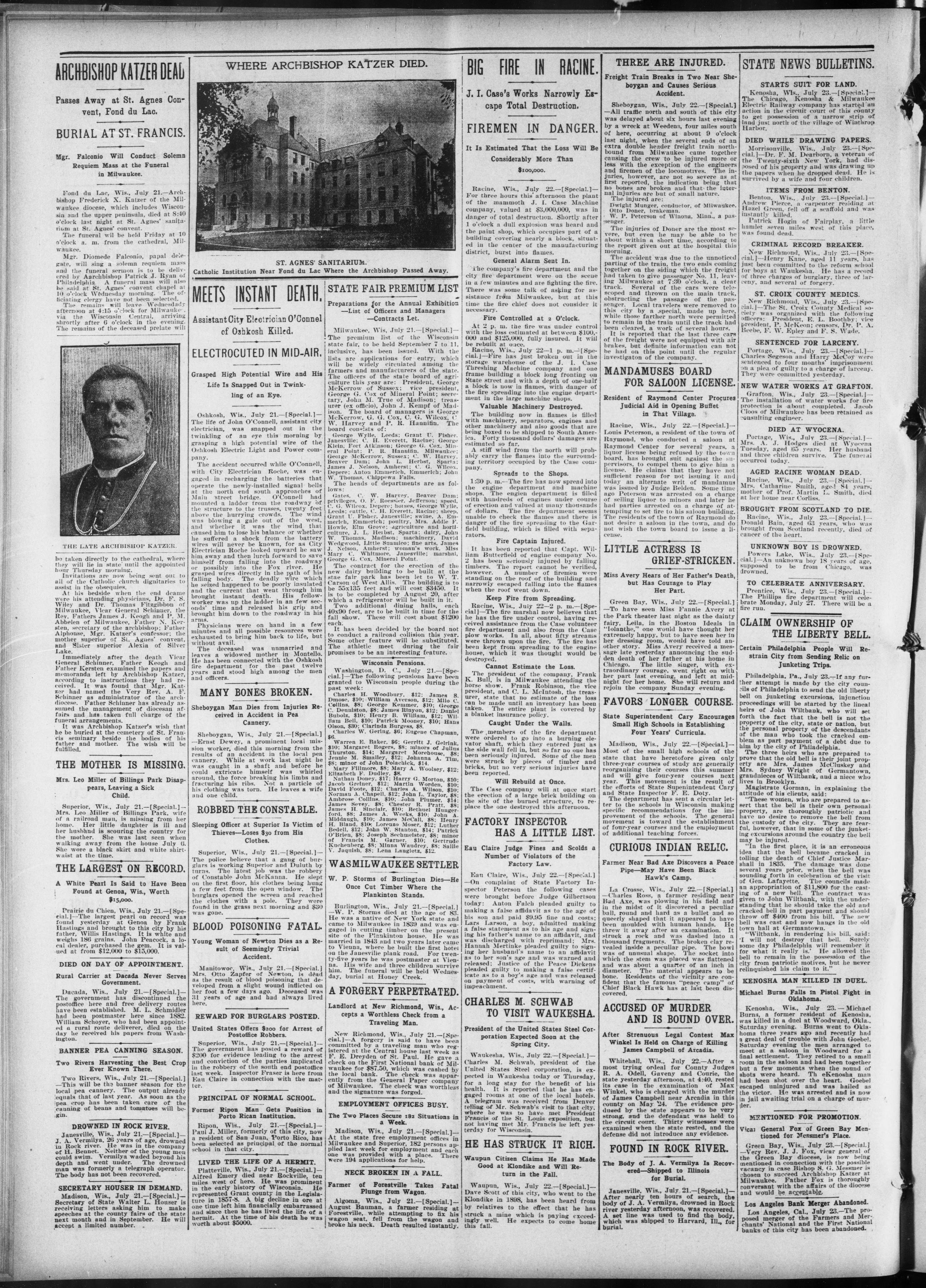
Page text (machine-generated)
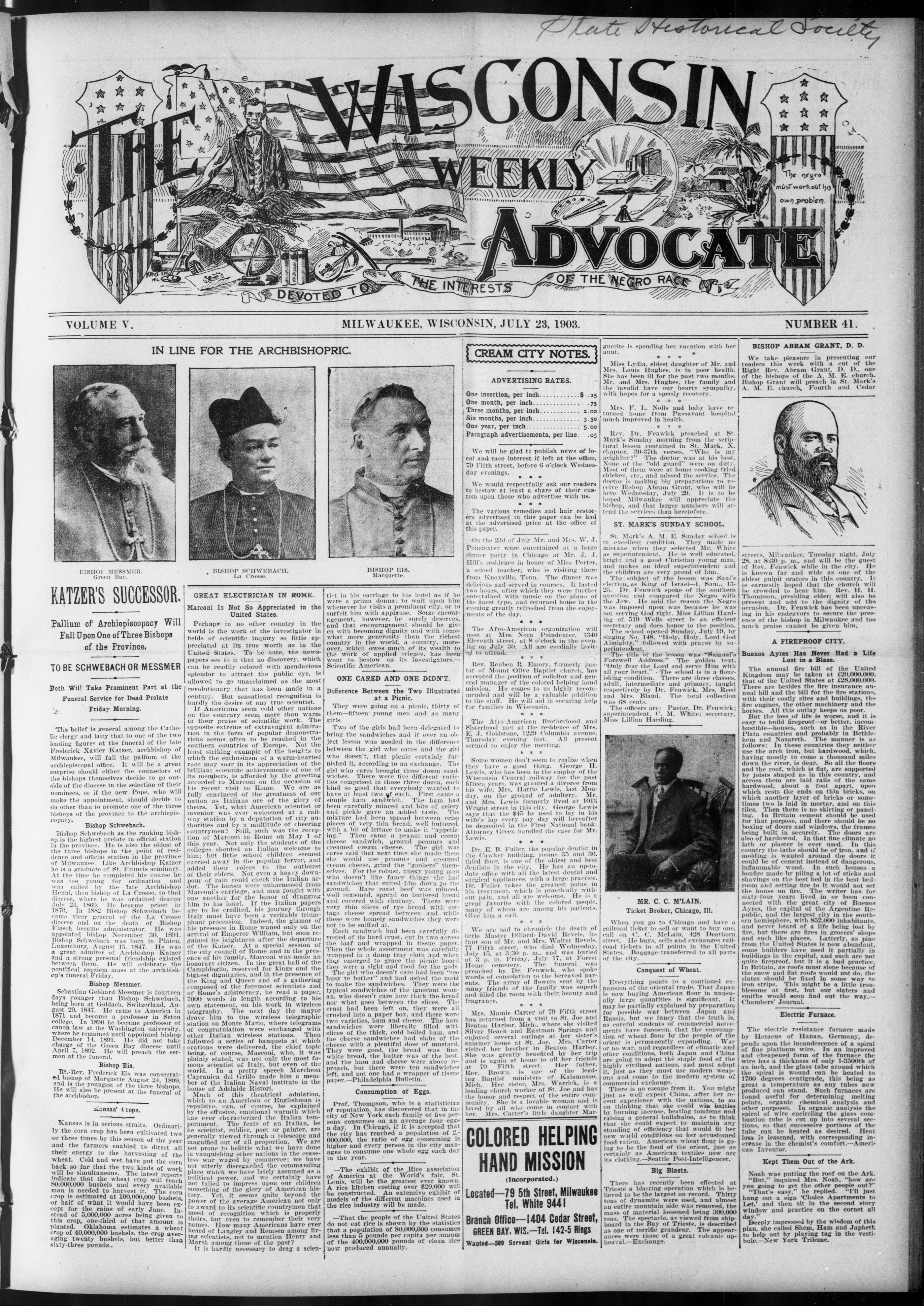
WISCONSIN
WEEKLY
Advocate
DEVOTED TO THE INTERESTS OF THE NEGRO RACE
VOLUME V.
IN LIN
P.
BISHOP MESSMER.
Green Bay.
KATZER'S SUCCESSOR.
Pallium of Archiepiscopacy Will
Fall Upon One of Three Bishops
of the Province.
TO BE SCHWEBACH OR MESSMER
Both Will Take Prominent Part at the Funeral Service for Dead Prelate
The belief is general among the Catholic clergy and laity that to one of the two leading figures at the funeral of the late Frederick Xavier Katzer, archbishop of Milwaukee, will fall the pallium of the archiepiscopal office. It will be a great surprise should either the counselors of the bishops themselves decide to go outside of the diocese in the selection of their nominees, or if the new Pope, who will make the appointment, should decide to do other than to promote one of the three bishops of the province to the archiepiscopacy.
Bishop Schwebach.
Bishop Schwebach as the ranking bishop is the highest prelate in official station in the province. He is also the oldest of the three bishops in the point of residence and official station in the province of Milwaukee. Like Archbishop Katzer he is a graduate of St. Francis seminary. At the time he completed his course he was too young for ordination and was called by the late Archbishop Henni, then bishop of La Crosse, to that diocese, where he was ordained deacon July 24, 1869. He became priest in 1870. In 1882 Bishop Schwebach became vicar general of the La Crosse diocese and on the death of Bishop Flasch became administrator. He was appointed bishop November 30, 1891. Bishop Schwebach was born in Platen, Luxemburg, August 15, 1847. He was a great admirer of Archbishop Katzer and a strong personal friendship existed between them. He will celebrate the pontifical requiem mass at the archbishop's funeral Friday.
Bishop Messmer
Sebastian Gebhard Messmer is fourteen days younger than Bishop Schwebach, being born at Goldach, Switzerland, August 29, 1847. He came to America in 1871 and became a professor in Seton college. In 1890 he became professor of canon law at the Washington university, where he remained until appointed bishop December 14, 1891. He did not take charge of the Green Bay diocese until April 7, 1892. He will preach the sermon at the funeral.
Bishop Eis.
Rt.Rev. Frederick Eis was consecrated bishop of Marquette August 24, 1899, and is the youngest of the three bishops. He will also be present at the funeral of the archbishop.
Kansas' (rops
Kansas is in serious straits. Ordinarily the corn crop has been cultivated two or three times by this season of the year and the farmers enabled to direct all their energy to the harvesting of the wheat. Cold and wet have put the corn back so far that the two kinds of work will be simultaneous. The latest reports indicate that the wheat crop will reach 80,000,000 bushels and every available man is needed to harvest it. The corn crop is estimated at 100,000,000 bushels, or half of what it would have been except for the rains of early June. Instead of 5,000,000 acres being given to this crop, one-third of that amount is planted. Oklahoma estimates a wheat crop of 40,000,000 bushels, the crop averaging twenty bushels, but better than sixty-three pounds..
---
CATHERINE
BISHOP SCHWEBACH.
La Crosse.
GREAT ELECTRICIAN IN ROME.
Marconi Is Not So Appreciated in the United States.
Perhaps in no other country in the world is the work of the investigator in fields of scientific inquiry so little appreciated at its true worth as in the United States. To be sure, the newspapers see to it that no discovery, which can be readily colored with mendacious splendor to attract the public eye, is allowed to go unacclaimed as the most revolutionary that has been made in a century. But sensational recognition is hardly the desire of any true scientist.
If Americans seem cold other nations on the contrary seem more than warm in their praise of scientific work. The opposite extreme of extravagant admiration in the form of popular demonstrations seems often to be reached in the southern countries of Europe. Not the least striking example of the heights to which the enthusiasm of a warm-hearted race may soar in its appreciation of the brilliant scientific achievements of one of its members, is afforded by the greeting accorded to Marconi on the occasion of his recent visit to Rome. We are as fully convinced of the greatness of our nation as Italians are of the glory of theirs. Yet, what American scientist or inventor was ever welcomed at a railway station by a deputation of city authorities and by a multitude of cheering countrymen? Still, such was the reception of Marconi in Rome on May 1 of this year. Not only the students of the colleges shouted an Italian welcome to him; but little school children seemed carried away in the popular fervor, and added their voices to the outburst of their elders. Not even a heavy downpour of rain could check the Italian ardor. The horses were unharnessed from Marconi's carriage, and men fought with one another for the honor of dragging him to his hotel. If the Italian papers are to be credited, his journey through Italy must have been a veritable triumphant procession. Indeed, the glamor of his presence in Rome waned only on the arrival of Emperor William, but soon regained its brightness after the departure of the Kaiser. At a special session of the city council of Rome and in the presence of his family, Marconi was made an honorary citizen. In the great hall of the Campidoglio, reserved for kings and the highest dignitaries, and in the presence of the King and Queen and of a gathering composed of the foremost scientists and of Rome's aristocracy, he read a paper, 7000 words in length according to his own statement, on his work in wireless telegraphy. The next day the mayor drove him to the wireless telegraphic station on Monte Mario, where telegrams of congratulation were exchanged with other Italian wireless stations. Then followed a series of banquets at which orations were delivered, the chief topic being, of course, Marconi, who, it was plainly stated, was not only the most famous scientist of Italy, but even of the world. In a pretty speech Marchesa Capranica del Grillo made him a member of the Italian Naval institute in the house of Adelaide Ristori.
Much of this theatrical adulation, which to an American or Englishman is repulsive, can, of course, be explained by the effusive, emotional warmth which has ever characterized the Italian temperament. The feats of an Italian, be he scientist, soldier, poet or painter, are generally viewed through a telescope and magnified out of all proportion. We are not prone to belittle what we have done in vanquishing other nations in the ceaseless war waged by commerce; we have not utterly disregarded the commanding place which we have lately assumed as a political power, and we certainly have not failed to impress upon our children something of the glory of American history. Yet, it seems quite beyond the power of the average American not only to award to its scientific countrymen that need of recognition which is properly theirs, but even to remember their very names. How many Americans have ever heard of Langley and Remsen among living scientists, not to mention Henry and Marsh among those of the past?
It is hardly necessary to drag a scien-
MILWAUKEE, WISCONSIN, JULY 23, 1903.
P.
BISHOP EIS Marquette.
tist in his carriage to his hotel as if he were a prima donna: to wait upon him whenever he visits a prominent city, or to surfeit him with applause. Some encouragement, however, he surely deserves, and that encouragement should be given with becoming dignity and with somewhat more generosity than the richest country in the world, a country, moreover, which owes much of its wealth to the work of applied science, has been wont to bestow on its investigators.—Scientific American.
ONE CARED AND ONE DIDN'T.
Difference Between the Two Illustrated at a Picnic.
They were going on a picnic, thirty of them-fifteen young men and as many girls.
Two of the girls had been delegated to bring the sandwiches and if ever an object lesson was needed in the difference between the girl who cares and the girl who doesn't, that picnic certainly furnished it, according to an exchange. The girl who cares brought three dozen sandwiches. There were five different varieties comprised in those three dozen, each kind so good that everybody wanted to have at least two of each. First came a simple ham sandwich. The ham had been carefully minced and bits of celery and pickle gave an added taste. The mixture had been spread between crisp pieces of very thin bread, well buttered, with a bit of lettuce to make it "appetizing." Then came a peanut and cream cheese sandwich, ground peanuts and creamed cream cheese. The girl was cares said that next time she made them she would use peanuts and creamed cream cheese, grind the "goobers" themselves. For the robust, musky young man who doesn't like fancy things she had sandwiches that suited him down to the ground. Rare roast beef was minced, well seasoned, spread on buttered bread and covered with chutney. There were very thin slices of rye bread with cottage cheese spread between and while these were homely sandwiches they were not to be sniffed at.
Each sandwich had been carefully divested of its hard crust, cut in two across the loaf and wrapped in tissue paper. Then the whole assortment was carefully wrapped in a damp tray cloth and when they emerged to grace the picnic board they were a sight and food for the gods. The girl who doesn't care had been "too busy to bother" and had asked the maid to make the sandwiches. They were the typical sandwiches of the ignorant woman, who doesn't care how thick the bread nor what goes between the slices. The crust had been left on, they were all crushed into a paper box, and there were two varieties, ham and cheese. The ham sandwiches were liberally filled with slices of the thick, cold boiled ham, and the cheese sandwiches had slabs of the cheese with a plentiful dose of mustard. They were good, the bread was fine, white bread, the butter was of the best, and the ham and cheese were above reproach, but there were ten sandwiches left, and not one had a wrapper of tissue paper.—Philadelphia Bulletin.
Consumption of Eggs.
Prof. Thompson, who is a statistician of reputation, has discovered that in the city of New York each family of five persons consumes on an average four eggs a day. In Chicago, if it is accepted that the city has reached a population of 2.000,000, the ratio of egg consuming is higher and every person in the city manages to consume one whole egg each day in the year.
The exhibit of the Rice association of America at the World's fair, St. Louis, will be the greatest ever known. A rice kitchen costing over $20,000 will be constructed. An extensive exhibit of models of the different machines used in the rice industry will be made.
—That the people of the United States do not eat rice is shown by the statistics that a population of 80,000,000 consumes less than 5 pounds per capita per annum of the 400,000,000 pounds of clean rice now produced annually.
CREAM CITY NOTES.
ADVERTISING RATES.
One insertion, per inch. $ .25
One month, per inch. .75
Three months, per inch. 2.00
Six months, per inch. 3.50
One year, per inch. 5.00
Paragraph advertisements, per line. .05
We will be glad to publish news of local and race interest if left at the office, 79 Fifth street, before 6 o'clock Wednesday evenings.
We would respectfully ask our readers to bestow at least a share of their custom upon those who advertise with us.
The various remedies and hair restorers advertised in this paper can be had at the advertised price at the office of this paper.
On the 23d of July Mr. and Mrs. W. J. Poindexter were entertained at a large dinner party in Chicago at Mr. J. J. Hill's residence in honor of Miss Porter, a school teacher, who is visiting there from Knoxville, Tenn. The dinner was delicious and served in courses. It lasted two hours, after which they were further entertained with music on the piano of the finest type, and returned home in the evening greatly refreshed from the enjoyments of the day.
***
The Afro-American organization will meet at Mrs. Nora Poindexter, 1340 Eleventh street, at 8 o'clock in the evening on July 30. All are cordially invited to attend.
***
Rev. Reuben R. Emory, formerly pastor of Mount Olive Baptist church, has accepted the position of solicitor and general manager of the colored helping hand mission. He comes to us highly recommended and will be a valuable addition to the staff. He will aid in securing help for families in Wisconsin.
```markdown
```
The Afro-American Brotherhood and Sisterhood met at the residence of Mrs. E. J. Goldstone, 1229 Columbia avenue, Thursday evening last. All present seemed to enjoy the meeting.
乖 乖 乖
Some women don't seem to realize when they have a good thing. George H. Lewis, who has been in the employ of the Wisconsin Central railway for the past fifteen years, was granted a divorce from his wife, Mrs. Hattie Lewis, last Monday, on the ground of adultery. Mr. and Mrs. Lewis formerly lived at 1013 Wright street in this city. George Lewis says that the $45 he used to lay in his wife's lap every pay day will hereafter be deposited in the First National bank. Attorney Green handled the case for Mr. Lewis.
* * *
Dr. E. B. Fuller, the popular dentist in the Cawker building, rooms 35 and 36, third floor, is one of the oldest and best dentists in the city. He has an up-to-date office with all the latest dental and surgical appliances, with a large practice. Dr. Fuller takes the greatest pains in his treatment, which is practically without pain, and all are welcome. He is a great favorite with the colored people, many of whom are among his patients. Give him a call.
※ ※ ※
We are sad to chronicle the death of little Master Dillard David Revels, infant son of Mr. and Mrs. Walter Revels, 77 Fifth street, who died Wednesday, July 15, at 3:30 p. m., and was buried at 3 p. m. Friday, July 17, at Forest Home cemetery. The funeral was preached by Dr. Fenwick, who spoke words of consolation to the bereaved parents. The array of flowers sent by the many friends of the family was superb and filled the room with their beauty and fragrance.
* * *
Mrs. Mamie Carter of 79 Fifth street has returned from a visit to St. Joe and Benton Harbor, Mich., where she visited Silver Beach and Eastman Springs and enjoyed several outings at her sister's summer home at St. Joe. Mrs. Carter visited her brother in Benton Harbor. She was greatly benefited by her trip and is again at home to all her friends at 79 Fifth street. Her father, Rev. Brown, is one of the leading Baptist ministers of Kalamazoo, Mich. Her sister, Mrs. Warrick, is a leading church worker of St. Joe and has the honor and respect of the entire community. She is a lovable woman and is loved by all who come in contact with her. Mrs. Carter's little daughter Mar-
COLORED HELPING HAND MISSION
guerite is spending her vacation with her aunt.
* * *
Miss Lydia, eldest daughter of Mr. and Mrs. Louis Hughes, is in poor health. She has been ill for the past two months. Mr. and Mrs. Hughes, the family and the invalid have our hearty sympathy, with hopes for a speedy recovery.
* * *
Mrs. F. L. Nolls and baby have returned home from Passavant hospital much improved in health.
* *
Rev. Dr. Fenwick preached at St. Mark's Sunday morning from the scriptural lesson contained in St. Mark, X. chapter, 30-37th verses, "Who is my neighbor?" The doctor was at his best. None of the "old guard" were on duty. Most of them were at home cooking fried chicken, etc., and missed the service. The doctor is making big preparations to receive Bishop Abram Grant, who will be here Wednesday, July 29. It is to be hoped Milwaukee will appreciate the bishop, and that larger numbers will attend the services than heretofore.
ST. MARK'S SUNDAY SCHOOL.
St. Mark's A. M. E. Sunday school is in excellent condition. They made no mistake when they selected Mr. White as superintendent. He is well educated, bright and a good Christian young man, and makes an ideal superintendent and the children are very proud of him.
The subject of the lesson was Saul's election as King of Israel—I. Sam., 13-25. Dr. Fenwick spoke of the southern question and compared the Negro with the Jew. He said the reason the Negro was imposed upon was because he was not serving God right. Miss Lillian Harding of 519 Wells street is an efficient secretary and does honor to the position.
The school opened Sunday, July 19, by singing No. 148, "Holy, Holy, Lord God Almighty," followed with prayer by superintendent
The title of the lesson was "Samuel's Farewell Address." The golden text. "Only fear the Lord and serve Him with all your heart." The school is in a flourishing condition. There are three classes, adult, intermediate and primary, taught respectively by Dr. Fenwick, Mrs. Reed and Mrs. Bland. The total collection was 68 cents. The officers are; Pastor, Dr. Fenwick; superintendent, C. M. White; secretary, Miss Lillian Harding.
A. B.
MR. C. C. M'LAIN. Ticket Broker, Chicago, Ill.
When you go to Chicago and have a railroad ticket to sell or want to buy one, call on C. C. McLain, 428 Dearborn street. He buys, sells and exchanges railroad tickets to all points in the United States. Baggage transferred to all parts of the city.
Conquest of Wheat.
Everything points to a continued expansion of the oriental trade. That Japan is now buying American flour in unusually large quantities is significant. It may be partially explained by preparation for possible war between Japan and Russia, but we fancy that the truth is, as careful students of commercial movements have foreseen, that the consumption of wheat flour by the people of the orient is permanently expanding. War or no war, and regardless of climatic and other conditions, both Japan and China are going to adopt the staple food of the highly civilized nations, and must adopt it, just as they must use modern weapons and come to the modern system of commercial exchange.
There is no escape from it. You might just as well expect China, after her recent experience with the nations, to go on thinking that she could win battles by burning incense, beating tomtoms and raising a general hullabaloo, as to think that she could expect to maintain any standing of efficiency that would fit her new world conditions on her accustomed food ration. American wheat flour is going to be the food of the orient, just as certainly as American textiles now arc its clothing.—Seattle Post-Intelligencer.
Big Blasts
There has recently been effected at Trieste a blasting operation which is believed to be the largest on record. Thirty tons of dynamite were used, and almost an entire mountain side was removed, the mass of material loosened being 300,000 tons. The spectacle, as viewed from shipboard in the Bay of Trieste, is described as one of terrific grandeur. The appearances were those of a great volcanic upheaval.—Exchange.
BISHOP ABRAM GRANT, D. D.
We take pleasure in presenting our readers this week with a cut of the Right Rev. Abram Grant, D. D., one of the bishops of the A. M. E. church. Bishop Grant will preach in St. Mark's A. M. E. church, Fourth and Cedar
M.
streets, Milwaukee, Tuesday night, July 28, at 8:30 p. m., and will be the guest of Rev. Fenwick while in the city. He is known far and wide as one of the ablest pulpit orators in this country. It is earnestly hoped that the church will be crowded to hear him. Rev. H. H. Thompson, presiding elder; will also be present and add to the dignity of the occasion. Dr. Fenwick has been unceasing in his endeavors to secure the presence of the bishop in Milwaukee and too much praise cannot be given him.
A FIREPROOF CITY.
Buenos Ayres Has Never Had a Life Lost in a Blaze.
The annual fire bill of the United Kingdom may be taken at £20,000,000, that of the United States at £28,000,000. There are besides the fire insurance annual bill and the bill for the fire stations, with their costly sites and buildings, the fire engines, the other machinery and the horses. All this outlay keeps us poor.
But the loss of life is worse, and it is easy to build fireproof—or better, incombustible—houses, such as in the River Plata countries and probably in Bethlehem and Nazareth. The manner is as follows: In these countries they neither use the arch iron, but hardwood, which having mostly to come a thousand miles down the river, is dear. So all the floors and the roof, which is flat, are supported by joists shaped as in this country, and across them are laid rails of the same hardwood, about a foot apart, upon which rests the ends on thin bricks, on which another layer of bricks or sometimes two is laid in mortar, and on this tiles. Then there is no skirting or paneling. In Britain cement should be used for that purpose, and there should be no boxing of doors and windows, the frames being built in securely. The doors are also of hardow. In that fine climate no lath or plaster is ever used. In this country the laths should be of iron, and in molding is wanted around the doors it could be of cement instead of dangerous, inflammable wood. In such houses a bonfire made by piling a lot of sticks and shavings on the best bed in the best bedroom and setting fire to it would not set the house on fire. The writer has for sixty-four years lived in or been connected with the great city of Buenos Ayres, the capital of the Argentine Republic, and the largest city in the southern hemisphere, with 852,000 inhabitants, and never heard of a life being lost by fire, but there are fires in grocers' shops and such like places. Latterly, as pine from the United States is now abundant, some builders have used it partially in buildings in the capital, and such are not quite fireproof, but it is a bad practice. In Britain, as roofs must slope because of the snow and flat roofs would not do, the slates should be fixed in some way to iron strips. This might be a little troublesome at first, but our slaters and smiths would soon find out the way.—Chambers' Journal.
Electric Furnace.
The electric resistance furnace made by Heraeus of Hanan, Germany, depends upon the incandescence of a spiral of fine platinum wire. In an improved and cheapened form of the furnace the wire has a thickness of only 1-3500th of an inch, and the glass tube around which the spiral is wound can be heated to 1700 degrees centigrade, this being as great a temperature as any tubes now produced can stand. Such furnaces are found useful for determining melting points, organic chemical analysis and other purposes. In organic analysis the spiral of wire encircling the glass combustion tube is cut up into several sections, so that successive portions of the tube can be heated as desired. Heat loss is lessened, with corresponding increase in the chemist's comfort.—American Inventor.
Kept Them Out of the Ark.
Noah was putting the roof on the Ark. "But," inquired Mrs. Noah, "how are you going to get the other people out?" "That's easy," he replied. "I'll just hang out a sign 'Choice Apartments to Let,' and then sit in the second story window and practice on the cornet all day." Deeply impressed by the wisdom of this plan, she called Shem, Ham and Japheth to help out by playing tag in the vestibule.—New York Tribune.
WON'T OPEN PORTS.
China Sends Word to United States That She Can't Grant Demand.
RUSSIA WON'T ALLOW IT.
America Will Try to Force China to Keep Promises in Regard to Manchuria.
PRINCE CHING SENDS A LETTER.
Pekin, July 23.—Prince Ching has written a letter to United States Minister Conger, in which he refuses to open the towns of Manchuria to foreign trade.
He points out that it is impossible for China to open ports that are not in her possession, but are held by Russia, and that if they should do so, complications would be likely to follow such a course.
Washington, D. C., July 22.—Notwithstanding the publication of dispatches from various foreign cities questioning the extent of the promises made to the American government by China and Russia, respenting Manchuria, the officials here positively decline to add to or take one word from the statement published from Washington just before the departure of Secretary Hay, to the effect that satisfactory assurances had been received that two or more Manchurian ports would be opened to the world's trade. It is quite certain that China, which is here regarded as the sovereign power in Manchuria, made these pledges and it is equally certain that the United States government fully intends that they shall be kept.
The details referred to in the original statement regarding adjustment are still unsettled, but the state department is patient, resting in full confidence of the opening of the ports required within a reasonable length of time.
It is true, as stated in the London dispatches, that Japan looks with suspicion upon the Russian pledges relative to Manchuria and has intimated to the state department that they are not satisfactory, but so far the department sees no reason to accept that view.
CHANGE OF VENUE GRANTED.
Feud Incendiary Cases Will Be Tried in Another Circuit.
Jackson, Ky., July 23.—Joseph Crawford and Edward Tharp, indicted for the alleged burning of the home of Capt. Ewen, were released on a bond of $2000 each. Commonwealth Attorney Byrd filed a petition asking for a change of venue in their case, on the ground that conditions in this county would preclude the commonwealth from getting a fair trial of these alleged offenders. Judge Redwine granted the change transferring the case to the Estill circuit court.
TO DRIVE JEWS FROM RUSSIA.
Russian Minister of the Interior Makes a Threat.
London, July 23.—The Times announces that it has information that M. Von Plehve, Russian minister of the interior, in receiving a Jewish deputation from Odessa, threatened, if the anti-government agitation continued, to adopt extreme measure to rid Russia of the Jews by facilitating their emigration, excluding them from the schools and making it impossible for them to live in the empire.
RUN OVER BY LOAD OF SHEEP.
Dodgeville Man Has Four Ribs Broken by Heavy Wagon.
Dodgeville, Wis., July 23.—[Special.]—John Symons had four ribs broken and was otherwise badly injured by being run over by a wagon containing a load of sheep.
FRIENDS FEAR A KIDNAPING
Woman of South Superior Disappears Mysteriously.
Superior, Wis., July 23.—[Special.]—Mrs. Barney Sweeney of South Superior is missing. She has not been seen here for some time, although word has been received from her folks at Kenyon saying that she and her son took the train for Superior last week. Her personal property is all here and her friends fear a kidnapping has occurred.
EMPLOYER SHOOTS UNION MAN.
He Stood Insults and Jeers as Long as He Could.
Chicago, Ill., July 23.—Adolph A. Ehman, a member of the firm of Charles Ehman & Co., mantel manufacturers, angered by the jeers of a crowd of union workmen, while he was acting as guard over non-union men, shot and seriously wounded Robert Kuter, one of his tormentors, today. Ehman was arrested.
English Consulate at Duluth.
Duluth, Minn., July 23.—William Wyndham, British consul at Chicago, arrived in Duluth last evening for the purpose of establishing a vice-consulate here to take the place of the one which was abandoned at St. Paul three months ago.
Paulists in Session in New York.
New York, July 23.—Seventeen representatives of the Paulist order from various states have assembled here for the annual conference called for by the rules adopted five years ago.
Health of Manila.
In a report to Surgeon General O'Reilly in Washington from the medical officers in the Philippines it is shown that the death rate of Manila for the first quarter of the past four years has decreased steadily from 46.80 per thousand of the population for the first quarter of 1900 to 22.17 for the first quarter of 1902. This is attributed to proper medical and surgical treatment and improved sanitation.
Carnegie's Gifts.
Andrew Carnegie's gifts for the year numbered 158, and amounted to $6,679,-000. They were for buildings and given subject to the usual conditions that a site be provided and that 10 per cent. of the amount of the gift be pledged for annual maintenance. His gifts for libraries now aggregate $38,505,600.
In the manufacture of cannon the tendency is toward reduced weight of gun and projectile and increased muzzle velocity. This gives added range and penetration.
A dag was seen in the streets of Paris the other day riding on a motor car wearing a pair of chauffeur's goggles to protect his eyes from the dust and wind.
---
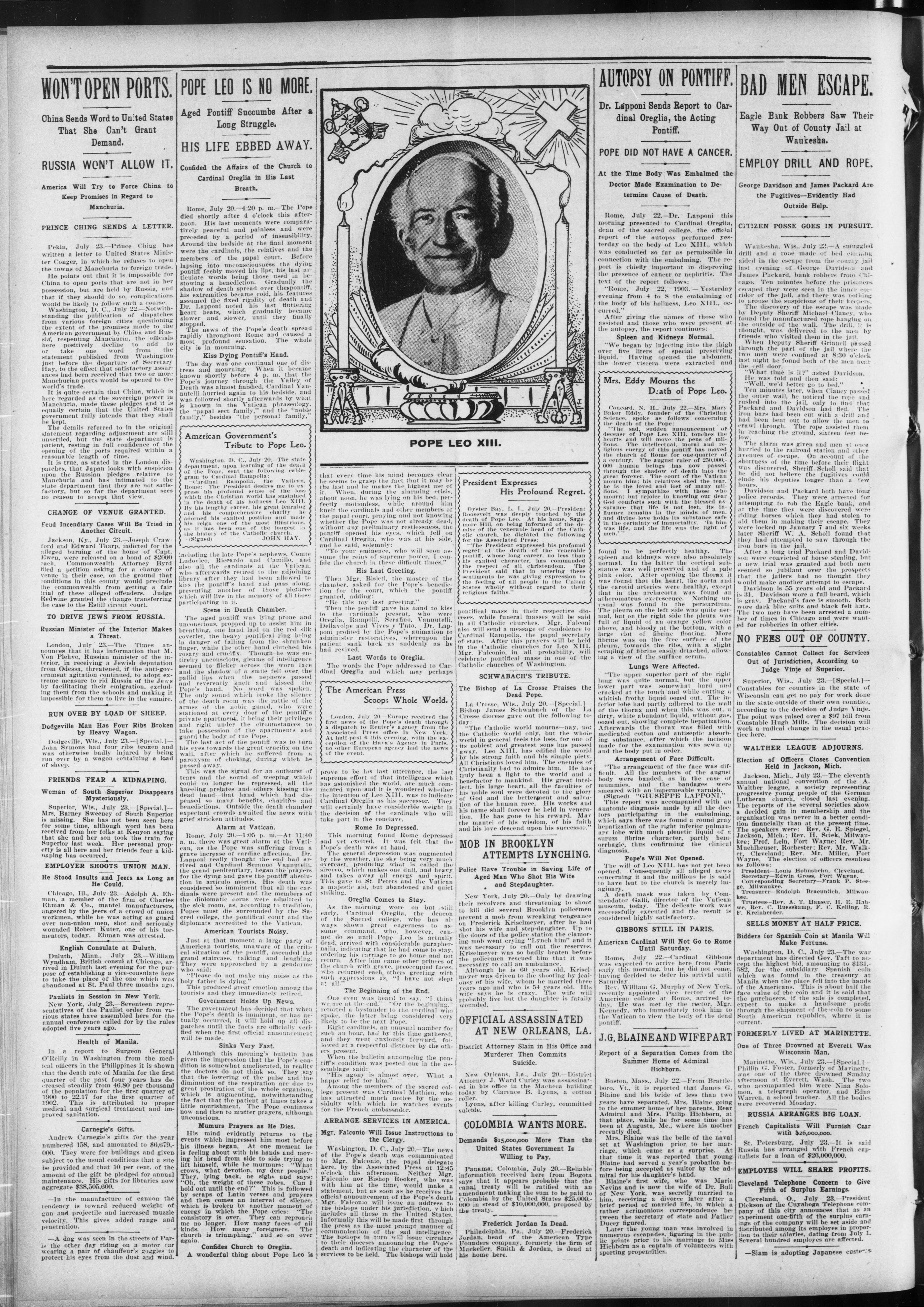
POPE LEO IS NO MORE.
Aged Pontiff Succumbs After a Long Struggle.
Confided the Affairs of the Church to Cardinal Oreglia in His Last
Rome, July 20.—4:20 p. m.—The Pope died shortly after 4 o'clock this afternoon. His last moments were comparatively peaceful and painless and were preceded by a period of insensibility. Around the bedside at the final moment were the cardinals, the relatives and the members of the papal court. Before lapsing into unconsciousness the dying pontiff feebly moved his lips, his last articulate words being those used in bestowing a benediction. Gradually the shadow of death spread over the pontiff, his extremities became cold, his features assumed the fixed rigidity of death and Dr. Lapponi noted his last fluttering heart beats, which gradually became slower and slower, until they finally stopped.
The news of the Pope's death spread rapidly throughout Rome and caused a most profound sensation. The whole city is in mourning.
Kiss Dying Pontiff's Hand
The day was one continual one of distress and mourning. When it became known shortly before 4 p. m. that the Pope's journey through the Valley of Death was almost finished, Cardinal Vanutelli hurried again to his bedside, and was followed shortly afterwards by what is known in the Vatican phraseology, the "papal sect family," and the "noble family," besides "the personal family,"
Washington, D. C., July 20.—The state department, upon learning of the death of the Pope, sent the following cablegram to Cardinal Rampolla: "Cardinal Rampolla, the Vatican, Rome: The President desires me to express his profound sense of the loss which the Christian world has sustained in the death of his holiness Leo XIII. By his lengthy career, his great learning and his comphensive charity he adorned his exalted position and made his reign one of the most illustrious, as it has been one of the longest in the history of the Catholic church. (Signed) JOHN HAY.
Including the late Pope's nephews, Comte Ludovico, Riccardo and Camillo, and also all the cardinals at the Vatican, who afterwards retired to the adjoining library after they had been allowed to kiss the pontiff's hand and pass along, presenting another of those pictures which will live in the memory of all those participating in it.
Scene in Death Chamber.
The aged pontiff was lying prone and unconscious, propped up to assist him in breathing, one hand laid on the red silk coverlet, the heavy pontifical ring being in danger of falling from the shrunken finger, while the other hand clutched his rosary and crucifix. Though he was entirely unconscious, gleams of intelligence seemed to flicker across the worn face and the shadow of a smile fell over the pallid lips when the nephews passed and reverently knelt and kissed the Pope's hand. No word was spoken. The only sound which broke the silence of the death room was the rattle of the armss of the noble guard, who were stationed at every door of the pontiff's private apartment, it being their privilege and right under the circumstances to take possession of the apartments and guard the body of the Pope.
The last act of the pontiff was to turn his eyes towards the great crucifix on the wall, after which he suffered from a paroxysm of choking, during which he passed away.
This was the signal for an outburst of tears and the sound of weeping which could no longer be repressed, all the kneeling prelates and others kissing the dead hand—that hand which had dispensed so many benefits, charities and benedictions. Outside the death chamber expectant crowds awaited the news with grief stricken attitudes.
Alarm at Vatican.
Rome, July 20.—1:05 p. m.—At 11:40 a. m. there was great alarm at the Vatican, as the Pope was suffering from a grave increase of cardiac affection. Dr. Lapponi really thought the end had arrived and Cardinal Seranno Vannutelli, the grand penitentiary, began the prayers for the dying and gave the pontiff absolution in articulo mortis. His death was considered so imminent that all the cardinals were present and the members of the diplomatic corps were admitted to the sick room, as, according to tradition, Popes must die surrounded by the Sacred college, the pontifical court and the diplomats accredited to the Vatican.
American Tourists Noisy
Just at that moment a large party of American tourists, unaware of the critical situation of the pontiff, ascended the grand staircase, talking and laughing. They were approached by a gendarme who said:
"Please do not make any noise as the holy father is dying."
This produced great emotion among the tourists and they immediately retired.
Government Holds Up News.
The government has decided that when the Pope's death is imminent, or has actually occurred, it will hold up all dispatches until the facts are officially verified when the first official announcement will be made.
Sinks Very Fast.
Although this morning's bulletin has given the impression that the Pope's condition is somewhat ameliorated, in reality the doctors do not think so. They say that the lowering of the pulse and the diminution of the respiration are due to great prostration of the whole organism, which is augmenting, notwithstanding the fact that the patient at times takes a little nourishment. The Pope continues now and then to mutter prayers, although unconscious.
Mumurs Prayers as He Dies.
His mind evidently returns to the events which impressed him most before his illness began. At one moment he is feeling about with his hands and moving his head from side to side trying to lift himself, while he murmurs: "What crows, what devotion, my dear people." They, lying back, he sighs and says: "Oh, the weight of these robes. Can I hold out until the end?" This is followed by scraps of Latin verses and prayers and then comes an interval of silence, which is broken by another moment of energy in which the Pope cries: "The consistory is over. They can reproach me no longer. How many faces of all kinds. How many foreigners. The church is triumphing," and so on over again.
Confides Church to Oreglia.
A wonderful thing about Pope Leo is
X
that every time his mind becomes clear he seems to grasp the fact that it may be the last and he makes the highest use of it. When, during the alarming crisis, about noon, he was lying on his bed, perfectly motionless, while around him knelt the cardinals and other members of the papal court, praying and not knowing whether the Pope was not already dead, without any preliminary restlessness, the pontiff opened his eyes, which fell on Cardinal Oreglia, who was at his side, and he said, solemnly:
"To your eminence, who will soon assume the reins of supreme power, I confide the church in these difficult times."
His Last Greeting.
Then Mgr. Bisleti, the master of the chamber, asked for the Pope's benediction for the court, which the pontiff granted, adding: "Be this my last greeting."
Then the pontiff gave his hand to kiss to the cardinals present, who were Oreglia, Kampolli, Serafino, Vannutelli, Dellavolpe and Vives y Tuto. Dr. Lapponi profiled by the Pope's animation to administer restoratives, whereupon the patient sank back as suddenly as he had revived.
Last Words to Oreglia.
The words the Pope addressed to Cardinal Orexilia and which may perhaps
London, July 20.—Europe received the first news of the Pope's death through a dispatch to Reuter's agency from the Associated Press office in New York. At half-past 6 this evening, with the exception of the Hava's Agency in Paris, no other European agency had the news of the event.
prove to be his last utterance, the last supreme effort of that intelligence which has astonished the world, are much commented upon and it is wondered whether the intention of Leo XIII, was to indicate Cardinal Oreglia as his successor. They will certainly have considerable weight in the decision of the cardinals who will take part in the conclave.
Rome Is Depressed.
This morning found Rome depressed and yet excited. It was felt that the Pope's death was at hand. The general depression was augmented by the weather, the sky being very much overcast, producing what is called the sireocco, which makes one dull, and heavy and takes away all energy and spirit. This gave to St. Peters and the Vatican a majestic aid, but abandoned and quiet striking.
Oreglia Comes to Stay
As the morning wore on but still early, Cardinal Oreglia, the deacon of the Sacred college, who has always shown great eagerness to assume command, who, however, cannot do so until Pope Leo is actually dead, arrived with considerable paraphernalia, indicating that he had come to stay, ordering his carriage to go home and not return. After him came other princes of the church with grave, preoccupied faces, who returned each others greeting with such expressions as, "I have not slept at all."
The Beginning of the End.
One even was heard to say, "I think we are at the end." "Or the beginning," retorted a bystander to the cardinal who spoke, the latter being considered very likely to be the next Pope.
Eight cardinals, an unusual number for such an hour, had by this time gathered, and they went anxiously forward, followed at a respectful distance by the others present.
When the bulletin announcing the pontiff's condition was posted one in the assemblage said:
"His agony is almost over. What a happy relief for him."
Among the members of the sacred college present was Cardinal Mathieu, who has attracted much notice by the assiduity with which he watches events for the French ambassador.
ARRANGE SERVICES IN AMERICA
Mgr. Falconio Will Issue Instructions to the Clergy.
Washington, D. C., July 20.—The news of the Pope's death was communicated to Mgr. Falconio, the papal delegate here, by the Associated Press at 12:45 o'clock this afternoon. Neither Mgr. Falconio nor Bishop Rooker, who was with him at the time, would make a statement, but as soon as he receives the official announcement of the Pope's death Mgr. Falconio will issue an address to the bishops under his jurisdiction, which includes all those in the United States. Informally this will be made first through the press as the most prompt manner of communication of the sad intelligence. The bishops in turn will issue circulars to their dioceses announcing the Pope's death and indicating the character of the services to be held. The bishops will hold
Oyster Bay, L. I., July 20.—President Roosevelt was deeply touched by the death of Pope Leo. At his home, Saganore Hill, on being informed of the demise of the venerable head of the Catholic church, he dictated the following for the Associated Press:
"The President expressed his profound regret at the death of the venerable pontiff, whose long career, no less than his exalted character, has commanded the respect of all christendom. The President said that in uttering these sentiments he was giving expression to the feeling of all people in the United States wholly without regard to their religious faiths."
---
pontifical mass in their respective dioceses, while funeral masses will be said in all Catholic churches. Mgr. Falconi also will send a message of condolence to Cardinal Rampolla, the papal secretary of state. After this prayers will be held in the Catholic churches for Leo XIII. Mgr. Falconio, in all probability, will celebrate pontifical mass in one of the Catholic churches of Washington.
SCHWABACH'S TRIBUTE.
The Bishop of La Crosse Praises the Dead Pope.
La Crosse, Wis., July 20.—[Special.]—Bishop James Schwabach of the La Crosse diocese gave out the following today:
"The Catholic world mourns—nay, not the Catholic world only, but the whole world in general feels the loss, for one of its noblest and greatest sons has passed away. Leo XIII, has edified the world by his strong faith and his simple piety. All Christians loved him. The enemies of Christianity had to admire him. He has truly been a light to the world and a benefactor to mankind. His great intellect, his large heart, all the faculties of his noble soul were devoted to the glory of God and the betterment and salvation of the human race. His works and his name shall forever be held in veneration. He has gone to his reward. May the mantel of his wisdom, of his faith and his love descend upon his successor."
MOB IN BROOKLYN ATTEMPTS LYNCHING.
Police Have Trouble in Saving Life of Aged Man Who Shot His Wife and Stepdaughter.
New York, July 20.—Only by drawing their revolvers and threatening to shoot to kill did several Brooklyn policemen prevent a mob from wreaking vengeance on Frederick Kriselmeyer, after he had shot his wife and step-daughter. Up to the doors of the police station the clamoring mob went crying "Lynch him" and it was necessary to call out the reserves. Kriselmeyer was so badly beaten before the policemen rescued him that it was necessary to call an ambulance.
Although he is 60 years old. Kriselmeyer was driven to the shooting by jealousy of his wife, whom he married three years ago and who is 54 years old. His wife says he is crazy. The wife will probably live but the daughter is fatally wounded.
OFFICIAL ASSASSINATED AT NEW ORLEANS, LA.
District Attorney Slain in His Office and Murderer Then Commits Suicide.
New Orleans, La., July 20.—District Attorney J. Ward Curley was assassinated in his office in the Macheca building today by Clarence B. Lyons, a cotton roller.
Lyons, after killing Curley, committed suicide.
Demands $15,000,000 More Than the United States Government Is Willing to Pay.
Panama, Colombia, July 20.—Reliable information received here from Bogota says that it appears probable that the canal treaty will be ratified with an amendment making the sum to be paid to Colombia by the United States $25,000,-000 in stead of $10,000,000, proposed by the treaty.
Frederick Jordan Is Dead
Philadelphia, Pa., July 20.—Frederick Jordan, head of the American Type Founders company, formerly the firm of Mackeller, Smith & Jordan, is dead at his home here.
AUTOPSY ON PONTIFF.
Dr. Lapponi Sends Report to Cardinal Oreglia, the Acting Pontiff.
POPE DID NOT HAVE A CANCER.
Rome, July 22.—Dr. Lapponi this morning presented to Cardinal Oreglia, dean of the sacred college, the official report of the autopsy performed yesterday on the body of Leo XIII., which was conducted so far as permissible in connection with the embalming. The report is chiefly important in disproving the presence of cancer or nephritis. The text of the report follows:
"Rome, July 22, 1903. — Yesterday evening from 4 to 8 the embalming of the body of his holiness, Leo XIII., occurred."
After giving the names of those who assisted and those who were present at the autopsy, the report continues:
Spleen and Kidneys Normal.
"We began by injecting into the thigh over five liters of special preserving liquid. Having opened the abdomen, the lower viscera were extracted and
Mrs. Eddy Mourns the Death of Pope Leo.
Concord, N. H., July 22.-Mrs. Mary Baker Eddy, founder of the Christian Science, spoke as follows concerning the death of the Pone:
"The sad, sudden announcement or decease of Pope Leo XIII, touches the hearts and will move the pens of millions. The intellectual, moral and religious energy of this pontiff has moved the church of Rome for one-quarter of a century. The august ruler of 250,000,000 human beings has now passed through the shadow of death into the great forever. The court of the Vatican mourn him; his relatives shed the tear, he is the loved and lost of many millions. I sympathize with those who mourn; but rejoice in knowing our dear God comforts such with the blessed assurance that life is not lost, its influence remains in the minds of men, and divine love holds its substance safe in the certainty of immortality. 'In him was life, and the life was the light of men.'"
---
found to be perfectly healthy. The spleen and kidneys were also absolutely normal. In the latter the cortical substance was well preserved and of a pale pink color. After opening the thorax it was found that the heart, the aorta and the carotid arteries were healthy, except that in the archaeorta was found an atheromateus excrescence. Nothing unusual was found in the pericardium. The pleura on the left side was quite normal, but on the right side the pleura was full of liquid of an orange yellow color above, and bloody at the bottom, with a large clot of fibrine floating. More fibrine was on the free surface of the pleura, towards the ribs, with a slight scraping of fibrine easily detached, allowing a view of the surface serum.
Lungs Were Affected.
"The upper superior part of the right lung was quite normal, but the upper lower part was somewhat hard and cracked at the touch and while cutting a whitish frothy liquid oozed out. The inferior lobe had partly adhered to the wall of the thorax and when this was cut, a dirty, white abundant liquid, without gas, oozed out, showing complete hepatization. Afterwards the thorax was filled with medicated cotton and antiseptic absorbing substance, after which the incision made for the examination was sewn up and the body put in order.
Arrangement of Face Difficult.
"The arrangement of the face was difficult. All the members of the august body were banded, as in the case of mummies, and the bandages were smeared with an impermeable varnish. (Signed) "GIUSEPPE LAPPONI." This report was accompanied with an anatomic diagnosis made by all the doctors participating in the embalming, which says there was found a round gray hepatization of the right inferior pulmonary lobe with much pleuetic liquid of a surum fibrine character, partly hemorrhagic, thus confirming the clinical diagnosis.
Pope's Will Not Opened.
The will of Leo XIII, has not yet been opened. Consequently all alleged news concerning it and the millions he is said to have lent to the church is merely imaginary. A death mask was taken by Commendator Galli, director of the Vatican museum, today. The delicate work was successfully executed and the result is considered highly satisfactory.
GIBBONS STILL IN PARIS.
American Cardinal Will Not Go to Rome Until Saturday.
Rome, July 22.—Cardinal Gibbons was expected to arrive here from Paris early this morning, but he did not come, having decided to defer his arrival until Saturday. Rev. William G. Murphy of New York, recently appointed vice rector of the American college at Rome, arrived today. He was met by the rector, Mgr. Kennedy, who immediately took him to the Vatican to view the body of the dead pontiff.
J.G. BLAINE AND WIFEPART
Boston, Mass., July 22.—From Brattleboro, Vt., it is reported that James G. Blaine and his bride of less than two years have separated, Mrs. Blaine going to the summer home of her parents, Rear Admiral and Mrs. Philip Hichborn, at that place, while he for some time has been at Augusta, Me., where his mother recently died.
Mrs. Blaine was the belle of the naval set at Washington prior to her marriage, which came as a surprise. At that time it was reported that young Blaine had served a year's probation before being accepted as suitor by the admiral for his daughter's hand.
Blaine's first wife, who was Marie Nevins and is now the wife of Dr. Bull of New York, was secretly married to him, receiving a divorce later after a brief period of married life, in which a rather acrimonious correspondence between the secretary of state and Father Ducey figured.
Later the young man was involved in numerous escapades, figuring in the public prints prior to his marriage to Miss Hichborn as a captain of volunteers with sporting propensities.
BAD MEN ESCAPE.
Eagle Bank Robbers Saw Their Way Out of County Jail at Waukesha. EMPLOY DRILL AND ROPE.
George Davidson and James Packard Are the Fugitives—Evidently Had Outside Help.
CITIZEN POSSE GOES IN PURSUIT.
Waukesha, Wis., July 22.—A smuggled drill and a robe made of bed cloaking aided in the escape from the county jail last evening of George Davidson and James Packard, bank robbers from Chicago. Ten minutes before the prisoners escaped they were seen in the inner corridor of the jail, and there was nothing to arouse the suspicions of their keepers. The discovery of the escape was made by Deputy Sheriff Michael Clancy, who found the manufactured rope hanging on the outside of the wall. The drill, it is thought, was delivered to the men by friends who visited them in the jail. When Deputy Sheriff Grinnell passed through the part of the jail where the two men were confined at 8:30 o'clock last night he found both of the men near the cell door.
"What time is it?" asked Davidson. He was told and then said: "Well, we'd better go to bed." Ten minutes later, when Clancy passed the outer wall, he noticed the rope and rushed into the jail, only to find that Packard and Davidson had fled. The iron bars had been cut with a drill and had been bent out to allow the men to crawl through. The rope assisted them in reaching the ground, sixteen feet below. The alarm was given and men at once hurried to the railroad station and other avenues of escape. On account of the shortness of the time before their flight was discovered, Sheriff Scholl said that he did not believe the fugitives could elude his deputies longer than a few hours.
Davidson and Packard both have long police records. They were arrested for attempting to rob the Eagle bank, and at the time they were discovered were riding horses which they had stolen to aid them in making their escape. They were locked up January 7 and six weeks later Sheriff W. A. Scholl found that they had attempted to saw through the iron bars in the jail. After a long trial Packard and Davidson were convicted of horse stealing, but a new trial was granted and both men seemed so jubilant over the prospects that the jailers had no thought they would make another attempt to escape.
Davidson is 55 years old and Packard is 31. Davidson wore a full beard, which is gray. Packard's face is smooth. Both wore dark blue suits and black felt hats. The two men have been arrested a number of times in Chicago and were wanted for robberies in other cities.
NO FEES OUT OF COUNTY.
Constables Cannot Collect for Services Out of Jurisdiction, According to Judge Vinje of Superior. Superior, Wis., July 23.—[Special.]—Constables for counties in the state of Wisconsin can get no pay for work done in the state outside of their own counties, according to the decision of Judge Vinje. The point was raised over a $97 bill from Constable Hugh Mills. The decision will work a radical change in the usual practice here.
WALTHER LEAGUE ADJOURNS.
Election of Officers Closes Convention Held in Jackson, Mich.
Jackson, Mich., July 23.—The eleventh annual national convention of the A. Walther league, a society representing progressive young people of the German Lutheran church, closed last evening. The reports of the several societies show a decided gain in membership and the organization was never in a better condition financially than at the present time. The speakers were: Rev. G. E. Spiegel, Jackson, Mich.; Rev. H. Sciek, Milwaukee; Prof. Lein, Fort Wayne; Rev. Mr. Muehlheuser, Rochester; Rev. Mr. Walker, Cleveland; Rev. Mr. Miller, Fort Wayne. The election of officers resulted as follows: President—Louis Hohnsbehn, Cleveland. Secretary—Edwin Gross, Fort Wayne. Corresponding Secretary—Frank P. Steege, Milwaukee.
Treasurer—Rudolph Braeunlich, Milwaukee.
Trustees—Rev. A. T. Hanser, H. E. Hahwe, Rev. C. Ruesskamp, F. C. Kelling, R. F. Krelnherder.
SELLS MONEY AT HALF PRICE.
Bidders for Spanish Coin at Manila Will Make Fortune.
Washington, D. C., July 23. The war department has directed Gov. Taft to accept the highest bid, amounting to $131,582, for the subsidiary Spanish coin which was found in the treasury at Manila when the place fell into the hands of the Americans. This is about half the face value of the coin and it is said that the purchasers, if the sale is completed, expect to make a handsome profit through the shipment of the coin to some South American republics, where it is current.
FORMERLY LIVED AT MARINETTE.
One of Three Drowned at Everett Was Wisconsin Man.
Marinette, Wis., July 23.—[Special.]— Phillip G. Foster, formerly of Marinette, was one of the three drowned Sunday afternoon at Everett, Wash. The two who accompanied him were Nina Solomon, a telegraph operator, and Edna Warren, a school teacher. All the bodies were recovered Monday. RUSSIA ARRANGES BIG LOAN
French Capitalists Will Furnish Czar with $26,000,000.
St. Petersburg, July 23.—It is said Russia has arranged with French capitalists for a loan of $26,000,000.
EMPLOYES WILL SHARE PROFITS.
Cleveland Telephone Concern to Give Fifth of Surplus Earnings.
Cleveland, O., July 23. President Dickson of the Cuyahoga Telephone company of this city announces that as an experiment one-fifth of the surplus earnings of the company will be set aside and distributed among its employees in proportion to their salaries, dating from July 1. Several hundred employees are affected. Siam is adopting Japanese customs
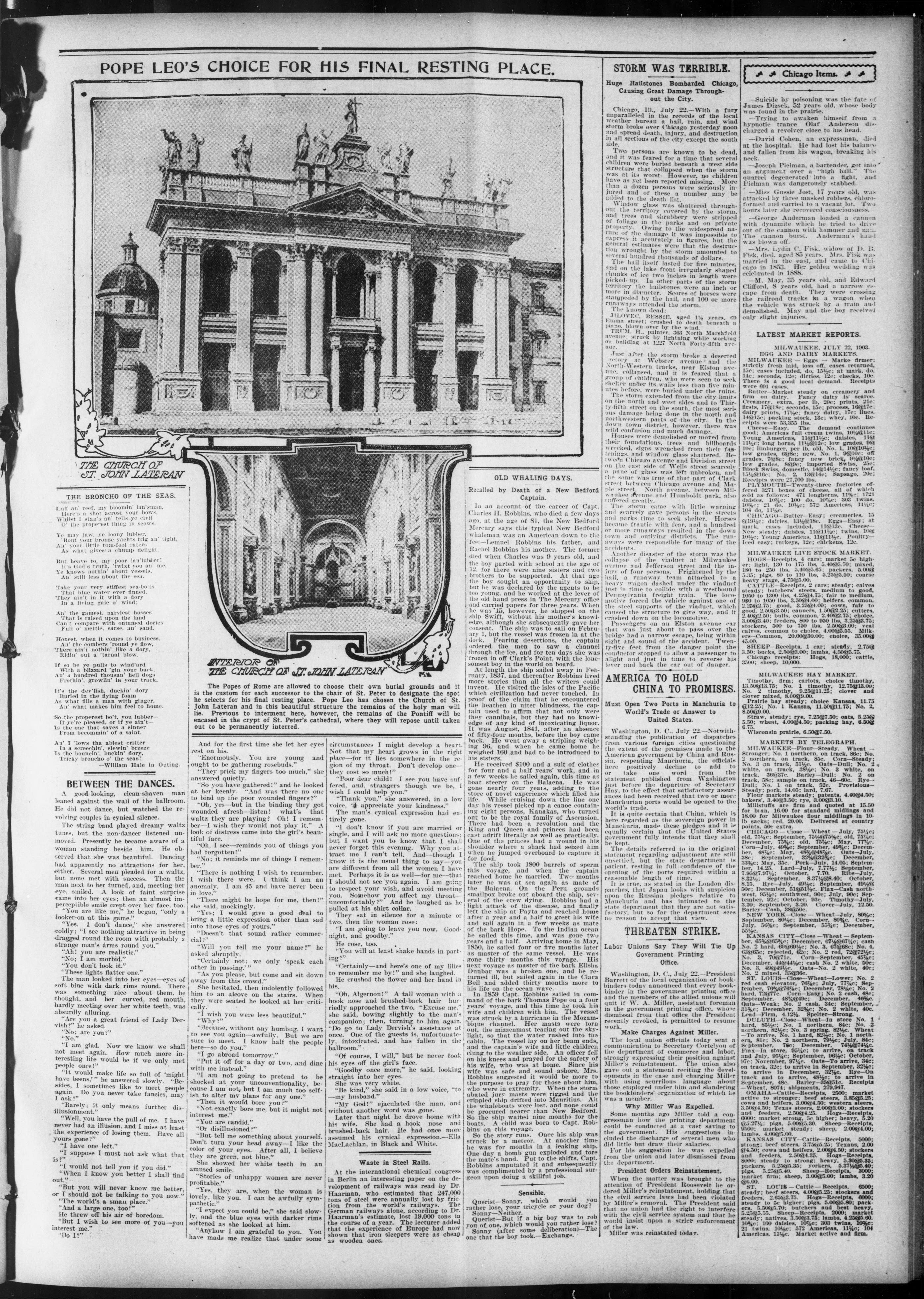
POPE LEO'S CHOICE FOR HIS FINAL RESTING PLACE.
THE CHURCH OF ST. JOHN LATERAN
THE BRONCHO OF THE SEAS.
Luff an' reef, my bloomin' lan'sman.
Here's a shot acrost your bows.
Whilst I stan's an' tells ye civil
O' the properest thing in scows.
Ye may jaw, ye loony lubber,
'Bout your bronze yachts trig an' tight,
An' your little tom-fool raters
As what gives a chump delight.
But heave to, my poor lan'lubber!
It's God's truth, 'twixt you an' me.
Ye knows nothin' about vessels,
An' still less about the sea.
Take your very stiffest sea-bo'ts
That blue water ever finned.
They ain't in it with a dory
In a living gale o' wind;
An' the gamest, naviest hosses
That is raised upon the land
Can't compare with ontamed dories
Full o' mettle, sarse, an' sand.
Honest, when it comes to business.
An' the combers 'round ye flow.
There ain't nothin' like a dory,
Ridin' out a 'tarnal blow.
If so be ye pulls to wind'ard
With a blizzard 'gin your back.
An' a hundred thousand' hell dogs
Frothin', growlin' in your track,
It's the dev'lish, duckin' dory
Buried in the flying foam
As what fills a man with ginger.
An' what makes him feel to home
So.the properest bo't, you lubber—
If ye're pleased, or if ye ain't—
Is the one that saves a sinner
From becomin' of a saint.
An' I 'lows the ablest critter
In a sereechin', slewin' breeze
Is the bouncin', buckin' dory.
Tricky broncho o' the seas!
—William Hale in Outing.
BETWEEN THE DANCES.
A good-looking, clean-shaven man leaned against the wall of the ballroom. He did not dance, but watched the revolving couples in cynical silence.
The string band played dreamy waltz tunes, but the non-dancer listened unmoved. Presently he became aware of a woman standing beside him. He observed that she was beautiful. Dancing had apparently no attractions for her, either. Several men pleaded for a waltz, but none met with success. Then the man next to her turned, and, meeting her eye, smiled. A look of faint surprise came into her eyes; then an almost imperceptible smile crept over her face, too. "You are like me," he began, "only a looker-on at this game."
"Yes. I don't dance," she answered coldly; "I see nothing attractive in being dragged round the room with probably a strange man's arms round you."
orange man's artis round you
"Ah! you are realistic."
"No; I am morbid."
"You don't look it."
"These lights flatter one."
The man looked into her eyes—eyes of soft blue with dark rims round. There was something nice about them, he thought, and her curved, red mouth, hardly meeting over her white teeth, was absurdly alluring.
"Are you a great friend of Lady Dervish?" he asked.
"No; are you?"
"No."
"I am glad. Now we know we shall not meet again. How much more interesting life would be if we only met people once!"
"It would make life so full of 'might have beens,'" he answered slowly. "Besides, I sometimes like to meet people again. Do you never take fancies, may I ask?"
"Rarely; it only means further disillusionment."
"Well, you have the pull of me. I have never had an illusion, and I miss at least the experience of losing them. Have all yours gone?"
"I have one left."
"I suppose I must not ask what that is?"
"I would not tell you if you did."
"When I know you better I shall find out."
"But you will never know me better, or I should not be talking to you now."
"The world's a small place."
"And a large one, too!"
He threw off his air of boredom.
"But I wish to see more of you—you interest me."
INTERIOR OF
THE CHURCH OF ST. JOHN LATERAN
The Popes of Rome are allowed to choose their own burial grounds and it is the custom for each successor to the chair of St. Peter to designate the spot he selects for his final resting place. Pope Leo has chosen the Church of St. John Lateran and in this beautiful structure the remains of the holy man will lie. Previous to interment here, however, the remains of the Pontiff will be encased in the crypt of St. Peter's cathedral, where they will repose until taken out to be permanently interred.
The Popes of Rome are allowed to choose their own burial grounds and it is the custom for each successor to the chair of St. Peter to designate the spot he selects for his final resting place. Pope Leo has chosen the Church of St. John Lateran and in this beautiful structure the remains of the holy man will lie. Previous to interment here, however, the remains of the Pontiff will be encased in the crypt of St. Peter's cathedral, where they will repose until taken out to be permanently interred.
And for the first time she let her eyes rest on his.
"Enormously. You are young and ought to be gathering rosebuds."
"They prick my fingers too much," she answered quietly.
"So you have gathered!" and he looked at her keenly. "And was there no one to bind up the poor wounded fingers?"
"Oh, yes—but in the binding they got wounded afresh—listen! what's that waltz they are playing? Oh! I remember—I wish they would not play it." A look of distress came into the girl's beautiful face.
"Oh, I see—reminds you of things you had forgotten!"
"No; it reminds me of things I remember."
"There is nothing I wish to remember. I wish there were. I think I am an anomaly. I am 45 and have never been in love."
"There might be hope for me, then!" she said, mockingly.
"Yes; I would give a good deal to bring a little expression other than sad into those eyes of yours."
"Doesn't that sound rather commercial?"
"Will you tell me your name?" he asked abruptly.
"Certainly not; we only 'speak each other in passing.'"
"As you please, but come and sit down away from this crowd."
She hesitated, then indolently followed him to an alcove on the stairs. When they were seated he looked at her critically.
"I wish you were less beautiful."
"Why?"
"Because, without any humbug, I want to see you again—awfully. But we are sure to meet. I know half the people here—so do you."
"I go abroad tomorrow."
"Put it off for a day or two, and dine with me instead."
"I am not going to pretend to be shocked at your unconventionality, because I am not, but I am much too selfish to alter my plans for any one."
"Then it would bore you?"
"Not exactly bore me, but it might not interest me."
"You are candid."
"Or disillusioned?"
"But tell me something about yourself. Don't turn your head away—I like the color of your eyes. After all, I believe they are green, not blue."
She showed her white teeth in an amused smile.
"Stories of unhappy women are never profitable."
"Yes, they are, when the woman is lovely, like you. I can be awfully sympathetic."
"I expect you could be," she said slowly, and the blue eyes with darker rims softened as she looked at him.
"Anyhow I am grateful to you. You have made me realize that under some
circumstances I might develop a heart. Not that my heart grows in the right place—for it lies somewhere in the region of my throat. Don't develop one—they cost so much!"
"Poor dear child! I see you have suffered, and, strangers though we be, I wish I could help you."
"Thank you," she answered, in a low voice, "appreciate your kindness."
The man's cynical expression had entirely gone.
"I don't know if you are married on single, and I will ask no more questions; but I want you to know that I shall never forget this evening. Why you attract me I can't tell. And—though I know it is the usual thing to say—you are different from all the women I have met. Perhaps it is as well—for me—that I should not see you again. I am going to respect your wish, and avoid meeting you. Somehow you affect my throat—uncomfortably?" And he laughed as he pulled at his shirt collar.
They sat in silence for a minute or two, then the woman rose:
"I am going to leave you now. Goodnight, and goodby."
He rose, too.
"You will at least shake hands in parting?"
"Certainly—and here's one of my lilies to remember me by!" and she laughed.
He crushed the flower and her hand in his.
"Oh, Algernon!" A tall woman with a hook nose and brushed-back hair hurriedly approached the two. "Excuse me," she said, bowing slightly to the man's companion; then, turning to him again. "Do go to Lady Dervish's assistance at once. One of the guests is, unfortunately, intoxicated, and has fallen in the ballroom."
"Of course, I will," but he never took his eyes off the girl's face.
"Goodby once more," he said, looking straight into her eyes. She was very white. "Be kind," she said in a low voice, "to—my husband." "My God!" ejaculated the man, and without another word was gone. Later that night he drove home with his wife. She had a hook nose and brushed-back hair. He had once more assumed his cynical expression.—Ella MacLachlan, in Black and White.
Waste in Steel Rails
At the international chemical congress in Berlin an interesting paper on the development of railways was read by Dr. Haarman, who estimated that 247,000 tons of steel were annually lost by friction from the world's railways. The German railways alone, according to Dr. Haarman's estimate, lost 19,000 tons in the course of a year. The lecturer added that the experience of Europe had now shown that iron sleepers were as cheap as wooden ones.
OLD WHALING DAYS.
Recalled by Death of a New Bedford Captain.
In an account of the career of Capt. Charles H. Robbins, who died a few days ago, at the age of 81, the New Bedford Mercury says this typical New Bedford whaleman was an American down to the feet—Lemuel Robbins his father, and Rachel Robbins his mother. The former died when Charles was 9 years old, and the boy parted with school at the age of 12, for there were nine sisters and two brothers to be supported. At that age the boy sought an opportunity to ship, but he was declared by the agents to be too young, and he worked at the lever of the old hand press in The Mercury office and carried papers for three years. When he was 15, however, he shipped on the ship Swift, without his mother's knowledge, although she subsequently gave her consent. The ship was to sail on February 1, but the vessel was frozen in at the dock. Fearing desertions, the captain ordered the men to saw a channel through the ice, and for ten days she was frozen in off Clark's Point, with the lonest boy in the world on board.
At length the ship sailed away in February, 1837, and thereafter Robbins lived more stories than all the writers could invent. He visited the isles of the Pacific which civilization had never touched. In proof of the claim that he encountered the heathen in utter blindness, the captain used to affirm that not only were they cannibals, but they had no knowledge of any kind of intoxicating liquor. It was August, 1841, after an absence of fifty-four months, before the boy came back. He went away a stripling weighing 96, and when he came home he weighed 160 and had to be introduced to his sisters.
He received $100 and a suit of clothes for four and a half years' work, and in a few weeks he sailed again, this time as boat steerer on the Balaena. He was gone nearly four years, adding to the store of novel experience which filled his life. While cruising down the line one day his vessel picked up a canoe containing eight persons, Kanakas, who turned out to be the royal family of Ascension. There had been a revolution and the King and Queen and princes had been cast adrift literally as well as practically. One of the princes had a wound in his shoulder where a shark had seized him when he jumped overboard to capture it for food.
The ship took 1800 barrels of sperm this voyage, and when the captain reached home he married. Two months later he was at sea again as mate of the Balaena. On the Peru grounds smallpox broke out aboard the ship, several of the crew dying. Robbins had a light attack of the disease, and finally left the ship at Payta and reached home after a year and a half to greet his wife and sail again in a few weeks as mate of the bark Hope. To the Indian ocean he sailed this time, and was gone two years and a half. Arriving home in May, 1850, he sailed four or five months later as master of the same vessel. He was gone thirty months this voyage. His next voyage as master of the bark Elisha Dunbar was a broken one, and he returned ill, but sailed again in the Clara Bell and added thirty months more to his life on the ocean wave.
In 1859 Capt. Robbins sailed in command of the bark Thomas Pope on a four years' voyage, and this time he took his wife and children with him. The vessel was struck by a hurricane in the Mozambique channel. Her masts were torn out, the mizzenmast tearing out the skylight, so that the water rushed into the cabin. The vessel lay on her beam ends, and the captain's wife and little children clung to the weather side. An officer fell on his knees and prayed for the safety of his wife, who was at home. Since his wife was safe and sound ashore, Mrs. Robbins suggested it would be more to the purpose to pray for those about him, who were in extremity. When the storm abated jury masts were rigged and the crippled ship drifted into Mauritius. All the whaleboats were lost, and none could be procured nearer than New Bedford. So the ship waited nine months for the boats. A child was born to Capt. Robbins on this voyage.
So the story runs. Once his ship was struck by a meteor. At another time he was for months in a leaking ship. One day a bomb gun exploded and tore the mate's hand. Put to the shifts, Capt. Robbins amputated it and subsequently was complimented by a professional surgeon upon doing a skillful job.
Sensible.
Querist—Sonny, which would you rather lose, your tricycle or your dog? Sonny—Neither. Querist—But if a big boy was to rob you of one, which would you rather lose? Sonny (after some deliberation)—The one that the boy took.—Exchange.
STORM WAS TERRIBLE.
Huge Hailstones Bombarded Chicago, Causing Great Damage Throughout the City.
Chicago, Ill., July 22.—With a fury unparalleled in the records of the local weather bureau a hail, rain, and wind storm broke over Chicago yesterday noon and spread death, injury, and destruction in all sections of the city except the south side.
Two persons are known to be dead, and it was feared for a time that several children were buried beneath a west side structure that collapsed when the storm was at its worst. However, no children have as yet been reported missing. More than a dozen persons were seriously injured and of these a number may be added to the death list.
Window glass was shattered throughout the territory covered by the storm, and trees and shrubbery were stripped of foliage in the parks and on private property. Owing to the widespread nature of the damage it was impossible to express it accurately in figures, but the general estimates were that the destruction wrought by the storm amounted to several hundred thousands of dollars.
The hail itself lasted for five minutes, and on the lake front irregularly shaped chunks of ice two inches in length were picked-up. In other parts of the storm territory the hailstones were an inch or more in diameter. Scores of horses were stamped by the hail, and 100 or more runaways attended the storm.
The known dead:
JILOVEC, BESSIE, aged 1½ years. 60 Emma street; crushed to death beneath a piano, blown over by the wind.
TRUM. H., palmer, 363 North Marshfield avenue; struck by lightning while working on building at 1227 North Forty-fifth avenue.
Just after the storm broke a deserted factory at Webster avenue and the North-Western tracks, near Elston avenue, collapsed, and it is feared that a group of children, who were seen to seek shelter under its walls less than five minutes before, were buried under the ruins.
The storm extended from the city limits on the north and west sides and to Thirty-fifth street on the south, the most serious damage being done in the north and northwestern parts of the city. In the down town district, however, there was wild confusion and much damage.
Houses were demolished or moved from their foundations, trees and billboards wrecked, signs wrenched from their fastenings, and window glass shattered. Between Chicago avenue and Division street on the east side of Wells street scarcely a pane of glass was left unbroken, and the same was true of that part of Clark street between Chicago avenue and Maple street. North avenue, between Milwaukee avenue and Humboldt park, also suffered greatly. The storm came with little warning and scarcely gave persons in the streets and parks time to seek shelter. Horses became frantic with fear, and a hundred or more runaways resulted in the down town and outlying districts. The runaways were responsible for many of the accidents.
Another disaster of the storm was the collapse of the viaduct at Milwaukee avenue and Jefferson street and the injury of four persons. Frightened by the hail, a runaway team attached to a heavy wagon dashed under the viaduct just in time to collide with a westbound Pennsylvania freight train. The locomotive forced the vehicle against one of the steel supports of the viaduct, which caused the structure to give way, and it crashed down on the locomotive. Passengers on an Elston avenue car that was just about to pass over the bridge had a narrow escape, being within sight and sound of the accident. Twenty-five feet from the danger point the conductor stopped to allow a passenger to alight and just in time to reverse his lever and back the car out of danger.
AMERICA TO HOLD CHINA TO PROMISES.
Must Open Two Ports in Manchuria to World's Trade or Answer to United States.
Washington, D. C., July 22.—Notwithstanding the publication of dispatches from various foreign cities questioning the extent of the promises made to the American government by China and Russia, respelling Manchuria, the officials here positively decline to add to or take one word from the statement published from Washington just before the departure of Secretary Huy, to the effect that satisfactory assurances had been received that two or more Manchurian ports would be opened to the world's trade.
It is quite certain that China, which is here regarded as the sovereign power in Manchuria, made these pledges and it is equally certain that the United States government fully intends that they shall be kept.
The details referred to in the original statement regarding adjustment are still unsettled, but the state department is patient, resting in full confidence of the opening of the ports required within a reasonable length of time. It is true, as stated in the London dispatches, that Japan looks with suspicion upon the Russian pledges relative to Manchuria and has intimated to the state department that they are not satisfactory, but so far the department sees no reason to accept that view.
THREATEN STRIKE.
Labor Unions Say They Will Tie Up Government Printing Office
Washington, D. C., July 22.—President Barrett of the local organization of bookbinders today announced that every bookbinder in the government printing office and the members of the allied unions will quit if W. A. Miller, assistant foreman in the government printing office, whose dismissal from that office the President recently revoked, is permitted to resume work.
Make Charges Against Miller.
The local union officials today sent a communication to Secretary Cortelyou of the department of commerce and labor, strongly expressing their position against Miller's reinstatement. The union also gave out a statement reciting the developments in the case and charging Miller with using scurrilous language about those employed under him and slandering the bookbinders' organization of which he was a member.
Why Miller Was Expelled.
Some months ago Miller told a congressman how the printing department could be conducted at a vast saving to the government. His suggestions included the discharge of several men who did little but draw their salaries. For his suggestion he was expelled from the union and later dismissed from the department.
President Orders Reinstatement.
When the matter was brought to the attention of President Roosevelt he ordered Miller's reinstatement, holding that the civil service laws had been violated by Miller's removal. The President said that no union had the right to interfere with the civil service system and that he would insist upon a strict enforcement of the law. Miller was reinstated today.
—Suicide by poisoning was the fate of James Dizsek, 52 years old, whose body was found in the prairie.
—Trying to awaken himself from a hypnotic trance Olaf Anderson discharged a revolver close to his head.
—David Cohen, an expressman, died at the hospital. He had lost his balance and fallen from his wagon, breaking his neck.
—Joseph Pielman, a bartender, got into an argument over a "high ball." The quarrel degenerated into a fight, and Pielman was dangerously stabbed.
—Miss Gussie Jost, 17 years old, was attacked by three masked robbers, chloroformed and carried to a vacant lot. Two hours later she recovered consciousness.
—George Anderman loaded a cannon with dynamite which he tried to drive out of the cannon with hammer and nail. The cannon burst. Anderman's hand was blown off.
—Mrs. Lydia C. Fisk, widow of D. B. Fisk, died, aged 85 years. Mrs. Fisk was married in the east, and came to Chicago in 1853. Her golden wedding was celebrated in 1888.
—M. May, 35 years old, and Edward Clifford, 8 years old, had a narrow escape from death. They were crossing the railroad tracks in a wagon when the vehicle was struck by a train and demolished. May and the boy received only slight injuries.
LATEST MARKET REPORTS
MILWAUKEE, JULY 22, 1903. EGG AND DAIRY MARKETS.
EGG AND DAIRY MARKETS.
MILWAUKEE — Eggs — Marke firmer; strictly fresh laid, loss off, cases returned, 15c; cases included, do, 15½c; at mark, do, 14c; seconds, 12c; dirties, 12c; checks, 10c. There is a good local demand. Receipts were 601 cases.
Butter—Market steady on creamery and firm on dairy. Fancy dairy is scarce. Creamery, extra, per lb, 20c; prints, 21c; firsts, 17@18c; seconds, 15c; process, 16@17c; dairy prints, 17½c; fancy dairy, 17c; lines, 14@15c; packing stock, 13c; whey, 10c. Receipts were 33,355 lbs.
Cheese—Easy. The demand continues good; Americas full cream twins, 10½@11c; Young Americas, 11@11½c; daisies, 11@11½c; long horns, 11½@12c; low grades, 9@10c; limburger, per lb, old. No. 1, 10@10½c; low grades, 6@8c; new. No. 1, 9@10½c; off grades, 7@8c; fancy new brick, 9½@10c; low grades, 8@9c; imported Swiss, 25c; Block Swiss, domestic, 14@14½c; fancy loaf, 15½@16c. No. 2. 13@14c; Sapsago, 20c. Receipts were 27,700 lbs.
PLYMOUTH—Twenty-three factories offered 321 boxes of cheese, all of which sold as follows; 471 longhorns, 11½¢; 1721 daisies, 10½¢; 100 do, 10½¢; 303 twins, 10½¢; 21 do, 10½¢; 572 Americas, 11½¢; 104 do, 11½¢.
CHICAGO—Butter-Easy; creamerles, 15 @19½¢; dairies, 13½¢@18¢. Eggs-Easy; at mark, cases included, 11@13¢. Cheese—New stendy; daisies, 11@11½¢; twins, 10@10½¢; Young Americas, 11@11½¢. Poultry—Iced easy; turkeys, 12¢; chickens, 12¢.
HOGS—Receipts, 4 cars; market 5c higher; light, 130 to 175 lbs, 5.40@5.70; mixed, 180 to 250 lbs, 5.40@5.65; packers, 5.00@5.35; pigs, 80 to 110 lbs, 5.25@5.50; coarse heavy stage, 4.75@5.00.
CATTLE—Receipts, 2 cars; steady; calves steady; butchers' steers, medium to good, 1050 to 1300 lbs, 4.25@4.75; fair to medium, $90 to 1050 lbs, 3.50@4.00; heifers, common, 2.25@2.75; good, 3.25@4.00; cows, fair to good, 2.50@3.50; canners, 1.50@2.25; cutters, 2.40@2.50; bulls, common, 2.40@2.75; choice, 3.00@3.40; feeders, 800 to 950 lbs, 3.25@3.75; stockers, 500 to 750 lbs, 2.50@3.00; veal calves, common to choice, 4.00@5.55. Milkers—Common, 20.00@30.00; choice, 35.00@45.00.
SHEEP—Receipts, 1 car; steady, 2.75@3.50; bucks, 2.50@3.00; lambs, 4.50@5.75.
Chicago receipts: Hogs, 18,000; cattle, 3500; sheep, 10.00.
MILWAUKEE HAY MARKET.
Timothy, firm; carlots, choice timothy,
13.50@13.75; No. 1 timothy, 12.75@13.00;
No. 2 timothy, 9.25@11.25; clover and
clover mixed, 8.00@9.00.
Prairie hay steady; choice Kansas, 11.75
@12.25; No. 1 Kansas, 11.50@11.75; No. 2,
8.50@9.00.
Straw, steady; rye, 7.25@7.50; oats, 5.25@
5.50; wheat, 4.00@4.50; packing hay, 6.50@
6.75.
Wisconsin prairie, 6.50@7.50.
MARKETS BY TELEGRAPH
MARKETS BY TELEGRAPH.
MILWAUKEE—Flour—Steady. Wheat — Stronger; No. 1 northern, on track, 88c; No. 2 northern, on track, 85c. Corn—Steady; No. 3 on track, 51½c. Oats—Dull; No. 2 white, on track, 38½c; No. 3 white, on track, 36@37c. Barley—Dull; No. 2 on track, 58c; sample on track, 46-60c. Rye—Dull; No. 1 on track, 52c. Provisions—Steady; pork, 14.05; lard, 7.67.
Flour markets steady; patents, 4.40@4.50;
bakers, 3.40@3.50; rye, 3.40@3.10.
bakers', 3.40@3.50; rye, 3.00@3.10.
Millstuffs are firm and quoted at 15.50
for bian, 16.00 for standard middlings and
18.00 for Milwaukee flour middlings in 10-
lb sacks; red, 20.00. Delivered at country
points, 50c extra.
CHICAGO — Ciose — Wheat — July, 75½c;
old, 75½c; September, 75½@75½c; old, 75½c;
December, 75½c; old, 75½c; May, 777c;
Corn—July, 49½c; September, 49½c; December,
487c; May, 48½@487c; Oats—July,
38c; September, 32½@32½c; December,
33½c; May, 35c. Pork—July, 14.05; September,
14.25. Lard—July, 7.77½; September,
7.95@7.97½; October, 7.70. Ribs—July,
8.32½; September, 8.37½@8.40; October,
8.15. Rye—July, 49½c; September, 49½
50c; December, 51@51½c. Flax—Cash north-
west, 95½c; southwest, 90c; July, 90c; Sept-
ember, 92c; October, 93c. Timothy—July,
3.30; September, 3.20. Clover—July, 12.50.
Barley—Cash, 38½@30c.
NEW YORK—Close — Wheat—July, 80%;
September, 80%; December, 80%; Corn--
July, 56%; September, 55%; December,
55%;
KANSAS CITY—Close — Wheat — September,
65%;@65%; December, 67%;@67%; cash
No. 2 hard, 69%;@69%; No. 3, 67%;@68%; No. 4,
63%;@63%; rejected, 62%; No. 2 red, 72%;@72%;
No. 3, 70%;@71%; Corn—September, 45%;
December, 44%;@44%; cash No. 2 white, 50%;
No. 3, 49%;@49%; Oats—No. 2 white, 40%;
No. 2 mixed, 35%;@36%.
ST. LOUIS—Close — Wheat—Lower; No. 2
red cash elevator, 76%; July, 77%; September,
76%;@76%; December, 78%; No. 2
hard, 72%;@77%; Corn—Easy; No. 2 cash, 48%;
September, 48%;@49%; December, 46%;
Oats—Weak; No. 2 cash, 34%; September,
31%; December, 32%; No. 2 white, 40%;
Lead—Firm, 4.12%; Spelter—Strong.
DULUTH—Close—Wheat—In store No. 1
hard, 85½c; No. 1 northern, 84c; No. 2
northern, 82½c; No. 3 spring, 82½c. Wheat
—To arrive, No. 1 hard, 82½c; No. 1 northern,
81c; No. 2 northern, 79½c; July, 84c;
September, 76c; December, 74½@74½c.
Flax—In store, 95½c; to arrive, on track
and July, 95½c; September, 96½c; October,
97c; November, 97½c. Oats—To arrive, 34c;
on track, 32c; to arrive in September, 32½c;
to arrive in December, 32½c. Rye—On
track and to arrive, 48½c; to arrive in
September, 48c. Barley-35½c1c. Receplts
—Wheat, 8074; shipments, 279.947.
OMAHA—Cattle—Receplts, 2500; market
active to stronger; beef steers, 3.85@5.25;
cows and heifers, 3.00@4.50; western steers,
3.50@4.50; Texas steers, 2.00@3.00; stockers
and feeders, 2.50@4.25. Hogs—Receplts,
6000; market strong, 5c higher; heavy, 5.20
@5.27½c; plugs, 5.00@5.30. Sheep—Receplts,
9500; market steady; sheep, 2.00@4.00;
lambs, 4.00@5.00.
KANSAS CITY—Cattle—Recelpts, 5000;
strong; beef steers, 3.75@5.25; Texans, 2.00
@4.50; cows and heifers, 2.00@4.50; stockers
and feeders, 2.50@4.35. Hogs—Recelpts,
8000; steady to strong; heavy, 5.30@5.35;
packers, 5.25@5.35; yorkers, 5.37½@5.40;
pigs, 5.25@5.40. Sheep—Recelpts, 3000;
market firm; sheep, 3.00@5.00; lambs, 3.20
@6.00.
ST. LOUI$ — Cattle — Recelpts, 6500;
steady; beef steers, 4.00@5.25; stockers and
feeders, 2.65@3.75. Hogs—Recelpts, 6000;
steady to 5c higher; pigs, 5.00@5.80; packers,
5.50@5.70; butchers and best heavy,
5.25@5.55. Sheep—Recelpts, 2000; market
steady; natives, 3.50@3.75; lambs, 4.25@5.60.
10%c; 100 dalses, 10%c; 303 twins, 10%c;
21 twins, 10%c; 572 Americas, 11½c; 104
Americas, 11½c. Market active and firm.
The Wisconsin Weekly Advocate Printed in the Interests of the Negro Race MILWAUKEE, WIS.
Telephone Black No. 244.
Any part of the United States and Canada, postage paid.
One Year ..... $2.00
Six Months ..... 1.25
Three Months ..... 75
Send money by Express Money Order, P. O.
Money Order or Registered Letter to the
Wisconsin Weekly Advocate.
ADVERTISING RATES
One inch, single insertion..... 25c
One inch, per year..... $9.00
Business locals 5c per line each insertion.
Apply for rates to the Advocate.
TO CONTRIBUTORS:
All communications must be sent with the name and address of the sender as an evidence of good faith, but not necessarily for publication. No manuscript returned if not accepted, unless accompanied by stamps.
The Wisconsin Weekly Advocate company wishes to notify the public that all contracts and business transactions with this company must have the company stamp, otherwise they will be void. Neither will this company be responsible for paid subscriptions unless given to duly-accredited agents, who, on request, will give the company's receipt for same. Subscribers failing to receive their papers regularly will kindly notify the general office. Address all business communications to the general manager, 79 Fifth street.
Entered in the Postoffice at Milwaukee as Second-class matter.
EDITORIAL PARAGRAPHS.
"I know of the bravery and character of the Negro soldier. He saved my life at Santiago, and I have had occasion to say so in many articles and speeches. The Rough Riders were in a bad position when the Ninth and Tenth cavalry came rushing up the hill carrying everything before them. The Negro soldier has the faculty of coming to the front when he is needed most. In the Civil war he came 400,000 strong, and I believe he saved the Union."—President Roosevelt.
England's new tabloid beer may require good American wet beer to wash it down.
The crop outlook on the whole promises larger returns than for any year except 1902. That isn't a bad sign for business.
In the event of defeat for Jeffries, the bear that bit him in the arm at Harbin Springs, California, will go into the history of pugilism, embalmed in an excuse.
---
The Italian doctor who announces a vaccine serum that will immunize humanity against tuberculosis is making a big claim. But this is an era of marvelous discoveries in all branches of science.
Automobile scorchers will soon be made to understand that while they are entitled under the law to a share of the roadways, they can't use that share in a way that will scare horses and drivers from the remaining portion.
When the coal miners are at work, there is never any danger of a coal famine. The famine story is used to hurry summer orders to fill bins, and when the rush is over the coal dealers hasten to reassure those who need no reassurance.
---
It appears that the Shamrock's owner is not as confident of winning as has been generally reported . He has promised to take an American wife if he succeeds in "lifting" the cup; and Sir Thomas has thus far not been inclined to matrimony to any great extent.
The Elkharf, Indiana, company which promises to manufacture imitation coal yielding more heat than hard coal, can't get in business too fast for consumers, who can see that they are surely going into the maw of a combination that will be as heartless as it is absolute.
---
The Department of Agriculture has defined standard milk as milk containing not less than $ 3 \frac{1}{4} $ per cent. of fat and $ 8 \frac{1}{2} $ per cent. of solids not fat, and which has an acidity of not more than 2-10 per cent. of lactic acid. It has also defined standard butter as butter containing not less than 825-10 per cent. of butter fat. Now, what is the consumer to do about it?
---
That Mrs. Harriet Lane Johnston did not believe the higher education of women to be the crying need of the age is attested by the manner in which she disposed of her fortune. The sum of $300,000 she bequeathed for the free maintenance, education and training of choir boys in Washington, while she left an additional $60,000 to found university scholarships for poor boys.
At Pontiac, Michigan, the other day, a young lady stepped upon an explosive parlor match, while walking in the street. It ignited and set fire to her dress. She died in terrible agony. The explosive parlor match is dangerous. It is the cause of many fires in all parts of the United States every year. Yet when legislation for its prohibition was pending in New York a short time ago, the yellow newspapers came out in opposition to the law and declared that it was conceived in the interest of the match trust.
The kissing incident in which Gertrude Quinlan and Sir Thomas Lipton figured may recall the fact that a popular song of thirty years ago contained the asseveration:
The lips that touch liquor
Shall power touch mine
Even if Sir Thomas is committed to this proposition, his encounter with Miss Quinlan may have left his vow intact, for she does not look like the kind of girl to be selected for champagne suppers. Miss Quinlan no doubt felt perfectly safe, for all the world knows that Sir Thomas is not a cup-lifter.
THE CHINAMAN IN THE UNITED STATES
It is estimated that there are about 100,000 Chinamen in the United States, and that 20,000 of them are in San Francisco. There is a considerable Chinese colony in New York, and there are small colonies in Philadelphia, Boston and Chicago. Though they do not belong to the educated classes, ninety-five per cent. of them can read and write. A daily paper in the Chinese language is published in San Francisco, and another in New York.
operations performed, such as pounding the back, cleaning the eye-balls, and scraping the ears. The queue is universally worn in China, having been introduced by the Tartars as a badge of subjection when they conquered China, and having since become merely a national custom. Some Chinamen in the United States dispense with the queue, but let it grow again when they are about to visit their native land. When at work the queue is often coiled
Nearly all the Chinamen in the United States come from the single province of Kwong Tung, the most populous of the eighteen provinces of the Chinese empire. Its capital is Canton. In 1889 an educated Chinaman from the province of Shan Tung said that beside himself there were only two Chinamen in the United States that came from any province in China other than Kwong Tung. The inhabitants of this province have for centuries been more adventurous and fonder of traveling than the rest of
A man seated in a room, holding a needle and thread, with a box on his lap.
their fellow-countrymen, and they are always ready to face danger if there is a good chance of profit. The emigrants are generally farmers or mechanics, who, finding business dull, borrow money and journey to a foreign land in the hope of bettering their lot.
Of the Chinamen in the United States perhaps one-twentieth are merchants, who deal chiefly in Chinese products, such as ducks' feet, stuffed with chicken liver, wrapped in entrails, dried oysters, shad preserved in oil, pork cured in sugar, dried cabbages, salted turnips, ancient eggs of ducks and many other things esteemed dainties by the Chinese palate. These articles, on account of the freight and heavy import duties, are very costly, but no Chinaman considers a menu complete without them. The Chinese merchants export from the United States woollen cloth, flannel, cotton goods, petroleum, ginseng, and many other articles. Shoes and cigars are extensively manufactured by the Chinese, the number of cigarmakers being estimated at several thousands.
Though many Chinamen are scattered about the suburbs of western towns as cooks, household servants or laundrymen, and many others live on ranches or orchards, most of them congregate together as much as possible. In many western cities there is a quarter called "Chinatown," the houses of which, crowded like rabbit-warrens with yellow humanity, wear a squalid, tumble-down, greasy, forlorn air, and are pervaded by a curious, indefinable smell, which is everywhere perceptible and often overpowering. The streets of a Chinese quarter swarm with men, women and children; the shops are adorned with gaudy gilt signs and lanterns of various shapes, sizes and colors. Here and there a blank wall is covered with notices on bright red paper, with black letters, which are read with much apparent interest by the Chinamen. On the sidewalks in the front of the stores are stalls, where fruit, vegetables and edibles of unfamiliar and unprepossessing appearance are exposed for sale. In the doorways and corners tailors and cobblers ply their trades. A fortune-teller sits at a little table, on the wall behind which a large notice sets forth his powers and pretensions.
The proprietor of a drug store is frequently a physician wearing large-rimmed spectacles and assuming a mysterious air. Among his curative agents are powdered beetles, cockroaches, skins of caterpillars, snakes' bones, lizards, deer-horns and the blood of toads. The drug ginseng is found in every store, and is believed to be a preservative of youth.
The restaurants occupy the upper floors of three-storied buildings, and are distinguished by gaily painted and gilded balconies, adorned with rows of great lanterns. The rooms are decorated with handsome Chinese furniture and elaborately carved screens. Here the rich Chinamen give big dinners with many courses and musical accompaniments. The eating-houses for poor Chinamen are chiefly in cellars, and are rudely furnished. The merchants have their own kitchens, and eat their meals at the back of their shops, helping themselves from a large dish placed in the center of the small table and using chopsticks.
It has been said, and with truth, that the Chinaman in the United States does not even change his tailor or his barber. Through the windows of the barber's shops you may see Chinamen having their heads and foreheads shaved, their scanty beards trimmed, their queues combed and braided with silk to increase the length, and other toilet
operations performed, such as pounding the back, cleaning the eye-balls, and scraping the ears. The queue is universally worn in China, having been introduced by the Tartars as a badge of subjection when they conquered China, and having since become merely a national custom. Some Chinamen in the United States dispense with the queue, but let it grow again when they are about to visit their native land. When at work the queue is often coiled on the top of the head.
When a Chinaman dies his body is dressed in his best clothes and laid on the coffin; pigs roasted whole and other viands are spread out to feed the spirits of the dead, and in many cases mourners are hired to chant the praises of the deceased. When the ceremony is over the body is placed in the coffin, and the procession moves out to the cemetery. Children dressed in white often walk barefooted behind the coffin of their father or mother. Strips of brown paper pierced with holes are scattered along the road to keep off any bad spirits that may be hovering near.
The Chinaman, though hardworking and frugal in the highest degree, is rarely free from the vices of gambling and opium-smoking. In a city there is an exodus of Chinese house-servants every night from the suburbs to the Chinese quarter, and if one happens to be out late one will certainly see Chinamen stealing quietly to the employers' homes after a night of gambling and dissipation. But in the morning the incartable oriental will be ready with breakfast just as usual.
The Chinese are idolators, and have temples containing the images of noble characters, whom they ask to present their petitions to the Great Being "Shing," who dwells somewhere in the sky. Roasted pigs, chickens, and sweetmeats are presented to the "Joss," in whose honor candles are lighted, incense and joss sticks burned. The worshipper kneels and touches the floor with his head as he utters his prayer.
In every Chinese quarter are underground opium dens, to which narrow flights of tottering stairs lead. They are deathly still, and the atmosphere reeks with the fumes of the drug. Every lodging-house, restaurant, and guild-hall supplies facilities for indul-
斗茶制
卦会
gence in the drug. The Chinaman's favorite drink is tea, though he has a spirit called "Samshoo," which is distilled from rice, and drunk from small cups hardly larger than thimbles.
Indian Ealists in the Navy. The first full-blooded Indian to arrive at League Island navy yard is now doing duty on the Minneapolis. He is known in the Crow tribe, of which he is a member, as Great Whitebear, and is descended from the Indian chief of that name. Whitebear, as he is called at the navy yard, enlisted as a landman. He was educated at the Carlisle Indian school, and has a brother who formerly served in the United States cavalry.
"I have been here two days, and the officer has placed me in charge of a squad." said the Indian jackie, with great pride, when asked how he liked his experience so far. "I felt when I left Carlisle that I would like to do something for my country, and the life of a sailor appealed to me. So I enlisted. They make a good American of you at Carlisle. I believe the discipline and training of the navy will be a good thing for Carlisle graduates, and I hope other Indians will follow my example."
Whitebear is 23 years old and is a fine specimen of physical manhood.—New York Tribune.
Why He Was Rejected.
McJigger—Poor fellow! He's terribly cut up because Miss Oldenritch rejected him.
Thingumbob — Rejected him? I thought she'd jump at a proposal.
McJigger—She was going to, but first she asked him if he would love her when she was old, and he absentmindedly replied: "I do."—Philadelphia Press.
"Very! Why, her trousseau alone cost over six thousand dollars."— Judge.
If a man trusts to luck for his dinner he will never be troubled with the gout.
All the Essentials
Arthur Stansfeld was a strange boy in some respects. When any information was given him that he could not easily understand, he would reply, "I don't believe it." If his father said that the sun was a great ball of fire over ninety-two millions of miles away, he would reply, "I don't believe it;" and if his mother reminded him that in China the sun shines when we in America are fast asleep in our bed, he would shake his head saying, "I don't believe it." And so it was that he got to be named "Don't believe it," and his want of belief caused much fun.
Now, there is no harm in seeking to find out the truth of what we are told; the child who reads to learn, and seeks to find out the truth, is acting rightly, and will get good by so doing.
Now, there are three reasons given for the drinking of intoxicating drinks, about which I want you to be very doubtful.
1. Don't believe that intoxicating drinks will make you strong.
The strongest animals in the world do not need intoxicating drinks; the lion, the tiger, and the elephant are all teetotallers.
There are millions of people in the world who live long lives and do much hard work without the use of intoxicating drinks.
The chemist cannot find any food substances in intoxicating drinks such as he can in milk upon which the body can grow.
II. Don't believe that intoxicating drinks can make the body warm.
The body is kept warm by the burning of carbon in the body, this carbon being burnt up by the oxygen of the air.
Fatty foods contain much of this carbon; when they are burnt in the body they give great warmth.
No intoxicating drink contains the smallest quantity of fat. Alcohol sends the blood into the skin, and so lets the heat out of the body. Alcohol prevents the oxygen doing its duty, thus the carbon in the blood is not burnt up in the way it should be. III. Don't believe that intoxicating drinks will help to digest food. All food must become soft and liquid like gruel before it can become blood, and so cause the body to grow, and be fit to do its work.
Alcohol softens those substances which are not fit for food, such as gum.
Alcohol hardens those substances which are fit for food; bread, fruit, meat, sugar, all become harder when placed in alcohol.
There is no alcohol in any of the foods God sends us, but there is plenty of water. There is no alcohol in any of the liquids which soften the food of the body. The saliva in the mouth, the gastric juice in the stomach, the bile coming from the liver, and the other digestive liquids are nearly all water.
On these three points you may exercise your disbelief. Don't believe that alcohol will make you strong that it can give warmth, or that it can help to digest your food.
A Baby Saved Him.
A man, on being asked by some companions to go into a saloon and have a drink with them, said:
"I won't drink to-day, boys."
"What's the matter with you, old man?" asked one. "If you've quit what's up?"
"Well, boys, I'll tell you. Yesterday I was in Chicago. I called on a customer of mine down on Clark street, who keeps a pawnshop in connection with his other business. While I was there a young man came in, wearing threadbare clothes and looking as hard as they make 'em. He had a little package in his hand. He unwrapped it and handed it to the pawnbroker, saying, 'Give me ten cents.' And what do you suppose it was? It was a pair of baby's shoes, little things with the buttons only a trifle soiled, as though they had been worn only once or twice. 'Where did you get these?' asked the pawnbroker. 'Got 'em at home,' replied the man. 'My wife bought 'em for the baby. Give me ten cents for 'em—I want to get a drink.' 'You had better take them back to your wife, the baby will need them,' said the pawnbroker. 'No, she won't; she's dead—baby died last night,' and then the poor fellow laid his head down on the showcase and cried like a child. "Boys, I have a baby at home, and I'll not take a drink with you to-day." National Advocate.
Anti-Drink Crusade.
In Denmark a curious method is now adopted for the purpose of preventing persons from getting drunk. The police have simply notified the saloonkeepers throughout the country that those among them who at any time sell liquor to persons who are intoxicated will not only be held responsible for any damage which the drunkards may do to persons or property, but will also be obliged to pay for sending them home in carriages as well as for medical attendance, if necessary.
In every case it is the saloonkeeper in whose place the intoxicated person has procured the last glass of liquor who is held responsible, and for this reason most of the saloonkeepers are now taking very good care not to furnish drink to any one who shows the slightest signs of intoxication.
FREE
Why Suffer from Disease? Robinson's Alfalfa-Nutrient
Positively cures Rheumatism, Locomotor-Ataxia, all Stomach, Liver and Kidney Troubles and all Nerve and Blood Diseases. Send us your name and address and we will mail you absolutely free a ten days' trial treatment of this wonderful medicine together with a scientific booklet, "How to Secure Perfect Physical Health." Address
ALFALFA-NUTRIENT CO.
Room 8, 59 Dearborn St., Chicago.
A.
Why Suffer for
Robinson's A
Positively cures Rheumatism,
Liver and Kidney Troubles
eases. Send us your name
you absolutely free a ten days
ful medicine together with
Secure Perfect Physical Health
ALFALFA-NU
Room 8, 59 Dear
Beware of Impostors
of different professions soliciting money in Wisconsin for purposes unknown to any person in that state and for use elsewhere. Driven out of other states they are overrunning this. We think it an imperative duty on us as being the only negro paper in the state, to protect its generous philanthropists. From now on, we shall warn the mayor and chief of police of every city in Wisconsin against such adventurers.
50 YEARS
EXPERIENCE
PATENTS
TRADE MARKS
DESIGNS
COPYRIGHTS & C.
Anyone sending a sketch and description may
quickly ascertain our opinion free whether an
invention is probably patentable. Communications strictly confidential. Handbook on Patents sent free. Oldest agency for securing patents.
Patents taken through Munn & Co. receive special notice, without charge, in the
A handsomely illustrated weekly. Largest circulation of any scientific journal. Terms, $8 a year four months, $1. Sold by all newsdealers. MUNN & Co. 361 Broadway. New York Branch Office, 625 F St., Washington, D. C.
William T. Green
Lawyer,
Notary Public
Rooms 216-217-218 Empire Bldg., 14 Grand Avenue.
Office Telephone—Black, 8075
Residence " White 8553
MILWAUKEE.
ON TO LOUISVILLE
SIXTH ANNUAL SESSION OF THE
National Afro-American
Council Thousands
Will Attend
The Annual Session of the National Afro-American Council meets at Louisville, July 1st, 2nd and 3rd. Are you going? Yes! Then take the
MONON ROUTE
NORTH OR SOUTH
Always ask for tickets
via the
MONON ROUTE
THE SHORT LINE BETWEEN
Chicago,
Indianapolis, Cincinnati, Louisville Six trains daily between Chicago and the Ohio river.
For folders, rates, etc., call at any Monon ticket office or address
FRANK J. REED,
Gen'l Pass. Agent, Chicago.
S. B. JONES,
C. P. Agent, 232 Clark St., Chicago.
A Precious Girl.
One of the largest families in St. Louis, Mo.—that of Arthur W. Becker—is joyously celebrating the birth of a baby girl. This is the first time in 140 years that a girl has been born in the family. The grandfather, J. Becker, had five boys, and his father, Jacob Becker, had four male heirs. The father of Jacob Becker had no sisters and no daughters, and none of his sons had any daughters.
The year's business of American hens will amount to $284,000,000.
Dixon's Place
Ladies' and Gents' Shining Parlor. Cigars, Tobacco, all Negro Newspapers. 2638 State St., Chicago. Phone, 2351 Brown. We keep for Sale: Wisconsin Advocate, Freeman, Conservator, New York Age, Atlanta Age, Northwestern Vine, Colored American, Cleveland Gazette, Dallas Express, Richmond Planet, True Reformer, Broad-Ax, Monitor, Detroit Informer, Christian Recorder, Voice of Missions, and all other Negro papers of the country.
M. GUMBMET'S SUPERIOR METAL POLISH 50 Hartford Court, Chicago TEL. HARRISON 2374.
RAILWAYS.
CHICAGO,MILWAUKEE& ST.PAULRY
TICKET OFFICE, 400 EAST WATER ST. 161.024
TO AND FROM LEAVE ARRIVE
St. Paul, Minneapolis, Iron Towns, Ashland, Superior, Duluth, Pacific Coast ... *5:00 am *7:15 am *8:00 pm
Marshm-Id, Chippewa Falls, Eau Claire ... *5:00 am *7:15 am *12:01 pm *12:20 pm *8:00 pm *8:45 pm *8:00 pm *7:15 am *5:00 am *7:15 am *7:95 am *10:15 am *12:01 pm *12:20 pm *4:85 pm *6:15 pm *8:45 pm *8:00 pm
Fond du Lac, Oshkosh, Neenah, Menasha ... *7:95 am *10:15 am *12:01 pm *12:20 pm *4:85 pm *6:15 pm *8:45 pm *8:00 pm
*Daily. *Daily except Sunday.
THE PO
By Alfred Ainger, LL, D.
"And it came to pass, when the evil spirit from God was upon Saul, that David took an harp, and played with his hand; so Saul was refreshed, and was well, and the evil spirit departed from him."—I. Samuel xvi., 23.
God has again and again in his mercy shown us by bitter experience that the sight and study of the beautiful is of no avail against the insidious workings of the unconverted heart. The emotion that wakens us up from our lethargy, that for the time being stills in us the troubled waters of human strife, and the madness of ill governed passion, is but for the moment, if it is not sustained by inspiration from a more permanent and abiding source of good. We need awakening, we need the stilling of the waters, we need the inspiration of the moment, but we need afterwards to live by the regulative virtue of a faith that stays on from day to day.
Yes, we are not to neglect, still less despise, the stimulus of the moment. We need it allike in our moods of turbulence and in our moods of lethargy. We need it to calm and also to inspire. Our error and our danger lie in imagining that we can trust alone to these moments that they will do for us what they were never meant to do. Their place in our education is that of witnesses and reminders rather than that of permanent forces and guides. The harp of David brought all heaven "before the eyes" of Saul, but when the music passed into silence the evil spirit came back. Yet he (Saul), we are sure, was responsible for these moments, for he should have been the better for them.
We, too, are responsible for such moments, for they are witnessed to a world of beauty, goodness and harmony lying above and around us; so near, did we but know it, to every one of us. But, O, so easily lost sight of, so easily forgotten! Such awakenings, such pleadings, as those which the young David brought to the stubborn and malignant king, are vouchsafed to us through a million channels of God's universe.
Beauty of nature, beauty of art, beauty of pathos in human character and vicissitudes of human life are all witnesses and foretastes of the things which God has prepared for those who love him. We dare not trust to them. God is a jealous God, and for the love of us will not brook that his witnesses are accepted as his equivalents. If we trust to them for that which they cannot achieve we shall reap only disappointment and disillusion, if not shipwreck.
Such is the moral of the story, whether as applied to the individual life or that of the community. Let us thank God always for the times and seasons when some special visitation of his mercy, or some special realization of our brotherhood, has lifted us, if but for a season, above our common level of indifference. But let us also remember that we dare not trust to the thing lasting, for besides that reaction is inevitable, there can be no permanent healing but in the Spirit of God, and in the daily bread of his grace, in the gradual strengthening of character, and the daily repentance of the daily failure.
The tumult and the shouting dies,
The captains and the kings depart;
Still stands thine ancient sacrifice,
An humble and a courteise heart.
There is one thought that will be constantly arising in the mind of the true lover of music, and it will resolve itself into the question. What can I do, what can I give to lessen the discord of the world and so make human life more musical? And pray believe me that the only way in which this can be brought about is by each one living unselfishly, living a real and blessed life of self-denial. At all times give generously, and constantly guard against the perilous resource of "excuse." Take fresh courage and make a new effort on behalf of those whose needs are so sore, and you will know of a truth that "Music, when sweet voices die, vibrates in the memory," and whispers most blessed incentives to new conquests over self in the days that may lie before you.
"MAN TEMPTED IN EDEN."
The first picture the Bible gives of man is where he is innocent in paradise and at peace with God. The next picture is where he is driven out of Eden and is a sinner and a wanderer on earth. The other day I saw a building with the chimney knocked down, the windows broken and the sides and the roof smashed in. I knew without being told that something had happened to that building.
Look at man. In paradise you see him made in the image and likeness of God. Look at him now, with his intemperance, licentiousness and cruelty. There are whole districts steeped in blood and wholesale massacres until in many places earth is no longer a paradise, but a kingdom of the devil. Look at the sensualist with his swinish look, the puppet with his powdered and painted face, the drunkard with his seedy clothing and bloodshot eyes.
the murderer, who has converted himself into a monster of iniquity, and no one need tell you that something has happened to man.
Another question that we meet with is this: "Why did not God make a man that could not sin?" The Almighty has made some creatures that cannot sin. The dog cannot sin. The monkey cannot sin. If a tiger gets loose and devours your child you shoot the tiger, but you do not brand him as a sinner. He does not sin because he ate up your child, for he was made that way. Let God make a man who could not sin and he would no longer be a man. He would be but a beast of the earth. In order to do right man must have the power of choice.
Let me illustrate this. Suppose that I say to my child: "Daughter, I am going away for a few hours. Be a good little girl; do not go to the park, but stay at home and help mamma." I start to leave, but fearing that my child will disobey I return to the house, take my child and strap her to the bedpost and lock her up in the bedroom. When I return in a few hours I find my child where I left her and say: "You darling girl, you have been good. Here is a new hat for your obedience."
You will at once say to me: "Man, you are demented. Your child was compelled to be good. She could not have done wrong had she wanted to." That is my answer to the foolish one who asks God to make a man who cannot sin. When you do that you are asking God to chain Adam to the post of foreordination and lock him up in the room of fatalism and with almighty power compel him to do right and then go through the farce of rewarding him for his obedience and goodness. We rejoice that the Lord does not work in that way. When he made man he created him with the power to do right, but also with the privilege of choosing the wrong. And this power of choice is one of the crowning glories of man.
CHURCH FOLK COWARDS.
Most of the people in Chicago are cowards. The majority of persons in this church and in every church in the city are cowards. Why? Because they are afraid to confess to the world that they believe in Jesus Christ.
The true hero is he who expresses his beliefs without fear of the consequences, he who declares his faith in Christ without stopping to think whether it will hurt him in society, politics or the business world.
Every man and woman admires a hero and despises a coward. Acts of bravery have been applauded in all countries and in all times and acts of cowardice have been hissed. This, however, applies to physical courage, and not to that high moral strength that makes a man do right for right's sake, that makes him speak the truth at whatever cost.
It is not easy for a man to stand on the firing line all day long, unflinchingly facing shot and shell, enduring hunger and thirst and the pain of wounds, but it is easier to do that than to stand the fire of public opinion and suffer the scorn of his fellow men in living the life his religion teaches and in following the dictates of his conscience.
Most of the people in Chicago to-day are cowards—moral cowards. Most of you in this congregation are in the same class. Doubtless in your hearts you believe in Christ, but how many of you have the courage to confess your faith to the world?
The Apostle Paul was the kind of hero I wish you to be. He was abused, scourged and stoned, and still he was outspoken for Jesus. Nothing could daunt his courage. What this politic world of to-day needs is a Paulean spirit to offset the influence of society's frivolity, business schemes and political intrigues—influences that make cowards out of heroes.
SUMMER COOLS RELIGION.
By Rev. Dr. George F. Hall. Many people warm up religiously in the winter and cool off in the summer. The great apostle to the gentiles once
urged the disciples to "Hold fast to that which is good." And Jesus said, "He that endureth to the end shall be saved." At this season of the year it is well to caution Christians against backsliding. It seems a little strange, but it's true, that many
M.
warm up religiously in the winter and cool off in the summer. There are no heavenly promises to the unfaithful.
There are four things that every church member should do and to enable the memory to retain them easily I have often suggested them in the following blunt verse:
Read the Bible,
And pray,
Go to church,
And pay.
That's the whole thing in a nutshell. The Bible is to the soul what food is to the body. It should be read daily. Prayer is the strongest thing in the world. Then it takes money to keep the heart in tune with the Infinite. Not that God needs our petty gifts, but he needs our affection and our faithfulness, and where our treasures go the rest goes.
MEMORIES
OF THE
WAR
"My regiment," said an old Eleventh Ohio man, "served in three or four different armies, and we had experience among Eastern as well as Western men. We went first to West Virginia, serving under Rosecrans, Cox and Crook, then to the Army of the Potomac, and later to the Army of the Cumberland. So far as anecdotes are concerned we have a large stock to draw from, if the doors of memory are opened by the proper sort of a reminder.
"I have in mind now Rosecrans and Turchin, differeing as widely as two men could differ, but each with an individuality attractive to men in the ranks. While we were on Sewell mountain, West Virginia, there was less ceremony than usual about camp, and officers and men were careless in the matter of dress. One day Rosecrans, wearing a citizen's overcoat and a slouch hat, was walking about on one of those little tours of personal inspection he was so fond of making when he was halted by a sentry watching a pile of oats and hay.
"Rosecrans waved him aside with an impatient gesture, stating who he was. But the sentry brought his musket to a charge and said excitedly: 'Stand back, old fellow. You can't fool me. You are one of them darned teamsters sneaking around here for a chance to steal a feed of oats. Stand back or I will punch you.' Rosecrans smiled grimly and, signaling to a staff officer to approach, said: 'Introduce me to this man. He takes me for a teamster and a thief and a liar. Not very flattering, is it?' The sentry began to apologize, but Rosecrans cut him short, saying: 'I don't blame you. I was wrong to wear an old coat like this, and you were right in stopping me.'
"On another occasion there was a report brought into camp by an officer of the Second Kentucky that there was a full brigade of rebels in camp in the woods not more than five miles from us. There was great excitement, and the Ninth and Eleventh Ohio and Second Kentucky were ordered out to take the rebels in out of the wet. The column made the march of five miles, guided by the officer who had seen the enemy, and came out in the rear of our own camp. It was a case of getting turned round in the woods and mountains and there was great fun at the expense of the officer who had led a heavy column to attack his own brigade.
"While Colonel Bob McCook and others were laughing, Colonel Frizzell of the Eleventh, rising in his stirrups, ordered, 'By right flank to camp, march, and don't forget, boys, that I am very fond of mutton.' This was called out by a flock of very fine sheep which we had passed on our way, and was a hint that the Colonel would not be shocked if we carried some of those sheep into camp. The boys acted on the hint and several of them were loaded down with fresh mutton when they reached the picket lines. Here one of them, with a sheep on his shoulder, came face to face with General Rosecrans. The General was as much surprised as the sheep bearer, and both were in doubt, evidently, as to the course to be pursued under such unusual circumstances.
"The General asked, 'To what regiment do you belong?' Promptly, our Eleventh Ohio man answered, 'The Second Kentucky.' The General smiled at this, because he had learned that it was a rule among men of the other regiments of his division to charge all foraging excesses to the Second Kentucky. Then he asked: 'What is your name?' Again our man named Jones answered promptly, 'Wolf.' Rosecrans, naturally disposed to action that would favorably impress his men, looked the perspiring sheep-bearer over and said, 'Pass on. A wolf has a right to a sheep once in awhile.' As Rosecrans divined it would be, this story was told and retold to his advantage.
"In contrast with this picture of Rosecrans in playful humor comes one of gruff old General Turchin, who was more disposed than any other officer under whom we served to sympathize with foragers. In the course of the march south from Murfreesboro our boys as soon as they went into camp invaded a sweet potato patch, and the invasion was regarded leniently by General Turchin, commanding the brigade. General Reynolds, commanding the division, however, did not regard any such breach of discipline leniently. Looking out from his headquarters, he saw the men in the sweet potato patch, and, jumping on his horse, rode to General Turchin's headquarters.
"He reprimanded Turchin for lax discipline and called his attention to the men digging sweet potatoes. Turchin looked down upon them and said wrathfully that he would look after those rascals himself. Reynolds rode back to his headquarters and Turchin rode down to the sweet potato diggers. This is what occurred: Turchin rode up to the fence and said. 'What you doing dare, boys?' Several of the men replied promptly, 'Getting sweet potatoes. General.'
"According to the established custom General Turchin at this point should have called the boys harsh names and ordered them out of the field. Instead, he said, 'You besser get out of dare. The guards are coming to arrest you. Besser you go around dat way, boys, so the guards will not catch you. Now, you go out,' and, gathering up the sweet potatoes the boys went out in a hurry, and General Reynolds, looking down on the scene, said to himself, 'Well, Turchin knows how to handle his men.' He naturally supposed that the boys had been peremptorily ordered out of the sweet potato patch."
"By the way," said the Sergeant, "a good story is told of Colonel Frizell. After he left the Eleventh Ohio he commanded the Ninety-fourth Ohio, and there came down from West Virginia to the Ninety-forth the story that on one occasion Frizell was sent out to Summerville in Nicholas county to administer the oath of allegiance to all the residents. Among them was an illiterate, simple-minded woman who couldn't be persuaded to take the oath. She was scared, but stubborn, and, wouldn't hold up her hand or say a word. 'Very well, then,' said Frizell, 'repeat the Lord's prayer,' and' being a good Methodist, she did it with unction. Thereupon Frizell said she was all right, and would of course stand by the Union. She unhesitatingly said she would."—Chicago Inter Ocean.
A Soldier's Strategy.
"My conscience has always hurt me just a bit about a little thing that happened at Helena, Ark., during the war," said a white-haired veteran while musing over some of the side-lights of the '60s, "and I do not mind telling you in a confidential way that I have prayed over it a good many times. Price was skirmishing around in the hills back of Helena at the time. The Confederate lines were in bad shape. Some of the southern men had crossed the river below Helena and were quartered on the Mississippi side of the river on a little bayou which reached out from the main stream. The information reached me that the men were in a bad way, and that they needed provisions, clothing and a few other things.
"There was a certain merchant in Helena who had been doing a deal of smuggling, and I had been keeping pretty well up with him. Here was my chance. I told him he could sell some goods down below town if he could get out of Helena with them, and I offered to help him do it. He had a large yawl which he had pressed into service before, and it did not take me a great length of time to convince him that we could use this yawl to advantage. He fell right into the plan. One night we loaded the boat down with an assorted cargo, clothing, food and other things which the merchant had in stock. At that time you couldn't hardly get away from the soldiers, but we managed to get out into the river without making much noise. It was a very dark night. When we had reached the current of the stream I suggested to the merchant that we lay down in the boat until we had drifted below the city. We allowed the current to drive us several miles below the city; in fact, as far down as I wanted to go, for I knew exactly where the Confederate soldiers were camped. We pulled into a small bayou and started to tie up. Suddenly a squad of men swooped down on us and placed us under arrest. Then they began to unload the boat. The merchant did not seem to care so much about the $2,000 worth of goods he had in the yawl, and which the soldiers had confiscated. He told me we were in great danger of being shot, but I consoled him by saying that I would fix up a scheme of escape.
"That night a squad was named to watch us until daylight. About 3 a.m. the soldiers were sound asleep, and we could get away. At first he was afraid of being shot, but I persuaded him it was safe, and we skedaddled. I never saw a man run so in my life, and I was so tickled all the while that I could scarcely keep from letting the cat out of the bag. Up to this day that fellow feels that he owes his life very largely to me, when I had deliberately laid the scheme to rob him of a boatload of goods for the benefit of the Confederacy, and I have often debated the moral aspects of the question in my mind. But I suppose all things are fair in war. Besides, the motive was to help the suffering Confederate soldiers, and not to hurt and harm the merchant."
The Real Thing.
He (rather shy)—Won't you—er—give me a token of—er—remembrance?
She—Do you want something that will always remind you of me?
He—Yes.
She—Well, that being the case, what's the matter with myself?
Moral: If the animal refuses to jump, let down the bars.
The Lawyer's Way.
Ella—How long did it take Fred to propose to you?
Stella—He talked about twenty minutes.
Ella—That's an awfully long time. Stella—I know it seems so; but then you must remember he is a lawyer. Philadelphia Ledger.
May Well Appall Him.
"Governor," said the inquisitive person, "why have you never married?"
The Governor that had refused all offers of marriage shuddered.
"I'll tell you," he said; "but this is in strict confidence. "I think I never could bear to hear my wife referred to as 'Mrs. Governor Soandso.'"
A stitch in time is its own reward.
Packing House & Freezers, Foot of N. Jefferson St.
IT'S THE ONLY PLACE Just What You Have Been Looking For Afro-American News Office 3104 STATE STREET
3104 STATE STREET
Here all the best and best magazines from all be found every week, in and magazines, weekly. Following is a list of these for sale:
Wisconsin Weekly Advocacy Richmond, Va.; Planet, Rid Journal, Philadelphia, Pa.; Atlanta Age, Atlanta, Ga field, Ill.; Cairo Standard, land, Ohio; Kentucky St Detroit Informer, Detroit can, Washington, D. C.; N City, N. Y.; Freeman, Ind. Indianapolis, Ind.; Conse Ax, Chicago, Ill.
All the best and leading weekly and magazines from all parts of the U.S. and every week, including all other magazines, weekly and daily publishing is a list of the leading weekly
Insin Weekly Advocate, Milwaukee; Ref. Bond, Va.; Planet, Richmond, Va.; Odd Fail, Philadelphia, Pa.; Guardian, Boston, Omaha Age, Atlanta, Ga.; State Capitol, St. Il.; Cairo Standard, Cairo, Ill.; Gazette, Ohio; Kentucky Standard, Louisville, Int Informer, Detroit, Mich.; Colored A Washington, D.C.; New York Age, New N.Y.; Freeman, Indianapolis, Ind.; Redcapolis, Ind.; Conservator, Monitor, Chicago, Ill.
Here all the best and leading weekly journals and magazines from all parts of the U. S. can be found every week, including all other standard magazines, weekly and daily publications. Following is a list of the leading weekly papers for sale:
Wisconsin Weekly Advocate, Milwaukee; Reformer, Richmond, Va.; Planet, Richmond, Va.; Odd Fellows Journal, Philadelphia, Pa.; Guardian, Boston, Mass.; Atlanta Age, Atlanta, Ga.; State Capitol, Springfield, Ill.; Cairo Standard, Cairo, Ill.; Gazette, Cleveland, Ohio; Kentucky Standard, Louisville, Ky.; Detroit Informer, Detroit, Mich.; Colored American, Washington, D.C.; New York Age, New York City, N. Y.; Freeman, Indianapolis, Ind.; Recorder, Indianapolis, Ind.; Conservator, Monitor, Broad Ax, Chicago, Ill.
Magazines Published Every Month:
The Colored American, Porters and Waiters Mag also the Buffalo Tragedy Oration. entitled: "Climb, Rugged," by Alton H. Blair
A Full Line of Stationer
Papers sent through the mail to a call and see for yourself. If we your order and we will get it for you
REMEMBER THE N
Afro-American
E. H. FAULKNER, Manager. 310
Colored American, Boston, Mass.; Times and Waiters Magazine, Philadelphia; The Buffalo Tragedy by King Jefferson; an. entitled: "Climb, 'Though the Roof,'" by Alton H. Blake (the Boy Orator)
Line of Stationery, Cigars and T
ent through the mail to any part of the county see for yourself. If we have not what you need we will get it for you.
REMEMBER THE NAME AND PLACE
American News Co.
KNER, Manager. 3104 STATE ST., CH
The Colored American, Boston, Mass.; R. R. Porters and Waiters Magazine, Philadelphia, Pa.; also the Buffalo Tragedy by King Jefferson, and Oration. entitled: "Climb, 'Though the Rocks be Rugged," by Alton H. Blake (the Boy Orator.)
A Full Line of Stationery, Cigars and Tobacco
Papers sent through the mall to any part of the country. Give us a call and see for yourself. If we have not what you want, leave your order and we will get it for you.
REMEMBER THE NAME AND PLACE
Afro-American News Office
E. H. FAULKNER, Manager. 3104 STATE ST., CHICAGO.
The Opportunity of a Life Time
WANTED
for a first-class hotel in a city in
the interior of the state of Wisconsin, the followlng colored help—
1 MEAT COOK, Female.
1 PASTRY COOK, Female.
1 LAUNDRY MAID.
2 CHAMBER MAIDS, one to
assist in serving dinners and
suppers.
2 DINING ROOM GIRLS.
2 DISH WASHERS.
This is an exceptional opportunity for a club of Southern girls to make for themselves a comfortable home in Wisconsin. The proprietor is a Southern gentleman who understands and appreciates the negro.
Apply at once to the office of the WISCONSIN WEEKLY ADVOCATE. 79 Fifth Street, Milwaukee, Wis.
WANTED--AGENTS
We want 100 agents in every city, town and hamlet in the U. S. for the Wisconsin Weekly Advocate. It will be devoted to the interest of the Negro race and will contain the news of their sayings and doings throughout the world.
50 Per Cent. Commission
ADDRESS
WISCONSIN WEEKLY ADVOCATE
MILWAUKEE, WIS.
Before Starting on Your Travels
CALL ON
Geo. Burroughs & Sons
MANUFACTURERS OF
PREMIUM TRUNKS
VALISES, SAMPLE CASES, Etc.
424 1 426 East Water St., Milwaukee.
ALL ON TAKEN FRO BEFORE AND AFTERoughs & Sons OZONIZED OX THE ORIGINAL-
-In the manufacture of cannon the tendency is toward reduced weight of gun and projectile and increased muzzle velocity. This gives added range and penetration.
---
leading weekly journals parts of the U. S. can including all other stand- and daily publications. leading weekly papers
ke, Milwaukee; Reformer, Richmond, Va.; Odd Fellows Guardian, Boston, Mass.; State Capitol, Spring-Cairo, Ill.; Gazette, Cleveland, Louisville, Ky.; Mich.; Colored Ameri- new York Age, New York Manapolis. Ind.; Recorder, Revator, Monitor, Broad
Boston, Mass.; R. R.
azine, Philadelphia, Pa.; by King Jefferson, and
'Though the Rocks be
like (the Boy Orator.)
y, Cigars and Tobacco
any part of the country. Give us
have not what you want, leave
u.
AME AND PLACE
News Office
4 STATE ST., CHICAGO.
ESTABLISHED 1895 TEL. HARRISON 2575
C. C. McLAIN
TICKET BROKER
Member National Ticket Brokers' Association
Railroad Tickets Bought, Sold and Exchanged
Baggage Transferred to All Parts of the City and Berths Secured.
I SELL CHEAP TICKETS TO ALL POIN S.
428 Dearborn St., Chicago.
MILWAUKEE...
GAS STOVE CO.,
MANUFACTURERS OF
HARVESTER
AND SPECIALTIES
Instantaneous Cleanable Star Burners.
Adjustable Needle Valve.
Per Natural, Artificial or Gasoline Gas.
139 Burrell St., Milwaukee, Wis.
WONDERFUL
DISCOVERY
Curly Hair Made Straight By
TAKEN FROM LIFE:
BEFORE AND AFTER TREATMENT.
OZONIZED OX MARROW
THE ORIGINAL—COPYRIGHTED.
This wonderful hair pomade is the only safe preparation in the world that makes kinky hair straight as shown above. It nourishes the scalp, prevents the hair from falling out and makes it longer. It may be used by thousands. Warranted harmless. Testimonials. Quest. It was the first preparation ever sold for straightening kinky hair. Beware of imitations. Get the Original Ozonized Ox Marrow, as the genuine never fails to keep the hair pliable and beautiful. A toilet necessity for ladies and gentlemen. A vantage of this wonderful pomade is that by its use you can straighten your own hair at home. Owing to its superior and lasting quality it is the most economical. It is not possible for anybody to produce a preparation equal to it. Full directions with every bottle. Only 50 cents. Sold by dealers or send us 10 Postal or Express orders for use in 3 bottles express paid. Write your name and address plainly to
OZONIZED OX MARROW CO.,
76 Wabash Ave., Chicago, Ill.
---
Feware of Ointments for Catarrh that Contain Mercury,
as mercury will surely destroy the sense of smell and completely derange the whole system when entering it through the mucous surfaces. Such articles should never be used except on prescriptions from reputable physicians, as the damage they will do is tenfold to the good you can possibly derive from them. Hall's Catarrh Cure, manufactured by F. J. Cheney & Co., Toledo, O., contains no mercury, and is taken internally, acting directly upon the blood and mucous surfaces of the system. In buying Hall's Catarrh Cure be sure you get the genuine. It is taken internally, and made in Toledo, Ohio, by F. J. Cheney & Co. Testimonials free. Sold by Druggists, price 75c. per bottle. Hall's Family Pills are the best.
Our Railway Mileage.
The railway mileage of the United States is 202,471 miles as shown by the report of the interstate commerce commission for the year ending with June. The aggregate capital is $12,134,182,964. of which $6,109,981,669 is funded debt. Of the capital stock $2,686,556,614 or 44.6 per cent. pays no dividends.
—Fish are sold alive in Japan, the peddlers conveying them through the streets in tanks.
An Ideal Woman's Medicine.
[Illustration of a woman in a large hat and coat].
So says Mrs. Josie Irwin, of 325 So. College St., Nashville, Tenn., of Lydia E. Pinkham's Vegetable Compound. Never in the history of medicine has the demand for one particular remedy for female diseases equalled that attained by Lydia E. Pinkham's Vegetable Compound, and never during the lifetime of this wonderful medicine has the demand for it been so great as it is to-day.
From the Atlantic to the Pacific, and throughout the length and breadth of this great continent come the glad tidings of woman's sufferings relieved by it, and thousands upon thousands of letters are pouring in from grateful women saying that it will and positively does cure the worst forms of female complaints.
Mrs. Pinkham invites all women who are puzzled about their health to write her at Lynn, Mass., for advice. Such correspondence is seen by women only, and no charge is made.
GOOD THINGS TO EAT
Libby's
Veal Loaf Potted Turkey
Deviled Ham Ox Tongue, &c.
Quickly made ready to serve.
Keep in the house for emergencies—for suppers—for sandwiches—for any time when you want something good and want it quick.
Handsome illustrated booklet, "Good Things to Eat" sent free. Send five 2c stamps for large Atlas of the World, in colors.
Libby, McNeill & Libby, Chicago, Ill.
The Lass With a Glass
of Hires Rootbeer, brightens her
eyes, deepens the roses in her
cheeks, and acquires sound
health and buoyant spirits
from her favorite beverage.
Hires
Rootbeer
the great hot weather
drink, is sold every-
where, or sent by
mail for 25 cents.
A package
makes five
gallons.
Chas. E. Hires Co.
Halvern, Pa.
FREE
PAXTINE
VOL. IV. MAY
TOILET
ANTISEPTIC
To prove the healing and cleansing power of Paxine Toilet Antiseptic we will mail a large trial package with book of instructions absolutely free. This is not a tiny sample, but a large package, enough to convince anyone of its value. Women all over the country.
ing Paxtine for what it has done in local treatment of female ills, curing all inflammation and discharges, wonderful as a cleansing vaginal douche, for sore throat, nasal catarrh, as a mouth wash, and to remove tartar and whiten the teeth. Send to-day; a postal card will do.
Sold by druggists or sent postpaid by us, 50 cents, large box. Satisfaction guaranteed.
R. PAXTON CO., 216 Columbus Ave. Boston, Mass.
Diseases of MEN
I have treated with unusual success, diseases peculiar to men. A record of 50 years of experience and thousands of cures attest to the value of my treatment.
DR. F. S. MCNAMARA.
M. D., 580 Broadway, Milwaukee. Wis. (Est. 1861).
Diseases of MEN
I have treated with unusual success, diseases peculiar to men. A record of 50 years of experience and thousands of cures attest to the value of my treatment. DR. F. S. McNAMARA. M. D., 580 Broadway, Milwaukee. Wis. (Est. 1861).
I WILL Pay Good Prices for INDIAN RELICS of Copper and Stone. Address H. P. HAMILTON, Two Rivers, Wis.
MINT JULEP TIME
Oh, the punget, keen aroma
Of the leaves so lightly bruised,
And the tinkle of the broken ice,
With joy our soul's infused;
And the brown and oily liquor
So old—so old and dear—
All prove the season's on again—
Mint-julep
Time
Is here!
—Midas' Magazine.
FACTS AND FANCIES.
Caddie—Na, na, he canna play. But
hech, mon, his swearing's just heavenly!
—John Bull.
He—It's right on my lips to ask you
for a kiss.
She—It's right on my hips to give you. —Smart Set.
St. Peter—And this, you see, is the Judgment Book.
Spirit—Did Carnegie present this, too? —Harper's Bazar.
Gladys—She loved him for all she was worth.
Elsie—And he loved her for all she was worth.—Town Topics.
Trolley sleeping cars are to be put on between Milwaukee and Chicago. Chicagoans can then sleep it off while en route back home.—Denver Post.
Knicker—Experience is the best teach
Bocker—Well, aren't we always raising her salary?—Harper's Bazar.
Fair Missionary—Wung, why don't you come to our Sunday school?
come to our Sunday meeting.
Laundryman (apologetically)—I gottee wife in China.—New York Weekly.
"I can't convict you on the evidence," said the Billville justice, "but I'm goin' to fine you $10 for contempt for lookin' like I couldn't!"—Atlanta Constitution.
"Love laughs at locksmiths," said the Boorish Bachelor, "but he seems to have the greatest respect for goldsmiths, jewelers, and diamond dealers!"—Baltimore Herald.
Sportsman (in Maine)—I say, guide, is there any sure way of distinguishing a deer from a man in these beastly woods? Guide—Oh, yes. If you miss it it's a deer—Judge.
Irate Father—Ah! how is it I catch you kissing my daughter, sir? Answer me, sir; how is it?
Young Man—Fire, sir; fine!—Philadelphia Ledger.
Tired Tommy—Didn't youse belong to de Woodworkers' unions when youse was a-workin'? Resting Rastus—Nah! I belonged to de Wouldn'tworkers' union.—Baltimore American.
Mr. Flirty (tauntingly)—I saw Mrs. Berryman on the street today. She looked charming in her mourning gown.
Mrs. Flirty (sarcastically)—Indeed! It's a pity we all can't be widows.
Grace—Do you not admit that a woman is the best judge of another woman's character?
Gwendolyn—Yes, a good judge; but a better executioner."—Smart Set.
Country Visitor (to town resident)—Doesn't your town boast a football team? Town Resident—No; we used to boast of it, but we have to apologize for it now.—New York Daily News.
He—That was Miss McKueen who just passed. She has such a regal way of walking, don't you think? She—Yes, you could tell her a mile away by that silly wriggle of hers.—Philadelphia Press.
Yeast—I see in a far eastern city a prison has been unearthed and the mummies are supposed to have been prisoners. Crimsonbeak—Hardened criminals, without a doubt.—Yonkers Statesman.
First Flea—Well, good-bye.
Second Flea—Where are you going?
"The doctor insists upon my trying a higher altitude. I'm going to leave this Skye terrier for a Great Dane."—Life.
"Say, old man, let's go out and have a big time tonight."
"What are you celebrating?"
"I've just thought out a new excuse to mention to my wife."—Harper's Bazar.
Stella—So she married him to reform him? How did she begin?
Bella—By spending a lot of money. You know how hard it is for a rich man to enter the kingdom of heaven.—Harper's Bazar.
Easterner—Well, you Jayhawkers have at last got rid of Populism, pessimism, and all your other badisms, have you?
Kansan—No, not all. We still have some alcoholism and quite a bit of rheumatism.—Kansas City Journal.
Mrs. Cudahy—They tell me Mike has lost his job. Mrs. Cassidy
Mrs. Cassidy—Not exactly lost it, Mrs. Cudahy. They'll take him back, I think. He's just sort of mislaid it for the time bein', as y' might say.—Exchange.
At the Toucannery.
A fellow who slaughtered two toucans
Said, "I shall put them into two cans."
Two canners who heard
Said, "You'll be a bird
If you can put two toucans in two cans."
—Judge.
"Yes, father, when I finish my education I am going to follow my literary bent and write for money."
"Humph. John, you ought to be successful. That's all you did the four years you spent in college."—New York Daily News.
Dr. Fakem—And did my preparation cure your indigestion?
Pale Patient—I should say yes. Ever since I took the first dose I haven't been able to keep anything in my stomach long enough to let my indigestion get started at it.—Baltimore American.
Reminders.—"What does that red yarn around your right wrist signify?" said Trivvet to Dicer. "That's to remind me to take coffee home this evening." "And what does the yarn around your left wrist mean?" "That's to remind me that there is yarn on my right wrist."—Judge.
Casey (after Riley has fallen five stories)—Are yez dead, Pat?
Riley—Oi am.
Casey—Shure, yer, such a liar Oi don't know whither to believe yez or not.
Riley—Shure, that proves Oi'm dead. Ye wudn't dare call me a liar if Oi wur aloive!—Judge.
A Slight Difference.
A Slight Difference.
We feel that we can master
All things beneath the sun.
We think the world our oyster—
When we are twenty-one.
The years will beat and bruise us,
We change opinions then.
We think the world a lobster—
When we are two-score-ten.
—New York Herald.
"Have you welghed anchor yet?" de-
manded the new commodore of the yacht club.
"Aye, aye, sir," answered the petty officer, touching his hat.
"Then, why," thundered the commodore, "don't you announce the weight;"—Hardware Reporter.
"Charley, dear," said young Mrs. Torkins, "do you think that women ought to be prevented from voting?"
"Certainly not."
"Would you try to stop me if I wanted to go to the poll?"
"Not for an instant."
"Well, then, what in the world is the use of wanting to vote?"—New York Daily News.
STRANGE STORY
Remarkable Case of Loyal Friendship in the World of Crime.
A dramatic story of self-sacrifice on the part of a crook has dribbled out through the grim and unromantic criminal courts.
The young bunco man, Bert Clayton, is said to have gone to prison to save his feeble old pal Thomas Snow.
The circumstances were such that they could both have a slim chance of going clear, or one could of a certainty go free if the other would go to prison. Clayton insisted upon going to prison and letting the old man out.
The two of them conspired to rob old man Venable in a "spike" card game at Long Beach. Venable "hollered" to the police, and both of the bunco men were caught. Their bail was fixed at $2000 each. They couldnt raise it singly—either of them.
Although Clayton told the judge who sentenced him that he had been only led into the crime in his desperation to get money to send east for his sick young wife and two little children, it appears that he had the most money of the two.
He could not collect quite $2000, however. He scraped up some, and his young wife brought him more. Snow got together what money he could, and between them there was a pile amounting to $2000. It was enough to let one of then give bail and skip out. Here was a situation to test the character of a better and more generous man than a crook. Young Clayton, after talking it over with his young wife, told Snow that he should be the one to go free. When the old man demurred to accepting such a sacrifice, Clayton said to him. "I am a young man yet, and I can stand a few years in the 'still.' You would die before your sentence expired."
So old Snow took the $2000 they had all three raised and deposited it as bail. Then he promptly shook the dust of this city from his feet and vanished.
Clayton got three years in San Quentin.
According to the etiquette of the under-world of the crooks it is now "up to" old Snow. He will be expected to set the proper machinery in the proper devious ways to running to see that Clayton's wife and children are well taken care of.
Just how these things are done only a few of the outsiders are able to know.—Los Angeles Daily Times.
EXPECT A FAREWELL TIP.
Servants Usually Are Given Something by Departing Guests.
The question of tips to servants when visiting is one that often perplexes the average young woman, particularly if she be somewhat untraveled. Some hostesses expressly request that guests shall not fee the servants, or, indeed, spend any money whatsoever in their houses. One very rich woman goes to the length of enclosing round-trip tickets to her country home in her letters of invitation, and on Sundays sends an envelope to each guest's room containing a coin for the contribution box,—which seems an exaggeration of hospitality which comes close to ostentation. As a rule, however, servants expect a farewell present, and among rich persons who constantly exchange visits in big establishments these are given with a lavishness that has created a difficult scale for less fortunate folk to live up to. A young girl of moderate means, finding herself a guest at a pretentious home, need not hesitate, however, to give her small fee to the butier and to the maid who has been specially helpful to her. Servants are sure to discover very quickly the approximate finances of those whom they serve, and usually understand and accept gratefully the small bestowal when the donor cannot afford a large one. In simpler homes the giving is easier and should not be omitted. Where only one or two maids are kept the presence of guests means, usually, additional work, and a little gratuity for this extra service is only fair. It may, too, often make things easier for the hostess, reacting in a cheerful atmosphere below stairs that is most desirable and sure to be felt throughout the house. With the gift should go a gracious word of thanks for service received, and it will be the surly maid indeed who will not beam with pleasure at the double bestowal. Human nature is pretty much the same through all ranks of life, and desire for appreciation is one of its almost universal traits.—Harper's Bazar.
Sumner and Pond's Father.
One of the experiences of Maj. Pond's boyhood days that was never forgotten was his first meeting with the great Charles Sumner. It stamped this fact on his brain:
"Charles Sumner was an aristocrat. He was my father's ideal. We walked nine miles to hear him speak. Father always spoke of him as the Hon. Charles Sumner, so great was his reverence of the man. He enjoyed the speech immensely. I do not know whether I did or not. Father sat near, with the intention of rushing up and greeting him when he had finished, but the Hon. Charles Sumner was too quick for him. He had vanished.
"Father said: James, the Hon. Charles Sumner is going to Milwaukee tomorrow morning, and we can ride with him a part of the way.' He was in the drawing room car when we got on the train. Father stepped up to him and said:
"The Hon. Charles Sumner, I have read your speeches, I have felt it the duty of every American to take you by the hand. This is my son. He has returned from the Kansas conflict."
"The Hon. Charles Sumner did not see father or his son, but he saw the brakeman, and said: 'Can you get me a place where I will be undisturbed?' Father's heart was almost broken."—Portland Gregonian.
Curious Little Animal
A naturalist at Hanover, Cape Colony, describes many remarkable small animals which abound there. Among these is a gecko, called by the Dutch farmers "getje," whose tail comes off with a slight touch and remains jumping about on the ground, attracting the attention of an enemy, while the animal itself slinks away and eventually grows a new tail.—Exchange.
Used in Cases of Smallpox Will Prevent Disfiguring Pitting.
Finsen states that it may be considered an irrefutable fact that daylight, and especially the chemical rays, has a most injurious effect on the course of smallpox, as the suppuration of the vesicles is due to the effect of light. Consequently, it is possible to avoid the suppuration and its consequences by protecting the patients from the action of light. On the other hand, light seems to have no action on the smallpox infection itself, and death caused by the latter cannot be prevented by excluding the chemical rays; but the avoidance of suppuration is of the greatest importance, as the suppuration stage is most dangerous, and the greatest number of deaths are due to suppuration. Further, the numerous complications and sequelae due to suppuration may be avoided, as well as the disfiguring pitting. Since smallpox is a disease in which the public health authorities oblige the patient to go into a particular hospital, he has a right to ask that he shall not there be unnecessarily exposed to dangers that may be fatal, or are at least liable to disfigure him for life. It must be considered absolutely unwarrantable on the part of the public health authorities to treat serious cases of smallpox in which suppuration might be expected, in hospitals where patients are exposed to daylight. As to the private physician, it must be considered a gross shortcoming if, as soon as he diagnosticates smallpox, he does not make preparations to prevent the patient from being exposed to daylight. It is everywhere possible to darken the windows by curtains and a candle will supply all the necessary light.—New York Medical Journal.
Philanthropic Taste Spurned
Kind-hearted women some years ago endeavored to bring joy to the little tenement house victims by presenting hundreds of them with pretty new hats at Easter, something over a half dozen of the ladies acting as volunteer milliners. In the pursuance of their charity they toiled early and late, depriving themselves of rest and many pleasures.
For three years the hat distribution was continued, but this year only plants were distributed. The hat beneficiaries became very critical, suggested models and trimmings, and would not always accept their gifts, and when exchanging them among themselves would make the transfer after they left the meeting place. In some instances the little mothers refused positively to have aught to do with the gift, and left it. Naturally such behavior discouraged the amateur milliners, and they abandoned their unappreciated task.—Vogue.
Caddo, Ky., July 20.—"I believe I could climb a mountain without drawing a long breath" is the way William Ball of this place describes how he is feeling.
As Mr. Ball has been on the sick list for a long time, this declaration from him comes as quite a surprise.
When asked to explain how he had become so strong in such a short time, he says:
"I did have Kidney Trouble very bad, in fact I had to get up four or five times every night to urinate. I had shortness of breath which distressed me terribly. I was badly used up, and was really of no account for anything.
"I used three boxes of Dodd's Kidney Pills, and that's what has made me well. I can sleep all night without having to get up. I feel splendid and as I said before, I believe I could climb a mountain without drawing a long breath. Dodd's Kidney Pills did it all."
Golden eagles are increasing in the Scottish Highlands, owing to the efforts made by large land owners for their preservation.
Do Your Feet Ache and Burn?
Shake into your shoes Allen's Foot-Ease, a powder for the feet. It makes tight or New Shoes feel Easy. Cures Corns, Bunions, Swollen, Hot and Sweating Feet. At all Druggists and Shoe Stores, 25c. Sample sent FREE. Address Allen S. Olmsted, LeRoy, N. Y.
—It is in contemplation to remove the saluting guns at the Tower of London and substitute 40-pounder breechloaders.
GET WELL-STAY WELL.
Doan's
Kidney
Pills.
PRICE 50 CENTS.
A SPECIFIC FOR
KIDNEY COMPLAINTS
For free trial box, mail this coupon to Foster-Milburn Co., Buffalo, N. Y. If above space is insufficient, write address on separate ellip.
Cascarets
CANDY CATHARTIC
THEY WORK WHILE YOU SLEEP
ANNUAL SALE
10,000,000
BOXES
Greatest in the World
A MILLION GRANDMAS all over America point to CASCARETS Candy Cathartic as the most perfect family medicine ever discovered. Good, kindly, tender-hearted old soul-grandma tries to help others by telling of the good things she has learned through experience, and so the sale of CASCARETS is nearly A MILLION BOXES A MONTH. The wisdom of years of experience with her own health, and grandpa's and her children's, and her children's children's has taught grandma that in CASCARETS Candy Cathartic has been discovered THE ONLY PERFECT FAMILY MEDICINE for all bowel troubles, children's diseases, diseases of the stomach and liver, sick headaches, biliousness and bad blood. Best for the Bowels. All druggists, 10c, 25c, 50c. Never sold in bulk. The genuine tablet stamped CCC. Guaranteed to cure or your money back. Sample and booklet free. Address Sterling Remedy Co., Chicago or New York. 584
RED LIGHT.
He Feels Good.
The thousands of people who are every day being made well by Doan's Kidney Pills and the free trial herewith offered makes further delay, "Kidney neglect."
They correct urine with brick dust sediment, high colored, pain in passing, dribbling, frequency, bed wetting. Doan's Kidney Pills remove calculi and gravel. Relieve heart palpitation, sleeplessness, headache, nervousness, dizziness.
NEWBERN, KY.—B. C. Jones writes: "I was unable to get anything to stop the too much flow of water. For
PE-RU-NA IS OF ESPECIAL BENEFIT TO WOMEN
CONSTANTLY increasing number of physicians prescribe Peruna in their regular practice. It has proven its merits so thoroughly that even the doctors have overcome their prejudice against so-called patent medicines and recommend- it to their patients.
"I Advise Women to Use Pe-ru-na," Says Dr. Gee.
Dr. M. C. Gee is one of the physicians who indorse Peruna. In a letter written from 513 Jones street, San Francisco, Cal., he says: "There is a general objection on the part of the practicing physician to advocate patent medicines, but when any one medicine cures hundreds of people, it demonstrates its own value and does not need the indorsement of the profession.
"Peruna has performed so many wonderful cures in San Francisco that I am convinced that it is a valuable remedy. I have frequently advised its use for women, as I find it insures regular and painless menstruation, cures leucorrhoea and ovarian troubles, and builds up the entire system. I also consider it one of the finest catarrh remedies I know of. I heartily indorse your medicine."—M. C. Gee, M. D.
Mrs. E. T. Gaddis, Marion, N. C., is one of Dr. Hartman's grateful patients. She consulted him by letter, followed his directions, and is now able to say the following:
Before I commenced to take Peruna I could not do any hard work without suffering great pain. I took Peruna, and can say with pleasure that it has done more for me than any other medicine I have ever taken. Now I am as well as ever; I do all my own work and it never hurts me at all. I think Peruna is a great medicine for womankind."—Mrs. E. T. Gaddis.
Women are especially liable to pelvic catarrh, female weakness as it is commonly called.
If you do not derive prompt and satisfactory use of Peruna, write at once to Dr. Hart, statement of your case and he will be pleased with valuable advice gratis.
Address Dr. Hartman, President of The Hart Columbus, Ohio.
If you do not derive prompt and satisfactory results from the use of Peruna, write at once to Dr. Hartman, giving a full statement of your case and he will be pleased to give you his valuable advice gratis.
Address Dr. Hartman, President of The Hartman Sanitarium, Columbus, Ohio.
Try It Free—Pay Only if It Helps.
To every reader of this paper we will mail a treatment of Camp's Curative Tablets, a tried and remarkable remedy for stomach, bowel, kidney and blood diseases; dyspepsia, rheumatism, nervous diseases, and all diseases arising from indigestion, together with testimonial of many remarkable cures.
We make this offer because we have unbounded faith in our remedy and know it will cure. Remember you do not pay one penny. We take all the risk. You have nothing to lose—much to gain. Health and life is too precious to delay answering this offer one minute. Write now. Camp's Curative Co., Milwaukee, Wis., Dept. A.
—Cider is the only alcoholic beverage that is not taxed. When sold fermented in bottles it contains ordinarily 4 or 5 per cent. of alcohol, but this amount may be increased largely by adding sugar—sufficiently, indeed, to render the beverage quite intoxicating. This makes it popular in prohibition communities.
I have used Piso's Cure for Consumption with good results. It is all right.—John W. Henry, Box 642, Fostoria, Ohio, Oct. 4, 1901.
—The best grade of Spanish fillers in the United States is grown in the Miami valley of Ohio.
MRS. WINSLOW'S SOOTHING SYRUP for Children teething; softens the gums, reduces inflammation, allays pain, cures wind colic. 25 cents a bottle.
—It costs $400 to $800 in advertising to sell $1000 worth of breakfast food.
FITS Permanently Cured. No fitz or nervousness after first day's use of Dr. Klune's Great Nerve Restorer. Send for FREE $2.00 trial bottle and treatise. DR. K. H. KLINK, Ltd., $11 Arch St., Philadelphia, Pa.
—New York city has more Jews than Jerusalem and London together.
arets
ATHARTIC
WHILE YOU SLEEP
DR. M.C. GEE.
MRS. E.T.
GADDIS.
Peruna occupies a unique position in medical science. It is the only internal systemic catarrh remedy known to the medical profession to-day. Catarrh, as every one will admit, is the cause of one-half the diseases which afflict mankind. Catarrh and catarrhal diseases afflict one-half of the people of the United States.
cept and satisfactory results from face to Dr. Hartman, giving a full will be pleased to give you hisident of The Hartman Sanitarium,
AT BED TIME I TAKE A PLEASANT HERB DRINK
THE NEXT MORNING I FEEL BRIGHT AND NEW AND MY COMPLEXION IS BETTER.
My doctor says it acts gently on the stomach, liver and kidneys and is a pleasant laxative. This drink is made from herbs, and is prepared for use as easily as tea. It is called "Lane's Tea" or
All druggists or by mail 25 cts, and 50 cts. Buy it to day. Lane's Family Medicine moves the bowels each day. In order to be healthy this is necessary. Address, O. F. Woodward, Le Roy, N.Y.
WESTERN CANADA
HAS FREE HOMES
FOR MILLIONS!
160 ACRE
FARMS IN
WESTERN
CANADA
FREE
Upwards of 100,000 Americans have settled in Western Canada during the last 5 years. They are contented, happy and prosperous, and there is room still for millions Wonderful fields of Wheat and other grains. Best Grazing Lands on the Continent. Magnificent climate, plenty of water and fuel. Good schools
Free Homestead of 160 Acres. Free
the only charge being $10 for entry. Send to the following for an Atlas and other literature, as well as for certificate, giving you reduced railway rates, etc.; Superintendent of Immigration, Ottawa, Can., or to T. O. Currie, Callahan Building, Milwaukee, Wis.; J. M. MacLachlan, Wausau, Wis., and C. A. Laurier, Marquette, Mich., the authorized Canadian Government Agents.
DAIRY FARM FOR SALE Waukesha Coun-
ty, Wis., 274 acres, 125 acres under plow, 164 acres oak tim-
ber, 40 acres meadow, good orchard; fine buildings; good soil. Price and particulars of HILES
& MYERS, G14, Matthews bldg., Milwaukee, Wis.
M. N. U.....No. 30, 1903.
WHEN WRITING TO ADVERTISERS
please say you saw the Advertisement
in this paper.
PATENTS 48-page book free,
highest references.
W. T. FITZGERALD & CO., Washington, D. C.
10WA FARMS$4 PER ACRE
CASH BALANCE CROP TIL PAID MUCHALL SIOUX CITY,IA
PISO'S CURE FOR
CURES WHERE ALL ELSE FAILS
Best Cough Syrup. Tastes Good. Use
in time. Sold by druggists.
CONSUMPTION
forty years I had headache day and night—could not sleep well—was very weak, and about giving up all hope. I got Doan's Pills and they cured me. That was five months ago, and I can say, to-day, my water is regular and I have not had headache for five months. For bed wetting, scalding urine, and headache, Doan's Kidney Pills have no equal. I have recommended them to fifty different persons with good results. I first read of Doan's Pills in Smithland Banner, sent to you for sample and afterwards purchased the pills from Jolley Bros, Grand River"—B. C. JONES.
Upwards of 100,000 Americans have settled in Western Canada during the last 5 years. They are contented, happy and prosperous, Wonderful yields of Wheat and other grains. Best Grazing Lands on the Continent. Magnificent water and fuel. Good schools.
The Opportunity of a Life Time
WANTED
for a first-class hotel in a city in the interior of the state of Wisconsin, the followlng colored help
1 MEAT COOK, Female.
1 PASTRY COOK, Female.
1 LAUNDRY MAID.
2 CHAMBER MAIDS, one to assist in serving dinners and suppers.
2 DINING ROOM GIRLS.
2 DISH WASHERS.
This is an exceptional opportunity for a club of Southern girls to make for themselves a comfortable home in Wisconsin. The proprietor is a Southern gentleman who understands and appreciates the negro. Apply at once to the office of the WISCONSIN WEEKLY ADVOCATE, 79 Fifth Street, Milwaukee, Wis.
The Oliver Typewriter . .
STIVER
Philadelphia, 1899. Earls Court, London, 1899. Omaha, 1899. Paris 1900. Venice, 1901. Lille (France), 1901. Buffalo, 1901.
It is displacing old style machines everywhere, and holds first place in the estimation of the majority of leading representative business and professional men. Write for Catalogue.
Wm. C. Kreul
434-430 Broadway, Corner Mason Street
MILWAUKEE
BARGAIN HUNTERS
Clothing to fit without being measured for. Prices less than you ever bought them for. Our specialty is misfit and uncalled-for custom tailor made clothing. Tailors' prices for full dress or Tuxedo suits from $30 to $50; our price from $15 to $18. English walking or good business suits made to measure by best of tailors from $18.00 to $35.00. Our price $8.00 to $18.00. Every suit bears our guarantee label. All garments bought of us are kept repaired and pressed free of charge for one year. To be convinced see our window display.
MILLER BROS.
213-15-17 West Water St.
Milwaukee, Wis.
Open evenings till 9 p. m.; Sundays
will no m.
While in city visit . . .
STEPHENS'
HOTEL and RESTAURANT
First-Class Accommodations
Home Cooking a Specialty...
No. 2832 State St., CHICAGO, ILL.
Northwestern House
APPLETON, WIS.
JOHN A. BRILL, - Proprietor.
Terms $1.00 Per Day.
Accommodations the best in the State. When
in Appleton stop at the
NORTHWESTERN
S. F. PEACOCK & SON
Funeral Directors
AND
EMBALMERS
431 Broadway. MILWAUKEE, WIS.
ELK EXPRESS CO.
G. J. CHARLESTON, Mgr.
63 E. Sixth Street,
ST. PAUL, MINN.
FARMS AND
Feeding Fodder.
There are almost as many ways of feeding fodder to advantage as there are feeders. One very convenient method of making a feeding rack for fodder has been sent us by a subscriber that is constructed around the fence in such a way that the cattle can reach through between some strong poles to obtain the fodder. The remainder of the rack is made of common one-inch lumber. A rack of this kind will prevent waste, is easily filled from the
outside of the fence and the stock cannot get in or break the rack if it is properly constructed. A more elaborate rack is shown in this illustration, which consists of an ordinary hay rack around which has been constructed a guard made of strong poles. The fodder is put in the inside rack where the stock can reach it and the outside rack prevents waste by catching the pieces of fodder that are pulled out by the stock. A great many like this rack
```markdown
```
very well. Another contributor sends us a very good rack as shown in the accompanying illustration. This correspondent has fenced in his fodder yard with an ordinary fence on two sides. The other side is made of two 2x6 pieces and a common board at the bottom. The cattle reach through between the cleats and eat the fodder from the ground as it is thrown within their reach. This place is kept pro-
vided with fodder all the time. The size of all these racks will depend on the amount of stock to be provided for. Iowa Homestead.
Apple-Tree Borers.
There are several borers of the apple tree—the flat-headed, which bores under the bark and sometimes in the wood; the round-headed, which bores into the tree, remaining in the larval state three years, and the twig borer, which enters just above the bud. Dig out the borers with a sharp knife or probe into the bores for them with a sharp-pointed wire. Scrub the trees and apply early in June and July whale oil soap (or soapsuds), with a little carbolic acid added. Burn all twigs attacked. The soapsuds keeps the moths off. The digging out of the round-headed and flat-headed borers must be done effectively. The borers are about an inch long. A sharp wire kills them in the tubes made by them.—New England Farmer.
Cover for Sap Bucket.
During rainy and stormy weather in sugar season there is always a great deal of trouble from rain in the sap. Some farmers have covers for their buckets which dispense with any devices which may be suggested. Among the many ways suggested the following proves to be very profitable. Take
A bucket
piece of board or shingle about 14 inches long and one-fourth inch thick; round one end out to fit the roundness of the tree. This may be done with a knife or small saw. Then fasten a good stiff wire at the end rounded out for the tree with small staples or cleats. Bend the wire so that it will hold tight to the tree. This will afford adequate shelter.—Epitomist.
Silage for Dairy Cows.
Answering a correspondent, Hoard's Dairyman says the amount of silage required by forty cows will depend upon the amount fed per day and the number of days it is to be fed. In this latitude (Wisconsin) the careful dairyman estimates for feeding 200 days at least and at the rate of not less than an average of thirty pounds per day to each animal. More and more also is he beginning to provide some extra for use during the summer drought and does not consider four tons per cow any too much for a year's supply.
Teaching to Back
G. E. F. wants some one to tell him how to teach a colt to back in harness. My way is to stop a load of any kind on a side hill. Don't drive up a long hill, just a few steps up, and let him hold it (with a horse you can depend on to back or go ahead when told). When he looks tired, ask him to back and at the same time give him a short, quick jerk with the reins, always while sitting in the wagon. Then loosen the reins whether he steps back or not.
After sitting a few seconds give another jerk. Always loosen the reins and give him lots of time to think whether it is not best to let the load go back and not hold it. If you succeed in getting him to take a few steps back, then go a little farther up the hill and give him lots of time to hold the load, then try as before. If you get him to back, don't ask him to back unless you know the other horse can back the wagon alone.—W. H. Riker in Stockman and Farmer.
The Clover Crop.
A year ago pessimists were predicting the disappearance of clover as a profitable crop. A previous dry summer followed by a hard winter had practically killed old seedings and also those of 1901. Farmers, after spending a mint of money in clover seed that failed to result in a stand, had come to regard the great legume as permanently enrolled on the "has been" list. But this spring another tale is being told. King Clover is himself again. All over the land he is doing well. Hundreds of thousands of acres of clover hay will be cut this year where last season there was none. The area in clover in 1902 was unusually large. Much of the crop was ruined by a wet harvest season, but the catch of clover was all that could be desired. This summer there will be a large decrease in oat acreage, but a vast increase in clover. Thus even the disadvantages of a water-logged season have their offset. This year's crop of clover will have a feeding value not easily estimated, and its effect in restoring fertility will have a perceptible influence. It is a significant fact that alfalfa sown last year in the corn belt invariably made a good catch; more proof positive that conditions under which clover will do well are admirably suited to its relative, alfalfa. —Live Stock World.
Ventilation in Summer.
It is very important that good ventilation is provided for the fowls during the hot months, months when the nights are oppressively close. Fowls will crowd together, no matter where they roost, and unless they be given pure, fresh air disease of some kind will likely make its appearance. A house, inexpensive and comfortable, may be arranged so that the sides and ends are entirely open. It matters but little how open the house is during the hot months. What the fowls need most is a dry place, with plenty of fresh, pure air. An open shed does nicely for the summer months, but, of course, the fowls must be made comfortable before the chill winds of autumn begin to arrive.
One thing, though, that we should guard against is the common practice of allowing the fowls to roost in the tree tops. There is nothing more dangerous. They injure themselves by flying out, and often cannot be broken to go to the house until after they have contracted colds from the fall winds and rains. Keep them in the house, but arrange it so that they will have plenty of fresh air, yet not be subject to the many dangers of a roost on the fence or tree top.—Home and Farm.
Farm Notes.
A prominent English poultry breeder will make a large display of Old English game fowls and Dorkings in the poultry exhibit at the World's Fair. Ten acres of small fruits will often make a man more truly prosperous than ten times as much land in wheat or corn. He may not be worth as much in actual capital invested, but he will be getting a larger net income, and doing it with less severe toil. The small farm well tilled, whether it be in fruits, dairy, vegetables, etc., is almost always the most satisfactory. The principal capital needed to start such a farm is a level head and knowledge of the business.
Mildew is one of the greatest obstacles in the way of gooseberry growing in most parts of the country. A grower of experience has found that salt hay spread over the whole surface of the ground to the depth of three inches is a preventive. Common coarse hay or bog grass, soaked in brine, would possibly answer just as well. On account of the manner in which the salt absorbs water from the atmosphere, the mulching, and consequently the vines, are kept at an even temperature.
In an experiment made to determine the absorptive powers of milk there was inclosed in jars a portion of milk, and in different jars, but not in connection, different substances, giving off flavors. At the end of eight hours a portion of the milk was drawn from near the bottom of each jar, by means of a pipette, so as not to disturb any part of the milk. In every one—of fifteen trials—the milk, had absorbed the flavor to such an extent that it had penetrated the very lowest stratum.
When the grass is allowed to produce seed it exhausts the soil more than when a crop of hay is cut before the seeds are permitted to appear. When seed heads form then the plant has fulfilled its mission and has stored in the seeds a larger proportion of the mineral elements than remains in the stalks of the plants, in many cases, as the green plants, when cut down early, consist largely of water. A grain crop and a crop of seed from grass deprive the soil of a proportion of all the fertilizing substances existing therein.
THE
HOUSEHOLD
I find this press board very useful in dressmaking. The small side is used for sleeves, and the larger size for dress skirts, jackets, etc. It is made of 1 in. poplar or pine boards 3 ft. long,
HOME-MADE PRESS BOARD.
with semi-circular ends of 6 and 2 in., and 9 and 4 in., as shown in the illustration, which are joined together with two 1 in. boards 8 in. long. I find this press board to be the cheapest and best I have ever seen or used for all kinds of pressing.—Mrs. H. T. Klugel in Farm and Home.
Strawberry Syrup.
Boil a cup of fresh strawberry juice (obtained as in making jelly) with a cup of sugar to a thick syrup; cool, add a tablespoonful of lemon juice and pour into a sauceboat. Serve icy cold with each portion of cream. Red raspberries, cherries, peaches, grapes, quinces, in fact, any kind of fruit, may be used for these delicious syrups, affording opportunity for unlimited variety. It is an excellent plan to make and bottle these syrups in season, using preferably bottles that are small enough to hold only sufficient for one serving. However, the juice of canned fruit may be used when fresh fruit is not obtainable, but allow only half a cup of sugar to a cup of juice.—Good Housekeeping.
Tutti Frutti.
Shred large fruits such as pineapple, orange, etc., with a fork and add to them such small fruits as cherries and berries. Put all into wide-mouthed jars. To each quart of fruit allow four tablespoonfuls of granulated sugar and sprinkle each layer with the sugar as you pack it in jars. When each jar is full, pour in slowly white preserving brandy, letting it trickle in until each crevice is filled and there is room for not a drop more. Screw down the tops and set the jars in a dark place. Stand for several months before using.
Succotash.
Cut the corn from eight ears, bruising as little as possible. String a pint of string beans and cut into small pieces. Put corn and beans over the fire in enough slightly salted hot water to cover them, and cook gently for half an hour. Turn off nearly all the water and add a half-pint of milk. Simmer in this, stirring to prevent scorching, for fifteen minutes, add a tablespoonful of butter rubbed into one teaspoonful of flour, pepper and salt to taste and simmer for ten minutes. Serve very hot.
Clam Soup.
Put into a saucepan fifty minced clams with a quart of water and the liquor that flows from the clams and simmer gently for an hour and a half. Season with butter, pepper and salt. Scald a cup of milk and add to it a pinch of soda. Beat two eggs light and pour the scalding milk upon them. Beat hard and whip the clam soup gradually into the egg and milk mixture. Turn into a hot tureen and serve at once.
Suggestions for the Housewife.
Oxalic acid or salts of lemon will remove iron rust.
Kitchen floors painted with boiled linseed oil are very easily cleaned.
Painted furniture wiped over with a little milk and water will look as bright as new.
Varnished wood should be washed with cold tea and afterward wiped dry and polished with soft cloths.
Too much salt in the gravity may be remedied by putting a pinch of brown sugar in it. This does not hurt the gravity in the least.
To polish shell combs rub first with finely powdered charcoal moistened with water and then with prepared chalk moistened with vinegar. Polish with the palm of your hand and dry chalk.
To revive a dying fire scatter over it a little granulated sugar. Another good plan is to hold a sheet of paper over the opening above the grate, so that all air that passes up the chimney must first be drawn through the fire.
To improve gravy try adding a tablespoonful of cream to brown gravy after thickening it. It is a great improvement. Beef tea is also improved by the addition of a little cream. It softens the flavor and makes it far more palatable for an invalid. Borax plentifully sprinkled among furs will keep away moths if the furs be done up in air-tight wrappings. Shake and beat the furs lightly with a cane before storing them, for no amount of preventives will keep the eggs from coming to life, so it is necessary to make sure that there are none in the fur before it is laid away.
Rusty flatirons can be made clean and as smooth as glass by the use of beeswax and salt. Tie a lump of wax in a piece of cloth and keep it for the purpose. When the iron is hot rub it with the wax and then scour with a paper or cloth sprinkled with salt. Wax the iron again before putting it away, for the little film of wax will prevent the formation of rust.
WE CONTINUE TO WARN THE BENEVOLENT PUBLIC AGAINST THE NUMEROUS BEGGARS FOR ALLEGED CHARITABLE INSTITUTIONS IN BEHALF OF THE NEGRO RACE. LOOK WELL TO THE CREDENTIALS OF SUCH MENDICANTS AND INQUIRE OF SOME REPUTABLE NEGRO CITIZEN REGARDING THE TRUTHFULNESS OF THEIR STATEMENTS.
The Turf Cafe
Game, Fish, Steaks, Chops and
Delicacy the Seasons Afford.
Rooms for Dinner Parties, Etc. Cuisine Pa
Table D'Hote.
Have neither private rooms, nor "private" people, b
general public.
DINNER FROM 5:30 TO 8:00; 35c.
J. L. SLAUGHTER, I
Street, Milwaukee, Wis.
e Bachelors' Hom
Banquet Rooms for Dinner Parties, Etc. Cuisine Par Excellent. Table D'Hote.
NOTE- We have neither private rooms, nor "private" people, but cater to the general public.
DINNER FROM 5:30 TO 8:00; 35c.
194 Third Street, Milwaukee, Wis.
TURF EUROPEAN HO
A New and Modern Establishment for
Gentlemen Only.
Street,
Milwaukee.
J. L. SLAU
Pro
217 Wells Street, J. L. SLAUGHTER, Milwaukee. Prop. and Mgr. Cafe in Connection: Prices Moderate and Consistent with Accommodations Furnished.
C. C. GITTINGS, Pres. E. E. BAILEY, Vice-Pres. W. G. GITTINGS, Sec.—Treas.
GOLD MEDAL
Folding Furniture
....MANUFACTURED BY....
Gold Medal Camp Furniture Mfg. Co.
Incorporated February, 1892.
RACINE, WIS., U. S. A.
SEE OUR BARGAINS!
Good Warm Clothes Are Cheaper Than Coal.
HERMANN NOLDE,
Merchant Tailor.
235 Third Street.
Milwaukee. - - - Wisconsin.
ZOMODONE, THE NEWEST AND MOST RAPID HAIR GROWER IN EXISTENCE.
AGENTS WANTED. Everything is in favor of the Agent. LIBERAL CREDIT EXTENDED. This is an unprecedented chance to make money. Write quick for territory and particulars. Address THE HELEN MARTIN TOILET CO., 910 E. Leigh St., Richmond, Va.
ELEGANT NEW
TONSORIAL PARLORS,
Second to None in the World.
Visitors to the city and those who appreciate
Cleanliness, Elegance and Comfort should
patronize
Slaughter's Turf Hotel Tonsorial Parlors,
217 Wells Street, Milwaukee.
Hot and Cold Baths in Connection. Franklin A. Hackley, Mgr.
17 Wells Street, Milwaukee
safe in Connect
with
C. C. GITTINGS, Pres.
Foldi
Gold Meda
Incorporated Febr
SEE O
Good Ch
HER
Milwaukee.
Actual Results from Baldness After Only 4 Months' Use of ZOMODONE.
AGENTS w
to make money. Writ
THE HELEN MART
For Ladies and Gentlemen.
of Cafe
banks, Chops and Every
sons Afford.
Etc. Cuisine Par Excellent.
ote.
"private" people, but cater to the
lic.
) 8:00; 35c.
GHTER, Prop.
Wis.
rs' Home"
Steam Heat. Electric Light.
Telephone in Every Room.....
PEAN HOTEL...
J. L. SLAUGHTER, Prop. and Mgr.
Makes the Hair grow with lightning-like rapidity. No waiting for results. ZOMODONE prevents falling Hair, Grey Hair, Brittle Hair, Curly Hair, Harsh Hair, and Scurr. Cures Dandruff, Itch, Tetter, Eczema, and Ring-Worm. No more Bald Heads, Scanty Partings, Splitting Ends, and Bald Temples. ZOMODONE grows long, luxuriant, soft, fine, silky Hair. Makes the Hair grow down to and below the waist line in most every instance in which it is used. ZOMODONE is a direct Hair food, and softens and lengthens the Hair, so that it can be arranged in any style desired. Not a fraud or a fake, to get your money, but an honest remedy, tried and true. ZOMODONE acts quickly; results are seen at once. If you want Hair down to your waist, send in your order right now—do not delay. No free samples sent; a sample is not sufficient to do good. Send us only $1.00, and we will send promptly all of the following great remedies, worth at retail $4.50: 3 large jars of ZOMODONE, worth $3.00; 11large package of ALBUNA (Egg Shampoo), worth 50c., and 1 large package of CORALINE, the most exquisite and absolutely certain skin brightener and perfector known to science, worth $1.00. We will send four complete treatments for $3.00.