Wisconsin Weekly Advocate
Thursday, September 24, 1903
Milwaukee, Wisconsin
Page text (machine-generated)
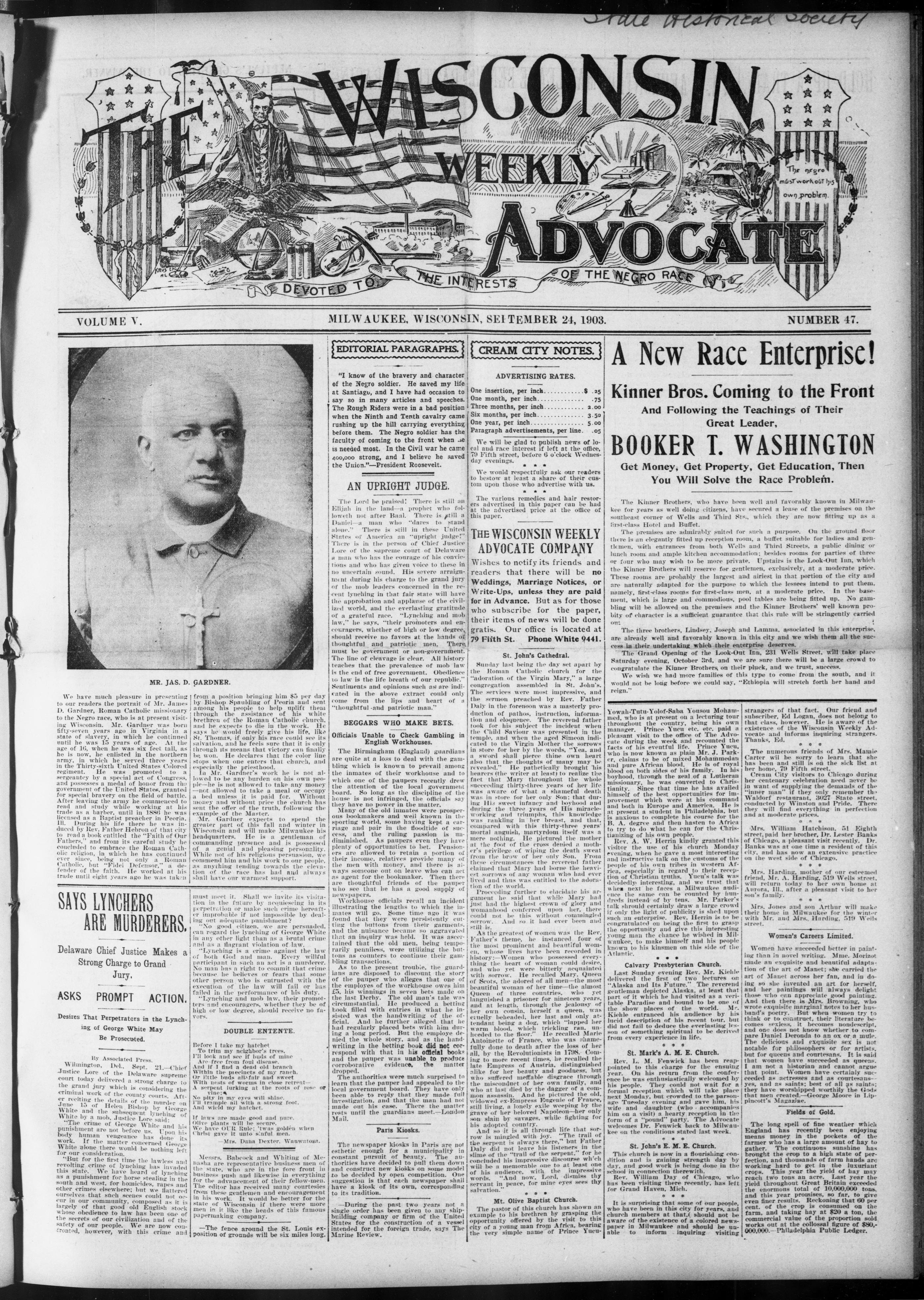
WISCONSIN
WEEKLY
ADVOCATE
DEVOTED TO THE INTERESTS OF THE NEGRO RACE
MR. JAS. D
P.
MR. IAS. D. GARDNER
We have much pleasure in presenting to our readers the portrait of Mr. James D. Gardner, Roman Catholic missionary to the Negro race, who is at present visiting Wisconsin. Mr. Gardner was born fifty-seven years ago in Virginia in a state of slavery, in which he continued until he was 15 years of age. At the age of 16, when he was six feet tall, as he is now, he enlisted in the northern army, in which he served three years in the Thirty-sixth United States Colored regiment. He was promoted to a sergeantcy by a special act of Congress, and possesses a medal of honor from the government of the United States, granted for special bravery on the field of battle. After leaving the army he commenced to read and study while working at his trade as a barber, until in 1886 he was licensed as a Baptist preacher in Peoria, Ill. During his life there he was induced by Rev. Father Hebron of that city to read a book entitled the "Faith of Our Fathers," and from its careful study he concluded to embrace the Roman Catholic religion, in which he has continued ever since, being not only a Roman Catholic, but "Fidei Defensor," a defender of the faith. He worked at his trade until eight years ago he was taken
SAYS LYNCHERS ARE MURDERERS.
Delaware Chief Justice Makes a Strong Charge to Grand Jury.
ASKS PROMPT ACTION.
Desires That Perpetrators in the Lynching of George White May Be Prosecuted.
By Associated Press.
Wilmington, Del., Sept. 21.—Chief Justice Lore of the Delaware supreme court today delivered a strong charge to the grand jury which is considering the criminal work of the county courts. After reciting the details of the murder on June 15 of Helen Bishop by George White and the subsequent lynching of White by a mob, Justice Lore said:
"The crime of George White and his punishment are not before us. Upon his body human vengeance has done its work. If the matter concerned George White alone there would be nothing left for our consideration.
"But for the first time the lawless and revolting crime of lynching has invaded this state. We have heard of lynching as a punishment for horse stealing in the south and west, for homicides, rapes and other crimes elsewhere; but we flattered ourselves that such scenes could not occur in our community, composed as it is largely of that good old English stock whose obedience to law has been one of the secrets of our civilization and of the safety of our people. We are now confronted, however, with this crime and
---
VOLUME V.
from a position bringing him $5 per day by Bishop Spaulding of Peoria and sent among his people to help uplift them through the assistance of his white brethren of the Roman Catholic church, and he expects to die in the work. He says he would freely give his life, like St. Thomas, if only his race could see its salvation, and he feels sure that it is only through its means that victory can finally be won. He declares that the color line stops when one enters that church, and especially the priesthood.
In Mr. Gardner's work he is not allowed to be any burden on his own people—he is not allowed to take any money—not allowed to take a meal or occupy a bed unless it is paid for. Without money and without price the church has sent the offer of the truth, following the example of the Master.
Mr. Gardner expects to spend the greater part of this fall and winter in Wisconsin and will make Milwaukee his headquarters. He is a gentleman of commanding presence and is possessed of a genial and pleasing personality. While not of his religious persuasion, we commend him and his work to our people, as anything tending towards the elevation of the race has had and always shall have our warmest support.
must meet it. Shall we invite its visitation in the future by acquiescing in its perpetration or make such crime hereafter improbable if not impossible by dealing out adequate punishment? "No good citizen, we are persuaded, can regard the lynching of George White in any other light than as a brutal crime and as a flagrant violation of law. "Lynching is a crime against the law of both God and man. Every willful participant in such an act is a murderer. No man has a right to commit that crime because he believes or fears that some other person who is entrusted with the execution of the law will fail or has failed in the performance of his duty. "Lynching and mob law, their promoters and encouragers, whether they be of high or low degree, should receive no favors.
Before I take my hatchet
To trim my neighbor's trees.
I'll look and see if buds of mine
Are free from foul disease.
And if I find a dead old branch
Within the precincts of my ranch.
Or little buds all fair and sweet
With nests of worms in close retreat—
A serpent lurking at the roots of rose or vine;
No pity in my eyes will shine.
I'll trample all with a strong foot.
And wield my hatchet.
If laws are made good and pure.
Olive plants will be secure.
We have OUR Rule; 'twas golden when
Christ gave it unto sinful men.
—Mrs. Dana Dexter, Wauwatosa.
Messrs. Babcock and Whiting of Menasha are representative business men of the state, who are in the fore front in business push and likewise in everything for the advancement of their fellow-men. The editor has received many courtesies from these gentlemen and encouragement in his work. It would be better for the state of Wisconsin if there were more men in it like the heads of this famous papermaking company.
The fence around the St. Louis exposition of grounds will be six miles long.
DOUBLE ENTENTE.
MILWAUKEE, WISCONSIN, SEPTEMBER 24, 1903.
EDITORIAL PARAGRAPHS.
"I know of the bravery and character of the Negro soldier. He saved my life at Santiago, and I have had occasion to say so in many articles and speeches. The Rough Riders were in a bad position when the Ninth and Tenth cavalry came rushing up the hill carrying everything before them. The Negro soldier has the faculty of coming to the front when he is needed most. In the Civil war he came 400,000 strong, and I believe he saved the Union."—President Roosevelt.
AN UPRIGHT JUDGE.
The Lord be praised! There is still an Elijah in the land—a prophet who followeth not after Baal. There is still a Daniel—a man who "dares to stand alone." There is still in these United States of America an "upright judge?" There is in the person of Chief Justice Lore of the supreme court of Delaware a man who has the courage of his convictions and who has given voice to these in no uncertain sound. His severe arraignment during his charge to the grand jury of the mob leaders concerned in the recent lynching in that fair state will have the approbation and applause of the civilized world, and the everlasting gratitude of a grateful race. "Lynching and mob law," he says, "their promoters and encouragers, whether of high or low degree, should receive no favors at the hands of thoughtful and patriotic men. There must be government or non-government. The line of cleavage is clear. All history teaches that the prevalence of mob law is the end of free government. Obedience to law is the life breath of our republic." Sentiments and opinions such as are indicated in the above extract could only come from the lips and heart of a "thoughtful and patriotic man."
BEGGARS WHO MAKE BETS
Officials Unable to Check Gambling in English Workhouses.
The Birmingham (England) guardians are quite at a loss to deal with the gambling which is known to prevail among the inmates of their workhouse and to which one of the paupers recently drew the attention of the local government board. So long as the discipline of the house is not infringed, the officials say they have no power in the matter.
Many of the old inmates were prosperous bookmakers and well known in the sporting world, some having kept a carriage and pair in the floodtide of success, and the ruling passion is undiminished. As paupers even they have plenty of opportunities to bet. Pensioners are allowed to retain a portion of their income, relatives provide many of the men with money, and there is always someone out on leave who can act as agent for the bookmaker. Then there are thoughtful friends of the pauper who see that he has a good supply of newspapers.
Workhouse officials recall an incident illustrating the lengths to which the inmates will go. Some time ago it was found that they were persistently cutting the buttons from their garments, and the nuisance became so aggravated that an inquiry was held. It was ascertained that the old men, being temporarily penniless, were utilizing the buttons as counters to continue their gambling transactions.
As to the present trouble, the guardians are disposed to discount the story of the pauper who alleges that one of the employes of the workhouse owes him £5, his winnings in seven bets made on the last Derby. The old man's tale was circumstantial. He produced a betting book filled with entries in what he insisted was the handwriting of the official. And he further alleged that he had regularly placed bets with him during a long period. But the employee denied the whole story, and as the handwriting in the betting book did not correspond with that in his official books and the pauper was unable to produce corroborative evidence, the matter dropped.
The authorities were much surprised to learn that the pauper had appealed to the local government board. They have only been able to reply that they made full investigation, and that the man had not made out his case. There the matter rests until the guardians meet.—London Mail.
Paris Kiosks.
The newspaper kiosks in Paris are not esthetic enough for a municipality in constant pursuit of beauty. The authorities have decided to pull them down and construct new kiosks on some model to be decided by open competition. One suggestion is that each newspaper shall have a kiosk of its own, corresponding to its tradition.
During the past two years not a single order has been given to any shipbuilding company or firm of the United States for the construction of a vessel intended for the foreign trade, says The Marine Review.
CREAM CITY NOTES.
ADVERTISING RATES.
One insertion, per inch. $ .25
One month, per inch. .75
Three months, per inch. 2.00
Six months, per inch. 3.50
One year, per inch. 5.00
Paragraph advertisements, per line. .05
We will be glad to publish news of local and race interest if left at the office, 79 Fifth street, before 6 o'clock Wednesday evenings.
We would respectfully ask our readers to bestow at least a share of their custom upon those who advertise with us.
The various remedies and hair restorers advertised in this paper can be had at the advertised price at the office of this paper.
THE WISCONSIN WEEKLY ADVOCATE COMPANY
Wishes to notify its friends and readers that there will be no Weddings, Marriage Notices, or Write-Ups, unless they are paid for in Advance. But as for those who subscribe for the paper, their items of news will be done gratis. Our office is located at 79 Fifth St. Phone White 9441.
St. John's Cathedral.
Sunday last being the day set apart by the Roman Catholic church for the "adoration of the Virgin Mary," a large congregation assembled in St. John's. The services were most impressive, and the sermon preached by Rev. Father Daly in the forenoon was a masterly production of pathos, instruction, information and eloquence. The reverend father took for his subject the incident when the Child Saviour was presented in the temple, and when the aged Simeon indicated to the Virgin Mother the sorrows in store for her by the words, "Yea, and a sword shall pierce thine own heart also that the thoughts of many may be revealed." He pathetically brought his hearers (the writer at least) to realize the fact that Mary throughout the whole succeeding thirty-three years of her life was aware of what a shameful death was in store for her only Son; that during His sweet infancy and boyhood and during the three years of His miracle-working and triumphs, this knowledge was rankling in her breast, and that, compared with this thirty-three years' mortal anguish, martyrdom itself was a mere nothing. He pictured the mother at the foot of the cross denied a mother's privilege of wiping the death sweat from the brow of her only Son. From these circumstances the reverend father claimed that Mary had borne the heaviest sorrows of any woman who had ever lived and thus was entitled to the adoration of the world.
Proceeding further to elucidate his argument he said that while Mary had just had the highest crown of glory and womanhood conferred upon her, there could not be this without commingled sorrow. And so it had ever been and still is.
As the greatest of women was the Rev. Father's theme, he instanced four of the most prominent and beautiful women, whose lives have been recorded in history:—Women who possessed everything the heart of woman could desire, and who yet were bitterly acquainted with sorrow. He recalled Mary, Queen of Scots, the adored of all men—the most beautiful woman of her time—the almost Queen of three countries, who yet languished a prisoner for nineteen years, and at length, through the jealousy of her own cousin, herself a queen, was cruelly beheaded, her last and only attendant being a dog, which "lapped her warm blood, which trickling ran, unheeded to the floor." He recalled Marie Antoinette of France, who was shamefully done to death after the loss of her all, by the Revolutionists in 1798. Coming to more recent times, he recalled the late Empress of Austria, distinguished alike for her beauty and goodness, but who suffered meffable disgrace through the misconduct of her own family, and who at last died by the dagger of a common assassin. And he pictured the old, widowed ex-Empress Engenie of France, still living, a lonely exile weeping by the grave of her beloved Napoleon—her only son slain by savages, while fighting for his adopted country.
And so it is all through life that sorrow is mingled with joy. "The trail of the serpent is always there," but Father Daly did not leave his listeners in the slime of the "trail of the serpent," for he concluded his impressive discourse which will be a memorable one to at least one of his audience, with the impressive words. "And now, Lord, dismiss thy servant in peace, for mine eyes sees thy salvation."
Mt. Olive Baptist Church
The pastor of this church has shown an example to his brethren by grasping the opportunity offered by the visit to this city of a young man from Africa, bearing the very simple name of Prince Yueu-
A New Race Enterprise!
The Kinner Brothers, who have been well and favorably known in Milwaukee for years as well doing citizens, have secured a lease of the premises on the southeast corner of Wells and Third Sts., which they are now fitting up as a first-class Hotel and Buffet.
The premises are admirably suited for such a purpose. On the ground floor there is an elegantly fitted up reception room, a buffet suitable for ladies and gentlemen, with entrances from both Wells and Third Streets, a public dining or lunch room and ample kitchen accommodation; besides rooms for parties of three or four who may wish to be more private. Upstairs is the Look-Out Inn, which the Kinner Brothers will reserve for gentlemen, exclusively, at a moderate price. These rooms are probably the largest and airiest in that portion of the city and are naturally adapted for the purpose to which the lessees intend to put them, namely, first-class rooms for first-class men, at a moderate price. In the basement, which is large and commodious, pool tables are being fitted up. No gambling will be allowed on the premises and the Kinner Brothers' well known probity of character is a sufficient guarantee that this rule will be stringently carried out.
The three brothers, Lindsey, Joseph and Lamma, associated in this enterprise, are already well and favorably known in this city and we wish them all the success in their undertaking which their enterprise deserves.
The Grand Opening of the Look-Out Inn, 231 Wells Street, will take place Saturday evening, October 3rd, and we are sure there will be a large crowd to congratulate the Kinner Brothers on their pluck, and we trust, success.
We wish we had more families of this type to come from the south, and it would not be long before we could say, "Ethiopia will stretch forth her hand and reign."
Yowah-Tutu-Yolof-Saba Yousou Mohammed, who is at present on a lecturing tour throughout the country, being his own manager. Prince Yucu etc. etc. paid a pleasant visit to the office of The Advocate during the week and recounted the facts of his eventful life. Prince Yucu, who is now known as plain Mr. J. Parker, claims to be of mixed Mohammedan and pure African blood. He is of royal blood on both sides of his family. In his boyhood, through the zeal of a Lutheran missionary, he was converted to Christianity. Since that time he has availed himself of the best opportunities for improvement which were at his command and both in Europe and America. He is at present a student in Philadelphia, but is anxious to complete his course for the B. A. degree and then hasten to Africa to try to do what he can for the Christianizing of his own people.
Rev. A. W. Herrin kindly granted this visitor the use of his church Monday evening, when he gave a most interesting and instructive talk on the customs of the people of his own tribes in western Africa, especially in regard to their reception of Christian truths. Yucun's talk was decidedly interesting, and we trust that when next he faces a Milwaukee audience the same can be counted by hundreds instead of by tens. Mr. Parker's talk shroud certainly draw a large crowd if only the light of publicity is shed upon such an enterprise. Rev. Herrin is to be congratulated on being the first to grasp the opportunity and give this interesting young man the chance he wished in Milwaukee, to make himself and his people known to his kinsmen on this side of the Atlantic.
Calvary Presbyterian Church.
Last Sunday evening Rev. Mr. Kiehle delivered the first of two lectures on "Alaska and Its Future." The reverend gentleman depicted Alaska, at least that part of it which he had visited as a veritable Paradise and bound to be one of the show places of the world. Mr. Kiehle entranced his audience by his lucid description of his recent tour, but did not fail to deduce the everlasting lesson of something spiritual to be derived from every experience in life.
St. Mark's A. M. E. Church.
Rev. L. M. Fenwick has been reappointed to this charge for the ensuing year. On his return from the conference he was enthusiastically welcomed by his people. They could not wait for a formal reception which will take place next Monday, but crowded to the parsonage Tuesday evening and gave him, his wife and daughter (who accompanies him on a visit) a hearty reception in the form of a "pound" party. The Advocate welcomes Dr. Fenwick back to Milwaukee on the conditions stated last week.
St. John's E. M. E. Church.
This church is now in a flourishing condition and is gaining strength day by day, and good work is being done in the school in connection therewith.
Rev. William Day of Chicago, who has been visiting there recently, has left for Grand Haven, Mich.
* * *
It is surprising that some of our people, who have been in this city for years, and church members at that, should not be aware of the existence of a colored newspaper in Milwaukee and should be unable to inform inquiring visiting
NUMBER 47.
Enterprise!
coming to the Front
Teachings of Their Leader,
WASHINGTON
City, Get Education, Then
the Race Problem.
well and favorably known in Milwaukee secured a lease of the premises on the city, which they are now fitting up as a for such a purpose. On the ground floor room, a buffet suitable for ladies and girls and Third Streets, a public dining oration; besides rooms for parties of three state. Upstairs is the Look-Out Inn, which gentlemen, exclusively, at a moderate price. And airiest in that portion of the city and so which the lessees intend to put them, keen, at a moderate price. In the base-school tables are being fitted up. No gamble the Kinner Brothers' well known pro- that this rule will be stringently carried and Lamma, associated in this enterprise, in this city and we wish them all the sucerprise deserves.
At Inn, 231 Wells Street, will take place we are sure there will be a large crowd to our pluck, and we trust, success. This type to come from the south, and it Ethiopia will stretch forth her hand and
strangers of that fact. Our friend and subscriber, Ed Logan, does not belong to that class, however. He is aware of the existence of the Wisconsin Weekly Advocate and informs inquiring strangers. Thanks, Ed.
* * *
The numerous friends of Mrs. Mamie Carter will be sorry to learn that she has been and still is on the sick list at her home, 79 Fifth street.
Cream City visitors to Chicago during her centenary celebration need never be in want of supplying the demands of the "inner man" if they only remember the Waldorf restaurant, 3027 State street, conducted by Winston and Pride. There they will find everything in perfection and at moderate prices.
Mrs. William Hatchison, 51 Eighth street, paid her brother, Dr. Lester Banks of Chicago, a pleasant visit recently. Dr. Banks was at one time a resident of this city, and has now an extensive practice on the west side of Chicago.
* * *
Mrs. Harding, mother of our esteemed friend, Mr. A. Harding, 519 Wells street, will return today to her own home at Aurora, Ill., after a pleasant visit to her son's family.
* * *
Mrs. Jones and son Arthur will make their home in Milwaukee for the winter with Mr. and Mrs. Harding, 519 Wells street.
Women's Careers Limited.
Women have succeeded better in painting than in novel writing. Mme. Morizot made an exquisite and beautiful adaptation of the art of Manet; she carried the art of Manet across her fan, and in doing so she invented an art for herself, and her paintings will always delight those who can appreciate good painting. And then there is Mrs. Browning, who wrote exquisite marginal notes to her husband's poetry. But when women try to think or to construct, their literature becomes sexless, it becomes nondescript, and one does not know whether to compare Daniel Deronda to an ox or a mule. The delicious and exquisite sex is not notable for philosophers or for artists, but for queens and courtesans. It is said that women have succeeded as queens. I am not a historian and cannot argue that point. Women have certainly succeeded as actresses and as courtesans—yes, and as saints; best of all as saints; they have worshipped worthy the Gods that men created.—George Moore in Lippincott's Magazine.
Fields of Gold.
The long spell of fine weather which England has recently been enjoying means money in the pockets of the farmer who has a large amount of hay to gather. The continuous sunshine has brought the crop to a high state of perfection, and thousands of farm hands are working hard to get in the luxuriant crops. This year the yield of hay may reach two tons an acre. Last year the yield throughout Great Britain exceeded the enormous total of 10,000,000 tons, and this year promises, so far, to give even finer results. Reckoning that 60 per cent. of the crop is consumed on the farm, and taking hay at $20 a ton, the commercial value of the proportion sold works out at the collossal figure of $80,000,000. Philadelphia Public Ledger.
---
Messenger Uses Gun on the Highwaymen and They Secure No Booty—Engineer Accidentally Shot.
Portland, Ore., Sept. 24. - The Atlantic express on the Oregon Railroad & Navigation line which left here at 8:15 o'clock last night was heed up by four masked men an hour later near Corbett station, twenty-one miles east of this city. One of the robbers was shot and killed by express messenger Fred Korner and Engineer Ollie Barrett was seriously wounded by the same bullet.
After the shooting the robbers fled without securing any booty.
Two of the highwaymen boarded the train at Troutdale, a station eighteen miles cast of here, and after the train had got under way, they crawled over the tender and covering the engineer and fireman with revolvers, told them to stop at the Mile Post 21, which is near Corbett station.
Shot by Express Messenger.
When the train slowed two more men appeared. Two of the robbers compelled the engineer to leave the cab and accompany them to the express car while the others watched the fireman. The men carried several sticks of dynamite and when they came to the baggage car, thinking it was the express car, threw a stick at the door. Express Messenger Korner heard the explosion and immediately secured his rifle and opened fire. The bullet pierced the heart of one of the robbers and went through his body, entering the left breast of Engineer Barrett, who had been ordered by the robber to walk in front of him while approaching the baggage car, but who jumped behind just before the express messenger fired.
The body of the dead robber was left behind and the wounded engineer was brought to this city. After the shooting the other three robbers fled without securing any booty.
Sheriff Story and four deputy sheriffs who are seeking the bandits have small hope of capturing the robbers as the country on both sides of the Columbia river along where the hold-up occurred, is rough and heavily timbered. It is supposed they took a boat which they had moored in the river.
Shortly after the arrival of the sheriff's posse one of the outlaws was found near the scene badly wounded from a charge of buckshot in the head. He was placed on board the sheriff's special train, which returned to Portland. The bandit said his name is Jim Connors and that he is from Portland, but refuses to tell the names of the other bandits or where they went.
The railroad company has offered $1000 for the arrest of the bandits.
The Engineer's Story.
Ollie L. Barrett, the wounded engineer, who was brought to Portland and taken to the hospital, this morning told the following story of the hold-up: "About a mile beyond Troutdale two masked men climbed in on the blind baggage over the tender and through the gangway into the engine, covering both fireman and myself with their revolvers. They ordered me to run the train to twenty-one mile post.
"At twenty-one mile post two other masked men came out of the brush and ordered us off the engine. The bandits who had been hiding in the brush carried two long willow poles, on the ends of which were sticks of dynamite. These were placed in our hands and the fireman and I were ordered to go back to the express car and order the messenger to open the door. If he did not we were to use the dynamite and blow it open. The bandits kept up a fusilade of shots to warn the passengers to keep their heads inside the windows. We were compelled to proceed down to the baggage car, where I called out to the messenger: 'It is Barrett. Open the door. Don't shoot.'
"This demand had no effect and the bandits took the dynamite poles from our hands and placed them against the door of the car, after lighting long fuses. We were then ordered back to the engine and stayed there with the bandits until the dynamite blew the door open.
Robber Is Killed.
"As soon as the sound of the explosion had died away, I was ordered to go ahead of the party back toward the car. Instead of obeying orders I stepped behind a rather slender man, one of the bandits, and the fireman followed me. The taller man was in the rear. We were twenty feet from the express car when the messenger fired and killed the robber in front of me. The bullet, we afterwards found went through his heart and then struck me in the left shoulder.
"As I felt the bullet strike me I called to the taller man that I was shot and that my left arm was gone. The tall man told me it was all right; that I might go back to the engine with the fire man and go ahead. We examined the small man first, however, and found he was killed."
ROCK ELM MAN INSANE.
Young Arthur Burgess Thinks He Is Being Cajoled Out of Earnings— Sent to Mendota.
Spring Valley, Wis., Sept. 24.—[Special.]—Arthur Burgess of Rock Elm, Wis., was taken violently insane. He is a young man, an orphan, and imagines that a girl has cajoled him out of his earnings. He was taken to Mendota.
NAPHTHA WELLS ARE ON FIRE.
Conflagration at Baku Does $2,500,000
Damage and Is Unchecked.
St. Petersburg, Sept. 24.—A fire has broken out at the Billiebat naphtha fountains at Baku, belonging to the firm of Nobel, and has already caused damage estimated at $2,500,000. The works have been completely destroyed and the fire is still spreading.
GOES FOR GERMAN BRIDE.
Dr. Bachman of Athens in New York to Meet Afflianced.
Athens, Wis., Sept. 24.—[Special.]—Dr. Bachman left for New York city, where he is to meet his prospective bride, Miss Minnie Mueller of Berlin, Germany. The lady is wealthy and one of a prominent family.
Shawano, Wis., Sept. 24.—[Special.]— The Wisconsin house, kept by C. F. Mahl since 1892, was sold yesterday to M. P. Van Patten for $9300.
G. A. R. AFFRONTED.
Pastor of German Lutheran Church at Neenah Objects to Military Funeral.
FLAG TAKEN OFF CASKET.
F. Sauer Is Buried by Other Hands Than Those of His Comrades in Arms.
BUTTONS CUT FROM HIS UNIFORM.
Neenah, Wis., Sept. 24.—By refusing to allow the members of the local G. A. R. post to attend the funeral of Ferdinand Sauer, Rev. Albert Froeblke, pastor of the German Lutheran church of this city, has established a precedent hitherto unknown in Neenah.
Although Mr. Sauer was one of the most highly respected members of the local G. A. R., and had selected his pall-bearers a few days before his death from the members of the G. A. R., Rev. Mr. Frochlke issued a statement to the effect that under no circumstances would the G. A. R. post be allowed in the church as a body, and individuals would not be allowed to wear buttons or badges emblematic of the order.
As a result of this statement no member of the G. A. R. attended Mr. Sauer's funeral.
Those present at the funeral stated that when the casket was brought into the church it was draped with an American flag, and the pastor ordered this removed. Mr. Frochlke states that his action was merely enforcing the established rules of the church. If such a rule exists it never has been enforced in any of the other churches in this city. During his lifetime Mr. Sauer was a prominent member of the church and had often expressed the wish that he be buried in his G. A. R. uniform and wearing his badges and buttons.
Buttons Cut from Uniform.
On the day of the funeral Mr. Froehike informed the family that if the funeral services were to be held from the church the body must not be dressed in a G. A. R. uniform. In order to overcome this and comply with the wishes of Sauer it was necessary for the family to cut the brass buttons from his coat, and, together with the emblems of the order, place them in his coat pockets.
The members of the G. A. R. are indignant and state that it is the first time in the history of the city that they have not been allowed to attend the funeral of a comrade. They are determined to take some action, but at present they do not know what it will be.
WISCONSIN MAN GETS WEST VIRGINIA BRIDE.
By Agreement, William C. Schimmer of Watertown Meets and Weds Miss Jackson at Winchester, Ind.
Richmond, Ind., Sept. 24.—By agreement William C. Schimmer of Watertown, Wis., and Miss Harriet E. Jackson of Morgantown, W. Va., met at Winchester for the first time and were united in marriage at the county clerk's office by Rev. H. J. Norris of the First Methodist church. Mr. Schimmer is 22 years of age and a commercial traveler, while Miss Jackson is 21 and pretty.
BOY KILLS HIS BROTHER.
Accidental Discharge of Rifle Causes Death of James Dalgard, Aged 12, of Veedum.
Pittsville, Wis., Sept. 24.—[Special.]—Particulars have just been received of the accidental death of James Dalgard, aged 12, caused by the discharge of a rifle in the hands of his brother, Fred, aged 15, at Veedum, Wis., four miles west of this city, at 6 o'clock last evening. The boy is a son of P. C. Dalgard, proprietor of the Veedum hotel. The weapon was a rifle loaded with shot. The discharge lodged in the throat of the victim, severing the jugular vein, death resulting this morning. The shooting was wholly accidental, and the bereaved family are prostrated with grief at the sad accident. Dr. Houghen of Pittsville was in the village, but could not save the child.
FIVE YEARS' SENTENCE.
Edward Hoff, Aged 17, Sent to Green Bay Reformatory for Attempt at Train Wrecking.
Chippewa Falls, Wis., Sept. 24.—Edward Hoff, 17 years old, was sentenced for five years to the Green Bay reformatory by Judge Vinje. He attempted to wreck the Wisconsin Central limited at Albertville, near this city, by placing ties across the track to even up a grudge against the company.
IS M'KINLEY SHAFT IN DANGER?
President of Monument Association Has Received Threatening Letter.
Toledo, O., Sept. 24.—Col. Joseph Bonner, president of the McKinley Memorial association, has received a letter displaying wildly anarchistic tendencies, which he turned over to United States secret service officials at Washington. The epistle, addressed to him, was dated at some point in New Jersey and signed. Beyond saying it was anarchistic, but not threatening personal harm to him, the colonel refused point blank to state its contents. When asked if it had anything to do with the McKinley monument, he hesitated a moment and replied, "That's different."
ASSESSMENT ABOUT THE SAME.
Additional Personal Property Makes Little Difference at Superior.
Superior, Wis., Sept. 24.—[Special.]—Superior's assessed valuation will be little, if any, larger this year than it was last in spite of the fact that about $250,000 worth of railroad personal property has been put on the rolls. The total is $13,240,000.
WERE MARRIED AT WAUPACA.
Texas Couple Are Wed by Stevens Point Pastor.
Waupaca, Wis., Sept. 24.—Miss Clara Belle Vosburg, daughter of Capt. J. Vosburg of Houston, Tex., and Harry Cain Maggard of Houston, Tex., were married at St. Mark's church by Rev. Archdeacon Jenner of Stevens Point. A reception was held at the residence of the bride's uncle, C. J. Vosburg.
MAY LEAVE BENCH.
United States Judge Peter S. Grosscup Receives Offer from Northern Securities Company.
He May Resign as Circuit Judge to Conduct Famous Case Before the Supreme Court.
MANY RULINGS AGAINST TRUSTS
Chicago, Ill., Sept. 24.—Semi-authoritative announcement was made in Chicago yesterday that Judge Peter S. Grosscup of the United States circuit court is considering a proposition from the Northern Securities company, the acceptance of which would mean his resignation from the federal bench.
The Northern Securities company, it is understood, is seeking to retain Judge Grosscup as counsel before the United States supreme court when the merger litigation comes up for final argument before that tribunal this fall. The proposition is said to have been placed before the judge some time ago, and the possibility of his accepting it is said to be far from remote. That he is considering resigning from the bench is said to be a matter of knowledge among many of his Chicago friends.
Judge Grosscup is absent in the east, and will return to Chicago in a few days. In his absence Marshall E. Sampsell, his friend, corroborated the report. The conditions of the offer from the railroad magnates were not made known definitely, but they were said to be "flattering." Aside from the large fee that undoubtedly would fall to the lot of Judge Grosscup in the event of his acceptance, it is said, he realizes the opportunity for adding to his reputation by aiding the case of the defendant corporation in the supreme court. Already the case has engaged the attention of some of the ablest lawyers in the United States, and now that the Northern Securities company is about to have its final inning in court the wealthy men behind that organization are reaching out to add to their present array of legal talent.
Some of Judge Grosscup's rulings from the bench in opposition to trusts have attracted national interest. Among the more recent of his declarations from the bench was his decision in the so-called "packers' trust" case, in which he declared the agreements among the packers to be a combination in restraint of trade and illegal. In another recent decision he announced a ruling on the interstate commerce law which later brought a projected combination of fourteen railroads to pause in a rate cutting scheme.
ATTEND PRISON MEETING.
Delegates Named by Governor to Go to Congress at Louisville, Ky., October 3 to 9. Madison, Wis., Sept. 24.—Gov. La Follette announced the appointment of delegates to the National Prison association congress, to be held in Louisville, Ky., from October 3 to 9. The delegates are:
Herman Grotophorst, Baraboo; Harvey Clark, Monroe; A. G. Nelson, Waupaca; Gustav Kuestermann, Green Bay; Henry Towne, Waupun; Charles Bowron, Green Bay; A. J. Hutton, Waukesha; H. H. Jacobs, Milwaukee; Charles Smith, Superior; E. G. Updike, Madison; James H. Stout, Menomonle; Albert Buell, Milwaukee; Mary N. Hobblins, Madison; Fred Wilkins, Viroqua; Allen D. Conover, Madison; M. J. White, Wauwatosa; W. A. Gordon, Oshkosh; E. L. Bullard, Madison; Ellen C. Sabin, Milwaukee; M. T. Park, Sparta; Edna E. Chynoweth, Madison; A. C. Grler, Racine; Judson Titsworth, Milwaukee; Mary C. Hoyt, Madison; Eugene N. F. Requa, Beaver Dam; Clark Gapen, Madison; A. N. Wilmarth, Chippewa Falls; W. H. Hatton, New London; Emma Bland, Milwaukee; Clyde Showalter, Janesville; E. N. Walker, Delavan; S. N. Truesdale, Milwaukee; W. H. Upham, Marshfield; Dessa Kunz, Milwaukee; Howard Van Wyck, Milwaukee; Fanny Swallow, Milwaukee; A. N. Falrchild, Milwaukee; Bernard C. Gudden, Oshkosh.
THREE ROADS TO REPORT.
Tax Commission Cannot Finish Estimation of Railroad Values Until Statements Are Received.
Madison, Wis., Sept. 24.—[Special.] "We are waiting until the North-Western, Milwaukee and the Wisconsin Central roads finish the estimation of the value of their property," said Judge Gilson of the tax commission, "before we can reach anything definite in regard to railroad assessment. All the small roads of the state have been inspected and valuued, but the three big roads probably will not report until November 1."
BOY DIES ALONE IN WOODS
Eleven-Year-Old Killed by Accidental Discharge of Gun.
Iron River, Mich., Sept. 24.—[Special.]
—Death alone in the woods, a victim of his own weapon, was the fate of Gust Anderson, an 11-year-old boy of Bates township, Iron county. The lad had gone hunting and when at nightfall he did not return the father, alarmed, made a long and unsuccessful search. In the morning neighbors joined in the hunt, and finally the body of the boy was found, less than half a mile from home. A gaping hole in the side showed why death had occurred. The gun was several hundred feet distant and leading from it to the corpse was a trail of blood indicating the brave struggle the youngster had made in his endeavor to reach home. It is not known how the gun was discharged, but there is no doubt death was accidental.
SAM PARKS WINS IN UNION FIGHT
Delegates of His Local Seated at Kansas City Convention After Battle Only Three Oppose Him.
Kansas City, Mo., Sept. 24.—After being in session behind closed doors since early yesterday morning, the convention of the International Association of Bridge and Structural Iron Workers last night voted in favor of seating Sam Parks and the other delegates from local union No. 2 of New York. There were but three votes cast against Parks and his friends.
Sanitarium at Shawano Lake
Shawano, Wis., Sept. 24.—[Special.]— Prof. A. Strassmann, the well known oculist of Whitewater, Wis., is building a sanitarium at Shawano lake, at the cost of $8000.
BATTLE IS RAGING
The Insurgents Are Holding Kresna Pass and Turks Are Suffering Heavy Losses.
BRITISH FLEET IS SENT.
Squadron Is at Suda Bay, Island of Crete, Awaiting Developments in the Balkan.
POWERS SUSPICIOUS OF PORTE.
Constantinople, Sept. 24.—The battle of Kresna Pass, according to the latest advices received here, is still in progress. The insurgents are successfully holding strong positions and their casualties are slight, only a score being killed or wounded, while the Turks, up to the present, have lost 5 officers and 320 men killed or wounded. Part of the British Mediterranean squadron has arrived at Suda bay, island of Crete, and is held in readiness in case of developments in the Balkan situation.
Paris, Sept. 24.—The French foreign office officials doubt the sincerity of the Porte's reply to the Bulgarian note believing it is merely a maneuver to impress the powers with the idea that Turkey is doing her utmost to effect a settlement before going to war. A similar impression seems to prevail at Sofia, since Bulgaria in answering requires Turkey to cease mobilizing, stop the massacres and withdraw her troops from near the frontier before she will consider the proposals.
TWO CONVENTIONS RENOMINATE LOW.
Entire Fusion Ticket Also Given Approval by Republicans and Citizens' Union in New York.
New York, Sept. 24.—The Republican and Citizens' union city conventions last night renominated the entire fusion city ticket—Low for mayor, Grout for controller and Fernes for president of the board of aldermen.
There was no opposition to the nomination of Low, such as had been predicted by District Attorney Jerome. As laid down in the platform and by the speakers at the convention the issue of the campaign, from the Republican point of view, will be whether clean and honest government shall be continued in the city or whether it shall return to the methods of Tammany hall.
There was not much enthusiasm. When Timothy L. Woodruff mentioned Mayor Low's name and later that of President Roosevelt in his speech there was only brief hand clapping.
The Citizens' union platform, while admitting the impossibility of entirely reforming the city in one term, points out what has been done in the various city departments to improve over Tammany rule. It urges all good citizens, irrespective of party, to join in the effort to separate municipal government from state and national politics.
WANTED TO ATTEND THE ELKHORN FAIR.
Three Boys Disappear—Last Heard Buying Tickets to Kenosha Have Run Away.
Waukegan, Ill., Sept. 24.—[Special.]—Police of Illinois and Wisconsin are searching for three boys who left here September 10 and cannot be located. They ran off to attend the Elkhorn, Wis., fair, but it cannot be found that they reached there. They were last seen buying tickets to Kenosha. They are Andrew Herberger, Walter Tyrell and Eddie Malone. The latter is the son of Frank Malone of Kenosha, but lives here with his grandmother. Their relatives are much worried over their absence.
SLAYS CITY MARSHAL AND COMMITS SUICIDE.
Indiana Man, Third Brother to Kill Himself, Shoots Official Summoned to Protect Wife.
North Vernon, Ind., Sept. 24.—City Marshal August Schawke was shot and killed by William H. Wilkerson, who a few moments afterward committed suicide. Wilkerson was of a wealthy family and the third of three brothers to commit suicide. He had abused his wife and the officer had gone to protect her.
UNCLE SAM AIDS JEWS IN RUSSIA
State Department Orders Inquiry Into Riot and Murders in Gomel.
Washington, D. C., Sept. 24.—In response to an appeal in behalf of Jews at Gomel, Russia, it was announced yesterday that the state department had asked the American charge d'affaires at St. Petersburg to ascertain whether United States interests were involved in the recent rioting and murders in Gomel. Alarmed by the press dispatches, Jewish residents of Philadelphia asked the state department to procure news of their relatives in the disturbed Russian city. Many American Jews were visiting in Gomel and it is feared they may have been slain.
NEWS NOTES OF TWO RIVERS.
Congregational Church Arranges Lecture Course—Ex-Mayor's Wedding.
Two Rivers, Wis., Sept. 24.—[Special.]—The members of the Congregational church have arranged to give an entertainment course consisting of three numbers, the first one, taking place September 29, being an illustrated lecture entitled "Snapshots in Colorado." A concert will take place on October 13. The course will close with a literary programme on October 27.
An event of interest to many was the marriage yesterday of Miss Jennie Mueller, duaghter of the late ex-Mayor Mueller, and William Bremer, son of a well-known business man here.
SURVEYING CITY OF SHAWANO.
Preparatory to Introducing Sewage System and Improving Water Works. Shawano, Wis., Sept. 24.—[Special.]—George Cadogan Morgan, hydraulic and sanitary engineer of Chicago, is at work surveying our city, preparatory to introducing sewerage and also improvements in the water works system,
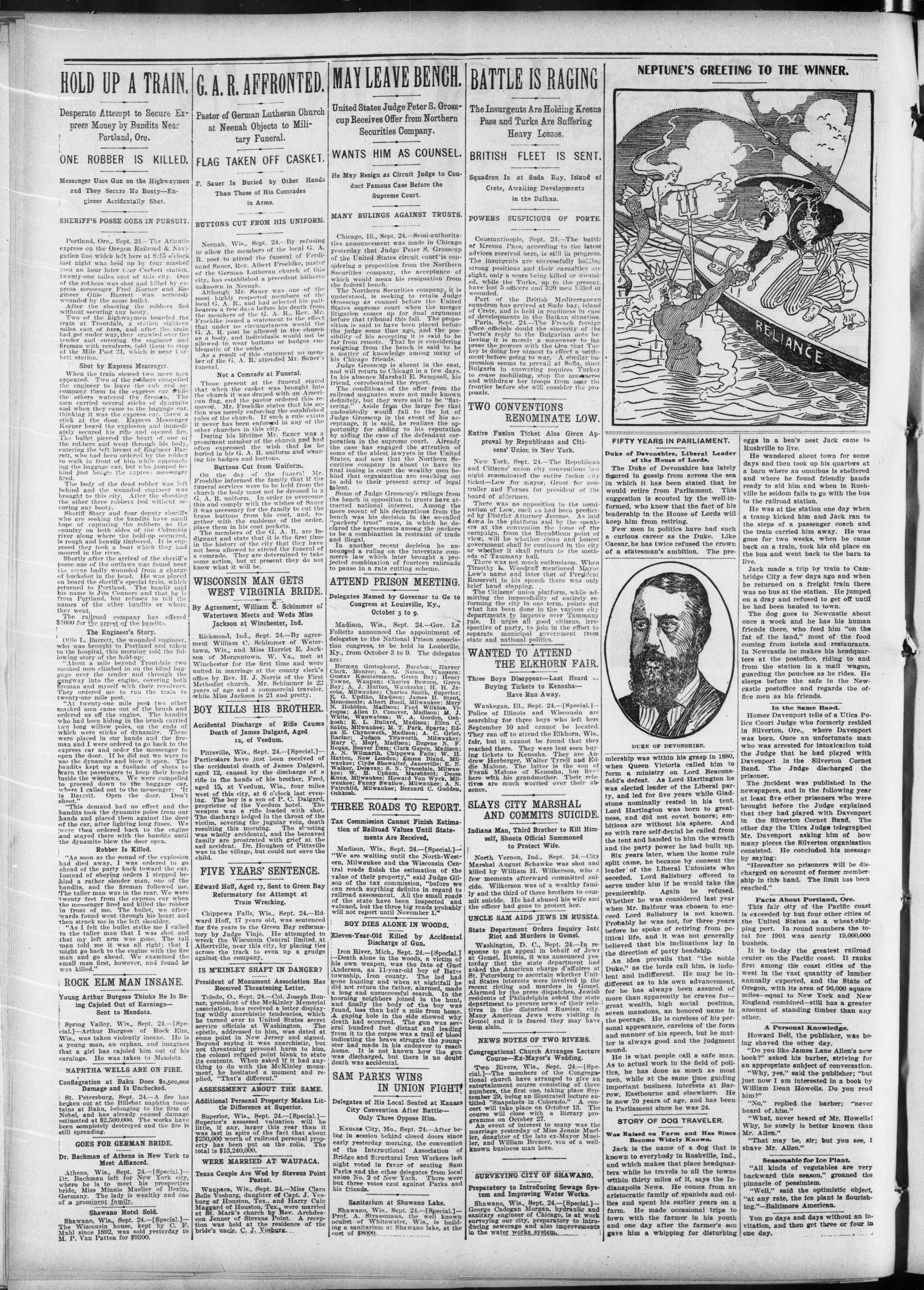
NEPTUNE
RELIANCE
Duke of Devonshire, Liberal Leader of the House of Lords.
The Duke of Devonshire has lately figured in gossip from across the sea in which it has been stated that he would retire from Parliament. This suggestion is scouted by the well-informed, who know that the fact of his leadership in the House of Lords will keep him from retiring.
Few men in politics have had such a curious career as the Duke. Like Caesar, he has twice refused the crown of a statesman's ambition. The pre-
[Illustration of a man with a long beard and a suit.]
miership was within his grasp in 1880, when Queen Victoria called him to form a ministry on Lord Beaconsfield's defeat. As Lord Hartington he was elected leader of the Liberal party, and led for five years while Gladstone nominally rested in his tent. Lord Hartington was born to greatness, and did not covet honors; ambitions are without his sphere. And so with rare self-denial he called from the tent and handed to him the wreath and the party power he had built up.
Six years later, when the home rule split came, he became by consent the leader of the Liberal Unionists who seceded. Lord Salisbury offered to serve under him if he would take the premiership. Again he refused. Whether he was considered last year when Mr. Balfour was chosen to succeed Lord Salisbury is not known. Probably he was not, for three years before he spoke of retiring from political life, and it was not generally believed that his inclinations lay in the direction of party headship.
An idea prevails that "the noble Duke," as the lords call him, is indolent and indifferent. He may be indifferent as to his own advancement, for he has always been assured of more than apparently he craves for-great wealth, high social position, seven mansions, an honored name in the peerage. He is careless of his personal appearance, careless of the form and manner of his speech, but he matter is always good and the judgment sound.
He is what people call a safe man. As to actual work in the field of politics, he has done as much as most men, while at the same time guiding important business interests at Barrow, Eastbourne and elsewhere. He is now 70 years of age, and has been in Parliament since he was 24.
STORY OF DOG TRAVELER.
Was Raised on Farm and Has Since Become Widely Known.
Jack is the name of a dog that is known to everybody in Rushville, Ind., and which makes that place headquarters while he travels to all the towns within thirty miles of it, says the Indianapolis News. He comes from an aristocratic family of spaniels and collies and spent his earlier years on a farm. He made occasional trips to town with the farmer in his youth and one day after the farmer's son gave him a whipping for disturbing
eggs in a hen's nest Jack came to Rushville to live.
He wandered about town for some days and then took up his quarters at a barn where an omnibus is sheltered and where he found friendly hands ready to aid him and when in Rushville he seldom fails to go with the bus to the railroad station.
He was at the station one day when a tramp kicked him and Jack ran to the steps of a passenger coach and the train carried him away. He was gone for two weeks, when he came back on a train, took his old place on the bus and went back to the barn to live.
Jack made a trip by train to Cambridge City a few days ago and when he returned on a freight train there was no bus at the station. He jumped on a dray and refused to get off until he had been hauled to town.
The dog goes to Newcastle about once a week and he has his human friends there, who feed him "on the fat of the land," most of the food coming from hotels and restaurants. In Newcastle he makes his headquarters at the postoffice, riding to and from the station in a mail wagon, guarding the pouches as he rides. He sleeps before the safe in the Newcastle postoffice and regards the office men as his friends.
In the Same Band.
Homer Davenport tells of a Utica Police Court Judge who formerly resided in Silverton, Ore., where Davenport was born. Once an unfortunate man who was arrested for intoxication told the Judge that he had played with Davenport in the Silverton Cornet Band. The Judge discharged the prisoner.
The incident was published in the newspapers, and in the following year at least five other prisoners who were brought before the Judge explained that they had played with Davenport in the Silverton Cornet Band. The other day the Utica Judge telegraphed Mr. Davenport asking him of how many pieces the Silverton organization consisted. He concluded his message by saying:
"Hereafter no prisoners will be discharged on account of former membership in this band. The limit has been reached."
This fair city of the Pacific coast is exceeded by but four other cities of the United States as a wheat-shipping port. In round numbers the total for 1901 was nearly 19,000,000 bushels.
It is to-day the greatest railroad center on the Pacific coast. It ranks first among the coast cities of the west in the vast quantity of lumber annually exported, and the State of Oregon, with its area of 96,000 square miles—equal to New York and New England combined—still has a greater amount of standing timber than any other.
Howard Bell, the publisher, was being shaved the other day.
"Do you like James Lane Allen's new book?" asked his barber, striving for an appropriate subject of conversation.
"Why, yes," said the publisher; "but just now I am interested in a book by William Dean Howells. Do you read him?"
"No," replied the barber; "never heard of him."
"What, never heard of Mr. Howells! Why, he surely is better known than Mr. Allen."
"That may be, sir; but you see, I shave Mr. Allen."
"All kinds of vegetables are very backward this season," groaned the pinnacle of pessimism.
"Well," said the optimistic object, "at any rate, the ice plant is flourishing."—Baltimore American.
You go days and days without an invitation, and then get three or four in one day.
CURTIS JETT MUST DIE.
WILL APPEAL THE CASE
Cynthiana, Ky., Sept. 23. After a trial lasting eight days the jury in the case of Curtis Jett, charged with the murder of Town Marshal Thomas Cockrill at Jackson, Ky., July 21, 1902, last evening rendered a verdict of guilty and fixed the penalty at death. When the jury entered the courtroom after agreeing on a verdict quiet reigned for a few moments. Jett's mother had gone away earlier under the impression that no verdict would be reached and the verdict of death coming about two hours after the jury was out was a surprise to everyone in the courtroom.
to everyone in the court.
The reading of the verdict did not affect Jett, but his brother was very much distressed. His mouth quivered and he slowly turned pale. Just previous to the jury reaching an agreement, Judge Osborne, thinking that they would not reach a verdict yesterday, sent for them, intending to call off the session for the rest of the day. But the jury sent back word that an agreement had been reached and that it would be ready to report a finding to the court within five minutes.
Elijah McKinney served as foreman of the jury and after the delivering of the verdict to the court the jury was polled. The death sentence was then read to Jett by Clerk T. J. Robinson, after which he was given over to the custody of the deputy sheriff.
Col. Blanton, Jett's lawyer, will file a motion for a new trial tomorrow morning and if the motion is overruled he will appeal the case to the court of appeals at Frankfort, Ky.
This has been the second trial of Curtis Jett on the charge of murder. In the first trial for the murder of J. B. Marcum at Jackson, Ky., Jett and Thomas White were sentenced to life imprisonment.
Jackson, Ky., Sept. 23.—Judge James Hargis refused to make a statement in regard to the infliction of the death sentence against his nephew, Curtis Jett. Relatives and intimate friends of J. B. Marcum express great satisfaction.
WILL CLOSE DOWN STEEL AND IRON PLANTS.
United States Steel Corporation and Bessemer Furnace Association Claims the Market Is Overstocked.
Pittsburg, Pa., Sept. 23.—The United States Steel corporation may close all its sheet steel plants in the near future unless the Amalgamated association will consent to a reduction under the same plan as was agreed upon last fall. An overstocked market and the dullness of trade at this time of year is the cause. Last year the Amalgamated association accepted a reduction of 3 per cent. on all material made for foreign orders, and the steel company, it is said, intends to make a similar reduction this year.
The Chronicle-Telegraph says it has learned today that a movement is on to curtail the production of pig iron beginning October 1. The Bessemer Furnace association which controls a number of furnaces in the Mahoning and Shenango valleys has consented to the arrangement. It is certain, however, that a number of furnaces in the valleys will be put out of blast on the first of the month, but the number has not been decided. There has been a falling off in the demand for pig iron.
CHARLES B. FARWELL EX-SENATOR, DIES.
For Many Years Prominent in Politics and Successful in Business—Represented Illinois.
Chicago, Ill., Sept. 23.—Ex-Senator Charles B. Farwell died at his home in Lake Forest early today of heart trouble after several months' illness. Mr. Farwell had been a prominent figure in local, state and national politics since 1844. In his business life he engaged successively in real estate and banking, and in 1864 purchased an interest in the present house of J. V. Farwell & Co. He was born in Steuben county, New York, eighty years ago. He was elected to the United States Senate from Illinois in 1887. He leaves three daughters, Mrs. Reginald De Koven, Mrs. Dudley Winston and Mrs. Hobart Chattfield-Taylor, and one son, Walter Farwell.
KILLED BY FIST BLOW.
Peacemaker Meets His Death While Attempting to Stop Quarrel in Cedar Camp.
Munising, Mich., Sept. 23.—Charged with killing a man with a blow from his fist, John Granberg has been bound over for trial in the Alger county circuit court. The tragedy occurred in a cedar camp near Shingleton. Granberg was scuffling with another man, when Matt Lindquist, aged about 50, interposed an objection. Thereupon Granberg turned upon the peacemaker and struck him in the stomach. He died in ten minutes. The coroner's jury returned a charge of man-slaughter.
DYNAMITE WAGONS RACE.
People of Crystal Falls, Mich., Protest Against Dangerous Practice—City Attorney Takes Action.
Crystal Falls, Mich., Sept. 23.—Racing by the drivers of powder wagons is to be stopped. Residents in the south end of town have complained that in hauling dynamite to the magazine recently constructed the teamsters have indulged in an exciting competition as to which would get to the place first. The city attorney has been instructed to draft an ordinance.
SOLDIERS FILL COURTROOM
Attorney Withdraws from Case When They Are Allowed to Remain
Cripple Creek, Colo., Sept. 23.—Gen. Chase produced in district court today the four military prisoners for whom writs of habeas corpus were issued, and a strong force of troops was stationed in and about the courthouse. Former Attorney General Eugene Engley, who instituted the habeas corpus proceedings, protested against the presence of thirty soldiers in the courtroom, declaring it to be in violation of the constitution, and as they were permitted to remain he withdrew from the case.
MURDER BY THE INJECTION OF POISON.
London, Sept. 22.—Murder by the hypodermic injection of poison is reported by the Moscow correspondent of The Daily Mail, who writes that an unpleasant smell proceeding from a wicker basket which arrived as luggage at the Brest railway station in Moscow and for which no claimant appeared, caused an examination to be made, when the body of a well-dressed man was found. An examination showed that death had resulted through the injection of poison under the skin by means of a syringe. Inquiries were instituted which proved that the murdered man was a well-to-do land owner named Martin Tomasheffsky.
Tomasheffsky had no occupation and resided at a hotel. He was passionately fond of card playing, and visited a club every night, where he played for heavy stakes and was, as a rule, very fortunate. On the day of the murder his cousin called at the hotel and asked him to come to his mother's house to play cards with two other friends of the family. At a given signal he was seized and the poison was injected under the skin of the forehead. The men took his money and divided it among themselves. After their victim died they placed the body in a basket and shipped it away.
The perpetrators of the crime were confident that their social positions would prevent any suspicion falling on them. It was only after the strong chain of evidence had been completed that they confessed.
WEALTHY LUMBERMAN SUED BY A WOMAN.
Dubuque Girl Brings $100,000 Breach of Promise Suit Against George Potter. Formerly of Wisconsin.
Dubuque, Ia., Sept. 22.—A $100,000 breach of promise suit has been started by Miss Sara Ham of this city against George Potter, a wealthy lumberman of Duluth. Mr. Potter is about 60 years of age, and at one time was associated in the lumber business at Necedah, Wis., with J. W. Babcock, chairman of the Republican national committee. It was on one of his periodical visits to Dubuque twenty years ago that Potter formed the acquaintance of the woman. He was an intimate friend of her father, Mathias Ham
Although Potter was married, Miss Ham asserts that she was not aware of this until a few years after their acquaintance grew into a cordial affection for each other. She alleges that when she learned he was married he agreed to marry her on the death of his wife, who was an invalid. Miss Ham asserts that some years ago she gave Potter several thousand dollars to invest for her and that the investment proved profitable, although Potter has never paid back any of the money. The woman lives alone in a house of thirty-five rooms, which her father built years ago.
SOO MINING FIRM IS DISCOURAGED.
Outlook Dark for the Consolidated Superior Mining Company at Sault Ste. Marie.
New York, Sept. 22.—The directors of the Consolidated Lake Superior Mining company, the closing of whose mines at Sault Ste. Marie threw more than 3000 out of work and brought the strained financial condition of the company into general notice, discussed their troubles at a meeting held at the office of E. J. Berwind of the Berwind-White Mining company in this city.
The directors talked on all the plans suggested for the payment of the claim of $5,005,000, which Speyer & Co. hold, which is nearly three months overdue, and adjourned, to all appearances, in a less hopeful frame of mind than when they met earlier in the afternoon.
FIND CORPSE OF LAD.
Little Arthur Eaton of Chicago Supposed to Have Been Murdered by His Abductor.
Chicago, Ill., Sept. 22.—For two days the police have been searching for Arthur Eaton, the 11-year-old son of C. W. Eaton of 318 Washington boulevard, and last night his body was found floating in Lake Michigan. Two of young Eaton's playmates declare that the boy while playing with them was seized and dragged away by Albert Shupe, who accused young Eaton of stealing $5. Shupe has been arrested and several of his conflicting stories as to his whereabouts, when the boy disappeared, have been proven false. It is thought by the parents of the boy that Shupe dragged the boy to the lake and threw him in. There is no direct proof of this, however.
H. H. RAND IS ON LEAVE.
Former Confidential Clerk of Postmaster General Not Dropped from Rolls —Sick Since July.
Washington, D. C., Sept. 22.—[Special.]—The prolonged absence of H. H. Rand, formerly confidential clerk to the postmaster general and lately assistant superintendent of the salary and allowance division, has resulted in his being placed on leave, without pay. Mr. Rand has been absent since early in July, much of the time ill at his residence in Maryland. He has already exhausted his sick leave, and his annual leave, and therefore now is on leave without pay.
This has led to the assertion that Mr. Rand has been dropped from the rolls, but it was stated at the department that this is untrue. It is said at the postoffice department, that Mr. Rand may, should he desire, return to his position as soon as he recovers his health.
Caught a Shark on a Bass Line.
In a communication to the New York Sun, H. C. Dodge of Montclair, N. J., reports that he captured, of Plum island, August 28, a 6-foot shark weighing ninety-four pounds, on rod and reel, using a fifteen-thread bass line and gut snelled hook in fifteen fathoms of water. After a hard fight for thirty-five minutes he brought the shark to the boat so that Capt. Lee Beebe could get a noose on his tail and tow him ashore.
"And you told George he must speak to your father?"
"Yes."
"I know what he said."
What difference does that make?
"Of course, he said the same thing he said when—there, don't get mad."—Cleveland Plain Dealer.
—There are four millionaires in Britain to one in France.
TO IMPEACH SHAFFER.
CHARGES AGAINST PRESIDENT OF IRON AND STEEL WORKERS.
Recently Disappeared for Two Weeks and It Is Alleged Important Matters were Neglected.
Pittsburg, Pa., Sept. 23.—Theodore J. Shaffer, president of the Amalgamated Association of Iron, Steel and Tin Workers, has been impeached. His trial will take place at the union headquarters in this city on Friday. The charges against Shaffer have not been made public, but they are pretty well understood, nevertheless. For two weeks prior to Labor day Shaffer was
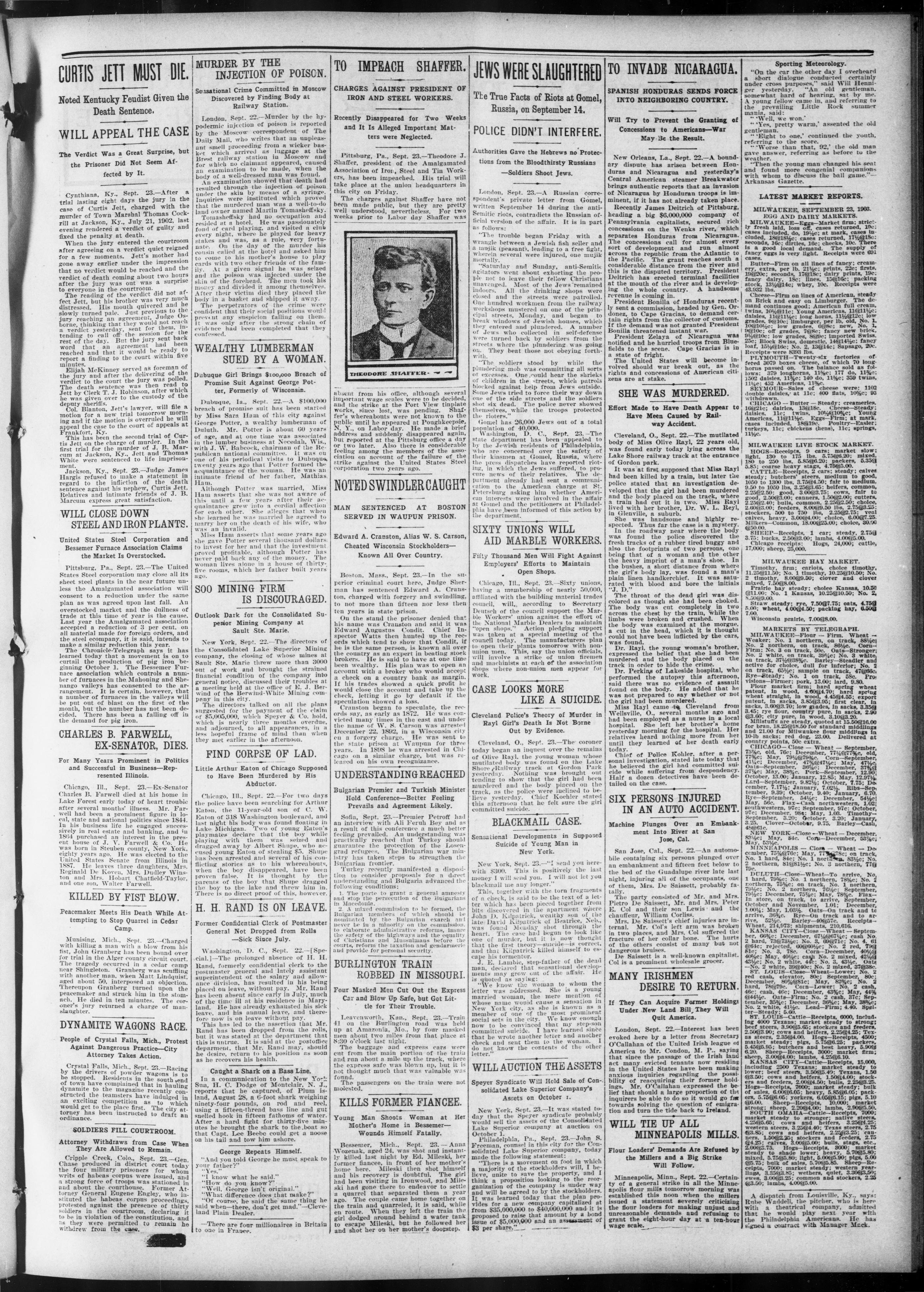
THEODORE SHAFFER.
absent from his office, although several important wage scales were to be decided, and the strike at the Port View tinplate works, since lost, was pending. Shaffer's whereabouts were not known to the public until he appeared at Poughkeepsie, N. Y., on Labor day. He made a brief address and suddenly disappeared again, but reported at the Pittsburg office a day or two later. Also there is considerable feeling among the members of the association on account of the failure of the strike against the United States Steel corporation two years ago.
NOTED SWINDLER CAUGHT
NOTED SWINDLER CAUGHT
MAN SENTENCED AT BOSTON SERVED IN WAUPUN PRISON.
Edward A. Cranston, Alias W. S. Carson, Cheated Wisconsin Stockholders Known All Over Country.
Boston. Mass., Sept. 23.—In the superior criminal court here, Judge Sherman has sentenced Edward A. Cranston, charged with forgery and swindling, to not more than fifteen nor less then ten years in state prison.
On the stand the prisoner denied that his name was Cranston and said it was Edward Augustus Condit. Chief Inspector Watts then hunted up the records which tend to show that Condit, if he is the same person, is known all over the country as an expert in beating stock brokers. He is said to have at one time been wealthy. His plan was to open an account with a broker who would accept a check on a country bank as margin. If his trades showed a quick profit he would close the account and take up the check, letting it go by default if the speculation showed a loss.
Cranston began to speculate, the records say, as early as 1872. He was convicted many times in the east and under the name of W. S. Carson was arrested December 22, 1892, in a Wisconsin city on a forgery charge. He was sent to the state prison at Waupun for three years. In 1898 he was arrested in Chicago on a similar charge, but was released on his own recognizance.
UNDERSTANDING REACHED
Bulgarian Premier and Turkish Minister Hold Conference-Better Feeling Prevails and Agreement Likely.
Sofia, Sept. 23.—Premier Petroff had an interview with Ali Feruh Bey and as a result of this conference a much better feeling prevailed. An understanding was practically reached that Turkey should guarantee the protection of the Losengrad refugees. The Bulgarian war ministry has taken steps to strengthen the Bulgarian frontier.
Turkey recently manifested a disposition to consider proposals for a direct understanding and Bulgaria advanced the following conditions:
1. The porte to grant a general amnesty and stop the persecution of the Bulgarians in Macedonia.
2. A mixed commission to be formed, the Bulgarian members of which should be nominated by the Bulgarian exarch and never be in a minority on the commission, to elaborate administrative reforms, insure the safety of the highways and the equality of Christians and Mussulmans before the courts, reform the taxation and gendarmerie and provide for personal security.
BURLINGTON TRAIN
ROBBED IN MISSOURI.
BURLINGTON TRAIN
ROBBED IN MISSOURI.
Four Masked Men Cut Out the Express Car and Blow Up Safe, but Got Little for Their Trouble.
Leavenworth, Kan., Sept. 23.—Train 41 on the Burlington road was held up at Amazonia, Mo., by four masked men about two miles from that place at 8:30 o'clock last night.
The baggage and express cars were cut from the main portion of the train and run about a mile up the track, where the express safe was blown up, but it is not thought much that was valuable was found.
The passengers on the train were not molested.
KILLS FORMER FIANCEE.
Young Man Shoots Woman at Her Mother's Home in Bessemer— Wounds Himself Fatally.
Bessemer, Mich., Sept. 23. — Anna Wozenak, aged 24, was shot and instantly killed last night by Ed. Mileski, her former fiancee, in front of her mother's home here. Mileski then shot himself and his recovery is doubtful. The girl had been visiting in Ironwood, and Mileski had gone there to endeavor to settle a quarrel that separated them a year ago. The couple came home together on the train and quarreled, it is said, while en route. When they left the train the girl dodged around behind a water tank to escape Mileski, but he followed her and shot her on her mother's doorstep.
JEWS WERE SLAUGHTERED
The True Facts of Riots at Gomel, Russia, on September 14.
POLICE DIDN'T INTERFERE.
London, Sept. 23.—A Russian correspondent's private letter from Gomel, written September 14 during the anti-Semitic riots, contradicts the Russian official version of the affair. It is in part as follows:
"The trouble began Friday with a wrangle between a Jewish fish seller and a mujik (peasant), leading to a free fight, wherein several were injured, one mujik mortally.
"Saturday and Sunday, anti-Semitic agitators went about exhorting the people not to leave their fellow Christians unavenged. Most of the Jews remained indoors. All the drinking shops were closed and the streets were patrolled. One hundred workmen from the railway workshops mustered on one of the principal streets, Monday, and began to break windows of Jewish houses, which they entered and plundered. A number of Jews who collected in self-defense were turned back by soldiers from the streets where the plundering was going on. They beat those not obeying forthwith.
"The soldiers stood by while the plundering mob was committing all sorts of excesses. One could hear the shrieks of children in the streets, which patrols blocked against help from Jews outside. Some Jews tried to force their way down one of the side streets and the soldiers shot six dead. The police never showed themselves, while the troops protected the rioters." Gomel has 26,000 Jews out of a total population of 40,000.
Washington, D. C., Sept. 23. The state department has been appealed to by the Jewish residents of Philadelphia, who are concerned over the safety of their kinsmen at Gomel, Russia, where the press dispatches have reported rioting, in which the Jews suffered, to procure news of their relatives. The department already had sent a communication to the American charge at St. Petersburg asking him whether American interests were involved in the affair at Gomel and the petitioners at Philadelphia have been informed of this action by the department.
SIXTY UNIONS WILL AID MARBLE WORKERS.
Fifty Thousand Men Will Fight Against Employers' Efforts to Maintain Open Shops
Chicago, Ill., Sept. 23.—Sixty unions, having a membership of nearly 50,000, affiliated with the building material trades council, will, according to Secretary Deutsch of the council support the Marble Workers' union against the effort of the National Marble Dealers to maintain "open shops." Action pledging support was taken at a special meeting of the council today. The manufacturers plan to open their plants tomorrow with non-union men. This, say the union officials, will involve a strike of union firemen and machinists at each of the association shops where non-union men appear for work.
CASE LOOKS MORE LIKE A SUICIDE.
Clevland Police's Theory of Murder in Rayl Girl's Death Is Not Borne Out by Evidence.
Cleveland, O., Sept. 23.—The coroner today began an inquest over the remains of Olive Rayl, the young woman whose mutilated body was found on the Lake Shore Railway track at Gordon Park yesterday. Nothing was brought out tending to show that the girl had been murdered and the body placed on the track, as the police were inclined to believe yesterday. Chief Koehler stated this afternoon that he felt sure the girl committed suicide.
BLACKMAIL CASE.
Sensational Developments in Supposed Suicide of Young Man in New York
New York, Sept. 23.—"I send you here with $300. This is positively the last money I will send you. I will not let you blackmail me any longer."
This, together with the torn fragments of a check, is said to be the text of a letter which has been pieced together from bits discovered in the apartment where John D. Kilpatrick, wealthy son of the late David Kilpatrick of Beatrice, Neb., was found Monday shot through the heart. The case had begun to look like one of murder, but it is now thought that the first theory—suicide—is correct, and that Kilpatrick killed himself to escape his tormentor.
J. E. Lambie, step-father of the dead man, declared that sensational developments may grow out of the affair. He is quoted as saying:
"We know the woman to whom the letter was addressed. She is a young married woman, the mere mention of whose name would cause a sensation in New York city, as she is known as a member of one of the most prominent social sets in the city. We know enough now to be convinced that my step-son committed suicide. I have learned since that he wrote another letter and another check and sent them to the woman. I do not know the contents of the other letter."
WILL AUCTION THE ASSETS
New York, Sept. 23. It was stated today that the Speyer syndicate probably would sell the assets of the Consolidated Lake Superior company at auction on October 1.
Philadelphia, Pa., Sept. 23.—John S. Freeman, counsel in this city for the Consolidated Lake Superior company, today made the following statement:
"There is a movement on foot in which a majority of the stockholders will, I believe, unite to save the property, and I think a proposition looking to the reorganization of the company is under way and will be agreed to by the stockholders. It was learned today that the plan provides for a new company capitalized at from $35,000,000 to $40,000,000 and it is proposed to raise that amount by a bond issue of $5,000,000 and an assessment of $3 per share."
TO INVADE NICARAGUA.
New Orleans, La., Sept. 22.—A boundary dispute has arisen between Honduras and Nicaragua and yesterday's Central American steamer Breakwater brings authentic reports that an invasion of Nicaragua by Honduran troops is imminent, if it has not already taken place.
Recently James Deitrich of Pittsburg, heading a big $6,000,000 company of Pennsylvania capitalists, secured rich concessions on the Wenks river, which separates Honduras from Nicaragua. The concessions call for almost every sort of development and run almost across the republic from the Atlantic to the Pacific. The grant reaches south a considerable distance from the river and this is the disputed territory. President Deitrich has erected terminal facilities at the mouth of the river and is developing the whole country. A handsome revenue is coming in. President Bonilla of Honduras recently sent a commission, headed by Gen. Ordonez, to Cape Gracias, to demand certain rights from the collector of customs. If the demand was not granted President Bonilla threatened instant war.
President Zelaya of Nicaragua was notified and he hurried troops from Bluefields to the scene. Cape Gracias is in a state of fright. The United States will become involved should war break out, as the rights and concessions of American citizens are at stake.
SHE WAS MURDERED.
Effort Made to Have Death Appear to Have Meen Caused by Railway Accident.
Cleveland, O., Sept. 22.—The mutilated body of Miss Olive Rayl, 22 years old, was found early today lying across the Lake Shore railway track at the entrance of Gordon park.
It was at first supposed that Miss Rayl had been killed by a train, but later the police stated that an investigation developed that the girl had been murdered and the body placed on the track, where a train had cut it in two. Miss Rayl lived with her brother, Dr. W. L. Reyl, in Glenville, a suburb.
She was handsome and highly respected. Thus far the case is a mystery. In the roadway near where the body was found the police discovered the fresh tracks of a rubber tired buggy and also the footprints of two persons, one being that of a woman and the other the heavy imprint of a man's shoe. In the bushes, a short distance from where the girl's body lay, was found a man's plain linen handkerchief. It was saturated with blood and bore the initials "J. D." The throat of the dead girl was discolored as though she had been choked. The body was cut completely in two across the chest by the train, while the limbs were broken and crushed. When the body was examined at the morgue, a cut in the head, which it is thought could not have been inflicted by the cars, was found.
Dr. Rayl, the young woman's brother, expressed the belief that she had been murdered and the body placed on the track in order to hide the crime. Dr. Perkins of Lakeside hospital, who performed the autopsy this afternoon, said there was no evidence of assault found on the body. He added that he was not prepared to say whether or not the girl had been murdered. Miss Rayl came to Cleveland from Wellsville, O., several months ago and had been employed as a nurse in a local hospital. She left her brother's home yesterday morning for the hospital. Her relatives heard nothing more from her until they learned of her death early today.
Chief of Police Kohler, after a personal investigation, stated late today that he believed the girl had committed suicide while suffering from despondency. Half a dozen detectives have been detailed on the case.
SIX PERSONS INJURED IN AN AUTO ACCIDENT.
Machine Plunges Over an Embankment Into River at San Jose, Cal.
San Jose, Cal., Sept. 22.—An automobile containing six persons plunged over an embankment and fifteen feet below to the bed of the Guadalupe river late last night, injuring all of the occupants, one of them, Mrs. De Saissett, probably fatal.
The party consisted of Mr. and Mrs. Pietro De Saissett, Mr. and Mrs. Peter E. Col and their son Lewis and the chauffeur, William Corliss.
Mrs. De Saissett's chief injuries are internal. Mr. Col's left arm was broken in two places, and Mrs. Col suffered the fracture of her collar bone. The hurts of the others consist of many but not dangerous bruises.
De Saissett is a well-known capitalist. Col is a prominent wholesale grocer.
MANY IRISHMEN DESIRE TO RETURN.
If They Can Acquire Former Holdings Under New Land Bill They Will Quit America.
London, Sept. 22.—Interest has been evoked here by a letter from Secretary O'Callahan of the United Irish league of America to Mr. Condon, M. P., saying that since the passage of the Irish land act many evicted tenants now residing in the United States have been making anxious inquiries regarding the possibility of reacquiring their former holdings. Mr. O'Callahan expressed the belief that should a large proportion of the inquirers be able to do so it would go far towards solving the question of emigration and turn the tide back to Ireland.
WILL TIE UP ALL
MINNEAPOLIS MILLS.
Flour Loaders' Demands Are Refused by the Millers and a Big Strike
Minneapolis, Minn., Sept. 22. Certainty of a general strike in all the Minneapolis flour mills tomorrow morning was established this noon when the millers issued a statement severely criticizing the flour loaders for making unjust and unreasonable demands and refusing to grant the eight-hour day at a ten-hour wage scale.
"On the car the other day I overheard a short dialogue conducted certainly under cross purposes," said Will Henniger yesterday. "An old gentleman, somewhat hard of hearing, sat by me. A young fellow came in, and referring to the prevailing Little Rock summer mania, said:
"Well, we won.
"Yes, pretty warm,' assented the old gentleman.
"'Eight to one,' continued the youth, referring to the score.
"Worse than that, 92,' the old man gave answer, referring as before to the weather.
"Then the young man changed his seat and found more congenial companions with whom to discuss the ball game." Arkansas Gazette.
LATEST MARKET REPORTS.
MILWAUKEE, SEPTEMBER 23, 1903.
EGG AND DAIRY MARKETS.
MILWAUKEE—Eggs—Market firm; strictly fresh laid, loss off, cases returned, 19c; cases included, do, 19½c; at mark, cases included, 18@18½c; cases returned, 17½@18c; seconds, 16c; dirties, 16c; checks, 10c. There is a good local demand. The supply of fancy eggs is very light. Receipts were 601 cases.
Butter—Firm on all lines of fancy; creamery, extra, per lb, 21½c; prints, 22c; firsts, 19@20c; seconds, 17@18c; dairy prints, 19c; fancy dairy, 18c; lines, 15@16c; packing stock, 13½@14c; whey, 10c. Receipts were 43,932 lbs.
Cheese—Firm on lines of American, steady on Brick and easy on Limburger. The demand continues good; American full cream, twins, 10%@11c; Young Americas, 11@11%c; dalesls, 11@11%c; long horns, 11%@12c; low grades, 9@10c; limburger, per lb, old, No. 1, 10@10%c; low grades, 6@8c; new, No. 1, 9@10c; off grades, 7@8c; fancy new brick, 9%@10c; low grades, 8@9c; imported Swiss, 25c; Block Swiss, domestic, 14@14%c; fancy loaf, 15%@16c; No. 2, 13@14c; Sapsago, 20c. Receipts were 833 lbs.
PLYMOUTH—Twenty-six factories offered 3079 boxes cheese, of which 70 longhorns passed on. The balance sold as follows: 379 longhorns, 11%c; 177 do, 11%c; 1502 dalesls, 11%c; 140 do, 11%c; 359 twins, 11%c; 452 Americas, 11%c.
SEYMOUR—Sales of cheese were: 1102 double dalesls, at 11c; 400 flats, 10%c; 95 withdrawn.
CHICAGO — Butter — Steady; creameries, 16@21c; dairies, 13@18c. Cheese—Steady; daisies, 11c; twins, 10½@10½c; Young Americas, 11@11½c. Eggs—Firm; at mark, cases included, 18@19c. Poultry—Easler; turkeys, 11c; chickens (hens), 11c; springs, 11½c.
MILWAUKEE LIVE STOCK MARKET.
HOGS—Receipts, 9 cars; market slow; light, 130 to 175 lbs. 5.75@6.20; mixed, 180 to 250 lbs. 5.85@2.60; packers, 5.35@5.85; coarse heavy stags, 4.75@5.00.
CATTLE—Receipts, 2 cars; steady; calves steady, butchers' steers, medium to good, 1050 to 1800 lbs. 3.75@4.50; fair to medium, 9.50 to 1050 lbs. 3.25@3.65; helfers, common, 2.25@2.50; good, 3.00@3.75; cows, fair to good, 2.50@3.00; canners, 1.50@2.00; cutters, 2.25@2.40; bulls, common, 2.25@2.50; choice, 2.60@3.00; feeders, 8.00@9.50 lbs. 2.75@3.25; stockers, 500 to 750 lbs. 2.25@2.75; veal calves, heavy, 3.00@4.00; choice, 6.00@7.25. Milkers—Common, 18.00@25.00; choice, 30.90@50.00.
SHEEP—Receipts, 1 car; steady, 2.75@
3.75; bucks, 2.50@3.00; lambs, 4.00@5.00.
Chicago receipts: Hogs, 24,000; cattle,
17,000; sheep, 25,000.
MILWAUKEE HAY MARKET.
Timothy, firm; carlots, choice timothy,
11.25@11.50; No. 1 timothy, 10.25@10.50; No.
2 timothy, 8.00@9.50; clover and clover
mixed, 7.50@8.00.
Prairie hay steady; choice Kansas, 10.50
@11.00; No. 1 Kansas, 10.25@10.50; No. 2,
8.50@9.00.
Straw steady; rye, 7.50@7.75; oats, 4.75@
5.00; wheat, 4.00@4.50; packing hay, 6.50@
7.00.
Wisconsin prairie, 7.00@8.00.
MARKETS BY TELEGRAPH.
MILWAUKEE—Flour — Firm. Wheat —
Weaker; No. 1 northern, on track, 88½c
No. 2 northern, on track, 88½c. Corn—
Firm; No. 3 on track, 50c. Oats—Stronger;
No. 2 white, on track, 39½c; No. 3 white,
on track, 37½c@38½c. Barley—Steadier and
active for choice, dull for inferior; No. 2
on track, 65½c; sample on track, 47@60c
Rye—Steady; No. 1 on track, 58c. Pro-
visions—Firmer; pork, 13.00; lard, 9.80.
Flour market firm; hard spring wheat
patent, in wood, 4.60@4.70; hard spring
wheat straight, in wood, 4.45@4.55; export
patent, in sacks, 3.85@3.95; first clear, in
sacks, 3.60@3.70; low grades, in sacks, 3.35@
3.45; rye flour, country pure, in sacks, 2.90@
3.60; city pure, in wood, 3.10@3.20.
Millstuffs are steady, quoted at 15.50@16.00
for bran, 18.25@18.50 for standard middlings
and 21.00 for Milwaukee flour middlings in
10-lb sacks; red dog, 23.00. Delivered at
country points, 50c extra.
CHICAGO—Close — Wheat — September,
75%c, old, 76c; December, 77%@77%c, old,
77%c; May, 79%@79%c. Corn—September,
41%c; December, 47%@47%c; May, 47%c
Oats—September, 30%c; December, 37%@
37%c; May, 38%c. Pork—September, 12.90
October, 13.00; January, 12.85; May, 12.97%
Lard—September, 9.82%; October, 7.75; De-
cember, 7.17%; January, 7.02% Ribs—Sep-
tember, 9.39; October, 9.40; January, 6.70
Rye—September, 54%c; December, 54%c
May, 56c. Flax—Cash northwestern, 1.02
southwestern, 97c; September, 97c; October,
97c; December, 98c; May, 1.03. Timothy—
September, 3.20; October, 3.20; January,
3.25. Clover—October, 9.75. Barley—Cash,
48@61c.
NEW YORK—Close — Wheat — December,
83%c; May, 84c. Corn—December, 53%c;
May, 53%c.
MINNEAPOLIS — Close — Wheat — De-
cember, 75%@76c; May, 77%@78c; on track,
No. 1 hard, 84c; No. 1 northern, 83%c; No.
2 northern, 81@81%c; No. 3 northern, 77@
79c.
DULUTH—Close—Wheat—To arrive, No. 1 hard, 79%c; No. 1 northern, 78%c; No. 2 northern, 75%c; on track, No. 1 northern, 79%c; No. 2 northern, 76%c; September, 79%c; December, 75%c; May, 78%c; Flax—In store, on track, to arrive, September, October and November, 1.01; December, 1.00%; May, 1.03%; Oats—On track and to arrive, 36%c; Rye—On track and to arrive, 52%c; Barley—40%57c; Receivels—Wheat, 214,973; shipments, 210,616.
KANSAS CITY—Close—Wheat—September, 66%c; December, 67%c;67%c; cash No. 2 hard, 73%@73%c; No. 3, 69%@71c; No. 4. 61@64%c; rejected, 60%@60%c; No. 2 red, 79%@81c; No. 3, 78c; Corn—December, 40%@40%c; May, 40%1c; cash No. 2 mixed, 42%@43%c; No. 2 white, 44c; No. 3, 43%c; Oats
- 10.2 white, 39%@40c. No. 2 mixed, 38%@8c.
ST. LOUIS—Close—Wheat—Lower; No. 2 red cash, elevator, 80c; September, 80c; December, 80%@81c; May, 82%c; No. 2 hard, 78%@79c. Corn—Lower; No. 2 cash, 46c; cash, 46c; December, 43%c; May, 44%@44%c. Oats—Firm; No. 2 cash, 37c; September, 35%c; December, 36%c; May, 38%c; No. 2 white, 41%c. Lead—Firm; 4.40. Speller—Steady; 5.60.
ST. LOUIS—Cattle—Recelpts, 6000, including 4000 Texans; market steady to strong; beef steers, 3.90@5.65; stockers and feeders, 2.50@3.90; cows and heifers, 2.25@4.25; Texas steers, 2.35@4.00. Hogs—Recelpts, 4500; market steady; plgs, 5.75@6.25; packers, 5.45@5.95; butchers and best heavy, 5.90@6.20. Sheep—Recelpts, 3000; market firm; sheep, 3.00@4.00; lambs, 4.25@6.10.
KANSAS CITY—Cattle—Recelpts, 15,000,
including 2500 Texans; market steady to
lower; beef steers, 3.50@5.49; Texans, 1.50
@3.50; cows and heifers, 1.50@4.00; stockers
and feeders, 2.00@4.50; bulls, 2.25@3.25.
Hogs—Recelpts, 7000; market steady; bulk
of sales, 6.00@6.05; heavy, 5.85@6.05; packers,
5.75@6.05; yorkers, 6.05@6.15; plugs, 5.10
@6.00. Sheep—Recelpts, 10,000; market
strong; sheep, 2.20@4.00; lambs, 2.90@5.50.
SOUTH OMAHA—Cattle—Recelpts, 7000;
market steady to stronger; native steers,
4.25@5.65; cows and heifers, 3.25@4.25;
western steers, 3.25@4.40; Texas steers, 2.75
@3.85; cows and heifers, 2.25@3.25; canners,
1.50@2.25; stockers and feeders, 2.75
@4.25; calves, 3.00@5.00; bulls, stags, etc,
2.00@3.75. Hogs—Recelpts, 8000; market
steady to shade lower; heavy, 5.70@5.80;
mixed, 5.75@5.80; light, 5.00@5.90; plugs, 5.00
@5.75; bulk of sales, 5.70@5.85. Sheep—Recelpts, 7000; market steady; western yearlings, 3.35@3.85; wethers, quiet, 3.30@3.50;
ewes, 3.00@3.25; common and stockers, 2.25
@3.50; lambs, 4.00@5.00.
A dispatch from Louisville, Ky., says: Rube Waddell, the pitcher, who is here with a theatrical company, admitted that he would play next year with the Philadelphia Americans. He has signed a contract with Manager Meck.
Any part of the United States and Canada,
postage paid.
One Year ..... $2.00
Six Months ..... 1.25
Three Months ..... .75
Send money by Express Money Order, P. O.
Money Order or Registered Letter to the
Wisconsin Weekly Advocate.
ADVERTISING RATES.
One inch, single insertion..... 25c
One inch, per year..... $9.00
Business locals 5c per line each insertion.
Apply for rates to the Advocate.
TO CONTRIBUTORS:
All communications must be sent with the name and address of the sender as an evidence of good faith, but not necessarily for publication. No manuscript returned if not accepted, unless accompanied by stamps.
The Wisconsin Weekly Advocate company wishes to notify the public that all contracts and business transactions with this company must have the company stamp, otherwise they will be void. Neither will this company be responsible for paid subscriptions unless given to duly-accredited agents, who, on request, will give the company's receipt for same. Subscribers failing to receive their papers regularly will kindly notify the general office. Address all business communications to the general manager, 79 Fifth street.
Entered in the Postoffice at Milwaukee as Second-class matter.
A. Good Advice.
If you are troubled with kinky or curly hair use Ozonized Ox Marrow; it will make your hair straight, soft and beautiful. If your hair is falling out, Ozonized Ox Marrow will stop it. If you have dandruff and itching in the head, Ozonized Ox Marrow will give you instant relief, and make the hair grow. Ozonized Ox Marrow is a hair food that imparts to the hair a healthy, life-like appearance so much desired. Sold over forty years. Never fails. Warranted harmless. Send us 50 cents and we will ship you a bottle express paid. Address Ozonized Ox Marrow Co., 76 Wabash avenue, Chicago, Ill. The above can be obtained at the office of the Advocate, 79 Fifth street.
Prof. Langley's flying machine seems to be fated to break down or break up.
Should King Peter vacate, the throne or Servia might be put up at county fairs for a nickel a throw.
Now that the races are over, the reporters seem to be bent on stirring up all sorts of breezes for Sir Thomas Lipton.
When a racing automobile slips the trolley, it is time to skip out. But one must be very quick to grasp the time to do the skipping.
The reason why Major Delmar failed to break the record may be found in an oversight of the chauffeur of the pace-making automobile, who failed to fasten a tow-line to the gelding's collar.
The cup defender is now high and dry on a dock, awaiting a future possible call to engage in the same patriotic work. While she is thus safe from harm from the elements, her owners will do their yachting in boats that can take the weather as it comes, and go out of sight of land should occasion require off-shore veyaging.
The August fire loss was $8,428,350—not a large amount, but large enough to bring the total for the first time during the present year beyond what it was at the corresponding period of last year. The fire loss in the first eight months of 1903 has aggregated $105,032,200, compared with $104,559,400 in the first eight months of 1902.
Prof. Koch's reported discovery of a method by which cattle can be rendered humunc against tuberculosis is important to the cattle interests of the world. But its chief interest to humanity will lie in the hope that through this discovery a way may be found to render human beings immune against the "white plague" which annually claims so many victims.
---
Sir Thomas Lipton's concession that America cannot be beaten in yacht designing by any Briton at present in the business, has incensed a number of enthusiastic British yachtsmen, and the next challenge may come from a syndicate. This would not be objectionable, as three of the American defenders have been syndicate boats. The expense of either challenging or defending is now almost too heavy for one person, however rich he may be.
President Roosevelt's declination of a silk flag which represents months of nerve-wearing labor on the part of the donor, a poor woman who had also put into the emblem far more money than she could afford to spend for other than actual needs, was a trying exercise of judgment intended to discourage any further testimonials of the kind. It is embarrassing to receive gifts from those who can ill afford to make them, as the recipient feels that it is utterly impossible to accept without making some financial return, which would of course be in bad taste. It would be well if the presentation habit could be suppressed in its relation to officials, because of the imputation that some return is looked for—not in cash, but in favors which represent cash indirectly.
Capt. Robert Wringe's expressed determination to become an American citizen and do his future yacht sailing on this side of the Atlantic is the result of his observation that a man of his skill can do better in a financial way in this country than in Great Britain. Capt. Barr of the Reliance was a British skipper several years ago, but he is now the "crack" American skipper and the recipient of a salary that is large in comparison with the best that he could have hoped for on the other side. With her challengers thus increasing the list of expert sailing masters on this side, and her designers falling short of the marks set by the Herreshoffs, Great Britain can have no hope for a share of glory in the possession of the America's cup unless Mr. Carnegie's prediction is fulfilled.
PAPERS BY THE PEOPLE
DEATH FROM OLD AGE IN FUTURE GENERATIONS.
Modern science says to man: "You stand in dread of your own death, and rebel against the thought of it. You are right! Your death will in all probability be the result of accident. Something not in accord with your nature. Some disease which you perhaps are even now nourishing in your system will take you off ere you are aware. The water you drink is full of destructive germs which are going to multiply and devel-
utism attacks your Hereditary deight on by the ex-ly half master of One and all, young before their life's antists and doctors like successive dis-question has almost ever will come. And the complete over-undermine our vi- posterity will see pressing the secret! importance. It seems milk some principle dering children fed tack. If we can be will have been made in early life, assum-ble of being cause them of milk from oer the same result matter awaiting fu-gain would accrue were made imposs- of a fluid so univer-
op at the expense of your body. Rheumatism attacks your joints. Alcohol preys on your vitality. Hereditary defects exact from you the penalty brought on by the excesses of your grandparents. You are only half master of your vigor, your health, and your life. One and all, young and old, will be taken off by disease before their life's measure is full. In the meantime scientists and doctors will pursue their investigations and make successive discoveries. In this way the tuberculosis question has almost been solved. To-morrow the turn of cancer will come. And so on. But none of us will live to see the complete overthrow of the mysterious agents which undermine our vitality. Perhaps not even our immediate posterity will see this triumph.
Fortunate indeed the generation possessing the secret! Man will then no longer fear death. Instead he will long for death at the end of his allotted days as we long for sleep at the close of a long day. Dying, he will refuse to live as we refuse nourishment when we are satiated or to walk when we are tired. The hundred, hundred and twenty, or hundred and thirty years he has lived will have fulfilled his desire to live.
as we long for,
he will refuse to
are satiated or to
hundred and twen-
ived will have ful-
that shall we say
assess the secret?
made to solve the
them—from where
in life and death?
consolation in the
they are so greatly
at large that the
actual comfort to
promises held out
PONS.
By Andrew Wilson.
Carlyle
power and
heroism,
moral qua-
heroic, and
sophical s
dice, into
priest of
passioned
trival, and dwelt on
vigorous and incisive
calm of a majestic
tleness, peace, and a
"Heroism speaks the
temperate, scornful
reasons, and thereof
It is this higher
ism which Chauncey
"The world in all
standard of hero
But if that generation what shall we say of those generations which do not possess the secret? Those who know that an effort is being made to solve the enigma which is continually eluding them—from where will they derive courage to sustain them in life and death? Yet there are men who find sufficient consolation in the possibilities stored up in the future. They are so greatly interested in the welfare of humanity at large that the sanguine predictions of scientists are an actual comfort to them, and they rejoice in the glorious promises held out to their descendants.
Much has been done of late years in science to attack disease with its own weapons. My readers may not know what is meant by the "serum" treatment. It represents the attempt of science to hoist microbes with their own petard. A horse is inoculated with the microbes of diphtheria. The animal remains strong and well under this treatment. Then in blood drawn from it we find developed in course of time what we call
principle to tuberculosis Behring's re-ress held in 1901, he was a different belief he founded vicious cow, laden case in, say, a child dictum was dis-ined that the dis-
Lord Chief Justice Alverstone
Lord Alverstone, Chief Justice of the commission to delimit the British North America. John W. For-ernment of the United States, was s-irison. He is generally regarded as one world on international law. He was a sion which settled the Behring Sea se-
the "anti-toxin" of the disease. The germs multiplying in the serum or fluid of the blood have given rise to this new substance. When the latter is inoculated into a child suffering from diphtheria it cures the little patient. The antitoxin acts upon the microbes causing fell disorder, produces reaction in the child, with the result that the disease is checked and recovery made possible.
It is the application of this same principle to tuberculosis which forms the subject of Professor Behring's researches. Dr. Koch, at the great congress held in 1901, maintained that tuberculosis in the cow was a different disease from that found in man. On this belief he founded his declaration that the milk of a tuberculous cow, laden with germs, could not produce the disease in, say, a child fed on the milk. Needless to say, this dictum was disputed, and it now fairly well ascertained that the dis-
Lord Chief Justice
Alverstone
Ex-Secretary of State
John W. Foster
Lord Alverstone, Chief Justice of England, is presiding over the deliberations of the commission to delimit the boundary line between Alaska and British North America. John W. Foster, who prepared the case for the government of the United States, was Secretary of State under President Harrison. He is generally regarded as one of the greatest authorities in the world on international law. He was a member of the Joint High Commission which settled the Rehring Sea seal fisheries dispute.
cur, but have seldom been witnessed and still less frequently described. Two or three lions sometimes combine in such an attack, but from the marks seen on buffalo it is probable that sometimes there is a single combat for it can hardly be supposed that the buffalo could escape from more than one lion.
The number of foot pounds of energy put into such a struggle must be something extraordinary. The efforts of a lion, which can strike a man's arm from the shoulder and leave it hanging by a strip of skin or which can carry a cow over a high stockade, endeavoring unsuccessfully in close grips to drag down or disable a buffalo bull, must be on a gigantic scale, and the strength which can shake him off and, it is believed, occasionally crush the lion afterward must be even more amazing. A buffalo bull has been credited with engaging three lions in mortal combat and making a good fight before he was disabled by one of the lions ham-stringing him by biting his legs from behind.
---
Q
FIGHTING DISEASE WITH ITS OWN WEAPONS.
Q
ASSENDS THE HIGHEST PEAK.
Miss Peck Performs Remarkable Feat in South America.
Aided by oxygen carried in cans and other carefully selected helps to the modern mountain climber, a woman—
Miss Annie S. Peck of Chicago has attained the highest altitude ever reached by man. She has accomplished the feat of ascending Mount Sorata, in Bolivia, whose height is estimated from 21,000 to 25,000 feet, and is exceeded only by the unconquered peaks of the Himalayas.
```markdown
```
Some scientists believe Sorata to be even higher than the Himalaya peaks, and it MISS ANNIE S. PECK. is possible that when the measurements made by Miss Peak's expedition are received man will be known to have reached the highest point in the world, and the honor of having accomplished this will be a woman's.
Miss Peck, who is well known as a mountain climber and is known socially in Chicago and other large cities of the country, was accompanied on the trip by President W. A. G. Tight of the University of New Mexico and three guides, one of whom is Antoine Maquiguaz, who guided Sir Martin Conway, the noted English explorer, when he attempted and failed to do what Miss Peck has accomplished.
The ascent of Mount Sorata crowns a remarkable career of mountain climbing by a woman who in a few years has ascended the highest peaks of Europe and America, including Mount Orizaba in Mexico, which is 18,600 feet high, and, next to Mount McKinley, is the highest peak in North America, Mount McKinley being 20,600 feet. Miss Peck is a graduate of the University of Michigan and formerly was professor of Latin at Smith College.
Wild Animal Fights.
In the pitched battles which sometimes take place between the great carnivora and the largest and most powerful of the ox tribe the forces of animal courage, desperation and bodily strength must be exhibited on a scale never elsewhere seen, says a writer in Leslie's Weekly. Such combats do oc-
ease of the cow can be transferred, by inoculation, to man, showing that he is susceptible of attack by one channel at least. Dr. Behring's investigations were directed to the solution of the opposite question apparently. He prepared a pure culture of the bacilli of human tubercle. This he used to inoculate the cow. The bacilli were so treated that they retained their full measure of disease producing qualities. Inoculated with this human culture, the cow was proved to be proof against infection from its own kind. The younger the animal experimented upon the more efficient was the protection afforded.
Now, there follows upon this result another of much importance. It seems that cows so treated develop in their milk some principle or other which has the effect of rendering children fed upon it insusceptible to tubercular attack. If we can be assured on this point a great advance will have been made toward the prevention of the disease in early life, assuming, of course, that tuberculosis is capable of being caused in young children by the giving to them of milk from cows whose udders are affected. Whether the same result would follow in the case of adults is a matter awaiting further investigation, but at least a great gain would accrue to the civilized world if tuberculosis were made impossible of conveyance through the medium of a fluid so universally used as milk.
HEROES AND HEROINES IN HUMBLE LIFE.
Carlyle in his essay on heroes seems to regard power and its exercise as the chief requisites of heroism, and to ignore or minimize motives and moral qualities. Emerson uses the words hero, heroic, and heroism in a broader and more philosophical sense. Happily, he was free from prejudice, intensity and narrowness. He was the priest of the universal, and in his calm, unimpassioned thought he forgot the temporal and
```markdown
```
trivial, and dwelt chiefly on the permanent vigorous and incisive words may be seen calm of a majestic soul in whose unfathomleness, peace, and a sublime trust forever the "Heroism speaks the truth; it is just, general temperate, scornful of petty calculations; it reasons, and therefore is always right."
It is this higher conception of the realism which Chauncey Depew had in mind. "The world in all ages has worshiped its standard of heroism has always been reckon heroism to-day not so much on account done as for the motive behind the act," the doughty deeds of many whose brows heed with the laurel wreaths of fame; who hasized as the world's great heroes, by this wherein the motive as well as the deed is shriveling of heroes, what a shrinkage would result. Were beneficent motives or dispensable element in heroic achievement who have waded through seas of blood, perors who have won thrones by treacherous; statesmen who have reduced duplicity to a science; all the ambitious, unscrupulous mankind would descend from their lofty places of honor wrongfully usurped to be filled by those who have wrought deeds or inspired only by the divine altruism which abnegation and self-sacrifice. How many secure and unknown, whose names have permembrance, were wrought and fashioned, vinest mold, and have made their lives subdeeds. God has vouchsafed to the world being than the unconscious heroes and heroic earth its greatest charm, and without the heaven would suffer irreparable loss.
FIGURES OF THE ALASKAN BOUNDARY COUNTY
Chief Justice Pierstone
Ex-Secretary of John W. Fosse
Chief Justice of England, is presiding over an admission to delimit the boundary line between America. John W. Foster, who prepared the United States, was Secretary of State under generally regarded as one of the greatest auctional law. He was a member of the Joint and the Behring Sea seal fisheries dispute.
and incisive words may be seen the everlasting majestic soul in whose unfathomed depths gen-ence, and a sublime trust forever dwelt. He says: "He speaks the truth; it is just, generous, hospitable, scornful of petty calculations; it feels and never and therefore is always right."
This higher conception of the real essence of hero-chauncey Depew had in mind when he said: "World in all ages has worshiped its heroes, but the age of heroism has always been Improving. We heroism to-day not so much on account of the thing for the motive behind the act." Were we to testenty deeds of many whose brows have been crown-the laurel wreaths of fame; who have been recog- the world's great heroes, by this higher standard, the motive as well as the deed is a factor, what a king of heroes, what a shrinkage of heroic deeds result. Were beneficent motives considered an in-ile element in heroic achievements, conquerors we waded through seas of blood; kings and emo-ho have won thrones by treachery and assassina- cesmen who have reduced duplicity and mendacity; all the ambitious, unscrupulous destroyers of would descend from their lofty pedestals, leaving of honor wrongfully usurped to be more worthily those who have wrought deeds of true greatness, only by the divine altruism which teaches self- on and self-sacrifice. How many heroic souls, ob- unknown, whose names have perished from re- ce, were wrought and fashioned in nature's di- old, and have made their lives sublime by gracious God has vouchsafed to the world no choiceer bless- the unconscious heroes and heroines who give to the greatest charm, and without whose presence would suffer irreparable loss.
JUSTICE OF THE ALASKAN BOUNDARY COMMISSION
Ex-Secretary of State
John W. Foster
Justice of England, is presiding over the deliber- delimit the boundary line between Alaska and John W. Foster, who prepared the case for the gov- tates, was Secretary of State under President Har- dered as one of the greatest authorities in the He was a member of the Joint High Commis- ring Sea seal fisheries dispute.
trival, and dwelt chiefly on the permanent. Beneath his vigorous and incisive words may be seen the everlasting calm of a majestic soul in whose unfathomed depths gentleness, peace, and a sublime trust forever dwelt. He says: "Heroism speaks the truth; it is just, generous, hospitable, temperate, scornful of petty calculations; it feels and never reasons, and therefore is always right."
It is this higher conception of the real essence of heroism which Chauncey Depew had in mind when he said: "The world in all ages has worshiped its heroes, but the standard of heroism has always been improving. We reckon heroism to-day not so much on account of the thing done as for the motive behind the act." Were we to test the doughty deeds of many whose brows have been crowned with the laurel wreaths of fame; who have been recognized as the world's great heroes, by this higher standard, wherein the motive as well as the deed is a factor, what a shriveling of heroes, what a shrinkage of heroic deeds would result. Were beneficent motives considered an indispensable element in heroic achievements, conquerors who have waded through seas of blood; kings and emperors who have won thrones by treachery and assassination; statesmen who have reduced duplicity and mendacity to a science; all the ambitious, unscrupulous destroyers of mankind would descend from their lofty pedestals, leaving the places of honor wrongfully usurped to be more worthily filled by those who have wrought deeds of true greatness, inspired only by the divine altruism which teaches self-abnegation and self-sacrifice. How many heroic souls, obscure and unknown, whose names have perished from remembrance, were wrought and fashioned in nature's divinest mold, and have made their lives sublime by gracious deeds. God has vouchsafed to the world no choice blessing than the unconscious heroes and heroines who give to earth its greatest charm, and without whose presence heaven would suffer irreparable loss.
---
---
Rain and Disease Germs.
In Chicago in May, at a time when there had been no rain for three weeks, six glass plates two and one-half inches square were exposed in as many streets for one minute. The plates were then incubated, so that each particle of dust to which a germ was clinging would soon be surrounded with a colony of germs which could be seen and counted. The average per plate was 1,650 colonies. On the day following nearly an inch of rain fell, and on the next day similar plates were exposed at the same street corners, which after development, showed but 270 colonies. A good rain had diminished the number of microbes more than 80 per cent.
A Profit from Garbage.
The borough of Fulham, London, by the use of its garbage in the furnace of the municipal electric lighting plant makes a profit of $3,442 a year.
No one ever fooled the people with false teeth.
VISITORS TO CHICAGO Could Not Better Themselves Than by Visiting WALDORF CAFE
HEART WOUNDS.
Not Necessarily Fatal Unless the Weakest Spot Is Punctured.
In wounds of the heart itself the escape of blood is never in large quantity, and the lethal consequences are due to the fact that the escape of blood from within its cavity (or cavities) into the surrounding sac of the pericardium mechanically interrupts the alternate contraction and expansion by which its pumping action is maintained. Accordingly, the results of wounds of the heart are usually identical with those of gradual suffocation. This fact was strikingly demonstrated in the case of the Empress of Austria. And the diabolic skill and precision with which the wound was inflicted in her case offer a diagrammatic illustration of a necessarily fatal wound of the heart. The instrument used was too large to form a mere "needle puncture;" it was inflicted too high in the chest to be "non-penetrating," for it was aimed with truly fiendish ingenuity at the position of one of the thin-walled of the four cavities of the heart, and the directness of the penetration, combined with the thinness of the wail of the cavity, rendered it physically impossible that the wound could be "valvular." The Israelite warrior of old smote the enemy—when possible—"beneath the fifth rib," because the impulse of the heart is felt there. But he probably did not know that it is in that precise position that a wound of the heart is least necessarily fatal. The Italian assassin of recent date displays incomparably greater skill and knowledge. The science of the present day also proves that the historic account of the death of Admiral Villneuve is open to skeptical doubt. And the recent cases of suture of the heart give illustration that modern surgical skill may attempt, and with success, the seemingly impossible. American Medicine.
Meanest Man He Knew
It was Joseph Folk, the young district attorney of St. Louis county, who brought the St. Louis boodlers to justice. Talking one day about boodling and the meanness of it, Mr. Folk said to a reporter: "There is something small and little about robbing taxpayers, robbing widows and orphans and all manner of poor folk. He is a mean man who commits this crime—as mean a man as one I saw once on a Mississippi steamer.
"And he was strangely mean, that chap. He was traveling with his daughter, a little girl of 5 or 6. He was holding her over the rail, so that she could see a monster catfish, when, somehow, he let go of her, and she fell into the deep stream with a splash.
"A deckhand was after her in an instant. Head foremost he shot in, and she was back in her father's arms again before three minutes had passed.
"The father was profoundly grateful to the deckhand. He pulled out a dollar bill.
"Got any change?" he said.
Got any change? he said.
"The man had none, so the father went bustling nervously here and there over the boat, waving his dollar bill and saying:
"Got any change? Got any change? Who's got change for a dollar? Here's a man has just saved my daughter's life, and I want to give him a quarter. Got any change there?"—New York Tribune.
The 214 wells completed in the Baku (Russia) oil field show an average depth of 1032 feet and an average initial production of 292 barrels per well per day, against an average depth of 1086 feet and an average production per well per day of 330 barrels for the 358 wells completed in 1901, indicating a very material increase in the depth of drilling and a not inconsiderable falling off in the average productiveness of the wells. Oil is worth at the wells two-thirds of a cent a gallon.
When You Want a
FIRST CLASS SHINE
Call on
BOB WISE
Proprietor of
The Ladies' and Gents'
Shining Parlor
197 THIRD ST., Near Wells
MILWAUKEE, WIS.
Before Starting on Your Travels
CALL ON
Geo. Burroughs & Sons
MANUFACTURERS OF
PREMIUM TRUNKS
VALISES, SAMPLE CASES, Etc.
424 7 426 East Water St., Milwaukee.
Dixon's Place
Ladies' and Gents' Shining Parlör.
Cigars, Tobacco, all Negro Newspapers.
2638 State St., Chicago.
Phone, 2351 Brown.
We keep for Sale: Wisconsin Advocate, Freeman, Conservator, New York Age, Atlanta Age, Northwestern Vine, Colored American, Cleveland Gazette, Dallas Express, Richmond Planet, True Reformer, Broad-Ax, Monitor, Detroit Informer, Christian Recorder, Voice of Missions, and all other Negro papers of the country.
ELK EXPRESS CO.
G. J. CHARLESTON, Mgr.
63 E. Sixth Street,
ST. PAUL, MINN.
RAILWAYS.
CHICAGO,MILWAUKEE& ST.PAULRY
WISCONSIN CENTRAL RAILWAY.
TICKET OFFICE, 400 EAST WATER ST. Tel. 624.
TO AND FROM LEAVE ARRIVE
St. Paul, Minneapolis, Iron Towns, Ashland, Superior, Duluth, Pacific Coast ... *5:00 am *7:15 am
Marshfield, Chippewa Falls, Eau Claire ... *8:45 pm *8:00 pm
Fond on Lac, Oshkosh, Nee-nah, Menasha ... *5:00 am *7:15 am
*12:01 pm *3:20 pm
*8:45 pm *8:00 pm
*5:00 am *7:15 am
*7:35 am *10:15 am
*12:01 pm *3:20 am
*4:35 pm *6:15 pm
*8:45 pm *8:00 am
*Daily. Daily except Sunday.
WONDERFUL DISCOVERY
Curly Hair Made Straight By
TAKEN FROM LIFE:
BEFORE AND AFTER TREATMENT.
OZONIZED OX MARROW
THE ORIGINAL COPYRIGHT
This wonderful hair pomade is the only safe preparation in the world that makes kinky hair straight as shown above. It nourishes the scalp, prevents the hair from falling out and makes it grow. Sold over 40 years and used by thousands. Warranted harmless. Testimonials free on request. It was the first preparation to be authorized by the original ozonized Ox Marrow, as the genuine never fails to keep the hair pliable and beautiful. A toilet necessity for ladies and gentlemen. Elegantly perfumed. The great advantage of this wonderful pomade is that by its use you can straighten your own hair. Owing to its superior and equal quality it is the mostonomized hair. It is not possible for anybody to produce a preparation equal to it. Full directions with every bottle. Only 50 cents. Sold by dealers or send us $1.40 Postal or Express Money Order for 3 bottles, express paid. Write your name and address plainly to
OZONOMIZED OX MARROW CO.,
76 Wabash Ave., Chicago, Ill.
---
THE POP
By Rev. Newman Hall, D. D., LL. D.
Whatever is said of human souls who may have been or will be taken to glory without dying is true of those whose bodies have been laid in the grave. Moses, no less than Elias, appeared to the disciples, with Jesus in glory. What may we infer is the present heaven of departed souls.
They are consciously alive. These two had not ceased to exist. They were not asleep in unconsciousness. They were conversing together with Jesus. We sometimes speak of the dead as if no longer alive in any sense. They are "no more," they are "in the grave," they lie in yonder churchyard. When we hear their last sigh, and the dear hand no longer responds to our grasp, and the light of eye is quenched, it is natural to think our beloved one has ceased to be. But the life they had in Christ, like his own life, remains—they are more alive than ever! If we had been with Elijah when he was caught up to heaven, we should not have gone home grieving, drawing down the curtains, and abandoning ourselves to woe as if we had forever lost our friend. Neither shall we consider those whom Christ has taken to himself as dead. They, sharing death with Moses, share also continued life with Elias.
Both "appeared in glory." There are higher degrees of glory, ever advancing with everlasting existence. But there is a glory immediately following death. The glory of the calm after storm, of rest after toil, of crown after conflict. Death does not deprive of this, but rather is the instrument of conferring it.
The two glorified visitants were together. They could not have been while they were alive. Then five hundred years divided them. God had different works for different servants, in different ages and in distant places. We sometimes wish we could grasp the hands of saints of other days and countries—of whom we read, whose hymns we sing. In heaven no barriers of time or place separate the children of God. Abel and Stephen, Abraham and Paul, David and Peter, hold sweet communion yonder. And this will commence with the new life we call death, even as Moses was in the company of Elijah.
Of course there is recognition. These two were not unnamed, generic representatives of Heaven, but absolutely two individuals, with their distinctive names and personalities. All have one likeness to Christ, but all have their peculiar varieties of feature and character. What joy will it be when, cleansed from all faults and infirmities, we shall greet again those we loved here, to enjoy the perfect communion of the saints made perfect! We wish we had been with the three disciples to enjoy the company of the two saints even for so brief an hour. We also shall meet Moses and Elias. And what will at first yield still greater bliss, we shall join the beloved ones known during the present life. We shall greet them, be greeted by them,
Best of all, Moses, the buried one, equally with Elijah, the translated one, was with Jesus. This is the climax of the believer's hope. "Absent from the body, present with the Lord."
"We shall be like him, seeing him as he is." They at whose grave we weep are not down there in the dark and damp cavern or clay, but in the immediate presence of the Lord of glory. We may weep for ourselves for a while because deprived of their visible presence, but we should rejoice for them as much as if they had been translated like Elijah. They are still alive, are conscious in glory, together with dear ones gone before, with all the saints, with Jesus himself, which is far better, sharing with Moses the Heaven of Elijah.
But how to get there? Fitness pervades the universe—plants for the soil, animals for the element in which they live. Likeness and sympathy are needed for enjoyment of society. We must be made "meet" for their inheritance if we would share with the "saints in light." We may not share the lofty endowments of Moses and Elijah, but we must resemble them in the dominant feature of their character—absolute surrender to God.
We may think of these two in another aspect. They represent the Old Testament. This was designated as "The Law and the Prophets." Moses represented the Law, Elijah the Prophets. Christ was himself the New Testament. He was charged with opposing the former dispensation. But his presence in friendly converse with them was emphatic testimony between Law and Gospel. Draw near and listen to their conversation. Was it about recent events in Heaven, or about the grand reception awaiting his return to his throne? No—it was concerning the death he was about to die! Strange that the glory of Tabor should suggest the gloom of Calvary—the presence of those raptured saints, the hateful mob of murderers! Yet there was no theme so attractive to the three. It was the event to which by type and prediction
the Lawgiver and the Prophets had borne constant witness. It was the act of atoning sacrifice to which they owed the ages of bliss they had enjoyed. What other theme so near their hearts? And with Christ—was not this death at Jerusalem the great sacrifice he had come to offer? This was constantly before him. Of this he often spoke.
Here our second question is answered—How to get to heaven, which is so near? By acceptance of that atonement. Believe in the Lord Jesus Christ and thou shalt be saved. With this as our ground of acceptance with God, our title of admission, and the renewal of our hearts by the Holy Ghost as our certificate of fitness we may have confidence to enter the gate of Heaven when we die, and "not be ashamed before Christ at His coming."
SOCIAL SAFETY VALVES. By Rev. B.
"And David danced before the Lord with all his might."—II. Sam., vi., 14. Church people who are opposed to dancing might note with profit that this spiritual hero of the Old Testament danced, actually danced. It is instructive to the Puritan spirit that dancing has ever been connected with religious ceremonies. The primitive Christians probably danced.
REK. R. A. WHITT
But David danced as a means of expressing his
uncontrollable joy that the ark of the Lord was to rest in his new city. David must needs have some sort of a safety valve for his intense feelings, and so he danced. David stands as a type of social need. A study of man as an individual or in the aggregate reveals two primal characteristics. Firs, the possession of potential and dynamic forces of vast sweep and awful intensity. Witness the passion and power of a mob. Second, these forces are ever seeking expression.
The real problem of life ever has been and ever will be the control of these forces. The practice of the past has been repression, the wisdom of the future will emphasize the policy of right direction. The vital question is not how to repress the vital forces of the individual and society, but how to find the proper modes of expression for them.
Repression is no longer possible or desirable. Give natural instincts and desires expression under right guidance. Yet the average church does little or nothing to supply these natural wants. It is left for the theater, the club, and, unfortunately, often it is left to the cheap resort or the attractive saloon or billiard hall to supply what, if the church were wise in its generation, it would hasten to supply.
Every church ought to have pool tables, social parlors, card tables and dancing halls for its young people especially. The parish house with all of these equipments will some day be seen to be as necessary as the provision for the Sunday school classrooms. Bewailing the supremacy of the saloon, the power of the theater, the church does next to nothing to stem this tide except to fulminate. Here in Englewood we have had an instance. The churches have been greatly scandalized about the advent of the Sunday theater. I do not know that I am ready to say that I am glad the Sunday theater has come to Englewood, though if the plays are of the right kind worse things might have come to us.
But what have the churches to take the place of the theater? The usual stereotyped Sunday evening service, to be sure; solemn, exhortatory, preaching the gospel of repression. Song services, popular lectures, reading-rooms with social privileges, of these things we have none, and the churches do nothing toward providing them. Our Law and Order League is valiantly suppressing all questionable resorts, but putting nothing positive in our community to give better direction to the restless cravings of a human nature seeking some kind of expression for its restlessness.
THE POWER OF PRAYER.
It is a far cry from a vacation to the realities of a great city. It seemed a long ways from the mountain of transfiguration to the desperately afflicted boy in the valley, but we need the vision of the mountain in the shadow of the valley. We as churches and ministers have a great lesson from the scene where the disciples, defeated in their attempt to relieve the agony of a boy and the distress of his father, resort to disputations and reproaches. I believe in doctrinal preaching, because doctrine is simply the authoritative and definite message to a man about himself and his God. Let the church turn again to its Bible for illustrations of real life. But the weakness of the church is in simply discussing a truth which if believed and applied is sufficient for men's ills.
Loyalty.Be patriotic, be loyal to your country, loyal to your race, and loyal to yourselves, and you will be rewarded for your services with a pension of everlasting life.--Rev. M. C. Brooks. Methodist Brooklyn. N. Y.
THE BOOMING CANNON
RECITALS OF CAMP AND BATTLE INCIDENTS.
Survivors of the Rebellion Relate Many Amusing and Startling Incidents of Marches, Camp Life, Foraging Experiences and Battle Scenes. At the recent Confederate reunion in New Orleans the hearts of the old soldiers were saddened by the statement of their comrade, Gen. John B. Gordon, that his health was failing and that he was about to wind up his career.
The most wonderful part of it all is that he has survived until this day. It is almost miraculous that he should have passed through such an ordeal during the war between the States and come out with his life. In Scribner's Magazine Gen. Gordon has an article on "Antietam and Chancellorsville," in which he recalls the notable fact that in the former battle he was wounded no less than five times.
Gen. Gordon's troops had the most advanced position on that part of the field where they were stationed, and there was no supporting line behind them. He soon saw that almost desperate attempt would be made by the Federals to break the line at that point, and it was to be through sheer force. It was Gen. Gordon's business to prevent this, and so he gave orders that his men were not to fire until he should give the signal. The Federals came forward with unloaded guns, their purpose being to charge with bayonets and through their superior numbers break through. In spite of the impatience of his men, Gen. Gordon waited until "they should see the whites of their enemies' eyes." When the Federals were almost upon him he ordered his men to fire, and their rifles flamed and roared in the face of the Yankees like a blinding blaze of lightning, accompanied by the quick and deadly thunderbolt. It was impossible for any body of men to withstand this fire, and the Federals withdrew, but only to renew the attack again and again, in the same way, and thus the battle waged furiously until sundown.
During this engagement Gen. Gordon was shot five different times, twice through the leg, once through the arm, once through the shoulder, and finally through the face. In spite of four wounds, from all of which he was suffering and bleeding, he held his position at the front, giving his commands and rallying his men. At the last shot, however, he fell forward and lay unconscious with his face in his cap, and he thinks that he would have been smothered by the blood from this last wound "but for the act of some Yankee, who, as if to save my life, had at a previous hour during the battle shot a hole through my cap, as if to let the blood out." He was borne to the rear in an unconscious condition and the surgeon despaired of his life. But Gen. Gordon declared that he would not die, and a little later, when his devoted wife arrived, he greeted her in an affectionate, jocular way and assured her that he would get well. Thanks to her faithful watching and nursing he did get well, and was, by and by, after seven months, restored to his command.
It is no wonder that Gordan's men said and believed that he had a "charmed life." It is inconceivable that a man should have been shot five times during a single engagement and survived the shock; it is equally remarkable that a man who suffered so terribly from the enemies' bullets should have preserved his life and lived to a good old age.—Richmond Times-Dispatch.
Substitute a Cigar Sign.
During a recent social campfire, held at the big round table in the quartermaster's corner of a comrade's canteen by several Grand Army survivors, says a writer in the Philadelphia Ledger, the major was called upon to contribute his share of the heroic and humorous reminiscence.
"Well, boys," replied he, "you ought to know by this time that I can draw a small pension much easier than I can tell a funny story, and I can just now recall but one, and in that you'll be apt to find more truth than tickle.
"At the time of the first draft I was stationed in Buffalo as recruiting officer for my regiment, and the price of substitutes to fill allotted quotas often reached a bigger figure in greenbacks than a common soldier could earn in a couple of years. So universal and overwhelming was the patriotic desire to be huskily represented by somebody else in defending old glory that even Indians were accepted for that purpose. Buffalo, too, was the biggest recruiting station in the whole country, and as such a golden field for a small army of bounty brokers, among whom one 'Cy Phillips was conspicuous.
"Under these conditions Phillips was approached one day by an individual, with 'hayseed' written all over him, from his flapping straw hat to his tattered cowhide boots, who stated that he had an Indian, as sound as second-growth hickory, whom, for pressing and plausible reasons, he was willing to dispose of for the small sum of $400, cash on the nail.
"Where is he?" eagerly inquired Phillips, whose cupidity was blindly stimulated by the fact that substitutes were in extraordinary demand, prices 'way up and soaring and competition redhot.
"I've got him locked up in a barn down on Canal street, an' here's the key,' explained the rural dickerer. "This apparently innocent and gincre assurance was accepted by Phil-
lips, who paid over the amount demanded and hastened to take possession of his aboriginal gold mine. In opening the barn door he was startled to find himself confronted in the dim light by a huge, ferocious savage, holding a tomahawk in his uplifted hand.
"Here, now, no nonsense," cried Phillips, as he fell back. I've bought you and paid for you, and neither a dollar nor a drink do you get unless you behave yourself."
"But the big Indian stolidly and silently retained his threatening attitude; nor could be do otherwise, for as Phillips pulled himself together and his eyes became accustomed to the gloom he discovered that he was the unhappy purchaser of a wooden cigar store chief, and one undoubtedly as sound as warranted."
Would Lee Have Won?
No battle of any war more forcibly than Gettysburg illustrates the truth that officers at a distance from the field cannot, with any wisdom, attempt to control the movements of troops actively engaged, says Gen. John B. Gordon in Scribner's. On the first day neither Gen. Early nor Gen. Ewell could possibly have been fully cognizant of the situation at the time I was ordered to halt.
The whole of that portion of the Union army in my front was in inextricable confusion and in flight. They were necessarily in flight, for my troops were upon the flank and rapidly sweeping down the lines. The firing upon my men had almost ceased. Large bodies of the Union troops were throwing down their arms and surrendering, because in disorganized and confused masses they were wholly powerless either to check the movement or return the fire.
As far down the lines as my eye could reach the Union troops were in retreat. Those at a distance were still resisting, but giving ground, and it was only necessary for me to press forward in order to insure the same results, which invariably follow such flank movements. In less than one-half hour my troops would have swept up and over those hills, the possession of which was of such momentous consequences.
It is not surprising with a full realization of the consequences of a halt, that I should have refused at first to obey the order. Not until the third or fourth order of the most peremptory character reached me did I obey. I think I should have risked the consequences of disobedience even then, but for the fact that the order to halt was accompanied with the explanation that Gen. Lee, who was several miles away, did not wish to give battle at Gettysburg.
It is stated on good authority, that Gen. Lee said, some time before his death, that if Jackson had been there he would have won in this battle a great and possibly decisive victory. I cannot vouch for the truth of this statement, as I did not hear it, but no soldier in a great crisis ever wished more ardently for a deliverer's hand than I wished for one hour of Jackson, when I was ordered to halt.
A Company of Fiddlers.
During the summer of 1861, our regiment, the Thirteenth Missouri Infantry, was organized at and near St. Joseph, Mo. Company F, an organized company of country boys, marched into camp one warm afternoon. The roll was called, and we believe that in the history of our war that company was exceptional in at least two respects. We have had competition for the honor of being the oldest, the youngest, the first, the tallest, the shortest and the longest in service soldier. We have read disputes about company and regimental organizations, but the honor we claim for this company is that there were seventeen men of one name, Baker, all of one family, all young country lads, and that every one of these Bakers could play the fiddle. They had marched from their home county through some rather unfriendly neighborhoods, and towns notoriously disloyal, with no side arms but violins. Within an hour after their arrival these violins were at work, and during our stay in that camp, and until the louder and shriller music of the rifle and cannon were substituted there was not an hour of the day, between reveille and tattoo, that these fiddles were not going in the hands of the Baker family. We enter Company F. Thirteenth Missouri Infantry for competition. Who can beat their record, in number of one name and one profession? It was fun to hear that orderly call the roll from Baker one to Baker seventeen. Next!—Doc.
Subatitutes
The following advertisements appeared in the Vicksburg Whig of Aug. 6, 1862:
"Notice.—I will serve as a substitute in the Confederate service for two thousand five hundred dollars, or in the Home Guards for one thousand five hundred dollars. For further information apply to Thomas Allen, Depot Agent at Luck Hill."
"Wanted.—Any one wishing to act as a substitute for a man subject to the Conscript Act will receive the following compensation: A likely negro boy and five hundred dollars. Address B., Whig office."
Mrs. Neighbors-I met an old school chum of mine to-day that I hadn't seen for five years.
Mrs. Neighbors—I certainly was. Why, I actually forgot to notice what she had on.
WE CONTINUE TO WARN THE BENEVOLENT PUBLIC AGAINST THE NUMEROUS BEGGARS FOR ALLEGED CHARITABLE INSTITUTIONS IN BEHALF OF THE NEGRO RACE. LOOK WELL TO THE CREDENTIALS OF SUCH MENDICANTS AND INQUIRE OF SOME REPUTABLE NEGRO CITIZEN REGARDING THE TRUTHFULNESS OF THEIR STATEMENTS.
Open Day and Night.
The T
Oysters, Game, Fish
Delicacy
Banquet Rooms for Dinner
NOTE—We have neither private
DINNER
J. L. S.
194 Third Street, Mi
"The Back
Steam. L.
Telepho
...THE TURF
The Turf Cafe
Game, Fish, Steaks, Chops and
Delicacy the Seasons Afford.
rooms for Dinner Parties, Etc. Cuisine Pa
Table D'Hote.
have neither private rooms, nor "private" people, be
general public.
DINNER FROM 5:30 TO 8:00; 35c.
J. L. SLAUGHTER, B
Street, Milwaukee, Wis.
e Bachelors' Hom
The Turf Cafe Oysters, Game, Fish, Steaks, Chops and Every Delicacy the Seasons Afford.
Banquet Rooms for Dinner Parties, Etc. Cuisine Par Excellent. Table D'Hote.
NOTE- We have neither private rooms, nor "private" people, but cater to the general public.
DINNER FROM 5:30 TO 8:00; 35c.
194 Third Street, Milwaukee, Wis.
Steam.Heat. Electric Light. Telephone in Every Room.....
TURF EUROPEAN HO
A New and Modern Establishment for Gentlemen Only.
217 Wells Street,
Milwaukee.
Cafe in Connection:
with Acco
C. C. GITTINGS, Pres. E. E.
GOLD
Folding
MAN
Gold Medal Ca
Incorporated February, 18
SEE OUI
Good W
Cheap
HERMA
M
235
Milwaukee.
Street, J. L. SLAU Milwaukee. Pro
217 Wells Street, J. L. SLAUGHTER, Milwaukee. Prop. and Mgr. Cafe in Connection: Prices Moderate and Consistent with Accommodations Furnished.
SEE OUR BARGAINS!
Good Warm Clothes Are Cheaper Than Coal.
HERMANN NOLDE,
Merchant Tailor.
235 Third Street.
Milwaukee. Wisconsin.
Makes the Hair grow with lightning-like rapidity. No waiting for results. ZOMODONE prevents falling Hair, Grey Hair, Brittle Hair, Curly Hair, Harsh Hair, and Scurr. Cures Dandruff, Itch, Tetter, Eczema, and Ring-Worm. No more Bald Heads, Scanty Partings, Splitting Ends, and Bald Temples. ZOMODONE grows long, luxuriant, soft, fine, silky Hair. Makes the Hair grow down to and below the waist line in most every instance in which it is used. ZOMODONE is a direct Hair food, and softens and lengthens the Hair, so that it can be arranged in any style desired. Not a traud or a fake, to get your money, but an honest remedy, tried and true. ZOMODONE acts quickly; results are seen at once. If you want Hair down to your waist, send in your order right now—do not delay. No free samples sent; a sample is not sufficient to do good. Send us only $1.00, and we will send promptly all of the following great remedies, worth at retail $4.50: 3 large jars of ZOMODONE. worth $3.00; 1 large package of ALBUNA (Egg Shampoo), worth 50c., and 1 large package of CORALINE, the most exquisite and absolutely certain skin brightener and perfector known to science, worth $1.00. We will send four complete treatments for $3.00.
Actual Results from Baldness After Only 4 Months' Use of ZOMODONE.
AGENTS WANTED. CREDIT to make money. Write quick for THE HELEN MARTIN TOI
AGENTS WANTED. Everything is in favor of the Agent. LIBERAL CREDIT EXTENDED. This is an unprecedented chance to make money. Write quick for territory and particulars. Address THE HELEN MARTIN TOILET CO., 910 E. Leigh St., Richmond, Va.
ELEGANT NEW
TONSORIAL PARLORS,
Second to None in the World.
Visitors to the city and those who appreciate
Cleanliness, Elegance and Comfort should
patronize
Slaughter's Turf Hotel Tonsorial Parlors,
217 Wells Street, Milwaukee.
Hot and Cold Baths in Connection. Franklin A. Hackley, Mgr.
Mary
For Ladies and Gentlemen
of Cafe
inks, Chops and Every
sons Afford.
Etc. Cuisine Par Excellent.
ote.
"private" people, but cater to the
public.
0 8:00; 35c.
GHTER, Prop.
Wis.
rs' Home"
PEAN HOTEL...
J. L. SLAUGHTER, Prop. and Mgr.
GEORGE T. COLE DIES.
FATHER OF RUBLEE COLE PASSES AWAY AT SHEBOYGAN FALLS.
Was a Prominent Figure in History of Wisconsin, an Early Settler and Democratic Delegate.
Sheboygan Falls, Wis., Sept. 23.—[Special.]—George Cole, father of Rublee A. Cole of Milwaukee, died last night after a long sickness.
George T. Cole was born in Cleveland, O., in October, 1832, and was the oldest son of Charles D. Cole, who settled in Sheboygan, Wis., in April, 1836. For many years the life of George T. Cole, the oldest son, was wrapped up in that of his father. The firm of C. D. Cole & Co. was dependent upon sailing vessels for the transportation of its supplies and in the autumn of 1836 their vessel encountered a storm on Lake Michigan and was driven to Chicago with the winter's supply of provisions and clothing. It was too late in the season to make the return trip. Provisions in Sheboygan ran short, and in December the stock on hand was divided among the inhabitants.
Charles D. Cole started with a yoke of oxen and a sled for Milwaukee after supplies. Here he purchased groceries and provisions of Solomon Juneau and started out on the return trip. One night while he was camping out the oxen broke loose and ate up a large portion of the supplies, and one of them died. With the depleted supplies the remaining ox was able to transport the load to Sheboygan.
He went to Beloit college, but he remained there only a short time. He became actively associated with his father in business on leaving the college. After his father's death he was engaged with William Longfellow in logging operations at Sheboygan Falls, and much of the pine timber in Sheboygan and Manitowoc counties was logged by this firm.
Mr. Cole was married in 1855 to Emeline J. Rublee, a sister of the late Horace Rublee. Mrs. Cole is still living at Sheboygan Falls. The living children of this marriage are Rublee A. Cole of Milwaukee and Miss Jessie M. Cole of Sheboygan Falls. George T. Cole was for many years an active Democrat in Sheboygan county, and in the campaign of 1876 was a diligent supporter of Samuel J. Tilden. He was repeatedly a delegate to Democratic state conventions.
ACID BURNED HIS FACE.
Unfortunate Menasha Boy Suffers Through Friend's Mistake—Carbolic No Cure for Neuralgia.
Neenah, Wis., Sept. 23.—[Special.]—William O'Malley, aged 17 years, employed as a driver at Menasha by City Teamster William Pokratz, complained of neuralgia of the face and exhibited two badly swollen jaws in evidence. Pokratz offered to relieve the boy's pain, and went into the barn to get a bottle of liniment. Returning, he applied the liquid liberally to the boy's face and neck, when the latter almost immediately began screaming at the top of his voice. An investigation disclosed the fact that carbolic acid had been used for liniment. The unfortunate lad is horribly burned.
BANK LOSES LAWSUIT.
Famous Ring Case Decided at La Crosse —Defendant Released from Payment of Notes.
La Crosse, Wis., Sept. 23. After being out all day, the jury in the famous case of Jesse Howe against Merritt C. Ring returned a special verdict in favor of the defendant, who is released from the payment of notes to the amount of $2700. He also receives $500 from the plaintiff. The case came from Clark county and was a suit in which the Clark County bank sought to recover $2700 in notes, which the defendant had claimed for extraordinary service as attorney.
ANOTHER SUIT STARTED.
North-Western Railway Company Compelled to Answer Claim of $5000 Damages at Manitowoc.
Manitowoc, Wis., Sept. 23.—[Special.]
In addition to the suit brought by the city against the Chicago & North-Western Railway company, because of the blockading of Fourteenth street crossing, another action is pending, viz., that of William Schuette, a property owner, who claims $5000 damages. Both actions will be heard at the January term of the circuit court.
CAME OVER LONG AGO
Well Known Irishman Passes Away at Oshkosh at the Age of 73 Years.
Oshkosh, Wis., Sept. 23.—Michael Harrington, aged 73 years, died suddenly of heart disease. He was a native of Ireland, and came to America when 21 years of age. He is survived by three sons, John Harrington, Oshkosh; Drs. D. W. and T. L. Harrington, Milwaukee, and a daughter who is in Mount St. Joseph convent at Muscatine, Ia.
CHANGES IN RURAL SERVICE.
Additional Route at Mineral Point—Carriers at Mondovi.
Washington, D. C., Sept. 23.—[Special.]—An additional rural route will be established November 2 at Mineral Point, Iowa county, with one carrier; length of route, 26 miles; population, 459.
Ellis L. Evans was appointed regular and Martin Vanderpan substitute rural carriers at Mondovi. Stephen D. Schooley has been appointed postmaster at Bloomville, Lincoln county, vice Henry Scoville, removed.
SELLS TELEPHONE INTERESTS
A. B. Ferdinand Withdraws from Two Sheboygan Companies.
Sheboygan, Wis., Sept. 23.—[Special.]
—A. B. Ferdinand, president of the local and county telephone systems, has disposed of his interests to a local party and the companies will be immediately reorganized. Ferdinand owned forty-four fiftieths of the capital stock, $50,000, issued of the local company, and all of a similar amount, less $1000, issued by the county company.
TO DRAIN NEENAH MARSHLAND.
Senator Quarles Investigates Proposed Canal at Head of Lake. Neenah, Wis., Sept. 23.—[Special.] United States Senator Quarles of Milwaukee was in the city yesterday afternoon. His visit was in connection with the proposed canal for the draining of the thousands of acres of marsh land at the head of Lake Winnebago for the construction of which an appropriation will be asked of Congress.
Judge E. Ray Stevens Is Elected Special Lecturer in the University Law School.
Madison, Wis., Sept. 23.—[Special.] The university regents held their quarterly session yesterday. A communication was received from President Van Hise, making several recommendations. The committee from the alumni association asked for an appropriation for the alumni magazine.
Judge E. Ray Stevens of the Ninth judicial circuit, a graduate of the university, former assemblyman and author of the Stevens' primary election bill, was elected by the board of regents as special lecturer in the university law school. Edwin S. Mack of Milwaukee, a graduate of the Harvard law school, was also elected to serve in a similar capacity. The regents selected these two men to take the place of the late Edwin E. Bryant. Miss Jesse M. Meyer of Lancaster, a university graduate, 79, was elected mistress of Chadbourne hall, the women's dormitory. Plans for the new $100,000 chemistry building, submitted by Architect Jennings, were rejected, because they entail a cost in excess of the Legislature's appropriation.
The resignation of Dr. J. R. Stearns, head of the department of education, was accepted. It was voted to spend $1000 in the purchase of books for the mediaeval history department. Alice M. Gray was appointed private secretary to President Van Hise. An expression of regret over the death of Gen. Bryant was adopted. The inauguration of President Van Hise will take place next winter or spring. Elaborate preparations are under way. The next meeting of the regents will be held in December, at which time plans will be formulated for the ceremonies.
DETECTIVE PAYS FINE.
Charles Bryan, Who Was Arrested at Racine, Proves to Be a Pinkerton Man.
Racine, Wis., Sept. 23.—[Special.]—Charles Bryan, who was arrested Sunday night by the chief of police for carrying concealed weapons and who, it is claimed, threatened the officer's life, this morning, was fined $5 and costs in the municipal court and was given his freedom. He left at once for Chicago. It was the intention of Judge Snieding to fine the prisoner heavily, but the district attorney, who claims to have paid a great deal of attention to the case, requested that the fine be only $5 and costs, and upon his request the fine was made that amount. Bryan is a Pinkerton detective employed in the agency at Chicago and was brought to this city to be arrested and secure a confession from Andrew Hanson, who is now under arrest charged with arson, and who, it is alleged, set fires to many buildings on the evenings of July 3 and August 3. Bryan was confined in the same cell with Hanson for three days and it appears that the two were quite intimate, but whether he secured any confession will not be known until Hanson's trial, which comes up at the October term of the municipal court. Bryan was yesterday afternoon identified by H. A. Hanson and his daughter, Annie Balsley, as the person who picked Hanson's pocket at the Elkhorn fair and robbed him of $314. This matter was not brought up in the courtroom this morning.
WESTBY SHUNS LA CROSSE
As Retaliatory Measure, Merchants Will Seek Other Markets, Since Railway Avoids the Town.
Westby, Wis., Sept. 23.—A. H. Dahl and H. O. Stevlingson went to La Crosse to consult with the officials of the La Crosse & Southeastern Railroad company. They urged the officials to change their decision not to run through Westby. All arguments were of no avail, and it is said that the business men here will enter into an agreement to withdraw their business from La Crosse. This would mean that about $100,000 that has heretofore gone to La Crosse for merchandise will hereafter be spent in other markets.
SUES FOR DEFAMATION.
Cooperstown Woman Brings Action for Slander Against Albert Ahrens Both Parties Well Known.
Manitowoc, Wis., Sept. 23.—[Special.]
—Summons and complaint have been served in a $5000 damage suit instituted by Miss Anna Wanna of Cooperstown against Albert Ahrens, a well known merchant of that city. The complaint alleges slander and defamation of character. Two Milwaukee traveling men have been summoned as witnesses in the case. The case will be heard in circuit court. Both parties in the action are well known throughout the county.
FROST DESTROYS VINES.
Heinz Company Have 12,000 Bushels of Pickels in the Vats—Season Now Closed.
Portage, Wis., Sept. 23.—[Special.]—The H. J. Heinz company have 12,000 bushels of pickles in the vats at their salting station in this city. The season here has practically closed on account of the severe frost of last Friday night. The frosts destroyed most of the vines around the stations at Sparta and Tomah, though very little damage was done the crop at Ripon.
DANGER OVER AT PORTAGE.
Water Recedes During Night—Narrow Escapes at La Crosse.
Portage, Wis., Sept. 23.—[Special.]—The danger from the flood is past at this point unless the water should take another rise. There is now no fear of a break in the government levee south of the city. A force of men have been kept at work here night and day. Yesterday afternoon the water had dropped to 10.9 feet at the government station here, a stage 1.3 feet lower than the high water mark of last Sunday.
La Crosse, Wis., Sept. 23.—[Special.]—The flood waters have receded three inches in twenty-four hours. George Frederickson and the family of George Mathys narrowly escaped drowning during the high water.
FOUR BURGLARIES AT JANESVILLE
Quiet Thieves Succeed in Getting $50
Worth of Booty.
Janesville, Wis., Sept. 23.—[Special.]—Four burglaries were committed in nearby houses on one of the principal streets last night. Several rings and other articles of value were taken, amounting in all to nearly $50. In three of the houses the bold thieves gained entrance by opening windows. Only one person was awakened, and the thieves made their escape without being seen and no track of them has been obtained.
FREE METHODISTS MEET
TWENTY-NINTH ANNUAL CONFERENCE AT RICHLAND CENTER.
Richland Center, Wis., Sept. 23.—[Special.]—The twenty-ninth annual conference of the Wisconsin Free Methodist church closed yesterday. The meeting was attended by about ninety-five delegates and was presided over by Bishop W. T. Hogue of Illinois. The appointments were as follows:
Evansville District—A. J. Damon, district elder; Evansville, J. E. Coleman; Albany, to be supplied; Milwaukee, First church, F. O. Lewis; Second church, W. L. Mickle; Whitewater, H. W. Hills; Marshall, J. F. Thompson; Waukesha, to be supplied; Sharon, to be supplied. W. G. Hammer, general conference evangelist; T. B. Webb, financial agent for Evansville seminary; V. G. McMurry, misslonary to India; A. C. Jett, conference evangelist; H. A. Knapp, superintendent; C. A. Ensick, superintendent
Platteville District—A. J. Damon, district elder; Platteville circuit, F. L. Burns; Montfort and Livingston, J. B. Coffin; Boscobel and Wesley, J. Walter Jones and Mrs. Florence Jones, supply.
Richland District—E. J. Roberts, district elder; Richland Center and Mill Creek, R. Carne; Gillingham and Hub City, F. S. Kamm; Loyd and Little Willow, Aldo Raymond; La Farge, D. S. Reed; Hillsboro, to be supplied.
Northern District—J. Furgeson, district elder; Rhinelander and Woodboro, D. O. Dietzman; Three Lakes, C. G. Chandler and Edith Chandler, supply; Clintonville, Veterans' Home and Sherman, to be supplied; Hambird and Augusta, E. N. Hawley; York Center circuit, E. A. Wolfe; Barron circuit, J. W. Kandall; Souix Creek, A. E. Knaak, W. B. Good; Emerald circuit, H. Robbinson; Menominee circuit, to be supplied; A. D. Gillett, conference missionary; E. J. Tholing, superintendent.
Beaver Dam District—E. J. Roberts, district elder; Beaver Dam, F. F. Wolfe; Pacific and Pardeeville, B. J. Vincent; Portage and Caledonia, D. W. Hart and Mrs. D. W Hart, supply; Baraboo and Excelsor Charles Sigglekow; Oshkosh, R. H. Warren Fond du Lac, to be supplied. C. H. Chase conference evangelist; D. G. Jones and J. J Jones, superintendents)
INCENDIARY FIRE.
The Village of Morse, in Northern Wis
consin, Almost Wiped Out—
Loss Reaches $300,000.
Mellea, Wis., Sept. 23.—[Special.]—Incendiaries started a fire which nearly wiped out the village of Morse, thirty-seven miles south of Ashland, in Ashland county, early this morning, and caused a loss of $300,000, partially covered by insurance.
The sawmill and store of T. R. Chase were destroyed, together with 6,000,000 feet of lumber. The fire also burned several small buildings in the vicinity.
The blaze started at 2 o'clock in the morning in the lumber yard, and, from all that the authorities can learn, was the work of a former employee of the mill who was recently discharged. The man has disappeared, but it is thought that he will be arrested in a few days, as the sheriff has been notified and the authorities have a clue as to his present whereabouts.
The fire spread rapidly to all parts of the yard and soon the mill and store were in flames. On man was asleep in the store and the watchman had much trouble in waking him up. It was impossible to get out of the door, so that the man was forced to dash out of a window dressed only in his night clothes. He was burned and severely cut by broken glass.
All of the inhabitants of the village turned out and fought the fire, but to no avail, and it raged until it burned itself out this afternoon.
Mr. Chase is out of the city and it is impossible to get an exact amount of the loss or insurance. He is expected home this evening.
The Chase interests are about all that are located in Morse, which is on the Wisconsin Central road.
Ashland, Wis., Sept. 23.—[Special.]—The store, lumber yards and sawmill of the Chase Lumber company, at Morse, a small town south of here, were destroyed early this morning by fire. A very strong wind was blowing and the villagers were unable to save the property, the entire town being threatened. The loss is $250,000, partly covered by insurance.
COURTHOUSE DEDICATED.
New Building at Merrill Opened with Appropriate Ceremonies—Thousands of Incandescents for Illumination.
Merrill, Wis., Sept. 23.—[Special.]—The new Lincoln county courthouse was dedicated today with appropriate ceremonies. Many members of the bar and press of this circuit were in attendance. This being fair week, the building will be handsomely illuminated from the ground to the top of the flag pole each evening with two thousand incandescent lights. The courthouse is open to the public for inspection both day and evening. Addresses were delivered by W. C. Silverthorn, Alex H. Reid and W. H. Flett
THE BOY HAS GROWN THIN
Madison Officers Think They Have Runaway New York Boy.
Madison, Wis., Sept. 22.—[Special.]—A boy believed to be Louis Kolb, 14 years old, son of wealthy parents at Syracuse, N. Y., who ran away last July, was taken in charge last night at Mt. Horeb, by William Scott and brought here today. The boy answers the description perfectly, except that he is a little thinner.
He admits that he left Syracuse, but says his name is Charlie Gray, that his parents are both dead, and that they separated about three years ago.
His statement is that he left a year ago last July, and went to a Mexican port by the steamer Montrey and worked his way north. He arrived at Mt. Horeb yesterday. When cross questioned, he contradicts himself and the officers believe they have young Kolb.
DELAFIELD BOY SELECTED
George S. Holmes of St. John's Is Going to Philippines.
Washington, D. C., Sept. 23.—Officials of the war department have received information from Manila regarding the exceptional success of the insular policy established to take the place of the military policy in preserving the peace and guarding the various communities against the ravages of bandits. It is the plan of the department to afford every facility to the Philippine commission to improve this system of constabulary and to that end a plan for sending a number of young men from the United States to assist in officering the squads has been adopted. One of the young men selected is George S. Holmes of the St. John's Military school, Delafield, Wis., and he has signified his willingness to go to Manila and take a position in the constabulary.
GIVEN A SHAKING UP.
Many Changes Made in the Pulpits of the Wisconsin Methodist Conference.
Green Bay, Wis., Sept. 21.—[Special.]
Not for many years have as many changes been made in pulpits of the Wisconsin Methodist conference as were made by Bishop Foss today. In consequence nearly every other one of the ministers will have new congregations the coming year, seventy-seven changes being made.
Amazement was plainly stamped on the faces of the brethren when the list was read. Some were smiling while others frowned.
In the equalization of districts Manitowoc and Stevens Point are taken from the Appleton district and added to the Oshkosh district. This will increase Dr. John's salary as presiding elder of the Oshkosh district. Twenty-three changes are made in the Appleton district, seventeen in the Fond du Lac, ten in Janesville, thirteen in Milwaukee and fourteen in Oshkosh. The full list of appointments is as follows:
Presiding elder, Perry Millar; Abrams and Brookside, O. W. Smith; Algoma, J. B. Cole; Angelica, H. Jacquilh; Antigo, F. A. Nimtz; Appleton, S. H. Anderson; Clintonville, Richard Evans; Brandon and Eicho, J. H. Levin; Depere, T. W. Sprowls; Dunbar, D. C. Savage; Gillett, J. H. Paul; Grand Rapids, W. A. Peterson; Green Bay, First church, M. J. Trenergy; Green Bay, St. Paul's, W. P. Leek; Hazlehurst and Star Lake, to be supplied; Hickory and Suring, W. Moyle; Iola and Harrison, A. L. Tucker; Jacksonport, W. J. Olmstead; Kaukauna, F. H. Brigham; Lac du Flambeau, supply; Manlwa, B. T. Clemens; Marnette, F. A. Pease; Marlon and Huting, S. J. Fink; Mattoon and Strassburg, A. J. Buxton; Merrill, D. Woodard; Miladore, D. E. Johnson; Mosinee and Dancy, Joseph Toms; Niagara and Florence, A. W. Trlggs; Oconto, A. A. Bennett; Oconto Falls, E. V. Flischer; Onelda Indian mission, J. F. Decker; Peshitgo and Harmony, W. W. Saule; Rhinelander, H. T. Wiltls; Seymour, J. E. Maundug; Shawano, H. C. Seldel; Sturgeon Bay, G. C. Carmichael; H. C. Samelco, J. J. Gelling; Tomahawk, W. J. Ward; Washington Island, C. C. Hulburt; Wausau, J. S. Davls; Welcome, supply; Wittemberg and Tigerton, R. S. Ingraham.
FOND DU LAC DISTRICT.
A. J. Benjamin, presiding elder; Beaver Dam, M. A. Drew; Brandon, E. W. Requa; Byron and Leroy, H. S. Martin; Campbell-sport, A. N. Henne; Columbus and Lowell, M. S. Pett; Fall River, J. A. Collins; Fond du Lac, Cotton Street, Stephen Smith; Fond du Lac, Division Street, Sabln Halsey; North Fond du Lac, J. C. Smith; Fox Lake, supply; Greenbush and Glenbeulah, H. S. Wells; Hartford, Benjamin Babcock; Hingham and Union River, J. T. Stretton; Horicon and Mayville, A. A. Trever; Juneau and Lowell, W. J. Corr; Kingston, C. C. Casper; Lamartine and Hamston, Lorenz Knutsen; Markesan, L. E. Shanks; Marshall, J. D. Cole; Montello, E. S. Hodges; Neosho and Hartford, supply; Oakfield and Rock River, W. J. Perry; Pardeeville, C. A. Tuttle; Randolph and Courtney, S. Jolliffe; Rosendale and Ladoga, T. H. Cadman; Sheboygan and city mission, W. A. Newing; Sheboygan Falls, Charles Wentworth; Sun Prairie and Bristol, B. T. White; Wateroo and York, Thomas Austin, Waupun, E. C. Potter; West Bend, J. B. Neyes.
JANESVILLE DISTRICT.
E. S. McChesney, presiding elder; Allens Grove and Fairfield, Thomas Sharp; Beloit, R. W. Bosworth; Clinton, George Vater; Delavan and Darlon, S. A. Sheard; East Troy and Vernon, William Dawson; Edgerton and Albion, J. T. Murrish; Elkhorn and Bethel, A. W. Stevens; Evansville, James Churm; Footeville, E. D. Allen; Fort Atkinson and Koshkongon, John Reynolds; Heart Prairie, La Grange and Troy Center, J. C. McClain; Hebron and Rome, J. M. Woodward; Janesville, Court street, J. H. Tippett; Janesville, First church, W. W. Warner; Jefferson, W. R. Mellott; Lake Geneva, Webster Millar; Lake Mills and Milford, M. L. Eversz; Lyons, E. J. Symonds; Milton and Lima, T. W. North; Milton Junction, C. M. Starkweather; Orfordville and Plymouth, J. M. Judy; Lima and Little Prairie, Samuel Lugg; Palmyra circuit, F. Howart; Richmond and Otters Corners, supply, Sharon, Andrew Parter; Spring Prairie and Springfield, A. W. Barnlund; Shoplere, C. J. Bulley; Stoughton and Wheeler Prairie, H. C. Logan; Watertown, A. M. Bullock; Whitewater, R. G. H. Tre
MILWAUKEE DISTRICT.
J. S. Lean, presiding elder; Bristol, O. P. Christian; Cedarburg and Grafton, supply; Frankskville and Ives Grove, Frank Millar; Genoa Junction, supply; Kenosha, W. W. Stevens; Menomonee Falls, E. Bullock; Milwaukee, Asbury, O. A. Luce; Milwaukee, Epworth, E. Kaneen; Milwaukee, Grand Avenue, C. P. Masden; Milwaukee, Kingsley, W. D. Cox; Milwaukee, Park Place, J. J. Lugg: Milwaukee, Sherman Street, Anton Hattlestad; Milwaukee, Simpson and Layton Park, Henry Colman; Milwaukee, Summertfield, S. P. Young; Milwaukee, Trinity, T. D. Williams; Milwaukee, Washington Avenue, Enoch Perry, North Greenfield, C. W. Turner; North Prairie and Eagle, Thomas James; Oconomowoc and Monterey, William Hosten; Pewawuke and Brookfield, R. H. Jones; Pleasant Prairie and Westley, S. R. Williams; Port Washington and Fredonia, A. H. Christensen; Racine, First church, R. K. Manaton; Racine, Union, and Berryville, W. H. Treter; Salem, Wilmott and Silver Lake, C. R. Montague; Somers and Sylvania, supply; South Milwaukee, E. D. Kohlstedt; Sussex, Merton and North Lake, G. K. Macquilns; Union Grove, W. W. Wilson; Waterford and Caldwell, S. Olson; Waukesha, H. P. Haylett; Wauwatosa, C. E. Goldthorpe; Yorkville, A. Stockham.
D. C. John, presiding elder; Almond, E. G. Roberts; Amherst and Newman, C. E. Carpenter; Berlin and Rush Lake, E. W. Mager; Buena Vista, D. B. Coffeen; Dartford and Princeton, F. S. Richardson; Elo and Neklmi, J. S. Neff; Eureka, George R. Shart; Green Lake, W. Newey; Hortonville and Medlna, Howard Miller; Manitowoc, C. E. Weed; Menasha and Vinland, William Bennett; Neenah, J. E. Garrett; New London, Isaac Johnson; Omro, Fletcher Robertson; Oshkosh, Algoma Street, William Rollins; Oshkosh, First church, J. E. Farmer; Oshkosh, Second church, John Wills; Oshkosh mission and Plover, Frederick Zoers; Poyslppl, H. D. Stone; Ripon, B. F. Sanford; Stockbridge, J. T. Fish; Stevens Point, W. A. Hall; Wausan, G. F. Reynolds; Waupac, G. W. White; Waupaca circuit, A. O. Nuss; Wautoma, Andrew Bernlnk; Weuauwega, J. T. Leek; Wild Rose and Doops, W. E. Morris; Winneconne and Clemensville, F. Zoers; Zion and Welch mission, H. P. Morgan.
COSTLIEST OF ALL KNIVES.
Piece of Sheffield Cutlery Said to Be
Worth Over $4500.
The most valuable knife in the world is to be seen in the collection of a famous firm of cuttlers in Sheffield. It is large enough to fit the pocket of none but a giant and contains seventy-five blades, which close like those of an ordinary knife. Each of the larger blades is elaborately engraved and among the subjects of these strange pictures are views of Sheffield college, the city of York, Windsor castle, Arundel castle and a score of other famous scenes. The hafts are of mother of pearl, carved with great skill. On one side the artist has depicted a stag hunt and on the other a boar hunt. When asked as to the value of this knife, the firm replied: "Well, we calculated it up to £920, but that was before it was finished, and then we ceased to estimate what it had cost."—London Answers.
The Canadian exhibit won first price in the Japanese International exhibition at Osaka.
Miss Rae Paterson
dale Tennis Club, Chicago, from experience advises all young girls who have pains and sickness peculiar to their sex, to rely on Lydia E. Pinkham's Vegetable Compound.
How many beautiful young girls develop into worn, listless and hopeless women, simply because sufficient attention has not been paid to their physical development. No woman is exempt from physical weakness and periodic pain, and young girls just budding into womanhood should be carefully guided physically as well as morally.
If you know of any young lady who is sick, and needs motherly advice, ask her to write to Mrs. Pinkham at Lynn, Mass., who will give her advice free, from a source of knowledge which is unequaled in the country. Do not hesitate about stating details which one may not like to talk about, and which are essential for a full understanding of the case.
Miss Hannah E. Mershon, Collingswood, N. J., says:
"I thought I would write and tell you that, by following your kind advice, I feel like a new person. I was always thin and delicate, and so weak that I could hardly do anything. Menstruation was irregular.
"I tried a bottle of your Vegetable Compound and began to feel better right away. I conneud its use, and am now well and strong, and enstruate regularly. I cannot say enough for what your medicine did for me."
"I tried a bottle of your Vegetable Compound and began to feel better right away. I continued its use, and am now well and strong, and menstruate regularly. I cannot say enough for what your medicine did for me."
DEAR MRS. PINKHAM:—I feel it is my duty to the benefit I have derived from your advice and Pinkham's Vegetable Compound. The pains you have all left me, and my menstrual trouble is thankful for the good advice you gave me, and I medicine to all who suffer from female weakness." 1922 Chester St., Little Rock, Ark. (Dec. 16, 1900.) Pinkham's Vegetable Compound will cure any who suffers from womb troubles, inflammation troubles, nervous excitability, nervous forms of woman's special ills.
WINCHESTER
PEATING RIFLES
Our preferences are about a rifle, eight different Winchester models, Winchester Rifles are made in calibers suitability game, from rabbits to grizzly bears, rats and weights. Whichever model you hunt on its being well made and finished, and a strong, accurate shooter.
EE: Our 160-page illustrated catalogue.
PEATING ARMS CO. NEW HAVEN, CONN.
"DEAR MRS. PINKHAM: I feel it is my duty to write and tell you of the benefit I have derived from your advice and the use of Lydia E. Pinkham's Vegetable Compound. The pains in my back and womb have all left me, and my menstrual trouble is corrected. I am very thankful for the good advice you gave me, and I shall recommend your medicine to all who suffer from female weakness." Miss FANNIE KUMPE. 1922 Chester St., Little Rock, Ark. (Dec. 16, 1900.)
write and tell you of the benefit I
the use of Lydia E. Pinkham's V
in my back and womb have all left
corrected. I am very thankful for
shall recommend your medicine to a
—Miss Fannie Kumpe, 1922 Chester
Lydia E. Pinkham's Veget
woman in the land who suffers
tion of the ovaries, kidney troub
prostration, and all forms of wom
WINCH
REPEATI
No matter what your preferen
some one of the eight differen
will suit you. Winchester Ri
ble for shooting any game,
and in many styles and wei
select, you can count on its
reliable in action and a strong
FREE: Our 160-pa
WINCHESTER REPEATING A
Lydia E. Pinkham's Vegetable Compound will cure any woman in the land who suffers from womb troubles, inflammation of the ovaries, kidney troubles, nervous excitability, nervous prostration, and all forms of woman's special ills.
No matter what your preferences are about a rifle, some one of the eight different Winchester models will suit you. Winchester Rifles are made in calibers suitable for shooting any game, from rabbits to grizzly bears, and in many styles and weights. Whichever model you select, you can count on its being well made and finished, reliable in action and a strong, accurate shooter.
Presents Fine Specimen to New York Botanical Garden.
The collection of rare palms on exhibition in the central and main building of the conservatory range in the New York Botanical garden was enriched last week by Miss Helen Gould, who presented to the garden five large palms from her conservatories in Irvington. This is the Calamus asperrimus, one of the rattan palms, which is also one of the comparatively few of the species of the climbing habit. The specimen at the garden has already attained a height of some 25 feet, and bears leaves from 4 to 6 feet in length. In its native haunts it clings to the trunks of the roughherbarked or softer wooded trees, but in the garden it will be trained to a stake.
Another specimen is of the leaning date palm, native to southeast Africa. It is remarkable for the length and graceful curving of its drooping leaves. A companion plant is like it in appearance, but is native to western tropical Africa. The fourth is a tall palm, rising to a height of 25 feet or more, and crowned with a broad spreading cluster of leaves. It is the golden fruited palm, so named from the color of its large clusters of small fruits. It is a native of Madagascar.
LEARN BOOKKEEPING AND SHORTHAND
The fifth is a specimen of the Alexandra's feather palm. Its tall, smooth trunk has attained a height of some 18 feet, and its crest of many long, finely cut leaves makes it several feet higher, and presents a broad area of deep green foliage. It is a native of Australia. New York Times.
In the city of New York there are only 737,477 white persons born of native parents.
TEL. 739 MAIN. Send for Catalog.
PISO'S CURE FOR
CURES WHERE ALL ELSE FAILS
Best Cough Syrup. Tastes Good. Use
in time. Sold by druggists.
CONSUMPTION
A bottle of Bruder's "Botanical" Zentah Balsam is better than a doctor in the house. See ad this issue.
The importation of American pork products is no longer prohibited by Turkey.
pou
tinu
mer
MISS GOULD GIVES PALMS.
How Mrs. Pinkham Helped Fannie Kumpe.
W. L. DOUGLAS
$3.50 & $3 SHOES
UNION MADE
You can save from $3 to $5 yearly by
wearing W. L. Douglas $3.50 or $3 shoes.
They equal those
that have been cost-
ing you from $4.00
to $5.00. The im-
mense sale of W. L.
Douglas shoes proves
their superiority over
all other makes.
A. B.
Sold by retail shoe dealers everywhere. Look for name and price on bottom.
That Douglas uses Corona Colt proves there is value in Douglas shoes. Corona is the highest grade Pat. Leather made. Past Color Eyellets used.
Our $4 Glit Edge Line cannot be equalled at any price. Shoes by mail, 25 cents extra. Illustrated Catalog free. W. L. DOUGLAS. Brockton, Mass.
TURN yourself square about and face the situation. You see on every side the value and necessity of attending a good business college. Therefore, attend McDonald's. Learn Bookkeeping, Shorthand, Typewriting, Spelling, Arithmetic and Penmanship.
McDONALD BUSINESS INSTITUTE
Matthews Bldg., 307 Grand Ave.
MILWAUKEE, WIS.
FOWL SWALLOWED DIAMOND.
Pecked at Dentist and Got His Scarfpin —Found in Its Gizzard.
H. C. Hespe of 390 Central avenue, Jersey City, a dentist well known in that city, lost and recovered a diamond scarfpin in remarkable fashion, according to a story told yesterday. He is a chicken fancier and has some choice fowls. One of these was suffering from some ailment on Saturday and he was examining it. The bird pecked at him several times before he let it go.
Shortly afterward he noticed that his scarfpin was missing. The fowl died on Tuesday, and Dr. Hespe dissected it in order to discover, if possible, the cause of death. To his great surprise, he says, he found the scarfpin in the fowl's gizzard.—New York Tribune.
Texas Finds a Remedy.
Fate, Tex., Sept. 21.—Texas has seldom, if ever, had such a profound sensation as that caused by the introduction recently of a new remedy for Kidney diseases. This remedy has already been tried in thousands of cases, and in almost every case the results have been wonderful.
Henry Vaughan, of Rural Route No. 3, Fate, says of it:
"I suffered with Kidney Trouble for over 18 months. I was very bad and could get nothing to help me till I heard of the new remedy, Dodd's Kidney Pills. I began to use these pills, and very soon found myself improving. I kept on and now I can say I am absolutely cured and free from any symptom of my old trouble.
"I am very glad I heard of this wonderful remedy and I would strongly advise anyone suffering with Kidney trouble to try it, for I know it will cure."
A Joke.
"Bloodmarks!" is the title of the latest boys' paper, which promises to be selling on the streets today. It is full of the most bloodcurdling stories and the most horrifying illustrations, and it is printed entirely in red. On a closer inspection we suspect a joke. The woodcuts are a little out of dute and—here is a portrait of the late Mr. Spurgeon labeled "The German Emperor." "The Parents' Page" strengthens our conviction and the sketches of Heroes in Humble Life confirm it. "Sir George Newnes, the creator of popular literature in this country, was once unable to read. Having taught himself the alphabet with a little assistance from those about him, he made up his mind to conduct 'Tit-Bits.' He saved up his money till he was able to buy a pair of scissors and a small pot of gum, and is now a millionarie." Yes, this is assuredly a joke.—London Chronicle.
Tried by Time.
Eugene E. Lario, of 751 Twentieth avenue, ticket seller in the Union Station, Denver, Colo., says: "You are at liberty to repeat what I first stated through our Denver papers about Doan's Kidney Pills in the summer of 1899, for I have had no reason in the interim to change my opinion of the remedy. I said when first interviewed that if I had a friend and acquaintance suffering from backache or kidney trouble I would unhesitating-
```markdown
```
by advise them to take Doan's Kidney Pills. I was subject to severe attacks of backache, always aggravated if I sat long at a desk. It struck me that if Doan's Kidney Pills performed half what they promised they might at least help. This induced me to try the remedy. It absolutely stopped the backache. I have never had a pain or a twinge since." A FREE TRIAL of this great kidney medicine which cured Mr. Larlo will be mailed to any part of the United States on application. Address Foster-Milburn Co., Buffalo, N. Y. For sale by all druggists, price 50 cents per box.
Something in the Water
Marshall P. Wilder let drop the remark that "Sir Thomas Lipton intended to protest the yacht races the Shamrock had lost." "What for?" asked a friend.
What for? asked a friend. "Why, he claims the Americans put something into the water which prevented the Shanrock's winning." "How absurd! What could it possibly have been?"
"Why, the Reliance, of course."
And then the friend paid a man to put something in the glasses.—New York Times.
—The French domain in Africa comprises one-third of the surface of the continent.
—The first application of X-rays to industry is in tanning leather.
The best materials, skilled workmen and sixty-seven years experience have made TOWER'S Slickers, Coats and Hats famous the world over. They are made in black or yellow for all kinds of wet work, and every garment bearing the SIGN OF THE FISH is guaranteed to give sat iffection. All reliable dealers sell them. A.J. TOWER CO., BOSTON, MASS., U.S.A. TOWER CANADIAN CO., LIMITED TOURIST CAN.
FREETOWOMENI
PAXTINE
TOILET
IN FLEERTIC
To prove the healing and cleansing power of Faxtime Toilet Antiseptic we will mail a large trial package with book of instructions absolutely free. This is not a tiny sample, but a large package, enough to convince anyone of its value. We
ANTISEPTIC. Women all over the country are praising Paxine for what it has done in local treatment of female illie, curing all inflammation and discharges, wonderful as a cleansing vaginal douche, for sore throat, nasal catarrh, as a mouth wash, and to remove tartar and whiten the teeth. Send to-day; a postal card will do.
Sold by Dugglats or sent postpaid by us, 50 cents, large box. Satisfaction guaranteed.
R. PAXTON CO., 216 Columbus Ave. Boston, Mass.
Don't Be Weak
Do not let the last flame of your vitality flicker-out. Build up your tired, exhausted, wasting body. Become strong, mentally and physically. Thousands cured during 40 years of uninterrupted practice in Milwaukee. Consult confidentially DR. McNAMARA,
680 Broadway.
Don't Be Weak
Do not let the last flame of your vitality flicker out. Build up your tired, exhausted, wasting body. Become strong, mentally and physically. Thousands cured during 40 years of uninterrupted practice in Milwaukee. Consult confidentially DR. McNAMARA, 580 Broadway.
MARGARET
DALE.
Margaret Daie, who plays the leading role in "Captain Dieppe," the new play presented by Charles Frohman at the Herald Square theater. She is one of the strong possibilities that Frohman is putting out this season.
Margaret Daie, who plays the leading role in "Captain Dieppe," the new play presented by Charles Frohman at the Herald Square theater. She is one of the strong possibilities that Frohman is putting out this season.
FROM VOICES OF RAIN.
REST.
There is a little grove beside the hill
Where aspens shake and thrill.
With silver stems beneath their glimmering
green
Against the pines' dark screen.
And all day long the rain unceasing weaves.
Ripples of light among their tremulous
leaves.
And all day long the moss against their feet
Tufted, and starred, and sweet.
Flashes in flickering splendor with the
crown
Of diamond drops swept down.
Through pillared arches of the forest aisles.
Sacred untrodden miles.
The volceless throngs in this God's temple
dim
Bow to the rain's soft hymn:
Walls on whose pile nor axe nor hammer
wrought
The Master-builder's thought.
Unchiseled font and granite altar stair
Wait on the wordless prayer.
And overhead against a brooding sky
The priestly pine trees high
With lifted hands invoke on vale and crest
Inginitudes of rest. . .
—Mabel Earle in the Atlantic.
FACTS AND FANCIES.
He—O, L N, U R O K. She—O, I B, B I? N U, U R A J. "O B E Z, L N, D R." "O G! U R N G. C?"—Life.
Because his wife chews tobacco, an Omaha man has sued for divorce. Another case of a woman's jaw getting her into trouble.—Baltimore News.
He never bought a gold brick,
Nor tried the bunco game,
But he played at steamship poker,
Which is very much the same.
—Washington Star.
First Housewife—Some days I undo about everything the servant does.
Second Housewife—Gracious! How do you dare?—Detroit Free Press.
At times the shipwrecked sailor eats his mate,
And eating ends some missionaries' tale;
But think how truly dreadful were his fate,
If Edward Everett Hale! —Life.
Assessor—I'll put you down as a retired farmer.
Quitwork—Yes, an' darn tired of everything.—Pittsburg Gazette.
Briggs—The old man cut off Pacer without a cent.
Griggs—I see. He remembered him even in his will.—Detroit Free Press.
He once was making money.
Much more than he could use;
Detectives caught him at it.
And now he's making shoes.
—Philadelphia Press.
Preacher—Have you seriously considered the great question of life, Mary?
Girl Parishoner—None of the young men has asked me as yet, sir.—San Francisco Wasp.
Mrs. B.—How many proposals did you have, my dear, before you married Smith?
Mrs. S.—One too many, dear, I'm afraid.—London Judy.
Angry Father—Young man, you are sitting up too late with my daughter. Last night I heard you kissing her.
Caperton—Well, sir, someone has got to.—Detroit Free Press.
"So you have married the only girl in the world?"
"Yes," replied Mr. N. Wed. "I wanted to keep all the rest of the fellows out of trouble."—Nashville American.
Miss Flannigan—I will give yez me answer in a month, Pat.
He—That's right, me darlint; tek pliney av time to think it over. But tell me wan thing now—will it be yes or no?—Illustrated Bits.
"She told me," said the young man who had consulted a fortune teller, "that I was born to command."
"Well, well," exclaimed Henpeck; "she means that you will never be married."—Philadelphia Press.
Uncle James had been instructing his nephews in the mysteries of Roman numerals. "Now, Frank," he said, closing the book, "what does C-I-X mean?" "Aw," replied Frank, "that's dead easy. Six!"—Cincinnati Commercial Tribune.
Miss Inez Zent—Miss Koy tells me she is only 24. That seems remarkable, doesn't it?
Miss Newitt—Yes, indeed. It seems to indicate that she wasn't born until her tenth birthday or so.—Philadelphia Press.
"Of all the unlucky 'dogs,' moaned the poor dog as the net fell over him, 'I'm the worst yet."
"No," replied his captor, the sausagemaker, "you are not the wurst yet, but
---
you will be pretty soon."—Philadelphia Ledger.
Wolfe—I suppose you keep a watch on the stock quotations, to see which are going up and which are coming down?
Lambe—No; I don't have to. The ones I have always go down and the ones I don't have invariably go up.—Boston Transcript.
Mrs. Greene—Now tell me truly, do you believe it is any benefit to punish children?
Mrs. Berch—Certainly. You can't imagine how much better I feel after I've given Tom and Mabel a good trouncing.—San Francisco Wasp.
"I heard her boasting that her dinner party was a success from the beginning, and ended with the greatest 'eclaw.' What's 'eclaw,' anyway?"
"Why—er—that was the dessert, of course. Didn't you ever eat a 'chocolate eclaw?'""-Philadelphia Press.
As Usual.
Soon the lusty Rooter's voice
Will die out on the air;
Meantime all the football men
Are sprouting bushy hair.
And the passing summer season.
With all its shrieks and tones.
Reminds us that the college teams
Will soon be breaking bones.
—New Orleans Times-Democrat.
The woman had the broad Yorkshire
dialect
"Isn't your home rather small?" I asked.
"Us'll build a hell to it, int' spring, happen," said she.
"That will be nice."
"It ull be 'eaven, wull it?"—Detroit Free Press.
Smythe—You say she had the burglar covered with her revolver while her maid went to call the police; then how did it happen that he escaped?
Browne—Well, you see, the burglar was a foxy chap, so he said, suddenly:
"Look out, there's a mouse!" While she was getting on a chair he got out.—Baltimore American.
ORIGIN OF SLANG.
Plain Statements of Great Truths Made by the People.
Great truths are always sensed and crudely expressed first by the common people.
Why should one ever say, "No matter?" At first blush there seems to be no relevancy whatever between the idea to be expressed and the phrase used. But chemistry, the court of last resort, has demonstrated that so-called matter is "no matter," but simply a phenomenon or manifestation of energy. Is it any wonder that "no matter" has been a common expression for years?
"Catch on" is quite a popular and "catchy" slang phrase, but I think it must have been borrowed from the cultured Emerson, for you remember he commanded you to "hitch your wagon to a star," and there is really no difference between "catch on" and "hitch on."
The slang phrase "we are in it" has been the catch word for some time, as well as "we are up against the real thing." Of course, we are in, and up against the universal substance all the time, for "in it we live and move and have our being." Surely it is the real thing, for it is the only substance known. There is nothing else to be in or against. It is the "real thing."
"You are not the only pebble on the beach" is a slang phrase that clearly foretells the coming age of the concept of the unity of being—or co-operation instead of individualism. In fact, the expression is a direct and loud protest against selfishness and vanity, and frequently has a greater and better effect than a sermon.
"Out of sight" or "way up in G" refers to the real spiritual man—a higher note or vibration than the ordinary or material plane of operation. Spiritual intelligences are "out of sight" to most people, or to all who are not clairvoyants.
"The whole show," or "he (or she) is the whole show" is clearly seen to be a truth to those who really understand that man is the epitome of the universe—a microcosm of the macrocosm—and that the kingdom of heaven, or harmony, is really within his possibilities, conceptions and operations.
"He is a crank" expresses a great truth. A crank is the part of a machine that turns or moves the machinery, and the personal crank is the fellow that helps move the world. It is an honor to be called a "crank."—Indianapolis Journal of Biochemistry.
The Queen's Teapot.
Queen Alexandra has a favorite teapot which is often in use when the Queen is at Sandringham. It is exceedingly curious, very old, and is said to be of priceless value. The teapot is in the shape of a stout Dutchman sitting astride a barrel of wine. The old man's cap serves for a lid, and a gold tap lets out the favorite 5 c'clock beverage.—Philadelphia Ledger.
SYRUP OF FIGS
Acts Gently;
Acts Pleasantly;
Acts Beneficially;
Acts truly as a Laxative.
Syrup of Figs appeals to the cultured and the well-informed and to the healthy, because its component parts are simple and wholesome and because it acts without disturbing the natural functions, as it is wholly free from every objectionable quality or substance. In the process of manufacturing figs are used, as they are pleasant to the taste, but the medicinal virtues of Syrup of Figs are obtained from an excellent combination of plants known to be medicinally laxative and to act most beneficially.
To get its beneficial effects—buy the genuine—manufactured by the
CALIFORNIA FIG SYRUP CO.
San Francisco, Cal.
Louisville, Ky.
New York, N.Y.
For sale by all druggists.
Price: fifty cents per bottle.
PROBLEM FOR AIRSHIP BUILDER
The Aeroplane Type Will Have Speed and Efficiency.
The information which is attainable regarding the dirigible balloons which are to compete at the coming St. Louis World's fair, makes it evident that there will be a great increase of power over any machines that have previously been tested.
This increase will introduce some problems of strength and resistance which the builders are liable to overlook. So long as motors ranged from 6 or 8 to 20-horse power, the speed of the balloon was necessarily so low that the question of head resistance did not enter seriously into the problem; but with the introduction of more powerful engines and higher speeds, builders will do well to make provision against distortion of the front end of the cigar-shaped balloon, either by transverse buckling, or by the whole head being forced back and flattened upon the balloon itself. Moreover, should the cigar-shaped structure be suddenly deflected from its course when at high speed, the transverse strains would be so serious as to require especial provision of longitudinal strength in the body of the balloon. Just how to provide this strength in the silk and netcovered envelope is a question which is certain to occupy the attention of aeronauts very closely in the immediate future. We are aware that at present dependence is placed upon the longitudinal stiffness of the car or operating platform, which is usually built of a triangular cross-section, with a view to its affording, through the supporting stays and guy ropes, the necessary stiffness. Count von Zeppelin was working along the proper lines when he constructed the balloon entirely of metal, but like Brunel with the "Great Eastern" he was many years ahead of the art. His machine was altogether too large for the limited power that it carried. Nevertheless the indications are that if the dirigible balloon is to be the type of airship of the future, some form of light but strong metal shell, provided with internal trussing, will have to be adopted in place of the present silk fabric. Such a balloon, built of the proper form and strength, in conjunction with a motor that weighed not over a pound to the horse power, would go far to make the dirigible balloon a practical and useful invention. But even when that time is reached, if it ever is, the perfected balloon will not be comparable in its speed or efficiency to a perfected airship of the aeroplane type, for the latter is Nature's own method of flight, and it has every scientific consideration to speak in its favor.—Scientific American.
How's This?
We offer One Hundred Dollars Reward for any case of Catarrh that cannot be cured by Hall's Catarrh Cure.
F. J. CHENEY & CO., Props., Toledo, O.
We, the undersigned, have known F. J. Cheney for the last 15 years, and believe him perfectly honorable in all business transactions and financially able to carry out any obligations made by their firm.
West & Truax, Wholesale Druggists, Toledo, O.
Walding, Kinnan & Marvin, Wholesale Druggists,
Toledo, Ohio.
Hall's Catarrh Cure is taken internally, acting
directly upon the blood and mucous surfaces of
the system. Price 75c. per bottle. Sold by all
Druggists. Testimonials free.
Hall's
Hall's Family Pills are the best.
A recent census of China shows that that country, crowded with "teeming millions," has 103 to the square mile, Belgium has 220 to the square mile, Great Britain 130 and Germany 105.
Pisq's Cure for Consumption is the best medicine I have ever found for coughs and colds.—Mrs. Oscar Tripp, Big Rock, Ill., March 20, 1901.
The per cent. of wage earners who are females is, in the United States, 14; in Germany, 25; in England, 25; in Italy, 40, and in Austria, 47.
Money refunded for each package of PUTNAM FADELESS DYES if unsatisfactory.
At the burial of a South London man his six dogs, draped in black, followed the cortege.
MRS. WINSLOW'S SOOTHING SYRUP for Children teething; softens the gums, reduces inflammation, allays pain, cures wind colic. 20 cents a bottle.
The streets of Tokio, Japan, will soon have trolley cars.
COMMODORE NICHOLSON
Sale 10,000,000 Boxes a Year.
THE FAMILY'S FAVORITE MEDICINE
Cascarets
CANDY CATHARTIC
THEY WORK WHILE YOU SLEEP
10c.
25c, 50c.
All
Druggists
BEST FOR THE BOWELS
Is honestly guaranteed in such a manner that you will really get your money back, if not satisfied. Will positively cure any case of Cramps, Colic and Diarrhoea and is the best all-round liniment in the world
FOR INTERNAL AND EXTERNAL USE.
Made Only by the BOTANICAL DRUG CO. (Inc.), MAYVILLE, WIS.
Commodore Somerville Nicholson, of the United States Navy, in a letter from 1837 R street, N. W., Washington, D. C., says:
"Your Peruna has been and is now used by so many of my friends and acquaintances as a sure cure for catarrh that I am convinced of its curative qualities and I unhesitatingly recommend it to all persons suffering from that complaint."--S. Nicholson.
United States Minister to Guatemala Endorses Pe-ru-na.
Dr. W. Godfrey Hunter, U. S. Minister to Guatemala, ex-member of Congress from Kentucky, in a letter from Washington, D. C., writes: "I am fully satisfied that your Peruna is an efficacious remedy for catarrh, as I and many of my friends have been benefited by its use."—W. G. Hunter, M. D.
Member of Congress From Virginia Writes.
Hon. G. R. Brown, Martinville, Va., ex-member of Congress Fifth District, 50th Congress, writes: "I cheerfully give my indorsement to your Peruna as a cure for catarrh. Its beneficial results have been so fully demonstrated that its use is essential to all persons suffering from that disease."—Hon. G. R. Brown. The day was when men of prominence hesitated to give their testimonials to proprietary medicines for publication. This remains true to-day of most proprietary medicines. But Peruna has become so justly famous, its merits are known to so many people of high and low stations, that no one hesitates to see his name in print recommending Peruna.
The highest men in our nation have given Peruna a strong indorsement. Men representing all classes and stations are equally represented.
Sale 10,000,000
THE FAMILY'S FA
CANDY CA
10c.
25c, 50c.
THEY WORK WH
BEST FOR T
MADE TO CURE YOUR P
Will Cure Colic in Horses and Cattle, and Cholera in Chickens.
If your dealer cannot supply you, we send it direct.
Our Customers are all satisfied ones.
Ripans Tabules are the best dyspepsia medicine ever made. A hundred millions of them have been sold in the United States in a single year. Constipation, heartburn, sick headache, dizziness, breath sorghthreat and
Ripans Tabules are the best dyspepsia medicine ever made. A hundred millions of them have been sold in the United States in a single year. Constipation, heartburn, sick headache, dizziness, bad breath, sore throat and every other illness arising from a disordered stomach are relieved or cured by Ripans Tabules. One will generally give relief within twenty minutes. The five-cent package is enough for ordinary occasions. All druggists sell them.
MEN WANTED Machine hands, bench hands and cabinet workers. Steady employment at good wages. The Hamilton Mfe. Co., Two Rivers, Wis.
RU
COMMODORE
Nicholson
If you do not derive prompt and satisfactory results from the use of Peruna, write at once to Dr. Hartman, giving a full statement of your case, and he will be pleased to give you his valuable advice gratis.
Address Dr. Hartman, President of The Hartman Sanitarium, Columbus, O.
Boxes a Year.
Favorite Medicine
ATHARTIC
ILE YOU SLEEP
All Druggists
THE BOWELS
AIN
's "Botanical"
Every-
75c
guaranteed in such a manner that you will really
back, if not satisfied. Will positively cure
caps, Colic and Diarrhoea and is the best all-
in the world
TERNAL AND EXTERNAL USE.
BOTANICAL DRUG CO. (Inc.), MAYVILLE, WIS.
120 ACRE FARM in Clark County, Wisconsin, for sale. 24 acres under plow; 60 acres can be plowed; 50 acres hardwood timber. Good soil, excellent water. Crops, stock, machinery and tools, if desired. Write us for particulars. HILES & MYERS, G 14, Matthews building, Milwaukee, Wis.
WHEN WRITING TO ADVERTISERS please say you saw the Advertisement in this paper.
Beware of Impostors
ot different professions soliciting money in Wisconsin for purposes unknown to any person in that state and for use elsewhere. Driven out of other states they are overrunning this. We think it an imperative duty on us as being the only negro paper in the state, to protect its generous philanthropists. From now on, we shall warn the mayor and chief of police of every city in Wisconsin against such adventurers.
The Oliver Typewriter .
GUTHER
Philadelphia, 1899. Eurls Court, London, 1899. Omaha, 1899. Paris 1900 Venice, 1901. Lille (France), 1901 Buffalo, 1901. It is displacing old style machiner everywhere, and holds first place in the estimation of the majority of leading representative business and professional men. Write for Catalogue.
434-436 Broadway, Corner Mason Street
MILWAUKEE
BARGAIN HUNTERS
Clothing to fit without being measured for. Prices less than you ever bought them for. Our specialty is misfit and uncalled-for custom tailor made clothing. Tailors' prices for full dress or Tuxedo suits from $30 to $50; our price from $15 to $18. English walking or good business suits made to measure by best of tailors from $18.00 to $35.00. Our price $8.00 to $18.00. Every suit bears our guarantee label. All garments bought of us are kept repaired and pressed free of charge for one year. To be convinced see our window display.
MILLER BROS.
213-15-17 West Water St.
Milwaukee, Wis.
Open evenings till 9 p. m.; Sundays
William T. Green
Lawyer,
Notary Public
Rooms 216-217-218 Empire Bldg.,
14 Grand Avenue.
Office Telephone—Black, 8075
Residence " White 8553
MILWAUKEE.
While in city visit . . .
STEPHENS'
HOTEL and RESTAURANT
First-Class Accommodations Home Cooking a Specialty...
No. 2832 State St., CHICAGO, ILL. Northwestern House APPLETON, WIS.
JOHN A. BRILL, - Proprietor.
Terms $1.00 Per Day.
Accommodations the best in the State. When in Appleton stop at the
NORTHWESTERN
S. F. PEACOCK & SON
Funeral Directors
AND
EMBALMERS
431 Broadway. MILWAUKEE, WIS.
AGRICULTURAL
```markdown
```
Hungarian Millet.
In sections where the hay crop is short, one of the best and quickest catch crops is Hungarian millet. The seed is comparatively cheap, ranging from $2 to $2.25 a bushel, and the crop does well on any good soil. In many localities farmers make a good business of sowing Hungarian millet for a hay crop on any ground from which a crop can be taken by the middle of August. If the crop was a cultivated one, but little preparation of the soil is necessary. Shallow plowing and a thorough harrowing will probably be sufficient in most cases. It is generally considered that this millet crop is worth all it costs to get it, and it is particularly valuable for cattle, or the grain may be saved and fed to poultry during the winter. One of the most
```markdown
```
successful poultrymen in the country has millet as a part of his winter ration for the laying hens, sowing it on the ground from which early potatoes have been harvested.
Goin' to the Fair.
Put on yer newest caliker, an' comb the young 'uns' hair,
An' jump into the wagon—fer we're goin' to the fair;
An' we'll make the finest showin' o' all the people there
Fer Jenny'll be the finest gal a-goin' to the fair!
We've got a yoke of oxen that weigh a hundred ton,
An' a mule that in a century wuz never known to run!
An' two live alligators, an' rattlesnakes to spare—
But Jenny'll be the finest gal a-goin' to the fair!
Oh, jump into the wagon!—the road is smooth an' wide
An' the crisp wind's kinder sayin', "It's a mornin' fer a ride!"
I'm holdin' o' the ribbons! an' won't the people stare!—
Fer Jenny—she's the finest gal a-goin' to the fair!
Now, don't the ol' wheels rattle! we're kiverin' the groun'!
The white san's jest a-flyin', an' the trees air goin' roun'!
An' Jenny, with her eyes o' blue an' sunny, flowin' hair—
The finest an' the sweetest gal a-goin' to the fair!
—Atlanta Constitution.
In a bulletin issued by the Canadian Department of Agriculture, giving much valuable information for the benefit of Dominion poultry men, the following description and accompanying illustration of warm roosting quarters for winter are worthy of special attention: The burlap curtain, which can be lowered in front of the fowls at night, should be tacked to a light wood frame
Burlap Covered Frame
ROOST
DROP
BUARD
NESTS
and hinged to the roof of the house directly above the front edge of the drop board. This burlap-covered frame should extend across the pen and should fall an inch or so below the drop board. When not required in front of the fowls the frame should be hooked to the roof of the house. This frame when lowered, together with the board sides of the roosting quarters, form the warm roosting pen. The fowls will generate sufficient heat to keep themselves comfortable during a cold night.
Tonic for Swine. The following is a favorite mixture among some of the large hog-raisers
of the central West. It is thought to aid digestion, assist bone-building and help expel bowel worms. It comprises charcoal, one and one-half bushels, common salt, four pounds, hardwood ashes, ten pounds, slacked lime, four pounds. To be kept in a box where the hogs can eat what they need.
Oats in Place of Wheat.
There are many localities in which it does not pay to grow winter wheat. Possibly because of the low price in some sections, or for other good reasons. If winter oats will succeed they may frequently be grown with profit, for the market price is generally good.
There are many advantages in growing winter oats, particularly in warm localities, for the season of growth is during the cool portion of the fall and spring, so that they fill well, while the spring-sown oats succumb to the warm summers. In growing winter oats the seeding should be done early in September and on good soil. It is true that oats will do well on less fertilizing than wheat, but, on the other hand, they pay well for good fertilizing.
By sowing at the time specified they will get a good start and cover the ground sufficient to protect the roots during the winter. In the spring they may be late in starting up, but they will come unless the winter has been sufficiently severe to kill them out completely. The plan is well worth trying, at least on a small area.
Varieties of Winter Wheat.
Three varieties of winter wheat were distributed throughout Ontario in the autumn of 1902 for co-operative experiments. Good reports of successfully conducted experiments have been received this year from eighteen counties, extending from Essex in the south to Haliburton in the north. The following is the average yield in weighed bushels of grain per acre for each variety for five years at the college, and for 1903 throughout Ontario: Imperial Amber, 24.9 bushels; Buda Pesth, 21.4 bushels; Turkey Red, 20.7 bushels. All three varieties are bearded. The chaff of the Imperial Amber is red, and that of the others is white. The grain of each variety is red, hard and recommended for the production of flour of good quality. All three varieties are rather weak in the straw. The Imperial Amber is a close rival to the Dawson's Golden Chaff in yield of grain per acre. The variety last named seems most productive of all, but the grain is soft.
Grass for Roadsides.
Orchard grass is a stayer. A rough weedy roadside in New York State was grubbed over, plowed in spring, plowed and harrowed several times in summer until mellow and fine. Orchard grass was sown thickly in the fall. That was fifteen years ago and the orchard grass still holds the fort, keeping out nearly all foul growth and giving two cuttings a year. Shade does not injure it much. No other choice hay grasses can hold their own like this variety.
Farm Notes.
Every farm should have a separate building where sick animals can receive special care and attention.
A real live farmer does not keep from making mistakes, but he does not keep on making the same mistake.
On thin land deep cultivation will have a tendency to shorten the yield. On deep, rich, loamy soil the cultivation may be deeper.
Potatoes should never be marketed unless assorted. Uniformity of size and appearance will benefit both the buyer and the seller. It is the small potatoes that injure sales and return low prices. Pigeons will thrive on a variety, grains and grass seeds of all kinds being suitable, hemp and rape seeds being also acceptable. A salted fish should hang where the birds can have access thereto, and ground oyster shells, gravel, pure water, etc., should be provided if they are confined.
If you want something choice for yourself and not for market grow the Emerald Gem muskmelon and the Kleckley watermelon. There are other good varieties, used mostly on account of their excellent shipping qualities, but no varieties can compare with those mentioned for home use, as they excel all others in quality.
This nation is increasing in population faster than it is in meat production. In the fifty years from 1850 to 1900 the population increased 3.28 times. Beef cattle increased 2.95; dairy cattle, 2.68; swine, 2.07; sheep, 1.83. Considering these figures in connection with our enormous exports it does not look like the business is going to be overdone in the next fifty years. Just what it will be then can be only a matter of conjecture.
When you go into a seed store to buy grass seed, examine it carefully, preferably with a magnifying glass, on a sheet of white paper. If you discover in it, instead of timothy, the seeds of the white and yellow daisy, plantains, yellow dock, peppergrass, thistle, pigweed or wild carrots, or instead of clover, seeds of the plantain, swamp weed, wax weed, chicory, or sorrel, better let it alone. If such seed were given you it would be poor policy to take it.
TEMPERANCE TALKS.
THE RUM TRAFFIC SHOULD BE SUPPRESSED.
Dangers that Always Lurk in the Flowing Bowl-How Bright and Influential Men Have Been Dragged Down by the Demon Drink.
The "steady drinker" in France, it seems plain, is bringing on himself and on his nation the inevitable ruin that comes from too steadily used and too much used alcoholic "food." It is a "far cry" from the use by physicians of alcohol temporarily and when wise, to the folly and sin of its use by the "steady drinker." In time he gets very unsteady. Witness France! Since 1874 no special license has been required for selling liquor, and the number in the trade has doubled. The elections depend upon the liquor dealers. A union of dealers entered suit in the courts against the prefect of the Seine for an antialcoholic placard. The liquor unions get up placards on their side rehearsing the merits of alcohol as a food, as proved by American scientists. In Normandy the baby is given alcohol at the christening, and thenceforth "to kill worms." When the worms no longer serve as an excuse, the drinking goes on all the harder. In the department of the Eure the adult citizen consumes 96 liters of brandy (50 degrees alcohol) a year, that is, about 10 drinks a day. There is one liquor dealer to every 23 people. A wellpaid workingman was found to spend 84 cents for drink and 22 for food. Before 1870 an equal population of the Eure consumed 20,000 hectoliters of drinkable alcohol; in 1880 the amount was 30,000; in 1890, 56,000. Per head of population, the average consumption has mounted from seven to 16 liters—alcohol at 100 degrees. In the last century the average mortality of France fell from 25 to 23 per 1,000 inhabitants; in the Eure it has risen from 22 to 26. Fifty years ago there were 12 suicides to the 100,000 inhabitants in that country province; now there are 46, as against 22 for the rest of France. In other ways the progress—downward—is still more headlong. In 1890 there were 40 lunatics in the asylum of Evreux; in 1898, without any change of system, there were 200.—American Medicine.
A Lesson from London Streets.
A Lesson from London Streets.
At the corner of the street there is a public-house; and, if we watch that swinging door for a moment, we shall be able to realize why it is that in England there are more drunken women than in any other nation, and how it is that the brewers have made larger fortunes than can be amassed at any other trade. Between the hours of one and three o'clock you will see in this squalid district from one hundred to two hundred women enter the drink shop with little babies in their arms; and, as these women crowd into that public-house and stand to drink they will often give the baby a share of the liquor, and the little mouth will greedily suck the spoon or the glass that has in it the taste of gin. Between those hours, too, you will see a hundred and fifty or two hundred girls, with tattered clothes, torn pinafores, some almost shoeless, all ragged, all dirty, all disheveled, entering with jugs to carry away the drink to their miserable homes. As many boys under the age of fourteen or fifteen will be there, too, making perhaps a total in one afternoon of five hundred children. I remember on one occasion standing in front of just such a public-house (and if you look down the street, you will see that there are twenty more), with an American, and when she saw the women going into the public-house, some of them respectably clad, she said, "Are they going to hold a Crusade meeting there, as they did in America twenty years ago?" It seemed to her inconceivable that women were going there to drink; but to us it has become a commonplace, and those who know anything of the social life of the people in England have long realized that children are drunk for the first time in their mother's arms, or cursed with the appetite before they are born. In their earliest association the public-house stands as the most prominent factor in their existence, and has stored their minds with the impressions of everything that is vile and bad.—Lady Somerset, in North American Review.
Another Martyr to Temperance.
Another Martyr to Temperance. The activity of one Barney Brown, of Polk County, Florida, in enforcing the law against illegal rum-selling in that county, angered a rum seller, Amos Randle. Randle was a white man. He hired Dan Kennedy and Henry Golder to kill Brown, the despised prohibitionist. On Monday, May 18, while Mr. Brown was going home from a meeting, he was shot and then his throat cut. This occurred at Mulberry. The people discovered the plot and had the three men arrested, and when one of the negroes confessed the three men were taken from jail and lynnched, their bodies being filled with bullets. Mr. Brown was a highly respected citizen, and his death is deplored.
Influence of Temptation. If you will cut off the supply of temptation it will be bound by the help of God to convert drunkards; but until you have taken off this perpetual supply of intoxicating drink, you never can cultivate the fields. You have submerged them, and if ever we reclaim one portion, you immediately begin to build upon it a gin palace or some temptation to drink. Let the legislature do its part, and we will answer for the rest.—Cardinal Manning.
Packing House & Freezers, Foot of N. Jefferson St.
FREE
Why Suffer f
Robinson's A
Positively cures Rheumatism, Liver and Kidney Troubles and eases. Send us your name and you absolutely free a ten days' ful medicine together with a Secure Perfect Physical Health
ALFALFA-NU
Room 8, 59 Dear
IT'S THE O
Just What You Have
Afro-American
Why Suffer from Disease? Robinson's Alfalfa-Nutrient
Positively cures Rheumatism, Locomotor-Ataxia, all Stomach, Liver and Kidney Troubles and all Nerve and Blood Diseases. Send us your name and address and we will mail you absolutely free a ten days' trial treatment of this wonderful medicine together with a scientific booklet, "How to Secure Perfect Physical Health." Address
Room 8, 59 Dearborn St., Chicago.
IT'S THE ONLY PLACE Just What You Have Been Looking For Afro-American News Office
3104 STATE STREET
Here all the best and best magazines from all be found every week, in and magazines, weekly. Following is a list of the for sale:
Wisconsin Weekly Advocacy Richmond, Va.; Planet, Rich Journal, Philadelphia, Pa.; Atlanta Age, Atlanta, Ga. field, Ill.; Cairo Standard, land, Ohio; Kentucky St. Detroit Informer, Detroit can, Washington, D. C.; N. City, N. Y.; Freeman, Ind. Indianapolis, Ind.; Conse Ax, Chicago, Ill.
All the best and leading weekly and magazines from all parts of the U.S. and every week, including all other magazines, weekly and daily publishing is a list of the leading weekly
Insin Weekly Advocate, Milwaukee; Ref. Bond, Va.; Planet, Richmond, Va.; Odd Fail, Philadelphia, Pa.; Guardian, Boston, Ga. Age, Atlanta, Ga.; State Capitol, St. Il.; Cairo Standard, Cairo, Ill.; Gazette, Ohio; Kentucky Standard, Louisville; Informer, Detroit, Mich.; Colored A Washington, D. C.; New York Age, New N. Y.; Freeman, Indianapolis, Ind.; Recapolis, Ind.; Conservator, Monitor, Chicago, Ill.
Here all the best and leading weekly journals and magazines from all parts of the U. S. can be found every week, including all other standard magazines, weekly and daily publications. Following is a list of the leading weekly papers for sale:
Wisconsin Weekly Advocate, Milwaukee; Reformer, Richmond, Va.; Planet, Richmond, Va.; Odd Fellows Journal, Philadelphia, Pa.; Guardian, Boston, Mass.; Atlanta Age, Atlanta, Ga.; State Capitol, Springfield, Ill.; Cairo Standard, Cairo, Ill.; Gazette, Cleveland, Ohio; Kentucky Standard, Louisville, Ky.; Detroit Informer, Detroit, Mich.; Colored American, Washington, D.C.; New York Age, New York City, N. Y.; Freeman, Indianapolis, Ind.; Recorder, Indianapolis, Ind.; Conservator, Monitor, Broad Ax. Chicago, Ill.
Magazines Published Every Month:
The Colored American, Porters and Waiters Mag
also the Buffalo Tragedy
Oration, entitled: "Climb,
Rugged," by Alton H. Blah
A Full Line of Stationer
Papers sent through the mail to
a call and see for yourself. If we
your order and we will get it for you
REMEMBER THE N
Afro-American
E. H. FAULKNER, Manager. 310
WANTED--AGENTS
Colored American, Boston, Mass.; Books and Waiters Magazine, Philadelphia; The Buffalo Tragedy by King Jefferson; an, entitled: "Climb, 'Though the Roof,'" by Alton H. Blake (the Boy Orator)
Line of Stationery, Cigars and T
ent through the mail to any part of the county see for yourself. If we have not what you need we will get it for you.
MEMBER THE NAME AND PLACE
American News Co.
KNER, Manager. 3104 STATE ST., CH
D--AGENTS MILWAUKEE GAS STO
The Colored American, Boston, Mass.; R. R. Porters and Waiters Magazine, Philadelphia, Pa.; also the Buffalo Tragedy by King Jefferson, and Oration, entitled: "Climb, 'Though the Rocks be Rugged," by Alton H. Blake (the Boy Orator.)
A Full Line of Stationery, Cigars and Tobacco
Papers sent through the mail to any part of the country. Give us a call and see for yourself. If we have not what you want, leave your order and we will get it for you.
REMEMBER THE NAME AND PLACE
Afro-American News Office
E. H. FAULKNER, Manager. 3104 STATE ST., CHICAGO.
We want 100 agents in every city, town and hamlet in the U. S. for the Wisconsin Weekly Advocate. It will be devoted to the interest of the Negro race and will contain the news of their sayings and doings throughout the world.
50 Per Cent. Commission
ADDRESS
WISCONSIN WEEKLY ADVOCATE
MILWAUKEE, WIS.
MONON ROUTE
NORTH OR SOUTH
Always ask for tickets
via the
MONON ROUTE
THE SHORT LINE BETWEEN
Chicago,
Indianapolis,
Cincinnati,
Louisville
Six trains daily between Chicago and the Ohio river.
For folders, rates, etc., call at any Monon ticket office or address
FRANK J. REED,
Gen'l Pass. Agent, Chicago.
S. B. JONES,
C. P. Agent, 232 Clark St., Chicago.
---
A.
leading weekly journals
parts of the U. S. can
including all other stand-
and daily publications.
leading weekly papers
e, Milwaukee; Reformer,
Amond, Va.; Odd Fellows
Guardian, Boston, Mass.;
State Capitol, Spring-
Cairo, Ill.; Gazette, Cleveland,
Louisville, Ky.;
Mich.; Colored Ameri-
new York Age, New York
Manapolis, Ind.; Recorder,
Evator, Monitor, Broad
Boston, Mass.; R. R.
Zine, Philadelphia, Pa.;
by King Jefferson, and
Though the Rocks be
(e the Boy Orator.)
y, Cigars and Tobacco
any part of the country. Give us
have not what you want, leave
AME AND PLACE
News Office
STATE ST., CHICAGO.
MILWAUKEE...
GAS STOVE CO.,
MANUFACTURERS OF
PERFECTION
AND SPECIALTIES
Instantaneous Cleanable Star Burners,
Adjustable Needle Valve,
For Natural, Artificial or Gasoline Gas.
139 Burrell St., Milwaukee, Wis.
50 YEARS'
EXPERIENCE
PATENTS
TRADE MARKS
DESIGNS
COPYRIGHTS & C.
Anyone sending a sketch and description may quickly ascertain our opinion free whether an inversion is probably patentable. Communications strictly confidential. Handbook on Patents sunt free. Oldest agency for securing patents. Patents taken through Munn & Co. receive special notice, without charge, in the Scientific American. A handsomely illustrated weekly. Largest circulation of any scientific journal. Terms, $3 a year, four months, $1. Sold by all newsdealers. MUNN & Co. 361 Broadway. New York Branch Office. 325 F St., Washington, D. C.