Wisconsin Weekly Advocate
Thursday, October 1, 1903
Milwaukee, Wisconsin
Page text (machine-generated)
WISCONSIN
WEEKLY
ADVOCATE
DEVOTED TO THE INTERESTS OF THE NEGRO RACE
A PRIEST'S R
TO
A PRIEST'S REMAINS TO LIE IN STATE.
P.
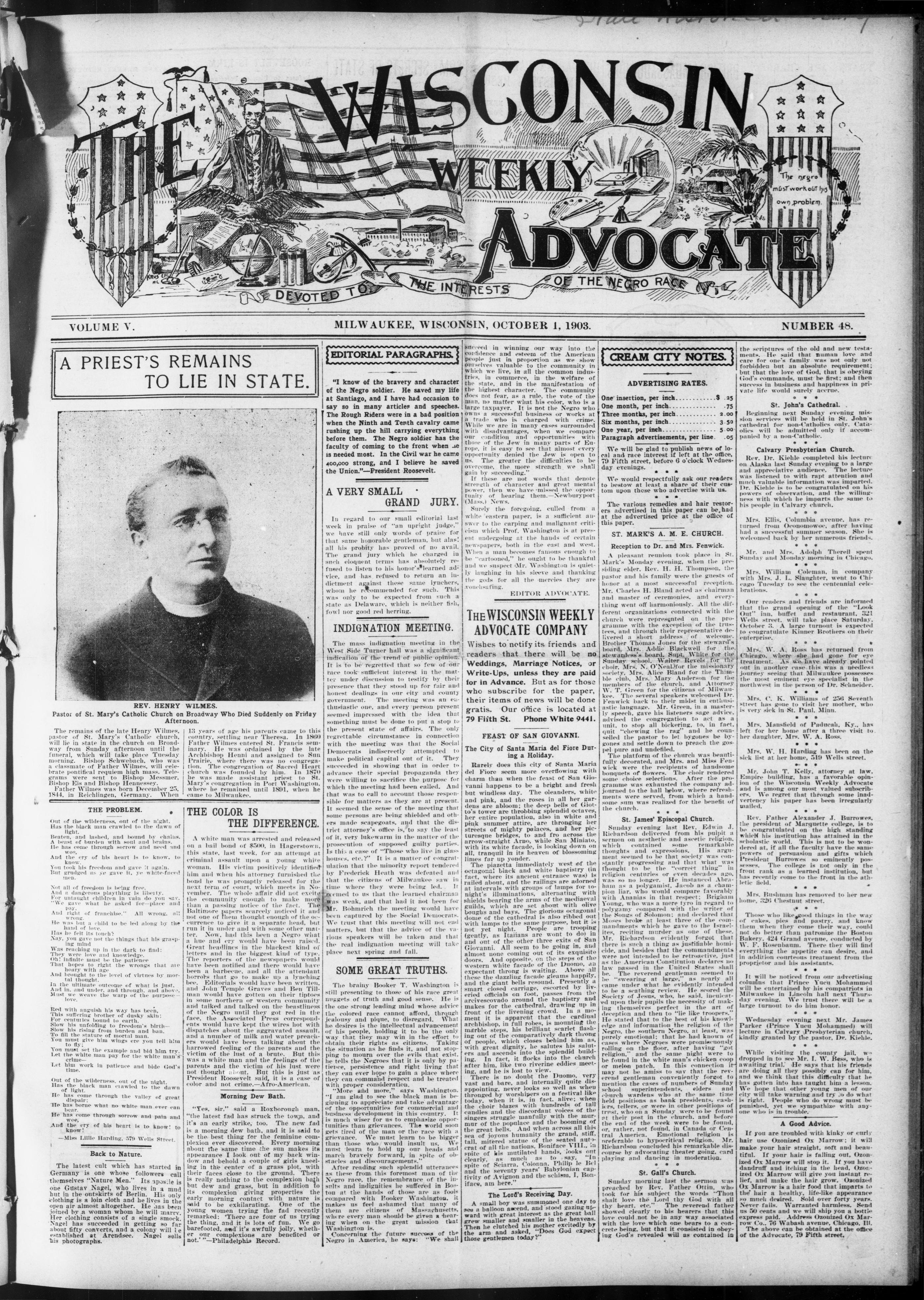
REV. HENRY WILMES.
Pastor of St. Mary's Catholic Church on Broadway Who Died Suddenly on Friday Afternoon.
The remains of the late Henry Wilmes, pastor of St. Mary's Catholic church, will lie in state in the church on Broadway from Sunday afternoon until the funeral, which will take place Tuesday morning. Bishop Schwebach, who was a classmate of Father Wilmes, will celebrate pontifical requiem high mass. Telegrams were sent to Bishop Messmer, Bishop Eis and Bishop Hennessey. Father Wilmes was born December 25, 1844, in Reichlingen, Germany. When 13 years of age his parents came to this country, settling near Theresa. In 186 Father Wilmes entered St. Francis seminary. He was ordained by the late Archbishop Henni and assigned to Su Prairie, where there was no congregation. The congregation of Sacred Heart church was founded by him. In 187 he was made assistant priest to St Mary's congregation in Port Washington where he remained until 1891, when he came to Milwaukee.
Has the black man crawled to the dawn of light.
Beaten, and lashed, and bound by chains.
A beast of burden with soul and brains.
He has come through sorrow and need and woe.
And the cry of his heart is to know, to know.
You took his freedom and gave it again.
But grudged as ye gave it, ye white-faced men.
Not all of freedom is being free.
And a dangerous plaything is liberty.
For untaught children in vain do you say.
"We gave what he asked for—place and pay.
And right of franchise." All wrong, all wrong.
He was but a child to be led along by the hand of love.
Has he felt its touch?
Nay, you gave not the things that his grasping mind
Was reaching up in the dark to find:
They were love and knowledge.
Oh! infinite must be the patience
That hopes to right the wrongs that are hoary with age
And brought to the level of virtues by mortal thought.
In the ultimate outcome of what is just.
And in, and under, and through, and above.
Must we weave the warp of the purpose—love.
Red with anguish his way has been.
This suffering brother of dusky skin;
For centuries bound to earth.
Slow his unfolding to freedom's birth—
Slow his rising from burden and ban.
To fill the stature of mortal man.
You must give him wings ere you tell him to fly;
You must set the example and bid him try.
Let the white man pay for the white man's crime—
Let him work in patience and bide God's time.
Out of the wilderness, out of the night.
Has the black man crawled to the dawn of light.
He has come through the valley of great dispair;
He has borne what no white man ever can bear.
He has come through sorrow and pain and woe,
And the cry of his heart is to know! to know!
—Miss Lillie Harding, 579 Wells Street.
The latest cult which has started in Germany is one whose followers call themselves "Nature Men." Its apostle is one Gustav Nagel, who lives in a mud hut in the outskirts of Berlin. His only clothing is a loin cloth and he lives in the open air almost altogether. He has been joined by a woman whom he will marry. Her clothing consists of a single smock. Nagel has succeeded in getting so far about fifty converts, and a colony will be established at Arendsee. Nagel sells his photographs.
VOLUME V.
THE PROBLEM.
Back to Nature.
13 years of age his parents came to this country, settling near Theresa. In 1860 Father Wilmes entered St. Francis seminary. He was ordained by the late Archbishop Henni and assigned to Sun Prairie, where there was no congregation. The congregation of Sacred Heart church was founded by him. In 1870 he was made assistant priest to St. Mary's congregation in Port Washington, where he remained until 1891, when he came to Milwaukee.
THE COLOR IS THE DIFFERENCE.
A white man was arrested and released on a bail bond of $500, in Hagerstown, this state, last week, for an attempt at criminal assault upon a young white woman. His victim positively identified him and when his attorney furnished the bond he was promptly released for the next term of court, which meets in November. The whole affair did not excite the community enough to make more than a passing notice of the fact. The Baltimore papers scarcely noticed it and not one of them thought enough of the occurrence to give it a separate head, but run it in under and with some other matter. Now, had this been a Negro what a hue and cry would have been raised. Great headlines in the blackest kind of letters and in the biggest kind of type. The reporters of the newspapers would have been notified and there would have been a barbecue, and all the attendant horrobs that go to make up a lynching bee. Editorials would have been written, and John Temple Graves and Ben Tillman would have gotten on their tiptoes in some northern or western community and talked and talked on the beastliness of the Negro until they got red in the face, the Associated Press correspondents would have kept the wires hot with dispatches about the aggravated assault, and a number of milk and water preachers would have been talking about the harrowed feeling of the parents and the victim of the lust of a brute. But this was a white man and the feelings of the parents and the victim of his lust were not thought about. But this is just as President Roosevelt said, it is a case of color and not crime.—Afro-American.
"Yes, sir." said a Roxborough man, "the latest fad has struck the town, and it's an early strike, too. The new fad is a morning dew bath, and it is said to be the best thing for the feminine complexion ever discovered. Every morning about the same time the sun makes its appearance I look out of my back window and behold a couple of girls kneeling in the center of a grass plot, with their faces close to the ground. There is really nothing to the complexion bath but dew and grass, but in addition to its complexion giving properties the early morning contact with nature is said to be exhilarating. One of the young women trying the fad recently remarked: 'There are four of us trying the thing, and it is lots of fun. We go barefooted, and it's awfully jolly, whether our complexions are benefited or not.'"—Philadelphia Record.
Morning Dew Bath.
EDITORIAL PARAGRAPHS
"I know of the bravery and character of the Negro soldier. He saved my life at Santiago, and I have had occasion to say so in many articles and speeches. The Rough Riders were in a bad position when the Ninth and Tenth cavalry came rushing up the hill carrying everything before them. The Negro soldier has the faculty of coming to the front when he is needed most. In the Civil war he came 400,000 strong, and I believe he saved the Union."—President Roosevelt.
A VERY SMALL GRAND JURY.
In regard to our small editorial last week in praise of "an upright judge," we have still only words of praise for that same honorable gentleman, but alas! all his probity has proved of no avail. The grand jury which he charged in such eloquent terms has absolutely refused to listen to his honor's learned advice, and has refused to return an indictment against these same lynchers, whom he recommended for such. This was only to be expected from such a state as Delaware, which is neither fish, fowl nor good red herring.
INDIGNATION MEETING.
The mass indignation meeting in the West Side Turner hall was a significant indication of the trend of public opinion. It is to be regretted that so few of our race took sufficient interest in the matter under discussion to testify by their presence that they stood up for fair and honest dealings in our city and county government. The meeting was an enthusiastic one, and every person present seemed impressed with the idea that something must be done to put a stop to the present state of affairs. The only regrettable circumstance in connection with the meeting was that the Social Democrats indiscreetly attempted to make political capital out of it. They succeeded in showing that in order to advance their special propaganda they were willing to sacrifice the purpose for which the meeting had been called. And that was to call to account those responsible for matters as they are at present. It seemed the sense of the meeting that some persons are being shielded and others made scapegoats, and that the district attorney's office is, to say the least of it, very lukewarm in the matter of the prosecution of supposed guilty parties. Is this a case of "Those who live in glass houses, etc.?" It is a matter of congratulation that the minority report tendered by Frederiek Heath was defeated and that the citizens of Milwaukee saw in time where they were being led. It seemed to us that the learned chairman was weak, and that had it not been for Mr. Bohmrich the meeting would have been captured by the Social Democrats. We trust that this meeting will not end matters, but that the advice of the various speakers will be taken and that the real indignation meeting will take place next spring and fall.
SOME GREAT TRUTHS.
The brainy Booker T. Washington is still presenting to those of his race great nuggets of truth and good sense. He is the one strong leading mind whose advice the colored race cannot afford, through jealousy and pique, to disregard. What he desires is the intellectual advancement of his people, holding it to be the only way that they may win in the effort to obtain their rights as citizens. Taking the situation as he finds it, and not stopping to mourn over the evils that exist, he tells the Negroes that it is only by patience, persistence and right living that they can ever hope to gain a place where they can command respect and be treated with proper consideration.
"More and more," says Washington. "I am glad to see the black man is beginning to appreciate and take advantage of the opportunities for commercial and business development in this country. It is much wiser for us to emphasize opportunities than grievances. The world soon gets tired of the man or the race with a grievance. We must learn to be bigger than those who would insult us. We must learn to hold up our heads and march bravely forward, in spite of obstacles and discouragements."
After reading such splendid utterances as these from this foremost man of the Negro race, the remembrance of the insults and indignities he suffered in Boston at the hands of those are as fools compared with Booker Washington, it makes us feel ashamed that many of them are citizens of Massachusetts, where every man should be given a hearing when on the great mission that Washington is. Concerning the future success of the Negro in America, he says: "We shall
succeed in winning our way into the confidence and esteem of the American people just in proportion as we show ourselves valuable to the community in which we live, in all the common industries, in commerce, in the welfare of the state, and in the manifestation of the highest character. The community does not fear, as a rule, the vote of the man, no matter what his color, who is a large taxpayer. It is not the Negro who owns a successful business or works at a trade who is charged with crime. While we are in many cases surrounded with disadvantages, when we compare our condition and opportunities with those of the Jew in many parts of Europe, it is easy to see that almost every opportunity denied the Jew is open to us. The greater the difficulties to be overcome, the more strength we shall gain by succeeding."
If these are not words that denote strength of character and great mental power, then we have missed the opportunity of hearing them.—Newburyport (Mass.) News.
Surely the foregoing, culled from a white eastern paper, is a sufficient answer to the carping and malignant criticism which Prof. Washington is at present undergoing at the hands of certain newspapers, both in the east and west. When a man becomes famous enough to be "cartooned," he ought to be thankful and we suspect Mr. Washington is quietly laughing in his sleeve and thanking the gods for all the mercies they are vouchsafing.
EDITOR ADVOCATE.
THE WISCONSIN WEEKLY ADVOCATE COMPANY
Wishes to notify its friends and readers that there will be no Weddings, Marriage Notices, or Write-Ups, unless they are paid for in Advance. But as for those who subscribe for the paper, their items of news will be done gratis. Our office is located at 79 Fifth St. Phone White 9441.
FEAST OF SAN GIOVANNI.
The City of Santa Maria del Fiore Dur ing a Holiday.
Rarely does this city of Santa Maria del Fiore seem more overflowing with charm than when the feast of San Giovanni happens to be a bright and fresh but windless day. The oleanders, white and pink, and the roses in all her gardens are abloom; the deep bells of Giotto's tower are throbbing splendid octaves, her entire population, also in white and pink summer attire, are thronging her streets of mighty palaces, and her picturesque bridges, to and fro across the arrow-straight Arno, while San Miniato, with its white facade, is looking down on all, tranquil in its heaven of blossoming limes far up vonder.
The piazetta immediately west of the octagonal black and white baptistry (in fact, where its ancient entrance was) is railed about, and the railings are adorned at intervals with groups of lamps for tonight's illuminations, alternating with shields bearing the arms of the mediaeval guilds, which are set about with olive boughs and bays. The glorious octagonal dome of the cathedral is also ribbed out with lamps to the same purpose, but it is not yet night. People are trooping (gently, as Italians are wont to do) in and out of the other three exits of San Giovanni. All seem to be going in, and almost none coming out of its exquisite doors. And opposite, on the steps of the western white facade of the Duomo, an expectant throng is waiting. Above all these the dazzling facade gleams happily, and the giant bells resound. Presently a smart closed carriage, escorted by liveried officials on foot, passes from the arcivescovado around the baptistry and makes for the cathedral, drawing up in front of the livening crowd. In a moment it is apparent that the cardinal archbishop, in full robes, is mounting the marble steps, his brilliant scarlet flashing out of the comparatively dark throng of people, which closes behind him as, with great dignity, he salutes his saluters and ascends into the splendid building. In fact, it flocks into the church after him, like two riverine eddies meeting, and he is lost to view.
There is no doubt the Duomo, very vast and bare, and internally quite disappointing, never looks so well as when thronged by worshipers on a festival like today, when it is, in fact, alive; when the choir blazes with hundreds of tall candles and the discordant voices of the singers struggle manfully with the murmur of the populace and the booming of the great bells. And when across all this sea of joyous humanity the grand, stiff, tall, mitered statue of the seated autocrat of all the nations, Boniface VIII., in spite of his mutilated hands, looks out clearly, as much as to say, "In spite of Sciarra, Colonna, Philip le Bel and the seventy years' Babylonian captivity of Avignon and the schism, I, Boniface, am here."
The Lord's Receiving Day.
A small boy was summoned one day to see a balloon ascend, and stood gazing upward with great interest as the great ball grew smaller and smaller in the heavens. Then he clutched his mother excitedly by the arm and asked, "Does God expect those gentlemen today?"
CREAM CITY NOTES.
ADVERTISING RATES.
One insertion, per inch. $ .25
One month, per inch. .75
Three months, per inch. 2.00
Six months, per inch. 3.50
One year, per inch. 5.00
Paragraph advertisements, per line. .05
We will be glad to publish news of local and race interest if left at the office, 79 Fifth street, before 6 o'clock Wednesday evenings.
We would respectfully ask our readers to bestow at least a share of their custom upon those who advertise with us.
The various remedies and hair restorers advertised in this paper can be had at the advertised price at the office of this paper.
ST. MARK'S A. M. E. CHURCH
Reception to Dr. and Mrs. Fenwick.
A pleasant reunion took place in St. Mark's Monday evening, when the presiding elder, Rev. H. H. Thompson, the pastor and his family were the guests of honor at a most successful reception. Mr. Charles H. Bland acted as chairman and master of ceremonies, and everything went off harmoniously. All the different organizations connected with the church were represented on the programme with the exception of the trustees, and through their representative delivered a short address of welcome. Brother Thomas Jones for the steward's board, Mrs. Addie Blackwell for the stewardess's board, Supt. White for the Sunday school, Walter Revels for the choir, Mrs. N. O'Neal for the missionary society, Mrs. Alice Bland for the Thimble club, Mrs. Mary Anderson for the members of the church, and Attorney W. T. Green for the citizens of Milwaukee. The several speakers welcomed Dr. Fenwick back to their midst in enthusiastic language. Mr. Green, in a masterly speech, gave his listeners sage advice, advised the congregation to act as a unit, to stop all bickering, to, in fact, quit "chewing the rag" and he counselled the pastor to let bygones be bygones and settle down to preach the gospel pure and undefiled.
The platform of the church was beautifully decorated, and Mrs. and Miss Fenwick were the recipients of handsome bouquets of flowers. The choir rendered some choice selections. After the programme was exhausted the company adjourned to the hall below, where refreshments were served, from which a handsome sum was realized for the benefit of the church.
St. James' Episcopal Church
Sunday evening last Rev. Edwin J. Richardson delivered from his pulpit a sermon on aesthetic and ascetic religion, which contained some remarkable thoughts and expressions. His argument seemed to be that society was constantly progressing and that what was thought to be the "correct thing" in religion centuries or even decades ago, was so no longer. He instanced Abraham as a polygamist, Jacob as a champion liar, who would compare favorably with Ananias in that respect; Brigham Young, who was a mere tyro in regard to polygamy compared with the writer of the Songs of Solomon; and declared that Moses broke at least three of the commandments which he gave to the Israelites, reciting murder as one of these. Mr. Richardson evidently forgot that there is such a thing as justifiable homicide, and besides that the commandments were not intended to be retroactive, just as the American Constitution declares no law passed in the United States shall be. The reverend gentleman seemed to be "swearing at large," as nearly all came under what he evidently intended to be a scathing review. He scored the Society of Jesus, who, he said, inculcated upon their pupils the necessity of making themselves perfect in the art of deception and then to "lie like troopers." He stated that to the best of his knowledge and information the religion of the Negro, the southern Negro, at least, was purely emotional: that he had known of cases where Negroes were promiscuously rolling on the floor, after having "got religion," and the same night were to be found in the white man's chicken coop or melon patch. In this connection it may not be amiss to say that the reverend gentleman conveniently forgot to mention the cases of numbers of Sunday school superintendents, elders and church wardens who at the same time held positions as bank presidents, cashiers, tellers, or were in other positions of trust, who on a Sunday were to be found at their post in the church, and before the end of the week were to be found, or, rather, not found, in Canada or Central America. Emotional religion is preferable to hypocritical religion. Mr. Richardson concluded his remarkable discourse by advocating theater going, card playing and dancing in moderation.
St. Gall's Church.
Sunday morning last the sermon was preached by Rev. Father Ottin, who took for his subject the words "Thou shalt love the Lord thy God with all thy heart, etc." The reverend father showed clearly to his hearers that this love could not be in any way associated with the love which one bears to a concrete being, but that it consisted in obeying God's revealed will as contained in
the scriptures of the old and new testaments. He said that human love and care for one's family was not only not forbidden but an absolute requirement; but that the love of God, that is obeying God's commands, must be first; and then success in business and happiness in private life would surely accrue.
St. John's Cathedral.
Beginning next Sunday evening mission services will be held in St. John's cathedral for non-Catholics only. Catholics will be admitted only if accompanied by a non-Catholic.
Calvary Presbyterian Church.
Rev. Dr. Kiehle completed his lecture on Alaska last Sunday evening to a large and appreciative audience. The lecture was listened to with rapt attention and much valuable information was imparted. Dr. Kiehle is to be congratulated on his powers of observation, and the willingness with which he imparts the same to his people in Calvary church.
* * *
Mrs. Ellis, Columbia avenue, has returned from Oconomowoc, after having had a successful summer season. She is welcomed back by her numerous friends.
* * *
Mr. and Mrs. Adolph Therell spent Sunday and Monday morning in Chicago.
* * *
Mrs. William Coleman, in company with Mrs. J. L. Slaughter, went to Chicago Tuesday to see the centennial celebrations.
* * *
Our readers and friends are informed that the grand opening of the "Look Out" inn, buffet and restaurant, 321 Wells street, will take place Saturday, October 3. A large turnout is expected to congratulate Kinner Brothers on their enterprise.
Mrs. W. A. Ross has returned from Chicago, where she had gone for eye treatment. As we have already pointed out in another case this was a needless journey seeing that Milwaukee possesses the most eminent eye specialist in the northwest in the person of Dr. Schneider.
Mrs. C. K. Williams of 256 Seventh street has gone to visit her mother, who is very sick in St. Paul, Minn.
Mrs. Mansfield of Paducah, Ky., has left for her home after a three visit to her daughter, Mrs. W. A. Ross.
Mrs. W. H. Harding has been on the sick list at her home, 519 Wells street.
Mr. John T. Kelly, attorney at law, Empire building, has a favorable opinion of the Wisconsin Weekly Advocate and is among our most valued subscribers. We regret that through some inadvertency his paper has been irregularly mailed.
* * *
Rev. Father Alexander J. Burrowes, the president of Marquette college, is to be congratulated on the high standing which his institution has attained in the scholastic world. This is not to be wondered at, if all the faculty have the same powers of persuasion and gifts which President Burrowes so eminently possesses. The college is not only in the front rank as a learned institution, but has recently come to the front in the athletic field.
```markdown
```
Mrs. Bushman has removed to her new home, 326 Chestnut street.
审审
Those who like good things in the way of cakes, pies and pastry, and know them when they come their way, could not do better than patronize the Boston Bakery, 424 Grand avenue, conducted by W. F. Rosenbaum. There they will find everything the appetite can desire, and in addition courteous treatment from the proprietor and his assistants.
---
It will be noticed from our advertising columns that Prince Yucu Mohammed will be entertained by his compatriots in Milwaukee in Lincoln hall next Thursday evening. We trust there will be a large turnout to do him honor.
☆ ☆ ☆
Wednesday evening next Mr. James Parker (Prince Yucu Mohammed) will lecture in Calvary Presbyterian church, kindly granted by the pastor, Dr. Kiehle.
---
While visiting the county jail, we dropped in to see Mr. I. W. Bess, who is awaiting trial. He says that his friends are doing all they possibly can for him, and we think that this difficulty that he has gotten into has taught him a lesson. We hope that other young men of our city will take warning and try to do what is right. People who do wrong must be punished, yet we sympathize with anyone who is in trouble.
A Good Advice.
If you are troubled with kinky or curly hair use Ozonized Ox Marrow; it will make your hair straight, soft and beautiful. If your hair is falling out, Ozonized Ox Marrow will stop it. If you have dandruff and itching in the head, Ozonized Ox Marrow will give you instant relief, and make the hair grow. Ozonized Ox Marrow is a hair food that imparts to the hair a healthy, life-like appearance so much desired. Sold over forty years. Never fails. Warranted harmless. Send us 50 cents and we will ship you a bottle express paid. Address Ozonized Ox Marrow Co., 76 Wabash avenue, Chicago, Ill. The above can be obtained at the office of the Advocate, 79 Fifth street.
FRAUDS ARE CHARGED.
Indians Make Serious Allegations Against the Secretary of the Interior
Washington, D. C., Sept. 29.—Sensational charges of fraud and irregularities are made against Secretary of the Interior Hitchcock and the members of the Dawes commission in a petition for $1,000,000 damages filed by an attorney for the Delaware Indians with the court of claims
The claim, which followed a decision by the supreme court of the District of Columbia dissolving a temporary injunction against Secretary Hitchcock and the Dawes commission, is for expenses the Indians have been put to in defending the title to their lands. The decision in the injunction case was handed down by Justice Anderson.
Case Involves 157,000 Acres.
The case involved the right of the secretary to pass on the 157,000 acres of land in the Cherokee nation segregated for the use of the Delawares. The Indians claimed that the secretary is without authority to approve or disapprove of the segregation, as it had been approved by the Indians interested, and asked that he be enjoined against taking such action pending the adjudication of the same question by the court of claims.
In the petition filed one of the accusations is that members of the Dawes commission are interested in oil leases and companies holding leases made upon their lands by Cherokees who claim title.
Mentioning the members of the commission by name the petition alleges that notwithstanding the lands have been properly segregated, the "Dawes commissioners, disregarding their official duties as agents of the United States, conspired and confederated with the companies to cheat and defraud the petitioners to gain possession of their lands for themselves or for the companies."
Tell of Grants to Outsiders.
It is claimed that the members of the Dawes commission have wrongfully, after segregation was made, allowed more than 200 persons not Delawares to make selections for homes upon parts of the Delaware lands, and have allowed such persons to file applications for allotments.
The commissioners are charged with having sought, by recommendations contained in their report of April 20, 1903, to the secretary of the interior, to cause steps to be taken to prevent the supreme court of the United States from rendering such judgment in the cause as would confirm the title in the Delawares.
The secretary of the interior is charged with unlawful acts to defraud the Indians, such as that of encouraging white men who have married squaws to make claim to Delaware lands.
TO MODERNIZE CHURCH.
The Vatican Interested in the Establishment of a Western Catholic Patriarchate.
Rome, Sept. 29.—An inquiry ordered by the Vatican regarding a movement favorable to the establishment of a western Catholic patriarchate, to include all Anglo-Saxon countries, which might be called semi-independent of Rome, has just been completed.
Evidence was found of the existence of a movement of this kind among the advanced section of the clergy, especially the French and Irish who wish to join forces with America to give to the church a more modern and liberal impulse.
According to the Tribune Pius X., on receiving the abbot of the celebrated monastery of Monte Cassini in the Campana, said: "We shall soon meet, most reverend father, at Monte Cassini." Remarking the effect that his words produced—an impression that his holiness would some day leave the Vatican precincts—he added. "Pray, for all things are obtained by prayer." The Pope is also said to have told the abbot of the Benedictine monastery at Cava Dei Tirriene, near Salerno, that he himself would inaugurate the jubilee of the immaculate conception.
CAMP IS DESTROYED.
Party of New Yorkers Barely Escape with Their Lives in the Adirondack Mountains.
Malone, N. Y., Sept. 29.—Search for the man who shot and killed Millionaire Orlando P. Dexter from ambush while he was driving on his Adirondack estate recently practically has been abandoned. A few deputy sheriffs about Santa Clara are now the sole workers, with little hope of winning the $5000 reward.
Reports from Old Forge say that a camp on Rauquette lake rented by John C. Freund of New York and occupied by his family and guests has been destroyed by fire, which burst simultaneously from every building. The campers were all asleep and barely had time to snatch a few garments and escape. They were taken in boats to neighboring camps. There is no clue to the incendiaries.
BODY FOUND IN CABIN
Hunting Lodge Keeper Thought to Have Killed Himself.
Menominee, Mich., Sept. 29.—[Special.]—A telegram was received in Menominee to the effect that the body of Peter Scholtes, keeper of the hunting lodge of the Sans Souci club of this city, was found dead in the cabin of the camp on Tamarack lake. The deceased was 55 years of age and is survived by a wife and daughter. It is thought that the man committed suicide.
CAPTURE A HOTEL EHIEF
Exciting Fight in Corridor of the Sherman House.
Chicago, Ill., Sept. 29.—Hotel thieves were surprised at work in the Sherman house early today and one of them was captured after an exciting fight in the corridor. Jewelry valued at $2500 and $250 in money was found upon him. The house was searched in vain for the second thief. The captured thief gave his name as Charles Foster of Tiffin, O.
Greatest Organ in the World.
The greatest organ in the world is the new one at Seville, Spain. There are four metal flute stops, each 16 feet long, such as no other organ in Europe possesses. It is also the only organ which has bass-bourdons which give thirty-two vibrations a second and produce a deeper tone than the organ in Murcia, which has hitherto been the deepest toned organ in the world. There are altogether 200 independent stops and five bellows worked by electricity. The cost was $50,-000.
—There were cremated last year in the United States, 3158; England, 452; Germany, 856; Italy, 322; France, 4805 (of which 305 were paid for, paupers are cremated); Switzerland, 217; Sweden, 44; Denmark, 44.
Scotland not only leads in the purebred cattle, but by daily quotations on the London market leads on prime beef likewise.
Sir Michael Herbert Passes Away Suddenly in Switzerland.
ENVOY TO UNITED STATES.
Althought He Was Suffering with Consumption Sir Michael's Death Was
Davos-Platz, Switzerland, Sept. 30.—Sir Michael Herbert, the British ambassador to the United States, died here at 1:40 this afternoon. He had gradually been growing worse since his arrival here; but his death was sudden and unexpected. London, Sept. 30.—Sir Michael Herbert, the British ambassador to the United States, died today at Davos-Platz, Switzerland. The death of Sir Michael Herbert was announced today's session of the Alaskan boundary commission by Chief Justice Alverstone. It was supposedly due
I
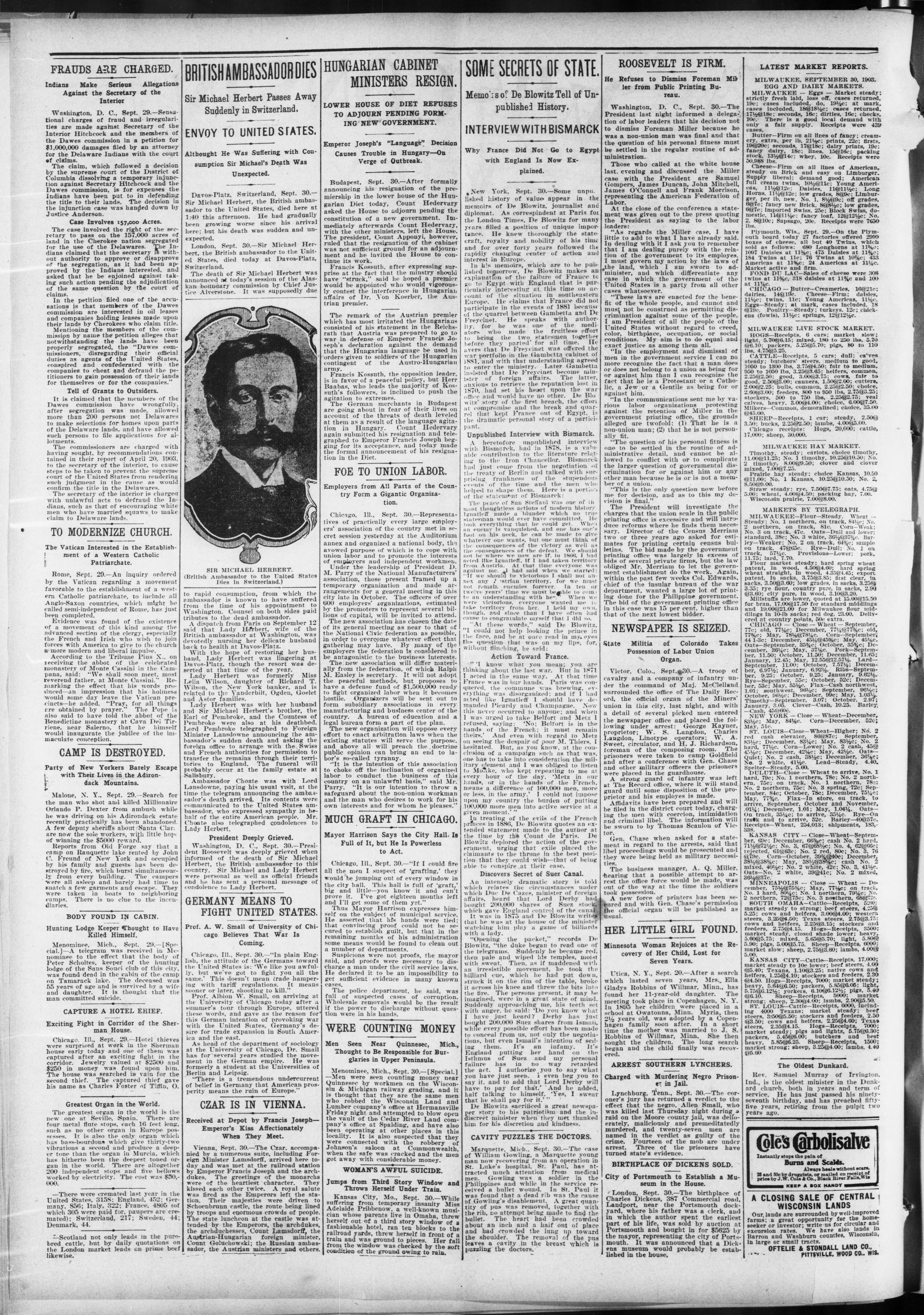
SIR MICHAEL HERBERT.
(British Ambassador to the United States
Dies in Switzerland.)
to rapid consumption, from which the
ambassador is known to have suffered
from the time of his appointment to
Washington. Counsel on both sides paid
tributes to the dead ambassador.
A dispatch from Paris on September 12
said that Lady Herbert, wife of the
British ambassador at Washington, was
devotedly nursing her delicate husband
back to health at Davos-Platz.
With the hope of restoring her hus-
band, Lady Herbert was lingering at
Davos-Platz, though the resort was
deserted at that time of the year.
Lady Herbert was formerly Miss Lelia Wilson, daughter of Richard T. Wilson, the New York banker, and is related to the Vanderbilt, Ogden, Goelet and Astor families.
Lady Herbert was with her husband and Sir Michael Herbert's brother, the Earl of Pembroke, and the Countess of Pembroke were also at his deathbed. Lord Pembroke telegraphed to Foreign Minister Lansdowne announcing the ambassador's sudden death and asking the foreign office to arrange with the Swiss and French authorities for permission to transfer the remains through their territories to England. The funeral will probably occur at the family estate at Salisbury
Ambassador Chonte was with Lord Lansdowne, paying his usual visit, at the time the telegram announcing the ambassador's death arrived. Its contents were communicated to the United States ambassador, who expressed sympathy in behalf of the entire American people. Mr. Choate also telegraphed condolences to Lady Herbert.
President Deeply Grieved.
Washington, D. C., Sept. 30.—President Roosevelt was deeply grieved when informed of the death of Sir Michael Herbert, the British ambassador to this country. Sir Michael and Lady Herbert were personal as well as official friends and he has sent a personal message of condolence to Lady Herbert.
GERMANY MEANS TO FIGHT UNITED STATES.
GERMANY MEANS TO FIGHT UNITED STATES.
Prof. A. W. Small of University of Chicago Believes That War Is Coming.
Chicago, Ill., Sept. 30.—"In plain English, the attitude of the Germans toward the United States is: 'We like you awfully, but we've got to fight you all the same.' This doesn't mean trade hampering with tariff regulations. It means sooner or later, shooting to kill."
Prof. Albion W. Small, on arriving at the University of Chicago today after a summer's tour through Europe, uttered these words, and gave as the reason for this German intention of provoking war with the United States, Germany's desire for trade expansion in South America and the east.
As head of the department of sociology at the University of Chicago, Dr. Small has for several years studied the movement in the German empire. He was formerly a student at the Universities of Berlin and Leipsig. "There is a tremendous undercurrent of belief in Germany that American prosperity means the ruin of Europe."
CZAR IS IN VIENNA.
Received at Depot by Francis Joseph Emperor's Kiss Affectionately When They Meet.
Vienna, Sept. 30.—The Czar, accompanied by a numerous suite, including Foreign Minister Lamsdorff, arrived here today and was met at the railroad station by Emperor Francis Joseph and the archdukes. The greetings of the monarchs were of the heartiest character. They kissed each other twice. A royal salute was fired as the Emperors left the station. Their majesties were driven to Schoenbrunn castle, the route being lined by troops and enormous crowds of people. The state luncheon at the castle was attended by the Emperors, the archdukes, the archduchesses, Count Lamsdorff, the Austrian-Hungarian foreign minister, Count Goluchowski; the Russian ambassador, the Austrian ministers and others.
HUNGARIAN CABINET MINISTERS RESIGN.
LOWER HOUSE OF DIET REFUSES TO ADJOURN PENDING FORMING NEW GOVERNMENT.
Emperor Joseph's "Language" Decision Causes Trouble in Hungary-On Verge of Outbreak.
Budapest, Sept. 30.—After formally announcing his resignation of the premiership in the lower house of the Hungarian Diet today, Count Hedervary asked the House to adjourn pending the constitution of a new government. Immediately afterwards Count Hedervary, with the other ministers, left the House. The president, Count Apponyi, however, ruled that the resignation of the cabinet was not sufficient ground for an adjournment and he invited the House to continue its work.
Francis Kossuth, after expressing surprise at the fact that the ministry should have "struck," said he hoped a premier would be appointed who would vigorously contest the interference in Hungarian affairs of Dr. Von Koerber, the Austrian premier.
The remark of the Austrian premier which has most irritated the Hungarians consisted of his statement in the Reichsrath that Austria was prepared to go to war in defense of Emperor Francis Joseph's declaration against the demand that the Hungarian language be used in orders given to soldiers of the Hungarian contingent of the Austro-Hungarian army. Francis Kossuth, the opposition leader, is in favor of a peaceful policy, but Herr Baabas, who leads the majority of Kossuth's followers, is inclined to push the agitation to extremes.
The German merchants in Budapest are going about in fear of their lives on account of the threats of death leveled at them as a result of the language agitation in Hungary. Count Hedervary again submitted his resignation and telegraphed to Emperor Francis Joseph begging for its acceptance, and today made the formal announcement of his resignation in the Diet.
FOE TO UNION LABOR.
Employers from All Parts of the Country Form a Gigantic Organization
Chicago, Ill., Sept. 30.—Representatives of practically every large employers' association of the country met in secret session yesterday at the Auditorium annex and organized a national body, the avowed purpose of which is to cope with union labor and to promote the interests of employers and independent workmen. Under the leadership of President D. M. Parry of the National Manufacturers' association, those present framed up a temporary organization and made arrangements for a general meeting in this city late in October. The officers of over 600 employers' organizations, estimated by the promoters to represent several billions of capital, will be invited to attend.
The new association has chosen the date of its general meeting as near to that of the National Civic federation as possible, in order to overcome whatever effect that gathering may have. By many of the employers the federation is considered to be antagonistic to the business interests. The new association will differ materially from the federation, of which Ralph M. Easley is secretary. It will not adopt the peaceful methods, but proposes to have a defense fund of $1,500,000 ready to fight organized labor when it becomes hostile. Organizers will be sent out to form subsidiary associations in every manufacturing and business center of the country. A bureau of education and a legal bureau form a part of the plan.
The new organization will oppose every effort to enact arbitration laws when the existing statutes will serve the purpose, and above all will preach the doctrine public opinion can bring an end to labor's so-called tyranny.
"It is the intention of this association to choke off the inclination of organized labor to conduct the business of this country on an unlawful basis," said Mr. Parry. "It is our intention to throw a safeguard about the non-union workman and the man who desires to work for his own interests and for whom he pleases."
MUCH GRAFT IN CHICAGO.
to Act.
Chicago, Ill., Sept. 30.—"If I could fire all the men I suspect of 'grafting,' they would be jumping out of every window in the city hall. This hall is full of 'graft,' big and little—you know it and can't prove it. I've got eighteen months left and I'll get some of them yet."
Thus Mayor Harrison expresses himself on the subject of municipal service. He asserted that his hands were tied; that convincing proof could not be secured to establish guilt, but that in the remaining months of his administration some means would be found to clean out a number of departments.
Suspicions were not proofs, the mayor said, and proofs were necessary to discharge a man under the civil service laws. He declared it to be an impossibility to get sufficient evidence in many known cases. The police department, he said, was full of suspected cases of corruption. Wholesale removals would be the result if the power to discharge without question were in his hands.
WERE COUNTING MONEY
Men Seen Near Quinnesec, Mich. Thought to Be Responsible for Burglaries in Upper Peninsula.
Menominee, Mich., Sept. 30.—[Special.]
—Men were seen counting money near Quinnesec by workmen on the Wisconsin & Michigan railway grading, and it is thought that they are the same men who robbed the Wisconsin Land and Lumber company's office at Hermansville Friday night and attempted to blow open the vault of the Cedar River Land company's office at Spalding, and have also been operating at other places in this locality. It is also suspected that they were connected with the robbery of Johnson's saloon at Commonwealth, when the safe was cracked and the men got away with considerable money.
WOMAN'S AWFUL SUICIDE
Jumps from Third Story Window and Throws Herself Under Train.
Kansas City, Mo., Sept. 30.—While suffering from temporary insanity Miss Adelaide Pribbenow, a well-known musician whose parents live in Omaha, threw herself out of a third story window of a fashionable hotel, ran ten blocks to the railroad yards, threw herself in front of a train and was ground to pieces. Her fall from the window was checked by the soft condition of the ground owing to rain.
SOME SECRETS OF STATE.
Memoirs of De Blowitz Tell of Unpublished History.
INTERVIEWWITHBISMARCK
New York, Sept. 30.—Some unpublished history of value appear in the memoirs of De Blowitz, journalist and diplomat. As correspondent at Paris for the London Times, De Blowitz for many years filled a position of unique importance. He knew thoroughly the statecraft, royalty and nobility of his time and for over forty years followed the rapidly changing center of action and interest in Europe.
In his memoirs, which are to be published tomorrow, De Blowitz makes an explanation of the failure of France to go to Egypt with England that is particularly interesting at this time on account of the situation in southeastern Europe. He claims that France did not participate in the events of 1881 because of the quarrel between Gambetta and De Freycinet. He speaks with authority, for he was one of the mediators who made the fruitless effort to bring the two statesmen together before they parted for all time. He avers that De Freycinet was offered the war portfolio in the Gambetta cabinet of 1881, and with that understanding agreed to enter the ministry. Later Gambetta insisted that De Freycinet become minister of foreign affairs. The latter, anxious to retrieve the reputation lost in 1870, had set his heart upon the war office and would have no other. De Blowitz' story of the first breach, the effort at compromise and the break and quarrel that kept France out of Egypt, is the dramatic personal story of a participant.
Unpublished Interview with Bismarck.
A heretofore unpublished interview with Bismarck, had in 1878, is a valuable contribution to the literature relating to the Iron Chancellor. Bismarck had just come from the negotiation of the treaty of Berlin and talked with surprising frankness of the stupendous events of the time and the men who helped to shape them. Here is a portion of the statement of Bismarck:
The peace of San Stefani was one of the most thoughtless actions of modern history. Ignatleff made a blunder which no true statesman would ever have committed. He took everything that he could get. When an enemy is vanquished, and one has one's foot on his neck, he can be made to give whatever one wants, but one must think of the consequences of the victory as well as the consequences of the defeat. We should not be where we now are if, in 1866, I had acted like Ignatleff. If I had taken territory from Austria. At that time everyone was against me. I had said when we started: "If we should be victorious I shall not anex any 7 strian territory, for we must not remain, enemies forever. In ten or twelve years' time we must be able to come to an understanding with her." When we were victorious, everyone wanted me to take territory from her. I held my own, though, and since than I have often had cause to congratulate myself that I did so.
"At these words," said De Blowitz, "I could not help looking the prince in the face, and he at once read in my eyes the question that was on my lips, for, without flinching he said:
Action Toward France.
"I know what you mean; you are thinking about the last war. But in 1871 I acted in the same way. At that time France was in our hands. Paris was conquered, the commune was brewing, everything was disorganized; and if I had acted like Ignatieff I should have demanded Picardy and Champagne. Now this never occurred to anyone; and when I was urged to take Belfort and Metz I refused, saying: 'No; Belfort is in the hands of the French; it must remain theirs.' And even with regard to Metz on seeing the despair of poor M. Thiers, I hesitated. But, as you know, at the conclusion of a campaign such as that was, one has to take into consideration the military element and I was obliged to listen to Morkke, who kept repeating to me at every hour of the day. Metz in our hands, or in the hands of the French, means a difference of 100,000 men, more or less, in the army.' I could not impose upon my country the burden of putting 100,000 more men into active service at a given moment."
In treating of the evils of the French princes in 1886, De Blowitz quotes an extended statement made to the author at the time by the Count de Paris. De Blowitz deplored the action of the government, urging that exile placed the claimants to the throne in the best position that they could wish—that of being able to conspire at their ease.
Discovers Secret of Suez Canal.
An intensely dramatic story is told which relates the circumstances under which Duc De Cazes, minister of foreign affairs, heard that Lord Derby had bought 200,000 shares of Suez stock, which gave England control of the canal. It was in 1875 and De Blowitz writes that he was at the house of the minister watching him play a game of billiards with a lady.
"Opening the packet," records De Blowitz, "the duke began to read one of the telegrams. Suddenly he became red, then pale and wiped his temples, moist with sweat. Then, as if maddened with an irresistible movement, he took the billiard cue, which he had put down, struck it on the rim of the table, broke it across his knee and threw the bits into the fire. The persons present, it may be imagined, were in a great state of mind. Suddenly approaching me, his teeth set with anger, he said: 'Do you know what I have just heard? Derby has just bought 200,000 Suez shares from Ismail, while every possible effort has been made to conceal from us, not only the negotiations, but even Ismail's intention of sealing them. It's an infamy. It's England putting her hand on the Isthmus of Suez and my personal failure has in no way retarded the act. I authorize you to say what you have just seen. I even beg you to say it, and to add that Lord Derby will have to pay for that.' And he added, half talking to himself. 'Yes, I swear that he shall pay for it.'"
De Blowitz sacrificed a great newspaper story to his patriotism and the indiscreet minister when they met thanked him for his discretion and kindness.
CAVITY PUZZLES THE DOCTORS.
Marquette, Mich., Sept. 30.—The case of William Gowling, a Marquette young man now recovering from an operation in St. Luke's hospital, St. Paul, has attracted much attention from medical men. Gowling was a soldier in the Philippines and while in the service received a bullet wound. In St. Paul it was found that a dead rib was the cause of Gowling's disablement. A great quantity of pus was removed, together with the rib, no attempt being made to find the bullet. The heart had been crowded about an inch and a half out of place and had crowded the lung up toward the shoulder. The removal of the pus leaves a cavity in the breast which is puzzling the doctors.
ROOSEVELT IS FIRM
He Refuses to Dismiss Foreman Mikler from Public Printing Bureau.
Washington, D. C., Sept. 30.—The President last night informed a delegation of labor leaders that his decision not to dismiss Foreman Miller because he was a non-union man was final and that the question of his personal fitness must be settled in the regular routine of administration.
Those who called at the white house last, evening and discussed the Miller case with the President are Samuel Gompers, James Duncan, John Mitchell, James O'Connell and Frank Morrison, representing the American Federation of Labor.
At the close of the conference a statement was given out to the press quoting the President as saying to the labor leaders:
"As regards the Miller case, I have little to add to what I have already said. In dealing with it I ask you to remember that I am dealing purely with the relation of the government to its employees. I must govern my action by the laws of the land, which I am sworn to administer, and which differentiate any case in which the government of the United States is a party from all other cases whatsoever.
"These laws are enacted for the benefit of the whole people, and cannot and must not be construed as permitting discrimination against some of the people. I am President of all the people of the United States without regard to creed, color, birthplace, occupation, or social conditions. My aim is to do equal and exact justice as among them all.
"In the employment and dismissal of men in the government service I can no more recognize the fact that a man does or does not belong to a union as being for or against him than I can recognize the fact that he is a Protestant or a Catholic, a Jew or a Gentile as being for or against him.
"In the communications sent me by various labor organizations protesting against the retention of Miller in the government printing office, the grounds alleged are twofold: (1) That he is a non-union man; (2) that he is not personally fit.
"The question of his personal fitness is one to be settled in the routine of administrative detail, and cannot be allowed to conflict with or to complicate the larger question of governmental discrimination for or against him or any other man because he is or is not a member of a union.
"This is the only question now before me for decision, and as to this my decision is final."
The President will investigate the charges that the union scale in the public printing office is excessive and will introduce reforms where he finds them necessary. Director of the Census Merriam two or three years ago asked for estimates for printing certain census bulletins. The bid made by the government printing office was largely in excess of bids of several private firms, but the law obliged Mr. Merriam to let the government establishment do the work. Again, within the past few weeks Col. Edwards, chief of the insular bureau of the war department, wanted a large lot of printing done for the Philippine government. The bid of the government printing office in this case was 15 per cent. higher than that of the next lowest bidder.
NEWSPAPER IS SEIZED.
State Militia of Colorado Takes Possession of Labor Union Organ.
Victor, Colo., Sept. 30.—A troop of cavalry and a company of infantry under the command of Maj. McClelland surrounded the office of The Daily Record, the official organ of the Miners' union in this city, last night, and with a detail of several picked men entered the newspaper office and placed the following under arrest: George Kayner, proprietor; W. S. Langdon, Charles Langdon, Linotype operators; W. A. Sweet, circulator, and H. J. Richardson, foreman of the composing room. The prisoners were taken to camp Goldfield and after a conference with Gen. Chase and other military officers the prisoners were placed in the guardhouse. A strong guard of infantry was left at The Record office, where it will stand guard until some disposition of the proprietor and his employees is made.
Affidavits have been prepared and will be filed in the district court today, charging the men with coercion, intimidation and criminal libel. The information will be sworn to by Thomas Scanlon of Victor. Gen. Chase when asked for a statement in regard to the arrests, said that libel proceedings would be prosecuted and they were being held as military necessities. The business manager, A. Q. Miller, hearing that a possible attempt to arrest the office force would be made, was out of the way at the time the soldiers took possession. A new force of printers has been secured and with Gen. Chase's permission the official organ will be published as usual.
HER LITTLE GIRL FOUND.
Minnesota Woman Rejoices at the Recovery of Her Child, Lost for Seven Years.
Utica, N. Y., Sept. 20. After a search which lasted seven years, Mrs. Ella Gladys Robbins of Willmar, Minn., has found her 11-year-old daughter. The meeting took place in Copenhagen, N. Y. In 1895 her children were placed in a school at Owatonna, Minn. Myria, then $2\frac{1}{2}$ years old, was adopted by a Copenhagen family soon after. In a short time the mother was married to J. S. Robbins of Willmar, Minn. She then sought the children. The long search began and the child finally was recovered.
ARREST SOUTHERN LYNCHERS.
Charged with Murdering Negro Prisoner in Jail,
Lynchburg, Tenn., Sept. 30.—The coroner's jury has returned a verdict to the effect that the negro, Allen Small, who was killed last Thursday night during a raid on the Moore county jail, was deliberately, maliciously and premeditatedly murdered, and twenty-seven men are named in the verdict as guilty of the crime. Fourteen of the mob are under arrest. Three of the prisoners have turned state's evidence.
BIRTHPLACE OF DICKENS SOLD.
City of Portsmouth to Establish a Museum in the House.
London, Sept. 30.—The birthplace of Charles Dickens, 387 Commercial road, Landport, near the Portsmouth dockyard, where his father was a clerk, and in which the author spent the earliest part of his life, was sold by auction at Portsmouth and bought in for $5625 by the mayor, representing the city of Portsmouth. It was announced that a Dickens museum would probably be established in the house.
LATEST MARKET REPORTS.
MILWAUKEE, SEPTEMBER 30, 1903.
EGG AND DAIRY MARKETS.
MILWAUKEE — Eggs — Market steady;
strictly fresh laid, loss off, cases returned,
19c; cases included, do, 19½c; at mark,
cases included, 18@18½c; cases returned,
17½@18c; seconds, 16c; dirtles, 16c; checks,
10c. There is a good local demand with
only a fair supply. Receipts were 439
cases.
Butter—Firm on all lines of fancy; cream-
ery, extra, per lb, 21½c; prints, 22c; firsts,
19@20c; seconds, 17@18c; dairy prints, 19c;
fancy dairy, 18c; lines, 15@16c; packing
stock, 13½@14c; whey, 10c. Receipts were
50,988 lbs.
Cheese—Firm on all lines of American, steady on Brick and easy on Limburger. Supply liberal; demand good; American full cream twins, 10½%11c; Young Americas, 11½%12c; Daisies, 11%11c; Long Horns, 11½%12c; low grades, 8@9c; Limburger, per lb, new, No. 1, 8½%19c; off grades, 6@7c; fancy new Brick, 8@8½c; low grades, 6@7c; imported Swiss, 25c; Block Swiss, domestic, 11%11½c; fancy loaf, 12%12½c. No. 2, 8@10c; Sapsago, 20c. Receipts were 7630 lbs.
Plymouth, Wis., Sept. 29.—On the Plymouth board today 27 factories offered 2999 boxes of cheese, all but 40 Twins, which sold as follows: 680 Longhorns at 11½c; 1097 Daisies at 11½c; 475 Daisies at 11½c; 184 Twins at 11c; 76 Twins at 10½c; 433 Americas at 11½c; 24 Americas at 11½c. Market active and firm.
FOND DU LAC—Sales of cheese were 308 twins at 11½c; 318 daisies at 11½c and 100 at 11½c.
CHICAGO — Butter—Creameries, 16@21c; dairles, 14@19c. Cheese—Firm; daisles, 11%c; twins, 11c; Young Americas, 11%c. Eggs—Steady; at mark, cases included, 18 @19c. Poultry—Steady; turkeys, 12c; chickens (fowls), 11%c; springs, 12@12%c.
MILWAUKEE LIVE STOCK MARKET.
MILWAUKEE LIVE STOCK MARKET.
HOGS—Receipts, 6 cars; market slow; light, 5.70@6.15; mixed, 180 to 250 lbs, 5.70@6.10; packers, 5.25@5.70; pigs, 80 to 110 lbs, 4.75@5.25.
CATTLE—Receipts, 5 cars; dull; calves steady; butchers' steers, medium to good, 1050 to 1300 lbs, 3.75@4.50; fair to medium, 950 to 1050 lbs, 3.25@3.65; helfers, common, 2.25@2.50; good, 3.00@3.75; cows, fair to good, 2.50@3.00; canners, 1.50@2.00; cutters, 2.00@2.25; bulls, common, 2.25@2.50; choice, 2.60@3.00; feeders, 800 to 950 lbs, 2.75@3.25; stockers, 500 to 750 lbs, 2.25@2.75; veal calves, heavy, 3.00@4.00; choice, 6.00@7.50. Milkers—Common, demoralized; choice, 35.00@45.00.
SHEEP—Receipts, 1 car; steady, 2.50@3.50; bucks, 2.25@2.50; lambs, 4.00@5.00.
Chicago receipts: Hogs, 20,000; cattle, 17,000; sheep, 30,000.
MILWAUKEE HAY MARKET.
Timothy, steady; carlots, choice timothy,
11.00@11.25; No. 1 timothy, 10.25@10.50; No.
2 timothy, 8.00@9.50; clover and clover
mixed, 7.00@7.25.
Prairie hay steady; choice Kansas, 10.50
@11.00; No. 1 Kansas, 10.25@10.50; No. 2,
8.50@9.00.
Straw steady: rye, 7.50@7.75; oats, 4.75@
5.00; wheat, 4.00@4.50; packing hay, 7.00.
Wisconsin prairie, 7.00@8.00.
MARKETS BY TELEGRAPH
MILWAUKEE—Flour—Steady. Wheat
Steady; No. 1 northern, on track, $84\frac{1}{4}$c; No.
2 northern, on track, 81c. Corn—Weak;
No. 3 on track, 47c. Oats—Dull and lower;
standard, 38c; No. 3 white, $36\frac{1}{4}$c. Barley—Weaker; No. 2 on track, $64\frac{1}{4}$c; sample
on track, $47@65c$. Rye—Dull; No. 1 on
track, $57\frac{1}{4}$c. Provisions—Lower; pork,
11.75; lard, 7.70.
Flour market steady; hard spring wheat
patent, in wood, 4.50@4.60; hard spring
wheat straight, in wood, 4.35@4.45; export
patent, in sacks, 3.75@3.85; first clear, in
sacks, 3.50@3.60; low grades, in sacks, 3.25@
3.35; rye flour, country pure, in sacks, 2.90
@3.60; city pure, in wood, 3.10@3.20.
Millstuffs are lower, quoted at 15.00@15.50
for bran, 17.00@17.50 for standard middlings
and 19.00@21.00 for Milwaukee flour
middlings in 10-lb sacks; red dog, 23.00. Delivered
at country points, 50c extra.
CHICAGO — Close — Wheat — September, 77c; old, 77%c; December, 77½%c; old, 77%c; May, 78½%c@78½c. Corn—September, 44 1.3c; December, 45½%c@45½c; May, 45½c. Oats—September, 35½c; October, 35½c; December, 36½c; May, 37½c. Pork—September, 11.50; October, 11.50; December, 11.65; January, 12.45; May, 12.55@12.57½. Lard—September, 11.00; October, 7.57½; December, 6.97½; January, 6.92½. Ribs—September, 9.25; October, 9.25; January, 9.62½. Rye—September, 55c; October, 52c; December, 53c; May, 55½c. Flax—Cash northwest, 1.01; southwest, 96½c; September, 96½c; October, 96½c; December, 99c; May, 1.03½. Timothy—September, 3.07; October, 2.97; January, 3.05. Clover—Cash, 10.25. Barley—Cash, 45@60c.
NEW YORK — Close — Wheat—December, 83½c; May, 84½c. Corn—December, 52c; May, 51c.
ST. LOUIs—Close—Wheat—Higher; No. 2 red cash elevator, 80%87c; September, 83½c; December, 83½c; May, 83½c; No. 2 hard, 77½c; Corn—Lower; No. 2 cash, 45@ 45½c; December, 42½c; May, 42½c; Oats—Qulet; No. 2 cash, 38½c; December, 367½c; No. 2 white, 41½c; Lead—Steady, 4.40, Spelter—Steady, 5.00.
DULUTH—Close — Wheat to arrive, No. 1 hard, 79c; No. 1 northern, 78c; No. 2 northern, 75c; on track, No. 1 northern, 78c; No. 2 northern, 75c; No. 3 spring, 72c; September, 84c; October, 78c; December, 75½c; May, 77½c. Flax—In store, on track, to arrive, September, October and November, 01¼; December, 1.01; May, 1.04½. Oats—On track, 35½c; to arrive, 35½c. Rye—On trak® and to arrive, 52c. Barley—40%57c. Receipts—Wheat, 254,013; shipments, 183,338.
KANSAS CITY — Close-Wheat—September, 63c; December, 66c; cash No. 2 hard, 71½@72½c; No. 3, 67@68½c; No. 4, 62@66c; rejected, 61@63c; No. 2 red, 80c; No. 3, 76@79c. Corn—October, 39¼@40c; December, 38½@38½c; May, 38½@38½c; cash No. 2 mixed, 40½c; No. 2 white, 42c; No. 3, 41½c. Oats—No. 2 white, 39@41c; No. 2 mixed, 36½@37c.
MINNEAPOLIS — Close — Wheat — December, 75½@75½c; May, 77½c; on track, No. 1 hard, 80½c; No. 1 northern, 79½c; No. 2 northern, 72½c; 75½c; No. 3 northern, 68½c.
SOUTH OMAHA—Cattle—Recelpts, 5500; market steady to strong; beef steers, 4.25@5.25; cows and heifers, 3.00@4.00; western steers, 3.25@4.50; Texas steers, 2.75@3.75; cows and heifers, 2.25@3.15; stockers and feeders, 2.75@4.15. Hogs—Recelpts, 3500; market steady, closed shade lower; heavy, 5.60@5.75; mixed, 5.65@5.70; light, 5.80@5.90; plgs, 5.00@5.75. Sheep—Recelpts, 6000; market slow; sheep, 2.75@3.60; lambs, 4.00@5.00.
KANSAS CITY—Cattle—Receipts, 17.000;
market steady to 10c lower; beef steers, 4.00
@5.40; Texans, 1.10@3.25; native cows and
heifers, 1.25@4.10; stockers and feeders, 2.30
@4.50. Hogs—Receipts, 7000; market steady;
heavy, 5.64@6.50; packers, 5.85@6.05; light,
5.75@6.12½; yorkers, 6.10@6.12½; pigs, 5.40
@6.10. Sheep—Receipts, 5000; market
strong; sheep, 2.30@4.00; lambs, 2.90@5.50.
ST. LOUIS—Cattle—Receipts, 6000, including
4000 Texans; market steady; beef
steers, 3.50@5.50; stockers and feeders, 2.50
@3.50; cows and heifers, 2.25@4.60; Texas
steers, 2.35@4.15. Hogs—Receipts, 7000;
market steady; plgs and lights, 5.75@6.30;
packers, 5.45@6.00; butchers and best
heavy, 5.85@6.25. Sheep—Receipts, 1500;
market strong; sheep, 3.25@4.00; lambs, 4.40
@5.60.
The Oldest Dunkard.
Rev. Samuel Murray of Irvington, Ind., is the oldest minister in the Dunkard church, both in years and term of service. He has just passed his ninety-seventh birthday, and has preached fifty-five years, retiring from the pulpit two years ago.
Cole's Carbolisalve
Instantly stops the pain of
Burns and Scalds.
Always heals without scars.
25 and 50c by druggists, or mailed on receipt of price by J.W. Cole & Co., Black River Falls, Wis
KEEP A BOX HANDY
A CLOSING SALE OF CENTRAL WISCONSIN LANDS
Our lands are surrounded by well-improved farms; a great opportunity for the home-seeker or investor; write us for circular and excursion rates. We have also lands in Barron and Washburn counties, Wisconsin, in large or small tracts. OFTELIE & STONDALL LAND CO., PITTSVILLE, WOOD CO., WIS.
IN MEMORIAM
A few more days and you must go,
I fain would keep you still,
Did I not seasonably know
You will not fill the bill.
Although the one I paid for you
Seems now extremely steep.
For there are others still on view
Inordinately cheap!
My heart warms to you still—and yet
The weather's getting cold.
It's likely to be very wet.
And you are somewhat old!
You're out of gear, your ribbon's soiled.
You have a yellow hue.
Your whole appearance's greatly spoiled-
My summer hat, adieu!
Best friend of mine in many ways,
When you were clean and new,
We had some most delightful days.
Which—we'll keep ente nous!
They've called you in, your day is done,
Go, take a well-earned rest.
For now the summer season's gone,
We like our derbies best!
—New York Sun.
A. Modern Cinderella.
"Mamma, mamma, what do you think," cried Lyda Stuart, as she rushed into the room where her mother sat, with flushed cheeks and dishevelled hair. "I have found two tickets for the ball tomorrow night—no name or anything on them by which I could trace the owner—and, oh, mamma, I want to use them; I want to go!" "But, my dear," expostulated Mrs. Stuart, as Lyda paused breathlessly, "how—" "Why, you kept one or two of my evening gowns, you know, mother, and I am sure the white one would do beautifully, and Tom is still quite presentable in his dress suit, even if it is too tight—and here are the tickets, so why not? The only thing is that I want you to go, too, darling," with an embracing smile on her mother's cheek.
"I should not care in the least about it, dear, and am afraid you will be disappointed."
"Oh, I know I shall be in it, and not of it, but that does not matter. I shall enjoy just watching it all, and hearing the music. I may combine business with pleasure, too, mamma, by getting some new ideas for my sketches."
"We will see what your brother says, dear." Mrs. Stuart answered.
dear." Mrs. Stuart answered.
She would have been loath indeed to deprive this daughter of hers of any pleasure that might come in her way, for in the reverses that had fallen on the family since Mr. Stuart's death, his wife's greatest grief had been for Lyda. The disaster had come on the very eve of her coming out, and ever since they left their beautiful English home and came to this big, seething, lonely American city, Lyda had worked steadily at illustrating.
Now she was making a success at it, and there was also beginning to be quite a demand for her dainty water color work.
When Tom came home Lyda immediately pounced upon him and related her wonderful news. He readily agreed to take her, but he warred her that they would not be likely to meet any of their few acquaintances, and that, therefore, she would have to be satisfied to dance with him or be simply a spectator at her first ball.
The next day they scanned the papers for some mention of the tickets, but none appeared, so they felt justified in using them.
That night Lyda was all excitement. The white gown had required very little alteration, and as Mrs. Stuart put the finishing touches to her daughter's toilet she felt very pardonable motherly pride in her.
"How do you like me, Tom?" Lyda asked as she entered the little sitting room.
Tom whistled. "By Jove!" he ejaculated as he gazed at the picture framed in the doorway. She laughed happily, taking innocent pleasure in his astonished admiration.
"I knew you were quite good-looking, Lyda, but you're quite too stunning tonight; isn't she, mother?" "She does look pretty, but we must not turn this bright little head with too much flattery. Remember it is only for one night," Mrs. Stuart answered, a little sadly.
Tom wished that his own head were a trifle steadier. It had been aching most fearfully all day, but he would not say a word to mar Lyda's pleasure or to cause his mother any anxiety.
He felt rewarded for the effort he had made when he saw how much Lyda enjoyed her novel experience, and in listening to her bright comments on the glittering panorama.
Tom feared that dancing might tax his powers of endurance too far, and was wondering what excuse to make to Lyda, when a hearty voice exclaimed: "Why, if it isn't Tom Stuart!" And a friend from their native land shook him by the hand.
Lyda was soon gliding round with this friend of her childhood. She naively explained to him how they happened to be at the ball, so he took great pains to introduce his friends, and after that she did not lack for partners.
Flushed and happy, she finally went to prepare for her home going. When she emerged from the cloak room she expected to find Tom waiting for her, but he was nowhere to be seen, and she stood rather nervously watching for him.
As she looked rather anxiously about for her brother she happened to encounter the gaze of a man who stood near her. He was distinguished looking, and Lyda had noticed him several times during the evening, secretly wishing that she might have met him.
As she looked up he seemed to realize that he had been staring at her, for he started a little and turned away.
Lyda did not know what to do. Where could Tom be? If only one of the men she had met would pass that way. Her trepidation increased. Noticing this, the man, who was still covertly watching her, approached.
"Can I be of any assistance to you?" he asked courteously. "Perhaps I could find the person you were looking for." "It is my brother," Lyda half gasped, raising a pair of very frightened blue eyes. Meeting his kindly, encouraging look, she hurried on. "I thought he would be here, and cannot understand what keeps him. Ah, there he is! Thank you so much," as Tom hurried to her, looking very white. "Why, Tom, what is the matter?" shc questioned anxiously.
questioned anxiously, noting his pallor.
Hugh Thurston stepped aside, wishing devoutly that "Tom" had not appeared quite so soon. Of course, he was glad that the sister's anxiety was relieved, but he very much wanted to know who she was.
"Why, I had a sort of giddy faint spell, little girl." Tom explained hastily. "My head has bothered me all day. Awfully sorry—hope you have not been frightened."
"I was rather, but it's no matter. I am so sorry you are ill; why didn't you say so, and we could have gone home sooner? This gentleman"—nodding towards Thurston—"had just offered to go in search of you."
Tom turned to Thurston and thanked him briefly, explaining his own delay. Lyda bowed a slight acknowledgment as they passed, but something in his eyes as they met hers made her heart give a sudden bound and brought a deeper flush to her cheeks. "Who on earth can she be?" Thurston wondered. Evidently they had not come in a carriage, for she wore a hat and a dark ulster hid her ball gown, and he
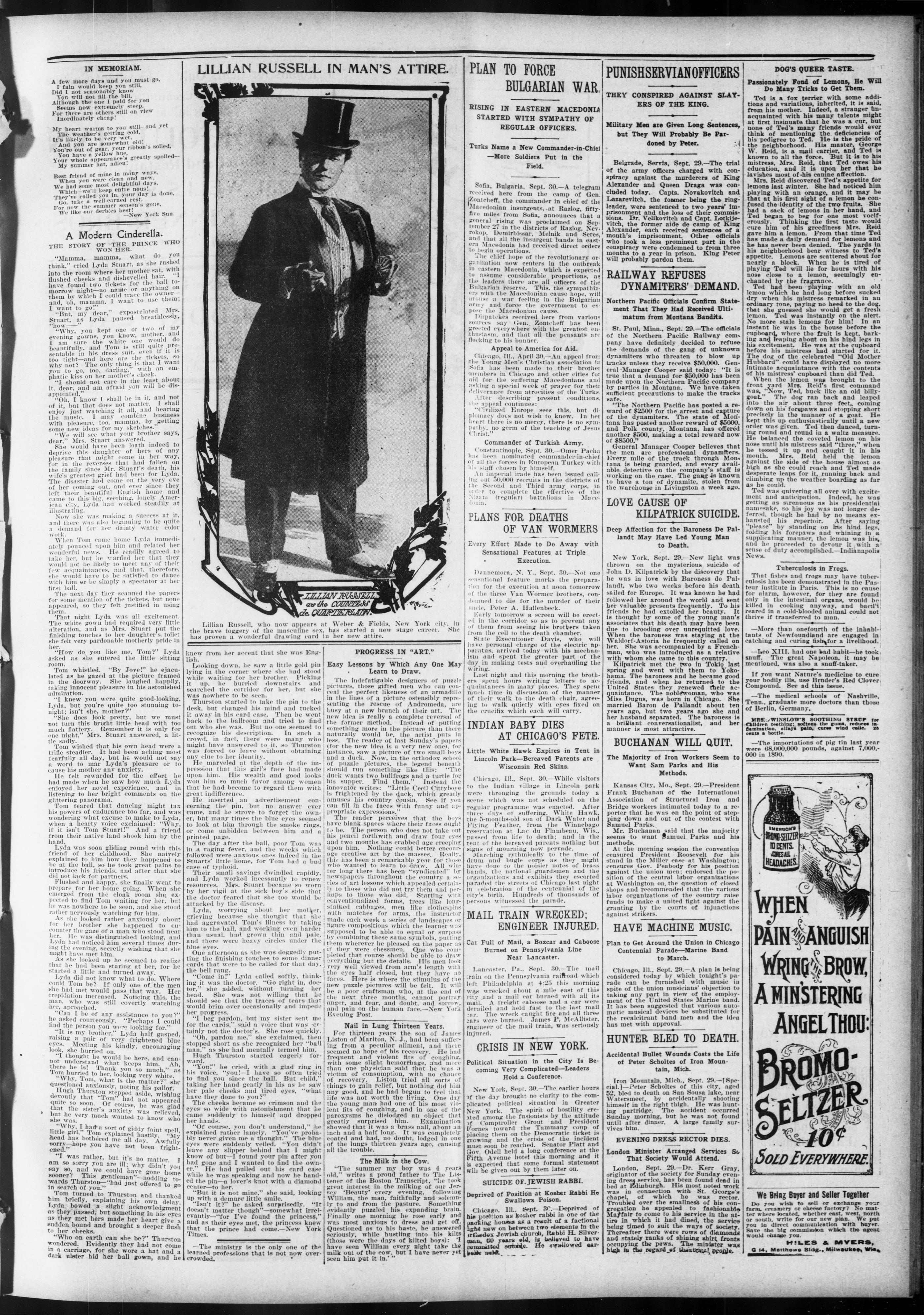
LILLIAN RUSSELL
as the COUNTERS
de QUARTERPLAIN.
Lillian Russell, who now appears at Weber & Fields, New York city, in the brave toggery of the masculine sex, has started a new stage career. She has proven a wonderful drawing card in her new attire.
knew from her accent that she was English. Looking down, he saw a little gold pin lying in the corner where she had stood while waiting for her brother. Picking it up, he hurried downstairs and searched the corridor for her, but she was nowhere to be seen.
PROGRESS IN "ART."
Easy Lessons by Which Any One May Learn to Draw.
The indefatigable designers of puzzle pictures, those gifted men who can conceal the perfect likeness of an armadillo is just one of the many things she has proven a wonderful drawing card in her new attire.
Thurston started to take the pin to the desk, but changed his mind and tucked it away in his card case. Then he went back to the ballroom and tried to find out who she was. But no one seemed to recognize his description. In such a crowd, in fact, there were many who might have answered to it, so Thurston was forced to leave without obtaining any clue to her identity.
He marveled at the depth of the impression that this girl's face had made upon him. His wealth and good looks won him so much favor among women that he had become to regard them with great indifference.
He inserted an advertisement concerning the pin, but no answer ever came, and he strove to forget the owner, but many times the blue eyes seemed to look at him through the smoke rings, or come unbidden between him and a printed page.
The day after the ball, poor Tom was in a raging fever, and the weeks which followed were anxious ones indeed in the Stuarts' little home, for Tom had a bad case of typhoid.
Their small savings dwindled rapidly, and Lyda worked incessantly to renew resources. Mrs. Stuart became so worm by her vigil at the sick boy's side that the doctor feared that she too would be attacked by the disease.
Lyda, worrying about her mother, grieving because she thought that she had aggravated Tom's illness by taking him to the ball, and working even harder than usual, had grown thin and pale, and there were heavy circles under the blue eyes.
One afternoon as she was doggedly putting the finishing touches to some dinner cards that were to be called for that day, the bell rang.
"Come in!" Lyda called softly, thinking it was the doctor. "Go right in, doctor," she added, without turning her head. She was not willing that he should see that the traces of tears that would brim over occasionally and impede her progress.
"I beg pardon, but my sister sent me for the cards," said a voice that was certainly not the doctor's. She rose quickly.
"Oh, pardon me," she exclaimed, then stopped short as she recognized her "ball man," as she had mentally termed him. Hugh Thurston started eagerly forward. "You!" he cried, with a glad ring in his voice, "you!—I have so often tried to find you since the ball. But child," taking her hand gently in his as he saw her pale cheeks and tired eyes, "what have they done to you?" The cheeks became so crimson and the eyes so wide with astonishment that he came suddenly to himself and dropped her hands.
"Of course, you don't understand," he explained rather lamely. "You've probably never given me a thought." The blue eyes were suddenly veiled. "You didn't leave any slipper behind that I might know of but—I found your pin after you had gone and I wanted to find the owner." He had pulled out his card case while he was speaking and now he handed the pin—a lover's knot with a diamond center—to her.
"But it is not mine" she said, looking up with a demyng little smile.
up with a demure little smile.
"Isn't it?" he asked surprisedly. "It doesn't matter though"—somewhat irrelevantly—"for I've found the princess," and as their eyes met, the princess knew that the prince had come.—New York Times.
—The ministry is the only one of the learned professions that is not now overcrowded.
PROGRESS IN "ART."
Easy Lessons by Which Any One May Learn to Draw.
The indefatigable designers of puzzle pictures, those gifted men who can conceal the perfect likeness of an armadillo in the lines of a picture ostensibly representing the rescue of Andromeda, are busy at a new branch of their art. The new idea is really a complete reversal of the former method. Instead of putting something more in the picture than there naturally would be, the artist puts in less. The reader of last Sunday's papers (for the new idea is a very new one), for instance, saw a picture of two small boys and a duck. Now, in the orthodox school of puzzle pictures, the legend beneath should run something like this: "The duck wants two bullfrogs and a turtle for his supper. Find them." Instead the innovator writes: "Little Cecil Cittyboye is frightened by the duck, which greatly amuses his country cousin. See if you can fill in the faces with funny and appropriate expressions."
The reader perceives that the boys have blank spaces where their faces ought to be. The person who does not take out his pencil forthwith and draw four eyes and two mouths has crabbed age creeping upon him. Nothing could better encourage creative art by the masses. Really, this has been a remarkable year for those who wanted to learn to draw. All winter long there has been "syndicated" by newspapers throughout the country a series of art lessons which appealed certainly to those who did not try them and perhaps to those who did. Starting with conventionalized forms, trees like long-stalked cabbages, men like clothespins with matches for arms, the instructor made each week a series of landscapes or figure compositions which the learner was supposed to be able to equal or surpass by combining these same symbols, putting them wherever he pleased on the paper as
if they were chessmen. One who completed that course should be able to draw everything but the details. His men look very well viewed from arm's length with the eyes half closed, but they have no faces. Here is where the stimulus of the new puzzle pictures will be felt. It will be a poor craftsman who, at the end of the next three months, cannot portray anger, and fear, and doubt, and sorrow, and pain on the human face.—New York Evening Post.
Nail in Lung Thirteen Years.
For thirteen years the son of James Liston of Marlton, N. J., had been suffering from a peculiar ailment, and there seemed no hope of his recovery. He had frequent and violent fits of coughing, with some slight hemorrhage, and more than one physician said that he was a victim of consumption, with no chance of recovery. Liston tried all sorts of things to gain relief, but nothing did him any good, and he had begun to feel that life was not worth the living. One day the young man had one of his most violent fits of coughing, and in one of the paroxysms he dislodged an object that greatly surprised him. Examination showed that it was a brass nail, about an inch and a half long. It was completely coated and had, no doubt, lodged in one of the lungs thirteen years ago, causing all the trouble.
The Milk in the Cow.
"The summer my boy was 4 years old," writes a proud father to The Listener of the Boston Transcript, "the took great interest in the milking of our Jersey 'Beauty' every evening, following William, the man, faithfully and solemnly to and from the pasture. Something evidently puzzled his expanding brain. Finally one morning he rose early and was most anxious to dress and get off. Questioned as to his haste, he answered seriously, while hustling into his kilts (those were the days of kilted boys): 'I have seen William every night take the milk out of the cow, but I have never yet seen him put it in.'"
PLAN TO FORCE BULGARIAN WAR.
PLAN TO FORCE BULGARIAN WAR.
RISING IN EASTERN MACEDONIA STARTED WITH SYMPATHY OF REGULAR OFFICERS.
Sofia, Bulgaria, Sept. 30.—A telegram received here from the camp of Gen. Zontcheff, the commander in chief of the Macedonian insurgents, at Razlog, fifty-five miles from Sofia, announces that a general rising was proclaimed on September 27 in the districts of Razlog, Nevrokop, Demirbissar, Melnik and Seres, and that all the insurgent bands in eastern Macedonia had received direct orders to begin operations.
The chief hope of the revolutionary organization now centers in the outbreak in eastern Macedonia, which is expected to assume considerable proportions, as the leaders there are all officers of the Bulgarian reserve. This, the sympathizers with the Macedonian cause hope, will arouse a war feeling in the Bulgarian army and force the government to expose the Macedonian cause.
Ditpatches received here from various sources say Gen. Zontcheff has been greeted everywhere with the greatest enthusiasm, and that all the peasants are flocking to his banner.
Appeal to America for Aid.
Chicago, Ill., April 30.—An appeal from the Young Men's Christian association in Sofia has been made to their brother members in Chicago and other cities for aid for the suffering Macedonians and asking a special week of prayer for their deliverance from atrocities of the Turks. After describing present conditions, the appeal continues:
"Civilized Europe sees this, but diplomacy does not wish to know. In her heart there is no mercy, there is no sympathy, no germ of the teaching of Jesus Christ."
Commander of Turkish Army.
Constantinople, Sept. 30.—Omer Pacha has been nominated commander-in-chief of all the forces in European Turkey with his staff chosen by himself.
An imperial irade has been issued calling out 50,000 recruits in the districts of the Second and Third army corps, in order to complete the effective of the Nizam (regular) battalions in Macedonia.
PLANS FOR DEATHS OF VAN WORMERS
Every Effort Made to Do Away with Sensational Features at Triple Execution.
Dannemora, N. Y., Sept. 30.—Not one sensational feature marks the preparation for the execution at noon tomorrow of the three Van Wormer brothers, condemned to die for the murder of their uncle, Peter A. Hallenbeck.
Early tomorrow a screen will be erected in the corridor so as to prevent any of them from seeing his brothers taken from the cell to the death chamber.
State Executioner Davis, who will have personal charge of the electric apparatus, arrived today with his mechanism and spent the greater part of the day in making tests and overhauling the wiring.
Last night and this morning the brothers spent hours writing letters to acquaintances in many places. They spend much time in discussion of the manner of their walk to the death chair, agreeing to walk quietly with eyes fixed on the crucifix which each will carry.
INDIAN BABY DIES AT CHICAGO'S FETE.
Little White Hawk Expires in Tent in Lincoln Park-Bereaved Parents are Wisconsin Red Skins.
Chicago, Ill., Sept. 30.—While visitors to the Indian village in Lincoln park were thronging the grounds today a scene which was not scheduled on the regular programme was enacted. After three days of suffering, White Hawk, the 5-months-old son of Dark Water and Flying Feather, from the Winnebago reservation at Lac du Flambeau, Wis., passed from life to death; and in the tent of the bereaved parents nothing but signs of mourning now pervade. Marching rythmically to the time of drum and bugle corps as they might have done to the noisier notes of brass bands, the national guardsmen and the organizations and exhibits they escorted paraded the streets of Chicago last night in celebration of the centennial of the city's birth. Hundreds of thousands of persons witnessed the parade.
MAIL TRAIN WRECKED; ENGINEER INJURED
Car Full of Mail, a Boxcar and Caboose Burned on Pennsylvania Line Near Lancaster.
Lancaster, Pa., Sept. 30.—The mail train on the Pennsylvania railroad which left Philadelphia at 4:25 this morning was wrecked about a mile east of this city and a mail car burned with all its mail. A freight caboose and a car were derailed and held fast to the last mail car. The wreck caught fire and all three cars were burned. James P. McAllister, engineer of the mail train, was seriously injured.
CRISIS IN NEW YORK.
Political Situation in the City Is Becoming Very Complicated—Leaders Hold a Conference.
New York, Sept. 30.—The earlier hours of the day brought no clarity to the complicated political situation in Greater New York. The spirit of hostility created among the fusionists by the attitude of Comptroller Grout and President Fornes toward the Tammany coup of placing them on the Democratic ticket is growing and the crisis of the incident must soon be reached. Senator Platt and Gov. Odell held a long conference at the Fifth Avenue hotel this morning and it is expected that some formal statement will be given out by them later on.
SUICIDE OF. JEWISH RABBI.
Deprived of Position at Kosher Rabbi He Swallows Poison.
Chicago, Ill., Sept. 30.—Deprived of his position as kesher rabbi in one of the packing houses as a result of a factional light now on between two elements in the orthodox Jewish church, Rabbi H. Silverman, 60 years old, is believed to have committed suicide. He swallowed carabble mold.
PUNISHSERVIANOFFICERS
PUNISHSERVIANOFFICERS
THEY CONSPIRED AGAINST SLAYERS OF THE KING.
Military Men are Given Long Sentences, but They Will Probably Be Pardoned by Peter.
Belgrade, Servia, Sept. 29.—The trial of the army officers charged with conspiracy against the murderers of King Alexander and Queen Draga was concluded today. Capts. Novakovitch and Lazarevitch, the former being the ringleader, were sentenced to two years' imprisonment and the loss of their commissions. Dr. Velikovitch and Capt. Lotkijevitch, the former aide de camp of King Alexander, each received sentences of a month's imprisonment. Other officials who took a less prominent part in the conspiracy were condemned to from three months to a year in prison. King Peter will probably pardon them.
RAILWAY REFUSES DYNAMITERS' DEMAND.
Northern Pacific Officials Confirm Statement That They Had Received Ultimatum from Montana Bandits
St. Paul, Minn., Sept. 29.—The officials of the Northern Pacific Railway company have definitely decided to refuse the demands of the gang of unknown dynamiters who threaten to blow up tracks unless they receive $50,000. General Manager Cooper said today: "It is true that a demand for $50,000 has been made upon the Northern Pacific company by parties in Montana. We have taken sufficient precautions to make the tracks safe.
"The Northern Pacific has posted a reward of $2500 for the arrest and capture of the dynamiters. The state of Montana has posted another reward of $5000, and Polk county, Montana, has offered another $500, making a total reward now of $8500."
General Manager Cooper believes that the men are professional dynamiters. Every mile of the track through Montana is being guarded, and every available detective on the company's staff is working on the case. The gang is known to have a ton of dynamite, stolen from the warehouse in Livingston a week ago.
LOVE CAUSE OF KILPATRICK SUICIDE.
Deep Affection for the Baroness De Pallandt May Have Led Young Man to Death.
New York, Sept. 29.—New light was thrown on the mysterious suicide of John D. Kilpatrick by the discovery that he was in love with Baroness de Pallandt, who two weeks before his death sailed for Europe. It was known he had followed her around the world and sent her valuable presents frequently. To his friends he had extolled her beauty. It is thought by some of the young man's associates that his death may have been due to brooding over unrequitted love. When the baroness was staying at the Waldorf-Astoria he frequently called on her. She was accompanied by a Frenchman, who was introduced as a relative with whom she came to this country.
Kilpatrick met the two in Tokio last spring and went with them to Yokohama. The baroness and he became good friends, and when he returned to the United States they renewed their acquaintance. The noblewoman, who was Miss Dugus, was born in Chicago. She married Baron de Pallandt about ten years ago, but two years ago she and her husband separated. The baroness is a brilliant conversationalist, and her manner is most attractive.
BUCHANAN WILL QUIT.
The Majority of Iron Workers Seem to Want Sam Parks and His Methods
Kansas City, Mo., Sept. 29. President Frank Buchanan of the International Association of Structural Iron and Bridge workers intimated today to a reporter that he was on the point of stepping down and out of the contest with Samuel Parks. Mr. Buchanan said that the majority seems to want Samuel Parks and his methods.
At the morning session the convention censured President Roosevelt for his stand in the Miller case at Washington; censures Gov. Peabody for his position against the union men; endorsed the position of the central labor organizations at Washington on the question of closed shops and recommended that the various labor organizations of the country raise funds to make a united fight against the granting by the courts of injunctions against strikers.
HAVE MACHINE MUSIC.
Plan to Get Around the Union in Chicago Centennial Parade—Marine Band to March.
Chicago, Ill., Sept. 29.—A plan is being considered today by which tonight's parade can be furnished with music in spite of the union musicians' objection to taking any part in view of the employment of the United States Marine band. It has been suggested that various automatic musical devices be substituted for the recalcitrant band men and the idea has met with approval.
HUNTER BLED TO DEATH.
Accidental Bullet Wounds Costs the Life of Peter Scholtes of Iron Mountain, Mich.
Iron Mountain, Mich., Sept. 29.—[Special.]—Peter Scholtes of this city, aged 52, bled to death on San Sousa lake, near Watersmeet, by accidentally shooting himself in the right thigh. He was hunting partridge. The accident occurred Sunday morning, but he was not found until after dinner. A large family survives him.
EVENING DRESS RECTOR DIES.
London Minister Arranged Services So That Society Would Attend.
London, Sept. 29.—Dr. Kerr Gray, originator of the society for Sunday evening dress service, has been found dead in bed at Edinburgh. His most noted work was in connection with St. George's chapel, of which he was rector. Troubled over the smallness of his congregation he appealed to fashionable Mayfair to come to his service in the attire in which it had dined, the service being timed to suit the ways of society. Thereafter there were rows of diamonds and stately ranks of shining shirt, fronts occupying the pews. The minister was high in the regard of theatrical people.
Passionately Fond of Lemons, He Will Do Many Tricks to Get Them.
Ted is a fox terrier with some additions and variations, inherited, it is said, from his mother. Indeed, a stranger unacquainted with his many talents might at first insinuate that he was a cur, but none of Ted's many friends would ever think of mentioning the deficiencies of his pedigree to Ted. He is the pride of the neighborhood. His master, George W. Reid, is a mail carrier, and Ted is known to all the force. But it is to his mistress, Mrs. Reid, that Ted owes his education, and it is upon her that he lavishes most of his canine affection.
Mrs. Reid discovered Ted's appetite for lemons last winter. She had noticed him playing with an orange, and it may be that at his first sight of a lemon he confused the identity of the two fruits. She had a sack of lemons in her hand, and Ted began to beg for one most vociferously. Thinking the first taste would cure him of his greediness Mrs. Reid gave him a lemon. From that time Ted has made a daily demand for lemons and he has never been denied. The yards in his neighborhood bear witness to Ted's appetite. Lemons are scattered about for nearly a block. When he is tired of playing Ted will lie for hours with his nose close to a lemon, seemingly enchanted by the fragrance.
Ted had been playing with an old lemon which he had long before sucked dry when his mistress remarked in an ordinary tone, paying no heed to the dog, that she guessed she would get a fresh lemon. Ted was instantly on the alert. No more stale lemons for him! In an instant he was in the house before the cupboard, where the fruit is kept, barking and leaping about on his hind legs in his excitement. He was at the cupboard before his mistress had started for it. The dog of the celebrated "Old Mother Hubbard" could have displayed no more intimate acquaintance with the contents of his mistress' cupboard than did Ted.
When the lemon was brought to the front yard Mrs. Reid's first command was, "Now, Ted, buck like an old billy-goat." The dog ran back and leaped into the air about three feet, coming down on his forepaws and stopping short precisely in the manner of a goat. He kept this up enthusiastically until a new order was given. Ted then danced, turning round and round in a waltz measure. He balanced the coveted lemon on his nose until his mistress said "three," when he tossed it up and caught it in his mouth. Mrs. Reid held the lemon against the side of the house almost as high as she could reach and Ted made desperate leaps for it, running back and climbing up the weather boarding as far as he could.
Ted was quivering all over with excitement and anticipation. Indeed, he was getting as surnuous as his presidential namesake, so his joy was not longer deferred, though he had by no means exhausted his repertoire. After saying "please" by standing on his hind legs, folding his forepaws and whining in a supplicating manner, the lemon was his, and he proceeded to devour it with a sense of duty accomplished.—Indianapolis News.
Tuberculosis in Frogs
That fishes and frogs may have tuberculosis has been demonstrated in the Pasteur institute in Paris. This is no cause for alarm, however, for they are found only in the intestinal organs, would be killed in cooking anyway, and bacilli reared in a cold-blooded animal could not thrive if transferred to man.
—More than one fourth of the inhabitants of Newfoundland are engaged in catching and curing fish for a livelihood.
—Leo XIII. had one bad habit—he took snuff. The great Napoleon, it may be mentioned, was also a snuff-taker.
If you want Nature's medicine to cure your bodily ills, use Bruder's Red Clover Compound. See ad this issue.
—The medical schools of Nashville, Tenn., graduate more doctors than those of Berlin, Germany.
MRS. WINSLOW'S SOOTHING SYRUP for Children teething; softens the gums, reduces inflammation, allays pain, cures wind colic. 25 cents a bottle.
—The importations of pig tin last year were 68,000,000 pounds, against 7,000,-000 in 1890.
EMERSON'S
BROMO-SELTZER
10 CENTS.
CORES ALL
HEADACHES.
WHEN
PAIN AND ANGUISH
WRING THE BROW,
A MINSTERING
ANGEL THOU:
BROMO-
SELTZER
10¢
SOLD EVERYWHERE.
Do you wish to sell or exchange your farm, creamery or cheese factory? No matter where located, whether east, west, north or south, write for our new plan. We put you in direct communication with buyer. Save the big commission which the agent would change you.
HILES & MYERS,
G 14, Matthews Bldg., Milwaukee, WI
postage paid.
One Year ..... $2.00
Six Months ..... 1.25
Three Months ..... 75
Send money by Express Money Order. P. O.
Money Order or Registered Letter to the
Wisconsin Weekly Advocate.
ADVERTISING RATES.
One inch, single insertion ..... 25c
One inch, per year ..... $9.00
Business locals 5c per line each insertion.
Apply for rates to the Advocate.
TO CONTRIBUTORS:
All communications must be sent with the name and address of the sender as an evidence of good faith, but not necessarily for publication. No manuscript returned if not accepted, unless accompanied by stamps.
The Wisconsin Weekly Advocate company wishes to notify the public that all contracts and business transactions with this company must have the company stamp, otherwise they will be void. Neither will this company be responsible for paid subscriptions unless given to duly-accredited agents, who, on request, will give the company's receipt for same. Subscribers failing to receive their papers regularly will kindly notify the general office. Address all business communications to the general manager, 79 Fifth street.
Entered in the Postoffice at Milwaukee as Second-class matter.
The pigskin is a higher mark than the sheepskin, just now, in scholastic circles.
Lechtilin, the new giant-producing food, ought to figure in the training diet of the football teams.
There is no accounting for taste. A man is reported to have a corner on the world's supply of cod liver oil.
The latest thing in corsets, according to Chicago advices, is a figure for all. There has always been a figure for all on corsets—the price.
Owing to the persistent efforts of the Audubon societies, birds will not perch upon ladies' hats as numerously as of yore. They never will be missed.
In order to guard their secret plays, the university football teams may eventually have to practice in safety deposit vaults.
By running into a moonshine establishment, the mounted warriors of the Salvation Army discovered that "guns" are an adjunct of another of Kentucky's institutions.
Fitzsimmons announces practically that he is not out for the belt, but that he will "belt" various other pugilists for cold cash, in a laudable effort to pile up $100,000 to retire on.
---
Lillian Russell's throw at man's clothes hits those only who would rather be uncomfortable than easy if ease must be gained by departures from the conventional styles in clothing or gait.
In Los Angeles a milkman was fined $250 for putting formaldehyde in his product. This is severe punishment, but it notifies milkmen in the "Home of the Angels" that doctored milk isn't angel's food.
The matching of Fitzsimmons and Ruhlin is simply evidence that the "have beens" can see a little money "on the side." Fighters don't quit the prize ring so long as there is any money in it for them.
---
The girls who feel hurt because of the disapproval of so-called sororities, in some institutions of learning, might get a grain of comfort out of the classification of their moonshine clubs with secret societies. Corbett's declaration that he is after Fitzsimmons may be accepted as meaning that both he and "Fitz" are after some door receipts. Wait until "Fitz" gives his prearranged angry reply to "Gentleman Jim."
---
Hushed his voice, and sealed his eyes. Think of how much wisdom sleeps In the churchyard where he lies! Who will guide us now? Alas! One by one the Sages pass.
Here We Are!
Prince Henry
and
Li Hung Chang
Have Been Entertained, But
Now We Have
PRINCE YUCU MOHAMMED
The Black Prince of Africa
The only one to visit Wisconsin so far.
A Social and Musical
Entertainment
Will Be Given in His Honor in
Lincoln Hall Cor. Grand Avenue
and Sixth Street
THURSDAY, OCT. 8, 1903
Commencing at 8 p. m.
Good speakers will be present and
will address the meeting.
Admission...25c
WANTED-NURSE GIRL FOR FAMILY of two. Children attend kindergarten during the forenoon. Apply office of Advocate, 79 Fifth street.
LOVE'S GARLAND
Pansies for thought—so let me lay them here,
Gently; you must not waken. Take your rest;
There on your heart—pure thoughts devoid of fear.
Roses, for love—kissing your lips they lie
Dear, roses wither, but they cannot die— Roses for love.
Rosemary, for memories — wreathed around your brow
Wholly of sorrow. So I twine them now For memory.
Rue—see I close it in your little hand.
Keep it—that when you waken you may bless
In your pure heart one who did understand
Life's bitterness.
—New York News.
HADDEUS BENT principal of the Diogenes High School in the far south side of Chicago left the train at Gower Hill Station Wis., where a teacher's summer school was in progress.
Prof. Bent—he had sat in a college chair in his day—was 40 years old. His hair was a trifle gray, his eyes were kindly and his shoulders a bit stooped. He was going to the summer school to hear the natural history lectures of Audubon Burroughs Wood, and to get a bit of nature first hand from the fields.
At the big boarding house by the brook with the great trees at its back, Thaddeus Bent met half a dozen teachers whom he knew and half a hundred whom he didn't know. The assistant principal of the Diogenes was there, and had been there for a month. She felt bound to do her duty by her chief. She introduced him right and left. Then she put on her thinking cap.
"He won't care much for those frivolous creatures just out of the normal," she said to herself. "He'll want some one to pair off with. Now, there's Theodosia Desmond, principal of the Plato school, way up on Chicago's north side. She's just his opposite, but opposites get along well, so here goes." And the assistant principal introduced Principal Thaddeus Bent to Principal Desmond. Prof. Bent found himself in the company of Miss Desmond, on the veranda, the second morning after his arrival. Theodosia was a little creature, with a trim figure, a rather positive manner and a piquant nose on which rested a pair of glasses. Theodosia was 35, and admitted it when it was necessary.
"What's your hobby, Prof. Bent?" she asked. "Every one of us has a hobby, or we wouldn't be here." "Well, I confess, Miss Desmond, to a weakness for natural history. I like frogs, snakes, snails, turtles, water bugs and the rest."
"Horrors, all of them. Excuse me, but I thought you were above creeping things. I haven't a bit of sympathy with you or with them. The proper study of mankind is man'—and man's attributes, let me add. I study mental philosophy. It's the only thing worth studying. We don't get along at all well. Thank goodness, I am above the earth a little bit. The brain and the understanding—these be noble themes. Snakes and toads, oh, how can you?" "Well, I trust I am a little above the creepers and hoppers at times. There are the birds and the trees; they appeal to me."
"All of a kind; man's and woman's mentality is the thing for me. I've heard forty of Prof. Searcher's lectures on 'Mind' already, and I'm going to hear the other forty. Some of the other teachers have fallen away. They are not true blue, though they made much pretense at the start. Can't I introduce you to Prof. Searcher? He'll convert you."
"Pray forgive me, but I've heard Searcher and I found him a bore, but I'll go if you'll take me."
Theodosia blushed a blt. She was past even such a remote hint at gallantry as this, she had thought.
"No, I won't take you," she said, "but you may come if you will. Go well up to the front. Prof. Searcher does not speak any too clearly, and I sit up there—I mean you can hear better up there."
There were excursions into the woods and fields arranged by the teachers assembled at Glower Hill. Prof. Bent took the tramps, and through the urging assistant principal, Theodosia Desmond occasionally went along. This student of man amused Prof. Bent, and despite her antagonisms she attracted him a little.
On one of the excursions he found himself alone with her in a woodland path. Each had books. "What have you there, Prof. Bent?" asked Miss Desmond.
"I have P. H. Gosse, a man too little read now, and Burroughs, and White of Selborne. They are full of frogs and snakes and foxes and birds."
"Surely there's human interest in the lives of the frogs and in the loves of the birds."
"Loves of the birds! I thought you were beyond sentiment, Prof. Bent. Well, there. I did not mean to be rude.
A boy carrying a large ladder.
Here I have John Locke's 'Human understanding.' He would not touch sentiment with a pole."
"Seems to me I've heard that Locke once wrote a book on how to bring up children properly."
Theodosia Desmond blushed furiously. "So he did, but I've not read it. I see how it is; we can't agree, and I would not read one of your authors if the reading would make me superintendent of schools. I'll stick to Locke and Kant, and you can keep on reading about the earthworms."
Nevertheless, they went walking together again, and when they separated for the summer there was just a suspicion of lingering over the farewell. "Better read White and Burroughs, Miss Desmond," said Prof. Bent. "You couldn't hire me to. Suppose you try Locke." The professor shook his head and they parted.
Two weeks later Thaddeus Bent walked into the Crerar library and wrote an order for a book. He took the volume and started for a table. He turned out to avoid a pillar and ran plump into a little woman from the other side. She uttered a smothered exclamation and dropped a book. Thaddeus Bent stooped, picked the book up, looked deliberately at the title, and, with a bow, handed it to Theodosia Desmond, who was standing with heightened color and flashing eyes looking at him.
"How dare you look to see what I am reading?" she said.
"I thought I recognized the cover as that of an old friend," said the professor, coolly. "They always bind Burroughs' works nicely. The book I'm about to read is snuff color. Do you know the author, Theodosia?" He turned the book back to her and she read, "Human Understanding. Locke." "Don't you think, Theodosia, that we would better do the rest of our life's reading together?"
They put the books on the table and went out side by side, and the attendant at the desk noticed that the glasses which the little woman wore were dimmed, though the face was smilling.—Chicago Record-Herald.
"AS WEAK AS A CAT."
Another Familiar Adage Founded on the Mistake of a Fact.
Of all the animal adages founded on the mistakes of a fact, "as weak as a cat" is the most absurd. Really, the cat is a most muscular animal. The lion, the tiger and other so-called "big cats," as you already know, are of the same family with our common house pussy; we shall not speak of them further. "As weak as a cat" is applied to the house pussy; but to say "as weak as a kitten" is truer. One may then mean the new-born kitten which comes into the world blind, softer and more helpless-looking than even the blind puppy; but which, however, is not so hopelessly weak as the puppy, the kitten having sharp claws which the puppy has not. You know so much of cats; do you not, young people?
The cat's muscles are extraordinarily large and powerful in proportion to the animal's size. Then again those muscles are attached to bones, fitted together at such angles as to make "the finest system of springs and levers," says Dr. Huldekoper, "known in the whole group; the claws are sharper and are curved into stronger hooks than in any other mammal, and by the action of special muscles are withdrawn under the protection of sheathlike pads, that they may escape wear and injury when not in use." The slender, supple form of the cat makes it capable of the highest activity. The heavy boy, you may have noticed, is not always the strongest; the thin, active boy is the fastest runner and the quicker at games which need both strong and limber muscles.
The shoulder-blade, the arm and the forearm, the thigh, the leg and the foot of the cat lie at what the veteri-
nary surgeons call "closed angles." That peculiar conformation shows that the enormous jumps which the cat can take to the envy of any athletic boy are due to the great power and the closed angles of the joints; but the conformation of the legs make the cat's stride at a walk, a trot or a run remarkably limited. The cat moves, therefore, with wonderful quickness, and with no great speed. The boys who say he feels "as weak as a cat" if he is at all like the cat—should be splendidly muscular. The truth is that, in proportion to the size of his body, he can never hope to be as strong as a cat. Our Animal Friends.
JAPAN AFTER OUR FLOUR.
Shipments to the Orient Exceed All
Previous Records.
The more or less strained relations between Japan and Russia, with the prospective shortage of the wheat crop of the island kingdom, is resulting in a commercial benefit to the United States, in that Japan is buying an unusual amount of American flour at this time, says the Seattle Post-Intelligencer. Never before at this season of the year have the flour shipments been so heavy. The State of Washington is supplying the bulk of flour shipped to Japan from the ports of Puget Sound.
During one month no less than 90,000 barrels were consigned to the principal cities of the Mikado's country from Seattle by the vessels of the Nippon Yusen Kaisha line alone. Proportionately as much went by the Tacoma and Vancouver lines, to say nothing of the shipments from Portland and San Francisco.
No specific reason has been given for wheat shortage in Japan and none really may exist. Nevertheless, Japan is buying an enormous amount of flour, which gives force to the murmurings of war between the Czar and the Mikado. It is known, too, that Japan is drawing upon China for American flour. Owing to the warm, damp climate of China in summer flour does not keep well. It is unsafe to carry very large stocks. Hongkong, usually the great depot for American flour shipped to China, has her warehouses full, but these she is emptying to Japan.
While Japan and China grow wheat, their production is infinitesimal as compared with the demands for flour from their millions of population.
Personal Prejudice.
According to Senator Bailey, of Texas, there was in that State a judge who had been robbed of a horse and before whom the thief, when apprehended, was brought for trial. His honor eyed the prisoner with deep satisfaction for a minute or so, and then delivered himself of the following:
"Owing to a personal prejudice, the court will not hear this case. It will, however, be tried by the bailiff, who will find a verdict in accordance with the facts and the law. In the meantime," he added, impressively, "the court will go outside, bend a rope and pick out a good tree."—New York Times.
"Alas!" said the unhappy woman, "and we were once considered wealthy!"
"But, my dear," said her husband, soothingly, "we have as much money, as ever."
"Oh, yes, I know, but there are so many who have a lot more that nobody pays any attention to us any longer!"—Brooklyn Life.
Death in Steam Whistles.
Steam whistles have fallen under the displeasure of the physicians of Salem, Mass., and twenty-four of the doctors have petitioned the City Council to adopt strict regulations concerning their use within the city limits. They declare that the noise made by them is often "a matter of life and death to persons seriously ill," and a nerveracking and discomforting thing to most people at all times.
Rooms for Gents Only Excellent Cuisine Visitors to the Cream City Should "Look in" at the
"LOOK OUT" INN Buffet and Restaurant 231 WELLS STREET Conducted by KINNER BROS. Pool Room. Moderate Prices.
VISITORS TO CHICAGO
Could Not Better Themselves Than by Visiting
WALDORF CAFE
R. S. WINSTON & H. L. PRIDE, Proprietors.
Private Dining Rooms Upstairs Open All Night
PHONE 2934 CALUMET
3027 STATE STREET CHICAGO.
Love Is the Mainspring.
Political economists have told us that self-interest is the mainspring of industry. It is not true. Love is the mainspring of industry. It is love for the home and the wife and the children that keeps all the busy wheels of industry revolving, that calls the factory hands early to the mill, that nerves the arm of the blacksmith working at his forge, that inspires the farmer at his plow and the merchant at his desk, that gives courage to the soldier and patience to the teacher. Erskine was asked how he dared, as an unknown barrister, face a hostile court and insist on his right to be heard. "I felt my children," he replied, "tugging at my robe and saying, 'Here is your chance, father, to get us some bread.'" It is this vision of the children, dependent on us, that inspires us all in the battle of life. It is for our homes and our children we maintain our churches.
Whether we cultivate a farm or operate a factory or manage a store or build and conduct a railroad or paint pictures or write books or preach sermons or enact and enforce laws—whatever we do, the end of our activity is the nurture and training of children in this primary school, which we call life, in preparation for some life, we know not what, hereafter.—Lyman Abbott, in Atlantic.
First Aid.
"Now," said the professor, "suppose you had been called to see a patient with hysteries—some one, for instance, who had started laughing and found it impossible to stop—what is the first thing you would do?"
"Amputate his funny bone," promptly replied the new student.—Houston Post.
When You Want a
FIRST CLASS SHINE
Call on
BOB WISE
Proprietor of
The Ladies' and Gents'
Shining Parlor
197 THIRD ST., Near Wells
MILWAUKEE, WIS.
Dixon's Place
Ladies' and Gents' Shining Parlör.
Cigars, Tobacco, all Negro Newspapers.
2638 State St., Chicago.
Phone, 2351 Brown.
We keep for Sale: Wisconsin Advocate, Freeman, Conservator, New York Age, Atlanta Age, Northwestern Vine, Colored American, Cleveland Gazette, Dallas Express, Richmond Planet, True Reformer, Broad-Ax, Monitor, Detroit Informer, Christian Recorder, Voice of Missions, and all other Negro papers of the country.
ELK EXPRESS CO.
G. J. CHARLESTON, Mgr.
63 E. Sixth Street,
ST. PAUL, MINN.
WONDERFUL
DISCOVERY
Curly Hair Made Straight By
```markdown
```
THE ORIGINAL—COPYRIGHTED.
This wonderful hair pomade is the only safe preparation in the world that makes kinky hair straight as shown above. It nourishes the scalp, prevents the hair from falling out and makes it grow. Sold over 40 years and used by thousands. Warranted harmless. Testimonials free on request. Made to hold for straightening kinky hair. Beware of imitations. Get the Original Ozonized Ox Marrow, as the genuine never fails to keep the hair pliable and beautiful. A toilet necessity for ladies and gentlemen. Elegantly perfumed. The great advantage of this wonderful pomade is that by its use you can straighten your own hair at home. Owing to its superior and lasting quality it is the most economical. It is not possible for anybody to produce a pomade equal to it. Full service with every bottle. Only 50 cents. Sold by dealers or send us $1.40 Postal or Express Money Order for 3 bottles, express paid. Write your name and address plainly to
OZONIZED OX MARROW CO., 76 Wabash Ave., Chicago, Ill.
---
RAILWAYS.
CHICAGO,MILWAUKEE & ST. PAULRY
*Daily, †Sun. only, †Ex. Sun.
†Ex. Sat, †Ex. Mon.
†Set. only, †Mon. only.
MILWAUKEE
LEAVE ARRIVE
*12:40 am
*4:50 am
*11:05 am
*8:50 pm
*4:50 am
*11:05 am
*7:15 pm
*7:15 pm
*11:30 am
*7:15 pm
*7:55 am
*4:10 pm
*7:55 am
*7:50 am
*11:30 am
*4:10 pm
*7:15 pm
*8:00 am
*12:15 pm
*8:20 pm
*4:00 pm
*7:20 pm
*4:45 am
*7:20 am
*9:00 am
*11:00 am
*1:45 pm
*4:00 pm
*7:20 pm
LaCrosse, Winona, St. Paul and Minneapolis.
"ThePioneerLimited".
Son. Minn. Points.
Iowa and Dakota Points.
Prairie du Chien, Iowa and Minnesota.
Mineral Point Line.
Janesville.
Rac. & 5. W. Div.
Council Bluffs, Omaha and Kansas City.
Chicago.
adison (via Watertown
" (via Pr. du C. Div.)
" (via Pr. du C. Div.)
" (via Watertown)
" (via Pr. du C. Div.)
" (via Pr. du C. Div.)
Northern Division.
Waukesha.
Oconomowoc and Watertown
Green Bay.
Marquette, Houghton and Lake Superior Points.
TICKET OFFICE, 400 EAST WATER ST. Tel. 624.
TO AND FROM LEAVE ARRIVE
St. Paul, Minneapolis, Iron Towns, Ashland, Superior Duluth, Pacific Coast *5:00 am *7:15 am *8:45 pm *8:00 pm
Marshfield, Chippewa Falls, Eau Claire *5:00 am *7:15 am +12:01 pm +13:20 pm *8:45 pm *8:00 pm *5:00 am *7:15 am
Fond au Lac, Oshkosh, Neenah, Menasha *7:35 am +10:15 am +12:01 pm +13:20 pm *4:35 pm *6:15 pm *8:45 pm *8:00 am
THE PO
Ask, and it shall be given you; seek, and ye shall find; knock, and it shall be opened unto you. For he that asketh receiveth, and he that seeketh findeth, and to him that knocketh it shall be opened.—St. Matthew vii., 7, 8.
These words proclaim an unchangeable, universal, eternal law of the kingdom of God. They are not a threefold repetition of a single thought. They are rather an announcement of the three successive stages in the upward progress of the one law of desiring and obtaining. These steps are not interchangeable. Seeking is not asking. Knocking is neither asking nor seeking. Asking is desire; seeking is desire in action; knocking is active desire concentrated upon a definite purpose and plan.
The words of the text are, we believe, not the language of a "character" in fiction, but an utterance of Jesus Christ. Two of their most impressive qualities are their unquestioning confidence and their unlimited scope. There is no suggestion in them of doubt of the reality of the law; no hint of a limit to the law in time, or in space, or in the nature of things. Ask, seek, knock, at any time, anywhere, and for anything, and you shall receive, you shall find, it shall be opened to you. Painful or pleasant, good or what is thought to be evil, what you wish for, what you look for, what you work for you shall have.
The lesson of the reality and the universality of the law of desiring and obtaining is hard to be learned. Like other hard lessons of human life, this is to be learned only by experience. Man gets opinion and belief from observation. Experience alone brings knowledge. When one has seen the fulfillment of a law of God's kingdom in his own life he knows that the law is real. This is the foundation of his faith in the law and in the God expressed in the law. His faith, too, is the real faith, which results from real understanding, which grows out of real knowledge acquired by man in his own individual experience. No argument can shake such faith. No denial can destroy it. Once attained, it is immortal.
It would seem that this kind of knowledge was the foundation of the faith of Jesus Christ in the reality and the universality of the divine law of desiring and receiving. He believed that the law was real and unlimited, because he saw and felt its operation in the concerns of his own holy life. He knew that what he asked was being given to him; that he was finding what he sought; that the doors at which he knocked were opened to him. He lived to do good to others; he desired, he attempted, he planned, to do good to them, and the sick were made well, the lame walked, the blind saw, the deaf heard, the dumb talked, lepers were healed, the dead were raised, and broken hearts were mended. How could he question the universality of the law when he found that whatsoever good he determined to do, and whensoever and wheresoever he determined to do it, the good was done? This was actually receiving what he asked, finding what he sought, the opening of the doors through which he purposed to pass!
From the point of view of human experience there was nothing peculiar in the earthly existence of Jesus Christ. Tested at all points as all humanity is tested, Jesus found what all humanity finds—the knowledge that results from experience, the understanding that accompanies knowledge, the power, the faith, the love that come from understanding. He came into this world a baby groping after power, with almost aimless hands. At the end of his experience on earth he went out from his cross the God-man, imbued with all power in earth and in heaven. Because we believe that the faith of Jesus in the reality and the universality of the law of desiring and obtaining was an outgrowth from his experience and that his experience was in no essential particular peculiar to himself, we believe the law to be as real for all as it was for him, as real for ourselves as it is for all others. More than this, we ourselves grow into actual faith in the reality of the law, because we find it fulfilled in our own experience, whether in the good which we have desired to do or in the mistakes which we have undoubtedly made.
Whatever we may be doing, therefore, wherever we may be doing it, we will have faith that God gives to those who ask and seek and knock, and that if we desire them and seek them and knock for them we shall receive in due time—that is, in God's good time, all good things—all the knowledge, all the understanding, all the wisdom, all the power, all the faith, and all the love of which humanity is capable!
NEED FOR CLEAR THINKING.
There is no conviction that leads to charity so quickly, nor one, perhaps, that is nearer the truth in explanation of the lives that people are living than that they simply do not understand the
possibilities of the human soul or the enormity of the degradation into which they allow themselves to drop. So surely as the destinies of the human race are high and exalted, so surely is the degradation to which the human being can fall horrible to contemplate. To one and all it is time to cry out for clear thinking, for a definite definition of life terms, for a measuring of plans and purposes, for learning the art of Christian thinking, for finding one's place in the crowd and knowing what badge one wears. The Christian needs to learn how to think of others, how to think of himself, and what to think of his work.
We are strangers before thee, and sojourners, as were all our fathers.—
1 Chron. xxix...15.
When David's long and eventful lifetime was drawing to a close, with much to look back upon with thankfulness, and with much also to contemplate with regret, the aged king declared that, after all, we on earth are but strangers and sojourners. If, then, one so exalted as David was, who had passed through so many eventful periods of life—who had done so much for God and for his own people, in spite of his shortcomings—if King David, who had left so much behind him to tell of his greatness, his power, and his might, showing that he had really lived to accomplish mighty purposes—if David could say truly, when all was nearly over, "We are strangers and pilgrims," surely we should consider, now we are passing through the world, as he once did, that we also are strangers here, only going through the world as if we were on a pilgrimage. And yet how few seem to realize what they know well is a plain and straightforward fact, one there is no denying, though much attempt at evading, or at least an attempt to persuade ourselves that our sojourning here is far from being nearly over, and that our pilgrimage has not nearly reached its termination. Yet strangers and sojourners we are, and so we must remain to the end of life in this world.
We use the word "strangers" in common talk in different ways; or, perhaps, I should say, with different meanings. We talk of people as "strangers" at one time; but they do not remain strangers always—e. g.: when a lad first leaves home and goes out into the world he is a stranger among the people where his lot is cast; but in course of time and by degrees he finds out that he knows them and they know him. Then he is a stranger no longer. Again, a man who is traveling in a foreign country, knowing imperfectly the language of the people, unaccustomed to their mode of life, and feeling strange at sights and sounds with which he is not familiar, is, indeed, a stranger in a strange land; but supposing he remains there for some years, by degrees the strangeness wears off, and at length he feels at home where once he seemed to be much out of place. So he is a stranger no more. Or, again, let us imagine another case. Take an enterprising traveler who, burning to make discoveries, ventures across the boundaries of civilization and encounters people and objects which are new and altogether different from what he or any one else has experienced before. Every man he meets is a savage, and every savage perhaps thirsts for his blood. With such surroundings and among such people he is ever likely to remain a stranger. And it is in some such way as this we are taught to look upon our passage through the world as being, I mean, a place where we have no continuing city, but are only strangers passing through it. At any moment we may find out this is true, for at the time appointed, not by ourselves but by God, we may have to strike our tent, and the frail tabernacle in which we now dwell may be broken up, while we ourselves are conveyed to another scene.
And we may well ask ourselves, what will that other scene be to us? We know that there remaineth a rest to the people of God who have passed as strangers and pilgrims through the world. And we know, moreover, we are admonished to labor to enter into that rest. Let us strive, then, so to do, and give all diligence, and take all heed to enter into that eternal rest when our sojourning here is over. Let us not, through negligence or sloth, come short of the promised rest. As good soldiers of Jesus Christ let us fight manfully under his banner, laying aside every weight and the sin (whatever it may be) which so easily besets us. Let us run with diligence and patience the race which is set before us, looking unto Jesus, the author and finisher of our faith. Let us always remember that although our toiling along here may not be always pleasant nor agreeable, yet there will be a glorious and everlasting rest for those who have passed through the world, as strangers pass through a country which is not their home. When we now look towards this home and hope one day to enter therein, we may truly say:
Ah! then my spirit faints
To reach the land I love.
The bright inheritance of saints,
Jerusalem above.
It is not what he has, or even what
he does which expresses the worth of
a man, but what he is.—Amiel.
THEY TELL SOME INTERESTING ANECDOTES OF THE WAR.
How the Boys of Both Armies Whiled Away Life in Camp-Foraging Experiences, Tiresome Marches-Thrilling Scenes on the Battlefield.
"General Turchin," said the Captain, "was one of the courtliest of the general officers of the Union army, and at the same time one of the most unconventional. I will never forget the stately military bow with which he was wont to greet his fellow officers, but I smile whenever I think of it, because it comes up in memory associated with quaint remarks of a decidedly unmilitary character.
"Turchin was one of the best drill masters in the service. He delighted in brigade drill and maneuver, and at such times was the very personification of dignity and precision. On one occasion when he was intent on an order to have the brigade change front a rabbit jumped from the grass in front of the line and ran across the field in plain sight of every man. Not a man, with the eyes of the general upon him, dared look up. Imagine, then, how surprised they were to hear the precise old general stop with his order half given to ejaculate: 'H—, dere goes a rappit!
"On another occasion our regiment, the Eleventh Ohio, was marching in battle order, when, coming to a slough in the road, each wing marched by the flank on either side of the road. This was the second night after Missionary Ridge, and was very dark, and the left wing lost direction. When daylight came the boys saw they were not marching with the right wing of their own regiment, but with troops of another division.
"A our company commander was changing the direction of the march toward where he supposed the right wing to be, General Turchin spied us, and, alert on the instant, asked, 'What troops are those?' One of the officers replied, 'Part of the Eleventh Ohio, general.' and Turchin said, explosively, 'You tam stragglers, what do you here? You not have any fire for six weeks.' To this some one replied: 'We never straggle when there is a fight on hand, you know that, general.' Instead of resenting this Turchin told the boys how to find the other battalion, and as he rode away said: 'Dat tam Eleventh beats the devil in fighting, and talking, too.'
Speaking of the Eleventh Ohio," said the sergeant, "the boys used to tell the year after the war a very good dog story. This particular dog was called Curly, and was with the regiment longer than any other adopted by the Eleventh. Unlike other dogs, he never ran away from skirmish or battle, but stuck close to the company in every engagement. At Chickamauga he refused to leave our wounded, and was taken prisoner. When after the battle the wounded were removed under a flag of truce, Curly broke through the rebel lines and joined his company in Chattanooga.
"Strangely enough, Curly escaped without a wound until we were on our way home for muster out. He got off the cars at Bowling Green and broke his leg. Before the situation was understood the train started, and Curly, left behind wounded, was reported lost. The boys who had been wounded at Chickamauga, and who remembered Curly's devotion and loyalty on that occasion, could not give him up. They made such a stir about it that some months later the soldiers stationed at Bowling Green shipped Curly to Louisville, and from there he was sent to Osborne, Ohio, where he was cared for by a member of the regiment until old age carried him off."
"That reminds me," said the doctor, "of a little adventure I had just after the war. I was called one dark night to see a patient five or six miles from town. The man who came for me said it was a bad case, but he had forgotten the name of the sick man, who was a newcomer in the neighborhood. However, he said he had been told if he would name the name of his new neighbor the doctor would be sure to come. This excited my curiosity and I went, but with many misgivings.
"As we approached the house my guide was plainly nervous, and as a savage dog came barking down the narrow lane that led to the house he jumped out of the buggy and ran. This left me alone with a dog that seemed determined to eat me alive. He circled around the buggy in a way to make me nervous, and finally I shouted, "Bose, you old rascal, stop that now.' Instantly there was a change. The dog seemed frantic with joy. He stood with his fore feet in the buggy and whined for recognition. And I did recognize him as our regimental mascot, and I found inside one of the boys of my old home company too sick to tell me his story. But I brought him out of that sickness, and Bose was as glad as I was."—Chicago Inter-Ocean.
Grant's Supreme Courage.
General Grant's courage was supreme. No can could face danger with greater composure. He did not seem to know the meaning of peril when duty called him to risk his life. At one time I saw the general escape death by a very slight margin, writes a contributor to the National Magazine. We were breaking camp at Spottsylvania Courthouse, and under the fire of a Confederate battery. All of the head-
quarters equipage had been removed except a camp stool, and on this the general was sitting, while the shells of the enemy's guns shrieked over our heads. A shell passed just over the general, not missing him, apparently, more than a few inches, and struck the ground about thirty feet away. Without showing the slightest nervousness, he called to me to "Get the shell," saying, "Let's see what kind of ammunition that battery is using." I went and picked up the shell, which was a sixpound, spherical case, and the general examined it as coolly as if there was not an enemy's gun within a hundred miles of him.
A War-Time Humorist.
One day in 1863 there came down to the front a recruit with a grin on his face and a chuckle in his throat and he had hardly been turned over to the 3rd regiment when he put his hands to his sides and began laughing. He laughed like a man who was tickled to death. His face got red as paint, tears ran from his eyes and he seemed about to choke, when a sergeant gave him a kick to straighten him up and indignantly demanded:
"Now, then, what sort of a blamed fool are you, and what are you laughing at?"
"It's so funny—it's so funny," gasped the man, as he went off into another fit of laughter.
"What's so funny?"
"Why, my being down here! A week ago I was hoeing corn on the farm—ha, ha, ha!"
The sergeant said he'd be hanged if he could see where the laugh came in, nor could any of the rest of us, but it was half an hour before James Thurston could sober up his face. That was his debut. Within three days he had every man in the company, officers included, down on him for being a laughing man. His face was in repose only when he slept. The rest of the time it wore a broad grin, and the most trifling thing brought a laugh. He was too good-natured. He had such a guffaw of a laugh that he disturbed everybody in the company when he started in. They called him names and he laughed. They threatened him and he laughed the harder. He was kicked and cuffed and he roared "Ha, ha, ha!" till men came running from other companies. We finally demanded that the captain suppress him and that officer called him up and began:
"Look here, Thurston, what is all this nonsense about?"
"What nonsense, sir?" asked the recruit, with a grin.
"Why, your laughing so much. What do you see to tickle you?"
"Lots of things, captain—ha, ha, ha!" shouted Thurston, as he got a brace on his ribs. "It seems so queer not to be milking the cows and feeding the hogs and helping dad off with his boots."
"And you laugh about that, do you?"
"Yes, and I can't help it—ha, ha, ha!"
"Well, you come mighty near being a fool!" exclaimed the captain, as the guffaw died away into a gurgle. "But I don't see why," answered Thurston, trying his best to look serious for a minute. "When I think of hoeing corn, painting the barn, washing sheep and whitewashing the cellar, and then look around me here and see a lot of soldiers and tents and mules, why, I have to—ha, ha, ha." "But if you don't stop it I'll send you to the guardhouse. It is disrespect to your officers, and the men don't like it. We get braying enough from the mules."
"I'd stop it, captain, if I only could, but I—I can't—can't do—"
The captain ordered him out of the tent and into the guardhouse. He was probably the only soldier in any army who was ever punished for laughing. He was hardly under arrest when it struck him as funny that he should be in the guardhouse down at the front instead of chopping out weeds in a cornfield up in Connecticut, and he laughed until the indignant captain ordered a gag placed in his mouth. He didn't laugh any more for five or six hours, but his guards insisted that his face wore a grin all the time—as much of a grin as could be worked up under the circumstances.
Thurston served for six months and laughed day and night, and nothing could check him. Then the men of the company drew up a petition and his captain went to the colonel, and one day the man's discharge papers arrived. They read "for general disability," but as a matter of fact he was turned out of the army for laughing. He knew it as well as anybody else, and he seized upon it as a pretext for one of his loudest and longest guffaws.
"It is so funny," he said, as he was ready to go. "Only yesterday I was a soldier in the army, and to-day I am a citizen and on my way back to old Connecticut to milk cows and feed the hogs again—ha, ha, ha!" And he roared and gasped and gurgled, and we heard the bray until he had put a full mile between us and left us to fight out the war on other lines.
WE CONTINUE TO WARN THE BENEVOLENT PUBLIC AGAINST THE NUMEROUS BEGGARS FOR ALLEGED CHARITABLE INSTITUTIONS IN BEHALF OF THE NEGRO RACE. LOOK WELL TO THE CREDENTIALS OF SUCH MENDICANTS AND INQUIRE OF SOME REPUTABLE NEGRO CITIZEN REGARDING THE TRUTHFULNESS OF THEIR STATEMENTS.
The Turf Cafe
Game, Fish, Steaks, Chops and
Delicacy the Seasons Afford.
rooms for Dinner Parties, Etc. Cuisine Pa
Table D'Hote.
ve neither private rooms, nor "private" people, b
general public.
DINNER FROM 5:30 TO 8:00; 35c.
J. L. SLAUGHTER, I
Street, Milwaukee, Wis.
e Bachelors' Hom
Banquet Rooms for Dinner Parties, Etc. Cuisine Par Excellent. Table D'Hote.
NOTE- We have neither private rooms, nor "private" people, but cater to the general public.
DINNER FROM 5:30 TO 8:00; 35c.
J. L. SLAUGHTER, Prop.
194 Third Street, Milwaukee, Wis.
TURF EUROPEAN HOUSE
A New and Modern Establishment for
Gentlemen Only.
Street,
Milwaukee.
J. L. SLAU
Pro
217 Wells Street, J. L. SLAUGHTER, Milwaukee. Prop. and Mgr. Cafe in Connection: Prices Moderate and Consistent with Accommodations Furnished.
SEE OUR BARGAINS!
Good Warm Clothes Are Cheaper Than Coal.
HERMANN NOLDE,
Merchant Tailor.
235 Third Street.
Milwaukee. - - - Wisconsin.
AGENTS WANTED. Everything is in favor of the Agent. LIBERAL CREDIT EXTENDED. This is an unprecedented chance to make money. Write quick for territory and particulars. Address THE HELEN MARTIN TOILET CO., 910 E. Leigh St., Richmond, Va.
ELEGANT NEW
TONSORIAL PARLORS,
Second to None in the World.
Visitors to the city and those who appreciate
Cleanliness, Elegance and Comfort should
patronize
Slaughter's Turf Hotel Tonsorial Parlors,
217 Wells Street, Milwaukee.
Hot and Cold Baths in Connection. Franklin A. Hackley, Mgr.
17 Wells Street, Milwaukee
safe in Connect
with
C. C. GITTINGS, Pres.
Foldi
Gold Meda
Incorporated Febu
SEE O
Good
CH
HER
Milwaukee.
A.
Actual Results from Baldness After Only 4 Months' Use of ZOMODONE.
AGENTS W
to make money. Write
THE HELEN MART
For Ladies and Gentlemen
of Cafe
banks, Chops and Every
sons Afford.
Etc. Cuisine Par Excellent.
ote.
"private" people, but cater to the
plic.
0 8:00; 35c.
GHTER, Prop.
Wis.
urs' Home"
Steam Heat. Electric Light. Telephone in Every Room.....
PEAN HOTEL...
J. L. SLAUGHTER, Prop. and Mgr.
Makes the Hair grow with lightning-like rapidity. No waiting for results. ZOMODONE prevents falling Hair, Grey Hair, Brittle Hair, Curly Hair, Harsh Hair, and Scurf. Cures Dandruff, Itch, Tetter, Eczema, and Ring-Worm. No more Bald Heads, Scanty Partings, Splitting Ends, and Bald Temples. ZOMODONE grows long, luxuriant, soft, fine, silky Hair. Makes the Hair grow down to and below the waist line in most every instance in which it is used. ZOMODONE is a direct Hair food, and softens and lengthens the Hair, so that it can be arranged in any style desired. Not a fraud or a fake, to get your money, but an honest remedy, tried and true. ZOMODONE acts quickly; results are seen at once. If you want Hair down to your waist, send in your order right now—do not delay. No free samples sent; a sample is not sufficient to do good. Send us only $1.00, and we will send promptly all of the following great remedies, worth at retail $4.50: 3 large jars of ZOMODONE, worth $3.00; 1 large package of ALBUNA (Egg Shampoo), worth $6.00; and 1 large package of CORALINE, the most exquisite and absolutely certain skin brightener and perfector known to science, worth $1.00. We will send four complete treatments for $3.00.
THINK HIM MURDERED.
Believed That Peter Frost Met With Foul Play in Germany.
CABLEGRAM UNANSWERED.
Racine, Wis., Sept. 30.—[Special.]—No reply as yet has been received to the cablegram which was sent about a week ago to the officials of cities in Denmark, asking them to search for Peter Frost, a business man of this city, who left here July 10 and was expected to return by September 1. Relatives here believe now that Frost met with foul play in Hamburg, Germany, and that he was murdered for his money, as he carried about $1500 when he left Racine. His wife is in the insane asylum here and his children are almost penniless, and unless some trace of Frost can be found the county must take care of them.
SOUTH MILWAUKEEAN COMMITS SUICIDE.
Growing Despondent, John Brozensky Kills Himself at Racine—Says Wife Turned Him Out.
Racine, Wis., Sept. 30.—[Special.]—John Brozensky, aged 55 years, a resident of South Milwaukee, committed suicide during the night by hanging himself to the knob of a door at his boarding place in the Pennsylvania house. At 7 o'clock this morning, when the proprietor went to awaken him, he found him in the room with a handkerchief tied around his neck and the handkerchief tied to the knob of the door. The body was cold, showing that he had been dead for several hours. The coroner was notified, but no inquest will be held until the relatives arrive from South Milwaukee. Brozensky came here about two months ago and told the police officers that his wife had turned him from home. He was cared for by the officers for three days, until he was able to secure employment. On account of the treatment of his relatives the man became despondent. It is understood that he owns some property in South Milwaukee and has quite a sum of money in a bank in Milwaukee. He left no note or anything showing why he killed himself.
WAUSAU BOY KILLED BY SEWER CAVE-IN.
Lad Loses His Life While Playing in Trench—Edward Pfring of Edgar Injured.
Wausau, Wis., Sept. 30.—[Special.]—Max Friederich, son of Mr. and Mrs. William Friederich, was killed by a sewer cave-in. He was playing with other boys around an excavation wherein workmen were laying sewer pipes, and in jumping across it the ground gave away beneath his feet and he was hurled into the excavation and buried. The workmen were just going home to supper but saw the accident and with shovels soon dug the boy out, but he was dead. Death had apparently been instantaneous, for his skull was crushed and his back and neck were broken. The boy was 10 years old. Edward Pfring of the village of Edgar had part of his thigh shot away yesterday by the accidental discharge of a gun.
JAMES M'MULLEN IS ACQUITTED BY JURY
Aged Man Killed John Rogulski at Mara thon County Poor Farm in Self- Defense.
Wausau, Wis., Sept. 30.—[Special.]—James McMullen, on trial for murder, wac acquitted by the jury on the fourth ballot. The alleged crime was committed May 7. McMullen and John Rogulski were inmates of the county poorhouse and on that day a quarrel arose between them and McMullen, it is said stabbed his antagonist with a long hunting knife, inflicting a wound from which the latter died next day. McMullen claimed self-defense and the law has upheld him in this contention. He is 86 years old and feeble, while his victim was 35 years of age and in the prime of life. The old man has lived in Marathon county for fifty years and has always been a good citizen.
SHEBOYGAN ESTATE AGAIN IN COURT.
Administrator of Property of Late John H. Stehn Files Another Suit for Accounting.
Sheboygan, Wis., Sept. 30.—[Special.]
—Arthur Stehn, as administrator of the estate of the late John H. Stehn, has again filed a suit for accounting against Herman Hayssen and also against the executors of the estate of the late, John M. Kohler. The three gentlemen had formed a partnership in 1878, and the present litigant claims that at no time was an accounting made. Stehn alleges that the estate is now worth at least $28,000, and demands a final accounting for the purpose of settling the estate. A similar action, brought some time ago, was dropped by his attorneys with the consent of the defendants.
DUFF MURDER TRIAL GOES ON.
Woman Accused of Killing Husband at Crandon Testifies.
Crandon, Wis., Sept. 30. After exhausting the regular panel of jurors and a special venire of fifty, a jury was selected for the trial of Mrs. Duff on the charge of shooting her husband here April 18. Mrs. Duff took the stand after the state had rested and told of repeated attempts by her husband to poison her and of numerous threats to take her life. The trouble which led up to the shooting was the alleged attention Duff had been paying to a young woman, and at the time of the shooting Mrs. Duff claims to have found them in a compromising position, whereat Duff made a threat to kill his wife and advanced towards her with an open knife. Mrs. Duff then shot.
SIXTY STRIKE AT JANESVILLE.
Employes in Factory Quit-Firm Moved to Avoid Labor Troubles.
Janesville, Wis., Sept. 30.—[Special.] Sixty men employed by the Art Study company, a picture frame factory, which recently came to this city from Chicago, went on a strike on account of the dismissal of Supt. E. W. Hills. The concern came from Chicago partly because of the labor conditions in that city.
BELOIT COLLEGE BARS MARRIAGE
Prominent Member of Senior Class Expelled for Getting Married—Bride was an Old Friend.
Beloit, Wis., Sept. 29.—[Special.]—By the decree of the faculty of Beloit college, Charles S. Buck, who was married at the close of the school year last June, has been refused admission to the senior class. Mr. Buck's entrance has been denied because of a college law which forbids the marriage of students while attending college.
The rule has been long established, but this is the first time it has been necessary to enforce it. Mr. Buck will likely enter Chicago university.
When the news of Mr. Buck's suspension became known yesterday, there was a sensation among the members of the senior class and they immediately prepared a petition which was taken to President Eaton by a committee and they pleaded for their classmate. As the faculty action had been already taken there was nothing the president could do and the bar against Mr. Buck will stand.
Immediately after the close of the prize contest for the extempore speaking at the college commencement last June, Buck hurried away to Epworth, Ia., where on June 25 he made a bride of Miss Delle M. Simpson, daughter of one of the prominent citizens of that city. The couple had been old friends and their attachment was in no way a school flirtation. Mrs. Buck was a graduate of the Cornell (Ia.) college of the class of 1901 and had been a teacher in the public schools of her home town for some time.
Mr. Buck is very popular with his classmates and is recognized as one of the leading and strongest students in the college and his debarment is a great disappointment to the class. Mr. Buck was prominent in branch of college life, was a football player, member of the glee club and quartette and was conspicuous as a speaker and debater.
DEATH OF RUDOLPH JENS.
Former Manitowoc County Boy Is Killed in Runaway Accident at San Carlos, Ariz.
Manitowoc, Wis., Sept. 29.—[Special.]
—Word has been received here of the death of Rudolph Jens, a former Manitowoc county boy, which occurred at San Carlos, Ariz., last week, as the result of a runaway accident in which Jens was thrown from his horse and sustained injuries that caused his death almost instantly. Jens was a Lutheran missionary to the Apache tribe of Indians and was stationed at the mission at San Carlos and also had charge of a mission in a neighboring city. It was while en route between the two cities that the accident occurred. The young man was 27 years of age and a graduate of the Watertown Lutheran seminary at Watertown, this state. The body will be returned for burial at Two Rivers Thursday.
QUARREL AT MERCER ENDS IN KILLING.
William Voight Said to Have Been Shot by Sam Ducette After a Slight Altercation.
Ashland, Wis., Sept. 29.—[Special.]—William Voight of Mercer, Wis., was shot by Sam Ducette and died three hours afterward. The men had a slight altercation and Ducette went to a neighboring store and borrowed a gun, saying he was going duck shooting. Returning to where he had left Voight, he shot him through the body.
TRED IRLE CAPTURED
Alleged Murderer of Guy Shelliam and Fred Steth Is Caught by the Police.
Platteville, Wis., Sept. 29.—[Special.]—Fred Irle, who has been wanted for three years, on the charge of murdering Guy Shelliam and Fred Steth, two companions from here, near Savanah, Mo., July 21, 1900, was captured at Faribault, Minn., yesterday. He was recognized by a man from here, who quickly notified the authorities. He was captured once before but escaped from jail. The parents of all three parties reside here.
Resident of Olive Loses Crops, Without Insurance-Believed to Be Work of Incendiary.
Spring Valley, Wis. Sept. 29.—[Special.]—Allan Green, who resides at Olive, lost all of his grain by a fire which burned the stacks and the separator belonging to F. B. Chuchill. No insurance was carried. It is thought the fire was of incendiary origin, as no fire had been going in the engine for thirty hours.
KILLED WITH AXE HELVE
Section Foreman on Soo Road Kills J. S. Riggs at Gagen, Wis. in a Row.
Three Lakes, Wis., Sept. 29.—[Special.]—In a row at Gagen, Wis., J. S. Riggs was hit with an axe handle and killed by a section foreman on the Soo railroad.
DIVORCE FROM HEAVYWEIGHT.
Bertha A. Trickey Is Separated from Large Husband.
Hudson, Wis., Sept. 29.—[Special.] Circuit court opened here for the September calendar with Judge Helms upon the bench. The first hearing was a divorce case brought by Bertha A. Trickey against her husband, Lee Trickey, on the ground of non-support. The petition was granted. Trickey is the fat man from Glenwood who tips the scales at 650 pounds.
PLACES FOR EVERYONE.
No One was Turned Away from Free Employment Offices.
Madison, Wis., Sept. 29.—[Special.]— The two state free employment offices at Milwaukee and Superior reported 221 applications for help filed during the week ended Saturday. There were 203 applications for employment, all of which were satisfactorily filled. None of those who applied for work was turned away, but there were eighteen places that could not be filled with applicants.
SONG WRITER'S BROTHER DEPOSED
Was Manager of Factory at Racine, but Loses Job.
Racine, Wis., Sept. 29.—[Special.]—Moe Harris, a brother of Charles K. Harris, the song writer, has been deposed as the manager of the local factory of the Princess Shirt and Waist company, owned by H. P. Schultz of New York. Harris has retained attorneys to demand an accounting and his reinstatement.
Express Messengers Injured in Railway Accident Have No Claim Against Road.
HIGHERCOURT'SRULING
Contract Between the Express and Rail road Companies Would Relieve the Latter from All Liability.
Madison, Wis., Sept. 29.—[Special.] Express messengers injured in a railway accident cannot recover damages from the railway company where there is a contract in force between the express and railway companies relieving the latter from liability and a contract between the employee and express company by which the former assumes all risk of accidents and injury.
This is the decision of the supreme court in the case of Myron L. Peterson against the Chicago & North-Western Railway company. Peterson was an express messenger in the employ of the American Express company and was severely injured March 27, 1901, while running from Milwaukee to Green Bay over the North-Western road in a collision of a passenger and a freight train.
In the decision, written by Justice Winslow, the supreme court says in part: The general question presented in this case is whether a railway company can be relieved by contract from liability to an express messenger for personal injuries suffered by him while riding on its train in performance of his duty, such injuries being proximately caused by the ordinary negligence of the employees of the company. The question is new in this state. This court has held that a common carrier may by contract exempt itself from liability to a person traveling on a free pass for injuries caused by the ordinary negligence of its employees, but not from the consequences of their gross negligence. Also that it is against public policy to allow a common carrier to stipulate for exemption from liability for negligence of its employees resulting in loss or injury to a passenger for hire. Neither of these cases, however, touch the exact question before us.
The question is an interesting one, and might be discussed at great length. It seems doubtful, however, whether any good result would be reached by such a discussion. The exact question here presented has been discussed with great learning and ability by the supreme court of the United States in the case of railway company vs. Voight, 176 U. S., 498, and the result there reached was that an express messenger under the facts here presented was not a passenged for hire, and for that reason the contracts exempting the railroad company from liability were not against public policy, but valid.
We entirely agree with that result. It commends itself to our judgment not only upon reason, but upon the great weight of authority. The express messenger is not a person who has applied to a common carrier for transportation and is entitled to that transportation without condition upon payment of his fare, but a person who voluntarily goes upon a train, not-for transportation, but to transact certain business for the express company which it is allowed to transact, not because the railroad company is a common carrier, but because of a contract between the express company and the railroad company by which the express company and its messengers were granted rights which the railroad company would not be compelled to grant as a common carrier.
YOUNGEST ENLISTED MAN.
George I. Chamberlain, Who Died at Waukesha, Went Into Army When 13 Years of Age.
Waukesha, Wis., Sept. 29.—[Special.]
—George I. Chamberlain, 53 years old, died at 11:30 last night at his home on Martin street, of cancer, after a long illness. Mr. Chamberlain bore the distinction of being the youngest enlisted Union soldier from Wisconsin in the War of the Rebellion. He was born in Vermont and came here with his parents when 4 years old. He had always resided in this county, in Big Bend for a number of years, but most of his life was spent in Waukesha. When 13 years of age he joined the Thirty-ninth Wisconsin infantry as a drummer and served three months. He later enlisted in Co. F, Forty-sixth Wisconsin, and served with it until the close of the war. Mr. Chamberlain was a charter member of the W. B. Cushing post, G. A. R., but years ago allowed his membership to run out. He is survived by his wife and son George. He has three sisters living: Mrs. J. R. Spencer of this city, Mrs. J. C. Johnson, St. Joseph, Mo.; Mrs. J. E. Welch, Vernon. One brother, Eugene Chamberlain of Beulah, survives him. The funeral will be held at 2:30 tomorrow afternoon from the residence.
MILWAUKEEAN ELECTED.
Office of Secretary-Treasurer of Hotel Men's Association Given to Herman Kletsch at Appleton.
Appleton, Wis., Sept. 29.—New officers were elected at the business session of the Wisconsin Hotel Men's association this afternoon as follows: President, John Conway, Appleton; vice president, Ernest Claranbach, Fond du Lac; secretary-treasurer, Herman Kletzsch, Milwaukee.
The European system was discussed; also establishment of a school for training hotel help.
A banquet was given at the Sherman house and was followed by a dance at Harmonie hall. About seventy-five hotel men were in attendance.
WISCONSIN PENSIONS.
Washington, D. C., Sept. 25.—[Special—The following pensions have been granted to Wisconsin people during the past week:
Ardel C. Rogers, $10; Andrew Knoble, $24; Henry Rick, $12; Washington Holt, $12; George A. Hall, $8; Jacob Rausch, $10; John Smldt, $10; John Dittmar, $8; Charles Degnitz, $12; Ames A. Shepards, $8; Christopher Emberson, $14; Hendrick M. Johnson, $8; Nels Nelson, $8; Thomas Blackler, $10; Charles Languer, $12; Walter R. Calway, $6; Charles Shroble, $12; Myers Lankin, $24.
Lorenzo Johnson, $8; George W. Dille, $8; Irving J. Cobb, $12; James Oscar Esmond, $8; Sylvester Babbitt, $10; Henry H. Swett, $12; William Reinhard, $10; Henry Eggleston, $8; Hiram H. Bowers, $12; James Reed, $6; James E. Weaver, $17; Johanna Jahnke, $8; Lida Finney, $8.
Perry Foster, $10; Phillip Duval, $12; Matthias Kraus, $8; Andrew Wehr, $10; Wentworth Dow, $12; John Frierretsen, $8; Anthony Noble, $8; Joseph Harding, $10; John David Suter, $12.
John Herrick, $10; Gregorle Dupont, $12; Frank Brendemaehl, $8; Albert Esser, $17; Martin Halterson, $10; George N. Henry, $10; Patrick Judge, $8; Franciska Bernard, $8; Mary E. Goben, $8; Nuoml Hibbard, $12; Lucy A. Fish, $8.
Zadock Thresher, $8; Lewis W. Small, $12; George Monroe, $10; Horace Chaffee, $12; William H. James, $10; Patrick McKenna, $8; John Adams, $12; Joseph Marzenburg, $6; Frederick Nohr, $8; William M. Otis, $12.
Orson P. Clinton, $6; Frank H. Spencer, $10; William Peters, $12; Joseph Thomas, $6; Christian Miller, $8; James A. Graves, $10; William Trombla, $12; Daniel K. Phelps, $8; Charlotte H. Doyle, $12.
SHOT WIFE IN CHURCH.
After Almost Fatally Wounding Her He Attempts Suicide.
WAS INSANELY JEALOUS
La Crosse, Wis., Sept. 28.—[Special.]—The early service at the German Lutheran church was rudely interrupted yesterday morning, and the people assembled thrown into a panic, by four pistol shots fired by Herman Rossow. It appears that Rossow made an attempt to kill his wife, from whom he had been separated for some time, and then turned the revolver upon himself and tried to take his own life.
Rossow, i tis said, had determined to kill the woman, and waited for her near the church, knowing she was likely to attend the service. As she passed him, in company with her mother, he followed her into the building and half way up the aisle. Leaning forward, he said some words to her in a low voice and then, it is said, he fired, the bullet taking effect in her back. As she fell to the floor he shot twice more. He then placed the revolver at his own side and pulled the trigger. The wound inflicted, though serious, did not cause him to fall at once. He ran from the building and snapped the pistol at himself again, but it failed to discharge. He was seized by Eugene V. Derr, a well-known local horseman, and was disarmed after a desperate struggle. The patrol wagon was called, Rossow was taken to the station and was later removed to the La Crosse hospital. Mrs. Rossow was carried to the home of the pastor, Rev. Julius Gamm, and soon after taken to the Lutheran hospital, where it is stated that she may possibly recover.
The couple were married three years ago but have never liver happily together. The husband, it is said, had been addicted to drink, and had failed to support his wife, who had returned to her mother's home. Rossow is a painter by trade and 30 years of age, his wife being 22 years old. He was insanely jealous of his wife, who is a beautiful young woman. The quarrels between the two, however, were more frequently because of his habits and failure to provide for her than because of jealousy.
DAVID SAMUELS IS PLACED UNDER ARREST.
Prominent West Salem Man, Owner and Cashier of Defunct Bangor Bank, Accused of Een'ezlement.
La Crosse, Wis., Sept. 28.—[Special.]
As an outgrowth of the difficulty encountered by the Bangor, Wis., bank, which was taken charge of by the state bank examiner a few weeks ago, David Samuels, one of the partners owning the bank and its cashier, was arrested today charged with embezzling $2000. The money is alleged to have belonged to Mrs. Samuel McEldowney and Mary McEldowney, one of them his wife's grandmother. Samuels says that the money was lost through business reverses, and is a debt like all the other claims against the institution, and that embezzlement will not lie. Samuels is a member of one of the oldest and best Wisconsin families and lives at West Salem. The claim against him is that the money was left for investment, and he embezzled it.
RACINE GIRL ON STAGE.
Miss Susie Roberts Signs with Opera Company and Will Make Debut at Madison.
Racine, Wis., Sept. 28.—Miss Susie Roberts, Racine's most talented alto vocalist, will go on the stage, having signed with a Chicago opera company to take part in concerts in various sections of the country, making her first professional appearance at Madison, Wis., some time in October.
Recently Miss Roberts won an Eisteddfod prize over competitors from seven different states and gained distinction as a singer of the difficult contralto solos in Handel's oratorio, "The Messiah." Miss Roberts has been a member of the leading church choirs.
AS TO CROP CONDITIONS.
Secretary True Asks for Reports on Potatoes and Tobacco—Bergh Wants Bank Statements.
Madison, Wis., Sept. 28.—[Special.]—Secretary True of the state board of agriculture is securing information from correspondents throughout the state as to condition of the potatoes and tobacco and will issue a special report next week, giving the result of the investigation. Bank Examiner Bergh today called on state banks in Wisconsin for a report of their condition as of September 24.
GASTER IS DENIED NEW TRIAL.
Ex-Alderman's Case Will Be Tried in Racine Tuesday.
Racine, Wis., Sept. 28.—[Special.]— Judge E. B. Belden, in the circuit court here, denied the motion of ex-Ald. John Gaster for a new trial, and set the case for trial in the criminal court on Tuesday morning. A stay of proceedings from the supreme court will alone save Gaster from trial. It is rumored that Gaster will make a full confession when arraigned in court. A warrant for Gustav L. Clausen, the Chicago railway promoter, was issued. Clausen has been practically a fugitive from justice for two years.
TWO RIVERS TEACHER KILLED
Rudolph Jens Dies of Injuries Received from Falling Off a Wagon.
Two Rivers, Wis., Sept. 28.—[Special.]
A telegram has just been received here from San Carlos, Ariz., conveying news of the death of Rudolph Jens, a former resident of this city and a graduate of the local high school and the Watertown Lutheran academy. He was teaching under the jurisdiction of the Lutheran synod. He was 25 years of age. Death was caused by a fall from a wagon breaking his spinal cord. Interment will be here.
WILL EXAMINE BARBERS JAN. 1.
Secretary of Board Says 2970 Licenses Have Been Issued.
Madison, Wis., Sept. 28.—[Special.]—Secretary Whitaker of the state barbers' license board is in the city today to call on Gov. La Follette. Whitaker says 2970 barbers have been licensed thus far under the new law, and that there are forty-six applications pending. The first examination will be held by the board about January 1.
WISCONSIN STATION AWARDED A MEDAL.
American Pomological Society Notices Experiments Made by University School in Raising Plums.
Madison, Wis., Sept. 28. [Special.] A bronze medal for its exhibit of improved seedling plums was awarded the agricultural experiment station of Wisconsin university by the American Pomological society at its recent meeting in Boston. Extended experiments are being made at the university station, under the immediate direction of Prof. Sandstern, with the object of securing a Wisconsin plum which will have all the requisites of hardiness, flavor and general excellence. A plum orchard of seven acres, with 6000 to 7000 varieties, mainly seedlings, is devoted to the work, which was instituted seven years ago by the late Prof. Goff. Main dependence is placed on the cultivation of the native wild plum, and crossing this with known varieties of merit.
A bulletin on shrubbery and the decoration of lawns and yards about buildings will soon be issued by the experiment station. It is written by Frederick Cranefield, assistant in horticulture, and will contain a number of half-tone illustrations of lawns, shrubbery, etc. The bulletin will be sent free to residents of Wisconsin, and to people outside the state on receipt of a 2-cent stamp to pay postage.
DEAL SURPRISES ALL.
Incorporation of Eastern Wisconsin Railway and Light Company Astonishes Fond du Lac.
Fond du Lac, Wis., Sept. 28.—[Special.]—A business deal of much interest to Fond du Lac and vicinity has been consummated in the incorporation by F. B. Hoskins and Benjamin Wild, Jr., of this city and Leander Choate of Oshkosh of what will hereafter be known as the Eastern Wisconsin Railway and Light company. According to the articles filed at Madison with the secretary of state the capital stock is given as $500,000 and the offices of the new institution are in this city.
The deal is one of surprise to many of the financial and business men of this city, as it was hatched without the least publicity. Manager T. F. Grover of the interurban line and the street railway company has been in Oshkosh in conference with Leander Choate, who has recently acquired a controlling interest in the interurban, and according to these two gentlemen, the incorporation affects principally the interurban electric line between this city and Oshkosh. From reliable sources it is learned that the deal just closed means a consolidation of the local street railway and light company, the gas company and the interurban line into one interest, to be owned by the new stock company. The gas company and the street railway company have, to be sure, been under the same management for some time, but the incorporating of the intercity transportation company into the business will furnish added advantages which could have been secured in no other way. The right has been secured by which the Eastern Wisconsin Railway and Light company is privileged to carry on a freight traffic, which is of vast importance should a system of regular merchandise transportation be inaugurated by the company. There will be no new lines built as a direct result of the consolidation and the rumor that a new road would be built from Oshkosh to this city is wrong, for the principal property included in the transaction is the line now extending between the two cities.
FOUND DEAD IN DEPOT.
Alexander Clark, Promoting Road from Madison to Libertyville, Dies Alone in Station.
Chicago, Ill., Sept. 28.—Alexander Clark of Evanston, a well known attorney and promoter of electric railway lines, died Saturday night in a railway station at Antioch, Ill., of heart failure. His body was discovered at 4:30 o'clock yesterday morning and was removed to Evanston. Mr. Clark went from Evanston to Antioch Saturday morning in the interest of a new electric line, to run from Libertyville to Madison, Wis. He spent the day arranging for a right-of-way. Returning to Antioch he left his hotel shortly before 9 o'clock to take the train to Evanston, and was last seen alive in the depot. There is no night operator at the Wisconsin Central depot at Antioch, and Mr. Clark's body was not found until a newsboy discovered it on the station floor the next morning.
The attorney was born in Paterson, N. J., July 15, 1851, and was educated at Wabash college, in Crawfordsville, Ill., from which he was graduated in 1877. In that year he came to Chicago. He had resided in Evanston since 1881. As attorney for the Chicago Union Traction company, Mr. Clark appeared in many damage cases. He was promoter of the street railway line from the city limits to North Evanston, which was built in 1894. Mr. Clark was also promoter of the union loop. He left a widow and two children. John Alexander Clark, 18 years old, is a student at the University of Wisconsin. The daughter, Helen Osgood Clark, is 4 years old.
QUARREL OVER A CLERKSHIP.
Peculiar Question of Authority Arises in Court at Superior.
Superior, Wis., Sept. 28.—A peculiar question now before Judge Smith of the superior court is the clerkship of the school board of the town of Brule. Martin Martinson has sought to oust Charles Johnson, his rival at the election. He alleges that at the town meeting Johnson voters left and Martinson got all but one. In his defense Johnson claims that it was agreed Johnson should act. Martininson claims he had no authority to stop himself or delegate his office.
LAD MAY LOSE EYESIGHT
Arena Boy Badly Burned by Explosion of Gunpowder.
Arena, Wis., Sept. 28.—Ralph Dodge, the 4-year-old son of Charles Dodge, a farmer living near here, met with a peculiar accident, as the result of which he may lose the sight of one or both eyes. While playing with a box containing a pound of powder on a window sill the window fell down, striking a parlor match and igniting the powder, which exploded in his face.
WILL ESTABLISH RURAL ROUTES.
After November 2 Montfort, Grant County, Will Be Served.
Washington, D. C., Sept. 28.—[Special.]—Two rural free delivery routes will be established November 2: Montfort, Grant county, with two carriers, routes to embrace an area of 46 square miles, containing a population of 967.
LINDSEY FARMER KILLED
Marshfield, Wis., Sept. 28.—[Special.]
—Horace Cronch, an aged farmer of the town of Lindsey, met death in a runaway accident.
MILWAUKEE
F.MAYER B.A.S.CO
CUSTOM MADE
Nobby
AND
Up-to-Date
Mayer
SHOES
FOR MEN
Hand in hand with style goes wearing quality. This, together with the choicest leather and superior workmanship, places Mayer shoes in the front rank of shoe perfection. Demand the best. Insist on having Mayer shoes and look for the trade-mark on the sole.
W. L. DOUGLAS
$3.50 & $3 SHOES
UNION MADE
You can save from $3 to $5 yearly by
wearing W. L. Douglas $3.50 or $3 shoes.
They equal those that have been costing you from $4.00 to $5.00. The immense sale of W. L. Douglas shoes proves their superiority over all other makes.
J.
Sold by retail shoe dealers everywhere. Look for name and price on bottom.
That Douglas uses Corona Colt proves there is value in Douglas shoes. Corona is the highest grade Pat. Leather made. Fast Color Eyelens used.
Our $4 Gilt Edge Line cannot be equalled at any price. Shoes by mail, 25 cents extra. Illustrated Catalog free. W. L. DOUGLAS, Brockton, Mass.
DO YOU
COUGH
DON'T DELAY
TAKE
KEMPS
BALSAM
THE BEST COUGH CURE
It Cures Colds, Coughs, Sore Throat, Croup, Influenza, Whooping Cough, Bronchitis and Asthma. A certain cure for Consumption in first stages, and a sure relief in advanced stages. Use at once. You will see the excellent effect after taking the first dose. Sold by dealers everywhere. Large bottles 25 cents and 50 cents.
AN OLD "RELIANCE"
and still in
the lead-
TOWER'S
FISH BRAND
Waterproof
Oiled Clothing
BLACK OR YELLOW
FOR SALE BY ALL RELIABLE DEALERS
MADE SINCE 1830 BY
A. J. Tower Co. Boston, Mass. U.S.A.
TOWER CANADIAN Co. Limited, TORONTO, CAN.
PAXTINE
TOILET
ANTISEPTIC
PAXTINE
TOILET
ANTISEPTIC
To prove the healing and cleansing power of Paxtine Toilet Antiseptile we will mail a large trial package with book of instructions absolutely free. This is not a tiny sample, but a large package, enough to convince anyone of its value. Women all over the country are praising Paxtine for what it has done in local treatment of female illies, curing all inflammation and discharges, wonderful as a cleansing vaginal douche, for 'sore throat, nasal catarrh, as a mouth wash, and to remove tartar and whiten the teeth. Send to-day; a postal card will do.
Sold by druggists or sent postpaid by us, 50
cuits, large box. Satisfaction guaranteed.
R. PAXTON CO., 218 Columbus Ave., Boston, Mass.
Don't Be Weak
Do not let the last flame
of your vitality flake out.
Build up your tired, ex-
hausted, wasting body.
Become strong, mentally
and physically. Thousands
cured during 40 years of
uninterrupted practice in
Milwaukee. Consult con-
fidentially DR. McNAMARA,
580 Broadway.
Don't Be Weak
Do not let the last flame of your vitality flicker out. Build up your tired, exhausted, wasting body. Become strong, mentally and physically. Thousands cured during 40 years of uninterrupted practice in Milwaukee. Consult confidentially DR. McNAMARA, 580 Broadway.
BOS AGM Pump Stand; Just Patented; Thoroughly tested; interces to health; no varments; no stubs; lasts a lifetime; saves 36 times its cost in phytamins, and a 160d in doctors' bills. Sold by pump dealers and well men and by the mgrs. BOS & KOSO Oc., Meeting, Wisconsin.
Joseph E. Heimerdinger, a member of the New York stock exchange, is dead. Mr. Heimerdinger was third vice president of the Colorado Fuel and Iron company.
Mrs. Langtry is again in trouble. She went to a tea given in her honor by Lawrence D'Orsay at Sherry's, and while there lost a white pearl from a ring, which she says is valued at $1000. She will reward the finder with $50 on its return.
Ther is no end of Molineux. Now he is to write another play. George Fawcett of Baltimore, who gets up a yearly contest for ambitious playwrights, announces that he has received a letter from Molineux asking the rules governing the entries.
Shamrock L., the old America cup challenger, just sold by Sir Thomas Lipton, has been turned over by the purchaser to a Brooklyn firm, and the racer will be turned into a schooner and carry scrap metal between New York and South American ports.
Letters of administration on the estate of Orlando P. Dexter, who was murdered near his home in the Adirondack mountains, have been granted by Surrogate Thomas to the father of the deceased, Henry Dexter. In his petition Mr. Dexter says the value of the real estate is unknown. The value of the personal property is about $550,000.
Another Pittsburger has joined the colony in Steel Trust row. Edward Thaw has filed plans for a $75,000 house to be erected in East Eighty-ninth street, two streets below Andrew Carnegie's palace. The building will be five stories in height, 30 feet front and 100 feet deep, with a facade of ornamental limestone.
Mme. Nordica reached New York from Europe, apparently in the best of health and spirits. She will rest in New York a week before starting with J. S. Duss and the Metropolitan Opera house orchestra upon a long concert tour, which will extend to the Pacific coast and into Texas, and will include most of the principal cities in the country.
Lillian Russell in "pants" is attracting the cane nibbling youth of Broadway to the Weberfield theater every night. Lillian is down to the weight that once made her the nearest approach to perfection known to America. Expert opinion and comparisons are still lacking, but before going on Miss Russell herself declared that she would make Lawrence D'Orsay and Faversham each look like two and sixpence.
By order of Recorder Lazarus, sitting at Bayonne, N. J., Katie Kantor, 9 years old, has been publicly whipped in court by her father. The latter laid his offspring across his knees and applied fifty lashes with a cat-o-nine tails while an audience which included fifty women looked on. The victim confessed to having stolen eggs from the grocers and taught her playmates to help themselves in the Bayonne stores to all sorts of trinkets.
Stranded hundreds of miles from home, Mrs. Addie Shellhammer, 50 years old, of Chicago, and her 17-year-old daughter, Jane, arrived in Syracuse, having walked from Utica. They were nearly overcome by exhaustion and hunger. Mrs. Shellhammer said she had been visiting a sister at Utica and lost her return tickets to Chicago. After searching for them some time she gave up and determined to walk home. The travelers were taken to the municipal lodging house, where they were cared for.
Thomas Breslin, millionaire and former part owner of the Gilsey house, New York city, returned to his home at Waterford and introduced Miss Helen Watson of Bennington, Vt., as his bride. The groom is 69 years old and the bride 26. Miss Watson, who for several months has been a trained nurse in the Samaritan hospital in this city, was formerly employed in Mr. Breslin's knitting mill at Waterford. The romance is creating an unprecedented stir in local society circles, the Breslin family being among the most prominent in the vicinity.
Having survived his introduction into society by Harry Lehr and relieved himself of his opinion of the white squaws as he saw them at the Waldorf-Astoria hotel, "too much jewelry and too little clothes," Chief Joseph, head of the Nez Perces tribe of Indians, visited the World building. "Much noise—like big battle; no smoke," he remarked to Chief Popotolic as he was introduced to the pressroom in the basement, where the roar of the big presses almost drowned the sound of his voice. The call on Mrs. Stuyvesant Fish was pestponed on account of her absence.
James R. Kenne's valet, whose unfortunately convival habits landed him in an iron cage the other day, betrayed one of his master's secrets when he was arraigned. He said the only thing he had "agin" Mr. Keene was that he wore pink pajamas. He also complained that Mr. Keene had the bourgeois habit of retiring before midnight, a thing that Col. Tom Ochiltree, his former master, never thought of doing. All these things preyed upon his mind and he admitted that he had tried to flood them out. The magistrate was keenly sympathetic and he permitted the valet to go in peace.
Along Fifth avenue almost any day one may see any number of fancy dress ball boys. Every doting mamma seems to be vying with all the others in getting up the scion of her house in preposterously ornate costumes. The Little Lord Fauntleroys and the Buster Browns have given way to Prince Charlies and L'Aiglons. Not a few little swashbucklers with leather leggings and belts may be seen toddling along with their nurses. Doubtless the numerous romantic plays of the medieval period have given hints for the costumes. At any rate many of the kids look very much like miniature Sotherns and Favershams.
If reports are true, Mrs. Hettie Green may become a summer resident of Newport. Some years ago Mrs. Green rented a small cottage at Newport, with the intention of spending the summer there, but before the opening of the season changed her mind. Report has it that she has become greatly pleased with Newport and is looking at valuable places in the market with a view of purchasing, and that with her daughter she will spend her summers here. It is not thought that Mrs. Green and her daughter have any aspirations to enter the ranks of society, but to do so under the sponsorship of the Countess Anna Leary would be easy.
Coney island had a carnival which began with allegory and ended with elephants and red fire. More than a mile in length, the parade comprised every element peculiar to the seaside resort, and its only unity was in the purpose for which it was organized—to raise funds for rebuilding a rescue mission for girls which was burned two weeks ago. Fully $10,000 was raised by a plan known as combination tickets. Admission to nineteen places of amusement was included in one long slip of pink card-
board, which was sold for 50 cents. During the procession twenty bands mingled melodies with the beating of the surf. At the close of the parade there was an illumination.
David C. Montgomery, who plays the Tin Man in "The Wizard of Oz," has had an experience which, he humbly confesses, has materially reduced the size of his bump of self-esteem. He tells the story as follows:
"I was wearing my usual suit of tin armor, and was in the act of leaving the stage, when I passed a group of chorus girls, who were chattering like a bevy of parrots. Just as I reached the door of my dressing room I heard one of the girls use my name. What she said I do not know, but it was with a distinctness that was unnecessarily painful that I heard her companion remark: 'Yes, he's the greatest canned lobster that I ever encountered.'"
Tentative plans for a moving sidewalk across the Williamsburg bridge and extending through a subway to the Battery were approved by a committee of the rapid transit commission. The city is to be secured by an indemnity bond for the full amount of the contract, which is expected to amount to about $8,000,000. The property is to revert to the city after a term of years, and fare on the moving sidewalk will not exceed 2½ cents. It is estimated that the speed of the sidewalk on its fastest platform, where seats will be provided, will be ten miles an hour, moving continuously, making the trip from Bowling Green to Williamsburg in about fifteen minutes, without change, as compared to the hour the journey now takes. It is estimated that it will be possible to transport about 70,000 seated passengers an hour. There are to be stations every two blocks.
Charles Frohman has secured a lease on the famous but unfortunate little theater known as Mrs. Osborne's playhouse. It is his intention to give French plays in French, and he feels quite certain that there are enough people in New York to support the enterprise. His company will be recruited in Paris. This will look like a dubious enterprise to those who do not pause to consider the cosmopolitan character of New York. For example, there is a Yiddish "Sapho" now holding the boards at the Thalia theater and crowding the house nightly. Besides this, there is a place where Yiddish vaudeville is given practically the year around. The other day it was announced that the manager of the French Opera company at New Orleans is to give "Parsifal" in French and that he will devote a week of the season to New York. Outside the theater evidences are not lacking to show that New York is the real cosmopolis.
Dressed in a coachman's livery, Hugh J. Chisholm, Jr., a young New York man, whose father is a director of the Northern Pacific railroad, "fooled" a party of persons who came to Mamaroneck the other day to attend a coaching party given by Henrietta and Mary Weatherbee, daughters of E. H. Weather, to the Westchester horse show at the Empire City track. Chisholm was one of the house party at the Weatherbee estate at Orienta point. The Misses Weatherbee expected Miss Evelyn Crimmins, niece of John D. Crimmins; Miss Hoyt and some other young women from Nooton, Conn. Young Chisholm persuaded them to let him drive down for them. He borrowed the coachman's livery, silk hat and boots and mounted the box of the Weatherbee four-in-hand. His disguise was successful, and the young women did not recognize him. They did not penetrate his disguise until they reached Orienta point.
"Blinkie" and "Dear Friends," two of the wealthiest and most troublesome professional beggars in the country, were arrested by John E. Godfrey and Thomas F. Hayes of the Charity Organization society. It is known the two men are worth at least $80,000, the fruit of nearly forty years of shrewd almsgetting. "Dear Friends," who is 56 years old and whose right name is William Vaughn, has more than $40,000 in Brooklyn banks and in real estate, and "Blinkie," who is about the same age as Vaughn, is known to be at least as rich. "Blinkie" has been a beggar in the Wall street financial district for twenty years. Ten years ago he collected large sums of money by going about among wealthy men, telling a sad story of the loss of an eye. Among those who were touched by "Blinkie's" crafty appeals are E. Prentice Parnailee, John D. Rockefeller's son-in-law: Adrian Iselin, Percy R. Pine, and a score of others.
BRANDING SWANS.
Strange Task Which Is Attended with Some Danger.
Rather a funny ceremony that is gone through with every year has just been accomplished, and that is the marking of the young swans, or cygnets, on the upper Thames. Its swans are of course a feature of the river after Richmon is passed. Some of them are owned by the crown and the rest by two of the ancient river companies, and it is in order to distinguish them that the cygnets are marked.
The swan markers are a picturesque company. They wear white flannels, and can be told apart by their different colored jerseys. Those of the king's men are scarlet, those of the Dyers' company navy blue, and those of the Vintners' company blue and white. The markers embark in half a dozen skiffs, at the stern of which flies either the king's flag—a white field, with a crown and the royal cipher, "E. R."—or one of the bannerettes of the two companies.
The party sets out from Molessy Lock, and after that things are pretty lively, for the operation or marking swans, even young swans, is no holiday pastime. The birds fight like furies. They are surprisingly strong, too, and every once in a while one of the markers has an arm or leg broken by a vicious blow from a cygnet's wing. The birds are caught by means of a hook on the end of a long pole, and they are branded on the beak—either with the royal monogram or that of one of the companies. Usually the man who does the branding deprives the swan marked by him of one of its feathers which he sticks in his cap as a trophy.
The number of cygnets is smaller than usual this year, on account of the bad weather and floods which have prevailed along the river. By the way, the Thames swans have a reputation for viciousness, and folk who have seen what they can do with their wings and beaks make it a point to give them a wide berth. Philadelphia Ledger.
A Tree Washington Planted.
One of Germantown's landmarks is about to fall at the hands of Father Time. It is a large silver fir tree, which tradition says was planted by George Washington upon the grounds of Upsala, at Cleveden and Germantown avenues. The old tree is rapidly falling into decay, and the present tenants of the place contemplate having it chopped down to remove a dangerous menace to passersby. It is over 156 feet high, and is of the same species as the trees which compose the famous Black Forest of Germany. Recently to commemorate the marriage of Dr. William N. Johnson, there was planted beside it a fir tree which has been pronounced by botanical experts to be the finest and rarest evergreen under cultivation. — Philadelphia Record.
A Sure Cure for Snake Bite and Draws Out Poison.
"Salt is a good cure for snake bite," said a man who has been up in the hills of Alabama, "but I did not know it until recently. I spent several weeks in Alabama with a friend of mine, and while up there learned something about snakes and snake bites that I never knew before, and more than that, I saw practical demonstrations of the efficacy of salt as a cure for snake bite. By the way, the crop of rattlesnakes in Alabama is larger this year than ever before in the history of the state, and that is saying a good deal, for it has been a long time since there was anything but a big crop of rattlers up in that section of the world.
During one day spent in the cane which grows in abundance at the foot of the hills I personally killed twenty-five rattlesnakes of various sizes and ages. I never saw as many snakes in my life, and I would be ashamed to tell you the vast number I saw but did not kill. But I was speaking of salt as a cure for bite of a snake. Most every one in that part of the country, when they go into the woods, will carry a small bag of salt along in order to protect themselves against snake bite. Snakes are so plentiful that they never know when they will be attacked by one of these members, and so they go prepared for an emergency. It seems that the salt is a good absorbent, and in a very short while after its application it will draw the poison out of the body. I knew that salt was frequently used to draw stains out of soiled linen and things of that sort, but the fact that it is good for snake bite is a new thing for me. The plan works in Alabama, but I suppose it would be an awfully hard matter to convince some of the old codgers that there was not a better remedy than salt for an affliction of this sort. And I may add that I am willing to concede that the other well known remedy is a bit more pleasant."—New Orleans Times-Democrat.
"I Found It So."
McCormick, Ill., Sept. 28.—Miss Ethel Bradshaw of this place has written a letter, which is remarkable for the character of the statements it contains. As her letter will be read with interest, and probably with profit by many women, it has been thought advisable to publish it in part. Among other things Miss Bradshaw says: "I had Kidney Trouble with the various unpleasant symptoms which always come with that disease, and I have found a cure. I would strongly advise all who may be suffering with any form of Kidney Complaint to use Dodd's Kidney Pills, a remedy which I have found to be entirely satisfactory.
"This remedy is within the reach of all and is all that it is recommended to be. I found it so, and I therefore feel it my duty to tell others about it." Dr. Dunaway of Benton, Ill., uses Dodd's Kidney Pills in his regular practice, and says they are the best medicine for Kidney Troubles. He claims they will cure Diabetes in the last stages.
How Animals Swim.
Almost all animals know how to swim without having to learn it. As soon as they fall into the water or are driven into it they instinctively make the proper motions, and not only manage to keep afloat, but propel themselves without trouble. Exceptions are the monkey, the camel, giraffe and llama, which cannot swim without assistance. Camels and llamas have to be helped across water, and giraffes and monkeys drown if they enter it. Now and then both of the latter species manage to cross waterways when they are driven to extremities, just as human beings occasionally can keep themselves above water through sheer fright.
A funny, though able, swimmer is the rabbit. He submerges his body with the exception of head and tail. The latter sticks away up in the air, and his hind legs make "soap suds" as he churns the water madly to get away. But with all this awkwardness he is a swift swimmer, and is only beaten by the squirrel among the land animals. The squirrel swims with his heavy tail sunk away down in the water and his head held high. He cleaves the waves like a duck, and a man in a rowboat has all he can do to keep abreast of the swimming squirrel. One thing that none of the land living animals dies is to dive. No matter how hard pressed a swimming deer, rabbit, squirrel or other purely terrestrial animal may be, it will remain above water. But the muskrat, beaver, ice bear and other dive immediately.—Philadelphia Public Ledger.
How Long Mosquitoes Live
It is not known just how long mosquitoes can live, but their average life is much longer than is ordinarily supposed. Thousands of them live through winter, hibernating or asleep in dark places in barns or house cellars. In sparsely settled localities where they cannot find such places for shelter they live through the winter in hollow trees, and even though the temperature may fall far below freezing they are not winter-killed, but on the approach of warm weather become active again. Mosquitoes are frequently seen flying about in the woods before the snow has wholly left the ground.—Popular Science Monthly.
$100 Reward. $100.
The readers of this paper will be pleased to learn that there is at least one dreaded disease that science has been able to cure in all its stages, and that is Catarrh. Hall's Catarrh Cure is the only positive cure known to the medical fraternity. Catarrh being a constitutional disease, requires a constitutional treatment. Hall's Catarrh Cure is taken internally, acting directly on the blood and mucous surfaces of the system, thereby destroying the foundation of the disease, and giving the patient strength by building up the constitution and assisting nature in doing its work. The proprietors have so much faith in its curative powers that they offer One Hundred Dollars for any case that it fails to cure. Send for list of testimonials.
Address. F. J. CHENEY & CO., Toledo, O.
Sold by Druggists, 75c.
Hall's Family Pills are the best.
A model school for the deaf and the blind will be a feature of the department of education at the world's fair in St. Louis. How the afflicted are taught to read and write will be practically shown for the benefit of visitors.
I find Piso's Cure for Consumption the best medicine for croupy children.—Mrs. F. Callahan, 114 Hall street, Parkersburg, W. Va., April 16, 1901.
The income tax returns show that citizens of Great Britain have invested abroad $5,630,540,500.
A good thing lives and takes on new life, and so
STRAIGHT TO THE SPOT
CASCARETS
CANDY CATHARTIC
THEY WORK WHILE YOU SLEEP
ANNUAL SALE
10,000,000 BOXES
Greatest in the World
The most wonderful record in all history—merit made it. Advertising has served to make CASCARETS known, but the greatest advertisement ever printed could do no more than get a person to try CASCARETS once. Then comes the test, and if CASCARETS did not prove their merit there would not be a sale of nearly a MILLION BOXES A MONTH. This success has been made by the kind words of our friends. No one who tries CASCARETS fails to be pleased and talk nicely about them. CASCARETS are easiest to buy, to carry, to take, to give.
THE PERFECT HOME MEDICINE. They are a perfect cure for Constipation, Appendicitis, Billiousness, Sour Stomach, Sick Headache, Bad Breath, Bad Blood, Pimples, Piles, Worms and all bowel diseases. Genuine tablet stamped CCC. NEVER SOLD IN BULK. All druggists, 10c, 25c, 50c. Sample and booklet free. Address Sterling Remedy Co., Chicago or New York.
DEATH DICE.
Historic Gift from the Kaiser to a German Museum.
The German Emperor has presented to the Hohenzollern museum the famous "death dice," by the help of which one of his ancestors decided a difficult case towards the middle of the Seventeenth century, states the Express Berlin correspondent.
A beautiful young girl had been murdered, and suspicion fell on two soldiers, Ralph and Alfred, who had been rivals for her hand.
Both denied their guilt strenuously, and torture failed to extract a confession from either of them. Prince Frederick William, the Kaiser's ancestor, ordered dice to be brought in order that the two soldiers should throw for death, the loser to be executed as the murderer.
The trial by chance was conducted with great pomp and ceremony, and the prince himself attended to superintend the appeal to divine intervention, as he regarded it. Ralph had the first throw, and he threw two sixes, thus obtaining the highest possible number. Alfred fell on his knees and prayed. "Almighty God, Thou knowest that I am guiltless, protect me, I beseech Thee." Then he threw the dice, and with such froce that one of them broke in two parts.
The one that had remained unbroken showed six. one part of the broken dice showed six and the second part of the broken dice showed one, giving a total of thirteen, or one more than Ralph's throw. The whole assembly was filled with astonishment at the wonder. Ralph, regarding it as a sign from heaven, confessed his guilt, and the prince, exclaiming, "God has spoken" sentenced him to death.—London Express.
Vanish the Lappel Buttonhole.
Harry Lehr and Henry Norman, arbiters of men's dress, are wearing new fall clothes that attract attention. A suit worn by Mr. Lehr the other morning is a pretty dark brown with three-inch checks. No attempt had been made to have the stripes meet at the seams. The coat has three buttons; the collar and lapel are rather wide, and, according to the latest edict from London, there are no lapel buttonholes. The man of fashion never wears a flower of any kind with his morning or afternoon dress, and lapel buttonholes have for some time been unnecessary.—Town Topics.
Sportive Lightning.
Steady and unimaginative Swiss vouch for the following story, so it must be true. At Le Pont, in the Canton of Vaud, twenty-five persons while at a rifle match were struck and knocked over by lightning, which played along an electric bell wire. No one was killed, but several men were badly injured, falling, senseless, and being revived with difficulty. On the bodies of all twenty-five persons were afterward found photographs of fir trees. The lightning had imprinted on the skin of those whom it struck views of the wood behind the shooting range.
FITS Permanently Cured. No fits or nervousness after first day's use of Dr. Kline's Great Nerve Restorer. Send for FREE $200 trial bottle and treatise. DR. K. H. KLINE, Ltd., 931 Arch St., Philadelphia, Pa.
Fully 2500 persons commit suicide in Russia every year.
JUNE TINT BUTTER COLOR makes top of the market butter.
—The average depth of the ocean is about two miles.
Aching backs are eased. Hip, back, and loin pains overcome. Swelling of the limbs, rheumatism, and dropsy signs vanish.
They correct urine with brick-dust sediment, high colored, excessive, pain in passing, dribbling, frequency. Doan's Kidney Pills dissolve and remove calculi and gravel. Relieve heart palpitation, sleeplessness, headache, nervousness.
TELL CITY, IND.—I received the free trial of Doan's Kidney Pills. They are splendid. I had an awful pain in my back; on taking the pills the pain left me right away and I feel like a new man—Stephen Schaefer.
Mrs. ADDIE ANDREWS, R. F. D. No. 1. BRODHEAD, WIS., writes: I received the free trial of Doan's Kidney Pills with much benefit. My little nephew was suffering terribly with kidney trouble from scarlet fever. Two doctors failed to help him and he finally went into spasms. His father gave him Doan's Kidney Pills and from the second dose
AN
10,000
Greater
The most wonderful record in CASCARETS known, but the a person to try CASCARETS their merit there would not b has been made by the kind w pleased and talk nicely about the THE PERFECT HOME MED Biliousness, Sour Stomach, Si all bowel diseases. Genuine ta 25c, 50c. Sample and booklet
TRADE
MARK.
---
WORN OUT. DRAGGED OUT,
Are Most Women in Summer
—Pe-ru-na Is a Tonic of
Efficiency.
Mrs. Tressie Nelson.
JOSEPHINE MORRIS, 236 Carroll St., Brooklyn, N. Y., writes: "Peruna is a fine medicine to take any time of the year, but I have found it especially helpful to withstand the wear and tear of the hot weather. I have taken it now for two summers and feel that it has kept my system free from malaria, and also kept me from having that worn-out, dragged-out look which so many women have.
"I therefore have no hesitancy in saying that I think it is the finest tonic in the world."—Josephine Morris.
Peruna is frequently used as a mitigation of the effects of hot weather. What a bath is to the skin, Peruna is to the mucous membranes. Bathing keeps the skin healthy, Peruna makes the mucous membranes clean and healthy. With the skin and mucous membranes in good working order, hot weather can be withstood with very little suffering. Frequent bathing with an occasional use of Peruna is sure to mitigate the horrors of hot weather. Many ladies
MADE FOR YOUR HEALTH
No More Rheumatism, Headache or Constipation.
Nervousness Positively Cured.
If Your Dealer Cannot Supply You, We Will Send it Direct.
Our Customers are All Satisfied Ones.
Eighty-five per cent. of the children of Japan are in school.
the pain was less. He began to gain and is to-day a well boy, his life saved by Doan's Kidney Pills.
RUDDLES MILLS, Ky.—I received the free trial of pills. They did me great good. I had bladder trouble, compelling me to get up often during night. Now I sleep well; no pain in neck of bladder; pain in back is gone, also headache.—JNO. L. HILL.
Doan's Kidney Pills.
PRICE SO CENTS.
A SPECIFIC FOR
KIDNEY COMPLAINTS
For free trial box, mail this coupon to
Foster-Milburn Co., Buffalo, N. Y. If above
space is insufficient, write address on separate
slip.
MEDICAL ADVICE FREE.
Mrs. Tressie Nelson, 422 Broad St. Nashville, Tenn., writes:
"As Peruna has done me a world of good, I feel in duty bound to tell of it, in hopes that it may meet the eye of some woman who has suffered as I have.
"For five years I really did not know what a perfectly well day was, and if I did not have headache, I had backache or a pain somewhere and really life was not worth the effort I made to keep going.
"A good friend advised me to use Peruna and I was glad to try anything, and I am very pleased to say that six bottles made a new woman of me and I have no more pains and life looks bright again."---Mrs. Tressie Nelson.
A woman sweeps the floor of a dining room.
have discovered that the depression of hot weather and the rigors they have been in the habit of attributing to malaria, quickly disappear when they use Peruna. This is why Peruna is so popular with them. Peruna provides clean mucous membranes, and the clean mucous membranes do the rest. If you do not derive prompt and satisfactory results from the use of Peruna, write at once to Dr. Hartman, giving a full statement of your case, and he will be pleased to give you his valuable advice gratis. Address Dr. Hartman, President of The Hartman Sanitarium, Columbus, O.
HER'S "BOTANICAL"
Over Compound PRICE
$1.00
DUCT OF NATURE. THE KING OF MEDICINES.
Only Cure All Blood and Nerve Diseases.
Medicine With a Good Reputation.
Satisfaction or no-cure will be and always
ply paid. We can afford it.
BOTANICAL DRUG CO. (Inc.), MAYVILLE, WIS.
FOR YOUNG MEN
WHOEVER has a good talent for bookkeeping and stenography can early inaugurate a new schedule of pay, and advance rapidly against the lesser educated ones in the office around him: No vacations. You don't have to wait. Begin now.
Learn Bookkeeping, Shorthand, Typewriting, Spelling, Arithmetic and Penmanship.
McDONALD BUSINESS INSTITUTE
Matthews Bldg., 307 Grand Ave., Milwaukee, Wis.
Send for catalog.
PENSION JOHN W. MORRIG
Washington, D.C.
Successfully Prosecutes Claims.
Late Principal Examiner U.S. Pension Bureau.
3 yrs in civil war. 15 adjudicating claims, atty since
I WILL Pay Good Prices for INDIAN
RELICS of Copper and Stone. Address
H. P. HAMILTON, Two Rivers, Wis.
10 WA FARMS$4 PER
CASH BALANCE CROP TIL PAID MOUCHALL Steen CITIES.
MEN WANTED Machine hands, bench hands and cab-
inet workers. Steady employment at
good wages. The Hamilton Mfe. Co., Two Rivers, Wis.
rets
ARTIC
YOU SLEEP
Beware of Impostors
of different professions soliciting money in Wisconsin for purposes unknown to any person in that state and for use elsewhere. Driven out of other states they are overrunning this. We think it an imperative duty on us as being the only negro paper in the state, to protect its generous philanthropists. From now on, we shall warn the mayor and chief of police of every city in Wisconsin against such adventurers.
The Oliver Typewriter ..
BUTTER
BUTTER
Philadelphia, 1899. Eurls Court, London, 1899. Omaha, 1899. Paris 1900. Venice, 1901. Lille (France), 1901. Buffalo, 1901.
It is displacing old style machines everywhere, and holds first place in the estimation of the majority of leading representative business and professional men. Write for Catalogue.
Wm. C. Kreul
434-436 Broadway, Corner Mason Street
MILWAUKEE
BARGAIN HUNTERS
Clothing to fit without being measured for. Prices less than you ever bought them for. Our specialty is misfit and uncalled-for custom tailor made clothing. Tailors' prices for full dress or Tuxedo suits from $30 to $50; our price from $15 to $18. English walking or good business suits made to measure by best of tailors from $13.00 to $35.00. Our price $8.00 to $12.00. Every suit bears our guarantee label. All garments bought of us are kept repaired and pressed free of charge for one year. To be convinced see our window display.
MILLER BROS.
Open evenings till 9 p. m.; Sundays till 12 m.
William T. Green
Lawyer,
Notary Public
Rooms 216-217-218 Empire Bldg.,
14 Grand Avenue.
Office Telephone—Black, 8075
Residence " White 8553
MILWAUKEE.
While in city visit .... STEPHENS' HOTEL and RESTAURANT First-Class Accommodations Home Cooking a Specialty...
No. 2832 State St., CHICAGO, ILL.
Northwestern House
APPLETON, WIS.
JOHN A. BRILL, - Proprietor.
Terms $1.00 Per Day.
Accommodations the best in the State. When in Appleton stop at the
NORTHWESTERN
S. F. PEACOCK & SON
Funeral Directors
AND
EMBALMERS
431 Broadway. MILWAUKEE, WIS.
FARM AND GARDEN Home: Made Grain Sleve.
Home-Made Grain Sieve. Where there is only a small quantity of grain to clean on a farm, a fanning mill seems to be in the nature of a luxury. Then there are often times when but a small lot of grain is to be cleaned for some special purpose. In either case the hand-made arrangement shown in the illustration will be found exceedingly useful. A box of convenient size is secured and handles fastened to either side for ease in handling. Inside this box strips are placed upon which the frames are to be run, as shown in the small cut on the right side of the engraving.
Frames of proper size and weight are covered with wire netting with meshes of various size. The upper mesh should be quite coarse and fastened into the box about three inches from the top. This is not to be taken out, but the frames below are to be made so they will slide in and out readily. It is a good plan to have
HOME-MADE GRAIN SIEVE.
more frames than slots, so that one may readily sift any grain one has. This little arrangement is inexpensive and any one at all handy with tools could build one in a short time.
Planting a Peach Orchard.
Were I to set a large peach orchard I would prefer June budded trees. The roots are all in a bunch, and the tree can be easily started right and kept so. A great many persons in starting an orchard are in too big a hurry. They must have trees to come into immediate bearing, and so go to the nurseries and pick out the larger trees, overlooking the fact that the larger and older the tree the greater shock it receives. Years ago I set a large orchard from nursery rows two, three and four years old, and in five years the two-year-olds were the largest, thriftiest and best in every way. When set, the roots were all there, and the trees hardly stopped growing, while the older trees had mangled and cut roots, with too much body and limbs, and were more or less stunted. Be careful in setting an orchard, if roots are mangled, to cut them off smooth and trim most of the limbs or top.—Vevay (Ind.) Reveille.
Double Saw-Horse.
Unless coal is burned exclusively on the farm saw-horse such as is shown in the cut will be found a great labor-saving device. It is used for sawing both long and short pieces of wood, and if made four feet or more long it can be used by two men in operating a cross-cut saw. The two cross strips at the close ends are but fifteen inches apart, so one is able to saw strips as short as needed for any stove. This double saw-horse should be made of tough material and be braced as shown in the cut. The horse from which the
DOUBLE SAW-HORSE.
drawing was made was held together with iron bars, but the round pole, such as is commonly used in the center, would answer with inch-thick strips at the bottom on either side, if it was necessary to reduce the cost.
Over-Feeding the Horse.
While most horses on the farm are properly fed, and in some cases underfed rather than overfed, there are farmers who are not judicious feeders, and when the animal gets out of order they depend upon condition powders to set it straight instead of regulating the feed. It may not be generally known that a prolonged use of condition powders will produce indigestion of a most violent type. Horses that are fed on grains largely, and who do not perform a great deal of labor, are quite liable to indigestion, and the easiest way to cure the trouble is to cut off the grain for a week or more and feed exclusively of bran mashes and good hay.
A Horse Malady.
Most farmers are familiar with the horse that puffs and wheezes at his work. The disease is technically known as "roaring," and is said to be similar to asthma in humans. There is really no cure for it, but trouble may be greatly alleviated by treatment, and especially by proper feeding. If the disease is not so seated that the animal cannot do farm work, then that given it should be light and the feed should consist of little hay.
---
and this wet each time; feed mainly on grains. Take one drachm lodide of potassium and mix with one-half drachm nux vomica. Give this dose twice a day for two or three weeks during each bad attack, and during the period let the work of the horse be that which does not require much speed. The care and treatment indicated will relieve the animal greatly, although it is doubtful if it will ever amount to much for steady work.—Crown Point (Ind.) Register.
Selection of Young Dairy Stock.
Selection of Young Dairy Stock.
Many persons who claim to have a pretty good idea of what a dairy animal should be, still adhere to the old notion that it should be deep in the flanks, and wedge-shaped, increasing in depth and width backward. So far as mature cows are concerned, there may be something in this, if we add depth of udder; but we have to consider points that are applicable to the young calf, the undeveloped heifer, and the sire as well. Many good cows lack depth of flank, nor are all heifers of great promise and bulls noted as great sires specially remarkable for deep flanks; indeed, the reverse is generally the case. A deep flank is generally accompanied by a level or straight bottom line, so desirable in beef animals; but a promising dairy youngster is usually deep in the middle, with the bottom line from the middle running upward to the brisket, and toward the flank, which shows good depth through the middle of the body, but the reverse behind the shoulders and in front of the hips.—American Cultivator.
Good Gains From Locust Planting. The cultivation of the locust tree was recommended by Instructors Jones and Morse of the Vermont station for certain types of cheap barren land in 1897. One hundred seedling trees were set in rows four feet apart each way. At eleven years old they averaged sixteen feet in height and five inches in diameter. Encouraged by this small planting five thousand more seedling trees were planted in 1902 and 92 per cent of the trees were alive at the time of the report and making rapid growth. This planting was made at a total expense of from $27 to $32 per acre. Estimates are made of the possible value of the crop which it is believed at the twentieth year will be about $250 per acre. Suggestions are given for planting, and where there is danger from attacks of insects mixed plantations are recommended in which white and pitch pines, birch, elm and box elder are believed valuable.
Value of Alfalfa.
It has been demonstrated that alfalfa can be grown in nearly all of the States and when farmers, and dairymen especially, learn of its great feeding value it will be found on every farm. Once established it may be cut several times a year and for many years. It is rich in protein and when fed with corn fodder makes nearly a balanced ration, furnishing the proportion of protein needed by stock during the winter. Dairymen have long recognized the necessity of feeding grains or other fodder containing protein, but groan under the expense when the protein feeds must be bought. If alfalfa will furnish the bulk of the expensive protein, as it undoubtedly will, a chance to save considerable in the cost of feeding is offered by growing alfalfa.
Advice to the Driver:
When a horse is running away it is then that the driver usually becomes as scared as the horse and the runaway is not helped much. The driver needs to keep his head at a time like this, even though he should lose it at other times. What the driver needs to do is to pull vigorously on one line and then on the other with such rapid succession as to confuse the animal so that his fear may be removed. A known runaway horse should be driven with care.
The horse will be here when all the automobiles have been sold for scrap iron.
The shoats that are intended for breeders should not be made to become too fat.
The scarcity of help has caused people to think more and plan the work more carefully.
Some farmers say that it will eventually kill alfalfa to mow it at any other than the time to cut for hay, namely, while it is in bloom. Has any one had experience that will serve to settle this question?
When sugar prices are low, German farmers can hereafter utilize their crops more profitably by drying the beets for use as cattle feed. Experiments have shown this method to be feasible, and the dried beets can be easily stored. Pools of stagnant water should not be allowed to exist where lens can get to them; cover up, fill up or fence up. Poultry should have a constant supply of nice, clear, sparkling water. Wash out the drinking vessels frequently and occasionally put a drop of carbolic acid into the water.
The machinery will run so much better when it is kept well oiled. Make the hired man run smoothly by a generous supply of oil of kindness. Keep him in a good humor and get more work done and the farm animals will have better care and attention.
Any cow can be milked dry in a few weeks by irregular milking, sometimes at intervals of twenty-four hours and sometimes six. Separation from her usual company, a change to a new location, a strange milker and scolding voice are sources of irritation that more or less impair the milking qualities of the cow.
HOUSEHOLD TALKS
Sunshine Cake
Sift a cup of granulated sugar and add it to the yolks of five eggs, first beating these until they are thick. Add a dash of salt. Sift three-quarters of a cup of flour twice with a half teaspoonful of cream of tartar, and add to the eggs and sugar. Beat for twenty minutes and fold in the whites of seven eggs whipped stiff with a teaspoonful of white sugar dissolved in one teaspoonful of lemon juice and one tablespoonful of orange juice. Butter a pan, flour it lightly and bake the cake in a steady oven for forty minutes.
Lemon Souffle Pudding.
Lemon Souffle Pudding.
It is the pastry cream, same as used in Boston cream puffs, with white of eggs whipped to froth stirred in and then baked. It rises high in the oven; should be served immediately, or at least not allowed to become cold. Use a quart of milk, eight ounces of sugar, five ounces of flour (a heaped cup), an ounce of butter, eight eggs. The yolks cooked in the mixture, which must then be made nearly cold and flavored with lemon, and the eight whites then added. A spoonful of sweetened cream in each dish for sauce.
Peach Short Cake.
To two cups of flour add four teaspoonfuls of baking powder, one-half spoonful of salt, one-quarter cup of butter and one tablespoonful of sugar. Mix with milk and spread on two round buttered pans. When done, remove and butter under crust well, spread with peaches, pared and cut into sections, sprinkle well with sugar, and put over the upper crust buttered. Cover the top with peaches and arrange pieces around the outside edge. Cover with whipped cream.—Good Housekeeping.
Pineapple Cobbler.
Four slices of pineapple cut in dice, one lemon and one orange sliced very thin, eight tablespoonfuls of sugar, one pint of iced water and one cup of shaved ice. Place the fruit in a bowl, strew with the sugar and a little ice, and in ten minutes add the iced water. Stir well and pour into glasses half full of shaved ice; decorate with ripe berries.
Peach Mousse.
Mash and rub the peaches through a colander, and for every cupful of the fruit allow a heaping tablespoonful of powdered sugar. If you have a quart of the fruit, add to it half an ounce of gelatine, dissolved in as little water as possible. Add a few drops of brandy, and fold in a pint of stiffly whipped cream. Put into a mold and pack in ice.
Salted Canned Peas.
Shell the peas and mix a half-pint of salt with every quart of peas. Stand over night and in the morning drain off all moisture and pack the peas and salt tightly in airtight jars. Seal the jars and wrap each in dark paper. When the peas are wanted soak over night, then cook in the usual way.
Potatoes Baked in Half Shells.
Potatoes Baked in Half Shells. Select medium-sized potatoes, wash, using a brush, put in a dripping pan and bake in a hot oven forty minutes, or until soft. Cut in halves lengthwise, scoop out inside, mash, season with butter, salt and pepper, and moisten with hot milk.
Green Tomato Pie.
This pie should be made with upper and lower crusts of plain paste in the usual manner. For the inside slice the tomatoes thin, arrange on the lower crust, add one-half cup of sugar, the juice of one lemon, and a sprinkling of cinnamon.
Fried Bananas with Cherry Sauce.
Cut some bananas in two lengthwise and roll in powdered macaroons. Fry till a good brown in butter. Arrange in a circle, putting in the center some currant jelly with Maraschino cherries in it.
Pickled String Beans.
Remove the strings and boil the beans until tender in slightly salted boiling water; put into glass jars, pour heated spiced vinegar over them and seal up tightly.
Short Suggestions.
To clean zinc wash first in hot soda water and then rub with a flannel dipped in turpentine.
Ants dislike borax, so sprinkle it over shelves in pantries, etc., where they are troublesome.
A kitchen stool is a great comfort to a delicate woman for sitting on when washing dishes or cleaning vegetables. For waterproofing boots melt together a little mutton suet and beeswax, rub it over the soles and slightly over the edges where the siltches are. To remove hard putty pass a hot iron over it. This will soften it, and thus a broken pane of glass can be easily removed without injury to the window sash.
Tea and coffee pots are among the kitchen utensils that are never thoroughly cleaned. The ordinary maid will simply rinse them out under the faucet and put them away to dry at their own sweet will. Instead, they should be frequently filled with water to which several spoonfuls of soda have been added and set to boil for several hours on the back of the stove.
A.
Robin
Positively cu
Liver and K
eases. Send
you absolute
ful medicine
Secure Perfe
ALFA
RO
IT'S
Just
Afro-
Here are
and mag
be found
ard mag
Following
for sale:
Wiscon
Richma
Journal
Atlanta
field, I
land, C
Detroit
can, W
City, N
Indiana
Ax, Ch
The O
Porter
also th
Oration
Rugge
A Full L
Papers se
a call and se
your order a
RE
Afro-
E. H. FAUL
Why Suffer from
Robinson's A
Positively cures Rheumatism, Liver and Kidney Troubles and eases. Send us your name and you absolutely free a ten days' ful medicine together with a Secure Perfect Physical Health
ALFALFA-NU
Room 8, 59 Dear
IT'S THE O
Just What You Have
Afro-American
Why Suffer from Disease? Robinson's Alfalfa-Nutrient
Positively cures Rheumatism, Locomotor-Ataxia, all Stomach, Liver and Kidney Troubles and all Nerve and Blood Diseases. Send us your name and address and we will mail you absolutely free a ten days' trial treatment of this wonderful medicine together with a scientific booklet, "How to Secure Perfect Physical Health." Address
ALFALFA-NUTRIENT CO.
Room 8, 59 Dearborn St., Chicago.
IT'S THE ONLY PLACE Just What You Have Been Looking For Afro-American News Office
Here all the best and lea and magazines from all be found every week, incard magazines, weekly Following is a list of the for sale:
Wisconsin Weekly Advocate Richmond, Va.; Planet, Rich Journal, Philadelphia, Pa.; Atlanta Age, Atlanta, Ga. field, Ill.; Cairo Standard, Oland, Ohio; Kentucky Sta Detroit Informer, Detroit, can, Washington, D. C.; No City, N. Y.; Freeman, Indianapolis, Ind.; Conser Ax, Chicago, Ill.
Here all the best and leading weekly journals and magazines from all parts of the U. S. can be found every week, including all other standard magazines, weekly and daily publications. Following is a list of the leading weekly papers for sale:
Wisconsin Weekly Advocate, Milwaukee; Reformer, Richmond, Va.; Planet, Richmond, Va.; Odd Fellows Journal, Philadelphia, Pa.; Guardian, Boston, Mass.; Atlanta Age, Atlanta, Ga.; State Capitol, Springfield, Ill.; Cairo Standard, Cairo, Ill.; Gazette, Cleveland, Ohio; Kentucky Standard, Louisville, Ky.; Detroit Informer, Detroit, Mich.; Colored American, Washington, D.C.; New York Age, New York City, N.Y.; Freeman, Indianapolis, Ind.; Recorder, Indianapolis, Ind.; Conservator, Monitor, Broad Ax, Chicago, Ill.
The Colored American, Porters and Waiters Magazin also the Buffalo Tragedy Oration, entitled: "Climb, Rugged," by Alton H. Blak
A Full Line of Stationery
Papers sent through the mail to a call and see for yourself. If we your order and we will get it for you
REMEMBER THE N
Afro-American
E. H. FAULKNER, Manager. 3104
The Colored American, Boston, Mass.; R. R. Porters and Waiters Magazine, Philadelphia, Pa.; also the Buffalo Tragedy by King Jefferson, and Oration, entitled: "Climb, 'Though the Rocks be Rugged," by Alton H. Blake (the Boy Orator.)
A Full Line of Stationery, Cigars and Tobacco
Papers sent through the mail to any part of the country. Give us a call and see for yourself. If we have not what you want, leave your order and we will get it for you.
REMEMBER THE NAME AND PLACE
Afro-American News Office
E. H. FAULKNER, Manager. 3104 STATE ST., CHICAGO.
WANTED--AGENTS
We want 100 agents in every city, town and hamlet in the U. S. for the Wisconsin Weekly Advocate. It will be devoted to the interest of the Negro race and will contain the news of their sayings and doings throughout the world.
WISCONSIN WEEKLY ADVOCATE
MILWAUKEE, WIS.
MONON ROUTE
NORTH OR SOUTH
Always ask for tickets
via the
MONO
THE SHOR
Chicago,
India
MONON ROUTE THE SHORT LINE BETWEEN Chicago, Indianapolis, Cincinnati,
Six trains daily between Chicago and the Ohio river.
For folders, rates, etc., call at any Monon ticket office or address
FRANK J. REED,
Gen'l Pass. Agent, Chicago.
S. D. JONES,
C. P Agent, 282 Clark St., Chicago.
---
Packing House & Freezers, Foot of N. Jefferson St
FREE
3104 STATE STREET
All the best and leading weekly and magazines from all parts of the U.S. every week, including all other magazines, weekly and daily publishing is a list of the leading weekly
Insin Weekly Advocate, Milwaukee; Ref. Bond, Va.; Planet, Richmond, Va.; Odd Fail, Philadelphia, Pa.; Guardian, Boston, Ga. Age, Atlanta, Ga.; State Capitol, St. Ill.; Cairo Standard, Cairo, Ill.; Gazette, Ohio; Kentucky Standard, Louisville, T. Informer, Detroit, Mich.; Colored A Washington, D. C.; New York Age, New N. Y.; Freeman, Indianapolis, Ind.; Recreation, Ind.; Conservator, Monitor, Chicago, Ill.
Magazines Published Every Month:
Colored American, Boston, Mass.; News and Waiters Magazine, Philadelphia; The Buffalo Tragedy by King Jefferson; in, entitled: "Climb, 'Though the Roof,'" by Alton H. Blake (the Boy Orator)
Line of Stationery, Cigars and T
ent through the mail to any part of the county see for yourself. If we have not what you and we will get it for you.
REMEMBER THE NAME AND PLACE
American News C
KNER, Manager. 3104 STATE ST., CH
---
leading weekly journals
parts of the U. S. can
including all other stand-
and daily publications.
leading weekly papers
e, Milwaukee; Reformer,
Amond, Va.; Odd Fellows
Guardian, Boston, Mass.;
State Capitol, Spring-
airo, Ill.; Gazette, Cleveland,
Louisville, Ky.;
Mich.; Colored Ameri-
new York Age, New York
Anapolis, Ind.; Recorder,
Evator, Monitor, Broad
Boston, Mass.; R. R.azine, Philadelphia, Pa.; by King Jefferson, and Though the Rocks be (the Boy Orator.)
y, Cigars and Tobacco
any part of the country. Give us have not what you want, leave
AME AND PLACE
News Office
STATE ST., CHICAGO.
MILWAUKEE... GAS STOVE CO.,
PERFECTION
PERFECTION GAS RANGES
AND SPECIALTIES
Instantaneous Cleanable Star Burners,
Adjustable Needle Valve,
For Natural, Artificial or Gasoline Gas.
139 Burrell St., Milwaukee, WI
50 YEARS'
EXPERIENCE
PATENTS
TRADE MARKS
DESIGNS
COPYRIGHTS & C.
Anyone sending a sketch and description may quickly ascertain our opinion free whether an invention is probably patentable. Communications strictly confidential. Handbook on Patents sent free. Oldest agency for securing patents. Patents taken through Munn & Co. receive special notice, without charge, in the Scientific American. A handsomely illustrated weekly. Largest circulation of any scientific journal. Terms, $3 a year four months, $1. Sold by all newdealers. MUNN & Co. 361 Broadway. New York Branch Office, 525 F St., Washington, D. C.