Wisconsin Weekly Advocate
Thursday, October 15, 1903
Milwaukee, Wisconsin
Page text (machine-generated)
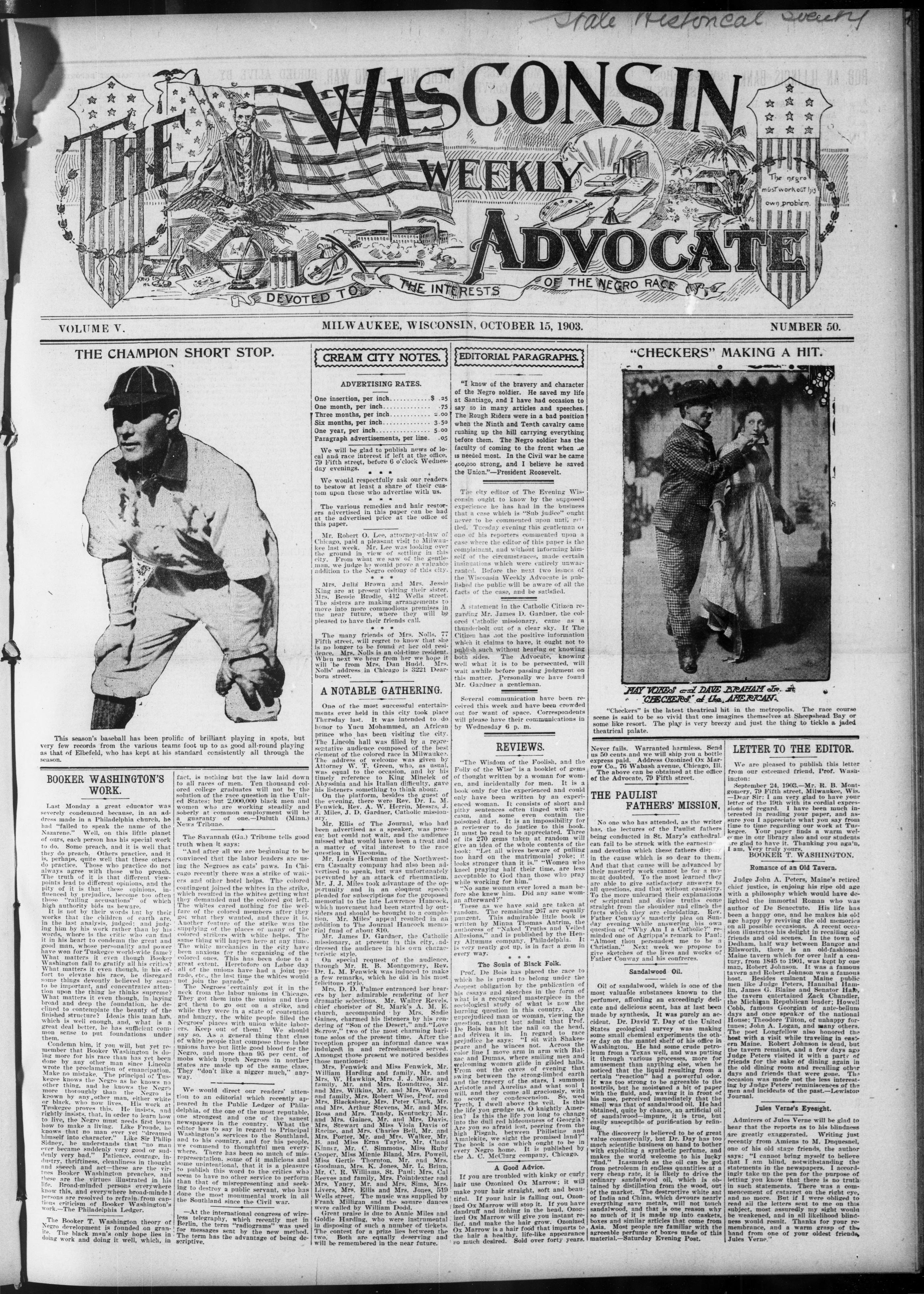
WISCONSIN
WEEKLY
ADVOCATE
DEVOTED TO THE INTERESTS OF THE NEGRO RACE
B
This season's baseball has been prolific of brilliant playing in spots, but very few records from the various teams foot up to as good all-round playing as that of Elbefeld, who has kept at his standard consistently all through the season.
This season's baseball has been prolific of brilliant playing in spots, but very few records from the various teams foot up to as good all-round playing as that of Elbefeld, who has kept at his standard consistently all through the season.
VOLUME V.
This season's baseball has been pro-
very few records from the various tea-
as that of Elbefeld, who has kept at his
season.
BOOKER WASHINGTON'S WORK.
Last Monday a great educator was severely condemned because, in an address made in a Philadelphia church, he had "failed to speak the name of the Nazarene." Well, on this little planet of ours, each person has his special work to do. Some preach, and it is well that they do preach. Others practice, and it is, perhaps, quite well that these others do practice. Those who practice do not always agree with those who preach. The truth of it is that different viewpoints lead to different opinions, and the pity of it is that these opinions, influenced by prejudice, become too often those "railing accusations" of which high authority bids us beware.
It is not by their words but by their works that the children of earth are, in the last analysis, judged; and judging him by his work rather than by his words, where is the critic who can find it in his heart to condemn the great and good man, whose personality and power have won for Tuskegee world-wide fame? What matters it even though Booker Washington fail to gratify all his critics? What matters it even though, in his effort to elevate his race, he disregard some things devoutly believed by some to be important, and concentrates attention upon the thing he thinks supreme? What matters it even though, in laying broad and deep the foundation, he declined to contemplate the beauty of the finished structure? Ideals this man has, which is well enough, and, what is a great deal better, he has sufficient common sense to put foundations under them.
Condemn him, if you will, but yet remember that Booker Washington is doing more for his race than has yet been done by any other man since Lincoln wrote the proclamation of emancipation. Make no mistake. The principal of Tuskegee knows the Negro as he knows no other thing, and he knows the Negro more thoroughly than the Negro is known by any other man, either white or black, who now lives. His work at Tuskegee proves this. He insists, and rightly insists, that, in order to learn how to live, the Negro must needs first learn how to make a living. Like Froude, he knows that no man ever yet "dreamed himself into character." Like Sir Philip Sidney, he understands that "no man ever became suddenly very good or suddenly very bad." Patience, courage, industry, thriftiness, cleanliness in thought and soeech and act—these are the virtues Booker Washington preaches, and these are the virtues illustrated in his life. Broad-minded persons everywhere know this, and everywhere broad-minded persons are resolved to refrain from captions criticism of Booker Washington's work.—The Philadelphia Ledger.
The Booker T. Washington theory of Negro development is founded on granite. The black man's only hope lies in doing work and doing it well, which, in
fact, is nothing but the law laid down to all races of men. Ten thousand colored college graduates will not be the solution of the race question in the United States; but 2,000,000 black men and women who are working steadily and soberly at common employment will be a guaranty of one.—Duluth (Minn.) News Tribune.
The Savannah (Ga.) Tribune tells good truth when it says:
"And after all we are beginning to be convinced that the labor leaders are using the Negroes as cats' paws. In Chicago recently there was a strike of waiters and other hotel helps. The colored contingent joined the whites in the strike, which resulted in the whites getting what they demanded and the colored got left. The whites cared nothing for the welfare of the colored members after they got what they wanted, and there it is. Another feature of the strike was the supplying of the places or many of the colored strikers with white helps. The same thing will happen here at any time. The white mechanics in the city have been anxious for the organizing of the colored ones. This has been done to a great extent. Heretofore on Labor day all of the unions have had a joint parade, etc., the last time the whites would not join the parade."
The Negroes certainly got it in the neck from the labor unions in Chicago. They got them into the union and then got them to go out on a strike, and while they were in a state of contention and hungry, the white people filled the Negroes' places with union white laborers. Keep out of them! We should say so. As a general thing that class of white people that compose these labor unions have but little good blood for the Negro, and more than 95 per cent. of mobs which lynch Negroes in norther states are made up of the same class. They "don't like a nigger much," anyway.
---
We would direct our readers' attention to an editorial which recently appeared in the Public Ledger of Philadelphia, of the one of the most reputable, one strongest and one of the sanest newspapers in the country. What the editor has to say in regard to Principal Washington's services to the Southland, and to his country, and for his people, we commend to thoughtful men everywhere. There has been so much of misrepresentation, some of it malicious and some unintentional, that it is a pleasure to publish this word to the critics who seem to have no other service to perform than that of misrepresenting and seeking to destroy a public servant, who has done the most monumental work in all the Southland since the Civil war.
At the international congress of wireless telegraphy, which recently met in Berlin, the term "radiograms" was used for messages sent by the new method. The term has the advantage of being descriptive.
CREAM CITY NOTES.
ADVERTISING RATES.
One insertion, per inch..... $ .25
One month, per inch..... 75
Three months, per inch..... 2.00
Six months, per inch..... 3.50
One year, per inch..... 5.00
Paragraph advertisements, per line..... 0.05
We will be glad to publish news of local and race interest if left at the office, 79 Fifth street, before 6 o'clock Wednesday evenings.
We would respectfully ask our readers to bestow at least a share of their custom upon those who advertise with us.
The various remedies and hair restorers advertised in this paper can be had at the advertised price at the office of this paper.
Mr. Robert O. Lee, attorney-at-law of Chicago, paid a pleasant visit to Milwaukee last week. Mr. Lee was looking over the ground in view of settling in this city. From what we saw of the gentleman, we judge he would prove a valuable addition to the Negro colony of this city.
* * *
Mrs. Julia Brown and Mrs. Jessie King are at present visiting their sister, Mrs. Bessie Brodie, 412 Wells street. The sisters are making arrangements to move into more commodious premises in the near future, where they will be pleased to have their friends call.
* * *
The many friends of Mrs. Nolls, 77 Fifth street, will regret to know that she is no longer to be found at her old residence. Mrs. Nolls is an old-time resident. When next we hear from her we hope it will be from Mrs. Dan Budd. Mrs. Nolls' address in Chicago is 3221 Dearborn street.
A NOTABLE GATHERING.
One of the most successful entertainments ever held in this city took place Thursday last. It was intended to do honor to Yucu Mohammed, an African prince who has been visiting the city. The Lincoln hall was filled by a representative audience composed of the best element of the colored race in Milwaukee. The address of welcome was given by Attorney W. T. Green, who, as usual, was equal to the occasion, and by his timely reference to King Minelek of Abyssinia and his Italian difficulty, gave his listeners something to think about. On the platform, besides the guest of the evening, there were Rev. Dr. L. M. Fenwick, Rev. A. W. Herrin, Messrs. J. J. Miles, J. D. Gardner, Catholic missionary
Mr. Ellis of The Journal, who had been advertised as a speaker, was present but could not wait, and the audience missed what would have been a treat and a matter of vital interest to the race question in Wisconsin. Mr. Louis Heckman of the Northwestern Casualty company had also been advertised to speak, but was unfortunately prevented by an attack of rheumatism. Mr. J. J. Miles took advantage of the opportunity and in an eloquent speech pleaded for subscriptions for the proposed memorial to the late Lawrence Hancock, which movement had been started by outsiders and should be brought to a completion. Mr. Miles' appeal resulted in an addition to The Journal Hancock memorial fund of about $10.
Mr. James D. Gardner, the Catholic missionary, at present in this city, addressed the audience in his own characteristic style.
On special request of the audience, through Mr. R. B. Montgomery, Rev. Dr. L. M. Fenwick was induced to make a few remarks, which he did in his most felicitous style.
Mrs. D. D. Palmer entranced her hearers by her admirable rendering of her dramatic selections. Mr. Walter Revels, chief chorister of St. Mark's A. M. E. church, accompanied by Mrs. Sadie Gaines, charmed his listeners by his rendering of "Son of the Desert," and."Love Sorrow," two of the most charming baritone solos of the present time. After the reception proper an informal dance was indulged in and refreshments served. Amongst those present we noticed besides those mentioned:
Mrs. Fenwick and Miss Fenwick, Mr. William Harding and family, Mr. and Mrs. W. Hawkins, Mrs. J. J. Miles and family, Mr. and Mrs. Roundtree, Mr. and Mrs. Wilkins, Mr. and Mrs. Warren and family, Mrs. Robert Wise, Prof. and Mrs. Blackshear, Mrs. Peter Clark, Mr. and Mrs. Arthur Stevens, Mr. and Mrs. Ross and Mrs. Tandy, Kentucky; Mr. and Mrs. Gaines, Mr. and Mrs. Davis. Mrs. Stewart and Miss Viola Davis of Racine, and Mrs. Charles Bell, Mr. and Mrs. Porter, Mr. and Mrs. Walker, Mr. B. and Miss Erna Taylor, Mr. Claud Kinner, Mr. C. Simmons, Miss Ruby Cooper, Miss Minnie Bland, Mrs. Powell, Miss Gertie Thornton, Mr. and Mrs. Goodman, Mrs. K. Jones, Mr. L. Brinn. Mr. C. R. Williams, St. Paul; Mrs. Cal Reeves and family, Mrs. Pointdexter and Mrs. Yancy, Mr. and Mrs. Sims, Mrs. Livers, Mrs. Ellis and Mrs. Jones, 519 Wells street. The music was supplied by Frank Milligan and the square dances were called by William Dodd.
Great praise is due to Annie Miles and Goldie Harding, who were instrumental in disposing of such a number of tickets. The contest for a prize lies between the two. Both are equally deserving and will be remembered in the near future.
EDITORIAL PARAGRAPHS.
"I know of the bravery and character of the Negro soldier. He saved my life at Santiago, and I have had occasion to say so in many articles and speeches. The Rough Riders were in a bad position when the Ninth and Tenth cavalry came rushing up the hill carrying everything before them. The Negro soldier has the faculty of coming to the front when he is needed most. In the Civil war he came 400,000 strong, and I believe he saved the Union."—President Roosevelt.
The city editor of The Evening Wisconsin ought to know by the supposed experience he has had in the business that a case which is "Sub justice" ought never to be commented upon until gritted. Tuesday evening this gentleman or one of his reporters commented upon a case where the editor of this paper is the complainant, and without informing himself of the circumstances, made certain insinuations which were entirely unwarranted. Before the next two issues of the Wisconsin Weekly Advocate is published the public will be aware of all the facts of the case, and be satisfied.
A statement in the Catholic Citizen regarding Mr. James D. Gardner, the colored Catholic missionary, came as a thunderbolt out of a clear sky. If The Citizen has not the positive information which it claims to have, it ought not to publish such without hearing or knowing both sides. The Advocate, knowing well what it is to be persecuted, will wait awhile before passing judgment on this matter. Personally we have found Mr. Gardner a gentleman.
Several communication have been received this week and have been crowded out for want of space. Correspondents will please have their communications in by Wednesday 6 p. m.
REVIEWS.
"The Wisdom of the Foolish, and the Folly of the Wise" is a booklet of gems of thought written by a woman for women, and incidentally for men. It is a book only for the experienced and could only have been written by an experienced woman. It consists of short and pithy sentences often tinged with sarcasm, and some even contain the poisoned dart. It is an impossibility for a reviewer to do justice to this book. It must be read to be appreciated. Three of its 270 gems taken at random will give an idea of the whole contents of the book: "Let all wives beware of pulling too hard on the matrimonial yoke; it books stronger than it is." "Women who kneel praying half their time, are less acceptable to God than those who pray while working for him."
"No sane woman ever loved a man before she knew him. Did any sane woman afterward?" These as we have said are taken at random. The remaining 267 are equally pungent. This admirable little book is written by Minna Thomas Antrim, the authoress of "Naked Truths and Veiled Allusions," and is published by the Henry Altumus company, Philadelphia. It is very neatly got up, is in fact a gem in every way.
The Souls of Black Folk.
Prof. De Bois has placed the race to which he is proud to belong under the deepest obligation by the publication of his essays and sketches in the form of what is a recognized masterpiece in the sociological study of what is now the burning question in this country. Any unprejudiced man or woman, viewing the question, cannot but admit that Prof. De Bois has hit the nail on the head, and driven it in. In regard to race prejudice he says: "I sit with Shakespeare and he winces not. Across the color line I move arm in arm with Balzac and Dumas, where smiling men and welcoming women glide in gilded halls. From out the caves of evening that swing between the strong-limbed earth and the tracery of the stars, I summon Aristotle and Aurelius and what soul I will, and they come all graciously, with no scorn or condescension. So, wed Truth, I dwell above the veil. Is this the life you grudge us, O knightly America? Is this the life you long to change into the dull red hideousness of Georgia? Are you so afraid lest, peering from the high Pisgah, between Philistine and Amalekite, we sight the promised land?" The book is one which ought to be in every Negro home. It is published by the A. C. McClurg company, Chicago.
A Good Advice.
If you are troubled with kinky or curly hair use Ozonized Ox Marrow; it will make your hair straight, soft and beautiful. If your hair is falling out, Ozonized Ox Marrow will stop it. If you have dandruff and itching in the head, Ozonized Ox Marrow will give you instant relief, and make the hair grow. Ozonized Ox Marrow is a hair food that imparts to the hair a healthy, life-like appearance so much desired. Sold over forty years.
"CHECKERS" MAKING A HIT.
THE FOLK STORY
MAY VOKES and DAVE BRAHAM JR. in CHECKERS of the AMERICAN.
"Checkers" is the latest theatrical hit in the metropolis. The race course scene is said to be so vivid that one imagines themselves at Sheepshead Bay or some like resort. The play is very breezy and just the thing to tickle a jaded theatrical palate.
Never fails. Warranted harmless. Send us 50 cents and we will ship you a bottle express paid. Address Ozonized Ox Marrow Co., 76 Wabash avenue, Chicago, Ill. The above can be obtained at the office of the Advocate, 79 Fifth street.
LETTER TO THE EDITOR.
We are pleased to publish this letter from our esteemed friend, Prof. Washington:
THE PAULIST FATHERS' MISSION.
No one who has attended, as the writer has, the lectures of the Paulist fathers being conducted in St. Mary's cathedral, can fail to be struck with the earnestness and devotion which these fathers display in the cause which is so dear to them. And that that cause will be advanced by their masterly work cannot be for a moment doubted. To the most learned they are able to give satisfactory answers to all questions, and that without casuistry. To the more unlearned their explanations of scriptural and divine truths come straight from the shoulder and clinch the facts which they are elucidating. Rev. Father Conway's masterly plea on Sunday evening while answering his own question of "Why Am I a Catholic?" reminded one of Agrippa's remark to Paul: "Almost thou persuadest me to be a Christian." Next week we propose to give sketches of the lives and works of Father Conway and his confreres.
Sandalwood Oil.
Oil of sandalwood, which is one of the most valuable substances known to the perfumer, affording an exceedingly delicate and delicious scent, has at last been made by synthesis. It was purely an accident. Dr. David T. Day of the United States geological survey was making some small chemical experiments the other day on the mantel shelf of his office in Washington. He had some crude petroleum from a Texas well, and was putting it through various processes, more for amusement than anything else, when he noticed that the liquid resulting from a certain "reaction" had a powerful odor. It was too strong to be agreeable to the nostrils, but he moistened a bit of paper with the fluid, and, waving it in front of his nose, perceived immediately that the smell was that of sandalwood oil. He had obtained, quite by chance, an artificial oil of sandalwood—impure, it is true, but easily susceptible of purification by refining.
The discovery is believed to be of great value commercially, but Dr. Day has too much scientific business on hand to bother with exploiting a synthetic perfume, and makes the world welcome to his lucky "find." Inasmuch as the oil can be got from petroleum in endless quantities at a very cheap rate, it is likely to drive the ordinary sandalwood oil, which is obtained by distillation from the wood, out of the market. The destructive white ant of India and China, which devours nearly everything save metals, will not touch sandalwood, and that is one reason why so much of it is made up into caskets, boxes and similar articles that come from Asia. Most people are familiar with the agreeable perfume of boxes made of this material.—Saturday Evening Post.
MAKING A HIT.
it in the metropolis. The race course agines themselves at Sheepshead Bay or lazy and just the thing to tickle a jaded
LETTER TO THE EDITOR.
We are pleased to publish this letter from our esteemed friend, Prof. Washington:
September 24, 1903.—Mr. R. B. Montgomery, 79 Fifth street, Milwaukee, Wis.
—Dear Sir: I am very glad to have your letter of the 19th with its cordial expressions of regard. I have been much interested in reading your paper, and assure you I appreciate what you say from time to time regarding our work at Tuskegee. Your paper finds a warm welcome in our library also and our students are glad to have it. Thanking you aga'n, I am, Very truly yours.
BOOKER T. WASHINGTON.
Romance of an Old Tavern.
Judge John A. Peters, Maine's retired chief justice, is enjoining his ripe old age with a philosophy which would have delighted the immortal Roman who was author of De Senectute. His life has been a happy one, and he makes his old age happy by reviving the old memories on all possible occasions. A recent occasion illustrates his delight in recalling old friends and old scenes. In the town of Dedham, half way between Bangor and Ellsworth, there is an old-fashioned Maine tavern which for over half a century, from 1845 to 1901, was kept by one man, Robert Johnson. It was a famous tavern and Robert Johnson was a famous host. Besides eminent Maine public men like Judge Peters, Hannibal Hamlin, James G. Blaine and Senator Hale, the tavern entertained Zack Chandler, the Michigan Republican leader; Howell Cobb, famous Georgian of ante-bellum days and once speaker of the national House; Theodore Tilton, of unhappy fortunes; John A. Logan, and many others. The poet Longfellow also honored the host with a visit while traveling in eastern Maine. Robert Johnson is dead, but the tavern remains, and a few days ago Judge Peters visited it with a party of friends for the sake of dining again in the old dining room and recalling other days and friends that were gone. The occasion was made not the less interesting by Judge Peters' reminiscences of the men and incidents of the past.—Lewiston Journal.
Jules Verne's Eyesight.
Admirers of Jules Verne will be glad to hear that the reports as to his blindness are greatly exaggerated. Writing just recently from Amiens to M. Duquesnel, one of his old stage friends, the author says: "I cannot bring myself to believe that I am blind, notwithstanding the statements in the newspapers. I accordingly take up the pen for the purpose of letting you know that there is no truth in such statements. There was a commencement of cataract on the right eye, and no more. But if I were obliged to read all the letters sent to me on this subject, most assuredly my sight would be weakened, and in all likelihood blindness would result. Thanks for your remembrance, and a warm grasp of the hand from one of your oldest friends, Jules Verne."
---
NUMBER 50.
Peoria, Ill., Oct. 14.—Four men drove into Berwick early today, entered the Farmers' State bank, forced the combination of the safe and secured $28,000. The explosion awakened a number of residents, who appeared on the scene only to be compelled by the armed robbers to keep away until they had loaded their booty into a buggy and driven toward the east. No trace of the robbers has yet been found. Lima, O., Oct. 14.—A running fight between residents of the town and burglars following the robbery of the postoffice occurred at Columbus Grove early today. So far as could be learned no one was injured.
For several days suspicions have been aroused by the presence of strangers in the town, and extra guards were placed around banks and other places which might be attacked. The postoffice was unprotected. About 2 o'clock a terrific explosion aroused the citizens, who, seeing the robbers escape from the postoffice, fired at them, many shots being exchanged.
All the surrounding towns have been notified to keep a lookout for the thieves. The amount taken was not large. The robbers numbered eight and in the shooting it is thought one of them was wounded.
TURN ON PIRATES.
Crew of Stolen Ship Attack Fugitive American Officers, Killing One of Them
Manila, Oct. 14-6:30 p. m.-The crew of the boat in which Johnston and Herman, the runaway constabulary officers, accompanied by one constable, started from Guibal for Cagayans island, attacked the outlaws on nearing the latter place, killing Johnston and wounding Herman and the constable.
Herman killed four of the crew and the other two jumped overboard. He then put back to Negros, where he sent guns and ammunition to the police and abandoned the boat of Nabalva, Bayauan, where he was in hiding when the last was heard of him.
On Saturday night last the police captured the boat, recovering a number of constabulary guns, ammunition and some money. They also buried Johnston, whose body was found in the boat. It is presumed that the crew intended to kill the outlaws and secure their money and arms.
ARCHBISHOP KAIN DIES IN BALTIMORE.
Head of the Catholic See of St. Louis Succumbs After Long Illness Brought on by Overwork.
Baltimore, Md., Oct. 14.—Most Rev. John Joseph Kain, archbishop of St. Louis, died last night at the St. Agnes sanitarium, this city, where he had been a patient since May 12. Death, which came peacefully, had been hourly expected by his attending physicians for several days.
Heart disease was the ailment for which the archbishop was first treated when he arrived at the institution; but a general break-down from overwork caused him much trouble. Recently appendicitis developed and the prelate rapidly sank, an operation, which was deemed necessary, being impracticable owing to his feeblebed condition.
DENY THE WAR RUMORS.
Japan Says That She Is Not Going to Fight Russia at Present—Czar Sending Troops.
London, Oct. 14.—The Japanese government has issued a denial of the alarmist reports of the imminence of war with Russia.
Berlin, Oct. 14.—The rumors of war in the far east have for the present, so far as Berlin is concerned, been quite blown away by the official reassurances from all sides.
St. Petersburg, Oct. 14.—A thousand marines belonging to the Baltic fleet left St. Petersburg today for Port Arthur.
DENIES STREETER WRIT.
Judge Jenkins Will Not Give Capt. Geo W. Streeter a Chance for Liberty.
Chicago, Ill., Oct. 14.—Judge Jenkins of the federal court today refused to release on a writ of habeas corpus "Capt." George W. Streeter, who is under penitentiary sentence for complicity in a murder growing out of a controversy over land he claims.
WAS HIRED TO BURN THEATER.
Watchman at Baltimore Playhouse Confesses Incendiarism—Accuses Actor.
Baltimore, Md., Oct. 14.—Charles T. Bevans of this city, a watchman of the Empire theater, confessed to the police that he, by direction of and the assistance of William Tibbetts ("Leonard Scarlet"), leading man in the Leonard Scarlet company, twice set fire to that playhouse.
The fire department was promptly on the scene in each instance, and the total loss was not more than $4000 or $5000. In Bevans' sworn statement he alleges that Tibbetts promised him $25 for his share in the job. Tibbetts last week had a sensational quarrel with Miss Mabel Bardine, the leading woman of the company, because she refused to kiss him on the mouth in the love scene in Tolstoi's "Resurrection," she declaring that she was opposed to indiscriminate kissing, even on the stage.
SILVER REACHES HIGH MARK
Best Price in Years Caused by Recent Philippine Shipments.
New York, Oct. 14.—Aided by the American purchases for the Philippines and the demand from India, commercial bar silver yesterday touched the highest price in years both in London and New York. The price as cabled from England is 28 pence per ounce, while here it fetched $60 \frac{1}{2} \times 60 \frac{1}{2} \text{ cents}.$ The treasury has purchased a million ounces at 60.125 cents per ounce for delivery in San Francisco for the Philippines, which is more than it has ever yet paid.
DOWIE'S "HOST" STARTS FOR EAST.
MOVEMENT FROM ZION CITY TO NEW YORK HAS BEEN
Eight Trains Bearing 3000 Crusaders Under Leadership of John Alexander Dowie Leave Chicago.
Chicago, Ill., Oct. 14.—The "Restoration host" from Zion City began its Dowie left the North Shore city, eight At intervals of one-half hour trainloads of the followers of John Alexander Dowie left the North Shore city eight trains in all bearing over 3000 "crusaders." At the blowing of the fire whistle every inhabitant of the city was ready to kneel and pray for a safe journey and over 7000 men, women and children gathered at the railway station to listen to the final instructions of their leader.
The cars are decorated only with a Zion banner at the rear of each train. Uniformed guards were distributed throughout the cars while the Zion band, the Restoration choir of 600 voices and the children's choir gathered about to inspire the departing host. The trains proceed over various lines, passing around Chicago. The band and choir trains were the last to leave, the latter bearing Dowie's private car, the "Arcadian."
New York, Oct. 14.—Madison Square garden is being prepared for the use of John Alexander Dowie and his adherents, who are expected to arrive Friday morning to undertake a reformation. The decorations of the Old Guard fair were removed today and workment began to build at the east end of the garden a platform with a seating capacity sufficient for "Zion's" 500 officers and choir of 550. In front of the platform will be a baptismal pool 30 feet long and 15 feet wide.
LYNCHED A MURDERER SENTENCED TO DIE.
Appeal to Supreme Court by Convicted Man Causes Mob's Action—Had Murdered a Little Boy.
Hamilton, Mont., Oct. 14.—Walter Jackson, the convicted murderer of Fannit Buck, a 6-year-old boy, was taken from the county jail here late last night by a mob and lynched.
The murder of little Fannit Buck was a peculiarly atrocious crime. When the boy's body was found it was horribly mutilated. Suspicion pointed to Jackson and when he was arrested a lynching was narrowly averted. His trial quickly followed and a verdict was returned within two hours. He was sentenced to be hanged, but his attorneys appealed to the supreme court.
CORN MAY CAUSE W. L. ELKINS' DEATH.
Millionaire Traction Owner of Philadelphia Is Dangerously Ill—Organic Troubles Develop.
Philadelphia. Pa., Oct. 14.—William L. Elkins, the millionaire traction owner, is seriously ill at his country home a few miles from Philadelphia. Mr. Elkins, it is said, is suffering from organic troubles. It is stated that his illness began with inflammation caused by a tight shoe irritating a corn on his toe. At one time it was feared his leg would have to be amputated. A report was circulated that Mr. Elkins was dying, but at his home the only announcement made was that his condition was extremely serious.
VENEZUELA SEIZES A BRITISH SHIP.
The Boat Is Taken Possession of While Attempting to Leave the Amacura River.
Georgetown, British Guiana, Oct. 14.—A boat laden with dry goods and provisions, the property of a British subject, William Romanes, while proceeding to Haiwa on the Yarakita river, Venezuela, after having cleared at Morawhanna, British Guiana, October 4, with British papers and flying the British flag, was seized by the commander of the Venezuelan lightship at the mouth of the Amacura river, Venezuela.
FATALITY IN A MINE,
Negaunee, Mich., Oct. 14.—[Special.]—Charles Bloomquist was instantly killed and John Reinstrom sustained injuries from which he cannot recover, by an accident at Hartford mine. They got in the cage to come to the surface, when within about twenty feet from the top landing, the cage descended to the bottom, a distance of nearly 400 feet. The accident was caused by the wire rope breaking.
SIGN ARBITRATION TREATY
Secretary Lansdowne and Ambassador Cambon Sign the Anglo-Franco Agreement. London, Oct. 14.—12:55 p. m.—The arbitration treaty between Great Britain and France was signed here today by Foreign Secretary Lansdowne and the French ambassador, M. Cambon.
OIL IS AT HIGH RECORD.
Indiana Product Fetches $1.21, a Price Only Once Before Equaled.
Montpelier, Ind., Oct. 14.—The oil market has reached the highest price ever paid for Indiana oil. The highest price Indiana oil ever brought before was $1.21, on February 5, 1900. That price has never been reached since that date until a 2 cent boost was given Indiana and South Lima oils, which sent them to $1.21, the highest price ever paid for either.
Lima, O., Oct. 14.—The third advance for the month was made in crude oil, prices of western oils going up 2 cents, while 3 cents was added to the quotations on eastern products.
JUDGE RAPS FAITH CURE.
New York Court of Appeals Says Doctor Must Be Called.
Albany, N. Y., Oct. 14.—Dependence solely upon faith healing in case of illness is held by the New York court of appeals to constitute criminal negligence. The decision was rendered in the case of the people against Pierson, a resident of White Plains, whose adopted daughter died in 1901 of a bronchial trouble. For failing to call a licensed physician during her illness, Pierson was fined $500, with the alternative of 500 days' imprisonment.
GERMAN MOB TRIES TO LYNCH CONVICT.
CARRIAGE IN WHICH MAN IS BEING TAKEN TO PRISON IS AT- TACKED
He Had Beaten Boy to Death and People Thought Eight-Year Sentence
Berlin, Oct. 13.—A number of would-be lynchers at Bamberg surrounded the carriage in which guards were taking Andreas Dippold to the penitentiary to begin his sentence of eight years for whipping to death Heniz Koch, son of the director of the Deutsch bank.
The mob almost succeeded in getting possession of Dippold when the guards fixed bayonets and drove their assailants off.
Dippold was struck in the back by a piece of metal. Dippold was young Koch's tutor.
SHE MAY SUE PLATT.
Washington, D. C., Oct. 13.—Miss May C. Wood left Washington yesterday accompanied by a legal adviser, and a hundred or more tender letters, to discuss matters with Senator Thomas C. Platt, whose engagement to marry Mrs. Lillian T. Janeway on Thursday was recently announced
Miss Wood is a clerk in the postoffice department, whither she was transferred from New York about eighteen months ago under the patronage of the New York senator. Incidentally she took a trip to Europe for the benefit of her health, and many of the senator's letters were indited to her during this voyage. She also has other amatory missives, which if they do not absolutely express a promise to marry, would be strong corroborative evidence of a verbal agreement. During the summer Miss Wood was busy preparing a modest trousseau and gave her intimate friends to understand that her fiance was the venerable senatorial widower who presides over the political destinies of the Empire state.
When the engagement to Mrs. Janeway was announced, Miss Wood at first treated the matter as a canard, but when convinced of its truth immediately took legal advice. She resides at a semi-fashionable boarding house at 114 H street, and is a woman of great personal charm. She is about 35 years of age and well educated. She did not inform her friends of her New York address, but has intimated that she would not return until she had obtained complete satisfaction for the alleged deception perpetrated upon her. She says that if necessary she will institute a breach of promise suit at once, and meantime do all in her power to break off the engagement now existing between the senator and Mrs. Janeway. Senator Platt's friends smile at the threats.
IS A PROTECTIONIST.
New Colonial Secretary of Great Britain Agrees with Mr. Chamberlain's
London, Oct. 13.—Colonial Secretary Lyttleton issued an ejection address to his constituents at Warwick and Leamington today in which he says he is in entire agreement with the fiscal changes "which Mr. Balfour and Mr. Chamberlain together advocate." Mr. Lyttleton holds that the government should be enabled to mitigate the inequality of foreign competition and to negotiate effectively for a reduction of foreign tariffs on British goods by having the power to impose taxation on foreign manufactures.
The colonial secretary is convinced the empire should be further knitted together by strengthening the commercial ties of its various parts by preferential tariffs. To secure closer ties with the colonies involved a readjustment of the taxes on food peculiarly affecting the poorer classes, who should therefore have a full opportunity minutely and deliberately to consider the matter. It should, therefore, be distinctly understood that there is no proposal to impose preferential tariffs for the colonies without further reference to the electorate.
LIFE SENTENCE FOR
. MURDER OF PARENTS.
Earl Ellsworth of Chicago Confesses to Slaying His Father, Mother and a Boarder.
Chicago, Ill., Oct. 13.—Earl Ellsworth, who recently confessed to having murdered his father and mother and a boarder at his home in Woodstock, today waived a change of venue for which he had applied and threw himself on the mercy of the court. He was given a life sentence in the penitentiary.
SOCIALIST RIOT AT PORTO RICO.
Anti-Americans Parade with Red and Black Flags and Fight Police.
San Juan, Porto Rico, Oct. 13.—Gov. Hunt returned here from Ponce to find that during his absence the Socialists and Anarchists had had a clash with the police. Forty arrests were made, and many of the prisoners were sentenced to six months' imprisonment, including the Anarchist Conde, who was recently convicted of insulting the American flag. Americans here are particularly incensed at the carrying of black and red flags and a craped American flag by a mob as an incitement to disorder. Conde delivered an offensive harangue, in which he approved of the mob resorting to bloodshed if necessary. The Americans demand the punishment of all the dangerous Socialists, and are overwhelming Gov. Hunt with assurances of support in a vigorous campaign to uphold law and order.
Clean Papers Needed.
Hasten the day when our intellectual life has so far developed that a clean paper will be in greater demand than a sensational one, when the public shall eat of the meat of knowledge, rather than feed on the aromatic husks that excite the passions and fester a national life.—Western Publisher.
The Worm Turns.
"You're forever trying to give the impression that you're a martyr," snapped Mrs. Henpeck. "I suppose you want everybody to think that you suffer in silence."
"No," replied Mr. Henpeck. "I suffer in the perpetual absence of silence. A little silence would be a positive pleasure to me."—Philadelphia Press.
—New Orleans and Galveston now export more wheat than New York.
THERE WILL BE NO WAR.
Dispute Between Japan and Russia Will Be Settled Amicably.
Berlin, Oct. 13.—Count Inouye, the Japanese minister, says everything in the dispute between Japan and Russia will be settled amicably.
St. Petersburg, Oct. 13.—The foreign office says it has no official confirmation of the reported disembarkation of Japanese troops at Ma San Phop. Regarding Manchuria the foreign office states that the question is at present closed. The existing situation is the fault of the Chinese, Japanese and British. If China desired to reopen the negotiations and accept certain conditions the situation could still be changed as Russia is not rooted to the soil and could leave if she liked.
Russia is now transporting 50,000 troops, nurses, physicians and hospital supplies to the far east. The present strength of the Russian army there is reliably reported to be 283,000 men. Officers detailed for duty in the Orient have been forbidden to take their wives.
London, Oct. 13.—Baron Hayashi, the Japanese minister here, has received reassuring news from Japan with reference to the situation in the far east. He says his telegram indicates that there is no need, whatever, for alarm and adds that the message was not a reply to anything he had cabled, so he thinks it was probably sent because of the alarmist rumors which have been in circulation in Europe and which finally reached Japan.
Yokohama, Oct. 13.—All reports emanating from Shanghai of the opening of hostilities between Japan and Russia, etc., may be dismissed as absurd. Russo-Japanese affairs are marking time.
The second secretary of the Russian legation left Tokio October 12 with secret dispatches for the Russian viceroy of the far east, Admiral Alexieff.
An important conference of Japanese statesmen, including the Marquis Ito, was held at the premier's office today.
London, Oct. 13.—The trend of today's early information regarding the far eastern situation is less alarming. The Frankfurter Zeitung, whose sensational announcement of the occupation of Ma San Pho by Japan yesterday occasioned disquiet today, publishes a telegram from Shanghai, saying there is no confirmation of the reported occupation of that place, adding that the Russo-Japanese negotiations at Tokio concerning the evacuation of Manchuria gave the impression that the political situation in Japan is quiet.
Mere Contradictions
The Koelnische Zeitung also prints a reassuring telegram from St. Petersburg, repeating a telegram from Port Arthur, stating that Viceroy Alexieff has issued a contradiction of the reported movements of Japanese troops to Corea. The telegram adds that the reports circulated on the subject are evidently only intended to serve the purposes of speculation and provoke disquiet.
A special dispatch from Rome says that forty-five Japanese officers who have been studying at the military academies of Modena and Raccogini, have been called to Japan by telegraph and immediately started for Brindisi, to embark for Japan.
Meeting of British Admirals.
The meeting of British admirals at Singapore has no connection with any special tension at present existing in the far east. The meeting was announced as far back as August 25 for the purpose of enabling the commanders of the East Indian, China and Australian stations to confer with reference to a general scheme whereby the three squadrons can be used in the event of necessity, instead of each being confined as heretofore to the sphere definitely assigned to its jurisdiction. It has been arranged that a similar conference shall be held annually.
Situation Less Grave
Berlin, Oct. 13.—The foreign office here now looks upon the situation in the far east as being less grave. Both Japan and Russia appear willing to arrange a modus vivendi concerning Corea, which country, and not Manchuria, is the extreme point of difference. Russia, it is asserted, would consider it a casus belli were Japan to land troops at Ma San Pho. The foreign office says the London Times' statement that a secret agreement exists between Great Britain and Germany relative to East Asia is wholly incorrect. The correspondence respecting the convention of 1900 was fully published. Hay Does Not Look for War.
Washington, D. C., Oct. 13. At the cabinet meeting today Secretary Hay spoke of information he had received as to the situation in the far east, and it was his opinion that there was no immediate indication of hostilities between Russia and Japan. He intimated that negotiations are in progress between the countries which seem likely to result favorably for peace.
PEOPLE PROTEST THE PROPOSED CONVENTION.
Buenos Ayres Citizens Create Demonstration Against Nomination of Candidates for Presidency.
Buenos Ayres, Argentine, Oct. 13.—A large demonstration against the convention for the nomination of candidates for president and vice president which will meet today has been made. The convention is composed of the notable men of the republic and its opponents are of the general public.
Mobs in the streets indulged in attacks on the government and Senor Quintana, the official candidate. It is possible that public feeling may be heeded and the convention abandoned.
In a collision between the mobs and the police several persons were injured.
LOSES RACE WITH DEATH.
Walter H. Field of Maine Expires on Train Near Chicago—Hoped to Die at Home.
Chicago, Ill., Oct. 13.—A race against death which Walter H. Field of Portland, Me., was making came to an end as a Santa Fe passenger train was nearing Chicago today.
Mr. Field had been in Carlsbad, N. M., taking treatment for tuberculosis. Finding the end near he began a hurried trip east in the hope of dying in his old home. When the porter sought to reuse him this morning he was found dead.
BURIED ALIVE BY CAVE-IN OF EARTH.
ACCIDENT AT PITTSBURG, PA., WILL COST THE LIVES OF MANY.
It Is Not Believed Possible That Rescuers Can Save the Unfortunate Workmen.
Pittsburg, Pa., Oct. 13.—As the result of a cave-in at the construction work of the Pennsylvania railroad on Hamilton avenue, east end, this afternoon, a number of men are believed to be buried under hundreds of tons of earth. One man, Nicholas Trouvach, was rescued and is at the East End hospital fatally injured. A large force of men are clearing the excavation of the debris, but owing to the immense quantity that filled the hole, it it not expected that any of the men under it can be rescued alive.
FORGED PARDONS.
Military Prisoners at Alcatraz, California, Are Released on a Bogus Orger.
San Francisco, Cal., Oct. 13.—James H. Darling, Joseph White, Cornelius Cones and John L. Moore, military prisoners at Alcatraz, have been released by the authorities on pardons which it is now discovered were forged. These fraudulent pardons were sent through the ordinary course of a soldier's pardon, bearing the regular seals and stamps and approved by the President, but by whom and whose assistance were the forgeries perpetrated are questions not yet solved, but it is believed the investigation now in progress will eventually clear up the mystery.
The four prisoners were sentenced to five years' imprisonment and had more than two years unexpired term to serve. They were set at liberty October 7 and were landed in this city on the government steamer Gen. McDowell.
The signatures forged by the convicts were those of Maj. E. F. Hills, acting assistant adjutant-general at Washington; Maj. Henry M. Morrow, judge advocate of the department of California, and Maj. J. R. Williams, assistant adjutant-general of the department of California. In addition to these forgeries, the official stamps of the department of California headquarters and of the judge advocate's appear. The very letter head on which the pardon is typewritten seems genuine. The irregularity of the document is admitted by both Maj. Williams and Judge Advocate Morrow, who say the signatures on the papers were not their own.
NATURALIZATION LAW IS OFTEN IGNORED.
Special Agent Van Deusen Investigates Enforcement—Startling Irregularities Are Discovered.
Tacoma, Wash., Oct. 13.—Startling irregularities in the enforcement of the naturalization law, effective June 3, have been found in many states throughout the country. Special Agent Van Deusen was sent out to ascertain how the new law is being enforced by the state and federal courts. The provisions of the law in regard to the oath denouncing anarchistic beliefs are being overlooked by dozens of courts. One Chicago judge was found to have admitted 1800 foreigners to citizenship in one evening, an act physically impossible unless the oath was administered to applicants in platoons, while the law presumes an individual administration.
A much greater mistake has been made in Ohio, where over 250,000 men have been admitted to citizenship by probate judges, who have no right to administer the oath. From a legal standpoint these men still are foreigners. It is understood that the many errors have prompted President Roosevelt to suggest that a bill be presented to the next Congress limiting the right of naturalization to the federal courts.
UNIONS CANNOT FIGHT "OPEN SHOPS."
Ohio Judge Holds It Illegal to Boycott Firms Refusing to Unionize Their Emploves.
Hamilton, O., Oct. 13.-Judge Belden today granted one of the most sweeping injunctions ever issued by an Ohio court. It was directed against the Hamilton Typographical union, the Hamilton Co-operative Trades and Labor council and the Nonpareil Printing company, publishers of the county trade organ. The defendants are enjoined from continuing a boycott on The Republican News, or firms which advertise in it, and ordered that interference of every sort with the company's business must stop. The court said the constitution gave any company the right to employ whomsoever they saw fit. The boycott was to force the plaintiff to unionize and abandon its "open shop" policy.
FRANTIC MOTHER TRIES TO COMMIT MURDER.
Former Husband Would Not Tell Where Their Child Is—Chevalier di Muzella's Narrow Escape.
Paris, Oct. 13.—Helen Knowles Irish, the divorced wife of Chevalier Trezza di Muzella, president of the Italian chamber of commerce here, attempted to shoot the chevalier in front of the Opera house last night. The cause of the woman's attempt was his refusal to divulge the whereabouts of their child.
RUSSIA AND FRANCE
JOIN AGAINST ENGLAND.
Will Both Side with King Leopold of Bulgaria in the Congo
Situation
Paris, Oct. 13.—King Leopold of Belgium, who was received by President Loubet yesterday, is reported to have obtained France's support against Great Britain's view of the Congo situation. Russia is also behind Belgium.
MEETS HORRIBLE DEATH.
Brakeman Is Swept from Car and Crushed Under Wheels—Coroner's Jury Charges Negligence.
Marquette, Mich., Oct. 13.—[Special.]
—Swept from a car by a projecting chute on a coal dock here, John H. Brown, a brakeman, met a horrible death under the car wheels, his body being severed in twain. Negligence by the Pickands Coal company is charged by the verdict of the coroner's jury.
LATEST MARKET REPORTS.
MILWAUKEE, OCTOBER 14, 1903.
EGG AND DAIRY MARKETS.
EGG AND DAILY MARKETS.
MILWAUKEE — Eggs — Market steady; strictly fresh laid, loss off, cases returned, 19c; cases included, do, 19½c; at mark, cases included, 16½@17c; cases returned, 16@16½c; seconds, 12c; dirties, 16c; checks, 10c. There is a good local demand with only a fair supply. Receipts were 1490 cases.
Butter—Steady; choice grades are in good demand; low grades of dairy are slow sale; creamery, extra, per lb, 20c; prints, 20½c; firsts, 17@18c; seconds, 15@16c; dairy prints, 18c; fancy dairy, 17c; lines, 13@16c; packing stock, 12½@13c; whey, 10c. Receipts were 27,156 lbs.
Cheese—Firm. The demand continues steady on Brick and easy on Limburger. Supply liberal; demand good; American full cream, twins, 11@11½c; Young Americas, 12@12½c; Daisies, 12@12½c; Long Horns, 12@12½c; low grades, 8@10c; Limburger, per lb, new, No. 1, 8½@9c; off grades, 6@7c; fancy new Brick, 8@8½c; low grades, 6@7c; imported Swiss, 25c; Block Swiss, domestic, 11@11½c; fancy loaf, 12@12½c; No. 2. 8@10c; Sapsago, 20c. Receipts were 38,916 lbs.
PLYMOUTH—Twenty-nine factorles offered 3038 boxes cheese, of which 140 daisies passed. The balance sold as follows: 611 longhorns, 11c; 1386 daisies, 11c; 280 do, 11½c; 293 twins, 10½c; 58 do, 10c; 258 Americas, 11c; 112 do, 11½c.
CHICAGO — Butter — Steady; creameries, 15½@20c; dairies, 14@18c. Eggs—Steady; at mark, cases included, 18@19c. Cheese—Steady; daisies, 11½c; twins, 11c; Young Americas, 11½c. Poultry—Easier; turkeys, 12c; chickens, hens, 9½c; springs, 10½c.
HOGS—Recelpts, 8 cars; market higher; light, 5.40@5.80; mixed, 180 to 250 lbs, 5.35@5.80; packers, 4.90@5.35; plugs, 80 to 110 lbs, 4.50@5.00.
CATTLE—Recelpts, 3 cars; steady; calves steady; butchers' steers, medium to good, 1050 to 1300 lbs, 3.75@4.50; fair to medium, 950 to 1050 lbs, 3.25@3.65; helfers, common, 2.25@2.50; good, 3.00@3.75; cows, fair to good, 2.50@3.00; canners, 1.50@2.00; cutters, 2.00@2.25; bulls, common, 2.25@2.50; choice, 2.00@3.00; feeders, 800 to 950 lbs, 2.75@3.25; stockers, 500 to 750 lbs, 2.50@2.75; veal calves, heavy, 3.00@4.00; choice, 5.50@6.00; Milkers—Common, 15.00@25.00; choice, 35.00@50.00.
SHEEP—Recelpts, 2 cars; steady, 2.50@3.50; bucks, 2.25@2.50; lambs, 4.00@5.00.
Chicago recelpts: Hogs, 14,000; cattle, 24,000; sheep, 30,000.
MILWAUKEE HAY MARKET
Timothy, steady; carlots, choice timothy,
11.00@11.25; No. 1 timothy, 10.25@10.50; No.
2 timothy, 8.00@9.50; clover and clover
mixed, 7.00@7.25.
Prairie hay steady; choice Kansas, 11.00
@11.50; No. 1 Kansas, 10.50@11.00; No. 2,
8.50@9.00.
Straw steady; rye, 7.50@7.75; oats, 4.75@
5.00; wheat, 4.00@4.50; packing hay, 7.00.
Wisconsin prairie, 7.00@8.00.
CHICAGO POTATO MARKET.
Chicago, Ill., Oct. 14.—[Special.]—Coyne
Brothers report: Potato market firm and
active, all receipts, best stock, taken read-
ly; choice white, 62@63; fair to good, 55@
58c; red, 48@50c; receipts very light.
MARKETS BY TELEGRAPH
MILWAUKEE—Flour—Stronger. Wheat Firm; No. 1 northern, on track, $85\frac{1}{2}$c; No. 2 northern, on track, $83\frac{1}{2}$c; Corn—Steady; No. 3 on track, 48c. Oats—Steady and good demand; No. 2 white, on track, 39c; No. 3 white, on track, 37@$38\frac{1}{4}$c. Barley—Steady for choice, dull for low grades; No. 2 on track, $64\frac{1}{2}$c; sample on track, 41@$64c$. Rye—Dull; No. 1 on track, 56c. Provisions—Steady; pork, 11.25; lard, 6.90. Flour market stronger; hard spring wheat patent, in wood, 4.60; hard spring wheat straight, in wood, 4.45; export patent, in sacks, 4.15; first clear, in sacks, 3.60; low grades, in sacks, 3.35@$3.45; rye flour, country pure, in sacks, 3.00; clty pure, in wood, 3.10@$3.20. Millstuffs are steady, quoted at 15.50 for bran, 17.50 for standard middling and 19.00@$21.00 for Milwaukee flour middlings in 10-lb sacks; red dog, 23.00. Dellivered at country points, 50c extra.
CHICAGO—Close—Wheat—October, 79%;
December, 79%; c旧, 79%; cMay, 78%; c
Corn—October, 45%; cDecember, 45%; cMay,
43%; @44c, Oats—October, 36%; cDecember,
37%; cMay, 37%; cPork—October, 11.25;
January, 12.07%; cMay, 12.22%; Lard—October,
6.82%; November, 6.87%; @6.90; December,
6.87%; January, 6.87%; @6.90; May,
6.92%; @6.95. Ribs—October, 8.50; January,
6.45; May, 6.52%; Rye—December, 54%; c
May, 55%; @56%; c Flax—Cash northwest,
1.03%; southwest, 96%; October, 96%;
December, 98%; May, 1.02. Timothy—December,
3.02%; January, 3.05; October, 2.97%;
Clover—October, 11.00. Barley—Cash, 43%;
58c.
NEW YORK—Close—Wheat—December,
87%; cMay, 83%; c Corn—December, 52%; c
May, 50c.
ST. LOUISE -Close -Wheat -Lower; No. 2
red cash elevator, 66%c; December, 85%@
85%c; May, 82%c; No. 2 hard, 78@79%c.
Corn -Lower; No. 2 cash, 42%c; December,
40%c; May, 41c. Oats -Stronger; No. 2
cash, 36c; December, 36%c; May, 37%@
37%c; No. 2 white, 40%c. Lead -Steady,
4.50. Spelter -Steady, 5.45.
KANSAS CITY -Close -Wheat -December,
68%@68%c; May, 69%c; cash No. 2
hard, 73c; No. 3, 68@72c; No. 4, 61@67c;
rejected, 59@61c; No. 2 red, 82@83c; No. 3,
80@81c; Corn -December, 39%c; May,
37%c; cash No. 2 mixed, 41@41%c; No. 2
white, 41@41%c; No. 3, 40%c; Oats -No. 2
white, 38@39c; No. 2 mixed, 35@36c.
MINNEAPOLIS -Close -Wheat -December,
79%c; May, 78%c; on track, No. 1 hard,
83%c; No. 1 northern, 82%c; No. 1 northern,
80%c; No. 3 northern, 78@79c.
LIVERPOOL -Wheat -Spot dull; No. 2
red western winter, 6s 1/2d; futures steady;
December, 6s 5d. Corn -Spot firm; American
mixed, 4s 6d; futures quiet; October,
4s 5d; November, 4s 3/4d; December, 4s 1/2d;
January (new). 4s 11/4d.
DULUTH—Close—Wheat—To arrive, No. 1 hard, 82½c; No. 1 northern, 81½c; No. 2 northern, 78½c; on track, No. 1 northern, 82½c; No. 2 northern, 78½c; No. 3 spring, 75½c; October, 81½c; December, 77½c; May, 78½c. Flax—On track, in store, to arrive, October, 1.03%; November, 1.03%; December, 1.02%; May, 1.05%; Oats—On track and to arrive, 36½c. Rye—On track and to arrive, 53½c. Barley—34452c. Receipts of wheat, 334,378 bus; shipments, 49.038 bus.
SOUTH OMAHA—Cattle—Recelpts, 6000;
market active; beef steers, 3.80@5.10; cows
and heifers, 3.00@4.25; western steers, 3.10
@4.10; Texas steers, 2.20@3.60; range cows
and heifers, 2.25@3.30; stockers and feeders,
2.75@4.10. Hogs—Recelpts, 3000; market
5@10c higher; heavy, 5.35@5.45; plugs,
5.00@5.50. Sheep—Recelpts, 2100; market
steady; sheep, 2.25@3.85; lambs, 4.25@5.00.
KANSAS CITY—Cattle—Recelpts, 16,000;
including 2500 Texans; market steady to
strong; beef steers, 4.00@5.40; Texans, 1.50
@3.50; cows and heifers, 1.50@4.00; stockers
and feeders, 2.00@4.00. Hogs—Recelpts,
7000; market 5@10c higher; heavy, 5.35@
5.65; packers, 5.60@5.70; yorkers, 5.80@5.90;
plugs, 5.50@5.85. Sheep—Recelpts, 5000;
market steady; sheep, 2.10@3.95; lambs,
2.90@5.25.
All Mothers Are Interested.
In another column of this paper will be found the advertisement of the Phoenix Chair company, Sheboygan, Wis., in which are set forth the merits of the "Baby Walking Chair," which will be of interest to all mothers.
Up in Grand Rapids I saw a delivery wagon the other day with
PANTORIUM
AND SUIT PRESSING CLUB.
Ladies' Work a Specialty.
painted on its side.—Gridley Adams, St. Louis, in New York Sun.
—The birth rate in Berlin declined from 46 per 1000 in 1876 to 27 in 1902.
A cure found at last. SEPTICIDE and is curing the most us for testimonials. To send a FREE bottle to will send us a full de-
kills the cancer germs,
malignant cases. Write
prove our claim we will
any cancer sufferer who
scription of their case.
WHEN NANETTE BAKES
When Nanette bakes a jelly cake
She finds the work so serious
She cannot have me near her, for
My presence's deleterious!
The yellow bowl, so big and clean,
in which she mixes flour,
Is lucky, for her plump arms clasp
It fully half an hour!
When Nanette bakes a jelly cake
She puts her whole soul in it;
That's why it is so light and good—
Oh, would that I might win it!
She whips the eggs till they are pale-
Poor things, they also fear her!—
While I must sit with folded arms
And never once go near her.
When Nanette bakes a jelly cake
She lets me have a sample;
"To feast the gods." I say to her,
"Such food as this was ample!"
And yet my share I'd gladly give—
The prospect makes me dizzy—
For one small kiss from Nanette's lips,
But she?—she's far too busy!
—Jack Appleton in Lippincott's.
"THE HONORABLE FRANCIS."
From the outset I thought him a curious young man, rather melancholy and a little awry. His forehead, eyebrows, eyelids curved in bewildering creases which he tried by perpetual twitching to straighten out, and his wearied expression proclaimed him the victim of an intellect several sizes too large.
Of course, he represented Culture in some form. He looked scarcely solid enough for Knowledge, and I judge it would be Art or Music; in the next moment I knew it was Literature, because auntie beckoned me. If it had been otherwise, she would have signaled Enid.
The Staurgrauts imported him, a professor and his wife who grace the "evening" as regularly as the waiter.
"A colleague for you, my dear," said auntie, with the smile that has a hint in the recesses; "the Honorable Francis Cranberry. My niece writes too."
"Less risky if he had been told off to the musical one," the professor muttered irritably to his wife. I smiled a little—of the two of us Enid is generally regarded as the more seductive. His fears were based in the fact that Mabel annexed an obscure artist last year, and Mildred a well-connected Socialist the year before.
"Miss Milford writes, too?" the Honorable Francis repeated as I steered him away.
"I try to," I explained. "You couldn't belong to a family like ours without doing something ambitions; the seed is sown in earliest infancy, and in due course we sprout."
"And the next process?" he inquired, with polite interest.
"It varies," I answered, vaguely: "once or twice it has ended in transplantation."
"Genius—literary genius, that is," he began, "flourishes in all conditions, even in the vale of humiliation paved with the rolling stock that continues to roll."
"It is humiliating," I assented, "and there is such a brutal brevity about the printed slips, though I had one once with a pen-and-ink sketch at the end—the editor's signature. Now I've started a collection."
"But stationery and stamps are vital," he broke in, and I looked a little surprised. Scions of the peerage are not usually hard up for the something under sixpence requisite to dispatch so many thousand words and insure their return. "Have you a specialty?" I asked, rather curiously. "I don't believe in them," he retorted, brusquely, and dropped his voice mysteriously; "they're all frauds, and one is worried to death for no reason whatever."
I glanced round and observed the professor just within ear-shot, watching us intently while he devoured sandwiches; Mrs. Staurgrant, at a little distance, was watching, too, over the edge of a wine glass. We have often told auntie she should set that couple to a good square meal in the dining room when they come, there is something suggestive of famine in the havoc they make among the sandwiches. That night, however, after remarking that the caviare was incomparable, their appreciation was obviously less heart-whole; instead, they seemed engrossed in watching myself and the honorable, in evident fear that he would be led astray. With intent to justify the assumption, I beamed on the Honorable Francis. "Do tell me what you write!" I said eagerly. "I am really interested."
The honorable smiled on me with a sort of ponderous playfulness; his expression showed that he was pleased. "I've written various odes and owed's." he retorted, humorously, "to editors and creditors."
I pounted inimitably. "I thought you were going to be confidential——"
The honorable became suddenly grave, "You seem intelligent," he said, musingly.
Auntie, who happened to pass at the moment, conveyed by her approving expression that she thought me intelligent also.
"Please," I pursued, in a supplicating whisper to the honorable.
"It's fiction," he rejoined, with a burst of gratified enthusiasm; "always fiction and eternally fiction, to obviate the consequences of fact."
I looked puzzled and it pleased him. His hand wandered to a bulkiness in his tail pocket. There must have been several quires of the inky foolscap he produced, and the professor looked distinctly annoyed.
He approached us. "I say, old chap, put that away and come into the next room for music," he suggested; "you are boring Miss Milford."
"That you, professor," I said with dignity; "I am quite interested; we prefer to stay here."
The honorable gave me a look of ineffable gratitude and smoothed the manuscript on his knees.
"The Complete Fictionist," he said; "my masterpiece—life work."
"An immense subject," I remarked, intelligently.
"Immense?" he echoed. "Call it overwhelming! But I am dividing it into heads and subdivisions those—Art, Craft, Style, and so on. Listen to this, under the heading 'Meteorological Effects'":
"Never speak of the sun as shining. Let it blaze, slant, glint, or gleam. "Shine," being commonplace, is mediocre; mediocrity terminates in oblivion.
"Then the wind would not blow," I suggested; "it would—"
"Depend entirely upon the season and Local Color. 'Local Color' is page 36."
He turned it up after infinite research and read aloud:
Presuppose a farm. Farm hands, dairymals, dogs, horses, cows are essentials; calves, optional; speckled hens and children. Still-life effects; hay-recks, pump, rustic bridge, rippling or limpid stream.
"Stream! There you have your keynote. Choose something in wind to coincide. That's lucid enough."
"Quite," I acquiesced. "But why should the children be speckled, and would the rest live in unity?"
The honorable entered quite into the humor of the suggestion, though affecting to take it seriously.
"Subtract the hens and the adjective," he said; "make the dair maids singular; then look up 'Specialties in Heroines,' page 75, I think. Exactly! Now, your attention, please:
"The country heroine is identified by a high complexion, blue eyes, brown hair and smiling lips."
"You have forgotten the retrousse nose," I ventured.
MR. 3 MRS.
ROCKWOOD
One of the best-known photographers in the country is G. G. Rockwood of New York, who enjoys the acquaintance of hundreds of leading Americans. Mrs. Rockwood is a descendant of Marshall Bouton of France. The celebration of their golden wedding was one of the social events of the season, many prominent persons attending the reception.
One of the best-known photographers in the country is G. G. Rockwood of New York, who enjoys the acquaintance of hundreds of leading Americans. Mrs. Rockwood is a descendant of Marshall Bouton of France. The celebration of their golden wedding was one of the social events of the season, many prominent persons attending the reception.
The honorable raised his eyes in slight annoyance.
"An omission easily remedied," he said, stiffly. "An asterisk and a foot note: 'Nose en suite.'"
"Brilliant!" I said, apologetically. "That lifts the description quite out of the commonplace."
LIVING WITH A TARANTULA.
For Six Months the Big Spider Terrorized and Eluded a Family.
An ugly, venomous tarantula from the tropics was dispatched at the home of William Zink, at Hudson and Willow
"Just so! The object of the work," he replied, placidly. "It is gratifying to meet with appreciative intelligence—I may add that I am on the lookout for someone so gifted; at the same time she must realize that the elect have exclusive right to the privileges of the elect. That's lucid, too."
"It's a little premature," I retorted, stiffly, and his look of blank amazement seemed to indicate that it was I who had been too previous.
"You have taken me a little beyond my depth," I added, hastening to palliate the error with the homage of intelligence to genius. But it entirely missed the mark; he caught up the words irritably. "You are a mere dabbler, then," he said, contemptnously; "as bad as the others—some dabble, some swim, and the rest are entirely submerged in their flight for the unattainable."
"The metaphor is a little mixed," I suggested, a shade triumphantly. He faced me excitably. "Dabbler!" he hissed between his teeth; "D-A-B-B-L-E-R!" An aggressive glitter in his eyes, a dawning intelligence in my own, brought the professor from the sofa post-haste.
He linked his arm through the honorable's. "You're too egotistical, old chap," he said soothingly; "come down and have a glass of wine."
The honorable made some sort of rejoinder. The professor drowned it by a careful simulated guffaw, and guided him from the room. His wife crossed the room to me apologetically.
"It would have been better, under the circumstances, if he had the musical one." I observed, significantly.
"So sorry it should have happened!" she said. "The professor would let him come—thought a little relaxation would be good for him, though I said it would be risky. The fact is, he overworked at college—quite harmless, of course—and the professor and I are taking care of him until he recovers."—E. C. Dawson in The Sketch.
The Thirsty Jack Tar.
The only thing remarkable in the recent episode upon the cruiser Olympia was not the theft of a barrel of alcohol but the explosion itself. There was nothing startling in the theft. Sailors have more originality, more resourcefulness and more ingenuity in securing things to get drunk with than any other class of human beings. They are never at a loss to find some substitute for whisky and brandy when such conventional intoxicants are not to be had. Alcohol, such as the Olympia men got hold of, is a popular beverage in the absence of whisky. The shellac carried upon men-of-war for varnishing purposes is such a common beverage among thirsty jack tars that it has to be kept under lock and key and used under guard. Jalap is put in the alcohol of liquid compasses to keep the thirsty from draining them. Cologne is quite a treat, in a pinch, and the story is told of a surgeon on one of our old warships who, being a good deal of a naturalist, was at a loss to account for the decay of some snakes, lizards and other specimens he had preserved in jars of alcohol, until investigation showed that water had been substituted for the liquid in the jars, and the alcohol consumed by some stealthy sailors. I recall the case of a vessel where the ship's cook reported the steady depletion of his stock of yeast, and the master-at-arms as steadily reported cases of mysterious intoxication in the crew, the ship being far from land at the time. Again investigation was resorted to, resulting in the discovery that the jackies had been plifering the yeast, which they subjected to a treatment yielding them a satisfactory intoxicating liquor.—San Francisco Town Talk.
When Snakes Left Ireland.
Periodically something occurs to raise again the question whether St. Patrick really did make a decree banishing snakes from Ireland. Naturalists have no superstitions about such an edict, Ireland and Britain long ago were one land; then they were separated by the sea, then reunited for a short time, and finally the sea parted them once more. The distribution of animals shows that the Emerald Isle was cut off from England before this country was severed from the continent. Mammalia and reptiles traveled westward and thus it is found that while Germany has ninety species of mammallia, Britain has only forty, and Ireland only twenty-two; and while Belgium has twenty-two species of reptiles and amphibia Britain has thirteen and Ireland only four. When Ireland was last elevated an isthmus connected the two countries, but, as Pror. Jukes-Browne says, "the isthmus was submerged again before more than four of the continental species of reptiles had crossed in sufficient numbers to form a permanent settlement." Serpents come rather late in the order of reptilian development and they were too late to get across what is now St. George's channel and the Irish sea. But the last chance was many thousand years before the days of the patron saint.—London Telegraph.
Most reptiles are notoriously deaf, except caimans and crocodiles; the boa seems absolutely so.
LIVING WITH A TARANTULA.
For Six Months the Big Spider Terrorized and Eluded a Family.
An ugly, venomous tarantula from the tropics was dispatched at the home of William Zink, at Hudson and Willow streets, Gloucester city, yesterday, after it had terrorized the family for a period of six months. Zink was a former fruit dealer, and one day a half year ago while he was handling a bunch of bananas the huge spider hopped out and escaped. Zink and members of his family searched for the insect for some time, but without avail, and then concluded that it had gone out into the wide world. Not long after that, however, the tarantula was discovered in the house, and again chase was given it, but once more it escaped by hiding.
At intervals ever since then the tarantula had been seen at various places through the dwelling, but in every instance it managed to elude its pursuers, who began to have creepy feelings every time they saw anything move in a shadowy place. It got to be a reign of terror in the house, but no one seemed able to find the thing that menaced them.
Just as he and his wife were about to retire on Saturday night Zink once more caught sight of the tarantula as it clung to a picture frame in his bedroom.
"Ha!" cried Zink, "I have you at last, you pesky varmint!" and he made a heroic effort to do the thing to death.
The huge insect seemed to wink at him as it dodged behind the picture frame and mysteriously disappeared like a ghost or some other horrid creation of the fancy. Sure that he was on the trail of the insect Zink got up early yesterday morning, determined to rid the house of the creature. He searched in every possible crevice and cranny, and at last, after two hours of unceasing scrutiny, he came upon the spider crouched in a little crevice in the wall where it may have hidden all these months. Zink killed it and proudly exhibits the hairy body at his home. It measures over 5 inches across its legs.—Philadelphia Record.
Six-Acre Field of Dahlias
A six-acre field, wholly planted with dahlias, occupied Tuesday afternoon the attention of the garden committee of the Massachusetts Horticultural society. Under the leadership of Patrick Norton, chairman of the committee, a visit was made to the dahlia garden of Walter P. Lothrop at East Bridgewater. This section of Plymouth county is the dahlia belt of New England; its light soil when well fertilized being especially adapted to the growing of this plant, and Mr. Lothrop's garden is the largest area east of New Jersey devoted to the culture of this popular flower. The occasion of the visit was in connection with the award of the society's prize for the best garden or field of dahlias, and for which this estate is entered in competition with others. All the five classes of dahlias recognized in the society's schedule were here represented by countless specimens. Of the 393 named varieties cultivated in this garden, no two persons would select the same dozen forms. Great advance has been made in late years in the improvement of this flower, and very few of the varieties in cultivation twenty years ago are now known. The Livoni, one of the old pink varieties, is, however, still popular. Of the decorative class were especially noted the Mrs. Charles Turner, a handsome yellow dahlia; the Grand Duke Alexis and the Miss Winters, both white, and the Gloriosa, a light red. Le Colosse, a large, showy dahlia, sometimes produces flowers eleven inches in diameter. Among the most attractive and popular varieties are the Juno, the Perle de la Tete d'Or, white flowered, of which there are 1300 plants; the Reisen Cactus, a magnificent red; the Himmelische, in rose pink; the Clifford W. Bruton, yellow, and the Colonel Wilson, a handsome red. Single dahlias were also in large supply and in a great variety of handsome colors. Mr. Lothrop has several fine seedlings of his own originating, the Pink Duke of the decorative class; the W. Wilkeson, a crimson variety of the cactus class, and the White Beauty, a small, but perfectly formed flower. Mention should also be made of the Countess of Lonsdale and the White Queen, both handsome, free-blooming and very popular varieties. The development of the interest in dahlia growing during recent years has been notably marked and well shown at the exhibitions of the horticultural society.—Boston Transcript.
Climate Unsuitable.
The owner of a small yacht has in his employ a Finn who acts in the double capacity of cook and deckhand, and whom he had always regarded as single. The other day the Finn admitted that he had a wife and two boys in Finland, for whom, he proudly boasted, he recently purchased a $900 house out of his earnings as a sailor.
"Why doesn't your wife live over here?" asked his employer.
"Vell, sir, she don't agree with the climate!" was the response.—New York Post
Speed of the Plover.
The most wonderful bird flight noted is the migratory achievement of the Virginia plover, which leaves its northern haunts in North America, and, taking a course down the Atlantic, usually from 400 to 500 miles east of the Bermudas, reaches the coast of Brazil in one unbroken flight of fifteen hours, covering a distance of 3200 miles at the rate of four miles a minute.
DYNAMITE A THRESHER.
Machine Belonging to Eagle River Firm Is Blown Up.
SECOND WITHIN A YEAR
Three Lakes, Wis., Oct. 12.—[Special.]
The threshing machine belonging to Carter & Emmons of Eagle River was blown up with dynamite at this place last night at 9:30 o'clock, the explosive being placed in both ends and the separator, making a complete wreck of both.
The perpetrators of the dastardly deed are unknown.
It is said that about one year ago this same machine was sold by Mr. Croker to Cook & Tilman on condition that the former owner would discontinue the threshing business, but Mr. Croker purchased a new machine, which he used only about a week when it was blown up with dynamite.
Carter & Emmons say they are not conscious of having any enemies and are at a loss to explain the second dynamite outrage. The perpetrators of the first explosion have not been caught.
A NEW RAILWAY.
Will Be Built from Madison to Green Bay by Way of Osh-
Oshkosh, Wis., Oct. 12.—[Special.]—The steam railway from Madison to Green Bay by way of Oshkosh is assured. A syndicate has been formed. The capital is certain. It will require $3,000,000. Tomorrow at Beaver Dam the survey of the route will begin. Such in brief are the statements made this morning by H. S. McFall of the firm of H. S. McFall & Co., bankers and brokers of Cleveland, O. Oshkosh citizens will be much interested in the emphatic announcement of Mr. McFall, who is a conservative business man
The Madison & Green Bay railway, by way of Oshkosh, has been much discussed, and the project has hung fire for a prolonged period and at times all hope of securing the road was given up by all except those directly interested. Lately very little has been said of the state of affairs, but those recognizing the value of such a line have been working along quietly and successfullw until now Mr. McFall comes to the city with a definite statement that the line will surely be constructed. He says there are no "ifs" or "ands' about it, for he would not permit the announcement to go forth unless he knew exactly where he was at.
Mr. McFall states that the work of making the survey will be pushed as rapidly as possible, and that the same time that this is carried forward the rights of way will be secured. He does not anticipate any trouble about the rights of way, as he says the people on the proposed route are very eager to have the road and will not put any objects in the way of getting it.
According to the representative of the company which will build the road, it will cost approximately $3,000,000 to construct and equip it and probably a year and a half in time will be required to get the line in full operation.
The road will connect Madison and Green Bay, a total distance of nearly 150 miles, passing through Oshkosh and probably including on the line Waupun, Beaver Dam, Neenah, Menasha, Appleton and other points in the Fox river valley. Mr. McFall simply estimates the time necessary to complete the road roughly, as it is impossible to make any definite statement in that respect, as delays are liable to arise or possibly the work can be pushed to completion in a much shorter period.
Mr. McFall states that the necessary capital is back of the project and that the syndicate to carry on the project has already been formed. He says there is nothing of the castle in the air about the road, as it has a solid financial foundation. The proposition is considered one that will prove very valuable as a paying investment and a great benefit to the cities the line will reach. The equipment will be thoroughly modern in every way and the facilities first-class in every particular. The intention is to have a very fine roadbed and fast time will be made.
BULLET ENTERED BRAIN.
Accidental Discharge of Gun Causes Instant Death of Earl Nayler, Aged 16. Near Amberg.
Marinette, Wis., Oct. 12.—[Special.]—Earl Nayler, 16 years old, accidentally shot and killed himself near Amberg yesterday. He was driving in the woods when the gun was unexpectedly discharged and the bullet penetrated his brain, causing instant death.
SENDS COMPARISONS TO MADISON
Rock County Citizen Objects to Assessment as Compared with Racine.
Beloit, Wis., Oct. 12.—F. F. Livermore of this city, who is a member of the equalizing board of the Rock county supervisors, has sent to the state tax commission at Madison a statement of comparison, which may open the eyes of the officials to the alleged inequalities of apportionment. Mr. Livermore says:
"You will see by these figures that you raised Rock county's apportionment above its assessed value of 1902, about $10,000,000, while you raised Racine county's assessed value only about $5,000,000. I take exceptions to this discrimination in favor of Racine county because I maintain that Racine city has so much greater value than the cities of Rock county that it more than offsets the difference in size of counties."
DISCUSS LIVESTOCK EXHIBIT.
Committee in Charge of Appropriation Meets at Madison.
Madison, Wis., Oct. 12.—The committee of the State Live Stock association, having in charge the expenditure of the $10,000 devoted to livestock by the Wisconsin state board of world's fair managers, met in the office of the secretary of the state board of agriculture in the capitol to discuss the livestock exhibit. Secretary of State Houser, George McKerrow of Sussex, C. D. Rosa of Beloit, Senator George Wylie of Leeds and others were present.
ALLEGED FORGER IS SENTENCED.
L. W. McLean Sent Up for Two Years from Superior.
Superior, Wis., Oct. 12.—A sentence of four years in state prison was given L. W. McLean, a self-confessed forger. McLean says that loses on horse races ruined him. A few months ago he says he decided to forge checks and states that he has been working various towns in northern Wisconsin.
MAY BE LYNCHED.
Wausau, Wis., Oct. 12.—[Special.]—The finding of the body of Edward Smith near the village of Edgar has caused feeling to run high against Arthur Young, accused of murdering him. The citizens of Athens, Edgar and Poniatowoski need only a leader to march to this city and attempt to take Young from the jail, where he is confined, and lynch him. The discovery of the corpse has stirred up the people to such an extent that it is probable that there will be trouble tonight.
Saturday afternoon while driving to Rib lake Mr. and Mrs. Henry Gebelein, living in the town of Rib Falls, noticed a disgusting odor. Mr. Gebelein left his carriage and investigated. Sixty feet from the road he was horrified to discover the body of a young man on a skidway used in logging operations and almost within sight of the road, although hidden by leaves. A coat covered the head of the corpse and the body was in a bad state of decomposition but could be identified. The head was separated from the body and the side of the skull was badly fractured by a blunt instrument, a bullet hole was found in the front and back of the shirt and the hat was gone. Smith bought a new hat the day of his disappearance and this Arthur Young, the accused murderer, was wearing at the time of his arrest.
Smith was known to have $100 at the time of leaving Athens, but only $10 was found in his watch pocket at the time the body was discovered, showing robbery as the motive for the crime. G. S. Smith of Augresh, Mich., aged father of the murdered man, had a warrant served on Young today, charging murder. The preliminary examination will be held tomorrow. The father has mortgaged his home and sold his live stock to secure money to prosecute the search for his son and his wife is in bed ill with nervous prostration incident to the shock. Citizens of Wausau and surrounding villages are taking up a collection for the old man's aid. Young insists that he is innocent, but does not explain how he obtained the dead man's hat.
TRANSGRESSOR'S WAY TO BE MADE HARD.
Food Inspectors Confer at Madison as to Methods of Preventing and Punishing Violations of Law.
Madison, Wis., Oct. 12.—[Special.]—A conference is being held today by Dairy and Food Commissioner Emery, State Chemist Fischer, Dairy Inspector Field, Milwaukee, Food Inspector, Buzzell of Chippewa Falls, and Creamery Inspector Moore of Albion, for the purpose of discussing plans for detecting and prosecuting violations of the dairy and food laws of the state.
"It is the purpose of the inspectors," Commissioner Emery says, "to make the way of the transgressor hard." Assistant Commissioner Sweeting of Manitowoc is detained at home by illness in the family.
BURIED AT JANESVILLE.
Mrs. James P. Cantillon, Wife of North Western Railroad Official, Is Laid to Rest.
Janesville, Wis., Oct. 12.—The funeral of Mrs. Cantillon, wife of James P. Cantillon, assistant superintendent of the Ashland division of the North-Western road, was held here today and was one of the most largely attended funerals ever witnessed in Janesville. Rev. James McGinnity conducted the service at St. Patrick's church.
The relatives present besides the husband and her parents were W. D. Cantillon, general superintendent of the North-Western road; Michael, Joseph and Miss Katherine Cantillon, Chicago; and Mrs. E. M. Hyzer, Milwaukee.
BODY FOUND IN WOODS.
Remains of Edward Smith, Supposed to Have Been Murdered, Are Discovered Near Edgar.
Wausau, Wis., Oct. 12.—The body of Edward Smith, supposed to have been murdered August 27, was found in the woods Saturday, about two miles north of the village of Edgar. No details have been learned regarding the finding of the body. Arthur Young, who was the last person seen with Smith, has been held here in jail for several weeks. He was arrested on a minor charge.
DEMANDED A DINNER
Man Thought to Be Insane Holds Up Janesville Restaurant Clerk with Rifle for Meal.
Janesville, Wis., Oct. 12.—[Special.]—At 2 o'clock last night a man entered McDonald's restaurant in this city and pointing a rifle at the clerk, demanded a dinner. The employee dodged behind the counter and sent for help, after a determined resistance, the man was captured and disarmed. He gave his name as Charles Carter Lester. He is thought to be insane.
SCHOOL BOOK PUBLISHERS SCRAP.
Two Companies Fight for Supremacy in Sauk County.
Baraboo, Wis., Oct. 12.—[Special.]—The school book war which has been in progress in this county for several weeks is about ended. The American Book company has practically the entire field, and before the firm was aware of what was going on, D. C. Heath & Co. had persuaded the local boards to make a change. As soon as the American company learned of this they gathered up the books, giving new ones in exchange, and returned the Heath books, claiming that they were not adopted at the regular board meeting according to law. In some districts half a dozen changes have been made by the companies at no cost to the patrons of the schools.
RUNAWAY AT CAMBRIDGE.
Mrs. Falk's Arm Broken—Mrs. Trulson
Also Injured.
Lake Mills, Wis., Oct. 12.—[Special.]
-While Mr. and Mrs. O. N. Falk and Dr. and Mrs. L. M. Trulson of Stoughton were passing through Cambridge Saturday night their team became frightened and started to run throwing Mrs. Falk out, breaking her arm. Mrs. Trulson was also quite severely injured.
Shawano Sheriff Finds Gilbert.
Shawano, Wis., Oct. 12.—Sheriff D. McDonald has finally found John Gilbert, the Indian who escaped from jail here last May. Gilbert was held for trial, charged with criminal assault on a white girl. He has been taken in custody at Toledo and will be brought back here for trial.
CANADIAN STOCKS TAKE A TUMBLE.
LIQUIDATION ON THE NEW YORK STOCK EXCHANGE PUSH DOWN BRIGES
Nothing to Account for the Break in the Stocks—Feature of Day in Wall Street.
New York, Oct. 14.—The feature of the stock market in the early trading today was the apparent liquidation in the various stocks of the Canadian group. Canadian Pacific, which opened with a full point advance on London's lead, soon lost all its gain and more. Minneapolis, St. Paul & Sault Ste. Marie common, after a fractional advance, declined 2 points. Twin City Rapid Transit lost $2 \frac{1}{2}$ and Detroit United Railways $3 \frac{1}{2}$. Aside from the disturbed condition of the stock market throughout the Canadian provinces, particularly in Montreal, there was no news to account for the break in these stocks.
MR. PLATT LAUGHS.
He Says Breach of Promise Suit Brought by Miss Wood Will Not
New York, Oct. 14.—If Miss Mae C. Wood, the postoffice department stenographer, who came to New York yesterday, intends to attempt to interrupt the plans for Senator Platt's marriage with Mrs. Lillian T. Janeway by a breach of promise suit, she gave no public intimation in this city of that intention.
Mr. Platt found a group of reporters waiting for him at the Fifth Avenue hotel as soon as he came down from breakfast, on the way to his office, to ask him for a statement about Miss Wood's claim, if any, upon him.
"She can't bother me," said the senator, and left them with the hope that he would return in a few minutes and tell more. Instead he left the hotel and went down to 49 Broadway.
Meanwhile a rumor had been started that the senator, in order to spare Mrs. Janeway the dread of harassing scenes,
"Dearest: I cannot keep my engagement with you tonight. How can I live without seeing you? But such is the life of a politician."
"Of course, I never intended to marry Mrs. Janeway. I have never loved anyone but you. Do not be disturbed by malicious reports."
These are extracts from more than 100 letters Miss Mae C. Wood alleges Senator Thomas C. Platt wrote to her, and upon which she has sued him for $25,000 breach of promise.
had urged her no consent to an immediate wedding. Rev. Dr. David James Burrell of the Marble Collegiate church had been engaged to perform the marriage ceremony next Thursday. Dr. Burrell was in Princeton yesterday. There were no signs, either at the Fifth Avenue hotel or the Holland house, where Mrs. Janeway is living, that preparations for a hasty marriage were being made.
Mrs. Janeway is reported to have said in the morning: "I know all about Miss Wood. Senator Platt is fully capable of handling any attempt at blackmail. Further than this I have nothing to say." To a note sent to Senator Platt by two inquirers he returned this message in his own writing:
I am too much engaged to talk this evening. I learn from the postoffice department in Washington that Miss Wood has come here for the purpose of visiting a relative who is very ill. Further than this deponent sayeth not.
A report that Miss Wood had already brought suit in this city for $25,000 damages for breach of promise of marriage was published in the Washington papers yesterday afternoon. There is no record of such a suit in the courts here.
Washington, D. C., Oct. 14.—Miss Mae C. Wood, the postoffice clerk who has sued Senator Platt for $25,000 damages for breach of promise, is looked upon as the stormy petrel of the department in which she is employed. Wherever she has been there has been a storm. The understanding about the department has been that she was able to furnish many valuable clues for those who have been inquiring into the operations of the grafters. Machen and Hedges attributed the newspaper attacks upon themselves to her efforts.
Miss Wood came east from Nebraska and after doing newspaper work in New York Senator Thurston assisted her in getting into the service of the government. Soon after she entered it she was also able to command the services of Senator Platt. It was to his influence that she owed her retention in the service after such a powerful man as Machen decided that the service would be better with her out of it.
CHARGED WITH BRIBERY.
G. F. Moulton, Pioneer Grain Commission Merchant of Minneapolis Is Indicted.
Minneapolis, Minn., Oct. 14.—George F. Moulton, a pioneer grain commission merchant, has been indicted by the grand jury on a charge of attempting to bribe Ald. Powers of the Fifth ward in connection with the election of City Engineer Sublette.
PRICE OF DIAMONDS ADVANCES.
The Kimberley Field Supply Is Said to Be Decreasing.
New York, Oct. 14.—Leading diamond merchants in this city have received cable advices from their brokers in London, Amsterdam and Antwerp that the diamond selling syndicate of the Do Beers company of South Africa has advanced the price on all small "rough" goods 5 per cent, and the price of the larger rough diamonds 10 per cent. The syndicate handles the entire output of the De Beers company, which produces, it is said, about 95 per cent. of the total output of the world. It is said that the output of the Kimberley field is decreasing.
POSTMEN ASK FOR PENSIONS.
Letter Carriers' Association Draw Up Bill Providing for Retirement.
New York, Oct. 14.—The Veteran Letter Carriers' association has appointed a committee to draw up a bill to be submitted to Postmaster Van Cott and to Postmaster General Payne providing for the retirement of letter carriers on pension. The bill will provide that letter carriers past 70 years of age may retire on a pension of 60 per cent. of their regular pay, and that all who have served thirty years may retire on the same pension, while after twenty-five years' service a letter carrier may retire on 40 per cent. of his salary.
The Wisconsin Weekly Advocate
Telephone Black No. 244.
SUBSCRIPTION RATES.
Any part of the United States and Canada, postage paid.
One Year ..... $2.00
Six Months ..... 1.25
Three Months ..... .75
Send money by Express Money Order. P. O. Money Order or Registered Letter to the Wisconsin Weekly Advocate.
ADVERTISING RATES.
One luch, single insertion..... 25c
One luch, per year..... $9.00
Business locals 5c per line each insertion.
Apply for rates to the Advocate.
TO CONTRIBUTORS:
All communications must be sent with the name and address of the sender as an evidence of good faith, but not necessarily for publication. No manuscript returned if not accepted, unless accompanied by stamps.
The Wisconsin Weekly Advocate company wishes to notify the public that all contracts and business transactions with this company must have the company stamp, otherwise they will be void. Neither will this company be responsible for paid subscriptions unless given to duly-accredited agents, who, on request, will give the company's receipt for same. Subscribers failing to receive their papers regularly will kindly notify the general office. Address all business communications to the general manager, 79 Fifth street.
Entered in the Postoffice at Milwaukee as Second-class matter.
THE WISCONSIN WEEKLY ADVOCATE COMPANY
Wishes to notify its friends and readers that there will be no Weddings, Marriage Notices, or Write-Ups, unless they are paid for in Advance. But as for those who subscribe for the paper, their items of news will be done gratis. Our office is located at 79 Fifth St. Phone White 9441.
Promoter Clergue is making desperate efforts to convince the world that it's better to be in the Soo than in the soup.
The little town of Fisher, in Northern Michigan, seems to be as much at the mercy of robbers and assassins as Centennial Chicago.
An Indiana man announces that he has invented a steam generator to take the place of the steam boiler. If a steam boiler isn't a steam generator, what is it?
Like Humpty Dumpty, Langley's airship sat on a wall, and then had a great fall. Had it been started from a greater height it would have had a longer flight, because its direction was downward.
---
The German experimental electric railway has achieved a speed of 125 4-5 miles an hour, and the Oldfield Red Devils are hopelessly in the rear, killing men in their endeavors to get to the front.
---
The Chinese bug which has been discovered to be an enemy of the San Jose scale will be permitted to come to the United States despite the Chinese exclusion act.
Mr. Schwab's sale of a $10,000,000 steel plant to the American Shipbuilding trust for $30,000,000 was one of those tricks of legerdemain to which promoters owe their success. The same trick tried on a small scale would be classed with bunco games.
Barney Oldfield's automobile Bullet No. 2 is still breaking records. His Red Devil quit breaking records in Milwaukee, with a tragic suddenness that should warn Barney to keep away from Bullet No. 2 when she suddenly reaches the end of her record-breaking career.
---
A submarine boat for the sponge fisheries is the latest application of machinery in industries that have been considered beyond the range of modern methods. But the inventor is fertile, and in time all of the world's work will be done largely by mechanical aids.
---
Sir Thomas Lipton's second Shamrock is going faster than she ever did when afloat, because the relic hunters and the scrap iron men are after her. Those who have seen the kindling gatherers from the Polish sections raze residences on permission of contractors can conceive how fast a yacht can go under such similar circumstances.
---
No sooner did Sir Thomas Lipton discover himself to be in Hammond, Indiana, than he wired at once to his friends in Chicago that they might expect him back at the Auditorium without delay. The mayor of Hammond has made a national reputation by his policy of discrimination against bachelors. Sir Thomas, however, managed to effect an escape in safety.
---
The University of Chicago has a new sensation. This time the thing that has set everybody agog is not a discovery of the means of indefinitely prolonging life, nor a professional declaration that Shakespeare was no great shakes in the genius line compared with Rockefeller. The sensation has been created by President Harper's return from his visit to the Sultan bearing upon his upper lip evidence that he is endeavoring to raise a moustache. A co-educational university is capable of making a good deal of fuss over very little fuzz.
The September fire-loss in the United States and Canada this year fell $5500 short of that of September, 1902. It amounted to the moderate sum of $9.939,450. September was the third month this year when the fire loss fell below $10,000. The aggregate so far this year has been $114,971,650, compared with $114,504,400 in the first nine months of 1902 and $120,645,350 in the corresponding period of 1901. The situation is not bad for the insurance companies, as rates have been raised to a basis which guarantees them a very fair profit in years of moderate fire-loss.
---
MEMORIES
OF THE
WAR
"Captain E. R. P. Shurley," said the Sergeant, "used to tell the story of a battery of artillery that was never at the front, and yet was on active and important duty from the day the men were enlisted to the day they were mustered out. This was the Twenty-fourth Ohio battery, organized in August, 1864, and sent immediately to Johnson's island in anticipation of an attempt to release the rebel prisoners at that point. The attempt was not made, and on the 27th of August the battery was ordered to Camp Douglas, Chicago, where it remained until June 10, 1865. It was one of the best drilled and best disciplined batteries in the service, and yet it never fired a shot in battle."
"The Twenty-fifth Ohio battery," said the Captain, "had no such luck. The Second Ohio cavalry was on the frontier in September, 1862, when Gen. Blunt decided he wanted a battery. He detailed thirteen men, from each company of the Second cavalry and formed what was afterward known as the Twenty-fifth Independent Ohio battery. The men, receiving guns and equipment, went to active service at once, and the adventures of the cavalrymen transformed into artillerymen came thick and fast.
"For example, Private James A. Russell, armed only with a revolver, dropped out one day to look for water. In going through a corn field he was halted by two rebel scouts, who, with rifles at a ready, demanded hisurrender. Russell raised his revolver and all fired at once. The rebels missed their mark, while Russell blazed away until he had disabled both his antagonists and received their surrender. Then he procured a conveyance and took his two prisoners into camp.
"In one of its long marches in the Southwest the battery crossed the Ozark mountains in midwinter and was water bound at the crossing of White river. The river was seventy-five feet wide, fifteen feet deep, and the current was very rapid. There was no boat large enough to carry even one gun across and it was decided to make a raft or boat. The wagon boxes were lashed together, covered with tarpaulins, and rails were used for decking. When the raft was completed and loaded, the problem was how to get a line across.
"Several plans were suggested and tried. First a man started across in a dug-out. The boat was swamped and the man was rescued with difficulty. A man tried to ride a horse across and failed. Then a line was tied to a mule's tail and an attempt was made to drive the mule, riderless, across to the other side. The mule landed on our side of the river and, being driven back, went off down stream, line and all. At last Lieut. J. L. Hadley attached a line to an empty case shot and fired it from one of the guns.
"The shot finding lodgment on the other side, a man swam across, aided by the line, made it secure and the whole battery was ferried across without the loss of a single article of equipment. Officers and men were so elated over the achievement that when all were safely across they fired a salute. The battery had many ups and downs, but was finally recognized as one of the regular Ohio organizations, although there was a row over our not returning to the Second cavalry."
"The Tenth Ohio battery," said the Major, "had a very different experience. Organized and drilled for the artillery service, it was on one occasion detailed to act as cavalry. This was in May, 1863, when the battery was stationed at Grand Gulf. Gen. Dwight of Gen. Banks' army came to Grand Gulf on his way to Gen. Grant on Black river and Capt, H. B. White and thirty men of the battery were detailed to ride as escort. They left Grand Gulf at 9 p. m., May 16, rode all that night and the next day, and as the battle of Champion Hills was in progress remained in the saddle until 2 a. m. on the 18th.
"When they finally reached McPherson's headquarters they were completely exhausted and their horses were unfit for further service. After a few hours' rest, however, Capt. White and his men were given fresh horses and were started back to Grand Gulf with important messages. A short distance out they rode up squarely against a full brigade of Pemberton's men, which had become separated from the main rebel army. The meeting was entirely unexpected on both sides and Capt. White, pretending to maneuver a large force of cavalry, prepared to attack.
"He actually did attack the rebel column and captured thirty-four prisoners. Then retiring quickly, he took up the march to Grand Gulf, riding through without rest. When he arrived in camp more than half his men were sound asleep in their saddles and had ridden that way for hours. At Corinth that battery poured twenty rounds of canister per minute from each gun into the rebels, and although surrounded by the enemy at one time came off the field with all its guns and equipments. A sponge bucket was left, but George S. Wright ran back to
within twenty-five feet of the advancing enemy and picked it up."
"Speaking of running back in the face of the enemy," said Major E. S. Weeden, "reminds me of an incident at Perryville. I was on outpost picket with a few men, among whom was a nervous Irishman. We knew the enemy was close to us, and as we could hear voices in front, I urged the necessity on the men of being wide awake and quiet. There was a heavy fog and we could see nothing in front, but we could hear the voices. At last the fog lifted, and not forty feet away was a rebel regiment in line ready to advance. I turned and with others ran into the brush in our rear and made my way to the reserve.
"Pat, however, instead of running into the brush, ran straight down the rebel line. The rebels, standing with guns at ready, blazed away, firing a hundred shots at him as he ran. Pat was not hit, and came into our lines a little later, out of breath but good as new. I asked him why he didn't jump into the brush, and he replied: 'Faith, I didn't have toime to notice there were any brush in me imajeate vicinity.'"—Chicago Inter Ocean.
Sheridan's Famous Ride.
George Phillips, a New York policeman who does duty at the city hall, is one of the last surviving eyewitnesses of Sherdian's famous ride. He was chief wagonmaster in Sheridan's army in the valley campaign, and he has given an account of the affair. It is believed to be thoroughly accurate, and it is certainly forcible and dramatic. Mr. Phillips says:
"Gen. Phil had gone up to Washington for something. I don't know what, leaving Gen. Wright in command. The boys had little confidence in Wright, but they loved Merritt and Custer. Early and his Rebs rushed our lines at Cedar Creek, twenty miles southwest of Winchester. Sheridan in Washington heard of it. He went out by the railroad and crossed the Potomac at Stevenson's landing. From there he hurried on to Winchester, where he met Wright, and from him obtained the details of the fight. He left Wright in Winchester and mounted the famous black horse. The horse was black, all right—at least he was when he started.
"I had parked my wagon at one side of the turnpike to give the horses a rest. We were on the run, no question about that. We were scooting for Harper's Ferry and the Maryland side of the Potomac, and the Rebs were popping at us at every jump. With my wagons parked and the horses feeding and resting by the turnpike I was watching the boys run.
"Some were limping and staggering along. They had thrown away their guns and blankets and expected to be killed or captured any minute. I never saw anything else like it, the way the boys were hoofing it to the Potomac. The entire army was beaten and demoralized. There was no order and every man was trying to save himself. It was a cloudy, gloomy day, and all of us felt pretty blue. Suddenly we heard a terrible shouting and yelling up the turnpike. Winchester way, and a minute later we saw Phil, on his black horse, coming down the road.
"O, say! Lordy, lordy! Talk about rides! The horse had been black, but he was then covered with white foam. Phil was not waving any sword. He bad his old campaign hat in his hand. He was covered with mud, but he kept waving his old hat and yelling, 'Come back, boys! Come back! To the front, boys! Follow me!' His staff was strung out for 300 yards behind him, whipping and spurring, trying to keep up.
"As Gen. Phil galloped by the wagon train he waved his old hat at us and yelled: 'Get back to the front! We'll need rations!" Did we yell? Gee! There never was anything else like it. Why, say, old fellows who had been limping along to the rear and swearing at every step, some of them without guns, turned around, and, so help me, they kept up with Phil's black horse for half a mile, running back to the front.
"That was a great ride, if the poet did get mixed in his details. Sheridan won the day by that ride. The best help he had was from our commissary stores. The Rebs had captured the stores and stopped to eat crackers and drink whisky. We had lots of both, and some of the Rebs had not had even a cracker for three days. When they broke into our stores they decided they had rather eat crackers and drink whisky than shoot Yanks, so they gave Gen. Phil time to make his twenty-mile ride and rally his men."—New York Sun.
Civil War "Con" Man.
While talking recently about some of the phases of the civil war, General Nelson A. Miles said:
"One phase was the frantic effort that some citizens made to avoid the conscriptions. Hence many swindles ensued, for the man with a plan to defeat the conscriptions could get money much more easily than can the man to-day with a sure tip on the races.
"There was one conscription fakir who made thousands of dollars before the authorities restrained him. This chap would send letters broadcast wherein he said that he would communicate for $2 a sure means of escaping conscription. Letters inclosing $2 notes poured in on him, and in reply to each letter he would send a printed slip reading:
"'Join the nearest volunteer regiment.'"
The maximum draft for vessels passing the Suez canal is now 26 feet 3 inches.
A
UNDER A HAIL OF CONFEDERATE LEAD AT ANTIETAM.
IS ON BLOODY SOIL.
DEDICATION OF A MONUMENT ON FIELD OF ANTIETAM.
Shaft Recalls the Story of That Desperate Engagement Between Generals McClellan and Lee—President Roosevelt in Attendance.
Forty-one years ago the bloody battle of Antietam, between the Confederate forces under Gen. Robert E. Lee and the Union troops under Gen. George B. McClellan, was fought on the soil of Maryland. In commemoration of the part taken in the engagement by the troops of New Jersey a monument was recently erected by that commonwealth, and dedicated in the presence of President Roosevelt, who delivered an address.
The battle was one of the bloodiest conflicts of the war. After the defeat of the army of the Potomac in the seven days' fighting along the Chickahominy the Confederates resolved upon an invasion of Maryland. The seven days' fighting had been highly encouraging to the Confederates, and correspondingly depressing to the Union side. The Federals had lost in those battles a total of 20,000 killed, wounded and prisoners, 52 pieces of artillery, 35,000 stand of arms and immense quantities of military stores. What was still more discouraging, the magnificent army of McClellan had been pushed back to the James river. This situation thoroughly aroused the government at Washington. Two orders were issued in quick succession, each calling for 300,000 fresh troops, and within the brief period of three months 600,000 men were raised, armed and placed in the field.
Washington being theatened by the invasion of Maryland, measures for
UNDER A HAIL OF CONFED
its further protection were adopted. The commands of Gens. Banks, Fremont and McDowell were combined and placed under Maj. Gen. John Pope. McClellan's army at Harrison's Landing and Burnside's corps, which was awaiting orders in Hampton Roads, were ordered to re-enforce Pope. The latter had then under him a splendidly equipped army of 100,000 men, and proudly made the boast that he would soon capture Richmond. In quick succession the Confederates met and defeated him at Cedar Mountain, Bull Run and Chantilly, crossed the Potomac, near Leesburg, and concentrated their forces at Frederick.
During his brief campaign Pope had lost 30,000 men, 8 generals killed, 30 pieces of artillery and 20,000 stand of arms. The Confederate loss was 8,000 men and 5 generals.
Pope was promptly relieved of his command and McClellan was again made commander of the army of the Potomac. McClellan, after reorganizing the broken forces turned over to him by Pope, moved out to give battle to Gen. Lee. The right wing was commanded by Burnside, the center by Sumner, and the left by Franklin. Lee retired from Frederick and took up a strong position in front of Sharpsburg, with his front protected by Antietam creek.
Battle of Antietam.
On the afternoon of September 15 the Union forces took up their position in front of the Confederates, the Antietam creek separating the two armies. A heavy cannonading by the Federals opened the proceedings the following day, and in the afternoon Gen. Hooker's corps was sent by McClellan to force a passage across the Antietam, at the extreme right of one of the four stone bridges spanning the stream. Hooker crossed by the upper bridge, beyond the range of Confederate fire, and was soon engaged with the Confederate left under Hood. He forced the latter back and, being re-enforced during the night by Mansfield's corps, was thus in good position to resume operations the next day.
The struggle opened early in the morning of the 17th with the Confederates, some 65,000 strong, occupying their old position. The aggregate strength of the Union forces was 85,000 men. Hooker's and Mansfield's corps, 18,000 strong, were on the Confederate side of the stream, with Sumner's corps ready to follow. The rest of the Union forces had not crossed the Antietam.
Hooker opened the battle and succeeded in forcing the Confederates' left wing, commanded by Jackson, back a half a mile. Re-enforcements were hurried to Jackson's aid, and the Union troops were hurled back to their position of the morning. Sumner's corps now engaged the enemy a little to the left of Hooker, and gradually pressed back the Confederates. The latter, receiving re-enforcements, made a desperate counter attack, and
---
Sumner met the same fate as Hooker, being hurled back to the Antietam.
The scene now changed to the extreme Union left, where the corps of Burnside and Porter were stationed. Burnside had orders to cross the Antietam by a stone bridge, all the approaches to which were commanded by the Confederate fire. He suffered heavily in attempting to reach the bridge, and seeing the futility of further sacrifice sent a force further down the creek to try and find a ford. This force succeeded in gaining the Confederate side of the stream, thus creating a diversion which enabled him to send the main body of his force across the river by the bridge. After reforming his lines Burnside charged the Confederates and forced back the Confederate right for several hundred yards. He was in turn defeated and driven back, like the other corps, to the banks of the Antietam. Night ended the struggle, leaving both armies confronting each other on the west bank of the creek. On the 18th McClellan remained on the defensive, arranging his forces, which had been re-enforced by two strong divisions. He was to have attacked on the 19th, but meantime Gen. Lee retired, recrossed the Potomac river and took up a strong position in Virginia.
McClellan's loss was 2,010 men killed and 9,416 wounded and 1,043 missing a total of 12,469. The Confederate loss is estimated at 9,000 in killed, wounded and missing.
BEAR BLOCKED HIS PATH.
Man Was Willing to Give Bruin the Whole Log, but He Couldn't. Conductor Dave Houston, of the Southern Pacific Railroad, who is taking a ten days' vacation at Seaside, had a thrilling experience with a big bear which he will not soon forget. He only told a few of the incidents, as he desired to keep it quiet, but the story
ERATE LEAD AT ANTIETAM.
leaked out. Conductor Houston is a great fisherman, and never lets an opportunity slip to cast the line. He had hardly got settled at the seaside when he went out on the Necanicum river to have a fish all by himself. He made his way through the brush until he came to a log, one end of which projected out into the creek. "That's the very place," thought the conductor, and, adjusting his line and pole, he crept out on the log, where he found himself perched above the cool water of Necanicum creek. Houston lighted his tried and trusty pipe and then cast his line. He fished and smoked perhaps an hour without getting a bite.
Suddenly there was a movement in the bushes back of him, and then he felt the log he was sitting on tremble. Instinctively the conductor turned around, when to his amazement he gazed into the face of a big black bear. The latter seemed to be sizing him up and estimating how much of a meal the conductor would make, and whether he would "scrap" when it came to the point. For the conductor there seemed no escape. The bear sat complacently on the shore end of the log, and it was not possible for Conductor Houston to get past the monster. The bear held him there for several hours before a hunter came along and killed the animal. The bear weighed 250 pounds when dressed. Conductor Houston now has a few more gray hairs in his head as a result of his experience.—Portland Oregonian.
Oriental Jugglery.
An eye-witness of a celebrated feat of oriental jugglery tells the following story of what he thought he saw a band of Indian fakirs accomplish:
"They produced a chain seventy-five feet in length, and in my presence threw one end of it toward the sky, where it remained as if fastened to something in the air. A dog was then brought forward and, being placed at the lower end of the chain, immediately ran up and, reaching the other end, disappeared in the air. In the same manner a hog, a panther, a lion and a tiger were successively sent up the chain, and all disappeared at the upper end. At last they pulled down the chain and put it in a bag, no one ever discovering in what manner the different animals were made to vanish."
Fate of Elfel Tower
Paris' Eiffel tower will stand for only a few years longer. A commission appointed to decide on the uses to which the Champ de Mars shall be put has ordered that the tower be torn down at the end of the concession, which expires in 1910.
An Easy Scheme
"Bracer says he's trying to save his money now."
"I guess that's why he's borrowing his friends' money from them."—Philadelphia Ledger.
The most characteristic things about people are ignorance and meanness.—Parson Twine.
And it is this kingdom of God for whose coming we are persistently, night and day, with tears, to labor and pray, despite all difficulties and in the face of all foes. This is the one petition, the one burden of our Lord's prayer, and the one aim of the Church of God, "Thy kingdom come." How the liquor-maker and liquor-seller and abettor in the present condition of things can sincerely utter that prayer and continue in his trade, may puzzle us to know; but if he can help the Church of God and patriotic citizenship in uprooting this abominable traffic, so diametrically opposed in principle and practice to Christ's kingdom on earth, who will say, Nay?
Against the lust and debasing appetite in the liquor traffic, against its heartless greed of gain; against the cruel and selfish interests involved; against its social influences and its baneful complications, with the business transactions and the ordinary affairs of life; against its force in public institutions and in the political combinations and movements of the times, we must lift up heart and soul and voice in the prayer, "Thy kingdom come." Against the poverty is breeds, the ignorance it inflicts, the insanity and disease it entails, the vice, vileness, and wretchedness it produces and fosters, the open violence, the hidden iniquity and crime it engenders, we must stand up like men, fight like soldiers brave and true, and cry unto the God of heaven for strength and victory. Against its invasion of our homes, its corruption of our women and youth, its attacks upon the citadels of high honor and loyal service in the land, its degradation in ruin and disgrace of many of the brightest ornaments in Church and court and school; its relentless assaults upon the princes of industry and commerce, our cry, out of our human weakness and unworthiness, might be unto the Prince of the kings of the earth, "Thy kingdom come."
The Other Bike of Compensation.
What about compensating the various tradesmen in localities where the saloon business is licensed, whose business suffers, because of the money spent upon intoxicating liquor, as it must be admitted that in every community just in proportion as saloons flourish so every business interest suffers? In this connection note what Bob Burdette, the celebrated humorist says:
"The Supreme Court decides that a State has a right to destroy a distiller's business without compensation. Well, may be this isn't right. As a rabid prohibitionist, I am personally in favor of paying for every distillery, brewery and saloon that is closed up and forced out of business by prohibition every dollar of its highest market value at the time its market was good. This is only fair and just and right.
"Then I am in favor of compelling the distillery, brewery and saloon to pay one hundred cents on the dollar for every business that they have closed up and ruined. This is only right, and just, and fair too. Let us strike a balance with the distillery, square up the accounts on both sides, and the fellow who comes out in debt must agree to pay up like a man no matter what the Supreme Court says.
"My word for it the prohibitionists are ready and willing to waive court decisions and settle on that basis if the distillery is. What is sauce for the goose of the pond is sauce for the worm of the still. Walk up to the counter, Worm, and settle."
The Reform Brewers.
The president of the Indiana Brewers' Association is planning a movement of reform among the saloons. He says the discreditable saloon must go. He says there are hundreds of saloons in Indiana run in such a manner as to bring reproach upon the business. People who try to conduct drinking places as they should be conducted have to bear the odium of the disgraceful ones. If President Schaff would reform the business, he must first reform the drink. Eliminate the alcohol from it.
He who has health has hope; and
he who has hope has everything.—
Plato.
Beware of Impostors
ot different professions soliciting money in Wisconsin for purposes unknown to any person in that state and for use elsewhere. Driven out of other states they are overrunning this. We think it an imperative duty on us as being the only negro paper in the state, to protect its generous philanthropists. From now on, we shall warn the mayor and chief of police of every city in Wisconsin against such adventurers.
The Oliver Typewriter ..
OILVER
Philadelphia, 1899. Earls Court, London, 1899. Omaha, 1899. Paris 1900 Venice, 1901. Lille (France), 1901 Buffalo, 1901.
It is displacing old style machines everywhere, and holds first place in the estimation of the majority of leading representative business and professional men. Write for Catalogue.
434-430 Broadway, Corner Mason Street
MILWAUKEE
BARGAIN HUNTERS
Clothing to fit without being measured for. Prices less than you ever bought them for. Our specialty is misfit and uncalled-for custom tailor made clothing. Tailors' prices for full dress or Tuxedo suits from $30 to $50; our price from $15 to $18. English walking or good business suits made to measure by best of tailors from $18.00 to $35.00. Our price $8.00 to $18.00. Every suit bears our guarantee label. All garments bought of us are kept repaired and pressed free of charge for one year. To be convinced see our window display.
MILLER BROS.
213-15-17 West Water St.
Milwaukee, Wis.
Open evenings till 9 p. m.; Sundays
til 12 m.
William T. Green
Lawyer,
Notary Public
Rooms 216-217-218 Empire Bldg.,
14 Grand Avenue.
Office Telephone—Black, 8075
Residence " White 8553
MILWAUKEE.
While in city visit . . .
STEPHENS'
HOTEL and RESTAURANT
First-Class Accommodations Home Cooking a Specialty...
No. 2832 State St., CHICAGO, ILL.
Northwestern House
APPLETON, WIS.
JOHN A. BRILL, - Proprietor.
Terms $1.00 Per Day.
Accommodations the best in the State. Who's in Appleton stop at the
NORTHWESTERN
FARMS AND
Handling Corn Crop.
In sections where the corn crop is likely to be short it must be handled carefully to get the best results from it. If the corn is fed and one has a silo the corn should be cut as soon as it begins to dent and put into the silo. If without the silo then the plan should be to allow the corn to stand as long as it is possible to do so without danger of frost. When it is cut it should be carefully shocked and fed in any way that is the most economical. While the writer does not like the plan of feeding it to cattle in open yards or fields with hogs to follow, the plan is one of economy, and, perhaps, ought to be followed this year by those who have done it heretofore. If possible to shred the corn it should be done, for in this way the cattle will consume the bulk of it. Keep in mind the lesson which the short corn crop teaches, the value of the silo and plan for one another year.
Apples for Export.
Growers of high-grade apples should look into the prospects of the foreign markets. Correspondents in the large cities who ship apples to Europe advise us that the demand is promising and that prices will rule quite high. They say, however, that only the finest fruit should be sent, then it must be properly wrapped in white or manila tissue paper, and advocate the use of the box, rather than the barrel. Prices are such on the other side that more fruit will be sold if packed in boxes than if packed in barrels.
Crisp apples are those preferred, and such varieties as Wealthy, Snow, Gravenstein and Alexander are always salable. Growers are advised to communicate with some reliable commission man and get in touch with those who export apples, but only if the quality is high, for it will not pay to export poor fruit.
Set Out Forest Trees.
In a recent address Secretary Wilson, of the United States Department of Agriculture, spoke as follows: "I am sorry to say it, but it is a fact, that unless something is done right away there will be very few tracts of timber left in the country within fifteen years. It may be a little longer, but not much." Later in his remarks he also said: "The only remedy lies in educating the farmer up to the necessity of planting trees, and in the government also planting."
This is certainly a startling condition of affairs and one which should make every farmer, with land to spare, more than willing to set out forest trees, if not for his own profit, for the benefit and protection of his children and his children's children. The department at Washington will be glad to co-operate with any farmer who is interested. Write the secretary of agriculture.
A Vast Oklahoma Farm.
The Oklahomaans claim to have the largest farm in the southwest. It is the 101 ranch in the Ponca reservation, and is so big that it is necessary to plant several varieties of wheat in it, one of which ripens several days later than the other, in order that all of them may be harvested at their prime. On this farm the wheat fields are of 1,000 acres each, the cattle pastures are 1,000 to 1,500 acres each and pasture 6,000 head annually, the corn rows are one and a half miles long, requiring 500 mules and 300 men to handle the crop, and it takes 30 self-binders three weeks to cut the wheat crop and a dozen or more steam threshers 40 days to thresh it. There are 50,000 acres in the ranch.
Potato Rot and Time of Digging. The question of how soon blighted potatoes should be dug has been frequently asked the authors, and a series of investigations has been undertaken at the Vermont station to ascertain the proper time of digging. The size of the plats and the extent of the experiment are considered too limited to admit of generalizations, but it appears that there was usually a greater loss from the earlier digging. So far as the investigations go, they seem to show that where there is danger of potato rot it is best to delay the digging for ten days or more after the tops have died.—Exchange.
Attractive Farm Homes
In few other parts of New England can so large a per cent of thrifty looking, well-kept, cosey farm homes be found as in Vermont. Business and professional men in the large cities are beginning to appreciate this fact, and are buying country homes and bringing their families to grow up under the healthful, invigorating influences of country life at its best. The value of farm property has steadily increased for several years, and there are to-day comparatively few unoccupied farm homes in Vermont.—New England Homestead.
Reports from various sections tell of men who are offering a so-called highgrade lime which they claim contains manurial value, usually sulphate of lime. The product may bear out the claims made for it, although it should be remembered that sulphate of lime is the same as gypsum, which may
be bought for about one-half the price asked for the new (?) product. If lime is needed on the farm, buy unslaked lime and use it properly. If fertilizers are needed, buy fertilizers, but don't believe that any process applied to lime will make it a valuable fertilizer.
A Good Dairy Cow.
A good dairy cow should have great depth of chest and also fair width of floor of chest. She should have a large, capacious barrel that is capable of utilizing generous quantities of food, and her udder should be of good size and well balanced as regards to size and portion of quarters. It should extend well forward on the abdomen. The teats should set well apart and be of such size as to be conveniently grasped by the milker. The milk veins should be large, crooked and branching, and the holes, or milk wells, where the veins pass into the body, should be large. The udder itself should be free from coarseness and not appear to be full of meaty tissue when handled after milking. Her skin should be soft and yellow, and the hair should be soft and silky. She should have a mild eye, a pointed head and a dishing forehead.—Winchester (Ind.) Herald.
Poultry Notes.
Use carbolic acid occasionally to destroy lice.
Give poultry a variety of both dry and cooked food.
Scatter the food so that the fowls will not eat too fast.
Filth, the accumulation of dropping, is a prolific cause of disease.
Clover helps to keep the hens in good laying condition.
Mix all soft foods given fowls with milk instead of water.
When hens lay thin shelled eggs it shows they need lime.
Ground bone is one of the best ways of supplying lime to poultry.
Secure good ventilation without exposure to drafts immediately upon the fowls.
A table fowl should be fat, as a preponderance of fat indicates excellent condition and health.
One advantage with ducks is that they grow so rapidly that money can be made quickly.
The object of caponizing is to improve the quality and increase the weight of the fowls.
Old newspapers can often be used to good advantage in making the poultry house warm.
Sifted coal ashes and dry wood dust makes one of the best mixtures for the dust baths.
Lice do not attack fowls that are in a good condition as soon as they do those in an impoverished state.
Farm Notes.
Hard coal ashes make a good mulch for current bushes.
Strong lye made of hard-wood ashes will cure ivy poisoning. Better if put on hot.
Keep the colts growing. If the pasture gets poor, give them bran and oats in the field.
Those who contemplate putting out an orchard next spring should manure the ground this fall.
All wire fences are made visible to stock by attaching scrap tin to the top wire. A good use for waste product.
Pack the grapes for keeping in wellbaked sawdust. To keep them a short time, lay them on a sheft in a dry, cool place. Keep down the raspberry canes; four or five good canes to every four feet of row will give a better quality of fruit than if thicker. Try dropping powdered caustic potash in the mole runs and see if it does not drive the rooters away to more agreeable forage grounds.
Some townsfolk slur people by calling them "old farmer" or "hayseed." This infers ignorance when farmers are not ignorant nor uninformed. It takes the smartest kind of people now-a-days to become farmers. The farmer not being accustomed to town ways sometimes appears green when in town, but the city man is far more verdant when he is in the country.
In digging potatoes known to be pure seed and of the same variety frequent variations may often be noticed. Some of these are due only to differences of soil, but others are true "sports," and will reproduce their kind if planted another year. If these sports are unusually productive and valuable they should be carefully saved for planting. In this way some of the best varieties of potatoes have been originated, one or two kinds of Late Rose being prominent instances.
Better butter can be made on the farm than at the creamery if the same care is given. The managers of creameries secure the best assistance to be had, and they aim to put good butter on the market. The advantages possessed by the farmer who makes dairy butter are that he can feed his cows on the best foods, use more care and work with cleaner surroundings. A large proportion of creamery butter is not uniform, as the milk comes from many sources, but dairy butter is injured in the churning and manipulation of the product by inexperienced persons.
HOUSEHOLD
DEPARTMENT
Pickled pears are recommended for a delicious winter relish. The ripest and most perfect fruit is called for. Pare and remove the blossom end. For every seven pounds of fruit allow a little more than half the weight of sugar, a pint of cider vinegar and a cupful of water. The sugar, water and vinegar is made into a syrup with the addition of selected spices tied in a little bag. When this boils put in the pears, whole if they are small, halved if too large, and let them simmer gently for half or three-quarters of an hour. Lift them carefully into jars, boil the syrup until slightly thick and pour over the fruit.
Apple Batter Pudding.
An apple batter pudding is made by slicing tart apples into a deep dish, adding sugar and a little water, and baking until nearly tender enough. Prepare the batter by sifting together two cups of flour, three tablespoonfuls of baking powder and a little salt. Beat an egg and mix it with a cupful of milk, half a cupful of sugar and two tablespoonfuls of melted butter. Stir the flour into this mixture and pour the batter over the apples. Bake about twenty minutes and serve with whipped cream or a sweet sauce. This pudding may be made with berries, fresh or dried; peaches, or other fruit.
Baked Quinces.
Baked quinces are wholesome and delicious. Core and pare them and put them in an earthen dish. Fill the cavities with sugar and a little grated lemon rind. Add water in abundance, as the quince is a very dry fruit. Cover closely and bake in a moderate oven until tender and a fine red. Serve cold with whipped cream. Baked quinces and apples may also be used in combination, baking until very soft, or cored apples may be stuffed with bits of quince cooked tender and then baked with plenty of water in the baking dish.
Corn Fudding.
For a medium-sized corn pudding use the pulp of half a dozen ears of corn. Beat two eggs together, add half a teaspoonful of salt and one and one-half cups of milk. Stir in the corn pulp and bake the whole for about two hours in an earthenware pudding dish. Some people add a tablespoonful of sugar to the eggs in stirring them with the other ingredients. The pudding is served on the dinner table with the meat as a vegetable, and is excellent.
Chili Sauce.
For chili sauce use ripe tomatoes. To each eighteen allow two and one-half cups of vinegar, one cupful of sugar, chopped green peppers enough to make one cupful, three onions chopped fine, two tablespoonfuls of mixed ground spices—cloves, allspice and cinnamon. Boil all together until a rich sauce is formed and the flavors are so well blended that no one is especially distinguished from the rest. Pack in small jars and store in a cool place.
Soft Caramels.
One quart (or two pounds) of brown sugar, one-half pint of milk, one-third cup of butter, one-half cake of chocolate are the ingredients. Boil for soft caramels nine minutes, then remove from the fire and stir steadily for five minutes, but not until the mixture is so stiff that it will not pour into a pan. Mark off into squares. This candy will be rich and crumbly.
Short Suggestions.
Butter daintily molded and served on a tiny lettuce leaf is pleasing.
A spoonful of kerosene in boiled starch keeps it from sticking, but do not use enough to make it smell of the oil.
Scatter salt on a carpet when sweeping, and you will not only find it has a cleansing effect, but that it also keeps away moths.
A heaping teaspoonful of pulverized chocolate for each glass of lemonade makes chocolate lemonade, that is a change from the usual kind.
To prevent cheese becoming moldy, wrap it in a cloth which has been dipped in vinegar and wrung as, dry as possible. Keep in a cool place.
Careful housewives always have extra covers of heavy muslin over the ticking of their pillows and mattresses, which are taken off at stated intervals and laundered.
Epicures declare that there is a natural affinity between the flavor of mint and peas, and both English and French cooks usually add a sprig of mint to every mess of peas.
To clean bamboo furniture, scrub it with a small brush dipped in warm water and salt, as the salt prevents its turning yellow. Treat Japanese and Indian matting in the same way. After scaling fish and picking ducks, geese, etc., did you ever try rubbing them well with a damp cloth dipped in corn meal? Try it; you will be surprised to see how nicely it cleans them.
When making jam, preface operations by pouring a few drops of salad oil into the preserving pan and then rubbing the oil over the bottom with a piece of soft paper. This will prevent the jam from sticking if the stirring be less constant than it ought to be.
WE CONTINUE TO WARN THE BENEVOLENT PUBLIC AGAINST THE NUMEROUS BEGGARS FOR ALLEGED CHARITABLE INSTITUTIONS IN BEHALF OF THE NEGRO RACE. LOOK WELL TO THE CREDENTIALS OF SUCH MENDICANTS AND INQUIRE OF SOME REPUTABLE NEGRO CITIZEN REGARDING THE TRUTHFULNESS OF THEIR STATEMENTS.
Open Day and Night.
The
Oysters, Game, Fish
Delicacy
Banquet Rooms for Dinner
NOTE—We have neither private
DINNER
J. L. S.
194 Third Street, Mi
"The Back
Steam L
Telepho
...THE TURF
The Turf Cafe
Game, Fish, Steaks, Chops and
Delicacy the Seasons Afford.
rooms for Dinner Parties, Etc. Cuisine Pa
Table D'Hote.
have neither private rooms, nor "private" people, be
general public.
DINNER FROM 5:30 TO 8:00; 35c.
J. L. SLAUGHTER, H
Street, Milwaukee, Wis.
e Bachelors' Hom
Oysters, Game, Fish, Steaks, Chops and Every Delicacy the Seasons Afford.
Banquet Rooms for Dinner Parties, Etc. Cuisine Par Excellent.
Table D'Hote.
NOTE—We have neither private rooms, nor "private" people, but cater to the general public.
DINNER FROM 5:30 TO 8:00; 35c.
194 Third Street, Milwaukee, Wis.
"The Bachelors' Home"
Steam Heat. Electric Light. Telephone in Every Room.....
TURF EUROPEAN HO
A New and Modern Establishment for Gentlemen Only.
217 Wells Street,
Milwaukee.
Cafe in Connection:
with Acco
C. C. GITTINGS, Pres. E. E.
GOL
Folding
MAN
Gold Medal Ca
Incorporated February, 18
SEE OUI
Good W
Cheap
HERMA
M
238
Milwaukee. -
ZOMODON
Street, J. L SLAU Milwaukee. Pro
217 Wells Street, J. L. SLAUGHTER, Milwaukee. Prop. and Mgr. Cafe in Connection: Prices Moderate and Consistent with Accommodations Furnished.
C. C. GITTINGS, Pres. E. E. BAILEY, Vice-Pres. W. G. GITTINGS, Sec—Treas.
GOLD MEDAL
Folding Furniture
....MANUFACTURED BY....
Gold Medal Camp Furniture Mfg. Co.
Incorporated February, 1892. RACINE, WIS., U. S. A.
SEE OUR BARGAINS!
Good Warm Clothes Are Cheaper Than Coal.
HERMANN NOLDE,
Merchant Tailor.
235 Third Street.
Milwaukee. Wisconsin.
Makes the Hair grow with lightning-like rapidity. No waiting for results. ZOMODONE prevents falling Hair, Grey Hair, Brittle Hair, Curly Hair, Harsh Hair, and Scurf. Cures Dandruff, Itch, Tetter, Eczema, and Ring-Worm. No more Bald Heads, Scanty Partings, Splitting Ends, and Bald Temples. ZOMODONE grows long, luxuriant, soft, fine, silky Hair. Makes the Hair grow down to and below the waist line in most every instance in which it is used. ZOMODONE is a direct Hair food, and softens and lengthens the Hair, so that it can be arranged in any style desired. Not a fraud or a fake, to get your money, but an honest remedy, tried and true. ZOMODONE acts quickly; results are seen at once. If you want Hair down to your waist, send in your order right now—do not delay. No free samples sent; a sample is not sufficient to do good. Send us only $1.00, and we will send promptly all of the following great remedies, worth at retail $4.50: 3 large jars of ZOMODONE, worth $3.00; 1 large package of ALBUNA (Egg Shampoo), worth $6c., and 1 large package of CORALINK, the most exquisite and absolutely certain skin brightener and perfector known to science, worth $100. We will send four complete treatments for $3.00.
Actual Results from Baldness After Only 4 Months' Use of ZOMODONE.
AGENTS WANTED. CREDIT to make money. Write quick for THE HELEN MARTIN TOI
AGENTS WANTED. Everything is in favor of the Agent. LIBERAL CREDIT EXTENDED. This is an unprecedented chance to make money. Write quick for territory and particulars. Address THE HELEN MARTIN TOILET CO., 910 E. Leigh St., Richmond, Va.
ELEGANT NEW
TONSORIAL PARLORS,
Second to None in the World.
Visitors to the city and those who appreciate
Cleanliness, Elegance and Comfort should
patronize
Slaughter's Turf Hotel Tonsorial Parlors,
217 Wells Street, Milwaukee.
Hot and Cold Baths in Connection. Franklin A. Hackley, Ngr.
A.
For Ladies and Gentlemen
of Cafe
banks, Chops and Every
sons Afford.
Etc. Cuisine Par Excellent.
ote.
"private" people, but cater to the
public.
0 8:00; 35c.
GHTER, Prop.
Wis.
rs' Home"
PEAN HOTEL...
J. L. SLAUGHTER, Prop. and Mgr.
MAN KILLS HIS WIFE.
Fred Crawford Murders Woman and Then Commits Suicide.
Mrs. Crawford Refused to Live with Husband Because He Drank and Was About to Sue for Divorce.
Neenah, Wis., Oct. 14.—[Special.]— Fred Crawford shot and instantly killed his wife early last evening in front of the public library at Menusha, wounded a passer-by and then turned the revolver on himself and sent a bullet crashing through his brain, causing instant death. The shooting caused the greatest excitement that has been occasioned in the Twin Cities in years and within half an hour after the tragedy fully 5000 people crowded the square in which the library building is located.
They Had Separated.
Crawford and his wife separated some time ago, Mrs. Crawford and her three children coming to Menasha three weeks ago from Clemensville, where they had made their home for years, and Crawford went to Oshkosh, where he secured employment in a plumbing establishment. Crawford was a drinking man and of an uncontrollable temper when under the influence of liquor and the separation was the result of a severe beating he gave his wife while drunk. Crawford visited his wife twice during the past few days at the home of her sister, Mrs. William Elliott, where she was staying, and pleaded with her to return to him. On the occasion of his last visit she declined positively to live with him again and he threatened her life.
About to Sue for Divorce.
Yesterday morning Crawford learned that his wife was about to institute legal proceedings for a divorce, and believing that she had the papers and with a view of effecting a reconciliation he came to this city and shortly after 6 o'clock went to Menasha.
He had been refused admission to the home of his sister-in-law, but from a neighbor learned that his wife was working for a dressmaker across the river in Neenah. He waylaid her and the two engaged in conversation. An altercation ensued, when Crawford drew a revolver and placing the weapon to his wife's head, sent a bullet through her brain. He fired two more shots at the falling figure. One of the bullets struck Louis Jourdain, who was passing at the time, and penetrated his left side, striking a rib and being deflected in such a manner as to cause only a severe flesh wound. Crawford then turned the revolver on himself and blew his brains out.
Searched Appleton for Wife
Appleton, Wis., Oct. 14.—[Special.]—Fred Crawford, who shot his wife and committed suicide in Menasha last night, was in Appleton, where he was engaged in the wood and coal business about fifteen years ago, looking for his wife. He had been told that she was stopping with a prominent family here, and called at the house Monday demanding to see her. He was very insistent, and professed to believe that she was being restrained from seeing him. He made himself very annoying, but was finally convinced of his error and got off the premises without police interference. Crawford, while living here, was of very irregular habits.
MRS. JANNETT OF SHEBOYGAN DIES.
Wife of Pastor of the German Reformed Church Passes Away—Active Church Worker.
Sheboygan, Wis., Oct. 14.—[Special.]
—Mrs. J. J. Jannett, wife of the pastor of the German Reformed church, died at her home yesterday after an illness of twelve weeks, aged 53 years. Born in Switzerland, she came to this country in the company of her parents when a young girl and made her home in Iowa, where she met Mr. Jannett, then a young minister, to whom she was married in Monticello, Ia., in 1870. For the last twelve years she has been living in this city, where she has been an active coadjutor of her husband in church work. The funeral will be held Friday afternoon, Rev. Prof. Nott of Milwaukee and Inspector Muehlmeier of the Mission house, Franklin. conducting the services.
HELD UP THREE MEN.
Bold Highwayman Near Marinette Fails to Secure Any Money—Engage in Gun Battle.
Marinette, Wis., Oct. 14.—[Special.]—A lone highwayman held up three men just outside the city last night, but secured no money, as they had none. His last victim, Mike Gross, a farmer, grabbed a shotgun and fired at him, but missed. The robber retaliated by firing five shots at Gross with a revolver, and the latter answered with several more from his shotgun. Neither were struck. A posse of farmers scoured the woods afterward, but could find no trace of the fellow.
SAVED BY ALARM CLOCK.
La Crosse, Wis., Oct. 14.—[Special.]— Mr. and Mrs. Clarence Chase were awakened by an alarm clock this morning at 5:30 and found they were all but suffocated by coal gas. The alarm went off accidentally, else they would have died.
WOMEN MEET AT MADISON.
Northwestern Branch of Foreign Mission
ary. Society. Holds Convention.
Madison, Wis., Oct. 14.—[Special.]—The convention of the northwestern branch of the Woman's Foreign Missionary society of the Methodist church opened with a reception to the delegates at the church parlors. The corresponding secretaries of the conferences which composed the northwestern branch were in session last evening.
GIRL CONFESSES PETTY THEFTS
Appleton High School Has Been Scene of Much Stealing.
Appleton, Wis., Oct. 14.—[Special.]—A girl, said to have been detected stealing text books at the Ryan high school, was expelled from school yesterday. The thefts of books have been going on for a year, the girl having sold them, it is alleged, as second hand, after removing all marks of identification. Carelessness in this particular eventually led to her detection.
PRESBYTERIAN SYNOD MEETS AT NEENAH.
Forty-seventh Annual Gathering Is Held Rev. C. A. Adams of Crandon Made Moderator.
Neenah, Wis., Oct. 14.—[Special.]—The forty-seventh annual synod of the Presbyterian churches of Wisconsin began in the First Presbyterian church here this afternoon with an address by Rev. J. Wilbur Chapman of New York city, delivered in the interest of evangelistic work. Two hundred delegates from all over the state are in attendance.
During the afternoon the official report of the condition of the church in Wisconsin was presented and showed that six churches became self-supporting during the year and that nine new congregations were organized. The reporting committee estimated that $15,000 would be required to carry on the church work the coming year. This sum will be raised by subscription.
The synod elected the following officers for the ensuing year:
for the ensuing year.
Moderator, Rev. C. A. Adams, Crandon,
Wis.; clerk, Rev. W. L. Breckenridge, Chippewa Falls; assistant clerk, Rev. L. P.
Peake, Fond du Lac; second assistant clerk,
Rev. E. C. Haulf, Weyauwega.
Contrary to general expectations the committee on education at the meeting this morning reported adversely on the proposition of making Carroll college the synodical college. Rev. John McCoy of Appleton presented the report against Carroll college. It was to the effect that on account of its location it cannot fully meet the educational needs of the synod of Wisconsin. Since a site has been secured and money for buildings and partial endowment has been promised for a Presbyterian college in La Crosse, it was suggested that the territory be so divided as to make Carroll college its school in the eastern part of the state, and one at La Crosse its school in the western part.
JANITOR CAUSES WAR IN LA CROSSE CHURCH.
Holy Cross Congregation Disrupted Over Quarrel Between Priest and Caretaker—Man Is Arrested.
La Crosse, Wis., Oct. 14.—[Special.]—There is an internal church war in the congregation of the Holy Cross church of this city all over the expulsion of the janitor, Matthew Niedbalski. The priest, Rev. Theodore Lugowski, has had the janitor arrested for breaking up a meeting in the church Friday evening.
The priest alleges that on that evening Mr. Niedbalski had been discharged from his position, but refused to give up the keys. He came to the church and during the meeting walked into the building and deliberately turned out the lights and broke up the meeting. These allegations of the priest are denied by Niedbalski.
However, the congregation have taken sides on the question and some stand with the janitor and others with the priest. Monday evening the latter telephoned for police protection, alleging that a mob of the janitor's friends had surrounded his house and were about to do him bodily harm. Nothing came of it, however.
The friends of the janitor intimate that there will be a good time if Rev. Lugowski persists in his opposition to Janitor Niedbalski. The case against the janitor will probably be tried in municipal court today.
D W. JOHN HEADS THE ODD FELLOWS.
Marinette Man Is Named Grand Chief Patriarch of the Wisconsin Encampment.
Madison, Wis., Oct. 14.—[Special.] At today's session of the grand encampment of the Wisconsin, I. O. O. F., officers were elected as follows:
Grand Chief Patrlarch, D. W. John, Martinette.
Grand High Priest, E. C. Zimmerman, Wausau.
Grand Scribe, L. O. Holmes, Baraboo, re-elected.
Grand Treasurer, J. A. Fathers, Jamesville, re-elected.
Ville, re-elected.
Grand Senior Warden, Alex Johnson,
Chippewa Falls.
Grand Junior Warden, J. I. Jones, Milwaukee.
B. H. Koheren of Milwaukee, past
grand chief patriarch, was chosen representative to the next supreme encampment. This morning's session was mainly devoted to reports of officers and general lodge business. The next place of meeting has not been decided upon.
FIRE GENERATES IN APPLETON COAL BIN.
Lawrence University Janitor and Assistant Overcome by Gas—Winter's Fuel Supply May Be Destroyed.
Appleton, Wis., Oct. 14.—[Special.]—Spontaneous combustion has generated a fire in an immense coal pile containing about seventy-five tons of screening in the boiler room at Lawrence university and all the coal in the new building is threatened with destruction. Smoke has been noticed for several days, but no attention was paid, the men in charge thinking it would die out. Each morning the gas in the boiler room was noticeable and when Janitor Paul Seith and his assistant, Henry Pauls, came to work yesterday they were overcome with the gas. They barely succeeded in reaching the top of the stairway before they collapsed and later were found in an unconscious condition.
EATON FARMER WAS ATTACKED.
John Johnson Is Brought to Manitowoc Suffering Serious Injuries.
Manitowoc, Wis., Oct. 14.—[Special.]
—John Johnson, a town of Eaton farmer, was brought to the city today, suffering from severe injuries which he claims to have sustained from the attack of two men last night. His head and face are badly crushed and for a time it was feared that he would not survive. Arrests will be made.
DESPERATE FIGHT IN LOCKUP.
Janesville Man Bites Police Officer's Hand in Struggle.
Janesville, Wis., Oct. 14.—[Special.]—While being locked up on a charge of drunkenness last night, Martin Gagan, a member of the White Light club, nearly bit off a thumb and finger of the officer in charge. A desperate struggle occurred in the lockup before the man was mastered.
IUDGE MARK SHEPHERD DEAD.
Former Prominent Lawyer of Sauk County Passes Away. Baraboo, Wis., Oct. 14.—[Special.] A message was received here today announcing the death of Judge Mark Shepherd at Sacramento, Cal. He was aged 80 and was formerly prominent in the Sauk county bar.
MUST ANSWER FOR SEVERAL HOLD-UPS.
R. H. Lester Is Charged with Robbing Janesville Saloon, Milton Drug Store and Other Escapades.
Janesville, Wis., Oct. 13.—[Special.]—R. J. Lester, the man who is said to have held up a restaurant keeper in this city early Sunday morning, will have to answer for several hold-ups that occurred in the vicinity that night and for a store robbery in Milton. Lester says he will plead guilty. Louis Smith, the colored man arrested in Beloit some weeks ago on a charge of knifing a man, appeared in the municipal court and was sentenced yesterday to fifteen months in state prison at Wauupun and was taken there last night.
pun, and was taken there last night.
Milton, Wis., Oct. 13.—[Special.]—Richard James Lester, a blacksmith, who was arrested in a Janesville restaurant yesterday, is believed to be the man who robbed W. P. Clarke's drug store here Sunday. He drove into town in the early evening, left his horse at a livery barn, got supper at a hotel and before 10 o'clock returned to the barn for his horse. He was greatly excited and carried a pistol, which he cocked when he ordered the liveryman to hitch up his horses. He left town wildly shooting his revolver.
UNITED BRETHREN AT RICHLAND CENTER.
Forty-sixth Annual Conference Attended by Many—Healthy Gain Shown by Presiding Elder's Report.
Richland Center, Wis., Oct. 13.—[Special.]—The forty-sixth annual conference of the United Brethren churches of Wisconsin was held in this city and was attended by ministers from all parts of the state. Bishop G. M. Mathews, D. D., of Dayton, O., presided. The regular business of the conference was taken up on the second day. Rev. J. H. Richards of this city, presiding elder, read his report, showing a steady and healthy gain in all departments of the church work. Several new church buildings are among the fruits of the year's work.
The appointments were as follows:
J. H. Richards, Richland Center, presiding elder; Auburn, J. P. Koster; Armenla, J. D. Lewis; Blanchardville, H. A. Smelcer; Blommer, L. L. Thayer; Boaz, A. D. Whitney and Mary Whitney; Burr, W. M. Smith; Cascado, L. W. Chapman; Fennimore, N. F. Skolen; Gates, C. B. Hoke; Island Lake, S. G. Barden; LaFarge, Milton Northam; LaVallo, George Bechteldt; Lima, L. E. Warren; Lime Ridge, S. E. Thayer; Mather, J. P. Kester; Meeham, J. S. Durfoe; Monroe, A. B. Becholdt; Ontario, G. E. Chapman; Reeve, be supplied; Richland Center, L. A. McIntire; Rutland, H. Bender; Turtle Lake, Ida Richards; evangelists at large, E. Boove, Victoria Boove, H. J. Clark and U. A. Cook.
WISCONSIN PENSIONS.
Washington, D. C., Oct. 9.—[Special.]
—The following pensions have been granted to Wisconsin people during the past week:
Jol Harmon, $12; Winfield S. Smlth, $10;
John Lorentz, $17; John Van Wle, $8; Marton S. Collen, $8; Enoch Harvey, $8; Alken Brunette, $17; Franklin Hailing, $10; John Purnell, $14; William A. Logan, $10; William H. Foster, $10; Frederick Hertzog, $10; Thomas G. Feegles, $10; Jennie M. Gildden, $8; Clara Glines, $8; Harriett A. Blalsdell, $12.
Ole Olson, $14; Richard Gibbons, $12;
James Stewart, $14; Yates R. Brand, $10;
William B. Vannatta, $14; Benjamin Reach, $8; Gerhardt Kindschl, $14; John Follette, $10; James C. Trotter, $8.
Patrick Rooney, $12; Charles E. Upthagrove, $24; Alonzo W. Chamberlain, $12;
William Huth, $10
Patrick Lucy, $12; Benjamin R. Davis, $17; Christopher Puestow, $12; Charles H. Brocker, $10; James O. Greenmans, $12; Conrad Koblitz, $10; William Palmer, $8; Albert A. Crawford, $10; Ellza S. Yeomans, $12; Mary E. Beebe, $12; Francis Howard, $12; William H. Green, $12; Horace W. Waldron, $30; John F. Foss, $6; August: Lecher, $10; Joseph H. Whitney, $12; Edward Cox, $30; John Gebhardt, $12; William A. Little, $12.
Washington, D. C., Oct. 8—[Special.]—Wisconsin pensions: William P. Richer, $12; Isaac Davis, $10; Ole A. Prestmon, $17; Lawrence W. Burge, $12; Joseph Brander, $12; Alanson A. Gibeant, $6; Christopher St. John, $8; William Sandermuss, $6.
MISER'S SORRY PLIGHT.
Wealthy Man Living Alone in Hut Is Taken Sick and Is Helpless Until Found.
Appleton, Wis., Oct. 13.—[Special.]—Louis Pover, an old man who lives alone in a hut on the outskirts of the city, and who, though living in apparent poverty, has amassed a fortune of about $50,000, was found lying helpless in his hut last night by neighbors. He was taken sick Saturday evening, and attempting to get out of bed had fallen and bruised his head. He had lain without attention and unable to get back in bed from Saturday evening till a late hour Monday night before being found. He was taken to the hospital.
BURGLAR CHASED BY WOMAN.
Miss Mayme Cox of Neenah Shows Bravery—Thief Escapes.
Neenah, Wis., Oct. 13.—[Special.] Miss Mayme Cox discovered a burglar in her home upon returning from a neighbor's, where she had been spending the evening. She tip-toed quietly to her room, secured a revolver and then went in quest of the intruder. She discovered him in the dining room in the act of going through the sideboard. In the darkness she stumbled against a stand upon which was a vase, knocking both down and scaring the burglar, who jumped through an open window. Miss Cox followed suit and pursued him for a block, when he leaped a fence and disappeared.
WILL PROSECUTE ROSSOW.
La Crosse Man Must Answer Though Wife will Not Testify.
La Crosse, Wis., Oct. 13.—[Special.]—When Herman Rossow gets out of the hospital and recovers from his self-inflicted wounds, he will have to answer the charge of attempting to murder his wife in the German Lutheran church two weeks ago. The wife has refused to prosecute, but Chief of Police Byrne has decided that without her there is enough evidence to convict. Considerable blood is still clotted on Rossow's lungs and it may take an operation to relieve him. He will recover, however.
REFORM ELEMENT WINS SUIT.
Supervisors at Superior Allowed to Retain Seats Against Ouster.
Superior, Wis., Oct. 13.—[Special.]—Supervisors, elected at the last spring election are entitled to hold their seats. Judge Vinje so decided today in the ouster suit brought by former Supervisor Collins of the Fourth ward against Swan Holmquist. The case was of particular interest because with the three new members ousted the reform element would be tied with the "gang" on the board, whereas now the reformers have a clear majority.
MALPRACTICE CHARGED TO ALLEGED DOCTOR.
MALPRACTICE CHARGED TO ALLEGED DOCTOR.
Portage Woman Dies Suddenly and Death Certificate Issued by "Dr." Ibach Is Dishonored.
Portage, Wis., Oct. 13.—[Special.]—Mrs. Annie Noyes of this city died very suddenly Sunday from cancer in the absence of a regularly licensed physician. According to the testimony of relatives she was being treated by A. H. Ibach, who formerly practiced as an osteopathic physician in this city, before the passage of the present state laws governing the licensing of physicians. Dr. F. T. Gorton, a local physician, was called, but arrived after the woman's death. Ibach issued a death certificate which the board of health refused to recognize. A jury was empaneled and an inquest was held yesterday afternoon. The jury in its verdict condemned the alleged action of Ibach and recommended that the district attorney take action to secure the punishment of Dr. Ibach if possible.
Ibach denies that he was treating the woman, but says he was present reading to her the Bible, and Stoddard's lectures. He says he is a phrenologist and not an osteopath, which profession he is said to have practiced when formerly located here.
BABB CASE IS DROPPED.
Appleton Man Charged with Violating Game Laws Is Exonerated—Sues for Detention of Baggage.
Appleton, Wis., Oct. 13.—[Special.]— Before Justice Lennon yesterday the case of the state against Willis M. Babb, charged with illegally shipping prairie chickens, killed in North Dakota, into this state, was discontinued. The section of the North Dakota law under which the action was brought was found to refer exclusively to fish and to make no mention of game birds. Neither was it proven that the eight prairie chickens, packed in a telescope seized at the baggage room of the St. Paul road here belonged to Mr. Babb.
Mr. Babb has now begun action against Game Warden Gerhardt of Milwaukee for unlawful detention of baggage, the latter, it is alleged, having detained Mr. Babb's baggage eight days at the station without examining it, though he claims to have tendered the keys for that purpose. Senator Willy's baggage was promptly searched and promptly released
MORE RECEIVERS NAMED.
Judge Bunn at Madison Names Parties to Take Charge of Racine Knitting Company's Affairs.
Madison, Wis., Oct. 13.—[Special.]—A petition was filed in the United States court here today on behalf of the New York and Boston creditors, for receivers for the Racine Knitting company's plants at Beloit and Stevens Point. Judge Bunn appointed Elbert Hand and Andrew Dietrich of Racine and Ralph Jackman of Madison. Hand and Dietrich were made receivers by Judge Seaman in the eastern district a week ago. A receiver is necessary in this district on account of the plant at Stevens Point. The Beloit plant is across the state line in Illinois and a Chicago receiver has also been appointed. The liabilities of the company are about $350,000 and the assets $150,000.
TWO WOMEN CLAIM THEY MARRIED HIME.
Manitowoc Man's Estate Disputed by Parties Who Maintain That He Was Wedded—Sensation Expected.
Manitowoc, Wis., Oct. 13.—[Special.]
—E. Solomon, who for several years has been employed as a traveling salesman for a concern in this city, died at Minneapolis recently and from developments of the past few days a sensation seems likely in the settlement of his estate, to which two women have entered claim. Solomon, it is claimed, had a wife in New York and another at Minneapolis, and both have demanded a settlement. The local firm employing Solomon has already delivered his personal effects to the New York woman and are now threatened with suit by the other.
MAYOR OF SHEBOYGAN OFFENDS SOCIALISTS.
Appointments to Library Board Do Not Please His Partisans—Public Seems Satisfied.
Sheboygan, Wis., Oct. 13.—[Special.]
—The Socialists in this city, who are holding the majority of the elective and appointive offices, are at outs with one another owing to the appointments made by the mayor on the library board. Instead of appointing socialists in place of those whose terms had expired, he reappointed the three men who had served many years to the satisfaction of the public. This has aroused a storm over his head.
SHOT HIS LITTLE SISTER.
Small Boy Residing Near Valton Accidentally Kills Little Girl—Gun Discharged in Child's Face.
Baraboo, Wis., Oct. 13.—[Special.]—The small son of Mrs. Moses Smith accidentally shot his smaller sister in the face, killing her instantly. The people reside near Valton.
CAMP DOUGLAS IS BETTER.
Capt. D. S. MacArthur Says West Point Can't Compare With It.
La Crosse, Wis., Oct. 13.—Capt. D. S. MacArthur, assistant surgeon of the Third regiment, returned from West Point, Ky., where he acted in his official capacity with the First regiment during recent maneuvers. Capt. MacArthur severely criticises West Point grounds in comparison with Camp Douglas. Except in size, West Point cannot compare with Camp Douglas.
WIDOW MARRIES HER EMPLOYE.
Wealthy Marinette Woman Weds Young Man—En Route to Milwaukee.
Marinette, Wis., Oct. 13.—[Special.]—Mrs. Agnes Baronowski, widow of the late Frank Baronowski, a wealthy business man, who died recently, was married here today to Michael Kresky, a young man in her employ. They left for Milwaukee on a wedding trip.
FARMERS' BLOODY FIST FIGHT.
W. H. Bliss and Henry Ullick Have Encounter at Janesville.
Janesville, Wis., Oct. 13.—[Special.] Two farmers of this town, W. H. Bliss and Henry Ullick, engaged in a bloody fist fight on one of the main streets Saturday afternoon. Ullick, it is said, made remarks about Bliss' wife which were resented. Bliss had Ullick arrested.
EDITOR ARRESTED ON CHARGE OF SLANDER
EDITOR ARRESTED ON CHARGE OF SLANDER
Attorney for August Ullman, Recently Convicted at Juneau, Swears Out Warrant for G. M. Bradley.
Juneau, Wis., Oct. 14.—[Special.]—Ida Ullman was discharged, Justice Clifford holding that the evidence against her was insufficient to convict of compounding a felony.
Juneau, Wis., Oct. 14.—[Special.]—James Malone, the attorney for August Ullman, who was recently convicted of assault with intent to kill his daughter, Ida Ullman, swore out a warrant today for G. M. Bradley, editor of The Neosho Standard, charging him with slander in connection with charges alleged to have been made as to the departure of the daughter, Ida Ullman, from the state.
Bradley was brought to Juneau this morning and appeared before Justice Clifford. Bail was fixed at $400 which was furnished and he was cited to appear on October 24.
The trial of Ida Ullman on the charge of compounding a felony is now in progress and will not be finished for several days.
ENGLISH GIRL KILLED.
Little Mabel Horridge Is Run Over by Train at Mukwonago—Came Over Last Week.
Waukesha, Wis., Oct. 14.—[Special.]
While coming from school yesterday afternoon at Mukwonago, Mabel Horridge, 12 years old, was instantly killed by train No. 7 on the Wisconsin Central, arriving here at 4:40. The little girl was returning from school with a number of playmates and it is supposed that she did not hear the train. She was knocked many feet by the shock. Her companions were only a few feet from her when she was struck. The accident happened on the crossing of the Milwaukee plank road. The girl's funeral will take place Thursday. Together with her parents and relatives, she had only arrived here from England last week.
STREET CARS COLLIDE
Wreck Occurs on the Marsh on the Outskirts of Fond du Lac, Near Suburb
Fond du Lac, Wis., Oct. 14.—[Special.]—A street car wreck occurred last evening on the marsh between here and North Fond du Lac. Two trains loaded with shopmen returning to the city collided, and many of the passengers were badly shaken up. George Mesin was thrown over a seat and his hip was injured. Some others were cut by flying glass. It is said that one of the passengers disconnected a light plug on one of the trailers and the motorman, seeing the car in darkness, stopped. The other train approaching from the rear, did not know that the train before it had stopped and the result was a collision.
THREATENED GAME WARDEN
Baraboo Bluffs Farmer Fined—Delayed Arrest by Aiming Gun.
Baraboo, Wis., Oct. 14.—Julius Steinke, a young farmer of Baraboo Bluffs, was fined $50 and costs for hunting without a license. On Sunday Game Warden H. H. Hulbert pursued Steinke and his brother in the woods and caught them with guns and slaughtered game. When the warden approached the pair they leveled their shotguns at him and warned him to keep back or they would shoot.
Finding out the name of one of them from neighbors, Hulbert had a warrant issued and served by the sheriff. He may not be prosecuted further.
Chicago Matters.
—Three persons were injured by being thrown from a wagon. They were Louis Lent, John Canty and Peter Gilmartin.
—Incensed at the laxity of the police, to avenge an attack on a little girl, seventy-five angered citizens of Berwyn sought to take the law into their own hands and punish Arthur Warren after he is alleged to have knocked down 8-year-old Elsie Sellke.
William Penn Gilmore died at the residence of his daughter, Mrs. O. C. Eastman. He was one of the few survivors of those who saw John Wilkes Booth shoot President Lincoln. During the Civil war he was employed as quartermaster, and was once captured, with a trainload of union men by the confederates.
Remarkable charges against his wife are made in an affidavit filed by Dr. Emil A. Melze, a dentist, in the superior court. His business, he declares, was ruined because his spouse, the daughter of a saloonkeeper, insisted on staying with him in his office all day, frequently interrupting his work to question his patients concerning their social position. She harbors the idea that she is exceptionally pretty, he declares, and dresses herself in outlandish costumes.
—Chocolate drops and cream puffs will cause the dismissal of all women stenographers employed by the Grand Trunk railroad. The order, which was issued a short time ago, prohibiting girls from turning the offices into impromptu lunchrooms, has been disregarded, and as a consequence men hereafter will wield pencils and pound typewriters in place of the willful candy eaters.
—A jury in Judge Hutchinson's courtroom awarded Dr. Alexander Hugh Ferguson a verdict of $1000 for medical services rendered Frank L. Loring, Jr. and his wife. Dr. Ferguson sued for $5000. The physician declared he performed an operation on Loring for appendicitis. Another item was treatment given Mrs. Loring. Loring averred his salary is $15 a week and that the charges were too high for a person in his station of life to pay.
—Earl Ellsworth is said to have made a full confession to the police of a conspiracy through which he and two companions expected to obtain $7000 life insurance money and the mystery surrounding the murder eighteen months ago of his father and mother, Mr. and Mrs. Benjamin Ellsworth, and Amos Anderson, a boarder at the Ellsworth home, is cleared. Ellsworth, who is 22 years old, admitted that he fired several shots, and he says his companions did the same. From whose revolver the bullets which resulted in death were fired the youth says he does not know.
Turned to Rubber
"Willie, you don't believe all the stories told in the Bible, do you?"
"Why, sure. Sallie. Why not?"
Why, sure, Sallie. Why not.
"Do you believe that story about Lot's wife looking back and being turned into a pillar of salt?"
"There is nothing very peculiar about that, Sallie, in the light of modern events. Just as strange things happen nowadays. Why, as we were going up street last evening I saw a woman turn to rubber.
—Roller Monthly.
Christian Grossman's Fight.
According to a letter received at Ottawa from Manika, the affray in which Lieut. Christian Grossman lost his life is to be compared with some of the almost unbelievable deeds of border men in the Indian wars. Grossman was up in the hills with a detachment looking after ladrones. He dropped behind his command one day and was fiercely set upon by a band of natives. At the first fire he was shot through both hips and fell from his horse. Getting himself into a kneeling position, he gave battle with such effect that he killed ten of the natives and wounded others, and he was still fighting, though almost unconscious, when his soldiers, attracted by the fire, returned to his assistance. He was wounded several times, and lived but a day or two after being taken to the hospital.—Kansas City Journal.
Still Another Case.
Franksville, Wis., Oct. 12.—Many remarkable cures are being reported from all over the country, but there is one right here in Franksville which is certainly worth publishing, and which has not as yet been given to the public. Mrs. Louis Markison of this place had been a sick woman for quite a long time and could not find anything to give her any help. She suffered all the painful symptoms of what is generally known as female weakness. Every woman who reads her story will understand these distressing conditions which combine to make the lives of many women one long burden of weakness and suffering.
Mrs. Markison chanced one day to hear of a new remedy called Dodd's Kidney Pills, that was said to be a splendid medicine for women's weakness. She determined to try some and soon found herself getting better. She kept on with the pills and was cured. Speaking of her case Mrs. Markison says:
"I can and do praise Dodd's Kidney Pills as a remedy for female weakness. They are the best medicine I have ever known, and have done me a great deal of good."
—Panama ranks fifth in population and seventh in area among the states of the Colombian republic.
If you want Nature's medicine to cure your bodily ills, use Bruder's Red Clover Comopund. See ad this issue.
Hayti devotes almost one-sixth of its revenues to free schools.
One-third of the college graduates now are women.
TRADE MARK
For Rheumatism
Neuralgia Sprains
Lumbago Bruises
Backache Soreness
Sciatica Stiffness
Use the old reliable remedy
St. Jacobs Oil
Price, 25c. and 50c.
"From the cradle to the baby chair."
HAVE YOU A BABY? If so, you ought to have a Baby Walking Chair
A
OUR Baby Walking Chair enables the baby to learn to walk, without injury or excessive exercise. It is impossible for the child to fall and injure itself, and it enables it to walk without assistance, thus gaining confidence in itself at once. It is well made, and is provided with removable seat; it also has a table attachment which enables the baby to enjoy itself with its toys without further attention. This chair is so constructed that it prevents colds and diseases from drafts or floor germs. It will prevent enough soiled clothes to pay for itself. It is attractively made and is an ornament to any home, and baby will get more strength, comfort and enjoyment out of it than anything else you can get.
"As indispensable as a cradle."
Can be had of all dealers selling furniture.
DON'T BE WEAK
Do not let the ast flame of your vitality flicker out; build up your tired, exhausted, wasting body. Become strong, mentally and physically. Thousands cured during forty years of uninterrupted practice in Milwaukee. Consult confidentialty.
DALVINO
DR. McNAMARA,
580 Broadway, Cor. Johnson
| Old-Fashioned Flowers
| in Vogue in Millinery.
Angora cloth is a new heavy material
used in coats, It has much the appear:
ance of angora fur.
_ Chiffon cloth is one ef the new. mate-
rials for light gowns. . It has the effect of
the material after whie2 it is called.
French panne cloth is one of che new
materials which is attractive, [t looks
like broadcloth, only a ttl; more 60.
It is te be found in many cuors,
A white felt hat is trimmed with a
broad band of mivk around the crown,
finishing with several tails oe at the
right side of tue front of the hat and
from there a big white ostrich tip is car-
aged over the broad brim.
Some of the hats of rolling sailor shape
instead of having trimming around the
low crown have the ribbon or silk used
in trimming built up above the edge of
the hat. Qae pale blue satin felt is made
in this way. ‘Phe edge of the rolled rim
is bound with white silk braid, and ris-
ing abeve the rim on the inside is pale
blue satin.
} HUMOROUS ITEMS. }
TR
“Papa,” said little Tommy Taddells,
“what is the game of authors?”
“The game of authors, Tommy,” re-
plied Mr. Taddells, “is to sell their
books.”"—Smart Set.
“Yes,” said _ the tenper phlloscy her
“the rain killed my cotton, but I can’t
help laughin’ to think how disappointed
the sheriff will be when he comes to levy
on it!”—Atlanta Constitution.
A Seaside Belle.
She had a fair complexion;
"Twes dainty as a peach.
But now she’s full of freckles
That cost $10 each.
—Washington Star.
Tommy (inquiringly)}—Mamma, is this
hair oil in this bottle?
Mamma—No! That's glue.
Tommy (nonehalantly)—That’s why I
can't get my hat off.—Tit-Bits.
Autumn.
Now Nature shows her thriftiness:
We see on every side
No tree can boast a brand new dress,
* But wears the old one, dyed.
—New York Sun.
Lawson—What id the convention of
barbers say when you addressed them?
Dawson—Why, do you know, I hadn't
been talking three minutes before they
all began shouting, **Next!"—Somerville
Journal.
Waste of Time.
The nights are growing cool betimes,
And bards their vigils keeping
Perversely waste in search of rhymes
These splendid nights for sleeping.
—Philadelphia Press.
“Do you take this woman for better
or for worse—"* began the clergyman,
but before he could proceed further he
“was interrupted:
“It’s too early to tell yet,” answered
the groom; “you'll have to give me time,
sir.”—Boston Post.
First—Rise early, retire early and fill
your day with work.
Second—Water and bread maintain
life; pure air and sunshine are indispen-
sable to health,
Third—Frugality and sobriety form the
best elixir of longevity.—Medical Review.
Wifey—Do you think there is a man
who could conscientiously say to his
wife, “You are the only woman I ever
" Habby—Only one of wh
ubby—Only one of whom I can think.
Wifey—Who? You, dearest?
Hubby—Ob, no; Adam—New York
Daily News,
——__.—_—..
‘ ‘What Becomes of “Fag Ends.”
Those saunterers on the Parisian
boulevards or in the Champs Elysees,
who kick out of their path the still
smoking end of a cigar, have little idea
that the despised scrap of tobacco forms
a branch of commerce which employs no
fewer than ns and brings in
yearly the sum of £10,000. Early every
morning the principal streets and boule-
vards are carefully searehed for these
cigar ends; a sou or two is given to beg-
gars to hunt for them in the gutter;
aind the garcons of the cafes, for a con-
sideration, collect the remains of the
cigars left by_ their customers on the
tables for the dealers. Having obtained
a sufficient quantity, these men go. into
some out-of-the-way corner and, with a
sharp knife and a woocen board for their
only tools, chop up the “ends” into’ to-
bacco. This is fastened up into neat
little packets and sold at about a fifth of
the price of “caporal” to poor people,
such as street sweepers, etc.; and, as
three-quarters of an ounce can thus be
got for 44d, customers are not wanting,
‘the dealers reckoning that they gain
about 3s a day.—Golden Penny.
) ————”
POTATOES A FOOT LONG.
Remarkabis Crop Being Gathered in
Sheridan, Wyoming.
Sheridan, Wys.. a musircom town
of ten years’ growin, looks with scorn
upon Greeley, Colo., for it has seen the
Greeley potate nnd gone it one better.
They claim there, and-the claim seems
to be well substantiated, that Sheridan
holds the world’s record for the size and
yield of its potatoes. It is not neces
sary to say that the town is foundea
upon irrigation, Without artificial water
supply it would be the sage brush desert
it_was eleven years ago. ‘
President Alger of the First National
bank of Sheridan declares, that (970
bushels of potatoes have been raised on
one acre of Sheridan farm land. This
feat was accomplished in a competition
with Greeley, and for a prize of $1000.
‘An agricultural publication offered the
prize and named the conditions. It was
stipulated that the acre be surveyed,
| and that the potatoes be dug in the pres-
lence of a committee which should make
affidayit before a notary publie of the
amount of the yield. The winner chal-
lenged the Greeley farmers to another
contest, offering to bet ,an additional
$1000 that 976 bushel could be exceeded,
and Greeley again surpassed, but the
challenge was not accepted.
It is easy for one who has seen the
Sheridan potatoes, taken at random from
any field along the road, as I was per:
mitted to do, to believe that the “potato
brag” of this town is well founded. The
potatoes are nearly one foot in length by
six inches in diameter, with an occasional
specimen almosi the size of a man’s
head. Most of the yield at present. is
sold for use on the Union Pacific dining
ears, where they are served up baked,
and are very popwar with the traveling
public. An occasional carload. however,
goes to Chicago and Minneapolis. At
first the farmers sent the potatoes te
market as Greeley potatoes, but they
are now getting a reputation which en.
ables them to stand on their own merits.
In the course of time Sheridan will be-
come world-famous as the greatest pro-
ducer of the “spud.”
Sheridan is situated at the base of the
Big Horn mountains and within sight of
Cloud's Peak, one of the highest points
in the Rockies. It is on the site of the
camp of Gen. Crook, pitched during the
Indian uprising which led to the Custer
massacre, and is only fifty miles from
the scene of that historic event. It was
at the base of the Big Horn mountains
that the Indians made their last stand.
The water for the irrigation is taken
from Goose creek, which flows through
the valley and town. Ditch building is
done entirely by private enterprise, and
it has not been necessary to perform any
difficult task of engineering to put the
water on the land. On account of limit.
ed water supply, but little more land
ean be brought under cultivation, unless
the government takes up a project te
dam up a natural reservoir in one of the
canyons to the west. Such a project
would store thousands of gallons which
run off in the spring freshets, and re.
claim 100,000 or more additional acres.
This will probably come in time.—Min.
neapolis (Minn.) Journal. -
TALLEST MAN IN THE WORLD.
Feodor Machow, a Russian, Is Nearly
Eicht Feet High.
The tallest man in the world is going
to England.
He is Feodor Machow of Kustjak,
Russia, and is seven feet nine inches in
height. Until some scientists “‘discoy-
ered” him and brought him to Moscow,
Feodor looked upon his abnormal pelea
as a grave drawback. Now he is rather
proud of it.
This man is not only the largest man
alive, but his measurements are greater
than those of any known giant of the
past two generations. He is but 22 years
old, and remarkably well proportioned
for his height.
The Anthropological society of Berlin
is taking a very lively interest in Machow
and many learned men have measured
and studied him during the past few
months. Prof. Felix von Luschan, the
famous ethnological student, has made
the official report, and this is what he
finds:
“TI have carefully examined and meas-
‘ured from an anthropological standpoint
-Feodor Machow, who is now about 22
years of age.
“He is seven feet nine inches in height
and can therefore be classed with the
Jargest giants that have ever lived. He
exceeds in height all the known living
giants by at least a head, and is in many
respects of great scientific interest.”
As a matter of fact, all the giants
who have been exhibited in Europe up to
the present time were from 4.7 inches to
5.9 inches shorter than Machow. Their
average height was between six feet ten
inches and seven feet five inches, accord-
ing to documents placed with the Anthro-
Reece society by the late Prof.
Yirchow. The showmen, however, al-
Ways exaggerated the height in adver-
tisements.
Feedor Machow comes from an old
Russian family, whose ancesters are
said to have emigrated to Russia from
the south, probably from Syria. His
‘parents, as well as his two brothers and
one sister, are all of normal size. His
‘grandfather was large, but in no sense a
giant. It is said, however, that in earlier
generations of the family large specimens
occurred. Viewing this case from the
standpoint of the theory that mental and
physical traits are inherited it would
seem that the theory is strengthened to
a certain extent, especially in regard to
bodily stature.
The boots worn by Machow, which
searcely reach to his knees, reach an ‘or-
dinary person almost up to the waist, and
a 12-year-old boy could easily find room
inside of one of them. The ring which
adorns the index finger of Machow’'s
right hard is so large that a half dollar
can easily be passed through it. A steel
spring mattress of extra size and strength
had to be made for him and placed on a
strong iron frame. This promising youth
eats at each meal at least three pounds
of meat and a proportionate quantity of
potatoes, vegetables and bread, with a
relishing appetite. It is at the cost of
much trouble and still greater expense
that the society is entertaining Shea
London Express,
What’s in a Name?
An Trish soldier in a local regiment
during the’late war arrived at camp late
one night. He was challenged with the
usual “Who goes there?”
After pondering a few moments, and
the challenge being repeated, and think-
ing he might avoid punishment, he an-
swered:
“Kitchener.”
He was immediately knocked down
with the butt end of a rifle.
While he was on the ground ruefully
rubbing his head, the sentry exclaimed:
., ‘Why, it’s Callaghan! What did ye say
it was Kitchener for?”
“Shure,” came the answer, “when y¢
would do this to Kitchener phwat wonld
ye do to Callaghan?’—Parson’s Weekly.
ADMIRAL SCHLEY
ENDORSES: PE-RU-NA.
Pe-ru-na Drug Coa., Columbus, Ohia:
Gentlemen:---“I can cheerfully say that Mrs. Schley has taken Pe-
ru-na and f believe with good effect.”=-W. S. SCHLEY==-washington, D. C.
DMIRAL SCHLEY, one of the foremost, notable heroes of
A the Nineteeth Century. A name that starts terror in the
heart of every Spaniard. A man of steady nerve, clear head,
undaunted courage and prompt decision.
Approached by a friend recently, his opinion was asked as to
the efficacy of Peruna, the national catarrh remedy. Without
the slightest hesitation he gave this remedy his endorsement. It
appeared on later conversation that Peruna has been used in his
family, where it is a favorite remedy.
Such endorsements serve to indicate the wonderful.hold that
Peruna has upon the minds of the American people. It is out of
the question that so great and famous a man Admiral Schley
could have any other reason ‘for giving his endorsement to Peruna
than his positive conviction that the remedy is all that he says
it is.
nn nen ARR
A HOUSE OF BEER BOTTLES. 3 So Much Greek.
Unique Residence of a Miner in Treeless gation a pee et Cage te
Tonopah. iewn in Vineinie. A anne ean frame
Tonopah, Nev., aside from being famed
on account of its vast mineral resources,
also occupies the unique distinction of
numbering among its inhabitants a man
who is able to live in a glass house and
throw unlimited quantities of stones at
the same time without suffering any of
the serious inconveniences popularly sup-
posed to surround such an association.
Not a tree grows within sixty miles of
the great mining camp, and very natu-
rally building material and fuel bring all
sorts of fancy prices, the commonest kind
of lumber selling for $66 per thousand
feet, while inferior grades of scrub cedar
command $22 a cord. Consequent upou
this condition, various subterfuges are re-
sorted to in the architectural make-up of
Tonopah. ‘There are houses made of
straw, of burlap sacks trimmed with
blue jean overalls; af tin from 5-gallon
oileans; of dry goods and cracker box
lumber; of mud, stone, tents, cloth—in
fact, almost every sort of contrivance is
resorted to as a makeshift for a place of
habitation; but it has remained for Wil-
liam F. Peck. a miner, to devise a Louse
in_a class by itself.
He has constructed of empty beer bot-
tles a house 16x20 feet in the clear, with
ceilings 8 feet high, and containing two
rooms. It was built in October of last
year by Mr. Peck entirely unaided, at
such odd moments as he could spare from
his regular duties at the mine. Water
was then selling at $1.50 a barrel, hence
the principal element of expense centered
in the supply of mud that was employed
as a mortar between the bottles compris-
ing the edifice.
_ Ten thousand empty beer bottles were
incorporated in the structure. The inside
walls are plastered with mortar which is
spread to a depth sufficient to cover the
protruding bottle necks, thus making a
smooth surface.
Mr. Peck lived all last winter in his
peculiar abode with his wife and two
children, a girl of 7 and a boy of 3 years,
and says while the temperature in many
residences of Tonopah reached the freez-
ing point quite often, his family found
their glass house exceedingly comfortable
at all times. He has sufficient bottles on
hand for another room, and it is his in-
tention to utilize them at his leisure in
oa an addition to his premises. ~
Mr. Peck removed with his family from
Prescott, Ariz., to Tonopah last winter.
and it is quite evident he will get along
all right wnerever his lot may be cast.—
Kansas City Star.
The Dahlia in England.
The dahlia has become so popula
among English gardeners that we maj
yet see it a reigning fashion flower ot
this side of the water—the side, by thé
way, from which it came originally, In
the wild plant the flowers are single, with
a dull ray and yellow disk; the varietie:
oe the cultivated. forms are almost end
ess,
The original plant was discovered ir
Mexico by Yincent Cervantes, about
1784, and was first brought to the botanic
gardens of Madrid, and the same year i
was introduced into England by the ther
Marchioness of Bute, The plant became
extinct in Britain. It was again brough'
there in 1804, and in that year is found
the earliest mention of the dahlia, name
from Andrew Dahl, a Swedish botanis'
and pupil of Linnaeus.
In Mexico the tubers are cultivated a:
food on account of the quantity of inulin
they contain, but in Europe, though many
times tried, they never became popular.
_ ~ men es
y cme GET
IseRPRYD: eT:
Rican Raa oe
rT CLOTHING t=
. / TICMEST STANDARD
ey
oe A ee
g AT ay
oe pep TINE
<n
Stet, ACY PLEASANT
a Ay er
x Pee on
TT eet
UE sn An DRuw
THE NEXT MORNING | PEEL BRIGHT AND NEW
AND MY COMPLEXION IS BETTER.
bitte ar he eat so ee
Eo iinaieeiaade fea
LANE’S FAMILY MEDICINE
All droggists or by mail 25 cts. and bocts. Buy itte
Waedeted tee pas ees
Seq. Will Pay Good Prices for INDIAN
Sp RELICS of Copper and Stone. Address
H. P. HAMILTON, Twe Rivers, Wis
IOWA FARMS$4 55h. (Avg iiss
During these days of postoffice investi-
oo a story is told of a postmaster
lown in Virginia. A young man from
New York went to one ofthe little places
in the old state ‘to visit a relative, and
nering oceasion to write, secured a postal
card.
“You had better not write anything pri-
vate on that card,” remarked his sister.
“The old cobbler who is postmaster here
reads every card.”
But the yor man was writing to a
chum, and they had been studying short-
hand together, so he put his message in
pot hooks, curves and dashes, and mailed
it, He had net see far from the office
-when the old cobbler rushed after him
shouting:
“Here, you! Here, you! I can’t read
what you've written on this card!”—
Washington Post.
eee apenas:
Beware of Uintments for Catarrh that
Centain Mercury.
tel und completely derange the whois ayes |. PUTNAM PADELESS DY!
Hictely derange the whole system |. PUTNAM FADELESS DYES do not
“he
Buch, nisring I ehrough ie, mucous surtaces. stain the hands or spot the kettle, ex:
Fececriptions from reputable. physicians, as the | Cept green and purple.
st nly ci ee ie AEST | A ectecay-aetaGony
lv derive le "s C3 anny i
Gite! manulactured byE, J Cheney W Ose fore, | gar A Perfectly satisfactory artifcia
do, 0., contains no mercury, and is taken'inter- | SUtta percha is being made in Englan
nally, acting directly upon’ the blood and mu- | wader the Gentzsch patents.
cous ‘surfaces of the system. In buying Hall's Sea see tee
Catarrh Cure be.sure you get the genuine. Itis | MRS. WINSLOW'S SOOTHING SYRUP fo
taken peeoenT ae made in Toledo, Ohio, by | Children teething; softens the gums, reduces in
F, J. Cheney & Co. Testimonials free, flammation, allays pain, cures wind colic. 2
Sold by Druggists, price 75e. per bottie. cents a bottle.
Hall's Family Pill 3 ae a rae eae ‘
eee —The United States imports of tropiea
The Yellowstone Park proper is one-|nd semi-tropical fruits $1,000,000
third larger than Delaware and the ad day.
Joining government forest reserves make Se
an area nearly equal to that of New Jer-| FITS Reeraren'y.cur'ds, gta or nervousness ater
sey. storer. Send for F REE @@.00 trial bottic and treative.
feb ieee ee DKK. HM. KLINE, Ltd, 981 Areh St., Philadelphia, Pa.
—The ministry is the only one of the mt PPR ec ee
learned professions that is not now over-| | —Farm hands in Norway receive $4
crowded, to $80 a year.
—=—————————E>—>===>]]lweSeE ee SS
LET THIS COUPON BE YOUR MESSENGER OF DELIVERANCE
FROM KIDNEY, BLADDER, AND URINARY TROUBLES.
yy (Doan'’s FN
f Kidney [NX
i = . LEN
i Pills, SS
ENS
6 Wee so cents.” eSNG
QB crerecinere SY
DOA ME .... nnn nnenennereenneereemenseeceneeee
Dg cae ee
etait ko re
For free trial box, mail this coupon to
Foster-Milbern Co., Buffalo, N.Y. If above:
space ie insufficient, write address on sepa-
Fate slip.
" +MEDICAL ADVICE FREE. —
rH ast.
===lIt’s Peculiar Because It Really Does You Good=—
IT IS A NATURAL PRODUCT OF NATURE—THE KING OF MEDICINES.
RUDER’S R C C Price $1.00
Botanica. Red Clover Compound ‘ic:,nhere
THE MEDICINE WITH A GOOD REPUTATION.
‘Will Positively Cure All i OUR CUSTOMERS § Every claim of dissatisfaction or no-
Biood and Nerve Diseases ¢ ARE ALL cure will be and always has been
and Stomach Troubles. 5 SATISFIED ONES. ( promptly paid—we can afford it.
No More Rheumatism, Headache or Constipation. Nervousness Positively Cured.
If your dealer cannot supply | Made Only by the
you, we will send it direct,| BOTANICAL DRUG CO. (Inc.), MAYVILLE. WIS.
Yours fora Clear Head’
06 so PROMO SELTZER:
y/
_ is Vy
MEAS
S
WSS |
‘~,
Neue = ne WS CANDY CATHARTIC
ll, My Xe ¥ Se rs]
«+ \ SERETTa
(gE Kl
EI Za TT aT
Lg Via og SIL Bis THs 1S
Ss Be ;
cs ee SE oo i. .
Pn
CASOARETS Candy Cathartic are always put up in blue metal box, our trade-marked,
long-tailed O on the cover — tablet octagonal, stamped OOO. Never sold in bulk! Imitations
and substitutes are sometimes offered by unscrupulous dealers who try to palm off fakes when
CASCARETS are called for, because the fake pays a little more profit. Get the genuine COAS-
OARETS and with it satisfaction or your money refunded under iron-clad guarantee. 10,000,000
boxes a year, that’s the sale of CASOARETS today, and merit did it They are a perfect cure
for Constipation, Appendicitis, Biliousness, Sour Stomach, Sick Headache, Bad Breath, Bad
Blood, Pimples, Piles, Worms and all Bowel Diseases. All druggists, 100, 250, 50c. Sample and
booklet free. Address Sterling Remedy Co., Chicago or New York. oer
So Much Greek.
ae tne le who
doubt and become
cured while they doubt
who praise Doan’s Pills
the highest,
Aching backs are eased.
Hip, back, and loin pains
overcome,’ Swelling of the
limbs and dropsy signs
vanish.
‘They correct urine with
of ape bigh
colored, pain in passing,
dribbling, frequency, bed
wetting. ' Doan's Kidney
Pills remove calculi and
gravel. Relieve heart pal-
pwr peee sleeplessness,
eadache, nervousness,
dizziness.
oo en = my
tried everything for a weal
back and got ng relief until
used Doan's Pills.”
J. N. Lewis.
‘The fact is Peruna has overcome all opposition and has won its
way to the hearts of the people. The natural timidity which so
many people have felt about giving endorsements to any remedy is
giving way. Gratitude and a desire to help others has inspired
thousands of people to give public testimonials for Peruna who
heretofore would not have consented to such publicity.
Never before in the annals of medicine has it happened that so
many men of national and international reputation have been
willing to give unqualified and public endorsements to a proprietary
remedy. No amount of advertising-could have accomplished-such
a result, Peruna has won on its own merits. Peruna_cures
catarrh of whatever phase or location in the human body. This is
why it receives so many notable and unique endorsements.
Address The Peruna Drug M’f’g Co., Columbus, Ohio, for free
literature on catarrh.
“T hear you've been at the seashore,”
said Borroughs, preliminary to a “touch”
for a fiver. “Air is fine down there, eh?”
“Yes,” replied the Goodthing, “and, do
you know, I couldn't help thinking of
you?”
“That so?” eas
“Yes, it was so cool and bracing.”—
Philadelphia Press.
See eas
I have used Piso’s Cure for Consump-
tion with yon results. It is all right.—
John W. Henry, Box 642, Fostoria, Ohio,
Oct. 4, 1901.
a
—The following advertisement recent-
ly appeared: “I will gladly sing to the
sick or those who are unable to leave
their homes.”
en
—On> of the most pratt of oil
magnates in Los Angeles is a woman,
who js said to control about half of the
whole preduct.
nei Niantine
- PUTNAM FADELESS DYES do not
stain the hands or spot the kettle, ex-
cept green and purple.
‘i ———_—_—___
—A_ perfectly satisfactory artificial
gutta percha is being made in England
under the Gentzsch patents.
MRS. WINSLOW'S SOOTHING SYRUP for
Children teething; softens the gums, reduces in-
flammation, allays pain, cures wind colic. 25
cents a bottle.
eel
—The United States imports of tropical
and semi-tropical fruits $1,000,000 a
day.
a
FITS Permanent Cured. Notes or nervousneseatrer
first day's use of Dr. Kline's Great Nerve Re-
sorer. Send for FREE $2.00 trial bottle and treative.
DK. RK. H. KLINE, Ltd., 981 Arch St., Philadelphia, Pa.
sprathet este etatpiesd
—Farm hands in Norway receive $40
to $80 a year.
Similar.
The reason you can
get this trial free is be-
cause they cure Kidney
ills and will prove it to
you.
West Braxcs, Micr.—
“Doan's Kidney Pills hit the
case, which was an unusual
desire to urinate—had to
get up five or alx times of
a night. I think diabetes
was well underway, the
feet and ankles swelled.
‘There was an intense pain
in the back, the heat of
which would feel like ~~
ting one's hand wp foe
lamp chimney. have
used the free trial and two
full boxes of Doan's Pills
with the satisfaction of
feeling _— I am cured.
‘They are the remedy
excellence.” oi
B. F. Barzan.
WwW. L. DOUCLAS
*3.22 & *3 SHOES sz
ou can save from $3 to by
Xearing W. L. Douglas $3.00 0288 thoes
They — those
that have m cost -
ing you from $4.00 E >
to $5.00. The im- & a
mense sale of W. L. =
Douglas shoes proves
their superiority over - a
al other makes. x”
1d by retail shoe [eg
dealers everywhere. Ba
Look for name and Qa
rice on bottom. Ss
Piust Douglas unceCor- aS
ona Colt proves there is LY e f)
value In Douglas shoes, Ae E A 5
Corona is the highest fi
Grade Pat.Leather made. San MES
Past Color Fvelets used. Ta “o
a7 os ee
that have been cost ~ x
ing you from $4.00- SS
to $5.00. The im- E 4
mense sale of W. L. =
Douglas shoes proves
their superiority over - =
ll other makes. ee
1d by retail shoo Fe gimayy
dealers ‘everywhere.
Look for name and Qa
Price on bottom. ~
That Douglas uses Cor- Bs
ona Colt proves there ts LY E i)
value In Douglas shoes, ae A 5
Corona is the highest F;
Grade Pat.Leather made. San ES
Fast Color Eyelets used. S000 é
Our $4 Gilt Edge Line cannot be equalled at any price,
Shoes by mail, 25 centx extra. IMlustrated
Catalog free. W. L. DOUGLAS, Brockton. Maas.
Kae HAVE EVERY MEMBER
aot7 OF YOUR FAMILY WEAR
RES
Y
SHOES |
You will save a nice sum of Cs eal
Shoe Money in a year, t
4]. Ask for Mayer Shoes and
jook for the trade-mark.
F. MAYER BOOT &
& SHOE Co. £ f-
" MILWAUKEE, WIS. ;
Le ie
Gles @rbolisalve
Instantly stops the pain of
Burns and Scalds.
Always heals without scars,
Pech SSO: Bina eh aE
KEEP A BOX HANDY compe
320 ac. 7 mi. from Langdon (3000 people), co.
seat of Cavalier Co., N. Dak. First-class roilii
land; good water; 250 ac. cultivated, 220 tail
plowed, 30 fenced; new barn cost $500; good
neighbors; schoolhouse on corner of farm. 480 ac.
of same kind of land 2 mi. further from co. seat
sold recently for $25.75 per ac. Urgent reasons
for gelling: quick. Price for short time $6400—
$2500 cash. For further ae write the
owner, A. H. OAKES, 555 Main, Winnipeg, Man.
We Bring Buyer and Seller Together
Do you: wish to sell or ny your
| farm, creamery or cheese factory? No mat-
ter where located, whether east, a
or south, write for our new plan. We put
you fn direct communication with buyer.
Save the big commission which the agent
would charge you.
HILES & MVYERs,
G 14, Matthews Bidg., Milwaukee, Wis,
IRON AGE Pump Stand; Just Patented; Thor-
shly tested; inures to health; no varments; ao
oe? lasts a lifetime; saves 10 times its cost In
platforms, and a 100-fold ip doctors’ bills. Sold
| by pump dealers and well men and by the mgra.
| HILLS & ROSS CO., Medina, Wisconsin.
| MEN WANTED inert hehe heehee
good wages. The Hamilon Oo.
M. ON, Un... 0.0... eee... NO. 42, 1903.
Rage WHEN WRITING TO ADVERTISERS
ae please say you sew the Advertisement
ta this paper.
Pad toe 8 a ae) ee
a GURES WHERE ALL ELSE FAILS oy
4 eet Cong! ~ IAS se be
2 in time. old b 4
“CONSUMPTION »%
\Z Fy E zi
PA Te :
-
Why Suffer from Disease?
s 5
Robinson’s Alfalfa-Nutrient
Positively cures Rheumatism, Locomotor-Ataxia, all Stomach,
Liver and Kidney Troubles and all Nerve and Blood Dis-
eases. Send us your name and address and we will mail
you absolutely free a ten days’ trial treatment of this wonder-
ful medicine together with a scientific booklet, “How to
Secure Perfect Physical Health.” Address
ALFALFA-NUTRIENT CO.
Room 8, 59 Dearborn St., Chicago.
a
Afro-American News Office
3104 STATE STREET
Here all the best and leading weekly journals
and magazines from ail parts of the U. S. can
be found every week, including all other stand-
ard magazines, weekly and daily publications.
Following is a list of the leading weekly papers
for sale:
Wisconsin Weekly Advocate, Milwaukee; Reformer,
Richmond, Va.; Planet, Richmond, Va.; Odd Fellows
Journal, Philadelphia, Pa.; Guardian, Boston, Mags.;
Atlanta Age, Atlanta, Ga.; State Capitol, Spring-
field, I!l.; CairoStandard, Cairo, Ill.; Gazette, Cleve-
land, Ohio; Kentucky Standard, Louisville, Ky.;
Detroit Informer, Detroit, Mich.;.Colored Ameri-
can, Washington, D.C.; New York Age, New York
City, N. Y.; Freeman, Indianapolis, Ind.; Recorder,
Indianapolis, Ind.; Conservator, Monitor, Broad
Ax, Chicago, Ill.
Magazines Published Every Month:
The Colored American, Boston, Mass.; R. R.
Porters and Waiters Magazine, Philadelphia, Pa.;
also the Buffalo Tragedy by King Jefferson, and
Oration, entitled? “Climb, "Though the Rocks be
Rugged,” by Alton H. Blake (the Boy Orator.)
A Full Line of Stationery, Cigars and Tobacco
Papers sent through the mail to any part of the country. Give us
a call and see for yourself. If we have not what you want, leave
your order and we will get it for you.
REMEMBER THE NAME AND PLACE
Afro-American News Office
E. H. FAULKNER, Manager, 3104 STATE ST., CHICAGO.
Not
ina
Trust
MILWAUKEE...
GAS STOVE COo.,
MANUFACTURERS OF
Nae
fecal
PERFECTION GAS RANGES
. AND SPECIALTIES
Instantaneous Cieanable Star Burners,
Adjustable Needle Valve,
For Natural Artificiat or Gasoline Gas.
139 Burrell St., Milwaukee. Wis
. 44, 50 YEARS”
arin ie EXPERIENCE
a = p ae a errr
2) ie Pe
a eo
“yom. | TRape Marxs
Poa eres Desicns
Copynicuts &c.
Anvone sending a sketch and ere may
ile ate ascortain onr opinion free whethe: an
irention ts probably patentable. Commumea-
ons strictly contdential. Handbook on Patents
sont free. Oldest agency for securing patents,
Petents taken through Munn & Co. receive
speciat notwe, without charge, m the
Scientific American,
A Ranmmomely muaetrat os weekly. aeee
cnlagon of any scientific yournai. ‘Terms, $3 0
oar fone month, Sl preadeey. NEW YOK -
MUNN & Co.3e12-sieo. New York
‘Branch Office, 625 F 8t., Washington, D.C,
Long
Distance
Phone 80
WANTED-- AGENTS
We want 100 agents in every
city, town and hamlet in the
U.S. for the Wisconsin Week-~
ly Advocate. It will be do-
voted to the interest of the
Negro race and will contain the
news of their sayings and
doings throughout the world.
560 Per Cent. Commission
——-apprEess———.
WISCONSIN WEEKLY ADVOCATE
MILWAUKEE, Wis, >
MONON ROUTE
NORTH OR SOUTH
Always ask for tickets
via the
MONON ROUTE
THE SHORT LINE BETWEEN
Chicago,
Indianapolis,
Cincinnati,
| Louisville
Six trains daily between Chicago and
eee rates, etc., call at any
Monon ticket office or address
FRANK. J. REED,
Gen’l Pass. Agent, Chicago.
S. B. JONES,
-Q.P. Agent, 282 Clark St., Chicago.
6 (
HE tare) ORULAIR
i Ke
a ,
l WU ae [D
KW .NR Ae A
i 7 of i Eat
a Cae f=
lk ie . \ as A | our brother hard, our God will prov
Mh pes i i Mit A |a way of escape and eternal reder
/ ae SHENOY | von.
Wh ‘ | BESSA | So we need never say where is «
Ln gg Soeaenen ND | God? for we live in the comforting
2 surance of the word “Emanuel—G
sone with us.”
oe” i le ee 2S Sas cee
By Rev. A- . 4M. HoGeer,
Emanuel—God with us.—Matthew
1:23.
The secret of joy and peace lies in
the fact,that we all believe in a pres-
ent and not an absent God.
It is this which brings comfort to
our hearts, which gives us security in
the promise of eternal redemption, and
places before us the loving side of
“our Father’s” character.
By virtue of this declaration we can
more fully realize God with and with-
in the souls of men. Not with us mere-
ly in loving mercy, or care, or provi-
dence, or protection, but with us as one
of us. The delight in thinking of what
has been done for us in the ages past,
for “even from everlasting to everlast-
ing thou hast been our dwelling place
in all generations,” is enhanced by the
thought of what God is now doing.
That he still lives and rules and dwells
among men, bringing all things to pass
for the uplifting of his children to him-
self.
Moreover, we are led to rejoice in the
larger revelation of God, for each foot-
print grows more distinct as it follows
one the other. As there have been al-
ways In existence the electrical powers
of nature, but not revealed fully until
man reached intellectual strength suf-
ficient to lay hold upon their energy
and utilize them for his best interests,
so God has revealed’ himself as mien
“grew into larger life and light. More
and more God has made himself
known through prophets of old,
through the life and words and death
of Christ, through saints and mariyrs
to the cause of righteousness and
truth. We rejoice in the fact of
“Emanuel—God with us,” written on
the page of history and in the hearts
of men. Our God lives and dwells
among us now.
The thought of Emanuel ought to
make us brave. The abiding presence
of God should give us courage, faith
and hope, for “if God be for us,” and
with us, “who can be against us?”
No temptation need be too strong to
be conquered, no difficulty need be too
hard to be surmounted, no sorrow need
cause us to bury our hearts and lives
in the graves of our loved ones, for it
will eventually be with us as with
thtm. “From grief and groan, with a
golden crown close by the throne of
“God.” God in us will graduate our
strength for every experience of life
through which we shall pass, and om-
nipotent power will be under every
eare and burden. Thus we may brave-
ly go into life’s work as warriors to
battle. Our Father, having taken out
cause to his heart, ought to bring a
similar action from us in his behalf.
For there is a great battle on between
righteousness and unrighteousness.
The trumpet which musters the war-
riors soundeth loud and long. and the
fight will be stern and desperate be.
tween truth and sin. We must take
our post, everyone, on one side or the
other, for “if the Lord be God, follow
him; but if Baal, then follow him.”
No touch or thought of compromise;
no division of the living child, as in the
days of Solomon, by a wicked woman;
no acceptance of a particle of error,
for “if God be for us, who can be
against us?” Thus be brave in the
word “Emanuél—God with us.”
The thought of Emanuel ought te
make us good and true to each other.
The human family is bound together iu
him, who gives us our daily bread, not
only for the body, but for the soul
also, and bids us be breakers of bread
with our fellow man, helping those
who have need to share our blessings.
There is a noble family in Italy whose
name of Frangipanni means breakers
of bread—that is, for the poor. Sc
ought we by the God dwelling nature
if ndét by name, break bread unto thos¢
who are poor in spirit if not poor in
body. For thus alone can we give
something to him “who freely giveth
us all things.”
In this world of sorrow there are
some who know not the sweet grace
of the indwelling prisoner of God
Their eyes have become blind by the
glare of temporal things; their lives
are filled with the husks of this world
Here in this wide world of sin-sick
souls the God in us should go out tc
them. Our Father would dwell in thei
hearts ané fives as in ours. He vould
have them be “sons of God.” But dé
they see the revelation of God in us’
Are our bodies, our commercial trans
actions, our social circle, such that
men see the dwelling place of the most
high and covet the blessing we hold’
God shows himself in a multitude of
ways, and yet is always the self-same
Father. So will he manifest himsel!
in the varied ways of men, through :
wide range of activities, from the cut
of cold water given “in his name” uy
to the accomplishment of larger thing:
for men. God revealed in us “to wil
and do of his good pleasure” ist:
bring men back to their largest nor
our brother hard, our God will provide
a way of escape and eternal redemp-
tion.
So we need never say where is our
God? for we live in the comforting as-
surance of the word “Emanuel—God
with us.”
SIN OF MAGNIFYING TRIFLES.
By Rey. J. Harrington Harric.
The habit of magnifying trifling
matters is very common. Most of us
regard it as a weakness rather than
asin. Certainly it isa weakness. But
t “jiso is a sin. It involves self de-
ception and often the deception of
others. It is a violation of truth. It
“means the substitution as an object of
thought and endeavor of something of
real importance, as if their actual
value were reversed. It causes distort-
ed views of life, misdirected effort,
unsatisfying results and mental and
spiritual unhappiness. They who are
guilty of it soon lose the confidence
of others in some measure because it
becomes evident that their judgment
cannot be trusted, even if nothing
worse is believed of them.
_ More is involved than the mere loss
of the habit of accuracy. The habit-
ual lack of just discrimination, the
growth of a weakened and misleading
sense of proportion—these affect the
moral quality of life. Evils lose some-
thing, if not the whole, of their sin-
ful quality and the good is not sure of
being recognized and honored for what
ke is. It is hard enough to do right
when we know clearly what the right
is. But when we have allowed our-
selves to look upon minor matters as
vital, it becomes much more difficult
to be sure of duty and to do it.
This sin is peculiarly objectionable
also because it is so undignified to
magnify petty things into importance.
There are sins which, without ceas-
ing to condemn them, we nevertheless
“recognize as characteristic of great
pa nd noble natures. But this is not one
of them, It is mean and contempt-
ible. It deteriorates character rapid-
ly and miscnievously and its influence
is wholly and lastingly evil, excepting
when it serves, as it sometimes may,
as a warning. It causes needless
worry, inexcusable peevishness and
lpreralane ill-temper and it goes far
to hide one’s really noble qualities and
to blind others to the honorable and
Christlike efforts which one makes.
It is especially likely to be a temp-
tation to those whose lives center
chiefly in some single sphere of action,
the home, the schoolroom, the office.
It is to be corrected by the sturdy re-
fusal to be petty, by the cultivation of
large and noble views of life and
truth, by efforts to be exact in judg-
ment and in speech, and by prayerful,
loving imitation of Jesus Christ.
A “NEW ORDER" COMING.
By Rey. Wiliam B. L
We are after new things all the time
—new amusements, new ways, new
fashions, new everything. We are
os tired of the strain,
ai but there is no
ee Se. rest for any one of
5 oe us. The desire to
6 i outshine is a cank-
eS eo) er in social life
A oe and swing soften
eo. 2 into the vulgar.
As club lite becomes
vi a stretch not for
Pik intellec tuality,
cS spirituality, but
ee ee re ae ee a
Seay E
eae
F Oa
& 2 i
aN ay
ee 4 i
ass
REV W. B LEACH.
in the slums, clubs in the palaces—
one as good as the other as to outcome
—for each is after the new.
I believe Christ's words, through
John on Patmos, apply to-day. There
‘js to be a new order. The home fs to
be above all. the “new heaven”
grasped by the home circle and
stretched down till it glorifies and
radiates with loving nook and old
hearthstone. The new order home
where John is king and Mary is queen
and the little princes and princesses
“make music with shout and song and
rippling laughter.
I plead again, women and men; put
away those damning things whereby
weaker ones have surrendered body
and soul to vice. There is the new
order in these dashing years. It is
the heaven-born home, which is the
ante-room to the heaven beyond.
CHURCH CALLED A DRONE.
PR ate Te ee a ee
| My criticism of the church is, it
does not realize that this is the day of
its supreme urgency and opportunity.
The church alone can settle every
question that vexes and imperils so-
ciety and government.
And what is the church doing in this
hour of ominous portent? In the midst
of wholesale liquor and gambling anar-
chies, strikes and lockouts, and in-
cendiary speech and publication, and
assaults upon character and virtuous
innocence, and law-defying organiza-
tions and combinations, and crazed
and demonish lynchers and lynchings.
the church continues to thresh over
the old straw, the preachers drone
over the old sermons yellow as saffror
with age, and the theologians do bat
tle royal with mediaeval ghosts and
imaginary perils.’
O, for one sermon, new, up-to-date,
down-to-date, full of red corpuscles
practical, applicable, Biblical, anc
grappling seriously and heroically,
without a single thought of the salary
gallery or newspaper press, with the
great, vital, urgent questions of the
present day and of the present hour
VISITORS TO CHICAGO
Cculd Not Better Themselves Than by Visiting
R.'S. WINSTON & H. L. PRIDE, Proprietors.
Private Dining Rooms Upstairs Open All Night
PHONE 2934 CALUMET
3027 STATE STRE<T - - CHICAGO.
Rooms for Gents Only Excellent Cuisine
Visitors to the Cream City Should
“look in” at the
66 99
LOOK OUT” INN
Buffet and Restaurant
- 231 WELLS STREET
Conducted bY K INNER BROS
Pool Room. Moderate Prices.
A Woman’s Glory.
It used to be said that a woman's glory
was ber hair. But what is hair without
a hat? Here is the crowning touch cf
the feminine toilet, and consequently it
should be graceful and beautiful. Wom-
en themselves appreciate this fact. They
may economize on a gown, but not on a
hat. fo do that would be fatal to the
harmonious picture which a well-dressed
woman always should present. Man.
however, in the besotted ignorance that
characterizes him when sartorial art for
the other sex is at stake, girds at the
price for hats and even objects as a hus-
band to the milliner's bill, How much
somedy—and tragedy—has revolved
ibout this situation! A bill too large
ias led many a woman into a tangle of
leceit foreign to her trustful and inno-
‘ent nature. Yet with that capacity for
nartyrdem which is her secret joy she
ias sometimes abandoned the hat of her
thoice for something cheaper—has ecom-
wromised with principle for the sake of
lomestie peace. She has worn an old
iat, she has made herself a new one,
vhile the brutal destroyer of her happi-
1ess has gone on smoking his expensive
sigars and lunching at his club.—Provi-
lence Journal.
Wonders in Shelling Corn Crop.
It wopld take the entire poulation of
he United States 100 days to shell the
‘orn crop by hand. The steam sheller
vill shell a bushel of corn a minute,
vhile the most practiced hand would oc-
‘py an hour and a half to the bushel.
When You Want a
FIRST CLASS SHINE
—Call on—
Proprietor of
The Ladies’ and Gents’
Shining Parlor
197 THIRD ST., Near Wells
MILWAUKEE, WIS.
2
9
Dixon’s Place
Ladies’ and Gents Shining frarlor.
Cigars, Tobacco, all Negro Newspapers.
2638 State St., Chicago.
Phone, 2351 Brown.
We keep for Sale: Wisconsin Advo-
cate, Freeman, Conservator, New York
Age, Atlanta Age, Northwestern Vine,
Colored American, Cleveland Gazette,
Dallas Express, Richmond Planet, True
Reformer, Broad-Ax, Monitor, Detroit
Informer, Christian Recorder, Voice of
Missions, and all other Negro papers of
the country.
‘LK EXPRESS 60
ie 1‘
G. J. CHARLESTON, Mgr.
63 E. Sixth Street,
3T. PAUL, . = MINN.
W ¥ '
Curly Hair Made Straight By
RS on. OG
3 5 Dees,
5 Si eC Res
= bs -_ iY
— D (a oy
nt
ie 4 a.
TAKEN FROM LIFE:
BEFORE AND AFTER TREATMENT.
THE ORIGINAL—COPYRIGHTED.
‘This wonderful hair pomade is the only safe
preparation in the worla that makes kinky hair
stvaight as shown above. Li nourishes the scaly,
a, from falling out and makes it
Farran ia grorgg yong apd ward by tnvuand
quest. Yewras the frst Preparation ever ‘sokl for
bg eg nak re eware of imitations.
Get the ginal Ozonized Ox Marrow,
os the genuine never fails to keep the hair pe
and beautiful. A toilet necessity for ladies and
gentlemen, | Flegantly perfumed. ‘The great ad-
Vantage of this wonderful pomade {* that by its
use you can (een omer our own hair at home.
Owing to its supe: for and lasting quality it ie the
‘most economical, It is not possible for anybody
to prodnee ee oqeet to it. Full direc
tions with ever ttle. Only G@ cents. Sold by
dealers or send us $1.40 Postal or Express
Money Order for 3 okie paid. Write
your hame and address ly to
AZONIZED OX MARROW CO.,
76 Wabash Ave., Chicago, Ill.
WANTED—NURSE GIRL FOR FAMILY
of two. Children attend kindergarten
during the forenoon: Apply office of Ad-
vocate, 79 Fifth street.
BAW AN
CHICAGO & NORTH-WESTERN fy,
Ottice 99 Wisconsin St. Station Foot of Wisconsin St
Dally. tex. Sat. zMon.oniy., “Me WAUKEH
eee Betcey.. | paras jenanre
“5:00am 45:9) am
$7:15 an! a3 an
*7:10an $853 an
99:00 am *11:09 am
Chicago, Racine, Kenosha and j /*11:00 an) 1:45 pin
Waukegan......cccsseceeees TiS en! t4:30
*4:00pn| eqissen
*TLS pm) 97:15 pm
eee eeeeseee 910:10 pM
Racine, Cafahy ant South ry saiamiett a am
Milwankeo Special......++- ; 11:35 am| 91:55 pm
*3:25pm! *5:33 pm
97:20 pin| *7:35 ame
Duluth and Superior........6 4] 97:30pm) $7:50 am
*8:00 pm) *8:50 am
Bt. Paul, Minneapolis and the +9:40 am) +7:50 am
| NOrthWest....esceeeeeeeeee | $7220 pm) “8:50 arm
| “6:00pm) %:50 pm
14:55 am) t7:50 am
$6220 am) §5:05 am
‘Madison and Waukesha... 4 |°45:40 ain 320:50 am
$5:80 0m) 43:55 pm
erst °3:50 pm
Freeport....se--scsseeeseezeees| TH:55 am) $3:55 pm
Rockford,” Janesvilis and” {| t4:55am|t10:55 am
Bele.t...cccrecesecsreserees, +9:40 am) 13:55 pm
45:30pm...
5:15am) “485 am
| 47:38 ain 330248 ara
Fond du Lac. Oshkosn, Nee- oaml 1:46 om
nah, Appleton and Green }|"t2 lp nm| ca:a9 bm
Bay viessee-ovserorseeseneee] | tB:00Hm| $2508 bm
210:15 pin|212:45 am
| 12:40 am|........000
| Appleton, ony via Fond aa Sia pee sees
ad Getkeowh verses °7:20pm| °8:50 am
) : fo:2bam| c4:55 am
55am) th:
Marinette and Menominee, ef 2ibe 2a] 14:08 ben
seceensnonseceeeceseene } | FH-00 pin [£19145 AER
°10:15 pm]... -eeeee
sani ste igam| 4365 am
Mai ett and 15am i”
Oaidinetagssseecssesseeeees¢ [40:18 Dm] 47:08 pm
‘Wegaunee and Ishpeming .... 10:18 9m ooo
E 50a
| LaCrosse, Winona, Minnesota §| {3:foam| 13:85 pin
‘and South Dakota.......... $3-009m 13:99 pm
Asant, Bhinets: ; i1Sam| °7:33 am
| rood ind Hurley. cron} °7:80pm| 18:80 pm
13:d0sia | “850m
Tron Mountain and Floresce. "F543 pm| {7:08 pm
Por Nainaon, storm || asta Ss
am |f10:56 am
| 0nd ManItOWOC. .eeeeesenens 258 am| 13:50 pin
1}:899m) 28:40 pm
:30pm| 8:30 pm
Green Lake snd "7:56 ain |H10245 aim
Brisceton vnesresceecrnsesse4 | 48:00 pin | 47:08 pin
CHICAGO, MILWAUKEES ST, PAULRY
lee Get ak en
3Ex. Sat Thx. Mon _ $<,
‘Sat. only, OMon, only. | LEAVE | anurve,
P12:40 am|*,2:2 am
LaCrome, Winona, St, Paul {|s'4:50 ams s:a5 am
and Minneapolis..........++ 2 01:05 asale 7:00 pm
“ThePiencer Limited”. .|* 5:50 /%u)* 7:00 am
it 4:50 anly 4.25 am
Bon. Minn. Points,....00-+++ } $11:05 aml o:o0am
if 7:15 pmiq 7:00am
Towa and Dakota Potnts........|f 7:15 pm/q 6:50 am
Prairie duu Chien, Iowa’ eid {/111:30am|§ 6:50 aut
Minnevot.....cscereeeeeee Et T:l5 pinif 1:00 pat
25 anit 1:0u put
Mineral Fotnt Line ........... {}f dao pelt gives
7:55 am|*10:00 am
if 7:30 amt 1:00 pin
FAMOSVILO ...eeeeeceneceer eee 4 [TAL 180 anf? 7:10 poe
it 4:lupmif 70pm
If 7:15 PM].-.0--..-
iT ar s40am
Rac, & 8. W. Divasseesneeee f{tB:19 wit 3:10 pm
fe :x0 ult Bio pm
Counc! Bluffs, Omaha and {|* 4:00 9:0|*11:00 am
Wansas City......eecseceseee UE 7:2) ult 1:45 pm
4°45 elie su am
Je 7.20 ime a:4o ain
Begum 1200 aaa
PLisvvawlt LS pa
OUCRZO..scesesessereeveosorerd It J :g5 sail 4:58 pm
fp 4:00 ele G10pn
7.2) ak® peau par
adison (via Watertown ......1f Tas am U0 ie
(via Pr. du O, Div, volt 7:50 wily Gss0an
® Mire au 6. Div jc Pissy inleoame an
(sia Watertown) 2.000]r Bra eup sk pa
& GviaPr. dn G. Dovy.)..2)° 745 yufr 120. pa
Mortnarn Division..eeceowee. {IF jfursin = pan
f Tid ual G25 am
Rodan fr Y:5u ate
tii: O wiplussuan
WAU scacsacsconsvesceacct 12 sSviake koa tee
ft ato nt get pin
torven|*® +:.0 par
b Pit wtalicsccsceee
i. $:50 anil? $207 orm
ha 4245 eal Peevey
[tll:vdanit s:4u am
te aisap nittosau wen
Oconomowoc and Watertown | |f 4.45 pint 345 m
ft S:vo pinit 6:45 pin
* 8:59 pine 32 ia
Bay. eeeesoresevenee scent F205 n/t 10:35 arn
Seyret, Houghton and jess Shep 415 on
Superior Points......¢it 7:15 .m) 65590
WISCONSIN CENTRAL RAILWAY,
TICKET OFFICE, 400 EAST WATER ST. Tel. 624.
To axp Frox | teave | Auntve
Week eee
5:00 ain| *7:1¥ am
= ES pin) 3:20 00
*5:00 am) *7:15 an
Fonda 4n Lac. Oshkosh, Nee- °7:35am tlu:than
Bah, Menssbs.......ceceee. 4 [22:01 pin] 13:20 7
$4:43 pm) *6:15 pm
: *a:45 pial #000 0.0
“SDally. Gmily exceptsuntay. SOS
Before Starting on Your Travels
Geo. Burroughs & Sdns
ne TRUNKS
VALISES, SAMPLE GASES, Etc.
624 ¥ 426 Bast Water St, Milwaukes