Wisconsin Weekly Advocate
Thursday, October 29, 1903
Milwaukee, Wisconsin
Page text (machine-generated)
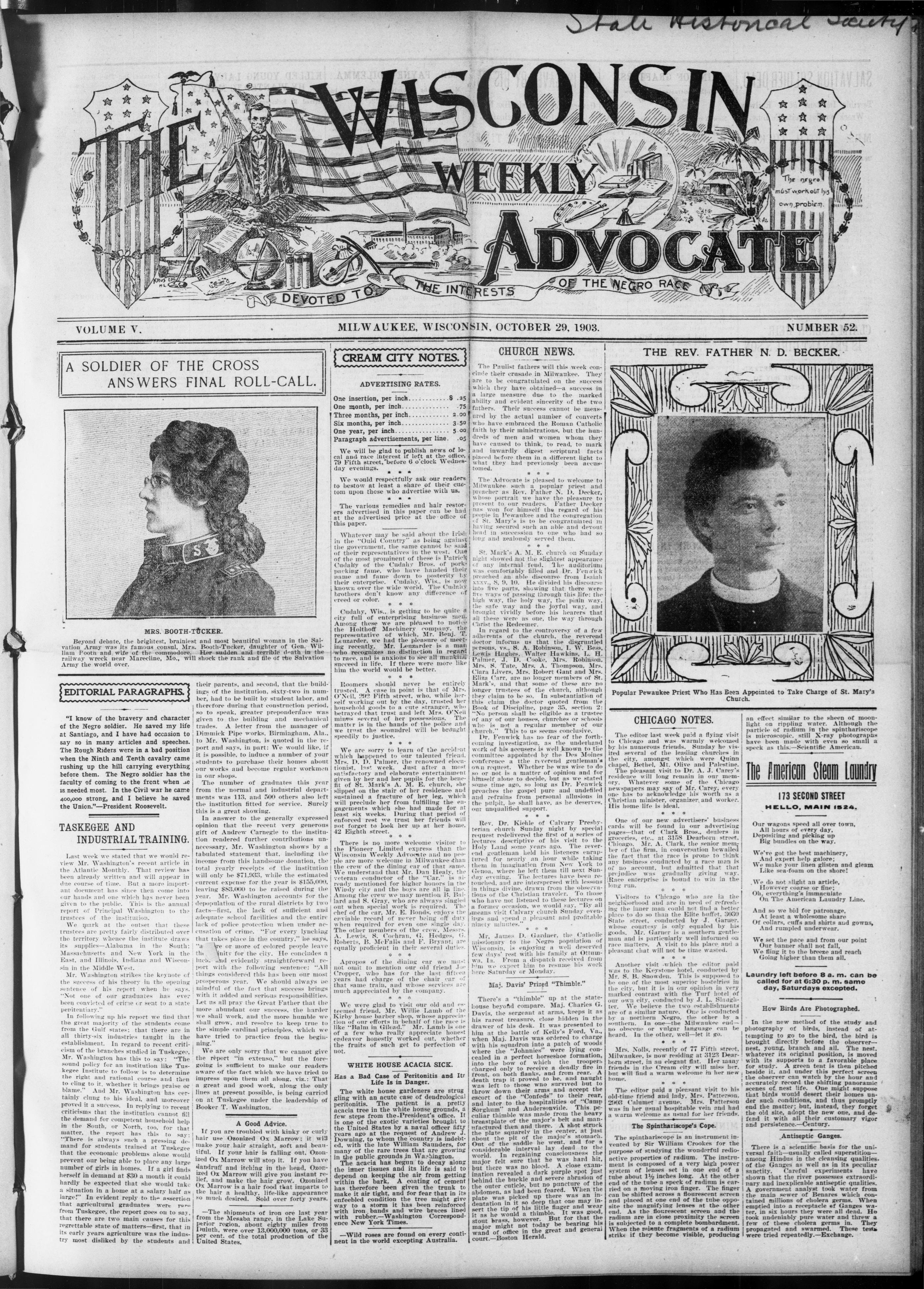
WISCONSIN
WEEKLY
ADVOCATE
DEVOTED TO THE INTERESTS OF THE NEGRO RACE
A SOLDIER OF THE CROSS ANSWERS FINAL ROLL-CALL.
S
Beyond debate, the brightest, brainiest and most beautiful woman in the Salvation Army was its famous consul, Mrs. Booth-Tucker, daughter of Gen. William Pooth and wife of the commodore. Her sudden and terrible death in the railway wreck near Marecline, Mo., will shock the rank and file of the Salvation Army the world over.
Beyond debate, the brightest, brainiest and most beautiful woman in the Salvation Army was its famous consul, Mrs. Booth-Tucker, daughter of Gen. William Pooth and wife of the commodore. Her sudden and terrible death in the railway wreck near Marecline, Mo., will shock the rank and file of the Salvation Army the world over.
VOLUME V.
A SOLDIER OF THE ANSWERS F
MRS. BOOTH-
Beyond debate, the brightest, brainievation Army was its famous consul, Mr. William Pooth and wife of the commodore railway wreck near Marecline, Mo., who Army the world over.
EDITORIAL PARAGRAPHS.
"I know of the bravery and character of the Negro soldier. He saved my life at Santiago, and I have had occasion to say so in many articles and speeches. The Rough Riders were in a bad position when the Ninth and Tenth cavalry came rushing up the hill carrying everything before them. The Negro soldier has the faculty of coming to the front when he is needed most. In the Civil war he came 400,000 strong, and I believe he saved the Union."—President Roosevelt.
TASKEGEE AND INDUSTRIAL TRAINING.
Last week we stated that we would review Mr. Washington's recent article in the Atlantic Monthly. That review has been already written and will appear in due course of time. But a more important document has since then come into our hands and one which has never been given to the public. This is the annual report of Principal Washington to the trustees of the institution. We mark at the outset that these trustees are pretty fairly distributed over the territory whence the institute draws its supplies—Alabama in the South: Massachusetts and New York in the East, and Illinois, Indiana and Wisconsin in the Middle West.
Mr. Washington strikes the keynote of the success of his theory in the opening sentence of his report when he says, "Not one of our graduates has ever been convicted of crime or sent to a state penitentiary."
In following up his report we find that the great majority of the students come from the Gulf states; that there are in all thirty-six industries taught in the establishment. In regard to recent criticism of the branches studied in Tuskegee, Mr. Washington has this to say: "The sound policy for an institution like Tuskegee Institute to follow is to determine the right and rational course and then to cling to it, whether it brings praise or blame." And Mr. Washington has certainly clung to his ideal, and moreover proved it a success. In replying to recent criticisms that the institution cannot fill the demand for competent household help in the South, or North, too, for that matter, the report has this to say: "There is always such a pressing demand for students trained at Tuskegee that the economic problems alone would prevent our being able to place any large number of girls in homes. If a girl finds herself in demand at $30 a month it could hardly be expected that she would take a situation in a home at a salary half as large." In evident reply to the assertion that agricultural graduates were rare from Tuskegee, the report goes on to say, that there are two main causes for this regrettable state of matters—first, that in its early years agriculture was the industry most disliked by the students and
---
their parents, and second, that the buildings of the institution, sixty-two in number, had to be built by student labor, and therefore during that construction period, so to speak, greater preponderance was given to the building and mechanical trades. A letter from the manager of Dimmick Pipe works, Birmingham, Ala., to Mr. Washington, is quoted in the report and says, in part: We would like, if it is possible, to induce a number of your students to purchase their homes about our works and become regular workmen in our shops.
The number of graduates this year from the normal and industrial departments was 113, and 500 others also left the institution fitted for service. Surely this is a great showing.
In answer to the generally expressed opinion that the recent very generous gift of Andrew Carnegie to the institution rendered further contributions unnecessary, Mr. Washington shows by a tabulated statement that, including the income from this handsome donation, the total yearly receipts of the institution will only be $71,933, while the estimated current expense for the year is $155,000, leaving $83,000 to be raised during the year. Mr. Washington accounts for the depopulation of the rural districts by two facts—first, the lack of sufficient and adequate school facilities and the entire lack of police protection when under accusation of crime. "For every lynching that takes place in the country," he says, "a re or more of colored people leave theunity for the city. He concludes a lucid and evidently straightforward report with the following sentence: "All things considered this has been our most prosperous year. We should always be mindful of the fact that success brings with it added and serious responsibilities. Let us all pray the Great Father that the more abundant our success, the harder we shall work, and the more humble we shall grow, and resolve to keep true to the simple cardinal principles, which we have tried to practice from the beginning."
We are only sorry that we cannot give the report "in extenso," but the foregoing is sufficient to make our readers aware of the fact which we have tried to impress upon them all along, viz.: That a great and good work, along the only lines at present possible, is being carried on at Tuskegee under the leadership of Booker T. Washington.
A Good Advice.
If you are troubled with kinky or curly hair use Ozonized Ox Marrow; it will make your hair straight, soft and beautiful. If your hair is falling out, Ozonized Ox Marrow will stop it. If you have dandruff and itching in the head, Ozonized Ox Marrow will give you instant relief, and make the hair grow. Ozonized Ox Marrow is a hair food that imparts to the hair a healthy, life-like appearance so much desired. Sold over forty years.
The shipments of iron ore last year from the Mesaba range, in the Lake Superior region, about eighty miles from Duluth, were over 13,000,000 tons, or 33 per cent. of the total production of the United States.
CREAM CITY NOTES.
ADVERTISING RATES.
One insertion, per inch. $ .25
One month, per inch. .75
Three months, per inch. 2.00
Six months, per inch. 3.50
One year, per inch. 5.00
Paragraph advertisements, per line. .05
We will be glad to publish news of local and race interest if left at the office, 79 Fifth street, before 6 o'clock Wednesday evenings.
We would respectfully ask our readers to bestow at least a share of their custom upon those who advertise with us.
The various remedies and hair restorers advertised in this paper can be had at the advertised price at the office of this paper.
Whatever may be said about the Irish in the "Ould Country" as being against the government, the same cannot be said of their representatives in the west. One of the most prominent of these is Patrick Cudahy of the Cudahy Bros. of pork-packing fame, who have handed their name and fame down to posterity by their enterprise. Cudahy. Wis., is now known over the wide world. The Cudahy brothers don't know any difference of creed or color.
Cudahy, Wis., is getting to be quite a city full of enterprising business men. Among these we are pleased to notice the Holthoff Machinery company, the representative of which, Mr. Benj. T. Leuzarder, we had the pleasure of meeting recently. Mr. Leuzarder is a man who recognizes no distinction in regard to race, and is anxious to see all mankind succeed in life. If there were more like him the world would be better.
* * *
Roomers should never be entirely trusted. A case in point is that of Mrs. O'Neil, 292 Fifth street, who, while herself working out by the day, trusted her household goods to a cute stranger, who betrayed that trust and left Mrs. O'Neil minus several of her possessions. The matter is in the hands of the police and we trust the scoundrel will be brought speedily to justice.
* * *
We are sorry to learn of the accident which happened to our talented friend, Mrs. D. D. Palmer, the renowned elocationist, last week. Just after a most satisfactory and elaborate entertainment given by her and her pupils for the benefit of St. Mark's A. M. E. church, she slipped on the stair of her residence and sustained a fracture of her leg, which will preclude her from fulfilling the engagements which she had made for at least six weeks. During that period of enforced rest we trust her friends will not forget to look her up at her home, 42 Eighth street.
* * *
There is no more welcome visitor to the Pioneer Limited express than the Wisconsin Weekly Advocate and no people are more welcome in Milwaukee than the crew of the dining car of that same. We understand that Mr. Dan Healy, the veteran conductor of the "Car." is already mentioned for higher honors in the Windy city and the boys are all in line. Among the crew we may mention B. Ballard and S. Gray, who are always singled out when special work is required. The chef of the car, Mr. E. Bonds, enjoys the enviable record of never being off duty when required for even one single day. The other members of the crew, Messrs. A. Lewis, S. Cochran, G. Hedges, G. Roberts, B. McFalls and F. Bryant, are equally proficient in their several duties.
Apropos of the dining car we must not omit to mention our old friend Joe Cropper, who has for the last fifteen years had charge of the chair car of that same train, and whose services are much appreciated by the company.
☆ ☆ 六
We were glad to visit our old and esteemed friend, Mr. Willie Lamb of the Kirby house barber shop, whose appreciation of our efforts in behalf of the race is like "Balm in Gilead." Mr. Lamb is one of a few who really appreciate honest endeavor honestly worked out, whether the fruits of such get to perfection or not.
WHITE HOUSE ACACIA SICK
Has a Bad Case of Peritonitis and Itr Life Is in Danger.
The white house gardeners are struggling with an acute case of dendrological peritonitis. The patient is a pretty acacia tree in the white house grounds, a few steps from the President's office. It is one of the exotic varieties brought to the United States by a naval officer fifty years ago at the request of Andrew J. Downing, to whom the country is indebted, with the late William Saunders, for many of the rare trees that are growing in the public grounds in Washington.
The acacia has begun to decay along the inner tissues and its life is said to depend on keeping the air from getting within the bark. A coating of cement has therefore been given the trunk to make it air tight, and for fear that in its enfeebled condition the tree might give way to a storm it has been reinforced with iron bands and wire braces lined with rubber.—Washington Correspondence New York Times.
—Wild roses are found on every continent in the world excepting Australia.
CHURCH NEWS.
The Paulist fathers will this week conclude their crusade in Milwaukee. They are to be congratulated on the success which they have obtained—a success in a large measure due to the marked ability and evident sincerity of the two fathers. Their success cannot be measured by the actual number of converts who have embraced the Roman Catholic faith by their ministrations, but the hundreds of men and women whom they have caused to think, to read, to mark and inwardly digest scriptural facts placed before them in a different light to what they had previously been accustomed.
The Advocate is pleased to welcome to Milwaukee such a popular priest and preacher as Rev, Father N. D. Decker, whose portrait we have the pleasure to present to our readers. Father Decker has won for himself the regard of his people in Pewaukee and the congregation of St. Mary's is to be congratulated in having secured such an able and devout head in succession to one who had so long and zealously served them.
* * *
St. Mark's A. M. E. church on Sunday night showed not the slightest appearance of any internal feud. The auditorium was comfortably filled and Dr. Fenwick preached an able discourse from Isaiah xxxv., S, 9, 10. He divided his discourse into five parts, showing that there were five ways of passing through this life: the high way, the holy way, the plain way, the safe way and the joyful way, and brought vividly before his hearers that all these were as one, the way through Christ the Redeemer.
In regard to the controversy of a few adherents of the church, the reverend doctor informs us that the disgruntled persons, vs., S. A. Robinson, I. W. Bess, Lewis Haghes, Walter Hawkins, L. H. Palmer, J. D. Cooke, Mrs. Robinson, Mrs. S. Tate, Mrs. A. Thompson, Mrs. Clara Livers, Mrs. Robert Gant and Mrs. Eliza Carr, are no longer members of St. Mark's, and that some of these are no longer trustees of the church, although they claim to be so. In substantiation of this claim the doctor quoted from the Book of Discipline, page 35, section 2: "No person shall be eligible as a trustee of any of our houses, churches or schools who is not a regular member of our church." This to us seems conclusive.
Dr. Fenwick has no fear of the forthcoming investigation, as the underhand work of his accusers is well known to the committee appointed by the Des Moines conference a ttthe reverend gentleman's own request. Whether he was wise to do so or not is a matter of opinion and for himself alone to decide, but as we stated some time ago, so long as Dr. Fenwick preaches the gospel pure and undefiled and refrains from personal allusions in the pulpit, he shall have, as he deserves, our unqualified support.
---
Rev. Dr. Kiehle of Calvary Presbyterian church Sunday night by special request redelivered the first of a series of lectures descriptive of his visit to the Holy Land some years ago. The reverend gentleman held his listeners enraptured for nearly an hour while taking them in imagination from New York to Genoa, where he left them till next Sunday evening. The lectures have been retouched, and are interspersed with lessons in things divine, drawn from the observations of the Christian traveler. To those who have not listened to these lectures on a former occasion, we would say. "By all means visit Calvary church Sunday evenings and spend a pleasant and profitable ninety minutes."
Mr. James D. Gardner, the Catholic missionary to the Negro population of Wisconsin, is enjoying a well deserved few days' rest with his family at Ottumwa, Ia. From a dispatch received from him we expect him to resume his work here Saturday or Monday.
Maj. Davis' Prized "Thimble."
There's a "thimble" up at the state-house beyond compare. Maj. Charles G. Davis, the sergeant at arms, keeps it as his rarest treasure, close hidden in the drawer of his desk. It was presented to him at the battle of Kelly's Ford. Va., when Maj. Davis was ordered to charge with his squadron into a patch of woods where the "Johnnies" were lying concealed in a perfect horseshoe formation, into the bow of which the troopers charged only to receive a deadly fire in front, on both flanks, and from rear. A death trap it proved to be, and naught was left to those who survived but to throw down their arms and accept the escort of the "Confeds" to their rear, and later to the hospitalities of "Camp Sorghum" and Andersonville. This peculiar thimble was made from the heavy breastplate of the major's belt and manufactured then and there. A shot struck the plate squarely in the center, at just about the pit of the major's stomach. Out of the saddle he went, and for a considerable interval lay dead to the world. In regaining consciousness the major felt sure that he was hard hit, but there was no blood. A close examination revealed a dark purple spot just behind the buckle and severe abrasion of the outer cuticle, but no puncture of the abdomen, as had been feared. When the plate was picked up there was an indentation in it so deep that one may insert the tip of his little finger and wear it as he would a thimble. It was good, stout brass, however. But for that the major might not today be bearing his wand of office in the great and general court—Boston Herald.
THE REV. FATHER N. D. BECKER.
Popular Pewaukee Priest Who Has Been Appointed to Take Charge of St. Mary's Church
CHICAGO NOTES.
The editor last week paid a flying visit to Chicago and was warmly welcomed by his numerous friends. Sunday he visited several of the leading churches in the city, amongst which were Quinn chapel, Bethel, Mt. Olive and Palestine. The pleasant visit to Dr. A. J. Carey's residence will long remain in our memory. Whatever some of the Chicago newspapers may say of Mr. Carey, every one has to acknowledge his worth as a Christian minister, organizer, and worker. His home life is ideal.
* * *
One of our new advertisers' business cards will be found in our advertising pages—that of Clark Bros., dealers in groceries, etc., at 3158 Dearborn street, Chicago. Mr. A. Clark, the senior member of the firm, in conversation bewailed the fact that the race is prone to think any business conducted by a race man is of no account, but admitted that that prejudice was gradually giving way. Race enterprise is bound to win in the long run.
Visitors to Chicago who are in the neighborhood and are in need of refreshing the inner man could not find a better place to do so than the Elite buffet. 3030 State street, conducted by J. Garner, whose courtesy is only equaled by his goods. Mr. Garner is a southern gentleman and is particularly well informed on race matters. A visit to his place and a pleasant chat will not be time wasted.
\* \* \*
Another visit -which the editor paid was to the Keystone hotel, conducted by Mr. S. B. Snowden. This is supposed to be one of the most superior hostelries in the city, but it is in our opinion in very marked contrast with the Turf hotel of our own city, conducted by J. L. Slaughter. We believe the two establishments are of a similar nature. One is conducted by a northern Negro, the other by a southern. In one—the Milwaukee end—no obscene or vulgar language can be heard. In the other, well—let it go.
```markdown
```
Mrs. Nolls, recently of 77 Fifth street, Milwaukee, is now residing at 3123 Dearborn street, in an elegant flat. Her many friends in the Cream city will miss her, but will find a warm welcome in her new home.
```markdown
```
The editor paid a pleasant visit to his old-time friend and lady, Mrs. Patterson. 2903 Calumet avenue. Mrs. Patterson was in her usual hospitable vein and had a warm welcome as usual for her friends.
The Spinthariscope's Cope.
The spinthariscope is an instrument invented by Sir William Crookes for the purpose of studying the wonderful reactive properties of radium. The instrument is composed of a very high power system of lenses set in one end of a tube about $1\frac{1}{2}$ inches long. At the other end of the tube a speck of radium is carried on a moving iron finger. The finger can be shifted across a fluorescent screen and placed at one end of the tube opposite the magnifying lenses at the other end. As the fluorescent screen and the radium are in close proximity the screen is subjected to a complete bombardment. When the minute fragments of a radium strike if they become visible, producing
NUMBER 52.
ER N. D. BECKER.
Appointed to Take Charge of St. Mary's ch.
an effect similar to the sheen of moonlight on rippling water. Although the particle of radium in the spinthariscope is microscopic, still X-ray photographs have been made with even so small a speck as this.—Scientific American.
The American Steam Laundry
173 SECOND STREET
HELLO, MAIN 1524.
Our wagons speed all over town,
All hours of every day,
Depositing and picking up
Big bundles on the way.
We've got the best machinery,
And expert help galore;
We make your linen glisten and gleam
Like sea-foam on the shore!
We do not slight an article,
However coarse or fine;
Oh, everything's immaculate
On The American Laundry Line.
And so we bid for patronage,
At least a wholesome share
Of collars, cuffs and shirts and gowns,
And rumpled underwear.
We set the pace and from our point
Our banner shall not fall,
We fling it to the breeze and reach
Going higher than them all.
Laundry left before 8 a. m. can be called for at 6:30 p. m. same day. Saturdays excepted.
How Birds Are Photographed.
In the new method of the study and photography of birds, instead of attempting to go to the bird, the bird is brought directly before the observer—nest, young, branch and all. The nest, whatever its original position, is moved with its supports to a favorable place for study. A green tent is then pitched beside it, and under this perfect screen the observer can watch by the hour and accurately record the shifting panoramic scenes of nest life. One might suppose that birds would desert their homes under such conditions, and thus promptly end the matter; but, instead, they forget the old site, adopt the new one, and defend it with all their customary vigor and persistence.—Century.
Antisepic Ganges.
There is a scientific basis for the universal faith—usually called superstition—among Hindus in the cleansing qualities of the Ganges as well as in its peculiar sanctity. Careful experiments have shown that the river possesses extraordinary and inexplicable antiseptic qualities. A government analyst took water from the main sewer of Benares which contained millions of cholera germs. When emptied into a receptacle of Ganges water, in six hours they were all dead. He took undeniably pure water and threw a few of these cholera germs in. They propagated and swarmed. These tests were tried repeatedly.—Exchange.
---
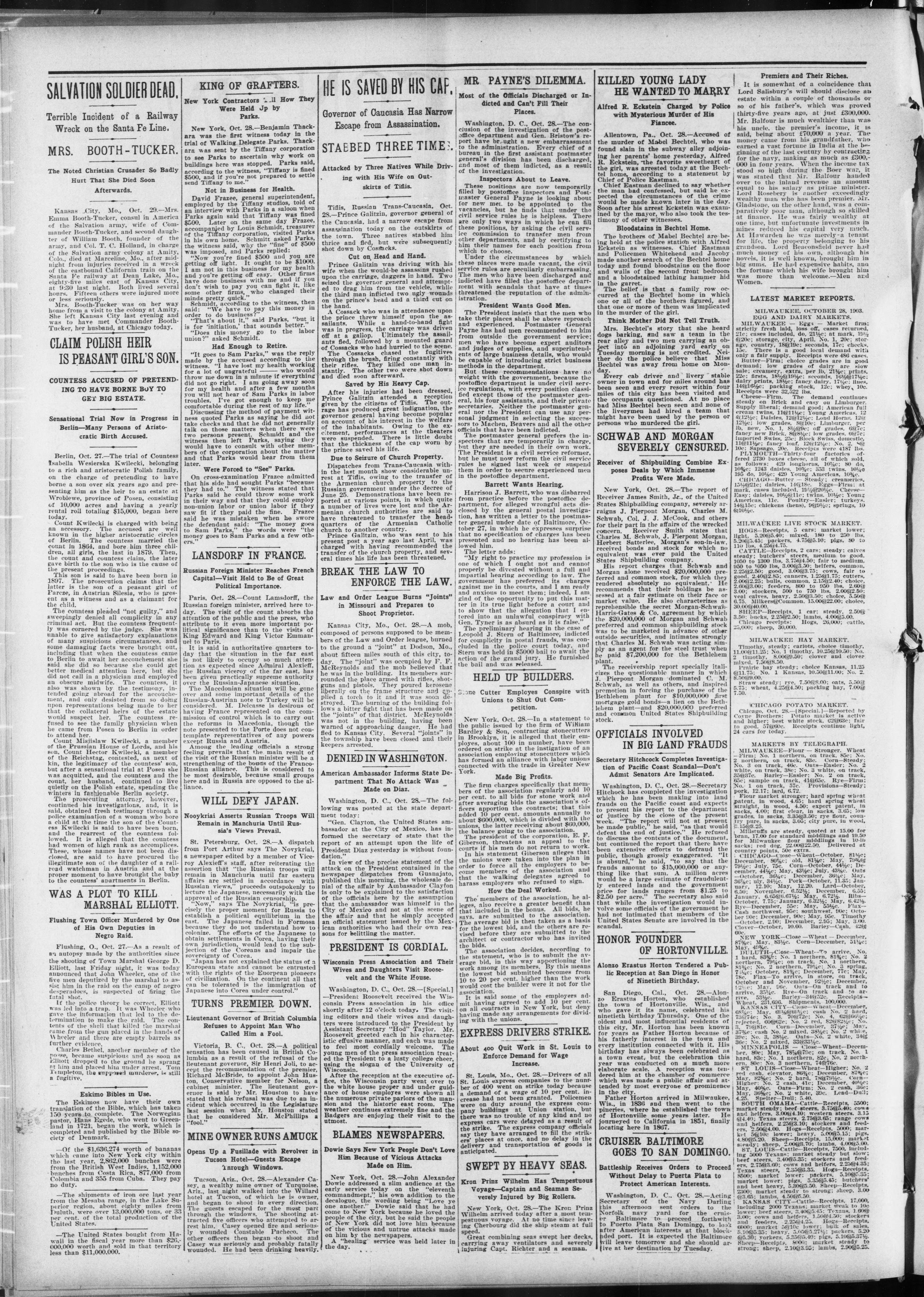
SALVATION SOLDIER DEAD
Terrible Incident of a Railway Wreck on the Santa Fe Line.
The Noted Christian Crusader So Badly Hurt That She Died Soon
Kansas City, Mo., Oct. 29.—Mrs. Emma Booth-Tucker, consul in America of the Salvation army, wife of Commander Booth-Tucker, and second daughter of William Booth, founder of the army, and Col. T. C. Holland, in charge of the Salvation army colony at Amity, Colo., died at Marceline, Mo., after midnight from injuries received in a wreck of the eastbound California train on the Santa Fe railway at Dean Lake, Mo., eighty-five miles east of Kansas City, at 9:30 last night. Both lived several hours. Fifteen others were injured more or less seriously. Mrs. Booth-Tucker was on her way home from a visit to the colony at Amity. She left Kansas City last evening and was to have met Commander Booth-Tucker, her husband, at Chicago today.
CLAIM POLISH HEIR IS PEASANT GIRL'S SON.
COUNTESS ACCUSED OF PRETENDING TO HAVE BORNE BOY TO GET BIG ESTATE.
Sensational Trial Now in Progress in Berlin—Many Persons of Aristocratic Birth Accused.
Berlin, Oct. 27.—The trial of Countess Isabella Wesierska Kwilecki, belonging to a rich and aristocratic Polish family, on the charge of pretending to have borne a son over six years ago and presenting him as the heir to an estate at Wroblewe, province of Posen, consisting of 10,000 acres and having a yearly rental roll totaling $15,000, began here today.
Count Kwilecki is charged with being an accessory. The accused are well known in the higher aristocratic circles of Berlin. The countess married the count in 1864, and bore him three children, all girls, the last in 1879. Then, the count and countess claim, the later gave birth to the son who is the cause of the present proceedings.
This son is said to have been born in 1897. The prosecution claims that the latter is the son of a peasant girl of Parcze, in Austrian Silesia, who is present as a witness and as a claimant for the child.
The countess pleaded "not guilty," and sweepingly denied all complicity in any criminal act. But the countess frequently was cornered by the judge. She was unable to give satisfactory explanations of many suspicious circumstances, and some damaging facts were brought out, including that when the countess came to Berlin to await her accouchement she said she did so because she could get better medical attention here, but she did not call in a physician and employed an obscure midwife. The countess, it also was shown by the testimony, intended going abroad for the accouchement, and only desisted from so doing upon representations being made to her that the collateral heirs of the estate would suspect her. The countess refused to see the family physician when he came from Posen to Berlin in order to attend her.
Count Misjislaw Kwilecki, a member of the Prussian House of Lords, and his son, Count Hector Kwilecki, a member of the Reichstag, contested, as next of kin, the legitimacy of the countess' son, but after a sensational trial at Posen she was acquitted, and the countess and the count, her husband, continued to live quietly on the Polish estate, spending the winters in fashionable Berlin society.
The prosecuting attorney, however, continued his investigations, and, it is said, obtained fresh testimony through a police examination of a woman who bore a child at the time the son of the Countess Kwilecki is said to have been born, and the rearrest of the countess followed. It is alleged that the countess had women of high rank as accomplices. These, whose names have not been disclosed, are said to have procured the illegitimate son of the daughter of a railroad watchman in Austria and at the proper moment to have brought the baby to the countess' apartments in Berlin.
WAS A PLOT TO KILL MARSHAL ELLIOTT.
Flushing Town Officer Murdered by One of His Own Deputies in Negro Deid
Flushing, O., Oct. 27.—As a result of an autopsy made by the authorities since the shooting of Town Marshal George D. Elliott, last Friday night, it was today announced that John Wheeler, one of the five men deputized by the marshal to assist him in the raid on the camp of negro desperadoes, is suspected of firing the fatal shot.
If the police theory be correct, Elliott was led into a trap. It was Wheeler who gave the information that led to the determination to make the raid. The contents of the shell that killed the marshal came from the gun placed in the hands of Wheeler and there are empty barrels as further evidence.
Charles Bethel, another member of the posse, became suspicious and as soon as Elliott dropped to the ground he sprang at him and placed him under arrest. Tom Templeton, the supposed murderer, is still a fugitive.
Eskimo Bibles in Use
The Eskimos now have their own translation of the Bible, which has taken 150 years to complete. The Norwegian pastor, Hans Egede, who went to Greenland in 1721, began the work, which is completed and published by the Bible society of Denmark.
Of the $1,636,274 worth of bananas which came into New York city within the last year, 2,862,000 bunches were from the British West Indies, 1,152,000 bunches from Costa Rica, 877,000 from Colombia and 355 from Cuba. They pay no duty.
The shipments of iron ore last year from the Mesaba range, in the Lake Superior region, about eighty miles from Duluth, were over 13,000,000 tons, or 33 per cent. of the total production of the United States.
The United States bought from Hawaii in the fiscal year more than $26,000,000 worth and sold in that territory less than $11,000,000.
KING OF GRAFTERS.
New York, Oct. 28.—Benjamin Thackara was the first witness today in the trial of Walking Delegate Parks. Thackara was sent by the Tiffany corporation to see Parks to ascertain why work on buildings here was stopped. Parks said, according to the witness, "Tiffany is fined $500, and if you're not prepared to settle send Tiffany to me."
Not in Business for Health.
David Frazee, general superintendent, employed by the Tiffany studios, told of an interview with Parks in a saloon when Parks again said that Tiffany was fined $500. Later on the same day Frazee, accompanied by Louis Schmidt, treasurer of the Tiffany corporation, visited Parks in his own home. Schmitt asked Parks, the witness said, why the "fine" of $500 was imposed, and Parks replied: "Now you're fined $500 and you are getting off light. It ought to be $1000. I am not in this business for my health and you're getting off easy. Other firms have done business with me and if you don't wish to pay you can fight it, like some other firms, who changed their minds pretty quick." Schmidt, according to the witness, then said: "We have to pay this money in order to do business!"
"That's about it," said Parks, "but it is for 'initiation,' that sounds better." "Does this money go to the labor union?" asked Schmidt.
Had Enough to Retire.
"It goes to Sam Parks," was the reply made by the accused according to the witness. "I have lost my health working for a lot of ungrateful —— who would throw me down in a minute if everything did not go right. I am going away soon for my health and after a few months you will not hear of Sam Parks in labor troubles. I've got enough to keep me comfortable during the rest of my life." Discussing the method of payment witness quoted Parks as saying he did not take checks and that he did not generally talk on those matters when there were two persons present. Schmidt and the witness then left Parks, saying they would have to consult with other members of the corporation about the matter and that Parks would hear from them later.
Were Forced to "See" Parks.
On cross-examination Frazee admitted that his side had sought Parks "because they had to." The witness stated that Parks said he could throw some work in their way and that they could employ non-union labor or union labor if they saw fit if they paid the fine. Frazee said he was mistaken when he swore the defendant said: "The money goes to Sam Parks," the words were "the money goes to Sam Parks and a few others."
LANSDORF IN FRANCE.
Russian Foreign Minister Reaches French Capital—Visit Held to Be of Great Political Importance.
Paris, Oct. 28.—Count Lamsdorff, the Russian foreign minister, arrived here today. The visit of the count absorbs the attention of the public and the press, who attribute to it even more important political significance than to the visits of King Edward and King Victor Emmanuel to Paris.
It is said in authoritative quarters today that the situation in the far east is not likely to occupy so much attention as expected since Admiral Alexieff, the Russian viceroy of the far east, has been given practically supreme authority over the Russian-Japanese situation.
The Macedonian situation will be gone over and some important details of the Russian-Austrian note to Turkey will be considered. M. Delcasse is desirous of having France represented on the commission of control which is to carry out the reforms in Macedonia, though the note presented to the Porte does not contemplate representatives of any powers except Russia and Austria. Among the leading officials a strong feeling prevails that the main result of the visit of the Russian minister will be a strengthening of the bonds of the Franco-Russian alliance. This is considered to be most desirable, because small groups here and in Russia are opposed to the alliance.
WILL DEFY JAPAN.
Nooykriai Asserts Russian Troops Will Remain in Manchuria Until Russia's Views Prevail.
St. Petersburg, Oct. 28.—A dispatch from Port Arthur says The Novykrial, a newspaper edited by a member of Viceroy Alexieff's staff, after reiterating the assertion that "the Russian troops will remain in Manchuria until far eastern affairs are settled in accordance with Russian views," proceeds outspokenly to lecture the Japanese, necessarily with the approval of the Russian censorship.
"Now," says The Novykrial, "is precisely the proper moment for Russia to establish a political equilibrium in the east. The Japanese failed in Formosa because they do not understand how to colonize. The efforts of the Japanese to obtain settlements in Corea, having their own jurisdiction, would lead to the subjection of the Coreans and impair the sovereignty of Corea.
"Japan has not explained the status of a European state and cannot be entrusted with the rights of the Euorpean pioneers of civilization. On the continent all that can be tolerated is the immigration of Japanese into Corea under control."
TURNS PREMIER DOWN.
Lieutenant Governor of British Columbia Refuses to Appoint Man Who Called Him a Fool.
Victoria, B. C., Oct. 28.—A political sensation has been caused in British Columbia as a result of the refusal of the lieutenant governor, Sir Henri Joli, to accept the recommendation of the premier, Richard McBride, to appoint John Huston, Conservative member for Nelson, a cabinet minister. The lieutenant governor is said by Mr. Houston to have stated that his refusal was due to an incident which occurred in the Legislature last session when Mr. Houston stated that he considered Mr. McPhillips a "fool."
MINE OWNER RUNS AMUCK
Opens Up a Fusillade with Revolver in Tucson Hotel—Guests Escape Through Windows.
Tucson, Ariz., Oct. 28.—Alexander Casey, a wealthy mine owner of Turquoise, Ariz., last night walked into the Willard hotel at Tucson, of which he is owner, and began to shoot in every direction. The guests escaped for the most part through the windows. The shooting attracted five officers who attempted to arrest him. Casey opened fire and seriously wounded Constable Pacheco. The other officers then began to shoot and Casey was seriously and probably fatally wounded. He had been drinking heavily.
HE IS SAVED BY HIS CAP.
Governor of Caucasia Has Narrow Escape from Assassination.
STABBED THREE TIMES.
Tiflis, Russian Trans-Caucasia, Oct. 28.—Prince Galitzin, governor general of the Caucasia, had a narrow escape from assassination today on the outskirts of the town. Three natives stabbed him thrice and fled, but were subsequently shot down by Cossacks.
Cut on Head and Hand.
Prince Galitzin was driving with his wife when the would-be assassins rushed upon the carriage, daggers in hand. Two seized the governor general and attempted to drag him from the vehicle, while the third man inflicted two ugly wounds on the prince's head and a third cut on the hand.
A Cossack who was in attendance upon the prince threw himself upon the assailants. While a hand-to-hand fight was in progress, the carriage was driven off at a gallop. Ultimately the assailants fled, followed by a mounted guard of Cossacks who had hurried to the scene.
The Cossacks chased the fugitives through the brush, firing constantly with their rifles. They killed one man instantly. The other two were shot down and died soon afterward.
Saved by His Heavy Cap.
After his injuries had been dressed, Prince Galitzin attended a reception given by the citizens of Tiflis. The outrage has produced great indignation, the governor general having become popular on account of his interest in the welfare of the inhabitants. Owing to the excitement, performances at the theaters were suspended. There is little doubt that the thickness of the cap worn by the prince saved his life.
Due to Seizure of Church Property.
Dispatches from Trans-Caucasia within the last month show considerable unrest at Tiflis, owing to the transfer of the Armenian church property to the Russian government under the decree of June 25. Demonstrations have been reported at various points, in which quite a number of lives were lost and the Armenian church authorities are said to have threatened to transfer the headquarters of the Armenian Catholic church to another country. Prince Galitzin, who was sent to his present post a year ago last April, was charged with having recommended the transfer of the church property, and several times his life has been threatened.
BREAK THE LAW TO ENFORCE THE LAW.
Law and Order League Burns "Joints" in Missouri and Prepares to Shoot Proprietor.
Kansas City, Mo., Oct. 28.—A mob, composed of persons supposed to be members of the Law and Order league, burned to the ground a "joint" at Dodson, Mo., about fifteen miles south of this city, today. The "joint" was occupied by F. F. McReynolds and the mob believed that he was in the building. Its members surrounded the place armed with rifles, shotguns and pistols. They poured kerosene liberally on the frame structure and applied a torch to it and it was soon destroyed. The burning of the building follows a bitter fight that has been made on the "joints" of that district. McReynolds was not in the building, having been warned of approaching danger. He had fled to Kansas City. Several "joints" in the township have been closed and their keepers arrested.
DENIED IN WASHINGTON.
American Ambassador Informs State Department That No Attack Was Made on Diaz.
Washington, D. C., Oct. 28. The following was posted at the state department today: "Gen. Clayton, the United States ambassador at the City of Mexico, has informed the secretary of state that the report of an attempt upon the life of President Diaz yesterday is without foundation."
In view of the precise statement of the attack on the President contained in the newspaper dispatches from Guanajato, published this morning, the wholesale denial of the affair by Ambassador Clayton is only to be explained to the satisfaction of the officials here by the assumption that the ambassador was himself in the City of Mexico and not at the scene of the affair and that he simply accepted an official statement issued by the Mexican authorities who had their own reasons for belittling the matter.
PRESIDENT IS CORDIAL.
Wisconsin Press Association and Their Wives and Daughters Visit Roosevelt and the White House.
Washington, D. C., Oct. 28.—[Special.]
—President Roosevelt received the Wisconsin Press association in his office shortly after 12 o'clock today. The visiting editors and their wives and daughters were introduced to the President by Assistant Secretary "Hod" Taylor. Mr. Roosevelt greeted each in his characteristic effusive manner, and each was made to feel most cordially welcome. The young men of the press association treated the President to a lusty college cheer, using the slogan of the University of Wisconsin.
After the reception at the executive office, the Wisconsin party went over to the white house proper and under guidance of house employees were shown all the numerous private parlors of the mansion and the historic east room. The weather continues extremely fine and the Badgers are enjoying their visit to the utmost
BLAMES NEWSPAPERS.
Dowie Says New York People Don't Love Him Because of Vicious Attacks Made on Him.
New York, Oct. 28.—John Alexander Dowie addressed a slim audience at the early service today on the "eleventh commandment," his own addition to the decalogue, the wording being "Love ye one another." Dowie said that he had come to New York because he loved the people of the city, but he said the people of New York did not love him because of the vicious and untrue attacks made on him by the newspapers.
A "healing" service was held later in the day.
MR. PAYNE'S DILEMMA.
Most of the Officials Discharged or Indicted and Can't Fill Their Places
Washington, D. C., Oct. 28.—The conclusion of the investigation of the postoffice department and Gen. Bristow's report have brought a new embarrassment to the administration. Every chief of a bureau in the first assistant postmaster general's division has been discharged, and most of them indicted, as a result of the investigation.
Inspectors About to Leave.
These positions are now temporarily filled by postoffice inspectors and Postmaster General Payne is looking about for new men to be appointed to the vacancies, but he finds that under the civil service rules he is helpless. There are only two ways in which he can fill these positions, by asking the civil service commission to transfer men from other departments, and by certifying to him their names for each position from which to choose.
Under the circumstances by which these places were made vacant, the civil service rules are peculiarly embarrassing. The men who have been discharged and indicted have filled the postoffice department with scandals that have at times threatened the reputation of the administration.
President Wants Good Men.
The President insists that the men who take their places shall be above reproach and experienced. Postmaster General Payne has had men recommended to him from outside the government service; men who have become expert auditors and judges of supplies, and superintendents of large business details, who would be capable of introducing strict business methods in the department.
But these recommendations have no weight with the government, because the postoffice department is under civil service regulations, with every position classified except those of the postmaster general, his four assistants, and their private secretaries. Neither the postmaster general nor the President can use any personal judgment in selecting the successors to Machen, Beavers and all the other officials that have been indicted.
The postmaster general prefers the inspectors that are temporarily in charge, but they are needed in their own work. The President is a civil service reformer, but he must now reform the civil service rules he signed last week or suspend them in order to secure experienced men in the postoffice department.
Barrett Wants Hearing.
Harrison J. Barrett, who was disbarred from practice before the postoffice department, for alleged wrongful acts disclosed by the general postal investigation, has written a letter to the postmaster general under date of Baltimore, October 27, in which he expresses surprise that no specification of charges has been presented and no hearing has been allowed him.
The letter adds:
"My right to practice my profession is one of which I ought not and cannot properly be divested without a full and impartial hearing according to law. The government has preferred its charges against me in the courts, and I am ready and anxious to meet them; indeed, I am glad of the opportunity to put this matter in its true light before a court and to show that the allegation that I entered into an unlawful conspiracy with Gen. Tyner is as absurd as it is false."
The preliminary hearing in the case of Leopold J. Stern of Baltimore, indicted for complicity in postal frauds, was concluded in the police court today, and Stern was held in $5000 bail to await the action of the grand jury. He furnished the bail and was released.
HELD UP BUILDERS
Stone Cutter Employes Conspire with Unions to Shut Out Competition.
New York, Oct. 28.—In a statement to the public issued by the firm of William Bardley & Son, contracting stonecutters in Brooklyn, it is alleged that their employees, about 100 in number, have been ordered on strike at the instigation of an association employing stonecutters which has formed an alliance with labor unions connected with the trade in Greater New York.
Made Big Profits.
The firm charges specifically that members of the association regularly add 10 per cent. to all bids for stone work and after averaging bids the association's officers apportion the contracts; that this added 10 per cent. amounts annually to about $600,000, which is divided with the unions, the latter receiving about $60,000, the balance going to the association.
The president of the corporation, E. F. Giberson, threatens an appeal to the courts if his men do not return to work.
In his statement Giberson alleges that the unions were taken into the plan in order to force all the employers to become members of the association and that the walking delegates agreed to harass employers who refused to sign.
How the Deal Worked.
The members of the association, he alleges, also receive a greater benefit than that included in the bonus. All bids, he says, are submitted to the association. The average bid is then taken as a basis for the lowest bid, and the others are revised before they are submitted to the architect or contractor who has invited the bids.
The association decides, according to the statement, who is to submit the average bid, in this way apportioning the work among its members. By this means the lowest bid submitted becomes from 10 to 20 per cent, higher than the work would cost the builder were it not for the association.
It is said some of the employers admit having agreed to add 10 per cent on all contracts in New York, but deny having made any arrangements for dividing with the unions.
EXPRESS DRIVERS STRIKE.
About 400 Quit Work in St. Louis to Enforce Demand for Wage
St. Louis, Mo., Oct. 28.—Drivers of all St. Louis express companies to the number of 400 went on strike today because a demand of a wage of 10 per cent. increase had not been granted. Policemen were on duty around the express company buildings at Union station, but there was no trouble of any kind and no express cars were delayed as a result of the strike. The express company officials say they have arranged to fill the strikers' places at once, and no delay in the delivery and transportation of goods is anticipated.
SWEPT BY HEAVY SEAS.
Kron Prinz Wilhelm Has Tempestuous Voyage—Captain and Seaman Severely Injured by Big Rollers.
New York, Oct. 28.—The Kron Prinz Wilhelm arrived today after a most tempestuous voyage. At no time since leaving Cherbourg did the ship steam at full speed. Great combining seas swept her decks, carrying away ventilators and severely injuring Capt. Richter and a seaman.
KILLED YOUNG LADY HE WANTED TO MARRY
Alfred R. Eckstein Charged by Police with Mysterious Murder of His Fiancee.
Allentown, Pa., Oct. 28.—Accused of the murder of Mabel Bechtel, who was found slain in the subway alley adjoining her parents' home yesterday, Alfred R. Eckstein, the favorite sweetheart of the girl, was arrested today at the Bechtel home, according to a statement by Chief of Police Eastman. Chief Eastman declined to say whether the man had confessed, but said he expected the circumstances of the crime would be made known later in the day. Soon after his arrest Eckstein was examined by the mayor, who also took the testimony of other witnesses.
Bloodstains in Bechtel Home.
The brothers of Mabel Bechtel are being held at the police station with Alfred Eckstein as witnesses. Chief Eastman and Policemen Whitehead and Jacoby made another search of the Bechtel home today and found bloodstains on the floor and walls of the second front bedroom and a bloodstained lathing hammer hid in the garret. The belief is that a family row occurred at the Bechtel home in which one or all of the brothers figured, and that one or more of them was implicated in the murder of the girl.
Think Mother Did Not Tell Truth.
Mrs. Bechtel's story that she heard dogs barking, and saw a team in the rear alley and two men carrying an object into an adjoining yard early on Tuesday morning is not credited. Neither do the police believe that Miss Bechtel was away from home on Monday. Every cab driver and livery stable owner in town and for miles around has been seen and every resort within four miles of this city has been visited and the occupants questioned. At no place had Miss Bechtel been seen and none of the liverymen had hired a team that might have been used by the person or persons who murdered the girl.
SCHWAB AND MORGAN SEVERELY CENSURED.
Receiver of Shipbuilding Combine Exposes Deals by Which Immense Profits Were Made.
New York, Oct. 28.-The report of Receiver James Smith, Jr., of the United States Shipbuilding company, severely arraigns J. Pierpont Morgan, Charles M. Schwab, Col. J. J. McCook, and others for their part in the affairs of the wrecked concern. Receiver Smith states that Charles M. Schwab, J. Pierpont Morgan, Herbert Satterlee, Morgan's son-in-law, received bonds and stock for which no equivalent was ever paid the United States Shipbuilding company.
His report charges that Schwab and Morgan alone received $20,000,000 preferred and common stock, for which they rendered absolutely no equivalent.' He recommends that their holdings be assessed at a fair estimate on their face or market value. He also characterizes as reprehensible the secret Morgan-Schwab-Harris-Gates & Co. agreement by which the $20,000,000 of Morgan and Schwab preferred and common shipbuilding stock was to be marketed in advance of other outside securities, and intimates strongly that Charles M. Schwab was acting simply as an agent for the steel trust when he paid $7,200,000 for the Bethlehem plant.
The receivership report specially italicizes the questionable manner in which J. Pierpont Morgan dominated C. M. Schwab, as well as others, and inspired promotion in forcing the purchase of the Bethlehem plant for $10,000,000 first mortgage gold bonds—a lien on the Bethlehem plant—and $20,000,000 preferred and common United States Shipbuilding stock.
OFFICIALS INVOLVED IN BIG LAND FRAUDS
Secretary Hitchcock Completes Investigation of Pacific Coast Scandal—Don't Admit Senators Are Implicated.
Washington, D. C., Oct. 28.—Secretary Hitchock has completed the investigation which he has been making into land frauds on the Pacific coast and expects to present his report to the department of justice by the close of the present week. "The report will not at present be made public," he said, "as that would defeat the end of justice." He refused to discuss the contents of the document, but continued the report that there have been extensive efforts to defraud the public, though grossly exaggerated. "It is absurd," he said, "to say that the frauds amount to $15,000,000 or anything like that sum. A million acres would be a large estimate of fraudulently entered lands and the government price for lands ranges from $1.25 to $2.50 per acre." The secretary also said that while the investigation would involve some officials of the government he had not intimated that members of the United States Senate are involved in the scandal.
HONOR FOUNDER OF HORTONVILLE.
Alonzo Erastus Horton Tendered a Public Reception at San Diego in Honor of Ninetieth Birthday.
San Diego, Cal., Oct. 28.—Alonzo Erastus Horton, who established the town of Hortonville. Wis., and who gave it its name, celebrated his ninetieth birthday Thursday. One of the oldest and most influential residents of this city, Mr. Horton has been known for years as Father Horton because of his fatherly interest in the town and every institution connected with it. His birthday has always been celebrated as a town event, but the celebration this year was conducted on a much more elaborate scale. A reception was tendered him at the chamber of commerce which was made a public affair and attended by most everyone of prominence in the city.
Father Horton arrived in Milwaukee, Wis., in 1836 and then went to the pineries, where he established the town of Hortonville some years later. He journeyed to California in 1851, finally locating here in 1867.
CRUISER BALTIMORE GOES TO SAN DOMINGO.
Battleship Receives Orders to Proceed Without Delay to Puerta Plata to Protect American Interests.
Washington, D. C., Oct. 28.—Acting Secretary of the Navy Darling this afternoon sent orders to the Norfolk navy yard for the cruiser Baltimore to proceed forthwith to Puerto Plata San Domingo, to look after American interests at that blocked port. It is expected the Baltimore will leave tomorrow and she should arrive at her destination by Tuesday.
Premiers and Their Riches
It is somewhat of a coincidence that Lord Salisbury's will should disclose an estate within a couple of thousands or so of his father's, which was proved thirty-five years ago, at just £300,000. Mr. Balfour is much wealthier than was his uncle, the premier's income, it is said, being about £70,000 a year. The money came from his grandfather, who earned a vast fortune in India at the beginning of the last century by contracting for the navy, making as much as £300,000 in four years. When the income tax stood so high during the Boer war, it was stated that Mr. Balfour handed over to the inland revenue an amount equal to his salary as prime minister. Lord Rosebery is another exceedingly wealthy man who has been premier. Mr. Gladstone, on the other hand, was a comparatively poor man, although so skilled at finance. He was fairly wealthy at one time, but unfortunate investments in mines reduced his capital very much. At Hawarden he was merely-a tenant for life, the property belonging to his grandson. Lord Beaconsfield never had much money of his own, although his novels, it is well known, brought him in big sums. He had expensive habits, and the fortune which his wife brought him was more than welcome.—Men and Women.
LATEST MARKET REPORTS.
MILWAUKEE, OCTOBER 28, 1903.
EGG AND DAIRY MARKETS.
MILWAUKEE — Eggs — Market firm;
strictly fresh laid, loss off, cases returned,
21c; cases included, do, 21½c; at mark, 19½c
@20c; storage, city, April. No. 1, 20c; storage,
country, 18@19c; seconds, 17c; checks,
15c. There is a good local demand with
only a fair supply. Receipts were 486 cases.
Butter—Firm; choice grades are in good
demand; low grades of dairy are slow
sale; creamery, extra, per lb, 21½c; prints,
22c; firsts, 18½@19½c; seconds, 16½@17½c;
dairy prints, 18½c; fancy dairy, 17½c; lines,
14@16½c; packing stock, 12c; whey, 10c.
Receipts were 32,522 lbs.
Cheese—Firm. The demand continues steady on Brick and easy on Limburger; Supply liberal; demand good; American full cream twins, 11@11½c; Young Americas, 12@12½c; Daisies, 12@12½c; Lond Horns, 12@12½c; low grades, 8@10c; Limburger, per lb, new, No. 1, 8½@9c; off grades, 6½c; fancy new Brick, 6½@9c; low grades, 6½c; imported Swiss, 25c; Block Swiss, domestic, 11@11½c; fancy loaf, 12@12½c; No. 2, @10c; Sapsago, 20c. Receipts were 4187 lbs.
PLYMOUTH—Thirty-four factories offered 2730 boxes cheese, all of which sold, as follows: 429 longhorns, 10½c; 80 do, 10½c; 1243 daisies, 10½c; 353 twins, 10½c; 195 do, 10½c; 429 Young Americas, 10½c.
CHICAGO—Butter — Steady; creameries, 15½c; dairies, 14@18c. Eggs—Firm; at mark, cases included, 19½@20½c. Cheese—Easy; daisies, 10½@11c; twins, 10½c; Young Americas, 11c. Poultry—Easier; turkeys, 14@15c; chickens (hens), 9@9½c; springs, 10@10½c.
MILWAUKEE LIVE STOCK MARKET.
HOGS-Recelpts, 5 cars; market lower; light, 5.20@5.40; mixed, 180 to 250 lbs, 5.20@5.45; packers, 4.75@5.10; pligs, 80 to 110 lbs, 4.25@4.75.
CATTLE-Recelpts, 2 cars; steady; calves steady; butchers' steers, medium to good, 1050 to 1300 lbs, 3.75@4.50; fair to medium, 950 to 1050 lbs, 3.00@3.50; heifers, common, 2.25@2.50; good, 3.00@3.75; cows, fair to good, 2.40@2.85; canners, 1.25@1.75; cutters, 2.00@2.25; bulls, common, 2.15@2.40; choice, 2.00@3.00; feeders, 800 to 950 lbs, 2.60@3.00; stockers, 500 to 750 lbs, 2.00@2.50; veal calves, heavy, 2.50@3.50; choice, 5.50@6.75. Milkers@Common, 15.00@22.00; choice, 30.00@40.00.
SHEEP-Recelpts, 1 car; steady, 2.50@3.50; bucks, 2.25@2.50; lambs, 4.00@5.00.
Chicago receipts: Hogs, 26,000; cattle, 25,000; sheep, 30,000.
MILWAUKEE HAY MARKET.
Timothy, steady; carlots, choice timothy,
11.00@11.25; No. 1 timothy, 10.25@10.50; No.
2 timothy, 8.00@9.50; clover and clover
mixed, 7.50@8.50.
Prairie hay steady; choice Kansas, 11.25
@11.75; No. 1 Kansas, 10.50@11.00; No. 2.
8.50@9.00.
Straw steady: rye, 7.50@8.00; oats, 5.50@
5.75; wheat, 4.25@4.50; packing hay, 7.00@
7.50.
CHICAGO POTATO MARKET.
Chicago, Oct. 28,—[Special.]—Reported by
Coyne Brothers: Potato market is active
and higher; best white stock, C2@63c; fair
to good, 57@60c. Receipts continue light,
24 cars for today.
MARKETS BY TELEGRAPH.
MILWAUKEE—Flour — Stronger. Wheat — Firm; No. 1 on northern, on track, 85c; No. 2 northern, on track, 83c. Corn — Steady; No. 3 on track, 46c. Oats — Easier; No. 2 white, on track, 38c; No. 3 white, on track, 35@37c. Barley — Easier; No. 2 on track, 65c; sample on track, 41@65c. Rye — Firm; No. 1 on track, 57c. Provisions — Steady; pork, 12.17; lard, 6.72. Flour market stronger; hard spring wheat patent, in wood, 4.65; hard spring wheat straight, in wood, 4.50; export patent, in sacks, 4.00; first clear, in sacks, 3.65; low grades, in sacks, 3.35@3.50; rye flour, country pure, in sacks, 3.05; city pure, in wood, 3.15@3.25. Millstuffs are steady, quoted at 15.00 for bran, 17.00 for standard middlings and 19.50 for Milwaukee flour middlings in 10-1h sacks; red dog, 22.00@22.50. Delivered at country points, 50c extra.
CHICAGO—Close —Wheat —October, 81½c;
December, 80½c; old, 81½c; May, 79½c;
79½c; July, 75e. Corn—October, 44½c; Dec-
ember, 44½c; May, 43½c; July, 43½c; Oats
—October, 36½c; December, 36½c; May,
36½c; uly, 34½c. Pork—October, 11.35; Jan-
uary, 12.10; May, 12.20. Lard—October,
6.50; November, 6.52½; December, 6.55;
January, 6.65@6.67½; May, 6.72½. Ribs—
October, 7.75; January, 6.32½; May, 6.42½.
Rye—December, 55c; May, 55½c. Flax—
Cash northwest, 95c; southwest, 90c; October
90c; December, 90c; May, 95c. Timothy
—October, 2.90; December, 2.95; May, 3.00.
Clover—October, 10.60. Barley—Cash, 42®
60c.
NEW YORK—Close —Wheat —December,
87½c; May, 83½c; Corn—December, 51½c;
May, 49½c.
DULUTH—Close—Wheat—To arrive. No. 1 hard, 83%c; No. 1 northern, 81%c; No. 2 northern, 79%c; on track, No. 1 northern, 81%c; No. 2 northern, 79%c; No. 3 spring, 75%c; October, 81%c; December, 77c; May, 78c. Flax—To arrive, in store, on track, October and November, 82%c; December, 92%c; May, 96c. Oats—On track and to arrive, 35%c. Rye—On track and to arrive, 53%c. Barley-34@52c. Receipts—Wheat, 231,696. Shipments, 100,000.
KANSAS CITY—Close—Wheat—December, 68%c; May, 69%@61%c; cash No. 2 hard, 73@74c. No. 3, 70@72c; No. 4, 62@66%c; rejected, 60@62c; No. 2 red, 82@82%c; No. 3, 79@81c. Corn—December, 37%c; May, 37%c; cash No. 2 mixed, 38%c; No. 2 white, 39c; No. 3, 38%c. Oats—No. 2 white, 34@6c; No. 2 mixed, 33@33%c.
MINNEAPOLIS—Close—Whtent—December, 80c; May, 78%@79c; on track, No. 1 hard, 83c; No. 1 northern, 82c; No. 2 northern, 80c; No. 3 northern, 74@76%c.
ST LOUISE—Close—Wheat—Higher; No. 2
red cash, elevator, 86%c; December, 87%c;
May, 82%c; No. 2 hard, 78@79%c; Corn—
Higher; No. 2 cash, 41c; December, 40%c;
May, 40%c; Oats—Firm; No. 2 cash, 36c;
May, 36%c; No. 2 white, 39c; Lead—Dull;
4.25; Spelter—Dull; 5.40
SOUTH OMAHA—Cattle—Receipts, 5500;
market steady; beef steers, 3.75@5.40; cows
and heifers, 3.00@4.10; western steers, 3.15
@4.40; Texas steers, 2.75@3.05; range cows
and heifers, 2.25@3.10; stockers and feed-
ers, 2.50@4.00. Hogs—Receipts, 5000; market
5@10c lower; heavy, 5.00@5.15; pigs,
4.80@5.20. Sheep—Receipts, 15,000; market
steady; sheep, 2.00@3.70; lambs, 4.00@5.00.
ST. LOUIS—Cattle—Receipts, 7500, includ-
ing 5000 Texans; market steady but slow;
beef steers, 3.40@5.35; stockers and feed-
ers, 2.75@3.00; cows and heifers, 2.25@4.35.
Texas steers, 2.35@6.35. Hogs—Receipts,
8500; market lower; packers, 5.10@5.33;
market lower; pigs, 5.35@5.45; butchers'
and best heavy, 5.30@5.50. Sheep—Receipts,
2300; market steady to strong; sheep, 3.00
@3.65; lambs, 4.50@5.50.
KANSAS CITY—Cattle—Receipts, 17,000,
including 2000 Texans; market weak to 10c
lower; beef steers, 3.40@5.45; Texans, 1.00@
3.00; cows and heifers, 1.50@4.50; stockers
and feeders, 2.25@4.25. Hogs—Receipts,
6000; market 5@10c lower; bulk of sales,
5.10@5.35; heavy, 5.0@5.27½; packers, 5.20
@5.30; yorkers, 5.35@5.40; pigs, 5.10@5.37½.
Sheep—Receipts, 8000; market steady to
strong; sheep, 2.10@3.95; lambs, 2.90@5.25.
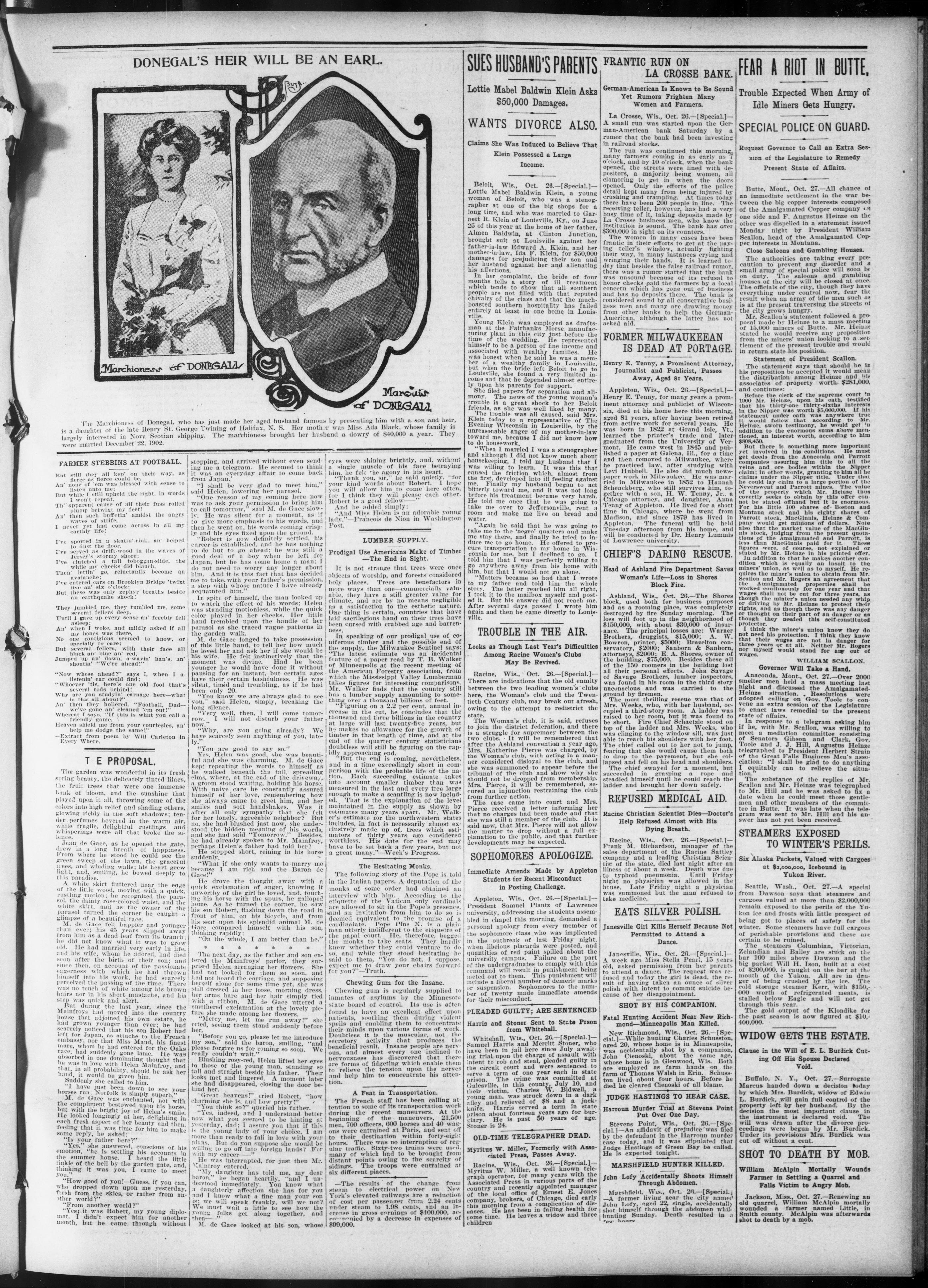
Marchioness of DONEGALL
Marquis
of DONEGALL
The Marchioness of Donegal, who has just made her aged husband famous by presenting him with a son and heir, is a daughter of the late Henry St. George Twining of Halifax, N. S. Her mother was Miss Ada Black, whose family is largely interested in Nova Scotian shipping. The marchioness brought her husband a dowry of $40,000 a year. They were married December 22, 1902.
The Marchioness of Donegal, who has just made her aged husband famous by presenting him with a son and heir, is a daughter of the late Henry St. George Twining of Halifax, N. S. Her mother was Miss Ada Black, whose family is largely interested in Nova Scotian shipping. The marchioness brought her husband a dowry of $40,000 a year. They were married December 22, 1902.
FARMER STEBBINS AT FOOTBALL.
But still they all kep' on their way, as
we are farce could be
But while I still upheld the right, in words I won't repeat.
I never yet had come across in all my earthly life!
I've sported in a skatin'-rink. an' helped to dust the floor.
while my cheeks diff blanch. Then let me go, reluctantly become an exhume.
But these was only zephyr breaths beside an earthquake shock!
They jumbled me, they tumbled me, some several fellers deep.
Until I gave up every sense an' feebly fell asleep:
An' when I woke, and mildly asked if all my bones was there.
No one contiguous seemed to know, or specially to care;
specially to care;
But several fellers, with their face all black an' blue an' red,
Jumped up an' down, a-wavin' han's, an' shoutin' "We're ahead!"
"Now whose ahead?" says I, when I a-listenin' ear could find;
"Whoever 'tis, here's one old fool that's several rods behind!
Why are you studyln' carnage here—what is this all about?"
An' then they hollered, "Football, Dad— we've gone an', cleaned 'em out."
Heaven shield me from your courtesies, an' help me dodge the same!"
- Extract from poem by Will Carleton in Every Where.
T E PROPOSAL.
The garden was wonderful in its fresh spring beauty, the delicately tinted lilacs, the fruit trees that were one immense bank of bloom, and the sunshine that played upon it all, throwing some of the colors into high relief and shading others, glowing richly in the soft shadows; tender perfumes hovered in the warm air, while fragile, delightful rustlings and whisperings were all that broke the silence.
Jean de Gace, as he opened the gate, drew in a long breath of happiness. From where he stood he could see the green sweep of the lawn, the graceful trees, and winding walls; his heart grew light, and, smiling, he bowed deeply to this paradise.
A white skirt fluttered near the edge of the little wood, moving with a quick, rustling motion; he recognized the parasol, the dainty rose-colored waist, and the white skirt, and as the owner of the parasol turned the corner he caught a glimpse of a beautiful face.
M. de Gace felt happier and younger than ever; his 45 years slipped away from him as a dead leaf from its branch; he did not know what it was to grow old. He had married very early in life, and his wife, whom he adored, had died soon after the birth of their son; and since then, on account of the passionate eagerness with which he had thrown himself into his work, he had scarcely perceived the passing of the time. There was no touch of white among his brown hairs nor in his short mustache, and his step was quick and alert.
But during the last year, since the Mainfroys had moved into the country house that adjoined his own estate, he had grown younger than ever; he had scarcely noticed that his son Robert had left for Japan, as attache to the French embassy, nor that Miss Maud, his finest mare, whom he had entered for the Oaks race, had suddenly gone lame. He was absorbed in one dominating thought that he was in love with Helen Mainfroy, and that, in all probability, should he ask her hand, it would be given him.
Suddenly she called to him.
"I have just been down to see your horses run; Norfolk is simply superb."
M. de Gace was enchanted, not with the compliment bestowed upon his horse, but with the bright joy of Helen's smile. He looked longingly at her, delighting in each fresh aspect of her beauty and then, feeling that it was time for him to make some reply, he asked:
"Is your father here?"
"Yes," she answered, conscious of his emotion, "he is settling his accounts in the summer house. I heard the little tinkle of the bell by the garden gate, and, thinking it was you, I came to meet you."
"How good of you!—Guess, if you can, who dropped down upon me yesterday, fresh from the skies, or rather from another world?"
"From another world?"
"Yest it was Robert, my young diplomat. I didn't expect him for another month, but he came through without
stopping, and arrived without even sending me a telegram. He seemed to think it was an everyday affair to come back from Japan.' "I shall be very glad to meet him," said Helen, lowering her parasol. "One reason of my coming here now was to ask your permission to bring him to call tomorrow," said M. de Gace slowly. He was silent for a moment, as if to give more emphasis to his words, and then he went on, his words coming crisply and his eyes fixed upon the ground.
"Robert is now definitely settled, his career is established, and he has nothing to do but to go ahead; he was still a good deal of a boy when he left for Japan, but he has come home a man; I do not need to worry any longer about him. And it is this fact that has decided me to take, with your father's permission, a step with whose nature I have already acquainted him."
In spite of himself, the man looked up to watch the effect of his words; Helen was standing motionless, while the quick color played in her cheeks. Her little hand trembled upon the handle of her parasol as she traced vague patterns in the garden walk.
M. de Gace longed to take possession of this little hand, to tell her how much he loved her and ask her if she would be his wife. He felt instinctively that the moment was divine. Had he been younger he would have done it without pausing for an instant, but certain ages have their certain bashfulness. He was silent, timid and trembling, as if he had been only 20.
"You know we are always glad to see you," said Helen, simply, breaking the long silence.
"Very well, then, I will come tomorrow. I will not disturb your father now."
"Why, are you going already? We have scarcely seen anything of you, lately."
"You are good to say so."
Yes, Helen was good, she was beautiful and she was charming. M. de Gace kept repeating the words to himself as he walked beneath the tail, spreading elms, where, at the end of the driveway, a groom stood waiting, holding his horse. With naive care he constantly assured himself of her love, remembering how she always came to greet him, and her smiles and soft handshakes. Was it after all only sympathy that she felt for her lonely, agreeable neighbor? But no, she had blushed just now, she understood the hidden meaning of his words, and she had said "Tomorrow." Besides, he had already spoken to Mr. Mainfroy, perhaps Helen's father had told her?
He stopped short, reining in his horse suddenly.
"What if she only wants to marry me because I am rich and the Baron de Gace?"
He drove the thought away with a quick exclamation of anger, knowing it unworthy of the girl he loved, and, touching his horse with the spurs, he galloped home. As he turned the corner, he saw his son Robert, flashing down the road in front of him, on his bicycle, and from his seat upon his splendid animal M. de Gace compared himself with his son, thinking rapidly:
"On the whole, I am better than he."
The next day, as the father and son entered the Mainfroys' parlor, they surprised Helen arranging her flowers. She had not looked for them so soon, and had not heard the carriage, and supposing herself alone for some time yet, she was still dressed in her loose, morning dress, her arms bare and her hair simply tied with a ribbon. M. de Gace uttered a smothered exclamation at the lovely picture she made among her flowers.
"Mercy me, let me run away!" she cried, seeing them stand suddenly before her.
"Before you go, please let me introduce my son," said the baron, smiling, "and please forgive us for coming so soon. We really couldn't wait."
Blushing rosy-red, Helen lifted her eyes to those of the young man, standing so tall and straight beside his father. Their looks met and lingered. A moment later she had disappeared, closing the door behind her.
"Great heavens!" cried Robert, "how charming she is, and how pretty!"
"You think so?" queried his father.
"Yes, indeed, and I understand better now what you seemed to be hinting at yesterday, dad; I assure you that if this is the young lady of your choice, I am more than ready to fall in love with your plans. But do you suppose she would be willing to go off into foreign lands? For with my career—"
He was interrupted, for just then Mr. Mainfroy entered.
"My daughter has told me, my dear baron," he began heartily, "and I understood immediately. You know what a daughterly affection she has for you and I know what a fine man your son is; we will speak frankly, will we not? We must wait a little to see how the young folks get along together, and then—"
M. de Gace looked at his son, whose
eyes were shining brightly, and, without a single muscle of his face betraying him, he felt the agony in his heart. "Thank you, sir," he said quietly, "for your kind words about Robert. I hope you will allow him to come here often, for I think they will please each other. Robert is a good fellow—" And he added simply: "And Miss Helen is an adorable young lady."—Francois de Nion in Washington Post.
LUMBER SUPPLY.
Prodigal Use Americans Make of Timber
—The End in Sight.
It is not strange that trees were once objects of worship, and forests considered holy places. Trees are benefactors in more ways than one—commercially valuable, they have a still greater value for climate, and are by no means negligible as a satisfaction to the esthetic nature. One thing is certain, countries that have laid sacrilegious hand on their trees have been cursed with crabbed age and barrenness.
In speaking of our prodigal use of coniferous timber and the possible end of the supply, the Milwaukee Sentinel says: "The latest estimate was an incidental feature of a paper read by T. B. Walker of Minneapolis at the recent meeting of the American Forestry association, from which the Mississippi Valley Lumberman takes figures for interesting comparisons. Mr. Walker finds that the country still has a lumber supply amounting to something over a thousand billions of feet.
"Figuring on a 2.2 per cent. annual increase in the cut, he concludes that the thousand and three billions in the country at large will last twenty-five years, but he makes no allowance for the growth of timber in that length of time, and at the end of the quarter century statisticians doubtless will still be figuring on the rapidly approaching end.
"But the end is coming, nevertheless, and in a time exceedingly short in comparison with the probable life of the nation. Each succeeding estimate takes into account smaller timber than was measured in the last and every tree large enough to make a scantling is now included. That is the explanation of the level maintained in the supply as shown by estimates many years apart. Mr. Walker's estimate for the northwestern states includes, in fact is necessarily almost exclusively made up of, trees which estimators of thirty years ago considered worthless. His date for the end may have to be set back a few years, but not a great many."—Week's Progress.
The Hesitating Monks.
The following story of the Pope is told in the Italian papers. A deputation of the monks of some order had obtained an interview with him. According to the etiquette of the Vatican only cardinals are allowed to sit in the Pope's presence, and an invitation from him to do so is deemed equivalent to the promise of a cardinalate. Pope Pius X. is a plain man utterly indifferent to the etiquette of the papal court. He, therefore, begged the monks to take seats. They hardly knew whether they could venture to do so, and while they stood hesitating he said to them, "You do not, I suppose, expect me to draw your chairs forward for you?"—Truth.
Chewing Gum for the Insane.
Chewing gum is regularly supplied to inmates of asylums by the Minnesota state board of control. Its use is often found to have an excellent effect upon patients, soothing them during violent spells and enabling them to concentrate their minds upon various forms of work. Doubtless it is the muscular, not the secretory activity that produces the beneficial result. Insane people are nervous, and almost every one inclined to nervousness has discovered that there are forms of fidgeting which enable them to relieve the tension upon the nerves and help him to concentrate his attention.
A Feat in Transportation.
The French staff has been calling attention to some of its transportation work during the recent maneuvers. At the beginning of the maneuvers, 21,500 men, 700 officers, 600 horses and 40 wagons were entrained at Paris, and sent off to their destination within forty-eight hours. There was no interruption of regular traffic. Sixty-two trains were used, many of which had to be brought from distant points owing to the scarcity of sidings. The troops were entrained at six different places.
The results of the change from steam to electrical power on New York's elevated railways are a reduction of cost per passenger from 2.24 cents under steam to 1.98 cents, and an increase in gross earnings of $400,000, accompanied by a decrease in expenses of $99,000.
SUES HUSBAND'S PARENTS
Lottie Mabel Baldwin Klein Asks $50,000 Damages.
WANTS DIVORCE ALSO.
Claims She Was Induced to Believe That Klein Possessed a Large Income.
Beloit, Wis., Oct. 26.—[Special.]—Lottie Mabel Baldwin Klein, a young woman of Beloit, who was a stenographer at one of the big shops for a long time, and who was married to Garnett R. Klein of Louisville, Ky., on June 25 of this year at the home of her father, Almen Baldwin, at Clinton Junction, brought suit at Louisville against her father-in-law Edward A. Klein, and her mother-in-law, Ida F. Klein, for $50,000 damages for prejudicing their son and her husband against her and alienating his affections.
In her complaint, the bride of four months tells a story of ill treatment which tends to show that all southern people are not filled with that reputed chivalry of the class and that the much-boasted southern hospitality has failed entirely at least in one home in Louisville.
Young Klein was employed as draftsman at the Fairbanks Morse manufacturing plant in this city just before the time of the wedding. He represented himself to be a person of fine income and associated with wealthy families. He was honest when he said he was a member of a wealthy family in Louisville, but when the bride left Beloit to go to Louisville, she found a very limited income and that he depended almost entirely upon his parents for support.
She filed papers for separation and alimony. The news of the young woman's trouble is a great shock to her Beloit friends, as she was well liked by many. The trouble was all caused, said Mrs. Klein today to a representative of The Evening Wisconsin in Louisville, by the unreasonable anger of my mother-in-law toward me, because I did not know how to do housework.
"When I married I was a stenographer and although I did not know much about housekeeping, I told my husband that I was willing to learn. It was this that caused the friction which, almost from the first, developed into ill feeling against me. Finally my husband began to act bitterly toward me, and it was not long before his treatment became very harsh. He told me once that he was going to take me over to Jeffersonville, rent a room and make me live on bread and water.
"Again he said that he was going to take me to the 'negro' quarters and make me stay there, and finally he tried to induce me to go home. He offered to procure transportation to my home in Wisconsin for me, but I declined to go. I told him that I was perfectly willing to go anywhere away from his home with him, but that I would not go alone."
"Matters became so bad that I wrote to my father and told him the whole story. The letter reached him all right, I took it to the mailbox myself and posted it. But his answer did not reach me. After several days passed I wrote him again and then he came directly to Louisville.
TROUBLE IN THE AIR.
Looks as Though Last Year's Difficulties Among Racine Women's Clubs May Be Revived.
Racine, Wis., Oct. 26.—[Special.]—There are indications that the old enmity between the two leading women's clubs here, the Woman's club and the Twentieth Century club, may break out afresh, owing to the attempt to redistrict the state. The Woman's club, it is said, refuses to join the district federation, and there is a struggle for supremacy between the two clubs. It will be remembered that after the Ashland convention a year ago, Mrs. Katherine Pierce was charged, by the Woman's club, with acting in a manner considered disloyal to the club, and she was summoned to appear before the tribunal of the club and show why she should not be dropped from membership. Mrs. Pierce, it will be remembered, secured an injunction restraining the club from further action.
The case came into court and Mrs. Pierce received a letter informing her that no charges had been made and that she was still a member of the club. It is said now, that Mrs. Pierce will not allow the matter to drop without a full explanation to the public, and that further developments may be expected.
SOPHOMORES APOLOGIZE.
Immediate Amends Made by Appleton Students for Recent Misconduct in Posting Challenge.
Appleton, Wis., Oct. 26.—[Special.]—President Samuel Plantz of Lawrence university, addressing the students assembled in chapel this morning, demanded a personal apology from every member of the sophomore class who was implicated in the outbreak of last Friday night, when libelous placards were posted, and quantities of red paint spilled about the university campus. Failure on the part of the undergraduates to comply with this command will result in punishment being meted out to them. This punishment will include a liberal number of demerit marks or suspension. Sophomores to the number of twenty made immediate amends for their misconduct.
PLEADED GUILTY; ARE SENTENCED
Harris and Stoner Sent to State Prison from Whitehall.
Whitehall, Wis., Oct. 26.—[Special.]—Samuel Harris and Merritt Stoner, who have been in jail here since July awaiting trial upon the charge of assault with intent to rob and steal, pleaded guilty in the circuit court and were sentenced to serve a term of one year each in state prison. The crime was committed at Galesville, in this county, July 10, and their victim, Charles W. Bidwell, a young man, was struck down in a dark alley and relieved of $8 and a jackknife. Harris served a term in state prison about fourteen years ago for burglary. He is past 50 years of age. Stoner is 24.
OLD-TIME TELEGRAPHER DEAD.
Myritus W. Miller, Formerly with Associated Press, Passes Away.
Racine, Wis., Oct. 26.—[Special.]—Myritus W. Miller, a well known telegraph operator, for many years with the Associated Press in various parts of the country and recently appointed manager of the local office of Ernest E. Jones company, brokers, of Chicago, died early this morning from a complication of diseases. He has been in failing health for some time. He leaves a widow and three children
German-American Is Known To Be Sound Yet Rumors Frighten Many Women and Farmers.
La Crosse, Wis., Oct. 26.—[Special.]—A small run was started upon the German-American bank Saturday by a rumor that the bank had been investing in railroad stocks.
The run was continued this morning, many farmers coming in as early as 7 o'clock, and by 10 o'clock, when the bank opened, the streets were lined with depositors, a majority being women, all clamoring to get in when the doors opened. Only the efforts of the police detail kept many from being injured by crushing and trampling. At times today there have been 200 people in line. The receiving teller, however, has had a very busy time of it, taking deposits made by La Crosse business men, who know the institution is sound. The bank has over $300,000 in sight on its counters.
The women in many cases have been frantic in their efforts to get at the paying teller's window, actually fighting their way, in many instances crying and wringing their hands. It is learned today that besides the false railroad rumor, there was a rumor started that the bank was unsound because of its refusal to honor checks paid the farmers by a local concern which has gone out of business and has no deposits there. The bank is considered sound by all conservative business men and many are drawing money from other banks to help the German-American, although the latter has not asked aid.
FORMER MILWAUKEEAN IS DEAD AT PORTAGE.
Henry E. Tenny, a Prominent Attorney, Journalist and Publicist, Passes Away, Aged 81 Years.
Appleton, Wis., Oct. 26.—[Special.]—Henry E. Tenny, for many years a prominent attorney and publicist of Wisconsin, died at his home here this morning, aged 81 years, after having been retired from active work for several years. He was born in 1822 at Grand Isle, Vt., learned the printer's trade and later graduated from the University of Vermont. He came west in 1845 and published a paper at Galena, Ill., for a time and then removed to Milwaukee, where he practiced law, after studying with Levi Hubbell. He also did much newspaper work in Milwaukee. He was married in Milwaukee in 1852 to Hannah Schenckberg, who still survives him, together with a son, H. W. Tenny, Jr., a Chicago attorney, and daughter, Anna Tenny of Appleton. He lived for a short time in Chicago, where he went from Madison, and since 1879 has lived in Appleton. The funeral will be held Tuesday afternoon from his home, and will be conducted by Dr. Henry Lummis of Lawrence university.
CHIEF'S DARING RESCUE.
Head of Ashland Fire Department Saves Woman's Life—Loss in Shores Block Fire.
Ashland, Wis., Oct. 26.—The Shores block, used both for business purposes and as a rooming place, was completely destroyed by fire Sunday morning. The loss will foot up in the neighborhood of $150,000, with about $30,000 of insurance. The principal losses are: Warner Brothers, druggists, $15,000; A. W. Bowron, printer, $5000; Brazilton conservatory, $2000; Sanborn & Sanborn, attorneyse, $2000; E. A. Shores, owner of the building, $75,000. Besides these all of the 150 roomers in the building lost all their personal effects. John Savage of Savage Brothers, lumber inspectors, was found in his room in the third story unconscious and was carried to the ground by firemen.
The most thrilling rescue was that of Mrs. Weeks, who, with her husband, occupied a third-story room. A ladder was raised to her room, but it was found to be short. Fire Chief Schaetzle stood on top of the ladder and Mrs. Weeks, who was clinging to the window sill, was just able to reach his shoulders with her foot. The chief called out to her not to jump, fearing that she would cause them both to drop to the pavement, but she collapsed and fell on his head and shoulders.
The chief swayed for a moment, but succeeded in grasping a rope and steadied himself until he could reach the ladder and brought her down safely.
REFUSED MEDICAL AID.
Racine Christian Scientist Dies—Doctor's Help Refused Almost with His Dying Breath.
Racine, Wis., Oct. 26.—[Special.]—Frank M. Richardson, manager of the sales department of the Racine Sattley company and a leading Christian Scientist of the state, died last night after an illness of about a week. Death was due to typhoid pneumonia. Until Friday night no physician was allowed in the house. Late Friday night a physician was summoned but the man refused to take medicine.
EATS SILVER POLISH.
Janesville, Wis., Oct. 26.—[Special.]—A week ago Miss Stella Pearl, 15 years old, asked permission from her parents to attend a dance. The request was refused and today the girl is dead, the result of having taken an ounce of silver polish with intent to commit suicide because of her disappointment.
SHOT BY HIS COMPANION.
Fatal Hunting Accident Near New Rich mond-Minneapolis Man Killed.
New Richmond, Wis., Oct. 26.—[Special.]—While hunting Charles Schusston, aged 20, whose home is in Minneapolis, was accidentally shot by a companion, John Cienoski, about the same age, whose home is in Glenwood, Wis. Both are employed as farm hands on the farm of Thomas Walsh in Erin. Schusston lived about four hours. Before he died he cleared Cienoski of all blame.
IUDGE HASTINGS TO HEAR CASE.
Harroun Murder Trial at Stevens Point
Put Over One Day.
Stevens Point, Wis., Oct. 26.—[Special.]—An affidavit of prejudice was filed by the defendant in the Harroun murder case today, and it was stipulated that Judge Hastings of Green Bay be called. He is expected tonight.
MARSHFIELD HUNTER KILLED.
John Lofy Accidentally Shoots Himself Through Abdomen.
Marshfield. Was., Oct. 26.—[Special.]
-A farmer living near the city named John Lofy, aged 22, single, accidentally shot himself through the abdomen while hunting Sunday. Death resulted in a few hours.
FEAR A RIOT IN BUTTE.
Trouble Expected When Army of Idle Miners Gets Hungry.
SPECIAL POLICE ON GUARD.
Request Governor to Call an Extra Session of the Legislature to Remedy Present State of Affairs.
Butte, Mont., Oct. 27.—All chance of an immediate settlement in the war between the big copper interests composed of the Amalgamated Copper company on one side and F. Augustus Heinze on the other was dispelled in a statement issued Monday night by President William Scallon, head of the Amalgamated Copper interests in Montana.
Close Saloons and Gambling Houses.
The authorities are taking every precaution to prevent any disorder and a small army of special police will soon be on duty. The saloons and gambling houses of the city will be closed at once. The officials of the city, though they have everything under control now, fear the result when an army of idle men such as is at the present traversing the streets of the city grows hungry.
Mr. Scallon's statement followed a proposal made by Heinze to a mass meeting of 15,000 miners of Butte. Mr. Heinze stated he would receive any proposition from the miners' union looking to a settlement of the present trouble and would in return state his position.
Statement of President Scallon.
The statement says that should he in his proposition be accepted it would mean the distribution among Heinze and his associates of property worth $281,000, and continues:
Before the clerk of the supreme court in 1900 Mr. Heinze, upon his oath, testified that his thirty-one thirty-sixths interests in the Nipper was worth $5,000,000. If his statement under oath was anywhere true it would follow that according to Mr. Heinze, sworn testimony, he would get in addition to the enormous sums above mentioned, an interest worth, according to him $808,450.
But there is something more important yet involved in his conditions. He must get deeds from the Anaconda and Parrott companies assuring him title to all the veins and ore bodies within the Nipper claim; in other words, granting to him all he claims under the Nipper title. Under that he could lay claim to a large portion of the Neversweat and Parrott mines. The value of the property which Mr. Helnze thus covertly seeks to obtain by this offer cannot be stated offhand but it is enormous. For his little 100 shares of Boston and Montana stock and his eighty shares of Parrott stock, MacGinnis, Helnze & Company would get millions of dollars. Note also that the market value of the MacGinnis stock, judging from the present quotations of the Amalgamated and Parrott, is less than MacGinnis paid for it. These figures were, of course, not explained or stated by Mr. Helnze in his printed offer.
In addition to that he makes another condition which is equally an insult to the miners' union, as well as to myself. He requires the miner's union to obtain from Mr. Scallon and Mr. Rogers an agreement that the Amalgamated properties shall be worked continuously for one year and that wages shall not be cut for three years, as though the miner's union needed any whip or driving by Mr. Helnze to protect their rights, and as though there was any danger or thought on their part of an danger or as though they needed this self-constituted protector.
I think the miner's union know they do not need his protection. I think they know that their wages are not in danger for three years or at all. Neither Mr. Rogers nor myself would stand for any cut of wages.
WILLIAM SCALLON.
Governor Will Take a Hand.
Anaconda, Mont., Oct. 27.—Over 2000 smelter men held a mass meeting last night and discussed the Amalgamated-Heinze situation. Resolutions were adopted calling on Gov. Toole to convene an extra session of the Legislature to enact laws remedial to the present state of affairs. In response to a telegram asking him if he, with Mr. Scallon, was willing to meet a mediation committee consisting of Senators Gibson and Clark, Gov. Toole and J. J. Hill, Augustus Heinze telegraphed to President Herbert Strain of the Great Falls Business Men's association: "I shall be glad to do anything I equitably can to relieve the situation."
The substance of the replies of Mr. Scallon and Mr. Heinze was telegraphed to Mr. Hill and he was asked to fix a date when he could meet those gentlemen and other members of the committee in Butte. It was late when the telegram was sent to Mr. Hill and his answer has not yet been received.
STEAMERS EXPOSED TO WINTER'S PERILS.
Six Alaska Packets, Valued with Cargoes at $2,000,000, Icebound in Yukon River. Seattle, Wash., Oct. 27.—A special from Dawson says that steamers and cargoes valued at more than $2,000,000 remain exposed to the perils of the Yukon ice and frosts with little prospect of being got to places of safety for the winter. Some steamers have full cargoes of perishable provisions and these are certain to be ruined.
The steamers Columbian, Victorian, Zelandian and Bailey are stuck on the bar 100 miles above Dawson and the big packet Will H. Ison, built at a cost of $200,000. is caught on the bar at the mouth of the Yukon. All are in danger of being crushed by the ice. The cold storage steamer Kerr, with $150,-000 worth of refrigerated meats, is stalled below Eagle and will not get through this year. The gold output of the Klondike for the past season is now figured at $10,-400,000.
WIDOW GETS THE ESTATE
Clause in the Will of E. L. Burdick Cut ing Off His Spouse Declared Void.
Buffalo, N. Y., Oct. 27.—Surrogate Marcus handed down a decision today by which Mrs. Burdick, widow of Edwin L. Burdick, will gain full control of the property left by her husband. By the decision the most important clause in the instrument is declared void. The will was drawn after the divorce proceedings were begun by Mr. Burdick. Under its provisions Mrs. Burdick was cut off without a cent.
SHOT TO DEATH BY MOB.
William McAlpin Mortally Wounds Farmer in Settling a Quarrel and Falls Victim to Angry Mob.
Jackson, Miss., Oct. 27.—Renewing an old quarrel, William McAlpin mortally wounded a farmer named Little, in Smith county. McAlpin was afterwards shot to death by a mob.
SUBSCRIPTION RATES.
Any part of the United States and Canada,
postage pald.
One Year ..... $2.00
Six Months ..... 1.25
Three Months ..... .75
Send money by Express Money Order, P. O.
Money Order or Registered Letter to the
Wisconsin Weekly Advocate.
ADVERTISING RATES
One inch, single insertion..... 25c
One inch, per year..... $9.00
Business locals 5c per line each insertion.
Apply for rates to the Advocate.
TO CONTRIBUTORS:
All communications must be sent with the name and address of the sender as an evidence of good faith, but not necessarily for publication. No manuscript returned if not accepted, unless accompanied by stamps.
The Wisconsin Weekly Advocate company wishes to notify the public that all contracts and business transactions with this company must have the company stamp, otherwise they will be void. Neither will this company be responsible for paid subscriptions unless giveup to duly-accredited agents, who, on request, will give the company's receipt for sanie. Subscribers failing to receive their papers regularly will kindly notify the general office. Address all business communications to the general manager, 79 Fifth street.
Entered in the Postoffice at Milwaukee as Second-class matter.
THE WISCONSIN WEEKLY ADVOCATE COMPANY
THE WISCONSIN WEEKLY ADVOCATE COMPANY
Wishes to notify its friends and readers that there will be no Weddings, Marriage Notices, or Write-Ups, unless they are paid for in Advance. But as for those who subscribe for the paper, their items of news will be done gratis. Our office is located at 79 Fifth St. Phone White 9441.
New York is a larger proposition than Dowie realized.
As usual, football is more a game of the mangle than the gridiron.
The latest big fish story comes from St. Johns, N. B. It is 110 feet long—the fish—a whale.
Chronic jokers will please take notice that suburban towns are clamoring for Milwaukee water.
New York is undoubtedly snickering at the idea of a "restoration host" from the vicinity of Chicago.
Mrs. Nation lacks the money-making ability of Elijah Dowie, but she cuts an equally dignified figure in public.
The first ice of the season chills the ice man. Later on the ice will be thick enough to cause a reaction and a glow over next summer's prospects.
Young Corbett's mill with Callahan, in Philadelphia, was hot enough to suggest what old Corbett received when he exchanged thumps with Jeffries in San Francisco.
It must not be inferred, from the fact that Prophet Dowie and his host have transferred their campaign to the city of New York, that there are no unregenerate left in Chicago.
The Wichita track has been shown to be 2 4-5 feet longer than a mile, and therefore the horsemen who are envious of Cresceus must get out their windshields and automobiles.
---
If the Wisconsin Federation of Woman's Clubs could find a device that would abate the nuisance of tiresome speakers it would earn the gratitude of all Americans irrespective of sex.
The tented shows having folded their apparatus for the season, their light-fingered followers are putting some post-season work with the Dowie circus and among tae Rubes of New York.
---
The fact that California will have 86,000,000 pounds of raisins this year, as against 80,000,000 last year, insures plenty of raisins for cake. Now all one has to do is get the cake to hold the raisins.
Dan Patch's new pacing record of 1:56 $ \frac{1}{4} $ is a mark that will stand a good deal of stretching of leather by harness horses. It will always require a small space of time to cover a mile on hoofs, with a sulky for a tender.
The famine in the coal business just now is one of demand. Those who were frightened by predictions of a shortage have full bins, while those who refused to permit themselves to be stampeded are satisfied that they can get their coal as they require it. Many consumers are still burning Pocahontas soft coal in preference to anthracite.
---
The trial trip of the San Francisco airship was characteristic. Like all gas-bag machines, it was baffled by air currents, and when the aeronaut came down he had to be fished out of the water by lifesavers. Aerial navigation will not affect rail or steamship rates until there is more certainty as to the courses of the airships and as to the manner of their landing.
The Audacious Jackass.
A Scilly donkey has been astonishing the islands by a remarkable display of courage and resolution. According to the report, this donkey, while grazing near the sea at Banks Carn, noticed a seal on the beach. The dauntless animal at once seized the seal in its mouth, and trotted with it a quarter of a mile inland. The seal, when taken from its captor and measured, was found to be three feet six inches long, and to weigh forty-five pounds.—London Daily News.
NO STATE TAX THIS YEAR.
For the First Time Since 1884 a Levy Is Found Unnecessary.
---
Madison, Wis., Oct. 29.—[Special.]—For the first time in the history of the state since 1884 no tax for the support or maintenance of the state government or any of the state institutions will be levied this year. The condition of the state treasury is such that all charges against it for the purposes of the administration of the government are amply provided for by the money on hand. There was in the general fund on the first day of October $1,515,701.06. By reason of this fact the governor, secretary of state and state treasurer, by authority of law, have been enabled to wipe out the state tax and relieve the people of the state from its burden. From this it follows that the only tax to be levied generally upon the people of the state is that which is solely for the benefit of the common schools. Seven-tenths of a mill on the state valuation is directed by the statute to be levied, after deducting therefrom $200,000 of the license moneys received by the state from the railroads. This tax to be paid by the people amounts to the sum of $1,027,220. It is true that in form it might be called a state tax; in fact, it is not so. It pertains in no way to the expense of administering the state government or any or its institutions. It includes no part of the large appropriations to the state university and the normal schools, nor of the $100,000 coming to the free high schools, nor the $60,000 to be paid to the graded schools under appropriations of the last Legislature. It is collected by the state, not for its benefit or use, but solely for the support, maintenance and efficiency of the common school system of the state. No part of it is to be expended for any other purpose. It is collected for the benefit of the schools and turned over to the different counties of the state to be distributed by them. The appropriations to the state university, the normal schools, free high schools, graded schools, and all of the institutions made by the last Legislature are provided for and discharged by moneys now on hand, or to come to the treasury from other sources than the people this year.
Apportionment to Counties.
Besides this, not only the sum collected by this tax is paid over to the different counties for the support of the common schools, but the counties will receive in addition the sum of $375,164, making a total to be paid by the state to the counties for the support of the common schools of $1,402,384, as follows:
From the tax for common schools. $1,027,220
From license fees ..... 200,000
From the school income fund..... 175,164
Total to be paid by the state
to the counties ..... $1,402,384
This important action of the governor,
secretary of state and state treasurer
has relieved the people of the state of
the burden of a direct tax in the sum of
$942,570. Had not this action been taken, this sum would have been collected of the taxpayers of the state by direct taxation.
To show what this means the taxpayers of Milwaukee county, which paid into the state treasury for state taxes, including its school taxes, last year $539.-727.50; this year it will only pay the sum of $229,348.48, which is nothing but the school tax, and, as before said, goes directly back to the counties for the use of the common schools, and in the case of the great majority of the counties with a substantial addition.
This great saving to the taxpayers has been made without crippling the state treasury or the danger of creating any deficit which would have to be met by levying a tax in the future.
Adopt Resolutions.
The following is a copy of the resolution wiping out the state tax as adopted by the governor, the secretary of state and the state treasurer:
Whereas, it appears that on the 1st day of October, 1903, there was in the general fund a balance of $1,515,701.06, and
Whereas, it is estimated that there will
Whereas, it is estimated that there will be a balance in said general fund on January 1, 1904, of $950,701.06, and
Whereas, it is estimated that the receipts to said general fund during 1904 will be $3,653,554.73, and
Whereas, it is estimated that the disbursements for all purposes for the year 1004 will be $3,644,525.94, and
Whereas, the entire state tax to be levied for the ensuing year for interest on state indebtedness, and to free high schools, and to graded schools, support of the university, support of the normal schools, special university tax and capitol building fund amount to the sum of $942,570, and
Whereas, said sum of $942,570 can, without detriment to the public service, be transferred from the general fund and applied as a state tax levy to discharge the payment of the items above mentioned, and thereby obviate the necessity of a levy of any state tax for such purposes; now therefore, be it
Resolved, that we, the undersigned, governor, secretary of state and state treasurer, in pursuance of section 10,600 of the Wisconsin statutes of 1898, do hereby trans-
WOMAN IN THE CASE
Robbers of Superior Postoffice Are Thought to Have Had Feminine Accomplice.
Superior, Wis., Oct. 29.—[Special.]—There is a woman in the case of the robbery of the Superior postoffice of $15,000 worth of stamps. That is the conclusion to which the police have come. The conclusion is based on the hypothesis that Charles Dennis and Pat Flaherty, the men under arrest, are the guilty parties, and that the man that got away is Lattimer, wanted for breaking jail at Waukesha.
It has been learned here that the night of the robbery the "third man" stopped at one of the local hotels and that a woman was there with him. It is also known that the same woman bought a ticket for Republic, which is near Ishpeming, the point for which the alleged robbers had bought tickets. The energies of the police will now be bent toward locating the third man and the woman. So far none of the supposed clues as to the disposition of the booty have materialized.
MASONS CONDUCT FUNERAL
Interment of Charles S. Schuette of Beaver Dam at Oakwood.
Beaver Dam, Wis., Oct. 29.—[Special.]
—The funeral of Charles S. Schuette was held here yesterday under the auspices of the Masons, Rev. C. S. Johnson officiating. Interment was at Oakwood cemetery.
Mr. Schuette was a prominent citizen of Beaver Dam. He was born in Germany in 1829 and came to this country in 1840.
fer from the general fund, as a portion of
the state tax, the sum of $942,570, to be
applied as follows:
Interest on state indebtedness . $157,570
For free high schools . 100,000
Graded schools . 60,000
University . 280,000
Normal schools . 280,000
Special university tax . 56,000
Capitol building fund . 50,000
$942,570
And that no state tax be levied for the
above purposes for the ensuing year; and
no state tax whatever be levied for any
other purpose, except in accordance with
section 1072a of the Wisconsin statutes of
1898, as amended by section 20, chapter 351,
laws of 1899, and chapter 313, laws of
1903, a tax commonly known as the mill
tax for the aid of the public schools,
amounting to $1,027,220.40.
SCHOOL TAX AND APPORTIONMENT
Tax Levy of Tax Levy Decrease in
of Tax Levy
1902.1903.1903.
$4,947.11 $2,833.90 $1,813.21
13,602.39 6,441.96 7,160.43
10,821.53 5,783.10 5,038.48
17,162.42 7,227.23 9,935.18
38,750.88 17,267.07 21,483.81
13,505.63 6,370.96 7,124.67
2,711.52 1,370.55 1,340.97
20,310.33 9,157.41 11,152.92
18,414.19 9,822.67 8,588.52
17,957.31 9,455.72 8,501.36
40,584.05 17,939.38 22,454.67
5,541.12 4,509.13 3,633.84
110,030.02 46,545.61 65,488.41
75,890.69 31,347.12 44,545.57
8,712.49 4,328.75 4,383.74
37,469.79 15,534.51 21,915.25
16,277.49 7,552.22 8,725.27
20,961.39 9,835.21 11,126.18
3,598.06 1,210.63 2,387.43
61,662.30 27,196.50 34,465.80
5,168.29 1,984.54 3,183.75
4,829.28 2,518.75 2,310.51
44,757.01 19,952.28 24,804.73
39,903.06 16,970.37 22,932.69
20,495.72 8,844.02 11,651.70
27,479.57 12,902.29 14,577.29
6,903.97 2,915.97 3,888.00
9,289.45 4,905.95 4,383.50
53,530.49 23,784.08 29,746.41
13,676.98 6,633.48 7,043.50
29,729.67 13,662.85 16,066.82
12,033.13 5,912.60 6,120.63
49,753.88 19,537.83 30,215.95
29,532.13 13,906.11 15,626.02
7,457.41 3,992.70
Total...$2,325,916.00 $1,027,220.00 $1,298,696.00
SHEBOYGAN TEACHER DIES
C. D. Markworth, for Twenty-four Years Principal of the Lutheran Parochial School, Passes Away.
Sheboygan, Wis., Oct. 29.—[Special.]
—C. D. Markworth, for twenty-four years principal of the local Lutheran parochial schools, a leading pedagogue of private schools in this state, died after three weeks suffering from gangrene of the lungs. He was born in Perry county, Mo., a graduate of the St. Louis schools, Northwestern university, Watertown, Wis., and the normal school at Addison, ll.
Before coming here he was principal of the Little Rock, Ark., schools. Rev. John Stassen, Milwaukee, was a classmate of his. He leaves a wife and six children.
BURGLARS SUCCEED AT MADISON
Thieves Get $1000 Worth of Goods and Leave No Clue.
Madison, Wis., Oct. 29.—[Special.] Burglars went through the dry goods store of Jonas Brothers last night and got away with $1000 worth of silks, besides a small amount in money and stamps. They gained entrance by climbing through a transom left partly open. There is no clue to the thieves.
SHORTAGE OF CARS RELIEVED
Kewaunee Shippers No Longer Confronted with Difficulty.
Kewaunee, Wis., Oct. 29.—[Special.]—Kewaunee shippers have been confronted with a shortage of cars for the past two weeks. The situation was relieved today, however, by the Pere Marquette and Ann Arbor roads sending over several empties.
SOLDIERS' STORIES.
ENTERTAINING REMINISCENCES OF THE WAR.
Graphic Account of Stirring Scenes Witnessed on the Battlefield and in Camp-Veterans, of the Rebellion Recite Experiences of Thrilling Nature.
"Thirty-nine years ago to-day," said J. J. Wallace, "I started on my last raid on Richmond. No, I wasn't in the cavalry. I was in the Fourth Wisconsin Artillery, at that time in Butler's Army of the James. On the 29th of September two corps of Butler's army, including General Kautz's division of cavalry, were to cross to the north side of the James, capture the rebel positions, and attempt a rush into Richmond. The rebel positions were captured and held, but we didn't get into Richmond, and I was put out of action.
"We took four guns of our battery into the fight and lost them. We lost also a good many men, and I came out with a bullet hole through the shoulder. Yes, it disabled me then, and was a good deal in my way for some years. The wound was a severe one, but here I am as active in business as my old comrades who were not wounded."
"So am I," said an Eighty-sixth Illinois man. "I didn't run to bullet wounds, but I had bruises until I couldn't rest, and in the army a bruise was a bruise, as I learned by long and painful experience. I got my first bruise before I had been in the service sixty days. That was at Perryville, Oct. 8, 1862. We were lying down behind a rail fence when a bullet from the rifle of a rebel sharpshooter struck a rail right above my head, flattened out like a pancake, glanced off in my direction, struck me on the shoulder, leaving a black and blue spot as big as my hand. That bullet hurt me worse than if it had gone through me, and yet I was reported bruised, not wounded.
Again at Jay's sawmill at Chickamauga a flattened ball or a piece of a shell grazed me so close as to bruise and blister the skin, and again I got no sympathy and was laughed at for not tallying a hit. At Buzzard's Roost in May, 1864, we fought in a corn field from early morning before daylight until 8 o'clock at night. Along in the afternoon, tuckered out with the hot fighting and the hot weather, I squared myself behind a tree for a rest.
"I told the boys I was going to take a nap. This was meant to be a joke, but, sitting against a tree, I went to sleep, my head wobbled to one side, exposing my camp-kettle hat, and a Johnnie put a bullet through the hat so close to my head as to cut the hair. I awoke with a start, to be laughed at by the boys. I got another scratch at Kenesaw and blister or bruise at Peach Tree Creek, and another at Jonesboro, but I got no furlough on any of them. I can't truthfully say that I was wounded, and yet that bruise on my shoulder troubles me to this day."
"I had worse luck than that," said the Sergeant. "On the night our division crossed the Tennessee River in the march on Chattanooga, in September, 1863. I met with the queerest mishap that ever befell a soldier. I had been on heavy duty for two days and nights, and it seemed to me I couldn't keep awake another minute if all of Bragg's army came swooping down the gorge through which we were moving. I remember looking up at the ruins of the high bridge and trestle work at Falling Water, between Shellmound and Lookout Mountain, and then all was blank.
"I had gone to sleep, walking. We were marching in fours, rifles at right-shoulder shift, and the men on either side stood shoulder to shoulder, so for a time I slept and walked. When a turn came in the road the mechanism of my body, set for going ahead, stopped, and I went down like a log, my rifle striking me a cruel blow, and my face striking the rough ground. I was hurt worse than if a bullet had gone through my arm, but in my pain and misery I heard the laughs and shouts of the men jeering me. I carry the marks of that fall to-day, but the men of the old company would call me a fraud if I should say I was wounded at Falling Water."
'My most painful wound,' said the Captain, "did not come from bursting shell, or rifle bullet or saber cut. In going up Missionary Ridge I was close behind a great big fellow, who pushed his way through brush and abattis after the manner of a fly-bitten bull. At one point he bent forward the sharpened prongs of a branch of a fallen tree, and, releasing himself, let the sharp points fly back. They struck me at the knee, with the swiftness of a swinging saber, tore my trousers on that leg, and left three gashes across the knee. It was not a wound from the soldier's point of view, and I did not fall out. I climbed on, blind with pain, and I carry the scars to this day, but I was not among those reported wounded."
"I got my worst hurt," said a smiling corporal, "at West Point, Ky., where the regulars and militia are this week playing at war. We had been marching on half rations and sinkers for nearly a month in September, 1862, and were worn out, ragged, and starved, when one afternoon a glorious vision burst upon us. Coming out of a stretch of woodland we looked across a grassy plain, where were piled as high as houses all the articles in the soldier's menu. Here were great stacks of hams, there other stacks of shoulders and bacon. Just beyond
were boxes of crackers corded into solid masses twenty feet high, and spreading out into lines like great fortifications, and still beyond the Ohio River, wherein General Bragg said he would water his horse.
"This was the scene that met the eyes of Buell's hungry men as they came, without warning, upon it. There had been great depression among us that day, because we felt that we must fight Bragg on empty stomachs. But somebody had planned better than we thought possible, and here was plenty. Officers and men were hilarious at once. Even the dignified General William Sooy Smith, then commanding our division, rode down to us at a gallop to assure us there was plenty for all and to invite us to help ourselves. We could scarcely believe our eyes or ears, but there right before us was such an abundance of army fare as we had never seen before.
"Hams, in the army, were reserved for officers, and it seemed incredible that General Smith could be inviting us to help ourselves from that pile. But as the thousands of men marched up in order and filled their haversacks with the toothsome hard tack, the more toothsome because of the memory of sinkers, or flapjacks, our regiment passed the pile of hams, and one daring private thrust his bayonet into one of the largest and carried it off at a right shoulder shift. Another did the same, and another, and there sat General Smith on his horse smiling indulgently, if not approvingly. So it came about that many of us ate more ham that night than was good for us. I was sick as a horse, and my stomach has never been right since. I have always insisted that I was hurt worse at West Point than I was at Stone River, where a bullet went through my right arm."—Chicago Inter Ocean.
The Mule in the War.
"I was reading in the Chicago Journal the other day," said General Martin Beem, "an article on the 'Mule in the War.' It puts me in mind of another incident worth relating. The Ninth Illinois Infantry was mounted principally on mules in the Atlanta campaign, and somewhere near there the regiment, while in advance, had a hard fight with a large force of the enemy, and were at last required to fall back. Dr. Grelick, the surgeon of the regiment, and who is yet living at Alton, Ill., found his mule wouldn't run, but contented itself with kicking and 'bucking' as the surgeon applied his spurs. He coaxed, remonstrated and spurred all in vain, and all this time the rebel skirmish line kept coming closer, until at last one of the enemy rode up in the rear of the doctor and demanded his surrender. The doctor had all he could do to keep in the saddle, and when the demand was again made he petulantly replied: 'Well, blank it, I am willing, but you can see for yourself that the blank mule ain't.' This didn't satisfy the rebel, and as the doctor was bounding up and down on the mule's back the skirmisher opened fire from a revolver at close range on the doctor. This made the latter indignant, and, whipping out his own pistol, he began firing over his own shoulder at the rebel, whom he knew was somewhere in the rear, but whom he could not see or pay any attention to because of the imperious demands made upon him by the mule. The danger from death seemed equally great from beneath as from the rear. Fortunately, one of the doctor's random shots struck the rebel's horse, which caused it to break beyond the control of its rider, and carried him rapidly past the doctor to our side, and, as he went flying past, the mule saw him and instantly gave chase, bringing the doctor soon up in the rear of the rebel, whom he covered with his pistol, and actually brought him a prisoner into our lines. Of course, the doctor was glad enough to commend the mule's superior strategy, and not condemn it for its characteristic obstinacy, as he was at first disposed to do."
A Serious Mistake.
There were many cases during the war, on both sides, where friends, in the darkness or owing to the dissimilarity of dress, mistook each other for foes, and fired and fought with murderous effect. I propose to cite, further on, some of these instances.
My present purpose is to give the unfortunate case of the Hon. John Hughes, of Beverly, Va., who was a member of the convention in that State that passed the ordinance of secession.
Mr. Hughes was a volunteer aid to General Pegram at the battle of Rich Mountain, where he displayed more energy than skill and more valor than prudence. At that time many of the militia regiments on both sides were dressed alike. Mr. Hughes was galloping through a piece of woods, with an order, when he was challenged by the pickets on a post with whom he was suddenly brought face to face. From the appearance and position of the men he supposed they were Union troops, and as they covered him with their rifles he shouted:
Hold! I am a Northern man!
The words had hardly passed his lips when a dozen muskets sent their missiles of death into his heart. Had he told the truth he would have lived, for the men who shot him down so remorselessly were a party of Confederates, and his own friends.
An Awful Jolt.
"Indeed," exclaimed Miss Caustique. "And were you employed as coachman or butler?"
"Good night, papa." They were the words of a blue-eyed child as she kissed her chubby hand and looked down the stairs. "Good night, papa. Jessie see you in the morning."
It came to be a regular thing, and every evening as the mother slipped the white nightgown over the plump shoulders, the little one stopped on the stairs and sang out, "Good night, papa," and as the father heard the silver accents of the child, he would come, and, taking the cherub in his arms, would kiss her tenderly while the mother's eyes filled and a swift prayer went up, for, strange to say, this man who loved his child with all the warmth of his nature, had one fault to mar his manliness. From his youth he had loved the wine cup.
Genial in spirit, and with a fascination of manner that won him friends, he could not resist when summoned by his boon companions. Thus his home was darkened, the heart of his wife bruised and bleeding, and the future of his child shadowed. There had been three years of the winsome prattle of the baby as she crept into the avenues of the father's heart, keeping him closer to his home. But still the fatal cup was in his hand.
Alas for frail humanity.
How could this father be saved? His love for his child, though it deeply affected him, did not win him from drink. But God, with unutterable tenderness, could not see him perish. He knew how this father might be saved. Calling a swift messenger He said, "Speed thee to earth and bring me the babe."
"Good night, papa," sounded from the stairs. What was there in the voice? Was it the echo of the mandate, "Bring me the babe?" A silvery, plaintive sound it was, a lingering music that touched the father's heart as when the breeze touches the Aeolian harp.
"Good night, my darling," he said, but grew pale.
"Is Jessie sick, mother? Her cheeks are flushed and her eyes have a strange light."
"Not sick? Oh, I hope not," and the mother stopped to kiss the flushed brow. "She may have played too much. Pet is not sick."
"Jessie tired, mamma. Good night, papa. Jessie see you in the morning."
"That is all, she is only tired,"
Sweet lullabys were sung, but Jessie was restless and could not sleep.
"Tell me a story, mamma," and the mother told of the Blessed Babe that Mary cradled, following along the story until the child had grown to walk and play. The blue, wide eyes filled with a strange light, as though she saw and comprehended more than the mother knew.
That night the father did not visit the saloon. He tossed on his bed, starting from a feverish sleep and bending over the crib, as the long, weary hours passed. Morning revealed the truth. Jessie was smitten with the fever."
"Keep her quiet," the doctor said. "A few days of good nursing and she will be all right." The words were easily said, but the father saw a look on the sweet face such as he had never seen before. He knew the messenger was at the door.
"O God, spare her, I cannot bear it," was wrung from his suffering heart.
Days passed and the mother was tireless in watching with her babe cradled in her arms. Her heart was slow to take in the truth. She did her best to solace the father's heart. "A light case. The doctor says pet will soon be well," she said.
Calmly, as one who knows his doom, the father laid his hand upon the hot brow, looked into the eyes, even then covered with the film of death, and with all the strength of his manhood cried, "Spare her, O God, spare my child, and I will follow Thee."
With a last painful effort the parched lips opened and the little one said, "Jessie's too sick, can't say good night, papa." In the morning there was a convulsive shudder and the clasping fingers relaxed their hold.
The messenger had taken the child. Months have passed. Jessie's crib stands by the side of her father's couch. Her blue embroidered dress and white hat hang in his closet. Her boots, with the print of the feet just as she last wore them, are as sacred in his eyes as they are in the mother's. He thinks of her as not dead, but merely risen to a higher life, while sounding down from the upper stairs he seems to hear the words, "Good night, papa; Jessie see you in the morning"—angel words that have been the means at last of winning to a better way one who had shown himself dead to every former call.—National Advocate.
Home for Drunkard's Wives.
Mrs. Carrie Nation has bought a big house in Kansas City, Kan., to be used as a home for drunkards' wives. It is said that Mrs. Nation will spend several thousand dollars in improving the property, which will be turned over to her within a few months. The money to establish the home was raised by Mrs. Nation on a trip East.
From the body of one guilty deed a thousand ghostly fears and haunting thoughts proceed.—Wordsworth.
Beware of Impostors
ot different professions soliciting money in Wisconsin for purposes unknown to any person in that state and for use elsewhere. Driven out of other states they are overrunning this. We think it an imperative duty on us as being the only negro paper in the state, to protect its generous philanthropists. From now on, we shall warn the mayor and chief of police of every city in Wisconsin against such adventurers.
The Oliver Typewriter .
The Oliver Typewriter .
BUVER
Philadelphia, 1899. Earls Court, London, 1899. Omaha, 1899. Paris 1900 Venice, 1901. Lille (France), 1901 Buffalo, 1901. It is displacing old style machines everywhere, and holds first place in the estimation of the majority of leading representative business and professional men. Write for Catalogue.
434-436 Broadway, Corner Mason Street MILWAUKEE BARGAIN HUNTERS
Clothing to fit without being measured for. Prices less than you ever bought them for. Our specialty is misfit and uncalled-for custom tailor made clothing. Tailors' prices for full dress or Tuxedo suits from $30 to $50; our price from $15 to $18. English walking or good business suits made to measure by best of tailors from $18.00 to $35.00. Our price $8.00 to $18.00. Every suit bears our guarantee label. All garments bought of us are kept repaired and pressed free of charge for one year. To be convinced see our window display.
MILLER BROS.
Open evenings till 9 p. m.; Sundays
Dixon's Place
Ladies' and Gents' Shining Parlor.
Cigars, Tobacco, all Negro Newspapers.
2638 State St., Chicago.
Phone, 2351 Brown.
We keep for Sale: Wisconsin Advocate, Freeman, Conservator, New York Age, Atlanta Age, Northwestern Vine, Colored American, Cleveland Gazette, Dallas Express, Richmond Planet, True Reformer, Broad-Ax, Monitor, Detroit Informer, Christian Recorder, Voice of Missions, and all other Negro papers of the country.
While in city visit . . .
STEPHENS'
HOTEL and RESTAURANT
First-Class Accommodations
Home Cooking a Specialty...
No. 2832 State St., CHICAGO, ILL.
Northwestern House
APPLETON, WIS.
JOHN A. BRILL, - Proprietor
Terms $1.00 Per Day.
Accommodations the best in the State. Who
in Appleton stop at the
NORTHWESTERN
S. F. PEACOCK & SON
Funeral Directors
AND
EMBALMERS
431 Broadway. MILWAUKFE. WIS
WANTED—NURSE GIRL FOR FAMILY of two. Children attend kindergarten during the forenoon. Apply office of Advocate, 79 Fifth street.
THE PO
SAVOR.OF OUR DAILY SPEECH. By Rev. J. J. Donlan. Let your speech be always with grace, seasoned with salt-Col., iv., 6.
No gift belongs so peculiarly to man as speech. Many of the irrational creatures surpass us in the gifts we hold in common, but speech is the glory of man alone. As this gift is so truly remarkable, for the use of it we shall be held strictly accountable. "By thy words thou shalt be justified, and by thy words thou shalt be condemned;" and "For every idle word men shall speak they shall give account thereof in the day of judgment."
But it is not of the abuse of speech I would speak, but of its use in our social intercourse with one another, of its proper employment by Christians, whose tongue is mostly utilized in discourse about the passing things of the day, and who look forward to the time when, before his throne, this same tongue shall announce his praise. How, then, can Christians carry out the apostolic injunction mentioned in the text? Can there be grace or savor discovered in the conversations of daily life? Can our ordinary speech be not only free from blame but can it also have in it that which is good to the point of edification?
Yes. "There is one that holdeth his peace, that is found wise;" one who lived thirty years in ordinary life and whose tongue gave no offense. He made doors and bars to his mouth and kept his tongue from evil, and in every word was pleasing to his Father. While the evangelists have given us no account of our Lord's words during those thirty years, yet there are three instances related that unfold to us a fact that our Lord mingled freely in social intercourse with others—first, when he tarried behind after the festival in Jerusalem; next, at the marriage feast in Cana; and then the words "The Son of Man came eating and drinking." These instances show that our Lord did not shun social meetings with his neighbors. For all that he was in no way odd, but chose to be like unto the mass of his brethren and to pass through life as most of us have to pass through. He took part in all things not sinful in which our daily lives are spent, and thereby gave us the comforting assurance that our lowliness and earthliness need not make us sinful, either. He proved conclusively that we need not separate ourselves from our ordinary calling to be acceptable to God.
So Jesus Christ walked with men for many years without separating himself from them in speech, for his speech was "always with grace, savored with salt." Surely we can learn a lesson after the manner of Christ! Many honest minded persons have an erroneous idea that conversations cannot be righteous unless religious topics are spoken of, and they regard all who are not prompt in such speech as unspiritual. How unlike Christ is this class! For thirty years Christ drew others toward what was good, yet it was so done as not to attract extraordinary attention to himself; so done that he seemed to those to whom he spoke as none other than what his outward condition betokened him, "the carpenter's son." This class, however, constantly attract attention to themselves by placing too much value on religious talk in every day life.
The action of Christ, on the other hand, suggests that our ordinary conversations are vastly more important than our direct religious comments—or, in other words, it is of greater consequence that we watch over our common talk on ordinary matters than that we be often talking religiously, for there is no need of religious conversations to reveal the true inwardness of a man. What is really in a man will be felt in his ordinary discourse. "Out of the abundance of the heart the mouth speaketh. A good man, out of a good treasure, bringeth forth good things, and an evil man, out of an evil treasure, bringeth forth evil things." For a truly religious man will have his words always "seasoned with salt."
As in our ordinary meals a little salt, though it does not appear, yet savors the food, so, too, without protruding itself the influence of a good man who has the love and fear of God in his soul will be felt. On the contrary, the man who talks religion, constantly dwelling especially upon himself, his feelings, his experiences, his fitness to teach and guide others, has his speech overseasoned with salt and leaves an unpleasant savor; for if any man think himself religious, "not bridling his tongue, but decelving his own heart, this man's religion is vain."
Let us strive, then, to use aright this gift of speech, so that in the resurrection, amid the perfections of the future state, our tongues may be deemed worthy to be everlastingly employed in giving glory, honor, praise and thanksgiving to him who sits upon the throne, and let our prayer be the words of the Psalmist, "Set a watch, O Lord, before my mouth and a door around my lips," forever bearing in mind that "a peaceable tongue is a tree
of life, but that which is immoderate shall crush the spirit."
DOCTRINE OF PLEASURE.
Bu. Boga. David.
The world to-day needs a new doctrine of pleasure—a gospel of pleasure, properly speaking. The tension of life is reaching the limits of human endurance, and rich and poor alike are ignorant of the joy of living. The idea that pleasure is sinful is repudiated by all wise teachers, but the ghost of that falsehood still haunts the mind of men. As children we wondered why the things we liked to do were the things that were always forbidden; why the woods and the lakes and the circus were set forth as contraries to lessons and chores and Sunday school; why candy was sweet and medicine bitter, and now that we are men we are still amazed at the same moral contradictions. The puritanic and fanatical philosophy of life says: 'Don't do that, you naughty boy,' and the youth replies, 'I'm not naughty, I'm happy.' What is the reason of this perversion of nature? A false doctrine of life. We have overemphasized the dangers of excess and forgotten the meaning of use. The moralist has taught us the idea of deprivation, restriction and gloom and omitted the ideas of possession, enlargement and joy which lie in the purpose of Jesus to give life and that abundantly. The supreme fact in nature and human society as related to pleasure is this: That no physical function, no exercise of mental power, no skill or artistic expression but yields its accompanying pleasure in the legitimate act. Nature gives the bee its sip of nectar for the work of fertilizing the flower. Nature and man and God have each their sip of nectar for service rendered.
THORNS IN SOUL OF MAN.
By Dr. Polemus H. Swift. A heart preoccupied with the inferior makes impossible the realization of the highest ideals. The useless is the deadly enemy of the useful. Devotion to the lower sounds the death knell of the higher. One may be so occupied with the temporal as to be blinded to the spiritual. If one does not make the highest supreme and live for it with might and main the inferior will choke out the superior and render a golden harvest impossible.
If there is no positive good in a thing there is sure to be harm in it. Account for it as you may, there are in every soul unholy impulses that prove to be dangerous thorn roots in the soil of the heart. Man has a sort of a dual nature. There is in every man a smaller and larger self. The supreme question is which shall gain the mastery.
The beginnings of bad habits exist as most pernicious thorn roots in the field of the heart. They must be rooted out or life will be ruined. If you desire to reap a golden harvest in the autumn of life you must conquer the lower by devotion to the higher, win the victory over the taints of heredity by the power of self-determination and the grace of God and root out the thorns of bad habit with the pick-ax of self-denial. If you do not live for the best the worst will overrun the fair fields of life and ruin all at the last.
SERMONETTES
An Antiseptic.—Love is an antiseptic; so are kindness, patience and goodness. These are the divine antiseptics we should put into our speech and acts. They will soon neutralize all the discords of the earth. What creed does love need? All the theology of the Bible could not add to it.—Rev. F. E. Mason, Independent, Brooklyn, N. Y.
Supreme Law.—The cynical observer of human nature finds some humor in a situation which unites all classes in a raid on the railroads. But it proves that, behind all conventions of law or politics, we yet recognize that the safety of the public is the supreme law. Is the government ownership of the coal mines socialism? The answer is "Yes."—Rev. D. Beaton, Congregationalist, Chicago, Ill.
Tastes and Tasks.—Nothing in this world is so peculiarly a man's own as his incidental tastes. One of the great moral questions of life, then, as affecting our own growth and as bearing upon our duty to others lies in the right use of our tastes. And one of the subtlest temptations of life is to let our tastes get in the way of our tasks, and the relationship of tastes and tasks must be one of the important tests of life.—Rev. A. R. Merriam, Congregationalist, Hartford, Conn.
Grazing Grounds. — The grazing grounds of the fleshy-minded are the lotus meadows of pleasure and ease. The grazing grounds of the spiritually minded are the "green pastures" besides the "still waters," led and fed and satisfied by the Shepard of Life. The difference between the carnally-minded and the spiritually-minded is the difference between the stall fed ox complacently chewing his cud and the creature created in the image of God agonizing to be worthy of wearing the white stone and bearing the new name.—Rev. C. J. Greenwood Baptist, Westfield, N. J.
THE
HOUSEHOLD
Slice very thin, without peeling, two dozen oranges and take out the seeds. Slice two lemons in the same way and mix with the oranges. Measure the juice and add enough water to make three quarts of the liquid. Put into a stone crock with a cover and set in the cool cellar over night. In the morning put over the fire in a preserving kettle and bring slowly to the boil. Simmer gently until the peel is very tender, then stir in a pound of sugar for every pint of liquid and boil until the skin is clear in appearance. Take from the fire and when cool turn into jelly glasses.
Sweet Pickled Peaches.
Sweet Pickled Peaches. Prepare a syrup of four pounds of brown sugar, one quart of best cider vinegar, and two ounces of stick cinnamon broken in pieces. Boil all together twenty minutes. Have peaches ready, having previously dipped them quickly into boiling water and rubbed off fur with a crash towel. Stick two or three cloves into each peach—not more for the clove darkens the peach. Put half of peaches into syrup at a time, and cook until clear and tender. Drain out and put into jars, and pour boiling syrup over them, filling jar full. Seal.
Piccalilli.
Pick over carefully two large cabbages, chop fine and add a pint of onions chopped. Stir in a handful of salt and pack all down in a stone crock, leaving for twenty-four hours. Into a quart of vinegar stir a pound of sugar and a tablespoonful each of ground mustard, pepper, mace, allspice, celery seed, cinnamon and tumeric. Stir this into the cabbages and onion, turn all into a preserving kettle and boil for ten minutes. When cold pack in jars.
Chili Sauce.
Peel and slice three dozen fine tomatoes and a dozen onions. Mix, then add six green peppers, minced. Into three quarts of vinegar stir a cupful of brown sugar, five tablespoonfuls of salt, six teaspoonfuls each of powdered allspice, cloves and cinnamon, two teaspoonfuls of ground ginger and a salt-spoonful of paprika. Now add the vegetables, put all over the fire and boil steadily for two hours or until thick. When cold bottle and seal.
Rice Flour Cakes.
Quarter of a pound of rice flour, quarter of a pound of moist sugar, quarter of a pound of butter, two tablespoonfuls of flour, a few currants, one teaspoonful of baking powder. Mix the rice, sugar, currants and baking powder in a dry state, then melt the butter before the fire and add half a teacupful of warm milk. Mix together with a spoon, then put into queen cake tins or molds, and bake in a moderate oven.
Tomato and Corn Salad.
Pour boiling water over large smooth tomatoes to loosen the skins, and set on ice. When perfectly cold, gouge out the center of each tomato with a spoon and fill the cavity with boiled corn cut from the cob and left to get perfectly cold; then mix with mayonnaise dressing. Arrange the tomatoes on a chilled platter lined with lettuce, and leave on ice until wanted. Pass more mayonnaise with the salad.
Sand Tarta.
One cupful of butter, one and a half of sugar, two of flour, a very scant teaspoonful of baking powder and a gill of milk (perhaps a little over); make into a smooth dough, roll out thin, cut with a tumbler into thin cakes, sift sugar over and bake. They should not be brown, only a nice yellow.
New Baked Beans.
Lima and red kidney beans are very good baked with pork, as ordinary white beans are prepared. Green or dried beans may be used. The dried ones must, of course, be soaked before baking.
Short Suggestion.
Stained knife blades should be rubbed with a cut raw potato, dipped in knife powder or bath brick, and then polished in the usual manner.
Ink stains, if fresh, will soak out in milk: if, however, they have been allowed to dry the application of oxalic acid or salts of lemon will be necessary.
Very wet boots should be filled with dry oats and set aside for a few hours. The oats will absorb the moisture and, swelling out, will prevent the leather shrinking and the boots hardening, as they would if put near the fire to dry.
To clean the ivory handles of knives mix equal parts of ammonia and olive oil and add to this enough prepared chalk to make a paste. With this rub the ivory and let it dry before brushing it off. Several applications of the paste may be necessary.
To cut glass with scissors hold a sheet of glass horizontally under water and then cut it, as you would a sheet of paper, with a strong pair of scissors. The cutting is easily accomplished, but it will not be as neatly done by a long way as with a diamond.
If your sewing machine works heavily oil it thoroughly with paraffin. This will remove all dirt and grit; but it must be afterward wiped off carefully, and the machine must then be oiled with the ordinary lubricating oil. Never use paraffin as a lubricant or you will cause your machine to wear out before its time.
Visitors to the Cream City Should "Look in" at the
Pool Room. Moderate Prices.
This wonderful hair pomade is the only safe preparation in the world that makes kinky hair straight as shown above. It nourishes the scalp, prevents the hair from falling out and makes it grow. Sold over 40 years and used by thousands. Warranted harmless. Testimonials free on request. Straightening kinky hair. Beware of imitations. Get the Original Ozonized Ox Marrow, as the genuine never fails to keep the hair pliable and beautiful. A toilet necessity for ladies and gentlemen. Elegantly perfumed. The great advantage of this wonderful pomade is that by its use you can straighten your own hair without quality it is the most economical. It is not possible for anybody to produce a preparation equal to it. Full directions with every bottle. Only 50 cents. Sold by dealers or send us $1.40 Postal or Express Money Order for 3 bottles, express paid. Write your name and address plainly to
OZONIZED OX MARROW CO.,
76 Wabash Ave., Chicago, Ill.
FRIENDSHIP AND CHARACTER.
One of the Most Priceless Gifts That Come Into a Life.
One of the most priceless gifts that can come into a life is a friend who believes in one.
All friends do that—until you disappoint them or cross them. But that rare, particular friend who believes in you even if you don't accomplish the great thing others looked for; who never ceases still to think you capable of them; and who is cheerfully and confidently waiting for the day when you will do them—that friend is a gift of the gods.
He may not send every day to inquire how you get on. You may not see him once in a year even.
But you know that he cares, and it is a mighty incentive to do the best that is in you.
Others who knew you gave you up long ago. This one did not; he shall see his faith justified.
Others are too busy with their own successes to care greatly about yours. This one forgets his own to rejoice with you.
Others are too downcast over failures to sorrow for you. But this one remembers his own failures only to show you how they may be forgotten and left far in the rear.
Only on the supposition that such a friend is a providential gift can be explained the mysterious part he plays in your life.
There comes a day when the skies hang heavy and the world looks dark; nothing has succeeded; nothing will ever succeed, and you say to yourself you may as well give up. Into such gloom, like a flash of sunshine, comes a message from your friend—one of those rare letters he finds so little time in his busy life to write.
"I have been thinking of you," he writes, "and wish I might know how you are getting on." After that come a few strong words of encouragement and of hopeful confidence in you.
How did he know you needed to be told just that? What blessed little bird made it clear to him that but tor a word of cheer you would go down on that dark day? What mysterious sympathy connects you so that he may know instinctively, without actual communication, when you need sympathy and help?
There may be various explanations, rational and irrational, of the phenomenon; but the simplest and the truest is that a friend is indeed a priceless gift designed to fulfill a large purpose in your life.
It is worth while not to disappoint such a friend. He stands for the highest aspirations of your own heart. to satisfy him is to be and do all that in your best moments you ever aspired to be and do.
Truly, a friend often knows you better than you know yourself; and to mold yourself according to his expectations is to turn out a finer piece of work than you could have accomplished in any other way.—Philadelphia Bulletin.
The results of the change from steam to electrical power on New York's elevated railways are a reduction of cost per passenger from 2.24 cents under steam to 1.98 cents, and an increase in gross earnings of $400,000, accompanied by a decrease in expenses of $99,000.
| Ex. Sat. | Ex. Mon. | Sat. only. | Mon. only. |
| :--- | :--- | :--- | :--- |
| LeCrosse, Winona, St. Paul and Minneapolis | | | |
| "The Pioneer Limited" | | | |
| Sou. Minn. Points | | | |
| Iowa and Dakota Points | | | |
| Prairie du Chien, Iowa and Minnesota | | | |
| Mineral Point Line | | | |
| Janeville | | | |
| Rac. & S. W. Div. | | | |
| Council Bluffs, Omaha and Kansas City | | | |
| Chicago | | | |
| adison (via Watertown) | | | |
| " (via Pr. du C. Div.)" | | | |
| " (via Pr. du C. Div.)" | | | |
| " (via Watertown)" | | | |
| " (via Pr. du C. Div.)" | | | |
| Northern Division | | | |
| Waukesha | | | |
| Oconomowoc and Watertown | | | |
| Green Bay | | | |
| Marquette, Houghton and Lake Superior Points | | | |
TICKET OFFICE, 400 EAST WATER ST. Tel. 624.
TO AND FROM LEAVE AREIVE
St. Paul, Minneapolis, Iron
Towns, Ashland, Superior,
Duluth, Pacific Coast ... *5:00 am *7:15 am
*8:45 pm *8:00 pm
*5:00 am *7:15 am
*12:01 pm *13:20 am
*8:45 pm *8:00 pm
*5:00 am *7:15 am
*7:35 am *10:15 am
*12:01 pm *13:20 am
*14:35 pm *6:15 pm
*8:45 pm *8:00 pm
Dond Au Lac, Oshkosh, Neenah,
Menaaha ... *7:35 am *10:15 am
*12:01 pm *13:20 am
*14:35 pm *6:15 pm
*8:45 pm *8:00 pm
Daily. Daily except Sunday.
DEATH OF B. J. STEVENS
Member of Board of University Regents Passes Away.
EX-MAYOR OF MADISON
Noted for Conservatism and Justice Was a Native of New York, 68 Years of Age.
Madison, Wis., Oct. 28.—[Special.] After an illness which has been recognized as serious since July 8, Breese J. Stevens, a member of the board of state university regents and a leading attorney, died at his home in this city this morning at 8:05. His illness was an affection of the membrane of the intestines, the effects of which the best medical skill was unable to overcome. A consultation of physicians was held a month ago and the verdict that the case was hopeless proved true.
Besides the immediate members of his family, his wife and two daughters, a sister, Mrs. H. B. Sanforth of Oneida, N. Y., and a nephew and niece, Holmes Stevens of Rochester and Mrs. Charles D. Walcott of Washington, whose husband is chief of the United States geological survey, have been with him for a month. Mr. Stevens has practiced law in Madison since 1857, having conducted many important railroad, land grant and water litigations. Among his partners have been the late I. C. Sloan, W. A. P. Morris, H. M. Lewis and others.
For several years he has been district attorney for Wisconsin of the Illinois Central. He was mayor of Madison in 1884 and since 1891 has been a member of the board of university regents and chairman of its executive committee. He has been a director of the First National club since its organization, a member of the Reform club of New York and of the Milwaukee club.
He enjoyed an enviable distinction for conservatism, command of affairs and a marked sense of justice in all his professional and business relations. Mr. Stevens was a native of New York, born at Sconondoa, Oneida county, sixty-eight years ago. He was graduated from Hamilton college in 1853, receiving the degree of M. A. in 1856 and in June, 1902, his Alma Mater conferred on him its supreme honor, the doctorate of laws.
"I am profoundly shocked to learn of the death of Regent B. J. Stevens," said J. M. Pereles this morning. "Of course I knew that he has been confined to his home for some time, with a dreaded illness, and yet had hopes for his recovery. Still I clung to the idea that, while there is life there is hope. I have known Mr. Stevens for more than thirty years, became quite intimately acquainted with him during the past two years, serving with him on the executive committee of the board of regent of the university, and know that his great reputation as a lawyer, business man and student was not in the least exaggerated. He was always kind and gentlemanly, and as chairman of the executive committee was firm and decisive, yet very prudent and just. He had at all times the interest of the great educational institution of our state at heart and in mind. Of him it can be truly said, 'We shall miss him.'"
The funeral will be held Saturday morning from the residence.
MARRIES COACHMAN.
A Well Known Appleton Widow Is Quietly Wedded at Menominee, Mich
Appleton, Wis., Oct. 28.—[Special.]—At Menominee, Mich., on Sunday, October 25, Mrs. Clara A. Gerry of Appleton, widow of the late George W. Gerry, a wealthy lumberman, was married to her coachman, Frederick Lappen, the ceremony being performed by Rev. Frazze of the Menominee Methodist church. Mr. Gerry died some years ago, leaving his widow a comfortable fortune. Lappen has been in her employ several years as a coachman and general factotum. They will make their home in Milwaukee, for which point they left this morning. Before they left a quiet announcement of the wedding was made, to set at rest rumors which have prevailed for months. The bride has a married daughter living in Appleton and a married son, Henry W. Gerry, living in Antigo.
PLATTEVILLE MAN DIES.
Dean Gribble, 22 Years of Age, Passes Away Suddenly—Had Been Employed at La Crosse.
Platteville, Wis., Oct. 28.—[Special.]—The community is shocked at the death of Dean Gribble, aged 22, youngest son of Mr. and Mrs. H. M. Gribble, prominent citizens here. His demise occurred last evening at the home of his parents, resulting from typhoid pneumonia. Mr. Gribble was a popular young man in social and school circles here, was a graduate of Rockford Business college, and at the time of his death held an excellent position in the railroad offices at La Crosse. The bereaved parents and one brother and sister survive him.
BARELY ESCAPES DEATH.
Farmhand at Cortiss Was Badly Injured by Train.
Racine, Wis., Oct. 28.—[Special.]—George Johnson, a farmhand employed by M. C. Christiunson, had a narrow escape from being killed at Corliss last evening while driving across the St. Paul railroad tracks. He was engaged in loading a car at the station and in driving home did not notice a train approaching from the west. Just as he drove the team on the track the train struck the horses and ground them almost to pieces and the wagon was wrecked. Johnson made his escape by jumping, although he was seriously injured.
SMITHERS HELD FOR TRIAL
Colored Man at Madison Must Answer Charge of Murderous Assault
Madison, Wis., Oct. 28.—[Special.]—George Smithers, the colored man who is charged with having put three bullets into George Carpenter, also colored, ten days ago, through fear of arrest on a charge of familiarity with Carpenter's white wife, was held for trial on charge of assault with intent to kill in the municipal court today. Bail of $3000 was continued. Information will be drawn and a jury summoned tomorrow. Carpenter has recovered.
MANITOWOC ATTORNEY HURT.
Manitowoc, Wis., Oct. 28.—[Special.]— G. A. Forrest, a leading attorney of the city, was seriously injured by falling on the pavement last evening. A deep hole in his scalp was inflicted and a gash of several inches cut.
ROBBERS FOILED BY BRAVE CASHIER.
Unsuccessful Attempt by Masked Men to Loot Citizens' Bank at Menomonee Falls.
Waukesha, Wis., Oct. 28.—[Special.]
—Another bold attempt at bank robbery has been made in Waukesha county. This time the object of the robbers' attention was the Citizens' bank at Memononee Falls. It was discovered yesterday morning that at an early hour someone had forced an entrance to the bank building and made an unsuccessful attempt to open the vault. Papers were strewn about the floor and the desks were in disordered condition.
Sheriff Scholl's officers are out on the trial of the burglars. The attempt to rob the bank was followed by an especially nervy attempt by the men to force the cahsier of the bank to open the vault for them.
Early yesterday morning, supposedly after the attenpt upon the bank safe. Cashier Pratt was awakened in his bed at his home by two masked men, who, at the point of a revolver, ordered him to get up and come with them to the bank building and open the safe. Pratt refused to do so and snatched a revolver from a table near his bed and opened fire upon the two men. This seemed to discert them considerably, as they turned and ran from the house, failing to exchange a single shot with the nervy cashier.
Nothing in regard to the matter has been given out by the officers, who have been in pursuit of the two men for twenty-four hours.
MOTORMAN RESCUES CHILD FROM DEATH.
Sheboygan, Wis., Oct. 28.—[Special.]—Julius Martell, a motorman, was the means of saving the life of the 3-year-old child of Ben Anderson of 2136 North Sixth street. While guiding his car along Bluff avenue he heard the pitiful cries of a child and, ascertaining that they came from a pond in the vicinity, between Sixth and Seventh streets, he ran down the embankment and saw another child on the brink, who told him that its playmate was in the water. Martell rushed into the icy depth to his neck and was fortunate in finding the little tot. Quickly taking it to his car he put on double speed and rushed to a doctor, where restoratives were applied and the child brought back to consciousness after several hours hard work.
For beating his mother-in-law, Louis Kasten was compelled to pay $2 and costs before Municipal Judge Gibben yesterday. A merchants' association, with John J. Hanchett as chairman and Otto Oldag as secretary has been formed by about thirty merchants of this city.
WEB OF EVIDENCE
INVOLVES WINKEL
Man Charged with Murder of James Campbell of Arcadia Is on Trial at Whitehall.
Whitehall, Wis., Oct. 28.—[Special.]—The prosecution is weaving a strong web of circumstantial evidence around Max Winkle, who is on trial charged with the murder of James Campbell of Arcadia on May 24. The testimony tends to show that he was seen in the immediate vicinity of the crime at the time. Winkle is said to have stated that he knew who the murderer was but did not dare to tell. A Polish woman, who understands no English, heard a scream that sounded like a man's voice come from the direction of the scene of the crime at the time when the murder is supposed to have been committed.
FORMER MILWAUKEEAN DIES AT MADISON.
Theodore Herfurth, a Pioneer Insurance Man, Succumbs to Heart Failure in Seventy-fourth Year.
Madison, Wis., Oct. 28.—[Special.] Theodore Herfurth, a pioneer fire insurance man of this city, was found dead in bed this morning from heart failure.
WOMAN HATER TURNS UP
Menasha Man Returns to His Home After Long Absence.
Neenah, Wis., Oct. 28.—[Special!.]—Twenty-five years ago Robert Oldfield suddenly and mysteriously disappeared from his home in Menasha, and as nothing was ever heard of him it was believed he was dead. Yesterday he appeared at the home of his sister in this city. According to his story he had been traveling all over the country and finally became an inmate of the Soldiers' home at Milwaukee. He is 72 years of age and unmarried, possessing a particular aversion to the society of women.
TO FORM LADIES' LABOR LEAGUE
Mass Meeting Is Called at Racine—Pro
inent Speakers Engaged.
Racine, Wis., Oct. 28.—[Special.] The union labor leaders of this city desire to form a ladies' labor league. A mass meeting has been called for tomorrow afternoon, when prominent speakers from Chicago and Milwaukee will address the women at the meeting. It is desirous to have this ladies' league formed, and that they purchase union-made goods and that they do trading only in stores which are recognized as union stores.
RETURNS TO DESERTED WIFE.
After Thirty Years of Absence Janesville Man Comes Back.
Janesville, Wis., Oct. 28.—[Special.]— Thirty years ago it is alleged that Richard M. Stinson, a mechanic, deserted his wife and two small children in this city. Today he returned to his family and was welcomed by them. He had never been seen here since his first leaving, and claims to have been living with his mother near Rochester, N. Y. His wife supported herself and children all these years by taking in washing.
WILL RECLAIM MARSH LAND.
Surveys to Be Made Near Portage to Determine Cost.
Portage, Wis., Oct. 28.—[Special.]—Leonard Hillis and Dr. W. T. Sloan of Peoria, Ill., who own about 1600 acres of marsh land in this vicinity, expect to make an effort to reclaim the same. A preliminary survey will be made in order to estimate the cost of drainage and a drainage district may be organized.
THE CHURCH OF THE NATIONAL SUNDAY SCHOOL
Menomonee Falls, Wis., Oct. 23. [Special.]—The above is a picture of the new Evangelical church erected by Emanuel congregation during the past summer. This congregation built its first church edifice in the year 1860 in this place, of solid stone. Twelve years afterwards, in 1872, it was enlarged and a tower and bell put in, but as time went on and the society grew the necessity for a more commodious and modern sanctuary became apparent, besides a tornado wrecked the steeple a year ago. The new church is Gothic in architecture and is of brick veneer structure with Bedford stone trimming. It has gallery accommodations for about 350 persons. The Sunday school annex constitutes a
MEN ARE IDENTIFIED.
Letter from Superior to Waukesha Sheriff Tends to Establish Personality of Prisoners.
Waukesha, Wis., Oct. 27.—[Special.]
—A letter was received from the officers at Superior, who have the prisoners captured on the train in Michigan in custody, by Sheriff Scholl this morning, stating that one of the men is George Davidson without a doubt. The sheriff sent the officers a photo of Dennis, alias Davidson, yesterday, and they stated that it is an excellent likeness of the man they have.
Davidson will be taken to Madison tomorrow for a hearing in the western district federal court. Sheriff Scholl will be present tomorrow to put in his claim for
M.
GEORGE DAVIDSON. (Held at Superior on Charge of Postoffice Robbery.)
the man, who is badly wanted here for trial at the December term of the circuit court. The man in company with Davidson at the time of the capture, the officers are positive, was James Packard, who would be welcomed here at the jail at any time.
Both Davidson or Dennis and Flaherty have been identified by Supt. W. A. Vallins of Pinkerton's agency at St. Paul.
The men were traced to Iron River, Mich., where they boarded a train. Arrangements were made to capture the men at Ishpeming. As soon as the fugitives saw the policemen they began shooting. The fire was returned, and both of the men were wounded.
Dennis and Flaherty escaped in October, 1902, from the jail at Jonesboro, Ill., where they were held on a charge of robbing the Cobden bank. Flaherty shot and killed a pickpocket known as "Shorty" Collins in 1901, but was acquitted.
TITLE IS APPROVED.
Government Will Pay $10,500 for Post office Site at Green Bay, Wis.— Total Appropriation $140,000.
Washington, D. C., Oct. 27.—[Special.]
—The attorney-general today reported to the treasury department that a clear title can be secured by the government to property designed as a site for the new public building at Green Bay, Wis. This property is located at the southeast corner of Walnut and Adams streets and belongs to Mrs. Leola C. Elmore, who asks $10,500. A treasury warrant will be drawn for that amount and forwarded. So soon as the property is actually conveyed to the United States, the supervising architect will commence the preparation of the sketch plans for the new building. Congress has appropriated $140,000 for the site and building at Green Bay.
FIREMAN MEETS DEATH.
W. B. Rickern Was Instantly Killed at Spring Valley—Passenger Engine Derailed by Broken Flange. Spring Valley, Wis., Oct. 27.—[Special.]—The engine on a passenger train was derailed near this town yesterday and the fireman, W. B. Rickern, was instantly killed. No other persons were injured. A broken flange on the tender caused the accident.
structure practically by itself; however, it is so connected with the church proper that when rolling partitions separating the same are raised the Sunday school and church are thrown into one large auditorium which will seat 600 persons comfortably.
The interior of the church is very pleasing. A large vestibule admits the worshiper into the main auditorium. The fine decorations, the stained windows, the comfortable pews, the modern pulpit furniture and altar railing, all in oak finish, the raised platform for the choir and organ, and especially the beautiful lighting, besides the carpeting, give the interior an artistic and refined appearance.
The plans were drawn by C. P. Christianson of Milwaukee and Franz Radloff of Plymouth was the contractor.
WISCONSIN PENSIONS.
Washington, D. C., Oct. 23.--[Special.]
--The following pensions have been granted Wisconsin people:
John Johnson, $10; Parlin P. Palmer, $12;
Edward Phelan, $12; Granville P. Alkin,
$17; Francis Charbeneault, $10; Gerhard
H. Imhoff, $10; William C. Logan, $12;
Charles Shelton, $12; Albert K. Olds, $12;
Joseph Hannon, $12; August Sass, $10; Heilk
Lee, $12; Lovina A. Rogers, $8; Magdalena
Guepe, $8; Julla Moore, $8; Harrett
Kilmer, $8; Kate Devine, $8.
Elljah Farman, Jr., $10; John K. Smolk,
$12; Adam Fanner, $10; Joseph Collins,
$12; Edie H. Doscher, $6.
Samuel W. Luce, $10; William Woodward,
$8; James H. Williams, $10; John Wall, $12;
Charles Fridley, $17; Van H. Bugbee, $6;
Charles H. Carey, $12.75; Charles Ide, $12;
William H. Underhill, $12; Frederick Velce,
$10; George H. Sargent, $10; Frank Keenedy,
$8; Miram J. Phillips, $8; Thomas Gunderson, $10; John Endy, $6; Ray Skelton, $6; Thomas Timmins, $6; George Hoh,
$6; Joseph Urath, $12; Rufus Bishop, $8;
Franklin H. Holloway, $55; John Favour,
$12; Margaret Berg, $8.
Oscar A. Hurlbut, $8; William J. Devon,
$12; Henry Newlin, $8; Charles Thayer,
$12; Edwin S. Reed, $8; John W] Tracey,
$6; Henry Walther, $10; Sarah E. Dodge,
$8; Peter Spalding, $8; Catherine Lee, $8.
Charles E. Stevens, $55; John Noll, $8;
Frederick Moulter, $12; Peter Kolb, $12;
James E. Daniels, $17; William H. Luce,
$10; Theodore Barthol, $10; Michael Schoetz, $12; Mary Douglas, $12.
George F. Deming, $10; Nathan Kreigh
baum, $10; Albert Randall, $10; Myron G
Graves, $8; Frank Youngs, $12; Lowell H
Waffle, $12; George J. Gayton, $10; Theo
dore Compoen, $12; Joshua Coshun, $6
minor of Ruel E. Moses, $10; Wilhelmina
Westfield, $8; Kate Beyer, $8.
ACCOUNT OF SUICIDE UNBALANCES FARMER
Fort Atkinson Man Excited by Death in Milwaukee, Tries Desperately to Kill Himself.
Fort Atkinson, Wis., Oct. 27.—[Special.]—Edward Hummel, a farmer living one mile west of this city, tried to commit suicide this morning at 1 o'clock. He came to town early and read the account of Frank Hirth's suicide at the Palm garden at Milwaukee. This greatly excited him, and he went home and took a dose of paris green and cut the artery in his wrist with a butcher knife and then set fire to the house. The neighbors rushed in to rescue him, but had great difficulty. They took him to a doctor's office but his recovery is doubtful. Hummel is a bachelor 38 years of age, and treasurer of the town of Koshkonong. His mother committed suicide a year ago by taking a dose of morphine at the Hotel Snover.
CRASH THROUGH BRIDGE.
Horses and Heavily Loaded Wagon Plunge Headlong Into Creek in Racine County. Racine, Wis., Oct. 27.—[Special.]—In attempting to cross Pike creek, seven miles south of this city, the team of horses and wagon heavily loaded with cabbages belonging to Jacob Hansche crashed through the timbers of the bridge and fell into the stream twenty feet below. Both of the horses were so badly injured that they had to be killed, and the man who was driving was also seriously hurt.
ACTOR HAS HARD LUCK.
"Lindstrom" Picks Up $5 Bill in Store at Sparta and Has to Give It Up with $3 Besides.
Sparta, Wis., Oct. 27.—[Special.]—The gentleman who takes the part of "Lindstrom" in the play, "A Girl from Sweden," was arrested here last evening on charge of picking up a $5 bill, dropped accidentally in a business place by a prominent citizen. He was made to give up $5 and pay costs amounting to $3.
PIONEER TRACK WORKER DIES.
Whole Family Employed by St. Paul Road at Portage.
Portage, Wis.. Oct. 27.—[Special.]— Michaelei Kelley, one of the pioneer track workers on the road between Portage and Kilbourn in the days when it was being built to the Mississippi, died at his home in Kilbourn Sunday. He spent all his active life in the employ of the St. Paul road and all his sons are in the employ of the same system between Kilbourn and the Pacific coast.
A Bad Fix
When one wakes up aching from head to foot, and with
the flesh tender to the touch, when
Soreness and Stiffness
makes every motion of the body painful, the surest
and quickest way out of the trouble is to use
St. Jacobs Oil
promptly. It warms, relaxes, cures. Price, 25c. and 50c.
Bromo-Seltzer Promptly cures all Headaches
Yolex is our new flavoring extract, far superior to Vanilla (which it replaces), and it imparts to cakes, pastry, ice cream, etc., a most delicious, dainty flavor, superior to anything you have ever used.
Legends Corrected.
Goneril and Regan had just driven King Lear out into the storm. "We wanted a little variation on the stern New England father act," they explained. Thereupon Lear turned out his famous lines, "How sharper than a serpent's tooth." Mary Queen of Scots listened to the death warrant unmoved.
dead warrant unhoved.
"It is evident," she said lightly, "that tomorrow the house of Stuart will be the principal one on the block."
Thus, with rare perception, she seized the advangtages of the situation.
Juliet was waiting for Romeo.
"But," we asked, playfully, "why do you wait on the balcony."
"Because," she answered haughtily, "I haven't the price of an orchestra seat."
Perceiving we had touched on a painful subject, we withdrew, leaving the rest for Shakespeare.
Penelope was unraveling the shroud for the twentieth time.
"But why go to so much trouble?" asked her maid. "Why don't you get called out on a strike?" Hastily calling in a walking delegate, she adopted the suggestion, and was enabled to stave off the lovers.—Kansas City Star.
The McBride Case Again.
St. John, Kan., Oct. 26.—Mr. and Mrs. William McBride and Jesse L. Limes, M. D., have gone before Mr. George E. Moore, Notary Public, and have sworn and subscribed to written statements confirming the story of the awful illness and subsequent cure of the little son of Mr. and Mrs. McBride. Dr. Limes is particularly emphatic in his statement, and there does not now seem to be any room for doubt as to the fact that Dodd's Kidney Pills and nothing else, saved the little boy. He was so bad that he had Epileptic spells which seized him with increasing frequency. He was semi-paralyzed in the right side, and his mind was badly affected.
In their sworn statement, Mr. and Mrs. McBride say: "The very day we began to use Dodd's Kidney Pills our boy had twenty-seven of these Epileptic spells or fits. In less than a week he ceased having them entirely." The case has caused a great sensation in the neighborhood. The sworn statements have confirmed the whole story.
Beer and Whisky.
In sixty years the annual per capita consumption of whiskey has gradually decreased from $2\frac{1}{2}$ to $1\frac{1}{4}$ gallons. In forty years the consumption of beer has increased from less than 2 to more than 17 gallons per capita.
Deafness Cannot Be Cured
by local applications, as they cannot reach the diseased portion of the ear. There is only one way to cure Deafness, and that is by constitutional remedies. Deafness is caused by an inflamed condition of the mucous lining of the Eustachian Tube. When this tube gets inflamed you have a rumbling sound or imperfect hearing, and when it is entirely closed Deafness is the result, and the liaison man can take out and this tube restored to its normal condition, hearing will be destroyed forever; nine cases out of ten are caused by Catarrh, which is nothing but an inflamed condition of the mucous surfaces. We will give One Hundred Dollars for any case of Deafness (caused by catarrh) that cannot be cured by Hall's Catarrh Cure. Send for circulars, free.
F. J. CHENEY & CO., Toledo, O.
Sold by Druggists. 75c.
Hall's Family Pills are the best.
The vineyards of Central Asia are all from American stock. Ohio has a large and regular export trade in cuttings with all the wine-growing countries, owing largel to the fact that the American vine is free from many common parasites, notably phylaxeria.
All Mothers Are Interested
In another column of this paper will be found the advertisement of the Phoenix Chair company, Sheboygan, Wis., in which are set forth the merits of the "Baby Walking Chair," which will be of interest to all mothers.
—One-half of all the women in Massachusetts who are able to work are wage earners.
MRS. WINSLOW'S SOOTHING SYRUP for Children teething; softens the gums, reduces inflammation, allays pain, cures wind colic. 25 cents a bottle.
—Over 500 infants are killed every year in London by being overlaid in bed by their parents.
FITS Permanently Cured. No fits or nervousness after first day's use of Dr. Kline's Great Nerve Restorer. Send for FREE $2.00 trial bottle and treatise. DR. R. H. KLINE, Ltd., 931 Arch St., Philadelphia, Pa.
Bulgaria corresponds in area to Oklahoma and in population to Missouri.
Try Yolex, the new flavor; see ad in this issue. It's fine.
The typewriter is more largely used in Mexico than in France.
Two bottles of Piso's Cure for Consumption cured me of a terrible cough.—Fred Hermann, 209 Box avenue, Buffalo, N. Y., Sept. 24, 1901.
—The Italian Congress has voted $160,000 for the purpose of establishing a wireless station for telegraphic communication with South America.
PUTNAM FADELESS DYES cost but 10 cents per package.
—One person in every 575 in the United States is a physician.
"From the cradle to the baby chair."
HAVE YOU A BABY?
If so, you ought to have a
Baby Walking Chair
PATENTED. "Better than a nurse."
OUR Baby Walking Chair enables the baby to learn to walk, without injury or excessive exercise. It is impossible for the child to fall and injure itself, and it enables it to walk without assistance, thus gaining confidence in itself at once. It is well made, and is provided with removable seat; it also has a table attachment which enables the baby to enjoy itself with its toys without further attention. This chair is so constructed that it prevents colds and diseases from drafts or floor germs. It will prevent enough soiled clothes to pay for itself. It is attractively made and is an ornament to any home, and baby will get more strength, comfort and enjoyment out of it than anything else you can get.
"As indispensable as a cradle."
PHOENIX CHAIR CO.
SHEBOYGAN, WIS.
Can be had of all dealers selling
furniture.
W. L. DOUGLAS
$3.50 & $3 SHOES UNION MADE
You can save from $3 to $5 yearly by
wearing W. L. Douglas $3.50 or $3 shoes.
They equal those
that have been costing
you from $4.00
to $5.00. The im-
mense sale of W. L.
Douglas shoes proves
their superiority over
all other makes.
S.
Sold by retail shoe dealers everywhere. Look for name and price on bottom.
That Douglas uses Corona Colt proves there is value in Douglas shoes. Corona is the highest grade Pat. Leather made. Fast Color Eyelens used.
Our $4 Glit Edge Line cannot be equalled at any price. Shoes by mall, 25 cents' extra. Illustrated Catalog free. W. L. DOUGLAS. Brockton, Mass.
AT BED TIME I TAKE A PLEASANT HERB DRINK
THE NEXT MORNING I FEEL BRIGHT AND NEW AND MY COMPLEXION IS BETTER.
My doctor says it acts gently on the stomach, lives and kidneys and is a pleasant laxative. This drink is made from herbs, and is prepared for use as easily as tea. It is called "Lane's Tea" or
LANE'S FAMILY MEDICINE All druggists or by mail 25 cts. and 50 cts. Buy it day. Lane's Family Medicine moves the bowels each day. In order to be healthy this is necessary. Address, O. F. Woodward, Le Box N.Y.
ARTIFICIAL MOUNTAIN AIR.
Atmosphere Dried, Filtered and Ozonized.
In view of the increasing attention paid to the treatment of consumption—the realization of the ravages of the "white death" and the success following the experiments in the "open air" cures—it is of interest to note that when it is impossible to remove the patient to the mountains, mountain air can be brought to the cities. There is in London an institution called the oxygen hospital, which has special arrangements for the cure of tuberculosis, ulcers, lupus, wounds etc. Cubicles are constructed—six and one-half feet long, four feet wide and six feet high, and elevated on blocks about a foot above the floor, and in these compartments consumptives may sleep and spend the greater part of their time in an atmosphere artificially adapted to their necessities. The cubicles are provided with a scientific mechanism by which the air is dried, filtered, ozonized and rarefied before it reaches the patient.
The walls of the compartments are of wood and plate glass, and the doors are airtight, closing with a joint. Opposite the doors and attached to the wood is the small chamber where the air is treated. The outer air, when drawn by a ventilating shaft into the chamber, is filtered through layers of cotton wool, to remove all impurities; it is then dried by being passed through perforated trays charged with chloride of calcium, and finally ozonized by means of an Andriolis tube, which is called into action for five minutes in each quarter of an hour by automatic clockwork. Above the doors is a square chamber containing the exhaust fan, and there is a ventilating shaft leading therefrom through the roof of the hospital. As the output is regulated so as to exceed the inlet, the atmospheric pressure within the cubicle is somewhat reduced and the air is rarified.
The patient spends some sixteen out of every twenty-four hours in his cubicle, and it is said that instead of being cramped by his narrow surroundings, he is unwilling to leave them, as he finds it much easier to breathe there, and correspondingly difficult outside. The cubicle, after the initial expense of construction has been covered, is not costly in operation. The cubicles at the London Oxygen hospital, for instance, cost about 25 cents a day each in chemicals. Boston Transcript.
He Wasn't Quite Sure
It was comparatively but a short time ago that the old rules of the English courts were in full force and vigor in the conservative state of South Carolina. Thus it was distinctly provided that each attorney and counselor, while engaged in a trial, must wear "a black gown and coat." But on one occasion James L. Pettigrue, one of the leaders of the bar, appeared dressed in a light coat. "Mr. Pettigrue," said the judge, "you have on a light coat. You can not speak, sir." "Oh, your honor," Pettigrue replied, "may it please the court, I conform to the law."
"No, Mr. Pettigrue, you have on a light coat. The court can not hear you."
But, your honor," insisted the lawyer, "you misinterpret. Allow me to illustrate. The law says that a barrister must wear 'a black gown and coat,' does it not?"
"Yes," replied the judge.
"And does your honor hold that both the gown and the coat must be black?"
"Certainly, Mr. Pettigrue, certainly, sir," answered his honor.
"And yet it is also provided by law," continued Mr. Pettigrue, "that the sheriff must wear 'a cocked hat and sword,' is it not?"
"Yes, yes," was the somewhat impatient answer.
"And does the court hold." questioned Pettigrue, "that the sword must be cocked as well as the hat?"
"Eh—er,—h'm," mused his honor, "you—er,—may—er,—continue your speech, Mr. Pettigrue."—Success.
The Liquor Trade in Cuba.
If the Cuban government was controlled by the white ribbon temperance societies of the north she could not have taken a more decisive step against liquor than she has done. The new tax placed on liquors is so very high that the liquor dealers, distillers and all state that they will have to go out of business and in a few days it is promised that those people who want "eye-openers" may have to take lemonade or milk instead. There seems to be no doubt that the industry in Cuba is killed. One of the oldest liquor firms in Cuba closed its doors last week, while in these columns this morning one of the largest dealers in Cuba announces that he is clearing out his goods preparatory to retiring from business.—Hayana Post.
A Voice from the Pulpit.
Rev. Jacob D. Van Doren, of 57 Sixth street, Fond du Lac Wis., Presbyterian clergyman, says: "I had attacks of kidney disorders which kept me in the house for days at a time, unable to do anything. What I suffered can hardly be tood. Complications set in, the particulars of which I will be pleased to give in a personal interview to any one who requires informaton. This I can consec
A man in a suit and hat stands on a paved street.
tiously say, Doan's Kidney Pills caused a general improvement in my health. They brought great relief by lessening the pain and correcting the action of the kidney secretions." Doan's Kidney Pills for sale by all dealers. Price 50 cents. Foster-Milburn Co., Buffalo, N. X.
Wanted a Like Dose
A coster stopped outside a chemist's shop_with a rather recalcitrant mose.
"Mister," said the pearly one, "can you give that 'ere animal sumfink to make 'im gee-whiz? 'E won't move for nuts."
The man of poisons smiled, went inside, and brought out a large brittle of liquid ammonia. He withdrew the stopper, and place the neck of the vessel underneath the tired one's nasal organ.
One long, deep sniff, and one gasp of twenty ass power, then off gallopd Neddy as though his Satanic majesty was after him with a thick stick.
The coster, in stupefaction, gazed at the rapidly retreating form of hi asinine friend, then anxiously inquired of the chemist:
"Say, cockie, is that 'ere stuff expensive?"
"No." responded the gentleman designated by that facetious title.
"Then git a move on yer, ar give us two sniffs. I've got to catch that 'ere moke!"—Birmingham Post.
DON'T BE WEAK
Do not let the last flame of your vitality flicker out; build up your tired, exhausted, wasting body. Become strong, mentally and physically. Tious and cured during fifty years of uninterrupted practice in Milwaukee. Cosult confidentially
DR. McNAASA,
580 Broadway, Ct. Johnson-
A GEORGIA REFRAIN.
Alligator steak en catfish stew,
Big yam 'taters, en mountain dew,
Lean cow kilt fer de barbecue—
High ole times in Georgy!
Co'n in de crib, en cotton in de gin,
Money in yo' pocket 'twel he shine lak sin;
Ev'y cullid nigger wid a 'possum-grin—
High ole times in Georgy!
No use sighin', we'n de jug ter fill,
No use cryin' w'en de milk done spill;
Keep on a-hopin' dat cow'll stan' stll:—
High ole times in Georgy!
—Atlanta Constitution.
HUMOROUS ITEMS.
Nellie—Ma, what is a grass widow?
Ma—It usually is the wife of a man who has not got through sowing his wild oats.—Boston Transcript.
She—Oh! just look at the lovely apples those boys are getting. Do you suppose they grow wild? He—No—but I fancy the owner does.—Brooklyn Life.
Askem—I wonder why a bachelor is called only half a man?
Cynicus—I suppose he has no chance to lead a double life.—Town Topics.
He—Am I the first man you were ever in love with?
She—Yes; and you're the last man I ever expected to be in love with.—Yonkers Statesman.
Naggsby-I thought you were never going to work for those people again. Waggsby-I did say so. But since that time they have decided that I might come back.-Baltimore American.
"What's this?" screamed the tank-drama actor. "My pay is $4 short!"
"Eight baths at 50 cents," blandly replied the manager. "Six nights and two matinees."-Newark News.
The Real Trouble.
—Philadelphia Public Ledger.
Papa—See here, Willie, you mustn't bother me. When I was a little boy I didn't bother my papa with questions. Willie—Maybe if you had, pa, you'd be able to answer mine."—Philadelphia Ledger.
"Do you believe in rock?
"Sometimes. See that fat woman with
the red hat over there?"
"Yes."
"Twenty-two years ago she refused to
marry me."—Tit-Bits.
Bobby—Do I have to go to school
again, mother?
again, mother Mother—Of course, Bobby.
Mother—Of course, Bobby.
Bobby—Why, mother, I heard you tell father last night that I knew entirely too much.—Detroit Free Press.
Stage Manager (to lessee of theater)—Our scene shifter wants a holiday. He says he hasn't been away for three years.
Lessee—Well, tell him he cannot have one. He gets change of scenery enough for anybody.—New York Daily News.
The Wheel of Fortune.
The "Wheel of Fortune" built for me, And also, friends, for you. Is just the Wheel of Industry To put our shoulders to. —Philadelphia Press.
"Willie Waite's uncle can make him do anything he wants him to do."
"His uncle must be a man of great will power."
"Yes, indeed. He can will half a million dollars at least."—Philadelphia Press.
"Look at the rakih way that young turkey gobbler is strutting around these days," remarked the duck. "Yes," replied the wise guinea fowl, "it's getting near Thanksgiving time, you know." "What has that to do with it?" "Why, you see, he wants to appear tough."—Philadelphia Press.
Spellbinder—Yes, my friends, eternal vigilance is the price of liberty! Be on your guard; a word to the wise is sufficient.
Voice from the audience—Then you must take us for gold-darn fools! You have been talking for an hour and a half.—Kansas City Journal.
Mrs. Hornihand—It beats all how many of these here actors git intew public life after awhile. Farmer Hornihand—What got the inter yer head? Mrs. Hornihand—W'y. I see here ev'ry day in th' papers about 'Actin' Sec'tary so-an'so, 'Actin' Guv'nor so-an'so, 'an' all that."—Baltimore American.
The Bride—I told hubby I was going to give him something of my own cooking, and he said I'd better try it on the dog first. Wasn't that a cruel suggestion?
Her Boston Friend—Very! And I thought your husband was so fond of dogs!—San Francisco Wasp.
Clerkley—isn't this earlier than your usual time for going home?
Barkley—Yes, but my wife said if I came out by the 3:45 she'd meet me with the carriage.
"I didn't know you kept a horse and carriage."
"Er—er—it's a baby and carriage."—New York Daily Times.
"Johnny," said a fond Germantown mother to her young hopeful the other day after she had returned home from calling on a neighbor, "someone has taken a big piece of frosted cake out of the pantry." Johnny blushed guiltily. "Oh Johnny!" she exclaimed, "I didn't think it was in you!" "It ain't all," whined the boy. "Part of it is in sister Nellie."—Philadelphia Ledger.
What It Meant.
A traveler mustered up courage to ask when his train was due.
"Nine fifteen, said the agent.
He waited a half hour and then went back to the window.
"Train ain't here yet, and it's 9:30."
"What are you going to do about it?"
asked the ticket man.
"You've got it marked ten time' on the
"You've got it marked 'on time' on the board."
"Bet you $1 ain't."
"Then I'd like to know what 'O. T.' stands for?"
"Only trying. It's a mixed train, and they're trying like Sam Hill to get over a grade fifteen miles from here with twenty cars of stock. But don't you worry: they'll get here some time today. They'll keep trying till they get over the hill."—Macon Republican.
Electric Wires and Trees
The fastening of wires, whether having an electrical connection or not, to trees is quite likely to kill them. Passage of wires through the branches of trees is fatal to tree life. A beautiful tulip tree near the corner of East avenue and Alexander street is dying because wires pass among its branches. The telephone wire, apparently harmless because of the slight current it carries, is almost as deadly as the electric light wires. A grounding of the cur-
rent of the telephone wire by swaying of branches or wire gives a tree intermittent shocks that kill. Wires carrying no steady current carry at times powerful atmospheric currents and are destructive. Steel wire strung in the magnetic meridian becomes magnetic and the magnetic intensity varies. If such wires are attached to trees the latter show the effects in sickly foliage and slow growth. A row of maples along the roadside south of Rochester has been used by a land owner to carry the steel wires of a road fence in place of posts. The wires run north and south and are fastened to the trees with wire staples that penetrate the sap. As a result of this bad treatment the trees are sickly and will probably die in a few years.
A wire with only casual or induced currents kills slowly, but it kills. Those who care for trees must keep wires away from them, or the labor of planting and rearing will be lost.—Rochester Democrat
Peau de soie and peau de cygne are favorite silks for waists.
Silk cluny is used for entire waists as well as for trimmings.
White shaved coney and sea otter make handsome fur evening cloaks.
Moleskin plush is especially smart for a jacket when worn with a cloth skirt of like color.
Short boleros of cluny or Irish lace, with elbow sleeves, are to be worn over silk blouses.
Full pleatings of white chiffon and valenciennes lace finish the large sleeves of many handsome cloaks.
A modish brown velveteen suit has strappings and sleeves of brown cloth and brown leather belt about the Russian blouse.
A pleated green chiffon lining is effective under a white cloth garment, the frills of the lining falling below the cloth.
A box coat of white shaved coney has shoulder capes, cuffs and front facings of white cloth embroidered in silk of delicate color.
The addition of a white silk elastic belt closely studded with cut steel squares gives a smart touch to a jacket of caracul, trimmed with chinchilla.
One of the handsomest of this season's many handsome white cloth gowns is richly embroidered with ribbon flowers and silk cord, a border of moleskin finishing the skirt.—Brooklyn Eagle.
NEW TEST FOR WINE
A Recent Discovery That Has Been Made in Paris.
Wine testing by telephone is the latest application of electricity in Paris. Unscrupulous venders will not bless M. Maneuvrier, assistant director of the laboratory of researches of the Paris faculty of sciences. He has just discovered an infallible method of ascertaining by the use of the telephone how much a given quantity of wine has been watered. The principle upon which the invention rests is the variable conductivity of different liquids, notably of wine and water. The originality of M. Maneuvrier's ingenious application is his use of the telephone to determine to what degree the liquid under observation is a conductor. He has constructed an apparatus which achieves this object satisfactorily and accurately. By means of a chart, on which are set down in tabular form the results of various necessary calculations made by M. Maneuvrier for the purpose, an operator with the telephone can easily and in a short while find out the exact proportion of water in the wine which he is testing, whereas the chemical analysis processes hitherto employed are lengthy, laborious and costly.
The apparatus works as follows: Two vessels, one containing wine known to be pure, the other the same quantity of the wine to be tested, are placed on an instrument outwardly resembling a pair of scales. The telephone is in contact with both liquids. If the sample of wine under observation is as pure as the standard used for comparisons no sound is heard; if, on the contrary, it contains water, the tell-tale telephone "speaks," and the greater the proportion of water the louder the instrument complains. A dial on which a number of figures are marked is connected with the telephone. To ascertain the proportion of water in the wine tested the operator moves a hand on the dial until the telephone, which has been "speaking" all this time, relapses into silence. The hand has thus been brought to a certain figure on the dial. This number is then looked up in a chart which the ingenious and painstaking inventor has drawn up, and corresponding to it is found indicated the exact proportion of water contained in the quantity of wine.
M. Maneuvrier's remarkable invention can, he says, be applied to the testing of many other liquids, and even solids, which may be adulterated by the addition of foreign matter possessing a conductibility different to that of the original substance.—London Telegraph.
Where He Crossed the Equator.
As one of the very few occasions when the wit of Rufus Choate was foiled, an incident is recalled when that brilliant lawyer was examining one Dick Barton, chief mate of the ship Challenge. Choate had cross-examined him for over an hour, hurling questions with the speed of a rapid-fire gun.
"Was there a moon that night?"
"Yes, sir."
"Did you see it?"
"No, sir."
"Then how did you know there was a moon?"
"The 'Nautical Almanac' said so, and I'll believe that sooner than any lawyer in the world."
"Be civil, sir. And now tell me in what latitude and longitude you crossed the equator?"
"Ah, you are joking."
"No, sir, I'm in earnest and I desire an answer."
"That's more than I can give."
"Indeed. You a chief mate and unable to answer so simple a question!"
"Yes, the simplest question I ever was asked. I thought even a fool of a lawyer knew there's no latitude at the equator."
—Success.
Severely Logical.
A story illustrative of the severe logic of some juvenile minds is related by a reader of the Sun, who got it from a friend, a woman of family, one member of the latter being a 4-year-old daughter. One day this observant miss saw a lame man on the street, and asked her mother what made him walk so queer. The mother told her it was because one leg was shorter than the other.
After a few minutes' meditation she remarked:
"Mamma, wasn't it funny that God didn't give the two long legs to the man and the two short ones to the girl?"—Baltimore Sun.
A PROMINENT CHURCH WORKER SAYS SHE OWES HER LIFE TO PE=RU=NA.
Mrs. Hattle LaFountain
DOCTORS PRESCRIPTIONS FAILED TO RELIEVE
Mrs. Hattie La Fountain, Treas. Protected Home Circle and Catholic Ladies of Ohio, writes from Galion, O., as follows:
"After my first child was born I suffered for several months with bearing down pains accompanied by dreadful headaches. I was afraid my health was ruined for life, and felt very downcast about it. One day when a friend was visiting me she told me of Peruna and what it had done for her when she suffered with irregular menstruation. My husband procured a bottle the same evening and I began to take it daily according to directions. Before the first bottle was used I was entirely well, and you certainly have one grateful woman's blessing. I have also advised my friends to use it." MRS. HATTIE LA FOUNTAIN.
A MILLION AMERICAN BEAUTIES keep their blood pure, their complexion soft and clear, their breath sweet and their whole bodies active and healthy with CASCARETS Candy Cathartic. The quick effects of CASCARETS as system cleaners and blood purifiers; their promptness in curing pimples, boils, blotches, liver-spots, blackheads, and in sweetening a tainted breath, have become known through the kind words of ladies who have tried them. Hence the sale of nearly A MILLION BOXES A MONTH. The quickest, surest, way to beauty is to cleanse the blood, for Beauty's Blood Deep. The first rule for purifying the blood is to keep the bowels free, gently but positively. CASCARETS Candy Cathartic are the only medicine to do it. All druggists, 10c, 25c, 50c. Never sold in bulk. The genuine tablet stamped CCC. Sample and booklet free. Address Sterling Remedy Co., Chicago or New York.
Secretary Woman's State Federation Says: "Pe-ru-na Does More Than is Claimed for it."
Mrs. Julia M. Brown, Secretary of the Woman's State Federation of California, writes from $131\frac{1}{2}$ Fifth St., Los Angeles, Cal., as follows:
"I have never known of any patent medicine which did what it professed to do except Peruna. This remedy does much more than it claims, and while I have never advocated any medicine I feel that it is but justice to speak a good
A MILLION AMERICAN BE
their breath sweet and th
Cathartic. The quick effects
promptness in curing pimple
tainted breath, have become
Hence the sale of nearly A M
is to cleanse the blood, for Be
the bowels free, gently but
to do it. All druggists, 10c,
Sample and booklet free.
THE BEST
POMMEL SLICKER
IN THE WORLD
TOWER'S
FISH BRAND
Like all our waterproof
coats, suits and hats
for all kinds of wet work,
it is often imitated but
never equalled.
Made in black or yellow
and fully guaranteed by
A.J. TOWER CO. TOWER CANADIAN CO.
BOSTON, MASS, U.S.A. LIMITER, TORONTO, CAN.
FOR SALE BY ALL
RELIABLE DEALERS.
STICK TO THE
SIGN OF THE FISH.
Good Salaries You can make good salaries by selling our FIRE EXTINGUISHERS.
Agent's Outfit Free.
Write us today.
H. W. JOHNS-MANVILLE CO.
Milwaukee, Wis.
word for it because I have found it to be such a rare exception.
"I have known several women who were little better than physical wrecks, mothers who dragged out a miserable, painful existence, but were made well and strong through the use of Peruna. I have known of cases of chronic catarrh which were cured in a short time, when a dozen different remedies had been experimented with and without good results. I use it myself when I feel nervous and worn out, and I have always found that the results were most satisfactory." JULIA M. BROWN.
CASCA
CANDY CAT
THEY WORK WH
ANNUAL
10,000
BO
Greatest
HAUTIES keep their blood pure, the
eir whole bodies active and health
of CASCARETS as system cleane
es, boils, blotches, liver-spots, blac
known through the kind words of
MILLION BOXES A MONTH. The qu
beauty's Blood Deep. The first rule for
positively. CASCARETS Candy C
25c, 50c. Never sold in bulk. The g
address Sterling Remedy Co., Chicago
KODAKS • $1.00
FOR BROWNIE CAMERA COMPLETE.
NOT A TOY BUT A PERFECT CAMERA.
OUR CATALOG OF PHOTO SUPPLIES FREE
THE KODAK SHOP, 223 GRAND AVE.
MILWAUKEE.
CANCER
No Knife. No
Plaster. No Pain.
A cure found at
last. SEPTICIDE
kills the cancer germs, and is curing the most
malignant cases. Write us for testimonials. To
prove our claim we will send a FREE bottle to
any cancer sufferer who will send us a full de-
scription of their case.
SEPTICIDE MFG. CO.,
418 Grand Ave. MILWAUKEE, WI8.
We Bring Buyer and Seller Together
Do you wish to sell or exchange your farm, cremery or cheese factory? No matter where located, whether east, west, north or south, write for our new plan. We put you in direct communication with buyer. Save the big commission which the agent would charge you.
HILES & MYERS,
G 14, Matthews Bldg., Milwaukee, Wis.
PENSION JOHN W. MORRIS,
Washington, D.C.
Successfully Prosecutes Claims.
Late Principal Examiner U.S. Penation Bureau.
3 yrs in civil war. 15 adjudicating claims, atty since.
IRON AGE Pump Stand; Just Patented; Thoroughly tested; inures to health; no valentions; no slush; lasts a lifetime; saves 10 times its cost in platforms, and a 100-fold in doctors' bills. Sold by pump dealers and well men and by the mgrs.
HILLS & ROSS CO., Medina, Wisconsin.
---
HER GREAT FORTUNE.
A Woman Saved From Life-Long Misery and Made Happy and Useful.
A woman confined to the house for several years with a chronic female derangement had finally given up hope of being cured.
She had tried physician after physician, and remedy after remedy, without any permanent improvement.
Her treatment had cost her husband, who was a poor man, hundreds of dollars. They had been obliged to deny themselves many comforts of life in order to get money enough to pay the physicians.
The woman had become weak, nervous and wretched, and scarcely able to keep out of her bed. Her children were growing up neglected and ragged, because of the want of a mother's care. Her husband was becoming discouraged and broken down with overwork.
Picking up the paper one day she happened to read an item which contained the news that Dr. Hartman would treat such cases free of charge by letter. She immediately wrote the doctor, describing her case, and giving him all her symptoms.
She soon received a letter telling her exactly what to do, and what medicines and appliances to get. She began the treatment (the principal remedy being Peruna) at once, and in a few weeks she was well and strong again, able to do her own work.
This offer of free home treatment to women is still open to all who may need the services of this eminent physician. All letters applying for treatment will be promptly answered, and be held strictly confidential.
Miss Annie Hoban, Post Pocahontas of Yemassee Council of Red Men (Women's Branch), writes from 872 Eighth Ave., New York:
"Three months ago I was troubled with backache and a troublesome heaviness about the stomach. Sleep brought me no rest, for it was a restless sleep. The doctor said my nervous system was out of order, but his prescriptions didn't seem to relieve me. I was told that Peruna was good for building up the nervous system. After using it for two months I know now that it is. I want to say that it made a new woman of me. The torturing symptoms have all disappeared and I feel myself again. Peruna did me more good than all the other medicines I have taken."
ANNIE HOBAN.
Miss Mamie Powell, Lake Charles, Louisiana writes:
"I sincerely believe that Peruna is woman's best friend, for it has certainly been that to me. I had had headaches, backaches and other aches every month for a long time, but shortly after I began taking Peruna this was a thing of the past, and I have good reason to be grateful. I take a bottle every spring and fall now, and that keeps my health perfect, and I certainly am more robust now than I have been before and am weighing more. I do not think any one will be disappointed in the results obtained from the use of Peruna."
MISS MAMIE POWELL.
If you do not derive prompt and satisfactory results from the use of Peruna, write at once to Dr. Hartman, giving a full statement of your case, and he will be pleased to give you his valuable advice gratis.
Address Dr. Hartman, President of The Hartman Sanitarium, Columbus, O.
CARETS
THARTIC
SLEEP YOU SLEEP
AL SALE
00,000
BOXES
in the World
ir complexion soft and clear,
hy with CASCARETS Candy
mers and blood purifiers; their
skheads, and in sweetening a
ladies who have tried them.
wickest, surest, way to beauty
or purifying the blood is to keep
thartic are the only medicine
genuine tablet stamped COC.
go or New York.
Cole's Carbolisalve
Instantly stops the pain of
Burns and Scalds.
Always heals without scars.
25 and 50c by druggists, or mailed on receipt of price by J.W. Cole & Co., Black River Falls, Wis.
KEEP A BOX HANDY
230 ac. less than a mile from good, growing town of 500 people on main line of Canadian Pacific. First class, gently rolling prairie, good soil, good water; school, churches convenient. First crop will pay for farm. Price for very short time $10 per ac. My equity is $1866, for which I will take good work horses or small stock of dry goods or clothing. Will give easy terms to cash buyer. For further partiellars write the owner. ALBERT OAKES, 555 Main, Winnipeg, Man.
PATENTS 48-page book FREE, highest references.
FITZGERALD & CO., Dept.C., Washington, D.O.
I Will Pay Good Prices for INDIAN RELICS of Copper and Stone. Address H. P. HAMILTON, Two Rivers, Win.
MEN WANTED Machine hands, bench hands and cash inet workers. Bsteady employment at good wages. The Hamilton Mfg. Co., Two Rivers, Win.
WHEN WRITING TO ADVERTISERS
please say you saw the Advertisement
in this paper.
PISO'S CURE FOR
CURES WHERE ALL ELSE FAILS
Best Cough Syrup. Tastes Good. Use
in time. Sold by druggists.
CONSUMPTION
Packing House & Freezers, Foot of N. Jefferson St
Why Suffer for
Robinson's A
Positively cures Rheumatism,
Liver and Kidney Troubles
eases. Send us your name
you absolutely free a ten days
ful medicine together with
Secure Perfect Physical Health
ALFALFA-NU
Room 8, 59 Dear
IT'S THE O
Just What You Have
Afro-American
Why Suffer from Disease? Robinson's Alfalfa-Nutrient
Positively cures Rheumatism, Locomotor-Ataxia, all Stomach, Liver and Kidney Troubles and all Nerve and Blood Diseases. Send us your name and address and we will mail you absolutely free a ten days' trial treatment of this wonderful medicine together with a scientific booklet, "How to Secure Perfect Physical Health." Address
Room 8, 59 Dearborn St., Chicago.
IT'S THE ONLY PLACE Just What You Have Been Looking For Afro-American News Office
3104 STATE STREET
Here all the best and best magazines from all be found every week, in and magazines, weekly Following is a list of the for sale:
Wisconsin Weekly Advocacy Richmond, Va.; Planet, Rich Journal, Philadelphia, Pa.; Atlanta Age, Atlanta, Ga field, Ill.; Cairo Standard, land, Ohio; Kentucky St Detroit Informer, Detroit can, Washington, D. C.; N City, N. Y.; Freeman, Ind Indianapolis, Ind.; Conse Ax, Chicago, Ill.
All the best and leading weekly and magazines from all parts of the U.S. and every week, including all other magazines, weekly and daily publishing is a list of the leading weekly
Census Weekly Advocate, Milwaukee; Referee, Bond, Va.; Planet, Richmond, Va.; Odd Fruit, Philadelphia, Pa.; Guardian, Boston, Omaha Age, Atlanta, Ga.; State Capitol, St. Louis; Cairo Standard, Cairo, Ill.; Gazette, Ohio; Kentucky Standard, Louisville, St. Informer, Detroit, Mich.; Colored A Washington, D. C.; New York Age, New York, N. Y.; Freeman, Indianapolis, Ind.; Recreationapolis, Ind.; Conservator, Monitor, Chicago, Ill.
Here all the best and leading weekly journals and magazines from all parts of the U. S. can be found every week, including all other standard magazines, weekly and daily publications. Following is a list of the leading weekly papers for sale:
Wisconsin Weekly Advocate, Milwaukee; Reformer, Richmond, Va.; Planet, Richmond, Va.; Odd Fellows Journal, Philadelphia, Pa.; Guardian, Boston, Mass.; Atlanta Age, Atlanta, Ga.; State Capitol, Springfield, Ill.; Cairo Standard, Cairo, Ill.; Gazette, Cleveland, Ohio; Kentucky Standard, Louisville, Ky.; Detroit Informer, Detroit, Mich.; Colored American, Washington, D.C.; New York Age, New York City, N. Y.; Freeman, Indianapolis, Ind.; Recorder, Indianapolis, Ind.; Conservator, Monitor, Broad Ax, Chicago, Ill.
Magazines Published Every Month:
The Colored American, Porters and Waiters Mag. also the Buffalo Tragedy Oration, entitled: "Climba Rugged," by Alton H. Blain
A Full Line of Stationer
Papers sent through the mail to a call and see for yourself. If we your order and we will get it for you
REMEMBER THE N
Afro-American
E. H. FAULKNER, Manager. 310
Colored American, Boston, Mass.; Nurses and Waiters Magazine, Philadelphia; the Buffalo Tragedy by King Jefferson; entitled: "Climb, 'Though the Roof,'" by Alton H. Blake (the Boy Orator
Line of Stationery, Cigars and T
ent through the mail to any part of the country see for yourself. If we have not what you and we will get it for you.
REMEMBER THE NAME AND PLACE
American News Co.
KNER, Manager. 3104 STATE ST., CH
The Colored American, Boston, Mass.; R. R. Porters and Waiters Magazine, Philadelphia, Pa.; also the Buffalo Tragedy by King Jefferson, and Oration, entitled: "Climb, 'Though the Rocks be Rugged," by Alton H. Blake (the Boy Orator.)
A Full Line of Stationery, Cigars and Tobacco
Papers sent through the mail to any part of the country. Give us a call and see for yourself. If we have not what you want, leave your order and we will get it for you.
WANTED--AGENTS
We want 100 agents in every city, town and hamlet in the U. S. for the Wisconsin Weekly Advocate. It will be devoted to the interest of the Negro race and will contain the news of their sayings and doings throughout the world.
50 Per Cent. Commission
ADDRESS
WISCONSIN WEEKLY ADVOCATE
MILWAUKEE, WIS.
MONON ROUTE
NORTH OR SOUTH
Always ask for tickets
via the
MONON ROUTE
THE SHORT LINE BETWEEN
Chicago,
Indianapolis,
office or address
FRANK J. REED,
11 Pass. Agent, Chicago.
, 232 Clark St., Chicago.
Scientific J.
A handsomely illustrated
culation of any scientific
year four months, $L S
MUNN & CO. 361Bn
Branch Office, 625 F Su
A.
ay, Wis.
Freezers, Foot of N. Jefferson St.
FREE
from Disease?
Ifalfa-Nutrient
Locomotor-Ataxia, all Stomach,
and all Nerve and Blood Dis-
and address and we will mail
trial treatment of this wonder-
scientific booklet, "How to
" Address
NUTRIENT CO.
born St., Chicago.
NLY PLACE
Been Looking For
News Office
leading weekly journals
parts of the U. S. can
including all other stand-
and daily publications.
leading weekly papers
e, Milwaukee; Reformer,
Amond, Va.; Odd Fellows
Guardian, Boston, Mass.;
State Capitol, Spring-
Cairo, Ill.; Gazette, Cleveland,
Louisville, Ky.;
Mich.; Colored Ameri-
new York Age, New York
Manapolis, Ind.; Recorder,
Evator, Monitor, Broad
Boston, Mass.; R. R.
Magazine, Philadelphia, Pa.;
by King Jefferson, and
'Though the Rocks be
e (the Boy Orator.)
y, Cigars and Tobacco
any part of the country. Give us
have not what you want, leave
AME AND PLACE
News Office
N STATE ST., CHICAGO.
MILWAUKEE...
GAS STOVE CO.,
MANUFACTURERS OF
PERFECTION
IN MACHINE DULCITY
PERFECTION GAS RANGES
AND SPECIALTIES
Instantaneous Cleanable Star Burners,
Adjustable Needle Valve.
For Natural. Artificial or Gasoline Gas.
139 Burrell St., Milwaukee, Wis.
50 YEARS'
EXPERIENCE
PATENTS
TRADE MARKS
DESIGNS
Anyone sending a sketch and description may quickly ascertain our opinion free whether an invention is probably patentable. Communications strictly confidential. Handbook on Patents sent free. Oldest agency for securing patents. Patents taken through Munn & Co. receive special notice, without charge, in the Scientific American. A handsomely illustrated weekly. Largest circulation of any scientific journal. Terms, $3 a year four months, $1. Sold by all newsdealers. MUNN & Co. 361 Broadway. New York Brande Office. 825 F St., Washington, D. C.
Long Distance Phone 80
FARM AND GARDEN
Can a Farmer Make Money?
My answer is that very many farmers do make money. One must first consider what the investment is in an ordinary farm. A general farm, of eighty acres, with usual improvements, would not inventory more than $4,000 to $8,000. With the larger figure the net income at 10 per cent should be $800; yet no farm that is considered to be at all profitable produces so little income as this. The daily living, which must be charged to income, would amount to more than this. If the general farmer "comes out even" at the end of the year, he has, nevertheless, made a good rate on his investment, and he has increased the value of his home at the same time. The difficulty with farming, considered from the financial point of view, is not that the rate of income is low but that the amount of profitable investment is small. Considered in its bearing on the national welfare, this fact is propitious, for it means that the farm provides an independent business of small resources. Considered as a means of producing great individual fortunes, however, the farm is inadequate, and it is to be hoped that it always will be so, for at least one great profession or business should be measured in other terms than money-producing power for the individual.
There is untold wealth in the soil. There are practically no "exhausted" soils; they are mostly humus robbed and poorly handled soils. No one has ever yet reached the limit, on any considerable scale, of what the soil is capable of producing. Many men make a comfortable living on ten to fifty acres of land, and yet they always expect to produce more next year. Only here and there are we beginning to develop a really scientific and businesslike agriculture.
The opportunities in farming are great. It is almost impossible for a man to fail, if he knows the business and has abilities that would lead him to success in other undertakings. It is a general belief that almost any man can leave the city and make a living on a farm. This is a grievous error. Farming must be learned, as must engineering or teaching. It cannot be learned from a book or a bulletin, but by farming. The older the man when he makes a radical change of business the less are his chances of success. If he has been in a subordinate position in his former business, his chances of success in farming are less, for he will probably be deficient in executive handling and initiative. Often a druggist or a preacher will think that he can go to farming with every assurance of success; yet he would not think that a farmer could go into the drug business or to preaching. Yet many a business man and many a preacher makes a most successful farmer.—L. H. Bailey, in New York Tribune.
Shelled Corn Self Feeder.
My style of a feed crib can be made of any size, so as to suit any number of cattle. Mine, however, is 6 feet wide, 15 long and 10 high. It has runners, e e, underneath, that it may be readily moved to any place desired. The roof is extended out so as to keep grain dry as well as the backs of
c
c
e
e
AN IDEA FOR CORN FEEDERS.
steers. It is supported by 2x4 braces as shown at c c c. Cuopla d is well opened for free ventilation. The floor is raised one foot in the center, so as to make sufficient fall for feed to drop into feed trays, f. A slide, g, 1x6 inches by 15 feet, may be used to regulate the flow of grain into manger. It should have two handles attached as shown.
The door to the scoop hole should be made with slides similar to a scoop board, as at a, and about $ 2 \times 2 \frac{1}{2} $ feet, that there may be no waste of corn while filling the crib. The 2x4's, b. which form the bottom, should project on each side about 20 inches to build the feed trough.—A. W. Heide, in Farm and Home.
Rain and the Hay Product.
Rain and the Hay Product. Every farmer strives to get his hay beyond the washing influence of rain as soon as possible. Rain water may dissolve and remove more than 10 per cent of the dry matter of hay, and what is thus removed may represent quite 20 per cent of the feeding value. Half an inch of rain means some fifty tons of water per acre, and if the crop be equally spread over the ground, it is, of course, subjected to the whole of the washing influence of this quantity of water. But if the crop be put into cocks that occupy only one-tenth of the area, it follows that the hay
will be affected by only one-tenth or the rainfall, that is to say, by five instead of fifty tons of water. Not only does water actually wash out much of the soluble and most valuable constituents of hay, but it also removes the aroma, and leaves the crop much less appetizing as food for stock. The color, too, suffers, and with it the selling value.—Massachusetts Ploughman.
Coop for Fattening Chickens. Where it is desired to take extra pains in fattening chickens, it is necessary to confine them in close quarters for two or three weeks before killing. The coop shown herewith is ideal for this purpose. It is set on legs $ 2 \frac{1}{2} $ feet above the ground for convenience in caring for the fowls. The coop is about 2 feet wide, 5 feet long, and 2 feet 9 inches high, and will easily hold six birds.
The bottom should be constructed of slats, somewhat closer together than the sides and ends, so that the droppings may fall through. The coops should be placed under roofs to shed rain and to protect the fowls from the hot sun. In cold weather it would be necessary to protect them still more by placing the coops in buildings. Feed troughs and water vessels are attached
X
at the outside in easy reach of the fowls.—J. D. Spooner, in Farm and Home.
Silage and Roots.
A silo for storing corn is cheaper than a barn for storing hay. A silo holding about two hundred tens may be constructed for about $150. About twice the number of cows may be kept on a farm if the silo is used. The ensilage may be kept over and fed during the dry and hot months of July and August, when pastures are short, and that is the most difficult time to keep up the flow of milk, and if cows once drop in the flow of milk it is well-nigh impossible to get them to regain the full flow. When dairymen do not have silos the next best thing is roots, such as stock beets, which yield six hundred to seven hundred bushels per acre, and may be preserved in basement, barns or in a root cellar.—American Cultivator.
Farm Notes
The greatest mistake that can be made is to allow stock to deteriorate, in the winter time with the hope of regaining what has been lost when grass comes. The sheep will find quite an amount of forage on the stubble field which other animals will not touch at this season, but because a sheep is willing to eat what it can find in that manner should not deprive it from receiving regular rations at the barnyard.
Agrlculture will not have attained the highest place until farms of the country have been made to produce annually the full measure of their capacity. This means rotation, fertilization and a host of other things that must come with progressive farming. Every farmer should have a few grapevines. They serve as arbors or shade, and can be grown where they will not take up much space. All poultry yards will be improved if grapevines are grown along the fences and the fowls will find shade under the overhanging branches in summer.
Hemp can be easily grown in nearly all sections of this country, but the obstacle to its successful cultivation is the labor of preparing it for market. There is a wide field for inventive genius in devising appropriate machinery for specially treating hemp and other fibrous plants which demand more labor in some sections than can be profitably bestowed on them.
In constructing a poultry house it is best to have its face to the southwest, as the sun will then send in its warmth as soon as it rises. The sun will warm the house until about 3 o'clock in the afternoon in the winter. If the house faces the south, as is usually the custom, the sun's rays will not enter before 9 or 10 o'clock, although the morning is the most important time for receiving the benefit.
Hog Hints.
Thrift, not hunger, should prompt exercise.
Sows with very nervous temperaments should be avoided.
The pigs should have a dry, clean bed, free from dust and filth.
The cheapest pork is that made by the wise use of clover pasture.
A sow should never be confined to a dry lot barren of all grasses and other forage.
The hog should find a place in the economical management of every farm.
No difference how plentiful the supply of slops, the hogs should have fresh water daily.
While dust in the bed is injurious, more may be said against dampness, which is fatal to thrift.
The hog to thrive best must be given food that will build up the system evenly. The bone, muscle and fat must maintain just proportions.
WE CONTINUE TO WARN THE BENEVOLENT PUBLIC AGAINST THE NUMEROUS BEGGARS FOR ALLEGED CHARITABLE INSTITUTIONS IN BEHALF OF THE NEGRO RACE. LOOK WELL TO THE CREDENTIALS OF SUCH MENDICANTS AND INQUIRE OF SOME REPUTABLE NEGRO CITIZEN REGARDING THE TRUTHFULNESS OF THEIR STATEMENTS.
Banquet Rooms for Dinner Parties, Etc. Cuisine Par Excellent. Table D'Hote. NOTE-We have neither private rooms, nor "private" people, but cater to the general public.
J. L. SLAUGHTER, Street, Milwaukee, Wis.
194 Third Street, Milwaukee, Wis.
"The Bachelors' Home"
TURF EUROPEAN HO A New and Modern Establishment for Gentlemen Only.
Connection: Prices Moderate and with Accommodations Furnished.
Cafe in Connection: Prices Moderate and Consistent with Accommodations Furnished.
C. C. GITTINGS, Pres. E. E. BAILEY, Vice-Pres. W. G. GITTINGS, Soc—Treas.
GOLD MEDAL
Folding Furniture
....MANUFACTURED BY....
Gold Medal Camp Furniture Mfg. Co.
Incorporated February, 1892 RACINE, WIS., U. S. A.
SEE OUR BARGAINS!
Good Warm Clothes Are Cheaper Than Coal.
HERMANN NOLDE,
Merchant Tailor.
235 Third Street.
Milwaukee. Wisconsin.
ZOMODONE, THE NEWEST AND MOST RAPID HAIR GROWER IN EXISTENCE.
AGENTS WANTED. Everything is in favor of the Agent. LIBERAL CREDIT EXTENDED. This is an unprecedented chance to make money. Write quick for territory and particulars. Address THE HELEN MARTIN TOILET CO., 910 E. Leigh St., Richmond, Va.
ELEGANT NEW
TONSORIAL PARLORS,
Second to None in the World.
Visitors to the city and those who appreciate
Cleanliness, Elegance and Comfort should
patronize
Slaughter's Turf Hotel Tonsorial Parlors,
217 Wells Street, Milwaukee.
Hot and Cold Baths in Connection. Franklin A. Hackley, Mgr.
217 Wells Street Milwaukee.
C. C. GITTINGS, Pres.
Foldi
Gold Medal
Incorporated February
SEE O
Good Ch
HER
Milwaukee.
Actual Results from Baldness After Only 4 Months' Use of ZOMODONE.
AGENTS WA
to make money. Write
THE HELEN MARTI
DINNER FROM 5:30 TO 8:00; 35c.
Steam Heat. Electric Light.
Telephone in Every Room.....
J. L. SLAUGHTER, Prop. and Mgr.
Makes the Hair grow with lightning-like rapidity. No waiting for results ZOMODONE prevents falling Hair, Grey Hair, Brittle Hair, Curly Hair, Harsh Hair, and Scurr. Cures Bandruff, Itch, Tetter, Eczema, and Ring-Worm. No more Bald Heads, Scanty Partings, Splitting Ends, and Bald Temples. ZOMODONE grows long, luxuriant, soft, fine, silky Hair. Makes the Hair grow down to and below the waist line in most every instance in which it is used. ZOMODONE is a direct Hair food, and softens and lengthens the Hair, so that it can be arranged in any style desired. Not a fraud or a fake, to get your money, but an honest remedy, tried and true. ZOMODONE acts quickly; results are seen at once. If you want Hair down to your waist, send in your older right now—do not delay. No free samples sent; a sample is not sufficient to do good. Send us only $1.00, and we will send promptly all of the following great remedies, worth at retail $4.50: 3 large jars of ZOMODONE, worth $4.00; 1 large package of ALBUNA (Egg Shampoo), worth $6.00; and 1 large package of CORALINE, the most exquisite and absolutely certain skin brightener and perfector known to science, worth $1.00. We will send four complete treatments for $3.00.