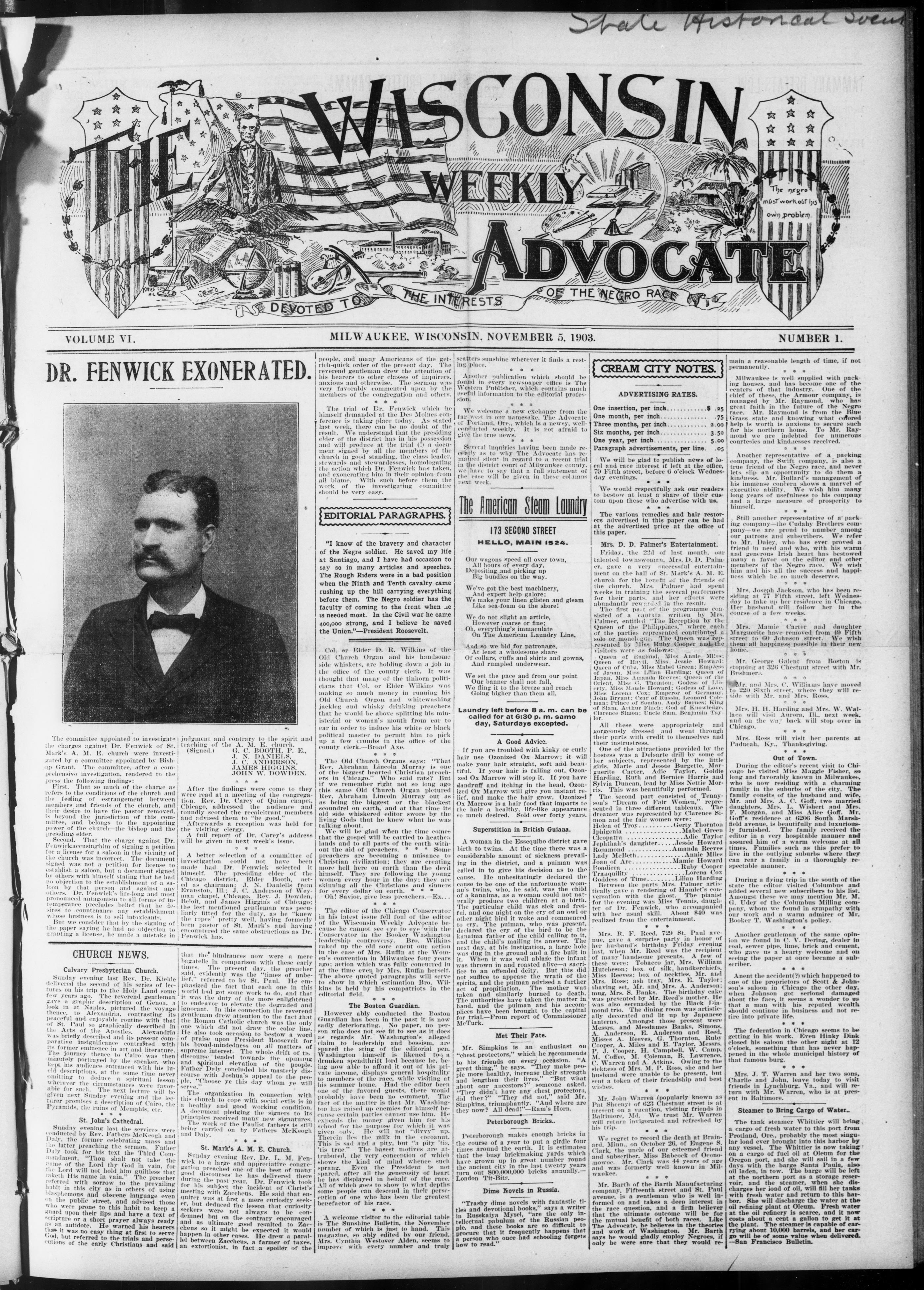
Wisconsin Weekly Advocate
Thursday, November 5, 1903
Milwaukee, Wisconsin
Page text (machine-generated)
WISCONSIN
WEEKLY
ADVOCATE
DEVOTED TO THE INTERESTS OF THE NEGRO RACE
DR. FENWICK EXONERATED.
[Name not visible in the image]
VOLUME VI.
DR. FENWICK
The committee appointed to investigate the charges against Dr. Fenwick of St. Mark's A. M. E. church were investigated by a committee appointed by Bishop Grant. The committee, after a comprehensive investigation, rendered to the press the following findings: First. That so much of the charge as refers to the conditions of the church and the feeling of estrangement between members and friends of the church, and their desire to have the pastor removed, is beyond the jurisdiction of this committee, and belongs to the appointing power of the church—the bishop and the presiding elder.
Second. That the charge against Dr. Fenwickaccusinghim of signing a petition for a license for a saloon in the vicinity of the church was incorrect. The document signed was not a petition for license to establish a saloon, but a document signed by others with himself stating that he had no objection to the establishment of a saloon by that person and against any others. Dr. Fenwick's life-long and most pronounced antagonism to all forms of intemperance precludes belief that he desires to countenance any establishment whose business is to sell intoxicants. But we consider that by the signing of the paper saying he had no objection to granting a license, he made a mistake in
CHURCH NEWS
Sunday evening last Rev. Dr. Kiehle delivered the second of his series of lectures on his trip to the Holy Land some few years ago. The reverend gentleman gave a graphic description of Genoa, a book in at Naples, pictured the voyage thence, to Alexandria, contrasting its peaceful and enjoyable routine with that of St. Paul so graphically described in the Acts of the Apostles. Alexandria was briefly described and its present comparative insignificance contrasted with its former eminence in art and literature. The journey thence to Cairo was then minutely portrayed by the speaker, who kept his audience entranced with his lucid descriptions, at the same time never omitting to deduce a spiritual lesson wherever the circumstances were favorable for such. The next lecture will be given next Sunday evening and the lecturer promises a description of Cairo, the Pyramids, the ruins of Memphis, etc.
St. John's Cathedral
Sunday evening last the services were conducted by Rev. Fathers McKeogh and Daly, the former celebrating mass and the latter preaching the sermon. Father Daly took for his text the Third Commandment, "Thou shalt not take the name of the Lord thy God in vain, for the Lord will not hold him guiltless that taketh His name in vain." The preacher referred with sorrow to the prevailing habit in this city as in others of using blasphemous and obscene language even on the public street, and advised those who were prone to this habit to keep a guard upon their lips and have a text of scripture or a short prayer always ready as an antidote. He warned his hearers that it was no easy thing at first to serve God, but referred to the trials and persecutions of the early Christians and said
---
judgment and contrary to the spirit and teaching of the A. M. E. church.
(Signed.) G. C. BOOTH, P. E., J. N. DANIELS, J. C. ANDERSON, JAMES HIGGINS, JOHN W. DOWDEN.
After the findings were come to they were read at a meeting of the congregation. Rev. Dr. Carey of Quinn chapel Chicago, addressed the audience and roundly scored the recalcitrant members and advised them to "be good."
Afterwards a reception was held for the visiting clergy.
A full report of Dr. Carey's address will be given in next week's issue.
* * *
A better selection of a committee of investigation could not have been made had Dr. Fenwick selected it himself. The presiding elder of the Chicago district, Elder Booth, acted as chairman; J. N. Daniells from Evanston, Ill.; J. C. Anderson of Weyman chapel, Chicago. Rey. J. Dowden, Beloit, and James Higgins of Chicago; the lest mentioned gentleman was peculiarly fitted for the duty, as he "knew the ropes" pretty well, having formerly been pastor of St. Mark's and having encountered the same obstructions as Dr. Fenwick has.
that the hindrances now were a mere bagatelle in comparison with these early times. The present day, the preacher said, evidently was the "times of unbelief," referred to by St. Paul. He emphasized the fact that each one in this world had got some work to do, and that it was the duty of the more enlightened to endeavor to elevate the degraded and ignorant. In this connection the reverend gentleman drew attention to the fact that the Roman Catholic church was the only one which did not draw the color line. He also took occasion to bestow a word of praise upon President Roosevelt for his broad-mindedness on all matters of supreme interest. The whole drift of the discourse tended towards the upmung and spiritual elevation of the people. Father Daly concluded his masterly discourse with Joshua's appeal to the people. "Choose ye this day whom ye will serve."
The organization in connection with this church to cope with social evils is in a healthy and good working condition. A document pledging the signers to its principles received many new signatures. The work of the Paulist fathers is still being carried on by Fathers McKeogh and Daly.
St. Mark's A. M. E. Church
Sunday evening Rev. Dr. L. M. Fenwick to a large and appreciative congregation preached one of the best of many good discourses he has delivered there during the past year. Dr. Fenwick took for his subject the incident of Christ's meeting with Zaccheus. He said that enquirer was at first a mere curiosity seeker, but deduced the lesson that curiosity seekers were not always to be condemned but on the contrary encouraged and as ultimate good resulted to Zaccheus so it might be expected it would happen in other cases. He drew a parallel between Zaccheus, a farmer of taxes, an extortionist, in fact a spoiler of the
MILWAUKEE, WISCONSIN, NOVEMBER 5. 1903.
people, and many Americans of the getrich-quick order of the present day. The reverend gentleman drew the attention of his hearers to other classes of inquirers, anxious and otherwise. The sermon was very favorably commented upon by the members of the congregation and others.
* * *
The trial of Dr. Fenwick which he himself demanded at the Des Moines conference is taking place today. As stated last week, there can be no doubt of the result. We understand that the presiding elder of the district has in his possession and will produce at the trial () a document signed by all the members of the church in good standing, the class leader, stewards and stewardesses, homologating the action which Dr. Fenwick has taken, and exonerating him in their opinion from all blame. With such before them the work of the investigating committee should be very easy.
EDITORIAL PARAGRAPHS.
"I know of the bravery and character of the Negro soldier. He saved my life at Santiago, and I have had occasion to say so in many articles and speeches. The Rough Riders were in a bad position when the Ninth and Tenth cavalry came rushing up the hill carrying everything before them. The Negro soldier has the faculty of coming to the front when he is needed most. In the Civil war he came 400,000 strong, and I believe he saved the Union."—President Roosevelt.
Col. or Elder D. R. Wilkins of the Old Church Organ and his handsome side whiskers, are holding down a job in the office of the county clerk. It was thought that many of the tinhorn politicians that Col. or Elder Wilkins was making so much money in running his Old Church Orgon and whitewashing jackleg and whisky drinking preachers that he would be above splitting his ministerial or woman's mouth from ear to ear in order to induce his white or black political master to permit him to pick up a few crumbs in the office of the county clerk.—Broad Axe.
```markdown
```
The Old Church Organs says: "That Rev. Abraham Lincoln Murray is one of the biggest hearted Christian preachers in Chicago." Who said rats? But if we remember right not so long ago this same Old Church Organ pictured Rev. Abraham Lincoln Murray out as as being the biggest or the blackest scoundrel on earth, and at that time its old side whiskered editor swore by the living Gods that he knew what he was talking about.
We will be glad when the time comes that the gospel will be carried to heather lands and to all parts of the earth without the aid of preachers. * * * Some preachers are becoming a nuisance to Christian civilization; they are creating more hell here on earth than the devil himself. They are following the young women every hour in the day; they are skimming all the Christians and sinners for every dollar on earth. * * *
* * *
The editor of the Chicago Conservator in his latest issue fell foul of the editor of the Wisconsin Weekly Advocate because he cannot see eye to eye with the Conservator in the Booker Washington leadership controversy. Bro. Wilkins raked up the old sore anent our action in the case of Mrs. Ruffin at the Women's convention in Milwaukee four years ago; action which was fully concurred in at the time even by Mrs. Ruffin herself. The above quoted paragraphs will serve to show in which estimation Bro. Wilkins is held by his compatriots in the editorial field.
The Boston Guardian
However ably conducted the Boston Guardian has been in the past it is now sadly deteriorating. No paper, no person who does not see fit to see as it does as regards Mr. Washington's alleged claim to leadership and bossism, are spared the sting of the editorial pen. Washington himself is likened to a drunken spendthrift lord because he, being now able to afford it out of his private income, displays general hospitality to members of the race, while visiting at his summer home. Had the editor been one of the favored guests, there would probably have been no comment. The fact of the matter is that Mr. Washington has raised up enemies for himself because certain parties cannot use him. He expends the money given him for his school for the purpose for which it was given only. He will not "divvy" up. Therein lies the milk in the cocoanut. This is sad and a pity, but "a pity 'tis, 'tis true." The basest motives are attributed, the very conception of which shows the kind of mind whence such sprang. Even the President is not spared, after all the generosity of heart he has displayed in behalf of the race. All of which goes to show to what depths some people can descend in their persecution of one who has been the greatest benefactor of his race.
南 南 方
A welcome visitor to the editorial table is The Sunshine Bulletin, the November number of which is just to hand. This magazine, so ably edited by our friend, Mrs. Cynthia Westover Alden, seems to improve with every number and truly
scatters sunshine wherever it finds a resting place.
* * *
Another publication which should be found in every newspaper office is The Western Publisher, which contains much useful information to the editorial profession.
* * *
We welcome a new exchange from the far west in our namesake. The Advocate of Portland, Ore., which is a newsy, well-conducted weekly. It is not afraid to give the true news.
* * *
Several inquiries having been made recently as to why The Advocate has remained silent in regard to a recent trial in the district court of Milwaukee county, we have to say that a full statement of the case will be given in these columns next week.
The American Steam Laundry
173 SECOND STREET
HELLO, MAIN 1524.
Our wagons speed all over town,
All hours of every day,
Depositing and picking up
Big bundles on the way.
We've got the best machinery,
And expert help galore;
We make your linen glisten and gleam
Like sea-foam on the shore!
We do not slight an article,
However coarse or fine;
Oh, everything's immaculate
On The American Laundry Line.
And so we bid for patronage.
At least a wholesome share
Of collars, cuffs and shirts and gowns,
And rumpled underwear.
We set the pace and from our point Our banner shall not fall. We fling it to the breeze and reach Going higher than them all.
Laundry left before 8 a. m. can be called for at 6:30 p. m. same day. Saturdays excepted.
A. Good Advice
If you are troubled with kinky or curly hair use Ozonized Ox Marrow; it will make your hair straight, soft and beautiful. If your hair is falling out, Ozonized Ox Marrow will stop it. If you have dandruff and itching in the head, Ozonized Ox Marrow will give you instant relief, and make the hair grow. Ozonized Ox Marrow is a hair food that imparts to the hair a healthy, life-like appearance so much desired. Sold over forty years.
Superstition in British Guiana.
A woman in the Essequibo district gave birth to twins. At the time there was a considerable amount of sickness prevailing in the district, and a puiman was called in to give his decision as to the cause. He unhesitatingly declared the cause to be one of the unfortunate woman's twins, who, he said, was the child of a kanaima, as a woman could not naturally produce two children at a birth. The particular child was sick and fretful, and one night on the cry of an owl or other night bird it woke and commenced to cry. The puiman, who was present, declared the cry of the bird to be the kanaima father of the child calling to it, and the child's mailing its answer. The next day, at his instigation, a large hole was dug in the ground and a fire built in
it. When it was well ablaze the infant was thrown in and roasted alive—a sacrifice to an offended deity. But this did not suffice to appease the wrath of the spirits, and the puiman advised a further act of propitiation. The mother was taken and similarly burned to death. The authorities have taken the matter in hand, and the puiman and his accomplices have been brought to the capital for trial.—From report of Commissioner McTurk.
Met Their Fate.
Mr. Simpkins is an enthusiast on "chest protectors," which he recommends to his friends on every occasion. "A great thing," he says. "They make people more healthy, increase their strength and lengthen their lives." "But what about our ancestors?" someone asked. "They didn't have any chest protectors, did they?" "They did not," said Mr. Simpkins, triumphantly. "And where are they now? All dead!"—Ram's Horn.
Peterborough Bricks.
Peterborough makes enough bricks in the course of a year to put a girdle four times around the earth. It is estimated that the busy brickmaking yards which have grown up in great number round the ancient city in the last twenty years turn out 800,000,000 bricks annually. London Tit-Bits.
Dime Novels in Russia.
"Trashy dime novels with fantastic titles and devotional books," says a writer in Russkaiya Mysel, "are the only intellectual pabulum of the Russian people, and these books are so difficult to procure that it frequently happens that a person who once had schooling forgets how to read."
CREAM CITY NOTES.
ADVERTISING RATES.
We will be glad to publish news of local and race interest if left at the office, 79 Fifth street, before 6 o'clock Wednesday evenings.
We would respectfully ask our readers to bestow at least a share of their custom upon those who advertise with us.
The various remedies and hair restorers advertised in this paper can be had at the advertised price at the office of this paper.
Mrs. D. D. Palmer's Entertainment.
Friday, the 22d of last month, our talented townswoman, Mrs. D. D. Palmer, gave a very successful entertainment on the hall of St. Mark's A. M. E. church for the benefit of the friends of the church. Mrs. Palmer had spent weeks in training the several performers for their parts, and her efforts were abundantly rewarded in the result.
The first part of the programme consisted of a cantata written by Mrs. Palmer, entitled "The Reception by the Queen of the Philippines," where each of the parties represented contributed a solo or monologue. The Queen was represented by Miss Ruby Cooper and the visitors were as follows:
Queen of England, Miss Annie Miles; Queen of Hayti, Miss Jessie Howard; Queen of Cuba, Miss Mabel Green; Empress of Japan, Miss Lillian Harding; Queen of Japan, Miss Amanda Reeves; Queen of the Orient, Miss G. Thomton; Godess of Liberty, Miss Maude Howard; Godess of Love, Miss Lorena Cox; Emperor of Germany, John Bryant; Czar of Russia, Leonard Coleman; Prince of Soudan, Andy Barnes; King of Siam, Arthur Finch; God of Knowledge, Clarence Simon; Uncle Sam, Benjamin Taylor.
All these were appropriately and gorgeously dressed and went through their parts with credit to themselves and their instrucstress.
One of the attractions provided by the hostess was a Delsarte drill by some of her subjects, represented by the little girls, Marie and Jessie Burgette, Marguerite Carter, Adie Taylor, Goldie Harding, Ruth and Bernice Harris and Sylvia Duncan, lead by Miss Nettie Morris. This was beautifully performed.
The second part consisted of Tenny-son's "Dream of Fair Women," represented in three different tableaux. The dreamer was represented by Clarence Simon and the fair women were:
Helen of Troy.....Gerty Thornton
Iphigenia.....Mnbel Green
Cleopatra.....Adie Taylor
Jephthah's daughter.....Jessie Howard
Rosamond.....Amanda Reeves
Lady McBeth.....Annie Miles
Joan of Arc.....Mamie Howard
Roadicea.....Ruby Cooper
Tranquility.....Lorena Cox
Goddess of Time.....Lilian Harding
Between the parts Mrs. Palmer artistically gave a rendering of Hamlet's conversation with the ghost. The pianist for the evening was Miss Tennis, daughter of Dr. Fenwick, who accompanied with her usual skill. About $40 was realized from the entertainment.
```markdown
```
Mrs. R. F. Reed, 729 St. Paul avenue, gave a surprise party in honor of her husband's birthday Friday evening last, when Mr. Reed was the recipient of many handsome presents. A few of these were: Tobacco jar, Mrs. William Hutcheson; box of silk handkerchiefs. Miss Reeves; box of neckties, Mr. and Mrs. Ross; ash tray, Mrs. E. Taylor; shaving set, Mr. and Mrs. A. Anderson; mug, Mrs. S. Banks. The birthday cake was presented by Mr. Reed's mother. He was also serenaded by the Black Diamond trio. The dining room was artistically decorated and lit up by Japanese lanterns. Amongst those present were Messrs. and Mesdames Banks, Simons. A. Anderson, E. Anderson and Reed, Misses A. Reeves, G. Thornton, Ruby Cooper, A. Miles and E. Taylor, Messrs. P. J. Cooper, H. Campbell, W. Camp, M. Coffee, M. Coleman, B. Lawrence, C. Warren and A. Atkins. Owing to the sickness of Mrs. M. P. Ross, she and her husband were unable to be present, but sent a token of their friendship and best wishes.
Mr. John Warren (popularly known as Pat Sheeny) of 623 Chestnut street is at present on a vacation, visiting friends in Baltimore, Md. We trust Mr. Warren will return invigorated and refreshed by his trip.
* * *
We regret to record the death at Brainard, Minn., on October 26, of Eugene S. Clark, the uncle of our esteemed friend and subscriber. Miss Babcock of Oconomowoc. Mr. Clark was 44 years of age and was formerly well known in Milwaukee.
★ ★ ★
Mr. Barth of the Barth Manufacturing company. Fifteenth street and St. Paul avenue, is a gentleman who is well informed on and takes a deep interest in the race question, and a firm believer that the ultimate outcome will be for the mutual benefit of both races. Like The Advocate, he believes in the theories and work of Washington. Mr. Barth says he would gladly employ Negroes, if only he were sure that they would re-
main a reasonable length of time, if not permanently.
* * *
Milwaukee is well supplied with packing houses, and has become one of the centers of that industry. One of the chief of these, the Armour company, is managed by Mr. Raymond, who has great faith in the future of the Negro race. Mr. Raymond is from the Blue Grass state and knowing what colored help is worth is anxious to secure such for his northern home. To Mr. Raymond we are indebted for numerous courtesies and kindnesses received.
* * *
Another representative of a packing company, the Swift company, is also a true friend of the Negro race, and never lets slip an opportunity to do them a kindness. Mr. Bullard's management of his immense concern shows a marvel of executive ability. We wish him many long years of usefulness to his company and a large measure of prosperity to himself.
☆ ☆ ☆
Still another representative of a packing company—the Cudahy Brothers company—we are proud to number among our patrons and subscribers. We refer to Mr. Daley, who has ever proved a friend in need and who, with his warm and generous Irish heart has bestowed many a favor on the editor and other members of the Negro race. We wish him and his all the success and happiness which he so much deserves.
☆ ☆ ☆
Mrs. Joseph Jackson, who has been residing at 77 Fifth street, left Wednesday to take up her residence in Chicago. Her husband will follow her in the course of a few weeks.
Mrs. Mamie Carter and daughter Marguerite have removed from 49 Fifth street to 60 Johnson street. We wish them all happiness possible in their new home.
Mr. George Galent from Boston is stopping at 326 Chestnut street with Mr. Bushmere.
Mr. and Mrs. C. Williams have moved to 220 Sixth street, where they will reside with Mr. and Mrs. Ross.
Mrs. H. H. Harding and Mrs. W. Wallace will visit Aurora, Ill., next week, and on the way back will stop over in Chicago.
* * *
Mrs. Ross will visit her parents at Paducah, Ky., Thanksgiving.
Out of Town
During the editor's recent visit to Chicago he visited Miss Maggie Fisher, so long and favorably known in Milwaukee, who is now residing with a charming family in the suburbs of the city. The family consists of the husband and wife, Mr. and Mrs. A. C. Goff, two married daughters, Mrs. L. Wishert and Mrs. F. Morgan, and Miss Alice Goff, Mr. Goff's residence at 6206 South Marshfield avenue, is beautifully and luxuriously furnished. The family received the editor in a very hospitable manner and assured him of a warm welcome at all times. Families such as this prefer to live in the outlying suburbs where they can rear a family in a thoroughly respectable manner.
```markdown
```
During a flying trip in the south of the state the editor visited Columbus and added several new subscribers to his list. Amongst these we may mention Mr. M. G. Udey of the Columbus Milling company, whom we found in sympathy with our work and a warm admirer of Mr. Booker T. Washington's policy.
* * *
Another gentleman of the same opinion we found in C. V. Dering, dealer in coal, sewer pipe, lime, brick and cement, who gave us a hearty welcome and on seeing the paper at once became a subscriber.
* * *
Anent the accident(?) which happened to one of the proprietors of Scott & Johnson's saloon in Chicago the other day, when Johnson got seriousl damaged about the face, it seems a wonder to us that a man with his reputed wealth should continue in business and not retire into private life.
***
The federation in Chicago seems to be getting in his work. Even Hinky Dink closed his saloon the other night at 12 o'clock, something that has never happened in the whole municipal history of that famous burg.
★ ★ ★
Mrs. J. T. Warren and her two sons, Charlie and John, leave today to visit friends in Lynchburg, Va., and will return with Mr. Warren, who is at present in Baltimore.
Steamer to Bring Cargo of Water..
The tank steamer Whittier will bring a cargo of fresh water to this port from Protland, Ore., probably the most singular load ever brought into this harbor by any vessel. The Whittier is now taking on a cargo of fuel oil at Oleum for the Oregon port, and she will sail in a few days with the barge Santa Paula, also oil laden, in tow. The barge will be left at the northern port as a storage reservoir, and the steamer, when she discharges her ioad of oil, will fill her tanks with fresh water and return to this harbor. She will discharge the water at the oil refining plant at Oleum. Fresh water at the oil refinery is scarce, and it now costs about a cent a gallon to get it at the plant. The steamer is capable of carrying about 10,000 barrels, and her cargo will be of some value when delivered. San Francisco Bulletin.
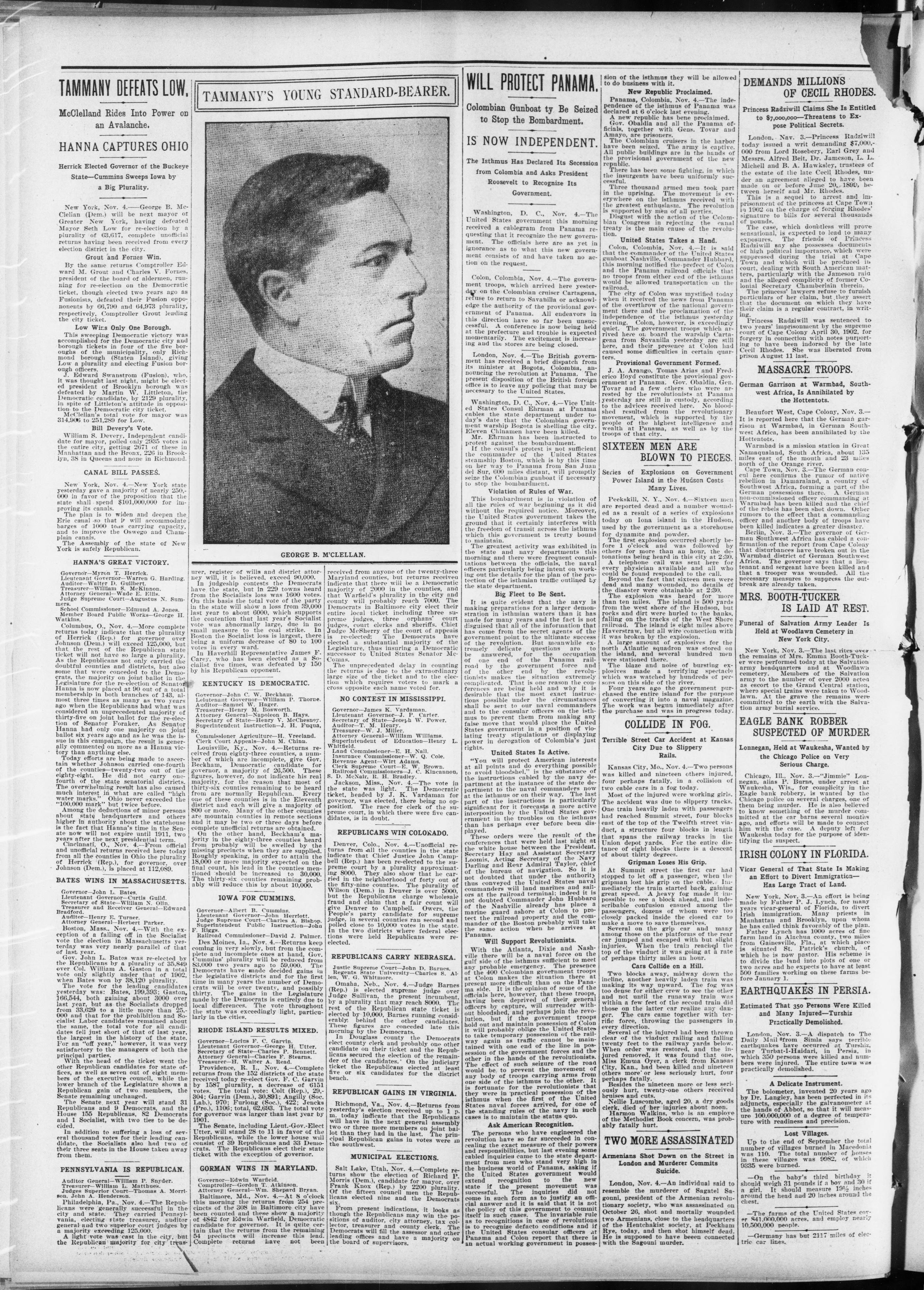
TAMMANY DEFEATS LOW.
McClelland Rides Into Power on an Avalanche.
HANNA CAPTURES OHIO
Herrick Elected Governor of the Buckeye State—Cummins Sweeps Iowa by a Big Plurality.
New York, Nov. 4.—George B. McClellan (Dem.) will be next mayor of Greater New York, having defeated Mayor Seth Low for re-election by a plurality of 63,617, complete unofficial returns having been received from every election district in the city.
Grout and Fories Win.
By the same returns Comptroller Edward M. Grout and Charles V. Fornes, president of the board of aldermen, running for re-election on the Democratic ticket, though elected two years ago as Fusionists, defeated their Fusion opponents by 66,790 and 64,973 plurality, respectively, Comptroller Grout leading the city ticket.
Low Wirs Only One Borough
This sweeping Democratic victory was accomplished for the Democratic city and borough tickets in four of the five boroughs of the municipality, only Richmond borough (Staten Island), giving Low a plurality and electing Fusion borough officers. J. Edward Swanstrom (Fusion), who, it was thought last night, might be elected president of Brooklyn borough was defeated by Martin W. Littleton, the Democratic candidate, by 2129 plurality, in spite of Littleton's attitude in opposition to the Democratic city ticket. McClellan's total vote for mayor was 314,906 to 251,289 for Low.
Bill Deverv's Vote.
William S. Devery, Independent candidate for mayor, polled only 2035 votes in the entire city, getting 2671 of these in Manhattan and the Bronx, 226 in Brooklyn, 38 in Queens and none in Richmond.
CANAL BILL PASSEŠ
New York, Nov. 4.—New York state yesterday gave a majority of nearly 250,000 in favor of the proposition that the state shall spend $101,000,000 for improving its canals. The plan is to widen and deepen the Erie canal so that it will accommodate barges of 1000 tons carrying capacity, and to improve the Oswego and Champlain canals. The Assembly of the state of New York is safely Republican.
HANNA'S GREAT VICTORY
Governor—Myron T. Herrick.
Lieutenant Governor—Warren G. Harding
Auditor—Walter D. Gullbert.
Treasurer—William S. McKinnon.
Attorney General—Wade E. Ellis.
Judge Supreme Court—Augustus N. Sum
mers.
School Commissloner—Edmund A. Jones.
Member Board Public Works—George H.
Watkins.
Columbus, O., Nov. 4.—More complete returns today indicate that the plurality of Herrick (Rep.) for governor over Johnson (Dem.) will exceed 125,000, but that the rest of the Republican state ticket will not have so large a plurality. As the Republicans not only carried the doubtful counties and districts, but also some that were conceded to the Democrats, the majority on joint ballot in the Legislature for the re-election of Senator Hanna is now placed at 90 out of a total membership in both branches of 143, almost three times as many as two years ago when the Republicans had what was considered an unprecedented majority of thirty-five on joint ballot for the re-election of Senator Foraker. As Senator Hanna had only one majority on joint ballot six years ago and as he was the issue in this campaign, the result is generally commented on more as a Hanna victory than anything else.
Today efforts are being made to ascertain whether Johnson carried one-fourth of the counties—twenty-two out of the eighty-eight. He did not carry one-fourth of the state senatorial districts. The overwhelming result has also caused much interest in what are called "high water marks." Ohio never exceeded the "100,000 mark" but twice before. Among the deductions of minor persons about state headquarters and others higher in authority about the statehouse is the fact that Hanna's time in the Senate now will not expire until 1911, two years after the next presidential term. Cincinnati, O., Nov. 4.—From official and unofficial returns received here today from all the counties in Ohio the plurality of Herrick (Rep.), for governor, over Johnson (Dem.), is placed at 112,089
BATES WINS IN MASSACHUSETTS.
Governor—John L. Bates.
Lieutenant Governor—Curtis Guild.
Secretary of State—William N. Olin.
Treasurer and Recelver General—Edward Bradford.
Auditor—Henry E. Turner.
Attorney General--Herbert Parker.
Boston, Mass.. Nov. 4.—With the exception of a falling off in the Socialist vote the election in Massachusetts yesterday was very nearly parallel of that of last year.
Gov. John L. Bates was re-elected by the Republicans by a plurality of 35,849 over Col. William A. Gaston in a total vote only slightly under that of 1902, when Bates won by 38,120 plurality.
The vote for the leading candidates yesterday was: Bates, 199,393; Gaston, 166,544, both gaining about 3000 over last year, but as the Socialists dropped from 33,629 to a little more than 25,000 and that for the prohibition and Socialist Labor candidates remained about the same, the total vote for all candidates fell just short of that of last year, the largest in the history of the state. For an "off year," however, it was very satisfactory to the managers of both the principal parties.
With the head of the ticket went the other Republican candidates for state offices, as well as seven out of eight members of the executive council, while the lower branch of the Legislature shows a Republican gain of two members, the Senate remaining unchanged.
The Senate next year will stand 31 Republicans and 9 Democrats, and the House 155 Republicans, 82 Democrats and 1 Socialist, with two ties to be decided. In addition to suffering a loss of several thousand votes for their leading candidate, the Socialists also had two of their three seats in the House taken away from them.
PENNSYLVANIA IS REPUBLICAN.
Auditor General-William P. Snyder. Treasurer-William L. Matthues. Judges Superior Court-Thomas A. Morrison. John A. Henderson. Philadelphia, Pa., Nov. 4.—The Republicans were generally successful in the city and state. They carried Pennsylvania, electing state treasurer, auditor general and two superior court judges by a majority exceeding 125,000. A light vote was cast in the city, but the Republican majority for city treas
TAMMANY'S YOUNG STANDARD-BEARER.
GEORGE B. M'CLELLAN
urer, register of willis and district attorney will, it is believed, exceed 90,000. In judgeship contests the Democrats have the state, but in 229 towns heard from the Socialists loss was 1600 votes. On this basis the total vote of the party in the state will show a loss from 39,000 last year to about 6000, which supports the contention that last year's Socialist vote was abnormally large, due in no small measure to the coal strike. In Boston the Socialist loss is largest, there being a uniform decrease of 80 to 100 votes in every ward. In Haverhill Representative James F. Carey, who has been elected as a Socialist five times, was defeated by 150 by his Republican opponent.
KENTUCKY IS DEMOCRATIC.
Governor—John C. W. Beckham.
Lelutenant Governor—William P. Thorne.
Auditor—Samuel W. Hager.
Treasurer—Henry M. Bosworth.
Attorney General—Napoleon B. Hays.
Secretary of State—Henry V. McChesney.
Superintendent Instruction—J. H. Fuqua,
Sr.
Commissioner Agriculture—H. Vreeland.
Clerk Court Appeals—John M. Chinn.
Clerk Court Appeals—John M. Chinn.
Louisville, Ky., Nov. 4.—Returns received from eighty-three counties, a number of which are incomplete, give Gov. Beckham, Democratic candidate for governor, a majority of 26,500. These figures, however, do not indicate his real majority, for the reason that most of thirty-six counties remaining to be heard from are normally Republican. Every one of these counties is in the Eleventh district and each will give a majority of 800 or more. Many of the other counties are mountain counties in remote sections and it may be two or three days before complete unofficial returns are obtained.
On the other hand, Beckham's majority in the eighty-three counties heard from probably will be swelled by the missing precincts when they are supplied. Roughly speaking, in order to attain the 18,000 or more majority expected on the final count, his lead in the counties mentioned should be increased to 30,000. The thirty-six counties remaining probably will reduce this by about 10,000.
Judge Supreme Court—Charles A. Bishop. Superintendent Public Instruction—John F. Riggs. Railroad Commissioner—David J. Palmer. Des Moines, Ia., Nov. 4.--Returns keep coming in very slowly, but from the complete and incomplete ones at hand. Gov. Cummins' plurality will be reduced from 83,000 two years ago to 59,000. The Democrats have made decided gains in the legislative districts and for the first time in many years the number of Democrats will be over twenty, and possibly thirty. The gains in the Legislature made by the Democrats is entirely due to local differences. The vote throughout the state was exceedingly light, particularly in the cities.
RHODE ISLAND RESULTS MIXED
Governor—Lucius F. C. Garvin.
Lieutenant Governor—George H. Utter.
Secretary of State—Charles P. Bennett.
Attorney General—Charles F. Stearns.
Treasurer—H. Walter A. Read.
Providence, R. I., Nov. 4.—Complete returns from the 152 districts of the state received today re-elect Gov. F. C. Garvin by 1587 plurality, a decrease of 6151 votes. The total vote: Colt (Rep.), 29, 304; Garvin (Dem.), 30,891; Angilly (Soc. Lab.), 970; Furlong (Soc.), 422; Jencks (Pro.), 1106; total, 62,693. The total vote for governor was larger than last year by 1901.
The Senate, including Lieut.-Gov.-Elect Utter, will stand 28 to 11 in favor of the Republicans, while the lower house will consist of 39 Republicans and 33 Democrats. The Republicans elect their state ticket with the exception of governor.
GORMAN WINS IN MARYLAND.
Governor—Edwin Warfield.
Comptroller—Gordon T. Atkinson.
Attorney General—Wm. Shepard Bryan.
Baltimore, Md., Nov. 4.—At 8 o'clock this morning the returns from 254 precincts of the 308 in Baltimore city have been counted and these show a majority of 4842 for Edwin Warfield, Democratic candidate for governor. It is quite certain that the returns from the remaining 54 precincts will increase this lead.
Complete returns have not been
IOWA FOR CUMMINS.
Governor-Albert B. Cummins
Coroner Edwin Warfield
received from anyone of the twenty-three Maryland counties, but returns received indicate that there will be a Democratic majority of 2000 in the counties, and that Warfield's plurality in the city and county will probably reach 7000. The Democrats in Baltimore city elect their entire local ticket including three supreme judges, three orphans' court judges, court clerks and sheriffs. Chief Judge McSherry of the court of appeals is re-elected. The Democrats have elected a substantial majority of the Legislature, thus insuring a Democratic successor to United States Senator McComas. The unprecedented delay in counting the returns is due to the extraordinary large size of the ticket and to the election which requires voters to mark a cross opposite each name voted for.
NO CONTEST IN MISSISSIPPI.
Governor—James K. Vardaman.
Lieutenant Governor—J. P. Carter.
Secretary of State—Joseph W. Power.
Auditor—T. M. Henry.
Treasurer—W. J. Miller.
Attorney General—William Williams.
Superintendent of Education—Henry L. Whitfield.
Land Commissioner—E. H. Nall.
Insurance Commissioner—W. Q. Cole.
Revenue Agent—Wlrt Adams.
Clerk Supreme Court—E. W. Brown.
Railroad Commissioners—J. C. Klncannon,
S. D. McNair, R. H. Bradley.
Jackson, Miss., Nov. 4.—The vote in
the state was light. The Democratic
ticket, headed by J. K. Vardaman for
governor, was elected, there being no
opposition. The race for clerk of the
supreme court, in which there were five
candidates, is in doubt.
REPUBLICANS WIN COLONADO
Denver, Colo., Nov. 4.—Unofficial returns from all the counties in the state indicate that Chief Justice John Campbell (Rep.) has been re-elected to the supreme court by a plurality approximating 8000. They also show that he carried in the neighborhood of forty out of the fifty-nine counties. The plurality of Wilson (Dem.) in Denver is over 5000, but the Republicans charge wholesale fraud and claim that a fair count will give Denver to Campbell. Owers, the People's party candidate for supreme judge, in several counties ran second and polled close to 10,000 votes in the state. In the two districts where federal elections were held Republicans were re-elected.
REPUBLICANS CARRY NEBRASKA
Justic Supreme Court—John D. Barnes. Regents State University—Charles S. Allen, W. G. Whitmore. Omaha, Neb., Nov. 4.—Judge Barnes (Rep.) is elected supreme judge over Judge Sullivan, the present incumbent, by a plurality that may reach 8000. The rest of the Republican state ticket is elected by 10,000, Barnes running considerably, behind the other candidates. These figures are conceded late this morning by the Democrats. In Douglass county the Democrats elect county clerk and probably one other candidate on their ticket and the Republicans secured the election of the remainder of the candidates.' On the judiciary ticket the Republicans elected at least five or six candidates for the district bench.
REPUBLICAN GAINS IN VIRGINIA
Richmond, Va., Nov. 4.—Returns from yesterday's election received up to 1 p.m. today indicate that the Republicans will have in the next general assembly two or three more members on joint ballot than they had in the last. The principal Republican gains in votes were in the southwest.
Salt Lake, Utah, Nov. 4.—Complete returns show the election of Richard P. Morris (Dem.), candidate for mayor, over Frank Knox (Rep.) by 2200 plurality. Of the fifteen council men the Republicans elected nine and the Democrats six. From present indications, it looks as though the Republicans may win the positions of auditor, city attorney, tax collector, treasurer and county clerk. The Democrats will fill the assessor and other leading offices and have a majority on the board of supervisors.
MUNICIPAL ELECTIONS
WILL PROTECT PANAMA.
Colombian Gunboat ty Be Seized to Stop the Bombardment.
IS NOW INDEPENDENT.
Washington, D. C., Nov. 4.—The United States government this morning received a cablegram from Panama requesting that it recognize the new government. The officials here are as yet in ignorance as to what this new government consists of and have taken no action on the request.
Colon, Colombia, Nov. 4.—The government troops, which arrived here yesterday on the Colombian cruiser Cartagena, refuse to return to Savanilla or acknowledge the authority of the provisional government of Panama. All endeavors in this direction have so far been unsuccessful. A conference is now being held at the prefecture and trouble is expected momentarily. The excitement is increasing and the stores are being closed.
London, Nov. 4.—The British government has received a brief dispatch from its minister at Bogota, Colombia, announcing the revolution at Panama. The present disposition of the British foreign office is to leave any policing that may be necessary to the United States.
Washington, D. C., Nov. 4.—Vice United States Consul Ehrman at Panama cables the state department under today's date that the Colombian government warship Bogota is shelling the city. Eleven Chinamen have been killed. Mr. Ehrman has been instructed to protest against the bombardment. If the consul's protest is not sufficient the commander of the United States steamship Boston, which is by this time on her way to Panama from San Juan del Sur, 600 miles distant, will promptly seize the Colombian gunboat if necessary to stop the bombardment.
Violation of Rules of War.
This bombardment is in violation of all the rules of war beginning as it did without the required notice. Moreover, the United States government takes the ground that it certainly interferes with the freedom of transit across the isthmus which this government is treaty bound to maintain.
The greatest activity was exhibited in the state and navy departments this morning and there were frequent consultations between the officials, the naval officers particularly being intent on working out the details for the plan of the protection of the isthmian traffic outlined by the state department.
Big Fleet to Be Sent.
It is quite evident that the navy is making preparations for a larger demonstration in isthmian waters than it has made for many years and the fact is not disguised that all of the information that has come from the secret agents of the government point to the ultimate success of the revolution. But meanwhile extremely delicate questions are to be answered, for the occupation of one end of the Panama railroad by the government force and of the other end by the revolutionists makes the situation extremely complicated. That is one reason the conferences are being held and why it is desirable that the most exact instructions possible under the circumstances shall be sent to our naval commanders and to the consular officers on the isthmus to prevent them from making any false move that would place the United States government in a position of violating treaty stipulations or displaying power in derogation of Colombia's just rights.
United States Is Active.
"You will protect American interests at all points and do everything possible to avoid bloodshel," is the substance of the instructions cabled by the navy department at the instance of the state department to the naval commanders now at the isthmus or on their way. The last part of the instructions is particularly significant for it forecasts a more active interposition by the United States government in the troubles on the isthmus than has perhaps ever before been displayed.
These orders were the result of the conferences that were held last night at the white house between the President, Secretary Hay and Assistant Secretary Loomis, Acting Secretary of the Navy Darling and Rear Admiral Taylor, chief of the bureau of navigation. So it is not doubted that under the authority thus conveyed the United States naval commanders will land marines and sailors at the railroad terminal; indeed it is not doubted Commander John Hubbard of the Nashville already has place a marine guard ashore at Colon to protect the railroad property and the commander of the Boston probably will take the same action when he arrives at Panama.
Will Support Revolutionists
With the Atlanta, Dixie and Nashville there will be a naval force on the gulf side of the isthmus sufficient to meet any probable emergency. The presence of the 400 Colombian government troops at Colon makes the situation there at present more difficult than on the Panama side. It is the opinion of some of the officials here, however, that these troops, having been deprived of their general officers by capture, will surrender without bloodshed, and perhaps join the revolution, but if the government troops hold out and maintain possession of Colon it will probably oblige the United States to take temporary possession of the railway again as traffic cannot be maintained with one end of the line in possession of the government forces and the other in the hands of the revolutionists. The effect of such seizure of the road would be to prevent the movement of any body of troops carrying arms from one side of the isthmus to the other. It is fortunate for the revolutionists that they were in practical possession of the isthmus when the first of the United States naval forces arrived, for one of the standing rules of the navy in such cases is to maintain the status quo.
Ask American Recognition.
The persons who have engineered the revolution have so far succeeded in concealing the exact measure of their powers and responsibilities, but last evening some cabled inquiries came to the state department from men who stand very high in the business world of Panama, asking if the United States government would extend recognition to the new state if the present movement was successful. The inquiries did not come in such form as to justify an official answer and it is said that it is not the policy of this government to commit itself in such cases. The invariable rule as to recognitions in case of revolutions is to recognize defacto conditions and if the United States consular officers at Panama and Colon report that there is an actual working government in posses-
sion of the isthmus they will be allowed to do business with it.
New Republic Proclaimed.
Panama, Colombia, Nov. 4.—The independence of the isthmus of Panama was declared at 6 o'clock last evening. A new republic has bene proclaimed. Gov. Obaldia and all the Panama officials, together with Gens. Tovar and Amayo, are prisoners. The Colombian cruisers in the harbor have been seized. The army is captive. All public buildings are in the hands of the provisional government of the new republic. There has been some fighting, in which the insurgents have been uniformly successful. Three thousand armed men took part in the uprising. The movement is everywhere on the isthmus received with the greatest enthusiasm. The revolution is supported by men of all parties.
Disgust with the action of the Colombian Congress in rejecting the canal treaty is the main cause of the revolution
United States Takes a Hand.
Colon, Colombia, Nov. 4.—It is said that the commander of the United States gunboat Nashville, Commander Hubbard, this morning notified the prefect of Colon and the Panama railroad officials that no troops from either end of the isthmus would be allowed transportation on the railroad.
The city of Colon was mystified today when it received the news from Panama of the overthrow of the national government there and the proclamation of the independence of the isthmus yesterday evening. Colon, however, is exceedingly quiet. The government troops which arrived here on board the warship Cartagena from Sawanilla yesterday are still here, and their presence at Colon had caused some difficulties in certain quarters.
Provisional Government Formed.
J. A. Arango, Tomas Arias and Frederico Boyd constitute the provisional government at Panama. Gov. Obaldia, Gen. Tovar and a few others who were arrested by the revolutionists at Panama yesterday are still in custody, according to the advices received here. No blood-shed resulted from the revolutionary movement, which is supported by the people of the highest intelligence and wealth at Panama, as well as by the troops of that city.
SIXTEEN MEN ARE
BLOWN TO PIECES.
Series of Explosions on Government Power Island in the Hudson Costs Many Lives
Peekskill, N. Y., Nov. 4.—Sixteen men are reported dead and a number wounded as a result of a series of explosions today on Iona island in the Hudson, used by the government as a storehouse for dynamite and powder.
The first explosion occurred shortly before 1 o'clock and was followed by others for more than an hour, the detonations being heard in this city at 2:30.
A telephone call was sent here for every physician available and all who could be found responded to the call.
Beyond the fact that sixteen men were dead and many wounded, no details of the disaster were obtainable at 2:30.
The explosion was heard for more than ten miles. The island is 500 yards from the west shore of the Hudson, but rocks and dirt were hurled to the banks, falling on the tracks of the West Shore railroad. The island is eight miles above Haverstraw, but all wire connection with it was broken by the explosion.
A large amount of explosives for the north Atlantic squadron was stored on the island, and several hundred men were stationed there.
The blaze and noise of bursting explosives made a terrifying spectacle which was watched by hundreds of persons on this side of the river.
Four years ago the government purchased the entire island for the purpose of converting it into a naval magazine. The work was begun immediately after the purchase and was in progress today.
Kansas City, Mo., Nov. 4.—Two persons was killed and nineteen others injured, four perhaps fatally, in a collision of two cable cars in a fog today.
Most of the injured were working girls. The accident was due to slippery tracks. One train heavily laden with passengers had reached Summit street, four blocks east of the top of the Twelfth street viaduct, a structure four blocks in length that spans the railway tracks in the Union depot yards. For the entire distance of eight blocks there is a descent of about thirty degrees.
Gripman Loses His Grip.
At Summit street the first car had stopped to let off a passenger, when the gripman lost his grip on the cable. Immediately the train started back, gaining great speed. A heavy fog made it impossible to see a block ahead, and indescribable confusion ensued among the passengers, dozens of whom were too closely packed inside the closed car to make a move to save themselves. Several on the grip car and many among those on the platforms of the rear car jumped and escaped with but slight injuries. When the train reached the top of the viaduct it was going at a rate of perhaps thirty miles an hour.
Cars Collide on a Hill.
Two blocks away, midway down the incline, another heavily laden train was making its way upward. The fog was too dense for either crew to see the other and not until the runaway train was within a few feet of the second train did those on the latter car realize any danger. The cars came together with terrific force, throwing the passengers in every direction.
Several of the injured had been thrown clear of the viaduct railing and falling twenty feet to the railway yards below. When order was restored, and the injured removed, it was found that one, Miss Emma Oyer, a clerk from Kansas City, Kan., had been killed and nineteen others more or less seriously hurt, four perhaps fatally.
Besides the nineteen more or less seriously hurt, twenty-one others received bruises and cuts.
Nellie Luscombe, aged 20, a dry goods clerk, died of her injuries about noon.
clerk, died of her injuries about noon. Harmon Walkins, who is an employee of the Methodist Book concern, was probably fatally hurt.
TWO MORE ASSASSINATED
Armenians Shot Down on the Street in London and Murderer Commits Suicide
London, Nov. 4.—An individual said to resemble the murderer of Sagatel Sagouni, president of the Armenian revolutionary society, who was assassinated on October 26, shot and mortally wounded two Armenians, close to the headquarters of the Hentchakist society, at Peckham Rye, today, and then shot himself dead. He is supposed to have been connected with the Sagouni murder.
DEMANDS MILLIONS OF CECIL RHODES.
Princess Radziwill Claims She Is Entitled to $7,000,000—Threatens to Expose Political Secrets.
London. Nav. 3.—Princess Radziwill today issued a writ demanding $7,000,-000 from Lord Rosebery, Earl Grey and Messrs. Alfred Beit, Dr. Jameson, L. L. Michell and B. A. Hawksley, trustees of the estate of the late Cecil Rhodes, under an agreement alleged to have been made on or before June 20, 1890, between herself and Mr. Rhodes. This is a sequel to arrest and imprisonment of the princess at Cape Town in 1902 on the charge of forging Rhodes' signature to bills for several thousands of pounds.
The case, which doubtless will prove sensational, is expected to lead to many exposures. The friends of Princess Radziwill say she possesses documents of high political importance, which were suppressed during the trial at Cape Town and which will be produced in court, dealing with South American matters, particularly with the Jameson raid and the alleged complicity of former Colonial Secretary Chamberlain therein. The princess' lawyers refuse to furnish particulars of her claim, but they assert that the document on which they have their claim is a regular contract, in writing.
Princess Radziwill was sentenced to two years' imprisonment by the supreme court of Cape Coony April 30, 1902, for forgery in connection with notes purporting to have been indorsed by the late Cecil Rhodes. She was liberated from prison August 11 last.
MASSACRE TROOPS.
German Garrison at Warmbad, Southwest Africa, Is Annihilated by the Hottentots.
Beaufort West, Cape Colony, Nov. 3.—It is reported here that the German garrison at Warmbad, in German Southwest Africa, has been annihilated by the Hottentots.
Warmbad is a mission station in Great Namaqualand, South Africa, about 135 miles east of the mouth and 23 miles north of the Orange river.
Cape Town, Nov. 3.—The German concul here confirms the rumor of native rebellion in Damaraland, a country of Southwest Africa, forming a part of the German possessions there. A German non-commissioned officer commanding at Warmbad has been killed and the chief of the rebels has been shot down. Other rumors to the effect that a commanding officer and another body of troops have been killed indicates a greater disaster.
Berlin, Nov. 3.—The governor of German Southwest Africa has cabled a confirmation of the report from Cape Colony that disturbances have broken out in the Warmbad district of German Southwest Africa. The governor says that a lieutenant and sergeant have been killed and that a trooper was wounded. All the necessary measures to suppress the outbreak are already taken.
MRS. BOOTH-TUCKER IS LAID AT REST.
Funeral of Salvation Army Leader Is Held at Woodlawn Cemetery in New York City.
New York, Nov. 3.—The last rites over the remains of Mrs. Emma Booth-Tucker were performed today at the Salvation army headquarters and at Woodlawn cemetery. Members of the Salvation army to the number of over 2000 actea as escort to the Grand Central station, where special trains were taken to Woodlawn. At the grave the remains were committed to the earth with the Salvation army burial service.
EAGLE BANK ROBBER
SUSPECTED OF MURDER
Lonnegan, Held at Waukesha, Wanted by the Chicago Police on Very Serious Charge.
Chicago, Ill., Nov. 3.—"Jimmie" Lonnegan, alias P. Burns, under arrest at Waukesha, Wis., for complicity in the Eagle bank robbery, is wanted by the Chicago police on several charges, one of them being murder. He is also believed to know something of the murder committed at the car barns several months ago, and efforts will be made to connect him with the case. A deputy left for Waukesha today for the purpose of identifying the suspect.
IRISH COLONY IN FLORIDA.
Vicar General of That State Is Making an Effort to Divert Immigration— Has Large Tract of Land.
New York, Nov. 3.—An effort is being made by Father P. J. Lynch, for many years vicar-general of Florida, to divert Irish immigration. Many priests in Manhattan and Brooklyn, upon whom he has called think favorably of the plan. Father Lynch has 1000 acres of fine farm land in Alachua county, two miles from Gainesville, Fla., at which place is situated St. Patrick's church, of which he is now pastor. His scheme is to divide the land into plots of one or two acres and he expects to have at least 500 families working on these farms before January 1.
EARTHQUAKES IN PERSIA.
Estimated That 350 Persons Were Killed and Many Injured—Turshiz Practically Demolished.
London. Nov. 3.—A dispatch to The Daily Mail from Simla says terrible earthquakes have occurred at Turshiz, near Turbat-I-Haidari, in Persia, in which 350 persons were killed and numbers were injured. The entire town was practically demolished.
A Delicate Instrument
The bolometer, invented 20 years ago by Dr. Langley, has been perfected in its adjuncts, especially the galvanometer at the hands of Abbot, so that it will measure 100,000,000 of a degree of temperature with readiness and precision.
Lost Villages.
Up to the end of September the total number of villages burned in Macedonia was 110. The total number of houses in these villages was 9982, of which 9335 were burned.
-On the baby's third birthday it should weigh 31 pounds if a boy and 30 if a girl. It should measure 19½ inches around the head and 20 inches around the chest.
-The farms of the United States cover 841,000,000 acres, and employ nearly 10,500,000 people.
-Germany has but 2117 miles of electric car lines.
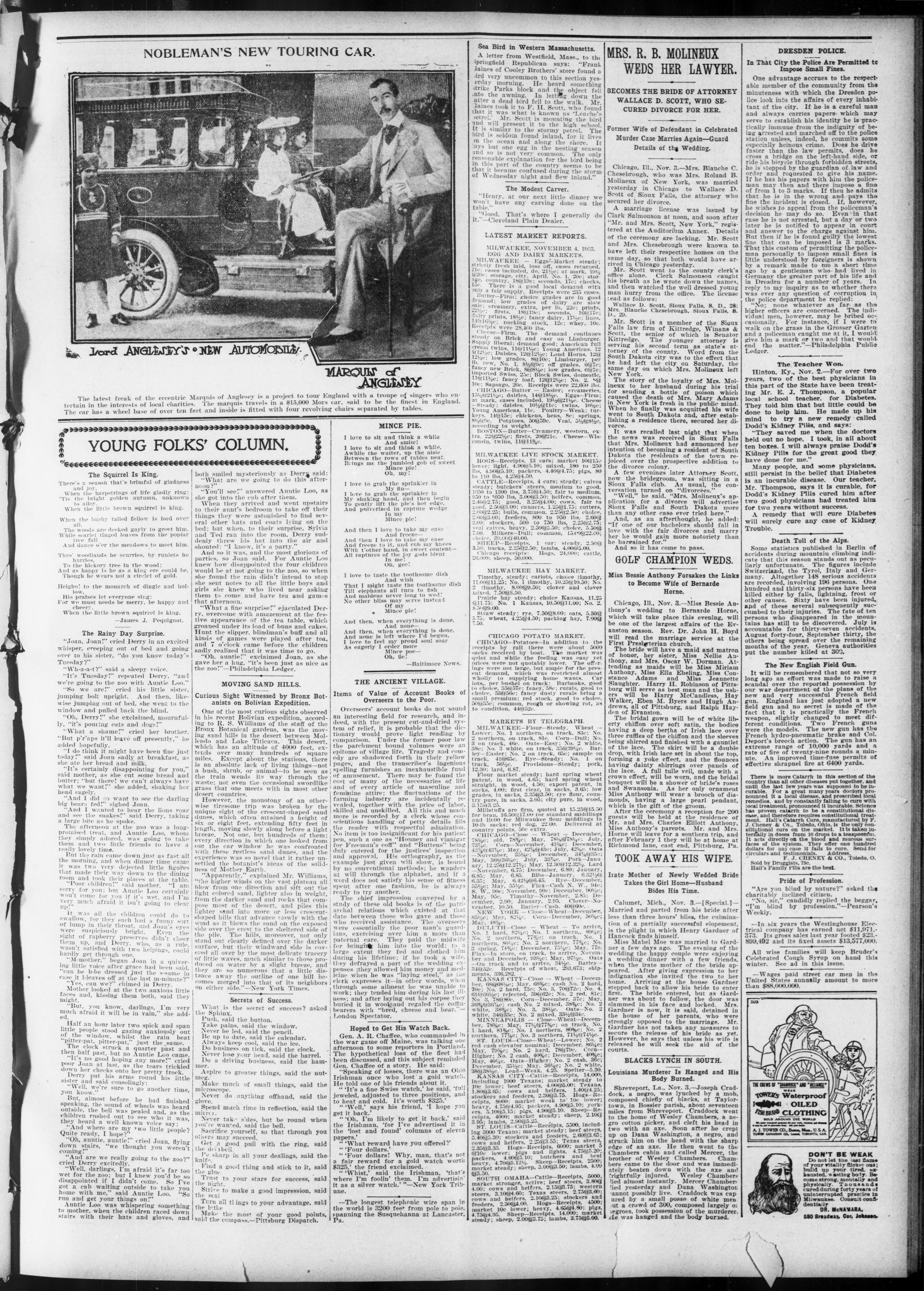
NOBLEMAN'S NEW TOURING CAR.
Lord ANGLEY'S NEW AUTOMOBILE
The latest freak of the eccentric Marquis of Anglesey is a project to tour England with a troupe of singers who entertain in the interests of local charities. The marquis travels in a $15,000 Mors car, said to be the finest in England. The car has a wheel base of over ten feet and inside is fitted with four revolving chairs separated by tables.
YOUNG FOLKS' COLUMN.
"
The Squirrel Is King.
There's a season that's brimful of gladness and joy.
When the harpstrings of life gladly ring:
'Tis the bright golden autumn, unknown to alloy.
When the little brown squirrel is king.
When the bushy tailed fellow is lord over all.
The woods are decked gayly to greet him.
While scarlet tinged leaves from the poplar tree fall.
And dance o'er the meadows to meet him.
Thro' woodlands he scurries, by runlets he hurries.
To the hickory tree in the wood:
And as happy is he as a king ere could be.
Though he wears not a circlet of gold.
Heigho! to the monarch of dingle and hollow,
His praises let everyone sing:
For we must needs be merry, be happy and
cheery.
When the little brown squirrel is king.
—James J. Pequignot.
The Rainy Day Surprise.
"Joan, Joan!" cried Derry in an excited whisper, creeping out of bed and going over to his sister, "do you know today's Tuesday?"
"Wh-a-a-t?" said a sleepy voice.
"Wh-a-a-t?" said a sleepy voice. "It's Tuesday!" repeated Derry, "and we're going to the zoo with Auntie Loo."
we're going to the zoo with Auntie Loo.
"So we are!" cried his little sister,
jumping bolt upright. And then, like-
wise jumping out of bed, she went to the
window and pulled back the blind.
"Oh, Derry!" she exclaimed, mournfully,
"it's pouring cats and dogs!"
"What a shame!" cried her brother.
"But p'r'aps it'll leave off presently," he
added hopefully.
"I do think it might have been fine just
today!" said Joan sadly at breakfast, as
she ate her bread and milk.
"It's certainly disappointing for you,"
said mother, as she cut some bread and
butter; "but there! we can't always have
what we want!" she added, shaking her
head sagely.
"And I did so want to see the darling
big bears fed!" sighed Joan.
"And I wanted to hear the lions roar and see the snakes!" said Derry, taking a large bite as he spoke.
The afternoon at the zoo was a long-promised treat, and Auntie Loo, whom they simply adored, was going to take them and two little friends to have a really lovely time.
But the rain came down just as fast all the morning, and when dinner time came it was two very dejected little figures that made their way down to the dining room and took their places at the table.
"Poor children!" said mother. "I am sorry for you; but Auntie Loo certainly won't come for you if it's wet, and I'm very much afraid it isn't going to clean up!"
It was all the children could do to swallow, for they each had a funny sort of lump in their throat, and Joan's eyes were suspiciously bright. Even the sight of raspberry preserves didn't cheer them up, and Derry, who, as a rule, wasn't satisfied with two helpings, could hardly get through one.
"M-mother," began Joan in a quivering little voice after grace had been said. "can be b-be dressed just the s-same in case it l-leaves off at the last m-minute?"
"Yes, can we?" chimed in Derry.
Mother looked at the two anxious little faces and, kissing them both, said they might.
"But, you know, darlings. I'm very much afraid it will be in vain," she added.
Half an hour later two spick and span little people stood gazing anxiously out of the window, whilst the rain beat "pitter-pat, pitter-pat," just the same.
The clock struck a quarter past and then half past, but no Auntie Loo came. "It's no good hoping any more!" cried poor Joan at last, as the tears trickled down her cheeks onto her pretty frock.
Derry put his arms round his little sister and said consolingly:
"Well, we're sure to go another time, you know."
But, almost before he had finished speaking, the sound of wheels was heard outside, the bell was pealed and, as the children rushed out to see who it was, they heard a well known voice say:
"And where are my two little people? Quite ready, I hope?" "Oh, auntie, auntie!" cried Joan, flying down stairs, "we thought you weren't coming!" "And are we really going to the zoo?" cried Derry excitedly. "Well, darlings, I'm afraid it's far too wet for the zoo; but I knew you'd be so disappointed if I didn't come. So I've got a cab waiting outside to take you home with me," said Auntie Loo. "So run and get your things on!" Auntie Loo was whispering something to mother, when the children raced down stairs with their hats and gloves, and
both smiled mysteriously as Derry said:
"What are we going to do this afternoon?"
"You'll see!" answered Auntie Loo, as she got into the cab after them.
When they arrived and went upstairs to their aunt's bedroom to take off their things they were astonished to find several other hats and coats lying on the bed; but when, to their surprise, Sylvia and Ted ran into the room, Derry suddenly threw his hat into the air and shouted: "I know, it's a party."
And so it was, and the most glorious of parties, so Joan said. For Auntie Loo knew how disappointed the four children would be at not going to the zoo, so when she found the rain didn't intend to stop she sent notes to all the little boys and girls she knew who lived near asking them to come and have tea and games that afternoon.
"What a fine surprise!" ejaculated Derry, overcome with amazement at the festive appearance of the tea table, which groaned under its load of buns and cakes. Hunt the slipper, blindman's buff and all kinds of games were played after tea, and 7 o'clock came before the children sadly realized that it was time to go.
"Oh, auntie!" exclaimed Joan, as she gave her a hug, "it's been just as nice as the zoo!"—Philadelphia Ledger.
MOVING SAND HILLS.
Curious Sight Witnessed by Bronx Botanists on Bolivian Expedition.
One of the most curious sights observed in his recent Bolivian expedition, according to R. S. Williams of the staff of the Bronx Botanical gardens, was the moving sand hills in the desert between Mollendo and Lake Titicaca. This desert, which has an altitude of 4000 feet, extends over many hundreds of square miles. Except about the stations, there is an absolute lack of living things—not a bush, shrub, or animal—to be seen as the train wends its way through the waste; not even the occasional swordlike grass that one meets with in most other desert countries.
However, the monotony of an otherwise tiresome trip was broken by the unique sight of the crescent-shaped sand dunes, which often attained a height of six or eight feet, extending fifty feet in length, moving slowly along before a light breeze. Not one, but hundreds of them; every direction in which one looked from out the car window he was confronted with these restless sand dunes, and the experience was so novel that it rather unsettled the botanist's ideas of the solidness of Mother Earth.
"Apparently," explained Mr. Williams, "the higher winds on the vast plateau all blow from one direction and sift out the light colored sand, lighter also in weight, from the darker sand and rocks that compose most of the desert, and piles this lighter sand into more or less crescent-shaped hills that advance slowly with the wind as it blows the sand on the exposed side over the crest to the sheltered side of the pile. The hills, moreover, not only stand out clearly defined over the darker surface, but their windward side is covered all over by the most delicate tracery of little waves, much similar to those produced on water by a slight breeze, and they are so numerous that a little distance away the outline of one hill becomes merged into that of its neighbors on either side."—New York Times.
Secrets of Success
What is the secret of success? asked the Sphinx.
Push, said the button.
Do a driving business, said the hammer.
Aspire to greater things, said the nutmeg.
Make much of small things, said the microscope.
Never do anything offhand, said the glove.
Spend much time in reflection, said the mirror.
Never take sides, but be round when you're wanted, said the bell. Sacrifice yourself, so that through you others may succeed.
Pe sharp in all your dealings, said the knife.
Find a good thing and stick to it, said the glue.
Trust to your stars for success, said the night.
Strive to make a good impression, said the seal
Turn all things to your advantage, said the lethe
Make the most of your good points,
said the compass—Pittsburg Dispatch.
MARQUIS of ANGLIWEY
MARQUIS of ANGLIWEY
MINCE PIE.
I love to sit and think a while
And smile!
I love to sit and think a while.
Awhile the waiter, up the aisle
Between the rows of tables neat.
Brings me the jumbled gob of sweet
Mince pie!
Oh, my!
I love to grab the sprinkler in
My fin—
I love to grab the sprinkler in
My shaking hand, and then begin
To gently lift the pie's hot edge.
And pulverized in rapture wedge
In my
And then I love to take my ease
And freeze—
And then I love to take my ease
And freeze to it, and rub my knees
With t'other hand, in sweet content—
All raptures of the joy gods blent
In me!
Oh, gee!
I love to taste the toothsome dish
And wish
That I might taste the toothsome dish
Till elephants all turn to fish
And maidens never long to wed!
No other bliss may serve instead
Of my
And then, when everything is done,
And then, when everything is done.
And none is left where I'd begun.
I love to feel my proud soul soar
As eagerly I order more
Mince poe—
Oh, tie!
—Baltimore News.
THE ANCIENT VILLAGE
Items of Value of Account Books of Overseers to the Poor.
Overseers' account books do not sound an interesting field for research, and indeed, with the present cut-and-dried system of relief, it is probable that the dictionary would prove light reading by comparison. Under the former poor law the parchment bound volumes were an epitome of village life. Tragedy and comedy are shadowed forth in their yellow pages, and the transcriber's ingenious spelling furnishes an inexhaustible fund of amusement. There may be found the cost of many of the necessaries of life and of every article of masculine and feminine attire; the fluctuations of the farming industry are incidentally revealed, together with the price of labor, skilled and unskilled. All this and much more is recorded by a clerk whose conscientious handling of petty details fills the reader with respectful admiration. No item is too insignificant for his patient pen, such a one as "Honney and vinnigar for Freeman's coff" and "Buttens" being duly entered for the justices' inspection and approval. His orthography, as the example just given will show, is bound by no conventional methods; he wanders at will through the alphabet, and if a word does not satisfy his sense of fitness spent after one fashion, he is always ready to try another.
The chief impression conveyed by a study of these old books is of the patricial relations which existed at that date between those who gave and those who received assistance. The overseers were essentially the poor man's guardians, exercising over him a more than paternal care. They paid the midwife for bringing him into the world; to a large extent they fed and clothed him during his lifetime; if he took a wife, they defrayed a part of the wedding expenses; they allowed him money and medicine when he was "laying steel," as the clerk expresses it—in other words, when through some ailment he was unable to work; they tended him during his last illness; and after laying out his corpse they buried it in wool and regaled the coffin bearers with "bred, cheese and bear."—London Spectator.
Hoped to Get His Watch Back
Gen. A. R. Chaffee, who commanded in the war game off Maine, was talking one afternoon to some reporters in Portland. The hypothetical loss of the fleet had been discussed, and this subject reminded Gen. Chaffee of a story. He said:
"Speaking of losses, there was an Ohio Irishman once who lost a gold watch. He told one of his friends about it.
"It's a fine Swiss watch,' he said, 'full jeweled, adjusted to three positions, and to heat and cold. It's worth $325."
"Well,' says his friend, 'I hope you get it back."
"Oh, I'm likely to get it back,' said the Irishman, 'for I've advertised it in the 'lost and found' columns of eleven papers."
"What reward have you offered?"
"Four dollars."
"‘Four dollars! Why, man, that's not a fair reward for a gold watch worth $325,' the friend exclaimed.
"‘Whist,' said the Irishman, 'that's where I'm foolin' them. I'm advertisin' it as a silver watch.'"—New York Tribune.
—The longest telephonic wire span in the world is 3200 feet from pole to pole, spanning the Susquehanna at Lancaster, Pa.
Sea Bird in Western Massachusetts.
A letter from Westfield, Mass., to the springfield Republican says: "Frank Jaines of Cooley Brothers' store found a bird very uncommon to this section yesterday morning. He heard something strike Parks block and the object fell into the awning. In letting down the utter a dead bird fell to the walk. Mr. Jaines took it to F. H. Scott, who found that it was what is known as 'Leache's petrel.' Mr. Scott is mounting the bird and will present it to the high school. It is similar to the stormy petrel. The bird is seldom found inland, for it lives on the ocean and along the shore. It lays but one egg in the nesting season and so is not very common. The only reasonable explanation for the bird being in this part of the country seems to be that it became confused during the storm of Wednesday night and flew inland."
The Modest Carver.
"Henry, at our next little dinner we won't have any carving done on the table."
"Good. That's where I generally do it."—Cleveland Plain Dealer.
LATEST MARKET REPORTS.
MILWAUKEE, NOVEMBER 4, 1963.
EGG AND DAIRY MARKETS.
MILWAUKEE — Eggs—Market steady;
strictly fresh laid, loss off, cases returned,
21c; cases included, do, 21%c; at mark, 19%c;
20c; storage, city, April, No. 1, 20c; storage,
country, 18@19c; seconds, 17c; checks,
15c. There is a good local demand with
only a fair supply. Receipts were 235 cases.
Butter—Firm; choice grades are in good
demand; low grades of dairy are slow
sale; creamery, extra, per, 22 lb; prints,
22%c; firsts, 18@19c; seconds, 16@17c;
dairy prints, 18%c; fancy dairy, 17%c; lines,
14@16%c; packing stock, 12c; whey, 10c.
Receipts were 28,400 lbs.
Cheese—Firm. The demand continues steadily on Brick and easy on Limburger. Supply liberal; demand good; American full cream twins, 11@11½c; Young Americas, 12@12½c; Daisies, 12@12½c; Lond Horns, 12@12½c; low grades, 8@10c; Limburger, per lb, new, No. 1, 8½c³; off grades, 6@7c³; fancy new Brick, 8@8½c; low grades, 6@7c³; imported Swiss, 25c; Block Swiss, domestic, 11@11½c; fancy loaf, 12@12½c; No. 2, @10c; Sapsago, 20c. Receipts were 22,600 lbs. CHICAGO—Butter — Easier; creameries, 15½c³; dairyes, 14@18½c; Eggs—Firm; at mark, cases included, 19½@21½c; Cheese—Steady; daisies, 10½@11c; twins, 10½c; Young Americas, 11c. Poultry—Weak; turkeys, 14@15c; chickens, hens, 8c; springs, 8½c9; Potatoes, 50@59c. Veal, 5½@8½c, according to weight. BOSTON—Butter—Creamery, western, extra, 22½@22½c; firsts, 20@21c. Cheese—Wisconsin, twins, 11@11½c.
MILWAUKEE LIVE STOCK MARKET.
HOGS—Receipts, 13 cars; market 10@15:
lower; light, 4.90@5.10; mixed, 180 to 250
lbs, 4.90@5.10; packers, 4.40@4.75; plugs, 80
to 110 lbs, 4.25@4.50.
CATTLE—Receipts, 4 cars; steady; calves
steady; butchers' steers, medium to good,
1050 to 1300 lbs, 3.75@4.50; fair to medium,
950 to 1050 lbs, 3.00@3.50; heffers, common,
2.40@2.75; good, 3.25@4.00; cows, fair to
good, 2.50@3.00; canners, 1.25@1.75; cutters,
2.00@2.25; bulls, common, 2.25@2.50; choice,
2.00@3.00; feeders, 800 to 950 lbs, 2.60@
3.00; stockers, 500 to 750 lbs, 2.25@2.50;
veal calves, heavy, 2.50@3.50; choice, 5.50@
7.00. Milkers—Dull, common, 15.09@22.00;
choice, 30.00@40.00.
SHEEP—Receipts, 1 car; steady, 2.50@
3.50; bucks, 2.25@2.50; lambs, 4.00@5.00.
Chicago receipts: Hogs, 24.000; cattle,
26.000; sheep, 30.000.
MILWAUKEE HAY MARKET
Timothy, steady; carlots, choice timothy,
11.00@11.25; No. 1 timothy, 10.25@10.50; No.
2 timothy, 8.00@9.50; clover and clover
mixed. 7.50@8.50.
Prairie hay steady; choice Kansas, 11.25
@11.75; No. 1 Kansas, 10.50@11.00; No. 2.
8.50@9.00.
Straw steady; rye. 7.50@8.00; oats, 5.50@
5.75; wheat, 4.25@4.50; packing hay, 7.00@
7.50.
CHICAGO POTATO MARKET
CHICAGO—Potatoes—In addition to the receipts by rail there were about 5000 sacks received by boat. The market was quiet and while the feeling was easy yet prices were not quotably lower. The offerings were not large, but ample for the present demand, which was restricted almost wholly to supplying home wants. Car lots, per bushel on track: Burbanks, good to choice, 55@57e; fancy, 58e; rurals, good to choice, 53@56e; fancy dusty rurals bring a small premium; red stock, good to choice, 50@55e; common, rough or showing rot, as to condition, 44@52e.
MARKETS BY TELEGRAPH
MILWAUKEE—Flour—Steady. Wheat—Lower. No. 1 northern, on track, 83c; No. 2 northern, on track, 81c. Corn—Dull; No. 3 on track, 46c. Oats—Easy; No. 2 white, 38c; No. 3 white, on track, 35#30#c. Barley—Easier; No. 2 on track, 65c; sample on track, 41#63c. Rye—Steady; No. 1 on track, 56#c. Provisions—Steady; pork, 12.30; lard, 6.87.
Flour market steady; hard spring wheat patent, in wood, 4.65; hard spring wheat straight, in wood, 4.50; export patent, in sacks, 4.00; first clear, in sacks, 3.65; low grades, in sacks, 3.35#3.50; rye flour, country pure, in sacks, 3.05; clty pure, in wood, 3.15#3.25.
Millstuffs are firm, quoted at 15.25#15.50 for bran, 16.50#17.00 for standard middlings and 19.00 for Milwaukee flour middlings in 10-lb sacks; red dog, 22.00. Delivered at country points, 50c extra.
CHICAGO—Close — Wheat — December, 78#2c; old, 78#3c; May, 78#18#78#4c; July, 73#2c. Corn—November, 43#2c; December, 43#2c#3#2c; May, 42#2#43c; July, 42#2#43c. Oats
- November, 35%c; December, 34%c@35%;
- May, 36%c@36%c; July, 33%c; Pork-January, 12.25%@12.27%; May, 12.30%@12.32%; Lard
- November, 6.75; December, 6.80; January, 6.85; May, 6.85; Rlbs-January, 6.32%@
6.35; May, 6.42%@6.45; Rye-December, 55%c; May, 55%c; Flax-Cash N, W., 94c;
S. W., 90c; November, 90c; December, 90%c;
May, 95c; Timothy-November, 2.85; December, 2.90; January, 2.95; Clover-November, 10.50; Barley-Cash, 40%@60c.
NEW YORK — Close — Wheat — December,
85½¢; May, 82¼¢; Corn — December, 50½¢;
May, 48½¢.
DULUTH — Close — Wheat — To arrive,
No. 1 hard, 82¼¢; No. 1 northern., 80¼¢;
No. 2 northern, 77¼¢; on track. No. 1
northern, 80¼¢; No. 2 northern, 77¼¢; No.
3 spring, 74¼¢; December, 75½¢; May, 77¢.
Flax—In store, on track, to arrive, November
and December, 93½¢; May, 97½¢; Oats
—On track and to arrive, 34½¢. Barley—
34½¢. Receipts of wheat, 293,673; ship-
ments, 336,282.
KANSAS CITY — Close — Wheat — December,
68½¢; May, 68½¢; cash No. 2 hard,
70¢; No. 2 hard, 73¢; No. 3, 70½¢; No. 4,
61½¢; rejected, 59½¢; No. 2 red, 81¢;
No. 3, 78½¢; Corn—December, 37¢; May,
36½¢; cash No. 2 mixed, 38½¢; No. 2
white, 38½¢; No. 3, 38½¢; Oats—No. 2
white, 34½¢; No. 2 mixed, 33½¢; 34½¢.
MINNEAPOLIS — Close—Wheat—December, 78%; May, 77%; 77%; on track, No. 1 hard, 81%; No. 1 northern, 80%; No. 2 northern, 77%; No. 3 northern, 71%; 71%; ST. LOUIS—Close—Wheat—Lower, No. 2 red cash elevator nominal; December, 86%; May, 79%; No. 2 hard, 78%; Corn—Higher, No. 2 cash, 40%; December, 40%; May, 40%; Oats—Higher, No. 2 cash, 36%; December, 35%; May, 36%; No. 2 white, 38%; 38%; Lead—Weak, 4.25; Spelter—5.30. KANSAS CITY—Cattie—Recelpts, 14,000, including 1000 Texans; market steady to 10c lower; beef steers, 4.00; 5.00; Texans, 1.80; 3.65; cows and helpers, 1.40; 4.25; stockers and feeders, 2.30; 3.75; Hogs—Recelpts, 8000; market weak to 10c lower; heavy, 4.75; 4.95; packers, 4.90; 5.10; yorkers, 5.10; 5.15; pigs, 4.90; 5.10. Sheep—Recelpts, 4000; market steady; sheep, 2.10; 3.95; lambs, 4.90; 5.25.
ST. LOUIS—Cattle—Receipts, 5500, including 3000 Texans; market steady; beef steers, 3.40@5.30; stockers and feeders, 2.60@3.65; cows and helfers, 2.25@3.55; Texas steers, 2.35@3.35. Hogs—Receipts, 6000; market 5 @10c lower; plgs and lights, 4.75@5.20; packers, 4.60@5.10; butchers and best heavy, 4.70@5.12%. Sheep—Receipts, 2500; market steady; sheep, 3.00@3.50; lambs, 4.90 @5.50
SOUTH OMAHA—Cattle—Recelpts, 5000,
market stronger, active; beef steers, 3.80@
4.00; cows and heifers, 2.15@3.75; western
steers, 3.10@4.60; Texas steers, 2.75@3.60;
cows and heifers, 2.10@3.25; stockers and
feeders, 2.50@4.00. Hogs—Recelpts, 4500;
market 10c lower; heavy, 4.65@4.80; plugs,
4.75@4.95. Sheep—Recelpts, 14.000; market
steep; sheep, 2.00@3.75; lambs, 3.75@5.00.
MRS. R. B. MOLINEUX WEDS HER LAWYER.
BECOMES THE BRIDE OF ATTORNEY WALLACE D. SCOTT, WHO SECURED DIVORCE FOR HER.
Former Wife of Defendant in Celebrated Murder Case Marries Again—Guard Details of the Wedding.
Chicago, Ill., Nov. 3.—Mrs. Blanche C. Chesebrough, who was Mrs. Roland B. Molineux of New York, was married yesterday in Chicago to Wallace D. Scott of Sioux Falls, the attorney who secured her divorce.
A marriage license was issued by Clark Salmonson at noon, and soon after "Mr. and Mrs. Scott, New York," registered at the Auditorium Annex. Details of the ceremony are lacking. Mr. Scott and Mrs. Chesebrough were known to have left their respective homes on the same day, so that both would have arrived in Chicago yesterday.
Mr. Scott went to the county clerk's office alone. Clerk Salmonson caught his breath as he wrote down the names, and then watched the well dressed young man hurry from the office. The license:ead as follows:
Wallace D. Scott, Sioux Falls, S. D., 28; Mrs. Blanche Chesebrough, Sioux Falls, S. D., 29.
Mr. Scott is a member of the Sioux Falls law firm of Kittredge, Winans & Scott, the senior of which is Senator Kittredge. The younger attorney is serving his second term as state's attorney of the county. Word from the South Dakota city was to the effect that he had left the city on Saturday, the same day on which Mrs. Molineux left New York.
The story of the loyalty of Mrs. Molineux to her husband during his trial for sending a bottle of poison which caused the death of Mrs. Mary Adams in New York is fresh in the public mind. When he finally was acquitted his wife went to South Dakota and, after establishing a residence there, secured her divorce. It was recalled last night that when the news was received in Sioux Falls that Mrs. Molineux had announced her intention of becoming a resident of South Dakota the residents of the town rejoiced over the prospective addition to the divorce colony. A few evenings later Attorney Scott, now the bridegroom, was sitting in a Sioux Falls club. As usual, the conversation turned on "divorces."
"Well," he said. "Mrs. Molineux's application for a divorce will advertise Sioux Falls and South Dakota more than any other case ever tried here." And, as an afterthought, he added: "If one of our bachelors should fall in love with the fair divorcee and marry her he would gain more notoriety than he bargained for." And so it has come to pass.
GOLF CHAMPION WEDS.
Miss Bessie Anthony Forsakes the Links to Become Wife of Bernarde Horne
Chicago, Ill., Nov. 3.—Miss Bessie Anthony's wedding to Bernarde Horne, which will take place this evening, will be one of the largest affairs of the Evanston season. Rev. Dr. John H. Boyd will read the marriage service at the First Presbyterian church. The bride will have a maid and matron of honor, her sister, Miss Nellie Anthony, and Mrs. Oscar W. Dorman. Attending as maids will be Miss Miriam Anthony, Miss Ella Ebeling, Miss Constance Adams and Miss Jeannette Slaughter. Harry H. Robinson of Pittsburg will serve as best man and the ushers will be Harry McCandless, Hay Walker, Eben M. Byers and Hugh Andrews, all of Pittsburg, and Ralph Hayden of Evanston.
The bridal gown will be of white liberty chiffon over soft satin, the bodice having a deep bertha of Irish lace over three ruffles of the chiffon and the sleeves being shirred and finished with a gauntlet of the lace. The skirt will be a double drop, with Irish lace set in about the top, forming a yoke effect, and the flounces having dainty shirrings over panels of the lace. A full tulle veil, made with a crown effect, will be worn, and the bridal bouquet will be a shower of bride's roses and Swansonia. As her only ornament Miss Anthony will wear a brooch of diamonds, having a large pearl pendant, which is the gift of the groom.
After the ceremony a reception for 200 guests will be held at the residence of Mr. and Mrs. Charles Elliott Anthony, Miss Anthony's parents. Mr. and Mrs. Horne will leave for a southern trip, and after February 1 they will be at home at Richmond lane, east end, Pittsburg, Pa.
TOOK AWAY HIS WIFE.
Irate Mother of Newly Wedded Bride
Takes the Girl Home—Husband
Bides His Time.
Calumet, Mich., Nov. 3.—[Special.]—Married and parted from his bride after less than three hours' bliss, the culmination of a partially successful elopement, is the plight in which Henry Gardner of Hancock finds himself.
Miss Mabel Moe was married to Gardner a few days ago. The evening of the wedding the happy couple were enjoying a wedding dinner with a few friends, when the irate mother of the bride appeared. After giving expression to her indignation she invited the two to her home. Arriving at the house Gardner stepped back to allow his bride to enter first. The bride entered, but as Gardner was about to follow, the door was slammed in his face and locked. Mrs. Gardner is now, it is said, detained in the house of her parents, who were strongly opposed to the marriage. Mr. Gardner has not taken any measures to secure the release of his bride as yet. However, he says that unless his wife is released he will seek the aid of the courts.
BLACKS LYNCH IN SOUTH.
Louisiana Murderer Is Hanged and His Body Burned.
Shreveport, La., Nov. 3.—Joseph Craddock, a negro, was lynched by a mob, composed chiefly of blacks, at Taylortown, in Bossier parish, about seventeen miles from Shreveport. Craddock went to the home of Wesley Chambers, a negro cotton picker, and cleft his head in two with an axe. Soon after he crept up on Dana Washington, a negro, and struck him on the head with the sharp edge of an axe. He then went to the Chambers cabin and called Mercer, the brother of Wesley Chambers. Chambers came to the door and was immediately beaten down with the axe and frightfully injured. Wesley Chambers lied almost instantly. Mercer Chambers lied yesterday and Dana Washington cannot possibly live. Craddock was captured by a small posse of white men out a crowd of 300, composed largely of negroes, took possession of the murderer. He was hanged and the body burged.
DRESDEN POLICE.
In That City the Police Are Permitted to Impose Small Fines.
One advantage accrues to the respectable member of the community from the minuteness with which the Dresden police look into the affairs of every inhabitant of the city. If he is a careful man and always carries papers which may serve to establish his identity he is practically immune from the indignity of being arrested and marched off to the police station unless, indeed, he commits some especially heinous crime. Does he drive faster than the law permits, does he cross a bridge on the left-hand side, or ride his bicycle through forbidden streets, he is stopped by the guardian of law and order and requested to give his name. If he has his papers with him the policeman may then and there impose a fine of from 1 to 3 marks. If then he admits that he is in the wrong and pays the fine the incident is closed. If, however, he wishes to appeal from the policeman's decision he may do so. Even in that case he is not arrested, but a day or two later he is notified to appear in court and answer to the charge against him. But then if he is found guilty the lowest fine that can be imposed is 3 marks. That this custom of permitting the policeman personally to impose small fines is little understood by foreigners is shown by a remark made to me a short time ago by a gentleman who had lived in Germany the greater part of his life and in Dresden for a number of years. In reply to my inquiry as to whether there was ever any question of corruption in the police department he replied:
"No; none whatever as far as the higher officers are concerned. The individual men, however, may be bribed occasionally. For instance, if I were to walk on the grass in the Grosser Garten and a policeman caught me at it, I would give him a mark or two and that would end the matter."—Philadelphia Public Ledger.
The Teacher Won.
Hinton, Ky., Nov. 2.—For over two years, two of the best physicians in this part of the State have been treating Mr. E. J. Thompson, a popular local school teacher, for Diabetes. They told him that but little could be done to help him. He made up his mind to try a new remedy called Dodd's Kidney Pills, and says:
"They saved me when the doctors held out no hope. I took, in all about ten boxes. I will always praise Dodd's Kidney Pills for the great good they have done for me."
Many people, and some physicians, still persist in the belief that Diabetes is an incurable disease. Our teacher, Mr. Thompson, says it is curable, for Dodd's Kidney Plils cured him after two good physicians had treated him for two years without success. A remedy that will cure Diabetes will surely cure any case of Kidney Trouble.
Death Toll of the Alps.
Some statistics published in Berlin of accidents during mountain climbing indicate that this season stands out as peculiarly unfortunate. The figures include Switzerland, the Tyrol, Italy and Germany. Altogether 148 serious accidents are recorded, involving 196 persons. One hundred and thirty-six persons have been killed either by falls, lightning, frost or other causes. Sixty have been injured, and of these several subsequently succumbed to their injuries. The fate of ten persons who disappeared in the mountains has still to be discovered. July is accountable for thirty-seven accidents, August forty-four, September thirty, the others being spread over the remaining months of the year. Geneva authorities put the number killed at 309.
The New English Field Gun.
It will be remembered that not so very long ago an effort was made to raise a scandal over the reported possession by our war department of the plans of the new and very successful French field gun. England has just adopted a new field gun and no secret is made of the fact that it is practically the French weapon, slightly changed to meet different conditions. Two French guns were the models. The new gun has the French hydro-pneumatic brake and Col. Deport's breech action. The gun has an extreme range of 10,000 yards and a rate of fire of twenty-nine rounds a minute. An improved time-fuse permits of effective shrapnel fire at 6400 yards.
---
There is more Catarrch in this section of the country than all other diseases put together, and until the last few years was supposed to be incurable. For a great many years doctors pronounced it a local disease, and prescribed local remedies, and by constantly failing to cure with local treatment, pronounced it incurable. Science has proven catarrch to be a constitutional disease, and therefore requires constitutional treatment. Hall's Catarrch Cure, manufactured by F. J. Cheney & Co., Toledo, Ohio, is the only constitutional cure on the market. It is taken internally in doses from 10 drops to a teaspoonful. It acts directly on the blood and mucous surfaces of the system. They offer one hundred dollars for any case it fails to cure. Send for circulars and testimonials. Address.
F. J. CHENEY & CO., Toledo, O.
Sold by Druggles, 756.
Rall's Family, the best
Pride of Profession
"Are you blind by nature?" asked the charitably inclined citizen.
"No, sir," candidly replied the beggar,
"I'm blind by profession."—Pearson's Weekly.
In six years the Westinghouse Electrical company has earned net $11,971.373. Its gross sales last year footed $23.899,492 and its fixed assets $13,577,000.
All wise families will keep Bruder's Celebrated Cough Syrup on hand this winter. See ad in this issue.
Wages paid street car men in the United States annually amount to more than $88,000,000.
THE CREWS OF "SHAMROCK" AND "RELIANCE"
WEAR
TOWER'S Waterproof
OILED
FISH BRAND CLOTHING
SOLD AROUND THE WORLD
We sell every garment by the yard, washing and cleaning
it may be, not in person, at all prices.
A. J. TOWER CO., Boston, Mass. U.S.A.
TOWER CANADIAN CO., London, TORONTO, CAN.
DON'T BE WEAK
Do not let the last flame of your vitality flicker out; build up your tired waist. hausted, wasting body. Become strong, mentally and physically. Thousands cured during forty years of uninterrupted practice in Milwaukee. Consult confidentially DR. McNAWARA.
580 Broadway, Cor. Johnson.
The Wisconsin Weekly Advocate
Printed in the Interests of the Negro Race, MILWAUKEE, WIS.
Telephone Black No. 244.
SUBSCRIPTION RATES.
One Year ..... $2.00
Six Months ..... 1.25
Three Months ..... .75
Send money by Express Money Order, P. O.
Money Order or Registered Letter to the
Wisconsin Weekly Advocate.
ADVERTISING RATES
One inch, single insertion ..... 25c
One inch, per year ..... $9.00
Business locals 5c per line each insertion.
Apply for rates to the Advocate.
TO CONTRIBUTORS:
All communications must be sent with the name and address of the sender as an evidence of good faith, but not necessarily for publication. No manuscript returned if not accepted, unless accompanied by stamps.
The Wisconsin Weekly Advocate company wishes to notify the public that all contracts and business transactions with this company must have the company stamp, otherwise they will be void. Neither will this company be responsible for paid subscriptions unless given to duly-accredited agents, who, on request, will give the company's receipt for same. Subscribers failing to receive their papers regularly will kindly notify the general office. Address all business communications to the general manager, 79 Fifth street.
Entered in the Postoffice at Milwaukee as Second-class matter.
THE WISCONSIN WEEKLY ADVOCATE COMPANY
Wishes to notify its friends and readers that there will be no Weddings, Marriage Notices, or Write-Ups, unless they are paid for in Advance. But as for those who subscribe for the paper, their items of news will be done gratis. Our office is located at 79 Fifth St. Phone White 9441.
ENGINEERS' EDUCATION.
Experience Shows That Shop Practice Is of Utmost Importance in Training for the Profession.
What should be the course of a student in the university? If we had an ideal system of education, and if the student had plenty of time to devote to his university training, we might say that he should spend say three years in the liberal arts college, getting the windows on his mind opened, getting his brain power developed, so that he may know how to study and acquiring a broad liberal culture. He should graduate from this college at 21 years of age and then begin his three or four years' course in a special college leading to his becoming an artist, a teacher, a minister, a doctor, a business man, a government officer in the civil service, an architect, or an engineer. In the ideal system a man should not enter one of these colleges, until he is of sufficient age, until he has acquired correct methods and habits of study, and until his tastes and inclinations have been so far developed that he knows for what line of life work he is best adapted.
But our systems of education are not yet ideal, and partly on account of the haste of American life, partly on account of the poor preparation of the student in the preparatory schools (which are a yet far from ideal), and partly on account of the necessity of many students beginning to earn their own living in their early years, our special schools or technical colleges are taking in students who are imperfectly trained for beginning the severe courses of these colleges. If I were to plan a course of preparatory instruction leading to a student's entering Smith college at the age of 19 and graduating at 23 with the degree of civil, electrical or mechanical engineer, I would give him as broad a training as possible in the preparatory school, qualifying him to enter either the philosophical or the scientific course of the Liberal Arts college of the university at 17 years of age. I would then send him, not to the Liberal Arts college, but into a machine shop, where for a year he would have to work ten hours a day. Here he would get a taste of the kind of experience which every engineer must get, sooner or later. He would get there some knowledge of the world of industry, of the methods of handling men, of the value of time. He would learn there that engineering is not only the science and art of utilizing the forces of nature for the benefit of man, as Tredgold defined it, but also that it is the art of overcoming the resistances of nature—including human nature. He would learn something of the kinds of human nature with which he will have to deal in later life. He would get physical and mental strength. Above all he would "find himself," as Kipling expresses it, and learn whether or not he had made a mistake in deciding to become an engineer. If all candidates for entrance into Smith college were compelled to take this preliminary year in the shop, perhaps 10 or 20 per cent. of them would discover before the year ended that they were not adapted to become engineers, a fact which without the shop training they might not discover until after they had graduated from the college and entered practical life. This shop training for the 80 or 90 per cent. who find by it that they have the natural capacity to become engineers would be of great value to them in their subsequent college course.
It has been the general experience of teachers of engineering that those boys who have had some experience in a shop make the best engineering students. William Keat in Engineering News.
Breakfast Table Talk
I have sometimes thought that breakfast should be stricken from the list of family meals and be served to the individuals of the household in the privacy of their rooms, so frequently does it become a joyless feast. Unless the greatest care be taken the breakfast table becomes a veritable dump, where each one unloads the grievances of the night. One has not "slept a wink," another was scared by a "horrible" dream, a third "nearly died" from an aching tooth, a fourth is dismal because of a depressing nightmare, and so on. If to these enlivening details be added a doleful disarray of dress, tousled hair and a sour disapproval of the weather, the news and the food, the most appetizing breakfast will pall on the taste and the day will be badly begun. More important than the matter of cooking is it that the family gather around the table cheerful, joyous and in abounding good spirits. Good digestion waits on those who season their food with laughter and fun, and if we have cares and worries it is wise to let them wait until after the matutinal meal. —Mary A. Livermore in Success.
FARMERS CORNER
It is not an easy task to handle a shock of corn and get it into a position where the corn may be husked readily and with the least expense of labor. The illustration shows a table which may be readily made of cheap lumber, and which will materially lighten the labor of corn husking. The table may be made of material an inch thick and three inches wide. The top of the table is ten feet long and three feet wide. End pieces are
HOME-MADE HUSKING TABLE.
arranged so that they may be used for handles, and the legs, which are two feet and three inches long, are bolted to the side pieces so they will swing. In using the table swing the legs to the sides and lay the table flat on to the ground. Push the shock of corn over on the table, have a man take hold of either end by the handles, and the legs will drop down and the shock is easily raised and in a position where it may be easily handled. The cost of the table is small and its use will save both time and strength.—Indianapolis News.
Grubs in Sheep.
An authority on sheep says that grubs in sheep are as natural as hair on the tail of a horse, and the best way to care for them is to let them alone. Sheep raisers whose animals have been troubled with grubs in the head will not agree with this method, perhaps, but there is no doubt but what there is too much unskilled treatment of sheep for this pest, and much of the treatment is cruel in the extreme. There is no doubt but what good care and proper feed makes the sheep strong enough to resist the attacks of grubs, and unless the case is very bad little attention should be paid to grubs.
There is no way of getting the pest out of the flock entirely. If one has a bad case in the flock and the animal is valuable it will pay to put it in the hands of a skilled veterinarian for treatment. Do not use the often advised method of running wires up the nostrils of the animals in a vain endeavor to pierce the grubs.
Scraper for Irrigated Land.
In preparing land for irrigation by the check system the "ridger" in crossing the first ridges when making the cross ridges breaks down the first, and the corners are therefore imperfect. For repairing these corners and filling gaps in the ridges the jump scraper or horse scraper is used. This is the work
Plow
of the blacksmith. The beams are $ \frac{1}{4} $ by $ 1 \frac{1}{4} $ inches and 30 inches long from the draft ring to the bend downward. The shovel is of No. 16 sheet iron 24 inches long by 18 inches deep. The handles are those used on any cultivator. The beams are bent to stand 6 inches forward of a square placed on top of the beams. The braces are of $ \frac{3}{8} $ - inch round iron. The shovel is slightly cupped to make it hold more earth.—Denver Field and Farm.
Bronchitis in Calves.
The wet season, in many sections of the country, is responsible for the trouble in calves, known as lung worms. The worm is small and thread-like and gets into the windpipe of the calf. The trouble is thought to be due largely to the calves drinking from ponds, which contain the eggs of the worms and also from pasturing on wet grounds. There is, at present, no remedy which may be relied upon, so that the best plan is to prevent the trouble, if possible, and this can best be done by keeping the calves in a warm, dry barn and seeing that the water they drink is from a well and as pure as possible. They should not be allowed to pasture until the grass is dry, nor should wet grass be fed to them. The plan of injecting oil of turpentine into the windpipe is not very satisfactory, but it is the best thing known, and in some cases has proved satisfactory. - Indianapolis News.
Ensilage Carriers.
The carrier which convèys the ensilage to the silo is a great consumer of power, and for a very tall silo must be driven faster than is good for the running gear. For that reason and also for convenience in feeding, it is better to have the top not more than 20 feet above the ground. For small silos 4 feet below ground and 16 to 20 feet above is quite satisfactory and convenient.
Chemically "Preserved Milk."
Speaking of the use of formalin and boracic acid as milk preservatives, a
daily paper remarks: "The milkman who knowingly deals in chemically preserved milk is a secret assassin of infants, and it is the sacred duty of public health officers to send him to the penitentiary." The dairyman who doctors his milk before he sends it to the milkman is equally criminal. City milk often gets a double dose, being "preserved" at both ends of the line
Berry Culture.
The best growers of bush fruits make it a practice to carry their fields no longer than six to nine years. After this time they are plowed up, new fields being set in the meantime to keep the crop going. There are various reasons why a bed of raspberries or blackberries deteriorates after a certain number of years. The plants become weakened with age, they are attacked by insects or disease and they do not produce young fruiting wood with anything like their pristine vigor. Further than that, the soil becomes exhausted more or less of elements of fertility. Rotation of crops is favorable to success in all lines of agriculture, and not less so with fruit crops than with others. We therefore suggest, as being very strongly indicated by the symptoms, that it will be best for you to set a new field of blackberries at once, and to plow up the old one as soon as the new one comes into bearing. In setting a new field, we would insist upon fresh plants from some good nursery or from some grower who makes a specialty of growing plants. It is very poor practice and poor economy to take plants from an old field. In case the old field is infected with disease, it is a fatal mistake.—Country Gentleman.
Water Barrel Cart.
A subscriber asks for a plan for water barrel cart to run by hand. One can be made of an old cultivator if the wheels are high enough to invert the axletree and keep it off the ground, having the curve of the axletree made to hold the barrel. I have what sults me better. It is a buggy
```markdown
```
axletree, two planter wheels and a wagon tongue. A small platform over the axletree carries the barrel. Another convenience pleases me more than the cart. Have made brush dams in a ditch crossing my pastures; set barrel in the ground and my horses, cows and hogs can help themselves to water without spoiling it for each other.—C. I. Botsford, in Iowa Homestead.
Profit in Chicory.
The cultivation of chicory in this country as a commercial fertilizer is rapidly increasing, though confined largely to sections of Michigan, Illinois, Wisconsin, Maine and Nebraska. The yield per acre is said to be from six to ten tons, but with good culture as much as fifteen tons may be grown. The average price is $6 to $8 per ton, and the cost of growing ranges from $30 to $45 per acre. It is stated that under normal conditions the profit from chicory is somewhat greater than from corn or wheat. Its cultivation is similar to that required for beets, and the same may be said also as to harvesting. The roots are taken to the factory, and when washed are cut into pieces about one-half inch in diameter and roasted. Chicory has a value as a forage crop due to its ability to produce well upon almost barren soil, but when fed in considerable quantities to milch cows it imparts a bitter flavor to the milk. Swine will eat the root and thrive on it, and both the roots and leaves may be fed to horses. American Cultivator.
Angoras and Sheep.
It would be well if the prominent writers on the subject of the Angora were to give more attention to pointing out the distinct differences between the sheep and the goat. They should urge the farmer with plenty of browsing to secure the Angora and thus secure economical underbrushing, but for the one who has nothing but pasture and could use the sheep to a greater advantage such farmers should not in our estimation be advised to attempt to raise Angoras.—Drovers' Journal.
Small Silos.
Dairymen with five or six cows may profitably build a silo. It has been found that to silo a corn field adds about $10 per acre to its value, after paying for the extra work, as compared with dry curing. Hence anyone who raises an acre or two for feeding would have a silo, which will also come handy to save a second crop of clover, soy beans, peas and fodder crops difficult to be made into hay.
Green Stuff for Poultry.
Cabbages make one of the best supplies for early winter. The soft heads are useless for market, but make good hen food. Kale, rape, beet leaves are good, also beets. Sweet apples are suitable, but sour ones in too large quantities have a bad effect. Second-crop clover hay chopped and mixed with dough is the best winter substitute.
A Natural Bug Killer
The Trinidad Botanical Department proposes a unique plan for the extermination of the destructive roaches which prey upon orchards. It recommends the plentiful use of pitcher plants as a sort of floral watch dog. This peculiar flower possesses the property of capturing and killing insects which venture into its enticing urn-shaped blossoms in search of the seductive bit of honey dew which may be found there. Chili sends out wheat, nitrates, wine and guano.
HOUSEHOLD
DEPARTMENT
Four eggs are required for these, five heaping tablespoonfuls of sugar, a scant one of lard, a small teacup of milk, in which a teaspoonful of cream of tartar and a half-teaspoonful of soda have been dissolved, a little salt and sufficient flour not to make the mixing too stiff. It should be rolled until it is about a half-inch thick, cut into long strips and twisted in figure 8 portions or else into rings, and fried in boiling drippings or lard. If the frying is done in a wire basket the crullers can be removed more easily from the pot.
Graham Bread.
Set a sponge over night as for white bread and in the morning work into it a cup of salted whole-wheat flour, three cups of graham flour and three tablespoonfuls of molasses. Knead long and hard and set to rise. When very light make into loaves and set in a warm place for an hour longer. Bake in an even oven. The loaves should be covered with thick wrapping paper during the first half-hour they are in the oven, then allowed to brown.
Lemon Meringue Pie.
Six eggs, two cups of sugar, the grated rind of two lemons, two cups of milk, one tablespoonful of cornstarch. Separate the eggs. Dissolve the cornstarch in a little of the milk, add to it the yolks, sugar, the grated rind and the rest of the milk. Line two pieplates with puff paste, fill with the mixture and bake. Beat the whites stiff, add a cup of powdered sugar, spread on top of the baked pies and brown lightly in the oven.
Scalloped Potatoes.
For one quart of potatoes cut very small, allow a large cupful of milk. Make a cream of the milk, one teaspoonful of flour, and one tablespoonful of butter. When it is thick put a layer of potato in a baking dish, season with salt and pepper and pour on a little of the cream. Continue until all is used. Cover the top with rolled cracker crumbs and bits of butter. Bake twenty minutes. Serve in the baking dish.
Corn Bread.
Sift two cups of cornmeal twice with an even teaspoonful of soda, and as much salt. Beat two eggs very light. Mix one teaspoonful of sugar in three cups of loppered milk of buttermilk, add the eggs and a tablespoonful of melted butter, lastly, the prepared flour. Have ready three well-greased deep jelly cake tins, warmed, divide the batter between them and bake in a quick oven. Eat hot.
Ginger Cakes
Five tablespoonfuls of flour, three tablespoonfuls of brown sugar, one teaspoonful of ground ginger, two tablespoonfuls of black molasses, a good teaspoonful of baking powder. Mix the flour, sugar, ginger and baking powder well together in a dry state, then add the molasses with a little milk, stir well together, and bake in a moderate oven in small pattypans.
Boiled Turkey.
Stuff the breast of the turkey with two pounds of sausage meat; put it into sufficient hot water to cover it and let it boil gently for an hour and a half. This is sufficient time for a turkey weighing eight pounds. Dish up and serve with oyster sauce over. Celery sauce may be substituted if preferred.
Short Suggestions.
An experienced housekeeper says that a fork is superior to a knife for cutting a steamed pudding or hot cake. It separates without making heavy.
Do not turn griddle cakes more than once or they will be heavy. For the same reason serve with the same side up as when removing them from the griddle.
Paint, ink and wagon grease stains may be removed if, when still fresh, they are rubbed well with kerosene, then washed out in soft cold water without soap.
Kerosene is an excellent insecticide. Applied liberally about the kitchen pipes and sink it will keep down the roaches that often make life a misery to the dweller in a city apartment house. If it is desired to heat baker's rolls leave them in the bag in which they came and twisting it up tightly place it in the oven. The rolls will plump up as soft and fresh as when first purchased.
Anything that has baking powder, whether it be a pie crust or a griddle cake, is better for being cooked rapidly. Slow baking allows the life of the powder to escape and the article becomes heavy. To restore linoleum that has lost its freshness first clean it and dry it. Melt a little ordinary glue in a pint of water and at night go over the linoleum with a flannel that has been dipped in the glue water. Next morning the oil-cloth will have a fine, hard gloss.
A fine housekeeper says since painting her kitchen range she has never blackened it with stove polish. Every spring when cleaning house she buys a can of enamel from a druggist and paints her stove with it. The stove looks like new, does not rust and needs no cleaning except dusting and wiping off.
A. CLARK. J. CLARK. CLARK BROS. Dealers in... GROCERIES Salt Meats, Fresh Eggs and Butter, Cigars, Tobacco and Candies 3158 Dearborn Street, CHICAGO, ILL.
FLOWERS FOR WINTER
Many Varieties of Choice Plants May Be Nurtured if Care Is Taken-Even Violets Can Be Raised.
"Last winter," says a writer in Country Life in America, "I learned for the first time how easily and cheaply one may have flowers in the home throughout the winter months if the bulbs are secured in the early fall and planted at intervals. We purchased only five bulbs of choice varieties and the cost did not exceed the expense of a blooming plant or two at Christmas or Easter time. Moreover, half the pleasure derived from plants and flowers comes from watching their wonderful growth and development.
We procured a number of four, five and six-inch pots, some fine, clean sand, and a quantity of well-rotted manure. The kind of manure suitable is practically odorless and easy to handle, and should be chopped or crumbled fine. We next mix the sand, manure and dry garden soil, using equal parts of each, and after the bottom of the pots had been covered with pieces of coal or crockery for drainage, the bulbs were planted at a depth below the top varying from one-fourth of an inch to an inch, depending on the size. After the bulbs had been watered thoroughly, they were placed in a dark, cool corner of the cellar, where they remained until the tops were well above soil. When in the cellar we did not water them oftener than once in ten days, but when the pots were transferred to the sitting room they were given moisture each day. In from three to twelve weeks the pots were full of roots, and as the tops appeared above the soil one could not help but wonder how they had managed to keep their faces so clean and white."
After an experience with a dozen varieties, we unite in awarding the blue ribbon to the Paper White narcissus. We started in by purchasing a dozen Paper Whites, but before the winter was over we had planted nearly 200 of them, and there was hardly a day from October 1 until the crocus blossoms outdoors had hailed the advent of spring when we did not have a pot of these flowers in bloom. The last were not even planted until the middle of February, but the flowers were nearly as fine as those grown months before. The Paper Whites possess nearly every quality that makes a bulb desirable, as they are cheap, grow rapidly, are sure bloomers, the foliage remains green and attractive long after the blossoms are gone, and the fragrance, grace and beauty of the flowers themselves are unexcelled. We consider them superior even to the favorite Chinese lily, as the flowers last longer and the fragrance is much more delicate.
One is often told that it is not practicable to raise violets in New England in coldframes, but from my experiences I can affirm the contrary. I had six coldframes shipped to me from a prominent manufacturer, and they are so well made and of such excellent material that the coldest of weather can be defied. In severe weather, however, it is best to place straw matting on the glass and cover the matting with boards. The mats can be made at home with burlap, or of straw made into mattress. Select a high, dry place near a fence or evergreen trees for shelter from the north. Coldframes must have as much sun as possible. Level the soil and then bank it up all around the frames to keep them dry and warm.
In my six frames I planted 108 Lady Hume Campbell violets. Every two weeks or so I pick 200 blossoms and they are unexcelled.
We discovered a novel and very successful method of growing the Paper Whites, a half dozen or more bulbs being placed on a two-inch layer of sand in a jardiniere or deep lily bowl, and covered nearly to the tops with sand and gravel, with stones of sufficient size to hold them firmly in place. They were kept in a dark corner of the room for two or there weeks, and in about six weeks the flower buds, each containing a dozen flowers, were ready to burst.
TO HELP OLD HORSE ALONG
Curious Invention to Lift Animal While Descending a Hill.
In the Mechanic's Magazine of London for December 7, 1839, may be found a patent carriage for descending hills, invented by Thomas Parkin. When the carriage arrived at the brow of a hill, having sufficient incline for the carriage to descend under the influence of gravity alone, the driver, by turning a crank, raised the horse entirely off his feet. The object was to be able to descend at a greater speed than would be possible if the horse had his feet on the ground. The following statement accompanied the description in the Mechanic's Magazine.
"Mr. Parkin states that he is aware that the lifting of a portion of the weight of a horse to ease his labor on descending hills has often heretofore been effected in carts by shifting the body of the cart backward on the axletree, and in other cases by taking a part of the loading from the front and placing it at the back of the cart; and also that a method of lifting a portion of the weight of a horse for the purpose of enabling him to increase his speed by striking the ground with his feet without pressing much of his weight on them, has already been made public; he therefore disclaims the partial lifting of a horse either on level roads or on declivities. But he claims the right of elevating the horse entirely off the ground on declivities down which the carriage can run by its own weight; this elevation of the horse being combined with a brake to regulate the speed of the descent, or to stop the progress of the vehicle, at any part of the declivity; and in combination also with the turning of the hinder axletree of the carriage to make it go in a curvilinear direction as above particularly described. He further claims the placing of the axletree and fore wheels forward, near or beyond the front of the carriage on this combination, by which the weight of the carriage is thrown so far behind the horses as to more than counterbalance them when suspended."
It would seem as though Mr. Parkin must have been accustomed to deal with well-trained horses, or else have had an abiding faith in their good nature, for he makes no provision against the horses' kicking at being thus deprived of the use of their legs.—Howard A. Coombs in Scientific American.
—The large imports of iron into England—about one-third of the total amount consumed—is not due to any fear of the
exhaustion of the supply in Great Britain, but to a desire to save the nonphosphorus iron used in the acid process.
TROLLEY WIRES KILL TREES.
Electric Railways, with Feed Wires of Heavy Voltage, Death to Vegetation. The rapid extension of trolley lines through rural districts is also attended with many new dangers. Among these are the injury or killing of trees by the electricity conveyed in the wires. The Hatch experiment station of Massachusetts has recently issued a bulletin on the subject, prepared by Dr. George E. Stone, which is profusely illustrated with pictures taken of trees so injured.
Most of the electric railroad systems use the direct current with a voltage of about 500. The feed wires which often pass through tree belts or close to the trees, cause no burning of the tree when brought in contact with them, except when the trees are moist, in which case a grounding occurs. The injury may be merely local, in which the limb is more or less burned and often killed, or it may extend down the limb and trunk to the ground and eventually cause the death of the tree.
There are instances where large trees have been killed by such means. The positive current almost universally traverses the feed wire, and it is at the point of the contact with the wire that most injury takes place. In all instances where trees were killed by electricity, this condition of things was reversed and the positive current was conducted through the rail and the return current through what is usually the feed wire. This is the cause in some instances of the killing of large shade trees adjacent to the rails which do not come in contact with the wires.
In cities and towns, with their multiplicity of electric light, telephone and other wires, the danger of injury to shade trees is much increased, and great vigilance on the part of town and city officials is necessary. The best remedy is, of course, prevention, for after a tree is once injured, the damage cannot be easily repaired. Selectmen of towns should see that trolley wires are put up in such manner that they will not come in contact with trees. This is much better than to require insulation of the wires, for the insulation soon wears off by the limbs rubbing against them, and then trouble begins.—New England Homestead.
VALUE OF GOOD VENTILATION.
Why Breathe Stale Air Any More Than Drink Stale Water?
You would not think of drinking stale or poisoned water, would you? You know that if you were to be shut in an air-tight compartment death would result. Of all the necessities to life, you can live longer without any of them than air. Impure air and darkened apartments are the cause of an untold number of deaths annually. You know that on a sunless day, with a close atmosphere, you are out of sorts at the best, if you are lucky enough to escape physical ailments, while you are mentally depressed. But once let the sun shine brightly and clear the atmosphere how different, how much better you feel in every way.
Cold weather is coming and when you are tempted to close up the house as tight as it can be made, remember these things, and don't do it, especially at night. Keep the windows in the sleeping apartments open enough to at least give you sufficient fresh air. A cold room does not indicate that it is healthy, far from it. A sleeper will soon breathe up all the fresh air in a room, and if there is not a constant supply of fresh air, he simply breathes over and over again the poison thrown off by his lungs. And the breathing of this vitiated air only tends to lower the temperature and vitality of the system so that it is not as capable of withstanding the rigors of winter. Fresh air is heating to the body; in fact upon it depends the combustion of the fuel in the body and by which we are kept alive, which we should always hear in mind.
Even with open windows during the night, bed chambers and bed clothing should be thoroughly aired each morning and allowed all the sunlight possible. During sleep, not only do the lungs throw off more poison than during the day, but it is especially so with the body in its relaxed condition and when the pores are all open. During sleep the body should have plenty of covering; better to have too much than not enough, both to induce deep slumber and to keep the skin moist and the pores open, that they may have the opportunity to rid the system of poison. Bear in mind that death would follow the closing of the pores.
Fresh air in cold weather will cost money, as more fuel will be required, but it will be economy, for if it does not save sickness and doctor bills, and which it most likely will do, you will feel better and the stronger for it.—Cooking Club.
Coins Which Had Their Day.
Recent mention of the disappearance of the $2.50 gold piece from circulation and the premium this coin commands as a curio has set many to rummaging in old pocketbooks and the bottoms of cash boxes and drawers in search of odd or out-of-date coins. Some have found a $2.50 piece, but not many. The $3 piece, once quite common, but always a sort of curiosity, is oftener found, and many have specimens of the little gold coins representing 25 cents and 50 cents, which were not minited by the government and probably have not so much gold in them as they represent. They used to pass as coin, but were never in general circulation, being so easily lost that they soon became scarce. One of the handsomest coin relics seen is a $10 gold piece bearing the mint stamp of 1799. It is larger than the present $10 piece. The owner has it hung in a band and wears it as a charm to his watch chain. The owners says he refused an offer of $150 for this relic. The old octagonal $50 pieces were quite common in California in early days, when gold dust was largely used as a circulating medium. They were made of pure gold, and while they had not the elegant finish of the gold coins minted by the government in these days, many still remember them as the handsomest coin they ever saw. Many people would consider them handsome on account of the $50 in them.—Portland Oregonian.
Insanity Increasing.
It is said by Dr. George A. B. Hays of the state hospital for insane that in Louisiana insanity is increasing at the rate of more than 10 per cent. a year, or five times as fast as the population.
VISITORS TO CHICAGO
Could Not Better Themselves Than by Visiting
WALDORF CAFE
R. S. WINSTON & H. L. PRIDE, Proprietors.
Private Dining Rooms Upstairs Open All Night
PHONE 2934 CALUMET
3027 STATE STREET CHICAGO.
TELEPHONE 8091. Rooms for Gents Only Excellent Cuisine Visitors to the Cream City Should "Look in" at the
"LOOK OUT" INN Buffet and Restaurant 231 WELLS STREET Conducted by KINNER BROS. Pool Room. Moderate Prices.
CHICAGO,MILWAUKEE & ST.PAULRY
PRICE OF STEEL WAY DOWN. There Is Every Indication That from This Time On Price Goes Up.
The price of steel in the United States is now at its lowest point, and there is every indication that from this time on it will become higher and higher, owing to the lack of raw materials. This is the prediction of Andrew Carnegie last month in an address before the Iron and Steel institute. Reviewing the progress in iron and steel metallurgy since 1874, Mr. Carnegie pointed out that in the intervening period the blast furnace product at Pittsburg increased more than six times, and the rail mill's product about the same. The work of a week is now done in a day; but great as is that contrast, here is one still greater. There have been made and sold without loss hundreds of thousands of tons of 4-inch steel billets at 3 pounds for a penny. Surely the limit has been reached here, and it is doubtful if ever a lower price can be reached for steel. To make that 3 pounds of steel, at least 10 pounds of material were required—3 pounds of coke, mined and transported 60 miles to the works; $1 \frac{1}{2}$ pounds of lime, mined and transported 150 miles, and $4 \frac{1}{2}$ pounds of iron stone, mined at Lake Superior, and transported 900 miles to Pittsburg, being transferred twice, once from cars into the ship, and again from the ship into the railway cars. This was during the day of depression, when everything was at the lowest. Costs are several dollars per ton higher today, during this period of boom in America. The vital question now is where and how a supply of iron ore can be obtained. The large supplies at the command of the United States Steel corporation will last them for about sixty years at their present rate of consumption, but sixty years are as nothing in the life of a nation. It is upon future discoveries of iron ore that the future of cheap steel manufacturing, even in America, depends. There are immense deposits in now inaccessible parts. In Utah, for instance, and in southern California large deposits have been found, so that steel will continue to be manufactured; but it would not be astonishing if its cost were very greatly advanced in the future. It seems almost miraculous that such an article as steel could be produced and sold without loss at 3 pounds for a penny. Mr. Carnegie is convinced that this is a thing of the past.—Cassier's Magazine
The intense love of the Filipinos for music is notably shown in their funerals, their home entertainments and in their theaters. The Filipino voice is small and thin, but it makes up the deficiency in shrillness.
Our imports from Turkey are about $10,000,000, of which one-half comes from Turkey in Asia. Our exports to Turkish territory are less than $500,000.
WONDERFUL DISCOVERY Curly Hair Made Straight By
TAKEN FROM LIFE:
BEFORE AND AFTER TREATMENT.
ORIGINAL
OZONIZED OX MARROW
(Copyrighted.)
This wonderful hair pomade is the only safe preparation in the world that makes kinky or curly hair straight as shown above. It nourishes the scalp, prevents the hair from failing out or breaking off, cures dandruff and makes the hair grow long and silky. Sold over forty years and used by thousands. Warranted harmless. It was the first preparation ever for growing kinky hair. Beware of imitations. Get the Ox Marrow as the genuine never fails to keep the hair straight, soft and beautiful, giving it that healthy, life-like appearance so much desired. A toilet necessity for ladies, gentlemen and children. Elegantly perfumed. Owing to its superior and lasting qualities it is the best and most economical. It is not only a stylish way to produce a preparation equal to life, but a full direction with every bottle. Only 50 cents. Sold by drummers and dealers or send us 50 cents for one bottle or $1.40 for three bottles. We pay all express charges. Send postal or express money order. Please mention name of this paper when ordering. Write your name and address plainly to
OZONIZED OX MARROW CO.,
76 Wabash Ave., Chicago, Illinois.
ELK EXPRESS CO.
G. J. CHARLESTON, Mgr.
63 E. Sixth Street,
ST. PAUL, MINN.
Filipinos Love Music.
THE BOOMING CANNON
RECITALS OF CAMP AND BATTLE INCIDENTS.
Survivors of the Rebellion Relate Many Amusing and Startling Incidents of Marches, Camp Life, Foraging Experiences and Battle Scenes. "You never could tell," said the Kentucky Major, "what would happen in the army. Early in 1861, the Kentuckians who wanted to enlist in the Union army drifted in three directions. Some went to Rousseau at Camp Joe Holt in Indiana, others with Woodruff and Guthrie to Camp Clay in Ohio, and others again to Camp Dick Robinson or to Nelson in eastern Kentucky.
"Of all the officers who left Louisville in April and May, 1861, none were more popular than Rousseau and Woodruff, and brilliant careers seemed opening to both. Rousseau went forward without a break to a major generalship. Woodruff went at the head of his regiment, the Second Kentucky, to West Virginia, and at the very beginning of the campaign was captured by the enemy at Scary Creek, and the regiment he had organized went through the war under the leadership of another.
"Neither Woodruff nor any officer with him when he rode into the enemy's lines was at fault, but all were held prisoners while officers on duty were winning reputations. Woodruff never returned to the regiment, but saw service as a general officer in commands far removed from the men who followed him from Louisville into the Second Kentucky Regiment at Camp Clay.
"Meantime, another Second Kentucky regiment had been organized under Colonel Speed S. Fry in eastern Kentucky, and another First Kentucky regiment under Bramlette. The First and Second Kentucky regiments organized at Camp Clay were deep in the West Virginia campaign before the question of title was settled, and then Fry's regiment became the Fourth, and Bramlette's the Third. Rousseau's regiment numbered the Third Kentucky regiment finally became the Fifth, and Whittaker's the Sixth, the colonels of all of them winning promotion in the army or in public life.
"Lieutenant Colonel Neff and Captains Hurd and Austin, of the Second Kentucky, were captured with Woodruff, and in time all were sent to Libby prison; John R. Hurd was captain of Company F, and his capture advanced to command immediately Lieutenant Jacob H. Smith, who became a brigadier general in the regular army and made a reputation as a fighter in the Philippines. Hurd, however, soon returned to his regiment as major, through what he called a happy circumstance.
"While in Libby, he noticed that the Confederate or city surgeons who came to the officers' quarters passed the guards on a green ribbon tied on the left arm. Many of these surgeons were not in uniform, and one day when one of them dropped his green ribbon badge Hurd picked it up, tied it on his own arm, and, putting on an authoritative air, marched past the guards and out in the streets of Richmond, making good his escape and returning to his regiment with the prestige of daring adventure.
"The Fourth Kentucky started out in independent fashion. It was the only regiment in the service in which the companies were arranged in alphabetical order from right to left, Company A coming on the right and Company K on the left, whereas, under the rule, the flanking companies were A and B. This departure seemed to me at the time pure contrariiness, but General Thomas approved the arrangement and it stood to the end. It was the Fourth Kentucky Infantry, mounted, which in June, 1864, rescued their friends of the Fourth Kentucky Cavalry at Lafayette, Ga.
"Colonel Watkins, of the Fourth Cavalry, was at Lafayette with 450 men of the Fourth, Sixth and Seventh Kentucky Cavalry, when he was attacked by General Pillow with a force of two or three thousand men. The fight was a town fight from the first and remarkable because of the means employed in defense. As soon as the firing began the Kentuckians took possession of the court house and jail and barricaded the doors and windows with sacks of corn. From behind these corn barricades they beat Pillow's men off until the Fourth Kentucky Infantry, well mounted, sent Pillow's men scurrying away in what their disgusted general called a panic. This is the only case, I believe, in which Kentuckians fought behind corn breastworks."
"There were a good many Kentuckians," said the captain, "in the First Kentucky Infantry, but it was mainly made up of young Buckeyes eager to get to the front, and on its return for muster out, in 1864, the regiment was welcomed home, not at Louisville or Lexington, but at Cincinnati. In fact, the boys, all through the service, were in the habit of calling themselves the First Cincinnati Orphans. From first to last the two Camp Clay regiments were brigaded together, just as were the Fourth, Fifth, Sixth and Seventh regiments of Kentucky cavalry. But on election days the First Kentucky Infantry voted for Ohio officers, and when discharged the men scattered to homes in Ohio.
"After a long service in Virginia, Tennessee, Mississippi and Georgia, the regiment came at the very last to service under a Kentuckian, General Hobson, in Kentucky. While awaiting discharge at Newport barracks, the
regiment was called out against Morgan on his last raid in Kentucky. The men had been given a short leave of absence, and few were in barracks when Hobson's order came. The colonel inserted a notice in the Cincinnati papers outlining briefly the situation and ordering his men to report for duty next morning. That little advertisement was like a bugle call, and the men came pouring into camp eager for one last scrap with the Kentuckian who had caused them so much trouble
"General William Nelson organized the Third, Fourth and Seventh regiments of Kentucky infantry, but when he came to command a division of Buell's army not one of them served in his command. Instead the First and Second Kentucky regiments were brought from West Virginia and served to the last in the division organized by Nelson, fighting under him at Shiloh and under John M. Palmer (a Kentuckian by birth) at Stone River and Chickamauga."—Chicago Inter Ocean.
A Soldier at 11.
There are only 77 officers on the active list of the army below the grade of general who served in the Civil War. All of these with one exception will soon be retired. The exception is that of Col. John L. Clem, of the quartermaster's department, whose age limit will not be reached until 1915. This extended time is due to the fact that "Little Johnny Clem, the drummer boy of Chickamauga," as he was familiarly known, was probably the youngest person who ever bore arms in battle.
Col. Clem was also known as "Johnny Shiloh," from the fact that in the battle of Shiloh he rode to the firing line on a caisson by the side of a veteran artilleryman, and then performed an act of daring in such a brave and cool manner that it gave him a name in history. He drummed the charge at Shiloh when he was only 11 years old, and with his short musket he killed the Confederate colonel who demanded his surrender at Chickamauga. He is a popular officer, not only with his fellows of the army, but in social circles as well, being as genial a man as he is chivalrous a soldier.
Col. Clem was born in Ohio on Aug. 13, 1851, and in May, 1861, before he was 10 years old, he offered his services to the Third Ohio Regiment as drummer, but the mustering officer declined to enlist him because of his size and his youth. Later he offered his services to the Twenty-second Michigan, and, though enlistment was refused, he was permitted to accompany the regiment to the field and to beat the "long roll" in front of Shiloh in April, 1862. His soldierly manner and conduct in that engagement so won the confidence and admiration of the officers of the regiment that in May, 1863, he was permitted to enlist as a drummer and was then known as "Johnny Shiloh." But it was on Sept. 23, 1863, at the battle of Chickamauga, that he displayed especial bravery. He had just passed his 12th birthday anniversary and had laid aside his drum for a musket, the barrel of which had been cut down for his use; and after acting as a "marker" for a time he took his place in the ranks. As the day closed, and the army retired to Chattanooga, his brigade was ordered by the enemy to surrender, and "Little Johnny" was himself covered by the sword of a Confederate colonel. His regiment was then fired into, and, falling as if shot, the juvenile soldier lay close until dark, when he went to Chattanooga and joined his command. But as he fell to the ground he fired at the Confederate officer and killed him, and this demoralized the Confederate command in such a way that his own associates escaped capture.
For his bravery young Clem was made a sergeant by Gen. Rosecrans and detailed to the headquarters of the Department of the Cumberland. He also received a silver medal from the hands of Miss Kate Chase, daughter of Chief Justice Chase. He was afterward captured by the Confederates and held prisoner for 63 days, and after his release he was promoted to orderly sergeant by Gen. Thomas. He was discharged from the service in September, 1864, when he returned to his old home and attended school, being graduated from the Newark High School in 1870. President Grant, who had kept watch of "Little Johnny" after the war ended, appointed him a second lieutenant in the regular army in 1871. Three years later he went to the artillery school at Fortress Monroe for a course of instruction in military science, and a year later passed a most successful examination.
Did Not Fill the Bill.
A young bachelor, who was beset by a sewing machine agent, told the latter that his machine would not answer the purpose.
"Why," said the agent, with voluble praise, "it is the best on the market in every respect."
"That may be," replied the supposed customer, "but the sewing machine I am looking for must have flaxen hair and blue eyes."
"It was a brave and manly act, young man," said the millionaire. "At the risk of your own life you rushed into the burning building and saved my only daughter from a horrible fate. How can I reward you?" "Oh, I don't know," replied the hero. "Do you think a couple of dollars would be too much?"
WE CONTINUE TO WARN THE BENEVOLENT PUBLIC AGAINST THE NUMEROUS BEGGARS FOR ALLEGED CHARITABLE INSTITUTIONS IN BEHALF OF THE NEGRO RACE. LOOK WELL TO THE CREDENTIALS OF SUCH MENDICANTS AND INQUIRE OF SOME REPUTABLE NEGRO CITIZEN REGARDING THE TRUTHFULNESS OF THEIR STATEMENTS.
Open Day and Night.
The
Oysters, Game, Fish
Delicacy
Banquet Rooms for Dinner
NOTE—We have neither private
DINNER
J. L. S.
194 Third Street, MI
"The Back
Steam
Telephone
...THE TURF
The Turf Cafe
Game, Fish, Steaks, Chops and
Delicacy the Seasons Afford.
rooms for Dinner Parties, Etc. Cuisine Pa
Table D'Hote.
live neither private rooms, nor "private" people, but
general public.
DINNER FROM 5:30 TO 8:00; 35c.
J. L. SLAUGHTER, P
Street, Milwaukee, Wis.
e Bachelors' Hor
The Turf Cafe Oysters, Game, Fish, Steaks, Chops and Every Delicacy the Seasons Afford.
Banquet Rooms for Dinner Parties, Etc. Cuisine Par Excellent. Table D'Hote.
NOTE-We have neither private rooms, nor "private" people, but cater to the general public.
DINNER FROM 5:30 TO 8:00; 35c.
194 Third Street, Milwaukee, Wis.
Steam Heat. Electric Light.
Telephone in Every Room.....
TURF EUROPEAN HOUSE
A New and Modern Establishment for
Gentlemen Only.
Street,
Milwaukee.
J. L. SLAU
Pro
C. C. GITTINGS, Pres. E. E.
GOLD
Folding
MAN
Gold Medal Ca
Incorporated February, 18
SEE OUI
Good W
Cheap
HERMA
M
238
Milwaukee. -
ZOMODON
Cafe in Connection: Prices Moderate and Consistent with Accommodations Furnished.
C. C. GITTINGS, Pres. E. E. BAILEY, Vice-Pres. W. G. GITTINGS, Sec—Treas.
GOLD MEDAL
Folding Furniture
....MANUFACTURED BY....
Gold Medal Camp Furniture Mfg. Co.
Incorporated February, 1892. RACINE, WIS., U. S. A.
SEE OUR BARGAINS!
Good Warm Clothes Are Cheaper Than Coal.
HERMANN NOLDE,
Merchant Tailor.
235 Third Street.
Milwaukee. - - - Wisconsin.
Makes the Hair grow with lightning-like rapidity. No waiting for results. ZOMODONE prevents falling Hair, Grey Hair, Brittle Hair, Curly Hair, Harsh Hair, and Scurf. Cures Dandruff, Itch, Tetter, Eczema, and Ring-Worm. No more Kald Heads, Scanty Partings, Splitting Ends, and Bald Temples. ZOMODONE grows long, luxuriant, soft, fine, silky Hair. Makes the Hair grow down to and below the waist line in most every instance in which it is used. ZOMODONE is a direct Hair food, and softens and lengthens the Hair, so that it can be arranged in any style desired. Not a frand or a fake, to get your money, but an honest remedy, tried and true. ZOMODONE acts quickly; results are seen at once. If you want Hair down to your waist, send in your order right now—do not delay. No free samples sent; a sample is not sufficient to do good. Send us only $1.00, and we will send promptly all of the following great remedies, worth at retail $4.50: 3 large jars of ZOMODONE, worth $3.00; 1 large package of ALBUNA (Egg Shampoo), worth $6c., and 1 large package of CORALINE, the most exquisite and absolutely certain skin brightener and perfector known to science, worth $1.00. We will send four complete treatments for $3.00.
Actual Results from Bald-
ness After Only 4 Months'
Use of ZOMODONE.
AGENTS WANTED.
CREDIT
to make money. Write quick for
THE HELEN MARTIN TOI
AGENTS WANTED. Everything is in favor of the Agent. LIBERAL CREDIT EXTENDED. This is an unprecedented chance to make money. Write quick for territory and particulars. Address THE HELEN MARTIN TOILET CO., 910 E. Leigh St., Richmond, Va.
ELEGANT NEW
TONSORIAL PARLORS,
Second to None in the World.
Visitors to the city and those who appreciate
Cleanliness, Elegance and Comfort should
patronize
Slaughter's Turf Hotel Tonsorial Parlors,
217 Wells Street, Milwaukee.
Hot and Cold Baths in Connection. Franklin A. Hackley, Mgr.
217 Wells Street, Milwaukee.
MARIE DE BOURBON
For Ladies and Gentlemen
of Cafe
breaks, Chops and Every
sons Afford.
Etc. Cuisine Par Excellent.
ote.
"private" people, but cater to the
lic.
0 8:00; 35c.
GHTER, Prop.
Wis.
rs' Home"
PEAN HOTEL...
J. L SLAUGHTER, Prop. and Mgr.
JUBILEE OF UNIVERSITY
Fiftieth Anniversary Celebration to to Be Held Next June.
Inauguration of President Van Hise Large Gathering of Graduates
Madison, Wis., Nov. 2.—[Special.] After a conference with representative alumni President Van Hise announced that the University of Wisconsin will hold a jubilee next June in celebration of the fiftieth anniversary of the first commencement. Five days will be devoted to the celebration, beginning on Sunday with the baccalaureate address and services in the various churches, conducted, so far as practicable, by distinguished clergymen from the alumni.
Many Alumni to Come.
Monday is to be alumni day, and as the list of graduates for the first half century shows nearly 5000 names, it is believed that the largest gathering in the history of the institution will attend the alumni business meeting and banquet. In the evening there will be a brilliant illumination of the capitol and other public buildings of Madison, as well as the university buildings. In addition to these features, a torchlight procession is planned, in which some 3000 students will march from the hill about the city.
On Tuesday the recently elected president, Charles R. Van Hise, who is an alumnus of the class of 179, will be formally inaugurated, and a luncheon will be served by the hundreds of delegates and guests who will come from universities all over the United States. In the evening the president will hold a reception in his residence. An interesting feature of the evening will be a water fete on the lake, with illumination of the lawns, that border it for a mile or more along this shore.
University Presidents to Speak
The formal services in celebration of the fiftieth anniversary will occupy Wednesday morning, when distinguished university presidents will give addresses centering on the progress and ideals of American universities at the end of a half century. It is planned to give especial attention to the state university ideal in these exercises, and representatives from most of the universities of the middle west will be asked to speak. The evening will be devoted to a university dinner, reunions of the alumni of the literary societies and fraternities, and a class play. On Thursday the university will award honorary degrees to a considerable number of eminent guests in connection with the commencement exercises. At this time an oration will be given by one of the most distinguished Americans. The jubilee week will close with a ball in the evening at the armory.
European Scholars Invited
Among other notable features of the jubilee it is planned to have a series of addresses by distinguished scholars from Europe, representing various departments of university research.
STREET CARS COLLIDE
Misinterpreted Orders Cause Serious Accident Near Fond du Lac—Many Hurt, One Fatally.
Fond du Lac, Wis., Nov. 2.—[Special.]
A dense fog hanging over the earth, coupled with the seeming neglect on the part of a motorman, was responsible for a disastrous wreck on the electric car line between here and North Fond du Lac early this morning, which may result in the death of Fred Roesche, who is said to have misinterpreted an order and now lies at St. Agnes' hospital at the point of death. The names of the injured are:
Fred Roesche, both legs crushed.
William O'Rourke, 22 West Arndt street, burst about the
hurst about the legs and shoulders.
L. M. McGeske, 41 West Johnson street*, hurt
on the right eye and back of head, cnest injured and knee and hip sprained.
Milton Chase, $22\frac{1}{2}$ East Arndt street, Injured into
Milton Chase, 22½ East Arndt street, Injured internally.
Conaboy, 11 West Arndt street.
Burrill, 48 West Arndt street.
According to statement of Supt. C. F. Grover and President F. R. Hoskins of the street railway company, the accident was due to an error in the execution of an order. A string of cars on what is known as the "shop run" was headed for the suburbs and were directed to meet the south-bound car at the Lake Shore switch. The south-bound car failed to comply with orders, it is said, and ran through with full speed and expected presumably to meet the shop car near Scott street. At the marsh curve, a short distance from the switch, the two cars came together with a crash.
PRINCETON BANK TO BE REORGANIZED.
Stockholders Meet and Agree to Take Care of Liabilities—New Incorporation May Be Necessary.
Princeton, Wis. Nov. 2.—[Special.] At a meeting of the stockholders of the Princeton state bank Saturday evening it was decided to attempt reorganization of the old bank, or, if that could not be done, then to organize a new bank and assume the liabilities of the old bank. A majority of the stock was represented and all stockholders present agreed to take the same number of shares held by them in the old bank. Directors were appointed to secure subscriptions in the event of the new organization. It now seems probable that the old bank will be re-established. There is a shortage of about $30,000 to be made up by the Princeton and Montello banks, after deducting the amount turned over by Leimer.
ANIMALS BURNED IN AN APPLETON FIRE.
Stables of Brewing and Malt Company Totally Destroyed—Dense Fog Delays Discovery of Blaze.
Appleton, Wis., Nov. 2.—[Special.]—Fire early this morning totally destroyed the stables of the Appleton Brewing and Malt company and eleven horses and four mules were burned to death. The loss is about $4000, of which $600 is on the mules. The origin of the fire is unknown. Though the stables are within two blocks of an engine house, so dense was the fog that the fire was not observed until the roof was nearly burned off, and the animals were dead when the firemen arrived.
FORMER LA CROSSE EDITOR PASSES AWAY.
Charles Seymour, Once Prominent in Wisconsin Politics, Dies in Vermont —Was Consul at Canton.
Madison, Wis., Nov. 4.—Information has recently been received here of the death of Charles Seymour, formerly a resident of Wisconsin and at one time editor of the La Crosse Republican. For many years Mr. Seymour was prominent in the political affairs of this state, but during the administration of President Arthur he was appointed consul to Canton, China. He served continuously until his sickness in October, in 1896, when he returned to the United States and took up his residence at Burlington, Va. Before leaving Canton he was stricken with paralysis and remained in feeble health until his death in Vermont on October 31.
LAST KILN IS BAKED.
Sheboygan Brick & Tile Company Closes Season of One of Its Most Prosperous Years.
Sheboygan, Wis., Nov. 4.—[Special.]—The Sheboygan Brick & Tile company baked its last kiln, amounting to 65,000 brick, yesterday. The season has been one of the most prosperous of recent years, a large amount of brick having been used in building sidewalks.
The total receipts of coal for the last month was 39,935 tons, according to the figures of the customs department.
The management of the local street car company is trying to organize a stock company for the purpose of putting up a summer hotel to take the place of that destroyed by fire last August. Earnings of 5 per cent. are guaranteed by the company on the investment.
STUDENTS GO SLUMMING
University Class in Sociology to Visit Milwaukee and Chicago to Study Institutions and Conditions.
Madison, Wis., Nov. 4.—[Special.]—The university class in sociology under Dr. Jerome Dowd will leave here Thursday for Milwaukee and Chicago to do some investigating in the slum districts of those cities. At Milwaukee they will visit the social settlement which is under the direction of Rev. H. H. Jacobs, while in Chicago the students will visit the Hull house, the Commons, the John Wrthy reformatory for boys and the city hospital. They will then make a tour of the sweat shops and the tenement district, returning to Madison Saturday or Sunday.
IN JAIL AT EAU CLAIRE.
Two Men Suspected of Stealing Traveling Man's Grip Are Placed Under Arrest—Articles Recovered.
Eau Claire, Wis., Nov. 4.—[Special.]—Alfred Vietta and George Brown, suspected of stealing a grip from the Galloway house, are in jail here. They claim they were in jail at Menomonie when the grip was stolen. The Menomonie sheriff has been sent for to give evidence on this point. The grip, which belonged to Oscar Hansen, a traveling man, contained property worth about $175, some of which has been recovered. A razor belonging to Hansen is said to have been found on one of the prisoners and other articles were found in a pawnshop.
THOUGHT IT MEANT FIRE.
Employees of Racine-Sattley Company Frightened by Whistle—Large Dynamo Was Wrecked.
Racine, Wis., Nov. 4.—[Special.]—There was much excitement among the employees of the Racine-Sattley company at 11 o'clock this morning, caused by the sounding of the engine whistle. About 700 ran from the different departments of the factory fearing fire. The fire department, hearing the sound of the whistle, at once started for the factory. There was no fire but a large dynamo had been wrecked and damaged the engine room to the amount of $2000. It will probably be three days before work will be resumed.
MANITOWOC MAN DEAD.
Clarence Smalley, Head of Machine Company, Succumbs to Heart Failure—Leaves Wife and Daughter.
Manitowoc, Wis., Nov. 4.—[Special.]—Clarence Smalley, head of the Manitowoe Machine company and a leading business man of the city, died very suddenly last evening from heart failure. He was 52 years of age and had resided here all his life. He was formerly associated in the Smalley Manufacturing company, manufacturers of farm machinery, and of late years had established the Manitowoe Machine company. Mrs. Smalley and daughter are at Chicago and have been summoned.
LUNATIC KILLED BY BULL
Inmate of Brown County Insane Asylum Meets Death—May Have Contemplated Suicide.
Green Bay, Wis., Nov. 4.—[Special.]—Herman Signits, an inmate of the Brown county insane asylum, was killed yesterday afternoon by a bull at the farm. He was 63 years old and was admitted to the asylum in 1885 in Oconto county. It may be that he intended to end his life by entering the pasture where the bull was. He recently dug two graves for himself.
SELL LEIMERS HOLDINGS.
Oshkosh Judge Orders Certain Property of Deposed Cashier of Princeton Bank to Be Sold.
Oshkosh, Wis., Nov. 4.—[Special.]—Upon application, Judge G. N. Burnell today ordered the receiver of the Princeton State bank to sell the one-third interest in the Egg Case factory, held by J. E. Leimer. The stock in the company will be sold at private sale and the proceeds go into the hands of the receiver.
FIREMAN DECLARED INSANE
Green Bay Man Sets Fires Because He "Wanted a Run."
Green Bay, Wis., Nov. 4.—[Special.]
—Edwin Patton has been declared insane and was taken this afternoon to the northern hospital at Oshkosh. He is 21 years old and a member of hose company No. 3. He confessed to having attempted to start two fires in shavings at Bowser' Sunday night. He has been confined since early Monday morning when he made his confession. The only reason for the act was that he "wanted a run."
NO STATE TAX THIS YEAR
For the First Time Since 1884 a Levy Is Found Unnecessary.
Madison, Wis., Oct. 29.—[Special.]—For the first time in the history of the state since 1884 no tax for the support or maintenance of the state government or any of the state institutions will be levied this year. The condition of the state treasury is such that all charges against it for the purposes of the administration of the government are amply provided for by the money on hand. There was in the general fund on the first day of October $1,515,701.06. By reason of this fact the governor, secretary of state and state treasurer, by authority of law, have been enabled to wipe out the state tax and relieve the people of the state from its burden. From this it follows that the only tax to be levied generally upon the people of the state is that which is solely for the benefit of the common schools. Seven-tenths of a mill on the state valuation is directed by the statute to be levied, after deducting therefrom $200,000 of the license moneys received by the state from the railroads. This tax to be paid by the people amounts to the sum of $1,027,220. It is true that in form it might be called a state tax; in fact, it is not so. It pertains in no way to the expense of administering the state government or any or its institutions. It includes no part of the large appropriations to the state university and the normal schools, nor of the $100,000 coming to the free high schools, nor the $60,000 to be paid to the graded schools under appropriations of the last Legislature. It is collected by the state, not for its benefit or use, but solely for the support, maintenance and efficiency of the common school system of the state. No part of it is to be expended for any other purpose. It is collected for the benefit of the schools and turned over to the different counties of the state to be distributed by them. The appropriations to the state university, the normal schools, free high schools, graded schools, and all of the institutions made by the last Legislature are provided for and discharged by moneys now on hand, or to come to the treasury from other sources than the people this year.
Apportionment to Counties.
to the counties ..... $1,402,384
This important action of the governor, secretary of state and state treasurer has relieved the people of the state of the burden of a direct tax in the sum of $942,570. Had not this action been taken, this sum would have been collected of the taxpayers of the state by direct taxation.
To show what this means the taxpayers of Milwaukee county, which paid into the state treasury for state taxes, including its school taxes, last year $539,727.50; this year it will only pay the sum of $229,348.48, which is nothing but the school tax, and, as before said, goes directly back to the counties for the use of the common schools, and in the case of the great majority of the counties with a substantial addition.
This great saving to the taxpayers has been made without crippling the state treasury or the danger of creating any deficit which would have to be met by levying a tax in the future.
Adopt Resolutions
The following is a copy of the resolution wiping out the state tax as adopted by the governor, the secretary of state and the state treasurer:
Whereas, it appears that on the 1st day of October, 1903, there was In the general fund a balance of $1,515,701.06, and
Whereas, it is estimated that there will be a balance in said general fund on January 1, 1904, of $550,701.06, and
Whereas, it is estimated that there will be a balance in said general fund on January 1, 1904, of $550,701.06, and
Whereas, it is estimated that the receipts to sald general fund during 1904 will be $3,653,554.73, and
Whereas, it is estimated that the disbursements for all purposes for the year 1904 will be $3,644,525.94, and
Whereas, the entire state tax to be levied for the ensuing year for interest on state indebtedness, and to free high schools, and to graded schools, support of the university, support of the normal schools, special university tax and capitol building fund amount to the sum of $942,570, and Whereas, sald sum of $942,570 can, without detriment to the public service, be transferred from the general fund and applied as a state tax levy to discharge the payment of the items above mentioned, and thereby obviate the necessity of a levy of any state tax for such purposes; now therefore, be it Resolved, that we, the undersigned, governor, secretary of state and state treasurer, in pursuance of section 10,000 of the Wisconsin statutes of 1898, do hereby trans-
WOMAN IN THE CASE.
Robbers of Superior Postoffice Are Thought to Have Had Feminine Accomplice.
Superior, Wis., Oct. 29.—[Special.]—There is a woman in the case of the robbery of the Superior postoffice of $15,000 worth of stamps. That is the conclusion to which the police have come. The conclusion is based on the hypothesis that Charles Dennis and Pat Flaherty, the men under arrest, are the guilty parties, and that the man that got away is Lattimer, wanted for breaking jail at Waukesha.
It has been learned here that the night of the robbery the "third man" stopped at one of the local hotels and that a woman was there with him. It is also known that the same woman bought a ticket for Republic, which is near Ishpeming, the point for which the alleged robbers had bought tickets. The energies of the police will now be bent toward locating the third man and the woman. So far none of the supposed clues as to the disposition of the booty have materialized.
MASONS CONDUCT FUNERAL
Interment of Charles S. Schuette of Beaver Dam at Oakwood.
Beaver Dam, Wis., Oct. 29.—[Special.] The funeral of Charles S. Schuette was held here yesterday under the auspices of the Masons, Rev. C. S. Johnson officiating. Interment was at Oakwood cemetery. Mr. Schuette was a prominent citizen of Beaver Dam. He was born in Germany in 1829 and came to this country in 1840.
fer from the general fund, as a portion of the state tax, the sum of $942,570, to be applied as follows:
Interest on state indebtedness.....$157,570
For free high schools.....100,000
Graded schools.....60,000
University.....289,000
Normal schools.....230,000
Special university tax.....56,000
Capitol building fund.....50,000
$942,570
And that no state tax be levied for the above purposes for the ensuing year; and no state tax whatever be levied for any other purpose, except in accordance with section 1072a of the Wisconsin statutes of 1898, as amended by section 20, chapter 351, laws of 1899, and chapter 313, laws of 1903, a tax commonly known as the mill tax for the aid of the public schools, amounting to $1,027,220.40. SCHOOL TAX AND APPORTIONMENT
Total... $2,325,916.00 $1,027,220.00 $1,298,696.00
SHEBOYGAN TEACHER DIES
C. D. Markworth, for Twenty-four Years Principal of the Lutheran Parochial School, Passes Away.
Sheboygan, Wis., Oct. 29.—[Special.]
—C. D. Markworth, for twenty-four years principal of the local Lutheran parochial schools, a leading pedagogue of private schools in this state, died after three weeks suffering from gangrene of the lungs. He was born in Perry county, Mo., a graduate of the St. Louis schools, Northwestern university, Watertown, Wis., and the normal school at Addison, ll.
Before coming here he was principal of the Little Rock, Ark., schools. Rev. John Stassen, Milwaukee, was a classmate of his. He leaves a wife and six children.
BURGLARS SUCCEED AT MADISON.
Thieves Get $1000 Worth of Goods and Leave No Clue.
Madison, Wis., Oct. 29.—[Special.]—Burglars went through the dry goods store of Jonas Brothers last night and got away with $1000 worth of silks, besides a small amount in money and stamps. They gained entrance by climbing through a transom left partly open. There is no clue to the thieves. SHORTAGE OF CARS RELIEVED.
Kewaunee Shippers No Longer Confronted with Difficulty.
Kewaunee, Wis., Oct. 29.—[Special.]
—Kewaunee shippers have been confronted with a shortage of cars for the past two weeks. The situation was relieved today, however, by the Pere Marquette and Ann Arbor roads sending over several empties.
M.
Mrs. Rosa Adams, niece of the late General Roger Hanson, C. S. A., wants every woman to know of the wonders accomplished by Lydia E. Pinkham's Vegetable Compound.
"DEAR MRS. PINKHAM:—I cannot tell you with pen and ink what good Lydia E. Pinkham's Vegetable Compound did for me, suffering from the ills peculiar to the sex, extreme lassitude and that all gone feeling. I would rise from my bed in the morning feeling more tired than when I went to bed, but before I had used two bottles of Lydia E. Pinkham's Vegetable Compound, I began to feel the buoyancy of my younger days returning, became regular, could do more work and not feel tired than I had ever been able to do before, so I continued to use it until I was restored to perfect health. It is indeed a boon to sick women and I heartily recommend it. Yours very truly, MRS. ROSA ADAMS, 819 12th St., Louisville, Ky."
Any women who are troubled with irregular or painful menstruation, weakness, leucorrhoea, displacement or ulceration of the womb, that bearing-down feeling, inflammation of the ovaries, backache, general debility, and nervous prostration, should know there is one tried and true remedy, Lydia E. Pinkham's Vegetable Compound. No other medicine for women has received such wide-spread and unqualified indorsement. No other medicine has such a record of female cures.
"DEAR MRS. PINKHAM:—I am very pleased to recommend Lydia E. Pinkham's Vegetable Compound for womb and ovarian difficulties from which I have been a sufferer for years. It was the only medicine which was at all beneficial, and within a week after I started to use it, there was a great change in my feelings and looks. I used it for a little over three months, and at the end of that time I suffered no pain at the menstrual period, nor was I troubled with those distressing pains which compelled me to go to bed, and I have not had a headache since. This is nearly a year ago. I always keep a bottle on hand, and take a find that it tones up the system and keeps me
few doses every week, for I find that
feeling strong, and I never have that t
"I certainly think that every wom
for it would prove its worth. Yours
De Soto St., Memphis, Tenn."
FREE MEDICAL A
Don't hesitate to write to Mrs.
your case perfectly, and will treat
is free, and the address is Lynn,
having written her, and she has
$5000 FORFEIT if we cannot forthw
above testimonials, which will pro
MILWAUKEE
FMAYER
BASCO
CUSTOM MADE
Sale 10,000,000
THE FAMILY'S FA
CANDY CAT
10c,
25c, 50c.
THEY WORK WH
BEST FOR T
have that tired out feeling any more.
It every woman ought to try this grand medicine,
with. Yours very truly, Miss ELSIE DANFORTH, 203
n."
MEDICAL ADVICE TO WOMEN.
Write to Mrs. Pinkham. She will understand
will treat you with kindness. Her advice
is Lynn, Mass. No woman ever regretted
she has helped thousands.
cannot forthwith produce the original letters and signatures of
which will prove their absolute genuineness.
Lydia E. Pinkham Med. Co., Lynn, Mass.
Mayer' LADIES' and MISSES' Shoes
Designed after the latest patterns
and made from selected stock. Guaranteed to fit and wear well. If you wish to be in style and have the best shoes you ever wore for the money, buy
Mayer SHOES
They are positively superior to all other makes in style, comfort and durability. You can tell them by the Mayer trade-mark.
If your dealer cannot supply you write to the
F. Mayer Boot
and Shoe Co.
MILWAUKEE, WIS.
100,000 Boxes a Year.
FAMILY'S FAVORITE MEDICINE
Secrets
BY CATHARTIC
WORK WHILE YOU SLEEP
All
Druggists
FOR THE BOWELS
Together
M. N. U. No. 45, 1903.
feeling strong, and I never have that tired out feeling any more.
"I certainly think that every woman ought to try this grand medicine, for it would prove its worth. Yours very truly, Miss Elsie Danforth, 203 De Soto St., Memphis, Tenn."
FREE MEDICAL ADVICE TO WOMEN.
Don't hesitate to write to Mrs. Pinkham. She will understand your case perfectly, and will treat you with kindness. Her advice is free, and the address is Lynn, Mass. No woman ever regretted having written her, and she has helped thousands.
$5000 FORFEIT if we cannot forthwith produce the original letters and signatures of above testimonials, which will prove their absolute genuineness.
Lydia E. Pinkham Med. Co., Lynn, Mass.
MILWAUKEE
F.MAYER BASCO
CUSTOM MADE
Mayer' LADIES'
and MISSES' Shoes
Designed after the latest patterns
and made from selected stock. Guar-
anteed to fit and wear well. If you
wish to be in style and have the
best shoes you ever wore for the
money, buy
Mayer
SHOES
They are positively superior to all
other makes in style, comfort
and durability. You can tell
them by the Mayer trade-mark.
If your dealer cannot supply you
write to the
F. Mayer Boot
and Shoe Co.
MILWAUKEE, WIS.
Sale 10,000,000 Boxes a Year.
THE FAMILY'S FAVORITE MEDICINE
Cascarets
CANDY CATHARTIC
THEY WORK WHILE YOU SLEEP
10c,
25c, 50c.
All
Druggists
539
BEST FOR THE BOWELS
Do you wish to sell or exchange your farm, cremery or cheese factory? No matter where located, whether east, west, north or south, write for our new plan. We put you in direct communication with buyer. Save the big commission which the agent would charge you.
HILES & MYERS,
G 14, Matthewe Bldg., Milwaukee, Wis.
MEN WANTED Machine hands, bench hands and cab. inet workers. Steady employment at good wages. The Hamilton Mfg. Co., Two Rivers Wla.
```markdown
```
[Illustration of a woman in a high-collared dress and a wide-brimmed hat.]
We Bring Buyer and Seller Together
WHEN WRITING TO ADVERTISERS please say you saw the Advertisement in this paper.
PISO'S CURE FOR
CURES WHERE ALL ELSE FAILS
Best Cough Syrup. Tastes Good. Use
in time. Sold by druggists.
CONSUMPTION
2
PATENTED. "Better than a nurse."
OUR Baby Walking Chair enables the baby to learn to walk, without injury or excessive exercise. It is impossible for the child to fall and injure itself, and it enables it to walk without assistance, thus gaining confidence in itself at once. It is well made, and is provided with removable seat; it also has a table attachment which enables the baby to enjoy itself with its toys without further attention. This chair is so constructed that it prevents colds and diseases from drafts or floor germs. It will prevent enough soiled clothes to pay for itself. It is attractively made and is an ornament to any home, and baby will get more strength, comfort and enjoyment out of it than anything else you can get.
"As indispensable as a cradle."
Can be had of all dealers selling furniture.
W. L. DOUGLAS
$3.50 & $3 SHOES UNION MADE
You can save from $8 to $5 yearly by
wearing W. L. Douglas $3.50 or $3 shoes.
They equal those
that have been costing you from $4.00
to $5.00. The immense sale of W. L.
Douglas shoes proves
their superiority over
all other makes.
J.
Sold by retail shoe dealers everywhere. Look for name and price on bottom.
That Douglas uses Corona Colt proves there is value in Douglas shoes. Corona is the highest grade Pat. Leather made. Fast Color Eyelids used.
Our $4 Gilt Edge Line cannot be equalled at any price. Shoes by mail, 25 cents extra. Illustrated Catalog free. W. L. DOUGLAS, Brockton, Mass.
DO YOU
COUGH
DON'T DELAY
TAKE
KEMP'S
BALSAM
THE BEST COUGH CURE
It Cures Colds, Conghs, Sore Throat, Group, Influenza, Whooping Cough, Bronchitis and Asthma. A certain cure for Consumption in first stages, and a sure relief in advanced stages. Use at once. You will see the excellent effect after taking the first dose. Sold by dealers everywhere. Large bottles 25 cents and 50 cents.
Good Salaries
You can make good salaries by selling our FIRE EXTINGUISHERS.
Milwaukee, Wis. ANCER A cure found at last. SEPTICIDE kills the cancer germs, and is curing the most malignant cases. Write
CANCER A cure found at last. SEPTICIDE kills the cancer germs, and is curing the most malignant cases. Write us for testimonials. To prove our claim, and if you cannot find it at your druggists, we will send a FREE bottle to any cancer sufferer who will send us a full description of their case.
m. from Langdon (3000 people), co.
seat of Cavalier Co., N. Dak. First-class rolling
land; good water; 250 ac. cultivated; 220 fall
plowed, 30 lenced; new barn cost $500; good
neighbors; schoolhouse on corner of farm. 480 ac.
of same kind of land 2 mi. further from co. seat
sold recently for $25.75 per ac. Urgent reasons
for selling quick. Price for short time $6400-
$2500 cash. For further particulars write the
owner ALBERT H. OAKES, 555 Main, Winnipeg,
Man.
KODAKS • $1,00
FOR BROWNIE CAMERA COMPLETE.
NOT A TOY BUT A PERFECT CAMERA.
OUR CATALOG OF PHOTO SUPPLIES FREE
THE KODAK SHOP, 223 GRAND AVE.
MILWAUKEE.
Cole's Carbolisalve
Instantly stops the pain of
Burns and Scalds.
Always heals without scars.
25 and 50c by druggists, or mailed on receipt of
price by J.W. Cole & Co., Black River Falls, Wis
KEEP A BOX HANDY
10 WA FARMS$4. PER
CASH BALANCE | CROP TIL PAID | HOLLALL $100 C.TLTA
Herdfief with
SORE EYES Dr. ISAAC THOMPSON'S EYEWATER
"IRON MAN" MAY QUIT GIANTS.
One of McGinnity's complaints is that after he signed with the Giants the managers promised him and other members of the club that if they finished within the first three he would give them presents. McGinnity claims that this was never done, and claims that the promoters broke faith with him in other particulars.
THE THANKFUL FRESHMAN.
Thanksgiving day had never had
For me, a callow college lad,
A meaning worth a moment's thought.
My father was a millionaire;
I never knew a day of care;
'Twas hardly strange my thanks were rare
For what Fate, ever kind, had brought.
My golden hair (some call it red)
Was hanging down my back, and led
Me to select a miss'on high.
I learned to win undying fame
In some Thanksgiving football game.
At last the fateful moment came—
My hair was there, and so was I.
By bruisers on the other side
My form was very promptly "pied;"
They walked and waltzed upon my neck,
They lammed me till they shed my blood.
They slammed me down with sick'ning
thud.
They jammed me deep in seas of mud,
Until I seemed and was a wreck!
With tireless zeal throughout the game They jumped and bumped upon my frame, They sought my legs and arms to rive; And when the doctors set me free, Thanksgiving day had come to be A day of fervent thanks to me— I thanked my stars I was alive.
FACTS AND FANCIES.
The City Man—I don't see any chopping block about for killing chickens. The Country Man—No; the automobiles kill most of 'em now.—Yonkers Statesman.
*“You say your brother's reckless, Samba?” “Reckless? Wall, I should say so, boss! Why, I've knowed dat feller to go to cakewalks without his razor!”—Yonkers Statesman.
“How did that love affair of Jones and the Smiffkins girl come out?” “It's all over now.” “That's too bad; how'd it happen?” “Same old way; they're married.”—Houston Post.
Blake—What do you say to your wife when you get home very late at night?
Drake—Nothing. I am too polite to interrupt a lady when she is talking energetically.—Boston Journal.
She—Is there any difference between a villain and a scoundrel?
He Certainly. A villain is a stage character, and a scoundrel figures in real life.—Kansas City Journal.
Professor—Suppose you were engaged in the autopsy of a subject and it gave signs of life, what would you do?
Student—I think I should—change the subject, sir.—Town and Country.
Willie—Papa is going to let you marry sister.
Featherstone—How do you know?
Willie—He said that it was better than nothing, after all.—Household Ledger.
"A dog," said Plodding Pete, "is one of de best friends a man can have."
"Dat's right," said Plodding Pete. "I never knew a dog to ask to borrow money or advise you to go to work."—Washington Star.
Cawker—When do babies begin to think?
Walker—Well, mine began to think that I ought to walk the floor with him the second night he was in the house.—Yonkers Statesman.
First Boy—When I told de boss yistid'y dat I wanted to git off 'cause me gran' mother wuz dead he said, "Cert'n'y, go ahead."
Second Boy—He's a real sport, ain't he?—Philadelphia Ledger.
Husband—Where did you get that sideboard? Wife—At an auction, for $100. Husband—Awful! I could have bought the same thing for $50. Wife—Well, I wasn't going to let that woman across the way outbid me.—Brooklyn Life.
"Isn't it time you got off?" queried the young lady in the street car.
"Oh, no." replied the young man, who was hanging to the strap, "I go several blocks yet."
"I mean off my foot."—Houston Post.
Mr. Kidder—Ah, how-der-do, Doctor!
If you have a few minutes to spare, I wish you would come over to my house and chloroform my youngest boy. Dr. Price—What is the matter with the lad?
Mr. Kidder—Oh, his mother wants to comb his hair.—Harper's Bazar.
An Ornithological Observation.
"A Nonsense Rhyme from the French.]
When three hens go a-walking, they
Observe this order and array:
The first hen walks in front, and then
Behind her walks the second hen.
While, move they slow or move they fast,
You find the third hen walking last.
—Henry Johnstone in St. Nicholas.
"You seem to have a great liking for
large words."
"Well, sur," answered Mr. Erastus Pinkley. "I once knew a man whose life were saved by a big word. He once told me dat I prevaricated, an' by de time I foun' out what dat word meant it were too late foh me to hit him."—New Yorker.
Gotrox—I noticed in the society news that De Guilde and his family have returned from the mountains.
Mrs. Gotrox—Oh, pshaw! And I had been hurrying to get around and leave my card before they got back! Now I'll have to call, and it would be just my luck to find Mrs. De Guilde in.—Baltimore American.
AFTER-DINNER COFFEE.
It Will Hurt Nobody, if Taken in Form of Jelly.
Coffee is very commonly drunk after dinner, a custom which, perhaps, is justified, particularly when wine drinking accompanies the meal, for coffee is an antidote to alcohol. A hot draught of coffee is undoubtedly a powerful stimulant, enabling both mental and physical fatigue to be borne. On the other hand, a cup of hot coffee disagrees with many persons, their digestion is disturbed rather than aided, there is interference with the normal chemistry of the digestive process, and the dyspeptic must eschew hot strong coffee, as well as tea. The excessive drinking of coffee is, in any case, an evil.
But it is often forgotten that coffee can be taken in other ways, and in none better than in the form of jelly. A clear coffee jelly after dinner is every bit as good as the hot infusion, while it is free from some of the drawbacks of the latter. Coffee, unlike alcohol, diminishes organic waste, rouses the muscular energy without the collapse which follows alcoholic imbibation, and gelatine in the form of jelly is cooling, assuages thirst, is soothing and has a tendency to absorb any excessive acidity of the stomach. Gelatine is what is known as a "proteid spacer"—that is, it saves the destruction of proteid, such as albumen.
Having regard to these facts, therefore, coffee jelly should form a very suitable seguel to dinner and an excellent substitute for the infusion. Moreover, the astringent principles of coffee, which, however, are different in kind and degree from those present in tea, are nullified by the gelatine. In short, jelly is an excellent vehicle for coffee, but, as is necessary in making the infusion, the quantity of coffee in the jelly should not be stinted. Coffee serves an admirable purpose in dietetics, and those with whom it disagrees when taken in the form of a hot infusion will very probably find the jelly quite satisfactory.—London Lancet.
Left Handed People in Italy.
It has been generally understood that it is a misfortune to be left-handed, but few of us are ready to be told that the disqualification is a moral one. The peasantry of northern Italy have been accustomed, however, to use the phrase to describe untrustworthiness, and according to their distinguished countryman, Dr. Cesare Lombroso, they have only blundered in their popular speech into one of the latest of his own scientific discoveries. As Dr. Lombroso puts the case, we may, with a good deal of safety, assume that a left-handed man will be a bad man. There is a much larger percentage of people who are not right-handed among criminals than among honest men; and if our investigator's figures are to be trusted, left-handed women are in yet more evil case. Swindlers are asserted to show the largest proportion of left-handedness among admitted criminals. It would be curious to inquire, whether there are other races besides the Lombards and Tuscans in which the exceptional proneness of left-handed persons to vice has passed into a proverb. One would certainly desire evidence from a wider induction of facts than seem to be yet available, before accepting Dr. Lombroso's startling generalization—London Globe.
How a Farmer was freed from Misery
ITALY'S CORK FORESTS.
Almost Completely Destroyed—Spain the World's Chief Resource.
The cork industry, which is quite an important one, will receive a fresh impetus, a new process having been discovered by which large pieces can be made out of small ones, so that cork waste can be utilized in large quantities. This is all the more important, as the price of cork increases steadily, both on account of the growing demand and the lessened supply of the raw material.
Formerly Italy was a large producer of cork, but a great part of the splendid cork-oak forests has already been destroyed. In some provinces—as, for instance, in Calabria—the trees have been felled and used for charcoal making; in other provinces they have been cut down on account of their high petroleum
Larger forests of cork-oak trees are existing in Spain, Portugal, France, Algeria and Tunis. None are found in Asia Minor and only rarely in Greece and European Turkey, although the climates seem to be favorable for their growth. The area covered by these forests is estimated at 300,000 hectares (741,000 acres) in Portugal, 250,000 hectares (617,750 acres) in Spain, 280,000 hectares (691,880 acres) in Algeria and only 80,000 hectares (197,750 acres) remain in Italy.
While Spain still furnishes 32,800 tons of cork annually, the production of Italy has decreased to 4000 tons. The value of the Spanish exports of cork amount to $6,000,000 per year, against less than $250,000 for Italy. Only Sicily and Sardinia are still producing cork to any considerable extent in Italy, while the former great oak forests of Calabria are almost totally destroyed. It seems inconprehensible that this destruction has been permitted. The trees easily reach an age of 200 years. They yield cork in their thirtieth year and continue to do so every seven years. Seventy-five years ago the English demand for cork was supplied exclusively from Italy. The destruction of the remaining forests goes on uninterrupted, and nobody seems to try to prevent it or to plant new forests, in spite of the fact that Italy possesses the most favorable climate and soil for the cork oak, the most favorable conditions for its growth being found in the volcanic soil of the peninsula.
A Record Celery Crop
Kalamazoo, Mich., the center of the great celery growing region of this country, expects to ship not less than 7,000,000 bunches of celery this year, which will have a value of $1,000,000. This celery is grown on 5000 acres of reclaimed swamp land, which is worth as high as $800 an acre. The crop this year is the largest on record.
All Mothers Are Interested
In another column of this paper will be found the advertisement of the Phoenix Chair company, Sheboygan, Wis., in which are set forth the merits of the "Baby Walking Chair," which will be of interest to all mothers.
The experiment of serving honey at a Sunday school picnic was tried recently in Kansas. The bees in the neighborhood learned of the affair and the picnic disbanded a bit suddenly.
In 1880 the south had but 20,500 miles of railway. In 1900 there were over 54,000 miles, representing a new influx of capital to the amount of $1,500,-000,000.
Piso's Cure for Consumption always gives immediate relief in all throat troubles.—F. E. Bierman, Leipsic, Ohio, Aug. 31,1901.
—The amount of gold in the United States treasury exceeds that in the banks of Russia, Germany, Belgium and the Netherlands combined.
All creameries use butter color. Why not do as they do—use JUNE TINT BUTTER COLOR.
—Servia and Greece each has a population of 2,500,000, or a little less than the state of Indiana.
MRS. WINSLOW'S SOOTHING SYRUP for Children teething; softens the gums, reduces inflammation, allays pain, cures wind colic. 25 cents a bottle.
--In Spain the daily wage of a field laborer ranges from 20 to 28 cents without board.
ORTHY of a higher recommendation than I can find words to express."
W
This is what Mr. J. H. Plangman (of Sherman, Tex.) says of Doan's Kidney Pills. He tells his experience in the following words: He says, "Sometime in September I was taken with a dull aching pain across the small of my back, directly over the kidneys. I paid small attention to this at first, thinking it would pass off. But instead of getting better it became worse and in a short time the pain centered through my left hip and down my left leg as far as the knee." This is precisely what kidney trou- the small of the back
as far as the knee." This is precisely what kidney trouble will do with the body.
the back
It does not always show itself at first, but appears just in this way, when some unusual movement or action brings sharp pains and exhaustive aches, telling of sick kidneys.
So Mr. Plang
man's experience bore this out. Continuing, he says: "I did not know the cause of the trouble, but I am led to believe now that it was first brought about by jumping in and out of the wagon and in some way I may have strained my back.
"I was constantly growing worse," he continues, "and I became very much alarmed about my condition. I knew that something had to be done or serious results were sure to follow. I went to a specialist here in Sherman, and underwent a rigid examination."
Then he relates how the doctor told him that it was a serious case, but that he could cure him for fifty dollars.
WINCHESTER
Take-Down Repeating Shotguns
Don't spend from $50 to $200 for a gun, when for so much less money you can buy a Winchester Take-Down Repeating Shotgun, which will outshoot and outlast the highest-priced double-barreled gun, besides being as safe, reliable and handy. Your dealer can show you one. They are sold everywhere.
FREE: Our 160-Page Illustrated Catalogue.
WINCHESTER REPEATING ARMS CO. NEW HAVEN, CONN.
Time and experience have proven it far superior to all others,—it tastes good,—it contains nothing injurious or hurtful—a larger bottle for the price than any other—and if it don't help you we want to pay you back your $ oney—every bottle is guaranteed.
For Sale by All Dealers. Price 25c and 50c.
AVegetable Preparation for Assimilating the Food and Regulating the Stomachs and Bowels of
Promotes Digestion.Cheerfulness and Rest.Contains neither Opium,Morphine nor Mineral.
NOT NARCOTIC.
Recipe of Old Dr. SAMUEL PITCHER
Pumpkin Seed -
Alx. Stanna +
Rockelle Salts -
Anise Seed +
Peppermint -
Bi Carbontale Soda +
Warm Seed -
Clarified Sugar
Wintergreen Flavor:
Aperfect Remedy for Constipa-
tion, Sour Stomach, Diarrhoea
Worms, Convulsions, Feverish-
ness and LOSS OF SLEEP.
Fac Simile Signature of
Charles H. Plattier.
NEW YORK.
At 6 months old
35 DOSES + 35 CENTS
EXACT COPY OF WRAPPER.
WINCHESTER
Take-Down
Don’t spend from $50 much less money you Down Repeating Sho outlast the highest besides being as sale dealer can show you on FREE; Our 10 WINCHESTER REPEAT
DON'T BE WITHOUT
BRUDER'S CELEBRATED "I
Time and experience have proven it far sup nothing injurious or hurtful—a larger bottle help you we want to pay you back your n o For Sale by All Dealers. Price 25 Our customers are all satisfied ones. If you
Made only by THE BOTANICAL D MAYVILLE, WI
—Kerosene inebriety is becoming common in many cities. The boys climb upon the tank car, places their noses over the manhole and thus inhale the fumes. The effects produced are similar to those produced by alcohol: First a feeling exhilaration, then a period of stupor, and following is the period of deep sleep. It is stated that in several instances boys, drunk from these fumes, have been taken to hospitals.
How a Farmer freed from M
However, necessity knows no law and Mr. Plangman paid half down and took the treatment and followed it faithfully for four weeks. Naturally, he thought that he would soon be rid of the trouble, but in spite of the doctoring he goes on to add, "I was in such misery that it was almost impossible for me to do my work."
"It was at this ju Kidney Pills came to my notice and I procured some from the drug store of C. E. Craycroft. I used these pills according to directions and to my surprise I was considerably relieved on the second day and in a short time completely cured."
Pain in left knee
This is the universal experience of those who have been sufferers from Kidney trouble and tunate enough to Doan's Kidney Pills
Kidney trouble and who have been fortunate enough to test the merits of Doan's Kidney Pills. There is nothing wonderful or magical about this remedy, it simply does the work by direct action on the kidneys. Doan's Kidney Pills are for the kidneys only and this accounts for their speedy and
Pain through
my
left
hip
Early indications of kidney trouble come from two sources, the back and the bladder. The back becomes weak and lame because the kidneys are sick, and relief from backache can only be complete when the kidneys are set right.
---
For Infants and Children.
The Kind You Have Always Bought
Bears the Signature of
Chas. H. Hitchens.
In Use For Over Thirty Years CASTORIA
THE CENTAUR COMPANY. NEW YORK CITY.
HESTER
Repeating Shotguns
10 to $200 for a gun, when for so you can buy a Winchester Takeotgun, which will outshoot and priced double-barreled gun, safe, reliable and handy. Your one. They are sold everywhere.
160-Page Illustrated Catalogue.
ING ARMS CO. NEW HAVEN, CONN.
BOTANICAL" COUGH SYRUP
THIS WINTER. superior to all others,—it tastes good,—it contains little for the price than any other—and if it don't money—every bottle is guaranteed. c and 50c. our dea er cannot supply you, send to us direct. RUG CO. (Inc.) AGENTS WANTED S.
As to the horse car line, Mr. Steuart remarked before the annual meeting of the Street Railway Accountants that it had been electrocuted in almost every city. While there were 67 companies using animal power and 259 miles of track operated by such power, there were only 55 companies which used animal power exclusively, and their single track amounted to 158 miles, being an average of about three miles for each company.
er was Misery
Irritation of the bladder shows that the kidneys are out of order. Delay in prompt attention often causes serious complication.
I thought I had strained my back
Relieve and cure sick kidneys and ward off dangerous diabetes, dreaded dropsy and Bright's disease, by using Dean's Kidney Pills. They begin by healing the delicate membranes and reducing any inflammation of the kidneys, and thus making the action of the kidneys regular and natural.
Aching backs are eased. Hip, back, and loin pains overcome. Swelling of the limbs, rheumatism and dropy signs vanish.
They correct urine with brick-dust sediment, high-colored, excessive, pain in passing, dribbling, frequency. Doan's Kidney Pills dissolve and remove calculi and gravel. Relieve heart palpitation, sleeplessness, headache, nervousness. Foster-Milburn Co., Buffalo, N. Y.
Doan's Kidney Pills.
PRICE 50 CENTS.
A SPECIFIC FOR
KIDNEY COMPLAINTS
NAME
P. O.
STATE
For free trial box, mail this coupon to Foster-Milburn Co., Buffalo, N. Y. If above space is insufficient, write address on separate slip.
---
Beware of Impostors
ot different professions soliciting money in Wisconsin for purposes unknown to any person in that state and for use elsewhere. Driven out of other states they are overrunning this. We think it an imperative duty on us as being the only negro paper in the state, to protect its generous philanthropists. From now on, we shall warn the mayor and chief of police of every city in Wisconsin against such adventurers.
The Oliver Typewriter.
OTHER WORDS
Philadeiphia, 1899. Earls Court, London, 1899. Omaha, 1899. Paris 1900 Venice, 1901. Lille (France), 1901 Buffalo, 1901. It is displacing old style machines everywhere, and holds first place in the estimation of the majority of leading representative business and professional men. Write for Catalogue.
431-436 Broadway, Corner Mason Street
MILWAUKEE
BARGAIN HUNTERS
Clothing to fit without being measured for. Prices less than you ever bought them for. Our specialty is misfit and uncalled-for custom tailor made clothing. Tailors' prices for full dress or Tuxedo suits from $30 to $60; our price from $15 to $18. English walking or good business suits made to measure by best of tailors from $18.00 to $35.00. Our price $8.00 to $18.00. Every suit bears our guarantee label. All garments bought of us are kept repaired and pressed free of charge for one year. To be convinced see our window display.
MILLER BROS.
213-15-17 West Water St.
Milwaukee, Wis.
Open evenings till 9 p. m.; Sundays
Ladies' and Gents' Shining Parlor. Cigars, Tobacco, all Negro Newspapers. 2638 State St., Chicago. Phone, 2351 Brown. We keep for Sale: Wisconsin Advocate, Freeman, Conservator, New York Age, Atlanta Age, Northwestern Vine, Colored American, Cleveland Gazette, Dallas Express, Richmond Planet, True Reformer, Broad-Ax, Monitor, Detroit Informer, Christian Recorder, Voice of Missions, and all other Negro papers of the country.
While in city visit . . .
STEPHENS'
HOTEL and RESTAURANT
First-Class Accommodations
Home Cooking a Specialty...
No. 2832 State St., CHICAGO, ILL.
Northwestern House
APPLETON, WIS.
JOHN A. BRILL, - Proprietor.
Terms $1.00 Per Day.
Accommodations the best in the State. When in Appleton stop at the
NORTHWESTERN
S. F. PEACOCK & SON
Funeral Directors
AND
EMBALMERS
431 Broadway. MILWAUKEE, WIS
WANTED-NURSE GIRL FOR FAMILY of two. Children attend kindergarten during the forenoon. Apply office of Advocate, 79 Fifth street.
THE PO
By Rev. C. B. Jefferson.
And he said unto them, When ye pray say, Our Father.—Luke xi., 2.
Jesus took it for granted that men were going to pray. He always prayed himself. It was his habit, his nature, his life. The evangelists fail to tell us many things which he said and did, but they make large room for his prayers. His praying was one of the outstanding and awe inspiring features of his life. He was found praying before every important step in his career.
And what he did he expects all men to do. To lift his eyes to heaven and say "Father' was natural and easy, but it is not so easy to many of us, and some of us have doubts as to its reasonableness and value. We are living in an age when men are determined to get if possible to the bottom of things. Everything is subjected to analysis, investigation, criticism. Prayer, as all admit, has roots which down into the realms of mystery. it is not surprising that earnest people should be asking many questions about it.
They want to study the psychology and chemistry of prayer. This is entirely proper, but the study of chemistry must be kept in its right place. The chemistry of bread is both interesting and important, but the chemist should eat his breakfast before he enters on his studies. He will then be better fitted for his work. Eating comes first and chemistry afterward. The psychology of sleep is a most fascinating study, but before all the problems have been explored it is necessary for a man to sleep. After one has enjoyed a good night's sleep he is in better humor for psychological investigations. And so it is with prayer. Prayer is one of the natural appetites of the soul. In prayer the soul finds food with which it nourishes its life.
Before prayer is studied in its scientific aspects let the soul commune long with God. Praying is an instinct, a deep-seated instinct in every unspoiled heart. If it is safe to follow the hint given by a falling eyelid and postpone all study until the mind has been refreshed by sleep, so also is it safe to follow the instinct which at certain times impels us to throw a passionate wish Godward. If, then, you have your questions, pray first and face your questions afterward. If you have your doubts, pray first and then deal with them one by one. The chemistry of prayer is interesting, but it is demoralizing if the study of it is made a substitute for lifting one's eyes to heaven and saying, "Father." In the words of Emerson, "As well might a child live without its mother's milk as a soul without prayer."
One reason why many persons have lost faith in the efficacy of prayer is because they and others have made their prayers too small. Let us discard the notion that prayer is simply asking for things. Prayer is, first of all, adoration, pouring out the soul in the presence of manifested greatness and beauty. When in the scriptures we catch glimpses of the worship which goes on behind the veil we do not hear angel or archangel or saint asking for things. The burden of the prayer is, "Holy, holy, holy, Lord God Almighty." Surely we violate no law of the universe when we adore.
Prayer is thanksgiving; it is giving something to God. It is the glory of man to be able to return thanks. Animals do not know how to feel or to say "I thank you." But to feel gratitude is human and to give expression to it is always becoming. We will not allow a boy to pick up our handkerchief for us in the street without some vocal recognition of his kindness; what shall we say of men and women who take the good things which the great God offers to them daily and turn away without ever once saying in heart or by lip, "I thank Thee?" Surely there is no law in God's universe which is transgressed by the expression of glad and genuine gratitude.
Prayer is also confession. We have all sinned and come short of the glory of God. There is none righteous—no, not one. We have all broken the commandments of the Heavenly Father, and modern science has discovered nothing which renders it unreasonable for a man to say to God: "I have sinned. I am sorry." The man who tramples on us in the street and hurries on without so much as "I beg your pardon" is put down instantly as a boor, and where does a man belong who, sinning against his Creator, never asks to be forgiven? Many a man is discontented, sour, and ill at ease because he carries in his heart a load of unforgiven sins.
WHO OR WHAT IS YOUR MASTER?
By Rev. Hutchens C. Bishop.
No man can serve two masters.—St. Matthew, vi., 24.
It is always impressive and helpful to have a statement intended as a rule of life uttered with authority and in language so simple and direct that it cannot be misunderstood.
Jesus Christ, whose words these are, was not only the "Lord of life," but the Master of living. He spoke not only
as one having authority, but out of an experience that had tested in his own life the rules he gave for the guidance of others.
That he exemplified both in letter and spirit the principle expressed in the text is so clearly a matter of history that even his most persistent critics have not been able to gainsay. Nor should any one fail to understand the force of the axiom, "No man can serve two masters." It is a universal negative and asserts an impossible condition of service. It does not destroy the free exercise of the human will, but it places a limitation upon the functions of that will.
We are so constituted that though one may boast of his independence in thought and action, nevertheless there is a mastery to which every one is ever rendering an obedient service. We must serve some master, but "no man can serve two masters." Nevertheless, we are confronted with the fact that the great majority of men are endeavoring to do the thing which is here pronounced impossible and proved to be so by all experience. Alas! how many have fallen victims to this vain endeavor; how many are still engaged in the hopeless task of a dual service! The proposition is as true in the affairs of everyday life, in the questions affecting political, civic, ethical, commercial, and social relations, and the numerous situations in which we are called upon to assume an attitude of service, as in the realm of religion and morals. The tendency of the age is to be noncommital, to straddle, to be on the fence, to serve two masters, when, as a matter of fact, such an effort is a delusion and a snare, and in the end subverts the best interests of the individual and of the common weal. Compromise is always a sign of weakness. Conservatism is a sort of fetich of the day. In questions of honor and dishonor, of good report and evil report, of right and wrong, there is no middle ground upon which honest men can afford to stand. In such we are at the "parting of the ways" and we must follow one or the other.
Especially is this true in matters of religion. Here the line of separation is so clearly defined that it cannot honestly be escaped. The Great Teacher gives a concrete example: "Ye cannot serve God and mammon." God, as representing the highest, because most perfect, mastery, and mammon as demanding the lowest, because the most degrading, service, each is an imperious and exacting master, and no man can be loyal to both. Their wills are so different, their commands so opposite, and their ends so antagonistic that the occasion must frequently arise when one or the other will have to be despised and disobeyed if the other be honored and served. Try as we may to elude the difficulty of the situation we are forced to enlist in the service of the one or the other. Beyond a doubt mammon rule—mammon worship—is one of the distinctive features of the day, and few realize how deep is the impress upon life and character. There is an expression about "every man" or "everything having its price," and the fact that it calls forth a resentment that steadily grows less pronounced indicates how far we have gone in this direction. However, there is no necessary conflict between God and mammon, between the acquisition of wealth and the highest duty of life, but there is a necessary conflict between the mastership of wealth and the mastership of God. When men are so dominated by the love of gain that it becomes an absorbing passion and the higher claims of duty are made secondary, they should at least be honest with themselves and know in what service they are enlisted, and not deluded by the thought that they can "hold to the one" and not "despise the other." Unworthy service assumes other forms. Society, fashion, pleasure, may be substituted for "mammon," and we have identically the same situation. It is not a question of inconsistency or incongruity. It is not "ye ought," but "ye cannot."
If, therefore, every man must serve some master, and "no man can serve two masters," and every man really does serve one master, ought not each one, then, deal honestly and fairly with himself, and as an intelligent and responsible being demand an answer to this pertinent question, "Who or what is my master?"
He became the Man of Sorrows for the sorrows of men.
The road of prejudice never leads to the realm of truth.
It is only to-morrow's burdens that break the back of to-day.
It is a cheap makeshift to mock at what you cannot make.
A brotherly boost is often worth a whole lot of sisterly sympathy.
A man has no business with religion who has no religion with his business.
THE LIQUOR TRAFFIC
SHORT, IMPRESSIVE TEMPERANCE SERMONS.
Dangers that Lurk in the Flowing Bowl-How Bright and Influential Men Have Been Dragged Down by the Demon Drink-Suppress the Traffic.
The evidence showing the extraordinary extent to which the drink curse has undermined the social, physical and moral welfare of the people is overwhelming, says the London Express.
All in a position to judge are as one in the opinion that the great mass of the people have no conception of the ravages which the consumption of drink—especially of the cheap and poisonous kind—is making upon the physical and moral condition of the people through the weaker sex.
A doctor with a large practice in the suburbs told an Express representative that grocers' licenses are among the greatest curses of the age. "I have traced," he said, "many cases of alcoholism among women to this source. The evil begins with the grocers' license and in a short time the publichouse is patronized.
"Another evil is the medicated wine, the trade in which has vastly increased during the last few years. Scores of people who would not touch ordinary wine of spirits ask if they may take a little of somebody's medicated wine. It is nothing but ordinary wine to which a drug has been added. "It is my firm conviction that the use of such wines cultivates and in some cases awakens a craving for alcohol in stronger form."
A member of a public body in West Ham showed an Express representative round the best parts of the borough on Saturday night. The passing of well-dressed women in and out of public houses of the better type was continuous. A visit was paid to what is an admittedly well-conducted "hotel." In the saloon bar were forty-five persons, twenty-five of whom were women, including six young girls with young men, evidently sweethearts.
"If you saw what I have to see every day of my life," said a head master of a board school in the east end, "you would hope that the children sent away by the fresh air fund would never come back. If we could only take the children out of the atmosphere in which they are compelled to live there might be some hope for them.
"With public houses at every street corner, where boys and girls play every night for want of a better place, what wonder is it that the scenes of drunken, fighting women dull their perceptions and lead them to look upon drunkenness as one of the usual features of their existence."
A Well Deserved Rebuke.
A Well Deserved Rebuke. General Fred D. Grant, commanding the United States Army in the Department of Texas, and a son of the famous Union general, gives a well-merited rebuke to the members of a court martial which found a non-commissioned officer guilty of visiting and drinking in a saloon, but acquitted him on the ground that such offenses were not, in the opinion of the court, "to the detriment and scandal of the military service." Among other things, General Grant says: "Non-commissioned officers not only should be, but are, examples for the men under them to follow. Their conduct virtually determines the discipline of the troops. If they frequent low resorts, drink and carouse therein with privates, the result is sure to be that the more decent of their subordinates will despise and lose all respect for them, while the weak and naturally vicious will follow their example, and in either event their usefulness as non-commissioned officers is destroyed and discipline materially affected. It is deeply to be regretted that it is necessary to call attention to these almost axiomatic facts, but the conclusion arrived at by the court shows such action is necessary."
Equally Guilty.
Two young men in Ottawa, says the Kansas City Star, gave a "bootlegger" $2.50, with which to purchase some liquor for them, and the man failed to come back. They applied to Judge Parkinson for a warrant for his arrest. "All right, boys," said the Judge, when they had told their story. "I'll make out the warrant, but it will include all three of you." "What!" ejaculated the twain in dismay. "We haven't done anything." "You are as guilty of an offense as the other man," said his Honor sternly. "You are aiding and abetting him in the commission of a felony. You are equal violators of the spirit of the law. Suppose you had given that man $2 to break into a store; would you not be accomplices? You know full well that he cannot get liquor for you without violating a law; you ask him to swear falsely at a drug store, or conspire with a jointist or bootlegger to do an illegal act, and you are equally guilty with him. Still want the warrant?" The boys thought not.
Excellence in any department can be attained only by the labor of a lifetime; it is not to be purchased at a lesser price.—Johnson.
Wherever you see persecution, there is more than a probability that truth is on the persecuted side.—Bishop Latimer.
A word or nod from the good, has more weight than the eloquent speeches of others.—Plutarch.
Packing House & Freezers, Foot of N. Jefferson St
FREE
Why Suffer for
Robinson's A
Positively cures Rheumatism, Liver and Kidney Troubles eases. Send us your name you absolutely free a ten days' ful medicine together with Secure Perfect Physical Health
ALFALFA-NU
Room 8, 59 Dear
IT'S THE O
Just What You Have
Afro-American
Positively cures Rheumatism, Locomotor-Ataxia, all Stomach, Liver and Kidney Troubles and all Nerve and Blood Diseases. Send us your name and address and we will mail you absolutely free a ten days' trial treatment of this wonderful medicine together with a scientific booklet, "How to Secure Perfect Physical Health." Address
Room 8, 59 Dearborn St., Chicago.
IT'S THE ONLY PLACE Just What You Have Been Looking For Afro-American News Office
3104 STATE STREET
Here all the best and best magazines from all be found every week, in and magazines, weekly Following is a list of the for sale:
Wisconsin Weekly Advocate Richmond, Va.; Planet, Rich Journal, Philadelphia, Pa.; Atlanta Age, Atlanta, Ga. field, Ill.; Cairo Standard, land, Ohio; Kentucky St. Detroit Informer, Detroit can, Washington, D. C.; N. City, N. Y.; Freeman, Ind. Indianapolis, Ind.; Conse Ax, Chicago, Ill.
all the best and leading weekly and magazines from all parts of the U.S. all every week, including all other magazines, weekly and daily publishing is a list of the leading weekly
Insin Weekly Advocate, Milwaukee; Referee, Lond, Va.; Planet, Richmond, Va.; Odd Fiction, Philadelphia, Pa.; Guardian, Boston, Ga. Age, Atlanta, Ga.; State Capitol, Ill.; Cairo Standard, Cairo, Ill.; Gazette, Ohio; Kentucky Standard, Louisville, Int Informer, Detroit, Mich.; Colored A Washington, D. C.; New York Age, New N. Y.; Freeman, Indianapolis, Ind.; Recreation, Ind.; Conservator, Monitor, Chicago, Ill.
Here all the best and leading weekly journals and magazines from all parts of the U. S. can be found every week, including all other standard magazines, weekly and daily publications. Following is a list of the leading weekly papers for sale:
Wisconsin Weekly Advocate, Milwaukee; Reformer, Richmond, Va.; Planet, Richmond, Va.; Odd Fellows Journal, Philadelphia, Pa.; Guardian, Boston, Mass.; Atlanta Age, Atlanta, Ga.; State Capitol, Springfield, Ill.; Cairo Standard, Cairo, Ill.; Gazette, Cleveland, Ohio; Kentucky Standard, Louisville, Ky.; Detroit Informer, Detroit, Mich.; Colored American, Washington, D.C.; New York Age, New York City, N. Y.; Freeman, Indianapolis, Ind.; Recorder, Indianapolis, Ind.; Conservator, Monitor, Broad Ax, Chicago, Ill.
Magazines Published Every Month:
The Colored American, Porters and Waiters Mag. also the Buffalo Tragedy Oration, entitled: "Climb, Rugged," by Alton H. Blah
A Full Line of Stationer
Papers sent through the mail to a call and see for yourself. If we your order and we will get it for you
REMEMBER THE N
Afro-American
E. H. FAULKNER, Manager. 310
Colored American, Boston, Mass.; Books and Waiters Magazine, Philadelphia; The Buffalo Tragedy by King Jefferson, in, entitled: "Climb, 'Though the Rock, ' by Alton H. Blake (the Boy Orator)
Line of Stationery, Cigars and T
ent through the mail to any part of the county see for yourself. If we have not what you need we will get it for you.
REMEMBER THE NAME AND PLACE
American News Co.
KNER, Manager. 3104 STATE ST., CH
The Colored American, Boston, Mass.; R. R. Porters and Waiters Magazine, Philadelphia, Pa.; also the Buffalo Tragedy by King Jefferson, and Oration, entitled: "Climb, "Though the Rocks be Rugged," by Alton H. Blake (the Boy Orator.)
A Full Line of Stationery, Cigars and Tobacco
Papers sent through the mail to any part of the country. Give us a call and see for yourself. If we have not what you want, leave your order and we will get it for you.
WANTED--AGENTS
We want 100 agents in every city, town and hamlet in the U. S. for the Wisconsin Weekly Advocate. It will be devoted to the interest of the Negro race and will contain the news of their sayings and doings throughout the world.
WISCONSIN WEEKLY ADVOCATE MILWAUKEE, WIS.
MONON ROUTE
NORTH OR SOUTH
Always ask for tickets
via the
MONON ROUTE
THE SHORT LINE BETWEEN
Chicago,
Indianapolis,
Office or address
FRANK J. REED,
I'll Pass. Agent, Chicago.
t, 282 Clark St., Chicago.
Scientific J.
A handsomely Illustrated
calation of any scientific
year four months, $1. S.
MUNN & Co. 361Bn
Branch Office, 625 F Suc
A.
leading weekly journals
parts of the U. S. can
including all other stand-
and daily publications.
leading weekly papers
e, Milwaukee; Reformer,
Amond, Va.; Odd Fellows
Guardian, Boston, Mass.;
State Capitol, Spring-
airo, Ill.; Gazette, Cleveland,
Louisville, Ky.;
Mich.; Colored Ameri-
new York Age, New York
Manapolis, Ind.; Recorder,
Evator, Monitor, Broad
Boston, Mass.; R. R.azine, Philadelphia, Pa.; by King Jefferson, and Though the Rocks be (the Boy Orator.)
y, Cigars and Tobacco
any part of the country. Give us have not what you want, leave
AME AND PLACE
News Office
STATE ST., CHICAGO.
MILWAUKEE...
PERFECTION
AND SPECIALTIES
Instantaneous Cleanable Star Burners,
Adjustable Needle Valve,
For Natural, Artificial or Gasoline Gas.
139 Burrell St., Milwaukee, Wis.
50 YEARS?
EXPERIENCE
PATENTS
TRADE MARKS
DESIGNS
COPYRIGHTS & C.
Anyone sending a sketch and description may quickly ascertain our opinion free of charge, an invenation is probably patentable. Communications strictly confidential. Handbook on Patents sent free. Oldest agency for securing patents.
Patents taken through Munn & Co. receive special notice, without charge, in the Scientific American.
A handsomely illustrated weekly. Largest circulation of any scientific journal. Terms, $3 a year four months, $1. Sold by all newsdealers.
MUNN & Co. 361Broadway. New York
Branch Office, 625 F St., Washington, D. C.