Wisconsin Weekly Advocate
Thursday, April 28, 1904
Milwaukee, Wisconsin
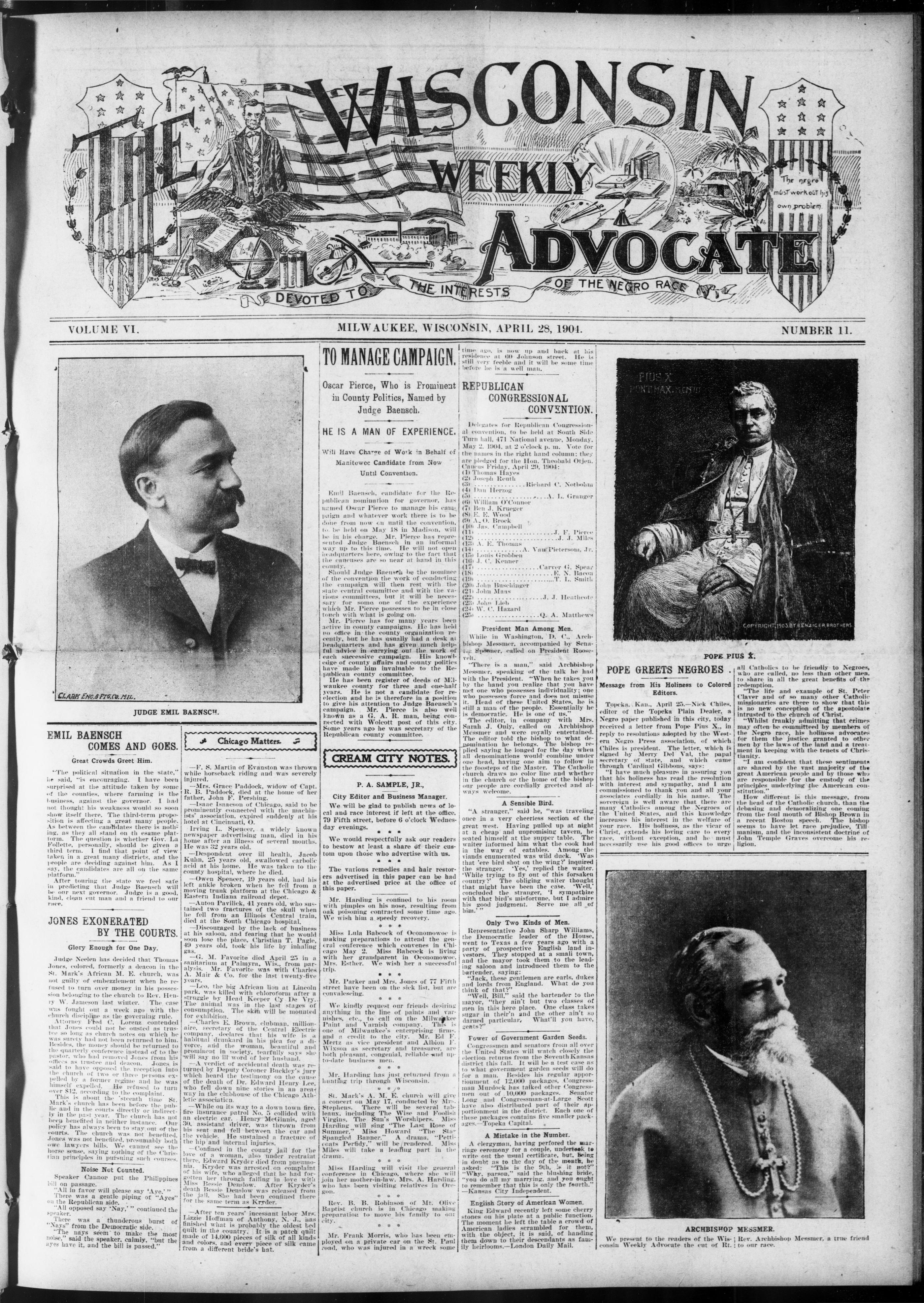
Page text (machine-generated)
WISCONSIN
WEEKLY
ADVOCATE
DEVOTED TO THE INTERESTS OF THE NEGRO RACE
CLARK ENG. B. PTC. CO. MIL.
CLARK ENG. & PTG. CO. MIL.
JUDGE EMIL BAENSCH.
EMIL BAENSCH COMES AND GOES
Great Crowds Greet Him.
"The political situation in the state," he said, "is encouraging. I have been surprised at the attitude taken by some of the counties, where farming is the business, against the governor. I had not thought his weakness would so soon show itself there. The third-term proposition is affecting a great many people. As between the candidates there is nothing, as they all stand on th esame platform. The question is whether Gov. La Follette, personally, should be given a third term. I find that point of view taken in a great many districts, and the people are deciding against him. As I say, the candidates are all on the same platform."
After touring the state we feel safe in predicting that Judge Baensch will be our next governor. Judge is a good, kind, clean cut man and a friend to our race.
JONES EXONERATED BY THE COURTS.
Glory Enough for One Day.
Judge Neelen has decided that Thomas Jones, colored, formerly a deacon in the St. Mark's African M. E. church, was not guilty of embezzlement when he refused to turn over money in his possession belonging to the church to Rev. Henry W. Jameson last winter. The case was fought out a week ago with the church discipline as the governing rule.
Attorney Fred C. Lorenz contended that Jones could not be ousted as trustee so long as church notes on which he was surety had not been returned to him. Besides, the money should be returned to the quarterly conference instead of to the pastor, who had removed Jones from his offices as trustee and deacon. Jones is said to have opposed the reception into the church of two or three persons expelled by a former regime and he was himself expelled. He refused to turn over $12, according to the complaint.
This is about the seventh time St. Mark's church has been before the public and in the courts directly or indirectly in the past year. The church has not been benefited in neither instance. Our policy has always been to stay out of the courts. The church was not benefited, Jones was not benefited, presumably both owe lawyers bills. We cannot see the horse sense, saying nothing of the Christian principles in pursuing such courses.
Speaker Cannon put the Philippines bill on passage.
"All in favor will please say 'Aye.'" There was a gentle piping of "Ayes" on the Republican side. "All opposed say 'Nay,'" continued the speaker. There was a thunderous burst of "Nays" from the Democratic side.
"The nays seem to make the most noise," said the speaker, calmly, "but the ayes have it, and the bill is passed."
VOLUME VI.
Noise Not Counted
—F. S. Martin of Evanston was thrown while horseback riding and was severely injured.
—Mrs. Grace Paddock, widow of Capt. R. B. Paddock, died at the home of her father, John F. Pershing.
—Isaac Isaacson of Chicago, said to be prominently connected with the machinists' association, expired suddenly at his hotel at Cincinnati, O.
Irving L. Spencer, a widely known newspaper advertising man, died in his home after an illness of several months. He was 32 years old.
—Despondent over ill health, Jacob Kuhn, 25 years old, swallowed carbolic acid at his home. He was taken to the county hospital, where he died.
—Owen Spencer, 19 years old, had his left ankle broken when he fell from a moving trunk platform at the Chicago & Eastern Indiana railroad depot.
—Anton Pavilick, 41 years old, who sustained two fractures of the skull when he fell from an Illinois Central train, died at the South Chicago hospital.
—Discouraged by the lack of business at his saloon, and fearing that he would soon lose the place, Christian T. Pagle, 49 years old, took his life by inhaling gas.
—G. M. Favorite died April 25 in a sanitarium at Palmyra, Wis., from paralysis. Mr. Favorite was with Charles A. Mair & Co. for the last twenty-five years.
Leo, the big African lion at Lincoln park, was killed with chloroform after a struggle by Head Keeper Cy De Vry. The animal was in the last stages of consumption. The skin will be mounted for exhibition.
Charles E. Brown, clubman, millionaire, secretary of the Central Electric company, declares that his wife is a habitual drunkard in his plea for a divorce, and the woman, beautiful and prominent in society, tearfully says she will say no ill word of her husband.
A verdict of accidental death was returned by Deputy Coroner Buckley's jury which heard the testimony on the cause of the death of Dr. Edward Henry Lee, who fell down nine stories in an area way in the clubhouse of the Chicago Athletic association.
While on its way to a down town fire, fire insurance patrol No. 5 collided with an electric car. Henry McGinnis, aged 30, assistant driver, was thrown from his seat and fell between the car and the vehicle. He sustained a fracture of the hip and internal injuries.
Confined in the county jail for the love of a woman, also under restraint there, Edward Kryder died from pneumonia. Kryder was arrested on complaint of his wife, who alleged that he had forgotten her through falling in love with Miss Bessie Denslow. After Kryder's death Bessie Denslow was released from the jail. She had been confined there for the same term as Kryder.
After ten years' incessant labor Mrs. Lizzie Hoffman of Anthony, N. J., has finished what is probably the oldest bed quilt in the country. It is a patch quilt made of 14,600 pieces of silk of all kinds and colors, and every piece of silk came from a different bride's hat.
---
MANAGE CAMPAIGN
Oscar Pierce, Who is Prominent in County Politics, Named by Judge Baensch. HE IS A MAN OF EXPERIENCE.
Will Have Charge of Work in Behalf of Manitowoc Candidate from Now
Emil Baensch, candidate for the Republican nomination for governor, has named Oscar Pierce to manage his campaign and whatever work there is to be done from now on until the convention, to be held on May 18 in Madison, will be in his charge. Mr. Pierce has represented Judge Baensch in an informal way up to this time. He will not open headquarters here, owing to the fact that the caucuses are so near at hand in this county. Should Judge Baensch be the nominee of the convention the work of conducting the campaign will then rest with the state central committee and with the various committees, but it will be necessary for some one of the experience which Mr. Pierce possesses to be in close touch with what is going on.
Mr. Pierce has for many years been active in county campaigns. He has held no office in the county organization recently, but he has usually had a desk at headquarters and has given much helpful advice in carrying out the work of each successive campaign. His knowledge of county affairs and county politics have made him invaluable to the Republican county committee.
He has been register of deeds of Milwaukee county for three and one-half years. He is not a candidate for reelection and he is therefore in a position to give his attention to Judge Baensch's campaign. Mr. Pierce is also well known as a G. A. R. man, being connected with Wolcott post of this city. Some years ago he was secretary of the Republican county committee.
CREAM CITY NOTES.
P. A. SAMPLE, JR.,
City Editor and Business Manager.
We will be glad to publish news of local and race interest if left at the office, 79 Fifth street, before 6 o'clock Wednesday evenings.
We would respectfully ask our readers to bestow at least a share of their custom upon those who advertise with us.
The various remedies and hair restorers advertised in this paper can be had at the advertised price at the office of this paper.
Mr. Harding is confined to his room with pimples on his nose, resulting from oak poisoning contracted some time ago. We wish him a speedy recovery.
* * *
Miss Lula Babcock of Oconomowoc is making preparations to attend the general conference which convenes in Chicago May 2. Miss Babcock is living with her grandparent in Oconomowoc. Mrs. Esther. We wish her a successful trip.
牵 束 束
Mr. Parker and Mrs. Jones of 77 Fifth street have been on the sick list, but are convalescing.
* * *
We kindly request our friends desiring anything in the line of paints and varnishes, etc., to call on the Milwaukee Paint and Varnish company. This is one of Milwaukee's enterprising firms, and a credit to the city. Mr. Ed F. Mertz as vice president and Albion F. Wixson as secretary and treasurer, are both pleasant, congenial, reliable and up-to-date business men.
* * *
Mr. Harding has just returned from a hunting trip through Wisconsin.
St. Mark's A. M. E. church will give a concert on May 17, conducted by Mrs. Stephens. There will be several tableaux, including The Wise and Foolish Virgins, The Sun's Worshipers. Miss Harding will sing "The Last Rose of Summer." Miss Howard "The Star Spangled Banner." A drama, "Petticats Perfidy," will be rendered. Miss Miles will take a leading part in the drama.
* * *
Miss Harding will visit the general conference in Chicago, where she will join her mother-in-law. Mrs. A. Harding, who has been visiting relatives in Oregon.
Rev. B. B. Robinson of Mt. Olive Baptist church is in Chicago making preparation to move his family to our city.
Mr. Frank Morris, who has been employed on a private car on the St. Paul road, who was injured in a wreck some
time ago, is now up and back at his residence at 60 Johnson street. He is still very feeble and it will be some time before he is a well man.
REPUBLICAN
CONGRESSIONAL
CONVENTION.
Delegates for Republican Congressional convention, to be held at South Side Turn hall, 471 National avenue, Monday, May 2, 1904, at 2 o'clock p. m. Vote for the names in the right hand column; they are pledged for the Hon. Theobald Otjen. Caucus Friday, April 29, 1904:
(1) Thomas Hayes
(2) Joseph Reuth
(3) ..... Richard C. Notbohm
(4) Dan Herzog
(5) ..... A. L. Granger
(6) William O'Connor
(11) ..... J. F. Pierce
(12) ..... J. J. Miles
(13) A. E. Thomas
(14) ..... A. Vau Pietersom, Jr.
(15) Louis Grobben
(16) L. A. Kirk
The editor, in company with Mrs. Sarah J. Only, called on Archbishop Messmer and were royally entertained. The editor told the bishop to what demination he belongs. The bishop replied saying he longed for the day when all denominations would combine under one head, having one aim to follow in the foosteps of the Master. The Catholic church draws no color line and whether in the church or the home of the bishop our people are cordially greeted and always welcome.
A Sensible Bird
"A stranger," said he, "was traveling once in a very cheerless section of the great west. Having pulled up at night at a cheap and unpromising tavern, he seated himself at the supper table. The waiter informed him what the cook had in the way of eatables. Among the viands enumerated was wild duck. 'Was that 'ere bird shot on the wing?' inquired the stranger. 'Yes,' replied the waiter. 'While trying to fly out of this forsaken country?' The obliging waiter thought that might have been the case. 'Well,' concluded the stranger, 'I sympathize with that bird's misfortune, but I admire his good judgment. Serve me all of him.'"
Only Two Kinds of Men.
Representative John Sharp Williams, the Democratic leader of the House, went to Texas a few years ago with a party of prospective English land investors. They stopped at a small town, and the mayor took them to the leading saloon and introduced them to the bartender, saying: "Jack, these gentlemen are earls, dukes and lords from England. What do you think of that?" "Well, Bill," said the bartender to the mayor, "they ain't but two classes of men in this here place. One class takes sugar in their'n and the other ain't so darned particular. What'll you have, gents?"
Power of Government Garden Seeds. Congressmen and senators from all over the United States will watch closely the election returns from the Seventh Kansas district this fall. It will be a test case as to what government garden seeds will do for a man. Besides his regular apportionment of 12,000 packages, Congressman Murdock has talked other Congressmen out of 10,000 packages. Senator Long and Congressman-at-Large Scott have also distributed part of their apportionment in the district. Each one of these packages contains five smaller packages.—Topeka Capital.
A Mistake in the Number.
A clergyman, having perfored the marriage ceremony for a couple, undertook to write out the usual certificate, but, being in doubt as to the day of the month, he asked: "This is the 9th, is it not?" "Why, parson," said the blushing bride, "you do all my marrying, and you ought to remember that this is only the fourth."—Kansas City Independent.
English Story of American Women
King Edward recently left some cherry stones on his plate at a public function. The moment he left the table a crowd of American ladies scrambled for them, with the object, it is said, of handing them down to their descendants as family heirlooms.—London Daily Mail.
PIUS X
PONT MAX. MUNIO
COPYRIGHT 1903 BY BENZIGER BROTHERS.
POPE GREETS NEGROES .
Message from His Holiness to Colored Editors.
Topeka, Kan., April 25.—Nick Chiles, editor of the Topeka Plain Dealer, a Negro paper published in this city, today received a letter from Pope Pius X., in reply to resolutions adopted by the Western Negro Press association, of which Chiles is president. The letter, which is signed by Merry Del Val, the papal secretary of state, and which came through Cardinal Gibbons, says:
"I have much pleasure in assuring you that his holiness has read the resolution with interest and sympathy, and I am commissioned to thank you and all your associates cordially in his name. The sovereign is well aware that there are many Catholics among the Negroes of the United States, and this knowledge increases his interest in the welfare of your race. His holiness, as the vicar of Christ, extends his loving care to every race, without exception, and he must necessarily use his good offices to urge
...
ARCHBISHOP MESSMER. We present to the readers of the Wis- Rev. Archb consin Weekly Advocate the cut of Rt. to our race.
rs of the Wis- Rev. Archb
the cut of Rt. to our race.
We present to the readers of the Wis- Rev. Archbishop Messmer, a true friend consin Weekly Advocate the cut of Rt. to our race.
all Catholics to be friendly to Negroes, who are called, no less than other men, to share in all the great benefits of the redemption.
"The life and example of St. Peter Claver and of so many other Catholic missionaries are there to show that this is no new conception of the apostolate intrusted to the church of Christ.
"Whilst frankly admitting that crimes may often be committeed by members of the Negro race, his holiness advocates for them the justice granted to other men by the laws of the land and a treatment in keeping with the tenets of Christianity.
"I am confident that these sentiments are shared by the vast majority of the great American people and by those who are responsible for the custody of the principles underlying the American constitution."
How different is this message, from the head of the Catholic church, than the debasing and demoralizing one coming from the foul mouth of Bishop Brown in a recent Boston speech. The bishop seems to have let race prejudice, Tillmanism, and the inconsistent doctrine of John Temple Graves overcome his religion.
POPE
Rev. Archbishop Messmer, a true friend to our race.
THE DIETIC PAUPER.
T knew a simple diet man,
A very curious case; .
When he observed me go to Junch
He always made a face.
For anyone who eateth meat
In middle of the day,
He said, was on the road to death
‘And by the quickest way.
But once, upon the stroke of one,
I chanced this man to see.
And absent-mindedly yee:
“Come, won't you lunch with me?"
I could pot name the condiments
Ho ravished, plate by plate;
Fur just one solid Immeheon hour
He ate, and ate, and ate.
—Town Topics.
_—_————_
MORE THAN HE COULD TELL.
In dis new year I gwine ter wear
A beaver, an’ dress well,
“put whar i gwine ter git um
Js mo’ dan I kin tell!
I gwine ter feast on turkey
Ez fat ez dem dey sell,
But des whar I gwine git um
Is mo’ dan I kin tell!
—Atlanta Constitution.
Fen gre ee ee ee ee aaa a
NOTES OF INTEREST.
—In the United Staies the sparrow his
six broods a year; in Britain seldom
more than three.
—The London Crystal palace ara e
dates more people than any other build-
ine Satthe World. It will hold 100,000
people. :
—The great festival hall at the world’s
fair is receiving the finishing touches.
‘This is the last of the large buildings, and
its completion marks the end of the big
construction work in the “main picture.
A Kentucky judge recently decided
that men who transact business on Sun-
day cannot secure damages against a
telegraph company if the latter fails to
deliver correctly a telegram on that date.
—-The present Trimty church at the
head of Wall street, New York, is the
third edifice of that name, the two pre-
ceding structures erected upon the same
sround having -been burned.
British officers ure having the scars
of face wounds removed by the use of
light rays. The London Mail says: “The
custone rapidly growing of surgeons
xending their patients to have the scars
left by operations removed.”
Rockville, Md., deserves all the free
advertising that can be given a town in
which a court bailiff arrested a constable
for using profane language on the maim
street of the village, and carried the case
through to the conviction of the offender.
‘The constable was fined $1 and the costs.
—The Philadelphia police say that they
have discovered «a shoplifter, a woman,
who brushes the valuable articles, such
as silk waists, off counters in stores, and
then picks them up with her foot and
tucks them safely under her, dress. They
claim to have caught the’ culprit and
proved her guilt.
—Mrs. Susan J. Crane of Hartford,
Conn., has been made poorer by a legacy.
She was willed fifteen shares of the
steck of a bank which failed a few weeks
jater, and now a judgment for the face
velue of the stock, $1500, has been en-
tered against her. She says she will nat
yay it.
—By a recent Canadian invention brick-
laying is done by machine. The machine
wili do all plain work and do it more
firmly than is possible by hand. Each
machine is managed by two men and a
boy and does the work of six or seven
skilled bricklayers. Its operation can ve
lezrned in two weeks,
—Two of the seismographie iustru-
ments set up by the German authogities
in Heligoland show plainly that the whole
rock sways to and fre when there is a
strong westerly gale. Experiments are to
be made shortly in order to ascertain to
what extent the rock is affected by the
firing of the heavy Howitzers.
—Louis Tas, one of the best-known
dizmond_ brokers, estimates the output of
the De Beers mines annually at $14,599,-
500, and sof other.mines at $4,866,500,
Add te this the cost of labor, the profits
or the London syadicate, ete., and he
thinks-that the annual output of dia-
mendes is worth about $84,065,500.
—Nothing appears to have been done in
regard to establishing the head market for
the spice trade at Batavia, and the plant-
ers still seem to be dependent on the Eu-
ropean market. Business, however, in
«different spices has increased wonderfully
within the past year, the exports to the
United States sharing largely in the in-
crease,
—Because there was a singing school
in the same apartment house in which
James T. Kilbreth lived in New York
he and this mother moved out, declaring
that the “shrieks” of the musie pupils
gave them nervous prostration. He was
sued for the rent of his flat, and is now
in court trying to prove that the sounds
heard were really shrieks.
One of the great advantages in seil-
ing goods to Mexico is that failures are
almost unknown, as the merchants of
Mexico are very conservative and extend
their business only as far as their cap-
ital will permit. Fires and their results,
which ruin thousands of business men
annually in the United States, are of
yery rare oveurrence there. Mazatian
has not been afflicted with a fire for over
vhirty years.
—The adulteration of candy and the
use of inferior materials in making it are
beginning to attract much attention in
England. Prof. Ooston recently lectured
on “saecharomaniacs.” He expressed the
épinion that future scientists would place
the evils of sugar gluttony on « pedestal
ax conspicuous as the drink question, as
causing deterioration of individuals and
raees,
Royal annals have never recorded a
more varied and extensive wardrobe than
that which belonged to the “Virgin
Queen,” Even at the age of 6S, when
she might be supposed to have outlived
her youthful vanity, she possessed 99
complete. official costumes, 102. French
gowns, 100 robes with trains and 67
without, 126 antique dresses, 136 bodices,
125 tunics, not to mention such trifles
as 96 mantles, S dressing gowns and 27
Trans.
A Town Without Town Officers.
Spokogee, a town in the western part
of the Creek nation, is the only town of
1060 population in the territory that has
no town officers. The people there say
they have ne need of officers, and do net
waut any. They pay no taxes, and when-
e¥er they want any public improvemeut
they call a meeting of citizens and_raise
the money. A deputy United States
marshal is located there, and is all that
is needed to keep the peace. There ‘s
not a gambler or gambling house in the
town, and the people will not permit
them. ‘They needed 2 schoolhouse, so
the people get together and built a good
two-story building for tliat purpose.—-
Fort Worth Reeord.
et
Why Italians Fence Well.
Experiments show that the nervousness
of sontherners acts in a most_ marked
manner to their disadvantage. Owing to
2 greater merveusness and quickness of
response a impose severer strains on
already tired muscles. The skill of the
Italians with the foil is an instance of
the greater aed of their motor nerves.—
From Pref. Mosso’s Book on Fatigue.
SUNSET DREAMS.
The moth and beetle wing. about
‘The garden ways of other days:
Above the hills, a fiery shout
Of gold, the day dies slowly out,
Like some wild blast a Luntsman b:ows:
And over the hills my Fancy goes,
Following the sunset's golden call,
Unto a vine-hung garden wall,
Where she awaits me in the gloom,
Retween the lily and the rose,
With arms and lips of warm perfume—
‘The Dream of Love my Fancy knows.
‘The glow-worm and the firefly glow
‘Among the ways of bygone days:
A’golden shaft shot from a bow
Of silver, star and moon swing low
‘Above the hills where twilight lies:
‘And o'er the bills my Longing flies,
Fallowing the star's far, arrowed, gold,
Unto a gate where, as of, old,
She waits amid the rose and rue,
With star-bright hair and night-dark exes,
‘The Dream, to whom my heart is true,
My Dream of Love that never dies.
Madison Cawein in The Reader.
———
’
McCARTHY’S ESCAPE.
leoking chap, yourg und staiwart, ©
was in the best of spirits, too, this fine
summer morning, for he was on his way
home to Ireland, on a short but weh-
earned holiday from a large business
establishment in Manchester. :
His lustrous, bright blue eyes had in
them fathomless depths of humor and of
pathos—eyves which made strangers gaze
at him as he perambulated the platform
waiting for the train.
He sat down on a station bench ond
was seareely conscious of the presenee
ot a lady who had followed his lead and
sat down by his side; not that he was
callous or impervious to temale charm -
en the contrary, like most of his coun-
tryimen, he appreciated it, always, to the
fullest extent. ‘
But just now his thoughis were far
away, for memory’s kodak was busy
with brain snap-shots of his mountain
home in Kerry—that. lotus-land of beau-
ty, where his widowed mother .counted
the hours till she should see him’ again.
‘The arrival of the huge main-line train
and the strident voiee of the railway
porter brought him abruptly back to
reality.
“Cuhnshire junetion! Change here for
Cokchampton and Westerly!”
MeCarthy, responding to the ‘order
“Take seafs, please!” got up and entered
an empty second-class smoking compart
ment. He knew how to’ make- himself
comfortable, and did, not like a crowd.
He had just lighted a eigar when the
Jady—having gone the length of the plat-
form—returned, and hastily, just as the
whistle sounded, opened the door and
entered.
He raised his hat, and they soon be-
came quite chummy. She was young and
undoubtedly very handsome—quite fetch-
ing, in fact. She seated herself in the
far corner opposite. They began by talk-
ing con:mon-place about the weather.
He had a supply of periodicals and il-
lustrated papers which he handed her,
and which she graciously looked at.
Her whole “get-up” was in perfect
keeping and taste. She talked well. His
accent ford her he was Irish, and she
thought it probable that he was a Roman
Catholic, so she drifted naturally into
theology, and playfully explained that
the only real difficulty: she felt with re-
gard to the Catholie church was because
it was so dreadfully strict and exacting—
at least, for women.
McCarthy expressed bis conviction that
she at least would not need a strict
father-confessor, whereat. she Jaughed a
soft. silvery laugh, and sighed archly.
‘They were enjoying themselves so. thor-
oughly that twenty minutes flew by in
no time; then presently the train slowed
dewn. They were nearing a station.
The smoke from his cigar curled up to
the roof of the compartment as he took
it fvom his mouth to look interested!y
at it, as smokers will.
He was cautiously replacing it between
his lips, when suddenly, “in the twink-
ling of an eye,” she sprang to her feet,
and with the rapidity of one demented,
pulled the cord of communication at the
open window, flung all the papers wildly
about, tore off her exquisitely trimmed
hat, and some roses from her breast,
trampling upon them frantically.
‘Then, rushing to the window, she
shrieked as woman never, to his knowl-
edge, had shrieked before, winding up
with an ear-splitting, blood-curdling ery
of —
“Murder! Murder! Police!”
Then, flinging herself prone on the
seat, her hair streaming over her shoul-
ders, she Jay as if dead.
‘The train came to a sudden standstill,
and « terrible commotion-ensued.
MeCarthy was interrogated. He could
only say that the lady suddenly went off
her head and then fainted.
Sundry passengers. sniggered, others
spoke with bated breath, and whispered
to the guard, who decided that it was
better to push on to the next station,
which was only a couple of miles distant,
and where a policeman would be found.
He got into the same compartment as
& precautionary measure, with McCarthy,
who silently continued to smoke.
“This is a serious business, sir.” he
ventured to remark, before giving the
signal for departure.
“It would seem so,” was the imper-
turable reply.
With astonishing rapidity the lady
now recovered consciousness and spoke.
With equally astonishing volubility she
narrated, in response to the guard’s in-
yitation, how she had been grossly in-
sulted by the young man, how he had
the audacity to attempt to kiss her, and
had put his arm around her waist.
It all happened so suddenly! She had
been asleep. She had just strength
enough to struggle free—and so férth.
After that she fainted and remembered
no more, she said.
When the train stopped again there
were angry comments—very angry—
while 2 policeman was being got. Me-
Carthy should be given in charge—there
was nothing else for it.
Much sympathy was expressed all
round for the scared and panting lady,
one person alone dissenting—an elderly
evangelical gentleman, who said it served
her right for traveling alone. What
could she expect ?
But the others eried “Shame!” on the
old gentleman and he retired crestfallen,
while a diversion was caused by the ad-
vent of a pompous “bobby.” '
“What have you to say, sir?” he in-
quired of McCarthy. “This lady, of
course, will charge you.”
The young man smiled.
“Look at him!” shouted one of the
spectators; “he’s actually laughing—the
things began to look rather threatening.
ewe hat have you to say, sir?” again
angrily demanded the law’s representa
tive.
McCarthy smiled once more.
“Can you tell me, guard,” he said
“the distance between this station and
the junction where you saw me get int”
“\What has that got to do with it?”
asked an excited spectater, growing im-
patient. y
asked an excited spectator, growing im-
patient. .
“Pardon me,” said MeCarthy, exasper-
atingly deprecating haste and turning to
‘the guard for an answer.
“Well, about twenty-five minutes’ or
‘half an hour's run—if you want to
know,” was the reply.
“I do want to know,” said MeCarthy.
“Look here, just listen to me. I lighted
this cigar when starting. I have been
smoking it ever since. It is still alight.
‘and the ash is at least two inches long.”
“And he held it upright between his first
and second fingers. “Bedad! I should
‘say that settles it.”
"Some seconds elapsed before guard and
policeman realized the position.
“A plant—clearly a_ plant,” said the
latter, meditatively, rubbing his chin.
A revulsion of feeling followed in-
stantaneously; and, at this stage, the
lady made a vigorous effort to bolt, but
did not succeed.
“Not if | know it,” said the policeman.
“Give me your name and address, sir;
she is evidently an old hand.”
“['d rather not prosecute,” said Me-
|Carthy. “You see, I don’: want to miss
‘the connection with the other line, and
we are behind time already. I’m on a
short. holiday, and every day is of im
portance to me.”
| “Oh! please do give me my hat,
'pleaded the lady, pathetically, and in
tears, as she marvelously and deftly did
up her hair with the left hand—the
other being in the grip of the policeman
MeCarthy., promptly and graciously
icomplied with the request. “Women arc
‘the very deuce, so they are, sir,” said
‘the guard, as he waved his flag.
| “So IT have heard,” vesponded the gen-
jal Irishman. “Will you try a cigar?”
“A close shave,” he said to himself, as
he settled down to another weed. “It
might have been a very awkward busi-
‘ness.”—-J, F. Fuller in illustrated Bits.
HAPPIEST WOMAN IN WORLD.
She Who Is Contentedly Serving Those
She Loves.
Who is the happiest woman in the
world? Adeline Patti answers this.
Is it the woman who has written a sue-
cessful hook, or painted a great picture,
or done some other noteworthy thing to
bring here into the public eye?
No; far from it. Fame never yet made
any-human creature truly happy. On
the contrary, it usually seeks to spoil his
peace of mind; it interrupts his private
life, and makes all sorts of insolent de-
mands on his time and thought. When
you are famous you beloug to the public,
and when yon belong to the public you
cease to belong to the little private circle
of those who love you.
“Oh, for a quiet hour to sit down and
read a book with my family!’ sighed a
man who is famous on two continents.
“But no; I belong to the public, and the
public does not give me time to live.”
Ask any woman who is nolie what the
world calls great things, and she will tell
you, doubtless, that she is happy in hay-
ing satisfied her desire to achieve some
particular thirg; but if her face glows,
and she cries joyfully, “I am the happiest
woman in the world!’ you may come to
one of two conclusions: Lither she is
very, very new at her accomplishments;
the reaction is yet to come, or else it is
some more intimate, more personal joy
than either her book or her pictute that
gives the real crown to her happiness.
Ambition is a beautiful and necessary
thing; but it 1s not happiness, any more
‘than a 10-mile tramp is rest. And it
never yet satisfied the heart that was
made for joy—as what woman's heart
is not, even though her joy gets half its
bliss from sorrow?
, Nay, the happiest woman in the world
is not she who is filling some lofty seat
in the full glare of the public eye. It
may be right for that woman to be
there. It was not meant that all women
should be happy to their fullest capacity.
Doubtless she is of great use there. But
she is not the happiest woman in the
world.
The happiest woman in the world is
she who is contentedly serving those she
loves.
That is the truth in a nutshell, and
any honest woman who looks into her
own heart with understanding eyes will
confess it.
What is life, anyway, but service?
All of us find that out sooner or later.
And the woman whose privilege it is to
minister to those she loves—whose place
in the world is to make life glad for
ne who love her, is the happiest wom-
an in it.
It is a privilege not given to all. Oth-
er tasks call some too loudly to be
ignored. But let those to whom it is
kiven, the swett home-makers, the loved
wives and mothers and sisters, awake
to their joy while they yet have it, and
sing all through these glad days of
spring time, for theirs is the hanpiest lot
on earth.—Louisville Times.
Obnoxious to Women.
“The woman who filed a petition for
ilivorce the other day in a town up the
country and based her claim on the
ground that she could not stand her hus-
band’s pipe may come in for a good deal
of ridicule,” said the old men, “but when
you come to think of it, she may be half-
way right about it. Pipes do not please
delicate nostrils. They may be all right
for the men who smoke them; but did
you ever stop to think how offensive the
odor of a cigarette is to the man who
doesn’t smoke cigarettes? There are a
great many persons in the world who do
not like the odor of tobacco at all, and,
in fact, there are a great many persons
who simply cannot stand tobacco. It
makes them sick. No doubt you have
known many persons in your time who
could not stand the smell of whisky, or
of beer, or of any other sort of intoxicat-
ing drink. Other persons cannot stand
the odor of cheese+and you don’t have
to get Limburger in order to offend them.
Why shouldn't a dainty woman object to
the pipe? Of course, men may not be
able to appreciate just how a woman may
feel about things of this sort. By using
tobacco we become dead to the offensive-
ness of the odor. In fact, we do not no-
tice it at all. If we quit using tobacco
for a while we will get a faint idea of
what it means to the woman when we
come in contact with our friends who use
it. So when you come to think about
it, maybe the woman who made the pipe
the basis of a divorcee suit had good
ground for it. We may write poetry
about the pipe and all that sort of thing,
but I can imagine that to non-tobacco
users the pipe is not the sweet scented
thing we are in the habit of dreaming
abont.”--New Orleans Times-Democrat.
—One of the largest London firms
makes a practice of employing Scots-
men in its hairdressing department, for
their skill and thoroughness give great
satisfaction to customers, ¢
Recor Aho e aad Day.
A movement in which rot. J.
H. Hyslop, sane of Columbia
university, the Medico-Legal society
and a number of other individual men
of wealth are interested, is afoot for the
establishment in New York city of x
clinic for tha treatment of the poor by
hypnotism. Tmyetus was given to the
| movement at a meeting of the Medico-
Legal society. Prof. Hyslop read a paper
on the relative value of hypnotism in
medicine and there was a discussion on
the general subject.
Bellevue hospital will open a “tent
ward for the treatment mt pera: suffer-
ing from tuberculosis. his comes too
late to save the physicians who have
contracted consumption from their pa-
j tients, and is admitted to be an experi-
jmeat. ‘The new tent ward is located
jon the lawn, It is about thirty-five feet
|long and twenty feet wide. ‘The roof is
; of canvas, over which there is an extra
| canvas fly. The tloor, in which there are
ventilators, is about two feet from the
| ground and rests on cedar posts, admit-
ting of a free circulation of air A
|smailer portable ward is being erected
| for use as a service tent. food for the
_consumptives who are to be treated in
|the new tent ward will be prepared in
| this service tent. A portable bathroom
j also is being erected.
|
| Wiliam KK. Vanderbilt, Jr., has dis-
posed of $40,000 worth of automobiles
since his return from Florida, where he
| broke the world's record for a mile a
few months ago. He no longer owns
the wonderful 90-horsepower Mercedes,
with which he accomplished his feat, nor
does he own the 60-horsepower Mors,
| with which he starded Europe two years
ago. Besides these Mr. Vanderbilt has
disposed of goother Mors and a Renault
{ machine, and he has not a single high-
| seared machine at the present time. The
lonly two machines that he owns today
jare an 18-horsepower Mercedes and a
20-horsepower Renault, and these can be
| bought for what they cost the owner. It
was said some time ago that Mr. Van-
jderbilt intended to give up racing be-
cause of u weak heart. At present Mr,
| Vanderbilt is in Mexico looking after
| railroad interests, while his wife is in
| California.
| Henry Iselin, who 1s detained by the
authorities in Paris pending an investiga-
tion of various enterprises in that city,
| is understood to be a relative of the well-
known Iselin family in New York city,
but has resided abroad for fifteen or
ltwenty years and the New York fam-
lily have not heard directly from him in
ease years. He had various banking
interests and has been the owner of one
jor more newspapers in Paris,
James N. Abeel, who tirough a letter
purported to be signed by the vice presi-
dent of the Western Union Telegraph
company secured an introduction to Miss
Eleanor Anderson, a telegraph operator
in the Grand hotel, under the name of J.
Ogden Goelet, Jr., and subsequently be-
came engaged to her, was adjudged
guilty of forgery in the third degree.
He gave her a check for $100,000, tu
which Goelet’s name was forged.
Because of the gift of 15,000 made by
the late William C. Whitney, the Amer-
ican Museum of New York has been en-
abled to discover much of the prehistoric
horse in America, At the meeting of the
National Academy of Sciences Prof.
Henry F. Osborn of Columbia university
declared that the skeletons of a_ small
| herd were found in Nebraska. With all
due ceremony, he declared, the type was
| christened the “Neohipparion Whitney.”
Prof. Osborn also declared that he had
discovered positive proof that man was
descended from thut class of reptiles
known as lynapida.
To offset the reports that he lacked
business steers Herr Solten Doeme,
the divorced Musband of Lillian Nordica,
has issued a statement_through his at-
torney. George Gordon Hastings, denying
the allegations that he had been waste-
ful of the money intrusted to him by the
diva. He says: “It is true that since our
marriage I have had paid to me as repre-
senting my_wife’s earnings the sum of
$272,000, Mr. Soley, speaking in round
figures, describes the amount as $300,000.
I can afford, if necessary, to accept even
| these Jatter figures as correct in view of
| the accounting I am able to give. Since
my marriage, as shown by receipts,
checks, and other vouchers in my posses-
sion, I have paid my wife, or for her ac-
count, the sum of $206,300. The excess
1 ee I invested in’ stocks and bonds,
| which I deposited in a safety box in
the bank of New Amsterdam, to which
my. wife and I each had a key. his ex-
cess she took ae of before my ar-
rival here in November, when I came in
consequence of the legal proceedings in-
stituted by her, Thus, according to, my
figures, my wife received from me $64,-
| 300 more than she paid into my hands,
| taking her own figures and those of Mr.
| Soles, amd $36,300. more than received
by me from her. These figures speak for
| themselves and effectually disprove the
| insinuations that I am the ‘mere husband
{of the prima dopna.*”
| Investigation into the death of Loretta
| Young, a pretty dancing girl of the Wiz-
| a of Oz company, resulted in the arrest
of Dr. Charles Tobynne, a prominent
| physician on the upper west side, and
| Mary Kelley, a traimed nurse employed
| by the doctor. The arrests were ordered
| by Coroner Scholer after an autopsy. Dr.
Tobynne was held in $5000 bail on a
| charge of manslaughter. Mary Kelley
| was held as a “suspicious person.”
| oe
} In the supreme cowt in Brooklyn a
| verdict was given in favor of Sidney C.
Love & Co., stock brokers, in a suit
| brought against them by George Doutney
| to recover $30,000 which he alleged he
| lost speculating in Wabash. The brokers
| put in a counter claim for $1355, which,
they say. is the amount of margins over
$30,000 which Doutney failed to pay.
Dotney is a friend of J. P. Rawley, who
is said to be a member of the Bible class
of John D. Rockefeller, Jr. Love testi-
fied from hearsay that Rawley informed
Doutney he had had dinner with Rocke-
feller, who intimated Wabash was a good
steck at that time to speculate in. and on
The plans for the new Bellevue hospital
in New York city, which have been made
public, provide for the largest hospita} in
the world, a magnifeevt structure, which
will extend from Twenty-sixth to Twen-
ty-ninth street and from First avenue to
the East river. it will take ten years
to finish the structure, which will cos:
$12,000,000. Architecturally it will rank
among the great buildings of the country.
It is to be constructed of brick and stone,
will be fireproof, and will accommodate
2500 patients. The largest hospital in
the world now is one at Hamburg,
which honses 1700 patients. It is planned
to have 125 docto?s and 320 nurses. At
present there sare 42 doctors and 160
nurses at Bellevue.
The report that Weber & Fields are to
part at the end of the season was prac-
tically confirmed when Lew Fields came
over from Boston and held a conference
with three wen who are to build a the-
ater for him. Fields’ backers are Nathan
OF ST. LOUIS, MO.
Visitors to the World’s Fair can procure and enjoy “first-class* accommoda-
tions by applying to one of the agencies at ase city, which are established by the
World’s Fair Guarantee Association of St. Louis, in the states of Illinois, Wiseon-
sin and Northern Michigan. The accommodations are absolutely “first-class” and sv
endorsed by the Missouri Trust Co. Our members will receive “transportation”
NOT ON EXCURSION TRAINS
(a
and while en route, “all transfers, meals and berths. At the Fair Grounds”—7
days at our hotels, including free baths, and 21 “first-class meals”—admissions for
6 days to the Fair and for 10 of the best entertainments on the “Pike” (Midway)
—“one steamer excursion trip on the Mississippi’—all the car fares, daily pro-
grammes and one souvenir emblem. All this is provided for our members at a Pea-
sonable fixed rate from your station. Rates for children under 12 years one-third
less. Our agent at your city will furnish the rate and detail. The visit cam be
prolonged at a cost of $3.50 per day. A member's certificate is transferable at
any time. None but members can enjoy our accommodations. Notice must be
furnished to our ageuts, “two weeks in advance” of your contemplated start. Our
plan is reliable, cheap and the best. Every item is guaranteed.
The banks of the Association, for the members’ “reserve fund,” are the Amer-
ican Central Trust Co. of St: Louis, and the Germania National Bank of Mil-
waukee. General offices, 325 Germania Bldg., Milwaukee, Wis.
0.R. KALWEIT, AUGUST KAHLO, — PAUL C. BIERSACH,
Manager of CHICAGO Circuits. Manager of MILWAUKEE Circuit. Manager of BRANCHES.
‘Stein, Louis Beers and Charles Reinhard,
and the theater is to be at Broadway and
Forty-third street. It is understood that
J. Weber will keep the music hall and’
it is said Sam Bernard may be his part-
ner,
rs
ROME IN THE EARLY SIXTIES.
Its Picturesqueness Recalled by an Old
Traveler.
What charm, what beauty Jay in the
Rome ot the early ‘60s! [first reached
the Eternal city on the morning of Easter
day and drove straight to the square of
St. Peter's. It was thronged with
peasants, Whose murmur was broken by
the neighing of the cardinals’ stallions as
they waited for their masters. The ninth
Pius stepped out into the balcony and
with clear, melodious voice, plainly heard
in the center of the piazza, gave his
blessing to the city and the world. The
Vatican sculpture gallery was always
open. There was no creeping through
‘back alleys or slinking through postern
doors. The Swiss guard were clad in all
their finery and did not conceal the colors
of Michael Angelo with a gray overcoat.
Then the society, the picnics, the gallops
in the Campagna, the evenings at the
‘Palazzo Barberini, where white met
black and the bitterest antagonisms fra-
ternized under the fascinating genius of
William Story and the comely dignity of
his- wife! The postoffice of those days
was not yery trustworthy und English
letters were always sent to a banker.
“When Prince Massimo, the postmaster,
cappesred in a drawing room he was beset
with mages from anxious Jadies of
rank, “Prince, where are my letters?
My post is a week late!’ and the cour
teous descendant of Fabius had to prom-
‘ise more than he could perform. Who
‘ean now witness a reception in an embassy
held on the day on which the autograph
letter of a sovereign has been carried to
the Vatican on 2 velvet cushion and pre-
sented to his holiness? The ancestral
diamonds of the Orsini and the Gaetani
flashed under the chandeliers, the bearers
of strange titles with stranger garments
wandered through the rooms. The halls
echoed with the shout of “Il Sénatore
di Roma,” an office long extinct. If a
cardinal or an ambassadress arrived, six
lackeys, covered with gold lace, ran for-
ward with candelabras and escorted the
guest up the stairease, while the com-
pany looked on through convenient peep-
holes at the mediaeval pageant.
All this is past, but I do not feel dis-
posed to regret it. Rome is now reached
far more conveniently than of old. It is
the city of air and sun, instead of a
maze of fetid streets and festering
piazzas, The Colosseum has been cleaned
and the Albani gardens destroyed, but
there are half a dozen lecturers making
their living out of peripatetic archae-
ologists, while not one of the 365 Roman
churches is without its service. If Italy
has gained a good government, Rome has
at least acquired a healthy climate, and
the Pope has not lost the devotion of his
subjects.—Oscar Browning in The Satur-
day Review. ee
Axsenic-Proof Rats.
For years the French peasant has
regularly laid in large quantities of so-
called rat killing mixtures, whose chief
constituent is usualiy drsenic. But at
its last meeting the Academy of Sciences
discussed the question of rat destruc-
tion, and the eminent scientist, M.
d@Arsonval, affirmed that, as a result of
experiments made by M. Bordas, rats
are able to resist the effects of arsenic
for an extraordinarily long period. They
can absorb a dose seven times greater
than any other animal of the same size,
and in time may even become aceus-
tomed to doses of arsenic which seem in-
credible. M. Bordas; declares that he
has seen rats absorb without. any ap-
parent ill effects, and during long
periods, 2 quantity of arsenie corre-
sponding to a dose of five grammes. So
that while the confiding French farmer
las been pinning his faith to arsenica.
rat killing preparations he has been
wasting his money and feeding the
rodents on something on which they ap
pear to thrive—London Globe.
Sea —e—
Lots of Gall.
“No, I'm not bashful,” said John An-
drews of Dayton, Q., at Seelbach’s last
night, as he declined a cigar offered by a
friend, “but if I were bashful 1 wouldn't
be ashamed of it.
“I am just the opposite from bashful,
and I am sorry for it, for you seldom
see a genuinely bashful man who is not
the soul of honor. Though he may binsh
and stammer, appear awkward and
prove unable to throw out with ease the
thoughts to which he would give ex-
pression, yet for a real friend give me
the bashful man.
“You will always notice that there are
fine touches in his charcater which time
will mellow and bring out. His thoughts
are none the less inspired or beautiful
that they do not flow with the impetuos-
ity of the shallow streamlet.”—Louisville
Herald,
aegis
Genius Saved by Eating Meat.
According to recent news from London
a child musical genius has been restored
to health and strength and the exercise
of his talents by a diet of meat, after he
had shown signs of such delicacy of con-
stitution as to cause alarm to his parents.
The child’s name is Max Darewski, and
at the age of 5 years he composed a
poplar waltz called “Le Reve.” At the
age of 4 little Max had no teeth and
was extremely delicate, so much so that
it was feared he would never live to
grow up. His physician ordered for him
a liberal diet of meat, and did not debar
the child from eating 2 reasonable
nmount of sweets. His teeth soon began
to grow, his health improye, and his mu-
sical abilities to expand in a most mar-
yelous manner. This spring, at the age
of 8 Max is to make his debut as a
pianist.
His Place.
baie re
PP
Pr
Dik TK
2K
< wise
She—You'll always find a bald-headed
man at the front.
He—When war is on?
She—No; when a burlesque show is ia
town.
oe
Female Fishhawk Guarded Her Mate.
Complaints are made of the shootiny
and attempted shooting of fishhawks in
the town of Bristol, and people near
whose homes the hawks nest are very
much incensed because of the killing of
one fishhawk recently on the Jand of Dr.
H. M. Howe at Perry Hill, and the
wounding of suother of the birds on the
shore near the residence of Edward An-
thony.
Mr. Anthony noticed the wounded bird
near his home the last ef the week with
a wound in its throat and the breast
feathers covered with blood. It was
alone for « couple of days, its mate not
having arrived. As soon as the femafe
bird came from the south, it caught fish
and fed the wounded bird yntil tho
wound improved. ,
The bird shot at and wounded, whick
is nearly over its hurt, Mr. Anthony
claims is the same hawk wounded in the
wing by a rifle ball thirty years ago. He
recognizes the stiffness in the wing that
was wounded, year after year.—Provi-
dence Journal,
—_.—___—_
A Dengerous Projeccian_
In yery recent wars the motion picture
cameras have made their appearance.
Considering the difficulties attending »r-
dinary photography in war, one cun
imagine at what expense of money and
labor—to say nothing of courage—movins
seenes on the firing line are secured. C.
Fred Ackerman, with whom I tented in
China, is undoubtedly the most suctess-
ful of the war motion picture operators.
His first experience was in the Philip-
pines, where he secured, in the face of
tremendous difficulties, some remarkable
results. One picture, in particular, was
a wonderful bit of realism. Ackerman
had his camera right on the firing Hine
and two American soldiers were hit aad
fell directly in front of the jens, and ouly
a short distance away. In the natural
excitement of operating his camera under
such circumstances, Ackerman did not
know that he had photographed the two
men in the act of being struck down until!
many months afterward, when he saw
the picture exhibited in a New York the-
ater.—Everybody's Magazine,
eo
Wo Desire to Catch Her.
Janes FF. Swteney* of the Saftotk
(Mass.) bar is noted for the brightness
and aptness of his retorts. “Recently in a
case a Woman was very refractory under
cross-examination, and although the law-
yer used all politeness ind mildness.
sharp end unsatisfactory replies were re-
ceived. Her meek and humble husband
was present in court. Mr. Sweeney tried
another innocent question, when the lady
responded with vindictive fire flashinx
from her eyes: ‘Mr, Lawyer, you needn't
think you can catch me; no, sir, you cunt
catch me.’ With his most pleasing smile
Mr. Sweeney responded: ‘Madam, f
haven't the slightest desire to catch you.
and your husband loéks to me as if he
was sorry he had succeeded. A ripple of
laughter went round the courtroom, the
judge stroked his moustache to hide a
smile and the crier rapped for order.”-—
Law Notes.
+.
Another New Linccin Ore
Senator Depew of New York, who has
carried his pecwies as a reconteur into
the upper House of Congress, relates a
hitherto untold story about. Presidert
Lincoln. It is apropos of the demand
for an immediate strengthening of the
United States navy.
“T remember,” said the millionaire
New Yorker on the floor of the Senate.
“being in the executive mansion at one
time and in Mr. Lincoln's office when a
telegram was handed to him which gave
the information that a brigadier general,
through foolishness of an extreme sort,
had been captured down in Virginia. In:
his command was a long train of pack
wagons and mules. Mr. Lincoln read
the dispatch. Then he took up his pen
and said:
“With that pen I can make a
brigadier general in a minute, but I can-
not replace those mules!”
eee
Youngs Reneater.
“Miss Martin, what is curry?”
“A highly-spiced dish which is mucl
used in India.”
“It must be dreadful hot, isn’t it?”
“Yes, Willie: it’s rather hot.”
“I thought it was, ‘cause pa told ma
this morning that you were peppery
ae to season a curry.’’—Hlustrated
Ss.
GOSSIP FOR THE LADIES.
```markdown
```
[The reply of a lonely husband whose wife has asked in one of her letters: "Do you miss me, dear?"]
"Do I miss you, dear," you ask me,
"Since you've journey far away?
Am I conscious of your absence?"
Oh, my treasure, I should say.
I have ceased to lock the windows
When I go to bed at night,
I have ceased to care a cookey
Whether everything's all right.
If the kitchen gas keeps burning
I don't know it and don't care:
Neath the bed thieves may be hiding,
I've sworn off on looking there.
Darling. I have ceased to bother
With the bird and with the cat,
They're attended to by Maggie,
Who has full charge of the flat.
I have ceased, my dear, to worry
When the busy day has fled,
And I get to feeling sleepy
I just tumble into bed.
No more peering round in corners,
No more nightly chores for me;
From a score of vexing duties
For the present I am free.
Do I miss you, dear, you ask me?
Yes, or, yes, my heart's delight;
I've quit getting up and hunting
After burglars in the night.
If it storms I lie and listen
To the drops splash on the pane,
Never minding if the curtains
And the rug are soaked with rain.
In your absence I am getting
Gladly rested, sweetheart, mine;
You will hardly recognize me,
People say I look so fine.
Maggie has your soft pillows
All in her room now, my dear—
Yes, I miss you every moment,
I'm so free from bother here.
S. E. Kiser in Chicago Record-Herald
Color Schemes in Wash Frocks.
This summer's white shirtwaist dresses will be very generally worn with colored fittings. Of course, a number of women will insist upon the all-white costume, because it not only looks cool, but is distinctly "swagger," but the latest whim is for colored stocks, belts and blouse trimmings to match.
White shirtwaist dresses will be the smart morning costume for all summer in the city, as well as in the country. The prettiest fashion for making these suits is with a trim blouse, pleated across the yoke, only moderately large sleeves and a skirt which just escapes the ground in front, and is at least two inches above it in the back. It is equally fashionable box pleated or knife pleated, or tucked to the knees.
All the trimming is on the blouse, and usually consists of bands of colored insertion. The groundwork is the color of the frock, and the embroidery is in cross stitch, or Bulgarian or Russian handwork. There is a wide band down the front, with shoulder straps and cuffs. The stock is of silk or ribbon to match the embroidery, and the belt is of the same color, in leather or taffeta. All the leather belts are wide, either straight or crushed, and narrow in front. The silk belts are machine stitched bands, both wide and narrow. The straight wide leather belts are fastened with buckles three or four inches wide, and the crushed belts are wide in the back and drawn down to an inch wide buckle in front. The handsomest belts have buckles of art nouveau silver and gold, tinted to match the leather. For the plainer belts there are clasps of plain gold, old silver, gun metal and nickel. These simpler buckles are in very plain design, the harness strap buckle being most often seen.
"Metal ribbons" are a new fad this year. The tones of gold, silver, steel and gun metal are all reproduced exactly in silk galloons, so that the metallic effect is perfect. They make a very popular shirt-waist trimming and are beautiful for separate stocks and belts.
A Delft blue linen, silver trimmed, was one of the recent exhibits of a Broadway house. And in the same window was a tussore shirtwaist suit trimmed with gold bands, stock and buttons. With this frock was shown a pongee leather sailor hat, trimmed with a blue leather belt, and, of course, pongee shoes would be worn, with stockings to match. There is a prophecy that bright-colored shoes will come in again for street and all out-of-door wear, but as yet this inartistic idea is only in the air. It does seem as though red and blue shoes would be regarded as too theatrical for the sensible American girl.
As all these fancy colored trimmings are to be used on wash frocks, their washability is an important question. Red doesn't fade, but it streaks; blue fades, and the mixed colors are very apt to get mixed beyond recognition. So, unless one can plan to make sure of their laundering well, they are a very unsatisfactory purchase, for, even if they do not soil easily, warm weather demands fresh dresses.
One sure way to get these frocks clean and at the same time save their color is to wash them in borax water. When the dress goes to the laundry have it first put for a few minutes in a pail of cold water, holding in solution two tablespoonfuls of borax. Wring out and put in hot borax suds, made in the proportion of a gallon of water, a teaspoonful of borax and half a cake of Castile soap, shaved. Take the water boiling from the stove just as it is to be used, but never let these colored things boil on the stove. Rub lightly with the hands, rinse in warm borax water without soap, and last in clear cold water, with or without bluing, according to the color of the material.
When the dress is nearly dry take from the lines, clap in the hands for a few minutes and press on the wrong side. If these instructions are carefully followed the gown will look as if just out of the shop. And it is really not very much work, for the borax takes the dirt out without any board rubbing and with but little hand work. As soon as one begins to put brains into laundry work and to do it for artistic effects, it ceases to be mere drudgery and gets to be interesting, like embroidery of pretty millinery. It becomes more and more the fashion every year for women to do up their nice frocks, their stocks and pretty embroideries. It is really the only way to save colored silk embroideries from the devastation of the laundry.—New York Tribune.
The Folly of Long Engagements
The question of a long engagement is one which is almost certain to arise in the life of every man and every girl. It costs so little to become engaged. A man needs a very small balance at his banker's to enable him to buy an engagement ring. It is an undoubted fact, hard though the statement may appear, that a girl who is engaged does not usually have such a good time as a girl who is quite free.
The girl's faith in the man to whom she is engaged may be unbounded, but after a time she will be conscious of a feeling, which perhaps she will not admit even to herself, that the other men whom she knows have been able to marry the girls of their choice while her fiance has failed to make a position in the world
which would warrant him to give her a home. There is nothing that takes the joy of living out of a man's heart so much as the fear of grinding poverty. And what does poverty mean? It implies going without certain things which are absolute necessities of existence, and to the engaged man marriage soon becomes one of the absolute necessities.
In two or three years the hero of the story may find that marriage is as far off as ever, and the question may arise, however loyal and true to the heroine he may be, "Have I not been unwise? Have I not made a mistake?" Once such a question as this comes into a man's mind, he is on the high road to the termination of the love story.
What, then, is the practical outcome of all this? Surely, it it that every man should come to the strong determination to make the home first before he asks any girl to enter it. He ought not to reverse the process, and say to the girl, "Will you share my home if I ever have one to offer you?"—Boston Traveler.
The Bane of Bashfulness.
The shy little girl who buries her face in her mother's skirts on the approach of a stranger makes a charming and picturesque figure; that same child, become a young woman and suffering the agonies of diffidence as a wall-flower at a party, is an object of pity, says Youth's Companion.
No woman can be unsympathetic with the sufferer if she has herself once endured the miseries of self-conscious shyness; the fear of social blunder; the sense of physical awkwardness; the envy, detested, yet cherished, of the more easy and graceful friend; the bitter apprehension that no one will ever have the desire to break through the barrier of apparent coldness and discover the real woman.
Yet this shyness has its root in a quality of character both noble and serviceable—in that admiration of the admirable which reaches to fear. The Germans have two words for fear—Furcht, which represents the fear of the coward, and Ehrfurcht, which represents the fear of the man already wise, as he stands before his superior in wisdom—honor-fear.
It may seem idle to try to overcome girlish diffidence by an ethical argument, but if once the timid girl can bring herself to regard the terrifying social group as simply her lessons and examples, she may gradually find her fear melting into admiration, and so into a wholesome imitation. Social grace is largely the self-forgetting ability to put oneself in another's place. All the easy give-and-take which is the chief charm of the husking in the country or the afternoon tea in the city, is the result, not of genius for conversation, but of practice in the art of entertaining. That art is acquired with far less toil than skill in playing the piano or in embroidery or in cookery.
Mr. Right Is Easily Distinguished from Mr. Wrong
Many girls with sweethearts will read this, but not one in a hundred will think that she needs advice on the subject. It is our custom to believe in our own judgment, and to think that every other girl is incapable of looking after her own affairs. Each girl believes that she knows to a fraction how much love her sweetheart has for her; she believes so until marriage, then she knows for certain how matters stand. Marry Mr. Right, and life is sweet to you in poverty, sickness or wealth; mate with Mr. Wrong, and existence is one long sorrow.
It is a common failing with us to despise somewhat the girl who has had half a dozen sweethearts. This is hardly fair, unless we are sure that the young lady is a flirt. It is possible for a girl to find pleasing qualities in half a dozen men, and to find on better acquaintance that not one of the six is quite the sort she would care to marry. At the risk of being called a flirt, she does well to entertain no thought of marriage with a man whose habits displease her, or who has lasting faults that she could never put up with in a husband.
After all, it is a simple matter to tell if a man cares for you, and if you care for him. But you cannot arrive at a proper decision unless you are calm and dispassionate.
Mr. Right loves you, and shows it in words and actions that are unmistakable to a woman. What pleases you may not always please him, but he willingly makes it his for your sake, unless it is something very frivolous. He never ceases to respect you, and thinks of you a great deal. He makes appointments and keeps them. He hears all you say, and remembers the scenery you like, the books you like. Your pet aversions and your chief delights. Your birthdays are days to be remembered with num. The trivial things you mention in conversation are stored up in his memory, and used to show his love for you.
Mr. Right is never the man to dance with other girls when you are waiting for him. He never takes you to museums, forgetting that you hate such places. The tie that you dislike is never worn again by him in your presence, and the people who do not interest you cease to be a topic of conversation. Quarrels arise over trivial things, but they become of short duration with Mr. Right. It becomes the object of his life to give you everything you wish for and to make you happy, for then you are most adorable in his eyes.
When a man loves a woman it is rare that he irritates or annoys her if she cares for him in return. So constant and true is he that she cannot doubt him, she can only wonder sometimes if she is worthy of being loved, for we are all sinners.
The obvious sign of Mr. Wrong's presence is doubt in the mind of his beloved. Doubt is borne of things that displease, and its appearance prove us to be dissatisfied.
You are not loved truly when your letters remain unanswered, and the fact worries you. Mr. Wrong is the man who trifles with your affections, and is only lovable when he feels like it.
The marriages that so often turn out badly are those between couples who are mere acquaintances, with just a liking for one another. In courtship days they may steer clear of quarrels, but the girl with her eyes open would see that she was not loved as she should be by the man with whom her whole life had to be passed.—New York American.
The Only Way to
There is a rude old saying which runs thus:
"All wives despise their husbands, but they can be made to obey; and when this point is secured the other does not signify."
Now, do women despise their husbands? And can they be made to obey? And even when that point is secured, does the other not matter?
In the first place, women do not despise their husbands. There may be, and there doubtless are, moments when they scorn them for some weakness or error; just as all women, wives or not, scorn themselves at times for false steps which a better thought condemns. There
are, to be sure, women who have every right to despise their husbands, and a few of them who have the sense to do so. But most, even of this sort, keep on loving long after their self-respect should have killed every atom of the old affection.
The truth is, a woman rarely ever despises what she has once loved. Even when she cannot respect her husband, even though she leaves him, there lingers in her heart a love which pains all the more because she knows it to be unjustified. One woman in a hundred may despise her husband, but the other ninety-nine love theirs, whether they ought to or not.
In the second place, can women be made to obey? Well, six weeks of married bliss with the meekest woman in the world ought to convince any man that women cannot commonly be made to do anything. "Make" is a poor word in the modern matrimonial scheme. Petruchian methods won't work today. It is doubtful if there is a woman in the civilized world who could be brought to loving obedience under the system adopted to subdue Shakespeare's shrewish Katherine.
Maybe there was a time when women enjoyed being bullied. Even yet there may be a small and ever smaller class who enjoy it. But to the healthy-minded average woman a system of domineering "bossism" acts like a red rag to a steer. Whatever bad qualities she has are intensified, and to them is added a feeling which is certainly not love for her would-be governor.
There is just one way to govern a woman worthy of the name, and that way is—love. The right word, the right look, the right touch of affection melts into thin air the normal woman's most iron resolution, and makes her as tractable as the gentlest child.
No, wives cannot be made to obey. But love will win them to obey wherever it is right that they should do so.
To answer the third question, even granting that they could be made to obey, would the other point signify? That is, would it make any difference in women did despise their husbands, so long as they obeyed them? Well, that is for the man himself to answer. If he has a dog or a slave who does his bidding under the lash of a whip, and all he asks is the privilege to abuse it, and the dog or the slave is fool enough to let him, it certainly does not signify to anyone else. But if that is what he wants a wife for he should be transported back to the Dark Ages. He is too late by some centuries.
That old saying is the rankest heresy. To bring it up to date and make it truthful it needs to run like this:
"Few wives despise their husbands, they cannot be made to obey, but they can be won to love, and when this point is secured the other does not signify."—Philadelphia Evening Bulletin.
An Ideal Guest.
A busy housewife, to whose home in the course of the year come all sorts of company, recently had an ideal visitor. She was never "under-foot" when the hostess was at work and she seemed to have some magic charm that drew all unneeded members of the family away from the scene of labor. If there was an errand to be done and the children were in school, she always "needed a walk." She was never bustling about the house, playing the piano, or inciting the wee ones to a frolic while the hostess rested. But when the siesta was over and the mother sat down with mending or sewing, the guest was on hand, fresh and merry with interesting stories of life in another environment.
She had found the dainty new sofa pillow that waited for its ruffle; and as she talked she hemstitched. That completed pillow will always be eloquent of the pleasure of those afternoon chats and of the tact and thoughtfulness of that ideal visitor. The good-bye to that guest was sincerely spoken from a full heart. "Do come again. You have been such good company; and no more trouble than the birds in the trees."—Indianapolis News.
American Women
And Foreign Husbands.
An English society paper, in discussing the subject of American women marrying foreigners, remarks: "Although in almost every other instance the American woman assimilates perfectly with the nation to which she may belong by marriage, in spite or because of her kinship with us, if she marries an Englishman she remains an American to the backbone. She may become the mother of the most English sons and daughters, take her place as a social leader, occupy herself absolutely with English life and ways—but her nationality is always with her. In France she is a Frenchwoman, in Italy an Italian, but in England she remains an American. It does not, however, follow that the Anglo-American wife is not appreciated in the country of her adoption. Her frank independence, her quaint sayings and her sometimes unconventional doings are all pleasing in our eyes. We are willing to acknowledge her power of amusing, her extraordinary quickness of repartee, her incontestable supremacy in the matter of dress. She is not, as a general rule, an outdoor woman. Her graces are essentially those of the drawing room. She is rarely, if ever, a sportswoman. She plays all card games well, being especially adept at poker and bridge. Her dancing is incomparable. Her tiny feet, always exquisitely shod, are at once the envy and despair of her English sisters."
"There is no doubt," the paper continues, "that within the last twenty years we have become slightly Americanized. Our cousins have taught us, if not how to live, at least how to amuse ourselves. A few years ago there was not a decent restaurant where one could take a lady to dine in the central part of London. Now we have more than a dozen that will stand comparison even with the Parisian haunts of Lucullus. Then take the cotillon. Think of it as it used to be in the old days when the few hostesses that ventured on a cotillon at all never dreamed of providing more than a couple of dozen of small bunches of half-faded flowers and home-made ribbon bows. Then realize the vision of beauty which the cotillon now is.
"One question that has never been satisfactorily answered is why so many American women, the very flower as regards beauty and wealth of Uncle Sam's daughters, prefer to marry outside of their own country. English and certainly French and Italian husbands fall very far short of the amazing standard of perfection to which American husbands have apparently attained."
And this question will be echoed by many Americans. In fact, the entire subject is one which can be profitably speculated upon.—New Orleans Picayune.
Mistakes a Girl Makes.
When she asks a man to write to her. When she shows too much anxiety to have him call.
When she regards every man she meets as a possible lover.
When she boasts of the proposals she has had.
When she neglects the friends she will need in later years for the sake of one man.
When she engages herself to a man whose only virtue is his affection for her. When she forgives in a fiance what she would not forgive in a husband. When she demands incessant flattery and love-making from her fiance. When she marries without having
learned to cook, keep house, nurse a sick person, or dress on an allowance.—Philadelphia Bulletin.
BALLADE OF DEAD SLANG.
Slang comes and goes; the Latest Stunt grows old—
Today's Glad Rags next week are On the Bum;
The Warmest Baby in the Bunch grows cold,
To Catch the Drag new All-Right Rackets come.
Get Next! Get Wise! Go, Rubber, or be dumb!
Twould Feaze the Cheapest Guy to understand
The Joshes that the Old Man thought were "Rum."
For last year's Gags will never Get a Hand!
Chestnuts are Ringers for a Brick of Gold,
There's Nothing in a "Flabbergasted" drum;
The Spiel is Side-Tracked, once it has been told,
We shake Back-Numbers, like discarded Gum.
Wouldn't It Jar You, now, to Stand for some
Old Song-and-Dance that used to Beat the Band?
It makes us Weary, Leary, Grouchy, glum.
For last year's Gags will never Get a Hand!
Get Gay with Pollies ere they Gather Mould;
A Swift Kick knocks the Proposition Numb!
It's Up to You to Swipe the Ripest Plum,
For last year's Gags will never Get a Hand!
—Envoy—
"Chestnut," you are a Dead One—so succumb!
You Get the Glassy Eye, you cannot Land:
We Play no Steadies, in our verbal Slum,
For last year's Gags will never Get a Hand!
—Galett Burgess.
FOOTWEAR FOR SPORTING SEASON
The New Golf Shoe Is Made of Water proof Moose Hide.
The sporting season is opening, and manufacturers are putting their lines of sporting footwear upon the market. They include shoes for yachting, tennis, baseball, golf and other popular sports of the summer time. The white canvas and light leather shoes for yachting, tennis and general summer wear are among the leaders.
These shoes mostly have rubber heels and rubber, corrugated or disc soles, so that they will not slip, and they have a fit and style that is distinctive. Baseball shoes have spiked soles, and the golf shoes rubber discs on their soles, both devices being intended to prevent the wearer from slipping. A high type of a sporting shoe is a golf shoe, and the maker is said to have got his idea of it while playing golf. It is made of a russet waterproof moose hide, has an unlined quarter to insure lightness, and has a low flange heel and rubber soles on which are several discs of rubber.
The shoemaker's skill is displayed on the sole of this shoe. The low flange heel guarantees a sure and safe footing on the links, and the rubber sole and discs warrant a firm stand for any stroke or movement of the body, and will not tear up the green. In high grade shoe factories, when rubber soles are put on in the most thorough manner, the shoes are sent away to have the work done.—Shoe Retailer.
Kindness in the Rough
Rev. C. H. Woolston of Philadelphia the other day undertook to illustrate his talk about kindness as a means of subduing savage natures. He had a young lion in a cage on the platform beside him. A trainer from an animal show sat near, keeping an eye upon his charge. At the psychological moment the preacher turned to point, with supposedly dramatic effect, at the crouching lion, which had been taken from the cage, waiting to be subdued by kindness. At the same moment he gave the signal for the touching off of the flashlight powder that was to reveal the "king of beasts" in Dr. Woolston's loving care. Young Leo, however, hadn't been following the discourse as closely as he should, perhaps, and when the flashlight flared up he sprang away from the preacher with a well developed roar and landed on a nearby table. Here he snarled and glared, uncertain as to where he should begin his work of extermination. Before the young lion could make up his mind which of the terrified women and children to attack, the trainer and the preacher fell upon it and jammed the poor beast into its cage. In a report of the incident, it is said: "After a little while the excitement subsided, and Dr. Woolston went on with his explanation of how to tame savage beasts with kindness."
A Retort.
Mrs. Newwed—What would you be today if it wasn't for my money?
Mr. Newwed—A bachelor.
The Texas Way.
"They do things in a neat and workmanlike manner down in El Paso," said J. L. Carmichael. "I was on a train coming in from Mexico when a passenger in the car I was in got into a row with the negro porter. The porter hit the passenger over the head with a poker and the passenger took out his revolver and shot the porter six times. We took the porter off at the station in El Paso, but he died before the ambulance came. I was told to be at the inquest at 10 o'clock next morning to testify.
"My watch was wrong, or something happened, and I didn't get to the inquest until seven minutes past 10. As I was going in I met the officials coming out.
"Too late,' they said. 'He was acquitted and discharged five minutes ago.'"—Washington Corr. New York World.
More Ride-Astride Skirts Worn.
After long centuries, the fashion in ladies' riding skirts is changing. The old form of side-saddle skirt is giving way to the new style of ride-astride skirt. Orders are coming in for divided skirts in increasing numbers.—Ladies' Tailor.
YOUNG FOLKS' COLUMN.
Discouraged Freddy.
The folks all keep a-sayin'
"O Freddy, do be good!"
I won't why, why they cannot
I would inlaid!"
When I try to write like mamma
An' slop a little ink.
Then Bessie says, "O, do be good!
An' do let things alone!"
To wind the clock, or grind the shears,
Or cut the kittie's hair.
A Giant in Feathers.
Pierre Chartonne was not by any means the least excited person on the French fleet which cast anchor in Rafala bay, Madagascar, on a certain day some 300 years ago. Pierre was to go ashore for the first time in more than a year. The captain had promised that in the morning he would accompany the men who were going to look for fresh water.
The next morning, with his beloved blunderbuss borne upon his shoulder, Pierre stepped proudly on the beach, ready and anxious to meet the savage men and curious wild beasts he felt sure he was going to see.
Shortly before dinner time it was proposed that some of the sailors should try to shoot a few of the birds of which the forest seemed full; for fresh meat to a sailor is one of the greatest of luxuries, and it seemed a pity to do without it when it was directly at hand. Here was an opportunity which Pierre did not let pass. He entreated his commanding officer so earnestly to let him be one of the shooting party that consent was given. Pierre, blunderbuss in hand, and three sailors started for the forest.
sailors started for the forest.
An hour later, the three men hurried down to the beach laden with game, but without Pierre. Where he was they did not know; they had missed him more than half an hour before, and supposed he had returned to the bench.
"Here he is now," suddenly exclaimed one of the men.
And there, indeed, he was, hatless and in haste. As quickly as his short legs would carry him, he was tearing through the underbrush; and as he drew nearer the men on the beach could see that he was frightened.
When he reached the alarmed sailors, he sank, panting and exhausted, on the sand. To all their hurried questions he could only gasp out, "After me!" and point to the forest. Whereupon they all gathered eagerly about him to hear his story.
"After we had gone about two miles into the forest," he began, "I left the others, because I thought we would see more game in two parties than in one.
"A little while after I had left them I saw what looked like a large round white stone in the thick brush. I thought I might as well find out what it was, and made my way to it, and, I give you my word, it was a great big egg—almost as big as a tarbucket. I made up my mind to carry it back to the ship to take home, though it was heavy; but while I stood with it in my arms, brushing off the dirt that was on the under side, I heard a rustling in the bushes, and then I thought there must be a big bird to lay that enormous egg, and then I shook so that I nearly dropped the egg.
"I got behind a tree near by and stooped down so that I could see through the bushes what kind of a bird was coming.
"I never saw such a thing in my life before! Maybe you won't believe me, but that bird made so much noise as it came through the bushes that I thought it was a herd of cattle. And when it came to where I could see it, each of its legs looked as big around as my leg, and it was as tall as a small tree. And such a beak as it had!
"It went directly to the spot where the egg had been, and then I was frightened, for I knew if it caught me with the egg I'd be eaten up in a minute. But I didn't dare to move. When the mon-
THE SIBERIAN COW.
Growth of Butter-Making Industry East of Ural Mountains.
No phase of old world agriculture has made such astonishing progress in the last few years as the dairy industry of Siberia. Twenty years ago no butter was made in that country. Milk was consumed where produced, and if there was any excess it was thrown away. The first butter was made by a farmer named Panphilof among the foothills of the Urals eighteen years ago. At the present time over $15,000,000 worth of butter is annually exported, besides what is consumed in the country. Nothing like this wonderful development of buttermaking in so short a time was ever seen in any other land.
The growth of the industry has been due to a number of favoring circumstances. The region of grassy steppes in the western provinces of Siberia is finely adapted for cattle raising. About the time that the Siberian railroad began to afford facilities for shipments to the west some Danes who visited the country were struck with the immensity of its natural pasturage and the fine condition of the cattle. They brought their expert knowledge and imported their machinery and began to make butter. Russian, German and a few English buttermakers came in and followed the example of the Danes.
The attention of the Russian government was called to this new development, and the officials thought the prospects for the new branch of farming were excellent. Probabiy no government has ever fostered a young industry with more energy and intelligence than Russia has given to Siberian buttermaking. Government agents by scores have gone from farm to farm to teach the proper care of milk and the processes of buttermaking. The government has subsidized the cold storage plants that are maintained at all the butter shipping points and provided the Siberian railroad with a large number of refrigerating cars. It has also helped to establish a large number of cooperative butter factories on the Danish model, and most of the butter is now made in these establishments.
The Siberian cow, yielding milk not great in quantity, but notably rich, is today worth more to Siberia in international trade than its wheat crop. Butter is the chief export commodity. The first exports were in 1893; nine years later they amounted to 685,500,000 pounds, worth more than twice the value
strous creature missed the egg, it set up an awful squawk. Then I dropped the egg and ran in the direction that seemed clearest of trees.
"The bird ran, too, for I could hear it crashing through the bushes, and I expected every minute to be taken in its big mouth. By and by I couldn't run any more, and fell down, when five big birds similar to the one I had already seen came leaping along straight at me.
"I lifted my gun, but before I could shoot, the first bird had run over me and knocked me down.
"I jumped up and ran, and I didn't stop running till I found you, and here I am."
"Is that all?" asked one of the men, sarcastically, when Pierre had ceased speaking.
"Yes," answered the boy.
"Well," said the man, "if I were going to make up a yarn I'd try to have it reasonable, or end in something exciting."
"But I didn't make it up!" exclaimed Pierre, indignantly.
"All I'm sorry for," said one of the men, "is that he didn't bring the egg with him. It would have made such a rare omelet."
At this the sailors laughed.
As long as Pierre lived he was known as Big-Bird Pierre, for he could get nobody to believe him. Since his time, however, more has been learned of Madagascar, the island where Pierre landed; and though nobody has seen a living bird such as Pierre described, eggs and skeletons of birds have been found, and, judging from them, it is no wonder that the little French boy was frightened.
The egg is larger than a football and would, it is calculated, hold as much as 160 hens' eggs. As for the bird, it was of the same family as the ostrich, but was more than twice as tall and proportionately heavier, so that, towering as it did a man's height above the tallest elephant, it must have been a startling bird to see for the first time unexpectedly.
The aepyornis, as the bird is called, does not exist now, but Mr. Wallace, the great naturalist, thinks that all the indications are that it may have lived within the last two centuries.—John J. Coryell in St. Nicholas.
On the Mantel-Shelf.
The Japanese doll got up very early one morning and harnessed his wooden cow to the cart that he might go to town. He traveled and traveled along the mantel-shelf a great way. The wooden cow did not go very fast, so the Japanese doll saw all the sights along the way.
Suddenly he heard some one calling, "Jappy, Jappy, Jappy, stop!"
And the Japanese doll said, "So, Bossy! so Bossy!" to the cow, and the cow stopped.
Then the doll saw who it was that had called to him; it was a paper nun. She was standing now in front of the wooden cow, with a great earthern jar in her arms as big as a tub.
"Your cow looked so hot and thirsty," said the paper nun, "that I thought I would bring her something to drink."
"You are very kind," said the doll, as the nun set the jar down in the roadway. The cow sniffed it and then drank it all up, for it was full of milk instead of water. A little Maltese kitten had followed the nun and while the cow was busy drinking the milk the kitten crept from behind the nun's skirts to lap up some spatters of milk around the bottom of the jar. Just then a loud and very peculiar noise from away down the road—I mean the mantel-shelf—made the kitten scamper off for safety. The nun and the Japanese doll looked down the road in the direction from which the sound came. Even the wooden cow turned her head and the kitten peeped around from the shelter of the nun's black skirt.
What they saw was a yellow china chicken coming with a hand organ. When it came up to them the chicken stopped, and it played such a merry tune that the kitten came out in the road where it could hear better.
The nun clapped her hands, for she was good-natured and liked a bit of music now and then; while the Japanese doll leaned over the rail of his cart and said to the chicken, "That is a very pretty tune, sir."
The doll had just finished speaking when the sun rose. Its bright rays shone in at the window and clear across the room. That made the mantel shelf folk all stop just where they were; they never move about by daylight. And when little girl Margaret came down-stairs there she saw the Japanese doll and the wooden cow and the paper nun and the kitten and the chicken with the hand organ.—Clifton Johnson in St. Nicholas.
of the wheat exported in 1900, the last first-rate harvest year. So here is a region of Asia that would suffer severely if anything should occur to destroy Russia's friendly relations with her great neighbors. Siberia would lose for a time the best markets for her growing production of butter.—New York Sun.
The Schoolboy of 1905
Teacher—Sterilized Stephen, do you bring with you a disinfected certificate of birth, baptism and successful vaccination?
"Yes, ma'am."
"Have you had your lower left forearm inoculated with correct cholera serum?"
"Yes, ma'am."
"Have you had your vermiform appendix removed?"
"Yes, ma'am."
"Have you a Pasteurized certificate of immunity from croup, cold feet and cholera morbus?"
"Yes, ma'am."
"Do you promise for yourself, your heirs and assigns, for all ages, to use sterilized milk?"
"Do you solemnly covenant to scak your slate in sulphur fumes?"
"I promise."
"Will abjure every companion that sniffles?"
"I abjure."
"Do you promise to use an antiseptic slate sponge and confine yourself to individual chewing gum?"
(Sadly) "Yes, ma'am."
"Then extract that one remaining milk tooth, tie a formaldehyde bag 'round your neck, and make your will. Come tomorrow, and you will be assigned an insulated seat in this sanitary schoolhouse."—Life.
Putting Children to Sleep.
In certain parts of the Himalaya mountains the native women have a singular way of putting their children to sleep in the middle of the day. The child is put near a stream of water, and by means of a palm leaf or a tin scoop the water is deflected so as to run over the back of the child's head. The water pouring on the child's head apparently sends it to sleep and keeps it so, while the mother proceeds with her work in the fields. No one seems to fear that baby may be drowned.
Regular Dinner 25c
Dinner 11:30 to 2 p. m. and 5 to 8 p. m.
Sliced Tomatoes, 10c. Radishes, 10c.
Cucumbers, 10c. Green Onions, 10c.
Lettuce, 10c.
BEAN SOUP.
Boiled Trout and Mint Sauce, 25c.
Boiled Leg of Mutton, Egg Sauce, 25c.
Roast Pork and Apple Sauce, 25c.
Short Ribs of Beef with Brown Potatoes, 25c.
Fricasseed Chicken, 25c.
ENTREES.
String Beans. Green Peas.
Boiled and Mashed Potatoes.
Apple and Lemon and Custard Pie.
Rice Pudding.
Coffee and Tea and Milk.
Anything ordered not mentioned on this bill will be charged for extra.
MONROE BROS., Prop's.
194 THIRD ST.
TOM TOGIAS. HRONES BROS.
ACROPOLIS RESTAURANT
(NO. 2)
Best 10c and 15c Meals in the City. QUICK SERVICE 3108 and 3202 State Street, Chicago.
MONON ROUTE
NORTH OR SOUTH
Always ask for tickets
via the
MONON ROUTE
THE SHORT LINE BETWEEN
Chicago,
Indianapolis,
Cincinnati,
Louisville
Six trains daily between Chicago and the Ohio river.
For folders, rates, etc., call at any Monon ticket office or address
FRANK J. REED,
Gen'l Pass. Agent, Chicago.
S. B. JONES,
C. P. Agent, 232 Clark St., Chicago.
MILWAUKEE...
GAS STOVE CO.,
MANUFACTURERS ON
PERFECTION
PERFECTION GAS RANGES
AND SPECIALTIES
Instantaneous Cleanable Star Burners,
Adjustable Needle Valve,
For Natural, Artificial or Gasoline Gas.
139 Burrell St., Milwaukee, WI.
50 YEARS EXPERIENCE
PATENTS
TRADE MARKS DESIGNS COPYRIGHTS & C.
Anyone sending a sketch and description may quickly ascertain our opinion free whether an invention is probably patentable. Communications strictly confidential. Handbook on Patents sent free. Oldest agency for securing patents. Patents taken through Munn & Co. receive special notice, without charge, in the Scientific American.
A handsomely illustrated weekly. Largest circulation of any scientific journal. Terms, $3 a year four months, $1. Sold by all newsdealers.
MUNN & Co. 361 Broadway. New York
Branch Office, 635 F St., Washington, D.C.
Before Starting on Your Travels
CALL ON
Geo. Burroughs & Sons
MANUFACTURERS OF
PREMIUM TRUNKS
VALISES, SAMPLE CASES, Etc.
424 1 426 East Water St.. Milwaukee.
While in city visit . . .
STEPHENS'
HOTEL and RESTAURANT
First-Class Accommodations Home Cooking a Specialty...
No. 2832 State St., CHICAGO, ILL.
THE PO
THE TYRANNY OF OUR PAST.
By Rev. W. M. Smith.
Pilate answered, "What I have written I have written."—John xix., 22.
"What I have written I have written," said Pontius Pilate to the Jews who came to ask him to change the inscription above the cross. He meant that it was too late. The writing had been nailed to the cross. It was gone beyond recall.
The first thought which the text throws into bold relief is the unalterableness of the past.
Who is there who would not, if he could, blot out many chapters of his life and forget many scenes the memory of which gives him the keenest pain to-day? But they are gone, not gone from memory—would they were—but gone beyond our power to change them. Thoughtlessly we did the deeds. Without aim or purpose we drifted into such and such courses of life, thinking little of what was involved. And now we would give our fortunes to change the record. It can never be done
And closely allied with this thought of the unalterableness of the past is its irreparableness. The harm done can never be repaired. The sin may be forgiven, but its consequences remain. I remember in my boyhood days to have been much troubled by the story of the boy who was told by his father every time he sinned to drive a nail into the door post. Soon the door post became studded with nails. Then the father told him every time he did a good act to pull one out. The thought touched the boy and he changed his life, and by and by the nails were all withdrawn. He called his father, and there stood the door post with the history of his sin, for, although the nails had been withdrawn, the scars remained. But let us pass on to a second thought, which to me is still more momentous—viz.: the coerciveness of the past.
The thought of the irreparableness of the past is certainly one of great solemnity; but what about the irreparableness of the future? What I mean by that is that the past coerces the future, constrains the future, makes the future. To express the truth in the words of the text would make it read thus: "What I have written I shall write again."
There is a tendency in every one of us to repeat the past in the future. Unless there are other influences of greatpower to work we are sure to perform any act or think out any line of thought in the same way that we have done it before. We are ever automatically repeating the past.
These minds of ours are like the phonographic rolls. There are little indentations, or channels, or ruts—call them what you will—which are made upon them by all our past experience. When you turn the roll for another year the song that comes out from it is the speech of the past. Hence it is that the present is ever repeating or reproducing the past.
Yes, my friends, if the past could stand alone by itself, without any coercing power over the future, that would be one thing. It ould make the whole problem of character and salvation vastly easier than it is. But it cannot stand alone. One of the most awful, momentous truths that concerns us here is the dreadful coerciveness which the past exercises over the future.
We know what this experience is. Perhaps one of us has tried to break away from some sin. The power of that sin lies in the fact that it has become more or less a habit with us. We know too well, then, what the coerciveness of the past is over the future. The past has stood over us like a tyrant, forcing us against our will and against our conscience to do what we would fain flee from. We have struggled against the sin. We have cried to heaven for help, have fought it with the energy of despair. Often we have triumphed, but ever again the power of the all constraining past would rise up like an invisible army and force us almost before we knew it to repeat the past history of the sin in the present. The thought, then, has not been the sin and the guilt of the past—that has perhaps all been forgiven in the mercy of God—but rather the despotism of the past, its coercing tyranny, its viselike hold, and its all constraining grip on the future.
I am sure that this thought does not enter into life computations as it should. We live careless of its deep and solemn meaning. To me no truth has greater import. "What I have written I have written." Nay, infinitely more awful than that, "What I have written I shall write again." It seems to me that this truth ought to throw into conspicuous emphasis the danger which surrounds men who have lived for half a century without accepting Christ. Is there any chance that they will ever accept? Humanly speaking, no. Their past indifference shall ever constrain and coerce them.
But O, there is one hope. Over and against the coercions of the past I place the power of the Holy Ghost. Against human conservatism I pit the power of heaven. Although fifty,
sixty or seventy years have passed of rejection of the Savior, and though your soul be to all human sight crystallized into obdurate and seemingly eternal indifference to God, yet if you will let the power of God work within your heart it will break to pieces the hardened insensibility and make you like a child in Christ. Will you, then, in the power of God, break with the past to-day, and by the help of the Holy Ghost turn your heart in childlike trust to the Master? May God forbid that in the lives of those who know no Christ the sad and implied prophecy of the text shall ever be true: "What I have written I have written." "What I have written I shall forever write."
"This one thing I do, forgetting those things which are behind, and reaching forth unto those things which are before."—Phil. iii. 13.
Part of the influence of sin over us is obtained from our exaggerated estimate of its power. We yield sooner than we need because we think we cannot resist. The remembrance of past sin rises, and our remonstrances are silenced in despair. When we are thus fascinated by the past then how hopefully and cheerfully Paul's words sound in our ears, to forget those things that are behind, and to reach forth to what is before. Some may be disheartened by failure to conquer a fault. They may even be so mistaken as to believe that past failures are an excuse for present failures—that having done wrong, you always must do wrong. Paul is speaking to you, and he tells you to forget the past and start afresh.
These are, I think, the lessons Paul teaches us in this enthusiastic outburst; to let the past make us neither conceived nor despondent, but, accepting its results, to press forward unceasingly, hopefully, and modestly. The apostle thus used the past. He used it to furnish warning, to check pride, to give guidance, to stimulate hope. Nevertheless, his face is ever turned towards the future; it is ever lit by the rising sun, and it is this that has made Paul the apostle of the West, and especially the apostle of protestantism and progress.
There is then a sense in which it is well to remember the past. We have to try, in the nation, in the Christian church, in commerce, and in daily life, to understand the genius and spirit of the past, and hand them on to the next generation. This is the problem in every community. Where in the different walks of life are we to look for the next leaders? Will they be worthy? Will they maintain the high standard of life, thought, and service? We must remember that the real succession is that of example, of unconscious example, and scarcely conscious imitation. The standard of life in every walk is handed on by the generous, the brave, the pure, the public-spirited of one generation becoming the unconscious examples of the next.
We cannot follow the details of any life, for every man's life is his own, and different from all other; it is not a slavish reproduction of the past, but a hearty sympathy with all that is best in its spirit, that is demanded of us. This is a right use of the past—one that would have gladdened the heart of him who uttered the words upon which we are now descanting. To commemorate the good deeds, the noble lives of the past, is to add an inspiration to the present. "Shall we not follow?" was the exclamation of the young Augustine, as he heard the stories of the martyrs. "Shall we not follow?" must be our thought when we hear what others have done to raise the standard of rectitude in the different lines of life.
To stop, then, and pause is to be a traitor to the past. We may glance back, but it is only to take courage and go straight on. When once the editor of a great paper, the master of a distinguished school, or the leading spirit of a great commercial enterprise, glories only in the past, instead of forging ahead and working for still greater success, then the downward course has begun. The inspiration of the past can only be kept up by expressing it in action. There is, no doubt, a great delight in creating, in making for the enterprise to which we have put our hands a name, but we may not think the toil is over, and that mere routine will now carry us on. It will not. We must reach forth to those things which are before, we must strain ourselves more than ever to grasp the prize. Ours must be the attitude of the eager, the noble, the ardent. Unceasing watchfulness must be exercised against the creeping in of evil of any kind, and where an enterprise is worked by combined effort, its future success will depend upon the manner in which all the parties work into one another's hands, and the loyal service which each worker renders to the head of the concern.
The secret of all building, whether of character or of commerce, whether of individual or of national renown, consists in looking out, in looking ahead, as the text says, in reaching forth to the things which are before; and it is at the same time the truest commemoration of the past, because it is the truest continuation of the spirit of the past. Let then, for all occasions, this be our motto—forgetting the things that are behind and reaching forth to those that are before.
Thousands of Lives, Characters and Fortunes Are Annually Wrecked Along the Glided Pathway, Having Its Beginning in the Wine Room.
It is well to reflect that the following diseases may be directly or indirectly caused by some form of alcoholism: Acute gastric catarrh, chronic gastric catarrh, gastric dilatation, intestinal indigestion, constipation, gout, cholera morbus, chronic peritonitis, dropsy of the abdomen, catarhal jaundice, congestion of the liver, cirrhosis (hob-nail liver), chronic tubal nephritis (chronic Bright's disease), chronic interstitial nephritis (chronic Bright's disease), diabetes mellitus, chronic bronchitis, congestion of the lungs, oedema of the lungs, iobor pneumonia, fibroid phthisis (interstitial pneumonia), chronic valvular disease of the heart, dilatation of the heart, chronic fibroid heart, fatty degeneration of the heart, palpitation of the heart, arterio sebrosis, aneurism of the aorta, meningitis, brain fever, apoplexy, congestion of the brain, brain thrombosis and embolism (in youth), nervousness vertigo, temulentia (a. plain drunkard), mania a potu, delirium tremens, diposmania (alcoholic insanity, imbecility and dementia often result from diposmania).
Alcoholism predisposes to sunstroke, chronic pleurisy, inflammation of the nerve trunks, spinal congestion, spinal meningitis, spinal sclerosis (four forms, one of which is locomotor ataxia), disseminated neutritis, melancholia, mania (insanity), delusional insanity, phagedenic ulcer, various inflammations, a delirium that sometimes occurs after injuries and surgical operations (if an old drunkard sustains a fracture of a bone he is liable to go into delirium tremens; he may in this state attempt to destroy himself or those around him), erysipelas, blood tumor, fatty tumor, urinary calculus (from excessive use of malt liquors), monomania, general paralysis (paretic dementia), acquired feeble mindedness, acne rosacea (whisky nose and cheeks), trifacial neuralgia.—Washington Star.
Sinking to Ruin. WHISKEY
Begin the use of intoxicants and the "little glass' rapidly grows larger and larger. It is filled with whisky, but it is filled also with ruin and degradation and disgrace. Will you make such a place for yourself?—Chicago Ameri-
The Junior Missionary Magazine gives the following interesting account of a girls' entertainment in Zagazing, Egypt:
The girls of this school gave an entertainment during the summer, which was the first ever given by them. They gave a Bible exercise, which consisted of a list of verses of Scripture repeated in concert. Among the texts repeated was, Who hath woe? Who hath sorrow? Who hath contentions? Who hath complaining? Who hath wounds without cause? Who hath redness of eyes?
They that tarry long at the wine: They that go to seek out mixed wine. Look thou not upon wine when it is red, when it sparkleth in the cup.
A young man in the audience, who was in the habit of using strong drink, was heard to say, "Well, I have taken my last drink." And so strange as it may seem the despised womanhood of Egypt have been the means, perhaps, of bringing the soul of this young man from darkness into light. It is incidents of such a character that strengthen and encourage our missionaries in their work. Yes, it is true. "The entrance of Thy Word giveth light."
The Virginia Anti-Saloon League has closed 1,100 bar-rooms in Virginia in two years.
Archbishop Ireland says that of the 400 saloon-keepers in Minneapolis not one is a Catholic, and adds that men must get out of the saloon business, or get out of the Catholic Church.
Lord Roberts, when head of the British army in South Africa, never hesitated to express his temperance principles. One of his first actions, after entering one of the captured towns, was to take the chair at a temperance meeting.
STAR KALSOMINE
BRIGHTEST STAR IN WALL FINISH SKIES.
No more need to have dingy walls-or trouble with your landlord. Star Kalsomine will brighten them up at such small cost that you cannot afford to be without it.
A package does a room in any desired tint.
Any one can apply it—and it stays.
Ask your dealer about it, or
Men's Underwear and Shirts
Just four items, and the prices should make you quick buyers. Every piece that you buy from these lots is under actual value. We want to see if men read advertisements.
One lot of Men's Underwear, ribbed, blue or tan, at.....19c
One lot Medium-Weight Underwear, now of at.....25c
One lot of Men's Overshirts, value 50c and 75c, at.....23c
One lot of Bosom Shirts, worth 75c and $1.00, now at.....49c
A STORE FOR MEN HIRSIG & REHM
Swell dressers will find in our store a fine line of up-to-date Hats, Shirts, Gloves, Neckwear, Hosiery,etc. We Carry the Largest Line of Collars in the City.
BARGAIN HUNTERS
Clothing to fit without being measured for. Prices less than you ever bought them for. Our specialty is misfit and uncalled-for custom tailormade clothing. Tailors' prices for full dress or Tuxedo Suits from $30 to $50; our price from $15 to $18. English Walking or good Business Suits made to measure by best of tailors from $18.00 to $35.00. Our price $8.00 to $18.00. Every suit bears our guarantee label. All garments bought of us are kept repaired and pressed free of charge for one year. To be convinced see our window display.
213-15-17 West Water St., Milwaukee, Wis. Open Evenings Till 9 P.M. Sundays Till 12 M.
J. MUNKO
Manufacturer of RAZOR STRAPS
Practical Shoemaker 126 SECOND STREET, MILWAUKEE
Telephone Grand 364
Beware of Impostors
of different professions soliciting money in Wisconsin for purposes unknown to any person in that state and for use elsewhere. Driven out of other states they are overrunning this. We think it an imperative duty on us as being the only negro paper in the state, to protect its generous philanthropists. From now on, we shall warn the mayor and chief of police of every city in Wisconsin against such adventurers.
The Oliver Typewriter . .
The Standard Visible Writer
GOLD MEDALS AND FIRST AWARDS.
Philadelphia, 1899. Earls Court, London, 1899. Omaha, 1899. Paris 1900
Venice, 1901. Lille (France), 1901
Buffalo, 1901.
It is displacing old style machines everywhere, and holds first place in the estimation of the majority of leading representative business and professional men. Write for Catalogue.
Wm. C. Kreul
434-436 Broadway Corner Mason Street
MILWAUKEE
RAILWAYS.
CHICAGO,MILWAUKEE & ST. PAULRY
*Daily. {Sun. only. †Ex. Sun. †Ex. Sat. †Ex. Mon. †Sat. only. †Mon. only.
MILWAUKEE
LEAVE ARRIVE
LaCrosse, Winona, St. Paul and Minneapolis... *12:40 am *12:20 am
Bou. Minn. Points... *4:50 am *4:25 am
Iowa and Dakota Points... *11:05 am *7:00 am
Prairie du Ghien, Iowa and Minnesota... *8:50 am *7:00 am
Mineral Point Line... *4:50 am *4:25 am
Janesville... *11:05 am *6:50 am
Rac. & S. W. Div... *7:15 am *7:00 am
Council Bluffs, Omaha and Kansas City... *7:15 am *1:00 am
Chicago... *7:55 am *1:00 am
adison (via Watertown... *7:45 am *8:40 am
(via Pr. du C. Div.) *7:50 am *6:30 am
(via Pr. du C. Div.) *7:45 am *6:30 am
(via Watertown) *7:50 am *3:40 am
(via Pr. du C. Div.) *7:15 am *1:00 am
Northern Division... *7:45 am *10:15 am
Waukesha... *7:45 am *7:15 am
Oconomowoc and Watertown... *7:45 am *10:50 am
Green Bay... *7:45 am *10:50 am
Marquette, Houghton and Lake Superior Points... *12:45 am *1:15 am
TO AND FROM LEAVE ARRIVE
St. Paul, Minneapolis, Iron
Towns, Ashland, Superior,
Duluth, Pacific Coast
*5:00 am *7:15 am
*8:45 pm *8:00 pm
*5:00 am *7:15 am
*12:01 pm *3:20 pm
*8:45 pm *8:00 pm
*6:00 am *7:15 am
*7:35 am *10:15 am
*12:01 pm *3:20 pm
*4:35 pm *6:15 pm
*8:45 pm *9:00 pm
Fond du Lac, Oshkosh, Neenah,
Menasha
PAPERS BY THE PEOPLE
HUMANITY'S DEBT TO THE UNITED STATES.
By its steady championship of a freer commerce and of most elevated principles of conduct in war, the United States has brought about an almost complete change in the practice of nations. There still remain to be incorporated into international law one of the principles announced by the founders of our government and steadily advocated up to this day—the exemption from seizure of private property on the sea in time of war.
JOHN W. FOSTER. As our country from tory led the nations of the earth in creatitvated system of international law, so altho the most active in adjusting international co-preserving peace by means of treaties of an first treaty negotiated after the organization ment under the constitution—the Jay treaty Great Britain—marked a distinct advance of nations and sought to ameliorate the haud and to establish more clearly neutral rights.
The only instance in our history where ruption have been established against an tribunal was that with Venezuela under the Soon after the adjournment of the commission irregularity and fraud on the part of its made at Washington by the Venezuelan Gen an investigation established to the satisfacti the fact that a corrupt arrangement had btween the American commission, the umplelan), the United States minister in Venezuative, the leading attorney before the commi a large part of each claim represented by the allowed by the commission was to be divid persons named. After considerable delay in lation a new commission was organized, w the work of its predecessor. Of the twent lowed by the first commission only nine w favorably, and three old cases rejected w the new commission, representing more the total awards.
JOHN W. FOSTER. As our country from its earliest history led the nations of the earth in creating a more elevated system of international law, so also it has been the most active in adjusting international controversies and preserving peace by means of treaties of arbitration. The first treaty negotiated after the organization of our government under the constitution—the Jay treaty of 1794 with Great Britain—marked a distinct advance in the practice of nations and sought to ameliorate the harshness of war and to establish more clearly neutral rights.
The only instance in our history where fraud and corruption have been established against an arbitration tribunal was that with Venezuela under the treaty of 1866. Soon after the adjournment of the commission charges of irregularity and fraud on the part of its members were made at Washington by the Venezuelan Government, and an investigation established to the satisfaction of Congress the fact that a corrupt arrangement had been made between the American commission, the umpire (a Venezuelan), the United States minister in Venezuela and his relative, the leading attorney before the commission, by which a large part of each claim represented by the attorney and allowed by the commission was to be divided between the persons named. After considerable delay in securing legislation a new commission was organized, which reviewed the work of its predecessor. Of the twenty-four cases allowed by the first commission only nine were passed on favorably, and three old cases rejected were allowed by the new commission, representing more than half of the total awards.
INTERESTING FACIS ABOUT "DRY BONES."
With bone is usually associated with dryness—not merely in a physical an intellectual sense as well. The dent who has to acquire a knowledge framework has been said to travel of dry bones," and as the osseous may see in our museums are certain located order of things, the bone seems justifiable enough. Yet bone appear uninteresting to the casual observer with a singularly interesting history, not much of its structure but likewise in connection with development.
Bone is not all phosphate. This is its giving is a strength and solidity which is not to that of good solid oak. The other side of the question we find to be represented by gelating the animal basis of bone. When the cook is for the sake of obtaining the gelatine, and the boiled bone has a whitened aspect diff. of the natural structure, because its mineral alone are left. If we wished to reverse the remove the mineral matter of our bone, let time, we should place it in a solution of salt. This last would eat away and dissolve the
With bone is usually associated the idea of dryness—not merely in a physical sense, but in an intellectual sense as well. The medical student who has to acquire a knowledge of the bony framework has been said to travel in the "valley of dry bones," and as the osseous belongings we may see in our museums are certainly of the desiccated order of things, the familiar epithet seems justifiable enough. Yet bone, which may appear uninteresting to the casual observer, presents us with a singularly interesting history, not merely in respect of its structure but likewise in connection with its growth and development.
Bone is not all phosphate. This is its mineral side, giving is a strength and solidity which is more than equal to that of good solid oak. The other side of its composition we find to be represented by gelatine. This last is the animal basis of bone. When the cook boils bones it is for the sake of obtaining the gelatine, and we know that the boiled bone has a whitened aspect different from that of the natural structure, because its mineral constituents alone are left. If we wished to reverse the process and to remove the mineral matter of our bone, leaving the gelatine, we should place it in a solution of some weak acid. This last would eat away and dissolve the living material,
TSI AN A REMARKABLE WOMAN.
For Forty Years the Ruling Spirit of Chinese Empire.
The reported death of the Empress Regent Tsi An, at the age of 70, directed attention to the extraordinary career of a woman who for more than forty years has been the ruling spirit of the Chinese Empire, although for more than 4,000 years the native prejudice against the exercise of authority by the fair sex had been but twice overcome. Had she been a descendant of Confucius, or the Ming dynasty, which preceded the present reigning family, or a high-born Manchu, her rise to autocratic power would have been more intelligible. As a matter of fact, she began life under grave disabilities, being of humble origin, though her parents are said to have been Manchus. Adopted by a Manchu family of considerable means, she was trained in the accomplishments which the Chinese prize in women, but her intellect owed nothing to the influence of an invigorative education. She got her opportunity when she became a member of the household of the Emperor Hien Fung, who reigned from 1850 to 1861. She had no son by him, but, strange to say, she commended herself so strongly to the Empress Dowager, the mother of Tung Che, the next sovereign, that during his long minority the two women ruled conjointly, as Empresses of the East and of the West. On Tung Che's death, they raised to the throne his infant cousin, who still ostensibly reigns under the name of Kwang Su. Since the death of her feminine co-regent in 1881, Tsi An has been the real mistress of China, except during a brief interval, when Kwang Su, having attained his majority, was permitted temporarily to rule, and showed an inclination to reorganize the Chinese system of education on Western principles. The innovation was quickly stopped by a palace revolution, and during the last few years Kwang Su has been merely a figurehead, the Empress Tsi An having been recognized not only by all Chinese officials, but also by all the treaty powers, as regent.—Harper's Weekly.
Russia's Railway Schools.
The railway schools of Russia are among the most interesting of all nations. When the great Siberian Railway is completed it will form a practical westward continuation of the American trunk lines, connected by international ferries in the form of gigantic steamship lines. It was the construction of the wonderful Siberian railway which largely liberalized all Russia and turned its attention to the education of children. At the latest report Russia was teaching 6,000 chil-
---
A. B.
from its earliest his echeating a more elec- also it has been and controversies and of arbitration. The tion of our govern- treaty of 1794 with face in the practice harshness of war credit it to be. Bu possession of ours in old age. The ge the bones become m a more likely accid er neighbor. Strong subject to the uni living things have o
were fraud and cor-
ran arbitration tri-
the treaty of 1866.
Commission charges of
its members were
in Government, and
faction of Congress
had been made be-
mpire (a Venezue-
zuela and his rela-
mission, by which
by the attorney and
divided between the
city in securing legis-
ld, which reviewed
twenty-four cases al-
ne were passed on
and were allowed by
the than half of the
5."
Dr. Andrew Wilson.
Associated the idea of
physical sense, but in
The c
than those
about the
sleep in a
temperatu
mer time
to fourte
that the c
They t
try boy makes him
try boys I knew
plowed or are old
40. I believe that
ciation and struggle
The farmer's boy
he raises corn in a
boy of New York
son, and the voice
of his ears rather
sounds. There are
city, but they are
dirty streets are as
the successful farm
knowledge of the bony travel in the "valleyuous belongings we certainly of the descent familiar epithet bone, which may server, presents us not merely in respect with its growth its mineral side, is more than equal side of its composition. This last is took boils bones it is and we know that different from that mineral constituents the process and to, leaving the gelat of some weak acid, the living material, Japan, tion, and and in life we nation, agricultur Can the quantity not only and in building new arrangements with preference to the p Java, Borneo, Sumi Philippine Islands and out of the 68 Philippine commis acres have been in observations in the one-third of the la cultivated.
PLEASING EVERY BODY.
The visitor called the little 4-year-old girl to his knee and in his most winning tones asked her name. She put her finger in her mouth and said nothing.
"Tell the gentleman, darling," said the fond father.
The little one, without removing the finger, said something that sounded like a quotation in Sanskrit.
"What?" ejaculated the visitor.
"She says its Mary Jane Edith Barker Maud Jael Jackson," interpreted the father.
"Great Peter!" exclaimed the visitor.
"What on earth possessed you to put all that on the child?"
"Well," said the father, "it wasn't altogether my fault, but it was the first one, you know, and there was no end of fuss naming it. Of course, my wife's mother wanted it named for her and I naturally didn't want to slight my own mother. And Aunt Jael Simpson took a great notion to the kid and
dren of railway men all branches of modern railway construction and operation. Russia recently sent two eminent ministers of affairs to this country to examine the workings of the railway branches of the Young Men's Christian Association for the immediate introduction of the service at division points of the railways of all Russia.—Harper's Weekly.
The Uses of Palm Trees.
The various kinds of palm trees on the island of Ceylon are in themselves of great interest, and when their different uses are explained a person can well appreciate how essential they are to the natives in the low country Singalese districts. The kernel of the coconut is a necessary element in his daily curry; the "milk" is the beverage offered to every visitor to his domain; his only lamp is fed from the oil; his nets for fishing are manufactured from its fibre, as is also the rope which keeps his goat or cow from going astray; while the rafters of his house, the catch of the roof and the window blinds are made from its leaf and wood. There is, perhaps, no product in the world that is put to so many
---
but would leave the gelatine untouched. Then we should meet the interesting spectacle of seeing the formerly hard, dense bone becoming as elastic as possible, so flexible indeed that we might tie it in a knot. It is when poor little children, badly fed for the most part, do not receive a sufficient supply of phosphates that they develop bone deformities that are piteous to behold. An argument, this, of powerful kind, that all mothers should be instructed in the principles of physiology, in so far, at least, as the proper feeding of their children is concerned.
If we could lift all the living matter out of a layer of bone it would present us with the appearance of an animated spider's web. A bone lives in all its parts, and is neither the dead nor the dry thing which popular notions credit it to be. But bones grow old as does every bodily possession of ours. They lose their elasticity, as it were, in old age. The gelatine diminishes, and with this change the bones become more brittle in nature, rendering fracture a more likely accident in the old person than in his younger neighbor. Strong and dense as bone may be, it is still subject to the universal law which decrees that life and living things have each their "little day."
THE COUNTRY VERSUS THE CITY BOY.
The chances of the city born boy are greater than those of the country born. If you knew about the life of the country boy, how he has to sleep in an unheated room in winter with the temperature degrees below zero and in the summer time work in the fields in the sun from ten to fourteen hours a day, you would probably see that the city boy has an immense advantage. They tell you that the hard work of the coun-
QAQ
They tell you that the hard work of the country boy makes him a splendid man physically. Of the country boys I knew full one-half are under the sod they plowed or are old men in the village streets at the age of 40. I believe that the best man is developed through association and struggle, and not in the country solitude.
makes him a splendid man physically. Of the coun-
I knew full one-half are under the sod they
er are old men in the village streets at the age of
ieve that the best man is developed through assou
struggle, and not in the country solitude.
armer's boy is caught in the endless circle where
corn in an endless chain of anxiety, but the city
New York has the history of the world, as a les-
the voices of the greatest men within the reach
ers rather than the cricket and the country night.
There are dirty streets and dark rooms in the
they are illuminated by ambition, and even these
ets are as dear in after years as the country is to
ssful farmer's boys.—American Boy.
The farmer's boy is caught in the endless circle where he raises corn in an endless chain of anxiety, but the city boy of New York has the history of the world, as a lesson, and the voices of the greatest men within the reach of his ears rather than the cricket and the country night sounds. There are dirty streets and dark rooms in the city, but they are illuminated by ambition, and even these dirty streets are as dear in after years as the country is to the successful farmer's boys.—American Boy.
JAPAN'S RELATION TO THE PHILIPPINES.
Japan is a small country with a large population, and if we can manufacture for sale there and in China the things necessary for Oriental life we will become an exceedingly prosperous nation, for our land has reached the limit of agricultural production. The question with us is, Can the Philippine Islands produce a sufficient quantity of those raw materials to warrant us not only in increasing the capacity of our mills building new ones, but in making some reciprocal events with the United States which would give a rise to the products of the Philippines over those of Arneo, Sumatra and other Oriental countries. The Islands have only been scratched, so to speak, of the 68,000,000 acres of agricultural lands the commission states that only about 5,000,000 have been indifferently farmed, while from my own sons in the islands I should say that not more than one of the land occupied by farms are now being.
RISING EVERY-BODY.
Japan is a small country with a large population, and if we can manufacture for sale there and in China the things necessary for Oriental life we will become an exceedingly prosperous nation, for our land has reached the limit of agricultural production. The question with us is, Can the Philippine Islands produce a sufficient quantity of those raw materials to warrant us not only in increasing the capacity of our mills
SUNSHINE
and in building new ones, but in making some reciprocal arrangements with the United States which would give a preference to the products of the Philippines over those of Java, Borneo, Sumatra and other Oriental countries. The Philippine Islands have only been scratched, so to speak, and out of the 68,000,000 acres of agricultural lands the Philippine commission states that only about 5,000,000 acres have been indifferently farmed, while from my own observations in the islands I should say that not more than one-third of the land occupied by farms are now being cultivated.
20 many
we thought she might do something for her if we gave it her name. Edith Thompson was my wife's dearest friend on earth and she insisted on being its god-mother—the baby's, I mean. Uncle Barker was dead set on its being a boy and called Hezekiah. We were thankful it wasn't, but we called it Barker by way of a compromise." "I hope they were all pleased."
"I hope they were all printed."
"Well, no, they were not," said the fond parent. "Aunt Jael was misfed because her name was strung on last and all the rest of them didn't like it because their names were mixed up with the others. Uncle Barker thought 'Hezzie' would have been a neat and appropriate diminutive. There was a good deal of unpleasantness about it, to tell the truth."
"What's the other little toddler called?" asked the guest, after a few moments' thoughtful silence.
"Sarah," replied the father, promptly.—Chicago Daily News.
and such profitable uses as the cocoanut palm, for, even before it is grown, its leaf ribs are tied together to make brooms for sweeping and cages for birds.
A Persian Poet's Wit.
The following amusing story is told regarding the Shah's relations with his poet laureate. On one occasion the Shah read to him one of his own poems and asked for his opinion:
"Even if I deserve your majesty's anger," said the candid poet, "I must say that it is anything but poetry."
The Shah, feeling insulted, cried out to those who waited on him:
"Take this ass to the stable."
After a little while, becoming calmer, he tried the poet once more, this time with a fresh set of verses. When he had finished reading the poet started to go away.
"Where are you going?" asked the Shah.
"To the stable, your majesty," was the reply of the poet.
This time the Shah enjoyed the joke and the poet was forgiven.
The way of some transgressors seems to be pretty smooth.
WE CONTINUE TO WARN THE BENEVOLENT PUBLIC AGAINST THE NUMEROUS BEGGARS FOR ALLEGED CHARITABLE INSTITUTIONS IN BEHALF OF THE NEGRO RACE. LOOK WELL TO THE CREDENTIALS OF SUCH MENDICANTS AND INQUIRE OF SOME REPUTABLE NEGRO CITIZEN REGARDING THE TRUTHFULNESS OF THEIR STATEMENTS.
Open Day and Night.
The
Oysters, Game, Fish
Delicacy
Banquet Rooms for Dinner
NOTE—We have neither priva
DINNER
MONROE
194 Third Street, Mi
"The Back
Steam
Telepho
...THE TURF
The Turf Cafe
Game, Fish, Steaks, Chops and
Delicacy the Seasons Afford.
rooms for Dinner Parties, Etc. Cuisine Pa
Table D'Hote.
have neither private rooms, nor "private" people, b
general public.
DINNER FROM 5:30 TO 8:00; 35c.
MONROE BROS., Prop.
Street, Milwaukee, Wis.
e Bachelors' Hom
Banquet Rooms for Dinner Parties, Etc. Cuisine Par Excellent. Table D'Hote.
NOTE- We have neither private rooms, nor "private" people, but cater to the general public.
DINNER FROM 5:30 TO 8:00; 35c.
MONROE BROS., Prop's.
194 Third Street, Milwaukee, Wis.
"The Bachelors' Home"
Steam Heat. Electric Light. Telephone in Every Room.....
TURF EUROPEAN HO
...THE TURF EUROPEAN HOTEL.... A New and Modern Establishment for Gentlemen Only. 217 Wells Street, MONROE BROS., Milwaukee. Prop's. and Mgrs.
Not in a Trust
Cafe in Connection: Prices Moderate and Consistent with Accommodations Furnished.
Packing House & Freezers, Foot of N. Jefferson St
FREE
Robinson's Positively cures Rheum Liver and Kidney Trou
Why Suffer from Disease? Robinson's Alfalfa-Nutrient
Positively cures Rheumatism, Locomotor-Ataxia, all Stomach, Liver and Kidney Troubles and all Nerve and Blood Diseases. Send us your name and address and we will mail you absolutely free a ten days' trial treatment of this wonderful medicine together with a scientific booklet, "How to Secure Perfect Physical Health." Address
ALFALFA-NUTRIENT CO.
Room 8, 59 Dearborn St., Chicago.
To All Who Suffer Pain and Agony
and are seeking relief wait for DR. B. LEWIS AND BROWN, who will be in the city at 79 Fifth St. See press notice for their arrival. This wonder medicine has no equal and is praised by the medical fraternity and the scientific world. We positively guarantee to relieve the worst pain in from one to five minutes. The medicine can be used with perfect safety by any one from a two months old baby to the old man of 80. People are astonished at its wonderful results. You can have me to call on you by paying my expenses, or will send the medicine by express, $1.50 only. We will soon be able to demonstrate at R. B. MONTGOMERY'S, 79 Fifth St. Watch for us. A cure for any ache or pain the flesh is heir to—Headaches, Backaches, Toothaches, Stomach Trouble, Kidney Troubles, Corns, Bunions, Sore Feet, Indigestion, Rheumatism, Female Complaints of all descriptions.
C. C. GITTINGS, Pres. E. E. BAILEY, Vico-Pres. W. G. GITTINGS, Sec.—Treas.
GOLD MEDAL
Folding Furniture
....MANUFACTURED BY...
Gold Medal Camp Furniture Mfg. Co.
Incorporated February, 1892.
RACINE, WIS., U. S. A.
217 Wells Street,
Milwaukee.
A.
For Ladies and Gentlemen.
of Cafe
breaks, Chops and Every
seasons Afford.
Etc. Cuisine Par Excellent.
Note.
"private" people, but cater to the
public.
0 8:00; 35c.
OS., Prop's.
Wis.
rs' Home"
PEAN HOTEL...
MONROE BROS.,
Prop's. and Mgrs.
Moderate and Consistent
ions Furnished.
Wis. eezers, Foot of N. Jefferson St
Long Distance Phone 80
M. C. Cottland, W.
"DEAR MRS. PINKHAM:—I have never before given my endorsement for any medicine, but Lydia E. Pinkham's Vegetable Compound has added so much to my life and happiness that I feel like making an exception in this case. For two years every month I would have two days of severe pain, and could find no relief, but one day when visiting a friend I ran across Lydia E. Pinkham's Vegetable Compound,—she had used it with the best results and advised me to try it. I found that it worked wonders with me; I now experience no pain, and only had to use a few bottles to bring about this wonderful change. I use it occasionally now when I am exceptionally tired or worn out."—MISS ALICE M. SMITH, 804 Third Ave., South Minneapolis, Minn., Chairman Executive Committee, Minneapolis Study Club.—$5000 forosit if original of above after proving genuineness cannot be produced.
Lydia E. Pinkham's Vegetable Compound carries women safely through the various natural crises and is the safe-guard of woman's health. The truth about this great medicine is told in the letters from women being published in this paper constantly.
OIL BRINGS HIM RICHES.
How a Kansas Passenger Conductor Has Become a Millionaire.
Among those who have hit it rich in oil in the Kansas field is S. H. Hale of Neodesha, Kan. For twelve years he was a passenger conductor on the Frisco road, running out of Joplin. He always had a speculative turn of mind. While on the road he would speculate in produce. At one end of his run he would find, for instance, that potatoes were scarce. At the other end they were cheap. He would buy up a car load at the cheap end and ship them to the other end and make a good profit. He would do the same way with eggs, butter and anything else that he saw some money in. He also dabbled in real estate a little and made money that way.
One day a friend of his in Joplin who had some mineral property got hard up. He sold his claim to Hale for $300. Another conductor took half of it. They raised a little money and developed it. Hale six months afterward sold his half interest for $100,000. He still held his run on the Frisco.
During one of his trips he hauled some Standard Oil men over to Neodesha. He heard them discuss the possibilities of the Kansas oil field. He immediately began taking oil and gas leases around this place. He corralled several thousand acres at nominal prices. Then the oil boom struck and his wealth now borders close onto the million mark. Recently he resigned his job as conductor. It is said that he is the only conductor on the Frisco system that ever resigned. The others either die in the harness or get fired.
Hale is only 37 years old and has a family consisting of a wife and two children. They have an elegant home here and some automobiles. But they are not spoiled. Wealth hasn't affected them. They are as much a part of the "common people" as they used to be when Hale was punching passenger tickets.
HAS A SAY.
The School Principal Talks About Food. The Principal of a High School in a flourishing California city says: "For 23 years I worked in the school with only short summer vacations. I formed the habit of eating rapidly, masticated poorly, which coupled with my sedentary work led to indigestion, liver trouble, lame back and rheumatism.
"Epon consulting physicians some doped me with drugs, while others prescribed dieting and sometimes I got temporary relief, other times not. For 12 years I struggled along with this handicap to my work, seldom laid up, but often a burden to myself with lameness and rheumatic pains.
"Two years ago I met an old friend, a physician who noticed at once my out-of-health condition and who prescribed for me an exclusive diet of Grape-Nuts, milk and fruit.
"I followed his instructions and in two months I felt like a new man with no more headaches, rheumatism or liver trouble and from that time to this Grape-Nuts has been my main food for morning and evening meals, am stronger and healthier than I have been for years without a trace of the old troubles.
"Judging from my present vigorous physical and mental state, I tell my people Methuselah may yet have to take second place among the old men, for I feel like I will live a great many more years.
"To all this remarkable change in health I am indebted to my wise friend and Grape-Nuts and I hope the Postum Co. will continue to manufacture this life and health giving food for several centuries yet, until I move to a world where indigestion is unknown." Name given by Postum Co., Battle Creek, Mich.
Ask any physician what he knows about Grape-Nuts. Those who have tried it know things.
"There's a reason."
Look in each pkg. for the famous little book. "The Road to Wellville."
SUNRISE
After so many long dark days
The sun shines down the rain-wet ways,
And every tear on every thorn
Is like a gem to deck the morn;
Because at last Love comes my way,
And turns November into May.
And, through the window I have known
the fraud, and kept my house my own.
But now the sun is risen, fling wide
Doors, windows, to the light, my pride;
No corner of my house but, swept
By sighs, and washed by tears long wept
Is clean to meet the morning's rays—
Dear Love, dear sun of all my days!
—E. Nesbit in Pall Mall Magazine.
GAINING TIME
The moment Septimus entered the room I perceived his intention, and, indeed, it is quite impossible to mistake the expression on the face of a man who intends to ask you to marry him.
"What a glorious day!" I remarked, as he took my hand with portentious solemnity.
"Upon my word," he answered, "I haven't noticed the weather."
"Even if you haven't, you might have said 'Yes.'" I exclaimed.
Septimus leaned forward with the utmost eagerness. "That is precisely what I wish you to say," he insisted.
"The most excellent reason for not saying it!"
"I don't see that——"
"How blind you must be this afternoon," I said. "Aren't you aware that the charm of conversation is the unexpected?"
"I didn't say I expected you to say 'Yes,'" he explained, as he sat down: "only that I wished it."
"For my part," I returned. "I always make it a rule to expect what I wish."
"But if you want something——"
"Oh, well, of course, it's no use yearning for the moon!"
"I can stand anything but suspense," said Septimus, and he drew his chair close to my sofa.
"Now." I suggested, "suppose there is something you would like very much indeed?"
"There is," he answered, with a great deal of energy.
"And you asked—asked a person to give it to you—"
"Just what I am going to do," said Septimus with a fine air of determination, although I did not intend that he should do anything of the kind—today, at least."
"It is quite possible the—the person might/feel inclined to charity—"
"I hope to goodness she is!" he cried.
"And yet," I continued, "it might—well, it might not be convenient to—draw a check at the moment, you understand."
"Let us keep money out of it, whatever you do," said Septimus; and, poor fellow, it is certainly his weak point.
"Nowadays," I insisted, "it is impossible to keep money out of anything. You always have to count the cost."
"I shouldn't care if you hadn't sixpence," he cried, and, as if carried away by the generosity of his sentiment, Septimus rose and stood beside me.
"How horrid of you!" I said.
"Christine," he whispered, bending over the sofa. But I realized that the moment was becoming critical.
"We were talking about money," I suggested.
"I want to talk about something entirely different," he answered. "Love has nothing to do——"
"Indeed," I retorted, "the one is of no use without the other."
"It's absurd for a dear little girl like you to pretend to be mercenary."
"Of course, I'm not mercenary," I said, "but I am immensely practical."
"I wish you were a little more romantic," cried Septimus, and he captured my hand.
"Are you going?" I asked.
"Not until—"
"Until I have finished my parable," I interrupted. "I was trying to make you understand that a—a person might not find it convenient to draw a check at the time; but if only a little judicious patience were displayed—"
"Well?" cried Septimus, eagerly.
"It might save a certain amount of unpleasantness, because it's always horrid to say 'No.'"
"I don't want a check," he persisted.
"An acceptance would do."
"But isn't an acceptance a promise?"
"It needn't be honored just at once, you know."
"Have you ever signed one?" I asked, and Septimus looked quite embarrassed, although he tried to laugh.
"I never will again," he answered. "But, Christine—" "I am expecting auntie every minute," I exclaimed. "I think I must send you away;" but Septimus dropped my hand and, walking to the door, planted his back firmly against it. I had not believed he could look so determined. "You will feel rather awkward if auntie should open the door suddenly," I hinted.
"I believe I'm rather out of favor," he muttered, still maintaining his position.
muttered, still maintaining his position.
"Well," I said, "you are by way of deserving it now and then. Besides, auntie is inclined to prefer men who haven't quite such a crowd of elder brothers."
"I hope to goodness," cried Septimus, "her niece doesn't sympathize with her!"
"Of course," I admitted, "If you hadn't so many brothers you might be older; but then I like a man clever enough to take a hint."
"I like you—just as you are!" he insisted, and once more he walked to the sofa. "A thousand times better than any woman I have ever seen."
"You make an immense mistake," I answered.
"Because I am not a woman, and I shall not be for nearly ten months. How nice," I cried, "to be able to act just as one likes, without getting the consent of horrid guardians!"
"If you would only put an end to this awful suspense," muttered Septimus; and I am afraid I laughed at his solemn face.
"I don't see that suspense is very awful," I insisted.
"Because you don't experience it," he answered.
"Oh, yes, I do!" I said, a little injudiciously.
"A—about your future?" he demanded.
"It seems rather doubtful sometimes," I cried.
"Yet it depends entirely on yourself."
"Oh, dear, no!"
"Upon whom, then?" asked Septimus.
"You understand," I explained, "it
—whether someone possesses patience and perseverance and a few other uninteresting virtues."
"If I only knew it would be all right in the end!"
"Now I am going to send you away," I insisted, "before auntie arrives."
"And if this wonderful display of patience and perseverance comes off——"
"You remember the copy book says they—they are always rewarded," I answered; but, really, Septimus took curious means to prove his determination to be virtuous. It is true that I had not intended to say quite so much, only the poor fellow looked very desolate. However, it is fortunate that aunties did not
return until half an hour later. The butler must have told her who had been in, and she said she hoped I had not done anything foolish. I assured her I hadn't. — homas Cobb in Black and White.
Menagerie Parasol Handle is Still in Vogue.
Animals are still to the fore in parasol handles, but they vary from those seen in other seasons. One parasol in a smart shop is of green silk of a bright shade, and the handle of a light wood, having something the appearance of a mottled bamboo, rather large spots a shade darker than the light tan color of the foundation. The top of this forms a giraffe's head, a curve just below giving the suggestion of the long neck.
A pale-blue parasol has an elephant's head, wearing a harness for the handle, and one of a champagne color has the handle of light wood as near the shade of the silk as possible, and upon this, more like the heads before seen, that of a poodle carved in the wood.
A white silk parasol with a wide band of Dresden flowers around the lower edge has a silver elephant's head at the end of the handle.
An all-violet toque has at the back, set in among the flowers, on either side a rosette of pale-blue chiffon.
A pale-blue straw hat, which is charming, has the rim on either side turned up over the crown, almost meeting at the top and forming a basket which is filled in with big double French violets. The edge of the rim of the hat is outlined with violets, and on the two sides are broad bands of deep purple velvet carried up to the top of the hat, as if holding the rim in place.
Pretty pieces of jewelry in smart styles shown in the best department shops are brooches in bird design, peacocks, swans and fiving storks, not large and in natural colors. While these do not rank with the high-priced jewelry, they are cleverly made and not inexpensive.
In the fine jewelry a beautiful spray of diamonds for the corsage is a cluster of violets. This spray is some five or six inches long, the flowers and leaves set solidly with the jewels and the stems slender threads of platinum.
In rings where the broad effect is desired, lines of stones are set across the back of the ring, these three or five deep, according to the size of the stones. Diamonds are most often used in this way.—New York Times.
Hot.
"As long as you have refused me, I shall never marry."
"Too bad. Why not?"
"If you won't have me, who in the world will?"
The Irishman's Cant-Hook
A farmer, accompanied by several of his hired men, went into the woods one morning in the fall of the year to cut down some trees. When about to begin work it was discovered that the canthook had been left behind. Turning to one of the men, an Irishman not very long over, the farmer instructed him to drive back to the farm for the missing tool. The Irishman did not know what a canthook looked like, but was averse to exposing his ignorance, so drove off on his errand, trusting to find some one at the farm who would enlighten him.
At the barn, however, there was no one to help him out of his dilemma. Casting his eyes about the place for the thing which would be most likely to bear the name of "canthook," he saw a mooley cow with never a sign of a horn upon its head, and concluded it was that he had been sent for.
Procuring a rope, he fastened the cow to the rear end of his vehicle and exultingly drove back to the woods.
"What in Sam Hill have you there?" shouted the farmer on seeing his messenger and the cow. "I sent you for a canthook to use in moving the logs; what have you brought that cow for?"
"Be jabers! boss, divil another thing could I see around the barn that can't hook but this."—Star of Hope.
American Giant Buried in England.
It took fourteen men, with special tackle, to lower into the grave at Prestion recently the body of Jesse Ames Baker, who in his time claimed to be the heaviest man in the world. Baker, who was professionally known as "Big Billy Bonno," was a native of the United States, and had been exhibited all over Europe and America. He died in the infirmary at Blackburn last Friday from erysipelas and fatty degeneration of the heart. The following are some of his proportions: Weight, 42 stone; height, 6 feet; waist, 73 inches; neck, 27 inches; chest, 69 inches.
The grave was the largest ever made at Preston. It measured over 7 feet in length, 4 feet 5 inches in width and 12 feet in depth. The pitch pine coffin was 7 feet long and 3 feet 2 inches in width. Baker, who was 38 years of age, was a man of pleasing manners. He had intended shortly to return to America where he had property.—London Daily Telegraph.
In the Journalistic School.
A large hand shot up from that part of the middle seat occupied by an aspirant from the rural districts.
"Well, Reuben?" said the teacher.
"Wreck on the belt line," said Reuben, solemnly.
And the class was dismissed.—Baltimore American.
Johnny's Answer
All through the wintry weather,
Poor little Johnny Dunn
Had thought, and sung, and studied
About George Washington.
One day the teacher told them
Some Bible stories old.
Of David and of Daniel.
And Joseph, brave and bold.
RARE SAILFISH CAUGHT
The Lucky Fisherman Was Offered $300 for His Catch.
The luckiest Cincinnati fisherman this year is Edward Hart, who last week caught a large sailfish, a few miles at sea, off Miami, Fla.
This fish is one of the rarest known to science. Previous to the one caught by Mr. Hart there had been but four others captured; three of them are in European museums and one is at the Smithsonian institution.
As soon as the officials of the Smithsonian institution at Washington learned of Mr. Hart's lucky catch they telegraphed to him an offer of $300 for the fish.
The offer was declined by Mr. Hart. He will have a taxidermist mount the fish, after which this member of the finny tribe will be presented by Mr. Hart to the Queen City club.
The one caught by the Cincinnatiian weighs seventy-five pounds and is a perfect specimen of its kind. These sailfish are peculiarly constructed. On their backs is a sort of a pocket from which they can put up a fibrous oval fin, which forms a sail for the fish when moving at the surface of the ocean. When the wind is blowing strong these fish can travel at a rapid rate when their sail is set. On the under part of the fish is a long fin, which they can draw entirely into the body as they sail. The long sword protruding from the fish's head makes this tribe a formidable enemy of the other fishes. Sailfish are found only along the Florida coast. A few days after Mr. Hart caught his specimen he saw two or three others sailing on top of the water and going at a rapid rate.—Cincinnati Enquirer.
SPAIN'S CAVE DWELLER.
He Proves to Be a Farmhand Driven to the Forest by Lack of Work.
The discovery of a troglodyte (cave dweller) in the Basque province, near Fuenterrabia, on the Franco-Spanish frontier, has aroused considerable curiosity here.
As a customs guard, with his dogs, was searching in a wood yesterday, an extraordinary being in the image of a man was seen to rush before him with wonderful rapidity and disappear into a hole in a mountain. The guard followed on and found the wild man had blocked up the entrance to his cave with pieces of timber and stones, which, however, were easily removed and the man was captured.
He was absolutely prehistoric in appearance. His only garment was a skin tied around the hips. His long and matted beard fell over his chest like a cloak, while his hair trailed down his back in a thick mass. In his cave were found numerous bones of sheep, deer and other animals which he had eaten, a sling, a club and a stone axe. A bed of moss was his only furniture.
The guard brought the troglodyte to Fuenterrabia, where his appearance created a sensation. Before the magistrate he explained that his name was Prendencio; he was 28 years old, and had been, when an infant, an inmate of a foundling hospital in San Sebastian. He had formerly acted as farmhand, but two years ago, being unable to find work, and being in great distress, he took to the forest. There he lived on acorns, hazel nuts and birds' eggs. Little by little he learned to use a sling and the axe, and was able to kill deer and sheep which had strayed. As he had no fire he ate the flesh of these animals raw.—London Express.
The Crow and the Ping-Pong Ball.
During a piazza game of ping-pong one of the balls was sent quite a distance out over the lawn, where a crow seized it and bore it off in triumph, evidently thinking it was an egg. After much pecking, from all of which the frolicsome little ball bounced away unbroken, the crow had an excited consultation with several of his fellows, and then deliberately carried the ball to the top of a high tree and let it drop. Again the assembly of black-feathered experimenters gathered around in amazement. Was there ever such a remarkable egg? It had fallen from a height that played havoc with their eggs and their little ones as well and yet survived intact! Then one after another tramped on it, cawing loudly all the while.
At last, in sheer exhaustion and disgust, they all gave it up, flew to the top of their favorite tree, and, still cawing loudly, watched one of the ping-pong players come out from the house and carry off this invincible egg that had baffled their boldest attacks.—Boston Watchman.
A Genuine Hair Grower.
A doctor-chemist in the Altenheim Medical Dispensary, 1907 Foso Building, Cincinnati, Ohio, has discovered what proves to be a positive hair grower. This will be welcome news to the thousands afflicted with bald heads as well as those whose hair is scanty and falling out. The announcement of the doctor-chemist in another column of this paper explains more fully what this new discovery for the hair can do. A trial package can be had free by enclosing a 2-cent stamp to Altenheim Medical Dispensary, 1907 Foso Building, Cincinnati, Ohio.
Potato Alcohol
The use of potato alcohol to furnish light, heat and motive power has been developed rapidly and to a very high degree in Germany. Germany produces about 55,000,000 tons of potatoes a year, and uses for human food, stock food and starch only about 35,000,000 tons. The remainder is converted into alcohol and used as a power generator for both land and water motors, and for cooking, heating and lighting. The alcohol vapor is burned like gas, in chandeliers and street lamps, and gives a very bright light. In districts distant from mines it is cheaper than coal.
An Island of Black Cats.
One of the queerest corners of the earth is Chatham island, off the coast of Ecuador. This island lies 600 miles west of Guayaquil, and the equator runs directly through it. Capt. Reinman, who was sent to the Galapagos group of islands to inquire into the proper grounding of a deep-sea cable, stopped at Chatham island, and says it abounds in cats; everyone of which is black. These animals live in the crevices of the lava foundation near the coast, and subsist by catching fish and crabs instead of rats and mice. Other animals found on this island are horses, cattle, dogs, goats and chickens, all of which are perfectly wild.
A MICHIGAN MAYOR SAYS:
[Portrait of a man in formal attire, framed by a decorative border with palm fronds].
Hon. Nelson Rice of St. Joseph, Mich., knows of a large number of grateful patients in his county who have been cured by Peruna.
Hon. Nelson Rice, Mayor of St. Joseph, Michigan, writes: The Peruna Medicine Co., Columbus, Ohio: Gentleman:—"I wish to congratulate you on the success of your efforts to win the confidence of the public in need of a reliable medicine. I know Peruna is a fine tonic for a worn out system and a specific in cases of catarrhal difficulties. You have a large number of grateful patients in this county who have used Peruna and have been cured by it, and who praise it above all other medicines. Peruna has my heartiest good wishes."
Lilby's
Luncheons
Put a variety into Summer living—it's not the time of year to live near the kitchen range. Libby's
Veal Loaf, Potted Turkey, Deviled
Ham, Ox Tongue, &c.—
quickly made ready to serve.
Send to-day for the little booklet, "How to Make Good Things to Eat," full of ideas on quick, delicious lunch serving. Libby's Atlas of the World mailed free for 5 two-cent stamps.
Libby, McNeill & Libby, Chicago
Sale Ten Million Boxes a Year.
THE FAMILY'S FAVORITE MEDICINE
CANDY CATHARTIC
THEY WORK WHILE YOU SLEEP
All Druggists
BEST FOR THE BOWELS
Looking for a Home?
Then why not keep in view the fact that the farming lands of
160 ACRE IN WESTERN CANADA FREE
Western Canada
are sufficient to support a population of 50,000,000 or over! The immigration for the past six years has been phenomenal.
FREE Homestead Lands
easily accessible, while other lands may be purchased from Railway and Land Companies. The grain and grazing lands of Western Canada are the best on the continent, producing the best grain, and cattle (fed on grass alone) ready for market.
Markets, Schools, Railways and all other conditions make Western Canada an enviable spot for the settler.
Write to the Superintendent Immigration, Cittava, Canada, for a descriptive list and other information on the authorized Canadian Government Act.
D. O. Currie, Room 12, Callahan Bldg., Milwaukee, Wis.
The Doerflinger Artificial Limb Co.
Milwaukee, Wis., Chicago, Ill.
Pittsburg, Pa.
Doerflinger Legs known as Best in world. Can be fitted at any distance, saving you travel, time and trouble.
New patent Ankle Joint, Felt Foot, Socker. We have different sockets for different cases. Patents in 14 countries. New illustrated pamphlet of True and pospaid. App to Facts FREE 452 EAST WATER, MILWAUKEE, WIS.
Cole's Carbolisalve
Instantly stops the pain of Burns and Scalds.
Always heals without scars.
25 and 800 by druggists, or mailed on receipt of price by J. W. Cole & Co., Black River Falls, Wis.
KEEP A BOX HANDY
PATENTS
48-page book free, highest references.
FITZGERALD & CO., Dept C., Washington, D.C.
M. N. U...... No. 18, 1904.
WHEN WRITING TO ADVERTISERS please say you saw the Advertisement in this paper.
PISO'S CURE FOR
CURES WHERE ALL LESSE FAILS.
Best Cough Syrup. Testes Good. Use in time. Sold by druggists.
CONSUMPTION
MARCH, APRIL, MAY. Weak Nerves, Poor Digestion Impure Blood, Depressed
Spirits The sun has just crossed the equator on its yearly trip north. The real equator is shifted toward the north nearly eighteen miles every day. With the return of the sun comes the bodily ills peculiar to spring. With one person the nerves are weak: another person, digestion poor; with others the blood is out of order; and still others have depressed spirits and tired feeling. All these things are especially true of those who have been suffering with
catarrh in any form or la gripe. A course of Peruna is sure to correct all these conditions. It is an ideal spring medicine. Peruna does not irritate—it invigorates. It does not temporarily stimulate—it strengthens. It equalizes the circulation of the blood, tranquilizes the nervous system and regulates the bodily functions. Peruna, unlike so many spring medicines, is not simply a physic or stimulant or nervine. It is a natural tonic and invigorator.
If you do not receive prompt and satisfactory results from the use of Peruna, write at once to Dr. Hartman, giving a full statement of your case, and he will be pleased to give you his valuable advice gratis.
Address Dr. Hartman, President of The Hartman Sanitarium, Columbus, Ohio.
WEEKLY ADVOCATE
R. B. Montgomery, Editor and Publisher.
P. A. Sample, Associate Editor and Business Manager.
Published Every Thursday at No. 79 Fifth Street.
A Representative Journal Devoted to the Interest of All the People.
ADVERTISING RATES.
One inch, one year.....$15.00
Two inches, one year.....25.00
Three inches, one year.....35.00
Four inches, one year.....42.00
For larger space, special rates.
Locals, 10 cents per line.
One year $2.00
Six months 1.00
Three months .50
Direct all communications to
R. B. MONTGOMERY.
79 Fifth Street.
HOW TO SEND MONEY.—Post Office
Order, Express Order, Draft or Registered
Letter. R. B. Montgomery will not be
responsible for loss when sent in any other
way.
TO CONTRIBUTORS:
All communications must be sent with the
name and address of the sender as an evidence
of good faith, but not necessarily for
publication. No manuscript returned if not
accepted, unless accompanied by stamps.
ADVERTISING RATES.
One insertion, per inch..... $ .25
One month, per inch..... .75
Three months, per inch..... 2.00
Six months, per inch..... 3.50
One year, per inch..... 5.00
Paragraph advertisements, per line..... .05
EDITORIAL PARAGRAPHS.
"I know of the bravery and character of the Negro soldier. He saved my life at Santiago, and I have had occasion to say so in many articles and speeches. The Rough Riders were in a bad position when the Ninth and Tenth cavalry came rushing up the hill carrying everything before them. The Negro soldier has the faculty of coming to the front when he is needed most. In the Civil war he came 400,000 strong, and I believe he saved the Union."—President Roosevelt.
The American Steam Laundry
HELLO, MAIN 1524.
Our wagons speed all over town,
All hours of every day,
Depositing and picking up
Big bundles on the way.
We've got the best machinery,
And expert help galore;
We make your linen glisten and gleam
Like sea-foam on the shore!
We do not slight an article,
However coarse or fine;
Oh, everything's immaculate
On The American Laundry Line.
And so we bid for patronage,
At least a wholesome share
Of collars, cuffs and shirts and gowns,
And rumpled underwear.
We set the pace and from our point Our banner shall not fall. We fling it to the breeze and reach Going higher than them all.
Laundry left before 8 a. m. can be called for at 6:30 p. m. same day. Saturdays excepted.
Made Money Renting Clucking Hens.
Renting out clucking hens is the new business venture of a well known Manayunk liveryman, and he finds it more profitable than chicken raising. The liveryman, finding that his hens were beginning to set very early, and not having had first class luck in the poultry business in former years, posted a placard announcing the rental of his "cluckers" at 75 cents for the season. The scheme was a great success, and in a short time the demand was greater than the supply. He fed all the hens with food mixed with red pepper to make them set, and finally took to the woods for more "cluckers." He traveled up through Montgomery county purchasing laying hens at low prices, and at present has rented out nearly 100. In calculating his profits on the scheme he claims he saved the feed, gets 75 cents a head for the hens' use and will have them to sell in the fall.—Philadelphia Record.
Strictly Business:
"Yes, sir," said Col. Rednose, relating his trip to a northern city, "they were certainly the most commercial people I ever saw; couldn't get them to talk about anything else except business. And they had the price of everything from real estate to an alderman down fine, I tell you. One day I saw a funeral going by, and as we take a lively interest in mortuary statistics down in Kentucky, it occurred to me to ask a citizen what the death rate in his town was. I expected the average death rate to be at 2 percent, annually, but what do you reckon his answer was? He made a minute's calculation and replied: '$56.75, including medical attendance and coffin.'"—New Orleans Times-Democrat.
Fatal After Fifty-four Years.
A remarkable case of a wound received in battle proving fatal after fifty-four years is reported from Temesvar. A man named Josef Molnar, who fought with Kossuth in the rebellion of 1848-9, received a bullet wound in the right shoulder at the battle of Isaszegh. The bullet could not be extracted, but the wound healed quite satisfactorily, and the lead in his body never caused Molnar any inconvenience until the past few months, when quite an old man, he began to suffer severe pain in the region of the wound, and died from mortification setting in.
ELK EXPRESS CO.
G. J. CHARLESTON, Mgr.
63 E.; Sixth Street,
ST. PAUL, MINN.
A BUDDHIST FUNERAL IN TOKIO.
THE MILITARY MARCH
MOURNING IN JAPAN.
Japan has two religions—Shintols, Mikado is "Pope, King, and a Deityatered by the usurping Shoguns, or Tyand cremation are made the occasion ofborne on a kago, or palanquin hearse,upon the steps, while the mourners enthe distribution of sweets wrapped in theby the cremation, which takes place inwith a cowl or chimney. The less onwith the body, but the temple-like rooftlon, so that it may serve again. Afterside the crematorium, the mourners je"wake" already begun by them.
Japan has two religions—Shintoism, the national religion, of which the Mikado is "Pope, King, and a Deity rolled into one;" and Buddhism, fostered by the usurping Shoguns, or Tycoon Emperors. A Buddhist funeral and cremation are made the occasion of elaborate ceremonial. The body, borne on a kago, or palanquin hearse, is carried to a temple and there laid upon the steps, while the mourners enter to pray—a ceremony followed by the distribution of sweets wrapped in tissue paper. This is in turn succeeded by the cremation, which takes place in a small room some ten feet square, with a cowl or chimney. The less ornamental part of the kago is burned with the body, but the temple-like roof is usually removed before the cremation, so that it may serve again. After remaining for as long as possible inside the crematorium, the mourners join the relations of the deceased in a "wake" already begun by them.
JAPAN'S FIGHTING ADMIRAL.
Heihachiro Togo, Naval Hero Who Is Called the Dewey of the Orient.
A general or an admiral is judged by results. Measured by this standard Togo is entitled to be classed among the great captains. He is the kind of man who says little and does much. There is nothing of the spectacular about him. He goes through no preliminaries and gives few orders. But he strikes. After that the other fellow does the talking, provided he is able.
That was a choice bit that Togo got off when he made his modest report of the attack that so nearly put the Russian Port Arthur fleet out of business. He said he thought "the moral effect" on the Russians would be good. It was good; so was the remark.
This is Togo's second war. It was also his privilege to strike the first blow against China. He was captain of only one little ship then, not even an armored vessel in the modern sense of the term. It was a second class cruiser of 3,727 tons carrying two teninch guns, six five-inch, ten Maxims and two nine-pounders. This was the Naniwa, of which Togo remained captain throughout the year. It saw the most fighting of any ship of the line.
It was on July 25, 1894, before the actual declaration of war, that the Naniwa ran afoul of the British steamer Koshwing loaded with Chinese troops and military stores bound for Korea. A gun boomed on the Naniwa as a signal to stop. The Kowshing stopped. Togo signaled, "Remain where you are or take the consequences." The Kowshing remained. Shortly afterward came another signal to follow the Naniwa. The British captain started to obey, but here the Chinese balked, even threatening to kill the captain. Togo hesitated not an instant. Warning the Europeans to leave the Kowshing, he turned loose a torpedo and several guns. In the language of one of the European officers of the Kowshing, "the day be-
came night; pieces of coal, splinters and water filled the air. Then I believe all of us leaped overboard and swam." Togo made no attempt to rescue those in the water. He was the son of a Satsuma samurai, and that was not his idea of war. But he did send a boat and saved the life of the half drowned British captain, who had been a schoolmate in England.
After the war Togo was promoted to rear admiral and placed third in command in the Japanese fleet. Later he was made commander in chief of the dockyard at Maizuru and still later vice admiral. As the admiral "little Ito"—not the marquis, by the way—is held in Japan to consult with the emperor and the cabinet, the active command in the present war fell on Togo.
Heihachiro Togo was born on Oct. 14, 1857. He comes from the famous Satsuma clan that has furnished all the naval heroes of the kingdom. He was educated in a war college at home, then went to England, where he spent two years, 1873 and 1874, in the
25
um, the national religion, of which the
rollled into one;" and Buddhism, fosycoon Emperors. A Buddhist funeral
of elaborate ceremonial. The body,
is carried to a temple and there laid
enter to pray—a ceremony followed by
issue paper. This is in turn succeeded
in a small room some ten feet square.
Ornamental part of the kago is burned
if is usually removed before the crema-
r remaining for as long as possible in-
coln the relations of the deceased in a
Incorporated Thames Nautical Training College, which was conducted on board the Worcester. He also spent some time at the Greenwich Naval Academy and served for one voyage on an English warship. Returning home, he gradually worked his way up until he precipitated the war with China by sinking the Kowshing. In appearance he is very much of a Jap, with a rather sparse mustache
and beard and very little of the proverbial Oriental slant of the eye. He is short, almost stout, rather reserved and is cool, keen, alert and determined.
Admiral Togo has one wife, which is a limitation to which every Jap does not subject himself. From this union there are four children, three sons and one daughter. The two older sons are already being trained to enter the navy.
ORIGIN OF THE BAGPIPE
Musical Instruments Said to Have Come Originally from England.
The conference of the Incorporated Society of Musicians was held recently in the Athenaeum Hall, Glasgow, says the London Telegraph. Dr. Daniel Ferguson Wilson, of Glasgow, the chairman for the day, in an address on "Folk Music of Scotland," said it was on record that in the twelfth century the people sang songs and used for their delight the harp, the tabor and the choro. There was some difference of opinion regarding the identity of the choro. Some thought it was the bagpipe, while others argued that it could not be, for they maintained that this instrument was not imported from England till at least a century after this date. Judging by appearance, he was disposed to think that the choro was the bagpipe, for it would have been a sorry sight for a historian to witness a highlander wandering in his native straths and glens with a harp in his hand. Even although it was conceded that the English introduced the bagpipes to these isles, it must be admitted that whenever the highlanders gained the acquaintance of the instrument they made the most of it. Dealing with the question why Scotland had not taken her place among the musical nations of the world, a recent writer had given it as his opinion that the bagpipe was the cause of her undoing, but it was more probable that the cause lay in the lack of environment. Scottish music, however, had at length obtained an entree to the best society, chiefly German, and great hopes were entertained for it.
Dr. Cumnings, of London, said he was sorry to hear that the Scots had got the bagpipe in its present state of perfection from England. For the sake of the sins for which they would be punished hereafter, he hoped that the English did not invent the bagpipe.
Easily Found in the Dark.
He—I think I ought to take a hot foot bath. Where is the mustard?
She—Out in the pantry.
He—Pshaw! It's dark out there and I haven't got a match.
She-You don't need a match to locate it. It's right alongside of the Limburger cheese. Philadelphia Press.
FLASHES OF FUN
He—I see you've finished the last chapter. She—Long ago. I'm almost in the middle of the book.—Puck.
A little fellow said of all the things he saw at the circus he liked the little condensed horses best (Shetland ponies.)
Meeker—My wife and I always settle our differences by arbitration. Bradley—Who is the arbitrator? Meeker—My wife, of course.—Exchange.
Employer—You are too slow about your work. Office Boy (cheerfully)—Oh, well, what I don't do to-day I kin do to-morrer.—Indianapolis Journal.
"She did not wish to be an old maid and still she detested the society of men." "How did she manage?" "She married a clubman."—Houston Post.
"An' how's yer husband the day?" asked Mrs. Rafferty of Mrs. Muldoon. "Sure, an' he's no better," replied Mrs. Muldoon. "The doctor's afraid morality will set in."
Mistress—So you want me to read this love letter to you? Mald—If you plaze, mum. And I've borsight ye some cotton wool ye can stuff in yer ears while ye read it!
Sharpe—Yes, Parker invented the safest airship ever heard of. Whealton—But it refused to fly. You couldn't go up on it. Sharpe—That's why I say it was the safest.
"Here we have only been married two days. Clarence, and you're scolding me already." "I know, my dear, but just think how long I have been waiting for the chance."
"I see you are wearing my old engagement ring." "Yes; isn't it perfectly lovely to be engaged to Jack?" "Yes, Indeed! He's so deliciously serious about it, isn't he?"—Detroit Free Press.
Just a Hint: Mr. Sloman—It's so strange that we have no national flower. We certainly should have one. Miss Waite (significantly)—Yes; I think the orange blossom would be nice.—Exchange.
"Does your wife do much fancy work?" "Fancy work? She won't even let a porous plaster come into the house without crocheting a red border round it and running a yellow ribbon through the holes."
Ascum—Some people are saying that you made most of your money in politics. Leader—But others are saying I made most of my money out of politics. So who are ye going to believe?—Philadelphia Press.
"Do you believe," she asked, "that a genius can possibly be a good husband?" "Well," he modestly replied, "I would prefer not to answer that question. But my wife ought to be able to tell you."—Exchange.
Patience—Woman is woman's best friend, after all. Patrice—I guess you're right. Patience—Certainly I'm right. Even when she is getting married, doesn't a man give her away, and her maid of honor stand up for her?
"Mr. Dabble," said a lawyer to a witness in the box, "at the time these papers were executed you were speculating, were you not?" "Yes, sir."
"You were in oil." "I was." "And what are you in now?" "Bankruptcy," was the solemn reply.
"Fall styles for school children," read Mrs. Hooper. "That seems like a great extravagance. Just look at the illustrations." "That's all right," commented Mr. Hooper; "our children have all sorts of fall styles, and most of them are illustrated with bumps."
"How is it, dear Chum, are you related to that celebrated Professor Kirk in Halle?" "Yes, but very distantly!" "How distant?" "He is my brother!" "How can you call that distantly related?" "Well, you see, there are ten brothers and sisters between him and myself."
"I suppose that Dewey will be expected to make a little speech to admiring friends at every place that the Olympia calls," remarked the observant boarder. "That," added the crosseyed boarder, "will make a great many deck oration days this year."—Pittsburg Chronicle-Telegraph.
"Is this new combination what you would call a trust?" asked the young woman who asks questions simply for fear the conversation will lag. "Well," answered Mr. Cumrox, "it depends altogether on which side of the deal your interests lie. If you are one of the organizers it's a trust, but if you're one of the consuming public it's a well-developed suspicion."—Washington Star.
A Springfield school teacher received the following note from the mother of one of her pupils on Monday: "Dear Miss, You writ me, about, whiping Sammy. I hereby give you permission to beet him up eny time it is necessary to learn him lesens. He is juste like his father—you have to learn him with a club. Pound nolege into him. I wants him to git it, and don't pay no attention to what his father says. I'll handle him."
A Baptist and a Methodist minister were by accident dining at the same house. As they took their seats there was an embarrassed pause, the hostess not knowing how to ask one minister to say grace without offending the other. The small son quickly grasped the situation, and, half rising in his chair, moved his finger rapidly around the table, reciting: "Eny, mene miny mo, catch a nigger by the toe." He ended by pointing his finger at the Baptist minister, and shouting, "You're it!" The reverend gentleman accepted the decision, and said grace, but it lacked the usual solemnity.
VISITORS TO MILWAUKEE DON'T FAIL TO VISIT THE ORIENTAL HOTEL
Conducted by MRS. B. PARKER, on the European and American Plans. All the Latest Improvements. 515 CEDAR STREET. Coming from the North-Western depot take Clybourn or Twelfth street car and get off at Grand avenue and Fifth, walk two blocks north. Coming from C., M. & St. P. depot five minutes' walk from the depot, down Fourth street to Cedar, and one block west. Moderate prices, clean, upto-date services.
Watches, Jewelry, Clocks, Cutlery Optical Goods, Silverware, Etc.
R. SAV
THE UP-T0-1
Telephone Clark 9652
Suit made-to-order
Pants to order $4
ELEGANT
TONSORIAL
Second to No
Visitors to the city and
Cleanliness, Elegance
patronize
Slaughter's Turf Ho
SAVITZ
P-TO-DATE T
k 9652 703 GRAN
le-to-order from $1
order $4 and up.
ELEGANT NEW
ORIAL PAR
cond to None in the Wor
to the city and those who a
ss, Elegance and Comfo
Turf Hotel Tonsori
R. SAVITZKY THE UP-TO-DATE TAILOR
Suit made-to-order from $18 and up Pants to order $4 and up.
Visitors to the city and those who appreciate Cleanliness, Elegance and Comfort should patronize
217 Wells Street, Milwaukee.
Hot and Cold Baths in Connecti ZOMODONE,
ONE, THE NEWEST AND HAIR GROWER
Makes the Hair grow with lightmil waiting for results. ZOMODONE puts Grey Hair, Brittle Hair, Curly Hair, Hair Cures Dandruff, Itch, Tetter, Eczema, More field Heads, Scanty Partings, Spilt Temples. ZOMODONE grows long, silky Hair. Makes the Hair grow down waist line in most every instance if ZOMODONE is a direct Hair food lengthens the Hair, so that it can be desired. Not a fraud or a fake, to get honest remedy, tried and true. ZOMODONE results are seen at once. If you want waist, send in your order right now—d samples sent; a sample is not sufficient only $1.00, and we will send promising great remedies, worth at retail ZOMODONE, worth $3.00; 1 large pack, shampoo), worth 50c., and 1 large pack the most exquisite and absolutely cer and perfector known to science, worth four complete treatments for $3.00.
NTED. Everything is in favor of the EDIT EXTENDED. This is an quick for territory and particulars. A IN TOILET CO., 910 E. Leigh S
Hot and Cold Baths in Connection. Franklin A. Hackley, Mgr.
ZOMODONE, THE NEWEST AND MOST RAPID HAIR GROWER IN EXISTENCE.
Makes the Hair grow with lightning-like rapidity. No waiting for results. ZOMODONE prevents falling Hair, Grey Hair, Brittle Hair, Curly Hair, Harsh Hair, and Scurr. Cures Dandruff, Itch, Tetter, Eczema, and Ring-Worm. No more Bald Heads, Scanty Partings, Splitting Ends, and Bald Temples. ZOMODONE grows long, luxuriant, soft, fine, silky Hair. Makes the Hair grow down to and below the waist line in most every instance in which it is used. ZOMODONE is a direct Hair food, and softens and lengthens the Hair, so that it can be arranged in any style desired. Not a fraud or a fake, to get your money, but an honest remedy, tried and true. ZOMODONE acts quickly; results are seen at once. If you want Hair down to your waist, send in your order right now—do not delay. No free samples sent; a sample is not sufficient to do good. Send us only $1.00, and we will send promptly all of the following great remedies, worth at retail $4.50: 3 large jars of ZOMODONE, worth $3.00; 1 large package of ALBUNA (Egg Shampoo), worth 50c., and 1 large package of CORALINE, the most exquisite and absolutely certain skin brightener and perfector known to science, worth $1.00. We will send four complete treatments for $3.00.
AGENTS WANTED. Everythi CREDIT EXTEN to make money. Write quick for territory THE HELEN MARTIN TOILET CO
AGENTS WANTED. Everything is in favor of the Agent. LIBERAL CREDIT EXTENDED. This is an unprecedented chance to make money. Write quick for territory and particulars. Address THE HELEN MARTIN TOILET CO., 910 E. Leigh St., Richmond, Va.
WANTED--AGENTS
We want 100 agents in every city, town and hamlet in the U. S. for the Wisconsin Weekly Advocate. It will be devoted to the interest of the Negro race and will contain the news of their sayings and doings throughout the world.
WISCONSIN WEEKLY ADVOCATE MILWAUKEE, WIS.
Northwestern House
APPLETON, WIS.
JOHN A. BRILL, - Proprietor.
Terms $1.00 Per Day.
Accommodations the best in the State. When
in Appleton stop at the
NORTHWESTERN
Dixon's Place
n House BEFORE AND WIS. OR OZONIZED (Co
Ladies' and Gents' Shining Parlör.
Cigars, Tobacco, all Negro Newspapers.
2638 State St., Chicago.
Phone, 2351 Brown.
We keep for Sale: Wisconsin Advocate, Freeman, Conservator, New York Age, Atlanta Age, Northwestern Vine, Colored American, Cleveland Gazette, Dallas Express, Richmond Planet, True Reformer, Broad-Ax, Monitor, Detroit Informer, Christian Recorder, Voice of Missions, and all other Negro papers of the country.
WANTED—NURSE GIRL FOR FAMILY of two. Children attend kindergarten during the forenoon. Apply office of Advocate, 79 Fifth street.
---
---
10
Actual Results from Baldness After Only 4 Months' Use of ZOMODONE.
234 West Water Street.
ITZKY
DATE TAILOR
703 GRAND AVENUE.
r from $18 and up
and up.
IT NEW
PARLORS,
e in the World.
d those who appreciate
and Comfort should
el Tonsorial Parlors,
THE NEWEST AND MOST RAPID HAIR GROWER IN EXISTENCE.
It grow with lightning-like rapidity. No ZOMODONE prevents falling Hair, Hair, Curly Hair, Harsh Hair, and Scurf. Hair, Tetter, Eczema, and Ring-Worm. No ZOMODONE grows long, luxuriant, soft, fine, and the Hair grow down to and below the every instance in which it is used. It direct Hair food, and softens and so that it can be arranged in any style used or a fake, to get your money, but an ordered and true. ZOMODONE acts quickly; once. If you want Hair down to your order right now—do not delay. No free sample is not sufficient to do good. Send us we will send promptly all of the follow-up worth at retail $4.50: 3 large jars of $3.00; 1 large package of ALBUNA (Egg 0.00; and 1 large package of CORALINE, and absolutely certain skin brightener owned to science, worth $1.00. We will send comments for $3.00.
It is in favor of the Agent. LIBERAL ODED. This is an unprecedented chance and particulars. Address 910 E. Leigh St., Richmond, Va.
WONDERFUL DISCOVERY
Curly Hair Made Straight By
TAKEN FROM LIFE:
BEFORE AND AFTER TREATMENT.
ORIGINAL
OZONIZED OX MARROW
(Copyrighted.)
This wonderful hair pomade is the only safe preparation in the world that makes kinky or curly hair straight as shown above. It nourishes the scalp, prevents the hair from falling out or breaking off, cures dandruff and makes the hair grow long and silky. Sold over forty years and used by thousands. Warranted harmless. It was the first preparation ever for a straightening kinky hair. Beware of imitations. Deceive yourself with Ox Marrow as the genuine never fails to keep the hair straight, soft and beautiful, giving it that healthy, life-like appearance so much desired. A toilet necessity for ladies, gentlemen and children. Elegantly perfumed. Owing to its superior and lasting qualities it is the best and most economical. It is not posed by any physician and a condition equal to it. Full directions with every bottle. Only 50 cents. Sold by druggists and dealers or send us 50 cents for one bottle or $1.40 for three bottles. We pay all express charges. Send postal or express money order. Please mention name of this paper when ordering. Write your name and address plainly to
OZONIZED OX MARROW CO.,
76 Wabash Ave., Chicago, Illinois.
S. F. PEACOCK & SON
Funeral Directors
AND
EMBALMERS
431 Broadway. MILWAUKEE, WIS.
---