Wisconsin Weekly Advocate
Thursday, May 5, 1904
Milwaukee, Wisconsin
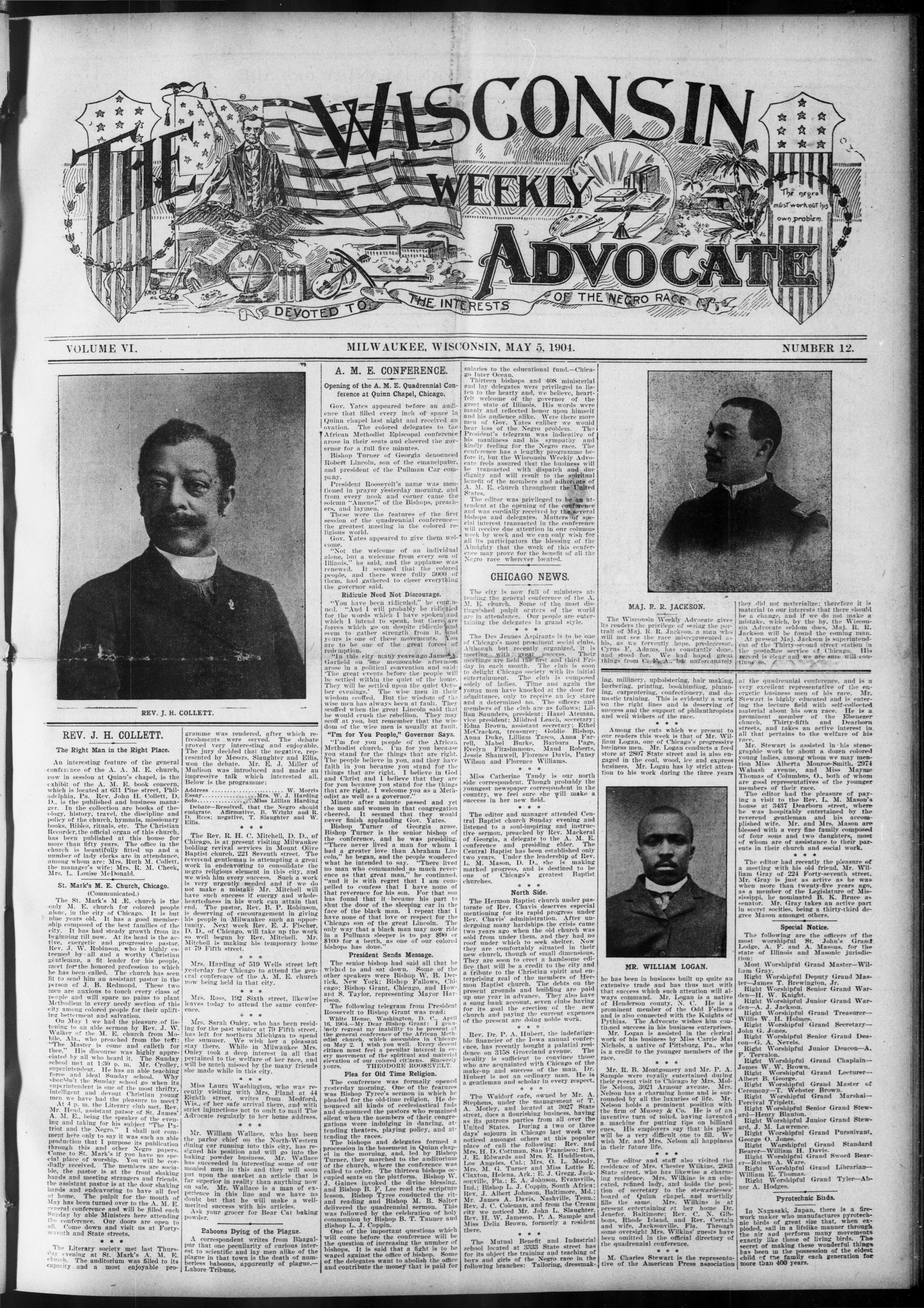
Page text (machine-generated)
WISCONSIN
WEEKLY
ADVOCATE
DEVOTED TO THE INTERESTS OF THE NEGRO RACE
REV. J. H.
REV. I. H. COLLETT.
REV. J. H. COLLETT.
The Right Man in the Right Place.
An interesting feature of the general conference of the A. A. M. E. church, now in session at Quinn's chapel, is the exhibit of the A. M. E. book concern, which is located at 631 Pine street, Philadelphia, Pa. Rev. John H. Collett, D. D., is the published and business manager. In the collection are books of theology, history, travel, the discipline and policy of the church, hymnals, missionary books, Bibles, rituals, etc. The Christian Recorder, the official organ of this church, has been published at this house for more than fifty years. The office in the church is beautifully fitted up and a number of lady clerks are in attendance, among whom are: Mrs. Ruth M. Collett, the manager's wife: Mrs. R. M. Cheek, Mrs. L. Louise McDonald.
St. Mark's M. E. Church, Chicago (Communicated.)
The St. Mark's M.E. church is the only M. E. church for colored people alone, in the city of Chicago. It is but nine years old. It has a good membership composed of the best families of the city. It has had steady growth from its beginning till now. At its head is the active, energetic and progressive pastor, Rev. J. W. Robinson, who is highly esteemed by all and a worthy Christian gentleman, a fit leader for his people, meet for the honored profession to which he has been called. The church has seen fit to send him an assistant pastor in the person of J. B. Redmond. These two men are anxious to touch every class of people and will spare no pains to plant Methodism in every needy section of this city among colored people for their uplifting betterment and salvation.
On May 1 we had the pleasure of listening to an able sermon by Rev. J. W. Walker of the M. E. church from Mobile, Ala., who preached from the text: "The Master is come and calleth for thee." His discourse was highly appreciated by all who heard it. The Sunday school met at 1:30 p. m. Mr. Crolley, superintendent. He has an able teaching force and ideal Sunday school. Why shouldn't the Sunday school go when its superintendent is one of the most thrifty, intelligent and devout Christian young men we have had the pleasure to meet? At 4 p. m. the Literary club met. Rev. Mr. Head, assistant patsor of St. James' A. M. E., being the speaker of the evening and taking for his subject "The Patriot and the Negro." I shall not comment here only to say it was such an able production that I purpose its publication through this and other Negro papers. Come to St. Mark's if you have no special place of worship. You will be cordially received. The members are sociable, the pastor is at the front shaking hands and meeting strangers and friends, the assistant pastor is at the door shaking hands and endeavoring to have all feel at home. The pulpit for the month of May has been turned over to the A. M. E. general conference and will be filled each Sunday by able Ministers here attending the conference. Our doors are open to all. Come down and visit us at Forty-seventh and State streets.
The Literary society met last Thursday evening at St. Mark's A. M. E. church. The auditorium was filled to its capacity and a most enjoyable pro-
VOLUME VI.
***
gramme was rendered, after which refreshments were served. The debate proved very interesting and enjoyable. The jury decided that the negative, represented by Messrs. Slaughter and Ellis, won the debate. Mr. E. J. Miller of Madison was introduced and made an impressive talk which interested all. Below is the programme:
Address ……. W. Morris
Essay……. Mrs. W. J. Harding
Solo……. Miss Lillian Harding
Debate-Resolved, that the Negro should emigrate. Affirmative, B. Wright and R. D. Rees; negative, T. Slaughter and W. Ellis
The Rev. R. H. C. Mitchell, D. D., of Chicago, is at present visiting Milwaukee holding revival services in Mount Olive Baptist church, 221 Seventh street. The reverend gentleman is attempting a great work in endeavoring to consolidate the negro religious element in this city, and we wish him every success. Such a work is very urgently needed and if we do not make a mistake Mr. Mitchell will have such success if energy and whole-heartedness in his work can attain that end. The pastor, Rev. B. P. Robinson, is deserving of encouragement in giving his people in Milwaukee such an opportunity. Next week Rev. E. J. Fischer, D. D., of Chicago, will take up the work so well begun by Rev. Mitchell. Mr. Mitchell is making his temporary home at 79 Fifth street.
Mrs. Harding of 519 Wells street left yesterday for Chicago to attend the general conference of the A. M. E. church now being held in that city.
* * *
Mrs. Ross, 192 Sixth street, likewise leaves today to attend the same conference.
* * *
Mrs. Sarah Onley, who has been residing for the past winter at 79 Fifth street, has left for northern Michigan to spend the summer. We wish her a pleasant stay there. While in Milwaukee Mrs. Onley took a deep interest in all that pertained to the welfare of her race, and will be much missed by the many friends she made while in this city.
Miss Laura Washington, who was recently visiting with Mrs. Pland at 44 Eighth street, writes from Medford, Wis., of her safe arrival there, and with strict injunctions not to omit to mail The Advocate regularly to her home address.
Mr. William Wallace, who has been the parlor chief on the North-Western dining car running into this city, has resigned his position and will go into the baking powder business. Mr. Wallace has succeeded in interesting some of our monied men in this and they will soon put upon the market an article that is far superior in reality than anything now on sale. Mr. Wallace is a man of experience in this line and we have no doubt but that he will make a well-merited success with his articles.
Ask your grocer for Bear Cat baking powder.
Baboons Dying of the Plague
A correspondent writes from Bhagalpur that one peculiarity of curious interest to scientific and lay men alike of the plague in that town is the death of numberless baboons, apparently of plague.—Lahore Tribune.
* * *
☆ ☆ ☆
```markdown
```
心 心 心
```markdown
```
***
A. M. E. CONFERENCE.
Opening of the A. M. E. Quadrennial Conference at Quinn Chapel, Chicago.
Gov. Yates appeared before an audience that filled every inch of space in Quinn chapel last night and received an ovation. The colored delegates to the African Methodist Episcopal conference arose in their seats and cheered the governor for a full five minutes.
Bishop Turner of Georgia denounced Robert Lincoln, son of the emancipator, and president of the Pullman Car company.
President Rooseyelt's name was mentioned in prayer yesterday morning, and from every nook and corner came the solemn "Amens!" of the Bishops, preachers, and laymen.
These were the features of the first session of the quadrennial conference—the greatest meeting in the colored religious world.
Gov. Yates appeared to give them welcome. "Not the welcome of an individual alone, but a welcome from every son of Illinois," he said, and the applause was renewed. It seemed that the colored people, and there were fully 3000 of them, had gathered to cheer everything the governor said.
Ridicule Need Not Discourage.
"You have been ridiculed," he continued. "And I will probably be ridiculed for the words which I have spoken and which I intend to speak, but there are forces which go on despite ridicule and seem to gather strength from it, and yours is one of these movements. You are to be one of the great forces of redemption
"In this city many years ago James Garfield on one memorable afternoon arose in a political convention and said: The great events before the people will be settled within the quiet of the home. They will be settled upon the quiet October evenings.' The wise men in their wisdom scoffed. But the wisdom of the wise men has always been at fault. They scoffed when the great Lincoln said that he would crush the rebellion. They may scoff at you, but remember that the wisdom of the wise men is usually at fault. "Um for You People" Governor Says.
"I'm for you people of the African Methodist church. I'm for you because you stand for the things that are right. The people believe in you, and they have faith in you because you stand for the things that are right. I believe in God and Christ and I believe that they are for you because you stand for the things that are right. I welcome you as a Methodist as well as a governor."
Minute after minute passed and yet the men and women in that congregation cheered. It seemed that they would never finish applauding Gov. Yates.
Bishop Turner of Georgia arose. Bishop Turner is the senior bishop of the conference, and he was presiding. "There never lived a man for whom I had a greater love than Abraham Lincoln," he began, and the people wondered what he intended to say. "There lived no man who commanded as much reverence as that great man," he continued, "and it is with regret that I am compelled to confess that I have none of that reverence for his son. For that son has found that it became his part to shut the door of the sleeping car in the face of the black man. I repeat that I have none of that love or respect for the Chicago son of the great Lincoln. The only way that a black man may now ride in a Pullman sleeper is to pay $90 on $100 for a berth, as one of our colored bishops has done."
President Sends Message
The senior bishop had said all that he wished to and sat down. Some of the other speakers were Bishop W. B. Derrick, New York: Bishop Fallows, Chicago: Bishop Grant, Chicago, and Howard S. Taylor, representing Mayor Harrison.
The following telegram from President Roosevelt to Bishop Grant was read:
White House, Washington, D. C., April 16, 1904.—My Dear Bishop Grant: I genuinely regreat my inability to be present at the general conference of the African Methodist church, which assembles in Chicago on May 2. I wish you well. Every decent citizen must feel a peculiar interest in every movement of the spiritual and material elevation of our colored citizens. Sincerely yours.
THEODORE ROOSEVELT.
Plea for Old Time Religion.
The conference was formally opened yesterday morning. One of the features was Bishop Tyree's sermon in which he pleaded for the old-time religion. He denounced all kinds of ecclesiastical fads and denounced the pastors who remained silent when the members of their congregations were indulging in dancing, attending theaters, playing policy, and attending the races.
The bishops and delegates formed a procession in the basement in Quinn chapel in the morning, and, led by Bishop Turner, they marched to the auditorium of the church, where the conference was called to order. The thirteen bishops occupied seats on the platform. Bishop W. J. Gaines invoked the divine blessing, and Bishop B. F. Lee read the scripture lesson. Bishop Tyree conducted the rite and reading and Bishop M. B. Salter delivered the quadrennial sermon. This was followed by the celebration of holy communion by Bishop B. T. Tanner and Bishop L. J. Coppin. One of the important questions which will come before the conference will be the question of increasing the number of bishops. It is said that a fight is to be waged against the office of bishop. Some of the delegates want to abolish the office and contribute the money that is paid for
salaries to the educational fund.—Chicago Inter Ocean. Thirteen bishops and 408 ministerial and lay delegates were privileged to listen to the hearty and, we believe, heartfelt welcome of the governor of the great state of Illinois. His words were manly and reflected honor upon himself and his audience alike. Were there more men of Gov. Yates caliber we would bear less of the Negro problem. The President's telegram was indicative of his manliness and his sympathy and kindly feeling for the Negro race. The conference has a lengthy programme before it, but the Wisconsin Weekly Advocate feels assured that the business will be transacted with dispatch and due dignity and will result to the spiritual benefit of the members and adherents of A. M. E. church throughout the United States.
The editor was privileged to be an attendant at the opening of the conference and was cordially received by the several bishops and delegates. Matters of special interest transacted in the conference will receive due attention in our columns week by week and we can only wish for all its participants the blessing of the Almighty that the work of this conference may prove for the benefit of all the Negro race wherever located.
CHICAGO NEWS.
The city is now full of ministers attending the general conference of the A. M. E. church. Some of the most distinguished pulpit orators of the world are in attendance. Our people are entertaining the delegates in grand style.
串 串
The Des Jeunes Aspirants is to be one of Chicago's most prominent social clubs. Although but recently organized, it is meeting with great success. Their meetings are held the first and third Friday in each month. The club is soon to delight Chicago society with its initial entertainment. The club is composed solely of ladies. Time and again the young men have knocked at the door for admittance, only to receive an icy stare and a determined no. The officers and members of the club are as follows: Lillian Saunders, president; Hazel Ateman, vice president; Mildred Leach, secretary; Edna Brown, assistant secretary; Ethel McCracken, treasurer; Goldie Bishop, Anna Duke, Lilliam Tasco, Anna Farrell, Mabel Burke, Barbara Page, Evelyn Fitzsimmons, Maud Roberts, Jessie Shamwell, Florence Davis, Pansy Wilson and Florence Williams.
* * *
Miss Catherine Tandy is our north side correspondent. Though probably the youngest newspaper correspondent in the country, we feel sure she will make a success in her new field.
* * *
The editor and manager attended Central Baptist church Sunday evening and listened to a soul-inspiring and instructive sermon, preached by Rev. Mackeral of Georgia, a delegate to the A. M. E. conference and presiding elder. The Central Baptist has been established only two years. Under the leadership of Rev. L. M. Mason, D. D., she is making marked progress, and is destined to be one of Chicago's greatest Baptist churches.
North Side.
The Hermon Baptist church under pastorate of Rev. Chavis deserves especial mentioning for its rapid progress under Rev. Chavis' administration. After undergoing many hardships the crisis came two years ago when the old church was sold from under them, and they had no roof under which to seek shelter. Now they are comfortably situated in their new church, though of small dimensions. They are soon to erect a handsome edifice that will be a credit to the city and a tribute to the Christian spirit and enterprising zeal of the members of Hermon Baptist church. The debts on the present grounds and building are paid up one year in advance. They also have a snug bank account, seven clubs having for its goal the erection of the new church and paying the current expenses of the present are doing noble work.
```markdown
```
Rev. Dr. P. A. Hubert, the indefatigable financier of the Iowa annual conference, has recently bought a palatial residence on 3158 Groveland avenue. The locality is sufficient to convince those who are acquainted with Chicago of the make-up and success of the man. Dr. Hubert is not an ordinary man. He is a gentleman and scholar in every respect.
```markdown
```
The Waldorf cafe, owned by Mr. A. Stephens, under the management of T. A. Motley, and located at 3027 State street, does a flourishing business, having as its patrons parties from all over the United States. During a two or three days' sojourn in Chicago last week we noticed amongst others at this popular place of call the following: Rev. and Mrs. H. D. Cottman, San Francisco; Rev. J. E. Edwards and Mrs. E. Huddleston, Los Angeles, Cal.; Mrs. O. L. Moody, Mrs. M. G. Turner and Miss Lottie E. Claxton, Helena, Ark.; E. J. Gregg, Jacksonville, Fla.; E. A. Johnson, Evansville, Ind.; Bishop L. J. Coppin, South Africa; Rev. J. Albert Johnson, Baltimore, Md.; Mr. James A. Davis, Nashville, Tenn.; Rev. J. C. Coleman, and from the Cream city we noticed Mr. John L. Slaughter, Rev. H. W. Jameson, P. A. Sample and Miss Delia Brown, formerly a resident there.
***
The Mutual Benefit and Industrial school located at 3333 State street has for its object the training and teaching of boys and girls of the Negro race in the following branches: Tailoring, dressmak-
MAJ. R. R. JACKSON
The Wisconsin Weekly Advocate gives its readers the privilege of seeing the portrait of Maj. R. R. Jackson, a man who will not see the race misrepresented as his, as we fervently hope, predecessor, Cyrus F. Adams, has constantly done, and stood for. We had hoped great things from C. F. A., but unfortunately
ing, millinery, upholstering, hair making, barbering, printing, bookbinding, plumbing, carpentering, confectionery, and domestic training. This is evidently a work on the right lines and is deserving of success and the support of philanthropists and well wishers of the race.
串串串
Among the cuts which we present to our readers this week is that of Mr. William Logan, one of Chicago's progressive business men. Mr. Logan conducts a feed store at 2087 State street and is also engaged in the coal, wood, ice and express business. Mr. Logan has by strict attention to his work during the three years
[Name]
MR. WILLIAM LOGAN. he has been in business built up quite an extensive trade and has thus met with that success which such attention will always command. Mr. Logan is a native of Henderson county, N. C. He is a prominent member of the Odd Fellows and is also connected with the Knights of Pythias. The Advocate wishes him continued success in his business enterprises. Mr. Logan is assisted in the clerical work of his business by Miss Carrie Mai Nichols, a native of Pittsburg, Pa., who is a credit to the younger members of the race.
***
Mr. R. B. Montgomery and Mr. P. A. Sample were royally entertained during their recent visit to Chicago by Mrs. Mollie Nelson, 3021 Armour avenue. Mrs. Nelson has a charming home and is surrounded by all the luxuries of life. Mr. Nelson holds a prominent position with the firm of Mussey & Co. He is of an inventive turn of mind, having invented a machine for putting tips on billiard cues. His employers say that his place will be a very difficult one to fill. We wish Mr. and Mrs. Nelson all happiness in their future life.
* * *
The editor and staff also visited the residence of Mrs. Chester Wilkins. 2963 State street, who has likewise a charming residence. Mrs. Wilkins is an educated, refined lady, and holds the position of secretary to the stewardesses' board of Quinn chapel, and worthily fills the same. Mrs. Wilkins is at present entertaining at her home Dr. Jenefer. Baltimore; Rev. C. N. Gibbons, Rhode Island, and Rev. Certain and wife, Jacksonville. Fla. Through some oversight Mrs. Wilkins' guests have been omitted in the official directory of the quadrennial conference.
M. Charles Stewart is the representative of the American Press association
they did not materialize; therefore it is material to our interests that there should be a change, and if we do not make a mistake, which, by the by, the Wisconsin Advocate seldom does, Maj. R. R. Jackson will be found the coming man. At present Maj. Jackson is superintendent of the Thirty-second street station in the postoffice service of Chicago. His record is clear and we are sure will continue so.
at the quindrennial conference, and is a very excellent representative of the energetic business men of his race. Mr. Stewart is highly educated and is entering the lecture field with self-collected material about his own race. He is a prominent member of the Ebenezer church, Thirty-fifth and Dearborn streets, and takes an active interest in all that pertains to the welfare of his race. Mr. Stewart is assisted in his stenographic work by about a dozen colored young ladies, among whom we may mention Miss Alberta Monroe-Smith, 2974 Wabash avenue, and Miss Mayme Thomas of Columbus, O., both of whom are good representatives of the younger members of their race.
The editor had the pleasure of paying a visit to the Rev. L. M. Mason's house at 3437 Dearborn street, where he was hospitably entertained by the reverend gentleman and his accomplished wife. Mr. and Mrs. Mason are blessed with a very fine family composed of four sons and two daughters, most of whom are of assistance to their parents in their church and social work.
* * *
The editor had recently the pleasure of a meeting with his old friend, Mr. William Gray of 224 Forty-seventh street. Mr. Gray is just as active as he was when more than twenty-five years ago, as a member of the Legislature of Mississippi, he nominated B. K. Bruce as senator. Mr. Gray takes an active part in secret societies, being a thirty-third degree Mason amongst others.
Special Notice
The following are the officers of the most worshipful St. John's Grand Lodge, A. F. and A. Masons, for the state of Illinois and Masonic jurisdiction:
Pyrotechnic Birds.
In Nagasaki, Japan, there is a firework maker who manufactures pyrotechnic birds of great size that, when exploded, sail in a lifelike manner through the air and perform many movements exactly like those of living birds. The secret of making these wonderful things has been in the possession of the eldest child of the family each generation for more than 400 years.
CAT CANNOT SUCK BREATH.
Old Superstition Is Upset by the Highest Medical Authorities.
Can a cat really suck the breath of a child?
We have always heard that it could. Away back in early childhood we distinctly remember of frequent warnings to look out for the cat. Do not allow the cat to get into bed with you, especially to get into bed with the baby, as it is liable to suck the baby's breath, which would cause the baby to die.
Is there any foundation for such a notion as this? We never could discover any real meaning to the belief that a cat can suck the breath of a child. Indeed, the sentence is totally unintelligible.
What is meant by sucking the breath? It may be true that the cat, attracted by the breath of a child who had recently been nursing, might attempt to interfere in some manner with the child's mouth. In young cats the impulse to nurse might be excited by the smell of the child's breath. It is barely possible that the cat might be seized with a desire to bite or to devour the child's lips or tongue, lured on by the smell of milk. We are not in a position to deny these possibilities. Maybe they are true.
But not any of these suppositions furnish a basis for the statement that the cat is liable to suck the child's breath. We have always heard this statement with a shudder of horror. It seems to convey some weird, horrible tragedy that can hardly be imagined. But it is a mere fancy, the origin of which is hard to explain.
Yet we would advise mothers to be careful about leaving the infant with a cat. We do not favor the idea of cats sleeping with children. Nor do we favor the practice of children playing with cats, handling them, mopping them around the floor, fondling them, dressing them up as dolls. It is not good for the cat. Neither cats nor dogs ought to be treated in this manner. They are all right in their place, but they are not fit for playthings.
If the superstition that a cat can suck a child's breath has operated as a preventive to mothers allowing their children to play with cats it has served a very good purpose, but such childish notions are hardly compatible with mature reflection. It is one of the old wives' fables which may have served a good purpose, but it is too ridiculous for repetition. There are other and better reasons why the cat and baby should not be left together than the vague, unintelligible fear that the cat will suck the child's breath.—Medical Talk.
WHY POPCORN POPS.
Agricultural Department Driven to a Momentous Discovery by a Rube.
Anyone careless enough to believe for a moment that the experts of the department of agriculture at Washington do not earn their salaries, should satisfy himself to the contrary by reading some of the communications received at the department from correspondents all over the country. A letter recently received from an inquiring mind in rural New York propounded the following important questions:
1. Why does popcorn pop?
2. Why doesn't ordinary corn pop like popcorn?
3. What is the composition of popcorn, and why does it differ from ordinary corn?
4. Why does popcorn pop better when thoroughly dry?
The letter was turned over to an export of the department, who retired to the seclusion of his laboratory with an ear of popcorn, a bunsen burner, a test tube and a worried look. About an hour later he returned in triumph and dictated the following to his stenographer in reply to the rural correspondent:
"1. The popping of popcorn is due to volatization of the oil contained in the kernel.
"2. Field corn does not pop as readily as popcorn pops because the outer portion of the kernel is more porous, permitting the escape of the oil as it volatizes, while in the case of popcorn a great pressure is developed in the kernel by the confined oil and the kernel is suddenly exploded and turned wrong side out.
"3. In composition popcorn differs from ordinary corn in having a larger proportion of corneous element and a great per cent, of oil.
"4. Popcorn pops more readily when dry, because when moistened the kernels are swollen, more porous and toughened and do not explode so suddenly and completely as when dry and hard."
Nothing further has been heard from the rural mind, and the general belief at the department is that he is sitting on a cracker barrel most of the time airing his scientific knowledge on the subject of corn that pops and corn that doesn't pop.
Simple Remedy for Severe Wounds
Every little while we read in the paper that some one has run a rusty nail in his hand or foot or other portion of his body and lockjaw resulted therefrom and that the patient died. If every person was aware of a perfect remedy of such wounds and would apply it, then such reports would cease. The remedy is simple, always at hand, can be applied by any one—what is better, is infallible. It is simply to smoke the wound or any wound that is bruised or inflamed, with a woolen cloth. Twenty minutes in the smoke will take the pain out of the worst case of inflammation arising from such a wound. People may sneer at this remedy as much as they please, but when they are afflicted with such wounds, let them try it.—Granite (Ore.) Gem.
Why Russia Sold Alaska
While in St. Petersburg the writer used frequently to ask why Russia had parted with Alaska, and received invariably two answers. One was that Russia desires to hold no possessions to get on which she has to cross the water, which simply means she cares to have no colonies to fortify and protect. She has no coast line of her own, and she saw that in the future, if she kept Alaska, she might have a very great one to look after. The second answer was that she forsaw in us, the United States, the predestined owners of the American continent, and parted with Alaska to us in order to keep Great Britain, the only rival that she feared in the scheme of her Oriental development, from the Pacific.-Maj. C. Creighton Webb in the Metropolitan Magazine.
Himalaya Baby's Noonday Nap.
In certain parts of the Himalaya mountains the native women have a singular way of putting their children to sleep in the middle of the day. The child is put near a stream of water, and by means of a palm leaf or a tin scoop the water is deflected so as to run over the back of the child's head. The water pouring on the child's head apparently sends it to sleep and keeps it so, while the mother proceeds with her work in the fields. No one seems ever to fear that baby may be drowned.—Chicago Journal.
The Little One's Outlcok.
Flossie is 6 years old. "Mamma." she called one day, "if I get married will I have to have a husband like pa?" "Yes." replied the mother, with an
"Yes," replied the mother, with an amused smile.
"And if I don't get married will I have to be an old maid like Aunt Kate?"
"Yes."
"Mamma"—after a pause—"it's a tough world for us women, ain't it?"—Our Dumph Animals.
A JAPANESE FAN.
A JEWEL CASE.
This is a story which will point a moral. Whether it will adorn a tale let those who read decide.
The Graefin von Bluebberin (she was an English woman who had once been on the music hall variety stage, and to her fatal beauty the Graf had fallen a too susceptible victim when a student of Rev. Bagges of Notting Hill, he afterward espousing her in lawful wedlock) stood upon the platform of the Station du Midi at Brussels, waiting to enter the express to Paris. In the corridor train, now ready to depart, her seat had already been taken, her wraps were disposed above in the rack, her jewel case was on the seat, and her maid Phoebe gazed down on her mistress out of the lowered window. That mistress, after casting a nervous glance up and down the platform, whispered now to Phoebe: "Not a sign of him; not a sign. What-
"Not a sign of him; not a sign. Whatever can have become of him?" "He's in the train somewhere. I tell you I saw him taking his ticket," replied the maid, who, having once been a trapezist who had broken her legs, and was afterward only too glad to take the place of maid to her old friend and chum De Vere Mortimer, now the Graefin von Bluebberin, did not feel called upon to testify any very great respect to her except when in public. Then she added, "Where's the Graf?" "In the buffet," her mistress replied; "he's gone to get a glass of beer."
"Feepy," a harsh, guttural voice said at this moment behind that nymph. The Graf had never quite mastered the pronunciation of our consonants, in spite of the excellent teachings of Dr. Bagges, or the beautiful accents of his wife and her friends—like herself, ancient artistes. "Feepy, what are you looking out of the finter vor? Do you want some one to steal the chewel gase?"
"No one will steal the jewel case while I'm here, Hoch Geboren," Phoebe replied, getting out the respectful mouthful with difficulty. "Trust me."
"I could have stolen it," the Graf replied. Then, pushing his hand out of the window—by pushing "Feepy" aside—he said, "Come into the drain, Yvonne; it's going to start."
Which the train did, and, being an express, flew along at twenty-five miles an hour on its way to Paris.
It did not stop at any station—though it stopped between a good many—until it reached Mons an hour or so later, as well as an hour behind time, so that the Graf had plenty of opportunity to go to the restaurant car, and, after having had two glasses of beer, one of Kuenimel, and then a coffee and brandy, to go to sleep. Meanwhile the Graefin sat in her compartment looking at the Raphael-Rossetti-Phil May pictures in the "Journal Amusant," and whispering behind its enlivening sheets to Phoebe, whom she always insisted on having in the same carriage with her.
"If he don't do it at Mons," she muttered, so that the old French lady accompanied by a soeur de Charite and an idiotic daughter should not hear, though hearing they would not have understood, "where will he do it?"
"Never fear. He'll do it right enough. There's ten minutes at Mons and twenty at the frontier place. What do they call it—Feignies? My eye! what a name. I tell you he's here. I saw him throw a whisky bottle out of a second class window, next carriage, and it hit one of the men on the line on the chest. Don't you get nervous."
"Just fancy if I'm found out! Oh! whatever shall I do?"
"Do! Fling it out yourself, or I will. We mustn't be found out."
Half an hour later the Graefin, who had traveled this road before, said to Phoebe, who was also well acquainted with the route, owing to their frequent visits to Germany to the Graf's more or less dilapidated Schloss. "There's Mons, I do hope Bill's ready. Mind and be ready with the bag."
"You bet," said Phoebe.
Now at Mons the French lady and the soeur de Charite, and, of course, the imbecile, began shuffling about in the way, which makes our fellow travelers so happy, since the performance is a sign we are going to leave them in full possession of a carriage to themselves; and at that ancient city out they went, being met by two priests on the platform.
Then Phoebe let the window down again, and sat with her arm on the jewel case—which was poised on the mahogany frame of the lowered sash—in a watchful manner over it. "Here comes Bill," she said to her mistress. "Oh, I say, he do look bad. I expect he's got another bottle of whisky in that compartment."
Then she suddenly exclaimed, "Oh bother!" or something that didn't sound very much like it. For just as a man, dressed more or less like a respectable traveling servant, approached the outside of the carriage and, you might have said, had you been there, was about to take the bag from Phoebe's hands—since, as we all know, neither faquins nor servants may enter corridor carriages—the Graf's voice was heard at the door of the compartment, saying, "There, now, Feepy. There's the pag on the finter, just as if you wanted some one to steal it. Oh, you are a careless girl."
"It's all right, Hoch Geboren," Phoebe said. "No one will steal it from me." "Put it on the vloor, and put your veet on it," the Graf said. "I wonder at you, you Yvonne. I do, indeed; when you know it's got two tousand pounds of chouwelery in it, too." "I'm looking after it. You go and have a little sleepy by-bye till we get to the custom house." "Ja wohl! A little sleepy py-pie. I will. Only do be careful. Friedrich der Grosse gave the chewels to my great-grandmother, because, he said, she was such a good woman. Achieu till we get to the vrontier," and he went off to the restaurant car again.
"Now we must get rid of it," Yvonne (christened Mary Ann) said to her old sister-in-arms and present maid, as once more the train rushed off on its wild career, "even though we throw it out of the window. Don't we cross a river somewhere about here. Phoebe?" "It's no good if we do. If we drop it on the line, it will be found—there's the coronet and the name on it—and if you chuck it in the river it will float, as there's nothing in it. Leave it to Bill. He would eat it sooner than have it found."
"Ah!" groaned Yvonne, "nothing in it. Oh! whatever shall I do if he ever knows? It must be lost or stolen and never found again, in spite of the reward Hildebrand will offer." Hilde-
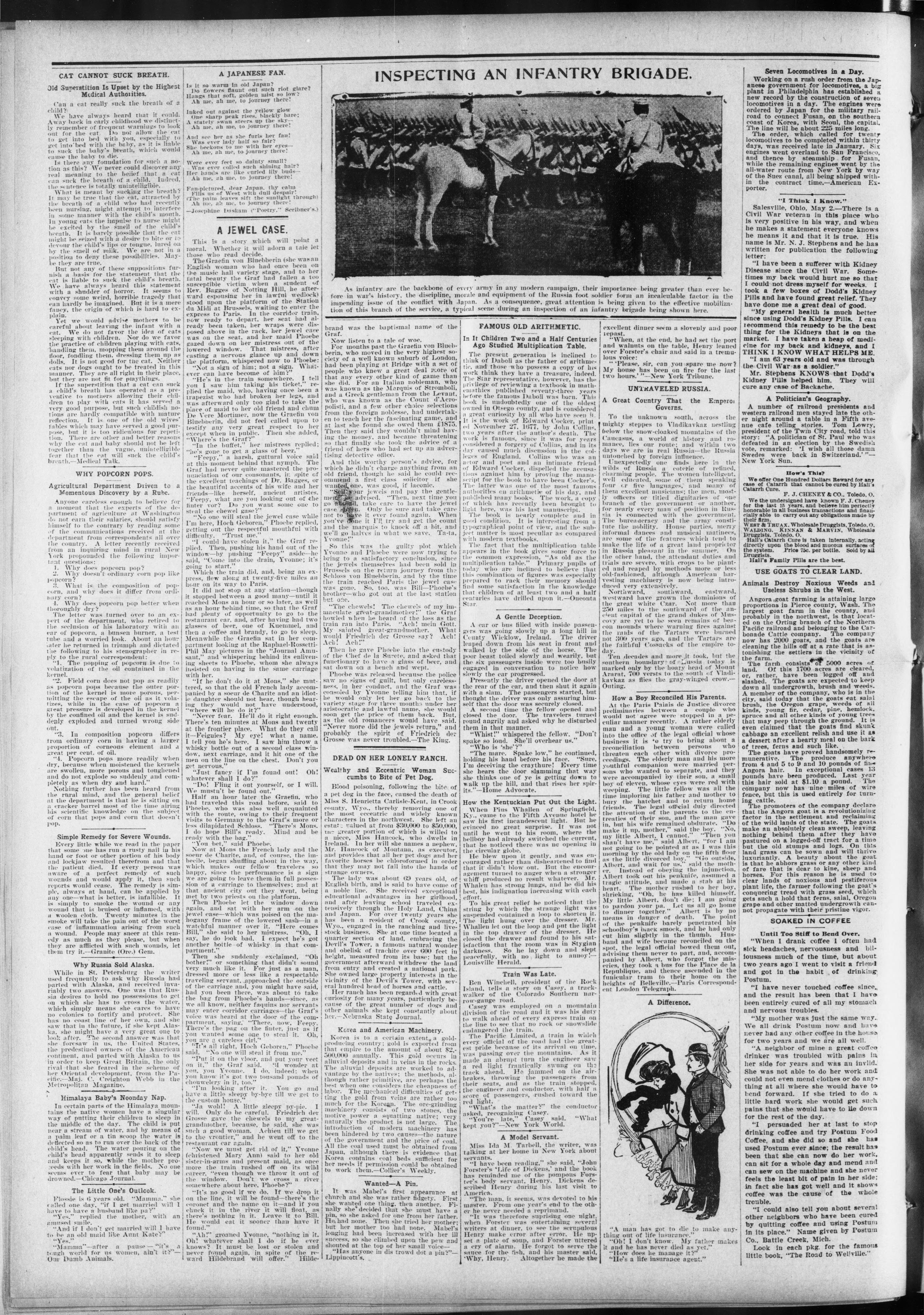
INSPECTING AN INFANTRY BRIGADE.
THE MARATHON
As infantry are the backbone of every army in any modern campaign, their importance being greater than ever before in war's history, the discipline, morale and equipment of the Russia foot soldier form an incalculable factor in the impending issue of the conflict with Japan. As a consequence, great attention is being given to the effective mobilization of this branch of the service, a typical scene during an inspection of an infantry brigade being shown here.
brand was the baptismal name of the Graf.
Now listen to a tale of woe.
Now listen to a tale of woe.
For months past the Graefin von Blueberin, who moved in the very highest society of a well known suburb of London, had been playing at Bridge with a set of people who knew a great deal more of that any other other kind of game than she did. For an Italian nobleman, who was known as the Marquis of Stromboli, and a Greek gentleman from the Levant, who was known as the Count d'Acropolisti, and a few other choice selections from the foreign noblesse, had undertaken to teach her the fascinating game, and at last she found she owed them £1875. Then they said they wouldn't mind having the money, and became threatening so that finally she took the advice of a friend of hers who had set up an advertising detective office.
And this worthy person's advice, for which he didn't charge anything from an old friend, though he said he could recommend a first class solicitor if she wanted one, was good, if laconic.
"Sell your jewels and pay the gentlemen, he advised. "Then, next time you go abroad, take care to have the jewel case stolen. Only be sure and take care not to have it ever found again. When you've done it I'll try and get the count and the marquis to knock off a bit, and we'll go halves in what we save. Ta-ta, Yvonne"
So this was the guilty plot which Yvonne and Phoebe were now trying to bring to a satisfactory conclusion, since the jewels themselves had been sold in Brussels on the return journey from the Schloss von Blueberin, and by the time the train reached Paris the jewel case was gone. So, too, was Bill—Phoebe's brother—who got out at the last station but one.
"The chewels! The chewels of my immaculate great-grandmother!" the Graf howled when he heard of the loss as the train ran into Paris. "Ach! mein Gott. My sainted great-grandmother. What would Friedrich der Grosse say? Ach! Ach! Ach!"
Then he gave Phoebe into the custody of the Chef de la Surete, and asked that functionary to have a glass of beer, and sat down on a bench and wept.
Phoebe was released because the police saw no signs of guilt, but only carelessness, in her conduct, and the Graf was consoled by Yvonne telling him that, if he would only let her go back to the variety stage for three months under her aristocratic and lawful name, she would soon get the price of them back. But, as the old romancers would have said, "Never more did the jewels return," and probably the spirit of Friedrich der Grosse was never troubled.—The King.
DEAD ON HER LONELY RANCH.
Wealthy and Eccentric Woman Succumbs to Bite of Pet Dog.
Blood poisoning, following the bite of a pet dog in the face, caused the death of Miss S. Henrietta Carlisle-Kent, in Crook county, Wyo., thereby removing one of the most eccentric and widely known characters in the northwest. She left an estate valued at from $30,000 to $50,000, the greater portion of which is willed to a niece, Miss Hancock, who dwells in Ireland. In her will she names a nephew, Mr. Hancock of Montana, as executor, and provides that all her pet dogs and her favorite horses be chloroformed in order that they may not fall into the hands of strange owners.
The lady was about 60 years old, of English birth, and is said to have come of a noble line. She received exceptional educational advantages in her girlhood, and after leaving school traveled extensively through the Holy Land, China and Japan. For over twenty years she has been a resident of Crook county, Wyo., engaged in the ranching and livestock business. She at one time located a quarter section of land, embracing the Devil's Tower, a famous natural wonder and obelisk of trachite over 600 feet in height, measured from its base; but the government afterward withdrew the land from entry and created a national park. She owned large property interests in the vicinity of the Devil's Tower, with several hundred head of horses and cattle.
Her ranch has been regarded with great curiosity for many years, particularly because of the great number of dogs and other animals she kept constantly about her.-Nebraska State Journal.
Korea and American Machinery
Korea is to a certain extent, a gold-producing country; gold is exported from that empire to the amount of about $2,500,000 annually. This gold occurs in alluvial deposits and in veins in the rocks. The alluvial deposits are worked to advantage by the natives; the methods, although rather primitive, are perhaps the best when one considers the cheapness of labor. The mechanical difficulties of getting the gold from veins are rather too much for the Korean. The ore-grinding machinery consists of two stones, the motive power a squatting native; very naturally the product is not large. The introduction of modern machinery has been hindered by two causes—the nature of the government and the price of coal. All the coal used must be obtained from Japan, although there is evidence that Korea contains coal beds sufficient for her needs if permission could be obtained to work them.—Collier's Weekly.
Wanted—A Pin.
It was Mabel's first appearance at church and she was rather fidgety. First she wanted one thing, then another. Finally she decided that she must have a pin, so she asked for one from her father. He had none. Then she tried her mother; but her mother too had none. Mabel's longing had been increased with her ill success, so she climbed upon the pew and shouted at the top of her small voice—"Has anyone in dis trowd dot a pin?"—Lippincott's.
FAMOUS OLD ARITHMETIC
In It Children Two and a Half Centuries Ago Studied Multiplication Table
The present generation is inclined to think of Daboll as the father of arithmetic, and those who possess a copy of his work think they have a treasure, indeed. The Star representative, however, has the privilege of reviewing a textbook in mathematics published seventy-three years before the famous Daboll was born. This book is undoubtedly one of the oldest owned in Otsego county, and is considered a great curiosity by all who have seen it. It is the work of Edward Cocker, printed November 27, 1677, by John Collins, two years after the author's death. The work is famous, since it was for years considered a forgery of Collins, and in its day caused much discussion in the colleges of England. Collins who was an actor and poet and an intimate friend of Edward Cocker, dispelled the accusations against him by proving the manuscript for the book to have been Cocker's. The latter was one of the most famous authorities on arithmetic of his day, and published many books. The work, a copy of which has recently been brought to light here, was his last manuscript.
The book is nearly complete and in good condition. It is interesting from a typographical point of view, and the subject matter is most peculiar as compared with modern textbooks.
The fact that the multiplication table appears in the book gives some force to the common expression, "As old as the multiplication table." Primary pupils of today who are inclined to believe that this combination of figures was especially prepared to rack their memory should find some satisfaction in the knowledge that children of at least two and a half centuries have drilled upon it.—Oneonta Star.
A Gentle Deception.
A car or bus filled with inside passengers was going slowly up a long hill in County Wicklow, Ireland. The driver leaped down from his seat in front and walked by the side of the horse. The poor beast toiled slowly and wearily, but the six passengers inside were too busily engaged in conversation to notice how slowly the car progressed.
Presently the driver opened the door at the rear of the car, and then shut it again with a slam. The passengers started, but thought the driver was only assuring himself that the door was securely closed.
A second time the fellow opened and closed the door. The travelers turned round angrily and asked why he disturbed them in that manner.
"Whist!" whispered the fellow. "Don't spake so loud. She'll overhear us."
"Who is that?"
"The mare. Spake low." he continued, holding his hand before his face. "Sure, I'm deceiving the craythure! Every time she hears the door slamming that way she thinks one of ye is getting down to walk up the hill, and that rises her spirits."—Home Advocate.
How the Kentuckian Put Out the Light.
When Plus Whallen of Springfield, Ky., came to the Fifth Avenue hotel he saw his first incandescent light. But he evinced no great surprise. It was not until he went to his room, where the bellboy had already switched the current, that he noticed there was no opening in the circular globe. He blew upon it gently, and was encouraged rather than disheartened to find that it didn't blow out. But the encouragement turned to anger when a stronger whiff produced no result whatever. Mr. Whalen has strong lungs, and he did his best, his indignation increasing with each effort.
To his great relief he noticed that the string by which the strange light was suspended contained a loop to shorten it. The light hung over the dresser. Mr. Whallen let out the loop and put the light in the top drawer of the dresser. He closed the drawer and found to his satisfaction that the room was in Stygian darkness. So he lay down and slept peacefully, with no light to annoy!— Louisville Herald.
Train Was Late.
Ben Winchell, president of the Rock Island, tells a story on Casey, a trackwalker of the Colorado Southern narrow-gauge road. Casey was employed on a mountain division of the road and it was his duty to walk ahead of every express train on the line to see that no rock or snowslide endangered the train.
The Pacific Limited, a train in which every official of the road had the greatest pride because of its arrival on time, was passing over the mountains. As it made an abrupt turn the engineer saw a red light frantically swung on the track ahead. He jammed on the airbrakes, throwing the passengers from their seats, and as the train stopped, the engineer and conductor, with half a score of passengers, rushed toward the red light.
"What's the matter?" the conductor asked, recognizing Casey. "You're late," Casey said. "What kept you?"—New York World.
A. Model Servant.
Miss Ida M. Tarbell, the writer, was talking at her home in New York about servants.
"I have been reading," she said, "John Forster's 'Life of Dickens,' and the book has reminded me of the pompous Forster's body servant. Henry. Dickens described Henry during his last visit to America.
"The man, it seems, was devoted to his master. From one year's end to the other he never needed a reprimand. "It was therefore suprising one night, when Forster was entertaining several writers at dinner, to see the scrupulous Henry make error after error. He upset a plate of soup, and Forster uttered a cry of alarm. He forgot to serve the sauce for the fish, and his master said, Why, Henry. Altogether he made the
excellent dinner seem a slovenly and poor reapst.
"When, at the end, he had set the port and walnuts on the table, Henry leaned over Forster's chair and said in a tremulous voice:
"'Please, sir, can you spare me now? My house has been on fire for the last two hours.'"—New York Tribune.
UNTRAVELED RUSSIA.
A Great Country That the Emperor Governs
To the unknown south, across the mighty steppes to Vladikavkaz nestling below the snow-cloaked mountains of the Caucasus, a world of history and romance, lies our route; and within two days we are in real Russia—the Russia untouched by foreign influence.
Unexpectedly one finds here in the wilds of Russia a coterie of refined, charming people. The women intelligent, well educated, some of them speaking four or five languages, and many of them excellent musicians; the men, mostly officers or titled dignitaries of one branch of the government or another, for nearly every man of position in Russia is connected with the government. The bureaucracy and the army constitute the nobility. House parties, merry informal dances and musical matinees, are some of the features which tend to make the life of a great land proprietor in Russia pleasant in the summer. On the other hand, the attendant duties and trials are severe, with crops to be planted and reaped by methods more or less old-fashioned, although American harvesting machinery is now being introduced very extensively.
Northward, southward, eastward, westward have grown the dominions of the great white Czar. Not more than 250 miles to the southward of the ancient capital of the grand dukes of Muscovy are yet to be seen remains of beacon mounds where warning fires against the raids of the Tartars were burned not 300 years ago, and the Tartars are the faithful Cossacks of the empire today.
Ten decades and more it took, but the southern boundary of Russia today is marked only by the hoary head of Mount Ararat, 700 versts to the south of Vladikavkaz as flies the gray-winged crow.— Outing.
How a Boy Reconciled His Parents
At the Paris Paiais de Justice divorce preliminaries between a couple who would not agree were stopped in a peculiar manner recently. A rather elderly man and a young woman were called into the office of the legal official whose business it is to try to bring about a reconciliation between persons who threaten each other with divorce proceedings. The elderly man and his more youthful companion were married persons who wanted to separate, and they were accompanied by their son, a small boy of eleven, whose eyes were red with weeping. The little fellow was all the time imploring his father and mother to bury the hatchet and to return home friends. The legal official duly directed the attention of the parents to the entreaties of their son, and the man gave in, but his wife remained obdurate. "Do make it up, mother," said the boy. "No, my little Albert, I cannot." "Then you haven't have me," said Albert. "for I am not going to be pointed at as I was this morning by the old lady on the fifth floor as the little divorced boy." "Go outside, Albert, and wait for us," said the mother. Instead of obeying the injunction, Albert took out his penknife, assumed a tragic attitude, and made a stab at his heart. The mother rushed to her boy, shrieking, "Oh, he has killed himself. My little Albert, don't die; I am going to pardon your pa. Let us all go home to dinner together." Albert is by no means in danger of death. The point of the penknife barely penetrated his schoolboy's black smock, and he had only cut him slightly in the thumb. Husband and wife became reconciled on the spot, the legal official bowed them out, advising them never to part, and, accompanied by Albert, who forgot the miseries, they took a bus for the Place de la Republique, and thence ascended in the funicular tram to their home on the heights of Belleville.—Paris Correspondent London Telegraph.
A Difference.
"A man has got to die to make anything out of life insurance."
"Oh! I don't know. My father makes it and he has never died as yet."
"How does he manage it?"
"He's a life insurance agent."
Seven Locomotives in a Day.
Working on a rush order from the Japanese government for locomotives, a big plant in Philadelphia has established a new record by the construction of seven locomotives in a day. The engines were ordered by Japan for the military railroad to connect Fusan, on the southern coast of Korea, with Seoul, the capital. The line will be about 225 miles long. The order, which called for twenty locomotives to be completed within thirty days, was received late in January. Six engines went overland to San Francisco, and thence by steamship for Fusan, while the remaining engines went by the all-water route from New York by way of the Suez canal, all being shipped within the contract time.—American Exporter.
"I Think I Know."
Salesville, Ohio, May 2.—There is a Civil War veteran in this place who is very positive in his way, and when he makes a statement everyone knows he means it and that it is true. His name is Mr. N. J. Stephens and he has written for publication the following letter:
"I have been a sufferer with Kidney Disease since the Civil War. Sometimes my back would hurt me so that I could not dress myself for weeks. I took a few boxes of Dodd's Kidney Pills and have found great relief. They have done me a great deal of good.
"My general health is much better since using Dodd's Kidney Pills. I can recommend this remedy to be the best thing for the Kidneys that is on the market. I have taken a heap of medicine for my back and kidneys, and I THINK I KNOW WHAT HELPS ME.
"I am 63 years old and was through the Civil War as a soldier." Mr. Stephens KNOWS that Dodd's Kidney Pills helped him. They will cure any case of Backache.
A Politician's Geography.
A number of railroad presidents and western railroad men stayed late the other night around a table in a Fifth avenue cafe telling stories. Tom Lowry, president of the Twin City road, told this story: "A politician of St. Paul who was defeated in an election by the Swedish vote, remarked: 'I wish all those damn Swedes were back in Switzerland.'"—New York Sun.
How's This?
We offer One Hundred Dollars Reward for any case of Catarrh that cannot be cured by Hall's Catarrh Cure.
F. J. CHENEY & CO., Toledo, O.
We the undersigned have known F. J. Cheney for the last 15 years, and believe him perfectly honorable in all business transactions and financially able to carry out any obligations made by their firm.
WEST & TRUAX. Wholesale Druggists, Toledo, O.
WALDING. KINNAN & MARVIN. Wholesale Druggists, Toledo, O.
Hall's Catarrh Cure is taken internally, acting directly upon the blood and mucous surfaces of the system. Price 75c. per bottle. Sold by all Druggists.
Hall's Family Pills are the best.
USE GOATS TO CLEAR LAND
Animals Destroy Noxious Weeds and Useless Shrubs in the West.
Angora goat farming is attaining large proportions in Pierce county, Wash. The largest goat farm in the county, and probably in the northwest, is that located on the Orting branch of the Northern Pacific railroad and belonging to the Carbonade Cattle company. The company now has 2000 goats, and the goats are cleaning the hills off at a rate that is astonishing the settlers in the vicinity of the farm.
The farm consists of 5000 acres of land. Of this 1700 acres are cleared, or, rather, have been logged off and slashed. The goats are expected to keep down all undergrowth, brush and weeds. A member of the company, who is in the city, said today that the goats eat salal brush, the Oregon grape, weeds of all kinds, young fir, cedar, pine, hemlock, spruce and all other kinds of young trees that may peep through the ground. It is even claimed that the goats find skunk cabbage an excellent relish and use it as a dessert after a hearty meal on the bark of trees, ferns and such like.
The goats have proved handsomely remunerative. The produce anywhere from 4 and 5 to 9 and 10 pounds of fine Angora hair. In exceptional cases 13 pounds have been produced. Last year this hair sold at $1.10 a pound. The company now has nine miles of wire fence, but this is used entirely for turning cattle.
The promoters of the company declare that the Angora goat is a revolutionizing factor in the settlement and reclaiming of the wild lands of the state. The goats make an absolutely clean sweep, leaving nothing behind them after they have pastured on a logged-off tract for a time but the old stumps and logs. On this land grass can be sown and will thrive luxuriantly. A beauty about the goat is that he abhors grass or any other kind of fare that is dear to kine, sheep and horses. For this reason he is used to clear lands of noxious and pestiferous plant life, the farmer following the goat's conquering tread with grass seed, which gets such a hold that ferns, salal, Oregon grape and other matted undergrowth cannot propagate with their pristine vigor.
SOAKED IN COFFEE
Until Too Stiff to Bend Over.
"When I drank coffee I often had sick headaches, nervousness and billiousness much of the time, but about two years ago I went to visit a friend and got in the habit of drinking Postum.
"I have never touched coffee since, and the result has been that I have been entirely cured of all my stomach and nervous troubles.
"My mother was just the same way. We all drink Postum now and have never had any other coffee in the house for two years and we are all well.
"A neighbor of mine a great coffee drinker was troubled with pains in her side for years and was an invlid. She was not able to do her work and could not even mend clothes or do anything at all where she would have to bend forward. If she tried to do a little hard work she would get such pains that she would have to lie down for the rest of the day.
"I persuaded her at last to stop drinking coffee and try Postum Food Coffee, and she did so and she has used Postum ever since; the result has been that she can now do her work, can sit for a whole day and mend and can sew on the machine and she never feels the least bit of pain in her side; in fact she has got well and it shows coffee was the cause of the whole trouble.
"I could also tell you about several other neighbors who have been cured by quitting coffee and using Postum in its place." Name given by Postum Co. Battle Creek, Mich.
Look in each pkg. for the famous little book. "The Road to Wellville."
GOSSIP FOR THE LADIES.
EMPRESS OF JAPAN.
The Empress of Japan is now 54 years old, a year older than her husband. She is a daughter of the noble house of Ichigo, one of the fine families of Kuge, or court personages from which a Mikado may choose his consort.
A. Debutante.
A puff, a frill, a bit of lace.
A patch of powder on the face.
A rounded arm, a slender neck.
White shoulders without flaw or fleck,
And—nothing more.
A row of teeth, an infant smile,
A glance quite innocent of guile.
A little head well packed with lore
Of nounce, fienn and proper gore,
And—nothing more.
A knowledge that the world is round.
Some dim idea of "time" and "sound."
A phrase or two of French, you know.
Enough "rag-time" to make a show,
And—nothing more.
A sweet contempt for old-time ways,
For classic bards or modern lays,
A constancy much like the wind.
But seant regard for men who grind,
And—nothing more.
A mannerism not too bold,
A deep idolatry of gold,
A high resolve to play no part
Where one surrenders to the heart,
And—nothing more.
A puff, a frill, a bit of lace,
A patch of powder on the face,
A soul in which small interests lie—
A simple social butterfly,
And—nothing more.
The Friendship Scrap Book
How often you discover in the papers and other periodicals a bit of news, with or without illustrations, concerning some friend or acquaintance.
Your young neighbor, who has been studying art for the past three years, has had a picture accepted for the art exhibition.
Or old Mr. X. has attained his ninetieth birthday, and his photograph with biographical sketch is published.
Or the pretty daughter of a cousin is married, or the great novelist you met two years ago at a reception has written a new book, a review of which is printed.
These items of personal interest can be used as the basis of a most delightful scrap book—a book that will increase in interest with every year that passes.
No time is required to clip and paste the little news items which one discovers from day to day. If leisure is limited an ordinary stiff-backed scrap book can be used for the purpose.—Selected.
Cheerful Mothers.
There are many concientious fathers and mothers who make their children miserable by taking youthful foibles too seriously. It is an innate propensity of a child possessed of average good health and spirits to make older people laugh with him; not at him, but at the things that seem amusing to his own sense. And the mother who has the blithe and ready humor to enter into his fun becomes the most fascinating companion.
He heeds her rebukes and bends to her correction without ill feeling, while sternness would arouse his pride and ire, for he is assured that she is ready to share all his innocent pranks, and that her disapproval has no foundation in impatience or injustice.
And when the day arrives that "childish things are put away," and the grown men and women look backward to their early home, with what a throb of pleasure they say, when things happen: "Mother would appreciate this; she had the quickest sense of humor of any woman you ever saw!" And underneath these light words is the thought, "How happy that dear mother made me, and how I love her!"—Minneapolis Tribune.
St. Louis Bag for Travelers.
The nearness of the traveling season, coupled with the fact that we have a world's fair to go to this spring, makes the subject of handbags one of especial interest just now.
For the average woman there are two points of especial importance in the matter of a handbag. It must be lightweight, and, if possible, inexpensive. The pleasure of traveling is entirely gone for a woman if she must carry about with her a heavy bag, no matter how stylish and convenient it may be.
Well, all this difficulty can be avoided if you will take the trouble to make for yourself one of the new "St. Louis handbags." They are very inexpensive, not at all hard to make. They weigh but a few ounces and are distinctly smart and individual in effect.
Get striped linen, tan with wide brown or black stripes, cut a strip two feet wide by four long, line with stout crash and bind the edges with brown or black cotton braid. Before binding, machine stitch dark brown velvet or satin ribbon or braid over the stripes of linen, so as to make a trimming of two clusters of three bands each.
Where the binding is put on, feather stitch the outside with yellow wash silk. The handle is stout rope, covered with linen or braid, and fastened on after the bag is lined, for extra security.
Of course, where anything very heavy is carried, it is a good idea to use a
shawl strap. These bags make charming gifts to women who are going to St. Louis this spring, or in fact for women who intend to do any traveling at all this season. They are also made of brown taffeta, trimmed with brown velvet bands, of gray linen trimmed with scarfet and black, and of all linen color with braid the same shade. They are so light that a child can carry one, and yet they are new enough and pretty enough to add an appearance of smartness to a traveling outfit.—New York News.
How to Dress Well.
Study your figure, coloring, height, etc., so that you know not only your good points, but your defects. From the standpoint of common sense you will realize that certain lines and colors are not possible for your use, while others must be in evidence in any gown you select as a model. If one or two costumes or hats have been particularly becoming, or specially suited to you, think out what were the points about those creations that made them so successful, and when you have found them you have some of the essential elements adapted to your personality.
Vary the effect in as many ways as possible, but always insist on the basic principles that make the habit suit you as an individual. That is the secret of distinction in dress, which is what is meant when we use the word "style." The woman who selects a model in the prevailing mode and adapts it, with certain differences, to her own special requirements, has arrived at the secret of success in dress, and whether her allowance is great or small, will be, to its limit well gowned.
Variety of effect with economy is secured by a carefully chosen, definite color scheme, limited in range, and this is particularly adapted to the present vogue for monotones and shadings of one tint. A clever woman who manages to look 35, though nearer 50, confines her gowning to black, white and gray for the body color, with delicate contrasts in trimmings and accessories. She is not in half mourning. She has silk undersuits, waist and drop skirt, in black, white and gray taffeta, buying always one of the better brands of pure silk guaranteed by the maker for service, and she has all the gowns constructed so that they will hang properly over any of these lining under dresses. They are, of course, renewed from time to time, so that she has always best and second best linings, and can adapt them to the wear that is suitable. The changes that are possible and the variety of effect she attains obtain for this woman the reputation of great elegance in dress. Only a few of her friends know the secret and how limited is the figure that covers her dress account.—Toilettes.
Social Thieves
Fashionable stores are heavy sufferers from this lack of honesty among society women, and many merchants "could, and they would," tell a tale of woe. Women scrupulously honest in all else do not hesitate to have goods sent home on approval from the stores at which they keep a bill, to make more or less use of such articles, and then to return them to be credited. "What possible harm can it do?" I have heard such women say. "The goods are not injured, if they were I would keep them, of course; besides we spend so much money at Meadows' that they ought to be willing to accommodate me." Nor is this a conscious sophism; they actually take that view of the case. The head of the suit department in one of the most fashionable of American dry goods stores once told me the story of how he got the best of such a customer.
"Over and over again, just before some swell entertainment to which she was going, she would order something, an imported hat, a handsome wrap, or some smaller article not easily injured, a fan, a belt buckle, a hair ornament, or the like, sent home on approval, and return it a day or two afterward, saying, merely, that she had decided not to keep it. I knew she wore the things, but I had no proof. It is a serious matter to make charges, even when the evidence is absolute, when it is not, the act is foolish. At last, we had an imported gown which she fancied mightily, and no wonder; the color was becoming to her, and the style and trimmings suited her face and figure as well as if designed for her. The day before the charity ball she asked us to send the gown home, so that her husband might see it before she decided to buy it. I had my misgivings, but the gown was sent, and I took my precautions. Our Mr. Ceay was one of the ball managers, and I got a ticket from him for myself and our forewoman, you know what a perfect lady Miss Sewall is, telling him that I thought it would pay the house to have us see the dresses. We didn't go on the floor, but we had good seats upstairs, and I have an excellent opera glass. Sure enough, there was my lady, in the grand march, wearing the Paris gown, and look-
ing handsome and complacent. Two days after the ball back came the gown. There was no message, of which I was glad, it made my plan of action easier. It was some days before she came to the store. I went forward as soon as I saw her. "When do you want an appointment?" I asked. "Appointment? I haven't asked for an appointment." "Why, wasn't your Paris gown sent back to be altered? Miss Sewall and I were at the ball, and saw you in it. We agreed that it was a great success. I never saw you look better, still it may be a little too long just in front, we noticed you had to hold it up." She turned so pale that I feared she was going to faint, and gave a little gasp, but recovered herself immediately, taking her dose like a soldier.
"Why, of course, how absent-minded I am. I don't suppose you can give me tomorrow, and I have too much on hand for the next day. May I have 11 o'clock the day after?"
I never saw Mr. Ceay laugh as he did when I told him the story.
"You were right, H.," he said, "that ball ticket was certainly well worth the money. And I think myself that I managed the affair very neatly."—The Pilgrim.
The Needy Schoolma'am.
Our present laws against the marriage of school teachers—no, I am too sweeping—against the marriage of women school teachers, on pain of official decapitation, are historically amusing. We shall laugh at them, a few years hence, as we now laugh at the sumptuary laws of the past. For instance, the worthy Zaleucus, 450 B. C., ordained "that no woman should appear in the street attended by more than one maid servant—unless she were drunk;" Edward III. of England strove to keep his subjects down to a menu of two courses only; and our own more recent forefathers in New England prohibited such personal decorations as they chose to consider too expensive for common citizens.
Why should not a school teacher have a husband, if she chooses? The married state does not detract from the ability of an educator. Indeed, as all teaching originated in motherhood, and as that experience is understood to have a widening and ennobling influence, it is hard to see why school children should be debarred from the advantageous society of the married teacher with her calm happiness, or of the mother-teacher, with her new depths of love.
Are any instances given of a falling off in efficiency of teachers after marriage? Is it claimed that a happy wife cannot give as much attention to her work as a hopeful damsel or a resigned spinster?
Not at all!
The contention is that the teacher who marries has got another job, and should give up her former position to one who needs it more than she does.
It has been wisely and conclusively answered that the married woman who elects to continue her school work does so either because of especial devotion to that work or because she continues to need the salary. So the upholders of spinster schoolma'ams are caught on either horn of the dilemma-if the married teacher wants to teach because of especial interest in the work, she has a right to it on the ground of fitness; if she wants to teach because "she needs the money," she has a right to it on grounds of necessity. The essential error in the whole discussion lies in our common misuse of the term "need," which implies that the schools of our country are maintained at great public expense for the purpose of providing food and clothing to a number of single women. A school is an institution for the education of children, and all its processes and standards are to be judged and measured as they conduce to that end.
If a woman is a good schoolteacher—though married to a millionaire—we have as much need of her service as we should have if her husband should die and take his fortune with him, or if she should be dependent on her salary for bread.
What the woman does with her money is no concern of the school board. Whether she "needs" it or not is no business of theirs.
The child needs the good teacher, and that is the only question of "need" which belongs to this subject.
It is the business of the school system to select, develop and secure the best possible teachers; not to constitute itself an arbitrary court to condemn our children to an endless succession of inexperienced girl-teachers, who only do the work for pay, and drop it as soon as they get a better situation.
The public school is not a young woman's financial aid society, nor an old ladies' home.—Charlotte Perkins Gilman in Success.
Rugs and Hardwood Floors.
Many women have the mistaken idea that hardwood floors are difficult to keep clean, and they sweep and scour and sew carpet all their lives, with a notion that by so doing they are saving themselves work. But if they knew how to stain floors in the first place and to take care of them in the second they could save themselves work every day of their lives, lessen the burden of housecleaning about one-half and have their homes infinitely more wholesome and hyginically clean.
Nothing is so productive of moths and germs as carpets, fitting up close and snug to the side wails, and a thorough cleansing once of year rarely cleans them out. A year will furnish a generation of germs, and effectual germ destroyers sometimes destroy carpet along with its inhabitants.
Rugs, of course, can be cleaned once a week easily, and during the week any single rug that has wantonly acquired soil can be brushed off or shaken by itself without disturbing the rest of the room for a second. Light weight rugs of ingrain filling a housekeeper can shake herself, and have her rooms freshly clean without help or assistance.
Almost any floor, even the old-fashioned wide plank floor, can be made to look effective if properly stained. In the first place, scrub it thoroughly with hot borax suds, then, when perfectly dry, cover it with the following preparation: Four ounces of gum shellac, one ounce of gum mastic, one ounce of gum benzoin. Dissolve well before using, and add a little umber of sienna stain if you want the floor dark.
When it is necessary to wash the floor, do not use soap: just wipe it up with a mop dipped in warm borax water, a teaspoonful of borax to a gallon of water, and, after it is dry, oil it with crude oil and kerosene. Cleaning in this way leaves a floor looking as though it had just been stained. It will not be necessary actually to wash a floor thoroughly more than once a month. It should be oiled, though, once a week. Other mornings, if it is dusty, go over it hastily with a dry mop.
Always clean hardwood floors with a mop. It is absurd waste of time and strength to clean floors on one's knees, and there are few household tasks so exhausting, undignified and unnecessary. The floor can be easily oiled with a mop or a broom covered with a stretch of canton flannel pinned on securely. It is quick work done in this way, and no strain on the knees or back.
It is a fact that if all housework is done standing erect it is actually good exercise for women in normal health. Sweeping is excellent exercise for the chest, arms and waist, and so is mopping. Dishwashing is healthful rather than tiresome, if women could only insist upon tables and sinks so high that they would not have to bend an inch.
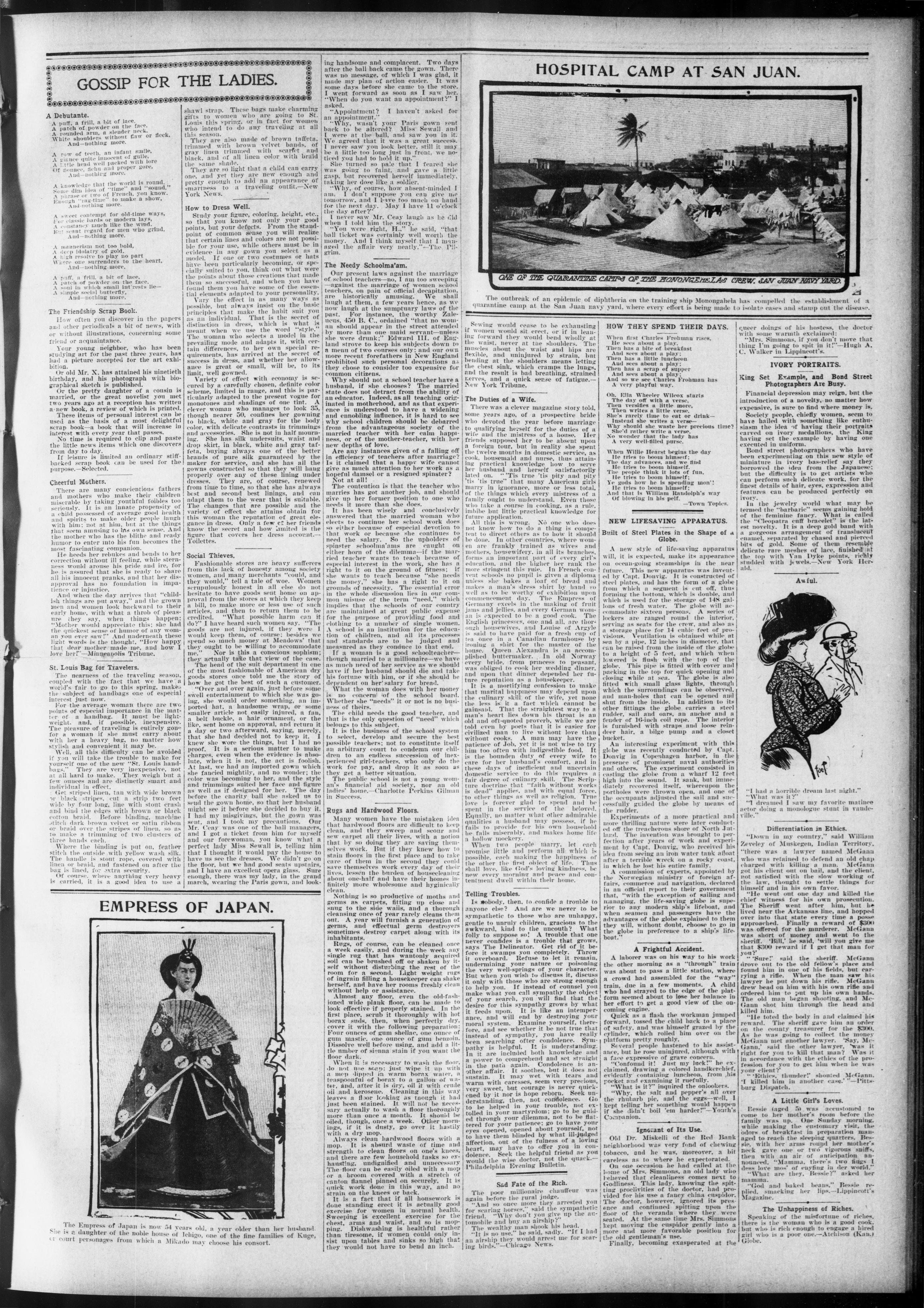
ONE OF THE QUARANTINE CAMPS OF THE MONONGEHELAS CREW. SAN JUAN NAVY YARD.
ONE OF THE QUARANTINE CAMPS OF THE MONONGEHELAS CREW, SAN JUAN NAVY YARD.
The outbreak of an epidemic of diphtheria on the training ship Monongahela has compelled the establishment of a quarantine camp at the San Juan navy yard, where every effort is being made to isolate cases and stamp out the disease.
Sewing would cease to be exhausting if women would sit erect, or if in leaning forward they would bend wholly at the waist, never at the shoulders. The muscles about the waist and hips are flexible, and uninjured by strain, but bending at the shoulders means letting the chest sink, which cramps the lungs, and the result is bad breathing, strained nerves, and a quick sense of fatigue.—New York Tribune.
The Duties of a Wife.
There was a clever magazine story told, some years ago, of a prospective bride who devoted the year before marriage to qualifying herself for the duties of a wife and the mistress of a house. Her friends supposed her to be absent upon a foreign tour, but in reality she spent the twelve months in domestic service, as cook, housemaid and nurse, thus attaining practical knowledge how to serve her husband and herself satisfactorily lated on. "Tis true 'tis pity and pity 'tis 'tis true" that many American girls marry in ignorance, more or less total, of the things which every mistress of a family ought to understand. Even those who take a course in cooking, as a rule, imbibe but little practical knowledge for future application.
All this is wrong. No one who does not know how to do a thing is competent to direct others as to how it should be done. In other countries, where women are frankly trained as wives and mothers, housewifery, in all its branches, forms an important part of every girl's education, and the higher her rank the more stringent this rule. In French convent schools no pupil is given a diploma unless she bakes a loaf of bread and makes a man's dress shirt by hand so well as to be worthy of exhibition upon commencement day. The Empress of Germany excels in the making of fruit jams and jellies, and every German woman is expected to be a good cook. The English princesses, one and all, are thorough housewives, and Louise of Argyle is said to have paid for a fresh cup of tea once in a Canadian farmhouse by ironing a shirt for the master of the house. Queen Alexandra is an accomplished buttermaker. In old Norway every bride, from princess to peasant, was obliged to cook her wedding dinner, and upon that dinner depended her future reputation as a housekeeper.
It is a mortifying confession to make that marital happiness may depend upon the culinary skill of the wife, yet none the less is it a fact which cannot be gainsaid. That the straightest way to a man's heart lies down his throat is an old and oft-quoted proverb, while we are told even by poets that it is easier for civilized man to live without love than without cooks. A man may have the patience of Job, yet it is not wise to try him too often with indigestible food. It is the bounden duty of every wife to care for her husband's comfort, and in these days of inefficient and uncertain domestic service to do this requires a fair degree of culinary skill. The Scripture doctrine that "faith without works is dead" applies, and with equal force, to other things as well as religion. True love is forever glad to spend and be spent in the service of the beloved. Equally, no matter what other admirable qualities a husband may possess, if he fails to provide for his own household he fails miserably, and makes home life a hollow mockery.
When two people marry, let each promise little and perform all which is possible, each making the happiness of the other the first object of life. Thus shall love, like God's loving kindness, be new every morning and peace and contentment dwell within their home.
Telling Troubles.
Is nobody, then, to confide a trouble to anyone else? And are we never to be sympathetic to those who are unhappy, gentle to unruly children, gracious to the awkward, kind to the uncouth? What folly to suppose so! A trouble that one never confides is a trouble that grows, says The Delineator. Get rid of it before it swamps you completely. Throw it overboard. Refuse to let it remain, undermining your nature or poisoning the very well-springs of your character. But when you wish to discuss it, discuss it only with those who are strong enough to help you. If instead of counsel you make what you call sympathy the object of your search, you will find that the desire for this sympathy grows by what it feeds upon. It is like an intemperance, and will end by destroying your moral system. Examine yourself, therefore, and see whether it be not true that instead of sympathy, you have really been searching after condolence. Sympathy is helpful. It is understanding. In it are included both knowledge and a power to comprehend and set straight in the path again. Condolence is another affair. It soothes, but it does not sustain. It may wet with tears and warm with caresses, seem very precious, very sweet, but courage is never quickened by it nor is hope reborn. Seek understanding, then, not condolence. Go to be helped in your trouble, not extolled in your martyrdom; go to be guided through your dilemma, not to be flattered for your patience; go to have your eyes opened, opened about yourself, not to have them blinded by what ill-judged affection, out of the fulness of a loving heart, may have to offer you in condolence. Seek the helpful friend as you would the wise doctor, not the quack.—Philadelphia Evening Bulletin.
Sad Fate of the Rich.
The poor millionaire chauffeur was
savior before the rural indulge.
again before the rural judge.
"And so once more they arrested you for scaring horses," said the sympathetic friend. "Why don't you give up the automobile and buy an airship?"
The wealthy man shook his head.
"It is no use," he said, sadly. "If I had an airship they would arrest me for scaring birds."—Chicago News.
HOW THEY SPEND THEIR DAYS.
When first Charles Frohman rises,
He sees about a play.
Then has a bite of breakfast
And sees about a play;
Then has a little luncheon
And sees about a play;
Then has a scrap of supper
And sees about a play;
And so we see Charles Frohman has
A very playful way.
When Willie Hearst begins the day
He tries to boom himself;
The day advances, and we find
He tries to boom himself.
The people think it lots of fun,
He tries to boom himself;
Ye gods how he is spending mon'!
He tries to boom himself;
And that is William Randolph's way
Of blowing in his pelf.
NEW LIFESAVING APPARATUS
Built of Steel Plates in the Shape of a Globe.
A new style of life-saving apparatus will, it is expected, make its appearance on ocean-going steamships in the near future. This new apparatus was invented by Capt. Donvig. It is constructed of steel plates, and has the form of a globe from which a segment is cut off, thus forming the bottom, which is double, and which is used for the storage of 148 gallons of fresh water. The globe will accommodate sixteen persons. A series of lockers are ranged round the interior, serving as seats for the crew, and also as a storage place for 14 cubic feet of provisions. Ventilation is obtained while at sea by a pipe, 12 inches in diameter, that can be raised from the inside of the globe to a height of 5 feet, and which when lowered is flush with the top of the globe. This pipe is fitted with cover and packing in the top for quick opening and closing while at sea. The globe is also fitted with small glass lights, through which the surroundings can be observed, and man-holes that can be opened and shut from the inside. In addition to its other fittings the globe carries a steel rudder, sail and oars, an anchor and a fender of 16-inch coil rope. The interior is furnished with straps and loose reindeer hair, a bilge pump and a closet bucket.
An interesting experiment with this globe was recently conducted by Capt. Donvig in Copenhagen harbor, in the presence of prominent naval authorities and others. The experiment consisted in casting the globe from a wharf 12 feet high into the sound. It sank, but immediately recovered itself, whereupon the portholes were thrown open, and one of the occupants adjusted the sail and successfully guided the globe by means of the rudder. Experiments of a more practical and more thrilling nature were later conducted off the treacherous shore of North Jutland. The invention was brought to perfection after years of work and experiment by Capt. Donvig, who received his idea from seeing an iron water tank afloat after a terrible wreck on a rocky coast, in which he lost his entire family.
A commission of experts, appointed by the Norwegian ministry of foreign affairs, commerce and navigation, declared in an official report to their government that, "with the exception of sailing and managing, the life-saving globe is superior to any modern ship's lifeboat, and when seamen and passengers have the advantages of the globe explained to them they will, without doubt, choose to go in the globe in preference to a ship's lifeboat."
A Frightful Accident.
A laborer was on his way to his work the other morning as a "through" train was about to pass a little station, where a crowd had assembled for the "way" train, due in a few moments. A child who had strayed to the edge of the platform seemed about to lose her balance in her effort to get a good view of the oncoming engine.
Quick as a flash the workman jumped forward, tossed the child back to a place of safety, and was himself grazed by the cylinder, which rolled him over on the platform pretty roughly.
Several people hastened to his assistance, but he rose uninjured, although with a face expressive of grave concern.
"Confound it! Just my luck!" he exclaimed, drawing a colored handkerchief, evidently containing luncheon, from his pocket and examining it ruefully.
"What is it?" inquired the onlookers.
"Why, the salt and pepper's all over the rhubarb pie, and the eggs—well, I kept telling her something would happen if she didn't boil 'em harder!"—Youth's Companion.
Ignorant of Its Use
neighborhood was very fond of chewing tobacco, and he was, moreover, a bit careless as to where he expectorated. On one occasion he had called at the home of Mrs. Simmons, an old lady who believed that cleanliness comes next to Godliness. This lady, knowing the spitting proclivities of the doctor, had provided for his use a fancy china cuspidor. The doctor, however, ignored its presence and continued spitting upon the floor of the veranda where they were seated. At the same time Mrs. Simmons kept moving the cuspidor gently into a more and more favorable position for the old gentleman's use. Finally, becoming exasperated at the
queer doings of his hostess, the doctor with some warmth exclaimed:
"Mrs. Simmons, if you don't move that thing I'm going to spit in it!"—Hugh A. C. Walker in Lippincott's.
IVORY PORTRAITS
King Set Example, and Bond Street Photographers Are Busy.
Financial depression may reign, but the introduction of a novelty, no matter how expensive, is sure to find where money is. Society people, chiefly women, seem to have hailed with something like enthusiasm the idea of having their portraits carved on ivory medallions, the King having set the example by having one executed in uniform. Bond street photographers who have been experimenting on this new style of miniature in ivory bas-relief say they borrowed the idea from the Japanese; but the difficulty is to get artists who can perform such delicate work, for the finest details of hair, eyes, expression and features can be produced perfectly on ivory.
In the jewelry world what may be termed the "barbaric" seems gaining hold of the feminine fancy. What is called the "Cleopatra cuff bracelet" is the latest novelty. It is a deep gold band with a gorgeous arrangement of translucent enamel, separated by chased and pierced bits of gold. Some of them resemble delicate rare meshes of lace, finished at the top with Van Dyke points, richly studded with jewels.—New York Herald
Awful.
"I had a horrible dream last night."
"What was it?"
"I dreamed I saw my favorite matinee actor doing a monologue stunt in vaudeville."
Differentiation in Ethics.
"Down in my country," said William Zeveley of Muskegen, Indian Territory, "there was a lawyer named McGann who was retained to defend an old chap charged with killing a man. McGann got his client out on bail, and the client, not satisfied with the slow working of the law, thought to settle things for himself and in his own favor.
"He went out one day and killed the chief witness for his own prosecution. The Sheriff went after him, but he lived near the Arkansas line, and hopped over into that state every time a posse approached. Finally a reward of $300 was offered for the murderer. McGann was short of money and went to the sheriff. 'Bill,' he said, 'will you give me that $300 reward if I get that man for you?'
"Sure!" said the sheriff. McGann drove out to the old fellow's place and found him in one of his fields, but carrying a rifle. When the man saw his lawyer he put down his rifle. McGann drew bead on him with his own rifle and ordered him to put up his own hands. The old man began shooting, and McGann shot him through the head and killed him.
"He toted the body in and claimed his reward. The sheriff gave him an order on the county treasurer for the $300. As he was going to collect the money McGann met another lawyer. 'Say, McGann,' said the other lawyer, 'was it right for you to kill that man?' Was it in accordance with the ethics of the profession for you to get him when he was your client?"
"‘Ethics, thunder!” shouted McGann. 'I killed him in another case.'"—Pittsburg Dispatch.
A Little Girl's Loves.
Bessie (aged 5) was accustomed to come to her mother's room before the family was up. One Sunday morning, while making the customary visit, the odors of breakfast in preparation managed to reach the sleeping quarters. Bessie, with her arms round her mother's neck gave one or two vigorous sniffs, then with an air of anticipation announced, "Mamma, there's two flings I dess love mos' of enyfing in der world." "What are they, Bessie?" asked her mamma.
"God and baked beans," Bessie replied, smacking her lips.—Lippincott's Magazine.
The Unhappiness of Riches
Speaking of the misfortune of riches, there is the woman who is a good cook, but who is rich enough to engage a hired girl who is a poor one.—Atchison (Kan.) Globe.
MOUNT OLIVE BAPTIST CHURCH
221 SEVENTH STREET Cordially Invites the General Public to Attend the
Also don't fail to hear REV. E. J. FISCHER, D. D., of Chicago, next week. Our church is now taking on new life, and we are trying to save the old and young. Come and hear the gospel and be saved. St. John, 3, 36, "He that believeth on the Son hath everlasting life." We Extend to You a Hearty Welcome!
189 Third Street.
Swell dressers will find in date Hats, Shirts, Gloves We Carry the Largest L
Swell dressers will find in our store a fine line of up-to-date Hats, Shirts, Gloves, Neckwear, Hosiery, etc.
The American Steam Laundry
Our wagons speed all over town,
All hours of every day,
Depositing and picking up
Big bundles on the way.
We've got the best machinery,
And expert help galore;
We make your linen glisten and gleam
Like sea-foam on the shore!
We do not slight an article,
However coarse or fine;
Oh, everything's immaculate
On The American Laundry Line.
And so we bid for patronage,
At least a wholesome share
Of collars, cuffs and shirts and gowns,
And rumpled underwear.
We set the pace and from our point Our banner shall not fall. We fling it to the breeze and reach Going higher than them all.
Laundry left before 8 a. m. can be called for at 6:30 p. m. same day, Saturdays excepted.
Uncertainty About the Proper Usage at Sea Cleared Up.
A correspondent of a recent edition of Lloyd's Weekly has expressed the views of a ship doctor in the following words: "Many travelers are in doubt as to the position of the ship's doctor in regard to his remuneration from passengers for services rendered. The merchant shipping act enacts that every foreign going vessel having 100 pesons on board or upward shall carry on board as part of her complement a duly qualified medical practitioner. Furthermore, an emigrant ship-i. e., a foreign going vessel which carries fifty or more steerage passengers
must have a medical man, irrespective of the number of crew or of other passengers carried. The salary of the doctor on board is commensurate with these duties to his ship. To any passengers who are suffering from ordinary forms of seasickness and its concomitant evils, or who receives injuries which are in any way due to the ship, the doctor's services are free. For any sickness contracted before sailing or during a voyage which is not connected with the above named conditions, he is entitled to a remuneration at the same rate as he would receive on shore. Obviously, it would be as unfair to expect that his services to passengers should be rendered gratis as it would be for any visitor in a hotel or traveler on a railway to expect to have medical attendance free in any illness for which the hotel or railway authorities could not be held responsible.
The writer of a letter to The Lancet says that the case of the ship's surgeon is stated with accuracy in the above sentences, and adds that ship's surgeons are of two kinds—first, those who after they have qualified take such a position either for health or for pleasure; and, second, those who elect to make sea life a permanency.
The pay of the ship's doctor varies from $30 to $50 a month. This is for duties to officers and crew. As regards passengers in relation to the surgeon, the following groups will include all: First, the passenger who takes the initiative by remunerating the surgeon, perhaps handsomely, for any services rendered; second, the passenger who asks for his bill and pays it if reasonable; third, the passenger who, traveling for the first time, does not know whether to ask for his bill or wait for it to be delivered, but is pleased to be enlightened on the matter; fourth, the passenger who clings to the old-time notion that the surgeon is there solely for the benefit of passengers; and, fifth, the passenger who never intends to pay the surgeon. -Medical Record.
—Missionaries are at work in 247 of the wailed cities of China. There are still 1500 walled cities without missionaries.
173 SECOND STREET
WATER ATTRACTS REPTILES.
Naturalist Werner Reports Results of Observations.
Some surprising and noteworthy conclusions on this point have been reached by a German naturalist, M. Werner of Vienna, who has recently reported the result of observations that he has been making for some time on the senses of inferior vertebrates
On certain points the conclusions of M. Werner are very surprising, and in all they are worthy of notice. M. Werner has observed 136 individuals, of which one-third were at liberty, and he took all possible precautions not to let the creatures know they were watched. One general fact is evident, that reptiles and amphibians are strongly attracted by water. They go straight for it, even when they are at a distance so great that they could not divine its presence by any of the senses known to us. It seems really that a sense of which we have no knowledge informs them of the direction in which water may be found.
There seems to be a sort of chemical attraction, says M. Werner. But how does this act, and on what part of the creature? This remains a mystery. Reptiles also seek the light, but independently of heat; they are positively heliotropic, and in winter they often leave a comfortable and warm retreat to seek the sunlight. Sight is generally good with them. It is probably the finest sense they possess, but it would still appear to be very limited. The caymans and the crocodiles cannot distinguish a man at a distance of more than six times their length, according to M. Werner. In the water fishes see only at very close range—about half their own length. This will seem perhaps unlikely to anglers, although some of them can cite instances showing that fish cannot see far. Snakes seem to have a very mediocre sense of sight. The boa, for instance, does not see at more than a quarter or a third of its own length; different species are limited to one-fifth or one-eighth of their length. Frogs are better off; they see at fifteen or twenty times their length. Frog catchers know this from experience. Hearing is much poorer than sight, if possible. Most reptiles are noticeably deaf, except caymans and crocodiles; the boa appears to be absolutely so.—Revue Scientifique.
Everything in China of any rarity whatever is quite certain to be dragged into the pharmacopoeia of the Chinese physician. Jade is no exception to the rule. It may be swallowed as a powder, or in little pieces the size of hemp seed, for various stomachic complaints; even pockmarks and scars may be obliterated by being daily rubbed with a piece of pure jade. It is also considered to be of a very moist nature, and we read of an imperial favorite of the Eighth century who was cured of excessive thirst by holding a fish shaped jade in her mouth. And so when the tomb of the great commander, Ts'ao Ts'ao, Third century A. D., was opened 200 years after his death, among the usual objects found in such circumstances was a large silver bowl full of water. That the water had not dried up was accounted for by the presence in the bowl of a jade boy three feet in height.
Jade is chiefly brought from the K'un-lun, of Koulkun, range, between the desert of Gobi and Thibet; from Khoten or Ilchi, in Yarkand, and from Lan-t'ien, on the Belurtagh mountains, still further to the west. This Lan-t'ien has been confused by the Chinese writers with another Lan-t'ien, in the province of ShanSe, near the city of Hsi-An, whither the Chinese court fled in August, 1900, upon the relief of Pekin. In the Tenth century A. D. the latter was actually known as the Jade Hills district, though it does not appear that any jade has ever been found there.—Nineteenth Century.
Married to Get a Legacy
A curious wedding has taken place in the little town of Kalberge, in Germany. The husband was an inmate of the prison of that town, and the bride an unusually pretty girl, who lives with her parents at Perlin. After the ceremony the husband returned to prison; he has still two years to serve unless he is pardoned. They married in order not to forfeit a considerable legacy.
There are 2400 mineral waters bottled in New York city.
Lade as Medicine.
THE WISCONSIN WEEKLY ADVOCATE.
R. B. Montgomery, Editor and Publisher,
P. A. Sample, Associate Editor and Business
Manager.
Published Every Thursday at No. 79 Fifth
Street.
A Representative Journal Devoted to the
Interest of All the People.
ADVERTISING RATES.
ADVERTISING RATES.
One inch, one year.....$15.00
Two inches, one year.....25.00
Three inches, one year.....35.00
Four inches, one year.....42.00
For larger space, special rates.
Locals, 10 cents per line.
TERMS OF SUBSCRIPTION.
One year ..... $2.00
Six months ..... 1.00
Three months ..... .50
Direct all communications to
R. B. MONTGOMERY,
79 Fifth Street.
HOW TO SEND MONEY.—Post Office
Order, Express Order, Draft or Registered
Letter. R. B. Montgomery will not be
responsible for loss when sent in any other
way.
TO CONTRIBUTORS:
All communications must be sent with the name and address of the sender as an evidence of good faith, but not necessarily for publication. No manuscript returned if not accepted, unless accompanied by stamps.
ADVERTISING RATES.
One insertion, per inch..... $ .25
One month, per inch..... .75
Three months, per inch..... 2.00
Six months, per inch..... 3.50
One year, per inch..... 5.00
Paragraph advertisements, per line..... .05
EDITORIAL PARAGRAPHS.
"I know of the bravery and character of the Negro soldier. He saved my life at Santiago, and I have had occasion to say so in many articles and speeches. The Rough Riders were in a bad position when the Ninth and Tenth cavalry came rushing up the hill carrying everything before them. The Negro soldier has the faculty of coming to the front when he is needed most. In the Civil war he came 400,000 strong, and I believe he saved the Union."—President Roosevelt.
The Northwest Needs a Bishop.
It is the consensus of opinion among African Methodists and the many friends of that great denomination that the general conference, now in session in Chicago, will decide to elect two more bishops, and that their choice will fall upon Rev. George Washington Gaines seems to us a foregone conclusion. His many friends and admirers among all classes are urging his candidacy. The A. M. E. church has a large, intelligent and influential constituency in the northwest who have shown their loyalty and devotion by building mammoth churches and other institutions for the church. The elevation of no man in the church would afford greater satisfaction and inspiration to this section.
Dr. George W. Gaines was born in Missouri in the condition of slavery. He ran away and joined the Federal army, serving from 1863 to 1866. He professed religion and joined the A. M. E. church in 1864. He was licensed as a local preacher in 1866. He was received on trial in the Missouri conference in 1867. He was ordained a deacon in 1868 and ordained an elder in 1871. He has served the church as an itinerant minister for thirty-seven years. He is a splendid type of the Christian gentleman.
During the past year the night shelters of Paris received 67,283 men, 2006 women and 388 children.
The first train run electrically on a main line has been making experimental trips between Liverpool and Southport.
Now that James J. Jeffries is married, he will have something more to govern him than the Marquis of Queensbury rules.
---
The Wisconsin University girls who are guilty of hazing have proved that co-education gives them the same view that develops the "Smart Aleck" among the boy students.
The Israelitish Zion movement should not be confounded with Mr. Dowie, lest the Israelites be moved to confound the boss of Zion City, the Wisconsin aggregation of hypnotized enthusiasts.
```markdown
```
The year 1903 in the Presbyterian mission in Canton, China, was the best in its history. To the twenty churches there were 1098 additions, and the local contributions amounted to more than $8000. Fluorescin, with which it is said physicians will eventually illuminate the interior of the human body, may extend the usefulness of revenue officials whose duty it is to capture "moonshine" whisky.
In the beginning of last century there were eight insurance offices in the United Kingdom; at the present time there are 222; while the accumulated funds of the life offices alone amount to nearly £260,000,000.
Eight hundred young men and women, representing twenty universities, attended a recent conference of student volunteers at Edinburgh to discuss "The Evangelization of the World in This Generation."
During the period February 3 to March 11 there were presented to the British House of Commons 2117 petitions, bearing 26,753 signatures, against an alteration of the licensing laws in favor of the publican.
Thousands of hams are sent into Dublin from America, and after being branded with the Irish mark they are exported from Cork and Waterford to
England, where they are sold as Irish hams at a high price.
The British fleet has twenty-nine submarines built, building, or about to be ordered. Over thirty officers and upward of 300 men have been in training for months past to maneuver these terrible weapons of sea warfare.
The summer religious conference idea is spreading rapidly in all directions. The Episcopalians have inaugurated a conference patterned on the Northfield and Chautauqua lines, to be held at Richfield Springs, N. Y., August 4-14.
The "society leader" of San Jose, California, who committed suicide because a wound received during a successful "hold-up" would cause the discovery of his identity, was on a par with official grafters, only he was working on a different "lay."
The St. Petersburg Academy of Sciences has offered $3750 for information in regard to the party of Baron Toll, the Arctic explorer, from whom nothing has been heard since he left the yacht Zaria, in 1902, and started for Bennett island.
An explanation of the frequent begging letters received in this country from Jews in Palestine is given by Dr. Selah Merrill, formerly United States consul at Jerusalem, who says that the large majority of Jerusalem Jews live entirely upon charity.
A scholarship valued at $150 has recently been established in the New Mexico School of Mines, open to the best members of the graduating class of each year desiring to make a special study of mining machinery in the large manufacturing works.
An official director recently published gives the following statistics regarding Roman Catholicism in this country: The Roman Catholic population is computed to be nearly 12,000,000; the clergy number 13,267, and there are 11,-196 houses of worship.
From the manner in which the St. Louis Exposition management is heralding the gastronomic performances of the Igorrottes, it might be inferred that the chief business of this contingent will be to eat dog for the delectation of those who go "down the Pike."
There are within 3,000,000 of as many persons enrolled in the Sunday schools of this country as in the public schools, there being 13,000,000 in the former and 16,000,000 in the latter. The total Sunday school membership throughout the whole world is 25,000,000.
The statement of the foreign trade of the United States for February shows an increase of imports of $6,198,707 and a decrease of exports of $6,707,305. The exports of agriculture decreased nearly $13,000,000, much of this representing the falling off in cotton shipments.
London possesses a curiosity in the Southwark eel market, which is said to have been held regularly for over 300 yeats. It is little known except in the neighborhood where it is held viz., near Blackfriars bridge. Originally the eels sold were caught off Blackfriars bridge, but now they come mostly from Holland and Scotland. They are not sold by weight, as is usual, but by the handful, the price being "fourpence the grab."
Portland, Me., has lost its most famous barber in the death of John B. Pike. In his time he shaved Grant, Sheridan and Garfield. Ben Butler was almost fond of him. Judge Clifford used to spend a morning hour in the office to have John tell him the news and save him the trouble of reading the paper. Blaine and Tom Reed and Neal Dow were good friends to the clever barber.
A unique occasion was that recently celebrated in the Fifth Avenue church, New York, when the church recognized the completion of the fifty years of service of the assistant janitor by presenting him with a check for $1100. A similar gift was made by this same church last autumn, when the janitor also completed a half century of service.
Last of the Troubadours.
At Compostella there has just died a strange individual, half tramp, half musician, with a certain dash of the poet about him, who, even in a land of Old World survivals like Spain, may probably be regarded as the very last of the troubadours. His name was Adolf Garcia, and he was a native of Galicia. Equipped with nothing but an old fiddle and a great umbrella that served against either sun or rain, and did service between times as an alpenstock, he had roamed through every province of Spain. Arriving in town or village, he looked out for youthful womanhood and wealth, and then, placing himself under the windows, played and sang the old, old theme of love, and chivalry, mostly to airs of his own composing. The ditties were not devoid of a certain refinement and delicacy, and never failed to reach the hearts or the purses of the gentle maids who had been selected for the serenade.—London Globe.
Unwise Eating.
There is an old story of Queen Alexandra, when she was Princess of Wales, coming one day upon a very small boy who was weeping bitterly. The princess stopped to inquire the trouble from the youngster's fat, comfortable grandmother. She received the laconic reply: "Well, ma'am, there ben't no trouble, as you might say, but no stomach can't stand nine buns."
If the family physician were equally frank he might explain as tersely a large proportion of the aches and pains and languor that keeps his business lively, especially at this season.
It is no wonder that the spring microbes make easy conquests and that the apothecary and undertaker thrive. To eat and to be seen eating—this is the acme of delight in a day when the "simple life" is the most popular of topics.—Philadelphia Telegraph.
ELK EXPRESS CO.
G. J. CHARLESTON, Mgr.
63 E. Sixth Street,
ST. PAUL, MINN.
YOU CAN COVER
YOUR TRACKS WITH
LAC-STAIN
“FINE FOR FLOORS”
Are your floors looking as well as you would like?
There is no reason why they shouldn’t.
Lac-Stain will stain them to imitate any fine wood you desire, and varnish them at one operation.
And you can walk on it. Soft wood will dent under it—but the varnish won’t crack—its elastic.
Ask your dealer—or the
Milwaukee Paint and Varnish Co.
191-193 Third Street.
If You Need Anything in Our Line Give Us a Call
WM. LOGAN
Cash Feed Store Coal, Wood and Ice
EXPRESSING AND MOVING
2807 State Street,
PHONE GREEN 976.
CHICAGO, ILL.
MILLINERY AT THE FAIR
The Millinery Department will be a lively place tomorrow. We have prepared a feast of style and price lowness that will gladden the hearts of all callers.
One lot Trimmed Hats for ladies, $1.98 in large varieties
One lot Chiffon Hats, ready for 98c trimming.
Children's Chip Hats, 19c at.
Children's School Hats, 15c at.
Roses, in all shades, 10c a bunch.
THE FAIR
Third and Prairie.
BARGAIN HUNTERS
Clothing to fit without being measured for. Prices less than you ever bought them for. Our specialty is misfit and uncalled-for custom tailormade clothing. Tailors' prices for full dress or Tuxedo Suits from $30 to $50; our price from $15 to $18. English Walking or good Business Suits made to measure by best of tailors from $18.00 to $35.00. Our price $8.00 to $18.00. Every suit bears our guarantee label. All garments bought of us are kept repaired and pressed free of charge for one year. To be convinced see our window display.
213-15-17 West Water St., Milwaukee, Wis. Open Evenings Till 9 P.M. Sundays Till 12 M.
WALDORF CAFE
ALEX STEPHENS, Proprietor.
Where Booker T. Washington Was Banqueted.
OPEN ALL NIGHT
3027 State Street. CHICAGO.
'PHONE 360 DOUGLAS.
J. MUNKO Manufacturer of RAZOR STRAPS Practical Shoemaker 126 SECOND STREET, MILWAUKEE Telephone Grand 364
Beware of Impostors
of different professions soliciting money in Wisconsin for purposes unknown to any person in that state and for use elsewhere. Driven out of other states they are overrunning this. We think it an imperative duty on us as being the only negro paper in the state, to protect its generous philanthropists. From now on, we shall warn the mayor and chief of police of every city in Wisconsin against such adventurers.
The Oliver Typewriter .
The Standard Visible Writer
GOLD MEDALS AND FIRST AWARDS.
Philadelphia, 1899. Earls Court, London, 1899. Omaha, 1899. Paris 1900
Venice, 1901. Lille (France), 1901
Buffalo, 1901.
It is displacing old style machines everywhere, and holds first place in the estimation of the majority of leading representative business and professional men. Write for Catalogue.
Wm. C. Kreul
434-436 Broadway, - Corner Mason Street
MILWAUKEE
*Daily, § sun. only. †Ex. Sun. Ex. Sat. †Ex. Mon. Sat. only. †Mon. only.
MILWAUKEE
LEAVE
ARRIVE
LaCrosse, Winona, St. Paul and Minneapolis
"ThePioneer Limited"
Son. Minn. Points
Iowa and Dakota Points
Prairie du Chien, Iowa and Minnesota
Mineral Point Line
Janesville
Rac. & S. W. Div.
Council Bluffs, Omaha and Kansas City
Chicago
adison (via Watertown)
" (via Pr. du C. Div.)
" (via Pr. du C. Div.)
" (via Watertown)
" (via Pr. du C. Div.)
Northern Division
Wankesha
Econemewoc and Watertown
Green Bay
Marquette, Houghton and Lake Superior Points
TICKET OFFICE, 400 EAST WATER ST. Tel. 624.
TO AND FROM LEAVE ARRIVE
St. Paul, Minneapolis, Iron Towns, Ashland, Superior, Duluth, Pacific Coast ..... *5:00 am *8:45 pm *7:15 am *8:00 pm
Marshfield, Chippewa Falls, Eau Claire ..... *5:00 am *12:01 pm *7:15 am *13:20 pm *8:00 pm *8:00 pm *7:15 am
Fond du Lac, Oshkosh, Keenah, Menasha ..... *7:35 am *10:15 am *12:01 pm *13:20 pm *8:15 pm *8:00 pm
PAPERS BY THE PEOPLE
BEGGING LETTERS SELDOM SHOW NEED.
Begging letters are a dreary of imposture, sometimes of shcasionally of genuine need and ery, but this province has also. There is the man whose father usher in the church where you a pew, and had, that is the first respondent, the highest respecting appearance and courteous other father, that is your father, on the son, being under the weather for the life, through no fault of his own, feels a lend him, by return post, $5, to be repaid installments.
There is also the man who was born you once lived five years of your life, and of your childhood, who has followed your highest pride ever since those morning thought of writing to you by way of even of coming to take you by the hand of days of Auld Lang Syne, but has been spirit of diffidence and excessive mode along been the drawback of your corresponde in a business difficulty casts himself up aid and seeks a loan of $500 for three.
The most disappointing letter I ever had my hopes had not reached the boiling without a signature, informing me that so touched by the sentiment of one of me generally so much impressed by my ability, that he had placed $5,000 to my as a token of gratitude. As I have never more of this generous gift, I am driven sad conclusion that the letter was writ unworthy sarcasm, and that its author the impressions that he thought meanly my work. He was entitled to his opinion to trifle with the worldly hopes of a man and to lead him into the extravagance when the old one would have done perfecter winter.
Begging letters are a dreary waste, sometimes of imposture, sometimes of shiftlessness, and occasionally of genuine need and undeserved misery, but this province has also a charming oasis. There is the man whose father used to be an usher in the church where your father once had a pew, and had, that is the father of your correspondent, the highest respect for the commanding appearance and courteous manner of the other father, that is your father, on the strength of which the son, being under the weather for the first time in his life, through no fault of his own, feels sure that you will lend him, by return post, $5, to be repaid by four monthly installments.
There is also the man who was born in the town where you once lived five years of your life, and that in the days of your childhood, who has followed your career with the highest pride ever since those morning days, has often thought of writing to you by way of encouragement, and even of coming to take you by the hand just for the sake of days of Auld Lang Syne, but has been hindered by that spirit of diffidence and excessive modesty which has all along been the drawback of your correspondent, who now in a business difficulty casts himself upon his townsman's old and seeks a loan of $500 for three weeks.
The most disappointing letter I ever received—although my hopes had not reached the boiling point—was one without a signature, informing me that the writer had been so touched by the sentiment of one of my stories, and was generally so much impressed by my remarkable literary ability, that he had placed $5,000 to my credit with a bank as a token of gratitude. As I have never heard anything more of this generous gift, I am driven reluctantly to the sad conclusion that the letter was written in a spirit of unworthy sarcasm, and that its author desired to convey the impressions that he thought meanly both of myself and my work. He was entitled to his opinion, but it was cruel to trifle with the worldly hopes of a struggling literary man and to lead him into the extravagance of a new coat when the old one would have done perfectly well for another winter.
OOLS HELD WRONG. Rev. Dr. George F. Hall. his eyes to the hills and trans terrible gods. Devils swim in sti stalk superhuman creatures we animals. The child's fancy. ti
WHIPPING IN SCHOOLS HELD WRONG.
"Is It Right for Teachers to Whip?" In answering this much-discussed question off-hand most persons would say, "Yes, if it's the other fellow's kid; no, if it's mine." Human nature is about the same the world over, and it cannot be changed in a day. But the spirit of gentleness is becoming more marked each decade and the big, brotherly heart of humanity more tender. Fifty years ago it was almost universal for teachers to whip. A hickory switch for the smaller children and a good, stout ferrule for the big boys and girls were con-
sidered almost as necessary in the avera- ment as a knowledge of reading, writi- three. But times have changed and a gov- more think of whipping a pupil nowaday will think of blistering or blood-letting. favors whipping except in extreme instu- buss and should be denied a place in me. It is wrong for a teacher to whip; f it not be done without developing anger, and the pupil, and anger is a curse p and spiritually. There may be occasion- ping of an unusually obstreperous or bran- sary for that pupil's control as an exam- as a rule I believe whipping does a hune
necessary in the average teacher's equip-idge of reading, writing and the rule of have changed and a good teacher will no- hopping a pupil nowadays than a physician dering or blood-letting. The teacher who except in extreme instances is a blunder- denied a place in modern school rooms. A teacher to whip; first, because it can- out developing anger, both in the teacher and anger is a curse physically, mentally. There may be occasions when the whip-ly obstreperous or brutal pupil is neces- tial control as an example to others, but whipping does a hundred times as much clouds throng the sky and round some unknown terror. There is ness of childhood. What wa- gloom ready to leap out? What at dusk to haunt the defiles o- nameless panic is it that strikes likeness of a savage, threaten- nurse has disappeared into a she- and the child cannot tell. He- mals, and has no language but a- of an eye the sun is out and it and the horrors of that small a- merged into that past from which itself.
sidered almost as necessary in the average teacher's equipment as a knowledge of reading, writing and the rule of three. But times have changed and a good teacher will no more think of whipping a pupil nowadays than a physician will think of blistering or blood-letting. The teacher who favors whipping except in extreme instances is a blunderbuss and should be denied a place in modern school rooms. It is wrong for a teacher to whip; first, because it cannot be done without developing anger, both in the teacher and the pupil, and anger is a curse physically, mentally and spiritually. There may be occasions when the whipping of an unusually obstreperous or brutal pupil is necessary for that pupil's control as an example to others, but as a rule I believe whipping does a hundred times as much
WAR SPIRIT DEVELOPMENT.
Rowers Not Directly Engaged Affected by the Contest. The gradual development of the war spirit between two nations, as in the present contest between Russia and Japan, furnishes an interesting psychological study, says the Boston Transcript. There is not only the growth of prejudice and hostile feeling which has led to the beginning of physical warfare, but also a marked radiation of waves of suspicion and alienation which spread to powers which are not directly involved. The nation, in ethical quality, is only the great multiple of the average individual, even though it is popularly supposed to be higher.
Nothing will more quickly attract a crowd of interested spectators on the street than a fight between two men, or even two dogs. The evolutionary residuum of animalism, though covered by a thin veneer of repressive control, is stirred into sympathetic vibration and breaks through upon slight occasion. War not only is "hell," but it is the breeder of more hell.
The immediate effect upon the whole world of the opening of hostilities in the Far East is stalkingly in evidence. In spite of strongly avowed neutrality, old international prejudices are rapidly awakening and differences, supposedly obsolete, rekindling. Each nation begins to strengthen its defenses, increase its fighting equipment and incidentally wishes to send its observers and even its ships to "look on." Under the convenient plea of a "protection of our interests" we must become at least interested spectators. We must have a "finger in the pie," or at least have it so near as to pull out a plum if any excuse offers. Even if the actual merits of the conflict be quite evenly balanced there is little or no calm and dignified neutrality, but plenty of prejudice and sensational misrepresentation. The prevailing thought of it is about as abstract as it would be in the case of a great game of football. The human element, which really is all inclusive, is left entirely out of consideration.
VICE-ADMIRAL MAKAROFF.
Death of the "Cossack of the Seas" a Great Loss to Russia
The loss of the battleship Petropavlovsk is a trifling misfortune to Russia in comparison with the loss of Vice Admiral Makaroff. The Czar has none too many sea-fighters, and none at all who are worthy to rank with the "Cossack of the Seas." Until Makaroff arrived at Port Arthur the Russian
---
DR. G. F. HALL.
harm as it ever does good. Its psychic effect is demoralizing. It embitters, paralyzes, blights.
In the second place, whipping is wrong because it creates animosity on the part of parents and impels lack of cooperation. Most parents believe their children undeserving of punishment at the hands of a stranger. And in this they are right. What moral right has some fidgety schoolmarm or cranky principal to lay hands roughly on your little boy or girl? When you hear that such a thing has happened you instinctively feel that your own flesh and blood has been grossly insulted, and you have a right to feel so. It makes one's blood boil to read of a lot of cross old malds and dyspeptic males of the teacher class getting together and passing resolutions in favor of whipping the little ones. Let them take more exercise in the open air and warm up their blood.
What man or woman of 40 or 50 does not look back to their childhood with fond memories, recalling, perhaps, just one teacher who used to romp and play with them at recess time or after school hours? Love is the keynote. The teacher who can master the fine art of governing by love, sympathy and the power of genuine manliness or womanliness will never need to whip. Such a teacher is an inspiration. His pupils admire him almost to the point of reverence and parents everywhere rise up and call him blessed. In after years when the budding young geniuses have ripened into manhood and womanhood, honorable and honored largely because of his magic touch at the beginning of life's long race, they will crown him with blossoms of affection worth far more than the ransom of a king.
THE TERRORS OF CHILDHOOD.
The age of childhood is proverbially interpreted as the age of happiness, yet childhood has its dark passages, its hopes and fears, and its hours of despair. The emotionalism of the child exposes him to tragic visitations. The incoherence of a mind in which realism and romance are ever at war is the source at once of all his pains and all his pleasures. The likeness to the savage lies in this. The primitive man lifts up
into the hills and transmutes them to the home of woods. Devils swim in streams and out of the woods overhuman creatures wearing the guise of familiar creatures. The child's fancy, though capable of breeding beautiful dreams, is yet more delicate. A mountain at any even become a valley, and streams may dry up. The scale of the achievements designed in a child's colossal. There is no barrier conceivable to his vision. Dragons escape out of books, and creatures or give you friendly advice.
Fish tears dropped upon broken toys rend the little severely as a grown man's bitter sorrow tears. It is a mistake to suppose that children do not proportionately, though, happily, their woes are not. If any one can from the cold distance of his childhood look back upon that age he will surely recall contrasts. The sun shines for the most part on that plain, brighter than in after years, but strong the sky and round the corner there is always known terror. There is no darkness like the dark-childhood. What waits upon the stairs in the lady to leap out? What horror comes punctually to haunt the defiles of the long garden? What panic is it that strikes the familiar streets to the of a savage, threatening wilderness when the is disappeared into a shop? The child alone knows, child cannot tell. He suffers like the dumb animal has no language but a cry. But in the twinkling the sun is out and the garden is alight again, horrors of that small and delicate mind are gone, into that past from which it is slowly emancipating
his eyes to the hills and transmutes them to the home of terrible gods. Devils swim in streams and out of the woods stalk superhuman creatures wearing the guise of familiar animals. The child's fancy, though capable of breeding these awful dreams, is yet more delicate. A mountain at times may even become a valley, and streams may dry up at will. The scale of the achievements designed in a child's mind is colossal. There is no barrier conceivable to his imagination. Dragons escape out of books, and creatures of the air give you friendly advice.
Childish tears dropped upon broken toys rend the little heart as severely as a grown man's bitter sorrow tears his own. It is a mistake to suppose that children do not suffer proportionately, though, happily, their woes are not enduring. If any one can from the cold distance of his adult manhood look back upon that age he will surely recall remarkable contrasts. The sun shines for the most part brightly on that plain, brighter than in after years, but clouds throng the sky and round the corner there is always some unknown terror. There is no dankness like the darkness of childhood. What waits upon the stairs in the gloom ready to leap out? What horror comes punctually at dusk to haunt the defiles of the long garden? What nameless panic is it that strikes the familiar streets to the likeness of a savage, threatening wilderness when the nurse has disappeared into a shop? The child alone knows, and the child cannot tell. He suffers like the dumb animals, and has no language but a cry. But in the twinkling of an eye the sun is out and the garden is alight again, and the horrors of that small and delicate mind are gone, merged into that past from which it is slowly emancipating itself.
open the
By Ian Maclaren.
SCIO
naval operations were characterized by bungling and indecision. No sooner had he taken command than the remnants of the fleet began an aggressive campaign that forced a radical change in the Japanese methods of operation.
Admiral Makaroff was appointed to the command of the Russian Pacific fleet on Feb. 26. He was one of the heroes of the fighting on the River Danube during the Russo-Turkish war. Makaroff and Skrydloff, who have since many times been honored by their government, were at that time lieutenants in the Russian navy and volunteered to make a night attack on a powerful Turkish ironclad. With a torpedo boat they succeeded in blowing up the Turkish vessel and, it was claimed at the time, thereby made the first successful demonstration of the
1
usefulness of torpedo boats in naval warfare. It was Makaroff who originated the idea of constructing, the famous icebreaking steamer Ermak, which was built on the Tyne from his designs. It is the largest ice crushing steamer in the world, and has made several trips into the Arctic regions.
Admiral Makaroff paid three visits to the United States, the first in 1863. He made a tour from California to New York in 1896, and in March, 1898, made a flying visit to Detroit with a party of Russians who were looking into the possibilities of ice-crushing steamers on the great lakes with the end in view of constructing several for the Russian government. Admiral Makaroff, was born in 1848. He served as an ensign for two years and as lutenant for six. During the Russo-Turkish war he commanded the gunboat Grand Duke Constantine, which was armed and equipped ac-
By H. B. Marriott-Watson.
conding to his designs. At the end of the campaign ne was made captain and was given the title of adjutant to the late Emperor of Russia. In 1881, Makaroff commanded the guard-ship of the Russian embassy at Constantinople, then was appointed chief of staff with the Baltic fleet, and in 1898 commanded that fleet. In the following year Makaroff was appointed commander-in-chief at Cronstadt, which post he held until February of the present year, when he was sent to the far East as commander-in-chief of the Russian Pacific fleet. Makaroff was an officer of rare ability, possessing more than usual intelligence and a physical presence which gave him a splendid power of command.
A Detested Plant.
No sort of bird, beast or creeping thing will touch a castor oil plant. It seems to be a rank poison to all the animal world. Even a goat will starve before biting off a leaf, and a horse will sniff at it and turn up his upper lip as though it had the most detestable odor on the face of the earth. Army worms and the locusts will pass it by, though they may eat every other green thing in sight, and there is no surer way to drive moles away from a lawn than to plant a few castor beans here and there. Even the tobacco worm will refuse to be fed on its leaves. There is hardly another instance in natural history of a plant being so universally detested by the animal world.
Roundabout Proposal.
He—Miss Wilmington, as the only daughter of your mother, I suppose you take a keen interest in her happiness?
She—Most assuredly. Why?
He—Oh, I only wanted to know if you would like her to have me for a son-in-law.—New York Times.
Cologne's First Railway.
In 1878 a Belgian company constructed the first street railway in the city of Cologne, Germany, and the road became the property of the city in 1897.
Venison in Germany.
Venison, which is difficult to get in American markets, may be obtained nearly every day in the restaurants of Germany at a price little exceeding that of beef.
Mrs. Buggins—I don't feel at all comfortable in these new shoes. Mr. Buggins—What's the matter; don't they hurt?—Philadelphia Record.
If a man's mother-in-law acts up it is usually his own fault.
VISITORS TO MILWAUKEE DON'T FAIL TO VISIT THE ORIENTAL HOTEL
Conducted by MRS. B. PARKER, on the European and American Plans. All the Latest Improvements. 515 CEDAR STREET. Coming from the North-Western depot take Clybourn or Twelfth street car and get off at Grand avenue and Fifth, walk two blocks north. Coming from C., M. & St. P. depot five minutes' walk from the depot, down Fourth street to Cedar, and one block west. Moderate prices, clean, up-to-date services.
Watches, Jewelry, Clocks, Cutlery, Optical Goods, Silverware, Etc.
R. SAV
THE UP-TO-
Telephone Clark 9652
Suit made-to-order
Pants to order $4
ELEGANT
TONSORIAL
Second to No
Visitors to the city and
Cleanliness, Elegance
patronize
Slaughter's Turf Ho
R. SAVITZKY THE UP-TO-DATE TAILOR
Telephone Clark 9652 703 GRAND AVENUE. Suit made-to-order from $18 and up Pants to order $4 and up.
Visitors to the city and those who appreciate Cleanliness, Elegance and Comfort should patronize
217 Wells Street, Milwaukee.
Hot and Cold Baths in Connecti ZOMODONE,
THE NEWEST AND HAIR GROWER
Makes the Hair grow with lightning waiting for results. ZOMODONE pads Grey Hair, Brittle Hair, Curly Hair, Hair Cures Dandruff, Itch, Tetter, Eczema, more Haid Heads, Scanty Partings, Spills. ZOMODONE grows long, silky Hair. Makes the Hair grow down waist line in most every instance in ZOMODONE is a direct Hair food lengthens the Hair, so that it can be desired. Not a fraud or a fake, to get honest remedy, tried and true. ZOMODONE results are seen at once. If you want waist, send in your order right now—no samples sent; a sample is not sufficient us only $1.00, and we will send prompt great remedies, worth at retail in ZOMODONE, worth $3.00; 1 large packa Shampoo), worth $50c., and 1 large pack the most exquisite and absolutely cared and perfector known to science, worth four complete treatments for $3.00.
NTED. Everything is in favor of the EDIT EXTENDED. This is an u quick for territory and particulars. A IN TOILET CO., 910 E. Leigh S
Hot and Cold Baths in Connection. Franklin A. Hackley, Mgr.
ZOMODONE, THE NEWEST AND MOST RAPID HAIR GROWER IN EXISTENCE.
Makes the Hair grow with lightning-like rapidity. No waiting for results. ZOMODONE prevents falling Hair, Grey Hair, Brittle Hair, Curly Hair, Harsh Hair, and Scurr. Cures Dandruff, Itch, Tetter, Eczema, and Ring-Worm. No more Bald Heads, Scanty Partings, Splitting Ends, and Bald Temples. ZOMODONE grows long, luxuriant, soft, fine, silky Hair. Makes the Hair grow down to and below the waist line in most every instance in which it is used. ZOMODONE is a direct Hair food, and softens and lengthens the Hair, so that it can be arranged in any style desired. Not a fraud or a fake, to get your money, but an honest remedy, tried and true. ZOMODONE acts quickly; results are seen at once. If you want Hair down to your waist, send in your order right now—do not delay. No free samples sent; a sample is not sufficient to do good. Send us only $1.00, and we will send promptly all of the following great remedies, worth at retail $4.50: 3 large jars of ZOMODONE, worth $3.00; 1 large package of ALBUNA (Egg Shampoo), worth 50c., and 1 large package of CORALINE, the most exquisite and absolutely certain skin brightener and perfector known to science, worth $1.00. We will send four complete treatments for $3.00.
AGENTS WANTED. Everythi CREDIT EXTEN to make money. Write quick for territory THE HELEN MARTIN TOILET CO
AGENTS WANTED. Everything is in favor of the Agent. LIBERAL CREDIT EXTENDED. This is an unprecedented chance to make money. Write quick for territory and particulars. Address THE HELEN MARTIN TOILET CO., 910 E. Leigh St., Richmond, Va.
WANTED--AGENTS
We want 100 agents in every city, town and hamlet in the U. S. for the Wisconsin Weekly Advocate. It will be devoted to the interest of the Negro race and will contain the news of their sayings and doings throughout the world.
WISCONSIN WEEKLY ADVOCATE
MILWAUKEE, WIS.
Northwestern House
APPLETON, WIS.
JOHN A. BRILL, - Proprietor.
Terms $1.00 Per Day.
n House BEFORE AND OR wis. OZONIZED (Cot
Accommodations the best in the State. When in Appleton stop at the NORTHWESTERN
WANTED—NURSE GIRL, FOR FAMILY of two. Children attend kindergarten during the forenoon. Apply office of Advocate. 79 Fifth street.
Dixon's Place
Ladies' and Gents' Shining Parlör.
Cigars, Tobacco, all Negro Newspapers.
2638 State St., Chicago.
Phone, 2351 Brown.
Place
ining Parlör.
ro Newspapers.
go.
351 Brown.
We keep for Sale: Wisconsin Advocate, Freeman, Conservator, New York Age, Atlanta Age, Northwestern Vine, Colored American, Cleveland Gazette, Dallas Express, Richmond Planet, True Reformer, Broad-Ax, Monitor, Detroit Informer, Christian Recorder, Voice of Missions, and all other Negro papers of the country.
---
J
Actual Results from Baldness After Only 4 Months' Use of ZOMODONE.
THE NEWEST AND MOST RAPID HAIR GROWER IN EXISTENCE.
Hair grow with lightning-like rapidity. No issues. ZOMODONE prevents falling Hair, Hair, Curly Hair, Harsh Hair, and Scurf, Tetter, Eczema, and Ring-Worm. No Scanty Partings, Splitting Ends, and Bald ONE grows long, luxuriant, soft, fine, the Hair grow down to and below the most every instance in which it is used. A direct Hair food, and softens and so that it can be arranged in any style and or a fake, to get your money, but an aided and true. ZOMODONE acts quickly; but once. If you want Hair down to your order right now—do not delay. No free sample is not sufficient to do good. Send and we will send promptly all of the followes, worth at retail $4.50: 8 large jars of $3.00; 1 large package of ALBUNA (Egg 56c., and 1 large package of CORALINE, and absolutely certain skin brightener down to science, worth $1.00. We will send treatments for $3.00.
ing is in favor of the Agent. LIBERAL DEED. This is an unprecedented chance and particulars. Address
910 E. Leigh St., Richmond, Va.
WONDERFUL DISCOVERY
Curly Hair Made Straight By
TAKEN FROM LIFE:
BEFORE AND AFTER TREATMENT.
ORIGINAL
OZONIZED OX MARROW
(Copyrighted.)
This wonderful hair pomade is the only safe preparation in the world that makes kinky or curly hair straight as shown above. It nourishes the scalp, prevents the hair from falling out or breaking off, cures dandruff and makes the hair grow long and silky. Sold over forty years and used by thousands. Warranted harms. It was the first preparation ever for hair care and was a preparation imitations. Get the Original Ozonized Ox Marrow as the genuine never fails to keep the hair straight, soft and beautiful, giving it that healthy, life-like appearance so much desired. A toilet necessity for ladies, gentlemen and children. Elegantly perfumed. Owing to its superior and lasting qualities it is the best and most economical. It is not only a hair pomade but a preparation equal to it. Full directions with every bottle. Only 50 cents. Sold by druggists and dealers or send us 50 cents for one bottle or $1.40 for three bottles. We pay all express charges. Send postal or express money order. Please mention name of this paper when ordering. Write your name and address plainly to
OZONIZED OX MARROW CO., 76 Wabash Ave., Chicago, Illinois.
S. F. PEACOCK & SON
Funeral Directors
AND
EMBALMERS
431 Broadway, MILWAUKEE, WIS.
---
.
GREAT GOVERNMENT BUILDING AT THE ST. LOUIS FAIR.
THE MUSEUM OF THE ARTS AND CULTURE
Copyright 1904 by Louisiana Purchase Exposition Co. The United States Government Building at the St. Louis World's Fair is the largest exposition structure ever erected by Uncle Sam. It is 764 feet long and has a width of 250 feet. It is distinguished among the other exhibition structures by the durability of its construction. Huge girders of steel support the superstructure, leaving an interior abso-
THE OLD, SWEET FIELD8.
Yonder, where the valley is—
Where the rivers rush,
"Welcome!" sings the mockin'bird,
"Howdy!" pipes the thrush.
And to the host o' them we say,
"We've come to spend a holiday!"
Sure, that bird's sweet singing
Sounds familiar still;
Valley-voices bringing
Echoes from the hill!
That voice—we heard it far away—
Sweet calling to a child at play.
And there are wild, sweet joys there,
Where barefoot fellows roam—
Just as of old, the boys there
They drive the cattle home. And some one near the battle-bars Looks winsome 'neath the twilight stars'
Youth's passion and its pain! But, more than all, its joy—that seems An echo in an old man's dreams! Atlanta Constitution.
BETWEEN ACTS.
NNICE WHEATLEY strolled to the window and gazed idly out. This was strictly in accordance with the instructions conveyed in the little blue-covered book of typewriting, which read:
"And I will explain it all to you. (Gertrude walks to window R and gazes idly out."
Considering that this was the 217th time she had done this, the view from the window had lost somewhat of its novelty.
She knew exactly what she would see there. At her right would be a huge electric calcium pouring its green rays upon her white dress. It had been decided that green would be better than blue. The moon had been green ever since the night when the stage manager had arrived at this decision. There were also a couple of stage braces holding up the scenery, and sometimes a couple of stage hands in very dirty sleeves lent animation to the view.
Though the men were absent and Annice was able to give her whole attention to the floor, on which some one had chalked, "I love you," in a clear print.
She wondered idly who might have done this. Some stage hand, probably considering it a good joke. Surely no one would make such an open confession and expect to be taken seriously.
She was still wondering when she heard the cue, which was her signal to turn with a cry of horror to perceive Lady Gwendolin prostrate upon the floor, struck down by Hugh de Maltravers, who in private life was a most unvillain-like villain.
After that it was a busy time until the fall of the curtain, when she had to run for the dressing-room for a change to the third act costume. She gave the chalk, marks no further thought until the following evening.
There, again, were the eloquent words neatly chalked for her inspection. She was the only one required to use the window. She could not suppose that the message was meant for any one else.
Gradually the legend began to annoy her. Every evening the same words appeared, only to disappear before it came time to make the change for the next act.
She complained to the stage manager, but that official could offer no practical suggestion. He was certain it was none of the stage boys, and that was all the satisfaction she could obtain.
The matter both annoyed and interested her. It takes but little to make talk in a company, and she wisely held her peace; but she kept a sharp eye out in the hope of discovering the offender.
She even made a practice of running
---
lutely free from pillars. The display from the National Museum and the Smithsonian Institution is unrivaled. The original treaty between France and the United States, by which the Louisiana Territory was transferred to this country, is exhibited by the State Department.
to the window the moment the curtain fell in the hope of discovering the writer erasing the lines, but by that time the marks had been obscured and she could only wait for time to unravel the mystery. On the 250th performance Agnes Carleton celebrated the event by introducing a new gown. In place of the white satin, which was beginning to show the marks of wear and tear, she appeared in a handsome black satin, which caused every woman in the audience a pang of jealousy and incidentally got her several newspaper items.
As usual, Annice stood by the window wondering who her unknown admirer might be. Lady Gwendolin gave her customary shriek and Annice turned with a scream of terror to behold the villain's wicked work. To-night she supplemented her stage horror with a cry more natural. Lady Gwendolin fell with her face toward the audience, that they might marvel at the play of her facial expression as she slowly died from the effects of Maltravers' cruel blow. There on the back of the black satin were the marks of a man's fingers clearly outlined in white.
In a flash it all came to her. Hugh Cameron, who played Maltravers, was the only person who left the stage. He made his exit from the very window cut of which she had been looking. All of the other characters were supposed to enter from the castle on the opposite side of the stage.
It was an easy matter to chalk the legend while she was having her scene with Miss Carleton. Then when he fled from the consequence of his murderous assault he could rub out the chalk marks.
Only the black satin dress had been out of his calculations. When he had grappled with Lady Gwendolin, the chalk from his imperfectly cleaned fingers had left their mark. On the old white dress they had not been noticeable.
All through the last act the incident kept running through her head. She liked Cameron very much, better than anyone else in the company. He had been so kind to her in many ways, so deferential, she could not believe that he had sought to insult her. She could not even imagine him doing such a thing even for a joke. He was not that sort of a man.
It hurt her to think that he had a hand in his joke. Just as the curtain fell at the close of the act she turned to Cameron.
"I should like to speak to you after you have changed," she said simply.
He bowed, but it was with no easy heart that he awaited her coming on the dark stage.
She broached the subject directly.
"Mr. Cameron," she demanded, "why do you annoy me by chalking such absurd sentiments underneath the window in the second act?"
"How do you know?" he countered. "You left chalk marks on Miss Carleton's black dress this evening," she explained. "Now I want to know why you played such an absurd prank."
He colored like a guilty schoolboy, "Believe me," he said, earnestly, "it was no prank. I meant it, every word. One night I stood by the window. The stage hands were all busy with a card game at the rear and I knew no one would see it before I came off after the murder. I picked a piece of chalk off the call board and wrote the words. You see, while I play villain on the stage I am anything but a bold man off. Just as I was going to sign them I heard the cue that brought you to the window and I had just time to whisk round the corner. I have been trying every night since then to get the courage to sign my name, but if it hadn't been for the blessed dress I never should have done so. I mean it, every word of it, Miss Wheatley. Won't you believe me?"
By special request Miss Carleton will wear her black dress at the wedding.
Carved Furniture.
To dust carved furniture there is nothing better than a painter's brush.
DRESS WITH MUCH TASTE
British House of Commons Is the Best Garbed Body in the World.
Taking it all round the House of Commons is the best-dressed assembly in the world. It has an air of good breeding, of men accustomed to drawing-rooms and good society. The general deportment comes up to a fairly high average. You see honorable members wearing their hats in the house and the sight offends, but that is not a point of manners, but a custom with a picturesque history at the back of it. You sometimes, too, see honorable members asleep and you often hear unmannerly interruptions from the Irish and tory benches. On the other hand, you never see an English M. P., as I have often seen an American Congressman, enjoying the luxury of a "dry smoke" and relieving himself by profuse spitting.
The House, too, is much more punctilious than Congress on the small points of order. Whenever a member violates them he is instantly hauled up, not merely by the speaker, but by his fellow members, to many of whom it is part of the spice of life to pounce upon offenders. As for the oratorical standard of the House it is difficult to speak with precision. The late Empress of Austria used to say that she saw more good and more bad riding in the English shires than anywhere else in the world. Much the same sort of criticism might be passed on parliamentary eloquence. Some of it is exceedingly good, better, I think, than anything one is likely to hear in Congress, but much of it is atrocious. On the whole, in this, as in many other spheres of Anglo-American comparatives, I should be inclined to say that, while the House of Commons best is better than the Congressional best, the House of Commons average is below the Congressional average.—Harper's Weekly.
She Gets Cigars.
A nice looking woman walked into one of the stores of the tobacco octopus the other night and asked to see some of the store's best cigars. The clerk handed out a dozen boxes in a jiffy. While the new patron was taking a dry whiff of each fifteen men lined up along the counter to make various purchases. They might just as well have been wooden Indians as far as the one clerk was concerned. But just about the time the entire line began to display a nervous desire to get away, the fair one selected a 12-cent cigar with a bright band, and asked the customer next in line if he didn't think it was a good one.
"I've been smoking thirty years and couldn't have selected a better one myself," he replied gallantly.
"Then will you please wrap this one up?" she said, tendering the clerk a $20 bill.
It took the clerk five minutes to change the bill, and then he tripped on an empty cigar box and dropped all the coin. It was finally handed to the purchaser. When she had her hand on the door knob she thought of the coupons. She turned back.
"Don't you give trading stamps with cigars?" she asked sweetly, whereupon the clerk thrust a quarter's worth of coupons into her hand.
"It does beat all how dead easy a lady can paralyze a cigar store." said one of the men in line when he finally got the package of tobacco for which he had waited twenty minutes.—Chicago Inter Ocean.
Case of Very Bad Luck
"Did you ever ask your husband not to bet on the races?"
"Once," answered Mrs. Torkins.
"Didn't it do any good?"
"I should say it didn't. That was the only day he ever got a tip on a horse that actually won."—Washington Star.
A person with good sight can see another person's eyes at a distance of eighty yards.
The iceman and the coalman both swear by the thermometer.
NEW-FANGLED SCHOOLS.
They taught him how to hemstitch, and they taught him how to sing.
And how to make a basket out of variegated string.
And how to fold a paper so he wouldn't hurt his thumb;
The taught a lot to Bertie, but he couldn't do a sum.
They taught him how to mold the head of Hercules in clay.
And how to tell the difference 'twixt the bluebird and the Jay.
And how to sketch a horsie in a little picture frame.
But strangely they forgot to teach him how to spell his name.
Now, Bertie's pa was "cranky," and he went one day to find what 'twas they did that made his son so backward in his mind.
"I don't want Bertie wrecked," he cried, his temper far from cool—
"I want him educated!" so he took him out of school.
—The Owl.
New York Every Day.
Mme. Emma Calve was a passenger on the steamer La Savoie. She said that she would return here next season.
By falling down a flight of marble steps in the New Lexington hotel at Boston, Lew Fields of Weber & Fields dislocated one of the bones of his right hip, and is confined to his room at the hotel. The leg has been put in splints, and it may be several weeks before Mr. Fields is able to walk.
Gov. Odell signed the bill providing for the removal from the enrollment lists in New York city of names of members of political parties who are proved to be out of sympathy with the party. The proceedings may be instituted upon complaint of any other enrolled member of the party.
Under a resolution adopted by the board of education woman teachers in public schools may now contract marriage without the alternative of resigning or being dismissed.
Charles Frohman, who probably controls more theaters than any other man in the country, has, after careful study of the refreshment saloon annex to the London theaters, decided that a similar system would be popular in this country. He announced that as soon as he returned here he will begin agitating for a special form of license, which will permit the sale of liquors and solid refreshments in the theaters of this city. Frohman expects some opposition to the license. As to the effect of such an innovation on the regular business of the theater, Frohman does not believe it will change conditions in the least.
Lyman J. Gage delivered an address before the Bible class of J. D. Rockefeller, Jr., and made a rigorous defense of millionaires. He took serious exception to the statement that a man who has ever a million got it dishonestly.
New York probably will have a liberally endowed conservatory of music within a few months. James Loeb, son of the late Solomon Loeb, will give $500,000 as the nucleus of such an endowment, and ten of his friends, it is understood, will each subscribe $50,000. Among those interested is Andrew Carnegie, who is said to have offered the use of Carnegie hall. Interest on the endowment will be principally used for salaries, and they will be made sufficiently large to attract the best musical educators available. The new conservatory will not be a free school. The running expenses of the institution will be met from the tuition.
It is officially announced that the total receipts of the grand opera season, including the road tour, were $1,150,000. Of this amount the principal singers carried away $600,000 with them. The receipts exceeded all previous records by more than $100,000. At the annual meeting of the stockholders of the Metropolitan Opera company the regular dividend of 6 per cent. was awarded; also an extra dividend. Conried refused to reveal how large this was. Of the results of the season he said: "I told the directors we should lose money. Instead of that we made money. I will pay a big reward to anyone who will tell me of a French tenor the New York public will like. I also would like to find a satisfactory German tenor."
John E. McDonald, well known on the turf, is suing Charles W. Morse, the banker, for $200,000. McDonald charges that he was led by "false and fraudulent" representations to buy 4400 shares of the preferred and 3160 shares of the common stock of the American Ice company, and was induced to hold them by Morse, then president of the company, on his promise that he would not sell his own shares without first telling McDonald of his intention to do so. This was in March, 1900, when the preferred was worth $77 a share and the common $40. Morse, he charges, violated his promise and caused McDonald to lose at least $200,000.
Daniel J. Sully, the deposed "cotton king," announces that he has quit as a cotton speculator. He explains: "I wish to make an announcement that I think will interest my friends, the bears on the New York cotton exchange. I never intend to buy another bale of cotton in the speculative market. My day of usefulness is over as far as the cotton exchange is concerned. I shall soon organize a large company whose business will be to take care of the scientific handling of cotton from the time it leaves the field until it reaches the consumer. There is a tremendous possibility in such a venture. The opposition to my bankruptcy proceedings in New York is evidently being carried out from a dread on the part of the big bear leaders lest I should resume active operations on the bull side."
Justice Charles F. MacLean of the supreme court has joined hands with Richard Croker, Jr., and others in the incorporation of "The Bulldog Club of America," with the purpose of "fostering the just claims of the bulldog to a greater public favor." The incorporators are William Pearle, Robert E. McCreery, Richard Croker, Jr., Charles F. MacLean, W. C. Codman of Providence and R. J. Tyler Morse of Boston. Justice MacLean owns just one bulldog, of the French brindle variety, and she is the pet of every member of his family.
James Henry Smith has purchased the city house of the late William C. Whitney, at the northeast corner of Sixty-eighth street and Fifth avenue, for more than $2,000,000. This is the largest price ever paid for a private dwelling in New York. The house is, in many ways, the most famous in New York. It is a four-story structure with a Fifth avenue frontage of 55 feet and a Sixty-eighth street frontage of 200. Mr. Smith, it is understood, buys the house practically as it stands now, which is as it was left by Mr. Whitney. The one exception is a Vandyck, for which Mr. Whitney paid $100,000. This is reserved by Jarry Payne Whitney.
---
There was an auction sale in a Virginia town, and one after another the widow's few possessions fell beneath the hammer. Among the people present was Henry A. Wise, a former Governor of Virginia, whose kind heart made him the friend of all who knew him. The Advocate and Guardian describes the auction:
Presently the auctioneer took up a large bowl which happened to be full of sugar, and the poor woman, anxious to have its contents, hastened into the next room to find something in which to put it.
Just as she returned the auctioneer cried, "Sold!" and the purchaser insisted that the sugar was his. The widow pleaded for the little that meant much to her, but the buyer was obdurate. The protests of the crowd were so strong that he finally turned to Mr. Wise and said:
"Mr. Wise, you are a lawyer. Am I right or not? If you say I am not, I will give back the sugar. If you say I am entitled to keep it, I'll keep it."
"My friend," replied Mr. Wise, in his gentlest tone, "you put a delicate and unpleasant responsibility on me. Hadn't you better decide the matter for yourself?"
"No," replied the fellow, curtly. "I know what your opinion is going to be, and I want you to give it so that this whole crowd can hear it."
"Then," said Wise, "I advise you that the sugar is yours. The widow cannot take it from you. She has no redress."
"Aha!" cried the man, turning to the spectators. "What did I tell you?" "Stop!" continued Wise. "I've advised you at your own request, as I can prove by these people. It remains for me to tell you that my fee for the advice is five dollars, and I shall be obliged if you will pay it at once."
The man turned scarlet, but produced a five-dollar bill and handed it to Mr. Wise. The crowd yelled its approval, but suddenly became silent as Mr. Wise walked up to the wldow and said, "This money is mine; I have earned it. Take it and buy more sugar."
A GENTEEL ANARCHIST.
John Turner, the English Anarchist Now in This Country.
Most people class social reformers among the freaks in personal appearance. Long hair, red neckties, disorderly clothing, shaggy beards and irregular meals are supposed to mark anarchists in particular.
A. B.
John Turner, the English trades union leader and anarchist, now in this country, is not sensational. Neither in his looks nor in his speech does he an-
JOHN TURNER. speech does he answer to common notions of an anarchist. So mildly has he spoken as to be almost suspicious. But when he is seen face to face, the mildness is found to be unassumed; it is temperamental. He has blue eyes, smiling and quizzical; a humorous mouth, close cut fair beard and hair, and a general well-groomed appearance.
Soon after his release on bail from the cage on Ellis Island in which Mr. Turner spent the early months of his visit to this country, he was the guest of honor at a meeting in Boston. One of the speakers, Lloyd Garrison, remarked jocosely:
"I begin to understand why the American government considers Mr. Turner a very dangerous character. The calm and studious manner in which he presents his views might well give cause for alarm because of his moderation, and thus may well be convincing to other calm and studious minds."
Speaking of his arrest, Turner said: "It is pathetic to think that a great people like the Americans, with the sweep and breadth of their great land, and their varied peoples, cosmopolitan or native, should become petty. It is peculiar when the reformer, the dreamer, who has in mind the ideal state of society a hundred years in advance of ours, is classed among criminals and degenerates. Why, historically, America is indebted to anarchical ideas for its very independence. You had anarchy here during the whole heroic period, 1776 to 1787, the first eleven years of your existence as a free country."
Cost of Electricity.
The census office estimates that electricity has entered into the life of this country to the extent of $7 worth per year for each man, woman and child of the population. Of this $3 worth is supplied by the electric traction companies, $1.50 worth by the electric light concerns and 75 cents worth by the telephone companies. The telegraph also takes about 50 cents a year from each of the 75,000,000 people, while the rest of the $7 is charged off to electric fire alarms, signals and general supplies.
Education in Germany
Germans seem to be more eager for collegiate education than the people of other countries. In Germany one man in 213 goes to a university, in Scotland one in 520, in the United States one in 2,000, and in England one in 5,000.
Finger Nails.
The nails of two fingers never grow with the same degree of rapidity. The nail of the middle finger grows with the greatest rapidity and that of the thumb the least.
ONE DOLLAR WHEAT.
Western Canada's Wheat Fields Produce It—Magnificent Yields—Free Grants of Land to Settlers.
The returns of the Interior Department show that the movement of American farmers northward to Canada is each month affecting larger areas of the United States. Time was, says the Winnipeg Free Press, when the Dakotas, Minnesota and Iowa furnished the Dominion with the main bulk of its American contingent. Last year, however, forty-four States and districts were represented in the official statement as to the former residence of Americans who had homesteaded in Canada. The Dakotas still head the list, with 4,006 entries, Minnesota being a close second with 3,887, but with the exception of Alabama and Mississippi and Delaware every State in the Union supplied settlers who, in order to secure farms in the fertile prairie country of Canada, became citizens of, and took the oath of allegiance to, the Dominion. Last year no less than 11,841 Americans entered for homestead lands in Canada.
From the Gulf to the Boundary, and from ocean to ocean, the trek to the Dominion goes on. Not only the wheat growers of the central Mississippi valley, but the ranchers of Texas and New Mexico, and the cultivators of the comparatively virgin soil of Oklahoma, are pouring towards the productive vacant lands of the Canadian Northwest. It is no tentative, half-hearted departure for an alien country that is manifested in this exodus; it has become almost a rush to secure possession of land which it is feared, by those imperfectly acquainted with the vast area of Canada's vacant lands, may all be acquired before they arrive. There is no element of speculation or experiment in the migration. The settlers have full information respecting the soil, wealth, the farming methods, the laws, taxation and system of government of the country to which they are moving, and they realize that the opportunities offered in Canada are in every respect better and greater than those they have enjoyed in the land they are leaving.
Canada can well afford to welcome cordially every American farmer coming to the Dominion. There is no question but that these immigrants make the most desirable settlers obtainable for the development of the prairie portion of the Dominion. Full information can be had from any authorized Canadian Government Agent, whose address will be found elsewhere.
Would Do All He Could to Oblige.
Representative Adamson of Georgia recently told a story which illustrated true good fellowship. He had been campaigning in Georgia on foot and was twenty-five miles from home. It became necessary for him to go home and he tried to secure a conveyance, but all the teams were busy on the farms. Finally he went to a man whom he knew very well and said:
"Bill, I have to get home, and I want a rig to take me. You've got to get me one."
"Adamson," he replied, "we are five months behind with our work here, and it is next to impossible to get a horse that can be spared, but there isn't anything I won't do for you. I'll tell you what I'll do. I'll walk home with you."—Washington Post.
W
Much of women's daily woe is due to kidney trouble. Sick kidneys cause backache, languor, blind headaches, dizziness, insomnia and urinary troubles. To cure yourself you must cure the kidneys. Profit by the experiences of others who have been cured. Mrs. William W. Brown, professional nurse, of 16 Janes street, Paterson, N. J., says: "I have not only seen much surf
fering and many deaths from kidney trouble, but I have suffered myself. At one time I thought I could not live. My back ached, there were frequent headaches and dizzy spells, and the kidney secretions were disordered. Doan's Kidney Pills heiped me from the first, and soon relieved me entirely of all the distressing and painful symptoms. A FREE TRIAL of this great kidney medicine which cured Mrs. Brown will be mailed on application to any part of the United States. Address Foster-Milburn Co., Ruffalo, N. Y. For sale by all druggists; price 50 cents per box.
Among the New York bricklayers the lowest wage is $26.20 a week, and the highest is over $50.
MRS. WINSLOW'S SOOTHING SYRCP for Children teething; softens the gums, reduces inflammation, allays pain, cures wind colic. 28 cents a bottle.
The building trade at Bloemfontein continues to be very brisk.
CASTORIA
For Infants and Children.
The Kind You Have Always Bought
Bears the
Signature of
Charles H. Mitchell.
The FREE Homestead Lands of
FARMS in
WESTERN
CANADA
FREE
WESTERN
CANADA are the Star Attractions
for 1904
Millions of acres of magnificent Grain and Grazing Lands to be had as a free gift, or by purchase from Railway Companies, Land Corporations, etc.
The Great Attractions
Good Crops, delightful climate, splendid school system, perfect social conditions, exceptional railway advantages, and wealth and influence acquired easily.
The population of WESTERN CANADA is increased 188,000 by immigration during the past year, over 50,000 being Americans.
Write to the nearest authorized Canadian Government Agent for Canadian Atlas and other information: or address SUPERINTENDENT IMMIGRATION, OTTAWA, CANADA.
HOSPITAL SECRETS.
A Nurse Says: "Pe-ru-na Is a Tonic of Efficiency."
MRS. KATE TAYLOR
MRS. KATE TAYLOR
Mrs. Kate Taylor, a graduated nurse of prominence, gives her experience with Peruna in an open letter. Her position in society and professional standing combine to give special prominence to her utterances.
CHICAGO, ILL., 427 Monroe St. "As far as I have observed Peruna is the finest tonic any man or woman can use who is weak from the after effects of any serious illness.
"I have seen it used in a number of convalescent cases, and have seen several other tonics used, but I found that those who used Peruna had the quickest relief.
"Peruna seems to restore vitality, increase bodily vigor and renew health and strength in a wonderfully short time."—MRS. KATE TAYLOR.
In view of the great multitude of women suffering from some form of female disease and yet unable to find any cure, Dr. Hartman, the renowned specialist on female catarrhal diseases, has announced his willingness to direct the treatment of as many cases as make application to him during the summer months, without charge. Address The Peruna Medicine Co., Columbus, Ohio.
```markdown
```
HUMORS Of the Skin and Scalp Speedily Cured by Baths with Cuticura SOAP
To cleanse the skin of crusts and scales, and soften the thickened cuticle, gentle applications of CUTICURA Ointment to instantly allay itching, irritation, and inflammation, and soothe and heal, and mild doses of CUTICURA Pills to cool and cleanse the blood.
A single SET, costing but One Dollar, is often sufficient to cure the most torturing, disfiguring skin, scalp, and blood humors, eczemas, rashes, itchings, and irritations, with loss of hair, from infancy to age, when all else fails.
Sold throughout the world. Cuticura Soap, 25c., Ointment, 50c., Resolvent, 30c. (in form of Chocolate Coated Pile Soap, 25c. per vial of 60). Depots: London, 27 Charterhouse Square, London, 137 Columbus Ave. Potter Drug & Chem. Store, White Proprietors.
Send for "The Great Humor Case."
25,000 SAMPLES FREE
ARNICARBOLINE THE KING OF
SKIN CURES
A Never-Failing Remedy for Trees, Fever
Sores, Salt Rheum, Eczema, and all Diseases of
the Skin. Cures Burns and Scalds without leaving
a scar. Regular size 25 cts. per box. Post-
age free.
VETERINARY ARNICARBOLINE
For Horses and Cattle.
A Sure Cure for Bruises, Cuts, Wounds, Collar
and Saddle Galls, Cracked Heels, Mangles,
Scratches, Wire Cuts, Feverish Infamed and
Diseased Feet, Ete. Price 50 cts. per box.
ARNICARBOLINE
ARNICARBOLINE SOAP
The Bees Medicated Soap for Purifying the Skin, for the SATIN TOILET AND NURSERY AND FOR ALL DISEASES OF THE SKIN.
Price 25 cts. per cake. Postage free. Sold by all Druggists and Dealers on at
RNICARBOLINE CO.
1206 Chestnut Street, Milwaukee, Wis.
NOT HARD TO CARVE GLASS.
No Diamond Is Needed to Sever the Brittle Substance with Ease.
It often happens that glass tubes of various dimensions have to be cut where a diamond is not at hand, as in shops and power plants where oil and water gauge tubes must be neatly fitted. The usual method adopted is to file a small groove around the tube and separate the glass with a sharp rap at the place weakened by the file. The result is not always satisfactory, because the ends often break unevenly owing to the difficulty of making a straight groove with the file. Better results are obtained when only a small incision is made with a file, just enough to cut through the enamel of the tube on one side, and not all around. While the tube is still warm from the friction of the fire the tube is taken between the thumbs and forefingers, the thumbs opposite the file incision, and the forefingers around the tubing, close, but not covering the incision. Pressure of the thumbs invariably causes the tube to break in as straight and clean a line as though cut with a diamond.
Another method is to use a fine saw blade (the finer toothed the better, for a saw is only another form of file), and this should be kept fed with white emery, carborundum or pulverized silica sand of hard grit, moistened with camphor oil, turpentine or water.
A straight, steady and even stroke should be made, and when the work is carefully done against a gauge the cut will be as true as though it had been ground. Nor is even a toothed blade necessary if a suitably hard and finely gritted abrasive is used and regularly fed between the glass and the fine wire, watchspring or blunt but even blade of an ordinary table knife. The latter will be somewhat slow, of course, but a fine steel wire run at high speed like a band saw, if regularly fed with fine emery or carborundum, will give very satisfactory results, not only for cutting either straight lines or curves in window, but plate or optical glass, in such thickness as makes cutting with a diamond difficult, precarious or impossible.
Window glass, especially single strength, can be accurately split either in straight or curved lines by first making an incision through the enamel of the glass, and then holding a hot iron close to the incision till a fracture is started. The fracture will follow the hot iron with remarkable fidelity. The iron should be preferably round and somewhat blunt and with a bulky head (like an ordinary fire poker), so as to retain its heat well for long cuts, especially for thick sheets, to keep the fracture going when once started, even if two heated irons have to be used.—National Gas Budget.
Economy in Threshing:
The fact that there is more grain put into the straw stack than there should be, is something that merits the earnest attention of the up-to-date farmer. Is it not possible to save the wastage of grain and time which attends the use of old-style machinery? This is something that should command the careful consideration of every farmer. In line with the thought we call attention to the ad. of Nichols & Shepard Company, Battle Creek, Mich., found in another column. It would seem that the time has come when this great channel of wastage on the farm should be eliminated.
The principal of Doshisha college, Japan, an officer of the Japanese army and a Christian, has been called from his college duties to active field service.
I can recommend Piso's Cure for Consumption for Asthma. It has given me great relief.—W. L. Wood, Farmersburg, Ind., Sept. 8, 1901.
A memorial church is to be erected at Pretoria to the soldiers of the Presbyterian church who fell in the South African war.
If you want creamery prices do as the creameries do, use JUNE TINT BUTTER COLOR.
The Kursk-Zarkoff railroad of Russia advertises a special car for the newly wed, designed and furnished with the very latest luxuries.
DO YOU
COUGH
DON'T LAY
TAKE
KEMP'S
BALSAM
THE BEST COUGH SURE
Rt Cures Cold, Cougha, Sore Throat, Croup, Influenza, Whooping Cough, Bronchitis and Asthma certain cure for Consumption in first stages, and a sure relief in advanced stages. Use at once. You will see the excellent effect after taking the first dose. Sold by dealers everywhere. Large bottles 25 cents and 50 cents.
DON'T GET WET! TOWER'S FISH BRAND ASK YOUR DEALER FOR THE SLICKER MADE FAMOUS BY A REPUTATION EXTENDING OVER MORE THAN HALF A CENTURY. TOWER'S garments and hats are made of the best materials in black or yellow for all kinds of wet work. SATISFACTION IS GUARANTEED IF YOU STICK TO THE SIGN OF THE FISH. A. J. TOWER CO. BOSTON, MASS. U. S. A. TOWER CANADIAN CO., Limited, TORONTO, CAN.
W.L. Douglas shoes are worn by more men than any other make. The reason is, they hold their shape,fitbetter,wear longer, and have greater intrinsic value than any other shoes.
reer onir areic
Look for name and price on bottom.
Douglas uses Corona Coltskin, which is
even where conceded to the finest Patent
Leather yet produced. Fast Color Eyelens used.
Shoes by mail, 25 cents extra. Write for Catalog.
If afflicted with Thompson's Eye Water sore Eyes, use
THE ROSE AND THE FLAME. The fire burned brightly on the hearth, and I
Did sit me down to muse awhile; alas
For reveries that the embers lie!
For reveries that the embers lie:
The logs were fireproof and the flame but gas.
I sought the rose in my beloved's hair
But e'er my lips had pressed the petals
red.
I realized that what adorned my fair
Had never bloomed in any garden bed.
Oh, these enduring things that men devise,
Imperfect copies of the Master's Art!
Give me the rose that fades—the flame
that dies.
That prayer for more may rise within my
heart.
—Elizabeth Ruggles in Metropolitan Maga-
zine.
Her Splendid Inconsistency.
From the open windows came music by the orchestra in the ballroom on the further side of the house, softened by distance. Moonlight, broken up by intervening trees into bars and splotches of golden radiance, lay all about them as they walked up and down the veranda.
"The right kind of a woman always appreciates a proposal of marriage from any man as a great compliment. Coming from you it is the much more to be valued, but I cannot marry you," said the woman.
"I have to thank you for having listened to me so patiently. Might I trespass a little more upon your good nature and ask permission to discuss the matter further with you?"
"No amount of discussion can profit either of us, so far as I can see. But, as I have said, in asking me to marry you a great compliment was paid me, and in return for that compliment I suppose that I owe you permission to indulge your love for discussion or argument."
"Thanks for the permission," said the man, still in his stolid manner. "I cannot recognize my proposal as, in any sense, a compliment, but I am willing that you shroud, if you wish, take the manner in which I made it as a compliment. Recognizing the splendid development of your own logical faculties, I have made my offer of marriage in perfectly business-like form. I have heard you often declare that a contract of marriage is like any other contract, and should be entered into only when both parties are fully aware of what they are doing."
"Do you think women are ever entirely consistent?" interrupted the woman.
The man looked a trifle surprised, and replied:
"At least, I give you credit for having a splendidly consistent mind. You do not mean that I have erred in my manner of proposing, that you would have preferred more of an air of romance, and all that sort of thing?"
"Now the situation is something like this," continued the man in very much the same tone of voice that he would have used in arguing an important case before the supreme court. "You are twenty-nine—or is it thirty?—years old, have a reputation as a beauty, and all that. You can, I know, marry any one of two or three men who can offer you at least as much as I, but modesty was never a prevailing characteristic of mine, and I have not feared to measure myself with these other men.
"On the other hand I can give you pretty much anything you desire that costs money. I stand well in my profession, and have prospects of soon being near the top of it. Altogether, I am satisfied that any one would call it a very suitable match all around."
"Does the prosecution here close its case?" inquired the woman, laughing a little.
"I hardly care to regard the matter as one of prosecution and defense," said the man imperturbably, "but if you wish to use the terms I am forced to admit their applicability. Will the defense rest its case on the testimony submitted by the prosecution, or will it elect to submit an argument?"
"The defense will submit an argument," replied the woman. "I admit that the match would be, as you say, pronounced suitable to every one. As for the two or three other men whom you aver that I can marry at any time, I cannot answer. I have noticed that the number of my proposals has been falling off of late, and attributed the fact to advancing age—you were right when you said I was thirty. I may close the discussion by saying that I have made up my mind to become an old maid."
"Far be it from me to say anything against those estimable memebrs of society—the old maids," said the man, "but I do not think you will ever be one of them. A wise man once said that the cowl of a monk always hides either a disappointed lover or a great rascal, and, while I do not indorse his opinion unqualifiedly, I am firm in the belief that every old maid is a woman who was disappointed in love or who was too coldbloodedly selfish ever to marry. Surely you do not come in either class?"
"No," said the woman, reflectively, "I can't say that I do, and yet—"
"Perhaps," said the man, and now his voice was very gentle, as though he feared he might here touch some old wound unwittingly, "there is in your life some romance which I have not guessed. Believe me, I would not wound you for worlds, and I trust you will pardon my clumsy speech."
"Oh, I am not a blighted being, never fear," this with a laugh that did not ring altogether of merriment.
"Then your refusal to marry me is not based upon the ground that you prefer some other man?"
"No, I am not in love—with some other man."
"Then why not marry me?"
"I have given you the best of all a woman's reason, 'because.'"
"But your refusal of me is final, I may take it?"
"Yes,"—the "yes" with an almost inaudible sigh, a sigh so nearly inaudible that it did not reach the man.
He had thrown away his cigar and stood for a moment gazing out toward the trees. Then he began to speak and his voice was harsh with feeling that had been restrained.
"I think I quite forgot to mention one thing in my proposal. I did not say that I love you very dearly; that, not wishing to be a beggar of love, I have waited all these years to be in a position to offer you the things which I mentioned as rendering me eligible for your hand. You, who are so cool and calm, what can you know of love and passion? Now, I know that I have worked all these years in vain—no, not altogether in vain—for I am going to kiss you once, here and now, if it means the loss of all the little that is left me of your regard."
He gathered her in his strong arms and kissed her, not once, but many times, on her forehead, on her eyes and on her lips, and then released her, with the full consciousness that he had done an unpardonable thing which he did not regret.
But the woman held out her arms to him and said:
"Oh, Jack, dear; why didn't you tell me that you loved me at first?"—W. W. Hines in San Francisco Call.
Cleaning Pipe Lines.
The long pipes that carry crude petroleum from the oil wells to the refineries many miles distant are cleaned by an ingenious device, which is described by a writer in the Omaha Bee. As the oil flows through these underground conduits some of the paraffine in the fluid incrusts the sides of the pipe
and proves a serious hinderance to the free passage of the current of oil.
The device that is used to remedy this evil is a knife about two feet in length, with a sharp edge, constructed like the thread of a screw; indeed, the knife resembles a huge headless screw. It is, of course, slightly smaller than the pipe through which it is to pass.
When the thickness of the crust of paraffine renders a cleansing necessary this instrument is inserted in the pipe at the oil fields. The pressure of the stream of oil drives it forward, revolving rapidly as it hurries along, and scrapes the channels clean.
It turns and twists and cleanses in this manner throughout its whole journey, and finally drops from the pipes in the midst of the vast stream of petroleum that empties into the receiving tanks. Its edges are duller than when it set out on its journey, but otherwise it is in perfect condition. It is at once shipped back to the oil wells, where it is sharpened and laid away until its services are again needed.
PRICE OF CULTURE.
The Cultivated Man Has Formed the Intellectual Habit.
The venerable maxim that "there is no royal road to learning" urgently needs restatement in a form suited to republican conditions. When the proverb was coined privileges were for kings; today they are for millionaires. It was then necessary to lay stress on the fact that there is no common measure of culture and rank; it must now be emphasized that culture cannot be expressed in ternus of dollars.
A hundred years ago Oxford admitted members of the nobility to her degrees without compelling them to undergo the tests imposed on others. That particular reliic of aristocratic advantage has long since been swept away, but the spirit of it is revived whenever something that is not the result of intellectual effort is accepted as an equivalent for actual scholarship. "Thy silver perish with thee," said Peter to Simon Magus, "because thou hast thought to obtain the gift of God with money." It is an intellectual simony which thinks it possible to acquire by money or by knowledge of affairs that particular asset which can only be gained by the laborious application of years to a special task. One may not do everything. Each man must make his choice. If he prefers the quiet pursuits of a student, he must not complain if he finds that his very name is unknown in Wall street. If his chief ambition is for a career of business success, he must not expect to be able to exchange his reputation at will for academic distinction.
No one, then, who has become a millionaire has the right to suppose that his business success will be counted to him, or to his children, for culture. The command of wealth, it is true, gives access to certain helpful opportunities of tuition, books, etc., as well as preventing the strain suffered by those who have to earn their bread while they study. But the alphabet and the multiplication table are the same on Fifth avenue as on the east side, and every successive step up the ladder of learning must be taken by an individual struggle against naive indulence, irrespective of social position. That the prices of commercial and intellectual success are not interchangeable must be learned by communities, also. Chicago cannot transform herself into Athens at a moment's notice. No city, however strenuous, can bustle herself into the position of an intellectual center. The very word "culture" suggests a long and gradual process, for plants do not spring up into maturity in a night. It takes time to diffuse throughout a community those aptitudes and requirements without which it cannot achieve real distinction in things of the mind. For the truly cultivated man is not one who has simply made his memory an encyclopaedic storehouse, but one who has formed the intellectual habit. And this is not the result of sudden spurts, but the fruit of discipline and patience.—Harper's Weekly.
The Point of View.
"Say, what queer clothes our grandads wore, doncher know, old chap."
Oliver
Moore
She—I see the editor of Duncey's Magazine has offered $500 for an idea.
He—Why, I'd give that for one myself.
Court Etiquette Illustrated.
Ambassador Choate, at a dinner given by an American resident in London, illustrated the intricacies of court etiquette with a little story about King Edward.
"On the day of the birth of the present King," he said, "a certain marquess approached a lady-in-waiting anxiously.
"Is it a boy or a girl?" he whispered.
"The lady-in-waiting, with a reproachful look, whispered back:
"It's a prince."
Mary H. H. of Chicago
Mrs. Hughson, of Chicago, whose letter follows, is another woman in high position who owes her health to the use of Lydia E. Pinkham's Vegetable Compound.
"DEAR MRS. PINKHAM: I suffered for several years with general weakness and bearing-down pains, caused by womb trouble. My appetite was fitful, and I would lie awake for hours, and could not sleep, until I seemed more weary in the morning than when I retired. After reading one of your advertisements I decided to try the merits of Lydia E. Pinkham's Vegetable Compound, and I am so glad I did. No one can describe the good it did me. I took three bottles faithfully, and besides building up my general health, it drove all disease and poison out of my body, and made me feel as spry and active as a young girl. Mrs. Pinkham's medicines are certainly all they are claimed to be." Mrs. M. E. HUGHSON, 347 East Ohio St., Chicago, Ill. Mrs. Pinkham Tells How Ordinary Tasks Produce Displacements.
Apparently trifling incidents in woman's daily life frequently produce displacements of the womb. A slip on the stairs, lifting during menstruation, standing at a counter, running a sewing machine, or attending to the most ordinary tasks may result in displacement, and a train of serious evils is started.
The first indication of such trouble should be the signal for quick action. Don't let the condition become chronic through neglect or a mistaken idea that you can overcome it by exercise or leaving it alone.
More than a million women have regained health by the use of Lydia E. Pinkham's Vegetable Compound.
If the slightest trouble appears which you do not understand write to Mrs. Pinkham, at Lynn, Mass., for her advice, and a few timely words from her will show you the right thing to do. This advice costs you nothing, but it may mean life or happiness or both.
Mrs. Lelah Stowell, 177 Wellington
"DEAR MRS. PINKHAM: You are indeed a godsend to women, and if they all knew what you could do for them, there would be no need of their dragging out miserable lives in agony.
"I suffered for years with bearing-down pains, womb trouble, nervousness, and excruciating headache, but a few bottles of Lydia E. Pinkham's Vegetable Compound made life look new and promising to me. I am light and happy, and I do not know what sickness is, and I now enjoy the best of health."
Lydia E. Pinkham's Vegetable Compound can always be relied upon to restore health to women who thus suffer. It is a sovereign cure for
the worst forms of female complaints,—that bearing-down feeling, weak back, falling and displacement of the womb, inflammation of the ovaries, and all troubles of the uterus or womb. It dissolves and expels tumors from the uterus in the early stage of development, and checks any tendency to cancerous humors. It subdues excitability, nervous prostration, and tones up the entire female system. Its record of cures is the greatest in the world, and should be relied upon with confidence.
$5000 FORFEIT if we cannot forthwith produce the original letters and signatures of above testimonials, which will prove their absolute genuineness.
Lydia E. Pinkham Medicine Co., Lynn, Mass.
Save Your Thresh Bill
NICHOLS & SHEPARD CO..
Builders of Threshers and Engines. Battle Creek, Mich. 50 YEARS IN BUSINESS. BRANCH HOUSES AND AGENTS EVERYWHERE.
Sale Ten Million Boxes a Year.
THE FAMILY'S FAVORITE MEDICINE
ascarets
CANDY CATHARTIC
10c.
25c, 50c.
THEY WORK·WHILE YOU SLEEP
All
Druggists
BEST FOR THE BOWELS
go
yo
of
w
ac
health to women who
the worst forms of female complain
back, falling and displacement of the
all troubles of the uterus or womb. I
uterus in the early stage of developme
ous humors. It subdues excitability,
entire female system. Its record of
should be relied upon with confidence.
$5000 FORFEIT if we cannot forthw
above testimonials, which will pro
Lydi
Save Your
The average old-style small cylinder
thresher wastes enough grain and
time to pay your thresh bill.
Why not save the grain ordinarily put into the straw stack? Why not save the time which the ordinary threshing outfit wastes for you. This can be done by employing the RED RIVER SPECIAL.
It has the Big Cylinder, with lots of concave and open grate service. It has the Man Behind the Gun, that does most of the separating right at the cylinder. Besides these, it has all the separating capacity of other machines.
It runs right along, saving your grain and saving time, regardless of conditions. There has come improvements in threshing machinery the same as in everything else.
NICHOLS & S
Builders of Threshers and Engines.
50 YEARS IN BUSINESS.
Sale Ten Million
THE FAMILY'S FA
CANDY CA
10c.
25c, 50c.
THEY WORK WH
BEST FOR T
MOTHER GRAY'S SWEET POWDERS FOR CHILDREN,
A Certain Cure for Feverishness,
Constipation, Headache,
Stomach Troubles, Teething
Worries or Dizziness,
Winter. They Break up Colds
in 24 hours. At all Druggists, 26 cts.
Sample mailed FREE. Address:
A. S. OLMSTED, Le Roy, N. Y.
MOTHER GRAY'S SWEET POWDERS FOR CHILDREN,
A Certain Cure for Feverishness,
Constipation, Headache,
Stomach Troubles, Tweeting
Diluvians, and Destroy
Worms. They Break up Colds
in 24 hours. At All Druggists, 26 cts.
Sample mailed FREE. Address.
A. S. OLMSTED, Le Roy, N. Y.
M. N. U. No. 19, 1904.
WHEN WRITING TO ADVERTISERS
please say you saw the Advertisement
in this paper.
---
As the modern self-binder is ahead of the old reaper of forty years ago, so is the Big Cylinder and Man Behind the Gun ahead of the small cylinder old-style thresher.
The old-style thresher with its small cylinder and limited separating capacity, has stood for years without much improvement.
The RED RIVER SPECIAL is the crowning improvement in threshing machinery.
It is built for modern, up-to-date work; to thresh well; to thresh fast; to save time and grain and money for the thresherman and farmer. It does it. There are reasons why. Send for our new book on threshing, it gives them and it is free.
Employ the RED RIVER SPECIAL, it is the only machine that has the Man Behind the Gun, and saves enough grain and time to pay your thresh bill.
HEPARD CO.,
Battle Creek, Mich.
RANCH HOUSES AND AGENTS EVERYWHERE.
In Boxes a Year.
Favorite Medicine
AIRTIC
ILE YOU SLEEP
All
Druggists
HE BOWELS
Cole's Carbolisalve
Instantly stops the pain of
Burns and Scalds.
Always heals without scar.
25 and 50 by druggista, or mailed on receipt of
price by J.W. Cole & Co., Black River Falls, Wis
KEEP A BOX HANDY
FISO'S CURE FOR
CURES WHERE ALL ELSE FAILS.
Best Cough Syrup. Tastes Good. Use
in time. Sold by druggista.
CONSUMPTION
---
Regular Dinner 25c
Dinner 11:30 to 2 p. m. and 5 to 8 p. m.
Sliced Tomatoes, 10c. Radishes, 10c.
Cucumbers, 10c. Green Onions, 10c.
Lettuce, 10c.
BEAN SOUP.
Boiled Trout and Mint Sauce, 25c.
Boiled Leg of Mutton, Egg Sauce, 25c.
Roast Pork and Apple Sauce, 25c.
Short Ribs of Beef with Brown Potatoes, 25c.
Fricasseed Chicken, 25c.
ENTREES.
String Beans. Green Peas.
Boiled and Mashed Potatoes.
Apple and Lemon and Custard Pie.
Rice Pudding.
Coffee and Tea and Milk.
Anything ordered not mentioned on this bill will be charged for extra.
MONROE BROS., Prop's.
194 THIRD ST.
MONON ROUTE
NORTH OR SOUTH
Always ask for tickets
via the
MONON ROUTE
THE SHORT LINE BETWEEN
Chicago,
Indianapolis,
Cincinnati,
Louisville
Six trains daily between Chicago and the Ohio river.
For folders, rates, etc., call at any Monon ticket office or address
FRANK J. REED,
Gen'l Pass. Agent, Chicago.
S. B. JONES,
C. P. Agent, 232 Clark St., Chicago.
MILWAUKEE...
GAS STOVE CO.,
MANUFACTURERS OF
PERFECTION
PERFECTION GAS RANGES
AND SPECIALTIES
Instantaneous Cleanable Star Burners,
Adjustable Needle Valve,
For Natural, Artificial or Gasoline Gas.
139 Burrell St., Milwaukee, Wis.
50 YEARS' EXPERIENCE
PATENTS
TRADE MARKS
DESIGNS
COPYRIGHTS & C.
Anyone sending a sketch and description may quickly ascertain our opinion free whether an invention is probably patentable. Communications strictly confidential. Handbook on Patents sent free. Oldest agency for securing patents.
Patents taken through Munn & Co. receive special notice, without charge, in the
Scientific American.
A handsomely illustrated weekly. Largest circulation of any scientific journal. Torners, $3 a year, four months, $1. Sold by all newsdealers. MUNN & Co. 261 Broadway. New York Branch Office, 625 F. St., Washington, D. C.
Before Starting on Your Travels
CALL ON
Geo. Burroughs & Sons
MANUFACTURERS OF
PREMIUM TRUNKS
VALISES, SAMPLE CASES, Etc.
424 Y 426 East Water St., Milwaukee.
While in city visit . . .
STEPHENS'
HOTEL and RESTAURANT
First-Class Accommodations Home Cooking a Specialty...
No. 2832 State St., CHICAGO, ILL.
How Barbers Learn to Shave.
In many cases barbers in London, England, get their practice in shaving and hairdressing in workhouses, but where this is not possible, they are supplied with wooden dummies. The dummy is fathered just as a human customer would be and the barber proceeds to shave it. If he performs the operation several times without leaving any marks of the razor on the wood, he may consider himself duly qualified to experiment on a living customer; but if he nicks the wood he must practice until he ceases to do so. Before taking in hand customers who pay for a shave, he further experiments on men who, for a free shave, do not mind running the risk of getting their skins cut.
---
THE POR
THE WAY OF DELIVERANCE.
By Rev. K. C. Eggleston, D. D.
And the Lord said unto Moses,
wherefore cried thou unto me? Speak
unto the children of Israel that they
go forward. Ex. xlv., 15.
Between the bondage of ignorance, oppression and doubt, and the promised land of knowledge, freedom and faith, there are many places of difficulty and entanglement. The soul journeying from limitations and restrictions to enlargement and freedom encounters perplexities and is often in confusion. The royal road of success is a course of discipline and testing. There is, however, a way out of every exigency and snare. That way is to go forward. It is God's way and it is the way of the universe. There is an insistent demand, inherent in all things, to move on and up. The moral impulse in the heart of humanity is a divine urgency to make progress; to leave the "rudiments of life and to go on unto perfection."
The way out of Sodom for Lot was by flight with never a look backward. The way out of the "slough of despond" for "Christian" was on the side toward the "Celestial City," and not toward the place from which he had come. The way out of trouble for the Children of Israel was not to return to Egypt, but to go forward.
God's way for Himself is to go forward. In creation He journeys from chaos and darkness into organic systems and moral perfections. The law of life is that we shall work with God and His universe. To refuse obedience is to undertake to reverse the divine order and to dispute His wisdom and authority.
Can man go out against the rising sun and drive it back to rise in the West? Suppose he rebels against the winter, can he stay its breath? Can he destroy the law of gravitation because it seems to make his burdens heavier? No; co-operation with God is the way of life. The sting of winter may be removed by using the stored-up heat which the Creator has abundantly provided. The winds, the rivers and the electricity will assist man in carrying his burdens if he will go forward out of limitations into intelligence.
Columbus said to the sailors in mid-ocean, when fear and dismay came upon them, "Sall on and on." The way out of the situation was to go forward. He could not turn back and move with God. Behind him lay ideas of cruelty and intolerance. Departing glory, greed and superstition were there. Before him were new resources and opportunities. The future home of new ideas, of man and his rights, the birthplace of Washington and Lincoln, the land of invention, of noble ideals and high endeavors, was before him. To go forward was to open the way into a new era of soul enfranchisement.
In personal religious experience the same law obtains. The way of escape from doubts, fears and besetting sins is to go forward under Christ's leadership.
In journeying from youth to maturity there are halting places where the soul seems hedged about by questionings and doubts, where complex conditions and mixed motives seem to make it hard to know what to do. There is a longing for the easy confidence of youth, but there is only one way out, and that is to go on to clearer discernment and settled convictions.
Again, there is the experience of coming to feel the bondage of certain stereotyped formulas of religion. In journeying away, seeking deliverance, many people become confused and alarmed, finding no peace or rest. They enter into the experience of Job and contend with themselves, their friends and God concerning their unhappy state.
The only way out is the way Job went. He moved from the thought of eternal good, as the reward of the righteous, to the consciousness of God as within him and wound about him. God appeared to him as in creation, all wise and powerful and abundantly able to care for him and bless him. In this expanding consciousness, and in the joy of a new and larger confidence, Job found God himself and his place in the universe and was satisfied. Fetters unloose, prison doors fly open, restrictions are removed and limitations disappear when the spirit of man is under the marching order of God.
CHRISTIANS SHOULD BE DARING.
By Dr. Cleland B. McAfee.
If I may say it in utmost loyalty to men whose shoe's latchet I am unworthy to unloose, and with consciousness that my own reproof goes with the saying, I may voice one growing conviction of my observation and experience of this city and its Christian and church work. It has not lacked hereoism, it has not lacked many a splendid achievement, it has not lacked strong faith in many a critical time. But it seems to me to have lacked, it seems to me now to lack, largeness, daring, caliber.
Our enterprises are not large enough to be thoroughly inspiring. We have not been ready to lay great plans, and
when some brave man has dared to make them we have called him visionary and sent him on to someone else for his help. The result is that we have lost much enthusiasm. For you can never make a great man out of a petty task.
Only a petty man can keep interested in petty tasks. Children can play marbles all day. Manly men cannot content themselves with such things. And if we run our Christian work on the marble basis we shall soon lose interest ourselves in it, and may even become contented with things as they are.
DAWN OF RELIGIOUS LIBERTY
By Dr. John L. Jones
The story of Roger Williams is the story of the planting of the first commonwealth in history into the fundamental constitution of which we find was incorporated an unequivocal guarantee of religious liberty. From Constantine to Williams the church, everywhere and always, dominated the state; the priests, more or less directly, always claimed to be the arbiters of the civic and physical interests as well as the spiritual destinies of men.
I shall at another time consider the life and work of Thomas Jefferson, the father of civil liberty. Great as I deem his work to be, it was neither so unique nor so difficult a task as that which this still unappreciated Welshman accomplished in the wilds of Rhode Island. The quality and quantity of the work accomplished cannot be appreciated until the spirit of the puritans, of which he was one, and with which he contended, is closely studied.
The puritans have been studied in bulk, as though they were a coherent and consistent body moving forward with one spirit and for one end, and that end the making for religious and civil liberty. Nothing is further from the truth. There is good history back of the pleasantry that says that the puritans sought the western shore that they might enjoy the privilege of worshiping God according to the dictates of their own conscience and the further privilege of making all others worship in the same way.
And this is literally what they undertook to do. The banishment of Roger Williams is but one of a series of such acts.
RELIGIOUS LIARS SCORED.
Of course the world is better than it ever has been before and there are more good people than ever before, but no one who has his wits about him can doubt that our modern civilization is honeycombed with falsehood. How is the young man to succeed in business and strictly adhere to the truth when his competitors draw business by lying? He fares no better in the political field.
I have no words with which to express my estimation of the duplicity and twisting and misrepresentation that an honest man meets whenever he is haled into court for any cause. And the saddest thing about all this is that many who lie most fervently, fluently and efficiently are apparently very religious.
I want to be very charitable and judge as I may expect to be judged. But I am compelled to say that if this same young man turns his attention to the church he finds there relics and phantasms of by-gone theology which no one believes, but which everyone who joins must solemnly swear before God that he does believe. Every creed written by uninspired men is soon outgrown. As soon as this comes to pass it helps to populate the church with religious liars.
David said in his haste, "All men are liars." If he had lived now he might have said it at his leisure. Let's repent of our sins, quit our lying and try to show the sincerity of Christ before men.
SERMONETTES
The Greatest Thing.—For the greatest thing in the world is love. Whether we give it the other name, which is charity, or the name of patience, or the name of sympathy, or the name of mercy. It is always visiting some one's prison. It is always listening to somebody's long story of misfortune. Rev. F. E. Hopkins, Baptist, Chicago, Ill.
Service.—The preacher who fails to exalt Christ may labor ever so eloquently, but he does not serve. Service is labor baptized and consecrated to noble ends. In our Lord's day the prevailing conception of life was ease and luxury. Christ taught that the true conception of life was service to others.—Rev. B. D. Hatfield, Baptist, Brooklyn, N. Y.
Sin.—Sin is like the deadly ivy whose tendrils are so delicate and its branches so thin and frail, so green and fair to look upon, that the tree shrinks not from its touch. The little tendrils grow into the bark, and it creeps on and on, up and up, and as it creeps it sends out new tender shoots at the extremities. It stiffens and hardens into the hard and stubborn stock which the trees would have hurled off had it been the first to come. Thus it steals softly till the whole tree is in its embrace.—Rev. J. D. Rankin, Presbyterian, Denver, Colo.
THE LIQUOR TRAFFIC
SHORT, IMPRESSIVE TEMPERANCE SERMONS.
Dangers that Lurk in the Flowing Bowl-How Bright and Influential Men Have Been Dragged Down by the Demon Drink-Suppress the Traffic.
Contrary to popular impression, statistics show that the people of France drink more alcohol in beverages than those of the United States, Norway, Finland and Canada combined. According to scientists, the French are drinking themselves to death and the effect on the future of the republic is so pronounced that steps are being taken to eradicate the evil of alcoholism.
In France there is a saloon to every eighty-three inhabitants, and the drinkers seem to prefer the most deadly combinations of alcohol. Alcoholism is on the increase in France, while it is decreasing in the United States and England. It is to this that the remarkable growth of these latter nations is attributed. United States Consul Atwell, at Roubaix, France, has sent a special report on the subject, in which he tells of the adoption of these resolutions by an anti-alcoholic congress held in France:
"That the number of saloons shall be restricted by law; that debts for liquor sold by the glass shall not be legal; that the proprietor of a saloon shall be held responsible for crimes committed by a person or persons who have become intoxicated in his saloon; that the courts shall declare the forfeiture of parental authority in all cases where habitual drunkenness shall have been proved; that prefects shall exercise more frequently the rights conferred upon them by the law of April, 1884, to close saloons:
The following figures show the annual quantity of alcohol consumed per capita in the several countries: France, 4.81 gallons; Switzerland, 3.3; Belgium, 2.75; Italy, 2.7; Denmark, 2.69; Germany, 2.44; England, 2.35; Austria, 2.26; Holland, 1.75; United States, 1.37; Norway, .69; Finland, .53; Canada, .51. Consul Atwell says in concluding his report: "The general abstemiousness of the people is now regarded as one of the principal causes of the increasing commercial supremacy of the United States."
Sobriety in the Business World. The Christian Century, in a late issue, discussing the relation of intoxicants to the world's progress says:
The strenuous life comes in for its share of criticism. Many are the evils, we are told, which attend it. Among others which have been noted is the increase of intemperance. But it would be well for us to look at the other side of the picture for a moment. All the main trunk lines have issued an order that employes who drink or frequent places where liquors are sold, are not safe men to intrust with the lives of their patrons or their property. In a number of cases it has been already vigorously enforced. And a number of reads prohibit the use of tobacco by employes when on duty, on and about passenger stations, or on passenger cars. The reform has been inaugurated in the interest of public safety. The officials announce that these Prohibitionists have decreased accidents fully 25 per cent. This move on the part of the railway companies was preceded by the era of the "strenuous life." Traffic has made a tremendous increase, faster time and better service is demanded by the public. Experience has clearly shown that a man is not to be trusted in a responsible position who persists in the use of the stronger forms of stimulants and narcotics. Carrol D. Wright, in a recent address said: "The economic aspects involved in the treatment of the temperance question are having an influence which are spreading everywhere, and which is comprehended in industrial establishments and by government. The simple idea that a man with a clear brain is a better employee than one with a muddled brain, is carrying this question forward to success."
The higher the standard of society, the lower the saloon descends.
Whisky Did It.
One of the best Greek scholars in New York City is a guard on the Sixth Avenue Elevated Railway. Not long ago a famous professor in one of our leading universities published a volume on certain features of the ancient Greek dialects, of interest only to scholars. The "L" guard referred to wrote to a newspaper, pointing out several errors made by the professor in his book, and signed himself by his road number. After a month's search a correspondent found the man. "How does it happen," he said, showing his card, "that you, a Greek scholar of first rank, should be doing such work as this?" He looked at the correspondent sadly, and his red face flushed more than usual. "I was the best Hellenist of my year at Dublin," he replied. "My Greek is still what it used to be, but my career has been ruined by—whisky."
Sweden.
Herr Andreas Stylander, in an article in the New Voice on the Gothenburg system, says that the Municipal Public House Trust Companies deal with distilleries "where brandy is being colored to cognac and arrack, and where they brew Swedish punch and such rubbish as is designated fine brands of wine, although the latter are as far distantly related to berry and grape juices as a cow is akin to a windmill."
WE CONTINUE TO WARN THE BENEVOLENT PUBLIC AGAINST THE NUMEROUS BEGGARS FOR ALLEGED CHARITABLE INSTITUTIONS IN BEHALF OF THE NEGRO RACE. LOOK WELL TO THE CREDENTIALS OF SUCH MENDICANTS AND INQUIRE OF SOME REPUTABLE NEGRO CITIZEN REGARDING THE TRUTHFULNESS OF THEIR STATEMENTS.
Open Day and Night.
The
Oysters, Game, Fish
Delicacy
Banquet Rooms for Dinner
NOTE—We have neither private
DINNER IN
MONROE
194 Third Street, Mi
"The Back
Steam I
Telepho
...THE TURF
The Turf Cafe
Game, Fish, Steaks, Chops and
Delicacy the Seasons Afford.
rooms for Dinner Parties, Etc. Cuisine Pa
Table D'Hote.
have neither private rooms, nor "private" people, bu
general public.
DINNER FROM 5:30 TO 8:00; 35c.
MONROE BROS., Prop'
Street, Milwaukee, Wis.
e Bachelors' Hom
Banquet Rooms for Dinner Parties, Etc. Cuisine Par Excellent. Table D'Hote.
NOTE-We have neither private rooms, nor "private" people, but cater to the general public.
DINNER FROM 5:30 TO 8:00; 35c.
MONROE BROS., Prop's.
194 Third Street, Milwaukee, Wis.
"The Bachelors' Home"
Steam Heat. Electric Light.
Telephone in Every Room.....
TURF EUROPEAN HOUSE
A New and Modern Establishment for
Gentlemen Only.
street,
waukee.
MONROE E
Prop's.
Not in a Trust
Cafe In Connection: Prices Moderate and Consistent with Accommodations Furnished.
Packing House & Freezers, Foot of N. Jefferson St
Robinson's Positively cures Rheuma Liver and Kidney Trou
Positively cures Rheumatism, Locomotor-Ataxia, all Stomach, Liver and Kidney Troubles and all Nerve and Blood Diseases. Send us your name and address and we will mail you absolutely free a ten days' trial treatment of this wonderful medicine together with a scientific booklet, "How to Secure Perfect Physical Health." Address
ALFALFA-NUTRIENT CO.
Room 8, 59 Dearborn St., Chicago.
To All Who Suffer Pain and Agony
and are seeking relief wait for DR. B. LEWIS AND BROWN, who will be in the city at 79 Fifth St. See press notice for their arrival. This wonder medicine has no equal and is praised by the medical fraternity and the scientific world. We positively guarantee to relieve the worst pain in from one to five minutes. The medicine can be used with perfect safety by any one from a two months old baby to the old man of 80. People are astonished at its wonderful results. You can have me to call on you by paying my expenses, or will send the medicine by express, $1.50 only. We will soon be able to demonstrate at R. B. MONTGOMERY'S, 79 Fifth St. Watch for us. A cure for any ache or pain the flesh is heir to—Headaches, Backaches, Toothaches, Stomach Trouble, Kidney Troubles, Corns, Bunions, Sore Feet, Indigestion, Rheumatism, Female Complaints of all descriptions.
C. C. GITTINGS, Pres. E. E. BAILEY, Vice-Pres. W. G. GITTINGS, Sec—Treas.
GOLD MEDAL
Folding Furniture
....MANUFACTURED BY....
Gold Medal Camp Furniture Mfg. Co.
Incorporated February, 1892.
RACINE, WIS., U. S. A.
217 Wells Street, Milwaukee.
1
For Ladies and Gentlemen
of Cafe
kks, Chops and Every
sons Afford.
Etc. Cuisine Par Excellent.
ote.
"private" people, but cater to the
lic.
0 8:00; 35c.
DS., Prop's.
Wis.
rs' Home"
PEAN HOTEL...
MONROE BROS.,
Prop's. and Mgrs.
Moderate and Consistent
ions Furnished.
Wis. eezers, Foot of N. Jefferson St
Long Distance Phone 80