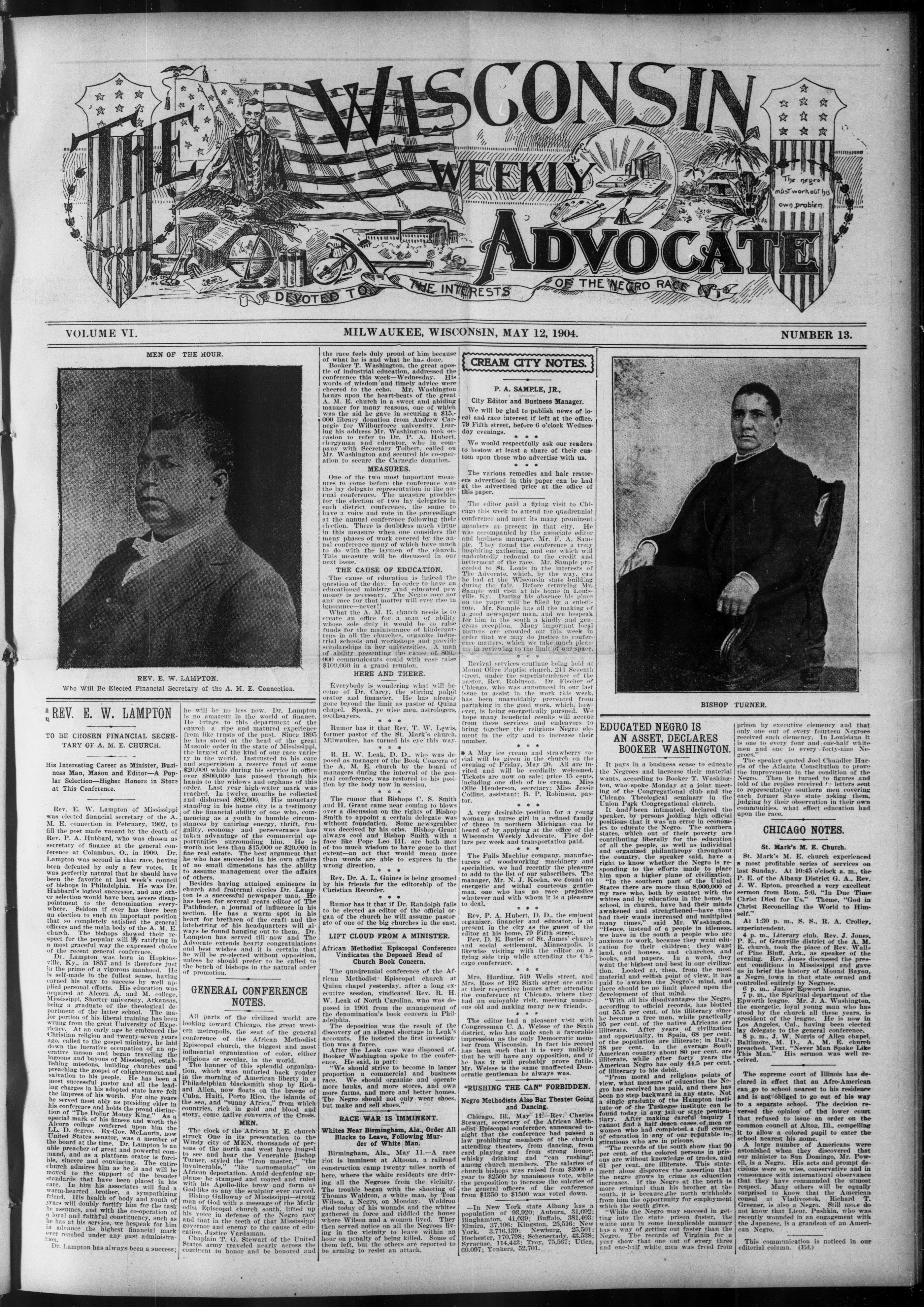
Wisconsin Weekly Advocate
Thursday, May 12, 1904
Milwaukee, Wisconsin
Page text (machine-generated)
WISCONSIN
WEEKLY
ADVOCATE
DEVOTED TO
THE INTERESTS
OF THE WEGRO RACE
[Portrait of a man in formal attire, facing slightly to the right].
Who Will Be Elected Financial Secretary of the A. M. E. Connection.
REV. E. W. LAMPTON
TO BE CHOSEN FINANCIAL SECRET TARY OF A. M. E. CHURCH.
His Interesting Career as Minister, Business Man, Mason and Editor—A Poplar Selection—Higher Honors in Store at This Conference.
Rev. E. W. Lampton of Mississippi was elected financial secretary of the A. M. E. connection in February, 1902, to fill the post made vacant by the death of Rev. P. A. Hubbard, who was chosen as secretary of finance at the general conference at Columbus, O., in 1900. Dr. Lampton was second in that race, having been defeated by only a few votes. It was perfectly natural that he should have been the favorite at last week's council of bishops in Philadelphia. He was Dr. Hubbard's logical successor, and any other selection would have been severe disappointment to the denomination everywhere. Seldom if ever has there been an election to such an important position that so completely satisfied the general officers and the main body of the A. M. E. church. The bishops showed their respect for the popular will by ratifying in a most graceful way the expressed choice of the recent general conference.
Dr. Lampton was born in Hopkinsville, Ky., in 1857 and is therefore just in the prime of a vigorous manhood. He is self-made in the fullest sense, having earned his way to success by well applied personal efforts. His education was acquired at Alcorn A. and M. college, Mississippi, Shorter university, Arkansas, being a graduate of the theological department of the latter school. The major portion of his liberal training has been wrung from the great University of Experience. At an early age he embraced the Christian religion and twenty-seven years ago, called to the gospel ministry, he laid down the lucrative occupation of an operative mason and began traveling the lagoons and bayous of Mississippi, establishing missions, building churches and preaching the gospel of enlightenment and salvation to his people. He has been a most successful pastor and all the leading charges in his adopted state have felt the impress of his worth. For nine years he served most ably as presiding elder in his conference and holds the proud distinction of "The Dollar Money King." As a special mark of his fitness and worth the Alcorn college conferred upon him the LL. D. degree. Ex-Gov. McLaurin, now United States senator, was a member of the board at the time. Dr. Lampton is an able preacher of great and powerful command, and as a platform orator is forcible, sincere and convincing. The entire church admires him as he is and will be moved to the support of the broader standards that have been placed in his care. In him his associates will find a warm-hearted brother, a sympathizing friend. His health of body and youth of years will doubly fortify him for the task he assumes, and with the co-operation of a loyal and faithful constituency, such as he has at his service, we bespeak for him in advance the highest financial mark ever reached under any past administration.
Dr. Lampton has always been a success:
he will be no less now. Dr. Lampton is no amateur in the world of finance. He brings to this department of the church a ripe and matured experience from like trusts of the past. Since 1895 he has stood at the head of the great Masonic order in the state of Mississippi, the largest of the kind of our race variety in the world. Instrusted to his care and supervision a reserve fund of some $20,000 while during his service in office over $800,000 has passed through his hands to the widows and orphans of this order. Last year high-water mark was reached. In twelve months he collected and disbursed $82,000. His monetary standing in his home city is a testimony of the financial ability of one who, commencing as a youth in humble circumstances by untiring energy, thrift, frugality, economy and perseverance has taken advantage of the commercial opportunities surrounding him. He is worth not less than $15,000 or $20,000 in fine real estate. The best argument that he who has succeeded in his own affairs of no small dimensions has the ability to assume management over the affairs of others.
Besides having attained eminence in church and fraternal circles Dr. Lampton is a successful newspaper man. He has been for several years editor of The Pathfinder, a journal of influence in his section. He has a warm spot in his heart for brethren of the craft and the latchstring of his headquarters will always be found hanging out to them. Dr. Lampton has served till now and The Advocate extends hearty congratulations and best wishes and it is certain that he will be re-elected without opposition, unless he should prefer to be called to the bench of bishops in the natural order of promotion.
GENERAL CONFERENCE NOTES.
All parts of the civilized world are looking toward Chicago, the great western metropolis, the seat of the general conference of the African Methodist Episcopal church, the biggest and most influential organization of color, either religious or secular, in the world. The banner of this splendid organization, which was unfurled back yonder in the morning of American liberty in a Philadelphia blacksmith shop by Richard Allen, now floats on the breeze of Cuba, Haiti, Porto Rico, the islands of the sea, and "sunny Africa," from which countries, rich in gold and blood and story, come native converts of the Cross.
MEN.
The clock of the African M. E. church struck One in its presentation to the Windy city of MEN. thousands of persons of the north and west have longed to see and hear the Venerable Bishop Turner, styled the "Iron master," "the invulnerable," "the monomaniae" on African deportation. Amid deafening applause he stamped and roared and ruled with his Apollo-like brow and form as God-like as any the sculptor ever carved. Bishop Galloway of Mississippi-strong man of God with a message of the Methodist Episcopal church south, lifted up his voice in defense of the Negro race and that in the teeth of that Mississippi governor and enemy to the cause of education, Justice Vardaman. Chaplain T. G. Stewart of the United States army traveled nearly across the continent to honor and be honored and
the race feels duly proud of him because of what he is and what he has done.
of what he is and what he has done.
Booker T. Washington, the great apostle of industrial education, addressed the conference this week—Wednesday. His words of wisdom and timely advice were cheered to the echo. Mr. Washington hangs upon the heart-beats of the great A. M. E. church in a sweet and abiding manner for many reasons, one of which was the aid he gave in securing a $15,000 library donation from Andrew Carnegie for Wilburforce university. During his address Mr. Washington took occasion to refer to Dr. P. A. Hubert, clergyman and educator, who in company with Secretary Tolbert, called on Mr. Washington and secured his co-operation to secure the Carnegie donation.
MEASURES.
One of the two most important measures to come before the conference was the lay delegate representation in the annual conference. The measure provides for the election of two lay delegates in each district conference, the same to have a voice and vote in the proceedings at the annual conference following their election. There is doubtless much virtue in this measure when one considers the many phases of work covered by the annual conference many of which have much to do with the laymen of the church. This measure will be discussed in our next issue.
THE CAUSE OF EDUCATION
The cause of education is indeed the question of the day. In order to have an educationed ministry and educated pew money is necessary. The Negro race nor any race for that matter will ever rise in ignorance—never!! What the A. M. E. church needs is to create an office for a man of ability whose sole duty it would be to raise funds for the maintenance of kindergartens in all the churches, organize industrial schools and workshops and provide scholarships in her universities. A man of ability presenting the cause of 800,000 communicants could with ease raise $100,000 in a grand reunion.
HERE AND THERE.
Everybody is wondering what will become of Dr. Carey, the stirring pulpit orator and financier. He has already gone beyond the limit as pastor of Quinn chapel. Speak, ye wise men, astrologers, soothsayers.
* * *
Rumor has it that Rev. T. W. Lewis, former pastor of the St. Mark's church, Milwaukee, has turned his eye this way.
* * *
R. H. W. Leak, D. D., who was deposed as manager of the Book Concern of the A. M. E. church by the board of managers during the interval of the general conference, was restored to his position by the body now in session.
The rumor that Bishops C. S. Smith and H. Grant came near coming to blows over a discussion on the rights of Bishop Smith to appoint a certain delegate was without foundation. Some newsgrabber was deceived by his orbs. Bishop Grant always cool and Bishop Smith with a face like Pope Leo III. are both men of too much wisdom to have gone to that extent—an act that would mean more than words are able to express in the wrong direction.
Rev. Dr. A. L. Gaines is being groomed by his friends for the editorship of the Christian Recorder.
Rumor has it that if Dr. Randolph fails to be elected as editor of the official organ of the church he will assume pastorate of one of the big churches in the east.
LIFT CLOUD FROM A MINISTER
African Methodist Episcopal Conference Vindicates the Deposed Head of Church Book Concern.
The quadrennial conference of the African Methodist Episcopal church at Quinn chapel yesterday, after a long executive session, vindicated Rev. R. H. W. Leak of North Carolina, who was deposed in 1901 from the management of the denomination's book concern in Philadelphia. The deposition was the result of the discovery of an alleged shortage in Leak's accounts. He insisted the first investigation was a farce. After the Leak case was disposed of, Booker Washington spoke to the conference. He said in part:
"We should strive to become in larger proportion a commercial and business race. We should organize and operate more banks, and more stores, and own more farms, and more and better homes. The Negro should not only wear shoes, but make and sell shoes."
RACE WAR IS IMMINENT.
Whites Near Birmingham, Ala., Order All Blacks to Leave, Following Murder of White Man.
Birmingham, Ala., May 11.—A race riot is imminent at Altoona, a railroad construction camp twenty miles north of here, where the white residents are driving all the Negroes from the vicinity. The trouble began with the shooting of Thomas Waldron, a white man, by Tom Wilson, a Negro, on Monday. Waldron died today of his wounds and the whites gathered in force and riddled the house where Wilson and a woman lived. They then served notice on all the Negroes living in the vicinity to leave within an hour on penalty of being killed. Some of them left, but the others are reported to be arming to resist an attack.
CREAM CITY NOTES.
P. A. SAMPLE, JR.,
City Editor and Business Manager
We will be glad to publish news of local and race interest if left at the office, 79 Fifth street, before 6 o'clock Wednesday evenings.
We would respectfully ask our readers to bestow at least a share of their custom upon those who advertise with us.
The various remedies and hair restorers advertised in this paper can be had at the advertised price at the office of this paper.
The editor paid a flying visit to Chicago this week to attend the quadrennial conference and meet its many prominent members at present in that city. He was accompanied by the associate editor and business manager, Mr. F. A. Sample. They found the conference a truy inspiriting gathering, and one which will undoubtedly redound to the credit and betterment of the race. Mr. Sample proceeded to St. Louis in the interests of The Advocate, which, by the way, can be had at the Wisconsin state building during the fair. Before returning Mr. Sample will visit at his home in Louisville, Ky. During his absence his place on the paper will be filled by a substitute. Mr. Sample has all the making of a good newspaper man, and we bespeak for him in the south a kindly and generous reception. Many important local matters are crowded out this week in order that we may do justice to conference matters, which we take much pleasure in reviewing to the limit of our space.
Revival services continue being held at Mount Olive Baptist church, 211 Seventh street, under the superintendence of the pastor, Rev. Robinson. Dr. Fischer of Chicago, who was announced in our last issue to assist in the work this week, has been unavoidably prevented from partaking in the good work, which, however, is being energetically pursued. We hope many beneficial results will accrue from these services and endeavors to bring together the religious Negro element in the city and to increase their number.
A May ice cream and strawberry social will be given in the church on the evening of Friday, May 20. All are invited and will be cordially welcomed. Tickets are now on sale; price 15 cents, including one dish of ice cream. Miss Ollie Henderson, secretary; Miss Jessie Collins, assistant; B. P. Robinson, pastor
* * *
A very desirable position for a young woman as nurse girl in a refined family of three in northern Michigan can be heard of by applying at the office of the Wisconsin Weekly Advocate. Five dollars per week and transportation paid.
***
The Falls Machine company, manufacturers of woodworking machinery and specialties, we had recently the pleasure to add to the list of our subscribers. The manager, Mr. N. J. Kochn, we found an energetic and withal courteous gentleman, one who has no race prejudice whatever and with whom it is a pleasure to deal.
Rev. P. A. Hubert, D. D., the eminent organizer, financier and educator, is at present in the city as the guest of the editor at his home, 79 Fifth street.
Rev. D. E. Butler of St. James' church and social settlement, Minneapolis, is likewise visiting with the editor on a flying side trip while attending the Chicago conference.
* * *
Mrs. Harding. 519 Wells street, and Mrs. Ross of 192 Sixth street are again at their respective homes after attending the conference at Chicago, where they had an enjoyable visit, meeting numerous old and making many new friends.
* * *
The editor had a pleasant visit with Congressman C. A. Weisse of the Sixth district, who has made such a favorable impression as the only Democratic member from Wisconsin. In fact his record has been such that it is very unlikely that he will have any opposition, and if he has it will probably prove futile. Mr. Weisse is the same unaffected Democratic gentleman he always was.
"RUSHING THE CAN" FORBIDDEN.
Negro Methodists Also Bar Theater Going and Dancing.
Chicago, Ill., May 11.—Rev. Charles Stewart, secretary of the African Methodist Episcopal conference, announced tonight that the conference had passed a law prohibiting members of the church attending theaters, from dancing, from card playing and from strong liquor, whisky drinking and "can rushing" among church members. The salaries of church bishops was raised from $2000 a year to $2500 by unanimous vote, while the proposition to increase the salaries of the general officers of the conference from $1350 to $1500 was voted down.
—In New York state Albany has a population of 93,920; Auburn, 31,092; Binghamton, 41,039; Buffalo, 381,403; Elmira, 37,106; Kingston, 25,516; New York, 3,716,139; Newburg, 25,501; Rochester, 170,798; Schenectady, 43,538; Syracuse, 114,443; Troy, 75,567; Utica, 60,099; Yonkers, 52,701.
EDUCATED NEGRO IS AN ASSET, DECLARES BOOKER WASHINGTON
It pays in a business sense to educate the Negroes and increase their material wants, according to Booker T. Washington, who spoke Monday at a joint meeting of the Congregational club and the Chicago Theological seminary in the Union Park Congregational church. It had been intimated, declared the speaker, by persons holding high official positions that it was an error in economics to educate the Negro. The southern states, which out of their poverty are contributing liberally for the education of all the people, as well as individual and organized philanthropy throughout the country, the speaker said, have a right to know whether the Negro is responding to the efforts made to place him upon a higher plane of civilization.
"In the southern part of the United States there are more than 8,000,000 of my race who, both by contact with the whites and by education in the home, in school, in church, have had their minds awakened and strengthened—have thus had their wants increased and multiplied many times," said Mr. Washington. "Hence, instead of a people in idleness, we have in the south a people who are anxious to work, because they want education for their children; they want land, and houses, and churches, and books, and papers. In a word, they want the highest and best in our civilization. Looked at, then, from the most material and selfish point of view, it has paid to awaken the Negro's mind, and there should be no limit placed upon the development of that mind.
"With all his disadvantages the Negro, according to official records, has blotted out 55.5 per cent. of his illiteracy since he became a free man, while practically 95 per cent. of the native Africans are illiterate. After years of civilization and opportunity, in Spain, 68 per cent. of the population are illiterate; in Italy, 38 per cent. In the average South American country about 80 per cent. are illiterate, while after forty years the American Negro has only 44.5 per cent. of illiteracy to his debit.
"From moral and religious points of view, what measure of education the Negro has received has paid, and there has been no step backward in any state. Not a single graduate of the Hampton institute or of the Tuskegee institute can be found today in any jail or state penitentiary. After making careful inquiry I cannot find a half dozen cases of men or women who had completed a full course of education in any of our reputable institutions who are in prisons.
"The records of the south show that 90 per cent. of the colored persons in prisons are without knowledge of trades, and 61 per cent. are illiterate. This statement alone disproves the assertion that the negro grows in crime as education increases. If the Negro at the north is more criminal than his brother at the south, it is because the north withholds from him the opportunity for employment which the south gives.
"While the Negro may succeed in getting into the state prison faster, the white man in some inexplicable manner has a way of getting out faster than the Negro. The records of Virginia for a year show that one out of every three and one-half white men was freed from
NUMBER 13.
TURNER.
prison by executive clemency and that only one out of every fourteen Negroes received such clemency. In Louisiana it is one to every four and one-half white men and one to every forty-nine Negroes." The speaker quoted Joel Chandler Harris of the Atlanta Constitution to prove the improvement in the condition of the Negro. Then he turned to figures and told of the replies received to letters sent to representative southern men covering each former slave state asking them, judging by their observation in their own communities, what effect education had upon the race.
CHICAGO NOTES
St. Mark's M. E. Church.
St. Mark's M. E. church experienced a most profitable series of services on last Sunday. At 10:45 o'clock a. m., the P. E. of the Albany District G. A., Rev. J. W. Epton, preached a very excellent sermon from Rom. 5:6, "In Due Time Christ Died for Us." Theme, "God in Christ Reconciling the World to Himself." At 1:30 p. m., S. S., R. A. Crolley, superintendent.
4 p. m., Literary club. Rev. J. Jones, P. E., of Granville district of the A. M. E. church, took the place of Rev. Walls of Pine Bluff, Ark., as speaker of the evening. Rev. Jones discussed the present conditions in Mississippi and gave us in brief the history of Mound Bayou, a Negro town in that state owned and controlled entirely by Negroes. 6 p. m., Junior Epworth league. 7 p. m., the Spiritual department of the Epworth league. Mr. J. A. Washington, the energetic, loyal young man who has stood by the church all these years, is president of the league. He is now in Los Angeles, Cal., having been elected lay delegate to the general conference. 8 p. m., J. W. Norris of Allen chapel, Baltimore, M. D., A. M. E. church preached. Text, "Never Man Spake Like This Man." His sermon was well received.
The supreme court of Illinois has declared in effect that an Afro-American can go to school nearest to his residence and is not obliged to go out of his way to a separate school. The decision reversed the opinion of the lower court that refused to issue an order on the common council at Alton, Ill., compelling it to allow a colored pupil to enter the school nearest his nome.
A large number of Americans were astonished when they discovered that our minister to San Domingo, Mr. Powell, is a Negro. His acts and prompt decisions were so wise, conservative and in consonance with international observance that they have commanded the utmost respect. Many others will be equally surprised to know that the American consul at Vladivostok, Richard T. Greener, is also a Negro. Still more do not know that Lieut. Pushkin, who was recently wounded in an engagement with the Japanese, is a grandson of an American Negro.
This communication is noticed in our editorial column. (Ed.)
---
GERMS PREFERRED
Though they affirm
A deadly germ
Lurks in the sweetest kiss,
Let's hope the day
Is far away
Of antiseptic bliss.
Though cartoine
And listerine
Are very useful drugs,
Yet who would sip
Them from a lip
In preference to bugs?
To sterilize
A lady's sighs
Would simply be outragous--
I'd much prefer
To humor her
And let her be contagious!
--Atlanta Journal.
Miscellaneous Items.
A number of Dublin men have been engaged to take their jaunting cars to St. Louis and ply for hire in the streets of that city during the exhibition.
At some of the public libraries in London the racing news is carefully blacked out of the newspapers before they are put upon the files for reading.
The earliest spur known consisted of a sharp prod mounted on a base to fasten about the heel. Antiquarians place its date at from 300 to 100 B. C.
The public of Liberia is worried over polygamy. A bill has just been laid before the Liberian Senate for the regulation of it.
For a new variety of rhubarb it is claimed that it not only fruits all the year round, but that its flavor resembles a combination of the raspberry and strawberry.
The present Trinity church at the head of Wall street, New York, is the third edifice of that name, the two preceding structures erected upon the same ground having been burned.
The Trans-Siberian railway is nearly 6000 miles long, and cost, in rough figures, $5,000,000,000. The first sod was turned in 1895, and in nine years 3375 miles were laid, including 30 miles of bridges.
Eight hundred young men and women, representing twenty universities, attended a recent conference of student volunteers at Edinburgh to discuss "The Evangelization of the World in This Generation."
—In 1873 in Germany 1,500,000 trees are said to have been destroyed in the Hartz forest alone by two small species of beetles. The larvae burrow beneath the bark and thus cause the injury to the growing trees.
—The present custom in England of brides carrying prayerbooks instead of bouquets has caused a boom in the prayerbook trade. The bindings have to be white—Morocco calf, ivory, silver or mother-of-pearl.
—The three important wheat states of Au-tralia produce 35,000,000 bushels. The yield to each acre in New South Wales is 10.6 bushels, in South Australia, 6.9 bushels, and in West Australia, 4.6 bushels.
—Andrew Carnegie has the best collection of autographs of crowned heads and famous persons in cotemporary history. There are frequently not only signatures, but also letters written to him on various subjects.
—Two and a half tons of whalebone was recently sold at Dundee at the rate, it is understood, of $15,000 a ton, or $1000 a ton higher than the previous record price. Early last century the price was $125 a ton.
—Lately a find of diamonds, rubies and sapphires was reported to have been made in the Hope valley of the Orange River colony, South Africa. Experts at Johannesburg have examined the specimens and say they are glass.
—Lieut. Charles M. McIsaac of the Eighth Massachusetts regiment has received an appointment as instructor in the new Chinese imperial forces, with a captain's commission. He will leave for China in three or four weeks.
—British officers are having the scars of face wounds removed by the use of light rays. The London Mail says: "The custom is rapidly growing of surgeons sending their patients to have the scars left by operations removed."
The present war has produced the first heading containing more than a single line ever published in a Russian newspaper. Previously the most important news had never been so honored and the death of Queen Victoria was announced without any heading.
The Norwegian town of Aalesund, which was destroyed by fire some months ago, is being rapidly rebuilt with the aid of 1,500,000 crowns received from Scandinavian and German cities.
Several projects are on foot in England for honoring the memory of the late Charles H. Spurgeon, the great Baptist preacher. One is the plan to buy the large and beautiful estate of Westwood and convert it into a home of rest for ministers and missionaries.
The Saxon government, now that it has been found necessary to discontinue the Freiberg mineral mines within the next ten years, intends to open up immediately brown coal mines near Leisnig, which in 1904, it is estimated, will have an output of 104,000 metric tons.
Considerable support is being given by the Swiss press to a suggestion by Mme. Hilfiker-Schmid, a physician of Zurich, who asks that the state pass a law compelling all unmarried girls of the rich business class to devote one year to unpaid hospital or ambulance work.
A big parade called the "Parade of Peoples and Beasts" will be a feature of Pike day at the world's fair, June 4. Six thousand natives from all climes, speaking thirty tongues, will take part. Thirty thousand dollars will be spent on the demonstration.
The Paris Academy of Medicine, in view of the excellent results obtained in divers countries by the mechanical protection of houses against mosquitoes, has resolved that the military authorities should adopt similar precautions, more especially in the French colony of Madagascar, where mosquitoes which spread malaria abound.
Cat fanciers all agree that Japan, indeed, is the country of curious felines, and surely no example of the freak in the cat family is more singular than the tailless variety which abounds in the Land of the Rising Sun. For the most part the cats of Japan are minus a brush, although they sometimes have a tailbone undeveloped and a small tuft of hair.
The British army is to publish a stilling monthly magazine. It is to be called the Army Journal of the British Empire and the editor will be Sir Neville Lyttelton, chief of the general staff of the army. Officers and soldiers are invited to submit articles, which must not exceed 6000 words, and special contributions by eminent civilians are promised.
—In London the other day the warrant under which John Bunyan, author of the "Pilgrim's Progress," was committed to Bedford jail, was sold at auction for $1525. It is signed by thirteen justices of the peace, six baronets and seven squires. It charges that Bunyan had been teaching and preaching otherwise than "according to the liturgee and practice of the church of England." It is said that he was imprisoned for six months under this warrant, but as he passed twelve years, from 1660 to 1672, in Bedford jail, there must have been other warrants against him.
THE FIRING LINE.
Dedicated to the coming President of the United States.
For glory? For good? For fortune or fame?
Why, ho for the front where the battle is on!
Leave the rear to the dolt, the lazy, the lame:
Go forward; go fight on the Firing Line.
Whether newsboy or plowboy, cowboy or clerk.
clever
Fight forward, be ready, be steady, be
first;
Be fairest, be bravest, be best at your
work;
Exult and be glad; dare to hunger, to
talks
As beard, as Alfred—let dogs skulk and
wheeze
There is room but for men on the Firing Line.
Aye, the place to fight and the place to fall—
As fall we must, all in God's good time—
It is where the manliest man the wall,
Where boys are as men in their pride and pride,
Where glory gleams brightest, where brightest eyes shine.
A SUBURBAN SCANDAL
Edmund Dolby went home from the city that evening by an earlier train than usual, and Mrs. Dolby was out. "Do you know where Mrs. Dolby is, Martha?" he called to the girl in the kitchen.
"The mistress went out, sir, about ten minutes ago, and said she'd be back in half an hour."
Edmund returned to the sitting room, and lay back in the low armchair by the fire in gloomy meditation. He had been uneasy in his mind all day, for, the night before he and Letty had quarreled and it was because this had been fretting him and he was wistful of making his peace with her that he had contrived to get home so much earlier than usual. And now she was out.
The fact that this chanced to be his birthday gave a keener edge to his sufferings, and made her absence, when he came yearning for reconciliation, so much the more inexeusable. He sat, hunched in the armchair, brooding until he began to see a sinister significance in her not being there to welcome him; it became as clear to him again as if it had been last night that he had been justified in the complaints he had made, and that her indignation had been assumed simply to blind him.
The facts in connection with that quarrel were, chiefly, these: Edmund's one particular friend in Watford was Alfred Hilbert, and Letty's one particular friend was Nelly Hilbert, his wife. Once a week the Dolbys went round the corner and spent an evening with the Hilberts, and once a week the Hilberts came round the corner and spent an evening with the Dolbys. Moreover, they frequently dropped in on each other informally; the wives occasionally shopped together, the husbands took Sunday strolls together, and their friendliness would have been absolutely ideal but for one jarring circumstance.
There had been a time when Alfred Hilbert was desperately in love with Letty. Twice she had rejected him, when Edmund made her acquaintance and they fell in love with each other at sight.
Alfred resigned himself to the inevitable so completely that, a few months later, being a breezy young man whose heart was too well seasoned to break easily, he transferred his affections to Nelly, who was already Letty's dearest friend and had remained so ever since.
Edmund knew all about this from the beginning. Alfred treated it as a jest. After they were all married, he would speak of his past infatuation openly at their weekly meetings, and laugh about it, never seeming to realize that nobody enjoyed the joke but himself.
He was that sort of man. Instead of growing inured to his facetious descriptions of his extinct passion, Edmund more and more resented them, even rebuking Letty now and then, as if she were to blame for having been passively responsible for Alfred's fascination.
Last night, after the Hilberts were gone, he had rebuked her with unreasonable irritation, for he was of a naturally jealous temperament, and had gradually persuaded himself that Alfred was much too attentive to his wife, and that Letty's manner toward him was unnecessarily gracious. He told her so in no unmeasured terms, magnifying his grievances and saying more than he meant, as an angry man will.
Letty was disposed at the outset to answer him laughingly, but her flippancy exasperated him. Finally, he so lost control of himself that his preposterous hints and innuendoes stung and insulted her. Her cold dignity was unabated by breakfast time this morning, and, as he could not humble himself and surrender, he had gone off to the city sullenly, without kissing her.
Away from her he remembered all her sweetness and was ashamed that his jealousy could so outrageously befoil him. He yearned to be with her—thinking of tender things he would say to her; he would even ask her to forgive him; and only to imagine how she would lean her head upon his breast and cry brought tears to his eyes.
He had pictured it all vividly; he had hastened home to fulfill his happy imaginings—and she was out.
“If she had sent me a telegram asking me to come home it would have been nothing astonishing,” he muttered, bitterly: “but, instead of that, she isn't even waiting for me when I do come”—
There was a piece of crumpled paper lying in the fender. He had noticed it idly, directly he sat down, and now, suddenly, seeing there was writing on it, he picked it up, straightened it out, and read it:
"Have got the tickets. Be at my office not later than 7, and we will go. Till death and after, Alfred."
He sat stunned, rereading it mechanically, as if it meant nothing to him. Gradually the words seemed to burn into his brain. Here, then, was full and dreadful confirmation of his worst suspicions. He had not been mistaken last night in thinking there was some secret understanding between them. Here was their secret flashed bewilderingly before him.
He started to his feet and snatched his watch from his pocket. A quarter past 6. There was a bare possibility that he might even yet be in time to intercept them, and he must make the most of that.
As he passed the Hilbert's door a vaguely forlorn hope tempted him aside, and he knocked till the servant opened it.
"Is Mr. Hilbert here?" he demanded.
"No, sir."
"Where is Mrs. Hilbert?"
"In the drawing room, sir."
"I want to speak to her. Don't trouble. I will go to her." He stepped inside and closed the door, and Nelly was scared by the pallor and the tense expression of his face?
"Why —! What's wrong, Edmund?" she ejaculated.
He told her, panting and stammering incoherently.
"Nonsense!" she interrupted. "There must be some mistake—"
"There is no mistake!" he cried. "I have his letter to her."
"Where is it?"
"He says"—he was fumbling hastily in his pockets—"he says he has booked their passage, and she is to meet him at his office by 7. * * * Oh, I can't find it—must have left it at home! But it doesn't matter—I've told you what it says. What am I to do?"
"Oh, dear!" faltered Nelly. "I knew—I—I told Alfred last night that he was far too attentive to Letty—but oh! I never dreamed—"
"The ruffian!" he raged, wildly. "If I can only lay hands on him—! But I can't stop. I want to catch the next train to Euston. It's a fast train and may get me to his office just in time."
"Oh, please wait—let me come with you!"
They reached the station not a moment too soon. The train stopped nowhere until it arrived at Euston. As it drew up at the platform Edmund sprang out and assisted Nelly to alight.
"Here! What's up? Where are you two off to?"
They started round and were face to face with Alfred Hilbert.
"Where is my wife?" gasped Edmund, seizing his arm.
"Don't talk like a fool! Tell me what's happened."
"You know well enough——"
"I tell you I don't; I want to know!
And I want to know, too, what are you two tearing off together like this for?"
Either he was a hardened and accomplished hypocrite or he really did find it hard to realize exactly what he was charged with, and eventually he was as baffled as themselves.
"All I can say is," he reiterated, "that note was not from me."
"But it's in your writing," Edmund insisted.
"Can't help that. I've never written to Letty in my life—not since you've known her, Ned, anyhow. * * * Where's the letter?"
"I thought I had it with me"—Edmund began to search through his pockets again—"I must have left it. * * * No, here it is!"
He pulled it out, and the other two read it over his shoulder.
"Yes, that's mine, right enough," Alfred admitted. Then, all of a sudden, he broke into a roar of laughter. "It is mine"—
"It's no laughing matter"—
"Why, mustn't a man write to his own wife, then? It's the note I sent to Nell, here, the day before yesterday."
"It can't be! How can it be?" protested Edmund. "I found it at my house—in the fireplace."
"All right! You ask Nelly."
Nelly glanced at it again eagerly.
"So it is!" she cried, laughing hysterically. "We were going to the theater, and weren't sure whether we could get seats, and Alfred was to try and book them on his way to the city and let me know, and that's his note."
"And you both thought I"——
"Well, but," Edmund interrupted, relieved and mortified at the turn affairs had taken, "how is it that it was in my house?"
"Why, I called to see Letty this morning, and she had a headache," explained Nelly; "so I slipped back home to fetch her some tabloids, and this is the paper I wrapped them in—it happened to be in my pocket. I gave Letty the tabloids and threw the paper in the fender. If I had thought of it while you were telling me—and, yet, how could I?"
"And you bolted in pursuit of Letty and me!" chuckled Alfred. "I called at the paper shop on my road home, and I reckon you two went by whilst I was inside. When I reached home, I found the girl half off her head. All she knew was that Ned, here, had been shouting, and you had run away with him, and she had heard one of you say you must catch the next train to Euston. I didn't know what to make of it, so I came after you, and just managed to scramble into the last carriage as the train started. * * * I say, talk about running away with another fellow's wife, though!"—he guffawed again—"I think it's me that ought to do the shooting!"
But Edmund was in no mood to make light of his humiliation, and by degrees the others sympathetically subdued themselves to his humor.
Back again at Watford, they shook hands and parted; and when Edmund returned home there was Letty waiting for him.
She met him in the hall, and, before he could decide how to greet her, she clasped her arms round his neck. A tender mist shone in her eyes, and everything was coming about as ideally as he had pictured it to himself in his remorseful dreams during the day.
"I did so want you to come home, dear!" she whispered.
"I—I was delayed." he murmured, awkwardly.
"Martha says you came in and ran out again almost immediately."
"Yes——You were not here."
"I had gone out to get this for you Ned." "This was a gold pencil with his initials engraved on it. She drew it from her pocket and offered it to him, shyly. "It was not ready last night. * * * And I was so—so unkind this morning! I never even wished you"——He took most of the wishes in kisses.
"And I was afraid, when you came home and went out again without seeing me, that you"—her voice faltered penitently—"that you were still angry with me."
"No; it wasn't that, sweetheart. It wasn't that at all."
"I was so afraid that, perhaps"—
"No, it was nothing but a * * * But, I say, Letty, I'm hungry!" he said, schening for time to think how to make the least of it all. "Let us sit down, and I'll tell you the whole story over dinner."—The Sketch.
Brains Count in War
Does intelligence in a soldier count? Are brains worth anything in an army? Certainly between the reading habits of the Russian and the Japanese soldiers there is a starling contrast. The little country—a veritable Lilliput against a Brobdingnag—has more schools and more postoffices in her 163,000 square miles of territory than there are in "all the Russias" of Europe and Asia. Japan has 81 per cent, of her children under instruction. Over 1500 men who have taken the full course in the high schools are found in the rank and file of the Mikado's army, and over 300 graduates of the Imperial university are enrolled among the officers. Every soldier and sailor can read and write. With the history and geography of Korea and China each soldier under the banner of the Rising Sun has a good general knowledge, which began in childhood. With Manchuria, he has a critical acquaintance. No better maps of these regions now in debate have ever been made than those by the war department in Tokio. Tens of thousands of these easily folded maps are now in Japanese knapsacks.—La Salle A. Maynard in Leslie's Weekly.
Could Not Appear.
When Senator Burrows was practicing law in Michigan he went one day to a court in a small town. A country lawyer was arguing before an aged and solennum justice of the peace. "Now," said the lawyer, "if it pleases your honor, the defendant says he paid the money to the diseased, but I am goin' to show that the diseased never got the money. He didn't receive one cent, the diseased didn't—" "Say," broke in the justice, "what is this man diseased of? Why don't you bring him here?" "Because, your honor, he is diseased of death."—Kansas City Star
Squaring Accounts.
An office boy in London owed one of the clerks three halfpence.
The clerk owed the cashier a penny.
The cashier owed the boy a penny.
One day the boy, having a halfpenny in his pocket, was disposed to diminish his outstanding indebtedness, and paid the clerk, to whom he was indebted three halfpence, one halfpenny on account.
The clerk, animated by so laudable an example, paid one halfpenny to the cashier, to whom he was indebted one penny.
The cashier, who owed the boy a penny, paid him a halfpenny.
And now the boy, having his halfpenny again in his hand, paid another third of his debt to the clerk.
And now the lad, with the halfpenny again in his hand, paid off the third and last instalment of his debt of three halfpence. Thus were the parties square all round, and all their accounts adjusted.—London Tit-Bits.
Termination "Er"
The railway company which has labeled its smoking carriages "smoker" writes a correspondent) has yielded to a fatal fascination which is no new thing. The attractions of the slipshod "er" were felt when the marchioness spoke of a "wunner" and the new police were dubbed "peelers," and tall hats have long been known as "toppers." But it was at Oxford that the "~er" habit was destined to run to its fullest length. As is well known, the game of "footer" is divided into "rugger" and "soccer;" but these are only mild examples of the craze, which is by no means dead, although protests against its excesses were heard in my time (ten years ago). Mr. Gladstone was "the Gladder." An undergraduate left his "bedder" in the morning to eat his "brecker" in his "sitter;" later he attended a "lecker," and in the afternoon he might run with the "toggers" (torpid races) or take some other form of "ecker"—there was some dispute as to the spelling of "exercise," but none as to its pronunciation.—London Chronicle.
The Dog's Dream
"Man down in my country," said Representative Clayton of Alabama, "saw a dog sleeping in the sun. The dog was twitching and starting as dogs sometimes do in their sleep. The man said, 'I'd like to know what that dog is dreaming about.'
"'Easy enough,' replied an old chap who stood by. 'You just put a chip on that dog's ear and leave it there until he wakes up. Then you take that chip and put it on your chest when you go to bed tonight and you will dream of what the dog is dreaming of now.'
"The fellow got a chip and put it on the dog's ear and stood around until the dog waked up and brushed it off. He put the chip on his chest when he went to bed that night. Next morning I saw him coming listlessly down the street.
"'What's the matter?' I said. 'What was the dog dreaming about?'
‘Oh,’ he answered, 'I'm clean tuckered out. I was chasing rabbits all night long.' "—New York World.
The Mount Airy Man's Dog Story.
They were talking about the intelligence of dogs, and after each man in the group had cracked up his own the Mount Airy man said: "I have a fox terrier named Troubles who not only seems to understand everything that is said to him, but who even takes in conversation of a general character that isn't addressed to him. Our servant girl has been suffering from a bad cold, and the other day, when she went out in the yard to hang up clothes, my wife noticed that the ground was very damp. 'Mary, you ought to have rubbers on out there,' she called from a window. Now, Troubles happened to overhear this remark and what do you suppose that dog did? He ran to the hall, picked up a rubber shoe, hustled out into the yard and dropped it at the girl's feet. Then he hurried back and repeated the performance with the other shoe. Don't tell me dogs don't understand the English language."—Philadelphia Record.
Full of Snakes.
The Snake Spring, which is about 170 feet above Deep Fork, twenty miles southeast of Stroud, was rightly named. Hundreds of poisonous moccasins and other water snakes make the large pool close to the copiously flowing spring their resort from April until November. Superstitionious Indians are mortally afraid of the place, as their heathen religion doesn't permit them to decrease the snake family. Wolves and wildcats make their homes in the crevices of the rocks and canons adjacent to the spring. The wildly romantic locality was the headquarters of the Sloshin and other outlaws during the '70s. The geographical features of the elevated and rugged hills around the spring are different from other localities in the Creek Nation. The rocks are a sort of flint, of a hard conglomerate nature. The brownish colored mineral water that runs out of the bank of Deep Fork is said to possess great medicinal properties.—Kansas City Journal.
Secret Passage from English Abbey
Within the last few days the interesting discovery has been made of a subterranean passage leading from the abbey at Thorney, the last parish in the diocese of Ely, down to the river. The passage is 500 feet in length, and, although constructed centuries ago, its existence has bitherto been undreamed of by dwellers on the Duke of Bedford's model Thorney estate. A hermitage was founded at Thorney by religious Saxons in 655, but the present abbey, which is used as the parish church, was built at the end of the Eleventh century.—London Daily Mail.
Read It Easily
In the stone walls of the Odd Fellows' temple, at Broad and Cherry streets, the letters, "I. O. O. F." are deeply cut. Two Irishmen stopped in front of the building the other day.
"Begorrah, Pat," exclaimed one of them, "and what do them letters mean, anyhow?"
"Hush, man," counseled the other. "Don't show your ignorance. Sure, can't you see that's the height of the building? I. O. O. F.: One hundred feet."—Philadelphia Press.
The Poverty-Stricken Koreans.
"Not long ago I was in Korea and got a close view of the condition of the people," said A. McKenzie of Edinburgh.
"In all my travels I never saw such a poverty-stricken people as the Koreans. They are just one degree removed from the starvation mark all the time. In fact, it is hardly possible for them to get to any sort of affluent condition, for the minute one shows the least sign of prosperity forthwith the government swoops down on him and taxes him back to poverty. They simply cannot escape their pauper fate."—Washington Post.
Faculty of Imitation in Animals
Some animals have wonderful powers of imitation. Dogs brought up in the company of cats have been known to acquire the trick of licking the paws and then washing the face. When a cat has been taught to sit up for her food her kittens have been known to imitate her action. Darwin tells of a cat that was in the habit of putting her paw into the mouth of a narrow milk
pitcher every time she got the chance and then licking the cream off her paw. Her kitten soon learned the same trick. A lady tells of a rabbit that she keeps in a cage with a monkey, and says that Bunnie has caught many of the monkey's ways. It is said that starving pigeons that have been brought up on grain will not eat peas to save their lives, but that if pea-eating pigeons are put with them they follow their example and eat peas.—Detroit News-Tribune.
Real and Simulated Pain.
“‘How do you diagnose pain?’ was one of the questions put by the state board the year I received my diploma,” said a young dentist. “I was rather stumped at the time, but I have since learned that the query was a perfectly natural one. The idea is to differentiate between real pain and assumed pain. There are some people so stoical while in the operating chair that not a sound escapes them, not even the suspicion of a grunt, though they may be suffering severely. On the other hand, there are people, men and women alike, who try to give the impression that every touch of an instrument is torture. But there are always physical signs by which we can distinguish between the real and the assumed suffering. Beads of perspiration on the forehead is one, and when the pain is not so severe, but still keen enough to be felt, there is an involuntary twitching of the muscles of the eyelid. Then we know it's the real thing and act accordingly. Why, I have even known women to pretend to faint and carry the bluff through when they were not suffering the slightest pain.”—Philadelphia Record.
Hoosier Timerity.
Representative Landis of Indiana tells this story of a recent political meeting in Delphi, his home village: An irate citizen walked into a clubroom in Delphi and announced:
"Show me a Republican and I'll show you a liar."
The meeting was thunderstruck by the boldness of the man, but finally one of the men said:
"I'm a Republican What are you going to do about it?"
"You a Republican?" asked the intruder, in amazement.
"I certainly am," the Republican answered.
"Then you come with me and I'll show you the liar," the man answered. "You come around the corner with me. A man met me there and told me I couldn't find a Republican in this meeting."—New York World.
What the Texas Farmer Forgot
A story is going the rounds regarding a farmer who is greatly troubled with absent mindedness. On the way home from town, so the story goes, the thought came to him that he had forgotten something. He took out his notebook, went over every item and checked it off. He saw that he had made all the purchases he had intended. But as he drove on he could not put the feeling aside. When he arrived home and drove up to the house his daughter came to meet him, and with a look of surprise asked: "Why, where is ma?"—Rice Rustler.
Farm Colony for "Drunks"
The Woman's National auxiliary of the Oppenheimer institute is seeking to establish a farm colony on Long island to reclaim victims of alcoholism and the drug habit. For this purpose a fund of $150,000 is to be raised. The theory is that once a victim has begun to leave off drink he has a far better chance of effecting a permanent cure with the farm work and the beauties of nature surrounding him.
Deafness Cannot Be Cured
by local applications, as they cannot reach the diseased portion of the ear. There is only one way to cure deafness, and that is by constitutional remedies. Deafness is caused by an inflamed condition of the mucous lining of the Eustachian Tube. When this tube is inflamed you have a rumbling sound or imperfect hearing, and when it is entirely closed, Deafness is the result, and unless the inflammation can be taken out and this tube restored to its normal condition, hearing will be destroyed forever; nine cases out of ten are caused by Catarrh, which is nothing but an inflamed condition of the mucous surfaces.
We will give One Hundred Dollars for any case of Deafness (caused by catarrh) that cannot be cured by Hall's Catarrh Cure. Send for circulars, free.
F. J. CHENEY & CO., Toledo, O.
Sold by Druggists, 756.
Hall's Family Pills are the best
Rare Opportunity.
Conjurer (pointing to his cabinet)—Ladies and gentlemen. I now call your attention to the great illusion of the evening. I will ask any lady in the audience to step on the stage and enter the cabinet. I will then close the door. When is opens again the lady will have disappeared, leaving no trace. Husband (to his wife)—Mathilda, my love, do oblige the gentleman and walk up.—Tit-Bits.
To the Readers of Daily Newspapers.
This year will be an eventful one in the history of our country. The presidential and state campaigns will create a specially interesting news feature. The Evening Wisconsin is the one paper of the state that can keep you posted on all national and state news. Terms, $1.00 for three months by mail. Subscribe for it by addressing the Evening Wisconsin Company, Milwaukee, Wis.
Willing to Accommodate
Abraham Benedict tells of a school teacher in Rochester who had a great deal of difficulty with a few mischievous boys. One day when one of them had given her a great deal of annoyance she said to him: "I wish I could be your mother for just about one week. I would rid you of your naughty disposition." "Very well. I will speak to father about it." promptly responded the lad.—Rochester (N. Y.) Democrat and Chronicle.
Longevity of Birds.
Small singing birds live from 8 to 18 years. Ravens have lived for almost a hundred years in captivity, and parrots longer than that. Fowls live 10 to 20 years. The wild goose lives upward of a hundred years, and swans are said to have attained the age of 300. The long life of birds has been interpreted as compensation for the great mortality of their young.
Gruesome Violin.
A violin owned by a resident in North London consists of the greater part of a human skull, over which is stretched a piece of sheepskin acting as the soundboard. The finger board is formed of a human thigh bone, whilst the pegs were once the small bones of the hand of a South African native.
Distance a Voice Carried.
Eighteen miles is the longest distance on record at which a man's voice has been heard. This occurred in the Grand canyon, Colo., where, a man shouting the name "Bob!" at one end, his voice was plainly heard at the other, and, which is eighteen miles away.
The Refinement of It.
"Of course, Mr. Brutie may have his faults, but he's exceedingly swell."
"What! The man is nothing but a common wife beater."
"Oh! not common, not at all common. He always beats her with a gold-headed cane!"—Philadelphia Ledger.
—There are twenty-three football teams in the Syrian Protestant college at Beir it.
Japan's Way.
Japan of late has attracted many Indian students to her schools and is showing a desire to cultivate a good feeling between the two countries. An indo-Japan club established at Tokio has been reorganized as the "Indio-Japan Association." Its object is to encourage good relations between Japan and India in the matter of literature, religion and business. Japan has the ambition to become the center of a pan-Asiatic movement of progress and learning, and has already gone far in that direction. Chinese and Indian students are being attracted to her universities and are warmly welcomed, and the establishment of clubs and associations will help considerably toward developing her influence and power.-The Englishman (Calcutta, India.)
Be Warned!
Be
Heed Nature's warnings! Pain tells of lurking disease. Backache is kidney pain—a warning of kidney ills. Urinary troubles, too, come to tell you the kidneys are sick. Constant weariness, headaches, dizzy spells, days of pain, nights of unrest are danger signals warning you to cure the kidneys. Use Doan's Kidney Pills, which have made thousands of perma-
nent cures.
Frank D. Overbaugh, cattle buyer and farmer, Catskill, N. Y., says: "Doctors told me ten years ago that I had Bright's disease, and said they could do nothing to save me. My back ached so I could not stand it to even drive about, and passages of the kidney secretions were so frequent as to annoy me greatly. I was growing worse all the time, but Doan's Kidney Pills cured me, and I have been well ever since."
A FREE TRIAL of this great kidney medicine which cured Mr. Overbaugh will be mailed on application to any part of the United States. Address Foster-Milburn Co., Buffalo, N. Y. For sale by all dealers; price 50 cents per box.
—Germany is probably the most densely wooded country in Europe. Over 25 per cent. of the area of the empire is covered with forest.
How to Clean Laces
To clean delicate laces, take a large glass jar, cover with old cotton and spread the lace carefully on it. Set the bottle in warm Ivory soap suds and leave for an hour. If stains are difficult to remove, place in the sun and they will disappear. Rinse by dipping the bottle in clear water. ELEANOR R. PARKER.
GERMAN FIGHTS WITH A LION
A young Berlin volunteer named Ullmann, who is serving with the colonial troops in German East Africa, has had an exciting encounter with a lion at Kilva.
The officer commanding the garrison ordered Ullmann to rid the neighborhood of the lion, which had carried off severeral persons and committed numerous other depredations.
Ullmann set out with a dozen natives to track the beast, and after a long hunt the lion was found in a bush.
The beaters drove him out, and then fled in panic. Ullmann, describing what followed, says:
"I fired and struck the brute in the lower jaw without disabling him. Maddened by the pain, he came bounding toward me, and before I had time to fire my second shot felled me with a terrible blow from his paw.
"Then he began to tear the flesh off my back. I tried to protect myself with my left arm, but the lion seized it, and bit through both flesh and muscles. Desperation gave me courage to continue the struggle, and I drove my right fist into the lion's eyes.
"This stopped him for a moment, but he quickly returned to the attack and bit me on the head, shoulders, arms and legs. Again I got at him with my right fist, and the lion continued dealing blows at me with his paw, and, snapping at me, he tore flesh from my skull so that the bone was bared.
"All this happened much more quickly than it takes to tell the story. I felt my strength failing, and shouted to the natives, who had hidden in the neighboring bush, to fire indifferent whether they hit me or the lion. One of them summoned courage to approach. The lion was so occupied in mauling me that he did not notice the native, who fired and killed him. The whole encounter did not last more than two minutes."
Ullmann was removed to the nearest military ambulance station, where it was found that the lion had inflicted seventy different wound on him. It was found necessary to amputate his left arm, and it will be many months before he recovers from his other injuries.—Berlin Correspondent, London Express.
IN AN OLD TRUNK
Baby Finds a Bottle of Carbolic Acid and Drinks It.
While the mother was unpacking an old, trunk a little 18-months-old baby got hold of a bottle of carbolic acid while playing on the floor, and his stomach was so badly burned it was feared he would not live, for he could not eat ordinary foods. The mother says in telling of the case:
"It was all two doctors could do to save him, as it burnt his throat and stomach so bad that for two months after he took the poison nothing would lay on his stomach. Finally I took him into the country and tried new milk, and that was no better for him." His grandma finally suggested Grape-Nuts and I am thankful I adopted the food, for he commenced to get better right away and would not eat anything else. He commenced to get fleshy and his cheeks like red roses and now he is entirely well.
"I took him to Matamoras on a visit, and every place we went to stay to eat he called for Grape-Nuts and I would have to explain how he came to call for it, as it was his main food.
"The names of the physicians who attended the baby are Dr. Eddy, of this town, and Dr. Geo. Gale, of Newport, Ohio, and anyone can write to me or to them and learn what Grape-Nuts food will do for children and grown-ups, too." Name given by Postum Co., Battle Creek, Mich.
Look in each pkg. for the famous little book. "The Road to Wellville."
GOSSIP FOR THE LADIES.
Women in Warfare.
(Russian or Japanese, Christian or Budd
hist.)
With drum-beat stir and bugle urge
The men have marched away:
But the women, O, the women,
As the daybreak chill and gray—
The women at the city gates,
For them no bugles play.
For them no surge of patriot wrath,
And some shock of steel:
The heppees
And patience, patience, patience still,
Whatever one may feel.
At night the torturing dreams of harm,
The real fears by day,
With tasks of hand that cannot keep
The ravening Thought at bay:
Cooking, cleaning, sweeping, sewing—
In the heaviest hours to pray.
Summer Curtains.
When fitting up the summer cottage aim to have everything about the windows dainty and neat. Banish all heavy draperies and substitute only washable sash or long curtains over the shades of dark Holland. Select a standard curtain in Irish point, Marie Antoinette lace or the newer' bonne femmes in ecru net, with Renaissance motifs for the drawing room and library.
Dining room curtains of a fine grade of ruffled bobbinette are charming, as are also sash curtains of dotted Swiss or figured net; cut them the desired length, hem and mount on small rods of brass.
For chambers there is an almost endless variety in ruffled and plain muslins and nets which will relieve monotony in furnishing. For instance, there is dotted Swiss, with plain ruffles, or profusely trimmed with lace insertion and quaintly fluted ruffles. The ruffled nets are very attractive, and possess the advantage that they do not wear out quite so quickly after a season's use as do those of Swiss.
Window draperies catch such enormous quantities of dust that the wise housekeeper selects only standard fabrics, which will launder perfectly, and she has them well made, so they will return from the frequent journeys to the tub exquisitely fresh.—Selected.
been the Tears Back.
Girls, if you would be popular among your men friends be cheerful
your men friends be cheerful.
Men have no use for the girl who whines and tells them her troubles. They admire the girl who bears her troubles bravely, making the best of things and turning a smiling face to the world.
Tears they abhor; they do not understand them, and as a rule fail to see the necessity for them.
As long as a girl is bright and entertaining she will be popular, but just as soon as she grows moody and inclined to complain about her woes she will lose her popularity.
The tactful girl never talks about herself. She listens and encourages her men friends to talk about themselves, sympathizing and commending, criticising sometimes, perhaps, but always in a kindly way. Men like to bring their joys and sorrows to her, because they are always sure of a bright and ready sympathy and understanding.
She is often more popular than her pretty sister who relies entirely on her beauty as an attraction.
Beauty is very well as a luxury, but as a steady diet cheerfulness will come out ahead every time.
The highest vocation for woman is that of making others happy, and in order to do that she must be bright and happy herself.
There are times in a woman's life when the tears cannot be held back, but in every-day worries the brave woman learns to restrain them.—Beatrice Fairfax in Minneapolis Tribune.
Closet Sachets Are Paper.
It is fashionable torown when a perfume is mentioned, and one even says: "Does anyone use perfume?" while the fact is that we are perfume mad. We may not use quarts of it on our handkerchiefs, or spot our best frocks with it, but of making up sachets there is no end. And scent is scent whether it is scattered on our clothes or hidden in folds of satin and cotton.
And a great many women like a delicate perfume about their clothes and rooms who have not the time to make satin bags and silk cases for housing it. And so along comes the accommodating fad of paper sachets, trimmed with paper flowers, or just tied with a knot of wash ribbon, or even a paper bow.
You get lamp shade paper of the color you like best; cut a large circle of it, put over the paper a thin layer of cotton sprinkled with powder, cover with a second layer of cotton, rough side on the powder, then draw up together about two inches from the edge and tied with ribbon or cord. If you have a paper flower, fasten at the gathering. Pull out the raw edge of the paper into a ruffle and hang up by ribbon or cord. The scent easily escapes from the paper bag, yet not too swiftly, and the pretty color is as charming as the perfume is delightful in closet or corner of room. You can make a group of wistaria bags or cherry blossom bags or rose or orchids. Carry out the color scheme of some one flower and decorate with the blossom, also using the especial scent of the flower in the powder.
Wistaria sachet bags are very fashionable with all the folk of Japan, as are chrysanthemum bags and cherry blossom color schemes. Paper sachets are not used for waists or muffs or hats or gloves, as they are too easily destroyed with heat or moisture. Put for closets, bureaus or trunks they are just the things.—New York News.
Beauty's Sleep
A woman who leads an active life, yet gets very little sleep, cannot hope to retain her beauty or health for any length of time. A complete rest for from seven to eight hours nightly must be cultivated until it becomes a fixed habit. Have a regular hour for rising and retiring and do not deviate from it unless forced to.
Insomnia is quite as often an acquired, treble as the direct result of ill health, although a continuance of sleeplessness will quickly produce all sorts of nervous troubles. Excitement of any kind just before retiring is productive of insomnia. Try to keep your mind free from intense thought of any nature during the evening; to study any complex subject, thereby exerting the brain to its highest tension, means hours of troubled sleep or actual wakefulness, one of which is as bad as the other. An hour or more of rest before retiring, merely doing some simple mechanical work or engaged in light, pleasant reading, soothes the nerves and prepares them for rest. A dull book is often a blessing in disguise.
A warm tub bath acts like magic on some people, and to get the best results from such a bath make all preparations for retiring before beginning the bath so
that you may go directly from the bath to bed while the delicious drowsy sense is felt. Put a large handful of sea salt in the tub, make the bath rather warm and spend fifteen minutes in the tub: be particular to sponge the back of the neck and spine well, for it is very soothing and will dissipate any disposition toward a nervous headache. Then a quick thorough rubdown should follow, and if you feel at all hungry drink a cup of hot bouillon or cocoa or a glass of warm milk, not boiled, and sipped slowly. Milk is food and drink combined, so should not be partaken of hastily.
If this plan fails to give you a night's rest after trying it for two or three nights. do not become discouraged but keep it up until the desire to sleep at regular hours becomes fixed. As a warm tub bath nightly is not advisable, substitute a warm sponge bath alternate nights.—Philadelphia Evening Bulletin.
All Kinds of Hosiery Worn.
No longer is the strictly plain black stocking always considered sufficient for all wear. Hosiery is an item not to be ignored when miladi is purchasing her summer outfit.
The stockings to accompany the dainty shoes and slippers of the season are worthy of such good society. Shot silk stockings in blue and black, red and black, brown and black, etc., are especially smart for street wear, and the heavy quality, most desirable, are an extravagant fad, for $7 or $8 a pair is the usual price. In less handsome quality shot silk stockings may be bought for half that sum.
The embroidered stockings are prettier than they have been for some time past, because the designs are daintier, smaller and more becoming to the foot. The heavy raised embroideries of last winter are still seen, but are not so popular as the tiny wreaths and sprigs and butterflies and dots, etc.
Inset lace is still popular, and openwork stockings have a certain vogue, although they are not so popular as they were a year ago. Plain, fine silk stockings with cotton feet combine the practical and the beautiful in very satisfactory fashion, and the manufacturers have also learned enough wisdom to fortify the tops of some fine silk stockings with extra thickness, so that the garter clasps shall not work such havoc as they have in the past.
Gol dand silver enter into the embroidery design of some of the evening stockings and pallettes are also used, but, though effective, they are not generally liked. Not only are they expensive, but the average woman has a rational prejudice against stockings that appear to have been designed with no reference to their being washed. With tan shoes stockings exactly matching the leather in color are considered necessary and white stockings, plain, embroidered in white, or of openwork design, are the things with white ties.—Philadelphia Telegraph.
If You Are Well-Bred
You will be kind.
You will not use slang.
You will never forget the respect due to age.
You will not swagger or boast of your achievements.
You will think of others before you think of yourself.
You will be scrupulous in your regard for the rights of others.
You will not measure your civility by people's bank accounts. You will not forget engagements, promises or obligations of any kind. In conversation you will not be argumentative or contradictory. You will never make fun of the peculiarities or idiosyncrasies of others. You will not here people by constantly
You will not bore people by constantly talking of yourself and your affairs.
You will never under any circumstances cause another pain, if you can help it.
You will not think that "good intentions" compensate for rude or gruff manners.
You will be as agreeable to your social inferiors as to your equals and superiors.
You will not sulk or feel neglected if others receive more attention than you do.
You will have two sets of manners—one for "company" and one for home use.
You will never remind a cripple of his deformity, or probe the sore spots of a sensitive soul.
You will not gulp down your soup so audibly that you can be heard across the room, nor sop up the sauce in your plate with bits of bread.
You will let a refined manner and superior intelligence show that you have traveled, instead of constantly talking of the different countries you have visited. You will not remark, while a guest, that you do not like the food which has been served to you. You will not attract attention by either your loud talk or laughter, or show your egotism by trying to absorb conversation.—Orison Swett Marden in Success.
A Sensible Trousseau.
Fashions change so quickly nowadays as to make women pretty cautious about overstocking their wardrobe. They prefer to have few clothes at a time and be able to discard them at the advent of fresh modes and thus be fashionably garbed at all seasons. Even brides, who can afford to do about as they please, are showing the same inclination, declaring that it saves patience to buy new clothes leisurely and with periods of rest between fittings. Assuredly it saves room and care and costs no more than the old methods of adorning the body.
An Easter bridal outfit that came under my inspection consisted of the wedding gown of white chiffon and soft silk, a natty costume of homespun, with hat to match, an afternoon calling frock of fine broadcloth with hat, an evening dress, two dainty waists, a tea gown and the usual number of dressing sacques. She declared that she could wear no more clothes before summer, when she wanted to take advantage of the latest fashion wrinkles.
Oh, the brides I have seen trying to wear out their wedding finery! The articles were too expensive to be thrown aside and too numerous to offer the least hope of wearing out. Sometimes the brides had chosen comparatively poor husbands who had their hands too full in trying to keep up a style of living to which the women had been accustomed to permit extravagance in other directions. And the poor creatures were anything but smart and happy looking as brides should be.
One of them fairly beamed at the news that during her absence one summer her home was looted by thieves who preferred clothing to other articles. That solved the question admirably, for she had to have new clothes and there was no conscience to trouble her.
The girdle of the hour is wide and pointed in front, and narrower at the sides and back. It is made of wide sash ribbon shirred prettily in front and fastened to a featherbone of the desired length, and finishes with a good-sized rosette at the back. There is no stiffen-
ing, save at the front. This belt is fetching when made of pompadour ribbons edged with a black border and worn with thin, soft dresses. A touch of black is an addition to very many dresses. It is necessary in some hats, red, for instance. This tiny edge of cloak in a sash or girdle ribbon is enough to give a Frenchy touch to the simplest costume.
The woman with skillful fingers is supplying the spangled trimmings, now called for by fashion, to her own gowns. She uses black or white or cream net, figured if she is wise, for the pattern is there ready to outline. A prettier fashion than spangles to my way of thinking is running lace with colored silks. Spotted net may have each dot covered with a spangle or with silk threads or it may serve as the center for a flower like the marguerite. The prettiest dress I saw last summer was a white fine muslin with large spots rather far apart and covered with brown silk to form the heart of ox-eyed daisies. The embroidery was done after the frock was finished.—Boston Traveler.
The Gracious Woman
"Gracious—courteous; friendly; kind; attractive; agreeable; graceful; disposed to show good will; beneficent; full of grace or favor." The dictionary definition certainly appears to cover a goodly number of the virtues as well as the graces. Perhaps that is why the patronizing woman, who has none of the Christian virtues in her, makes such a bad imitation of being gracious. Yet when a gracious woman is met, it becomes evident why others wish to imitate her, for her charm is wide and abiding.
Graciousness, in fact, is so enviable a possession that one wonders why more women do not try for it. There are plenty of average women who could make themselves delightful by its aid. It is most needed, and most missed, in the daily little matters of social life. But a gracious woman can be gracious in a mining camp, or a club convention, or a business office, and gain by it everywhere. Lack of graciousness in speech or manner is a disadvantage and drawback to any woman, rich or poor, young or old, pretty or homely, worker or idler. Yet what a plentiful lack of it there is, from the stiff hostess in the millionaire's drawing room to the ill-mannered saleswoman behind the counter!
For it is most a matter of condescension or patronage. A cook can be as ungracious as a queen. A truly gracious manner puts the humblest on its own level, and is at ease with the greatest. It is simple, unaffected, sincere, responsive. The classic epitaph in a New England graveyard, "She was so pleasant," sums it all up. Surely not a hard thing to reach, in these days of brilliant women—but how many gracious women can we count among our acquaintance? How near to being "so pleasant" do we come ourselves, at home and abroad, with our superiors, our equals, and those whom we call our inferiors? Graciousness is not a mask; it is the whole life, or nothing. "A gracious woman retaineth honor," said Solomon the wise; and all the centuries have not changed the truth of the saying. The Twentieth-century woman may strive for honors in many modern directions; but a gracious womanhood retains the immemorial charm, and always will.—Harper's Bazar.
Power in a Woman's Eye
A woman's eyes are the first objects to attract a man's attention, and they are the last things he remembers about her. Long after he has forgotten the color of her hair, the dimple in her chin and the soft, sweet sound of her voice, the look in her eye remains with him.
He may not be able to single her glove out of a pile of keepsakes; he may have cast her photograph upside down into the waste basket with a lot of others; the slippers she made for him may have been worn out by his valet, but still some particular turn of her glance or lifting her brown eyes will be as clear to him as the daylight. Ten years after love has been laid away in his little satin-lined casket that glance will rise like Fanquo's ghost at the feast and startle him just at the moment when the man is looking most intently into the eyes of another woman.
It is not the color of a woman's eyes which a man first observes or last remembers. Nine times out of ten a man will turn from the glance of a pair of soft brown, cowlike eyes to gaze into the green orbs of the red-headed girl on the other side of the table, and many a doll-like, blue-eyed beauty weeps because some pug-nosed, tawny-eyed woman has lured away her sweetheart.
Ask any man the color of his sister's eyes and he will look at you blankly. "Jove," he will remark, "I—I believe I've forgotten. But they're all right. There's something about them that's catchy." And that is positively all that can be gotten out of him.
The fact that Becky Sharp's eyes were green or that Cleopatra's eyes were yellow never interfered with the machinations of those fascinating ladies, nor dulled their reputations as coquettes. Color, size and shape may make an eye beautiful, but they never can give it that something which so many beautiful eyes lack and so many homely ones possess, the power to make a man break a bank or sell his overcoat in order to give his wife what she wants.
When the world was sentimental men called it "soul." Then they grew practical and apathetic and they called it "character." But no man will ever know what it is any more than he will ever know why he married the particular woman he picked out, or why the cook has left. It is a question as subtle and elusive as either of these.—New Orleans Picayune.
Good Clothes and Blues.
"If you want to know the best cure for the blues, I'll tell you it," said the thoughtful girl. "No. it isn't to take a walk, nor to read aloud to an invalid, nor to take a course of Mark Twain, nor to buy a pound of chocolates and eat them all yourself—it is something even simpler than these remedies. I learned about it from a person who said that while she had often been threatened with the blues she had really never had an attack of them, because she always used the cure before melancholy had got a hold on her.
"Well, not to keep you in suspense any longer, the way to cure the blues, if you have them, and to stave them off, if you feel them coming on, is to put on all your best clothes and wear them until the spasm passes off. The girl who told me about this said that no sooner did she perceive that she was beginning to think what an unsatisfactory world this was, and no sooner did she feel that all was vanity, than up to her room she rushed in a hurry.
"Once there she would arrange her hair as elaborately as possible and put on the best petticoats—if silk, so much the better—the best gown, collar, hat and veil that she possessed. A pair of fresh white gloves, she said, she found of great efficacy in raising the spirits. Then she would go out to walk, and as she walked the beneficent effect of her good clothes would make itself felt, and though she was in the depths when she started, by the time she turned back she was feeling that all was not as black as it was painted; and when she arrived at her own door she was as confident at 'God's in His heaven, all's right with the world,' as she could be.
"I have known a new gown to make the most disconsolate Mrs. Gummidge cheer up and take an interest in life; I have known a new hat to get an almost hopeless invalid out of bed and on her
feet when her family had long since given up all hope of her recovery. The effect of good clothes on the self-respect cannot be overestimated. Neither can it on the spirits.
"Perhaps some psychologist will arise some day to tell us why these things are true. I can't explain them, but true they are for sure, and any woman can bear testimony that the effect of good clothes is more than an outward and visible one—it is far more, it is an inward and spiritually bolstering-up one."
-Indianapolis News.
The Natural Outcome.
Oliver
e Moore
"You used to rave over my liquid voice," she says, accusingly.
"I know I did," he mutters, in defense.
"But I did not imagine then that your words would come in such torrents."
There'll Be No Irish There.
A woman sat in a street car in a Canadian town one day when the car stopped at a crossing and another woman got in and sat beside the first woman, saying, "Well, well, Mrs. Fiewclose, wherever have you been all summer?" "Oh, we were at the Lake." "So, were we—at Grand Bend."
No were we—at Grand Benth.
"We were at Port Stanley," said the woman who had opened the oratorical contest.
"Have a nice time?"
"Well, not exactly. There's so many Irish there," she added with a weary look, but without so much as a glance about the car.
"Same way at the Bend—Irish, Irish, everywhere."
A stout lady under a green hat that turned up behind sat in the seat immediately in front of the elocutionists. The stout lady turned and sized them up, but this time they were dead to the world.
As the car rattled on they talked of everything and most everybody, and finally fetched up at the summer resorts with Irish for dessert.
By this time there was Irish stew in the front seat.
The stout person under the pea-green bat turned and shone on them. "Ladies," she began, "Iave me give yez a bit uv advice—the nixt time ye get a holiday, yez better spend it in hell—there'll be no Irish there."—Cy Warman in Lippincott's.
A Lawver's Assurance Wins.
Representative Henry of Texas, discussing the Cockran-Dalzell incident in the House, was telling how Thomas Fannin Smith of Texas was accustomed to bullyrag the judges before whom he practiced.
"Does counsel think this court is a fool?" asked the judge of Smith after a particularly boastful statement had been made by counsel.
"I should not like to answer your honor's question, and would be glad to be excused," Smith answered, "as I might subject myself to contempt of court."
"You are fined $10 for contempt," the judge answered.
With a great display of bills Smith paid the fine to the clerk, at the same time muttering: "Anyhow, it is $10 more than the court can show."
"You are fined $50 additional for contempt," the court ordered, and as Smith did not have this amount he was to raise it before the next day or go to jail.
"Your honor," he finally said, "in view of all the circumstances, I am convinced your honor was joking about that $50 fine, and I move that it be remitted."
Smith's assurance was so great that the judge remitted the $50 fine.—New York World.
The First Night.
Tree Toad as a Winter Pet.
A Salem lady all winter enjoyed the society of a tree toad which nestled in the earth of a plant pot. The spring sun enlivened it and one day it opened its eyes, blinked solennly at the mistress a few times and climbed the plant, where it still reposes, a fact which destroys the popular theory that a toad or frog is unable to survive a winter unless burrowed in the mud and frozen in. The fact is either a toad or frog will do well if taken from its chilly retreat in midwinter and subjected to house temperature.—Detroit Tribune.
Effect of Cold Weather on Trapping.
G. N. Crosby of Rochester, N. Y., says that the winter just past was too cold for successful trapping, therefore it was with difficulty that he secured enough furs to fill his orders. A score of years ago there were many moles in this part of the state, but now mole skins are seldom brought in by the trappers. One trapper near Gene-seo this winter has caught 1300 skunks, 6000 muskrats and 185 mink. The pelts of the latter are darker, smaller and finer than usual—Shoe and Leather Reporter.
Genuine tartan plaids come for hat braids, though it is doubtful if a large assortment of them could be found. They are made up with a few braids of some plain color, a cream, perhaps, or a dark blue.
Also, one's old belts, can be used for hat trimming. Belts have been seen on hats for some time now. One of the last seen was a large white straw hat, low crown, and straight wide brim. This brim is turned up over the crown in the back, and a broad leather belt of black is put around the hat from back to front, holding the brim in place and forming the only trimming. The buckle, which is a large but simple one of gilt, is on the top of the hat at the back.
A pretty black hat with a rim turning up on all sides has around the crown and filling in the rim a round boa of ostrich feathers in white. On the outside of the rim is appliqued a heavy lace, though one is doubtful whether to call it embroidery or lace. The design is of wheat in a deep cream color, and looking at a distance almost like the real wheat.
A dark green hat has the outer part of the rim covered with a thin lace edge dyed the exact shade of the hat.
A pretty hat trimming is the dandelion blossom, a few of the flowers in their natural condition looking like the first blossoms of the summer. With these are more blossoms gone to seed, pretty white fluff, which is charming on a hat.
An attractive spray for a hat has poppies in the soft deep rose pink seen in natural blossoms sometimes, and with them different kinds of grasses in red shades.
Fine silk nets are embroidered with paillettes for pattern evening gowns. These come in delightful colors and combinations. A pale green net is embroidered with the paillettes in the same shade, a brown net has applied leaves of a dark brown velvet and brown gold paillettes, and one of the most elaborate gowns is of white net embroidered with paillettes of the fish scale variety, with the opalescent tones. With these are fine fringes of the paillettes.
Cool-looking dotted swisses have a cream ground. These come with hairline stripes of white, some a half and others a quarter of an inch apart. The muslins are embroidered with fine dots of black, and also of white.
Another short boa which is more of the stole order, being flat, is made of innumerable close-set ruffles edged with a cream lace, which gives a fluffy cream surface.
White horsehair braids come ready to make up into hats in white, with dots of cream straw, with lace designs of the cream and black horsehair braids, showing similar designs.—New York Times.
Make Eating a Business.
One of the most striking customs of the past that are preserved by the Indians is found among the tribes on the Devil's lake reservation in North Dakota. Supervisor Wright of the Indian service gives the following account of this peculiar practice:
"From time immemorial the Devil's lake Sioux have adhered to an old custom in regard to the treatment of a guest. According to their etiquette, it is the bounden duty of the host to supply his guest with all the food he may desire, and, as a rule, the apportionment set before the visiting Indian is much in excess of the capacity of a single man. But by the same custom the guest is obliged to eat all that is placed before him, else he grossly insults his entertainer. It was found that this method would work a hardship, but instead of dispensing with the custom, the Indian method of reasoning was applied, and what is known as the professional eater was brought to the front.
"While the guest is supposed to eat all that is placed before him, it serves the same purpose if his neighbor assists in devouring the bountiful repast, the main object being to have the plate clean when the meal is finished. It is not always practicable to depend upon a neighbor at table to assist in getting away, with a large dinner and in order to insure the final consumption of the allotted portion visiting Indians call upon these professional eaters, whose duty it is to sit beside them through a meal and eat what the guest leaves. The professional eaters are never looked upon in the light of guests, but more as traveling companion with a particular duty to perform. These eaters receive from $1 to $2 and even $3 for each meal where they assist. It is stated by the agent at the Devil's lake reservation that one of the professional eaters has been known to dispose of seventeen pounds of food, an almost fabulous amount."—Hygienic Gazette.
Passing of the Breaker Boys.
Breaker boys are rapidly passing away, owing to the continual placing of of the mechanical slate pickers. Discussing this improvement in the anthracite industry, a local operator said: "To John Mitchell more than any other man is due the credit for the big decrease in the ranks of the breaker boys. During the anthracite commission sessions the breaker boy, his condition and earnings were frequently discussed, and all were brought out in a strong light. It was the evidence of John Mitchell, however, which made the greatest impression on the commission, as well as the representatives of the coal companies, and since that time the result has been seen in the constant installation of mechanical state pickers and the elimination of the breaker boy. Of course, I don't believe that the breaker boy will be dispensed with altogether, as a few will be necessary where the automatic device has not been perfected. But the number will soon be very few, and, in fact, as small as possible."—Scranton (Penn.) Tribune.
Not the Same.
A fat woman moved down the aisle of the sleeping car just as the porter gave the "First call for breakfast in the dining car," and poked with her umbrella at upper berth 10.
"Kitty!" she shouted. "Where are you? Is that you up there?" There was no response.
The fat woman beat a tattoo on the brass curtain rod and shouted again: "Kitty, Kitty! Why don't you answer me? Kitty, breakfast is ready! Kitty! I say, Kitty! Are you there?"
A large red face, with long, flowing black whiskers on the lower half appeared at the opening between the curtains of upper -10, and a deep, husky voice said:
"My name is George."
The fat woman fled.—Baltimore Sun.
The Judge Rewarded.
A certain judge who possesses a degree from a leading university dropped in one day at a new thirst resort, incidentally to see the decorations of the place. When the judge entered one of the barkeepers was discoursing to a customer upon the beauty of a stained glass window.
"Dat window," he said, "is de hand-
somest one in any joint in town. I don't know what dat Eye-talian on it means, Wish't I did."
"That motto," said the judge obligingly, "is 'Dum vivimus vivamus,' and means, 'While we live, let us live.'"
"Say," replied the barkeeper, "ain't dat great! I'm mighty glad to know what dat spiel stands for."
The next day, the judge being in the same neighborhood, again entered the resort to get some refreshment, when the barkeeper cheerily greeted him:
"Good mornin', professor. Glad to see you. Say, I'll give youse good whisky dis time."—San Francisco Call.
A STORM AT SEA.
As Seen from the Fore-Cross-Trees of the Ghost
I contented myself with the fore-cross-trees, some 70 feet above the deck. As I searched the vacant stretch of water before me, I comprehended thoroughly the need for haste if we were to recover any of our men. Indeed, as I gazed at the heavy sea through which we were running, I doubted that there was a boat affleat. It did not seem possible that so frail craft could survive such stress of wind and water.
I could not feel the full force of the wind, for we were running with it, but from my lofty perch I looked down as though outside the Ghost and apart from her, and saw the shape of her outlined sharply against the foaming sea as she tore along instinct with life. Sometimes she would lift and send across some great wave, burying her starboard rail from view and covering her deck to the hatches with the boiling ocean. At such moments, starting from a windward roll, I would go flying through the air with dizzying swiftness, as though I clung to the end of a huge, inverted pendulum, the arc of which, between the greater rolls, must have been 70 feet or more. Once the terror of this kiddy sweep overpowered me, and for a while I clung on, hand and foot, weak and trembling, unable to search the sea for the missing boats or to behold aught of the sea but that which roared beneath and strove to overwhelm the Ghost.—From Jack London's "The Sea Wolf" in The Century.
Science and Burglary
It appears that Germans of known bad character are allowed to escape on condition of leaving the country. England is practically the only refuge open to them, so they flock there, and among them the expert German burglar visits us in ever-increasing numbers. It is said that Germany is the country of specialists, and the criminal but intelligent Teuton makes a specialty of his business, to which he applies the latest scientific methods. The extent to which the art of burglary has been developed is evidenced by the fact that ingenious house breaking tools are manufactured, such as portable ladders, portable phosphorus and electric lamps, ratchet drills, sheet iron cutters, adjustable jimmies, pick locks, and various kinds of skeleton keys. Some of these are, of course, legitimate and necessary tools, not necessarily nor mainly used for felonious purposes.
Any given house once entered, the scientific German can open the strongest cast iron safe by means of an oxyhydrogen blowpipe, which produces a heat so intense as to melt any metal against which it is directed. The following plan is also practiced. A recent chemical discovery had produced a preparation known as thermite; if a portion of this is placed on the top of a safe a heat is generated so powerful that the toughest steel cannot withstand it, and a hole is burned in any desired portion of the receptacle. Doubtless these are the men who are now crowding into England in such numbers under the designation of German workmen; at the same time those who have been already convicted in Germany often adopt an English name so as to conceal their identity as far as possible.—Westminster Review.
He Accepted the Document.
T. V. Powderly, formerly commissioner general of immigration, fells a story that was repeated to him by one of his inspectors, according to the Philadelphia Post. It appears that a certain German immigrant, just after landing in this country, became very friendly with the inspector in question. As he remained in New York, where he was employed by one of the big hotels, he visited from time to time the inspector who had put to him the usual questions upon his arrival at New York. When the period of five years' residence in the United States, requisite to the obtaining of naturalization, had passed, the Teuton sought out his old friend, the inspector, with inquiries as to what steps it would be necessary for him to take to obtain his citizenship papers.
So his friend gave him the necessary advice, and, in a spirit of kindness, promised to go with the German to the judge to whom application for naturalization was to be made.
The usual interrogatories were asked, among which was:
"You have read the Constitution of this country?"
"No, your honor," responded the German, stolidly; "no, I haf not read der Constitution; but my frent Krause he haf read it to me. Und I vish to say dot I liked it fery much. It is fery nice, your honor, und I am fery much bleased mit it."
The judge granted the necessary papers.
Tallest When Sitting
The junior senator from Delaware, Mr. Allee, is built on somewhat peculiar lines. Diminutive of stature at all times, he appears more so when standing than when sitting. Senator Pettus was recently presiding over the Senate, during the absence of President pro tem. Frye, when a roll call occurred. A roll call is announced throughout the capitol by the ringing of two bells, and immediately from all quarters of the building, "like rats emerging from their holes," as some one has graphically described it, senators come, from gallery committee rooms and basement rooms and subbasement rooms, and the even more subterranean terrace, to answer "present." Those who arrive after the clerk has passed their names remain standing and when the first roll call is completed the chair recognizes each of those standing who then answer "present." This was the situation one day last week. Several senators had been recognized and had responded, when Senator Pettus turned his gaze in the direction of Senator Allee and adjusted his glasses. Then the presiding senator leaned forward to the clerk. "I wish you would tell me if Allee is standing or sitting," said Mr. Pettus. "I never can tell which that little rabbit from Delaware is doing."—New York Tribune.
A Boy's Invention.
Tom's sunshine engine was a contrivance of his own, and he was very proud of it. It consisted of a stiff writing paper flywheel eight inches in diameter, a paper flanged wheel, straw uprights to support the straw walking beam and the axle, a split straw driving rod and piston, and a paper cylinder. The two upright straw supporters for the flanged driving wheel each measured five inches in length, and these were fastened to a discarded glass negative with sealing wax—absolutely perpendicular, you may be sure. — Meredith Nugent in St. Nicholas.
THE WISCONSIN
R. B. Montgomery, Editor and Pubitsher.
P. A. Sample, Associate Editor and Business
Mavager.
Pubilshed Every Taursday at No, Ty Fifth
Stieet.
A Mepresentative Journal Devoted to the
Interest of All the Pecple,
_ ADVERTISING RATES.
One inth, one Fear... ceceeeee ees H1BOD
Two Inches, one year. ......cesse. ++ 2500
‘Three Inches, one year.........000+-. 3.00
Four Inches, one year....+.+.+0.--04. 42.00
For larger space, special rates.
Locals, 10 cents ‘per line.
TERMS OF SUBSCRIPTION.
Ome FOAL 62... cece ever nsec eeee scene oe $200
Six smoOntbA «cs vavacssts sasseseet ord ce: 1,00
Three months 2.0.05... cee eee seee ee oD
Direct all communications to
R. B. MONTGOMERY,
79 Fifth Street.
HOW TO SEND MONEY.—Post Office
Order, Express Order, Draft or Registered
Letter. R. B.’ Montgomery. will not be re-
spensible for loss when sent in any other
way.
TO CONTRIBUTORS:
All communications must be sent with the
nime and address of the sender as an eyl-
dence of gceol faith, but not necessarily for
publication, No mannseript returned If not
accepted, unless accompanied by stamps.
—————————E
ADVERTISING RATES.
One insertion, per inch............$ .25
One month, per inch.............. .75
Three months, per inch............ 2.00
Six months, per inch.............. 3-50
One year, per inch................ 5-00.
Paragraph advertisements, per line. .05
EDITORIAL PARAGRAPHS,
“I know of the bravery and character
of the Negro soldier. He saved my life
at Santiago, and I have had occasion to
say so in many articles and speeches.
The Rough Riders were in a bad position
when the Ninth and Terth cavalry came
rushing up the hill carrying everything
Before them. The Negro soldier has the
faculty of coming to the front when «ae
as needed most. In the Civil war he came
400,000 strong, and I believe he saved
the Unicn.”—President Roosevelt.
—_—_—_—_————
Bishop Turner’s Utopian Scheme.
The bishop has again let himself loose,
The sooner, in our opinion, he himself
takes his portly presence out of this coun-
try, the better some of his brethren, both
clerical and lay, will be pleased. If ever
there was a more ridiculous and Utopian
plan formulated, it is this pet one of the
erzatic bishop. Even were it feasible it
is neither wise nor judicious. It would
be 2 confession of weakness on the part
of the Negro, We agree with Siealet
"Yurner that the Almighty/in His farsee- |
ing wisdom deenied it best that the Cau-
casian should for a time be allowed to op-
press and enslave the Negro, so that ie
might ultimately “through great tribula-
tion” enter into his rights as a man. it
wus a part of the great plan of the con-_
troller of all things and designed, we be-_
lieve, for the upbuilding of this great re-
public. That, even now, the Negro is de-
nied in some parts of the country his
political and civil rights should only be
nn incentive to him to work to the end
that he will ultimately wrest them from
the niggardly clutch of the enemies of the
trace. What weakness and Jack of grit it
is on the part of men like Bishop Turner,
whom we should look upon as leaders, to
virtually confess and acknowledge defeat
and advocate a wholesale emigration to
Afriea? True it is that the American
Negro has a sacred duty tq perform to
his African brother, and that is to help
civilize and christianize him: that can
be done by sending both clerical and lay
workers to that still in many parts be-
nighted Jand. Let Bishop Turner give up
the comfortable position he holds in this
country and be a second Apostle Paul to
the Dark Continent, and let his persuasive
pewers be concentrated upon inducing
some of the best talent among his breth-
yen to accompany him thither. Such
would be a noble work and one which
would, we believe, meet with universal
approval. But to attempt to coerce 10,-
000,000 Negroes of all shades of color—
from almost pure white to deepest black
—into wholesale emigration, is not only
aot feasible but laughable in its enormous
farciealness, Would the bishop get an
act of Congress passed to compel men
such as Booker T. Washington of Tuske-
gee, Mr. Crum of Charleston, and thou-
sands of others whom we could mention,
to entrust themselves to his tender mer-
cies and management, financial and other-
wise? In one word the whole scheme is
absurd, Doubtless some of the more ig-
nerant Negroes are being parted from
their hard-earned dollars, trusting confi-
dently to the wily bishop’s promised land.
No, the Negro is in this country to
stay and will, we confidently believe, be
an important factor in it before this cen-
tury has reached its close. As the Ad-
vocate has more than once pointed out, a
splendid field, still under the flag, is open
to the Negro in the newly added de-
pendencies and it would to aur“tjnd be
more to the credit of Bishop Turner
were he to be found advocating Yolun-
tary emigration thither than batching ab-
surd und impractical schemes. t
ef . Y
The “lilywhites” of Louisiana have
themght better of it and “have sent. a
mixed delegation to the nationa! Repub-
lican convention to be. held at Chicago.
This is as it should be and we trust is
indicative of a real change of heart and
not for the sake of cxpediency alone.
We have no doubt that the Negro dele-
gates from the Bay state will not only
confer honor on themselves, but on the
convention.
eas
Phe Chicago correspondent of the
Sentinel, in a’ special dispatch; gives its
yeadcrs the information that the con-
fexenee of the A. M. E. church has
passed a law prehibitirg members of the
church atténding theaters, from dancing,
card playing, whisky drinking and “can
rushing.” The corresponéent seems to
think the matter a huge joke and there
is an underlying sneér at the black folks’
convention. Probably the correspondent
is young and ignorant of the fact that
just svch a daw holds in the Methodist
cherch all over the world. But it is
only in the correspondent’s mind the
poor Negro who is in the habit of “rush-
ing the can.” Oh! if he could only live
in Milwaukee for one week his mind
would soon get disabused from such an
idea. In the communication there is
rothing said about whether the law re-
fers toe ministers. or not. Some years
azo in the Milwaukee dioces, it is in the
wiiter's recollection that it was neces-
sary for the head of the Lutheran
church to issue an order to prohibit the
sninisters of that faith from partaking
of their wine and beer IN SALOONS.
They drew the line at public drinking as
2 matter of expediency. Some of the
reverend gentlemen “kicked” agaiast the
ordinance avd publicly wrote that they
preferred their beer fresh from the tap,
Which they could get in saloons, and
that they could not buy their wine by the
bottle ¢rd so were compelled to indulge
their liking for their favorite “Riesling”
by the glass. Nothing was thougit about
the matter. But the Negro prohibited
mukes al) the difference!! .
DEATH OF AN
EARLY PIONEER.
einen
Mrs. Jno. E. Thomas, Who Came Here
in 1842, Passed Away Recently at the
Age of 74 Years—Death Was Due to
Neuralgia cf the Heart and Came
Without Warning.
Be eM ia Sree SRE ke gn APSR N ER ot wT
| Without Warning.
|
| Mrs. Jokn E. Thomas, one of the exrl-
est pioneers of Sheboygan county, passed
from this life at 10:30 Saturday mora-
ing, April 23, 1904, at her home in this
village, aged 74 years March 31. Her
death, due to neuralgia of the heart,
came without warning and though pro-
foundly sad, the fact that her suffering
was not prolonged is in itself consoling
to her family, kinspeople and friends.
Although she was subject to stomach and
heart trouble and had intermittent spells
of pain on Thursday and Friday, she
was around the house Friday evening,
and on Saturday morning was up and
‘diessed and had her breakfast as usual.
Soon after, however, she had a severe at-
tack of pain in her chest and was in-
duced to go to bed, though in her ever-
cheerful mced she declared that she was
pot sick and «id not need a doctor; jok-
ing the while with ber dear friend and
neighbor, Mrs. Heald, who had jast
dropped in to see her. "A physician was
quickly summoned and though en his ar-
vival he found her pulse. strong, her
heart beat regular, and the patient con-
vetsing as usual, he gave her some medi-
cine to relieve her of the pain, she rising
up with alertness to swallow it: then,
commenting on its taste, she rested back
on her pillow. A few momeuts Inter,
withcat a word of warning or a sign of
approaching death, she pressed _ her
cknched hands to her chest, and with a
faint groan it was allover, while only
her daughter, Mrs. Oscar Hertzberg,
Mrs. Stedman Thémzs and Dr. Nichols
were at her bedside. The other children
arriving too late to see her alive. | Her
husband was in Chieago on busine’s at
the timerand di@ynot_ reach home anti
Saturday’ evering“at 10 o'clock. xecom-
ene by their daughter, Mary E.
homas of Oak Park, Ml.
Mrs. Thomas, whose maiden name was
Clara A. W. Cole, was bern in Schenec-
tady. N.Y.
The Wisconsin Weekly Advocate ex-
tends to its esteemed patron and friend,
Mr. J. E. Thomas, its heartfelt sympathy
in his sad bereavement. Mr. Thomas has
always been sympathetic with others
during their time of trouble, and it is
only fitting that his friends should do all
in their power to comfort Lim now that
he is prostrated with grief at the loss of
his beloved partner in life.
Garments of Reindeer Wool.
From their herds of reindeer the Lap-
landers in“ northern Europe take the
woolly hair and inake from it blankets
which are remarkable for their excellent
qualities of resisting mbisture and cold.
Of these blankets the United Srates con-
sul at Frankfort, Germany, bus this to
say:
“A close examination of the hair of
the reindeer furnishes an explanation of
its peculiar value. The hair does not
have a hollow space inside for its whole
length, but is divided or partitioned off
into exceedingly numerous cells like
water-tight compartments. These are
filled with condensed air, and their walls
are so elastic and at the same time of
such strong resistance that they are not
broken up, either during the process of
manufacture or by swelling when wet.
The cells expand in water and thus it
happens that a man clad in garments
made of reindeer wool does net sink in
wate’, because he is buoyed up_ by
means of the air contained in the huu-
dreds of thvasands of hair cells. In
the markets and stores of Norway, Swe-
den and. Russia garments and blanket:
of reindeer wool are to be had at lower
prices than other fabrics. In Vienns
there is a factory whieh manufactures
germents of reindeer wool, especially
bathing costumes. For persous unable
to swim the era ree of such garments
is of great value. It is possible that they
may be utilized in learning how to swim.
Recently successful trials have beer
made in Paris in this line. In England
attention has been directed to this pe-
culiar property of reindeer wool, and it i:
proposed to take up its manufacture and
possibly, to improve it.”—Fibre and
a bric.
The Court Gasped.
—,
In the quiet and little visited halls .of
the supreme court of Canada humorous
incidents’ occasionally oecur~ that are
never mentioned in the staid official ree-
ords, A few days ago a prominent..New
Branswick advocate, Mr: Quigley, was
‘arguing a point of construction’ as ‘to
Which-¢hould be used, “He,” “she” or
“it.” The lawyer favored “he” or “she,”
and his contentions called forth the in-
terruption from Justice Sedgewick, who
was on the bench:
“But, sir, the Old Testament uses the
pronoun ‘it.’ ”*
“I am astounded, my lord,” instantly
retorted the advocate. drawing himself
up to the impressive dignity of his 5 feet
4 inches. “I am astounded at such a
reference. Does not your lordship know
there is no neuter gender in the Hebrew
language?” And the court gasped.—New
York Daily News.
—Hundreds cf devout Catholics have
visited the cctiage of Mrs. Mary Badean
in Milwaukee since Palm Sunday to look
at a print of the miracle steqonna at
Rimini, traly. On Easter Smmday they
declare a wreath of gold and: reses syr
rounded the figure, and at another time,
it is declared. the figure of Christ stuod
beside the Medenna.
A STORE FOR MEN .
HIRSIG & REHM
189 Third Street. |
Swell dressers will find in our store a fine line of up-te-
date Hats, Shirts, Gloves, Neckwear, Hosiery,etc. |
We Carry the Largest Line of Collars in the City. |
——————————————— Oe
enamel
If You Need Anything in Our Line Giv: Us a Call
WM. LOGAN
Cash Feed Store “tu Ye"
EXPRESSING AND MOVING
2807 State Strest, PHONE GREBN 996: CHICAGO, ILL.
VALUE OF FRIENDSHIP,
Falling in Love and Out Again Will Al-
ways Be the Fashion, but Friends
Are Indispensable.
In years gone by it was considered an
impossible feat for a woman to have a
masculine friend, or vice versa. Friend-
ship between the sexes was considered
out of the question. When 2 man went
to see a woman, perforce he was courting
her. When a woman accepted his atten-
tions and went around with him the in-
evitable end of it was the nuptial altar.
But now, by the save or God, such
things are different. Of course, while the
world wags, falling in love and out again
will always be in fashion, But the up-
to-date, clear-eyed, level-headed youug
woman often has as many friends amony
the masculine sex as she has among the
feminine. Men who admire her, respect
her and are staunch friends to her
through and through; but when they go
to see her they are not courting her,
neither does she expect a proposal of
marriage from each one of them. And
each understands this fact, and the
friendship is satisfactory in every re-
spect.
How ridiculous does it seem to us mod-
ern women to remember the various flut-
terings into which olden time damsels
were thrown when “he” put in his second
and his third Serene, The whole
family regarded the daughter significant-
ly when such events took place. And no
doubt she instantly commenced to search
her mind to find whether she intended to
say “yes” or “no” to the all-important
question, which loomed, the portentous
size of a man’s hand, one her inorizon.
But nowadars Mr. H. calls on_one
evening and Mr. R. on another. Miss
Daughter of the Family goes with Tom
to the opera and with Hurry to the the-
ater; and the family thinks nothing
about it, the feminine enjoys each fes-
tivity eqnally, and the men themselves
agree that Miss Daughter of the Family
is a very nice girl indeed.
A friend of mine said to me the other
day: “I don’t know which I think the
most of, my men or my women friends.”
And thereupon arose an argument which
is not settled yet.
Which, my dear reader, would you
rather have, if you eould only have one
}—a masculine or a feminine friend? The
answer, no doubt, would differ according
to_your different persoualities.
For my part, it seems that each in a
way is indispensable.- We look to onr
women friends for comfortable and sym-
pathetic companionship, kindred .astes
| for clothes, candy and hot chocolate, and
aimutual admiration for wee children and
dimpled babies. We each of us perhaps
are blest with several women friends to
one of whom we go when we are sad, to
| another when in a confidential mood, to
| another when we want to talk clothes.
And to the muscuiine brethren we look
for loyalty and hearty comradeship very
sweet and inspiring to frail femininity;
| we long, perhaps, to talk to them about
| the latest book and the last new play;
| we enthuse with them over certain pros-
pective trips to the shore or the moun-
tains. If we ave athletic girls, fond of
outdoor sports, we sit at their feet with
pleasure while they descant upon the
beautiful riding. horse seen the other day,
; or the latest thing in golf, or the phe-
nomenal run made by Bob's new auto-
mobile.
For my part, if the sad alternative
was put before me that I had to do with-
out either my man or my woman friend.
friend in the best and highest sense of
the word, I would be entirely unable to
decide. I know such a statement will
bring upon me the scorn of the wonanly
woman, who loves her women friends
above all else, And to her I would say:
If you had but women friends, my dear
lady, where would you be when the even-
ing of the ball arrives? When all the
rest of us are going with Tom, Dick and
Harry to the theater? When you need
some one to put you in your saddle, or
when a strong.arm and steady nerve is
indispensable in the long automobile
jannt?
Yes, our brothers are quite as indis.
‘| pensable as our sisters. In fact, one
needs ail the friends possible, old and
yonng, rich and poor, brute or human,
in tis vale of tears. Let us make all
the friends we can, and keep them after
We get them.—Selected.
How Odors Move.
That odors move with the air or dif-
fuse through it like gases and do not
pass through it in waves, as ‘sounds do,
or in swiftly moving particles like the
radium emanations, seems to be conc!u-
sively shown by recent experiments on
the propagation of scents through small
‘tubes. -In such tubes there can be no
general motion of the air.'and the rate
@€ ‘travel.of an odor is extremely’ slow.
‘That of ammonia took over two Hours ‘to
‘get.through a tube a yard and a half
long. The presence of the ammonia
could be detected chemically at about
the same time that its smell was noticed.
It seemed to make little difference in the
speed whether the tube was held hori-
zontally or vertically, or whether the
odor moved up or down.—Success.
Women’s Hats and Shoulders.
| How very becoming the big Gains-
borough hats are to tall girls with good
shoulders! One of the cleverest mil-
liners in London ence told me that when
choosing hats for her customers to try
on she was guided as much by the shape
of the shoulders as by the face, head,
complexion and hair. I have often
thought of it sinee, for one.sees so many
mistakes made in this way. A girl of
five foot two in a Gainsberough hat has
managel to chorse the headgear that
makes her look Eye foot on!y—Londou
Truth.
A. CLARK. é J. CLARK.
When You Need Anything in Our Linz Call on
——DEALERS IN——— -
GROCERIES, SALT MEATS,
FRESH EGGS AND BUTTER
Cigars, Tobacco and Candies.
Tel. Dougias 2474. 3233 STATE ST., CHICAGO.
ie We Guarantee
8 |} Dermalade
see if used according
" 5 to directions with
rat! ‘g Dermalade Soap
4 P a i} to remove Tan,
ee Freckles, Moth
fe eae Se 2es| Patches, and Skin
aan Hues) Diseases, It en-
Pe Dy Ree ee a sures your com-
ape Paescico| plexion three
fe ef Pt | al shades lighter.
| A eer a ri Sold by Drug- ,
[ie Peeters} gists, if not, may
OP AR Die) be ordered direct.
ee
DERMALADE produces perfect complexion
and is unequaled in massage treatment of the
face, neck and hands. After others have failed
try Dermalade and be convinced.
Dermalade, 50c.
Dermalade Soap, - 25 Cents
The Dermalade Mfg. Co.
‘100 Florida Street, o Buffalo, N.Y.
DERMALADE LOTION, 50c, 3 ior $1.23
National Negro-Suifrage League
Convention.
SECOND MEETING.
Commencing June 20th, 1904,
Chicago, Illinois.
: OBJECT.
The object of this Convention is to in-
yoke the aid of the Republican Party in
National Convention assembled to the
end that Southern Disfranchisement may
be broken up.
REPRESENTATION.
Each state will be entitled to a repre-
sentation equal to the number of her
Congressional representation.
| RATES.
Delegates attending this Convention
will be able to avail themselves of the
rate to the National Republican Conven-
‘tion, one fare for the round trip.
| HEADQUARTERS.
The National Negro Suffrage League
operates at Washington, D.C., a Bureau
of Publicity snd Promotion, from which
a campaign will be directed against
‘Southern Distranchisement.
President, James H. Hayes, Va..
Cor, See’y, das. E, Dixon, R. L,
Ree, Sec., W. T. Ridley, Pa.,
‘Tres. Rey. J. A. Taylor, Wash’, D. C..
Eastern Organizer, Rev. J. A. Church-
man, N. Jo. :
Western Organizer, J. C. Leftwith, Okla-
hom.
For iurther information, address
JAMES H. HAYES,
Attorney-At-Law,
Washington, D. C.
Washable Fabrics
Wash dress materials almost given
away! Some are cut to half price, but
most are cut to one-quarter the
original price.
1 case of Light and Dark || 1 lot Dress Gingham,
Percale, the 12%4c 63 || worth 10c, for 6:
kind, for this sale.. ny i this sale:..<.i5 54a 2C
200 yards Light 3 i 2 cases Light 1
Challe ates sci. AX | Calico, sale price. AC
1 lot Light Fig- 33 | Duck, value 12%c, 9
ured Lawn, at..... 4c [ROW scsiree ins arcu Cc
THE FAIR
THIRD AND PRAIRIE STS.
sheng
The Amerie Steam {aun
173 SECOND STREET
HELLO, MAIN (524.
Our wagons speed all over town,
All hours of every day,
Depositing and picking up
Big bundles on the way.
We've got the best machinery,
And expert help galore;
We make your linen glisten and gleam
Like sea-foam on the shore!
We do not slight an article,
However coarse or fine; +
Oh, everything’s immaculate
On The American Laundry Line.
And so we bid for patronage,
At least a wholesome share
Of collars, euffs and shirts and gowns,
And rumpled underwear.
We set the pace and from our point
Our banner shall not fall,
We fling it to the breeze and reach
Going higher than them all.
Clothing to fit without being measured for.
Prices less than you ever bought them for. Our
specialty is misfit and uncalled-for custom tailor-
made clothing. Tailors’ prices for full dress
or Tuxedo Suits from $30 to $50; our price from
$15 to$18. English Walking or good Business
Suits made to measure by best of tailors from
$18.00 to $35.00. Our price $8.00 to $18.00.
Every suit bears our guarantee label. All gar-
ments bought of us are kept repaired and pressed
free ci charge for one year. To be convinced
see our window display.
MILLER BROS.
213-15-17 West Water St., Milwaukee, Wis.
Open Evenings Till9 P.M. Sundays Till 12 M.
Laundry left before 8 a. m. can be
called for at 6:30 p. m. same
day, Saturdays excepted.
——
Ready Wit.
It may seem rather trite to go back
to Civil war times for a story, but aii
the tales of that memorable time have
not been told, and as this one was a
persor:al experience of a relative of mine
t ean youch for it, I have never seen
it in print nor heard anyone else tell it.
My nnele, Maj. Thomas Ridgely, was a
| surgeon attached to Gen. Grant's staff.
‘It was after the surrender of Vicksburg.
The Union forces had entered the city
and much merrymaking and entertain-
‘ing were going on. One night a ‘dinner
was in progress at which many northern
‘officers end a large number of senthars
‘ladies were nS eer ae ein id
thee” proposed: a: irvn! ot em
practically in honor of fhe’ sucéesdes of
‘the Union army and the men~respousi:
ble for them.
Finally one of the southern ladies, a
great beauty and noted for her intense
partisan feeling for the south, arose and
said, “Gentlemen, may I propose a
toast?”
| With natural gallantry and a little
trepidation the ranking officer said, “Cer-
tainly.””
aNWell, then, gentlemen, I give you,
‘The Southern Confederacy.’ ”
It was an embarrassing situation. But
with hardly a moment's hesitation one
Ps the northern officers relieved the ten-
sion.
- “Down with it, gentlemen.” he cried:
and the glasses were drained without
embarrassment and without disloyalty.—
Francis H. Lee in Lippincott's.
WALDORE CAFE
: ALEX STEPHENS, Proprietor. ;
Where B_oker T. Washington Was Bangneted. 7
= —DPEN ALL NiGHT———
3027 State Street. CHICAGO.
’PHONE 360 DOUGLAS.
J. MUNKO
Manufacturer _of RAZOR ST RA PS*
Practical. Shoemaker 426 SECOND srReeT. MILWAUKEE
—The New York Legislature will not
ae a bill to put a tax upon bar-
rs.
Beware \MnOsils
of different professions solic-
iting money in Wisconsin for
purposes unknown to any per-
son in that state and for use
elsewhere. Driven out of
other states they are overrun-
ning this. We think it an im-
perative duty on us as being
the only negro paper in the
state, to protect its generous
yhilanthropists. From now
on, we shall warn the mayor
and chief of police of every
city in Wisconsin against such
adventurers.
r e
The Oliver
.
Typewriter...
R £5
ee Sede
i rita eee
5 Ca eet SS Gas
SAary Gane
“Bus ie eh
im I) ll
i ‘ i es
The Standard Visible Writer
GOLD MEDALS AND FINST AWARDS.
Philadelphia, 1899. Earls Court, Lea-
i@ion, 1899. - Omwlia, 1899. Paris 1990
“Wenice, 1901. Lille (France), 1901
‘Buffalo, 1901.
It is displacing old style machine:
every where, and ‘holds first place di
‘the estimation of the majority of lead.
ing represcatative business and pro-
fessional men. Write fer Catalogue.
Wm. C. Kreul
484-436 Broadway, - Corner Mason Street
MILWAUKEE
RAILWAYS.
CHICAGO & NORTH-WESTER' AY,
‘Office 99 Wisconsin'St. Staton Foot of Wisconsia St
‘Daly, tox. Set. zMon. only. “TUWAURBE
_ fer. Sun fSun-only, = [ peave | ammiva,
eee ee ah eee
5:00 am! 45:09 010
17:15 am} fo285 on
s7:t0a:n! 19:45 am
$400. am yt: am
‘Onjearo, Racine. Renosna and | /*11:00a'n) 31:45 pm
aUKOCAR oeecerennnnnee || 1:A5 Bit] 14:00 ym
“7:15 DIN) 47:15 pm
possess fat: 10 Bm
‘Racine, Catane ani South § “7:45am 11:20 am
Milwaukee Spevial........- 7 rahe an ate a
*3:35pm| 46:35
2:20 bm) 27:35 am
Dututnand superior...v..-f 13:80 pm 7400 am
wt, Pant, Mimneapetis-and the {| 42:40 5m] 79:50 om
NOrth WOW... sceeseeeeees *7:20pm| *8:50 am
28:00 pn} *4:50 pm
4:55 am| 47:50 am
Ps & $6:20em) 46:05 am
‘Madison and Weareesha...-0 ‘puis suas
330 pm) +3:55 pm
; 14:55 2] 43:80
asap] 14:53 am} 43:1
Freer oases Heskinrdo ss um
Beloit 2. eesevesssesesnseee $] $8140 am} 18:65 pm
45:15 am|*$i65 ain
$7588 am G25 ain
Fond au Lac, Oshkorn, Nen- " 206 o
a ssmcataer on | Re
Wad omsconscosecrevetovorensh| RGD pe] SHOR oe
*10:15 piel 345em
oz 40am cece
m omy via Pont dof {oc ccs |eacesccscee
Woseat Gaukouh. corres. 4] #7220 pin) 28160 ama
(Peel ees
Marinette and Menominee, | /,{9:58 9) 12:55 Bm
MION ...coreseerecerereeeees} | 45:00 pm 219 45-000
10:15 pra|.eeerese eee
"12:40 amm|-.--.2. sso
Marquette, Houghton and {4/5 15 On| 05 Pm
IMCL -nneeeensevensees | 48:15 orm] 24:59 HIM
‘Megaunce and Ishpeming ,... eee pane
LaCrosse, Winona, Minnosots, sao arn| 134
~Sreeasemarimes || eigen] age
Ash nelande: $5:15am| °7:35 am
ont cna wenger Tom {| 27:30 pe] 19:60:90
ron Mountain and Florence, }|"F2.:A0sm! 44:05 am
7:10 am| *7:B5-am
Port Washington, Shohoygan Ree 20:55 am
and Manitowoc......s.0.-.]| {8:55 am) 13:50 pm
71:50pm) *6:40 pin
*7:30pm| +8:30 pm
Grece Lake ant “F255 am |Fi0H45 ain
Fitnocton anne aesd | os00 pa Hoo a
CHICAGO. MILWAUKEE ST. PANT RY
ene aa ee
son ae
“Daly, 180s. only. Fx Bum MILWATKaS
Deny. ae ee
a
{14:40 amn|*i2:3)em
\EaCrome, Winona, St, Baal {l+'4:50 auile e:bsam
‘and Minneapolis..........+..] -22:03 agnle 7:00 pm
y..|* 8:50 Ful> 7:00 kim
~KhePioncer Limited’ : “50 aule eaene
ou. Minn. Polat anearneeef Perle saben
lows and Dakota Points......../f 7:15 pm|q 6:50 am
ferne du Chien, lows nt Lak owt vaeee
Sit 7:55 jt 1:00
MEmeral Volnt Line -a..a..... $f J '50 omnt t20y pas
j|t 7:55 ain|*10:00 em
ieee ae Tee
agesville sereeesS [TAL :BOam|* 7:
wr oobihaataaee tiotmh Paes
US 7:16 pm}...
hs tgem Sib
115 1 210 pm
{Maca B. W. Div... 2a... } I. 3:20 omlt 8:40 bm
4@ovncil Bluff, Omaha and fy ago mane a=
1 oe 220.0 45pm
KASSAB IY sreseeonnanee Ut jeasehs ee
e720 wml? 4:45 aw
sxtabu anf tog om
ult 1
MB NEATE..........00eveccnencess It L:aSpml* 4:55, bm
4:00pm) 7:10pm
* 7:2) ile 240 pm
‘adizon <via Watertown ......|¢° 748 ain|tius60 am
| Mave Gia ree du Die}. 7:00 only oe a
8 QiaPr. aac. Di} fu a 10:00 am
Seis Watertown)....°}t B:00 pulp 3:43 pm
* ela Pr. du G. Div..." 7:18 pm: 4:00 pm
. via Pr. du C. Diy.). sv ees eeeene Mace
Werthern Division. it 7:40 am! fo om
sreeennennee f S:1Gjueit 72:5 pm
7:55 I 6:50 0m
7:50 am! oe
5:30 amla0:00 at
11:50 .ufb10:30am_
Wa E ODA oo eee seseeeees 1:58 om “1:00 pin
4:10 pmit 3:40pm
Sage * 7:10pm
4:00 sine 2258 aia,
sageel dae
(911205 am! 6:40 am
{1:55 pm/t10:50 am
Oconomowoc and Watertown 445 pmit 8:45 pm
5:00 pm|* 6:45 pm
8:50pm) 7:00 pa
Sitrquene:"Wicehiss"“ asd" 5:05 pmjt10:35 am.
aan and { 12:45 am|* 4:15 am
Leke superior Points...... 7:15 am]r 6:55pm
Tae FFAS reer i necreed
WISCONSIN CENTRAL RAILWAY,
TICKET OFFICE, 400 EAST WATER ST. Tel. 624,
To axp Frow LEAVE | ARRIVE
meee oleae |
Paul, meapolis, I {5:00 am] *7:15am
a Ashiand? Superior, { °8:45 pm) *8:00pm
Duluth, Pacitle Coast 20.2)... saeeesenen
Meranitel1, Chippewa Fam f 8:01 pa] tease
Hat Claire evsersesenernonne (19:45 pin] SOO eS
Fagam|tio ass
Fond 4n Lac. Oshkosh, Bee or an T4026 as
ab, MORIBES ......ccerrene 435 Bm) Base
°8:45 pm °8:00 pip
“Tay Day excent — ibidin: -repelngne
THE FIELD OF BATTLE
INCIDENTS AND ANECDOTES OF
THE WAR.
The Veterans of the Rebellion Tell of
Whistling Bullets, Bright Bayonets,
Bursting Bombs, Bloody Battles,
- Camp Fire, Festive Bugs, Etc., Etc.
“Things happened queerly in the
army,” said Sergeant Sam Grimshaw.
“When Carlin’s division was driven
back at Bentonville, N. C., our brigade
(the Third of the Second division) was
thrown out to check the rebel ad-
vance, The underbrush being heavy,
we ran into the rebs unawares and got
in the first volley to our advantage.
We had fired six or eight volleys when
the brigade commander ordered us to
cease firing. This gave the rebs a
chance to notice that both our wings
were im the air, and they proceeded
to take advantage of the situation.
“When the brigade fell back, I took
to a tree, and Comrade Giles took an-
‘other to my right. We felt pretty se
‘cure, as we had seen rebels only in
‘front, but I had fired only once and
‘had reloaded and was putting on the
eae when a Johnny who had gotten in
on my left flank took a shot at me,
‘tearing thirteen big holes in my folded
or rolled blanket. This convinced me
‘that he had my range and that I was
‘outflanked, and I hiked fer a more
congenial clime.| I came across Colonel
‘\Clancey, and we traveled together to
where the regiment was in line along
= fence. I had been with my com-
pany only a few minutes when I re-
;celved a musket ball that put me out
ef the fight for the day.
| “In the same fight the Fourteenth
‘Michigan and a rebel regiment both
| got lost from their brigades, and had
.an independent fight of their own, in
which the Fourteenth whipped the
‘rebs and captured their flag. One of
‘the boys of Company G was sent back
‘after a box of ammunition, and, the
lines changing, he walked, on his re-
turn, into the rebel lines. The rebels
thought it was a great joke, relieved
him of his ammunition and gun, and
‘started him to their rear without a
guard. He made a flank movement,
got around their Hine, and came back
to the company in three hours.
“That is one illustration of the re-
| sourcefulness of the American soldier.
} Here is another. When our regiment,
the Fifty-second Ohio, made :the march
to Knoxville after the battle of Mis-
| sionary Ridge, we camped for the night
near Cleveland. Our quarters were
in the timber, and for tenting purposes
McLaughlin, Hastings, Roe and myself
had joined forces, so that we might
splice pup tents to the best advantage.
There being plenty ef leaves, we made
a fine bed, ate our supper, smoked our
pipes and retired to what the boys
called our ‘downy’ ‘in great content-
ment. ©
| “We were just going off to dream of
‘what a fine feast we would have the
next morning, as Sergeant Withrow
was cooking a ‘twenty-pound turkey
| which McLahghlin had confiscated,
when I was awakened by a cry of
fire and otner cries which suggested
that I was an interested party. We
had, like others, built a fire in front of
our teni. The leaves between our tent
-and the fire were in flames, and we
| were asleep. McLaughlin was a good
soldier, but inclined to be a little slow.
On this occasion, however, he went in-
to action so promptly that we saved
our tent and bedding, and we had
our feast of turkey the next morning.”
—Chicago Inter Ocean.
Checket tour o Sian.
| Junius A. Crosby, the giant ser-
geant of the Second District police
force, says: “I saw a regiment of
‘Sheridan’s cavalry halted once by :an
| old Virginiar, whe had no arms in bis
‘hands and who didn't speak a werd.”
It was during the retreat from Peters-
burg, in April, 1865, the day ibefore
General Lee surrendered. I had been
stationed here as a military telegraph
“operator, but just before Richmond
was evacuated I was ordered to ske-
‘daddle and join the army.‘I was sup-
“posed to be close to General Lee's
headquarters on the retreat, but I con-
sidered myself mighty Jueky to get any
‘place where I couki keep a whole skin
sand out of reach ef Sheridan’s caval-
2, that didn’t give us any peace for
an hour at a time. It seems to me I
wae generally with the wagon train,
and there the troubie was the hottest,
fer the bluecoats would dash in, de-
pele a portion of our wagons, and
then have to get out to eseape the fire
our cavalry and infantry would pour
| inte them.
| “We were getting pretty well up the
country, marching and fighting all the
way, when one day about noon I was
going it alone through a piece of wood-
land, and came on a beautiful spring
just at the edge of a field. I had not
had a mouthful to eat, except corn—
sometimes parched and sometimes raw
—for about four days,so I followed
the path out into the open, thinking it
would lead to a house. 1 wasn’t mis-
taken, for when I got wots ‘edge of
the woods I saw a comfortable-looking
farmhouse not far off. I went up to
the front gate and into the yard. There
was an old gentleman on the porch,
but before I could speak his wife ran
out crying the Yankees were coming.
“I told them I wasn't a Yankee, but
a Confederate soldier, without a meal
for four days, and wanted something
to eat. I was at once invited in, but
before I had a chance to sit down
hardjy. the old man came in off the
porch exclaiming the Yankees were
coming yp to the house. I saw through
the front door that what looked like-
n regiment of Yankees was coming
tong the road and vp the winding
carriage road to the house,
“ ‘You are my son,’ said the old man,
and I caught on in a minute. I wasn’t
anything more than a boy, so I thought
I could work the baby racket. I ran
out and hid under the woodpile my
telegraph instrument, which I carried
slung over my shoulder, and then came
back and sat-down near the old man
on the front porch. The old man
started to give me some directions
about how I was to conduct myself
when he saw the soldiers tearing down
the fence along the road and turning
thir horses into his wheat field. The
whtat was eight or ten inches high,
and, of course, séveral hundred horses
with good appetites would ruin the
whole patch in a mighty little while.
“‘My God! I can't stand that,’ the
old fellow said, and he jumped up and
started down the steps. He trotted
down to the gate and climbed up and
sat on top of one of the posts. He
didn’t speak a word, but he did some-
thing worth more to him then than all
the speeches ever made. He didn’t
have anything to shoot with, but he
had something that beat a cannon all
hollow. I didn’t know then what he
did, but I know that he made the dis-
tress signal of a Master Mason. You
could have knocked me down with a
feather when I saw those men begin
climbing into their saddles and saw
them ride out into the road and fix up
the old man’s fence.
“Then several officers came gallop-
ing up the drive and stopped at the
gate. The old man clambered down
from his perch on the post and then
there was a most fraternal handshake
all around.
“The old fellow invited all of them
into the house, and I tell you I felt
mighty squeamish when they came up
on the porch where I was. One of
them said something about my being
lucky enough not to have been born
in time to have a share in all the trou-
ble, and then they all went into the
house. When they came out the colo-
nel told his entertainer that a guard
would be placed at the gate down the
road and that his property should not
be disturbed. They galloped away
and I went in and packed away under
my belt as much corn bread and fat
meat as I could hold. I then struck
out and caught up with our army. The
next day we surrendered at Appomat-
tox. ;
“The really remarkable fact about
all this, it seems to me now, is that
when I took the master’s degree ix
Masonry and learned what it was that
the old man did to held Sheridan’:
troops in check, he himself helped tc
confer the degree.”—Richmond Dis:
patch.
The Grand Army Button.
How dear to my heart are the comrades
1 cherish,
Who stood by my side in the battle’s
dark hour;
Who offered their lives that the land
should not perish,
The nation our fathers had left us for
dower, =~
Who stayed not te question the right to
defend her,
The mother who bore them, when ene-
mies pressed,
But, foremost in battle, seorned coward
surrender,
And earned there the signet that shines
on their breast—
The little bronze button, the veteran's
button,
The Grand Army button that shines on
their breast!
"Tis the token of deeds of true patriot
daring;
’Yis the pledge of high courage in bat-
tle’s affray;
There earned they the right to the honor
of wearing
The symbol whese glory grows brighter
each day.
No jeweled ‘insignia, with diamonds en-
twining,
No cross of the legion, by princes pos-
sessed,
Can ennobie the ‘bosom on which it is
shining
Like the little bronze button they wear
on their breast—
The eloquent button, the deed-telling
button,
The Grand Army butten that shines on
their breast,
Wherever I see one, “mid plaiuness or
splendor,
In the garments of wealth or of poverty
dressed,
I know that the heart of a soldier is
under
Tf the little bronze button but shines on
the breast.
Se in life wil) I cherish, all honors ex-
ceeding,
And when, the march past, they shall lay
me to rest,
Like a soldier 1’!] slumber, earth's tumult
unheeding,
And the little bronze button shall sleep
on my breast—
‘The Grand Army button, the heart cher-
ished button,
The battle won button shall sleep on my
breast.
—R. W. Kelley, in Des Moines News.
Where's Ann, Now?
“Five men, A, B, C, D and E, meet.
each of whom owed the other $5. They
only had $1 apiece.
“A, who was a ‘Napoleon of finance,’
after some thought, said be could fix it
all right, so he told each one of the
four to giye him his dgilar. . He put
them in swith-the one he had, and hénd-
ed the $5 to B, and took his receipt
canceling the debt. B paid C, and took
his recéipt, who then paid D, and D
paid E, who then handed the $5 to A,
taking his receipt.
“Does it not appear that each man
is $4 ahead in the game except A, who
has not only paid his $5 debt with $1.
put has the $5 In cash? A
“Who, if any one, is the loser in this
transaction ?’—Henry, Ill., Republican.
There are birds that weave and sew:
there are fish and animals that build
houses; there are bees that make nests
in the ground and line them with’ ine
softest leaves they can procure
TEMPERANCE TALKS,
THE RUM TRAFFIC SHOULD 8E
SUPPRESSED,
Dangers that Always Lurk in the
Flowing Bowl—How Bright and
Influential Men Have Been Dragged
Down by the Demon Drink.
| The internal: revenue laws of the
United States provide that—
“Any person who shall earry on the
business of retail liquor dealer with-
out having paid the special tax as re-
quired by law shall, for every such of-
fense, be fined not less than $100 nor
more than $5,000, and shall be impris-
| oned not less than thirty days nor more
than two years.”
The government officials contend
that this law has been violated in this
manner:
The express agent in a Kansas town
fotla be the selling agent of the Kan-
sas City dealer. He would receive
a the dealer, say, a dozen cases of
whisky, each containing four quarts,
the case valued at $3.50, Each case
would be addressed to some fictitious
name. It would not be shipped in the
express agent’s name, because he
Would then be an out-and-out whisky
dealer. He has always in his express
office half a dozen or more cases, When
anyone in the town wished to buy
whisky he would go to the agent, who
would say:
“Well, there's a casé here addressed
bP So-and-So; he has not called for it,
; 80 if you pay the express charges of
$8.50 I'll let you have it.”
‘The agent would keep fifty cents for
his commission and remit $3 to the
dealer, who, upon receipt of it, would
ship another case under the same name
to the agent. Thus the express agent
was really the agent of the dealer, and
the more he sold the more he made.
The business grew to such propor-
tions that in Kansas nearly every ex-
press office was the town saloon. The
government at last took hold of the
matter because this method was losing
| the government thousands of dollars in
taxes annually, The special tax for
|evers place where whisky is sold in
less than five gallons is $25 a year, and
if each of these express agents had
paid that tax it would have doubled
the government’s revenue from this
source in Kansas. Therefore, James
W. Yerkes, Commissioner of Internal
Revenue, directed that the war upon
this species of business begin, and
many extra revenue inspecters were
sent into Kansas and local option
| counties in Texas to gather evidence.
The Decter’s Lamentation.
In dressing gown tattered and torn, his
thin hair all lanky and grey,
A poor surgeon sat by his surgery fire,
and thus he was heard to say,
“Oh, would I had never been born, it
would much better have been for
me,
For here I sit like a being forlorn, and
nobody brings me a fee,
“It is wait, wait, wait! From ten tili
half-past four,
And not a carriage has stopped at my
gate, nor a patient has rapped at
my door.
Oh, it was not always thus; it was-drive!
drive! drive as fast as my horse
would go;
It was drive! drive! drive! through hail
and rain and snow.
“It was pill and blister and draught, and
draught and blister and pill,
Till the sight of a phial made me sick,
and the smell of it made me ill.
I know what has caused the change, why
my rounds I so seldom go-—
’Tis the Temperance cause, with its sa-
pient laws, that has left me noth-
ing to do.
“I had but two patients last week, and
one was too poor to pay:
And the other left off drinking whisky
and gin, and she got quite well in
a day!
Will the happy time never come
When my purse will refill because people
are ill
With drinking brandy and rum?
There's dropsy, hysteries, and gout, de-
lirium tremens, and fits,
This Temperance folly has put to the
reut, and physicians .are losing
their wits.
Alas that the people should know, what
the doctors took care not to say,
That if they’d abstain from the poison-
ous drink they'd have very few
doctors to pay.
—National Advocate.
Two Vices.
I look across our English world and
see clearly and distinctly the twe
vices which, more than anything else,
are obstructing the wheels of prog-
ress—drinking and gambling. They
are apparent to the least observant of
men. They cannot take up a paper, or
walk through the streets of a city,
without realizing the awful ruin
which these two evils are working in
the world. But if this is so patent, if
this is the general agreement of mian-
kind, why is there no concentration of
national energy on the subject? Think
how .a great revolution would be
wrought in English character and in
‘Pnglish health’ of ‘Legisliture'set ‘itself
sternly to the task of preventing
drunkenness and gambling! Just those
two things —G. F. Watts, in Pall Mall
Magazine.
Total Abstinence in French Army.
Expériments carried on in the
French army show that under all cir-
cumstances the French soldier is 40
per cent more efficient when subjected
to a regime of total abstinence. Offi-
cers declare that great advance toward
temperance in the French army has
been made by controlling the canteens
and replacing them with refectories
where coffee, tea, cocoa and other bey-
crages are furnished.
VISITORS TO MILWAUKEE
DON’T FAIL TO VISIT
THE ORIENTAL HOTEL
Conducted by MRS. B. PARKER, on the European
and American Plans. All the Latest Improvements.
: _ 515 CEDAR STREET.
car al gee of at Grand avewar aaa Pista, oie Owe Mista Dectes Coeme
Fourth strect €0 Cedar; wat one block west’ Monersie’ wiser Sieear oe
_ to-date services. y
Cc. J. DEWEY
Lowest Price Jeweler
Watches, Jewelry,Clocks, Cuiiery,
Optical Goods, Silverware, Etc.
AT A SAVING OF ONE-THIRD.
Warranted Repairing. 234 West Water Street.
R. SAVITZKY
THE UP-T0-DATE TAILOR
Sas ar one rder fi ven 18 4 — Pp
: Pants to order $4 and up. 3
Ee ee ge ee ee ganbaannnbease || ane neweencesccsensec cessesseeaes ei
ELEGANT NEW.
TONSORIAL PARLORS,
Second to None in the World.
| Visitors to the city and those who appreciate
| Cleanliness, Elegance and Comfort should
patronize ———
— Slaughter’s Turf Hotel Tonsorial Parlors,
| 217 Wells Street, Milwaukee.
: Hot and Cold Baths in Connection. Franklin A. Hackley, Mgr.
ZOMODON THE NEWEST AND MOST RAPID
HAIR GROWER IN EXISTENCE.
@e eo
Makes the Hair grow with Lg nd Ta) No
; yaiting for, results, ZOMODORE prevents falling” Hau
> Grey Hair, Brittle Hair, Curly Hair, Hair, Seurf.
FS Cures Dandruff, Iten, Tetter, Eczema, and Ring-Worm. No
Tis > Tamples,, ZOMODONE grows icng, luxuriant soft fine
“i silky Hair. Makes the Hair grow fawn t0.end below the
A waist line in most every instance in which it is used.
e )| ZOMODONE is a direct Hair food, and softens and
eth pb} lengthens the Hair, so that it can be arranged in ae
Sate) me) Ges.red. Not a fraud or a Sake ion an
PEE “3)) lLonest remecy, tried and true. \ODONE acts eeeers
ie Oa ee | results are seen et once. If you want Hair down to your
A a } € waist, send in your order right now—do not delay. No free
See samples sent; a sample is not suificlent todo good. Send
Se us oniy $1.00, and We will send promptly all of the follow.
ZOMODONE, worth'$3 00: Tlarge package of ALBUNA (ie
Actual Results from Bakt- snampco), worth Llc., and 1 large package of CORALINE,
ness After Only 4 Months’ ihe most exquisite and ‘absolutely certain skin brigntenet
Use of ZOMODONE. aud perfector known to science, worth $1.00. We send
four comp:ete treatments for $3.00.
WANTED. Evycrything is in favor of the Agent. LI
AGENTS CREDIT EXPENDE D. ‘This is an un) eceteiiel cases
to make money. Wate quick fortermvory aud particulars. Address e
. THE HELEN MARTIN TOILET cO., 910 E. Leigh St., Richmond, Va.
* Oe
WANTED -- AGENTS
We want 100 agents in every
city, town and hamlet in the
U. 8. for the Wisconsin Week-
ly Advocate. It will be do-
voted to the interest of the
Negro race and will contain the
news of their sayings and
doings throughout the world.
50 Per Cent. Commission
——appREss——_
WISCONSIN WEEKLY ADVOCATE
MILWAUKEE, Wis. oe
APPLETON, WIS.
JOHN A. BRILL, - Proprietor.
Terms $1.00 Por Day.
accommodations the best in the Stata Wher
in Appleton stop at the
NORTHWESTERN ~
WANTED hag Usd Bette
during the forenoon. Apply office’ of Ad
voeate. d+ Fitth street
.
,
Dixon’s Place
| Ladies’ and Gents’ Shining Parlor.
‘Cigars, Tobacco, all Negro Newspapers.
2638 State St., Chicago.
Phone, 2351 Brown.
We keep for Sale: Wisconsin Advo-
cate, Freeman, Conservator, New York
Age, Atlanta Age, Northwestern Vine,
Colored American, Cleveland Gazette,
Dallas Express, Richmond Planet, True
Reformer, Broad-Ax, Monitor, Detroit
Informer, Christian Recoréer, Voice of
Missions, and ail other Negro papers of
*he country.
7 Hair Made Straight By
‘TAKEN FROM LIFE:
BEFORE AND AFTER TREATMENT.
ORIGINAL
OZONIZED OX MARROW
(Copyrighted.)
eecpatation tn the word Wav powes sky ot
; ishes the scalp, grovesse she hair from fall.
a orice Eetae me ete al oe
Fg
igaaeantirae bane core
Wrap she Raivotrescta, Softand beastifal cite
ing te sass heslaty, (ite like spprareney, so
Sinulemen and cahiéren. Elceany berfomed:
tg tp ea
Semin’: Only BQgenta Esta br dressing
efegreteee Ge
Be ereuette Wrics thats
) OZONIZED OX MARR:
76 Wabash Ave., Chicago, Hitncta,
3. FPERGOGK & SON |
runcral Directors
-EMBALMERS |
-3! Ereatway, MILWAUKEE, Wis,
WHERE THE GREAT BATTLE OF THE YALU WAS FOUGHT.
JAPANESE
RUSSIANS
JAPANESE FLANK BRIDGE
HEIGHTS
OCCUPIED BY
JAPANESE
PONTOON BRIDGE
WHERE 12 SMITSON
JAPANESE MOST
CROSSED
CHANG JU
CHANG CHENG
CHILLI TIEU CHENG
ANTUNG
BUILT BY
RUSSIANS.
YALU RIVIR
SANTAU
RUSSIAN RETREAT
JAPANESE ADVANCE
YONGCHON
THE WHITE CROSS IN THE BLACK CIRCLE SHOWS WHERE OVER 100,000 MEN FOUGHT A DESPERATE BATTLE.
—Chicago American.
The accompanying map shows how the Japanese attacked and almost destroyed the Russian army on the Yalu River. The Japanese headquarters were at Wiju, the Russians' at Antung. The little villages of Chlu-Tien-Cheng and Kiu-Lien-Cheng were occupied by Russian batteries, the hills surrounding these places being fortified. Early in the week preceding the battle the Japanese artillery at Wiju and Chongju, on the Korean side of the Yalu River, and the Japanese gunboats which steamed up the river, began a duel with the Russian artillery. Late Saturday night the Japanese general, Kuroki, threw his twelfth vision across a pontoon bridge at Changju, while his boat were shelling the Russians lower down. The twelfth vision seized the heights overlooking Kiu-Lien-Cheng during the night and fortified them. The Russian position were untenable, and when the second division of the Japanese army crossed at Wiju the Russians were soon compelled to retreat, in the face of the Japanese artillery flies across the little stream, the Al-Ho, and flee toward Feng Chuen-Cheng (Feng-Wang-Cheng).
FIRESIDE JOURNEYS.
Mine is an humble, toilsome lot,
My home a lowly cot.
And pleasant trips o'er land and sea
Nor wheel nor sail e'er proffers me.
Day holds me carebound, but the night.
Cheery with heartfire's glowing light,
Vouchsafes rare journeys with the elves
That hide in covers on my shelves.
From open page these curious friends
Come out at call, with power that sends
Me in their wake, at lightning pace,
Through storied realms of time and
space.
From frozen fields of arctic snow
To vales where tropic splendors glow,
Past craggy heights, o'er waters wide,
Fearless we soar, we glance, we glide.
Famed kings and lovely queens we greet;
Knights-errant in their journeys meet;
With founders and explorers stray,
Or talk with scholars by the way.
Sages look on with solemn eyes,
Dropping their queries and replies,
While mystics breathe bewildering
While mystics breathe bewildering dreams,
Till all the air with wonder teems.
The sweet hours come, the sweet hours go;
Upon the hearth the fire burns low;
Then dainty singers, dreamy eyed,
From rhythmic covers softly glide,
Crooning their low, delicious runes,
And, lulled by cadence of the tunes,
I fall asleep amid the elves
That hide in covers on my shelves.
LINGFIELD'S STENOGRAPHER.
WELL, Tom Lingfield!" she cried gaily, holding out her hand as she came. "We thought you had given up your own country for good. You might have dropped us a hint you were coming, I think."
"I didn't know it myself until half an hour before I sailed," he said.
"Well, here you are—Sybil of old days. I would have known you anywhere, though you have grown half a foot since I went away."
"Which implies that I was very young five years ago," she laughed. "I was only 17, and a little simple addition will enable you to observe that I am not an octogenarian now."
"You don't look very old," he said critically. "I could almost believe that nothing had changed since I disappeared."
"Oh, I am working!" she said lightly. "I have been working three years now. It is great fun. So I walk out every morning and I come in every evening, and I earn my little salary; and we pay as we go."
"Sybil." cried Tom, his accusing eyes upon her. "And you never let me know!"
"It couldn't be helped. Tom, dear," she laughed. "Besides, I like the new life better than the old. My employer is lovely——"
"And I suppose he is some old fossil, making a fool of himself about you?" Tom said savagely.
"He isn't so very old," said Sybil, blushing still more now.
night the Japanese general, Kuroki, threw his twelfth division across a pontoon bridge at Changju, while his boats were shelling the Russians lower down. The twelfth division seized the heights overlooking Kiu-Lien-Cheng during the night and fortified them. The Russian positions were untenable, and when the second division of the Japanese army crossed at Wiju the Russians were soon compelled to retreat, in the face of the Japanese artillery fire across the little stream, the Al-Ho, and flee toward Feng-Chuen-Cheng (Feng-Wang-Cheng).
"And I am too late!" he said bitterly. "I have dawdled about Australia while my chance for happiness was being lost here at home. Is it too late, dear?"
"I am afraid it is," she said softly and regretfully. "I'm afraid I like my employer very much indeed."
With an inarticulate speech that was supposed to stand for good-night he turned toward the door.
"Tom!" she murmured softly. He was back in an instant, looking at her expectantly.
"Tom," she almost whispered, "you'll understand how it is that I can't give him up. I have loved him ever since I was grown up."
And then Tom accepted his conge and went blindly out into the night.
The next morning he went into the great business establishment, that was now his since his father had died, to bury his troubles in work. To the manager he explained:
"I want to take hold of things here. I will take up the correspondence at once. Have you a decent shorthand writer now?—not old Groves, I hope. Send him in, please."
There was a quiet opening and closing of the door as the manager went out, and another quiet opening and closing of the door as the amenuensis came in. She stood before him, her face rosy red, her pencil and notebook in hand.
The head of the firm gazed at her with astonishment and bewilderment. Then he slowly arose.
"Sybil!" he said, with the light of dawning comprehension in his eyes.
"I have come to take your letters," she said demurely.
"Am I your employer, Sybil?" asked Mr. Lingfield, still half-doubtful of his fortune.
"I—I think you must be," she said, in deep embarrassment.
Tom Lingfield walked gravely to the door and called the manager from his desk. He knew when to take the tide at the flood.
"Miss Harper is going to be my wife," he explained, thoughtfully keeping himself between her and the door.
"You will see that it is impossible for her to go on occupying this position. Will you find some one else, please?"—Chicago Journal.
PEDESTRIANISM IN FRANCE
Walking Adopted as a Fad - Cross-Country Runs Fashionable.
With the true Gallic enthusiasm that characterizes their acceptance of any fad or craze, the French people have taken up athletics, particularly the cross-country run or walk phase of the strenuous life, says the Illustrated Sporting News. This movement, which has had for its more direct inspiration the wholesale pedestrianism that has affected all England during the summer and autumn of the present year, is confined to neither class nor mass, but is the property of the whole people.
What is unquestionably the greatest of cross-country runs, or, for that matter, of any such contest ever held, was celebrated at Paris on Sunday, Nov. 8. This affair, called "Le Marche du Petit
Matelot," in honor of a Parisian firm that provides 10,000 francs in prizes, received 4,348 entries in advance. Of this number 3,800 men, the employes of 100 business houses in the French capital, started on the forty kilometer journey, and 1,347 of the contestants covered the entire course. The several prize winners were separated at the finish of what proved to be, apparently, a four-hour journey by seconds only.
So great was the interest taken in the affair that more than 200,000 spectators witnessed the start and finish of the contest, many others lining the roads traversed by the walkers, so that the competitors went through living hedges practically the entire distance. Each competitor wore a brassard—a sort of white sleeveless jersey
—with his number on the breast. Soldiers and gendarmes on horseback were called into use to handle the crowd, while on the march, once the small army had started, automobilists and cyclists, deputized as marshals, saw to it that the prescribed conditions were adhered to, and that each contestant was unhindered or unaided in his race.
At least one good thing has come out of the Philippines, and the good policy that dictates the purchase of those islands has been vindicated—in the opinion of the brushmakers of the United States at least. Useful as the good old American hog is in the matter of food supply for this and other nations, he is all to the bad as a producer of bristles for American brush manufacturers. His hair is too short and brittle for brushes of even the cheapest grade. For many years France has supplied the best grades of bristles to brush manufacturers, and in view of the fact that there is no home competition the duty on them is not high. Some of the cheaper grades of bristles come from Germany and Russia. They are tied together in bunches and shipped in barrels.
Lately Uncle Sam has begun to import a fine quality of bristles from his own possessions in the Philippines. The hogs there furnish an excellent and adequate supply. Agents sent out last September by the brush manufacturers bring back encouraging reports. The Spaniards never paid much attention to the exportation of bristles, but when the trade is once set going under American auspices brush manufacturers, so one of them in New York says, will be almost independent of the French supply."
Photographer—How was it that woman refused to take her pictures? I thought I heard her say they looked like her. Clerk—It was her friend who said that.—New York Herald.
Volcanoes Near Washington.
All over the District of Columbia are scores of types of volcanic action and all show traces of electrical energy.
The trouble with the man who tells a good lie is that he admires it so much he keeps on adding a few trimmings.
JOYS OF CONEY ISLAND. How the Wearied New-Yorker Recreates by the Seashore.
In no place is the search for pleasure marked by more strange eccentricities than at Coney Island. On the very hottest Saturday afternoons in August thousands of the city toilers, exhausted with the heat and worn out with the week's labor, pack themselves into steamboats and trolley cars and come hurrying down to enjoy a breath of the cool sea air. Arrived at the world-famous ocean beach, one would naturally expect to see them plunge without delay into the refreshing salt waves. But the habitual Coney Island visitor pays scent heed to the ocean breeze or the refreshing salt waves. He hurries from railroad depot and steamboat landing to the heart of the densely populated region of chowder pots, photograph galleries, variety shows, fortune tellers and other characteristic Coney Island attractions. Once within the limits of this enchanted territory, the perspiring citizen plunges with animation into the whirlpool of enjoyment that lies before him. The lung-tester claims his instant attention; and, placing a filthy rubber mouthpiece to his lips, he blows until his face turns purple and his lungs threaten to split, in an insane attempt to force the pointer on a dial to the unattainable number that will yield him an unsmokable cigar.
Having had all the fun that he can with the refreshing lung-tester, he passes on to the sister device known as the "fry-your-strength." and by payment of a nickel secures the privilege of pounding with an enormous mallet, in the hope of reaching a number which lies only within the powers of the proprietor of the machine.
Cheered and invigorated by these two forms of exercise, the amusement seeker next proceeds to the photograph gallery and secures a tintype of himself that his own mother would fail to recognize; then on to the fortune teller, where a soothsayer, who is also a chiropodist, pictures for him a future state which he knows he can never realize. These forms of amusement exhausted, there still remain the variety shows in which the worst acts in the world are performed by the worst serio-comic and played-out song and dance men known to the modern stage; the hot corn spread with rancid butter; the "loop the loop," in which enjoyment is flavored with the pungent spice of peril; and the thousand and one opportunities for staking and losing money on reputed games of chance that are really the surest kind of sure things.—Leslie's Monthly.
THE TRICK CAMERA.
Herewith is one of the best trick photos that have been produced recently. It is a long step in advance of those which depict the same person in different attitudes. The plate gives no evidence of how the thing was accomplished, but every one who owns a
HUMOROUS DECAPITATION.
camera, and thousands who do not, know of the trick shutter by which apparent marvels are accomplished. This photograph is admirably modeled and so well executed—like the gentleman who was beheaded—that one is forced to the conclusion that the person who made it is a consummate artist. The illusion is not unlike some produced by the late Herrmann, the prestidigitateur.
"Geraldine," said Tompkins to the malden who had just accepted him, "this is indeed the supreme moment of my life. The divine joy of holding you in my arms as my promised wife is far beyond any earthly happiness I have ever dreamed." Geraldine nestled lovingly.
"I have had my share of this world's pleasures," Tompkins continued, tenderly. "In this moment they are all eclipsed. I have had my share of this world's sorrows. In the heavenly exaltation of your love they are all forgotten. With you in my arms my soul is beyond reach of earthly troubles and translated sits serene."
Deliciously impulsive, Geraldine clasped her arms about him and pressed herself to his noble heart, says the New York Times. Then, oh, cruel fate! in the midst of his exaltation the love light faded from poor Tomukins' eyes, and with a wild cry he clutched at his heart.
"Just my luck," he gasped weakly. "Confound it, Geraldine, that last hug of yours completely crushed two cigars in my vest pocket—15 cents straight!"
Safety Within Prison Walls.
Mrs. Henpeck—I read this morning about a man who was arrested twenty minutes after his wedding and sent to prison for fifteen years. Isn't that awful?
Mr. Henpeck—Oh, I don't know. The law doesn't compel him to take his wife to prison with him.—Baltimore World.
The greatest pumping plant in the world is one which draws 3,000,000 gallons of water a day 387 miles to the gold fields at Bulla Bulling, Australia. Woman is not only the fairest creature on earth, but also the unfairest.
WINCHESTER
'NEW RIVAL" BLACK POWDER SHELLS.
It's the thoroughly modern and scientific system of loading and the use of only the best materials which make Winchester Factory Loaded "New Rival" Shells give better pattern, penetration and more uniform results generally than any other shells. The special paper and the Winchester patent corrugated head used in making "New Rival" shells give them strength to withstand reloading.
BE SURE TO GET WINCHESTER MAKE OF SHELLS.
Equal to the Situation.
Leonard D. Baldwin of ex-Attorney General Griggs' law firm told the other day of an Irishman who was taken by his priest, in an intoxicated condition to a cemetery and propped up against a gravestone, says the New York Tribune. The priest had a lot of the Irishman's friends come to the cemetery dressed in winding sheets to scare him. The friends watched, while one of them went behind the gravestone and poured enough cold water on the Irishman's face to wake him up. The Irishman looked around him. He saw the tombs, the tombstones and the figures in winding sheets.
"Shay, you fellers," he said, "ye've been here longer than Oi have. Whar kin Oi git a drink?"—Pittsburg Dispatch.
A
Miss Hapgood tells how she escaped an awful operation by using Lydia E. Pinkham's Vegetable Compound.
"DEAR MRS. PINKHAM:—I suffered for four years with what the doctors called Salpingitis (inflammation of the fallopian tubes and ovaritis), which is a most distressing and painful ailment, affecting all the surrounding parts, undermining the constitution, and sapping the life forces. If you had seen me a year ago, before I began taking Lydia E. Pinkham's Vegetable Compound, and had noticed the sunken eyes, sallow complexion, and general emaciated condition, and compared that person with me as I am today, robust, hearty and well, you would not wonder that I feel thankful to you and your wonderful medicine, which restored me to new life and health in five months, and saved me from an awful operation."—MISS IRENE HAPGOOD, 1022 Sandwich St. Windsor, Ont.—$5000 forfeit if original of above letter proving genulueness cannot be produced.
Ovaritis or inflammation of the ovaries or fallopian tubes which adjoin the ovaries may result from sudden stopping of the monthly flow, from inflammation of the womb, and many other causes. The slightest indication of trouble with the ovaries, indicated by dull throbbing pain in the side, accompanied by heat and shooting pains, should claim your instant attention. It will not cure itself, and a hospital operation, with all its terrors, may easily result from neglect.
DO YOU
COUGH
DON'T DELAY
TAKE
KEMP'S
BALSAM
THE BEST COUGH CURE
R Cures Colds, Coughs, Sore Throat, Croup, Infusion, Whooping Cough, Bronchitis and Asthma. A certain cure for Consumption in first stages, and a sure relief in advanced stages. Use at once. You will see the excellent effect after taking the first dose. Sold by dealers everywhere. Large bottles 25 cents and 50 cents.
W. L. DOUGLAS
$4.00, $3.50, $3.00, $2.50
UNION MADE SHOES BEST IN THE WORLD.
W.L. Douglas shoes are worn by more men than any other make. The reason is, they hold their shape,fitbetter,wear longer, and have greater intrinsic value than any other shoes.
es
er
on
ir
ar
re
Sold Everywhere.
Look for name and price on bottom.
Douglas uses Corona Coltskin, which is everywhere conceded tobethe finest Patent Leather yet produced. Fast Color Eyellets used.
Shoes by mail, 25 cents extra. Write for Catalog.
W. L. DOUGLAS, Brockton, Mass.
WET WEATHER COMFORT
There is no satisfaction keener than being dry and comfortable when out in the hardest storm.
YOU ARE SURE OF THIS IF YOU WEAR TOWERS FISH BRAND
WATERPROOF OILED CLOTHING
MADE IN BLACK OR YELLOW AND BACKED BY OUR GUARANTEE
A.J. TOWER CO. BOSTON MASS. USA
TOWER CANADIAN CO. LIMITED, TORONTO, CAN.
ASK YOUR DEALER.
If he will not supply you send for our free catalogue of garments and hats.
FISO'S CURE FOR GURES WHERE ALL ELSE FAILS.
Best Cough Syrup. Fasten Good. Use in time. Sold by druggists.
CONSUMPTION
$500 Given Away
Write us or ask an
Alabastine dealer for
particulars and free sample card of
Alabastine
The Sanitary Wall Coating
Destroys disease germs and vermin. Never
rubs or scales. You can apply it—mix with
cold water. Beautiful effects in white and
delicate tints. Not a disease-breeding, out-
of-date hot-water glue preparation. Buy
Alabastine in 5 lb. packages, properly la-
belled, of paint, hardware and drug dealers.
"Hints on Decorating." and our Artists'
ideas free. ALABASTINE CO., Grand Rapids, Mich.
pr 105 Water St., R. V.
DR. T. FELIX GOURAUD'S ORIENTAL CREAM, OR MAGICAL BEAUTIFIER
PURIFIES AS WELL AS Breathes the Skin. No other cosmetic will do it.
Removes Tan, Pimples, Freckles, Moth Patches, Rash, and Skin diseases, and every blamish on beauty, and defies detection. It has stood the test of 56 years, and is so harmless we taste it to be sure it is properly made.
Accept no counterfeit of similar name. Dr. L. A. Sagpe said to a lady of the hauntton (a patient): "As you ladies will use them, I recommend 'Gouraud's Cream' as the least harmful of all the skin preparations."
as the least harmful of all the skin preparations." For sale by all Druggists and Fancy Goods Dealers in the U. S. Canada, and Europe. FERD. T. HOPKINS, Propr, 37 Great Jones St., N. W.
HAIR GROWTH Promoted by
I
Shampoos of Cuticura SOAP
And light dressings of CUTICURA,the great Skin Cure and sweetest of emollients.
This treatment at once stops falling hair, removes crusts, scales, and dandruff destroys hair parasites, soothes irritated, itching surfaces, stimulates the hair follicles, loosens the scalp skin, supplies the roots with energy and nourishment and makes the hair grow upon a sweet, wholesome, healthy scalp, when all else fails.
N. B. Complete External and Internal Treatment for every Humor from Pimples to Scrofula, from Infancy to Age, consisting of CUTICURA Soap, Ointment, and Pills, may now be had of all Druggists for One Dollar.
Sold throughout the world. Cuticura Soap, 25c., Ointment, 30c., Resolvent, 50c. (in form of Chocolate Coated Balm). Cuticura Soap, 15c., Columbus House, Sq., Paris, 5 Rue de la Paix, Boston, 187 Columbus Ave. Potter Drug & Chem. Corp., Sole Proprietors.
Send for "How to Preserve, Purify and Beautify the Skin, 8calm, Hair and Hands."
25,000 SAMPLES FREE
ARNICARBOLINE THE KING OF
SKIN CURES
ARNICARBOLINE SKIN CURES
A Never-Failing Remedy for ruses, Fever
Sores, Salt Rheum, Eczema, and all Diseases of
the Skin. Cures Burns and Scalds without leaving
a scar. Regular size 25 cts. per box. Post-
age free.
VETERINARY ARNICARBOLINE
For Horses and Cattle.
A Sure Cure for Bruises, Cuts, Wounds, Collar and Saddle Glisse, Cracked Heels, Mangle, Scratches, Wire Cuts, Feverlash, Infamed and Diseased Feet, Etc. Price 50 cts. per box.
ARNICARBOLINE SOAP
The Best Medicated Soap for Purifying the Skin, for the BATH, TOILET AND NURSERY AND FOR ALL DISEASES OF THE SKIN.
Price 25 cts. per cake. Postage free. Sold by all Druggists and Dealers or at
ARNICARBLINE CO.
1206 Chestnut Street, Milwaukee, Wis.
DENSION JOHN W. MORRIS,
Washington, D.C.
Successfully Prosecutes Claims.
Late Principal Examiner U.S. Pension Bureau.
3 yrs in civil war. 15 adjudicating claims, attys since
WHEN WRITING TO ADVERTISERS please say you saw the Advertisement in this paper.
BLACK POWDER SHELLS.
by modern and scientific system of load-
if only the best materials which make
loaded "New Rival" Shells give bet-
on and more uniform results gener-
nells. The special paper and the Win-
gated head used in making "New
them strength to withstand reloading.
WINCHESTER MAKE OF SHELLS.
An Illinois Farmer in Western Canada.
A recent issue of the Shelbyville, Illinois, Democrat contains a long and interesting letter from Mr. Elias Kost, formerly a prosperous farmer of that State, who recently emigrated to Western Canada, taking up a claim for himself and for each of his three sons. From Mr. Kost's letter, which was written Feb. 3, 1904, we publish the following, believing it will prove of great interest to those who have contemplated settling in the Canadian Northwest:
"I had in August, 1902, secured a claim for myself, and filed on three quarter sections for my sons. My claim is one-half mile south of the Edmonton and Lake St. Anne trail.
"Coming so late in the season, we had little opportunity to break and to prepare ground for a first year's crop, still we raised over 100 bushels of very fine potatoes, and sowed a few acres of barley, but the season was too far advanced for the barley. However, we secured good feed from it, and on rented ground 18 miles east of us, raised a fine crop of oats, so that we will have plenty of feed for horses. We cut about 60 tons of hay and thus will have an abundance. We have, all told, about 240 acres of hay meadow, which would yield the past year over three tons to the acre, and in an ordinary season the meadow would furnish 600 tons of hay. The grass is very nutritious, and cattle on the ranges become very fat without being fed a pound of grain.
"On the upland the grass grows from eight to ten inches tall. This is called range grass, and is suitable for stock at any time, even in the winter when the ground is not covered too deep with snow. Horses subsist on it alone, at all times, provided they are native stock. The grass in the hay meadows here is called red-top, and grows from five to six feet in length, and when cut at the proper time yields an abundant crop of nutritious hay.
"Our cattle have not cost us a cent since we came on our homestead, only the small outlay for salt and labor in putting up hay and shelter. All cattle have been doing well this winter, and feeding up to the first of January was unnecessary, as there was good range up to that time.
"All the snows up to that date were followed by winds from the Northwest that melt it very rapidly; these winds are called Chinook winds, and are always warm. In one night a Chinook wind may take away three or four inches of snow.
"We have built on our claim a comfortable house of hewn logs, 20x26 feet, one and one-half stories in height, with a good cellar. During the latter part of June we rafted logs down the Sturgeon to a sawmill, about eight miles away, and thus secured 5,000 feet of good lumber which was needed for the house. Later in the season a shingle mill located six miles away. To this we hauled logs and had shingles cut for the roof.
"We had an abundance of wild fruit the past season, consisting of gooseberries, strawberries, raspberries, eyebberries, blueberries, cherries and saskatoons. The latter are a fine looking berry, red, and quite pleasant to the taste, but not much to be desired in cookery. The strawberries are the same as those that grow wild in Illinois. Raspberries are red in color, large and equal to any of the tame varieties, and so are the gooseberries. The cranberries consist of the high and trailing varieties. The latter are most sought and contiguous to the swamps. The ground is literally covered with them as with a red carpet, but the best and most sought is the blueberry, so called by the Indians. This is the famous 'huckleberry' (whortleberry) of the Blue Ridge Mountains in Pennsylvania, and cannot be excelled for excellence by any fruit cultivated. It is found here both on the prairie and in the timber in immense quantities.
"Game is very plentiful so far as prairie chickens, pheasants, ducks of all kinds and geese are concerned. We have taken nearly 500 chickens and pheasants, also a great many ducks.
"An occasional deer is seen, but are not plentiful, only one having been taken during the season in this settlement.
"Fish are very plentiful at all seasons of the year. Fish wagons and sleds are passing almost daily along the trail with heavy loads of fish, destined for St. Albert and Edmonton. From the latter point they are shipped south on the Calgary and Edmonton Railroad to points along the line, and also to Assiniboia, on the Canadian Pacific Railroad."
For further information apply to any authorized Canadian Government Agent whose address appears elsewhere.
—Nearly all business transactions in Columbia are based on United States currency.
The Russian population of Siberia now number not far from 8,000,000.
50,000 AMERICANS
Were Welcomed to
160 ACRE
FARMS IN
WESTERN
CANADA
FREE
Western
Canada
during last Year
They are settled and settling on the
Grain and Grazing Lands, and are prosperous and satisfied.
Sir Wilfred Laurier recently said: "A new star has risen upon the horizon,
and is to ward it that every immigrant who leaves the land of his ancestors to come and seek a home for himself now turns his gaze"—Canada. There is
ROOM FOR MILLIONS
FREE! Homesteads given away. Schools, Churches, Railways, Markets, Climate, everything to be desired.
For a descriptive Atlas and other information, apply to SUPREINTENDENT IMIGRATION, Ottawa, Canada; or authorized Canadian Government Agent—
T. O. Currie, Room 12, Callahan Bldg., Milwaukee, WI.
MORMON ARITHMETIC.
When Johnnie Mormon went to school,
In Utah by the lake.
His youthful record as a fool
Completely took the cake.
His mental dullness sorely tried
His patient teacher's tact:
He couldn't add, nor yet divide,
No more could he subtract.
At last the weary teacher said,
"I fear you are a stick.
I cannot beat into your head
Just plain arithmetic."
Years passed and Johnnie Mormon got
A dozen wives or so.
And in a pleasant acre lot
He let his children grow.
"In school I never learned," said he,
"if he add or to divide."
Wallace Irwin in New York Globe and Commercial Advertiser.
THE TALE OF A TALE.
It started on the small sofa in the alcove beside the reading lamp, and there were only two people in the room. One of them stood on the hearth rug, with his back to the fire, looking down on the other as she sat, fingering the MS. on her lap.
"Why do you want to read it?" she asked.
"Because you wrote it!" he answered, with great simplicity.
She frowned. "You ought to say, it's because my other stories have been so successful, and I get such nice puffs in the papers."
"Perhaps you expect too much!" she said, and studied her MS. deeply.
"Do I?" he asked, and studied her profoundly. The clock ticked loudly and the fire crackled!
"By the way!" she remarked. "You'll be the first person to read this story of mine, so that I shall be impatient for your verdict!"
"As far as I'm concerned," he answered, lowering his, whereupon she held out her story with a heavenly smile; but he, being of a grasping disposition, took first the MS. and then the hand that held it, and—oh!—well!
The clock ticked loudly and the fire crackled.
Two hours later he stood in his own front hall, turning his pockets inside out by the light of the midnight oil, then he searched the front steps and examined the pavement outside, and finally patrolled a certain street to a certain house till a certain small hour of the morning, when he returned to his abode uttering unholy words.
"What are you looking for?" she demanded on entering the drawing room the next morning.
"Nothing," he answered, rising hastily from an evident inspection of the carpet. His face was pale, and his searching eye roamed uneasily over the furniture.
"I thought you might have dropped something!" she suggested, casually.
"Oh, not!" he responded defiantly.
So she sat down on the sofa, her face very grave, but the corner of her mouth slightly twitching.
"Well, what did you think of it?" she inquired.
"Oh!" he said, with a start. "That story of yours? It was great—really absorbing! I assure you it kept me awake until 4 o'clock this morning."
"And yet it is comparatively short. You must read very slowly! Do tell me what you like best about it."
"Oh, well," he floundered: "I liked it all immensely, but what appealed to me especially was that—er—scene where the heroine—er—gets the best of it."
And paying no heed to her-blank looks, he hastened on into the safe waters of abstract literature criticism, saying: "In those few passages you show a breadth of view, a right appreciation of value, a sense of the tonal significance which, if I may be permitted to say so, is quite above the average."
He felt that he was doing well, but at this point she brought him back to earth.
"Do you think," she asked him, earnest and wide eyed, "that Gregory ought to have done it?"
"Who?" he asked, staggered for the moment. "What?" And then recollecting himself—"Yes." This stoutly. "I think Gregory was perfectly justified; I don't see how, under the circumstances he could have done otherwise. I am quite certain that in his place I should have lone just the same thing!" "What thing?" she asked as she poked the fire with her back turned. Then, as he did not answer immediately, she said gently: "I don't think that you quite understand what scene I referred to, but I'll show you in a moment, if you'll just hand me the MS."
"The MS.?" he queried blankly.
"The MS.!" she repeated determinedly.
He took two turns up and down the room, then faced her, crimson and crestfallen.
"I'm extremely sorry to tell you," he said. hoarsely, "that your MS. is—(the arctic blue of her eyes froze the truth upon his lips)—is left behind." He finished. "I hope you don't need it immediately?"
"N—no," she admitted; "not today, but I really must dispatch it to the publishers tomorrow."
"All right," he said. "I'll call in the morning!"
"With the MS.?" she asked him, smiling.
"With the MS.!" he echoed despairingly.
And as he went out of the house he held a brief ineffectual conversation with the butler, punctuated with a five-dollar bill, and then paced the street for many hours—a prey to thoughts of forgery and flight.
It was the next morning and he had been talking volubly and long on different subjects when she at length managed to get in a word.
"Well," she asked, "have you got it?"
"What?" he answered quickly. "The measles? No! Although you seemed to think so, judging from the way in which you avoided me at the reception last night, and again at the opera afterward. You wouldn't give -me so much as a bow!"
"I didn't see you." she told him.
"Where—where was I?" he interrupted to explain. "In the dress circle, on the opposite side, with my glasses leveled on your box."
"That was a waste of time." she said impatiently, and so is this. What is the use hiding the truth any longer? Why will you not acknowledge that you've lost my MS.?
"Because I haven't!" he aswnered doggedly. "No!" (As she stared at him in amazement.) "If that MS. has disappeared, vanished irreparably, you are responsible, and you alone!"
He strode to the door, then wheeling round, faced her.
"If I forgot your story," he said harshly, "it was because I was thinking only of you. If I was absent-minded, it was because you were present. If I—er—lost that MS, it was because. well! I suppose you know it—I had already lost my heart. That's all. Good-bye!" And he turned to go. But she was already at his elbow, and there was something in her hand—a typewritten parcel—a MS. "It has been a pretty bad quarter of an
hour, hasn't it?" she asked him, and her eyes were twinkling—"thanks to your stories and mine. But you're not going yet?" (For he was turning the door knob.) "It isn't late, and besides—" Here she looked up at him, and—ah, well!— The clock ticked loudly and the fire crackled!-Edith M. Willette in the Valley Weekly.
LOVERS OF OUTDOOR SPORTS
Praise the New Athletic Goods Department at the Boston Store.
Devotees of athletic sports express themselves as delighted with the opening of the new sporting goods section at the Boston store. Those who should know declare that outside the great athletic goods floor in Marshall Field's Chicago store no finer appreciation of what real lovers of ourdoor sports want has been shown anywhere in the west than in the roomy department of Manager McDonald.
The completeness of the stocks is an admirable feature of this new sporting goods department, which sprang fulledged into being this spring. From the 5-cent ball that the towzle-headed youngster tosses in the alley to the finest league sphere, from the 75-cent tennis racket to Spaulding's celebrated "Gold Medal"—everything imaginable is here. The celebrated Willie Anderson, George Low, Smart and Kilgore golf clubs, named after leading Scotch and American players, are getting a great deal of critical attention from the wise golfers who are selecting their equipments now in glad anticipation of speedy play on the greens.
Enthusiastic fishermen, too, are getting ready for the opening of the season May 25. The display of fishing tackle in this new store is a wonder to the uninitiated who can scarcely believe so many devices could have been invented to lure the finny tribes from beneath the waters.
Improving Kelvin's Compass.
Several improvements in the design and construction of Lord Kelvin's patent compass and sounding machine have just been introduced. In the newest form of the compass the illumination is effected from below, and either oil lamps or electric light may be used. The bottom of the compass bowl is in the form of a strong, thick lens, through which the light is refracted on the card. The intensity of the light may be varied at the pleasure of the observer, and this is found to be exceedingly useful in taking bearings of stars or other faint lights. A new antivibrational suspension has been designed, which insures great steadiness in the card, and a new form of helmet, with rifle sights, facilitates very considerably the work of taking bearings.
With the new helmet navigators are able to take bearings of lights and stars by night with the same ease and convenience as bearings of the sun are now taken by day. The new form of sounding machine has been constructed of a height which has been found, from practical experience, to be the most suitable for the work of winding in the line. In addition to this great advantage, the new machine has an improved form of brake action, and a further advantage is that the working parts of the machine are all in sight and can be easily removed if necessary.—Daily Consular Reports.
How Russian Soldiers Were Transported.
Russian freight cars, like those of other continental countries, are all labeled with the number of men or horses which may be put in them in military service—usually forty men or ten horses. But what is possible for a journey of 200 or 300 miles in weather not much below freezing may be quite impossible for one lasting two weeks or more, with the thermometer 40 or 50 degrees below zero. The men must eat and sleep en route.
To provide for this, the cars used for carrying soldiers were fined with felt or felt paper; little glass windows were set in the sides, and an iron stove set up in each. The benches were made so that they could be transformed into bunks at night. At every alternate station hot water was provided for making tea. In nearly every train one car was fitted as a kitchen, and supplied the men with hot rations of meat and porridge. Shovels were carried, so that in case of a snow blockade the men could dig the train out. A surgeon and hospital steward accompanied each train. At several stations on the line camps were established, where the men rested a day, with facilities for washing, etc., while the cars were inspected and cleansed.—Railroad Gazette.
Pewter Once an Important Material.
Probably not all even of the enthusiastic visitors to the exhibition of old pewter in Clifford's Inn hall realize what a very important domestic part pewter played in the days of our distant ancestors.
A peep at some of the household books of the Stuart days is quite a revelation on this point. In 1664, for instance, Sir Miles Stapleton, a Yorkshire baronet, took it into his head to replenish his stock of pewter, and here are a few of his many purchases as recorded in his own handwriting: "It., paid for six lardge puted platters or dishes at 1s7d a pound, and they weighed 57 pounds and a half, which comes to £04.01.05; paid for two dozen of puter plates at 1s6d a pound and they weighed 37 pounds, £02.15.06; paid then more for two puter stands for the table, £00.08.00; one gallon puter can and six porringers, £00.19.06; paid to William Hutchinson of Yorke, for 17 new puter dishes for the table weighing 74 pounds at 12 pence a pound £03.14.09." And among other purchases at the same time are two dozen new pewter plates for 32s; another two dozen at 15s a dozen; and a large quantity of spoons, basins and candle-sticks.—Westminster Gazette.
Aiaska a Garden
Prof. Trevor Kineaid of the University of Washington, an alert western scientist, has been making a study of the valleys and mountain slopes of the Aleutian islands. He first became interested in Alaska at the time of the Harriman expedition. As a result of this voyage of scientific discovery he amazed the entomological world by the bewildering collection of insects he brought out of Alaska, thousands of them being species that depend for existence on the nectar of blossoms. It was a revelation not only of the presence of unnumbered flower-hunting hymenoptera, coleoptera and lepidoptera in Alaska, but incidentally it called the attention of scientific men to the fact that Alaska, instead of being a wilderness of perpetual ice, was a vast, wild garden. Extending his investigations in subsequent trips to the Aleutian chain, Prof. Kineaid has made the discovery that in the valleys and slopes of those islands a number of kinds of succulent forage grasses grow in luxurious abundance.
"I am convinced," said he, "that our beef cattle will ultimately come from this interesting archipelago." - Booklovers Magazine.
The Rale Railroad.
"Misher O'Tunder," said Mr. O'Toole, "can you tell me wan thing?"
"can ye tell me wan thing:
'Oi kin tell ye more nor thot," asserted Mr. O'Tunder.
"Thin tell me this: Is a railroad a racle road?"
"It is not, Misther O'Toole. A rale road is wan that has harses on it an' a railroad is wan that hasn't, by raison av th' fact that a harse hasn't th' convariance of a rale road." -Judge.
The never ending cures of
Sprains and Bruises
made by
St. Jacobs Oil
Stamp it the
perfect remedy
OMENS AMONG COLLIERS
Some Curious Beliefs Among the Welsh Miners.
The collier openly expresses a strong belief in omens. From the scope which his hazardous work offers to their peculiar manifestation it is, upon the whole, to his credit that it should be so little disturbed by them. But occasionally the dread of vague peril, heralded by some specially ominous portent, is too strong for his imagination, and he drops work at all costs. The dread is infectious, and a profound nerve storm will sweep over a mining village, shake the souls of the workers and keep them out of the mine until time shall have proved their fears to be groundless. It is the supposed supernatural touch which tells in giving the imagination room for action, for the collier has fully proved that he does not lack courage to meet a known danger. As volunteers in searching the mine after an explosion, when without a shadow of doubt death is waiting at every turn in the dark roads, the difficulty is to keep the men from crowding into the cage for the descent. But if the collier sees what he regards as an omen he loses his courage completely, and will on no account descend to work.
There is something uncanny about some of the colliers' omens, judged in their gloomy setting. The colliers at a Welsh colliery refused to work because a female figure had been seen waving a light in a distant gallery. Although all the omens of the collier are significant of impending evil, their forms, strange to say, are those of grace and light. A female figure waving a light is not in itself a dread nor an ungrateful figure. A white dove, again, is a singularly benign and graceful object; yet a white dove perched on the framework above a mine on one occasion so impressed the men about to descend that they stoutly refused to go down. It is, however, but fair to state that a similar appearance of a dove in the same place a few years previously had been followed by a fatal explosion of fire damp. Two of the chief conditions favoring the existing state of superstition are the darkness in which the work is done and the risky nature of the work. The electric lighting of mines and the reduction of accidents owing to it, and other improvements, will probably be the strongest agent in lifting the incubus of belief in omens off the soul of the collier. It will be a welcome relief, for he has enough to dread without going to the supernatural world.—London Hour Glass.
Diving Dogs of Paris
M. Lepine, prefect of police, has now a new sort of diving dog, or chien plongeur, for service along the banks of the river. The original dogs used by the waterside police did not quite come up to the expectations raised as to their capacities, and only a very few of them were able to assist in rescue work. Accordingly, M. Lepine made an experiment in canine breeding, and he has now a diving dog, which is a cross between the Newfoundland and the Eskimo species. The new chien plongeur is caller the Terreneuve Eskimo, and has the black hair and heavy paws of the Newfoundland sire with the slender snout of the Eskimo mother. M. Lepine will be undoubtedly famous for his invention and his energetic efforts to improve the working of his important department. He has, notably, to his credit the "plunging policemen" or "agents plongeurs," the diving dogs, and the small flotilla of steamboats which scour the Seine at night, and, with the aid of powerful electric illumination, discover river poachers or other marauders and criminals, while they also rescue persons who have been flung over the bridges, or who have thrown themselves into the river in order to put an end to their real or imagined miseries. A good many strange things happen on the Seine between the Pont Neuf and the Pont d'Austerlitz, and M. Lepine's riverside policemen, boats and dogs are often the means of preventing murders, suicides and robberies and of bringing to light periodically many of the mysteries of the river.—Paris Correspondence of London Daily Telegraph.
Still Another Case.
Kirkland, Ill., May 9.—Mr. Richard R. Greenhow, of this place, is another who has been cured of Rheumatism by Dodd's Kidney Pills. He says:
"I had the Rheumatism in my left leg so bad that I could not walk over ten or fifteen rods at a time, and that by the use of two canes, and I would have to sit or lie down on the ground. The sweat would run down my face with so much pain. I could not sleep at night for the pain. I was in a terrible condition.
"I tried different doctors' medicine, but got worse till I saw an advertisement of Dodd's Kidney Pills and bought some. After I had used a few, the pain began to leave me, so I kept right on taking them and gradually getting better till I had used in all fourteen boxes and my Rheumatism was all gone, not a pain or ache left. "I can truly say I haven't felt better in twenty-five years than I do to-day. Dodd's Kidney Pills have made a new man of me."
Tree That Gives Light.
A most remarkable luminous tree grows in Brazil. It is about 6 or 7 feet in height and is so luminous that it can be plainly distinguished on the darkest night for a distance of more than a mile, while in its immediate vicinity it emits sufficient light to enable a person to read very fine print.
Do Your Feet Ache and Burnr
Shake into your shoes Allen's Foot-Ease, a powder for the feet. It makes tight or new shoes feel easy. Cures Corns, Bunlons, Swollen, Hot and Sweating Feet. At all Druggists and Shoe Stores, 25c. Sample sent FREE. Address Allen S. Olmsted, Le Roy, N. Y.
Within the past three years the export of pig iron from Germany to the United States has jumped from 5939 tons in 1901 to 128,980 tons in 1903. Excepting Belgium, the United States is Germany's best customer in this line.
Have used Piso's Cure for Consumption nearly two years, and find nothing to compare with it.—Mrs. Morgan, Berkeley, Cal., Sept. 2. 1901.
Ernest W. Caldwell, former mayor of Sioux City, Ia., proposes to write a history of South Dakota.
MRS. WINSLOW'S SOOTHING SYRUP for Children teething; softens the gums, reduces inflammation, allays pain, cures wind colic. 25 cents a bottle.
The proportion of divorces to marriages in Japan is one to four.
RACHAEL KEMDALL, M.D.
334 Virqmia St, Buffalo, N.Y.
Lilly's
GOOD THINGS TO EAT
For Dainty Luncheons There is nothing so tempting and satir-
fying as Libby's Luncheon meats.
There are many delicious ways Libby's Peerless Dried Beef, Potted and Deviled Ham
Chicken Loaf and Veal Loaf. Libby's (Natural Flavor) Food Products
can be served for Luncheons.
Send for our book, "How to Make Good Things to Eat."
Libby's Atlas of the World sent postpaid for five 2c stamps.
Libby, McNeill & Libby, Chicago, U. S. A.
Sale Ten Million Boxes a Year.
THE FAMILY'S FAVORITE MEDICINE
CANDY CATHARTIC
THEY WORK WHILE YOU SLEEP
All
Druggists
BEST FOR THE BOWELS
Cole's Carbolisalve
Instantly stops the pain of
Burns and Scalds.
Always heals without scars.
25 and 50c by druggists, or mailed on receipt of
price by J.W. Cole & Co., Black River Falls, Wis
KEEP A BOX HANDY
RIPANS TABULES
Ripans Tabules are the best dyspepsia medicine ever made.
A hundred millions of them have
been sold in the United States in
a single year. Constipation,
heartburn, sick headache, dizziness, bad breath, sore throat and
every other illness arising from a disordered
stomach are relieved or cured by Ripans Tabules.
One will generally give relief within twenty
minutes. The five-cent package is enough
for ordinary occasions. All druggists sell them.
I Will Pay Good Prices for INDIAN
RELICS of Copper & Stone. Address
H. P. HAMILTON, Two Rivers, Wis.
PATENTS
48-page book FREE
highest references.
FITZGERALD & CO., Dept C., Washington, D.C.
Most of the Ailments Peculiar to the Female Sex are Due to Catarrh of the Pelvic Organs.
Rachael J. Kemball, M. D., 334 Virginia St., Buffalo, N. Y., is a graduate of the University of Buffalo, class 1884, and has been in the practice of medicine in that city since then. She writes as follows:
"My conviction, supported by experience, is that Peruna is a valuable preparation for all catarrhal affections. I have taken one bottle of Peruna myself and just feel fine. I shall continue to take it."-Rachel J. Kemball, M..D.
---
Peruna has cured thousands of cases of female weakness. As a rule, however, before Peruna is resorted to several other remedies have been tried in vain. A great many of the patients have taken local treatment, submitted themselves to surgical operations, and taken all sorts of doctor's stuff, without any result. The reason of so many failures is the fact that diseases peculiar to the female sex are not commonly recognized as being caused by catarrh. These organs are lined by mucous membranes. Any mucous membrane is subject to catarrh.
Catarrh of one organ is exactly the same as catarrh of any other organ. What will cure catarrh of the head will also cure catarrh of the pelvic organs. Peruna cures these cases simply because it cures the catarrh. Most of the women afflicted with pel-
A
vic diseases have no idea that their trouble is due to catarrh. The majority of the people think that catarrh is a disease confined to the head alone. This is not true. Catarrh is liable to attack any organ of the body; throat, bronchial tubes, lungs, stomach, kidneys and especially the pelvic organs. Many a woman has made this discovery after a long siege of useless treatment. She has made the discovery that her disease is catarrh, and that Peruna can be relied upon to cure catarrh wherever located. If you do not derive prompt and satisfactory results from the use of Peruna, write at once to Dr. Hartman, giving a full statement of your case, and he will be pleased to give you his valuable advice gratis.
Address Dr. Hartman, President of The Hartman Sanitarium, Columbus, Ohio.
Sliced Tomatoes, 10c. Radishes, 10c.
Cucumbers, 10c. Green Onions, 10c.
Lettuce, 10c.
BEAN SOUP.
Boiled Trout and Mint Sauce, 25c.
Boiled Leg of Mutton, Egg Sauce, 25c.
Roast Pork and Apple Sauce, 25c.
Short Ribs of Beef with Brown Potatoes, 25c.
Fricasseed Chicken, 25c.
ENTREES.
String Beans. Green Peas.
Boiled and Mashed Potatoes.
Apple and Lemon and Custard Pie.
Rice Pudding.
Coffee and Tea and Milk.
Anything ordered not mentioned on this bill will be charged for extra.
MONROE BROS., Prop's.
194 THIRD ST.
MONON ROUTE
NORTH OR SOUTH
Always ask for tickets
via the
MONON ROUTE
THE SHORT LINE BETWEEN
Chicago,
Indianapolis,
Cincinnati,
Louisville
Six trains daily between Chicago and
the Ohio river.
For folders, rates, etc., call at any
Monon ticket office or address
FRANK J. REED,
Gen'l Pass. Agent, Chicago.
S. B. JONES,
C. P. Agent, 232 Clark St., Chicago.
MILWAUKEE...
GAS STOVE CO.,
MANUFACTURERS OF
AND SPECIALTIES
Instantaneous Cleanable Star Burners,
Adjustable Needle Valve.
For Natural, Artificial or Gasoline Gas.
139 Burrell St., Milwaukee, Wis.
50 YEARS EXPERIENCE
PATENTS
TRADE MARKS DESIGNS COPYRIGHTS & C.
Anyone sending a sketch and description may quickly ascertain our opinion free whether an invention is probably patentable. Communications strictly confidential. Handbook on Patents sent free. Oldest agency for securing patents.
Patents taken through Munn & Co. receive special notice, without charge, in the Scientific American.
A handsomely illustrated weekly. Largest circulation of any scientific journal. Terms, $3 a year four months, $1. Sold by all newdealers.
MUNN & Co. 361 Broadway. New York
Branch Office, 625 F St., Washington, D.C.
Before Starting on Your Travels
CALL ON
Geo. Burroughs & Sons
MANUFACTURERS OF
PREMIUM TRUNKS
VALISES, SAMPLE CASES, Etc.
424 T 428 East Water St., Milwaukee.
While in city visit . . .
STEPHENS'
HOTEL and RESTAURANT
First-Class Accommodations
Home Cooking a Specialty...
No. 2832 State St., CHICAGO, ILL.
A Strong Drink.
At a recent meeting of an agricultural society at Verulam, Natal, a speaker gave some interesting details regarding the deadly native intoxicant made from treacle.
An analysis of this drink—which is called Isitshimiyana—by an eminent doctor showed, that it was 50 per cent. stronger than any known alcohol. Four milk tins full given to a pig produced death in half an hour. This poisonous stuff is taking the place of Kaffir beer, and is exterminating the population on the coast. Whole kraals, including women and little children of 4 years old, have been seen reeling drunk, said the speaker, according to the Natal Mercury, and the scenes of debauchery which followed cannot be described.—London Daily Mail.
```markdown
```
FARMERS
CORNER
The Iowa Agricultural College at Ames gives the following list of varieties of corn for the State:
These are the varieties that are generally grown in the State, although there are several other varieties in different localities in the State receiving favorable mention. Among the earliest of these are Longfellow's Yellow Dent, Farmers' Reliance, Pride of the North, and Minnesota No. 13; and among the later varieties, Mills County Prize, St. Charles White, Brown's Choice, Iowa Cropper, Iowa King, etc.
In our judgment the Boone County White Legal Tender, Leaming, and Mills County Prize are better adapted to the southern part of the State, say as far north as the Rock Island Railroad. Here again elevation must determine. The higher divides south of the Rock Island will not grow as early a corn as some of the river bottoms north of the Rock Island. The Gold Mine, Reid's Yellow Dent, Silver Mine, and Brown's Choice will do well in the territory between the Rock Island main line and the main line of the Illinois Central, while the earlier varieties are to be preferred north of that line and in the corresponding latitude east and west.
A Dirt-Hoisting Device.
A Dirt-Hoisting Device.
Mr. J. H. Arthur, of Macon County, Missouri, writes to the St. Louis Republic as follows: "I send you a sketch of a device with which dirt can be hauled out of a well while digging or cleaning out. The same can be used for lowering brick or stone in walling a well. It is cheap and is far
DIRT HOISTING DEVICE.
better than a windlass. Take a post 14 feet long, set it in the ground 18 inches and fasten the top with guy wires, each 30 feet long. Make a triangle of pieces of 2x6 and bolt or hinge to the post. A screw eye is fastened at one end of the angle on which to hang a pulley and another is fastened at the foot of the post. A rope passed through these pulleys on which is placed a bucket completes the device, save a singletree to which a horse can be hitched. By placing the triangle high on the post the dirt may be unloaded in a wagon and drawn off out of the way."
Early Peas.
The first crop usually planted in the farm garden is one of the earliest varieties of peas. On account of the hardiness of the plant no amount of cold weather will do much injury after the peas are once up, but when planted extremely early a part of the seed will rot in the ground, causing many gaps in the row. Early in the season usually there is little nitrogen in the soil and the plants grow very slowly at first. A little nitrate of soda applied in the row at the time of sowing will hurry the growth of peas. The market value of the crop depends largely upon its earliness. The kinds which do not require bushing are most popular for farm use. The late kinds often do not produce a crop until warm weather comes, and for that reason are often attacked by blight, which may be prevented by spraying with bordeaux mixture, same as for apple trees.
A Good Grafting Wax.
For a good, all-around grafting wax, to be used for any purpose for which such wax is used, try the following: Take four pounds of rosin, one pound of beeswax and one pint of linseed oil. Put these in an iron kettle, put over a slow fire and mix thoroughly while heating. Then pour in the mass some cold water and pull the wax with the hands until it is the color of light molasses candy—a light cream. Pull into the form of sticks and put away in a cool place until wanted for use. This wax is cheap and of the best quality, quite as good as that made from tallow in place of the linseed oil.
Damp bedding is bad for pigs and yet there are many pig raisers who neglect providing dry beds for their porkers. Sunshine is one of the best
things that pigs can have and it is not always possible to obtain it. Some years we are woefully short on sunshine. Sometimes we have the sunshine and no way for the pigs to enjoy it. It requires some planning to construct a good brood house for pigs. Cold drafts are damaging to pigs and cause a great deal of mortality.
Experiments with Potatoes.
During the last year a test in potato growing was conducted at the New Mexico Experiment Station with the idea of finding out something about the best time to plant, best method of culture, as well as testing a large number of varieties. Two plantings were made, the first one on March 30, and the second on April 30. In each case part of the potatoes were planted about four inches deep and the furrow was plowed back on them, while those on ridges were put in with a garden trowel about the same depth. A few of the potatoes planted in furrows were covered with straw and then with dirt. Immediately after planting all were irrigated to start them sprouting. The potatoes on ridges sprouted first, and a good stand as well as a fair growth was secured. Those planted in furrows were very unsatisfactory, and, on the whole, the stand was poor. In fact, the results from these potatoes were very unsatisfactory; the small-sized tubers and poor yield were due, to a large degree, to the soil packing so much around the plants after each irrigation. The cultivation given between the irrigations did not seem to help very materially to keep the soil loose in the middles. On the other hand, the potatoes in the ridges ripened earlier, during the first week of July, and the tubers grew to a fair size and the yield was good. The early planting did the best. On the whole, the results of the early planting and ridge system of culture were very satisfactory and encouraging.
Out of the thirty-nine varieties planted, the Rose Seedling, Triumph, Early Six Weeks, Early Ohio and New Vermont Gold Coin did the best. These are all early varieties. It seems from these results that early planting, ridge culture and a suitable early variety are among the more important points to be considered in potato growing, at least in the Mesilla valley.—Fabian Garcia.
Rations for Horses.
The New York Farmer says the United States army feeds its cavalry and artillery horses 12 pounds of oats and 14 pounds of hay per day per 1,000 pounds of weight, and its mules 9 pounds of oats and 14 pounds of hay. The Wyoming station feeds its driving horses 21.25 pounds of alfalfa and 3.2 pounds of straw, and its carriage horses 10 pounds of oats and 12 pounds of hay per 1,000 pounds of horse per day.
The Boston fire company feeds its horses 9.38 pounds of grain and 18 pounds of hay, and the Chicago fire company feeds 4 pounds of oats and 15 pounds of hay, all per 1,000 pounds of weight, per day.
The Richmond (Va.) Express Company feeds its horses 4.67 pounds of corn, 5.33 pounds of oats, 8 pounds of bran, 4.16 pounds of corn meal, and 15 pounds of hay.
The Jersey City Express Company feeds 2 pounds of corn, 19 pounds of oats, 1.15 pounds of bran and 9.5 pounds of hay.
The Boston Express Company feeds 12 pounds of corn, 5.25 pounds of oats and 20 pounds of hay.
The Wyoming station feeds its farm horses 13.75 pounds of alfalfa and 2.25 pounds of straw per day.
The Utah station feeds its farm horses 25 pounds of alfalfa and 10 pounds of bran, or 22.8 pounds of timothy hay and 10 pounds of bran.
It will be noticed that at all these Western stations alfalfa hay is a preferred feed for farm horses.
At Chicago the daily rations of the draft horses of large companies is 7.5 pounds of oats and 20 pounds of hay, and in South Omaha 15 pounds of oats and 12 pounds of hay.
How to Keep Milk Cool.
A good milk cooler on the gallery or under the shade of a tree is a pleasure during the summer to every housewife. It is so hard to keep milk at a low temperature during our hot summer weather. It is hot from 8 o'clock in the morning until 6 in the evening. There is no place about the house that is cool enough unless we have a cooler.
Water tends to keep everything cool so long as it evaporates. Wrapping milk vessels in porous wet cloths will temper the hot air. The Mexicans cool all their drinking water in this way. A number of devices have been patented for keeping milk cool and are sold to people who cannot use ice in cooling milk while it is creaming. Milk must be kept at 60 or 70 degrees to cream well. Every housewife who troubles with milk during the summer and makes butter of any sort would do well to use one of these milkcooling devices unless a hand separator is kept which creams the milk while it is hot and fresh.
For a Swampy Place in the Yard.
THE
HOUSEHOLD
Have all the ingredients very cold. into a chilled soup plate put the yolk of an egg from which all the white has been drained and pour upon it a few drops of lemon juice. Stir with a silver fork for a minute, then add a few drops of oil gradually and, as the yolk thickens, add the oil faster until a half pint has been used. Now season with salt, white pepper and a added gradually. If this thins the few drops of lemon juice or vinegar dressing too much add a little more oil. Keep in the ice chest, until wanted.
Buttermilk Bread.
Two pounds of flour, brown or white, one teaspoonful of baking powder, oneeighth ounce of bicarbonate of soda, a pinch of salt, a dessertspoonful of white sugar, if liked. Put the flour into a basin, and mix all the other ingredients on a board, taking care to leave no lumps; add to the flour, and mix in a firm dough with sour buttermilk, knead it a little, make it into loaves, and bake it at once. Sour does not mean rancid buttermilk. If it is sweet, double the baking powder and leave out the soda; but it will not be so good.
Boston Brown Bread.
Mix together a cup each of graham flour, wheat flour and cornmeal, adding a teaspoonful of salt. Mix and warm a teacupful of milk and dissolve in it a small teaspoonful of baking soda, then add a teacupful of warm molasses. Into the mixed flour and meal stir a cup of boiling water, then the warm milk and molasses. Beat hard and long and steam in a greased mold with a tightly fitting top for three hours. Set in the oven for a few minutes after turning from the mold.
Bean Soup.
One pint of kidney beans, 2 quarts of cold water, small piece of salt pork or bacon. Cook slowly, covered, until the beans are very tender (about two hours should do); then strain, mash the beans through a colander, add a pint of milk mixed with a level tablespoonful of flour, and a generous lump of butter. Return to the fire, stir and cook until as thick as cream; add one-half saltspoonful of pepper, salt with one scant teaspoonful to three pints of soup. The salt pork should furnish the rest of the salt required.
Mince Meat.
Two pounds each of raisins, currants and suet. One pound each of light brown sugar, beef chopped very fine and citron or candied orange peel; twelve large apples; three teaspoons each of allspice and cinnamon, one and a half teaspoons of cloves and one teaspoon of grated nutmeg. Brandy to taste.
Cream Rarebit.
Melt a tablespoonful of butter, to which add one-half pound of cheese cut fine, one saltspoonful of salt, and one-fourth as much pepper. When the whole has become creamy, add gradually one cup of cream and the beaten yolks of two eggs. Serve on toast or light crackers.
White Cookies.
Two-thirds cupful of melted butter, one and one-half cupful of sour cream, two cupfuls of sugar, soda and enough flour to roll out evenly. Have the materials cold and mix quickly, handling as little as possible. Flavor as desired.
Hickory Nut Macaroons.
One pound of powdered sugar, one pound of chopped hickory nuts, the whites of five unbeaten eggs, half a cup of flour, one teaspoon of baking powder. Drop on buttered paper and dry in the oven. These are delicious.
Short Suggestions.
To make ironing easier, rub the flatirons first on fine sand and then over a piece of paper which has been saturated with kerosene.
When making a pudding don't forget to make a plait in the cloth at the top of your basin, so as to allow the pudding room to swell.
When making soup or stew with old vegetables add one teaspoonful of sugar, which will sweeten them and make them taste like new.
To clean tinware first wash the tin thoroughly with hot soapsuds, wipe it thoroughly dry and then scour with flour and well-crumpled newspaper.
To remove sewing-machine oil stains, rub the stain with sweet oil or lard and let it stand for several hours, then wash it in soap and cold water.
To keep sponges soft and white wash them in water with a little tartaric acid in it, then rinse in plenty of cold water. Take care not to put in too much tartaric acid or the sponges will be spoiled.
It is said that if new tinware be rubbed with lard and thorughly heated in the oven before being used, it will prevent it from rusting.
Stains may be taken off an enameled bathtub if it is rubbed well with rough salt, moistened with vinegar. This will also clean enameled pots and pans, no matter how burnt or discolored they may be.
When a spoonful of borax is put into the last water in which whit clothes are rinsed it has the effect whitening them. Before it is added to the rinsing water the borax should be dissolved in a little hot water.
WE CONTINUE TO WARN THE BENEVOLENT PUBLIC AGAINST THE NUMEROUS BEGGARS FOR ALLEGED CHARITABLE INSTITUTIONS IN BEHALF OF THE NEGRO RACE. LOOK WELL TO THE CREDENTIALS OF SUCH MENDICANTS AND INQUIRE OF SOME REPUTABLE NEGRO CITIZEN REGARDING THE TRUTHFULNESS OF THEIR STATEMENTS.
Open Day and Night.
The
Oysters, Game, Fish
Delicacy
Banquet Rooms for Dinner
NOTE—We have neither private
DINNER IN
MONROE
194 Third Street, Mi
"The Back
Steam I
Telepho
...THE TURF
The Turf Cafe
Game, Fish, Steaks, Chops and
Delicacy the Seasons Afford.
rooms for Dinner Parties, Etc. Cuisine Pa
Table D'Hote.
ave neither private rooms, nor "private" people, b
general public.
DINNER FROM 5:30 TO 8:00; 35c.
MONROE BROS., Prop.
Street, Milwaukee, Wis.
e Bachelors' Hom
Banquet Rooms for Dinner Parties, Etc. Cuisine Par Excellent. Table D'Hote.
MONROE BROS., Prop's. 194 Third Street, Milwaukee, Wis.
"The Bachelors' Home"
Steam Heat. Electric Light. Telephone in Every Room.....
TURF EUROPEAN HO
A New and Modern Establishment for Gentlemen Only.
217 Wells Street,
Milwaukee.
Cafe In Connection:
with Acco
Not
in a
Trust
street. MONROE
waukee. Prop's.
217 Wells Street. MONROE BROS. Milwaukee. Prop's. and Mgrs. Cafe In Connection: Prices Moderate and Consistent with Accommodations Furnished.
Packing House & Freezers, Foot of N. Jefferson St
FREE
Robinson's Positively cures Rheuma Liver and Kidney Trou
Why Suffer from Disease? Robinson's Alfalfa-Nutrient
Positively cures Rheumatism, Locomotor-Ataxia, all Stomach, Liver and Kidney Troubles and all Nerve and Blood Diseases. Send us your name and address and we will mail you absolutely free a ten days' trial treatment of this wonderful medicine together with a scientific booklet, "How to Secure Perfect Physical Health." Address
To All Who Suffer Pain and Agony
and are seeking relief wait for DR. B. LEWIS AND BROWN, who will be in the city at 79 Fifth St. See press notice for their arrival. This wonder medicine has no equal and is praised by the medical fraternity and the scientific world. We positively guarantee to relieve the worst pain in from one to five minutes. The medicine can be used with perfect safety by any one from a two months old baby to the old man of 80. People are astonished at its wonderful results. You can have me to call on you by paying my expenses, or will send the medicine by express, $1.50 only. We will soon be able to demonstrate at R. B. MONTGOMERY'S, 79 Fifth St. Watch for us. A cure for any ache or pain the flesh is heir to—Headaches, Backaches, Toothaches, Stomach Trouble, Kidney Troubles, Corns, Bunions, Sore Feet, Indigestion, Rheumatism, Female Complaints of all descriptions.
C. C. GITTINGS, Pres. E. E. BAILEY, Vice-Pres. W. G. GITTINGS, Sec—Treas.
GOLD MEDAL
Folding Furniture
....MANUFACTURED BY....
Gold Medal Camp Furniture Mfg. Co.
Incorporated February, 1892. RACINE, WIS., U. S. A.
A.
For Ladies and Gentlemen.
of Cafe
kks, Chops and Every
asons Afford.
Etc. Cuisine Par Excellent.
ote.
"private" people, but cater to the
lic.
) 8:00; 35c.
DS., Prop's.
Wis.
rs' Home"
PEAN HOTEL...
MONROE BROS.,
Prop's. and Mgrs.
Moderate and Consistent
ons Furnished.
Wis. eezers, Foot of N. Jefferson St
Long Distance Phone 80