Wisconsin Weekly Advocate
Thursday, May 19, 1904
Milwaukee, Wisconsin
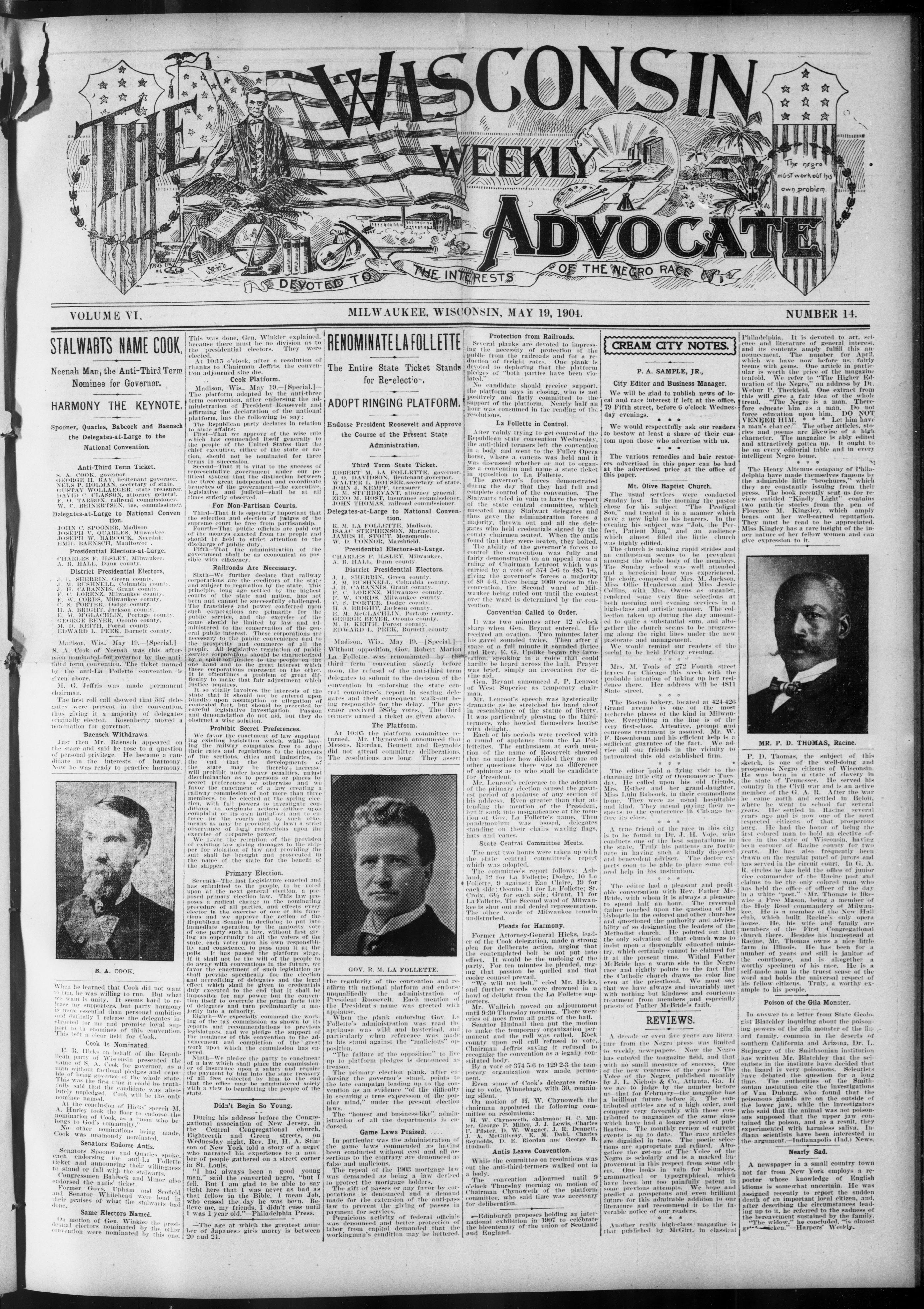
Page text (machine-generated)
WISCONSIN
WEEKLY
ADVOCATE
DEVOTED TO THE INTERESTS OF THE NEGRO RACE
VOLUME VI.
STALWARTS NAME COOK
Neenah Man, the Anti-Third Term Nominee for Governor.
HARMONY THE KEYNOTE.
Spooner, Quarles, Babcock and Baensch the Delegates-at-Large to the National Convention.
S. A. COOK, governor.
GEORGE H. RAY, lieutenant governor.
NELS P. HOLMAN, secretary of state.
GUSTAV WOLLAEGER, state treasurer.
DAVID C. CLASSON, attorney general.
F. O. TARBOX, railroad commissioner.
W. C. REINERTSEN, ins, commissioner.
Delegates-at-Large to National Convention.
JOHN C. SPOONER, Madison.
JOSEPH V. QUARLES, Milwaukee.
JOSEPH W. BABCOCK, Neeedah.
EMIL BAENSCH, Manitowoc.
Presidential Electors-at-Large.
CHARLES F. ILSLEY, Milwaukee.
A. R. HALL, Dunn county.
District Presidential Electors.
J. L. SHERRIN, Green county.
J. M. BUSHNELL, Columbia county.
J. H. CABANNIS, Grant county.
F. C. LORENZ, Milwaukee county.
F. W. CORDS, Milwaukee county.
C. S. PORTER, Dodge county.
H. A. BRIGHT, Jackson county.
E. M. M'GLACHLIN, Portage county.
GEORGE BEYER, Ocontó county.
M. D. KEITH, Forest county.
EDWARD L. PEEK, Barnett county.
Madison, Wis., May 19.—[Special.]—
S. A. Cook of Neenah was this afternoon nominated for governor by the anti-third term convention. The ticket named by the anti-La Follette convention is given above.
M. G. Jeffris was made permanent chairman.
The first roll call showed that 567 delegates were present in the convention, thus giving it a majority of delegates originally elected. Rosenberry moved a nomination for governor.
Baensch Withdraws
Just then Mr. Baensch appeared on the stage and said he rose to a question of personal privilege. He became a candidate in the interests of harmony. Now he was ready to practice harmony.
J. B.
S. A. COOK.
When he learned that Cook did not want to run, he was willing to run. But what we want is unity. It seems hard to release my supporters, but party harmony is more essential than personal ambition and dutifully I release the delegates instructed for me and promise loyal support to th enominee of this convention. This left a clear field for Cook.
Cook Is Nominated
E. R. Hicks on behalf of the Republican party of Wisconsin presented the name of S. A. Cook for governor, as a man without factional pledges and capable of being governor of the whole state. This was the first time it could be truthfully said that the candidate was absolutely unpledged. Cook will be the only nominee named.
At the conclusion of Hicks' speech M. A. Hurley took the floor to endorse the nomination of Cook, as a "man who belongs to God's community."
No other nominations being made, Cook was unamously nominated.
Senators Endorse Antis
Senators Spooner and Quarles spoke, each endorsing the anti-La Follette ticket and announcing their willingness to stand or fall with the stalwarts. Congressmen Babcock and Minor also endorsed the antis' ticket. Former Govs. Upham and Scofield and Senator Whitehead were loud in their praises of what the stalwarts had done.
Same Electors Named
On motion of Gen. Winkler the presidential electors nominated by the other convention were nominated by this one.
This was done, Gen. Winkler explained, because there must be no division as to the presidential electors. They were elected.
At 10:15 o'clock, after a resolution of thanks to Chairman Jeffris, the convention adjourned sine die.
Cook Platform.
Madison, Wis., May 19.—[Special.]—The platform adopted by the anti-three term convention, after endorsing the administration of President Roosevelt and affirming the declaration of the national platform, has the following to say:
The Republican party declares in relation to state affairs:
to state affairs.
First—That we approve of the wise rule which has commended itself generally to the people of the United States that the chief executive, either of the state or nation, should not be nominated for three terms in succession.
Second—That it is vital to the success of representative government under our political system that the distinction between the three great independent and co-ordinate branches of the government—the executive, legislative and judicial—shall be at all times strictly observed.
For Non-Partisan Courts.
Third-That it is especially important that the selection and election of judges of the supreme court be free from partisanship. Fourth-That public officials are paid out of the moneys exacted from the people and should be held to strict attention to the discharge of public duty.
Fifth-That the administration of the government shall be as economical as possible with efficiency.
Railroads Are Necessary.
Sixth-We further declare that railway corporations are the creditors of the state and subject to regulation by the state. This principle, long ago settled by the highest courts of the state and nation, has not been and cannot be successfully challenged. The franchises and power conferred upon such corporations are primarily for the public service, and the exercise of the same should be limited by law and administered to the conservation of the general public interest. These corporations are necessary to the public convenience and to the prosperity and commerce of all the people. All legislative regulation of public service corporations should be characterized by a spirit of justice to the people on the one hand and to the great interest which these corporations represent on the other. It is oftentimes a problem of great difficulty to make that fair adjustment which justice requires.
It so vitally involves the interests of the state that it should not be entered upon blindly upon assumption or allegation of contested fact, but should be preceded by careful legislative investigation. Passion and denunciation do not aid, but they do obstruct a wise solution.
Prohibit Secret Preferences.
We favor the enactment of law supplanting existing legislation which, while leaving the railway companies free to adopt their rates and regulations to the interests of the sections, cities and industries, to the end that the developments of the state may be thereby increase. will prohibit under heavy penalties, unjust discrimination as to persons or places by secret preferences or otherwise and we favor the enactment of a law creating a railway commission of not more than three members, to be elected at the spring election, with full powers to investigate conditions, to originate actions (either upon complaint or its own initiative) and to enforce (in the courts and by such other means as may be provided by law) a strict observance of legal restrictions upon the exercise of corporate power.
We favor the retention of the provision of existing law giving damages to the shipper for violation of law and providing the suit shall be brought and prosecuted in the name of the state for the benefit of the shipper
Primary Election.
Seventh—The last Legislature enacted and has submitted to the people, to be voted upon at the next general election, a proposed primary election law. This law proposes a radical change in the nominating procedure of all parties, and effects every elector in the exercise of one of his functions and we approve the action of the Republican Senate in declining to put into immediate operation by the majority vote of one party such a law, without first giving an opportunity to all the voters of the state, each voter upon his own responsibility and conscience, to pass upon it at the polls. It has passed the platform stage. If it shall not be the will of the people to do away with conventions in the future, we favor the enactment of such legislation as shall provide specifically for the election and accrediting of delegates and the legal effect which shall be given to credentials duly executed to the end that it shall be impossible for any power but the convention itself to overrule the prima facie title of delegates and turn preliminarily a majority into a minority.
Eighth—We especially commend the working of the tax commission as shown by its reports and recommendations to previous legislatures, and we pledge the support of the nominees of this convention to the advancement and completion of the great work upon which the commission has entered.
Ninth—We pledge the party to enactment of a law which shall place the commissioner of insurance upon a salary and require the payment by him into the state treasury of all fees collected by him to the end that the office may be administered solely with a view to benefitting the people of the state.
Didn't Begin So Young.
During his address before the Congregational association of New Jersey, in the Central Congregational church, Eighteenth and Green streets, on Wednesday night, Rev. Dr. H. A. Stinson of New York told a story of a negro who narrated his experience to a number of people gathered on a street corner in St. Louis.
"I had always been a good young man," said the converted negro, "but I fell. But I am glad to be able to say right here that I was never as bad as that fellow in the Bible. I mean Job, who cussed the day he was born. Believe me, my friends. I didn't cuss until I was 1 year old."—Philadelphia Press.
The age at which the greatest number of Japanese girls marry is between 20 and 21.
RENOMINATELAFOLLETTE
The Entire State Ticket Stands for Re-election.
ADOPT RINGING PLATFORM.
Endorse President Roosevelt and Approve the Course of the Present State Administration.
Third Term State Ticket.
ROBERT M. LA FOLLETTE, governor.
J. O. DAVIDSON, lieutenant-governor.
WALTER L. HOUSER, secretary of state.
JOHN J. KEMPF, treasurer.
L. M. STURDEVANT, attorney general.
ZENO M. HOST, insurance commissioner.
JOHN THOMAS, railroad commissioner.
Delegates-at-Large to National Convention.
R. M. LA FOLLETTE, Madison.
ISAAC STEPHENSON, Marinette.
JAMES H. STOUT, Menomonie.
W. D. UONNOR, Marshfield.
Presidential Electors-at-Large.
CHARLES F. ILSLEY, Milwaukee.
A. R. HALL, Dunn county.
J. L. SHERRIN, Green county.
J. M. BUSHNELL, Columbia county.
J. H. CABANNIS, Grant county.
F. C. LORENZ, Milwaukee county.
F. W. CORDS, Milwaukee county.
C. S. PORTER, Dodge county.
H. A. BRIGHT, Jackson county.
E. M. McGLACHLIN, Portage county.
GEORGE BEYER, Oconto county.
M. D. KEITH, Forest county.
EDWARD L. PEEK, Burnett county
Madison, Wis., May 19.—[Special.] Without opposition, Gov. Robert Marion La Follette was renominated by the third term convention shortly before noon, the refusal of the anti-third term delegates to submit to the decision of the convention in endorsing the state central committee's report in seating delegates and their consequent walk-out being responsible for the delay. The governor received $585\frac{1}{2}$ votes. The third termers named a ticket as given above.
The Platform.
At 10:05 the platform committee returned. Mr. Chynoweth announced that Messrs. Rierdan, Bennett and Reynolds did not attend committee deliberations. The resolutions are long. They assert
18
GOV. R. M. LA FOLLETTE.
the regularity of the convention and reaffirm 9th national platform and endorse unqualifiedly the administration of President Roosevelt. Each mention of the President's name was greeted with applause.
When the plank endorsing Gov. La Follette's administration was read the applause was wild and hysterical, and particularly when reference was made to his stand against the "malicious" opposition.
"The failure of the opposition" to live up to platform pledges is denounced as treason.
The primary election plank, after endorsing the governor's stand, points to the late campaign leading up to the convention as an evidence "of the difficulty in securing a true expression of the popular mind," under the present election laws. The "honest and business-like" administration of all the departments is endorsed.
Game Laws Praised
In particular was the administration of the game laws commended as having been conducted without cost and all assertions to the contrary are denounced as false and malicious. The repeal of the 1903 mortgage law was demanded as being a law devised to protect the mortgage holders. The gift of passes or any favor by corporations is denounced and a demand made for the extension of the anti-pass law to prevent the giving of passes in payment for services. Pernicious activity of federal officials was denounced and better protection of labor from capital demanded that the workingman's condition may be bettered.
---
Protection from Railroads.
Several planks are devoted to impressing the necessity of protection of the public from the railroads and for a reduction of freight rates. One plank is devoted to deploring that the platform pledges of "both parties have been violated." No candidate should receive support, the platform says in closing, who is not positively and flatly committed to the support of the platform. Nearly half an hour was consumed in the reading of the resolutions.
La Follette in Control
After vainly trying to get control of the Republican state convention Wednesday, the anti-third termers left the convention in a body and went to the Fuller Opera house, where a caucus was held and it was discussed whether or not to organize a convention and name a state ticket in opposition to La Follette.
The governor's forces demonstrated during the day that they had full and complete control of the convention. The Stalwarts tried in vain to have the report of the state central committee, which unseated many Stalwart delegates and thus gave the administration forces a majority, thrown out and all the delegates who held credentials signed by the county chairmen seated. When the antis found that they were beaten, they bolted.
The ability of the governor's forces to control the convention was fully and fairly demonstrated on an appeal from a ruling of Chairman Lenroot which was carried by a vote of 574 5-6 to 485 1-6, giving the governor's forces a majority of 89 4-6, there being 1060 votes in the convention, the Second ward of Milwaukee being ruled out until the contest over the ward is determined by the convention.
Convention Called to Order.
It was two minutes after 12 o'clock sharp when Gen. Bryant entered. He received an ovation. Two minutes later his gavel sounded twice. Then after a space of a full minute it sounded thrice and Rev. E. G. Updike began the invocation, speaking in a voice that could hardly be heard across the hall. Prayer was brief, simply an invocation for divine aid.
Gen. Bryant announced J. P. Lenroot of West Superior as temporary chairman.
Mr. Lenroot's speech was hysterically dramatic as he stretched his hand aloof in resemblance of the statue of liberty. It was particularly pleasing to the third-termers, who howled themselves hoarse with delight.
Each of his periods were received with a round of applause from the La Folletteites. The enthusiasm at each mention of the name of Roosevelt showed that no matter how divided they are on other questions there was no difference of opinions as to who shall be candidate for President.
Mr. Lenroot's reference to the adoption of the primary election caused the greatest period of applause of any section of his address. Even greater than that attending the mention of the President, but it sank into insignificance at the mention of Gov. La Follette's name. Then pandemonium was loosed, delegates standing on their chairs waving flags, bats and canes.
State Central Committee Meets.
The next two hours were taken up with the state central committee's report which was adopted. The committee's report follows: Ashland, 12 for La Follette; Dodge, 10 La Follette, 9 against; Eau Claire, 19 for each side; Oconto, 11 for La Follette; St. Croix, $6 \frac{1}{2}$ for each side; Grant, 11 for La Follette. The Second ward of Milwaukee is shut out and denied representation. The other wards of Milwaukee remain undisturbed.
Pleads for Harmony.
Former Attorney-General Hicks, leader of the Cook delegation, made a strong plea for deliberate action, urging that the contemplated bolt be not put into effect. It would be the undoing of the party. For ten minutes he pleaded, urging that passion be quelled and that cooler counsel prevail.
"We will not bolt," cried Mr. Hicks, and further words were drowned in a howl of delight from the La Follette supporters.
Mr. Wallrich moved an adjournment until 9:30 Thursday morning. There were cries of noes from all parts of the hall.
Senator Hudnall then put the motion to make the temporary organization permanent and the roll was called. Rock county upon roll call refused to vote, Chairman Jeffris saying it refused to recognize the convention as a legally constituted body.
By a vote of 374 5-6 to 129 2-3 the temporary organization was made permanent.
Even some of Cook's delegates refusing to vote, Winnebago, with 30, remaining silent.
On motion of H. W. Chynoweth the chairman appointed the following committee on resolutions:
H. W. Chynoweth, chairman; H. C. Miller, George P. Miller, J. J. Lewis, Charles F. Pfister, D. W. Wagner, J. R. Dennett, J. A. McGillvray, E. M. Dahl, Charles Reynolds, D. E. Riordan and George B. Hednall.
Antis Leave Convention.
While the committee on resolutions was out the anti-third-termers walked out in a body.
The convention adjourned until 9 o'clock Thursday morning on motion of Chairman Chynoweth of the platform committee, who said time was necessary for deliberation.
Edinburgh proposes holding an international exhibition in 1907 to celebrate the bicentenary of the union of Scotland and England.
CREAM CITY NOTES.
P. A. SAMPLE, JR..
City Editor and Business Manager
We will be glad to publish news of local and race interest if left at the office, 79 Fifth street, before 6 o'clock Wednesday evenings.
We would respectfully ask our readers to bestow at least a share of their custom upon those who advertise with us.
The various remedies and hair restorers advertised in this paper can be had at the advertised price at the office of this paper.
Mt. Olive Baptist Church
The usual services were conducted Sunday last. In the morning the pastor chose for his subject "The Prodigal Son," and treated it in a manner which gave a new light to his hearers. In the evening his subject was "Job, the Perfect, Patient Man," and an audience which almost filled the little church was highly edified.
The church is making rapid strides and an enthusiasm seems to be prevalent amongst the whole body of the members. The Sunday school was well attended and a beneficial hour was experienced. The choir, composed of Mrs. M. Jackson, Miss Ollie Henderson and Miss Jessie Collins, with Mrs. Owens as organist, rendered some very fine selections at both morning and evening services in a high-class and artistic manner. The collection taken up during the day amounted to quite a substantial sum, and altogether the church seems to be progressing along the right lines under the new pastorate and management. We would remind our readers of the social to be held Friday evening.
Mrs. M. Toals of 272 Fourth street leaves for Chicago this week with the probable intention of taking up her residence there. Her address will be 4811 State street.
☆ ☆ ☆
The Boston bakery, located at 424-426 Grand avenue is one of the most recherehe places of the kind in Milwaukee. Everything in the line is of the very first-class. Attentive, prompt and courteous treatment is assured. Mr. W. F. Rosenbaum and his efficient help is a sufficient guarantee of the fact. We advise all our friends in the vicinity to patronized this old established firm.
* *
The editor paid a flying visit to the charming little city of Oconomowoc Tuesday. He called upon his old friends, Mrs. Esther and her grand-daughter, Miss Lulu Babcock, in their commodious home. They were as usual hospitable and kind. They intend paying their respects to the conference in Chicago before its close.
* * *
A true friend of the race in this city is to be found in Dr. J. H. Voje, who conducts one of the best sanatariums in the state. Truly his patients are fortunate in having such a kindly disposed and benevolent adviser. The doctor expects soon to be able to place some colored help in his institution.
☆ ☆ ☆
The editor had a pleasant and profitable conversation with Rev. Father McBride, with whom it is always a pleasure to spend half an hour. The reverend father touched upon the question of the bishopric in the colored and other churches and questioned the authority and advisability of so designating the leaders of the Methodist church. He pointed out that the only salvation of that church was to insist upon a thoroughly educated ministry, which certainly cannot be claimed for it at the present time. Withal Father McBride has a warm side to the Negro race and rightly points to the fact that the Catholic church draws no color line even at the priesthood. We must say that we have always and invariably met with nothing but kindness and courteous treatment from members and especially priests of Father McBride's faith.
REVIEWS
A decade or even five years ago literature from the Negro press was limited to weekly newspapers. Now the Negro has entered the magazine field, and that with no small measure of success. One of the new ventures of the year is The Voice of the Negro, published monthly by J. L. Nichols & Co., Atlanta, Ga. If we are to judge by the number before us—that for February—the magazine has a brilliant future before it. The contributed articles are of a high order, and compare very favorably with those contributed to magazines of the same class which have had a longer period of publication. The monthly review of current events is up to date. The race articles are dignified in tone. The poetic selections are appropriate and refined. Altogether the get-up of The Voice of the Negro is scholarly and is a marked improvement in this respect from some others. One looks in vain for blunders, grammatical or typographical, which have been but too painfully patent in some previous attempts. We hope and predict a prosperous and even brilliant future for this admirable addition to our literature and recommend it to the favorable notice of our readers.
Another really high-class magazine is that published by McGirt, in classical
Philadelphia. It is devoted to art, science and literature of general interest, and its contents amply fulfill this announcement. The number for April, which we have now before us, fairly teems with gems. One article in particular is worth the price of the magazine tenfold. We refer to "The Higher Education of the Negro," an address by Dr. Webur P. Therkield. One extract from this will give a fair idea of the whole trend. "The Negro is a man. Therefore educate him as a man. Do not force education upon him. DO NOT VENEER HIM. * * * Let him have a man's charce." The other articles, stories and poems are likewise of a high character. The magazine is ably edited and attractively gotten up. It ought to be on every editorial table and in every intelligent Negro home.
The Henry Altemus company of Philadelphia have made themselves famous by the admirable little "brochures," which they are constantly issuing from their press. The book recently sent us for review entitled "Kindly Light" contains two pathetic stories from the pen of Florence M. Kingsley, which amply bears out her well-earned reputation. They must be read to be appreciated. Miss Kingley has a rare insight of the inner nature of her fellow women and can give expression to it.
M. B.
MR. P. D. THOMAS. Racine.
P. D. Thomas, the subject of this sketch, is one of the well-doing and prosperous Negro citizens of Wisconsin. He was born in a state of slavery in the state of Tennessee. He served his country in the Civil war and is an active member of the G. A. R. After the war he came north and settled in Beloit, where he went to school for several years. He settled in Racine several years ago and is now one of the most respected citizens of that prosperous burg. He had the honor of being the first colored man to hold an elective office in the state of Wisconsin, having been coroner of Racine county for two years. He has also frequently been drawn on the regular panel of jurors and has served in the circuit court. In G. A. R. circles he has held the office of junior vice commander of the Racine post and claims to be the only colored man who has held the office of officer of the day in a white "post." Mr. Thomas is likewise a Free Mason, being a member of the Holy Rood commandery of Milwaukee. He is a member of the New Hall club, which built Racine's only opera house. He, his wife and family are members of the First Congregational church there. Besides his homestead at Racine, Mr. Thomas owns a nice little farm in Illinois. He has been for a number of years and still is janitor of the courthouse, and is altogether a worthy specimen of his race. He is a self-made man in the truest sense of the word and holds the universal respect of his fellow citizens. Truly, a worthy example to his people.
Poison of the Gila Monster.
In answer to a letter from State Geologist Blatchley inquiring about the poisoning powers of the gila monster of the lizard family, common in the deserts of southern California and Arizona, Dr. L. Stejneger of the Smithsonian institution has written Mr. Blatchley that the scientists in the institute have decided that the lizard is very poisonous. Scientists have debated the question for a long time. The authorities of the Smithsonian institution cite the investigations of Van Duburg, who found that the poisonous glands are on the outside of the lower jaw, while the investigators who said that the animal was not poisonous supposed that the upper jaw contained the poison, and as a result, they experimented with harmless saliva. Indiana scientists have been interested in the argument.—Indianapolis (Ind.) News.
Nearly Sad.
A newspaper in a small country town not far from New York employs a reporter whose knowledge of English idioms is somewhat uncertain. He was assigned recently to report the sudden death of an important local citizen, and, after describing the circumstances leading up to it, he referred to the sadness of the bereavement sustained by the family. "The widow," he concluded, "is almost grieved."—Harners' Weekly.
THE RETURN OF THE BIRDS.
I hear from many a little throat,
A warble interrupted long;
I hear the robin's flute-like note,
The bluebird's senderer song.
Brown meadows and the russet hill,
Not yet the haunt of grazing herds,
And thickets by the glimmering rill,
Are all alive with birds.
O choir of spring, why come so soon?
On leafless grove and herbless lawn
Warm lie the yellow beams of noon;
Yet winter is not gone.
* * * * * * * *
Stay, then, beneath our ruder sky:
Heed not the storm-clouds rising black,
Nor yelling winds that with them fly.
Nor let them frighten you back—
Back to the stifling battle-cloud,
To burning towns that blot the day.
And trains of mounting dust that shroud
The armies on their way.
Stay, for a tint of green shall creep
Soon o'er the orchard's grassy floor,
And from its bed the crocus peep
Beside the housewife's door.
Here build and dread no harsher sound,
To scare you from the sheltering tree.
Than winds that stir the branches round,
And murmur of the bee.
Stanley's Four-Finger Story.
No better epitome of Stanley's career has been conceived than that given by himself in his "story of four fingers," says the New York Tribune. On his return from finding Livingstone, he said, he had the honor of a public reception by the Royal Geographical society, and the especial honor of being presented "to an exceedingly distinguished personage in the scientific world," who regarded him with condescending favor, and even went so far as to shake hands with him. "He gave me," said Stanley, "one finger."
After his second and third adventures, his explorations of the lakes and his opening of the Congo to civilization, he was again publicly received, and this distinguished personage regarded him with even more favor than before. Again he shook hands with him. "He gave me two fingers!" Once more Stanley went to Africa to rescue the faithful Emin, and on his return he was a third time publicly received. A third time the distinguished personage condescended to smile upon him, still more approvingly than before, and a third time to offer him his hand. "He gave me three fingers!"
Yet once more Stanley appeared in public, with a fair companion, Miss Dorothy Tennant, who a few moments later was Lady Stanley. There, once more the distinguished personage was present, and so far condescended as to be amou him with unreserved approval. "The throng was too great for me to get near him," said Stanley, "but I have no doubt that, had I been able to do so, he would once more have offered me his hand, and on this occasion he would have given me all four fingers!"
An Expensive Retort.
The appointment of Judge Stafford of Vermont to the district bench to succeed Judge Pritchard, who has been named as circuit judge, calls forth this story from Representative Foster of that state, says the Louisville Times:
"When Chief Justice Chase, a man of great abilities and marked characteristics, was presiding in one of the county courts of Vermont an appeal case from a justice's court came up before him, so small and contemptible in its origin that he ordered it stricken from the docket. The case was where a turkey had trespassed upon the garden of a neighbor and got shot for his depredations. The owner brought suit to recover damages, and, failing before the justice, had appealed the case. Judge Chase was angry, and when he ordered the case from the docket, said:
"The lawyer who consented to appeal this case ought to be thrown from the window of the courtroom. Why didn't he have the case referred to some of the honest neighbors for settlement?"
"Because, Your Honor,' retorted the attorney, getting hot under the collar, 'it was our intention not to let honest people have anything to do with it.'
"True, this was a neat retort, but it cost the lawyer just an even $50 for courtment of court."
Message of the Heart
One of the most noted of American surgeons has startled the fellow members of his profession by his bold experiments in handling the human heart in cases of cessation of the beating of that organ under the influence of anaesthetics. He has been so daring in desperate cases as to cut down to the source and fountain of the circulation of the blood and so to manipulate the heart as to fill the arteries anew from the pulsations which he has excited.
The marvels of present day surgery sometimes seem to be almost miracles. But both surgeons and physicians confess themselves frequently baffled in the presence of serious cases of pneumonia, of cancer, of leprosy and of the bubonic plague.—New York Tribune.
Municipal Pawnbroking
Municipal pawnshops are projected for London. It is said to be possible at present for a London pawnbroker to extort 260 per cent, a year for a loan. On the continent the law gives the poor borrower on personal property ample protection. It is possible in France, as at Grenoble or Montpelier, to obtain a very small advance for a short time without paying any interest at all for it, as the municipal Mont de Piete possesses endowments for that purpose, but in Paris 7 per cent, is the usual charge. At Madrid it is 6 per cent., in Brussels 7 per cent., and in Berlin 12 per cent, for the year.
Shaking Hands.
We learn that a treatise has been published in Brussels on shaking hands, which states that the practice is most dangerous, a mutual pressure of the hand being nothing more than an exchange of undesirable microbes, $0,000 of which, it is said, inhabit every half-inch of the hand. The author of the treatise says that the most dangerous people to shake hands with are doctors, surgeons, nurses, hairdressers, butchers, sausage makers, tripe merchants, tanners and leather dressers, while the least dangerous person seems to be the worker in metal, because the metal sets up an oxidation which acts as an autiseptic.
Takes Cat Language in a Phonograph.
Caleb Johnson of Unity, a college graduate, believes cats have a language. For the purpose of learning their language, he keeps forty-eight cats, whose caterwawlings he records on a phonograph, and he claims that by having the phonograph talk to his felines he has been able to find out what sounds they make, when they want food or drink and on most other occasions. He claims he has got so expert in distinguishing their remarks that he can tell when they want milk and when they want water.—Kansas City (Mo.) Journal.
Query: Why Is a Cow?
A Kansas man has a cow who chewed off a rooster's tail, and the next day when he milked her she gave a gallon and a half of the finest kind of cocktail. We had a cow ourselves once who swallowed an almanac and gave creamed dates.— Kennebec (Me.) Journal. —The penguin's wings are useful only under water.
THE HUNT.
Oughn! Oughn! The hounds are away. They are out and abroad, on the dunes to day:
And the crowns are still.
On the tree by the hill:
And the wild cat shrinks, and cowers, and blinks,
And peers through the woven pine bough's chinks:
And the black snake slides, and slips, and glides
From the hot south slope where he suns his sides;
And the bluejay hushes his peevish note.
And the catbird's warble dies in his throat,
As he darts to a snug oak spray.
But the fox—the fox is stealing away,
Silent and swift,
Just an ear to lift.
For the sound of the distant bay;
Noiseless and fast as the sea-fog drifts
Through the winding dunes, when the shore wind shifts:
By bog, and thicket, and path he creeps,
And over the fallen log he leaps;
Bold in the blow-hole his eye has scanned—
For he knows the lay of the wind-heaved land—
His quick feet dimple the tawny sand;
By the Deep Bog ditch and along the ridge,
Where a cat may cross on the grapevine bridge,
—Over the ridge; and he dives at last,
Safe and fast,
In his burrow deep,
On the northern steep,
Under the dune,
Where no August noon
Can crumble the wall away—
Where the first frost catches
The ivy patches,
And the woodbine reaches its blazing lines,
Wreathing the stems of the leaning pines,
And biding the lichens gray;
And
While the Horseneck lies in a mute sur
prise.
Waiting and wise, till the tumult dies;
For the hounds are abroad today.
—Mercy E. Baker in The Critic.
The Doctor and the Millionaire.
"You counters, Last, are indispensable to us. We could never play the game without you, any more than a baker could make bread without flour. Gad! what a joke life is, when a fellow's well. Here are you, as decent a chap—"
Dr. Cardo Last fidgeted and held up his hand.
"Excuse me," he said, "I don't see Mr. Hortington Hough, that I have done anything that exacts praise from you."
He did not mean to be sarcastic toward so magnificent a patient. But he had his reasons. They were personal ones, based on the illimitable contempt he felt for the financier as a human being and certain pecuniary losses which slow experience had taught him he owed to the machinations of men like Mr. Hortington Hough.
"As decent a chap as I know," proceeded the other, with a smile that was a sneer (in spite of himself), "slaving from morning till night for about ten guineas a day, I suppose, with Sunday off, and such a nasty occupation, too." "I see my patients on Sunday also," said the doctor, after a pause, during which he drew heavily upon his stock of self-control.
"Quite so. There you are! And called
up in the night, too. I dare say?"
"Even that has happened," said the doctor, dryly. "Indeed, you might have remembered that only the night before last your man favored me with—"
"Gad! I forgot. Yes, I did. Last, do you think, by any chance, my memory's going? I've not spared it. It's been hard at work these forty years, with no rest. Is it possible?"
He whispered the words. He writhed while he did so, and his face took on a plum-colored tint as his eyes stared in horror at the doctor over the puffy pillows which seemed to support their lower lids.
"My dear sir, don't excite yourself. You cannot afford it. I, one of your counters, say it; and I mean it, on my honor, Hortington Hough."
"I don't like that tone in you,' he said. "It's like hitting a fellow when he's down. Confound it all, I'll not stand it either. I'll call in somebody else." "I wouldn't advise it until you are better. They'd disturb your foundations. I have the privilege of knowing your constitution as I know my own, and——" Hortington Hough sank back upon his silken cushions. "And you'll pull me through—you will?" he pleaded, with a droop at the mouth. The doctor smiled and washed his hands with invisible soap in the traditional way. He glanced casually at the clock—a little golden thing of glorious workmanship, warranted to tick so that ordinary ears could not hear it.
"I am bound to consider my own interests, Hortington Hough, humanitarian and professional motives apart," he murmured.
The financier gazed at him with unholy eyes that grew larger every moment.
"Gad! what would I do without my memory?" he cried, as if horror-stricken. "What should I be? There's not a man in the world that I can trust, and, of course, no woman either. But I could always trust my memory. It's been the making of me, that and my pluck. I'd be like a flayed ass among the flies without it."
The doctor made a slight movement of impatience.
"I understand you to say," he said, brusquely, "that this last breakdown is due to the flotation of the Sea Gull Gold Mine?"
"The Gull, yes. Good name, doctor! Capital yoke of mine. By —— But I'm off swearing and laughing for the present. Still it's permissible even for a weak heart to smile, I do hope. As neat a combine as ever was. The shares are at ten. That means nothing to you, of course, but it's the fact. They'll go no higher. We've taught the bears their lesson this time, and no mistake—pilled them with their own physic—no offense, I hope.
"But the unloading will be a deuced nice business. As I said to Lord Sunrise only the day before yesterday, just an hour before I was knocked all of a heap like this, I said to him: 'We mustn't let the scaffold poles come tumbling about our ears after we've been at such special pains to fix 'em and to build up to 'em. If they knew their work the brutes might do it."
"Ten thousand shares chucked on the market would set things going at a run. But they've had their fingers burned to the stumps, and they'll dare not start that game. And settlement fixed for this day week! Gad! supposing I was to die before then—what a cruel disappointment it would be! I say—I'm wretchedly short of—breath. Breath, not Gulls—ha—oh!" Mr. Hortington Hough paid for his speech.
The doctor watched his paroxysms.
"You must not excite yourself like this," he said, quietly.
He measured six drops of fluid from a phial, added water and offered the potion to his patient who drank it greedily. Then he waited.
"Do I understand you," the doctor answered at length, smothering a yawn in the refined way that was one of his many acquired arts of value, "that these Gull shares are not worth their present price?"
The question seemed to galvanize the financier into a state of renewed activity.
"Worth!" he exclaimed chuckling chokily. "Worth their price? Oh! my dear man, what should we do without you—pardon me, without men like you, women and the clergy also?"
"Counters, in fact?"
"Counters, whatever we please to call you. We push you this way and
---
that, and when the times comes we just shove you off the board, and you may all go to—well, anywhere, that is, for what we care. We've swept the board, and that's good enough for us."
The doctor nodded. There was a latent glitter in his eyes. But it was subtly voiled.
"I see," he said, softly; "I see. Probably the shares I held in 'Platinum Limited—"
"Did you!" cried the financier, in a quick frenzy of glee. "Were you bitten there? Of all the hollow drums! My name didn't appear, but when I chose to stick my knife into the drum. 'Platinum, Limited' curled up beautifully."
"In-deed!" said the doctor. "In-deed!"
He did not care to explain what that curling up had meant to him. He looked at his patient with keen interest.
"There's one thing that would console me for sudden death, old chap," said the financier, with a new expression, an ugly one. "My colleagues loathe me. I know it. Well, so they may, for I hate them, and they know it. There's Lord Sunrise I mentioned just now. Wouldn't introduce me to his daughter: 'other day when we met in the park—turned his back on her and talked to me as if I were a bally tradesman. Me! Penton, too! When I suggested I'd like a week-end at his father's place—the earl's, you know, you meet the best set there—he said, 'Good-afternoon.' Oh! money-pilling isn't all beer and skittles, even when you do pile it like me." "No?" said the doctor, coldly. "Er, don't you think I've talked enough, old man? I feel nohow."
"Oh, well," said the doctor smiling, constainedly, "I've got my eye on you and my finger." He felt the financier's pulse. "You were saying something about the consolations of sudden death." "Yes; I was. I'd not breathe a word of it to any other man. But you're straight, Last; you're one of those honest, good chaps who would die rather than play a low trick on anyone. And—and—" "I've sacrificed a great deal of money to my simplicity, if that's what you mean."
"Same thing, same thing. Gives you your credentials. Lord! if you knew the pleasure of cornering the righteous and seeing how the virtue of nine in ten of them just crumbles to dust when they're tempted in the time of their adversity! It's a pleasure for the few, and I'm one of the few. I've had a bishop come cringing for a tip. I gave him a wrong 'un, and they do tell me he preached a beautiful sermon on 'Resignation' in his own cathedral three weeks later—oh! dear, oh! dear."
"Really! But I cannot quite see where your consolation comes in in case you
"Can't you? Stoop your head and I'll whisper. I've instructed my solicitors to chuck everything I hold on the market the day I pop off. See now? Talk about departing in a trail of glory! Half my dear colleagues would be smashed in a week. Talk about immortality, eternity, and that sort of March-dust nonsense! I'd be embalmed in the memory of hundreds of widows, orphans, broken hearts and parsons. Shock you, Last?"
The doctor drew away with perturbed nostrils.
"Not high tone, is it? Not the kind of thing they'd build a statue to a fellow for, is it? Oh! I—I'm weak as a kitten. Give me some more of that stuff. Be quick, man."
"I'm not sure that it would be prudent," said the doctor, hesitating.
"Give it me. It makes me feel like my old self, for the time."
"Yes, for the time. But, as you will."
The draught was readministered, and breathing deeply, the doctor turned to the door. This was undoubtedly shut. That was well.
The financier uttered a little cry, strained at the chest and collapsed. His arms drooped limply, and his head lolled forward.
A minute afterward Dr. Cardo Last was outside the house, having told the nurse on no account to awake his patient and to let no one approach him.
From the nearest telegraph office he wired to his brokers to sell 5000 Sea Gull Mines at once. He waited for their reply. When this came he hurried back to Mr. Hortington Hough, and signified mild surprise to find that he was dead.
But during his absence he had made £25,000.—C. Edwardes in Illustrated Bits.
Prescriber of Wall Papers
"Some day you'll see me taking down that paperhanger shingle and replacing it with one reading, perhaps, 'Papers prescribed,'" remarked the dealer in wall papers. "There's really an opening for such a man, and patrons would be surprised if they knew how much we can help them. A frightfully nervous man just now insisted upon a red paper when he needed green, a color that soothes the senses. Blue quiets the nerves and violet has a tranquilizing effect. But how they all like red, and that despite the fact that it is the color of violence and passion! One woman client just persisted in a red reception room. If she wants men guests to help her shift furniture, it's a good choice, for it's a fact that a man exposed for a time to the influence of red light shows a muscular development 50 per cent, in excess of his power when exposed to a blue light. After this one understands how much the senses and temperament are affected by color. Indeed, my ideal home is one with a room in each color. Then its occupants are ready for any emergency." —Philadelphia Record.
Holds Carp with Big Toe.
David Neiman, a fisherman, who lives on the banks of Neiman's pond at Potts-town, Pa., has been in the habit of throwing a line from his window into the pond. He became drowsy while thus fishing and after taking a turn of the line around his big toe fell asleep. He was awakened by a mighty pull, which caused the line to cut deep into the flesh. On the other end was a German carp measuring $27\frac{1}{2}$ inches. Neiman got the carp, but is nursing a badly cut toe.
The Independent Life of Yonkers
New Yorkers have an impression that Yonkers, seventeen miles up the Hudson river, is merely a suburb of the metropolis. This impression is erroneous. Of itself Yonkers is a thriving manufacturing city. Its present population is estimated at 60,000. It has what are said to be the largest carpet weaving mills in the United States, as well as sugar refineries and other industries. The city has much the appearance of a New England factory town. Printers' Ink.
Unaffected by the Higher Cri
A little Boston girl found it difficult to master a stitch in knitting and her aunt thought to enforce patience by reminding her that Rome was not built in a day. To which came the quick response: "Oh, aunty, how can you talk so? Don't you know that it took God only six days to make the whole world, and I don't suppose he spent more than half an hour on Rome!"—Kansas City Independent.
Popularity of Restaurant Dining
The appetite for dining out has grown constantly with what it fed on, and I suppose there are now fifty people dining in London hotels and restaurants every night for one a quarter of a century ago. —London Truth.
NEW YORK EVERY DAY.
Gov. Odell has vetoed the Remsen East river gas bill, a measure designed to confirm old privileges granted to the Consolidated Gas company of New York.
George W. Lederer, the theatrical manager, has filed a voluntary petition in bankruptcy. He gives his known liabilities as $170,975, with assets of $100. He specifies 234 creditors, the amount of the claims of a large number of whom is unknown to him.
Mrs. Grey, an American, who arrived at Cherbourg from New York recently on obtaining possession of her baggage upon her arrival at Paris missed a valise containing $20,000 worth of jewels. Police are searching for the thief, but his identity is unknown so far.
Mrs. Mary Baker Eddy, head of the Christian Science following, has issued an edict against the segregation of sexes in clubs. The new order has surprised the faithful, many of whom will have to choose between the membership of her flock and organizations founded on principles which preclude the association of both men and women in them.
The mystery as to the death of little Josephine McCahill, who was believed to have been kidnapped and whose body was found in a chimney next door to her home, was dissipated recently when Coroner's Physician Otto Schultz, after performing an autopsy, announced that the child had died from suffocation ten minutes after falling into the chimney.
It was reported that Mrs. Hetty Green had given $500,000 to the Nurses' home, and that $50,000 had been set apart for the establishment of the east side nurses' settlement. When a copy of the report was shown to Mrs. Green in her office at the Chemical bank she sent back this message: "It's a chimera, it's absurd, there is not a scintilla of truth in it. It's all a dream."
---
A curtailment of expenditures of the American Tract society has been necessitated by the urgency of home work, according to the report of Secretary Shearer. Gen. O. O. Howard endeavored to have the society accept his resignation as president, but such a storm of protest was raised that he agreed to a compromise by which the matter was left with the executive committee for settlement.
Mrs. Francis W. Jackson, the widow of Hart Jackson, translator of "The Two Orphans," has begun an action against Kate Claxton for an accounting of the profits realized from the production of "The Two Orphans" since she secured a renewal of her husband's copyright for fourteen years in 1903. Mrs. Jackson says the copyright was worth $150,000 and that she was led by the false representation made to her by Miss Claxton to give up property worth $150,000 for $500.
Miss Maxine Elliott is said to have procured the cash which enabled Nat Goodwin to settle the $15,000 debt he ewed Robert Gray, a reputed partner in a gambling room at Louisville, Ky. Neither the actor nor Mr. Gray would tell exactly how much money was paid, but a man who is a friend of both said that Mr. Goodwin settled for about 80 per cent, of the full amount owed. The money was advanced through the influence of Mr. Goodwin's wife, Maxine Elliott. Mr. Goodwin sailed for Europe today and Mr. Gray returned to Kentucky.
Suit for $29,000 has been brought against "Billy" Dubois, well known race track man, by Lucille Camden. It took a humorous turn when Dubois' counsel, Mr. May, filed an amended answer to Miss Camden's complaint, in which he alleged the agreement she alleged she made with Dubois was made in restraint of trade and was therefore void. The restraint of trade possibility comes in where Miss Camden promises to give up her manicure business and devote her whole attention to Dubois for the rest of her life for a consideration, as alleged, of $100 a week, to be paid her by the bookmaker until her death. She alleges she did give up her manicure establishment to devote herself to Dubois in accordance with the agreement. Dubois paid her a regular salary for a period of something over two years, but stopped the payments in October, 1902.
Alfrederich Smith Hatch, twice president of the New York stock exchange and at one period one of the leading financiers in Wall street, died at Tarrytown, aged 75. During the Civil war he was in partnership with Harvey Fisk. The firm had the agency of the government in New York for the $500,000,000 bonds for popular subscription. Mr. Hatch retired nearly twenty years ago.
Mrs. O'Halloran, aged 77, widow of Denis W. O'Halloran and sister of Victoria Woodhull Martin and Tennessee Claffin, now Lady Cook, died of paralysis on board the White Star line steamship Cedric as the ship was nearing Fire Island, N. Y. Her first husband was Enos Miles, a cousin of Gen. Miles.
Mr. and Mrs. Howard Gould have begun a $30,000 breach of contract suit against Agner J. Haydel, architect of their magnificent Long Island home, Castle Gould, one of the most famous private residences in America. The troubles incidental to the suit are said to be many, and in a counter suit which Haydel is expected to institute unusual developments are expected. Castle Gould is a reproduction of the famous Irish structure, Kilkenny castle. The plans made by Haydel called for an expenditure of about $4,000,000. It is said that until a few months ago Haydel was a frequent visitor of the Goulds at their Waldorf-Astoria apartments, and was on the best of terms with them. Suddenly his visits ceased. Exactly what caused the sudden termination of the friendly relations has not been disclosed. It is said the colossal dimensions of Castle Gould were such as to cause any architect to remonstrate in the name of art.
Maybelle Courtney, a noted stage beauty, has brought suit against Harry Wakefield Bates of Beacon street, Boston, prominent in social, financial and political circles in that city, to recover $10,000 for breach of promise. Miss Courtney sues under her own name, Mae Martin, and declares that she did not know of any legal impediment. Both have retained counsel and an interesting story, embracing the initial meeting and subsequent drives, dinners, bouquets, etc., will be related in court. Miss Courtney has appeared with various theatrical attractions in Boston. She asserts that Bates asked her to quit the stage and educate herself to the station of the wife of a man of his means and social position. Bates filed a bill for divorce from his wife last fall on the ground of desertion.
Witnesses before the United States commission to establish standards for pure foods, which is sitting here, declare that jellies and jams are generally adulterated. Glucose and coloring matter, they asserted, are not harmful and one
man, speaking for the manufacturers of preserves, claimed that 60 per cent. of the jellies made in the United States are imitations, composed of glucose and coloring matter. Some jellies, he said, contained no fruit at all. Another witness said that if the manufacture of compound jellies by mixing of different fruits were forbidden, 75 per cent. of the factories in the United States would have to close. The commission will continue its hearings ten days.
In compliance with an order issued by the chief of police of Elizabeth, N. J., the manager of the Lyceum theater in that town engaged several able-bodied men for the purpose of putting white petticoats over the shapely legs of the female figures shown on the posters of "Little Egypt's Burlesquers." The posters on the billboards showed a bevy of young women in red, white and pink tights, differing little, if at all, from advertising of the same kind that has appeared on the billboards in times past. The men who were set to work to fix things up did a peculiar job. They pasted strips of white paper across the board in such a way that each burlesquer now has a skirt reaching the knees, with red, white and pink limbs dangling beneath. Each poster now looks like a snapshot of a procession passing the Flatiron building on a windy day.
James G. Blaine won a suit in which he demanded $3300 damages from Post & Thomas, brokers, for the sale of 1000 shares of Pennsylvania stock on May 9, 1901, the day of the Northern Pacific panic. The junior member of the brokerage firm was Edward R. Thomas, son of the late Samuel Thomas, who achieved fame as a "boy bank president," an automobileist, angel for "the mocking bird," and as a race horse owner. Mr. Blaine claims that he had $16,500 margin at Post & Thomas' May 8, 1901, and was in Washington next day, where he sold his 1000 shares at 142 per share. On returning to New York he was astounded to learn that his broker had sold him out at 139 and he had to pay $144 to get stock to deliver the shares sold in Washington. The two transactions cost him $3300, for which he sued.
Not since the spotted fever epidemic of 1872 have there been so many cases of cerebro-spinal meningitis on record with fatal consequences for a similar period of time as in the last month. The record is going up every week, and if it continues as it has there will be a serious condition of affairs in New York before long. There are many more cases now in the hospitals and in the hands of private practitioners than there were last year. The record shows 357 cases from March 5 and May 7, inclusive, against 55 during the same period last year.
Capt. J. J. Healy, 65 years old, founder of Nome, Alaska, and a member of the Alaskan commission for the settlement of claims, was arraigned before Judge Cowing in the court of general sessions charged with grand larceny. The indictment alleges that Capt. Healy holds in his possession funds of the Central Alaskan Exploration company to the amount of $8239.17. The captain was arrested in Chicago and claims the money was due him on salary. Healy's counsel asked the court to release him on parole, but because of objections by Assistant District Attorney Perkins bail was fixed at $1000.
Notwithstanding the benevolence of the citizens of New York, the increase in hospital capacity has failed to keep pace with the growth of the city. Fifteen years ago there were 10,000 hospital beds. There has been an addition of only about 2000 since that time. The increase in population has been proportionally far greater. The city especially has failed to keep pace with the new conditions.
New York city has on her payroll one of the most remarkable old men in the world. He is Charles Haynes Haswell. He is 95 years old. What is more remarkable still, he retains the spirit of a young man—the spirit of work. Every day finds him punctually at his desk in the city hall between the hours of 9 and 4 o'clock, and this despite the fact that his heart, as he admits, is growing weak. Professionally Mr. Haswell is a civil marine and mechanical engineer; incidentally he is the author of several well-known books, and, all in all, he is a man with a remarkable record of public usefulness and private integrity. To him belongs the unique distinction of being the oldest active engineer in the world.
From the confusion of the board room to silent, spacious rooms whose walls glow softly with the rich warmth of old mahogany and tapestries, where spotless linen covers tables set with gleaming silverware, cut glass and rare China, is quite a change. But it may be found under the roof of the New York stock exchange. Away up on the seventh floor of the big marble building are the quarters of the Luncheon club. The club was formed in such manner that men outside of the exchange might become members and they did. The membership was fixed at 400 and that limit still remains. There has been a change, though, in the matter of membership. Outsiders are still eligible, but it is understood that members of the stock exchange are to have first chance, members of stock exchange houses second and the outsiders only third. There is an initiation fee of $100 and after that annual dues of $50. The popularity of the club is shown by the waiting list, on which there are said to be about 100 names.
OBITUARY
From The Weekly Trego Truckpatch..
The old man Gunn
Of Jayhawker's run,
Who had the mon,
Died today at one.
A neighbor's son
Shot Gunn
With a shot-gun.
He leaves one
Son.
Now every one
Asks every one.
"Shall we call this son,
This Gunn's son,
This son of a Gunn,
The heir Gunn?" —Judge.
London Built on Sponges.
One could surely find no worse ground to build upon than a bed of sponges, such as we use for the bath. And yet London has for its subsoil only sponges, although we call them flints. Once they grew as sponges do now in salt water shallows, and they are found in layers petrified among the chalk of southern England. The Thames valley chalk has been melted like so much sugar, and carried away with the running waters; but the flints have been left behind, and on these the whole city of London has found its excellent foundations.
To the Point
"It's so long since you last called upon me I was beginning to think you were forgetting me," said Miss Pechis as she came down to the young man in the parlor. "I'm for getting you," replied the ardent youth, "and it's for getting you that I've called tonight. Can I have you?"—Kennebec Journal.
WATER IN DESERT CACTUS
Natives Are Accustomed to Tap Plant When They Are Thirsty.
The marvelous strength of desert plants is well known, but we are at a loss to explain the source or reasons of their luxuriance in regions where only a few inches of water fall during the year, and that little is immediately drunk up by the torrid sun. What enables the yucca to thrust its head through thirty feet of gypsum and sand or the barrel cactus to store enormous quantities of water and to hold the water for months, perhaps years, or the sumach to cling so tenaciously to its ground when everything else is swept away, are questions which none can satisfactorily answer. No less marvelous and inexplicable is the mesquite shrub, which sometimes has roots over fifty feet long, and other desert plants whose hairy coverings and resinous coatings prevent the evaporation of moisture. These secrets may soon be discovered, however, as the Carnegie institution has established a desert botanical laboratory at Tucson to study them.
It was among the desert hills west of Torres, Mex. The Indian cut the top from a plant about five feet high and with a blunt stake of palo verde pounded to a pulp the upper six or eight inches of white flesh in the standing trunk. From this, handful by handful, he squeezed the water into the bowl he had made in the top of the trunk, throwing the discarded pulp on the ground. By this process he secured two or three quarts of clear water, slightly salty and slightly bitter to the taste, but of far better quality than some of the water a desert traveler is occasionally compelled to use. The Papago, dipping this water up in his hands, drank it with evident pleasure and said that his people were accustomed, not only to secure their drinking water in this way in times of extreme drouth, but that they used it also to mix their meal preparatory to cooking it into bread.—National Geographical Magazine.
REBUFE WAS CUTTING ONE.
Fitting Retort of "Mad Poet" to an Ungentlemenly Reprint
Many stories are told of McDonald Clarke, known fifty years ago in New York as the "mad poet," which show that he had a vein of great shrewdness, such as is often possessed by people who are counted insane.
One day he was seated at a table in a New York hotel quietly eating his simple dinner when two young men took their seats at the same table. McDonald Clarke was a well-known figure, and the young men at once recognized him, though he did not know them.
They were not gentlemen in the best sense of the word, and it occurred to them that they might have some sport with the poor poet. Consequently one of them said in an unnecessarily clear tone:
"I have seen almost everything and everybody in New York except McDonald Clarke. I have a great admirations for his poems, and I would give a great deal to see the man."
When he passed the mad poet leaned forward and said with evident gratification:
"Sir, I am McDonald Clarke, whom you say you wish to see."
The young man stared at him with much rudeness for a moment, and then drawing a quarter from his pocket, he laid it on the poet's plate, saying, "That's for the sight!"
Clarke looked at the coin for an instant, and then placing it in his pocket, he took out a "York shilling," 12½ cents. This he handed to the young man, saying gravely, "Children half price."
Natural Ice Is Passing
For several years past the business of the iceman of former days has been decreasing steadily, and at the present rate ere long he will find his occupation gone. It is no longer necessary to wait for cold weather to secure a supply of the refrigerating product; it can be produced easily and cheaply in the warmest weather by chemical processes.
In the State of Maine, where in former years the harvesting of ice for market in more southern latitudes was carried to enormous proportions, the total quantity cut during last winter, which embraced perfect conditions for the securing of a large crop, was but 485,000 tons, against 700,000 tons gathered in the winter of 1902-3.
The advantages offered by chemistry and modern machinery for the production of ice and the perfect control of temperature at whatever degree desired, when and wherever needed, irrespective of climatic conditions, renders their mechanical acquirements cheaper than can be obtained from natural ice when transportation from remote districts of storing and the great wastage of original bulk through melting is taken into consideration. In all manufacturing necessity for cooling and for maintaining uniform degrees of temperature, as well as certainty of control of such conditions, together with their greater economy, present systems of artificial refrigeration are crowding nature out of the field of competition and reducing the latter to chiefly local value.
Feats of Submarine Boats
Two submarine boats made a sham attack on the French squadron at La Rochelle recently in the evening, and so smartly were they handled that it is said in actual warfare the whole division would have been annihilated.
Cincinnati has a deaf and dumb barber, but with the aid of a phonograph he manages to pull through.
We can't pronounce the Russian definition for war, but it's synonymous with Sherman's definition.
GOSSIP FOR THE LADIES.
When a Girl Is Twenty-nine.
In secret, so I
The idle gossips whisper that it is much
too late
To hope for any miracle to save an old
data
maid's fate.
What base insinuation! What falsehood,
line on line!
For lots of nice things happen when a girl
is twenty-nine.
"Young things" may still be pretty,
can see.
Have relegated "sweet sixteens" to tales of ancestry.
If heroes are older, it's certainly a sign. That lots of things may happen when a girl's "sweet twenty-nine."
So do not grow too wistful
For whispered might-have-beens.
But if you smile as sweetly as then and are as coy
And never show that you prefer a gray-beard to a boy!
In short, if you're your own true self, you'll never have to pine! For everything can happen when a girl is twenty-nine. M. S. H. in Philadelphia Daily Telegraph.
He Found the Leak.
The man's gas bill amounted to from $9 to $12 a month, and he was very much worried about it. "It seems to me there must be a leak somewhere, and it is probably in the gas range," he said to his wife, and then he went down town and during the course of the day mentioned the matter to a friend in the office with him, says the Baltimore News. "Funny thing," said the friend; "I have a range exactly like yours and our family is just about the same in number, but my gas bill is only from $3 to $4 a month. Ask your cook about your stove; perhaps she can throw some light on the subject." When the man went home that evening he sent for the cook and proceeded catechise her about kitchen matters. "How does the gas stove do, Maria?" he asked.
"Hit does very well, suh," responded her on whom all his hopes of an early breakfast were placed. "Do you think there is any leak in the pipes in the kitchen?" "Deed I don' know, suh," responded the cook. "I don' know a thing about dese here new-fangled things. All I do tuh dat stove is tuh light hit in the mawnin' when I go downstairs an' to tun hit off at night when I goes tuh baid. Those is the onliest times I evah touches hit." And so the head of the house found the leak. And he expects his gas bill to be much less this month than it was last because he instructed Maria.
Freshening Up the House.
In her bedroom, the exposure of which was southeast, she had painted the woodwork white, paying $1 for enough ivory white paint to give it three coats, which seemed needed. The paper in this room she had put on the wall herself, with the assistance of her little son. She took plenty of time to do it, and the work was exceedingly well done. This paper cost 10 cents a roll. It had little white satiny stripes on a pearly ground, with clusters of small blue flowers scattered over it. The striped papers, she said, were easier to put up than those of an all-over design. But great care had to be taken in matching the widths.
She had also done wonderful things to her narrow windows. Close against the glass in parlor and dining room she had hung curtains of sheer white muslin, made with three-inch ruffles across the bottom edge and front sides. These were drawn back and tied in the middle with cords and tassels, which she made also. A rod, painted black, like the woodwork, was at the top of each window and extended six inches on each side beyond the actual window casing. In the parlor the curtains, which hung from this, outlining and broadening the window, were of sateen—a white ground, with clusters of yellow roses and green leaves upon it. As these curtains came well down to the lower edge of the sill and hung straight, the illusion of a wide window was perfect. The material costs 18 cents a yard.
In the dining room she had made curtains and hung them in the same way, of plain moss-green denim.—Woman's Home Companion.
The Value of Practical Knowledge.
Many women unconsciously affect an incompetence which they do not really possess, partly because they do not feel that it is incumbent upon them to take unnecessary trouble, and partly because they think it is feminine to be unable to understand practical things, like men. How few women, for instance, understand the system of plumbing in their houses, or how to manage a furnace or even the range! If the least thing is out of order they are helpless, and can do nothing but send for a mechanic. The other day a girl's frock was caught by some machinery, and she was whirled into a position of imminent danger. If her companion had not had the practical knowledge and calmness which enabled her at once to stop the machine, her friend might have been killed or mutilated. Nine girls out of ten would have screamed or fainted, and done nothing. Resourceful strength of mind belongs properly to the "ewig weibliche." It is essentially feminine (milaays' ideas to the contrary) to be strong. "She girdeth her loins with strength, and strengtheneth her arms," says the wisest of monarchs in the finest description of a perfect woman that the world has ever had. "Strength and power are her clothing." he reiterates. She does not despise dress, far from it, for it is written that "her clothing is of silk and purple," and "she clotheth her household in scarlet." She adores her children, who "arise up and call her blessed," and she is a true helpmeet to her husband. There is nothing of what one would now call feminine weakness about this grand woman type of the Old Testament, in the delineation of whose character strength and womanliness are synonymous.—New York Tribune.
Teach Use of Both Hands
The latest idea in child culture, to teach the use of both hands, cannot be commended too highly. There is really no reason why we should be "right handed" or "left handed." It would seem more natural to be "both handed." The greater effectiveness given to one hand or the other is due, generally, to early training, says The Housekeeper. A tendency to be "left handed" or "right handed" may be inherited, no doubt, but the tendency is not an ineradicable one. An interesting experiment in the way of overcoming this early tendency has been made at a girls' school in England where one may see "groups of bright, happy faced children, a brush in each hand used simultaneously in painting the daintiest of designs. Little tots of 5 years were bringing both hands into play with an ease which suggested that they found it the most natural thing in the world. They would probably have wondered had they been told that thousands of
other children gave their left hand an almost perpetual rest. Before a blackboard stood four girls whose ages ranged from 12 to 14. In each hand they held a piece of chalk and thus, using both simultaneously, they depicted with surprising rapidity the most intricate designs, well balanced and perfectly outlined."
Physiologists say that teaching children to use both hands has an awakening effect upon the brain, stimulating it beneficially, and that the effect of this training is almost immediately apparent in the case of a child that is naturally dull and stupid. If a tendency to be "right handed" or "left handed" can be transmitted, it naturally follows that "both handed" persons may transmit this trait to their descendants and that the latter will require less training than did their ancestors to be possessed of this enviable accomplishment. This being so, it is not unduly imaginative to suppose that within a few generations everybody will have the full use of both his hands, and the "right handed" or "left handed" person will be as rare as the ambidextrous person is now.
The Mother of a Son.
The mother of a son owes a duty to some unknown woman. That woman is the son's future wife, and the duty lies in the upbringing of the son.
If he is foolishly indulged and allowed to tyrannize over his sisters and smaller brothers, he will make life miserable for the woman unfortunate enough to marry him.
But if he is taught to be manly, gentle and considerate of his mother and others he is sure to make a good husband.
No wife can train her usband; all she can do is reap the benefit of some other woman's wisdom or foolishness.
The real responsibility of a boy's upbringing rests with the mother. The father can teach him to be manly and honorable, but the mother, if she goes the right way about it, can reach his very soul.
She can teach him to tell the false from the true in other women, and to treat all women, whether good or bad, with respect and consideration, inspired by his love for her.
When a mother and sisters conspire to spoil a boy they do not stop to consider what endless troubles they are laying up for his wife, who, unless she wishes to live in an everlasting whirl of bickering and quarrelling, will have to wait on him and kow-tow to his whims and fancies just as his foolishly fond mother and sisters have done. They have pampered and spoiled him to such an extent that he has grown to feel that his slightest wish is law.
Now, it is one thing for a mother or sister to occupy this position toward a man and quite another thing for a wife. The former are the sponsors for the existing state of affairs. The latter is the victim.
If she does not follow in their footsteps and bow down to the dictates of her tyrannical lord and master, the mother and sister will think her selfish and unappreciative of the great blessing that has fallen to her lot. If she does give in to him, she sinks into a poor nonentity, without will or volition of her own, the mere echo of his domineering will.
This is the lot of the wife of the man who has been brought up to have his own way in everything.
His loving, if weak-minded, mother may take pleasure in granting her darling's every wish, but surely she owes something to the wife who will one day suffer for the mother's foolishness.—Philadelphia Bulletin.
How to Educate a Wife.
I am strongly of opinion that women need to be taught their business. We have heard with a persistent reiteration that home is a woman's place. I believe it with all my heart; but the business of the home is the last thing that she is usually taught.
What does it involve?
First, some sort of knowledge of commercial life, the power of buying and selling, of keeping accurate and orderly accounts, of understanding how to govern and superintend servants; and such superintendence can never be undertaken save by one who understands what her work should be and how it should be done.
In these times, when it is difficult in England and in America to acquire good servants, this seems to me to be essentially the business of the woman who makes home her first care.
Again, there is another very important side to the business of a woman's life, and that is the art of wholesome, appetizing cookery.
I suppose we have in mind whenever we think of this subject many instances of homes that have been practically ruined on account of the utter carelessness which women show for this special department of the homekeeper.
Men suffer, children suffer, the household suffers, and it is generally mainly due to the fact that when a girl marries she has not the remotest idea how an omelet is made or a cutlet cooked.
A few dainties turned out of a chafing dish form probably her entire knowledge of the culinary art, and in consequence of this great omission in women's education, both in Engliast and in America, the custom is obtaining of living in a hotel instead of making a home.
From every point of view I deprecate the habit. I grieve to see all over this country the immense palace hotels opening everywhere. I think it sets a wrong standard of existence, destroys the ideas of simplicity and refinement, engenders the belief that sofe carpets and marble halls, braying bands and French cooking and a hundred other expensive tastes are part of the necessary pleasures of existence.
The fabric upon which such a concept is built is ethically wrong. The greatest charm that can exist in any home is the sense of quiet, of refinement, of individuality, of personal touch which can only be found in a well ordered, well ruled and well managed house.
So far the business of woman has yet to be taught to her, and I think I know nothing more engaging than the pretty, refined, well dressed housewife who is not ashamed to own that many of the dainties on her table have been cooked with her own hands, for those are the women who hold the affections of their husbands and their children, not because they can produce that which ministers to their comfort, but rather because such a woman becomes the pivot upon which the whole household turns to whom all go with their wants, their difficulties or their problems.—Lady Henry Somerset in Philadelphia Evening Bulletin.
Why Women
Keep Their Age a Mystery.
Woman's reluctance to let her age be known has been the theme of ten thousand jests in prose and rhyme. The reason for the questionable literary popularity of this trait is that the trait exists today as it existed a hundred years ago. However averse a woman may be to keeping a secret in a general way, she is perfectly able to keep her age a secret the minute she has graduated from her teens. When men have written on the subject they have come to the conclusion that
woman's vanity stood responsible for her unwillingness to disclose the number of her years. This explanation has become, therefore the accepted solution of the question. We've taken it to be true as we take it to be true that two and two equals four rather than seventeen. But it appears to me we've been at fault.
The cause lies deeper down than the shallow surface soil of vanity.
It may be found. I think, in less explored and less exploited ground.
Is not woman's secretiveness regarding her age one of the various manifestations of her great ambition and desire in life—to remain a charming mystery in the eyes of man? There is no doubt that such is her ambition. There is no doubt either that this ambition is based on reasonable grounds. Familiarity will breed contempt. No saying was ever more faultlessly correct. You can't eat breakfast and dinner, day after day, with an ethereal poet without losing faith eventually in his ethereality. You can't see a celebrity at close range for any length of time without beginning to depreciate his claims to fame. This great though deplorable truth the average woman thoroughly understands. And, as she understands it, she acts on it wherever it is possible to act.
Wishing to retain man's admiration, she turns herself by careful systematic work into something as nearly like the Sphynx as flesh and blood and impulse will allow.
By clever little maneuvers, tiny tricks whose purport man does not realize, although he may laugh stupidly at their visible results, she manages to become, quite early in life, Miss or Mistress Mystery.
Therein she shows that wisdom is feminine as much as anything, and thereby she achieves her purpose.
One of these tricks, and not the least effective, is the obliteration of her age.
A Sphynx should have no age.
A mystery would lose its indistinct impressiveness did it carry one of time's tags.
So that, when we come to consider the matter, we men, we may discover in the end that the ten thousand jokes at the expense of woman's reluctance to let her age be known were truly jokes on us.—Minneapolis Tribune.
For the Nervous Woman.
It has been said that one in every three women is afflicted with nervousness in some form, and physicians usually have a long list of women patients who are suffering from nervous breakdown. An explanation and a cure are given by a physician quoted as follows in the Indianapolis News:
"When women patients come to me with incipient nervous troubles evidenced by their symptoms I always prescribe a change in their habits. If they are of the busy, hustling sort in society or in their domestic affairs I prescribe the rest cure.
"One rule which always seems to the nervous woman a dreadful waste of time is to spend one day every one or two weeks in bed. This is a mild form of sleep cure. A patient whose nerves are tired may keep up the endless routine of worry, depressing thought and looking forward to ills that may never occur in her waking moments, but in a darkened room with sounds and visitors and letters and newspapers barred she will drop asleep and will be amazed, and perhaps shocked, to find that it is quite possible for her to sleep for forty-eight hours—with occasional wakings for a cup of milk or bouillon.
"Occasionally we find persons who advance the theory that people sleep too much, and that it is possible to do with three or four hours' sleep in twenty-four. It is true people can keep this up for some time, but even though they begin with thoroughly sound nerves and good physical condition it can only last for a certain time.
"The various remedies that prove efficacious in so many instances do so not so much on account of their inherent virtues as from the fact that they remove the mental strain. The sleep cure leaves the brain unconscious for such a long period that it has time to rest and be refreshed.
"In the same way an ocean voyage often proves a sedative. A day or two out from land, and the complete difference in scene and surroundings, take the sick mind from its own ailment. It is the same principle that drives away the toothache at the dentist's door.
"Many of the women who make Lenten retreats take the rest cure in the weeks during which they are inside convent walls. The way of life is changed, the hours for rising and going to bed are different. Even the meals are an entire change of programme. This is all restful. Routine is the evil that nourishes and encourages nerve troubles.
"Women are especially susceptible to the habit of living in an accustomed run—every day of the year the same. They frequently boast that they always get up at the same hour and get to bed at the same time. They even eat the same dishes on certain days, wear the same colors and travel over the same roads.
"This is the sort of thing that fills our sanatoriums and asylums. The average person eats too much and sleeps too little. Women are the worst offenders. A great many of them seem to mistake hysterical nervousness that almost approaches insanity for vivacity. It has become the fashion to be extremely 'lively.' A quiet woman has no show, and this is what causes so many women to run to drugs and stimulants as a spur."
Looking Through the Phone
In a wholesale store on Filbert street there is a salesman who firmly believes that it is possible to see through the telephone, and under the circumstances he is hardly to be blamed. The telephone in the store in question is located on the first floor near a big plate glass window which looks out on Filbert street. The salesman heard the bell ting-a-ling the other day and, taking the receiver off the hook, found that a friend had casually called him up to inquire about an appointment. When the conversation lagged the friend said:
"By the way, Tom, have you a seecograph on your phone?"
"No," replied Tom. "What the dickens is the seeograph?"
"Well," responded his friend, "it's a late discovery and we just had it put in the other day. I'm not talking over the office phone now, but I see it's on this phone."
"What is it?" inquired Tom.
"Just a little appliance by which you see the fellow you're talking to, that's all. Suppose you try it. Hold something up in front of the phone and see if I can tell you what it is." Tom held up a letter which he took from his pocket and the voice at the other end of the phone immediately told him what it was. A wallet and a handkerchief were next in order, and in each case Tom was told correctly what they were. Finally Tom went to the back of the store and, getting a broom, held it up before the phone."
"Maybe you can tell me what this is?" he shouted. "Certainly I can," replied the voice. "it's a broom. Great invention, isn't it? Good-bye." And Tom has never discovered that his friend was talking over a phone in the second story front room of a building directly across Filbert street, and that he was in plain view of the man at the other end of the phone the entire time—Philadelphia Press.
Young Folks' Column.
A May Song
The sunshine has kissed the forest and meadow
pussies. And a brave little robin and bluebird are seen.
But soon were coaxed out by the sun's pleasant glow.
The delicate mayflowers now make their appearance
And perfume the air with the sweetest of smells;
The violets and cowslips will soon now awaken.
And the woods will resound to the voice of harebells.
Oh. what means all this joyful awakening?
Pray, why all these changes that speak of good cheer?
Oh. who cannot guess the wonderful secret—
Six Swans.
There was a king who had seven children, six boys and a girl, whom he loved above everything else in the world. He became afraid that some great evil might happen to them, so he took them away to a lonely castle which stood in the midst of a forest.
This castle was so hidden that he himself could not have found it if a wise woman had not given him a ball of cotton which unrolled when he threw it before him, showing him the right path.
The king went so often to see his dear children that an evil person wished to know why he went to the forest. So she gave his servants money, and they told her the secret, and also told her of the ball of cotton which alone could show her the way.
She had now no peace until she found this ball. Then she made some fine silk shirts and sewed within each one a charm. One day soon after, when the king had gone out hunting, she took the little shirts and went into the forest, and the cotton showed her the path.
The children, seeing some one coming on the distance, thought it was their dear father, and ran out toward her full of joy. Then she threw over eaca of them a shirt, which, as it touched their bodies, changed them into swans, which flew away over the forest. Happily the little girl had remained in the castle, and so she was not changed to a swan.
The next day the king went to visit his children, but he found only the maiden. "Where are your brothers?" asked he. "Ah, dear father," she replied, "they have gone away and left me alone;" and she told him how she had looked out of the window and had seen them changed into swans, which had flown over the forest; and then she showed him some feathers which they had dropped in the yard, for she had saved every one.
The king was very much grieved, and feared the girl might also be stolen away, so he took her with him.
The poor maiden thought to herself, "This is no longer my place, I will go and seek my brothers," and when night came she went quite deep into the wood.
She walked all night and most of the next day, until her feet were so sore she could go no further. Just then she saw a rude hut, and, walking in, she found a room with six little beds. She dared not get into one, but crept under, and, lying down upon the hard earth, thought she would pass the night there. Just as the sun was settling she heard a rustling and saw six white swans come flying in at the window.
They settled on the ground and began blowing one another until they had blown all their feathers off, and their swan's down dropped off like a shirt. Then the maiden knew them at once for her brothers and gladly crept out from under the bed, and the brothers were not less glad to see their sister. "But here you must not stay," said they to her; "this is a robbers' hiding place." "Can you not protect me, then!" asked the sister.
"No," they replied, "we can lay aside our swan's feathers for only a quarter of an hour each evening. For that time we regain our human form, but afterward we are again changed into swans."
Their sister then asked them, with tears, "Can you not be my brothers again?"
"Oh, no," replied they. "The task is too hard. For six long years you must neither speak nor laugh, and during that time you must sew for us six little shirts of star-flowers, and should there fall a single word from your lips then all your labor will be vain." Just as the brother said this the quarter of an hour came to an end, and they all flew out of the window again like swans.
The little sister made a solemn promise to herself that she would save her brothers or die in the attempt. So she left the cottage, and going deep into the forest, passed the night in the branches of a tree. The next morning she went out and gathered the star-flowers to sew. She had no one to talk with, and for laughing she had no spirits, so there in the tree she sat, intent upon her work. After she had passed some time thus the King of that country, who was hunting in the forest with his men, came under the tree in which the maiden sat. They called to her and asked. "Who art thou?" But she gave no answer. "Come down to us; we will do thee no harm."
She simply shook her head, and, when they pressed her further with questions, she threw down to them her gold neck lace, hoping they would go away. But they did not leave her; then she threw down her girdle, but in vain.
At last the hunter himself climbed the tree, brought down the maiden and took her before the king. The king asked her: "Who are thou? What doesest thou in that tree?" But she did not answer.
She was so beautiful the king's heart was touched, and he put around her his cloak, and, placing her before him on his horse, took her to his castle. There he had rich clothing made for her, and, although her beauty shone as the sunbeams, not a word would she speak. The king kept her by his side, and her gentle manners so won him that he said: "This maiden will I marry, and no other."
Now, the king had wicked subjects, who spoke evil of the young queen, "Who knows whence she comes?" said they. "She who cannot speak is not worthy of a king." Much evil was said of her, but the king would not believe it. At last so many became her enemies because she would not tell the secret of her sewing in constant silence that even the king's power could not save her from harm, and it was decreed that she should be put to death.
When the time came for her to die it happened that the very day had come when her brothers should be freed. The shirts were ready, all but the last, which lacked the left sleeve. As she was led to the scaffold she placed them upon her arm. Just as she mounted it and the fire was about to be kindled she saw six swans come flying through the air.
Her heart leaped for joy as she saw her brothers coming. Soon the swans alighted so near that she was able to throw over them the shirts, which caused
their feathers to fall off, and the brothers stood up alive and well; but the youngest had a swan's wing instead of his left arm. The queen could defend herself now, and the people believed her innocent as soon as they saw the swans changed into six noblemen by the work she had done in silence at the risk of her life.—From Grimm's Fairy Tales (Ginn & Co.).
THE ELEPHANT AS NURSE.
Its Patient Attendance on a Tiny Indian Baby.
A woman in India tells this story of an elephant's skill as a nurse: "Thou are hungry, doubtless, big mother," said Remmi, emerging presently from the hut with the baby in her arms. "Ishta, beautiful elephant, take care of body; I am going to see to your dinner." She put the little restless brown bundle down on the ground between Ishta's two feet. Then she fetched the earthenware jar of unglazed red clay and filled it with live charcoal, setting it down to get heated through while she mixed flour and water into dough. With the skill of frequent practice she spread the rough mixture three or four inches thick all over the outside of the jar. While the dough was slowly baked by the heat from the embers inside, Ishta, patient and docile, as was her wont, cared for the baby, gently restraining the little truant, who would have crawled away.
Now and again, when the baby limbs moved quicker and achieved a few paces of freedom, Ishta's trunk would carefully wind round the little body and lift it back to safety between the huge barriers of her feet, and the tip would gently pet and fondle away baby's fretfulness and impatience at control.—Hour Glass.
The Gallery God's Query
"It isn't always the comedian that gets the biggest laugh in the theater," said Thomas Q. Seabrooke, who plays August Melon in "Piff, Paff, Pouf." "I'll never forget one time when I got a laugh—that was before I became an actor."
"Of course, Mr. Seabrooke; but go on."
"I was a young fellow in Cedar Rapids then. My brother was seriously ill at home and was about to be operated upon for appendicitis. The family was to keep me informed as to my brother's condition and, if the worst was expected, they were to wire me.
"Now, I had a date to accompany the young woman of my choice to a matinee. While I did want to know about my brother as soon as possible, I could hardly see my way clear to break the engagement. I knew the telegraph operator, and I went to him with my troubles. 'You see.' I impressed upon him, 'she's a wizard, old man. I can't stay here and wait for that message.' So I made arrangements to have him send the telegram to the theater if it brought bad news.
"When the curtain fell on the first act a man stepped out in front with the dreaded yellow envelope in his hand.
"Is Thomas Q. Seabrooke in the house?" he said, very loudly and solemnly.
house? he said, very loudly and solemnly.
"With my heart in my mouth, I walked up the main aisle and reached over the footlights. Without waiting to return to my seat. I tore the envelope open. The house was still, and all eyes were on me. The expression of fear with which I opened the telegram turned to amusement and I laughed loudly. This is what I read:
"If she's such a wizard, kiss her once for me, Pete."
"As I was returning to my girl a small voice from the gallery called out, 'Is it a boy or a girl?'
"Can you imagine the racket that house made?"
Mr. Seabrooke got his cut just then, and went onto the Casino stage and tried to be funny.—New York Globe and Commercial Advertizer.
Our Economy of Pure Water.
The motive power department of the Santa Fe railroad recently performed the remarkable feat of keeping a locomotive boiler hot and the locomotive in continuous service for thirty days with a modicum of the trouble frequently experienced on short runs. This was accomplished by the use of water made pure by chemical treatment by means of a water softening plant. The result of the Santa F-experiment is only another link in the chain of evidence which has proved that pure water has in these days of new economy in railroading become a commercial necessity. Many of the big railway systems, especially those in the west, which suffer greatly from alkali and corrosive waters, have equipped their lines with water purifying plants at large expense, each plant costing from $2000 to $10,000. The results attained warrant the expenditures and show that in railroading as well as in human consumption of the beverage there is great economy in pure water.—Chicago Record-Herald.
How the Little Dog Went.
"Did my little dog go by here?" asked a bareheaded young woman, who had run up in excitement to a small boy playing on the corner.
"Yes'm, he did," said the small boy.
"Which way did he go? Tell me, quick!" said the young woman.
But the small boy hesitated and looked shy.
"Come, now," said the young woman, coaxingly, "do tell me. See, here is a penny," and she fished out a coin from somewhere in her clothing. "Now tell me which way he went."
"He went this way," said the small boy, taking the penny, and, getting down on his hands and knees, he trotted off, crying, "Bow-wow, bow-wow."—Philadelphia Record.
The First Umbrellas.
Those who suppose that the umbrella is a modern contrivance will be surprised to learn that umbrellas may be found sculptured on some of the Egyptian monuments and on the Nineveh ruins. That umbrellas bearing a close resemblance to those of today were in use long before the Christian era is shown by their representation in the designs on ancient Greek vases. The umbrella made its first appearance in London about the middle of the Eighteenth century, when one Jonas Hanway, it is said, thus protected himself from the weather at the cost of much ridicule.—Harper's Weekly.
Oh. He Had Drilled.
Lient-Gen. Chaffee told the following story the other day, according to the Kansas City Journal, as illustrating the unconscious humor which the Irishman is so often addicted to: "A true son of the Emerald isle had applied at a recruiting station in Buffalo for enlistment in the army. The officer in charge asked him jokingly, I suppose, if he knew anything about drilling. 'Drillin.' was it ye said, sor? replied the Irishman. 'An shure I've wurked in the New York subway fir two years. Drillin', bedad! Ask me another, sor.'"
Lincoln's Passes.
Lincoln's humor armed him effectually against the importunate persons with whom, as the head of the nation, he was beset at all times.
During the Civil war a gentleman asked him for a pass through the federal lines to Richmond.
"I should be happy to oblige you," said Lincoln, "if my passes were respected. But the fact is, within the last two years I have given passes to Richmond to a quarter of a million men, and not one has got there yet."—Youth's Companion.
CHRONOLOGY.
I done fohgit what day it is.
I done fohgit de year;
You can't tell 'bout de seasons
'Cause dey mix 'em up so queer.
But dar's one day you can't fool me;
When'd sun begins to climb
An' de sparters staht a chirp',
Den I knows it's fishin' time.
When de breeze is sort an' singin'
An' de cloonds is fluffy-white.
An' de sunshine on de water
Keeps a-dandn' gay an' light.
An' you kind o' feels d workin'
Would be nothin' short o' crime.
Den you needn' stop toigger.
'Cause you knows it's fishin' time.
—Washington Star.
IT COSTS TO BE CARELESS.
Surprising Result of an Inquiry Into Reckless Methods of Men.
The somewhat melodramatic if not grewsome sound in the title dead letter office, the report of which the government binds in a pink cover (nearly red), seems appropriate to the matter. This is information of the kind that the social student or historian of civilization might find valuable. The number of pieces of mail matter of all kinds that came to the dead letter office in the last fiscal year was 10,153.528; this was an increase of $ \frac{1}{2} $ per cent. over the previous year. While the per cent. of increase necessarily diminishes each year, the superintendent says a comparison of the reports for a series of years shows a heavy and continuous increase each year; that is, we are getting more careless instead of less so. About seven-tenths of the total was ordinary unclaimed letters, which shows an increase of 9 per cent. over the previous year.
Ordinary letters returned from foreign countries increased 160 per cent. Letters with a return address increased slightly. There was an increase of nearly 7 per cent. in the number of letters and parcels held for postage. Misdirected letters—and here is one of the strongest arraignments of our intelligence—numbered 694, 977 (this did not include postal cards), which was an increase of 20 per cent. and is unprecedented. And who would think that in the course of the year 88, 936 persons had been so absent-minded as to mail matter with no address at all (and among it letters with money, jewels, etc.) But so it was last year. In round numbers about 100 letters a day last year were posted without addresses.
Letters sent to hotels and failing of delivery numbered 310,196, and this was a slight decrease from the previous year. There were 11,075 letters and packages sent to fictitious addresses; this was a decrease from the year before of nearly 40,000, but in that year there had been transient causes (what, the superintendent does not say) a phenomenal increase of more than 45,000.
About the same amount of money went astray as in previous years—$48,634.04. It came in 51,146 letters. Besides this, there was $1,493,563.65 in drafts, money orders, checks, etc. There were deeds, wills, pension certificates, insurance policies and such things that found their way to the dead letter office. Nearly 3,000,000 pieces of matter were held awaiting delivery, or filed because they could not be delivered, and this was an increase of about 175,000. The great amount of this matter is due to the failure of the writers to give their names and addresses and the sending of advertising and printed matter under seal (which must be destroyed); also, because a large per cent. of the parcels do not contain merchandise, but "catalogues and the like, medicines and perishable articles, which must be destroyed."
Among other things that went to the postoffice graveyard were 80,039 photos graphs and 249,255 pieces of matter in which were postage stamps—an increase of nearly 10 per cent. Here is another curious thing: There were separated from letters in the mail and found loose in the mail and in postoffices $5821.90 worth of stamps that could not be returned. If it is any consolation to those of us that have waited for "the letter that never came," it is to be noted that the superintendent says that about 7500 manuscript communications were received by the office pertaining to the treatment of mail matter.—Indianapolis News.
Queen Wilhelmina's Shoes Were Tight.
According to the opinion expressed by a Philadelphia traveler, Wilhelmina, Queen of Holland—one may no longer write it "Little Wilhelmina"—is said to be growing "very plain." but none has yet denied her a large share of very "human" qualities. In proof of this this same traveler tells a story which presents her in a pleasing light. It seems that a certain famous London photographer had been sent for to take the Queen's picture. It was the second such commission he had received from Amsterdam. When the sitting was over and the plates had been developed, Wilhelmina said delightedly:
"Why, this is a much better picture of me than you took before. I wonder why that is?"
"Your majesty has now a more cheerful expression," ventured the artist. "Perhaps that is what makes the difference." "And I know why that should have been so," added the Queen, instantly. "The last time you were here, I remember I had very tight boots. How can any one look cheerful when her feet are being pinched?"—Philadelphia Press.
Russia's Army Stores
The Russians have taken the most remarkable precantions for the provisioning of their troops. At intervals of about a quarter of a mile along the greater part of the entire length of the Siberian railway stores of concentrated food have been buried on each side of the line, each deposit being enough to maintain a company—said to be 290 men—for a week. The position of these provisions is not known to the sergeants or captains, but only to the commandants, who have the information in cipher. They are under the strictest orders to resort to these supplies only when it is absolutely unavoidable.
A Dreaded Fly.
A dreadful pest of the lower Florida swamps is the Cape Sable horsefly, says a writer in Country Life in America. Specimens measure an inch and a quarter in length. Their bite draws blood like the thrust of a knife. Imagine a swarm of them darting around one like so many humming birds. Fortunately, they are not, at least early in the season, particularly inclined to attack man. The only domestic animal that can live in this country is the mule, and even his tough hide requires a fly-proof stable for its protection and a suit of armor made of burlap, when outdoors.
The Mikado's Gigantic Guard.
The Koreans are a big race, and the upper class have European features and fair complexions. Min has a secretary who resembles in stature, fair hair and straight features the late Emperor Frederick. The 6-foot-high servants of the Emperor of Japan who attend at state receptions in liveries borrowed from those of the Emperor Napoleon's domestics, are Koreans. If the Japanese secure what they are now after they will have Korean drum majors in their army, and maybe a Korean palace corps like the Cente Carde at the Tuileries. The Japanese must seem pigmies among Prince Min's compatriots. — London Truth
THE WISCONSIN WEEKLY ADVOCATE
R. B. Montgomery, Editor and Publisher.
P. A. Sample, Associate Editor and Business Manager.
Published Every Thursday at No. 79 Fifth Street.
A Representative Journal Devoted to the Interest of All the People.
ADVERTISING RATES.
One inch, one year.....$15.00
Two inches, one year.....25.00
Three inches, one year.....35.00
Four inches, one year.....42.00
For larger space, special rates.
Locals, 10 cents per line.
TERMS OF SUBSCRIPTION.
One year $2.00
Six months 1.00
Three months .50
Direct all communications to
R. B. MONTGOMERY.
79 Fifth Street.
HOW TO SEND MONEY.—Post Office
Order, Express Order, Draft or Registered
Letter. R. B. Montgomery will not be
responsible for loss when sent in any other
way.
TO CONTRIBUTORS:
All communications must be sent with the name and address of the sender as an evidence of good faith, but not necessarily for publication. No manuscript returned if not accepted, unless accompanied by stamps.
ADVERTISING RATES.
One insertion, per inch..... $ .25
One month, per inch..... .75
Three months, per inch..... 2.00
Six months, per inch..... 3.50
One year, per inch..... 5.00
Paragraph advertisements, per line..... .05
"I know of the bravery and character of the Negro soldier. He saved my life at Santiago, and I have had occasion to say so in many articles and speeches. The Rough Riders were in a bad position when the Ninth and Tenth cavalry came rushing up the hill carrying everything before them. The Negro soldier has the faculty of coming to the front when he is needed most. In the Civil war he came 400,000 strong, and I believe he saved the Union."—President Roosevelt.
If Candidate Roosevelt is as aggressive and consistent in his political friendship for the Negro as he pretends to be, he will have one of Dr. Crum's race placed on the ticket with him at Chicago.—Atlanta Constitution, May 6.
It is just such absurd and extravagant claims as the above which the Atlanta Constitution, evidently with all sincerity and seriousness, puts forth, that does more to disgust and alienate the sympathies of well wishers of the race than all the good work that is being done by the sensible social, educational, religious, political and newspaper leaders.
While such a large proportion of their number is denied his political rights as a citizen, it seems to us grotesque in the extreme to demand such a large slice of the whole political cake. The time may, and we believe will, come, when the President of the United States will feel compelled to call into his political family one of the Negro race, to advise with him and the other members for the general welfare of all the people, and when that time comes we have no doubt but that the race will be ready with a man who will at the same time be an honor to it and to the cabinet of which he will be a member.
"Altogether his speech was disappointing. It lacked insight, originality, scholarship and eloquence. A few of those present were soft-soaped by his oily flattery, but the hard-headed ones say that the taffy he gave the delegates was to atone for his silence respecting the wrongs of the race."
It is unnecessary for us to inform our readers that the person referred to in the above quotation is Prof. Booker T. Washington, and when that is known those on the inside track will be able to recognize the "Judas" newspaper from which it is a clipping. Any one who had had the privilege of listening to Mr. Washington, and who know anything of his character and life work, know that in at least three of the qualities in which he is characterized as lacking; insight, originality and cloquence, he stands unexcelled—a Saul among his people. It is this belittling of its really great men, this mean, contemptible jealousy on the part of underbred, half-educated and small-souled members of our race, that gives a mighty convenient handle to those inimical to it to point the finger of scorn and cast anything but fragrant bouquets at it. Mr. Washington is abundantly able to take care of himself, but this incident gives us once again the opportunity to point out the incalculable amount of harm such a course of procedure does to the Negro cause, especially at a time when we ought to show that we are a unit in demanding the due recognition of all our rights and privileges as American citizens. In other races, if a man rises head and shoulders intellectually above his fellows, they are delighted and proud to do him honor, while some, and God be thanked only some of us, are only too eager to attempt to pull such an one down from the height to which his abilities have enabled him to climb—to attempt but never to succeed in such. Such things should not be, and the more such persons are written and shown up the better it will be for the majority of the race.
The Wisconsin Weekly Advocate feels impelled in compliment the Chicago Broad Axe for its fearlessness in exposing the conduct of some of the ministerial and lay delegates at present attending the conference of the A. M. E. church in that city. We believe every word the Broad Axe says about the "pocket pistols" found in basement of Quinn chapel, the lounging about saloons in lay attire, the being seen in questionable company, etc. Such conduct ought to be exposed and the Broad Axe has performed a public duty by doing so. Not that this is anything new in min-
isterial conferences or assemblies, colored or white. It is a well known fact on a different scale that the same scenes have been enacted in similar assemblies, but the white man knows how to "cover up his tracks" better than his colored brother. Only, our brethren ought to remember that a fierce searchlight is beating upon everything that the Negro does, and that it therefore behooves him to walk very warily. Had the conference been held at any other time than now when the newspapers are filled with war and political news the scandal would have been wiley ventilated and the white press fairly filled with the witticisms and sarcasms justly leveled at the conduct of some of those attending the conference.
The readers of The Advocate will notice that we have added to our reportorial staff another able writer in the person of the Rev. William Gray, pastor of the Ebenezer Baptist church, who will keep us informed as to the doings in his religious circle. Rev. Gray is an able writer and speaker, and had the honor of nominating the Hon. B. K. Bruce for the United States Senate.
CHICAGO NOTES
C. T. Mason
The citizens of Chicago were shocked beyond measure to learn of the sudden death of Mr. Carlyle T. Mason, which occurred on the afternoon of May 6, 1904. At the time of his death he was in a carriage doing some political work for the election of the Hon. Charles S. Deenec for governor of this state. Mr. Mason died of heart failure. His mother and brother were immediately notified of his sudden death, and they hurried to Chicago to take charge of the remains, whence they hurried them to Washington, D. C., for interment, C. T. Mason was well known in Chicago among a host of friends, who did all in their power to render him assistance, and to sympathize with his bereaved mother and brother, and to offer condolence to his dear sister, who could not be present. Mr. Mason was one of our young and promising lawyers, a true race man, who mingled and aided in every move for race advancement. He was an associate editor on the Chicago Monitor and a member of the Republican organization of this city. In his death the city loses a good man. He leaves a devoted mother, brother and sister to mourn their loss, besides a host of friends.—Monitor.
By the death of Carlyle Mason the editor loses a close friend and brother, and he desires to render his tribute to his memory and tender his sympathy towards his relatives. At the time of his death Mr. Mason was contemplating a settlement in Milwaukee to practice his profession.
* * *
The Baptist Ministerial alliance met in their weekly meeting at Ebenezer Baptist church. Reports of churches show a very healthy condition financially and spiritually. The topic discussed was upon inviting the national Baptist convention to hold their next annual meeting in this city in 1905. There was among the brethren a unanimity of opinion that it would be a wise step to have that great body hold one of their sessions in the northwest. The matter, was held in abcyance until the matter could be submitted to the different churches for their opinions.
Rev. J. F. Thomas, pastor of Ebenezer Baptist church, left for Nashville, Teun.. on Monday night, to attend the executive board meeting of the national Baptist board.
Rev. R. Mitchell, D. D., who has been conducting a series of revival meetings in the Baptist church, Milwaukee, reports that the Baptists are progressing finely.
Rev. Harry Knight, pastor of Friendship Baptist church, has a very sick wife. Grave doubts are entertained as to her speedy recovery. Let us pray for her.
Brother R. B. Montgomery is an all-around Christian newspaper hustler. We all like "Mack" up here.
WM. GRAY.
CLIPPINGS
Say, kids, or girls, no man will go to a club or dance hall to get a wife.
The girls nowadays think that dress, or what the kids call entertaining company, will win. That's all bosh, girls.
Say, girls, the rounders that meet you on the street, and who always look tidy, the clothes on their backs have not been paid for.
Young girls between the ages of 10 and 16 years used to go to Sunday school. Now they go to club meetings Sunday afternoons.
A young man that is always at balls, and wants to dance with every girl, will never make a husband. Something is light in the upper story.
The young girl that is constantly on the street and at other people's houses, when she ought to be at home, will not make a wife.
Young men who ought to be at home are nowadays standing around corners and drug stores to get to talk to these would-be women, and don't know who the girls are.
Young girls used to go to church with their mothers, fathers and brothers. Now the girls play cards with boys and men on Sunday nights till 10 and 11 o'clock.
Young men who are constantly waiting on school girls, and are porters in some saloon or hotel, had better get a cage to put the girl in after marriage, if they ever marry them.
These club meetings of young girls, between the ages of 12 to 18 years, are no good; nothing in them but a chance to miss Sunday school or their home work.
Some ten years ago our young men and boys went to school at 9 o'clock Sunday morning, or at 2 o'clock p. m., and Sunday evening Not so now. The young kids meet in what they call a club meeting.
Former Slaves Pallbearers
At the funeral of Richard Bullock Seawell, who was Raleigh's oldest native-born resident, there was an unusual sight. The pallbearers were six of his former slaves, and among the principal mourners was white-haired Harry Boykin, who was for many years his slave and for whom Mr. Seawell called repeatedly during his last illness. Though Harry is over 80, very feeble and lives some distance from the Seawell home, he went there every day and when his old master died stood at the foot of the bed weeping. Mr. Seawell was the son of Hon. Henry Seawell, who in his day was one of the
most distinguished of North Carolina's supreme court justices.
A dispatch from Austin, Tex., says: The Daughters of the American Revolution in this city have adopted unanimously a set of resolutions condemning mob law and calling upon the members of the Texas Legislature to enact a law that will mete out speedy justice to all persons guilty of criminal assault, with a view of removing the excuse for mob violence. The resolutions request that the new law shall require that identification or confession shall be the only necessary evidence to justify speedy legal capital punishment.
The head of the Lilywhite serpent must be bruised wherever it lifts itself in American politics. It is more venomous than the Democratic serpent.—Ex.
Our wagons speed all over town,
All hours of every day,
Depositing and picking up
Big bundles on the way.
We've got the best machinery,
And expert help galore;
We make your linen glisten and gleam
Like sea-foam on the shore!
And so we bid for patronage,
At least a wholesome share
Of collars, cuffs and shirts and gowns,
And rumpled underwear.
We set the pace and from our point
Our banner shall not fall.
We fling it to the breeze and reach
Going higher than them all.
Laundry left before 8 a. m. can be called for at 6:30 p. m. same day, Saturdays excepted.
ARE WOMEN POOR PAYERS?
Men Assume That They Won't Pay, but Sometimes Are Mistaken.
"Are woman poor payers?" This is a question that is a good deal discussed now that it has become customary for the fair sex to play for money at bridge whist and bet at the races. A good many unchivalrous members of the sterner sex contend that is very difficult to get their winnings when a woman happens to be the loser.
"We risk our money and expect to pay if we lose," said a man who makes no secret of his dislike to play cards with women, "and, although I know some women who are as straight as a man in such matters, there are others who have a most convenient habit of forgetting their obligations. A man who forgets his debts of honor can be reminded of it at the next sitting; in fact, he must pay straight or he cannot play; but with a woman it is different. A man must pocket the loss and say nothing about it. The conditions of risk in a game of cards should be absolutely equal, and for that reason I do not care to play with women."
Women contend that men are very unfair to them in this respect. "Of course," said a woman bridge player, "we cannot carry money about with us as the men do. We have no pockets in our evening gowns to hold bills or a checkbook, but we generally pay all right, and what I do mind." she continued, "is the way men assume beforehand that they are not going to be paid when we say we will send the money. A couple of weeks ago Carrie A. lost quite a little sum to 'Bobby' M. at Mrs. G.'s, and said she would send him a check. The next morning she went off to Lakewood, and 'Bobby' told a number of people that he never expected to hear from that winning, and put the sum down in his bridge account as a loss. Of course, Carrie sent him a check in a few days, but do you suppose he ever told the people he had spoken to that he made a mistake? Of course not. If a man had gone off without paying he would have felt perfectly sure that his money was safe, and said nothing about it; in fact, he would not have dared to, but a woman can be accused of dishonesty, and no one thinks anything about it. It is dreadfully unfair."—New York Tribune.
Just as Easy.
A Baltimorean fond of arguing religious questions and of "pinning down" those with whom he comes in contact, asked an East Baltimore minister in the course of a conversation several days ago if he believed "all of the Bible." "I do," instantly replied the good man. "Every bit of it?" insisted the questioner dubiously.
"I most certainly do," was the pastor's reply.
"Do you really believe the story about Balaam and the ass?" asked the man with a slight smile. "Most assuredly I do," responded the clergyman unhesitatingly. "And you firmly believe," insisted the inquisitive friend, "that the ass Balaam rode under the tree spoke like a person?" "Yes, I do," asserted the minister with just the slightest suspicion of irritation in his voice. "Well," asked the questioner in an I've-got-you-now tone, "can you tell me how it could be possible under any circumstances you can imagine for an ass to talk like a person?"
"Ah, that is easy," asserted the minister, laying his hand on the man's shoulder. "It is just as easy, my friend, for an ass to talk like a man as it is for a man to talk like an ass." The man had nothing more to say.—Baltimore Sun.
Some Literary Inguiries.
Herbert Putnam, librarian of Congress, was for a long time connected with the Boston public library. While in Boston Mr. Putnam met with many ludicrous experiences.
One day a very stern looking woman asked of the clerks for "The Recollections of a Liar." The clerk told her that he couldn't give her that book, but that he could give her "The Recollections of a Married Man."
"That will do," she answered. "It's practically the same thing."
practically the same thing."
One day a facetiously inclined young man approached the inquiry desk and said: "I want to get a life of John L. Sullivan. I suppose it will be listed among the scrapbooks?"
"Oh, yes," replied the clerk, "and if you find it it will be illustrated."
"How will it be illustrated?" inquired
"How will it be illustrated?" inquired the young man.
"With upper cuts," quietly answered the clerk.—New York Tribune.
—In Palestine the swallows are allowed not only the freedom of the houses and living rooms, but the mosques and tombs, where they build their nests and rear their young.
When the gasoline schooner Eclipse was half way across the channel from Kaual Monday night a large booby bird lighted upon the jibboom. Mr. Hartman, the first mate, crept out with a lassoo and on the second throwing captured the bird. It was dragged down upon the deck without hurting it. At daylight the species of the captive was recognized, and then, with due respect to the awful consequences of killing the albatross described in "The Ancient Mariner," the bird was restored to liberty.
The booby is distinguished from the gooney in being entirely white, excepting the wing tips, which are jet black. This specimen was a fine one, having a wing spread of six feet. It resented the approach of the sailors with vicious snapping of mandibles and squawking like an angry goose. The bird appeared to be tired out when it rested upon the vessel, and the supposition of the Eclipse officers was that it had been blown away from Laysan island by a westerly gale. Honolulu Pacific Commercial-Advertiser.
—Machinists and ironworkers are greatly interested in the discovery of the art of welding cast iron, which W. S. and L. R. Schaap of Loveland, Colo., claim to have made. They declare that the compound which they have invented will also braze aluminum as successfully as borax will braze steel.
National Negro-Suffrage League Convention.
SECOND MEETING.
Commencing June 20th, 1904, Chicago, Illinois.
OBJECT.
The object of this Convention is to invoke the aid of the Republican Party in National Convention assembled to the end that Southern Disfranchisement may be broken up.
REPRESENTATION.
Each state will be entitled to a representation equal to the number of her Congressional representation.
RATES.
Delegates attending this Convention will be able to avail themselves of the rate to the National Republican Convention, one fare for the round trip.
HEADQUARTERS.
The National Negro Suffrage League operates at Washington, D. C., a Bureau of Publicity and Promotion, from which a campaign will be directed against Southern Disfranchisement.
President, James H. Hayes, Va..
Cor. Sec'y, Jas. E. Dixon, R. L..
Rec. Sec., W. T. Ridley, Pa..
Tres., Rev. J. A. Taylor, Wash'n, D. C..
Eastern Organizer, Rev. J. A. Churchman, N. J..
Western Organizer, J. C. Leftwith, Oklahoma.
For further information, address
JAMES H. HAYES,
Attorney-At-Law,
Washington, D. C.
ELK EXPRESS CO.
G. J. CHARLESTON, Mgr.
63 E. Sixth Street,
ST. PAUL, MINN.
The "Turf" Cafe.
DINNER BILL.
Regular Dinner 35 Cents
MAY 21.
MAY 21.
11:30 to 2 p. m. 5 to 8 p. m.
Lettuce, 10c. Radishes, 10c.
Cucumbers, 10c. Green Onions, 10c.
S. Tomatoes, 10c. Celery Hearts.
SOUP.
Mock Turtle.
Baked Trout, Egg and Parsley Sauce, 25c.
Baked Chicken and Dressing, 25c.
Boiled Ox Tongue and Tartar Sauce, 25c.
Prime Roast Beef.
ENTREES.
Veal Loaf, 25c. Apple Salad, 15c.
Asparagus.
Boiled and Mashed Potatoes.
DESSERT.
Lemon and Strawberry Pie.
Cottage Pudding.
Ice Cream, 10c. Strawberries and Cream.
Anything Ordered Not Mentioned on
This Bill Will Be Charged for Extra.
MONROE BROS., Props.
194 THIRD STREET.
VALUABLE OFFER!
Take Advantage of It Today.
The Wisconsin Weekly Advocate Furnishes Free Reliable Colored Help to Its Subscribers.
Male and Female Cooks and Waiters, Nurse Girls, Barbers, Porters, Elevator Men and General Servants can be supplied on short notice by applying personally or by letter to
R. B. MONTGOMERY, Proprietor.
P. A. SAMPLE, Business Manager.
A. M. PALMER, Sec.
Office, 79 Fifth St., Milwaukee, Wis.
While in city visit . . .
STEPHENS'
HOTEL and RESTAURANT
First-Class Accommodations Home Cooking a Specialty...
No. 2832 State St., CHICAGO, ILL.
CREOLIAN SOLUBLE
This is the season of bad smells—from decaying vegetable and animal matter—from open drains—from garbage piles—from slop holes—from urinals, etc.
Bad smells are Nature's danger signals—hate them as you would a mortal enemy—destroy them or they will destroy you. There is a way.
Creolian Soluble is the way.
It is the most satisfactory sanitary agent yet discovered. Not dangerous to human life—but DEATH TO GERMS. A gallon makes two barrels of good disinfectant.
For sale by dealers, or delivered direct, in gallon cans, $2.50, in one-quart atomizers $1.00, in pint bottles 50c.
193 THIRD STREET.
Men's Fu
Why go to the exclusi
pay double for same g
means marked econom
Men's Working Shirts—
23, 39, 49c
White Unlaundered
Shirts—
35, 50c
White Laundered Shirts—
50, 75, $1.00
New Neckties—
10, 15, 25, 50c
THE
en's Furnishing
go to the exclusive furnishing store
double for same goods? Shopping
is marked economy.
Men's Working Shirts—
13, 39, 49c
Men's Unlaundered
Shirts—
35, 50c
Men's Laundered Shirts—
0, 75, $1.00
Neckties—
15, 25, 50c
Men's Socks—
5, 10, 15,
Men's Undershirts
Drawers for—
19, 25, 45,
Suspenders—
10, 15, 25,
Boys' Waists—
25c
Men's Furnishings
Why go to the exclusive furnishing stores and pay double for same goods? Shopping here means marked economy.
Cor. THIRD AND PRAIRIE STS.
C. J. DEWEY
Lowest Price Jewelry
Watches, Jewelry, Clocks, C
Optical Goods, Silverware
AT A SAVING OF ONE-THIRD
Repairing.
234 West Wat
VISITORS TO MILWAUKEE
DON'T FAIL TO VISIT
THE ORIENTAL HOTEL
Conducted by MRS. B. PARKER, on the Euro-
land American Plans. All the Latest Improvement
515 CEDAR STREET.
Going from the North-Western depot take Clybourn or Tw
get off at Grand avenue and Fifth, walk two blocks re
C., M. & St. P. depot five minutes' walk from the
street to Cedar, and one block west. Moderate prices
services.
R. SAVITZKY
UP-TO-DATE TAIL
Phone Clark 9652
703 GRAND AV
it made-to-order from $18 and
nts to order $4 and up.
Warranted Repairing
C. J. DEWEY
Lowest Price Jeweler
Watches, Jewelry, Clocks, Cutlery,
Optical Goods, Silverware, Etc.
AT A SAVING OF ONE-THIRD.
234 West Water Street.
VISITORS TO
DON'T FAIL
THE ORIEN
Conducted by MRS. B. P.
and American Plans. AL
515 CEDA
Coming from the North-Western
car and get off at Grand avenue a
ing from C., M. & St. P. depot five
Fourth street to Cedar, and one bl
to-date services.
R. SAV
THE UP-TO-
Telephone Clark 9652
Suit made-to-order
Pants to order $4
Before Starting on Your Travels
CALL ON
Geo. Burroughs & Sons
MANUFACTURERS OF
PREMIUM TRUNKS
VALISES, SAMPLE CASES, Etc.
424 7 426 East Water St., Milwaukee.
VISITORS TO MILWAUKEE DON'T FAIL TO VISIT THE ORIENTAL HOTEL
Conducted by MRS. B. PARKER, on the European and American Plans. All the Latest Improvements. 515 CEDAR STREET. Coming from the North-Western depot take Clybourn or Twelfth street car and get off at Grand avenue and Fifth, walk two blocks north. Coming from C., M. & St. P. depot five minutes' walk from the depot, down Fourth street to Cedar, and one block west. Moderate prices, clean, up-to-date services.
R. SAVITZKY THE UP-TO-DATE TAILOR
Suit made-to-order from $18 and up Pants to order $4 and up.
There is consternation in the oyster and clam market because of the effect of the repeated assertions that typhoid germs are distributed by oysters and clams. According to one dealer the consumption has fallen off one-third to one-half since the discussion about typhoid distribution began.—New York Times.
---
rnishings
ve furnishing stores and
foods? Shopping here
y.
Men's Socks—
5, 10, 15, 25c
Men's Undershirts and
Drawers for—
19, 25, 45, 50c
Suspenders—
10, 15, 25, 50c
Boys' Waists—
25c
FAIR
J. DEWEY
t Price Jeweler
Jewelry, Clocks, Cutlery,
Foods, Silverware, Etc.
SAVING OF ONE-THIRD.
234 West Water Street.
MILWAUKEE
TO VISIT
CITAL HOTEL
MARKER, on the European
the Latest Improvements.
R STREET.
Depot take Clybourn or Twelfth street
and Fifth, walk two blocks north. Com-
me minutes' walk from the depot, down
block west. Moderate prices, clean, up-
VITZKY
DATE TAILOR
703 GRAND AVENUE.
er from $18 and up
4 and up.
WANTED--AGENTS
We want 100 agents in every city, town and hamlet in the U. S. for the Wisconsin Weekly Advocate. It will be devoted to the interest of the Negro race and will contain the news of their sayings and doings throughout the world.
50 Per Cent. Commission
ADDRESS
WISCONSIN WEEKLY ADVOCATE
MILWAUKEE, WIS.
WANTED—NURSE GIRL FOR FAMILY of two. Children attend kindergarten during the forenoon. Apply office of Advocate. 79 Fifth street.
The font at St. Mary's church, Torquay, is supposed to be 1000 years old, and its restoration is being discussed.
Sliced Tomatoes, 10c. Radishes, 10c.
Cucumbers, 10c. Green Onions, 10c.
Lettuce, 10c.
BEAN SOUP.
Boiled Trout and Mint Sauce, 25c.
Boiled Leg of Mutton, Egg Sauce, 25c.
Roast Pork and Apple Sauce, 25c.
Short Ribs of Beef with Brown Potato
toes, 25c.
String Beans. Green Peas.
Boiled and Mashed Potatoes.
Apple and Lemon and Custard Pie.
Rice Pudding.
Coffee and Tea and Milk.
Anything ordered not mentioned on this bill will be charged for extra.
MONROE BROS., Prop's.
194 THIRD ST.
MONON ROUTE
NORTH OR SOUTH
Always ask for tickets
via the
MONON ROUTE
THE SHORT LINE BETWEEN
Chicago,
Indianapolis,
Cincinnati,
Louisville
Six trains daily between Chicago and
the Ohio river.
For folders, rates, etc., call at any
Monon ticket office or address
FRANK J. REED,
Gen'l Pass. Agent, Chicago.
S. B. JONES,
C. P. Agent, 232 Clark St., Chicago.
MILWAUKEE...
GAS STOVE CO.,
MANUFACTURERS OF
PERFECTION
PERFECTION GAS RANGES
AND SPECIALTIES
Instantaneous Cleanable Star Burners,
Adjustable Needle Valve,
For Natural, Artificial or Gasoline Gas.
139 Burrell St., Milwaukee, WI
50 YEARS'
EXPERIENCE
PATENTS
TRADE MARKS
DESIGNS
COPYRIGHTS & C
Anyone sending a sketch and description may quickly ascertain our opinion free wheteth, an invitation is probably patentable. Communications strictly confidential. Handbook on Patents sent free. Oldest agency for securing patents. Patents taken through Munn & Co. receive special notice, without charge, in the
A handsomely illustrated weekly. Largest circulation of any scientific journal. Terms, $3 a year four months, $1. Sold by all newsdealers.
MUNN & Co. 3G1 Broadway. New York
Branch Office, 625 K St., Washington, D. C
WONDERFUL
DISCOVERY
Curly Hair Made Straight By
TAKEN FROM LIFE:
BEFORE AND AFTER TREATMENT.
ORIGINAL
OZONIZED OX MARROW
(Copyrighted.)
This wonderful hair pomade is the only safe preparation in the world that makes kinky or curly hair straight as itown above. It nourishes the scalp, presents this shiny, glistening out or breaking off, cures daudruff and makes the hair grow long and silky. Sold over forty years and used by thousands. Warranted forty years and used by thousands. Warranted it. It was the first preparation ever sold for stretching kinky hair. Beware of imitations. Get the Original Ozonized Ox Marrow as the genuine never worn keep the hair straight, soft and beautiful, giving it that healthy, life-like appearance so desired. A toilet necessity for ladies, gentlemen and children. Elegantly perfumed. Owing to its superb and lasting qualities it is the best and most chemical. It is not possible for anybody to produce a preparation equal to it. Full directions by every bottle. Only 50 cents. Sold by drugstores and dealers or send us 50 cents for one bottle. or for $1.40 for three bottles. We pay all expenses. Send postal or express money order. Please mention name of this paper when ordering. Write your name and address plainly to
OZONIZED OX MARROW CO.,
76 Wabash Ave., Chicago, Illinois.
S. F. PEACOCK & SON
Funeral Directors
AND
EMBALMERS
431 Broadway. MILW4UKEE, W2S
---
THE STORY OF LOUISIANA.
How Napoleon, to Weaken England, Ceded to the United States a Territory Larger than the Area of the Thirteen Colonies.
MONTANA
132,159
BUTTE
S. DAKOTA
162,719
BISCHARCH
S. DAKOTA
PIERRE
330,974
NEBRASKA
1,038,910
LINCOLN
TOPEKA
KANSAS
1,358,734
MISSOURI
1,180,170
ARRANS
FROM
WORLD'S WORK
LOUISIANA PURCHASE AND ORIGINAL STATES
LOUISIANA PURCHASE AND ORIGINAL STATES
Lucien Bonaparte, a younger brother of Napoleon, called upon their eldest brother Joseph one evening early in the year of 1803 with the intention of accompanying him to a theater. Lucien was late, and as he dashed into the room, Joseph, only taking time to occasionally chide him on his tardiness, told him that the General, as they called the First Consul, wished to alienate Louisiana.
"Bah!" exclaimed Lucien incredulously; "who would buy it from him?" "The Americans."
Lucien was thunderstruck, for only the year before he had negotiated the Treaty of San Ildefonso by which Spain retroceded the vast territory west of the Mississippi which she had held since 1762.
"The idea!" he exclaimed. "If he could wish it, the Chambers would not consent to it."
"And, therefore," chimed in Joseph, "he expects to do without their consent. That is what he replied to me when I said to him, as you do now, that the Chambers would not consent to it."
Lucien could not believe it, but he was not the only one of that mind at that time. President Jefferson, who had sent an envoy to buy New Orleans, could not have dreamed of such a thing, and Monroe, subsequently President of the United States, who had crossed the Atlantic especially in had crossed the Atlantic especially instructed to buy New Orleans, was astonished at the turn of the tide. The next day Lucien called on the First Consul and had a talk with him while he was in his bath, a conversation which has become historical. After he had been there a while and had heard nothing of Napoleon's latest project, Joseph was admitted.
"Well, brother," began the First Consul, addressing the newcomer, "so you have not spoken to Luclen?"
"About what?" said Joseph.
MONTANA
1732,1724
BUTTE
WHOMIN
60,705
COLO
412,198
FROM
WORLD'S WORK
LOUISIANA PURCHASE
"About our plan in regard to Louisiana, you know."
"About yours, my dear brother, you mean," insisted Joseph. "You cannot have forgotten that far from being mine—"
"Come, come, preacher," said Napoleon in his authoritative way. "But I have no need of discussing that with you; you are so obstinate—with Lucien I speak more willingly of serious matters; for though he sometimes takes it into his head to oppose me, he knows how to give in to my opinion, Lucien does, when I see fit to try to make him change his."
"Well," resumed the eldest brother with some show of annoyance, "you still say nothing of your great plan." "Oh! yes," said the Consul, "but it is late, and if Lucien will wait for me in my study with you, mister grumbler, I will join you soon. Know merely, Lucien, that I have decided to sell Louisiana to the Americans." There was a further discussion of the possible stand to be taken by the Chambers, and Lucien and Joseph did not conceal their displeasure at the plan.
"You will have no need," retorted Napoleon, "to stand forth as orator of the opposition, for I repeat to you that this discussion will not take place, for the reason that the plan which is not fortunate enough to obtain your approbation, conceived by me, negotiated by me, will be ratified and executed by me alone. Do you understand? By me, who snap my fingers at your opposition."
This incident will show with what secrecy and suddenness Napoleon decided and had executed the sale of the vast Western country which more than doubled the original area of the United States.
There were two things responsible for this sudden decision on the part of Napoleon. It is difficult to determine which should be put first, but as Robert Livingston, the American Minister at Paris, had been instructed by his government to purchase, if possible, the island of New Orleans and what was known as the West Floridas, it is probable that the suggestion of
the sale of the entire territory, came to Napoleon when he learned the anxiety of the Americans to acquire this key position on the Mississippi. So much for suggestion. Napoleon was hurried to a decision by the fact that war with England was imminent, and there were good grounds for the belief that one of the first objectives of Great Britain would be the occupation and capture of the Louisiana colony. Had not Napoleon been a man capable of quick decision and clear judg-
F.
ment the United States, as we know it, might never have been. He had brought about the retrocession of this great territory that he might have a colony in the Western Hemisphere. Indeed, the expedition of General Victor was preparing to set off from the shores of France when it became evident that there would be a war with England. Then came the Americans asking for a port at the mouth of the Mississippi. Napoleon said, "No; I will sell you the whole of Louisiana."
The Situation in 1803. In 1803 the United States was not by any means overpopulated. The
INDOOR
16270
BISTARCH
S. DAKOTA
PIERRE
1,350,975
NEBRASKA
1,058,910
LINCOLN
TOPERA
KANSAS
1,388,734
ORLA
INDIRECT
LOUISIANA
AND ORIGINAL STATES
thirteen original States were not crowded, so it was not the mere desire for expansion that led Jefferson, then the President, to look with hungry eyes to the West. After the Revolution Great Britain ceded by treaty all the land belonging to the various colonies east of the Mississippi, which river was the western boundary of the new nation. The Spanish occupation west of the river caused considerable friction from time to time, and finally permitted New Orleans to be a place of deposit for the dwellers along the great river and granting free navigation of that stream. Becoming fear-
THOMAS JEFFERSON
ful lest the inhabitants of the United States would swarm into the southern end of Louisiana and swamp the Spanish colony, immigration was restricted. The people of the West were naturally much wrought over the Spanish methods, and the United States was forced to threaten a demonstration before matters grew better. While these events were taking place France gained control of her old territory, but not before grants of land there to Americans had been refused by the Spanish.
---
Essentially New Orleans must become the property of the United States. The decision was reached when the Spanish intendant at New Orleans, hearing of the transfer of sovereignty to France, gave notice that New Orleans would no longer be a place of deposit. This was in the latter part of 1802. In December Jefferson conveyed the information to Congress, while throughout the country there was great excitement.
Strange to relate, Congress acted promptly and appropriated $2,000,000 for the purchase from France of the outlet of the Mississippi. Word was sent to Livingston, the American Minister in France, who was instructed to bring about the purchase, if possible. In order to make certain, Monroe was dispatched as special envoy to France and also to Spain.
Livingston began the negotiations, but did not appear to make much headway. Tallyrand trifled with him a little, and when Monroe arrived he was annoyed at not being left alone to conclude the negotiations. On April 10, 1803, the First Consul discussed the proposition with Tallyrand and Marbois, who, it appears, was the first to suggest to Napoleon the sale of the whole of Louisiana. At daybreak that day, the Consul, having received alarming dispatches from England, summoned Marbois, and in the course of the conference, exclaimed:
"I renounce Louisiana. Negotiate for its cession. Don't wait for Monroe. I want 50,000,000 francs; for less, I will not treat. Acquaint me day by day, hour by hour, with your progress. Keep Talleyrand informed."
Bargaining Over the Sale. On this very day Monroe arrived. Livingston had been asked by Marbois if the United States desired the whole of Louisiana and he answered, "No." Certainly his instructions did not warrant any other answer. Monroe was surprised when he heard the willingness of Napoleon to sell the vast domain. His instructions did not warrant him negotiating for such an empire, but he quickly saw that it would end considerable annoyance along our Western borders and would make for peace. He was willing to negotiate without instructions and began to do so. The price given the American envoys was 100,000,000 francs. This was considered exorbitant, and then the ne-
THE TWENTIETH ORIGINAL STATES
gotiations became a mere piece of bargaining on each side.
This continued at intervals for a week, when, on April 17, the First Consul made an official announcement to the Pope and others that in consequence of England's violation of the Peace of Amiens, France was involved in war with her. The time for action had arrived. Napoleon insisted that his Ministers sell. There were American claims against France for damages inflicted a few years before during what was practically a war with the United States, so it was finally decided that the United States should give France 80,000,000 francs, 20,000,000 of which were to be allowed for paying the American claimants.
Napoleon was sorry to have to abandon his colonial idea, but he knew it was lost to him, and the 60,000,000 francs he would receive would be useful in the war. When the negotiations were completed he observed exultingly:
"I have given England a maritime rival which will sooner or later humble her pride."
The treaty was signed on April 30, and on May 13 the First Consul ratified the French copy. The United States Congress ratified the treaty October 17, the same year.
The Federalists were naturally incensed at the purchase, and there were many outbursts in and out of Congress, but the treaty ratified, the President was vindicated, and 875,000 square miles were added to the United States at a cost of about $3\frac{1}{2}$ cents an acre. The territory which Napoleon practically threw at the United States has become almost the granary of the world, and by its acquisition the Oregon Territory became possible, with its outlet on the Pacific. The whole transaction was accomplished by every one concerned in it disobeying instructions or acting without authority. Napoleon usurped his authority and, as usual, showed the Chambers he was master; Livingston and Monroe clearly exceeded their instructions, and Jefferson, although a strict constructionist, was shown to have ignored the Constitution.
---
WE CONTINUE TO WARN THE BENEVOLENT PUBLIC AGAINST THE NUMEROUS BEGGARS FOR ALLEGED CHARITABLE INSTITUTIONS IN BEHALF OF THE NEGRO RACE. LOOK WELL TO THE CREDENTIALS OF SUCH MENDICANTS AND INQUIRE OF SOME REPUTABLE NEGRO CITIZEN REGARDING THE TRUTHFULNESS OF THEIR STATEMENTS.
Open Day and Night.
The
Oysters, Game, Fish
Delicacy
Banquet Rooms for Dinner
NOTE-- We have neither private
DINNER
MONROE
194 Third Street, MI
"The Back
Steam
Telepho
...THE TURF
The Turf Cafe
Game, Fish, Steaks, Chops and
Delicacy the Seasons Afford.
rooms for Dinner Parties, Etc. Cuisine Pa
Table D'Hote.
have neither private rooms, nor "private" people, be
general public.
DINNER FROM 5:30 TO 8:00; 35c.
MONROE BROS., Prop.
Street, Milwaukee, Wis.
e Bachelors' Hor
Banquet Rooms for Dinner Parties, Etc. Cuisine Par Excellent. Table D'Hote.
NOTE- We have neither private rooms, nor "private" people, but cater to the general public.
DINNER FROM 5:30 TO 8:00; 35c.
MONROE BROS., Prop's.
194 Third Street, Milwaukee, Wis.
Steam Heat. Electric Light. Telephone in Every Room.....
TURF EUROPEAN HO
A New and Modern Establishment for Gentlemen Only.
217 Wells Street,
Milwaukee.
Cafe in Connection:
with Acco
street. MONROE
waukee. Prop's
217 Wells Street, MONROE BROS., Milwaukee. Prop's. and Mgrs. Cafe in Connection: Prices Moderate and Consistent with Accommodations Furnished.
Packing House & Freezers, Foot of N. Jefferson St
FREE
Robinson's Positively cures Rheum Liver and Kidney Tro
Why Suffer from Disease? Robinson's Alfalfa-Nutrient
Positively cures Rheumatism, Locomotor-Ataxia, all Stomach, Liver and Kidney Troubles and all Nerve and Blood Diseases. Send us your name and address and we will mail you absolutely free a ten days' trial treatment of this wonderful medicine together with a scientific booklet, "How to Secure Perfect Physical Health." Address
ALFALFA-NUTRIENT CO.
Room 8, 59 Dearborn St., Chicago.
WALDORF CAFE
ALEX STEPHENS, Proprietor.
Where Booker T. Washington Was Banqueted.
OPEN ALL NIGHT
3027 State Street. CHICAGO.
'PHONE 360 DOUGLAS.
If You Need Anything in Our Line Give Us a Call
WM. LOGAN
Cash Feed Store Coal, Wood and Ice
EXPRESSING AND MOVING
2807 State Street, PHONE GREEN 976. CHICAGO, ILL.
J. MUNKO Manufacturer of RAZOR STRAPS Practical Shoemaker 126 SECOND STREET, MILWAUKEE Telephone Grand 364
Not in a Trust
M.
For Ladies and Gentlemen
of Cafe
breaks, Chops and Every
sons Afford.
Etc. Cuisine Par Excellent.
ote.
"private" people, but cater to the
lic.
D 8:00; 35c.
DS., Prop's.
Wis.
rs' Home"
PEAN HOTEL...
MONROE BROS.,
Prop's. and Mgrs.
Moderate and Consistent
Options Furnished.
Wis. eezers, Foot of N. Jefferson St
Long Distance Phone 80
"Second Wind."
The runner who sets out on a two-mile race usually passes through two distinct stages of exhaustion. In the first quarter, if the pace be fast, he feels the first symptoms of breathlessness—the throbbing temples, the surging in the ears and the tightness about the chest that makes so many men drop out before completing half the distance. This might be called acute fatigue; but if he can keep on the distress passes away. The heart and lungs work a little harder, and at last succeed in catching up with their task of purifying the increased stream of sewage brought to the lungs by the blood, to be carried off in the form of gases by respiration. The distress disappears from the face, the lungs seem to regain the power to expand and a crushing weight appears to have been lifted from the chest. The head becomes clear, and the muscles act with renewed vigor and elasticity. The man has got his second wind.—Outing.
A World-Wide Reputation.
Wherever men are there will be illness, and wherever people are ill, Dodd's Kidney Pills will be found a blessing. Solely on their merits have they pushed their way into almost every part of the civilized world. Their reputation as an honest medicine that can always be relied on has been built up by the grateful praise of those who have been cured. The two following letters indicate just how the reputation of this remedy knows no geographical bounds. The sick and suffering all over the world are asking for Dodd's Kidney Pills.
Dear Sirs-I have been suffering for some months from a Kidney complaint. The doctor who attended me has recommended me to take your pills, "Dodd's Kidney Pills." After two boxes I got some relief. But unfortunately I have not been able to go on with the treatment, being unable to find any pills in Cairo.
The chemist who sold me the two boxes has informed me that he had sent an order for some, and has been keeping me waiting for more than one month. This is the reason why I am writing to you to request you to have the goodness to send me by return of post six boxes for which I will pay as soon as I receive them from the post. Kindly let me know at the same time where your branch agency in Egypt can be found.
Thanking you in anticipation.
MOHAMED RACHED,
"Immeubles Libres de l'Etat."
Office of the Minister of Finance,
CAIRO EGYPT
Dear Sirs--I want to purchase six boxes of Dodd's Kidney Pills, but I don't know exactly where to apply, at Buffalo or London. I suppose they can be sent by express or registered mail from either place. Please advise me of how to proceed in order to get the pills without delay.
GESTICULATION IN FASHION.
But It Must Be Done Correctly or the Effect Is Disastrous.
Gesticulation is the fashion now. Woman must gesticulate to be in the swim. But she must do it in a correct manner. It is said that the most fashionable people have taken to making gestures, and therefore, of course, all womankind must paw the air, so to speak. In England many gestures are thought to be undignified, but not so here. There is no denying the fact that they heighten the effect of conversation, if well done.
Just any and every sticking about of the hands or motion of the head and shoulders will not do, declare the teachers of gesticulation, and they are pretty thick nowadays. Gestures are like the alphabet, they form a language of their own. These teachers furthermore say that gestures are innate in the human being, like a terrible thirst or any other old thing, and that they merely have to be brought out and perfected by those who have made a deep study of the subject.
Gesticulation, in its highest form, must convey to a person out of earshot a general understanding of a conversation that is being carried on.New York Sun.
Paderewski's Insurance.
Paderewski, the famous pianist, says that his fingers are as precious to him as his life, for he could never play if he lost any of them. He makes insurances from time to time to cover special risks, as when he is going on a long journey by land or sea; but apart from these his two hands are regularly underwritten from year to year. He pays the huge sum of $4000 annually in this way, with the result that if anything went wrong with one of his precious hands at any time, so that he could no longer earn an income by his playing, he would be paid $50,000 cash down by the underwriters.
BAD DREAMS
Indicate Improper Diet, Usually Due to Coffee.
One of the common symptoms of coffee poisoning is the bad dreams that spoil what should be restful sleep. A man who found the reason says:
"Formerly I was a slave to coffee. I was like a morphine fiend, could not sleep at night, would roll and toss in my bed, and when I did get to sleep was disturbed by dreams and hobgoblins, would wake up with headaches and feel bad all day, so nervous I could not attend to business. My writing looked like bird tracks, I had sour belchings from the stomach, indigestion, heartburn and palpitation of the heart, constipation, irregularity of the kidneys, etc.
"Indeed, I began to feel that I had all the troubles that human flesh could suffer, but when a friend advised me to leave off coffee I felt as if he had insulted me. I could not bear the idea, it had such a hold on me, and I refused to believe it the cause.
"But it turned out that no advice was ever given at a more needed time, for I finally consented to try Postum, and with the going of coffee and the coming of Postum all my troubles have gone and health has returned. I eat and sleep well now, nerves steadied down and I write a fair hand (as you can see), can attend to business again and rejoice that I am free from the monster Coffee." Name given by Postum Co., Battle Creek, Mich.
Ten days' trial of Postum in place of coffee will bring sound, restful, refreshing sleep. There's a reason.
Look in each pkg. for the famous little book. "The Road to Wellville."
THE ROMP BEFORE BED.
When Bessie gets her nightie on and wants to romp with me,
And dodges here and scurries there, and shouts with baby glee,
I wouldn't change my fortune for the state of any king,
I wouldn't give her love for all the joys that wealth may bring!
Her laugh is sweeter than the song of any sylvan brook,
And I see God's best promise in her sinless, happy look—
Her little toes, all pink and white, appear and disappear,
As, dancing 'round me with delight, she calls me "daddy dear."
I catch her fondly in my arms and toss her in the air,
And set her down to chase her as she hurries 'round a chair,
While mamma calls, "Now, that will do! You're catching cold, I know—
It's time that children were in bed!" We never heed her, though,
And Bessie makes a rush, while I whoop like a savage chief,
And dodge away and keep it up till some one comes to grief!—
I know a man whose lot is drawn— who'll catch it dreadfully
When Bessie gets her nightie on, and comes to romp with me.
—S. E. Kiser in Chicago Record-Herald.
Leaving the Farm.
It was Sunday afternoon. Hank Peters, dressed in his best clothes, was making a neighborly call at Deacon Pepperton's home. But somehow conversation lagged, in spite of the visitor's brave attempts to keep up a cheerful flow of words. The deacon's face was unusually long, and every now and then he sighed dolefully.
"What's the matter, deacon?" ventured Hank at last. "You seem to have the blues to-day."
"Mebbe I have—'tain't surprisin'."
"Let's hear about it," said Hank, sympathetically.
"'Tain't nothing new," returned the deacon feebly, with another sigh.
"I'm jest sad, that's all—sad, an' a blt lonesome at times. Mrs. Pepperton is lonesome, too. So's the farm—an' the pony—an' the dog. Everything's lonely. Jest you wait till your own boys an' girls leave home—then you'll understand how we feel."
For a moment, there was silence. Mr. Peters, thinking his own thoughts, looked curiously at the speaker's lugubrious countenance. There was sympathy in the look, and yet, combined with sympathy, there was something else in the grave blue eyes that studied the deacon's face.
"What made 'em all leave?" asked Hank at last quietly.
"I dunno. First John went, then Mary, then Tom. Now Harry's gone, an' there's nobody left 'cept Mandy and me—an' the dog an' the pony an' the farm. Well, the youngsters have all got work in the city, an' they're scrapin' up a bare livin' there. I guess, but they could 'a' done better 'round home on the land I calkerlated to give 'em. But no, they wouldn't stay—said they'd enough o' farmin' to last them a lifetime an' longer. Why, to hear them youngsters talk you'd think that a farm ain't a fit or a pleasant place for boys an' girls to live!"
"Eh?" said the deacon, looking up quickly.
But Hank had an innocent, far-away look in his eyes that disarmed suspicion.
The next day was Monday—wash day, of course. In the midst of the usual festivities incident to that weekly occurrence, Mrs. Pepperton made the discovery that her supply of soap had "run out."
"What'll I do," she demanded, as she rushed to the back door and announced the discouraging fact to her husband.
"Shoo-o! You don't say! Is all the ten cents' worth I bought you gone already?"
"Yes; an' I've got to have more right away."
Suddenly his face brightened. "I'll go over an' borrow some at Hank's house. They buy by the box, an' are sure to have a plenty."
And away he went across lots.
Presently he returned, his hands full of soap and his head full of news. "What d've think?" he began.
Mrs. Pepperton snatched the soap, and retreated to the kitchen, muttering that she was "too busy an' flustered to think of anything 'cept the washin'." But the deacon, eager to unload his store of news, followed her into the house. "You'll never guess what Hank is up to now, woman! My! I never see sech a feller for fool ideas!" Curiosity conquered hurry. Mrs. Pepperton's lips and eyes bulged full of questions.
"Well," said her husband, after a dramatic pause, "you mayn't believe it, but that feller is jest a bustin' himself makin' a croquet ground out in his side yard under some apple trees. He's diggin' an' levelin' an' haulin' clay, an' poundin' it down. An' he's bought a croquet set an' a big, red, two-seated swing, an' two hammocks, that he's swung close together under a spreadin' tree, an' don't know what else—I didn't stop to see any more."
And, panting and growling, the good deacon subsided into a chair and fanned himself vigorously.
"For the land sakes!" ejaculated Mrs. Pepperton, her mouth wide open with astonishment.
"An' there's worse yet." continued her husband. "Bill Waddle told me this mornin' that Hank Peters had bought a rubber-tired buggy, so's his
THE FEDERAL CONFERENCE
THE PANAMA CANAL COMMISSION
From left to right in rear row: Colonel
sons, C. E. Grunsky, B. M. Harrod
Davis, Admiral J. G. Walker.
In organizing the commission whi
tion of the isthmian canal, the character
Roosevelt justifies the hope that a high
management of the great enterprise.
mission, has had a long experience in
engineering problems and as president
mian canal commissions has become in
hand. Major General George W. D.
Admiral Walker represents the navy,
of the commission's work the useful
ernor of the Philippines and Porto R
engineer who supervised the construct
system. William H. Burr, professor
versity, is an expert builder of bridge
well as a former member of the Isthm
the other members of the commission
that the canal enterprise will be dealt
lem. The difficulties to be overcome are
call for expert knowledge and hard w
and finance and of laborers will be in
should be not only to secure the cons
best standards of modern mechanical
in administration. The President's ap
who will keep these ends in view and
achieving success.
From left to right in rear row: Colonel Frank O. Hecker, Wm. Barclay Parsons, C. E. Grunsky, B. M. Harrod. In front row: General Geo. W. Davls, Admiral J. G. Walker (chairman), Wm. H. Burr.
In organizing the commission which is to have charge of the construction of the isthmian canal, the character of the selections made by President Roosevelt justifies the hope that a high grade of ability will characterize the management of the great enterprise. Admiral Walker, the head of the commission, has had a long experience in dealing with a variety of naval and engineering problems and as president of both the Nicaragua and the isthmian canal commissions has become intimately familiar with the work now in hand. Major General George W. Davis, who will represent the army, as Admiral Walker represents the navy, will bring to the administrative phase of the commission's work the useful experience acquired as military governor of the Philippines and Porto Rico. William Barclay Parsons is the engineer who supervised the construction of New York's mammoth subway system. William H. Burr, professor of civil engineering in Columbia University, is an expert builder of bridges, docks and other public works, as well as a former member of the Isthmian Canal Commission. Since two of the other members of the commission are also engineers it is safe to assume that the canal enterprise will be dealt with as a practical engineering problem. The difficulties to be overcome are not extraordinary or novel, but they call for expert knowledge and hard work. Questions of business methods and finance and of laborers will be involved. The object of the commission should be not only to secure the construction of the canal according to the best standards of modern mechanical science, but to observe wise economy in administration. The President's appointees seem to be in the main men who will keep these ends in view and take a proper professional pride in achieving success.
youngsters could have it to ride in whenever they pleased."
"You don't say! Why, those 'ere Peters younsters already have bicycles, an' everything else that heart could wish for."
"Yey, it looks like a fool business," commented the deacon. "Somebody oughter warn Hank against sech extravagance. Why, our own youngsters had no sech pamperin' an' gimcracks when they was at home—no, sir-ee"
Somehow that last sentence made Mrs. Pepperton look suddenly sober and thoughtful. The silence of the big, empty house seemed all at once to crowd into the kitchen. The clock ticked nervously, insistently.
"Darn that clock!" cried the deacon, irritably. He, too, seemed to feel the stillness that had suddenly pervaded the room.
He looked at his wife; she looked at him. There was a long pause; her face flushed—grew pale. Hesitatingly she crossed the room to where he sat, his eyes fixed moodily on the floor. A molst, soapy, wrinkled hand slipped into his and a soft voice said sadly:
"Mebbe Hank is right, after all."—Indianapolls Sun.
ROYAL FAMILIES NOT SO OLD.
Mikado Dean of Them All So Far as Ancestry Is Concerned.
When it comes to "old families" the Mikado of Japan can fairly assert that his family stands at the head of the list, for his ancestors have been rulers of Japan for 2,550 years, according to a fairly well authenticated genealogy.
This would place the first ruler of the family in the year 646 B. C., and make him a contemporary of Nebuchadnezzar's father.
Extraordinary as this claim to ancient lineage is, there seems to be no valid reason for doubting it, and the Mikado always begins his proclamations with "Seated on our ancestral throne from time immemorial."
The Czar is a mere mushroom compared with the Asiatic ruler as regards family.
The best he can do in the way of ancestry is to trace back to Michael Romanoff, who became Czar in 1613, only a few years before the Pilgrim Fathers landed on Plymouth Rock.
And the Czar can claim descent from the Romanoffs only through a roundabout way, as the male line of the house came to an end in 1730, and the direct female line expired in 1762, 14 years before the American Declaration of Independence.
The reigning family of China is even more modern than that of the Czar. Though the Chinese Emperor claims to be descended from the Sun, historically his family is younger than that of a Mayflower descendant. He is descended from a Manchu chief, who made his appearance in China in 1644, and drove out the lawful sovereigns of the country.
This Manchu chief was a successful soldier, and that is all that is known about him.
He was, in all probability, what would be called in these days a self-made man.
Edward VII., if he were not a king, would be known as Mr. Wettin, for that was his father's family name. His family trace back to 919, which is a pretty long way for a European King to go.
The Emperor William of Germany, if he were bound to have a family name, might call himself Mr. Burchard, for he is descended from Bur-
---
Frank O. Hecker, Wm. Barclay Par-
s. In front row: General Geo. W.
(chairman), Wm. H. Burr.
which is to have charge of the construc-
tion of the selections made by President
in grade of ability will characterize the
Admiral Walker, the head of the com-
dealing with a variety of naval and
out of both the Nicaragua and the isth-
entimately familiar with the work now
havis, who will represent the army, as
will bring to the administrative phase
of experience acquired as military gov-
ico. William Barclay Parsons is the
region of New York's mammoth subway
of civil engineering in Columbia Uni-
es, docks and other public works, as
American Canal Commission. Since two of
are also engineers it is safe to assume
with as a practical engineering prob-
be not extraordinary or novel, but they
work. Questions of business methods
evolved. The object of the commission
construction of the canal according to the
science, but to observe wise economy
pointees seem to be in the main men
and take a proper professional pride in
chardus, of Zolorin, and Burchardus is nothing more than the Latin form of Burchard.
But people had no surnames in the days when old Burchardus lived, and when the family began to prosper and built a castle at Hohenzollern they took their name from that place.
The Emperor goes back in his genealogy to 1061, the days of Burchardus.
The Emperor of Austria calls himself a Hapsburg, but really the male line of the Hapsburgs became extinct years ago, and he represents it only through the female side. His family name, if he had one, would be Eberhardt or Everard, for it was a man of that name who laid the foundations of the fortunes of the family in the male line in Alsace in the ninth century.
Japanese Babies.
Judging by Western ideas, Japanese babies have a hard time; yet, says the San Francisco Bulletin, there are no healthier children in the world. The Japanese baby is dressed and undressed in a frigid temperature in winter, and in summer no care is taken to protect its tender little eyes from the full glare of the sun. In winter the small head is covered with a worsted cap of the brightest and gayest design and color. The black hair is cut in all sorts of fantastic ways, just like the hair of the Japanese dolls imported into this country.
The babies of the lower class are generally carried on the back of the mother or little sister; sometimes the small brother is obliged to be the nurse-mald. The kimono is made extra large at the back, with a pocket of sufficient size to hold the baby, whose round head reaches the back of the neck of the person who is carrying it. It is not an uncommon sight to see children who are barely old enough to toddle burdened with a small brother or sister sleeping peacefully on their backs. At first one expects to see the child stagger and fall beneath the weight, but apparently none of its movements are impeded, and it plays with the other children as unconcernedly as if it were not loaded down with another member of the family.
At Nagasaki, among the women coalers who coal the ships, one sees many who carry babies on their backs in this way. The mothers work all day in the rain or the sun or the snow, and the baby seems indifferent to everything. The top of its head alone is visible, while the movements of the mother do not seem in the least hindered, and she accomplishes as much work as the men.
A Word from Brer Williams
A New York minister having declared that there will be no female angels in heaven, Brother Williams remarked:
"De will er Providence be done! En I'm sho' dar's wisdom in it—kaze dar's six Mrs. Williamses gone dat way, en de bigges' problem I had lately is—how ter squar' myse'f wid all er dem w'en I gits dar'"—Atlantic Constitution.
No Bliss for Her.
Tess—Some of our proverbs are so ridiculous. For instance, 'Where ignorance is bliss—'
Jess—What's the matter now?
Tess-Why, you know, Charlie gave me my engagement ring last week and I simply can't find out how much it cost him. Philadelphia Press.
THE FAMILY DOCTOR
A Medical Clay.—The latest improbable discovery in medical mineralogy is a clay containing a small per cent of the silicate of aluminum which is said to have curative properties. It is claimed that no mineral known to scientists is purer than this. It is nine times finer than the finest starch. The discoverer claims he can drink four gallons of water without any discomfort after using the new material as a medicine and that his weight has increased as well as his strength. He claims he can cure with this clay any case of typhoid fever or diseases of that kind within an hour, but of course all these things have to be taken with the grain of traditional salt.
Leg-Ache in Children.—These pains, so common in children, are probably of neuralgic nature and are associated with a disproportion between the amount of waste matter formed and that exuded. A few heavy meals, or even one such eaten during dry, cold weather when the child is active and drinks freely, will have no bad effect. The same quantity of food, however, taken during damp weather, when ellimination is less active, may give rise to these growing pains. The cause then in a word is uneliminated waste and the treatment giving best conditions for prevention and relief is care of the diet, free exercise and water drinking and more than all else care of the excretions by baths, sweat baths, enemas and so on.
ON THE STREET IN JAPAN
Some of the Experiences of the Foreigner in Mikado's Land.
When one's work is done there is left the mild excitement of walking up the great alimentary canal of Nikko, says a writer in The World To-day. All that is done in Nikko may be seen. On the veranda of a house madam is having her bath, her head sticking up above the steaming water. The youngsters in their original suits are hailing you, "Sinko san, ohiyo!" "Mr. Stranger, good-day." An array of great gilt lotus flowers and leaves on long stems shows that a member of the family is dead. In the front room, unprotected from the street, one sees the square kagolike box in which, with knees against the breast, the last journey is taken. A bevy of gayly dressed geisha girls, with attendants carrying kotos and samisens, are bound for some dinner or entertainment, their hair black and shiny and filled with bright ornaments, their faces and necks white with rice powder and their lower lips bright with scarlet paste. They are chattering in the shrill, penetrating voices which are peculiar to them.
The merchant steps from his shop to tell you he has some new kakemona or carving to show, antiques from 300 years old to those so recent that the lacquer is hardly dry. "Step in, sir," cries a young man waving his hand in the air as he paints with an imaginary brush an imaginary picture, "and see how Japanese artist uses his brush." He hands you his card and you are pleased to read the motto of his house is "Earnest is the best policy." "I was waiting for you," says a pretty girl, smiling. "Will you please come in my shop? I have brack racker and red racker trays. Yes, very pretty." She spends all her time in front of her shop between the two bridges. If she sees one cross either bridge she is already waiting when he has crossed. No one escapes.
Synonym for Tail.
A pedigree undoubtedly adds to the value of an animal, but all pedigrees are not so much in evidence as the one herein described. When little Majory heard that the Maddens had an Angora cat "with a splendid pedigree," the child was naturally desirous of beholding a quadruped with such an unusual attachment; she had known and loved many kittens, but never one blessed with a pedigree. At last her curiosity was satisfied, she saw the favored animal in the flesh, and returned home in a great state of excitement.
"Oh, Mother!" she cried. "You should see the Madden's cat! It has a pure white pedigree that measures six inches around and looks exactly like the ostrich plume on your Sunday hat!"
Wheat in Algeria.
Practically all the wheat grown in Algeria is hard wheat. The total product in 1902 was 21,000 metric tons. Of the annual crop all but a very small portion is consumed in Algeria. The native population use only the Algerian wheat, which is made into bread, semoules and couscous. The latter is a dish highly esteemed by the Arabs, and very extensively used. The flour used for breadmaking and other cooking purposes by the European population is imported.
Usual Method of Calculation
"How old would you say she was?" "Well, let's see: When we were in high school together she used to snub me because I was a kid. Now, I'm 37, and, um—u—um, well, I should say she was about 28 by this time."—Town and Country.
New Use for Eiffel Tower.
Experiments in wireless telegraphy are now being conducted from the Eiffel tower. The latter is being used to support a copper rod, called the "antenna," 350 meters in height—that is to say, fifty meters taller than the tower. From this altitude it is expected that communication may be established at a radius of 250 miles around Paris, and, consequently, with some of the French supports on the channel, and even with the French channel squadron out at sea. So far, however, messages have only been exchanged with the forts forming the outer defenses of the capital. The experiments are being conducted by a captain and a company of telegraphists of the engineer corps.—Paris Correspondent London Telegraph.
Gained Twenty Pounds.
Harford Mills, N. Y., May 16.—This neighborhood is aroused as never before by some wonderful cures by Dodd's Kidney Pills. These began with the case of Mrs. J. D. Wallace, who had been in very poor health for a long time and who had got so bad at last that she couldn't walk from her home to the village and back, a distance of about eighty rods, without being tired out and in pain all over.
She had only used a few of Dodd's Kidney Pills when she noticed a change for the better, and in a very short time she was able to walk any reasonable distance and do any kind of woman's work without feeling any bad effects.
She has gained twenty pounds in weight in three months and is now as well a woman as could be found. She declares the Dodd's Kidney Pills deserve all the credit for her wonderful restoration.
Greatest Ocean Depths.
The deepest sounding ever made by any vessel, says The National Geographic Magazine, was by the United States steamship Nero while on the Honolulu-Manila cable survey, with apparatus borrowed from the Albatross. When near Guam, the Nero got 5269 fathoms, or 31,614 feet, only sixty-six feet less than six miles. If Mount Everest, the highest mountain on earth, were set down in this hole, it would have above its summit a depth of 2612 feet, or nearly half a mile of water.
THE ORIGINAL
WATERPROOF
OILED CLOTHING
TOWER'S
FISH BRAND
Made in black or yellow for all kinds
of wet work. On sale everywhere.
Look for the Sign of the Fish, and
the name TOWER on the buttons.
A. J. TOWER CO. BOSTON, MASS. U.S.
TOWEA CANADIAN CO. LINCOLN, TORONTO, GAL.
AT THE FIRSTSIGN Of Torturing, Disfiguring Humors Use
CUTICURA
Every child born into the world with an inherited or early developed tendency to torturing, disfiguring humors of the Skin and Scalp, becomes an object of the most tender solicitude, not only because of its suffering, but because of the dreadful fear that the disfiguration is to be lifelong and mar its future happiness and prosperity. Hence it becomes the duty of mothers of such afflicted children to acquaint themselves with the best, the purest, and most effective treatment available, viz.: the CUTICURA Treatment, consisting of warm baths with CUTICURA Soap, and gentle anointings with CUTICURA Ointment, the great Skin Cure. Cures made in childhood are speedy, permanent and economical.
Sold throughout the world. Cuticura Soap, 25c. Ointment, 30c. Resolvent, 30c. (in form of Chocolate Coated Pills, 25c. per vial of 60). Depots: London, 21st Charterhouse Sq. ; Paris, 5 Rue de la Paix; Boston, 32th Busy Ave. Pottier, Curet de Cure, Proprietors. "How to Cure Torturing, Disfiguring Humors from Infarction to Age"
900 DROPS
CASTORIA
A Vegetable Preparation for Assimilating the Food and Regulating the Stomachs and Bowels of
INFANTS & CHILDREN
Promotes Digestion, Cheerfulness and Rest. Contains neither Opium, Morphine nor Mineral. NOT NARCOTIC.
Recipe of Old Dr. SAMUEL PITCHER
Pumpkin Seed -
Aix Senaa -
Rochelle Salte -
Anise Seed +
Peppermint -
DiCarbonate Soda +
Worm Seed -
Claritin Sugar
Wintergreen Flavor.
A perfect Remedy for Constipation, Sour Stomach, Diarrhoea Worms, Convulsions, Feverishness and LOSS OF SLEEP.
Fac Simile Signature of
Charles H. Pitcher.
NEW YORK.
At 6 months old
35 Doses - 35 CENTS
EXACT COPY OF WRAPPER.
CASTORIA
For Infants and Children.
The Kind You Have Always Bought
Bears the Signature of
Charles H. Pitcher.
In Use For Over Thirty Years
CASTORIA
THE CENTAUR COMPANY, NEW YORK CITY.
-Last year the supplies of fish at Billingsgate market, London, amounted to 163,897 tons, as against 156.357 tons in 1902, and 148,366 tons in 1901.
i
Young women may avoid much sickness and pain, says Miss Alma Pratt, if they will only have faith in the use of Lydia E. Pinkham's Vegetable Compound.
Judging from the letters she is receiving from so many young girls, Mrs. Pinkham believes that our girls are often pushed altogether too near the limit of their endurance nowadays in our public schools and seminaries.
Nothing is allowed to interfere with studies, the girl must be pushed to the front and graduated with honor; often physical collapse follows, and it takes years to recover the lost vitality, often it is never recovered. Miss Pratt says,—
"DEAR MES. PINKHAM:—I feel it my duty to tell all young women how much Lydia E. Pinkham's wonderful Vegetable Compound has done for me. I was completely run-down, unable to attend school, and did not care for any kind of society, but now I feel like a new person, and have gained seven pounds of flesh in three months.
"I recommend it to all young women who suffer from female weakness."—MISS ALMA PRATT, Holly, Mich. — $5000 forfeit if original of above letter proving genuineness cannot be produced.
DO YOU COUGH DON'T DELAY TAKE KEMP'S BALSAM THE BEST COUGH CURE
R Cures Colds, Coughs, Sore Throat, Croup, Influenza, Whooping Cough, Bronchitis and Asthma. A certain cure for Consumption in first stages, and a sure relief in advanced stages. Use at once. You will see the excellent effect after taking the first dose. Sold by dealers everywhere. Large bottles 25 cents and 50 cents.
Looking for a Home?
Then why not keep in view the fact that the farming lands of
150 ACRE
FARMS IN
WESTERN
CANADA
FREE
Western
Canada
are sufficient to support a population of
50,000,000 or over! The immigration for the past six years has been phenomenal.
FREE Homestead Lands
easily accessible, while other lands may be purchased from Railway and Land Company. The grain and growing lands of Western Canada are the best on the continent, producing the best grain, and cattle (fed on grass alfond) ready for market.
Markets, schools, Hallways and all other conditions make Western Canada an enviable location. Write to the SUBURRENMENT INMIGRATION, Ottawa, Canada, for a descriptive Atlas and other Information; or to the authorized Canadian Government Agm 12, Cahalan Jabar, Milwaukee, WI.
900 DROPS
CASTORIA
MEN TEACHERS FOR BOYS.
Educators Believe That Women Instructors Impair Virility of Pupils.
A lively discussion has been provoked by the report of the Mosely educational commission, which seems inclined to regard the growing preponderance of women teachers in American public schools as likely to impair the virility of the masculine half of the rising generation. In the expression of this apprehension all but two of the twenty-six investigators concurred. Mr. Mosely himself does not object to the employment of female teachers for boys up to the age of, say, 12 years, because he recognizes that women can, more easily than men, win the sympathy of young children, and better understand the working of their minds. Beyond the age named, however, Mr. Mosely is strongly in favor of turning masculine pupils over to men. Although they have evinced some difference of opinion, New York educators, including some women, are disposed, on the whole, to regard with approval the views of the British commission. A majority of them are not unwilling to admit that the preponderance of women teachers in the public schools of certain cities, as, for example, Boston and Chicago, does tend to exercise on schoolboys a feminizing influence.—Harper's Weekly.
Could You Use Any Kind of a Sewing Machine at Any Price?
If there is any price so low, any offer so liberal that you would think of accepting on trial a new high grade, drop cabinet or upright Minnesota. Singer, Wheeler & Wilson, Standard, White or New Home Sewing Machine, cut out and return this notice, and you will receive by return mail, postpaid, free of cost, the handsomest sewing machine catalogue ever published. It will name you prices on the Minnesota, Singer, Wheeler & Wilson, White, Standard and New Home sewing machines that will surprise you; we will make you a new and attractive proposition, a sewing machine offer that will astonish you.
If you can make any use of any sewing machine at any price, if any kind of an offer would interest you, don't fail to write us at once (be sure to cut out and return this special notice) and get our latest book, our latest offers, our new and most surprising proposition. Address
SEARS, ROEBUCK & CO., Chicago.
Propagating Clematis.
Many persons owning a plant of the Jackmanni clematis or other large-flowered one, are desirous at times to possess others of the same sort. This wish can be met by layering the plant they have. Half-ripened shoots are the best for the purpose, and these can be detached from what they may be growing to and layered. The process of layering is fairly well understood. A shoot of sufficient length is selected to admit of its being bent below ground, forming a half circle, with the point projecting from the ground. At the lowest point underground, say the center of the half circle, a slight cut is made just below a leaf and extending upward. This cut part is where the new roots, to make the new plant, will emerge. Some good soil, with a good mixture of sand in it, should be placed over the cut part, sand bringing out roots quickly. Sometimes when shoots are of sufficient length to permit of it, they are layered two or three times, being bent down and up, each turn below ground being slightly cut and otherwise treated as recommended. At each turn above ground two or three leaves must be left before being again bent below, to form the top of each plant.—Prairie Farmer.
STATE OF OHIO, CITY OF TOLEDO, 33.
LUCAS COUNTY.
FRANK J. CHENEY makes oath that he is the senior partner of the firm of F. J. CHENEY& CO., doing business in the City of Toledo. County and State aforesaid, and that said firm will pay the sum of ONE HUNDRED DOLLARS for each and every case of CATARRH that cannot be cured by the use of HALL'S CATARRH CUBE.
FRANK J. CHENEY.
Sworn to before me and subscribed in my presence, this 6th day of December, A. D. 1886.
Hall's Catarrch Cure is taken internally and acts directly on the blood and mucous surfaces of the system. Send for testimonials, free.
F. J. CHENEY & CO., Toledo, O.
Sold by Druggists, 75c.
Hall's Family Pills are the best.
—The institution of labor colonies has now been tried in Belgium for ten years and is found a useful means of coping with the difficulties of employing the idle and the inefficient, as well as the professional beggar and the bad character. There are some 8000 persons employed in the government colonies.
LET ALL JOIN IN—THE CHORUS.
"Before we sing," Ezekiel would say,
"I want to ask you all to lift your voices.
Let loose your souls on this bright Sabbath day--
God loves the man or woman who rejoices.
'My faith Looks Up'—oh, send your tones up, too;
Let all"—with accent thus: "join in—the chorus."
Through all the years I hear again the song—
The lagging time, the voices dull or ringing;
I see as in a pictured tale the throng
That one day out of sev'n found heart for singing.
And through the windows I again behold The lank farm horses hitched beneath the orbor
arbor
Drowsy low-headed * * * And the mandate old.
"Join in—the chorus," still my heart doth harbor.
Leften think of old Ezekiel's plea
And find in it a lesson worth the reaping;
Day after day I think of him, though he
Has gone beyond the singing or the weeping.
So when from me joy seems to flee away
And paeans glad from other men are
winging.
I hear again the urgent preacher say,
"Join in—the chorus"—and I fall to singing.
—Louis Dodge in Lippincott's.
A PAIR OF EARS.
The incident occurred in the clerk's office of the Palais de Justice, where all sorts of things are deposited, stolen articles, corpus delicti, and objects tending to prove criminality. Last April a young lawyer, with lorgnon raised to his eyes, was anusing himself by examining this judicial bric-a-brac. He went from brass watches to revolvers, silver snuff boxes to burglars' tools, plunging like the youth in the old tale, into a gulf of philosophical reflections.
Suddenly he noticed in a sort of velvet case, two singular objects, round, flat, very peeuliar in form, and brown in color. They looked like India rubber or parchment. "What are those?" he asked, turning to a young clerk who was acting as guide. "Why! Don't you see that they are ears?" "Fars of what?"
"Certainly, cut off."
"With what? A sable? A knife? A raoozr?"
"A Catalonian poinard."
Then, drawing a steel blade from a leather sheath, he added:
"Here is the instrument by which the aforesaid ears were amputated."
The words evidently referred to some drama. Curious, like men of his age, the young lawyer stopped and questioned his guide:
"A tragical adventure! Oh, my deur sir, pray tell me about it!"
"Very well! It isn't a long story."
"So much the worse!"
"Don't interrupt me. About three months ago, just at the close of winter, a strange affair occurred in an elegant villa near Seceaux, occupied by Comte de S. with his young wife, an extremely pretty woman, with whom he was desperately in love. You have divined that he was an Othello under the mask of a man of fashion?"
"No, I knew nothing about him."
"A Bengal tiger could be no worse. One evening, late in January, he returned from Paris by the railway, his feet half benumbed by the cold, and his eyes smarting from the glare of the snow, and dashed into the villa without ringing or knocking, like a hurricane, going straight to his wife's room. Do you know what he saw there?"
"Aha! Here's the key of the drama. What did he see?" "A very good looking young man who seemed to be pressing the countess' hand."
"The deuce!"
"Not doubting that it was some admirer, he rushed to the weapons decorating the wall, snatched this dagger and, in less time than it requires to tell it, cut off the stranger's ears.
"Both of them!"
"Those are the articles you see so carefully preserved in that case. Justice keeps them as evidence of criminality."
"But the young wife?"
"Wait! The fair countess exclaimed, 'My dear, you are mistaken! My dear, monsieur is a stranger! My dear, you have cut off one ear; spare the other, I beseech you!' But you know tigers are always still more infuriated by the sight of blood. Besides, the more his young wife tried to soothe him the more he imagined that she was in league with the visitor. He did not stop till both ears were hacked off."
"Well, what was the fellow doing those?"
"I'll tell you. Did you ever read a story of Balzac called 'Message': A young man is accused by a friend of carrying a letter to a young married woman. Except for the existence of a secret love the situation was identical. The stranger who called at the villa near Seceaux was bringing a message, a letter from a boarding school friend, which by chance he handed to her just at the moment Othello appeared on the scene. You know the rest." "A minister!"
"Yes, but the young man, as you may suppose, will not let matters rest there. As Comte de S. cannot give back his ears he intends to make him pay damages. Complaint has been brought, with a demand for valuation to serve as a basis for estimating the damages, which will not be less than 200,000 francs."
"What are you saying? A hundred thousand francs apiece. Come, that's pretty dear!"
"Would you give yours for that sum?"
"No, of course not; but that isn't the question. We are wandering from the drama. Permit me to return to it. What was the message sent by one boarding school friend to the other? It must be known. The examination would not fail to reveal it."
"The examination did reveal it, since the message was opened and read. The young beauty in Paris wrote to her schoolmate in Secaux: 'I have just consulted Dr. Z., whom all the young women in Paris are questioning about their complexions. 'I generously send you his prescription: If you want to have a fresh complexion throughout the year, bathe your face daily, during the month of May, every morning, with dandelion juice. Alize Z.'"
"What! Has dandelion juice been the
cause of a jealous husband's cutting off an innocent man's ears and making the Palais de Justice echo with the absurd lawsuit?"
"As you see, monsieur."—From the French, in Green Bag.
Gorgeous things are to be seen in the low shoes this year. They are in line with the gloves that are among the more brilliant specimens of hand covering to match suits. Red shoes are to be seen, as always, and there is a charm about them that delights most women, if they do not feel equal to wearing them. The new shoes are in comparatively bright shades of blue, purple, soft and pretty shades of green, and white shoes appear in fancy leathers. They are in the glace leathers and laced with ribbons to match. Only the green shoes have a dull finish.
Low shoes in white are of morocco, which gives them an unusual appearance. Another light shoe is of a lizard skin in the pale gray that is usually seen in purses, and in some of these the front part, where the eyelets are set, is of white.
An odd little pair of lizard skin shoes are in black, with tiny touches of gold running through them. This does not sound attractive, but the gold is in such minute quantities that the shoes are pretty.
This year the girl has an opportunity to show her embroidered stockings. Among the low shoes is a style cut extra low at the toe, with a small bow set on, while well upon on the ankle the shoes are tied with another ribbon to match. The open space between is above that part of the stocking where the embroidery is set, and it is not lost as in shoes higher at the toe.
There is a variety in finishes for slippers. There is the chiffon rosette with chenille edges. Ribbon roses have stamens in the center.
Half a dozen oranges, half as big as the ordinary Florida orange, trim a big, flat, white straw hat with a narrow edge of black straw. Almost covering the top of the hat are white lilac blossoms with green leaves, and the oranges are set on one side of the hat over these.
To go with cretonne furniture is a convenient little round footstool. It is something of a tomato shape knotted in at the center and with a loop of coarse white cord with which to lift it. It is covered with cretonne to match the furniture or room decorations.
Cretonne-covered nails or buttons, to give the effect, are put on at the seams of cretonne-covered furniture.
A pretty new-old trimming on a gown is a large, soft, silk-covered cord. On a dark blue gown in one of the lightweight woolen materials of the season, this cord, covered with dark blue silk the shade of the frock and nearly as large as the little finger, is put on in a fancy design for trimming.—New York Sun
MINUET
E PAUEREW
De Bore-I understand Paderewski made his million by being agreeable to the woman. Miss Cutting—Well, it's cheap, even at the price.
Cruel.
Cholly Chumpleigh—I say, I wonder what she meant when she told me she would never marry a man?
Miss Cutting—I suppose she wanted to give you some encouragement.
Japanese Use of Water.
The Japanese themselves attribute their high average of physical strength to a plain frugal diet and the system of gymnastics called jiu-jitsu, which includes a knowledge of anatomy and of the external and internal uses of water. Although during the period of their ascendancy the Samurai kept the secret that their great physical superiority was due in a great measure to the internal and external use of water, the belief that if used liberally and intelligently water is an infallible weapon against disease is now generally held. By those who go in for jiu-jitsu an average of one gallon a day is drunk. It is noteworthy that rheumatism is almost unknown in Japan; it is probable that the absence of meat from the diet, combined with the use of plenty of water, accounts for this immunity.—British Medical Journal.
The German government proposes to construct a railway in Togoland to promote cotton growing.
"I Have Every Reason to Praise Pe-ru-na," WRITES MRS. KANE, OF CHICAGO.
AUDREY HODSON
Lansing, Mich.
Mrs. K. Kane, 172 Sebor Street, Chicago, Ill., writes:
"Peruna has been used so long in our family that I do not know how to get along without it. I have given it to all of my children at different times when they suffered with croup, colds and the many ailments that children are subject to, and am pleased to say that it has kept them in splendid health. I have also used it for a catarrhal difficulty of long standing and it cured me in a short time, so I have every reason to praise Peruna."—Mrs. K. Kane.
Pe-ru-na Protects the Entire Household Against Catarrhal
One of the greatest foes with which every family has to contend is our changeable climate. To protect the family from colds and coughs is always a serious problem, and often impossible. Sooner or later it is the inevitable fate of every one to catch cold. Care in avoiding exposure and the use of proper clothing will protect from the frequency and perhaps the severity of colds, but with the greatest of precautions they will come. This is a settled fact of human experience. Everybody must expect to be caught somewhere or somehow. Perhaps it will be wet feet, or a draught, or damp clothes, or it may be one of a thousand other little mishaps, but no one is shrewd enough to always avoid the inevitable catching cold.
There is no fact of medical science better known than that Peruna cures catarrh wherever located. Thousands of families in all parts of the United States are protected from colds and catarrh by Peruna. Once in the family Peruna always stays. No home can spare Peruna after the first trial of it.
The Wisconsin and Northern World's Fair Guar
The Wisconsin and Northern Michigan Branch of World's Fair Guarantee Association
OF ST. LOUIS, MO. Visitors to the World's Fair can procure and enjoy tions by applying to one of the agencies at any city, wh World's Fair Guarantee Association of St. Louis, in the sin and Northern Michigan. The accommodations are abs endorsed by the Missouri Trust Co. Our members will re
Visitors to the World's Fair can procure and enjoy "first-class" accommodations by applying to one of the agencies at any city, which are established by the World's Fair Guarantee Association of St. Louis, in the states of Illinois, Wisconsin and Northern Michigan. The accommodations are absolutely "first-class" and so endorsed by the Missouri Trust Co. Our members will receive "transportation"
NOT ON EXCURSION TRAINS
and while en route, "all transfers, meals and days at our hotels, including free baths, and 6 days to the Fair and for 10 of the best en—"one steamer excursion trip on the Mississippi grammes and one souvenir emblem. All this reasonable fixed rate from your station. Rate less. Our agent at your city will furnish prolonged at a cost of $3.50 per day. A no any time. None but members can enjoy furnished to our agents, "two weeks in advice plan is reliable, cheap and the best. Every The banks of the Association, for the u nican Central Trust Co. of St. Louis, and the waukee. General offices, 325 Germania Bl
O. R. KALWEIT, AUGUST KALWEIT
Manager of CHICAGO Circuits. Manager of MILW
Sale Ten Million
THE FAMILY'S FAVOR
CANDY CAT
10c.
25c. 50c.
THEY WORK WHILE
BEST FOR THE
and while en route, "all transfers, meals and berths. At the Fair Grounds"—7 days at our hotels, including free baths, and 21 "first-class meals"—admissions for 6 days to the Fair and for 10 of the best entertainments on the "Pike" (Midway)—"one steamer excursion trip on the Mississippi"—all the car fares, daily programmes and one souvenir emblem. All this is provided for our members at a reasonable fixed rate from your station. Rates for children under 12 years one-third less. Our agent at your city will furnish the rate and detail. The visit can be prolonged at a cost of $3.50 per day. A member's certificate is transferable at any time. None but members can enjoy our accommodations. Notice must be furnished to our agents, "two weeks in advance" of your contemplated start. Our plan is reliable, cheap and the best. Every item is guaranteed.
The banks of the Association, for the members' "reserve fund," are the American Central Trust Co. of St. Louis, and the Germania National Bank of Milwaukee. General offices, 325 Germania Bldg., Milwaukee, Wis.
O. R. KALWEIT, AUGUST KAHLO, PAUL C. BIERSACH,
Manager of CHICAGO Circults. Manager of MILWAUKEE Circuit. Manager of BRANCHES.
Sale Ten Million Boxes a Year.
THE FAMILY'S FAVORITE MEDICINE
Cascarets
CANDY CATHARTIC
THEY WORK WHILE YOU SLEEP
10c.
25c. 50c.
AB
Draggists
BEST FOR THE BOWELS
Ireland is to have its innings this year, says a London lady writer, for all the French dressmakers are using largely what is called 'broderie anglaise,' or Irish needlework. Whole gowns are made of it, sleeves and bodices trimmed with it, and it will appear in all the freshest and most spring-like dresses.
Country Shippers.
The attention of produce shippers is called to the character of the commercial reports published in the Evening Wisconsin. They embrace the complete Milwaukee and Chicago quotations on produce, livestock and provisions and the closing figures on the New York stock exchange each day. In order to keep posted daily subscribe for the Evening Wisconsin. Terms, $1.00 for three months by mail.
THE EVENING WISCONSIN CO. Milwaukee, Wis.
A large number of people in the capital of Kolapur, India, on seeing a motor car for the first time, prostrated themselves before it, declaring that it was moved by an invisible god.
Piso's Cure for Consumption promptly relieves my little 5-year-old sister of croup.—Miss L. A. Pearce, 23 Pilling street, Brooklyn, N. Y., Oct. 2, 1901.
Tamarisk timber 4000 years old has been found in perfectly sound condition in ancient Egyptian temples.
MRS. WINSLOW'S SOOTHING SYRUP for Children teething; softens the gums, reduces inflammation, allays pain, cures wind colic. 23 cents a bottle.
The prevailing religion of Korea is a general and deep-seated belief in evil spirits.
Mrs. A. Hobson, 225 Washington St., Lansing, Mich., writes:
"Peruna has been such a blessing to my only child, as well as myself, that I feel induced to give my testimonial. He has always suffered from catarrh of the head and throat, and I had to use extra precautions so as not to have him exposed to damp or cold weather. Last year he was taken with la grippe, and as it was a severe case, caused me much anxiety. No medicine helped him till he took Peruna. I noticed an improvement at once and in three weeks he was a different child; the grippe had been completely cured and I noticed that the catarrh was made better. He kept taking it two weeks longer, when he was entirely well. I now use it off and on for colds, cramps, indigestion or general indisposition, and find it superior to any doctors or medicine I ever tried. It keeps me, as well as my child, in perfect health, and I gladly recommend it to mothers."—Mrs. A. Hobson.
monials like the ones given above. We can only give our readers a slight glimpse of the vast array of unsolicited endorsements we are receiving every month. No other physician in the world has received such a volume of enthusiastic and grateful letters of thanks as Dr. Hartman for Peruna.
ocure and enjoy "first-class" accommodation at any city, which are established by the st. Louis, in the states of Illinois, Wisconsinations are absolutely "first-class" and so members will receive "transportation"
and berths. At the Fair Grounds"—7
and 21 "first-class meals"—admissions for
entertainments on the "Pike" (Midway)
Mississippi"—all the car fares, daily pro-
this is provided for our members at a rea-
tates for children under 12 years one-third
with the rate and detail. The visit can be
the member's certificate is transferable at
any our accommodations. Notice must be
advance" of your contemplated start. Our
very item is guaranteed.
NAHLO, PAUL C. BIERSACH,
MILWAUKEE Circuit. Manager of BRANCHES.
In Boxes a Year.
Favorite Medicine
AUTHARTIC
WHILE YOU SLEEP
NO
THE BOWELS
25,000 SAMPLES FREE ARNICARROLINE THE KING
A Never-Failing Remedy for Piles, Fever Sore,
Salt Reum, Hemorrhoids, and Diarrhea
the Skin, Cream Burns and Scalds without leaving
scar. Regular size 25 cts. per box. Postage free.
VETERINARY ARNICARBOLINE
For Horse and Castle
For Horses and Cattle.
A Sure Cure for Bruises, Cuts, Wounds, Collar and Saddle Galls, Cracked Heels, Mangle, Scratches, Wire Cuts, Feverish, Infamed and Diseased Feet, Etc. Price 50 cts. per box.
ARNICARBOLINE SOAP
The Best Medicated Soap for Purifying the Skin, for the BATH, TOILET AND NURSERY AND FOR ALL DISEASES OF THE SKIN. Price 25 cts. per cake. Postage free. Sold by all Druggists and Dealers or at
ARNICARBOLINE CO.
1206 Chestnut Street, Milwaukee, Wis.
Cole's Carbolisalve
Instantly stops the pain of
Burns and Scalds.
Always heals without scars.
25 and 50c by druggists, or mailed on receipt of
price by J.W. Cole & Co., Black River Falls, Wis
KEEP A BOX HANDY
If afflicted with Thompson's Eye Water
sore Eyes, use
M. N. U..... No. 21, 1904.
WHEN WRITING TO ADVERTISERS please say you saw the Advertisement in this paper.
PISO'S CURE FOR
CURES WHERE ALL ELSE FAILS.
Best Cough Bycup. Tastes Good. Use in time. Sold by druggists.
CONSUMPTION