Wisconsin Weekly Advocate
Thursday, May 26, 1904
Milwaukee, Wisconsin
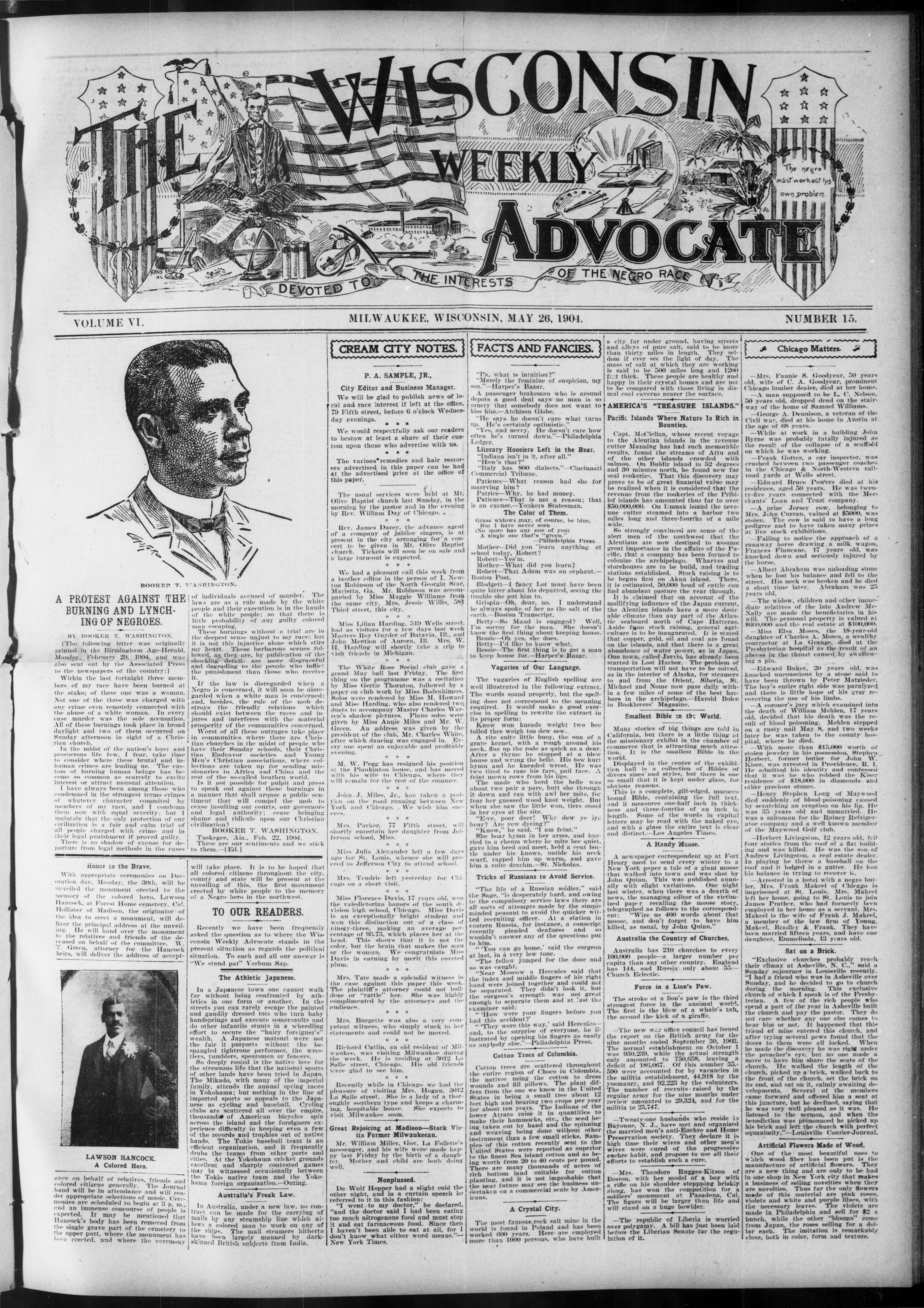
Page text (machine-generated)
WISCONSIN
WEEKLY
ADVOCATE
DEVOTED TO THE INTERESTS OF THE NEGRO RACE
G. A. K.
BOOKER T. WASHINGTON.
BOOKER T. WASHINGTON.
A PROTEST AGAINST THE BURNING AND LYNCHING OF NEGROES.
BY BOOKER T. WASHINGTON.
BY BOOKER T. WASHINGTON.
[The following letter was originally printed in the Birmingham Age-Herald, Monday, February 29, 1904, and was also sent out by the Associated Press to the newspapers of the country:]
Within the last fortnight three members of my race have been burned at the stake; of these one was a woman. Not one of the three was charged with any crime even remotely connected with the abuse of a white woman. In every case murder was the sole accusation. All of these burnings took place in broad daylight and two of them occurred on Sunday afternoon in sight of a Christian church.
In the midst of the nation's busy and prosperous life few, I fear, take time to consider where these brutal and inhuman crimes are leading us. The custom of burning human beings has become so common as scarcely to excite interest or attract unusual attention.
I have always been among those who condemned in the strongest terms crimes of whatever character committed by members of my race, and I condemn them now with equal severity; but I maintain that the only protection of our civilization is a fair and calm trial of all people charged with crime and in their legal punishment if proved guilty.
There is no shadow of excuse for departure from legal methods in the cases
With appropriate ceremonies on Decoration day, Monday, the 30th, will be unveiled the monument erected to the memory of the colored hero, Lawson Hancock, at Forest Home cemetery. Co! Hollister of Madison, the originator of the idea to erect a monument, will deliver the principal address at the unveiling. He will hand over the monument to the relatives and friends of the deceased on behalf of the committee. W. T. Green, attorney for the Hancock heirs, will deliver the address of accept-
M. B.
ance on behalf of relatives, friends and colored citizens generally. The Journal band will be in attendance and will render appropriate selections of music. Ceremonies are scheduled to begin at 3 p. m., and an immense concourse of people is expected. It may be mentioned that Hancock's body has been removed from the single grave part of the cemetery to the upper part, where the monument has been erected, and where the ceremony
VOLUME VI.
Honor to the Brave
LAWSON HANCOCK
A Colored Hero.
of individuals accused of murder. The laws are as a rule made by the white people and their execution is in the hands of the white people; so that there is little probability of any guilty colored man escaping. These burnings without a trial are in the deepest sense unjust to my race; but it is not this injustice alone which stirs my heart. These barbarous scenes followed, as they are, by publication of the shocking details, are more disgraceful and degrading to the people who inflict the punishment than those who receive it.
If the law is disregarded when a Negro is concerned, it will soon be disregarded when a white man is concerned; and, besides, the rule of the mob destroys the friendly relations which should exist between the races and injures and interferes with the material prosperity of the communities concerned. Worst of all these outrages take place in communities where there are Christian churches in the midst of people who have their Sunday schools, their Christian Endeavor societies and Young Men's Christian associations, where collections are taken up for sending missionaries to Africa and China and the rest of the so-called heathen world.
Is it not possible for pulpit and press to speak out against these burnings in a manner that shall arouse a public sentiment that will compel the mob to cease insulting out courts, our governors and legal authority; cease bringing shame and ridicule upon our Christian civilization?
BOOKER T. WASHINGTON.
Tuskegee, Ala., Feb. 22, 1904.
These are our sentiments and we stick to them.—[Ed.]
will take place. It is to be hoped that all colored citizens throughout the city, county and state will be present at the unveiling of this, the first monument erected by white people to the memory of a Negro hero in the northwest.
TO OUR READERS.
Recently we have been frequently asked the question as to where the Wisconsin Weekly Advocate stands in the present situation as regards the political situation. To each and all our answer is "We stand pat" Verbum Sap.
In a Japanese town one cannot walk far without being confronted by athletics in one form or another. In the streets you can rarely escape the painted and gaudily dressed tots who turn baby handsprings and execute somersaults and do other infantile stunts in a wheedling effort to secure the "hairy foreigner's" wealth. A Japanese matsuri were not the fair it purports without the bespangled tightrouse performer, the wrestlers, tumblers, spearsmen or fencers.
So deeply rooted is the native love for the strenuous life that the national sports of other lands have been tried in Japan. The Mikado, with many of the imperial family, attends the annual spring races in Yokohama; but nothing in the line of imported sports so appeals to the Japanese as cycling and baseball. Cycling clubs are scattered all over the empire, thousands of American bicycles spin across the island and the foreigners experience difficulty in keeping even a few of the records and trophies out of native hands. The Tokio baseball team is an efficient organization, and it frequently drubs the teams from other ports and cities. At the Yokohama cricket grounds excellent and sharply contested games may be witnessed occasionally between the Tokio native team and the Yokohama foreign organization.—Outing.
Australia's Freak Law.
In Australia, under a new law, no contract can be made for the carrying of mails by any steamship line which allows a colored man to work on any of the ships. The mail steamers hitherto have been largely manned by darkskinned British subjects from India.
The Athletic Japanese
MILWAUKEE, WISCONSIN, MAY 26, 1904.
CREAM CITY NOTES.
P. A. SAMPLE, JR..
City Editor and Business Manager. We will be glad to publish news of local and race interest if left at the office, 79 Fifth street, before 6 o'clock Wednesday evenings.
day evenings.
We would respectfully ask our readers to bestow at least a share of their custom upon those who advertise with us.
The various remedies and hair restorers advertised in this paper can be had at the advertised price at the office of this paper.
The usual services were held at Mt. Olive Baptist church last Sunday, in the morning by the pastor and in the evening by Rev. William Day of Chicago.
Rev. James Darey, the advance agent of a company of jubilee singers, is at present in the city arranging for a concert to be given in Mt. Olive Baptist church. Tickets will soon be on sale and a large turn-out is expected.
```markdown
```
We had a pleasant call this week from a brother editor in the person of I. Newton Robinson of the North Georgia Star, Marietta, Ga. Mr. Robinson was accompanied by Miss Maggie Williams from the same city. Mrs. Jessie Willis, 581 Third street, this city.
☆ ☆ ☆
Miss Lilian Harding, 519 Wells street, bad as visitors for a few days last week Masters Roy Guyder of Batavia, Ill., and John Mention of Aurora, Ill. Mrs. W. H. Harding will shortly take a trip to visit friends in Michigan.
The White Rose Social club gave a grand May ball last Friday. The first thing on the programme was a recitation by Miss Gertie Thornton, followed by a paper on club work by Miss Bodenhimers. Solos were rendered by Miss M. Howard and Miss Harding, who also rendered two duets to accompany Master Charles Warren's shadow pictures. Piano solos were given by Miss Annie Miles and Mr. W. Green. An address was given by the president of the club, Mr. Charles White, after which dancing was engaged in. Every one spent an enjoyable and profitable evening.
☆ ☆ ☆
M. W. Pegg has resigned his position at the Plankinton house, and has moved with his wife to Chicago, where they will remain for the rest of the summer.
* * *
John J. Miles, Jr., has taken a position on the road running between New York and Chicago. We wish him success.
☆ ☆ ☆
Mrs. Parker, 77 Fifth street, will shortly entertain her daughter from Jefferson school, Miss.
* * *
Miss Julia Alexander left a few days ago for St. Louis, whence she will proceed to Jefferson City to attend school.
* * *
Mrs. Tendric left yesterday for Chicago on a short visit.
```markdown
```
Miss Florence Davis, 17 years old, won the valedictorian honors of the south division high school, Chicago. Miss Davis is an exceptionally bright student and won this distinction out of a class of ninety-three, making an average percentage of 93.73, which places her at the head. This shows that it is not the color, but the brain that makes the man or the woman. We congratulate Miss Davis in earning by merit this coveted plum.
☆ ☆ ☆
Mrs. Tate made a splendid witness in the case against this paper this week. The plaintiff's attorney could not bulldoze or "rattle" her. She was highly complimented by the attorneys and the audience.
* * *
Mrs. Burgette was also a very competent witness, who simply stuck to her statements and could not be moved.
```markdown
```
Richard Catlin, an old resident of Milwaukee, was visiting Milwaukee during the week. He is residing at 3012 La Salle street, Chicago. His old friends were glad to see him.
* * *
Recently while in Chicago we had the pleasure of visiting Mrs. Hogan, 3012 La Salle street. She is a lady of a thoroughly southern type and keeps a charming, hospitable house. She expects to visit Milwaukee soon.
Great Rejoicing at Madison—Stork Visits Former Milwaukeean.
Mr. William Miller, Gov. La Follette's messenger, and his wife were made happy last Friday by the birth of a daughter. Mother and child are both doing well.
Nonplussed.
De Wolf Hopper had a slight cold the other night, and in a curtain speech he referred to it in this fashion:
"I went to my doctor," he declared, "and the doctor said I had been eating too much nitrogenous food and must stop it and eat farinaceous food. Since then I haven't been able to eat at all, for I don't know what either word means."—New York Times.
FACTS AND FANCIES.
"Pa, what is intuition?"
"Merely the feminine of suspicion, my son"—Harner's Razar
A passenger brakeman who is around depots a good deal says no man is so ornery that somebody does not want to kiss him—Atchison Globe.
"He says he doesn't care what turns up. He's certainly optimistic."
"Yes, and nervy. He doesn't care how often he's turned down."—Philadelphia Ledger.
Literary Hoosiers Left in the Rear.
"Indiana isn't in it, after all."
"Indiana isn't in it, after all."
"How's that?"
"Italy has 800 dialects."—Cincinnati Commercial Tribune.
Patience—What reason had she for marrying him?
Patrice—Why, he had money.
Patience—That is not a reason; that is an excuse.—Yonkers Statesman.
The Color of Them.
Grass widows may, of course, be blue,
But I have never seen
(No more has any one of you)
A single one that's "green."
—Philadelphia Press.
Mother—Did you learn anything at school today, Robert?
Robert—Yes'm.
Mother—What did you learn?
Robert—That Adam was an orphan.—Boston Post.
Blodgett—I fancy Lot must have been quite bitter about his departed, seeing the trouble she put him to.
Grispin—Oh, dear, no. I understand he always spoke of her as the salt of the earth.—Boston Transcript.
Betty—So Maud is engaged? Well, I'm sorroy for the man. She doesn't know the first thing about keeping house.
Bessie—Oh yes, she does.
Betty-I'd like to know what.
Bessie—The first thing is to get a man to keep house for.—Harper's Bazar.
Vagaries of Our Language.
The vagaries of English spelling are well illustrated in the following extract. The words sound properly, but the spelling does not correspond to the meaning required. It would make a good exercise in spelling to rewrite the extract in its proper form:
Know won kneads weight two bee tolled thee weigh too dew sew.
A rite suite little buoy, the sun of a grate kernel, with a rough around his neck, flue up the rode as quick as a dear. After a thyme he stopped at a blew house and wrung the belle. His tow hurt hymn and he kneaded wrest. He was two tired to raze his fare, pail face. A feint mown rows from his lips.
The made who herd the belle was about two pair a pare, butt she through it down and ran with awl her mite, for fear her guessed wood knot weight. But when she saw the little won, tiers stood in her eyes at the site.
"Ewe, poor deer! Why dew ye lye hear? Are yew dyeing?"
"Know," he said, "I am feint."
She boar hymn in her arms, and hurried to a rheum where he mite bee quiet, gave him bred and meet, held a cent bottle under his knows, untide his neck scarf, rapped him up warm, and gave him a suite drachm.—St. Nicholas.
Tricks of Russians to Avoid Service
"The life of a Russian soldier," said the Sage, "is desperately hard, and owing to the compulsory service laws there are all sorts of attempts made by the simple minded peasant to avoid the quicker witted recruiting officer. At a station in eastern Russia, for instance, a conscript recently pleaded deafness and so wouldn't answer any of the questions put to him.
"You can go home," said the surgeon at last, in a very low tone. "The fellow jumped for the door and so was caught. "Near Moscow a Hercules said that the index and middle fingers of his right hand were joined together and could not be separated. They didn't look it, but the surgeon's strength was not great enough to separate them and at last the examiner said:
"How were your fingers before you had this accident?"
"They were this way,' said Hercules and, to the surprise of everyone, he illustrated by opening his fingers as easily as anybody else."—Philadelphia Press.
Cotton Trees of Colombia.
Cotton trees are scattered throughout the entire region of Choco in Colombia, the natives using the cotton to dress wounds and fill pillows. The plant differs from the one we know in the United States in being a small tree about 12 feet high and bearing two crops per year for about ten years. The Indians of the lower Atrato raise it in quantities to make their hammocks, etc., the seed being taken out by hand and the spinning and weaving being done without other instrument than a few small sticks. Samples of this cotton recently sent to the United States were reported as superior to the finest Sea island cotton and as being worth from 20 to 40 cents per pound. There are many thousands of acres of rich bottom land suitable for cotton planting, and it is not improbable that the near future may see the business undertaken on a commercial scale by Americans.
A Crystal City.
The most famous rock salt mine in the world is found in Poland and has been worked 600 years. Here are employed more than 1000 persons, who have built
a city far under ground, having streets and alleys of pure salt, said to be more than thirty miles in length. They seldom if ever see the light of day. The mass of salt at which they are working is said to be 500 miles long and 1200 feet thick. These people are healthy and happy in their crystal homes and are not to be compared with those living in dismal coal caverns nearer the surface.
AMERICA'S "TREASURE ISLANDS."
Pacific Islands Where Nature Is Rich in Bounties.
Capt. McClellan, whose recent voyage to the Aleutian islands in the revenue cutter Manning has had such memorable results, found the streams of Attu and of the other islands crowded with salmon. On Buldir island in 52 degrees and 30 minutes north, he found new fur seal rookeries. That this discovery may prove to be of great financial value may be realized when it is considered that the revenue from the rookeries of the Pribilof islands has amounted thus far to over $50,000,000. On Umnak island the revenue cutter steamed into a harbor two miles long and three-fourths of a mile wide.
So strongly convinced are some of the alert men of the northwest that the Aleutians are now destined to assume great importance in the affairs of the Pacific, that a company has been formed to colonize the archipelago. Wharves and storehouses are to be build, and trading stations established. Stock raising is to be begun first on Akun island. There, it is estimated, 50,000 head of cattle can find abundant pasture the year through.
It is claimed that on account of the mollifying influence of the Japan current, the Aleutian islands have a more desirable climate than any part of the Atlantic seaboard north of Cape Hatteras. Aside from stock raising, general agriculture is to be inaugurated. It is stated that copper, gold, oil and coal are found on the islands, and that there is a great abundance of water power, as in Japan. One town, called Jarvis, has already been started in Lost Harbor. The problem of transportation will not have to be solved, as in the interior of Alaska, for steamers to and from the Orient, Siberia, St. Michael and Nome now pass daily within a few miles of some of the best harbors in the archipelago.—Harold Bolec in Booklovers' Magazine.
Smallest Bible in the World.
Many stories of big things are told in California, but there is a little thing at the missionary exhibit in the chamber of commerce that is attracting much attention. It is the smallest Bible in the world. Displayed in the center of the exhibition hall is a collection of Bibles of divers sizes and styles, but there is one so small that it is kept under glass, for obvious reasons. This is a complete, gilt-edged, morocco bound Bible, containing the full text, and it measures one-half inch in thickness and three-fourths of an inch in length. Some of the words in capital letters may be read with the naked eye, and with a glass the entire text is clear and distinct.-Los Angeles Times.
A Handy Moose.
A newspaper correspondent up at Fort Henry used to send every winter to a New York paper a tale of a giant moose that walked into town and was shot by John Quinn. This was published annually with slight variations. One night last winter, when there was a dearth of news, the managing editor of the victimized paper, recalling the moose story, telegraphed as follows to the correspondent: "Wire us 400 words about that moose, and don't forget to have him killed as usual, by John Quinn."
Australia the Country of Churches
Australia has 210 churches to every 100,000 people—a larger number per capita than any other country. England has 144, and Russia only about 55. Church Eclectic.
Force in a Lion's Paw.
The stroke of a lion's paw is the third strongest force in the animal world. The first is the blow of a whale's tah, the second the kick of a giraffe.
The new war office council has issued the report on the British army for the nine months ended September 30, 1903. The normal establishment on October 1 was 930,239, while the actual strength only amounted to 750,658, leaving a deficit of 186,067. Of this number 35,590 were accounted for by vacancies in the militia establishment, 44,918 by the yoemaury, and 92,223 by the volunteers. The number of recruits raised by the regular army for the nine months under review amounted to 29,324, and for the militia to 25,747.
Twenty-one husbands who reside in Bayonne, N. J., have met and organized the married men's anti-Euchre and Home Preservation society. They declare it is high time their wives and other men's wives were cured of the progressive euchre habit, and propose to use all their efforts to establish such a cure.
Mrs. Theodore Rugges-Kitson of Boston, with her model of a boy with a rifle on his shoulder steppping briskly along, has won the competition for a soldiers' monument at Pasadena, Cal. The figure will be larger than life and will stand on a huge bowlder.
The republic of Liberia is worried over polygamy. A bill has just been laid before the Liberian Senate for the regulation of it.
—Mrs. Fannie S. Goodyear, 50 years old, wife of C. A. Goodyear, prominent Chicago lumber dealer, died at her home.
—A man supposed to be L. C. Nelson, 50 years old, dropped dead on the stairway of the home of Samuel Williams.
—George A. Dennison, a veteran of the Civil war, died at his home in Austin at the age of 68 years.
—While at work in a building John Byrne was probably fatally injured as the result of the collapse of a scaffold on which he was working.
—Frank Gotter, a car inspector, was crushed between two passenger coaches in the Chicago & North-Western railroad yards at Wells street.
—Edward Bruce Powers died at his residence, aged 50 years. He was twenty-five years connected with the Merchants' Loan and Trust company.
A prize Jersey cow, belonging to Mrs. John Curran, valued at $5000, was stolen. The cow is said to have a long pedigree and to have taken many prizes at live stock exhibitions.
Failing to notice the approach of a runaway horse drawing a milk wagon, Frances Finucane, 17 years old, was knocked down and seriously injured by the horse.
Albert Abraham was unloading stone when he lost his balance and fell to the street. His neck was broken and he died a short time later. Abraham was 25 years old.
The widow, children and other immediate relatives of the late Andrew McNally are made the beneficiaries in his will. The personal property is valued at $600,000 and the real estate at $100,000.
—Miss Elsa Moses, the 18-year-old daughter of Charles A. Moses, a wealthy contractor at La Grange, died at the Presbyterian hospital as the result of an abcess in the throat caused by swallowing a pin.
—Edward Buker, 20 years old, was knocked unconscious by a stone said to have been thrown by Peter Matzleder. The boy's entire right side was paralyzed and there is little hope of his ever recovering the use of his limbs.
—A coroner's jury which examined into the death of William Mehlen, 17 years old, decided that his death was the result of blood poisoning. Mehlen stepped on a rusty nail May 8, and two weeks later he was taken to the county hospital, where he died.
With more than $15,000 worth of stolen jewelry in his possession, Stephen Herbert, former butler for John W. Kiser, was arrested in Providence, R. I. He admitted his identity and confessed that it was he who robbed the Kiser residence of $18,000 in diamonds and other precious stones.
Henry Stephen Long of Maywood died suddenly of blood-poisoning caused by scratching an eruption on his lip. He was 35 years old and unmarried. He was a salesman for the Rainey Refrigerator company and a well known member of the Maywood Golf club.
—Herbert Livingston, 12 years old, fell four stories from the roof of a flat building and was killed. He was the son of Andrew Livingston, a real estate dealer. In playing he threw a baseball on the roof and it lodged in a gutter. He lost his balance in trying to recover it.
—Arrested in a hotel with a negro butler, Mrs. Frank Makeel of Chicago is imprisoned at St. Louis, Mrs. Makeel left her home, going to St. Louis to join James Prather, who had formerly been employed in her home as a servant, Mrs. Makeel is the wife of Frank J. Makeel, a member of the law firm of Young, Makeel, Bradley & Frank. They have been married fifteen years, and have one daughter, Emmelinda, 13 years old.
Sat on a Brick
"Exclusive churches probably reach their climax at Asheville, N. C.," said a Sunday sojourner in Louisville recently. "I had a friend who was in Asheville over Sunday, and he decided to go to church during the morning. This exclusive church of which I speak is of the Presbyterian. A few of the rich people who spend a part of the year in Asheville built the church and pay the pastor. They do not care whether any one else comes to hear him or not. It happened that this friend of mine entered this church, and after trying several pews found that the doors to them were all locked. When he made the discovery he was right under the preacher's eye, but no one made a move to have him share the seats of the church. He walked the length of the church, picked up a brick, walked back to the front of the church, set the brick on its end, and sat on it, calmly awaiting developments. Several of the members came forward and offered him a seat at this juncture, but he declined, saying that he was very well pleased as it was. He listened to the sermon, and when the benediction was pronounced he picked up his brick and left the church with perfect equanimity."—Louisville Courier-Journal.
Artificial Flowers Made of Wood.
One of the most beautiful uses to which wood fiber has been put is the manufacture of artificial flowers. They are a new thing and are only to be had in one shop in New York city that makes a business of selling novelties when they are novelties. Thus far the only flowers made of this material are pink roses, violets and white and purple lilacs, with the necessary leaves. The violets are made in Philadelphia and sell for $2 a bunch, while the other "blooms" come from Japan, the roses selling for a dollar each. The imitation is remarkably close, both in color, form and texture.
A City Maid.
She came up to the country
But a week or so ago,
This city maid who ne'er had seen
The fields where wild flowers grow:
And when she saw the cat tails.
She cried. "Oh, do look, quick!
Who ever heard of sausages
A-growing on a stick!"
NOTES OF INTEREST.
- The amount of water given off by an acre of grass is said to be thirty hogsheads a day.
- The order of Odd Fellows has now over 1,000,000 members, and it has been organized but eighty-five years.
- Two hundred machines which supply newspapers on coins being placed in the slot are now installed in Berlin.
- The wholesale textile firms of Leipzig, Germany, have determined to have bargain sales on stated days of the year.
- The Eskimo population of Alaska, Labrador and Greenland is estimated at 15,000. Twenty years ago it was 30,000.
- There are fewer blind people in the United States than in any other country in the world, in proportion to the population.
Members of the Saxe-Coburg family occupy five thrones in Europe—those of Great Britain, Germany, Portugal, Belgium and Bulgaria.
The divorced husband of Mme. Lillian Nordica alleges that the eight years of his wedded life with the famous singer cost him $330,300.
Italy and Spain have fewer houses in proportion to their population than any other country in the world; the Argentine Republic and Uruguay have the most.
The great Corliss engine that furnished the power for the Centennial exposition at Philadelphia had 300 horse power. At St. Louis one engine has 8000 horse power.
The clock placed in the hall of the Holborn (England) borough council is at least 250 years old, and has been in the possession of the local authorities for that period. It still keeps good time.
Abyssinia produces the finest ostrich feathers, the price there being $1.44 to $2.31 per dozen for the best white, 96 cents to $1.93 a dozen for black and half as much for gray feathers.
There are a few carpet factories in Smyrna, but most of the carpets are made in the dwellings of the peasants; each house has its loom, and carpet weaving is done in the intervals of farming.
Japan, with her 47,000,000 population, has 4,302,625 pupils in her elementary schools, or 91 in every 1000; while Russia, with 130,000,000 population, has only 4,193,594, or 32 in every 1000.
The earrings worn by Italian women indicate the part of Italy the wearers come from; the longer the earrings the farther south the original homes of the women. In the far north the ornaments are quite short.
John Baumgartner of Williamsburg, N. Y., invited 350 friends to accompany him to the theater, and just as they were ready to start with a band of music to lead them Baumgartner was seized with illness and died.
The district of Guayaquil, in the republic of Ecuador, leads the world in the production of cacao, and has a larger output than the whole of Africa, which continent, however, is in many parts well adapted for its culture.
It is said that the effect of intoxicating drinks is such as to make a Frenchman want to dance, a German to sing, a Spaniard to gamble, an Englishman to eat, an Italian to boast, an Irishman to fight and an American to make a speech.
A cheap and novel plan for heating houses is being put in operation at Glenwood Springs, Colo. Water from the famous boiling springs is being piped into town, and so great is the supply that houses can be heated at a very small expense.
A new theory of the Martian "canals" is that Mars has a solid crust and an elastic nucleus of a higher temperature. The crust in cooling necessarily contracted, and the pressure upon the mass within caused fissures to be formed in the surface. According to a Belgian paper the Czar is among the composers. It is stated that at a soiree in the Winter Palace several works from the imperial pen were performed, among them one entitled, significantly enough, "The Song of Peace." The largest loaves of bread baked in the world are those of France and Italy. The "pipe" bread of Italy is baked in loaves two feet or three feet long, while in France the loaves are made in the shape of very long rolls, four feet or five feet in length, and in many cases six feet.
The mileage of American railways exceeds that of the United Kingdom by about 10 to 1, yet there twice as many passengers are carried as here. In Great Britain, in 1903, 25 passengers were killed in train accidents, as against 164 in this country, and 123 killed by other causes on railroads, as contrasted with 157 here. The total number of passengers injured on railroads here was 6973, as against 2681 there.
The old English inns are fast passing away. The "King of Prussia" hostelry at Finchley was recently torn down. It had been running since 1757, and the license had been continuously in the hands of one family since that time. The old "Plow," at Kingsbury Green, is said to be 850 years old, and the "King James," at Endfield, 990 years old.
New York boasts of some fair imitations of the Tower of Babel. Such are the Manhattan Life building, 22 stories, 348 feet; the St. Paul building, 26 stories, 308 feet, and the Park Row building, 29 stories, 382 feet. Buildings of from 15 to 20 stories and 250 to 300 feet are such common incidents of the landscape as scarcely to attract attention.
The largest stone-arch bridge in the world is now in course of erection at Plauen, Saxony. This bridge will have a span of 295 feet, exceeding by 20 feet the famous Luxembourg bridge opened last year, and by still more the Morbegno bridge in Lombardy and the Cabin John bridge near Washington, D. C., which have held in turn the record as the longest stone-arch bridges.
The world's most valuable knife, owned by a Sheffield cutler, has seventy-five blades, which close up like those of an ordinary knife. Each of the larger ones is elaborately engraved, there being represented views of Sheffield college, Windsor castle, the city of York, Arundel castle, and a score of other famous places and scenes. The hafts are of On one side the artist has depicted a stag mother-of-pearl, carved with great skill, hunt and on the other a boar hunt.
Forbidden Fruit.
A request was once made to the authorities of one of the colleges at Cambridge that room might be found on the spacious lawns of their garden for the lady students of Girton college to play lawn tennis.
Guessing clearly enough what would be the result of the admission to these students of the fairer sex among the undergraduates, the master replied that the gardens must be devoted to the purposes of floriculture, and must not be used for husbandry.—Spare Moments.
THE FOREST GREETING.
Good hunting!-aye, good hunting,
Wherever the forests call;
But ever a heart beats hot with fear,
And what of the birds that fall?
Good hunting!-aye, good hunting,
Wherever the north winds blow;
But what of the stag that calls for his
mate?
Good hunting!-aye, good hunting,
And ah! we are bold and strong:
But our triumph call through the forest
hall
Is a brother's funeral song.
For we are brothers ever,
Panther and bird and bear:
Man and the weakest that fear his face,
Born to the nest or lair.
Yes, brothers, and who shall judge us?
Hunters and game are we:
But who gave the right for me to smite?
Who boasts when he smiteth me?
Good hunting!-aye, good hunting,
And dim is the forest track:
But the sportsman Death comes striding on:
Brothers, the way is black.
Brothers, the way is shared
—Paul Laurence Dunbar in the Century.
The Finding of the Path
"We can't go on like this." The girl twisted round in her long cane chair and caught at a swaying creeper with petulant fingers.
"I am painfully aware of the fact. If you have quite finished your tea, we may as well discuss matters now."
The man's tone was quite level—business-like, in fact—the tone that he would use later in the day when dictating letters to his Babu typist. There was no indication that he was interested in the matter other than from a business standpoint. He settled himself rather more stiffly in his chair, waiting for her to speak. But she only trailed the bit of creeper over the edge of the veranda, looking straight in front of her with eyes that were curiously hard for so childish a face.
It was not a particularly attractive scene; the flat was midway in a narrow street, and the white gray walls of the opposite buildings were broken only by a struggling peepul tree and a stunted palm. Beyond the veranda, by dint of a craning neck, one caught a cheerful glimpse of a disused churchyard, but closed jhilmills and drawn chicks already shut out that much of the view, for it was 7:30 a. m. in May, and the merciless blue blaze was starting to bring salvation by fire, for one more day upon Calcutta, which would smell worse without the heat.
The narrow outlook had always seemed to Nina the epitome of the big travesty she had found India: her home visions were of a marble mansion, more or less white, with a retinue of dark servants in snowy garments, featnery palms and flaming blossomed bushes growing at her doors, and trees thick with oranges, guavas and mangoes (irrespective always of the time of the year and the precise situation of Bengal). She had found a three-room flat, "with no front," as she wrote home in dismay; her suburban-provincial mind could not take to the word "compound," and, in any case, the flat had none.
In short, out of the depth of her ignorance she had come out to find heaven and all that in it is on 500 rupees a month, with a husband of 40 odd, and had found—this.
"Can you make any suggestions as to—what—we can arrange?" His voice was measured still; he had, at least, found that sort of pathetic dignity which comes to most men (and many of the women) in the land where only death hurries. His wife—barely seven months out and restless under the misery of her first hot weather—was far from it.
"I want to go home," she broke out, taking quick breaths and tearing the tiny pink petals from the creeper; "I'm sick of this hateful place, and the heat—and nobody here! It was bad enough in the cold weather, but now it's—it's hateful!"
Frere glanced at the pretty face and its fretful eyes with the same look, half judicial and half absent-minded, that he had given shortly before to the bearer as he swept a cup off the chota habri tray. Something of a failure from boyhood, he was hardly surprised himself he had drawn one of the many losing numbers. But each day helped to blunt the regret and make him look forward, almost with relief, to the inevitable return to his old existence.
"It is certainly a pity that you came out," he replied, slowly. "I am sorry that you have found the life so—unpleasant, and I can hardly give you a more luxurious place at home on my present income."
"Oh, I can go home—to my own home!" she flashed out.
Allen Frere flushed and his lips went into a thin line.
"I think not," he answered, quietly. "You see, Nina, you are my wife, and the fact that you prefer to reside in England doesn't affect my position."
"But I thought people separated when they couldn't agree"—the man winced—and we never shall get on together, so what is the good of keeping up this farce?"
"There's some question of dignity, you see," he said, after a pause. "As it is, you may find it somewhat difficult at home—alone. Unfortunately, marriages can't be undone because of a difference in tastes and tempers; and I shall not trouble you much—I'm not likely to come home."
The girl moved her rings restlessly and kept her eyes away.
"You'll find it rather hot going home now," Frere went on, after a long silence, "and it will be worse later on. Would you—like to go up to Darjiling until September, and then—just as you prefer?"
"No, no. I don't want to go to the hills; I want to go home—now!" And, with the angry, miserable tears of a defiant child in her eyes, she walked past him to the little room he had tried to convert into a "boudoir" to please her, swinging the purdah behind her fiercely.
For no apparent reason, Frere walked round the table to reach the veranda stairs; as he passed her long chair, he dropped his hand on the top of it and stood staring down at the withered creeper she had torn.
The last week had been such a whirl that she had hardly had time to think—certainly not time to think so much of her sorrows. Frere had taken her passage in the next homeward bound boat, and tonight he was to see her on board at Garden Reach, as they were to leave the river in the early morning. With wholly feminine irrationality, she was complaining to herself that he might have got away from the office, at least for this last day; that there would be no particular reason and small satisfaction in doing so did not occur to her. She had dressed early, from sheer restlessness, and moved from one room to another to arrive at a mood of satisfaction and only reaching one of frettful doubt.
He had been too old and grim and self-centered—her people had always said so; and she had thought to find India such a different place, and didn't know that they would really be poor there and not "in society" a bit; and—and—this was the only way out of it. She was young and pretty, and why should she spoil any more of her life?
Coming to a pause at the little side
window which gave on to a not very savory back compound, she saw a native—a woman—walk softly to a corner where a fat brown baby sprawled in the comfort of a cool sleep. Nine knew her vaguely as Rupi, the mehtar's* wife; in the usual Anglo-Indian fashion, she had not thought of her before except as a brown automation. The woman crouched down, watching the sleeper with satisfaction; her attitude was, perhaps, not quite so touching to western notions as that of the mother who hugs her baby in her arms, but there was the same thing throbbing behind the differing ways. Something of what it meant caught the girl suddenly as she stood there, with all her little world broken around her by her own hands. Perhaps, if this had happened, things would have been different, and they wouldn't have made such a mess of it. She leaned over the jhilmills, watching the mother-love on the brown face, and then the placid baby, thinking, until the train of thoughts brought her back to the present hour, and she went out on the veranda, chafing because it was getting late.
"He prefers to stop at the office until the last minute," she thought, bitterly. "He certainly takes care to avoid me—I suppose he'll be quite as glad as I shall be to end it." But, as the lateness grew from a matter of minutes to one of an hour, the silent, deserted rooms began to oppress her; apparently the boys had had orders from Frere to go—he himself was returning at dinner time to her, with gravity shadowing his boyish life between a hotel and a solitary room over the office.
Nina went back to the corner where the mehtar's wife and baby might, at least, give her some sense of companionship; but they were gone, and the sudden eastern night came down on her loneliness. She found a lamp and tried to light it, but some prudent soul among the boys had emptied it of all oil. For a moment she thought of going down to find a messenger to send to Frere's office; then the slight absurdity struck her of dispatching an urgent request for the man whom she was in an hour's time to dismiss out of her life. Finally, she could endure the silent darkness no longer, and, went down the stairs, angry with herself and with Frere for this foolish fiasco. She had not very clear notions of how one got to Garden Reach, only that the passengers' launch having left the ghat long since, she would have to take a native dingy somewhere.
As she turned the corner of the stairs, someone cannoned against her, and his brief apology was followed by, "Oh! Isn't it Mrs. Frere? Will you come, please, at once? I've a gharri waiting." "Is my husband there—are you from his office?" she asked, chillily, looking up in the dim light at this perfectly unknown young man who seemed in such haste. "No, I'm not in Mr. Frere's office; I'm up country—just down here for a few days—only there was no one else seemed available to bring you. Won't you get in, please, and I can explain as we go? These ticca gharries aren't very rapid at best."
It was one of the open ramshackles which are Calcutta's combined apologies for a hansom and victoria. As it turned she said, quickly, "Where is the man going? This isn't the way to the river. Isn't Mr. Frere at the ghat?" "No; we are going to the general hospital," he said, slowly, turning toward face. "There was a tram accident this afternoon—but they only found out his address just now. I'm awfully sorry—I'm telling it rather clumsily, I'm afraid"—as the girl's lips began to quiver and a queer look came into her eyes. "Oh, I'm all right—I'm not going to do anything ridiculous! Only—only it's so very—odd," she answered with an hysterical little laugh, thinking of the absurdity of having to sustain the attitude of devoted wife toward the man from whom she was soon to have parted forever.
"There's no accounting for the way a woman takes a thing, I suppose," thought the lad at her side, "but she seems to be jolly cool about it."
Which thought was evident in the stiffness that came into his voice when he next spoke, telling her briefly the few details he had of the accident, and that there had been some operation; to all of which her only response was silence. After that little laugh, she sat quite still, her face turned away from him, looking dully at the lines of belated carriages which swept past them down Chowringhi, filled mostly by Eurasians looking more weary of life in general than of the heat, and by fat and complacent Babus, with as many olive branches as could be inconveniently packed into the conveyance. They drove in silence to the hospital compound, and her companion handed her over to a nurse, with a lift of the hat and a mental hope that "that poor devil upstairs" would find her—well, different.
"It was a native child you know, one of those bits of girls that are always dodging under one's horse's feet—wonder a dozen a day don't get killed. It was a foolish thing to do, unless the man was tired of his life. I believe he threw the child right from under the tram, and, of course, got smashed instead. Those electric transs never ought to have been allowed in the streets—at least not with native drivers. This makes the fifth accident already."
The clear voice of the hospital's senior surgeon came to her through the thin plaster walls of the little room where they had told her to wait: obviously he did not know anyone was there.
"Think he'll pull through?" said another voice, which she recognized as that of the manager of her husband's office.
"He's got a good chance—11 he cares to keep it," the other replied. "He has a first rate constitution, or he'd have gone under; but he seems a queer sort of fellow—as if he hadn't any particular anxiety to live. Seemed ratner disappointed, after we'd operated, to find that he was still alive."
"Bad job for his wife, isn't it? I believe she was going home tomorrow, too, in the Malta."
"Oh," said the doctor, carelessly, "Perhaps that accounts for it." And then another voice joined in, evidently a nurse, and Nina moved away to the other side of the little room, her face set and her eyes hard with a sudden passionate resentment against these people who were keeping her from her husband. He was hers—hers; what right had they to talk about him—and about her—in that cold-blooded way? She was blindly angry with everything and every one for this swift breaking down of her world, that new world which she had been so carefully constructing of late, wherein she would forget all the unpleasant things and really enjoy life. Except, perhaps, with him; with the utter unreasonableness of a woman, she only felt pity for him—pity and a curious, indefinite feeling which she had never yet had for her husband. The voices ceased, and she stood idly watching a man and woman on the veranda below her—both of them with the thin, sun-parched faces and dead weary eyes of the country born and bred. The man was making a few shuffling steps to and fro, the woman taking half his weight; evidently she was living in hospital with him, after the curious fashion of India. Neither of them was attractive, except so far as the commonplace tragedy of their obvious poverty and the man's illness went; but, as they came slowly into the patch of vivid moonlight on their veranda, the look in the woman's face suddenly took the hardness from Nina's; the absorbed, heartaching devotion of those weary eyes that never moved from watching the man's face made her shiver and turn away as if she had no right to see such things. Then a nurse came to take her to her
husband, and, with a warning that she must be very quiet and not excite him, left them together. The glaring moonlight was screened out of the tiny private room where they had put him: in the dim light Nina hardly saw his first look toward her, yet the likeness of his eyes to those of the woman she had just seen made her throat choke and words impossible.
"I'm-afraid-I've upset you," the old quiet voice said. "I'm sorry-it should have—happened—just now." But the girl was down on her knees by him, his hands in hers and the light dawning in her eyes which he had never seen there yet, crying brokenly. "Allan! Oh, Allan!" And with the cry he knew that between the heights and the depths there is a middle way on which they had, at last, entered together.—The Sketch.
*Sweeper, the lowest caste but one in India.
DOMESTIC SERVANTS IN RUSSIA.
Law Excludes Them as Witnesses Against Their Employers.
The Russian servant is hired for one year, and is told exactly what his particular duty is to be. He then sticks to that one duty. As long as each servant faithfully performs the special duties of his poition all is well; but the neglectful butler, or cook, or coachman is sent by the employer with a written note to the police judge, who after carefully investigating the complaints has a right to order bodily punishment or to write a bad mark in the book kept for this purpose.
In great Russian households often from twenty to fifty servants are kept, and even the middle class families have two to four. The pay of these servants varies according to the line of work. While the "chiefs" in the kitchens of wealthy families often receive £300 a year, a cook in an ordinary citizen's employ gets no more than £12 a year, and a maid of all work never gets more than £5 a year. At Easter every servant gets a present, generally a suit or dress.
Every other Sunday the servants in a Russian household are entirely free. Their work stops Saturday night after supper, when the servants leave the house not to return until the next Monday morning. The employers never ask where or how the free time is spent.
Russian servants will pilfer. Since Russian ladies leave everything to the care of the servants, the latter do as they please. The men servants smoke cigars belonging to their masters and pay frequent visits to the wine cellars of the house, but a gentleman would consider it "demeaning" himself to prosecute a servant for this.
The Russian servants will talk about fellow servants, but never about their employers. Even when they quit one place and take service in another family they would never mention anything about their former masters. This discretion goes so far that even the law considers it. In Russia the law excludes servants as witnesses against their former or present employers, so long, at least, as these servants are not suspected of having taken part in the crime.—London Daily Mail.
Romance of the War.
A romantic story of the war, with a very tragic ending, has reached Paris from Russia. Among the men belonging to a Siberian regiment stationed at Port Arthur was a soldier named Liatnikoff, who was popular with his comrades, but was often "chaffed" about his effeminate appearance. He had been selected as servant by a young officer at whose quarters he lodged. Our unlucky day, while he was on an errand, he fell and broke a leg. Liatnikoff expressed a very strong wish not to be taken to the hospital and as he was being conveyed thither he took a penknife out of his pocket and deliberately severed an artery in his left arm. As the soldier on his arrival there was being undressed to be put to bed the surgeons, to their amazement, perceived that he was not what he had represented himself to be. Liatnikoff, in fact, was a beautiful girl, barely 18 years of age. Blood poisoning supervened and the patient had been only three days in the hospital when all hope of recovery had to be abandoned. The young woman sent for the officer in whose service she had been and implored him to marry her, reminding him that it was her devotion to him which had led her to pass herself off as a man in order that she might follow him to the far east. His brother officers are also said to have pleaded her cause, but for some unexplained reason he would not listen to them. As soon, however, as he had heard of the death of the poor girl who had loved him so well he returned to his quarters and blew out his brains.
The passengers traveling by the night train recently between Koursk and Harkoff witnessed a rather remarkable meteoric display. About midnight the heavens were illuminated by great numbers of shooting stars—red, green and violet—which blazed brilliantly. The "stars" fell in the eastern sky, and the peasants traveling by the train, talking among themselves, made them out to be "the souls of Russian soldiers bidding farewell to the world."
The Russian military authorities, says The Novosti, have sent out to the far east a number of popular poets and singers, whose duty it is to stimulate the courage of the Russian soldiers with soul-stirring ballads. Every Russian regiment possesses its party of singers, at the head of whom are a piper, a cymbal player and a tambourinist, who play the people's songs according to the province from which they hail.—London Cor. Baltimore Sun.
Polluted Wells
"The Pollution of Deep Wells" was the subject of a paper before a scientific society, in which was described an interesting experiment conducted by the United States geological survey and the Geological Survey of Georgia, acting in co-operation, to determine the liability of contamination of the deep wells and springs in the vicinity of Quitman, Ga., by the proposed action of that city in turning the public sewage into an underground stream through a bore hole. To test the matter, the surveys mentioned inserted two tons of salt into the well into which it was proposed to turn the sewage. Samples of water were taken before the experiment to determine the normal chlorin of the waters, and at short intervals during and for some time after the experiment. The report concludes that "on analyzing the samples it was shown that the salt had entered all of the deep wells in town, thereby demonstrating that the insertion of sewage would have contaminated all of the wells, and possibly led to a dangerous epidemic." Undoubtedly the water of wells is often polluted by drainage, and the experiment vereies the danger, which should help health officers in their work. One wonders, however, if there is not a slight fallacy in the conclusion introduced by the doubt if micro-organisms might not be prevented from passing by the earth filtration, while a solution of salt would be able to permeate the medium. Why not use pathogenic bacilli themselves for a more convincing test?—American Medicine.
Dr. Wiley of the department of agriculture says that hardly a pound of real Mocha and Java coffee is sold over the counter, and that about all of this coffee coming to the United States is for private orders.
The Golden Service
Oh, Mrs. Astor feeds her guests
From solid golden plates—
Of course, I don't mean all the time,
But just on certain dates.
Gold plates for oysters and for soup,
And golden plates for fish;
Gold plates for entrees and for roasts,
And then a golden dish
For the dessert, and one for fruit;
A golden finger-bowl
Is just one of the perfect parts
That form this perfect whole.
The wonderment increases as
The appetite abates.
When Mrs. Astor feeds her guests
From solid golden plates.
—Town Topics:
OUR FLOUR IN FAR EAST
Japan Gets Its Rations of Sustaining Food.
A strong point made by the flour mill magnates of the west is that, when any considerable number of the millions of China shall call for flour, the entire wheat growing area of the world will not be sufficient to supply the demand. "Even if all Japan should become a flour-eating people," he said, "the whole available supply of the Pacific coast would provide this commodity for only 20 per cent. of the population of that kingdom." There is likelihood, too, that a greater portion of the inhabitants of Japan will acquire the habit of using flour.
It was represented to the Mikado by his ablest advisers that, in modeling the Japanese army on the latest military standard of the modern powers, the important matter of diet had been overlooked. Not only had all modern nations a standing army, but the food of these formidable hosts consisted in great measure of wheat products. Rice-eating regiments, it was feared, might not be able successfully to contend with a foe whose sinews were built of wheat. Japan, to be up to date, must maintain not only a big, well equipped and well drilled military force, but its soldiers, like the men of arms of other lands, must eat flour. So an imperial edict went forth recently; and now every soldier in the armies of Japan gets a daily ration of Oregon, Washington or California flour.
This ukase of the Emperor will mark the beginning of a very important chapter in commercial history, for this mandate on the part of the Mikado has already greatly stimulated the demand in the kingdom for wheat products, the people being alert to keep abreast of whatever is decided to be progress along modern lines. —Harold Bolse in The Booklovers' Magazine
ARCTIC SANITARIUMS.
Their Advantages in Incipient Pulmonary Disease.
The advantages offered by the three months of Arctic summer are so numerous that there have appeared recently several announcements of floating and permanent hospitals for patients suffering from incipient pulmonary affections and neurasthenic states, says American Medicine. According to the British Medical Journal, it is proposed to erect a sanitarium on the shores of Lake Torne, in Lapland, a long and beautiful sheet of water at Wassijauve, near the end of the Ofote railroad. That railroad, it may be mentioned, has only one station in a distance of 121 miles. There is no human dwelling near that station, which is on the line between Sweden and Norway, and was erected solely for the requirements of the customs office. Except for a small settlement at Wassijauve, the only sign of human existence in the district is the occasional passage of a few Laplanders with their herds of reindeer. Already there has been installed at this spot a scientific station in a solidly built blockhouse containing seven rooms, and it is proposed to build the sanitarium in the same way.
In American Medicine of April 23, Dr. Frederick Sohon has called attention to the great advantages of the Arctic climate. We learn that Dr. Sohon has decided to organize a cruise to the fjords of Greenland, leaving in June and returning before the hardships of the Arctic winter begin. These regions of perpetual sunshine may be reached within ten days from Nova Scotia, and the trip may be made with safety and comfort in a suitable vessel altered and appointed for this purpose.
The Caspian Sea
One of the most remarkable physical features of the globe is the deep and wide depression in the hollow of which stands the Caspian sea, and near to it the Sea of Aral. The Caspian is nearly as large as France, and its surface is 84 feet below the level of the Black sea. The Sea of Aral is nearly as large as Ireland, and is very little over the sea level. Within recent geological times the vast expanse in which these lakes are found was sea. Its floor has been gradually raised, and the waters filling the depressions are all that is left of an ancient Mediterranean. A strange feature of both bodies of water is that, although they receive large rivers, especially the Caspian, into which the Volga, the Ural river and scores of streams from the Caucasus flow, both have for many years been getting shallower. Evaporation, for they have no outlet, exceeds the inflow. But for some climatic reason probably, like Lake Aral and its neighbor, Lake Balkhash, have since 1891 been increasing in depth. "Nature" reports that M. Berg visited Lake Balkhash last summer and found that the level was rising with comparative rapidity. Whereas the Caspian, like the Dead sea, is very salt, owing to the rate of evaporation, Aral and Balkish are brackish only. These remnants of what was once a great sea opening into the ocean, as the Mediterranean does now, still contain marine fish and seals. Some of the latter survive in the Aral and Baikal lakes, having gradually become fitted for their habitat, though it is no longer salt, but merely brackish, and, in the case of Baikal, actually fresh water.—London Telegraph.
Trees Inside a Church.
Ross, Herefordshire, can boast of a church where two fine elms are growing, one on either side of a pew once occupied by a member named John Kyrle. Mr. Kyrle was a great lover of trees, and especially of elms, of which he planted an avenue near the church. One of the trees of this avenue was cut down, and it is supposed that its offshoots have grown up inside of the church at each end of the pew. The parish church at Kempsey contains a chestnut tree which grows from the tomb of Sir Edward Wilde. The school children of the village used to sit in the chancel, and it is said on one occasion their teacher found one of them eating a chestnut, and that he snatched it away and threw it behind the tomb, where it took root and has flourished.
Gave Him Credit.
Grimes-I think Blodgett is the meanest man I ever knew. Grant-What has Blodgett been doing now?
Grimes—I wrote an anonymous letter to his paper, complaining of the teacher of the Center school. He recognized my writing and published the letter over my signature.
Grant—Well, what of it? The letter expressed your sentiments, didn't it?
Grimes—Oh, yes, they were my sentiments all right; but I didn't want people to know that was what I thought.—Boston Transcript.
Rabbit Builds Itself a $100 Nest.
Bunny is the household pet of the Albertson family at No. 100 Hamilton place, Manhattan. She is a cross between a Belgian hare and an English "lop" rabbit. On Monday night Bunny decided to build a substitute for a burrow in Dr. Albertson's study, and in the morning it was discovered that she was snuggling luxuriously in a nest that was lined with the tattered remains of: Drawings of scientific apparatus, value $75; scientific data, representing some years of work; about twenty sheets of scientific notes; one $5 bill; ditto $10; three letters of a personal nature; some postage stamps; a portion of a leather wallet. Dr. Albertson is hesitating whether to have rabbit pie at an early date or reward Bunny for her industry.—New York World.
Tired, Suffering Women.
Women run down and endure daily tortures through neglecting the kidneys. Kidney backache makes housework a burden; rest is impossible; sleep fitful; appetite gives out and you are tired all the time. Can't be well until the kidneys are well. Use Doan's Kidney Pills which
Women run down and endure daily tortures through neglecting the kidneys. Kidney backache makes housework a burden; rest is impossible; sleep fitful; appetite gives out and you are tired all the time. Can't be well until the kidneys are well. Use Doan's Kidney Pills, which have restored thousands of suffering women to health and vigor.
Mrs. William Wallace, of 18 Capitol street, Concord, N. H., says: "I was in the early stages of Bright's Disease, and were it not for Doan's Kidney Pills I would not be living to-day. Pain in the back was so intense that at night I had to get out of bed until the paroxysm of pain passed away. I was languid and tired and hadn't the strength to lift a kettle of water. I could not work, but a few doses of Doan's Kidney Pills relieved me, and two boxes absolutely cured me."
A FREE TRIAL of this great kidney medicine which cured Mrs. Wallace will be mailed to any part of the United States. Address Foster-Milburn Co., Buffalo, N. Y. Sold by all dealers. Price 50 cents per box.
Bernhardt and the Palmist.
Chiromancers seem to be very timid, clinging creatures when it comes to predicting their own destinies, says the London Chronicle. One of them, a lady celebrated in Paris, clung lately to Mme. Sarah Bernhardt. She had asked many friends to advise her as to a projected visit to London. Would the climate agree with her? Would exalted society patronize her exercises in palmistry? Some said one thing and some another, but when Mme. Sarah was consulted she made the most profound remark of all: "You had better find it all out in your hand!"
Ask Your Dealer for Allen's Foot Ease. A powder to shake into your shoes. It rests the feet. Cures Corns, Bunions Swollen, Sore, Hot, Callous, Aching, Sweating feet and Ingrowing Nails. Allen's Foot-Ease makes new or tight shoes easy. Sold by all druggists and shoe stores, 25c. Sample mailed FREE. Address Allen S. Olmsted, Le Roy, N. Y.
ARTIFICIAL SNAILS IN PARIS.
Some Epicures Even Prefer Them to the Genuine Article.
Few people are aware that there are manufactories and markets for sham, or artificial, snails in Paris. All the escargots sold in the shops with oysters, prawns and crayfish are not genuine, and it is even said that some of them are made in Germany. In any case, the existence of a Paris sham snail factory has been brought to light during the hearing of a case in which a workman sued his employer for compensation owing to injury received.
The matter came before the commercial tribunal for preliminary hearing, with a view to effecting a compromise between plaintiff and defendant if possible. This compromise was not arranged, and the case will be fought out. The workman claims compensation for a mutilated finger. He received the injury while manipulating one of his master's machines for the fabrication of sham snails. It was explained that the employer bought empty snailshells from the dustmen and ragpickers. Having cleaned out the shells the defendant and his people filled them with "mou," that is to say, lights, or cat's meat. This soft, spongy stuff, before being crammed into the shells, was put into corkscrew shape by very improved machines. When the shell was filled some liquid fat or grease was poured into it and the trick was done. The fabricated snails were sold usually at twenty centimes the dozen.
Sometimes, when there is a great run on snails, the manufacturers get a good deal of their "raw material" from Germany. It is affirmed that there are actually some epicures in Paris who prefer the sham snail to the genuine article, even when the latter has been among the vine leaves in Burgundy. The artificial escargot is said to have a special flavor, which is highly appreciated. Paris correspondence of London Telegraph.
WHAT THE KING EATS
What's Fit for Him.
A Masachusetts lady who has been through the mill with the trials of the usual housekeeper and mother relates an interesting incident that occurred not long ago. She says:
"I can with all truthfulness say that Grape-Nuts is the most beneficial of all cereal foods in my family, young as well as old. It is food and medicine both to us. A few mornings ago at breakfast my little boy said:
"Mamma, does the King eat Grape-Nuts every morning?"
"I smiled and told him I did not know, but that I thought Grape-Nuts certainly made a delicious dish, fit for a King." (It's a fact that the King of England and the German Emperor both eat Grape-Nuts).
"I find that by the constant use of Grape-Nuts not only as a morning cereal, but also in puddings, salads, etc., made after the delicious recipes found in the little book in each package it is proving to be a great nerve food for me, besides having completely cured a long standing case of indigestion." Name given by Postum Co., Battle Creek, Mich.
There is no doubt Grape-Nuts is the most scientific food in the world. Ten days' trial of this proper food in place of improper food will show in steady, stronger nerves, sharper brain and the power to "go" longer and further and accomplish more. There's a reason. Look in each pkg. for the famous little book. "The Road to Wellville."
GOSSIP FOR THE LADIES.
ee Pe oe eee oe
We do not care what the world may sy
if those whom we love are true;
We do not mind the toil of the day
Tf we know in the dusk and the dew
There waits some oue who will welcome us
AS we come home to rest—
Some friend who will say, “Dear heart, I
know
‘That today you have done your best.”
We do not mind if the thorns are sharp,
Or the pathway is rough and steep;
We do not miad if we plow and sow
For others to come and reap,
if we can but hear, when the twilight
cores
And the red in the west grows gray,
Some dear voice whisper these words of
cheer:
“You have fought a good fight today.”
For the heart does not care what the worlt
may say
If those whom it loves are true,
for ‘twas ever and always the heart's ow!
7 way
To long for the love and the rue.
You forget the gain, the loss. and the pain
‘That tortures your pulsing breast.
If there's one who always in sweet, blind
faith @
Can sas: “You have done your best.”
—Will 1), Muse fa Chattanooga Times.
How One May Sleep Well.
It is not uncommon to hear people sts
“[ was too tired to sleep.” But it is not
generally known how great a help it is
at such times not to try to sleep, but to
go to work deliberately to get rested in
preparation for it, In nine cases out of
it is the unwillingness to lie awake
that keeps us awake. We wonder why
ye do not sleep. We toss and turn and
\ish we could sléep. We fret and fume
‘ad worry because we do not sleep. We
think of ‘all we have to do on the fot-
lowing day, and are oppressed with the
thought that we cannot do it if we do
uot sleep. First, we try one experiment
to see if it will not make us sleep, and
when it fails we try another, and_per-
haps another. In each experiment we
are watching to see if it will work.
"Chere are many things to do, any one of
which might help us to sleep, but the
watching to see if they will work keeps
us awake.
When we are kept awake from our ‘fa-
tigue the first thing to do is to say ovet
and over to ourselves that: we do not
care whether we sleep or not, in order to
imbue ourselves with a healthy indiifer-
hnee about it, It will help toward gaia:
ing this wholesome indifference to say:
“T am too tired to sleep and, therefore,
the first thing for me to do is to get resi.
ed in order to prepare for sleep. When
mg brain is well rested it will go te
sleep; it cannot help it, When it is well
qested it will sleep just as naturally as
my lungs breathe or as my heart beats.”
—Leslie’s Monthly.
For Untrained Nurses.
In these days of trained nurses less
attention is paid to the training of the
daughters of the household in the care
of the sick than in old-fashioned times,
when trained nurses were unknown and
hired nurses never resorted to except in
extreme cases. Yet every woman ought
to have at least some knowledge of sick-
room lore to enable her to meet emer-
sencies when a trained nurse cannot be
found, and those who understand little
about nursing the sick should attend Jec-
tures on the subject whenever possible.
Cleanliness and method are, of course,
the first essentials of nursing. The room
must be systematically cared for, yet in
such a manner as not to disturb the pa-
tient. Complete ventilation is a_necessi-
ty. In winter an open fire should, if pos-
sible, be kept burning in the sick room.
as this is the most wholesome way of
heating 2 room and also ventilating it
thoroughly. The sick room should be
kept at an even temperature. Sixty-five
er 70 degrees is the currect one in most
cases; but the physician sheuld be con-
sulted in this matter, as in some forms of
disease a higher and in others a lower
temperature is required. ‘
‘Towels and bed linen to be used by the
sick should in winter be warmed and
aired thoroughly after they are taken
out of the linen closet.
In case of infectious disease it is im-
portant to have a disinfecting fluid to
use in cleaning china, clothing, bedding
and other articles of tle sick room. All
acticles to be laundered should be wrung
out in this fluid and then flung out of the
window before being carried through the
house Nothing used in the room should
be hing out of doors on a clothesline un-
less it has first been disinfected. If
everything is disinfected before it is
taken from the room the contagion can
be kept from the rest of the house. A
sheet wrung out in a weak solution of
carbolic acid or some other disinfectant
and hung just ontside the door of the
reom will do much to prevent the escape
of infected dust. A cap that completely
covers the hair should be worn by the
woman who cares for a person with 2
contagious disease, and her gowns should
be of light material and simply made, so
that they can be easily disinfected and
put through the washtub once or twice a
week.—New York Tribune.
All Young Women
Should Be Taught Care of Children.
“Sentiment and soothing syrup,” said
Mrs. Almon Hensley yesterday at a meet-
ing of the Syracuse Mothers’ club at the
residence of Mrs. E. H. Merrell, “are
something that the Mothers’ club has
sotten a long way from. But for some
reason the other clubs seem to treat the
mothers’ club with a hint of contemptu-
eus pity. Why, I cannot see, ‘They fan-
cy also that we consider only whether the
small boy shall be spanked or stood in the
yorner, when in reality we have gotten 2
long way from punishment, too.”
_ Mrs, Heusiey is the president of the
New York City Mothers’ club, having
been elected by a large majority at the
last meeting. She is also president of the
Society for the Study of Life and has
advanced ideas on child culture,
__ Mrs. Heusley believes strongly in hered-
ity and part of her talk yesterday was
along the line of heredity and prenatal
influence. The mere tact that al woman
had children, Mrs. Hensle ¥ said, did not
imply that with their birth came a knowl
edge of how to care for them. She urged
that the aim of mothers and mothers’
clubs be the teaching of young women
something of the care of children,
The rows of little white tombstones in
the cemeteries testified to the fact that
many parents had experimented upon
their first born, the speaker held,
Mrs. Hensley maintained the power of
suggestive therapeutics in curing children
ot many diseases of a neryous sort and
fancied pains. It was, she said, an
easy matter, if the parent had neyer told
the chila an untruth and had imbued it
with confidence, to use the power of sug-
sestion in curing and amelorating pain
in the child. z
Mrs. Hensley gave several of her own
=xperiences. She told of the theory of
suto suggestion, now so much before the
public. She spoke of the many _physi-
cians who cure cases of nervous’ diseases
with bread pills and harmless liquids,
but added that as a child had no pre-
conceived idea of illness it was far easier
‘o cure him than a grown person.
Mrs. Hensley advoeated-the theory of
not making the child obey the parent
“rbitrary, but to so imbibe it with the
‘lea of right that it would incline nat-
Urally to the right. She urged that men-
tal and_physicial self-reliance be culti-
vated in the child.
A point in ihe matter of heredity on
which Mrs. Hensley spoke was that the
first born child in many instances does
not live. She maintained that this was
due either to prenatal influence or lack
of care in the experiment of a young
and untrained mother. Those whose do
live, she maintained, are apt to be either
geniuses or cranks.—Post Standard.
tCeareien far the Stout Woman.
SO ro fr eee
Many women, with Jate dinners and
litte outdoor exercise in cold weather
find it extremely difficult to keep the fig-
ure down to the desired degree of grace-
/ful slenderness. For women of this class
cE simple and inexpensive exercise which
can be taken at home with as good re-
sults as in a gymnasium, is bag punch-
ing, or throwing the ‘medicine ball.-
Miss Hope Nary, superintendent of the
gymnasium of the Boston Young Wom-
en's Christian association, recently said,
“By punching a rubber bag for ten min-
utes a day or using the medicine ball (a
leather ball much like a football), for the
same length of time, a woman can de
more to reduce her weight and to pre-
serve a firm figure thangby observing the
most rigid diet.”
In summer, golf is the resource of the
woman who fears embonpoint. Whether
she cares for the game or not, she cau
tramp around over the links for an hour
a day and keep herself down to a com-
fortable figure. She can play tennis and
row and climb mountains and actually
derive pleasure from the ever-present
problem of how to grow thin. But wits
the coming of autumn, the question re-
duces itself usually to a matter of hard
work and rigid diet.
As a matter of fact, bag punching has
already been adopted by not a few wom-
en who are prominent in society, who
realize that too much flesh becometh
them not. It sets the blood circulating
vigorously and it is this blood action
that clears the complexion, builds up
the tissues, makes thin women fat and
fat women thin. Plenty of good blood,
coursing freely through the veins, is a
remedy for nearly all physical ills that
are open to remedy. This exercise calls
into action every muscle in the body,
especially those that have a tendency to
take on fat. It develops the chest and
shoulders and the neck, at the same time
reducing the waist. Moredyer, it re-
quires no teacher, and this is a strong
point in its favor. Unlike fencing, it
‘does not requir: an antagonist and even
if one is awkward at first, she will de-
rive benefit from the exercise. It is only
jess valuable than fencing in making a
woman “light on her feet.’” She soon
finds that the easiest and best position
for striking the ball is to pose herself
lightly on the balls and toes of the feet,
the right foot a little in advance of the
left. This will give her a springy step
and an easy, graceful carriage.
Ten dollars will buy a first-class, light
rubber punching bag with framework or
support, while a fairly good one can be
‘had for less money. his is all the par-
‘aphernalia necessary, except a pair of
‘light weight—say ounce and a quarter—
boxing gloves, which cost from 75 cents
ee $1.25. For women who haye no con-
venient space for suspending a punching
bag, the medicine ball can be used as a
‘flesh reducer. Tf one is a bit inclined to
be round shouldered, the medicine ball is
perhaps best in that it calls into play an
even greater number of muscles—Good
| Housekeepinz.
Is It Right for a Self-Respecting
Woman to Stand by a Husband
Who Has Wilfully Wronged Her?
| dt is of course nobody's business when
[a wife stands by an unfaithful and ly-
ing husband, who has humiliated her in
the eyes of the whole world by his infi-
delities.
We read-in the daily paper incidents
of that nature. and some of us. say.
“How beautifal is such devotion,” and
some of us say otherwise.
There is, in the nature of most women,
a strony tendency to act the part of re-
forming unogel in the life of a man.
That is why so many fallen men find
it an easy affair to win paragons of vir-
tue for wives. The wife of such a man
always believes she is to guide him into
the straight and narrow path of good
behavior, and sometimes she does.
It depends upon how much character
the man has developed and how much
tact, love and patience the woman pos-
sesses.
There are women who know how to
make a respectable life as fascinating
‘to a man as a life of folly and dissipa-
tion,
| There are women who know how to
‘keep & man so entertained and oceupied
with happiness that he finds no time or
inclinations to return to the paths of the
prodigal.
It is wise and womanly for a wife to
pause and look over her own part in a
man’s career, if he fails to keep the vows
he made at the altar, before she consigns
him to the divoree court.
Many a good woman can trace a hus-
band’s neglect and failure to be loyal
to her own door if she is honest with
herself.
A momentary weakness on the part of
an otherwise good and loving husband
may well be condoned and a new trial
given him without a loss of womanly
self-respect.
. When, however, a man deliberately
plans the wooing and marrying of an-
other woman under another name, when
he descends to forgery and innumerable
lies and deceptions to bring about such a
resuit—a result wnich means ruin to the
girl—and humiliation and_ disgrace for
the wife—and when he is finally exposed:
and punished, it is hard te conceive the
type of a woman who feels that she is
doing a noble aet to “stand by” her hus-
band and live for him.
A passing fever of the senses some
women are able to understand and for-
give in a man exposed to peculiar temp-
tations. :
Fine, noble, strong, true men have
fallen temporary victims to such experi-
ences and expiated them in sorrow afte
the fever passed. But when a man lies,
deceives and plots an_ infidelity for
months, there would seem to be some-
thing wrong with his mind or his whol>
character. Only by regarding him as
insane and taking the responsibility of
his care as a nurse can a wife stand by
him and retain her self-respect.
Possibly such a woman finds greater
happiness in thinking she will save the
man from further fall from decency, and
by leading him through her self-sacrifice
and deyotion to repentance, than she
could find in any other walk of life, hav-
ing once been his wife.
In the latter fact lies her colossal sor-
row, and however seemingly hopeless
work she takes upon herself, with the
author of her misery, all women must
feel sympathy for her and wish her god-
Speed in hex efforts to make a man out of
x manikin, even if they do not respect
her for choice of employment.
_But it would be more moral and sen-
sible were she to say she intended to
“give him another chance,” than to say
she intends to “stand by” him. There ix
no credit in “standing by” and defending
crime.—Ella Wheeler Wilcox in Phila-
delphia Bulletin.
Cynthia Westover Alden Talks to Girls.
In this particular talk, I am going to
tell wes Senet. ls ie ae eee,
you are of the inalienable privilege of
talking back) the reason why in many of
the relations of life it is wise for you to
think and act merely as American citi-
zens and not claim any privileges on the
ground of sex. This is a hard gospei
aund maybe there are few who can live
‘up to its precepts, But those few will
‘suffer less friction in any wage-earning
oceupation, will achieve more, and will
hetter enjoy life because they have heard
and heedesl it,
|. By way of a text, for what is not go-
ing to be quite a sermon, i quote Hamer-
ton, who says in his admirable volume on
“Human Intercourse:
“Women hate the inexorable. They
like a condition of things in which noth-
ing is so surely fixed but that the rule
may be broken in their favor or the hard
decision reversed. They like concession
for concession’s sake, even when the
matter is of slight importance. A wom-
an will ask a favor from a_ person in
authority when a man will shrink from
the attempt; and if the woman gains
her point by entreaty she will have a
keen and_ peculiarly feminine satisfac-
tion in having suceessfully exercised
what she feels to be her own especial
power, to which the strong, rough crea-
ture man may often be made to yield. A
woman will go forth on the most hopeless
errands of intercession and persuasion,
and in spite of the most adverse cireum-
stances will not infrequently succeed.”
Women do “hate the inexorable.” But
in the co-ordination of human energies
that is demanded by ali great enterprises
the inexorable is essential. Whim and
caprice ought to be barred. If they are
net darred then something is at fault.
The teacher must be in her place at a
specific hour, not fifteen minutes after
that hour, or the whole work of the
school is demoralized. The typewriter
must be at her desk, not some time in
the forenoon, but at 9 o'clock, or 8
o'clock as may be directed. The tele-
graph operator, the saleswoman, the
bookkeeper must have fixed hours.
Men realize this. They do not seek
to wheedle immediate superiors into
violating their own obligations to the em-
ploying power, whatever that may be.
They surrender to the inexorable as 2
matter of course,
Girls in regular employment are tov
prone to ask favors, to “take advantage.”
us the current expression goes. They
often get the favors, and indulge in ir-
regularity. But if they are late, or
spend double time at lunch, or go away
early, a part at least of their tasks must
‘be done by men who are their fellow
workers. This means a burden borne
pretty patiently as a rule, but one thar
comes to be felt as an imposition-in the
leng run. The result is an atmosphere
unpleasant to work in, an atmosphere
decidedly unfitted to the furtherance of
‘the concern’s interests, whatever the con-
‘cern may be.—The Pilgrim.
A Man’s Breakfasts.
| 4 breakfast consisting of cereal, irult,
a gem and a cup of coffee may be all
right for a canary bird or a particularly
ethereal woman. but it won't satisfy a
man.
It may contain the most admirable pro-
portion of nourishment, but the average
man wants the joy of biting into things,
and as long as it is the average man for
whom most women have to set a break-
fast, it is generally worth while to keep
peace in the family by serving substan-
tial food at the first meal of the day.
The majority of housewives appre-
ciate this fact. Experienee has taught
them that ‘health food” breakfasts sole-
ly are not the kind their lord and mas-
‘ters “dote on. A meal such as he does
like contains meat or eggs or hot cakes
and potatoes, and that is the kind he is
likely to eat, despite food faddists, as
long as he has a good and obedient house-
: keeper.
__ Here is a week of breakfasts prepared
for the average man, who consumed
them with apparent satisfaction and no
complaint, which will be taken as clear
evidencé that they were not displeasing
to him:
; Shredded Wheat Biscuit, Cream.
| Broiled Finnan Haddie.
! White Hashed Potatoes. Radishes,
Baking Powder Biscuit.
Coffee. i
Baked Apple.
Cereal. Cream,
Calfs’ Liver, French Fries.
| Hominy. Muffins,
Coffee,
Cereal with Hot Dates,
Broiled Lamb Chop.
Potatoes Warmed in Siitk.
| Cornmeal Muffin, Parker House Roll.
Coffee.
| Egg Timbale. Tomato Sauce.
Traked Potate. Buttered ‘Toast.
Rice Griddle Cakes. Maple Syrup.
Coffee.
wt Wheat Biscalt, Sliced Banana and
trea.
Two Slives of Bacon. Scrambled Eggs.
Rye-meal Mofin. Zwiebach,
Coffee.
Cereal, Cream.
Corned Beef and Potato Hash with Chopped
Green Pepper.
One Egg in the Shell,
Boston Brown Bread. Toasted or Re-
steamed,
| Varker House Roll. Marmalade.
: Coffee.
___ Apple Sance.
Broiled’ Ham. Creamed Votatoes.
Popovers. Bread.
—Evening Bulletin.
Don’t Marry This Man.
To reform him.
~ Who is a_ pessimist.
| Who is a spendthrift.
Who is erratic or ill balanced.
_ Who is fiickle in his affections.
_ Who is shiftless in everything. .
— Who is selfish, mean and stingy.
| Who never works unless he has to.
_ Whose word you can not rely upon.
Who is an inveterate cigarette smoker.
oe highest ambition is to become
rich,
| Who is namby-pamby, weak and ef-
feminate.
— Who associates with women of low
character,
Who is a bully at home and a coward
abroad,
Who is not particular about his inti-
‘mate associates.
Who is jealous of every man who looks
at his fiancee,
Who thinks woman was created for
his convenience.
Who thinks it cowardly to refuse to
drink and gamble.
Who has no sympathy with your ideals
and_ aspirations.
Who is always making excuses for not
meeting engagements,
Who believes that all courting should
be done before marriage.
Who sneers at religion, woman's virtue
and everything sacred.
Who thinks that a woman should have
no interests outside her home.
Who has one standard of morality for
men_and another for women.
Wao does not respect you enough
not to presume to be over-familiar.
Who is unsympathetic, cold and deaf
to any demands outside of businesss.
Who loses his sare and indulges in
profanity on the ae test provocation.
Who is always thinking of himself,
and expects everybody else to wait on
him.
Who regards a gambling debt as a
debt of honor, and a tailor’s bill as a
nuisance.
Who brags about how much he can
drink and dissipate and not shuw any
signs.
Who claims all the prerogatives of a
lord of creation, but tries to shirk all
his duties. i
* Who forgets his betrothed as soon as
he meets somebody who can interest him
more.
Who lets his landlady wait for her rent
while he puffs it out in 25-cent cigars.
Who is so dreamy or unpractical as to
seriously impair his ability to support a
family.
Who never dresses up or cares how he
looks except when he gees to see some
lady friend.
Who thivks that a comfortable home
and plenty to eat and wear should satisfy
any woman.
Who is vulgar, gruff and brutal in his
speech and manner, and whose tastes are
coarse and low.
Who thinks that the woman who gets
him for a husband will be lucky beyond
the rest of her sex.
Who is secretive and constantly coyer-
ing up his tracks, and on his guard lest
he betray his real self.
Who boasts to his men friends of his
conquests among the fair sex, and thinks
that no woman can resist him,
Who thinks that a college education is
necessary for men, but that it unfits a
weman for the duties of a home.
Who bosses bis sisters, and does not
think it necessary to show them the same
consideration as other girls.
Who is always talking about what he
will do when “the old man” is dead and
he gets control of the property.
Who lets women hang on to straps in
the street cars while he keeps his seat and
hides himself behind a newspaper.
Who regards his cigars, drinks, and
other dissipations as necessities, but who
would consider his wife’s meager allow-
ance a luxury.
Who is domineering and arbitrary, and
tyrannizes over the weak and all who are
under him, and cringes before the rich and
pewerful. .
Who will loaf around and let his hard-
working mother or sister support him
rather than accept a position which he
thinks beneath him.
Who fights his way through a street
car or eleyator like a wild beast, elbowing
and jostling women as if they were pieces
of merchandise.
Who does not regard marriage as a
partnership in which there must be mu-
tual concessions, but would be likely to
think he owned his wife.
Who would be likely to humiliate his
wife by making her beg for every dollar
she desires for herself, and tell what she
is going to do with it—Orison Swett Mar-
den in May Suecess.
A Difierence.
W's =,
SEES
A 2h
i fe *
yy di )
be.
oT
Ha A" "hi <-
“Where were you fe aes
Unkind.
¥ 4
MS
“Fred, am I as dear to you now as I
was before we married?”
“I can't tell. I didn’t keep an expense
account then.”
Fetal cipeigeeninienede
Imitated Raleigh in a Way.
A tall, straight young man and a girl
who looked as though she had just
stepped out of a love story illustration
in a magazine stood together under the
canopy in front of the Reading terminal
after the rain had stopped late Thurs-
day afternoon. They were waiting for
a ear, he idly watching the crowd pick
its way over the wet street, she gazing
with a little frown at the muddy eross-
ing.
“Extry — poipers! Extry, mister?”
shouted a ragamufttin of a newsboy, hold-
ing out an early evening edition to the
young man,
“No, kid, T guess not,” said he, smil-
ing. Then—*Hold on a minute, son;
are. you too busy right now to stop and
earn a quarter?”
“Sure I ain’t: what d’ye tink I am?"
came the answer.
“Well, ‘then, take ten of your papers,
quick, spread "em out from here to the
car tracks. Get busy, now!”
When the car turned up he turned to
the girl, who hadn't quite comprehended
what this was all about. and, with a lit-
tle gesture of his head that was not at
all displeasing, even if it was a bit dra-
matic, bewed her to the pathway.
“Oh, Dick, you foolish boy!’ she ex-
claimed.
But she blushed and smiled as proudly
as ever a queen on a Raleigh's cloak as
she made her way to the car. ©
“Absurd!” said an angular shopper
with spectacles.
“How lovely!” said a pretty young
woman.
And “Hully gee!” said the boy.—Phil-
adelphia Pres.
YOUNG FOLKS’ COLUMN.
a
;
The Busy Child.
I have so many things to do.
I don’t know when 1 shall be through.
‘Today I had to watch the rain
Come stiding down the window pane.
And [ was humming all the time,
Around my head, a kind of rhyme;
And blowing softly on the glass
‘To see the dimness come and pass,
I made a picture with my breath
Rubbed out to show the underneath.
I built a city on the floor;
And then I went and was ’a War.
And I escaped from square to square
That's greenest on the carpet there,
Until at last 1 came to Us:
But it was very dangerous:
Because if T had stopped outside.
I made believe I should have died!
And now I have the boat te mend,
And all our supper to pretend.
I am so busy, every day,
I haven't any time to play.
—Josephine Preston Peabody.
How the Fly Strolls on the Wall.
Broadly speaking, flies inelnde all in-
sects that have only one pair of wings
—mosquitoes, gnats, flesh-flies, bot-flies,
dragon-flies (snake-feeders), gall-gnats
and others which attack man or his pos-
sessions, says Prof. H. D. Hood.
The damage done by the common house
flies is but slight compared with their
usefulness as seavengers. Their influ-
ence is so marked that if for any reason
they are less numerous than usual, that
‘summer is remarkably unhealthy.
One who has been pestered by their
| presence mey not consider it an excuse
for their existence, but it is neyerthe-
less true that flies save doctor bills, and
where flies gather in greatest numbers
‘they are most needed.
Their habits and the means of protee-
tioh against them are too well ‘under-
stood to need further treatment, except
‘that we might mention the following:
A mixture of fish oil and earbolie acid
upplied to horses and eattle will protect
them from flies. Hellebore, paris green,
blue vitrol and tobacco are other poisons
used in various ways as insecticides.
Under a microscope a fiy’s eye ana
foot are interesting. Insects’ eyes are
nearly all built on the same plan, but
their feet differ remarkably. A fly's eye
viewed under the microscope, is seen to
consist of a mass of cells resembling a
honeycomb. Each cell is a separate eye
and hundreds of them exist in each bal}.
When very highly magnified, each cell is
found to contain all the parts of an eye.
and the demonstration of the fact that it
is a true eye was first accomplished by
|# woman microscopist,
__ It has been explained how single vision
‘is accomplished by a multiple eve. The
| optic nerves converge pa the brain
center, making the hundreds of small
[images combine to produce one large
| image.
| Some insects have one or more simple
Leyes, besides the compound ones. ‘The
|single eyes are called ocelli.
| he fiy’s foot bears two flaps fringed
| with delicate hair. The claws oF tor.
vnails, which under the microscope look
like ‘bull's horns, serve to spread the
|fiaps or valves, and the fringe being al-
| Ways moistened (like eyelashes) will
| therefore cling to glass or the ceiling in
| such a way as to prevent air from get-
ting under the valve.
Armed with such a foot, a fly steps
forward, spreads the flap and raises it
| Slightly in the middle, causing a vacuum
| under the vaive, te air pressure upon
| Which holds the fly to the ceiling. The
| pressure on one foot is sufficient to hold
the fly securely. .
| Having thus Secured itself, the ques
tion arises, How can it let go? This is
| effected by a hair-like cartilege at the
heel. the cartilege being supplied with
| spiral muscles by which it can be ele-
j vated, letting the air into two ducts
| leading under the two valves,
“Shootin’ Craps.”
Roll dem bones out on de table!
Roll ‘em as bahd as you is able!
lion’ be skeert ef dey make er soun’,
Dar ain't no cops er hangin’ ‘roun’!
Come you sebben,
Ab‘ze in hebben!
Come you “lebben,
An’ Ah’ze eben!
Show dem niggers
How, you figgers!
Hit ‘em! Bleed ‘em!
Read ‘em! Read ‘em!
Dar aint no “natchul’ on dem bones,
An’ you'se up erginst it, Mistah Jones!
It's a long, hard read dat yer got ter go
Ter rake in de coin, fo” you’ pint’s er fo"!
Come, you fo’,
“Little Joe!’
Buy mah baby
New dress, maybe!
Sebben, Ah say,
Keep erway!
Ab’ll clean de jint,
Kf Ah make mah “pint!”
Oh, read ‘em sof’!
What dat? Fell off?
Who brung dem bones in heah, I'd like to
know?
Dee somefin ‘splcous about dem dices,
sho!
—New Orleans Times-Democrat.
MUCH VACANT LAND YET.
Dangers of an Overcrowded Population
Ave Still Remote.
The material development of the coun-
try is quietly progressing at a remarka-
ble rate in one direction Which is not
given much popular attention. More
than 22,824,299 acres of the public lands
were turned over to private individuals
last year. This means that an area al-
most equal to that of the state of In-
diana has within that time been added to
the productive regions of the United
States. Most of these newly opened
lands were homesteaded by farmers, as
will be seen from the following figures:
There were 54,365 patents of all classes
issued within the year. Of this number
47,654 are classed as agricultural, 4904
as Indian allotments, 1104 as mineral
patents, 200 as coai_ patents, 276 as pri-
vate land claims, 187 as railroad pone
and 40 as swamp land patents. he to-
tal sum which the government got by
way of fees and commissions for issuing
these patents was $11,024,744. Under a
recent Jaw the most of the receipts from
the sale of public lands will henceforth
be set aside for reclaiming arid lands by
irrigation,
In the public domain there are still un-
appropriated 380,979,307 acres of sur-
veyed lands and 591,976,169 acres of un-
surveyed Jands, a total of more thay
970.955.0009 acres, A-great many tracts
in this immense area, of course, will ai-
Ways remaiu uncultivated and unsettled,
but it has been estimated that when the
contemplated system of irrigation shall
be put into working order so much good
land will be opened that a population as
large as the whole nation’s present popu-
lation could find room there to thrive
prosperously and contentedly.
Rapid strides are now being made in
the developing of the public domains.
KS’ COLUMN.
+
ESSE:
| To walk on the ceiling: the fly does
three things at each step. First, the
foot is planted flat; second, the valves
sare raised in the middle, and third, an-
other feot is released and brought for-
ward, else the fly would not rémain on
the ceiling.
| The fiy is a wonderful little fellow ant
}often proves, in spite of his faults, a
Bima in need.—New York Daily News.
The Lion Keeper.
| A lion tamer’s life is a hazardous one,
and he or she, as the case may be, is al-
| ways the subject of comment. There is a
‘man connected with an exhibition of
trained lions who is seldom ever heard of
by the public, and yet he is an indiyiduai
of more importance than one would im-
agine. He is practically indispensable
to a show of this kind, but he is always
in the background and the outside world
Knows little of him.
This man is the attendant or keeper of
the lions.
During the past week Miss Adgie, who
exhibited her trained lions at the Ave-
nue theater, Pittsburg, was the subject
of much comment. People talked of her
fearlessness while in the den with the
‘ferocious beasts and many wondered
that the lions didn’t kill her. It was in-
teresting to listen to the remarks of the
Postnien as they left the theater at the
close of the performance. The talk was
all about Adgie and it is doubtful if any
thought of the keeper.
And yet in the wings every night stood
John Jones, the keeper of the handsome
lions who were giving an exhibition be-
fore the footlights. Once or twice he
came on the stage to hand the tamer
some article she used in her act and then
disappeared. No one gaye him a
thonght, and yet from his place of con-
cealment he stood in readiness to per-
form an important part if the occasion
na itself. Uf the trainer should
lose control of the beast he would come
to her reseue with an iron bar. Fortu-
nately nothing happened and he left
town as unostentatious as he came.
John Jones has been an animal keeper
all his life. He is an Englishman by
birth and he traveled for years with lion
Tamers in that country. For the past
four years he has been with Miss ‘Adgic.
His business is to take care of the lions,
feed them, arrange for their transporta-
tion from one city to another, in fact, he
is practically with them all the time. In
speaking of his charges the other night
he said: “Lions are harder to raise and
take care of than a child. They are very
susceptible to cold and as a result have
to be watched very closely. In trans-
porting them from one city to another
we put them in a small cage so they can
be handled easily. In winter I have to
pack a great deal of straw in the cages.
as cold weather will kill a lion in short
order. The large cage in which the ex-
| hibition is given is taken apart at the
end of an engagement and carried to the
next town in sections.
“IT have been very Incky with the
beasts and so far have never met with
an accident. Keepers have often been
killed by becoming careless, A male lion
is much more easily handled than a fe-
male. Lionesses are very treacherous
band camot be depended upen at any
| time.
| “I get along very well with Miss Ad-
sie’s lions, I try to take the best care
[oe them and they seem to be fond of me.
But T am careful not to get too familiar.
as there is no telling what they might
do. The cages they travel in are smali.
and if they make a partienlarly lonz
journey they become restless, as they do
not like close quarters. They sometimes
get very ugly and make an awful racket.
“Lam pretty proud of my Tions, and
[zen can see by their appearance that
they are well kept. At each meal each
| gets from eight to ten pounds of meat.
; Once a_month I give them live fowl to
eat. This is necessary, as this is the
way they get their food while in a wiki
state.” 3
It was now time to prepare for Miss
Adgie’s act and the reporter withdrew,
leaving John Jones to attend to the du-
ties of his peculiar oceupation.—New
York Daily News. "5
| The excitement and ae of former
pioneer days are absent in this work, but
| the process is marked and very effective.
The passenger traffic on western fail-
roads is evidence of this fact. Agree-
able reflections arise in contemplatins
that the United States still. owns so
much arable public land. The dangers
of an overcrowded population by im-
migration or natural increase ‘are~stiil
remote. The census for many years-yet
to come will not show an excess of peo-
ple above what the west will need in set-
tling up its vacant lands.—Kansas City
| Journal.
—_—_-—__—_—
. THE BURNED BIG TREE.
How Did It Receive Its Hurt 1200 Years
Before Columbus Came?
; cS Bie > 3 ne ee ee eee
| Prof. Dudley of the Leland Stanford
Junior university, in his researches in the
/matter of the Sequoia gigantea of Cali-
fornia and his letter about these re-
searches to our Senator Platt, has cer-
tainly opened up a vista. He reports
that one of these great trees disclosed the
age, when cut down in 1900, of 2171
years. That means that it was 271 years
old when the Christian era begun. For
516 years the tree grew in peace and
without harm from anything. Then a
bad thing happened to it. It received a
burn 3 feet wide. Fortunately for us,
however, it preserved a record of this
injurs, and Prof. Dudley found and read
this recore after the tree had been hewn
down, This injury to the tree happened
in the year of our Lord 245.
If this tree could only tell what it
was that brought that blast of fire upon
it away back in the days when old Rome
was still in its prime! Was the bnru
made by a touch of lightning or by the
hand of man? If by man, by what man-
ner of man—how dressed, how living,
how thinking, how producing fire? It is
all a shut-off story—so shut off that one
can make no conjecture about if But
the tree, and the burn, and the wood of
centuries growing over the burn, are real
enough, and eloquent enough in their in-
articulate and unrevealing way. They
show that the sunshine and the rain
served the tree in those year of the world
as they do the trees in this year of the
world. Other older trees of the same
kind have been found, and these older
ones show that this burned tree had its
ancestry—that it was mney growing aft-
er its kind, and that its kind was there.
But as to what bird or beast or sort of
man served as it companion—as to how
it made *tself useful—we do not. know.
The yieta of probable knowledge is clear-
ly opened by his burned tree—it wax
burned three times more at the respecta-
ble intervals of 1196, 139 and 217 years
respectively—but no one can look througit
the yista and see what was doing in
those remote days.—Hartford (Conn.)
Courant.
—The principal articles imported frou:
the United States to Venezuela are flour.
lard, kerosene, butter, hams, rice, hard-
ware, cement, timber and cotton textiles,
the latter consisting of sailcloths, cheap
prints and other cottons (bleached and
unbleached).
THE WISCONSIN WEEKLY ADVOCATE.
R. B. Montgomery, Editor and Publisher.
P. A. Sample, Associate Editor and Business Manager.
Published Every Thursday at No. 79 Fifth Street.
A Representative Journal Devoted to the Interest of All the People.
ADVERTISING RATES
One inch, one year.....$15.00
Two inches, one year.....25.00
Three inches, one year.....35.00
Four inches, one year.....42.00
For larger space, special rates.
Locals, 10 cents per line.
TERMS OF SUBSCRIPTION.
One year .....$2.00
Six months .....1.00
Three months' .....50
Direct all communications to
R. B. MONTGOMERY,
79 Fifth Street.
HOW TO SEND MONEY.--Post Office
Order, Express Order, Draft or Registered
Letter. R. B. Montgomery will not be re-
sponsible for loss when sent in any other
way.
TO CONTRIBUTORS
All communications must be sent with the name and address of the sender as an evidence of good faith, but not necessarily for publication. No manuscript returned if not accepted, unless accompanied by stamps.
ADVERTISING RATES.
One insertion, per inch..... $ .25
One month, per inch..... .75
Three months, per inch..... 2.00
Six months, per inch..... 3.50
One year, per inch..... 5.00
Paragraph advertisements, per line. .05
EDITORIAL PARAGRAPHS.
"I know of the bravery and character of the Negro soldier. He saved my life at Santiago, and I have had occasion to say so in many articles and speeches. The Rough Riders were in a bad position when the Ninth and Tenth cavalry came rushing up the hill carrying everything before them. The Negro soldier has the faculty of coming to the front when he is needed most. In the Civil war he came 400,000 strong, and I believe he saved the Union."—President Roosevelt.
Finished at Last.
The $10,000 libel suit of Stephen Robinson against The Evening Wisconsin company and R. B. Montgomery, defendants, has, after a stubbornly contested trial lasting from Thursday, May 19, till the evening of Tuesday, the 24th, finally ended. This suit, which was begun in October, 1901, has caused immense excitement and comment amongst our readers and friends. The suit was the result of an article published in The Advocate in its issue of May 9, 1901, concerning Mr. Stephen A. Robinson and
[Picture of a man in a suit and bow tie].
HON. W. T. GREEN.
Clara Newcome, a former member of his family. Mr. Robinson considering himself aggrieved, brought suit against The Evening Wisconsin company as printer and publisher and R. B. Montgomery as editor and proprietor of the Wisconsin Weekly Advocate, for libel, claiming damages at from $5000 to $10,000.
The case was called last Thursday morning in the circuit court before Judge Tarrant. The plaintiff was represented by K. Shawvan, and The Evening Wisconsin company and R. B. Montgomery, who were sued jointly, by Messrs. Turner, Pease & Turner and W. T. Green. Many witnesses were sworn for both sides. The Evening Wisconsin company contended that they merely printed the paper, had nothing to do with its contents and were not responsible, while R. B. Montgomery contended that the charges were true and that he was justified in their publication. The jury, after being out thirty minutes, rendered a verdict against The Evening Wisconsin company of $25 and against R. B. Montgomery of $1. This does not even carry costs, and Attorney Shawvan, who fought a brilliant though losing fight, will receive this money as part compensation for his labor, while Brother Robinson will have to rest contented with the empty verdict.
President Roosevelt has performed another graceful act toward the Negro race in the appointment of Mr. Jerome R. Peterson of the New York Age to the American consulship at Puerto Cabello, Venezuela. The appointment is a good one in every respect and Mr. Peterson is in every way worthy of the honor done him. His newspaper is, we would say, the best weekly Negro journal in the country and has always been in the van. The Advocate extends its hearty congratulations.
In connection with the above we may quote a few appropriate words which the Chicago Monitor published in its issue of last week.
"It is a great pity to hear a colored person say he is sorry he is colored, because to me there are great possibilities ahead of the colored man if he will only have a little patience and wait to achieve them. It is a great honor for a colored man to rise to greatness, looking
back at the difficulties through which he has come. Because, when a colored man achieves greatness and the public is forced to acknowledge it, we know he merits it, otherwise he would not be noticed on account of that very color which so many despise and condemn."
The conference of the Methodist church has likewise done its duty in appointing a Negro bishop for its South African field in the person of Bishop C. A. Smith. While not altogether satisfactory to a great number of Negroes on account of the person appointed, the appointment itself is welcomed as a just recognition of the rights of the colored ministers in that church, and the field to which he is sent is an appropriate one.
SUNNY SIDE OF STREET.
That Is Recipe for Long Life of Eminent Doctor.
Everybody is looking for a recipe for longevity. Much as a man may affirm his willingness to go at any moment to that "bourne from which no traveler returns," it is observable that he has a lively interest in the remedies that are from time to time offered for "old age." He would like to have it said of him when he reaches fourscore that he is "80 years young" instead of 80 years old. His interest in the things that are calculated to prolong life may not be awakened until he has passed the meridian, but the later it comes the more intense it is. He has a willing ear for every suggestion, be it dietetic, physiological, sanitary or hygienic.
The recipe for long life recently given by Rev. Dr. Robert Collyer after passing his eighteenth birthday is therefore of wide popular interest. 'This remedy is not one of severe abstention or inflexible dietetic rules. The prescription is a very simple one easily followed by men and women in all walks of life. There are no expensive mud baths in it, no costly trips to mineral springs or new climes. The recipe is: "Live a natural life, eat what you want, and walk on the sunny side of the street."
Living a natural life, of course, means a conformity with the laws of nature. A man cannot eat or drink things that destroy the body or impair the vital forces and live a "natural life." He cannot violate the laws of hygiene or ignore sanitary laws and live a "natural life." He cannot eat things that have no nutriment in them, he cannot deprive himself of the oxygen that is stored in the outdoor air and live a natural life. "Eat what you want"—not what you wish—says Dr. Collyer. The meaning of this is plain. Eat what the body needs to build up and fit it for the requirements of your work, not what a perverted or unnatural appetite may crave. And then, "walk on the sunny side of the street." This has more than a figurative meaning. It means in the first place that it is an actual physiological fact that it is better for every person to get on the sunny side of the street, even if he has to go out of his way, whenever there is a sunny side, because the sunshine is Nature's great rejuvenator, purifier and builder. If a man could always be in the sunshine with uncovered head, there would be no baldheads. No hair would fall out and no disease come to a scalp constantly exposed to the sun. Ninety per cent. of man's ailments may be traced to the fact that he is so persistently an indoor animal. The man who lays gas mains in front of your house and whose work is out of doors winter and summer, has no need of hair tonics, or any other kind of tonics. He comes very near to living a natural life.
But the injunction of Dr. Collyer to keep on the sunny side of the street had a much wider application in its figurative significance. If you would live long, keep in the sunshine, be sunny, cheerful, amiable, tranquil. Keep out of the deadly doldrums. There's no breeze for the sails of the human craft that drift into the doldrums. No use to try to carry all the bürdens and derelictions of frail and fallible humanity. No use to waste the years in worry over the poor devil who is determined to go down the toboggan slide to perdition. Help him if you can. Contribute to the extent of your ability to ameliorate the condition of the destitute and the oppressed. But don't be grumpy, sour and glum. Keep out of the dark shadows. Nothing grows in them. Flowers don't flourish in the cellar. Keep in the sunshine, and if you do that you can't help but be "sunny"—and that means long life. What to Eat.
Was Needed at Home.
John D. Coffey, for many years the wit of the Hamilton county bar, is dead. He was one of the self-made men of Ohio who earned and enjoyed distinction, none of which came to him through politics, says the Marietta O. (O.) Leader. While Mr. Coffey was one of the younger men of the Hamilton county bar he appeared one morning before an unusually "crusty" court an hour tardy to try a case which had several times been continued. The stern judge proceeded to "roast" the young lawyer and demanded to know what were his grounds for being so late. "I have very good grounds, your honor," explained the budding Blackstone. "Well, what are they?" demanded the court. "Coffey grounds," meekly replied the rebuked one.
For a moment the court's eyes flashed fire, but when it was explained that the youthful Coffey would be named for the judge who afterward became famous there was a titter in the court in which the judge himself had considerable difficulty in not joining.
The Russian Peasant's Dainties.
The Russian peasant, even if the bread he eats is black, has a bonne bouche to add to his meal much sought by epicures in the western world—the wild mushrooms which grow thousands upon thousands on the steppes of Russia. At any time a full and savory meal is provided with the addition of sausage and onions; ever a mushroom alone often contents them for a meal with their coarse rye bread. The poorest laborer has also a luxurious drink always available from the ever-present samovar, and the tea they drink would be the envy of any American connoisseur of that beverage, for the best of China's tea is found in Russia, and all classes enjoy its quality and fragrance. Never is the water allowed to stand on the tea over a few moments, so none of the poisonous tannin is extracted, and a delightful, mildly stimulating, straw-colored drink is the result.—Social Service.
Strange Instances of Word Blindness.
Some curious instances of the physical defect of "word blindness" are given in the Lancet. The disease is fortunately uncommon. In one case the sufferer, an Englishman, 34 years of age, who knew Greek, Latin and French well, suddenly lost all knowledge of English, though he could read and understand Greek perfectly and Latin and French in a rather smaller degree.
Another and almost curious case was that of a man who lost the power of reading at sight. This patient was able to write accurately from dictation, but was completely unable to read what he had written. Word blindness is apparently akin to color blindness, but is certainly attended by much more inconvenient consequences.
Miscellaneous Items.
The word Niagara means thunder water.
A little over 12 per cent. of milk is solid matter.
Among the names for new streets in Berlin approved by the Kaiser are Carmen Sylva, Pasteur, Turk, Dane and Flotow.
Mrs. Maybrick's figure in wax, which has been for many years in Mme. Tussaud's exhibition in London, has been withdrawn. Whitaker Wright's has taken its place.
- In the British museum is an advertisement of a reward for a runaway slave. The "ad" is written on papyrus and is 3000 years old. It was exhumed from the ruins of Thebes.
- John Weaver, 71 years old and a life-long Democrat of Tipton, Ind., committed suicide the other day because his son voted for the Republican candidate for mayor.
- From municipal statistics published in Paris it appears that 1322 divorces were pronounced last year in that city, says The Figaro, and 1368 divorced persons re-entered the married state.
- The import trade into Cape Colony is rapidly developing. Whereas, during the first nine months of 1902 the total imports aggregated $102,000,000, they had risen to $123,000,000 for the same period of 1903.
—M. Roulnt has found that trees may be transplanted in full foliage in May or June with little or no injury if the moving is done at night. This has been demonstrated to the entire satisfaction of prominent French horticulturists.
—Yorkshire, England, has a farm on which moths and butterflies are reared for sale. It is planted with trees and shrubs for the purpose. Forty thousand caterpillars are always on hand and orders can be filled at any time of the year.
—Savannah (Ga.) merchants are wrought up over the high rates charged by pawnbrokers and money lenders, and will seek stringent legislation at the next session of the Legislature, hoping thus to relieve poor people who are forced at times to negotiate small loans.
—George S. Knapp of Evanston, Ill., has the most extraordinary historical library in the world, and yet in the hundred volumes there is not a letter of the alphabet nor a syllable of any language, the books having been made of historic woods exquisitely inlaid and highly polished.
—The French government in Algeria proposes to establish a woman doctor in every village where the native population is large enough, the native women being prevented by their social customs from consulting men physicians. In Algiers a dispensary has already been opened for women.
—Russia embraces one-sixth of the land surface of the world. It is more than fifty times larger than Japan, and has a total area of 8,650,000 square miles. Half of Europe and the whole of northern Asia are included within its boundaries. It has a greater continuous area than any other nation in the world.
—The population of Brazil is 16,000,000, of which 1,500,000 are Italians, 1,000,000 Portuguese, 250,000 Germans, 4000 English, 400 Americans and about 2000 of various other nationalities. The average number of immigrants is about 3000 a year, the Italians predominating. The German immigration is about 200 a year.
—Died in Paris recently, Count Emile de Keratry, who could boast that his grandfather, born in 1609, was a page in the household of Louis XIV. The former page married his second wife at 70 years of age and had a son, who was Emile's father. He was born in 1767 and lived till 1852. Three lives bridged 205 years.
—Mrs. Charles King of Corpus Christi, Tex., owns more land than any other woman in the world. Her husband was a famous cattle breeder, and he left her 1,300,000 acres in Nueces, Hidalgo, Starr and Cameron counties, and there are now about 65,000 cattle on her ranges. The vast estate must be kept intact until her oldest grandchild becomes of age.
At a recent meeting of the French Society of Authors a member suggested that the adult sons and daughters of the authors ought to be received after the regular meeting and given a chance to fall in love with each other. He held that from such marriages, with a literary parentage on both sides, a superior race of authors would result. His suggestion was not adopted.
Copper mining is an industry that is rapidly decreasing in importance in Great Britain. Forty years ago the production of copper ore and copper precipitate amounted to upward of 210,000 tons, whereas in 1902 the production was only 6112 tons. Cornwall is the main source in the United Kingdom of the supply of this ore. Tin mining, which is also mainly confined to Cornwall, has likewise greatly decreased.
The average salary of teachers employed in the rural schools of Missouri is $195.70 a year, or $30.75 a month—the average length of the rural school term being twenty-one weeks. The salary of the members of Congress is $5000 a year and mileage and other perquisites, or nearly $14 a day. A Missouri congressman from the country makes as much out of his office in fourteen days as the average country school teacher in Missouri makes in twenty-one weeks.
Sure of It
"I once knew an old Irishman who would invest his last cent in any kind of a gamble he happened up against," said Magistrate Cunningham the other day, while talking about Irish Lad's success in winning the handicap. "One Christmas eve he came home with a ticket entitling him to a chance on a horse and sleigh that were to be raffled off.
"We'll be drivin' out through Fairmount park th' morrow like th' big guns, Mary, he announced to his wife.
"Oh, pop, won't that be fine," chimed in his little son. "You an 'me can ride on the front seat, and mom and little Johanna can sit in the back."
"Ye'll be doin' no sich thing!" asserted the old man. "T will be the back seat fer you, me lad. Yer mother will be on front wi' me."
" 'I will so,' whined the youngster. 'I will so be ridin' on the front!"
"The old man assumed a stern, parental air and took his pipe from his mouth to deliver his final decision.
"Ye'll not, I tell ye,' he said. 'I'll be havin' no back talk from ye. Git off the sleigh' "—Philadelphia Press.
Effect of Lectures on Goats
Gen. George W. Wingate, chairman of the committee on free lectures and free libraries, told this story at the annual reunion of the lecture corps the other night at the Aldine association, says the New York Tribune:
"The lectures have been so efficacious at one of the outlying centers," he said, "that the goats have learned to read. Would you like proof of it? Well, it was like this: The other day, when I chanced to be walking along the street in that locality, I observed a 'billy goat' moving along in front of me. He stopped to gaze at several different posters fastened on a fence. Finally he came to one 7 by 9, and looked at it steadily for a minute. Then he deliberately stationed himself behind a bush.
"In that community lives a man named
Johnson. At the last election he won a bet of a new hat, and he chose the best silk hat money could buy. He was walking down the street with this hat on. As he passed the bush the goat rushed out, and—well, the goat butted Johnson and knocked his new silk hat off. Then 'billy' stuck his horns through the hat, and altogether made quite a mess of it. I wondered what could be the cause of this seemingly malevolent attack on the hat and chance to look up at the last poster which the goat had examined. It said, 'Chew Johnson's best plug.'
KANSAS CHURCH STRIKES OIL.
Well Also on the Grounds of the Public School of Peru.
"I was down at Peru, Kan., a week ago," William Crooks tells me, "and had the novel spectacle presented to me of a church and a public school engaged in the oil business. You know oil has recently been found in large quantities in many parts of southern Kansas, and a comparatively short while ago the citizens of Peru were seized with the oil fever in one of its most virulent forms. All who could afford it started boring for oil, even in their chicken yards and vegetable gardens. Success attended many of these attempts, and when oil was discovered near this church of which I am speaking the pastor and the board of trustees concluded that the ground used as a yard at the back of the church was going to waste and immediately hired a skilled oil borer and proceeded to ascertain if nature had extended one of her gifts under their preserves.
At a depth of 1000 feet they struck oil. The well has now been running for several months. There is a large flow and the oil is of excellent quality, so that it finds a ready market. Improved facilities are now being put in for handling the church's oil supply, and from a little country church, struggling hard to maintain itself, it has waxed wealthy on the proceeds of its oil well, with the pastor, former underpaid, now occupying a lucrative berth on the list of officers. A funny situation has developed out of this, however. The congregation wants to build a larger and more pretentious edifice on or near the site of their present church building, for purely sentimental reasons, now that they are able to do so, but their neighbors, who are in the oil business themselves, will not sell a foot of their ground, and the present site of the church is restricted in area, every foot outside of the little building being devoted to the oil industry. The congregation is wealthy enough to have a magnificent edifice built, but the very circumstances which contributed to their wealth prevents them from doing what they most wish to do with it.
"Another rich oil well was struck in the public school yard, and the revenue derived from it by the city is now proving sufficient to defray all the expenses of the education board—certainly a good thing for the taxpayers and something which helps to show that municipal ownership is not at all bad. If any more wells on public property produce oil, and they are sinking shafts everywhere, Peru can conduct her municipal government without levying a single tax charge."—St. Louis Globe-Democrat.
Ill-Omen for Two to Pass on Stairs.
Mollie Shawlier believes in omens. She works for Mrs. Jeff Sizemore of Marion, Ind., or did until recently. Mrs. Sizemore also believes in omens and signs and things.
Mrs. Sizemore was upstairs. She started down. At the same time Mollie started up.
"Go back!" shouted Mrs. Sizemore.
"It's bad luck to pass on a stairway."
"I won't go back," answered Mollie; "it's bad luck to turn back after you start upstairs."
"I say you will go back," said Mrs. Sizemore in a threatening voice. "I say I will not go back," retorted Molie.
They "mixed." When the breeze had blown over and the police took Mollie to jail, where she displayed a badly disfigured countenance, she said: "I wouldn't turn back for her. I turned back once before for a woman in Louisville, where I worked, and the next day my husband got a divorce from me."—Topeka (Kan.) State Journal.
173 SECOND STREET
Our wagons speed all over town,
All hours of every day,
Depositing and picking up
Big bundles on the way.
We've got the best machinery,
And expert help galore;
We make your linen glisten and gleam
Like sea-foam on the shore!
We do not slight an article,
However coarse or fine;
Oh, everything's immaculate
On The American Laundry Line.
And so we bid for patronage,
At least a wholesome share
Of collars, cuffs and shirts and gowns,
And rumpled underwear.
We set the pace and from our point Our banner shall not fall. We fling it to the breeze and reach Going higher than them all.
Laundry left before 8 a.m. m. can be called for at 6:30 p.m. same day. Saturdays excepted.
Two English castles are about to come under the hammer, each included in the sale of extensive estates. Kingswear Castle, South Devon, will be offered this month, with several properties in the neighborhood.
It dates from the reign of King John. During the Civil war it was strongly garrisoned by the King's men, but was successfully stormed by the army or Sir Thomas Fairfax, early in the year 1646. The garrison were taken prisoners.
The Hanwell Castle estate is to be offered next month. It is situated in Oxfordshire, and the sale will include the whole of the village of Hanwell and part of the village of Drayton, near Banbury. This was the seat of the Cope family, and James 1, was twice the guest of Sir Anthony Cope, the celebrated Puritan leader, who died in 1614.—London Daily News.
Although Ceylon is the greatest tea-growing country in the world, up to this time the entire product has been packed by hand. One man who has large tea interests in Ceylon has just perfected a machine for packing the tea in small packages. It is stated that tea put up in this way, especially if encased in tinfoil, will retain its flavor much longer than when put up in large quantities. The machine and one man will pack thirty packages in a minute, and the tea is so handled that the leaves are not broken as when packed by the hand method. Several of these machines are now being installed on the tea property of this planter.
Forest Preservation.
Sixteen states now have officers for forest work, twelve of them being forestry commissioners. The federal government has established fifty-three reservations, containing 62,000,000 acres of public forests, protected by 500 public employees.
This is a magnificent beginning, but Prof. Fernew says that we need 600,000,000 acres to maintain our annual consumption of 350 cubic feet per capita. We may, therefore, learn to thrive with less, as England uses only 15 cubic feet per capita. There are three schools of forestry—at Yale, Cornell and Baltimore (although that at Cornell is unfortunately suspended by Gov. Odell's veto of its appropriation)—all virtually the product of the Twentieth century. They are a tardy recognition of the fact that in spite of the previous destruction of forests the annual consumption of timber amounts to about a thousand million dollars, a crop exceeded among agricultural products only by corn.—Chautauqua.
Mt. Olive Baptist Church. 221 SEVENTH STREET.
Sunday:
Morning service, 11:00
Sunday school, 1:00 p. m.
Evening service, 7:45.
Wednesday evening service, 7:45.
Prayer meeting, 7:45.
"Be busy till I come."—Luke xix., 13.
B. P. ROBINSON, Pastor.
A. M. PALMER, Sunday School Sup't.
National Negro-Suffrage League Convention.
SECOND MEETING.
Commencing June 20th, 1904, Chicago, Illinois.
OBJECT
The object of this Convention is to invoke the aid of the Republican Party in National Convention assembled to the end that Southern Disfranchisement may be broken up.
Each state will be entitled to a representation equal to the number of her Congressional representation.
RATES.
Delegates attending this Convention will be able to avail themselves of the rate to the National Republican Convention, one fare for the round trip.
HEADQUARTERS.
The National Negro Suffrage League operates at Washington, D. C., a Bureau of Publicity and Promotion, from which a campaign will be directed against Southern Disfranchisement.
President, James H. Hayes, Va.,
Cor. Sec'y, Jas. E. Dixon, R. L.,
Rec. Sec., W. T. Ridley, Pa.,
Tres., Rev. J. A. Taylor, Wash'n, D. C.,
Eastern Organizer, Rev. J. A. Churchman, N. J.,
Western Organizer, J. C. Leftwith, Oklahoma.
For further information, address
JAMES H. HAYES,
Attorney-At-Law,
Washington, D. C.
The "Turf" Cafe. DINNER BILL. Regular Dinner 35 Cents
11:30 to 2 p. m., 5 to 8 p. m.
Lettuce, 10c. Radishes, 10c.
Cucumbers, 10c. Green Onions, 10c.
S. Tomatoes, 10c. Celery Hearts.
SOUP.
Mock Turtle.
Baked Trout, Egg and Parsley Sauce,
25c.
Baked Chicken and Dressing, 25c.
Boiled Ox Tongue and Tartar Sauce, 25c.
Prime Roast Beef.
ENTREES.
Veal Loaf, 25c. Apple Salad, 15c.
Asparagus.
Boiled and Mashed Potatoes.
DESSERT.
Lemon and Strawberry Pie.
Cottage Pudding.
Ice Cream, 10c. Strawberries and Cream. Anything Ordered Not Mentioned on This Bill Will Be Charged for Extra. MONROE BROS., Props. 194 THIRD STREET.
VALUABLE OFFER!
The Wisconsin Weekly Advocate Furnishes Free Reliable Colored Help to Its Subscribers.
Male and Female Cooks and Waiters, Nurse Girls, Barbers, Porters, Elevator Men and General Servants can be supplied on short notice by applying personally or by letter to
R. B. MONTGOMERY, Proprietor.
P. A. SAMPLE, Business Manager.
A. M. PALMER, Sec.
Before Starting on Your Travels
CALL ON
Geo. Burroughs & Sons
MANUFACTURERS OF
PREMIUM TRUNKS
YALISES, SAMPLE CASES, Etc.
424 7 426 East Water St., Milwaukee.
---
Beware of Impostors
of different professions soliciting money in Wisconsin for purposes unknown to any person in that state and for use elsewhere. Driven out of other states they are overrunning this. We think it an imperative duty on us as being the only negro paper in the state, to protect its generous philanthropists. From now on, we shall warn the mayor and chief of police of every city in Wisconsin against such adventurers.
The Oliver Typewriter ..
SILVER
TYPEWRITER
The Standard Visible Writer
Philadelphia, 1899. Earls Court, London, 1899. Omaha, 1899. Paris 1900 Venice, 1901. Lille (France), 1901 Buffalo, 1901.
It is displacing old style machines everywhere, and holds first place in the estimation of the majority of leading representative business and professional men. Write for Catalogue.
Wm. C. Kreul
484-436 Broadway, Corner Mason Street MILWAUKEE
CHICAGO & NORTH-WESTERN NY.
Office 99 Wisconsin St. Station Foot of Wisconsin St.
Daily, Tex. Sat. zMon. only.
tex.Sun. $Sun. only.
Chicago, Racine, Kenosh and Waukegan.....
Racine, Cudahy and South Milwaukee Special.....
Duluth and Superior.....
St. Paul, Minneapolis and the Northwest.....
Madison and Wankesha.....
Freeport.....
Rockford, Janesville and Belozi.....
Fond du Lac, Oshkosh, Neenah, Appleton and Green Bay.....
Appleton only via Fond du Lac and Oshkosh.....
Marinette and Menominee, Mich.....
Marquette, Houghton and Calumet.....
Negaune and Ishpeming.....
La Croese, Winona, Minnesota and South Dakota.....
Ashland, Rhinelander, Ironwood and Hurley.....
Iron Mountain and Florence.....
Port Washington, Shchoygan and Manitowoc.....
Elpon, Green Lake and Princeton.....
7:50 am 10:50 am 17:05 am 11:05 am 12:40 am 13:15 am 14:55 am 15:00 pm 16:50 pm 17:00 pm 18:00 pm 19:30 pm 20:00 pm 21:00 pm 22:00 pm 23:00 pm 24:00 pm 25:00 pm 26:00 pm 27:00 pm 28:00 pm 29:00 pm 30:00 pm 31:00 pm 32:00 pm 33:00 pm 34:00 pm 35:00 pm 36:00 pm 37:00 pm 38:00 pm 39:00 pm 40:00 pm 41:00 pm 42:00 pm 43:00 pm 44:00 pm 45:00 pm 46:00 pm 47:00 pm 48:00 pm 49:00 pm 50:00 pm 51:00 pm 52:00 pm 53:00 pm 54:00 pm 55:00 pm 56:00 pm 57:00 pm 58:00 pm 59:00 pm 60:00 pm 61:00 pm 62:00 pm 63:00 pm 64:00 pm 65:00 pm 66:00 pm 67:00 pm 68:00 pm 69:00 pm 70:00 pm 71:00 pm 72:00 pm 73:00 pm 74:00 pm 75:00 pm 76:00 pm 77:00 pm 78:00 pm 79:00 pm 80:00 pm 81:00 pm 82:00 pm 83:00 pm 84:00 pm 85:00 pm 86:00 pm 87:00 pm 88:00 pm 89:00 pm 90:00 pm 91:00 pm 92:00 pm 93:00 pm 94:00 pm 95:00 pm 96:00 pm 97:00 pm 98:00 pm 99:00 pm 100:00 pm 101:00 pm 102:00 pm 103:00 pm 104:00 pm 105:00 pm 106:00 pm 107:00 pm 108:00 pm 109:00 pm 110:00 pm 111:00 pm 112:00 pm 113:00 pm 114:00 pm 115:00 pm 116:00 pm 117:00 pm 118:00 pm 119:00 pm 120:00 pm 1
CHICAGO,MILWAUKEE& ST. PAULRY
TICKET OFFICE, 400 EAST WATER ST. Tel. 624.
TO AND FROM LEAVE ARRIVE
St. Paul, Minneapolis, Iron
Towns, Ashland, Superior.
Duluth, Pacific Coast ..... *5:00 am *7:15 am
..... *8:45 pm *8:00 pm
..... *5:00 am *7:15 am
Marshfield, Chippewa Falls.
En Claire ..... *12:01 pm *3:20 pm
..... *8:45 pm *8:00 pm
..... *5:00 am *7:15 am
Fond en Lac, Oshkosh, Nee-
nah, Menasha ..... *7:35 am *10:15 am
..... *12:01 pm *3:20 pm
..... *4:35 pm *6:15 pm
..... *8:45 pm *8:00 am
Dermalade
MARY C. BURTON
DERMALADE produces perfect complexion and is unequaled in massage treatment of the face, neck and hands. After others have failed try Dermalade and be convinced.
Dermalade, 50c.
Dermalade Soap, - 25 Cents
The Dermalade Mfg. Co.
100 Florida Street, Buffalo, N. Y.
DERMALADE LOTION, 50c, 3 for $1.25
THE NEW YORKER
BARGAIN HUNTERS
BARGAIN HUNTERS
Clothing to fit without being measured for. Prices less than you ever bought them for. Our specialty is misfit and uncalled-for custom tailormade clothing. Tailors' prices for full dress or Tuxedo Suits from $30 to $50; our price from $15 to $18. English Walking or good Business Suits made to measure by best of tailors from $18.00 to $35.00. Our price $8.00 to $18.00. Every suit bears our guarantee label. All garments bought of us are kept repaired and pressed free of charge for one year. To be convinced see our window display.
213-15-17 West Water St., Milwaukee, Wis. Open Evenings Till 9 P.M. Sundays Till 12 M.
Swell dressers will find in our store a fine line of up-to-date Hats, Shirts, Gloves, Neckwear, Hosiery,etc. We Carry the Largest Line of Collars in the City.
A. CLARK. J. CLARK.
When You Need Anything in Our Line Call on
CLARK BROS.
DEALERS IN
GROCERIES, SALT MEATS,
FRESH EGGS AND BUTTER
Cigars, Tobacco and Candies.
Te'. Douglas 2474. 3233 STATE ST., CHICAGO.
ZOMODONE, THE NEWEST AND MOST RAPID HAIR GROWER IN EXISTENCE.
AGENTS WANTED. Everything is in favor of the Agent. LIBERAL CREDIT EXTENDED. This is an unprecedented chance to make money. Write quick for territory and particulars. Address THE HELEN MARTIN TOILET CO., 910 E. Leigh St., Richmond, Va.
ELEGANT NEW
TONSORIAL PARLORS,
Second to None in the World.
Visitors to the city and those who appreciate
Cleanliness, Elegance and Comfort should
patronize
Slaughter's Turf Hotel Tonsorial Parlors,
217 Wells Street, Milwaukee.
Hot and Cold Baths in Connection. Franklin A. Hackley, Mgr.
A.
Makes the Hair grow with lightning-like rapidity. No waiting for results. ZOMODONE prevents falling Hair, Grey Hair, Brittle Hair, Curly Hair, Harsh Hair, and Scurf. Cures Dandruff, Itch, Tetter, Eczema, and Ring-Worm. No more Bald Heads, Scanty Partings, Splitting Ends, and Bald Temples. ZOMODONE grows long, luxuriant, soft, fine, silky Hair. Makes the Hair grow down to and below the waist line in most every instance in which it is used. ZOMODONE is a direct Hair food, and softens and lengthens the Hair, so that it can be arranged in any style desired. Not a fraud or a fake, to get your money, but an honest remedy, tried and true. ZOMODONE acts quickly; results are seen at once. If you want Hair down to your waist, send in your order right now—do not delay. No free samples sent; a sample is not sufficient to do good. Send us only $1.00, and we will send promptly all of the following great remedies, worth at retail $4.50: 3 large jars of ZOMODONE, worth $3.00; 1 large package of ALBUNA (Egg Shampoo), worth 500.. and 1 large package of CORALINE, the most exquisite and absolutely certain skin brightener and perfector known to science, worth $1.00. We will send four complete treatments for $3.00.
THE PO
By Rev. J. M. BERG.
"Fret not thyself."—Psalm xxxvii., 1.
This word of advice is not to be confused with its modern substitute, "don't worry." Anxiety is not always avoidable. Worry of the deepest kind may arise from various causes, but what the psalmist says is, "Don't worry yourself." Don't fret over imaginary difficulties; don't persuade yourself that you are a most ill used and unhappy sort of a person; don't take melancholy views of life, incidentally making your temper fit the views—in a word, for it cannot be put better, "Fret not thyself."
Usually fretfulness is catalogued as a humor rather than as a sin and associated with teething children and chronic invalids, but, in fact, there is something selfish about it, since to be indulged with the most delicious enjoyment it must be shared with others and our annoyance is increased tenfold if nobody takes any notice. Granted that fretfulness is but a humor that will pass, still, let it recur too often it may become a habit. Whatever is characteristic pass, still, let it recur too often and it may become characteristic of self. It may then be well to observe how we may follow this inspired advice, "Fret not thyself."
The chief cause of fretfulness which the psalmist specifies is envy, such envy, perhaps, as sent Ahab to bed and turned his disagreeable face to the wall that he might not see the vineyard of Naboth. Such envy as brought fretful Martha to Jesus asking: "Dost thou not care that my sister hath left me to serve alone? Bid her therefore that she help me." To hear another praised—and we are not praised; to see another happy—and we are not contented, and how often the spirit of the elder brother at once begins to put in its fine work. Such a state of mind is unhealthy and may result in positive injury to self and others; therefore, the psalmist not only points out its most prolific cause but hastily proceeds to point out certain effective remedies.
If the nerves are always kept at the same tension the body will quickly wear out. Relaxation and diversion are a necessity. Similarly, it is possible for the soul to indulge in too much self-concentration; it needs at times to escape from self and think about somebody else. It may trouble itself too keenly about its spiritual menu, too punctiliously inquiring, "What shall I eat and what shall I drink?" To dwell too much on the delicate nature of the spiritual organism, its liability to errors, and its proneness to mistakes, changes the soul into a fretful invalid. "Trust in the Lord and do good," and the result will be a healthy digestion. Unselfish works will take the selfishness out of life and leave the heart neither time nor inclination to fret itself.
One of the commonest symptoms of fretfulness is impatience; it is not always easy to "Rest in the Lord and wait patiently for him;" not an easy thing to surrender our own judgment and "commit our way unto the Lord." Men want quick returns to-day on their investments. They are willing to cast their bread upon the waters, but they want to find it again by afternoon; they are willing to go forth, even with weeping if needs be, bearing precious seed, but they must doubtless come again with rejoicing, bringing their sheaves with them not later than 6 o'clock. God has not promised quick returns. That "exceeding weight of glory" that Paul speaks about is not due six months from date of first installment of faith. "In due season we shall reap if we faint not."
"Fret not thyself" and there is nobody else that can. Out of our own hearts come the thoughts that annoy and the worries that trouble us. Lock the door and put the key in God's hand; let him do the opening and the shutting, and for yourself, "Trust in the Lord and do good;" "Commit thy way unto the Lord and he shall bring it to pass;" "Rest in him, wait patiently for him, fret not thyself in any wise."
MORMONISM IS DENOUNCED.
By Dr. John Merritte Driver, Chicago. No beast of the desert, no serpent in the jungle has been so fiendishly and persistently sinned against as man has sinned against woman. Take, for example, polygamy. Polygamy was instituted at the very gate of Eden—but on the outside. The sweet and sublime ideal of wifely and husbandly equality was lost in the beginning and was never recovered until the coming of the great Burden Bearer. For 4,000 years while one husband constituted one-half the marriage compact it required from two to 1,000 wives to constitute the other half. The history of every land and age and people is scarlet and crimson with this most revolting barbarity and abomination. Even Columbia to-day hangs her head in shame and beseeches her guests from foreign lands to avoid Utah and the five contiguous states and territories lest her fouiness and corruption be discovered.
Nor does Chicago escape the curse and menace. Mormon missionaries swarm in our city. They line our streets, they bombard us with their literature, they knock at our doors, they force themselves into our homes. Resourceful as Japs, as cunning as Jesuits, unprincipled as the master they serve, they present their program and press their suit.
At first they say, "Oh, yes, we believe in the bible and in Jesus just as your Baptists, Presbyterians, Methodists or Catholics do. Nay, we would die for this sweet faith and blessed Savior." But when you turn on them the light of the holy scriptures and prove them to be in doctrine blasphemous, in practice polygamous and in policy traitors and anarchists, they show their real selves by eulogizing Brigham Young, glorifying in polygamy and denouncing the bible they had so smirkingly commended, exalting the Joe Smith bastard bible as the code of God supreme.
This day they are moving heaven and earth to make converts in Chicago, preaching their demoralizing and disloyal doctrines with an amazing cunning and duplicity wherever they can find an open door, especially among the tens of thousands of ignorant foreigners. And as fast as they make converts they hurry them off to Utah or the adjacent states and territories.
Salt Lake City is their central fort, their Harbin or Mukden. From there it is proposed that the arms of their polygamous devil fish shall reach forth and strangle the whole republic. And this propaganda is quietly, stealthily, persistently working in every American city. No church is to be organized here—now. The policy is deportation. The central citadel must first be rendered impregnable; then they will return.
The Smoot case was only a ruse. President Smith was not a reluctant witness. The papers and people said, "He is giving himself, his church and his comormons away." Trust a mormon for guile, strategy and diplomacy. His testimony was along carefully considered and predetermined lines. With the mormons it was a campaign of education and familiarization. They got the limelight and the service of the Associated Press free.
Their object in putting Smooth and his predecessor forward was not to secure office, except, possibly, as a precedent for the future. No, their real object was to secure publicity—and they were successful. But while we are centering our gaze and effort on the Washington Smoot and Smith feint the mormons, Togo and Kuroki like, are striking everywhere and advancing in all directions.
FAITH IN ATONEMENT.
By Rev. Morton C. Hartzell. The Church of Christ is regaining her faith in the sacrificial death of her Lord. The atonement is believed in now not merely upon scriptural authority. There is no more for the modern man any such thing as an infallible book or an infallible church. But in our free and fearless study of the basal facts of human life we are recognizing more clearly than ever before the supreme place of conscience in man toward his neighbor and his God.
Morality and religion are the foundations of life and sin is the archtreason against self and brother and heavenly Father. Thus once more is seen the eternal fitness of the cross. To-day, as ever, the world needs to know that God's love is a holy love; that forgiveness must make for righteousness; that sin is the eternal foe of love human and divine.
The infinite love of God giving expression in the cross of Christ to the horror and agony of sin that all may see there forever the divine protest against sin even in the act of drawing all sinners unto his loving heart—this is the overwhelming tenderness that awakens repentance and hope and action in the deadened human heart.
PREACHERS BLAMED.
Ministers who remarry divorced persons are more to blame than anyone else for the prevalence of divorce. For the sake of a paltry marriage fee they unite divorced persons whose marriage has been contrived before a divorce is obtained. Easy marriage affords encouragement to divorce, fosters connubial discord and sows seeds of impurity for coming generations to reap. The Roman Church and the Episcopal Church have stood practically alone on high grounds in this respect and I pray God the coming convention of the Episcopal Church will enact a law forbidding the marriage of persons divorced for any cause.
The first pentecost found a united church and a pure discipleship. Today's pentecost finds a hundred warring, striving sects in Christendom, with society frivolous, home life distracted and the sanctity of married life in peril by reason of divorce laws.
In the State of Ohio there is one divorce to eight marriages and in Illinois it is nearly as lamentable.
Short Meter Sermons.
The man who neglects the primary cannot make up for it in prayer meeting.
The man who is too meek to speak in meeting gets over it before election.
When a man is ashamed of his religion he is generally justified in the feeling.
WE CONTINUE TO WARN THE BENEVOLENT PUBLIC AGAINST THE NUMEROUS BEGGARS FOR ALLEGED CHARITABLE INSTITUTIONS IN BEHALF OF THE NEGRO RACE. LOOK WELL TO THE CREDENTIALS OF SUCH MENDICANTS AND INQUIRE OF SOME REPUTABLE NEGRO CITIZEN REGARDING THE TRUTHFULNESS OF THEIR STATEMENTS.
Oysters, Game, Fish, Steaks, Chops and Every Delicacy the Seasons Afford.
Banquet Rooms for Dinner Parties, Etc. Cuisine Par Excellent.
Table D'Hote.
NOTE—We have neither private rooms, nor "private" people, but cater to the general public.
DINNER FROM 5:30 TO 8:00; 35c.
MONROE BROS., Prop's.
194 Third Street, Milwaukee, Wis.
"The Bachelors' Home"
Cafe in Connection: Prices Moderate and Consistent with Accommodations Furnished.
Why Suffer from Disease? Robinson's Alfalfa-Nutrient
Positively cures Rheumatism, Locomotor-Ataxia, all Stomach, Liver and Kidney Troubles and all Nerve and Blood Diseases. Send us your name and address and we will mail you absolutely free a ten days' trial treatment of this wonderful medicine together with a scientific booklet, "How to Secure Perfect Physical Health." Address
Room 8, 59 Dearborn St., Chicago.
WALDORF CAFE
ALEX STÉPHENS, Proprietor.
Where B. oker T. Washington Was Banqueted.
OPEN ALL NIGHT
3027 State Street. CHICAGO.
'PHONE 360 DOUGLAS.
If You Need Anything in Our Line GIVE Us a Call
WM. LOGAN
Cash Feed Store Coal, Wood and Ice
EXPRESSING AND MOVING
2807 State Streat, CHICAGO, ILL.
PHONE GREEN 976.
J. MUNKO
Manufacturer of RAZOR STRAPS
Practical Shoemaker
126 SECOND STREET, MILWAUKEE
Telephone Grand 364
1
For Ladies and Gentlemen.
The Turf Cafe
Game, Fish, Steaks, Chops and
Delicacy the Seasons Afford.
rooms for Dinner Parties, Etc. Cuisine Pa
Table D'Hote.
have neither private rooms, nor "private" people, be
general public.
DINNER FROM 5:30 TO 8:00; 35c.
MONROE BROS., Prop.
Street, Milwaukee, Wis.
e Bachelors' Hor
of Cafe
kks, Chops and Every
cons Afford.
Etc. Cuisine Par Excellent.
ote.
"private" people, but cater to the
lic.
O 8:00; 35c.
OS., Prop's.
Wis.
rs' Home"
Steam Heat. Electric Light. Telephone in Every Room.....
TURF EUROPEAN HO
TURF EUROPEAN HOTEL.... A New and Modern Establishment for Gentlemen Only. street, MONROE BROS., Wisconsin. Prop's. and Mgrs.
MONROE BROS.,
Prop's. and Mgrs.
Moderate and Consistent
Options Furnished.
Wis. eezers, Foot of N. Jefferson St
Packing House & Freezers, Foot of N. Jefferson St
Long Distance Phone 80
The Clever Fisherman.
Speaking of fish reminds one of shad these days and, quite properly, shad stories are very much in order. There was a man who lived on the Delaware who kept a standing offer of $5 for the first six-pound shad caught at a certain fishing village. Once a fisherman who needed the $5 caught a fairly big shad on his first drift. He had it weighed and the scale beam registered five pounds eight ounces.
This was too bad, but the fisherman was a man of brains. He loaded the shad with eight ounces of bird shot, got the $5 and then kindly offered to clean it, for shot is sure to show under the knife.—Philadelphia Press.
An Ohio Notary.
Salineville, O., May 23.—Mr. John W. Manning, Notary Public for Columbia County and one of the most respected men of the State, has caused to be published the following letter:
"About one year ago I was suffering terribly from Kidney Trouble. I saw an advertisement of a medicine called Dodd's Kidney Pills and sent for two boxes.
"In the meantime I suffered awfully and as soon as I got the Pills I began taking them according to directions and got almost immediate relief, and I have this further to say, that after using the two boxes I have never been troubled with my Kidneys since.
"I have recommended Dodd's Kidney Pills to others who have tried them and everyone who used them has been cured. I think they are a great remedy and all that is claimed for them." Mr. Manning's letter is a strong recommendation for Dodd's Kidney Pills and is worth the attention of all who suffer with Kidney troubles.
An Extraordinary Memory.
At the Giessen congress on psychology Prof. Mueller of Goettingen told of a certain Dr. "K," who within a few seconds was able to work out the square of any number of five figures given to him. He was also able to learn by heart and repeat a row of figures 204 in number within twelve and a half minutes. Prof. Mueller asserted that no such memory for figures had ever been known, the record having been 204 figures in seventy-five minutes.
Having a Pic-nic.
There is something particularly enjoyable about going to a picnic. The very word Pic-Nic brings pleasant anticipations of a good time. The idea of going out to the woods and fields or down by some brook or lake, with lunchcon to be served on the grass and under the trees, has a peculiar fascination. The fresh air and exercise contribute to give a hearty appetite to all and everything at luncheon seems far better than the finest course dinner that a French chef ever served. Wooden dishes supplant Dresden china, and paper boxes silver trays, when the "good things to eat" are spread upon the ground.
Pic-Nics are never complete without the sandwiches, sweet white bread with a generous layer of meat between. Libby's canned meats are ideal for pic-nics and outings. The cans are so easily opened and the contents so fresh and palatable that no pic-nic is a success without Libby's "Natural Flavor" Food Products.
Under the new British army regulations colonels commanding regiments are to send to the editors of the newspapers in the district in which are the regiment's recruiting depots paragraphs concerning regimental successes and distinction for the encouragement of the rank and file.
The Daily Newspaper.
Are you a reader of daily newspapers? If so the Evening Wisconsin is noted for its interesting special features which have anchored it in the homes of Milwaukee and the state at large: The "Spinning Wheel," a department of humorou stories and witticisms; the "Woman's World," a page devoted to the interests of women; a review of books and periodicals, and Sunshine and Christian Endeavor news. A daily short story is also a strong attraction. If you are not already reading the Evening Wisconsin you should do so. Terms, $1.00 for three months by mail.
THE EVENING WISCONSIN CO. Milwaukee, Wis.
A stone jar of butter was found on a farm near Lincoln, Neb., the other day. It was buried forty-two years ago, and when exhumed was found to be sweet and yellow, even though, as the veracious correspondent declares the stone crock crumbled to pieces when exposed to the air.
Catarrh Cannot Be Cured
with LOCAL APPLICATIONS, as they cannot reach the seat of the disease. Catarrh is a blood or constitutional disease, and in order to cure it you must take internal remedies. Hall's Catarrh Cure is taken internally, and acts directly on the blood and mucous surfaces. Hall's Catarrh Cure is not a quack medicine. It was prescribed by one of the best physicians in this country for years, and is a regular prescription. It is composed of the best tonics known, combined with the best blood purifiers, acting directly on the mucous surfaces. The perfect combination of the two ingredients is what produces such wonderful results in curing Catarrh. Send for testimonials, free.
F. J. CHENEY & CO., Props., Toledo, O. Sold by Druggists, price 75c.
Hall's Family Pills are the best.
—The historic Nedigate-Yeaman house, which has stood for 224 years on Chelsea creek, near Boston, is being demolished. Few repairs have been needed or made upon the structure in all the time it has stood.
—The liquor license issued in the boroughs of Manhattan and the Bronx, in New York city, on May 1, numbered 6650, and the city's receipts from that source amounted to $7,300,000.
Overheard on the Pike.
Mr. Easy—Why should people visiting The Exposition at night use more Allen's Foot-Ease than in daytime?
Miss Foote—Because under the brilliant illumination of the grounds every foot becomes an acre!
Mr. Easy—Fair, Only fair! Pray, conduct me to the nearest drug store and I promise never to accept a substitute for you or for Allen's Foot-Ease. ***
FOOT NOTE.—The twain will be made one in June.
—To vote for a member of Parliament a Japanese must be 25 years old and pay about $7.50 annually in direct national taxation. This rule shuts out nearly 99 per cent. of the population of Japan.
We are never without a bottle of Piso's Cure for Consumption in our house.—Mrs. E. M. Swayze, Wakita, Okla., April 17, 1901.
—For the extermination of jackals a poisoning club for the whole Cape Colony is suggested.
—Public benefactions in America during ten years aggregate $610,410,000.
IN CELIA'S GARDEN.
When Celia seeks her garden ground,
With smiling blue above her,
The little blossoms all around
Do lift their heads to love her;
And they with kisses cool and sweet
In fond embraces linger,
At rest upon her dainty feet,
Now shall a thing of green and white, That hath nor sense nor seeing. Be held more dear in Celia's sight
The charm that shall control her.
My heart, that doth each storm survive,
Nor any frost can harden.
May flourish yet, and bloom, and thrive,
A flower in Celia's garden.
Ball Mall Gazette
A CASE OF GRIP.
DR. LOUISE ALDEN, I ask you for the last time, will you marry me?"
"Attorney Bernard Holme, I answer you for the last time, NO!"
There was a slamming of doors and a scurry of feet on the stairs. There was also a gleam of wrath in a pair of fine black eyes and a smile of amusement in a pair of tranquil blue ones. The question and answer had been repeated so often that they had lost much of their significance and all of their romance.
Before the young attorney had gone half a block he halted abruptly, turned and retraced his steps. Louise had meanwhile taken up a ponderous tome on nervous diseases and was intent on the study of a perplexing case when a series of vociferous sneezes greeted her from the outer office.
"I didn't come here to make a fool of myself," Mr. Holme began as he thrust his head in at the door. "I came to get you to dose me up. I have taken a wretched cold—sneeezed seventy times by the clock this afternoon, and I ache all over in spots as if I had been sleeping on the rock pile. Now don't you dare tell me that it is the grip."
"Poke out your tongue, little boy. Here, you may smoke up while I count your pulse," and she placed the bulb of a tiny thermometer beneath his tongue. "Call it what you like, but it is influenza just the same, and a good round case of it, with danger of pneumonia, heart disease and other complications. Go straight home this minute and have your mother make you a barrel of hot lemonade with a big stick in it. Boll your feet for an hour and then turn into bed and stay there until you sweat it out. Yes, and you must take one of these every two hours," and the woman counted out twelve huge tablets.
"All right, Doctor. I'd as soon die by your hand as by that of any other member of your murderous profession. By the way, you must have me well before Trix comes. So you were in earnest when you said I must fall in love with her?"
"Certainly, and marry her—if she'll have you. She looks exactly as I did when you proposed to me a dozen years ago. Trix is 18 and ought to have no difficulty in curing you of your ridiculous infatuation for an old maid of 30. I neglected to tell you that she will arrive to-morrow instead of next week."
"And I neglected to tell you that I have already met your niece," her companion returned in a tone that seemed to her as unnecessarily flippant. "She was in the same sleeper with me when I went from Albany to Boston last week. While the porter was making up her berth she came and sat with me, and of course we chatted. I recognized her by her resemblance to you, and had no difficulty in verifying my suspicion. I'm afraid I should have fallen in love with her on the spot if it had not been for the contemptible disloyalty to you."
"Nonsense!" Louise ejaculated. "Go home and take your medicine or you won't be able to see her to-morrow evening," and she resumed her study as if she were quite alone. For an hour after the door closed behind her too persistent lover, she tried to read. For some unaccountable reason the words conveyed no meaning. A sentence that at any other time would have been perfectly lucid had to be read again and again before she could grasp its significance. At length, disgusted with herself, she threw aside the book, ordered her carriage and went out to make some professional call. When she returned it was quite dark and the telephone was ringing furiously. It was Mrs. Holme, and in a voice full of excitement she announced that Bernard was very ill, in a raging fever, and that he was going on like a crazy man."
"Bernard in delirium," the physician cried, and for the first time in her professional career she lost her wits. The carriage had been dismissed, and in a tremor of fright she ran—yes, actually ran to the home of the man for whom, not an hour ago, she had told herself she cherished only a sincere friendship. As she entered the sick man's room, he stretched out both his hands, and with a hollow laugh he exclaimed, "Trixie, my darling, have you come at last!" With that he seized her hand and pressed it to his fevered cheek. "How I have been longing for you," he continued. "And to think that she thought all the time I wanted her.
THE JINRICKSHA IN JAPAN.
In the latter part of the year 1866, lulu Star, I was in business in Yokohama, anese language was limited to a few, the Rev. Mr. Goble as my interpreter and could walk about only a little. His room an English bath chair for sale, telling him it would do for Mrs. Goble. I purchased it and presented it to him it came to drag it up hill a few extra miles.
Mr. Goble was a bit of a carpenter nulty, so he took off the heavy leather with all its attachments and made two inside of them. This reduced the work was then put on the body, and was so pull it up Heght's hill. Shortly after shafts together. A carpenter who had work, and that was the first "Jinriki" with the outfit and they started in only the national conveyance of Japan.
Mr. Goble was an American, born tist missionary—original occupation, a remittance from his church in Anprocure a subsistance for himself, with a small school where she taught Japan aid of Otormo Sadagiro, made the Matthew. As the Japanese are claim vehicle, I write these few remarks to
116
In the latter part of the year 1869, writes a correspondent of the Honolulu Star, I was in business in Yokohama, and as my knowledge of the Japanese language was limited to a few words, I employed when necessary, the Rev. Mr. Goble as my interpreter. Mrs. Goble was a confirmed invalid and could walk about only a little. Happening to see in J. R. Black's auction room an English bath chair for sale, I mentioned the circumstance to Goble, telling him it would do for Mrs. Goble, as a few coolies could pull it along. I purchased it and presented it to him, but the machine was so heavy when it came to drag it up hill a few extra coolies had to be employed.
Mr. Goble was a bit of a carpenter and possessed a fair share of ingenuity, so he took off the heavy leather-covered frame and forward wheel with all its attachments and made two shafts so that a man might get inside of them. This reduced the weight about two-thirds, a light awning was then put on the body, and was sufficient to pull it along and two would pull it up Heght's hill. Shortly after he placed a front bar to connect the shafts together. A carpenter who had a small place at Homoro did the work, and that was the first "Jinriky." The Japanese were quite taken with the outfit and they started in with a vengeance, and now it is not only the national conveyance of Japan, but also in China and India.
Mr. Goble was an American, born in Massachusetts, employed as a Baptist missionary—original occupation, a shoemaker, but as he seldom got a remittance from his church in America he was glad to do anything to procure a subsistance for himself, wife and two daughters. Mrs. Goble had a small school where she taught Japanese children and Mr. Goble, with the aid of Otormo Sadagiro, made the first translation of the gospel of St. Matthew. As the Japanese are claiming the invention of this handy little vehicle, I write these few remarks to place credit where credit is due.
Bah, she's a cranky old maid, and a blue-stocking in the bargain. I was foolish enough to think I was in love with her before she studied medicine. She can go on rolling pills till the crack of doom as far as I am concerned. No sane man would want her after he had seen you."
For a moment the physician vanished and a jealous, wounded woman took her place. Louise drew her hand away, and it was fortuuate for a certain Miss Beatrice Alden that she was still in Albany. Then the physician returned and set to work to quiet the ravings of her patient. Together she and the little mother labored and soon the sick man fell into a tranquil sleep. Then she sent the mother off to bed and alone she kept the vigil. The gray light of morning was creeping in at the windows when the sleeper awoke to perfect consciousness.
"Mother," he began faintly, "I have had such wretched dreams the blessed night long. I thought Louise was here, and she had the faculty of changing herself first into a fascinating young girl and then into a sour old hag. Mother, do you think she cares even a little bit for me."
"She loves you more than anything in the world, even her darling profession," a trembling voice whispered in his ear, for Louise was on her knees at his bedside and had her arms around him. "I never knew how I loved you until I saw you so desperately ill," the voice continued, and in her heart of hearts Louise Alden knew that she was lying.
When the little mother came in, some three hours later, Bernard informed her that Dr. Alden said he might be ill a long time, with suspicious stress on the "might," and, that she could the better care for him, they had decided to be married at once. Mrs. Holme was willing. More than that, she went herself to secure the license and the preacher, for she had no notion of giving Louise an opportunity to change her mind. She had always believed that some day the willful girl would come to her senses and do the rational thing. Now that she was in the humor, the consummation of a 12-year-old devotion could not be brought about too quickly. "If he ever tells her that he wasn't delirious a bit and that we plotted the whole thing, she'll want to murder us both," the old lady reflected.
That afternoon Louise sat, happy and radiant, at the bedside of her husband, who was already clamoring to get up, when guests were announced.
"Can I go right up" a merry voice in the hall below asked. "I thought she would be at the station, and when I could not find her in the crowd we went to her office and the maid sent us over here."
It was Trix; but whom had she brought with her? Overcome with curiosity, Louise went to the head of the stairs. The young girl was at her side in a moment and had both arms around her neck.
"Oh, Auntie darling," she whispered, her face crimson with blushes, "we've eloped. Isn't it simply too delicious? What will papa say? Frank begged so hard, and you know it is impossible to resist the man you love. He met me at Buffalo and we were married between trains this morning. His mother was there to swear that I was of age. Now, Auntie, won't you be good to poor Mr. Holme? I met him on the train last week and I think he is charming. And, besides, it would make things so much easier for me if I could write papa that you were married, too."
"Mr. Holme is suffering with a severe case of grip," Louise said earnest-
9, writes a correspondent of the Hono-
ama, and as my knowledge of the Jap-
er words, I employed when necessary,
1. Mrs. Goble was a confirmed invalid
happening to see in J. R. Black's auction
2. mentioned the circumstance to Goble,
3. as a few coolies could pull it along.
4. but the machine was so heavy when
coolies had to be employed.
Her and possessed a fair share of ingen-
ner-covered frame and forward wheel
shafts so that a man might get
weight about two-thirds, a light awning
efficient to pull it along and two would
be placed a front bar to connect the
head a small place at Homoro did the
sky." The Japanese were quite taken
with a vengeance, and now it is not
but also in China and India.
in Massachusetts, employed as a Bap-
a shoemaker, but as he seldom got
America he was glad to do anything to
be and two daughters. Mrs. Goble had
ninese children and Mr. Goble, with the
first translation of the gospel of St.
using the invention of this handy little
place credit where credit is due.
ly, "and you are a foolish child to run away and get married. You will never halfway appreciate your love because you will never see it slipping away from you. But, come, bring Frank upstairs and present him to his new uncle. Then, when my husband gets well we will all go to Albany and persuade your father that you have far better sense than your aunt had at your age."—Valley Magazine.
OUR RICH IRON ORE.
Great Wealth Is Still Hidden in Mines of the Northwest. Generally speaking—though not always so—iron has been found in rocky, mountainous places, and often at a considerable distance below the surface of the ground, requiring the drilling, digging and blasting usually associated with mining. The ore as mined is usually a big lump that looks like a rusty stone. Such is the character of the ore that comes, for instance, from Pennsylvania, Missouri and Alabama.
In certain regions of the United States there have been discovered, comparatively recently, deposits of iron ore so utterly unlike this, and so unusual in every way, that particular reference to them may be of special interest. The most important of these deposits are located in Northern Michigan and Minnesota, in what are known as the Messaba and Vermillion ranges. It is not a particularly mountainous country. There is nothing about the place to suggest the presence of iron ore. Indeed, nobody suspected that any was there until one day an unrooted tree revealed the ore beneath it. Yet beneath those woods is mineral wealth the vastness and value of which are yet unknown. For nearly twenty-five years or more prospectors have been investigating, yet how broad and deep and far it goes cannot with certainty be told. This "find" has been one of the most momentous events in the history of iron and steel making, and, in connection with other resources, will probably fix for generations the center of the industry in this land. And important as these deposits are, the United States are not dependent upon them. Aside from the mines of the Middle States, those of the far West, Alabama and even Alaska hold possibilities only beginning to be known.—St. Nicholas.
Valise Boat
A boat large enough to carry six persons may be carried in a valise or corner of a trunk. This is because the principle of the pneumatic tire has been applied with such success to boat building. These boats are of two kinds, either of rubber cloth inflated with air and divided into two compartments, or of a series of inflated tubes coiled lengthwise. These are fitted with pneumatic seats, and the oarlocks are buckled on the sides. When deflated they are reduced to the smallest conceivable weight and compass, and the process occupies only a few moments.
Experiments prove that these craft will not founder in the heaviest seas. They are so buoyant when filled with air that they will float a weight of several hundred pounds, while the rubber of which they are constructed is absolutely proof against puncture. This invention promises an entirely new era in boatbuilding for purposes of sport and travel.
A Testimonial.
Before eating your patent fly I weighed only three pounds. Immediately afterward I tipped the scales at five, and am still gaining. Yours truly, A. Fish.—New York Sun.
INDOLENT BY NATURE.
Thousands of Porto Ricans Live Like the Peons of Mexico.
Nature has put a premium upon indolence in Porto Rico, writes John Ball Osborne in the World's Work, for as an American official has remarked a native, while lying in his hammock, can pick a banana with one hand and at the same time dig a sweet potato with one foot. The natives are nevertheless warm-hearted, law-abiding and intelligent, honest and capable in business, public-spirited, and appreciative, for the most part, of the blessings bestowed by their new government. Race prejudice and religious strife hardly exist. There is no alarming intemperance. There are no serious disputes between capital and labor, and there is no marked tendency toward socialism.
Two-fifths of the Porto Ricans are colored, either pure negroes or mulattoes, a proportion which is a trifle larger than in Cuba (one-third), but much smaller than in the sugar producing British West Indies Islands. With low rent, light cotton clothing, charcoal for cooking, and no heating problem, abundance of cheap native fruits and vegetables, fresh fish on the coast, and the dried, salted fish in the interior, and with temperate habits,
A NATIVE HOUSE OF BARK.
the Porto Rican laborer finds a bare subsistence easily assured unless he is handicapped with an unduly large and unproductive family. Fresh meats are too expensive for him, however; he relies for food on bananas, beans and rice. In fact, 50 bananas or plantains are frequently accepted as the equivalent of a day's wages of about 30 cents.
This condition of the laboring class is far from satisfactory. Thousands are upon a level with the peons of Mexico. They are anemic in appearance; they live in squalid and vermin- haunted huts, constructed of cane or boards, with front and rear doors, and a shutter window, and often with a dirt floor. They dress scantily in the cheapest cotton stuffs, while their children below the age of 7 or 8 years run naked. They use primitive household utensils, and cook with a simple charcoal outfit; and at night their only light is the tallow candle, though, being unable to read, they have little use for better. Such, then, are the masses of Porto Rico, whom the Americans have begun to uplift to a higher status.
A GIANT CARVING KNIFE.
The biggest carving knife ever exhibited is on view at the Exposition. This monster blade is 30 feet in length, and has an edge as sharp as a razor. It is made out of the finest steel, and the handle is a masterpiece of the
MONSTER BLADE OF THIRTY FEET.
cutler's art, elaborately carved and beautifully polished. It would take a veritable giant to wield a knife like this. The blade is a ltogether of American manufacture, and it shows for the first time that American cutlery, which was formerly not as good as that made in other countries, but now reached a point of perfection where it fears no rivalry.
All in the Family.
Brigadier General Fred Grant, who is now in command of the Department of the Lakes at Chicago, was recently the guest of the public school principals of that city at luncheon. The chairman, rising to introduce him, made what he considered as a neat little speech.
"When Fred Grant was a boy at West Point," he said, "his father, the famous general, wrote to the commandant inquiring how the son progressed.
"You need have no worry was the reply. 'Your son is getting better marks in everything than you ever had in anything.'"
"That is a remarkably true story," said General Grant, when he rose to respond. "I remember the incident perfectly. But, gentlemen, I will not deceive you. There is a mistake of one generation. I am the famous general who wrote to the commandant, and my son is the one whose father had such poor marks. But never mind, Mr. Chairman. It is all in the family."
Grewsome Violin.
A violin owned by a resident in North London consists of the greater part of a human skull, over which is stretched a piece of sheepskin acting as the soundboard. The finger-board is formed of a human thigh bone, while the pegs were once the small bones of the hand of a South African native.
Even a professor of mathematics is seldom able to figure a woman's age correctly.
Some men's wealth is fabulous and that of others a mere fable.
Collieries in Lancashire, England, are still on short time, most of them not running more than four and a half to five days a week.
MRS. WINSLOW'S SOOTHING SYRUP for Children teething; softens the gums. reduces inflammation, allays pain, cures wind colic. 25 cents a bottle.
About 80,000 people live on the slopes and about the base of Vesuvius.
TRADE MARK.
Straighten Up
The main muscular supports of body weaken and let go under
Backache
or Lumbago. To restore, strengthen and straighten up, use
St. Jacobs Oil
Price 25c. and 50c.
FOR WOMEN Especially Mothers
The Sanative, Antiseptic Cleansing, Purifying and Beautifying Properties of
Cuticura
SOAP
Assisted by CUTICURA Ointment, the great Skin Cure, are of PricelessValue.
For preserving, purifying, and beautifying the skin, for cleansing the scalp of crusts, scales, and dandruff, and the stopping of falling hair, for softening, whitening, and soothing red, rough, and sore hands, for baby rashes and chafings, in the form of baths for annoying irritations, ulcerations, and inflammations of women, and many sanative, antiseptic purposes which readily suggest themselves, as well as for all purposes of the toilet, bath, and nursery, CUTICURA Soap and CUTICURA Ointment are priceless.
Sold throughout the world. CUTICURA Soap, 25e., Ointment, 50c., Resolvent, 58c. (in form of Chocolate Coated Pilla, 25c. per vial of 60). Depots: Leaden, 27 Charlhouse 5q.; Paris, 8 Rue de la Palix; Boston, 187 Columbus Ave. Petter Drug & Chem. Corp., Sole Proprietors.
Sund for "How to Preserve, Purify, and Beautify."
A SKIN OF BEAUTY IS A JOY FOREVER.
DR. T. FELIX GOURAUD'S ORIENTAL CREAM, OR MAGICAL BEAUTIFIER
PURIFIES AS WELL AS Beautifies the Skin. No other cosmetic will do it.
Removes Tan, Pimples, Freckles, Moth Patches, Rash, and Skin diseases, and every blemish on beauty, and lesions detection. It has stood the test of 56 years, and is so harmless we make it to be sure it is properly made. Accept no counterfeit of similar name. Dr. L. A. Sayre said to a lady of the hanton (a patient) 'As you ladies will use them, I recommend Geuraud's Cream as the least harmful of all the skin preparations.' For sale by all Druggists and Fancy Goods Dealers in the U. S., Canada, and Europe.
FERD. T. HOPKINS, Prep'r, 37 Great Jones St., N. W.
$500 Given Away
Write us or ask an Alabastine dealer for particulars and free sample card of Alabastine
The Sanitary Wall Coating Destroys disease germs and vermin. Never rubs or scratches. You can apply it—mix with cold water. Beautiful effects in white and delicate tins. Not a disease, breeding, out-of-date hot-water gine preparation. Buy Alabastine in 5 lb. packages, properly labelled, of paint, hardware and drug dealers. "Hints on Decorating," and our Artists' Ideas free. ALABASTINE CO., Grand Rapids, Mich., pr 106 Water St., N. T.
THE LADY OF THE MUSEUM
Mrs. Haskell, Worthy Vice Templar, Independent Order Good Templars, of Silver Lake, Mass., tells of her cure by the use of Lydia E. Pinkham's Vegetable Compound.
"DEAR MRS. PINKHAM: Four years ago I was nearly dead with inflammation and ulceration. I endured daily untold agony, and life was a burden to me. I had used medicines and washed internally and externally until I made up my mind that there was no relief for me. Calling at the home of a friend, I noticed a bottle of Lydia E. Pinkham's Vegetable Compound. My friend endorsed it highly and I decided to give it a trial to see if it would help me. It took patience and perseverance for I was in bad condition, and I used Lydia E. Pinkham's Vegetable Compound for nearly five months before I was cured, but what a change, from despair to happiness, from misery to the delightful exhilarating feeling health always brings. I would not change back for a thousand dollars, and your Vegetable Compound is a grand medicine.
"I wish every sick woman would try it and be convinced." — Mrs. IDA HASKELL, Silver Lake, Mass. Worthy Vice Templar, Independent Order of Good Templars.
When a medicine has been successful in more than a million cases, is it justice to yourself to say, without trying it, "I do not believe it would help me"?
Surely you cannot wish to remain weak, and sick and discouraged, exhausted with each day's work. You have some derangement of the feminine organism, and Lydia E. Pinkham's Vegetable Compound will help you just as surely as it has others. Mrs. Tillie Hart, of Larimore, N. D., says:
"DEAR MRS. PINKHAM: I might have been spared many months of suffering and pain if I had known of the efficacy of Lydia E. Pinkham's Vegetable Compound a few months sooner, for I tried many remedies without finding anything which helped me before I tried the Vegetable Compound. I dreaded the approach of the menstrual period every month, as it meant much suffering and pain. Some months the flow was very scanty and others it was profuse, but after I had used the Compound for two months I became regular and natural, and so I continued until I felt perfectly well, and the parts were strengthened to perform the work without assistance and pain. I am like a different woman now, where before I did not care to live, and I am pleased to testify as to the good your Vegetable Compound has done for me." Sincerely yours, Mrs. TILLIE HART, Larimore, N.D
Be it, therefore, believed by all women who are ill that Lydia E. Pinkham's Vegetable Compound is the medicine they should take. It has stood the test of time, and it has hundreds of thousands of cures to its credit. Women should consider it unwise to use any other medicine.
Mrs. Pinkham, whose address is Lynn, Mass, will answer cheerfully and without aid to her by sick women. Perhaps she has it will help your case — try her to-day — it
BEHIND THE GUN
Mrs. Pinkham, whose address is Lynn, Mass, will answer cheerfully and without cost all letters addressed to her by sick women. Perhaps she has just the knowledge that will help your case - try her to-day - it costs nothing.
THE MAN BEI
THE MAN BEHIND THE GUN
Is our name for the patent Separating Grate and Check Plate in the famous RED RIVER SPECIAL THRESHER.
It has the Big Cylinder, with lots of concave and open grate service.
It has the Man Behind the Gun, that does most of the separating right at the cylinder.
Besides these, it has all the separating capacity of other machines.
The average old-style small cylinder thresher wastes enough grain and time to pay your thresh bill.
Why not save the grain ordinarily put into the straw stack? Why not save the time which the ordinary threshing outfit wastes for you.
This can be done by employing the RED RIVER SPECIAL.
It runs right along, saving your grain and saving time, regardless of conditions.
NICHOLS & S
Builders of Threshers and Engines.
50 YEARS IN BUSINESS.
S & SHEPARD CO. Engines. Battle Creek, Mich. BRANCH HOUSES AND AGENTS EVERYWHERE.
Libby's
Luncheons
Libby's Natural Flavor Foods are U. S. Government inspected, perfectly packed canned foods, and are ready to serve at a moment's notice.
Veal Loaf, Vienna Sausage, Ham Loaf, Boneless Chicken, Ox Tongues Are Among the Many Tempting Luncheon Meats. Ask Your Grocer For Them.
Send for our booklet "How to Make Good Things to Eat."
Libby, McNeill & Libby, Chicago
```markdown
```
As the modern self-binder is ahead of the old reaper of forty years ago, so is the Big Cylinder and Man Behind the Gun ahead of the small cylinder old-style thresher.
The old-style thresher with its small cylinder and limited separating capacity, has stood for years without much improvement.
The RED RIVER SPECIAL is the crowning improvement in threshing machinery.
It is built for modern, up-to-date work; to thresh well; to thresh fast; to save time and grain and money for the thresherman and farmer. It does it. There are reasons why. Send for our new book on threshing, it gives them and it is free.
The RED RIVER SPECIAL is the only machine that has the Man Behind the Gun, and it will save enough extra grain and time to pay your thresh bill.
THE SOUND OF BELLS.
Sad is the sound of bells
I would be deaf, that I might never hear
The ringing of the bells, though glad and
clear:
I would be dead, that never heart of me
Might stir and throb at their full throated
glee.
Sad is the sound of bells!
Sad is the sound of bells—
And sadder far the story that they tell:
The day was dying and the gray mists fell
Across the haven underneath my feet,
There came the song of bells, full, low and
sweet.
Oh, sad the sound of bells!
Sad is the sound of bells—
We stood alone between the sea and sky,
And now alone forevermore am I.
Her little love, so shallow, soon was spent,
And to the sound of joyous bells she went.
Oh, sad the sound of bells!
—Walter E. Grogan in London Outlook.
THE LIGHT OF HIS EYES.
It was on a June Friday afternoon, and the band of the Garde Republicine had just finished playing one of the popular marches, which set the toes of all the little models sitting under the trees in the Luxembourg Gardens, tapping sympathetically upon the gravel. Out on the broad walk near the pond passed to and fro the ceaseless stream of "types" which one meets with only in the Quarter, and very frequently even there only on Friday afternoons. Above the palace fluttered flocks of pigeons which have made the gables and finials their home for years.
"Truly the palace would not be the same without pigeons," remarked a little model to her ami as she tripped gayly down the steps and passed across the sun-bathed path on their way to a shady corner on the farther side of the garden. But neither bonnes, with fluttering ribbons and immense white aprons nor overdressed nor underdressed children bowling hoops and crowing, nor fluttering balloons on the end of the strings, nor artists, nor students, nor even the old soldiers with grizzled mustaches and shuffling footsteps, attracted half so much attention as the blind young man sitting beneath the shade of one of the chestnuts, with the lovely, quietly dressed girl at his side.
"Ah!" said Dufayel, as he saw our glances rest questionably on these two, "there is a sad history attached to him and to her, and yet why should I call it sad, for they love each other?" And Dufayel shrugged his shoulders and smiled in the cynical way with which, good-hearted chap that he was, he tried to deceive his best friends into thinking him a misogynist.
"That," he continued, "is Andre Delorme, and she—once Suzanne, the pretty model at Colorossi's—is his wife. Yes, he is blind, and that is the sadness of their history. Three years ago Andre was one of the most promising of the younger painters; every one thought that he was sure of a 'Bronze.' He worked hard and studied hard, and except that he admired Suzanne no one could accuse him of having any interests outside the picture he was painting.
"One day—you will remember reading about it—a great fire broke out at the back of one of the studios not far from the Gare du Mont Parnasse. We heard nothing of it at the studio until the noise of the engines thundering by at the bottom of the street and the shouting and the blowing of horns told us that a fire was in progress.
"Andre and half a dozen others hastily threw down their pallets, put on their coats, dashed down the steep staircase out into the street, and then rushed away along the boulevard to the place where the fire was. Before they could make their way through the crowd which thronged the end of the street, like a flash it came to several of us at once that Suzanne on Tuesdays—it was a Tuesday—always sat to Jules Bonnard. "No one liked Jules—somehow we could not trust him—and therefore we were not much surprised to gather from one of the crowd that Jules had made his escape from the studio at the first alarm of fire without giving much thought to Suzanne.
"Soon there was a great outey as the roof of one of the studios fell in with a crash, and plumes of sparks and smoke and flames darted skyward. Not long, and another shout, for Bonnard had sufficiently recovered his nerve to say that there was a girl in his studio, the end of which was already on fire. Andre dashed at him and shouted close to his face:
"Is it Suzanne—is it Suzanne? Tell me. or I'll kill you!"
"And then, just as he was about to seize him by the throat, Bonnard gasped out:
"Yes, it is Suzanne."
"Andre turned without a word, and pushing through the pompiers, who tried in vain to stop him, he dashed down the narrow passage which led to the court of the studios from which people were throwing furniture pell mell, as though the flames were already at their heels, and disappeared.
"What happened to him when he vanished from our sight we learned from one of the pompiers. It appears that he dashed into the studio above which Bonnard's now burning one was, and forced his way up the narrow staircase in spite of the volumes of smoke which poured down it. Into the studio he managed to crawl, although no sooner was the door open than hames rushed at him like fiery serpents.
"Just inside he stumbled upon Suzanne, who had hastily thrown on her things in an endeavor to escape, and had then evidently been overcome by the smoke. He had dashed upstairs so rapidly that the pompiers scarcely realized what he was loing until he disappeared; but they arrived in time to catch him as he staggered blindly out of the studio, which in a few minutes had become like a fiery furnace, holding Suzanne in his arms.
Except for smoke and fright she was little the worse. But Andre! He, poor fellow, was terribly burned—no doubt his face and hands had been licked by the flames ere he discovered Suzanne. The doctor at the hospital gave little hope at first of his recovery, and Suzanne waited anxiously day after day for any news that was good news of him. And then when at length one sunny day in the spring he emerged from the hospital portal with Suzanne leading him, and the kindly surgeon accompanying them to the faecre, we who waited to welcome him back to the Quarter knew that he was blind.
"No more would Andre Delorme be able to paint pictures, for alas! a man cannot paint by touch alone. But in the tenderness of little Suzanne, who works
for both of them and who economize with such cleverness as to make her friends marvel, it is possible that Andre has found something to compensate him. Andre and Suzanne may be seen every Friday in fine weather sitting under the trees of the Luxembourg Gardens listening to the music. He with closed eyes and she with eyes that see for him all the brightness of the life around. She chatters and tells him who passes and who is talking to who, and then she will read to him, and then perhaps she will walk up and down while telling him of the approach of this or that acquaintance.
"As one sees them together it is almost impossible to realize, from Andre's face and expression, and Suzanne's gentle care, that the painter who was to have had 'The Bronze' is blind.
"But such, as Dufayel says, is life in the Quarter."
And Andre is not to be pitied so much after all, for with little Suzanne by his side he has both the angel of their little apartment and "The Light of His Eyes."
—Clive Holland in Illustrated Bits.
Linen Parasols Are of the Smartest Kind.
Among the smartest of parasols to be worn with the tub gowns this year are those of linen. They are of the heavy butcher's linen and are to be found in all colors, different styles and qualities to suit the different purses. They have handles of bog wood, light in color and peculiarly marked. In some of the parasols the raised lines which wander over the bogwood sticks are touched with the color which predominates in the parasol.
The colors are those that are to be seen with linen and other wash frocks, and of the attractive shades which are to be found in the heavy linens. There is green, blue, red or pink, and a most attractive shade of heliotrope—these colors combined with white and black and all white.
One of the all-white parasols is beautiful. This is in solid embroidery done by hand. In the alternate panels there are embroidered dots and floral designs. One panel has flowers which nearly cover it, and the next is filled in with dots perhaps a quarter of an inch in diameter, these of solid, heavy embroidery as are the flower designs. A parasol like this will cost $13.75, and the price is reasonable enough for the amount of work and the smart effect.
Another parasol has a border of embroidery a little inside the edge of the parasol, two rows of this in designs of the English eyelet-hole embroidery and openwork enough to let through cool breezes.
A dotted parasol can be found as low as $4.75$, and it makes a very smart and attractive sun umbrella. There is great variety in these dotted parasols as in those of different designs. The embroidered dots are large and cover the linen, being set only sufficiently far apart to look well.
There are also the parasols in the solid color of the linen and the embroidery matching. It is a matter of choice, and there is a wide variety.
Sartorial menageries are constantly being replenished, and there are three new animals in black wood in parasol handles this year. One of these which is effective is what is known as the "eating monkey." This animal is in a crouching position on the top of the parasol stick and holds something in his hands which he is devouring. Another is what looks to be a polar bear, though in black wood, and another handle which is smart has an owl with staring glass eyes. These animals are about as large as they can be and at the same time convenient for carrying. The parasols on which they are used are of the coaching order.
There are smaller animals, cats and the like, on parasol handles, which are in the black wood and which have been seen other seasons.
A very beautiful parasol is in black moire. This has on alternating panels a large French bowknot formed of inchwide black bands of lace set into the silk, and on the other panels rich designs of embroidery. There is another design of the black moire parasols, which has two bands of lace insertion around the edge, and above this in each panel an embroidered floral design.
In white moire is a parasol with two rows of white lace insertion around the edge, and in the panels above violets, hand-embroidered in the natural colors. There is a French etched silver knob to this handle.—New York Times.
A dentist received a call the other morning from a couple whom he soon had reasons to believe were lovers. The girl had an aching tooth, and as they entered the young man said:
"Now, darling, the worst is over. Just take a seat and it will be out in a minute."
"Oh, I daren't," she gasped.
"But it really won't hurt you at all, you know."
"But I'm afraid it will."
"It can't. I'd have one pulled in a minute if it ached."
"I don't believe it."
"Well, then, I'll have one pulled out just to show you that it doesn't hurt."
He took a seat, leant back and opened his mouth, and the dentist seemed to be selecting a tooth to seize with his forceps, when the girl protested.
"Hold on! The test is sufficient. He has proved his devotion. Move away, Harry, and I'll have it pulled."
She took the chair, had the tooth drawn without a groan, and as she went out she was saying to the young man:
"Now I can always believe you when you declare that you would die for me."
And yet every tooth in his head was false.—New York Daily News.
Made a Button Hole to Fit the Box.
At home stations of the British army the private soldiers' washing is usually done by the married soldiers' wives, who are expected to sew on missing buttons and do repairs, for which a small sum is deducted from the privates' pay.
Pat McGinnis had a good deal of trouble with his laundress; Sunday after Sunday had his shirt come back with the neck button off or else hanging by a thread. He had spoken to her on the subject, and she had promised to see to it, but still the button was not on properly.
He got out of patience one Sunday when the missing button had made him late for parade, and exclaimed:
"Bother the woman! I'll see if I can't give her a hint this time, anyhow."
He then took the lid of a tin blacking box, about 3 inches in diameter, drilled two holes in it with a fork, and sewed it on the neck of the shirt that was next to be washed. When his washing came back he found that she had taken the hint; she had made a buttonhole to fit it.
SOCIETY WRECKED HER LIFE.
Sale Ten Million Boxes a Year.
THE FAMILY'S FAVORITE MEDICINE
Cascarets
CANDY CATHARTIC
10c.
25c, 50c.
THEY WORK WHILE YOU SLEEP
All
Druggists
BEST FOR THE BOWELS
Mrs. Finn.
A woman in society is obliged to keep late hours. She must attend receptions and balls. She seldom allows herself a quiet evening at home. Her whole time is taken up in keeping engagements or entertaining in her own home.
Her system becomes completely run down as a consequence. She soon finds herself in a condition known as systemic catarrh. This has also been called catarrhal nervousness.
If every society woman could know the value of Peruna at such a time, if they could realize the invigorating, strengthening effect that Peruna would have, how much misery could be avoided.
Letters from society women all over the United States testify to the fact that Peruna is the tonic for a run down, depleted nervous system.
Sale Ten Million
THE FAMILY'S FA
CANDY CA
10c.
25c, 50c.
THEY WORK WH
BEST FOR T
The FREE Homestead Lands of
FARMS IN
WESTERN
CANADA
FREE
WESTERN
CANADA are the
Star Attractions
for 1904
Millions of acres of magnificent Grain
and Grazing Lands to be had as a free
gift, or by purchase from Railway
Companies, Land Corporations, etc.
The Great Attractions
```markdown
```
Good Crops, delightful climate, splendid school system, perfect social conditions, exceptional physical and audience acquired easily.
The population of WESTERN CANADA increased 128,000 by immigration during the past year, over 50,000 being Americans.
Write to the nearest authorized Canadian Government Agent for Canadian Atlas and other information; or address SUPERINTENDENT IMMIGRATION, OTTAWA, CANADA.
T. O. Currie, Room 12, Cahahan Rd., Milwaukee, Win.
DO YOU
COUGH
DON'T DELAY
TAKE
KEMP'S
BALSAM
THE BEST COUGH CURE
R Cures Cold, Coughs, Sore Throat, Croup, Influenza, Whooping Cough, Bronchitis and Asthma, certain cure for Consumption in first stages, and a sure relief in advanced stages. Use at once. You will see the excellent effect after taking the first dose. Sold by dealers everywhere. Large bottles 25 cents and 50 cents.
The Genuine TOWER'S
POMMEL
SLICKER
HAS BEEN ADVERTISED
AND SOLD FOR A
QUARTER OF A CENTURY.
LIKE ALL
TOWER'S
FISH BRAND
WATERPROOF
CLOTHING.
It is made of the best
materials, in black or yellow.
fully guaranteed, and sold by
reliable dealers everywhere.
STICK TO THE
SIGN OF THE FISH.
TOWER CANADIAN CO., Limited.; A. J. TOWER CO.
TORONTO, CAN.
PATENTS 48-page book FREE. highest references. FITZGERALD & CO.,Dept C.,Washington,D.C.
—A municipal return gives the number of trees belonging to Paris as 91,458.
Tired, Nervous, Aching, Trembling, Sleepless, Bloodless.
Pe-ru-na, Renovates, Regulates, Restores.
A Pretty New York Woman's Recovery the Talk of Her Numerous Friends.
Mrs. J. E. Finn, 83 East High street, Buffalo, N. Y., writes: Peruna Medicine Co., Columbus, Ohio.
Gentlemen:—"A few years ago I had to give up social life entirely, as my health was completely broken down. The doctor advised a complete rest for a year. As this was out of the question for a time, I began to look for some other means of restoring my health.
"I had often heard of Peruna as an excellent tonic, so I bought a bottle to see what it would do for me, and it certainly took hold of my system and rejuvenated me, and in less than two months I was in perfect health, and now when I feel worn out or tired a dose or two of Peruna is all that I need."—Mrs. J. E. Finn.
Mrs. J. W. Reynolds, Elkton, Ohio, writes:
"I owe my health and life to Peruna. We rarely call in a physician, in fact it has been years since I have taken any other medicine than yours. I am afraid of drugs, and although I have been sick many times I have taken only your medicines. They are wonderful indeed. We have a very large house and entertain a great deal, and I do all my own work, thanks to Peruna."—Mrs. J. W. Reynolds.
Free Treatment for Women.
Any woman wishing to be placed on the list of Dr. Hartman's patients for free home treatment and advice should immediately send name and symptoms, duration of disease and treatment already tried. Directions for the first month's treatment will be promptly mailed free of charge. No free medicine will be supplied by the doctor, but all necessary directions will be furnished.
Read what the above ladies have to say of Peruna as a cure for these cases.
Address Dr. Hartman, President of The Hartman Sanitarium, Colunbus, Ohio.
FREE to WOMEN
A Large Trial Box and book of instructions absolutely Free and Postpaid, enough to prove the value of Paxtine Toilet Antiseptic
Paxtine is in powder form to dissolve in water—non-polisonous and far superior to liquid antiseptics containing alcohol which irritates inflamed surfaces, and have no cleansing properties. The contents of every box makes more Antiseptic Solution—lasts longer—goes further—has more uses in the family and does more good than any antiseptic preparation you can buy.
Paxtine is in powder form to dissolve in water — non-poisonous and far superior to liquid antiseptics containing alcohol which irritates inflamed surfaces, and have no cleansing properties. The contents of every box makes more Antiseptic Solution — lasts longer — goes further — has more uses in the family and does more good than any antiseptic preparation you can buy.
The formula of a noted Boston physician, and used with great success as a Vaginal Wash, for Leucorrhoea, Pelvic Catarrh, Nasal Catarrh, Sore Throat, Sore Eyes, Cuts, and all soreness of mucus membrane.
In local treatment of female ills Paxtine is invaluable. Used as a Vaginal Wash, we challenge the world to produce its equal for thoroughness. It is a revelation in cleansing and healing power; it kills all germs which cause inflammation and discharges.
All leading druggists keep Paxtine; price, 50c. a box; if yours does not, send to us for it. Don't take a substitute — there is nothing like Paxtine.
Write for the Free Box of Paxtine to-day.
B. PAXTON CO., 6 Pope Bldg., Boston, Mass.
25,000 SAMPLES FREE ARNICARROLINE THE KING
A Never-Failing Remedy for Piles, Fever Sores,
Salt Rheum, Eczema, and all Diseases of the
Skin. Cures Burns and Scalds without leaving a
scar. Regular size 25 cts. per box. Postage free.
VETERINARY ARNICARBOLINE
For Horses and Cattle.
A Sure Cure for Brushes, Cuts, Wounds, Collar
and Saddle Galls, Cracked Heels, Mangle,
Scratches, Wire Cuts, Feverish, Inflamed and
Diseased Feet, Etc. Price 50 cts. per box.
ARNICARBOLINE SOAP
The Best Medicated Soap for Purifying the
Skin, for the BATH, TOILET AND NURSERY
AND FOR ALL DISEASES OF THE SKIN.
Price 25 cts. per cake. Postage free. Sold by
all Druggists and Dealers or at
ARNICARBOLINE CO.
1206 Chase'nut Street Milwaukee, WI
Cole's Carbolisalve
Instantly stops the pain of
Burns and Scalds.
Always heals without scars.
25 and 50 by druggists, or mailed on receipt of
price by J. W. Cole & Co., Black River Falls, Win
KEEP A BOX MANDY
I Will Pay Good Prices for INDIAN
RELICS of Copper & Stone. Address
H. P. HAMILTON, Two Rivers, Wis.
M. N. U. No. 22, 1904.
WHEN WRITING TO ADVERTISERS
please say you saw the Advertisement
in this paper.
PISO'S CURE FOR
CURES WHERE ALL ELSE FAILS.
Best Cough Syrup. Tastes Good. Uses
in time. Sold by druggists.
CONSUMPTION.
Regular Dinner 25c
Dinner 11:36 to 2 p. m. and 5 to 8 p. m.
Sliced Tomatoes, 10c. Radishes, 10c
Cucumbers, 10c. Green Onions, 10c.
Lettuce, 10c.
BEAN SOUP.
Boiled Trout and Mint Sauce, 25c.
Boiled Leg of Mutton, Egg Sauce, 25c.
Roast Pork and Apple Sauce, 25c.
Short Ribs of Beef with Brown Potato
toes, 25c.
Fricasseed Chicken, 25c.
ENTREES.
String Beans. Green Peas.
Boiled and Mashed Potatoes.
Apple and Lemon and Custard Pie.
Rice Pudding.
Coffee and Tea and Milk.
Anything ordered not mentioned on this
bill will be charged for extra.
MONROE BROS., Prop's.
194 THIRD ST.
MONON ROUTE
NORTH OR SOUTH
Always ask for tickets
via the
MONON ROUTE
THE SHORT LINE BETWEEN
Chicago,
Indianapolis,
Cincinnati,
Louisville
Six trains daily between Chicago and the Ohio river.
For folders, rates, etc., call at any Monon ticket office or address
FRANK J. REED,
Gen'l Pass. Agent, Chicago.
S. B. JONES,
C. P. Agent, 232 Clark St., Chicago.
MILWAUKEE...
GAS STOVE CO.,
MANUFACTURERS OF
PERFECTION
INSTRUMENTS FOR THE
USE OF THE MACHINE
PERFECTION GAS RANGES
AND SPECIALTIES
Instantaneous Cleanable Star Burners,
Adjustable Needle Valve,
For Natural, Artificial or Gasoline Gas.
139 Burrell St.: Milwaukee, Wis.
50 YEARS'
EXPERIENCE
PATENTS
TRADE MARKS
DESIGNS
Anyone sending a sketch and description may quickly ascertain our opinion free whether an invitation is probably patentable. Communications strictly confidential. Handbook on Patents sent free. Oldest agency for securing patents. Patents taken through Munn & Co. receive special notice, without charge, in the
Scientific American.
A handsomely illustrated weekly. Largest circulation of any scientific journal. Terms, $3 a year four months, $1. Sold by all newsdealers.
MUNN & Co. 301 Broadway. New York
Branch Office, C. F. F., Washington, D. C.
WONDERFUL
DISCOVERY
Curly Hair Made Straight By
TAKEN FROM LIFE:
BEFORE AND AFTER TREATMENT.
ORIGINAL
OZONIZED OX MARROW
(Copyrighted.)
This wonderful hair pomade is the only safe preparation in the world that makes kinky or curly hair straight as shown above. It nourishes the scalp, prevents the hair from falling out or breaking off, cures dandruff and makes the hair grow long and silky. Sold over forty years and used by thousands. Warranted harmless. It was the first preparation ever sold for straightening hair. De la Original Organized Ox Marwax as the genuine never tails to keep the hair straight, soft and beautiful, giving it that healthy, life-like appearance so much desired. A toilet necessity for ladies, gentlemen and children. Elegantly perfumed. Owing to its superior and lasting qualities it is the best and most economical. It is not possible for anybody to produce a prepare in quantity in the short directions with every bottle. Only 50 cents. Sold by druggists and dealers or send us 50 cents for one bottle or $1.40 for three bottles. We pay all express charges. Send postal or express money order. Please mention name of this paper when ordering. Write your name and address plainly to
OZONIZED OX MARROW CO.,
76 Wabash Ave., Chicago, Illinois.
S. F. PEACOCK & SON
Funeral Directors
AND
EMBALMERS
431 Broadway. MILWAUKEE, WI
FIERCE BATTLE NOW ON.
Artillery Duel in Progress Near Port Arthur.
TWO STRONGHOLDS TAKEN.
JAPANESE LOSSES ARE NOT GIVEN
London, May 27.—A dispatch to The Central News from Harbin says the Japanese losses during the fighting at Kinchou are said to be 12,000 men killed. It is said that these figures have been confirmed by an official dispatch. Fighting, it is added, is still going on in the vicinity of Kinchou.
Tokio, May 27.—Noon.—The Japanese army swept the Russians from Kinchou yesterday morning and in a desperate night attack stormed the almost ompregnable position of the Russians on Nanshan hill, west of Talienwan. The battle raged in the hills all through the night and fragmentary telegrams from the Japanese headquarters report that the engagement is still in progress and that the Japanese are still pursuing the Russians south from Nanshan and the head of Talienwan bay.
Russians' Strong Fortifications.
The Russians had made elaborate preparations to check the Japanese movement south on the Liao Tung peninsula toward Port Arthur. They had fortified the high ground on the south shore of Talienwan bay, their works extending to the east and the west. The extreme Russian right was at Hushangtao and the extreme left at Nan Shan hill. This hill was the strongest part of the line; a series of batteries, strongly emplaced, crowded its crest, while rifle pits extended around its sides. Mines had been placed lower down on this hill and around the base, on the northern and eastern sides, were stretched well made wire entanglements.
Another line of defenses also protected with wire entanglements extended from Yen Chia Tung, near the head of Talienwan bay, due north of Liuchia Tien, which lies south of Kinchon.
A strong Russian force was posted at Kinchou. It consisted of infantry and artillery.
Form a Right Angle.
The Japanese first occupied the line of hills to the east of Kinchou. Their position had formed an almost perfect right angle, showing its southern front to Talienwan and its western front to Kinchou. Chiu Li Chan village was the apex of this angle; the extreme right of the Japanese lines rested at Chen Cha Tien, which is almost north of Chiu Li Chan, while the extreme left was at Chaitsuho, a village due east of Chiu Li Chan. Back of this angle the attacking force assembled in complete security.
Japanese Careful.
The Russians apparently attempted to draw the Japanese attack last Saturday, for their batteries opened fire slowly on the enemy on that day. The Japanese, however, refused to be drawn until the positions of the Russians, their guns and their strength had been fully developed. To this end the Japanese began a series of careful reconnoissances, the officers working their way close enough to the Russian position to draw the enemy's fire. They thus secured fragments of shells for the purpose of ascertaining the caliber of the Russian guns. They discovered that the batteries on Nan Shan hil' included four Hewitzers of about 15 centimeters caliber; 10 old-style cannon of between 9 and 15 centimeters caliber, and two quick-firing guns of 12 centimeters.
Russians Had Heavy Guns.
The Japanese discovered also a number of large emplacements, but they did not learn the number of guns contained therein. These emplacements faced to the north and to the east.
The guns fired by the Russians developed a range of 8500 meters. Eight heavy guns posted on the Russian right in the vicinity of Hushangtao also were discovered and another strong Russian position developed by these reconnoissances was on another hill southwest of Nan Shan hill, where the Russians had a series of shelter trenches.
On the shore of Talienwan bay, close to the head of the bay, the Russians had established a series of positions. Here were set up the searchlights which nightly played over the Japanese angle in the hills to the northeast.
One Weak Spot
Further reconnoissances developed the fact that west of Liu Chia Tien the Russians had no defenses. Extending to the northward from Yen Chia Tien to the west coast of the Liaa Tung peninsula there were no defenses whatever, except the force posted at Kinchou. This gap in the defense was a fatal defect in the Russian position and when it was perceived the Japanese extended their right to the north and east, enveloping Kinchou and the Russian extreme right. The Japanese left was also extended to Wang Chai Tung, on the shore of Talienwan bay, and the center moved forward.
Attack on Kinchou.
Wednesday morning at half past 5 the Japanese attacked Kinchou and for three hours they had an artillery duel with the batteries on Nanshan hill. The Russian gunners searched the Japanese lines with their fire, but failed to inflict much damage. The battle was resumed at dawn on Thursday. Three Japanese gunboats then entered Kinchou bay and in cooperation with the artillery on shore shelled the Russian positions on Nanshan hill. A Russian gunboat in Talienwan bay steamed close to the shore and shelled the Japanese left. From dawn the batteries on both sides hammered away at each other.
Japs Enter the City.
At an early hour the Japanese infantry moved forward and at twenty minutes past 5 on Thursday morning they entered Kinchou, the Russians retiring to the south. The fighting continued into Thursday
WILL TAKE UP SMOOT CASE
Salt Lake, Utah, May 27.—According to Senator Dubois of Idaho, who reached Salt Lake from Washington, en route to his home in Blackfoot, the Senate subcommittee on privileges and elections will meet in Utah some time before Congress reassembles, for the purpose of hearing further testimony in the Smoot case, and will have its report before the Senate soon after that body meets.
night, the Japanese pressing to the south and storming Nanshan hill. They followed the retreating Russians through the southern hills. The reports received here fail to cover the events on the Russian right. It is probable, however, that the Russians have abandoned these positions. No information is given concerning losses; they probably were heavy on both sides.
Desperate Resistance.
Tokio, May 27.—4 p. m.—The Russian resistance at Nanshan hill was stubborn. The Japanese made a series of assaults before the Russians finally yielded the position. The Russians abandoned this hill at 3 o'clock in the afternoon, retreating toward Nan Quan Ling, where, it is understood, a second line of defenses exists.
The Russians may rally at this line of defenses unless they have been disordered by defeat at Kinchou and Nanshan. The Russians had a series of mines planted at Tafangshan station on the railroad, which were exploded. The station was destroyed.
Under Fire Sixteen Hours.
The Japanese forces were under fire for sixteen hours. The general staff here has received telegrams from the commanders commending the bravery and fortitude of their men.
Admiral Togo Reports.
The following report has been received from Vice Admiral Togo:
"The gunboats Tuskishi, Heiyen, Amagi and Chokai and the first torpedo boat flotilla under Capt. Nishiyama reached Kinchou bay on the evening of Wednesday. From dawn of Thursday the vessels co-operated with the army in bombarding Suchaton. The Amagi and the Chokai went in close and bombarded all day. At 11 o'clock in the morning the enemy retreated from Suchaton, but they continued to fire from a position behind Suchaton.
"Our casualties were ten, including Capt. Hayashi of the Chokai, who was killed."
Expects Some Delay.
Chicago, Ill., May 27.—A special to The Daily News from Chefoo says:
"Considerable delay is expected before the Japanese follow up their reported victories on the narrowest part of the Kinchou isthmus. The fighting, which preceded the fall of Kinchou, must have been exhausting, and the ensuing pursuit must have left the Mikado's troops in no condition for a quick descent on Gen. Stoessel's second line of defense. "On the left flank the Russians are protected by the muddy foreshore of Kinchou bay; on the right by the fortifications of Dalny, while their main position is strongly fortified by a series of batteries. The Japanese will thus be compelled not only to make a frontal attack, but to encounter the fire of many guns advantageously placed."
Official Report
Washington, D. C., May 27.—The following cablegram has been received at the Japanese legation:
"Tokio, May 27.—The commander of the army attacking Kinchou reports as follows:
"'On May 21 reconnaissance was made and the enemy's cannonading showed that they had at Nanshan hill, south of Kinchou, four 15-centimeter shrapnel guns, ten 9 to 15 centimeter cannon (10.5 centimeter shells proved the range of $500 meters), twenty 12-centimeter quick-firing, besides at least ten fort guns. At the foot of the hill there were wire netting and mines.
Battle Began Sunday.
"On May 22 the attacking force commenced the operations as had been prearranged. On May 23 reconnoissance was made, which discovered the enemy's right wing on Han Shan Tow, with about eight heavy guns facing the sea. Fragments of the enemy's shells showed that they had 20-centimeter guns, 15-centimeter short cannon, eight 10-centimeter cannon and seven centimeter quick-firers. Small bodies of infantry and artillery of the enemy were observed stationed at Kin Chon.
Lasts Five Hours.
"On the morning of May 25 our forces attacked Kinshou engaging with the enemy's artillery on Nan Shan hill. At dawn of May 26 we commenced cannonading which lasted five hours, while three Japanese warships assisted the land forces from Kinchou bay. The enemy's gunboats attacked our left wing from Talienwan. We took Kinchou at 5:30 a.m. of the same day and after severe fighting occupied Nan Shan hill and pursued the enemy."
JAPS TRAPPED RUSSIAN ARMY
Russians Marched on Feng Wang Cheng and Were Surprised.
London, May 27.—The Russians have met with disastrous defeat near Feng Wang Cheng.
The Shankhaikwan correspondent of the Daily Chronicle sends a report received from New Chwang that on May 22 thinking that the Japanese had retired from Feng Wang Cheng, 15,000 Russians from Haicheng and Liao Yang marched towards Feng Wang Cheng. They were surprised by 30,000 Japanese in the Tatung pass. The Russians casualties were 4000 and over a thousand Russians surrendered. The report does not state the Japanese losses.
Russians Prepare for Retreat
The New Chwang correspondent of the Daily Mail in a dispatch dated May 23 says that coincident with the Japanese advance in the direction of Liao Yang there has been a concentration of all the available Russian troops between Liao Yang and Maotien pass, and that the fortifications of Liao Yang are being feverishly hurried.
Will Destroy Railroad.
The correspondent says that undercover of a continuous naval patrol secret landing operations are in progress on the west coast of the Liao Tung peninsula.
Destroy Japanese Battleship
New Chwang, May 27.—Morning.—The Russian authorities here declare that a Japanese battleship has been sunk by a submarine boat and that three craft of this class are now at Port Arthur and another en route to Vladivostok by rail. A French priest, just arrived from Mukden, says 20,000 Russian troops are stationed there and that an army of 100,000 men is at Liao Yang, with heavy reinforcements arriving daily. Feng Ling Keto, who was deported by the Russians in July last and escaped, has recently returned and has gathered 5000, brigands near Kwan Ling and is harassing his old enemies.
REORGANIZING THE RED CROSS
Washington, D. C., May 27. Members of the board of trustees of the American Red Cross society convened here to consider plans for the harmonizing of the differences between the opposing factions in the society. The trustees took up the matter of settling all accounts against the society, and appointed an auditing committee. A meeting of the corporation will be held at the Arlington hotel in this city June 10 for the purpose of electing a new president.
MEN WILL STRIKE
Paper Mill Employes Will Head Off a Lock-out by Prompt Action.
Appleton, Wis., May 27.—[Special:]—That the Brotherhood of Papermakers will Sunday vote a strike is asserted from reliable information. This will be to head off any possible lock-out if the step is taken at all. Union men claim the whole effort of the manufacturers is to break up the union.
More Mills Closing.
More mills are closing. The Telulah mill closed down last night, after paying off the men in full, ostensibly for repairs. Like the Howard mill employs at Neenah, the men believe this means that the mill will not be reopened under the old schedule. Mill men today said that they do not think there will be a strike, as they are threatening nothing and only ask what is fair. It develops that some of the mills will agree to pay the men for their extra time, which is the difference between the long and short hour schedules, if the new plan is accepted. Others will not do so, but will ask the men to work the additional hours without any more pay, as was the situation before the strike two years ago.
Two Mills Unaffected.
The only two union mills unaffected are those of the Fox River Paper company in this city and the Gulbert Paper company at Neenah. These make writing papers.
The Thilmany Pulp and Paper company of Kaukauna is another mill that is not affected at this time, but the order to assume the long-hour schedule will be made effective about October 1 in this mill.
The non-union mills in the valley which are not affected, as they held out against the men two years ago, are: Patten Paper company, Appleton; Outagamie Paper company, Kaukauna; the Whiting Paper company, Neenah, and the Menasha Paper company, Menasha.
STUDENTS ARE SORRY.
They Pass Resolutions Asking President Van Hise to Pardon Recent Occurrence—Love Feast Results.
Madison, Wis., May 27.—[Special.] There was a perfect love feast at the meeting held by students last night. Fully 1000 of them met at Library hall and, after making laudatory resolutions deprecating the recent occurrences which had given false impressions of the attitude of the students towards the president and the faculty, and expressing a desire to assist in making the jubilee commensurate to the wonderful growth of the institution.
President Van Hise was presented with a copy of the resolutions and then talked to the boys, saying he had not interpreted their actions as had the newspapers and that he had no resentment against any student. He was glad they had rectified mistakes and hoped that next year the faculty and students might together arrange examinations satisfactorily. He closed by thanking them for the demonstrations of loyalty.
LIFE ENDS IN LOG JAM.
Michael Gokey Drowned at Jim Falls While Attempting to Shoot the Rapids with Brother.
Chippewa Falls, Wis., May 27.—[Special.]—Michael Gokey was drowned at Jim Falls yesterday while trying to shoot the rapids in company with his brother, Joseph Gokey. Their boat struck a rock and capsized, its occupants being carried under a log jam by the swift current. Joseph Gokey, after being carried twenty rods under a log jam, swam down the river and was rescued by Bernie and Donald Pitsch. Michael's body has not been found.
BELOIT LIBRARY CORNER STONE LAID.
Ceremonies Connected with Building Carnegie's $50,000 Gift to College Take Place, S. T. Merrill Officiating.
Beloit, Wis., May 27.—[Special.]—The corner stone ceremony for the new library for Beloit college, to cost $50,000, the gift of Andrew Carnegie, took place today. The stone was laid by S. T. Merrill, who was present at the corner stone ceremonies of the first building the institution owned in 1847.
WHITEWATER GOLDEN WEDDING.
Mr. and Mrs. Thiele Celebrate Anniversary—Daughter a Milwaukeean. Whitewater. Wis., May 27.—[Special.] Mr. and Mrs. Henry F. Thiele celebrated their golden wedding today. The wedding was held in St. Luke's Episcopal church, Rev. Reilly of Grace church, Madison, and Rev. Wise of this church officiating. A dinner party of seventy-five was served at noon in the guild hall. This evening a general reception is to be held. Mr. Thiele is 72 and Mrs. Thiele 70. They have five living children, one of whom is Mrs. Burt Rice of Milwaukee. There are ten grandchildren. Mr. Thiele came over from Germany in 1848, settling in Milwaukee. In 1858 he came to Whitewater.
FAMILY AT LAST REUNITED.
Aged Mother Sees Her Sons for First Time in Twenty-five Years.
Appleton, Wis., May 27.—[Special.]—Mrs. B. L. Van Buren of Waupun yesterday saw, for the first time in twenty-five years, her two sons, all three meeting in this city.
Mrs. Van Buren is 93 years old and through the past few years has continually asked for her sons. One of them lives in this city, it was found. He is L. M. Van Buren. The other brother, W. M., is a prominent merchant at Grand Junction, Wis.
The Van Buren family separated after living for quite a while at Fox Lake, Wis.
PARDONED TO SUPPORT PARENTS.
Chippewa Falls Boy Released from Jail on Petition of Citizens.
Chippewa Falls, Wis., May 27.—Gov. La Follette has pardoned James Wheeler, who was sentenced in April to serve a six months' term in the county jail for theft. A petition signed by a large number of citizens was sent to the governor, alleging that the young man would be of service in contributing to the support of his aged father and mother.
LAD MAKES LONG TRIP ALONE.
Italian Youth Arrives at Kenosha After Leaving Native Land.
Kenosha, Wis., May 27.—Rosemaro Domminico, just nearing 14, made the trip from his home in Montemona, Italy, to Kenosha, without friends or escort. He arrived in Kenosha without money and looked up someone who could speak his tongue. He will work at the Chicago-Kenosha hosiery works.
CREOLIAN SOLUBLE
"FOR A CLEAN SMELL."
This is the season of bad smel-
mal matter—from open drains—fro-
from urinals, etc.
Bad smells are Nature's darges
mortal enemy—destroy them or the
Creolian Soluble is the way.
It is the most satisfactory sani-
gerous to human life—but DEAT
barrels of good disinfectant.
For sale by dealers, or delivere
quart atomizers, $1.25; in pint bo
MILWAUKEE PAIR
season of bad smells—from decaying vapors from open drains—from garbage piles—from Nature's darger signals—hate them, destroy them or they will destroy you. Table is the way. It satisfactory sanitary agent yet discovers life—but DEATH TO GERMS. A disinfectant. Dealers, or delivered direct, in gallon cans $1.25; in pint bottles 50c. JKEE PAINT & VARN
This is the season of bad smells—from decaying vegetable and animal matter—from open drains—from garbage piles—from stop holes—from urinals, etc.
Bad smells are Nature's darger signals—hate them as you would a mortal enemy—destroy them or they will destroy you. There is a way.
Creolian Soluble is the way.
It is the most satisfactory sanitary agent yet discovered. Not dangerous to human life—but DEATH TO GERMS. A gallon makes two barrels of good disinfectant.
For sale by dealers, or delivered direct, in gallon cans, $2.50, in one-quart atomizers, $1.25; in pint bottles 50c.
MILWAUKEE PAINT & VARNISH CO.
193 THIRD STREET.
Carpets and
Rugs and
They Are in Every
Size and Color
15 pieces China Straw M
patterns, yard ...
10 pieces China Matting ...
10 pieces China Matting ...
10 pieces China Matting ...
1 lot China Matting...
Ingrain Carpets ...
Rugs ..... 2
Art Squares, 9x10½
Mats and Matting
Mats and Art Square
There in Every Known W
and Color Combination
China Straw Matting, a vari
ard ...
China Matting ...
China Matting ...
China Matting ...
Matting ...
sets ..... 30c, 5
..... 25c, 35c, 50c, 9
0x10½
E FAIR
C. J. DEW
Lowest Price J
Watches, Jewelry, Clock
Optical Goods, Silverw
AT A SAVING OF ONE-T
ing.
234 West
ORS TO MILWAU
DON'T FAIL TO VISIT
ORIENTAL H
by MRS. B. PARKER, on the
American Plans. All the Latest Impro
515 CEDAR STREET.
The North-Western depot take Clybourn
Grand avenue and Fifth, walk two bl
St. P. depot five minutes' walk from
Cedar, and one block west. Moderate
SAVITZ
UP-TO-DATE T
ark 9652 703 GRAN
ade-to-order from $1
to order $4 and up.
Carpets and Mattings Rugs and Art Squares
They Are in Every Known Weave, Size and Color Combination.
15 pieces China Straw Matting, a variety of patterns, yard .....9c
10 pieces China Matting .....12½c
10 pieces China Matting .....18c
10 pieces China Matting .....20c
1 lot China Matting .....25c
Ingrain Carpets .....30c, 35c, 37½c
Rugs .....25c, 35c, 50c, 98c, $1.25
Art Squares, $9x10½ .....$3.98
C. J. DEWEY Lowest Price Jeweler Watches, Jewelry, Clocks, Cutlery, Optical Goods, Silverware, Etc. AT A SAVING OF ONE-THIRD. 234 West Water Street.
VISITORS TO
DON'T FAIR
THE ORIEN
Conducted by MRS. B. P.
and American Plans. All
515 CEDA
Coming from the North-Western o
car and get off at Grand avenue an
ing from C., M. & St. P. depot five
Fourth street to Cedar, and one ble
to-date services.
R. SAV
THE UP-TO-
Telephone Clark 9652
Suit made-to-order
Pants to order $-
Conducted by MRS. B. PARKER, on the European and American Plans. All the Latest Improvements. 515 CEDAR STREET. Coming from the North-Western depot take Clybourn or Twelfth street car and get off at Grand avenue and Fifth, walk two blocks north. Coming from C., M. & St. P. depot five minutes' walk from the depot, down Fourth street to Cedar, and one block west. Moderate prices, clean, upto-date services.
R. SAVITZKY THE UP-TO-DATE TAILOR
Telephone Clark 9652 703 GRAND AVENUE. Suit made-to-order from $18 and up Pants to order $4 and up.
WANTED--AGENTS
We want 100 agents in every city, town and hamlet in the U. S. for the Wisconsin Weekly Advocate. It will be devoted to the interest of the Negro race and will contain the news of their sayings and doings throughout the world.
50 Per Cent. Commission
ADDRESS
WISCONSIN WEEKLY ADVOCATE
MILWAUKEE, WIS.
LY ADVOCATE EE, WIS. No. 2832 State S ELK EXP
WANTED-NURSE GIRL FOR FAMILY of two. Children attend kindergarten during the forenoon. Apply office of Advocate. 79 Fifth street.
The area covered by the St. Louis fair is 1249 acres; that under roof is 128 acres.
---
Warranted Repairing.
from decaying vegetable and ani- garbage piles—from stop holes—
mals—hate them as you would a
ill destroy you. There is a way.
agent yet discovered. Not dan- D GERMS. A gallon makes two
ect, in gallon cans, $2.50, in one- 50c.
& VARNISH CO.
lattings
rt Squares
Known Weave,
combination.
ing, a variety of
.9c
.12½c
.18c
.20c
.25c
.30c, 35c, 37½c
35c, 50c, 98c, $1.25
.$3.98
DEWEY
Price Jeweler
Jewelry, Clocks, Cutlery,
Mis, Silverware, Etc.
KING OF ONE-THIRD.
234 West Water Street.
MILWAUKEE
TO VISIT
REAL HOTEL
LER, on the European
Latest Improvements.
STREET.
take Clybourn or Twelfth street,
fifth, walk two blocks north. Com-
mutes' walk from the depot, down
west. Moderate prices, clean, up.
ITZKY
ATE TAILOR
703 GRAND AVENUE.
from $18 and up
and up.
in city visit . . .
STEPHENS'
HOTEL and RESTAURA
First-Ciass Accommodations Home Cooking a Specialty...
2832 State St., CHICAGO,
WALK EXPRESS CO.
G. J. CHARLESTON, Mgr.
63 E. Sixth Street,
T. PAUL, MIS
THIRD AND PRAIRIE.