Wisconsin Weekly Advocate
Thursday, June 2, 1904
Milwaukee, Wisconsin
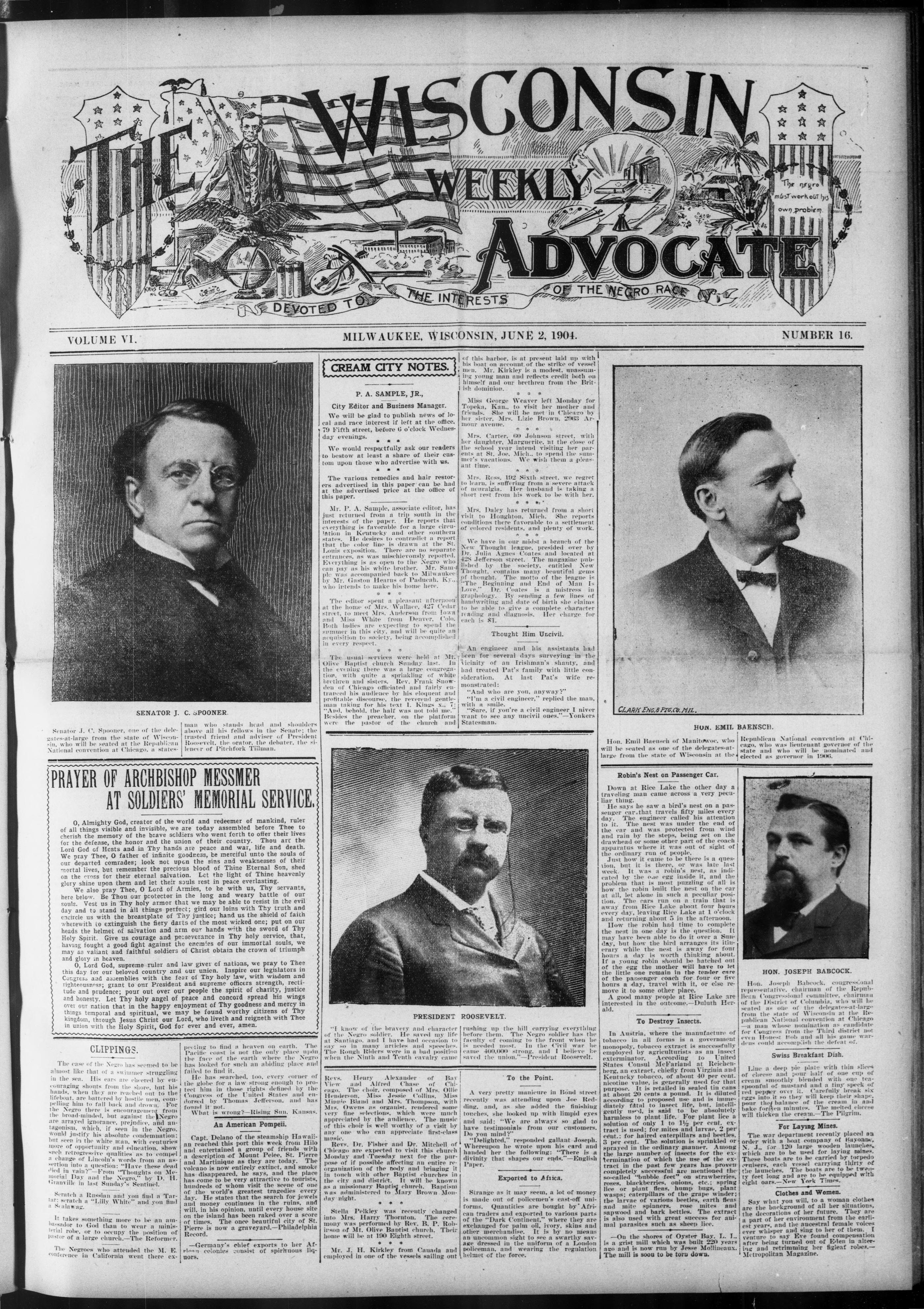
Page text (machine-generated)
WISCONSIN
WEEKLY
Advocate
DEVOTED TO THE INTERESTS OF THE NEGRO RACE
1910
[Picture of a man with dark hair and glasses, wearing a dark suit and a white shirt. The background is a light-colored striped pattern.]
SENATOR L. C. SPOONER
Senator J. C. Spooner, one of the delegates-at-large from the state of Wisconsin, who will be seated at the Republican National convention at Chicago, a states-
PRAYER OF ARCHBISHOP AT SOLDIERS
O, Almighty God, creator of the world of all things visible and invisible, we cherish the memory of the brave soldier for the defense, the honor and the uplift. Lord God of Hosts and in Thy hands we pray Thee, O father of infinite love our departed comrades; look not us mortal lives, but remember the precision on the cross for their eternal salvation glory shine upon them and let their hearts be also pray Thee, O Lord of All here below. Be Thou our protector in souls. Vest us in Thy holy armor the day and to stand in all things perfect encircle us with the breastplate of God wherewith to extinguish the fiery dares heads the helmet of salvation and a Holy Spirit. Give us courage and power having fought a good fight against the may as valiant and faithful soldiers and glory in heaven.
O, Lord God, supreme ruler and this day for our beloved country and Congress and assemblies with the faint righteousness; grant to our President the tide and prudence; pour out over our and honesty. Let Thy holy angel offer over our nation that in the happy end things temporal and spiritual, we make kingdom, through Jesus Christ our Lord in union with the Holy Spirit, God fathers.
ARCHBISHOP MESS
SOLDIERS' MEMOR
creator of the world and redeemer invisible, we are today assis-
tle the brave soldiers who went on
mor and the union of their oath
in Thy hands are peace and
order of infinite goodness, be me
look not upon the sins a
member the precious blood of Thy
eternal salvation. Let the be-
lief and let their souls rest in peace,
O Lord of Armies, to be
our protector in the long and
holy armor that we may be
all things perfect; gird our lo-
se plate of Thy justice; hark
with the fiery darts of the most
solvation and arm our hands
courage and perseverance in
night against the enemies of
worthful soldiers of Christ obtain
some ruler and law giver of no
nation and our union. It
sees with the fear of Thy holy
our President and supreme
our out over our people the s-
holy angel of peace and con-
sider the happy enjoyment of Thy
spiritual, we may be found w
as Christ our Lord, who liveth
Spirit, God for ever and ever
PRAYER OF ARCHBISHOP MESSMER AT SOLDIERS' MEMORIAL SERVICE.
O, Almighty God, creator of the world and redeemer of mankind, ruler of all things visible and invisible, we are today assembled before Thee to cherish the memory of the brave soldiers who went forth to offer their lives for the defense, the honor and the union of their country. Thou art the Lord God of Hosts and in Thy hands are peace and war, life and death. We pray Thee, O father of infinite goodness, be merciful unto the souls of our departed comrades; look not upon the sins and weaknesses of their mortal lives, but remember the precious blood of Thine Eternal Son, shed on the cross for their eternal salvation. Let the light of Thine heavenly glory shine upon them and let their souls rest in peace everlasting.
We also pray Thee, O Lord of Armies, to be with us, Thy servants, here below. Be Thou our protector in the long and weary battle of our souls. Vest us in Thy holy armor that we may be able to resist in the evil day and to stand in all things perfect; gird our loins with Thy truth and encircle us with the breastplate of Thy justice; hand us the shield of faith wherewith to extinguish the fiery darts of the most wicked one; put on our heads the helmet of salvation and arm our hands with the sword of Thy Holy Spirit. Give us courage and perseverance in Thy holy service, that, having fought a good fight against the enemies of our immortal souls, we may as valiant and faithful soldiers of Christ obtain the crown of triumph and glory in heaven
0, Lord God, supreme ruler and law giver of nations, we pray to Thee this day for our beloved country and our union. Inspire our legislators in Congress and assemblies with the fear of Thy holy law, with wisdom and righteousness; grant to our President and supreme officers strength, rectitude and prudence; pour out over our people the spirit of charity, justice and honesty. Let Thy holy angel of peace and concord spread his wings over our nation that in the happy enjoyment of Thy goodness and mercy in things temporal and spiritual, we may be found worthy citizens of Thy kingdom, through Jesus Christ our Lord, who liveth and reigneth with Thee in union with the Holy Spirit, God for ever and ever, amen.
The case of the Negro has seemed to be almost like that of a swimmer struggling in the sea. His ears are cheered by encouraging shouts from the shore, but his hands, when they are reached out to the lifeboat, are battered by hostile men, compelling him to fall back and drown. For the Negro there is encouragement from the broad-minded, but against the Negro are arrayed ignorance, prejudice, and antagonism, which, if seen in the Negro, would justify his absolute condemnation: but seen in the white man, with centuries more of opportunity and education, show such retrogressive qualities as to compel a change of Lincoln's words from an assertion into a question: "Have these dead died in vain?"—From "Thoughts on Memorial Day and the Negro," by D. H. Granville in last Sunday's Sentinel.
Scratch a Russian and you find a Tartar; scratch a "Lilly White" and you find a Scalawag.
It takes something more to be an ambassador to God than to wear a ministerial robe, or to occupy the position of pastor of a large church.—The Reformer.
The Negroes who attended the M. E. conference in California went there ex-
---
VOLUME VI.
CLIPPINGS
man who stands head and shoulders above all his fellows in the Senate; the trusted friend and adviser of President Roosevelt, the orator, the debater, the silencer of Pitchfork Tillman.
NOOP MESSMER'S MEMORIAL SERVICE.
world and redeemer of mankind, ruler are today assembled before Thee to officers who went forth to offer their lives nation of their country. Thou art the are peace and war, life and death. Goodness, be merciful unto the souls of on the sins and weaknesses of their us blood of Thine Eternal Son, shed on. Let the light of Thine heavenly souls rest in peace everlasting. Armies, to be with us, Thy servants, to the long and weary battle of our that we may be able to resist in the evil act; gird our loins with Thy truth and Thy justice; hand us the shield of faith of the most wicked one; put on our own hands with the sword of Thyseverance in Thy holy service, that, the enemies of our immortal souls, we of Christ obtain the crown of triumph.
law giver of nations, we pray to Thee our union. Inspire our legislators in war of Thy holy law, with wisdom and supreme officers strength, recti-er people the spirit of charity, justice peace and concord spread his wings enjoyment of Thy goodness and mercy in may be found worthy citizens of Thy word, who liveth and reigneth with Thee ever and ever, amen.
pecting to find a heaven on earth. The Pacific coast is not the only place upon the face of the earth where the Negro has looked for such an abiding place and failed to find it.
He has searched, too, every corner of the globe for a law strong enough to protect him in those rights defined by the Congress of the United States and endorsed by Thomas Jefferson, and has found it not.
What is wrong?—Rising Sun, Kansas.
Capt. Delano of the steamship Hawaiian reached this port this week from Hilo and entertained a group of friends with a description of Mount Pelee, St. Pierre and Martinique as they are today. The volcano is now entirely extinct, and smoke has disappeared, he says, and the place has come to be very attractive to tourists, hundreds of whom visit the scene of one of the world's greatest tragedies every day. He states that the search for jewels and money continues in the ruins, and will, in his opinion, until every house site on the island has been raked over a score of times. The once beautiful city of St. Pierre is now a graveyard.—Philadelphia Record.
—Germany's chief exports to her African colonies consist of spiritualious liquors.
---
An American Pompeii
MILWAUKEE, WISCONSIN, JUNE 2, 1904.
CREAM CITY NOTES.
City Editor and Business Manager
We will be glad to publish news of local and race interest if left at the office, 79 Fifth street, before 6 o'clock Wednesday evenings.
We would respectfully ask our readers to bestow at least a share of their custom upon those who advertise with us.
The various remedies and hair restorers advertised in this paper can be had at the advertised price at the office of this paper.
Mr. P. A. Sample, associate editor, has just returned from a trip south in the interests of the paper. He reports that everything is favorable for a large circulation in Kentucky and other southern states. He desires to contradict a report that the color line is drawn at the St. Louis exposition. There are no separate entrances, as was mischievously reported. Everything is as open to the Negro who can pay as his white brother. Mr. Sample was accompanied back to Milwaukee by Mr. Gaston Hearns of Paducah, Ky., who intends to make his home here.
The editor spent a pleasant afternoon at the home of Mrs. Wallace, 427 Cedar street, to meet Mrs. Anderson from Iowa and Miss White from Denver, Colo. Both ladies are expecting to spend the summer in this city, and will be quite an acquisition to society, being accomplished in every respect.
* * *
The usual services were held at Mr. Olive Baptist church Sunday last. In the evening there was a large congregation, with quite a sprinkling of white brethren and sisters. Rev. Frank Snowden of Chicago officiated and fairly entranced his audience by his eloquent and profitable discourse, the reverend gentleman taking for his text I. Kings x., 7: "And, behold, the half was not told me." Besides the preacher, on the platform were the pastor of the church and
27
T. E.
PRESIDENT ROOSEVELT
"I know of the bravery and character of the Negro soldier. He saved my life at Santiago, and I have had occasion to say so in many articles and speeches. The Rough Riders were in a bad position when the Ninth and Tenth cavalry came
Revs. Henry Alexander of Bay View and Alfred Chase of Chicago. The choir, composed of Mrs. Ollie Henderson, Miss Jessie Collins, Miss Minnie Bland and Mrs. Thompson, with Mrs. Owens as organist, rendered some very fine selections, which were much appreciated by the audience. The music of this choir is well worthy of a visit by any one who can appreciate first-class music. Revs. Dr. Fisher and Dr. Mitchell of Chicago are expected to visit this church Monday and Tuesday next for the purpose of if possible affecting an entire reorganization of the body and bringing it in touch with other Baptist churches in the city and district. It will be known as a missionary Baptist church. Baptism was administered to Mary Brown Monday night.
Stella Pelkley was recently changed into Mrs. Harry Thornton. The ceremony was performed by Rev. B. P. Robinson of Mt. Olive Baptist church. Their home will be at 190 Eighth street.
Mr. J. H. Kirkley from Canada and employed in one of the vessels sailing out
P. A. SAMPLE, JR..
* * *
of this harbor, is at present laid up with his boat on account of the strike of vessel men. Mr. Kirkley is a modest, unassuming young man and reflects credit both on himself and our brethren from the British dominion.
* * *
Miss George Weaver left Monday for Topeka, Kan., to visit her mother and friends. She will be met in Chicago by her sister, Mrs. Lizie Brown, 2963 Armour avenue.
* * *
Mrs. Carter, 60 Johnson street, with her daughter, Marguerite, at the close of the school year intend visiting her parents at St. Joe, Mich., to spend the summer's vacations. We wish them a pleasant time.
Mrs. Ross, 192 Sixth street, we regret to learn, is suffering from a severe attack of neuralgia. Her husband is taking a short rest from his work to be with her.
* * * *
Mrs. Daley has returned from a short visit to Houghton, Mich. She reports conditions there favorable to a settlement of colored residents, and plenty of work.
We have in our midst a branch of the New Thought league, presided over by Dr. Julia Agnes Coates and located at 428 Jefferson street. The magazine published by the society, entitled New Thought, contains many beautiful gems of thought. The motto of the league is "The Beginning and End of Man Is Love." Dr. Coates is a mistress in graphology. By sending a few lines of handwriting and date of birth she claims to be able to give a complete character reading and diagnosis. Her charge for each is $1.
Thought Him Uncivil.
An engineer and his assistants had been for several days surveying in the vicinity of an Irishman's shanty, and had treated Pat's family with little consideration. At last Pat's wife remonstrated: "And who are you, anyway?"
And who are you, anyway? "I'm a civil engineer," replied the man, with a smile.
"Sure, if you're a civil engineer I niver want to see any uncivil ones."—Yonkers Statesman.
[Image of a man with a mustache and a suit].
rushing up the hill carrying everything before them. The Negro soldier has the faculty of coming to the front when he is needed most. In the Civil war he came 400,000 strong, and I believe he saved the union."—President Roosevelt.
A very pretty manicure in Bond street recently was attending upon Joe Redding, and, as she added the finishing touches, she looked up with limpid eyes and said: "We are always so glad to have testimonials from our customers. Do you mind?" "Delighted," responded gallant Joseph. Whereupon he wrote upon his card and handed her the following: "There is a divinity that shapes our ends."—English Paper.
Strange as it may seem, a lot of money is made out of policemen's cast-off uniforms. Quantities are bought by African traders and exported to various parts of the "Dark Continent," where they are exchanged for palm oil, ivory, skins and other merchandise. It is by no means an uncommon sight to see a swarthy savage dressed in the uniform of a London policeman, and wearing the regulation helmet of the force.
* * *
To the Point.
Exported to Africa
CLARK ENG.8 PTC.CO. MIL.
HON. EMIL BAENSCH. Hon. Emil Baensch of Manitowoc, who will be seated as one of the delegates-at large from the state of Wisconsin at the Republica cago, who state and elected as
Robin's Nest on Passenger Car.
Down at Rice Lake the other day a traveling man came across a very peculiar thing. He says he saw a bird's nest on a passenger car that travels fifty miles every day. The engineer called his attention to it. The nest was under the end of the car and was protected from wind and rain by the steps, being set on the drawhead or some other part of the coach apparatus where it was out of sight of the ordinary run of people.
Just how it came to be there is a question, but it is there, or was late last week. It was a robin's nest, as indicated by the one egg inside it, and the problem that is most puzzling of all is how the robin built the nest on the car at all, let alone in such a peculiar position. The cars run on a train that is away from Rice Lake about four hours every day, leaving Rice Lake at 1 o'clock and returning about 5 in the afternoon.
How the robin had time to complete the nest in one day is the question. It may have been able to do it over a Sunday, but how the bird arranges its itinerary while the nest is away for four hours a day is worth thinking about. If a young robin should be hatched out of the egg the mother will have to let the little one remain in the tender care of the passenger coach for four or five hours a day, travel with it, or else remove it to some other place. A good many people at Rice Lake are interested in the outcome.—Duluth Herald
In Austria, where the manufacture of tobacco in all forms is a government monopoly, tobacco extract is successfully employed by agriculturists as an insect exterminator. According to United States Consul McFarland at Reichenberg, an extract, chiefly from Virginia and Kentucky tobacco, of about 40 per cent. nicotine value, is generally used for that purpose. It is retailed in sealed tin cans at about 20 cents a pound. It is diluted according to proposed use and is immediately fatal to insect life, but, intelligently used, is said to be absolutely harmless to plant life. For plant lice a solution of only 1 to $1\frac{1}{2}$ per cent. extract is used; for mites and larvae. 2 per cent.; for haired caterpillars and beetles, 3 per cent. The solution is sprinkled or sprayed in the ordinary manner. Among the large number of insects for the extermination of which the use of the extract in the past few years has proven completely successful are mentioned the so-called "bubble feet" on strawberries, roses, blackberries, onions, etc.; spring lice or plant fleas, hump bugs, plant wasps; caterpillars of the grape winder; the larvae of various beetles, earth fleas and mite spinners, rose mites and sapwood and bark bettles. The extract is also used with great success for animal parasites such as sheep lice.
-On the shores of Oyster Bay. L. I. is a grist mill which was built 220 years ago and is now run by Jesse Molineaux. The mill is soon to be torn down.
To Destroy Insects.
BAENSCH.
Republican National convention at Chicago, who was lieutenant governor of the state and who will be nominated and elected as governor in 1906.
J.
Hon. Joseph Babcock, congressional representative, chairman of the Republican Congressional committee, chairman of the District of Columbia, who will be seated as one of the delegates-at-large from the state of Wisconsin at the Republican National convention at Chicago—a man whose nomination as candidate for Congress from the Third district not even Honest Bob and all his game wardens could accomplish the defeat of.
Line a deep pie plate with thin slices of cheese and pour half of one cup of cream smoothly blended with one teaspoonful of mustard and a tiny speck of red pepper over it. Carefully break six eggs into it so they will keep their shape, pour the balance of the cream in and bake for ten minutes. The melted cheese will thicken the cream.—The Pilgrim.
The war department recently placed an order with a boat company of Bayonne, N. J., for 120 large wooden launches, which are to be used for laying mines. These boats are to be carried by torpedo cruisers, each vessel carrying thirty of the launches. The boats are to be twenty feet long and are to be equipped with eight oars.—New York Times.
Say what you will, to a woman clothes are the background of all her situations, the decorations of her future. They are a part of her environment from the earliest years, and the ancestral female voices ever whisper and sing to her of them. I venture to say Eve found compensation after being turned out of Eden in altering and retrimming her figleaf robes.—Metropolitan Magazine.
NUMBER 16.
HON JOSEPH BABCOCK.
Swiss Breakfast Dish.
For Laving Mines.
Clothes and Women.
Oh. Miss June time,
Comin' down de lane.
We's skyaht dat you was never
Comin' visitin' again.
But de bloomin' by de road side,
An' de shlinn' in de sky.
Done wrote us all a letter
Foh to say dat you was nigh.
Oh. Miss June time,
We ain't been treated right:
Miss Mahch an' May an' April
Dey was mighty impolite.
Dar's none dat has de manners
An' de quality like you.
We waits foh you, Miss June time,
An' we wish you'd hurry, too.
—Washington Star.
THE STAFF OF LIFE.
Of its inherent strength is kept alive
No creature. All this changeless law
obey—
Self-nourished life consumes itself away.
Faith is the food by which our ideas
Curious Condensations.
Japan furnishes one-twelfth of the raw silk consumed in the world—about 9,000,000 pounds. The war is not likely to affect the production, as all the work is done by women and girls.
A cat owned by Uriah Adams of Mr. Holly, N. J., recently killed a rat that had about its neck a diamond ring belonging to his daughter. Search for the lost ring had been abandoned.
There are about 200,000 craters in the moon; and Prof. Pickering holds that the numerous bright radiating lines are caused by snow, while those resembling canals are caused by vegetation.
In the New York building trades strikes last year 37,073 laborers suffered from enforced idleness, being deprived of employment for a total of 1,707,019 days, with a loss of wages of $6,754,751.14.
The discovery is said to have been made in England of a new spirit, "unlike either petrol or alcohol," and "not unpleasant" in odor, which is cheap and will take the place of petrol in running automobiles.
An eagle the other day attacked a peasant who was driving to Boulieu, near the Swiss border. The fight lasted ten minutes, and ended in the eagle being hit on the head with the butt of the man's whip.
A London laborer has collected many hundreds of Union Jacks of all shapes and sizes. Every table, bed and pillow in his house has its covering of bunting. The very shirt this man wears is a red, white and blue one.
The custom of tobaccoconsisting exhibiting effigies of Highlanders outside their shop doors originated in London, and, though it was at one time greatly in favor both in Scotland and England, the custom is now gradually dying out.
A grist mill on the shore of Oyster Bay, Long Island, which was built 220 years ago, and which is now run by Jesse Molineaux, is to be demolished. The building has not been changed since the Revolution.
A firm of printing press builders in New Jersey owns an old press built in Boston in 1742 by Thomas Draper. It was the first press ever used in New Hampshire and is said to be one of the oldest in existence.
Athens, Greece, is soon to be connected with Paris by railway. The Greekian government has already secured the building of a road to the Turkish frontier, which will soon be connected with the railway system of Europe.
An Amsterdam manager is building a floating theater, capable of seating 2300 persons and containing drinking bars and a restaurant. He intends to tow it up the Rhine and give performances of Italian opera at eighty-five river towns.
A lake has been discovered on Kildin island, Lapland, which contains fresh water on the top and salt water on the bottom. The lake rises and falls with the tide, and is evidently connected with the sea by an underground channel.
Australia has no orphan asylums. Every child who is not supported by parents becomes a ward of the state, and is paid a pension for support and placed in a private family where board and clothes are provided until the fourteenth birthday.
William Weller of Orange, Conn., found the other day among some old papers a sixty-dollar bill of continental currency. The bill entitled the bearer to 60 milled Spanish dollars, and bore the inscription, "God reigns; the earth rejoices."
Julius Jacobs has resigned his seat on the Liverpool city council, his father having stipulated in his will that none of his sons should become a candidate for municipal or parliamentary honors, as he has a contempt for English political parties.
—The campaign Panama hat worn by President Roosevelt in 1900 was taken by some western railroad officials to the hot springs of Wyoming, and left in one of them for several months. The hat, turned to stone, has just been received at Omaha, according to a dispatch from that city. In its petrified form it weighs about fifteen pounds.
—"Duke of Wellington," the old-time battleship which led the British Baltic fleet in the Russian war in 1854-6, is to be sold at auction. She is built of wood, has three decks and is 240 feet long. She has been used as a depot ship at Portsmouth for many years. In war times she carried 104 guns and had a crew of over 1000 men.
—French society has begun to rebel at the printed list of wedding presents. It is no longer good form, in certain sets, to run down the gamut, in public print, of the parental check down to the fish carver of the servants' hall. The custom has become very ostentations, and given rise to much vulgar speculation and mental arithmetic.
—Space is provided in the gold and silver mace presented the other day to the president of the corporation of Yale for the names of twenty more presidents, in addition to the thirteen now in this symbol of academic authority. This is a long look ahead, but it is to be hoped the space will in due time be filled, and another mace be needed for other names.
We have the finest hotels in the world and more of them than any other country. There are altogether 44,000 hotels in the United States, according to a New York manager, representing an invested capital of over $6,000,000,000. These establishments employ 3,500,000 persons. The hotel population is enormous, and steadily increasing. Some of the finest houses cost as much as $4,500,000.
A German who has been a student of chemistry at the. University of Giessen for sixty-six semesters without being able to pass the examinations, died there last month, aged 51 years. The cause of his inability to remember what he had learned was an injury of the membrane of the brain which he received in a duel. His name was Christian Busch; his death also caused comment because he had left his possessions, valued at $25,000, to the town of Giessen. But as he had neglected to sign the document, the money will go to distant relatives.
THE KELTIC KRAZE.
Have ye noticed yet, mavourneen, who's the most of the day?
There is aye A Voice [in brackets] speaks,
And a green-clad child slim—
There'll be poethry yet, ma colleen, in the diggin' o' the spuds;
Sure, now, an' there'll be poethry in the washin' of the duds;
The shillaly will be swung about
As the staunch old Keltle limb—
Arrah, now!
Bejabbers!
And the Kelt is in the swim.
—H. Lyon in The Critic.
THE DUEL IN THE DARK.
The duel was forced on Crosby French, in a manner of speaking, for, although none ever doubted his courage, he was a non-fighting man, and that was because his father had killed his own brother in a duel and was an unhappy man till the day he died. Many people were against dueling at this time. Men had found that they had better use for a friend than to kill him because of some punctilio or to be killed by him. So Crosby French was not single in his opinion.
The man with whom he fought, Claudius Gregg, was a fire-eater by profession, at least, for, although he swaggered a good deal, there was not a duel to his account in which his adversary had been able to shoot straight. He was a good shot himself, but many people said that he had forced his quarrels only on those who were likely to be killed by him and not to kill him. He had killed a good many gay and pleasant fellows on very little provocation. It had been whispered against him that he had not always shot fair. Anyhow, in these latter days decent people avoided him. There were other things against him as well as the dueling which made him unfit for decent company. Yet he had the presumption to lift his eyes to Mary L'Estrange, and the wickedness to win her consent to marry him by a trick and a slander against the dead.
Any man of sense could have sifted the story and found it false; but Harvey L'Estrange's widow was a gentle, easily terrified woman. Claudius Gregg's promises to bestow much money on her if she forwarded his marriage with her daughter were received with scornful amazement. It was another matter when he produced the document which made Harvey L'Estrange, in his grave, a liar, a cheat and a deceiver of women.
So, in terror of his publishing the story to the world, the widow urged the marriage on the girl in her teens, guileless as a lamb, lovely as an angel, gentle, and innocently gay, and charming in her whole disposition. And the girl consented, to save her dead father's honor and her mother's heart from breaking.
But, indeed, she looked like an Andromeda when Crosby French first beheld her. And when his eyes met her eyes it seemed to him that the soul behind them cried out dumbly to him for deliverance.
He was a handsome youth in his powder and coat of peach blossom velvet, with eyes bright as the sword that hung by his side, and a gallant and high-hearted air.
There was nothing sophisticated in him, as there was in the town gallants, since he was newly come to town. And it must be confessed that, seeing Mary L'Estrange sitting opposite him, with her purple faced, elderly lover by her side, at the supper table on the occasion of a rotunda ball, he stared more than good manners warranted.
The first passion that possessed him was not so much love as pity, or, perhaps, it was Love that wore Pity's face. Anyhow, at the sight of her, in her gown of white and silver, as piteous as a bird in the snow, he stared, feeling all the time as though his heart were being drawn out of him by her appealing eyes.
Nor was he aware at all of Claudius Gregg in his mulberry velvet suit, his cheeks darker than usual because of anger, his little eyes malignant, his upper lip drawn up over his yellow teeth.
Those who were aware of what was passing looked on at the scene as though it had been a stage play. There was a pause of a second or two while Crosby French, like a man in a dream, stared, and the girl turned as rosy as she had been pale under that steadfast regard.
Then Claudius Gregg stood up and flung the glass from which he was drinking, wine and all, in the young fellow's face.
There was a commotion, and in the midst of it Claudius Gregg and the lady disappeared.
A doctor was sent for to see to Crosby French's injuries, which seemed serious enough. The glass had smashed on his face, cutting and almost blinding him. For the time he was in agony and could think of nothing.
Some benevolent person fetched a coach and, after his eyes had been dressed and bandaged, he was driven to his lodgings. There was some one in the coach with him whom at first he took to be the doctor. When they had reached the lodgings this person assisted him to alight, with great kindness, and led him up the stairs to his room. Then, having pushed him into an easy chair, his companion proceeded to stir the fire noisily and to find the wine and glasses.
"You don't know me," he said, "but some one told me who you were. I am Tom D'Arcy of Grange, from your own county. I would not have you left without a friend to see you through the affair with Claudius Gregg."
"You are very kind," said the other. "But, for the matter of that, I shall not fight. I have reasons against it."
"You don't know the manner of man Claudius is," said Tom D'Arcy, "or you would esteem it a privilege to have a chance of putting an end to his career. I have insulted him many a time, but he will not be insulted by me. I have an old grudge against him. He killed a friend of mine in a duel, one who would not hurt a fly, who was loved by men and women. Besides, there is Harvey L'Estrange's daughter, who is going to marry him, and looks like a lamb when it sees the butcher's knife. He has cheated her out of her promise, somehow, although I do not know how. The man who would put a bullet through Claudius would save that lady."
He looked keenly at the young face with its bandaged eyes, and saw the sudden color surge in the cheeks.
"I would do much to save the lady," said Crosby French; "but as for fighting, why, I promised my father I never would fight."
"Then I shall fight in your place," said Tom D'Arcy.
"And if he kills you, your blood will he on my head."
oe on my head
I will kill me, or I shall kill him.
If I kill him, the lady will be free."
If I kill him, the lady will be free." "It would be impossible that I should let you fight in my place," said Crosby French, leaning forward with his hands on his knees. "Then you will fight?" Tom D'Arcy's eyes were eager. "I swear that if you do not I will. It is time the world were
quit of him. I think the man who would deliver Harvey L'Estrange's daughter from him might ask anything he would of her."
The blood pulsed in the cheeks below the bandages, and Crosby French said something under his breath of his promise to his father.
The next morning, while the two were at breakfast, for Tom D'Arcy had put up at his new friend's lodgings, there came a messenger from Claudius Gregg, an elderly, dishonored buck like himself, to say that Mr. Gregg claimed immediate satisfaction for the public affront that had been put upon him.
that had it is the old story of the wolf and the lamb," said Crosby French, smiling. "Would he have me stand up to him blind?" "My principal is ready to convenience the gentleman in every way," returned the other. "But, seeing that his wounded honor cries out for assuagement, he is impatient of waiting for what must be a slow recovery. Therefore he proposes a duel in the dark."
poses a duer in the dark.
In the pause that followed Tom D'Arcy gasped audibly.
"A duel in the dark," went on the other, staring at him with a greater deliberation. "Since the gentleman has forced the challenge on my principal, he is ready to meet him, with pistols, the place to be wherever you wish, the duel to be conducted across a table in the dark."
"Why, he grows bloodier than ever!" said Tom D'Arcy, with nonchalance.
"He takes the chances as well as the gentleman."
"I name the Ook room at the clubhouse," said Tom D'Arcy. "It is so great that we need not fear to spoil the excellent carved paneling, and it is so retired that we need not fear to be disturbed. The watch has lately shown too great an interest in these affairs between gentlemen."
"The time?"
"Why, one time is as good as another, since the duel is to be fought in the dark. Supposing we say tonight at the stroke of 12?"
"My principle will be agreeable."
The messenger bowed himself out, and Tom D'Arcy returned to his breakfast as though nothing had happened.
"He means to kill you for certain," he said. "As for the reason of this animosity, I am inclined to believe that he saw something in the eyes of Harvey L'Estrange's daughter which drove him mad with jealousy. If late he has not been so anxious for a meeting as he once was. They say his hand grows unsteady. To be sure, you could swim the packetboat in the wine he has drunk. He means to kill you. The only question is if he will fight fair. I do not know what he means the dark to cover, but in fair fight you should have the advantage. He is gross—wide as a haystack, and he breathes like a porpoise. You are not provided with pistols, I take it?" "I never thought to have use for them unless it might be to protect myself against Freney, the highwayman." "Mine are not a man of service."
"I thank you, sir. And now, since we are to be friends—indeed, I am grateful for the kindness that will not let me stand alone—I may tell you that, unless Mr. Gregg kills me, I mean to marry the lady."
"You do?"
"I certainly mean it. And a condition of my fighting is that if I fall you are to save her from Claudius Gregg."
Tom D'Arcy stared; then suddenly he wrung the other's hand.
"I accept," he said. "I have no desire for a wife, although Grange cries out for a mistress and my old father for a grandson. If you fall, I will marry Mary L'Estrange, although I have to kill Claudius Gregg to do it. If you survive, I will do all in my power to help you to win the lady."
Again their hands met and held together for an instant.
It was a dull day of November, and the hours went very slowly for Tom D'Arcy. There was not much pleasure in displaying the pistols to a man who had no eyes to see them, and handled them as though he had no love for them. While the shades grew longer on the dreary walls of the lodging, he thought often of the lit clubhouse, the stories that were being told, the wit that was flashing like a rapier, the latest report from the houses of Parliament over the way, where the orators met in a battle of words more furious than cold iron. But he bore the deprivation for friendship's sake. He even pushed away the wine from him, for he had a feeling that there might be treachery in this duel in the dark, and he must be prepared for it and ready to frustrate it.
At a quarter before midnight the coach was at the door, with the physician whom Tom D'Arcy had bidden to be in attendance. It was a November night, and as they drove through the streets they were in danger twenty times of being overturned, for the dim oil lamps gave them little light by which to see the open sewers or the places where the pavement had sunken in great holes. They passed through the lit hall of the clubhouse unobserved. There was a great ball that night at the Rotunda, and those gentlemen who were not there were at the gaming tables. In the oak room they found Claudius Gregg and his friend awaiting them. Having divested themselves of their cloaks, the seconds spun a coin for the right to first fire. It fell to Claudius Gregg.
The two men were then set facing each other, with a long table between, and the pistols in their hands.
"He has the first shot," whispered Tom D'Arcy in French's ear, "and, my poor fellow, I'm afraid you're done for. The utmost we can hope for is that the bullet may not find a vital spot. If he does not kill you aim straight and aim low, and you will kill him. Indeed, you can scarcely miss him, he is such a monster of a man. If you should miss him he will surely kill you with the second shot. But in that case I will carry off the lady and, maybe, kill him in your place."
Some one went round and extinguished the candles. As the last one went out, the darkness in the room was so great that it could be felt. Even the windows did not reveal themselves as of a lighter darkness to eyes lately used to the candles. For a second there was a pause, in which there was not a sound except the apoplectic breathing of Claudius Gregg.
"If he does not bring my man down at the first shot," said Tom D'Arcy to himself, with sudden hopefulness, "he will never fire another. Even a tyro could not miss that mountain of snorts. He is plainer than by daylight."
The word of command was given and Claudius Gregg fired. The slightest sound from the other end of the table followed the shot, but there was no sound of a body falling.
Then Crosby French fired. There was a groan, and a sound of something beating itself against the floor. Tom D'Arcy opened the door and a waiter entered with candles. Crosby French was staring in stupefaction at the smoking pistol in his hand, and very pale because Claudius Gregg's shot had hit him in the right shoulder.
"I fired below the table," said he.
"Ah, and our friend Mr. Gregg, was under the table," said Tom D'Arcy calmly. "That was what he meant by the duel in the dark. Let us be going. His friend and the doctor will see to him. I take it that, even if he can ever fire another shot, Claudius Gregg's honor is satisfied."
The other second was pouring out as
surances, with a redder face than usual, that he was not privy to his principal's design, while the waiter and the physician were somewhere under the table trying to ascertain the nature of Claudius Gregg's injuries. Nor, until the physician had declared that, after all, it was but a flesh wound, did the color come back to Crosby French's face. Then he consented at last to return to his lodgings with Tom D'Arcy.
A few days later, while Tom D'Arcy was still on the horns of a dilemma regarding Claudius Gregg—for if he were to recover how was the lady to be saved from him, and, on the other hand, how could any man of honor meet him after the trick he had played Crosby French?—the strange and unexpected happened.
For, with Claudius Gregg's much blood letting the bully and braggart had gone out of him, and the timid man, which, perhaps, was always there, had come to the front. He would not believe the physicians but that he was dying, and, in the belief, he sent for Harvey L'Estrange's widow and made a confession to her of the falsity of the menace with which he had terrified her daughter into consenting to marry him, and herself into espousing his cause. And the confession he put into a document and signed it before witnesses. He also sent for Crosby French and asked his forgiveness for the treachery he had intended toward him. In fact, such a conversion was never seen, for, believing himself in imminent danger of death, he set about righting as much of the wrong he had committed during his life as was now possible—all in a tremendous hurry, afraid Death would catch him up. But when at last there was nothing more to be done the wound began to heal; the blood letting, said the doctors, had been of the greatest possible service to him, and had probably given him many years of life.
However, long before he was about again, and actually become a Methodist since he had heard Mr. Wesley preach, Crosby French had married Mary L'Estrange. No one could have recognized in the radiant bride the shrinking and terrified girl whom Crosby French, nevertheless, had loved at first sight. And she him, for, as she said afterward, when she first laid her eyes upon him she had a revelation that this youth was to be her deliverer.
Indeed, there was not a handsomen couple in all Ireland than these two made on their wedding day; she in her gown of white poplin sprinkled with silver shamrocks, and her veil of lace caught in with diamond trefoils; he in his watered silk suit, also of white and silver, with red heels to his shoes, wearing his hair unpowdered in the new fashion. The viceroy himself came to their weddings; but all that you shall read in the memoirs of the day.
Crosby French never fought another duel, although that ended so well. And the oddest thing of all was that when, some years later, Claudius Gregg died in the odor of sanctity, he left all the fortune he still possessed, after making restitutions and giving much to the poor and to build a Wesleyan chapel, to Crosby French, because he had been, under heaven, the instrument of his conversion.—Sketch.
The Cost of a Good Road.
The cost of road building varies in the different places according to the topography of the country and the proximity of the stone used. A satisfactory highway can be built 18 feet wide exclusively of stone usually for $3000 to $3500 a mile. These are known as macadam roads. A more costly stone road running from $4000 to $6000 a mile is the Telford road. Both are named after Scotchmen, who first devised the systems. The macadam road consists of a deep foundation of large stones, laid as smoothly together as possible, the foundation stones being of a nearly uniform size. A layer of smaller stones is placed over the foundation and rolled down, binding the two together. Then layers of crushed stone, each layer being of finer quality than its predecessor, are rolled into and over the foundations. The final layer is of very fine crushed stone. The whole settles itself into a compact mass, almost as smooth as a flagstone, from which water runs off as soon as it falls. The Telford road is more expensive because its foundation is laid with more care. The foundation stones are of a uniform size and are laid with the ends uppermost, like so many bricks set upon edge. These are bound together by smaller sizes of stone, the various dressings of finer stone being laid and rolled in the same way as for the macadam roads. The durability of such a highway is unquestionably longer than any other kind of a road known.—Franklin Matthews in Outing.
Rivals.
"What a stunning girl Miss Brinmore
"What a stunning girl Miss Brinmore is!" "Yes, indeed. She shocks everybody she comes in contact with."
Japanese Novelettes.
The literature of Japan has excited some jealousy in Paris. Nowhere, says a sprightly critic, is fiction so much written and read as in the land of the Mikado. Japanese romances are enormously long and dull. One of them, entitled "The Story of Eight Dogs," runs to 116 volumes, and at the end of it all the characters, numbering fifty, without counting the dogs, are dead, and the reader's condition is not much better. Happily, adds the critic, this tale has not yet been translated into Russian. Evidently he is a fenilletonist, who wishes he could keep a story going as long and heap up as many corpses. But, in justice to Japan, it should be said that the romance in question is in 106 volumes only, and that the dogs are Japanese gentlemen, whose canine character is allegorical.—London Chronicle.
Wages Low in Russia.
In no other country of Europe are wages so low as in Russia. American workmen can earn twice and even three times as much. The average monthly wages pair in the departments of Moscow and Vladimir are as follows:
Men.....$8 to $8.50 a week
Women.....$6 a week
Youths between 15 and 17.....$3.50 a week
Girls between 15 and 17.....$3 a week
Children of both sexes.....$2.50 a week
—World's Work.
The Little Puritan.
I am a very pretty girl—
My eyes are big and blue,
I walk as if I am afraid
That I will break in two.
I keep my eyes upon the ground,
My voice is sweet and low.
And when I clear my throat I act
As if it hurts me so.
Once I walked on a railroad bridge
And made believe that I
Was scared to be above the creek
So very, very high.
I took the cutest little steps,
I shuddered at the stream.
And charmed my bean by gasping out
A charming little scream.
Whene'r I see a horrid cow.
I gasp and fight for breath
And cuddle up to Charley and
It tickles him to death.
The thought of how I need his strength
Brings to his face a smile.
And so I'll jolly him along
And land him after a while.
—Indianapolis, Sun.
FORTUNES SPENT IN FRUIT.
Astonishing Figures Showing What the Desserts of the Wealthy Cost.
In some of the very expensive London restaurants you can order a special dessert that will cost you anything from £5 to £50. These desserts will consist of dainties in the way of fruit, for which it is not, too much to say that the greater part of the world has been ransacked to provide. Peculiar apples from Zanzibar, looking rather like turnips; pears, in appearance strongly resembling oranges, from Northern Africa; grapes from English hothouses; and Australia will most likely be represented by the Eiffel Tower pineapple.
Of all fruits, Zanzibar apples are, perhaps, the rarest. Dozens of trees together will only bear a few of these apples, and the time for picking them has to be carefully selected; they must be gathered just a month before they would ripen, otherwise they will very quickly go bad. These apples have been sold in this country at £20 apiece, and, of course, have to be specially ordered, for no fruiterer would ever dream of keeping them in stock.
Custard apples are another expensive luxury. They can be purchased at prices ranging from 3 shillings to £5 each, according to quality, and, according to those whose judgment in such matters is considered to be absolutely correct, must be eaten with pepper and salt.
Two of the most fashionable fruits in the winter months are the muscat grapes and strawberries, and until the end of January the latter are beyond the reach of men of moderate means. A gentleman not long since went into a well-known fruiterer's in Regent street and offered £50 to the manager if he could provide enough strawberries for five people that evening. The manager undertook to deliver the fruit within seven hours, and then promptly proceeded to wire forty different fruit gardens within thirty miles of London for strawberries.
Seventeen gardens provided the required amount of strawberries (the remaining twenty-three not being able to produce a single one), and by 6:30 that evening the fruit was delivered at a cost of nearly 10s 6d for each strawberry. There are several persons in London whose weekly bill for grapes at this season runs to never less than £20. They pay 20s per pound for the best muscat grapes, and receive at least three pounds per day. At a dinner party given some time ago at Marlborough house the bill for grapes amounted to £45, while the cost of each apple at the royal table was exactly 5s. It is, however, by no means the most distinguished or wealthy people who spend fortunes in fruit. There is, for instance, a retired bootmaker living near Brixton, who was informed by a friend that pears from Algiers have a distinctly pleasant flavor.
Relieved from worries of misfits and other cares incidental to his calling, the retired bootmaker had time to pay attention to such delicate matters, and promptly proceeded to order from his fruiterer's some of these pears, which he found would cost him 10s each. His weekly bill for these delicacies now amounts to £5, while muscat grapes and pineapples at £1 apiece bring his fruit bill in the week up to at least £10—just £500 a year in fruit alone. Curiously enough, except in the matter of fruit, he lives in a very moderate, though comfortable style.
The manager of a well-known fruiterer's establishment in the West End informed the writer that lots of people who see high-priced fruit in the window will buy it just to see "what it tastes like," and in this way these "samplers," as they are called by the trade, are a considerable source of profit to many of the high-class fruiterers. These samplers will cheerfully spend 5s on an apple or a pear to enjoy the experience of eating such a luxury.—Pearson's Weekly.
Santa Fe the Source of Knowledge.
A chaplain assigned to a remote army post in New Mexico organized a Sunday school for the children of the soldiers. Until the catechisms came he had to ask his own questions. He decided to begin with the Lord's prayer.
"How many," he inquired the first morning, "know the Lord's prayer?"
A prolonged silence. Then one little girl timidly raised her hand.
"Only one who knows it!" exclaimed the chaplain, in genuine surprise; "you may repeat it, Anna."
Anna repeated it quietly and correctly. "That was very nicely done. Where did you learn it?" "In Santa Fe." "Very good. Now, Margaret." to the next little girl, "can't you say the Lord's prayer?"
"No Mr. Gardiner."
"No, Mr. Gardiner. "Twelve years old, and don't know the Lord's prayer!" "Oh, but, Mr. Gardiner," said the child, eager to set herself right, "I have never been in Santa Fe."—Philadelphia Public Ledger.
The Fringe on Mosquitoes.
Mosquitoes belong to the fly family, but differ from common flies in many respects. One of the most interesting differences is the fringe of hairlike scales on the edge of the wing and on the wing veins. These scales are exceedingly transparent and dainty in appearance, and the accomplished microscopist looks at them with great interest, because, once upon a time the English speaking microscopists of the whole world were fighting a wordy war about the true structure of these feathery objects. Microscope lenses of those days were poor in comparison with the lenses of the present, and few observers agreed in the interpretation of what they saw. We know about these scales now, but they will always be attractive, because thirty or forty years ago they stirred up quite a scientific contest.—St. Nicholas.
Sunday Sports and Morality
Some time back we asked the owner of our grounds if we might play lawn tennis on Sundays. He said, "No, because people in the neighborhood would object." Yet he plays golf nearly every Sunday, and most of the "people in the neighborhood" amuse themselves, too. They are simply afraid of one another. They don't really mind playing games on Sunday, but they won't admit it openly. English people are such humbabs that they even humbug themselves—Golfing
AMERICAN MILITARY MAPS.
Collection Made About 1776 Presented to a Canadian Historical Society.
An important contribution to the Ontario Historical society has just been received by David Boyle. It is an octavo edition of "The American Military Pocket Atlas." On the title page it is described as "a private collection of correct maps, both general and particular, of the British colonies, especially those which are or probably may be the theater of war, taken principally from actual surveys and judicious observations of Engineers D. E. Brahms and Romans, Cook, Jackson and Collett, Maj. Holland and other officers employed in his majesty's fleets and armies." It was printed in London for R. Sayer and J. Bennet.
There is no date on the title page, but 1776 appears at the end of the dedication to Gov. Pownal, referring to the great assistance given by him in preparing the maps. The atlas is extremely interesting as showing just how much of the country was known at that time. The location of the Indian tribes is indicated. The atlas was handed to the curator by a gentleman who stated that it had been in the possession of his family for years. He thought it of so much value that it should be preserved in the provincial collection, and in this, of course Mr. Boyle agreed with him, for the probability is that it is the only copy in existence.—Toronto (Ontario) Globe.
BRITISH DRINKING
Scotch Take the Most Spirits and the English the Most Beer.
A contradiction of the assertion that drunkenness is on the increase in Great Britain has been entered by Rev. Rawson Burns, D. D., in a contribution to the London Times, says United States Consul Mahin, at Nottingham, England, in a recent report. A table submitted by Dr. Burns shows a decrease in the production of intoxicating liquors of about $25,000,000 in 1903, as compared with 1902. He suggests no reason for this decline, but adds that as business in nearly all lines was very dull during the year, as the number of people out of work was greater than in 1902, and as the drink habit is most prevalent among wage earners, it is not unfair to surmise that the decreased consumption of liquors may have been involuntary.
Dr. Burns says that an analysis of the returns for the United Kingdom show that Ireland consumes per head slightly more spirits than England, and Scotland nearly twice as much. Of beer England consumes 75 per cent. more per capita than Ireland, and over 300 per cent. more than Scotland.
A Happy Mother.
Maple Hill, Ia., May 30.—A very remarkable case occurred here recently. The people here have never seen anything like it and it may interest many others.
From his infancy, Verne, the little five-year-old son of Mr. and Mrs. J. Barfoot, of this place, has been sickly. His mother consulted a doctor, but he did not begin to improve till some one suggested that she try a remedy called Dodd's Kidney Pills. From unmistakable symptoms she had always believed that his kidneys were the first cause of all the trouble, so she bought a box of Dodd's Kidney Pills and began giving little Verne two pills a day.
In two or three days she noticed an improvement and she kept on till he had used about two boxes, when, to her great joy, he was all right. Everybody remarks how much better Verne looks and Mrs. Barfoot always explains "Dodd's Kidney Pills saved his life."
How One Cent Paid Seven
In one of the down town telegraph offices three messenger boys were in debt as follows: Messenger 45 owed Messenger 98 three cents; 98 owed two cents to Messenger 74, who owed a like amount to 45.
One day 45, receiving a very generous tip, decided to pay some of his debts, so he gave 98 one cent on account.
Now, 98, animated by such a laudable example, thought he, too, would diminish his outstanding indebtedness. He therefore paid 74 one cent, leaving a balance against him of one cent; 74, not needing the money, paid 45 one cent, leaving a balance of one cent. Then 45, having his penny back again, paid another third of his debt to 98, who immediately paid 74 in full; 74 then squared his account with 45.
Now, 45, having the cent back, paid off his debt to 98. Thus one small cent naid up a total debt of seven cents. Who lost by the transaction?—Philadelphia Press.
Time to Act.
When the back aches and you are a l way s tired out, d e pressed and nervous — when sleep is disturbed by pain and by urinary ills, it's time to act. The kidneys are sick. Doan's Kidney Pills cure
sick kidneys quickly and permanently. Here's proof: Mrs. W. S. Marshall, R. F. D. No. 1, Dawson, Ga., says: "My husband's back and hips were so stiff and sore that he could not get up from a chair without help. I got him a box of Doan's Kidney Pills. He felt relief in three days. One box cured him." A FREE TRIAL of this great kidney medicine which cured Mr. Marshall will be mailed on application to any part of the United States. Address Foster-Milburn Co., Buffalo, N. Y. Sold by all dealers; price 50 cents per box.
Sugar Does Not Injure the Teeth
There is a prevalent notion that if children are allowed to eat sugar they will have bad teeth as a consequence. There is no foundation whatever for such a notion. The negroes of the West Indies are excessive consumers of sweets. They eat an enormous amount of sugarcane, molasses and raw sugar. Yet these people have particularly fine teeth. Whatever other injuries sugar may be capable of doing to the human system, it is very certain that it does not do any injury to the teeth, either in old or young persons. Medical Talks.
CASTORIA
For Infants and Children.
The Kind You Have Always Bought
Bears the
Signature of
Charles H. Fletcher.
GOSSIP FOR THE LADIES.
An Unlucky Day. Things go wrong from morn till night.
No use trying to do things right.
Your feet grow heavy and head will ache.
Your back feels as though it would surely break:
You tear your gown and stop to pln it.
And wish you were dead that very minute.
The cake turns out a ennunk of lead.
Likewise doughnuts, ditto bread;
Callier comes to the big front door.
You drop a pie on the kitchen floor;
Soup turms out a hopeless mess.
Burns your fingers and spoils your dress.
Jack comes in and looks pretty sour.
"Waited for dinner nearly an hour.
You cry and fret and spoil your beauty—
The minister comes for his call of duty—
You're a fright and your hair a horrid muss—
He wants to pray, and you want to—too.
—Margerie Beardsley.
When she is animated and bright. A tear may move pity, but it is a smile that commands admiration. When she is not superlatively and incessantly brilliant. The perpetual flashing of diamonds tires the eyes and the brain. She must have her sober moments, if only to throw into higher relief the moments when she is gay. When she is tender and sympathetic. She may dazzle when she is merry, but when she is gentle and full of sympathy she enchants a man's heart. When her voice takes a softened tone, and her eyes look words that her lips hesitate to say—then, if she only knew her power, it would be bad time for the world at large!
When she is good-natured. Bad temper never charmed. Sarcasm may amuse when it is directed against one else, but it does not win any one's heart. Good temper is an attraction even in a plain woman. When she is most unconscious of it The very unconsciousness is the best part of the charm.
Discontented young working women often indulge in bitter resentment toward the people of wealth and leisure. I wish these young toilers might study the faces and hear the conversation of hundreds of women in fashionable homes and at fashionable resorts. Restlessness, ennui, dissatisfaction and ingratitude distort many a lovely face, and render beautiful costumes but a mockery. I do not mean to say that this is true of all women of wealth. What I mean to say is just this: As many people in the humble walks of life, toiling for their daily bread, find enjoyment, as in the ranks of wealth and fashion. It is a matter of character and disposition, not of money. One who travels to any extent is sure to arrive at this conclusion
There is, indeed, greater dissatisfaction to be read in the faces of women in a hotel dining room at a seashore or mountain resort than in the faces of women who emerge from shops and factories at 6 o'clock in any of our large cities.
Yet the majority of these toilers regard the woman who can travel and wear fine garments as favored by the gods.
No woman is favored by the gods unless she has cultivated cheerfulness, appreciation, kindness and good will and sets forth each day determined to be happy and to make happiness for others.
Many a working girl could teach her wealthier sister how to enjoy life.
In no home of poverty did I ever see unhappiness so marked on the faces of an entire family as on one I saw at a hotel not many moons ago.
The mother's eyes were full of jealousy and ill-temper; the father's face was defiant and bitter with disappointment; the son was a dissipated wreck of manhood, the daughter a restless, irritable, fault-finding child of misfortune.
Yet there were millions of dollars spent yearly for the "enjoyment" of this family.
There was no love, no harmony, no good will, no gratitude to God or man in the hearts of these people.
Better a crust of bread and a cup of milk after a day of hard labor, and love in the household and hope in the heart, than such splendid misery.
The poverty of the heart is the worst poverty on earth. Remember that as you toil and pray for wealth.
If you can keep your heart rich with love, sympathy and kindness, hope and faith, then whatever you acquire of worldly wealth will increase your opportunities of enjoyment.
But wealth alone can never give you enjoyment of happiness, and no poverty of the purse can make you poor while you have these qualities.
A good disposition is the only thing worth coveting and that can be acquired.
Ella Wheeler Wilcox in Philadelphia Evening Bulletin.
As women advance in the scale of progress, will they leave the love of dress behind? Fifty-odd years ago, when the first women's rights conventions met in New England, this did not seem a debatable question. Short hair and bloomers characterized the feminine champions of the cause. Dress was proclaimed as one of the vanities from which the sex was to be emancipated.
WHERE E
WHERE BLOODY BATTLE WAS FOUGHT.
AN-TING ON THE YALU RIVER
AN-TUNG ON THE YALU RIVER.
The above picture represents an inta and Japanese armies fought a bloody ba
The above picture represents an interesting spot on the Yalu river in close proximity to which the opposing Russian and Japanese armies fought a bloody battle.
An Unlucky Day.
A Woman Charms—
Riches and Contentment.
The Future of Dress.
But fifty years have passed; and now Miss Susan B. Anthony, in her gracious and serene old age, wears point lace, like any other woman fortunate enough to possess it. The leaders of a suffrage convention and those of a whist club could be shaken up together nowadays, and no one would know which was which, as far as their clothes were concerned. The advanced woman no longer cuts her hair short, and the speaker at a woman's club is often the most daintily omnipotent woman in the room.
Yet though the question seems doubtful in the face of these facts, there are others no less striking. Women's dress is tenfold more comfortable than is used to be. The shirtwaist and the short skirt have apparently come to stay; and man has never invented anything as comfortable for himself, in the whole history of costume. Tight lacing has practically disappeared, and common-sense shoes are as popular as French heels used to be. All this may be only a cycle in the ages of fashion; but it looks as if certain ideals were liable to abide. The love of dress may never be left behind, no matter how far the woman of the future progress. But the Eternal Feminine, so to speak, once loved dress not wisely, but too well. Today she loves it well, but with a developing wisdom that will make her master, and not servant of its changes and caprices.
Rational dress always followes existing conditions. Bloomers were abstract. Nobody needed them; they were as useless as sixteen flounces, without even the charm of vanity to recommend them. The bicycle revived bloomers, and women then accepted them, to some extent, for the first time. But the short skirt proved itself better, and they faded into oblivion when the cycle craze passed. Business and professional conditions today have created the comfortable and stylish suit of the business woman. There is no longer any point in the story of the small girl who said to her mother, "Oh, mother, look at that woman! Is she very, very poor, to wear such shabby clothes?" and received the answer, "She is either very rich, dear, or very poor, or very literary."
The dress of the future will follow the conditions of the future woman. It is prettier and daintier today than it ever was, and as long as women continue pretty and dainty there is little fear that the graces of costume will vanish. It would be a grayer world if they did. Dress reform always has a field. But when it is a reform against nature, no one need worry lest it should succeed. Dress is safe in the hands of the women of today, and ought to be safer still in the hands of the women of tomorrow. The alarmist has small cause for fear on that score.—Harper's Bazaar.
Truth the Best Policy.
And now, my daughter, you must not get angry at the next thing I have to say to you. Never tell your husband the least, smallest, suspicion of a falsehood. I know that you are honest and incapable of a lie, but your marriage will so complicate your relations with people and things that some fine day you are likely to find yourself facing this dilemma: either to tell an untruth or to cause pain to the man that you love. Most women in this alternative, I should say about 80 per cent. of them, would choose the lie as the best way out. And they will often tell it in the most unimportant crises, to escape being criticised, or being compelled to justify their actions, or even to avoid any long and tiresome explanations. Alexander cut the Gordian knot with a blow of his word, and this solution of a problem has been famous in history ever since. Women every day cut the knots which form between their hands in the tangled threads of life by means of that little sword which they always carry with them and which is called the lie.
Never tell an untruth to your husband! Whatever may be the dilemma which confronts you, whatever may be the knot that forms itself in your hand, never cut it by means of a lie. You will thus preserve your own self-respect, and your husband will place you upon an altar-like pedestal. A man may be proud of having a young and beautiful wife, of hearing her praised by all for her culture and wit, but nothing will flatter him more than to be able to say: "My wife does not know how to say what isn't so." In this hypocritical age in which we live, where lying envelops us from head to foot and leaves its slimy trail everywhere like a snail, to know one spot where falsehood has not penetrated and whither it is possible to flee as to a sacred refuge is such an uplifting and noble joy that it makes every function of life seem brighter. There should be for every man in this desert of deceit one oasis where the grass is always green, where the foliage conceals no vipers, where the rose bushes are without thorns, where the bees have no sting, where the skies are always cloudless; and that oasis should be the soul of his wife. Thither we should be able to flee, confident and serene, to hear a "yes" that always means "yes" and a "no" which is always "no."
If women only appreciated the value of truthfulness and sincerity they would unhesitatingly abandon even the whitest of white fibbing. Women lie often and lie well, but no art has been invented which will prevent them from making an occasional mistake. Now, one lie discovered will make you lose the fruits of a thousand more fortunate falsehoods. From the day of discovery all serenity will become useless, every affirmation will leave some doubt; after each "yes"
Méduoy
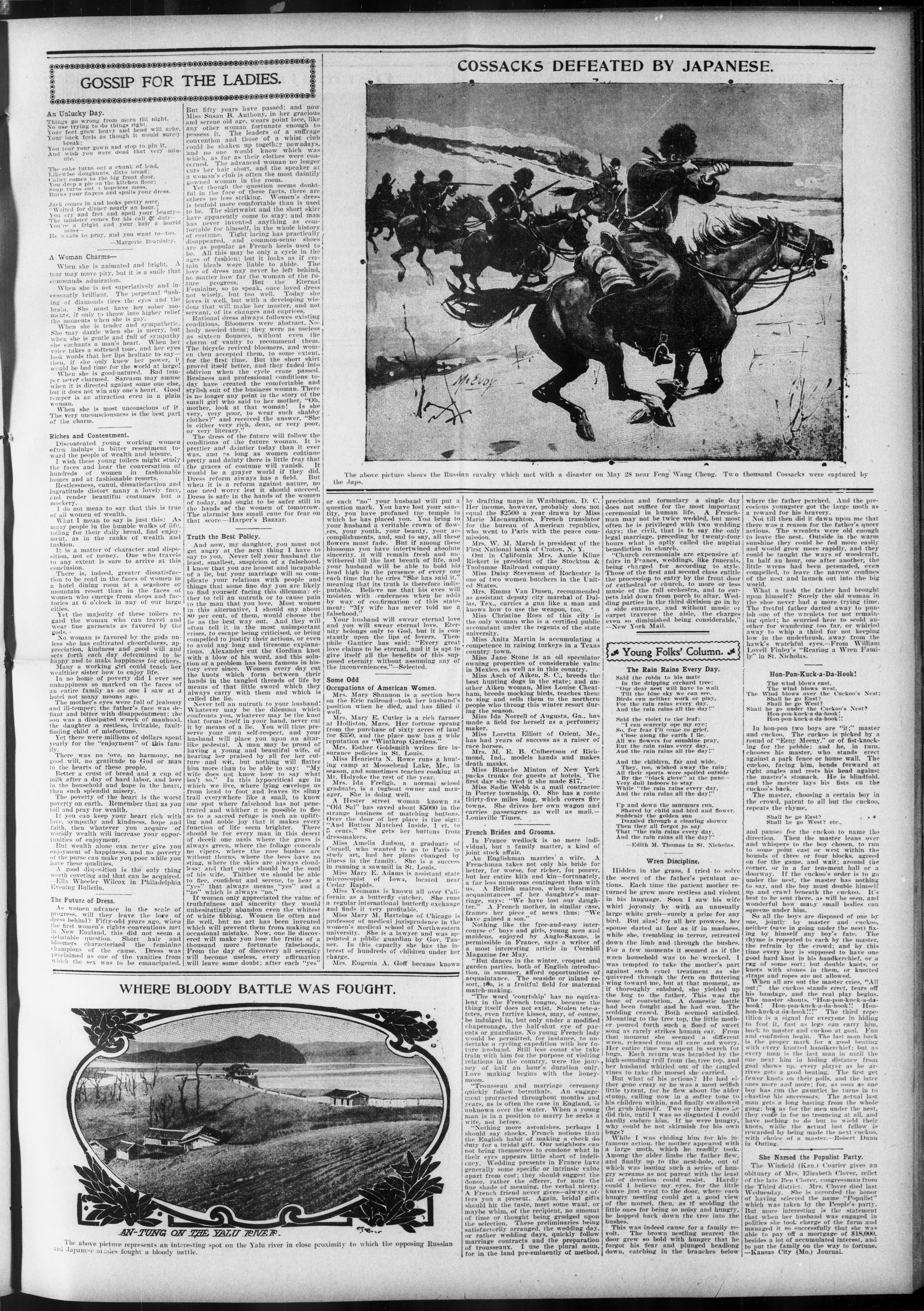
The above picture shows the Russian cavalry which met with a disaster on May 28 near Feng Wang Cheng. Two thousand Cossacks were captured by the Japs.
or each "no" your husband will put a question mark. You have lost your sanctity, you have profaned the temple in which he has placed you. You bring to your husband a veritable crown of flowers, your youth, your beauty, your accomplishments, and, sad to say, all these flowers must fade. But if among these blossoms you have intertwined absolute sincerity, it will remain fresh and unwithered till the last breath of life, and your husband will be able to hold his head high in the presence of every one each time that he cries "She has said it," meaning that its truth is therefore indisputable. Believe me that his eves will moisten with tenderness when he adds by way of confirmation of this statement: "My wife has never told me a falsehood."
Your husband will swear eternal love and you will swear eternal love. Eternity belongs only to God, but it is constantly upon the lips of lovers. Theophile Gautier has said: "Every great love claims to be eternal, and it is apt to give itself all the benefits of this supposed eternity without assuming any of the inconveniences."—Selected.
Some Odd
Occupations of American Women.
Mrs. Mary Shannon is a section boss on the Erie railroad-took her husband's position when he died, and has filled it well.
Mrs. Mary E. Cutler is a rich farmer at Holliston, Mass. Her fortune sprang from the purchase of sixty acres of land for $350, and the place now has a wide reputation as "Winthrop Gardens."
Mrs. Esther Goldsmith writes fire insurance policies in St. Louis.
surface policies in St. Louis.
Miss Henrietta N. Rowe runs a hunting camp at Moosehead Lake, Me., in season, and sometimes teaches cooking at Mt. Holyoke the rest of the year.
Mrs. Ida Freligh, a normal school graduate, is a tugboat owner and manager. She is doing well.
A Hester street woman known as "Old Sal" has saved about $5000 in the strange business of matching buttons. Over the door of her place is the sign: "And Button Matched Inside. 1 ct. to 5 cents." She gets her buttons from dressmakers.
Miss Amelia Judson, a graduate of Cornell, who wanted to go to Paris to study art, had her plans changed by illness in the family. She is a success in running a sawmill in St. Louis.
Miss Mary E. Adams is assistant state microscopist of Iowa, located near Cedar Rapids.
Miss Yeomans is known all over California as a butterfly catcher. She runs a regular international butterfly exchange and finds it very profitable.
Miss Mary M. Bartelme of Chicago is professor of medical jurisprudence in the women's medical school of Northwestern university. She is a lawyer and was appointed a public guardian by Gov. Tanner. In this capacity she has the interest of hundreds of children under her charge.
Mrs. Eugenia A. Goff became known
COSSACKS DEFEATED BY JAPANESE.
by drafting maps in Washington, D. C. Her income, however, probably does not equal the $2500 a year drawn by Miss Marie Macnaughton, French translator for the bureau of American republics, who went to Paris with the peace commission. Mrs. W. M. Marsh is president of the First National bank of Croton, N. Y. Out in California Mrs. Annie Kline Rickert is president of the Stockton & Tuolumne Railroad company. Miss Daisy Stevenson of Rochester is one of two women butchers in the United States. Mrs. Emma Van Dusen, recommended as assistant deputy city marshal of Dallas, Tex., carries a gun like a man and knows how to use the weapon, too.
Miss Christine Ross of this city is the only woman who is a certified public accountant under the regents of the state university.
Miss Anita Martin is accumulating a competence in raising turkeys in a Texas country town.
Miss Jane Stone is an oil speculator owning properties of considerable value in Mexico, as well as in this country.
Miss Asch of Aiken, S. C., breeds the best hunting dogs in the state; and another Aiken woman, Miss Louise Cheatham, breeds mocking birds, teaches them to sing and sells them to the northern people who throng this winter resort during the season.
Miss Ida Norrell of Augusta, Ga., has made a field for herself as a perfumery maker.
Miss Loretta Elliott of Orient, Me.. has had years of success as a raiser of race horses. Mrs. M. E. B. Culbertson of Richmond, Ind., models hands and makes death masks. Miss Blanche Minton of New York packs trunks for guests at hotels. The first day she tried it she made $17. Miss Sadie Webb is a mail contractor in Porter township, O. She has a route thirty-five miles long, which covers five towns. She drives her own wagon and carries passengers as well as mail.— Louisville Times.
French Brides and Grooms
In France wedlock is no mere individual, but a family matter, a kind of joint stock affair.
An Englishman marries a wife. A Frenchman takes not only his bride for better, for worse, for richer, for poorer, but her entire kith and kin—fortunately, a far less numerous contingent than with us. A British matron, when informing acquaintances of her daughter's marriage, says: "We have lost our daughter." A French mother, in similar case, frames her piece of news thus: "We have gained a son."
Nothing like the free-and-easy intercourse of boys and girls, young men and maidens, enjoyed by Anglo-Saxons, is permissible in France, says a writer of a most interesting article in Cornhill Magazine for May.
"But dances in the winter, croquet and garden parties, both of English introduction, in summer, afford opportunities of acquaintance. The seaside or inland resort, too, is a fruitful field for maternal match-making.
"The word 'courtship' has no equivalent in the French tongue, because the thing itself does not exist. Stolen tete-atetes, even furtive kisses, may, of course, be indulged in, but only under a modified chaperonage, the half-shut eye of parents or guardians. No young French lady would be permitted, for instance, to undertake a cycling expedition with her future husband. Still less count she take train with him for the purpose of visiting relations in the country, were the journey of half an hour's duration only. Love making begins with the honeymoon.
"Trouusseau and marriage ceremony quickly follow betrothals. An engagement protracted throughout months and years, as is often the case in England, is unknown over the water. When a young man is in a position to marry he seeks a wife, not before.
"Nothing more astonishes, perhaps I should say shocks, French notions than the English habit of making a check do duty for a bridal gift. Our neighbors can not bring themselves to condone what in their eyes appears little short of indelicacy. Wedding presents in France have generally some specific or intrinsic value apart from cost; they should suggest the donor, rather the offerer, for note the fine shade of meaning, the verbal nicety. A French friend never gives-always offers you a present. Again, bridal gifts should hit the taste, meet some want, or maybe whim, of the recipient, no amount of time or thought being grudged upon the selection. These preliminaries being satisfactorily arranged, the wedding day, or rather wedding days, quickly follow marriage contracts and the preparation of trousseaux. I use the plural noun, for in the land pre-eminently of method,
precision and formulary a single day does not suffice for the most important ceremonial in human life. A Frenchman may not be twice wedded, but most often he is privileged with two wedding days; the civil, that is to say the only legal marriage, preceding by twenty-four hours what is aptly called the nuptial benediction in church.
"Church ceremonials are expensive affairs in France, weddings, like funerals, being charged for according to style. Those of the first and second class entitle the procession to entry by the front door of cathedral or church, to more or less music of the full orchestra, and to carpets laid down from porch to altar. Wedding parties in the third division go in by a side entrance, and without music or carpet traverse the aisle, the charges even so diminished being considerable."
—New York Mail.
Young Folks' Column.
The Rain Rains Every Day.
Sald the robin to his mate
In the dripping orchard tree:
the robin will wait to wait
Said the robin to his mate
In the dripping orchard tree:
"Our dear nest will have to wait
Till the blue sky we can see.
Birds can neither work or play,
For the rain rains every day,
And the rain rains all the day!"
Said the violet to the leaf:
"I can scarcely ope my eye;
So, for fear I'll come to grief,
Close along the earth I lie.
All we flowers for sunshine pray,
But the rain rains every day,
And the rain rains all the day!"
And the children, far and wide,
They, too, wished away the rain:
All their sports were spoiled outside
By the "black glove" at the pane—
Very dull indoors to stay
While "the rain rains every day,
And the rain rains all the day!"
Up and down the murmurs run.
Shared by child and bird and flower.
Suddenly the golden sun
Dazzled through a clearing shower
Then they all forgot to say
That "the rain rains every day.
And the rain rains all the day!"
—Edith M. Thomas in St. Nicholas.
Wren Discipline
Hidden in the grass, I tried to solve the secret of the father's petulant actions. Each time the patient mother returned he grew more restless and violent in his language. Soon I saw his wife whirl joyously by with an unusually large white grub—surely a prize for any bird. But alas! for all her prowess, her spouse darted at her as if in madness, while she, trembling in terror, retreated down the limb and through the bushes. For a few moments it seemed as if the wren household was to be wrecked. I was tempted to take the mother's part against such cruel treatment as she quivered through the fern on fluttering wing toward me, but at that moment, as if thoroughly subdued, she yielded up the bug to the father. This was the bone of contention. A domestic battle had been fought and he had won. The scolding ceased. Both seemed satisfied. Mounting to the tree top, the little mother poured forth such a flood of sweet song as rarely strikes human ear. From that moment she seemed a different wren, released from all care and worry. Her entire time was spent in search for bugs. Each return was heralded by the high-sounding trill from the tree top, and her husband whirled out of the tangled vines to take the morsel she carried.
But what of his actions? He had either gone crazy or he was a most selfish little tyrant, for he flew about the alder stump, calling now in a softer tone to his children within, and finally swallowed the grub himself. Two or three times he did this, until I was so disgusted I could hardly endure him. If he were hungry, why could he not skirmish for his own bugs?
While I was chiding him for his infamous action, the mother appeared with a large moth, which he readily took. Among the alder limbs the father flew, and finally up to the nest-hole, out of which was issuing such a series of hungry screams as not parent with the least bit of devotion could resist. Hardly could I believe my eyes, for the little knave just went to the door, where each hungry nestling could get a good view of the morsel, then, as if scolding the little ones for being so noisy and hungry, he hopped back down the tree into the bushes. This was indeed cause for a family revolt. The brown nestling nearest the door grew so bold with hunger that he forgot his fear and plunged headlong down, catching in the branches below
where the father perched. And the precocious youngster got the large moth as a reward for his bravery.
Not till then did it dawn upon me that there was a reason for the father's queer actions. The wrenlets were old enough to leave the nest. Outside in the warm sunshine they could be fed more easily and would grow more rapidly, and they could be taught the ways of woodcraft. In half an hour, one after another, the little wrens had been persuaded, even compelled, to leave the narrow confines of the nest and launch out into the big world.
What a task the father had brought upon himself? Surely the old woman in the shoe never had a more trying time. The fretful father darted away to punish one of the wrenlets for not remaining quiet; he scurried here to scold another for wandering too far, or whirled away to whip a third for not keeping low in the underbrush, away from the hawk's watchful eyes.—From William Lovell Finley's "Rearing a Wren Family" in St. Nicholas.
Hon-Pon-Kuck-a-Da-Hook!
The wind blows east.
The wind blows west.
The Wind blows over the Cuckoo's Nest;
Shall he go East?
Shall he go West?
Shail he go under the Cuckoo's Nest?
Hon-pon-kuck-a-da-hook!
Hon-pon-kuck-a-da-hook!!
In hon-pon two boys are "it;" master and cuckoo. The cuckoo is picked by a round of "Eeny Meeny," or of fist-knocking for the pebble; and he, in turn, chooses his master, who stands erect against a park fence or house wall. The cuckoo, facing him, bends forward at right angles and rests his head against the master's stomach. He is blindfold, and the master lays his fists on the cuckoo's back.
The master, choosing a certain boy in the crowd, patent to all but the cuckoo, repeats the rhyme.
Shall he go East? Shall he go West? etc., and pauses for the cuckoo to name the direction. Then the master leans over and whispers to the boy chosen, to run to some point east or west within the bounds of three or four blocks, agreed on for the game, and wait; around the corner, or in a far tenement hall or a doorway. If the cuckoo's order is to go under the nest, the master has nothing to say, and the boy must double himself up and crawl beneath the cuckoo. It's best to be sent there, as will be seen, and wonderful how many small bodies can squeeze under him.
So all the boys are disposed of one by one, jointly by master and cuckoo, neither (save in going under the nest) fixing by himself any boy's fate. The rhyme is repeated to each by the master, the refrain by the crowd; and by this time every boy is supposed to have one good hard knot in his handkerchief, or a rag of some sort; but double knots, or knots with stones in them, or knotted straps and ropes are not allowed.
When all are out the master cries, "All out;" the cuckoo stands erect, tears off his bandage, and the real play begins. The master shouts, "Hon-pon-kuck-a-da-hook! Hon-pon-kuck-a-da-hook!! Hon-hon-kuck-a da-hook!!" The third repetition is a signal for everyone in hiding to foot it, fast as legs can carry him, back to master and cuckoo at goal. Fun and confusion begin. The last man back is the proper mark for a good beating with every knotted handkerchief; but as every man is the last man in until the one next him in hiding distance from goal shows up, every player as he arrives gets a good beating. The first get fewer knots on their polls, and the later ones more and more; for, as soon as one boy has run the gauntlet he turns in to chastise his successors. The actual last man gets a long basting from the whole gang; but as for the men under the nest, they come in for no trouncing at all, and have nothing to do but to wield their knots, while the actual last fellow is rewarded by being made the next cuckoo, with choice of a master.—Robert Dunn in Outing.
She Named the Populist Party.
The Winfield (Kan.) Courier gives an obituary of Mrs. Elizabeth Clover, relict of the late Ben Clover, congressman from the Third district. Mrs. Clover died last Wednesday. She is accorded the honor of having selected the name "Populist" which was taken by the People's party. But more interesting is the statement that when her husband was engaged in politics she took charge of the farm and managed it so successfully that she was able to pay off a mortgage of $18,000, besides a lot of accumulated interest, and to put the family on the way to fortune. Kansas City (Mo.) Journal.
THE WISCONSIN
WEEKLY ADVOCATE.
it. B. Montgomery, Editor and Pubi'sher.
I’. A. Sample, Assvciate Editor and Business
Manager.
Published Every Taursday at Ne, i Fifth
Stiver.
A Representative Jeonynal Deveted to the
Interest of al! the People.
ADVERTISING RATES.
One inch, one year... .cccceese eee ee STS.
Two Inches, one year......c.020- 002. 200
Three Inches, one yéar........22-.0+- THON
Four Inches, one year......-.+222++-+ S280
Kor larger space, special rates.
Locals, 10 cents per line,
TERMS OF SUBSCRIPTION.
One Yeats vce docasen score ceeinevauscs.e (eS ROO
SES WOMEN < ocic 10. caoe nese e ye eee'ys-0e07 OO
Three months ccnccacene-cddecre op scece MD
Iirect all communications to
KR. B. MONTGOMERY.
79 Fifth Street.
HOW 0 SEND MONEY.—Post | Office
Order, Express Order, Draft or Registered
Letter, Kk, B. Montgomery will not be re-
sponsible for loss when sent in any other
way.
TO CONTRIBUTORS!
Al communications must be sent with the
name and address of the sender as an ev}
dence of good faith, lt not necessarily for
publication. No manuscript returned if not
neeepied, unless accompanied by stamps.
———————=
ADVERTISING RATES.
One insertion, per inch............$ .25
One mofth, per inch.............. -75
Three months, per inch............ 2.00
Six months, per inch..........-..- 3-50
Gne year, per inch,...........-... 5.00
Paragraph advertisements, per line. .05
see pie aes
SEDITORIAL PARAGRAPHS. 3
“I know of the bravery and character
of the Negro soldier. He saved my life
at Santiago, and I have had occasion to
say so in many articles and speeches.
The Rough Riders were in a bad position
when the Ninth and Tenth cavalry came
rushing up the hill carrying everything
pefore them. The Negro soldier has the
taculty of coming to the front when we
is needed mest. In the Civil war ke came
2coooc strong, and I believe he saved
the Unicn.”—President Roosevelt.
—————_——
TO OUR READERS.
Ieeently we have been frequenily
asked the question as to where the Wis-
consin Weekly Advocate stands in the
present situation as regards the political
situation, To each and all our answer is
“We stand pat” Verbum Sap.
————
A Fizzle.
Monuday being Memorial day wits
demed a fiit and appropriate time to dedi-
cate the Memorial whic has Been erect-
cd by public subscription ove® the grave
of our late lamented here, Lawson Han-
cock, Who sacrificed his life just as nobly
and heroically as the many other heroes
whom the nation was honoris and
mourning on that day.
The relatives of those whom Hancock
lost his life in endeavoring to save and
the general publie had performed their
part, incidted thereto by our esteemed
contemporary, the Milwaukee Journal.
'The remains of Hancock had been re-
ninved to a beautiful part of the cemetery
and the handsome monument was in
place ready to be handed aver to the eol-
ored citizens of Milwaukee as represent-
ing the relatives of him whose act apd
death it was desired to commemorate.
Everything seemed propitious. But the
colored people of this city and state as
a whole failed Lunentably to show their
appreciation of the graceful act of the
inceptors of and contributors to the move-
mont,
When the editor of this paper, accom-
panied by some friends, arrived at the
scene of dedication a short time before
the announced time for the ceremony, he
found, to his surprise and disgust, that
ho preparations had been made for the
ceremonial. It was Decoration day, and
yet the grave of the hero was unadorned
by one single blossom, Scores of white
citizens were grouped aronnd to pay the
tribute of their presence in a respectful
and reverential manner, but he and his
three friends were at that time the only
representatives of the colored race in
Milwaukee, They, xs far as the limited
time and circumstances allowed, succeed:
cd in, to a certain extent, retrieving the
credit of their race by procuring what
flowers they could in the neigehborhooc
snd thus relieving the shameful naked
ness of the grave. It was Decoratior
day, and yet the grave of the hero anc
the Christian, Hancock, was undecorat
od by his former fellow worshipers ant
brethren and sisters sin the congregation
of St. Mark’s A. M. E. chureh. It wa:
Decoration day, and yet the grave 0
the hero and brother Hancock was un
adorned by his brother Odd Fellows. I
was Decoration day and the day of th
presentation of the monument and ¢
large, probably a critical crowd expect
ed, and yet the mouument remained wn
decorated by the committee in charge 0
the affair, two of whom were colored ger
tlemen and prominent citizens.
After more than half an hour after th
time fixed for the dedication not mor
than fifty colored citizens of Milwavke
had testified by their presence their ap
preciation of Hancock's bravery and vi
carious sacrifice, of the kindly though
which had prompted the movement, or o
the generous response of the contributor
to the monument fund. To their hone
and eredit be it said that the three minis
ters of the colored churches, Revs
Jamieson, Alexander and Robinson, wer
on hand to show by their presence 2
example to their flock.- Such’ a showing
and we say it with all kindly feeling, wa
a discredit to our race, and we knov
wis the occasion of much unfavorabl
comment on the part of many of th
white spectators. As usual somebod,
hinndered, and we must say that in ou
opinion the committee in charge are ac
countable for that blunder in their ne
giving sufficieut publicity to the fact that
the dedication of the monument was fixed
fer Decoration day. Bat -to our own
ktowledge a sufficient number* knew vt
the fact to justify ns im expecting, a much
larger crowd, and common sense ought to
have come in and our Face ought to have
bean eaual to the occasion.
. The Washington Bee onght to take a
tumble to itself. We would advise a
change of name to The Wasp. Well,
on second thenght, this .insect’s sting
sometimes proves harmful, but this Bee's
sting can only prove harmful to itself
and to the race, while the person so con-
tinuously. attacked- is immune in the
righteousness of his cause and the purity
of his motives, Here are a few choice
extracts from its latest issue: “Hew
many paid agents are there in| Tuske-
wee?’ “The Bee is the people's paper
gud a Simon-pure American citizen. No
color about it.’ Faney a newspaper
claiming to be a citizen. “Prof. Wash-
ington attempts to. feed all the papers
who defend him.” “Every so-called big
Negro who writes a paper in favor of
Tuskegce gets an invitation to spend the
xummer’’ “Nobody is to have a social
or political future who dees not bow
dewn and worship Booker,” and so on,
ad nauseam. This is a fair sample of the
kind of “stuff” with which the Bee re-
gales (7%) its readers and we would ask,
To what end?
The Republican state central commit-
tee of this state is fortunate in having
the services of such an able gentleman
at its head ax Mr. Theo. W. Goldin of
Janesville. He will prove the right man
in the right place and carry the Repub-
lican party to vietory ia November de-
spite all the predictions of faint-hearted
friends and hopes of declared enemies.
We have pleasure in publixhing on our
front page today the portraits of four of
Wisconsin's eminent men in the political
world. Men who will, so long as. prin-
ciple and right are concerned, stick to
their guns and fight to the last ditch.
_—_————_————_—_
FORTUNES ON FINGER TIPS.
Thousands of Dollars Sometimes Spent
on the Purchase of Thimbles.
- The costliest thimble in the world is
‘undoubtedly one possessed by the Queen
of Siam. It was presented to her by
her husband, the King, who had it made
at a cost of rather more than $75,000.
This thimble is quite an exquisite work
of art. It is madle of pure gold, in the
fasbion o- shape of a half-opened lotus
flower, the floral emblem of the royal
house of Siam.
It is thickly studded with the most
beautiful. diamonds and other precious
stones, which are so arranged as to form
the name of the Queen, together with the
date of her marriage. She regards this
thimble as one of her mostgprecious pos-
sessions.
Not long ago a Paris jeweler made a
most clablorate thimble to the order of a
certain American millionaire. It was
somewhat larger than the ordinary size
of thimbles and the agreed price was
$25,000. The gold setting was scarcely
visible, so completely was it, set with
diamonds, rubies and pearls in artistic
designs, the rubies showing the initials
of the recipient.
Five or six years ago a jeweler in the
west cnd of London was paid & sha of
nearly $15,000 for a thimble which the
pampered wife of a South African croe-
sus insisted on having made for her.
This was one mass of precious gems—
diamonds and rubies—whicn as thimble
ornaments seem almost to monopolize
feminine taste.
The late Shah of Persia presented a
thimble to a lady whose guest he! was
for a few hours. In the words of the
delighted recipient, it looked like a_clus-
ter of glittering gems, which in reality it
was, save for the gold in which they
were set. An expert in precious stones
valued this thimble at £7500.--London
Answers.
An Important Item Unsettled.
S ge
x alee if,
& fo) Alin
<i Mie.
SE oy
M testy es <
Pee 2
a Oe 4
oe,
ut \ eS
FO BSN ile ~
eee
C ee
Miss Trnesoe—Am I to understand,
papa, that everything is setued in regard
to my wedding? .
Mr. ‘Truesoe—Yes, my dear, everything
—but the bills!
oe
Foreign Wares in China.
The Chinese peasant is 7:0 longer con-
tent to burn bean oil; he wants keresene.
In scores of humble Laos lomes I saw
American lamps costing 20 rupees
apiece, and a magistrate proudly showed
me a collection of nineteen of these shin-
ing articles. The narrow streets of Can-
ton are brilliant) with German and
American chandeliers, and myriads of
private houses Eee the empire are
lighted by foreign lamps. The desire
of the Asiatic to possess foreign lamps is
equalled only by his passion for foreign
clocks, The demand for clocks is in-
‘satiable. I counted twenty-seven in the
private apartments of the Emperor of
China, and my wife nineteen in the bed-
room of the Empress Dowager, while
cheaper ones tick to the delighted won-
der of myriads of humbler people. . The
ambitious Syrian scorns the mud roof of
his ancestors, and will be satisfied only
‘with the bright red tiles imported from
France.—Century.
A Pet Wolf.
Orrin Worral, jiving three miles south
of Pawnee, has a civilized wolf, which
has been bred to a dog, and is now the
mother of six pups. She will follow Mr.
Worral half way to town nearly every
day, and then take to the woods and re-
turn home. So long as Mr, Worral is
in sight the wolf will keep the road, but
as soon as he is gone she seeks the tim-
ber and wends here way back home.—
Kansas City Journal.
MONUMENT ERECTED ° }
TO A COLORED HERO.
Block in Honoe. of Lawan Hancock Is
Unveiled at Forest Home, :.
REE: FE EEE a NE ee ee ee a Eee
taneous contribution from men and wom-
en who. wished to express in this way
their adutiration of a brave tuah, now
marks the grave of Albert Lawson Han-
cock, 28, colored, who lost his life in an
effort to resene two fellow workinen from
a death trap in the North avenue tunnel.
'The monument was unveiled Monday
afternoon with simple ceremonies at
Forest Home cemetery.
‘The monument ix a rectangle of Wau-
‘shara granite, one of the finest granites
in the world, polished on two sides, the
highly rubbed surface being in pleasing
contrast to the rough hammered edges.
The inscription reads as follows:
“Erected by an appreciative public to
the memory of Albert Lawson Hancock,
# colored man, who gave lis life in an
attempt to rescue two white fellow work-
men from asphyxiation in the North ave-
nue tunnel, Milwaukee, September 1,
1903."
After prayer by the Rey, H. Jamieson
of St. Mark's A.M. E. church, and in
the absence of Col. A. H. Hotister oi
Madison, -who was the first contributoe.
to the memorial fund, Mr. I. N. Stewart
of the Milwaukee Journal, representing
Mr. Ellis, a member of the committee,
presented the monument to Lawson Han-
cock’s relatives and friends in a sym-
pathetic address. Mr. R. R. Gordon, the,
administrator of the Hancock estate, in
a few well chosen words accepted. the
monument on their behalf and was foi-
lowed by Attorney W. ‘IT. Green, who
spoke in part as follows:
“This day dedicated to the national dead
is the most fitting that could be chosen
ror the dedication of this monument of
our hero, Dearth of information pre
vents us from saying anything of the
childhood, youth or early manhood of
this remarkable man, The speaker then
parrated Hancock's arrival in Milwau-
kee ten years ago, unkempt, untutored,
vneultured, a veritable diamond in the
rongh—his frame that of a giant—his
color, coal black. Ile was unpretentious
and modest in the extreme; ioyal, tne
and \ Mish. He had no schooling ex-
cept the school of toil, but that same
toil gave him strength and muscle, which,
combined with courage, truth and loyai-
ty, made the man, He heard only the
call of duty. He theught net of him-
self, but only of his twe fellow beings.
Ii mattered pot to him that they were
white and he black—a selfish man coald
not have so acted.
“When the late President McKinley
was struck down in the Temple ef Mu-
sic at the Pan-American exposition, it
was the sturdy hand of a giant Negro
whieh was thrust forth to protect hin
and wrench the smoking revolver from
the hand of the assassin, In this in-
stance President McKinley was the guexi
not only of the exposition awathorities,
bat of the city of Buffalo. These. aa-
thorities hurriedly put their heads to-
gether and came to the conclusion that it
would reflect upon the police arrange;
ments for the protection of the Presi-
dent of the United States to give to the,
Negro Parker that credit which was his
due. Negro soldiers of the Ninth and
Tenth cavalry, when their white officers
were shot down at the battle of San
Juan, swept everything before them and
captured the Spanish position, saving
the Seventy-first, New York and = the
Rough Riders and thus preserving to the
pation a Roosevelt. Public policy again
intervened and the Negro was robbed of
the credit belonging to him.
“Let us thank God that we have in the’
state of Wisconsin men brave and cour
ageous enough to give to Lawson Han-
cock and credit due him and to erect this
monument to his memory. As the legal
representative of the relatives away off
in far Virginia, of the administrator here
present, and the numerous friends and
acquaintances of the deceased, L accept
the monument at your hands, and in
their behalf tender to, the Milwaukee
Journal and the contributors generally.
their grateful thanks. ‘The words spok
en and the flowers bestowed will soon
fade and pass away, but the deed of
Lawson Hancock, after we who here:
surround his grave. shall have passed’
away, will live, and live, and live on for-
ever. Let us hope that his act will be
instrumental in help clearing away the
differences between the two races and
that they may be more closely united in
the bonds.of a common humanity.”
He was followed by the Rey. W. Jame-
son in a masterly address. r
“After the pronouncing of the Benedic-
tion by the same gentleman the company
dispersed.
The grave was decorated with flowers
hy Mrs. Wallace aud Mrs, Anderson, 427
Cedar street; Miss Marguerite Carter,
60 Johnson street, and R. . Montzom-
ery, editor of this paper.
; {See our Editorial Columns. |
| Mrs. Lillian Cawker, Plankinton house,
and her mother drove ont from the city
‘to do honor to the heroic dead, accom:
| panied by Mr. J.J. Miles, a member of
‘ihe Monument committee, and deposited
|a handsome wreath on the grave.
|" Phe men whom Mr. Hancock tried to
save were Kt. J. Hickey, Jr. son of a
| well known contractor, — and Louis
pecans superintendent of construction
of the city water department.
| The tunnel had been recently com:
pleted. Mr. Hickey, little dreaming of
the danger lurking in its depths. had de-
seended through a manhole, and was
seen suddenly to collapse at the bottom,
With agroan. Mr, Schanck saw the pre-
dicament of Mr. Hickey, and loosening
his hold of the manhole, whieh he had
also entered, dropped a distance of fifteen
feet to the bottom and attempted'to raise
him. He, too, was overcome, however,
by fatal gases which had accamulated
below.
| Lawson, who was working across the
| street, bravely volunteered to reseue both.
| Sliding down a rope he had time to fas-
tev a line about the arms of the uncon-
scious men when he, too, was overcome;
and falling backward, became the tan-
nels third victim.
The accident created great deal of ex-
citement, “The police and fire depart-
|{nents were called upon for help. The
ee eee
Clothing to fit without being measured for.
Prices less than you ever bought them for. Our
specialty is misfit and uncalled-for custom tailor-
made clothing. Tailors’ prices for full dress
or Tuxedo Suits from $30 to $50; our price from
$15 to $18. English Walking or good Business
Suits made to measure by best of tailors from
$18.00 to $35.00. Our price $8.00 to $18.00.
Every suit bears our guarantee label. All gar-
ments bought of us are kept repaired and pressed
free of charge for one year. To be convinced
see our window display.
MILLER BROS.
213-15-17 West Water St., Milwaukee, Wis.
Open Evenings Till9 P. M. Sundays Tiil i2 M.
A STORE FOR MEN |
HIRSIG & REHM
189 Third Street. |
Swell dressers will find in our store a fine line of up-te- |
date Hats, Shirts, Gloves, Neckwear, Hosiery,etc.
We Carry the Largest Line of Collars in the City.
A. CLARK. wits, J. CLARK.
When You Need Anything in Our Line Call en
CLARK BROS.
———DEALERS IN——
GROCERIES, SALT MEATS,
| FRESH EGGS AND BUTTER
Cigars, Tobacco and Candies.
| Te’, Douglas 2474 3233 STATE ST., CHICAGO.
Interesting Mexican Stamps.
Porte de Mar stamps of Mexico haye
an interesting history. They are not
really stamps, bat merely labels applied
to the envelep in interior towns to indi-
cate the amount of postage required to
carry the pieces of mail from a Mexican
seaport to the point of destination. They
are sometimes found canceled, but this
is accidental, having been done when
the Mexican stamps upon the piece of
mail were canceled.—-St. Nicholas.
Rewore ol Knnastars
e
‘We Guarantee
Dermalade
if used according
: to directions with
Dermaiade Soap
to remove Tan,
Freckles, Moth
Patches, and Skin
i Diseases. It en-
fae sures your com-
: hd plexion three
t ° r shades lighter.
h 4 Sold by Drug-
Beet, gists, if not, mey
iain be ordered direct.
Ra ACC GAB: 2.
DERMALADE produces perfect complexion
and is unequaled in massage treatment of the
face, neck and hands. After others have failed
try Dermalade and be convinced.
Dermalade, 50c.
Dermalade Soap, - 25 Cents
The Dermalade Mfg. Co.
100 Florida Street, o Buffalo, N. Y.
DERMALADE LOTION, 50c, 3 for $1.25
of different professions solic-
iting money in Wisconsin for
purposes unknown té any per-
son in that state and for use
elsewhere. Driven out of
other states they are overrun-
ning this. We think it an im-
perative duty on us as being
the only negro paper in the
state.to protect its generous
yhilanthropists. From now
on, we shall warn the mayor
and chief of police of every
city in Wisconsin against such
adventurers.
‘The Oliver
.
Typewriter...
2) ‘| ‘
aes Bee 2,
CT ES eat
hie
ahaa a
a a
A
The Standard Visible Writer
GOLD MEDALS AND FIRST AWARDS,
Philadelphia, 1899. F.arls Court, Lom
ton, 1899, Omuha, 1899. Paris 1990
Venice, 1901. Lille (France), 1901
Hufhilo, 1901.
{t is disjiacing old style machine:
verywhere, and holds first place ix
the est marion of the majority of lead:
ne representative business and pro
fessional men. Write fer Catalogue,
, +
Wim. C. Kreul
44-436 Broudway, - Corner Mason Street
MULWAUKER
eae
CHICAGO & NORTH-WESTERN RY,
Office 99 Wisconsin St. Station Foot of Wisconsin St.
“Daily. jex. Set. zMon. only.
fez. San, tunonly.— Seavs | anaiva”
caieereemiencnmgiaeane tate ote eso haga
5:00 am| +5200 am
77:15 am} 46:15 am
Sy: am| {9:45 am
8:00 am |11:90 am
Coieago, Racine, Kenosha and | |*11:00am| +1:45 pm
WAUKOZRD.scceveeceseeesees || {1:45 Den] fa:
34:00 pin | 32358 bra
| T:Spm| +718 pm
; eee eeeeeeee (*20210 DI
/ eescecesees °12:30 Om
oe Meg and mee} ao aoe
iwaukee Special......... 3 “1
+885 pm| *6:98 pm
°7:20pm| °7:35 am
Daututh and Superior. ........ °7:30 pm eo
*8:00pm| 8:50 am
81, Peal Minneapolls and the ¢| 49:498m) 47:60 am
OP WES... cesieseeneesene 4 :60 em
> *8:00 pm| *8:60 pm
4:55 ain] $7:30 am
46:83 om] (3208 om
Madison and Watkesha,..... eo ane en
5:30 om| 13:55 pm
eons fesoam| 79:58 pm
secgeees| 74:55 am| $3:55 pm
Rockiord,” dabeaviiie’“ani'"{| }4:d5am|1i0:06 am
Bel02t ...csesseseeseseseeees 3] 19:40am) 73:55 pm
$5:30pm|...........
45:15 am| "S468 aia
$7250 am |fi0:48 ara
Fond du Lac, Osborn, Neo- | (417 5 :
= Appleton end Green a topm th:3h bm
sbccoatgecbanensestecess] | se -bepeel F508)
10:15 pin|eL2:45 am
92:40 |.......-200
Besant Oukook. set) $7:80)pia) 29:80.
#5:a5am) [4:35 am
Marinette and Menominee, 10:08 aa f7ah bn
10:15 pm |eeeesenenee
12:40 am) Sco...
Marquette, Houghton and {/,{5:15am| 14.05 em
CalUMEt.. es eeseeeceee ence ip bm| 94:35 am
Wegaunee and Ishpeming .... d:aspm {793 pm
:5Bam| t7:
cremarremeamen || iter) 83
Ashland, Rhinelander, Iron- { eagre| 27:33 am
‘wood and Hurley... hen saeee
12:40am | 4:56 am
pn Novena oon Fioesece. | $345 pin $7:05 pm
#7210 smn) 07:35 am
"cee: meee || etait
pistencisseod : 3:50 pn
Sibopmn| *4:40 pin
| *7:50pm) 8:30 pm
Bapoa. Grect Lake ant “F785 am 110245 an
IDs varecensenacerase 18:00pm | 17:05 pm
CHICAGD, MILWAUKEES ST, PAULAY
“Daily, ¢Sun. only. fix. Sun. MILWAUKER
tEx.sac Ax. Mon. es
Wat only. Mon. only. | LEavE ARRIVE
pi2:40 am!*.2:2) am
LaCrosse, Winona, St. Paul {|s'4:80 ainls 4.55
and’ Minneapolis...........- (/#11:05 esni* 7:00 pin
~ThePioncer Limitea”..|* 4:50 Fae 790 arm
250 am|s 4.25 am
Sou, Mina. Potate esses} arog amis $800m
: 7:00am
ows and Dakota Potnts........|t 7:16 pm|¥ 650 am
Prairie du Chien, lows’ and {}t11:30am)¥ 9:50 au
Minnesota ......scececeeeeee {it 7:18 pmit 1:00 pus
Maneral Point Line ..,........ 4} Uo emit 4:10 pu
{ft 7:98 amie10:00 ame
250 am|t 1:00 pm
Seen ae 7510 bo»
3] mnif 70pm
Ih PiSpini.......-.--
; : #:00 ain|> 6:40 am
Rac. & B. W. Div............- } {12:15 pm) t 3:10pm
8:20 pmit 8:40 pm
Council Binft, Omaha and §|* 4:00 pusl*i 1:00 aor
ADERBCIY ss eereeveeneees UE TBO PINIF 1:45 pms
$245 ammleaz:40 am
7:20 aml? 4:45
| caer aes
st 200 am} 1:35
OMEN srvercreeesesereensers Tt Lasmin|” 45% bo
4:00!" 7 10pm
7:2) pule x:su pm
| adigon frie Watertown 0.17948 uinfit $0 ais
= (via Pr. du ©. DIV.5 2215 7:80 smile 6 c5u acn
* (viaPr. cu C. Dly.).0 F711 :3y win!> 0:00 ain
= (via Watertown)... //t B:09p mit y45 par
; © = via Pr. du ©. Div.).2./* 7:15pm!+ 1-00 pm
~ (vis Pr. 06 DW if cael 7:10pm
| Morthorm Division............ {ip giA0 an U4 nm
730 am 6:57 aw
le 7
Tie G20 stat 3253) ame
Sk) a.nl71U-Q0 aa
] 142 omjibtessuRar
WAakOans .....ccecseseeerseee 1:58 pasft Adu pus
‘ 4:10 emit 3244 pm
? t S249 pin F410 pm
{ fo FEB ssc. -.- oe.
5 4:b0 em)? 4:0. am
7:45 anit 7:00 an
{11:08am} 5:40 ain
if 1266p nitio:su an
Oconomowoc and Watertown ieee $45 pm
| geiokeced
© 8:6 pin|* 7200 ous
‘Bay... es cate 5:08 pins 10.4 am
| Houghton” “sad (323s 4:15 eo,
| ‘Superior weve Ut FAS am) 6500
i, THE NEWEST AND MOST RAPID
9 HAIR GROWER IN EXISTENCE.
- Makes the Hair igi - ©
grow_with htning-like rapidity No
waiting for results. ZOMODON: qrevents falling Hair,
Ms. Grey Hair, Brittle Hair, Curly Hair, Hair, and Scurf:
reer Cures Dandruff, Itch, Tetter, Eczema, and Ring-Worm. No
vi more Bald Heads, ae Partings, Splitting Ends, and Bald
Temples, ZOMODONE. grows long, luxuriant, ‘soft, fine,
silky Hair. Makes the Hair grow down to and below the
J waist line in most every instance in which it is used.
,|.ZOMODONE is a direct Hair food, and softens and
" }| ‘lengthers the Hair, so that it can be arranged in / style
aS i] desired. Not a fraud or a fake, to get your money, but an
Gms Sea.) honest remedy, tried aad true. ZOMODONE acts quickly;
BS p= Se) results are seen at once. If you want Hair ‘down 40 your
Ses A\\\8? | waist, send in your order right now—do not delay. No free
Ce py" . samples sent; a sample is not sufficient todo good. Send
SQ) us only $1.00, and We will send promptly all odie frill
aaa ing great remedies, worth at retail $4.50: 3 jaree. jars of
ZOMODONE, worth $3.00; llarge package of ALBUNA (E;
Actual Results from Bald- <nampoo), worth L0c., and 1 large package of CORAL NE
ness After Only 4 Months’ the most exquisite and absolutely certain skin eres
Use of ZOMODONE. and perfector known to science, worth $1.00. We will send
: four compiete treatments for $3.00.
WANTED. Everything is in favor of the Agent. LIBERAL
AGENTS CREDIT EXTEN b ED. This isan Spaces chance
to make money. Write quick for territory and particulars. Address e
THE HELEN MARTIN TOILET CO., 910 E. Leigh St., Richmond, Va.
anbbsesssscuscnbesisassssssstansssanssuias!,|ssossuosesnsenssssassnosswssussoassnesnsnseali(]by
ELEGANT NEW———____ 5
TONSORIAL PARLORS,
Second to None in the World. :
Visitors to the city and those who appreciate iH
Cleanliness, Elegance and Comfort should
: patron 6 ——— E
| Slaughter’s Turf Hotel Tonsorial Parlors, &
: 217 Wells Street, Milwaukee. =
Hot and Cold Baths in Connection. Franklin A. Hackiey, gr. Bp
WISCONSIN. CENTRAL RAILWAY.
TICKET OFFICE, 400 EAST WATER ST. Tel. 624._
‘To awp Faox peer ae
at Miata || SH ose
5:00 ain) 7 on
Meets Cerere Pam 01pm) 1 ah
sath aun || tes ibason
Fe eee oat, New| Ho13-01 on 13-29 vn
] ASSRBR sews
hy, thats . °°
SPECIAL NOTICE
THE "TURF" CAFE
DINNER BILL
Regular Dinner 25c
Dinner 11:30' to 2 p. m. and 5 to 8 p. m.
Sliced Tomatoes, 10c. Radishes, 10c.
Cucumbers, 10c. Green Onions, 10c.
Lettuce, 10c.
BEAN SOUP
BEAN SOUT.
Boiled Trout and Mint Sauce, 25c.
Boiled Leg of Mutton, Egg Sauce, 25c.
Roast Pork and Apple Sauce, 25c.
Short Ribs of Beef with Brown Potatoes, 25c.
Fricasseed Chicken, 25c.
ENTREES.
String Beans. Green Peas.
Boiled and Mashed Potatoes.
Apple and Lemon and Custard Pie.
Rice Pudding.
Coffee and Tea and Milk.
Anything ordered not mentioned on this bill will be charged for extra.
MONROE BROS., Prop's.
194 THIRD ST.
MONON ROUTE
NORTH OR SOUTH
Always ask for tickets
via the
MONON ROUTE
THE SHORT LINE BETWEEN
Chicago,
Indianapolis,
Cincinnati,
Louisville
Six trains daily between Chicago and the Ohio river.
For folders, rates, etc., call at any Monon ticket office or address
FRANK J. REED,
Gen'l Pass. Agent, Chicago.
S. B. JONES,
C. P. Agent. 232 Clark St., Chicago.
MILWAUKEE...
GAS STOVE CO.,
MANUFACTURERS OF
PROFECTION
INCUBATION DECORATION
PERFECTION GAS RANGES
AND SPECIALTIES
Instantaneous Cleanable Star Burners,
Adjustable Needle Valve,
For Natural, Artificial or Gasoline Gas.
139 Burrell St., Milwaukee, Wis.
50 YEARS
EXPERIENCE
PATENTS
TRADE MARKS
DESIGNS
Anyone sending a sketch and description may quickly ascertain our opinion free whethe: an invitation is probably patentable. Communications strictly confidential. Handbook on Patents sent free. Oldest agency for securing patents. Patents taken through Munn & Co. receive special notice, without charge, in the
A handsomely illustrated weekly. Largest circulation of any scientific journal. Terms, $3 a year four months, $1. Sold by all newsdealers. MUNN & Co. 361 Broadway. New York Branch Office, 675 E. St. Washington, D.C.
WONDERFUL DISCOVERY
Curly Hair Made Straight By
TAKEN FROM LIFE:
BEFORE AND AFTER TREATMENT.
ORIGINAL
OZONIZED OX MARROW
(Copyrighted)
This wonderful hair pomade is the only safe preparation in the world that makes kinky or curly hair straight as shown. Ishishes the scalp, prevents the hair from falling out or breaking off, cures daudruff and foreshines the hair grow long and silky. Sold over forty pounds and used by thousands. Warranted harmless, as the first preparation ever sold for straightening kinky hair. Beware of imitations. Get the original Ozonized Ox Marrow as the great remedy fails to keep the hair straight, soft and beautiful it that healthy, life-like appearance so much desired. A toilet necessity for ladies, women and children. Elegantly perfumed. Owing to its superior and lasting qualities it is the best and most economical. It is not possible for any product to produce a preparation equal to it. Full directions with every bottle. Only 50 cents. Sold by drugrists and dealers or send us 50 cents for a bottle or $1.40 for three bottles. We pay all express charges. Send postal or express order. Please mention name of this paper when ordering. Write your name and address plainly to
OZONIZED OX MARROW CO.,
76 Wabash Ave., Chicago, Illinois.
S. F. PEACOCK & SON
Funeral Directors
AND
EMBALMERS
431 Broadway. MILWAUKEE, WIS.
---
FRANK M'DONOUGH DEAD.
State Senator from Eau Claire Passes Away.
AFTER LONG ILLNESS.
Settled at Eau Claire in 1863 and Was Prominent in Public Affairs.
Eau Claire, Wis., June 2.—[Special.]—State Senator Frank McDonough died at 9 o'clock this morning.
Mr. McDonough was a native of Canada, where he was born in 1846. In 1863 he came to Eau Claire. He was a manufacturer and was prominently identified with public affairs in Eau Claire, notably the school board, the common council and the board of trade.
He was elected to the Assembly in 1892 and in 1900 was elected to the state Senate by a plurality of 3764, receiving 7539 votes to 3775 cast for J. J. Auer, a Democrat.
Mr. McDonough was always a stanch Republican.
His daughter, Miss McDonough, attends the state university and is a leader in social affairs at Madison.
DUNNE FOUND GUILTY.
Prairie du Chien Murder Trial Results in Conviction of One De-
Prairie du Chien, Wis., June 2.—[Special.—James Dunne, Jr., was convicted of manslaughter in the third degree, after the jury had been out over fifteen hours, in the case of James Dunne, Jr., Andrew Overberg, near Towerville, on Andrew Overberg, near Towerville, on February 16. Gaswill was found not guilty under the direction of Judge Clementson.
Dunne's sentence will be given tomorrow.
Made Partial Confession.
At the time of the arrest Dunne made a partial confession. Both he and Gaskill were arraigned at Soldiers Grove February 23.
A Cowardly Attack.
Andrew Overberg was a prosperous farmer of Towerville. He was returning from Soldiers Grove when he was met by his assailants. He was struck on the back of the neck with a heavy drag tooth, and the wounds proved fatal. Overberg was found in the snow, writhing in blood and life was almost gone. He was taken to his home in Towerville, where he died in a few moments.
Both Young Men.
Gaskill had been a resident of La Crosse. He is 29 years old and has a wife and two small children. Dunne lives in Rising Sun, is 23 and a brother-in-law of Gaskill. Threats of lynching were made at the time of the arrests.
No Suspicion at First.
It was at first thought that he had fallen from his cutter, and no suspicion was attached to the matter. This occurred Tuesday, February 16, and not until the following Sunday were any suspicions arouse. When search was instituted a heavy drag tooth and spattered blood were discovered in the sand half a mile from where the dying man was found.
STANDARD HELD LIABLE
Oil Trust Is Denied New Trial of Personal Injury Suit at Racine— May Appeal. Racine, Wis., June 2.—[Special.]—In the circuit court, this morning, Judge Belden denied the motion of the Standard Oil company for a new trial in the suit brought by Mrs. Catherine Canary for damages for alleged personal injuries.
She brought suit for $1000 and the jury awarded a verdict of $610. The defendant company made a motion for a new trial. The court holds that damages may be recovered for physical injuries resulting from fright or mental shock, approximately caused by negligence of another, even though the physical injuries complained of be not contemporaneous with the fright or shock. The court also held that there was negligence by the defendant company for which the plaintiff might recover damages.
The company had employed men to blast an engine bed, and in the explosion rocks and railroad ties were thrown against the house of Mrs. Canary. She was so frightened that she became seriously ill. This is the first suit of the kind ever brought in this state, and it is probable that the Standard Oil company will appeal. Another suit has been brought against the company by Mrs. Burdick for $5000 damages, for personal injuries.
GIFT TO LAWRENCE.
Unknown Benefactor Bestows $5000 on University at Appleton for the President Steele Chair.
Appleton, Wis., June 2.—[Special.]
An unknown donor has just given Lawrence university $5000 to complete the amount required for the President Steele chair. The report that Carnegie will give the college money for a library is untrue.
VETERAN SHOOTS HIMSELF.
John Skarrevota Kills Himself at Manitowoc—Had Found Sisters.
Manitowoc, Wis., June 2.—[Special.] John Skarrevota, aged 35 years, was found dead in a barn on the premises of Anton Wilva, with whom he made his home, this morning, having committed suicide by firing a bullet into his brain. He was a veteran of the Spanish-American war and had been separated from his family for twenty-six years. Three years ago, at the time of his brother's death, he learned the whereabout of his two sisters, after twenty-four years. They reside in Montana. As a result, the property of his dead brother was divided between the three, and this fact preyed upon his mind.
RURAL SERVICE FOR WISCONSIN.
Gen. Bristow Assures This State of Generous Extensions.
Washington, D. C., June 2.—Fourth Assistant Postmaster General Bristow will at once take up several questions relating to the rural free delivery service. Wisconsin is assured of a generous apportionment of routes, including additional county systems. Efforts are being made by Representative Babcock to have Judge P. Walker of Boscobel continued in charge of the Chicago headquarters, while the friends of former States Senator Conger, now stationed at Nashville, are working to the end that he shall be continued as an inspector.
```markdown
```
DENOUNCES CHURCH SUPPERS AND FAIRS.
La Crosse Minister Says Profits Are Too Small to Make Affairs Worth While.
La Crosse, Wis., June 3.—[Special.]—Oyster suppers for churches and other functions of a similar nature used to get money for the support of religious institutions are an abomination. Such is the sentiment expressed by Rev. Ferris of the First Baptist church of this city at the meeting of the La Crosse Valley Baptists now in session in this city.
The substitute proposed by Rev. Ferris is a contribution by all church members of one-tenth of their income, as is directed by the Bible. Too much gross receipts and not enough profit is the reason why socials should be discontinued. They average about $9 taken in and $3 profit. Rev. Ferris also made the startling announcement that he had preached temperance in this city until he was tired and he was beginning to think that it is of no use to attempt to do anything with the young people here in that direction.
CONVENTION AT FONDY CLOSES.
S. B. Harding of Waukesha Elected President of Sundav School Workers.
Fond du Lac, Wis., June 3.—[Special.]
In closing the state convention of the Sunday school workers yesterday a committee reported on the election of officers as follows:
President, S. B. Harding of Waukesha; vice presidents, Prof. C. W. Treat of Appletons, W. J. Hoehle of Sheboygan and Luther Davies of Oshkosh; secretary and treasurer, E. J. Hughes of Milwaukee; executive committee, W. H. Edwards of Milwaukee, Hugh Martin of Sheboygan, F. J. Harwood of Appleton, R. P. Perry of Reedsburg, S. F. Shuttuck of Neenah, and F. E. Brown of Milwaukee.
The report was adopted and the ticket declared elected.
INVENTS A SPRING MOTOR.
Stetsonville Carpenter Thinks He Can Revolutionize, Power Generation.
Medford, Wis., June 3.—Frederick L. Till, a young carpenter of German nativity, living at Stetsonville, believes he has invented a motor that will revolutionize power generation. His machine is to run without combustion, and without steam pressure. It may be called a "spring motor," as springs are the source of power. The principle on which Till depends to run his motor is said to be that of one of the "lost inventions" of Germany.
BIG SWITCH YARDS AT OSHKOSH.
Rumor That St. Paul Is to Absorb Central Corroborated.
Oshkosh, Wis., June 3.—Partial corroboration of the report that the Wisconsin Central railroad is to be absorbed by the Chicago, Milwaukee & St. Paul company is found in the announcement that the St. Paul company will shortly establish extensive switching yards and freight sheds on the south side of this city and tributary to the Central and St. Paul tracks.
Oshikosh Man Labors Hard to End Shingle Weavers' Trouble.
Marinette, Wis., June 3,—R. E. Edwards of Oshkosh, a member of the state board of arbitration, arrived here and brought the mill owners and striking shingle weavers together. It looks as if the result of his labors would be a settlement of the strike throughout the shingle region of the northwest, which has affected about 2000 men.
RURAL SERVICE ORDERED
Route at Luxembourg, Kewaunee County
—Additional Carriers.
Washington, D. C., June 3.—[Special.]—Rural free delivery service ordered established July 1: Luxembourg, Kewaunee county, with one carrier; area includes 22 square miles, population of 525. Rural free delivery carriers appointed: Knapp, regular, Jay S. Fletcher; substitute, Charles E. Cole. La Valle, regular, Charles E. Briggs; substitute, Charles Hurley.
LADS INJURIES PROVE FATAL
Depere Boy Was Leading Horse to Water
—Skull Fractured.
Appleton, Wis., June 3.—[Special.]—Patrick Bartels, the 8-year-old son of Drayman Harry Bartels, is dead as the result of injuries received at Depere last week. The boy was leading a horse to water when the animal jerked the lad by the rope by which it was being led, and young Bartels fell on his head and was picked up unconscious an hour later. He sustained a fracture of the skull.
GUARDED BY WOMEN
Three, Armed with Clubs, Hold Umbrella Mender Until Police Arrive
Beloit, Wis., June 3—[Special.]—Three women armed with clubs guarded J. A. Williams, an itinerant umbrella mender, until the police arrived this morning, and the fellow was arrested on a serious charge. It is said he had enticed Russell Webster, a 4-year-old boy, into a barn, but was seen by the neighbors.
FOUND HIS WIFE DEAD
Lone Rock Man Breaks Into His House, and Discovers Her Body.
Lone Rock, Wis., June 3.—[Special.]
—On returning from his parents' home,
where he passed the night, about 8 a. m.
Thursday, William Sullivan, finding his
house locked, entered through the window
and found his wife lying dead on the
floor, with her little 2-year-old boy crying
by her side.
Heart failure was the cause of death.
Barbers at La Crosse Bring Action for Recovery of Books.
La Crosse, Wis., June 3.—Action was started against a former labor organizer, George W. Hall, by the barbers' union for the recovery of books which Hall, it is said, refuses to produce. Hall was recently suspended from the local union.
DEATHS IN THE STATE
Osceola, Wis., June 3.—[Special.]Andrew Fee, who settled in this county in 1858, died at his home two miles east of the village, aged 72 years. He served as a private in Co. F, Fourth Wisconsin cavalry, during the Civil war.
Merrill, Wis., June 3.—[Special.]—Mrs. F. Hankwitz died of heart disease. She was 55 years of age and is survived by her husband, one son and three daughters.
Portage, Wis., June 3.—[Special.]—Mrs. Patrick Lehan died in the town of Pacific, aged 72 years. She leaves three children. The funeral will occur Saturday.
Stevens Point, Wis., June 3.—Almanson Eaton, one of the oldest attorneys in central Wisconsin, died, aged 81 years. A widow survives him.
MAY BE DISCHARGED.
Judge Clementson Says There Is No Case Against Gaskill and Dunne.
Defendant Says He Remembers Nothing and Was Crazed with Liquor— Trial at Prairie du Chien.
Prairie du Chien, Wis., June 1.—[Special.]—Claude Gaskill and James Dunne, Jr., who are charged with the murder of Andrew Overberg, a farmer of Towerville, were practically discharged from guilt by Judge Clementson, when he informed the jury and attorneys that nothing had been presented by the witnesses or defendants who were on the stand over an hour that could hold them for this serious charge.
Dunne testified that his mind was an entire blank during the time the affair took place, being made so by liquor. The father, mother and sister, who was Gaskill's wife, also testified on the stand.
The attorneys will make their arguments this afternoon. The judge's charge to the jury was murder in the first degree, manslaughter, or not guilty.
UNIONS ARE UPHELD.
Judge Dick at Beaver Dam Decides for Strikers—Decision Is Sweeping One.
Beaver Dam, Wis., June 1.—[Special.]
Judge Dick has handed down his decision denying the motion for a preliminary injunction in the suit brought by the Malleable Iron Range company of this city to obtain an injunction restraining the strikers at the plaintiff's plant from interfering with the employees of the plaintiff, or any persons who may desire to become such.
Denied Making Threats.
The defendants, appearing by Markham & Markham and W. B. Rubin, admitted that they joined a union and went upon a strike and that they induced employes of the plaintiff to leave its employment, but denied that they used any threats, personal violence or intimidation, and alleged that they did nothing illegal. They allege that the plaintiffs brought the action maliciously and for the purpose of destroying the union.
Judge Decides for Defendants.
Judge Dick upholds the defendants' contentions and finds that they acted within their right when they went out on a strike, whether they did so with or without cause, and the fact that they went out together by agreement does not militate against them in this case.
Unions Are Commendable.
In discussing the right to belong to labor unions, the court says: "Labor unions, when lawfully conducted, are not only commendable, but should be encouraged, but every man has the right to decide his own course within the law, and no body of men have the right in the law to enforce their rules or desires upon another against his will."
No Violence Committed.
The court found that no act of violence or injury had been committed by the defendants. Nor had the defendants interfered with the rights of the plaintiff. And that there has been no conspiracy or boycott against the plaintiff.
Strikers Satisfied.
The strikers express satisfaction over the result of the suit, which they state supports them in the course they have pursued. None of them have as yet returned to the employment of the company. The plant is running, but is badly crippled.
WOMAN'S BODY IS FOUND.
Unidentified Remains Taken from River at Sheboygan—She Was About 70 Years Old.
Sheboygan, Wis., June 1.—[Special.]—The body of an unknown woman, about 70 years old, was found yesterday afternoon in the Sheboygan river near Fourteenth street bridge. She has not as yet been identified and no disappearance has been reported to the police. The woman had been seen on Fourteenth street bridge a short time before the case was reported by William Henn a fisherman
reported by William Kahn, a userman.
Gottlieb Klover, a farmer living near the town of Herman, reported at the sheriff's office yesterday afternoon that someone tried to assassinate him. According to Mr. Klover, he was standing near a group of trees close to his house, when two shots were fired at him. He believes there were three men.
The new Lake View Beach theater, erected this spring, was opened last evening. A large crowd attended.
A complete telephone exchange has been erected in the village of Oostburg. Eighteen phones have already been installed.
EMPLOYES QUIT WORK.
Relations in the Appleton Paper Mill Situation Are Rup-
tured.
Appleton, Wis., June 1.—[Special.]—Relations between paper mill employers and employes, which have been strained to the utmost, unexpectedly broke this morning. The Combined Locks mill employees today refused to go to work. Other mills' employes are to follow before Saturday. This follows the scathing arraignment the unions got from the employers last night in their communication.
The men show the effects of the denouncement in many ways that indicate that there is trouble brewing under the surface which will come out soon and not stop at any ordinary limit. The mill owners are surprised by the action today and refuse to talk.
WOODMEN HAVE PICNIC.
Gathering at Madison Is an Unqualified Success—Fully 30,000 Strangers at the Capital.
Madison, Wis., June 1.—[Special.]—The Woodmen's picnic today was an unqualified success. Fully 30,000 strangers were here and enjoyed the games and parades. The feature this afternoon was an address of welcome by Gov. La Follette, followed by Mayor Curtis. Ralph H. Johnson, supreme organizer, of Lincoln, Neb., responded on behalf of the visitors.
During the afternoon there were band concerts, prize drills by different camps, a baseball game between Dubuque and Rockford and a general good time.
WE CONTINUE TO WARN THE BENEVOLENT PUBLIC AGAINST THE NUMEROUS BEGGARS FOR ALLEGED CHARITABLE INSTITUTIONS IN BEHALF OF THE NEGRO RACE. LOOK WELL TO THE CREDENTIALS OF SUCH MENDICANTS AND INQUIRE OF SOME REPUTABLE NEGRO CITIZEN REGARDING THE TRUTHFULNESS OF THEIR STATEMENTS.
Open Day and Night.
Oysters, Game, Fish
Delicacy
Banquet Rooms for Dinner
NOTE—We have neither private
DINNER
MONROE
194 Third Street, MI
"The Back
Steam
Telepho
...THE TURF
The Turf Cafeteria
Game, Fish, Steaks, Chops and
Delicacy the Seasons Afford.
rooms for Dinner Parties, Etc. Cuisine Pa
Table D'Hote.
have neither private rooms, nor "private" people, but
general public.
DINNER FROM 5:30 TO 8:00; 35c.
MONROE BROS., Prop.
Street, Milwaukee, Wis.
e Bachelors' Hor
Banquet Rooms for Dinner Parties, Etc. Cuisine Par Excellent. Table D'Hote.
MONROE BROS., Prop's. 194 Third Street, Milwaukee, Wis.
"The Bachelors' Home"
Steam Heat. Electric Light. Telephone in Every Room.....
TURF EUROPEAN HO
...THE TURF EUROPEAN HOTEL...
A New and Modern Establishment for Gentlemen Only.
217 Wells Street, MONROE
Milwaukee. Prop's
Cafe in Connection: Prices Moderate and with Accommodations Furnished.
Street, MONROE
Milwaukee. Prop's
Connection: Prices Moderate and
with Accommodations Furnished.
217 Wells Street, MONROE BROS. Milwaukee. Prop's. and Mgrs. Cafe in Connection: Prices Moderate and Consistent with Accommodations Furnished.
G. Schiller, Jr.
Not in a Trust
...WHOLESALE... Fish and Oysters
Packing House & Freezers, Foot of N. Jefferson St
FREE
Why Suf Robinson's Positively cures Rheum Liver and Kidney Tro
Positively cures Rheumatism, Locomotor-Ataxia, all Stomach, Liver and Kidney Troubles and all Nerve and Blood Diseases. Send us your name and address and we will mail you absolutely free a ten days' trial treatment of this wonderful medicine together with a scientific booklet, "How to Secure Perfect Physical Health." Address
ALFALFA-NUTRIENT CO.
Room 8, 59 Dearborn St., Chicago.
WALDORF CAFE
ALEX STEPHENS, Proprietor.
Where Booker T. Washington Was Banqueted.
OPEN ALL NIGHT
3027 State Street. CHICAGO.
'PHONE 360 DOUGLAS.
If You Need Anything in Our Line G.v: Us a Call
WM. LOGAN
Cash Feed Store Coal, Wood and Ice
EXPRESSING AND MOVING
2807 State Street,
PHONE GREEN 976.
CHICAGO, ILL.
J. MUNKO
Manufacturer of RAZOR STRAPS
Practical Shoemaker
126 SECOND STREET, MILWAUKEE
Telephone Grand 364
A.
For Ladies and Gentlemen
of Cafe
kks, Chops and Every
sons Afford.
Etc. Cuisine Par Excellent.
ote.
"private" people, but cater to the
lic.
D 8:00; 35c.
OS., Prop's.
Wis.
rs' Home"
PEAN HOTEL...
MONROE BROS.,
Prop's. and Mgrs.
Moderate and Consistent
ons Furnished.
Wis. eezers, Foot of N. Jefferson St
Long Distance Phone 80
POINTING A HEAVY GUN ON A JAPANESE CRUISER.
JAPANESE TORPEDO BOAT
NEW YORK EVERY DAY.
The appearance of the pocket stocking is simultaneous with the souvenir hosiery intended to commemorate the St. Louis exhibition. One sample shows a black-ribbed foot and ankle, which breaks off suddenly at the calf to three stripes, the French tri-color, above which pure white runs to the top. Upon the stripes are worked in silk the words, "Louisiana Exposition, St. Louis, 1904."
Figures made public at Eliis island show that there has been a perceptible decrease in immigration since January 1, as compared with the figures for the same period of last year. Up to May 18 the total number of persons who landed at Ellis island this year is 210,248, which is 35,000 less than the number of arrivals for that period last year. The decrease for May, as compared with May, 1903, is 10,771.
The Western Union Telegraph company is paying State Senator George Raines $100 a day to prosecute George L. Borden, its operator at Avon. It is alleged that Borden received a message and sent it as being dispatched from another town, that he destroyed the original copy, and pocketed the 30 cents charges. Other employees are under surveillance for this practice, and wholesale arrests of operators may follow. The technical charge is forgery.
Mrs. Carrie McGuire returned from Italy, where she had been touring for three years, and went to Bellevue hospital to get news of her friend, Mrs. Lucy Clark, who had been in the hospital for almost a year before she left for Europe. It was found that Mrs. Clark died October 4, 1899, a few days after Mrs. McGuire left the country, and had been buried in potter's field. "It is outrageous," declared Mrs. McGuire, who said she saw a number of savings bank passbooks in Mrs. Clark's possession and knew they represented amounts exceeding $30,000. Mrs. Clark came to New York from Chicago fifteen years ago.
Inmates of Sing Sing halted at first on the lines, "My country, 'tis of thee, sweet land of liberty," but sang it with a will after Mrs. Ballington Booth had explained that there was a liberty of soul into which all might enter. There were 100 charter members on the prison league rolls when Mrs. Ballington Booth of the Volunteers of America organized it at Sing Sing. There are now 20,000 men in the organization in the United States, and the country is a debtor to Mrs. Booth for thousands once submerged who have been reclaimed. Mrs. Booth spoke of 20,000 members in prison and out who belonged to branches of the league, and read dispatches of congratulation from Joliet and other prisons in the west.
Three thousand prompt books, many of which are in the writing of such actors as Garrick, Macready, Forrest and Booth, containing in themselves an intimate history of the English stage of incalculable importance, are given to the New York public library by the will of the late James Becks, a veteran actor, who died the other day in St. Louis.
It was the intention of the testator, who made the amassing of the collection a life work, that the volumes should be placed where they might be freely consulted by the dramatic profession. He was once persuaded to offer the collection for sale to Yale university and he was glad when the negotiations failed, for he feared that if it were so placed that it would not be of much benefit to a profession to which it should be of the most use. A nominal valuation of $10.400 was placed upon it at that time, but it is believed that an examination by experts will show that it is of far greater value.
Elizabeth T. Greenbough of New York, widow of Benjamin T. Greenbough, has brought suit against Henry H. Rogers of the Standard Oil company and the executors of Charles Pratt, once Mr. Rogers' partner, for $50,000,000. It is the biggest suit ever brought in Massachusetts. One quarter of a cent on
every gallon of oil refined by the Standard Oil company since 1874 is what Mrs. Greenbough claims is due her as the executor of her husband's estate. Mr. Greenbough in 1874 suggested a method of rendering the oil products nonexplosive and to refine oil so as to produce a safe lighting fluid. Rogers and Pratt, who were partners, accepted Mr. Greenbough's device, and the inventor bound them to pay him a quarter of a cent on each gallon of oil manufactured. The profits of Mr. Greenbough were large. He had received over 500,000 on account of royalties when he was lost at sea. A short time ago Mrs. Greenbough learned about the old-time contract and has determined to compel the Standard Oil magnates to disgorge.
The newest thing in cigar cases is a holder that one can adjust inside a derby hat. It consists of a steel band arched along the crown of the hat, the ends of which can be inserted beneath the lining. The arch has a row of ten crooked teeth which act as catches to hold the cigars. When first seen it looks more like a musical instrument than a cigar holder.
One of the assistant managers of the Waldorf-Astoria strolled into the servants' hall of the big hotel a few nights ago and found twenty contented looking policemen sitting at a long table. They were all busy plying their knives and forks. They were not disturbed, but ate their fill, and one by one they left the dining room. The manager began a quiet investigation. He learned that on one night as many as thirty policemen were uninvited guests of the hotel. The managers of hotels and big restaurants are always glad to supply policemen on hotel posts with what they want to eat. This is done all over the city. The man on the post is often of assistance to restaurants and hotels in case a customer makes trouble. When their posts were changed their invitations lapsed, but they didn't notice it. They continued to eat at the Waldorf, no matter where they happened to be on post. One man who was transferred to Central park used to make frequent trips to the Waldorf to eat. When the manager learned all these things he let it be known that the hotel would hereafter refuse to furnish meals to policemen not actually on service on hotel posts. That order will hold good hereafter, and the hotel will save some money.
In the heart of the dry goods district there is a little Jewish cemetery, behind low red walls. Recently a neighboring barber fastened red and white striped signs on either side of the graveyard walk. On these are lettered legends relating to the quality of his razors. The contrast is strange to the passersby.
It is said that John L. Sullivan has more pensioners than any man he ever heard of. Whenever John falls into a piece of money there is a hoard of these parasites around him at once. They get all the way from $5 to $500. Sullivan has not been earning any money of late, and he has been a very sick man. This seems to make no difference with the graffers. They even go to Boston to touch him. His last pile came from a benefit game of baseball, and it is all gone. The leeches got more than half of it.
The trading stamp epidemic is not alone prevalent in New York. A Brooklyn "tonsorial artist" has placed in his window a sign bearing the information that he gives trading stamps with shaves and hair cuts. The most original idea thus far, however, is probably that of a dancing teacher, who has this sign placarded on the sides and back of a wagon traveling through the streets of a suburban town:
Lessons, 25 cents.
Every lady attending on Saturday
night receives $1.00 in brown
trading stamps FREE.
Chao Chu, son of Wu Ting Fang, former Chinese minister to the United States and now vice president of the foreign board at Pekin, has been graduated
WHERE JAPANESE NAVAL STRATEGISTS ASSEMBLE.
NAVY DEPARTMENT.
TOKIO
Nothing is more wonderful than the perfect organization of the Japanese naval and military systems. Experts located in the building photographed above work out every detail of the attacks made by the Japanese on the Russians.
at the head of his class in the Atlantic City high school. There were thirty-one scholars in the class. The young Oriental will begin the study of medicine in Philadelphia next fall.
Something akin to the trading-stamp fever has broken out among the new hotels in New York city. They are giving away souvenirs with their dinners. A male guest will get a match box or a lapel flower, while the women are provided with bon-bon boxes and such toys. There is a fierce rivalry among the hotels just now for fashionable trade.
Tom Donohue, the old keeper of the aquatic fowl on the Central park lake, reported to Director Smith of the menagerie that some one had stolen the five swan eggs which were in the nest on the shore of the lake. The director had hoped that the city could raise its own swans, and one of the fowl was doing her best to carry out his wishes. There are twenty-eight of the swans in the arm of the lake that stretches up between the Ramble and the West drive opposite the Museum of Natural History. A wire fence 8 feet high surrounds the quarters of the swans, who share them with 110 wild and domestic ducks and a number of geese. According to the park's experts, the market value of a swan's egg is $5, and a well-grown swan is worth about $65.
After a brief agitation the New York City Mothers' club has amended its constitution in order to admit men associate members. The ladies announced that they would gladly receive the necessary membership fee of $2 from any respectable person of the male persuasion who is in sympathy with the purposes of the organization. Of course, as an associate member, he will not be allowed to vote.
With the arrest of William Davidson, alias "Fred Hall," alias "Fred Halford," alias "Fred Hill," agents of the New York charity organization claims to have run to earth one of the cleverest church swindlers in the country. Officers of the society assert that reports in their hands charge a man answering his description with having collected nearly $50,000 during the last fourteen years from church
The havoc wrought by the Japanese through the use of torpedo tubes has been so terrible that they are constantly on the watch for reprisals in this line from the Russians. The Czar has ordered a large number of these remarkably effective craft for use in eastern waters, which will be made at Cronstadt and shipped overland in sections.
members in various cities. He has even been traced to Australia. It is alleged that Davidson would appear at a Presbyterian or Baptist church, attend services regularly for a time and then develop a consumptive cough. Soon he would appeal to members of the congregation for aid in seeking another climate and generally met with generous aid. Upon being arrested recently in Brooklyn he established a complete alibi, but agents of the society immediately set to work on other clues and have now caused his arrest a second time.
Repeated attacks on automobilists by east side hoodlums, which culminated in the probable fatal wounding of Mrs. William C. Gottschall, who was struck on the head by a large stone, have brought out a plan by the police to protect motorists on their way to various ferries. So vicious have these attacks become that scarcely an auto car has reached some of the ferries recently without bearing marks of its passage. Adequate measures are extremely hard to frame, but the police department have recently arranged a scheme whereby certain broad streets leading to every east side ferry will be under special patrol and the chaffeurs who may wish to free themselves of showers of tin cans, stones, etc., will be invited to use those routes.
What amounts to a general reduction of the staff to reduce expenses in every one of the seventy-five or more departments of the New York Central railroad system is going on in pursuance of an order issued from the office of President W. H. Newman. It is said by officials that no reduction in wages or salaries is contemplated, but whenever a man can be spared from the servive his position will be taken away from him. The reason given is the decrease in freight traffic allowing to the severity of climatic conditions last winter, which ate heavily into the earnings of the Central. The action of the Central is in line with that of the Pennsylvania railroad, which discharged 11,000 men recently.
David Rothschild, former president of the Federal bank, which he wrecked, was sentenced to nine years in Sing Sing at hard labor by Recorder Goff in the court of general sessions. Rothschild had been convicted of grand larceny in the first degree, having been tried on one of four indictments. The specific charge on which he was convicted was the theft of a note of $10,000 belonging to a man named Nessler, while the convicted man was president of a bank. On the stand Rothschild admitted he owed the bank from $175,000 to $250,000.
Hotel men who have been taking stock of their table utensils say that there is no apparent falling off in the amount of things stolen by guests. Silver pepper and salt shakers, oyster forks, doilies, etc., have been fairly eaten up. The
hotel men say that women think it perfectly legitimate to take these things, just as men consider it no crime to appropriate an umbrella. They like to stick them about the rooms of their houses and display them as trophies of some gay dinner party of which they were members. Many of the big hotels give away souvenirs just to check the practice, but it has had little effect, as shown by recent inventories.
There is a shop in Fifth avenue which makes a specialty of ladies' layettes. Here the rich papa and the adoring mamma may expend any sum between $100 and $10,000 for the outfit of their offspring. Five thousand dollar layettes are not uncommon. It is said that the Vanderbilt and Gould babies cost about $2000 and there are orders in the shop for outfits costing above $8000.
A deal has been closed by which Arthur C. Alston and J. Emmett Baxter bought from William A. Brady the entire production used by Grace George in "Pretty Peggy," with rights covering all the western and southern cities. Jane Corcoran, a young actress who has won a reputation in these sections, is to play the title role. Grace George will remain in the all-sta: cast of "The Two Orphans" till February, when she will produce a new religious play.
The recreation park for the children of the poor of New York, which Charles Mr. Schwab has been building in Staten Island, will be opened this summer. The park will be one of the show places of New York. There is nothing so elaborate and magnificent elsewhere in the world in the form of a pleasure ground for the poor. The cost to Mr. Schwab has been $1,000,000. What it will cost to maintain is known only to him. It is situated on the south shore of Staten Island, not far distant from Father Drumgoole's mission. It embraces a tract of land 65 acres in extent, with a frontage of 1300 feet on the shore of the lower bay and running inland over a wide expanse of level lawn, behind which is an agreeably diversified stretch of rolling country covered with trees of pine, spruce, maple and dogwood. Along the western side of the property is a lovely sheet of water called Arbutus lake.
After having toiled more than thirteen years at $2 a day as a custom house weighter in a sugar refinery here, Patrick J. Hennessy of Brooklyn has suddenly found himself to be the heir of $400,000. He became cognizant of his good fortune through an advertisement inserted in a daily paper here by a firm of London solicitors, who have in charge an estate left by Hennessy's uncle. The latter was a wealthy merchant of Melbourne. He went to Australia in his youth and the nephew sought his fortunes in America, never having seen his benefactor since childhood.
Ald. Michael Stapleton introduced an ordinance at the meeting of the board of aldermen providing that "Any person occupying the end seat on the entrance side of any open passenger car operated in the city who shall refuse, upon request, to change such seat to a vacant seat nearer the inner side of the car shall be guilty of a misdemeanor, and on conviction, may be punished by a fine not exceeding $100, or by imprisonment not exceeding six months, or by both."
Five $1000 treasury notes have been found in an old, moth-eaten coat purchased by Elmer Eckerson of Bogota, N. J., at an auction sale of unclaimed baggage in a railway station. Neither the trunk nor the coat it contained bore any marks of identification. Eckerson was about to throw the garment away when he discovered the treasure, carefully wrapped in oiled silk. The lucky buyer is 63 years old and will at once take a vacation in Europe.
Clarence H. Mackay, president of the Postal Telegraph and Cable company, gave a dinner the other evening to the heads of his organization in commemoration of the sixtieth anniversary of the first telegraphic message in this country and the tenth anniversary of the opening of the postal building. The guests included all of the general and many of the assistant superintendents from all sections of the United States.
Marietta villa, the summer cottage of the late Mrs. Paran Stevens at Newport, R. L., has been sold to New Yorkers for $60,000. Who the purchaser is cannot be ascertained, but it is said that the old cottage, which in the life of Mrs. Stevens was the scene of brilliant social affairs, is to be used as a Catholic school for girls. This information came from Mrs. Arthur H. Paget, the daughter of Mrs. Stevens, before sailing for Europe. Marietta villa is one of the pioneer villas of Newport. It is in Bellevue avenue, directly opposite the Casino. The estate comprises the large villa, stable and greenhouses, and spacious lawns. It is taxed for $54,300. Since the death of Mrs. Stevens it has been used as a fashionable boarding house. It has been in the market for some time, but was not wanted as a summer home. It was at Marietta villa where Count Castellane and the Duke of Marlborough were introduced to society in America, and it was here that Mrs. Stevens and Ward
McAllister planned the social campaigns of Newport.
The aldermen adopted an ordinance which, if signed by the mayor, will, it is believed, tend to restrict the building of new theaters and thereby increase the value of existing theaters. The ordinance provides that new theaters shall be surrounded by an open court from seven to fourteen feet wide. In case a theater is built in the middle of a block the court would run around three sides of the building, and if on a corner around two sides. The width of the court is to be determined by the seating capacity of the house. Where the seating capacity is 3000 or more the maximum width is demanded. It also is provided that the width of the stairways, corridors, and aisles shall be determined by the seating capacity. The ordinance went through with practically no comment. It was introduced soon after the Chicago theater fire. There was a meeting of theatrical managers to oppose it. At that meeting it was said George Kraus, who is in partnership with the Sullivans, told the managers that no matter how hard they might kick the ordinance would be passed. The Sullivans now own four or five theaters in this city.
An elderly woman, who said she was Mrs. Anna D. Smith and that her father was postmaster general in President Lincoln's cabinet, was arrested recently, charged with violating the hotel law. Later her son, 30 years of age, who gave his name as Dennison Smith, was also arrested on a similar charge. Mrs. Smith sent a note to William H. Bliss, nephew of Cornelius N. Bliss, who, she said, was her lawyer. Mr. Bliss denied that she was his client and sent word to her that he was powerless to help her. Later he said that although he had not seen the woman under arrest, he had every reason to believe that she was Anna Dennison Smith, daughter of Gov. William Dennison of Ohio, who was postmaster general under President Lincoln and was continued in office by President Johnson.
Miss Bertha Alexander, an independent young woman whose latest occupation was that of a cloak model in New York city, sailed recently aboard the liner Majestic for Liverpool, where she will take ship for South Africa. She has been betrothed for several years to Lieut. Richard Roland Thompson, who won his title by gallantry in the Boer war on the British side. Thompson enlisted as a private. Miss Alexander promised him as soon as he was able to marry that she would go to him. He became interested in diamond mining after the war and got along so well that recently he sent for her to come to Kimberley.
Lewis G. Tewksbery, whose meteoric career and failure for a large amount in Wall street a few years ago attracted much attention, is reported to have been married in London to Miss V. A. Butler of New York. Tewksbery fled to Mexico in 1900 with only a few thousand dollars of his once large fortune. Mrs. Tewksbery recently secured a divorce.
With a provisional contract in his pocket with Mme. Sarah Bernhardt for an American tour next season. Frank McKee arrived on the Majestic very well pleased. "My contract with Mme. Bernhardt is for twenty weeks, beginning next January," he said. "Then there is also the privilege of an extension of four or five weeks, if the conditions warrant. She will appear principally in 'The Sorceress,' but she also will be seen in other plays of her repertoire, including 'Sapho.'"
Ricardo Arias and Dr. J. E. Morles, special commissioners appointed by Panama to receive the $9,000,000 on account of the canal concession, arrived in New York city. The money will be invested in this country.
David Rothschild, who was convicted of grand larceny in connection with the Federal bank failure and sentenced to serve nine years in state prison, instructed his attorneys to withdraw their motion for a certificate of reasonable doubt. He will begin serving his sentence at once.
Rather than be a sensational preacher, Rev. Edward Everett Knapp has resigned his pastorate of the Central Baptist church of Brooklyn. Empty benches Sunday after Sunday convinced Mr. Knapp that he was not preaching the sort of sermons that could draw the people. He told his friends that he would leave the church before he would resort to sensational methods to attract an audience. His friends urged him to keep on just as he had been going, but it was said that he became disheartened at the growing listlessness in the church and determined to resign.
The Island of Nordstrand, the only portion of once fertile North Friesland which is as yet unreclaimed, is now to be saved from the sea by the construction of a large dyke. The island was first separated from the mainland by a terrific storm in 1634, during which over 6000 persons were drowned.
Knew Where He Slept.
John L. Sullivan, at his recent Boston benefit, said to two schoolboys who approached to shake his hand: "Boys, if you want to get on do your work. Work is the only thing to make men happy and successful.
"Don't be like the lad who worked so badly that when his father wrote to the boss of the concern asking where his son slept, the answer sent back was: 'Your son sleeps in the shop in the daytime, but we don't know where he sleeps at night.'"—New York Tribune.
—Dowager Queen Margherita of Italy has a lace handkerchief wirth $10,000.
Katharine
The letter of Miss Merkley, whose picture is printed above, proves beyond question that thousands of cases of inflammation of the ovaries and womb are annually cured by the use of Lydia E. Pinkham's Vegetable Compound.
"DEAR MRS. PINKHAM:—Gradual loss of strength and nerve force told me something was radically wrong with me. I had severe shooting pains through the pelvic organs, cramps and extreme irritation compelled me to seek medical advice. The doctor said that I had ovarian trouble and ulceration, and advised an operation. I strongly objected to this and decided to try Lydia E. Pinkham's Vegetable Compound. I soon found that my judgment was correct, and that all the good things said about this medicine were true, and day by day I felt less pain and increased appetite. The ulceration soon healed, and the other complications disappeared, and in eleven weeks I was once more strong and vigorous and perfectly well.
"My heartiest thanks are sent to you for the great good you have done me."—Sincerely yours, Miss MARGARET MERKLEY, 275 Third St., Milwaukee, Wis.—$5000 forfeit if original of above letter proving genuineness cannot be produced.
SLEEP For Skin Tortured Babies and Rest For Tired Mothers
In Warm Baths with
Cuticura SOAP
And gentle anointings with CUTICURA Ointment, the great Skin Cure, and purest and sweetest of emollients. It means instant relief and refreshing sleep for tortured, disfigured, itching, and burning babies, and rest for tired, fretted mothers, when all else fails.
Sold throughout the world. Caticura Soap, 25c. Ointment, 50c. Reservant, 50c. (in form of Chocolate Coated Fills, 25c. per vial of 60). Depots: London, 27 Charterhouse, Sq.; Farm, & Rue de la Palix; Boston, 132, Columbus Ave. Potter Drug & Chem, Corp., Sole Proprietors.
Send for "How to Cure Baby Humora."
If afflicted with Thompson's Eye Water
sore Eyes, use
EFFECT OF SLEEPING OUTDOORS.
Result of an Experiment Made by a Hartford Couple.
Mr. and Mrs. Neil Stalker, who live near the Charter Oak park entrance, sleep out of doors. Some time ago Mrs. Stalker was very low with nervous prostration and she lost weight until she was reduced to 120 pounds. She went to a resort for invalids where the principal treatment was sleeping outdoors. When she returned to this city she continued the treatment at her home at Charter Oak park and now she weighs 160 pounds.
Mr. Stalker has never been sick, but he wanted to try the treatment, too; and while he has not gained in weight he says he feels better than he ever did before and neither he nor his wife would sleep inside the house for anything. They have beds out on the veranda, which is enclosed with awnings to keep out the rain and the sun. When the nights are clear the awnings are drawn in and the fresh air has a clean sweep around the veranda. They sleep with the same amount of covering that one does inside in the winter with all the fires going.
When it is 20 degrees below zero Mrs. Stalker covers her face sometimes, but Mr. Stalker does not think he gets the full benefit of the weather if his face is covered. He says he sleeps like a top and he could not be induced to sleep inside a house again.—Hartford Courant.
Could You Use Any Kind of a Sewing Machine at Any Price?
If there is any price so low, any offer so liberal that you would think of accepting on trial a new high grade, drop cabinet or upright Minnesota, Singer, Wheeler & Wilson, Standard, White or New Home Sewing Machine, cut out and return this notice, and you will receive by return mail, postpaid, free of cost, the handsomest sewing machine catalogue ever published. It will name you prices on the Minnesota, Singer, Wheeler & Wilson, White, Standard and New Home sewing machines that will surprise you; we will make you a new and attractive proposition, a sewing machine offer that will astonish you.
If you can make any use of any sewing machine at any price, if any kind of an offer would interest you, don't fail to write us at once (be sure to cut out and return this special notice) and get our latest book, our latest offers, our new and most surprising proposition. Address
SEARS, ROEBUCK & CO., Chicago.
Sheep Brought Aid to the Herder
Sheep Brought Aid to the Helder.
A flock of 100 or more sheep, bleating piteously in Starr Garden park attracted the attention of a Nineteenth district policeman, whose investigations revealed something without a parallel, at least in city life. Henry Jarmon was the driver of the sheep. The bluecoat made his way through the assembled animals and was astonished to find Jarmon lying unconscious upon the ground. It required but a short while to revive Jarmon, and he told to the sympathetic officer the story of his plight.
He had driven the sheep for forty-two miles without stoppage. He was due to deliver them in a Jersey town at a certain hour, and, being conscientious, he did everything to carry out his contract. The sheep bravely stood the ordeal of the long march, but Jarmon succumbed to fatigue.
Jarmon must have been liked by the sheep, for no sooner did he give out and sink to the ground than they gathered about him, and, as if realizing that disaster had befallen their friend, began the cries that finally brought timely assistance. Jarmon was revived with suitable refreshments, shooed his four-footed companions into line, and sheep and much-loved guardian passed down Lombard street en route for the South street ferry. Philadelphia Telegraph.
Primrose Salad.
The American housekeeper is almost ready to shed tears over her inability to add that popular English dish, a primrose salad, to her collection of favorite salads. And now why doesn't some inventive gardener of the amateur or professional sort set about supplying the deficiency on American soil? Perhaps there is something in the American conscience that protests against devouring anything so beautiful to look upon, and that is one reason the primrose hasn't flourished alongside other salad plants, but it may just as well be argued from the standpoint of the folk who would see beauty in everything, that the more beauty we have in our vegetable gardens the more refining will be the influences of things grown there, which is taking a rather impossibly poetic view of a homely situation, very likely. Nevertheless, there is no reason why the decorative uses of the primrose should be at an end when we find it edible. Let it be reckoned as both decorative and edible. Till then an acceptable salad of cowslips, or marsh marigolds, a cousin several times removed of the British primrose, may be acceptable in the early days of May when normal appetites crave "something different."—Boston Transcript.
BOTH JAWS SHOT AWAY.
Still a Successful Business Man. A man who had both jaws shot away had trouble eating ordinary food, but found a food-drink that supplies the nutriment needed. He says: "I have been an invalid since the siege of Vicksburg, in 1866, where I was wounded by a Minie ball passing through my head and causing the entire loss of my jaws. I was a drummer boy, and at the time was leading a skirmish line, carrying a gun. Since that time I have been awarded the medal of honor from the Congress of the United States for gallantry on the field.
"The consequences of my wound were dyspepsia in its most aggravated form, and I finally proved ordinary coffee was very hard on my stomach, so I tried Postum and got better. Then I tried common coffee again and got worse. I did this several times, and finally as Postum helped me every time I continued to use it, and how often I think that if the Government has issued Postum to us in the Army how much better it would have been for the solider boys than coffee.
"Coffee constipates me and Postum does not; coffee makes me spit up my food, Postum does not; coffee keeps me awake nights, Postum does not. There is no doubt coffee is too much of a stimulant for most people and is the cause of nearly all the constipation.
"This is my experience and you are at liberty to use my name." Name given by Postum Co., Battle Creek, Look in each pkg. for the famous little book. "The Road to Wellville."
JEANNE D'ARC
Goddess of battles, with the malden sword And blameless banner, when to France avalled
Nat all her gallant manhood, helmed and malled.
To drive from off her soil the alien horde,
That over pasture, hamlet, vineyard poured.
You with your unarmed innocency scaled
The walls of war, and, where man's might
had failed,
Crowning, enthroned the Anointed of the
Lord.
And should France yet again be called to scare
The stranger from her gates, and hurl back thence
Feet that would violate her frontiers fair.
Not meretricious sycophants of sense.
But the pure heart and patriotic prayer.
Once more would prove her rescue and defense.
-By Alfred Austin, Poet Laureate of England, in The Independent.
THE SECRET IGNORANCE.
A professor of Oriental languages lay dying. He was a learned man, with a long list of initials after his name and a long, white beard. His work in philology is to this day spoken of with great respect. His studies in Elizabethan literature were profound, and his clear and authoritative essays on the subject have just been collected from the learned reviews and republished. The Athenaeum speaks very well of them. "Doctor," he said to his medical attendant, "am I dying?"
"Nonsense," said the doctor irritably. "You've got quite a good chance of pulling through all right if you do what you're told and don't worry. And you've been worrying." "How do you know that?" "Never mind. It must be so; your mind is not at ease."
mind is not at ease.
"No," said the professor wearily, "far from it; very far from it."
"Well," said the doctor, cheerfully, "you must get over that. It cannot be a money matter."
"No," said the professor, "my affairs are in order. I leave enough behind me; Jane is amply provided for."
"Of course, if it is in any way connected with religion—"
The professor smiled with tired superiority. "The few generalities which serve me for religion—all that my reason permits me to accept—are not enough to trouble me. And yet I own that it is by my conscience that I am tortured. There has been something hidden in my life."
"I am not curious," said the doctor, "but if you think it would ease your mind to speak of it. I should strongly recommend you to do so. Could you not talk to your wife about it?"
The professor shook his head. "No, no," he said, "it is one of the things—one of the many, many things—that Jane could never by any possible chance understand. Perhaps, just at the last, I may tell you. You will regard it as a secret?" "There is no need to put such a question to a doctor. You may depend upon me absolutely."
"Am I dying?" he asked again the next morning.
"No, no," said the doctor, as he put down his thermometer. "But you're not so well. Of course, you haven't slept properly."
"No," said the professor; "I've slept very little. How can I sleep with this burden on my mind?"
The doctor shrugged his shoulders and said nothing.
"Come," said the professor quickly, "I will tell you. The door is locked?" The doctor turned the key and returned to the bedside.
"Once," said the professor, "I knew a woman—"
"It's always a woman," thought the doctor to himself.
"A woman of the highest character—a good mother, an excellent manager of a household. She gave away the prizes at a girls' school. I was there and saw her. In conversation something aroused my suspicions, and I said, 'Do you know the name of the chancellor of the exchequer? She said she did, but she did not tell me the name, and she blushed crimson."
"Well, well," said the doctor, impatiently, "what has all this got to do with it?"
"Her case is mine, except that mine is much worse. There are a certain number of things which everybody is supposed to know. I sometimes think that nobody really knows all of them, and that more time is spent in trying to hide the ignorance than would be needed to acquire the information. But my own case is black indeed. I am esteemed to be a man of learning. A volume written by me is a great event in the world of scholarship. I have been presented with the honorary degree of a great university, and was on that occasion complimented at considerable length in a Latin oration, "Dead Sea Fruit."
"Come," said the doctor, "ignorance of some little thing which everyone is supposed to know cannot be regarded as an unpardonable crime. There is nothing to worry about."
"You do not know how black my case is. Listen." His voice sank to a hoarse whisper. "I do not know—I never have known for more than a moment at a time—how to spell the word, 'seize.'"
"But really," said the doctor, "one learns that kind of thing in the nursery." "Some do," said the professor. "I never did. I never could. For the last thirty years I have never even looked the word up in a dictionary. It is of no use. The knowledge will not stop. Two minutes after I have seen it I have forgotten it; and I, sir, am a professor of languages! As I look back all my life seems to have been filled with mean, cunning and disgraceful subterfuges to avoid spelling the word 'seize.' I have written other words when 'seize' was the word that I really wanted. My bitterest experience was with Jane. I was explaining to her one day that she did not understand anything about anything and that it would be a good thing if she were better educated. She was writing a letter at the time, and perhaps not paying sufficient attention to what I was saying. At any rate, she looked up from her letter suddenly and said 'How do you spell "seized," George?'
"What did you do? Get out of the room in a fit of coughing?"
"No; she might have suspected. I told her. I told her definitely and firmly, and it is extremely probable that I told her wrong. I knew that the people who received the letter would be too delicate to speak of her mistake. But it is not the way to treat a wife."
* * * * * * * *
His wife was with him when he died a few days later. He was only partially conscious. His last words to her were, "It's either 's-e-i' or 's-i-e.'"—Barry Pain in The Sphere.
Really a Misnomer.
Senator Hale claims that the fate of the Petropavlovsk proves that battle-ships are obsolete.
"The word battleship," he said the other day, "is now a misnomer. This big and costly and helpless sea monster, that at a touch of a $4 mine or torpedo turns turtle and sinks—what right has it to call itself a battleship any longer?
"Hardly any more right," the senator went on, "than the child of a certain Ellsworth couple had to call itself Methuselah. The parents of this child liked Biblical names, and their children, as they appeared, were christened Noan, Ruth, Shem and so on. Finally a boy
baby arrived, and the name of Methuse-
lah was bestowed on him.
"But poor little Methuselah did not
live up to his name. On the contrary,
he died—died in his infancy—and in one
of our Ellsworth cemeteries you may see
his tomb, with the epitaph:
METHUSELAH CARNEY,
Aged Nine Months.
"I think of the epitaph," concluded
Senator Hale, "whenever I think of mod-
ern battleships."—New York Tribune.
1700 AND 1903.
The Growth of the United States Since the First Census
The first census of the United States was taken in 1790 under a law signed by President Washington on the 1st of March of that year. A description of it and of the methods since adopted is now published by the census bureau.
In March, 1790, the Union consisted of only twelve states, for Rhode Island was not admitted till the following May. The next year, before the results of the census were announced, Vermont was added. Maine was then a part of Massachusetts, Kentucky a part of Virginia and Alabama and Mississippi were parts of Georgia. Ohio, Indiana, Illinois, Michigan, Wisconsin and a part of Minnesota made up the Northwest Territory, as it was then known, and Tennessee, then a part of South Carolina, was soon to be organized as the Southwest Territory. Of the whole area of the United States, than 827,844 square miles, only 239,935 square miles were settled. Western New York was a wilderness. West of the Alleghany mountains, the country was unsettled and scarcely penetrated, with the exception of a small part of Kentucky. Detroit was a hamlet so small that it was not included in the first census. Philadelphia was the capital of the Union. Washington was only a city on paper, not even named.
The Mississippi river bounded the United States on the west. The Louisiana Purchase, celebrated by the St. Louis exposition, was not completed till more than a decade afterward, and in 1790 that territory belonged to the King of Spain. St. Louis, now a city of more than 600,000 inhabitants, was not even a traders' outpost. At the south the territory known as the Floridas was another Spanish colony. To Spain belonged also Texas, which was a part of Mexico, and the territory now divided into California, Utah, Arizona and New Mexico.
The population of the United States in 1790 was 3,929,326, or about the present population of the city of New York alone. Generally there were either no roads at all or they were poor. The journey from New York to Washington took eight days. Transportation was by stage or private coach or on horseback. It is curious to note that besides these obstacles the marshals in taking the census had to encounter much opposition on religious grounds, based on Scriptural warnings against enumerating the children of Israel. In 1790 Virginia, with 747,610 inhabitants, was the most populous state of the Union. Then came in this order the other more populous states:
Penisuviana 434,373 S. Carolina... 249,073
N. Carolina... 363,751 Connecticut... 237,946
Ma's chusetts 378,787 New Jersey... 184,139
New York... 340,120 N. Ha'pshire 141,885
Maryland... 319,728
Since 1790 the area of the United States has increased from 827,844 to 3,622,933 square miles. The population of the Union in 1903, as estimated by the census bureau, was 79,900,389, these being the twelve largest states:
New York. 7,659,814 Ma'chusetts 2,974,021
Pennsylvania 6,606,747 Indiana... 2,614,223
Illinois. 5,117,036 Michigan 2,510,647
Ohio. 4,302,800 Iowa... 2,336,484
Texas. 3,285,474 Georgia 2,336,404
Missouri. 3,227,214 Kentucky 2,230,613
Only four of these existed as states in 1790. Together they contained in 1903, according to this estimate. 45,201,483 inhabitants. Even in 1870 the whole population of the Union was only 38,558,371. In 1860, the year before the Civil war, it was only 31,133,744. At present the population outside of the twelve states is 35,698,906. The cities with an estimated population in 1903 exceeding half a million were:
New York.. 3,716,139 St. Louis.. 612,279
Chicago... 1,873,880 Boston... 594,618
Phila'elphia 1,367,716 Baltimore... 531,313
Couldn't Tell.
Head Waiter—What's the name of that bride and groom over there?
Changes of Time.
"Speaking of the changed conditions under which we live." said an observant man, "reminds me of a rather humorous reference I read a little while ago to one of the changes which have taken place. I do not vouch for the truth of the story, but I will go far enough in that direction to remark that the story is not an unreasonable one. We have changed almost everything that could be changed. Old methods have given way to the new. There is new literature, a new kind of statesmanship, new politics, new religion, new everything. No wonder then that a minister, according to the story I have in mind, finding in the hymn books the rhyme:
Like David's harp of solemn sound, and believing the harp an out-of-date instrument, changed the lines to the following:
Oh, may my heart be tuned within
Like David's sacred violin.
"As I said just now, I will not vouch for the story, but do you not think it a reasonable one in the light of your own experience and observation? I do, and I am inclined to think the thing happened."
—New Orleans Times-Democrat.
In Washington.
"But isn't every senator worth a million?" asked the visitor to the chamber. "Not every one," returned the guide. "some of them have not been here very long."—Woman's Home Companion.
U. S. SENATOR FROM SOUTH CAROLINA Recommends Pe-ru-na For Dyspepsia and Stomach Trouble.
Sale Ten Million Boxes a Year.
THE FAMILY'S FAVORITE MEDICINE
Cascarets
CANDY CATHARTIC
10c.
25c. 50c.
THEY WORK WHILE YOU SLEEP
All
Druggists
BEST FOR THE BOWELS
EX-SENATOR M. C. BUTLER
If you do not derive prompt and satisfactory results from the use of Peruna, write at once to Dr. Hartman, giving a full statement of your case, and he will be pleased to give you his valuable advice gratis.
Address Dr. Hartman, President of The Hartman Sanitarium, Columbus, O.
Sale Ten Million
THE FAMILY'S FA
CANDY C
10c.
25c. 50c.
THEY WORK WH
BEST FOR T
JONES TO BE THE WHOLE THING. Picnic in Scranton Where Everybody Will Answer to That Name. Everyone in this part of the state blessed with the name of Jones is to attend a Jones picnic at Scranton some time in July, when there will be a thoroughly Jones day, says a Wilkesbarre dispatch to the New York Sun. No one who is not a Jones will be allowed to attend; the motormen and conductors of the cars running to the picnic ground are even to be Joneses and so are the policemen and the waiters. Joneses will make speeches and sing songs; there will be a Jones baseball team opposing another Jones team; Jones choruses will sing in competition, and everything will be Jones.
Scranton will contribute, among others, an ex-district attorney, an alderman, a city assessor, a deputy county treasurer, a sergeant of police and two patrolmen, a mail carrier and a councilman, while Wilkesbarre will be represented by a district attorney, a county detective, a chief of police and a councilman.
The programme for the day will be: Chorus, the Jones Choristers; address, "Jones in Finance;" song, "It Was Jones;" address, "Jones in Law;" song, "Did You See Jones?" address, "Jones Behind the Gun;" song, "There Goes Jones;" address; "Jones at School;" song, "Hi Jones;" address, "Jones in History;" song, "Good Boy, Jones;" address, "Jones in the Pulpit;" song, "Call Again, Jones;" address, "Jones Behind the Counter;" song, "Who Saw Jones?" address, "Jones in Coal;" song, "It's Nothing But Jones."
How's This?
We offer One Hundred Dollars Reward for any case of Catarrh that cannot be cured by Hall's Catarrh Cure. F. J. CHENEY & CO., Props., Toledo, O. We, the undersigned, have known F. J. Cheney for the last 15 years, and believe him perfectly honorable in all business transactions and financially able to carry out any obligations made by their firm.
West & Truax, Wholesale Druggists, Toledo, O. Walding, Kinnan & Marvin, Wholesale Druggists, Toledo, Ohio.
Hall's Catarrh Cure is taken internally, acting directly upon the blood and mucous surfaces of the system. Price 75c. per bottle. Sold by all Druggists. Testimonials free. Hall's Farmery Hills are the best
Beaten All Around.
"A friend of mine keeps a hotel out in Ohio," said Representative Beidler, "and the last time I saw him he had a tale of hard luck that made me pause and consider.
"He had a good hotel, and to clinch this idea with his patrons he put up a sign, 'A week's board free if you can beat this hotel at a dollar a day!'
"A chap came along and stayed for two days. Then he left by way of the window without paying his bill. He was captured in the next town, brought back and placed on trial before the justice of the peace.
"The justice heard the case and decided that the man was not guilty, as he had certainly beaten the hotel for two days' entertainment. Then he shooed the man out of town and went around to the hotel and collected the week's board for himself."—Pittsburg Dispatch.
To the Readers of Daily Newspapers.
This year will be an eventful one in the history of our country. The presidential and state campaigns will create a specially interesting news feature. The Evening Wisconsin is the one paper of the state that can keep you posted on all national and state news. Terms, $1.00 for three months by mail. Subscribe for it by addressing the Evening Wisconsin Company, Milwaukee, Wis.
Once celebrated as a god of destruction the Juggernaut is now best known as a figure of speech. Both idol and car are still in their temple at Orissa, objects of veneration to the Hindus and of curiosity to the tourists. The car is 200 feet high.
Producing £92,700 for the government, the Ceylon pearl fishery season just ended has established a record.
---
Catarrh of the Stomach Is Generally Called Dyspepsia—Something to Produce Artificial Digestion Is Generally Taken.
Hence, Pepsin, Pancreatin and a Host of Other Digestive Remedies Has Been Invented.
These Remedies Do Not Reach the Seat of the Difficulty, Which Is Really Catarrh.
EX. U. S. Senator M. C. Butler from South Carolina, was Senator from that state for two terms. In a recent letter to The Peruna Medicine Co., from Washington, D. C., says:
"I can recommend Peruna for dyspepsia and stomach trouble. I have been using your medicine for a short period and I feel very much relieved. It is indeed a wonderful medicine besides a good tonic."---M. C. Butler.
The only rational way to cure dyspepsia is to remove the catarrh. Peruna cures catarrh. Peruna does not produce artificial digestion. It cures catarrh and leaves the stomach to perform digestion in a natural way. This is vastly better and safer than resorting to artificial methods or narcotics.
Peruna has cured more cases of dyspepsia than all other remedies combined, simply because it cures catarrh wherever located. If catarrh is located in the head, Peruna cures it. If catarrh has fastened itself in the throat or bronchial tubes, Peruna cures it. When catarrh becomes settled in the stomach, Peruna cures it, as well in this location as in any other.
Peruna is not simply a remedy for dyspepsia. Peruna is a catarrh remedy. Peruna cures dyspepsia because it is generally dependent upon catarrh.
In Boxes a Year.
Favorite Medicine
wretts
ATHARTIC
WILE YOU SLEEP
800
All
Druggists
THE BOWELS
--The table and chair which Napoleon used when he signed the abdication at Fontainebleau are preserved in the library of Hinchclere Castle, Lord Camanen's residence in Hampshire.
Do Your Feet Ache and Burn?
Shake into your shoes Allen's Foot-Ease, a powder for the feet. It makes tight or New Shoes feel Easy. Cures Corns, Bunions, Swollen, Hot and Sweating Feet. At all Druggists and Shoe Stores, 25c. Sample sent FREE. Address Allen S. Olmsted, Le Roy, N. Y.
The language of the republic of Hayti is French, while the language of the republic of Santo Domingo, on the island of Hayti, is Spanish.
Piso's Cure for Consumption is the best medicine I have ever found for coughs and colds.—Mrs. Oscar Tripp, Big Rock, Ill., March 20, 1901.
The city of Glasgow makes $7500 a year profit out of waste paper collected in the streets.
MRS. WINSLOW'S SOOTHING SYRUP for Children teething; softens the gums, reduces inflammation, allays pain, cures wind colic. 28 cents a bottle.
—British India now employs over 1,000,000 people in its cotton industries.
50,000 AMERICANS
Were Welcomed to
160 ACRE
FARMS IN
WESTERN
CANADA
FREE
Western
Canada
during last Year
They are settled and settling on the
Grain and Grazing Lands, and are pro-
perous and satisfied.
Sir Wilfred Laurier recently said: "A
new star has risen upon the horizon,
and is toward it that every immigrant
who leaves the land of his ancestors to
come and seek a home for himself now
turns his gaze"—Canada. There is
ROOM FOR MILLIONS
FREE Homesteads given
away. Schools, Churches, Rail-
ways, Markets, Climate, every-
thing to be desired.
For a descriptive Atlas and other in-
formation, apply to SUPERINTENDENT
IMMIGRATION, Ottawa, Canada, or auth-
rised Canadian Government Agent—
T. O. Currie, Room 12, Callahan Bldg., Milwaukee, Wis.
25,000 SAMPLES FREE ARNICARROLINE THE KING
A Neyar-Failing Remedy for Piles, Fever Sores, Salt Rheum, Eczema, and all Diseases of the Skin. Cures Burns and Scalds without leaving a scar. Regular size 25 cts. per box. Postage free.
VETERINARY ARNICARBOLINE
For Horses and Cattle.
A Sure Cure for Bruises, Cuts, Wounds, Collar and Saddle Galls, Cracked Heels, Mangle, Scratches, Wire Cuts, Feverish, Inflamed and Diseased Feet, Etc. Price 50 cts. per box.
ARNICARBOLINE SOAP
The Best Medicated Soap for Purifying the Skin, for the BATH, TOILET AND NURSERY AND FOR ALL DISEASES OF THE SKIN.
Price 25 cts. per cake. Postage free. Sold by all Druggists and Dealers or at
ARNICARBOLINE CO.
1206 Chrastnut Street, Milwaukee, Wis.
Cole's Carbolisalve
Instantly stops the pain of
Burns and Scalds.
Always heals without scars.
25 and 50c by druggists, or mailed on receipt of
price by J.W. Cole & Co., Black River Falls, Wis
KEEP A BOX HANDY
M. N. U. No. 23, 1904
WHEN WRITING TO ADVERTISERS
please say you saw the Advertisement
in this paper.
PISO'S CURE FOR
CURES WHERE ALL ELSE FAILS.
Best Cough Syrup. Tastes Good. Use
in time. Sold by druggists.
CONSUMPTION
---
National Negro-Suffrage League Convention.
SECOND MEETING.
Commencing June 20th, 1904,
Chicago, Illinois.
OBJECT.
The object of this Convention is to invoke the aid of the Republican Party in National Convention assembled to the end that Southern Disfranchisement may be broken up.
REPRESENTATION.
Each state will be entitled to a representation equal to the number of her Congressional representation.
Delegates attending this Convention will be able to avail themselves of the rate to the National Republican Convention, one fare for the round trip.
HEADQUARTERS
The National Negro Suffrage League operates at Washington, D.C., a Bureau of Publicity and Promotion, from which a campaign will be directed against Southern Disfranchisement.
Rec. S. S. Riley, F. Tres., Rev. J. A. Taylor, Wash'n, D. C., Eastern Organizer, Rev. J. A. Churchman, N. J.
Western Organizer, J. C. Leftwith, Oklahoma.
For further information, address
JAMES H. HAYES,
Attorney-At-Law,
Washington, D. C.
The "Turf" Cafe. DINNER BILL. Regular Dinner 35 Cents
MAY 21.
11:30 to 2 p. m., 5 to 8 p. m.
Lettuce, 10c. Radishes, 10c.
Cucumbers, 10c. Green Onions, 10c.
S. Tomatoes, 10c. Celery Hearts.
SOUP.
Mock Turtle.
Baked Trout, Egg and Parsley Sauce,
25c.
Baked Chicken and Dressing, 25c.
Boiled Ox Tongue and Tartar Sauce, 25c.
Prime Roast Beef.
ENTREES.
Veal Loaf, 25c. Apple Salad, 15c.
Asparagus.
Boiled and Mashed Potatoes.
DESSERT.
Lemon and Strawberry Pie.
Cottage Pudding.
Ice Cream, 10c. Strawberries and Cream. Anything Ordered Not Mentioned on This Bill Will Be Charged for Extra. MONROE BROS., Props. 194 THIRD STREET.
VALUABLE OFFER!
The Wisconsin Weekly Advocate Furnishes Free Reliable Colored Help to Its Subscribers.
Male and Female Cooks and Waiters, Nurse Girls, Barbers, Porters, Elevator Men and General Servants can be supplied on short notice by applying personally or by letter to
R. B. MONTGOMERY, Proprietor.
P. A. SAMPLE, Business Manager.
A. M. PALMER, Sec.
Office, 79 Fifth St., Milwaukee, Wis.
Before Starting on Your Travels
CALL ON
Geo. Burroughs & Sons
MANUFACTURERS OF
PREMIUM TRUNKS
YALISES, SAMPLE CASES, Etc.
424 7 426 East Water St., Milwaukee.
WANTED--AGENTS
We want 100 agents in every city, town and hamlet in the U. S. for the Wisconsin Weekly Advocate. It will be dovoted to the interest of the Negro race and will contain the news of their sayings and doings throughout the world.
50 Per Cent. Commission
WISCONSIN WEEKLY ADVOCATE MILWAUKEE, WIS.
While in city visit . . .
STEPHENS'
HOTEL and RESTAURANT
First-Class Accommodations
Home Cooking a Specialty...
No. 2832 State St., CHICAGO, ILL.
ELK EXPRESS CO.
G. J. CHARLESTON, Mgr.
63 E. Sixth Street,
ST. PAUL, MINN.
JOHN JOHNSTON IS DEAD.
Vice President of Marine National Fank Passes Away.
The Doussed Was a Prominent Figure in the Business, Social and Intellectual Life cf Milwaukee.
Milwaukee, Wis., June 1.—[Special.]
—John Johnston, vice president of the Marine National bank, died at 12:30 o'clock yesterday at his residence, 645 Franklin place, after an illness of about six months, at the age of 68 years. The cause of death was heart trouble, complicated with a recent attack of pneumonia.
On Monday Mr. Johnston suffered a collapse and for some hours his condition was serious, the end seeming to be near. He rallied in the afternoon and seemed again to be on the road to improvement, and was considered better during Tuesday. Late in the afternoon he suffered another sinking spell, from which he did not rally, the end coming after several hours of unconsciousness. His wife and son and other near ones were with him at the end.
Suffered from Heart Troubles.
Some two years ago Mr. Johnston was informed by a physician of the fact that he had a heart affection, which discovery was made in connection with an applica-
[Name]
tion for an increase of life insurance. The physician informed him, however, that he did not regard the trouble as serious at that time, and said it might be overcome with care. Later, another physician endorsed his application for increased insurance, and Mr. Johnston joked his first physician friend about "the scare you gave me."
Some time last fall, however, the danger found by the first physician began to be more fully realized, and it became known to his intimate friends that the vigorous, temperate and robust-appearing man was a victim of a heart trouble which threatened serious results. Mr. Johnston then began to realize his condition, and he dropped all business cares for the time. He seemed to recover and several times returned to the bank under the belief that he was sufficiently strong to again enter upon the discharge of his duties there. In less than two weeks he received a back-set and was confined to his residence for several weeks more. He then returned to the bank and remained a few hours each day for a week, when he suddenly collapsed at his desk and was conveyed to his home in a carriage. Mr. Johnston never entered the bank again.
Suffered from Pneumonia.
Two weeks ago Mr. Johnston suffered a mild attack of pneumonia which, under ordinary circumstances, would not have been serious. Added to his already weakened heart and constitution, the attack reduced him quickly and his condition was realized to be again serious. He recovered from the attack; but was weakened beyond the power of advancing again, and on Monday the warning came in a sudden collapse.
A native of Scotland, John Johnston, although he came to the United States when a bad, was always a pronounced Scot. He enjoyed and took an active part in her native games and sports, and was an expert and enthusiastic curler, as well as an authority upon the game and all the manly sports of his native land.
Mr. Johnston's mother was Margaret Mitchell, a sister of the late Alexander Mitchell, and after attending school at Savoch, in his native land, until he was 12 years of age, the boy started for the new world, at the request of his uncle, Mr. Mitchell of Milwaukee. He reached the home of his uncle on March 10, 1856, entering the bank at once as a general accountant. Under the direction of Mr. Mitchell, the nephew early secured that careful, methodical, sound business training which characterized his entire career.
The young employee of the bank was advanced, step by step, through the various positions. At 30 years of age he was made assistant cashier of the bank, and in 1887 he became cashier. In 1893 he retired from the bank for a time, having transferred his interests to his cousin, John L. Mitchell. Mr. Johnston then devoted his time and talents to private interests, but the financial panic of that year changed conditions, and at a time when Mr. Johnston believed himself beyond the cares and worries of active business he found that he was practically ruined, unless he took advantage of the strict letter of the law, by which he might have avoided all responsibilities in connection with the collapse of the Mitchell bank. But John Johnston did not take such advantage. He took his stand alongside of the other men directly interested; he made an assignment of his personal belongings, and went down with the crash. He was one of the first to undertake the reorganization of the bank, and became its vice president when Washington Pecker entered the new institution as president.
During his long business career, Mr. Johnston was identified with public and political movements. He was elected a member of the board of aldermen in 1867, serving for two years; in 1874 he was selected a trustee of the public library, remaining as such until 1881, when he was appointed a member of the public debt commission, serving until 1893. He was for twenty years a trustee and treasurer of Milwaukee college, and was one of the chief workers to unite Milwaukee and Downer colleges. He was a director of the chamber of commerce for a number of years, and also its vice president. He was appointed a member of the board of regents of the Wisconsin university, serving for
several years as president of the board; also, as president of the Wisconsin State Historical society. A. G. Thwaites of that society recently dedicated a scientific and historic book to his friend and valued aid. John Johnston. Mr. Johnston also served for years as a trustee of Carroll college at Waukesha. He was an elder of Calvary Presbyterian church, and for many years he was actively identified with the Milwaukee Curling club, several bowling clubs, the Milwaukee Rifle club, St. Andrews' society, the Masonic order, in which he was a sir knight, and member of Wisconsin commandery No. 1. His blue lodge was La Fayette lodge, and he was a member of Wisconsin consistory of the Scottish Rite bodies. He was also a member of the Phantom club.
In politics Mr. Johnston was a Democrat, although he voted for Abraham Lincoln for President. He also voted for William McKinley, as against Bryan and the free silver platform. He was chairman of the Democratic state convention which nominated George W. Peck for the first time for governor. Mr. Johnston was an officer and director in the Milwaukee Cement company and for a number of years he was a director and member of the board of trustees of the Northwestern Mutual Life Insurance company. In literature Mr. Johnston held a place. He wrote vigorous articles upon public and historical matters. He was the author of the article on Milwaukee to be found in the Encyclopedia Britannica, as well as that on Scotland for Salor's Encyclopedia, and an article on curling for Johnson's Encyclopedia.
In 1861 Mr. Johnston was united in marriage with Miss Margaret Hunter of Scotland, whose death occurred in 1878. Three years later he married Miss Ethlinda Marie Thorsen, a daughter of the late John Thorsen of this city, who, with a daughter and a son, Jack Johnston, survives him. A daughter by the first wife is married and resides in Aberdeen, Scotland.
JOY OF LIVING FOR IDEALS
Uplifting of Race Depends on Raising Individual Standards
That was a wise old clergyman who urged his brethren not to admit young men to the ministry unless they were evidently more broad-minded and enthusiastic in their faith than their elders. "We must allow," he said, "for the inevitable shrinkage." The same allowance is necessary in every life for the sure closing in of the real upon the ideals of youth, and the unavoidable narrowing of hope and aim that must come with middle age. The more idealism we start with, the more stoutly we defend it against the shocks it is certain to receive, the more joyous life will turn out to be as we go on living. The dreariness of the middle-aged view of life springs largely from the fact that its ideals are so shrunken as to be no longer a source of vitality, of renewal. As long as we believe in life, and in love, and in friendship, and in heroism, and in other ideal possibilities, life is worth living, and we are strong to take our part in it. Living for ideals is happy and courageous living. Living without them is "the dull gray life and anathetic end."
for such is the working value of ideals she would have educated and inspired him by her idealization till, in his best moments, he lived up to it, and in his worst never shamed it. No man ever comes to his best possibilities, and no woman, either, until conscious of representing to other hearts more than they dare hope for in themselves.
Children need the nurture of ideals. A mother without ideals can never have noble sons. To teach growing boys and girls to "see the world as it really is" is to utterly unfit them for making the world any better by their lives. It is also to cruelly diminish their chances of happiness. "With thought, with the ideal, is immortal hilarity, the rose of joy," says Emerson. To keep the rose of joy fresh and unfading, to scatter continually its fragrance to others, is the most enduring charm a woman can possess.—Harper's Bazar.
Prepared for the Worst.
Oliver Moore
Tom-Yes. I've ordered two ambulances, three doctors and an undertaker to report here tonight at 9.
There's No Place Like Home.
It is to be noted that if more than one year old, wrens come directly to their nesting site of the preceding summer. If it is still intact, all's well. There is no loitering in the neighborhood, nor has it ever happened, so far as my observation extends, that a single bird appears and a mate subsequently comes upon the scene. The pair arrive together. This is unquestionably true of my doorstep wrens of the past seven summers, and suggests that the marital tie is not voluntarily broken, whatever the birds' careers from August to April. The male may lose his mate, but he soon finds another, and the widowed bird may lose her lord, but she promptly mates again, and so one or the other keeps the old summer home in mind and it is never forsaken. It becomes a fixed feature of their lives.—Dr. Charles C. Abbott in Lippincott's.
Mt. Olive Baptist Church. 221 SEVENTH STREET.
Sunday:
Morning service, 11:00
Sunday school, 1:00 p. m.
Evening service, 7:45.
Wednesday evening service, 7:45.
Prayer meeting, 7:45.
"Be busy till I come."--Luke xix., 13.
B. P. ROBINSON, Pastor.
A. M. PALMER, Sunday School Sup't.
The American Steam Laundry
173 SECOND STREET
HELLO, MAIN 1524.
Our wagons speed all over town,
All hours of every day,
Depositing and picking up
Big bundles on the way.
We've got the best machinery,
And expert help galore;
We make your linen glisten and gleam
Like sea-foam on the shore!
We do not slight an article,
However coarse or fine;
Oh, everything's immaculate
On The American Laundry Line.
And so we bid for patronage,
At least a wholesome share
Of collars, cuffs and shirts and gowns,
And rumpled underwear.
We set the pace and from our point
Our banner shall not fall,
We fling it to the breeze and reach
Going higher than them all.
Laundry left before 8 a.m. can be called for at 6:30 p.m. same day, Saturdays excepted.
SPEED THE PARTING GUEST.
An Amusing Game Suggested for a Goodbye Party.
While the spring season of departures is at hand, a farewell entertainment given not long ago to a young woman going abroad for two years may be described, particularly as it is equally pertinent for other departures. Care was taken that the company should include only mutual friends of the hostess and guest of honor, in order that the spirit of the evening should be cordial. As each guest entered the parlors he or she was handed a letter, duly sealed, stamped, postmarked, and inscribed.
These had been prepared by the ingenious hostess, cheap foreign stamps of any denomination representing the postage, the postmark corresponding to the stamp sketched on in ink. On breaking the seal and reading the note within, it was found to be a request that the recipient should express, in rhyme, a good wish for Miss —, as she would be un dergoing various experiences.
One was asked to give her a thought while she was seasick, another of her in her steamer chair on a fine day, or unpacking her trunk, or fighting the foreign customs, or feeling the beggars of Europe, drinking beer in Germany, or eating maccaroni in Italy. In this way each guest received a different topic upon which his muse could work. Nothing less than four lines would be accepted, and as much more as one could produce would be received. When time was called the "poems" were read, and prizes awarded according to their merit as judged by the company.
The second contest was a surprise sprung upon the assemblage. All the envelopes were collected as soon as opened, and marked with the names of those who had received them, and the next set of prizes was given out for degrees of excellence with which the envelopes had been broken. As no hint of this test was made at the outset, the result was not without its chagrined fun, Telegrams could be written if preferred, a blank to be enclosed for the purpose in each envelope.—Philadelphia Telegraph.
RELICS OF THE WAR.
An Old Government Wagon That Followed Sherman to the Sea.
Among the curious things exhibited at the world's fair are an old army wagon and an ambulance that saw service in the Civil war. They occupy conspicuous places in the government building and attract a great deal of attention. On this old wagon is a card reading:
"This wagon was used from 1861 to 1863 in the Army of the Potomac, when it was sent to Nashville, Tenn., from there to Chattanooga, Atlanta, Milledgeville, Millin, Columbia, Charleston, Goldsboro, Raleigh, Danville, Barkville, Richmond and Washington city, 4160 miles, with Gen. Sherman, four years and nine months with the Second division, Twentieth corps."
It is one of the old six-mule wagons so commonly used during the war for transporting supplies, baggage, etc.
The ambulance displays a card reading: "Office Wagon of Gen. George H. Thomas." It contains many apartments and pigeon holes for papers and books. These old relics are both out of date, but are features of interest to thousands of visitors at the fair.
To Start Forests of Pine and Spruce.
The state forestry board will plant in a few days in the nursery in the Pillsbury forestry reserve in Cass county approximately 5,000,000 pine and spruce seeds, and if the season is favorable it is estimated that at least 3,000,000 seedling trees will result.
The seeds will be planted in rows five inches apart. Five seeds will be planted to every lineal inch and it is estimated that at least three out of the five seeds will germinate. For several weeks after the plants come out of the ground they will be screened from the excessive heat of the sun by screens of lath and brush. After they are two years old they will be taken up and planted in the reserve at the rate of 2000 seedlings to every acre. There are 1000 acres in the Pillsbury reserve and the 3,000,000 seedlings will be more than enough to cover the reserve.—St. Paul Pioneer Press.
Opium Smuggling Schemes.
The greater part of the smuggled opium that comes into New York is probably brought from Canada by way of Plattsburg, and from there it is transferred to Albany and brought to New York by boat. It comes concealed in all sorts of merchandise, and frequently the methods employed are very ingenious. Not long ago a treasury agent discovered a quantity of the drug in a box of lemons. The lemons had been cut in halves, carefully scraped and the opium substituted for the fruit, the rinds being neatly joined so that the seams were invisible.—New York Letter to Pittsburg Dispatch.
—Six former slaves of Richard Bullock Seawell served as pallbearers at his funeral the other day at Raleigh, N. C.
---
We study to anticipate your wants in every way possible and no other paint stock in this city shows so many lines of goods gotten up with the view of supplying the demands for small packages of household painting materials. One of the most popular of these is our
put up in quart, pint, half pint and quarter pint cans, with friction tops easy to remove and replace. A most convenient package and the varnishes are of the highest grade possible to sell at the moderate prices we ask for these. We guarantee them to give satisfaction. Try them.
Women's Vests and Hose
Women's Vests and Hose
The weather is warming, heavy underwear must be doffed. Our stock abounds with vests of every kind light, dainty, easy-priced.
10 dozen Ladies' Vests,
for..... 5c
20 dozen Ladies' Vests, 10c or 3
for..... 25c
1 lot Ladies' Vests,
for..... 15c
1 lot Ladies' Vests,
for..... 20c
Ladies'
Hose, at.. 10c, 15c, 25c, 35c
Children's Ribbed Hose, all sizes,
light blue and pink and black, at.. 10c
Sun Bonnets for
ladies & children.. $ 1 2_{2}^{1} c, 1 9 c, 2 5 c $
THE F
Gents, in Need of First-
able Price Sh
LOUIS
Men's Furni
Hats an
Tel. Black 8974. 213-217
In Need of First-Class Goods at a Rateable Price Should Call on LOUIS COHEN
His Furnishing Goods, Hats and Caps.
8974. 213-217 West Water St., MIL.
C. J. DEWEY
Lowest Price Jewelry, Jewelry, Clocks, Optical Goods, Silverware
AT A SAVING OF ONE-THIRD Repairing.
234 West Wa
MITORS TO MILWAUKEE
DON'T FAIL TO VISIT
THE ORIENTAL HOUSE
Produced by MRS. B. PARKER, on the Eurasian American Plans. All the Latest Improvements.
515 CEDAR STREET.
from the North-Western depot take Clybourn or Trot off at Grand avenue and Fifth, walk two blocks south, M. & St. P. depot five minutes' walk from the street to Cedar, and one block west. Moderate prices.
R. SAVITZK
UP-TO-DATE TAKEN
One Clark 9652 703 GRAND A
It made-to-order from $18
Itts to order $4 and up.
Gents, in Need of First-Class Goods at a Reasonable Price Should Call on
Warranted Repairing
C. J. DEWEY
Lowest Price Jeweler
Watches, Jewelry, Clocks, Cutlery,
Optical Goods, Silverware, Etc.
AT A SAVING OF ONE-THIRD.
ng. 234 West Water Street.
VISITORS TO
DON'T FAIL
THE ORIEN
Conducted by MRS. B. P.
and American Plans. All
515 CEDA
Coming from the North-Western
car and get off at Grand avenue a
ing from C., M. & St. P. depot five
Fourth street to Cedar, and one bl
to-date services.
R. SAV
THE UP-TO-
Telephone Clark 9652
Suit made-to-order
Pants to order $4
Conducted by MRS. B. PARKER, on the European and American Plans. All the Latest Improvements. 515 CEDAR STREET. Coming from the North-Western depot take Clybourn or Twelfth street car and get off at Grand avenue and Fifth, walk two blocks north. Coming from C., M. & St. P. depot five minutes' walk from the depot, down Fourth street to Cedar, and one block west. Moderate prices, clean, up-to-date services.
The Japanese name for a torpedo is suirai, literally "water lightning." A torpedo boat they call suiraitei, or "water lightning ship." A Whitehead mine they call gyokeisuiri, meaning "water lightning" in the form of a fish.
---
Glass Goods at a Reason-
ould Call on
COHEN
Fishing Goods
and Caps.
West Water St., MILWAUKEE
N. DEWEY
at Price Jeweler
Jewelry, Clocks, Cutlery,
Goods, Silverware, Etc.
AVING OF ONE-THIRD.
234 West Water Street.
MILWAUKEE
TO VISIT
MARKER, on the European
the Latest Improvements.
STREET.
Depot take Clybourn or Twelfth street
and Fifth, walk two blocks north. Com-
minutes' walk from the depot, down
block west. Moderate prices, clean, up-
VITZKY
DATE TAILOR
703 GRAND AVENUE.
er from $18 and up
4 and up.
WANTED-NURSE GIRL FOR FAMILY of two. Children attend kindergarten during the forenoon. Apply office of Advocate, 79 Fifth street.
—Alaska is more than 550 times the area of Rhode Island.
CORNER THIRD & PRAIRIE.