Wisconsin Weekly Advocate
Thursday, June 16, 1904
Milwaukee, Wisconsin
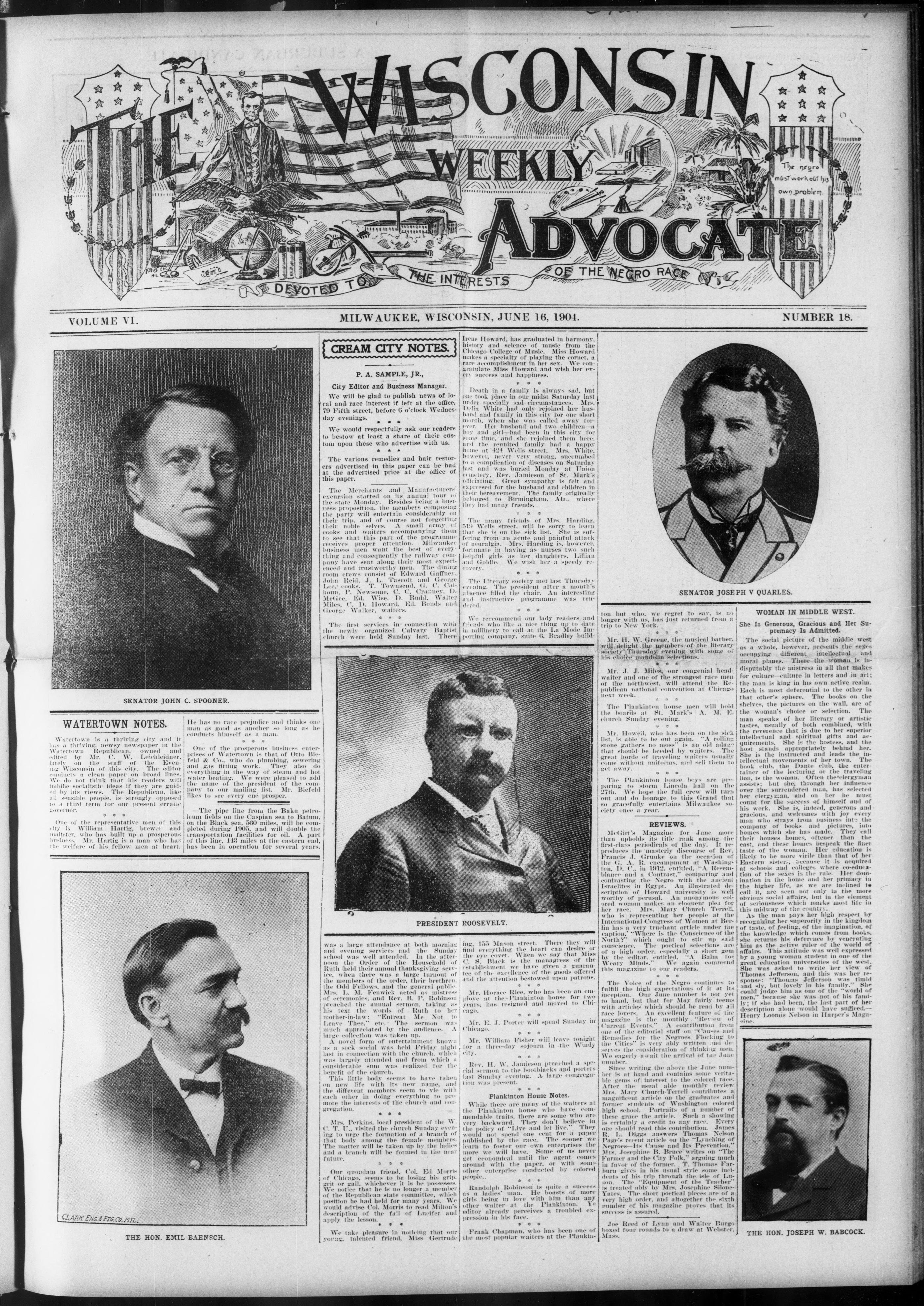
Page text (machine-generated)
WISCONSIN
WEEKLY
ADVOCATE
DEVOTED TO THE INTERESTS OF THE NEGRO RACE
```markdown
```
J.
SENATOR JOHN C. SPOONER
WATERTOWN NOTES.
WATERTOWN NOTES.
Watertown is a thriving city and it has a thriving, newsy newspaper in the Watertown Republican, owned and edited by Mr. C. W. Leichleidner, lately on the staff of the Evening Wisconsin of this city. The editor conducts a clean paper on broad lines. We do not think that his readers will imbibe socialistic ideas if they are guided by his views. The Republican, like all sensible people, is strongly opposed to a third term for our present erratic governor.
* * *
One of the representative men of this city is William Hartig, brewer and maltster, who has built up a prosperous business. Mr. Hartig is a man who has the welfare of his fellow men at heart.
CLARK ENG.8 PTG.CO. MIL.
MIL.
CLARK ENG.8 PIG.CO. MIL.
THE HON. EMIL BAENSCH.
---
VOLUME VI
* * *
He has no race prejudice and thinks one man as good as another so long as he conducts himself as a man.
* * *
One of the prosperous business enterprises of Watertown is that of Otto Biefeld & Co., who do plumbing, sewering and gas fitting work. They also do everything in the way of steam and hot water heating. We were pleased to add the name of the president of the company to our mailing list. Mr. Biefeld likes to see every one prosper.
—The pipe line from the Baku petroleum fields on the Caspian sea to Batum, on the Black sea, 560 miles, will be completed during 1905, and will double the transportation facilities for oil. A part of this line, 143 miles at the eastern end, has been in operation for several years.
MILWAUKEE, WISCONSIN, JUNE 16, 1904.
CREAM CITY NOTES.
We will be glad to publish news of local and race interest if left at the office, 79 Fifth street, before 6 o'clock Wednesday evenings.
We would respectfully ask our readers to bestow at least a share of their custom upon those who advertise with us.
The various remedies and hair restorers advertised in this paper can be had at the advertised price at the office of this paper.
The Merchants and Manufacturers' excursion started on its annual tour of the state Monday. Besides being a business proposition, the members composing the party will entertain considerably on their trip, and of course not forgetting their noble selves. A small army of cooks and waiters accompanying them to see that this part of the programme receives proper attention. Milwaukee business men want the best of everything and consequently the railway company have sent along their most experienced and trustworthy men. The dining room crews consist of Edward Gaffney, John Reid, J. L. Tascott and George Lee, cooks. T. Townsend, G. C. Calhoun, P. Newsome, C. C. Cranney, D. McGee, Ed. Wise, D. Budd, Walter Miles, C. D. Howard, Ed. Bonds and George Walker, waiters.
The first services in connection with the newly organized Calvary Baptist church were held Sunday last. There
9
T. E.
PRESIDENT ROOSEVELT.
was a large attendance at both morning and evening services and the Sunday school was well attended. In the afternoon the Order of the Household of Ruth held their annual thanksgiving service, when there was a large turnout of the members of the order, their brethren, the Odd Fellows, and the general public. Mrs. L. M. Fenwick acted as mistress of ceremonies, and Rev. B. P. Robinson preached the annual sermon, taking as his text the words of Ruth to her mother-in-law: "Entreat Me Not to Leave Thee." etc. The sermon was much appreciated by the audience. A large collection was taken up.
A novel form of entertainment known as a sock social was held Friday night last in connection with the church, which was largely attended and from which a considerable sum was realized for the benefit of the church.
This little body seems to have taken on new life with its new name, and the different members seem to vie with each other in doing everything to promote the interests of the church and congregation.
* * *
Mrs. Perkins, local president of the W. C. T. U., visited the church Sunday evening to urge the formation of a branch of that body among the female members. The matter will be taken up by the ladies and a branch will be formed in the near future.
Our quondam friend, Col. Ed Morris of Chicago, seems to be losing his grip, grit or gall, whichever it is he possesses. We notice that he is no longer a member of the Republican state committee, which position he had held for many years. We would advise Col. Morris to read Milton's description of the fall of Lucifer and apply the lesson.
* * *
We take pleasure in noticing that our young, talented friend, Miss Gertrude
---
P. A. SAMPLE, JR.
---
```markdown
```
Irene Howard, has graduated in harmony, history and science of music from the Chicago College of Music. Miss Howard makes a specialty of playing the cornet, a rare accomplishment in her sex. We congratulate Miss Howard and wish her every success and happiness.
Death in a family is always sad, but one took place in our midst Saturday last under specially sad circumstances. Mrs. Delia White had only rejoined her husband and family in this city for one short month, when she was called away forever. Her husband and two children—a boy and girl—had been in this city for some time, and she rejoined them here, and the reunited family had a happy home at 424 Wells street. Mrs. White, however, never very strong, succumbed to a complication of diseases on Saturday last and was buried Monday at Union cemetery. Rev. Jamieson of St. Mark's officiating. Great sympathy is felt and expressed for the husband and children in their bereavement. The family originally belonged to Birmingham. Ala., where they had many friends.
The many friends of Mrs. Harding, 519 Wells street, will be sorry to learn that she is on the sick list. She is suffering from an acute and painful attack of neuralgia. Mrs. Harding is, however, fortunate in having as nurses two such helpful girls as her daughters, Lillian and Goldie. We wish her a speedy recovery.
* * *
The Literary society met last Thursday evening. The president after a month's absence filled the chair. An interesting and instructive programme was rendered.
* * *
We recommend our lady readers and friends who like a nice thing up to date in millinery to call at the La Mode Importing company, suite 6, Bradley build-
5
ing, 155 Mason street. There they will find everything the heart can desire or the eye covet. When we say that Miss C. S. Black is the managress of the establishment we have given a guarantee of the excellence of the goods offered and the attention bestowed upon patrons.
* * *
Mr. Horace Rice, who has been an employee at the Plankinton house for two years, has resigned and moved to Chicago.
* * *
Mr. E. J. Porter will spend Sunday in Chicago.
* * *
Mr. William Fisher will leave tonight for a three-day sojourn in the Windy city.
Rev. H. W. Jamieson preached a special sermon to the bootblacks and porters last Sunday evening. A large congregation was present.
Plankinton House Notes.
While there are many of the waiters at the Plankinton house who have commendable traits, there are some who are very backward. They don't believe in the policy of "Live and let live." They would not spend one cent for a paper published by the race. The sooner we learn to foster our own enterprises the more we will have. Some of us never get economical until the agent comes around with the paper, or with some other enterprise conducted by colored people.
* * *
Randolph Robinson is quite a success as a ladies' man. He boasts of more girls being in love with him than any other waiter at the Plankinton. Ye editor already perceives a troubled expression in his face.
Frank Chapman, who has been one of the most popular waiters at the Plankin-
* * *
```markdown
```
[Image of a man with a mustache and wavy hair, wearing a suit with a bow tie. The background is plain white.]
SENATOR JOSEPH V OUARLES
ton but who, we regret to say, is no longer with us, has just returned from a trip to New York.
Mr. H. W. Greene, the musical barber, will delight the members of the literary society Thursday evening with some of his choice mandolin selections.
Mr. J. J. Miles, our congenial headwaiter and one of the strongest race men of the northwest, will attend the Republican national convention at Chicago next week.
The Plankinton house men will hold the boards at St. Mark's A. M. E. church Sunday evening.
Mr. Howell, who has been on the sick list, is able to be out again. "A rolling stone gathers no moss" is an old adage that should be heeded by waiters. The great horde of traveling waiters usually come without uniforms, and sell them to get away.
The Plankinton house boys are preparing to storm Lincoln hall on the 27th. We hope the full crew will turn out and do homage to this Grand that so gracefully entertains Milwaukee society once a year.
REVIEWS.
McGirt's Magazine for June more than upholds its title rank among the first-class periodicals of the day. It reproduces the masterly discourse of Rev. Francis J. Grunke on the occasion of the G. A. R. encampment at Washington, D. C., in 1912, entitled, "A Resemblance and a Contrast," comparing and contrasting the Negro with the ancient Israelites in Egypt. An illustrated description of Howard university is well worthy of perusal. An anonymous colored woman makes an eloquent plea for her race. Mrs. Mary Church Terrell, who is representing her people at the International Congress of Women at Berlin has a very truchant article under the caption, "Where is the Conscience of the North?" which ought to stir up said conscience. The poetical selections are of a high order, especially a short gem by the editor, entitled, "A Balm for Weary Minds." We again commend this magazine to our readers.
The Voice of the Negro continues to fulfill the high expectations of it at its inception. Our June number is not yet to hand, but that for May fairly teems with articles which should be read by all race lovers. An excellent feature of the magazine is the monthly "Review of Current Events." A contribution from one of the editorial staff on "Causes and Remedies for the Negroes Flocking to the Cities" is very ably written and deserves the consideration of thinking men. We eagerly await the arrival of the June number.
Since writing the above the June number is at hand and contains some veritable gems of interest to the colored race. After the usual able monthly review Mrs. Mary Church-Terrell contributes a magnificent article on the graduates and former students of Washington colored high school. Portraits of a number of these grace the article. Such a showing is certainly a credit to any race. Every one should read this contribution. James R. L. Diggs answers Thomas Nelson Page's recent article on the "Lynching of Negroes—Its Cause and Its Prevention." Mrs. Josephine B. Bruce writes on "The Farmer and the City Folk," arguing much in favor of the former. T. Thomas Farburn gives in his usual style some incidents of his trip through the isle of Luzon. The "Equipment of the Teacher" is treated ably by Mrs. Josephine Silone-Yates. The short poetical pieces are of a very high order, and altogether the sixth number of his magazine proves that its success is assured.
Joe Reed of Lynn and Walter Burgo boxed four rounds to a draw at Webster, Mass.
☆ ☆ ☆
WOMAN IN MIDDLE WEST.
She Is Generous, Gracious and Her Supremacy Is Admitted.
The social picture of the middle west as a whole, however, presents the sexes occupying different intellectual and moral planes. There the woman is indisputably the mistress in all that makes for culture—culture in letters and in art; the man is king in his own active realm. Each is most deferential to the other in that other's sphere. The books on the shelves, the pictures on the wall, are of the woman's choice or selection. The man speaks of her literary or artistic tastes, usually of both combined, with the reverence that is due to her superior intellectual and spiritual gifts and requirements. She is the hostess, and the host stands appropriately behind her. She is the instructed and leads the intellectual movements of her town. The book club, the Dante club, the entertainer of the lecturing or the traveling lion, is the woman. Often the clergyman assists; but she, through her influence over the surrendered man, has selected her clergyman, and on her he must count for the success of himself and of his work. She is, indeed, generous and gracious, and welcomes with joy every man who strays from business into the company of books and pictures, into homes which she has made. They call their houses homes, oftener than the east, and these homes bespeak the finer taste of the woman. Her education is likely to be more virile than that of her Eastern sisters, because it is acquired at schools and colleges where co-education of the sexes is the rule. Her domination in the home and her primacy in the higher life, as we are inclined to call it, are seen not only in the more obvious social affairs, but in the element of seriousness which marks most life in this midway of the country.
As the man pays her high respect by recognizing her superiority in the kingdom of taste, of feeling, of the imagination, of the knowledge which comes from books, she returns his deference by venerating him as the active ruler of the world of affairs. This attitude was well expressed by a young woman student in one of the great education universities of the west. She was asked to write her view of Thomas Jefferson, and this was her response: "Thomas Jefferson was timid and sly, but lovely in his family." She could judge him as one of the "world of men," because she was not of his family; if she had been, the last part of her description alone would have sufficed. Henry Loomis Nelson in Harper's Magazine.
1900
THE HON. JOSEPH W. BABCOCK.
Curious Condensations. It was stated in the House of Commons the other day that thirty members of the Irish Nationalist party had served terms of hard labor in prison. It is said that raisins absorb alcohol, and that if a beer drinker eats three or four of them with each glass of beer the alcohol will not enter the blood. The graduating class at West Point this year numbers 125, the largest in the history of the academy. The honor men are all from the south except one.
Four of the cannon taken from the French off Finisterre in 1747 by Admiral Boscawen now fill the lowly, if useful, roles of curb posts and lamp posts in front of the house, 2 St. James' square, London, of Boscawen's descendant, Lord Falmouth.
Exporters of gold always prefer to ship in bars rather than coin, simply because of the greater subjection of coin to abrasion in transit. They cannot be packed as closely as bars. It is said that $1,000,000 in American eagles may show as great a loss as $100 from abrasion in being carried from New York to Paris.
The United States is not the only country to make war on quacks and quack medicines. The German police have begun a systematic campaign against them. They estimate that in ten years the population has increased 58 per cent., regular medical men 76 per cent. and quacks 1567 per cent. There are more women quacks than men.
Asphalt continues to be the most valuable mineral if Trinidad. The value of the exports has increased from $537,000 in 1895 to $810,000 in 1903. Up to last year this industry had suffered to some extent from long and costly litigations, but a special commission of inquiry has recently made recommendations which it is hoped will prevent litigation.
An enterprise in Algeria is to manufacture natural soap on a large scale from a tree known as "Sapindus utilis." This plant, which has long been known in Japan, China and India, bears a fruit of about the size of a horse chestnut, smooth and round. The color varies from a yellowish green to brown. The inner part of a dark color and has an oily kernel. The tree bears fruit in its sixth year and yields from 55 to 220 pounds of fruit, which can easily be harvested.
Some of the girls at Wellesley college in Massachusetts carry pistols nowadays. The authorities of the college of late have been considerably alarmed by repeated visits to the college grounds of numbers of tough looking young men after nightfall. These unwelcome visitors, it is thought, come from nearby towns with the intention of "flirting" with or scaring the young women. So stirred up are the authorities over the matter that they have forbidden the girls to go out alone on the college grounds after dark.
There are beetles in England (of the family known to scientists as Telephoridae) that are popularly called soldiers and sailors, the red species being called by the former name and the blue species by the latter. These beetles are among the most quarrelsome of insects and fight to the death on the least provocation. It has long been the custom among English boys to catch and set them fighting with each other. They are as ready for battle as game cocks, and the victor will both kill and eat his antagonist.
Baroness Halkett, eldest daughter of Aunon Phelps Stokes, no longer makes even an outward show of living with her Austrian husband, and there will be legal separation before long it is thought. Their marriage was a splendid affair, and for a while the baroness shone in the exclusive society of Vienna, but eventually she quarreled with her middle-aged, high-tempered husband and returned to America. Her sister, who married Robert Hunter, head of the University Settlement, is leading a really happy life. She and her husband seldom stir from their country estate in Noroton.
Here is a list of penalties for various crimes, according to Korean law: Treason, man decapitated, together with male relatives to the fifth degree, mother, wife and daughter poisoned or reduced to slavery; treason, woman poisoned. Murder, man decapitated, wife poisoned; murder, woman strangled or poisoned. Arson, man strangled or poisoned, wife poisoned; arson, woman poisoned. Theft, man strangled, decapitated or banished, wife reduced to slavery, confiscation of all property; desecration of graves, decapitated, together with male relatives to the fifth degree, mother, wife and daughter poisoned; counterfeiting, strangulation or decapitation, wife poisoned.
Wouldn't Stand for Her.
Oliver
Moore
"I shan't put up with your conduct any longer. I intend to go home to mother."
"Well, anything is preferable to having her here."
Where Woman Is Heroic.
The determination to do her duty at all costs inspires the society woman of today as much as it did the defenders of the British flag at Trafalgar. She goes into action with a grim resolve to dance and dine as all her friends expect. Though her back is aching, her head splitting, and she knows she is gruesomely bored, she will heroically go through her day's programme, fortified by the consciousness of having done her duty.—Ladies' Field.
Not a Corrective
Gibbey—Lot of words misspelled in this letter, Miss Keyler. I shall have to devise some means of curing you of a bad habit. Guess I shall have to kiss you for every word spelled wrong.
Miss Keyler—Mercy! That would make me so nervous I shouldn't be able to spell even the simplest word right.—Boston Transcript.
Prospects of Watermelon Crop in Texas.
It is feared now that unfavorable seasons will so reduce the Texas watermelon crop that it will not exceed 167,000,000 melons.—Fort Worth Record.
SWEET ARE THE FRUITS.
Sweet are the fruits that I've tasted off,
Summers long-flown when zephyrs soft
Kissed the cheeks, ruddy with glowing
youth,
Sparkling of eye and longing of tooth.
Fair are the arbored paths that I've trod,
Dark, spreading meshes o'er velvet sod--
Daring to climb the uttermost reach
For treasures jeweled with dew.
But oh for the unbrushed blush of the peach.
The grape in its untouched blue!
Sweet are the nectars that I have sought.
Ecestasy deep a moment has fraught.
The next in bitter repentance cast,
Dead Sea fruit it had proven at last—
Mellow the radiance Time has shed
Over far scenes of the summer sped.
Learned are the lessons experiences teach,
Sifted the false from the true.
But oh for the unbrushed blush of the
peach.
The grape in its untouched blue!
—George Henry Daugherty in the Woman's
Home Companion.
A STRANGE LEGACY.
Homeward through the murk and gloom of a November evening, through the dank night air and gathering fog, along greasy pavements and over slippery crossings, across the great bridge, with the yawning darkness on either side, and down the mean streets of southern London, wearily but steadily Mary. MacAllister bent her way.
Three years of hard work as a typist in a city office, three years of lonely struggle with fortune had robbed Mary's cheek of the bloom it boasted when she was 19, but still she strode on her way, morning and evening, backward and forward to and from the city, where her work lay, a brave, earnest-minded, steady-eyed woman, a typical figure of London's women workers.
Sometimes there would be a suspicion of moisture in the big gray eyes when work was more than usually irksome or employers more than usually irate and unreasonable.
Sometimes for a moment her mind would stray from the dark, close office to the glorious fields and hedgerows which from babyhood she had looked upon as hers in time to come. Now and again as she ate her solitary meal in her poor little room in her shabby house in a third-rate street just beyond "the Elephant," the memory of the plenty in the old days brought a shadow for a moment, and then the memory of Dick—her Dick—would chase the little cloud away. If Dick could be brave and go away to Africa to win a fortune for her, she would be brave, too. Dick had faced the crash, which four years ago had ruined alike his father and hers, quietly and uncomplainingly. She had refused his offer to release her from the engagement to him, and with mutual protestations of love and fidelity they had parted—he to seek wealth across the seas, she to earn her living as best she could in the most world of London
Many a letter from Dick lay carefully folded in her little workbox, letters which she had read again and again when the struggle was hard and her heart grew faint. They told of progress, slow but sure, until—until eighteen months before, when the black cloud of war lowered, and ruin had for the second time in his young life stopped at Dick Herrick's door. With the first clash of arms his employment ceased, the land he had invested his savings in was seized by the Boers, while he himself was commandeered and imprisoned as the result of his refusing to fight against his own countrymen. Since then—since she had lived at her present address—no news had come to lighten her sorrow, to relieve her anxiety.
On her doorstep she met her landlady, Mrs. Bird, who had been shopping round the corner. Mrs. Bird was well meaning, but rather massive, and sometimes more than aggressive.
"You are late this evening," Mrs. Bird asserted, tartly.
"Yes—I—I—am, rather," nervously responded Mary; "I was a little behind at the office, and I've walked."
"Walked, a night like this! Then you'd no business. S'pose you caught cold and got laid up?"
"The buses were full, and I—I couldn't afford a cab, you know," Mary answered, smiling gently.
"No, in course, though you might do that a night like this if you didn't go saddlin' yourself with that foreign fiddler man upstairs."
Mrs. Bird closed the door with an angry little bang as she followed Mary into the passage.
"Oh, hush, please. Mrs. Bird; think how ill the poor fellow has been."
now in the poor yellow has been.
"Ill—course he has, and you, with all you can do to keep yourself, must go and look after him. Nonsense, that's what I call it! What do we pay rates for, and keep up that there palace round the corner for, if it ain't for such as him?" "But, you don't understand, Mrs. Bird; he is not a common man; he is an artist and a gentleman. It would kill him to be sent to such a place—I know—I feel it—just as it would kill me to be sent there. Our cruel fogs have brought him to death's door, and as he has lain insensible—up there—delirious, raving—his tongue has told me the tale of his sunny home away yonder in Italy, of the poverty which drove him here to earn his bread, of his music, which is like life to him. And now—now he is better, be patient still for a little longer. I will give him all the attention I can, and save you as much as possible. The money that is owing you I will pay, gladly, willingly, a little at a time. See, here is some that I have earned working late. Take it, and let me have my own way, won't you? Ah, you will! Thank you, Mrs. Bird! As I tend him and help him, poor fellow, so I pray that a woman's hand may help the man I love, should he need it."
She turned slowly and mounted the stairs. Mrs. Bird looked after her a moment irresolutely. "Humph!" she muttered, "that gal's too good for this world."
* * * * * * *
"You are better—ah, I'm so glad. Now, lie still, or I shall be angry."
"Angry, you, cara mia! Ah, but no—how can an angel be angry?"
Mary smiled. "Your illness has not made you forget your compliments," she said, lightly.
Mary MacAllister had stolen into the sick man's room, after taking off her hat and jacket, and had found him up and dressed and sitting in front of the fire. The firelight shone on his handsome face, so drawn and pale, on his hands, so thin and white. Mrs. Bird had during the day given off some of "her views," and Carlo Terrini knew for the first time what Mary MacAllister had done for him in the hour of his extremity.
"Compliments! What words of mine can be called compliments, after what you have done for me?"
Mary started. "You know?"
"Yes, the good Signora Bird has told me."
"Then she ought not to have done so. It is nothing—nothing. I repeat. And you must not think of it again, or—"
She paused and the man looked at her inquiringly. "Or what, Mees MacAlleester?"
"Or I shall not be able to come and see you—or—or help you any more."
"But." said Carlo, weakly, "I—I do not understand. It is but the truth. You have saved my life, mia cara mia. I must thank you—I must pour out my gratitude to you—from my soul."
He stopped, exhausted for a moment, and then went on excitedly: "I—I have
been thinking of you, longing to see you—to look on you—to, perhaps—be able to take your little hand—so—and kiss it, and let fall my tears—as of blood, on it. You have saved my life—you have done more—you have inspired me—I have been dreaming a picture of you, as I lay watching the fire, a vision of goodness, so high, so pure, so true, and the melody came. I heard, somewhere—away, up above me, in God's air, a host chanting your praises; the music they sang was the melody my soul has sought so long. I put it in my work. That work at last will be complete. It will triumph, for none can resist such music as this."
He rose abruptly, with sudden strength. Then he staggered across the room to where a violin lay in its case. Mary MacAllister uttered a cry, and laid a restraining hand on his arm.
"What are you doing?" she cried. "You will kill yourself if you exert yourself like this."
The violinist took up his instrument and crept back to his chair.
"No, it is life to me to play, and you must hear. Then you shall tell me if it is good enough for my opera."
He seated himself and began to play. The girl, seeing remonstrance useless, quietly dropped into a seat and listened. For a few moments she heard only music she had heard him play before—in the days when he was well. Then suddenly her lips parted, and she sat breathless. From the instrument poured a melody almost unearthly. The man played as if inspired. It was as if voices from another world were speaking. On, on he went—from a paean of praise to a frenzy of passion, from a hurricane of hope to a dirge of despair.
And then on again, higher and higher, faster and faster the liquid melody poured from the violin, until, with one great overpowering chord of grandeur, the music stopped and the bow fell from his nerveless hand, while the musician sank back panting, exhausted, but triumphant, in his chair.
So engrossed had he been with his beloved music, so enraptured had been the girl with the marvelous strains that Carlo Terrini had evoked, that neither had heard the footsteps that had mounted the stairs, nor seen the form that now stood in the doorway. Gently the girl chided the poor violinist for his great exertion, sweetly she bade him good-night aud rest, slowly she turned from him to the door. For a moment she gazed, as if looking on the dead, then with a cry of passionate gladness she flew to the outstretched arms, crying "Dick"
And as the lovers passed from the room and the door closed behind them, Carlo Terrini's head fell, and a great sob shook him from head to foot.
Downstairs in Mrs. Bird's front parlor Dick Herrick's story was soon told. After months of imprisonment at Watervaal he had recovered his liberty, but not his rights. The Dutchman who had sold him the land was now in possession of it again, and was disputing his title. Too poor to take the necessary legal action to recover, he had returned to England as poor as he left it four years before.
The next morning Mary, dressed for the city, paid her usual visit to Carlo Terrini before going. She found him very ill. He confessed that he had not been to bed. He had been working all through the long night, writing the music he had composed and played to her into his opera.
"But now, now you have finished," she pleaded, "you will sleep—and rest?"
"Yes, cara mia. I will rest—soon—I promise you," and as the door closed behind her, he added, with a wan smile, "forever."
Two hours after she had gone Carlo Terrini let himself out of the house without a sound and made his way to a West End music firm, the head of which was a compatriot of his.
After a few minutes' talk he persuaded him to listen to the opera, which he played through without a break.
Astonished and delighted, the publisher instantly concluded a bargain with him, and Carlo Terrini crept home and fell exhausted on the bed, from which he never rose again.
A few hours before he died he gave a letter, sealed, to Mary MacAllister, and whispered her to keep it till he was dead. The day after he was laid to rest Mary MacAllister, remembering the letter, opened it and read the last words of her dead friend. He had given her the opera which she had inspired, and which had cost him his life.
Two years later Mary Herrick looked down into the face of her first-born. With the money which had poured in on her like a golden stream from Carlo Terrini's work her husband had fought and won his cause, and was now on his way to becoming a South African millionaire. With opulence around her, a child she adored, and a husband she worshipped at her side, there was yet a wistful sadness in her look as she gazed at her little one. Her husband caught her glance, and laid his hand gently on her shoulder.
"You have something to ask me?" he said gently.
"Yes, a little favor, dear." she hesitated.
"What could I refuse you? Tell me."
"Let our little one be named—Carlo."
Let our little one be named—Carlo.
"Your wish is mine, dearest. What better name than the name of that noble soul to whom we owe our all?"—London Tit-Bits.
Wanted the Result.
"Horse racing is a heroic sport, and to this feature alone is due its intense fascination," said Wallace P. Herndon of Chicago at the Galt house last night. Mr. Herndon had just come down from Latonia, loaded with his winnings.
"People who condemn the sport seem to forget the heroic feature.
"Recently I perpetrated a sorry trick on one of these folks, and it was a clergyman, too. As an eye witness I described the running of a great handicap, and to make it more interesting I proceeded to color my story a bit to tell how a certain horse was challenged repeatedly from the start and how the race was in doubt up to the last moment.
"I left the field a few jumps from the finish. Then I said:
"I knew a famous horseman once, who said that a race horse is of interest to only three persons—the kid that rides him, the lobster that bets on him and the thief that owns him."
"Yes, yes," cried the clergyman, impatiently, "but which of those horses won on the day you spoke of?"—Louisville Herald.
Safest Place to Draw It.
Prof. E. G. Dexter, of the University of Illinois, whose interesting investigations have proved football to be a harmless game, is popular on account of his geniality.
After a certain football victory Prof. Dexter entertained one night a group of students at his residence.
A magnificent sword hung over the fireplace of the library, and during a space of silence Prof. Dexter took down this sword and brandished it impressively.
"Never will I forget," he exclaimed, "the day I drew this blade for the first time."
"Where did you draw it, sir?" a freshman asked respectfully.
"At a raffle," said Prof. Dexter.—New York Tribune.
Mint Color Anyway
A novelty to serve with roast lamb is creme de menthe made like lemon ice, but using creme de menthe for flavoring
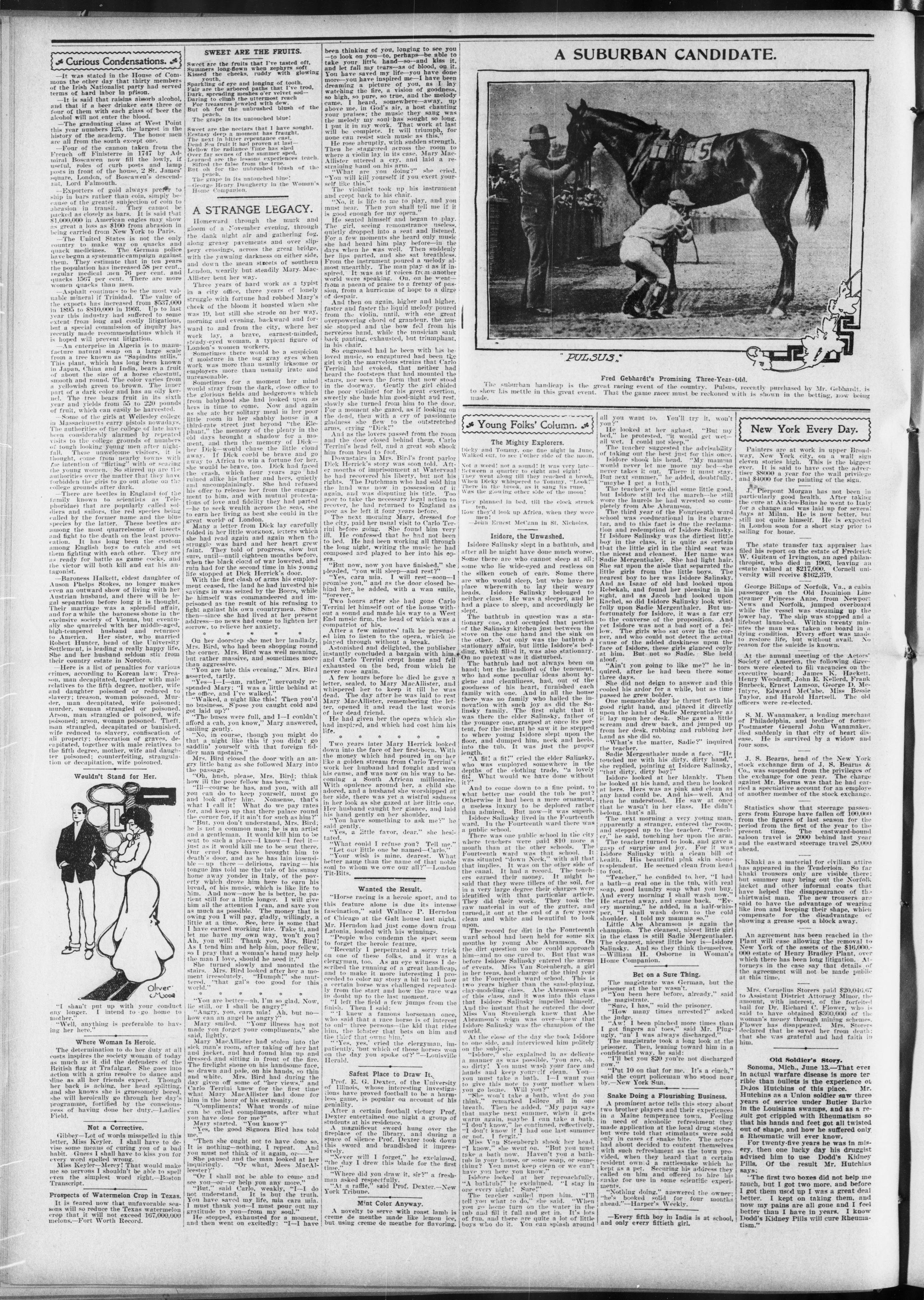
A SUBURBAN CANDIDATE.
"PULSUS."
The suburban handicap is the great racing event of the country. Pulsus, recently purchased by Mr. Gebhardt, is to show his mettle in this great event. That the game racer must be reckoned with is shown in the betting, now being made
The Mighty Explorers.
Dicky and Tommy, one fine night in June,
Walked out, to see t'other side of the moon.
Not a word! not a sound! it was very late—
Between a quarter to eight and eight!
They went along till they reached a brook,
When Dicky whispered to Tommy, "Look!"
There in the brook, as it sang its rune,
Was the glowing other side of the moon!
They planned in bed, till the clock struck
ten.
How they'd look up Africa, when they were
ow they'd look up Africa, when they were men!
men. John Ernest McCann in St. Nicholas.
Isidore, the Unwashed.
Isidore Salinsky slept in a bathtub, and after all he might have done much worse. Some there are who cannot sleep at all; some who lie wide-eyed and restless on the silken couch of care. Some there are who would sleep, but who have no place wherewith to lay their weary heads. Isidore Salinsky belonged to neither class. He was a sleeper, and he had a place to sleep, and accordingly he slept. The bathtub in question was a stationary one, and occupied that portion of the Salinsky kitchen just between the stove on the one hand and the sink on the other. Not only was the bathtub a stationary affair, but little Isidore's bedding, which filled it, was also stationary. On no pretext was it disturbed.
The bathtub had not always been on hand; but the landlord of the tenement, who had some peculiar ideas about hygiene and cleanliness, had, out of the goodness of his heart, furnished each family with one. And in all the house there was no family who hailed the innovation with such joy as did the Salinsky family. The first night that it was there the elder Salinsky, father of the younger one, grasped at once its portent, for the instant he saw it he stepped to where young Isidore slept upon the floor, and dumped him, neck and heels, into the tub. It was just the proper length.
"A fit! a fit!" cried the elder Salinsky, who was employed somewhere in the depths of the clothing trade, "a lovely fit! What would we have done without it?"
And to come down to a fine point, to what better use could the tub be put? Otherwise it had been a mere ornament, a useless luxury to be deplored rather than admired. But now—it was superb. Isidore Salinsky lived in the Fourteenth ward. In the Fourteenth ward there was a public school.
There was one public school in the city where teachers were paid $10 more a month than at the other schools. The Fourteenth ward was that school. It was situated "down Neck," with all that that implies. It was on the other side of the canal. It had a record. The teachers earned their money. It might be said that they were tillers of the soil, for in a very large degree their charges were identified with that particular article. They did their work. They took the raw material in out of the gutter, and turned it out at the end of a few years clean and white and beautiful to look upon.
The record for dirt in the Fourteenth ward school had been held for some six months by young Abe Abramson. On the dirt question no one could approach him—and no one cared to. But that was before Isidore Salinsky entered the arena of events. Miss Van Steenbergh, a girl in her teens, had charge of the third year at the Fourteenth ward school. This is two years higher than the sand-playing, clay-modeling class. Abe Abramson was of this class, and it was into this class that Isidore Salinsky impelled himself. And the instant that he entered the door Miss Van Steenbergh knew that Abe Abramson's reign was over—knew that Isidore Salinsky was the champion of the world. At the close of the day she took Isidore to one side, and interviewed him politely on the subject.
"Isidore," she explained in as delicate a manner as was possible, "you are, oh, so dirty! You must wash your face and hands and keep yourself clean. You—you must take a bath. I—I want you to give this note to your mother when you go home. Will you?" "She won't take a bath, what do you think," remarked Isilore all in one breath. Then he added, "My papa says that maybe next summer, when it gets warm again, maybe I can take a bath. "I don't know," he continued, reflectively, "I don't know if I had one last summer or not. I fergit." Miss Van Steenbergh shook her head. "I know," she went on. "But you must take a bath now. Haven't you a bath-tub in your house, or some soap, or something? You must keep clean or we can't have you here you know."
Isidore looked at her reproachfully. "A bathtub!" he exclaimed. "I stay in one every night! Sure." The teacher smiled upon him. "I'll tell you what to do," she said. "When you go home turn on the water in the tub and fill it full and get in. It's lots of fun, and there are quite a lot of little boys who do it. You can splash around
all you want to. You'll try it, won't you?
He looked at her aghast. "But my bed," he protested. "it would get wet—all wet. I could not sleep."
The teacher suggested the advisability of taking out the best just for this once. Isidore shook his head. "My mamma would never let me move my bed—she never takes it out. There it must stay. But next summer," he added, doubtfully, "maybe I get a bath."
The teacher's note did some little good, but Isidore still led the march—he still wore the laurels he had wrested so completely from Abe Abramson.
The third year of the Fourteenth ward school was coeducational in its character, and to this fact is due the reclamation and redemption of Isidore Salinsky. If Isidore Salinsky was the dirtiest little boy in the class, it is quite as certain that the little girl in the third seat was the nicest and cleanest. Her name was Sadie Mergenthaler. She had light hair. She sat upon the aisle that separated the little girls from the little boys. The nearest boy to her was Isidore Salinsky. And as Isaac of old had looked upon Rebekah, and found her pleasing in his sight, and as Jacob had looked upon Rachel, so did Isidore Salinsky look wistfully upon Sadie Mergenthaler. But unfortunately for Isidore, it was a far cry to the converse of the proposition. And yet Isidore was not a bad sort of a fellow. The girls who sat over in the corner, and who could not detect the actual cause of the added duskiness upon the face of Isidore, these girls glanced coyly at him. But not so Sadie. She held aloof.
"Ain't you going to like me?" he inquired, after he had been there some three days.
She did not deign to answer and this cooled his ardor for a while, but as time passed he grew bolder.
One memorable day he thrust forth his good right hand, and placed it directly upon the hand of Sadie Mergenthaler as it lay upon her desk. She gave a little scream and drew back, and jumped up from her desk, rubbing and rubbing her hand as she did so.
"What's the matter, Sadie?" inquired the teacher.
Sadie Mergenthaler made a face. "He touched me with his dirty, dirty hand," she replied, pointing at Isidore Salinsky, "that dirty, dirty boy!"
Isidore looked at her blankly. Then he looked at his hand, and then he looked at hers. Hers was as pink and clean as any hand could be. And his—well. And then he understood. He saw at once that he wasn't in her class. He didn't belong, that's all.
The next morning a very young man, apparently a stranger, entered the room, and stepped up to the teacher. "Teacher," he said, touching her upon the arm.
The teacher turned to look, and gave a gasp of surprise and joy. For it was Isidore Salinsky with a clean bill of health. His beautiful plnk skin shone resplendent. He seemed clean from head to foot.
"Teacher," he confided to her, "I had a bath—a real one in the tub, with real soap, good laundry soap what you buy. And every morning I shall wash now." He started away, and came back. "Every morning," he added, in a half-whisper. "I shall wash down to the cold shoulder. I told my mamma so." Little Abe Abramson is again the champion. The cleanest, nicest little girl in the class is still Sadie Mergenthaler. The cleanest, nicest little boy is—Isidore Salinsky. And so they think themselves.—William H. Osborne in Woman's Home Companion.
Bet on a Sure Thing.
The magistrate was German, but the prisoner at the bar wasn't. "You been here before, already," said the magistrate.
"Sure, I has," said the prisoner.
"How many times arrested?" asked the judge.
"Aw! I been pinched more times than I got fingers an' toes," said Mr. Plugugly, "an' I was always discharged."
The magistrate took a long look at the prisoner. Then, leaning toward him in a confidential way, he said:
"I'll bet you $20 you're not discharged now."
"Put 10 on that for me. It's a cinch," said the court policeman who stood near by.—New York Sun.
Snake Doing a Flourishing Business.
A prominent actor tells this story about two brother players and their experiences in a Maine temperance town. Feeling in need of alcoholic refreshment they made application at the local drug stores, but were told that stimulants were sold only in cases of snake bite. The actors had about decided to content themselves with such refreshment as the town provided, when they heard that a certain resident owned a rattlesnake which he kept as a pet. Securing his address they called on him and offered to hire his snake for use in some scientific experiments.
"Nothing doing," answered the owner; "he's booked solid for four months ahead."—Harper's Weekly.
—Every fifth boy in India is at school, and only every fiftieth girl.
Painters are at work in upper Broadway, New York city, on a wall sign eleven stories high. This is the biggest ever. It is said to have cost the advertiser $8000 a year for the wall privilege and $4000 for the painting of the sign.
J. Pierpont Morgan has not been in particularly good health. After taking the cure at Aix-les-Bains he went to Italy for a change and was laid up for several days at Milan. He is now better, but still not quite himself. He is expected in London soon for a short stay prior to sailing for home.
The state transfer tax appraiser has filed his report on the estate of Frederick W. Guiteau of Irvington, an aged philanthropist, who died in 1903, leaving an estate valued at $217,000. Cornell university will receive $162,379.
George Billups of Norfolk, Va., a cabin passenger on the Old Dominion Line steamer Princess Anne, from Newport News and Norfolk, jumped overboard while the vessel was steaming up the lower bay. The ship was stopped and a lifeboat launched. Within twenty minutes the man was taken on board in a dying condition. Every effort was made to restore life, but without avail. No reason for the suicide is known.
At the annual meeting of the Actors' Society of America, the following directors were elected to fill vacancies on the executive board: James K. Hackett, Henry Woodruff, John E. Kellerd, Frank Burbeck, Ernest Lamson, George D. McIntyre, Edward McCabe. Miss Bessie Taylor, and Harold Hartsell. The old officers were re-elected.
S. M. Wanamaker, a leading merchant of Philadelphia, and brother of former Postmaster General John Wanamaker, died suddenly in that city of heart disease. He is survived by a widow and four sons.
J. S. Bearns, head of the New York stock exchange firm of J. S. Bearns & Co., was suspended from the privileges of the exchange for one year. The charge against Mr. Bearns was that he had carried a speculative account for an employee of another member of the stock exchange.
Statistics show that steerage passengers from Europe have fallen off 100,000 from the figures of last season for the period from the first of the year to the present time. The eastward-bound saloon travel is 2000 behind last year and the eastward steerage travel 28,000 ahead.
Khaki as a material for civilian attire has appeared in the Tenderloin. So far khaki trousers only are visible there; but summer may bring out the Norfolk jacket and other informal coats that have helped the disappearance of the shirtwaist man. The new trousers are said to have the advantage of wearing like iron and keeping their shape, which compensate for the disadvantage of showing a grease spot a block away.
An agreement has been reached in the Plant will case allowing the removal to New York of the assets of the $16,000.-000 estate of Henry Bradley Plant, over which there has been long litigation. Attorneys in the case say that details of the agreement will not be made public at this time.
Mrs. Cornelius Storers paid $20,046.67 to Assistant District Attorney Minor, the amount, with interest, of the forfeited bail for Dr. Richard C. Flower, who is said to have obtained $300,000 of the woman's money through mining schemes. Flower has disappeared. Mrs. Storers declared that he saved her from death: that she was grateful and had faith in him.
Old Soldier's Story.
Sonoma, Mich., June 13.—That ever in actual warfare disease is more terrible than bullets is the experience of Delos Hutchins of this place. Mr. Hutchins as a Union soldier saw three years of service under Butler Barke in the Louisiana swamps, and as a result got crippled with Rheumatism so that his hands and feet got all twisted out of shape, and how he suffered only a Rheumatic will ever know.
For twenty-five years he was in misery, then one lucky day his druggist advised him to use Dodd's Kidney Pills. Of the result Mr. Hutchins says:
"The first two boxes did not help me much, but I got two more, and before I got them used up I was a great deal better. I kept on taking them, and now my pains are all gone and I feel better than I have in years. I know Dodd's Kidney Pills will cure Rheumatism."
GOSSIP FOR THE LADIES.
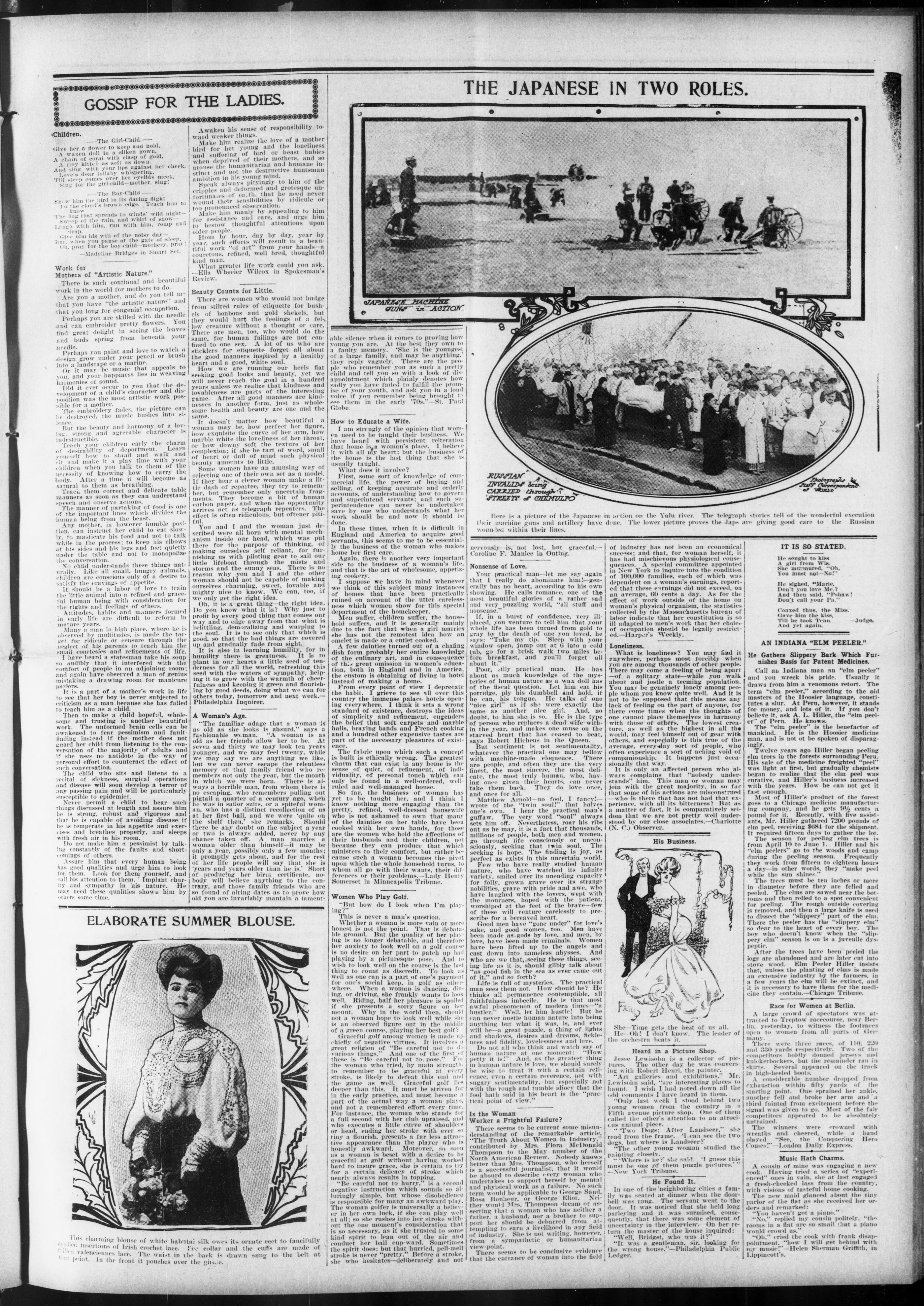
ELABORATE SUMMER BLOUSE.
ELABORATE SUMMER BLOUSE.
M.
This charming blouse of white habutai silk owes its ornate ect to fancifully applied insertions of Irish crochet lace. The collar and the cuffs are made of frilled valenciennes lace. The waist in the back is drawn snug to the belt at that point. In the front it pouches over the glove.
Give her a flower to keep and hold,
A waxen doll in a silken gown,
A chain of coral with clasp of gold,
A tiny kitten as soft as down:
And sing, with your lips against her cheek,
Love's dear lullaby whispering,
Till sleep comes over her eyelids meek,
Sing for the girl-child—mother, sing!
The Boy-Child.
Show him the bird in its daring flight
To the cloud's brown edge. Teach him to
know
The flag that spreads to winds' wild night—
Sweep of the rain, and whirl of snow—
Laugh with him, run with him, romp and
leap.
Give him his will of the noisy day—
But, when you pause at the gate of sleep,
Oh, pray for the boy-child—mothery, pray!
There is such continual and beautiful
work in the world for mothers to do.
Are you a mother, and do you tell me that you have "the artistic nature" and that you long for congenial occupation.
Perhaps you are skilled with the needle and can embroider pretty flowers. You find great delight in seeing the leaves and buds spring from beneath your needle.
Perhaps you paint and love to watch a design grow under your pencil or brush into a landscape or a marine.
Or it may be music that appeals to you, and your happiness lies in weaving harmonies of sound.
Did it ever occur to you that the development of a child's character and disposition was the most artistic work possible for a mother.
The embroidery fades, the picture can be destroyed, the music hushes into silence.
But the beauty and harmony of a loving, strong and agreeable character is indestructible.
Teach your children early the charm of desirability of deportment. Learn yourself how to stand and walk and sit and make it a play time with your children when you talk to them of the necessity of knowing how to carry the body. After a time it will become as natural to them as breathing.
Teach them correct and delicate table manners as soon as they can understand speech and observe actions.
The manner of partaking of food is one of the important lines which divides the human being from the beast.
Any mother, in however humble position, can instruct her child to eat slowly, to masticate his food and not to talk while in the process: to keep his elbows at his sides and his legs and feet quietly under the table and not to monopolize the conversation.
No child understands these things naturally. Like all small, hungry animals, children are conscious only of a desire to satisfy the cravings of appetite. It should be a labor of love to train the little animal into a refined and graceful human being with consideration for the rights and feelings of others. Attitudes, habits and manners formed in early life are difficult to reform in mature years. Many a man in high place, where he is observed by multitudes, is made the target for ridicule or censure through the neglect of his parents to teach him the small courtesies and refinements of life. I have heard a statesman take his soup so audibly that it interfered with the comfort of people in an adjoining room; and again have observed a man of genius mistaking a drawing room for manicure parlors.
It is a part of a mother's work in life to see that her boy is never subjected to criticism as a man because she has failed to teach him as a child. Then to make a child hopeful, wholesome and trusting is another beautiful work. The unformed brain cells can be awakened to fear pessimism and fault-finding instead if the mother does not guard her child from listening to the conversation of the majority of adults and if she uses no antidote in the way of personal effort to counteract the effect of such conversation. The child who sits and listens to a recital of sickness, surgical operations and disease will soon develop a terror of any passing pain and will be particularly susceptible to epidemics.
Never permit a child to hear such things discussed at length and assure him he is strong, robust and vigorous and that he is capable of avoiding disease if he is temperate in his appetite and exercises and breathes properly, and sleeps with fresh air in his room.
Do not make him a pessimist by talking constantly of the faults and short-comings of others.
Assure him that every human being has good qualities and urge him to look for them. Look for them yourself, and call his attention to them. Implant charity and sympathy in his nature. He may need these qualities shown him by others some time.
Awaken his sense of responsibility toward weaker things. Make him realize the love of a mother bird for her young and the loneliness and suffering of bird or beast babies when deprived of their mothers, and so arouse the humanitarian and humane instinct and not the destructive huntsmanulsion in his young mind.
Speak always pityingly to him of the cripples and deformed and grotesque unfortunances of earth, that he need never wound their sensibilities by ridicule or too pronounced observation.
Make him manly by appealing to him for assistance and care, and urge him to bestow thoughtful attentions upon older people.
Hour by hour, day by day, year by year, such efforts will result in a beautiful work "of art" from your hands—a courteous, refined, well bred, thoughtful kind man.
What greater life work could you ask.—Ella Wheeler Wilcox in Spokesman's Review.
Beauty Counts for Little.
There are women who would not budge from stilted rules of etiquette for bush-els of bonbons and gold shekels, but they would hurt the feelings of a fellow creature without a thought or care. There are men, too, who would do the same, for human failings are not confined to one sex. A lot of us who are sticklers for etiquette forget all about the good manners inspired by a healthy heart and a good, white soul. How we are running our heels flat seeking good looks and beauty, yet we will never reach the goal in a hundred years unless we realize that kindness and lovableness are parts of the interesting game. After all good manners are kindnesses in another form, just as wholesome health and beauty are one and the same.
It doesn't matter how beautiful a woman may be, how perfect her figure, how exquisite the curve of her arm, how marble white the loveliness of her throat, or how downy soft the texture of her complexion; if she be tart of word, small of heart or dull of mind such physical beauty amounts to little.
Some women have an amusing way of selecting one of their own set as a model. If they hear a clever woman make a little dash of repartee, they try to remember, but remember only uncertain fragments. They become a bit of human carbon paper, and when the opportunity arrives act as telegraph repeaters. The effect is often ridiculous, but oftener pitiful.
You and I and the woman just described were all born with mental mechanism inside our head, which was put there for the purpose of thinking, of making ourselves self reliant, for furnishing us with piloting gear to sail our little lifeboat through the mists and storms and the sunny seas. There is no reason why you and I and the other woman should not be capable of making ourselves charming, sweet, lovable and mighty nice to know. We can, too, if we only get the right idea.
Oh, it is a great thing—the right idea. Do you know what it is? Why just to profit by every good thing that comes our way and to edge away from that what is belittling, demoralizing and warping to the soul. It is to see only that which is good, so that the bad things are covered up and gradually fade from sight.
It is also in learning humility, for in humility there is greatness. It is to plant in our hearts a little seed of tenderness for all the world, refreshing this seed with the waters of sympathy, helping it to grow with the warmth of cheerfulness and keeping it green and flourishing by good deeds, doing what we can for others today, tomorrow and next week.—Philadelphia Inquirer.
A Woman's Age.
"The familiar adage that a woman is as old as she looks is absurd," says a fashionable woman. "A woman is as old as her friends allow her to be. At seven and thirty we may look ten years younger, and we may feel twenty, while we may say we are anything we like, but we can never escape the relentless memory of that family friend who remembers not only the year, but the month in which we were born. There is always a horrible man, from whom there is no escaping, who remembers pulling out pigtail a quarter of a century ago, when he was in sailor suits, or a spiteful woman, who has a distinct recollection of us at her first ball, and we were 'quite on the shelf then,' she remarks. Should there be any doubt on the subject a year or two is always added, never by any chance taken off. A man marries a woman older than himself—it may be only a year, possibly only a few months; it promptly gets about, and for the rest of her life people will say that she is 'years and years older than he is.' Short of producing her birth certificate, nobody will believe anything to the contrary, and those family friends who are so found of airing dates as to prove how old you are invariably maintain a lament-
able silence when it comes to proving how young you are. At the best they own to a faulty memory. 'She is the youngest of a large family, and may be anything.' they reply vaguely. These are the people who remember you as such a pretty child and tell you so with a look of disappointment which plainly denotes how sadly you have failed to fulfill the promise of your youth, and ask you in a loud voice if you remember being brought to see them in the early "70s."—St. Paul Globe.
How to Educate a Wife.
I am strongly of the opinion that women need to be taught their business. We have heard with persistent reiteration that home is a woman's place. I believe it with all my heart; but the business of the home is the last thing that she is usually taught.
What does it involve?
First, some sort of knowledge of commercial life, the power of buying and selling, of keeping accurate and orderly accounts, of understanding how to govern and superintend servants; and such superintendence can never be undertaken save by one who understands what her work should be and now it should be done.
In these times, when it is difficult in England and America to acquire good servants, this seems to me to be essentially the business of the woman who makes home her first care.
Again, there is another very important side to the business of a woman's life, and that is the art of wholesome, appetizing cookery.
I suppose we have in mind whenever we think of this subject many instances of homes that have been practically ruined on account of the utter carelessness which women show for this special department of the homekeeper.
Men suffer, children suffer, the household suffers, and it is generally mainly due to the fact that when a girl marries she has not the remotest idea how an omelet is made or a cutlet cooked.
A few dainties turned out of a chafing dish form probably her entire knowledge of the culinary art, and in consequence of this great omission in women's education, both in England and in America, the custom is obtaining of living in hotel instead of making a home.
From every point of view I deprecate the habit. I grieve to see all over this country the immense palace hotels opening everywhere. I think it sets a wrong standard of existence, destroys the ideas of simplicity and refinement, engenders the belief that soft carpets and marble halls, braying bands and French cooking and a hundred other expensive tastes are part of the necessary pleasures of existence.
The fabric upon which such a concept is built is ethically wrong. The greatest charm that can exist in any home is the sense of quiet, of refinement, of individuality, of personal touch which can only be found in a well-ordered, well-ruled and well-managed house.
So far, the business of woman has yet to be taught her, and I think I know nothing more engaging than the pretty, refined, well-dressed housewife who is not ashamed to own that many of the dainties on her table have been cooked with her own hands, for those are the women who hold the affections of their husbands and their children, not because they can produce that which ministers to their comfort, but rather because such a woman becomes the pivot upon which the whole household turns, to whom all go with their wants, their differences or their problems.—Lady Henry Somerset in Minneapolis Tribune.
Women Who Play Golf.
"But how do I look when I'm playing?"
This is never a man's question.
Whether a woman is more vain or more honest is not the point. That is debatable ground. But the quality of her playing is no longer debatable, and therefore her anxiety to look well on a golf course is no desire on her part to patch up bad playing by a picturesque pose. And to wish to look well on the course is the last thing to count as discredit. To look as well as one can is a part of one's payment for one's social keep, in golf as elsewhere. When a woman is dancing, dining, or driving, she frankly wants to look well. Riding, half her pleasure is spoiled if she presents a sorry figure on her mount. Why in the world then, should not a woman hope to look well while she is an observed figure out in the middle of a green course, playing her best golf?
Graceful golf among women is made up chiefly of negative virtues. It involves a great religion of "Be careful not to do various things." And one of the first of these is "Be careful not to pose." For the woman who tried, by main strength, to remember to be graceful at every stroke, is likely to defeat this end and the game as well. Graceful golf lies deeper than this. It must be striven for in the early practice, and must become a part of the actual way a woman plays, and not a remembered effort every time. For instance, the woman who stands for a full second with her club upraised, and who executes a little curve of shoulders or head, ending her stroke with ever so tiny a flourish, presents a far less attractive appearance than the player who is honestly awkward. Moreover, so soon as a woman is beset with a desire to be graceful at golf without having worked hard to insure grace, she is certain to try for a certain delicacy of stroke which nearly always results in topping.
"Be careful not to hurry," is a second negative instruction which sounds so alluringly simple, but whose disobedience is responsible for many an awkward play. The woman golfer is universally a believer in her own luck, if she can play well at all; so she rushes into her stroke without the one moment's consideration that is so necessary, as if she trusted to some kind spirit to lean out of the air and conduct her ball cup-ward. Sometimes the spirit does; but that hurried, pell-mell stroke is never "pretty." Before a stroke, she who hesitates—deliberately and not
THE JAPANESE IN TWO ROLES.
Here is a picture of the Japanese in action on the Yalu river. The telegraph stories tell of the wonderful execution their machine guns and artillery have done. The lower picture proves the Japs are giving good care to the Russian wounded within their lines.
of industry has not been an economical success; and that, for woman herself, it has had mischievous physiological consequences. A special committee appointed in New York to inquire into the condition of 100,000 families, each of which was dependent on a woman's earnings, reported that these earnings did not exceed, on an average, 60 cents a day. As for the effect of work outside of the home on woman's physical organism, the statistics collected by the Massachusetts bureau of labor indicate that her constitution is so ill adapted to men's work that her choice of occupation should be legally restricted.—Harper's Weekly.
Loneliness.
What is loneliness? You may find it anywhere, perhaps most forcibly when you are among thousands of other people. There may come a feeling of being apart—of a solitary state—while you walk about and jostle a teeming population. You may be genuinely lonely among people whom you know quite well. And it is not to be supposed that this means any lack of feeling on the part of anyone, for there come times when the thoughts of one cannot place themselves in harmony with those of others. The lowest creature, as well as the highest in all the world, may feel himself out of gear with others, and especially is this true of the average, every-day sort of people, who often experience a sort of aching void of companionship. It happens just occasionally that way.
It is only an affected person who always complains that "nobody understands" him. This man or woman may join with the great majority, in so far that some of his actions are misconstrued—who is there that has not had that experience, with all its bitterness? But as a matter of fact, it is comparatively seldom that we are not pretty well understood by our close associates.—Charlotte (N. C.) Observer.
She—Time gets the best of us all. He—Oh! I don't know. The leader of the orchestra beats it.
Jesse Lewisohn is a collector of pictures. The other day he was conversing with Robert Henri, the painter.
"Art galleries and exhibitions." Mr. Lewisohn said, "are interesting places to haunt. I wish I had noted down all the odd comments I have heard in them.
"Only last week I stood behind two young women from the country in a Fifth avenue picture shop. One of them called the other's attention to an atrocious animal piece.
"Two Dogs: After Landseer," she read from the frame. "I can see the two dogs, but where is Landseer?
"The other young woman studied the painting closely.
"Where is he?" she said. "I guess this must be one of them puzzle pictures." New York Tribune.
In one of the neighboring cities a family was seated at dinner when the doorbell was rung. The servant went to the door. It was noticed that she held long parleying and it was surmised, consequently, that there was some element of uncertainty in the interview. On her return the master of the house inquired: "Well, Bridget, who was it?" "It was a gentleman, sir, looking for the wrong house."—Philadelphia Public Ledger.
nervously—is, not lost, but graceful.—
Caroline F. Manice in Outing.
Nonsense of Love.
Your practical man—let me say again that I really do abominate him!—generally has no heart, according to his own showing. He calls romance, one of the most beautiful glories of a rather sad and very puzzling world, "all stuff and nonsense."
If, in a burst of confidence, very ill-placed, you venture to tell him that your whole life has been turned from gold to gray by the death of one you loved, he says: "Take my tip. 'Sleep with your window open, jump out at 6 into a cold tub, go for a brisk walk two miles before breakfast, and you'll forget all about it."
Poor, silly practical man. He has about as much knowledge of the mysteries of human nature as a wax doll has of the fiscal question. Let him eat his porridge, ply his dumbbell and hold, if he can, his tongue. He talks of one "nice girl" as if she were exactly the same as another nice girl. And, no doubt, to him she is so. He is the type of person who replaces a dead wife within the year, and makes one muse on the starved heart that has ceased to beat, says Robert Hichens in the Queen. But sentiment is not sentimentality, whatever the practical one may bellow with machine-made eloquence. There are people, and often they are the very finest, the most sincere, the most delicate, the most truly human, who, having once given their hearts, can never take them back. They do love once, and once for all.
Matthew Arnold—no fool, I fancy!—wrote of the "twin soul!" that halves one's own. I hear the practical man's guffaw. The very word "soul" always sets him off. Nevertheless, roar his ribs out as he may, it is a fact that thousands, millions of people, both men and women, go through life consciously or unconsciously, seeking that twin soul. The seeking is hope. The finding is joy, as perfect as exists in this uncertain world. Few who have really studied human nature, who have watched its infinite variety, smiled over its unending capacity for folly, grown grave over its strange nobilities, grave with pride and awe, who have laughed with the lovers, wept with the mourners, hoped with the patient, worshiped at the feet of the brave—few of these will venture carelessly to prescribe for a bereaved heart.
Good man have "gone under" for love's sake, and good women, too. Men have been made as gods by love, and men, by love, have been made criminals. Women have been lifted up to the angels and cast down into nameless abysses. And who are we that, seeing these things, seeing life as it is, should glibly talk about "as good fish in the sea as ever came out of it," and so forth?
Life is full of mysteries. The practical man sees them not. How should he? He thinks all permanence contemptible, all faithfulness imbecile. He is that most awful phenomenon of modern times—"a hustler." Well, let him hustle! But he can never mustle human nature into being anything but what it was, is, and ever will be—a great puzzle, a thing of lights and shadows, desires and dreams, fickleness and fidelity, lovelessness and love.
Do not all who think and watch say of human nature at one moment: "How petty it is!" And, as the greatest thing in human nature is love, we should surely be wise to treat it with a certain reticence, even a certain reverence, not with sugary sentimentality, but especially not with the rough and tumble idiocy that the fool hath said in his heart is the "practical point of view."
Worker a Frightful Failure?
There seems to be current some misunderstanding of the remarkable article, "The Truth About Women in Industry," contributed by Mrs. Flora McDonald Thompson to the May number of the North American Review. Nobody knows better than Mrs. Thompson, who herself is a successful journalist, that it would be absurd to describe every woman who undertakes to support herself by mental and physical work as a failure. No such term would be applicable to George Sand, Rosa Bonheur, or George Eliot. Neither would Mrs. Thompson dream of asserting that a woman who has neither a father, a husband, nor a brother to support her should be debarred from attempting to earn a livelihood in any field of industry. She is not writing, however, from a sympathetic or humanitarian view-point.
There seems to be conclusive evidence that the entrance of woman into the field
His Business.
FYETTE
Heard in a Picture Shop.
He Found It.
---
IT IS SO STATED.
He sought to kiss
A girl from Wis.
She murmured, "Oh,
You must not—No!"
He sighed, "Marie,
Don't you love Me?!
And then said, "Pshaw!
Don't call your Pa."
Coaxed thus, the Miss.
Gave him the kiss,
Till he took Tenn. —Judge
And yet again,
AN INDIANA "ELM PEELER"
He Gathers Slippery Bark Which Furnishes Basis for Patent Medicines.
Call an Indiana man an "elm peeler" and you wreck his pride. Usually it draws from him a venomous retort. The term "elm peeler," according to the old masters of the Hoosier language, constitutes a slur. At Peru, however, it stands for money, and lots of it. If you don't believe it, ask A. L. Hiller, the "elm peeler" of Peru. He knows.
The "elm peeler" is the benefactor of mankind. He is the Hoosier medicine man, and is not of be spoken of disparag-
Twelve years ago Hiller began peeling elm trees in the forests surrounding Peru. His sale of the medicine freighted "peel" was light at first, but gradually chemists began to realize that the elm peel was curative, and Hiller's business increased with the years. How he can not get it fast enough.
Most of Hiller's product of the forest goes to a Chicago medicine manufacturing company, and he gets 9½ cents a pound for it. Recently, with five assistants, Mr. Hiller gathered 7200 pounds of elm peel, receiving $684 for the shipment. It required fifteen days to gather the lot.
The season for peeling elm trees is from April 10 to June 1. Hiller and his "elm peelers" go to the woods and camp during the peeling season. Frequently they work from fifteen to eighteen hours a day—in other words, they "make peel while the sun shines."
The trees must be ten inches or more in diameter before they are felled and peeled. The elms are sawed near the bottoms and then rolled to a spot convenient for peeling. The rough outside covering is removed, and then a large knife is used to dissect the "slippery" part of the elm. There the peeler has the "slippery elm" so dear to the heart of every boy. The boy who doesn't know when the "slippery elm" season is on is a juvenile dyspeptic.
After the trees have been peeled the logs are abandoned and are later cut into stove wood. Elm Peeler Hiller insists that, unless the planting of elms is made an extensive industry by the farmers, in a few years the elm will be extinct, and it is necessary to have them for the medicine they contain.—Chicago Tribune.
Race for Women at Berlin
A large crowd of spectators was attracted to Treptow racecourse, near Berlin, yesterday, to witness the footraces open to women from all parts of Germany.
There were three races, of 110, 220 and 330 yards respectively. Two of the competitors boldly donned jerseys and knickerbockers, but the remainder ran in skirts. Several appeared on the track in high-heeled boots.
A considerable number dropped from exhaustion within fifty yards of the starting point. One sprained her ankle, another fell and broke her arm and a third fainted from excitement before the signal was given to go. Most of the fair competitors appeared to be absolutely untrained.
The winners were crowned with wreaths and cheered, while a band played "See, the Conquering Hero Comes."—London Daily Express.
Music Hath Charms.
A cousin of mine was engaging a new cook. Having tried a series of "experienced" ones in vain, she at last engaged a fresh-cheeked lass from the country, with visions of tasteful home cooking.
The new maid glanced about the tiny parlor of the flat as she received her orders and remarked:
"You haven't got a piano."
"No," replied my cousin politely, "the rooms in a flat are so small that a piano would crowd us."
"Oh," cried the cook with frank disappointment, "how I will get behind with my music!"—Helen Sherman Griffith, in Lippincott's.
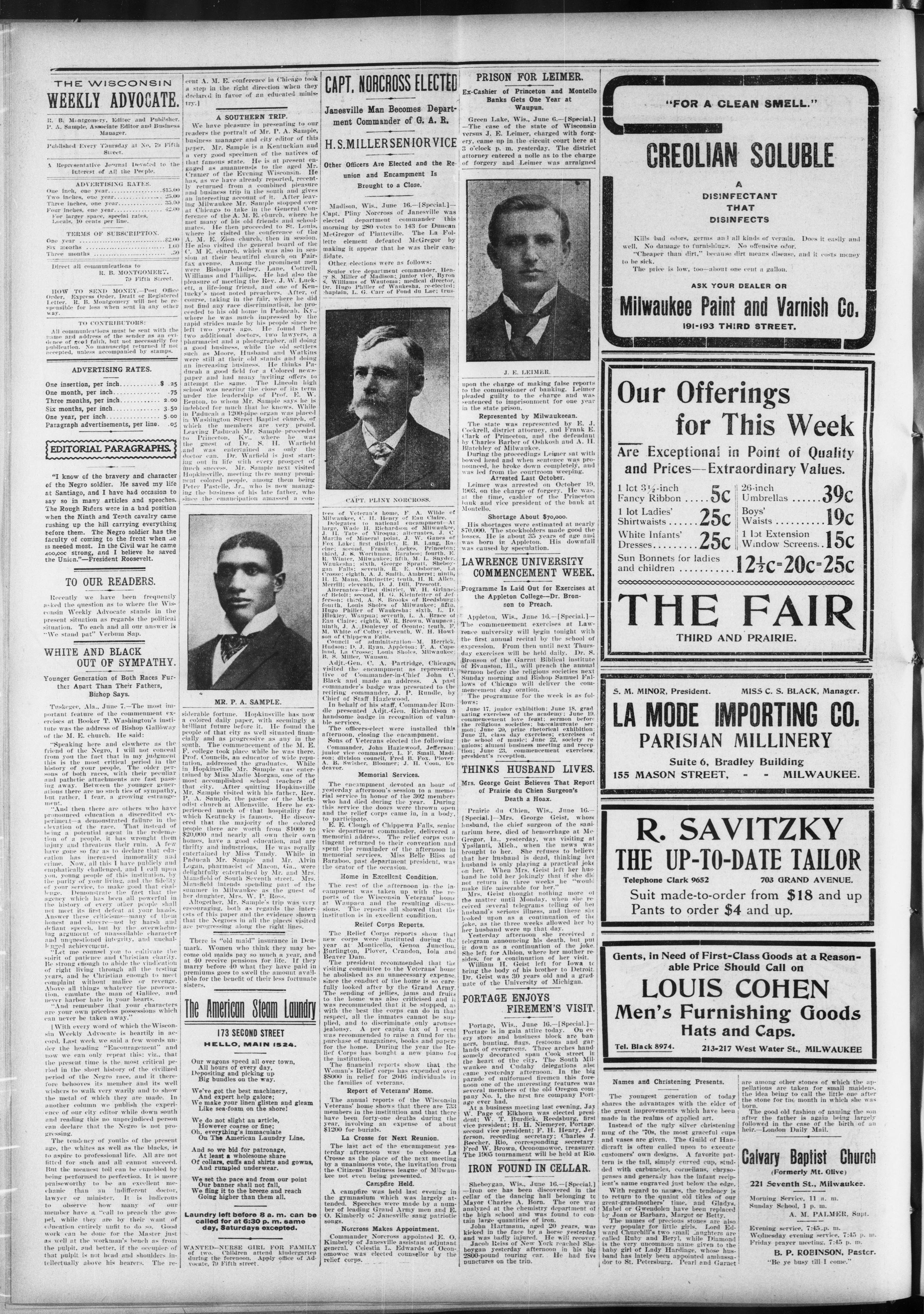
THE WISCONSIN WEEKLY ADVOCATE
R. B. Montgomery, Editor and Publisher.
P. A. Sample, Associate Editor and Business Manager.
Published Every Thursday at No. 79 Fifth Street.
A Representative Journal Devoted to the Interest of All the People.
ADVERTISING RATES.
One inch, one year.....$15.00
Two inches, one year.....25.00
Three inches, one year.....35.00
Four inches, one year.....42.00
For larger space, special rates.
Locals, 10 cents per line.
One year ..... $2.00
Six months ..... 1.00
Three months ..... .50
Direct all communications to
R. B. MONTGOMERY.
79 Fifth Street.
HOW TO SEND MONEY.—Post Office
Order, Express Order, Draft or Registered
Letter. R. B. Montgomery will not be
responsible for loss when sent in any other
way.
TO CONTRIBUTORS:
All communications must be sent with the name and address of the sender as an evidence of good faith, but not necessarily for publication. No manuscript returned if not accepted, unless accompanied by stamps.
ADVERTISING RATES.
One insertion, per inch. $ .25
One month, per inch. .75
Three months, per inch. 2.00
Six months, per inch. 3.50
One year, per inch. 5.00
Paragraph advertisements, per line. .05
"I know of the bravery and character of the Negro soldier. He saved my life at Santiago, and I have had occasion to say so in many articles and speeches. The Rough Riders were in a bad position when the Ninth and Tenth cavalry came rushing up the hill carrying everything before them. The Negro soldier has the faculty of coming to the front when he is needed most. In the Civil war he came 400,000 strong, and I believe he saved the Union."—President Roosevelt.
TO OUR READERS.
Recently we have been frequently asked the question as to where the Wisconsin Weekly Advocate stands in the present situation as regards the political situation. To each and all our answer is "We stand pat" Verbum Sap.
WHITE AND BLACK OUT OF SYMPATHY.
Younger Generation of Both Races Further Apart Than Their Fathers, Bishop Says.
Tuskegee, Ala., June 7.—The most important feature of the commenment exercises at Booker T. Washington's institute was the address of Bishop Galloway of the M. E. church. He said:
"Speaking here and elsewhere as the friend of the Negro, I will not conceal from you the fact that in my judgment this is the most critical period in the history of your people. The older persons of both races, with their peculiar and pathetic attachments are fast passing away. Between the younger generations there are no such ties of sympathy, but rather, I fear, a growing estrangement.
"And then there are others who have pronounced education a discredited experiment—a demonstrated failure in the elevation of the race. That instead of being a potential agent in the redemption of a people, it has wrought them injury and threatens their ruin. A few have gone so far as to declare that education has increased immorality and crime. Now, all this I have publicly and emphatically challenged, and I call upon you, young people of this institution, by the purity of your living, and the fidelity of your service, to make good that challenge. Demonstrate the fact that the agency which has been all powerful in the history of every other people shall not meet its first defeat at your hands. Answer these criticisms—many of them honest and sincere—not by harsh and defiant speech, but by the overwhelming argument of unassailable character and unquestioned integrity, and unchallenged achievement.
"Let me counsel you to cultivate the spirit of patience and Christian charity. Be strong enough to abide the vindication of right living through all the testing years, and be Christian enough to meet complaint without malice or revenge. Above all things whatever the provocation, emulate the man of Galilee, and never harbor hate in your hearts. And remember that your characters are your own priceless possessions which can never be taken away."
With every word of which the Wisconsin Weekly Advocate is heartily in accord. Last week we said a few words under the heading "Encouragement" and now we can only repeat this: viz., that the present time is the most critical period in the short history of the civilized period of the Negro race, and it therefore behooves its member and its well wishers to walk very warily and to show the metal of which they are made. In another column we publish the experience of our city editor while down south and reading this no unprejudiced person can declare that the Negro is not progressing.
The tendency of youths of the present age, the whites as well as the blacks, is to aspire to professional life. All are not fitted for such and all cannot succeed. But the meanest toil can be ennobled by being performed to perfection. It is more praiseworthy to be an excellent mechanic than an indifferent doctor, lawyer or minister. It is ludicrous to observe how many of our member have a "call to preach the gospel, while they are by their want of education entirely unfit to do so. Good work can be done for the Master just as well at the workman's bench as from the pulpit, and better, if the occupier of that pulpit is not head and shoulders intellectually above his hearers. The re-
cent A. M. E. conference in Chicago took a step in the right direction when they declared in favor of an educated ministry.
A SOUTHERN TRIP.
We have pleasure in presenting to our readers the portrait of Mr. P. A. Sample, business manager and city editor of this paper. Mr. Sample is a Kentuckian and a very good specimen of the natives of that famous state. He is at present engaged as amanuensis to the aged Mr. Cramer of the Evening Wisconsin. He has, as we have already reported, recently returned from a combined pleasure and business trip in the south and gives an interesting account of it. After leaving Milwaukee Mr. Sample stopped over at Chicago to take in the General Conference of the A. M. E. church, where he met many of his old friends and schoolmates. He then proceeded to St. Louis, where he visited the conference of the A. M. E. Zion church, then in session. He also visited the general board of the C. M. E. church, which was also in session at their beautiful church on Fairfax avenue. Among the prominent men were Bishops Holsey, Lane, Cottrell, Williams and Phillips. He had also the pleasure of meeting the Rev. J. W. Luckett, a life-long friend, and one of Kentucky's most noted preachers. After, of course, taking in the fair, where he did not find any race discrimination, he proceeded to his old home in Paducah, Ky., where he was much impressed by the rapid strides made by his people since he left two years ago. He found there two additional doctors, two lawyers, a pharmacist and a photographer, all doing a good business, while the old settlers such as Moore, Husband and Watkins were still at their old stands and doing an increasing business. He thinks Paducah a good field for a Colored newspaper and had many inviting offers to attempt the same. The Lincoln high school was nearing the close of its term under the leadership of Prof. E. W. Benton, to whom Mr. Sample says he is indebted for much that he knows. While in Paducah a 1200-pipe organ was placed in Washington Street Baptist church, of which the members are very proud. Leaving Paducah Mr. Sample proceeded to Princeton, Kv., where he was the guest of Dr. S. H. Warfield and was entertained as only the doctor can. Dr. Warfield is just starting out in life with every prospect of much success. Mr. Sample next visited Hopkinsville, meeting there many prominent colored people, among them being Peter Pastelle, Jr., who is now managing the business of his late father, who since the emancipation amassed a con-
[Picture of a man in a suit and tie].
MR. P. A. SAMPLE.
siderable fortune. Hopkinsville has now a colored daily paper, with seemingly a brilliant future before it. He found the people of that city as well situated financially and as progressive as any in the south. The commencement of the M. E. F. college took place while he was there. Prof. Councils, an educator of wide reputation, addressed the graduates. While in Hopkinsville Mr. Sample was entertained by Miss Madie Morgan, one of the most accomplished school teachers of that city. After quitting Hopkinsville Mr. Sample visited with his father, Rev. P. A. Sample, the pastor of the Methodist church at Allensville. Here he experienced much of that hospitality for which Kentucky is famous. He discovered that the majority of the colored people there are worth from $1000 to $20,000 and nearly all own their own homes, have a good education, and are thrifty and industrious. He was royally entertained by Miss Tandy. While in Paducah Mr. Sample and Mr. Alvin Logan, pharmaeist of Macon, Ga., were delightfully entertained by Mr. and Mrs. Mansfield of South Seventh street. Mrs. Mansfield intends spending part of the summer in Milwaukee as the guest of her daughter, Mrs. W. P. Ross.
Altogether, Mr. Sample's trip was very encouraging, both as regards the interests of this paper and the evidence shown that the Negroes in all the places visited are progressing along the right lines.
There is "old maid" insurance in Denmark. Women who think they may become old maids pay so much a year, and at 40 receive pensions for life. If they marry before 40 what they have paid in premiums goes to swell the amount available for the benefit of their less fortunate sisters.
The American Steam Laundry
Our wagons speed all over town,
All hours of every day,
Depositing and picking up
Big bundles on the way.
We've got the best machinery,
And expert help galore;
We make your linen glisten and gleam
Like sea-foam on the shore!
We do not slight an article,
However coarse or fine;
Oh, everything's immaculate
On The American Laundry Line.
And so we bid for patronage,
At least a wholesome share
Of collars, cuffs and shirts and gowns,
And rumpled underwear.
We set the pace and from our point Our banner shall not fall. We fling it to the breeze and reach Going higher than them all.
Laundry left before 8 a. m. can be called for at 6:30 p. m. same day, Saturdays excepted.
WANTED-NURSE GIRL FOR FAMILY of two. Children attend kindergarten during the forenoon. Apply office of Advocate, 79 Fifth street.
CAPT. NORCROSS ELECTED
Janesville Man Becomes Department Commander of G. A. R.
Madison, Wis., June 16.—[Special.]— Capt. Pliny Norcross of Janesville was elected department commander this morning by 280 votes to 143 for Duncan McGregor of Platteville. The La Follette element defeated McGregor by making it appear that he was their candidate.
Other elections were as follows:
Senior vice department commander, Henry S. Miller of Madison; junior vice, Byron S. Williams of Wautoma; medical director, Dr. Hugo Phillor of Waukesha, re-elected; chaplain, L. G. Carr of Fond du Lac; trus-
M. H.
tees of Veteran's home, F. A. Wilde of Milwaukee, C. H. Henry of Eau Claire. Delegates to national encampment—At large, Wade H. Richardson of Milwaukee, J. H. Tate of Viroqua; alternates, J. C. Martin of Mineral point, J. W. Ganes of Fox Lake; first district, R. B. Lang, Racine; second, Frank Luckes, Princeton; third, J. S. Worthman, Baraboo; fourth, E. R. Winter, Milwaukee; fifth, M. L. Snuder, Waukesha; sixth, George Spratt, Sheboygan Falls; seventh, R. E. Osborne, La Crosse; eighth, A. J. Smith, Amherst; ninth, H. E. Mann, Marinette; tenth, H. R. Allen, Merrill; eleventh, D. J. Dill, Prescott.
Alternates—First district, W. H. Grinneu of Beloit; second, H. G. Kleinfelter of Jefferson; third, A. S. Brooks of Reedsburg; fourth, Louis Sholes of Milwaukee; fifth, Hugo Philler of Waukesha; sixth, L. D. Hinkley, Waupun; seventh, L. A. Brace of Eau Claire; eighth, W. R. Brown, Waupaca; ninth, J. A. Donlevey of Oconto; tenth, F. M. White of Colby; eleventh, W. H. Howlson of Chippewa Falls. Council of adminitsration—M. Herrick, Hudson; D. J. Ryan, Appleton; F. A. Copeland, La Crosse; Louis Sholes, Milwaukee; B. S. Miller, Wausau.
Adjt.-Gen. C. A. Partridge, Chicago, visited the encampment as representative of Commander-in-Chief John C. Black and made an address. A past commander's badge was presented to the retiring commander. J. P. Rundle, by Chief of Staff Hazlewood.
In behalf of his staff, Commander Rundle presented Adjt.-Gen. Richardson a handsome badge in recognition of valuable services.
The officers-elect were installed this afternoon, closing the encampment.
Sons of Veterans elected the following Commander, John Hazlewood, Jefferson; junior vice commander, L. F. Small, Madison; division council, Fred B. Fox, Plover; A. B. Swisher, Bloomer; J. H. Coon, Endeaver.
Memorial Services.
The encampment devoted an hour of yesterday afternoon's session to a memorial service in honor of the 302 members who had died during the year. During this service the doors were thrown open and the relief corps came in, in a body, to participate. E. E. Clough of Chippewa Falls, senior vice department commander, delivered a memorial address. The relief corps contingent returned to their convention and spent the remainder of the afternoon in memorial services. Miss Belle Bliss of Baraboo, past department president, was the orator of the occasion.
Home in Excellent Condition
The rest of the afternoon in the incampment was taken up with the reports of the Wisconsin Veterans' home at Waupaca and the resulting discussions. The reports all showed that the institution is in excellent condition.
Relief Corps Reports
The Relief Corps reports show that new corps were instituted during the year at Monticello, Genoa Junction, Burlington, Plover, Crandon, Iola and Beaver Dam.
The president recommended that the visiting committee to the Veterans' home be abolished as an unnecessary expense, since the conduct of the home is so carefully looked after by the Grand Army. The sending of jellies, jams and fruits to the home was also criticised and it was recommended that it be stopped, as with the best the corps can do in that respect, all the inmates cannot be supplied, and to discriminate only arouses jealousy. A per capita tax of 1 cent was recommended to raise a fund for the purchase of magazines, books and papers for the home. During the year the Relief Corps has bought a new piano for the institution.
The financial reports show that the Woman's Relief corps has expended over $8000 in relief for 2046 individuals in the families of veterans.
Report of Veterans' Home.
The annual reports of the Wisconsin Veterans' home shows that there are 733 members in the institution and that there have been forty-one deaths during the year, involving an expense of about $1200 for burials.
La Crosse for Next Reunion.
The last act of the encampment yesterday afternoon was to choose La Crosse as the place of the next meeting by a unanimous vote, the invitation from the Citizens' Business league of Milwaukee not even being presented.
Campfire Held
A campfire was held last evening in the gymnasium which was largely attended. Speeches were made by a number of leading Grand Army men and E. O. Kimberly of Jamesville sang patriotic songs.
Norcross Makes Appointment.
Commander Noreross appointed E. O. Kimberly of Janesville assistant adjutant general. Celestia L. Edwards of Oconomowoc was elected counsellor by the relief corps.
PRISON FOR LEIMER.
Ex-Cashier of Princeton and Montello Banks Gets One Year at Waupun.
Green Lake, Wis., June 6.—[Special.]
—The case of the state of Wisconsin versus J. E. Leimer, charged with forgery, came up in the circuit court here at 3 o'clock p. m. yesterday. The district attorney entered a nolle as to the charge of forgery and Leimer was arraigned
M.
J. E. LEIMER upon the charge of making false reports to the commissioner of banking. Leimer pleaded guilty to the charge and was sentenced to imprisonment for one year in the state prison.
Represented by Milwaukeean.
The state was represented by E. J. Cockrell, district attorney, and Frank E. Clark of Princeton, and the defendant by Charles Barber of Oshkosh and A. H. Blatchley of Milwaukee.
During the proceedings Leimer sat with bowed head and when sentence was pronounced, he broke down completely, and was led from the courtroom weeping.
Arrested Last October.
Leimer was arrested on October 19, 1903, on the charge of forgery. He was, at the time, cashier of the Princeton bank and vice president of the bank at Montello.
Shortage About $70,000.
His shortages were estimated at nearly $70,000. The stockholders made good the losses. He is about 35 years of age and was born in Appleton. His downfall was caused by speculation.
LAWRENCE UNIVERSITY COMMENCEMENT WEEK.
Programme Is Laid Out for Exercises at the Appleton College—Dr. Bronson to Preach.
Appleton, Wis., June 16.—[Special.]—The commencement exercises at Lawrence university will begin tonight with the first annual recital by the school of expression. From then until next Thursday exercises will be held daily. Dr. S. Bronson of the Garrat Biblical institute of Evanston, Ill., will preach the annual sermon before the religious societies next Sunday morning and Bishop Samuel Fallow of Chicago will deliver the commencement day oration.
The programme for the week is as follows:
June 17, junior exhibition; June 18, graduating exercises of the academy; June 19, commencement love feast; sermon before the religious societies; baccalaureate sermon; June 20, prize rhetorical exhibition; June 21, class day exercises; exercises of the school of music; June 22, society reunions; alumni business meeting and reception; June 23, commencement exercises; president's reception.
THINKS HUSBAND LIVES.
Mrs. George Geist Believes That Report of Prairie du Chien Surgeon's Death a Hoax.
Prairie du Chien, Wis., June 16.—[Special.]—Mrs. George Geist, whose husband, the chief surgeon of the sanitarium here, died of hemorrhage at McGregor, Ia., yesterday, was visiting at Ypsilanti, Mich., when the news was brought to her. She refuses to believe that her husband is dead, thinking her husband is only playing a practical joke on her. When Mrs. Geist left her husband he told her jokingly that if she did not return in three weeks he "would make life miserable for her."
Mrs. Geist thought nothing more of the matter until Monday, when she received several telegrams telling of her husband's serious illness, and these she looked upon as a continuation of the joke, as the three weeks allowed her by her husband were up that day. Yesterday afternoon she received a telegram announcing his death, but put it down as a continuation of the joke. She left for Albion, where her mother resides; for a continuation of her visit. William H. Geist left for Iowa to bring the body of his brother to Detroit. Dr. Geist was 30 years old and a graduate of the University of Michigan.
PORTAGE ENJOYS FIREMEN'S VISIT.
Portage, Wis., June 16.—[Special.]—Portage is in gala attire today. On every store and business block are banners, bunting, flags, festoons and garlands of evergreens. Three arches handsomely decorated span Cook street in the heart of the city. The South Milwaukee and Cudahy delegations also came yesterday afternoon. In the big parade of uniformed firemen this forenoon one of the interesting features was several members of the old Oregon company No. 1, the first fire company Portage ever had.
At a business meeting last evening, Jay W. Page of Elkhorn was elected president; W. T. Burdick, Reedsburg, first vice president; H. H. Niemeyer, Portage second vice president; F. H. Henry, Jefferson, recording secretary; Charles J. Beecher, Rio, corresponding secretary Fred W. Brown, Oconomowoc, treasurer The 1905 tournament will be held at Rio
IRON FOUND IN CELLAR.
Sheboygan, Wis., June 16.—[Special.]
Iron ore has been discovered in the cellar of the dancing hall belonging to Mayor Charles A. Born. The ore was analyzed at the chemistry department of the high school and was found to contain large quantities of iron.
John Hartmann, aged 20 years, was kicked in the face by a horse yesterday and was badly injured. He will recover.
Jacob Reiss of New York reached Sheboygan yesterday afternoon in his big 2800-pound touring car. He had five punctures on the trip.
"FOR A CLEAN SMELL."
CREOLIAN
DISINF
TH
DISIN
Kills bad odors, germs and a
well. No damage to furnishings.
"Cheaper than dirt," because o
to be sick.
The price is low, too—about or
REOLIAN SOLUBL
CREOLIAN SOLUBLE
A DISINFECTANT THAT DISINFECTS odors, germs and all kinds of vermin. Does image to furnishings. No offensive odor. than dirt," because dirt means disease, and it is low, too—about one cent a gallon.
Kills bad odors, germs and all kinds of vermin. Does it easily and well. No damage to furnishings. No offensive odor. "Cheaper than dirt," because dirt means disease, and it costs money to be sick. The price is low, too--about one cent a gallon.
ASK YOUR DEALER OR
Milwaukee Paint
191-193 THI
Our Offer
for T
Are Exceptional in
and Prices—Extra
1 lot 3½-inch
Fancy Ribbon ... 5c
1 lot Ladies'
Shirtwaists ... 25c
White Infants'
Dresses ... 25c
Sun Bonnets for ladies
and children
THE
Milwaukee Paint and Varnish
191-193 THIRD STREET.
Offerings
for This Week
Exceptional in Point of Q
rices—Extraordinary Val
nch
bon ... 5c
26-inch
Umbrellas ...
es'
25c
Boys'
Waists ...
ants'
25c
1 lot Extension
Window Screens.
ets for ladies
en ... 12½c=20c=
HE FAI
Our Offerings for This Week
Are Exceptional in Point of Quality and Prices-Extraordinary Values.
THIRD AND PRAIRIE.
R, President. MISS C. S. BLACK,
CODE IMPORTING
PARISIAN MILLINER
Suite 6, Bradley Building
ON STREET, - - MILWA
SAVITZK
UP-TO-DATE TAK
Clark 9652 703 GRAND A
made-to-order from $18
to order $4 and up.
Need of First-Class Goods at a
able Price Should Call on
LOUIS COHEN
s Furnishing Go
Hats and Caps.
74. 213-217 West Water St., MIL
S. M. MINOR, President.
LA MODE IM
PARISIAN
Suite 6, Brad
155 MASON STREET,
R. SAV
THE UP-T0-
Suite 6, Bradley Building 155 MASON STREET, - - MILWAUKEE.
R. SAVITZKY THE UP-TO-DATE TAILOR
Telephone Clark 9652
Suit made-to-order
Pants to order $4
Gents, in Need of First-Class Price Sh
LOUIS
Men's Furni
Hats an
Tel. Black 8974. 213-217
Suit made-to-order from $18 and up Pants to order $4 and up.
Gents, in Need of First-Class Goods at a Reasonable Price Should Call on
LOUIS COHEN Men's Furnishing Goods Hats and Caps.
Tel. Black 8974. 213-217 West Water St., MILWAUKEE
Names and Christening Presents.
The youngest generation of today shares the advantages with the elder of the great improvements which have been made in the realms of applied art.
Instead of the ugly silver christening mug of the '70s, the most graceful cups and vases are given. The Guild of Handicraft is often called upon to execute customers' own designs. A favorite pattern is the tall, simply curved cup, studded with carbuncles, corneilians, chrysoprases and generally has the infant recipient's name engraved just below the edge.
With regard to names, the tendency is to return to the quaint old titles of our great-grandmothers' time, and Gladys, Mabel or Gwendolen have been replaced by Joan or Barbara, Margot or Betty.
The names of precious stones are also very popular for little girls. Lord Edward Churchill's two small daughters are called Ruby and Beryl, while Diamond is the very uncommon name given to the baby girl of Lady Hardinge, whose husband has lately been appointed ambassador to St. Petersburg. Pearl and Garnet
---
SOLUBLE
A
PECTANT
MAT
FECTS
kind of vermin. Does it easily and
No offensive odor.
It means disease, and it costs money
e cent a gallon.
ings
this Week
Point of Quality
ordinary Values.
26-inch
Umbrellas .....39c
Boys'
Waists .....19c
11ft Extension
Window Screens..15c
12½c=20c=25c
FAIR
MISS C. S. BLACK, Manager.
PORTING CO.
MILLINERY
Halley Building
- - MILWAUKEE.
VITZKY
DATE TAILOR
703 GRAND AVENUE.
r from $18 and up
4 and up.
Class Goods at a Reason-
ould Call on
COHEN
Fishing Goods
d Caps.
West Water St., MILWAUKEE
are among other stones of which the appellations are taken for small maidens, the idea being to call the little one after the stone for the month in which she was born. The good old fashion of naming the son after the father is again being largely followed in the case of the birth of an heir.—London Daily Mail.
Calvary Baptist Church
221 Seventh St., Milwaukee.
Morning Service, 11 a. m.
Sunday School, 1 p. m.
A. M. PALMER, Supt.
Evening service, 7:45 p. m.
Wednesday evening service, 7:45 p. m.
Friday prayer meeting, 7:45 p. m.
B. P. ROBINSON, Pastor.
"Be ye busy till I come."
- SPECIAL NOTICE
THE “TURF” CAFE
= DINNER BILL =
Regular Dinner 25c
Dinner 11:30 to 2 p. m. and 5 to 8 p. m.
Sticed Tomatoes, 10c. Radishes, 10c.
Cucumbers, 10c. Green Onions, 10c.
Lettuce, 10c.
BEAN SOUP.
Boiled Trout and Mint Sauce, 25c.
Boiled Leg of Mutton, Egg Sauce, 25c.
_ Roast Pork and Apple Sauce, 25¢.
‘Short Ribs of Beef with Brown Pota.
toes, 25c.
Fricasseed Chicken, 25c.
ENTREES.
String Beans. Green Peas.
Boiled and Mashed Potatoes.
Apple and Lemon and Custard Pie.
Rice Pudding.
Coffee and Tea and Milk.
Anything ordered not mentioned on thi:
bill will be charged for extra.
MONROE BROS., Prop’s.
'
awwNUN ROUTE
NORTH OR SOUTH
Always ask for tickets
via the
MONON ROUTE
THE SHORT LINE BETWEEN
Chicago,
Indianapolis,
Cincinnati,
Louisville
Six trains daily between Chicago and
the Ohio river.
Vor folders, rates, ete., call at any
Monon ticket office or address
FRANK J. REED,
Gen’l Pass. Agent, Chicago.
S. E. JONES,
©. P. Agent, 232 Clark St., Chicago.
MILWAUKEE...
GAS STOVE CO.,
MANUFACTURERS OF
i pt staf
SS eS y
PERFECTION GAS RANGES
AND SPECIALTIES
Instantaneous Cieanabie Star Burners,
Adjustable Needle Valve,
Por Natural, Artificial or Gasoline Gas.
139 Burrell St., Milwaukee, Wiz,
phhiada, 5O YEARS”
Wem, EXPERIENCE
a 7a eee
* Pepa Trace Mars
PPR eS Desicns
v CopyricuTs &c.
Anvone sending a sketch and description moy
enickly ascertain ovr opinion free whetne: ais
sation is probably patentable. Commumen-
Hous strictly confidential. Handbook on Patents
sent free. Oldest szeney for securing patents.
Patents tuken through Munn & Co. rece've
special notice, wit hout charge, in the
Scientific American,
A handsomely illustrated weekly, Largest cin
lation of any scientific journal. Terns, $3 a
A si are $1. Sold by.all newsdealers,
fat 267Broady
MUNN & G6,29:2roseuey. New York
Yersoh f¥8na eK St Waahington D.C
SS ee ee
) (
) ‘
> OND (
} {
5 V ‘
» . (
; Curly Hair Made Straight By
>) Meee. OR ‘
> Sameer, cS i
®) a im ¥
> BS i
> = : a é
> 3} ames =
$ a Gg (
8 =, Eiia~ ‘
& Wb Gs wed
© TAKEN FROM LIFE:
BEFORE AND AFTER TREATMENT.
© ORIGINAL
8 "
§ OZONIZED OX MARROW |
S opyrighted.) a
F This wonderfnl hair pe is the only safe
® prepararion er tate] at makes ianseor &
© curly hair strai ght as shown above. It nour-
@ ishes the scalp, prevents the hair trom fall: @
© 126 out or breaking off, cures Gandrui and ¢
© forty years and ek thousands Warsnuned @
@ harmless. It was the first prevarear eee G
@ fold for straightening kinky hair. Beware of @
@ jmitations. “Get the Original Oxzonized
Ox Marrow as the genuine never fails to G
© keep the hair strai ght. soft and beantiful, give
© ing iv that healthy, lite ke appearance so G
@ mach desired. A wilet necessity for ladies, @
@ gentlemen and children. E evantly perfamed. @
© j,'r{ne to its superior and lasting qualitioe it G
@ ithe best and most economical. tute not Q
© possible for anyoody to Produce 3 prepara-
@ tion equal to it.” Fall deco e: 2 TERRE
© botties Onty SO cents. Sold by tages
@ and dealers or send us &O cents for paethee @
oe tle or $1.40 for three bottles. We pay all G
© express charges. Send ereeal or express &
@ money order. | Please mention mone ab enie
2 baner when ordering. Write yorn wegen ek G
©) Radrust plaigie te
2 OZONIZED OX MARROW co.,
» 76 Wabash Ave. Chicago, Minois. (
POQODOOOOS COGOODOOOOLSOL SO
1 EPEAGOGK & SON
Funeral Directors
EMBALMERS
43° Broadway, MILWAUKEE, wis
JAPANESE WIN BATTLE.
Gen. Stakelbere’s Retreat Cut Off
After Disastrous Defeat.
FIGHT WAS DECISIVE.
Gen. atin ae aac of Jap
Reinforcements at Critical Mo-
ment of Engagement.
St. Petersburg, June 16.—7:45 p. m.—
The war office announces that Gen. Sta-
kelberg was foreed back before greatly
superior numbers and retreated to Vant-
sialin, thirty miles north of Vanfangow.
‘The otticials here deny that there was
anything in the uature of a rout. _ The
enemy uad over four divisions in action.
St. Petersburg, June 16.—6:10 p. m.—
It is rumored Unroughout the city that
Gen. Stakelberg has sustained a disas-
irous defeat at Vafangow aud that his
retreat is being cut off,
Loudon, June 16,—A dispatch to the
Central News from Tokio says that the
Japanese, after fierce fighting yesterday,
captured Telissum, between txaichou and
Sculantien. ‘Lhe Russians lost six guns
aud many regimental colors.
Tokio, June 16.—In a fight which is
reported to have taken place at Telissu,
ou the railroad, xbout eighty miles north
ot Port Arthur, the Hussians lost 500
men killed, JOU taken prisoners and four-
teen guns. ‘Lhe casualties on the Japa-
nese side are estimated at 1000 men
killed and wouuded,
News has been received, but has not
yet been officially published, of a great
Japanese victory near Fuchou, on the
railway, seventy miles north of Port Ar-
thur, The Russians were overwhelmed,
Jost 1000 men, lost all their guns on the
field und retreated in disorder.
St. Petersburg, June 16:—7:20 p. m.—
A special dispatch from Liao Yang to
‘Phe Official Messenger says the battle of
Vafangow raged the whole of yesterday
und the Japanese receiving considerable
reinforcemeuts, crushed the Russian left
flank and compelled the Russians to re-
tire northward. No estimate of the losses
is given and no mention is made of the
loss of Russian guns,
Tokio, June 16,—7:30 p. m.—A detach-
ment of the army under Gen. Kuroki cap-
tured the town of Sin. Yen on Sunday
after routing and defeating a force of 300
Russians and 300 mounted Chinese ban-
dits. The enemy retired toward the Tao
river, leaving behind them 3 dead and
2 wounded men belonging to the Fit-
teenth East Siberian regiment. The total
of their losses is not known. The Japa-
nese sustained no casualties. This is the
first actual report of Chinese bandits
fighting with Russian troops and it may
mean that the Russians have enlisted
large numbers of these irregulars.
New Chwang, June 16.—8 a, m.—Fir-
ing has been heard distinctly in the di-
rection of Kaichou since 10 o'clock last
night. 'wo batteries of artillery rushed
Cost of War io Japs Has
Been Wonderfully Small.
London, Jane’ 16.—The correspondent
of The Stindard xt Tokio says. that,
according to trustworthy calculation,
the cost of the war to Japan has been
wonderfully small and ihat no further
loan will be needed until April, 1905.
through town at midnight. The second
division of Gen, Kuroki's army was re-
ported to be marching towards Kaichou
yesterday afternoon for the purpose of
taking the enemy in the rear. It is posi-
tively known that Russian forces in the
vicinity of Kaichou are divided. | Half
are at Kaichou and the remainder at
ubout twenty miles east of there. The
entire force numbers 35,000 men, includ-
ing 600 Cossacks. There are rumors
here of fighting at Port Arthur with the
Japanese almost in the city.
St. Petersburg, June 16.—1:32 p. m.—
The result of the battle at Vafangow
(north of Port Arthur), which has now
been in progress for three days, is await-
ed here with breathless interest. Ex-
citement prevails in all eireles. ‘The
losses on the Russian side, more than
300 on Tuesday, shows that the fighting
has been of a desperate character and
Gen. Kuropatkin’s report this morning
proves that both armies are determined
to foree matters to a decisive issue.
Kuropatkin’s dispatch given out this
morning brought the report up to 2:30
o'clock yesterday afternoon, bat stopped
at the most critical point of the battle,
when Stakelberg was meeting an attempt
to turn his right wing by a similar move-
ment arounml Nozu’s left flank. Stakel-
berg’s reserves had already been brought
up and the Japanese had been heavily re-
inforced, This dispatch reached the Em-
peror yesterday afternoon, but through a
blunder in transmission the war commis-
sion cid not receive it until this morning.
There was no intention to withhold its
contents from the public. Nothing fur-
ther has reached the war office up to this
hour,
Exactly what portion of Stakelberg’s
Cossacks was engaged at Vafangow is
not ascertainable. It consists of the
First, Second and Sixth East Siberian
rifles, divisions. The Sudi_meuated bri-
gade and the First East Siberian sapper
battalion. Gen. Gerngross, who was
wounded, commands the First Siberian
division of four regiments and a machine
gun, battalion,
Gen. Samsonoff commands the Usuri
mounted brigade.
Beginning of the Battle.
The operations leading up to the bat-
tle of Vafangow date back to June 11,
when two Japanese divisions, one com-
manded by Gen. Nozu, advanced from
the Buiantien-Pitsewo' line, probably
prompted by intelligence that the Rus-
sians were receiving reinforcements. A
sharp skirmish took place the night of
June 12 at the village of Oudiaden, five
miles west of the railroad and seven
miles south of Wa Fang Tien, and an-
other skirmish occurred on the heights
near the village of Lidiatun, ten miles
east of Oudiaden. The Japanese were
repuised, but the Russian advance posts
retired.
On June 18 two Japanese divisions
were five miles north of the scene of the
skirmish, their left wing resting on the
village of Vafaugow and their right on
EXPRESS CLERK NOT GUILTY.
Bloomington, Ill, June 16.—After a
long trial, which attracted much atten-
tion, Cyrus Freed, clerk with an express
company, was tonight declared not guilty
of the theft of a package containing
$1000, consigned to Elliott, Il.
oe
GEN. LEE IS COMMANDER.
Nashville, Tenn., June 16.—The United
Confederate veterans elected Lieut. Gen.
Stephen D. Lee of Columbus, Miss., as
commander-in-chief,
the valley of the Tassa, which flows
parallel with the railroad, falling into
the sea ten miles south of Pitsewo. Af-
ter a days’ rest the enemy advanced
fifteen miles June 14, and attacked the
left of the Russian position, four miles
south of Vafangow.
Russians Win First Day.
The Russians had the best of the first
day’s fight, anniliating a Japanese cav-
alry squadron and taking some prison-
ers, although at nightfall both armies
retained their positions.
Yesterday’s battle extended over a
rough country where artillery was very
effective. The Russian lines extend«d
between the village of Lan Chou, near
the railroad and Fa Fan.
The Japanese were between Tafan
Chou and Hun Chou, Stakelberg’s re-
serves were held at Si San, a short dis-
tance from Vafangow station. The Jap-
anese reserves were south of Tafan Chou.
Japs Begin the Attack.
Gen. Nozu’s artillery began the dey by
shelling the Russian right, while his
sharpshooters were busy with the other
wing. Stakelberg was not certain from
whence the main attack would be deliy-
ered and sent out cavalry to the heights
of Lan Chou to reconnoiter. Having as:
certained that the enemy was not moving
in that quarter, he attacked the Japanese
center and left in order to drive the en-
emmy against the railroad. The Japanese
countered by moving up reserves in an ef
fort to turn the Russian fight. Half a»
hour later Stakelberg ordered his reserve:
to move from Si San to repel the Japa:
nese flanking tacties, in the meanwhile
continuing his attack on the enemy’s lef
and center. ‘This was the situation wher
sin tnak acletane Seles wacditeel
JAP SHIPS ARE SUNK.
Heavy Loss of Life Crippies Muikacos
Army.
St. Petersburg, June 16.—The Vladi-
vostok squadron has returned safely to
Vladivostok.
Tokio, June 16.—8 p. m.—It is report-
ed that the transports Hitachi and A
Sado carried only 1400 men. | If this is
true, the loss in lives probably is less than
1000.
The transports, however, had many
horses and large quantities of supplies on
board,
'The survivors report that the Sado
and Llitachi were sunk by torpedoes,
| Tokio, June 16,—6 p. m.—All doubt as
to the sinking of the transports Hitachi
and Sado by the Russians has been re-
moved. Three hundred and ninety-seven
‘survivors of the Hitachi arrived at Moji
pang 153 survivors of the Sado have ar-
rived at Kokura.
Details of the destruction of the two
transports and the full extent of the
casualties are not obtainable.
The transport Hino, which has re-
turned to Moji, reports that she en-
countered the Russian Vladivostok
squadron at 11:20 a. m. yesterday, twen-
‘tty miles west of the island of Shiro of
the Oki group.
‘The transports Hitachi, 6172 tons, and
the Sado, 6219 tons, were seen two miles
to the westward, The weather was
foggy and the sea was calm. When the
Hino sighted the Russion fleet she
turned, ran and signaled a warning to
the Kanazawa and they both took refuge
inside the island Chiyt. Both signaled
danger to the Ibu, which also escaped.
The Hino saw the Hitachi and Sado
surrounded by Russian vessels. The loss
of life will probably be heavy.
Tkio, June 16.—7 p._m.—Details ob-
tainable from the survivors of the ill-
fated Japanese transports show that the
Hitachi and the Sado met three Russian
}waiships near Iki island at 10 o'clock
Wednesday morning. The Russians fined
on the Japanese ships and stopped them
and soon afterward they torpedoed and
sank the helpless transports.
The captain ot the Sado and_ several
other men were captured. Over 100 men
escaped in the boats and landed at Ko-
kura.
A message has been received here from
Hagi, saying that the survivors of the
Hitachi had drifted north to Shimonoseki
and been saved.
| ihe tranaport tuuel twat steal:
KUROPATKIN INTERRUPTED.
At Critical Moment important Message
to Czar Stops.
St. Petersburg, June 16.—Emperor
Nicholas has received the following dis
patch dated June 15, from Gen, Kuro-
patkin:
“An engagement occurred June 14 at
Wafangtien (north of Port Arthur) with
a Japanese force numbering at least two
divisions. Our losses in killed include
Col. Khoastonnow, commanding the first
regiment of eastern Siberian rifles of
your majesty, and Second Lieut, Dragos-
laff Nadochinsky, adjutant of the regi-
ment. The wounded include Maj.-Gen.
Gerngross, who remained in the field,
and Capt. Grintsky of the general staff.
‘Twenty officers, whose names at present
are unknown, were also killed or wound-
ed, besides $11 soldiers, of which the
first regiment of Siberian rifles lost
12 officers and 200 men and the first
brigade of artillery 6 officers and 50 men.
Attack in the Night.
“The following night was quiet until 2
in the morning, when a fusillade began on
our right flank, along the line of our out-
posts. The firings soon slackened. At
5:30 in the morning the Japanese artillery
opened on our left flank. Shortly before
this our cavalry discovered on our right
flank the presence southward of Tafan
Chou of a considerable force of the ene-
my. The Japanese infantry opened fire
on our cayalry occupying the heights be
tween Tafan Chou and Tin Chou, on
the edge of a wood. Towards 6:30 the
enemy, consisting of a regiment of. in-
fantry, with artillery, attacked from those
woods. At the same time the cannonade
on our left flank became heavier.
Turn Enemy’s Flank.
At 6:30 Gen. Baron Stakelberg passed
with part of his force to the attack, turn-
ing the right flank of the enemy, towards
Wafangtien and Hun Chou and directing
the other part of his foree against the
enemy's front. Towards 10 in the morn-
ing the enemy sent a brigade of infan-
try, cavalry and a battery of artillery
against our right flank and, having re-
pulsed our detachments of cavalry, pro-
ceeded through Hun Chou, turning the
right flank of our position.
Jap Reinforcements Arrive.
“Gen. Stakelberg, at 10:30 in the even-
ing, advanced his reserves to check this
movement. According to information re-
ceived the enemy, during the morning of
June 15, brought up considerable rein-
forcements and as the main Japanese
force consists of upwards of three divi-
sions—
The dispatch break off at this point.
PREFERS HANGING TO CHAIR.
Columbus, O., June 16.—Lewis Har-
mon, not knowing his sentence of elec-
trocution had been suspended, made a
third attempt to commit suicide by hang-
ing himself.
os
Grant More cf Bandit’s Requests.
Tangier, June 16.——Two of Raisuli’s
followers, who were imprisoned at La-
rache, have arrived here. This is_con-
sidered another proof that the govern-
ment is gradually complying with all
conditions propesed by the bandit.
| SHORT TEMPERANCE
SERMONS::
WE CONTINUE TO WARN THE BENEVOLENT PUBLIC AGAINST
THE NUMEROUS BEGGARS FOR ALLEGED CHARITABLE INSTITU.
TIONS IN BEHALF OF THE NEGRO RACE. LOOK WELL TO THE CRE-
DENTIALS OF SUCH MENDICANTS AND INQUIRE OF SOME REPUTA-
BLE NEGRO CITIZEN REGARDING THE TRUTHFULNESS OF THEIR
STATEMENTS.
During the past few years, we have
become so accustomed to hearing of the
alcoholic troubles of France that the
country of Alphonse and Gaston is no
Jonger referred to by wineomaniacs as
the ideal home of “true temperance
conditions.” ‘These patriots now refer
to Spain as the wine heaven where all
is bliss and nobody drinks too much.
_ Senor Don Carlos Garcia Arujo, of
Madrid, in his various Spanish topics
for the Standard Encyclopedia of Tem-
-perance gives much interesting !nfor-
mation on that subject. It appears
‘that the consumption of alcoholic drink
in Madrid has increased from 45.49
‘liters per capita in 1850 to 82.72 liters
‘per capita In 1903. That means that
the per capita concumption has near-
ly doubled in fifty years.
| And along with this increase in the
use of alcoholic drinks, drunkenness.
crime and disorder have so increased
as to attract the attention of Spanish
| reformers and patriots.
| Thus a “temperance reformation”
has become necessary and has been
Anaugurated in the very home of
model wine drinking conditions The
walls of Madrid have been placarded
with posters warning people against
the dangers of the.use of wine. The
subject has also become a topic of
common conversation. Only a few
| months ago “La Lectura,” the stand-
/ard magazine of Spain, had a sympos-
fum of leading Spanish medical men
on the question: “Is the moderate use
of wine at meals beneficial or the con-
‘trary?’ Of the 76 physicians respond-
ing, 35 declared that such use of wine
was injurious, 88 declared that it was
beneficial and 9 were non-committal.
_ Dy. Garcia del Moral, of Satander,
the Spanish sociologist who made ex-
_haustive investigations of the relation
between the tabernas (wine shops) aod
crime, compiles most valuable statis-
tics showing that the ratio of crime
‘to population rises and falls with the
paar of wine shops.
| Similar results were obtained by the
investigations of the distinguished Jur-
Ist Senor Jimeno Azcarate into condi-
tins in Asturias. He shows that dur-
ing the years 1898-97, there was a
heavy increase in the use of wine and,
| during the same period criminality in-
creased 58 per cent.
| As the result of his investigations,
he concindes that in Spain intemper-
“ance causes 40 per cent of the homi-
cides, 62 per cent of the assassina-
tions, 74 per cent of the serious
_wounda, 62 per cent of the Nght
_ wounds, 70 per cent of resistances of
‘arrest, 64 per cent of family quarrels,
| 60 per cent of the thefts and 76 per
porate of offences against morality.
| In 1901 the Spanish Society of Hy-
_giene offered a prize for the best es-
say on the effects of alcohol and the
best methods of fighting the evil. The
prize was won by Dr. Jose Ubeda, Dr.
Ubeda concludes, “It is necessary for
every one of us to do what is in our
power to prevent alcoholism from tak-
ing possession of our country, and
‘deatroying the only hope that remains
to us of seeing her some day strong
and bonored again, as she was in
hebeee days.” In this Introduction to
the work, the Spanish student of socio-
logy, Bernaldo de Quiros, says that
he takes pleasure in enlisting “the
anti-alcoholie propaganda in which the
“civilized world is engaged.”—New
Voice.
Open Day and Night. For Ladies and Gentlemen,
The Turf Cafe
Oysters, Game, Fish, Steaks, Chops and Every
Delicacy the Seasons Afford,
Banquet Rooms for Dinner Parties, Etc. Cuisine Par Excellent.
Table D’Hote.
NOTE— We have neither private rooms, nor “private” people, but cater to the
general public.
DINNER FROM 5:30 TO 8:00; 35¢c.
MONROE BROS., Prop’s.
194 Third Street, Milwaukee, Wis.
3
“The Bachelors’ Home”
Steam Heat. Electric Light.
Telephone in Every Rooms.
A New and Modern Establishment for
Gentlemen Only.
217 Wells Street, MONROE BROS.,
Milwaukee, Prop’s. and Mgrs.
Cafe in Connection: Prices Moderate and Consistent
with Accommodations Furnished.
===! € Schiller, Jr. (===
Not ... WHOLESALE... a
ia | Fish and Oysters | Phone 80
aie OT he
stinpuanckgiailiie Green Bay, Wis. ee er
—————— } Packing House & Freezers, Foot of N. Jefferson St
cs : rh E E.
Why Suffer from Disease?
s 8
Robinson's Alfalfa-Nutrient
Positively cures Rheumatism, Locomotor-Ataxia, all Stomach,
Liver and Kidney Troubles and all Nerve and Blood Dis-
eases. Send us your name and address and we will mail
you absolutely free a ten days’ trial treatment of this wonder-
ful medicine together with a scientific booklet, “How to
Secure Perfect Physical Health.” Address
ALFALFA-NUTRIENT CO
s
Room 8, 59 Dearborn St., Chicago.
Why Bewin?
Surely any young man who delib-
erately starts a habit which has
wrought destruction in many lives
should have excellent reasons for be-
ginning. What can you bring forward
as a good reason for beginning to use
liquor? Are you likely to be more of
a success in business because of it?
Will it make you a kinder neighbor, a
more loyal citizen, a better son? From
its use are you likely to grow in char-
acter and strength of will? Will it
make your purposes nobler and your
aspirations more pure and true? No,
and a thousand times no, to each of
these questions. The young man who
begins to form the drink habit is in-
duced to do so by very different con-
siderations. He may begin becuse
his appetites are stronger than his
conscience, because he is ashamed to
act differently from his associates, be-
cause he cannot see any particular
harm Jn it, because he weakly yields
to the persuasion of others. But even
the most self-decetved do not claim
that any benefit worth naming {is to be
derived from the forming of this habit.
And, if so, why begin?—Young Peo-
ple’s Weekly.
WALDORF CAFE
ALEX STEPHENS, Proprietor.
Where Bcoker T. Washington Was Banqueted.
== OPEN ALL NIGHT=———=
3027 State Street. CHICAGO.
*PHONE 360 DOUGLAS.
If You Need Anything in Our Line Giv- Usa Call
WM. LOGAN
Cash Feed Store “tne ic2%"
EXPRESSING AND MOVING
2807 State Strest, dpceanieceaien 074. CHICAGO, ILL.
‘Temperance Notes.
The Northern Pacific Railroad bas
issue an order requiring absolute pro-
hibition of the use of liquor on the part
of all employes at all times.
The Woman's Christian Temperance
Union of Mount Vernon, N. Y., has in-
augurated a vigorous ‘crusade against
the local confectioners who sell brandy
drops to children. Several of the mem-
bers of the organization have turned
private detectives and are procuring
evidence against the offenders.
The Temperance Congress recently
held in Paris has shown that the tem-
peranca cause is making great progress
throughout France. The consumption
of alcohol is at a standstill. It has
ceased to increase, though there is still
no perreptible decrease. The govern-
ment is fostering temperance reading
in all the public schools. and it is not
ancommoz now to see pecple in restau-
‘ants drinking non-intoxicating bever-
iges solely,
J. MUNKO
| Manufacturer of RAZO R ST RA PS
| Practical Shoemaker ee ia » MILWAUKEE
CHILDREN STILL.
We seek no more a daily prize,
Nor triumph in our dreams,
Ev changed the Iuster of the skies,
So faint and few the gleams.
Yet comes anew, when others play,
That unforgotten thrill.
And are we dull and old to-day,
Or only children still?
We loved the battle once, but now
We are not overbold,
‘There's wisdom on the weary brow,
And in our hearts the cold.
Yet in the light of eager eyes
We lose the wintry chill,
And then we are not overwise,
Lul simp! children still.
The visions of our glorions youth
Have faded loug ago;
We hope uo more to find the truth,
And should we care to know?
Not ours to scale the viewless height,
But there’s a purple hill,
And still we gladden at the sight
And climb as children still.
Ilew much of al} the good we planned
Is perfect or begun?
Who watched the lifting of God's hand,
And waits for his “well done’?
fut when the children whom we love
The good we missed fulfill,
hank God our hearts prevail to prove
The hearts of children sii!!.
—Lendon Saturday Review.
Her Inconsistency.
~AAAAAA ae
a ee ere a. ee. a ey
Mer music by the orchestra in the
ballroom on the further side of
the house, softened by distance. Moon.
light, broken up by intervening trees
into bars and splotches of golden ra-
diance, lay ail about them as they
walked up and down the veranda.
“The right kind of a woman always
appreciates a proposal of marriage
from any man as a great compliment.
Coming from you it is the much more
to be valued, but I cannot marry you,”
said the woman.
“Tt have to thank you for having lis-
tened to me so patiently. Might I tres-
pass a little more upon your good na-
ture and ask permission to discuss the
matter further with you?”
“No amount of discussion can profit
either of us, so far as I can see. But,
as I have said, in asking me to marry
you a great compliment was paid me,
and, In return for that compliment, I
suppose I owe you permission to in-
dulge your love for discussion or argu-
ment.”
“Thanks for the permission,” said
the man, still in his stolid manner. “I
cannot recognize my proposal as, in
any sense, a compliment, but I am
willing that you should, if you wish,
take the manner in which I mede it
as a compliment. Recognizing the
splendid development of your own
logical faculties, [ have made my offer
ef marriage in perfectly business-like
form. I have heard you often declare
that a contract of marriage is like
any other contract, and should be en-
tered into only when both parties are
fully aware of what they are doing.”
“Do you think women are ever en-
tirely consistent?” interrupted the wo-
man.
The man looked a trifle surprised
and replied:
“At least I give you credit for hay-
tag a splendidly consistent mind. You
do not mean that I have erred in my
mauner of proposing, that you would
jave preferred more of an air of ro-
mance, and all that sort of thing?’
“Now the situation is something like
this,” continued the man in very much
the same tone of volce that he
would have used in arguing an im-
portant case before the Supreme
Gourt. “You are twenty-nine—or is
it thirty?—years old, have a reputa-
tion as a beauty, and all that. You
ean, | know, marry any one of two
er three men who can offer you at
least as much as I, but modesty was
never a prevailing characteristic of
tine, and I have not feared to meas-
ure myself with these other men.
“On the other hand, I can give you
pretty much anything you desire that
costs money. I stand well in my pro-
fession, and have prospects of soon
being near the top of it. Altogether,
1 am satisfied that any one would call
it a very suitable match all around.”
“Does the prosecution here close its
ease?” inquired the woman, laughing a
little.
“I hardly care to regard the matter
as one of prosecution and defence,”
said the man imperturbably, “but if
you wish to use the terms | am forced
to admit their applicability. Will the
defence rest its case on the testimony
submitted by the prosecution, or will
it elect to submit an argument?”
“The defence will submit an argu-
ment,” replied the woman. “I admit
that the match would be, as you say,
pronounced suitable to every one. As
for the two or three other men whom
you aver that I can marry at any time,
I cannot answer. I have noticed that
the number of my proposals has been
falling off of late, and attributed the
fact to alvancing age—you were right
when you said [ was thirfy. I may
eciose the discussion by saying that I
daave made up my mind to become an
old maid.”
“Far be it from me to say anything
against those estimable members of
society—the old maids,” said the man,
“but 1 do not think you will ever be
lone of them. A wise man once said
that the cowl of a monk hides either
n disappointed lover or a great rascal,
und while I do not indorse his opin-
jon unqualifiedly, I am firm in the be
jief that every old maid is a woman
who was disappointed in love or who
was too culd-bloodedly selfish ever to
-PATROLLING THE TRANS-SIBERIAN RAILWAY.
eg SS ee eae ee
Ce ae
ee eg i ee Oe
oie g Ee Re regs Se eas $20 Peas Ee
Ee Bees ee SELES iene s
ope Eas NORE ena
ye a “Aa
ee Gn i ae ae Re a ae
Le ee
ee 4 Calie dee as
se a 8 ee ee Je ee ke mee :
‘on. \~ Secms.42£36 ©
) ae Na
ay Se ieee oem ho.
a i Be vm +3 “a, ee Ps | Bes. | ay |, \' a ;
me ts, Ee Hara Pk ae y
eS Fe cy ENN ie em oo 1a me
i. Baye Nae j He AY oe
ts Ne Ap ae ae
Pat Bo eS ; ee)
lo | Oe a ee
hee be APN MY Ph |
BOF Par fel we AG sig SY sees
# MP REA ENG EN LR OF cs
7 ESR iT ger Oe Pie a To ee ae
%. io i. We ST os) A ie aay
aan. SD N Loe ea = »
1497s ee LA ne ae mnie eeigiaate
4 A AS ADT ONS fee ee
ae Re ERAS cae POOF era
1 RE iN Ko Sie eal eM. og
1 ee Rese ye se pein 2S
Oe ee ee ie
ieee SEO aera a eee "
Meee ig oe, nes: Satta: Pe ahs i
ROE OR Pe ESS ie Be ee 3
One of the great necessities incumbent upon Russia in the present East
ern war is that of keeping open her railroad communications with the west-
ern portions of her great empire. Over the single track Siberian railroad
must be forwarded all her re-enforcements and supplies, so that any serious
interruption of traffic, whether by bandits or Japanese spies, might prove
disastrous. The railroad is carefully patrolled in the entire Manchurian
region by Cossacks and so thorough is the system of supervision that no
serious Injury has been inflicted on it, notwithstanding that the country is
swarming with bandits, said to be organized and In cases led by Japanese
officers. Russian staff officers frequently inspect the line and see that the
Cossacks are performing their duties. These officers are mounted on tri-
cycles, with which they readily cover great distances. Our illustration is
from the Illustrated London News.
marry. Surely you do not come in
either class?"
“No,” said the woman, reflectively,
“I can’t say that I do, and yet-——”
“Perhaps,” said the man, and now
his voice was very gentle, as though he
feared he might here touch some old
wound unwittingly, “there is in your
life some romance which I have not
guessed. Believe me, I would not
wound you for worlds, and I trust you
will pardon my clumsy speech.”
“Oh, I am not a blighted being, nev-
er fear,” this with a laugh that did
not ring altogether of merriment.
“Then your refusal to marry me is
not based upon the ground that you
prefer some other man?”
“No, I am not in love—with some
other man.”
“Then why not marry me?”
“IL have given you the best of all
a woman's reasons, ‘because.’”
“But your refusal of me is final, I
may take it?”
“Yes’—the “yes” with an almost
inaudible sigh, a sigh so nearly inaud-
ible that it did not reach the man.
He bad thrown away his cigar and
stood for a moment gazing out toward
the trees. Then he began to speak,
and his voice was harsh with feeling
that had been restrained.
“| think I quite forgot to mention
one thing in my proposal. I did not say
that I love you very dearly; that, not
wishing to be a beggar of love, I have
waited all these years to be in a posi-
tion to offer you the things which I
mentioned as rendering me eligible for
your hand. You, who are so cool and
calm, what can you know of love and
passion? Now, I know that I have
worked all these years in vain—no,
not altogether in vain—for I.am go-
ing to kiss you once, here and now,
if it means the loss of all the little
that is left me of your regard.”
He gathered her in his strong arms
and kissed her, not once, but many
times, on her forehead, on her eyes and
on her lips, and then released her, with
the full consciousness that he had
done an unpardonable thing which he
did not regret.
But the woman held out her arms
to him and sald:
‘Oh, Jack, dear, why didn't you tell
me that you loved me at first.”—San
Francisco Call.
CUT THROUGH SOLID ROCK.
Centuries Elapsed Before Completion of
Corinthian Canal,
“Speaking of canals,” said the en-
gineer who had been talking about
Panama, “a very interesting canal,
and one not much heard of, is that
connecting the Gulf of Corinth and
the Gulf of Aegina in Greece. It's
some older than any we have in the
Western hemisphere, also, for Perian-
der, tyrant of Corinth, proposed to
cut through the isthmus as long ago
as six hundred years before Christ.
Superstition stopped him, however.
Julius Caesar and Caligula took it up
again when Rome had hold of Greece,
but it was too much for them. Then
came Nero, and he went at it with
vigor, but the work stopped when he
died, Others kept pounding away at
it for the next several hundred years,
but it was not until 1881 that real
work of the Nero energy was put
upon it. Then Gen. Turr, aide-de-camp
to Victor Emmanuel of Italy, organ-
ized a company and worked on till
the money gave out in 1890, the chief
obstacle being some kind of a flint
which dynamite couldn't break.
“About $10,000,000 was spent up to
1890, and then Mr. Syngros took hold,
organized a new company, with $965,-
000 working capital, and finished the
job in 1898. It is only about four
miles long, but it is 69 feet wide at
the bottom, about 80 feet at waterline,
26 feet and 3 inches deep in water,
and it is cut nearly all the way
through solid rock, rising at some
points for 269 feet above the canal.
It is like a canyon, and ships do not
take kindly to it, the entrance being
bad, a strong wind blowing through
it as through a great air shaft, and
there is at times a strong reverse
current. It is an interesting trip
through the canal, and it saves 123
miles of very rough water and 20
hours of time; but so far skippers pre-
fer to go around the peninsula rather
than through the canal, though with
‘some changes which will be made it
‘is believed the canal will become of
general use as soon as a few ships
begin to use it and remove the pre-
judice now existing against it."—Com-
fort.
Tacginge a Fish.
The United States fish commission
has contracted the small boys’ habit
of tagging fishes. Metal tags are fas-
tened to marine fishes, which are let
loose in the ocean with the idea of
identifying them in case they are
caught at any future time.
The tag, which is light and made of
copper, is securely fastened by a wire
passed through a fin near its junction
with the body. No two tags are alike.
each having its own markings. Fif-
teen hundred cod were thus duly
tagged and released last spring on the
New England coast. The object of
the tagging is to ascertain the rate at
which a cod grows, the frequency of
its spawning and the extent of its
travels in the ocean,
The same experiment is being tried
this year with young salmon, artifi-
cially hatchet, for the rivers of the
Pacific coast. The fishes are “finger-
lings,” about three inches long. In
this way it Is expected that the age
at which the salmon comes from the
sea to spawn will be ascertained; also
the rate of growth and the percentage
of fry that attain maturity. The ex-
periment is an interesting one and
has an obvious bearing on fish culture
problems.
One Genius and Another.
“A genius Is a genius whether he's
rich or poor. ‘There's really no differ-
ence——"
“Pardon me, there is a slight differ-
ence. A rich genius can afford to ‘et
his hair grow long; 2 poor genius can't
afford to get it cut.”"—Philadelphia
Press.
A Hard Worker.
“You oughter git me a job,” the of-
fice seeker said. “Why, I done the
work of a dozen men fur you on elec-
tion day.”
“You did?’ replied the successful
candidate, incredulously.
“Sure! I voted for you twelve times.”
—Philadelphia Public Ledger.
“Workingmen’s Wages.
Wages in the United States in the
average are more than twice those in
Belgium, three times those of Den-
mark, Germany, Italy and Spain and
one and one-half those in England and
Scotland.
EIGHTY MILLION POPULATION.
More People Than Any Other Nation
Except China and Russia.
It is only by association and com-
parison that we can grasp the dimen-
| sions represented by the 80,000,000
| population which the census bureau at
| Washington estimated were in the
United States in 1903. This is more
‘people than are in any other nation
in the world except China with its
400,000,000 and Russia with its 130,-
000,000. Computed on the capacity of
its units this 80,000,000 stands for an
immeasurably greater productive value
than does China’s or Russia’s total,
according to Leslie's Weekly.
| When Alexander, of Macedon, in the
middle of Asia, was weeping because
there were no more earths for him to
conquer he had fewer subjects than
‘the United States of 1904 has sover-
eigns. Under Caesar's eagles, when
Rome ruled the world, were less people
than are under the stars and stripes in
the days of Theodore Roosevelt.
With seven per cent of the world's
land area and five per cent of its popu-
lation the United States has twenty-
five per cent ef the world’s wea!th.
The value of the United States’ prop-
erty, real and personal, in 1900 was
$94,000,000,000, as compared with $59,-
000,000,000 for Great Britain and Ire-
land, $48,000,000,000 for France, $45,-
000,000,000 for Germany, $32,000,000,-
000 for Russia, $22,000,000,000 for Aus-
tria-Hungary, $15,000,000,000 for Italy
and $12,000,000,000 for Spain. More-
over, the United States’ lead of all
the other nations in wealth is increas-
ing faster than is her preponderance
over them all, except Russia and China,
in population.
Franklin told the British parliament
just before the revolution that the
population of the thirteen American
colonies was doubling every twenty-
five years. The gain is slightly jess
than that now, though it is greater
than that of any other nation. Through
natural increase, immigration and an-
nexations the population of the Unit-
ed States multiplied fifteen times be-
tween 1800 and 1900, while it multi-
plied 105 times in those hundred years
in wealth.
Without allowing for increase in ter-
ritory, but keeping the diminishing
ratio of growth in mind, our 75,000,000
population of 1900 will, there is good
reason to believe, be 150,000,000 in
1930, 300,000,000 in 1970 and 500,000,-
000 by the year 2,000, while the ag-
gregate of its wealth in the last-named
year will be up in the dizzy heights
of mathematics.
Nothing in the Arabian tales is so
marvelous as is the expansion in pop-
ulation, wealth and power of the Uni-
ted States.
Why Women's Tecth Crambie.
It is estimated by a surgeon dentist
who caters to the wealthiest families
| in the fashionable world that fully 60
per cent of the women in society who
have reached the age of Mrs. Hermann
Oelrichs wear false teeth. He says
their teeth begin to ache and crumble
soon after 35, whereas the average
man in the same station in life main-
tains his dental integrity until he is
past 60. Sweetmeats are put down as
the principal cause for the early decay
of the teeth of women—not because
there is any effect on the protecting
enamel by actual contact with the
saccharine substance, but because of
the creation of an acid condition in
the stomach, which appears to have
a corrosive effect on the outer hard
Bes of the teeth. Men do not eat
much candy—smokers especially—and
‘they have almost enough tooth strength
to bite a tenpenny nail in half.
_ This same dentist, in common with
/many of his fellows in the profession,
has discovered it is possible to fill cav-
ities in the human tooth with a sub-
stance far more enduring than gold,
per absolutely to retard disintegration.
Gold has been the favorite “filling”
for years because of its non-corrosive
qualities. A cement came into vogue
about fifteen years ago, but it pos-
sessed no lasting qualities, and its use
was only a temporary expedient. The
new filling is of porcelain hardness,
and can be tinted to the exact color of
the tooth—so perfect in resemblance
‘that If the operator is skillful a pow-
erful magnifying glass is necessary to
“detect its presence. The operation is
an extremely delicate one. The small-
‘er the cavity the more difficult the
‘filling. ‘The substance is not a pro-
prietary article, but can be manufac-
| tured by any dentist who has a bake
oven and who has been taught the
ages proportions of the ingredients.
Once set, it will outlast the natural
‘enamel! itself—New York Progress.
Many Sealskins Are Shams.
According to a report sent to the
state department at Washington by
Richard T. Greener, the first negro
to graduate from Harvard, and who
has for fifteen years been consular
agent at Vladivostok, the eastern Si-
berian fur dealers are disgusted with
the tricks of the manufacturers of fur
products in Europe. With the scar-
city of fur-bearing animals the trade
has fallen off over one-half in the last
few years and to cap the climax of
disadvantage the manufacturers are
utilizing cheap and common furs for
‘the most expensive garments.
| By peculiar processes which they
have discovered they are able to tan
‘a rabbit skin and dye it so that only
experts can tell it from genuine seal.
A common Arctic fox pelt which can
- bought for $2.50 they handle in a
way to make it look like a $50 brown
or black fox skin.
All Wasted.
“I begin to realize that there's no
satisfaction in saying ‘I told you so.’”
“No?”
“No; because you can never get any-
body to admit they remember that you
iid.”"—Philadelphia Public Ledger.
% OTHE Ch AD bi a
For Infants and Children.
SS EOE Saianss sn Va.
Seiseerag the Kind\You Have
eens §6Always Bought:
inlet te oandegla-
ingtteSouccisandborelsot (im) Bears the
INFANTS “CHILDREN ,
—— Signature
|| Promotes Digestion. Cheerful- |}
|| ness and Rest.Contains neither f
as, peep nor Mineral, |f 0.
OT NARCOTIC. ; ¥
Recipe af Otel Lr SAMUEL PITCHER
pobre
eee | : In
rare tate «
eae : Use
ness and LOSS OF SLEEP. |p For Over
Fac Simile Signature of Us
avons. | irty Years
3 ) D és st 35 eee <4
Eeesdiacctetdhanetaamammesnidapetailioneamateie
EXACT COPY OF WRAPPER. CA
| RATTLER SWALLOWS A RATTLE.
‘Infants at Play Are Unharmed by Snake
Before It Is Killed.
Warren county, N. J. has more snakes
this year than ever were heard of in
past years. ‘They have become trouble-
some since warm weather set in. The
other day a five-foot rattler crawled up
on the back porch of Harry Cooper, one
of the men employed on the estate of
Rutherford Stuyvesant, at Alamuchy.
Two infants of the Coopers were playing
upon the porch, but were not harmed.
When Cooper saw the snake it was coiled
up under a bench. Cooper killed, it, and
when he went to skin it, intending to
preserve the skin, he found inside of the
snake a white doorknob, a_ full-grown
rat and a baby’s rattle. Each article
had been swallowed intact. The rattle
was one which one of Cooper's children
had owned.
William Smith killed a black snake at
Mineral Springs a couple of days ago
which measured seven feet three inches.
He saw it going up a railroad embank-
ment with a live chicken in its jaws. |
Although the chicken fluttered desperate-|
ly, it could not release itself until Smith |
had chopped the snake’s head off with |
his shovel. (
How to Keep House.
With all the luxuries and pleasures
of this life, its big enjoyments and
its smaller comforts, there is an offset
or antithesis which we have to con-
tend with in the form of aches and
pains. In some way and by some
means every one has a touch of them
in some form at some time. Trifling
as seme of them may be, the risk is
that they will grow to something great-
er and rack the system with constant
torture. There is nothing, therefore,
of this kind that we have a right to
trifle with. Taken in time, the worst
forms of pains and aches are easily
subdued and cured by the free use of
St. Jacobs Oil. No well regulated
household should be without a bottle
of this great remedy for pain. It is
the specific virtue of penetration in
St. Jacobs Oil that carries it right to
the pain spot and effects a prompt
cure even in the most painful cases of
Rheumatism, Neuralgia, Lumbago,
Sciatica. You want it also in the house
at all times for hurts, cuts and
wounds, and the house that always
has it keeps up a sort of insurance
against pain. j
No Time for Names.
The late Amos J. Cummings of New
York used to tell this story of his first
assignment as a newspaper reporter. He
was sent out to write up an accident
where an Irish hodcarrier was injured
in a fall from a building. He arrived
just as two officers were assisting the in-
jured man into the ambulance.
“What’s his name?’ asked Cummings
of one of the officers, at the same mo-
ment pulling out his pad and pencil.
The Irishman heard him and, mistak-
ing him for the timekeeper on the job,
exclaimed, with a look of disgust cover-
ing his face:
“Isn't it trouble enough to fall three
stories without being docked for the few
moments I lose goin’ to th’ hospital?”
Se
The Dailv Newspaper.
Are you a reader of daily newspapers?
If so the Evening Wisconsin is noted for
its interesting special features which
have anchored it in the homes of Milwau-
kee and the state at large: The “Spinning
Wheel,” a department of humorou stories
and witticisms; the “Woman's World,”
a page devoted to the interests of wom-
en; a review of books and periodicals,
and Sunshine and Christian Endeavor
news. A daily short story is also a
strong attraction. If you are not already
reading the Evening Wisconsin you
should do so. Terms, $1.00 for three
months by mail.
THE EVENING WISCONSIN CO.,
Milwaukee, Wis.
—_——>————-
—So far as known the first campaign
emblem was a finger ring of copper. It
was worn by the adherents of John
Quiney Adams in 1825, when he ran for
President, and was inscribed, “John
Quincey Adams, 1825.” ‘Tintypes, and
medallions were among the insignia of
the 1860 campaign.
>
Good Homes Wanted.
For nice, healthy babies and good boys
from 4 to 7 years of age. Apply to Su-
perintendent State School, Sparta, Wis-
consin.
—Michael’s church, at Coventry, is to
have the widest nave of any English
church. It is 125 feet wide. That of
York Minster is 104% feet in width.
eaceeerlpeigee aia
—The Thames flows at the rate of two
miles an hour.
SraTE OF ONTO, Crrr oF TOLEDO,
vnawn J. GuaNEY sic oath at he the
Co., business in ox of ee
a tna ORE REND DOLE te
the sum of 0: DOLLARS for
and every case of Catarrh that =
by the use of HaLy’s CorapeE
eke J. CHENEY.
Sworn to before me and lbed in my pres-
ence, this 6th day of December, A. D. 1836.
A. W._ GLEASON,
{ smax} Notary Public.
ws
Hall's Catarrh Cure {s taken internally, and acts
directly on the blood and mucous surfaces of the
system. Send for testimonials, free.
F. J. CHENEY & CO., Toledo, 0.
Sold by Druggists, 75c.
Hall's Family Pills are the best.
————.
—The British Medical Journal suggests
pope “as luxuries should be taxed rather
‘than necessities a superfluity of fat,
which is mostly the result of luxurious
living, may not unfairly be regarded as a
fitting object of taxation.” One mu-
nicipality in Sweden already taxes super-
tluity of fat.
een ee
Do Your Feet Ache and Burn?
Shake into your shoes Allen's Foot-
Ease, a powder for the feet. It makes
tight or New Shoes feel Easy. Cures
Corns, Bunions, Swollen, Hot and
Sweating Feet. At all Druggists and
Shoe Stores, 25c. Sample sent FREER.
Address Allen 8. Olmsted, Le Roy, N. Y.
a
—There are no fewer than 110 natioai-
ities into which the Russian population
has been divided, the three great stocks
being the Finns, the Tartars and the
Slavs.
—_—_—_-—____
| I cannot praise Piso’s Cure enough for
the wonders it has worked in curing me.
—R. H. Seidel, 2206 Olive street, St.
Louis, Mo., April 15, 1901.
———_>____.
—Coal is dearer in South Africa than
in any other part of the world. It is
cheapest in China.
—
MRS. WINSLOW'S SOOTHING SYRUP for
Children teething; softens tne gums, reduces in-
flammation, alluys pain, cures wind colic. 25
cents a bottle.
a
—The finest ostrich feathers are pro-
duced in Abyssinia.
i Pov
AX Ne
MG se é RNS a
4 NEF
as
ey owe
i a ra
yaa 7! a7, :
4 Be > eee
he “a F eo
To be a successful wife, to
retain the love and admiration
of her husband should be a
woman’s constant study. If
she would be all that she may,
she must guard well against the
signs of ill health. Mrs. Brown
tells her story for the benefit of
all wives and mothers.
“Deas Mrs. PrncHam : — Lydia E.
Pinkham’s Vegetable Compound
will make every mother well, strong,
healthy and was I dragged throngh
nine yearsof miserable existence, worn
out with pain and weariness. I then
noticed a statement of a woman
troubled as I was; and the wonderful
results she had had from your Vege-
table Compound, and decided to try
what it would do for me, and used it for
three months. At the end of that
time, I was a different woman, the
neighbors remarked it, and my hus-
band fell in love with me al over
again. It seemed like a new existence.
I had been suffering with inflamma-
tion and falling of the womb, but your
medicine cured that, and built my
entire system, till I was dedaod Deo a
mew woman.—Sincerely yours, Mzs.
Cuas. F. Brown, 21 Cedar tecvatas Hot
Springs, Ark., Vice President Mothers
Ctab.— $6000 forfelt if original of above letter
proving genuineness cannot be produced,
Whale Scratched Its Back.
On the night of April 29 the steamer
Mauna Loa, while tying at Keauhou,
shook and trembled, then she heeled over
to port and then heeled over to starboard.
Hverybody sleeping atoard was awak-
ened, everyone awake became alert;
something had happened. Somebody de-
clared it was an earthquake. A similar
experience had been met by the Mauna
Loa months before.
Capt. Simerson learned, however, that
it was not an earthquake at all that
moved the boat, but a whale. An enor-
mous leviathan of the deep had sea hives,
Its back itched; it felt the sensation that
so many people experience in the tropics,
it wanted to scratch its back. There was
nothing on which to scratch until the
Mauna Loa was sighted. The whale was
reported by native fishermen to have
dived underneath the boat and seratched
its back on the keel of the vessel. The
shaking and rolling of the vessel were
caused by the whale, so the fishermen
claimed, rubbing its back against the
bottom of the Mauna Loa. When the
whale bad gotten relief from the marine
hices it swam away.—Honolulu Pacific
Comnm al Advertiser.
Told iu California.
mops
kidneys is
helping the
whole body,
for it is the
kidneys that
remove _ thie
poisons and
waste from
the body.
Learning this
simple lesson
has made
many _ sick
men and wo-
men well. -
Indce A. Je
Rog
Sa
eS)
tn
iH
i
Feiter of 318 So. E St., San Bernar-
dine, Cal., says: “For 18 years my kid-
neys were not performing their func-
tions properly. There was some back-
ache, and the kidney secretions were
profuse, containing also considerable
sediment. Finally the doctors said T
had diabetes. Doan’s Kidney Vills
wrought a great change in. my condi-
tion and now I sleep and feel well
again.”
A FREE TRIAL of this great kid-
ney medicine which cured Judge Fel-
ter will be mailed to any part of the
United States. Address Foster-Milburn
Co., Buffalo, N. Y. Sold by all dealers;
price 50 cents per box.
—_—_-_—_—
THE SUPREME COURT.
Probable Changes in Its Membership Un-
der the Next Administration.
‘The presidential election this year will
have an important bearing on the supreme
court. A Democratic President would in
all probability mean that for the first
time since the Civil war period a majority
of the justices would be Democrats. In
that high tribunal politics are not sup-
posed to cut much of a figure. None the
jess, political parties have considerable
pride in seeing men of their own faith
wearing the ermine,
Three of the nine justices are now
Democrats—Chief Justice Fuller, appoint-
ed during Mr, Cleveland’s first term: Jus-
tice White and Justice Peckham, both ap-
pointed during his second term. Four of
the justices will be eligible for retirement
before March 5, 1909, when the next pres-
idential administration will have come to
an end. Of these, all except Chief Jus-
tice Fuller were appointed as Republic-
ans, he chief justice is eligible for re-
tirement now, but being in excellent
health and fond of the duties of his high
office, he is uot expected to relinquish his
place for some time yet. Justice Harlan
js also eligible. If he does not retire be-
fore next Maren, he probably will do so
in the course of two or three years. It is
certain that Justice Brown will retire as
soon as he becomes 70 years old, which
will be March 2, 1906, and Justice Brew-
er will also become eligible for retirement
a little more than a year thereafter.
President Roosevelt has already had
the appointment of two members of the
court. He, as his own successor, or his
Democratic rival for the executive office,
will almost to a certainty have two or
three more appointments. Especially in
view of the several close decisions in great
legal questions, like the insular cases and
the merger suits, the personnel of the
court becomes a matter of no secondary
importance in the future.—Washington
Set
Heaven's Artillery.
Coadjutor Bishop Greer tells of a
society woman he was gently chiding for
being remiss in her attendance at church.
ae don’t you come oftener?’ he
asked.
“To be frank, I’m afraid,” he replied.
“I don't understand.”
“Well, there are times when it is pos-
itively dangerous to enter an Episcopal
church.”
“When, pray?’ asked the astonished
clergyman,
“When there is a canon in the reading
desk, a big gun in the pulpit, or when
the bishop is charging the clergy.”—New
York Times.
——— eee
HAS TRIED BOTH.
Travel for Health vs. Dieting.
A man who was sent to Europe for
his health and finally found cure in
a little change in his diet says:
“L was troubled with dyspepsia for
five years, and two doctors here in
senosha that treated me for over a
year both told me there was no help
for me. Then I had an expert from
Chicago but still received no. relief;
then followed another expert from
Chicago who eame to our house two
‘mes a month for four months. He
eave ine up like all the others and told
me to take a trip across the ocean,
which I did in the year 1899 and came
home about as bad as when. I started.
The doctors told me my stomach lin-
ing was full of sores, ‘Then I began to
Study my own case and learned of the
diet recommended by the Postum Cer-
eal Co., so I gave up coffee, pork and
ail greasy foods and began using
Postum Food Coffee, Gradually I got
better and better until I am well now
us I ever was in my younger days,
have no trouble and eat anything St
to eat.
“Sometimes away from home I am
Dersuaded to drink coffee, but I only
take a sip of it, for it tastes bitter and
disagreeable to me. but the longer I
use Postum the better I like it and the
better I feel. I could say a great deal
more of my experience with Postum,
bot think this will give every one a
f0od idea of what leaving off coffee
&nd using Postum can do.” Name given
by Postum Co., Battle Creek, Mich.
Look in each pkg. for the famous
little book, “The Road to Wellville.”
TIRED.
Would I were lying in a field of clover—
or woe cool and soft, and scented
eet,
With dusky clouds in deep skies hanging
over,
And scented silence at my head and feet—
Just for one hour to slip the leash of worry
In — haste from Thougbt’s impatient
rush,
And watch it rushing in its heedless maar:
Disdaining wisdom's call, or duty’s hush.
Ab! it’ were sweet, where clover clumps
are meeting,
_And daisies hiding, so to bide and rest;
No sound except my own heart's sturdy
beating,
Rocking itself to sleep within my breast—
Just to le there, filled with the deeper
Iweathing 3
That comes of listening to @ wild bird's
sone:
Our souls require at times this free un-
sheathing—
| All swords will rust in seabbard kept
too long.
And 1 am tived—so tired of rigid duty,
So tired of all my tired hands find to
| do-
‘1 yearn, I faint for some of life's free
beauty.
Its looser beads with no straight strings
run through,
Ay, laughs If laugh you will, at my crude
speech,
Bt women sometimes die of such a
greed—
Die for the small joys held beyond their
reach,
And the assurance they have all they
need.
Mary Ashley Townsend in New Orleans
Picayune.
A KING’S TRAGEDY.
1 was a King, even In My Crane,
I had been born, I had to die. The
only two things they said I could share
with my people.
Majesty! It hemmed me in on every
side. The reverence of it filled the lulla-
bies that were sung in my baby ears. At
every turn I was implored to remember
it. It made me 2 thing apart.
"Bor twenty years I was a stranger to
everything that meaus life! = * *
And then I awoke in spite of them, in
spite of my kingship! * 2 * I
awoke! * * * My God, the awaken-
pingt A ray of sunlight crept inte my
poor, starved, ignorant soul, = =
‘The king was a thing apart no longer.
TL was ill, so ill that they grew fright-
| exe, and sent me into the apple gardens
of Brittany to recover. And I met her
‘there! She was not a princess of the
iieod. not a lady of quality. She was
just a little girl with a wealth of love in
he: eyes, and a golden youthfulness that
“hewildered me, and that made the Gar-
|den of Eden real to me. For one brief
commer I was allowed my birthright, and
“reamed my dream, as other men. I
‘heard whispered words of love, ariazing
love, bewildering love * * * TI Kissed
‘the eyes that never knew my royalty and
never guessed the gulf between us. The
nummy had been torn frem its wrap-
pings, and the man breathed God's air,
“ima realized God's earth!
She was all the world to me, all this
| and the next, and my kingship was oblit-
erated. 1 flung custom to the winds of
‘heaven, She made me realize that love
‘can burst the hearts of empires and level
‘majesty in the dust. I loved her! For
| a fash of time 1 was left in peace, alone
| with love. * * * Memory was a dead
_ vampire, sorties!
Then they came for me. * * * I
-erned for merey; but the vampire was
alive, and I had lost my dream. I re-
turned to captivity, a helpless fugitive
| from tate.
In time, they told me that I had set-
'tled down again with wonderful ease.
/ But I knew better. The man in me,
| the awakened man in me, refused to be
smothered out of existence again and
| made the court a purgatory.
| All day, all night, I thirsted for her.
Love was all-powerful. I could not beat
it out of my aching heart. L starved it;
‘but it thrived apace. I tried to murder
it: but it sprang to life again and again,
and stronger each time.
And, at last, it drove me back to her.
I saw her again. * * * She had
pohanged * * * — She prayed to me to
| justify her * * * and I had to tell
ther * * * * that I was King.
She stared at me like a dying woman.
Later I heard the awful thing the vil-
| lagers whispered about her * * * and
| the name they called it by * * * She
| came to me again, before they parted us
| forever. She was ill, and the gold had
gone from her hair. ‘But mystic love re-
mained like a fairy wreath about her.
She kept staring at me, imploring me to
be impossible, un agony of longing for
the King to abdicate, and the man to
‘live, in her eyes. But the King was a
| devil and as hard as stone. The man
}was a pitiful coward and cried for mer-
Be But the King strangled him with a
brutal force, and urged that a whole
empire blocked the way. * * * She
was unable to realize the barrier, the
immense barrier!
I was dragged back to my kingdom to
play the King again. ‘This time it was
forever, though the old longing, the same
love, swept into my empty soul aud fought
for mastery as it had done before.
But the King, God bless him! con-
quered again and again. And the man,
God pity him! was a heap of despair and
loye, like a broken bauble—was a phan-
tom that was half sweet, all bitter to re-
aneniber. Soe SAM SS 8ST
have nothing left of that summer * * *
“nothing but the memory of her eyes blaz-
ing with hope, dulling with despair, black
Things wrapped hollowly in mists of pale-
ness, leading me away from Life and
Majesty and Duty, drawing me step by
step into those fathomless deeps the world
calls graves, where men lie, and worms
eat them: where I must lie when at last
the man conquers the King. and Death in
his turn takes the conqueror captive.
* 2 « :
Ah! * * * then a toi!—Maurie!
Pollesteh ui Gendt eee a
The Length of a Dream.
“The other afternoon,” said a doctor,
“T called to see a patient, and, much te
my satisfaction, I found him sleeping
soundly. I sat by his bed, felt his pulse
without disturbing him, and waited for
‘him to awaken, After a few minutes a
dealer's cart, with discordant ringing
bells, turned into the street, and as’ their
first tones reached me my patient opened
his eyes.
“Doctor,” he said, ‘I’m glad to see
you, and awfully glad that you woke me,
for I have been tortured by a most dis-
tressing dream that must have lasted
for several hours. I dreamed that I was
sick, as IT am, and that my boy came
into the room with a string of the most
horribly sounding bells and rang them in
my ears, while I hadn't the power to
move or speak to him. I suffered tor-
tures for what appeared to be intermin-
able time, and I'm so glad you awoke
me.
“The ringing of those bells for one sec-
ond had caused all of that dream, and
just at the waking moment.”—Liyerpool
Post.
The Beecar’s Watch.
Dr. Edward Everett Hale, who is ad-
yorating a pension of $2 a week for all
indigent men of 6 or more who have
paid a poll tax for twenty-five years, is a
foe to the professional beggar.
“The professional beggar is nearly al-
ways a bad man, a hypocrite, a sham,”
he said the other day. “Did you ever
notice how many stories there are about
professional beggars’ frauds? Where
there is smoke there is usually fire, anc I
am convinced that more than a_ little
truth is contained in some of these stories.
“A veteran pensioner told me the other
day that in his boyhood he had come upou
a blind beggar on a country road. |
“He dropped a coin in the beggar’s
cup, and then he entered into a conver-
sation with the man on the begging trade.
Finally he said:
“ ‘Sitting here like this, how do you tell
wheu it is time for you to go home?’
“‘By the heat of the sun,’ the blind
beggar answered.
“*But suppose the sun is clouded?
“The Poe smiled.
“«Then,’ said, ‘ creep behind a bush
and take a peep at my watch.’”
nea eas
A JAPANESE SOUVENIR.
Bell at Annapolis Was Presented to Com-
modore Perry Fifty Years Ago.
One of the reminders of the early
friendship of Japan for America now
| adorns the grounds of the Naval academy
at Annapolis, Md.
Suspended in a pagodalike structure
just off “Lovers” Lane” is a queer looking
bronze bell of unique design, It usually
attracts the attention of visitors, but few
ever learn that it possesses a history of
importance, It was presented to Commo-
\dore Matthew Perry on July 12, 1854.
| hy the regent of the Lew Chew islands, a
dependency of the Japanese empire. Com-
| modore Perry was at that time com-
| mander-in-chief of the United States
| squadron in the Asiatic seas and minister
| plenipotentiary, charged with the duty of
| opening intercourse between Japan and
| the United States. After his death, in
| 1858, Mrs. Perry presented it to the Na-
| val aeademy, in fulfilment of his wish.
|, The bell is covered with an inscription
in Japanese, which was recently translat-
ed by a young Japanese who was at one
time a student at the Naval academy.
‘The inscription reads as follows: 2
| In the eighth year of Riraku and Ko-
| noye Tara of the reign of the King of
| Lew Chew. Kei-shi-yo-hi-ho-o offered 2
| prayer of benevolence for the people and
| afterwaid ordered a large bell to be
| founded, He did this as an act of thanks-
| giving, and presented it to the temple of
| Daisey Anji, in the kingdom, in order
| that the King might reign prosperously
and live long, and that the people of the
three worlds, Heaven, Earth and Hades,
| might be saved from infernal doctrines.
and therefore it was that he instructed
| Shiono An-sai to frame this inscrip-
| tion: ‘This beautiful bell has been found-
| ed and hung in the tower of the temple.
| It will awaken dreams of superstition.
| If one will bear in mind to act rightly
| and truly, and the lords and_ ministers
| will do justice in a body, the barbarians
| will never come to invade. The sound of
the bell will convey the virtue Tuski, and
will echo like the sonk of Tsniray, and
the benevolence of the Lord will continue
| forever like these echoes.
| * ‘rhe 20th day, 10th month, 7th ¢
oe: year, Kaitai. s
| : Shui Eishi :
: Chief Priest of the ‘Temple, :
: Emonoske Tujiryara Kumimito, =
i Founder of the Bell. :
| As the “7th year Kaitai” refers to the
| year 1456 of the Christian era, this bell
| is exactly 448 years old.
Did She Get It?
CX
GQ
ey Gi
( sq \
Rat \
Poe Si A IN
ae z
PRETO ED A,
FRR RO foe!
Sgys oe SUS ENS ie, { |
Were
Mrs. Wise—Would you like to see my
new silk waist?
Mr. Wise—Yes.
Mrs. Wise—Then give me $5 and Il
show you one.
dich,
{ : ¥ iy,
| 4
a
s | Wak Bi
AION) | ig PS ol
ieee
, LE: ced
fe MLA
i.
TRON
f\ eS,
o Pe RE eX . :
"i [ ( Ne
wi
He—I don't see why she should love
him.
She—There are thousands of reasons
why she should love him.
He—What are they?
She—Dollars.
Where the Boss Made a Mistake.
A senior of one of our large manufac-
turing concerns came through the store
recently and noticed a boy sitting on »
counter, swinging his legs and whistling
merrily. The senior eyed him severely
as he confronted him and inquired:
“Is that all you have to do?”
“Yes, sir.”
“Very well; report to the cashier and
tell sa to pay you off. We don’t need
bovs like you around here.”
“But, sir,’ said the astonished boy, “I
don’t work for you. I have just bought
some goods and am waiting for the Dill!”
—Louisville Courier-Journal.
<<.
In the Twentieth Century.
Church—Don’t yon dislike to smell that
odor from those automobiles?
Gotham—No; like to smell it.
“You do?”
“I certainly do. You know you can’t
smell the odor until the machine has
gone by.”
“T know it.”
“Well, if the machine has gone by, and
you can smell at all, you’re pretty sure
that you haven't been struck.””—Yonkers
Statesman.
CATARRH IS THE CAUSE
OF MOST KIDNEY DISEASES.
PE-RU-NA CURES CATARRH.
ee ee se
PASAG
COGAN |
RUNGE SS
| AGN a .
RT ee
MP
Pes
| AN SG me
NV TAN Bee S
Aaa VAN ee Pa SSS
iH NN es Pome rah
\ i & Seek SA URE
i ae Po AS ce
Aaa ee Sr
i) if OT ed Botosani vate
\ \ eo ae pcciths Ca cS
Ni ¥ P OE
S © O73
a = a)
§ BS BE}
AN) SUE RSPR Nf
Or Ramice Fs
RESTS
(Gy =~ CP Lv S
pv — QO Me D))\ |
Samuel R. Sprecher, Junior Beadle Court Angelina, |
422, I. O. O. F., 205 New High St., Los Angeles, Cal., l
vrites:
“I came here a few years ago suffering with catarrh q
f the kidneys, in search of health. I thought the Ni
limate would cure me, but I found I was mistaken. )
sut what the climate could not do Peruna could and el
id do. Seven weeks’ trial convinced me that I had i
e right medicine, and I was thena well man. I know i
f at least twenty friends and members of the lodge |
o which I belong who have been cured of catarrh, |
ladder and kidney trouble through the use of Peruna, \
nd it has a host of friends in this city.’’ a
SAMUEL R. SPRECHER.
Catarrh of the Kidneys a Common Dis-
ease —Kidney Trouble Often Fails to
Be Regarded as Catarrh by Physi-
cians.
Catarrh of the kidneys is very com-
mon indeed. It is a pity this fact is not
better known to the physicians as well
as the people. \
People have kidney disease. They
take some diuretic, hoping to get better,
They never once think of catarrh. Nid.
ney disease and catarrh are seldom
associated in the minds of the people
and, alas, it is not very often associated
in the minds of the physicians. Toc
few physicians recognize catarrh of the
kidneys. They doctor for something
ee
Clock Fell When Man Fell.
Here is a strange, but absolutely true
story, in which a clock plays a mysterious
part. It was a small American timepiece,
which stood on the mantelpiece in the sit-
ting room in a Liverpool builder's house,
At a quarter past 11 one morning, a few
weeks ago, the timepiece fell from the
mantelpiece to the floor, When picked
up it was found to be quite uninjured and
still going as if nothing unusual had hap-
pened.
'There seemed to be absolutely no rea-
son why it should have fallen, but an
hour later, when the builder came home
to his midday meal, he remarked that at
a quarter past 11 he fell from the top of
a building, but happily without sustain-
ing any injury. His wife then described
how the clock had fallen at the same
time, and the couple pondered in vain
over the curious and utterly inexplicable
coincidence.—Liverpool Post.
a
Rie Flenhant Never Lies Down.
Bolivar, the African elephant at the
Fairmount Park Zoo, has not lain down
for sixteen years. Four pronounced de-
pressions in the asphalt floor of his apatrt-
ment mark the spot where night and day
the great beast has shifted from one leg
to another, Of course the elephant sleeps,
but he sleeps standing, with legs braced
and well apart. He closes his eyes, and,
his keeper says, snores at night. En-
press and Lizzie, companions of Bolivar,
sleep in a recumbent posture. Bolivar
entered the Zoo in 1888. He was pre-
sented by Adam Forepaugh, and is said
to be one of the heaviest elephants in
captivity. He is a vicious brute, and is
never allowed the freedom of the pad-
dock.—Philadelphia Public Ledger.
ALLEN’S
For Hot, Tired, Aching,
Swollen Feet.
nS
ALLENS | Bs
b=) Foot-EAse| >
Be 2 ae Se
INTO YOUR if,
ff,
SHOES We
Allen’s Foot-Ease, a powder. Tt cures
painful, smarting, nervous feet and ingrow-
ing nails, and instantly takes the sting out
ofcorns and bunions. It’s the greatest com-
fort discovery of the age. Makes tight or
new shoes easy. A certain cure for sweating,
callous and hot, tired, aching feet. 30,000
testimonials. 'Tryit to-day. Sold by all Drug-
gists ‘and Shoe stores, 26c. Don’t accept a
substitute, Trial package FREE. Address,
Qn Send HE eye
Le Roy, N.Y.,
Genuine bears above signature. » U.S.A
Captain James L. Dempsey, Captain 2d Precinct,
Troy Police Force, writes from 198 Ferry St., Troy,
N. ¥., as follows:
* “From my personal experience with Peruna I
am satisfied it is a very fine remedy for catarrhal
affections, whether of the head, iungs, stomach
or pelvic organs. It cures colds quickly, and a
few doses taken after undue exposure prevents
illness.
“Some of the patrolmen under me have also
found great relief from Peruna. It has cured
chronic cases of kidney and bladder troubles,
restored men suffering from indigestion and rheu-
matism, and I am fully persuaded that it is an
honest, reliable medicine, hence | fully endorse
and recommend it.”” JAMES L. DEMPSEY.
Officer A. C. Swanson writes from 607 Harrison
St., Council Bluffs, la., as follows:
“As my duties compelled me to be out in all kinds
of weather 1 contracted a severe cold from time to
time, which settled in the kidneys, causing severe
pains and trouble in the pelvic organs.
“TI am now like a new man, am in splendid
) health and give all praise to Peruna.”—A. C.
Swanson.
ANAS Ce Nt
\ i
re a
“ wh . AN aN
CF A
NAW SSNS
: pa oe x *
\ -
CAPTAIN JAMES L. DEMPSEY.
else. They try this remedy and that
remedy. The trouble may be catarrh
all the time. A few bottles of Peruna
would cure them.
Pe-ru-na Removes the Cause of the
Kidney Trouble.
Peruna strikes at the very center of
the difficulty, by eradicating the catarrh
from the kidneys. Catarrh is the cause
of kidney difficulty. Remove the cause
and you remove the effect. With
unerring accuracy Peruna goes right to
the spot. The kidneys are soon doing
their work with perfect regularity.
Thousands of Testimonials.
Thousands of testimonials from people
who haye had kidney disease which iad
‘ i 0 C
Eee tt - @
a Bi q q
mee y
E> ree eee 4 2 3 ‘
vb?’ 7 Natural Flavor
uae) Foods
Be N '
S = SSR UY? pean latealegiatlapechecyeated lem corp
wey tq tizing and anes ing, md Sa é
SF Sh\ ay Libby SB viaser). eo
Sanam o>
Food Products ~
Among the many Libby delicacies are Boneless Chicken, Melrose Pate, (BH
Veal Loaf, Peerless ‘Wafer-Sliced Dried Beet, Potted Ham and Corned CO ©
nee Gye
Asx your Grocer for Libby's. 5
Libby, McNeill & Libby .. .. .. Chicago |
, be
Sale Ten Million Boxes a Year.
THE FAMILY’S FAVORITE BERNICE
CANDY CATHARTIC
bd AD
emi: VICE Dregeiste
BEST FOR THE BOWELS
"= ae
25,000 SAMPLES FREE
ARNIGARBOLINE S2*siin%
OF SKIN CURES
A Never-Failing Remedy for Piles, Fever Sores,
alt Rheum, Eczema, and all Diseases of the
Skin. Cures Burns and Scalds without leaving a
scar. Regular size 25 cts. per box. Postage free.
VETERINARY ARNICARBOLiNE
For Horses and Cattle.
A Sure Ovre for Bruises, Cuts, Wounds, Coller
and Saddle Galis, Oracked Heels, Mangie,
Bcratebes, Wire Cuts. Feverish, Inflamed and
Diseased Feet, Etc. Price 50 cts. per box.
ARNICARGOLINE SOAP
‘The Best Medicated Sosp for Purifying the
Skin, for the BATH, "TOILET AND. NURSERY
Axwv FOR ALL DISEASES OF THE SKIN.
Price 25 cts. per cake. Postage free. Sold by
all Droggists sod Dealers or at
ARNICARBOLINE CO.
1206 Ches'nut Street. Milwaukee, Wis.
Waffieted with Thompson's Eye Wate
toe Fres, use /HOMpSON S r
S)
gone beyond the control of the phy-
sician are received by Dr. Hartman
every year, giving Peruna the whole
praise for marvelous cures.
Pe-ru-na Cures Kidney Disease.
Peruna cures kidney disease. The
reason it cures kidney disease is becaase
it cures catarrh. Catarrh of the kidneys
is the cause of most kidney disease.
Peruna cures catarrh wherever it hap-
pens to be located. It rarely fails.
If you do not derive prompt and satie
fuctory results from the use of Peruna,
write at once to Dr. Hartman, giviug a
full statement of your case, and he will
be pleased to give you his valuable ad-
vice gratis.
Address Dr. Hartman, President of
The Hartman Sanitarium, Columbus, 0.
Gles @rholisalve
Instantly stops the pain of i
Barns and Scalds. |
ad Always heals without scars,
Fir 3. Caleb Go. Black hiver Waller Wis
KEEP a BOX HANDY
M,N. U. No. 25, 1904.
Be WHEN wena 79 ADVERTISERS
please say you saw the Advertisement
in this paper.
” FISO’S CURE FOR.
1 CQNSUMPTION .&
SECOND MEETING.
Commencing June 20th, 1904, Chicago, Illinois.
OBJECT.
The object of this Convention is to invoke the aid of the Republican Party in National Convention assembled to the end that Southern Disfranchisement may be broken up.
REPRESENTATION.
Each state will be entitled to a representation equal to the number of her Congressional representation.
RATES.
Delegates attending this Convention will be able to avail themselves of the rate to the National Republican Convention, one fare for the round trip.
HEADQUARTERS.
The National Negro Suffrage League operates at Washington, D.C., a Bureau of Publicity and Promotion, from which a campaign will be directed against Southern Disfranchisement.
Tres., Rev. J. A. Taylor, Wash'n, D. C. Eastern Organizer, Rev. J. A. Churchman, N. J. Western Organizer, J. C. Leftwith, Oklahoma. For further information, address JAMES H. HAYES, Attorney-At-Law, Washington, D. C.
The "Turf" Cafe. DINNER BILL. Regular Dinner 35 Cents
MAY 21.
11:30 to 2 p. m., 5 to 8 p. m.
Lettuce, 10c. Radishes, 10c.
Cucumbers, 10c. Green Onions, 10c.
S. Tomatoes, 10c. Celery Hearts.
SOUP.
Mock Turtle.
Baked Trout, Egg and Parsley Sauce,
25c.
Baked Chicken and Dressing, 25c.
Boiled Ox Tongue and Tartar Sauce, 25c.
Prime Roast Beef.
ENTREES.
Veal Loaf, 25c. Apple Salad, 15c.
Asparagus.
Boiled and Mashed Potatoes.
DESSERT.
Lemon and Strawberry Pie.
Cottage Pudding.
Ice Cream, 10c. Strawberries and Cream. Anything Ordered Not Mentioned on This Bill Will Be Charged for Extra.
MONROE BROS., Props.
194 THIRD STREET.
VALUABLE OFFER!
Take Advantage of It Today.
The Wisconsin Weekly Advocate Furnishes Free Reliable Colored Help to Its Subscribers.
Male and Female Cooks and Waiters, Nurse Girls, Barbers, Porters, Elevator Men and General Servants can be supplied on short notice by applying personally or by letter to
R. B. MONTGOMERY, Proprietor.
P. A. SAMPLE, Business Manager.
A. M. PALMER, Sec.
Office, 79 Fifth St., Milwaukee, Wis.
Before Starting on Your Travels
CALL ON
Ceo. Burroughs & Sons
MANUFACTURERS OF
PREMIUM TRUNKS
VALISES, SAMPLE CASES, Etc.
424 1 426 East Water St., Milwaukee.
WANTED--AGENTS We want 100 agents in every city, town and hamlet in the U. S. for the Wisconsin Weekly Advocate. It will be devoted to the interest of the Negro race and will contain the news of their sayings and doings throughout the world.
WISCONSIN WEEKLY ADVOCATE MILWAUKEE, WIS.
While in city visit . . .
STEPHENS'
HOTEL and RESTAURANT
First-Class Accommodations
Home Cooking a Specialty...
No. 2832 State St., CHICAGO, ILL.
ELK EXPRESS CO.
G. J. CHARLESTON, Mgr.
63 E. Sixth Street,
ST. PAUL, MINN.
---
THOUSAND DIE IN FIRE
Horrible Disaster to Sunday School Excursion Party.
New York, June 15.—Laden with 1500 excursionists, mostly women and children, the big steamer, Gen. Slocum, caught fire in the waters of Heil Gate today and from 1000 to 1100 persons perished in the flames or were drowned. It is impossible to more than estimate the loss of life. The disaster is the most appalling that has ever occurred in New York harbor and is made more distressing by the fact that most of those who lost their lives were women or children of tender age.
Sunday School Excursion.
The excursion was given under the auspices of St. Mark's German Lutheran church, of which Rev. George C. F. Haas is pastor. The Gen. Slocum left her pier at the foot of Third street, a few minutes after 9 o'clock. The steamer proceeded up East river, every deck crowded with merrymakers, the band playing and flags flying. The Slocum had reached a point near the Sunken Meadows, eastern end of Randall's island, when fire broke out in the lunch room in the hows. Members of the crew endeavored to extinguish the flames. Their efforts were unavailing and in a short time the fire gained uncontrollable headway.
Wild Panic on Steamer.
Clouds of smoke rolled back through the crowded decks. The flames followed instantly and a wild panic ensued. Penned in by the rocks of Hell Gate the captain was unabled to turn his vessel in the channel and crowding on all steam he made for North Brother island, directly ahead. According to the best evidence no attempt was made to lower boats or life rafts. With the first rush of smoke and fire those on the forward deck were driven back and many persons were crushed against the rail and pushed overboard.
Many Spring Into Water.
As the panic spread many sprang over the rail, at first by twos and threes, and as the first rushed aft they were crowded off. Crazed parents threw children overboard and followed themselves, only to drown in the swift waters of Hell Gate. As with her engines driving her at full speed the big vessel churned toward the beach of North Brother island, she left a train of dark forms in her wake and how many thus perished probably will never be known. Before she was beached the crowded hurricane deck gave way and precipitated hundreds into the fiery 'tween decks, already choked with a struggling, panic-stricken mass of women and children.
Rush to Rescue.
The continuous blasts of the Slocum's siren brought dozens of tugs and small craft to her side and the work of rescue was quick and daring. Some of the tugs stuck to her side until they themselves were afire or were driven off by the flames.
When the steamer was beached quite a distance of open water lay between her and the shore, and here many persons perished, either in the flames or were drowned in efforts to reach shore.
Many of Injured Will Die
When the alarm was turned in to police headquarters and the appalling extent of the accident became known, the police reserves of all the near-by stations were called out, all the available patrol wagons hurried to the scene, and the hospitals in the northern part of the city each sent all the available surgeons and nurses. At 1 o'clock several hospitals were compelled to turn away the injured, their accommodations being already crowded. Most of the rescued are badly burned and many will die. The Slocum burned to the water's edge after she was beached.
Upper Deck Collapses
An eye witness said that greatest loss of life was due to the collapsing of the heavy-upper deck. It fell with a crash soon after the fire started, crushing hundreds of persons who had gathered on the lower deck. It was then that the greatest panic ensued amid the living stream of persons going over the rail into the water. As far as eye witnesses can determine, the flames originated on the forward part of the boat. Persons who saw the accident from the shore say that almost instantly persons who occupied places on the forward deck began to jump overboard. Policemen in the Bronx and Harlem saw the blazing boat steaming up the river and immediately began to turn in alarms for ambulances and fireboats.
Insane from Fright.
All the boats at North Brothers' island were sent to the assistance of the people in the water and as fast as they were brought ashore were cared for in the pavilions there. The patients in the hospitals on the island became almost insane from fright at the terrible scenes they had witnessed.
A large part of the crowd on the doomed steamer were children and there was little hope for them after they had gone overboard. The current in the East river at this point is very strong, and scores of little ones were sucked in by the whirlpools at Hell Gate. One man who went out in a rowboat said he saw at least fifty children perish in these whirlpools before he could reach them.
Many of Injured Are Dying
Many of those picked up alive in the river will die in the hospitals. Most of them were frightfully burned, having delayed leaping from the boat until their clothing caught fire. Some died in the improvised ambulances in which they were hurried from the shore.
Bodies Horribly Burned
Many of the bodies recovered were horribly burned. Wreckers say it will be hours before the fire in the hold of the boat is out and the bodies there can be recovered. Both firemen and wreckers say that the greatest loss of life, extending into the hundreds, will be found in the hold. There are forty bodies on North Brother island, eighteen on the fireboat Zopher Mills, and eleven on Riker's island. The board of health has sent 100 doctors and
FORMER GOVERNOR NASH ILL
Columbus, O., June 16.—Former Gov. George R. Nash is seriously ill at his Jefferson avenue home. He has lost strength steadily the last two months and has just suffered an attack of heart trouble.
Minister Called to Oshkosh
Oshkosh, Wis., June 16.—[Special.]—Rev. Augustus M. Ayers, pastor of the Eleventh Presbyterian church, Chicago, has accepted a call to become pastor of the First Presbyterian church here and will undertake his new charge in a few days.
1. 500 policemen are on the scene.
500 policemen are on the scene. Every man on board who could swim went overboard loaded down with children. Many of these heroes lost their lives because burdened as they were they could make no headway against the overpowering swirl of the tide as it rushes from the East river into the sound. John Edell. 22 years old, one of the survivors of the disaster, gave the following account of his terrible experience, his mother and little brother being drowned before his eyes:
Tells Story of Disaster.
"When we left the pier the decks were packed to the limit of their capacity. The band was playing, the children were frolicking about and we were all having a fine time.
"As we neared Hell Gate children were called down to the lower deck, where ice cream and soda water were served.
"The children were falling over each other in an effort to get to the tables which held the refreshments. With my mother and my little brother Paul I went to the engine room to watch the machinery.
Burst of Flames.
"Suddenly and without the least warning there was a burst of flame from the furnace room that rushed up through the engine room and flashed out about us. The flames spread with the rapidity of an explosion, setting fire to the clothing of the women and children who were grouped about the engine room watching the machinery.
"There was the most terrible panic as the burning women and children rushed out among those surrounding the ice cream and soda water tables screaming with pain.
Burning People Jump Into Water.
"In the terrific scramble my mother and little brother were swept from me and carried toward the side where the children and women with their clothes burning had begun to jump into the water. The flames spread in bursts that soon had the entire deck enveloped.
"The crew were helpless to render any assistance or make efforts to check the advance of the fire. We were just passing out through Hell Gate when the fire started. The captain headed the boat toward North Brother island and the pilots who were with him yelled frantically to us to stay on board until they beached the boat."
Leap Into the Whirlpool.
"But in a moment after the flames had burst from the engine room great numbers began to jump overboard. The women were wild with怒 and snatching their children to them leaped into the whirlpools that carried them toward the rocks on both shores.
"I endeavored for a few minutes to break through the mad crush and get to my mother and little brother, but I was swept into one corner of the boat and held there unable to move.
"As the boat kept on her way the breeze drove the flames toward the after part of the ship, where those who had not jumped overboard were huddled together. It seemed but a few seconds before the flames had swept down upon the children who were struggling about the ice cream tables and set their clothing alzbe."
Vast Crowd Carried Into Water.
"They all rushed to the after part of the ship in a stampede that carried those who were near the rail overboard against their will. "At one time it seemed to me as if the women and children were pouring over the sides like a waterfall. As we made for the shore the captain blew his whistle in one continuous blast and soon boats of all descriptions were making for us from every side of the river.
"I was rescued by a launch just as the boat was settled close to the shore.
Many Burned to Death.
"When she was grounded the flames had spread over the entire upper and lower decks. There were only a few spots on the boat untouched by the flames and in these were piled up men and women who had fainted and falling had pinned others to the deck.
"The men from the tugs who could get near the steamboat shouted for those on board to jump, and then the small boats picked them up by the score."
Pastor's Family Perishes.
Rev. George C. F. Haas, pastor of the church, was saved, but his wife Gertrude and his daughter Anna are among the dead. Mr. Haas told this story of the disaster:
"The fire started in the kitchen in the forward part, when we were off 134th street. I understand that some fat that boiled over started the blaze. At that time most of the women and children were jammed in the rear end of the boat, where the band was playing.
"Why the captain did not point the boat for the Meadows I do not understand. He kept on and the fresh wind from the sound drove the fire back through the decks.
Horrible Scenes on Boat.
"In three minutes from the time the fire started all the decks were ablaze. Such scenes as followed I do not think were ever witnessed before. I was in the rear of the boat with my wife and daughter. Women were shrieking and clasping their children in their arms. Some mothers had as many as three or four with them.
"When the fire shot up to the top deck and drove the crowd back the panic was terrible to witness. The women and children clung to the railings and stanchions, but could not keep their holds. I, with my wife and daughter, was swept along with the rest.
"I believe that the first that fell into the water were crushed overboard. When they went there seemed to be a general inclination to jump. The women and children went over the railings like flies."
Fighting for Life.
"In the great crush many women and children fainted and fell to the dock to be trampled. Little children were knocked down. I got my wife and daughter out on the rail and then we went overboard. I was in such an excited state that I do not remember whether we were pushed over or jumped.
"When I struck the water I sank and when I rose there were scores about me fighting to keep afloat. One by one, I saw them sink around me. But I was powerless to do anything.
"With a great effort I managed to keep afloat, but my strength was about gone when a man picked me up."
Ship Inspected May 5.
At the office of the United States steamboat inspection bureau it was said the Gen. Slocum was inspected on May 5 and was reported to be in a thoroughly good condition and ready for the excursion season. Aboard the steamer was all the life-saving apparatus required by law of steamers of her capacity. The Gen. Slocum's licensed captain is Capt. W. H. Van Shaick, one of the oldest captain in New York harbor waters.
HONORS AT ST. CATHARINE'S.
Milwaukee Girl Wins Special Praise Besides Gold Medal in Racine.
Racine, Wis., June 16.—[Special.]—Miss Rose M. Ernst of Milwaukee and Miss Lillian C. Stein of Seymour, Wis., have carried off the honors of the class of 1904 of St. Catharine's academy. Miss Ernst will deliver the valedictory, and Miss Stein the salutatory, at the academy commencement exercises to be held June 23. They were awarded gold medals. Miss Ernst also received special praise.
BARGAIN HUNTERS
Clothing to fit without being measured for. Prices less than you ever bought them for. Our specialty is misfit and uncalled-for custom tailormade clothing. Tailors' prices for full dress or Tuxedo Suits from $30 to $50; our price from $15 to $18. English Walking or good Business Suits made to measure by best of tailors from $18.00 to $35.00. Our price $8.00 to $18.00. Every suit bears our guarantee label. All garments bought of us are kept repaired and pressed free of charge for one year. To be convinced see our window display.
MILLER BROS.
213-15-17 West Water St., Milwaukee, Wis. Open Evenings Till 9 P. M. Sundays Till 12 M.
Swell dressers will find in our store a fine line of up-to-date Hats, Shirts, Gloves, Neckwear, Hosiery,etc.
A. CLARK. J. CLARK.
When You Need Anything in Our Line Call on
CLARK BROS.
DEALERS IN
GROCERIES, SALT MEATS,
FRESH EGGS AND BUTTER
Cigars, Tobacco and Candies.
Tel. Douglas 2474. 3233 STATE ST., CHICAGO.
VISITORS TO MILWAUKEE DON'T FAIL TO VISIT THE ORIENTAL HOTEL
Conducted by MRS. B. PARKER, on the European and American Plans. All the Latest Improvements. 515 CEDAR STREET. Coming from the North-Western depot take Clybourn or Twelfth street car and get off at Grand avenue and Fifth, walk two blocks north. Coming from C., M. & St. P. depot five minutes' walk from the depot, down Fourth street to Cedar, and one block west. Moderate prices, clean, up-to-date services.
ZOMODONE, THE NEWEST AND MOST RAPID HAIR GROWER IN EXISTENCE.
AGENTS WANTED. Everything is in favor of the Agent. LIBERAL CREDIT EXTENDED. This is an unprecedented chance to make money. Write quick for territory and particulars. Address
ELEGANT NEW
TONSORIAL PARLORS,
Second to None in the World.
Visitors to the city and those who appreciate
Cleanliness, Elegance and Comfort should
patronize
Slaughier's Turf Hotel Tonsorial Parlors,
217 Wells Street, Milwaukee.
Hot and Cold Baths in Connection. Franklin A. Hackley, Mgr.
Warranted Repairing.
VISITOR
THE OR
Conducted by
and American
Coming from the N
car and get off at Gr
ing from C., M. & St
Fourth street to Cedar
to-date services.
Actual Results from Baldness After Only 4 Months' Use of ZOMODONE.
AGENTS WANT CRE to make money. Write q THE HELEN MARTIN
189 Third Street.
Watches, Jewelry, Clocks, Cutlery Optical Goods, Silverware, Etc.
234 West Water Street.
Makes the Hair grow with lightning-like rapidity. No waiting for results. ZOMODONE prevents falling Hair, Grey Hair, Brittle Hair, Curly Hair, Harsh Hair, and Scurr. Cures Dandruff, Itch, Tetter, Eczema, and Ring-Worm. No more Bald Heads, Scanty Partings, Splitting Ends, and Bald Temples. ZOMODONE grows long, luxuriant, soft, fine, silky Hair. Makes the Hair grow down to and below the waist line in most every instance in which it is used. ZOMODONE is a direct Hair food, and softens and lengthens the Hair, so that it can be arranged in any style desired. Not a fraud or a fake, to get your money, but an honest remedy, tried and true. ZOMODONE acts quickly; results are seen at once. If you want Hair down to your waist, send in your order right now—do not delay. No free samples sent; a sample is not sufficient to do good. Send us only $1.00, and we will send promptly all of the following great remedies, worth at retail $4.50: 3 large jars of ZOMODONE, worth $3.00; 1 large package of ALBUNA (Egg Shampoo), worth 50c., and 1 large package of CORALINE, the most exquisite and absolutely certain skin brightener and perfector known to science, worth $1.00. We will send four complete treatments for $3.00.
Beware of Impostors
ot different professions soliciting money in Wisconsin for purposes unknown to any person in that state and for use elsewhere. Driven out of other states they are overrunning this. We think it an imperative duty on us as being the only negro paper in the state, to protect its generous philanthropists. From now on, we shall warn the mayor and chief of police of every city in Wisconsin against such adventurers.
The Oliver Typewriter ..
GUYER
VIRGINIA
The Standard Visible Writer
Philadelphia, 1899. Eurls Court, London, 1899. Omaha, 1899. Paris 1900 Venice, 1901. Lille (France), 1901 Buffalo, 1901. It is displacing old style machines everywhere, and holds first place in the estimation of the majority of leading representative business and professional men. Write for Catalogue.
Wm. C. Kreul
434-436 Broadway, Corner Mason Street
MILWAUKEE
RAILWAYS
CHICAGO,MILWAUKEE& ST,PAULRY
*Daily. †Sun. only. †Ex. Sun. †Ex. Sat. †Ex. Mon. †Sat. only. †Mon. only.
MILWAUKEE
LEAVE ARRIVE
LaCrosse, Winona, St. Paul and Minneapolis... *12:40 am *12:20 am
"The Pioneer Limited"... *4:50 am *4:25 am
Son. Minneapolis... *11:05 am *7:00 am
Iowa and Dakota Points... *8:50 am *7:00 am
Prairie du Chien, Iowa and Minneapolis... *7:15 am *7:00 am
Mineral Point Line... *7:15 am *1:00 am
Janesville... *7:55 am *1:00 am
Janesville... *7:55 am *1:00 am
Rac. & S. W. Div... *11:30 am *7:10 pm
Council Bluffs, Omaha and Kansas City... *4:10 pm *7:10 pm
Chicago... *7:15 pm *8:40 pm
Madison (via Watertown)... *7:45 am *10:50 am
" (via Pr. du C. Div.)... *7:50 am *6:50 am
" (via Pr. du C. Div.)... *7:20 am *10:00 am
" (via Watertown)... *7:15 pm *7:10 pm
" (via Pr. du C. Div.)... *7:20 pm *8:40 pm
Northern Division... *7:40 am *10:45 am
Waukesha... *7:15 am *7:15 am
Waukesha... *7:55 am *6:50 am
Waukesha... *7:50 am *7:50 am
Waukesha... *8:35 am *10:00 am
Waukesha... *1:55 am *1:00 am
Waukesha... *4:10 am *3:40 am
Waukesha... *6:10 am *7:10 pm
Waukesha... *7:15 pm *7:10 pm
Oconomowoc and Watertown... *4:50 am *10:50 am
Oconomowoc and Watertown... *7:45 am *7:00 am
Oconomowoc and Watertown... *11:05 am *8:40 am
Green Bay... *4:50 am *10:50 am
Marquette, Houghton and Lake Superior Points... *4:45 am *3:45 am
Marquette, Houghton and Lake Superior Points... *5:00 am *6:45 am
Marquette, Houghton and Lake Superior Points... *7:15 am *6:55 am
WISCONSIN CENTRAL RAILWAY.
TICKET OFFICE, 400 EAST WATER ST. Tel. 624.
TO AND FROM LEAVE ARRIVE
St. Paul, Minneapolis, Iron Towns, Ashland, Superior, Duluth, Pacific Coast... *5:00 am *7:15 am
Marshfield, Chippewa Falls, Eau Claire... *12:01 pm *8:00 am
Fond du Lac, Oshkosh, Neenah, Menasha... *7:35 am *10:15 am
*Daily. †Daily except Sunday.*