Wisconsin Weekly Advocate
Thursday, June 23, 1904
Milwaukee, Wisconsin
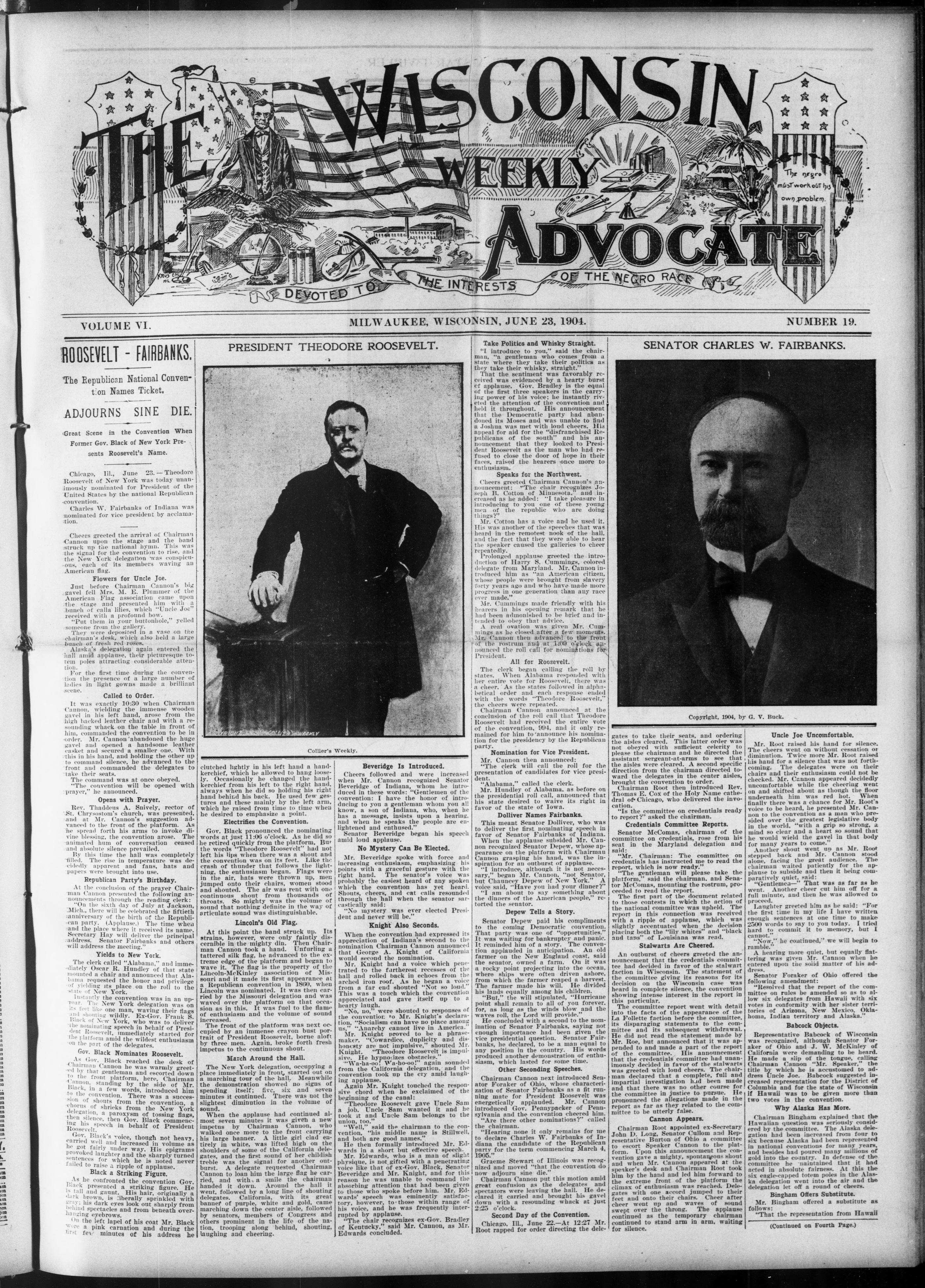
Page text (machine-generated)
WISCONSIN
WEEKLY
ADVOCATE
DEVOTED TO THE INTERESTS OF THE NEGRO RACE
ROOSEVELT - FAIRBANKS.
The Republican National Convention Names Ticket.
Great Scene in the Convention When Former Gov. Black of New York Presents Roosevelt's Name.
Chicago, Ill., June 23. — Theodore Roosevelt of New York was today unanimously nominated for President of the United States by the national Republican convention.
Charles W. Fairbanks of Indiana was nominated for vice president by acclamation.
Cheers greeted the arrival of Chairmau Cannon upon the stage and the band struck up the national hymn. This was the signal for the convention to rise, and the New York delegation was conspicuous, each of its members waving an American flag.
Flowers for Uncle Joe.
Just before Chairman Cannon's big gavel fell Mrs. M. E. Plummer of the American Flag association came upon the stage and presented him with a bunch of calla lilies, which "Uncle Joe" received with a profound bow.
"Put them in your buttonhole," yelled someone from the gallery.
They were deposited in a vase on the chairman's desk, which also held a large bunch of fresh red roses.
Alaska's delegation again entered the hall amid applause, their picturesque totem poles attracting considerable attention.
For the first time during the convention the presence of a large number of ladies in light gowns made a brilliant scene.
Called to Order.
It was exactly 10:30 when Chairman Cannon, wielding the immense wooden gavel in his left hand, arose from the high backed leather chair and with a resounding whack on the table in front of him, commanded the convention to be in order. Mr. Cannon 'abandoned the huge gavel and opened a handsome leather casket and secured a smaller one. With this in his hand, and holding the other up to command silence, he advanced to the front and commanded the delegates to take their seats.
The command was at once obeyed.
"The convention will be opened with prayer," he announced.
Opens with Praver.
Rev. Thaddens A. Snively, rector of St. Chrysostom's church, was presented, and at Mr. Cannon's suggestion advanced to the front of the platform. As he spread forth his arms to invoke divine blessing, the convention arose. The animated hum of conversation ceased and absolute silence prevailed. By this time the hall was completely filled. The rise in temperature was decidedly apparent and fans, hats and papers were brought into use.
Republican Party's Birthday
At the conclusion of the prayer Chairman Cannon presented the following announcements through the reading clerk: "On the sixth day of July at Jackson, Mich., there will be celebrated the fiftieth anniversary of the birth of the Republican party. (Applause.) The time when and the place where it received its name, Secretary Hay will deliver the principal address. Senator Fairbanks and others will address the meeting."
Yields to New York.
The clerk called "Alabama," and immediately Osear R. Hundley of that state mounted a chair and announced that Alabama requested the honor and privilege of yielding its place on the roll to the state of New York. Instantly the convention was in an uprear. The New York delegation was on its feet like one man, waving their flags and shouting wildly. Ex-Gov. Frank S. Black of New York, who was to deliver the nominating speech in behalf of President Roosevelt, immediately started for the platform amid the wildest enthusiasm on the part of the delegates
Gov. Black Nominates Roosevelt
As Gov. Black reached the desk of Chairman Cannon he was warmly greeted by that gentleman and escorted down to the front platform, here, Chairman Cannon, standing by the side of Mr. Black, in a few words, introduced him to the convention. There was a succession of shouts from the convention, a chorus of shrieks from the New York delegation, a paroxysm of tossing flags, then silence, then Gov. Black commencing his speech in behalf of President Roosevelt.
Gov. Black's voice, though not heavy, carried well and increased in volume as he got fairly under way. His epigrams provoked laughter and the sharply turned sentences for which he is noted never failed to raise a ripple of applause.
Black a Striking Figure
As he confronted the convention Gov. Black presented a striking figure. He is tall and gaunt. His hair, originally a dark brown, is liberally sprinkled with gray; his dark eyes look out sharply from behind spectacles and from beneath overhanging eyebrows. On the left lapel of his coat Mr. Black wore a pink carnation and during the first few minutes of his address he
YRUHZ WEEKLY
clutched lightly in his left hand a handkerchief, which he allowed to hang loosely. Occasionally he changed the handkerchief from his left to the right hand, always when he did so holding his right hand behind his back. He used few gestures and these mainly by the left arm, which he raised from time to time when he desired to emphasize a point. Che when Bever duced conve ducing know has
Electrifies the Convention.
Gov. Black pronounced the nominating words at just 11:06 o'clock. As he did so he retired quickly from the platform. But the words "Theodore Roosevelt" had not left his lips when there was a shout and the convention was on its feet. Like the crash of thunder that follows the lightning, the enthusiasm began. Flags were in the air, hats were thrown up, men jumped onto their chairs, women stood and shouted. The air was rent with one continuous shout from thousands of throats. So mighty was the volume of sound that nothing definite in the way of articulate sound was distinguishable.
Lincoln's Old Flag.
At this point the band struck up. Its strains, however, were only faintly discernible in the mighty din. Then Chairman Cannon took a hand. Unfurling a tattered silk flag, he advanced to the extreme edge of the platform and began to wave it. The flag is the property of the Lincoln-McKinley association of Missouri and it made its first appearance at a Republican convention in 1860, when Lincoln was nominated. It was then carried by the Missouri delegation and was waved over the platform on that occasion as in this. It was fuel to the flame of enthusiasm and the volume of sound increased.
The front of the platform was next occupied by an immense crayon bust portrait of President Roosevelt, borne aloft by three men. Again, broke forth fresh impetus to the continuous shout.
March Around the Hall.
The New York delegation, occupying a place immediately in front, started out on a marching tour of the hall. Meanwhile the demonstration showed no signs of spending itself; five, six and seven minutes it continued. There was not the slightest diminution in the volume of sound.
When the applause had continued almost seven minutes it was given a new impetus by Chairman Cannon, who walked once more to the front carrying his large banner. A little girl clad entirely in white, was lifted high on the shoulders of some of the California delegates, and the first sound of her childish treble was the signal for another outburst. A delegate requested Chairman Cannon to loan him the large flag he carried, and with a smile the chairman handed it down. Around the hall it went, followed by a long line of shouting delegates. California, with its great banner of purple, white and gold, came marching down the center aisle, followed by senators, members of Congress and others prominent in the life of the nation, trooping along behind, shouting, laughing and cheering.
MILWAUKEE, WISCONSIN, JUNE 23, 1904.
Beveridge Is Introduced
Cheers followed and were increased when Mr. Cannon recognized Senator Beveridge of Indiana, whom he introduced in these words: "Gentlemen of the convention: I have the honor of introducing to you a gentleman whom you all know, a son of Indiana, who, when he has a message, insists upon a hearing, and when he speaks the people are enlightened and enthused." Senator Beveridge began his speech amid loud applause.
No Mystery Can Be Elected
Mr. Beveridge spoke with force and increasing enthusiasm, emphasizing his points with a graceful gesture with the right hand. The senator's voice was probably the easiest heard of any spoken which the convention has yet heard. Shouts, cheers, and cat calls resounded through the hall when the senator sarcastically said: "No mystery was ever elected President and never will be."
Knight Also Seconds.
When the convention had expressed its appreciation of Indiana's second to the nomination Chairman Cannon announced that George A. Knight of California would second the nomination.
Mr. Knight had a voice which penetrated to the furtherest recesses of the hall and rolled back in echoes from the arched iron roof. As he began a voice from a far end shouted "Not so loud." This was a touch which the convention appreciated and gave itself up to a hearty laugh.
"No, no," were shouted to responses of the convention to Mr. Knight's declaration, "Socialism can have no place among us," "Anarchy cannot live in America."
Mr. Knight proved to be a phrase maker. "Cowardice, duplicity and dishonesty are not impulsive," shouted Mr. Knight. "Theodore Roosevelt is impulsive. He hypnotizes obstacles."
"Wa-ha-oo! Wa-ho-oo!" again sounded from the California delegation, and the convention took up the cry amid laughing applause.
Again Mr. Knight touched the responsive chord when he exclaimed of the beginning of the canal:
"Theodore Roosevelt gave Uncle Sam a job. Uncle Sam wanted it and he took it and Uncle Sam belongs to the union, too."
"Well," said the chairman to the convention, "his middle name is Stillwell, and both are good names."
He then formally introduced Mr. Edwards in a short but effective speech.
wards in a short but effective speech. Mr. Edwards, who is a man of slight physique, is not gifted with a penetrating voice like that of ex-Gov. Black, Senator Beveridge and Mr. Knight, and for this reason he was unable to command the absorbing attention that had been given to those who spoke before him. Mr. Edwards' speech was eminently satisfactory, however, to those within range of his voice, and he was frequently interrupted by applause. "The chair recognizes ex-Gov. Bradley of Kentucky," said Mr. Cannon, as Mr. Edwards concluded.
Take Politics and Whisky Straight.
"I introduce to you," said the chairman, "a gentleman who comes from a state where they take their politics as they take their whisky, straight."
That the sentiment was favorably received was evidenced by a hearty burst of applause. Gov. Bradley is the equal of the first three speakers in the carrying power of his voice; he instantly riveted the attention of the convention and held it throughout. His announcement that the Democratic party had abandoned its Moses and was unable to find a Joshua was met with loud cheers. His appeal for aid for the "disfranchised Republicans of the south" and his announcement that they looked to President Roosevelt as the man who had refused to close the door of hope in their faces, raised the hearers once more to enthusiasm.
Speaks for the Northwest.
Cheers greeted Chairman Cannon's announcement: "The chair recognizes Joseph B. Cotton of Minnesota," and increased as he added: "I take pleasure in introducing to you one of these young men of the republic who are doing things?"
Mr. Cotton has a voice and he used it. His was another of the speeches that was heard in the remotest nook of the hall, and the fact that they were able to hear the speaker caused the galleries to cheer repeatedly.
Prolonged applause greeted the introduction of Harry S. Cummings, colored delegate from Maryland. Mr. Cannon introduced him as "an American citizen, whose people were brought from slavery forty years ago and who have made more progress in one generation than any race ever made."
Mr. Cummings made friendly with his hearers in his opening remark that he had been admonished to be brief and intended to obey that advice. A real ovation was given Mr. Cummings as he closed after a few moments. Mr. Cannon then advanced to the front of the rostrum and at 1:09 o'clock announced the roll call for nominations for President.
All for Roosevelt.
The clerk began calling the roll by states. When Alabama responded with her entire vote for Roosevelt, there was a cheer. As the states followed in alphabetical order and each response ended with the words "Theodore Roosevelt," the cheers were repeated.
Chairman Cannon announced at the conclusion of the roll call that Theodore Roosevelt had received the entire vote of the convention, 994, and it only remained for him to announce his nomination for the presidency by the Republican party.
Nomination for Vice President.
"The clerk will call the roll for the presentation of candidates for vice president.
"Alabama." called the clerk.
Mr. Hundley of Alabama, as before on the presidential roll call, announced that his state desired to waive its right in favor of the state of Iowa.
Dolliver Names Fairbanks
This meant Senator Dolliver, who was to deliver the first nominating speech in favor of Senator Fairbanks of Indiana. When the applause subsided Mr. Cannon recognized Senator Depew, whose appearance on the platform with Chairman Cannon grasping his hand, was the inspiration for an outburst of applause.
"I am about to say something about the dinners of the American people," retorted the senator.
Depew Tells a Story.
Senator Depew paid his compliments to the coming Democratic convention. That party was one of "opportunities." It was waiting for bankruptcy and panic. It reminded him of a story. The convention applauded in anticipation. An old farmer on the New England coast, said the senator, owned a farm. On it was a rocky point projecting into the ocean, where ships were often driven ashore, from which the farmer reaped a harvest. The farmer made his will. He divided his lands equally among his children. "But," the will stipulated, "Hurricane point shall remain to all of you forever, for, as long as the winds blow and the waves roll, the Lord will provide."
He concluded with a second to the nomination of Senator Fairbanks, saying not enough importance had been given the vice presidential question. Senator Fairbanks, he declared, to be a man equal to any position in the country. His words produced another demonstration of enthusiasm, which lasted for some time.
Other Seconding Speeches.
Chairman Cannon next introduced Senator Foraker of Ohio, whose characterization of Senator Fairbanks as a fit running mate for President Roosevelt was energetically applauded. Mr. Cannon introduced Gov. Pennypacker of Pennsylvania and the convention cheered him. "Are there other nominations?" called the chairman. "Hearing none it only remains for me to declare Charles W. Fairbanks of Indiana the candidate of the Republican party for the term commencing March 4, 1905." Graeme Stewart of Illinois was recognized and moved "that the convention do now adjourn sine die."
Chairman Cannon put this motion amid great confusion as the delegates and spectators were leaving the hall. He declared it carried and brought his gavel down with a resounding whack at just 2:25 o'clock.
Second Day of the Convention.
Chicago, Ill., June 22.-At 12:27 Mr. Root rapped for order directing the dele-
Copyright. 1904, by G. V. Buck.
gates to take their seats, and ordering the aisles cleared. This latter order was not obeyed with sufficient celerity to please the chairman and he directed the assistant sergeant-at-arms to see that the aisles were cleared. A second specific direction from the chairman directed toward the delegates in the center aisles, brought the convention to order. Chairman Root then introduced Rev. Thomas E. Cox of the Holy Name cathedral of Chicago, who delivered the invocation. "Is the committee on credentials ready to report?" asked the chairman.
Credentials Committee Reports.
Senator McComas, chairman of the committee on credentials, rose from his seat in the Maryland delegation and said:
"Mr. Chairman: The committee on credentials has instructed me to read the report, which is now ready."
"The gentleman will please take the platform," said the chairman, and Senator McComas, mounting the rostrum, proceeded to read the report.
The first part of the document related to those contests in which the action of the national committee was upheld. The report in this connection was received with a ripple of applause, which was slightly accentuated when the decision placing both the "illy whites" and "black and tans" of Louisiana was read.
Stalwarts Are Cheered.
An outburst of cheers greeted the announcement that the credentials committee had decided in favor of the stalwart faction in Wisconsin. The statement of the committee giving its reasons for its decision on the Wisconsin case was heard in complete silence, the convention showing intense interest in the report in this particular.
The committee report went with detail into the facts of the appearance of the La Follette faction before the committee, its disparaging statements to the committee and its subsequent withdrawal. He did not read the statement made by Mr. Roe, but announced that it was appended to and made a part of the report of the committee. His announcement that the credentials committee had unanimously decided in favor of the stalwarts was greeted with loud cheers. The chairman declared that a complete, full and impartial investigation had been made and that there was no other course for the committee in justice to pursue. He pronounced the allegations made in the report as far as they related to the committee to be utterly false.
Chairman Root appointed ex-Secretary John D. Long, Senator Cullom and Representative Burton of Ohio a committee to escort Speaker Cannon to the platform. Upon this announcement the convention gave a mighty, spontaneous shout and when Mr. Cannon appeared at the speaker's desk and Chairman Root took him by the hand and led him forward to the extreme front of the platform the climax of enthusiasm was reached. Delegates with one accord jumped to their feet and onto their chairs. Cheer after cheer went up and waves of sound swept over the throng. The applause continued as the temporary chairman continued to stand arm in arm, waiting for silence.
Cannon Appears.
Mr. Root raised his hand for silence. The cheers went on without cessation or diminution. Twice more Mr. Root raised his hand for a silence that was not forthcoming. The delegates were on their chairs and their enthusiasm could not be checked. Mr. Cannon appeared decidedly uncomfortable while the cheering went on and shifted about as though the floor underneath him was red hot. When finally there was a chance for Mr. Root's voice to be heard, he presented Mr. Cannon to the convention as a man who presided over the greatest legislative body in the world, "with a grip so strong, a mind so clear and a heart so sound that he would wield the gavel in that body for many years to come."
Another shout went up as Mr. Root stepped back and Mr. Cannon stood alone, facing the great audience. The chairman waited patiently for the applause to subside and then it being comparatively quiet, said:
"Gentlemen—" That was as far as he went. Another cheer cut him off for a full minute, and then he was allowed to proceed.
Laughter greeted him as he said: "For the first time in my life I have written enough sentences at one time to make 2500 words to say to you today. I tried hard to commit it to memory, but I cannot."
"Now," he continued," we will begin to ramble."
A hearing more quiet, but equally flattering was given Mr. Cannon when he entered upon the solid matter of his address.
Senator Foraker of Ohio offered the following amendment: "Resolved that the report of the committee on rules be amended so as to allow six delegates from Hawaii with six votes in conformity with her sister territories of Arizona, New Mexico, Oklahoma, Indian territory and Alaska."
Representative Babcock of Wisconsin was recognized, although Senator Foraker of Ohio and J. W. McKinley of California were demanding to be heard. He made a slip of the tongue, calling Chairman Cannon "Mr. Speaker," the title by which he is accustomed to address Uncle Joe. Babcock suggested increased representation for the District of Columbia and for the state of Wisconsin if Hawaii was to be given more than two votes in the convention.
Chairman Bingham explained that the Hawaiian question was seriously considered by the committee. The Alaska delegation had been increased from four to six because Alaska had been represented in national conventions for many years, and besides had poured many millions of gold into the country. In defense of the committee he maintained that it had acted in absolute fairness. At this the six eagle-capped totem poles in the Alaska delegation went into the air and the delegation let off a round of cheers.
Bingham Offers Substitute.
Mr. Bingham offered a substitute as follows:
Uncle Joe Uncomfortable.
Babcock Objects.
Why Alaska Has More
Bingham Offers Substitute.
(Continued on Fourth Page.)
BADGER STATE, DEAR BADGER
STATE.
‘Tune—Maryland, My Maryland.
Written for the Wisconsin Society of Siows
city by F. L. Ferris.
We sing to thee, with hearts elate,
Our childhood’s home, dear Badger State.
Others are good, but thou are great,
©, Badger State, dear Badger State.
We love thy shining rills and lakes,
Thy rock-crowned bills and sedgy brakes,
Aud each old scene new luster takes,
O, Badger State, dear Badger State.
We make our homes In other lands, ©
O, Badger State, dear Badger State,
But still thy banner’s in our hands,
Our birthright proud, O, Badger State.
We love our homes all o'er the West, .
The Hawkeye State the very best,
For loyalty thon hast Impressed,
Onr mother tne, our Badger State.
We come from all thy wave-girt shores,
©, Badger State, dear Badger State:
From where the wild Wisconsin roars,
«©, Badger State, dear Badger State;
And gather here in thy own name,
While mem'ries of thy sons of fame
Cause_us to sing with loud acclaim,
Dear Badger State, our Badger State.
‘There comes to mind. from mem'ry’s store,
©, Badger State, loy'd Badger state,
The scenes now past forever more,
©. Badger State, dear Badger State.
Tho" we must part, and all too soon,
Our hearts are thrilled at this great boon,
We all can sing the same sweet tune,
Dear Badger State, my Badger State.
#* Miscellaneous Items.
—The Duke of Sutherland, who is now
touring in Canada, is said to be the
largest landholder in the British islands,
owning 1,358,000 acres.
——A Minneapolis investigator reports
what may surprise some people—that the
milling industry of the United States is
the third largest in the country.
There is a grave-digging school in
Brussels and_all candidates for the post
of sexton in Belgium to be eligible must
lave graduated from this school,
—The Tien Tsu Husi, or Society for
Natural Feet, is making many converts
in China. In some regions young men
sign a pledge not to marry girls with arti-
ficially crippled feet.
—N. W. MeLeod of St. Louis was a
temporary receiver for the Kirby Lum-
her company, Texas, for forty days and
he valnes his services at the modest sum
of $25,000, The master in chancery is
considering the matter.
—A curious old custom is said to be
still kept up at the picturesque Wensley-
dale village of Bainbridge, England,
where every winter's night at 9 o'clock a
jarge horn is blown on the village green
to aid any wayfarer who might chance
to be lost on the surrounding fells to find
his way to the village. The fine horn
now in use was presented to the village
some years ago and at one time adorned
the head of a huge African bull.
An Omitted Question.
“Some years ago, while a resident cf
Athens, O., 1 became involved in a quiet
little game in a hotel room.” said Dr.
W. E. Webb the other morning to a
Macon (Mo.) correspondent of the New
York Sun. “The ante was modest, and
uobody was going broke, but I suppose
under a Puritanical construction of the
statutes we were gambling. Around the
beard were a congressman, a judge of
one of the lower courts and two others of
equal prominence and_ reputation.
“Running at large in Athens was an
muergetic reformer named Coleman. He
got wind of our little debauch and
climbed up on a stepladder to observe
over the transom.
“He heard a learned discussion regara-
ing antes, blinds, straights and chips and
saw the stakes. He recognized four of
us, but the fifth man was sitting with
his back to the door, directly under the
transom,
“Coleman told his harrowing discovery
to Prosecuting Attorney Jewett and gave
him our names. He said he was ready
and willing to give his evidence to the
grand jury. Jewett thanked him, and
warned him that when the jury convened
he would be summoned.
“Of course we got wind of the affair,
and uneasily waited for what would
come of it. Court came on, and true to
his promise Coleman was before the jury
with his evidence.
Jewett, as the custom was, did the in-
terrogating for the benetit of that terrible
body. He asked Coleman minutely touch-
ing his knowledge of violation ‘ef the
liquor laws. He inquired if he had seen
any infractions of the Sunday ordi-
nances. He sought from the witness his
information concerning several recent
homicides in the county, Coleman was
asked if any carrying of concealed wea-
pons or church disturbances had come
under his observation,
“Then he was abruptly excused. At
recess he hunted up Jewett.
“Why the devil didn't you ask me
about that poker game up in the hotel?
he demanded, indignantly.
“Oh, yes,’ said Jewett. ‘I remember
now. I believe you said you recognized
all of them fellers, except one who sat
hy the door?
““Certainly I did, and am willing te
#0 before any court and swear to it”
“Yes,” responded Jewett, dryly; “that’s
commendable, I'm sure—very commend:
able. That man with his back to the
door was me.”
"Clock to Run About 30,000 Years.
A radium clock, which will keep time
indefinitely, has ‘been constructed by
Harrison Martindale of England.
‘The clock comprises a small tube, in
which is placed a minute quantity of
radium supported in an exhausted glass
vessel by a quartz rod. To the lower end
of the tube, which is colored violet by the
action of the radium, an_ electroscope
formed of two long leaves or strips of
silver is attached.
A charge of electricity in which there
are no beta rays is transmitted through
the activity. of the radium into_ the
leaves, and the latter thereby expand un-
til they touch the sides of the vessel, con-
nected to earth by wires, which instantly
vuduct the electric charge, and the
leaves fall together.
This simple operation is repeated inces-
sautly every two minutes until the ra-
dium is exhausted, which in this instance
it is computed will oceupy 30,000 years.
—Scientitie American.
See ea
Mint Tulep Without Rve.
“Of course it’s hard to improve on the
mint julep as a hot weather beverage,”
said the communicative bartender, “but
I've got one that I call the ‘compromise’
that often comes in handy. It's_ built
exaetly on the same plans as the ordinary
product ef old Kentucky, except that the
foundation stone is laid with sherry, in-
stead of with rye. There are lots of
men who revel in the mint julep. just be-
cause of the aroma of mint, but they are
afraid of its seductive’ powers. The
strength of the concoction proves too
much for them. It is for such drinkers
that I have invented the ‘compromise,’ as
1 eall it. They get all the aroma of tie
julep without its knock-out propensities.
It is also effective in eases where jags
come in and demand mint juleps. Under
such circumstances the —‘compromise”
comes in handy, and the chances are that
the jag doesn’t know the difference.’—
Philadelphia Record.
Sd rae
~-Missionaries are at work in 247 of
the walled cities of China. There are
still 1500 wailed cities without mission-
aries,
TO MY THIS—SUMMER’S GIRL.
The twilight’s Frovine longer every day,
A sign, sweetheart, that you're not fat
away—
About six weeks, I guess. You know that 1
Am apt to run across you in July.
About the Sfteenth or the sixteenth, say,
mW a walking on the beach some
night,
The breeze a-swishin’ ‘round your dresses
white,
And, as 1 pass, perhaps you'll sorter smile
And then perhaps I'll sorter do the same.
That night I hang around the desk a while
And read the register to learn your name.
I wonder, dear, will you be dark or fair
And bas phy you'll have straight or curly
air,
‘This summer you are due to be a blonde,
In even years 1am especially fond
Of them, but dark will do. 1 don’t much
care.
But, to proceed. Next night there'll be a
dance
And I'll tell some one, when they get a
chance,
To introduce us. Then I'll dance with you
And get rid of some second-handed wit.
Upon the lawn we'll sit around ‘tl two
And when we leave we'll know that we are
te
A week or two will wear off some restraint
And ee some night I'll make a sudden
feint
And clasp you in my arms and hold you
tight.
Ul bet you'll kick and say it isn’t right—
Thet I'm a trifler—but [il swear I ain't.
Sweetheart, it is predestined we will meet
And love éach other through the summer
sweet.
We'll go away, each vowing to be true
As long as time shall last and we are
living.
We'll write each other for a month or two
And then will cut it out about Thanksglv-
lug. —Cornell Widow.
THE JOURNEY’S END.
RRS Oe a ae, ee eee er
manded,
“Can 1 do some chores to pay for m)
supper and a place to sieep tonight?”
‘| “Oh! You're a tramp, are you!
| Pretty young to start out that way.”
| “Lasked for a chance to work for al
| you let me have.”
|" “I don’t know as I’m going to let you
| have anything.” She tov another ster
and scowled with pain. “If you ean find
|the old hen-turkey, over there in_ the
| meadow, and drive her and her little
turks into the barn, maybe I'll give you a
bite. She ought to have eleven little
ones: if you don’t get every one 1 won't
give you a mouthiui. Hyper along now;
there’s a big thunder shower coming.”
“If it wasn’t for this rheumatism I
wouldnt waste a supper on that boy,
just for getting those turkeys in,” she
muttered; “but I'll make him work it
out.”
So as soon as the turkeys were under
cover she set the boy at work in the
woodshed splitting wood until supper
was ready.
After they had finished their suppers
Mrs. Skinner asked the boy:
“What’s your name?”
“Frank Withee.” He wanted to ask
her name in return, but she looked so
angrily at him that he did not dare.
“Where did you come from?”
“From Clockville, New York.”
“How did you get here?”
“Walked the most of the way; once
in a while I got a ride.”
“It's a long ways from New York to
New Hampshire. Whatever possessed
you to start on such a. tramp—run
away?” asked Mr. Skinner.
“No, sir; I haven’t anybody to run
away from. I’ve come to take my
grandmother out of the poorhouse.” His
tace flushed, and he added quickly: “It
isn’t her fault that she’s there. She had
a good farm and home, and all the chil-
dren she had was my father and his
sister—I suppose she’s my Aunt Susan,
but I'll never call her ‘aunt.’ ”
Mr. Skinner moved his chair to the
window and looked out into the black,
rainy night.
“The farm was going to be father’s,”
Frank explained, “but he said he’d give
up uis share to his sister if she'd take
eare of grandmother as long as she lived,
and she promised to. Then last year she
put grandmother into the poorhouse.
I’m going to see her and tell ner what I
think of such mean business.” He
clenched his fists and squared his shoul-
ders, as though in anticipation of the
meeting. .
“Whatever put it into your head to
come such an amazing distance just to
| take care of her?” asked Mr. Skinner.
| “L promised father that I would. He
was sick a long time, and we had to
use the money he had saved to come and
get her; then he worried about her until
1 promised that I'd come here and take
eare of her.”
“How old are you?” asked Mrs. Skin-
ner. looking sharply at the boy.
“Most 12; I’m small for my age, but
j there's lots of things I can do. I've got
$20 that I earned myself, and father said
grandmother is a great manager, so |
guess we'll keep off the town.”
| “I guess you'll find that $20 won’t go
‘tar toward’ keeping two people; you'd
better keep your money ayd take care
of yourself, or there'll be two of you on
the town instead of one.”
“Why, I must take care of her!” said
Frank, resolutely. “She’s my own
grandmother; she belongs to me.”
“It’s time for you to go to bed; you'll
| have to be moving early in the morning
land get to work, if you're going to de
jsuch big things,” said Mrs. Skinner
sharply, as she took a lamp and led the
way to a small bedroom.
When she returned she took a seat at
another window and studied the dark-
ness outside. After a while Mr. Skinner
said:
“I don’t know as -I care what. that
little squint of a boy says; never heare
laay chine so foolish! Thinks he can take
}care of himself and her, too!”
| There was a few moments’ silence;
| then he continued:
| “I don’t see as it was my fault, any.
|how. *Twas all your doings.”
| ‘There was a longer silence; then:
“You said you wanted her room, so you
could have a nice spare room like othe:
| folks, and you said she’d be more con:
|fortable over there. this house is so cold
and it costs too much to keep a fire ir
[her room.”
He moyed abont uneasily, studying he
|face intently. Then, with long pause
| Letwween his sentences:
| “Anybody. can see that he’s used tc
j work, He took eare of the turkeys an¢
| shut them up just as careful as you
jcould, You're getting pretty rheumatic
| Hed about pay their keep, now, and. by
jand by, more. I need some help just
| now, too.”
| Again he waited for her to speak, but
sie didn’t.
“Why don’t you say something, Su-
jsan?” he demanded, irritably. “You al
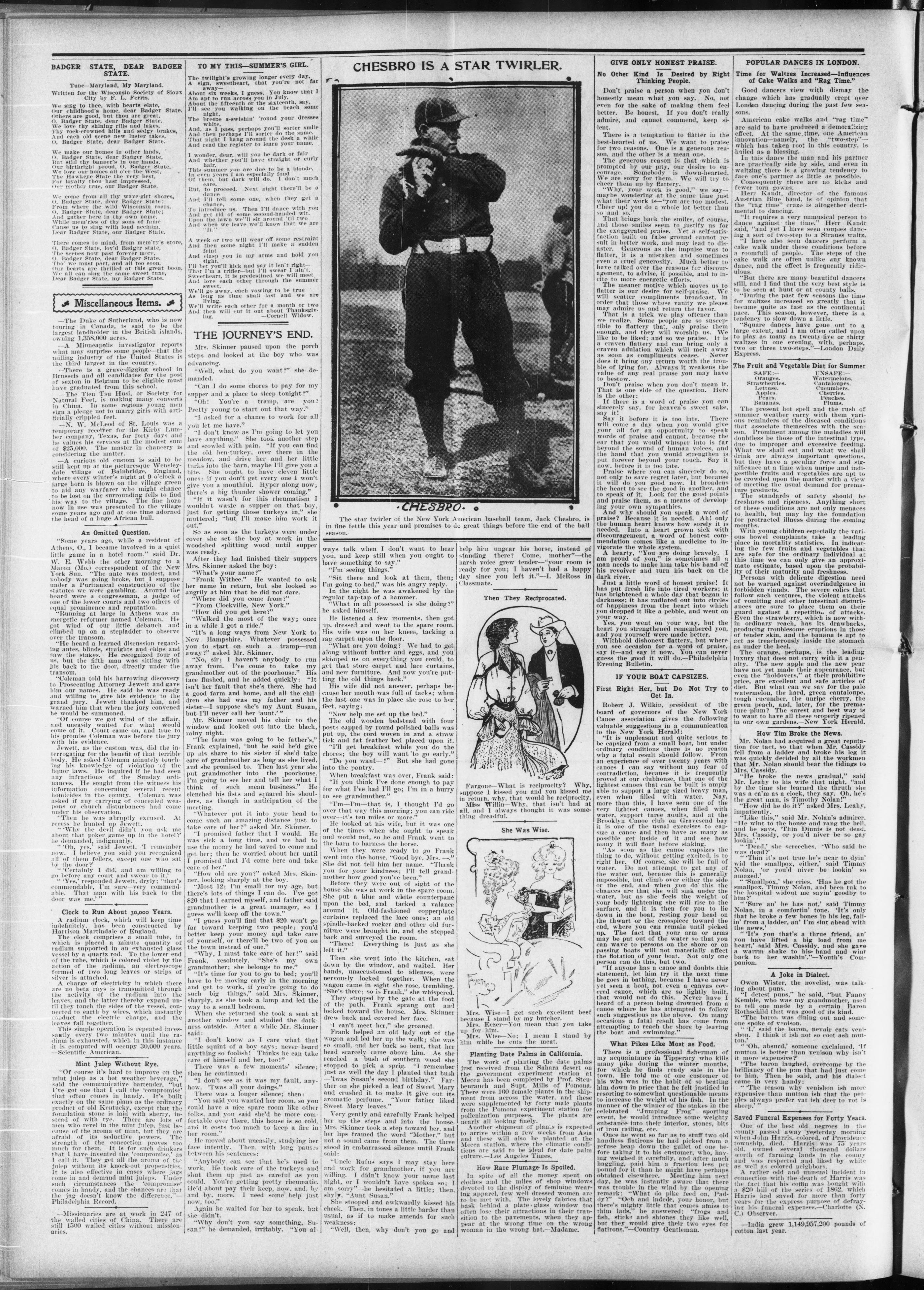
-CHESBRO IS A STAR TWIRLER.
ee
ee e
‘ ' ee eee a
;
one ‘
bs Phe is ee oe
sj , . : :
a
: so A :
3 i} ’
3 Px
a
yf . bone
a 9 t > _- = i
re — oo
eo eae e = |
Pee ee ; Ree ‘
bs se as — oe
Pecos “i . oo 4,
| ae en ens
ee
wee —— Ds
pa ee co ne as aE
Fee eo cuk: ee nay :
ec es oe Se
Leos ago Ca ee eed me
area oe ae a eee | ee
cee Soy i ne
BRA cence SS GND neo org
Prenat OS EN ee ont sn
NPT Fa oxig eee a cr gs ee J} Re eas
Png cae its eo .s ew + ny
Se EIR wag ac : a
° -¢ FIESBRO- ° °
The star twirler of the New York American baseball team, Jack Chesbro, is
in fine fettle this year and promises to de great things before the end of the ball
ees
ways talk when I don’t want to hear
you, and keep still when you ought to
have something to say.”
“[’m seeing things.”
“Sit there and look at them, then;
I’m going to bed,” was his angry reply.
In the right he was awakened by the
regular tap-tap of a hammer.
“What in all possessed is she doing?”
he asked himself. -
He listened a few moments, then got
cup. dressed and went to the spare room.
His wife was on her knees, tacking a
vag carpet upon the floor.
What, oa doing? We had to get
along without butter and eggs, and you
skimped us on everything you could, to
get that store carpet and lace curtains,
and new furniture. And now you're put-
ting the old things back.”
His wife did not answer, perhaps be-
cause her mouth was full of tacks; when
the last one was in place she rose to her
feet, saying: %
“Now help me set up the bed.”
The old wooden bedstead with four
posts capped by round polished balls was
put up, the cord woven in and a straw
tick and fat feather bed placed upon it.
“I'll get breakfast while you do the
chores; the boy will want “to go early.”
“Do you want—?” But she had gone
into the pantry.
When breakfast was over, Frank said:
“If you think I’ve done enough to pay
for what Pve had I'll go; I'm in a hurry
to see grandmother.”
“I'm—I’'m—that is, I thought I'd go
over that way this morning; you can ride
over—it’s ten miles or more.”
He looked at his wife, but it was one
|of the times when she ought to speak
and would not, so he and Frank went to
the barn to harness the horse.
When they were ready to go Frank
went into the house. “Good-bye, Mrs. —.”
She did not tell him her name. “Thank
you for your kindness; I'll tell grand-
mother how good you've been.”
Before they were out of sight of the
house she was at work in the spare room.
She put a blue and white counterpane
upon the bed, and tacked a valance
around it. Old-fashioned — copperplate
curtains replaced the lace ones; an old
spindle-backed rocker and other old fur-
niture were brought in, and she stepped
back and surveyed the room.
“There! Everything is just as she
left it.”
Then she went into the kitchen, sat
dewn by the window, and waited. Her
hands, unaccustomed to idleness, were
nervously locked together. When the
wagon came in sight she rose, trembling.
“She's there; so is Frank,” she whispered.
‘They stopped by the gate at the foot
of the path. Frank sprang out and
looked toward the house. Mrs. Skinner
drew back and covered her face.
‘IT can’t meet her.” she groaned.
Frank helped an old lady out of the
wagon and led her up the walk; she was
so small, and her back so bent, that her
head scarcely came above him. As she
reached a bush of southern wood she
stopped to pick a sprig. “I remember
just as well the day 1 planted that bush
—'twas Susan’s second birthday.” Far-
ther on she picked a leaf of Sweet Mary
and crushed it to make it give out its
aromatic perfume. “Your father liked
Sweet Mary leaves.”
Very gently and earefully Frank helped
her up the steps and into the house.
Mrs. Skinner took a step toward her, and
her lips framed the word “Mother,” but
not a sound caine from them. The three
stood in embarrassed silence until Frank
said:
“Unele Rufus says I may stay here
and work for grandmother, if you are
| willing. T didn’t know your name last
| night, or I wouldn't have spoken so; I
|am sorry”—he hesitated a little; then,
| shyly, “Aunt Susan.”
| She stooped and awkwardly kissed his
cheek. Then, in tones a little harder than
usual, as if to make amends for such
weakness:
“Well, then, why don’t you go and
‘help him ungear his horse, instead of
‘standing there? Come, mother”—the
harsh voice grew tender—“your room is
veady for you; I haven't had a happy
day sinee you left it.”—I. MecRoss in
Classmate.
Aa
f + eS
tase
pore
aba Sa
Fargone—What is reciprocity? Why,
suppose I kissed you and you kissed me
in return, why, that would be reciprocity.
Miss Willin—Why, that isn’t bad at
all, and 1 always thought it was some-
thing dreadful.
‘ant +
| SAE ID Coy
cae) GSD) }
oF eg >
y pe e
Vie? 4
oo fl
~~ SI
Ne Re ie
: hy, fm i
Pen... if M4
a Ue 2
tf
Mrs. Wise--I get such excelient beet
because I stand by my butcher.
Mrs. Eezer—You mean that you take
up for him.
| Mrs. Wise—No; I mean I stand by
ihim while he cuts the meat.
The work of planting the date palms
just received from the Sahara desert on
the government experiment station at
Mecea has been completed by Prof. Steu:
benrauch and Supt. Mills of Pomona,
'There were 160 female plants in the ship-
ment from across the water, and these
were supplemented by forty male plants
from the Pomona experiment station fot
pollenization purposes, The plants are
nearly all looking finely.
‘Another shipment of plans is expectec
‘to arrive within a few weeks from Asia
and these will also be planted at the
“Mecea station, where the climatic condi.
‘tions are said to be ideal for date palm
culture.—Los Angeles Times.
In spite of all the money spent on
‘dothes and the miles of shop windows
devoted to the display of feminine wear-
ing apparel, few well dressed women are
to be met with. The lovely fabrics that
bask behind a plate+glass window too
often Jose their attractions in their tran-
sition to the pavements, when they ap-
“pear at the wrong time on the wrong
-woman in the wrong hat.—Madame.
Then They Reciprocated.
She Was Wise.
Planting Date Palms in California.
How Rare Plumage Is Spoiled.
GIVE ONLY HONEST PRAISE.
No Other Kind Is Desired by Right
Thinking People.
Don't praise a person when you don’t
honestly mean what you say. No, not
even for the sake of making them feel
better. Be honest, If you don’t really
admire, and cannet commend, keep si-
lent.
There is a temptation to flatter in the
best-hearted of us. We want to praise
for two reasons, One is a generous rea-
son, and the other is a mean one.
The generous reason is that «which is
prompted by our pity, our desire to en-
courage. Somebody is _down-hearted.
We are sorry for them. We will try to
cheer them up by flattery.
“Why, your work is good,” we say—
maybe wondering at the same time just
what their work is—“you are too modest.
Cheer up! you do a whole lot better than
so and so.”
That brings back the smiles, of course,
and those smiles seem to justify us for
the exaggerated praise. Yet a self-satis-
faction built on false ground cannot re-
sult in better work, and may lead to dis-
aster. Generous as the impulse was to
flatter, it is a mistaken and sometimes
even a cruel generosity. Much better to
have talked over the reasons for discour-
agement, to advise, if possible, and to in-
cite to more energetic efforts.
The meaner motive which moves us to
flatter is our desire for self-praise. We
will seatter compliments broadcast, in
order that those whose vanity we please
may admire us and return the favor.
That is a trick we play oftener than
we realize, Some peopie are so suscep-
tible to flattery tha‘, only praise them
enough, and they will worship us. We
like to be liked; and so we praise. It is
a craven flattery and can bring only a
craven adulation which will melt away
as soon as compliments cease. Never
does it bring 2ny return worth the tron-
ble of lying for. Always it weakens the
value of any real praise you may have
to_bestow.
Don't praise when you don't mean it.
That is one side of the question. Here
is the other:
If there is a word of praise you can
sincerely say, for heaven's sweet sake,
say it!
Say it before it is too Inte. There
will come a day when you would give
your all for an opportunity to speak
words of praise and cannot, because the
ear that you would whisper into is far
beyond the sound of human voices, and
the hand that you would strengthen is
put forever beyond your touch, Say it
now, before it is too late.
Praise where you can sincerely do so,
not only to save regret later, but because
it will do you good now. It broadens
the heart to see the good in another, and
to speak of it. Look for the good points
and praise them, as a means of develop-
ing your own sympathies.
And why should you speak a word of
praise? Because it is needed. Ah! only
the human heart knows how sorely it is
needed. Into a heart grown sick with
discouragement, a word of honest com-
mendation comes like a medicine to in-
vigorate the whole system.
A hearty, “You are doing bravely. I
am proud of you,” is sometimes all a
man needs to make him take his hand off
his revoiver and turn itis back on the
dark river.
Just a little word of honest praise! It
has put fresh life into tired workers; it
has brightened a whole day that began ir
darkness; it has radiated out into circles
of happiness from the heart into which
you dropped it like a pebble, and went on
| your way.
Yes, you went on your way, but the
heart you strengthened remembered you,
and you yourself were made better.
Withhold dishonest flattery, but where
you see occasion fer a word of praise,
say it—and say it now. You can never
guess the good it will do.—Philadelphia
Evening Bulletin.
IF YOUR BOAT CAPSIZES.
First Right Her, but Do Not Try to
Get In.
- Robert J. Wilkir, president of the
board of governors of the New York
‘Canoe association, gives the following
valuable suggestions in a communication
to the New York Herald:
| “It is unpleasant and quite serious to
‘be capsized from a small boat, but under
ordinary conditions there is’ no reason
why a fatal result should follow. From
an experience of over twenty years with
canoes I can say without any fear of
contradiction, because it is frequently
proved at our clubhouse, that one of the
lightest canoes that can be built is amply
able to support a large sized heavy man,
even when filled with water. Nay,
more than this, I have seen one of the
very lightest canoes, when filled with
water, support tnree aaults, and at the
Brooklyn Canoe club on Gravesend bay
it is one of the usual exercises to cap-
‘size a canoe and then have as many as
possible get inside of it and see how
many it will float before sinking.
“As scon as the canoe capsizes the
thing to do, without getting excited, is to
right her. Of course, she will be full of
water, Do not attempt to get any of
the water out, because this is generally
‘impossible, but climb over either the side
or the end, and when you do’ this the
chances are that she will sink under the
water, but as she feels the weight of
your body lightening she will rise to the
surface, and it is then for you to lie
down in the boat, resting your head on
‘the thwart or the crosspiece toward the
end, where you can remain until picked
up. The fact that your arm or arms
may be put out of the water so that you
can wave to persons on the shore or on
passing boats will not materially affect
the flotation of your boat. Not only one
person can do this, but two.
“If anyone has a canoe and doubts this
statement, let him try it the next time
he goes in bathing, because I have never
yet seen a boat, not even a canvas cov-
ered canoe, which are so lightly built,
that would not do this. Never have I
heard of a person being drowned from a
canoe where he has attempted to follow
such suggestions as the above. On many
occasions a fatal result has come from
attempting to reach the shore by leaving
the boat and swimming.”
What Pikes Like Most as Food.
There is a professional fisherman of
my acquaintance in Tipperary who kills
many pike during the winter months,
for which he finds ready sale in the
town. He told me of one customer of
his who was in the habit of so beating
him down in price that he felt justified in
resorting to somewhat questionable means
to increase the weight of his fish. In the
manner of the winner of the stakes in the
celebrated “Jumping Frog” sporting
event, he would introduce some weighty
substance into their interior, stones, bits
of iron railing, ete.
Once he went so far as to stuff two old
handless flatirons he had picked from o
refuse heap down the ‘cullet of one he-
fore taking it to his eustomer, who, havy-
ing weighed it carefully, and after much
haggling, paid him a fraction less per
pound for it than he might have perhaps
obtained elsewhere. Meeting him next
day, he was instantly aware that there
was trouble in the wind by the opening
remark: “What do pike feed on, Pad-
dy?" “Och and indede, your honor, but
there's mighty little that comes amiss to
thim lads,” he answered: “frogs and
fish, sticks and shtones they like well,
but they would give their two eyes for
flatirons.’—Country Gentleman.
POPULAR DANCES IN LONDON.
Time for Waltzes Increased—Influences
of Cake Walks and “Rag Time.”
Good dancers view with dismay the
change which has gradually crept qver
Londen dancing during the past few sea-
sons.
American cake walks and “rag time”
are said te have produced a demora‘izirs
effect. At the same.time, ove American
innovation—namely, the “two-step’—
which has taken root in this country, is
hailed as a blessing.
In this dance the man and his partner
are practically side by side, and even in
waltzing there is a growing tendency to
face one’s partner as little as possible.
Consequently there are uo kicks and
fewer torn gowns.
Herr Kandt, director of the famous
Austrian Blue band, is of opinion that
‘the “rag time” craze is altogether detri-
mental to dancing.
“It requires a very unmusical person to
dance against the time.” Herr Kandt
said, “and yet I have seen coupies danc-
ing a sort of two-step to a Strauss waltz.
“I have also seen dancers perform a
cake walk under these conditions before
a reomfull of people. The steps of the
cake walk are often unlike any known
dance, and the effect is frequently ridic-
ulous.
“But there are many beautiful dancers
still, and I find that the very best style is
to be seen at hunt or at county balls.
“During the past few seasons the time
for waltzes increased so greatly that it
became quite as fast as the continental
pace. This season, however, there is a
tendency to slow down a little.
“Square dances have gone out to a
large extent, and I am often called upon
to ps as many as twenty-five or thirty
waltzes in one evening, with, perhaps,
two or three two-steps.”"—London Daily
‘The Fruit and Vegetable Diet for Summer
SAP Ss 2— a NBAP E—
‘Oranges. Watermelons.
Strawberries. Cantaloupes.
Lettuse. Cucumbers,
Apples. Cherries.
Fears. Peaches.
Bananas. Plums.
The present hot spell and the rush of
summer weather carry with them vari-
ous reminders of the diseased conditions
that associate themselves with the sea-
son, Prominent amoung the maladies wiil
doubtless be those of the intestinal type,
due to improper and excessive feeding.
What we shall eat and what we shail
drink are always important questions,
but they have a peculiar force and sig-
nificance at a time when unripe and indi-
xestible fruits and vegetables are apt to
be crowded upon the market with a view
of meeting the usual demand for prema-
ture products.
The standards of safety should be
freshness and ripeness, Anything short
of these conditions are not only menaces
to health, but may lay the foundation
for protracted illness during the eoming
months.
With young children esp2cially the vari-
ous bowel complaints take a leading
place in mortality statistics. In indicat-
ing the few fruits and vegetables that
are safe for the ordinary individual ac
this time we can only give an approxi-
mate estimate, based upon the probabil-
ity of their ay, and freshness.
Persons with delicate digestion need
not be warned against overindulgence in
forbidden viands. The severe colics that
follow such ventures, the violent attacks
of vomiting and other intestinal disturb-
ances are sure to place them on their
guard against a repetitio. of attacks.
Even the strawberry, which is now with-
in ordinary reach, has its, drawbacks,
producing troublesome eruptions in those
of tender skin, and the banana is apt to
act as treacherously inside the stomach
as under the heel.
The orange, perhaps, is the leading
luxury that does not carry with it a pen-
alty. The new apple and the new pear
have not yet made their avpearance, but
even the “holdovers,” at their prohibitive
price, are excellent and safe articles of
diet. But what can we say for the pale
watermelon, the hard, green cantaloupe,
tough cucumber, the unripe cherry, the
green peach, and, later, for the prema-
ture plum? The surest and best way is
to want to have all these TiPOpEHy, ripened
in our own gardens.—New York Herald.
How Tim Broke the News.
Mr. Nolan had acquired a great reputa-
tion for tact, so that when Mr. Cassidy
fell from a ladder and broke his leg it
was quickly decided by all the workmen
that Mr. Nolan should bear the tidings to
Mrs. Cassidy.
“He broke the news gradual,” said
Mr. Leahy to his wife that night, “and
by the time she learned the thruth she
was a ca’m as a clock, they say. Oh, he’s
the great man, is Timothy Nolan!”
“How did he do it?” asked Mrs. Leahy,
impatiently.
“Like this,” said Mr. Nolan's admirer.
“He wint to the house and rang the bell,
and he says, “Thin Dinnis is not dead,
Mrs. Cassidy, or you'd niver be so gay
lookin’.”
“Dead,” she sereeches. ‘Who said he
was dead’
““Thin it’s not true he’s near to dyin”
wid the smallpox, either, said Timmy
Nolan, ‘or you'd niver be lookin’ so
amazed,”
“ ‘Smallpox,’ she cries. ‘Has he got the
smallpox, Timmy Nolan, and been tuk to
pe ospital widout me sayin’ goodby to
him?
“Sure an’ he has not,’ said Timmy
Nolan, in a comfortin’ tone. ‘It’s only
that he broke a few bones in his leg, fall-
in’ from a ladder, an’ I'm sint ahead with
the news.’
“It's you that’s a thrue friend, an’
you have lifted a big load from me
heart,’ said Mrs. Cassidy, and she gave
a warrm shake to hise hand and wint
back to her washin’.”—Youth’s Com-
panion.
A Joke in Dialect.
Owen Wister, the novelist, was talk-
ing about puns.
“I detest puns,” he said, “but Fanny
Kemble, who was my grandmother, nsed
to tell one made by a_ certain Baron
Rothschild that was good of its kind.
“The baron was dining out and some-
one spoke of venison.
“1, said the baron, nevair eats veui-
shon. I think it ish not so coot ash mut-
ton.”
“Oh, absurd,’ someone exclaimed, ‘If
mutton is better than venison why isn't
it more expensive?
“The baron laughed, overcome by the
brillianey of the pun that had just come
to him. Then he said, and bis dialect
came in very handy:
“The reason why venishon ish more
expensive than mutton ish that the peo-
ples always prefer vat ish deer to yot is
sheep.’ ”
—-—_—__
Saved Funeral Expenses for Forty Years.
One of the best old negroes in the
county. passed away ‘yesterday morning
when.John Harris, colored, of Providenc:
township, died. Harris was 75° years
old, owned several thousand doilars
worth of farming lands in the county
and was Pace and liked by white
as well as colored veighbors.
A rather odd and unusual incident in
connection with the death of Harris was
the fact that his coffin was bought with
a $20 bill of the series of 1862, which
Harris had saved for more than forty
years for the express purpose of defray-
ing his funeral expenses.—Charlotte (N.
C.) Observer.
————_—__—
- —India grew 1,149,957,200 pounds of
cotton Jast year.
GOSSIP FOR THE LADIES.
Mary
The shepherdess shape is so generally becoming that it reappears regularly in the milliner's parlors as one of the standard shapes. This one is made of fancy pink straw. The brim is draped with cream colored lace. Bunches of tiny blush roses encircle the broad, low crown. A wide bandeau covered with black velvet tilts the hat gracefully from the face. At the left side, a smart little cluster of the roses trim the hand and rest on the hair.
The shepherdess shape is so generally becoming that it reappears regularly in the milliner's parlors as one of the standard shapes. This one is made of fancy pink straw. The brim is draped with cream colored lace. Bunches of tiny blush roses encircle the broad, low crown. A wide bandeau covered with black velvet tilts the hat gracefully from the face. At the left side, a smart little cluster of the roses trim the hand and rest on the hair.
We Walk Alone.
Slow as I journey on from day to day,
I come on other wanderers in my path;
Some sad, some singing, some in bitter
wrath,
And some who join me for a little way—
Not always very far. Perhaps we see
That one step moves too slow and one too
fast;
Some I have overtaken, loved and passed.
And some there are who would not wait for
me.
Some cross my march just once—across the
lawn
I hear a footstep; we shall almost meet!
Alas! We may not stay too long to greet!
A nod, a pleasant word—and he is gone!
How many million friends there are whose
lot
Keeps them outside my path for life's
short while!
Questions for Engaged Girls.
Do you really know the man whose wife you have promised to be?
Are you acquainted with his ideas and ideals of life?
Do you find that his tastes and yours are congenial?
Have you heard what his men acquaintances say about him?
Have you ever seen him in any but conventional surroundings?
Do you know how he spends his time when he is not with you?
Are you half as familiar with his past record as you are with his present neckties?
Does he try to make up for little slights by foolish flattery and love-making?
Have you ever seen him with an enemy, an invalid, a beggar, a dumb animal or a behuless child?
Do you feel broader, purer, kinder, better, because of your acquaintance with him?
Does he appeal to your vanity and selfishness, or to the true, womanly side of your nature?
Are his education, business training, financial backing and general ability such as to assure you a permanent and comfortable home?—Exchange.
One Woman's Experience.
I am tempted by reading of other people's ways and means to relate a portion of my experience. I believe it to be a mistake to discourage all young people from marrying on a small salary, always with the proviso that they start in life without debts. My husband and I began our married life on $6, and house rent included, or $8 a week, counting the rent at $8 a month, which was a good rent for the house like ours. Was it a pleasant road? No, not for the first eight years, but a very happy one because we really would not have lived without one another.
How did we manage? This is my answer—in my own home (let me say here my people as well as his were well-to-do business people) my mother taught us to make the best of what we had on hand and let nothing spoil, not even a potato; while she always kept a maid, she was at the head and always knew just what was in the larder. That schooling, with my Creator as guide, made many rough places easy. We made many an extra dish of one potato, a beaten egg, a little milk and flour with salt and pepper, or a luncheon of lettuce salad, potato pie made of diced potatoes, milk, salt and pepper and as large a lump of butter as we could afford, baked in usual pie crust, with bread, butter and coffee.
I want to say it was the saving in our first year that gave us a start for the second, when our little one came; then it meant not saving but making both ends meet. I often served lettuce and radishes in whatever place I could find and tried to have them the year round, as they often made a dainty finish to our other plain fare. We now have three boys, well and healthy looking, my husband is in business for himself, and we have a home like those we both left to build a home for our own family. How did we do it? With a belief in a personal—not a long distance—friend, who had the hardest road to travel, and a love for one another without any distrust. My husband was my chum and our babies were our amusements.—A Happy Wife in Buffalo News.
The Ideal Woman of the World.
It must be admitted that some women and girls have no taste for housekeeping, but this is a distinct misfortune. They ought to have it. They should try to acquire it. They have no reason to glory in such incapacity, nor to look on it as a mark of superiority, or an artistic temperament, a fastidious nature. Not a bit of it. The really fastidious people are always good managers, for they cannot
endure to live in discomfort and squalor, and, rather than endure it, set bravely, to work to remedy it. The young woman who cannot cook a mutton chop, boil a potato, or make a decent cup of tea, whatever her station in life, has no reason to feel proud of her incapacity.
some things every girl should know, whatever her wealth and position—how to make a fire, how to bind up a wound, how to cook at least some simple dishes, and how to act in case of fire or poison. On such knowledge life or the loss of it may depend, and she who does not possess it is ignorant of an essential to the woman's education. A thousand possible accidents may make it of the first importance says the Chicago Record-Herald.
It is indeed true that the perfect woman, the woman the world wants, is the all-around woman who can put her hand to anything should the need arise, and who, having a cultivated intelligence, quickly grasps how tasks unfamiliar to her should be done. The cultured lady, accomplished equally at home in the drawing room, the nursery, and the larder, able to entertain her guests with ease and grace—no drudge, no mere upper servant, but capable, womanly, versed in all that it becomes a modern woman to know; mistress, perhaps of an art or profession, but in addition to and before all that, a good wife, a good mother, a good mistress—that is the kind of woman of whom there cannot be too many. She may not be required by her circumstances to busy herself with household details, but she knows how everything should be done.
When she finds fault it is with reason and out of the fullness of her knowledge. She does not give impossible commands or expect impossible perfections. She is just and reasonable, but if everything goes wrong she knows just why, and she can point out the reason. She commands the respect and confidence of her servants. If circumstances compel her, she is ready to work for her husband and children.
She manages under all circumstances to preserve her grace and refinement, and to import it into her method of work. She makes the poorest cottage pretty and homelike, and by a deft touch transforms the dreariness of even cheap lodgings. She never sinks with her fallen fortunes, but brings up her children to adorn the society to which they belong. She is simple and well bred—a lady, every inch of her—and therefore free from foolish pretence and affectation, cheerful, companionable, well read, with a kind heart and sound principles. "Her price is above rubies."—Philadelphia Telegraph.
Comfortable Housekeeping in London.
"This, then," says Elizabeth Robins Pennell, in the June number of Lippincott's Magazine, "is how I succeeded in keeping house in London without conforming to the English conventions, to which I could never reconcile myself, even if they were to be had at a cost that did not spell ruin. I have a French servant and a French charwoman. I deal with a French butcher, a French grocer, a French green-grocer, a French baker, and a French confectioner. My ice is brought by an Italian and is kept in an American refrigerator. My clothes are washed at a French laundry.
"It is one of the charms of London that such inconsistencies are possible. Moreover, though our chambers are in the center of London, the immediate little neighborhood, shut in between the river and the Strand, is just like a small country town or village—'The Quarter,' people who live in it call it affectionately. We all know one another's affairs, even though we may not know one another. We have our own local gossip. 'They do talk a lot in the street, you know,' one of my neighbors informed me, at the same time revealing an unexpectedly intimate knowledge of my movements. On a summer evening you will find little groups of housekeepers exchanging news at their front doors, for almost all the houses are let as chambers, and each has a housekeeper in charge. We have our special milkman and newspaper agent and builder and plumber, our own hand organs, our own beggars who ring our front door bells. The postmen touch their hats as we pass. Even the dogs wag their tails in recognition, and I do believe I am on speaking terms with every cat in the 'quarter.' It will be clear, therefore, that I can say nothing of London life as it is regulated in the correct squares and rows and places and crescents. Information of this kind I leave to the Americans, whose capacious incomes, made by their pens, never cease to astound me. All I can do is to show that, when your income and inclination are not fashioned on regulation lines, it is still possible not only to live, but to live delightfully, in London."
Much is said and written about per-
sonal cleanliness, but that is only half the story if we neglect the kindred grace, fastidiousness. The two are not, unfortunately, altogether synonymous, for one who is cleanly to a degree may yet be far from fastidious, which is a much broader term than is generally understood. To lack that is an undeniable shortcoming in anyone, but especially in a woman, who should be the very incarnation of the esthetic, and, failing in this, is like a charming blossom without perfume.
It is surely a duty for every woman to make as much of herself as possible, and while it is not given to everyone to be beautiful, it is within the reach of all to be womanly and attractive, in an exquisite refinement of taste all her own, says the Binghamton Press.
The fastidious woman! How describe her, whose charms are of that subtle and elusive quality that baffle analysis? Per haps best by what she is not! "The king's daughter is all glorious within," so she does not strive to disguise with perfumes and powders the neglect of soap and water. Indeed, she abhors all heavy scents, but all her belongings exhale a subtle fragrance which suggests perfect cleanliness, and the delicate sweetness of hidden sachets.
The fastidious woman is at all times well groomed, and she does not consider that time wasted which she spends with the manicurist, or hair dresser, or in her bath. She likes harmony, too, and does not believe that her gowns should eclipse her lingerie, which, however plain, is ever fine, and dainty. She does not overlook missing buttons and tiny rents, nor spots and dust as they appear. For she considers well the A, B, C of the well-dressed woman—
First, to know how to select a wardrobe. Second, to know how to wear it. Third, to care for it properly. Nor is this all, for the fastidious woman is par excellence the woman of taste, so she seeks to impress something of her own individuality upon all her belongings. To this end, she studies carefully her own peculiar style, and strives, by tasteful selection, to accentuate her good points and hide the weaker ones.
It is, perhaps, after all, simply a careful attention to details, and a certain dainty precision about all one wears, and does, and is, which brings about the perfect and happy result.
Some women are innately fastidious, but the less aesthetic sisters should not despair, for they also can acquire the same harmony and grace.
"There is a best way to do everything, if it be to boil an egg," said the sage of Concord, and surely it is an ambition worthy of any of us to strive to make of ourselves the most gracious embodiment of womanhood within our power.—Boston Globe.
Women Who Leave Yesterdays Behind.
One of the strongest forces for good in this world is the woman who has strength of mind enough to put the past resolutely behind her and take up the future cheerfully.
Women cannot often do it. Their tendency is to cling to the past, even while the memory of it breaks their hearts. They brood over hours that can never come back and events that can never be altered; and if there is one loophole by which they can find a way to blame themselves or another for what happened, they are certain to hunt that loophole out and take an extra pleasure in the added pain. Reproach seems like a balm to their souls.
"Oh, if it had only happened otherwise! If I or some one else had done differently! It might have been! It might have been!" That is the unceasing cry of many a woman's heart. She does not know that things could possibly have been otherwise, but in her anguish she tells herself so.
Poor soul! If some one could only make her see that she is doing the worst possible thing by hugging these regrets to her bosom. Let her remember that if she did the best she could she has no reason to reproach herself. Even if she did make a mistake, no power on earth can bring back the past in order that she may rectify it. Tears and sleepless nights of despair cannot undo what has been done. It is gone forever.
But—and here, and here only, is relief from her misery—there is an attitude of mind which can bring the greatest possible good out of even our worst blunders or our saddest misfortune. To those who accept the past, who sincerely deplore their mistakes and resolve not to repeat them, there comes, if they will let it, a consciousness of a power working eternally for good which can make all things, even grievous errors, work to some wise end. Some people call it philosophy and some people religion. Either way, it is the one salvation of a heart driven almost to madness by regret and self-reproach.
One occasionally meets a rare woman who has suffered deeply, but whose face is calm and cheerful as the morning, and her character an inspiration and a source of strength to everyone who knows her. She has not forgotten her past. Oh, no! Nor has she tossed it lightly as a thing of no meaning. What she has done is to school herself to accept it as unalterable, to trust confidently that some good will come out of it, and to do the best she can in the present. Thus her saddest mistakes have become a rich experience. Such a woman was George Eliot's "Romola," that noblest of disappointed, suffering women.
Leave your yesterday behind, accept today as a rich opportunity for right living, and tomorrow will bring strength and joy of its own—Philadelphia Evening Bulletin.
Like All Men.
It is an acknowledged fact in all secret, over-the-teacup conclaves of women that if there is one topic of conversation among ten thousand that, is not apropos one's husband always lights on it with the accuracy of a homing pigeon if there are guests present.
It is not that one's husband is deliberately malicious, only that he is a man and can't help it.
This little trait is intensified to the limit in Mr. Barclay. Mrs. Barclay says so, and she knows.
"And he is so innocent about it," Mrs. Barclay wails. "There was that night we had four people to dinner about whom I was rather particular—people you know, who might have a sense of humor, and, again might not. Dick proceeded on the theory that they had. Now, my cook had made a failure of the cake she baked and at the last minute I had to rush out and hunt up a bakery. I bought half a fairly respectable cake and all went well till it came on the table. Then Dick took a hand.
"What's this?" he inquired, interestedly, "Where's the rest of this cake? You've been working me, dearest! Here's a fine looking cake half gone and I haven't even had so much as a look at it before. That's a nice way to treat an industrious, hard-working man, I must say! What do you mean by it?"
"I was grinning by this time a regular head executioner glare in Dick's direction, shading into a sweet company smile toward our guests, who listened politely with serious faces, just as though they were at a lecture. Then Dick resumed, after another careful survey of the cake: 'Oh, I see,' he murmured. 'It's foundry cake.' And then one of the women, with an air of stepping into a breach and being a saint, asked if I thought we should have a hot summer!
"Of course, I must count the time he loudly admired my new gown, when we went out in the Jones' big touring car. 'Say, you look fine.' he exclaimed, approvingly. 'Why, I didn't know you'd
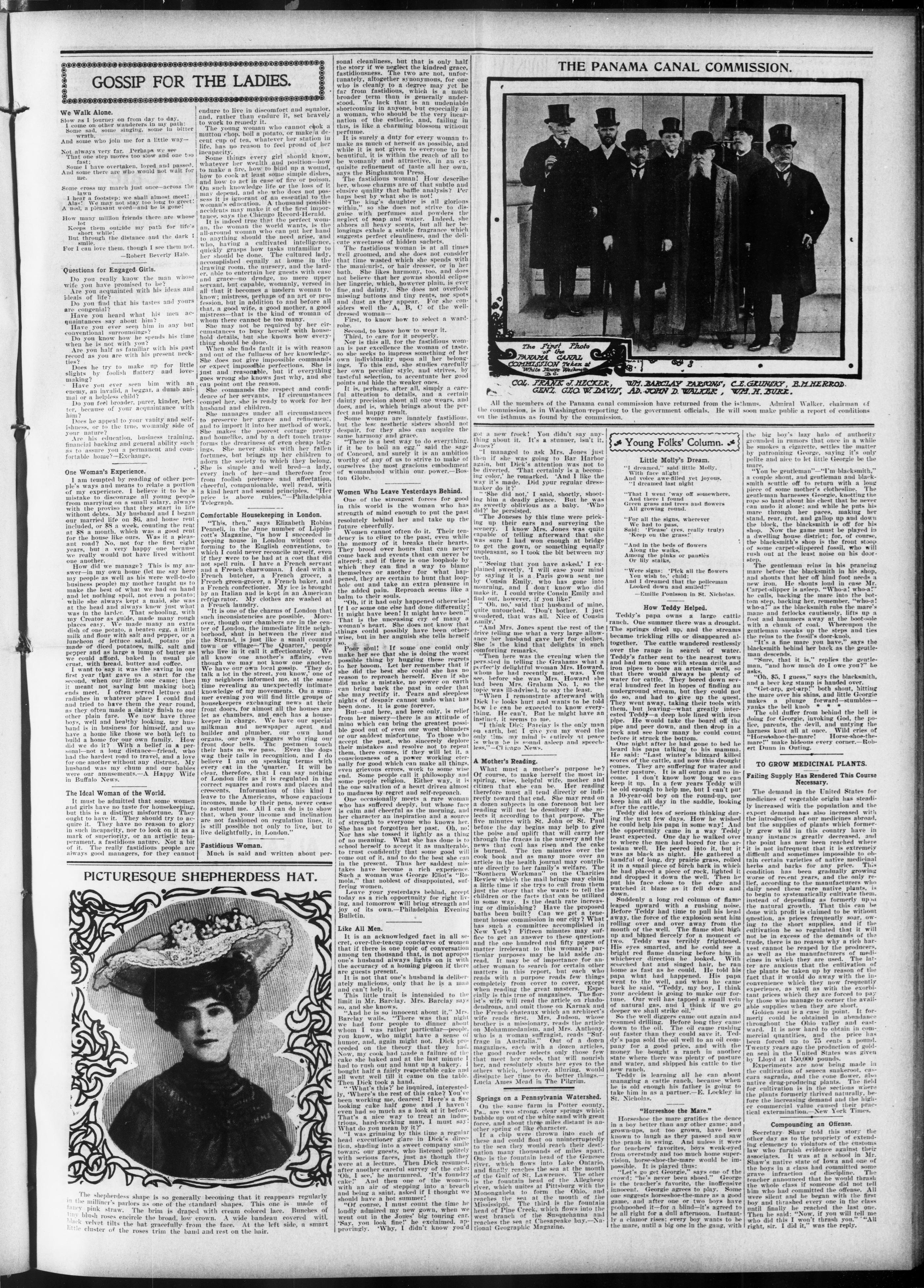
The First Photo of the PANAMA CANAL COMMISSION Taken at White House Washington D.C.
COL. FRANK J. HECKER, WM. BARCLAY PARSONS, C.E. GRUNSKY, B.M. HERROD.
GENL. GEO. W. DAVIS, AD. JOHN D. WALKER, WM. H. BURK.
All the members of the Panama canal commission have returned from the isthmus. Admiral Walker, chairman of the commission, is in Washington reporting to the government officials. He will soon make public a report of conditions on the isthmus as found by the commission.
got a new frock! You didn't say anything about it. It's a stunner, isn't it, Jones?"
"I managed to ask Mrs. Jones just then if she was going to Bar Harbor again, but Dick's attention was not to be diverted. 'That certainly is a becoming color,' he remarked. 'And I like the way it's made. Did your regular dressmaker do it?'
"'She did not,' I said, shortly, shooting him a deadly glance. But he was as sweetly oblivious as a baby. 'Who did?' he persisted.
"The Joneses by this time were pricking up their ears and surveying the scenery. I know Mrs. Jones was quite capable of telling afterward that she was sure I had won enough at bridge to get the gown, or something equally unpleasant, so I took the bit between my teeth.
"Seeing that you have asked,' I explained sweetly, 'I will ease your mind by saying it is a Paris gown sent me by Cousin Emily, who has gone into mourning, and I don't know who did make it. I could write Cousin Emily and find out, however, if you like!"
"Oh, no,' said that husband of mine, quite untouched. 'Don't bother. I just wondered, that was all. Nice of Cousin Emily.'
"And Mrs. Jones spent the rest of the drive telling me what a very large allowance her husband gave her for clothes. She is the kind that delights in such comforting remarks.
"Then here was the evening when the persisted in telling the Grahams what a perfectly delightful woman Mrs. Howard, whom he had recently met, was. You see, before she was Mrs. Howard she had been Mrs. Graham No. 1, so the tonic was ill-advised, to say the least.
"When I remonstrate afterward with Dick he looks hurt and wants to be told how he can be expected to know everything. He can't. But he might have an instinct, it seems to me.
"I think Dick: Parciay is the only man on earth, but I give you my word the only time my mind is entirely at peace is when he is sound asleep and speechless."—Chicago News.
A Mother's Reading
What must a mother's purpose be? Of course, to make herself the most inspiring, wise, helpful wife, mother and citizen that she can be. Her reading therefore must all tend directly or indirectly toward that end. She may read on a dozen subjects in one forenoon but her reading will not be desultory if she selects it according to that purpose. The five minutes with St. John or St. Paul before the day begins may help to give the poise and uplift that will carry her through the fracas in the nursery and the news that coal has risen and the cake is burned. The ten minutes over the cook book and as many more over an article in the health journal may contribute directly to her family's welfare. The "Southern Workman" on the Charities Review which the mail brings may claim a little time if she trys to cull from them just the story that she wants to tell the children or the facts that can be utilized in some way. Is the death rate increasing or diminishing? Have the proposed baths been built? Can we get a tenement house commission in our city? What has such a committee accomplished in New York? Fifteen minutes may suffice to get an answer to these questions and the one hundred and fifty pages of matter irrelevant to this woman's particular purposes may be laid aside and read. It may be of importance for another woman to search for certain other matters in this report, but each who reads with a purpose reads few things completely from cover to cover, except when reading the great masters. Especially is this true of magazines. The florist's wife will read the article on rhodendrons, and omit those on Karnak and the French chateaux which an architect's wife reads first. Mrs. Judson, whose brother is a missionary, reads the article on Mohammedanism, and Mrs. Anthony, who is a woman suffragist, reads "Suffrage in Australia." Out of a dozen magazines, each with a dozen articles, the good reader selects only those few that meet her needs, that will nourish her, and resolutely shuts her eyes to the others which, however, alluring, would dissipate her time to do better things.—Lucia Ames Mead in The Pilgrim.
Springs on a Pennsylvania Watershed.
On the same farm in Potter county, Pa., are two strong, clear springs which bubble up out of the white sand with great force, and about three miles distant is another spring of like character.
If a chip were thrown into each of these and could float on uninterruptedly to the sea they would reach their destination many thousands of miles apart. One is the fountain head of the Genesee river, which flows into Lake Ontario, and finally reaches the sea at the mouth of the Gulf of St. Lawrence. The other is the fountain head of the Allegheny river, which unites at Pittsburg with the Monongahela to form the Ohio, and reaches the sea at the mouth of the Mississippi. The third is the fountain head of Pine Creek, which flows into the west branch of the Susquehanna and reaches the sea at Chesapeake bay.—National Geographic Magazine.
Little Molly's Dream.
"I dreamed," said little Molly,
With face alight
And voice awe-filled yet joyous,
"I dreamed last night
"That I went 'way off somewhere,
And there I found
Green grass and trees and flowers
All growing round.
"For all the signs, wherever
We had to pass,
Said: 'Please' (yes, really truly)
'Keep on the grass'
How Teddy Helped.
Teddy's papa owns a large cattle ranch. One summer there was a drought. The springs dried up, and the streams became trickling rills or disappeared altogether. The cattle wandered restlessly over the range in search of water. Teddy's father sent to the nearest town and had men come with steam drills and iron pipes to bore an artesian well, so that there would always be plenty of water for cattle. They bored down several hundred feet in hopes of finding an underground stream, but they could not do so, and had to give up the quest. They went away, taking their tools with them, but leaving—what greatly interested Teddy—a deep hole lined with iron pipe. He would take the board off the pipe and peer down, and then drop in a rock and see how many he could count before it struck the bottom.
One night after he had gone to bed he heard his papa talking to his mawma. He said: "Last winter's blizzard killed scores of the cattle, and now this drought comes. They are suffering for water and better pasture. It is all outgo and no income. I don't know how long we can keep it up. In a few years Teddy will be old enough to help me, but I can't put a 10-year-old boy on the round-up, nor keep him all day in the saddle, looking after the cattle."
Teddy did lots of serious thinking during the next few days. How he wished he could help his papa in some way! And the opportunity came in a way Teddy least expected. One day he walked over to where the men had bored for the artesian well. He peered into it, but it was as black as night. He gathered a handful of long, dry prairie grass, rolled it in a small piece of birch bark in which he had placed a piece of rock, lighted it and dropped it down the well. Then he put his face close to the edge and watched it blaze as it fell down and down.
Suddenly a long red column of flame leaped upward with a rushing noise. Before Teddy had time to pull his head away, the force of the explosion sent him rolling over and over away from the mouth of the well. The flame shot high up and blazed fiercely for a moment or two. Teddy was terribly frightened. His eyes smarted, and he could see a bright red flame dancing before him in whichover direction he looked. With scorched hat and singed hair, he ran home as fast as he could. He told his papa what had happened. His papa went to the well, and when he came back he said. "Teddy, my boy, I think your accident is going to make our fortune. Our well has tapped a small vein of natural gas, and I think if we go deeper we shall strike oil."
So the well diggers came out again and resumed drilling. Before long they came down to the oil. The oil came rushing out faster than they could save it. Teddy's papa sold the oil well to an oil company for a good price, and with the money he bought a ranch in another state where there was plenty of pasture and water, and shipped his cattle to the new ranch.
Teddy is learning all he can about managing a cattle ranch, because when he is old enough his father is going to take him in as a partner.—E. Lockley in St. Nicholas.
"Horseshoe the Mare"
Horseshoe the mare gratifies the deuce in a boy better than any other game; and grown-ups, not too grown, have been known to laugh as they passed and saw the prank in swing. And unless it were for teachers' favorites, boys weak-eyed from overstudy and too much home supervision, horse-shoe-the-mare would be impossible. It is played thus:
"Let's go get Georgie," says one of the crowd; "he's never been shoed." George is the teacher's favorite, the inoffensive innocent. Georgie agrees to play. Some one suggests horseshoe-the-mare as a good game, and after one or two boys have poohpoohed it—for a blind—it's agreed to be all right for a dull afternoon. Instantly a clamor rises: every boy wants to be the mare, until a big one in the gang, with
the big boy's lazy halo of authority grounded in rumors that once in a while he smokes a cigarette, settles the matter by patronizing George, saying it's only polite and nice to let little Georgie be the mare.
"You be gentleman"—"I'm blacksmith," a couple shout, and gentleman and blacksmith scuttle off to return with a long piece of some mother's clothesline. The gentleman harnesses Georgie, knotting the rope so hard about his chest that he never can undo it alone; and while he puts his mare through her paces, making her stand, rear, trot, and gallop up and down the block, the blacksmith is off for his shop. Now the game must be played in a dwelling house district; for, of course, the blacksmith's shop is the front stoop of some carpet-slippered fossil, who will rush out at the least noise on his door-step.
The gentleman reins in his prancing mare before the blacksmith in his shop, and shouts that her off hind foot needs a new iron. He shouts loud in case Mr. Carpet-slipper is asleep. "Who-a! who-a!" he calls, backing the mare into the bottom step, backing her, remember, "who-a! who-a!" as the blacksmith rubs the mare's mane and fetlocks cautiously, lifts up a foot and hammers away at the boot-sole with a chunk of coal. Whereupon the gentleman sneaks up the steps and ties the reins to the fossil's door-knob.
"It's a fine mare you have," says the blacksmith behind her back as the gentleman descends.
"Sure, that it is." replies the gentleman, "and how much do I owe you?" he asks.
"Oh, $5, I guess," says the blacksmith, and a beer keg stamp is handed over.
and a bell keeg stamp is handed over.
"Get-arp, get-arp!" both shout, hitting the mare over his shins, and little Georgie makes a plunge forward—stumbles—yanks the bell knob * * * *
The old duffer from behind the bell is doing for Georgie, invoking God, the police, parents, the devil, and untying the harness knot all at once. Wild cries of "Horse shoe-the-mare! Horse-shoe-the-mare!" make hideous every corner.—Robert Dunn in Outing.
TO GROW MEDICINAL PLANTS.
Failing Supply Has Rendered This Course Necessary.
The demand in the United States for medicines of vegetable origin has steadily increased with the population and the export demand has also increased with the introduction of our medicines abroad, but the supplies of plants which formerly grew wild in this country have in many instances greatly decreased, and the point has now been reached where it is not infrequent that it is extremely difficult and sometimes impossible to obtain certain varieties of native medicinal herbs and barks for any price. This condition has been gradually growing worse of recent years, and the only relief, according to the manufacturers who daily need these rare native plants, is to begin to systematically cultivate them, instead of depending as formerly upon the natural growth. That this can be done with profit is claimed to be without question, as prices frequently soar, owing to the short supplies, and if the cultivation be so regulated that it will not be in excess of the demands of the trade, there is no reason why a rich harvest cannot be reaped by the producers, as well as the manufacturers of medicines in which they are used. The latter are anxious that the cultivation of the plants be taken up by reason of the fact that it would do away with the inconvenience which they now frequently experience, as well as with the exorbitant prices which they are forced to pay by those who manage to corner the available supplies when they are short.
Golden seat is a case in point. It formerly could be obtained in abundance throughout the Ohio valley and eastward. It is now hard to obtain in commercial quantities, and the price has been forced up to 75 cents a pound. Twenty years ago the production of golden seal in the United States was given by Lloyd at 150,000 pounds. Experiments are now being made in the cultivation of seneca snakeroot, cascara sagrada, and the cone flower, also native drug-producing plants. The field for cultivation is in the sections where the plants formerly thrived naturally, before the increasing demand and the higher commercial value caused their practical extermination.—New York Times.
Compounding an Offense
Secretary Shaw told this story the other day as to the propriety of extending clemency to violators of the customs law who furnish evidence against their associates. It was at a school in Mr. Shaw's native state of Iowa and one of the boys in a class had committed some grave infraction of discipline. The teacher announced that he would thrash the whole class if someone did not tell him who had committed the offense. All were silent and he began with the first boy and thrashed every one in the class until finally he reached the last one. Then he said: "Now, if you will tell me who did this I won't thrash you." "All right, sir. I did it," was the reply.
THE WISCONSIN WEEKLY ADVOCATE.
R. B. Montgomery, Editor and Publisher.
P. A. Sample, Associate Editor and Business Manager.
Published Every Thursday at No. 79 Fifth Street.
A Representative Journal Devoted to the Interest of All the People.
ADVERTISING RATES.
One inch, one year.....$15.00
Two inches, one year.....25.00
Three inches, one year.....35.00
Four inches, one year.....42.00
For larger space, special rates.
TERMS OF SUBSCRIPTION.
One year ..... $2.00
Six months ..... 1.00
Three months ..... 50
Direct all communications to
R. B. MONTGOMERY,
79 Fifth Street.
HOW TO SEND MONEY.—Post Office
Order, Express Order,-Draft or Registered
Letter. R. B. Montgomery will not be re-
sponsible for loss when sent in any other
way.
TO CONTRIBUTORS:
All communications must be sent with the name and address of the sender as an evidence of good faith, but not necessarily for publication. No manuscript returned if not accepted, unless accompanied by stamps.
ADVERTISING RATES.
One insertion, per inch..... $ .25
One month, per inch..... .75
Three months, per inch..... 2.00
Six months, per inch..... 3.50
One year, per inch..... 5.00
Paragraph advertisements, per line. .05
EDITORIAL PARAGRAPHS.
"I know of the bravery and character of the Negro soldier. He saved my life at Santiago, and I have had occasion to say so in many articles and speeches. The Rough Riders were in a bad position when the Ninth and Tenth cavalry came rushing up the hill carrying everything before them. The Negro soldier has the faculty of coming to the front when he is needed most. In the Civil war he came 400,000 strong, and I believe he saved the Union."—President Roosevelt.
TO OUR READERS
The editor having been attending the great convention during the week, has not had the usual opportunity to gather local news of race interest. He has therefore to throw himself upon the indulgence of his readers. His opportunities at the convention were such as to give him a thorough insight into all the workings of a great political party. His treatment by the members of the national committee, the officials and the delegates was courteous in the extreme, and left nothing to be desired.
With the action of the national committee in the seating of our four delegates-at-large he was of course much gratified, but it was only as all fair-minded men had a right to expect. The action of the disgruntled and disappointed La Folletteites was childish, as it was only to be expected.
The scene at the nomination of the hero and statesman Roosevelt was one which can never be effaced from his memory. It required to be seen to be thoroughly appreciated. It nerves one to put forth every effort in behalf of the G. O. P. and its chosen head.
Next week we will give full particulars of the week in Chicago from our point of view.
ROOSEVELT - FAIRBANKS. (Continued from First Page.)
shall be two delegates, provided that this shall not impair the rights and privileges of the six delegates already seated in this convention."
On this the first roll call of the convention occurred.
All the territories voted no with the exception of Oklahoma, which cast two ayes, and Hawaii, which declined to vote at all. The vote resulted, 497 ayes, 490 noes.
"The substitute is agreed to," shouted the chairman.
Senator Foraker moved to amend the substitute by including in it Alaska, Arizona and New Mexico. The motion was not entertained as the roll call had been ordered. There was considerable confusion on the floor and the chairman rapped vainly for order. Foraker's motion was defeated.
The platform was then adopted by unanimous vote.
First Day of the Convention.
Chicago, Ill., June 21.—The Republican national convention, the thirteenth in the party's history, met in the Coliseum at noon today and organized. The grand climax, the nominations, will not be reached until the third day. Senator Depew calls today a curtain raiser for the more serious drama of tomorrow and Thursday. The curtain raiser was in itself an absorbing production.
By a quarter to 12 each entrance to the floor of the great hall was pouring in a stream of delegates. They came in quietly, few delegations arriving in a body. Mingling with the strains of the band was a great hum of conversation, but there was no disorder. The hall filled rapidly, but the galleries were slower and ten minutes before the hour set for the presiding officer's gavel to fall, there was a wilderness of vacant chairs in the great balconies.
Called to Order.
With three severe raps of the gavel Acting Chairman Payne called the convention to order at 12:16. He then introduced Rev. Timothy P. Frost, pastor of the First Methodist church of Evanston. Ill., who pronounced the opening prayer.
Root Wins Applause.
Simultaneously with ex-Secretary Root's appearance at the speaker's table an immense oil painting of President Roosevelt was unveiled at his right. The tableau brought forth a burst of enthusiasm. As Mr. Root began to speak the picture was removed and the sole atten-
tion of the immense gathering was devoted to the New York statesman. The more striking sentences of his speech were liberally applauded. When he reviewed in figures the increase of the money of the country and announced the enormous sum of gold accumulated the convention became enthusiastic. All of these details and figures Mr. Root pronounced without reference to memorandum. He turned his attention to the administrations' regulation of trusts and when he said: "But no nonest industry has been suppressed," the was a round of approving applause the declaration that those corporations which had encroached on the rights of the public had been curbed to an extent never before reached also pleased the convention.
Mr. Root threw back the lapels of his coat. He paced back and forth in a brief space on the platform and enforced his words with quiet gestures in which his index finger played an important
Taft's Name Cheered.
Discussing the Cuban question. Mr. Root read the dispatch from President Palma to President Roosevelt when the island was turned over. It was the first time he had mentioned the President's name and the convention grasped the opportunity to applaud. Shortly afterward he brought in the name of Secretary Taft, which was also heartily applauded. The administration's Panama canal policy received a round of applause when Mr. Root declared that the "weaklings would have postponed its construction to another generation."
Mr. Root's challenge of "Judgment on the record of the Republican's administration" was the signal for a shout and applause. Reverential silence prevailed when the speaker alluded briefly to the assassination of President McKinley, and again applause broke out as his successor's record was reviewed.
When he mentioned the name of the late Senator Hanna the convention responded in a long demonstration.
Delegates Go Wild.
Mr. Root concluded his address with the words: "Theodore Roosevelt," and they were magic to the delegates. The most marked demonstration of the session ensued. The delegates climbed on their chairs and tossed hats and handkerchiefs into the air. A white-haired irrepressible in the Connecticut delegation led off with his silk flag, which he waved frantically. A number of the national committeemen crowded around Mr. Root and shook his hand in congratulation, while the orchestra rendered a medley of the national airs.
The chairman stated that the national committee had placed upon the roll the names of the delegates from Porto Rico and six from the Philippines with two votes and asked the pleasure of the convention upon the motion of the committee on the ordering of a roll call. Senator Foraker moved that the motion of the national committee be approved, and the motion was carried, but one voice being heard in the negative.
COMMITTEE ON RESOLUTIONS.
Senator Spooner Is Named by the Wisconsin Delegation.
Chicago, Ill., June 21.—The committee on resolutions is made up as follows:
Alabama—Andrew J. Johnson.
Arkansas—Charles F. Duke.
California—Frank H. Short.
Colorado—C. C. Dawson.
Connecticut—Edwin W. Higgins.
Delaware—Caleb R. Layton.
Florida—W. H. Northrep.
Georgia—W. H. Johnson.
Idaho—Weldon B. Heyburn.
Illinois—Albert J. Hopkins.
Indiana—Albert J. Beveridge.
Iowa—J. W. Blythe.
Kansas—Fred D. Smith.
Kentucky—George W. Long.
Louisiana—J. Madison Vance.
Maine—E. P. Spofford.
Maryland—Phillip L. Goldsborough.
Massachusetts—H. Cabot Lodge.
Michigan—Ralph Lovejoy.
Minnesota—Knute Nelson.
Mississippi—W. E. Mollison.
Missouri—Boyd Dudley.
Montana—Thomas H. Carter.
Nebraska—Frank Williams.
Nevada—E. S. Farrington.
New Hampshire—J. H. Gallinger.
New Jersey—John F. Dryden.
New York—Edward Lauterbach.
North Carolina——.
North Dakota—H. C. Hansbrough.
Ohio—J. B. Foraker.
Oregon—J. U. Campbell.
Pennsylvania—John Dazell.
Rhode Island—William L. Hodgman.
South Carolina—E. J. Dickerson.
South Dakota—N. L. Finch.
Tennessee—Dana Harmon.
Texas—A. J. Rosenthal.
Utah—George C. Sutherland.
Vermont—William P. Dillingham.
Virginia—D. L. Groner.
Washington—J. S. McMillan.
West Virginia—George W. Atkinson.
Wisconsin—John C. Spooner.
Wyoming—C. D. Clark.
Alaska—J. W. Ivey.
Arizona—H. B. Tenney.
District of Columbia—Robert Reyburn.
Indian Territory—W. H. Darrough.
New Mexico—H. O. Burson.
Oklahoma—R. A. Lawry.
Philippines——.
Porto Rico—Robert H. Todd.
Hawaii—J. K. Kalanlaunole.
NEW NATIONAL COMMITTEE.
Several Important Changes Made in Its Make-up.
Chicago, Ill., June 21. The following is the Republican national committee, quite a few changes being made:
quite a few changes being made:
Alabama, Charles H. Scott; Arkansas,
Powell Clayton; California, George A.
Knight; Colorado, A. M. Stevenson, Con-
necticut; Charles F. Brocker; Delaware, J.
Edward Addicks; Florida, J. N. Coombs;
Georgia, Judson W. Lvons; Idaho, Welder
B. Heyburn; Illinois, Frank O. Lowden; Indi-
niana, Harry S. New; Iowa, Ernest E.
Hart; Kansas, David W. Mulvano; Kentu-
cky, John W. Yerkes; Louisiana, Walter
L. Cohen; Maine, John F. Hill; Maryland,
Louis E. McComas; Massachusetts, W. Mur-
ray Crane; Michigan, John W. Blodgett,
Minnesota, Frank B. Kellogg; Mississippi,
L. B Mosely; Missouri, Thomas J. Alken-
monta, John B. Wayte; Nebraska, Charles
H. Morrill; Nevada, P. J. Flanigan; New
Hampshire, Frank T. Streeter; New Jersey,
Franklin Murphy; New York, William
L. Ward; North Carolina, E. C. Duncan;
North Dakota, Alexander McKenzie; Ohio,
Myron T. Herrick; Oregon, Charles H.
Carey; Pennsylvania, Boles Penrose; Rhode
Island; _____; South Carolina, John G.
Capers; South Dakota, J. M. Greene; Tennessee,
W. P. Brawnlow; Texas, Cecil A.
Lyons; Utah, C. E. Loose; Vermont, James
Brock; Virginia, George E. Bowden; Wash-
ington, Levy Ankony; West Virginia, N. B.
Scott; Wisconsin, Henry C. Payne; Woy-
ning, George E. Pexton; Alaska, John G.
Held; Arizona, W. S. Sturgis; District of
Columbia, Robert Rayburn; Indian Terri-
tory, P. L. Seper; New Mexico, Solomon
Luna; Oklahoma, C. M. Cade; Philippines
_____; Porto Rico, Robert H. Todd
Hawaii, Alexander G. M. Robertson.
In a New York Police Court.
The prisoner looked well able to support the little woman who had hauled him to the police court, but she declared that money was something she had seldom seen since her marriage. The magistrate was one noted for his generosity. "Mr. Jones," said the magistrate to one of the lawyers in the courtroom, "take this woman's case."
Search of the prisoner had revealed a bank book. It snowed deposits amounting to $1700. The book was laid on the desk in front of his honor.
"Young man, I direct that you write out a check for $520 to support your wife for one year," commanded the court, "and I further direct that you write another check for $50 for the lawyer. An officer will see that the checks are cashed."—New York Sun.
Chicago, Ill., June 23.—The name of Theodore Roosevelt was presented to the national Republican convention by former Gov. Frank S. Black of New York. Gov. Black's nominating speech is as follows:
Mr. President and Gentlemen of the Convention: We are here to inaugurate a campaign which seems already to be nearly closed. So wisely have the people sowed and watched and tended, there seems little now to do but to measure up the grain. They are ranging themselves not for battle but for harvest. In one column reaching from the Maine woods to the Puget sound are those people and those states which have stood so long together, that when great emergencies arise the nation turns instinctively to them. In this column, vast and solid, is a majority so overwhelming that the scattered squads in opposition can hardly raise another army. The enemy has neither guns nor ammunition, and if they had they would use them on each other. Destitute of the weapons
A. H.
FRANK S. BLACK.
(Former Governor of New York Who Noml
nated Roosevelt for President.)
of effective warfare, the only evidence of approaching battle is in the tone and number of their bulletins. There is discord among the generals; discord among the soldiers. Each would fight in his own way, but before assaulting his Republican adversaries he would first destroy his own comrades in the adjoining tents. Each believes the weapons chosen by the other are not only wicked but fatal to the holder. That is true. This is the only war or modern times where the boomerang has been substituted for the gun. Whatever fatalities may occur, however, among the discordant hosts now moving on St. Louis, no harm will come this fall to the American people. There will be no opposition sufficient to raise a conflict. There will be hardly enough for competition. There are no Democratic plans for the conduct of the fall campaign. Their zeal is chiefly centered in discussion as to what Thomas Jefferson would do if he were living. He is not living, and but few of his descendants are among the Democratic remnants of today. Whatever of patriotism or wisdom emanated from that distinguished man is now represented in this convention.
"Forget" Is Democrats' Motto.
Forget Is Democratis Motto.
It is a sad day for any party when its only means of solving living issues is by guessing at the possible attitude of a statesman who is dead. This condition leaves that party always a beginner and makes every question new. The Democratic party has seldom tried a problem on its own account, and when it has its blunders have been its only monuments, its courage is remembered only in regret. As long as these things are recalled that party may serve as ballast, but it will never steer the ship.
When all the people have forgotten will dawn a golden era for this new Democracy. But the country is not ready yet to place a party in the lead whose most expressive motto is the cheerless word "forget." That motto may express contrition, but it does not inspire hope. Neither confidence nor enthusiasm will ever be aroused by any party which enters each campaign uttering the language of the mourner.
There is one fundamental plank, however, on which the two great parties are in full agreement. Both believe in the equality of men. The difference is that the Democratic party would make every man as low as the poorest, while the Republican party would make every man as high as the best. But the Democratic course will provoke no outside interference now, for the Republican motto is that of the great commander, "never interrupt the enemy while he is making a mistake."
In politics as in other fields, the most impressive arguments spring from contrast. Never has there been a more striking example of unity than is now afforded by this assemblage. You are gathered here not as factions torn by discordant views, but moved by one desire and intent, you have come as the chosen representatives of the most enlightened party in the world. You meet not as strangers, for no men are strangers who hold the same beliefs and espouse the same cause. You may separate two bodies of water for a thousand years, but when once the barrier is removed they mingle instantly and are one. The same traditions inspire and the same purposes actuate us all. Never in our lives did these purposes stand with deeper root than now. At least two generations have passed away since the origin of that great movement from which sprang the spirit which has been the leading impulse in American politics for half a century. In that movement, which was both a creation and an example, were those great characters which endowed the Republican party at its birth with the attributes or justice, equality and progress, which have held it to this hour in line with the highest sentiments of mankind. From these men we have inherited the desire, and to their memory we owe the resolution, that those great schemes of government and humanity, inspired by their patriotism, and established by their blood, shall remain as the fixed and permanent emblem of their labors, and the abiding signal of the liberty and progress of the race.
Stands for Righteousness.
There are many new names in these days, but the Republican party needs no new title. It stands now where it stood at the beginning. Memory alone is needed to tell the source from which the inspirations of the country flow. A drowsy memory would be as guilty now as a sleeping watchman when the enemy is astir. The name of the Republican party stands over every door where a righteous cause was born. Its members have gathered around every movement, no matter how weak, if inspired by high resolve. Its flag for more than fifty years has been the sign of hope on every spot where liberty was the word. That party needs no new name or platform to designate its purposes. It is now as it has been, equipped, militant and in motion. The problems of every age that age must solve. Great causes impose great demands, but never in any enterprise have the American people failed, and never in any crisis has the Republican party failed to express
the conscience and intelligence of that people.
The public mind is awake both to its opportunities and its dangers. Nowhere in the world, in any era, did citizenship mean more than it means today in America. Men of courage and sturdy character are ranging themselves together with a unanimity seldom seen. There is no excuse for groping in the dark, for the light is plain to him who will but raise his eyes. The American people believe in a man or party that has convictions and knows why. They believe that what experience has proved it is idle to resist. A wise man is any fool about to die. But there is a wisdom which with good fortune may guide the living and the strong. That wisdom springs from reason, observation and experience. Guided by these this thing is plain, and young men may rely upon it, that the history and purposes I have described, rising even to the essence and aspirations of patriotism, find their best concrete example in the career and doctrines of the Republican party.
The Right Man for the Place.
But not alone upon the principles of that party are its members in accord. With the same devotion which has marked their adherence to those principles, magnificent and enduring as they are, they have already singled out the man to bear their standard and to lead the way. No higher badge was ever conferred. But great as the honor it, the circumstances which surround it make that honor even more profound. You have come from every state and territory in this vast domain. The country and the town have vied with each other in sending here their contributions to this splendid throng. Every highway in the land is leading here and crowded with the members of that great party which sees in this splendid city the symbol of its rise and power. Within this unexamined multitude is every rank and condition of free men, every creed and occupation. But today a common purpose and desire have engaged us all, and from every nook and corner of the country rises but a single choice to fill the most exalted office in the world. He is no stranger waiting in the shade to be called suddenly into public light. The American people have seen him for many years and always where the fight was thickest and the greatest need was felt. He has been alike conspicuous in the pursuits of peace and in the arduous stress of war. No man now living will forget the spring of '98, when the American mound was so inflamed and American patriotism so aroused; when among all the eager citizensurging to the front as soldiers, the manwhom this convention has already in its heart was among the first to hear the call and answer to his name. Preferring peace but not afraid of war; faithful to every private obligation, yet first to volunteer at the sign of national peril; a leader in civil life and yet so quick to comprehend the arts of war that he grew in a day to meet the high exactions of command. There is nothing which so tests a man as great and unexpected danger. He may pass his life amid ordinary scenes and what he is or does but few will ever know. But when the crash comes or the flames breaks out, a moment's time will single out the hero in the crowd. A flash of lightning in the night will reveal what years of daylight have not discovered to the eye. And so the flash of the Spanish war revealed that lofty courage and devotion which the American heart so loves and which you have met again to decorate and recognize. His qualities do not need to be retold, for no man in that exalted place since Lincoln has been better known in every household in the land. He is not conservative, if conservatism means wailing till it is too late. He is not wise, if wisdom is to count a thing a hundred times when once will do. There is no regret so keen, in man or country, as that which follows an opportunity unembraced. Fortune soars with high and rapid wing, and whoever brings it down must shoot with accuracy and speed. Only the man with steady eye and nerve and the courage to pull the trigger brings the largest opportunities to the ground. He does not always listen while all the sages speak, but every day at night fall beholds some record which if not complete has been at least pursued with conscience and intrepid resolution. He is no slender flower swaying in the wind, but that herole fiber which is best nurtured by the mountains and the snow. He spends little time in review, for that he knows can be done by the schools. A statesman grappling with the living problems of the hour, he gropes but little in the past. He believes in going ahead. He believes that in shaping the destinies of this great republic, hope is a higher impulse than regret. He believes that preparation for future triumphs is a more important duty than an inventory of past mistakes. A profound student of history, he is today the greatest history maker in the world. With the instincts of the scholar, he is yet forced from the scholar's pursuits by those superb qualities which fit him to the last degree for those great world currents now rushing past with larger volume and more portentous aspect than for many years before. The fate of nations is still decided by their wars. You may talk of orderly tribunals and learned refeees; you may sing in your schools the gentle praises of the quiet life; you may strike from your books the last note of every martial anthem, and yet out in the smoke and thunder will always be the tramp of horses and the silent, rigid, upturned face. Men may prophesy and women pray, but peace will come here to abide forever on this earth only when the dreams of childhood are the accepted charts to guide the destinies of men. Events are numberless and mighty, and no man can tell which wine runs around the world. The nation basking today in the quiet of contentment and repose may still be on the deadly circuit and tomorrow writhing in the toils of war. This is the time when great figures must be kept in front. If the pressure is great the material to resist it must be granite and iron. Whether we wish it or not, America is abroad in this world. Her interests are in every street, her name is on every tongue. Those interests so sacred and stupendous should be trusted only to the care of those whose power, skill and courage have been tested and approved. And in the man whom you will chooses, the highest sense of every nation in the world beholds a man who typifies as no other living American does, the spirit and the purposes of the Twentieth century. He does not claim to the Solomon of his time. There are many things he may not know, but this is sure, that above all things else he stands for progress, courage and fair play, which are the synonyms of the American name.
There are times when great fitness is hardly less than destiny, when the elements so come together that they select the agent they will use. Events sometimes select the strongest man, as lightning goes down the highest rod. And so it is with those events which for many months with unerring sight have led you to a single name which I am chosen only to pronounce: Gentlemen, I nominate for President of the United States the highest living type of the youth, the vigor and the promise of a great country and a great age, Theodore Roosevelt of New York.
The frigate bird can fly at a speed of ninety-six miles an hour without seeming to move its wings to any great degree. J. Lancaster, an American naturalist, asserts that he has seen a frigate bird on the wing for a whole week, night and day, without rest.
WE CONTINUE TO WARN THE BENEVOLENT PUBLIC AGAINST THE NUMEROUS BEGGARS FOR ALLEGED CHARITABLE INSTITUTIONS IN BEHALF OF THE NEGRO RACE. LOOK WELL TO THE CREDENTIALS OF SUCH MENDICANTS AND INQUIRE OF SOME REPUTABLE NEGRO CITIZEN REGARDING THE TRUTHFULNESS OF THEIR STATEMENTS.
Banquet Rooms for Dinner Parties, Etc. Cuisine Par Excellent Table D'Hote.
NOTE- We have neither private rooms, nor "private" people, but cater to the general public.
DINNER FROM 5:30 TO 8:00; 35c.
Cafe In Connection: Prices Moderate and Consistent with Accommodations Furnished.
Positively cures Rheumatism, Locomotor-Ataxia, all Stomach, Liver and Kidney Troubles and all Nerve and Blood Diseases. Send us your name and address and we will mail you absolutely free a ten days' trial treatment of this wonderful medicine together with a scientific booklet, "How to Secure Perfect Physical Health." Address
WALDORF CAFE
ALEX STEPHENS, Proprietor.
Where Booker T. Washington Was Banqueted.
OPEN ALL NIGHT
3027 State Street. CHICAGO.
'PHONE 360 DOUGLAS.
J. MUNKO
Manufacturer of RAZOR STRAPS
Practical Shoemaker
126 SECOND STREET, MILWAUKEE
Telephone Grand 364
A.
Steam Heat. Electric Light.
Telephone in Every Room.....
TURF EUROPEAN HOTEL...
A New and Modern Establishment for Gentlemen Only.
Long Distance Phone 80
Packing House & Freezers, Foot of N. Jefferson St
PEOPLE'S CHOICE.
Roosevelt Is the Man Wanted by American Citizens for Their President.
Indiana Senator Says Mr. Roosevelt Is a Safe Man and Eager
HIS RECORD WINS APPROVAL.
Chicago, Ill., June 23.—Senator Albert J. Beveridge of Indiana made the first speech seconding the nomination of President Roosevelt. He spoke as follows:
Gentlemen of the Convention: One difference between the opposition and ourselves is this: They select their candidate for the people, and the people select our candidate for us.
This was true four years ago when we accepted the people's judgment and named William McKinley, whose perfect mingling of mind and heart, of wisdom and of tenderness, won the trust and love of the nation then and makes almost holy his memory now. His power was in the people's favor, his shrine is in the people's hearts.
It is true today when we again accept the people's judgment and name Theodore Roosevelt, whose sympathies are as wide as the republic, whose courage, honesty and vision meet all emergencies, and the sum of whose qualities make him the type of Twentieth century Americanism. And the Twentieth century American is nothing more than the man of '76 facing a new day with the old faith.
Theodore Roosevelt, like William McKinley, is the nominee of the American fireside. So were Washington and Jefferson in the early time; so was Andrew Jackson when
M. B.
(A Senator From Indiana Who Made Important Speech Seconding Roosevelt's Nomination.)
(A Senator From Indiana Who Made Important Speech Seconding Roosevelt's Nomination.)
he said "The Union: It must be preserved;" so was Abraham Lincoln when the Republic saved, he bade us "bind up the nation's wounds;" and Grant when, from victory's very summit his lofty words, "let us have peace" voiced the spirit of the hour and the people's prayer. When nominated by parties, each of these great Presidents was, at the periods named, already chosen by the public judgment. And so today, the Republican party, whose strength is in its obedience to the will of the American people, merely executes again the decree which comes to it from the American home in naming Theodore Roosevelt as our candidate.
An Ideal American.
The people's thought is his thought; American ideals, his ideals. This is his only chart of statesmanship—and no other is safe. For the truest guide an American President can have is the collective inteflience and massed morality of the American people. And this ancient rule of the fathers is the rule of our leaders now.
Theodore Roosevelt is a leader who leads; because he carries out the settled purposes of the people. Our President's plans, when achieved, are always found to be merely the nation's will accomplished. And that is why the people will elect him.
They will elect him because they know that if he is President we will get to work and keep at work on the canal. After decades of delay when the people want a thing done, they want it done.
They know that while he is President the flag will "stay put." and no American advantage in the Pacific or the world be surrendered. Americans never retreat.
While he is President no wrong-doer in the service of the government will go unwhipped of justice. Americans demand honesty and honor, vigilant and fearless. While he is President readjustment of tariff schedules will be made only in harmony with the principles of protection. Americans have memories. While he is President peace with every nation will be preserved at any cost, excepting only the sacrifice of American rights; and the vigor with which he maintains these will be itself a guarantee of peace.
Does What People Want Done.
The American people will elect him because, in a word, they know that he does things the people want done; does things, not merely discusses them—does things only after discussing them—but does things; and does only those things the people would have him do. This is characteristically American; for wherever he is, the American is he who acclieves.
On every question all men know where he stands. Americans, frank themselves, demand frankness in their servants. Uncertainty is the death of business. The people can always get along if they know where they are and whither they are.
be reciprocity? The opposition resisted and then opposition votes helped to ratify it.
Do you name corporate legislation? The opposition resisted and then opposition votes helped to ratify it.
Do you name the canal—that largest work of centuries, the eternal wedding of oceans, shrinking the circumference of the globe, making distant peoples neighbors, advancing forever civilization all around the world? This historic undertaking in the interest of all the race, planned by American statesmanship, to be wrought by American hands, to stand through the ages protected by the American flag; this vast achievement which will endure when our day shall have become ancient, and which alone is enough to make the name of Theodore Roosevelt illustrious through all time—this fulfillment of the republic's dream accomplished by Republican effort, finally received votes even from an opposition that had tried to thwart it.
Of what measure of Theodore Roosevelt's administration does the opposition dare even to propose the repeal? And when has the record of any President won greater approval?
People Trust Him.
And so the people trust him as a statesman. Better than that, they love him as a man. He wins admiration in vain who wins not affection also. In the American home that temple of happiness and virtue where dwell the wives and mothers of the republic, cherishing the beautiful in life and guarding the morality of the nation—in the American home the name of Theodore Roosevelt is not only honored but beloved. And that is a greater triumph than the victory of battlefields, greater credit than successful statesmanship, greater honor than the presidency itself would be without it. Life holds no reward so noble as the confidence and love of the American people.
The American people! The mightiest
force for good the ages have evolved. They began as children of liberty. They believed in God and His providence. They took truth and justice and tolerance as their eternal ideals and marched fearlessly forward. Wildernesses stretched before them—they subdued them. Mountains rose—they crossed them. Deserts obstructed—they passed them. Their faith failed them not and a continent was theirs. From ocean to ocean cities rose, fields blossomed, railroads ran; but everywhere church and school were permanent proof that the principles of their origin were the life of their maturity.
American methods changed, but American character remained the same. They outlived the stage coach, but not the Bible. They advanced but forgot not their fathers. They delved in earth, but remembered the higher things. They made highways of the oceans, but distance and climate altered not their Americanism. They began as children of liberty, and children of liberty they remain. They began as servants of the Father of Lights, and His servants they remain. And so into their hands is daily given more of power and opportunity that they may work even larger righteousness in the world and scatter over ever widening fields the blessed seeds of human happiness.
Nation's Great Growth.
Wonderful beyond prophecy's forecast their progress; noble beyond the vision of desire their future. In 1801 Jefferson said, "the United States (then) had room enough for our descendants to the thousandth and thousandth generation;" three generations behold the oceans our boundaries. Washington never dreamed of railways. Today electricity and steam make Malne and California household neighbors. This advance, which no seer could have foretold, we mad; because we are Americans—because a free people with unfettered minds and unquestioning belief joyfully faced the universe of human possibilities. These possibilities are not exhausted; we have hardly passed their boundaries. The American people are not exhausted; we have only tested our strength. God's work for us in the world is not finished: His future missions for the American people will be grander than any He has given us, nobler than we now can comprehend. And these tasks as they come we will accept and accomplish as our fathers accomplished theirs. And when our generation shall have passed and our children shall catch from our aging hands the standard we have borne, it will still be the old flag of Yorktown and Appomattox and Manila bay; the music to which they in their turn will then move onward will still be the strains that cheered the dying Warren on Bunker Hill and inspired the men who answered Lincoln's call; and the ideals that will be in them triumphant as they are in us, will still be the old ideals that made the American people great and honored among the nations of the earth.
This is the Republican idea of the American people; this the thought we have when we nominate today our candidate for the nation's chief; this the quality of Americanism a Republican standard-bearer must have. And this is just the Americanism of Theodore Roosevelt. Full of the old-time faith in the Republic and its destiny; charged with the energy of the Republic's full manhood; cherishing the ordinances of the republic's fathers and having in his heart the fear of God; inspired by the sure knowledge that the republic's splendid day is only in its dawn, Theodore Roosevelt will lead the American people in paths of safety broader betterment of the race and to the added honor of the American name. Therefore Indiana seconds the nomination of Theodore Roosevelt.
WEST WANTS ROOSEVELT.
Hail Him as the Young Lincoln and Demands His Election.
Chicago, Ill., June 23.—The following is the speech of George A. Knight of California, seconding the nomination of Mr. Roosevelt: Gentlemen of the convention: Geography has but little to do with the sentiment and enthusiasm that is today apparent in favor of the one who is to be given all the honors and duties of an elected President of the United States of America. However, the Pacific slope and the islands (those ocean buoys of commerce, moored in the drowsy tropical sea) send to this convention words of confidence greeting with discreet assurance that your judgment will be endorsed by the American voter and our country continue its wonderful progress under Republican success.
The time is ripe for brightening up Americanism, to teach with renewed vigor the principles of individual liberty for which the minutemen of the revolution fought. The Lincoln liberty, an individual liberty for the man, not a black man alone; any men, all men. The right to labor in the air of freedom unmolested, and be paid for his individual toll and with it build his cottage home.
Price of Liberty
From the press, the pulpit, the schoolhouse, the platform and the street, let the true history of our country be known that the young men and women of America, and many old ones, may know what a price has been paid for the liberty, peace and union they enjoy through the devoted patriotism of our silent heroes of the past. Deprivation and sacrifice were endured for many years before the old bell in the state house was given the voice to speak the glorious sentiment of the age, and proclaim liberty throughout all the land, and they were made the instruments by which the principles productive of our national grandeur were set as jewels in our republic's coronet. What we prayed for, fought for, bled for and died for we want cared for.
Telegraph the world that the Republican party was the first organization that beckoned the laboring man to his feet and made him know the quality and equality of his true self. It showed him the possibilities of honest poverty and has withheld nothing from his worthy ambition. It took a rail-splitter from the ground floor of a log cabin and set him with the stars.
Republicans Built Great Nation.
Protection to American labor, and our natural resources, climate, soil, agricultural and mineral wealth, navigable rivers and safe harbors, wise laws and clean public men, have made us the greatest nation of earth today. In territory, we have outgrown the continent; we are peopling the isles of the sea.
Thus said the Lord, a great eagle with great wings, long winged and full of feathers, which had divers colors, came unto Lebanon and took the highest branch of the cedar. He cropped off the top of its young twigs and carried it into a land of traffic; he set it in a city of merchants; he took also of the seed of the land and planted it in a fruitful field; he placed it across great waters and set it as a willow tree.
How like our emblem of freedom. He has cropped off the young twigs of our cedar of liberty and carried them across the ocean to the land of traffic and set them in the city of merchants. The seed of our land is there among fruitful fields, beside great waters and set as a willow tree. Our country is big and broad and grand; we want a President typical of the country, one who will preserve her history, teach Americanism and fight the wrong. Theodore Roosevelt, thon art the man. Well may he be proud; he is young, the pride of life is his, and time is on his side; he loves the whole country and knows no favorite section; he has performed his sacred promise, he has kept the faith with McKinley's memory, and now faces responsibilities his own. He hypnotizes obstacles, looks them in the eye and overpowers with self-conscious honesty of purpose.
Dishonesty, cowardice and duplicity are never impulsive. Roosevelt is impulsive; so be it, he is different.
From a Democratic point of view he is a weird magician of politics. They awoke one fine morning to find the republic of Panama an entity, its existence recognized by foreign nations and Congress paying out millions of dollars to ratify his strategic promptness.
He wanted to give Uncle Sam a job, and he did it, and Uncle Sam wanted the job and he took it. He belongs to the union.
We see him standing today with his feet upon the spade, his garments are made of his flag, his inventive Yankee whiskers are brushed, there is an American smile on his face, and his heart is gladdened as he looks at the golden sunrise of his commercial future.
The Panama Canal.
Barnacle bottomed ships of the great salt sea will greet the great father of waters and make every town on his banks a maritime city. The owner of the farm, factory and mine will become familiar with names they never knew, and write strange addresses on the exports they send across the unharvested ocean. Australia, New Zealand, Yokohama, Hong Kong, Manila.
Honolulu and Korea will be some of the new names the new south will be glad to know, and their children will bless the President that gave them their wonderful opportunities for trade. The blessings of this great work cannot be told in words, and figures will get wobbly and unsteady with their lead when you chalk them on the blackboard of time. We want this younger Lincoln, the keeper of our great eagle, we want him with his hands on the halyards of our flag, we want him, the defender of our constitution and the executive of our law, and when we have used him and the best years of his young manhood for the good of the nation, he will still be holding our banner of liberty with stars added to its azure field, its history sacred, its stripes untarnished, and by command of the majority, hand it to the American patriot standing next in line.
EDWARDS SPEAKS FOR SOUTH.
Georgia Delegate Seconds Nomination of President Roosevelt.
Chicago, Ill., June 23.—Harry Stilwell Edwards of Macon, Ga., made the following speech, seconding the nomination of President Roosevelt:
It is eminently fit and proper that a Georgian should on this occasion second the eloquent speaker from New York, that the voice of the motherland should blend with the voice of the fatherland to declare that the destinies of America shall for four years more be entrusted to the great son born of the union of the two empire states. I do not belittle the influence of a father when I say that if the iron in a son's nature be derived from him, the gold is coined from the heart of the mother whose lap has cradled him. And because I believe this, because the lesson at the mother's knee is the seed that sends a stalk toward heaven and opens far up its auxiliary blossoms in the morning light, because the lofty ideals of manhood are rooted deeper than youth, because that which a man instinctively would be has been dreamed for him in advance by a mother, I claim for Georgia the larger share in the man you have chosen your leader.
The childhood of the good woman who bore him was cast near where the Atlantic flows in over the marsh and the sand. There she first built her a home in the greatness of God. Womanhood found her within the uplifting view of the mountains in a land over which the Almighty inverts a sapphire cup by day and sets his brightest stars on guard by night. And there, fellow countrymen, the soul of your President was born. Those of us who know and love him catch in the easy flow of his utterance, and feel in its largeness of thought and contempt of littleness the rhythm of the ocean on the Georgian sands and the spirit of the deep. In his lofty ideals and hopefulness, in his fixedness of purpose and unchanging rock-ribbed honesty we hear the mountains calling. In his daring, his impulsive courage, his unconquerable manhood, we see his great brother, the Georgia volunteer in the hand to hand fights of the wilderness, the impetuous rush up the heights of Gettysburg and the defiance of overwhelming odds from Chattanooga to Atlanta. We look on him as a Georgian abroad, and if in the providence of God it may be so we shall welcome him home some day, not as a prodigal son, who has wasted his manhood, but as one who on every field of endeavor has honored his mother and worn the victor's wreath.
Coming into the position of the martyred McKinley, the youngest chief magistrate that has ever filled the presidential chair, without the privilege and advantage of preliminary discussion and consultation, he gave the country a pledge that he would carry out the policies of his predecessor. It was a master stroke of genius, applauded alike north and south. His conception of the duties of his high office, as enunciated by him at Harvard was, "to serve all alike, well; to act in a spirit of fairness and justice to all men; and to give each man his rights." He has kept this pledge; he has lived up to this fine conception of his duty. This pledge involved a completion of the work begun in Cuba and an honorable discharge of the promises made to our struggling neighbor. The flag of an independent republic floats over Havana today, and all men know that we have kept faith with the Cuban people. Leaving the details to engineers, he has cut as by a single stroke the Panama canal through mountains of prejudice and centuries of ignorance. In the far Philippines our flag floats, a guarantee of redemption, pacification and development. His conception of duty has led him into difficult places in dealing with the internal affairs of our own country; he has met every issue bravely and ably and demonstrated not only that prompt and decided action is often the highest expression of conservatism, but that it is safe to trust the impulse of man who is essentially and instinctively honest.
Fellow countrymen, after nearly four years of Theodore Roosevelt, we find the army and navy on a better footing, our trade expanded, the country at peace and prosperous and our flag respected in every quarter of the globe. The American people will not withhold from him the applause of manly hearts. I am proud that my state, the Empire state of the south, shares in the glory of his achievements, as it will share in their benefits.
It is not pretended that the section from which I come to you is, as a section, in sympathy with your political party. But I am as sure as that I stand here, that the great majority of intelligent business men in the south are in sympathy with the controlling principles of your platform and opposed to those of your opponents as last declared. And I am equally sure that they recognize and respect the fearless honesty of your leader. Headlines are not history, nor does the passionate partisan write the final verdict of a great people. History, despite the venom of the small politician, will do him the justice to record that he has gone further than any man who has occupied the white house since the Civil war, to further the vital interests of the south. The standard of appointments has been the same for Georgia as for New York. He has insisted on efficiency and integrity as the chief tests, north and south alike. Of the thousand or more original postoffice appointments in Georgia under his administration not one has within my knowledge been criticised by even the unfriendly and partisan press of the state. A southern man, Gen. Wright, by his appointment holds the honor of this country in trust in the far Philippines, and on him your President relies for the advancement and development of the 7,000,000 people who are there working out their destinies. Two judges of first instance, one a Democrat and one a Republican and both from Georgia, are there by his appointment to administer the laws. In the army there and here in the navy and in all the divisions of the civil government, southern men have felt the friendly touch of his hand. The character of these appointments and the whole policy give the lie to these designing knaves who charge him with stirring up strife between races and arraying section against section. "I am proud of your great deeds, for you are my people." This was his greeting to a southern audience, and no honest man doubts that he meant it.
The south shares in the magnificent prosperity which our great country has achieved under the Republican party. Especially has she felt the beneficent effect of your policies during the last eight years; and the hardest fact your opponents have to contend with is the fact that your financial policy has been tested and found to be sound and efficient. They have suffered for eight years at least, and the Democratic partisan who has twice in that time been led captive behind the silver car of Bryan must be optimistic beyond expression if he believes that the country will suffer alarm over the prospect of four years more of prosperity. The south deals in cotton goods, cotton seeds products, coal, iron, oil and lumber, and business enterprises in connection with these and other industries have increased and multiplied. Traveling from Washington to Macon, one is never off a first class railroad nor long out of sight of the smoke of a mill. The people who conduct these and kindred enterprises, who are raising cotton at from 10 to 16 cents a pound, wheat at from 75 cents to a dollar per bushel, whose coal, iron and lumber are in demand throughout the world, whose home market is assured, and whose lands are rapidly increasing in value, are not alarmed over the prospect of another Republican victory under Roosevelt. They are not alarmed over the digging of a canal at Panama that will give them direct communication with five or six hundred millions of people who need the products of their fields and factories. Nor are they alarmed that increased railway and river transportation will be required to move these products to southern ports, or that from these ports, under a Republican administration, yellow fever, the south's dread enemy, has been banished, millions saved annually to the taxpayer, and the business year raised from nine months to twelve.
The prosperity of the south is wrapped up in the policies of the Republican party, and the southern people are beginning to realize it. Southern business sentiment indicates an increasing distrust of the policies of the Democratic party. In 1896 Georgia, accustomed to enormous Democratic majorities, gave 94,000 votes for Bryan and 60,000 for McKinley. North Carolina cast 174,000 for Bryan and 155,000 for McKinley. Virginia gave 154,000 for Bryan and 135,000 for McKinley. And this was according to Democratic counts. Maryland and West Virginia cast Republican majorities in both 1896 and 1900. In Virginia, Georgia and North Carolina in 1900 12 to 15 per cent, of the people who had voted in 1896 stayed away from the polls and sacrificed their last opportunity to worship the "popular idol." An analysis of election returns shows that the distrust of Democracy was most pronounced and conspicuous in centers of trade, manufactures and commerce.
Fellow countrymen, we of the south believe in Roosevelt, and in his ability to meet every issue at home and abroad, triumphantly. We believe that he is animated by a spirit of patriotism as broad and as bright as has ever streamed from the white house over our beloved country; and we believe that when he has fulfilled his mission, he, the son of the north and south, will carry with him the consciousness that fatherland and motherland, once divorced in sadness, through him and because of him have been drawn together again in the bonds of the old affection. And we believe that when he goes at length into the retirements of private life, he will go beloved of all patriotic Americans, from Canada to the gulf and from ocean to ocean. Mr. Chairman, in behalf of the motherland, I second the nomination of Theodore Roosevelt.
MONON ROUTE
NORTH OR SOUTH
Always ask for tickets
via the
MONON ROUTE
THE SHORT LINE BETWEEN
Chicago,
Indianapolis,
Cincinnati,
Louisville
Six trains daily between Chicago and
the Ohio river.
For folders, rates, etc., call at any
Monon ticket office or address
FRANK J. REED,
Gen'l Pass. Agent, Chicago.
S. B. JONES,
C. P. Agent, 232 Clark St., Chicago.
MILWAUKEE...
GAS STOVE CO.,
MANUFACTURERS OF
PERFECTION
WORKING TABLE
AND SPECIALTIES
Instantaneous Cleanable Star Burners,
Adjustable Needle Valve,
For Natural, Artificial or Gasoline Gas.
139 Burrell St., Milwaukee, WI.
50 YEARS
EXPERIENCE
PATENTS
TRADE MARKS
DESIGNS
Anyone sending a sketch and description may quickly ascertain our opinion free whether an invention is proven or not. Information on confidential, Handbook on Patents sent free. Oldest agency for securing patents. Patents taken through Munn & Co. receive special notice, without charge, in the Scientific American. A handsomely illustrated weekly. Largest circulation of any scientific journal. Terms, $3 a year four months, $1. Sold by all newdealers. MUNN & Co. 3G1Broadway. New York Branch Office, 625 E. F. St., Washington, D. C.
WONDERFUL DISCOVERY Curly Hair Made Straight By
TAKEN FROM LIFE:
BEFORE AND AFTER TREATMENT.
ORIGINAL
OZONIZED OX MARROW
(Copyrighted.)
This wonderful hair pomade is the only safe preparation in the world that makes kinky or curly hair straight as shown above. It nourishes the scalp, prevents the hair from falling out or breaking off, cures dandruff and makes the hair grow long and silky. Sold over forty years and used by thousands. Warranted harmless. It was the first preparation ever sold for straightening kinky hair. Beware of limitations. Get the Original Ozzie Kinky hair powder. You never fail to keep the hair straight, soft and beautiful, giving it that healthy, life-like appearance so much desired. A toilet necessity for ladies, gentlemen and children. Elegantly perfumed. Owing to its superior and lasting qualities it is the best and most economical. It is not possible for anybody to produce a preparation equal to it. Full directions with every bottle. Only 50 cents. Sold by druggists and dealers. Only 50 cents for one bottle. $1.40 for three bottles. We pay all express charges. Send postal or express money order. Please mention name of this paper when ordering. Write your name and address plainly to
OZONIZED OX MARROW CO.,
76 Wabash Ave., Chicago, Illinois.
S. F. PEACOCK & SON
Funeral Directors
AND
EMBALMERS
431 Broadway, MILWAUKEE, WIS
BARGAIN HUNTERS
Clothing to fit without being measured for. Prices less than you ever bought them for. Our specialty is misfit and uncalled-for custom tailormade clothing. Tailors' prices for full dress or Tuxedo Suits from $30 to $50; our price from $15 to $18. English Walking or good Business Suits made to measure by best of tailors from $18.00 to $35.00. Our price $8.00 to $18.00. Every suit bears our guarantee label. All garments bought of us are kept repaired and pressed free of charge for one year. To be convinced see our window display.
213-15-17 West Water St., Milwaukee, Wis. Open Evenings Till 9 P.M. Sundays Till 12 M.
Swell dressers will find in our store a fine line of up-to-date Hats, Shirts, Gloves, Neckwear, Hosiery, etc. We Carry the Largest Line of Collars in the City.
A. CLARK. J. CLARK.
When You Need Anything in Our Line Call on
CLARK BROS.
DEALERS IN
GROCERIES, SALT MEATS,
FRESH EGGS AND BUTTER
Cigars, Tobacco and Candies.
Tel. Douglas 2474. 3233 STATE ST., CHICAGO.
J
J
C. J. DEWEY Lowest Price Jeweler Watches, Jewelry, Clocks, Cutlery, Optical Goods, Silverware, Etc. AT A SAVING OF ONE-THIRD. 234 West Water Street.
Warranted Repairing
VISITOR
THE O
Conducted by
and America
Coming from the L
car and get off at G
ing from C., M. & S
Fourth street to Ced
to-date services.
ZOMOD
Conducted by MRS. B. PARKER, on the European and American Plans. All the Latest Improvements. 515 CEDAR STREET. Coming from the North-Western depot take Clybourn or Twelfth street car and get off at Grand avenue and Fifth, walk two blocks north. Coming from C., M. & St. P. depot five minutes' walk from the depot, down Fourth street to Cedar, and one block west. Moderate prices, clean, up-to-date services.
ZOMODONE, THE NEWEST AND MOST RAPID HAIR GROWER IN EXISTENCE.
Makes the Hair grow with lightning-like rapidity. No waiting for results. ZOMODONE prevents falling Hair, Grey Hair, Brittle Hair, Curly Hair, Harsh Hair, and Scurr. Cures Dandruff, Itch, Tetter, Eczema, and Ring-Worm. No more Bald Heads, Scanty Partings, Splitting Ends, and Bald Temples. ZOMODONE grows long, luxuriant, fine, fine, silky Hair. Makes the Hair grow down to and below the waist line in most every instance in which it is used. ZOMODONE is a direct Hair food, and softens and lengthens the Hair, so that it can be arranged in any style desired. Not a fraud or a fake, to get your money, but an honest remedy, tried and true. ZOMODONE acts quickly; results are seen at once. If you want Hair down to your waist, send in your order right now—do not delay. No free samples sent; a sample is not sufficient to do good. Send us only $1.00, and we will send promptly all of the following great remedies, worth at retail $4.50: 3 large jars of ZOMODONE, worth $3.00; 1 large package of ALBUNA (Egg Shampoo), worth $60c., and 1 large package of CORALINE, the most exquisite and absolutely certain skin brightener and perfector known to science, worth $1.00. We will send four complete treatments for $3.00.
Actual Results from Baldness After Only 4 Months' Use of ZOMODONE.
AGENTS WANT to make money. Write g THE HELEN MARTIN
AGENTS WANTED. Everything is in favor of the Agent. LIBERAL CREDIT EXTENDED. This is an unprecedented chance to make money. Write quick for territory and particulars. Address THE HELEN MARTIN TOILET CO., 910 E. Leigh St., Richmond, Va.
ELEGANT NEW
TONSORIAL PARLORS,
Second to None in the World.
Visitors to the city and those who appreciate
Cleanliness, Elegance and Comfort should
patronize
Slaughter's Turf Hotel Tonsorial Parlors,
217 Wells Street, Milwaukee.
Hot and Cold Baths in Connection. Franklin A. Hackley, Mgr.
> _ - = a
Aagee Lo fe 4 “
: Se aes au 2 i : = & he E . s
«Or. 7? 1:
ace a ee
Ne eal ey ey —-
* See eae x Bs ‘ Z
° _ wi % |
. KS : :
da ify : .
Fee AN ieee as
ee OR ae ee em ek SO NE’
. as et z ee / wa} } ae A ; < oe
|. Lae oS i | : : yee f. . = - ;
a _ : ~ ae Mets Gee WS ‘ :
TT \ Ss toe . fo em : :
ap j pl. A as carmen,
ap Sg.) ag ee ot aoe - @ es 3 ie 4 iy oes ee
o Se Se a. quis ei FS ee Cra a i 7 a Mu By BRA,
“ as Sil A a See ‘ a Se : SK cue A (Le EN oes oe oe
fs =! oe aan a a RS “ wage eRe RL cea Soaks, J
= z ; ee ot ee
SS : Sait ee es te = a
SS ee se er
e lo Bi = RTS eee — —— =
Toe x RAR ee Se inca SS Sr
Becca s eS — Ss eee ars ee he we
yO eee oe ee oo Neda y
x PROS So TE aa rs
Ree SES RS . tee ee ee
wx ete : “s a
ements ence RRIE MERE a =
a BOGATYR, RURIE GROMOVOT ~ ROSEA,
oan. ie Po ee 48 48k 2h “Beak cen? sdcceenll nan ope Razee Cakin ‘Bec. eccceae Sie Bases Tac ee eee cee) sess caren | iii | ee te
NEW YORK EVERY DAY.
oS
‘The late Senator Marcus A. Hanna
was eulogized in 1 resolution passed by
the Ohio society of New York.
Mrs. Thomas Jones of Pittsburg, who
with her husband was returning from a
European visit on the Rotterdam, died
suddenly June 8 aud her body was buried
at sea,
A. F. Westerveit, a member of the
consolidated stock and petroleum ex-
change has announced his suspension,
Mr. Westervelt has been_a member o¢
the exchange since May 15, 1903.
Db. O. Haynes announces that he has
disposed of his interests in the New York
Commercial to Edward Payson Call, for-
merly publisher of the Evening Post,
ard more recently of the Evening Mail.
Charles T. Yerkes, the street railway
owner, formerly of Chicago, now of Lon-
don, and William Marconi were pas-
sengers on the steamer Kaiser Wilhelm
IL. which sailed for Plymouth, Cher-
bourg and Bremen.
The New Jersey supreme court has
sustained an ordinance of the board of
health of Hoboken providing for rules
to be obeyed in barber shops to prevent
contagious diseases of the skin, and
whieh fixes the license fee at $2.
Edwin D. Worcester, secretary of the
New York Central & Hudson River rail-
road, is dead at his home in New York
city. Mr. Worcester was born in Al-
bany in 1828 and had been in the service
of the New York Central since 1853.
Rose Coghlan, the actress, has obtained
a final decree of absolute divorce from
her husband, John Taylor Sullivan, actor
and theatrical manager. The decree au-
thorized Mrs. Sullivan to resume her
maiden name of Rosamond Maria Cogh-
lan and granted her permission to marry
again.
Three thousand more cheap THI
immigrants were landed at Hillis island
from the steamship Zeeland from Ant-
werp, the Rotterdam from Rotterdam
and the Hellig Olave from Copenhagen.
Tt was figured that 1200 or more of the
new arrivals would have to be detained
pending deportation or other disposition,
Radolphus Bingham, inventor of a
wheat food upon whieh he claimed life
could be maintained at the cost of OM
cents a day, is dead at Camden, N. J.
He was S80 years old and had spent a
fortune in advancing various eclentific
ideas, among them a system of phonetic
spelling, which he tried for many years
to have introduced in the schools,
Ornamental wrist bands with a small
purse attached are beginning to appear
as part of the adornment and equipment
of fad-seeking New York girls. These
purse bracelets are of silver or gold and
cost between $2 and $20. This method
of carrying change has obvious advan-
tages over the stocking pocket, which
had a faint vogue for a litle while.
Among the parishioners of St. Ann's
Roman Catholic church in East Twelfth
street, near Fourth avenne, is one man
who never fails to attract attention from
the other worshipers. He is Tom Shar-
key, pugilist. It is not Sharkey’s mutilat-
ed ear that causes comment as much as
the fact that it is somewhat of a novelty
to see a real live slugger taking to relig-
ion.
At one time a lieutenant in the Freneh
army and now a guard on the Brooklyn
Rapid Transit train, Desire Bretiginere,
has been notified by members of his fam-
ily in France that his father is dead.
Jeaving an estate ef which the guard
is heir of the extent ef $300,000, Breti-
ginere came to New York ten years ago
nnd obtained his first employment as a
news agent.
Charles G. Wridgway, who_ started to
ride 1600 miles in an automobile without
stopping his motors, arrived in New York
on a round trip from Boston, Wridgway
completed the first 500 miles of his jour-
ney in thirty-three hours without sleep
and was a physical wreck. “I can't go
on.” said he with a wild look. “The
roads are fearful and I was in a driving
rain half the time.”
Justice Kelly in the supreme court in
Brooklyn granted a decree of separation
RUSSIA’S VLADIVOSTOK FLEET.
to Agnes M. Hendricks. wife of Dr. C.
C. Hendricks, who figured in the Laura
Biggar case in New Jersey. By Justice
Kelly’s decision Mrs. Hendricks gets $50
-a week alimony and the custody of her
‘three children. The children, she says,
-are with their father, who is living ov
Laura Biggur’s farm near Chester, Vt.
An anonymous donor has given to Co-
lumbia university a sum of meney
to be placed at the disposal of a number
of meritorious students wishing to visit
the exposition at St. Louis. The benefits
of this gift are available to students in
all departments of the university. In
/making the selection of students to at-
tend the exposition preference will be
given to the older and more advanced
students.
M. Sampler, Sons & Co., manufactur-
ers of clothing at 11 and 13 Kast Fourth
street, one of the oldest houses in the
trade, and the Cupid Clothing company,
at the same address, which they own,
were forced into bankruptey by Knee-
land, La Petra & Glaze, attorneys for
the creditors of the concerns. The lia-
bilities of Sampler & Sons are placed at
$230,000 and those of the Cupid com-
pany at $100,000.
F. Wolcott Jackson of Newark, presi-
dent of the board of directors of the
United Railroads of New Jersey, a part
of the Pennsylvania system, was stricken
with heart failure on board a west-
bound train just as it arrived at Tren-
ton. He was revived with great dif-
ficulty and his car was_ sidetracked.
Later he was taken to his New York
home by a special train. Mr. Jacksoa
is 70 years of age.
Along upper Broadway some hotel bar-
tenders realize more in daily tips than in
wages. It is almost an unwritten law
among habitues of pretentious thirst cure
retreats to present the dime change from
a quarter proffered in payment for a ceck-
tail. The average swell bartender does
not drink or smoke while on duty, and it
is considered in better form to invite him
to “keep the change” than to offer him a
cigar. Wise bartenders remark that they
don’t smoke, and naturally then it is up
to the buyer to do the right thing.
Women employed by the police depart-
ment are now doing detective work in
the tenderloin, Exactly what part of po-
lice duty they have been set about is un-
known except to the captain of the pre-
cinet and his superiors. Thus far their
movements have been kept carefully
screened and they do not report at the
station. Employment of women in reg-
ular detective work about the precincts
has not before been tried in this city.
An ornate vase, to be presented to the
| New York stock exchange in the name
; of the Czar of Russia, as showing his
appreciation of the successful flotation
here of a recent Russian loan, has ar-
rived, and is in the keeping of the Rus-
sian Consulate. It is of jasper, ornament-
ed with silver. The chairman of the
stock exchange committee on listings was
recently decorated by the Czar for his
services in listing Russian bonds.
The first cut on eastbound steamship
rates has been announced. It represents
a reduction of $10 from the $30 rate that
has been in force between New York and
Hamburg by the Hamburg-American line
and becomes effective at once for the
steamship Penusylvania, sailing on Satur-
day next. The Cunard line has been
booking third-class passengers to Ham-
burg, trans-shipping them at Liverpool.
and it is expected they will meet the
Hambarg cut.
Ada Morgan, who claims Keokuk, Ia.,
as her home. has been arrested here on
the charge of imposing upon charitable
persons with a tale of desertion and star-
vation. She is said to have procured at
least $12,000 in the past two years visit-
line the homes of wealthy persons and
| telling stories of privations to which
| they nearly always responded. Officers
j of the charity organization assert that
| the woman and her husband have oper-
| ated on a large seale also in Chicago, St.
Louis, Cincinnati and Philadelphia.
Katherine Willoughby, a daughter of
Mr. and Mrs, Hugh Willoughby, a_mil-
|lionaire of Palm Beach, Fla. and New-
vort, has been married to James Kimz
Clark, former husband of the “violet
bride.” The wedding was quiet and was
performed at Clark's home, Bryn Mawr.
Clark is a millionaire also. His wife is
only 19. The violet bride was Esther
Bartlett. She got the name by the fact
‘that an usher at the wedding was cauglit
‘by the husband with the stain of violets
on his shirt front, and a divorce fol-
| lowed.
Confield’s two big gaming palaces.
Frank Farrell's, “Honest John” Kellys
jand all the rest in the Tenderloin are
hermetically sealed for the summer or
until that time when Jerome's new_wit-
ness law shall have been tested. Jesse
Lewisohu, the man on the firing line, is
laid up at his home ill from the worry
and annoyance attending the recent haul-
ing about which Jerome gave him in an
effort to make him talk. It is said that
the big gamblers here have contributed
heavily to the legal expenses Mr. Lewi-
‘sohn is under in making the fight.
- Meyer Guggenheim, the _ wealthy
smelter, who is being sued for $100,000
damages for breach of promise of imar-
tiage by Hannah McNamara, says that
‘he does not know the whereabouts of the
plaintiff, and that he never, even wnen
their friendship was warmest, contem-
plated a marriage with her. “The idea
of my ever having discussed marriage
with the woman is ridiculous,” he said
‘today. “She can’t get easy money out of
me.” Mr. Guggenheim took occasion to
deny some of the Epeents that had been
printed about him. “I did give her small
amounts of money at various times,” he
said, “but not $2000 in all. She lost all
her money speculating and I gave a little
to help her out. Poverty has driven her
to make this charge and bring the suit.
The old Hoffman house, all the old and
larger part of the hotel as it is today.
which has been for thirty years the in-
formal headquarters of the national Dem-
ocratic committees and one of the great-
est resurts for turfmen in the city, is
about to be torn down and rebuilt. This
decision has just been reached by the
directors of the company. The plan has
been under consideration for several
years. An interesting landmark in the
portion to be rebuilt is the cafe, famous
for its display of pictures. The new
structure will be in the style of the moor-
ish renaissance. ;
The Cunard line announces the follow-
ing reductions. Third-elass fare from Liv-
erpool to New York or Boston by the
ene or the Lucania, to $25; by
the Umbria, Etruria, Ivernia or Saxonia.
to $13.75: by the Carpathia or Aurania.
to $12.50; from Rotterdam, Hamburg.
Bremen or Antwerp to New York or
Poston, to $15; prepaid rates from Sean-
dinavian ports, to $18, and prepaid rates
from British ports, to $15. First-class
rates from Paris, Hamburg, Bremen.
Antwerp or Rotterdam to New York or
Poston by all ships of the line will be
the same as those from London.
At the fourth attempt the government
succeeded in disposing of the 66 barrels
containing 5353 pounds of Greek cheese
which have been on its hands for nearly
two years, and which have recently come
near causing a strike among the labor-
ers at the appraisers’ stores, who were
compelled to work in their vicinity. The
cheese was knocked down to Dibry &
Saunders for $25. Its appraised value
was $1000, The same firm got nine bar-
rels more of the same kind of cheese for
$6. The laborers displayed an industry
unusual in government employes in load-
| ing it on the purchaser's trucks.
A New Yorker with a fondness for
statistics has doped out a comparative
table of greatness as shown by newspa-
per space. Jeffries had 97 columns in
four morning and four afternoon papers
in seven days: Jndge Alton B. Parker
comes next with 88 columns; Roosevelt
had 46 columns in the same period: Rai-
suli, the Moor brigand, had 54: Grover
Cleveland, 16, Mrs. Elias, 72 (the week
following will place her in the lead over
Jeffries): Nan Randolph Patterson. ‘ac-
cused of the killing of Caesar Young, had
126 columns: including 42 pictures: Dis-
trict Attorney Jerome had 36 and Mayor
McClellan 18.
There is to be an Adamless Eden es-
tablished in West Ninety-second street.
‘Three six-story double apartment houses.
| Nos, 4-6, 8-10'and 12-14, are to be turned
l over to the exclusive use of lovely wom-
{an. ‘The project is believed to he a_dis-
tinet mmnovation. It is true the Hotel
Martha Weshington in East Twenty-
ninth street approaches it somewhat in
; character, but the West Ninety-seeond
| Street enterprise has distinctive features
) that Bpactieatiy put it in a class by itself.
Already the work of ridding the three
apartment houses of the profaning pres-
ence of mere man has begun and by next
October it will be complete.
The waiter and the janitor are sup-
posed to lead the procession of tip getters
in New York, but in reality these wor-
thies are a step behind the manicurist
and hair dresser whose trade lies among
the smart set of the social or theatrical
world. The average woman is willing
to pay any price within her means te be
made more beautiful and to the feminine
mind the agency which accomplishes the
feat is truly worthy of her Tire. So it
happens that manicurists, the hair dress-
ers and the masseurs who go from house
to house on their errands of beautifying
the feminine world receive tips that
would make even the waiters in smart
restaurants open their eyes.
Through « small boy telling a patrol-'
man that he “knew where he could get’
money for nothing, as he saw the men
making it,” the police assert that they
caught two men making counterfeit coins.
At the same time, they claim to have
captured an outfit for counterfeiting. It
included a stamp press capable of making
500 coints an Four, a portable forge, en-
gravers,carpenters and blacksmith’s tools,
‘a safe, thought to be filled with coins, and
a large quantity of loose counterfeit frac-
tional silver and nickels. The prisoners
gave their names as Antonio Vonte and
Guisephi Rizzo. It is said that a great
quantity of spurious coin has been ciren-
lated in the Harlem district during the
ian few days.
| Passengers on the incoming Cedric got
a sight of their native shores somewhat
earlier the other morning than they ex-
pee When the boat reached Sandy
‘Hook at 4 o'clock a bookmaker named
“Metealfe thought he would have some fun
with a young Englishman who occupied
a neighboring stateroom. He tied a
bride's ribbon on the Englishman's door
‘and then made a demonstration on the
outside. In a minute the Englishman
emerged in a suit of blue pajamas. Met-
ealfe’s were pink. The Briton demanded
‘to know what in the dod blimed deuce
Metcalfe meant by the trick and then,
without waiting for an answer, he
punched him over the left eye. Ina few
minutes the whole cabin was awake and
watching the international pajama fight.
After the affair was smoothed over they
all stayed on deck to see the sun come
up.
Reals
| Samuel M. Burbank, who was the
‘constant companion and nurse of his
uncle, Ambrose Brackett Burbank, till
the latter's death on January 17 last,
attempted suicide at the office of Haw-
kins, Delafield & Sturges, lawyers, at 1
Nassau street, by cutting his throat with
‘a penknife. Ambrose B, Burbank left
‘an estate ‘valued between $500,000 and
$2,000,000, which has been tied up in a
contest still pending in the surrogate’s
court. The man who attempted suicide
and came from Arizona about a year
Jago to nurse the aged man from whom
he is said to have expected to inherit a
fortune, but he was bequeathed only
$25,000, most of the estate going to a
brother, Caleb A. Burbank. Suit was
begun to break the will, and it is thought
‘that worry over the litigation led to
‘Samuel's attempt to kill himself. He
= recover.
| In an address at the Madison Avenue
Reformed church, Mrs. Ballington Booth
has caused much consternation among
the members of the fashionable congre-
gation. She was speaking of work in
the state prisons of the country and sue-
cess in the reformation of so-called
“habitual” criminals.
“T see before me many examples of
what the love of Jesus Christ can do
for habitual criminals,” she said, “I see
‘here former convicts’ with their wives,
aud some even with children.” Many
or the listeners looked at one another,
as if each felt that a neighbor might be
one of those to whom Mrs. Booth was re-
ferring. Suspicious glances were cast
and many looked askance to see a tell-
tale blush. but none was observable and
Mrs. Booth continued her remarks, as-
suring the congregation that she did not
intend going into details.
There are iron slats on the shutters of
Fay Templeton’s dressing room, which is
| back of the stage of the New Amster-
dam theater's nerial garden. The shut-
ters open on the Duteh garden, The
other night between the first and second
acts of “A Little of Everything” Miss
Templeten’s gaze wandered to the shut-
jtered window. One of the slats was
gone and apair of eyes were at the open-
ing. Without giving any sign she
stepped out of range and sent her
maid to tell the | management.
- THREE NOTED OARSMEN.
{ ' Ey 3 ae 3 a
r : _" € :
ae WO) Lar cam -
caine oa =n
Sg ° et Lig 5) TS
jag —_ = .
fe? | i> ea
ee 2 a : oe % 7 » on
ZRAME 7
(Single skulls are still prime favorit>s in the hearts of sporting men. Wher-
ever there is water this sport is as popular as ever, Titus, Gilman and Veseley
are top-notchers in the single shell. ‘
Manager Luescher and Frank Bell,
a special otticer attached to the theater,
stole through the darkened garden to the
window. They found a tall, light-haired,
clean shaven man who wore good clothes,
‘so intent at the shutter that he -did not
hear them coming. Bell-marched him to
‘the office, where the man handed out #
visiting card bearing the name “Arthur
G. Smith.” He said he was from Phila-
delphia and claimed to be a member of
the Knickerbocker elub here,
There is a man here who has lived in
one of the biggest hotels along Broadway
for over eight years and the clerks say
that he has not a friend or acquaintance
in the world. He does not even know
the bell hops by name and he leaves a
sealed envelope for the maids and the
boy on the mantelpiece every Monday.
Oue is marked “Boy” and the other
“Maid.” This is the way he does his
tipping. He has patronized the restau-
raut in the hotel all the time, but he was
never seen to entertain a guest or to be
entertained, He has been approached a
thousand times by other guests, but he
presents such a frozen front that not one
of them has been able to break through
it. He never says “Good morning!” even
to the clerks, unless they bid him the luck
of the day first, and then he does it so
grudgingly that the old-timers have long
ceased to practice the amenity. At 7
o'clock every evening he takes a place
which has been kept sacred for him in the
dining room and eats a steak and drinks
a pint of wine. He has coffee and a
cigar and he usually stays. about two
hours. His tip to the dining room man is
made weekly and in a biank .envelope
laid on the table. He has never called
up anyone on the telephone and he has
never answered a telephone.
ECCENTRICITIES IN WILLS.
One Testator Wanted His Skin Converted
Into Drumheads.
_ There have been many willmakers
‘more eccentric than Mr. MacCaig, the
Oban banker, whose last testament will
shortly come under the consideration of
the Edinburgh court of session, Mr.
MacCaig, it may be remembered, left in-
structions in his will that gigantic statues
of himself, his brothers and sisters, a
round dozen in all, should be placed on
the summit of a great tower he had com-
menced to build on Battery hill, near
Oban—each statue to cost not less than
£1000,
A much more whimsical testator was a
Mr. Sanborn, who left £1000 to Prof.
Agassiz to have his skin conyerted into
two drumbeads and two of his bones
into drumsticks, and the balance of his
fortune to his friend, Mr. Simpson, on
condition that on every 17th of June he
should repair to the foot of Bunker hill,
and, as the sun rose, “beat on the drum
ts spirit-stirring strain of ‘Yankee Doo-
dle.
A Mr, Stotv left_a sum of money to an
eminent K. C. *Wherewith to purchase
a picture of a viper stinging his bene-
factor.” as a perpetual warning against
the sin of ingratitude.
It was a rich brewer who bequeathed
£30,000 to his daughter on condition that
on the birth of her first child she should
forfeit £2000 to a specified hospital, £4000
on the birth of the second child, and so
on by arithmetical progression until the
£30,000 was exhausted.
Sydney Dickenson teft £60,000 to his
widow, who appears to have given him a
bad time during his life, on condition
that she should spend two hours a day
at his graveside “in company with her
sister, whom I know she loates worse
than she does myself.”—Westminster Ga-
gette.
He Rung Up the Tip.
Here is the pe hard luck story, as
anybody will admit who remembers how
infrequently the tipping habit is indulged
in on street cars. It was a Broadway
conductor who made the confession hav-
ing been led to do se by the casual re-
mark of one of the pipeceret* that “we
are all creatures of habit.”
“Yes.” he said, “that’s so. I was on
the down trip the other morning when a
nice man got on board and uanded me a
10-cent piece for fare. I started to hand
him back a nickel change, when, with a
wave of his hand, he said. ‘Oh, just keep
that for luck. Buy yourself a cigar.’
Gee! what creatures of habit we are.
Before I realized what I was doing I
had run up two fares instead of one.”
And something very like a salt tear
trickled down the conductor's nose.—New
York Times.
a ees
—The Welland and St. Lawrence
canals were made free of all tolls during
1903 and it appears that the effect on
trade was satisfactory, traffic of all kinds
increasing.
LOW GRADE SIBERIAKS,
Igrorant, ae and Dirty, Even
Thes2 Who Assume to
Fose as Aristocrats,
POLICE IGNORE CLOCKS
Scclat Station Is iiici et by the
Stvle of Shoes and Head-
gear.
“Pate gave us our relatives; thank
heaven we can choose our friends,” is the
way the Russiaus regard their Siberian
half-brother. Any oue familiar with the
over-dressed, much-uniformed society of
the large Russian cities hardly wonders
at the air of patronizing tolerance the
Russian accords his relatives across the
Caucuses, says a traveler in the New
York Daily News who has recently re-
turned from a trip through Siberia
The upper class are much like well-
fed, tame animals, lacking all the say-
agery and picturesqueness of the peasant.
and therefore very unsatisfactory to th
curiosity seeker,
The alien finds them interesting—and
annoying because of their systemiess
system of doing business. They have ab-
solutely no idea of time. Any one except
a Siberian paying a visit to a Russian
bank is driven to desperation by the un-
winding of the thousand yards of “red
tape” thar bind the drawing or depositing
of money.
The process takes from one to two
hours and the foreign patron is rendered
frantic by the uniformed clerks who leis-
urely sip afternoon tea and daintily pulf
odorous Russian cigarettes while the ex-
citable outsider stamps about, mentally
cursing a system that knows no time.
On entering a shop a man must remove
his hat; an office meets with the courtesy
of dotting overcoat, hat and overshoes.
When calling upon the governor, even
for business, one must wear approved
afternoon dress, Fine feathers make fine
birds, in Siberia, as elsewhere.
Any one acquainted with the customs
of this country knows exactly to what
class of society a Siberian belongs by
his feot and head wear. Only an aristo-
crat is permitted to don a hat and kid
boots; a middle class woman wears a
scarf or face mantilla and calfskin shoes;
the peasants, handkerchiefs on their
heads and coarse, heavy boots.
The homes of the wealthy and middle
classes are pretty and attractive in tle
front, but flthy in the rear. Of house-
keeping they know nothing, and are
forced to hire a force of industrious Chi-
hese peasants to do the work they will
not do for themselves. Their habits are
irregular and disorderly in the extreme.
From 8 to 10 is the time to rise and
partake of tea and bread; 12 o'clock
sees the real breakfast served. Any
time from 7 to midnight is the proper
hour for a heavy repast of soup, meats,
vegetables, wine and ‘“yodkh,”. the na-
tional beverage, distilled from wheat. A
meal always ends with glasses of tea,
brewed z= the samovar, instead of the
black coffee of more conventional coun-
tries,
The hour for social call is from 10 to
11 in the morning. Friends meeting in
‘the street shake hands continually un-
til parting, no matter how many times
‘a day they may see each other. Men
always bow to the women first, and on
the more important holidays—Kaster,
‘Christmas and New Year—they are per-
mitted to exchange kisses.
| Of sanitary laws they have never
heard; a bath is an unnecessary trouble.
One might gain unlimited wealth by ex-
hibiting in Siberia the curiosity known
as a bathtub, He would have a con-
stant flow of curious, wondering spec-
tators.
| In the peasants, or “mujiks,” the trav-
eler finds more condensed oddity than his
wildest dreams ever pictured. They are
‘the most ignorant, the dirtiest and the
‘laziest people on earth. .
A Favored County.
Kennebee county, Me., has, since 1820,
furnished ten governors, eight United
States senators, ten national representa-
tives, fourteen secretaries of state, six
state treasurers, three attorneys generals,
six presidents of the state Senate, eleven
speakers of the House, three cabinet of-
ficials and one speaker of the national
house.
EGYPTIAN WORKMEN.
Their Lot Is Anything but an Enviable One.
The position of the laborer in Egypt is not an enviable one, according to a report recently received at the department of state. There are about 8,000,000 people in Egypt. The greater part are devoted to agriculture, only a few being engaged in commerce and industry. The labor supply is large and wages are low. In upper Egypt wages are from 9 to 11 cents per diem; in lower Egypt, 13 to 18 cents. Board is never furnished. In addition to wages by the day or the month (the latter for overseers), payments may be made according to the work—for example, to plow $1\frac{1}{4}$ acres, 94 cents; to irrigate it, 70 cents. The fellaheen prefer to receive their wages in natural products, particularly shares of the crops—as, for sowing and reaping, 5 per cent. of the grain; for threshing, 1 per cent. of the grain and 1 per cent. of the straw. In growing cotton on bad ground they receive one-third to one-half the crop; on good ground, about one-fifth of the crop and the refuse parts of the cotton plant, to be used as firewood. In the case of corn the laborer gets one-half the crop; in rice, which requires irrigation, three-fifths. The fellaheen do not like to work where it is necessary to use the sakieh or shadoof (mechanism to draw water by animals or by hand respectively).
Strong Language.
Fredericksburg, Ind., June 20.—Rev. Enoch P. Stevens of this place uses strong language in speaking of Dodd's Kidney Pills, and he gives good reasons for what he says:
"I can't praise Dodd's Kidney Pills too much," says Mr. Stevens. "They have done me so much good. I was troubled with my Kidneys so much that I had to get up two or three times in the night and sometimes in the day when starting to the water house the water would come from me before getting there. Two boxes of Dodd's Kidney Pills cured me entirely.
"I have recommended Dodd's Kidney Pills to many people and have never yet heard of a failure. Dodd's Kidney Pills are the things for Kidney Disease and Rheumatism." Dodd's Kidney Pills always cure the Kidneys. Good Kidneys ensure pure blood. Pure blood means good health.
Wilhelmina a Farmer Queen.
The Queen of Holland is an enthusiastic farmer. A dairy has been established in connection with the royal castle at Loo, and it is run on quite businesslike lines by its owner, large quantities of butter and milk being sold regularly from the dairy, which is now self-supporting and profitable. Another hobby of the young Queen is photography, and, like Queen Alexandra and other distinguished amateurs, she is quite an expert with the camera. A pretty story is told of the Queen's fondness for the accomplishment. Noticing a peasant woman on one of her drives in picturesque costume, holding a baby in her arms, she asked permission to take a picture, to the great delight of the woman, who received a present after the snapshot had been taken, while the baby got a kiss from the Queen.—Westminster Gazette.
Change in Style of Neglige Shirts
"There is an exact reversal of style in neglige shirts this year, so far as patterns and color effects are concerned," said a Chestnut street haberdasher who caters to the most fashionable clientele. "Last year the white shirt with a woven design, absolutely devoid of color, was very popular, and when color was desired it did not predominate, being merely a suggestion of a pin stripe, or a faintly outlined design of pale blue or pink against a snowy background. But this year it is just the other way. The most approved patterns are heavily shaded, the white being almost lost against the darker backgrounds. The effect is not nearly so dainty as the styles of last year, but the new patterns seem to have caught on."—Philadelphia Record.
The Happy Family.
C. F. Rice of Springfield at a recent gathering of Methodists illustrated a point in his remarks by relating the tale of the showman who was declaiming the attractions in the tent.
"Come in and see the wonderful happy family; see the lion, the bear and the lamb that have lived in peace together for six years."
"Is that literally true?" asked a bystander.
"Well," answered the shouter, "the lion and bear have lived together all right, though we have had to renew the lamb occasionally." — Boston Evening Record.
A Sum in Addition.
Mrs. Flaherty stepped off the scales in the back room of the grocery store as soon as she had stepped on.
"Sure, these scales is no gud f'r me," she said, in a tone of deep disgust. "They only weigh up to wan hundred, an' I weigh wan hundred an' noinety pounds."
"It's easily discouraged ye are," said her companion, Mrs. Dempsey, cheerfully.
"Just step on to thim twict, me dear, and let Jamesy, here, do th' sum f'r ye."—Youth's Companion.
FOOD FACTS.
A prominent physician of Rome, Georgia, went through a food experience which he makes public: "It was my own experience that first led me to advocate Grape-Nuts food, and I also know from having prescribed it to convalescents and other weak patients that the food is a wonderful rebuilder and restorer of nerve and brain tissue, as well as muscle. It improves the digestion, and sick patients always gain just as I did in strength and weight very rapidly.
"I was in such a low state that I had to give up my work entirely and go to the mountains of this State, but two months there did not improve me; in fact I was not quite as well as when I left home. My food absolutely refused to sustain me, and it became plain that I must change; then I began to use Grape-Nuts food and in two weeks I could walk a mile without the least fatigue, and in five weeks returned to my home and practice, taking up hard work again. Since that time I have felt as well and strong as I ever did in my life.
"As a physician who seeks to help all sufferers I consider it a duty to make these facts public." Name given by Postum Co., Battle Creek, Mich. Trial 10 days on Grape-Nuts when the regular food does not seem to sustain the body will work miracles. "There's a reason." Look in each pkg. for the famous little book. "The Road to Wellville."
EXTREMES IN JAPAN.
Japan is a land of contrast. Side I exist remnants of all that was reaction. Herewith are shown sailors fencing on remnants of the old national armor w
A
Japan is a land of contrast. Side by side with the most advanced science exist remnants of all that was reactionary in the customs of the country. Herewith are shown sailors fencing on board a man-of-war, being protected by remnants of the old national armor which made the Samurai famous.
Japan is a land of contrast. Side by side with the most advanced science exist remnants of all that was reactionary in the customs of the country. Herewith are shown sailors fencing on board a man-of-war, being protected by remnants of the old national armor which made the Samurai famous.
FACTS AND FANCIES.
Bill—Is Bunko Bill up-to-date?
Jill—I should say so. Why, he came near selling the farmer a radium brick.—Yonkers Statesman.
"Is Gideon still your walking delegate?"
"Oh, no; he's our automobile delegate now."—Indianapolis Journal.
Harduppe—Can you lend me five dollars to make up a certain sum?
Cynical Friend—What's the certain sum? Five dollars?—Town Topics.
Since Edith got her yellow shoes,
We notice that her skirt
Has lost its good old-fashioned trick
Of sweeping up the dirt.
—Cleveland Leader.
"I see Follausby is on his legs again."
"No, he isn't. He hasn't a halfpenny.
Had to sell his horse and carriage."
"That's what I want. Now he wills."
"That's what I mean. Now he walks." —London Tit-Bits.
Binks—Don't you think Harduppe has quite a breezy way with him?
Winks—Yes, especially when he blows into your office trying to raise the wind on a draft.—Town Topics.
"When did shingles first come into use, pop?"
"Well, my son, I began to use them first when you were about sixteen months old."—Yonkers Statesman.
Jack Sprat took Anti-Fat. His wife took Anti-Lean. And so today the both of them Are sleeping in the green.
Wife—Percy, if a man were to sit on your hat what would you sav?
Husband—I should call him a confounded silly ass.
Wife—Then don't sit on it any longer, there's a dear.—Tit-Bits.
The eagle is a noble bird,
And wings its flight on high.
The pigeon is of lowlier mould,
But makes a better pie.
—Browning's Magazine.
Tom—I told her I would lay the world
at her feet.
Dick—What did she say?
Tom—She said if I was that strong I
ought to be getting $50 a week in vaude-
ville.—St. Paul Pioneer Press.
He hired a cozy little flat—
The hall was two by four—
You couldn't swing the fabled cat
Inside his parlor door—
The kitchen was a dry goods box,
The bedroom just a bin
That no free-born raccoon or fox
Would dream of sleeping in.
But when the rental was disclosed,
It's size o'erwhelmed him quite—
And where the Landlord's lease reposed
It hid all else from sight.
—Lurana W. Sheldon in New York Sun.
Patience—So Peggy married that Mr.
Pipp? I feel sorry for her.
Patrice—Why?
"Oh, he was a nervous sort of fellow.
He used to be up in the air nearly the
whole time."
"Well, that's all changed now. He's
got an airship, you know."—Yonkers
Statesman.
Another childhood pleasure gone,
With science we must grapple;
A genius has arisen now
And made a seedless apple.
When Johnny eats his modern fruit
The case is sad for Benny;
No need to ask him for the core,
Because there isn't any.
The Marble Stare
We met beside the blue, blue sea,
But other men were there;
And when I tried to tell my tale
I got the stony stare.
We met again on the hotel steps,
But other malds were there;
While on the porch I got a seat,
She got the stony stair.
How to Rule a Husband.
When the writer was about to marry, the wife of a well known judge gave her this advice:
"My dear, a woman needs the wisdom of Solomon, the patience of Job and the meekness of a dove to get along with the best man that ever lived. I have my third husband, all good men, but all cranky at times. When they are cranky, keep still when they fret, hold your tongue, and always remember that it takes two to make a quarrel."
In writing to the dear old lady after some years of experience at the head-
---
Anti-Life
The Pigeon.
The Latest.
by side with the most advanced science
mary in the customs of the country.
board a man-of-war, being protected by
each made the Samurai famous.
quarters of an army, where I was surrounded by some thirty thousand men, I took occasion to say:
"The more I see of men the better I like them; and as to quarreling, you are quite right. I should like to add that your admirable advice might perhaps be supplemented by adding: 'Exercise tact, and spell it large.' Tact will win nine times out of ten where open hostility and aggressiveness fails."
The response was:
"You are right; we are improving with each generation."—National Magazine.
Proper Colors for the Red-Headed Girl.
It has been asserted that the red-haired girl who understands the art of dressing may wear almost anything, and this statement may be true; but with some colors the skill of an artist is required in order that a happy result may be achieved.
The brown-eyed, red-haired girl usually possesses a clear, pale complexion. She should wear any of the many shades of golden brown shading into soft creamy tints, with even a little yellow or bright orange cleverly introduced to vary the monotony. Deep maroon, terracotta, sky-blue and ecru may all be used with excellent results, while, of course, black is always considered advisable.
The blue-eyed maiden with auburn locks and a high coloring has a more difficult task before her. Blues and browns are most unbecoming, and anything very decided is apt to make such a violent contrast that the effect is far from pleasing. She must learn, therefore, that soft tints, such as mauve, fawn, and delicate grays, will always be the colorings that will best suit her particular style.
Perhaps the most difficult task of all in choosing her colors appertains to the damsel with sandy hair. She may wear any shade of blue, black, and white, deep plum, and cream color, but she must shum the yellows and brown, while green, whether of a delicate or strong tint, must also be banished from the list of possibilities.
Last of all comes the girl with auburn locks. Her dark yet glowing hair, pale olive complexion and deep brown or black eyes are enough to give her strong claims to the title of beauty, but her choice of suitable color combinations is also most important. Colors of one tone are the best for her, and she may revel in the deep crimsons, dark, rich browns, ivory white, or—if she must wear it—black.
If, however, she chooses this somber hue she must also use a bit of white about her neck and wrist in order to make a contrast and to banish the dismal appearance of the black.—New York Globe and Commercial Advertiser.
What the Chief Justice Said.
Former Assistant Atty.-Gen. James M. Beck told the following story the other day of "Matt" Carpenter, the famous Wisconsin senator. Carpenter was pleading a case before the supreme court. Before he got half through with his argument the judges had made up their minds that his case was without merit, and, moreover, that he was unprepared. When he finished his argument and counsel for the other side got up to reply the judges whispered to each other, nodded, and then the chief justice said:
"I don't think it will be necessary to hear from you, sir."
Carpenter's opponent was very deaf, and he could only tell that the chief justice was addressing him. He turned to Carpenter for aid.
"What did the chief justice say, Matt?" he whispered.
"He said he'd rather give you the case than listen to you," Carpenter bawled in his ear.
Witness Agreed with the Lawyer
"Several weeks ago," said Judge Monroe, "I saw a witness take down a lawyer in great fashion. The witness was a farmer, and he was in court complaining that a certain fellow had stolen some of his ducks.
"Do you know that these are your ducks?' asked the lawyer.
"Oh, yes, I should know them anywhere,' and then the farmer went into detail in describing the ducks and telling just why he would know them.
"But these ducks are no different from any other ducks,' said the lawyer. 'I have a good many in my yard at home just like them.'
"That's not unlikely,' said the farmer. 'These are not the only ducks I have had stolen in the last few weeks.'"—Louisville Herald.
Peridot Fashionable Precious Stone.
The fashionable precious stone is the peridot, its beautiful sage green coloring being greatly favored by no less a personage than King Edward. It is said to go beautifully with diamonds or pearls. Boston Herald.
ORIGIN OF A PHRASE.
"Conspicuous by Their Absence" Rests Upon Classical Authority.
The authorship of the significant phrase, "conspicuous by his absence," which has been used unnumbered times, is in loose dispute. The London Saturday Review gave it to Shakespeare; the New York Times Saturday Review described it as "a clumsy adaptation of a French phrase;" a correspondent of the last named review, correcting both, says it was "really an adaptation by Lord Brougham. I believe, of an expression of Tacitus, who at the close of the third book of the Annals, describes the funeral of Junia, the sister of Brutus and wife of Cassius, who survived her husband and her brother for sixty-three years and died in the reign of Tiberius. Twenty images of her illustrious relatives or connections were carried before her bier, 'sed praefulgebant Cassius atque Brutus, eo ipso, quod effigies eorum non visebantur.'" This writer is correct, except as to the English adapter, and he and the others could have found all about it by consulting Bartlett's Dictionary of Familiar Quotations, where the phrase of Taicus is quoted from the Bohn translation as follows:
"The images of twenty of the most illustrious families—the Manlii, the Quinctii and other names of equal splendor—were carried before it. Those of Brutus and Cassius were not displayed, but for that very reason they shone with pre-eminent luster." And the expression "conspicuous by their absence" was used by Lord John Russel, who attributed it to "one of the greatest historians of antiquity."—Springfield Republican.
For years there had been a feeling of good fellowship between them, and the fact that they were distantly related led him to consider himself privileged where she was concerned. Still, on opening his box Christmas morning she was somewhat surprised to see two shining silver buckles smiling at her. There was no mistaking what manner of gift it was, for the buckles were interlaced with handsome black satin ribbon, and the pair laid side by side. That was not the sort of gift she liked from a man, and, besides, she did not wear that kind, so she laid them aside, thinking: "I'll give them to someone else sometime," and she wrote her note of thanks, saying that modesty prevented her from calling them by their proper name, but they were very handsome and she most grateful. The return mail brought this brief note from him:
"Your modesty was quite unnecessary. Had you taken the trouble to take my gift from the box you would have found muff-holder."—Lippincott's.
Beware of Ointments for Catarrh that Contain Mercury.
as mercury will surely destroy the sense of smell and completely derange the whole system when entering it through the mucous surfaces. Such articles should never be used except on prescriptions from reputable physicians, as the damage they will do is tenfold to the good you can possibly derive from them. Hall's Catarrch Cure, manufactured by F. J. Cheney & Co., Toledo, O., contains no mercury, and is taken internally, acting directly upon the blood and mucous surfaces of the system. In buying Hall's Catarrch Cure be sure you get the genuine. It is taken internally, and made in Toledo, Ohio, by F. J. Cheney & Co. Testimonials free.
Sold by Druggists, price 75c, per bottle Hall's Family Pills are the beet.
The Derelict Duck.
"I was at a dinner party not long ago," Senator Depew was saying, "at which the host wrestled with considerable difficulty with the duck. He carved with much writhing of lips, but ineffectually; so much so that presently the duck, under pressure of the knife, left the dish and bounced into the lap of the lady guest sitting opposite.
"Consternation naturally followed, but failed to discerton mine host.
"Madame,' said he politely, 'will you kindly return me that duck?'"—New York Times.
To the Readers of Daily Newspapers
This year will be an eventful one in the history of our country. The presidential and state campaigns will create a specially interesting news feature. The Evening Wisconsin is the one paper of the state that can keep you posted on all national and state news. Terms, $1.00 for three months by mail. Subscribe for it by addressing the Evening Wisconsin Company, Milwaukee, Wis.
Chicken Time. Too.
"We got ter git rid er dat preacher er ours," said Brother Williams.
"What's he been doin' now?" asked an old deacon.
"W'y, he done gone en predicted de end er de worl' des ez June watermillions wuz in sight!"—Atlanta Constitution.
Ask Your Dealer for Allen's Foot Ease.
A powder to shake into your shoes. It rests the feet. Cures Corns, Bunions Swollen, Sore, Hot, Callous, Aching, Sweating feet and Ingrowing Nails. Allen's Foot-Ease makes new or tight shoes-easy. Sold by all druggists and shoe stores, 25c. Sample mailed FREE. Address Allen S. Olmsted, Le Roy, N.Y.
The Up-to-Date Church.
First Minister—Mr. Prosy, how do you manage to fill your church so? I am quite envious of you. Rev. Mr. Prosy—Trading stamps—ten in the morning, double number in the evening. But, Brother Lastly, we have a contract by which no other church in town may obtain the stamps.—Judge.
Good Homes Wanted.
For nice, healthy babies and good boys from 4 to 7 years of age. Apply to Superintendent State School, Sparta, Wisconsin.
—The following sign is displayed in a book shop in Chambers street, New York: "Dickens works here all this week for $1.50."
—A Greek professes to have discovered that the British national anthem is merely a plagiarism from the Byzantine.
MRS. WINSLOW'S SOOTHING SYRUP for Children teething; softens the gums, reduces inflammation, allays pain, cures wind colic. 25 cents a bottle.
—The island of Malta has 1360 people to the square mile.
DO YOU
COUGH
DON'T DELAY
TAKE
KEMP'S
BALSAM
THE BEST COUGH CURE
It Oures Colds, Coughs, Sore Throat, Croup, Influenza, Whooping Cough, Bronchitis and Asthma, certain cure for Consumption in first stages, and a sure relief in advanced stages. Use at once. You will see the excellent effect after taking the first dose. Sold by dealers everywhere. Large bottles 25 cents and 50 cents.
Two severe cases of Ovarion Troubl
and two terrible operations avoided. Mrs. Emmons and Mrs. Coleman each tell how they were saved by the use of Lydia E. Pinkham's Vegetable Compound.
"DEAR MRS. PINKHAM:—I am so pleased with the results obtained from Lydia E. Pinkham's Vegetable Compound that I feel it a duty and a privilege to write you about it.
"I suffered for more than five years with ovarian troubles, causing an unpleasant discharge, a great weakness, and at times a faintness would come over me which no amount of medicine, diet, or exercise seemed to correct. Your Vegetable Compound found the weak spot, however, within a few weeks—and saved me from an operation—all my troubles had disappeared, and I found myself once more healthy and well. Words fail to describe the real, true, grateful feeling that is in my heart, and I want to tell every sick and suffering sister. Don't dally with medicines you know nothing about, but take Lydia E. Pinkham's Vegetable Compound, and take my word for it, you will be a different woman in a short time."—Mrs. LAURA EMMONS, Walkerville, Ont.
Another Case of Ovarian Trouble Cured Without an Operation.
"DEAR MRS. PINKHAM:—For several years I was troubled with ovarian trouble and a painful and inflamed condition, which kept me in bed part of the time. I did so dread a surgical operation.
"I tried different remedies hoping to get better, but nothing seemed to bring relief until a friend who had been cured of ovarian trouble, through the use of your compound, induced me to try it. I took it faithfully for three months, and at the end of that time was glad to find that I was a well woman. Health is nature's best gift to woman
an. Health is nature's best gift to woman, and if you lose it and can have it restored through Lydia E. Pinkham's Vegetable Compound I feel that all suffering women should know of this."—Mrs. LAURA BELLE COLEMAN, Commercial Hotel, Nashville, Tenn.
per such letters as above when some druggist tries
ing which he says is "just as good." That is impos-
sion has such a record of cures as Lydia E. Pink-
ound; accept no other and you will be glad.
Write to Mrs. Pinkham if there is anything
you do not understand. She will treat you
advice is free. No woman ever regretted
is helped thousands. Address Lynn, Mass.
cannot forthwith produce the original letters and signatures of
which will prove their absolute genuineness.
Lydia E. Pinkham Medicine Co., Lynn, Mass.
Million Boxes a Year.
FAMILY'S FAVORITE MEDICINE
carets
ANDY CATHARTIC
WORK WHILE YOU SLEEP
NO
FOR THE BOWELS
FREE to WOMEN
It is well to remember such letters to get you to buy something which he sible, as no other medicine has such a ham's Vegetable Compound; access
Don't hesitate to write to Mr about your sickness you do not with kindness and her advice is writing her and she has helped to
$5000 FORFEIT if we cannot forthw above testimonials, which will pro Lydi
Sale Ten Million
THE FAMILY'S FA
CANDY CA
10c,
25c, 50c.
THEY WORK WH
BEST FOR T
It is well to remember such letters as above when some druggist tries to get you to buy something which he says is "just as good" That is impossible, as no other medicine has such a record of cures as Lydia E. Pinkham's Vegetable Compound; accept no other and you will be glad.
Don't hesitate to write to Mrs. Pinkham if there is anything about your sickness you do not understand. She will treat you with kindness and her advice is free. No woman ever regretted writing her and she has helped thousands. Address Lynn, Mass.
$5000 FORFEIT if we cannot forthwith produce the original letters and signatures of above testimonials, which will prove their absolute genuineness.
Lydia E. Pinkham Medicine Co., Lynn, Mass.
Sale Ten Million Boxes a Year.
THE FAMILY'S FAVORITE MEDICINE
Cascarets
CANDY CATHARTIC
10c,
25c, 50c.
THEY WORK WHILE YOU SLEEP
All
Druggists
BEST FOR THE BOWELS
The British possessions in West Africa cover 500,000 square miles, containing 20,000,000 negroes, and easily capable of producing a yearly cotton crop of 10,000,000 bales.
I have used Piso's Cure for Consumption with good results. It is all right. John W. Henry, Box 642, Fostoria, Ohio, Oct. 4, 1901.
There is a strong movement to restore the practice of corporal punishment in public schools of New York city.
A SKIN OF BEAUTY IS A JOY FOREVER.
DR. T. FELIX GOURAUD'S ORIENTAL CREAM, OR MAGICAL BEAUTIFIER
as the least harmful of all the skin preparations." For sale by all Druggists and Fancy Goods Dealers in the U. S. Canada, and Europe. FERD. Y. HOPKINS, Prep'r, 37 Great Jones St., N. Y.
FISO'S CURE FOR
GUESS WHERE ALL ELSE FAILS.
Best Cough Syrup. Tastes Good. Use
in time. Sold by drugrists.
CONSUMPTION
WHEN WRITING TO ADVERTISERS please say you saw the Advertisement in this paper.
was and of t but who the took of wom
PURIFIES
AS WELL AS
Beautifies the Skin.
No other cosmetic
will do it.
Removes Tan, P.
Moth Patches
diseases, and
on oak
of sofa
to it.
A for me
S to it.
Cole's Carbolisalve
Instantly stops the pain of
Burns and Scalds.
Always heals without scars.
25 and 60 by druggists, or mailed on receipt of
price by J.W. Cole & Co., Black River Falls, Wis
KEEP A BOX HANDY
A Large Trial Box and book of instructions absolutely Free and Postpaid, enough to prove the value of Paxtine Toilet Antiseptic
Paxtine is in powder form to dissolve in water — non-poisonous and far superior to liquid antiseptics containing alcohol which irritates inflamed surfaces, and have no cleansing properties. The contents of every box makes more Antiseptic Solution — lasts longer — goes further—has more uses in the family and does more good than any antiseptic preparation you can buy.
Paxline is in powder form to dissolve in water—non-poisonous and far superior to liquid antiseptics containing alcohol which irritates inflamed surfaces, and have no cleansing properties. The contents of every box makes more Antiseptic Solution—lasts longer—goes further—has more uses in the family and does more good than any antiseptic preparation you can buy.
The formula of a noted Boston physician, and used with great success as a Vaginal Wash, for Leucorrhoea, Pelvic Catarrh, Nasal Catarrh, Sore Throat, Sore Eyes, Cuts, and all soreness of mucus membrane.
In local treatment of female ills Paxtine is invaluable. Used as a Vaginal Wash we challenge the world to produce its equal for thoroughness. It is a revelation in cleansing and healing power; it kills all germs which cause inflammation and discharges.
All leading druggists keep Paxtine; price, 50c. a box; if yours does not, send to us for it. Don't take a substitute — there is nothing like Paxtine.
Write for the Free Box of Paxtine to-day.
R. PAXTON CO., 6 Pope Eldg., Boston, Mass.
PATENTS 48-page book FREE highest references.
FITZGERALD & CO., Dept C., Washington, D.C.
I Will Pay Good Prices for INDIAN RELICS of Copper & Stone. Address H. P. HAMILTON, Two Rivers, Wla.
REPUBLICAN PLATFORM.
Fifty years ago the Republican party came into existence, dedicated among other purposes to the great task of arresting the extension of human slavery. In 1860 it elected its first President. During twenty-four of the forty-four years which have elapsed since the election of Lincoln the Republican party has held complete control of the government. For eighteen more of the forty-four years it has held partial control through the possession of one or two branches of the government, while the Democratic party during the same period has had complete control for only two years. This long tenure of power by the Republican party is not due to chance. It is a demonstration that the Republican party has commanded the confidence of the American people for nearly two generations to a degree never equaled in our history, and has displayed a high capacity for rule and government which has been made even more conspicuous by the incapacity and infirmity of purpose shown by its opponents.
Find Country in Evil Plight.
The Republican party entered upon its present period of complete supremacy in 1897. We have every right to congratulate ourselves upon the work since then accomplished, for it has added luster even to the traditions of the party which carried the government through the storms of Civil war. We then found the country after four years of Democratic rule in civil plight, oppressed with misfortune and doubtful of the future. Public credit had been lowered, and revenues were declining, the debt was growing, the administration's attitude towards Spain was feeble and mortifying, the standard of values was threatened and uncertain, labor was unemployed, business was sunk in the depression which had succeeded the panic of 1893, hope was faint and confidence was gone. We met these unhappy conditions vigor-
Consistent Protective Tariff.
We replaced a Democratic tariff law based on free trade principles and garbled with sectional protection by a consistent protective tariff and industry, freed from oppression and stimulated by the encouragement of wise laws, has expanded to a degree never before known, has conquered new markets and has created a volume of exports which has surpassed imagination. Under the Dingley tariff labor has been fully employed.
Wages have risen and all industries have revived and prospered.
Firmly Establish Gold Standard
We firmly established the gold standard, which was then menaced with destruction. Confidence returned to business and with confidence and unexamined prosperity for deficient revenues supplemented by improvident issues of bonds we gave the country an income which produced a large surplus and which enabled us only four years after the Spanish war had closed to remove over $100,000,000 of annual war taxes, reduce the public debt and lower the interest charge of the government.
Public Credit Good.
The public credit, which had been so lowered that in time of peace a Democratic administration made large loans at extravagant rates of interest in order to pay current expenditures, rose under Republican administration to its highest point and enabled us to borrow at 2 per cent., even in time of war.
Relieved Cuba's Sufferings.
We refused to falter longer with the miseries of Cuba. We fought a quick and victorious war with Spain. We set Cuba free, governed the island for three years and then gave it to the Cuban people with order restored, with ample revenues, with education and public health established, free from debt and connected with the United States by wise provisions for our mutual interests.
We have organized the government of Porto Rico and its people now enjoy peace, freedom, order and prosperity.
In the Philippines.
In the Philippines we have suppressed insurrection, established order and given to life and property a security never known there before. We have organized civil government, made it effective ad strong in administration and have conferred upon the people of those islands the largest civil liberty they have ever enjoyed. By our possession of the Philippines we were enabled to take prompt and effective action in the relief of the legations at Pekin and a decisive part in preventing the partition and the preserving of the integrity of China
The Panama Canal.
The possession of a route for an isthmian canal, so long the dream of American statesmanship, is now an accomplished fact. The great work of connecting the Pacific and Atlantic oceans by a canal has at last begun, and it is due to the Republican party.
Reclaim Arid Lands
We have passed laws which will bring the arid lands of the United States within the area of cultivation.
Improve Army and Navy.
We have reorganized the army and put it in the highest state of efficiency. We have passed laws for the improvement and support of the militia. We have pushed forward the building of the navy, the defense and the protection of our honor and our interests.
Brings Offenders to Justice.
Our administration of the great departments of the government has been honest and efficient and wherever wrong-doing has been discovered, the Republican administration has not hesitated to probe the evil and bring offenders to justice without regard to party or political ties.
Crushing the Trusts.
Laws enacted by the Republican party which the Democratic party failed to enforce and which were intended for the protection of the public against the unjust discrimination of the illegal encroachment of vast aggregation of capital have been fearlessly enforced by a Republican President and new laws insuring reasonable publicity as to the operations of great corporations and providing additional remedies for the prevention of discrimination in freight rates have been passed by a Republican Congress.
In this record of achievement during the past eight years may be ready the pledges which the Republican party has fulfilled. We propose to continue those policies and we declare our constant adherence to the following principles:
The Tariff Plank.
Protection, which guards and develops our industries, is a cardinal policy of the Republican party. The measure of protection should always at least equal the difference in the cost of production at home and abroad. We insist upon the maintenance of the principles of protection, and therefore rates of duty should be readjusted only when conditions have so changed that the public interest demands their alteration, but this work cannot safely be committed to any other hands than those of the Republican party. To entrust it to the Democratic party is to invite disaster. Whether, as in 1892, the Democratic party declared the protective tariff unconstitutional, or whether it demands tariff reform or tariff revision, its real object is always the destruction of the protective system. However precious the name, the purpose is ever the same. A Democratic tariff has always been followed by business adversity; a Republican tariff, business prosperity. To a Republican Congress and a Republican President this great question can be safely entrusted. When the only free trade country among the great nations agitates a return to protection, the chief protective country should not falter in maintaining it.
We have extended widely our foreign markets and we believe in the adoption of all practicable methods for their further extension, including commercial reciprocity wherever reciprocal arrangements can be
BISHOP M'LAREN IS STRICKEN.
Chicago, Ill., June 22.—[Special.]—Bishop William E. McLaren, who has been in ill-health for some time, suffered a severe attack of angina pectoris last Wednesday and is seriously ill at his summer home at Point Pleasant, N. J. He is past 70 years of age and has been bishop of Chicago for twenty-eight years.
effected consistent with the principles of protection and without injury to American agriculture, American labor or any American industry.
Uplift Integrity of Currency.
We believe it to be the duty of the Republican party to uphold the gold standard and the integrity and value of our national currency. The maintenance of the gold standard, established by the Republican party, cannot safely be committed to the Democratic party, which resisted its adoption and has never given any proof since that time of belief in it or fidelity
Encourage American Shipping.
While every other industry has prospered under the fostering aid of Republican legislation, American shipping engaged in foreign trade in competition with the low cost of construction, low wages and heavy subsidies of foreign governments, has not for many years received from the government of the United States adequate encouragement of any kind. We therefore favor legislation which will encourage and build up the American merchant marine, and we cordially approve the legislation of the last Congress, which created the merchant marine commission to investigate and report upon this subject.
Uphold Monroe Doctrine.
A navy powerful enough to defend the United States against any attack, to uphold the Monroe doctrine and watch over our commerce is essential to the safety and the welfare of the American people. To maintain such a navy is the fixed policy of the Republican party.
Exclude Chinese Labor.
We cordially approve the attitude of President Roosevelt and Congress in regard to the exclusion of Chinese labor and promise a continuance of the Republican policy in that direction.
Civil Service Approved.
The civil service law was placed on the statute books by the Republican party, which has always sustained it, and we renew our former declarations that it shall be thoroughly and honestly enforced.
Liberal Pension Laws.
We are always mindful of the country's debt to the soldiers and sailors of the United States and we believe in making ample provision for them and in the liberal administration of the pension laws.
Advocate Arbitration.
We favor the peaceful settlement of international differences by arbitration.
Protect Americans Abroad.
We commend the vigorous efforts made by the administration to protect American citizens in foreign lands and pledge ourselves to insist upon the just and equal protection of all our citizens abroad. It is the unquestioned duty of the government to procure for all our citizens, without distinction, the rights of travel and sojourn in friendly countries and we declare ourselves in favor of all proper efforts tending to that end.
Interest in China
Our great interests and our growing commerce in the Orient render the condition of China of high importance to the United States. We cordially commend the policy pursued in that direction by the administration of President McKinley and President Roosevelt. We favor such congressional action as shall determine whether by special discriminations the elective franchise in any state has been unconstitutionally limited, and if such is the case we demand that representation in Congress and in electoral college be proportionately reduced as directed by the constitution of the United States.
For Trust Legislation.
Combinations of capital and of labor are the results of the economic movement of the age, but neither must be permitted to infringe upon the rights and interests of the people. Such combinations, when lawfully formed for lawful purposes, are alike entitled to the protection of the laws, but both are subject to the laws and neither can be permitted to break them.
Mourn McKinley.
The great statesman and patriotic American, William McKinley, who was re-elected by the Republican party to the presidency four years ago, was assassinated just at the threshold of his second term. The entire nation mourned his untimely death and did that justice to his great qualities of mind and character which history will confirm and repeat.
Tribute to Roosevelt.
The American people were fortunate in his successor, to whom they turned with a trust and confidence which have been fully justified. President Roosevelt brought to the great responsibilities thus sadly forced upon him a clear head, a brave heart, an earnest patriotism and high ideals of public duty and public service. True to the principles of the Republican party and to the policies which that party had declared, he has also shown himself ready for every emergency and has met new and vital questions with ability and with suc-
The Anthracite Coal Strike
The confidence of the people in his justice, inspired by his public career, enabled him to render personally an inestimable service to the country by bringing about a settlement of the coal strike which threatened such disastrous results at the opening of winter in 1902.
Foreign Policy.
Our foreign policy under his administration has not only been able, vigorous, and dignified, but in the highest degree successful. The complicated questions which arose in Venezuela were settled in such a way by President Roosevelt that the Monroe doctrine was signally vindicated and the cause of peace and arbitration greatly advanced.
The President and Panama.
His prompt and vigorous action in Panama, which we commend in the highest terms, not only secured to us the canal route, but avolded foreign complications which might have been of a very serious character.
He has continued the policy of President McKinley in the Orient and our position in China, signaled by our recent commercial treaty with that empire, has never been so high.
Alaska Boundary Question.
He secured the tribunal by which the vexed and perilous question of the Alaskan boundary was finally settled.
Whenever crimes against humanity have been perpetuated which have shocked our people, his protest has been made and our good offices have been tendered, but always with due regard to international obligations.
At Peace with the World.
Under his guidance we find ourselves at peace with all the world and never were we more respected or our wishes more regarded by foreign nations. Pre-eminently successful in regard to our foreign relations he has been equally fortunate in dealing with domestic questions. The country has known that the public credit and the national currency would be absolutely safe in the hands of his administration.
Has Shown Courage.
In the enforcement of the laws he has shown not only courage, but the wisdom which understands that to permit laws to be violated or disregarded opens the door to anarchy, while the just enforcement of the law is the soundest conservatism. He has held firmly to the fundamental American doctrine that all men must obey the law, that there must be no distinction between rich and poor, between strong and weak, but that justice and equal protection under the law must be secured to every citizen without regard to race, creed, or condition. His administration has been throughout vigorous and honorable, high minded and patriotic. We commend it without reservation to the considerate judgment of the American people.
RAID COUNTERFEITERS' DEN
Seattle, Wash., June 22.-Secret service men have raided a counterfeit money plant in a cabin and arrested B. B. Lyons and Monroe Brown in the act of manufacturing bogus $5 and $10 gold pieces. Several thousand dollars face value in these coins was represented in the material captured.
MR. CANNON'S SPEECH.
Speaker of House of Representatives Is Permanent Chairman of Convention.
THE BENEFITS OF PROTECTION.
Chicago, Ill., June 22.—Speaker Cannon upon taking the chair as permanent chairman of the Republican national convention spoke as follows:
The Republican party was born with the declaration that slavery was sectional or local, and that freedom was national. It has ever been a national party, its policies benefiting every section and every man in the republic. It made its first successful contest for power in 1860 with Abraham Lincoln as its standard bearer. Secession
9
CHAIRMAN J. G. CANNON.
followed. The war for the maintenance of the Union was waged for four years, and such a contest of arms the world had never seen before and perhaps never will see again. In the end slavery was abolished and freedom became universal within the borders of the republic. With a bankrupt treasury and bankrupt credit, the party under the lead of Lincoln, went back to the policy of Washington and wrote upon the statute books the revenue laws imposing duties on imports that would produce revenue and at the same time protect every citizen of the United States in diversifying the industries of the republic. It was a contest for free men and for free labor everywhere within our borders. The policy of protection has been the shibboleth of the Republican party from that day to this. Under this policy, from an insignificant manufacturing country in 1860, by leaps and bounds, while we still remained first in agriculture among the nations of the earth, we have become more than first in manufactures. More than one-third of all the manufactured products of the whole earth is produced by American capital, by American labor, which works shorter hours than any people on earth, and has more steady employment than any people on earth, and on the average receives, conservatively stated, one and three-fourths dollars compensation where similar labor elsewhere receives but one dollar. Our manufactured product yearly is greater than the manufactured product of the people of Great Britain. Germany and France combined, and this product is substantially consumed by our own people, finding market within the borders of the republic. Although our exports of manufactured products are rapidly growing, last year there were over four hundred million dollars-29 per cent. of our total exports. It is not a few great wealth that make good markets, but it is the multiplied millions that work today and consume tomorrow, with interchange of their respective products amongst one another, and the prosperity of the farmer on one hand and of the operative upon the other depend upon the prosperity of each as producers of their respective products and as consumers of the products of others.
Great Wealth of America.
We are one harmonious whole; and if one or more of the great industries is seriously affected those engaged in that line of production cease to be valuable customers for all the other producers in the country. If we did not sell one particle of our immense product outside of our own borders we would still have the best market of any people on earth. It has been said and truly said that our market amongst ourselves is of greater amount and value than the international markets of all the world amongst all the peoples of the world; and while our people are seeing to it that our foreign markets shall grow—and we are now the greatest exporting nation on earth—yet it is absolutely necessary that we should see to it that we continue that policy which enables us to dominate our own markets and to continue the present and growing wage to our own people.
I can perhaps best present to you the progress of the country by stating that the wealth per capita of the United States in 1850 was $307 while in 1900 it was $1235, and by stating further that the total wealth of the United States in 1860 was $16,000,000 and in 1900 $94,000,000,000, and now over one hundred billions.
But I can give a better illustration of the progress of the country under the leadership of the Republican party by referring to the postoffice department—that great service that gathers no penny of money except by the voluntary contributions of the people of the republic. Since 1860 the rates of postage have been practically reduced more than one-half. In 1800, the year that the Republican party first came into power, the revenues of the postoffice department were in round numbers $8,500,000, while the expenditures were $19,000,000—a deficit one and one-fourth times as great as the income. The revenues of the city postoffice of Chicago last year were greater in amount than the total postal revenues of the who's country in the year of 1860. Last year the revenues of the postal service were $134,000,000, and the deficit only $4,000,000, or less than 3 per cent., and this, too, notwithstanding the very large growth of rural free delivery, involving an expenditure of $10,000,000. This year the revenues have not been ascertained, but will safely increase by $10,000,000, and in the coming year by another $10,000,000, all of which measures, and truly measures, the commercial, the business, the social and the individual prosperity and well being of the people.
Democrats Would Starve Workmen
For more than sixty years the Democratic party has denounced protection as robbery, and their cry has been, sometimes, "a tariff for revenue only," sometimes for "progressive free trade throughout the world," but whatever the expression may be, they have always been ready, when clothed with power, to run the dagger into the protective policy. And such is still the policy of that party. In the closing days of the late session of Congress Representative Cockran of New York preached the pure Democratic faith; and there never was in my recollection such a demonstration as came from the Democratic side of the House, when, with flaming eyes and wild gesticulations and enthusiastic faces, they sprang as one man, with cheer after cheer interrupting the business of the House until they could mark their approval of the policy in which they believed. It is true that in magazine articles and by careful speech and sentence, here and there men like Senator Gorman, Representative Williams and others, while denouncing protec
as robbery, say that if the Democratic party is clothed with power they will not destroy the system over night, yet they each and all avow that they will journey in the direction of a tariff for revenue only, and of free trade. In other words, if they are given power, the American manufacturer and laborer will be gradually starved to death instead of being destroyed at one strike. It reminds me of one of the Aesop's fables, where the wolves proposed to the sheep that they should discharge the dogs, their natural protectors, and place themselves under the protection of the wolves. Does capital on the one hand and labor on the other desire such protection?
The Labor Question
But the little politician cries out that strikes abound here and there in the country. Yes, they do, but contests that lead to strikes, where an adjustment is not made and where arbitration falls, are quarrels between organized labor and organized capital about the division of the profits. As has been well said by another many years ago, there were not many strikes when the Democracy had full power under Grover Cleveland because there were no profits to divide. There are profits to divide now, and with a people who work shorter hours and who are on the average more fully employed, and with a larger wage than was ever paid before in the history of the human race for a similar amount of work they will not be led into destroying that policy which renders these things possible because of a local trouble here and there touching a division of the profits.
But it is alleged that great industrial combinations have been formed and overcapitalized, and that they oppress their employees on the one hand and the consumer upon the other. It is true that extraordinary combinations have been formed. That they have been, in the main, capitalized to their full value, and by the aid of the printer and engraver securities have been issued in many instances to many times the value of the properties combining, is also true.
Anti-Trust Legislation.
The Republican party, ever ready to keep pace with the industrial development of the country, has enacted legislation within the constitution, prohibiting such combinations; and President Roosevelt, our President and President-to-be, has kept his oath to see to it that the laws are executed. And by the decisions of the highest courts, the Republican legislation has been sustained, and the laws are being enforced. All are equal before the law, both high and mighty, the meek and the lowly, the capitalist and the laborer, whose capital is his muscle intelligently directed, the rich and the poor—all, all have equality of opportunity before the law, and all, all must abide by and obey the law. Our civilization is built upon obedience to the law. "By this sign we conquer."
We enter the coming campaign with the record of the Republican party, under the leadership of Theodore Roosevelt, feeling that we have made progress and marked progress along the line of law and order, contemporary with the development of our material interests.
In addition to this, and as a further illustration of the condition of the country, let me call your attention to the fact that the people of the United States now have far greater wealth than the people of any other country on earth. Capital is abundant, interest rates are increasing and capital seeks investment. And while the law prohibits unlawful combinations, great blocks of competitive private capital have been and are being invested in all the industries of the country. It can easily be foreseen that when a legitimate plant comes into competition with a plant that is capitalized for two or three times its value, the overcapitalized plant will go to the wall. It is an open secret that within the last two years the shrinkage from overcapitalization has been many, many hundreds of millions of dollars. The property is all there now, as it was two years ago; but the wind and the water and the gas have disappeared, greatly to the advantage of the people of the country. And yet, on the average, I say again, our people are better employed and have a better wage, and have been for the last twelve months, than ever before. And notwithstanding this great shrinkage of fictitious values the millions of people throughout the country who live in the sweat of their faces do not know thereof and are not affected thereby.
Trust Busters' Many Words.
The trust buster who is always "busting" the trusts by word, but never by action, would lead the people to believe that all the production of the country is under the direction of unlawful combinations. Behold how plain a tale shall put that down. The statistics, carefully and honestly gathered by the government, show that competition is after all the great force that regulates production and the price. If you take all the alleged trust properties engaged in production in the year 1900 they produced 14 per cent., while the independent factories produced 86 per cent. of the factory product of the country. It is impossible to permanently corner capital and muscle and raw material which nature has produced in such abundance.
But why multiply words? The history of the country from 1893 to 1897, for the four years under Cleveland and Democracy, as compared with what we have today tells the whole story. That of Cleveland was marked with dissension and disaster, not only to his party but to the people, and that of McKinley and Roosevelt with harmony and prosperity unparalleled.
Assassination of President McKinley.
The last word of a Republican national convention, held at Philadelphia in the year 1900 was overwhelmingly endorsed by the American people, and the remarkably successful administration of President McKinley was continued; but in an hour of universal peace, when partisan criticism was stilled by the spread of prosperity, the blight of anarchy, imported from another shore, struck down our chief magistrate and brought the whole world to his bier as mourners. Universal sorrow stopped the pulse of industry, not in fear, but in profound respect for the memory of the man and the President who died breathing "Thy will, not mine, be done;" for in that hour a vigorous, energetic and enthusiastic young man stood beside the deathbed, pledging his life to the policies of his predecessor. We had confidence in that pledge; and nobly has it been kept. The new President took up the burden of office with cantian but without fear, for he had the Republican party behind him and the success of its policies everywhere in evidence. The last three years of the administration have been marked by the same success as those that preceded, and today, as in Philadelphia four years ago, there is no division in the Republican councils as to the standard bearer of the Republican party.
General Good of the Whole People
The history of civilized government is a record of peaceful administration under established policies, not of new laws or new interpretations. In the old world a new law or a new policy affecting the general welfare of the people is an event of a generation. In this country new laws come more frequently; but those of a general character rarely oftener than once in an administration. The McKinley administration was marked by a new tariff law which restored prosperity; a gold standard act, which gave stability to our currency; the annexation of Hawaii; a short and triumphant war with Spain, which brought freedom to Cuba and placed Porto Rico and the Philippines under our flag. The administration of Roosevelt has brought an end to the cry of "imperialism," with growing civil government in the Philippines and a free and independent government in Cuba; the purchase and authorization of the Panama canal, the arbitration of the coal strike and the decision that trusts are amenable to the authority of law. These are some of the acts of the Republican party under the administration of President Roosevelt, and there is not a responsible American citizen who dares deny that they have, one and all, been for the general good of the whole people, and that they are, one and all, endorsed by the people.
Let us make our nominations in order and appeal to the people of the country for a renewal of power to the Republican party, standing by our policies, ready to legislate where legislation would be productive of more good than evil from the economic standpoint, but refusing to legislate and lose the substance of success in a vain effort to secure the shadow that abldeth not and satisfieth not either the intellectual nor material existence.
Hunting for Treasure.
Treasure hunting has become the principal occupation of the islanders of Martinique. They dig day and night among the ruins caused by the eruptions of Mont Pelee for gold and other valuables.
Dust arising from floors often carries disease germs, to say nothing of the discomfort it occasions. It is unclean—it is dangerous—keep it down.
FLOOR DRESSING
is a perfect dust arrester. Applied floor thoroughly, restores and height and saves lots of scrubbing. It dealsers and
Milwaukee Paint
lust arrester. Applied according to direction highly, restores and heightens the natural colors of scrubbing. It is "cheaper than dirt." ukee Paint and Varni
is a perfect dust arrester. Applied according to directions it cleans a floor thoroughly, restores and heightens the natural color of the wood, and saves lots of scrubbing. It is "cheaper than dirt." For sale by dealers and
191-193 THIRD STREET.
SPECIA
THIS
Ready=Made Sheets
at Economical Price
Good Sheets, size
72x90, special ... 39c
Better grades,
at.....
TOW
1 lot Huck Towels, size
18x36, Union linen,
at ... 10c
THE
THIRD ANI
R. SAV
THE UP-T0-1
Telephone Clark 9652
Suit made-to-order
Pants to order $4
Gents, in Need of First-Class Price Sh
LOUIS
Men's Furniture
Hats and
Tel. Black 8974. 213-217
S. M. MINOR, President.
LA MODE IM
PARISIAN
Suite 6, Brad
155 MASON STREET,
SPECIAL SALE
THIS WEEK
Made Sheets and Pillow
Comical Prices—
s, size
al ... 39c | Pillow Cases,
36x45, at...
grades,
12½c to
TOWELS
Towels, size
n linen,
10c | 1 lot Huck T
20x40,
at.
THE FAIR
THIRD AND PRAIRIE.
SAVITZK
UP-TO-DATE TAX
Clark 9652 703 GRAND
made-to-order from $18
to order $4 and up.
Need of First-Class Goods at
able Price Should Call on
LOUIS COHEN
s Furnishing G
Hats and Caps.
213-217 West Water St., M
President. MISS C. S. BLAC
CODE IMPORTING
PRISEIAN MILLINER
Suite 6, Bradley Building
ON STREET, - - MILV
SPECIAL SALE THIS WEEK
Ready=Made Sheets and Pillow Cases at Economical Prices
Good Sheets, size 39c | Pillow Cases,
72x90, special ... 36x45, at... 10c
Better grades,
at... 12½c to 18c
TOWELS
1 lot Huck Towels, size
18x36, Union linen,
at ... 10c | 1 lot Huck Towels,
20x40,
at... 12½c
THE FAIR THIRD AND PRAIRIE.
R. SAVITZKY THE UP-TO-DATE TAILOR Telephone Clark 9652 703 GRAND AVENUE. Suit made-to-order from $18 and up Pants to order $4 and up.
Gents, in Need of First-Class Goods at a Reasonable Price Should Call on LOUIS COHEN Men's Furnishing Goods Hats and Caps. Tel. Black 8974. 213-217 West Water St. MILWAUKEE
S. M. MINOR, President. MISS C. S. BLACK, Manager. LA MODE IMPORTING CO. PARISIAN MILLINERY Suite 6, Bradley Building 155 MASON STREET, - - MILWAUKEE.
Grant and Lee at Appomattox.
In all the world's annals of heroic episodes there is nothing to excel the majestic grandeur of Lee, rising superior to adversity and defeat at Appomattox. It was the fitting capstone to a great career. And yet the commanding presence towers but little in the imagination above the grandeur of Grant's simplicity and unostentation when putting on the crown of a great victory. All things considered, measured by the influences of birth, training and associations of the two, his trial and test was as severe, and he came out of it with as little tarnish of demeanor and bearing as his great and illustrious adversary. Altogether, the scene is a theme to be dwelt upon as the highest pinnacle of the excellence and superiority of American citizenship and character. It is one which may safely challenge comparison from all the nations of all the ages.—Vicksburg (Miss.) Herald.
The island of Malta has 1360 people to the square mile.
---
according to directions it cleans a
htens the natural color of the wood,
"cheaper than dirt." For sale by
and Varnish Co.
L SALE
WEEK
and Pillow Cases
Pillow Cases,
36x45, at...10c
12½c to 18c
WELLS
1 lot Huck Towels,
20x40,
at...12½c
FAIR
D PRAIRIE.
VITZKY
DATE TAILOR
703 GRAND AVENUE.
r from $18 and up
4 and up.
Class Goods at a Reason-
ould Call on
COHEN
Fishing Goods
and Caps.
West Water St., MILWAUKEE
MISS C. S. BLACK, Manager.
PORTING CO.
MILLINERY
Valley Building
- - MILWAUKEE.
Calvary Baptist Church
Morning Service, 11 a. m.
Sunday School, 1 p. m.
A. M. PALMER, Supt.
Evening service, 7:45 p. m.
Wednesday evening service, 7:45 p. m.
Friday prayer meeting, 7:45 p. m.
B. P. ROBINSON, Pastor.
"Be ye busy till I come."
A collection of 33,000 volumes on economics and finance, valued at $100.000 and considered the most complete in the world, gathered in Europe by Clement W Andrews, has been received in Chicago for the Crerar library.
---