Wisconsin Weekly Advocate
Thursday, June 30, 1904
Milwaukee, Wisconsin
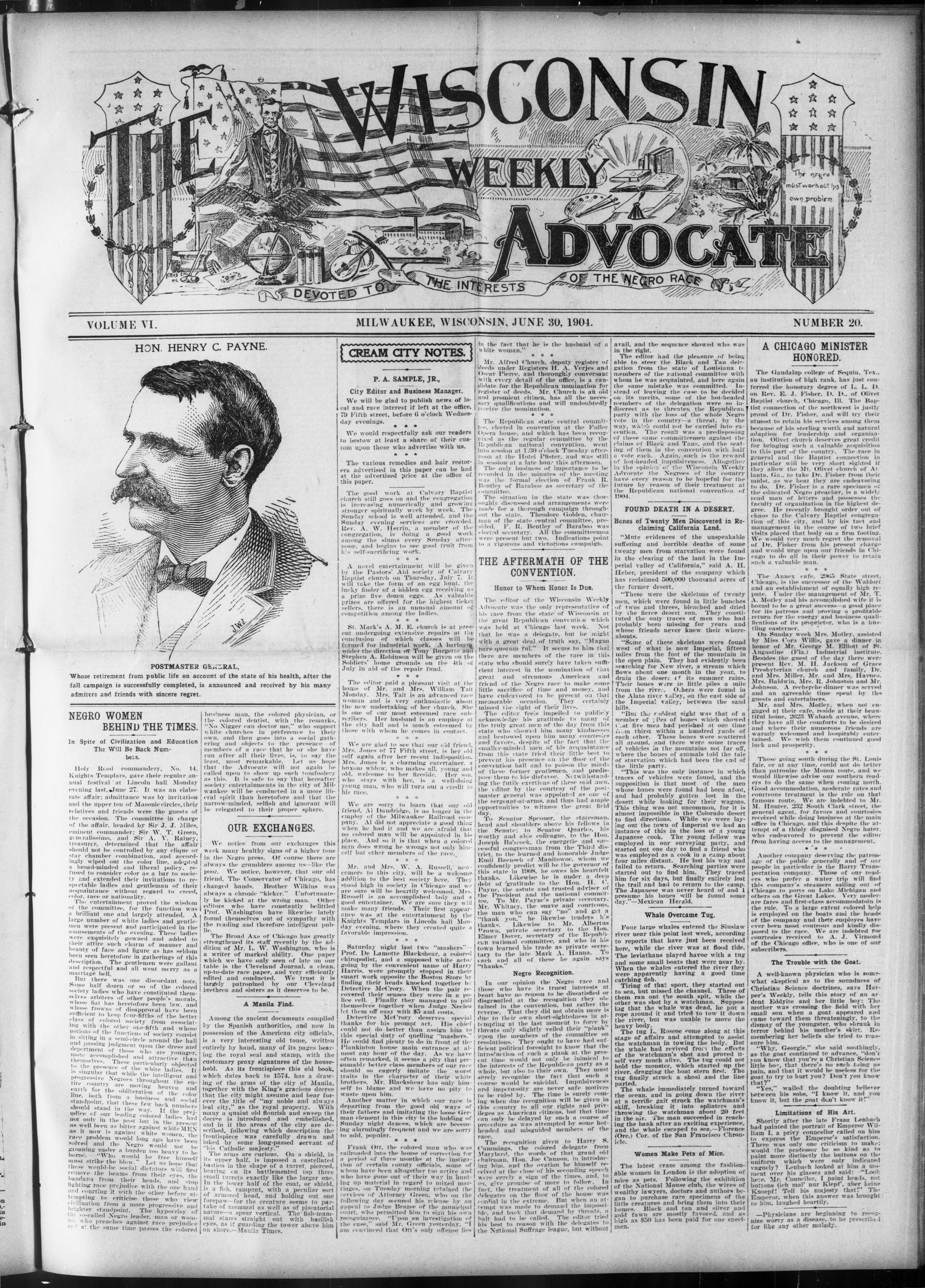
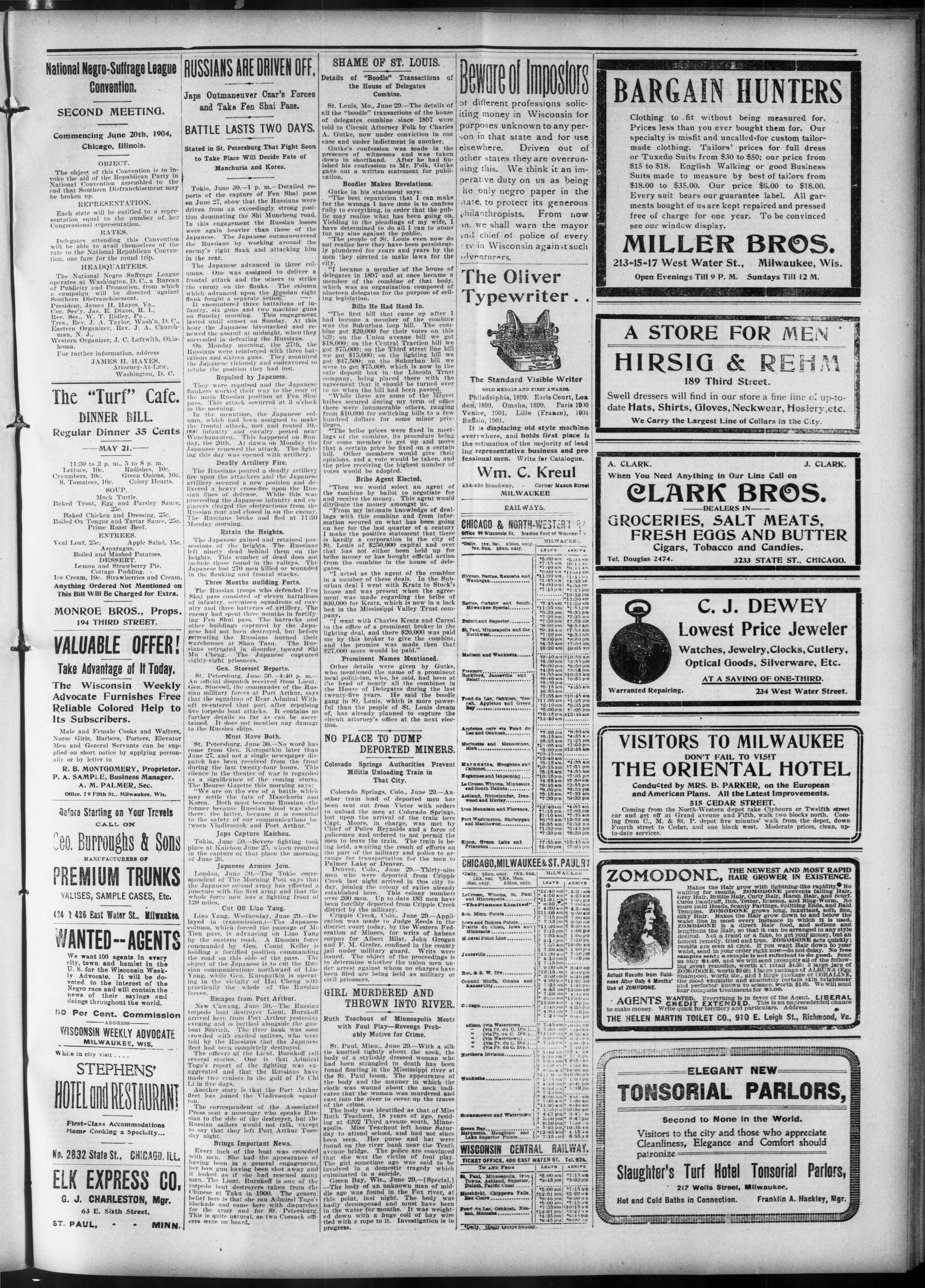
Page text (machine-generated)
WISCONSIN
WEEKLY
ADVOCATE
DEVOTED TO THE INTERESTS OF THE NEGRO RACE
HON. HENRY C. PAYNE.
JWJ.
POSTMASTER GENERAL.
Whose retirement from public life on account of the state of his health, after the fall campaign is successfully completed, is announced and received by his many admirers and friends with sincere regret.
Whose retirement from public life on account of the state of his health, after the fall campaign is successfully completed, is announced and received by his many admirers and friends with sincere regret.
VOLUME VI.
HON. HENR
POSTMASTER
Whose retirement from public life on ac
fall campaign is successfully completed,
admirers and friends with sincere regret
NEGRO WOMEN BEHIND THE TIMES
In Spite of Civilization and Education The Will Be Back Num-
beis.
Holy Rood commandery, No. 14. Knights Templars, gave their regular annual festival at Lincoln hall Monday evening last, June 27. It was an elaborate affair; admittance was by invitation and the upper ten of Masonic circles, their relatives and friends were the guests of the occasion. The committee in charge of the affair, headed by Sir J. J. Miles, eminent commander; Sir W. T. Green, generalissimo, and Sir A. V. Rainey, treasurer, determined that the affair should not be controlled by any clique or star chamber combination, and accordingly wiped out the color line, adopted a broad-minded and liberal policy, refused to consider color as a bar to society and extended their invitations to respectable ladies and gentleman of their acquaintance without regard to creed, color, race or nationality.
The entertainment proved the wisdom of the committee, for the function was a brilliant one and largely attended. A large number of white ladies and gentlemen were present and participated in the amusements of the evening. These ladies were exquisitely gowned and added to their attire such charm of manner and beauty of face and figure as has seldom been seen heretofore in gatherings of this description. The gentlemen were gallant and respectful and all went merry as a marriage bell.
But there was one discordant note. Some half dozen or so of the colored society ladies who have constituted themselves arbiters of other people's morals, whose flat has heretofore been law, and whose frowns of disapproval have been sufficient to keep four-fifths of the better class of colored society from associating with the other one-fifth and whose notions of the functions of society consist in sitting in a semi-circle around the hall and passing judgment upon the dress and department of those who are younger, more accomplished and attractive than themselves. These particularly objected to the presence of the white ladies. It is singular that while the intelligent and progressive Negroes throughout the entire country are moving heaven and earth for the obliteration of the color line, both from a business and social standpoint, that these few back numbers should stand in the way. If the prejudice of our leading colored ladies had not only in the past but in the present as well been as bitter against white MEN as it now is against white women, the race problem would long ago have been solved and the Negro would not be groaning under a burden too heavy to be borne. "Who would be free himself must strike the blow." Let us hope that these would-be social dictators will first remove the beams from their eyes, the bandana from their heads, and stop fighting race prejudice with the one hand and courting it with the other before attempting to criticise those who view civilization from a more progressive and brighter standpoint. The hypocrisy of the so-called Negro leader, man or woman, who preaches against race prejudice and at the same time passes the colored
---
business man, the colored physician, or the colored dentist, with the remarks, "No Nigger can doctor me," who support white churches in preference to their own, and then goes into a social gathering and objects to the presence of members of a race that he or she have run after all their lives, is, to say the least, most remarkable. Let us hope that the Advocate will not again be called upon to show up such tomfoolery as this. It is safe to say that hereafter society entertainments in the city of Milwaukee will be conducted in a more liberal spirit than heretofore and that the narrow-minded, selfish and ignorant will be relegated to their proper sphere.
OUR EXCHANGES
We notice from our exchanges this week many healthy signs of a higher tone in the Negro press. Of course there are always the grumblers among us—like the poor. We notice, however, that our old friend, The Conservator of Chicago, has changed hands. Brother Wilkins was always a chronic "kicker." Unfortunately he kicked at the wrong man. Other editors who have constantly belittled Prof. Washington have likewise lately found themselves out of sympathy with the reading and therefore intelligent public.
The Broad Axe of Chicago has greatly strengthened its staff recently by the addition of Mr. L. W. Washington, who is a writer of marked ability. One paper which we have only seen of late on our table is the Cleveland Journal, a clean, up-to-date race paper, and very efficiently edited and conducted. We trust it is largely patronized by our Cleveland brethren and sisters as it deserves to be.
A Manila Find.
Among the ancient documents compiled by the Spanish authorities, and now in possession of the American city officials, is a very interesting old tome, written entirely by hand, many of its pages bearing the royal seal and stamp, with the customary proxy signatures of the household. As its frontispiece this old book, which dates back to 1574, has a drawing of the arms of the city of Manila, together with the King's gracious decree that the city might assume and bear forever the title of "my noble and always leal city," as the royal property. With many a quaint old flourish and sweep the decree is introduced and embellished, and in it the areas of the city are described, following which description the frontispiece was carefully drawn and inked by some long-passed servant of "his Catholic majesty."
The arms are curious. On a shield, in its upper half, is imposed a castellated bastion in the shape of a turret, pierced, bearing on its battlemented top three small turrets exactly like the larger one. In the lower half of the coat, or shield, is a fish, rampant, with a peculiar sort of armored head, and holding out one forepaw—for the creature seems to partake of mammal as well as of piscatorial nature—a spear vertical. The fish-mammal stares straight out with basilisk eyes, as if guarding the tower above him on shore.—Manila Times.
MILWAUKEE, WISCONSIN, JUNE 30, 1904
CREAM CITY NOTES.
P. A. SAMPLE. JR..
City Editor and Business Manager.
We will be glad to publish news of local and race interest if left at the office, 79 Fifth street, before 6 o'clock Wednesday evenings.
We would respectfully ask our readers to bestow at least a share of their custom upon those who advertise with us.
The various remedies and hair restorers advertised in this paper can be had at the advertised price at the office of this paper.
The good work at Calvary Baptist church still goes on and the congregation is increasing numerically and growing stronger spiritually week by week. The Sunday school is well attended, and the Sunday evening services are crowded. Rev. A. W. Herrin, a member of the congregation, is doing a good work among the slums every Sunday afternoon, and begins to see good fruit from his self-sacrificing work.
A novel entertainment will be given by the Pastors' Aid society of Calvary Baptist church on Thursday, July 7. It will take the form of an egg hunt, the lucky finder of a hidden egg receiving as a prize five dozen eggs. As valuable prizes are offered for the highest ticket sellers, there is an unusual amount of competition among the ladies.
* * *
St. Mark's A. M. E. church is at present undergoing extensive repairs at the conclusion of which classes will be formed for industrial work. A barbecue under the direction of Tony Burgette and Stephen A. Robinson will be given on the Soldiers' home grounds on the 4th of July in aid of the repair fund.
串串串
The editor paid a pleasant visit at the home of Mr. and Mrs. William Tait Monday. Mrs. Tait is an advanced race woman and is very enthusiastic about the new undertaking of her church. She is one of our most esteemed race subscribers. Her husband is an employee at the city hall and is much esteemed by those with whom he comes in contact.
We are glad to see that our old friend, Mrs. Jones of 77 Fifth street, is her old self again after her recent indisposition. Mrs. Jones is a charming entertainer, a buxom widow, who makes all, young and old, welcome to her fireside. Her son, who stays with her, is a well-doing young man, who will turn out a credit to his race.
We are sorry to learn that our old friend, Al Dandridge, is no longer in the employ of the Milwaukee Railroad company. Al did not appreciate a good thing when he had it and we are afraid that no colored man will be appointed in his place. And so it is that when a colored man does wrong he wrongs not only himself but other members of the race.
* * *
Mr. and Mrs. W. A. Russell, newcomers to this city, will be a welcome addition to the best society here. They stood high in society in Chicago and we are sure will be heartily welcomed. Mrs. Russell is an accomplished lady and a good entertainer. We are sure they will make many friends. Their first appearance was at the entertainment by the Knights Templars in Lincoln hall Monday evening, where they created quite a favorable impression.
* * *
Saturday night last two "mashers" Prof. De Lamotte Blackshear, a colored chiropodist, and a supposed white actor going by the convenient name of Harry Harris, were promptly stopped in their smart work opposite the Boston Store by finding their heads knocked together by Detective McCrory. When the pair recovered their senses they were in a police cell. Finally they managed to pull themselves together when Judge Neelen let them off easy with $5 and costs.
Detective McCrory deserves special thanks for his prompt act. His chief could not do better than assign him to this special duty of quelling "mashers." He could find plenty to do in front of the Plankinton house main entrance at almost any hour of the day. As we have often remarked, it seems a pity that presumably better class members of our race should so eagerly imitate the worst traits in the character of their white brothers. Mr. Blackshear has only himself to blame and we have no pity to waste upon him.
Another matter in which our race is departing from the good old ways of their fathers and imitating the loose German element in this city is the holding of Sunday night dances, which are becoming alarmingly frequent and we are sorry to add, popular.
***
Frank Ott, the colored man who was railroaded into the house of correction for a period of three months at the instigation of certain county officials, some of whom have been altogether too active and who have gone out of their way in hunting up material in regard to mixed marriages, on Tuesday morning retained the services of Attorney Green, who on the following day secured his release by an appeal to Judge Brazee of the municipal court, who permitted him to sign his own recognition. "Upon an investigation of the case," said Mr. Green yesterday. "I am convinced that Ott's only offense lies
in the fact that he is the husband of a white woman."
Mr. Alfred Church, deputy register of deeds under Registers H. A. Verjes and Oscar Pierce, and thoroughly conversant with every detail of the office, is a candidate for the Republican nomination for register of deeds. Mr. Church is an old and prominent citizen, has all the necessary qualifications and will undoubtedly receive the nomination.
The Republican state central committee, elected in convention at the Fuller Opera house, and which has been recognized as the regular committee by the Republican national convention, went into session at 1:30 o'clock Tuesday afternoon at the Hotel Pfister, and was still in session at a late hour this afternoon. The only business of importance to be recorded in the minutes of the meeting was the formal election of Frank R. Bentley of Baraboo as secretary of the committee. The situation in the state was thoroughly discussed and arrangements were made for a thorough campaign throughout the state. Theodore Golden, chairman of the state central committee, presided. F. R. Bentley of Baraboo was elected secretary. All the committeemen were present but two. Indications point to a vigorous and victorious campaign.
THE AFTERMATH OF THE CONVENTION.
Honor to Whom Honor Is Due.
The editor of the Wisconsin Weekly Advocate was the only representative of his race from the state of Wisconsin at the great Republican convention which was held at Chicago last week. Not that he was a delegate, but he might with a great deal of truth say, "Magna pars quorum fui." It seems to him that there are members of the race in this state who should surely have taken sufficient interest in the nomination of that great and strenuous American and friend of the Negro race to make some little sacrifice of time and money, and have endeavored to be present on that memorable occasion. They certainly missed the sight of their lives.
The editor feels impelled to publicly acknowledge his gratitude to many of the truly great men of the day from this state who showed him many kindnesses and bestowed upon him many courtesies and favors, despite of the fact that the smaller-minded men of his acquaintance from this state tried their best to prevent his presence on the floor of the convention hall and to poison the minds of these former gentlemen, and predispose them to his disfavor. Netwithstanding the futile exertions of these said men, the editor by the courtesy of the postmaster general was appointed as one of the sergeant-at-arms, and thus had ample opportunities to witness the great field day.
To Senator Sponer, the statesman, head and shoulders above his fellows in the Senate; to Senator Quarles, his worthy and able colleague, to the Hon. Joseph Babcock, the energetic and successful congressman from the Third district, to the learned and honorable Judge Emil Baensech of Manitowoc, whom we confidently predict will be the governor of this state in 1908, he owes his heartfelt thanks. Likewise he is under a deep debt of gratitude to the Hon. H. C. Payne, the astute and trusted adviser of the President and the national committee. To Mr. Payne's private secretary, Mr. Whitney, the suave and courteous, the man who can say "no" and get a "thank you," he likewise tenders his thanks. Likewise to Mr. Albertus Prown, private secretary to the Hon. Elmer Dover, secretary of the Republican national committee, and who in his town learned his trade as private secretary to the late Mark A. Hanna. To each and all of these he again says "thanks."
Negro Recognition
In our opinion the Negro race and those who have its truest interests at heart have no reason to be dissatisfied or disgruntled at the recognition they obtained in the convention, but rather the reverse. That they did not obtain more is due to their own short-sightedness in attempting at the last moment to force by threats only slightly veiled their "plank" upon the members of the committee on resolutions. They ought to have had sufficient political foresight to know that the introduction of such a plank at the present time would not only be inimical to the interests of the Republican party as a whole, but also to their own. They must surely recognize the fact that such a course would be suicidal. Impulsiveness and impetuosity are never safe motives to be ruled by. The time is surely coming when due recognition will be given in this country to all our rights and privileges as American citizens, but that time can only be delayed by such a course of procedure as was attempted by some hot-headed and misguided members of the race.
The recognition given to Harry S. Cummings, the colored delegate from Maryland, the words of that grand old chairman, Hon. Joe Cannon, in introducing him, and the ovation he himself received at the close of his seconding speech were surely a sign of the times, and, to us, give promise of more to follow. In fact, the treatment of all of the colored delegates on the floor of the house was cordial in the extreme. But when an attempt was made to demand the impossible, and back that demand by threats, a bait had to be called. The editor tried his best to reason with the delegates to the National Suffrage league, but without
avail, and the sequence showed who was in the right.
The editor had the pleasure of being able to steer the Black and Tan delegation from the state of Louisiana to members of the national committee with whom he was acquainted, and here again the same mistake was committed. Instead of leaving the case to be decided on its merits, some of the hot-headed members of the delegation were so indiscreet as to threaten the Republican party with the loss of the whole Negro vote in the country—a threat, by the way, which could not be carried into execution. The result was a predisposing of these same committeemen against the claims of Black and Tans, and the seating of them in the convention with half a vote each. Again, such is the reward of hot-headed impulsiveness. Altogether in the opinion of the Wisconsin Weekly Advocate the Negroes of the country have every reason to be hopeful for the future by reason of their treatment at the Republican national convention of 1904.
FOUND DEATH IN A DESERT.
Bones of Twenty Men Discovered in Reclaiming California, Land.
"Mute evidences of the unspeakable suffering and horrible deaths of some twenty men from starvation were found in the clearing of the land in the Imperial valley of California," said A. H. Heber, president of the company which has reclaimed 500,000 thousand acres of the former desert.
"These were the skeletons of twenty men, which were found in little bunches of twos and threes, bleached and dried by the fierce desert sun. They constituted the only traces of men who had probably been missing for years and whose friends never knew their whereabouts.
"Some of these skeletons were found west of what is now Imperial, fifteen miles from the foot of the mountain in the open plain. They had evidently been searching for New river, a stream which flows about one month in the year, to drain the deserts of its summer rains. Their bones were in little piles a mile from the river. Others were found in the Alato river valley, on the east side of the Imperial valley, between the sand hills.
"But the saddest sight was that of a number of piles of bones which showed that five men had perished at one time from thirst within a hundred yards of each other. These bones were scattered all around, and there were some traces of vehicles in the mountains not far off, where the bones of animals told the tale of starvation which had been the end of the little party.
"This was the only instance in which traces of vehicles were found, and the supposition is that most of the men whose bones were found had been afoot, and had probably gotten lost in the desert while looking for their wagons. This thing was not uncommon, for it is almost impossible in the Colorado desert to find directions. While we were laying out the town of Imperial we had an instance of this in the loss of a young Japanese cook. The young fellow was employed in our surveying party, and started out one day to find a friend who was employed as a cook in a camp about four miles distant. He lost his way and failed to return. Searching parties were started out to find him. They traced him for six days, but finally entirely lost the trail and had to return to the camp. The Japanese was never heard of and I presume his bones will be found some day."—Mexican Herald.
Whale Overcame Tug.
Four large whales entered the Siuslaw river near this point last week, according to reports that have just been received here, while the river was at flood tide. The leviathans played havoc with a tug and some small boats that were near by. When the whales entered the river they were apparently having a good time catching fish. Tiring of that sport, they started out to sea, but missed the channel. Three of them ran out the south spit, while the other was shot by a watchman. Supposing that the whale was dead, he put a rope around it and tried to tow it down the river, but was unable to move the heavy body.
The tug L. Roscoe come along at this stage of affairs and attempted to assist the watchman in towing the body. But the whale had revived from the effects of the watchman's shot and proved itself very much alive. The tug could not hold the monster, which started up the river, dragging the boat stern first. The tug finally struck a shoal and the line parted. The whale immediately turned toward the ocean, and in going down the river at a terrific gait struck the watchman's skiff, breaking it into splinters and throwing the watchman about 20 feet in the air. The man succeeded in reaching the bank after an exciting experience, and the whale escaped to sea.—Florence (Ore.) Cor. of the San Francisco Chronicle.
Women Make Pets of Micc.
The latest craze among the fashionable women in London is the adoption of mice as pets. Following the exhibition of the National Mouse club, the wives of wealthy lawyers, doctors and authors began to purchase rare specimens of the little creatures and bring them into their homes. Black and tan and silver and gold fawn are mostly favored, and as high as $50 has been paid for one specimen.
NUMBER 20.
A CHICAGO MINISTER HONORED.
The Gaudalup college of Sequin, Tex., an institution of high rank, has just conferred the honorary degree of L. L. D. on Rev. E. J. Fisher, D. D., of Olivet Baptist church, Chicago, Ill. The Baptist connection of the northwest is justly proud of Dr. Fisher, and will try their utmost to retain his services among them because of his sterling worth and natural adaption for leadership and organization. Olivet church deserves great credit for bringing such a valuable acquisition to this part of the country. The race in general and the Baptist connection in particular will be very short sighted if they allow the Mt. Olivet church of Atlanta, Ga., to take Dr. Fisher from their midst, as we hear they are endeavoring to do. Dr. Fisher is a rare specimen of the educated Negro preacher, is a widely read man of letters and possesses the faculty of organization in the highest degree. He recently brought order out of chaos to the Calvary Baptist congregation of this city, and by his tact and management in the course of two brief visits placed that body on a firm footing. We would very much regret the removal of Dr. Fisher from his present charge and would urge upon our friends in Chicago to do all in their power to retain such a valuable man.
The Annex cafe, 2965 State street, Chicago, is the successor of the Waldorf and an establishment of equally high repute. Under the management of Mr. T. A. Motley and his accomplished wife it is bound to be a great success—a good place for its patrons and proving a profitable return for the energy and business qualifications of its proprietor, who is a hustling easterner.
On Sunday week Mrs. Motley, assisted by Miss Cora Willis, gave a dinner in honor of Mr. George M. Elliott of St. Augustine (Fla.) Industrial institute. Besides the guest of the day there were present Rev. M. H. Jackson of Grace Presbyterian church and family, Dr. and Mrs. Miller, Mr. and Mrs. Hawnes, Mrs. Baldwin, Mrs. R. Johnston and Mr. Johnson. A recherche dinner was served and an agreeable time spent by the guests and entertainers.
Mr. and Mrs. Motley, when not engaged at their cafe, reside at their beautiful home, 2623 Wabash avenue, where they have all the comforts to be desired and where their numerous friends are warmly welcomed and hospitably entertained. We wish them continued good luck and prosperity.
* * *
Those going south during the St. Louis fair, or at any time, could not do better than patronize the Monon route, and we would likewise advise our southern readers to do the same when coming north. Good accommodation, moderate rates and courteous treatment is the rule on that famous route. We are indebted to Mr. M. Hunter. 232 South Clark street, the general agent, for favors and courtesies received while doing business at the main office in Chicago, and this despite the attempt of a thinly disguised Negro hater, who endeavored to prevent the editor from having access to the management.
Another company deserving the patronage of the public generally and of our people in particular is the Barry Transportation company. Those of our readers who prefer a water trip will find this company's steamers sailing out of Chicago to ports on Lake Michigan and others on the Great Lakes. Very moderate fares and first-class accommodatoin is the rule. To a large extent colored help is employed on the boats and the heads of the company and their employees have ever been most couteous and kindly disposed to the race. We are indebted for courtesies received to A. J. Virmond of the Chicago office, who is one of our subscribers.
The Trouble with the Goat.
A well-known physician who is somewhat skeptical as to the soundness of Christian Science doctrines, says Harper's Weekly, tells this story of an ardent Eddyite and her little boy: The mother was crossing the field with her small son when a goat appeared and came toward them threateningly, to the dismay of the youngster, who shrank in terror behind his mother's skirt. Remembering her beliefs she tried to reassure him.
"Why, Georgie," she said soothingly, as the goat continued to advance, "don't you know that you're a Christian Science little boy, that there's no such thing as pain, and that it would be useless for the goat to try to hurt you? Don't you know that?"
"Yes," wailed the doubting believer between his sobs, "I know it, and you know it, but the goat don't know it!"
Limitations of His Art.
Shortly after the late Franz Lenbach had painted the portrait of Emperor William I. a privy counsellor called on him to express the Emperor's satisfaction. There was only one criticism to make; would the professor be so kind as to paint more distinctly the buttons on the uniform which were only indicated vaguely? Lenbach looked at him a moment over his glasses and said: "Look here. Mr. Councilor, I paint heads, not buttons (ich mal' nur Kiepf', aber keine Knoepf! Tell his majesty that!" The Emperor, when this answer was brought to him, laughed heartily.
—Physicians are beginning to recognize worry as a disease, to be prescribed for like any other malady.
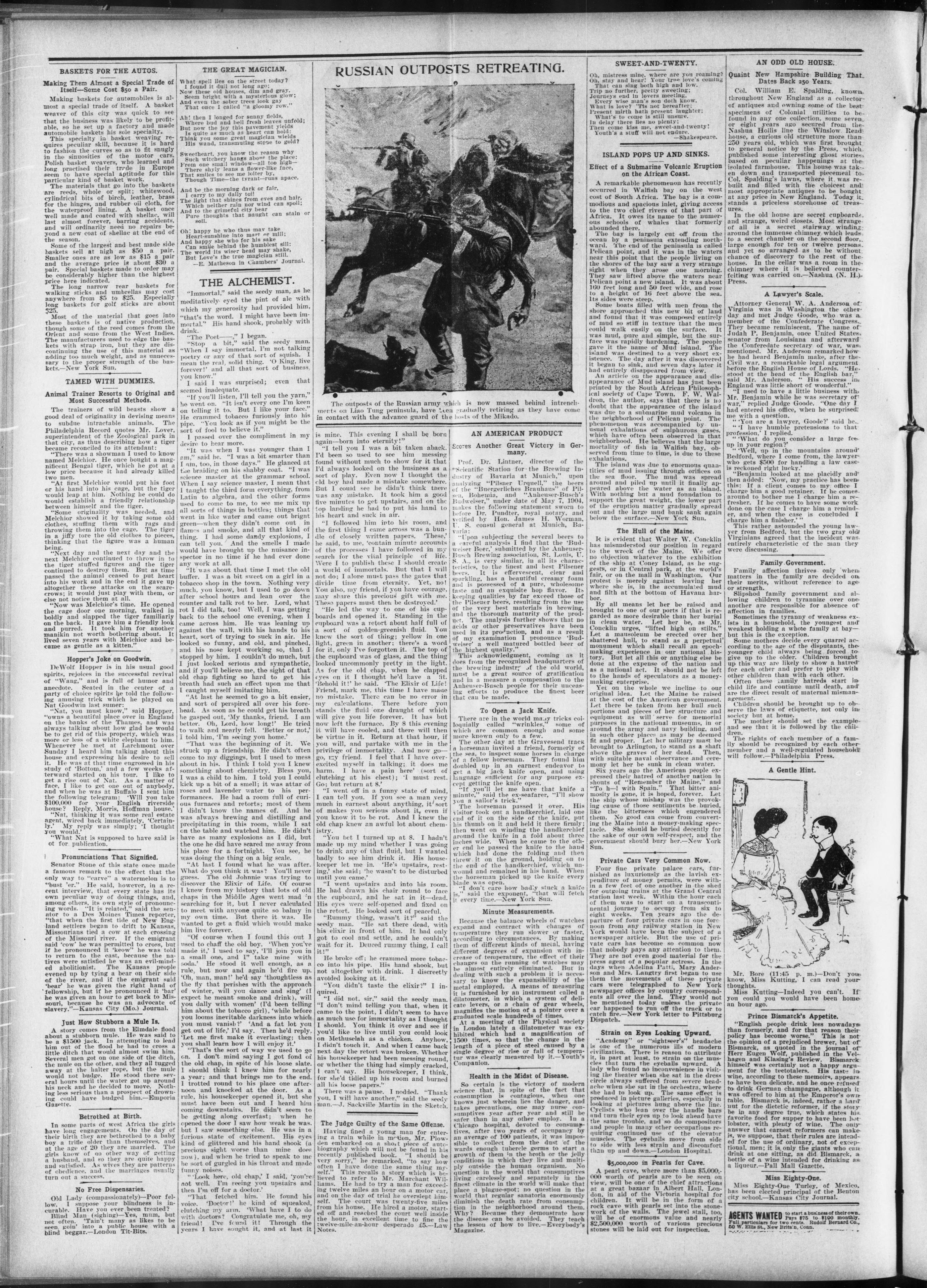
BASKETS FOR THE AUTOS.
Making Them Almost a Special Trade of
Itself—Some Cost $50 a Pair.
Making baskets for automobiles is al-
most a special trade of itself. A basket
weaver of this city was quick to see
that the business was likely to be profit-
able, so he set up a factory and made
automobile baskets his sole specialty.
This specialty in basket weaving re-
quires peculiar skill, because it is hard
to fashion the curves so as to fit snugly
in the sinuosities of the motor cars.
Polish basket weavers, who learned and
Jong practised their trede in Europe
seem to have special aptitude for this
particular kind of basket. work.
The materials that go into the baskets
are reeds, whole or at whitewood,
cylindrical bits of birch, leather, brass
for the hinges, and rubber oil cloth, for
the waterproof lining. A basket once
well made and coated with shellac, will
last almost forever, barring accidents,
and will ordinarily need no repairs be-
yond a new coat of shellac at the end of
the season.
Some of the largest and best made side
baskets sell at nigh as $50 a pair.
Smaller ones are as low as $15 a pair
and the average price is about $30 a
pair. Special baskets made to order may
be. considerably higher than the highest
price here indicated.
The long narrow rear baskets for
walking sticks and umbrellas may cost
anywhere from $5 to $25. Especially
long baskets for golf sticks are about
$25.
Most of the material that goes into
these baskets is of native production,
though some of the reed comes from the
Orient and some from the West Indies.
‘The manufacturers used to edge the bas-
kets with strap iron, but they are dis-
continuing the use of this material as
adding too much weight, and as unneces-
sary to the proper strength of the bas-
kets.—New York Sun.
TAMED WITH DUMMIES.
Animal Trainer Resorts to Original and
Most Successful Methods.
The trainers of wild beasts show a
good deal of originality in devising means
to subdue intractable animals. The
Philadelphia Record quotes Mr. Lover,
superintendent of the Zoological park in
that city, as thus describing how a tiger
became reconciled to its attendant:
“There was a showman I used to know
named Meichior. He once bought a mag-
nificent Bengal tiger, which he got at a
Jow price because it had already killed
two men.
“At first Melchior would put his foot
or his hand into his cage, but the tiger
would leap at him. Nothing he could do
would establish a friendly relationship
between himself and the tiger.
“Some originality was needed, and
Melchior showed it by taking some old
clothes, stuffing them with rags and
throwing them into the cage. The tiger
in a jiffy tore the old clothes to pieces,
thinking that the figure was a human
being.
“Next day and the next day and the
next Melchior continued to throw in to
the tiger stuffed figures and the tiger
continued to destroy them. But as time
passed the animal ceased to put heart
into his work and in the end it gave up
altogether these attacks on the scare-
crows; it would just play with them, or
else not notice them at all.
“Now was Melchior’s time. He opened
the cage door one morning, walked in
boldly and slapped the tiger familiarly
on the back. It gave him a friendly look
and purred. It took him for another
manikin not worth bothering about. It
lived seven years with Melchior and be-
came as gentle as a kitten.”
Hopper’s Joke on Goodwin.
DeWolt Hopper is in his usual good
spirits, rejoices in the successful revival
of “Wang,” and is full of humor and
anecdote. Seated in the center of a
party of choice spirits he told the follow-
ing amusing trick which he played on
Nat Goodwin last sumer:
“Nat, you must know,” said Hopper,
“owns a beautiful place over in England
on the banks of the Thames, and was
always talking about how glad he would
be to get rid of this property, which was
more or less of a white elephant to him.
Whenever he met at Larchmont over
Sunday I heard him talking about this
house and expressing his desire to sell
it. He was at that time engrossed in his
study of ‘Bottom,’ and a few weeks af-
terward started on his tour. I like to
get a rise out of Nat. As a matter of
face, I like to get one out of anybody,
and when he was at Buffalo I sent him
the following telegram: ‘Will you take
$100,000 for your English ‘riverside
house? Reply, Morris, Hoffman house.
“Nat, thinking it was some real estate
agent, wired back immediately, ‘Certain-
ly.” My reply was simply; ‘I thought
you would.’
“What Nat is supposed to have said is
ot for publication.
1 Pronunciations That Signified.
Senator Stone of this state once made
2a famous remark to the effect that the
only way to “carve” a watermelon is te
“bust ‘er.” He said, however, in a re-
cent interview, that every state has its
own peculiar way of doing things, and,
among others, its own style of pronounce-
ing words. “It is related,” said the sen-
ator to a Des Moines Times reporter,
“that when the first tide of New Eng:
land settlers began to drift to Kansas,
Missourians tied a cow at each crossing
of the Missouri river. If the emigrant
said ‘cow’ he was permitted to cross, but
if he pronounced it ‘keow” he was told
to return to the east, because the na-
tives were satisfied he was an evil-mind.
ed abolitionist. The Kansas people
evened up by tying a bear on their sid
of the river, and if the emigrant said
‘bear’ he was given the right hand of
‘fellowship, but if he pronounced it ‘bar
he was given an hour to get back to Mis
souri, because he was an advocate of
‘slavery.”"—Kansas City (Mo.) Journal.
+ —
Tust How Stubborn a Mule Is.
A story comes from the Elmdale flood
about a stubborn mule. He was said to
be a $1500 jack. In attempting to lead
him out of the flood he had to cross a
little ditch that would almost swim him.
Several men got on one side of the ditch,
the mule on the other, and they all tugged
away at the halter rope, but the mule
would not budge. He stood there sev-
eral hours until the water got up around
his neck and he decided to move, Noth-
ing less serious than a prospect of drown-
ing could have budged him.—Emporia
Gazette.
>
Betrothed at Birth.
In some parts of west Africa the girls
have long engagements. On the day of
their birth they are bethrothed to a baby
doy a trifle older than themselves, and
at the age of 20 they are married. The
girls know of no other way of getting
a husband, and so they are quite happy
and satisfied. As wives they are patterns
of obedience. and the marriages usually
turn out a success.
—_——_-____
No Free Dispensaries.
Old Lady (compassionately)—Poor fel-
low. I suppose your blindness is_in-
curable. Have you ever been treated?
Blind Man (sighing)—Yes, mum, but
not often. ‘Tain't many as likes to be
seen, goin’ into a public house with a
blind beggar.—London Tit-Bits.
THE GREAT MAGICIAN.
What spell les on the street today?
I found it duil not long ago;
Now these old houses, dim and gray.
Seem bright with a mysterious glow;
And even the sober trees look gay
That once I calied “a gloomy row.”
Ah! then I longed for sunny fields,
Where bud and bell fresh leaves unfold;
But now the joy this aor yields:
Is quite as much as heart can hold:
Think you some great magician wields
His wand, transmuting stese to gold?
Sweetheart, you know the reason why
Such witchery hangs abot the piace:
From one sma!l window—all too high—
‘There shyly leans a flower-like face,
That smiles to see me loiter by,
Though Time—the tyrant—runs apace.
‘And be the morning dark or fair,
I carry to my daily tel!
The light that shines from eves and hair,
‘Which neither rain nor wind can spoil;
And to the grimeful city bear
Pure thoughts that naught can staln o
‘soil.
Ob: happy he who thus mav take
Heart-sunshine into mart er mill;
And happy she who for his sake
Can cae ee behind the humblest sill:
The world its wiser head may shake,
But Love's the true magician still.
FE. Matheson in Caambers’ Journal.
THE ALCHEMIST.
De ee a SN eae ee
“that’s the word. I might have been im-
mortal.” His hand shook, probably with
drink. "Tbe %
“The Poet—,/ an.
“Stop a_ bit,” uy ite seedy man.
“When I say immortal, I’m not talking
poetry or any of that sort of squish. 1
mean the real, solid thing. ‘O King, live
forever!’ and all that sort of business,
you know.”
“] said I was surprised; even that
seemed inadequate. 3
“If you'll listen, I'll tell you the yarn,”
he went on. “It isn’t every one I’m keen
on telling it to. But I like your face.”
He crammed tobacco furiously into his
pipe. “You look as if you might be the
sort of fool to believe it.” — r
1 passed over the compliment in my
desire to hear more.
“It was when I was younger than I
am,” said he. “I was a bit smarter than
I am, too, in those days.” He glanced at
tue braiding on his shabby coat. “I was
science master at the grammar school.
When I say science master, I mean that
I taught the third form everything, from
Latin to algebra, and the other forms
used to come to me, to see me mix up
all sorts of things in bottles; things that
went in like water and came out brignt
green—when they didn’t come out in
flames and smoke, and all that kind of
thing. I had some dandy explosions, I
can tell you.’ And the smells I made
would have brought up the nuisance in-
spector in no time if he had ever done
any work at all.
“It was about that time I met the old
buffer. I was a bit sweet on a girl in a
tobacco shop in the town. Nothing very
much, you know, but I used to go down
after school hours and Jean over the
counter and talk rot to her. Lord, what
rot I did talk, too! Well, I was getting
back to the school one evening, when L
came across him. He was leaning up
against the wall, with his hands to his
heart, sort of trying to suck in air. He
looked so funny, and old, and pinched,
and his nose kept working so, that I
stopped by him. I couldn’t do much, but
I just looked serious and sympathetic,
and if you'll believe me, the sight of that
old chap fighting so hard to get his
breath had such an effect upon me that
I caught myself imitating him.
“At last he seemed to go a bit easier,
and sort of perspired all over his fore-
head. As soon as he could get his breath
he gasped out, ‘My thanks, friend. I am
better. Oh, Lord, how long!’ He tried
to walk and nearly fell. ‘Better or not,
i told him, ‘I’m seeing you home.’
“That was the beginning of it. We
struck up a friendship. He didn’t often
come to my diggings, but I used to mess
about in his. I think I told you I knew
something about chemistry. Bless you,
I was a child to him. I told you I could
kick up a bit of a smell; it was attar of
roses and lavender water to his per-
formances. He had a room full of curi-
ous furnaces and retorts; most of them
I didn’t know the names of. And he
was always brewing and distilling and
precipitating in this room, while I sat
cn the table and watched him. He didn’t
have as many explosions as I did, but
the one he did have seared me away from
his place for a fortnight. You see, he
was doing the thing on a big scale.
“At last I found what he was after.
What do you think it was? You'll never
guess. The old Johnnie was trying to
discover the Elixir of Life. Of course
I knew from my history that lots of old
chaps in the Middle Ages went mad ‘n
searching for it, but I never calculated
to meet with anyone quite so balmy in
my own time. But there it was. He
wanted to get a fluid which would make
him live forever.
“Of course when I found this out I
used to chaff the old boy. ‘When you've
made it,’ I used to say, ‘I'll join you in
a small one, and I” take mine with
soda.’ He stood it well enough, as a
jrule, but now and again he'd fire up.
‘Oh, man, man!’ he’d say ‘thoughtless as
‘| the fly that perishes with the approach
of winter, will you dance and sing’ (I
expect he meant smoke and drink), will
you dally with women’ (I'd been telling
him about the tobacco girl), ‘while before
you looms inevitable darkness into which
you must vanish?’ ‘And a fat lot you
get out of life” I’d say. Then he'd reply.
‘Let me first make it everlasting; then
you shall learn how I will enjoy it.’
“That's the sort of way we used to go
cn. I don’t mind saying I got fond oi
the old chap, in spite of his loose slate.
1 should think I knew him for nearly
a year; and that brings me to the end.
1 trotted round to his place one after-
noon and knocked at the door. As a
rule, his housekeeper opened it, but she
must have been out and I heard him
coming downstairs. He didn’t seem to
be getting along overfast; when he
cpened the door I saw how weak he was.
but I saw something else. He was in a
furious state of excitement. His eyes
kind of glittered and his hand shook (a
precious sight worse than mine does
now), and when he tried to speak to me
he sort of gurgled in his throat and made
funny noises.
“Look here, old chap, I said, ‘you're
not well. I'm seeing you upsiairs and
then I’m off for a doctor.’
“That fetched him. He found his
voice. ‘Doctor!’ he kind of squeaked,
clutching my arm. ‘What have I to do
with doctors? Congratulate me, oh, my
friend! [ve fcund it! Through the
years f have sought it, and ‘at last. i
‘RUSSIAN OUTPOSTS RETREATING.
ee ai suger PEL ON es
es ee ee CS
a gts © Seger See
: SO ae os
2 : See uf A < :
hy. Semone he ° rN begs °
§ eae i ee Be Se
# Bas. 6; ile Tigeaecan on
3 ok a or. = ae J aa ae
sy Rie &
‘ é 3 o ha © Po me a Pa ee eK"
4 i ae Bs Soe 8 Pee tg’
se Rag ey eM . ae be
ic ley ys , — ee 3
; ra eit al oe
i a 2 te 2 e222 ae eee
Fee ce ‘ ae Me, ae ‘ : ae
pa EO ps a
be olae ee ye ™ a ry re 4
e ON _- A : ee ad
i % i Be a
& el ee. ee
Pe a bo ee
ag a 6 ee fe ee
si : Pee re
The outposts of the Russian army which is now massed behind intrench-
ments on Liao Tung peninsula, have teen pradually retiring as they have come
in contact with the advance guard of the ho=ts of the Mikado.
is mine. This evening I shall be bora
again—born into eternity!”
“I tell you I was a bit taken aback.
T’d been so used to see him messing
found without much to show for it that
Vd always looked on the business as a
sort of play. Even now I thought the
cld boy had made a mistake somewhere.
But I could see he didn’t think there
was any mistake. It took him a good
five minutes to get upstairs, and on the
‘top landing he had to put his hand to
his heart and suck in air.
*T followed him into his room, and
the first thing I came across was a bun-
dle of closely written papers. ‘These,’
he said, to me, ‘contain minute accounts
of the processes I have followed in my
search for the vital principle of _ lite.
Were I to publish these I should create
a world of immortals. But that T will
not do; Talore must pass the gates that
divide time from eternity. Yet, no!
You also, my friend, if you have courage,
may share this precious gift with me.
‘These papers must then be destroyed?
“He led the way to one of his cup-
boards and opened it. Standing in the
eupboard was a retort about half full of
a sort of golden-greenish fluid. You
know the sort of thing; yellow in one
light, green in another; there’s a word
for it, only I’ve forgotten it. The top of
the cupboard was of glass, and the thing
looked uncommonly pretty in the light.
As for the old chap, when he clapped
cyes on it I thought he’d have a it.
‘Behold it!’ he said. ‘The Elixir of Life!
Friend, mark me, this time I have maue
no mistake. There can be no error in
my calculations. There before yon
stands the fluid one draught of which
will give you life forever. It has but
now left the furnace. By 8 this evening
it will have cooled, and there will then
be virtue in it. Return at that hour, if
you will, and partake with me in the
privilege of immortality. And now go—
go, my friend. I feel that I have over-
excited myself in talking; it does me
harm. I have a pain here’ (sort of
clutching at his chest); ‘1 must rest.
Go; but return at 8.”
“I went off in a funny state of mind,
I can tell you. If you see a man very
much in earnest about anything, it! sort
of makes you serious about it, even if
you know it to be rot. And T knew the
old chap knew an awful lot about chem-
istry.
“You bet I turned up at 8. TI hadn’t
made up my mind whether I was going
to drink any of that fluid, but I wanted
badly to see him drink it. His house-
keeper let me in. ‘He’s upstairs, rest-
ing,’ she said; ‘he wasn’t to be disturbed
until you came?
“I went upstairs and into his room.
He had drawn his chair round to face
the cupboard, and he sat in it—dead.
His eyes were self-opened and fixed on
the retort. He looked sort of peaceful.
“Rummy thing, wasn’t it?” said the
seedy man. “He sat there dead, with
his elixir in front of him. It had only
got to cool and settle, and he couldn't
wait for it. Deuced rummy thing, I call
it!”
He broke off; he crammed more tobac-
co into his pipe. His hand shook, but
not altogether with drink. I discreetly
avoided looking at it.
“You didn’t taste the elixir?” I in-
quired.
“I did not, sir,” said the seedy man.
“I don’t mind telling you that, when it
came to the point, I didn’t seem to have
as much use for immortality as I thought
I should. You think it over and see if
you'd like to live until you could look
on Methuselah as a chicken. Anyhow,
I didn’t touch it. And when I came back
next day the retort was broken. Whether
his housekeeper had been messing round,
or whether the thing had simply cracked,
1 can’t say. His housekeeper, I think,
for she'd tidied up his room and burned
all his loose papers.”
There was a pause. I nodded. “Thank
you, I will have another,” said the seedy
man.—J. Sackville Martin in the Sketch.
The Judge Guilty of the Same Offense.
Having fined a young man for enter-
ing a train while in metion, Mr. Plow-
den embarked on a shot piece of auto-
biography which will not be found in his
recently published book. “I should be
very sorry,” he remarked, “to say how
often I have done the same thing my-
self.” This recalls a story which is be-
lieved to refer to Mr. Marchant Wil-
liams. He had to try a man for exeeed-
ing twelve miles an hour on a motor ear,
and on the day of trial he overslept him:
self. The court was twenty-five miles
from his house. He hired a motor, start-
ed off and reached the court well inside
the hour, in excellent time to fine the
twelve-mile-an-hour desperado £5.—Law
Notes.
AN AMERICAN PRODUCT
Scores Another Great Victery in Ger
many.
Prof. Dr. Lintner, director of the
“scientific Station for-the Brewing In-
dustry of Bavaria at Munich,” upon
aualyzing “Pilsner Urquell,” the beers
of the “Buergerliches Brauhaus” of Pil-
sen, Bohemia, and ‘Anheuser-Busch’s
Budweiser,” under date of May 7, 1904,
makes the following statement sworn to
before Dr. Pundter, royal notary, and
verified by Hon, James H. Worman,
TU. S. consul general at Munich, Ba-
varia:
“Upon subjecting the several beers to
a careful analysis I find that the ‘Bud-
weiser Beer,’ submitted by the Anheuser-
Basch Brewing association, St, Louis, U,
S. A., is very similar, in all its charac-
teristics, to the tinest and best Pilsener
beers. It. is effervescent, clear and
sparkling, has a beautiful creamy foam
and is possessed of a pure, wholesome
taste and an carpets hop flavor. Its
keeping qualities by far exceed those of
the Pilsener beers, resulting from the use
of the very best materials in brewing,
and the thorough maturity of the prod-
uct. The analysis further shows that no
acids or other pera tes have been
used in its pro@uction, and as a result
of my examination I pronounce ‘Bud-
weiser’ a well matured bottled beer of
‘the highest quality.”
This acknowledgment, coming as it
does from the recognized headquarters of
the brewing industry sf the old world,
must be a great source of gratification
and in a measure a compensation to the
Anheuser-Busch people for their unceas-
‘ing efforts to produce the finest beer
‘that can be made;
To Open a Jack Knife.
There are in the world mauy tricks col-
loquially called “wrinkles.” some of
which are common enongh apd some
more known only to a few.
‘The other day at the Gravesend track
a horseman invited a friend, formeriy of
the sea, to inspect some horses in charge
‘of a fellow horseman. They found him
doubled up in an earnest endeavor to
get a big jack knife open, and using
language sufficient for any purpose ex-
cept getting the knife open.
“If you'll let me have that knife a
minute,” said the ex-seafarer, “I'll show
you a sailor's trick.”
The horseman passed it over. His
yisitor took out a handkerchief, laid one
cud of it on the side of the knife, put
his thumb on it and held it there firmly;
then went on winding the handkerchief
around the knife in a fold about three
inches wide. When he came to the oth-
er end he passed the knife to the hand
which had done the folding and then
threw it on the ground, holding on to
the end of the handkerchief, which un-
wound and remained in his hand. When
the horseman picked up the knife every
blade was open.
“I don’t care how bad‘y stuck a knife
is,’ said the exponent, “that will fetch
jt every time.—New York Sun.
Minute Measurements.
Because the balance wheels of watches
expand and contract with changes of
temperature they run slower or faster,
according to circumstances. By making
them of different kinds of metal, having
different degrees of expansion with in-
crease of temperature, the effect of their
changes on the ranning of watches may
be almost entirely eliminated. But in
dealing with such a problem it is neces-
sary to know the expansibility of the
metal employed. A means of measuring
it is furnished by an instrument called a
dilatometer, in which a system of deli-
cate levers, or a chain of gear wheels,
magnifies the motion of a pointer over a
graduated scale hundreds of times.
Ata ee of the Physical society
in London late! : a dilatometer was ex-
hibited which had a maperbentvin of
1500 times, so that the change in the
length of a piece of steel caused by a
single degree of rise or fall of tempera-
tur was clearly measured by it.—Youth’s
Companion.
Satie eter atti
Health in the Midst of Disease.
So certain is the victory of modern
science that, in spite of the fact that
consumption is contagious, when one
knows just wherein lies the danger, and
takes precautions, one may nurse cop-
sumptives year after year and still be
safer than in any other employ. In a
Chicago hospital, devoted to consump-
tives, after two years of ocenpancy by
an average of 100 patients, it was impos-
sible to collect from the dust ‘of the
wards enough tubercle germs to start a
growth of them ‘n the broth or the jelly
conditions in which they live and multi-
ply outside the human organism. No
question in the world that consumptives
living carelessly and separately in the
finest climate in the world will make that
place a plague-spot; no question in the
world that regular sanatoria enormously
diminish the death rate from consump-
tion in the neighborhood around them.
Why? Because they demoustrate how
the disease can be avoided. They teach
the lesson of how to live.—Everybody’s
Magazine.
SWEET-AND-TWENTY.
Oh, mistress mine, where are you roaming’
Ob} stay and hear! Your tree love's coming
That can sing both high and low.
Trip no further, pretty sweeting;
Journeys end in lovers meeting,
Every wise man’s son doth know.
What is love? "Ms not hereafter:
Present mirth hath present laughter;
What's to come is still unsure.
In delay there lies no plenty:
Then come kiss me, sweet-and-twenty!
Youth's a stuff will net endure.
—Shakespeare.
_—_——
ISLAND POPS UP AND SINKS.
Effect of a Submarine Volcanic Eruption
on the African Coast.
A remarkable phenomenon has recently
occurred in Walfish bay on the west
cost of South Africa. The bay is a com-
modious and spacious inlet, giving access
to the two chief rivers of that part of
Africa. It owes its name to the numer-
ous schools of whales that formerly
abounded there,
The bay is largely cut off from the
ocean by a peninsula extending north-
ward. ‘Nhe end of the peninsula 1s called
Pelican point, and it was in the waters
near this point that the people living on
the shores of the bay saw a very strange
sight when they arose one morning.
‘They saw lifted above the waters near
Pelican point a new island, It was about
16U feet long and 50 feet wide, and rose
to a height of 16 feet above the sea.
lts sides were steep.
Some boats filled with men from. the
shore approached this new bit of land
and found that it was composed entirely
of mud so stiff in texture that the men
could wilk easily on the surface. It
was mud, pure and simple, but the sur-
face was rapidly hardening. The people
gave it the name of Mud island. The
island was destined to a very short ex-
istence. The day after it was discovered
it began to sink, and seven days later it
had entirely disappeared from yiew.
An article on the appearance and _dis-
appearance of Mud island has just been
printed by the South African Philosoph-
ical society of Cape Town, F. W. Wal-
dron, the author, says that there is 19
doubt that the appearance of the island
was due to a submarine mud volcano in
the neighborhood of Pelican point. The
phenomenon was accompanied by. un-
usual exhalations of sulphurous ‘gases.
which have often been observed in that
neighborhood. He believes that the large
mortality of fish in Walfish bay, ob-
served from time to time, is due to these
exhalations,
The island was due to enormous quan-
tities of mud issuing through orifices on
the sea floor, The mud was spread
around and piled up until it finally ap-
peared above the water as an island.
With nothing but a mud foundation to
support the great weight, the lower part
of the eruption matter gradually spread
out and the large mud bank sank again
below the surface.—New York Sun.
The Hull of the Maine.
It is evident that Walter W. Concklin
has misunderstod our position in regard
to the wreck of the Maine. We offer
‘ho objection whatever to the exhibition
of the ship at Coney Island, as he sug-
gests, or in Central park, at the world’s
fair, or on the mall in Washington. Our
protest is merely against leaving her
where she is, in the accumulated mud
ond filth at the bottom of Havana har-
or.
By all means let her be raised and
brought to one of our ports if that is re-
garded as more desirable than her burial
in clean water. Let her be, as Mr.
Concklin urges, “lifted high on stilts.”
Let a mausoleum be erected over her
shattered hull, to stand as a perpetual
monument which shall recall an epoch-
making experience in our national _his-
tory. But let all this or anything else be
done at the expense of the nation and
as a national act. It should not be left
to the hands of speculators as a money-
making enterprise,
Yet on the whole we incline to our
original idea. Let the Maine be raised
at the cost of the American government.
Let there be taken from her hull such
portions and pieces of her structure and
equipment as will’ serve for memorial
purposes in the national museums, in or
around the army and navy building, and
in such other places as may be deemed
fit and proper. Let her military mast be
brought to Arlington, to stand as a shaft
above the graves of her dead. Then,
with suitable naval observance and cere-
mony let her be sunk in clean water,
Six years ago the American people ex-
pressed their hatred of another nation in
shouts of “Remember the Maine,” and
“To h—! with Spain.” That bitter ani-
mosity is gone, it is hoped, forever. Let
the ship whose mishap was the provok-
ing cause of those sentiments be. buried,
like the bitterness which engendered
them. No good can come from convert-
ing the Maine into a money-making spec-
tacle. She should be buried decently for
the sake of our own self-respect, and the
overuiment should bury her.—New York
Sun.
Private Cars Very Common Now.
Four fine private palace cars, fur-
nished as luxuriously as the lavish ex-
penditure of money permits, were with-
in a few feet of one another in the shed
for outgoing trains at the Grand Central
station last week. Within the hour each
of them was to start on a_transconti-
/nental journey to occupy from six to
eight weeks. Ten years ago the de-
parture of four private cars in one fore
noon from any railway station in New
York would have beew the subject of a
newspaper article. But the use of pri-
vate cars has become so common now
that nobody pays any attention to them.
They are not even good material for the
press agent of a popular actress. In the
days when Adelina Patti, Mary Ander-
son and Mrs. Langtry first began to use
them the movements of these private
cars were telegraphed to New York
newspaper offices by country correspond-
ents all over the land. They would not
be mentioned today unless the private
car percems to run off the track or to
cateh fire—New York letter to Pittsburg
Dispatch.
et
Strain on Eves Lookine Upward.
“Academy” or “sightseer’s” headache
is one of the numerous ills of modern
civilization. There is reason to attribute
it, in = at least, to strain on the mus-
cles that turn the eyeballs upward. A
lady who found no inconvenience in visi:-
ing the theater when she sat in the dress
circle always suffered from severe head-
ache when she sat in the orchestra, where
she had to look up. The same effect is
Rete agp in picture galleries, seeany in
jooking at pictures hung above the line.
Cyclists who lean over the handle bars
and turn their eyes up to look ahead have
the same trouble, and so do compositors
and people in many other occupations re-
quiring continued use of the elevator
muscles. The eyeballs move from side
to side with less strain and discomfort
than up and down.—London Hospital.
Se
$5,000,000 in Pearis for Cave.
A pearl cave, where more than $5,000,-
000 worth of pearls are to be seen on
view, will be one of the chief attractions
at a great bazaar in Albert Hall, Lon-
don, in aid of the Victoria hospital for
children. It will be in the form of a
rock cave with gi set into the stone-
work of the walls. The es stall, too,
will be of enormous value and nearly
$2,500,000 worth of various precious
‘stones will be laid out for inspection.
AN ODD OLD HOUSE.
Quaint New Hampshire: Building That
Dates Back 250 Years:
| Col. William E. Spalding, known,
throughout New England as a collector-
of antiques and owning some of the best:
specimens of Colonial utilities to be-
found in any one collection, some seven.
or eight years ago secured from_the-
Nashua Hollis line the Winslow. Read
house, a curious old strueture more than
250 years old, which was first brought
to general notice by the Press, which.
published some interesting ghost stories.
based on peculiar happenings at the
isolated farmhouse. This house was tak--
en down and transported piecemeal to.
Col. Spalding’s lawns, where it. was re-
built and filled with the choicest and:
most appropriate antiques to be bought
at any price in New England. Today it.
stands a priceless storehouse of treas—
ures.
In the old house are secret cupboards,
and strange, weird closets. Most strange
of all is a secret stairway. winding:
around the immense chimney. which leads
to a secret chamber on the second floor,_
large enough for ten or twelve persons.
and yet so arranged as to be without
chance of discovery to the rest of the
house. In the cellar was a room in the-
chimney where it is believed counter-
feiting was carried on.—Nashua (N. H.)-
Press.
A Lawyer's Scale.
Attorney General W.. A.. Anderson of.
Virginia was in Sy aahingiOn the other
day and met Judge Goode, who was a
member of the Confederate Congress.
They became reminiscent. The name of
Judah P. Benjamin, once United States.
senator from Louisiana and afterward
the Conferedate secretary of war, was:
mentioned. Mr. Anderson remarked how
he had heard Benjamin make, after the-
Civil war, a remarkable legal argument
hefore the English House of Lords. “He-
stood at the head of the English bar,”
said Mr. Anderson. “ His success ini
England was little short of wonderful.”
“I used to have a little business with:
Mr. Benjamin while he was secretary of?
war,” replied Judge Goode. “One day I
had entered his office, when he surprised!
me with a question.
“*You are a lawyer, Goode? said he.
“‘I have humble pretensions to that
profession,’ I replied.
“‘What do you consider a large fee
up in your region?” 5
“Well, up in the mountains around’
Bedford, where I come from, the lawyer
who gets $500 for handling a law case-
is reckoned right lucky.’
a looked at me placidly and*
then added: ‘Now, my practice has been
this: If a client comes to my. office I
charge him a good retainer. If he comes-
around to bother me I charge him a re-
fresher. If he comes to have some work
done on the case I charge him a remind~
er, and when the case is concluded I
charge him a finisher.’ ”
This rather astounded the young law-
yer from Bedford, but the two gray olde
Virginians agreed that the incident was.
entirely characteristic of the man they
were discussing.
Familv.Government.
Family affection thrives. only whem
matters in the family are decided om
their merits, without reference to age
or strength.
Slipshod family government and al-
lowing children to tyrannize over one:
another are responsible for absence of
affection in families.
Sometimes the tyranny of weakness ex-
ists in a household, the youngest and
weakest holding a whoie family at bay—
but this is the exception.
Some mothers decide every quarrel ac~
cording to the age of the disputants, the
younger child always being forced to
give up to the older. Children brought
up this way are likely to show a hatred”
for each other and prefer to play with
other children than with each other.
Often these iamily hatreds start im
child life and continue until death, and
are the direct result of maternal misman-
agement.
Children should be brought up to ob-
serve the laws of etiquette, not only im
society but at home.
The mother should set the example-
and see tbat it is followed by the chii-
dren.
The rights of each member of a fam~
ily should be recognized by each other
member and a_ well-regulated househok
will follow.—Philadelphia Press.
A Gentle Hint.
ig
? 2a ‘
Feo a
Pes ;
au 1 fo |
pa =
e ae = rc
| oN
Pe sf Agi kk
Ste
Mr. Bore year p..m.)—Don't you
know, Miss Kutting, I can read your
thoughts.
Miss Kutting—Indeed you can't. If
you could you would have been home
an hour ago.
ee
Prince Bismarck’s Appetite.
“English people drink less nowadays:
than formerly, and for that reason their
policy has become worse.” This is not-
the opinion of a prejudiced brewer, but of
Bismarck, as etn in the journal of
Herr Eugen Wolf, published in the Vel-
hagen and Klasing’s Review. Bismarck
himself was certainly not a happy argu-
ment for the teetotalers. His tast» im
wine, according to these memoirs, appears
to have been delicate. and he once refused
to drink German champagne, although it
was offered to him at the Emperor's owir
table. Bismarck is, indeed, rather a hard
nut for the dietetic reformer, if the story
be in any degree true, which states his.
favorite food for supper to have been hot
lobster, with plenty of wine. The only
answer that earnest reformers can make
is, we suppose, that their rules are intend-
ed for the use of ordinary, not of excep-
tional, men; it is only the giants who cae
drink at one sitting, as did Bismarck, a
bottle of a wine intended for drinking as
a liqueur.—Pall Mall Gazette.
a erp
Miss Eighty-One.
Miss Eighty-One Turley, of Mexico,
has been elected principal of the Benton
city school—Kansas City Journal.
AGENTS. WANTED Serta cect het owe-
zee. for two cents. Rudoll bernard Lo.
sow Ellis St., New Brita'n,Conmn.—t™”
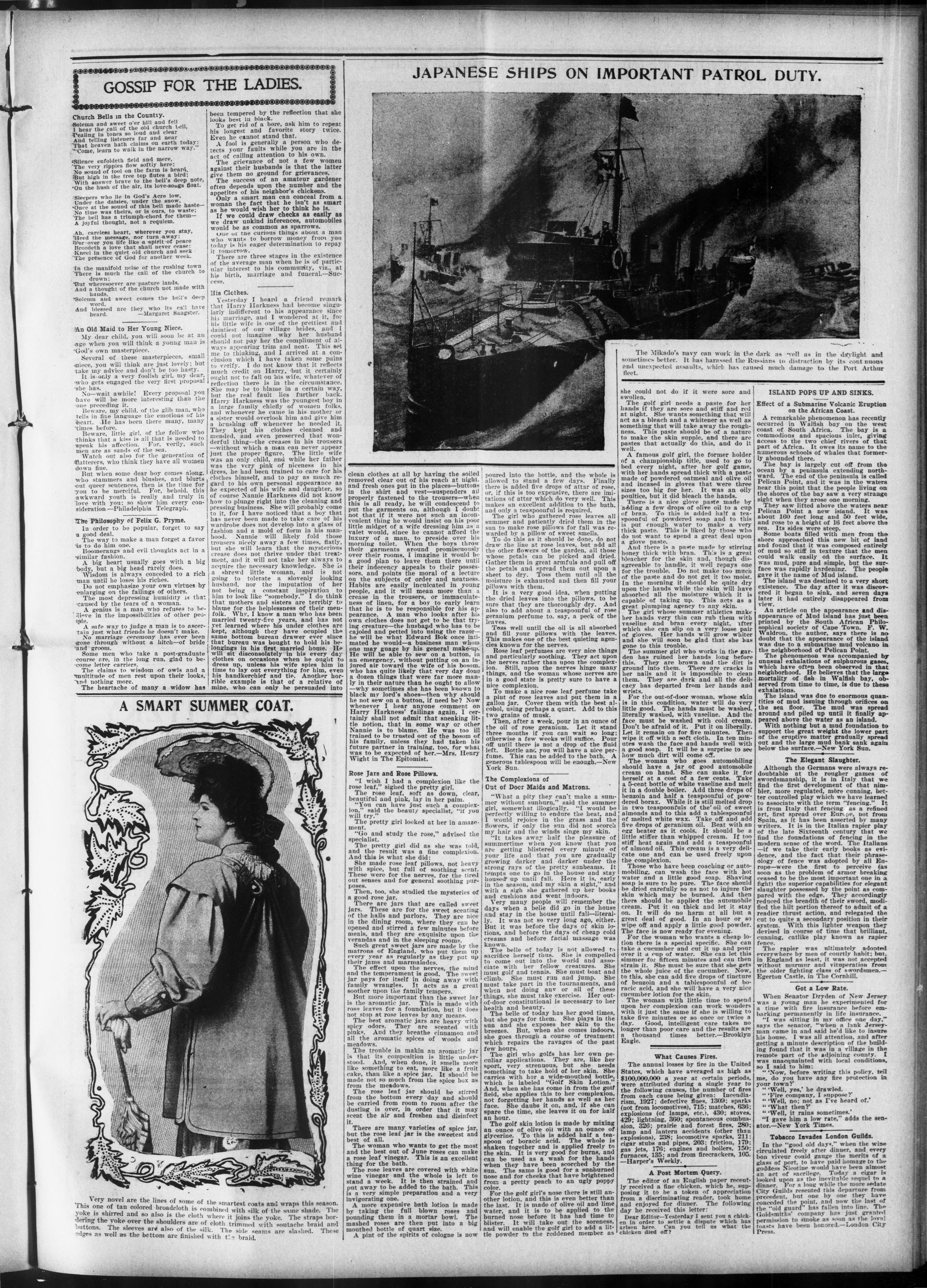
GOSSIP FOR THE LADIES.
been tempered by the reflection that she looks best in black.
looks best in black.
To get rid of a bore, ask him to repeat his longest and favorite story twice. Even he cannot stand that.
A fool is generally a person who detects your faults while you are in the act of calling attention to his own.
The grievance of not a few women against their husbands is that the latter give them no ground for grievances.
The success of an amateur gardener often depends upon the number and the appetites of his neighbor's chickens. Only a smart man can conceal from a woman the fact that he isn't as smart as he would wish her to think he is. If we could draw checks as easily as we draw unkind inferences, automobiles would be as common as sparrows. One of the curious things about a man who wants to borrow money from you today is his eager determination to repay it tomorrow. There are three stages in the existence of the average man when he is of particular interest to his community, viz., at his birth, marriage and funeral.—Success.
His Clothes.
Yesterday I heard a friend remark that Harry Harkness had become singularly indifferent to his appearance since his marriage, and I wondered at it, for his little wife is one of the prettiest and daintiest of our village brides, and I could not imagine why her husband should not pay her the compliment of always appearing trim and neat. This set me to thinking, and I arrived at a conclusion which I have taken some pains to verify. I do not know that it reflects much credit on Harry, but it certainly ought not to fall on his wife, whatever of reflection there is in the circumstance. She may be to blame in a certain way, but the real fault lies further back. Harry Harkness was the youngest boy in a large family chiefly of women folks, and whenever he came in his mother or a sister would overlook him and give him a brushing off whenever he needed it. They kept his clothes cleaned and mended, and even preserved that wonderful thing—the creases in his trousers—without which a man can never appear just the proper figure. The little wife was an only child, and while her father was the very pink of niceness in his dress, he had been trained to care for his clothes himself, and to pay as much clothes to his own personal appearance as he expected of his wife and daughter, so of course Nannie Harkness did not know how to plunge right into the cleaning and pressing business. She will probably come to it, for I have noticed that a boy that has never been made to take care of his wardrobe does not develop into a glass of fashion and a mold of form in his manhood. Nannie will likely fold those trousers nicely away a few times, flatly, but she will learn that the mysterious crease does not thrive under that treatment, and it will not take her always to acquire the necessary knowledge. She is a shrewd little woman, and is not going to tolerate a slovenly looking husband, nor the imputation of her not being a constant inspiration to him to look like "somebody." I do think that mothers and sisters are terribly to blame for the helplessness of their menfolk. Why, I know a man who has been married twenty-five years, and has not yet learned where his under clothes are kept, although they have occupied the same bottom bureau drawer ever since that bureau was bought to hold his belongings in his first married home. He will sit disconsolately in his every day clothes on occasions when he ought to dress up, unless his wife spies him in time to lay out everything for him, even his handkerchief and tie. Another horrible example is that of a relative of mine, who can only be persuaded into
A SMART SUMMER COAT.
Very novel are the lines of some of the smartest coats and wraps this season. This one of tan colored broadcloth is combined with silk of the same shade. The yoke is shirred and so also is the cloth where it joins the yoke. The straps bordering the yoke over the shoulders are of cloth trimmed with soutache braid and buttons. The sleeves are also of the silk. The side seams are slashed. These edges as well as the bottom are finished with t'a braid.
Very novel are the lines of some of the smartest coats and wraps this season. This one of tan colored broadcloth is combined with silk of the same shade. The yoke is shirred and so also is the cloth where it joins the yoke. The straps bordering the yoke over the shoulders are of cloth trimmed with soutache braid and buttons. The sleeves are also of the silk. The side seams are slashed. These edges as well as the bottom are finished with t'a braid.
Church Bells in the Country.
Solemn and sweet o'er hill and fell
I hear the call of the old church bell,
Pealing in tones so loud and clear
And telling listeners far and near
That heaven hath claims on earth today;
"Come, learn to walk in the narrow way.
Silence enfoldeth field and mere,
The very ripples flow softly here;
No sound of tool on the farm is heard,
But high in the tree top flutes a bird;
With answer brave to the bell's deep note,
On the hush of the air, its love-songs float.
Sleepers who lie in God's Acre low,
Under the daisies, under the snow,
Once at the sound of this bell made haste
No time was theirs, or is ours, to waste;
The bell has a trumph-chord for them—
A joyful thought, not a requiem.
Ah, carless heart, wherever you stay,
Heed the message, nor turn away:
For over you life like a spirit of peace
Broodeth a love that shall never cease:
Kneel in the quiet old church and seek
The presence of God for another week.
In the manifold noise of the rushing town
There is much the call of the church to
drown;
But wheresoever are pasture lands.
And a thought of the church not made with
hands.
"Solemn and sweet comes the bell's deep word."
word.
And blessed are they who its call have
heard. —Margaret Sangster.
An Old Maid to Her Young Niece.
My dear child, you will soon be at an age when you will think a young man is God's own masterpiece.
Several of these masterpieces, small niece, you will think are just lovely; but take my advice and don't be too hasty.
It is only a very foolish girl, my dear, who gets engaged the very first proposal she has.
No—wait awhile! Every proposal you have will be more interesting than the one preceding it.
Beware, my child, of the glib man, who tells in fine language the emotions of his heart. He has been there many, many times before.
Beware, little girl, of the fellow who thinks that a kiss is all that is needed to speak his affection. For, verily, such men are as sands of the sea.
Watch out also for the generation of flatterers, who think they have all women down fine.
But when some dear boy comes along, who stammers and blushes, and blurts out queer sentences, then is the time for you to be merciful. For, behold, this awkward youth is really, and truly in love with you; so show him every consideration—Philadelphia Telegraph.
The Philosophy of Felix G. Pryme.
In order to be popular, forget to say a good deal. The way to make a man forget a favor is to do him one. Boomerangs and evil thoughts act in a similar fashion.
A big heart usually goes with a big body, but a big head rarely does.
Wisdom is always conceded to a rich man until he loses his riches.
Do not emphasize your own virtues by enlarging on the failings of others.
The most depressing humidity is that caused by the tears of a woman.
A genius is a man who refuses to believe in the impossibilities of other people.
A safe way to judge a man is to ascertain just what friends he doesn't make.
No marriage ceremony has ever been gone through without a hitch—of bride and groom.
Some men who take a post-graduate course are, in the long run, glad to become letter carriers.
The claims to wisdom of owls and a multitude of men rest upon their looks, and nothing more.
The heartache of many a widow has
JAPANESE SHIPS ON IMPORTANT PATROL DUTY.
THE FIGHTING
clean clothes at all by having the soiled removed clear out of his reach at night, and fresh ones put in the places—buttons in the shirt and vest—suspenders all properly fastened to the trousers—when this is all ready, he will condescend to put the garments on, although I doubt not that if it were not such an inconvenient thing he would insist on his poor little midget of a wife dressing him as a valet would, since he cannot afford the luxury of a man, to preside over his morning toilet. When the boys throw their garments around promiscuously over their rooms, I imagine it would be a good plan to leave them there until their indecency appeals to their possessors, and points the moral of a lecture on the subjects of order and neatness. Habits are easily inculcated in young people, and it will mean more than a crease in the trousers, or immaculateness of linen, for a boy to early learn that he is to be responsible for his appearance. A man who looks after his own clothes does not get to be that trying creature—the husband who has to be cajoled and petted into using the razor—he will be what Edward Bok once intimated he would—a business man whom one may guage by his general make-up. He will be able to sew on a button, in an emergency, without putting on an injured air toward the wife of his bosom, who has quite likely that very day done a dozen things that were far more manly in their nature than he ought to allow
ry in their nature than he ought to allow—why sometimes she has been known to black my lord's shoes—then why should he not sew on a button, if need be? Now whenever I hear anyone comment on Harry Harkness' failings again. I certainly shall not admit that sneaking little notion, that in some way or other Nannie is to blame. He was too ill trained to be trusted out of the bosom of his family, unless they had taken his future partner in training, too, for what was to be expected of her.—Mrs. Henry Wight in The Epitomist.
Rose Jars and Rose Pillows.
"I wish I had a complexion like the rose leaf," sighed the pretty girl.
The rose leaf, soft as down, clear, beautiful and pink, lay in her palm.
"You can have just such a complexion," said the beauty specialist, "if you will try."
The pretty girl looked at her in amazement.
"Go and study the rose," advised the specialist.
The pretty girl did as she was told, and the result was a fine complexion. And this is what she did:
She made rose leaf pillows, not heavy with spice, but full of soothing scent. These were for the nerves, for the tired out senses and for general soothing purposes.
Then, too, she studied the mysteries of a good rose jar.
There are jars that are called sweet jars. These are for the sweet scenting of the halls and parlors. They are nice in the dining room, where they can be opened and stirred a few minutes before meals, and they are exquisite upon the verandas and in the sleeping rooms.
Such great sweet jars are made by the matrons of England, who put them up every year as regularly as they put up their jams and marmalades. The effect upon the nerves, the mind and the temperament is good. The sweet jar pays for itself in doing away with family wrangles. It acts as a great soother upon the family tempers. But more important than the sweet jar is the aromatic jar. This is made with rose leaves for a foundation, but it does not stop at rose leaves by any means. The best aromatic jars are heavy with spicy odors. They are scented with pinks. And they breathe cinnamon and all the aromatic spices of woods and meadows.
The trouble in makin an aromatic jar is that its composition is little understood. And, when done, it smells more like something to eat, more like a fruit cake, than like a spice jar. It should be made not so much from the spice box as from the meadows.
The rose leaf jar should be stirred from the bottom every day and should be carried from room to room after the dusting is over, in order that it may scent the air and freshen and disinfect it.
There are many varieties of spice jar, but the rose leaf jar is the sweetest and best of all.
The woman who wants to get the most and the best out of June roses can make a rose leaf vinegar. This is an excellent thing for the bath.
The rose leaves are covered with white wine vinegar and the whole is left to stand a week. It is then strained and put away to be added to the bath. This is a very simple preparation and a very invigorating one.
A more expensive bath lotion is made by taking the full blown roses and pounding them in a mortar bowl. The mashed roses are then put into a big mounted bottle of quart size.
A pint of the spirits of cologne is now
poured into the bottle, and the whole is allowed to stand a few days. Finally there is added five drops of attar of rose, or, if this is too expensive, there are imitations of attar which do very well. This makes an excellent addition to the bath, and only a teaspoonful is required.
The girl who gathered rose leaves all summer and patiently dried them in the sun to make rose pillows for fall was rewarded by a pillow of sweet smells.
To do this as it should be done, do not draw the line at rose leaves, but add all the other flowers of the garden, all those whose petals can be picked and dried. Gather them in great armfuls and pull off the petals and spread them out upon a sheet to dry. Toss them until all the moisture is exhausted and then fill your pillows with them.
It is a very good idea, when putting the dried leaves into the pillows, to be sure that they are thoroughly dry. And also to add about a teaspoonful of rose geranium perfume to, say, a peck of the leaves.
Toss well until the oil is all absorbed and fill your pillows with the leaves. This makes one of the best quieting agencies known for the nerves.
Rose leaf perfumes are very nice things and particularly soothing. They act upon the nerves rather than upon the complexion. Still, upon the nerves hinge many things, and the woman whose nerves are in a good state is pretty sure to have a nice complexion.
To make a nice rose leaf perfume take a pint of rose leaves and put them in a gallon jar. Cover them with the best alcohol, using perhaps a quart. Add to this two grains of musk.
Then, after a week, pour in an ounce of the oil of rose geranium. Let it stand three months if you can wait so long; otherwise a few weeks will suffice. Pour off until there is not a drop of the fluid left. Bottle and you will have a nice perfume. This can be added to the bath. A generous tablespoon will be enough.—New York Sun
Cut of Docr Maids and Matrons.
"What a pity they can't make a summer girl, somewhat illogically. "I would be perfectly willing to endure the heat, and I would rejoice in the grass and the flowers, if only the sun did not scorch my hair and the winds singe my skin. "It takes away half the pleasure of summertime when you know that you are getting blistered every minute of your life and that you are gradually growing darker and darker under the strong rays of the pretty sunbeams. It tempts one to go in the house and stay housed up until fall. Here it is, early in the season, and my skin a sight," and with a sigh she gathered up her books and cushions and went indoors.
Very many people will remember the days when a belle did go in the house and stay in the house until fall—literally. It was not so very long ago, either. But it was before the days of skin lotions, and before the days of cheap cold creams and before facial massage was known.
The belle of today is not allowed to sacrifice herself thus. She is compelled to come out into the world and associate with her fellow creatures. She must golf and tennis. She must boat and climb. She must run and jump. She must take part in the tournaments, and when not doing any or all of these things, she must take exercise. Her out-of-door constitutional is necessary to her health and beauty.
The belle of today has her good times, but she pays for them. She plays in the sun and she exposes her skin to the breezes. But, when she comes indoors, she goes through a course of treatment which repairs the ravages of the past few hours.
The girl who golfs has her own peculiar applications. They are, like her sport, very strenuous, but she needs something to take hold of her skin. She carries with her a wide-mouthed bottle, which is labeled "Golf Skin Lotion." And, when she has come in from the golf field, she applies this to her complexion, not forgetting her hands as well as her face. She daubs it on, and, if she can spare the time, she leaves it on for half an hour.
The golf skin lotion is made by mixing an ounce of olive oil with an ounce of glycerine. To this is added half a teaspoon of boracic acid. The whole is shaken together and is applied freely to the skin. It is very good for burns, and can be used as a wash for the hands when they have been scorched by the sun. The same is good for a sunburned nose and for cheeks that have brightened from a pretty peach to an ugly poppy color.
For the golf girl's nose there is still another lotion, and this is even better than the last. It is made of olive oil and lime water, and it is to be applied to the burned nose before it has had time to blister. It will take out the soreness, and will enable the golf girl to add a little powder to the reddened member as
The Mikado's navy can work in the dark as well as in the daylight and sometimes better. It has harassed the Russians to distraction by its continuous and unexpected assaults, which has caused much damage to the Port Arthur fleet.
The Mikado's navy can work in the dark as well as in the daylight and sometimes better. It has harassed the Russians to distraction by its continuous and unexpected assaults, which has caused much damage to the Port Arthur fleet.
she could not do if it were sore and swollen. The golf girl needs a paste for her hands if they are sore and stiff and red at night. She wants something that will act as a bleach and a whitener as well as something that will take away the roughness. This paste should be of a nature to make the skin supple, and there are pastes that actually do this, and do it well. A famous golf girl, the former holder of a championship title, used to go to bed every night, after her golf game, with her hands spread thick with a paste made of powdered oatmeal and olive oil and incased in gloves that were three sizes too big for her. It was an oily poultice, but it did bleach the hands.
There is a nice glove paste made by adding a few drops of olive oil to a cup of bran. To this is added half a teapoonful of powdered soap and to this is put enough water to make a very thick paste. This is liked by those who do not want to spend a great deal upon a glove paste.
And there is a paste made by stirring honey thick with bran. This is a great bleacher for the skin and, though disagreeable to handle, it well repays one for the trouble. Do not make too much of the paste and do not get it too moist. In the morning it should be quite dry upon the hands while the skin will have absorbed all the moisture which it is capable of taking up. This acts as a great plumping agency to any skin.
The girl whose summer athletics make her hands very thin can rub them with vaseline and bran every night, after which she can slip on a very loose pair of gloves. Her hands will grow whiter and she will soon be glad that she has gone to this trouble.
The summer girl who works in the garden has ruined her hands long before this. They are brown and the dirt is ground into them. There are cracks in her nails and it is impossible to clean them. They are dark and all the delicacy has departed from her hands and wrists.
For the out-of-door woman, whose skin is in this condition, water will do very little good. The hands must be washed, literally washed, with vaseline. And the face must be washed with cold cream. Don't be afraid of it. Put it on liberally. Let it remain on for five minutes. Then wipe it off with a soft cloth. In ten minutes wash the face and hands well with a good soap. It will be a surprise to see how much dirt will come off.
The woman who goes automobiling should have a jar of good automobile cream on hand. She can make it for herself at a cost of a few cents. Take a 5-cent bottle of white vaseline and melt it in a double boiler. Add three drops of benzoin and half a teaspoonful of powdered borax. While it is still melted drop in two teaspoonfuls of the' oil of sweet almonds and to this add a tablespoonful of melted white wax. Take off and add five drops of geranium oil. Beat with an egg beater as it cools. It should be a little stiffer than whipped cream. If too stiff heat again and add a teaspoonful of almond oil. This cream is a very delicate one and can be used freely upon the complexion.
Those who have been coaching or automobiling, can wash the face with hot water and a little good soap. Shaving soap is sure to be pure. The face should be dried carefully so as not to injure the skin which may be burned. And then there should be applied the automobile cream. Put it on thick and let it stay on. It will do no harm at all but a great deal of good. In an hour or so wipe off and apply a little good powder. The face is now ready for evening.
For the woman who wants a cheap lotion there is a special specific. She can take a cucumber and cut it up and pour over it a cup of water. She can let this simmer for fifteen minutes and can then strain it. She must be sure that she gets the whole juice of the cucumber. Now, to this, she can add five drops of tincture of benzoin and a tablespoonful of boracic acid, and she will have a very nice cucumber lotion for the skin.
The woman with little time to spend upon her complexion can work wonders with it just the same if she is willing to take five minutes or so once or twice a day. Good, intelligent care takes no longer than poor care and the results are a thousand times better.—Brooklyn Eagle.
What Causes Fires.
The annual losses by fire in the United States, which have averaged as high as $100,000,000 a year at certain periods, were attributed during a single year to the following causes, the number of fires from each cause being given: Incendiarism, 1927; defective flues, 1309; sparks (not from locomotives), 715; matches, 636; explosions (of lamps, etc.), 430; stoves, 429; lightning, 360; spontaneous combustion, 326; prairie and forest fires, 280; lamp and lantern accidents (other than explosions), 238; locomotive sparks, 211; cigar stubs and pipes, 203; friction, 179; gas jets, 176; engines and boilers, 150; furnaces, 135; and from firecrackers, 105.—Harper's Weekly.
A Post Mortem Query
The editor of an English paper recently received a fine chicken, which he, supposing it to be a token of appreciation from a discriminating reader, took home and enjoyed for dinner. The following day he received this letter:
Dear Editor—Yesterday I sent you a chicken in order to settle a dispute which has arisen here. Can you tell us what the chicken died off?
ISLAND POPS UP AND SINKS
Effect of a Submarine Volcanic Eruption on the African Coast.
A remarkable phenomenon has recently occurred in Walfish bay on the west coast of South Africa. The bay is a commodious and spacious iner, giving access to the two chief rivers of that part of Africa. It owes its name to the numerous schools of whales that formerly abounded there.
The bay is largely cut off from the ocean by a peninsula extending northward. The end of the peninsula is called Pelican Point, and it was in the waters near this point that the people living on the shores of the bay saw a very strange sight when they arose one morning.
They saw lifted above the waters near Pelican Point a new island. It was about 160 feet long and 50 feet wide, and rose to a height of 16 feet above the sea. Its sides were steep.
Some boats filled with men from the shore approached this new bit of land and found that it it was composed entirely of mud so stiff in texture that the men could walk easily on the surface. It was mud, pure and simple, but the surface was rapidly hardening. The people gave it the name of Mud island. The island was destined to a very short existence. The day after it was discovered it began to sink, and seven days later it had entirely disappeared from view. An article on the appearance and disappearance of Mud island has just been printed by the South African Philosophical society of Cape Town. F. W. Waldron, the author, says there is no doubt that the appearance of the island was due to a submarine mud volcano in the neighborhood of Pelican Point.
The phenomenon was accompanied by unusual exhalations of sulphurous gases, which have often been observed in that neighborhood. He believes that the large mortality of fish in Walfish bay, observed from time to time, is due to these exhalations. The island was due to enormous quantities of mud issuing through orifices on the sea floor. The mud was spread around and piled up until it finally appeared above the water as an island. With nothing but a mud foundation to support the great weight the lower part of the eruptive matter gradually spread out and the large mud bank sank again below the surface.—New York Sun.
The Elegant Slaughter
Although the Germans were always redoubtable at the rougher games of swordsmanship, it is in Italy that we find the first development of that nimbler, more regulated, more cunning, better controlled play which we have learned to associate with the term "fencing." It is from Italy that fencing, as a refined art, first spread over Europe, not from Spain, as it has been asserted by many writers. It is in the Italian rapier play of the late Sixteenth century that we find the foundations of fencing in the modern sense of the word. The Italians—if we take their early books as evidence, and the fact that their phraseology of fence was adopted by all Europe—were the first to perceive (as soon as the problem of armor breaking ceased to be the most important one in a fight) the superior capabilities for elegant slaughter possessed by the point as compared with the edge. They accordingly reduced the breadth of their sword, modified the hilt portion thereof to admit of a readier thrust action, and relegated the cut to quite a secondary position in their system. With this lighter weapon they devised in course of time that brilliant, cunning, catlike play known as rapier fence.
The rapier was ultimately adopted everywhere by men of courtly habit; but, in England as least, it was not accepted without murmur and vituperation from the older fighting class of swordsmen.—Egerton Castle, in The Cornhill.
Got a Low Rate.
When Senator Dryden of New Jersey was a young man he experimented for a time with fire insurance before embarking permanently in life insurance. "I was sitting in my office one day," says the senator, "when a lank Jerseyman came in and said he'd like to insure his house. I was all attention, and after getting a minute description of the building found that it was in a village in the remote part of the adjoining county. I was unacquainted with local conditions, so I said to him: "Now, before writing this policy, tell me, do you have any fire protection in your town?" "Well, yes,' he drawled. "Fire company, I suppose?" "Well, no; not as I've heard of.' "What then?" "Well, it rains sometimes.'
"I gave him a low rate," adds the senator.—New York Times.
Tobacco Invades London Guilds.
In the "good old days," when the wine circulated freely after dinner, and every bon viveur could gauge the merits of a glass of port, to have paid homage to the goddess Nicotine would have been almost an act of sacrilege. Today a cigar is looked upon as the inevitable sequel to a dinner. For a long while the more sedate City Guilds resented this departure from precedent, but one by one they have conceded the point, and now the last of the "old guard" has fallen into line. The Goldsmiths' company has just granted permission to smoke as soon as the loyal toasts have been honored.—London City Press
THE WISCONSIN WEEKLY ADVOCATE
R. B. Montgomery, Editor and Publisher.
P. A. Sample, Associate Editor and Business Manager.
Published Every Thursday at No. 79 Fifth Street.
A Representative Journal Devoted to the Interest of All the People.
ADVERTISING RATES
One inch, one year..... $15.00
Two inches, one year..... 25.00
Three inches, one year..... 35.00
Four inches, one year..... 42.00
For larger space, special rates.
Locals, 10 cents per line.
TERMS OF SUBSCRIPTION.
One year ..... $2.00
Six months ..... 1.00
Three months ..... .50
Direct all communications to
R. B. MONTGOMERY.
79 Fifth Street.
HOW TO SEND MONEY—Post Office
Order, Express Order, Draft or Registered
Letter. R. B. Montgomery will not be
responsible for loss when sent in any other
way.
TO CONTRIBUTORS:
All communications must be sent with the
name and address of the sender as an evi-
dence of good faith, but not necessarily for
publication. No manuscript returned if not
accepted, unless accompanied by stamps.
ADVERTISING RATES.
One insertion, per inch..... $ .25
One month, per inch..... .75
Three months, per inch..... 2.00
Six months, per inch..... 3.50
One year, per inch..... 5.00
Paragraph advertisements, per line..... 0.05
"I know of the bravery and character of the Negro soldier. He saved my life at Santiago, and I have had occasion to say so in many articles and speeches. The Rough Riders were in a bad position when the Ninth and Tenth cavalry came rushing up the hill carrying everything before them. The Negro soldier has the faculty of coming to the front when he is needed most. In the Civil war he came 200,000 strong, and I believe he saved the Union."—President Roosevelt.
THE LOCAL POLITICAL OUTLOOK.
Now that the so-called "Rump" convention at Madison has been recognized by the court of highest resort in party politics as the regular Republican convention, their nominees will be placed on the regular Republican ticket. A fight to the bitter end is to be expected by the La Foletteites, and this will of necessity endanger the success of the Republican party in the state. In Milwaukee it is almost a foregone conclusion that the county will be lost so far as local officers are concerned, and probably this is not a matter of extreme regret except to those immediately affected. Roosevelt and Fairbanks, however, will in our opinion be able to hold their own from their mere strength of character. The Social Democrats are very hopeful of success in the county, and likewise in the Fourth and Fifth Congressional districts, but the people will pause before entrusting even the affairs of the county to untried idealists and political cranks. Much less will they overthrow such an old-tried friend and representative as Theobald Otjen for a man of Utopian views. And in the Fifth district our friend W. H. Stafford has in the two short sessions in which he has served in Congress proved himself a man of such sterling worth and capability that his many friends of both factions of the Republican party, and also hundreds of sound Democrats will rally round him and give him a chance to further distinguish himself, and thus reflect credit and honor on the young manhood of the Fifth district of Wisconsin. So the Social Democrats may as well keep their powder and shot for another occasion and take united themselves that discretion, which is the better part of valor.
The American schooner yacht Ingomar did not win the Emperor's cup in the race of 320 miles from Dover to Heligoland. She arrived two hours in advance of the second boat, but as she was the "scratch" boat handicapped to the extent of from five to nine and one-half hours, she could not secure the prize, which went to one of the tail-enders. The Ingomar is a good type of the American schooner, and she will be heard from during her stay abroad and generally from the head of the procession.
---
The Oroyo railroad, which now runs from Callao to the gold fields of Cerro de Pasco, is considered one of the wonders of the Peruvian world. Commencing at Callao it ascends the narrow valley of the Rimac, rising nearly 5000 feet in the first 56 miles. Thence it goes through the intricate gorges of the Sierras till it tunnels the Andes at an altitude of 15,645 feet, the highest point in the world where a piston rod is moved by steam. This elevation is reached in 78 miles.
Eight ordinary hen's eggs were submitted to pressure applied externally all over the surface of the shell, and the breaking pressure varied between 400 pounds and 675 pounds per square inch. With the stresses applied internally to 12 eggs they gave way at pressures varying between 32 pounds and 65 pounds per square inch. The pressure required to crush the eggs varied between 40 pounds and 75 pounds. The average thickness of the shells was 13-1000 inch.
Storks are not often seen on the American continent, but are commonly found in nearly all the countries of Europe. In Holland, where they are particularly numerous and are protected by law, their nests are generally on the summit of a tall post, put up on purpose for them, on which is fixed an old cart wheel.
EX-SENATOR IS DEAD.
John L. Mitchell Passes Away at His Summer Home.
A NOTABLE DEMOCRAT.
Died Without Regaining Consciousness, Surrounded by Members of His Family.
Milwaukee, Wis., June 30.—[Special.]
—Former United States Senator John Lendrum Mitchell died at his country place, Meadowmere, Milwaukee county, on Wednesday evening at 7:45 o'clock, at the age of 62 years. The funeral will be held Saturday afternoon at 2:30 o'clock. Interment will be on the family lot at Forest Home cemetery.
Senator Mitchell was, prior to the bank failures of 1893, one of Milwaukee's wealthiest citizens. His vast fortune was largely depleted, however, in his determination to make good the losses sustained through the collapse of the bank his father, Alexander Mitchell, founded, although, at the time, Mr. Mitchell was not actively identified with the institution. It is believed that he still leaves a fortune worth approximately $1,000,000.
Popular with Old Soldiers.
The news of the death spread rapidly Wednesday evening, and expressions of deep sorrow and of great admiration for the man who is gone were to be heard upon all sides. There will be none to miss the genial, warm greeting and the kindly presence of "Comrade Mitchell" more than the old veterans of the Civil war, both in and out of the Soldiers' home.
For many years Mr. Mitchell was the resident manager of the national board of managers of the National Home for Disabled Volunteer Soldiers, and in that position endeared himself to every one of the 2000 members of the Milwaukee camp. No task was too irksome for Mr. Mitchell, when an old comrade was to be benefited or a sufferer from some home trouble comforted. He was man and comrade, brother and sponsor for each and all, and there was no prouder moment in Senator Mitchell's long and useful life than when he was invited, one year ago by Gov. Cornelius Wheeler of the Milwaukee branch, to deliver the Memorial day address to the veterans at the home, which was also the occasion of the dedication of the monument in the home cemetery. Never was there a more instructive, impressive or more tender address and tribute to the veterans of the Union armies delivered there.
Seriously Ill for Some Months.
Senator Mitchell's fatal illness dates from an operation performed about three months ago for a complicated intestinal disorder from which he had been suffering for some time previous. A consultation of physicians and surgeons determined upon a surgical operation for a stoppage in the bowels, and Dr. Nicholas Senn of Rush Medical college performed the operation. It was regarded as successful, relieving the patient from intense suffering, and prolonging his life. Following the operation Mr. Mitchell rallied and was able to be up and about his home for some time. Within a few weeks, however, heart complications developed and late Saturday afternoon Mr. Mitchell suffered a sudden collapse.
The death of Mr. Mitchell removes a second vice president from the Marine National bank within a month, his cousin, John Johnston, having been the other of the two vice presidents.
John Lendrum Mitchell.
John Lendrum Mitchell was born in Milwaukee, October 19, 1842. His parents were Alexander and Martha Mitchell. He was the only child of three to survive, the others dying in infancy. His father was of sturdy Scotch stock, and his mother was of a prominent Vermont family. Some of the peculiar and strong characteristics which distinguished Alexander Mitchell were notably inherited by the son, making him a man of note and of strong, forceful character. He acquired the rudiments of an education in the public schools of Milwaukee, and later took a complete course in the military school at Hampton, Conn., after which he went abroad and studied in the great institutions of learning in Dresden, Munich and Genoa. When the war of the rebellion broke out, Mr. Mitchell hastened home and at the age of 19 enlisted with Co. I. Twenty-fourth Wisconsin Volunteer infantry. January 17, 1863, he was promoted to the first lieutenancy and transferred to Co. E of the same regiment. In June of the same year he was detailed for duty on the staff of Gen. Rousseau, and participated in the battles and engagements of his regiment, including Perryville, Murfreesboro, Hoover's Gap and the campaign about Chattanooga. Seriously impaired eyesight compelled him to resign his commission.
Enters Political Field.
Mr. Mitchell entered politics in 1872, when he became a candidate on the Democratic ticket for the state Senate, to which he was triumphantly elected. He was re-elected in 1875. In 1884-5 he served as president of the school board; president of the Wisconsin State Agricultural society, and president of the Northwestern Trotting Horse Breeders' association.
Owning a large and highly improved farm within five miles of the city, Senator Mitchell delighted to pass his leisure time there, where he had 440 acres under cultivation. He loved good stock and raised the best. In order to stimulate the science of farming, he secured the establishment of a short course in agriculture at the state university, offering at the same time twenty scholarships to poor boys. He also, in 1887, placed a standing order with the superintendent of Milwaukee schools to supply at his expense the necessary books to every school child whose parents were known to be too poor to purchase them.
In 1886 Mr. Mitchell was appointed by Congress a member of the board of managers of the National Homes for Disabled Soldiers, and in 1895 he was elected vice-president of the board. In 1890 he was elected to Congress from the Fourth district by a majority of 7000 over his Republican opponent. He was re-elected in 1892, and while serving his first term he was selected chairman of the Democratic congressional committee which conducted the campaign of 1892, resulting in a Democratic majority in both branches of Congress. For four years Mr. Mitchell was the Wisconsin member of the national Democratic committee, and a member of the state central committee.
Elected United States Senator
Mr. Mitchell's election to the United States Senate was accomplished in 1893 when he succeeded Philetus Sawyer, Gen. E. S. Bragg was Mr. Mitchell's strongest opponent and the second choice of all the original Mitchell men. As a member of the Senate, as in the lower house, Senator Mitchell soon won the high regard and confidence of his fellow members. He supported the income tax measure against the influence of associates in business, and he strenuously opposed the free coinage of silver, believing it to be detrimental
to the best interests of the people at large. He was always a great reader and a close student. He was fluent in French and German as well as in his native language, and was in the fullest sense a scholar and a gentleman, genial and companionable at all times. When his father died, Mr. Mitchell assumed many of the business cares which the distinguished financier laid down. He succeeded his father as a director in the Wisconsin Marine and Fire Insurance company bank; in the Northwestern National Insurance company, and in various charitable and public institutions. His personal tastes did not go toward banking, so that he was never really active in the bank, with which his cousin, the late John Johnston, was for years closely connected.
In Private Life
Mr. Mitchell was twice married. His first wife was Bianca, daughter of J. B. D. Cogswell, a law partner of Senator Matt. H. Carpenter. She was beautiful, gifted and accomplished. By her he had seven children, all of whom died young, with the exception of David Ferguson Mitchell, now residing in Florida. Mr. Mitchell was married in 1878 to Harriet Danforth Becker, who, with seven children, survives him. She is a woman of sterling qualities and wide culture, notably accomplished as a linguist, with whom her husband's life has been singularly happy. An older son, Capt. William Mitchell, is an officer in the regular army and has for some time been stationed in Colorado, after active service in Cuba, the Philippines and Alaska. The other children are John L. Mitchell, Jr., and the Misses Martha, Janet, Harriet, Ruth and Catharine Mitchell.
Mr. Mitchell was a man of wide observation as well as extensive reading, and in conversation was always interesting and informing. He was singularly approachable and affable, and very loyal to his friends—traits which he inherited from both his father and his mother.
One of the most honorable features of Mr. Mitchell's character was his strong Americanism. It was pithily illustrated on his return from Europe two years ago after a long sojourn there. A friend said to him: "Mr. Mitchell, how did it happen that none of your girls married abroad?" He instinctively replied: "I did not wish it. I want my girls to marry men of their own country."
Took a University Course.
Upon retiring from the Senate in 1899, Mr. Mitchell with his family went to Europe, where they remained three and a half years. During his stay abroad his children were placed in various schools in France and Germany, while he, together with one of his daughters, took a course at the University of Grenoble, France, and succeeded with his daughter in passing satisfactorily the examination before the faculty, receiving diplomas for proficiency in French language and literature.
SECOND REGIMENT'S SCHEDULE IS MADE.
Troops Will Be Moved to Camp Douglas in Daytime on July 9—Time Announced.
Appleton, Wis., June 30.—[Special.]—At the coming National guard encampment, the troops will be moved in the daytime. The first section will make up at Appleton, leaving here with headquarters of the regiment and Co. G at 6:50 a. m. July 9. At Oshkosh Cos. B. and F. will be picked up at 7:40; Co. E, Fond du Lac, will be taken on at 8:25. The train is scheduled to arrive at Camp Douglas at 2:15.
The second section will leave Mariette with Co. I at 4:45 a. m., pick up Co. M at Oconto at 5:30; stop at Appleton for horses at 7:15. At Fond du Lac Co. D of Ripon and Co. C, Sheboygan, and H. Manitowoc, will be picked up at 9 o'clock. The Manitowoc company is to leave home on a special at 6:20 and the Ripon company on regular passenger at 7:57 a. m. The second section is scheduled to arrive at camp at 2:55.
MAY HAVE KILLED SELF AND CHILDREN.
Mrs. John Hart Disappears from Prairie du Chien with Boy and Girl— Triple Crime Feared. Prairie du Chien, Wis., June 30. [Special.]—Mrs. John Hart, wife of the man who assaulted James Campbell at Steuben several days ago, has disappeared and may have killed herself and children. It is believed that she is insane. She attempted to commit suicide by lying on the track before a train on the Kickapoo Valley road and it required three men to pull her off. She then took her 12-year-old daughter and 14-year-old son and escaped. She cannot be found and it is feared she has killed herself and children.
TISSUE PLANT RUNS WITH FULL FORCE.
One Appleton Mill Is Working and Others Are Planning to Resume Next Week.
Appleton, Wis., June 30.—[Special.]—The Wisconsin tissue plant, the only mill in the city which has started up since the strike commenced, is now running with a full force. Yesterday they obtained another crew of outside non-union help and managed to get their second machine in operation during the day.
The manufacturers have held a meeting and decided to make an effort to start up all the mills that are now down on the same day, but as to what date has been set will not be given out. It is not expected that any move will be made until after the Fourth to resume operations.
The union men are of the opinion that sufficient non-union help can not be secured to start up with. One of the manufacturers said today: "We are willing to take back most of the strikers on the long hour schedule, but, of course, this does not refer to the ringleaders, as they will never be able to again find employment in a paper mill in the Fox River valley." This stand will prolong the fight, as the union men will demand that they go back to their old jobs in a body.
"HANGING BEE" IN SOUTHERN STYLE.
Alabama Sheriff Sends Out Formal Invitations and Tells of Brass Band and Barbecue.
Superior, Wis., June 30.—[Special.]—Port Collector Thomas B. Mills of this city has received a novel invitation to a "hanging bee." The invitation comes from Sheriff I. M. Armstrong of Baldwin county, Alabama, and reads as follows:
You are cordially invited to attend the execution of Tom Platt, colored, at Baldwin county jail, Bay Minette, Alabama, on Friday, July 8, 1904, a 12:30 o'clock.
I. M. ARMSTRONG, Sheriff.
If you or deputies can come, write me so I can reserve seats.
By way of further explanation the sheriff writes:
Enclosed you will find an invitation to a little "hanging bee." The fellow is going to have a brass band from Mobile and will give a barbecue. People from all round the country will be there. It is so seldom that they hang one legally down here that they make a big day of it in the prisoner's honor.
TOW MILL DAMAGED.
New Structure at Hammond Blown from Its Foundation—Considerable Loss Occasioned at La Crosse.
Hammond, Wis., June 30.—[Special.]
—A severe wind storm, accompanied by rain and hail, struck this city last night. The new tow mill, owned by the Union Fiber company at Winona, Minn., was blown from its foundation and all but destroyed. About four weeks ago the mill was struck by lightning and burned. La Crosse, Wis., June 30.—[Special.]
—A building at the interstate fair grounds was wrecked, huge trees in Myrick park were uprooted, and much damage to crops in the surrounding county was caused by a wind and rain storm last evening.
Plainfield. Wis., June 30.—In a severe electrical storm the new high school building was struck by lightning and some damage was done.
REWARD FOR CAPTURE OF BANDIT INCREASED.
Montana Will Give $2000 for the Apprehension of Bandit Lon Smith,
Wanted for Murder.
La Crosse, Wis., June 30.—[Special.]
Montana has raised its reward offered for the capture of Bandit Smith to $2000. He has served a term in the Deer Lodge penitentiary.
He is wanted for the murder of Officer Stevens in Montana.
He has been chased by a posse consisting of sheriffs' deputies and militiamen, but has escaped.
MAY HAVE BEEN SMITH.
La Crosse, Wis., June 30.—A man answering the description of John Smith, murderer of Sheriff Harris, in every particular, rode across the bridge into Winona with a farmer and rode as far as this city on the blind baggage of train No. 58, on the Milwaukee road. He left the train just before it entered the city and officers have been unable to find any trace of him since.
"A little dust is a dangerous thing"
Dust arising from floors often carries disease germs, to say nothing of the discomfort it occasions. It is unclean—it is dangerous—keep it down.
CREOLIAN
ANTISEPTIC
FLOOR DRESSING
is a perfect dust arrester. Applied according to directions it cleans a floor thoroughly, restores and heightens the natural color of the wood, and saves lots of scrubbing. It is "cheaper than dirt." For sale by dealers and
Milwaukee Paint and Varnish Co.
191-193 THIRD STREET.
Buyers Who Come Here Will Save
Few Things, but are sold as cheap here as anywhere, and most are cheaper
THE FAIR COR. THIRD AND PRAIRIE.
Telephone Clark 9652 703 GRAND AVENUE. Suit made-to-order from $18 and up Pants to order $4 and up.
Suite 6, Bradley Building 155 MASON STREET, - - MILWAUKEE.
Gents, in Need of First-Class Goods at a Reasonable Price Should Call on LOUIS COHEN Men's Furnishing Goods Hats and Caps.
M
FRANK FARSE
MILWAUKEE, WI
6 7
J. MUNKO
PRACTICAL SHOEMAKER
126 2nd Street, Milwaukee.
...REPAIRS NEATLY DONE...
Milwaukee
Rubber Heels 50c
a pair a Specialty.
Orders Promptly
Attended
National Negro-Suffrage League Convention.
National Negro-Suffrage League Convention.
SECOND MEETING.
Commencing June 20th, 1904 Chicago, Illinois.
OBJECT.
The object of this Convention is to invoke the aid of the Republican Party in National Convention assembled to the end that Southern Disfranchisement may be broken up.
REPRESENTATION.
Each state will be entitled to a representation equal to the number of her Congressional representation.
RATES.
Delegates attending this Convention will be able to avail themselves of the rate to the National Republican Convention, one fare for the round trip.
HEADQUARTERS.
The National Negro Suffrage League operates at Washington, D.C., a Bureau of Publicity and Promotion, from which a campaign will be directed against Southern Distranchisement.
Rec. Sec., W. I. Ridley, Pa.
Tres., Rev. J. A. Taylor, Wash'n, D. C.,
Eastern Organizer, Rev. J. A. Churchman,
N. J.
Western Organizer, J. C. Leftwith, Oklahoma.
For further information, address
JAMES H. HAYES,
Attorney-At-Law,
Washington, D. C.
The "Turf" Cafe. DINNER BILL. Regular Dinner 35 Cents
MAY 21.
11:30 to 2 p. m., 5 to 8 p. m.
Lettuce, 10c. Radishes, 10c.
Cucumbers, 10c. Green Onions, 10c.
S. Tomatoes, 10c. Celery Hearts.
SOUP.
Mock Turtle.
Baked Trout, Egg and Parsley Sauce,
25c.
Baked Chicken and Dressing, 25c.
Boiled Ox Tongue and Tartar Sauce, 25c.
Prime Roast Beef.
ENTREES.
Veal Loaf, 25c. Apple Salad, 15c.
Asparagus.
Boiled and Mashed Potatoes.
DESSERT.
Lemon and Strawberry Pie.
Cottage Pudding.
Ice Cream, 10c. Strawberries and Cream. Anything Ordered Not Mentioned on This Bill Will Be Charged for Extra.
MONROE BROS., Props.
194 THIRD STREET.
VALUABLE OFFER!
Take Advantage of It Today.
The Wisconsin Weekly Advocate Furnishes Free Reliable Colored Help to Its Subscribers.
Male and Female Cooks and Waiters, Nurse Girls, Barbers, Porters, Elevator Men and General Servants can be supplied on short notice by applying personally or by letter to
R. B. MONTGOMERY, Proprietor.
P. A. SAMPLE, Business Manager.
A. M. PALMER, Sec.
Office, 79 Fifth St., Milwaukee, Wis.
Before Starting on Your Travels
CALL ON
Ceo. Burroughs & Sons
MANUFACTURERS OF
PREMIUM TRUNKS
VALISES, SAMPLE CASES, Etc.
424 1 426 East Water St.. Milwaukee.
WANTED--AGENTS We want 100 agents in every city, town and hamlet in the U. S. for the Wisconsin Weekly Advocate. It will be dovoted to the interest of the Negro race and will contain the news of their sayings and doings throughout the world.
100 Per Cent. Commission
ADDRESS
WISCONSIN WEEKLY ADVOCATE
MILWAUKEE, WIS.
While in city visit....
STEPHENS'
HOTEL and RESTAURANT
First-Class Accommodations
Home Cooking a Specialty...
No. 2832 State St., CHICAGO, ILL.
ELK EXPRESS CO.
G. J. CHARLESTON, Mgr.
63 E. Sixth Street,
ST. PAUL, MINN.
RUSSIANS ARE DRIVEN OFF.
Japs Outmaneuver Czar's Forces and Take Fen Shai Pass.
BATTLE LASTS TWO DAYS.
Tokio, June 30.—1 p. m.—Detailed reports of the capture of Fen Shai pass on June 27, show that the Russians were driven from an exceedingly strong position dominating the Shi Muncheng road. In this engagement the Russian losses were again heavier than those of the Japanese. The Japanese outmaneuvered the Russians by working around the enemy's right flank and attacking him in the rear.
The Japanese advanced in three columns. One was assigned to deliver a frontal attack and the others to strike the enemy on the flanks. The column which advanced upon the Russian right flank fought a separate action.
It encountered three battalions of infantry, six guns and two machine guns on Sunday morning. This engagement lasted until sunset on Sunday. At this hour the Japanese bivouacked and renewed the assault at midnight, when they succeeded in defeating the Russians. On Monday morning, the 27th, the Russians were reinforced with three battalions and sixteen guns. They assaulted the Japanese viciously and endeavored to retake the position they had lost.
Repulsed by Japanese
They were repulsed and the Japanese flankers worked their way to the rear of the main Russian position at Fen Shui pass. This attack occurred at 3 o'clock in the morning.
In the meantime, the Japanese column, which had been assigned to make the frontal attack, met and routed 10,000 infantry and cavalry posted near Wenchapantsu. This happened on Sunday, the 26th. At dawn on Monday the Japanese renewed the attack. The fighting this day was opened with artillery.
Deadly Artillery Fire.
The Russians poured a deadly artillery fire upon the attackers and the Japanese artillery secured a new position and delivered a heavy cross-fire upon the Russian lines of defense. While this was proceeding the Japanese infantry and engineers cleared the obstructions from the Russian rear and closed in on the enemy. The Russians broke and fled at 11:30 Monday morning.
Retain the Heights.
The Japanese gained and retained possessions of the heights. The Russians left ninety dead behind them on the heights. This number of dead does not include those found in the valleys. The Japanese lost 270 men killed or wounded in the flanking and frontal stacks.
Three Months Building Forts.
The Russian troops who defended Fen Shui pass consisted of eleven battalions of infantry, seventeen squadrons of cavalry and three batteries of artillery. The enemy had spent three months in fortifying Fen Shui pass. The barracks and other buildings captured by the Japanese had not been destroyed, but before retreating the Russians burned their warehouses at Shan Tasu. The Russians retreated in disorder toward Shi Mu Cheng. The Japanese captured eighty-eight prisoners.
Gen. Stoessel Reports.
St. Petersburg, June 30, 4:40 p. m.—An official dispatch received from Lieut.-Gen. Stoessel, the commander of the Russian military forces at Port Arthur, says that the squadron of Rear Admiral Withoff re-entered that port after repulsing five torpedo boat attacks. It contains no further details so far as can be ascertained. It does not mention any damage to the Russian ships.
Must Have Both.
St. Petersburg, June 30.—No word has come from Gen. Kuropatkin later than June 27, and not a single newspaper dispatch has been received from the front during the last twenty-four hours. This silence in the theater of war is regarded as a significance of the coming storm. The Bourse Gazette this morning says: "We are on the eve of a battle which may settle the fate of Manchuria and Korea. Both must become Russian—the former because Russian blood was shed there; the latter, because it is essential to the safety of our communications between Vladivostok and Port Arthur."
Japs Capture Kaichou
Tokio, June 30.—Severe fighting took place at Kalichou June 25, which resulted in the capture of that place the morning of June 26.
Japanese Arunies Join.
London, June 30.—The Tokio correspondent of The Morning Post says that the Japanese second army has effected a juncture with the first army and that the whole force now has a fighting front of 120 miles.
Cut Off Liao Yang
Liao Yang, Wednesday, June 29.—Delayed in transmission.)—The Japanese column, which forced the passage of Mc Tien pass, is advancing on Liao Yang by the eastern road. A Russian force commanded by Gen. Count Keller is holding a fortified position commanding the road on this side of the pass. The object of the Japanese is to cut the Russian communications northward of Liao Yang, while Gen. Kuropatkin is operating in the vicinity of Hai Cheng with practically the whole of the Russian forces.
Escapes from Port Arthur.
New Chwang, June 30.—The Russian torpedo boat destroyer Lieut. Burukoff arrived here from Port Arthur yesterday evening and is berthed alongside the gunboat Siuvich. The river bank was soon crowded with excited natives, who were told by the Russians that the Japanese fleet had been completely destroyed.
The officers of the Lieut. Burukoff tell several stories. One is that Admiral Togo's report of the fighting was exaggerated and that the Russians have made two cruises in the gulf of Pe Chi Li in five days.
Another story is that the Port Arthur fleet has joined the Vladivostok squadron.
The correspondent of the Associated Press sent a mesenger who speaks Russian to the side of the destroyer, but the Russian sailors would not talk, except to say that they left Port Arthur Tuesday night.
Brings Important News.
Every inch of the boat was crowded with men. She had the appearance of having been in a general engagement, her bow gun having been shot away and it looked as if she had rescued many men. The Lieut. Burukoff is one of the torpedo boat destroyers taken from the Chinese at Takn in 1900. The general belief here is that she ran Admiral Togo's blockade and came here with dispatches for the army and for St. Petersburg. This is quite natural, as two Cossack officers were on board.
SHAME OF ST. LOUIS.
Details of "Boodle" Transactions of the House of Delegates Combine.
St. Louis, Mo., June 29.—The details of all the "boodle" transactions of the house of delegates combine since 1897 were told to Circuit Attorney Folk by Charles A. Gutke, now under conviction in one case and under indictment in another.
Gutke's confession was made in the presence of witnesses and was taken down in shorthand. After he had finished his confession to Mr. Folk, Gutke gave out a written statement for publication.
Boodler Makes Revelations.
"The best reparation that I can make for the wrongs I have done is to confess fully to everything, in order that the public may realize what has been going on. Yielding to the pleadings of my wife, I have determined to do all I can to atone for my sins against the public.
"The people of St. Louis even now do not realize how they have been persistently plundered for years and years by the men they ejected to make laws for the city.
"I became a member of the house of delegates in 1897 and at once became a member of the combine of that body, which was an organization composed of nineteen delegates for the purpose of selling legislation."
Bills He Had Hand In.
"The first bill that came up after I had become a member of the combine was the Suburban loop bill. The combine got $20,000 for their votes on this bill; on the Union avenue bill we got $18,000; on the Central Traction bill we got $75,000; on the Third street line bill we got $15,000; on the lighting bill we got $47,500; on the Suburban bill we were to get $75,000, which is now in the safe deposit box in the Lincoln Trust company, being placed there with the agreement that it should be turned over to us when the bill had been passed.
"While these are some of the largest bribes secured during my term of office there were innumerable others, ranging from $10,000 for switching bills to a few hundred dollars for some minor privileges.
The bribe prices were fixed in meetings of the combine, its procedure being for some member to get up and move that a certain price be fixed on a certain bill. Other members would give their opinions, and a vote would be taken, and the price receiving the highest number of votes would be adopted.
Bribe Agent Elected.
"Then we would select an agent of the combine by ballot to negotiate for and receive the money. This agent would distribute the money amongst us.
"From my intimate knowledge of dealings with this combine and from information secured on what has been going on her for the last quarter of a century I make the positive statement that there is hardly a corporation in the city of St. Louis of $250,000 capital and over that has not either been held up for bribe money or has bought official action from the combine in the house of delegates.
"I acted as the agent of the combine in a number of these deals. In the Suburban deal I went with Kratz to Stock's house and was present when the agreement was made regarding the bribe of $60,000 for Kratz, which is now in a lock box in the Mississippi Valley Trust company.
"I went with Charles Kratz and Carrol to the office of a prominent broker in the lighting deal, and there $20,000 was paid me by this broker to give the combine, and the promise was made then that $27,000 more would be paid."
Prominent Names Mentioned.
Other details were given by Gutke, who mentioned the name of a prominent local politician, who, he said, had been at the head of nearly all the combines in the House of Delegates during the last twenty-five years. He said the boodle gang in St. Louis, which is more powerful than the people of St. Louis dream of, has already planned to capture the circuit attorney's office at the next election.
Colorado Springs Authorities Prevent Militia Unloading Train in That City
Colorado Springs, Colo., June 29.—Another train load of deported men has been sent out from Victor with orders to unload the men at Colorado Springs, but upon the arrival of the train here Capt. Moore, in charge, was met by Chief of Police Reynolds and a force of policemen and ordered to not permit the men to leave the train. The train is being held, awaiting the result of efforts on the part of the military and police to arrange for transportation for the men to Palmer Lake or Denver.
Denver, Colo., June 29.—Thirty-nine men who were deported from Cripple Creek last night arrived in this city today, joining the colony of exiles already established here. This colony numbers over 200 men. Up to date 183 men have been forcibly deported from Cripple Creek district by the military.
Cripple Creek, Colo., June 29.—Application was made to Judge Zeeds in the district court today, by the Western Federation of Miners, for writs of habeas corpus for Albert Bilat, John Grogan and F. M. Grefer, confined in the county jail under military guard. Writs were issued. The object of the proceedings is to determine whether the union men under arrest against whom no charges have been filed are being held as military or civil prisoners.
GIRL MURDERED AND THROWN INTO RIVER.
Ruth Teachout of Minneapolis Meets with Foul Play—Revenge Probably Motive for Crime.
St. Paul, Minn., June 29.—With a silk tie knotted tightly about the neck, the body of a stylishly dressed woman who had been strangled to death has been found floating in the Mississippi river at the St. Paul boom. The appearance of the body and the manner in which the cloth was wound about the neck indicates that the woman was murdered and cast into the river to cover up the traces of the crime.
The body was identified as that of Miss Ruth Teachout, 18 years of age, residing at 4202 Third avenue south, Minneapolis. Miss Teachout left home Saturday to attend school, and had not since been seen. Her purse and hat were found on the river bank near the Tenth avenue bridge. The police are convinced that she was the victim of foul play. The girl sometime ago was said to be involved in a domestic tragedy which culminated in a suicide. Green Bay, Wis., June 29.—[Special.]
The body of an unknown man of middle age was found in the Fox river, at this point, last night. The body was badly decomposed and must have been in the water for months. It was weighted down with a huge coil of hay wire tied with a rope to it. Investigation is in progress.
Beware of Impostors
of different professions soliciting money in Wisconsin for purposes unknown to any person in that state and for use elsewhere. Driven out of other states they are overrunning this. We think it an imperative duty on us as being the only negro paper in the state, to protect its generous philanthropists. From now on, we shall warn the mayor and chief of police of every city in Wisconsin against such adventurers.
The Oliver Typewriter .
OILVER
TIMESLEY
Philadelphia, 1899. Earls Court, London, 1899. Omaha, 1899. Paris 1900 Venice, 1901. Lille (France), 1901 Buffalo, 1901. It is displacing old style machines everywhere, and holds first place in the estimation of the majority of leading representative business and professional men. Write for Catalogue.
434-436 Broadway, Corner Mason Street
MILWAUKEE
RAILWAYS.
CHICAGO & NORTH-WESTERN
Office 99 Wisconsin St. Station Fort of Wisconsin St.
MILWAUKEE
Daily, Tex. Sat. xMon. only.
tex.Sun. $Sun.only.
LEAVY ARRIVAL
*5:00 am *6:00 am
17:15 am *7:15 am
*7:40 am *8:15 am
*0:00 am *11:00 pm
*11:00 am *11:00 pm
*1:45 pm *1:30 pm
*4:00 pm *5:00 pm
*7:15 pm *10:10 pm
*12:20 pm
Racine, Curahy and South
Milwaukee Special.....
*7:45 am *11:20 am
*11:35 am *1:55 pm
*3:35 pm *3:35 pm
*7:20 pm *7:25 pm
*7:30 pm *7:50 pm
*8:00 pm *8:05 pm
*9:40 pm *10:50 pm
*7:20 pm *8:50 pm
*8:00 pm *9:50 pm
*7:20 pm *10:55 pm
*8:00 pm *11:05 pm
*10:15 pm *12:40 am
Appleton only via Pont dn
Lao and Oshkoah.....
*7:20 pm *8:50 am
*5:15 am *11:05 pm
*11:05 pm *12:45 am
Marinette and Menomines.
Mich.....
*10:15 pm *12:40 am
Marquette, Houghton and
Calumet.....
*10:15 pm *12:40 am
Negannee and Ishpeming.....
*10:15 pm *12:45 am
La Crosse, Winona, Minnesota
and South Dakota.....
*10:45 am *13:00 pm
*8:00 pm *13:35 pm
*15:15 am *13:50 pm
*7:30 pm *8:30 pm
*12:40 am *14:35 pm
Iron Mountain and Florence.
Port Washington, Sheboygan
and Manitowoc.....
*10:50 pm *12:40 pm
Ripon, Greco Lake and
Princeton.....
*17:55 am *10:45 am
*15:00 pm *17:05 pm
CHICAGO,MILWAUKEE& ST. PAULRY
BARGAIN HUNTERS
Clothing to fit without being measured for. Prices less than you ever bought them for. Our specialty is misfit and uncalled-for custom tailormade clothing. Tailors' prices for full dress or Tuxedo Suits from $30 to $50; our price from $15 to $18. English Walking or good Business Suits made to measure by best of tailors from $18.00 to $35.00. Our price $8.00 to $18.00. Every suit bears our guarantee label. All garments bought of us are kept repaired and pressed free of charge for one year. To be convinced see our window display.
MILLER BROS.
213=15=17 West Water St., Milwaukee, Wis. Open Evenings Till 9 P.M. Sundays Till 12 M.
Swell dressers will find in our store a fine line of up-to-date Hats, Shirts, Gloves, Neckwear, Hosiery,etc. We Carry the Largest Line of Collars in the City.
A. CLARK. J. CLARK.
When You Need Anything in Our Line Call on
CLARK BROS.
DEALERS IN
GROCERIES, SALT MEATS,
FRESH EGGS AND BUTTER
Cigars, Tobacco and Candies.
Tel. Douglas 2474. 3233 STATE ST., CHICAGO.
1
Watches, Jewelry, Clocks, Cutlery Optical Goods, Silverware, Etc.
Warranted Repairing
VISITO
THE O
Conducted
and America
Coming from the
car and get off at
ing from C., M. &
Fourth street to Ce
to-date services.
ZOMOD
VISITORS TO MILWAUKEE DON'T FAIL TO VISIT THE ORIENTAL HOTEL
Conducted by MRS. B. PARKER, on the European and American Plans. All the Latest Improvements. 515 CEDAR STREET. Coming from the North-Western depot take Clybourn or Twelfth street car and get off at Grand avenue and Fifth, walk two blocks north. Coming from C., M. & St. P. depot five minutes' walk from the depot, down Fourth street to Cedar, and one block west. Moderate prices, clean, up-to-date services.
ZOMODONE, THE NEWEST AND MOST RAPID HAIR GROWER IN EXISTENCE.
Makes the Hair grow with lightning-like rapidity. No waiting for results. ZOMODONE prevents falling Hair, Grey Hair, Brittle Hair, Curly Hair, Harsh Hair, and Scurr. Cures Dandruff, Itch, Tetter, Eczema, and Ring-Worm. No more Hald Heads, Scanty Partings, Splitting Ends, and Bald Temples. ZOMODONE grows long, luxuriant, soft, fine, silky Hair. Makes the Hair grow down to and below the waist line in most every instance in which it is used. ZOMODONE is a direct Hair food, and softens and lengthens the Hair, so that it can be arranged in any style desired. Not a fraud or a fake, to get your money, but an honest remedy, tried and true. ZOMODONE acts quickly; results are seen at once. If you want Hair down to your waist, send in your order right now—do not delay. No free samples sent; a sample is not sufficient to do good. Send us only $1.00, and we will send promptly all of the following great remedies, worth at retail $4.50: 3 large jars of ZOMODONE, worth $3.00; 1 large package of ALBUNA (Egg Shampoo), worth $5c., and 1 large package of CORALINE, the most exquisite and absolutely certain skin brightener and perfector known to science, worth $1.00. We will send four complete treatments for $3.00.
Actual Results from Baldness After Only 4 Months' Use of ZCMODONE.
AGENTS WA
to make money. Writer
THE HELEN MARTI
AGENTS WANTED. Everything is in favor of the Agent. LIBERAL CREDIT EXTENDED. This is an unprecedented chance to make money. Write quick for territory and particulars. Address
ELEGANT NEW
TONSORIAL PARLORS,
Second to None in the World.
Visitors to the city and those who appreciate
Cleanliness, Elegance and Comfort should
patronize
Slaughter's Turf Hotel Tonsorial Parlors,
217 Wells Street, Milwaukee.
Hot and Cold Baths in Connection. Franklin A. Hackley, Mgr.
NEW YORK EVERY DAY.
Harold Vanderbilt sailed on the Saxonia from Boston for England. He will be a guest of his sister, the Duchess of Marlborough.
Philip Krantz, an engineer, jumped from Brooklyn bridge and escaped unarmed. Krantz is under arrest charged with attempted suicide.
Judge Holt, in the United States district court, granted a discharge from bankruptcy to Albert M. Palmer, the theatrical manager. His liabilities were $152,904.
Mrs. Isabella Dunne of 585 Grand street gave birth to twins, a boy and a girl. Together they weighed less than three pounds. They were put in a Bellevue hospital incubator, and may live.
John W. Gates has leased for three years private apartments at the Waldorf-Astoria. At one time he negotiated with Andrew Carnegie for the purchase of the house at 5 West Fifty-first street, but owing to a difference of $100,000 the matter came to an end.
What was described as a "casket" of jewelry, belonging to Lily Langtry, the actress, was sold at auction in London. The articles consisted of diamond bracelets, rings and similar articles, and brought a total of $26,870. Mrs. Langtry's town house is also to be sold.
After making several attempts to hire a cottage for the summer along the north Jersey coast, Hannah Elias of New York has succeeded in getting one at Long Branch. To avoid the people at the Long Branch station she left the train at Branchport station with her servants and took a carriage and stage to the cottage.
Eastbound steerage rates have been reduced by the Cunard line from New York. Announcement has just been made that third class passengers will be accepted to Liverpool, London, Glasgow and Belfast for $15. This is a cut of nearly one-half, as the old rate was $28 to $29.50, according to the class of the vessel.
New York city is provincial in the extreme in some respects. The board of education has not yet paid its gas bill for the schoolhouses for 1903, and the gas companies have shut off the supply the same as would be done in the case of a penniless householder. No night schools can be held and much machinery run by gas is compelled to stand idle.
One of the oldest ale breweries in New York has gone out of business, owing to competition from the makers of lager beer. The brewery was opened more than half a century ago. Decline in immigration from England, Ireland and Scotland is said to have caused a steady decline in the demand for ale and its place has been gradually taken by beer.
On the Etruria the other morning arrived a tall, well-built man wearing white duck trousers and waistcoat, black coat, straw hat and rubber-soled shoes. He was William Gillette, better known as "Sherlock Holmes." He has come over to look for a farm in the Berkshires where he can get acquainted with some animals. This is the actor and playwright's sixteenth trip across the Atlantic.
The Cunard Steamship company has announced a cut of $10 in the steerage rates of its fortnightly service from New York to Genoa, Trieste and Fiume. The rate to these ports now is $20 to the first-named port and $25 to Fiume and Trieste. This cut, made to meet the rates set by the Hamburg-American line, indicates that the Cunard company is determined to continue the fight. Other lines are expected to meet it.
Two princes of Bavaria have arrived in New York city to visit the St. Louis exposition and make a tour of the United States. They are Princes George and Conrad, sons of Prince Leopold, who is a first cousin to the King. Prince George is a lieutenant of guards and Prince Conrad a lieutenant in the Seventh Bavarian regiment of infantry. The young princes are accompanied by Baron Willhelm von Reitzenstein, who is adjutant to their father.
There has been a further advance of from an eighth to a quarter of a cent a pound in the wholesale price of prime beef in New York city, and some butchers went so far as to predict that "straight cattle" would cost a shilling a pound in the near future. This is an extreme price, but market indications were held to warrant the prediction. The price asked is 10 to 11 cents a pound. The price is now 4 cents a pound more than usual at this season of the year.
The prettiest feature of the golden jubilee at Atlantic City, N. J., was the floral parade of the rolling chairs on the boardwalk. Over 100 chairs were in line, each decorated with American Beauty roses, carnations and many other flowers. Fully 50,000 people lined each side of the long boardwalk, from the Royal Palace hotel to the Hotel Shelburne, and cheered each chair heartily as it passed. There was not a chair the decorations of which cost less than $50.
Weber's Music hall is to be the name of the theater that has been known as Weber and Fields'. It is to be opened the latter part of September with a stock company headed by Joseph Weber and Anna Held under the management of Joseph Weber and Florence Ziegfeld, Jr., husband of Miss Held. The partnership was formed recently. The same kind of shows will be given at the music hall as in the days of Weber and Fields' partnership. No other members of the company have been engaged.
A decision of much interest to importers of fish has been handed down by the board of United States general appraisers. It is in favor of the importers. Fish imported in brine are dutiable by weight at the rate of half a cent a pound. About six months ago the general appraisers ruled that the brine surrounding the fish must be included in the dutiable weight. The board now explains that its former decision must be interpreted to mean that only, the brine adhering to fish after they have been drained shall be included in the dutiable weight.
Former Mayor Robert A. Van Wyck was among those who sailed on the Campania. Mr. Van Wyck's destination is London for the present, where he will join John F. Carroll, and probably have a talk with Richard Croker. The former mayor goes abroad a millionaire. In the last two years having made a fortune in Wall street, he desires to take a vacation. Closely associated with him in his trading was John F. Carroll, and it is said the former leader of Tammany, who represented Croker in New York during the mayor's term, was a larger operator than the mayor.
The most expensive mess of trout ever enticed from a stream was that caught by Mrs. John Tebo of Middletown, N. Y., and her young son, who landed sixty-five in Potato creek, and have been sen-
tenced to pay $10 for each fish—$650 for the lot—or spend a day in jail for each dollar of fine. Mrs. Tebo and son were caught angling by a fish warden. Thirty little trout were found in the boy's creel, but Mrs. Tebo did not seem to have any. The warden, however, thought her shirt-waist was too full and upon examination found thirty-five fish inside. They were unable to pay and went to jail.
Amalgamated Copper has caused the loss of more than $100,000,000, has been responsible for more than thirty suicides and has made more than twenty formerly reputable men prison convicts, according to Thomas W. Lawson, the Boston copper magnate, who contributes to the current issue of a magazine a remarkable article, the first of a series on "Frenzied Finance—The Story of Amalgamated." He says the Amalgamated is the most flagrant example of a system for the incubation of wealth from the savings in banks, from trust and insurance companies and from the public funds. He makes many charges against his former associates.
While Rev. John J. Murphy, assistant rector of St. Bridget's Roman Catholic church, Jersey City, was baptizing a baby a few Sundays ago, two tons of granite blocks forming the coping on a roof of the building slid off and crashed into a narrow yard east of the church. One big block bored a hole through the roof and fell into the vestry room, which was vacant at the time. Twenty-five or thirty persons, principally women, who were in the main body of the church, were frightened by the crash and ran into the street. A short time before the accident Father Murphy was sitting on a stoop a few feet from the spot where the mass of stones fell.
The second consignment of deep sea cable, now being laid by the government, between Valdez and Nome, has just been shipped in a special train of 31 cars, over the Lackawanna railroad. This shipment consists of 200 tons, and is part of an order for 1300 miles of submarine cable. Some time since, the Lackawanna handled a consignment of this cable and the actual running time of the train from Hoboken to the Pacific coast was fourteen days. This was considered remarkable, inasmuch as adverse weather and a delay of several days for repairs had to be taken into account. The prompt delivery greatly pleased the government officials directing the laying of the cable.
Ida Howard, alias "Goldie" Morn, a negress who was known as the "queen of the tenderloin," was shot and killed by her common law husband, Charles H. Arthur, 25 years old, a white man. The shooting was the culmination of a quarrel in which the couple had been engaged for more than a week, and occurred after Arthur had been apparently deserted by the woman. Arthur was arrested as he was about to fire a fifth shot into the woman's body as she lay in the street where she had fallen, and on the way to the police station he was menaced by negroes, who sought vengeance for the death of a member of their race. Mrs. Howard was 28 years old and was exceptionally pretty.
An interesting sidelight upon the general financial situation is furnished by a marked falling off in the demand for office space. In the financial district this is admittedly the worst renting situation for years. The season dates from the 1st of May, and there are now thousands of square feet for which no tenants exist. The blossoming of "to rent" signs on Broadway graphically shows the real situation. There are more of these this summer than at any time within the last five years. Conservative buildings, which usually have no difficulty in attracting tenants, have been forced to make a public exhibition of their present vacancies. Many new structures are from one-third to one-half vacant.
John T. Sullivan, for 15 years one of the most popular American actors, is dead at his hotel in New York city, from rheumatism, which finally attacked his heart. Mr. Sullivan had never before suffered from the disease which ultimately caused his death. As a character actor Mr. Sullivan had few equals in America and had been leading man to most of the prominent actresses. He acted generally with his former wife, Rose Coghlan. Recently had been an invalid. He was born 42 years ago in Detroit, Mich. He studied law, taking up stage work after having been admitted to the bar. His mother still lives in Michigan, but efforts to locate her have not proved successful.
Webster Davis, former assistant secretary of the interior, failed to appear as complainant against Gen. Samuel Pearson and Cornelius Van der Hoght, former commissioners of the late Boer republic, whom he charged with sending to him threatening letters. As a result of his non-appearance the men were discharged on their own recognizance. The attorney for Mr. Davis said that his client was ill and asked that the case be postponed. After a conference the justices stated that they would discharge the former Boer commissioners on their own recognizance. By this the case may be reopened at any future time, which the district attorney said he would do when Mr. Davis was able to appear.
Various accounts have been published in London as to the immense sum which will be paid by Daniel Frohman to Franz Vecsey, the 11-year-old violinist, for his tour in the United States. The exact figures are as follows: Vecsey is guaranteed a minimum of $1500 a performance for at least thirty performances. By this contract he is to receive a portion of the gross receipts under certain conditions, with the result that his average earnings for each concert will amount to about $2000. Assuming that only thirty concerts are given Vecsey's tour consequently will net him $60,000. There probably will be forty concerts. Frohman regards Vecsey as a marvel, whom all music lovers of America should have the opportunity of hearing.
The New York detective bureau receives an average of 100 queries a day regarding missing persons of all classes who have disappeared from all parts of the world. The majority of these inquiries relate to criminal fugitives. The experience of the western police is that a man who has run off with a lot of money is very apt to head for New York. It is a fact fully established that most of the western burglars go to New York city to spend their money on the races or at gambling of some kind. The lights of the Tenderloin seem to attract these people and many of them have been caught through yielding to this weakness. Yet a real gentleman burglar would have a better chance to hide here than anywhere else if he knew how to work the game.
Stories of the war in the far east have caused an outbreak among the inmates of the Morris Plains Insane asylum near Morristown, N. J. Half a dozen lunatics who had engaged in a long controversy finally made a break for liberty. They crossed Speedwill river and hastily threw up a small fort of timbers on the top of a hill. Attendants attempted to carry
the works, but were met by volleys of stones and beat a hasty retreat. For three hours the fort held out. Then a truce was arranged and the commander of the garrison agreed to a parley as escape was impossible. A conference was held under the big white flag on a big flat stone in the middle of the river. In all seriousness, the lunatics, after a long wrangle agreed to surrender, having been granted some small favors. No losses were reported beyond a few bruised heads.
D. J. Sully was examined at a meeting of his creditors concerning the house, furnishings and jewelry he bought in New York. He explained the house was bought for Mrs. Sully, and that by a mistake the deed was made out to him. He had neglected to have the deed corrected. The first payment, amounting to $100,000, was paid by a check of D. J. Sully & Co. Sully said the house had been given unreservedly to his wife as a Christmas present. Concerning jewelry and fittings, Sully said most of these had been purchased by his wife. The items included a marble pedestal, $850; three bronzes, $2250, $1800 and $800 respectively; fish platter, $400; dozen pepper and salt boxes, $300; center pieces, $500; four vases, $1000. All these, he declared, he saw for the first time at the house. Sully said he personally had bought a $40,000 emerald and diamond brooch, which appears on the jeweler's bill, and had given it to Mrs. Sully. The purchases at one place showed a total of about $110,000. Sully refused to turn over any of this property to his creditors voluntarily.
Franklin Everhart of the firm which bore his name at 16 and 18 Exchange place is still missing. There are many who would like to interview him, including the inspectors of the postoffice department. The office of the United States Cereal company of 27 William street has been closed for some days also. The business of the two firms had been largely to pool small investments for operations in the grain market and in mining stocks. So far as can be learned thousands of persons invested small sums, ranging from $50 to $100, so that their accumulated investments will the Everhart company amounted to not less than $1,000,000, and with the United States Cereal company to something more than $300,000. Investors are largely from the west, particularly from Kansas and Ohio. There are also many in Pennsylvania, New Jersey and the New England states. Dividends of from 1 to 2 per cent., paid weekly, proved such good things to purchasers that they let in their relatives and friends. In the little town of Madison, O., with a population of 1000, the investments in the cereal company were $15,000, and $35,000 in the Everhart company. Shamokin, Pa., invested $200,000 in the same concerns.
It was a little man, with a peculiar side step and a gray suit of clothes, including a bright blue waistcoat, who hurried onto the stage of a New York roof garden the other night when the time came for "Datas, the Human Encyclopedia," to appear. He announced he was ready to answer, through his wonderful powers of memory, any historical questions. Datas put his hands in his pockets, smiled, and said: "Now, ask me." All sorts of questions involving dates, from queries as to when chloroform was first used to that of the day when the first American Derby was run, were hurled at him by the audience. Except one or two instances, he answered them instantly and correctly, and many of his ready answers astonished the audience. Of course, he made misses, too. For instance:
"When was Commodore Perry born?" someone asked.
"Never heard of him," replied Datas, and the audience roared. But he did know the date of the battle of Lake Erie.
"Where was Moses when the light went out?" queried another.
"In the gashouse making a complaint," and Datas bowed himself off. Taken all in all, he was a success.
THE WOMEN OF THE NEW ERA.
Specialization in Self-Culture Underlies Modern Civilization.
Specialization in self-culture or in direct labor is the basis principle which underlies the modern life for woman. We recognize that there has been gradual upheaval in woman's scheme of living until, evolving from the abnormal stage, she has attained to a normal place in the social economy. That club life has been actively concerned in this adjustment must be conceded. It is likewise true that an equal allotment of encomium and opprobrium is due this "means to an end."
Club life has been an efficient motor in reversing the status of woman, especially in the south, and during the transition period clubs were inevitably held responsible for flagrant abuses of the home and family life. In no other section had the position of woman been so firmly fixed by tradition and custom as in the south. She was the home-maker, the home-keeper (in the passive sense), to be shielded by man from contact with practical participation in the vital affairs of life. Oftentimes this relationship proved fallacious, but it paved the way for final equation. Enchanted with the new stimulus to slip the sheath of mental lethargy, the southern woman entered upon an orgy of clubs. Not one, nor two, nor six, was always the limit of her club membership. There resulted satiety—a reversal of the lever of enthusiasm. Now we approximate the ideal club woman—she who, having learned her limitations, finds her niche in the universal economy. The stage of restlessness and exaggeration has passed.
After foundering in an apparently limitless sea of literary inconsequence, presenting papers on topics which had never touched the outermost rim of her mental horizon, debating an assortment of themes which would appall an LL. D., woman has at last grasped the idea of specialization. She is no longer fanatic in the expenditure of her unbottled energies. She is seeking her own specific talent or work in the home or abroad, following a single bent, strengthening the faculty that counts. The literary club was pioneer—the picket or sharpshooter which blazed the way for its followers, the art club, the music club, the history club, the philanthropic and reform club, the mothers' club, the civic club, the business woman's club, the working girls' club—specialization.
These burgeon now in the South, where for decades the word "club" carried for definition convivial, masculine, unrefined, non-exclusive—all opposed to the ingrained tenets of Southern tradition. The difference between woman's attitude toward the club ten years ago and her attitude toward the club today is the difference between the allopathic and the homeopathic schools of medicine—the possibility of injury, the impossibility of injury.
Carlyle said, "Thou canst not know thyself but find thy work, and do it." Has not the club been the most active factor in bringing about this consummation for woman? The school, the shop, the office, where she has established herself with loss of neither self-respect nor social standing, bear witness to the value of altruism, specialization, individualism.
Woman has found her work, and is doing it.—Annie Booth McKinney in Woman's Home Company.
Who could have surmised it? With beauty galore And rosy-lipped cheeks so seductive to
In the perfume-kissed land of the sunrise-Japan.
And to pitiful waste go their cherry-hued lips.
Perhays they can flirt with a fan, and can wink,
And with gesture and smile hint of consummate bliss;
Yet in spite of all this one is driven to think
They lose a rare climax in banning the kiss.
No doubt there is love where the lips do not meet,
And devotion without any solaceing rite—
But why should they shun a performance so sweet
When no one is near them with power to affright?
Why mock us with beauty that beckons to ban?
Why lure us with glances that win but to grieve?
O desolate, doleful, dear girl of Japan,
That you like this denial what heart
can believe?
However, if this, too, is true that I'm
told—
That instruction in kissing you sometimes allow—
There are thousands I know of sufficiently bold
Who would traverse the world round to tell you just how.
With choice illustrations, the requisite lore Should soon bring the art to each Japanese miss;
Who will wonder she never had learned it before.
And why she had missed such an exquisite bliss!
quisite bliss!
Joel Benton in Woman's Home Companion.
BREAKING IT GENTLY
The messenger boy waited while Jack Powers wrote his answer to Her note. She might have telephoned, but it was Her way to send messengers with her missives.
"Very well. Kathleen," wrote Jack. I'll be there. You say for the last time. I wonder why?"
He sent the boy with this note and an order on a florist for a box of violets, as the message's accompaniment, and then he turned to his work again.
But his eyes failed to do more than stare at the figures before him. His brain could not grasp their meaning. Kathleen's face persisted in dancing about the inkwell, in a twostep that played havoc with Business.
"I'm a beastly cad," cogitated Jack, "and that's what. But it must be done. For the last time, she said. Perhaps she's heard. It would help things a lot if she had."
He looked meditatively at a photograph which he fished from a dark pigeonhole in his desk.
"She's a mighty nice little thing," he said to himself. "but——"
And then he took another photograph from an inner pocket of his coat, and kissed it tenderly.
"Violets!"
Kathleen buried her nez retrousse in the purple fragrance and sniffed with satisfaction. "Jack always sends violets," she said, to one in particular, though her maid sat near by sewing some lace on the dinner frock her mistress had bade her lay out for her to wear. Kathleen looked gloomily upon a tall vase of long-stemmed American beauties that stood on the table.
"That's the difference in men. Lawrence sends big beauties, because they cost money, and Jack sends violets because they're my favorite flower. Poor Jack! How can I break his heart—for I suppose it will. 'You say for the last time. I wonder why?' Heigho! We must take our medicine, Marie. Because I prefer millions to love in a cottage—that's why. Hurry with the waist, Marie. I must not be late at my last dinner with Jack."
"No, I didn't think we needed a chaperon tonight, Jack."
"Why not tonight?"
"Because, well—
"Life is too short to quarrel.
Life is too short to sigh—"
"I'll tell you by and by, Jack—after the fish, perhaps."
"I, too, have something to tell you, Kathleen."
For the space of ten minutes, while the garcon placed the soup before them, Jack felt uncomfortable. Everybody hates to attack a disagreeable duty. When the duty involves a pretty woman, it is doubly distasteful. However, he took a surreptitious peep at the photograph in his breast pocket and it nerved him to his task. Nevertheless, there was no hurry about it.
"Isn't it absurd, Jack, to say that love makes the world go round?" asked Kathleen.
In her diplomatic feminine way, she had wished to lead up to the subject she had come to discuss.
"Of course it is," he answered, "when champagne—if one has enough of it—will do the same thing."
They both laughed, and then both attacked their glasses with assumed enthusiasm.
"Salmon—oh, Jack, do you remember how we trolled for salmon at Del Monte last summer?"
Did he remember? He had to pat the photograph in his pocket to forget.
"I read the other day," Kathleen was saying, "that a girl who couldn't make up her mind between two lovers hasn't a mind worth making up."
She looked at him from the corners of her eyes.
Jack's face lighted up. She knew, then, and that was the meaning of her desire for a farewell dinner. How easy it would be now to explain.
But Kathleen was not waiting for an answer.
"They say there's no skill in winning a game where one holds all the trumps. But in the game of hearts, Jack, suppose one held just two. Don't you think it would be hard to know which to discard?"
Bravo! thought Jack. What a clever little diplomat Kathleen is!
But she veered to the other side.
"Isn't it nice. Jack, just we two sitting here like this?" oh so tenderly. "Isn't it like old times?"
He really couldn't help it—one little kiss was nothing.
There was a pause of some minutes, and then Kathleen sprang to her feet.
"Don't. Jack. or I won't be able to
brace myself to the ordeal. Don't look like that."
He put his hand in his coat pocket. Yes, the photograph was there. Had he been untrue to Her?
"I'm, engaged—engaged, Jack," said Kathleen, excitedly. "I'm going to marry Lawrence Smith, the millionaire. Oh, Jack, I never really thought you cared—why didn't you ask me years ago—when I was a bud? It's too late now—too late. It's going to be a grand church wedding. He wanted it to be a quiet affair, but I—"
"Thought it would be the last quiet day he'd have no doubt."
"Why, Jack, I never knew you to make such a wretched joke before. High noon—at St. Luke's—June 8. You'll be there?" "I'm afraid not, Kathleen—I—"
"I am afraid not, Kathleen—
"Oh, we can still be friends. This is the twentieth century, you know, and jealousy is out of date."
"I know, but—"
"Oh, say we can be friends still, Jack. I never could bear those stuffy little apartments, the modern love in a cottage. It's much better this way, dear."
"I know, Kathleen. But—"
"Oh, don't think I meant anything horrid. I'm not that kind of a woman, Jack. But Lawrence likes you—I think he wants you to be best man. Will you?"
"I'm awfully sorry, but I couldn't, really."
The tension, drawn so tight a moment since, was ready to snap. Had it done so, the man would have laughed, the relief was so great. Bart his duty was still undone, and doubly repugnant after Iler confession.
"Oh, you must," pleaded Kathleen, "else you know what people will say."
She looked at her watch.
"I must go now," she said, "for we are going to a ball tonight. Promise me, Jack, that if Lawrence asks you, you will be his best man at our wedding. Do it for me, dear, won't you?"
She gave him a good-bye kiss, to make her plea more profound.
"Oh, the mischief, I can't Kathleen." he said, squeezing her little hands warmly. "I would if I could, you know, but it's impossible."
"Why, dear?"
The words were warm, but the tone was cold.
"Well, I'll tell you—I've tried to tell you all the evening, but you didn't give me a chance. I'm going to be married myself that same day."—Sarah Williamson in San Francisco Town Talk.
A REMARKABLE ESCAPE
The Collision of the Liner Arizona with an Iceberg in 1879.
The most remarkable case on record of an iceberg collision is that of the Guion liner Arizona in 1879; writes P. T. McGrath in "The Peril of the Icebergs," in McClure's. She was then the greyhound of the Atlantic, and the largest ship afloat—about 5750 tons—except the Great Eastern. Leaving New York in November for Liverpool, with 509 souls aboard, she was coursing across the Banks, with fair weather, but dark, when near midnight, about 250 miles east of St. John's, she rammed a monster ice island at full speed—18 knots. Terrific was the impact and indescribable the alarm. The passengers, flung from their berths, made for the deck as they stood, though some were so injured as to be helpless, and the calls of those forward, added to the shrieks of the frenzied mob of half-clad men and women, who charged for the boats, made up a pandemonium. Wild cries arose that the ship was sinking, for she had settled by the head, and with piteous appeals and despairing exclamations the passengers urged the boats over, that they might escape the death they thought inevitable. But the crew were well in hand, the officers maintaining order, and, a hurried examination being made, the forward bulkhead was seen to be safe. The welcome word was passed along that the ship, though sorely stricken, would still float until she could make a harbor. The vast white terror had lain across her course, stretching so far each way that, when described it was too late to alter her helm. Its giant shape filled the foreground, towering high above the masts, grim and gaunt and ghastly, immovable as the adamantine buttresses of a frowning seaboard, while the liner lurched and staggered like a wounded thing in agony as her engines slowly drew her back from the rampart against which she had flung herself.
She was headed for St. John's at slow speed, so as not to strain the bulkhead too much, and arrived there thirty-six hours later. That little port—the crippled ship's hospital—has seen many a strange sight in from the sea, but never a more astounding spectacle than that which she presented the Sunday forenoon she entered there.
Her deck and forepart were cucumbered with great fragments of ice, weighing over twenty tons in all, shattered from the berg when she struck, being so wedged into the fractures and gaps as to make it unwise to start them until she was docked. The whole population of St. John's lined the water front to witness her arrival. Her escape was truly marvelous, and the annals of marine adventure may be searched in vain for its equal.
How to Kill Dandelions
In regard to the trouble owners of lawns and grass plots have in keeping them free from the pestiferous dandelion, a benevolent citizen who has experienced lots of this trouble, writes to The Oregonian to say that many people bring more of this trouble on themselves by trying to exterminate dandelions by cutting the plant off just below the ground. A great deal of this is done early in the spring by people collecting young dandelion plants for "greens," they being an excellent and wholesome pot herb. This, it is said, does not kill the plant, but causes each root to throw out several shoots and thus multiplies the number of dandelions.
The correspondent mentioned writes to impress his fellow sufferers that if when they cut off the dandelion plant below the ground they will drop a pinch of salt or a teaspoonful of coal oil on the root left in the ground it will effectually kill it. This may seem a troublesome job, but to one who is set on keeping his grass plot clear of dandelions it will in the end save a lot of trouble.—Portland Oregonian.
Elihu Root's Hair.
A little miss who looks at the pictures in all the magazines, and asks countless questions about them, said to her father the other night, when she had before her a portrait of our former secretary of war, "Papa, doesn't Mr. E-l-i-h-u Root ever brush his hair?" "Mr. Elihu Root, daughter? Most assuredly. Why do you ask such a question?" "Because I have seen over 100 pictures of him this year, and his hair isn't brushed in any of them." It is a fact that Mr. Root wears bangs, just as William Walter Phelps did; but Mr. Phelps had a bad scar on his forehead which he endeavored to hide.—New York Press.
THE 1904 PORCH GIRL.
No One Gets More Enjoyment Out of the Summer Than This Distinctive Feminine Type.
Probably no one will get more enjoyment out of the summer than the new feminine type known as the Porch Girl.
From early summer until late in the fall she holds sway on the piazza, and many a human fly will be caught in the mesh of the web which her busy fingers spins. While her sisters are off at the seashore or inland resorts sweltering in stuffy rooms at night, and trying to keep cool by day, the Porch Girl is the picture of serenity on the broad piazza where she reigns.
Whether she lives in a country bungalow, a seaside cottage, or remains at home, as it is fast growing the fashion to do, the Porch Girl makes the most of her opportunities.
"Jump from the frying pan into the fire? Not I!" she says emphatically, when alluring invitations come from someone rusticating at a farm house or seaside boarding house. With all her other accomplishments the Porch Girl is a philosopher.
She begins early in the season to make her plans, and after taking an inventory of her points of vantage she sits down to ponder. Sometimes her calculations show limited possibilities, especially where there is only one porch on the sunny side of the house, and that is a small one, but trust her to be equal to such emergencies.
Whether the porch is broad or narrow, or of limited proportions, is a secondary consideration. The chief thing is to see that vines are planted that will cover the porch, and thus make a retreat for those who expect to live there. For such results nothing is suer or more attractive than the thrifty and beautiful clematis jackmanii, with its purple petaled blossoms and rich green leaves. Virginia creepers, wistarias, cinnamon vines, trumpet creepers, morning glories, honeysuckles and climbing roses are all favorites. Nothing could be more attractive than a porch bower of crimson rambler roses, which spread rapidly, and present vivid masses of coloring.
If quick growing vines must be selected because of lack of forethought, the Porch Girl must do penance by nursing them with exta care, and in a few weeks she will be rewarded by seeing results which will gratify her exceedingly.
In any event she uses wire netting at one side or end, and in this she cuts out a diamond or circular-shaped window, around which she trains her vines. She is thus secluded from the public gaze, but can see out of her leafy bower and feel herself in touch with the passers-by.
If space admits of the luxury, she has a number of hanging baskets suspended about the porch. In these she plants bright colored ivy leaved geraniums and her favorite hanging vines. Her ingenuity can be exercised as to the receptacles for her plans if she has the inclination. For example, Japanese ginger jars or Indian pottery bowls may be used for the purpose, and inserted in green raffla cases, by the stems of which they are also suspended.
Across one corner of the porch the hammock is placed, and, if there is room, one or two others. These are chosen with an eye to their strength and color, for they are part of the furnishing. A comfortable willow steamer chair, a willowy rocker and a couple of small willow chairs are needed, but the favorite seats are the porch cushions, a plentiful supply of which should be piled in one corner of the veranda.
A good substantial rug is counted as one of the necessities, and this in all probability is green, because this color suggests the quiet, cool tones of the forest. One with a pattern of fern leaves is a delight to those who tread upon it. This should be fastened at the corners with large brass thumb tacks, which are quickly removed and replaced. Smaller rugs may be an addition if the porch is large.
If the chairs and hammock take up too much room they can be dispensed with much easier than a box couch with comfortable springs and a multitude of down cushions. Even on hot days a light slumber robe on the foot of the couch will not always come amiss.
A traveling library must be had, by all means, and this should stand within reach of the couch, where all the new books and magazines can be had if desired.
But the strongest ally of the Porch Girl—and the one which insures her the greatest popularity, is the tea table. This stands in a corner where it is not in the way, and yet where it can be wheeled out at a moment's notice when the unexpected caller arrives. Among the important equipments of this table are the chafing dish and brass tea kettle, both of which do duty not only as ornaments, but in preparing the edibles for the palatableness of which the Porch Girl is famous among her friends.
This hospitable girl affects all the homely domestic graces, and it is a joy to see her brew and serve a cup of tea. The little ice chest beside the table always holds a lemon to serve the tea a la Russian, some fruit, fruit juices and a big jar of ice water. In short, the ice chest is a soda fountain on a small scale, and if cold drinks are preferred to hot the Porch Girl prepares them quite as readily.
A new arrangement for serving refreshments on the piazza will delight the girl who is planning for a porch outing. It is called a muffin stana, and is a little willow-like table, painted green, with three compartments or shelves for holding food.
The new tea barrow, too, which looks like a baby's go-cart, is built on the same plan. It has a plate glass door on the top for the tea service and a place inside for the cups and saucers.
Dainty doilies and napkins of linen or paper are kept in plentiful supply, and for special occasions floral ice cases and cups made of tissue papers are brought into requisition.
The Porch Girl is not a bit averse to accompanying snatches of songs on the guitar. When she is not musically inclined, behind a mass of palms in a corner the Porch Girl keeps a Swiss music box, which is often a diversion when the crowds weary of gossip and tea, and when the long evenings wane. Except on occasions only the moonlight illumines the piazza, but when more light is desired Japanese lanterns are used.
The gowns of the Porch Girl are marvels of simplicity and daintiness. White, pale blue, pink, yellow and lavender dimities and muslins are her favorites. Nearly all of these are made collarless and show the neck. Others have lace yokes which are so transparent that they show the shoulders.
The smiles and blandishments of the Porch Girl are not only reserved for the swains and maidens who loiter at this trysting place, but are freely given to the members of the family as well. Pater-familias, the mater and the big brothers all enjoy the quiet, cheerful spot where the men can smoke and the mother rest. Many an evening "tea" is spread on the veranda when the dining room is too stifling, and is enjoyed the more because of the change.
The Porch Girl lives out-of-doors quite as much as she possibly can, and she makes of her piazza a retreat like the lanai of her Hawaiian sister.—Washington Star.
—The following sign is displayed in a book shop in Chambers street, New York: "Dickens works here all this week for $1.50."
Fishermen in Newfoundland Say Bergs Can Be Smelled.
The fishermen of Newfoundland possess the curious faculty of being able, as they say, to "smell" icebergs, and thereby escape many encounters with them. Really, however, the fact is that the approach of a berg is heralded by a sudden and decided cooling of the atmosphere, which these experienced mariners soon perceive, and are warned by. But oftentimes a vessel will run into a nest of them, and may have to be towed to safety by her boats. A frequent cause of disaster is that, the submerged section of a berg being caught in the grip of a current, the mass moves steadily against wind and sea and crashes into the craft before she can escape.
The same circumstances cause the remarkable sight sometimes witnessed, of floes driven one way by the wind, while bergs cut a wide swath through them in another direction, impelled by the currents. The lee of a berg is often a favorite shelter from storm, and Arctic steamers, northern whalers and Newfoundland sealers frequently adopt the novel expedient of anchoring to bergs which experience shows them to be surely balanced.—P. T. McGrath in "The Perils of the Icebergs," in McClure's.
One of the most interesting exhibits among the many of all kinds at the Louisiana Purchase Exposition in St. Louis is that of the Winchester Repeating Arms Company, of New Haven, Conn., manufacturers of repeating rifles and shotguns and all kinds of ammunition. The exhibit was in readiness and was opened on the first day of the fair, a fact that clearly illustrates the enterprise and up-to-date methods of the company behind it. It is the aim of the Winchester Repeating Arms Company to show at their exhibit the high development which they have reached in the making of guns and ammunition, and one needs only to see the exhibit to realize how near to perfection that development has come. There can be seen the new automatic repeating rifle, all kinds of shotguns, the modern smokeless powder shotgun shells and rifle cartridges; in fact, everything that can interest the devotees of hunting and trap and target shooting. Don't fail to see the exhibit at the Manufacturers and Fish and Game Buildings. It's well worth your while.
The Young Idea.
A Brooklyn school teacher sends some answers given by boys in her class in a recent examination:
"What are zones?"
"Zones are belts running around the earth giving out heat as they run."
"What do we import from Italy?"
"Italians."
"Of what is the earth composed?"
"Sand, water, air and human beans."
"What causes a fog?"
"The night before."
"Name two things we import from Africa?"
We offer. One Hundred Dollars Reward for any case of Catarrh that cannot be cured by Hall's Catarrh Cure.
F. J. CHENEY & CO., Props., Toledo, O.
We the undersigned have known F. J. Cheney for the last 15 years, and believe him perfectly honorable in all business transactions and financially able to carry out any obligation made by their firm.
WEST & TRUAX. Wholesale Druggists, Toledo, O.
WALDING, KINNAN & MARVIN, Wholesale
Druggists, Toledo, O.
Hall's Catarrh Cure is taken internally, acting
directly upon the blood and mucous surfaces of
the system. Price 75c. per bottle. Sold by all
Druggists. Testimonials free.
Over the Telephone.
She—You'd better not come up tonight.
He—Why not?
She—I'm in such a bad humor I'm afraid we'll quarrel.
He—Oh, that's all right. I'll bring a big box of candy.
She—How thoughtful you are. I feel better already.—Indianapolis Journal.
—Frontera, Mexico, is to have a million dollar plant for building steel, iron and wooden vessels for river and ocean navigation. A complete outfit of machinery and tools has been ordered from the United States.
—Oysters polluted by infected sewage can cause typhoid in those who eat them.
A.
A prominent club woman, Mrs. Danforth, of St. Joseph, Mich., tells how she was cured of falling of the womb and its accompanying pains and misery by Lydia E. Pinkham's Vegetable Compound.
"DEAR MRS. PINKHAM:—Life looks dark indeed when a woman feels that her strength is fading away and she has no hopes of ever being restored. Such was my feeling a few months ago when I was advised that my poor health was caused by prolapsus or falling of the womb. The words sounded like a knell to me, I felt that my sun had set; but Lydia E. Pinkham's Vegetable Compound came to me as an elixir of life; it restored the lost forces and built me up until my good health returned to me. For four months I took the medicine daily, and each dose added health and strength. I am so thankful for the help I obtained through its use."—MRS. FLORENCE DANFORTH 1007 Miles Ave., St. Joseph, Mich.—$5000 forfelt if original of above letter proving genuineness cannot be produced.
"FREE MEDICAL ADVICE TO WOMEN."
Women would save time and much sickness if they would write to Mrs. Pinkham for advice as soon as any distressing symptoms appear. It is free, and has put thousands of women on the right road to recovery.
Covering Wounds in Trees.
Peter Van Vechten, Milwaukee, Wis., agrees with Mechan's Monthly that the wounds made in the stems of roses by pruning or otherwise should have the wood preserved to keep it from decay till the new bark and wood extends over it, but he thinks gum shellac dissolved in alcohol far better than paint. He advises to put the shellac into a wide-mouthed bottle, cover it with alcohol, and let it stand twenty-four hours, when it may be applied with a swab or brush. It serves, as nearly as may be, as the substance of bark; is not affected by heat or cold or wet or dry weather, and retains the sap up to the cut, healing the wound without a scar. Any limbs cut off square on top will leave a dead end from 6 inches to a foot, which will eventually die and rot off. Limbs should be cut off slanting—never square on top—as is often done. Mechan's Monthly.
Look Out for Bloating.
Great care should be observed in turning cattle on clover in the spring. While there is always more or less danger from bloat in pasturing cattle, particularly young stock, on clover, the danger is greater in the case of milk cows that have been fed in the barn on dry grain all winter. They should be allowed to run on pasture only a short time each day at first, and never early in the morning when the dew is on and when the animals are hungry. It is always safer to turn cattle into clover immediately after a good feed of grain. If clover is to be pastured, the cattle should have access to other fields of grass, such as timothy, bluegrass or succotash. When cows are attacked by bloat, they should have immediate attention or the malady may prove fatal. They can often be relieved by the use of the trocar, the use of which every farmer should be familiar with, if he pastures cattle on clover any season of the year.
Tomato Raising.
Prepare the soil, which should be a rich loam, by plowing deep and harrowing well. Then set your plants in rows 3 feet apart, and 2 feet apart in the rows, running north and south, if possible, in order to secure better advantage of the sunshine. Cultivate by plowing and hoeing. When the plants begin to bloom top the stem just above the first cluster of flowers, so that the flowers terminate the stem. The effect is that the sap is immediately sent into the buds next below the cluster, which soon push strongly and produce another cluster of flowers each. When these are visible, the branch to which they belong is also topped down to their level. This is done five times in succession. By this means the plants become stout, dwarf bushes, not over 18 inches high. In addition to this, all the laterals are nipped off. Treated in this way the fruit acquires beauty, size and excellence unattainable by any other means. Further, if the leaves and trimmings of the tomatoes be made into a strong tea and sprinkled on cabbage, it will keep off those troublesome green worms.—Mrs. Mary E. Jones in St. Louis Globe-Democrat.
How to Get a Stand of Clover.
The reason more farmers do not raise clover, says a correspondent in The Orange Judd Farmer, is they persist in sowing their clover with grain, usually oats. The result is that the grain so shades the clover that when it is cut the direct sunshine kills the clover by drying it up. I have not missed a crop of clover for thirty years. I prepare the ground in the fall and sow the clover seed alone the first thing in spring. I do not, however, harrow the field until the ground is so dry that the dust will follow the harrow. I have done this for thirty years, and have not failed to get two crops a year, which proved to be more profitable than any grass or grain I could have raised.
At the approach of winter a firm sod is secured which does not winter-kill, while, if it is sowed with the grain, it will not form a sod, because it is so shaded. The frost then throws it out of the ground. This is what is called winter-killing. By sowing the clover in the above mentioned way, I never fail to get two crops the year it is sowed, and the same number each year thereafter. To make good hay, clover must be cut when the dew is off. After cutting, put it immediately into heaps, and in two days fork it over and let the air get to it; then heap or shock as before. In two days open it again, and again put it into heaps. After two or three days it is ready for the barn. I have had it come out in the winter looking as green as it did before being cut.
Heavy Feeding and Fertile Eggs.
We see much in the poultry columns nowadays to the effect that to lay well hens must be made to work for their food, also that they must not be fed too liberally or they will get too fat to lay. It is also claimed that if fed heavily the eggs will not hatch so well. Our experience flatly contradicts the first two propositions and some experiments conducted at the West Virginia station contradict the last. We would naturally expect that a fair degree of exercise would be conducive of greater fertility and stronger chicks, but not necessarily of increased egg laying. The experiments at the above station resulted, as it is but reasonable that they should, in a larger percentage of fertile and hatchable eggs from the hens that were fed all they would eat. They took two flocks of Rhode Island Reds, each consisting of twelve pullets, eight two-year-old hens, and two cocks. Both flocks were fed alike until December 1, and they laid practically the same number of eggs. Then Pen 1 was fed all the fowls would eat, grain being in the litter constantly; Pen 2 was fed less liberally, the difference in the amount of food supplied during the eight months the trial continued being 200 pounds. Pen 1 led in egg production until May, when Pen 2 took the lead.
Taking all the hatches from December 10 to June 18, 66.8 per cent. of all the eggs incubated from Pen 1 hatched, while 55.9 per cent. of the eggs from Pen 2 hatched. A similar experiment was made with White Leghorns, with practically the same results, the well-fed pen giving a larger percentage of fertile eggs and hatching a larger per cent. of chickens.—Commercial Farmer.
The Sheep's Foot.
That old common saying "no foot, no horse," applies with equal truth and force to the sheep. Indeed, the sheep's foot is far more liable to injury and disease by neglect under even ordinary conditions of management, not to mention the frequent instances of want of due care, than is the foot of the horse, remarks The American Sheep Breeder. The cloven foot, with a very sensitive lining between the claws, the small size of the foot, and the peculiar structure of it, which is unique and different from that of all other animals, even of the cloven footed kinds, except those near relatives of the sheep, the goat and the deer, all combine to make this part of the body extremely subject to diseases, and needful of the most watchful attention, and immediate care when it becomes injured. The case is not one in which disease may occur from unavoid-
able causes, but it is such that this can only happen through neglect, under special conditions which call for very close attention and care. In fact the special structure of the foot itself invites disease under favorable conditions, and these are so varied, and so commonly existing; indeed, it may be truly said in all the varied ways in which sheep may be kept that very few flocks exist among which lameness due to disorder—not to say disease—of the feet, may not be liable or likely to happen at any time of the year. Let us go, as we should always, to the root of this matter, which grows out of special and particular structure of the sheep's foot. No other animal possesses a foot of exactly similar structure to that of the sheep; and we must believe that this peculiarity of the foot is the growth of a long period during which this race of animals became finally fitted by nature to suit its special environments.
Pig Feeding and Rape.
Some experiments with feeding pigs rape have been made at the Wisconsin experiment station, and the following conclusions may be drawn from the published report:
That with pigs from 4 to 10 months old, representing the various breeds of swine, an acre of rape, when properly grown, has a feeding value, when combined with a ration of corn and short, equivalent to 2436 pounds of a mixture of these grain feeds, and a money value of $19.49 per acre.
That rape is a better green feed for growing pigs than a good clover pasture, the pigs fed upon the rape having made on the average 100 pounds of gain on 33.5 pounds less grain than was required by the pigs fed upon clover pasture.
That pigs are more thrifty, have better appetites, and make more correspondingly greater gains when supplied with rape pasture in conjunction with their grain feed than when fed on grain alone. That a plat of Dwarf Essex forage rape, when planted in drills 30 inches apart, early in May, will yield three good crops of pasture forage in a favorable season. That rape is the most satisfactory and cheapest green food for swine that we have fed. That every feeder of hogs in Wisconsin should plant each spring a small field of rape adjoining his yard, and provide himself with a few yards of movable fence, to properly feed the rape to brood sows and young pigs.
That rape should be sown for this purpose in drills thirty inches apart, to facilitate the stirring of the ground and cultivation after each successive growth has been eaten off.
The hogs should not be turned upon rape pasture until the plants are at least 12 to 14 inches high, and that they should be prevented from rooting while in the rape field.
That rape is not a satisfactory feed when fed alone, when it is desired to have any live weight gain made in hogs, though it has been found that they will just about maintain themselves without loss of weight on this feed alone.
Lime for Livestock.
It has long been recognized by students in live stock breeding and development that regions containing an abundance of lime in the soil and water were productive of good bone development in the animals grown there. A writer in the London Live Stock Journal says: The clovery herbage on the Derbyshire limestone hills has furnished a class of Shire horses remarkable for the development of muscle and bone, and so it is in every part of the United Kingdom where lime abounds in the subsoil; there, whatever kind of live stock are kept, the same tendency to the development of growth and muscle obtains. The effect of lime, there is no doubt, is all powerful in this respect, and perhaps nowhere are its effects more marked and more easily observed than in the western parts of Ireland. Traveling recently the counties of Roscommon and Galway, it may almost be said that in every field the limestone boulders are to be seen rising to a height that is almost incredible. In these counties the big, muscular "Roscommon breed of sheep are to be seen in great numbers. Surely the limestone is a very valuable aid to the production of flesh as opposed to fat. Upon many of these lands, too, are grazed bullocks of great weight. These, too, like the sheep, develop muscle and bone to an enormous extent. Not long since one of the leading Dublin salesmen said to the writer, when looking at a lot of bullocks: "Roscommon bred and grazed," the best recommendation they can have; there are few places in Ireland that can turn out better stock than that county. There is no doubt, as is generally admitted, too, that the substance Irish hunters so regularly develop is due to the same cause. These horses, however they may be bred, grow vastly more bone on the limestone Irish pastures than on the richest alluvial pastures in England, where lime is not present in some shape or other.
In looking at and thinking over the satisfactory class of stock produced upon these lands, both in the districts named and also in the limestone districts of England, one is led to wonder whether some help could not be afforded in other districts by the application of lime to the surface of the pastures, as well as to the tillage land for the growth of corn and roots. It would be very interesting and valuable to know how far the consumption of roots, hay and straw grown from an application of lime or infrequent applications of lime at intervals of three or four years, affected the nature of the growth and development of the animals fed upon them; whether in any degree the benefits obtaining on the naturally limed land, so to speak, would be similarly brought out.
The Scots in the Antarctic
Mr. Ferrier, secretary of the Scottish Antarctic expedition, has received a letter from W. S. Bruce, leader of the expedition, who says: "We have reached the southeastern extremity of the Weddell sea, discovering there a great barrier of ice, part of the Antarctic continent. We have gone 215 miles further south than last year, and 180 further than Ross in this part of the Antarctic regions. We got beset here in 74 south 73 west, and were frozen in from 7th to 13th of March, so when we got out by chance I thought it wisest not to proceed further in trying to get south and west, but to continue our programme to the northeast. During bad weather we sounded from here up to Gough island, and from Gough island to the cape, revolutionizing the map of the South Atlantic ocean by finding relatively shallow where specially deep water was expected."—St. James' Gazette.
Now the Motor Sprinkler.
Paris seems to have got ahead of us in the matter of motor watering carts too. This municipal automobile carries 1190 gallons. The maximum speed is nine and a half miles an hour. Each can be filled in six minutes, and covers a space 25 feet wide with its spray. The motor is worked by steam at thirty-five horsepower, and a connection between the wheels and the water jets regulates automatically the output of the latter, according to the pace of the cart, and closes them altogether at a stoppage of the vehicle. Obviously the motor watering cart is the coming street sprinkler.—Boston Herald.
HAUL OF STURGEON HUGE.
New Jersey Fisherman's Catch Nets Him About $300.
A strike of gold in the Klondike caused no more excitement than did the catch of five roe sturgeon made by Harry Bramble of Hancock's Bridge, N. J. Although the fishermen at Bayside have frequently been landing a fish or two, no large catches have been made. When Bramble came in with his catch the excitement in the village of the fishermen was intense. Bramble was fishing in Blake's channel, below Bombay Hook, on the Delaware side of the bay. He was drifting down with the ebb tide and sighing for a "strike." Just at the slack tide a fish struck his net, and before he could get this sturgeon into the boat four others were lying upon the surface of the water. None escaped. All were large roe fish, and very valuable.
Sturgeon roe is worth 95 cents a pound, and Bramble's catch will net him about $300, enough to pay his expenses during the entire season. Belford Wood of Pennsgrove had a phenomenal strike of luck, catching eight sturgeon, five of which were roe fish. Wood also realized enough to clear expenses.
To Put an Egg into a Bottle.
"If you were to see an egg enclosed in a bottle with a neck so narrow that it would scarcely admit of the passage of an object one-half the size of the egg, it would give you just cause for wonder and amazement, wouldn't it?" R. W. Brandon said to me.
"And yet it is an exceedingly simple and easy trick to perform. In order to accomplish it with entire success, an egg of any size may be taken and placed in a quantity of vinegar, enough to cover the egg completely, and in the vinegar it should be allowed to stand for three or four days. During this time the vinegar will gradually absorb all the lime in the shell, thus rendering it as soft and pliable as a piece of cloth, but without altering its appearance in the least. The egg may then be taken and forced through the neck of a bottle, one not too small, however, but due care should be observed in this, for any punching or scratching with the fingers will be apt to perforate the shell. The best way to get it through is to roll it out slightly between the palms of the hands. The bottle should also be held so that the egg will slide easily down the sides and not drop. Once the egg is inside, fill the bottle half full of lime water and let it stand thus several days.
"The shell will absorb this lime, and in this way resume its former hard and brittle condition, after which the water may be poured off, and in the perfect egg in a narrow-necked bottle one had a decidedly curious object."—St. Louis Globe Democrat.
The Preacher's Evidence.
Roland, Ill., June 27.—Diabetes has so long been looked upon as an incurable form of Kidney Disease that a sure cure for it must rank as one of the most valuable discoveries of the age. And every day brings forth fresh evidence that Dodd's Kidney Pills will cure Diabetes. Important evidence in their favor is given by Rev. Thos. B. Norman, the well-known Baptist minister here. Mr. Norman says: "I had all the symptoms of a bad case of Diabetes and received so much benefit from the use of Dodd's Kidney Pills that I cheerfully recommend them to anyone suffering from that dread disease. Dodd's Kidney Pills will cure the worst form of Diabetes."
Dodd's Kidney Pills always cure Diabetes, one of the final stages of Kidney Disease. All the earlier stages from Backache to Rheumatism are naturally much more easily cured by the same remedy.
A Florida Pelican.
Little Billee has quite a history. He was rifled from the parent nest on Woman key (about seven miles south of Key West) on September 11, 1903, by Engineer James Haskins of the marine service.
"There were four of them," said Engineer Haskins, in telling the story, "and the ugliest little creatures you ever saw, with nothing on but a few pin feathers just pricking through the skin. The nest was little more than a big bundle of sticks in a fork of a mangrove three or four feet above the ground. I took three and started in to bring them up by hand. Two the boys stoned to death, but Billee I brought through all right.
"He's a fisherman, sure enough, but it isn't necessary for him to work, because the marketmen around at the fish market throw him a snapper every morning and afternoon, besides what he gets at home. Billee calls around there for his rations pretty regularly, I guess.
"He's a splendid bird, all right. He had a battle royal with a couple of Cubans yesterday. They were fishing and had thrown a snapper onto the wharf, which Billee seized and had in his pouch in no time. They rushed on him, but the bird stood them off with his sharp beak and outspread wings. But the fish was still attached to the hook, and they tautened the line and yanked Billee on board, when he disgored the fish."
Billee is the mascot of the Jackies of the United States naval station at Key West—Cor, in Forest and Stream.
The Puff of Fame.
Justice Brewer of the United States supreme court is from Kansas, and his state is justifiably proud of him. Soon after his elevation to the supreme bench a cigar manufacturer in Topeka dedicated a 10-cent "domestic" cigar to the jurist, named it "Our Justice," and on the cover of each box pasted a portrait of Mr. Brewer.
A few years ago the justice was in Topeka on a business trip. The hotel clerk recognized him, and the negro bellboy, although he had no idea who the newcomer was, knew from the way he was ordered about that the patron was of some consequence. Going up in the elevator the negro stared constantly at the tall, dignified man.
Suddenly the black face was wreathed in smiles, and the boy said:
"'Scuse me, boss, but ain't you de gemmen dat invented dem 'Ouah Justice' cigars?"
This reminds one of the man who was recalling famous persons who "parted their names in the middle."
"And then," he said, "there is 'E Pluribus Unum,' the man that makes the bass drums."—Kansas City Journal.
—Dr. Stiles, zoologist of the United States Marine hospital service, says the degraded condition of the so-called "poor whites" of the south is largely due to a parasitic disease.
CASTORIA
For Infants and Children.
The Kind You Have Always Bought
Bears the
Signature of
Charles H. Flitchin.
WHY HOT WEATHER MAKES WOMEN NERVOUS
Sale Ten Million Boxes a Year.
THE FAMILY'S FAVORITE MEDICINE
Cascarets
CANDY CATHARTIC
10c,
25c, 50c.
THEY WORK WHILE YOU SLEEP
ALL
Druggists
BEST FOR THE BOWELS
Blanche Grey.
A Well Known Canadian Lady Sends Letter of Endorsement to Pe-ru-na.
Miss Mary Burns, 28 Spring Garden Road, Halifax, N. S., writes: "Having used Peruna for indigestion and stomach trouble and to build up a broken down system with the very best results, I am pleased to state my experience with this excellent medicine. I had been troubled with stomach trouble and poor digestion for some years, and although I tried many remedies and dieting, nothing seemed to restore my health until I used Peruna. In three months I had entirely recovered my health and strength."—Mary Burns.
Japanese Strategy.
The late Sir Edwin Arnold had a great many stories in illustration of Japanese traits, says Collier's Weekly.
"The Japanese gardeners," he once said," "have carried their art further than we have carried ours. A landscape gardener in Japan is esteemed highly. He is looked on quite as we look on a poet or a painter.
"And these Japanese gardeners are, truly, remarkable men. I was riding with one of them near Kioto on an August afternoon and we came to a steep hillside.
"'Tell me,' I said, 'how would you plan a road to the top of that difficult hill?'
"The gardener smiled humorously.
"'I think,' he said, 'that I would first turn some cows loose and see how they got up,'"
A Reason for Sickness.
A
Healthy kidneys take from the blood every 24 hours 500 grains of impure, poisonous matter—more than enough to cause death. Weakened kidneys leave this waste in the blood, and you are soon sick. To get well, cure the kidneys with Doan's Kidney Pills, the great kidney specific. M. J. H. Powles
Mrs. J. H. Bowles of 118 Core St..
Durham, N. C., says: "I was sick and bedfast for over nine months, and the doctor who attended me said unless I submitted to an operation for gravel I would never be well. I would not consent to that and so continued to suffer. My back was so weak I could not stand or walk, and it aches constantly. The first day after I began using Doan's Kidney Pills I felt relief, and in a short time I was up and around the same as ever, free from backache."
A FREE TRIAL of this great kidney medicine which cured Mrs. Bowles will be mailed to any part of the United States. Address Foster-Milburn Co., Buffalo, N. Y. Sold by all dealers; price 50 cents per box.
Saffron Flowers Advancing.
Prices of American saffron flowers have been advanced daily for the last week, and the bullish members of the market say that conditions warrant a continuance of the upward movement until values are about three times as high as at present. The new crop in Mexico is reported a failure, the predicted yield being about 2000 to 3000 pounds against 20,000 to 25,000 last season. Thus far only six bales of the new crop have been received in this market and they were quickly sold.—New York Times.
Country Shippers:
The attention of produce shippers is called to the character of the commercial reports published in the Evening Wisconsin. They embrace the complete Milwaukee and Chicago quotations on produce, livestock and provisions and the closing figures on the New York stock exchange each day. In order to keep posted daily subscribe for the Evening Wisconsin. Terms, $1.00 for three months by mail.
THE EVENING WISCONSIN CO. Milwaukee, Wis.
—A French wine merchant in London complains that "Italy, with its Chianti; Spain, with its Rioja; Germany, with its Rhine wines, and, above all, Australia and California, with their imitation Bordeaux and Burgundy, have materially injured the market of France."
Nervousness is very common among women. This condition is due to anaemic nerve centers. The nerve centers are the reservoir for nerve vitality. These centers become bloodless for the want of proper nutrition. This condition is especially noticeable during the warm season. Every summer an army of invalids are produced as a direct result of weak nervous systems. This could easily be overcome by the use of Peruna. Peruna strikes at the root of the trouble by correcting the digestion. Perfect digestion furnishes increased nutrition for the nerve centers. Perfectly digested food gives these reservoirs of life a vitality which creates strong, steady nerves, and in this manner fortifies and nourishes life.
Miss Blanche Grey, a prominent young society woman of Memphis, Tenn., in a recent letter from 174 Alabama street, writes: "To a society woman whose nervous force is often taxed to the utmost from lack of rest and irregular meals, I know of nothing which is of so much benefit as Peruna. I took it a few months ago when I felt my strength giving way, and it soon made itself manifest in giving me new strength and health."---Miss Blanche Grey.
Pe-ru-na Contains no Narcotics.
One reason why Peruna has found permanent use in so many homes is that it contains no narcotic of any kind. Peruna is perfectly harmless. It can be used any length of time without acquiring a drug habit. Peruna does not produce temporary results. It is permanent in its effect.
It has no bad effect upon the system, and gradually eliminates catarrh by removing the cause of catarrh. There are a multitude of homes where Peruna has been used off and on for twenty years. Such a thing could not be possible if Peruna contained any drugs of a narcotic nature.
At this season of the year we are peculiarly liable to inflammations of the stomach and bowels. It is the part of wisdom to learn how to cut them short and in the easiest and quickest manner. Peruna does this by its peculiar power over all forms of catarrhal troubles.
on Boxes a Year.
Favorite Medicine
carets
ATHARTIC
WHILE YOU SLEEP
ALL
Druggists
THE BOWELS
Rosins Quoted at High Figures.
The price of common rosins has now reached the highest figure at which it has been quoted since the Civil war, and authorities predict that it will be further advanced. This is due largely to the increased demand for the lower grade rosins from Europe, where they are used for soap making purposes, and also to the more limited supply which the cutting away of the extensive producing forests in the south has caused. Rosin oils are also rising.New York Times.
Do Your Feet Ache and Burn?
Shake into your shoes Allen's Foot-Ease, a powder for the feet. It makes tight or New Shoes feel Easy. Cures Corns, Bunions, Swollen, Hot and Sweating Feet. At all Druggists and Shoe Stores, 25c. Sample sent FREE. Address Allen S. Olmsted, Le Roy, N. Y.
One of the most interesting possessions of the museum at the Hahnemann Medical college in Philadelphia is a complete nerve skeleton made by Dr. Rufus B. Weaver, the famous neurologist. It is the only specimen of the kind in the world.
We use Piso's Cure for Consumption in preference to any other cough medicine.
Mrs. S. E. Borden, 442 P street, Washington, D. C., May 25, 1901.
Merchants wishing to reduce or sell their stocks at 100 cents write particulars to National Salvage Co., 349 Third street, Milwaukee.
—The largest Bible class in Great Britain is that connected with All Saints' church, Sheffield. The average Sunday attendance is 1600.
MRS. WINSLOW'S SOOTHING SYRUP for Children teething; softens the gums, reduces inflammation, allays pain, cures wind colic. 25 cents a bottle.
—In Texas there are ranches of more than 1,000,000 acres each.
YOUNG MEN AND WOMEN Do you wish to earn money by saving money? If so, attend the WILMOT BUSINESS COLLEGE, the only Business Training School in the city employing no solicitors, and allowing its pupils the benefit of solicitors fees, thereby saving about one-half of the cost of tuition. Courses guaranteed the best. Day and night. Apply for our liberal rates. H. M. WILMOT, Principal, Hathaway Building, 106 Mason St., Milwaukee, Wis.
FOR SALE
A first-class livery business in Milwaukee doing a good, thriving business; located in best part of city; selling on account of other business out of city. Apply
FRED SOUTHCOTT,
Fashion Stable, Milwaukee, Wis.
Cole's Carbolisalve
Instantly stops the pain of
Burns and Scalds.
Always heals without scars.
25 and 65 by drugs, or mailed on receipt of
price by J.W. Cole & Co., Black River Falls, Wis.
KEEP A BOX HANDY
If afflicted with
sore Eyes, use
Thompson's Eye Water
M. N. U.....No. 27, 1904.
WHEN WRITING TO ADVERTISERS
please say you saw the Advertisement
in this paper.
FISO'S CURE FOR
CURES WHERE ALL ELSE FAILS.
Best Cough Byrup. Tastes Good. Use
in time. Sold by druggists.
CONSUMPTION
---
SPECIAL NOTICE THE "TURF" CAFE
Regular Dinner 25c
Dinner 11:30 to 2 p. m. and 5 to 8 p. m.
Sliced Tomatoes, 10c. Radishes, 10c.
Cucumbers, 10c. Green Onions, 10c.
Lettuce, 10c.
BEAN SOUP.
Boiled Trout and Mint Sauce, 25c.
Boiled Leg of Mutton, Egg Sauce, 25c.
Roast Pork and Apple Sauce, 25c.
Short Ribs of Beef with Brown Potatoes, 25c.
String Beans. Green Peas.
Boiled and Mashed Potatoes.
Apple and Lemon and Custard Pie.
Rice Pudding.
Coffee and Tea and Milk.
Anything ordered not mentioned on this bill will be charged for extra.
MONROE BROS., Prop's.
194 THIRD ST.
MONON ROUTE
NORTH OR SOUTH
Always ask for tickets via the
MONON ROUTE
THE SHORT LINE BETWEEN
Chicago,
Indianapolis,
Cincinnati,
Louisville
Six trains daily between Chicago and the Ohio river.
For folders, rates, etc., call at any Monon ticket office or address
FRANK J. REED,
Gen'l Pass. Agent, Chicago.
S. B. JONES,
C. P. Agent, 232 Clark St., Chicago.
MILWAUKEE...
GAS STOVE CO.,
MANUFACTURERS OF
PERFECTION
AND SPECIALTIES
Instantaneous Cleanable Star Burners,
Adjustable Needle Valve.
For Natural, Artificial or Gasoline Gas.
139 Burrell St., Milwaukee, WI.
50 YEARS'
EXPERIENCE
PATENTS
TRADE MARKS
DESIGNS
COPYRIGHTS & C.C.
Anyone sending a sketch and description may quickly ascertain our opinion free whether, an invocation is probably patentable. Communications strictly confidential. Handbook on Patents sent free. Oldest agency for securing patents.
Patents taken through Munn & Co. receive special notice, without charge, in the
A handsomely illustrated weekly. Largest circulation of any scientific journal. Terms, $3 a year four months, $1. Sold by all newsdealers. MUNN & Co. 361 Broadway. New York Branch Office, 171 K. Ft., Washington, D. C.
WONDERFUL DISCOVERY
Curly Hair Made Straight By
TAKEN FROM LIFE:
BEFORE AND AFTER TREATMENT.
ORIGINAL
OZONIZED OX MARROW
(Copyrighted.)
This wonderful hair pomade is the only safe preparation in that it makes kinky or early hair straight as shown above. It nourishes the scalp, prevents the hair from falling out or breaking off, cures dandruff and makes the hair grow long and silky. Sold over forty years and used by thousands. Warranted harmless. It was the first preparation ever sold for straightening kinky hair. Beware of Ox Marrow as the genuine never fails to keep the hair straight, soft and beautiful, giving it that healthy, life-like appearance so much desired. A toilet necessity for ladies, gentlemen and children. Elegantly perfumed. Owing to its superior and lasting qualities it is the best and most economical. It is not possible for anybody to produce a preparation equal to it. Full directions with every bottle. Only 50 cents. Sold by druggists only. Made in USA. 50 cents for one bottle or the $1.40 for three bottles. We pay all express charges. Send postal or express money order. Please mention name of this paper when ordering. Write your name and address plainly to
OZONIZED OX MARROW CO.,
76 Wabash Ave., Chicago, Illinois.
S. F. PEACOCK & SON
Funeral Directors
AND
EMBALMERS
431 Broadway. MILWAUKEE, WIS
---
THE PO
MEN SHOULD GO TO CHURCH.
By Rev. Andrew Hageman.
Strength and beauty are in his sanctuary.—Psalms xcvi., 6.
We love the places, the persons, the things possessing these great qualities—strength and beauty.
The best strength and choicest beauty in the world—the strength of consecrated Christian purpose, the beauty of Christlike character—are found in the sanctuary and service of God. The responsibilities of living in this world of sin are so great, the obligations resting upon those whose chief end of existence is to glorify God are so vital, that men who are true to themselves and their better natures cannot, dare not attempt to get along without God nor without the inspirations promised in his appointed places.
What are the results to be expected in our lives if we are faithful to God in the use of his appointed places and means of grace negatively? It will always be a great trial and disappointment when hindered in any way from attendance. This was David's expressed experience: "My soul longeth, yea even fainteth for the courts of the Lord." But positively we are to expect as a result of our being in touch with the strength and beauty of God's house, and of our obtaining somewhat of these gifts and graces in our own character, that sin will lose much of its charm and hold upon us.
When the love of Christ increases in our lives every fascination of evil grows less. Christ stated the undeniable in nature as well as in grace when he declared no man can serve two masters. No heart can vow and hold its allegiance to two kingdoms in deadly opposition. By grasping in thought and desire the strength and beauty to be found in his sanctuary, men by a law which is as immutable as God himself lose their hold and fondness for everything which is sinful. The keener and the truer this conception of God is, the deeper will be the sense of sin and the more thorough the work of grace in purifying our hearts and lives.
Again, we are relieved from all the embarrassment in which we may find ourselves in the providences of God by setting our heart's desires on the strength and beauty to be found in his house.
David declares, when baffled and taunted by the fact of the apparent prosperity of the wicked and the continued sufferings of the righteous, "When I went into the sanctuary of God then understood I their end."
He learned there "who stand in slippery places," and also the awful fact that "their steps in due time shall slide."
He discovered as a fact of faithfulness that "God holds the righteous by the right hand," guides them with his counsel and afterward receives them into his glory." There is no other explanation to the inequality of rewards and punishments in this life; to the apparent unequal distribution of this world's goods; to the sufferings, and trials, and burdens, and losses, and crosses which some have to bear while others go free, than that which is to be found in the revelations of God to us in his sanctuary. There and there only comes to us an explanation which is both strong and beautiful—delightfully satisfying to the soul of the renewed man.
A final result of discovering and appropriating this strength and beauty of the sanctuary is that it puts a song of gratitude in our mouths which will last through an eternity, and which has in it the sweetest notes of praise that can ever be sung on earth or in heaven. John in his description of heaven declares how we who are redeemed by Christ shall stand nearest the throne, closer than the angels who never sinned and therefore cannot know by experience the power of redeeming grace.
Only from such creatures as you and I are, only from sin stained and grace redeemed men and women, can come this sweetest, deepest, personal cry of praise. "Thou, O Christ, hast redeemed us by Thy blood."
What strength and beauty, therefore, there are in these days and within our reach to be discovered and appropriated in the Sabbath services and sanctuaries of God!
How definite, how distinct should be our errand! To discover and to receive the strength and beauty of God.
How our faces ought to shine, as we return, with the reflected glory and beauty of God.
Touched with such a baptism of power we ought to go forth each Sabbath day girded with force and consistency of Christian life, which is simply irresistible, which nothing human can bind or restrain from speaking forth the truth of God, declaring exultantly:
CHRISTIAN HAPPINESS.
By Rev. W. J. McKittrick
"Love suffereth long, and is kind."
I. Cor. xiii., 4.
The roots of love are buried in unselfishness. Nobody can love anybody
or anything until he gets out of himself. Any other conception of the contents of this immense world is a degradation, and a shaving down of its divine meaning. Melodrama in life and in literature has strung along it rows of gew-gaws, and balls of red fire, and tinseled it with spangles of flashing little stars that have no legitimate place in its neighborhood.
The two things from which it is remotest at the foundation are often foolishly poured into it on the surface, and they are passion and self-interest. Love is unacquainted with either of them. Both of them are centered in and draw their nourishment from that region of our human nature that knows least and cares least about the divine altruisms of grace.
Passion is a moral sickness. When it is weak it is the weakness of a baby. When it is strong it is the strength of the devil. It never rises to any supernatural altitude. It creeps and crawls along the lower levels of our personality and feeds itself on the hot heaths of the desert, or the malarial polsons of the swamp.
Passion burns us and greed dries us because neither of them stretches its roots down to the depths where the waters of life are. In the attempt to drive our lives into peace we break them into pieces. When love comes there is a new horizon and a new flush of color, and the light that never was on sea or land. We die and we rise again. Old things pass away before the expulsive power of a new affection under the blessedly destructive breath of a new spirit.
Then we get hold of the key of life. Then we are strong. Then we see its glory glowing around us, and we hear the choirs of another heaven chanting their great Te Deum over our souls.
Love is stronger than death, because it is stronger than life.
Vanity is sensitive. It cries before it is hurt.
Pride is always ready for a clash, and foams and tosses in a cataract of unloosened greed.
Envy runs into vice and crime at a gallop.
What is it that makes a man stand as still as a rock and let storm after storm of freezing hail pour into his bosom without bringing a curse to his lips, and without sending despair into his soul? What will enable him to endure uncomplainingly the woes of isolation, where there is no comradeship for him save the roar of the storm? What is it that will make him dumb with the dumbness of a red Indian at the stake when calumnies are piling their fagots about his feet? It is love, the love that suffers long, that can live on a crumb of hope, that can live and grow without hope at all, that keeps a woman clinging to her son when she sees him careening down toward hell, that ties a child to a father when that father is beating it with blows, and staggering into a drunkard's grave, the love that is mightier than anything that is born of man, because it is born of God, and is clothed, and shielded and armored with the all-prevailing, all-conquering power of God.
The victory is given to us through Christ, and Christ is given to us through the love of God, and the love of God is given to us because God is love.
SERMONETTES
For Revenue Only.—Men are in politics for revenue only. Isn't that true of the devilish Croker and of the Debs formerly? Isn't that true of Addicks and others in Delaware? Isn't that true of the men who ravaged Minneapolis, St. Louis, Pittsburg, Philadelphia and others unmentioned? Isn't that true of the great bulk of post-office thieves? Indian bureau agents and legislators? Men who are manipulating the political affairs of our nation for the money there is in it. Thieves—yes, worse than thieves. Criminals—yes, worse than common criminals. Anarchists under another name.—Rev. N. W. Stroup, Methodist, Cleveland, Ohio.
The Age of the Student. This age is the student's paradise. The sky with its orbs, the earth with its rocks, the sea with its treasures, the air with its forces, are the exhaustless text books of the investigator. Men lay their hands on the constellations and leap into empyreal heights, and seated upon the rim of the universe, irreverently scrutinize the very throne of the Eternal One.—Rev. C. E. Locke, Methodist, Brooklyn, N. Y.
The aimless life cannot be the endless life.
There is no comfort where no compassion is.
A ready-made religion is sure to be a misfit.
The preacher who is all blow deals sin no blows.
They who put pleasure first are the last to find it.
The higher life is not found on the pedestal of pride.
When a lightweight is lifted up he is sure to be blown away.
Calvary Baptist Church
221 Seventh St., Milwaukee.
Evening service, 7:45 p. m.
Wednesday evening service, 7:45 p. m.
Friday prayer meeting, 7:45 p. m.
B. P. ROBINSON, Pastor.
"Be ye busy till I come."
The American Steam Laundry
HELLO, MAIN 1524.
Our wagons speed all over town,
All hours of every day,
Depositing and picking up
Big bundles on the way.
We've got the best machinery,
And expert help galore;
We make your linen glisten and gleam
Like sea-foam on the shore!
We do not slight an article,
However coarse or fine;
Oh, everything's immaculate
On The American Laundry Line.
And so we bid for patronage,
At least a wholesome share
Of collars, cuffs and shirts and gowns,
And rumpled underwear.
We set the pace and from our point Our banner shall not fall. We fling it to the breeze and reach Going higher than them all.
Laundry left before 8 a. m. can be called for at 6:30 p. m. sarneday, Saturdays excepted.
WANTED-NURSE GIRL FOR FAMILY of two. Children attend kindergarten during the forenoon. Apply office of Advocate. 79 Fifth street
CAPE JACKALS.
Yearly Loss Directly Traceable to These Animals, $7,500,000.
During a discussion on jackals in the cape House of Assembly a few days ago. Mr. Rubidge gave figures based on intelligent and recorded observation of the depredations caused by jackals. In one year the losses caused to his stock amounted to 10 per cent. Estimating on a basis of 25,000,000 sheep and goats, the number of the flocks in 1895, he worked gradually up to a yearly loss of £1,500,000 directly traceable to jackals. Mr. Garlick called attention to the fact that the present estimate of the flocks of sheep and goats stood at 17,000,000 and with that number as a basis the Cape Argus works as follows upon Mr. Rubidge's figures.
"Allowing for a loss of 5 per cent. instead of 10, the annual destruction of small stock would be $50,000, equal at 5s per head to £212,000, and at 4s each for the loss of wool or hair to £170,000—or together £382,000. That is the first item in the tale of destruction. Next these came the estimate of loss caused to the veld and to the flocks by the kraaling system. If there were no jackals, the flocks would run free at night, with a great advantage in the manuring of the veld and an increased value in the quality of the wool. Mr. Rubidge estimated the loss from the enforced kraaling at a pound weight of wool or hair per animal, and taking 6d as the average price, this accounts for a further loss on 17,000,000 sheep of £425,000, bringing the total loss so far to £807,000. But that does not end the indictment against the jackal.
"The kraaling system has reduced the dropping of lambs from 90 per cent. to 60 per cent., and Mr. Rubidge estimated the loss on 25,000,000 sheep from this cause at £450,000—or, say, about £250,000 on 17,000,000, bringing the figure of annual loss up to £1,057,000. Now, in 1902 the colony exported wool to the value of £1,930,227—so that the loss caused by the jackal, according to the estimate of a practical farmer, who speaks from facts, amounts to over one-half of the total export of wool.
"When we remember that wool is our staple article, it will be admitted that if this industry suffers annually a loss amounting to one-half its export value, the matter is one for the most serious consideration of Parliament."—South Africa.
TREES PLANTED AT NIGHT
More Likely to Live Than if Transplanted in the Daytime.
It was long since observed that budding trees, when transplanted in the evening and immediately and copiously watered, were much more likely to thrive than those that had been moved in the day. But this knowledge did not lead to any well-defined theory on the subject until the experiments of M. Rene Rounault, a French expert, proved beyond a doubt that distinctly beneficial results could be gained by transplanting who'll at night.
Being called upon to transplant a large tract toward the end of May, 1903, M. Rounault determined to work at night, and in order to be sure that he made no mistake he transplanted a Holland linden, which had been in his own nursery for five years, at 10 o'clock at night. He carefully watered the tree, and the branches which bore buds were freely moistened. The linden did not appear to suffer from this transplanting, and continued to grow normally, without showing any signs of weakness. Encouraged by this success, M. Rounault performed the work of transplantation entirely in the night time. The results were excellent, only two trees dying, though the choice of the species was extremely wide, containing many which do not readily submit to the process of transplantation.
With reference to the precautions to be observed, it should be stated that trees should not be transplanted while their buds are too tender, and that the work should be done between 10 o'clock p. m. and 2 o'clock a. m. It is desirable that the roots should be covered with earth which has for several days been exposed to the effects of air and light. This should be settled by copious watering, which forces the earth between the roots, and not by pressure with the feet. For the first fifteen days after transplanting the boughs and leaves of the trees should be abundantly sprinkled.—Philadelphia Record.
The Difference.
Philip Hale, the Boston musical critic and annotator of the symphony programme books, was talking not long ago with a woman who is strenously pursuing musical culture
"Mr. Hale," she asked him, "what is the difference between the first and second violin in an orchestra?"
"About $10 a concert, madam," replied the critic.
WE CONTINUE TO WARN THE BENEVOLENT PUBLIC AGAINST THE NUMEROUS BEGGARS FOR ALLEGED CHARITABLE INSTITUTIONS IN BEHALF OF THE NEGRO RACE. LOOK WELL TO THE CREDENTIALS OF SUCH MENDICANTS AND INQUIRE OF SOME REPUTABLE NEGRO CITIZEN REGARDING THE TRUTHFULNESS OF THEIR STATEMENTS.
Open Day and Night.
The
Oysters, Game, Fish
Delicacy
Banquet Rooms for Dinners
NOTE—We have neither private
DINNER
MONROE
194 Third Street, Mi
"The Back
Steam
Telephone
...THE TURF
The Turf Cafe
Game, Fish, Steaks, Chops and
Delicacy the Seasons Afford.
rooms for Dinner Parties, Etc. Cuisine Pa
Table D'Hote.
have neither private rooms, nor "private" people, but
general public.
DINNER FROM 5:30 TO 8:00; 35c.
MONROE BROS., Prop.
Street, Milwaukee, Wis.
e Bachelors' Hom
Oysters, Game, Fish, Steaks, Chops and Every Delicacy the Seasons Afford. Banquet Rooms for Dinner Parties, Etc. Cuisine Par Excellent. Table D'Hote.
MONROE BROS., Prop's. 194 Third Street, Milwaukee, Wis.
"The Bachelors' Home"
Steam Heat. Electric Light. Telephone in Every Room.....
TURF EUROPEAN HO
...THE TURF EUROPEAN HOTEL... A New and Modern Establishment for Gentlemen Only.
217 Wells Street,
Milwaukee.
Cafe in Connection:
with Acco
street, MONROE
waukee. Prop's.
connection: Prices Moderate and
with Accommodations Furnished.
G. Schiller, Jr.
217 Wells Street, MONROE BROS. Milwaukee. Prop's. and Mgrs. Cafe in Connection: Prices Moderate and Consistent with Accommodations Furnished.
...WHOLESALE... Fish and Oysters
Trust
Packing
Green Bay, Wis.
Packing House & Freezers, Foot of N.
Packing House & Freezers, Foot of N. Jefferson St
FREE
Robinson's Positively cures Rheuma Liver and Kidney Trou
Positively cures Rheumatism, Locomotor-Ataxia, all Stomach, Liver and Kidney Troubles and all Nerve and Blood Diseases. Send us your name and address and we will mail you absolutely free a ten days' trial treatment of this wonderful medicine together with a scientific booklet, "How to Secure Perfect Physical Health." Address
ALFALFA-NUTRIENT CO.
Room 8, 59 Dearborn St., Chicago.
WALDORF CAFE
ALEX STEPHENS, Proprietor.
Where Booker T. Washington Was Banqueted.
OPEN ALL NIGHT
3027 State Street. CHICAGO.
'PHONE 360 DOUGLAS.
If You Need Anything in Our Line Give Us a Call
J. MUNKO Manufacturer of RAZOR STRAPS Practical Shoemaker 126 SECOND STREET, MILWAUKEE Telephone Grand 364
A.
For Ladies and Gentlemen.
of Cafe
breaks, Chops and Every
sons Afford.
Etc. Cuisine Par Excellent.
ote.
"private" people, but cater to the
lic.
0 8:00; 35c.
OS., Prop's.
Wis.
rs' Home"
PEAN HOTEL...
MONROE BROS.,
Prop's. and Mgrs.
Moderate and Consistent
ons Furnished.
Wis. Beezers, Foot of N. Jefferson St
Long Distance Phone 80