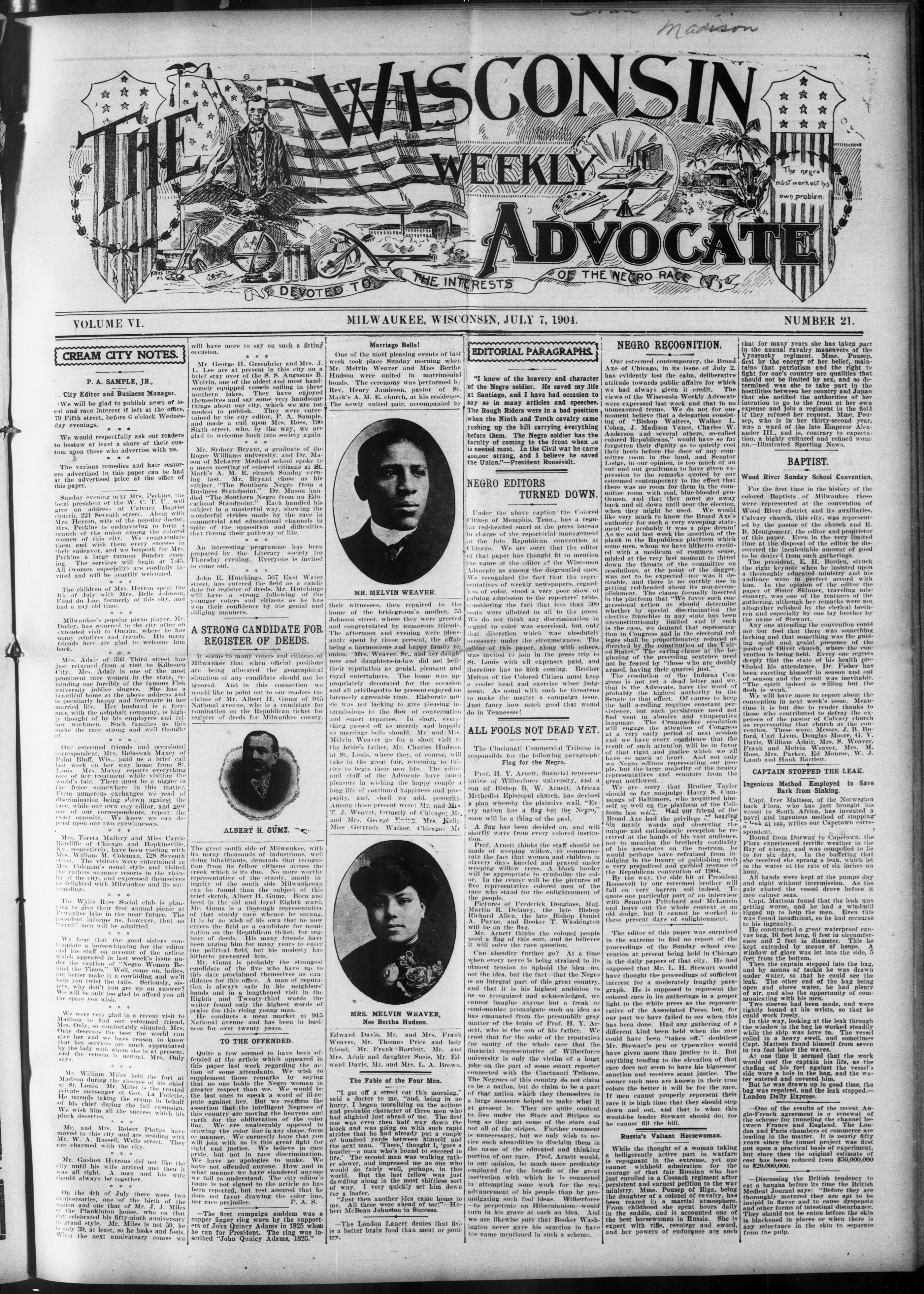
Wisconsin Weekly Advocate
Thursday, July 7, 1904
Milwaukee, Wisconsin
Page text (machine-generated)
WISCONSIN
WEEKLY
ADVOCATE
DEVOTED TO THE INTERESTS OF THE NEGRO RACE
VOLUME VI.
P. A. SAMPLE, JR.,
City Editor and Business Manager.
We will be glad to publish news of local and race interest if left at the office, 79 Fifth street, before 6 o'clock Wednesday evenings.
We would respectfully ask our readers to bestow at least a share of their custom upon those who advertise with us.
The various remedies and hair restorers advertised in this paper can be had at the advertised price at the office of this paper.
Sunday evening next Mrs. Perkins, the local president of the W. C. T. U., will give an address at Calvary Baptist church, 221 Seventh street. Along with Mrs. Herron, wife of the popular doctor Mrs. Perkins is endeavoring to form a branch of the union among the colored women of this city. We congratulate them and wish them every success in their endeavor, and we bespeak for Mrs. Perkins a large turnout Sunday evening. The services will begin at 7:45. All (women especially) are cordially invited and will be heartily welcomed.
* * *
The children of Mrs. Herron spent the 4th of July with Mrs. Belle Johnson. Fond du Lac, formerly of this city, and had a gay old time.
* * *
Milwaukee's popular piano player, Mr. Dodey, has returned to the city after an extended visit to Omaha, where he has many relatives and friends. His many friends here are glad to welcome him back.
Mrs. Adair of 333 Third street has just returned from a visit to Kilbourn City. Mrs. Adair is one of the most prominent race women in the state, reminding one forcibly of the famous Fisk university jubilee singers. She has a beautiful home at the above address and is peculiarly happy and fortunate in her married life. Her husband is a foreman with the ashphalt company, is highly thought of by his employers and fellow workmen. Such families as this make the race strong and well thought of.
Our esteemed friends and occasional correspondent, Mrs. Rebeccah Maxey of Point Bluff, Wis., paid us a brief call last week on her way home from St. Louis. Mrs. Maxey reports everything nice of her treatment while visiting the world's fair. There must be a nigger in the fence somewhere in this matter. From numerous exchanges we read of discrimination being shown against the race, while our own city editor, and now one of our correspondents, report the exact opposite. We know we can depend upon our two eyewitnesses.
☆ ☆ ☆
Mrs. Toreta Mallory and Miss Carrie Ratcliffe of Chicago and Hopkinsville, Ky., respectively, have been visiting with Mrs. William M. Coleman, 728 Seventh street. The visitors were entertained in Mrs. Coleman's usual style and visited the various summer resorts in the vicinity of the city, and expressed themselves as delighted with Milwaukee and its surroundings.
☆ ☆ ☆
The White Rose Social club is planning to give their first annual picnic at Pewaukee lake in the near future. The president informs us, however, that no "serub" men will be admitted.
☆ ☆ ☆
We hear that the good sisters contemplate a horsewhipping for the editor and his staff on account of the article which appeared in last week's issue under the caption of "Negro Women Behind the Times." Well, come on, ladies, but better make it a cowhiding and we'll help you twist the tails. Seriously, sisters, why don't you get up an answer? We will be only too glad to afford you all the space you wish.
* * *
We were very glad in a recent visit to Madison to find our esteemed friend, Mrs. Only, so comfortably situated. Mrs. Only deserves the best the world can give her and we have reason to know that her services are much appreciated by the lady with whom she is at present, and the esteem is mutual. Mrs. Only says.
华 肃 信
Mr. William Miller held the fort at Madison during the absence of his chief at St. Louis. Mr. Miller is the trusted private messenger of Gov. La Follette. He intends taking the stump in behalf of his chief during the fall campaign. We wish him all the success which his pluck deserves.
Mr. and Mrs. Robert Philips have moved to this city and are residing with Mr. W. A. Russell, Wells street. They are charmed with the city.
* * *
Mr. Gasbon Herrons did not like the city until his wife arrived and then it was all right. A man and his wife should always be together.
* * *
On the 4th of July there were two anniversaries, one of the birth of the nation and one that of Mr. J. J. Miles of the Plankinton house, who on that day celebrated his fifty-ninth anniversary in grand style. Mr. Miles is not 59, he is only 39, at least, so he looks and feels. When the next anniversaries comes we
will have more to say on such a fitting occasion.
Mr. George H. Greenbrier and Mrs. J. L. Lee are at present in this city on a brief stay over of the S. S. Augustus B. Wolvin, one of the oldest and most handsomely equipped vessels sailing in these northern lakes. They have enjoyed themselves and say some very handsome things about our city, which we are too modest to publish. They were entertained by the city editor, P. A. Sample, and made a call upon Mrs. Ross, 190 Sixth street, who, by the way, we are glad to welcome back into society again.
Mr. Sydney Bryant, a graduate of the Koger Williams university, and Dr. Mason of Meharry Medical school spoke to a mass meeting of colored citizens at St. Mark's A. M. E. church Sunday evening last. Mr. Bryant chose as his subject "The Southern Negro from a Business Standpoint." Dr. Mason handled "The Southern Negro from an Educational Standpoint." Each handled his subject in a masterful way, showing the wonderful strides made by the race in commercial and educational channels in spite of the opposition and difficulties that throng their pathway of life.
* * *
An interesting programme has been prepared by the Literary society for Thursday evening. Everyone is invited to come out.
John E. Hutchings, 567 East Water street, has entered the field as a candidate for register of deeds. Mr. Hutchings will have a strong following of the younger voters and citizens as he has won their confidence by his genial and obliging manners.
A STRONG CANDIDATE FOR REGISTER OF DEEDS.
It seems to many voters and citizens of Milwaukee that when official positions are being allocated the geographical situation of any candidate should not be ignored. And in this connection we would like to point out to our readers the claims of Mr. Albert H. Gumz of 915 National avenue, who is a candidate for nomination on the Republican ticket for register of deeds for Milwaukee county.
ALBERT H. GUMZ.
The great south side of Milwaukee, with its many thousands of industrious, well doing inhabitants, demands that recognition from its fellow citizens across the creek which is its due. No more worthy representative of the sturdy, manly integrity of the south side Milwaukee can be found than the subject of this brief sketch, Albert H. Gumz. Born and bred in the old and loyal Eighth ward, Mr. Gumz is a thorough representative of that sturdy race whence he sprang. It is by no wish of his own that he now enters the field as a candidate for nomination on the Republican ticket, for register of deeds. His many friends have been urging him for many years to enter the political field, but his modesty has hitherto prevented him.
Mr. Gumz is probably the strongest candidate of the five who have up to this date proclaimed themselves as candidates for this office. A man of reputation is always safe in his neighbors' hands and in a lengthened visit in the Eighth and Twenty-third wards the writer found only the highest words of praise for this rising young man. He conducts a meat market at 915 National avenue and has been in business for over twenty years.
TO THE OFFENDED
Quite a few seemed to have been offended at the article which appeared in this paper last week regarding the action of some attendants. We wish to supplement those remarks by saying that no one holds the Negro woman in greater respect than we. We would be the last ones to speak a word of ill-repute against her. But we reaffirm the assertion that the intelligent Negroes of this country are moving the heavens and earth for the obliteration of the color line. We are unalterably opposed to drawing the color line in any shape, form or manner. We earnestly hope that you will join with us in this great fight for right and justice. We believe in race pride, but not in race discrimination. We have no apologies to make. We have not offended anyone. How and in what manner we have slandered anyone we fail to understand. The city editor's name is not signed to the article as has been reported, but rest assured that he does not favor drawing the color line, nor race prejudice. P. A. S.
The first campaign emblem was a copper finger ring worn by the supporters of John Quincy Adams in 1825 when he ran for President. The ring was inscribed "John Quincy Adams, 1825."
Marriage Bells!
One of the most pleasing events of last week took place Sunday morning when Mr. Melvin Weaver and Miss Bertha Hudson were united in matrimonial bonds. The ceremony was performed by Rev. Henry Jamieson, pastor of St. Mark's A. M. E. church, at his residence. The newly united pair, accompanied by
[Name]
MR. MELVIN WEAVER.
their witnesses, then repaired to the home of the bridegroom's mother. 55 Johnson street, where they were greeted and congratulated by numerous friends. The afternoon and evening were pleasantly spent by those present, the affair being a harmonious and happy family reunion. Mrs. Weaver, Sr., and her daughters and daughters-in-law did not belic their reputation as genial, pleasant and royal entertainers. The home was appropriately decorated for the occasion and all privileged to be present enjoyed an intensely agreeable time. Elaborate music was not lacking to give pleasing intermissions to the flow of conversation and smart repartee. In short, everything passed off as merrily and happily as marriage bells should. Mr. and Mrs. Melvin Weaver go for a short visit to the bride's father. Mr. Charles Hudson, at St. Louis, where they, of course, will take in the great fair, returning to this city to begin their new life. The editor and staff of the Advocate have much pleasure in wishing the happy couple a long life of continued happiness and prosperity, and, shall we add, posterity. Among those present were: Mr. and Mrs. T. J. Weaver, formerly of Chicago; Mr. and Mrs. George Ewing, Mrs. Kelly. Miss Gertrude Walker. Chicago: Mr.
[Picture of a woman with a hat and a necklace. She is wearing a dark dress with a floral pattern.]
MRS. MELVIN WEAVER, Nee Bertha Hudson.
Edward Davis, Mr. and Mrs. Frank Weaver, Mr. Thomas Price and lady friend, Mr. Frank Bartlett, Mr. and Mrs. Adair and daughter Susie, Mr. Edward Davis, Mr. and Mrs. L. A. Brown.
The Fable of the Four Men.
"I got off a street car this morning," said a doctor to me. "aud, being in no hurry, I began moralizing on the actions and probable character of three men who had alighted just ahead of me. The first one was even then half way down the block and was going on with such rapid strides that he had already put a couple of hundred yards between himself and the next man. 'There,' thought I, 'goes a hustler—a man who's bound to succeed in life.' The second man was walking rather slower, and impressed me as one who would do fairly well, perhaps, in this world. But the last fellow was just dawdling along in the most shiftless sort of way. I very quickly set him down for a loafer.
"Just then another idea came home to me. All three were ahead of me!"—Hubert McBean Johnston in Success.
—The London Lancet denies that fish is a better brain food than meat or poultry.
EDITORIAL PARAGRAPHS.
"I know of the bravery and character of the Negro soldier. He saved my life at Santiago, and I have had occasion to say so in many articles and speeches. The Rough Riders were in a bad position when the Ninth and Tenth cavalry came rushing up the hill carrying everything before them. The Negro soldier has the faculty of coming to the front when he is needed most. In the Civil war he came 400,000 strong, and I believe he saved the Union."—President Roosevelt.
NEGRO EDITORS TURNED DOWN.
Under the above caption the Colored Citizen of Memphis, Tenn., has a regular red-headed snarl at the press bureau in charge of the reportorial management at the late Republican convention at Chicago. We are sorry that the editor of that paper has thought fit to mention the name of the editor of the Wisconsin Advocate as among the disgruntled ones. We recognized the fact that the representatives of weekly newspapers, regardless of color, stood a very poor show of gaining admission to the reporters' table, considering the fact that less than 300 seats were allotted in all to the press. We do not think any discrimination in regard to color was exercised, but only that discretion which was absolutely necessary under the circumstances. The editor of this paper, along with others, was invited to join in the press trip to St. Louis with all expenses paid, and therefore has no kick coming. Brother Melton of the Colored Citizen must keep a cooler head and exercise wiser judgment. As usual with such he threatens to make the matter a campaign issue. Just fancy how much good that would do in Tennessee!
ALL FOOLS NOT DEAD YET.
The Cincinnati Commercial Tribune is responsible for the following paragraph: Flag for the Negro.
Prof. H. Y. Arnett, financial representative of Wilberforce university, and a son of Bishop R. W. Arnett, African Methodist Episcopal church, has devised a plan whereby the plaintive wail, "Every nation has a flag but the Negro," soon will be a thing of the past.
A flag has been decided on, and will shortly wave from every colored institution.
Prof. Arnett thinks the staff should be made of weeping willow, to commemorate the fact that women and children in slavery days kneeled and prayed under weeping willow trees. A black border will be appropriate to symbolize the color. In the center will be the pictures of five representative colored men of the race who stand for the enlightenment of the people.
Pictures of Frederick Douglass, Maj. Martin R. Delaney, the late Bishop Richard Allen, the late Bishop Daniel A. Payne, and Booker T. Washington will be on the flag.
Mr. Arnett thinks the colored people need a flag of this sort, and he believes it will solve the race question.
Can absudity further go? At a time when every nerve is being strained to its utmost tension to uphold the idea—no, not the idea, but the fact—that the Negro is an integral part of this great country, and that it is his highest ambition to be so recognized and acknowledged, we cannot imagine anyone but a freak or semi-maniac promulgate such an idea as has emanated from the presumbily gray matter of the brain of Prof. H. Y. Arnett, who is the son of his father. We trust that for the sake of the reputation for sanity of the whole race that the financial representative of Wilberforce university is only the victim of a huge joke on the part of some smart reporter connected with the Cincinnati Tribune. The Negroes of this country do not claim to be a nation, but do claim to be a part of that nation which they themselves in a large measure helped to make what it at present is. They are quite content to live under the Stars and Stripes so long as they get some of the stars and not all of the stripes. Further comment is unnecessary, but we only wish to notice such absurdities to disclaim them in the name of the educated and thinking portion of our race. Prof. Arnett would, in our opinion, be much more profitably employed for the benefit of the great institution with which he is connected in attempting some work for the real advancement of his people than by promulgating such fool ideas. Wilberforce—to perpetrate an Hibernianism—would turn in his grave at such an idea. And we are likewise sure that Booker Washington never gave his sanction to have his name mentioned in such a scheme.
NEGRO RECOGNITION.
Our esteemed contemporary, the Broad Axe of Chicago, in its issue of July 2, has evidently lost the calm, deliberative attitude towards public affairs for which we had always given it credit. The views of the Wisconsin Weekly Advocate were expressed last week and that in no unmeasured terms. We do not for one moment believe that a delegation consisting of "Bishop Walters, Walker L. Cohen, J. Madison Vance, Charles W. Anderson and several others, so-called colored Republicans," would have so far forgotten their dignity as to quietly cool their heels before the door of any committee room in the land, and Senator Lodge, in our opinion, is too much of an out and out gentleman to have given expression to the remarks quoted by our esteemed contemporary to the effect that there was no room for them in the committee room with real, blue-blooded gentlemen, and that they must go away back and sit down until near the election, when they might be used. We would like very much to know the Broad Axe's authority for such a very sweeping statement—or probably it was a pipe dream! As we said last week the insertion of the plank in the Republican platform which some men, whom we have hitherto credited with a modicum of common sense, misled at the very last moment to thrust down the throats of the committee on resolutions, at the point of the dagger, was not to be expected—nor was it desirable, and there is no earthly use in getting red-headed about its non-accomplishment. The clause formally inserted in the platform that "We favor such congressional action as should determine whether by special discrimination the elective franchise in any state has been unconstitutionally limited and if such is the case, we demand that representation in Congress and in the electoral colleges shall be proportionately reduced as directed by the constitution of the United States." The saving clause at the beginning of the preceding sentence need not be feared by "those who are doubly armed, having their quarrel just."
The resolution of the Indiana Congress is not yet a dead letter and we, that is the Advocate, have the word of probably the highest authority in the Senate to that effect. Of course to keep the ball a-rolling requires constant persistence, but such persistence need not find vent in abusive and vituperative language. The Crumpacker resolution will engage the attention of Congress at a very early period of next session and we have every confidence that the result of such attention will be in favor of that right and justice which we all have so much at heart. And not only we Negro editors representing out people, but the large majority of the brainy representatives and senators from the great northwest.
We are sorry that Brother Taylor should so far misjudge Harry S. Cummings of Baltimore, who acquitted himself so well on the platform of the Coliseum last week. Had our friend of the Broad Axe had the privilege of hearing his manly words and observing the unique and enthusiastic reception he received at the hands of his vast audience, not to mention the brotherly cordiality of his associates on the rostrum, he would perhaps have refrained from indulging in the luxury of publishing such a very prejudiced and garbled resume of the Republican convention of 1904.
By the way, the side hit at President Roosevelt by our esteemed brother will fall on very barren soil indeed. To quote one particular part of an interview with Senators Pritchard and McLaurin and leave out the whole context is an old dodge, but it cannot be worked in these present days of enlightenment.
The editor of this paper was surprised in the extreme to find no report of the proceedings of the Sunday school convention at present being held in Chicago in the daily papers of that city. He had supposed that Mr. L. H. Stewart would have thought the proceedings of sufficient interest for a moderately lengthy paragraph. He is supposed to represent the colored race in its gatherings in a proper light to the white press as the representative of the Associated Press, but, for our part we have failed to see when this has been done. Had any gathering of a different kind been held when the race could have been "taken off," doubtless Mr. Stewart's pen or typewriter would have given more than justice to it. But anything tending to the elevation of that race does not seem to have his highnesses' sanction and receives scant justice. The sooner such men are known in their true colors the better it will be for the race. If men cannot properly represent their race it is high time that they should step down and out, and that is what this would-be leader Stewart should do; for he cannot fill the bill.
Russia's Valiant Horsewoman.
While the thought of a woman taking a belligerently active part in warfare is repugnant in the extreme, yet one cannot withhold admiration for the courage of that fair Russian who has just enrolled in a Cossack regiment after persistent and earnest petition to the war ministry. Mme. Pousep of Riga, being the daughter of a colonel of cavalry, has been reared in a martial atmosphere. From childhood she spent hours daily in the saddle, and is accounted one of the best horsewomen in Russia. She is expert with rifle, revolver and sword, and her powers of endurance are such
that for many years she has taken part in the annual cavalry maneuvers of the Vyazensky regiment. Mme. Pousep, first by the energy of her belief, maintains that patriotism and the right to fight for one's country are qualities that should not be limited by sex, and so determined was she to take part in the hostilities between her country and Japan that she notified the authorities of her intention to go to the front at her own expense and join a regiment in the field if they refused her request. Mme. Pousep, who is in her thirty-second year, was a ward of the late Emperor Alexander III., and is, contrary to expectation, a highly cultured and refined woman.—Illustrated Sporting News.
BAPTIST.
Wood River Sunday School Convention.
For the first time in the history of the colored Baptists of Milwaukee these were represented at the convention of Wood River district and its auxiliaries. Calvary church, this city, was represented by the pastor of the church and R. B. Montgomery, the editor and proprietor of this paper. Even in the very limited time at the disposal of the editor he discovered the incalculable amount of good to be derived from such gatherings.
The president, E. H. Borden, struck the right keynote when he insisted upon a thoroughly educated ministry and his audience were in perfect accord with him. In the opinion of the editor the paper of Sister Skinner, traveling missionary, was one of the features of the gathering, although her remarks were not altogether relished by the clerical brethren and especially by one lay brother by the name of Stewart.
Any one attending the convention could not but feel that there was something lacking and that something was the guiding spirit and genial presence of the pastor of Olivet church, where the convention is being held. Every one regrets deeply that the state of his health precluded his attendance. Dr. Fisher has been exerting himself in season and out of season and the result was inevitable. "The spirit indeed is willing but the flesh is weak."
We will have more to report about the convention in next week's issue. Meantime it is but due to render thanks to those who contributed to defray the expenses of the pastor of Calvary church as representing that church at the convention. These were: Messrs. J. B. Buford, Carl Livus, Douglas Moore, G. V. Davis, William Adair, Mrs. S. Weaver, Frank and Melvin Weaver, Mrs. M. Ross, Mrs. Parker, Ed Monroe, W. J. Lamb and Hank Bartlett.
CAPTAIN STOPPED THE LEAK.
Ingenicus Method Employed to Save Bark from Sinking.
Capt. Iver Mattson, of the Norwegian bark Flora, who has just brought his vessel to South Africa, has invented a novel and ingenious method of stopping a leak at sea, writes our Capetown correspondent.
Bound from Dorway to Capetown, the Flora experienced terrific weather in the Bay of Tiscay, and was compelled to lie for six days. In the buffeting that she received she sprang a leak, which let in the water at the rate of six inches an hour.
All hands were kept at the pumps day and night without intermission. As the gale abated the vessel drove before it into calmer seas.
Capt. Mattson found that the leak was getting worse, and he had a windmill rigged up to help the men. Even this was found insufficient, so he had recourse to his ingenuity.
He constructed a great waterproof canvas bag, 16 feet long, 6 feet in circumference and 2 feet in diameter. This he kept extended by means of hoops. A window of glass was let into the side, 5 feet from the bottom. Then the captain stepped into the bag, and by means of tackle he was drawn under water, so that he could see the leak. The other end of the bag being open and above water, he had plenty of air, and also the opportunity of communicating with his men. Two sleeves had been made, and were tightly bound at his wrists, so that he could work freely. In this way, looking at the leak through the window in the bag he worked steadily while the ship was hove to. The vessel rolled in a heavy swell, and sometimes Capt. Mattson found himself from seven to ten feet below the waves.
At one time it seemed that the work would cost the captain his life, as the chafing of his feet against the vessel's side wore a hole in the bag, and the water entered and covered him.
But he was drawn up in good time, the bag was repaired, and the leak stopped.—London Daily Express.
—One of the results of the recent Anglo-French agreement is a renewal of the scheme for tunneling the channel between France and England. The London and Paris chambers of commerce are leading in the matter. It is nearly fifty years since the tunnel project was first put upon a practical basis of experiment, but since then the original estimate of cost has been reduced from $50,000,000 to $20,000,000.
—Discussing the British tendency to eat a banana before its time the British Medical Journal says: "Before they are thoroughly matured they are apt to be insipid in flavor and to cause dyspepsia and other forms of intestinal disturbance. They should not be eaten before the skin is blackened in places or when there is any reluctance in the skin to separate from the pulp.
THE SUNLIT SHOWER.
Equalid and font the city street,
Low'ring the sky and sour;
Sndden from- Heav'n compassion sweet
Fell Ina sunlit show’r,
Spring from its heart a rainbow pure,
‘To make the world of beauty sure.
—Robert Yphys Everett In Lippincott’
Magazine.
—_————
A Pilgrim from Arkansas.
Will C. Campbell, once of Kansas,
now of Arizona, used to tell of a so-
journer in Kansas who remained a few
years and then went back to his old
liome in Arkansas. Campbell met him
at the edge of a little Kansas village.
“We come out heah in th’ fust, place
sorter through false pretensions,” said
the pilgrim. “Th’ ol’ woman had heerd
tell es how thar warn't no red liquor ter
be had in Kansas, an’ so she kinder
made up her mind thet if she could git
her ol man out heah she'd hey a cinch
on him,
“Why is we goin’ back? Now, my
frien’, I'll tell ye jist why. Yer see, we
xot swiped—yes thet’s what «se did—
swiped bad! Along come one o’ them
dodblasted double-an’-twist slycoons, the
which wailoped th’ fences six ways fer
Sunday, an’ then nee. rigbt on till
it retched our ol’ house, which the same
it took, you understan’ me, in less'n a
holy minute, an’ turned inside out an’
wrong side up, an’ seattered it ‘long
through Barber an’ Summer counties, an’
Oklahoma Territory, fer all I knows.
Iteckon it would hev lifted the mortgage,
too, ef it hedn’t been held down east.
“When Maria come up out o’ the cel-
lar all a pantin’ an’ skeered to death I
said ter her, understan’ me, I says: ‘Now,
Maria, air yer satisfied with yer proerbi-
tion Kansas?
“Then she says, kinder meek like:
‘Heze'—Hezekiah’s my full name—‘Heze,
you ken hitch up.’
“But, Lor’ me, thar wan't no nawthin’
ter hitcs up. Th’ sorrel mare wuy
a-straddle 0’ a tree, an’ a piece o’ th’ ol’
gray wuz afterwards found in Berry’s
feed lot; th’ wagon box wuz nowhares,
an’ th’ runnin’ gears was gallywest an’
crooked in two townships. Then we
looked fer th’ chickens, an’ thar wuz
only one pore leetle rooster left, with
feathers an’ pride clean gone.”
Only at Certain Times.
s 1 See
fr) | [is] bo
y A
| fal ANG
AE | ¢}
re ae) Al kt -
oe ' Gy
We | Lay
a
mae a
Bites,
ae -
“Does that chimney always smoke?”
“No, not always; only when there’s a
fire in the stove.”
——_—_—_.—__—_
Rare Distinction.
“I don’t suppose any of you fellows
ever saw Henry Clay, did you?” said the
old party who had been silent hitherto.
None of the fellows had ever seen
Henry Clay.
“Well, I saw him once,” he went on,
proudly, “and I’li never forget it. There
was a statesman for you, by gum! 1
heard him speak at Harrodsburg, Ky. 1
was only a young chap, but I was just
as much of a politician as any of ’em,
snd JT wasn't going to miss hearing him,
by gum! I got right on the edge of the
platform where he was talking, and I
hollered as loud as anybody there. In
fact, I got so close to him that he
stumbled over me half a dozen times
leu Le was waving back and for’ard.
At \ast he got kind o’ impatient, and he
stops and says to me, says he: ‘You
nasty little cuss, you don’t seem to have
any sense or breeding. The next time
you get in my way, you blank idiot, I'll
step on you!’ I tell you, there’s mighty
few fellows alive now that Henry Clay
ever spoke to familiarly like that.”
Here he stopped and went over to tell
the stery to a group of delegates a little
nearer to the bar.
caer
Rockefeller’s Picture.
John 1), Rockefeller has a little grand-
sou something over a half dozen years
of age of whom he is very fond. One
day recently this youngster, while visit-
ing at the Rockefeller country home at
Pocantico hills, New York, mounted his
srandparent’s knee and said:
“Grandpa, here's a picture of you that
1 drawed.”
“Ah, yes,” replied Mr. Rockefeller, as
he examined it. “Very interesting.
What am I doing?”
“Coming home from the village store.”
“Yes, yes; I see. But what's that I
have in my hand?”
“That's a gallon oil can. You've just
got it filled with kerosene and are fetch-
ing it home for the lamps. Of course,”
the artist continued in patronizing ex-
wanatory tones, “it’s a ’maginary pic-
ture. "Taint drawed from seeing you
do it, you know. I fought it all up in
my own head.” =
————_—_>+—_____
The “Pavement Spanker.”
A new and expensive piece of slang,
the application of which is already being
extended beyond its literal and material
descriptive origin, is “pavement spanker.”’
It was at first used to designate that type
of modern maid, who, physically large
and athletically developed, stamps along,
with generous endowment as to pedal ex.
tremities and with a whole-souled pur-
pose to get to her destination, regardless,
or rather unconscious, of the figure she
is cutting. Now the term is being ap-
plied in a more figurative sense and with
ent regard to sex, to the plodder: the be-
ing who does not see the short cuts nor
know of the amenities. It does not mean
a brow-beater or an argumentative de-
elaimer; nor yet & man who insists on
having his own way. A “pavement
spanker” is simply a materialist, not an
ilealist.—Philedelphia Record.
emt
Walnut Logs Buried 200 Years.
Workmen excavating for a bridge over
Big’ Walnut creek, near Columbus, 0.,
found walnut logs perfectly sound, al-
though estimating from the size of syca-
more trees growing on the ground above
them, buried for at least 200 years.
eee
The Eatine of Arsenic.
Eating arsenie is common in Styria.
The Styriaus say that arsenic makes one
plump and comely and gives one strength
for great exertions, such as running or
mountain climbing.—Chicago Tribune.
eee
—New Jersey has a village of epilen-
re
THE DUSKY NIGHT.
How better than the radian! eer day
T love the dusky, still, myate is night,
When Twilight, slipping down the starry
was,
Untolts her somber curtain ‘gainst the
night:
And troops of purple shadows softly ste!
Througtt dewy haunts with velvet-shodden
eet,
Armed vith their silver lances that re
vea
With luminous radiance their dim retreat.
I love the scented silence, when the flowers.
Sensuous and sweet, with heavy droeping
ads,
Distilling perfume through the lonely hours,
Are sleeping in their dewy garden-beds:
And ail the jeweled sky is bending low
Over the earth, its watch and ward to
keep,
In azure’ depths its censers swing and
for.
Their golden lights reflected tn the deep.
I love the soft, dark mystery that conceals
Night’s hidden things within its shadowy
way,
While whispering voices stealthily reveals
The, tryat ‘of gnomes that vanish ere the
J:
L rea rune and rhythm of midnight
winds
Bare weird anthems in their mystic
ight—
Ah, yes, far better than the radiant day
I'love the somber, dark, mysterious night.
—Elizabeth Clarke Hardy in Woman's Home
Companion.
HiS MIDNIGHT PATIENT.
BY ANNIE O. TIBBITS.
4t was gettmg tate. somewhere ®*
clock struck midnight, and all Ey
chester seemed to be in bed. ee
| had disa) red from the sedate houses
‘| round ‘about, and only Dr. Clement's
lamp burned brightly, throwmg a streak
of red across the wet. empiy and wind
swept street.
a wae an ugly night, and Dr. Clement
put down his paver to listen. A fierce
| sleet beat and hissed against the window
panes and the wind drove blustering!y
round the house. i
lt was an ugly night, and it was going
to be worse, and Dr. Clemeut hoped fer-
vently that no one would cal) him ovt
again. He had had a hard day, and h':
room was cozy and he was warm.
He picked up his reper again. It was
full of stories of an absconding solicitor
and of rumors of his whereabouts. He
had disappeared and ruined hundreds of
his clients. One of them was in Eln-
chester, and Dr. Clement frowned as he
thought of him, worried and broken and
ill.
“They ought to shoot him when they
catch him,” he muttered. “He is worse
than a murderer.”
Tonight the pepere stated confidently
that he was in Spain, and that the police
were ropes hard on his track. Yes-
terday he had been in Manchester, the
day before in New York. ‘Tomorrow he
would be in a neighborhood altogether,
uo doubt, and meanwhile he was probs-
bly somewhere close at hand—perhaps
even in Elmchester itself.
Dr. Clement threw aside his paper and
rose to his feet. After all, very likely
the police would never find him, and
even if bale did it would not do much
toward healing the hearts and lives that
he had broken and ruined. Nothing
would do that; and the old man in Elm-
chester who had believed he had sufi
cient money to last him and his wife the
rest of their lives would be penniless all
the same.
Dr. Clement crossed the room with a
sigh and then stood still. A faint tinkle
had sounded in the hall outside, a tinkle
like the hell of his front door, He
listened. The sleet whipped the window
panes and the wind blustered on. There
was no other sound, and for a moment
he hesitated before he passed out to open
the door.
Who could be calling him out on a
night like that? He had no one so se-
riously ill as to need him in such haste,
and if it were Lady Lynwood again he
decided that he would refuse to-go. Her
“nerves” were too irritating for anything.
He firn gopen the door impatiently.
convinced that he should see her tall
footman on the step and hear the well
known formula, “Lady Lynwood’s eom-
pliments, and she is very much worse.”
But whea he looked only the darkness
of the night lay before him. Only his
own wet steps and the muddy road.
He stared and then retreated backward
hurriedly as the cold wind tore past, but
as he did some one started from out of
the shadow—some one thin and white,
with the face of a ghost and wide, girlish
blue eyes.
He stared down at her. She seemed
breathless, and as the light fell full on
her he saw that her lips were quivering.
“Come in,” he said quickly, “and tell
me what I car do for you”
She stepped, shivering, cold and wet,
into the hall and looked into his face
He closed the door, and for a moment she
stood before him in silence looking eager-
ly inte his eyes, into his handsome clear
cut face, as if she had a special interest
iu watching him closely. “You are Dr.
Clement?” she asked at last slowly; and
as he bowed she added, “I—I thought
you were an old man, not a young man,
and I—-”
She stopped, and Dick Clement moved
so that he could see her face more clearly,
“Well, did you want an old man?” he
asked. “But tell me what I can do for
you?”
She hesitated again, her eyes looking
almost wildly aeross the hall with its
pictures and statuary and heavy curtains,
“Oh,” she cried at last suddenly. “I
want you to come at once to my father.
He is ill. He——” She looked quickly
into his face, and somehow, strangely
enough, a thrill ran through Dr. Clement
as he met her eyes. He looked quickly at
her shabby coat and hat, and decided as
quickly that she would be a beautiful
woman if she was properly dressed and
taken care of.
“Yes,” he said. “Tell me whut is the
matter with him.”
The girl stepped back deliberately inte
the shadow,
“I don’t know,” she said. “but he has
had a lot of worry lately, and—and—who-
ever comes to him must ask him no ques-
tions—inust be secret and quick. Do you
understand? He is—queer.” Her voice
choked a little, and once more there came
te Dr. Clement an odd feeling that he
wanted to help her—protect her—in spite
of the odd air of mystery that seemed to
be springing up about her.
“Yes,” he said. “f understand. But if
it is an urgeat case dughtn’t we to go at
once?”
“Wait.” She put her hand on his arm.
“I want seme one I can trust. I want
sume one who, whatever comes, can keep
a secret.” :
She stopped, and afterward Dr. Clem-
ent wondered what madness it was that
at that moment prompted him to cast
zaution to the winds and promise her al!
she wished. Perhaps it was her thin,
xirlish face, the anxious look in her eyes,
the pitiful droop of her mouth, but at any
rate, he put his hand on hers and looked
into her eyes.
“UH do everything I can,” he said.
“You can trust me.”
“Then come,” she cried. “My name
is Waterer, and it is my father who has
taken the Red House.”
Dr. Clement looked at her with some
curiosity. The Red House had beew let
for nearly a year. It had been furnished
and made habitable more than six months
aso, but it was only lately that the tenant
bad taken possearton: and even now he
lad not been visible to anyone in Elm-
chester.
Now he was ill;~and to Dr. Clement his
danghter was the most beautiful gir! he
bad ever seen.
He pulled on his mackintosh and opened
RG Gases Se. Fe 2 ae tee
Strauze longing to help her, fo be of use
to her, came back witn sadden sw!
as they stepped out into the dark and
muddy road,
Tie held ‘ont hisarmtoher.
“Let me help you,” he said; “It is so
dark.”
int te his surprise she shrank away
him. :
from hint» ghe said with white lips, “1
ni best by myself.”
They hurried on, and at last Dr,
Clement found himself Deaey to open
the rusty gate of the Red House. It
was a small gate in a high wall, and
the house lay weil hidden.
“Promise,” she said ques and
breathlessly, “that you ask him no ques-
tions. I only want you to prescribe. We
—we-—have been abroad—on the conti-
nent for the—for the last six months and
—and—he is ill—and worried ayd—oh! for
God’s sake don't question him. You
sev”
Oper hand held his arm, and Dr.
Clement, looking down into her strange,
beautiful face, felt himself curiously pow-
erless. He thought of all the rumors
that were avroad concerning the Red
House—the curious whispers about the
tenant who had taken and furnished it
and not annabiinted aoe everything
vanished before a girl's blue eyes.
“['ll ask nothing,” he said. “I'l do
all I can.”
She looked at him steadily, and then
turned and walked quickly up the gravel
path to the house. As they went Dr.
Clement fancied he heard footsteps be-
hind him—pattering footsteps like a dog
—but he was not sure, and when he
stopped to listen they ceased.
‘Tite girl went on, and on reaching the
door knocked on it sharply with her
knuckles. It was opened instantly by
an old woman who peered out at them.
“Have you got him, Miss Ida?” she
asked. “is it all right?’
Ida went forward, and Dr. Clement
followed her into a lighted room, and
there she faced him suddenly.
“Doctor, do your best—oh! for_heayen's
sake do your best for my father, and—
and—believe in _me—believe in us both.”
She broke off, and a strange quiver
passed over her face. :
Dr. Clement held out his hand against
all caution, and in spite of the feeling
of mystery which had sprung up in his
heart.
“Pll do what I can,” he said slowly.
“Let me go to hina.” .
She looked into his face and drew a
deep breath and then walked slowly to-
ward a door communicating with an in-
ner room. As she reached it she fell
back.
“Hark!” she cried sharply. “What
was that?”
They both listened, and for a moment
there was nothing to be heard except the
soughing of the wind. Then suddenly
came a sharp sound—a quick harsh click
--and then suddenly following it the
window being opened
Ida Waterer fell back, clutching Dr.
Clement's arm.
“Hark!” she cried. “Oh! my God,
they’ve found him out—they've followed.
Oh! my poor father.”
She ran forward instantly, and, fling-
ing open the door, dashed across toward
an old man who sat listless and bent
over the fire. '
She ran swiftly, but she was too late.
Even as she reached him a revolver shot
rang out, and the old bent and huddled
figure dropped forward into her arms.
“My father!” she cried, hoarsely, “Dr.
Clement, for God’s sake save him—oh,
saye him!’
Dr. Clement was at her side in an in-
stant, but oue glance told him all he want-
ed to know. He took the old man out of
the girl’s arms and put him back gently
on the floor. .
“Water and brandy,” he said, quickly,
“and the police—quick.”
The word seemed to rouse the old man
and to arrest Ida’s fingers on the way to
the bell.
“The police?’ she whispered.
Dr. Clement nodded. There was no
time to wate.
“Yes, at once,” he said.
Ida looked into his eyes and touched
his arm. He looked back at her.
“The truth,” she said, slowly, in a
whisper. “Must it be the police?”
Dr. Clement was buys, but he stopped
to look up at her in surprise.
“Some one has shot your father,” he be-
gan, sharply; “surely——”
She stopped him.
“Not the police,” she whispered, harsh-
ly. “Oh, not the police.”
Dr. Clement stared.
“The man who did it,” he said, quickly,
“must be caught.”
She shook her head, and then with sud-
den haste bent over her father. —
He had dropped back, his head loiling
on Dr. Clement’s arm, his eyes looking
up, and Dr. Clement, bending hastily,
caught his last words.
“Not the police,” he whispered, “not
yet—keep me safe—for a little while—
until I am dead.”
His voice stopped. Dr. Clement ‘looked
at him curiously, and then Ida ‘flung her-
self to the floor beside him.
“Oh, father! father! what shall I do?”
she cried.
‘The old man stretched out a feeble
hend.
“Try to explain,” he said, slowly, “I—
am not—quite as bad—as they think. I
didn’t mean——”
His feeble voice died away. Ida
crouched beside him, holding his hand.
“Oh, futher!” she sobbed.
* * . * * *
A little later Dr. Clement was looking
into the eyes of a git! which were always
fies Most wonderful eyes in the world to
‘im.
“Tell me what it means?” he asked,
She faced him bravely.
“It means,” she said, “that—that father
was the ee solicitor—the man who
absconded the other day.
Dr. Clements started and his face grew
stern,
Ida put out her hand.
‘Hear me,” she cried. “He failed and
ruined people and ran away, but, oh, hear
me. He wasn’t quite as bad as they
made out. He didn’t do it from careless-
hess or on purpose. It all began two
years ago. You know from the news-
paper accounts that he was trustworthy
and honorable then; you know that he
had a good practice and that evervthine
with me, My sister will look after you
for a-bit. Your old housekeeper can
come, too, if you like. But you must
come away from this house.”
“Oh, it is good of you,” cried Ida.
Dr. Clement looked at her for a mo-
ment with a curious expression in his
eyes.
“You will?’ he said.
Ida lifted her head quickly.
“You will come for a while,” he added,
“and afterward——”
Who eared for afterward? The word
died in his throat. For the present it
was snfficient that a girl's eyes wer look-
ing into his and a girl’s hand lay on his
arm. For the present it was sufficient
that he was blind to everything else.
* s * * * *
Afterward—a few days afterward—
when Dr. Clement visited the old man
who had believed himself ruined he found
him jubilaut, He had that morning re-
ceived a sum of money representing half
what he had lost.
“Bless you!” he cried; “we can man-
age on that, my wife and I, We can
manage. thank God. And he couldn't
have been as bad as we thought,” he add-
ed. “After all, he meant well cr he
weuldn’t have sent me back this.”
He tapped the roll of banknotes, and
Dr. Clement looked at him curiously, re-
-membering the hole those same banknotes
had made in his own banking account.
“No,” he said, “perhups not.”
And afterward at the Elmchester parish
church, a quiet wedding, And no one
dreamed thut the bride was the abscond-
ing solicitor’s daughter, and every one
congratulated Dr. Clement.—The Tatler.
Saeeleanereenteeeeapeenemnnntiet
GETTING ALONG WITH PEOPLE.
To Succeed We Must Sustain Friendly
Relations with People.
‘There has been marvelous progress 18
to modes of travel in recent years, but
there is one’ road that still has to be
traveled alone. It is the road to success.
‘And the route hasn’t been shortened
much, either, Out of place as they may
seem, the same old stumps and stones
are there, and the same crooks and turns
that gave trouble to travelers a thou-
sand years ago. Now, young man, if
this path is toc rough for your tender
feet, there’s nothing to hinder your turn-
ing back any time, but remember there
isn’t any other road that leads to the
same place. Among the various neces-
sary accomplishments of the person who
would sneceed, is one that stands out
above all others in importance. It is not
strength, skill or seholarship, either, but
merely the ability to get along with the
people who meet and pass. him on the
way. Some fellows are continually
parading their saepeanente: boasting
that they ask no odds of anybody; this
all sounds very well, and as a theory it
is nice enough, but no man can carry it
out in this world, and the one who tries
it will simply engage in a_ continuous
game of “trouble for nothing.” Lf we do
not need each other, why are we so
prone to go in flocks? If my neighbors
are not to be used, what are they for?
‘The man who can manage his fellows so
ax to get most out of them is the one
who wili make best time on the read to
success.
One thing safe to count on—in fact,
unsafe not to count on—is that a goodly
number of our neighbors will be as bad
or worse than we ave. And bear in mind
now that, to succeed, we have got to sus-
isin friendly relations to these very people
some way. Whenever you see two people
setting along well for any considerable
time, you can be assured that, between
them, they possess a certain amount of
old-fashioned consideration for the notions
ef other people. It might be hard to tell
just how much, but it is sure that a cer-
tain proportion of goodness and common
sense is absoltuely essential to harmony.
Now, just remember this, will you? and
remember, too, that what the other rellow
lacks in patience or moderation you must
make up, or you won't get along smooth-
ly. I'm not sure but there’s a passage of
seripture some place touching this mat-
ter. If a man smite you on one of your
cheeks without just cause, it is a sure
sigu he lacks forbearance, and so, to bal-
ance up that yirtue, you must, in all
meekness, give him leave at the other. If
some one you are dealing with takes your
coat, that indicates greed on his part, and
to make up the unecessary amount of liber-
ality between you, have the grace to hand
over your cloak also—S. S. Lappin in
The Pilerim.,
Rare Presence of Mind.
W. D. Howelis, whom the University
of Oxtord has honored with a doctor's
degree, praised Mark Twain at a London
dinner party.
“[ like to pralse Twain,” he said. “I
praise him often. He is a great humor-
ist.
“Once, when he was a pilot on the Mis-
sissippi, T'wain sat with a crowd ef men
around a wood stove in a village store.
Presence of mind was being discussed,
and nearly everybody had a story about
presence of mind to relate. Twain said:
“*Boys, through my presence of mind
I once saved an old man’s life. It hap-
pened this way. I was reading in my
room late at night, when I heard fire
bells. I strolled out to see where the
fire was, and soon I came to a brick
house that was boeing hard.
“‘An old man lea half way out of
the fourth story window, and the red
flames lit up his long white hair and
beard, “Help! Help!” he hollered. “Help!
Helge And he waved his arm. around
his head making wild gestures.
“‘Everybody in the crowd below
seemed paralyzed. No ladder was long
enough to reach the old man. The fire-
men said if he stayed up there he would
be burned to death and if he jumiped he
would be crushed flat.
“*But d) with my pence of mind,
came tovhis reseue. rushed forward
and yelled for a rope. The rope was
brought to me. I threw the old man the
end. He caught-it. 1 told him go tie it
around his waist. He did so and 1
pulled him down.’ "—New York Tribune.
Not Exactly the Gift Looked For.
A New York widow, whose husband
has been dead about a year, received an
invitation x few weeks ago from her
mother-in-law to make a Memorial day
yisit at her home in a little town not far
from Boston. The letter said that she
and her husband had something they
wanted to give her.
Wondering what the gift could possibly
be, the widow made the visit, arriving on
Memorial day.
“We uiust go to the cemetery,” said the
New England woman. “I have not
missed a Memorial day in. seventeen
years.”
After a short drive they came to the
old church, and soon they Were seated on
2 moss-grown bench in the family lot.
“fam going to be buried here,” the
mother-in-law began, pointing out the
fess “and my husband will be buried
ide me. Your husband lies here and
you can be buried at his side if you wish.
There. Mary, is your grave, if you will
take it. That was the little gift I spoke
of in my letter.”
The matter-of-factness of the gift
stuuned the woman from New York, so
that she could neither accept nor refuse
the offered weave: The mother-in-law
seemed to take it for granted that she
would take it, Later in the day she re-
marked: “What a relief it must be to
you, Mary, to know that’ you have a
grave and that no one can take it away
from you.”—New York Tribune.
MYSTERY OF JEWELS.
Persian Princess Reveals the Magic ct
the East.
A Persian Princess is now demenstrat-
ing the occult sciences of the east in the
drawing rooms of the West End of Lon-
don.
At a house in Mayfair recently this
dark-eyed sibyi iiftea a corner of the cur-
tain whieh hides the magie and the mys-
tery of the Oriental from English eyes.
Clad in a loose flame-colored gown
with jewels entwined in her dusky hair,
and precious stones g‘ittering in barbaric
array on her corsage, the princess suc-
ceeded in completely mystifying her-au-
dience of ladies.
She declared that only the eastern
mind could understand the deep, all-
absorbing, passionate devotion of a wom-
an for her jewels. The eastern woman
adored her jewels. The life that was
within them respondec to that love, and
they shene with added luster. Precious
stones had all a life within them.
Stones had sex, continued the sibyl,
anu if the male and female were placed
together in the wrong way the beauty
of the stones would be diminished. Place
a male and f-male diamond, however, in
a tightly closed box and at the end of a
few years the diamonds would have giv-
en off little ee For this same rea-
son jewelers learned in the lore of the
east massed their diamonds together.
Of the opal the princess could not
speak witheut a shudder. It was an
evil stone, and brought misfortune. The
stone was really .a one of water from
the dews of heayen, hardened by the
rays of the morning. and inside it was
a malevolent infiuence.
“Never wear opals. Never run the risk
—it is too great,” said the princess.
Everyone had his or her own particular
jewel. and it was a grave thing to dis-
regard its significance.
_ “How could one find out one’s: own
jewel?’ the princess was asked.
“By wearing each of the seven
precious stones for one whole week and
cerptoe. a record of the emotions and ex-
periences, and at the end of the seven
weeks comparing them,” was the reply.
It her hearers had been interested in
the princess’ talk of nrecious stones, they
were reduced to wonder when she pro-
ceeded to “expound the past and future
of the ladies in her audience from their
jewelry, to interpret their emotions, and
to give them warning and advice.
Each lady placed a favorite trinket to
the little ptte of jewelry in front of the
clairvoyant. With closed eyes, she lifted
up the rings and bracelets and neck-
laces, one at a time, with the left hand,
for that was the one nearest the cur-
rent of life, the neart, explained the
princess.—London Express.
Story by Conan Dovle.
An American woman asked Conan
Doyle one day why he had given up the
practice of medicine.
“Because the work was too hard,”
Doyle answered.
“Oh, it can’t be hard to be a doctor,”
said the woman,
“It is both hard and unpleasant, And
to prove it,” said the novelist, “I'll tell
you about my first case.
“My first case came to me in the mid-
die of the night. It was January, and a
cold rain was falling. The jangle of the
door bell awoke me from a sound sleep,
and, shivering and yawning, I put my
head out of the window and said: ‘Who's
there?
“ Doctor,’ said a voice, ‘can you come
to Peter Smith's house at once?
“*What’s the trouble? I asked.
“‘Smith’s youngest girl has took a dose
of landanum in mistake for paragoric,
and we're afraid she'll die.”
“ ‘All right; U'll come,’ said I.
“I dressed and I tramped three miles
through the cold and the rain to Smith's.
‘Twice, on the way, I fell on the iey pave-
‘ment, and once my hat blew off, and in
the darkness 1 was nearly half an hour
‘finding it.
“Finally, though, I reached Smith's.
But the house was dark—shutters all
closed—not a light. I rang the bell. No
answer. But at last a head stuck itself
gingerly out of a third story window.
‘Be you Dr. Doyle? it said.
"Ves, said I. ‘Let me in.’
| *Oh,'no need to come in doctor,’ said
the head. ‘The child’s all right now.
Sleeping very quiet.’
“But now much landanum did you
give it? said I.
“‘Only two drops, doctor. Not enough
to hurt a cat. I — I'd better take
my head in now. The night air is cold,
Good night. Sorry to have troubled you.’
“I buttoned up my coat and turned
homeward, trying as best I could to
stifle my mortification and anger. But
suddenly the window was raised again,
and the same voice cried:
* ‘Doctor! I say, doctor?
“L hurried back. I thought the child
had suddenly taken a turn for the worse.
‘Well, what do you want?’ I said.
“The yoice made answer:
“*Ye won't charge nothin’ for this
visit. will ye? ”
Wasting of Fuel in England.
Prevention of waste is a matter of pe-
rennial interest, especially the waste of
fuel, which is power. In past times mil-
lions of tons of small coal, drawn from
British mines, have been thrown away.
That shameful system is coming to an
end. <A_ cecent witness told the royal
commissioners. who are investigating the
question of our coal supplies that in the
north of England “there is not a particle
of coal, whether sound, small or what-
ever it may be, which is not utilized in
some form or other.” Unfortunately this
gratifying evidence is not true of South
Wales and some other districts, as will be
found when the commission makes its re-
port.—London Telegraph.
ne
“Every Dog His Own Smell.”
Dr. Burtaro Adacki, a Japanese physi-
cian, has just published some interesting
observations on the odor of Europeans,
which, he says, is not agreeable to the
people of the east. He claims that man
has an emanation as does the cat. dog
and all other animals, and that while it
differs in individuals according to con-
ditions, the western people as a whole
possers a much stronger oddr than the
Japanese and Chinese. This, he says,
may be due to the differences in diet and
dress, the orientals being vegetarians and
wearers of light and airy costume. He
says the experts can readily detect the
meat-eater by his emanation,
——— Se
Just Shopping.
Marshall P. Wilder tells of a most po-
lite and obliging salesman in a certain
large department store who recently had
his patience sorely tried by a fastidious
shopper. This woman had caused the po-
lite and obliging salesman to take down
from the shelyes every bolt of eloth ex-
cept one, and that was on the top shelf.
Suddenly the fastidions woman glanced
at her watch, saying: “I see I must be
going. I was merely looking for a
friend.”
“Tn that case, madam,” responded the
unhappy clerk, “Ill gladly get down the
last holt for you if you think she is in
that!"—Collier’s Weekl?.
Speathctpaem e
A Tree for Each Baby.
At the birth of a Japanese baby a tree
is planted, which must remain untouched
until the marriage day of the child.
‘Then the tree is cut and a skilled cabinet
maker transforms the wood into furni-
ture which is considered by the young
couple as the most beautiful of all the
ornaments of the house.
HE CROSSED ATLANTIC IN A DORY.
Capt. Eisenbaum, Who Had a Long Fight
Against Death, Here.
Capt. Ludwig .Eisenbamm, who crossed
‘the Atlantic from Boston ‘alone in the
Columbia, a seventeen-foot dory, came in
as 2 member ef the crew on the Red
‘Star Line steamship WKroordand from
Antwerp yesterday. Ue brought his
dory with him, and it is said that both
will be seen later at the St. Louis expo-
sition, He is a ‘well built Norwegian,
about forty years old. He declares his
‘health was greatly improved by the trip.
The captain's trip was almost a con-
‘stant fight against death. Twice he was
‘sighted in mid-Atlantic by passing ships.
Leaving Boston first on May 22 of last
‘Year, he returned to port on June 13.
He went some three hundred and fifty
miles, but encountered much fog, and
Was wet nearly all the time. Rheuma-
tism forced him to give up. He started
again, however, carly in August. This
time he was able to make Halifax with-
out much trouble, and frem there he set
out for Marseilles, France, a distance of
4910 miles.
The captain met almost constant bad
weather. A gale sprang up on Septem-
ber 6, arid the little craft was covered
by the waves all day, In the early after-
noon the captain was thrown into the
sea, as the dory capsized. After a strug-
gle of several hours he managed to right
his craft. He got her free from water.
and on taking stock found that he had
lost nearly all ef his provisions, four
casks of water and $100 in bills.
On August 28 a three days’ storm had
begur in which the captain was obliged
to work for his life, without sleep anid
with little to eat. On September 4 an-
other storm was met, and the lone navi-
gator came near being upset several
times.
Capt. Eisenbaum would have been in
a sorry predicament had he not sighted
the British manson iy camera Gee bound
tor Jamaica.- Capt. Bower of the steam-
ship suspected some accident, and bore
down on the dory, invited the skipper on
board for dinner and afterward supplied
him with bread, mutton, rope, books and
the longitude and latitude. He tried to
persuade him to continne his trip on the
steamship, but although there was prom-
ise of much bad weather, Capt. Eisen-
baum deelared that he would complete
the trip alone.
The Columbia arrived at Funehal, Ma-
deira, on October 25, seventy-two days
out, having covered 3600 miles. On No-
vember 23 Capt. Hisenbaum arrived at
Gibraltar, and_ practically completed his
voyage.—New York Tribune.
| PHILANDER C. KNOX.
He Hells How His Unusual First Name
Was Bestowed Upon Him.
In the course of an interview given a
Public Ledger representative, Philander
Chase Knox, whom Gov. Pennypacker
has appomted as Matthew Stanley
Quay's successor in the United States
Senate, said a great many things that
seemed to throw light en the personality
and character of a man who has been of
peculiar interest ever since he went into
the cabinet of President McKinley,
Among other things, he was asked:
“Your name—the first of your bap-
tismal names—is unusual, senator.”
“You mean that I ought to have ready
an apology for it?” he good-naturedly in-
quired. “Well, I have, although it ex-
tends to my_middle name, aiso. I was
named for Philander Chase, who was
bishop of Ohio in the middle of the last
century. A friend of my family, he pos-
sessed the admiration of my parents. He
died about the time I was born; and the
conjunction of circumsiances was seized
upon as a reason for deputizing me to
carry his name along. You may like to
know that he was an uncle of Chief Jus-
tice Salmon P, Chase.
“I haven't felt the name to be a bur-
den, however. My boyhood friends were
kind enough to shorten it to the familiar,
chummy ‘Phil,’ while in later years it
has served to prevent my being confused
with what Dickens would doubtless call
‘other parties by the name of Knox.’
And, then, that I might not be regarded
as boasting a name wholly unique, I
have passed it on, in turn, He, also,
bears it.”
The senator pointed as he spoke to his
youngest son, Philander Chase, Jr., 2
sturdy youngster, who had just driven up
in a smart little eo with three juvenile
companions, with whom he was arrang-
ing “doubles” in tennis on one of the ter-
raced embankments that mark the ap-
proach to the house from the north.—
Philadelphia Public Ledger.
Roscoe Conkling’s Big Fee.
It is said that one day, when Roscoe
Conkling was beginning to attain some
measure of success, he dropped into the
office of Charles O'Connor of New York,
then one of the leaders of the bar,
“What's the trouble?” asked the lat-
ter, as Conkling excitedly paced the floor.
“I've just been subjected to the worst
insult I have ever received. This is the
first time a client ever objected to my
fee.
“You know I defended Gibbons for
arson, and put in some tremendous work
for him. He was convicted at the trial,
but we couldn’t help it, and I took the
ease to the superior court and we lost
there, then on to the supreme court an
that affirmed the conviction, and he has
been given ten years. Now my fee only
amounted to $3000, and the scoundrel ac-
tually had the audacity to grumble about
it, saying it’s teo high. What do you
think of that for impudence?”
“Well,” said O'Connor, slowly, “of
course you did a lot of work and $3000
is not a big fee; but, to be frank with
you, Mr. Conkling, my opinion, founded
on mature consideration, is that he
might haye been convicted for less
moner.’’—Sneceas.
Discouraging State House Courting.
For years and years the state house
steps and lawn have heen the Meeca to-
ward which the lingering footsteps 0!
the “two hearts that beat as one” yarie-
ty have tended. Ethan Alien has for
years held up his hand in token of si
lence as he has listened to the cooinx
of wingless doves that for years have
held their spooning matches at the base
of bis pecenial. Now all will be changed
The edict has gone forth that courtin<
days on the state house steps must en.
‘To those who heed the warning all wil!
be well. But the one who aiecteys may
be awakened rudely from “love's youns
dream” by “brass buttons,” and instead
of the honey tones of his beloved he may
hear a rancous voice saying: “Five do!l-
lars and costs, and stand committed till
the same is paid,” when his case comes
me in the police court.—Montpelier Jour-
nal,
——___
She Didn’t Believe Him,
The “tipper” at a vessel discharginu=
pig iron at the harbor was surprised our
afternoon this week when a woman will
a catch-as-eateh-can appearance saluted
him at the ship’s side with the douile-
barreled query: “Cun ye tell me, mister.
if it's the rule fur men tae get
knockit aff wurk at this beat if there's
nae waggons the pit th’ iron intae, an
dae they no’ get peyed fur th’ time
they're waitin’ till empty waggons cum?
On being informed that such was the
case, she said: “I only wanted tae ken.
cos ma man wis workin’ here, an’ I
thocht he wis tryin’ tae due me last
‘nicht wi’ a_broken pey, sae I jist gied
him his coffee. That's th’ wey he’s no”
oot th’ day. Am rale vexed aboot it nov.
seein” he wis tellin’ th’ truth.”—Glasgow
Erening Times.
GOSSIP FOR THE LADIES.
Breaking the Ice.
Breaking the ice
We had some offish neighbors once that
held our heads up high
To make dead sure they couldn't snub us if
To make dead sure they was to try.
It really made me nervous, so Ijes' braced up one day.
An' thought I'd go ahead an' show my manners, any way.
One Sunday, 'stid o' turnin' round an' gazin' at the view.
I looked at them an' says, "Hello!?" An' they says, "Howdy do!"
It wa'n't the cold an' formal greetin' that you've sometimes heard;
They smiled an' said it hearty, like they meant it, every word.
It's solemn to reflect on what we miss along life's way.
By notjes' bein' natural an' good humored day by day.
There's lots of folks who fling the simple joys of life aside
Because they dread the shadow of their own unconscious pride.
own unconscious pride. And nine times out o' ten you'll find the rule works right au' true- Jes' tell the world "Hello!" and it'll answer "Howdy do!" —Washington Star.
A Wise Housemaid—
Puts as much furniture as possible outside the room before beginning to sweep. Brushes the rest and covers it with dust cloths. Soaks newspapers in cold water, squeezes them, tears into bits and sprinkles on the floor to prevent dust flying. After speewing she rubs the carpet well with a cloth wrung out of clean ammonia water—one tablespoonful to two quarts of water. A polished floor she wipes well with a damp cloth, then rubs thoroughly with a dry one. Covering a soft broom with a clean cloth, she brushes the ceiling and walls. While the dust settles she is cleaning the windows. For window frames and latches she uses a flat paint brush.
Spots or finger marks on white woodwork she removes with a cloth wrung out of warm water and dipped in prepared chalk.
She dusts furniture first with damp then with dry cloths. Vases and washable ornaments she soaks a few minutes in water to which a little soap powder has been added. In cleaning mirrors she uses whiting and water to which a little ammonia has been added, afterward polishing with dry whiting. If there is marble to be cleaned she makes a paste of whiting, water and a little ammonia, and rubs it on, rinsing with clean water and polishing with powdered pumice stone and water. Cushions are thoroughly beaten and rugs and covers well shaken out of doors before rearranging them.—Philadelphia Evening Bulletin.
The Girl Who Does Not Get on Well with Men.
Very often the girl who does not get on well with men is self-conscious, or, perhaps, she tries to be smart or is too much given to laughing at the wrong time.
There is one thing most men cannot stand, and that is being laughed at; they like the girl who laughs with them; they have no use for the one who laughs at them.
A sense of humor is a very delightful quality, but I do not believe that it enhances a girl's charm much in the eyes of a man.
The self-conscious girl never gets far enough away from herself to be popular; she is conscious of her looks, her speech, her actions; she is all Self, with a capital S.
In order to be popular with men, or women either for that matter, it is necessary to put self in the background and make the other person the central point of interest.
The girl who is absolutely natural and unaffected is pretty sure to be popular.
If she grows independent and flippant she loses her popularity.
Do not think that you must always have a smart answer ready. Clever repartee is all very well in its way, but you can get on just as well without it.
Never make fun of men when talking to a man; he will naturally imagine that you talk of him in the same way.
Men always fight shy of the girl who is very witty at other people's expense. They enjoy having her with them when in a crowd; she is what they call a "good fellow," but they don't fall in love with her.
A girl need not feel that she is stupid because she cannot always answer a witty remark with one of like kind. As long as she appears bright and interested she will get on well enough.
Nothing is more tiresome than the person who attempts to be funny; wit is spontaneous; it cannot be manufactured to order.
Perhaps another fault of the unpopular girl is that she is too independent.
The clinging, absolutely dependent girl is a thing of the past; in these strenuous days she is bound to go to the wall.
There is a happy medium, however; a girl who is modest and self-reliant, without being too assertive. She does not forget her womanhood, nor yet is she constantly taking advantage of it.
Men like the girl who acknowledges their superior strength and is willing to defer to their opinions in matters which they know more about than she possibly could.
You all know, girls, how nice it is to have a man whom you care for perform little thoughtful acts of kindness and courtesy for you. Well, if you are too independent no man will care to treat you in that way.
The girl who thinks she can do everything for herself will be left pretty well to her own resources.
This is not a sermon, girls; it is merely a little friendly advice to those of you who feel that you are not popular with men.
Sit down and talk it over with yourself, and see if you are not too smart or too independent or self-conscious.—Philadelphia Evening Bulletin.
Prophecies Affecting the Bride
Happy is the bride that the sun shines on," a saying that comes almost involuntarily to our lips when the wedding day is bright and clear, is by no means a modern prophecy, as it has been handed down from earliest days on the Welsh coast, where the mists driven in from the ocean made the coveted sunshine an uncertain quantity, and the brides among the primitive fisher folk watched with anxious eyes the gray clouds that swept above their wave-heaten rocks for the glint of sunlight that was to assure the happiness of their wedded life.
Considerate brides of today who wear as many pairs of garters as they have bridesmaids, in order to bring luck to the young women, are unconsciously doing homage to the beautiful Joan. Countess of Salisbury, who while dancing with his majesty, King Edward III. of England, in the thirteen hundreds, was overwhelmed with confusion as her garter slipped from its position and fell to the
floor. Instantly the gracious monarch stooped and with a deep obeisance handed the circlet to its blushing owner, to the immense amusement of surrounding courtiers. The King, distressed at the embarrassment of the fair lady, turned to the smiling nobles with the rebuke: "Honi, soit qui mal y pense," "evil to him who evil thinks," and then and there declared that he would make the garter the symbol of high honor and good fortune. To carry out this promise he instituted the order of the garter, an order of such high merit that it has been the dream of noble knights down the ages to wear a little below the knee of the left leg its insignia, a narrow band of blue velvet edged with gold. The motto is inscribed on the velvet in letters of pure gold, of which metal are also the buckle and pendant of exquisite workmanship. The awarding of this garter is the most coveted honor that the Kings of England have the power to bestow.
As we esteem June the bridal month, so the early Greeks regarded January, but if the Greek bride wished her marriage day to be most propitious she was careful to select one that fell on the full of the moon. Should a pair of turtle doves appear in sight during the marriage ceremony, it was a sign of great happiness, and we imagine that a bride of those days was not above assisting in the accomplishment of this pretty accessory to her wedding.
The crow was also a subject of much interest at such times, as, if a pair of these solemn birds appeared, a long life was betokened to the newly wedded pair, while for one crow to be seen portended separation and sorrow. It was therefore the duty of the attendant maids to prevent, if possible, the occurrence of such a catastrophy. If the modern bridesmaid was obliged to look after the whereabouts of the birds of the surrounding country during the nuptials, as well as to attend to her other duties, she might feel the position or bridesmaid no sinecure. The bride of the Orkney islands does not share our saperstition about Friday, as she chooses that day for her marriage, but will take Thursday as next best, provided the moon is waxing towards full.
There are some prophecies that are of vital importance to the maids at the wedding. If she meet two magpies it is a most fortunate indication of her own speedy marriage, but if she be an elder sister of the bride she must take care to dance at the wedding with her dainty feet unshod, if she would avoid the fate of living and dying a bachelor maid. Above all things a maid must not accept a gift of a knife, or scissors or anything sharp from her lover without giving a pin or some article in exchange, lest their love be out asunder.
The plucking of the merry-thought, or breaking of the wish-bone by men or maids to determine which shall secure the longer portion and thus first find a wife or husband, is a custom of hoary antiquity. Addison says, "I have known the shooting of a star to spoil a night's rest, and have seen a man in love grow pale and lose his appetite upon the plucking of a merry-thought."
Last, but not least, let all maids refrain from wearing much yellow, as it is of all colors the one most unlucky for lovers.—Janet Hay in Comfort.
For the Woman Who Needs Money.
In the hasty scramble among women for something to do the most important considerations are often forgotten. The woman who secures employment must be able to do some one thing better than most women, and her method of doing must be new and original. Let a woman remember that it is in the untrodden fields that flowers grow; if she climbs the fence first she may gather the most fragrant of the blossoms.
But women do not remember this. A young woman finds that she must suddenly become self-supporting; she looks about to see what other girls are doing. Because there are hundreds of girls engaged in stenography, that occupation is one good reason why she should not attempt to enter it. There is little chance for a woman in a profession already full.
Let the woman who is searching for a position look nearer to herself. What is she fitted for? What has she done in her own home, in better days, that was pleasant to those about her? Surely in her home there was some little duty in the performance of which she excelled, says the Chicago Journal.
Can she darn stockings, sew on buttons, care for the clean laundry? Can she mend nicely? If so, she need not look farther. She is prepared for this work. Why borrow money to go to business college? Can she embroider dainty initials? Then she can find scores of handkerchiefs to embroider, and many women wish their initial upon every garment. Is she original in planning parties, especially for children? There is a great demand for women who are skillful in arranging something new, novel and entertaining for small children, large children and grown-ups.
Perhaps this woman who was more fortunate can pack trunks daintily and well. Could she not secure permission from the manager of some large hotel, frequented by wealthy travelers, to send out cards among his patrons? There are hundreds of women who hate trunk packing as they hate toothache. Some young women have a natural talent for hanging pictures and for rearranging furniture to make it look like new. There are hundreds of women in all large cities who would not only willingly but gladly pay well to have their homes occasionally reinvenated.
Caterers are extravagant luxuries. Women who have turned luncheons or dinners over into their hands have been shocked to find everything done just like a neighbor's luncheon. These hostesses and hundreds of others would be glad to pay a clever, original woman twice what they paid the caterer, if they could find a woman who could plan the function with careful retard to originality and harmony in details, which most caterers hold in contempt.
If it is necessary to earn one's own living it cannot be done successfully where the ranks are filled. But a woman with an idea can make that idea pay her. Something new, something original, something unique is the cry of the society woman of today. The self-supporting woman who can meet this demand has made her fortune. Get out of the beaten paths, enter new fields, and quick recognition will meet the efforts. But whatever she does, the woman must herself be convinced of the worth of her ideas and must not be afraid to tell others that they are worth while. Then when she gets the opportunity of demonstrating her originality she must be careful to live up to the reputation which she gave herself. Up to the reputation and even beyond it she would succeed.—Philadelphia Evening Telegraph.
"To be wroth with one we love doth work like madness on the brain."
When you've been cross and unkind, don't let false pride stand in the way of asking forgiveness.
It isn't always easy to say "I'm sorry;" in fact, sometimes it's desperately hard, but once you've said it you'll feel so much happier that it's really worth the sacrifice to your foolish pride. The
longer you wait the harder it will be to say it; the angry feelings will grow like a snowball, until what has merely been a slight grievance assumes the proportions of a real estrangement. There is no fault so hard to overcome as the hasty temper. We may make any number of good resolutions, and then the first time we have any provocation away we go without an instant's warning, and before we realize what we are doing the unkind words have been spoken, and no matter how much regret we feel they cannot be unsaid. The strange thing about it is that we so often hurt the people we love best. Even when we beg forgiveness, though we heal the hurt, we cannot do away with the scar.
As a rule the people who are quick to give offense are equally quick in taking it. Their feelings are easily hurt, and they go about with the proverbial chip so lightly balanced on their shoulders that someone is sure to knock it off, either intentionally or accidentally.
Half the ill feeling in the world could be smoothed out by a few words of explanation, but if on the one side the offender will not say: "Have I done anything wrong? If so, I'm sorry," and on the other the offended will not say: "You have done so and so; did you mean it?" the breach will go on widening until it is irreparable.
If we cannot control our too hasty tongues, we can at least say we are sorry, and save ourselves untold misery and sorrow.
Never let a grievance stand over night: better sacrifice pride than your peace of mind.
No matter haw much of a struggle it is, when you're sorry, say so, and "Let not the sun go down upon your wrath."
—Beatrice Fairfox in Spokesman's Review, Spokane, Wash.
Try to Accept Old Age Gracefully;
Do Not Waste Time in Search
For the Forecasting Fountain of You
One of the precious lost arts of our time is the art of growing old gracefully. This is particularly true of women with whom the cult of youth has become more than a fad. It is an obsession that fills their waking thoughts and nightly dreams.
Every woman you know past 30 has but one purpose in life, and that is to keep young. Every paper you pick up has columns and pages devoted to telling its feminine readers how to massage away wrinkles, and obliterate triple chins, and avoid gray hair.
Every woman you meet spends hours in the privacy of her apartment hopping around on one foot, or tying herself up in figures of eight, in a vain attempt to preserve the waist measure of 18, and the lissome grace of her vanished girlhood.
Beyond 30 the entire feminine population consists of a vast army of Ponce de Leons engaged in a frantic, nerve-wearing, heart-breaking search for the fountain of perpetual youth. They do not find it, of course. They find the peroxide bottle, and the complexion specialist, and the stay-maker, that for a time seem a substitute for the thing they seek, and they cry out that they have found it, and that there are no more old women.
In a way this is true. There are no more women who are frankly and serenely old, who have accepted age graciously, and without regret, and who are enjoying the calm twilight of existence that is, perhaps, the most beautiful part of life, as it is the most beautiful part of the day.
There are not even any old women's fashions in our stores, or any old ladies' corners in our household. Grandmamma wears picture hats covered with as many flowers and feathers, and furbelows as her delustante granddaughter.
Nowhere does the make-believe young woman flourish so plentifully as right here in America. Ride on any car, sit in any theater, dine at any restaurant and you may see her on every side of you with her wrinkles filled in with powder, her faded old cheeks painted vermillion, her scanty old eyebrows penciled into the proper line, her dim old eyes looking all the dimmer under the elaborate gold or bronze of her false hair, her avoirdupois laced into the tightness of a youthful gown, or the bones of her scraggy neck showing under strings of jewels.
Nor is her attempt to be youthful confined to her appearance. Watch her wriggle and twist in her efforts to be vivacious! See how she smirks and smiles, and ogles and giggles, trying to be coquettish!
Listen to her conversation, more frivolous than the silliest school girl's, and pity the woman who cannot conjure back her youth, and to whom life has not brought the sweetness, dignity and the wisdom of age.
Women regard growing old as the greatest curse that can befall them, but this is only because they make it so.
All of us have known brilliant and beautiful young women, but when we think of the most attractive woman we have ever known, the tenderest and the most lovable, and the one whose charms abided with us longest, it is of some old woman with snowy hair, and peaceful eyes, wise, and gracious in speech and manner, and into whose presence it was a rest and a benediction to come.
It is a great art for a woman to learn to keep young, but it is the greatest art of all to learn to grow old gracefully. Philadelphia Evening Bulletin.
How a Clever
Woman Summered at Home.
"Do come and see me," a woman friend said to me or day last year in the late summer time.
We had met on Fifth avenue with as great mutual delight and surprise is if it had been in Timbuctoo or some other outlandish place.
"I am having a lovely time staying at home," she continued, "it is really the best summer I have had in years."
One afternoon a few days later found me sipping an iced drink in her cool drawing room and looking about admiringly.
"At first I simply put off going away from week to week," my hostess told me. "For I really hated to leave the men of my family again, as I had been so short a time returned from California. Suddenly I realized I was very comfortable and with a few changes I should be entirely so. I quickly determined to settle down for the season."
The room in which we sat was fascinating. From the walls all pictures had been removed. Close against the frame of the lower half of the windows were placed slender brass rods. On these were strung curtains of the thinnest leaf green China silk so filmy the air could pass through them readily, while the light was softened, and filtered by its delicate greenness.
Every piece of furniture that was not needed together with the pictures, bric-a-brac, etc., had been shrouded and placed in an inner room which in the winter was a cozy smoking room, but quite impossible in the hot months. The furniture retained in the drawing room was covered by well fitting slips of the striped flax-colored Holland. Cantonese chairs and footstools had been added. Tall crystal vases holding a few blossoms and much greenery were the only ornaments on tables and mantel. The rugs were gone and the velvet carpet covered with heavy white canvas. Many palms, ferns and growing plants were placed in wicker-bound green porcelain jardinieres, and set on low stands about the room, and did not seem to take in the least from the spacious airiness of the apartment. A low tea table had lost its gleaming kettle and eggshell cups;
QUAINT FROCK OF TAFFETA.
I
This frock of champagne colored taffeta has the bouffant skirt, long shoulder lines and full sleeves demanded by the season's modes. The waist is trimmed with bands of the silk shirred over corals. These bands outline the tucked yoke and cuffs in curly cue lines. The ornament at the back of the deep girdle is also fashioned from the shirred bands. The skirt is made without gores and is fitted into the waistband with plaits which are stitched far below the hips. Near the foot of the skirt is one deep tuck.
these had been replaced by tall flagons and clinking glasses, and a wide-lipped crystal pitcher.
"I must show you my dining room," this comfortable woman said, as she led me into its restful dimness. Its large bare table, and the chairs set in a straight line about the walls seemed in no wise remarkable to me. The butler, however, was just opening the sliding windows of the conservatory directly off the dining room and which overhung the pretty little garden in the rear.
Following my hostess into this conservatory I looked about with delight. Set out among the plants on the white marble floor was a large round wicker table. This table had been given a finish of green lacquer, the green of growing reeds. Over the top was a round openwork linen cloth. On the center of the table a silver fern dish was flanked on either side by great bowls of fruit. Tall candlesticks held pale green candles with filigree shades.
It was so arranged that the sideboard in the dining room could be used. All meals were served a la Russe. "And the green things growing about and the tinkle of my baby fountain are conducive to a really epicurean enjoyment," my friend said.
"Shall I show you what I have done to my bedroom?" she asked. I followed her willingly up the broad treads of the uncovered stair. Again the white canvas floor. The woodwork and colonial mantel in this spotless chamber ivory white also. The bedspread was of the sheerest white corded dimity as were the curtains which dimly outlined long windows. A wing chair was covered with white dimity of the heavy variety. This was a slip cover. Beneath some book shelves and near the window stood a lounging wicker steamer chair, heaped with pillows covered in pale green grass linen.—Vogue.
Getting Even with Martin.
Martin Hobbs was a man of uncertain temper, but of such importance in his native town that the hash of his tongue was borne with patience by those to whom he grudgingly ministered in his capacities of iceman, plumber and janitor of the town hall.
In the course of his duties as janitor he reduced almost to the verge of tears a young woman who asked for the key of a room in the town hall where certain records were kept.
Martin knew that she was writing the history of the town, but he did not propose to strew her path with roses.
"Lockin' and unlockin'," he grumbled, as he began fumbling in his pockets; "potterin' and putterin', fussin' and fidgetin', and what does it amount to when all's said an' done? Anybody ast ye to write a history? Who's agoing to read it? Here's your key, and mind you fetch it back, and lay in on that table if I'm not here."
The town assessor was at work where he heard this ungracious address, and when the young woman returned the key he said, indignantly:
"Martin outdid himself in rudeness this morning. I should say."
"O. well," said the young historian, "he felt a little cross, and had to grumble, that's all."
"Never you mind," said the assessor, cheerfully. "I'm going to make out his tax bill today, and I shall assess him for seven more hens!"—Youth's Companion.
Vegetable Soap.
An enterprise in Algeria is to manufacture natural soap on a large scale from a tree known as "Sapindus utilis." This plant, which has long been known in Japan, China and India, bears a fruit of about the size of a horse chestnut, smooth and round. The color varies from a yellowish green to brown. The inner part is of a dark color and has an oily kernel. The tree bears fruit in its sixth year and yields from 55 to 220 pounds of fruit, which can easily be harvested.
Young Folks' Column.
Young America.
Is Independence Day, sir.
But really I am certain that there must be some mistake:
For people say, "Be quiet!"
And, "I won't have such riot!"
At every teeny-weeny noise that I may chance to make.
Why, when my gun exploded,
(I thought it wasn't loaded).
My mother said, "You naughty boy, now stop that fearful noise!"
And then our cannon-crackers
(And my! but they were whackers!)
Made grandma say, "Oh, mercy me! you mustn't do that, boys!"
"You're much too young to handle
A bomb or Roman candle."
A bomb or roman candle.
They always say when I get near to where the fireworks are;
And for a little rocket
I put in Bobby's pocket
My father just now set me down inside the "family jar."
The caution and the warning
Begin at early morning:
It's "Don't do this!" and "Don't do that!"
and so, unless I may
Choose my own celebration
For the birthday of our nation.
I don't see why I ought to call it Inde pendence Day! —St. Nicholas.
Home-Made Torpedoes.
John Hancock Greene was 5 years old, and had a grievance. His sister, Mariannina, was half-past 6. It was Fourth of July, and all the other boys had firecrackers, but Johnny had none.
But though there were no firecrackers, there were six packages of torpedoes that Uncle Joey had bought for him and Mariannina. At first Johnny said he would take but one package; torpedoes were only for girls, anyhow. Like a martyr he singled out the smallest bag, and put five into his sister's pinafore. Sadly the two went out into the back yard.
"We'll take turns out o' mine first, Ninny," said he. "First I frow, den you. 'P'raps, after all, we'd better keep the bags all sep'rate," Johnny went on to say. "I take half the bags, and you take half."
But even with this careful management the torpedoes were soon gone.
Suddenly Mariannina had an idea. She picked up the torn cover of one of the exploded torpedoes. It was common white tissue paper. She examined its contents. The torpedoes seemed to be made of sand and salt and things.
"Johnny," cried she, "supposing we make some torpedoes!"
"I don't believe dey'll torpede," answered Johnny, gloomily.
"We can't tell till we try," said Ninny.
"I've got plenty of tissue paper that came in the box with my beautiful wax doll."
"Oh, yes," said Johnny; but what's de stuffing made of?
"What should you think it was?" asked Ninny.
"Looks like sand and gravel," replied Johnny. "But sand hasn't got any firebang to it, 'cause I've frowed it ever so many times."
"Perhaps red pepper would help," suggested Ninny. "Anyway, I'm going to get some."
"You'd better get bofe kinds of pepper!" cried Johnny, as Mariannina ran into the house.
Ninny soon returned with spice box, scissors and tissue paper.
Ninny cut and John mixed. Both children began to sneeze.
"Supposing it went off wiv a bang while I was mixing it," said prudent John Hancock. He turned his head and mixed at long range.
"First we'll twist up, two, just to try," said Ninny.
But just as they had finished the two, a curly head appeared above the high fence. The head belonged to Angelina
Thurston: the children knew very well that she was standing on the rain barrel. "What you doin'?" she called. "Oh, just making torpedoes," answered Johnny. "Gi'—gi' me one?" "I couldn't exactly give 'em away," responded Johnny.
"Pooh!" said Angelina. "I don't believe they're any good, anyhow!" "Don't let's fire off any till she's gone," whispered Mariannina. "cause if anything should happen that they wouldn't be good, she'd laugh at us. Let's make more." Soon there was a fine large pile of beautifully formed torpedoes, looking for all the world like those you buy in the store. "Now, then," said Mariannina; her cheeks red with excitement, "let's try 'em. You try first." She held her breath, and had her fingers ready to stop her ears. Johnny straightened himself, took aim and furiously hurled one of the largest torpedoes against the stone. Alas and alas! It fell as noiselessly as a snowflake. "It doesn't torpede," said Johnny plaintively.
He tried another, and another, with the same result. Those plump and beautiful torpedoes, half filling the little cart, were—failures!
Mariannina wept. But the dinner bell rang and they went in.
Now all this time Uncle Joey, hidden behind the library blinds, has been chuckling quietly to himself. Still smiling, Uncle Joey opened the door of the library closet. On the top shelf were two packages of torpedoes, intended as a pleasant surprise. Uncle Joey slipped out into the yard and put them in place of the torpedoes the children had made.
After dinner the children went again into the shady yard. The little cart with its little load of torpedoes was still there. John Hancock picked up a torpedo, sighed, and let it fall. Bang! To his immense surprise that torpedo was a success! He tried another, and another. Oh, joy!
Then appeared Angelina on the rain barrel.
"See our torpedoes?" cried Johnny.
"Smell 'em? Hear 'em?" And he threw three together.
"I say, will you give me a cent's worth?" asked Angelina.
She tossed down a cent, while Johnny, standing on a soap box, gave her five torpedoes.
Then Isabel and Amabel, the Bolton twins, sauntered into the yard. They had a cent between them; and seeing Angelina's purchase, they, too, wished to buy. Johnny sold them a cent's worth.
"Made 'em ourselves," he said airily.
"How did you do it?" asked the twins in awe.
"Oh, it's easy," answered Johnny.
"Just take sand and salt and red pepper and black pepper, and twist 'em up in paper. I could do it wiw my eyes shut."
Johnny, intent upon proving to the twins the ease with which torpedoes could be made, mixed more "stuffing."
Mariannina cut two covers; and there were now two brand-new home-made torpedoes, one for Isabel and one for Amabel.
"Aim, fire, bang!" shouted Johnny, Isabel and Amabel obeyed. A painful surprise awaited them. The little white balls dropped as gently as kernels of popcorn.
Then Uncle Joey had to come out and set all things right in the eyes of everybody. When the truth was known, and Angelina and Isabel and Amabel found they had bought common store torpedoes, they objected.
"I only bought 'em." said Angelina, "cause I thought they were home-made." "So did we," added the twins.
"All right," said Uncle Joey, kindly: "bring the torpedoes and you can have your money."
"But we've fired 'em all off."
But we've fired en an on.
"Well," replied Uncle Joey, "I suppose I shall have to pay you out of my own pocket." But as he had no change smaller than five-cent pieces, he was obliged to give five cents to Angelina and five cents to the twins. Then it occurred to him that it was rather cruel to leave out John Hancock and Mariannina; so he gave five cents to each of these.
"Now," said he, looking around at the little group. "I hope everybody is satisfied."—St. Nicholas.
PRIVATEER IN NAVAL WARFARE.
Elements of Risk in This Enterprise Are Very Great.
The adventure of a privateeer is of the nature of a commercial project or speculation, conducted by commercial men upon principles of mercantile calculation and profit. The vessel and her equipment is a matter of great expense, which is expected to be remunerated by the probable chances of profit, after calculating the outfit, insurance, etc., as in a regular mercantile voyage. Mr. Jones would doubtless have admitted what Gallatin alleged, that the business was liable to be overdone, as in the case with all promising occupations; and that many would engage in it without adequate understanding or forethought.
The elements of risk which enter into privateering are doubtless very great, and to some extent baffle calculation. In this it only shares the lot common to all warlike enterprise, in which, as the ablest masters of the art repeatedly affirm, something must be allowed for chance. But it does not follow, where sagacious appreciation of well known facts controls the didection of effort, and preparation is proportioned to the difficulties to be encountered, that a reasonable measure of success may not fairly be expected. Heedlessness of conditions, or recklessness of dangers, defeat effort everywhere, as well as in privateering; nor is even the chapter of unforeseen accident confined to military affairs. In 1812 the courses followed by th enemy's trade were well understood, as were also the characteristics of their ships-of-war, in sailing, distribution and management. Regard being had to these conditions, the pecuniary venture, which privateering essentially is, was sure of fair returns—barring accidents—if the vessels were thoroughly well found, with superior speed and nautical qualities, and if directed upon the centers of ocean travel, such as the approaches to the English channel, or, as before noted; to where great highways cross, inducing an accumulation of vessels from several quarters. So, privateering can be made pecuniarily successful; as is shown by the increasing number and value of prizes as the war went on.—Capt. A. T. Mahan in Scribner's.
Under Five Monarchs.
There resides at Folkestone a man, named George Keel, who in December next will reach the age of 104 years. He was born at Manton, a village near Marlborough, in Wiltshire, and up to a few years ago followed the calling of a shepherd. He still earns a trifle by tending gardens in Folkestone. Mr. Keel is a good walker. He reads without glasses, but is very deaf. As a non-smoker he declares that those who use tobacco are not meant for the kingdom of heaven. He uses alcoholic stimulants very sparingly. He is a favorite with the clergy of St. Saviour's church, where he is a regular worshiper. His wife died when she was nearly 90. The centenarian has lived under five sovereigns, and well remembers the coronation of George IV.—London Telegraph.
—Europeans have discovered that Patagonia is not an irreclaimable wilderness and the tide of immigration is turning that way.
THE WISCONSIN WEEKLY ADVOCATE.
R. B. Montgomery, Editor and Publisher.
P. A. Sample, Associate Editor and Business Manager.
Published Every Thursday at No. 79 Fifth Street.
A Representative Journal Devoted to the Interest of All the People.
ADVERTISING RATES.
One inch, one year..... $15.00
Two inches, one year..... 25.00
Three inches, one year..... 35.00
Four inches, one year..... 42.00
For larger space, special rates.
Locals, 10 cents per line.
One year ..... $2.00
Six months ..... 1.00
Three months ..... .50
Direct all communications to
R. B. MONTGOMERY,
79 Fifth Street.
HOW TO SEND MONEY.—Post Office
Order, Express Order, Draft or Registered
Letter. R. B. Montgomery will not be
responsible for loss when sent in any other
way.
All communications must be sent with the name and address of the sender as an evidence of good faith, but not necessarily for publication. No manuscript returned if not accepted, unless accompanied by stamps.
ADVERTISING RATES
One insertion, per inch. $ .25
One month, per inch. .75
Three months, per inch. 2.00
Six months, per inch. 3.50
One year, per inch. 5.00
Paragraph advertisements, per line. .05
If John D. Rockefeller had hair it might turn white now that George Rice has begun proceedings to throw the Standard Oil Company into the hands of a receiver.
A prize of 1200 marks ($285.60) is offered by Prof. Van t' Hoff of Berlin for a collection and systematic arrangement of the entire literature with reference to catalytic phases.
At a recent London auction sale a great auk's egg in fine condition was sold for 200 guineas. This is a considerable falling off from the 300 guineas obtained for the last previous specimen sold.
---
A new species of grass now cultivated in the droughty regions of Kansas has roots much longer than the growth above ground, enabling the plant to find and thrive upon moisture deep down in the earth.
---
Mr. Corbett's talk anent the Jeffries-Munroe fiasco and the prospects of the leading pugilists is further evidence of the fact that although pugilists "get it" often in the chin, the "lip" is never put out of action.
A test has been made at Montreal of a device to check the speed of vessels in an emergency. The vessel's speed is checked by means of fins, controlled from the wheelhouse, which open at right angles to the vessel's side.
A German investigator has recently discovered an exceedingly valuable and important property of alumnium, which consists in its application as a whetting agent, the effect produced on cutlery set with it being most astonishing.
---
The most characteristic ill of advanced age is hardening of the arteries. It has been asserted by Dr. Trunecek, a European investigator, that this is due to deficiency of salt in the blood, and he treats it by injection of a saline solution.
J. N. Tata, the millionaire philanthropist of Bombay, who died recently, had made experiments extending over a series of years for the acclimatization of Egyptian cotton in India, and in suitable localities these met with some success.
Recent investigations tend to show that the peculiar color of the auroral display is due to one of the newly found constituents of the atmosphere, krypton, and that the localization of the display at the poles may be due to the concentration there of the new element.
In Manchuria dog raising is practiced upon pretty much the same scale as sheep farming in Australia. A pretty bride does not take her dowry in species or in land. Dogs are the dowry, six if she be the daughter of poor parents, more if they be wealthy.
The vandal who cut the gas-bag of Santos-Dumont's balloon may have saved the aeronaut's life—that is, if his act puts the Frenchman out of the sailing. He might claim to be a benefactor on this score, but the aeronaut would like to drop on him hard, for all that, from a point nearer than the clouds.
English rabbit skins are now shipped to the United States direct instead of being sent to the continent of Europe, where formerly the long hairs, used in the manufacture of felt hats, were pulled by cheap hand labor before going to the United States, the American unhairing or pulling machine having proved to be a success.
Hospitals were founded in very early times. India, Persia and Arabia had hospitals supported by their kings and rulers before the Christian era. In ancient Egypt hospitals were unknown, the sick being tended at home or in temples. Piato says that the Greeks maintained shelter houses for the sick in various places, supplied with attendants.
---
A dispatch from London says that the result of athleticism for women has been an increase in the size of women's hands, and that gloves for women which are now marked 6 are as large as those which were formerly marked 6 1/4. But this is not what distresses the feminine population of Chicago. The Chicago girls have no time to bother about the size of their hands, because they are so
much agitated on account of the size of their feet.
Several persons were singularly injured at the Morton (Pa.) station while awaiting a train from Philadelphia. Repairs were being made to the tracks near the station and a short time before the accident a quantity of ballast stone had been emptied from one of the construction cars and extended above the tracks. When the cow-catcher struck these stones they were thrown with great force against the building and among the passengers.
The Russian population is perhaps the most mixed of all nations and is made up in large measure of conquered peoples who still remember their overthrow with bitterness. Probably not far from one third of the whole—from 40,000,000 to 50,000,000—are true Muscovites. Around the central Muscovites are grouped Lapps, Finns, Germans, Lithuanians, Poles, Little Russians, Ruthenians, Roumanians, Greeks, Georgians and Tartars, with Jews and Gypsies scattered through the south and west. These are all in European Russia, and this is nothing to the medley of Asiatic Russia.
Dr. Wiley having proved that borax and boric acid are not proper articles of food, he will now systematically test the effects of cold storage on food products that are thus preserved. This investigation is quite as important to consumers as the test of borated foods, because "cold storage goods" are now universally sold, and in many instances represented to be "strictly fresh" products. If Dr. Wiley can show that foods can be kept for long periods, without deterioration, in an even low temperature, consumers will be gratified; if he discovers that the foods become unfit for consumption after a certain length of time, they will demand the enactment of laws which shall require the official tagging of "cold storage goods," so that consumers can govern themselves accordingly.
Curious Condensations.
- Flowers are advocated as a cure for consumption by Dr. Frances Bartlett in a paper which she read before the Botanical Society of Pennsylvania at the University of Pennsylvania.
- Autographically speaking, Mr. Chamberlain is twice as great a man as Mr. Balfour. A signed note from him is quoted at $1.50, whereas one of Mr. Balfour's may be had for 75 cents.
- There is a species of plant in Australia that by its behavior will accurately foretell not only the state of the weather, but will give notice of a seismic disturbance which may be at hand.
- By interbreeding and selection California fruit growers have produced plums and prunes without stones, pure white "blackberries," daisies four inches across and other wonders of the vegetable world.
—Miss Margaret Ridgley, a member of an old family of Maryland, which once owned slaves, is about to go to Liberia a missionary. She says she will devote her life to the converting of negroes to Christianity.
—According to a recent Russian consular report six years ago 9000 children attended the Russian schools in Syria. The number is now 20,000. Russia has taken the lead in establishing missions in Palestine.
—Commendatore Boni, the archaeologist of the Roman Forum, says that locality was a cemetery long before it was a forum and the tombs were packed so close together that no trace of a pathway could be found.
The pocket mouse of the desert has a genuine fur-lined "pocket" on the outside of its cheek. When it is hungry it takes food from his pocket with its paw, just as a man would pull a ham sandwich from his pocket.
Several facts that go to show that the aurora borealis is of terrestrial origin and that it is intimately connected with the other meteorological phenomena of our planet have recently been noted by M. H. Stassano.
There is an element of danger in the consumption of raw salad plants which have been grown upon soil that is possibly infected with disease germs which may be present as the result of the application of stable manure to the soil.
—Other creatures than the camel are able to get along for extended periods without drinking. Sheep in the northwestern deserts go from 40 to 60 days in winter without drink, grazing on the green, succulent vegetation of that season.
—France easily holds first place in the manufacture of automobiles and its records of exports shows that the craze is still spreading over the world. In 1901 the value of these machines expoted was $3,000,000; in 1902, $6,000,000; in 1903, $10,000,000.
The American Steam Laundry
173 SECOND STREET
HELLO, MAIN 1524.
Our wagons speed all over town,
All hours of every day,
Depositing and picking up
Big bundles on the way.
We've got the best machinery,
And expert help galore;
We make your linen glisten and gleam
Like sea-foam on the shore!
We do not slight an article,
However coarse or fine;
Oh, everything's immaculate
On The American Laundry Line.
And so we bid for patronage,
At least a wholesome share
Of collars, cuffs and shirts and gowns,
And rumpled underwear.
We set the pace and from our point
Our banner shall not fall,
We fling it to the breeze and reach
Going higher than them all.
Laundry left before 8 a. m. can be
called for at 6:30 p. m. same
day, Saturdays excepted.
WANTED—NURSE GIRL FOR FAMILY
of two. Children attend kindergarten
during the forenoon. Apply office of Ad-
vocate. 79 Fifth street.
ELK EXPRESS CO.
G. J. CHARLESTON, Mgr.
63 E. Sixth Street,
ST. PAUL, MINN.
---
G. O. P. FIFTY YEARS OLD.
Jackson, Mich., July 6.—Five thousand people assembled in Loomis park here today to celebrate the fiftieth anniversary of the birth of the Republican party "under the oaks" in this city July 6, 1854. It was here on that date that the first state convention acting under the name of "Republican" was held. The state ticket nominated on that day went through a heated campaign to election day success.
Hay Is Orator of Day.
Secretary of State John Hay, who was private secretary to Abraham Lincoln, the first Republican President, was the orator of the day. Other distinguished guests present were: Speaker Cannon of the national House of Representatives, Senator C. W. Fairbanks of Indiana, Republican candidate for vice president, and United States Senators Alger and J. C. Burrows of Michigan.
James O'Donnell of Jackson presided over the morning exercises at Loomis Park., Mayor William H. Tidd of Jackson delivered a hearty welcome to the visitors and Gov. Aaron T. Bliss briefly responded. Attorney General Charles A. Blair of Jackson then read an able paper on the history of the Republican party.
Republican Birthday Party.
It was 12:30 when the morning exercises at the grove were concluded. The distinguished guests were driven to the Hotel Otsego, where they were tendered a reception until 1:30 o'clock. Then there was a half hour's interruption of the day's programme for luncheon. Soon after 2 o'clock the afternoon programme at the grove was resumed. A tremendous audience was present when Senator J. C. Burrows of Michigan introduced Secretary of State John Hay, the orator of the afternoon. Secretary Hay said in part:
Under the oaks of Jackson on the 6th of July, 1854, a party was brought into being and baptized, which ever since has answered the purposes of its existence with fewer follies and failures and more magnificent achievements than ordinarily fall to the lot of any institution of mortal origin. This historic party is only now in the full maturity of its power. We confront the future and its exacting problems with a confidence born of the experience of difficulties surmounted and triumphs achieved in paths more thorny and ways more arduous than any that are likely to challenge the courage and the conscience of the generation which is to follow us.
The Republican party sprang directly from an aroused and indignant national conscience. In 1854 the question that brought the thinking men together was whether there should be a limit to the aggressions of slavery; and in 1861 that solemn inquiry turned to one still more portentous. Should the nation live or die?
Slavery Demanded Extension
If the slaveholders had been content fifty years ago with their unquestioned predominance, they might for many years have controlled our political and social world. Continual aggression is a necessity of a false position. They felt instinctively that if their system were permanently to endure it must be extended. The Whig party had gone to ruin in 1852 on account of the impossibility of combining the scattered elements of opposition to the party of pro-slavery aggression; but they themselves furnished the weapon which was to defeat them. In May, 1854, Congress passed the bill organizing the territories of Kansas and Nebraska, omitting the restriction of the Missouri compromise which excluded slavery from them. This action at once precipitated the floating anti-slavery sentiment of the country. A discussion of the right and wrong of slavery became general; the light was let in, fatal to darkness.
Yet the most wonderful feature of that extraordinary campaign which then began was that even in the very "tempest and whirlwind of their passion" the great leaders of the Republican party kept their agitation strictly within the limits of the constitution and the law. The mass convention which assembled here in 1854 gave a nucleus and a name to the new party, destined to a great and beneficent career.
The movement was universal. Summer in the east, Seward in New York, Chase in Ohio, Bates in Missouri, Blair in Maryland, all sent forth their identical appeal to the higher motive; and in Illinois, where the most popular man in the state boldly and cynically announced, "I don't care whether slavery is voted up or voted down," a voice, new to the nation, repiled, "There are some of us who do care. If slavery is not wrong nothing is wrong"—and Abraham Lincoln came upon the field not to leave it until he was triumphant in death.
Two incidents of the long battle will never be forgotten. One was the physical and political contest for the possession of Kansas. The other was the debate between Lincoln and Douglas. The superiority of Lincoln was not so much personal as it was in the overwhelming strength of his position. He was fighting for freedom and could say so; Douglas was fighting for slavery and could not avow it. Lincoln became at once the foremost Republican of the west and a little later the greatest political figure of the century.
Pride in Our Lincoln.
If there is one thing more than another in which we Republicans are entitled to a legitimate pride it is that Lincoln was our first President; that we believed in him, loyalty supported him while he lived, and that we have never lost the right to call ourselves his followers. There is not a principle avowed by the Republican party today which is out of harmony with his teachings or inconsistent with his character. Only those who believe in equal justice to labor and to capital; in honest money and the right to earn it, have any title to name themselves by the name of Lincoln, or to claim a moral kinship with that august and venerated spirit. We who have always tried to walk in the road he pointed out can not be deprived of the tender pride of calling ourselves his disciples, and of doing in his name the work allotted to us by Providence.
Fit to Cope with Problems.
After the war was ended and peace re-established it remained to be shown whether the power and success of the Republican party were to be permanent, or whether, born of a crisis, it was fitted to cope with the problems of daily national life. The last forty years have given an answer, full of glory and honor, to that question. The Republican party, in the mass and in detail, has shown it capacity to govern. By the homestead law it distributed the immense national domain among the citizens who were willing to cultivate it. It built the Pacific railroad. It redeemed our paper currency and made all our forms of money of exactly equal value, and our credit the best in the world. It has reduced our interest charges so that in any mart on earth we can borrow money cheaper than any other people. We are able, thanks to our laws and our administrative system, to meet and pass the most violent crises without lasting damage to our prosperity. We have succeeded in reforming and regulating our civil service. By persistent adherence to the policy of protection, we have given to our industries a development which the fathers of the republic never dreamed of; which, besides supplying our home market, has carried our manufactures to the uttermost ends of the earth.
History affords no parallel to the vast and increasing prosperity which this country has enjoyed under Republican rule. Fourteen new states have entered the Union. The census of 1850 gave us 23,000,000 of population—the last one, 76,000,000. The number of our farms—the total of our cultivated acreage—has increased fourfold. Our corn crop is five times what it was; our wheat crop, six times. The capital invested in manufacturing has grown from $500,000,000 to $10,000,000,000; where it employed less than 1,000,000 artisans, it now employs more than 5,000,000; and while the number of workingmen has increased five times, their wages have increased tenfold. The value of manufactured property is thirteen times what it was when the Republicans of Michigan met under the oaks. The real and personal wealth of the country has grown in this amazing half century from $7,000,000,000 to $4,000,000,000. Our railroads have grown from a milledge of
16,000 to one of 200,000. Our imports and exports have gone up by leaps and bounds to the same monstrous proportions. And, finally, instead of the $47,000,000 which supplied our modest needs in 1850 we now collect and spend some $700,000,000 annually. I can only add what Speaker Reed replied to a Democratic statesman who complained of a billion-dollar Congress: "Well! this is a billion-dollar country."
Our national finances have never been so wisely and successfully administered; our credit never stood on a basis so broad and so strong. Our protective system, loyally and intelligently carried out and improved in the last seven years, not only fills our treasury with the means of national expenditure, but has carried our industries and our commerce to a height of prosperity which is the wonder and envy of our neighbors, who are trying to emulate our progress. In the relation between labor and capital we have improved both in the letter and the spirit.
President McKinley's attitude throughout the Boxer troubles, so severely criticized at the time and so splendidly approved by the Result; the position President Roosgevelt has since held and now holds in regard to the neutrality of China in the present war—have all been dictated by one consistent policy, of taking care that our interests receive no detriment in the Pacific.
Abrogation of Clayton-Bulwer Treaty.
The negotiations begun by McKinley and successfully completed by Roosevelt for the abrogation of the Clayton-Bulwer treaty, which impeded our freedom of action in building an isthmian canal, was a part of the same general plan of opening a field of enterprise in those distant regions where the far west becomes the far east. In this matter we were met in the most frank and friendly spirit by the British government, as also in the matter of the Alaskan boundary, which was settled for all time by a high judicial tribunal removing a cloud upon our title to another great Pacific possession. Finally the treaty with Panama, by which we gained the pathway across the isthmus by a perpetual grant, ensuring the construction of an American canal under American control, built primarily for American needs, but open on equal terms to all the people of good will the world over.
The war with Spain was carried through with incredible swiftness and energy, without a shadow of corruption, without a moral or a technical fault. A hundred days sufficed for the fighting. Diplomacy then did its work, and our commissioners brought home a treaty so just and so beneficial that it was impossible to unite the opposition against it. Cuba and Porto Rico are free and enjoying a degree of prosperity and happiness never known before in all their troubled story. As to the Philippines, the work done there by Judge Taft and his associates will rank among the highest achievements of colonial administration recorded in history. To abandon them now would be an act of treachery which would gain us the scorn and reproach of civilization.
The principles upon which our party is built are so sound, they have so irresistible an attraction to patriotic and fair-minded men, that whenever a time of crisis comes, when the national welfare is clearly at stake, when voters must decide whether they shall follow their prejudices or their consedences, we draw from other parties their best men by thousands. That vast majority of Lincoln's in 1864 would have been impossible had not myriads of Democrats listened to the inward monitor which said, "Choose you this day whom ye will serve." As it was then, so it has been in after years. When the attempt was made to repudiate, in whole or in part, the national debt; or to abolish the system of protection to American industries; or to degrade our currency at the demand of mere ignorance and greed—in all these cases we saw the proof of the homely adage that you may lead a horse to the water but may not make him drink.
We are not claiming that we monopolize the virtue or the patriotism of the country. I know far better men than I am who are Democrats. But we are surely allowed, in a love feast like this, to talk of what has been done by the family and at least to brag a little of the Democrats who have helped us. We invite accessions from the ranks of our patriotic opponents, and we shall get them in the future, as we have in the past, whenever we deserve them. We shall get them this year, because this year we do deserve them. The record of fifty years will show whether as a party we are fit to govern; the state of our domestic and foreign affairs will show whether as a party we have fallen off; and both together will show whether we can be trusted for a while longer.
Platform Has Been Tested.
Our platform is before the country. Its principles have been tested by eight years of splendid success and have received the approval of the country. It is in line with all our platforms of the past, except where prophecy and promise in those days have become history in these. We stand by the ancient ways which have proved good.
Even on the narrow issue of President Roosevelt's personality the Democrats will dodge most of the details. Ask them, Has the President been a good citizen, a good soldier, a good man in all personal relations? Is he a man of intelligence, of education? Does he know this country well? Does he know the world outside? Has he studied law, history and politics? Has he had great chances to learn, and has he improved them? Is he sound and strong in mind, body and soul? Is he accessible and friendly to all sorts and conditions of men? Has he the courage and the candor, and the God-given ability to speak to the people and tell them what he thinks? To all these questions they will answer, Yes. Then what is your objection to him? They will answer with the parrot cry. He is unsafe! To the hypocrite and the humbug. Theodore Roosevelt is more than unsafe; he is positively dangerous. Any man may make mistakes; but such a man as this will make few, and no grave ones.
When we proclaimed anew the Monroe doctrine in the Venezuela case his action was followed by the most explicit acceptance of that saving policy which hae ever come to us from overseas. He acted very swiftly, it is true, in Mississippi, when the best citizens of a town threatened the life of a postmistress for no fault but her color. He simply said, "Very well, gentlemen; you may get your letters somewhere else for a while."
And as to the merger suits, now that people have come to their senses, they see that his action in that case was as regular as the equinox. He was informed through legal channels that a statute had been violated. He brought the proceeding which it was his duty to bring. The courts, from the lowest to the highest, sustained his action.
Issue Is President Roosevelt.
We could desire no better fortune, in the campaign upon which we are entering, than that the other side should persist in their announced intention to make the issue upon President Roosevelt. What a godsend to our orators! It takes some study, some research, to talk about the tariff, or the currency, or foreign policy. But to talk about Roosevelt! It is as easy as to sing "the glory of the Graeme." Of gentle birth and breeding, yet a man of the people in the best sense; with the training of a scholar and the breezy accessibility of a ranchman; a man of the library and a man of the world; an athlete and a thinker; a soldier and a statesman; a reader, a writer, and a maker of history; with the sensibility of a poet and the steel nerve of a rough rider; one who never did, and never could, turn his back on a friend or an enemy. A man whose merits are so great that he could win on his merits alone; whose personality is so engaging that you lose sight of his merits.
In our candidate for the vice presidency we have gone back to the old and commendable custom of the republic and have nominated a man in every way fit for the highest place in the nation, who will bring to the presidency of the Senate an ability and experience rarely equaled in its history.
How infinitely brighter the future when the present is so sure, the past so glorious. Everything great done by this country in the last fifty years has been done under the auspices of the Republican party. For fifty years the Republican party has believed in the country and labored for it in hope and joy; it has reverenced the flag and followed it; it has carried it under strange skies and planted it on far-receding horizons. It has seen the nation grow greater every year and more respected; by just dealing, by intelligent labor, by a genius for enterprise, it has seen the country extend its intercourse and its influence to regions unknown to our fathers. Yet it has never abated one jot or tittle of the ancient law imposed on us by our God-fearing ancestors. We who are passing off the stage bid you, as the children of Israel encamping by the sea were bldden, to go forward; we whose hands can no longer hold the flaming torch pass it on to you that its clear light may show the truth to the ages that are to come.
Senator Fairbanks of Indiana was the next speaker.
BARGAIN HUNTERS
Clothing to fit without being measured for. Prices less than you ever bought them for. Our specialty is misfit and uncalled-for custom tailormade clothing. Tailors' prices for full dress or Tuxedo Suits from $30 to $50; our price from $15 to $18. English Walking or good Business Suits made to measure by best of tailors from $18.00 to $35.00. Our price $8.00 to $18.00. Every suit bears our guarantee label. All garments bought of us are kept repaired and pressed free of charge for one year. To be convinced see our window display.
213-15-17 West Water St., Milwaukee, Wis. Open Evenings Till 9 P.M. Sundays Till 12 M.
A. CLARK. J. CLARK.
When You Need Anything in Our Line Call on
CLARK BROS.
DEALERS IN
GROCERIES, SALT MEATS,
FRESH EGGS AND BUTTER
Cigars, Tobacco and Candies.
Tel. Douglas 2474. 3233 STATE ST., CHICAGO.
VISITORS TO MILWAUKEE DON'T FAIL TO VISIT THE ORIENTAL HOTEL
Conducted by MRS. B. PARKER, on the European and American Plans. All the Latest Improvements. 515 CEDAR STREET. Coming from the North-Western depot take Clybourn or Twelfth street car and get off at Grand avenue and Fifth, walk two blocks north. Coming from C., M. & St. P. depot five minutes' walk from the depot, down Fourth street to Cedar, and one block west. Moderate prices, clean, up-to-date services.
Telephone Clark 9652 703 GRAND AVENUE. Suit made-to-order from $18 and up Pants to order $4 and up.
Suite 6, Bradley Building 155 MASON STREET, - - MILWAUKEE.
Gents, in Need of First-Class Goods at a Reasonable Price Should Call on LOUIS COHEN Men's Furnishing Goods Hats and Caps. Tel. Black 8974. 213-217 West Water St., MILWAUKEE
15
VISITORS
DO
THE ORI
Conducted by M.
and American Pl
5
Coming from the North
car and get off at Grand
ing from C., M. & St. P.
Fourth street to Cedar, a
to-date services.
R. S
THE UP-T
Telephone Clark 965
Suit made-to
Pants to ord
S. M. MINOR, President
LA MODE
PARISIA
Suite 6
155 MASON STR
Gents, in Need of
able Pr
LOUI
Men's Fur
Ha
Tel. Black 8974.
M
THE
MILWAUKEE
MILWAUKEE, WI
6
7
---
C. J. DEWEY
Lowest Price Jeweler
Watches, Jewelry, Clocks, Cutlery,
Optical Goods, Silverware, Etc.
AT A SAVING OF ONE-THIRD.
234 West Water Street.
J. MUNKO
PRACTICAL SHOEMAKER
126 2nd Street, Milwaukee.
...REPAIRS NEATLY DONE...
Milwaukee
Rubber Heels 50c
a pair a Specialty.
Orders Promptly
Attended
WALDORF CAFE
ALEX STEPHENS, Proprietor.
Where Broker T. Washington Was Banqueted.
OPEN ALL NIGHT
3027 State Street. CHICAGO.
'PHONE 360 DOUGLAS.
G. Schiller, Jr.
...WHOLESALE...
Fish and Oysters
Green Bay, Wis.
Long
Distance
Phone 80
Not in a Trust
Packing House & Freezers, Foot of N. Jefferson St
221 Seventh St., Milwaukee.
Morning Service, 11 a. m.
Sunday School, 1 p. m.
A. M. PALMER, Supt.
Evening service, 7:45 p. m.
Wednesday evening service, 7:45 p. m.
Friday prayer meeting, 7:45 p. m.
B. P. ROBINSON, Pastor.
"Be ye busy till I come."
The "Turf" Cafe. DINNER BILL.
Regular Dinner 35 Cents
MAY 21.
11:30 to 2 p. m., 5 to 8 p. m.
Lettuce, 10c. Radishes, 10c.
Cucumbers, 10c. Green Onions, 10c.
S. Tomatoes, 10c. Celery Hearts.
SOUP.
Mock Turtle.
Baked Trout, Egg and Parsley Sauce,
25c.
Baked Chicken and Dressing, 25c.
Boiled Ox Tongue and Tartar Sauce, 25c.
Prime Roast Beef.
ENTREES.
Veal Loaf, 25c. Apple Salad, 15c.
Asparagus.
Boiled and Mashed Potatoes.
DESSERT.
Lemon and Strawberry Pie.
Cottage Pudding.
Ice Cream, 10c. Strawberries and Cream.
Anything Ordered Not Mentioned on
This Bill Will Be Charged for Extra.
VALUABLE OFFER! Take Advantage of It Today.
The Wisconsin Weekly Advocate Furnishes Free Reliable Colored Help to Its Subscribers.
Male and Female Cooks and Waiters, Nurse Girls, Barbers, Porters, Elevator Men and General Servants can be supplied on short notice by applying personally or by letter to
R. B. MONTGOMERY, Proprietor.
P. A. SAMPLE, Business Manager.
A. M. PALMER, Sec.
Office, 79 Fifth St., Milwaukee, Wis.
Before Starting on Your Travels
CALL ON
Ceo. Burroughs & Sons
MANUFACTURERS OF
PREMIUM TRUNKS
VALISES, SAMPLE CASES, Etc.
424 Y 426 East Water St.. Milwaukee.
WANTED--AGENTS
We want 100 agents in every city, town and hamlet in the U. S. for the Wisconsin Weekly Advocate. It will be devoted to the interest of the Negro race and will contain the news of their sayings and doings throughout the world.
50 Per Cent. Commission ADDRESS WISCONSIN WEEKLY ADVOCATE MILWAUKEE, WIS. While in city visit . . . STEPHENS' HOTEL and RESTAURANT
First-Class Accommodations Home Cooking a Specialty...
No. 2832 State St., CH'CAGD, ILL.
WALDOR
ALEX STEPHE
Where Broker T. Wash
OPEN AL
3027 State Street.
'PHONE 363
"SLUFF" THE NEW GAME
The Prescott, Arizona, correspondent of the St. Louis Post-Dispatch, says: Social success in Arizona no longer depends on one's ability to play draw or stud poker and that from Prescott to risbee it is sluff, morning, noon and night.
Where the game came from, who introduced it and what its antecedents were no one seemed to remember. For two years sluff has been growing in popularity every day, and the man who cannot play it leads a lonely life.
Sluff is cheaper for the stranger than poker, for, as a rule, it is not played for money. Drinks for the crowd is the usual penalty for losing a game, and strangers are supposed to buy the drinks, in any event. Like all card games which attain sudden popularity, sluff is easily explained and quickly learned. In spite of its simplicity great skill can be developed, and Arizona holds crackerjack players.
Ordinarily a game takes about fifteen minutes. In Pearce, where it is now the fashion to drink whisky with beer chasers, four drinks an hour are regarded as none too many.
When experts get at the cards sluff is liable to be a long drawn out proposition. At Tucson they have a record of a game which lasted seven hours.
One must not think, however, that the players waited that long for a round of drinks. Every fifteen minutes or so they cut the cards and the low man bought. It is not possible to lay hands on a written or printed set of rules of the game, but half the men in the territory can tell one how to play. The rules differ in minor particulars in different camps, but this is the way it is generally played: Sluff calls for a deck of thirty-six cards, the cards from deuce to five spot, inclusive, being thrown out. There are 120 points in the game. Aces count 11, tens 10, kings 4, queens 3 and jacks 2.
Two, three or four may play, but in any case only three full hands are dealt. The dealer remains out when four play. The cards are dealt one at a time in four hands until after twelve are so dealt after to three hands to the end of the deck. This gives three hands of eleven cards and a widow of three cards. The deal passes after each hand. The player to the right of the dealer has the say, and may frog, solo, solo grande or pass. If he frogs, hearts are trump; the widow is shown and taken to hand by the maker. If he solos the trump must be diamonds, clubs or spades. The widow is not looked at until the conclusion of the hand, when the maker adds any counters it may contain in his hand. If he solo grandes he has the privilege of calling the trump.
If the player to the left of the dealer frogs the others may solo over him. The original maker then solo grandes or passes. At the beginning of the game each player receives chips worth 120 points, usually eleven blues and ten whites. When one player loses his stack the game ends and the penalty of buying a round of drinks is exacted. The maker must win sixty points to make good. For all under that he must pay; for all over sixty he is paid by each of his opponents. If four are playing and the maker loses he has to pay the dealer as well, but if the maker makes good the dealer does not pay.
Any card of any suit may be led. One must follow suit if possible. If out of suit a trump is required. If out of trumps one should sluff if playing third in hand, and one's partner holds the tricks. Sluffing means to play on's highest counting card. As a rule, when one against the maker has the game in hand and takes a trick second in hand, he throws his card on the table as though he desired to break it, and calls, "Now, — you, sluff!" When a player is out of suit that suit is called his dink. When one of the players can force the maker to trump a suit it is called "having his dink." Arizona people take the game seriously and play as carefully as if the stakes were high. It is thought bad form to be garrulous during the play, but after the hand is played the plays are carefully analyzed.
President Roosevelt as a Policeman.
"I was once impressed in a rather interesting way," said Julien T. Davies, the prominent New York lawyer, "with President Roosevelt's readiness to sacrifice pleasure for business. When he was police commissioner of New York, Mr. and Mrs. Bradley Martin gave their famous ball.
"It was certain that there would be a great crowd outside the Bradley Martin house, on the night of the event, and that the police would have their hands full in keeping a clear passageway for carriages and guests. Mr. and Mrs. Roosevelt had received invitations to the function. A few days before the day set for it Mrs. Martin happened to meet the police commissioner.
"Of course you are coming to my ball?" she remarked to him.
"Mrs. Roosevelt will be there," he answered, 'and I won't be far away. I'll be out in the street in front of the house directing the police."
"It was as he said. While distinguished men and beautiful women, many of them friends of the police commissioner, were alighting from their carriages and passing into an environment that was all that wealth and art could make it, Mr. Roosevelt was conspicuous in the street, as busy as any patrolman with that surging crowd."—Success.
COUNTY BUILDING CONTRACT IS LET.
Chippewa Falls Construction Company Is to Build New Insane Asylum at Racine for $81,841.77.
Racine, Wis., July 7.—[Special.]—The bid of the Chippewa Falls Construction company of Chippewa Falls, Wis., for the new county insane asylum was accepted this morning, the amount being $81,841.77. The bid of the Mueller company of Milwaukee for the heating at $14,516 was accepted, as was the bid for the electrical works by J. Andrae company of Milwaukee at $1800. The bid for the plumbing was awarded O. C. Davis of Racine at $5707. The county will have to pay the architects $5000 for plans and specifications and for superintending the work. This will bring the cost of the building to nearly $110,000, which is $30,000 more than was estimated.
STRIKE BREAKER TRIED.
Fred Potter of Chicago Is Heard at Oshkosh—Shot Blank Cartridge Over Heads of Crowd. Oshkosh, Wis., July 7.—Fred Potter of Chicago is on trial in municipal court charged with firing a revolver at a crowd of union paper mill strikers in Neenah on June 20. Potter admits that he fired his revolver, but said that a blank cartridge was discharged and that he pointed the gun above the heads of the crowd.
Neenah, Wis., July 7.—Edward Dolan and Patrick Donahue were arrested and arraigned in Judge Jensen's court on the charge of having attacked one of the non-union mill employees. They pleaded not guilty and a continuance of the case was granted until next Saturday afternoon. The men were placed under bonds of $200 each.
FOND DU LAC MAN ENDS HIS OWN LIFE.
James Schuessler, Aged 70, Father of County Clerk, Shoots Himself While at His Home.
Fond du Lac, Wis., July 7.—[Special.]
—James Schuessler, aged about 70, shot himself at his home, 364 Hicklin street, just before noon. He was seated on the porch in an easy chair. A double barreled shotgun was placed with the muzzle against his heart. He pulled the trigger with his foot. No member of the family was home at the time, but the body was found by his daughter. Judge Watson held an inquest, but adjourned until Saturday. Schuessler is the father of County Clerk Arthur Schuessier and lived all his life in Fond du Lac.
FOOLED WEDDING GUESTS.
La Crosse Bride and Groom Married at "Chuich Reception" Before People Knew What Was Up.
La Crosse, Wis., July 7.—[Speckal.]—To be married before 160 invited guests who did not know they had been invited to a wedding, nor that one was taking place until it was almost over, is the experience of Rev. R. E. Cody of this city and Miss Belle W. Button of Tomah, at the Baptist church last night.
The guests were invited to a "church reception." During the evening the lights went out and when they were turned on again, the couple were on the church platform and in front of them was Rev. D. W. Bancroft performing the marriage ceremony. The new bride and groom at once boarded a train for Detroit and Bradford, Pa.
QUARREL ENDS FATALLY.
Woodsman at "Spur 183," Soo Line, Dies as Result of Fight on Independence Day.
Tomahawk. Wis., July 7.—[Special.]—Owen Derridge, a woodsman, is dead at Spur 183 on the Soo line near here, as the result of a Fourth of July quarrel. The battle took place Monday afternoon and Derridge died yesterday morning. News of this affair did not reach here until today, when a call was made for officials to hold an inquest. No arrests have been made, pending a decision by the coroner's jury. One of the men concerned in the affair is under surveillance in Tomahawk.
WANTS NAME CLEARED.
Mary A. Wadleigh Petitioned Court for the Sake of Her Reputation, She Says.
Oshkosh, Wis., July 7.—Mary A. Wadleigh, who claims to be the common law widow of Col. Gabe Bouck, said she had petitioned the courts for the reason that she wanted to leave behind her an untarnished reputation. Col. Bouck's estate is valued at more than half a million.
BOODLE CASE VENUE CHANGED
Trial of E. T. Webster Will Be Taken to Fond du Lac.
Green Bay, Wis., July 7.—The trial of the second indictment against Contractor E. T. Webster, charged with bribery, will be held in Fond du Lac, J. H. McGillan, the attorney for Webster, having filed an affidavit of prejudice.
The cases against former Ald. E. B. Morgan, charged with bribery, and J. P. Delaney, charged with soliciting a bribe, were continued until the November term.
The case of Henry C. Reber, indicted for alleged malfeasance in office as a notary public, will be submitted to Judge Hastings for a decision.
SWALLOWED TOY CANNON WHEEL
Neenah 3-Year-Old Has Iron Obstruction in His Stomach.
Neenah, Wis., July 7. While playing with a toy cannon which he had taken apart, 3-year-old Henry Longhurst swallowed one of the iron wheels an inch in diameter and one-eighth of an inch thick. An X-ray examination located it. The boy is unable to retain solid foods and an operation may be necessary to remove it.
ASSETS EXCEED LIABILITIES
William H. Jones, Arena Banker, Claims Ability to Pay.
Madison, Wis., July 7.—William H. Jones, the Arena banker who recently applied to the United States court here to be adjudged a bankrupt, was examined. Thirty of his creditors from Arena were present. He said that his liabilities were about $50,000 and assets between $65,000 and $70,000.
SENTENCED FOR FORGETFULNESS.
Set One Year Each for Neglecting to Return Horse.
La Crosse, Wis., July 7.—[Special.]—Charles Bristol and M. A. Raines, two strangers who took a horse from the Meister stables and forgot to bring it back, have been given one year each.
Horrible Results of Celebrations in All Parts of Country.
TWO THOUSAND INJURED.
Fire Loss Is Almost $300,000 and Later Figures Indicate That It Will
Milwaukee, Wis., July 5.—[Special.]—A partial list of casualties resulting from July 4th celebration all over the country gives the total number of dead as 40; injured 1977, and a property loss of $277,800. A year ago the accidents reported on the night of July 4 were 48 dead and 3431 injured. In twenty-four hours the total had jumped to 52 dead and 3065 injured. In Chicago this year's victims reported early today numbered one dead and 82 injured. Chicago's figures a year ago today were two dead and 117 injured. Throughout the country the fire losses were generally smaller than in former years.
In Chicago 115 alarms were sent in during the twenty-four hours, fourteen more than last year. The losses were all small. The police in all parts of that city made nearly 100 arrests during the day.
FOURTH OF JULY IN STATE.
Toy Cannons Explode and Big Firecrackers Cause Injuries.
Chilton, Wis., July 5.—[Special.] Through the explosion of a toy cannon, Pat Bovee, aged 18, of this place, suffered the loss of two fingers of his right hand. Ed Gruettner, 16 years old, was cut and burned about the face by a cracker at Hayton. William March, aged 30, was badly injured by a fragment of an iron plate used in firing an anvil striking his right leg and so mangleing it as to necessitate amputation.
Held Giant Cracker
Elk Mound, Wis., July 5.—[Special.]— Jacob Paff held a lighted cannon cracker in his hand, which exploded and tore his hand badly and cut his head.
Appleton Windows Broken.
Appleton, Wis., July 5.—[Special.]— The 10-year-old son of the late William Green, had his leg severely lacerated by firing a cap cane. Several large plate glass windows were broken on College avenue by the dynamite cap canes exploding.
Cracker Causes Runaway.
Baraboo, Wis., July 5.—[Special.]—A boy threw a firecracker under E. Burstein's horse, causing it to run away. The owner had one leg broken and sustained severe injuries about the head.
Finger and Thumb Lost.
Menomonie, Wis., July 5.—[Special.]— Eugene Strand. 14 years old, had his forefinger and thumb torn from the left hand by a cannon cracker.
Injuries at La Crosse.
La Crosse, Wis., July 5.—[Special.]—A. Bachmann may lose sight through explosion of cannon. Henry Fallinger had three fingers blown off by cannon crackers. Normal Keller was wounded seriously by flying iron from toy cannon explosion. Leo Simonson, two fingers blown off by cannon cracker. Perry Moore had thumb and finger blown off by cannon cracker.
Two Injuries at Ripon.
Ripon, Wis., July 5.—[Special.]—John Burr, 60 years old, was struck in the knee and badly injured by a fragment of a bursting bomb cane. Oscar Machelik, aged 14 years, was injured about the legs by a dynamite cap.
Fingers Were Flown Off.
Madison, Wis., July 5.—[Special.]—Jeremiah Delaney's fingers were blown off by a giant firecracker.
May Lose His Sight.
Beaver Dam, Wis., July 5.—[Special.]—William Bearder, aged 17 years, was severely burned about the face by a small cannon. He may lose the sight of both eyes.
Racine People Injured.
Racine, Wis., July 5.—[Special.]—Anton Adamski, aged 33 years, had his right hand torn to pieces by a cannon firecracked.
Alfred Sorenson, 14 years old, had the left side of his face almost torn away by the discharge of a revolver.
A Milwaukee man, name unknown, who was here selling toy balloons, was frightfully burned by the explosion of the balloons. Some person threw a lighted cigar among the balloons, causing an explosion.
Joseph Dowse had two fingers of his left hand almost torn away by the explosion of a cannon cracker.
Albert Frendenwald, Jr., was probably fatally injured by the explosion of a toy cannon
A daughter of William Staaden had a part of her nose taken away by an empty can which was placed over fire crackers.
FIREWORKS START BLAZES.
Racine Fire Marshal Seriously Injured— Considerable Loss at Janesville. Racine, Wis., July 5.—[Special]—Firecrackers in the hands of a small boy caused a loss of $500 at the home of Charles Gulbrandson, yesterday, and Assistant Fire Marshal Henry Blake, hurrying to the fire, was nearly killed. The wagon was turning out of the street car tracks he was thrown off, striking on the top of his head.
Cotton Mill Destroved.
Janesville, Wis., July 5.—[Special.] Fire started by a skyrocket, which fell on the roof, destroyed a portion of the Rock River Cotton company's factory building and contents early yesterday morning. Loss is estimated at $35,000. Water thrown on the L. B. Carle tobacco warehouse adjoining, ruined the 1901 and 1902 packings; loss estimated at $5000. Both losses are covered by insurance.
Granaries and Barns Burned.
Trempealeau, Wis., July 5.—[Special.]
—The granaries, stacks and stock barns of Thomas Jessisky near the North-Western depot burned late Saturday afternoon, the blaze being caused by a boy firing off firecrackers. The loss is $1000, fully insured.
Firemen Have Narrow Escape.
Appleton, Wis., July 5.—[Special.]—Chief George McGillan of the Appleton fire department had a narrow escape from an accident Saturday night, while responding to an alarm which came in from the Atlas Paper company. While descending a steep hill the belly-band broke, allowing the rig to run onto the horse. The chief jumped and called to his driver, Joseph Drexler, to do the same, but he stuck to his post and was thrown out. Since that time, his injuries have kept him in bed. The chief landed on his feet and managed to catch the horse by the bridle, and escaped without a scratch.
WE CONTINUE TO WARN THE BENEVOLENT PUBLIC AGAINST THE NUMEROUS BEGGARS FOR ALLEGED CHARITABLE INSTITUTIONS IN BEHALF OF THE NEGRO RACE. LOOK WELL TO THE CREDENTIALS OF SUCH MENDICANTS AND INQUIRE OF SOME REPUTABLE NEGRO CITIZEN REGARDING THE TRUTHFULNESS OF THEIR STATEMENTS.
Banquet Rooms for Dinner Parties, Etc. Cuisine Par Excellent. Table D'Hote.
NOTE- We have neither private rooms, nor "private" people, but cater to the general public.
"The Bachelors' Home"
217 Wells Street, J. L. SLAUGHTER. Milwaukee, Prop. and Mgr. Cafe in Connection: Prices Moderate and Consistent with Accommodations Furnished.
Positively cures Rheumatism, Locomotor-Ataxia, all Stomach, Liver and Kidney Troubles and all Nerve and Blood Diseases. Send us your name and address and we will mail you absolutely free a ten days' trial treatment of this wonderful medicine together with a scientific booklet, "How to Secure Perfect Physical Health." Address
ALFALFA-NUTRIENT CO.
Room 8, 59 Dearborn St., Chicago.
T. A. MOTLEY, Proprietor.
OPEN ALL NIGHT
2965 STATE STREET. CHICAGO.
Telephone Douglas 8472.
If You Need Anything in Our Line Give Us a Call
WM. LOGAN
Cash Feed Store Coal, Wood and Ice
EXPRESSING AND MOVING
2807 State Street,
PHONE GREEN 976.
CHICAGO, ILL.
ELEGANT NEW
TONSORIAL PARLORS,
Second to None in the World.
Visitors to the city and those who appreciate
Cleanliness, Elegance and Comfort should
patronize
Slaughter's Turf Hotel Tonsorial Parlors,
217 Wells Street, Milwaukee.
Hot and Cold Baths in Connection. Franklin A. Hackley, M'gr.
A.
For Ladies and Gentlemen.
The Turf Cafe
Game, Fish, Steaks, Chops and
Delicacy the Seasons Afford.
rooms for Dinner Parties, Etc. Cuisine Pa
Table D'Hote.
have neither private rooms, nor "private" people, bu
general public.
DINNER FROM 5:30 TO 8:00; 35c.
MONROE BROS., Prop'
Street, Milwaukee, Wis.
e Bachelors' Hom
of Cafe
breaks, Chops and Every
seasons Afford.
Etc. Cuisine Par Excellent.
ote.
"private" people, but cater to the
public.
0 8:00; 35c.
OS., Prop's.
Wis.
rs' Home"
Steam Heat. Electric Light. Telephone in Every Room.....
TURF EUROPEAN HO
TURF EUROPEAN HOTEL.... A New and Modern Establishment for Gentlemen Only. street, J. L. SLAUGHTER. Wisconsin, Prop. and Mgr.
J. L. SLAUGHTER. Prep. and Mgr.
FREE
MAKING A DASH INTO PORT ARTHUR.
THE BATTLE OF THE BAY OF BALTIC
Several times these small craft which have a speed of about 25 knots an hour nearly succeeded in creeping into the inner harbor at Port Arthur under cover of the darkness supported by the bigger ships of the fleet.
BETWEEN THE WORLDDS.
Thou nast gone on so far I cannot find thee—
Above the Golden Stair to the Great Light—
Old dreams, old hopes, all thou didst leave behind thee,
Forgotten, as the Day forgets the Night.
Oh, must it be that when I follow after—
Vagrant among the millions of the stars—
The scornful Worlds will mock with careless laughter
My lonely strife to reach Heaven's sun-dering bars?
Did Time and Space, stern foes, have power to sever
The hearts that used, we thought, to beat as one;
And thou and I say our good-bye forever.
When thou didst take that path beyond the sun?
Alfred Vernon. widely known among college men because of his work in the interest of the Greek letter societies, died at his home in Brooklyn, N. Y., from paralysis. He was 49 years old and was graduated from Yale in 1875.
President Henry A. Rogers of the board of education died of pneumonia. Mr. Rogers was born in New York city August 12, 1844, was educated in the public schools and was graduated from the City college in 1862. For nine years Mr. Rogers was United States commissioner of jurors and for ten years he was school trustee from the old Twenty-second ward. He was later made a school commissioner and served steadily in that capacity until 1903, when he was elected president of the board of education to succeed Charles C. Burlingham, who resigned. Last February he was re-elected.
Causing panic among a score of women and girls who were coming from the Eden musee in West Twenty-third street, John Wanamaker's new 40-horsepower, four ton, $10,000 automobile was badly damaged when it got beyond the control of Mr. Wanamaker's chauffeur, Ernest Stearns, aged 21 years, who was tossed out and knocked unconscious. The automobile careened and shot this way and that. It seemed to spring off its wheels into the air, and zigzagged until it made for a fire hydrant. It shaved this off exactly even with the walk. Then it tacked up and shot forward again with angry puffs from the gasoline engine and rushed at the sidewalk again as if bent on an attack. It ripped up the flag stones and then stopped.
"Art follows the trousers." says Lillian Russell, and she has moved to Brooklyn to prove it. She referred to a pair of property trousers of her own, which, together with a lot of other stage clothes, a deputy sheriff seized in a Brooklyn theater several months ago in some legal proceedings against Weber and Fields. Miss Russell's new home is in Bay Ridge, on the Shore road, near Ninety-fourth street. It is an old Brooklyn homestead, which she hired all furnished, with its haircloth furniture, peacock feather screens, and ancient and improving pictures on the walls. And she won't have a single picture taken down or turned toward the wall, because, as she said, they all are so restful.
Changes are to be made in the tall, ornamental tower of Madison Square garden for the purpose, it is stated, of enabling Peter Cooper Hewitt to use the tower in connection with his electrical experiments. Plans for the alteration have been filed with the building bureau by McKim, Mead & White, architects. It is intended to put ornamental glass sashes in the coloured platforms, to remodel the spiral staircase leading to the observation floor, to erect fireproof partitions and to enclose the elevator shaft with fireproof blocks. The loggia floors are to be fitted as studios.
George J. Gould, with his wife and daughter Marjorie, sailed for Europe on the St. Louis. Just before the ship backed out from her slip Mr. Gould said, "I am going over solely on a pleasure trip and for a rest. There is nothing of a business character about it. You can say I think business is improving in all directions. I think there is going to be a general revival all along the line." Mr. Gould said he did not know whether he would see J. P. Morgan in London or not. He would not discuss his recent visit to President Roosevelt.
Nanette Comstock, leading woman for William Collier in "The Dictator," is not now in the cast at the Criterion theater and from now until the play closes for the season her part of Lucy Sheridan will be taken by Lida R. Hall, her understudy. Miss Comstock, who in private life is Mrs. Frank Birbeck, resigned after a remarkable scene in the wings in which Collier and his wife, Louise Allen, were the principals. Persons in a position to know the details said shortly after the curtain went down on the final act Miss Allen accused her husband of paying too much attention to Miss Comstock on the stage. Whether this jealousy is professional or personal could not be determined. It is reported that at one time the trouble became so serious that Miss Comstock,
who was in her dressing room with her husband, locked the door, but this the actress denied.
Louis Ettlinger, president of the American Lithographic company, has bought for his own occupancy the large mansion, barns and other outbuildings, and thirty six acres of land, in the Five Mile road, Peekskill, N. Y., which was for many years the summer home of Henry Ward Beecher. The exact consideration is not known, but it was in the neighborhood of $60,000. In the house are many fine rugs and carpets, which Mr. Beecher had woven in Europe to fit exactly each room. These and other fixtures of Mr. Beecher's were sold with the house. Joseph H. Lewis of Manhattan effected the sale.
Mrs. Frank Brewer of East Orange landed with rod and reel a thirty-three-pound bass from the water at Avon Beach, near Asbury Park, N. J. She was alone on the sand with her two young sons when the catch, the largest of the season, was made. Mrs. Brewer let out 900 feet of line before the fish was brought to a standstill. The struggle to land it was a desperate one, but Mrs. Brewer won single handed.
After a battle that was marked by ferocity and cunning, the King, a fine specimen of buffalo, recognized leader of the William C. Whitney herd in the New York zoological park and heretofore undisputed champion of all buffaloes, went down to defeat and death in a duel with Black Beauty, an old enemy. For twenty minutes the big animals waged a bitter fight, resisting the efforts of the keepers to separate them.
For the first time in the history of Bellevue hospital a woman is at its head as superintendent. Miss Jane Delano, acting superintendent, is temporarily at the head not only of Bellevue, but of its allied institutions, the Gouverneur, Harlem and Fordham hospitals. Miss Delano has been for several years the superintendent of Bellevue Training School for Nurses. When Acting Superintendent N. J. Rickard secured leave of absence Miss Delano was notified to take his place.
It appears that Lutu Glaser is not to change managers without some trouble. Her old guide, Fred Whitney, claims her contract with him has not yet expired, and he is going to make trouble for the new manager, Mr. Dillingham. That gentleman is going right ahead preparing for the season with "The Madeap Princess," and rehearsals will be interspersed with court appearances, the serving of papers, consultations with lawyers and other pleasing warm-weather diversions. There are a lot of theatrical folk here spending their money with the lawyers on just such foolish business as this.
After hearing arguments in the supreme court, Justice Blanchard reserved his decision on the application of counsel for John R. Platt, who recently sued Hannah Elias to recover nearly $700,000, to continue an ex-parte injunction restraining practically every bank and trust company in town from permitting her to withdraw funds on deposit.
The first of the sixteen great sections of stone which are to form the eight pillars of the Cathedral of St. John the Divine at Morningside heights has been placed in position. The work took several days, on account of the weight of the block, ninety tons. It was hoisted by two engines. One of the largest derricks ever used in this country was constructed for the occasion. As soon as it can be readjusted, a granite block weighing forty tons is to be hoisted to go on top of this one. The eight pillars will form a semi-circle around the choir. It is not expected that the cathedral will be completed before 1925.
Street Cleaning Commissioner Woodbury has made public the result of his medical examination of the sweepers' department. He was aided in this work by ten physicians of the health department. Out of a total of 1872 men 283 were found to be afflicted with pulmonary complaints. Of this number sixty had consumption. This percentage, Dr. Woodbury said, was not much above the average, but the percentage of men found to be afflicted with the lesser forms of lung diseases and bronchial troubles is far above the average.
Special treasury agents searched the steamship Indrawadi as it lay at its pier in Brooklyn. They found $8000 worth of goods which it is supposed members of the crew had intended to smuggle ashore. For some time past the special treasury agents have noticed that certain Japanese and Chinese shops had articles for sale that were out of the ordinary run of goods found in such places. They began to watch for ships which might bring such goods.
Maryon Martyn, contralto soloist at the Duss concert, Madison Square garden, lost her voice temporarily the other night, but the audience did not know anything about it. Miss Martyn was down on the programme to sing twice. A few minutes before her time to appear, while she was talking with one of Duss' aids, her voice left her. She could scarcely speak above a whisper. Contraction of the vocal chords was said to be the trouble.
The results of the Democratic national
WORK OF JAPANESE GUNNERS IS A WONDER.
THE SHIP'S MASTER CANNON
convention are being looked to with increasing importance, and Wall street circles are now busy talking about the chances of Grover Cleveland obtaining the nomination. Wagers of 1 to 4 are offered that Cleveland will be the Democratic candidate, and F. Schwed offered to bet $500 even that if Cleveland is nominated he will be elected. Other offers of similar terms were made and kept standing on the Broad street curb. Sternberger, Sinn & Co. offered yesterday to bet $5000 or any part of that sum that if Grover Cleveland was nominated by the Democratic convention he would not be elected. Only $450 of the bet was taken. On the curb $1000 to $900 is offered that if Cleveland is nominated for the presidency he will be elected.
Dowie did not give any public lectures during his stay in New York city, but he did furnish plenty of excitement around the Fifth Avenue hotel. He had an amiable way of calling the bellboys: "Dirty little stink-weeds!" "Filthy polly-wogs!" "Poodles!" etc. Gladstone Dowie, the unkissed son of the prophet, did not contribute much to the extension of his popularity by refusing to give the boys tips.
There are about a dozen bright actresses and singers here who might enter the enchanted realm of stardom if they consented to the demand of the managers to wear tights. The musical comedy of the next season is going to demand this sort of thing, and many of the best leading actresses in this line are objecting.
James K. Hackett, who has been camping in the Thousand islands for ten days past, announced that he would appear next season in a dramatization of Winston Churchill's novel, "The Crossing." Louis Evan Shipman, who dramatized "The Crisis" and who has written several plays for Mr. Hackett, has the dramatization of "The Crossing" in hand. The play will be produced first in Washington, and then in New York. Mr. Hackett's wife, Mary Mannering, has not yet announced her plans.
Miss Helen M. Gould may have a Bible school that will rival the Bible class of John D. Rockefeller, Jr. The Bible Teachers' Training school, in which Miss Gould is deeply interested, has leased the new nine-story apartment hotel on the northeast corner of Lexington avenue and Forty-ninth street. It is understood that the lease was taken at the suggestion of Miss Gould. It is intimated that Miss Gould herself had provided for payment of the rent, which is near $15,000 a year.
The reason J. Pierpont Morgan recently went abroad, according to excellent authority, was not that his business acumen had been dulled and needed sharpening with a vacation. The excellent authority is a well-known Fifth avenue jewelry firm, which not long ago received a fine pearl so strikingly handsome that one of the partners said: "Let's send this down to Mr. Morgan and let him have first say on it."
He could have it for $5000, the accompanying note said.
Mr. Morgan was delighted, and after
closely inspecting it wrapped it in tissue paper and thrust it into his trousers' pocket.
Calling his cashier, Morgan instructed him to draw two checks, one for $4000 and the other for $5000. The one for $5000 he placed in the box that had contained the pearl and sealed it. The $4000 check he inclosed in a letter to the jewelers, in which he wrote that if the firm was willing to accept that amount the box might be returned to him at once, otherwise to keep the box and return the $4000 check. The jewelers accepted the $4000 offer, and later heard of Morgan's $1000 coup.
A. Fountain Westervelt, a consolidated exchange broker, who disappeared just before the date set for his marriage to Miss Florence W. Olmstead of Hackensack and later was discovered in the Canadian Northwest, appeared on the floor of the exchange, but met with such a cold reception from the members that he remained for a few minutes only. After walking about the floor he went to the secretary's office and made arrangements with the secretary for the sale of his membership.
Twenty-six thousand persons, ranging in age from 1 month to 100 years, gathered in the North Meadows of Central park on the occasion of the annual June walk given by State Senator James J. Frawley, Tammany leader in the Thirty-second assembly district. Previous to the outing in the park, the children were assembled for the June walk at Ninety-fourth street and Third avenue, being gathered in regiments according to election districts and filling the side streets for many blocks below the gathering point. There were two extra divisions of colored children of the district, 2000 strong, collected without any reference to election districts. Every game known to youthful New York was played until the time for eating, when 60,000 sandwiches, with pickles, were distributed. Proof positive of the good appetites of the youngsters is that in addition to the sandwiches, averaging two for each child, they consumed 10,000 pounds of cake, two and one-half tons, or 1000 gallons of ice cream, 700 full-sized cans of milk, 6000 gallons of lemonade, 5 tons of candy, 25,000 oranges, and as many apples and bananas. A provision of the arrangement that mothers were very grateful for was a tent for lost children. The bands stationed at opposite sides of the meadows played dance music, and there was real dancing on the green. All the children who were not in some sort of fancy costume wore red, white and blue caps and carried American flags.
PUT TICKET IN LETTER BOX
Trusting Role Thought That Was the Way to Secure Passage.
Blokolena Tomo, a Pole who recently went to New York from Chicago with a steerage steamship ticket envelope in his inside pocket, arrived in Hoboken intending to sail on the first steamship leaving the Hamburg-American line piers. While walking along River street he saw two or three persons who apparently were bound on ocean voyages drop letters in a mail box. He pondered a moment, and, taking the precious envelope from his pocket, deliberately poked it through the opening. Then he hurried to the pier and attempted to board the steamship Pennsylvania, which was scheduled to sail the next day. He could not produce his ticket and was told to make himself scarce.
Tomo was laboring under the delusion the steamship company would receive his ticket by mail, and wanted to argue the question, but no one could understand him. He became frantic and Special Officer Frederick Messenkopf was called to quiet him.
Tomo refused to become calm. In his excitement the Pole tripped on a string piece and rolled overboard. He pulled himself together and swam to a lighter alongside the pier and clutched a rope hanging from the bow. Messenkopf and John Lohse, a clerk, caught Tomo as he was about to fall back into the water, exhausted, and dragged him to the pier.
The Pole was sent to a hospital and when his breath came back he explained he had dropped his ticket in a letter box. The postoffice people found the envelope with the steerage ticket and returned it to its owner
A Washington Industry.
Cascara bark peeling has become an active industry in the forests of western Washington. The bark is taken from the barberry or chittimwood trees that grow profusely in the Grays harbor district. It has a commercial value of 8 cents per pound. An ordinary tree yields from 50 to 100 pounds of the dried bark. Whole families are engaged in collecting the bark and selling to dealers. Some men make $5 a day at the work. Entire sections are contracted by eastern buyers and peelers engaged to supply the bark. There is talk of petitioning the Legislature to enact laws for preserving the trees, which are more valuable than any timber grown in the native forest. The bark is used for medicinal purposes. It is estimated that one pound of dry bark will make enough liquid extract to sell for $2 at wholesale.—Seattle Post-Intelli-
The work of Japanese gunners on board the big ships of the Mikado's squadron in the east has been the marvel of the navies of the world. It is evident that the Japanese gunners have had plenty of excellent practice in the past few years.
HAD TO TAKE 'EM.
I stole dem britches, I 'knowledge de co'n.
But it wa'n't no crime, ez sho's you bo'n.
Ef de motive was right, den whar was de sin?
I stole dem britches to be baptized in!
For my earliest pair was clean wo' out.
Dey gun up the ghost' when I 'gan to shout;
But 'ligion am mighty an' mus' prevail.
Though it lan dis darky in de county jail.
—Richmond Cavalier.
MEASURING PRESSURE OF WIND.
Unique Apparatus on the Eiffel Tower Shows the Resistance of the Air.
Some very interesting experiments upon the resistance of the air have been recently made by M. G. Eiffel at the tower which bears his name, by means of an apparatus of his invention which may be daily seen in operation when the air is calm. At a given signal a cylinder carried by a double spring falls with great velocity from the second floor of the tower (that is to say, from a height of about 375 feet), along a vertical cable, and then progressively slows up, and stops without any shock at 3.28 feet from the ground, remaining attached to the cable. This cylinder, a part of which is conical, carries in front a plate which is thrust backward by the pressure of the wind during the fall. Such displacements compress an accurately tared spring which measures the pressure and inscribes it upon a registering drum, the revolution of which is regulated by the fall itself. The ordinary inscribing style is replaced by a tuning fork that makes a hundred vibrations a second. When the apparatus is opened there is, therefore found inscribed upon the drum an undulating curve that gives for every point the height of a fall, the pressure acting at this moment, and the velocity, within an approximation of a hundredth of a second. This is the first time that one and the same apparatus has continually indicated these various results from the zero velocity to that of 130 feet a second, which is that of the most violent winds.
As the pressure device may be of any form and size whatever (a normal or oblique plane, a cone, sphere or cylinder), the apparatus is capable of giving more accurate results than have hitherto been obtained in experiments on the resistance that the air offers to a moving body, and which is nothing else than the pressure of the wind upon a stationary body. Such determination presents great practical interest either as regards the utilization of the pressure of the wind as a motor or the resisting of it, as becomes necessary in the practice of the profession of the engineer and in experiments with dirigible balloons.
In order to complete the description of the apparatus the principle of which has just been indicated it suffices to add that in order to diminish the effect of the velocity of this mass of 265 pounds moving at the rate of 130 feet a second, say nearly ninety miles an hour, the frame of the apparatus is carried by a very powerful double spring, which slides freely along the cable as far as to within sixty-five feet of the ground, at which point the diameter of the cable progressively widens and the double spring also is forced to widen, and then exerts a pressure upon the cable, and through its friction gradually diminishes the velocity.
The experiments have shown that the pressure of the wind is notably less than that admitted up to the present. After they have been finished this question, which has hitherto been very uncertain, will have made an important progress and have demonstrated once again the services that the Eiffel tower is capable of rendering to science.—Scientific American.
A Medal for Mettle
It is little known that more than one troop horse that went through the South African war has been decorated with a war medal. A correspondent who was passing the Horse Guards the other day expressed his wonderment at seeing a medal depending from the martingale of one of the sentries' mounts. It was a South African medal, with no fewer than six bars and the ribbon.
"I asked," our correspondent says, "the young giant sitting on the horse's back whether the medal with the six bars belonged to him or the horse. 'To the horse,' he said. Then in answer to further queries he told me the horse was one of 260 originally sent out to South Africa with their troop, and the only one that after fifteen months' service had come back, and there he was, still fit for work and for warfare. The medal, the soldier said, had been specially awarded to his mount by the Queen." It is the fact that several horses belonging to cavalry regiments have been similarly decorated.—Pall Mall Gazette.
The One Shaped English Wine Glass.
One of the curiosities of English glassmaking is the one shape to which nearly all English wineglasses are confined. This one shape has a round bowl and a straight leg. This is really the shape easiest to make, for it blows itself into shape, and its leg is just pulled out without any manipulative difficulty. Why this shape has been submitted to by the buyer for the last thirty or forty years it would be difficult to explain; the French and German glasses have clever and carefully made legs in a great variety which would puzzle the Stourbridge first-class servitor to make. In years gone by there were fifty different shapes, some with hollow legs, and many with fancy formed legs, as curious as
they were pretty; but they are gone, and we doubt if they could be made now to pay, with all the loast of our today glassmakers. It is almost the same with the decanters—only the globe shape is to be found nearly everywhere, and if any variety is wanted it can only be found in a Paris glass showroom.—Pottery Gazette.
UNCONGENIAL RELATIONS
Let Us Stand on Our Own Merits, and Never Mind Our Relatives.
It took a Charles Lamb to write about "Poor Relations," and a humble pen ventures upon the subject of "Uncongenial Relations" with fear and trembling.
Our friends are our friends because we choose them.
Our relations are our relations whether we choose them or not. Some are born, some are made, but all are thrust upon us. Therefore, judge us by our friends, if you will; but judge us not by our relations.
If Cousin Tom takes a drop too much and sometimes makes himself conspicuously boisterous, remember, please, that we didn't make Cousin Tom a member of our family, and we are not responsible for his doings.
Sally Smith's uncle's wife is not a woman of great learning or ambition. It distresses us immeasurably that she should show such a penchant for sitting out in front with her hair in papers and a slovenly frock on. Had we been intending to marry Sally Smith, her uncle's wife might have been a barrier in the way. But our nephew plainly told us that it was he and not we who intended leading the damsel to the altar, and that he didn't care shucks for curl papers and illiteracy so many degrees removed. Heaven grant he mayn't see them closer! However, the gist of this is that we have nothing to do with Sally Smith's being our niece by marriage; and privately we thing Sally Smith has nothing to do with her uncle's wife being her aunt by marriage.
Allow us, oh, critical world! to stand or fall by our merits or defaults, and never mind our relations.
If our relation explores Africa, or writes a brilliant book, or runs for President, we don't mind having it mentioned merely casually that there is some connection between us, although, honestly, we do not think ourselves entitled to any of his glory. But if he chooses to commit felony, wear a dirty collar, or boast that he can't read, then let it be distinctly understood that for all purposes of identification and comparison he is no more related to us than is our next-door neighbor—and not half so closely, if the latter conducts himself like a gentle, well-bred being.
It is time the world had done with this shallow practice of saddling the sins and ignorance of one member of a family upon all his connections. Pure white lilies and noxious weeds grow up in the same pools. So in households related by marriage and even by blood there are characters so diverse that the finest souls on earth and the meanest sometimes come from a single home.
Every person is responsible for his or her friends, but no person is responsible for his or her relations, and ought not to be judged by them.—Philadelphia Evening Bulletin.
Lightning Adjourns a Court.
Lightning caused consternation in the New Castle county courthouse building, Wilmington, Del., on Wednesday afternoon during a severe electrical storm. Chief Justice Lore and Judges Pennewill and Grubb were on the bench, and an important damage case was being tried. Balls of fire entered the courtroom by way of an electric wire and traveled down a big chandelier within a yard of the judges. The room was brilliantly illuminated, and, fearing that the building had been struck, judges, lawyers and jurors leaped to their feet and some rushed from the room. One of the balls of fire struck Prothenotary Speakman on the shoulder, but he was not injured, although badly scared. A ball of fire also entered the office of County Treasurer Rettew and tore an electric light socket from the wall. Telephones and call boxes were put out of service, but the building was not damaged.—Philadelphia Record.
Famous "High Rock" Given to Lynn.
The city of Lynn, Mass., now owns "Old High Rock." The picturesque heights give a magnificent view of the surrounding country. The deeds to the property were presented to the city on Friday by the venerable John W. Hutchinson, the noted abolitionist and war-time singer, with impressive ceremony. Mr. Hutchinson personally placed the deed to the property, which has been in his family for generations, in the hands of Mayor Eastman. The transfer embraces over 20,000 feet of land, and it is given on condition that it shall be called Hutchinson High Rock park; that the city shall erect a suitable observatory not less than 50 feet high and equipped with a telescope, and that the city shall maintain three are lights to show the national colors. Thomas F. Porter has presented to the city a check for $1000 toward the cost of the observatory.—Boston Post.
-Prof. Ernest Rutherford, instead of accepting the scientific tradition that the earth is a molten mass, which has been cooling off for millions of years, suggests that radium is the source of heat, and is not only in the atmosphere, but in all matter.
coME WAYS OF THE WORLD.
How Some Women Keep Their youth ©
Spite of Years.
‘What fe ft that keeps people young? is
a question difficult to answer. But that
there ig a great diterenee between pergons
belonging to the same pee
they reach the period of life calle
ane Pach the Beet Ne fe ed ee
hot a few women of 5V seem younger and
look younger than many who are in, thelr
30s, Yourhfuiness as a quality is almost
as intangible an attribute aS charm, and
as differit to anelyze. It comes from
within quite as much as from without,
and is a spiritual as well as & material
inheritance, for it is obvious that the
merely well preserved woman whose com-
plexion, hair, teeth, figure, ete., are still
good, is not necessarily young for her
years—in fact, some contemporary whose
charms have uot=stood the ravages of
time nearly as well may be far more truly
youthful. Prolosged youthfulness, there-
fore, seems to owe its continuity partly,
at least, to some inner fire that shines
through the outer cuticle, so to speak, aud
permeates the personality of its fortunate
possessor with its lightness. aPecne who
enjoy life,” as the saying is, providing, of
course, that they do not go to excess in
any way, remain young much longer than
those who have ee tastes. Living on
excitement, if pleasurable, does not.ap-
pear to be injurious, as is generally sup-
posed. On the contrary, taken moder-
ately, excitement to a feenpete ae that
craves it, is a necessity. woman who
loves a society life generally keeps young
much longer than one who Tends a purely
domestic existence. A fondness for sports
is rejuvenating. A keen interest in out-
side things is a eee against aging
pee e gregarious instinct
elps one to keep in touch with youth,
and so on—in short, a person who wishes
to keep young during the otherwise dreary
period of middle age should be mindfu!
of all ihe aoe many others, and
then, with a sound body, Dicom f
appearance and -good spirits, there is n
reason why ‘one should not feel young ai
50 sees of age and over.—New ‘Yor!
ribune.
Silence Gives Consent.
William C. Set recently told the
story of two soldiers—one of bibulous
habits and the other a steady sober man.
The latter was promoted to be a ser-
geant. Upon his promotion he conceived
a very exalted impression of his rank
and became quite offensive in matter to
his former associates. His attitude
caused great resentment in camp. One
day the bibulous soldier approached him
and said: “What is the punishment if
the private calls the sergeant a darned
fool?’ “He will be arrested and court-
martialed,” responded the ae seant.
“Suppose he simply thinks he is a darned
fool and does not say it?’ “There is no
punishment for that.” “Well, let it go
at that,” replied the private—New York
‘Times.
————_+—_—_—_.
A Village Horn.
A curious old custom is said to be still
kept up at the pictarceane Wensleydale
village of Bainbridge, England, where
every winter's night at 9 o'clock, a large
horn is blown on the village green to aid
any wayfarer who might chance to be
lost on the Sorronaning. fells to find his
way to the village. e fine horn now
in use was presented to the village some
oe ago, and-at one time adorned the
ead of a huge African bull.
————
—The baobao trees of Senegambia are
believed to be the oldest living trees on
earth. Some scientists have put the age
of one of these trees at 6000 years.
yy DoE
NN —_
WSS a,
rp Z
, PV a ee
ease. yy}
we va ‘ . ~ : BY
Be
Miss M. Cartledge gives some
helpful advice to young girls.
Her letter is but one of thou-
sands which prove that nothing
is so helpful to young girls who
are just arriving at the period of
womanhood as Lydia E. Pink-
ham’s Vegetable Compound.
“Dear Mrs. Prvgzam:—I cannot
praise Lydia E. Pinkham’s Vege-
table Compound too highly, for it
is the only medicine I ever tried which
cured me. I suffered much from =y
first menstrual period, I felt so
and dizzy at times 1 could not pursue
my studies with the usual interest.
My thoughts became sluggish, 1 had
headaches, backaches and sinking
spells, also pains in the back and lower
limbs. In cae I was sick all over.
“ Pinally, after many other remedies
had been tried, we were advised to get
Lydia E. Pinkham’s Vegetable
Compound, and I am pleased to say
that after taking it only two weeks, a
wonderful change for the better took
place, and in a short time I was in
perfect health.» I felt buoyant, full of
life, and found all work’a pastime. I
am indeed glad to tell my experience
with Lydia E. Pinkham’s Vege-
table Compound, for it made a dif-
ferent girl of me. Yours very truly,
ae M. CABTIEDGE, 533 Whitehall St.,
tlanta, Ga.”—
above letter proving geen Lorelt If originat of
~ DO YOU 1
CA eCegT
DON’T. DELAY
eS
A THE Eso NS Oe
+ ree
It Cures Colds, Cou; Sore Throst, Croup, Inftu-
seam Grae enon pee
sod a sure relief im advancedetages.” Ue ct afte
You will wee the excellent effect afier takino iis
frst dose. Sold by dealers everywhere. ‘Carve
botues 25 cents and 50 cents. ae
PATENTS 48-page book raze
highest referer ces
FITZGERALD & CO. Dept C., Washington,D.c
THE BANNER BETSY MADE.
We have nicknamed it “Old Glory”
As it floats upon the breeze,
Rich in legend, song and story
On the land and on the seas;
Fax above oe shining. a os
ver mountain, gorge an le,
With a fame that lives forever,
Floats the banner Betsy made.
O41
How er cheered it and its maker
They the gallant sons of Mars!
How they blessed the little agreed
And her fog of —— and stars!
‘Neith tis folds, the foemen scorning,
Glinted bayonet and blade,
And the breezes of the mages
Kissed the banner Betsy made.
Pig. recat.
Now she sleeps, whose fingers fiying,
With a heart to Freedom true,
Mingled colors bright, undying—
Fashioned stars on field of blue;
It will lack for no defender
When the foreign foes invade,
For our Nation rose to splendor
"Neath the banner Betsy made.
Thomas C. Harbaugh in Four-Track New
ie
Hedged in By Royalty.
T was a king, even in my cradle.
1 had been born. I had to die. These
were the only two things they said I
cad stare with my peop:e.
Majesty! It-hemmed me in on every
side. The reverence of it filled the lulla-
bies that were sung in my baby ears. At
every turn I was implored to remember
it. It made me a thing apart.
For twenty years 1 was a stranger to
everything that means life! * * *
_ And then I awoke in spite of them:
in spite of my dingahip! oe
awoke! * * * My God, the awaken-
ing! A ray of sunlight crept into my
poor, starved, ignorant soul. * * *
The king was-a.thing apart no longer.
I was il], so ill that they grew fright-
ened and sent me into the apple gardens
of Britiany to recover. And I met her
there! She was ‘not a princess of the
‘wlocd; not a lady of quality. She was
just a little girl, with a wealth of love
in her eyes, and a golden youthfulness
that bewildered me, and that made the
Garden of Eden real to me, For one
brief summer I was allowed my birth-
right, and dreamed my dream, as other
men. I heard whispered words of love,
amazing love, bewildered love * * *
I kissed the eyes that never knew my
royalty and never guessed the gulf be-
tween us. The mummy had been torn
from its wrappings, and the man
breathed God's air, and realized God’s
earth!
she was all the world to me, all t!.is
and the next, and my kingship was
obliterated. I flung eustom to the winds
ot hedven. She made me realize that
love can burst the hearts of empires and
level majesty in the dust. I loved her!
Fer a flash of time I was left in peace,
alone with love. * * * Memory was
a dead vampire. * * *
Then they came for me. * * * 1
cried for merey; but the vampire was
alive and I had lost my dream. I re-
turned to captivity, a helpless fugitive
from fate.
In time, they told me that I had set-
tled down again with wonderful éase.
but I knew better. The man in me, the
awakened man in me, refused tc be
smothered out of -existence again and
nude the court a purgatory.
Alt day, all night I thirsted for her.
Love was all-powerful. I could not beat
it out of my aching heart. I starved it,
bat it thrived apace. I tried to murder
it. but it sprang to life again and aga‘r,
and stronger each time.
And at last it dreve me back to her.
{ saw her again. * * * She had
changed. * * * She prayed to me to
justify her * * * and I had to tell
her * * * that I was king.
She stared at me like a dying wom-
an. Later I heard the awful thing the
villagers whispered about her * * #
and the name they called it by! * * *
She came to me again, before they parted
us forever. She was ill, and the gold
had gone from her hair. “But mystic
love remained like a fairy wreath about
her. She kept staring at me, imploring
me to be impossible, with an agony of
longing for the king te abdicate and the
mun to live in her eyes. But the king
was a devil and as hard as stone. The
man was a pitiful coward and cried for
merey. But the king strangled him with
a lvutal force and urged that a whole
eipire blocked the way. * * * She
was unable to realize the barrier, the im-
mense barrier!
1 was dragged back to my kingdom to
play the king again. -This time it was
forever, though the old longing, the same
love, swept into my empty soul and
fought for mastery as it had done before,
But the king, Ged bless him! con-
quered again and again. And the man,
God pity him! was a heap of despair and
love, like a broken bauble—was a phan-
tom that was half sweet, all bitter to
remember. * * * And I * * * I have
nothing left of that summer * * *
nothing but the memory of her eyes blaz-
ing with hope, dulling with despair, black
things wrapped hollowly in mists of
paleness, leading me away from life and
majesty and duty, drawing me step by
step into those fathomless deeps the
world calls graves, where men lie and
worms eat them; where I must lie when
at Jast the man conquers the king and
death in his turn takes the conqueror
captive. * * -*
Ah! * * * then a toi!—Muriel A.
A Phenomenon.
A reporter” was interviewing Vice
President James Gayley of the United
States Steel corporation on the wonder-
ful new process for making steel that he
has invented.
“It is a phenomenal process, I am
told,” the reporter said.
“Hardly phenomenal,” answered Mr,
Gayley, smiling. “A phenomenon, you
know, is a mighty extraordinary thing.
Did you never hear the Scottish lee-
turer's definition of a phenomenen?*
“No,” said the reporter; “I never did.”
“Well, this lecturer,” said Mr. Gayley,
“put the matter thus:
“‘Mayhap, ma friends,’ he said, ‘ye
diuna ken what. a phepomenan, anay be.
Weel, PH tell ye. Ye've all seen a coo,
lite doot. Weel, a coo’s nae phenomenon.
Ye've all seen an apple tree. Weel, an
‘pple tree’s nae a phenomenon. But gin
\« see a coo gang up an apple three tail
foremost to pull apples, that, friends,
would be a raal phenomenon.’ ”
i
On the wrong Side.
Miss Elsie Whelen, the Philadelphia
girl who is to marry Robert Goelet, has
an alert and humorous mind.
A Philadelphian said recently that
Miss Whelen in her childhood was re-
peatedly urged by her. governess to ex-
ercise,
“Nothing.” the governess said one day,
“is so good for the youug as an abund-
ance of exercise inthe open air, Miss’
Elsie. The youths of Rome, you will re-
member, swam three times across the
Tiber every morning before breakfast.”
The little girl laughed.
“Well, why are you amused?” said the
governess.
“I was thinking,’ said Miss Whelen;
“that the youths of Rome must have left
their clothes on the wrong bank at the
end of their swim.”—New York Tribune.
heen
A SONG OF ROMANCE.
How the “Prince of Pilsen” Woos the
“Princess Chic.” i
“In a Cozy Corner,” “Just as the Sun
Went Down,” “In the Village by the
Sea,” sat lovely and beantiful “Bedelia”
sing “It I But Knew.” “Out of the
Gloaming,” came a_ “Tenderfoot,” the
“Prince of Pilsen,” humming “Girl He
Left Behind Him,” when looking up he
saw _a girl before him,
“Tell Me Pretty Maiden” dare 1 sit
with you for “I'm so Tired?” Weil, she
“Didn't Know acy What to Do,”
but she used a little “fact, Tact. Tact.”
She said “If I But Knew That Thou
Were True” I'd let you have a seat with
me. Well, said he, “Although We've
Never Met." “I've Been Dreaming of
You.” Not long ago, I went to see “The
Fortune Teller” who live in the “Man-
sion of Aching Hearts,” and whose name
is “Nancy Brown.” Quoth Nancy, you
‘will meet a beautiful .blonde “In the
Sweet Bye and Bye,” and I believe I now
behold in thee my _ “Princess Chie.”
“Ob, It's A Lovely Day for a Walk,”
‘so won't you “Come Have a Little Stroll
‘With Me” by the “Laughing Waters”
Down Where the Wurzburger Flows?’
She seemed to be “In Dreamland” and
thought of the days “When Knighthood
| Wag in Flower,” and of “Dolly Var-
den” and her courtship.
They finally wandered on till they
came to “Lovers’ Lane.” Oh, he was a
“Prince of.-Good Fellows,” was. this
“Prince of Pilsen.” She was a “Society
Girl,” “Boys Will Be Boys,” and “Girls
Will Pe Girls.” ‘They were without
“Chaperones” so they strolled homeward,
“Down on the Old Plantation,” She
was the “Sweetest Girl in Dixie.” They
een “Just as the Clock Struck
welve.” “Farewell to Thee Rose”
“Till We Meet se quoth he.
“In the Merry Month of June.” “In the
Good Old Summer Time,” “While Com-
ing Thro’ the Rye,” this gallant knight
did ask this miss: “Do You Think You
Could Learn to Love Me,” “Because I
Love You Dear?’
“Oh, IT Don't Know, You're Not So
Much.”
“Oh, Don’t Say No,” for “I'm the Man
That Makes the Money in the Mint,”
and “I'll Be True” for “My Money Nev-
er Gives Out.”
‘They reached a shady nook, and she
whispered “I'll Be Your Sweetheart,”
and “I'll Leave My Happy Home for
You.”
The “Marriage Bells” were ringing
“On a Sunday Afternoon,” while the
“Prince of Pilsen” and his “Princess
Chie”: were “Strolling Down the Aisle
Together.” “He Laid Away His Suit
of Gray” for this eventful day. The or-
ganist was playing “Lohengrin” followed
by the choir which sang “Oh, Promise
Me.”
- Among the wedding guests were
“Peggy ‘From Paris,” “The Prince of
Sulu.” Hiawatha,” “The Little Boy in
Blue,” “Tessie,” “Psyche,” “Sambo,”
| Janice Meredith,” “Navajo,” _ ‘Rosie
O’Grady,” “Sammy,” ‘Annie Moore,”
“Jonnie Morgan,” “Jennie Lee,” “Missi
'sippi Mamie,” and many others. After
the wedding, the announcement was
pmade that “There's a Chicken Dinner
Waitin’ Home for Me.” ‘They all said
Au Revoir, But Not Good-bye,” and as
the “Homeward March” was __ being
nlayed, the guests went back to “Home,
cMoreet Home.”"—By Lillie Schreiber.
He’d Get It Hard, Too.
“4
fan ;
om
a
“Dees your papa give you anything for
being good?”
“No; but he gives it to me when I
ain't.”
pee. ie =
; ey
a “s .< MT" -4
Bs ag? we &
GROEN G 5 ea sc
& XO} :
fa Ce ‘
eae hs}
, i
| nk
+ q
o_o a i
4
arr oP
Sue Brette—How did your play, “The
Snowstorm,” make out?
Knight Stands—It was a frost.
<>
Time Taken Up Eating.
“A friend of my youth, an Ohio farm-
er, when he was about 24, made his first
visit to New York,” said Thomas A.
Edson. “He took a room at a ae ho-
tel, and after he had unpacked his Glad-
stone bag he went to the desk to inquire
about the meals,
“-What is the eatin’ hours in this yere
house?’ he said to the clerk. F
Breakfast,’ the clerk answered, ‘from
7 to 11: lunch, 11 to 3; dinner, 3 to 8;
supper, 8 to 12.”
*Jerusalem!’ said my friend, ‘when
am I goin’ a time to see the town?’ ”
—New York Times,
—_-—__———_
—Mortality of the single of both sexes
is higher than the mortality of the mar-
ried and at all periods of life, -except
ages 15 to 44 for womén.
| A FORTUNE FOR APARTMENTS.
New York Heiress Pays $15,000 Annually
for Fifteen-Room Fiat.
Miss Faith Moore, seeking an apart-
ment in New York city in which
she might live in unostentatious style, has
selected one of fifteen rooms and five
bathrooms at the hitherto unprecedented
rental of $15,000 a year. The building
is at 787 Fifth avenue, the entire sixth
floor of which Miss Moore and her aunt
are to occupy, Several millions were her
imheritance from her father, John God-
frey Moore, senior member of the firm
of Moore & Sehley, who died in 1899.
She is about 25 years old. Her sister
married Lieut.-Col, Arthur Lee of the
British army, wno was attached to the
British legation in Washington. Miss
Moore's favorite diversion is her library.
One thing which she likes about her pros-
pective home is that there will be room
for her collection of several thousand vol-
umes.
Miss Moore’s rental amounts to about
$288.46 a week, $41.21 a day and $1.63
an hour, and experts say it is the highest
price ever pes for an apartment in this
ma The highest kuown price was $12,-
paid for one apartment in the Bolken-
hayn. Double apartments in the Navarre
brig $10,000, and there are suites in the
Tiffany building at Madison avenue and
Seventy-second street which rent from
$8000 ‘to $10,000'a year. The Misses
Callender and De Forest, who long lived
in one of the ‘Tiffany apartments, are
said to have paid $10,000 a year. _ Pri-
— hone ae exclusize parts $000"
city may ad from to .
The home of John D. Rockefeller, Jr., is
reuted furnished for $12,000 a year.
It Pays to Read Newspapers.
Cox, Wis., July 4—Frank M. Rus-
sell, of this place, had Kidney Disease
so bad that he could not walk. He
tried Doctors’ treatment and many dlf-
ferent oe but was getting
worse, ie was very low.
He read in a newspaper how Dodd’s
Kidney Pills were curing cases of Kid-
ney Trouble, Bright’s Disease, and
Rheumatism, and thought he would
try them. He took two boxes, and
now he is quite well. He says:
“I can now work all day, and not
feel tired. Before using Dodd's Kid-
ney Pills, 1 couldn’t walk across the
floor.”
Mr. Russell's is the most wonderful
case ever known in Chippewa Coun-
ty. This new remedy—Dodd’s Kidney
Pills—is making some miraculous
cures in Wisconsin. y
i aiapaapesbieeteeac tae
A Chinese Dog Story.
Prince Pu Lun and the Chinese min-
ister, Sir Chentung Liang Cheng, at-
tended the races at Gravesend early in
the month.
A number of New Yorkers were pre-
sented to the distinguished foreigners,
and one of them told an incident that il-
lustrated the remarkable intelligence of
a dog of his.
The minister said, with a smile:
=: am reminded, sir, of a Chinese dog
story.
“There was a Chinaman who had
three dogs. When he came home one
evening, he found them “see. on his
couch of teakwood and marble. He
whipped them and drove them forth.
“The next night, when he came home,
the dogs were lying on the floor, But
he placed his hand on the couch, and
found it warm from their bodies. ‘There-
fore, he mare them another whipping.~
“fhe third night, ak earlier
than usual, he found the dogs si yor 3 be-
fore the couch, blowing on it to cool it.”
—New York ‘Tribune.
ee
Gave Back Money to Insurance Company.
The pti of the South Methodist
Episeopal church, which was pee dam-
aged several weeks ago by wind, haye
i been finished, and now the property
is really better than it was before the
storm, The building was insured against
tornadoes, and when the adjuster made
settlement it was agreed that the dam-
age sustained was $1300, which sum was
romptly paid over to the church officials
by the company. The work of seealsos
was commenced at once thereafter, an
after everything had been placed in
statu quo it was found that there was
just s00 of the insurance money re-
maiping In the treasury of the church.
The sere then arose as to what
should be done with the surplus fund.
After much dei‘beration it was finally
ugreed that the money did not belong to
the church, but to the insurance com-
pany. Whereupon this sum was a
back to the_ company.—Hobart (Okla.)
News-Republican.
ss
TwO STEPS
The Last One Helps the First.
A sick coffee drinker must take two
steps to be rid of his troubles and get
strong and well again.
The first is to cut off coffee abso-
lutely.
That removes the destroying ele-
ment. The next step is to take liquid
food (and that is Postum Food Coffee)
that has in it the elements nature re-
quires to change the blood corpuscles
from pale pink or white to rich red,
and good red blood builds good strong
and healthy cells in place of the broken
down cells destroyed by coffee. With
well boiled Postum Food Coffee to shift
to, both these steps are easy and pleas-
ant. The experience of a Georgian
proves how important botb are.
“From 1872 to the year 1900 my wife
and I had both been afflicted with sick
or neryous headache and at times we
suffered untold agony. We were coffee
drinkers and did not know how to get
away from it, for the habit is hard to
quit,
“But in 1900 I read of a case similar
to ours where Postum Coffee was used
in place of the old coffee and a com-
plete cure resulted, so I concluded to
get some and try it.
“The result was, after three days’
use of Postum in place of the coffee I
never had a symptom of the old trouble
and in five months I had gained from
145 pounds to 163 pounds.
“My friends asked me almost daily
what wrought the change. My answer
always is, leaving off coffee and drink-
ing Postum in its place.
“We have many friends who have
been benefited by Postum.
“as to whether or not I have stated
the facts truthfully I refer you to the
Bank of Carrollton or any business
firm in that city where I have lived for
many years and am well known.”
Name given bj Postum Co., Battle
Creek, Mich.
“There's a reason.”
Look in each pkg. for the famous lit
tle book, “The Road to Wellville.”
WINCHESTER
pas RIFLE @ PISTOL CARTRIDGES.
1@f “ It’s the shots that hit that count.” Winchester
Sern =, Rifle and Pistol Cartridges in all calibers hit, that is,
i ae they shoot accurately and strike a good, hard, pene-
Commit, trating blow. This is the kind of cartridges you will get,
= if you insist on having the time-tried Winchester make.
ALL DEALERS SELL WINCHESTER MAKE OF CARTRIDGES.
ii Be
Sale Ten Million Boxes aYear. }
C CANDY CATHARTIC "at P
10c, aR
Se, SOc, Dreseiss i
BEST FOR THE BOWELS :
§ -
NAILLESS HORSESHOES.
Tron Shodding eee, Laced on
‘oof.
By means of a binding, or fastening
device, a Washington man has made it
without nails. e design of the shoe
in the main is the same as usual, but in
the nailless method of Seg ow
notches are made in the side of =
extending inwardiy to the usual nail
ssedre, Je admit and retain the fasten-
ers. ese are of any flexible, strong
material, with upset heads, and of hair-
pin shape. Grooves are also cut, or filed,
in the outer surface of the hoof at suita-
ble points, and extending upwardly to its
top. Conese disposed bands are used,
one on either side, the stems being fast-
ened in the groove in the edge of the
shoeshoe, and the upper heads, or loops,
orempoine: By means of a pointed tool,
these bands can be tightly drawn to-
gether, and the overlapping heads se-
cured in any suitable manner, by bend-
ing or otherwise. The merits claimed
for the new method of fastening are that
it is inexpensive, durable and may read-
ily be applied, replaced or detached,
without injuring the hoof.
Sn -seoeesieieesasinn cate
The Russians’ Stoical Braverv.
An illustration of the stoical bravery
of Russian soldiers is given by the story
of a captain who was unsuccessfully
shelling a battery at the siege of Var-
sovie. Field Marshal Pashkievitch gal:
ieee up to the ee and sternly asked
why his firing did not have some effect.
ae oes replied that the shells did
not ignite. The marshal scoffed at that
theory and threatened to degrade the
officer. The — picked up one of the
shells, ignited the fust and, holding it in
the palm of his hand, said to the mar-
shal, “See for yourself, sir.” The mar-
shal, folding his arms across his breast,
stood looking at the smoking shell. It
was a solemn moment. Both men stood
motionless, awaiting the result. Finally
the fuse burned out, and the captain
threw the shell to the ground. “It’s
true,” remarked the marshal, turning
are ‘9 consider other measures to
silence the enemy's fire. In the even-
ing, instead of punishment, the captain
received the cross of the Order of St.
Wladimir.—Kansas City Journal.
Nee ere eee re
The Daily Newspaper.
Are you a reader of daily newspapers?
If so the Evening Wisconsin is noted for
its interesting special features which
have anchored it in the homes of Milwau-
kee and the state at large: The “Spinning
Wheel,” a department of humorou stories
and witticisms; the “Woman's World,”
a page devoted to the interests of wom-
en; a_review of books and periodicals,
and Sunshine and Christian Endeayor
news. A daily short story is also a
strong attraction. If you are not already
reading the Evening Wisconsin you
should do so. Terms, $1.00 for three
months by mai.
THE EVENING WISCONSIN CO.
Milwaukee, Wis.
feces tnslneniomtes
The Fortunes of War.
The head of one of the most famous
packing houses in Chicago uses as a pet
phrase, “’Tis the fortunes of war.” It
is said that at a recent family aon
at his home, a small grandson overhea:
his pontnaers remark that he had
closed a very profitable beef contract
with a representative of the Russian ee
ernment, preyious to the opening of hos-
tilities with Japan.
“Grandpa,” piped the small boy, “It
you make lots and lots of money then
will that be the fortunes of war?”—Suc-
cess.
Ask Your Dealer for Allen’s Foot Ease,
A powder to shake into your shoes. It
resis the feet. Cures Corns, Bunions
Swollen, Sore, Hot, Callous, Aching,
i grey * feet and Ingrowing Nails,
Allen’s Foot-Ease makes new or tight
shoes easy. Sold by all ee and
shoe i, 25c. Sample mailed FREE.
Address Allen S. Olmsted, Le Roy, N. Y¥.
—
The Land of Alfalfa.
Alfalfa _is the great forage crop of
central Washington, In the warm yval-
ley of the Yakima river, where irrigation
is practiced, this plant produces four
crops in one season. A grower at Pros-
ser, Wash., reports harvesting twelye
tons from an acre. The hay was sold
for $6 a ton in the stack.
————_—-_____
Business for Sale.
Will sell an old established Lwsiness in
Milwaukee, paying a net profit of about
$4500.00 yearly. Fifteen thousand dol-
lars required. Full inves panos invited
to party desiring to purchase. Illness
cause for disposal. C. A. Booth, Evening
Wisensin building, Milwaukee, Wis.
—That there is sufficient radium in
pitchblende to make it possible for a
photoars ph to be taken eid it directly is
anounces a7 Prof. A. R. Crook of North-
western university.
——
- Merchants wishing to reduce or sell
their stocks at 100 cents write particn-
lars to National Salvage Co., 349 Third
street, Milwaukee.
i
—The spider can spin threads through-
out life. It has the ability of produc-
ing different kinds of silk, according to
the object for which it is needed.
>.
Two bottles of Piso’s Cure for Con-
sumption cured me of a terrible oom
Fred Hermann, 209 Box avenue, Buffalo,
N. Y., Sept. 24, 1901.
rs
—Except the sun and the moon, only
Venus, Jupiter and some of the brightest
fixed stars give a sensible shadow.
—
MRS. WINSLOW'S SOOTHING SYRUP for
Children teething; softens the gums, reduces in-
fiammation, aliays pain, cures wind colle. 25
cents a bottle.
Stace
—Incumbustible celluloid is a French
invention.
| A Large Trial Box and book of ine
‘structions absolutely Free and Poste
paid, enough to prove the value of
Paxtine Toilet Antiseptic
| Sa h form to Shakes te
| We
sea
Bry EE
£2) have no cleansing
erties. The contents
ef every box makes
gore Antiseptic Solu-
tien —iasts = longer —
goes further—has more
uses in the tamily and
Goes moregoodthanany
: you can bay.
The formula of a noted Boston physician,
and used with great success as a Vaginal
Wash, for Leucorrhera, Pelvic Catarrh, Nasal
Catarrh, Sore Throat, Sore Eyes, Cuts,
and ail soreness of mucus membrane.
In local treatment of female ills Paxtine is
invaluable. Used as a Vaginal Wash we
SS the world to produce its equal for
thoroughness. oe ecee satan te cleuating
and healing power; it kills all germs whic!
rar adieg arsenite Rensitintan pelos Oe
abox; if yoursdsennot, send $0 usforit. eet
take a substitute— there is nothing like Paxtine.
Write for the Free Box of Paxtine to-day.
B. PAXTON C0., 6 Pope Bldg., Boston, Mass.
A SKIN OF BEAUTY IS A JOY FOREVER.
D% T. FELIX GOURAUD'S ORIENTAL
eee at pecaaetnanieare
i. ey eo
23S =
i eran:
3 % 3 Soporte
j Ro counter.
fs G Some Dek ae
i HK erro, Sat
ORNS
Tecemmes
_“Goursud’s Crem”
Lave Saino ae
FERD. T. HOPKINS, Prep’r, 37 Great Jones St, H. %
°
Giles @rbolisalve
Instantly stops the pain of j
Burns and Scalds.
Always heals without scars,
ese Gaia s binek iver Walle Wis
Ker A BOX HANDY
qiizane, Tabuies are the ‘best
@ bused millions of thems have
soneee “ee ‘States im
nome bed breath, sore throat
every other illness arising from a
sloniach are relieved or cored by Ripans Tabulen
inet. “Tee drecont "p Pe 4
for ordinary occasions. All nk scl hem.
ATTENTION, FARMERS!
We have some cheap lands for sale in
Oneida Co. In smali aud large tracte.
Bargains—write us.
LOUIS AUER & SON “"Sisxer:
E. B. PARES REALTY CO.
502 Matthews Bidg., Milwaukee, Wis.
Real Estate, Loans, Rentals,
Insurance. Improved Farms.
Timber and Wild Lands, large
or small tracts.
BAYLEY HEATING COMPANY
Modern Steam and Hot WaterHeating
For All Classes of Buildings
MILWAUKEE, WIS.
W3HEN at Milwaukee call
at the DOBRFLINGER
ARTIFICIAL LIMB CO., 452
East Water Street, for ‘Tras-
ses, Braces, Biastio .
Supporters, and a!l oo
in Their line. a .
WE MAKE COLLECTIONS EVERYWHERE
IN BUSINESS TWENTY YEARS
No Collection, No EE nee us.
NORTHWESTERN COL. AGENCY Witwocten.
FOR SALE-22. acres of fine land in the
village of Schieisingerville. W is.
For rticulars and price address CITY IN-
VESTMENT ASSOCIATION inereporated),
Real Estate and Loans, 5th floor, 97 Wisconsin
Street, Milwankee, Wis.
IN W.RIORHIR,
NSION Wasting, pc
EERE e nee
| ia oivil wae, ting claim, atty «inca
1 Will Pay Good Prices for INDIAN
Sa RELICS of Copper & Stome. Address
MH. P, MAMILTON, Twe Rivers, Wis
SRS PBNE. ai cte. a A 88g
| ee WRITING TO ADVERTISERS
please say you saw the Advertisement
‘In this paper.
a
| az ~URE FOF
pm oh re, Parts Cond Use| %
i CQNSUMPTION
:
BowAre ct IMnNsiars
ot different professions solic-
iting money in Wisconsin for
purposes unknown to any per-
son in that state and for use
elsewhere. Driven out of
other states they are overrun-
ning this. We think it an im-
.perative duty on us as being
the only negro paper in the
state, to protect its generous
vhilanthropists. From now
on, we shall warn the mayor
and chief of police of every
city in Wisconsin against such |
adventurers. al
The Oliver
.
Typewriter. .
Df
Me car tye Sat Ei]
en * v=
=e!
The Standard Visible Writer
GOLD MEPALS AND FIRST AWARDS.
Philadelphia, 1899. Eurls Court, Lom
don, 1899. Ometha, 1899. Paris 1990
Venice, 1901. Lille (Framce), 1901
Buffalo, 1901.
lt is displacing old style machine:
everywhere, and holds first place ii
the est’mation of the majority of lead
ing represeatative business and pro
fessional men. Write fer Catalogue.
Wim. C. Kreul
434-436 Broadway, - Corner Mason Street
MILWAUKEER
____RATLWAYS.
CHICAGO & NORTH-WESTERY AY.
Office 99 Wisconsin St. Station Foot of Wisconsix St
ae ee eee nme
fee Ban, pun only. | Teava | anuive
heeenrenreeseeen sete et
*5:00.am! +5:00 am
qrisem, jects an
°7:40 am! ons an
vicago, Ractae, Kenosha and |*11:00 01m) 41:99 pm
anc "11:00 a) tl45 pm
Wetkegincstersrrcse]| teaspn Higa be
$4:00pin| 64:55 =
°T:15 pm) 7:15 pm
pecscosseee| 10:20 bm
Raging, Cutany ant South {]" °F dbam 1120 am
Milwaukee Bpeoial......... }/*11:36 am| *1:55 pm
*3:36 pm| *5:35 pm
°7:20pin| *7:35 am
Datatnand Superior... { pee na aoe
“8: m7 (50am
Gt Pant, Minneapolis and the ¢| 49:40 a1a| 17:50 amt
North wost.....c.ceeseeerrre 1] 97:20pm) *B:50 arn
*8:00 pm| *3:30 pm
14:55 am| 17:50 am
96:20 am) (8:05 am
‘Madison and Waukesha...... Brera 41050 am
:90om| 13:38 pm
acta) ataeee
Eeeitora.‘danooviis"“tid""] fa'88am [1100 am
BOLO. .saveveesseeeeeerers 40 am} 43:55 pm
15:30pim|.......
40:18 om)" “4:68 aia
$755 am |$i0:a8 aa
Fond du Lao, Oshkosh, Nos: | |411 05am} t1 a6
Se Aorietee ent Groce | 't9:1001n 1:88 pmo
sseveansnesorneseseseese ]| O8:00pm| 2,08 DID
10:15 pm|212:45 am
12:40am}...
a via Foud duf}ec cs clic.
Pasand Gatkouh.resee.se- || #7 80pin| %8:60 ata
fuase| dies
255 am) 112
See ot: Mesemines:, rfti08 au| 17:08 pm
sesssnsssesesseeeeeeee || $8500 pin 21g :43 aim
10:15 pm}.+---205 6-6
ms ia i3:t3am| %4385 aia
Bam] 842
gasses Mowenton ne f8 130 08 pt
-{3tgam| f4:35am
‘Megennee and Ishpeming... 1.388 17:93 pro
KaQregen Winoas, Minnssote a0 amn| 13:58 pin
‘and South paealaavee *3:009m 18:50 bm
‘Ashland, aotander, 5 '15am| 7:35 am
Wood and Murlepeescce $| $7:900m) 18:90 pm
12 404in |" 4:55 am
‘Iron Mountain and Florence. 318 pm 17:98 pm
10 em! 7:35am
Port Washington, Sheboygan 256 am |t10:55
and Manitowoc...e.cesee-s 255 am| 13:30 pm
1:50 pmm| *8:40 pm
*7:30pm| +8:30 pm
Ripon, Green Lake ant {$7265 ain H10:i3 am
Brineeton ss s.serctesersesss $8:005m| 7:03 pm
CHICAGD, MILWAUKEE ST. PAUL AY
ee eS re ee ee Oa Oe
“Daliy, (Gon only. fx. Gun) MILWAUKEE
lec eek AAs, teen (oe
Wat. only. dMon. only. | Leavm | annive
12:40 an!*) 2:2) am
KaCroge, minons, St, Paul }/s 4:50 am|* 4:25 am
and ES cig 05 saaie 7:00 pm
“EhePloneer Limited”. .|* 8:50 Sul* 7:00 am
4:80 sul 4.35 am
Bou. Minn. Potnts............ 3 f11:08 amiq 0:50am
TAB pmiy 7:00am
own and Dakota Potnts........|f 7:16 pmiq 6:50 aw
rairie 4y Ohien, Iowa and {|t11:30am|¥ 6:50 ax
Minnesota .esecssscscrssces 725 pit 1:00 pa
Mineral Point Line, sees aoemit Taoee
sseeee 4:10 pmit 7:10 pa
$385 bml*10:00 se
7:50 am|t 1:00 pm
(Sameavllle ...ceveecceeeeeeseee 4 [HbN 230 am] 7:10 pm
#:10pmit 7:10pm
3:38 pm)...
1! 9:00am/> §:40 am
{Mao, @ BW. Div...cccsce.e0. }/f29:28 mit 3:10 pw
+ 8:20 pmit 8:40 pm
Biufts, Omaha end {|* 4:00 pm|*11:00 am
OUT coesevsevseeeees 48 THVODINIt 1:45 pm
4:45 am*i2:30 am
7:20 am|* 4:45 am
staan tao
200 amit 1:45 pn
GDICABO -seeeeveesrerereeeeee dl Tako g.th to
' S 4:00 pml+ 7:10pm
* 7:3) pml> 8:40 px
edison Watertown ......| 7:40 amj}il 60 am
% du 0. DIY5/. (fj 7:50 amg 9-90 are
' du 0. Diy)... 12:80 aun/*0:00 ait
: s pW)... | Olt 8:40 par
* nda Divi. tlspul Poe
« . au 0. DUN fee seon oft 7:10 pwr
§ vision tf 7:40 am/tlO-s. am
moatharn Diviion............ | B:tupin|t 7:45 pw
7:33 amit 6:5 ar
3:60 wnlr 7:50 am,
f {8283 8 a/-10:00 ane
1bst0 on |b10:50 am
[OPOAREIID csccsssscecccnsseee {HE BS Salt eae
! 4:10 pmi}) 3:40 pm
Sly pul 710 pw
fe P:85 pmj...........
{ * 4:50 am)" 4:05 am
' it 7:45am/* qaces
tL apwaftvobu ane
26Bp0/t10:50 «
@oconomewov.end Watertown | it 4. 3:43pm
ss . 6:43 pm
3:08 pmnis10:38 ssa
‘end §)*12:45 aml? 4:15 an
fr ene ren ee
CENTRAL RAILWAY,
400 EAST WATER ST. Tei. 624,
: aan fuow [eave] sears”
t 2 07:15
Chippows Falls, } /+19: 220 p
Pe Gin ne tee eee 2994 Dm) 12:30
vat dgten ote, nf NMS SE eee
a 29:01 20 91
aah, avecsccansons | (HS O2 pen] ta 33 oe
"8:45 pm °%8:00 10
“er ee ee
- SPECIAL NOTICE
THE “TURF” CAFE
Regular Dinner 25c
Dinner 11:30 to 2 p. m. and 5 to 8 p. m.
Sliced Tomatoes, 10c. Radishes, 10c,
Cucumbers, 10c, Green Onions, 10c.
Lettuce, 10c.
BEAN SOUP.
Boiled Trout and Mint Sauce, 25c-
Boiled Leg of Mutton, Beg Sauce, 25e.
Roast Pork and Apple Sauce, 25c.
Short Ribs of Beef with Brown Pota-
toes, 25c.
Fricasseed Chicken, 25c.
ENTREES.
String Beans. Green Peas.
Boiled and Mashed Potatoes.
Apple and Lemon and Custard Pie.
Rice Pudding.
Coffee and Tea aud Milk.
Anything ordered not mentioned on this
bill will be charged for extra.
MONROE BROS., Prop’s.
104 THIDD cT
nUNUN ROUTE
NORTH OR SOUTH
Always ask for tickets
via the
MONON ROUTE
THE SHORT LINE BETWEEN
Chicago,
Indianapolis,
Cincinnati,
Louisville
Six trains daily between Chicago and
the Ohio river.
For folders, rates, etc., call at any
Monon ticket office or address
FRANK J. REED,
Gen’l Pass. Agent, Chicago.
S. B. JONES,
©. P. Agent, 282 Clark St., Chicago.
MILWAUKEE...
GAS STOVE CO.,
MANUFACTURERS OF
PERFECTION GAS RANGES
AND SPECIALTIES
Instantaneous Cieanab!e Star Burners,
fer Netert. Attias eh aeeuiiing cae.
139 Burrell St., Milwaukee, Wis
50 YEARS”
EXPERIENCE
Trave Marks
Desicns
CopyrnicHts &c.
Anyone sending a sketch and anor may
quickly ascertain our opinion free whethe. an
Mivention is probably patentable. Commumtea.
ons strictly contidential. Handbook on Patents
sent free. Oldest agency for securing patents.
Patents taken through Munn & Co. rece've
special notice, without charge, in the
Scientific American.
A handsomety illustrated weekly, Largest ol
culation of any scientific journai. Terms, $3 a
year four months, $l. Sold byali newsdealers,
MUNN & €0,2912r0adnay. New York
Branch Office. 6% W St. Washington. D.C
) RM ar ec beep et ce aie
ae
\ J
, Curly Hair Made Straight By ‘
oS G
Dg < "
> & BA )
> = ; =
) —" Be = c
_—— oe
_— a —= @
——a =
; Es SS
») =F SF C
> F
ait. Z ! WA
») ‘TAKEN FROM LIFE:
» BEFORE AND AFTER TREATMENT.
S OLONIZED OX MARROW
(Copyrighted.)
This wonderful hair pomede is the only safe [
ne in the world that makes a or
» curly hair straight as shown above. it nour-
fahtes the scaip. provents she hair from fall.
) a or breaking off, cures dandruff and
makes the hair grow long and silky. Soldover
forty Saeed and used by thousands. Warranted
harmless. It was the first preparation ever
sold for sbraightening Kinky hair Bew roof
imitations. jet the = Ozoni
Ox Marrow as the genuine never fails to
keep the hair straight, soft and beautiful, giv-
ing it that Renee life-like sppcgrance 20
) much desired. A toilet necessity for ladies,
> Pee and children. Elegantly perfumed.
ing to its superior and lasting qualities it
pa Ge ae
cf
Rion equal to it, Full directions with every
) bottle. Only 6O cents. Sold by" druggists
D and dealers.or send us $0 conte iF one bot-
tle or fo for three les. We pay all
exprese charges. Send. postal, or express
paps wies ordering, Write your masse mat
Radress plainly t0
2 OZONIZED OX MARROW CO., ‘
76 Wabash Ave., Chicago, Ilinois. ‘
§. F DEAGOGK & SON
Funeral Directors
EMBALMERS
431 Broadway, MILWAUKIE. Wis
er | rss —
p(alaf=3| OPULATR.
ji iS
~
, or \
ye NAD 3)
If BO I.NR Re 2 | (7)
MT AN a es
| / Wigan \ 7 i rh > =
alt peli AN that I had been there with my r
Wy 6 4 iI at arms!”
\ fy aa ] ‘ WY Once in the early history of
= patos 5 church it became necessary to pas
O_ aT law that anybody who sought mar
<< dom, who thrust himself upon the
man authorities in the hope of e#
Toe uae ing the martyr’s crown, should be
THE TEST CHRIST PROPOSES. nied that happy garland. It 1
ae EG OT. BD een Be re a
22.
What a picture of bigotry! What the
scribes do is done by the power of
God; if Jesus do the same thing it is
done by the power of the devil. We
are orthodox and all we do is of God.
You are heterodox and all you do is of
the devil.
Do not let us put this doctrine off on
the scribes, for does it not, after all,
constitute a part of our religion and
‘the practice of our life? I get into a
car and stumble over some one’s foot.
That is because he is so thoughtless
and careless that he puts his foot
where it ought not. to be. Another
passenger enters and treads on my
foot, but that is just because he is so
clumsy. We are prone in our daily life
to judge other people as the scribes
judged Jesus, and what we do in the
small sphere of our domestic and daily
life we are certain to do in what we
consider the larger sphere of Teligion
| and of politics.
_ One day St. John came and said to
| Jesus: “Teacher, we saw a man casting
out devils in thy name, and we forbade
him, because he did not follow us.”
But Jesus said: “Do not forbid him,
Pe there is no one who will do a
mighty work in my name and be able
soon to speak ili of me. For whoever
is not against us is on our side.”
There are hosts of devils to be cast
out yet; if any man will cast out dev-
ils he is of God, and Is not able to
speak against the spirit of Christ. He
is on our side. We may not say of
him: “He hath Beelzebub, and by the
prince of the devils casteth he out the
devils.” He casts out deyils by ex-
actly the same power by which our
children cast them out, and by them
he must be judged. If we, by the
spirit of God, cast out devils, then he
also casts them out by the spirit of
God. He is on our side.
That is the test Christ proposes. Ali
around you, he says, there are men
possessed of the devil—the devil of
malice, the devil of deceit, the devil of
lust, the devil of drunkenness, the devil
of gluttony, the devil of vanity, the
devil of laziness—there are men sellitig
their eternai souls to get a little more
money than other men, to win votes,
to get a reputation, to have a good
time for a few months, to avoid making
their lazy bodies do honest, hard work.
Here are men and women degrading
themselves and preparing for them-
selves misery, and shame, and wretch-
edness, because there ts not some wise,
loving, constant friend to take them by
the hand and lead them into the safe
path.
_ Here are children destined to lives
of unhappiness, and ignorance, and
vice, body, mind and soul; they must
grow up stunted, crippled, abnormal,
because there is no one to take them
and give them that loving care which
may make them good and happy men
and women.
Vice flaunts its banners in our face,
makes or breaks our laws, opens its in-
famous dens under the eaves of our
homes, debauches our children, because
there are not enough men who prefer
the service of God to the service of
mammon.
There are devils enough to be cast
out—their name is legion. The test of
the followers of Christ is: Are you
laboring to cast out these devils? The
followers of Jesus Christ must cast
out devils, and whoever casts out
devils is spiritually his follower, for
no man can do the works of Christ
and be sinning against his spirit. Go
to church, if you will, read, sing, pray,
mediate, receive the life of Christ—
then go and cast out devils. For that
the church of Christ exists.
If you find any one else casting out
devils work with him, recognize bim
as a fellow worker, inspired by the
spirit of God. The church exists to
give you and me the knowledge and
strength and will to cast out deviis.
We could not do it without the chureh,
but if some one else can, do not stand
loot from him or call him a heretic
or an infidel. He is on our side and by
whatever name he calls himself he is
| working in the spirit of Christ.
THE DOING OF LITTLE THINGS.
By Rev. Cyrus T. Brady.
If the prophet had bid thee do some
great thing, wouldst thou not have
done it? How much rather theu, when
he saith to thee, wash and be clean!—
Il. Kings, v., 13.
The trouble with most young Chris-
tians, and many old ones, is that they
mistake the opportunities as well as
the obligations of the Christian re-
ligion. The convert Is usually filled
with zeal so intense that, in his mind,
only a great opportunity can meastire
up to it.
When Clovis, the king of the Salic
Franks, heard for the first time the
story of how the apostles all forsdok
the Savior and fied, leaving him to
tread the winepress of sorrow alone,
he interrupted the preacher by spring-
ing to his feet, clashing his battie ax
against his shield and shouting, “O,
that I had been there with my men
at arms!”
Once in the early history of the
church it became necessary to pass a
law that anybody who sought martyr-
dom, who thrust himself upon the Ro-
man authorities in the hope of earn-
ing the martyr’s crown, should be de-
nied that happy garland. It was
deemed proper for Christians to at-
tend to their business and not waste
time which might be devoted to other
things in running around seeking mar-
tyrdom.
All of this is easily understood in
the light of the present. There are
thousands of people who would glory
in the chance of being martyrs for
Christ’s sake. But God does not call
us to be martyrs in that sense, He
gives us no opportunity for such splen-
did public demonstration of the faith
that is in us. He wants us to attend
to the little things of life. The new
Christian finds that he has no chance
to blaze like a star in his path and
thus attract the attention of millions,
but tnat the Christian life consists in
trying to do a multitude of little, in-
significant things, as keeping one’s
temper, telling the truth, being kind,
gentle, refined, and generous, For tru-
ly is it written, “What doth the Lord
require of thee but to do justly and
to love mercy, and to walk humbly
with thy God?”
The Christian religion for most of
us must be an effort in accordance
with the teaching of Christ to do the
little things that lie to hand. “God
much in little sees.” If we do the
little things that are at hand we shall
gain strength, if the demand is ever
made upon us, to master the great
things with splendid courage and suc-
cess. Let us despise not the day of
small things in our Christian life. Lit-
tle things ruin us, so little things save
us, says Pascal. The dewdrop on the
grass blade can mirror the whole ex-
panse of heaven, a single hair may
cast a shadow, a whisper on the moun-
tain top precipitate an avalanche. Ap-
parent trifles are of the greatest im-
portance, after all. Let us, therefore,
neither despise nor neglect the little
duties, for their faithful performance
will lead us inevitably to the higher
life,
GRANDEST DAYS TO COME.
By Bishop Samuel Fatlows.
I have been greatly interested in the
accounts of the sermons and addresses
delivered at the various commence-
mentsof the schools
o . of learning, mark-
Mt, ing the ushering
iy into active life of
@ Pay thousands of
YY ~h i ij young men and
Zi meee i, women of the land.
ees ‘4 I failed to find in
¢ any of these bac-
" ee ‘ calaureate discours-
OP) fe es any evidences of
MU =. “2 pessimism. In some
é i
eS
Zp ge |
i
q y, ee :
BISHOP FALLOWS. of them references
were made to the graye problems
which modern society has to meet and
the possible dangers which menace our
civilization from unhappy existing con-
ditions. But there was an emphatic
‘strain of hope and cheer along with the
‘note of alarm. However dark the
clouds that lower upon our horizon,
they are not so threatening as those
which have shrouded the heavens in
blackness in the days gone by.
These prophets of coming good are
the true seers and teachers of our
youth. It has been said, “Revolutions
never go backward.” It can be said
with perfect truth, “Evolutign neyer
goes backward.” There may be an ap-
‘parent retrograding here and there,
Things tay be worse in a particular
period or in a circumscribed area.
Theré may be stagnation of thought
and paralysis of action and ensuing
death in a nation or community, but
the progress of the race is ever up-
ward.
_ Why should we not believe in the
sentiment of the poetic line, “The
grandest times are before us?” The
God of nature and humanity has never
abdicated his universe. He did not
create that universe to be a failure,
else he were not the God of wisdom,
love and power. On every ample page
of the great book he has written prog-
ress is emblazoned. His word of trath
in the Old Testament is instinct with
the promise and potency of the grand-
est times which are before a waiting
and watching and working world.
‘Christ declared that greater works
should be done by his believing disci-
ples than he himself had performed.
The best days the world has ever
known are the present. To deny it
fs to deny that the sun shines. But
better days are to come,
Deeds answer doubts.
Old gold is better than new brass.
Love takes all weariness out of
work,
The greatest gain of life is the loss
of self.
There is no serfdom in Christian
service.
Criticism is not one of the fruits of
the spirit.
The fire of a family altar keeps the
church warm.
The falling blossom is the promise
of the ripening fruit.
A little Bible in the heart is worth
a lot under the hat.
Every time you choke down a harsh
word you lift a whole world, ee
Bring better prices, and secure a better class of tenants, if’ fin-
ished with |
* ‘
|
PENINSULAR |
|
INTERIOR |
ENAMEL |
It is superior to paint in many ways—haying a smooth, havd, |
lustrous and durable finish, which may be easily kept clean by — |
wiping off occasionally with a damp cloth. |
IT COSTS NO MORE THAN ORDINARY PAINT, is easi-
ly applied and the colors are most artistic.
Let us tell you more about it. |
Mi k P & V h C |
iwaukee Paint & Varnish Co. |
191-193 THIRD STREET. |
) SO ee ee nS Sa ee eee eae ee eek ee ee ae ee ere
TO ALL THE
SUMMER GOODS
‘ : i
Instead of having a Closing-Out Sale in September
we put September prices on now when Summer
Goods are selling.
All Millinery at Half Price
Duck Hats 69c and up
Shirtwaists 25c to 39c
Men’s Overshirts 39c
Men’s Underwear 19c
Dress Ginghams 434c
Duck Waisting 714c
THIRD AND PRAIRIE STREETS. |
| THIS SPACE IS RESERVED FOR —
_HIRSIG & REHM —
GENTS’ FURNISHERS. :
EOI! IIE EEE
The Only Ticket Broker in the Northwest is
C. C. McLANE |
414 Dearborn St., Chicago.
Who Buys and Sells Tickets to
and from All Parts of the
United States and Canada.
HE CAN ACCOMMODATE YOU
Curious Ants.
Curious is the habit of an ant-species
which burrows in the branches of trees.
The mouth of the house is guarded by a
soldier or worker ant poaeeenns a very
large head. {t is the doorkeeper or jan-
itor of the home. On the approach of an
inmate the head is withdrawn so as to
admit the friend. If a stranger appears,
we can readily understand how the
friendly reception would be replaced by
a belligerent attitude. But even among
ants themselves we find rivalry and trick-
ery to be exhibited in the “shift for a liv-
ing,” which represents the popular side
of the struggle for existence. We read
of a certain small ant dwelling in Ku-
rope andtermed a “robber ant” on ac-
count of its eee habits. This spe-
cies lives in the company of a bigger ant.
its nest being built on the same premises.
But the robber constructs its domicile so
that the bigger neighbor cannot enter
its dwelling, and in addition to securinz
defense from the presence of the other
ants, the robber practically lives at the
expense of the co-tenant.
ee
Pitcher Claude Eliott of the Cincin
nati Reds has been added to the pitchin=
staff of the New York Giants. Elliott
lives at Pardeeville, Wis. Z