Wisconsin Weekly Advocate
Thursday, July 14, 1904
Milwaukee, Wisconsin
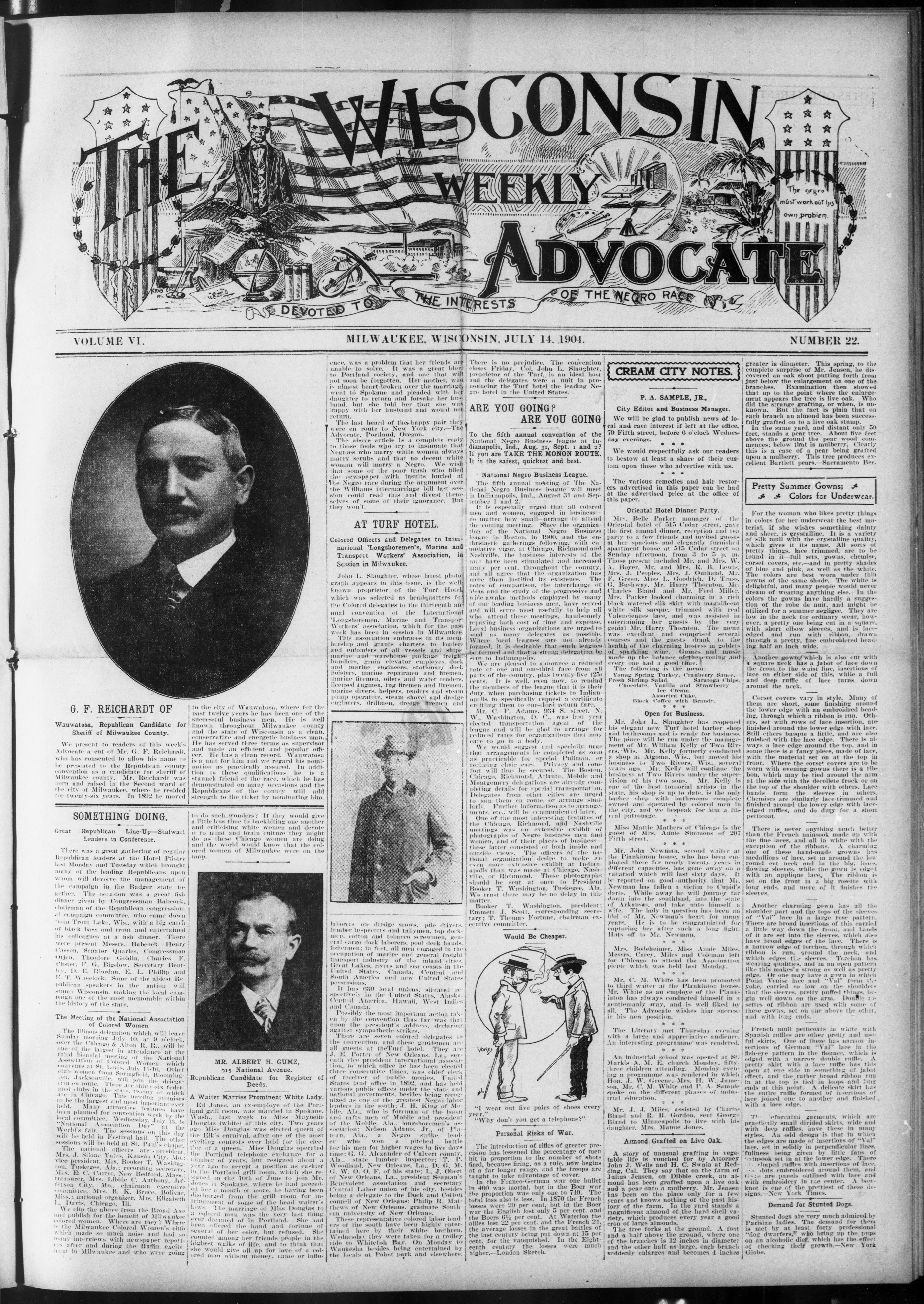
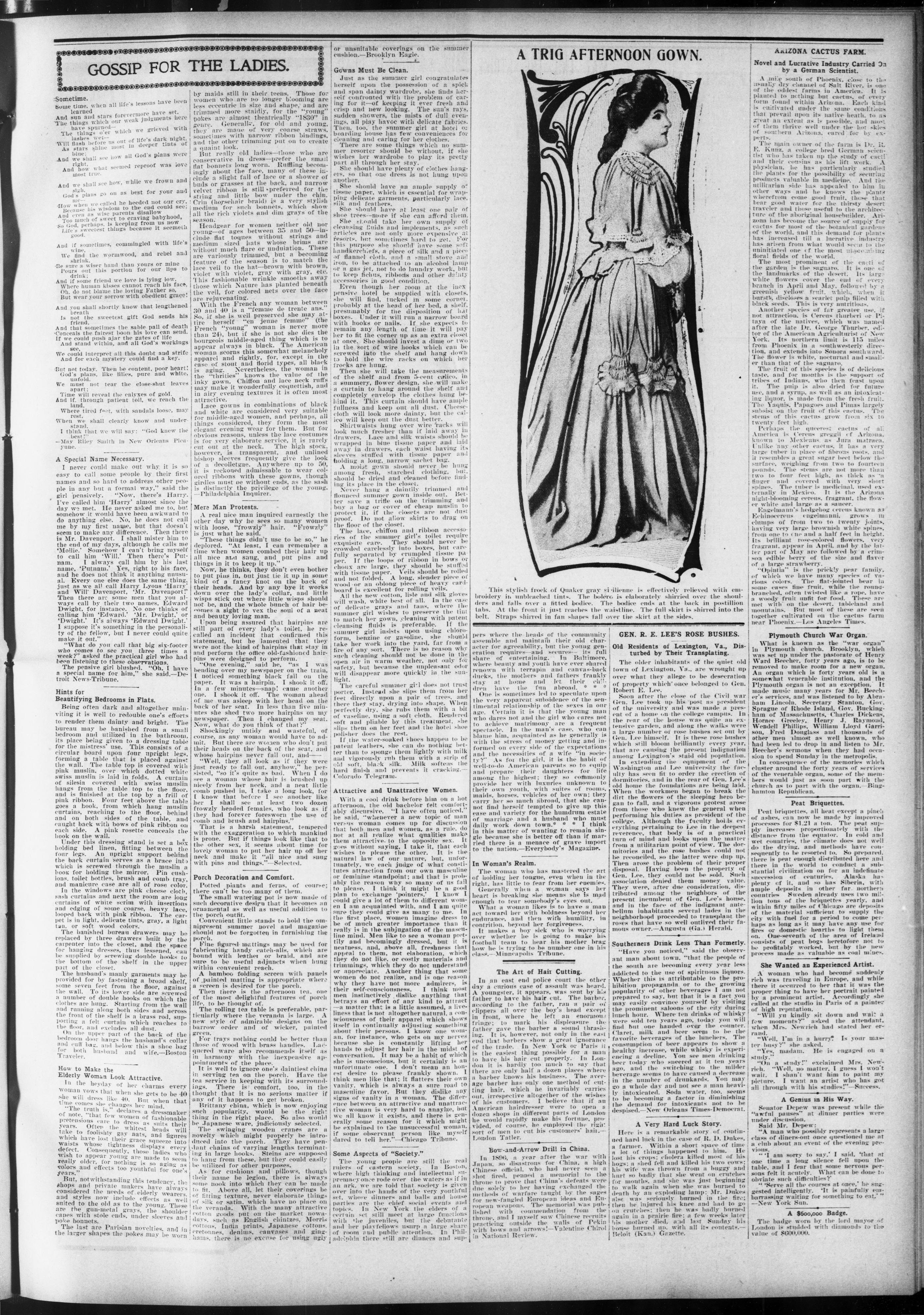
Page text (machine-generated)
WISCONSIN
WEEKLY
ADVOCATE
DEVOTED TO THE INTERESTS OF THE NEGRO RACE
[Name not visible in the image]
VOLUME VI.
G. F. REICHARDT OF
Wauwatosa, Republican Candidate for Sheriff of Milwaukee County.
We present to readers of this week's Advocate a cut of Mr. G. F. Reichardt, who has consented to allow his name to be presented to the Republican county convention as a candidate for sheriff of Milwaukee county. Mr. Reichardt was born and raised in the Second ward of the city of Milwaukee, where he resided for twenty-six years. In 1892 he moved
SOMETHING DOING
Great Republican Line-Up-Stalwart Leaders in Conference.
There was a great gathering of regular Republican leaders at the Hotel Pfister last Monday and Tuesday which brought many of the leading Republicans upon whom will devolve the management of the campaign in the Badger state together. The occasion was a great fish dinner given by Congressman Babcock, chairman of the Republican congressional campaign committee, who came down from Trout Lake, Wis., with a big catch of black bass and trout and entertained his colleagues at a fish dinner. There were present Messrs. Babcock, Henry Casson, Senator Quarles, Congressman Otjen, Theodore Goldin, Charles F. Pfister, F. G. Bigelow, Secretary Bentley, D. E. Riordan, E. L. Phillip and E. T. Wheelock. Some of the ablest Republican speakers in the nation will stump Wisconsin, making the local campaign one of the most memorable within the history of the state.
The Meeting of the National Association of Colored Women.
The Illinois delegation which will leave Sunday morning July 10, at 9 o'clock, over the Chicago & Alton R. R., will be one of the largest in attendance at the third biennial meeting of the National Association of Colored Women which convenes at St. Louis, July 11-16. Other club women from Springfield, Bloomington, Jacksonville, will join the delegation en route. There are thirty-six federated clubs in the state, twenty of which are in Chicago. This meeting promises to be the largest and most important ever held. Many attractive features have been planned for convention week by the local committee. Wednesday, July 13, is "National Association Day" at the World's fair. The sessions on this day will be held in Festival hall. The other sessions will be held at St. Paul's chapel. The national officers are president, Mrs. J. Silone Yates, Kansas City, Mo.; vice president, Mrs. Booker T. Washington, Tuskegee, Ala.; recording secretary, Mrs. E. C. Carter, New Bedford, Mass.; treasurer, Mrs. Libbie C. Anthony, Jefferson City, Mo.; chairman executive committee, Mrs. B. K. Bruce, Bolivar, Miss.; national organizer, Mrs. Elizabeth L. Davis, Chicago, Ill.
We clip the above from the Broad Axe and publish for the benefit of Milwaukee colored women. Where are they? Where is the Milwaukee Colored Women's club which made so much noise and had so many interviews with newspaper reporters after and during the Ruffin excitement in Milwaukee and who were going
to the city of Wauwatosa, where for the past twelve years he has been one of the successful business men. He is well known throughout Milwaukee county and the state of Wisconsin as a clean, conservative and energetic business man. He has served three terms as supervisor and made an efficient and popular officer. He has a clean record. Wauwatosa is a unit for him and we regard his nomination as practically assured. In addition to these qualifications he is a staunch friend of the race, which he has demonstrated on many occasions and the Republicans of the county will add strength to the ticket by nominating him.
to do such wonders? If they would give a little less time to backbiting one another and criticising white women and devote it to mind and brain culture they might do as these Chicago women are doing and the world would know that the colored women of Milwaukee were on the map.
[Image of a man with a mustache and a suit and tie].
A Waiter Marries Prominent White Lady. Ed Jones, an ex-employee of the Portland grill room, was married in Spokane, Wash., last week to Miss Maybelie Douglas (white) of this city. Two years ago Miss Douglas was elected queen of the Elk's carnival, after one of the most exciting contests ever held for the election of a queen. Miss Douglas operated the Portland telephone exchange for a
number of years, but resigned about a year ago to accept a position as cashier in the Portland grill room, which she resigned on the 10th of June to join Mr. Jones in Spokane, where he had preceded her a month or more, he having been discharged from the grill room for infringement of some of the head waiter's laws. The marriage of Miss Douglas to a colored man was the very last thing ever dreamed of in Portland. She had been offered the hand and fortune of several of her color, but refused. She counted among her friends people in the highest walks of life, and to think that she would give all up for love of a colored man without money, name or influ
ence, was a problem that her friends are unable to solve. It was a great blow to Portland society, and one that will not soon be forgotten. Her mother, who is almost heart-broken over the marriage, went to Spokane and pleaded with her daughter to return and forsake her husband, but she told her that she was happy with her husband and would not return. The last heard of the happy pair they were en route to New York city.—The Advocate, Portland, Oregon.
The above article is a complete reply to those fools who try to insinuate that Negroes who marry white women always marry scrubs and that no decent white woman will marry a Negro. We wish that some of the poor trash who filled the newspaper with insults hurled at the Negro race during the argument over the Williams intermarriage bill last session could read this and divest themselves of some of their ignorance. But they won't.
AT TURF HOTEL
Colored Officers and Delegates to International 'Longshoremen's, Marine and Transport Workers' Association, in Session in Milwaukee.
John L. Slaughter, whose latest photograph appears in this issue, is the well-known proprietor of the Turf Hotel which was selected as headquarters for the Colored delegates to the thirteenth annual convention of the International 'Longshoremen, Marine and Transport Workers' association, which for the past week has been in session in Milwaukee.
This association embraces in its membership and grants charters to loaders and unloaders of all vessels and ships marine and warehouse package freight bandlers, grain elevator employees, dock and marine engineers, stationary dock hoisters, marine repairmen and firemen, marine firemen, oilers and water tenders, licensed tugmen, tug firemen and linemen, marine divers, helpers, tenders and steam pump operators, steam shovel and dredge engineers, drillmen, dredge firemen and
1890
laborers or dredge scows, pile drivers, lumber inspectors and tallymen, top dock men, cotton and tobacco screwmen, general cargo dock laborers, pool deck hands, fishermen; in fact, all men engaged in the occupation of marine and general freight transport industry of the inland cities. Great Lakes, rivers and sea coasts in the United States, Canada, Central and South America and new United States possessions. It has 630 local unions, situated respectively in the United States, Alaska, Central America, Hawaii, West Indies and Canada. Possibly the most important action taken by the convention thus far was that upon the president's address, declaring against sympathetic strikes.
There are seven colored delegates to the convention, and these gentlemen are all guests at the Turf hotel. They are J. E. Porter of New Orleans, La., seventh vice president international association, to which office he has been elected three consecutive times, was chief clerk of receiver of public monies, United States land office in 1892, and has held various public offices under the state and national governments, besides being recognized as one of the greatest Negro labor leaders in the south; J. H. King of Mobile, Ala., who is foreman of the boom and rafts men of Mobile and president of the Mobile, Ala., longshoremen's association; Nelson Adams, Jr., of Plateau, Ala., a Negro strike leader who won a pitched battle for his men for higher wages in five days time; G. G. Alexander of Calvert county, Ala., state lumber inspector; T. P. Woodland, New Orleans, La., D. G. M. G. W. O. O. F. of his state; L. J. Obert of New Orleans, La., president Seaman's Benevolent association and secretary Central Labor union of his city, besides being a delegate to the Dock and Cotton council of New Orleans; Philip R. Matthews of New Orleans, graduate Southern university of New Orleans.
These representative colored labor leaders of the south have been highly entertained here by their white brethren Wednesday they were taken for a trolley ride to Whitefish Bay. On Monday to Wankesha besides being entertained by the locals at Pabst park and elsewhere
There is no prejudice. The convention closes Friday. Col. John L. Slaughter, proprietor of the Turf, is an ideal host and the delegates were a unit in pronouncing the Turf hotel the leading Negro hotel in the United States.
ARE YOU GOING?
ARE YOU GOING
To the fifth annual convention of the National Negro Business league at Indianapolis, Ind., Aug. 31, Sept. 1 and 2? If you are TAKE THE MONON ROUTE. It is the safest, quickest and best.
National Negro Business League.
The fifth annual meeting of The National Negro Business league will meet in Indianapolis, Ind., August 31 and September 1 and 2.
It is especially urged that all colored men and women, engaged in business—no matter how small—arrange to attend the coming meeting. Since the organization of the National Negro Business league in Boston, in 1900, and the enthusiastic gatherings following, with cumulative vigor, at Chicago, Richmond and Nashville, the business interests of the race have been stimulated and increased many per cent, throughout the country, and all agree that the organization has more than justified its existence. The notes of comparison, the interchange of ideas and the study of the progressive and wide-awake methods employed by many of our leading business men, have served and will serve most usefully to help all who attend these meetings, handsomely repaying both cost of time and expense. Local business organizations are urged to send as many delegates as possible. Where local leagues are not already formed, it is desirable that such leagues be formed and that a strong delegation be sent to Indianapolis.
We are pleased to announce a reduced rate of one and one-third fare from all parts of the country, plus twenty-five (25) cents. It is well, even now, to remind the members of the league that it is their duty when purchasing tickets to Indianapolis to specifically request a certificate entitling them to one-third return fare. Mr. C. F. Adams, 934 S. street, N. W., Washington, D. C., was last year elected transportation agent of the league and will be glad to arrange for reduced rates for organizations that may care to go in a body.
We would suggest and specially urge that arrangements be completed as soon as practicable for special Pullman, or reclining chair cars. Privacy and comfort will thus be secured. The Boston, Chicago, Richmond, Atlanta, Mobile and Montgomery delegations are already completing details for special transportation. Delegates from other cities are urged to join them en route, or arrange similarly. Further information as to arrangements, etc., will be communicated later.
One of the most interesting features of the Chicago, Richmond, and Nashville meetings was an extensive exhibit of photographs of Negro business men and women, and of their places of business—the latter consisted of both inside and outside views. The officers of the national organization desire to make an even more extensive exhibit at Indianapolis than was made at Chicago, Nashville, or Richmond. These photographs should be sent at once to President Booker T. Washington, Tuskegee, Ala. We trust there may be no delay in this matter.
Booker T. Washington, president; Emmett J. Scott, corresponding secretary; T. Thomas Fortune, chairman executive committee.
Would Be Cheaper.
Vokes
"I wear out five pairs of shoes every year." Why don't you get a telephone?"
The introduction of rifles of greater precision has lessened the percentage of men hit in proportion to the number of shots fired, because firing, as a rule, now begins at a far longer range, and the troops are taught to take advantage of cover.
In the Franco-German war one bullet in 400 was mortal, but in the Boer war the proportion was only one to 740. The total loss also is less. In 1870 the French losses were 20 per cent, but in the Boer war the English lost only 5 per cent. and the Boers $6 \frac{1}{2}$ per cent. At Waterloo the allies lost 22 per cent. and the French 24, the average losses in the great battles of the last century being put down at 15 per cent, for the vanquished. In the Eighteenth century the losses were much higher.—London Sketch.
CREAM CITY NOTES.
P. A. SAMPLE. JR..
City Editor and Business Manager
We will be glad to publish news of local and race interest if left at the office, 79 Fifth street, before 6 o'clock Wednesday evenings.
We would respectfully ask our readers to bestow at least a share of their custom upon these who advertise with us.
The various remedies and hair restorers advertised in this paper can be had at the advertised price at the office of this paper.
Oriental Hotel Dinner Party.
Mrs. Belle Parker, manager of the Oriental hotel of 515 Cedar street, gave the first annual dinner, reception and tea party to a few friends and invited guests at her spacious and elegantly furnished apartment house at 515 Cedar street on Sunday afternoon, from 3 to 5 p. m. Those present included Mr. and Mrs. W. A. Boyer, Mr. and Mrs. R. B. Lewis, Mrs. J. Peoples, Mrs. J. Outhand, Mr. F. Green, Miss L. Goodrich, D. Truss, G. Bushway, Mr. Harry Thornton, Mr. Charles Bland and Mr. Fred Miller. Mrs. Parker looked charming in a rich black watered silk skirt with magnificent white silk sacque, trimmed with real Valenciennes lace, and was assisted in entertaining her guests by the very genial Mr. Harry Thornton. The menu was excellent and comprised several courses and the guests drank to the health of the charming hostess in goblets of sparkling wine. Games and music made up the balance of the evening and every one had a good time.
The following is the menu:
Young Spring Turkey, Cranberry Sauce,
Fresh Shrimp Salad. Saratoga Chips,
Chocolate, Vanilla and Strawberry
Open for Business
Mr. John L. Slaughter has reopened his elegant new Turf hotel barber shop and bathrooms and is ready for business. The piace will be run under the management of Mr. William Kelly of Two Rivers, Wis. Mr. Kelly formerly conducted a shop at Algoma, Wis., but moved his business to Two Rivers, Wis., several years ago. Mr. Kelly will continue the business at Two Rivers under the supervision of his two sons. Mr. Kelly is one of the best totsorial artists in the state, his shop is up to date, is the only barber shop with bathrooms complete owned and operated by colored men in the city, and we bespeak for him a liberal patronage.
Miss Mattie Mathers of Chicago is the guest of Mrs. Annie Simmons of 207 Fifth street.
Mr. John Newman, second waiter at the Plaankinton house, who has been employed there for nearly twenty years in different capacities, has gone away on a vacation which will last sixty days. It is reported on good authority that Mr. Newman has fallen a victim to Cupid's darts. While away he will journey far down into the southland, into the state of Arkansas, and take unto himself a wife. The lady in question has been an idol of Mr. Newman's heart for many years. He is to be congratulated for capturing her after such a long fight. Hats off to Mr. Newman.
* * *
Mrs. Bodeheimer, Miss Annie Miles, Messrs. Carey, Miles and Coleman left for Chicago to attend the Appoinatto picnic which was held last Monday.
☆ ☆ ☆
Mr. C. M. White has been promoted to third waiter at the Plankinton house. Mr. White as an employee of the Plankinton has always conducted himself in a gentlemanly way, and is well liked by all. The Advocate wishes him success in his new position.
* * *
The Literary met Thursday evening with a large- and appreciative audience. An interesting programme was rendered.
* * *
An industrial school was opened at St. Mark's A. M. E. church Monday, fifty-three children attending. Monday evening a programme was rendered in which Hon. J. W. Greene, Mrs. H. W. Jameson, Mr. C. M. White and P. A. Sample spoke on the different phases of industrial education.
Mr. J. J. Miles, assisted by Charlie Bland and R. R. Gordon, sent George Bland to Minneapolis to live with his daughter. Mrs. Mamie Jones.
Almond Grafted on Live Oak.
A story of unusual grafting in vegetable life is vouched for by Attorney John J. Wells and H. C. Swain at Redding, Cal. They say that on the farm of Julius Jensen, on Dibble creek, an almond has been grafted upon a live oak and a pear onto a mulberry. Mr. Jensen has been on the place only for a few years and knows nothing of the past history of the farm. In the yard stands a magnificent almond of the hard shell variety, which produces every year a good crop of large almonds.
The tree forks at the ground. A foot and a half above the ground, where one of the branches is 12 inches in diameter and the other half as large, each branch suddenly enlarges and becomes 4 inches
greater in diameter. This spring, to the complete surprise of Mr. Jensen, he discovered an oak shoot putting forth from just below the enlargement on one of the branches. Examination then showed that up to the point where the enlargement appears the tree is live oak. Who did the strange grafting, or when, is unknown. But the fact is plain that on each branch an almond has been successfully grafted on to a live oak stump. In the same yard, and distant only 50 feet, stands a pear tree. About five feet above the ground the pear wood commences; below that is mulberry. Clearly this is a case of a pear being grafted upon a mulberry. This tree produces excellent Bartlett pears.—Sacramento Bee.
Pretty Summer Gowns; Colors for Underwear.
For the woman who likes pretty things in colors for her underwear the best material, if she wishes something dainty and sheer, is crystalline. It is a variety of silk mull with the crystalline quality, which gives it its name. All sorts of pretty things, lace trimmed, are to be found in it—full sets, gowns, chemise, corset covers, etc.—and in pretty shades of blue and pink, as well as the white. The colors are best worn under thin gowns of the same shade. The white is delightful, and many people would never dream of wearing anything else. In the colors the gowns have hardly a suggestion of the robe de nuit, and might be utilized for a summer negligee. They are low in the neck for ordinary wear, however, a pretty one being cut in a square, with short elbow sleeves, and is lace-edged and run with ribbon, drawn through a pretty, fine embroidered beading half an inch wide.
Another gown, which is also cut with a square neck has a jabot of lace down the front to the waist line, insertions of lace on either side of this, while a full and deep ruffle of lace turns down around the neck.
Corset covers vary in style. Many of them are short, some finishing around the lower edge with an embroidered beading, through which a ribbon is run. Others, set with rows of lace insertion, are finished around the lower edge with lace. Still others basque a little, and are also finished with the lace edge. There is always a lace edge around the top, and in some there is a fancy piece, made of lace, with the material set on at the top in front. Where the corset covers are to be worn with evening gowns there is a ribbon, which may be tied around the arm at the side with the decollete frock or on the top of the shoulder with others. Lace bands form the sleeves in others. Chemises are similarly lace-trimmed and finished around the lower edge with lace-edged ruffles, and do duty for a short petticoat.
There is never anything much better than the French nainsook made up with the fine laces, and all in white with the exception of the ribbons. A charming one of these hand-made growns has medallions of lace, set in around the low round cut neck and in the big, loose, flowing sleeves, while the gown is edged with an applique lace. The ribbon is set on the front in a big rosette with long ends, and more of it finishes the sleeves.
Another charming gown has all the shoulder part and the tops of the sleeves of "Val" lace in a large rose pattern. There are broad insertions of this carried a little way down the front, and bands of it are set into the sleeves, which also have broad edges of the lace. There is a narrow edge of torchon, through which ribbon is run, around the neck, and which edges the sleeves. Torchon has wearing qualities, and in an open pattern like this makes a strong as well as pretty edge. Or one may have a gown in which Point Venise lace and "Val" form the yoke, carried so low on the shoulders that the sleeves, pretty puffed things, begin well down on the arm. Double rosettes of ribbon are used with some of these gowns, set on one above the other, and with long ends.
French mull petticoats in white with Spanish ruffles are other pretty and useful skirts. One of these has narrow insertions of German "Val" lace in the fish-eye pattern in the flounce, which is edged with a narrow double ruffle. A pretty skirt with a lace ruffle has this open at one side in something of jabot effect, and the rather broad ribbon run in at the top is tied in loops and long ends at this point. A delicate skirt has the entire ruffle formed of insertions of lace joined one to another and finished with a lace edge.
The infurcated garments, which are practically small divided skirts, wide and with deep ruffles, have these in many styles. An odd design is that in which the edges are made of insertions of "Val" lace, set in solidly in perpendicular lines, fullness being given by little fans of rainsook set in at the lower edge. There shaped ruffles with insertions of lace, dots embroidered around them, and these are panels outlined with lace and with embroidery in the center. A bowknot is one of the prettiest of these designs.—New York Times.
Demand for Stunted Dogs.
Stunted dogs are very much admired by Parisian ladies. The demand for them is met by at least forty professional "dog dwarfers," who bring up the pups on an alcoholic diet, which has the effect of checking their growth. New York Globe.
NOTES OF INTEREST.
- Good soap is made from the soap tree of Florida.
- The eucalyptus tree dries up springs rapidly.
M. Eiffel has been utilizing the famous tower in Paris that bears his name to measure the pressure of wind.
Miss Blanche Minton of New York packs trunks for guests at hotels. The first day she tried it she made $17.
We import 400,000 pounds of prune and we export 66,000,000 pounds in a year. Frenchmen buy our prunes.
Miss Yoemans is known all over California as a butterfly catcher. She runs a regular international butterfly exchange, and finds it very profitable.
Americans are the most excessive coffee drinkers in the world. Over a billion pounds of coffee is imported into the United States each year.
In Denmark there is what is called "old maid insurance." By paying a certain sum each year until they are 40 they receive a pension for life.
The world's best timekeeper is said to be the electric clock in the basement of the Berlin Observatory, which was installed by Prof. Foerster in 1865.
A Lehigh Valley freight train consisting of 104 loaded cars, containing 4013 tons, was handled between Sayre and Weldon, Pa. The train was pulled by a single locomotive.
The region near the Persian gulf is the hottest on earth, the mean annual temperature there being 11 degrees higher than in Death Valley, Cal. The inhabitants are stunted, mentally and physically.
Teachers in the Horace Mann School for the Deaf, at Boston, have found the piano one of the best means of developing the speech of the pupils. Pupils of all ages now have the assistance of the piano in lessons.
The great flood at Topeka, Kan., last year has been found to be a blessing in disguise. Ever since the district has not been bothered with the vermin that before infested it—mice, rats moles, gophers and rabbits.
Among the trees that are most sensitive to the wind are the cherry, the plum, the walnut, the black poplar, the service tree, the ash and certain varieties of pine. Other pines, especially the mountain varieties, and also certain firs, are very resistant to wind.
The western genius who discovered that there is a market for canned jack rabbit has probably sounded the deathknell of the long-legged creature of the prairie. The first canning factory has been established at Echo, Ore., and thousands of jack rabbits are slaughtered in that vicinity every month.
The Cherokee Advocate (the only Indian paper), the official organ of the Cherokee nation, is 64 years old. It is published at Tahlequah at the nation's expense. One-half is printed in the Cherokee language. The paper is forbidden to deal in politics. Its cost of publication is about $2500 above all receipts.
It appears from a decision of the French courts that a man may fight a duel with pistols or swords and if fatality results there is no penalty. But if one cannot afford these weapons and fights with humbler means there is no such immunity, as two men who fought with knives were given four months each in prison.
A jack-rabbit round-up in the west is full of interest. A huge circle of hunters is formed, miles in circumference, and an enclosure, built of woven wire, so high that no jack rabbit could jump over, is the objective point of the hunt. From the entrance to this enclosure extend two fences, broadening out as they leave the corral. Into this wedge-like space the rabbits are to be driven; after which they will naturally run into the corral as the only exit in sight.
Bermuda Bananas.
The dwarf banana of Bermuda first came from the Canaries. The fruit is little larger than a man's finger, and is compact in texture and rich in flavor. The fruit grown in summer is of higher quality than that grown in winter—if the word winter can be applied to a land in which the mercury rarely registers as low as 50 degrees and in which frost is unknown. The single bunch that the tree bears should weigh, of this dwarf sort, from 25 to 60 or even 70 pounds. There is almost no expense required in maintaining the plantation after it is once established, and the gross annual income should be from $400 to $500 per acre. The little bananas are consumed entirely by the local markets, for Bermuda is visited by tourists, it has a large garrison, and the resident people—some over 17,000 all told—are fond of the fruit.—Country Life in America.
Russia's Railway Schools.
The railway schools of Russia are among the most interesting of all nations. When the great Siberian railway is completed it will form a practical westward continuation of the American trunk lines, connected by international ferries in the form of gigantic steamship lines. It was the construction of the wonderful Siberian railway which largely liberalized all Russia and turned its attention to the education of children. At the latest report Russia was teaching 6000 children of railway men all branches of modern railway construction and operation. Russia recently sent two eminent ministers of affairs to this country to examine the workings of the railway branches of the Young Men's Christian association for the immediate introduction of the service at division points of the railways of all Russia.—Harper's Weekly.
Failed to Cash In.
Nearly fifteen years ago a man entered the First National bank of Denver and walked into the office of David H. Moffatt, the president of the bank. He had a bottle in his hand that he said contained nitro-glycerine, and threatened to blow up the bank unless he was given a large sum of money. Mr. Moffatt sent for the money, and among the bills was one of $10,000 denomination. Recently the government called in all $10,000 bills, and the one given by Mr. Moffatt is the only one that has not been presented for redemption. No trace of the man who got the money was ever found.
The Ten Virgins Became "Ten Old Maids"
The story is told of a teacher of Indians, at Hampton, Va., who was reading them the parable of the Ten Virgins by the aid of an interpreter; as she read, she noticed a furtive smile in the faces of her usually sober visaged pupils, and, stopping to inquire the cause, discovered that, owing to the paucity of the Indian dialect, which made the same word serve for virgin and old maid, the story, as it was sifted down through the interpreter, was to the effect that "ten old maids lighted their lanterns, and went out to look for husbands."—World's Work.
Interesting Little Facts.
The life of an eyelash is from 100 to 150 days. They grow very slowly, but finger nails grow quite rapidly 'n comparison. If a person could live without breaking or cutting his nails for a lifetime they would attain the length of seventy-three inches. It takes about 121 days for a new nail to form on the little finger and 138 on the thumb.—Philadelphia Ledger.
TWO HEARTS.
My Love's true heart am I—
My heart's true Love is she;
The world may hurry by—
Tis all the same to me.
It shineth in the sky,
It singeth in the sea:
My Love's true heart am I—
My heart's true Love is she.
The planets may grow old,
The stars may lose their way;
Our hearts defy the cold,
And love can fill the day.
It thrills the river's ery,
It carols from the tree:
My Love's true heart am I—
My heart's true Love is she.
A million miles would make
Me love her more and more;
A million years should break
And find us as before.
Let time and distance try!
Love is a spirit free.
My Love's true heart am I—
My heart's true Love is she.
Charles H. Crandall in Lippincott's.
THE GUILELESSNESS OF COUNT WIM
Count Wim was the most guileless of young men imaginable. Partly this was due to his temperament, partly to his bringing up. He took after his father, the Count von Bede (this was really Wim's title now, only nobody called him by it), who, though he had been nominally a courtier all his days, having filled the positions of master of the stables, chief ranger and chamberlain to the Grand Duke of Wippe-Limbau, had in reality lived for science, if such an absent-minded person could be said to have lived at all. The filling of these positions was a duty demanded by his rank, for the Von Redes were the second family in the grand duchy. But his passion had been for gunpowder. The count had spent his days alternately in his laboratory, inventing, and, at the range on his estates, experimenting with the powder which was to shoot further and cleaner and more destructively than any powder that ever had been dreamed of. Nothing much had come of these labors. The countess, Wim's mother, was thankful for this. She was always prophesying that either her husband or her son—for Wim was always with his father when he could be, and his earliest recollection was of practicing with a miniature pistol with some particularly choice concoction which eventually turned out too expensive to be practical—would be blown into little pieces. The only real result of all this toil was that Wim imbibed some of his father's passion for science and a great deal of his absent-mindedness.
This latter was not exactly eradicated by the strict training given him by his mother. The countess was a martinet, and ruled the estates successfully enough. Wim went so much in awe of her that he never dared to dispute her commands, even after his father died and he became head of the house. He obeyed her by stopping at home, by trying not to be absent minded and by falling in love with the Countess Else von Hordenberg. He would have fallen in love with the Countess Else in any case, for she was not only beautiful, but also witty and merry and quick to understand. She possessed all the qualities that the Countess von Rede desired to see in Wim, all that Wim admired without being able to imitate.
Surely enough, the girl had fallen in love with Wim. She liked him for his honesty, his thoughtfulness, his devotion—for a hundred other things, including, perhaps, his unlikeness to other men she knew. The only thing about him that annoyed her was his lack of an independent spirit. She often pouted—at her glass—when she thought of how tightly he was tied to his mother's apron strings. And she could have shrieked at the Countess von Rede when that lady confided her aspirations that Wim should become more of a man of the world.
"Why does he not travel?" she asked upon one occasion—a month after the engagement had been announced—when the countess was talking Wim to her over the long-drawn coffee in which German ladies delight.
"Gott in himmel!" said the countess, taken aback. "Wim would lose himself if he traveled. He has no more experience than a child."
"But how will he take care of me, then?" asked Elsa, vexed.
"That is what I say to him. 'How will you take care of your wife, pray?' I have said it a score of times. And Wim has no answer; he is so young still, and has all the rashness of youth. Why only this morning he was telling me that he should like to go to Dettin to visit the officers there, if I approved. They were quartered on us, as you know, during the maneuvers last year. It seems that Wim took a great fancy to them, and some of them have invited him to go over and stay a week—before he gets married."
"But you don't approve?" Else inquired, cautiously.
"No, indeed!" said the countess. "It would be the wildest thing to do. Officers! Imagine what they would lead Wim into. Though I will say that they behaved very well here, and seemed very pleasant young men; but you know what officers are like, or, rather, my child, I hope you do not know."
The Countess, who knew about as much about officers as her son did, shook her head mysteriously. Else feigned the demureness proper to a future daughter-in-law.
"It seems a pity they are so—so terrible," she said. "For, as you say, Wim might have learned something from them. Lieut. Grosberg, for example, was decidedly more self-reliant."
"I understand you," said the countess, a little shocked that Else should have observed so much of any particular officer. "If Wim could resemble the lieutenant in some ways I should be well pleased; but you did not allow the lieutenant's undoubtedly charming manners to impress you more favorably than the lieutenant intended?"
"Oh, no," said Else, and hid a smile.
Oh, no, said Else, and had a smile. Lieut Grosberg had paid very particular attention to her during the very short time his regiment had been billeted in Wippe-Limbaan, and his intentions might have included more than an exhibition of his undoubtedly charming manners. He had made a point of commenting on Count Wim's guilelessness—among other things. And Else was not certain if she had been more indignant with him or with Count Wim.
Three days after this conversation between the Countess von Rede and the Countess Else, Wim was in Dettin. He had his mother's consent to be there. How that was obtained Wim did not know; nor did his mother, for that matter. She would have said that she had
given it for various reasons; one being that it was right Wim should see the world, another being that Count Hordenberg and his daughter were also to visit Dettin, and the count had, in one way or another, solemnly undertaken to keep his eye on Wim and see that he was not led astray
It is possible that the count knew no more why he had given this promise than Wim knew why he was in Dettin. Neither of them would have been glad at the idea of Else being there, if they had known that Lieut. Grosberg was congratulating himself upon a conquest.
in the meantime Wim enjoyed himself amazingly. The size and the bustle and the society of Dettin all delighted him. The stiffness and pettiness of the grand ducal processions had been exchanged for the large freedom of a city, and instead of dowagers for companions, he had young men of his own age, who were much more ready to shock him than to be shocked themselves. They were so friendly and mischievous and absurd and magnificent that Count Wim hardly knew how to treat them. At one moment they were utterly serious over some trifle; at another they were holding a mock trial (in imitation of the trial in Zapfenstreich—a play which had moved Wim to tears), or marching around some one's rooms to the noise of a borrowed drum; and they were always drinking healths to maidens with fantastic names, which Count Wim thought wicked. But he liked it all, and everybody liked him. Everybody, that is to say, except Lieut. Grosberg.
Count Wim understood this officer less than any of the rest Grosberg was so very fine and self-possessed; wore his monocle with such an air and his mustache so fiercely that Count Wim could hardly help admiring him. The other officers admired Grosberg without exactly liking him, and Count Wim supposed that this must be his own feeling. He was too innocent at all times and too busy at this to notice that Grosberg's manner toward him was as insufferable as it could be short of open insolence. The other young fellows enjoyed ragging Wim; Grosberg made a business of it. Lieut. von Gelder, who was a particular friend of Wim's, remonstrated with him about it.
"Why can't you leave the little count alone?" he asked.
"Doesn't suit me to," said Grosberg.
"Besides, he likes it. His skin is as thick as a rhinoceros'; and where he squirted him the other night he thought he was seeing life. So he was. I will show him more with your kind permission, Von Gelder." And he went off humming the tune of a winter garden song that runs:
The maiden has such eyes of blue
The hidden has of life
You think they're looking straight at you.
But is it so?
Count Wim dressed for the masked ball that was to be given at the Hotel Bismarck with the most pleasurable anticipations. Elsie would be there, and she had given him a clue which would prevent her from being disguised to him as to the rest of the world. He would dance with her as often as he might, and put altogether out of mind the annoyance which he had felt at some pranks played upon him by several cloaked men—including, as he could not help thinking, Lieut. Grosberg. He had been annoyed, not so much at the pranks themselves, though they had gone beyond a joke, as at the publicity which had been given them. He had been made to look a fool; and he felt a fool for not knowing how far to resent what had happened. He hoped that he should not meet Grosberg that night, for his temper was not altogether under control.
Else dressed for the same ball without any pleasure at all. Her plan by which Wim was to have been rendered more of a man of the world seemed to have miscarried. Accounts of the tricks that had been played him had filtered through to her in this city, where her father had many friends; and she had heard judgments passed on his rustic simplicity and forbearance. She felt humiliated. The one thing that possessed her mind was that Wim must clear himself from the charge before he left Dettin.
It was three hours since the ball had begun, and Count Wim had not yet danced with his betrothed. Whenever he drew near to ask her—for she wore a rosette as she had promised, and there was no mistaking her—another domino had stepped in and been preferred. He could not understand it. He had had no opportunity of finding out who his rival was, and he was standing now disconsolate at one end of the deserted supper room, when the very two passed together.
"There he stands, looking like a ropeled country pig," said the man in the domino.
"Exactly."
"As I thought him from the first moment I saw him."
"I knew you did."
Then Count Wim became aware that they, were speaking of him, and that the man was Grosberg.
"Excuse me," he said, hoarsely, and made forward a step. The Countess Else let go the lieutenant's arm and slipped away with a merry laugh. It set Count Wim on fire.
"You!" he said, stammering in his rage. "You!"
"What do you want?" asked the lieutenant, coolly, and unmasked.
For answer Count Wim struck him in the face heavily.
How long he stayed there, sitting with his face buried in his hands. Count Wim hardly knew. The lieutenant, after his first fury, had gone off to arrange for a second. Von Gelder had somehow come into the room and promised to assist the count. The duel was to be with pistols; so Wim fancied he had heard Von Gelder saying. For a moment the fierce joy of knowing that he would shoot Grosberg in the morning had driven out the agony of seeing himself as others saw him. Else thought him a country simpleton.
She had mocked him, rightly, for what else but a fool was he! Not to have known it was his greatest folly. Her laugh buzzed in his brain, leaving innumerable stings. * * * Presently he heard her call to him. She was in the room.
"Wim!"
He was too shamed to look up.
"Wim," she said, gently, and the young man wondered to hear her speak like this. "I made him say those things. * * * I knew that he said them elsewhere. He was jealous, and thought you a fool. And I did not choose that any one should think you that. So I twitted him till he said them to you. I knew he would find out then that he was wrong. Dear Wim!"
Still he did not look up. "Must you fight a duel with him?" she
wrote on whimmering.
went on, whispering.
"Yes. I must shoot him in the morning!" said Wim. "I cannot miss him, ever, if you ask it."
He spoke still with his back to her. Quite suddenly her arms went round his neck—there, in the deserted supper room, where the music was only faintly heard.
"But I don't. Please—please hit him—in the leg. I am so proud of you, Wim!"
He did not altogether understand why she was so proud. * * * But then the best of Count Wim, according to his wife, is that though he is not quick at understanding, there is only one person who dares call him a fool!—Black and White.
BUYING RUBIES IN BURMA.
A Peculiar Method of Bargaining for the Precious Stones.
The peculiar business methods of Oriental merchants are illustrated by the manner of buying rubies in Burma. In the examination of rubies artificial light is not used, the merchants holding that full sunlight alone can bring out the color and brilliancy of the genus. Sales must, therefore, take place between 9 a. m. and 3 p. m., and the sky must be clear.
The purchaser, placed near a window, has before him a large copper plate. The sellers come to him one by one, and each empties upon this plate his little bag of rubies. The purchaser proceeds to arrange them for valuation in a number of small heaps. The first division is into three grades, according to size; each of these groups is again divided into three piles, according to color, and each of these piles, in turn, is again divided into three groups, according to shape. The bright copper plate has a curious use. The sunlight reflected from it through the stones brings out, with true rubies, a color effect different from that with red spinels and tourmalines, which are thus easily separated.
The buyer and seller then go through a very peculiar method of bargaining by signs, or rather grips, in perfect silence. After agreeing upon the fairness of the classification, they join their right hands, covered with a handkerchief or the flap of a garment, and by grips and pressures mutually understood among all these dealers they make, modify and accept proposals of purchase and sale. The hands are then uncovered and the prices are recorded.—Jewelers' Circular Weekly
CABIN BOY SOLVES PIZZLE
Explains How Birds Get Fresh Water in a Midocean Flight.
"When I was a cabin boy," said an elderly sailor, "I often used to wonder, seein' birds thousands of miles out to sea, what they done for fresh water when they got thirsty. "One day a squall answered that question for me. It was a hot and glitterin' day in the tropics, and in the clear sky overhead a black rain cloud appeared all of a sudden. Then, out of empty space, over a hundred seabirds came dartin' from every direction. They got under the rain cloud and they waited there for about ten minutes, circlin' round and round, and when the rain began to fall they throwed their heads back and they drank their fill.
"In the tropics, where the great sea-birds sail thousands of miles away from shore, they get their drinkin' water in that way. They smell out a storm a long way off; they travel a hundred miles, maybe, to get under it, and they swaller enough raindrops to keep them goin'."—Portland Oregonian.
Pretty Rapid.
She—How fast gossip does travel. He—Yes. Dame Rumor must have an automobile.
She—How fast gossip does travel. He—Yes. Dame Rumor must have an automobile.
An Error in Diagnosis
Stories of railroad accidents were being told at Tuxedo. Spencer Trask, banker and author, of New York, said:
"In a certain railway collision, one of the victims lay for a long time on his back across the ties. Finally two men picked him up, carried him to the station and placed him on the floor.
"He'll lie easier here," they said, 'till the doctor comes.'
"The doctor came a little later.
"This poor chap is done for. I'm afraid," he said, glancing at the prostrate victim.
"Then he knelt down, lifted one of the man's closed eyelids, and peered into dull, blank, unseeing, lifeless eye.
"Yes, he's dead all right. Take him away," said the doctor.
"But the pale lips of the injured man moved slightly, and a feeble voice murmured:
"That was my glass eye, you fool."
—New York Tribune.
Language Lesson.
Dumay—I say, Dugas, what is a futility?
"Take paper and pencil. I'll show you.
Write down 5437. Multiply it by 3521."
Dumay—Mm-m-m—
"Divide the result by 112,530,000,000."
Dumay—Mm-m-m-m
"Got it? What does it make?"
Dumay—It makes .000,000,008.
"That's a mighty small quantity."
Dumay—Effectively. It's almost nothing.
"Good! Now, observe! You have filled a whole page with figures and all that to arrive at almost nothing. That is a fatality!"—French Humor.
War on the Linen Handkerchief.
Prof. Cahnetre of the Pasteur institute of Paris is making war on linen handkerchiefs, which he considers a great source of infection. He suggests the use of specially constructed wallets for Japanese paper handkerchiefs, with separate divisions for the new and the used ones. The latter are to, be burned.—Philadelphia Record.
WHAT WOULD YOU DO?
Supposin' 'at you had fished all day
An' you hadn't got a bite;
Supposin' th' shadders wuz gettin' long
An' it was a-coffin' night;
Supposin' at then you th' of your friends
Who would laff and jeer at you;
What would you do in a case like that,
What do you s'pose you'd do?
Wal, we'll say 'at you'd give it up
An' doggedly row ashore,
Declarin' 'at fate wuz ag'in you so
It was useless to try no more:
But supposin' you see a man on the bank
With some bass, say a dozen or two,
An' supposin' he'd sell 'em to you fur a
song,
What do you s'pose you'd do?
What do you 's pose you 'd do?
Wouldn't you kind o' smile at him,
An' caitiously look about.
Before you reached deep down in your
clothes
To haul your wallet out?
An' wouldn't you lower your voice to say,
"This, you know's 'twixt me an' you?"
Isn't that just th' way you'd act?
Isn't that what you'd do?
An' then when down thro' th' streets of
the town
Your admirin' friends, as they'd pass,
Would stop to congratulate you an' ask
Fur th' secret of catching bass.
Wouldn't you tell 'em fishin' wuz kind of a
knack
'At wuz only acquired by a few?
Isn't that what you'd say now?
Isn't that what you'd do?
—National Sportsman.
WIRE ROPE.
Was Manufactured by the Ancients and Pompeii Contains Samples.
It is not an uncommon thing in this age of advancement in industrial and engineering matters for the present day engineer to assume that the knows much more than his ancient brother, and, while this is true in many things, it frequently happens that an invention or appliance commonly believed to belong to modern times is found to have been known and used centuries ago.
Ropes made of various kinds of fiber and leather are of very ancient date. Ropes of palm have been found in Egypt in the tombs of Beni-Hassan (about 3000 B. C.) and on the walls of these tombs is also shown the process of preparing hemp. In a tomb at Thebes of the time of Thothimes III. (about 1600 B. C.) is a group representing the process of twisting thongs of leather and the method of cutting the leather into thongs. The Bible tells us that Samson was bound with ropes, and that the spies sent by Joshua into Pericho were let down in a basket, presumably by means of a rope. At Nimrod, Assyria, a carved slab showing the siege of a castle was found, on which a soldier was represented in the act of cutting a rope to which a bucket for drawing water from a well outside the castle walls was attached.
The wire rope is generally considered a modern invention, a product of modern skill, and it will surprise many to learn that its manufacture is really a rediscovered lost art. Although the Assyrians practiced the art of wire-beating, no evidence has been found to indicate that they used wire for making rope.
The excavations at Pompeii have, however, brought to light a piece of bronze wire rope nearly fifteen feet long and about one inch in circumference. This rope is now in the Musio Borbonico at Naples. It consists of three strands laid spirally together, each strand being made up of fifteen wires twisted together, and its construction does not, therefore, differ greatly from that of wire ropes today. Pompeii was buried A. D. 79, over 1800 years ago, but how long wire ropes had been known it is impossible to tell, though judging by the knowledge shown in the construction, it may be safely concluded that they had been known for a considerable time. The uses to which these ropes were put are not definitely known, but further excavations may shed some light on the subject.—Philadelphia Record.
How Chamois Skins Are Made
The sheepskin is first washed and the flesh side scraped thoroughly to remove the fleshy fibers; then the wet skins are flung in a warm room for about a week and "sweated." This loosens the wool so that most of it can be pulled out easily. The skins are than soaked in milk of lime to loosen the rest of the wool and to swell the fibers and split them into their constituent fibrils.
After lining, the hair is all removed and the absorbent lime is neutralized with boric or hydrochloric acid, and the skin is split into two thicknesses. The outer, or grain, side is used for the manufacture of thin, fancy leathers used in bookbinding, etc., while the flesh side is made into wash leather. It is first drenched, then put into stocks and pounded until it is partly dried and the fibrous structure has become loose and open, sawdust generally being employed to facilitate the process.
Fish oil is now rubbed upon the skins in small quantities, as long as the oil is absorbed. The moisture dries out as the oil is absorbed, the skins being hung up occasionally and exposed to the air. When the skins have absorbed enough oil they lose their limy odor and acquire a peculiar mustard-like smell, due to the oxidation of the oil. They are then packed loosely in boxes, where they heat rapidly and must be taken out and exposed to the air to prevent overheating. During this time they give off much pungent vapor and turn yellow. They are then washed in a warm solution of alkali to remove the excess of fat. The oil removed is liberated from the soapy fluid and sold as "sod oil."
The skins are next bleached in the sun, beig moistened occasionally with a solution of potassium permanganate, followed by washing the sulphurous acid or sodium peroxide. The leather is then permanently softened and suited for all purposes of toilet or cleaning uses. Science News.
Relied Upon the Bible
Prof. Theodore C. Mitchill, head teacher of English in the Brooklyn high school, often entertains his friends with stories, the following being one of the most recent:
"I was laying down the law to a lot of fellows in the second," says Prof. Mitchill," and happened to illustrate my remarks by a biblical allusion.
"'Keeping you in does no good,' said I. 'I am going to heat the furnace seven times hotter, as they did with Shadrach, Meshach and Abednego. Do you remember their case?'"
"'Sure,' said the fresh one of the class. 'And the fire never hurt them a bit!'"—New York Times.
Chinese Magistrates' Boots.
Visitors to China are particularly struck by the number of pairs of boots hung in separate wooden cages in the archway of the main west gate of Hsuan-Hua, the valedictory gifts of beneficial prefects. It is an attractive custom in China to invite a departing magistrate whose rule has been popular to leave a pair of old boots for suspension in a prominent place as a hint to his successor to follow in his footsteps. It is a considerable honor to be asked to leave these boots, and the people make the request all the more eagerly because they believe in the efficacy of the hint.
Evaporation of the Dead sea is so great that it sensibly exceeds the influx of river water, including that of the Jordan. The sea, therefore, is slowly drying up.
---
The Plague in India.
The years come and the years go, but the plague epidemic in India shows no signs of material abatement. The dreadful malady is becoming the despair of scientific investigators. They cannot stamp it out and they cannot account for its freakish manifestations. The Pioneer Mail, published at Allahabad, says they "cannot say why 'it takes hold upon one district and passes by another,' why in one year and place an epidemic will begin and subside months earlier than in another; least of all can anyone venture to prophesy when the country or any part of it will be free of the disease." Nowhere, it is said, have preventive measures met with less success than in the Punjab, though nowhere else has the government attacked the problem with more energy and determination. It must be admitted that the people were not everwilling to accept the good offices of the government, but that is a condition of things everywhere in India, and it constitutes the chief element in the continual spread of the plague epidemic.
Inoculation has played an important part in the fight against this disease and with results that were very promising. Between May and September, 1900, nearly a quarter of a million people were inoculated. The percentage of attacks among all such was 1.32, as compared with 3.69 among uninoculated persons, and the mortality in cases of the latter was 52.15 per cent., as against 32.60 among the inoculated. Encouraged by these figures in 1902-03 the Punjab government undertook to inoculate 6,000,000 of people, practically the whole population of the thirteen districts most seriously affected by previous epidemics. This necessitated a daily supply of 70,000 doses of prophylactic fluid which the Bombay Research laboratory agreed to furnish. But instead of this number of doses daily it was thirty-one days in supplying a little over twice the amount, and then it was announced that the fluid would be supplied by a different method from the one previously followed.—Boston Transcript.
First Briton in India
The first Englishman who is known for certain to have gone out to India was, according to a recent correspondent in an Indian paper, a certain Thomas Stephens, a member of a well-to-do Wiltshire family and an Oxonian, who landed somewhere near Goa about, the year 1570, and spent forty years in Jesuit missionary work in Goa and the neighborhood. Stephens not only succeeded in mastering Marathi and Konkani, which were the languages spoken by the majority of the people on the west coast, but left behind him, among other works in Marathi of literary merit, the "Parama," an epic and it is in his capacity as the author of this that Stephen's name is best known among the west coast inhabitants.
The poem contains over 11,000 strophes of four lines each. It narrates, in a lofty style, the events that led up to the establishment of the Christian religion, and from the creation to the ascension of our Lord, who figures as the hero of the epic. A new edition of the "Purana" is to be published in Mangalore, no printed copy of the work being now available.—Athenaeum.
Costliest Atoms in the World.
There are some people, no doubt, who fancy that £32,000 an ounce is quite enough to give for anything in the world, and yet from all appearances there is little doubt that this price will come to be looked upon as a very modest one for radium. The action of the Austrian government in restricting the mining of pitchblende in Bohemia is already having its effect, and the mighty atoms become more valuable every day. As an instance of the manner in which the precious material is regarded, we need only mention the demand that is made for the mere loan of a specimen of radium. It is of 1,800,000 activity, and has a distinct effect on the electroscope at a distance of eight feet. For the few specks of yellowish substance in the center of a case half the size of a lady's watch over £100 has been refused, the owners preferring to lend it out to doctors at £5 a time.—London Pall Mall Gazette.
Tailor Takes the Artist to Task.
A well formed, good looking man, rightly wearing such clothes as any high class tailor would make for him, would compare favorably with any Greek of old, togged in his best. But neither sculptor nor painter can make so pleasing a representation of the man in close fitting clothes as he can of the man in flowing robes; not because the clothes are unhandsome, nor because they are unbecoming to the wearer, but because the artist presumptuously thinks the tailor who made the clothes did not know his business, and does not think it worth while even to try to represent them as they are. As he generally represents them on canvas or in stone they look as little like the satorial things of beauty they are as a pallid corpse looks like a living human being.—Satorial Art Jour-
Early "Speculation.'
Baron Moncheur, the Belgian minister, visited Baltimore last month. At a dinner in Baltimore he said:
"The spirit of enterprise and speculation is what impresses me most profoundly in America. For instance, I was riding one day on the outskirts of Washington, and at a certain place I dismounted and got a little boy to hold my horse. I was gone about ten minutes, and on my return I found the first boy gone, and another, a smaller one, standing at the horse's head.
"How is this?' I said. 'You are not the boy I left my horse with.'
"No, sir,' said the tiny urchin; 'I speckilated and bought the job off the other fellow for a dime.'
"Of course, after that," the minister ended, "it was impossible for me to bear' the market."—New York Tribune.
Longest English Word.
A teacher in an uptown school told her class one afternoon that she expected each of them to bring in the longest word in the English language on the following morning.
The next day thirty-eight out of forty pupils turned in words which ran from fourteen to twenty-one letters in length. Fifteen submitted the word "disapportionableness," containing twenty-one letters.
Some gave in the names of Russian officers. After the teacher had congratulated the fifteen who gave in the word "disapportionableness," she told them that there was still a longer one which was supposed to have been coined by William Gladstone and contained twenty-tour letters. It was "disestablishmentarianism."—Philadelphia Press.
Turning the Tables.
Many years ago, before the production of grain was equal to the demand, wages of farm hands were high, but as production increased, the prices lowered faster than the rate of wages.
A farmer employed an industrious Irishman for five years, at the rate of $50 a month "and found"—board, lodging, washing and mending. At the end of the term, he said to his man:
"I can't afford to pay you the wages I have been paying. You have saved money, and I have saved nothin. At this rate you will soon own my farm."
"Then I'll hire you to work for me," said the other, "and you can get your farm back again"—Success.
GOSSIP FOR THE LADIES.
Some time, when all life's lessons have been learned
And sun and stars forevermore have set.
The things which our weak judgments here have spurned—
The things o'er which we grieve with lashes wet—
Will flash before us out of life's dark night.
As stars shine most in deeper tints of
blue;
And we shall see how all God's plans were right.
And how what seemed reproof was love most true.
And we shall see how, while we frown and rich
sign.
God's plans go on as best for your and
How when we called he heeded not our cry, Because his wisdom to the end could see; And even as wise parents disallow Too much of sweet to craving babyhood, So God, perhaps, is keeping from us now Life's sweetest things because it seemeth good.
And if sometimes, commingled with life's wine.
We find the wormwood, and rebel and shrink.
Be sure a wiser hand than yours or mine
Pours out this portion for our lips to drink;
And if some friend we love is lying low.
Where human kisses cannot reach his face,
Oh, do not blame the loving Father so,
But wear your sorrow with obedient grace!
Is not the sweetest gift God sends his friend.
And that sometimes the sable pall of death
Conceals the fairest boon his love can send.
If we could push ajar the gates of life
And stand within, and all God's workings
see.
We could interpret all this doubt and strife
And for each mystery could find a key.
But not today. Then be content, poor heart!
God's plans, like lilies, pure and white,
unfold.
We must not tear the close-shut leaves apart:
Time will reveal the calyxes of gold.
And if, through patient toll, we reach the land.
Where tired feet, with sandals loose, may rest.
- May Riley Smith in New Orleans Pica yune.
A Special Name Necessary
I never could make out why it is so easy to call some people by their first names and so hard to address other people in any but a formal way," said the girl pensively. "Now, there's Harry. I've called him 'Harry' almost since the day we met. He never asked me to, but somehow it would have been awkward to do anything else. No, he does not call me by my first name, but that doesn't seem to make any difference. Then there is Mr. Davenport. I shall mister him to the end of my days, although he calls me 'Mollie.' Somehow I can't bring myself to call him 'Will.' Then there's Putnam. I always call him by his last name, 'Putnam.' Yes, right to his face, and he does not think it anything unusual. Every one else does the same thing, just as we all call Harry Lyons 'Harry' and Will 'Davenport,' 'Mr. Davenport.' Then there are some men that you always call by their two names, Edward Dwight, for instance. No one thinks of calling him 'Edward.' 'Mr. Dwight,' or 'Dwight.' It's always 'Edward Dwight.' I suppose it's something in the personality of the fellow, but I never could quite make it out."
"What do you call that big six-footer who comes to see you three times a week?" asked the practical girl who had been listening to these observations. The pensive girl blushed. "Oh, I have a special name for him," she said.—Detroit News-Tribune.
Hints for
Beautifying Bedrooms in Flats.
Being often dark and altogether uninviting it is well to redouble one's efforts to render them dainty and bright. The bureau may be banished from a small bedroom and utilized in the bathroom, its place being given to a dressing table for the mistress' use. This consists of a circular board upon four upright legs, forming a table that is placed against the wall. The table top is covered with pink muslin, over which dotted white swiss muslin is laid in folds. A curtain of silesia covered with swiss muslin hangs from the table top to the floor, and is finished at the top by a frill of pink ribbon. Four feet above the table goes a hook, from which hang muslim curtains, reaching to the floor, behind and on both sides of the table, and caught back with bows of pink ribbon on each side. A pink rosette conceals the hook on the wall.
Under this dressing stand is set a box holding bed linen, fitting between the four legs. An upright support behind the back curtain serves as a brace into which is screwed through the muslin a book for holding the mirror. Pin cushions, toilet bottles, brush and comb tray, and manicure case are all of rose color. In the windows are pink cheese cloth, sash curtains and next the room are long curtains of white scrim with insertions and edging of some coarse, heavy lace, looped back with pink ribbon. The carpet is in light, delicate tints, gray, a light tan, or soft wood colors. The banished bureau drawers may be replaced by three drawers built by the carpenter into the closet, and the space for hanging dresses, thus lessened, can be supplied by screwing double hooks to the bottom of the shelf in the upper part of the closet.
The husband's manly garments may be provided for by fastening a broad shelf, some seven feet from the floor, against the wall. To its lower side are screwed a number of double hooks on which the clothes are hung. Starting from the wall and running along both sides and across the front of the shelf is a brass rod, supporting a felt curtain which reaches to the floor, and excludes all dust. On the upper part of the back of the bedroom door hangs the husband's collar and cuff bag, and below this a shoe bag for both husband and wife.—Boston Traveler.
How to Make the
Elderly Woman Look Attractive
In the heyday of her charms every woman vows that when she gets to be 40 she will dress like 40. But when that time comes she changes her mind
"The truth is," declares a dressmaker of note, "that few women of fashionable pretensions care to dress as suits their years. Often the whitest heads will take to foolishly gay nats, and figures which have lost their grace squeeze into waists whose tightness displays every defect. Consequently, those ladies who wish to appear young are made to seem really older, for nothing is so aging as colors and effects too youthful for one's years."
But, notwithstanding this tendency, the shops and private makers have always considered the needs of elderly wearers, and styles now include effects as well suited to the old as to the young. These are the gun-metal grays, the shoulder capes with stole ends, under sleeves and poke bonnets.
The last are Parisian novelties, and in the larger shapes the pokes may be worn
by maids still in their teens. Those for women who are no longer blooming are less eccentric in size and shape, and are trimmed more staidly, for the "young" pokes are almost theatrically "1830" in genre. Generally, for old and young, they are made of very coarse straws, sometimes with narrow ribbon bindings, and the other trimming put on to create a quaint look.
But really old ladies—those who are conservative in dress—prefer the small flat bonnets long worn. Ruffling becoming about the face, many of these include a slight fall of lace or a shower of buds or grasses at the back, and narrow velvet ribbon is still preferred for the string and little bow under the chin. Crin (horsehair braid) is a very stylish medium for such bonnets, which show all the rich violets and dim grays of the season.
Headgear for women neither old nor young-of ages between 35 and 50-include flat toques without strings and medium sized hats whose brims are without much flare or undulation. These are variously trimmed, but a becoming feature of the season is to match the lace veil to the hat-brown with brown, violet with violet, gray with gray, etc. This fashionable wrinkle smooths away those which Nature has planted beneath the veil, for colored nets over the face are reinvenating.
With the French any woman between 30 and 40 is a "femme de trente ans." So, if she is well preserved she may attire herself "en jeune femme" (the French "young" woman is never more than 24), but if she is not she dies the bourgeois middle-aged thing which is to appear always in black. The American woman scorns this somewhat melancholy apparel and rightly, for, except in the case of stout and florid types, all black is aging. Nevertheless, the woman in the "thirties" knows the value of the inky gown. Chiffon and lace neck ruffs may make it wonderfully coquettish, and in airy evening textures it is often most attractive.
attractive. Lace gowns in combinations of black and white are considered very suitable for middle-aged women, and perhaps, all things considered, they form the most elegant evening wear for them. But for obvious reasons, unless the lace costumes is for very elaborate service, it is rarely cut out at the neck. The high stock, however, is transparent, and unlined bishop sleeves frequently give the look of a decolletae. Anywhere up to 50, it is reckoned admissable to wear colored ribbons with these gowns, though girdles must oe without ends, as the sash is distinctly the privilege of the young. Philadelphia Inquirer.
Mere Man Protests.
A real nice man inquired earnestly the other day why he sees so many women with loose, "frowzly" hair. "Frowzly" is just what he said.
"These things didn't use to be so," he deplored. "At least, I can remember a time when women combed their hair up all nice and saug, and put pins and things in it to keep it up."
Now, he thinks, they don't even bother to put pins in, but just tie it up in some kind of a fancy knot on the back of their heads. And by any bye it works down over the lady's collar, and little wisps stick out where little wisps should not be, and the whole bunch of hair becomes a sight to vex the soul of a neat and beauty loving man.
Upon being assured that hairpins are still part of every lady's toilet, he recalled an incident that confirmed this statement, but he lamented that they were not the kind of hairpins that stay in and perform the office old-fashioned hairpins were designed to perform.
"One evening," said he, "as I was bending over my newspaper on the train, I noticed something black fail on the paper. It was a hairpin. I shook it off. In a few minutes—snap! came another one. I shook it off. The woman ahead of me was asleep with her head on the back of her seat. In less than five minutes she shed two more hairpins on my newspaper. Then I changed my seat. Now, what do you think of that?"
Shockingly untidy and wasteful, of course, as any woman would have to admit. But there are women who don't put their heads on the back of the seat, and whose hairpins never fall out, and—— "Well, they all look as if they were just ready to fall out, anyhow," he persisted, "so it's quite as bad. When I do see a woman whose hair is brushed up nicely from her neck, and a neat little comb pushed in, I take a long look, for I know that before I see another like her I shall see at least two dozen frowzly headed females, who look as if they had forever foresworn the use of comb and brush and hairpins."
That is a harsh statement, tempered with the exaggeration to which mankind is prone. But if things look like that to the other sex, it seems about time for lovely woman to put her hair up off her neck and make it "all nice and snug with pins and things."—Selected.
Perch Decoration and Comfort
Potted plants and ferns, of course; there can't be too many of them.
The small watering pot is now made of such decorative design that it becomes an ornamental as well as useful addition to the porch outfit.
Convenient little stands to hold the omnipresent summer novel and magazine should not be forgotten in furnishing the porch.
Fine figured mattings may be used for fabricating handy catch-alls, which are bound with leather or braid, and are sure to be useful adjuncts when hung within convenient reach.
A bamboo folding screen with panels of painted matting is appropriate where a screen is desired for the porch.
Then there is the afternoon tea, one of the most delightful features of porch life, to be thought of.
The rolling tea table is preferable, particularly where the veranda is large. A new style of admirable designs on the barrow order and of wicker, painted green. For trays nothing could be better than those of wood with brass handles. Lacquered ware also recommends itself as in harmony with the inexpensive appointments of the place. It is well to ignore one's daintiest china in serving tea on the porch. Have the tea service in keeping with its surroundings. There is comfort, too, in the thought that it is no serious matter if any of it happens to get broken. Brittany china, which is now enjoying such popularity, would be the right thing in the right place. So also would be Japanese ware, indiciously selected.
The swinging wooden cranes are a novelty which might properly be introduced into the porch. They have pendant chains of varying lengths terminating in large hooks. Steins are supposed to hang from these, but they could easily be utilized for other purposes.
As for cushions and pillows, though their name be legion, there is always some nook into which they can be made to fit. Above all, let their coverings be of fitting texture, never elaborate things of silk or satin, which have no place on the veranda. With the many attractive cotton goods put on the market nowadays, such as English chintzes, Morris cottons, India prints, Japanese cottons, cretonnes, denims, canvases and gingham, there is no excuse for using ugly
or unsuitable coverings on the summer cushion.—Brooklyn Eagle.
Gowns Must Be Clean.
Just as the summer girl congratulates herself upon the possession of a spick and span dainty wardrobe, she finds herself confronted with the problem of caring for it—of keeping it ever fresh and crisp and new looking. The sun's rays, sudden showers, the mists of dull evenings, all play havoc with delicate fabrics. Then, too, the summer girl at hotel or boarding house has few conveniences for cleaning and caring for her clothes.
There are some things which no summer resorter should be without, if she wishes her wardrobe to play its pretty part all through her stay.
She should have plenty of clothes hangers, so that one dress is not hung upon another.
She should have an ample supply of tissue paper, which is essential for wrapping delicate garments, particularly lace, silk and feathers.
She should have at least one pair of shoe trees—more if she can afford them.
She should take her own supply of cleansing fluids and implements, as such articles are not only more expensive at resorts, but sometimes hard to get. For this purpose she should have some soft handkerchiefs, a piece of silk and a piece of flannel cloth, and a small stove and iron, to be attached to an alcohol lamp or a gas jet, not to do laundry work, but to keep fuchsia, ribbons and other dainty accessories in good condition.
Even though her room at the inexpensive hotel be supplied with closets, she will find, tucked in some corner, probably at the head of her bed, a shelf, presumably for the disposition of hat boxes. Under it will run a narrow board with hooks or nails. If she expects to remain any length of time it will pay her to fit the corner up as an extra closet at once. She should invest a dime or two in the sort of wire hooks which can be screwed into the shelf and hang down to hold the wire racks on which her frocks are hung.
Then she will take the measurements of the shelf and from 5-cent calico, in a summery, flower design, she will make a curtain to hang around the shelf and completely envelop the clothes hung behind it. This curtain should have ample fullness and keep out all dust. Cheese-cloth will look more dainty, but the calico will keep out the dust better.
Shirtwaists hung over wire racks will look much fresher than if laid away in drawers. Lace and silk waists should be wrapped in blue tissue paper and laid away in drawers, each waist having its sleeves stuffed with tissue paper and holding a long, narrow sachet bag.
A moist gown should never be hung among fresh, starched clothing, but, should be dried and cleaned before finding its place in the closet.
Never hang a daintily trimmed and flounced summer gown inside out. Better save a trifle on the trimming and buy a bag or cover of cheap muslin to protect it, if the closets are not dust proof. Do not allow skirts to drag on the floor of the closet.
The lace, chiffon and ribbon accessories of the summer girl's toilet require exquisite care. They should never be crowded carelessly into boxes, but carefully separated by crumpled tissue paper. If the loops of ribbon in bows or choux are large, they should be stuffed with tissue paper. Veils should be rolled and not folded. A long, slender piece of wood or an oblong piece of heavy cardboard is excellent for rolling veils.
All the new cotton, lisle and silk gloves will wash, white best of all. In the case of delicate grays and tans, where the summer girl wishes to preserve the tint to match her gown, cleaning with patent cleansing fluids is preferable. If the summer girl insists upon using chloroform, benzine or gasoline, she should take her work into the yard, far from a fire of any sort. There is no reason why such cleaning should not be done in the open air in warm weather, not only for safety, but because the unpleasant odor will disappear more quickly in the sunlight.
The careful summer girl does not trust porter. Instead she slips them from her feet directly upon a pair of trees, and there they stay, drying into shape. When perfectly dry, she rubs them with a bit of vaseline, using a soft cloth. Rendered soft and pliable by this treatment, she slips them on her feet and the hotel shoe polisher does the rest. If the water-soaked shoes happen to be patent leathers, she can do nothing better than to sponge them lightly with milk and vigorously rub them with a strip of old soft, black silk. Milk softens the hard finish and prevents it cracking. Colorado Telegram.
Attractive and Unattractive Women.
With a cool drink before him on a hot afternoon, the old bachelor felt comfortably discursive. "I have often noticed," he said, "whenever a new topic of man versus woman comes up for discussion that both men and women, as a rule, do not at all realize what qualities make them attractive to the opposite sex. It goes without saying, I take it, that each wishes to please the other. It is the natural law of our nature, but, unfortunately, we each judge of what constitutes attraction from our own masculine or feminine standpoint; and that is probably the reason why so many of us fail to please. I think it might be a good plan to exchange 'pointers.' I know I could give a lot of them to different women I am acquainted with, and I am quite sure they could give as many to me. In the first place, women imagine dress to be of much greater importance than it really is in the subjugation of the masculine mind. Men like to see a woman prettily and becomingly dressed, but it is neatness, and, above all, freshness that appeal to them, not elaboration, which they do not like, or costly materials and trimmings, which they do not understand or appreciate. Another thing that some women do not realize, and is one reason why they have not more admirers, is their self-consciousness. I think most men instinctively dislike anything that betrays an effort of any kind to attract
betrays an effort of any kind to attract—a matter that is a little assumed, a liveliness that is not altogether natural, a consciousness of their apparel which shows itself in continually adjusting something about their persons. I know one woman, for instance, who gets on my nerves because she is constantly lifting her hands to adjust her hair in the midst of conversation. It may be a habit of which she is unconscious, but it certainly is an unfortunate one. I don't mean an honest desire to please frankly shown. I think men like that; it flatters their own vanity, which is always a sure road to masculine favor. But they dislike any signs of vanity in a woman. The difference between an attractive and unattractive woman is very hard to anaylze, but we all know it exists, and there is generally some reason for it which might be explained to the unsuccessful woman, if some observant person like myself dared to tell her."—Chicago Tribune.
Some Aspects of "Society."
The young people are still the real rulers of eastern society. In Boston, where high thinking and intellectual supremacy once rode over the waters as if in an ark, we are told that society is given over into the hands of the very youthful set, whose dinners and balls and house parties are the chief social events and topics. In New York the elders of a certain set still meet at large functions with the juveniles, but the debautante and her playfellows usurp a large share of room and public attention. In Philadelphia there still are dinners and sup-
A TRIG AFTERNOON GOWN.
.
This stylish frock of Quaker gray si-lienne is effectively relieved with embroidery in unbleached tints. The bolero is elaborately shirried over the shoulders and falls over a fitted bodice. The bodice ends at the back in postillion tabs. At the front it just reaches the waistline. The full skirt is shirred into the belt. Straps shirred in fan shapes fall over the skirt at the sides.
This stylish frock of Quaker gray si-lienne is effectively relieved with embroidery in unbleached tints. The bolero is elaborately shirried over the shoulders and falls over a fitted bodice. The bodice ends at the back in postillion tabs. At the front it just reaches the waistline. The full skirt is shirred into the belt. Straps shirred in fan shapes fall over the skirt at the sides.
pers where the heads of the community assemble and maintain their old character for agreeability, but the young generation requires—and secures—its full share of entertaining. In Baltimore, where beauty and youth have ever shared renown with terrapin and canvas-back ducks, the mothers and fathers frankly stay at home and let their children have the fun abroad. * * *
One is sometimes led to speculate upon the very apparent subsidence of the sentimental relationship of the sexes in our age. Certain it is that the young man who dares not and the girl who cares not to achieve matrimony are a frequent spectacle. In the man's case, who can blame him, acquainted as he generally is with the stress of money getting and informed on every side of the expectations and the necessities of a wife "in society?" As for the girl, it is the habit of well-to-do American parents so to equip and prepare their daughters for life among the highest; they so commonly provide her with luxuries unknown to their own youth, with suites of rooms, maids, horses, vehicles of her own; they carry her so much abroad, that she cannot find herself tempted to give up this ease and variety for the humdrum estate of marriage and a husband who must daily work down town.* * * I think in this matter of wanting to remain single because she is better off than if married there is a menace of grave import to the nation.—Everybody's Magazine.
In Woman's Realm.
The woman who has mastered the art of holding her tongue, even when in the right, has little to fear from her enemies. Generally when a woman says her heart is breaking she means she is mad enough to tear somebody's eyes out. What a woman likes is to have a man act toward her with boldness beyond her endurance, and then with humility, in contrition, beyond her forgiveness. It makes a boy sick who is worrying over whether he is going to make his football team to hear his mother brag how he is trying to be number one in his class.—Minneapolis Tribune.
The Art of Hair Cutting
In an east end police court the other day a curious case of assault was heard. A youngster, it appears, was sent by his father to have his hair cut. The barber, according to the father, ran a pair of clippers all over the boy's head except in front, where he left an enormous fringe; to mark his displeasure the father gave the barber a sound thrashing. It is, however, not only in the east end that barbers show a great ignorance of the trade. In New York or Paris it is the easiest thing possible for a man to have his hair cut properly. In London it is hardly too much to say that there are only half a dozen places where a barber knows his business. The average barber has only one method of cutting hair, which he invariably carries out, irrespective altogether of the wishes of his customers. I believe that if an American hairdresser were to open a dozen shops in different parts of London he would rapidly make his fortune, provided, of course, he employed the right sort of men to cut his customers' hair. London Tatler.
Row and Arrow Drill in China
In 1896, a year after the war with Japan, so disastrous for China, a high Chinese official, who had never seen a shot fired, penned a memorial to the throne to prove that China's defeats were due solely to her having exchanged the methods of warfare taught by the sages for new-fangled European ideas and European weapons. The memorial was published with commendation from the throne, and I myself saw Chinese recruits practicing outside the walls of Pekin with bows and arrows!—Valentine Chirol in National Review.
GEN. R. E. LEE'S ROSE BUSHES.
Old Residents of Lexington, Va., Disturbed by Their Transplating.
The older inhabitants of the quiet old town of Lexington, Va., are wrought up over what they allege to be desecration of property which once belonged to Gen. Robert E. Lee.
Soon after the close of the Civil war Gen. Lee took up his post as president of the university and was made a present of a home on the college campus. In the rear of the house was quite an extensive garden, and along the walks were a large number of rose bushes set out by Gen. Lee himself. It is these rose bushes which still bloom brilliantly every year, that are causing the present indignation among Lexington's staid old population.
In extending the equipment of the Washington and Lee university the faculty has seen fit to order the erection of dormitories, and in the rear of Gen. Lee's old home the foundations are being laid. When the workmen began to break the dirt the flowers of the sleeping hero began to fall, and a vigorous protest arose from those who knew the general when performing his duties as president of the college. Although the faculty holds everything pertaining to Lee in the deepest reverence, that body is of a practical turn of mind and looks upon the matter from a utilitarian point of view. The dormitories and the rose bushes could not be reconciled, so the latter were dup up. Then arose the problem of their proper disposal. Having been the property of Gen. Lee, they could not be sold. Such association denied them money value. They were, after due consideration, distributed among the neighbors of the present incumbent of Gen. Lee's house, and in the face of the indignant autebellum inhabitants several lades in the neighborhood proceeded to transplant the roses that have so well outlived their famous owner.—Augusta (Ga.) Herald.
Southerners Drink Less Than Formerly.
Southerners Drink Less Than Formerly.
"Have you noticed," said the observant man about town, "that the people of the south are becoming every year less addicted to the use of spirituous liquors. Whether this is attributable to the prohibition propaganda or to the growing popularity of other beverages I am not prepared to say, but that it is a fact you may easily convince yourself by visiting the prominent saloons of the city during lunch hour. Where ten drinks of whisky were sold ten years ago, today you will find but one handed over the counter. Claret, milk and beer seem to be the favorite beverages of the lunchers. The consumption of beer appears to show a healthy increase, while whisky is experiencing a decline. You see men drinking beer today who sneered at it ten years ago, and the switching to the milder beverage seems to have caused a decrease in the number of drunkards. You may go a whole day and not see a man heavily intoxicated. Soda water, too, seems to be becoming a factor in diminishing the demand for intoxicants not to be despised.—New Orleans Times-Democrat.
A Very Hard Luck Story.
Here is a remarkable story of continued hard luck in the case of R. D. Dukes, a farmer. Within a short space of time a lot of things happened to him. He lost his crops; cholera killed most of his hogs; a shed fell and killed his two cows; his wife was thrown from a buggy and hurt so badly that she went on crutches for months, and she was just beginning to walk again when she was burned to death by an exploding lamp; Mr. Dukes also was seriously burned in the fire; then he injured his knee and had to go on crutches; then he was badly burned again in a prairie fire; a few weeks later his mother died, and last Sunday his house burned up, with all its contents.—Beloit (Kan.) Gazette.
ARIZONA CACTUS FARM
Novel and Lucrative Industry Carried On by a German Scientist.
A mile south of Phoenix, close to the usually dry channel of Salt River, is one of the oddest farms in America. It is planted to nothing but cactus, of every form found within Arizona. Each kind is cultivated under the same conditions that prevail upon its native heath, to as great an extent as is possible, and most of them thrive well under the hot skies of southern Arizona, cared for by experts.
The main owner of the farm is Dr. R. E. Kunz, a college bred German scientist who has taken up the study of cacti and their cousins as his lift work. A physician, he has particularly studied the plants for the possibility of securing products valuable in medicine. And the utilitarian side has appealed to him in other ways and he knows the plants wherefrom come good fruit, those that bear good water for the thirsty desert traveler and those useful to the architecture of the aboriginal housebuilder. Arizona has become the source of supply for cactus for most of the botanical gardens of the world, and this demand for plants has increased till a lucrative industry has arisen from what would seem to the uninitiated one of the most unprobing floral fields of the world.
The most prominent of the cacti of the garden is the saguaro. It is one of the landmarks of the desert. Its large white flowers cover the end of every branch in April and May, followed by a greenish yellow fruit, which, when it bursts, discloses a scarlet pulp filled with black seeds. This is very nutritious. Another species of far greater use, if not attraction, is Cereus thurberi or Pi-taya of the natives, which was named after the late Dr. George Thurber, editor of the American Agriculturist of New York. Its northern limit is 115 miles from Phoenix in a southwesterly direction, and extends into Sonora southward. The flower is white, nocturnal and smaller than that of the saguaro.
The fruit of this species is of delicious taste, and for months is the support of tribes of Indians, who then feast upon it. The pulp is also dried for future use, and a syrup, as well as an intoxicating liquor, is made from the fresh fruit. The Yaquis, Papagoes and Pimas largely subsist on the fruit of this cactus. The stems of this cactus grow from six to twenty feet high.
Perhaps the queerest cactus of all America is Cercus greggii of Arizona, known to Mexicans as Jura matraca. Unlike any other cactus, it has a very large tuber in place of fibrous roots, and it resembles a great sugar beet below the surface, weighing from two to fourteen pounds. The stems are not more than two to four feet high, as thick as a finger and covered with very short spines. The tuber is medicinal, used externally in Mexico. It is the Arizona night-blooming cereus, fragrant, the flower white and large as a sancer.
Engelmann's hedgehog cercus known as Echinocereus engelmanni, grows in clumps of from two to twenty joints, having very large brownish white spines, from one to one and a half feet in height. Its brilliant rose-colored flowers, very fragrant, appear in April, and by the latter part of May are followed by a crimson edible berry of the size and flavor of a large strawberry. "Opintia" is the prickly pear family, of which we have many species of various colors. The flat-jointed bear in some cases fine fruit, while the round-branched, often twisted like a rope, have a woody fruit unfit for food. These are met with on the desert, tableland and mountains. But most of these are seen together cultivated on the cactus farm near Phoenix.-Los Angeles Times.
Plymouth Church War Organ.
What is known as the "war organ" in Plymouth church. Brooklyn, which was set up under the pastorate of Henry Ward Beecher, forty years ago, is to be removed to make room for a new organ. An organ which is forty years old is a somewhat venerable institution, and the Plymouth organ is not an exception. It made music many years for Mr. Beecher's services, and was listened to by Abraham Lincoln, Secretary Stanton, Gov. Sprague of Rhode Island, Gov. Buckingham of Massachusetts, Charles Dickens, Horace Greeley, Henry J. Raymond, Wendell Phillips, William Lloyd Garrison, Fred Douglass and thousands of other men almost as well known, who had been led to drop in and listen to Mr. Beecher's sermons when they had occasion to spend Sunday in the metropolis.
In consequence of the memories which cluster around the forty years of services of the venerable organ, some of the members would just as soon part with the church as to part with the organ.—Binghamton Republican.
Peat Briquettes.
Peat briquettes, all heat except a pinch of ashes, can now be made by improved processes for $1.21 a ton. The peat supply increases proportionately with the distance from the equator. In cold and wet countries, the climate does not well do the drying, and methods have consequently to be resorted to. So prepared, there is peat enough distributed here and there in the world to conduct a substantial civilization on for an indefinite succession of centuries. Alaska has plenty of it, and so has Siberia, with ample deposits in other far northern countries. Sweden already uses two million tons of the briquettes yearly, and within fifty miles of Chicago are deposits of the material sufficient to supply the city with fuel for a period to come perhaps as long as it may have any use for fires or domestic hearths to light them on. One-seventh of the area of Ireland consists of peat bogs heretofore not to be profitably worked, but by the new process made as valuable as coal mines.
She Wanted an Experienced Artist.
A woman who had become suddenly rich was traveling in Europe, and while there it occurred to her that it was the proper thing to have her portrait painted by a prominent artist. Accordingly she called at the studio in Paris of a painter of high reputation.
"Will yu kindly sit down and wait a few moments?" asked the attendant, when Mrs. Newrich had stated her eraud.
"Well, I'm in a hurry. Is your master busy?" she asked.
"Yes, madam. He is engaged on a study."
"On a study!" exclaimed Mrs. Newrich.
"Well, no matter, I guess I won't wait. I shan't want him to paint my picture. I want an artist who has got all through with his studies."—Success.
A Genius in His Way.
Senator Depew was present while the "awful pauses" at dinner parties were under discussion.
Said Mr. Depew:
"A man who possibly represents a large class of diners-out once questioned me at a club about an event of the evening previous.
"I am sorry to say,' I said, 'that at one time a long silence fell upon the table, and I fear that some nervous persons felt it acutely. What can be done to obviate such difficulties?"
"Serve all the courses at once,' he suggested intelligently. 'It is painfully embarrassing waiting for something to eat.'"
—New York Sun.
A $600,000 Badge.
The badge worn by the lord mayor of London is studded with diamonds to the value of 8600,000.
THE "TURF" CAFE
Regular Dinner 25c
Dinner 11:30 to 2 p. m. and 5 to 8 p. m.
Sliced Tomatoes, 10c. Radishes, 10c.
Cucumbers, 10c. Green Onions, 10c.
Lettuce, 10c.
BEAN SOUP.
Boiled Trout and Mint Sauce, 25c.
Boiled Leg of Mutton, Egg Sauce, 25c.
Roast Pork and Apple Sauce, 25c.
Short Ribs of Beef with Brown Potato
toes, 25c.
Fricasseed Chicken, 25c.
ENTREES.
String Beans. Green Peas.
Boiled and Mashed Potatoes.
Apple and Lemon and Custard Pie.
Rice Pudding.
Coffee and Tea and Milk.
Anything ordered not mentioned on this
bill will be charged for extra.
MONROE BROS., Prop's. 194 THIRD ST.
MONON ROUTE
NORTH OR SOUTH
Always ask for tickets
via the
MONON ROUTE
THE SHORT LINE BETWEEN
Chicago,
Indianapolis,
Cincinnati,
Louisville
Six trains daily between Chicago and the Ohio river. For folders, rates, etc., call at any Monon ticket office or address
FRANK J. REED,
Gen'l Pass. Agent, Chicago.
S. B. JONES,
C. P. Agent, 282 Clark St., Chicago.
MILWAUKEE...
GAS STOVE CO.,
MANUFACTURERS OF
PERFECTION
PERFECTION GAS RANGES
AND SPECIALTIES
Instantaneous Cleanable Star Burners,
Adjustable Needle Valve,
For Natural, Artificial or Gasoline Gas.
139 Burrell St., Milwaukee, Wis.
50 YEARS'
EXPERIENCE
PATENTS
TRADE MARKS
DESIGNS
COPYRIGHTS & C.
Anyone sending a sketch and description may quickly ascertain our opinion free whether all invocation is probably patentable. Communications strictly confidential. Handbook on Patents sent free. Oldest agency for securing patents. Patents taken through Munn & Co. receive special notice, without charge in the
A handsomely illustrated weekly. Largest cil-
culation of any scientific journal. Terms, $3 g
year, four months, $1. Sold by all newsdealers.
MUNN & Co. 361 Broadway. New York
Branch Office, 625 F St., Washington D. C
WONDERFUL
DISCOVERY
Curly Hair Made Straight By
TAKEN FROM LIFE:
BEFORE AND AFTER TREATMENT.
ORIGINAL
OZONIZED OX MARROW
(Copyrighted.)
This wonderful hair pomade is the only safe preparation in the world that makes kinky or curly hair straight as shown above. It nourishes the scalp, prevents the hair from falling out or breaking off, cures dandruff and makes the hair long and silky. Sold over forty years and used by thousands. Warranted harmless. It was the first preparation ever sold for straightening kinky hair. Beware of situations where the hair becomes Ox Man brown as the genuine never fails to keep the hair straight, soft and beautiful, giving it that healthy, life-like appearance so much desired. A toilet necessity for ladies, gentlemen and children. Elegantly perfumed. Owing to its superior and lasting qualities it is the best and most economical. It is not possible for anybody to produce a preparation equal to it. Full directions with every bottle. Only 50 cents. Sold by druggists alone. Send us 50 cents for one bottle or $1.40 for three bottles. We pay all express charges. Send postal or express money order. Please mention name of this paper when ordering. Write your name and address plainly to
OZONIZED OX MARROW CO.,
76 Wabash Ave., Chicago, Illinois.
S. F. PEACOCK & SON
Funeral Directors
AND
EMBALMERS
431 Broadway. MILW4UKEE, WIS
---
THE WISCONSIN WEEKLY ADVOCATE.
R. B. Montgomery, Editor and Publisher,
P. A. Sample, Associate Editor and Business
Manager.
Published Every Thursday at No. 79 Fifth
Street.
A Representative Journal Devoted to the
Interest of All the People.
ADVERTISING RATES.
One inch, one year.....815.00
Two inches, one year.....25.00
Three inches, one year.....35.00
Four inches, one year.....42.00
For larger space, special rates.
Locals, 10 cents per line.
TERMS OF SUBSCRIPTION.
One year ..... $2.00
Six months ..... 1.00
Three months ..... 50
Direct all communications to
R. B. MONTGOMERY.
79 Fifth Street.
HOW TO SEND MONEY.—Post Office
Order. Express Order, Draft or Registered
Letter. R. B. Montgomery will not be
responsible for loss when sent in any other
way.
TO CONTRIBUTORS:
All communications must be sent with the name and address of the sender as an evidence of good faith, but not necessarily for publication. No manuscript returned if not accepted, unless accompanied by stamps.
ADVERTISING RATES.
One insertion, per inch..... $ .25
One month, per inch..... .75
Three months, per inch..... 2.00
Six months, per inch..... 3.50
One year, per inch..... 5.00
Paragraph advertisements, per line..... .05
EDITORIAL PARAGRAPHS.
"I know of the bravery and character of the Negro soldier. He saved my life at Santiago, and I have had occasion to say so in many articles and speeches. The Rough Riders were in a bad position when the Ninth and Tenth cavalry came rushing up the hill carrying everything before them. The Negro soldier has the faculty of coming to the front when he is needed most. In the Civil war he came 400,000 strong, and I believe he saved the Union."—President Roosevelt.
Somebody seems to be eager to knife Santos-Dumont's reputation in addition to knifing his balloon.
Long engagements are rather expensive in Russia. An engaged man is expected to send a present to his fiancee every day.
The question has been raised whether or not the drinking of water from glass bottles may be a cause of appendicitis. It is asserted there is a slight dissolution of the glass.
A hill tribe of Africans noted that when they went down to the plains they were bitten by mosquitoes which they called Mbu, and with the bites came the sickness which they also called Mbu, the sickness being no other than malaria.
---
The Russian government has under consideration a plan for a deep canal between the Baltic and the B.ack Sea, which will utilize the channels of the great rivers Dwina and Dneiper for the greater part of the distance between the two seas.
---
The most expensive dress in the world is now on exhibition at the great world's fair at St. Louis. This gown cost $50,-000, and has been considered the most wonderful creation of the Parisian dressmaker's art. It was made for Empress Josephine.
That a person who has been often stung by bees becomes in time immune to the poison of the sting is asserted by Dr. H. F. Parker. He reports that when he first began to keep bees he was frequently stung and that each sting was attended with acute pain; but that as time went on the pain and swelling became less.
The American Steam Laundry
173 SECOND STREET
HELLO, MAIN 1524.
Our wagons speed all over town,
All hours of every day,
Depositing and picking up
Big bundles on the way.
We've got the best machinery,
And expert help galore;
We make your linen glisten and gleam
Like sea-foam on the shore!
We do not slight an article,
However coarse or fine;
Oh, everything's immaculate
On The American Laundry Line.
And so we bid for patronage,
At least a wholesome share
Of collars, cuffs and shirts and gowns,
And rumpled underwear.
We set the pace and from our point
Our banner shall not fall,
We fling it to the breeze and reach
Going higher than them all.
Laundry left before 8 a. m. can be
called for at 6:30 p. m. same
day, Saturdays excepted.
WANTED—NURSE GIRL FOR FAMILY of two. Children attend kindergarten during the forenoon. Apply office of Advocate. 79 Fifth street
ELK EXPRESS CO.
G. J. CHARLESTON, Mgr.
63 E. Sixth Street,
ST. PAUL, MINN.
---
MAY END THE STRIKE.
First Step Toward Peace Between Packers and Strikers.
FAVOR ARBITRATION.
Chicago, Ill., July 14.—The first step toward peace between the seven big packing companies and their 50,000 striking employees was taken today, when President Michael Donnelly of the Amalgamated Meat Cutters and Butchers' union of North America held a conference with representatives of the packing houses, in which the strike was called. There are indications that the conference will open the way for a settlement of the strike, a prolongation of which would mean suffering to the strikers, heavy losses to their employers and privation and general inconvenience to the public.
Both sides are in favor of a peaceable settlement upon an equitable basis and it is believed that an arrangement will be made for the men to return to work, pending an adjustment of the differences by arbitration
That this manner of settlement will be accepted by both sides appears probable. J. Ogden Armour, for the employers, and Michael Donnelly, for the workers, have united in declaring they favor arbi-
Strike Costs Railroads About $20,000 Per Day.
Chicago, Ill., July 14.—From a financial viewpoint probably no one outside interest is more seriously affected by the stockyards strike than the railroads. An average of 200 carloads of fresh meat is shipped from Chicago to eastern points and for export every day. The remuneration to the railroads averages $100 a car. The business is pretty evenly divided among the ten competing lines and amounts to $20,000 a day to the ten railroads.
tration. The head of the union, in council with President Samuel Gompers of the American Federation of Labor, was advised to make terms at once if he could secure what he deemed fair consideration.
It is understood that in the conference today the union leaders will insist that all strikers be reinstated. Another point on which the labor men will lay great stress will be that a wage scale for each class of workers in the packing plants be agreed on. This brings up one of the original differences. The packers have maintained that any contract made should not include the unskilled workers.
Packers Hold Meeting.
It was announced that representatives of the packing houses had arranged to hold a conference pervious to the joint arbitration meeting. At this conference it was said would be determined just what terms packers would be willing to agree to. Those selected to represent packing houses were Louis and E. E. Swift of Swift & Co., Edward Morris of Nelson Morris & Co., J. Ogden Armour, Arthur Meeker and Thomas Connors of Armour & Co., H. K. Bell of the National Packing company, M. Sulsburger of Schwarzschild & Suslsburger.
Employing Non-union Men.
Employment of non-union men is increasing, according to Arthur Meeker manager for Armour & Co. "We are getting plenty of outside help." said Mr. Meeker. "Yesterday's output was 27 per cent. of the normal. Today we will produce more."
Invite Labor Leaders.
The packers' preliminary meeting was held in Nelson Morris company's office. The result was the formation of a note to President Donnelly and Samuel Gompers, inviting the two labor officials to a conference.
Mob Stops Non-union Men.
While diplomatic exchanges of this nature were in progress a mob of about 300 strike sympathizers suddenly set upon a dozen or more non-union men who tried to enter the yards to take the places of strikers. No blows were struck but the non-union men were led back to the gates and given gentle admonition to "go home." The non-unionists acted upon the advice.
Didn't Want to Strike
Kansas City, Mo., July 14.—Packing house employees at the six plants here eagerly awaited the result of today's peace conference at Chicago. Many had been loath to leave their places and they quit more to show loyalty to the union than for any other reason. Not the slightest indication of disorder has been seen. Killing on a slightly increased scale was resumed today at the plants of Armour & Co., Fowler, and Swift & Co., and at each of these places new men were hired. Retailers have advanced the price of pork 21/2 cents a pound. The price of beef remains unchanged. Thirty coopers and box makers and about 125 unskilled employees at the Armour, Fowler and Cudaby plants failed to report for duty today. Many of these employees of non-union men.
Prices High in New York
New York, July 14.—No new phase of the meat strike in this city developed over night. About the packing house districts it is quiet. There was a sentiment about the packing house district as well as about the strikers' headquarters that a settlement would be reached today or tomorrow. The price of beef was advanced again today, and, it is expected, will be advanced each day until the strike is over. Hotels and restaurants have begun to feel the effect of the strike.
Teamsters May Go Out.
St. Louis, Mo., July 14. The strike of the union butchers and meat cutters employed at the packing houses in St. Louis and East St. Louis was somewhat intensified today by the action of many teamsters, acting upon ostensibly their own initiative, in refusing to handle meat prepared by non-union men engaged to fill the places of the strikers. The drivers declare that they are ready to go out when the order is given. No violence yet.
Cudahy Hiring Men.
Omaha, Neb., July 14. "We will hire all the men we can get and just as fast as we can and resume normal operations in all departments of our packing house in South Omaha," asserted General Manager Murphy of the Cudahy plant, today. "It is true our people are pursuing this course in all our plants," added Mr. Murphy. All the South Omaha houses are hiring men as fast as they can get there. Cudahy's Swift's and Armour's resumed killing this morning on a small scale.
Pickets at St. Paul.
St. Paul, Minn., July 14.—Slaughtering on a small scale was resumed today. The strikers today increased their picket lines about the Swift & Co. plant, which is the only one in St. Paul affected.
PAUL KRUGER IS DEAD.
FORMER PRESIDENT OF TRANSVAAL REPUBLIC PASSES AWAY.
Clarens, Switzerland, July 14.—Paul Kruger, former President of the Transvaal republic, died here at 3 o'clock this morning from pneumonia and supervening heart weakness. Mr. Kruger lost consciousness Monday. His daughter and son-in-law were with him at the time of his death. He had been out only once since his arrival here at the beginning of last month.
Take Body to the Transvaal.
The ex-president's body was embalmed, and this afternoon the remains will be placed in a vault, pending funeral arrangements. Application will be made to the British government for authority to transport the remains to the Transvaal. In the meantime they will be temporarily interred here.
The Boer War.
Paul Kruger was President at the time of the Boer war. He declared war in 1898 and the struggle lasted four year.
[Image of a man with a beard and mustache, wearing a dark suit and a hat.]
THE LATE PAUL KRUGER. At the end of that time Kruger was forced to leave his country and take refuge in Holland. He had been an exile in
Mourned in Paris
Paris, July 14.—The death of the former President of the Transvaal, Paul Kruger, at Clarens, Switzerland, aroused widespread regret here, owing to French sympathy for the Boer cause and personal admiration for the ex-President. When he recently left Mentone his health was gradually failing through old age, constitutional disorders and throat trouble, which threatened to extend to the lungs. However, his personal physician, Dr. Heymann, did not apprehend a speedy crisis, and Mr. Kruger himself resisted the idea that his physical powers were failing. He had arranged to return to Mentone next fall, releasing the picturesque villa which he had occupied on the outskirts of the town. Nevertheless, his near friends recognized that Mr. Kruger's once rugged constitution was gradually going to pieces.
Was a Pathetic Figure.
Visitors described him as being a pathetic figure of calm endurance. His eyesight had dimmed, but he sat at times with his Bible open before him, muttering well known passages. He avoided references to the Boer war, but when it was occasionally mentioned he showed no resentment and expressed the belief that providence would eventually render justice to the Boer cause.
The Cause of Death.
The post mortem examination of the body showed that Mr. Kruger died of senile pneumonia, caused by sclerosis of the arteries, which made rapid progress during the last few weeks. The ex-President's state of health was kept secret.
LIBERAL UNIONISTS FORM ORGANIZATION.
Joe Chamberlain Heads Party—Vice Presidents to Be Questioned for Their Action in Matter.
London, July 14.—Joseph Chamberlain was elected president and Lord Lansdowne and Lord Selborne vice presidents of the newly reconstructed liberal unionist council which was attended by 1700 to 1800 delegates. A complete reform of the British fiscal system was favored. The part taken by Lord Lansdowne and Lard Selborne in the new organization evokes much interest. It is said that the opposition intends to raise a question in the House of Commons by asking Mr. Balfour to explain how two members of his cabinet come to be supporting a policy so different from that enunciated by the premier himself.
CLEVELAND NOT ILL.
Meets His Wife at Buzzard's Bay Station—Visiting Joseph Jefferson.
Buzzard's Bay, Mass., July 14.—Mrs. Cleveland arrived here today for a brief visit at the home of Joseph Jefferson, where former President Cleveland has been staying. Mr. Cleveland having remained indoors for a short time it was feared that he was ill. Today, however, it was definitely stated that while Mr. Cleveland had been indisposed, his trouble was nothing save an attack similar to others which he has experienced in the summer months. Mr. Cleveland met Mrs. Cleveland at the station. He seemed in the best of health.
UNKNOWN VESSEL SUNK.
Three-Masted Schooner Foundered Off Connecticut Coast—Fate of Crew Not Yet Learned. South Norwalk, Conn., July 14.—An unknown three-masted schooner foundered last night with all sails set, four miles east of Copps island, in Long Island sound. The fate of her crew is not known. There were some evidences that the vessel had been in a collision.
CZAR EXPECTS AN HEIR.
Stork Is Hovering Above St. Petersburg Palace-Will Alight July 24.
St. Petersburg. July 14.—All preparations have been made at the Peterhof for the reception of an heir to the throne, about July 24.
BARGAIN HUNTERS
Clothing to fit without being measured for. Prices less than you ever bought them for. Our specialty is misfit and uncalled-for custom tailormade clothing. Tailors' prices for full dress or Tuxedo Suits from $30 to $50; our price from $15 to $18. English Walking or good Business Suits made to measure by best of tailors from $18.00 to $35.00. Our price $8.00 to $18.00. Every suit bears our guarantee label. All garments bought of us are kept repaired and pressed free of charge for one year. To be convinced see our window display.
MILLER BROS.
213=15=17 West Water St., Milwaukee, Wis. Open Evenings Till 9 P.M. Sundays Till 12 M.
A. CLARK. J. CLARK.
When You Need Anything in Our Line Call on
CLARK BROS.
DEALERS IN
GROCERIES, SALT MEATS,
FRESH EGGS AND BUTTER
Cigars, Tobacco and Candies.
Tel. Douglas 2474. 3213 STATE ST., CHICAGO.
C. J. DEWEY
Lowest Price Jeweler
Watches, Jewelry, Clocks, Cutlery,
Optical Goods, Silverware, Etc.
AT A SAVING OF ONE-THIRD.
234 West Water Street.
R. S
THE UP-T
Telephone Clark 965
Suit made-to
Pants to ord
S. M. MINOR, President
LA MODE
PARISIA
Suite 6
155 MASON STR
Gents, in Need of
able Pr
LOUI
Men's Fu
Ha
Tel. Black 8974.
R. SAVITZKY THE UP-TO-DATE TAILOR
Telephone Clark 9652 703 GRAND AVENUE Suit made-to-order from $18 and up Pants to order $4 and up.
Suite 6, Bradley Building 155 MASON STREET, - - MILWAUKEE.
Gents, in Need of First-Class Goods at a Reasonable Price Should Call on LOUIS COHEN Men's Furnishing Goods Hats and Caps. Tel. Black 8974. 213-217 West Water St., MILWAUKEE
ALEX STEPHENS, Proprietor. Where Booker T. Washington Was Banqueted.
3027 State Street
OPEN ALL NIGHT
ate Street. CHIC
'PHONE 360 DOUGLAS.
M
TRADE PARK
MIDNAUKEE MIS
6 7
---
---
Warranted Repairing
IN ALL NIGHT CHICAGO. IONE 360 DOUGLAS.
J. MUNKO
PRACTICAL SHOEMAKER
126 2nd Street, Milwaukee.
...REPAIRS NEATLY DONE...
Milwaukee
Rubber Heels 50c
a pair a Specialty,
Orders Promptly
Attended
---
When the Inner Man Needs Refreshing Call at THE ANNEX CAFE
Sharing the Welsh Rabbit.
"The best time to get the best Welsh rabbit at the average Philadelphia cafe," remarked a club man, "is after 10 o'clock in the morning. I'll tell you why:
In most cafes, in season, the rabbits are prepared separately during the early part of the evening, but when the hour grows later and the orders are more numerous a whole lot are made together in one big copper dish. Now, that's the best way. A Welsh rabbit made separately amid the rush of preparing a lot of different orders is pretty apt to be stringy, but careful attention is always given the big lot made together, and the result is a batch of first-rate rabbits."—Philadelphia Press.
Calvary Baptist Church
(Formerly Mt. Olive)
Morning Service, 11 a. m.
Sunday School, 1 p. m.
A. M. PALMER, Supt.
Evening service, 7:45 p. m.
Wednesday evening service, 7:45 p. m.
Friday prayer meeting, 7:45 p. m.
B. P. ROBINSON, Pastor.
"Be ye busy till I come."
The "Turf" Cafe. DINNER BILL. Regular Dinner 35 Cents
MAY 21.
MAY 21.
11:30 to 2 p. m., 5 to 8 p. m.
Lettuce, 10c. Radishes, 10c.
Cucumbers, 10c. Green Onions, 10c.
S. Tomatoes, 10c. Celery Hearts.
SOUP.
Mock Turtle.
Baked Trout, Egg and Parsley Sauce,
25c.
Baked Chicken and Dressing, 25c.
Boiled Ox Tongue and Tartar Sauce, 25c.
Prime Roast Beef.
ENTREES.
Veal Loaf, 25c. Apple Salad, 15c.
Asparagus.
Boiled and Mashed Potatoes.
DESSERT.
Lemon and Strawberry Pie.
Cottage Pudding.
Ice Cream, 10c. Strawberries and Cream.
Anything Ordered Not Mentioned on
This Bill Will Be Charged for Extra.
MONROE BROS., Props.
194 THIRD STREET.
VALUABLE OFFER! Take Advantage of It Today. The Wisconsin Weekly Advocate Furnishes Free Reliable Colored Help to Its Subscribers.
Male and Female Cooks and Waiters, Nurse Girls, Barbers, Porters, Elevator Men and General Servants can be supplied on short notice by applying personally or by letter to
R. B. MONTGOMERY, Proprietor.
P. A. SAMPLE, Business Manager.
A. M. PALMER, Sec.
Office, 79 Fifth St., Milwaukee, Wis.
Before Starting on Your Travels
CALL ON
Ceo. Burroughs & Sons
MANUFACTURERS OF
PREMIUM TRUNKS
VALISES, SAMPLE CASES, Etc.
424 7 426 East Water St.. Milwaukee.
WANTED--AGENTS We want 100 agents in every city, town and hamlet in the U. S. for the Wisconsin Weekly Advocate. It will be devoted to the interest of the Negro race and will contain the news of their sayings and doings throughout the world.
WISCONSIN WEEKLY ADVOCATE
MILWAUKEE, WIS.
While in city visit . . .
STEPHENS'
HOTEL and RESTAURANT
First-Class Accommodations
Home Cooking a Specialty...
No. 2832 State St., CHICAGO, ILL.
CHICAGO. Douglas 8472.
THE LAND OF "PRETTL SOON."
I know of a land where the streets are paved
With the things we meant to achieve;
It is walled with the money we meant to have saved.
And the pleasures for which we grieve.
The kind words unspoken, the promises broken.
And many a coveted boon
Are stowed away there in that land some where—
The land of "Pretty Soon."
There are uncut jewels of possible fame,
Lying about in the dust.
And many a noble and lofty aim
Covered with mould and rust.
And, oh, this place, while it seems so near,
Is further away than the moon!
Though our purpose is fair, yet we never get there—
The land of "Pretty Soon."
It is further at noon than it is at dawn.
Further at night than at noon;
On; let us beware of that land down there
The land of "Pretty Soon."
The King's Own.
FACTS AND FANCIES.
Judas sold himself for thirty pieces of silver. Had he lived in this age he would have demanded $50,000 and brought suit to enforce the payment.—Town Topics.
Jasper—I hear that Senator Boodle is not in very good odor just now.
Jumpuppe—Well, what can you expect of a man who keeps ten motor cars?—Town Topics.
Tess—I suppose he surprised you when he kissed your hand.
Jess—Yes, and I told him I didn't think he'd stoop so low as that.—Philadelphia Press.
Londoner in Chicago—I say, what peculiar English one hears in America.
American—Yes, but not nearly so queer as the English I heard in London.—Detroit Free Press.
Tess—That horrid Mr. Hansom insisted upon kissing me last night.
Jess—Why didn't you scream?
Tess—I didn't want to scare the poor fellow.—Philadelphia Press.
"Oh! Patrick! What has happened to the lawn? There's not a green spot on it."
"Yez told me to take th' weeds out, mum."—Town and Country.
HIGHLY SUCCESSFUL.
Jack Sprat took Anti-Fat.
His wife took Anti-Lean.
And so today the both of them
Are sleeping in the green.
— Eliot Kays Stone in Lippincott's.
"Mary," said the invalid to his wife,
when the doctor pronounced it a case of
scarlet fever, "if any of my creditors
call, tell them that I am at last in a
condition to give them something."—
London Tit-Bits.
Mrs. Banker—Oh, come out to the
barnyard, William, and see the farmer
watering his stock.
Mr. Banker—No, Julia, I came out
here in the country to forget business.—
Yonkers Statesman
"One thing I like about our new man," said a member of the firm to his partner, "is that he's reliable. You can always tell what he is going to do next." "And what is that?" "Nothing."—London Tit-Bits.
On the street car—Farmer Jones. That conductor chap hasn't no fool of a job taking fares.
Farmer Smith—Guess that's all right; but he'd get along a lot faster if he didn't stop to play with that bell every minute or two.—Boston Transcript.
Briggs—I suppose Horace is all right; but then he is so effeminate—a regular sissy!
Griggs—But he isn't aware of it. He was telling me the other day he couldn't understand why the brakeman always assists him on and off the train.—Boston Transcript.
Lowe Comerdy—At one place where we showed in the west there was a panic in the midst of the audience—
Hi Tragedy—Fire?
Lowe Comerdy—Oh! no; he had merely been eating green apples. I believe. He was a farm boy who had come in on a pass.—Catholic Standard and Times.
Custom House Officer—Madam, have you anything dutiable to declare?
Madam—No, my trunk contains simply wearing apparel.
Officer (after examination of said trunk)—What do you call these six bottles of whisky?
Madam—Oh, those are nightcaps.—Life.
Brazier—They tell me you lost a lot of money on that book of original anecdotes you wrote.
Plummer—I should say I did! I was out of pocket more than $2000.
Brazier—Phew! Was it as bad as that?
Plummer—But I came out of it all right at last. I republished the anecdotes, ascribing each to some well-known personage, either living or dead, and the book sold like hot cakes.—Boston Transcript.
Strange Myths of the Thibetans
The Thibetans have numberless strange myths, one, the most curious, pertaining to the sun, moon, and stars. The sun is believed to be an immense ball of yak meat and fat, whence the spirits of departed ancestors are supposed to feast, the light being caused by its heated condition. The stars are portions of this immense feast which, dropping to earth, give birth to animals for the sustenance of suffering humanity. The moon is a lesser ball of similar texture as the sun, in use while the larger one is being replenished for the morrow. When sun or moon fails to appear in cloudy days and nights it means that the deities are undergoing a period of fasting and religious abnegation. And the parched and sterile condition of bleak regions is ascribed to the fact that many thousand years ago the sun ball slipped from the hands of its keepers, descended too near the earth, and, before being recaptured, scorched those parts with which it came in contact. —Booklovers Magazine.
With the approaching completion of the Simplon tunnel another great Swiss engineering feat will have been accomplished.
NEW CHWANG IS TAKEN.
Report from Tokio That Japs Took City Without Fight.
PRACTICALLY CONFIRMED.
Russian General Staff Says It Is Probably True—Still Insist That Japs Lost 30,000.
Chefoo, July 14.—5 p. m.—A report has just been received that the China Mining & Engineering company's steamer Hai Ping, from Shanghai July 8, was captured by the Japanese ten miles north of Chefoo this morning loaded with contraband of war.
Tokio, July 14.—4:30 p. m.—It is reported that Yinkow (New Chwang) has been occupied by the Japanese without any resistance upon the part of the Russian troops.
St. Petersburg, July 14.—The rumor is current here that Port Arthur has fallen.
London, July 14.—The Yinkow correspondent of the Daily Chronicle asserts that a battle occurred north of Kaichou on July 12, when the Japanese were repulsed with great loss.
Chefoo, July 14.—Private advices, just received from New Chwang, indicate that the long expected battle between Kaichou and Tatchekiao is now in progress.
St. Petersburg, July 14.—1:55 p. m. The general staff, although it has no further news up to the present hour of the reported Japanese disaster at Port Arthur, maintains that there is no reason to doubt the fact that the Japanese have suffered a substantial repulse, pointing out that it is significant, if the report is untrue, that no denial has been issued from Tokio, which did not hesitate to deny the Russian reports of the loss of the battleship Shikishima and the atrocity stories. The rumors from London that Port Arthur has fallen arouse only smiles from the Russian officers.
Planred a Surprise.
Experts who have carefully studied the Japanese methods are not surprised that they should attempt to storm without a preliminary bombardment, the chief drawback of a bombardment being that it warns the garrison of what is coming. The experts say the Japanese may have hoped to take the fortress by surprise.
Terrible Losses Probable.
An officer, who has just returned here from the front, said to the correspondent of the Associated Press that the terrible losses reported to have been sustained by the besiegers of Port Arthur were not unlikely in view of the extraordinary, almost fanatical determination, of the Japanese. Some of the forts at Port Arthur are preceded by ditches four and five fathoms deep hewn cut of the solid rock. Whole regiments could easily be engulfed in these chasms.
Fighting at Ta Tcho Kiao.
It is not improbable that fighting is now progressing at Ta Tcho Kiao, as Russian advices show that the Japanese were within a few miles of that place, coming up in two columns from the south on each side of the railroad and in two columns from the east on the Siu Yen roads.
Russians May Fall Back.
The extent of the Russian resistance will probably be determined by the character of Gen. Kuroki's and Gen. Nedszusz advances on Hai Cheng. A large force of Japanese within striking distance of Hai Cheng would render it impossible for the Russian commander-in-chief to remain at Ta Tche Kiao, in which event there will be a fight at Hai Cheng, the result of which will be much more important than the recent engagement at Hai Cheu.
Russians Not Driven Out
The general staff denies that the Russians were driven out of their entrenchments at Sikeyan, or that severe fighting occurred at that place.
Gen. Sakaharoff reports that Japanese cavalry advancing July 12 toward New Chwang encountered Russian cavalry and that a slight skirmish followed.
There is now good reason to believe that the report of a Japanese disaster before Port Arthur came from the Russian consul at Chefoo. Arrangements have almost been completed for the transmission of wireless reports between the Liaotishan promontory, south of Port Arthur, and Chefoo, whereby St. Petersburg will be advised daily of the progress of events at Port Arthur. As heretofore pointed out in these dispatches, the authorities here do not regard this as a violation of China's neutrality.
Capture of New Chwang
Although there is no confirmation here of the Tokio report that the Japanese have taken New Chwang without opposition, it does not create surprise, the abandonment of the place being considered only a matter of time.
The nature of the mission of the volunteer fleet steamers St. Petersburg and Smolensk, now in the Red Sea, is being carefully guarded by the authorities here They passed through the Dardanelles quietly, as merchant ships, but there is reason to believe they had guns on board
Claim Japs Were Repulsed.
London, July 14.—The fighting preliminary to the Japanese attack on Tatchekiao apparently has begun. A Yinkow dispatch to the Daily Chronicle states that the Japanese army was repulsed with great loss in a battle north of Kaichou. Tatchekiao is nineteen miles north of Kaichon, and on July 10 the Japanese army had advanced nine miles north of Kaichou, entrenching behind them. With the Russian and Japanese armies only ten miles apart three days ago, a general battle was almost certain within a few days.
Oyama Arrives at Dalny.
The Tokio correspondent of The Daily Chronicle says that Field Marshal Marquis Oyama (commander-in-chief of the Japanese forces in the field), accompanied by his chief of staff, Lieut.-Gen. Kodama, arrived at Dalny July 13. This indicates to military observers that Marquis Oyama will give his first attention to the efforts to capture Port Arthur, and that the final attack on Gen. Kuropatkin's army will be delayed.
Awaiting Reinforcements.
New Chwang, July 13, noon.—(Delayed in transmission.)—It is reported that the Japanese troops advancing on Kaichou have entrenched and are awaiting reinforcements. Heavy firing has been heard day and night, proving that the Russians are making a stubborn resistance. Russian officers who come into New Chwang frequently from Ta Tche Kaio say that that place is well fortified. There are only a few soldiers here. The gunboat Sivoutch is still in the river Liao, and it is believed that she will resist should the Japanese attempt to take New Chwang. Her officers and crew say they will never surrender.
SAYS THEY COMBINED TO DRIVE HIM OUT.
Racine Man Makes Grave Charges Against the St. Paul Railroad and Standard Oil Company.
Racine, Wis., July 14.—[Special.]—Claims were presented today to committees of the common council by Robert Sieber, a prominent dealer in lubricating oils, which if true, will show that the Standard Oil company, together with the Chicago, Milwaukee & St. Paul Railroad company, are endeavoring to drive Sieber out of business. According to claims Sieber, acting upon the suggestions of the officials of the St. Paul railroad, purchased a piece of property on lake shore on which to erect oil warehouses and tanks. The St. Paul road, he says, refused to build a spur of track for him stating that as the Standard Oil company owned a considerable portion of the stock of the road, it was the intention of the railroad company to protect the oil company and drive out any competitor. Mr. Sieber appeared before the council committee and asked permission to erect a building on site on the North-Western road.
BULLARD SAYS THERE IS NO HARD FEELING.
Denies That Politics Had Anything to Do with His Resignation from Mendota Superintendency.
Madison, Wis., July 14.—[Special.]—Dr. E. L. Bullard in an interview denies that there is any ill feeling between the governor and himself or with the board of control growing out of politics. He has sent his goods home to Waukesha and will make a tour of the Pacific coast before settling down. The board of control has issued an order suspending admissions and dismissals from Mendota hospital until the typhoid epidemic is stamped out. No new cases have occurred for some days, but Dr. Grost thinks it best not to expose new patients unnecessarily.
KANNEBERG PLEADS WITH THE GOVERNOR.
Milwaukee Attorney Tries to Prevent Issuance of Requisition for Peter Stitzberg, Wanted in Chicago.
Madison, Wis., July 14. [Special.]—Adolph Kanneberg is here to attempt to persuade Gov. La Follette not to issue papers to take Peter Stitzberg to Chicago to answer a charge of embezzling $749 from Sadie B. Street. Stitzberg is in the hands of the Milwaukee police.
WISCONSIN PENSIONS.
Washington, D. C., July 13.—[Special.]
—The following pensions have been granted to Wisconsin people during the past week:
Henry M. Laurence, $12; Andrew Spear, $12; Joseph G. Robinson, $8; Otto A. Reissum, $10; D. Dwight Preston, $12; Handley B. Sexton, $10; Wesley Mott, $10; John Pagels, $8; Isaac Q. Vanlyle, $12; F. S. Sniles, $8; Charles H. George, $12; Edward C. Calph, $12; A. Judson Wells, $12; Zebina Holden, $8; Daniel M. Nichols, $10; Michael Wagner, $8; Samuel C. Hanscom, $12; John B. Bushey, $12; George W. Bennett, $12; Wharfs Fecherman, $10; Abraham Griffith, $12; Erich Peterson, $12; Lewis Erickson, $6; Merrill Huntress, $10; Paulina B. Runten, $8; Bethsheba McKinney, $8; Jane Denton, $12.
Hiram Emmons, $12; Isaac N. Farmer, $8
Alexander A. Prindle, $12; William H. Virgil, $12; Josiah Moyer, $12; Julius O. Cady, $8; Frederick Gachier, $12; John H. Bush, $10; John H. Lammers, $10; John Beste, $12; Elide H. Dorscher, $8; Frank H. Lail, $10; William Sides, $12; Joseph Berges, $12; John T. Schermerhorn, $10; Charles Kirche, $12; Jonathan B. Warner, $12; Christopher Tomlin, $10; Edward G. Harlow, $12; Christopher Peterson, $8; Frederick E. Noyes, $12; Taffle Dushane, $10; Edward D. Loom s, $8; John W. Sherman, $8; Noan P. Gibbs, $6; William E. Geer, $12; Christopher Faudry, $17; Samuel Farrell, $10; Jesse Bennett, $12; Charles Heth, $12; James Judge, $10; Arent J. Van Wink, $12; Porter J. Gates, $12; Valentine Heffmann, $12; John M. Merrill, $8; Edward Daly, $12; Charles Goerke, $12; Pizarro Cook, $12; minor of Ira D. Burdick, $14; Emilie H. Alderman, $8; Margaretha Belau, $8; Dora Boss, $8; Catharine Welus, $8.
Matthes Thelson, $10; Ira Eastlick, $12; John H. Willbur, $12; Lewis Rusch, $10; William Rogue, $12; James Voight, $12; John Woodward, $8; Robert Krause, $12; Edward E. Townsend, $10; Hoel R. Crowell, $8; James Morton, $12; John L. Noyes, $10; Joseph Marquette, $10; Thomas L. Steel, $12; Ralph O. Fox, $12; Christian Waack, $10; Samuel Hoffman, $12; Lucian A. Burroughs, $12; William Hood, $12; Thomas V. Wheeler, $10; Reason J. Weaver, $12; Samuel Hadfield, $12; Oswald Kroscher, $12; Sidney J. Smithson, $12; Fritz Ham, $12; Jacob Schmiddler, $12; Alvin D. Stafford, $12; John Rieman, $12; Ole Ammons, $12; James H. Fieid, $12; William H. Hiliis, $12; Ole Gunderson, $12; Emery Chase, $12; Summer L. Ferguson, $12; John T. Hyde, $12; Louis Nelson, $12; Frederick Schaepehoester, $10; James R. Griffith, $12; John Peterson, $8; John Knowd, $10; Leander Knowd, $8; August Agathen, $12; William Walthers, $12; John H. Palmer, $8; Russell S. Trumbull, $6; Calvin Young, $6; Thomas Kendricks, $12; Anthony S. Winckler, $10; John Rands, $10; Elisha J. Marvel, $8; Darwin W. Kinne, $17; Charles A. Dedicmar, $12; John Groh, $12; Oliver C. Hurd, $10; Ira A. Rice, $12; Hannah Mead, $8; Dora L. Edgerton, S; Ann Statler, $8; Frances Kwapil, $8.
OPERATE ON BISHOP FOX.
Green Bay Prelate Twice Under Surgeon's Knife—Case Not Serious and No Difficulty Anticipated.
Green Bay, Wis., July 14.—[Special.]
—E Bishop Fox was operated upon in Chicago very recently, and yesterday the operation was repeated by local surgeons. The trouble is not at all serious, as only a slight incision in the frontal bone was required. The prelate is not confined to his home, and no trouble is anticipated.
RURAL FREE DELIVERY
Service Is Ordered at South Germantown on August 15.
Washington, D. C., July 14.—[Special.]—Additional rural free delivery service was ordered established August 15 at South Germantown, Washington county, with one carrier; route covers an area of 17 square miles, containing a population of 440. Rural free delivery carriers appointed: Mondovi, regular, Nels Thompson; substitute, William Hanan; West Bend, regular, Alex Yaler; substitute, Frank Wiskirchen.
PROFESSOR'S GOLDEN WEDDING.
William Porter of Beloit Celebrates Fifth
tieth Anniversary of Marriage.
Beloit, Wis., July 14.—Prof. William Porter, for fifty-three years instructor in Latin in Beloit college, and his wife yesterday celebrated their golden wedding anniversary. Three children are living, Dr. William Porter, a physician of Hartford, Conn.; Prof. Frank C. Porter at Yale Divinity school, New Haven, Conn., and Miss Mary Z. Porter, instructor in Latin at the Beloit high school. All were present at the family reunion.
Being better prices and secure a better class of tenants, if finished with
PENINSULAR
INTERIOR
ENAMEL
It is superior to paint in many ways—having a smooth and durable finish, which may be easily kept wiping off occasionally with a damp cloth.
IT COSTS NO MORE THAN ORDINARY PAINT applied and the colors are most artistic.
Let us tell you more about it.
Milwaukee Paint & Varnis
It is superior to paint in many ways—having a smooth, hard, lustrous and durable finish, which may be easily kept clean by wiping off occasionally with a damp cloth.
IT COSTS NO MORE THAN ORDINARY PAINT. is easily applied and the colors are most artistic.
Let us tell you more about it.
191-193 THIRD STREET.
GOOD=BYE SALE
TO ALL THE
SUMMER GOO
Instead of having a Closing-Out Sale in
we put September prices on row wh
Goods are selling.
All Millinery at Half
Duck Hats 69c and up
Shirtwaists 25c to 39c
Men's Overshirts 39c
Men's Underwear 19c
Dress Ginghams
Duck Wa
THE FA
THIRD AND PRAIRIE STREET
YE SALE
ALL THE
GOODS
Gentle-Out Sale in September
on row when Summer
at Half Price
39c
irts 39c
underwear 19c
ress Ginghams 43¼c
Duck Waisting 7½c
FAIR
RAIRIE STREETS.
GOOD=BYE SALE TO ALL THE SUMMER GOODS
Instead of having a Closing-Out Sale in September we put September prices on row when Summer Goods are selling.
All Millinery at Half Price
Duck Hats 69c and up
Shirtwaists 25c to 39c
Men's Overshirts 39c
Men's Underwear 19c
Dress Ginghams 434c
Duck Waisting 71/2c
THE FAIR
THIRD AND PRAIRIE STREETS.
A. B.
The Only Ticket Broker in the No C. C. McLAN
Ticket Broker in the Northwest is C. McLANE 414 Dearborn St., Chicago.
Who Buys and Sells Tic
and from All Parts o
United States and Can
HE CAN ACCOMMODATE YOU.
THIS SPACE IS RESERVED
HIRSIG & RE
GENTS' FURNISHERS.
Sells Tickets to
Parts of the
s and Canada.
IMMODATE YOU.
RESERVED FOR
& REHM
RNISHERS.
Who Buys and Sells Tickets to and from All Parts of the United States and Canada.
THIS SPACE IS RESERVED FOR HIRSIG & REHM GENTS' FURNISHERS.
---
Plucking Ostrich Plumes.
Ostrich plucking is really not a "plucking," but a "cutting," says a writer in Country Life in America. The ostrich is coaxed into a wedge-shaped enclosure, and a small bag drawn over its head, which renders him unresisting. The large plumes are carefully cut, leaving an inch of the quill, which in time drops out. A few of the small feathers, when ready to fall out, are really plucked. An ostrich yields about fifty feathers at a plucking.
---
---
In Exchange for One Apple Tree.
What a gift it was to this country when old England gave us the apple tree, brought over as it was by the governor of the Massachusetts Bay colony in 1629. From that one tree we have become the greatest apple growing nation in the world. Our yearly production exceeds 100,000,000 barrels, and Col. Matthews, he who keeps an account of all that Maine produces, says that our own state sent over to the old world last year 500,000 barrels—a liberal return for the tree brought here in 1629 by Gov. Winthrop.—Bangor Commercial.
MOTHERHOOD
Come to my arms, my darling;
Come, for the nightfall is near;
Come, and thy mother shall send thee
To dreamland with never a fear.
Come, and thy mother shall sing thee
A lullaby softly and low—
Sing thee to rest and to dreamland
Ere darker the day doth grow.
And as thou sleepest, my dear one,
Visions will come to her eyes—
Visions of thee, strong in manhood,
Noble and gentle and wise.
Her heart will glow at the picture,
Thrilling with joy and with pride,
Yet the tears sadly fall as she presses
Thee close, little one, to her side.
And she knows that always at twilight,
Wherever, wherever thou art,
The same little lullaby, darling,
She'll sing to thee down in her heart.
—Boston Transcript.
Janet's Candlestick.
N her day—mind you, I said in her day—the old lady was something of an oracle. Infallible, sir, that's the word—absolutely infallible. In fact, to put it more plainly," said the colonel, "she was always right."
"I have no doubt of it, sir," I said, meekly. You see, I was in love with the colonel's daughter, and under those circumstances a father is not a being to be contradicted. More than that, the colonel was speaking of a matter of family history, and the colonel's family goes back to the time a little before William the Norman made up his mind to come over to England.
"Her particular powers, my dear boy," went on the colonel, "lay with the romantic. I've heard it said that all the lovers from all the country 'round used to come to her in their troubles and get good advice. That's what they say," added the colonel, with a wink; "but, between ourselves. Aunt Janet was probably a mischiefmaking, interfering old matchmaker. That is shown by the fact that she still troubles this earth when she should be reposing respectably somewhere else. One has to put up with this sort of thing, you know"—the colonel frowned and coughed and settled his neck into his shirt collar—"one must put up with it when one belongs to an ancient family. And, after all, the old lady is never really troublesome. Picturesque in a sense, and always keeps to the upper floors."
"And this," I said, pointing to a massive old silver candlestick on a sideboard—"this is Great-aunt Janet's candlestick, eh?"
"Yes," said the colonel, frowning at it and shaking his head. "Perfectly ridiculous, of course; but it is said that whenever there is any love affair on hand the ghost of the old lady walks; that she carries the candle-stick with which for some three-quarters of a century she lighted herself to bed, and that if one of the lovers meets her at that critical time she gives him such advice as lifts him, so to speak"—the colonel made a movement with his hands as though dandling a large-sized infant awkwardly—"lifts him into the lady's affections, or vice versa. But she is always accompanied by the candle-stick."
"It might be worth trying," I said, half to myself, and just at that moment the door of the smoking room opened and she came in.
"Not a bad notion," said the colonel, with a chuckle. "Here, Dora, our friend here thinks of trying to get a tip from Great-aunt Janet tonight, though what he wants to trouble her for I can't for the life of me imagine."
"I do assure you," I stuttered, as she gave me her hand in saying good night, "I don't see what Great-aunt Janet could have to tell me, and, of course, I shouldn't think of doing anything——"
"Of course not," she replied with deimure eyes looking into mine. "But it's a pretty idea."
She kissed her father—oh! adorable lips pressed for a moment against the stern, white mustache—and went out of the room; and I found, quite unexpectedly, that I could not sleep.
I discovered, too, that I had left my cigarette case in the smoking room, and I had a dim notion that a cigarette might soothe me, and might drive out of my head certain vain dreams and fancies. For who was I that I should think that blue-eyed Dora should ever care twopence about me?
I went down softly through the darkened house to the smoking room, and switched on the light there and looked about for my cigarette case. I found it, and had just slipped it into my pocket, when the remembrance of what the colonel had said brought to my mind the heavy silver candlestick. I glanced toward the spot where it had stood, and I saw to my astonishment that it was no longer there. In a flash I glanced quickly around the small room' and realized that the thing was gone. And I knew, of course, in a moment what that meant.
The ghost of Great-aunt Janet had chosen that night for walking!
Why? Was she such a sympathetic old creature that she had guessed my secret? And could she give me any help or any advice? I remembered distinctly what the colonel had said; how he had suggested that the old lady came only when she was able to help a lover. That was my des-
JAPAN'S GREATEST DISASTER.
HOW THE BATTLESHIP
The destruction of the Hatsuse by the only great disaster that has over an accident rather than a piece of naval ship of 15,000 tons displacement. She the cost of over a million. The destruction of strong protests from naval a strewing the high seas with mines. The non-commissioned officers and 378 board the Hatsuse, while twelve bluejacketed. Seven officers and thirteen injured.
1914
HOW THE BATTLESHIP HATSUSE WAS LOST.
The destruction of the Hatsuse by a mine ten miles off Port Arthur is the only great disaster that has overtaken the Japanese, and at that it is an accident rather than a piece of naval strategy. The Hatsuse was a battleship of 15,000 tons displacement. She was launched (in 1899) at Elswick at the cost of over a million. The destruction of the vessel has been the occasion of strong protests from naval authorities at the action of Russia in strewing the high seas with mines. The revised figures show that sixty-one non-commissioned officers and 378 bluejackets were killed or drowned on board the Hatsuse, while twelve bluejackets were seriously, and fifty slightly, injured. Seven officers and thirteen non-commissioned officers were slightly injured.
perate case; and on an impulse I determined that I would seek her and take ghostly counsel from her. I remembered that she haunted the upper floors.
I went up beyond the floor on which my room was situated and found myself in darkness. Then, suddenly, even as I tried to muffle my footsteps, I saw a dim light in the distance—the light of a candle. Down the length of the corridor there advanced toward me the stately small figure of Great-aunt Janet; so real that she might have stepped straight out of her frame downstairs. She held the candle high, and I thought, looking at her as she advanced, what a presentable old lady she was.
It took me a moment or two to find my tongue, and then, fearing that she might disappear before I had had time to state my errand, I clasped my hands and blurted out what I had to say.
"Great-aunt Janet! Sweet Great-aunt Janet! Have mercy upon me and help me! I love the dearest girl in all the world—and her name is Dora—and I haven't dared to tell her so before. If you can show me the way——"
"Jack, dear, if you would hold the candleatick——"
I caught the candlestick—and Dora. After a breathless interval, during which the lovely little face had been pressed close to mine again and again, and I had seen, even by that dim candle light, a look in the blue eyes I had never hoped to see, she gave .er explanation.
"I was in love myself, Jack, and I thought there might be some other unhappy lover who wanted advice or—or consolation. So I thought I would be Great-aunt Janet—and I dressed in these things—and I came out—just in case——."—Indianapolis Sun.
OUR SELF-CONSCIOUSNESS8.
Always Wondering What Our Neighbors Bore Are Thinking.
Thoreau characteristically says: "If you want to know a man's faults, ask his friends. They will not tell you, but they know." It is because we believe so thoroughly in America and Americans that we interest ourselves in trying to find out our faults. One such occurs to us to which it seems worth while to call attention. This is our self-consciousness—a thing which does a vast deal toward hindering the freedom of the individual. It is this continual consciousness of self that makes us Americans so fearful of what our neighbors think of us, that hampers us in our thought and that makes us less able to act as our right reasoning would dictate. The Englishman, for instance, salls along, calmly ignoring the whole world. This attitude is provocative of much humor at his expense, but does he not do better by himself than the man who is continually looking from right to left to see what people about think of him? The latter is so busy that he has no time to realize himself. "Mind your own business and endeavor to be what you are made," says the quotable Thoreau.
That is what we need to have drummed into us from day to day. How people take our jokes, how they like the cut of our frocks or our coats, what they think of our sitting in the second balcony instead of the orchestra of a theater, whether they think we are affected because we acknowl-
P HATSUSE WAS LOST.
By a mine ten miles off Port Arthur is taken the Japanese, and at that it is real strategy. The Hatsuse was a battle was launched (in 1899) at Elswick at action of the vessel has been the occa- authorities at the action of Russia in the revised figures show that sixty-one quejackets were killed or drowned onockets were seriously, and fifty slightly, non-commissioned officers were slightly
edge a liking for Browning—these are minor matters indeed; but it is over just such trifles that many of us waste precious moments and more precious brain matter. Let the man and the woman shake himself or herself free from the colls of what "they say" or "how it looks." Let them be big enough not to bother about such little things. Let them think less about their own persons and more how to enjoy and profit by and be good in the big, interesting world of people and things which is all about them.—Home Companion.
SIZE OF OCEAN STEAMERS
Increased Over Fifty Per Cent During Quarter of a Century.
The average length of ships has increased some 50 to 60 per cent during the last quarter of a century. The 455 feet of the Britannic of 1874 seem almost insignificant compared with the 702 feet of the latest White Star Liner Cedric and the 760 feet of the projected Cunarders. The 1,000-foot vessel will assuredly not be long in coming. Berths are even now devised to accord with this standard, and entrance locks and graving docks are also being lengthened. A few years back 500 feet were considered an extreme dimension, nowadays this is deemed very moderate. The length of an entrance lock does not, of course, absolutely limit the size of vessels.
The beam of ships has increased more rapidly than the length. The beam of the Brittanic was 45 feet and a ratio between length and breadth of about 10 to 1 was maintained fairly well until ten years ago, when the Campania was built with a breadth of 65 feet to a length of 600 feet. At present the dimensions exhibited in the Cedric and Celtic, length 680 feet, breadth 75 feet; the Walmer Castle, length 570 feet, breadth 64 feet, and other recent vessels indicate a decided tendency toward the establishment of a ratio of 9 to 1. The maximum beam does not yet exceed 78 feet, which is amply covered by entrance locks and passages 80 to 100 feet in width, constructed fifty years ago under the regime of paddle steamers. Consequently the increase in beam has not had so perceptible an effect on dock construction as the increase in length.
Only in depth has the progress of naval construction been less marked. The draught of the Campania, 23 feet, in 1893 was no greater than that of some vessels twenty years before. The latest German types have a loaded draught of only 29 feet, while the most modern British vessels attain to 32 feet, but in neither case is the increase proportional to that of the other dimensions. This discrepancy is due to the difficulty of obtaining adequate depth of water in approaching channels and ower the sills of existing docks.—Cassier's Magazine.
Why She Is Happy
Bessie—Kitty is going to be married and she tells me she is the happiest woman in all the world.
Aunt Jane—Must be going to have a model husband.
Bessie—Don't know. She didn't say anything about him. But you should see what a dalsy engagement ring she has.—Boston Transcript.
Many a man goes broke because of the winning ways of women and gamblers.
---
Among the incidents of shark fishing narrated by J. F. Keane is the following, which occurred in a small bark on the home voyage from India. A shark was sighted astern, and the second mate immediately lowered a hook for the big fish. In less than a minute he had secured the shark, and with the aid of the man at the wheel, had landed it, "a gyrating, floundering, somersaulting, slapping and banging creature on the monkey poop."
Gratings, coils of rope, man at the wheel, second mate, and everything not built into the ship were slashed round in a mad jumble. The captain came on deck filled with wrath.
"I'll soon run him for'ard!" cried the mate, jumping down from his perch on the poop. His first haul on the rope produced an ominous snapping of the shark's jaws. The next pull brought a writhe of the body that so jammed the shark into the narrow passage that the second mate's only prospect of moving the fish was to take hold of it bodily and attempt to turn it round.
Then ensued a hand-to-fin contest. The man's first attempt to carry his antagonist bodily across the, ropes turned out abortive. In less than ten seconds the shark had dashed him into a mass of red paint just laid on, rubbed him across the vermilion, knocked him among the blues, and then wiped him all over about ten square yards of the white side of the house and bulwarks, also newly painted.
A scientific attempt to collar the shark by the tail was met with a sounding smack across the second mate's face. Then followed a heels-over-head splashing, dashing struggle which was sustained on both sides with fury. At one time both combatants appeared to be hooked by the jaws to the same hook.
How the man kept his leg or arm out of the shark's mouth no one can explain. Foot by foot, straining, springing up and down, and tying knots in themselves, they came toward the end of the passage; and when at last they reached the open deck the one had become almost indistinguishable from the other, so similarly and completely were they besmirched with combinations and shades of the various colors among which they had wallowed and fought.
The man conquered. The captain's wrath had given way to roars of laughter. The dead shark was thrown overboard, and the hero of the adventure was ordered to scrape every particle of the spoiled paint off and repaint it with his own hands.
MADRAS WATCH TOWER.
The people of India do not use scarecrows to keep the birds away from their fields; they use far more effective methods. They build a small thatched cottage, and above that an open upper story with thatched roof, reached by a long ladder. From this high vantage point coolies keep watch and frighten away the birds with curious, plercing cries. During the season the families of the coolies live in the hut below, and the men take turn about in watching.
Art of Glassmaking.
The art of making glass was introduced into Japan about one hundred and fifty years ago by a Hollander who settled at Osaka. For several generations the knowledge of the process was confined to a single family, and it was not until about 1879 that the employment of coal instead of charcoal and the construction of chimneys enabled the manufacturers to introduce improvements which placed the industry on a substantial basis. Osaka has continued to be the center of the industry, and now manufactures for export besides supplying the home demand.
A. Business Term.
"Now, this is an old antique," explained the dealer.
The professor took off his glasses, smiled quizzically, and glancing at his wife to see if she was listening, said: 'My dear man, that is tautological. If it is an antique, it must be old."
"In the dictionary, yes," conceded the dealer. "But we carry three grades—antiques, new antiques and old antiques."—Woman's Home Companion.
New Field for Collegians.
Jaggles—Do you think the college graduate has a better chance than he used to have?
Waggles—Sure thing. Nearly all of the league nines have some of them on the team. Judge.
Tags of Trades.
Japanese workmen are obliged to wear on their caps and backs an inscription stating their business and their employer's name.
Miss Agnes Miller, of Chicago, speaks to young women about dangers of the Menstrual Period how to avoid pain and suffering and remove the cause by using Lydia E. Pinkham's Vegetable Compound.
"To Young Women:—I suffered for six years with dysmenorrhea (painful periods), so much so that I dreaded every month, as I knew it meant three or four days of intense pain. The doctor said this was due to an inflamed condition of the uterine appendages caused by repeated and neglected colds.
"If young girls only realized how dangerous it is to take cold at this critical time, much suffering would be spared them. Thank God for Lydia E. Pinkham's Vegetable Compound, that was the only medicine which helped me any. Within three weeks after I started to take it, I noticed a marked improvement in my general health, and at the time of my next monthly period the pain had diminished considerably. I kept up the treatment, and was cured a month later. I am like another person since. I am in perfect health, my eyes are brighter, I have added 12 pounds to my weight, my color is good, and I feel light and happy."—Miss Agnes Miller, 25 Potomac Ave., Chicago, Ill.
The monthly sickness reflects the condition of a woman's health. Anything unusual at that time should have prompt and proper attention. Fifty thousand letters from women prove that Lydia E. Pinkham's Vegetable Compound regulates menstruation and makes those periods painless.
READ WHAT MISS LINDBECK SAYS:
"DEAR MRS. PINKHAM:—Lydia E. Pinkham's Vegetable Compound has greatly benefitted me. I will tell you how I suffered. My trouble was painful menstruation. I felt as each month went by that I was getting worse. I had severe bearing-down pains in my back and abdomen.
"A friend advised me to try Mrs. Pinkham's medicine. I did so and am now free from all pain during my periods."—JESSIE C. LINDBECK, 1201 6th Street, Rockford, Ill.
Remember, every woman is cordially invited to write to Mrs. Pinkham if there is anything about her symptoms she does understand. Mrs. Pinkham's address is is free and cheerfully given to every all-for it. Her advice has restored to health and thousand women. Why don't you try
cannot forthwith produce the original letters and signatures of which will prove their absolute genuineness.
Lydia E. Pinkham Medicine Co., Lynn, Mass.
Lynn, Mass., her advice is free and cheerfully given to every ailing woman who asks for it. Her advice has restored to health more than one hundred thousand women. Why don't you try it, my sick sisters?
$5000 FORFEIT if we cannot forthwith produce the original letters and signatures of above testimonials, which will prove their absolute genuineness.
Lydia E. Pinkham Medicine Co., Lynn, Mass.
```markdown
```
hair
flitter
trot
more
seven
mer
med
pain
120
Curious Contest for a Bride in Thibet.
Among some of the wilder Thibetan tribes in the Koko-nor there is a curious marriage ceremonial function. This consists in placing the girl, on her wedding morn, in the upper part of a tree, while her male relatives remain on the lower limbs—or else in the back part of her father's tent or hut, while these same relatives guard the entrance—in each case the latter being armed with lolo thorn sticks.
The groom, when these preparations have been completed, rides up and announces his intention of seizing the bride. This requires fortitude, for the relatives beat him unmercifully when he attempts to reach the woman. If he manages to elude his assailants and touch the toe of the woman, she is his, he is welcomed into the family and complimented on his ardor. Should he fail, he suffers not only the inconvenience of being wifeless, but the loss of cattle and other presents given during the negotiations. By the sale of a girl to one man, however, the father does not relinquish his claims upon her, but may sell her to other suitors who come afterward, until she may have half a dozen husbands.—Book-lovers' Magazine.
Five Enough.
Dr. W. H. Tolman, director of the American Institute of Social Science, told the following story the other day as an unconscious illustration of the prevailing sentiment in regard to the "race suicide" problem:
"A family of my acquaintance has a certain pewter cup which has been the property of five children in succession, at the period when they first begin to use cups. The other day one of the older children, a small boy, was discussing the propriety of bestowing the cup upon some poor child. His little sister remarked: 'Why, no, we'll keep it for the next baby.'
"Well,' said the brother, 'I sh'd think God would have sense enough to know that five babies in one family was enough.'"—New York Times.
Animals at Sea
The polar bear is the only wild animal that likes a trip on the water, according to a French scientist who has studied its behavior at sea. He is quite jolly when aboard ship, but all other animals violently resent such a voyage and vociferously give vent to their feelings until seasickness brings silence. The tiger suffers most of all. He whines pitifully, his eyes water continually, and he rubs his stomach with his terrible paws. Horses are bad sailors, and often perish on a sea voyage. Oxen are heroic in their attempts not to give way to sickness. Elephants do not like the sea, but they are amenable to medical treatment. A good remedy is a bucketful of hot water containing three and a half pints of whisky and seven ounces of quinine.—Baltimore American.
FREE ADVICE TO WOMEN.
The White French Bulldog
Once a type of dog comes into fashion the making of new variations in the breed follows as an inevitable sequence. To Lady Brassey is due the discovery of the black pug, and now Mrs. O. H. P. Belmont has introduced to this country an equally pronounced variant from the familiar color—a white French bulldog. It is named Dollar, and is said to have cost a mint of them at Paris. The breed had a fight to gain recognition here six or seven years ago, due to its big, tulip-shaped ears, as our dog experts insisted that the rose ear was proper and the type merely a revival of the toy English bulldog. The French Bulldog club won out, but only brindles had been seen here until the arrival of Dollar.—New York Sun.
Countess to the Rescue
The Countess Cassini at the bazaar that she recently held in Washington for the benefit of the Russian Red Cross was conversing with the rather elderly wife of a senator when a third lady drew near.
"How do you do, Countess? Mrs. Blank, how do you do?" said the third lady. And then she added, in a spiteful tone: "You look older today than usual, Mrs. Blank."
Poor Mrs. Blank blushed, but the Russian countess came to her rescue gallantly.
"Well," she said, laughing, "why shouldn't she? She is older today than she ever was before in her life."
What an "Old Man Kangaroo Mile" Is.
What an "Old Man Kangaroo Mile" is. What is an "old man kangaroo mile?" The expression was used by Mr. Bent, the premier of Victoria, in a recent speech, and one of the reporters subsequently asked him what it meant. "Well, you see," he replied, "an ordinary English mile is 1760 yards; an old man kangaroo mile would be about 500 yards extra." The old man kangaroo is the biggest and most powerful of the marsupials, and it can cover a mile very rapidly with its tremendous jumps. A race between an old man kangaroo and a motor car would be worth seeing, if it were possible to arrange and carry out such a contest—London Daily Chronicle.
A Diagnosis in 1776.
"What do you suppose is the trouble with those American colonies of mine?" asked George III., while his physician was looking at the gouty foot. "I should say," remarked the physician gravely, "that, from all the symptoms, the colonies have become affected with independencitis." Subsequent events proved that the physician was correct, but it required a great many operations to relieve King George.—Judge.
—A great globe ornamented with the map of the earth has been carved in stone to decorate the estate of an eccentric Englishman at Swanage. It stands overlooking the sea.
THE SLOW-GOING CLAM.
A Method of Locomotion Invented When Time Was No Object.
Of all the absurd forms of locomotion practiced by the creatures of the deep, the most preposterous is that of the mussel. Squids will startle you by darting backwards, crabs hustle off sideways at a lively gate; but nothing save the dull brain off "some kind of clam critter," pondering over the transportation problem in those remote epochs when time was no object, could have evolved so slow and cumbersome a method. You may often see mussels climb up the piles of a wharf toward the high-water mark. Notice the black threads attached to the clam. They do the business. The mussel shoots out a spray of gelatinous stuff in the direction he wants to go, and this hardens into those black threads. He lets go the old ones and climbs up the new. You can trace his progress up the pile by the bunches of old threads which he leaves behind at intervals. It has never been figured out whether he could go a mile in less than year, but it would be safe to back the mussel in the animals' "slow race."—Country Life in America.
SAVED CHILD'S LIFE.
Remarkable Cure of Dropsy by Dodd's Kidney Pills.
Sedgwick. Ark., July 11.—The case of W. S. Taylor's little son is looked upon by those interested in medical matters as one of the most wonderful on record. In this connection his father makes the following statement:
"Last September my little boy had Dropsy; his feet and limbs were swollen to such an extent that he could not walk or put his shoes on. The treatment that the doctors were giving him seemed to do him no good and two or three people said his days were short, even the doctors, two of the best in the country, told me he would not get bettor. I stopped their medicine and at once sent for Dodd's Kidney Pills. I gave him three pills a day, one morning, noon and night for eight days; at the end of the eighth day the swelling was all gone, but to give the medicine justice, I gave him eleven more pills. I used thirty-five pills in all and he was entirely cured. I consider your medicine saved my child's life. When the thirty-five pills were given him, he could run, dance and sing, whereas before he was an invalid in his mother's arms from morning until night."
Water Frozen and Stored in Reservoirs
A traveling man recently returned from a trip through Montana tells of a curious method he saw there for storing water needed for irrigating purposes. This consists of nothing more or less than freezing the water until it is wanted. As soon as the weather becomes such as to melt this ice it is fit for the operations requiring the water. The plan, which so far is in the nature of an experiment, consists of making a series of shallow basins on the slope of a hill in such locations that, when water is plentiful, they may be filled, each of those below the highest receiving successively the overflow from the one above.
Once frozen the ice in the shallow reservoirs is there until the thaw sets in, when it melts so slowly as to keep up a supply of moisture sufficient for the germination and growth of the early crops. This unique method has been tried so far only in the vicinity of Dillon, but it appears to be successful and is to be given a trial in several other favorable localities.—Philadelphia Record.
Woman's Long Sleep.
A Eremen woman, now 44 years of age, went to sleep in 1886 and has just awakened. During the whole course of her long sleep she never once opened her eyes. When she required food the sleeper would groan and on food being given to her swallowed it in a natural way. Most of her teeth fell out in the course of her sleep; some she swallowed, others were found on the pillow. She awoke suddenly while the fire alarm bells were being rung.
Pincushion Swallowed Up 410 Needles.
A lady in this city, reading that a pincushion that had been in use for some time, on being opened developed about 150 needles, had the curiosity to pull apart a pincushion that she had been using about twenty-five years. She found by actual count 410 needles.—Hartford Courant.
WRONG TRACK.
Had To Switch.
Even the most careful person is apt to get on the wrong track regarding food sometimes and has to switch over. When the right food is selected the host of ails that come from improper food and drink disappear, even where the trouble has been of lifelong standing.
"From a child I was never strong and had a capricious appetite and I was allowed to eat whatever I fancied—rich cake, highly seasoned food, hot biscuit, etc.—so it was not surprising that my digestion was soon out of order and at the age of twenty-three I was on the verge of nervous prostration. I had no appetite and as I had been losing strength (because I didn't get nourishment in my daily food to repair the wear and tear on body and brain) I had no reserve force to fall back on, lost flesh rapidly and no medicine helped me.
"Then it was a wise physician ordered Grape-Nuts and cream and saw to it that I gave this food (new to me) a proper trial, and it showed he knew what he was about, because I got better by bounds from the very first. That was in the summer and by winter I was in better health than ever before in my life, had gained in flesh and weight and felt like a new person altogether in mind as well as body, all due to nourishing and completely digestible food, Grape-Nuts.
"This happened three years ago and never since then have I had any but perfect health, for I stick to my Grape-Nuts food and cream and still think it delicious. I eat it every day. I never tire of this food and can enjoy a saucer of Grape-Nuts and cream when nothing else satisfies my appetite and it's surprising how sustained and strong a small saucerful will make one feel for hours." Name given by Postum Cereal Co., Battle Creek, Mich.
True food that carries one along and there's a reason." Grape-Nuts 10 days proves big things.
Get the little book, "The Road to Wellville," in each pkg
MY WEALTH.
The purest love, by yards and yards,
Is measured off to me each day.
By dimpled arms extended wide.
In simple, sincere, child-like way.
"So much I love 'oo, an' some more;
An' when my wee arms longer grow,
I'll show 'oo how much more an' more
I love 'oo—for I love 'oo so!"
"So much I love 'oo an' some more;"
What heart could fuller measure give?
My own reels up the golden thread,
And makes my life a joy to live.
Love free from dross and sin's cold touch;
A love that cheers me with its glow;
And makes me richer far than he
Who has no child to love him so.
—Will P. Snyder in Men and Women.
TELLING THE TRUTH
"It is a serious question just how far we are justified in telling the truth," observed the lawyer in the club circle, when his opinion was asked. "As you say, there are persons who will do so when a lie would answer just as well. I myself have, I own, a lamentable tendency in that direction.
"Often in the exercise of my profession, when justice, morality, expediency and common sense suggest the plain, straight path of falsehood I am tempted to tell the truth.
"I generally have the strength to resist it, but in social life, where the obligations to smooth over like difficulties seem less urgent. I often fall."
"When I have gone somewhere, and have been bored to death, I find myself unable to assure my host or hostess that I have had a perfectly delightful time.
"Of course, I don't actually say that I am glad to get away, but if you place a strict construction upon the omission I am just as much to blame as if I told an unblushing truth.
"To give you an instance of this, we—my wife and I—were at breakfast at a friend's house not long ago. Some strawberries were served, and the cream had got pretty well on the way to cheese.
"I noticed after I had taken the first spoonful that my wife was eating hers with difficulty. She's a heroic little soul in the face of social duty. I passed mine.
"Then the coffee was poured. Our hostess said to my wife:
"'Ethel, you take sugar and cream, don't you?'
"'Just sugar, please,' says the lady.
"'Why, I thought you took cream?'
"'Just once in a great while.'
"'You surely did all the time when you were with us last summer.'
'I think I did then,' Ethel said, very sweetly and coolly. 'I just take a fancy sometimes for it, and then I'll use it perhaps for a month at a time.'
"I wasn't paying any particular attention. So when it came to me I said: 'I'll take milk; your cream's sour.' "I didn't think there was anything particularly wrong about that until I saw that Ethel was as red as a beet, and our hostess was looking at her with a peculiar smile. "Then I realized that my guilty candor had involved my wife in its consequences. It would have been better for her—although her conscience would have troubled her—to have told the truth too."
"Her daughters have reasoned with her, and her husband, who has suffered keenly from her unhappy propensity, has done his best, but she is simply incorrigible. She was with us not long ago, and she had with her my wife's unmarried sister.
"It appears that there is some fellow who is very much gone on the younger lady, and he is almost impenetrable—one of those thick-hided, persistent men—and, much as the girl has snubbed him, he never minds. Every time he comes to town he calls upon her, and she finds it hard to get rid of him.
"Well, the two girls—my wife and her sister—were chatting comfortably together and their mother was lying down in the next room resting, when there came a ring at the bell and a man's voice called up the tube to know if Miss Gertie was in.
"No,' says the sister, in a hoarse whisper to my wife. 'Tell him I'm out and not expected for a month. Don't let him come.'
"My wife didn't know the man, or the circumstances, so it happened, but she was willing to oblige. She called down the tube to the desired effect, but she couldn't call very loudly for fear her mother would hear, and just as they were congratulating themselves that the man had gone he knocked at the door. My wife opened it.
"I beg your pardon,' he said. 'but did you tell me Miss Payson was out? I couldn't hear distinctly.'
"For a moment my wife was so scared that she was tempted to tell the truth and say that Miss Payson was in, and that he had misunderstood. She stuck to her colors, however.
"Perhaps Mrs. Payson is in?' said the man.
"My wife listened a moment to hear if her mother was stirring. Then she said:
"'Mrs. Payson is out too. I really don't know when she will be back.'
"'I'm sorry I missed them,' said the caller. 'You must be Mrs. Cosgrove. I'm Mr. Gisley. You may have heard of me. I've often heard your sister speak of you, and wanted to meet you.'
"That was pretty nearly a stumper. I suppose the poor woman was in mortal anguish. She could hardly help inviting him to come in, and if he entered all was lost. But she never turned a hair.
"'Mrs. Cosgrove is out too,' she said. 'I'm awfully sorry, and I'll tell them that you called. Good afternoon.'
"As she went back her mother called out to know who that was.
"I thought I recognized the voice,' she said.
"It was the directory man, dear,' replied my wife.
"Now, what do you think of that for an example of the tangled webs we are obliged to weave in consequence of other people's truthfulness? Think of what might have happened!"
"It's the hardest thing in the world, I find, for people to lie—judiciously," said the lawyer. "But we shouldn't allow ourselves to be discouraged."—Illustrated Bits.
Fish Coughs Up Ring
Henry Walter of Jamaica, Long Island, a hotel man, has a new diamond ring which came to him in an extra-
ordinary manner, as the story goes. Walter was fishing in Jamaica bay when he felt a fierce tug at his line. He landed a weakfish weighing 6 pounds. The fish gave him a hard fight before he landed it. As Walter swung the fish over the gunwale into the boat it spit the hook from its mouth, and with it a diamond. When later seen by a jeweler the ring was valued at $35.
HUMOROUS ITEMS.
Boggs—What makes Juggs cross-eyed?
Toggs—When he was a boy he used to go to three-ring circuses.—Princeton Tiger.
"Does he waitz?"
"Not enough to hurt."
"Then, my dear girl, he must waltz well!"—New Orleans Times Democrat.
Waiter—Will you have some Boston soup?
Disconsolate Lover—No, but if you have any Paris green soup, bring it along.—Detroit Free Press.
"I suppose you've traveled a good deal on the railroads?" said the farmer.
"Not any more," replied the hobo. "I quit walkin' on the tracks fur fear o' bein' took for an actor."—Philadelphia Ledger.
A music hall performer now appearing in London has stated that she was offered £525 a week to stay in Chicago. Whether this sum was offered by London or Chicago has not transpired.—London Punch.
Mrs. Justwed (house hunting)—Oh, Charlie, here's the loveliest little linen cupboard!
Caretaker (interrupting)—That ain't no linen cupboard; that's the dining room.—Pittsburg Bulletin.
Builder—You say you don't want three hay windows?
Old Quartercrack (rich horseman, having a new house built)—No; thought I'd have one bay and a sorrel and a roan. Browning's Magazine.
How She Rebelled.
Not ventured he the last guess.
Till his own bashfulness incensed him
At last he boldly snatched a kiss—
Did she rebel? I know but this,
She was "all up in arms against him."
—Town Topics.
"A burglar came to my room and took
my diamonds, and I lost everything I
possess," said the actress.
"Why didn't you use your voice?"
asked the reporter.
"Oh, I lost that, too."—Yonkers States man.
Teacher—What does b-u-l-l-y spell?
Johnny—Why—er—
Teacher—Come, come! Suppose a great, big boy were to strike a little fellow, what would you call him?
Johnny—I don't dast tell yer, ma'am.—Philadelphia Ledger.
Mrs. Farmer—Josiah, I'm goin' to town tomorrow to buy a new carpet for the parlor. What kind had I better git? Farmer Prosper—Any kind ye like, Belindy. It makes no diff'rence—bustles, ex-minister, croquette or ingrate. Suit verself.—Kansas City Journal.
Doctor—I found the patient to be suffering from abrasion of the cuticle, tume-faction, ecchymosis, and extravasation in the integument and cellular tissue about the left orbit.
Judge—You mean he had a black eye?
Doctor—Yes.—London Tit-Bits.
An ignorant old man attended a public funeral of an American statesman. In describing it later to his wife his enthusiasm moved him to say:
"Arabella, it was grand. It was the most glowin' paregoric of words I have ever had 'casion for to listen to'!"—Success.
"Why did you quit the Richleys, Jane?"
"It was the stinginess of 'em, mum. I was a-looking' out me kitchen window one day, when the mistress comes in and says that she'd give a penny for me thoughts—and them millionaires, moind you."—Detroit Free Press.
Those paternal commissioners of the District of Columbia propose to prohibit the use by Washington barbers of any implement of the trade that hasn't been disinfected.
This, of course, should include the young onions the barber ate for lunch-con.—Cleveland Plain Dealer.
"Here, young man," said the old lady, with fire in her eye, "I've brung back this thermometer ye sold me."
"What's the matter with it?" demanded the clerk.
"It ain't reliable. One time ye look at if it says one thing, and the next time it says another."—Philadelphia Ledger.
"I went to see a performance of 'Romeo and Juliet' last night, and I don't believe I have a tear left in my system today."
"Gracious! does a tragedy usually make you cry?"
"This one did. It was by an amateur company, and I laughed till I cried."—Philadelphia Press.
Swans Hatched by Thunder
A beautiful white swan sat patiently on her nest in a zoo.
"Thunderstorm?" said the visitor. "What has a thunderstorm got to do with it?" "It'll hatch out the eggs," the keeper explained. "Swans' eggs are so bloomin' hard that nothin' short of a good clap o' thunder will burst 'em. It's a well-understood fact among naturalists that young swans are never hatched except during thunderstorms. Did you ever examine a swan's egg? Why, hang it, it's as hard as a rock." Considerably impressed, the visitor sought out the superintendent of the zoo. "Your bird keeper," he said, "tells me that swans' eggs are so hard that it takes a thunder clap to hatch them. Is that true?"
"It is a tradition," the superintendent said gently. "Many persons think it true. You and I, however, would just call it a tradition—an odd, pleasant, interesting tradition."—Washington Post.
Mistook the Motive
An old man was sitting in the street car. In the aisle near him stood a young woman. He made a movement to rise, as if to give her his seat.
"Never mind, sir," said the young woman, imperatively. "Just keep your seat."
She smiled patronizingly on the old man, who stared and looked dazed. After two blocks more he again attempted to rise, but the young woman pushed him back, explaining politely: "I've stood so long now I don't mind it. Please keep your seat."
"I say, young lady." cried the old man in shrill irritation. "I want to git off! You've made me go half a mile past my street already."—Detroit News.
900 DROPS
CASTORIA
A Vegetable Preparation for Assimilating the Food and Regulating the Stomachs and Bowels of
INFANTS & CHILDREN
Promotes Digestion, Cheerfulness and Rest. Contains neither Opium, Morphine nor Mineral. NOT NARCOTIC.
Recipe of Old Dr. SAMUEL PITCHER
Pumpkin Seed
Aix Senna
Rochelle Salts
Anise Seed
Peppermint
Bitter Orange Soda
Worm Seed
Clarified Sugar
Wintergreen Flavor.
A perfect Remedy for Constipation, Sour Stomach, Diarrhoea Worms, Convulsions, Feverishness and LOSS OF SLEEP.
Fac Simile Signature of
Charles H. Flitcher
NEW YORK.
At 6 months old
35 Doses - 35 CINIS
EXACT COPY OF WRAPPER.
CASTORIA
For Infants and Children.
The Kind You Have Always Bought
Bears the Signature of
Charles H. Flitcher
In Use For Over Thirty Years
CASTORIA
THE CENTAUR COMPANY. NEW YORK CITY.
RIVER IS SWALLOWING FARM.
Land Is Literally Being Eaten Up by the Missouri River.
Robert Buchanan's fine farm in the town of Lakeport, Ia.. is being literally eaten up by the Missouri river. It has taken but five years for the current to swallow 200 acres of this 400 acre farm, which is valued at $75 an acre. Great sections of rich earth, with the growing crops thereon, tumble into the river day and night, and the encroachment is approaching the buildings.
"When the river gets near enough to take the buildings," Mr. Buchanan says, "it practically will have got the entire farm. I have had opportunities to trade my farm, but I would not dispose of it to persons unfamiliar with the destructive character of the river. I would rather lose it myself."
At one time the Buchanan farm was worth $30,000. Several other farms in the vicinity have been damaged by the river, and the Lakeport shore, containing the postoffice, is in the path of the greedy stream.
The Monkey and the Mirror
There is a conceited monkey in the cage in the Druid Hill Park zoo. One day last week a small boy held a pocket mirror in front of the cage so that the monkey could catch his image. Apparently fascinated with his own beauty, the monkey gazed into the glass for several minutes, and when the boy attempted to draw the glass away reached him paw through the bars and snatched the trinket. He laid the glass flat on the floor and gazed down at himself until some of his companions noticed him and came to find out what held his interest. In their eagerness to peep into the glass the intruders butted each other's heads and began to fight.
Meanwhile the original possessor of the glass ran away with his toy to a corner, where he gazed long and steadily at his visage. He seemed much pleased with what he saw, for nothing could distract his attention. He ignored peanuts, which were thrown under his nose. Holding the glass in front of him, he walked all around the cage. His mates made several concerted rushes to take the glass, but he fought with all his might and successfully repulsed their attacks. His greasy paws soiled the glass and frequently he licked it to make the image clearer. His efforts in this direction seemed to have had the opposite effect. Later in the day he was seen still with the glass, but it had gotten so smeared that he could no longer see his image, and he finally cast it aside.—Baltimore Sun.
A Piano at a Nominal Price.
Chicago's largest music house, Lyon & Healy, announces a Clearing Sale of Planos. Several hundred splendid instruments are offered without reserve until all are sold. In this stock are a number of Steinway and Knabe pianos, and new and second-hand pianos including instruments of the following well-known makes: Sterling, Huntington, A. B. Chase, Vose, Fischer, Weber, Chickering, G. W. Lyon, etc., etc. In square pianos there are fine-toned instruments at $25, $40, $60, and upwards. In Upright Pianos neat instruments at $100, $120, $140, $150, $165, $190, $200, and upwards. In Baby Grands some nice specimens at $250 and upwards. Nearly all these pianos were intended to sell for much more than these clearing sale prices. This is an opportunity that will not occur again. Immediate attention is therefore necessary. A good plan would be to order a piano at a certain specified price, leaving the selection of it to Lyon & Healy. However, they will send a list and full particulars upon application. Any piano not proving entirely satisfactory may be returned at their expense. Address Lyon & Healy, 61 Adams St., Chicago. Distance is no obstacle in taking advantage of this remarkable chance to obtain a piano, for in proportion to the saving to be made the freight charges are insignificant. If you do not already know Lyon & Healy by reputation any banker will assure you of their entire responsibility and record of over a third of a century for honorable dealing. Write to-day so as to avoid disappointment.
Texas Hen with a Ram's Horn
A very strange freak of nature developed at the commission store of C. A. Weatherington in the discovery of a hen with ram's horn growing out of its left leg. A large number of Galvestonians, among them several claiming to be henologists, natural scientists, and other authorities, examined the chicken and advanced theories upon theories, but none was positive as to just how the hen came into possession of this unnatural ornament on her left leg. The history of the chicken, which is a common hen of ordinary appearance, could not be traced, because it was by the merest accident her condition was discovered.—Galveston News.
Salt and Fresh Water Lake.
A lake has been discovered on Kildin island, Lapland, which contains fresh water on the top and salt water on the bottom. The lake rises and falls with the tide, and is evidently connected with the sea by an underground channel.
The World's Famous
Catarrh Remedy,
Should Be in Every
Home.
PERUN
THE GREAT
TON
Pe-ru-na Contains
No Narcotics.
One reason why Peruna has found
permanent use in so many homes is
that it contains no narcotics of any kind
Peruna is perfectly harmless. It can be
used any length of time without acquiring
the drug habit.
Sale Ten Million Boxes a Year.
THE FAMILY'S FAVORITE MEDICINE
ascarets
CANDY CATHARTIC
THEY WORK WHILE YOU SLEEP
AN
Druggists
BEST FOR THE BOWELS
Keats Used "Arrant Americanism."
Here is Keats using an arrant Americanism. A newly-published letter of his, given in the current Atheneum, contains the phrase by which the nationality of an American letter writer may be detected today. Using the dative without the following accusative, which Englishmen think necessary, the poet says, "I will write Taylor."--London Daily Chronicle.
Shake into your shoes Allen's Foot-Ease, a powder for the feet. It makes tight or New Shoes feel Easy. Cures Corns, Bunions, Swollen, Hot and Sweating Feet. At all Druggists and Shoe Stores, 25c. Sample sent FREE. Address Allen S. Olmsted, Le Roy, N. Y.
A would-be grateful public is waiting to reward the man who will invent a car window that can always be opened easily in summer, but can only be opened by consent of the majority in winter.—Philadelphia Inquirer.
Piso's Cure for Consumption always gives immediate relief in all throat troubles.—F. E. Bierman, Lelpsic, Ohio, Aug. 31,1901.
—The highest railroad in the world is the Oroyo, from Callao, Peru, to the gold fields. It tunnels the Andes at an altitude of 15,645 feet.
MRS. WINSLOW'S SOOTHING SYRUP for Children teething; softens the gums, reduces inflammation, allays pain, cures wind colic. 28 cents a bottle.
Irritation by a parasitic worm causes the growth of pearls.
We Invite Correspondence
From careful non-resident investors who desire to invest surplus funds in conservative mining propositions. Gold mines pay big dividends. We can give you inside information that will be worth money to you.
Being in close touch with conditions surrounding the gold mining industry, we are in a position to advise you of the possibilities of any and all propositions. Write us for information about a new company with a future.
THE COMMERCIAL EXCHANGE
307 Matthews Bldg. Milwaukee, Wm.
A good paying, first-class livery business, or will trade for a place in the country of about twenty acres. Poor health of family account of selling. Apply to
```markdown
```
Agents wanted everywhere. LAS VEGAS, N. M.
Cole's Carbolisalve
Instantly stops the pain of
Burns and Scalds.
Always heals without scars.
25 and 50c by druggists, or mailed on receipt of
price by J.W. Cole & Co., Black River Falls, Wis
KEEP A BOX HANDY
COLLECTIONS.
BILLS, NOTES, RENTS, WAGES, or any just
claims collected anywhere in the United States;
reports furnished; we collect where others fail.
Write for our new plan of collecting your acc
counts. NATIONAL CREDIT CO., Law and
Collections, 307 Matthews bldg., Milwaukee,
Wis.
FOR SALE-80 acres of fine land in the village of Schleisingerville Wis. For particulars and price address CITY INVESTMENT ASSOCIATION (Incorporated: Real Estate and Loans, 5th floor, 97 Wisconsin Street, Milwankee, Wis.
WE MAKE COLLECTIONS EVERYWHERE IN BUSINESS TWENTY YEARS No Collection, No Charge. Try us. NORTHWESTERN COL. AGENCY Sentinel Bldg. Milwaukee.
LAND SCRIP Safe, quick, economical method, acquiring Government Land. Hago Seaberg, Raton, N.M.
M afflicted with sore Eyes, use Thompson's Eye Water
M. N. U. No. 29, 1904.
WHEN WRITING TO ADVERTISERS please say you saw the Advertisement in this paper.
Enormous Wealth of New York.
The wealth of New York is inconceivable. It is several billion dollars greater than the wealth of any other state. It is three and a third billions greater than the wealth of all New England. It is a billion greater than the wealth of all Pacific coast and Rocky Mountain states. It is greater even than the wealth of all states bordering on the Atlantic, excepting Maryland, beginning at Canada and stretching to the gulf. Many of our counties, too, are richer than sovereign commonwealths. New York county, for example, exceeds forty-three of the states and territories, Kings twenty-four, Erie eight and Albany, Monroe, Westchester and Queens one or more each.—From an address by C. A. Gardner at the Convocation of the University of the State of New York.
Senator Depew states that when he was 28 years old he was elected secretary of state, after he had served in the Assembly, and then he was offered the position of minister to Japan with a salary of $9000 a year and an equal amount to fit him out, but he realized that it was the parting of the ways for him and he accepted a salary from Mr. Vanderbilt of $2000 a year as attorney for the Harlem railroad.
Tar and Turpentine from Old Stumps.
Whatcom county, Washington, has a novel plant for the making of tar and turpentine. The promoters have a force of men engaged in taking up the roots and stumps of fir trees that were cut a quarter of a century ago. These are said to produce the best grades of gum and pitch. The work promises to revolutionize that industry. Thousands of acres of logged-off lands will be utilized in supplying stumps for factories that may be established in different sections of the state. The work is said to be profitable. Philadelphia Record.
To the Readers of Daily Newspapers.
This year will be an eventful one in the history of our country. The presidential and state campaigns will create a specially interesting news feature. The Evening Wisconsin is the one paper of the state that can keep you posted on all national and state news. Terms, $1.00 for three months by mail. Subscribe for it by addressing the Evening Wisconsin Company, Milwaukee, Wis.
A New Dead Sure Game.
At Ryan, Ok., the game of apple is very popular among young people. This is the way it is played A young man calls on his girl and takes along a small red apple. At the proper time he tosses the apple up in the air. If it comes down he kisses the girl. If it stays up he does not.—Kansas City Journal.
Do Your Feet Ache and Burn?
A Window That Is Wanted.
FOR SALE
Beware of Impostors
ot different professions soliciting money in Wisconsin for purposes unknown to any person in that state and for use elsewhere. Driven out of other states they are overrunning this. We think it an imperative duty on us as being the only negro paper in the state, to protect its generous philanthropists. From now on, we shall warn the mayor and chief of police of every city in Wisconsin against such adventurers.
The Oliver Typewriter ..
The Standard Visible Writer
GOLD MEDALS AND FIRST AWARDS.
Philadelphia, 1899. Earls Court, London, 1899. Omtha, 1899. Paris 1900
Venice, 1901. Lille (France), 1901
Buffalo, 1901.
It is displacing old style machines everywhere, and holds first place in the estimation of the majority of lead in representative business and professional men. Write for Catalogue.
434-434 Broadway. Corner Mason Street
MULWAUKEE
RAILWAYS.
CHICAGO & NORTH-WESTERN BY. Office 99 Wisconsin St. Station Foot of Wisconsin St.
CHICAGO.MILWAUKEE& ST. PAULRY
*Daily. §Sun. only. †Ex. Sun. ‡Ex. Sat. †Ex. Mon. †Sat. only. ‡Mon. only.
# MILWAUKEE
| LEAVE | ANRIVE |
| :--- | :--- |
| 12:40 am | 12:20 am |
| 4:50 am | 4:25 am |
| 11:05 am | 7:00 pm |
| 8:50 pm | 7:00 am |
| 4:50 am | 4:25 am |
| 11:05 am | 6:50 am |
| 7:15 pm | 6:50 am |
| 7:15 pm | 1:00 pm |
| 7:55 pm | 1:00 pm |
| 4:10 pm | 7:10 pm |
| 7:55 pm | 10:00 am |
| 7:50 am | 1:00 pm |
| 11:30 am | 7:10 pm |
| 4:10 pm | 7:10 pm |
| 7:15 pm | ..... |
| 9:00 am | 8:40 am |
| 12:15 pm | 3:10 pm |
| 3:20 am | 8:40 am |
| 4:00 am | 11:00 am |
| 7:20 am | 1:45 pm |
| 4:45 am | 12:30 am |
| 7:20 am | 4:45 am |
| 9:00 am | 11:00 am |
| 11:00 am | 1:45 pm |
| 1:45 pm | 4:55 pm |
| 4:00 pm | 7:10 pm |
| 7:20 pm | 8:40 pm |
**Bac. & S. W. Div.**
**Connel Bluffs, Omaha and Kansas City.**
**Cicago.**
**Madison (via Watertown.**
" (via Pr. du C. Div.)"
" (via Pr. du C. Div.)"
" (via Watertown)."
" (via Pr. du C. Div.)"
**Northern Division.**
**Waukesha.**
**Oconomowoc and Watertown**
**Green Bay.**
**Marguette, Houghton and Lake Superior Points.**
TICKET OFFICE, 400 EAST WATER ST. Tel. 624.
TO AND FROM LEAVE ARRIVE
St. Paul, Minneapolis, Iron Towns, Ashland, Superior, Duluth, Pacific Coast ... *5:00 am *7:15 am
*8:45 pm *8:00 pm
Marshfield, Chippewa Falls, Eau Chalre ... *5:00 am *7:15 am
+12:01 pm *13:20 pm
*8:45 pm *8:00 pm
*5:00 am *7:15 am
*7:35 am +10:15 am
+12:01 pm *13:20 pm
*4:35 pm *8:15 pm
*8:45 pm *8:00 pm
Fond du Lac, Oshkosh, Nee-nah, Menasha ...
"Golden Rule Mayor of Toledo" Passes Away.
SUFFERED FOR YEARS.
The Immediate Cause of Death Was an Abscess on His Lungs—Sketch of His Career.
Toledo, O., July 13.—Samuel M. Jones, the golden rule mayor, died at his home last evening as the result of a complication of diseases. The immediate cause of his death was an abcess on his lungs. The mayor had suffered for years from asthma, and this was the primary cause of his fatal illness, which began two weeks ago.
Samuel M. Jones, known all over the United States as the "golden rule mayor of Toledo," was born in Wales in 1846 and was brought to America when he was 3 years old. When he was 18 years old he went into the Pennsylvania oil fields, arriving there without friends or acquaintances and with a capital of 15 cents. He set about to secure employment and soon found a job attending to a pumping engine. He proved to be a faithful and efficient man and succeeded so well that in 1870 he engaged in the oil-producing business on his own account. During his stay in the oil fields he acquired quite a reputation as an athlete, and although not quarrelsome his muscle was always brought into play to defend the weak.
It was while engaged in the production of oil in 1893 that he discovered and invented an improvement in machinery
[Name]
for oil wells. This improvement is known as the Acme sucker rod, and there have been many infringements on his patent, which he has always prosecuted. He moved his plant to Toledo, and is now making the machinery on a large scale. He had no regular system of profit-sharing, but each year each of his employees received a dividend of 5 per cent. He amassed considerable property, which he spent quite freely in giving to the poor, for it was not his ambition to die rich.
Mr. Jones was first brought into politics in Toledo in 1897, when he was a compromise candidate for mayor on the Republican ticket. He was elected. The next campaign for municipal honors he was opposed by candidates of both the regular parties and received 10,360 more votes than both the others. A year ago he was elected for the third time, running on the Democratic ticket and beating Gen. McMaken, one of the most popular Republicans in the city. Two years ago he was a candidate for governor of Ohio, running on an independent ticket, but fell many votes shy of the number necessary to make a close race of it. After being a Republican candidate for mayor he fought all his political battles on what he chose to call the Jones platform. Summarized it was:
Motorcar ownership or phone activities.
An eight-hour work day.
The right of every man to a chance to
carn a living.
The merit system as against the spoils system in filling public places. The will of the people the supreme law in the organization and administration of government.
Direct legislation as a means to carry out these ends.
In the last presidential election Mayor Jones openly supported William Jennings Bryan for President, setting forth his reasons in an open letter to the public.
He made speeches in almost every city of importance in the country, always taking for his text the "golden rule" and the wrongs of the laboring man.
The mayor was something of a writer and was the author of several works treating on industrial conditions. He occasionally lapsed into verse and composed several songs which were sung at his political meetings. He was quite a musician, being an accomplished violinist.
PANIC IN STEAMBOAT
St. Lawrence Passenger Vessel Caught in Storm and People Fear a Shipwreck. Ogdensburg, N. Y., July 13. In the severest gale experienced in recent years on the St. Lawrence river, the steamer Island Belle, coming from Thousand Islands, was the scene of a wild panic. The passengers donned life preservers, fearing that the steamer would roll over. However, the Island Belle weathered the gale and reached port safely. Through out this whole locality the terrific thunder storm did heavy damage.
YELLOW TERRORS FOR PARKER.
Hearst's Posters Will Support Democratic Candidate.
Esopus, N. Y., July 13.—Judge Parker today received notification from William R. Hearst that he was to have the support of the Hearst newspapers. He refused to say whether or not he had any word from William J. Bryan. Regarding the date for the formal notification of the candidate there is still no definite information available.
ANOTHER BOODLER IS GUILTY
Schnettler of St. Louis Will Take His Medicine.
St. Louis, Mo., July 13.—John H. Schnettler, a former member of the St. Louis municipal assembly, today pleaded guilty in the St. Louis circuit court to a charge of bribery. Sentence was deferred. Schnettler was a member of the famous "combine."
CURE FOR LEPROSY HAS BEEN FOUND.
Capt. Rost of the British Indian Medical Service Makes a Valuable Discovery.
London, July 13.—Capt. E. R. Rost of the Indian Medical service has succeeding in cultivating the bacillus of leprosy, according to dispatches from Rangoon, Burmah. He has made a substance from the cultures which he calls leproline and which, when injected into lepers, has marked beneficial action, alleviating the symptoms of the disease.
The method of growing the bacillus is to extract the salts from the nutrient media and Capt. Rost has discovered that the bacillus will not grow in the presence of the salt. In order to make such nutrient medium he distills beef extract soaked in pumice stone in a current of superheated steam, and obtains a medium in which the bacillus of leprosy and, also, that of tuberculosis grows with the greatest ease.
Over 100 cases of leprosy are being treated in Burmah by injections of this substance, and the treatment is also being tried in thirty places in India. Already four cases have been reported cured, and in the great majority of those under treatment, the improvement is said to be marked.
MYSTERIOUS HEIR IN PARISIAN TRIAL
An American Claims Large Legacy and Court Is Suspicious, Recalling
Paris, July 13.—A remarkable case in which George A. Church of Nayatt Point is the central figure is being heard by the tribunal of the Seine, M. Poulot, a wealthy Parisian, disappeared fourteen years ago, during a voyage around the world. He left $260,000 in French bonds. After waiting the statutory period, his heirs asked for a division of the estate. Thereafter, a will was filed, dated at Sim-Than-Glaia, Island of Java, in which M. Poullet gave his entire estate to George A. Church. Counsel for the heirs sought to create the impression that this was another case of mythical Crawfords, as in the Humbort case. The genuineness of a large legacy appears unquestionable but the case is bitterly contested.
GIRL KILLS HER ESCORT.
Tragedy in a Public Restaurant at Marion, Ind.—Says Shooting Was Accidental.
Marion, Ind., July 13.—While in the Bridge restaurant at luncheon Miss Alma Van Devener, aged 22 years, picked up a revolver from a sideboard and with the declaration that she was going to shoot reached across a table at which they were seated and fired at Leslie Bradford, aged 21 years. Bradford fell from his chair dead.
Miss Van Devener was brought before the coroner to testify and between sobs and outcries of grief she recited the story of the tragedy. She begged the coroner not to charge her with murder, pleading that it was all an accident. She begged that the officer give her a gun with which to kill herself, declaring her love for Bradford. She was returned to jail and is now under the care of a physician. Miss Van Devener and Bradford had been friends for several months. Bradford was the son of Mr. and Mrs. Samuel Bradford, members of one of the oldest families in central Indiana. He was an employee of the United States Glass company and was a musician of marked ability. Miss Van Devener is the daughter of Mary Van Devener, a widow, who conducts the Brunswick hotel.
CLOUDBURST KILLS TWO.
Village of Mitchell, Ore, Swept by Flood Much Damage Is Done to Growing Crops.
Portland, Ore., July 13.—The death of two aged persons and great damage to property resulted from a cloudburst near Mitchell, in Wheeler county.
The dead are:
MRS. BETHUNE. 90 years old, drowned.
MARTIN SMITH. 91 years old, drowned.
Twenty-eight houses in Mitchell were destroyed.
During the last ten days eastern Oregon has been the scene of many cloudbursts. Farms have been flooded and great damage has resulted.
Mound City, Ill., July 13.—This section was visited by a severe rain, hail and wind storm, causing a loss to crops estimated at $100,000, and costing one life. Harry Bagby of Olmstead was drowned in a creek that is dry two-thirds of the year.
BABCOCK PREPARING FOR THE CAMPAIGN.
Congressional Committee Will Open Headquarters at Washington— Speaking Begins Sept. 1.
Chicago, Ill., July 13.—J. W. Babcock of Wisconsin, chairman of the Republican congressional campaign committee, is in Chicago, on his way to Washington, where he will arrange for opening the committee's headquarters in the St. James building next week. The congressional campaign will be entered on at once, much earlier this year than heretofore, and two or three weeks ahead of the campaign under the auspices of the national committee. Mr. Babcock said the speaking campaign this year will begin September 1.
FOURTH OF JULY DEATHS NUMBER 84.
Many Die in Terrible Agony as a Result of the "Patriotic Celebration."
Chicago, Ill., July 13.—The Tribune today says: Five more deaths were added yesterday, to Chicago's list of Fourth of July victims. Four died in agony from lockjaw, while the fifth succumbed to wounds caused by the explosion of a toy cannon. From other cities in the country two deaths from injuries and five from tetanus were reported, making the total of lives lost in the "patriotic celebration" eighty-four.
Suicide Wanted to Remain Unknown
St. Louis, Mo., July 13. After destroying all means of identification except several cards issued by a restaurant in Washington. D. C., a well dressed man about 35 years old, committed suicide here by shooting. His body was found in a vacant lot.
Woman Gone; Man Dying.
Lawrenceburg, Ind., July 13.—Edward Brabant of Cincinnati was found dying today with his skull crushed. Edward Brabant says he saw a woman with whom Brabant was living, leave hurriedly today with another man. She has not been found.
TWENTY-SIX DIE IN WRECK
Excursion Train Crashes Into Freight at Glenwood, Ill.
SEVENTY PEOPLE HURT.
Disaster Brings Sorrow to Many Chicago Homes-Carelessness Caused
the Accident.
Chicago, Ill., July 14.—Twenty-six persons were killed and seventy injured at 6 o'clock last evening at Glenwood, Ill., twenty-five miles from Chicago, when an excursion train of twelve coaches, bearing 800 members of Doremus Presbyterian chapel at Thirty-first and Butler streets, ran into the rear end of a freight train and was wrecked. The excursion train was on the Chicago & Eastern Illinois railway and was coming to Chicago from Momence, Ill., where the congregation had spent the day at a picnic. The engine, baggage car and one passenger coach were crushed in the collision. All of the dead and most of the injured were in the first coach.
Carelessness Is the Cause.
Orders misunderstood, or negligence of the train crews, is believed to have been the cause. The excursion train, northbound, had been transferred to the southbound track, which was supposed to be clear. All of the dead and injured were placed on board a special train and brought to Chicago, arriving at Englewood station at 11 o'clock. The dead were taken to Rolston's morgue, while the injured were removed to Englewood Union hospital.
The Identified Dead.
The list of identified dead follows:
BURKEY, PEARL, 12 years old.
BERINGER, MRS.
GERINGER, WALTER, infant.
CHERRY, MRS.
HIPLINER, LENA, 14 years old.
KRAMER, ANDREW.
LANDER, MRS. ELLEN.
MEYER, WILL H., 12 years old.
MITCHELL, _____, 14 years old, son of John Mitchell, officer of the Sunday school.
PALMER, MRS. EMMA, daughter of Mrs. Ellen Landers.
PALMER, LENA, 12 years old, daughter of Mrs. Emma Palmer.
PERRY, MRS. HARVEY.
PODUDA, JOHN, 8 years old.
PODUDA, MAMIE, 3 years old.
SAINZIDERS, FRED.
SCHROEDER, MRS. WILLIAM.
STEWART, CARL, 17 years old.
UNIDENTIFIED BOY.
UNIDENTIFIED BOY.
UNIDENTIFIED BOY.
SIX UNIDENTIFIED DEAD.
Carl, Gustav and Buddie Schon and Agnes Weis are missing and may be dead.
Sunday School Picnic.
Yesterday the annual picnic of the Sunday school was held and as in former years, hundreds of the children with their parents and friends had gone to the picnic grounds at Momence, Ill., for the day. The picnic was over, and the train was on the return to Chicago when the accident occurred.
The children in the first coach of the train were singing as it pased through Chicago Heights, twenty-seven miles from Chicago. Two miles further the train went on and then the singing was hushed in death for above a score, and cries of pain and horror for seventy other-
Trying to Shift Blame.
Just who is responsible for what happened and turned this party of 500 happy women and children into a band of crazed mourners and bereaved relatives and wounded humanity is not known now. All night long there were efforts at shifting the blame. The most logical story of what happened is as follows:
Two accidents, trivial in themselves, combined to make the disaster. The most coherent and detailed explanation offered indicates that a stalled freight on the north-bound track compelled the north and homeward-bound excursion train to take the south-bound track.
Track Supposed Clear
Thus crowded off its rightful track the crowded picnic train was to have run to Thornton and there have been switched to the north-bound track again. That was the first trivial accident.
That was the first trivial accident. The south-bound freight was on this track. It had met with the second trivial accident. A coupling had parted north of Glenwood. This was not observed at once, it is explained, by Engineer Hoxie, in charge of the engine of the freight, and fifteen cars, mostly loaded coal cars, were detached thus.
Cars Left Standing.
When this was discovered it was decided to pull the head section of the broken train to Chicago Heights and then return for the cars which had been broken off.
What became of the flagman who should have been left to guard this detached section has not been explained thus far. It is not stated whether there was more than one or at which end of the string of cars he had been left.
It is a theory that but one was left with the cars, and that he was at the wrong end, as it proved. His natural conjecture would have been that the north end was the danger point on a southbound track, and there he may have been.
Wherever he was he was useless.
Curve Hides the Danger.
A sharp curve just south of the detached cars hid them from view. The excursion train approached this curve at fifty miles an hour, its nine coaches filled with the excursionists and so crowded that people could not find seats, but were sitting in each other's laps.
No warning was given. The men in the engine cab saw the coal cars suddenly appear in front of them. The fireman had time to jump and landed safely.
Engineer C. W. Downey stuck. He threw the brakes with a suddenness which tossed passengers from one end of the coaches to the other. Into the freight his engine jumped. It plowed through the first coal car. It tossed cars right and left off the track.
The baggage car was telescoped by the coaches behind it. It reared in the air under the impact and three cars were driven together and splintered in one mass, the baggage car coming down on the passengers in the first coach.
Passengers Work Nobly
The flames, which broke out shortly after the wreck occurred, made the work of rescuing those in the coach especially perilous.
In spite of this danger and the confusion caused by the wreck, the passengers who had jumped from the ten rearmost coaches as soon as the catastrophe occurred worked nobly to save the lives of their friends who were the victims of the wreck.
Many of them were bleeding from wounds, others were faint from the suffering that they were experiencing, but none failed to perform the duty which they believed devolved on them.
While bonfires by the side of the wreck threw light upon the scene of the awful disaster, the rescuing parties worked until the body of the last victim had been taken from the burning debris and carried to the side of the railroad tracks.
---
WE CONTINUE TO WARN THE BENEVOLENT PUBLIC AGAINST THE NUMEROUS BEGGARS FOR ALLEGED CHARITABLE INSTITUTIONS IN BEHALF OF THE NEGRO RACE. LOOK WELL TO THE CREDENTIALS OF SUCH MENDICANTS AND INQUIRE OF SOME REPUTABLE NEGRO CITIZEN REGARDING THE TRUTHFULNESS OF THEIR STATEMENTS.
Open Day and Night.
The
Oysters, Game, Fish
Delicacy
Banquet Rooms for Dinner
NOTE—We have neither priva
DINNER H
MONROE
194 Third Street, Mil
"The Bac
The Turf Cafe
Game, Fish, Steaks, Chops and
Delicacy the Seasons Afford.
rooms for Dinner Parties, Etc. Cuisine Pa
Table D'Hote.
have neither private rooms, nor "private" people, b
general public.
DINNER FROM 5:30 TO 8:00; 35c.
MONROE BROS., Prop
Street, Milwaukee, Wis.
e Bachelors' Hom
The Turf Cafe Oysters, Game, Fish, Steaks, Chops and Every Delicacy the Seasons Afford.
Banquet Rooms for Dinner Parties, Etc. Cuisine Par Excellent. Table D'Hote.
NOTE-We have neither private rooms, nor "private" people, but cater to the general public.
DINNER FROM 5:30 TO 8:00; 35c.
194 Third Street, Milwaukee, Wis.
"The Bachelors' Home"
Steam Heat. Electric Light.
Telephone in Every Room.....
...THE TURF
TURF EUROPEAN HO
...THE TURF EUROPEAN HOTEL...
A New and Modern Establishment for Gentlemen Only.
217 Wells Street, J. L. SLAUU
Milwaukee, Pro
Cafe In Connection: Prices Moderate and with Accommodations Furnished.
FREE
Why Suffer from Disease?
Jenson's Alfalfa-Nutrition
Features Rheumatism, Locomotor-Ataxia, and Kidney Troubles and all Nerve and Muscle issues. And us your name and address and we freely free a ten days' trial treatment of the one together with a scientific booklet on Physical Health." Address
ALFALFA-NUTRIENT
Room 8, 59 Dearborn St., Chicago
Need Anything in Our Line Give Us
WM. LOGAN
High Feed Store
Coal, and
EXPRESSING AND MOVING
State Street,
PHONE GREEN 976.
ELEGANT NEW
INSORIAL PARLO
Second to None in the World.
Visitors to the city and those who appreciate cleanliness, Elegance and Comfort should patronize
Lighter's Turf Hotel Tonsorial Park
217 Wells Street, Milwaukee.
Cold Baths in Connection. Franklin A. Hoad
217 Wells Street, J. L. SLAUGHTER. Milwaukee, Prep. and Mgr. Cafe in Connection: Prices Moderate and Consistent with Accommodations Furnished.
FREE
Why Suffice
Robinson's
Positively cures Rheuma, Liver and Kidney Troubles. Send us your name you absolutely free a ten-fold medicine together Secure Perfect Physical
ALFALFA-
Room 8, 59
If You Need Anything
WM.
Cash Feed
EXPRESS
2807 State Street,
EL
TONSOR
Second
Visitors to the Cleanliness, E patronize
Slaughter's Tun
217 W
Hot and Cold Baths in
Why Suffer from Disease? Robinson's Alfalfa-Nutrient
Positively cures Rheumatism, Locomotor-Ataxia, all Stomach, Liver and Kidney Troubles and all Nerve and Blood Diseases. Send us your name and address and we will mail you absolutely free a ten days' trial treatment of this wonderful medicine together with a scientific booklet, "How to Secure Perfect Physical Health." Address
ALFALFA-NUTRIENT CO.
Room 8, 59 Dearborn St., Chicago.
If You Need Anything in Our Line Give Us a Call
WM. LOGAN
Cash Feed Store Coal, Wood and Ice
EXPRESSING AND MOVING
2807 State Street,
PHONE GREEN 976.
CHICAGO, ILL.
ELEGANT NEW
TONSORIAL PARLORS,
Second to None in the World.
Visitors to the city and those who appreciate
Cleanliness, Elegance and Comfort should
patronize
Slaughter's Turf Hotel Tonsorial Parlors,
217 Wells Street, Milwaukee.
Hot and Cold Baths in Connection. Franklin A. Hackley, Mgr.
G. Schiller, Jr.
Not in a Trust
...WHOLESALE...
Fish and Oysters
Green Bay, Wis.
Packing House & Freezers, Foot of N.
Packing House & Freezers, Foot of N. Jefferson St
A. B.
For Ladies and Gentlemen
of Cafe
kks, Chops and Every
cons Afford.
Etc. Cuisine Par Excellent.
ote.
"private" people, but cater to the
ic.
9 8:00; 35c.
DS., Prop's.
Wis.
rs' Home"
PEAN HOTEL...
J. L. SLAUGHTER.
Proc. and Mgr.
Moderate and Consistent
Sessions Furnished.
REE
In Disease?
Alfa-Nutrient
omotor-Ataxia, all Stomach,
all Nerve and Blood Dis-
address and we will mail
treatment of this wonder-
cientific booklet, "How to
Address
RIENT CO.
in St., Chicago.
Our Line Give Us a Call
OGAN
ore Coal, Wood
and Ice
D MOVING
CHICAGO, ILL.
N 976.
NEW
PARLORS,
in the World.
Those who appreciate
and Comfort should
Tonsorial Parlors,
Milwaukee.
Franklin A. Hackley, Mgr.
LE...
ysters
Wis.
Long
Distance
Phone 80
eezers, Foot of N. Jefferson St