Wisconsin Weekly Advocate
Thursday, July 21, 1904
Milwaukee, Wisconsin
Page text (machine-generated)
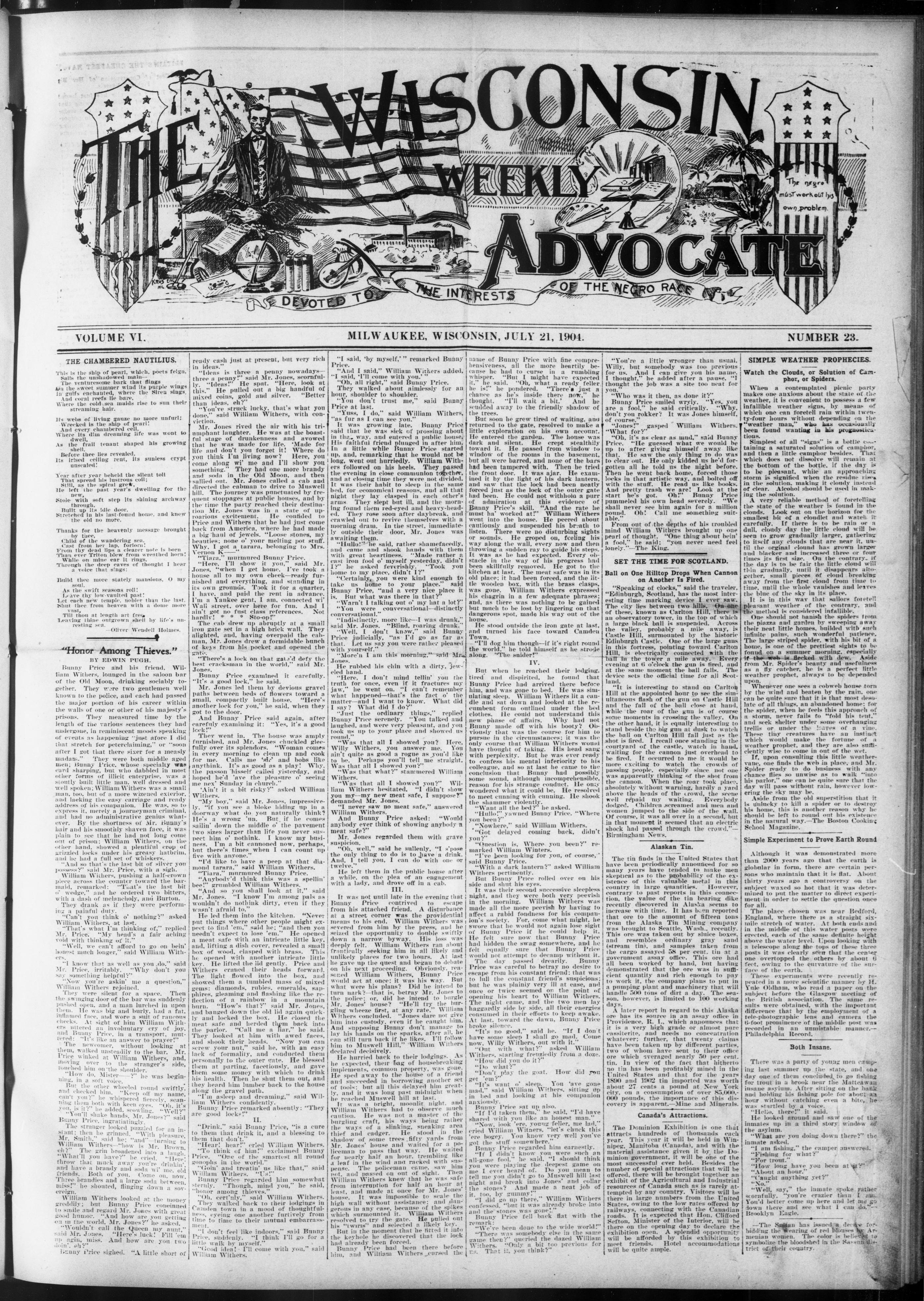
WISCONSIN
WEEKLY
ADVOCATE
DEVOTED TO THE INTERESTS OF THE NEGRO RACE
THE CHAMBERED NAUTILIUS.
This is the ship of pearl, which, poets feign,
Sallis the unshadowed main--
The venturesome bark that flings
On the sweet summer wind its purple wings
In gulfs enchanted, where the Siren sings,
And coral reefs lie bare.
Where the cold sea maids rise to sun their streaming hair.
Its webs of living gauze no more unfurl;
Wrecked is the ship of pearl!
And every chambered cell.
Where its dim dreaming life was wont to dwell,
As the frail tenant shaped his growing shell.
Before thee lies revealed.
Its irised ceiling rent, its sunless crypt unscaled!
Year after year beheld the silent toll
That spread his lustrous coll;
Still, as the spiral grew,
He left the past year's dwelling for the new,
Stole with soft step its shining archway through.
Built up its idle door.
Stretched in his last-found home, and knew the old no more.
Thanks for the heavenly message brought by tace.
Child of the wandering sea.
Cast from her lap, forlorn!
From thy dead lips a clearer note is born.
Than ever Triton blew from wreathed horn!
While on mine ear it rings.
Through the deep caves of thought I hear a voice that sings:
Build thee more stately mansions, O my soul.
As the swift seasons roll!
Leave thy low-vaulted past!
Let each new temple, nobler than the last,
Shut thee from heaven with a dome more vast,
Till thou at length art free.
Leaving thine outgrown shell by life's unresting sea.
"Honor Among Thieves."
BY EDWIN PUGH
Bunny Price and his friend. William Withers, lounged in the saloon bar of the Old Moon, drinking sociably together. They were two gentlemen well known to the police, and each had passed the major portion of his career within the walls of one or other of his majesty's prisons. They measured time by the length of the various sentences they had undergone, in reminiscent moods speaking of events as happening "just afore I did that stretch for peterclaiming," or "soon after I got that there sixer for a measly madan." They were both middle aged men; Bunny Price, whose specialty was card sharping, but who dabbled in most other forms of illicit enterprise, was a stoutly built little man, well dressed and well spoken; William Withers was a small man, too, but of a more wizened exterior, and lacking the easy carriage and ready address of his companion. He was, so to express it, merely a journeyman criminal, and had no administrative genius whatever. By the shortness of Mr. Bunny's hair and his smoothly shaven face, it was plain to see that he had not long come out of prison; William Withers, on the other hand, showed a plentiful crop of grizzled locks under his greasy hatbrim, and he had a full set of whiskers.
"And so that's the last bit of silver you possess?" said Mr. Price, with a sigh. William Withers, pushing a half-crown piece across the counter toward the barmaid, remarked: "That's the last bit o' wedge," and he ordered two bitters, with a dash of melancholy, and Burton. They drank as if they were performing a painful duty. "Can't you think o' nothing?" asked William Withers, at last.
"That's what I'm thinking of," replied Mr. Price. "My head's a fair aching void with thinking of it."
"Well, we can't afford to go on bein' honest much longer," said William Withers.
"I know that as well as you do," said Mr. Price, irritably. "Why don't you say something helpful?
"Now you're askin' me a question," William Withers rejoined.
They were silent for a space. Then the swinging door of the bar was suddenly pushed open, and a man lurched in upon them. He was big and burly, had a fat, inflamed face, and wore a suit of raucous checks. At sight of him William Withers uttered an involuntary cry of joy, and Bunny Price, in a transport, muttered: "It's like an answer to prayer!" The newcomer, without looking at them, walked unsteadily to the bar. Mr. Price winked at William Withers, and, moving over to the stranger's side, touched him on the shoulder.
"How do, Mister—?" he was beginning, in a soft voice.
But the other wheeled round swiftly, and checked him. "Keep off my name, can't you?" he whispered fiercely, scanning them both with keen eyes. "Oh, it's you, is it?" he added, scowling. "Well?" "You'll shake hands, Mr. Jones?" said Bunny Price, ingratiatingly.
The stranger looked puzzled for an instant; then he grinned. "With pleasure, Mr. Smith," said he; "and—turning to William Withers—how is Mr. Brown, eh?" The grin broadened into a laugh. "What'll you have?" he cried. "Here! throw that muck away you're drinkin', and have a brandy and soda wi' me, old friends. Both of you. Come on, now. Three brandies and a large soda between, miss!" he shouted, flinging down a sovereign.
William Withers looked at the money greddily; but Bunny Price conneined to smile and regard Mr. Jones with great good humor. "And how are you getting on in the world, Mr. Jones?" he asked. "Wouldn't call the Queen my aunt," said Mr. Jones. "Here's luck! Fill 'em up again, miss. And how are you two doin', ah?" Bunny Price sighed. "A little short of
ready cash just at present, but very rich in ideas."
"Ideas is three a penny nowadays—three a penny!" said Mr. Jones, scornfully. "Ideas!" He spat. "Here, look at this." He pulled out a big handful of mixed coins, gold and silver. "Better than ideas, eh?"
"You've struck lucky, that's what you done," said William Withers, with conviction.
Mr. Jones rived the air with his triumphant laughter. He was at the boastful stage of drunkenness and avowed that he was made for life. 'Made for life and don't you forget it! Where do you think I'm living now? Here, you come along wi me and I'll show you something." They had one more brandy and soda in the Old Moon, and then sallied out. Mr. Jones called a cab and directed the cabman to drive to Muswell hill. The journey was punctuated by frequent stoppages at public houses, and by the time the party reached their destination Mr. Jones was in a state of uproarious excitement. He confided to Price and Withers that he had just come back from America, where he had made a big haul of jewels. "Loose stones, my beauties; none o' your melting pot stuff. Why. I got a tarara, belonging to Mrs. Vernon K——"
"Tiara." murmured Bunny Price
"Here, I'll show it you," said Mr. Jones, "when I get home. I've took a house all to my own cheek—ready furnished and everything, and standing in its own grounds. Took it for a quarter, I have, and paid the rent in advance. I'm a Yankee gent, I am, connected wi' Wall street, over here for fun. And I ain't got no fust class references. Not hardly! * * * Sto-op!"
The cab drew up abruptly at a small iron gate set in a high brick wall. They alighted, and, having overpaid the cabman, Mr. Jones drew a formidable bunch of keys from his pocket and opened the gate.
"There's a lock on that gate'd defy the best cracksman in the world," said Mr. Jones.
Bunny Price examined it carefully. "It's a good lock," he said.
Mr. Jones led them by devious gravel paths between beds of flowers toward a small, compactly built house. "Here's another lock for you," he said, when they got to the door.
And Bunny Price said again, after carefully examining it: "Yes, it's a good lock!"
They went in. The house was amply furnished, and Mr. Jones chuckled gleefully over its splendors. "Woman comes in every morning to clean up and cook for me. Calls me 'sir' and bobs like anythink. It's as good as a play! Why, the passon hisse' called yisterday, and hoped he'd 'ave the pleasure o' seeing me nex' Sunday in church."
'Ain't it a bit risky?' asked William Withers.
"My boy," said Mr. Jones, impressively. "if you see a bloke hiding up in a doorway what do you naturally think? He's a wrong 'un. But, if he comes sailin' down the middle o' the pavement two sizes larger than life you never suspect him o' nothink. I know my business. I'm a bit cannoned now, perhaps, but there's times when I can count up five with anyone."
"I'd like to have a peep at that diamond tarara," said William Withers.
"Tiara," murmured Bunny Price.
"Anybody'd think this was a spellin' bee!" grumbled William Withers.
"And so you shall look at it," said Mr. Jones. "I know I'm among pals as wouldn't do nothink dirty, even if they wasn't afraid to."
He led them into the kitchen. "Never put things where other people might expect to find 'em," said he; "and then you needn't expect to lose 'em." He opened a meat safe with an intricate little key, and, lifting a dish cover, revealed a small box of wood, elasped with brass. This he opened with another intricate little key. He lifted the lid gently. Price and Withers craned their heads forward. The light flowed into the box, and showed them a tumbled mass of mixed gems: diamonds, rubies, emeralds, sapphires, gleaming and flashing like the reflection of a rainbow in a mountain burn. "How's that?" said Mr. Jones, and banged down the old lid again quickly and locked the box. He closed the meat safe and herded them back into the parlor. "Call me a liar," he said. They looked at him with awed faces, and shook their heads. "Now you can screw your nut," said he, with an easy lack of formality, and conducted them personally to the outer gate. He blessed them at parting, facetiously, and gave them some money with which to drink his health. Then he shut them out, and they heard him lumber back to the house along the gravel path.
"I'm asleep and dreaming," said William Withers confidently.
Bunny Price remarked absently: "They are good locks!"
II.
"Drink." said Bunny Price, "is a cure to them that drink it, and a blessing to them that don't."
"Hear! hear!" cried William Withers.
"To think of him!" exclaimed Bunny Price.
"One of the smartest all round gonophs in the world."
"Goin' and treatin' us like that," said William Withers. "Us!"
Bunny Price regarded him somewhat sternly. "Though, mind you," he said, "honor among thieves."
"Oh, cert'nly," said William Withers. They walked back to their lodgings in Camden town in a mood of thoughtfulness, eyeing one anotherfurtively from time to time to their mutual embarrassment. "I don't feel like indoors," said Bunny Price, suddenly. "I think I'll go for a little walk by myself." "Good idea! I'll come with you," said William Withers.
"I said, 'by myself,'" remarked Bunny Price.
"And I said," William Withers added, "I said, 'I'll come with you.'" "Oh, all right," said Bunny Price. They walked about aimlessly for an hour, shoulder to shoulder.
"You don't trust me," said Bunny Price at last. "Yuss, I do," said William Withers, "as fur as I can see you."
It was growing late. Bunny Price said that he was sick of pressing about in the way, and entered a public house. His faithful friend plunged in after him. In a little while Runny Price started up, and, remarking that he would not be long, went out hurriedly. William Wither's followed on his heels. They passed the evening in close communion together, and at closing time they were not divided. It was their habit to sleep in the same bed, for economical reasons, and all that night they lay clasped in each other's arms. They slept but ill, and the morning found them red-eyed and heavy-headed. They rose soon after daybreak, and crawled out to revive themselves with a morning dram. In the street, immediately outside their door, Mr. Jones was awaiting them.
"Hullo!" he said, rather shamefacedly, and came and shook hands with them with great heartiness. "Made rather a cast iron fool o' myself yesterday, didn't I?" he asked feverishly. "Took you home to my place, didn't I?"
"Certainly, you were kind enough to take us home to your place." said Bunny Price, "and a very nice place it is. But what was there in that?"
"Warn't I talking out o' my hat a lot?"
"You were conversational—distinctly conversational."
"Indistinctly, more like—I was drunk," said Mr. Jones. "Blind, roaring drunk."
"Well, I don't know," said Bunny Price judicially, "as I'd go as far as that. Let us say you were rather pleased with yourself."
"More'n I am this morning," said Mr. Jones. He rubbed his chin with a dirty, jeweled hand. "Here, I don't mind tellin' you the truth for once, even if it fractures my jaw," he went on. "I can't remember what happened—that's the fact o' the matter—and I want to know. What did I say? What did I do?" "Just the ordinary things," replied Bunny Price serenely. "You talked and laughed, and were very pleasant, and you took us up to your place and showed us round." "Was that all I showed you? Here, Willy Withers, you answer me. You ain't quite as good a rogue as you'd like to be. Perhaps you'll tell me straight. Was that all I showed you?" "Was that what?" stammered William Withers.
"Was that all I showed you?" William Withers hesitated. "I didn't show you my—my new meat safe, I suppose?" demanded Mr. Jones. "I never saw no meat safe," answered William Withers.
And Bunny Price asked: "Would anybody ever think of showing anybody a meat safe?" Mr. Jones regarded them with grave suspicion. "Oh, well," said he sullenly, "I spose the only thing to do is to have a drink. And, I tell you, I can do with one or twelve." He left them in the public house after a while, on the plea of an engagement with a lady, and drove off in a cab.
It was not until late in the evening that Bunny Price contrived to escape from his attached friend. A disturbance at a street corner was the providential means to his end. William Withers was severed from him by the press, and he seized the opportunity to double swiftly down a narrow byway. His loss was deeply felt. William Withers ran about frantically seeking him in all likely and unlikely places for two hours. At last he gave up the quest and began to debate on his next proceeding. Obviously, reasoned William Withers, Bunny Price would act at once; it was his way. But what were his plans? Did he intend to turn nark?—that is, betray Mr. Jones to the police; or, did he intend to burgle Mr. Jones' house? "He'll try the burgling wheeze first, at any rate." William Withers concluded. "Jones dare not give him into custody, even if he caught him. And supposing Bunny don't manage to lay his hands on the sparks, after all, he can still turn back if he likes. I'll follow him to Muswell Hill," William Withers declared decisively.
He hurried back to their lodgings. As he expected, their bag of housebreaking implements, common property, was gone. He sped away to the house of a friend and succeeded in borrowing another set of tools; but all this delayed him greatly, and it was long past midnight when he reached Muswell hill at last.
he reached Murswell in at last.
It was a bright, moonlit night, and William Withers had to observe much caution. He was not a master of the burgling craft, his ways being rather the ways of a slinking, sneaking area thief and cadger. He stood in the shadow of some trees fifty yards from Mr. Jones' house and waited for a policeman to pass that way. He waited for nearly half an hour, trembling like a leaf in the wind and racked with suspense. The policeman came, saw him not, and passed on out of sight. Then William Withers knew that he was safe from interruption for half an hour at least, and made at once for Mr. Jones' house. It was impossible to scale the high wall without assistance; and dangerous in any case, because of the spikes which surmounted it. William Withers resolved to try the gate. He pulled out his "twiris" and selected a likely key.
But in the moment that he fitted it into the keyhole he discovered that the lock had already been forced.
Bunny Price had been there before him and William Withers cursed the
name of Bunny Price with fine comprehensiveness, all the more heartily because he had to curse in a rumbling whisper. "But I might have expected it," he said. "Oh, what a ready feller he is!" he pondered. "There's just a chance as he's inside there now." he thought. "I'll wait a bit." And he scudded away to the friendly shadow of the trees.
But soon he grew tired of waiting, and returned to the gate, resolved to make a little exploration on his own account. He entered the garden. The house was dark and silent. He crept stealthily toward it. He passed from window to window of the rooms in the basement, but all were barred, and none of the bars had been tampered with. Then he tried the front door. It was ajar. He examined it by the light of his dark lantern, and saw that the lock had been neatly forced just as the lock of the outer gate had been. He could not withhold a purr of admiration at this evidence of Bunny Price's skill. "And the rate he must ha' worked at!" William Withers went into the house. He peered about cautiously and suspended his breath to listen. There were no disturbing sights or sounds. He groped on, feeling his way along the wall, every now and then throwing a sudden ray to guide his steps. It was as he had expected. Every obstacle in the way of his progress had been skillfully removed. He got to the kitchen at last. The meat safe was in its old place; it had been forced, and the little wooden box, with the brass clasps, was gone. William Withers expressed his chagrin in a few adequate phrases; and, as there was nothing to be gained but much to be lost by lingering on that dangerous spot, made his way out of the house.
He stood outside the iron gate at last, and turned his face toward Camden Town.
"I'll dog him though—if it's right round the world," he told himself as he strode along. "The snider!"
IV.
But when he reached their lodging, tired and dispirited, he found that Bunny Price had arrived there before him, and was gone to bed. He was simulating sleep. William Withers lit a candle and sat down and looked at the recumbent form outlined under the bed clothes. He could not understand this new phase of affairs. Why had not Bunny made off with his booty? Obviously that was the course for him to pursue in the circumstances; it was the only course that William Withers wound have thought of taking. His head sang with perplexity. But he was ever ready to confess his mental inferiority to his colleague, and so at last he came to the conclusion that Bunny had possibly some sound, although incomprehensible, reason for his strange conduct. He only wondered what it could be. He resolved to meet cunning with cunning. He shook the shammer violently.
"Hullo!" yawned Bunny Price. "Where you been?"
"Nowhere," said William Withers.
"Got delayed coming back, didn't you?"
"Question is, Where you been?" remarked William Winters.
"I've been looking for you, of course," said Bunny Price.
said Bunny Price.
"With a dark lantern?" asked William Withers pertinently.
But Bunny Price rolled over on his side and shut his eyes.
side and shut his eyes.
It was their second successive sleepless night, and they were both very peevish in the morning. William Withers was made all the more peevish by having to affect a rabid fondness for his companion's society. For, come what might, he swore that he would not again lose sight of Bunny Price if he could help it. He felt sure now that Bunny Price had hidden the swag somewhere, and he felt equally sure that Bunny Price would not attempt to decamp without it. The day passed drearily. Bunny Price was careful to betray no desire to escape from his constant friend: that was to hull the constant friend's suspicions; but he was plainly very ill at ease, and once or twice seemed on the point of opening his heart to William Withers. The night came, and the two men lay haggardly side by side, all their energies consumed in their efforts to keep awake. At last, toward the dawn, Bunny Price broke silence.
"It's no good," said he. "If I don't have some sleep I shall go mad. Come now, Willy Withers, out with it." "Out with what?" asked William Withers, starting freaziedly from a doze. "How did you do it?" "Do what?" "Don't play the goat. How did you get 'em?" "It's want o' sleep. You 'ave gone mad." said William Withers, sitting up in bed and looking at his companion anxiously.
Bunny Price sat up also.
"If I'd taken them," he said, "I'd have shared with you like an honest man."
"Now, look 'ere, young feller, me had," cried William Witners, "let's chuck this 'ere bogey. You know very well you've got the stuff somewhere."
Bunny Price regarded him earnestly.
"If I didn't know you were such an all-gone fool," he said, "I should think you were playing the deepest game on me I ever heard of. Do you mean to tell me you didn't go to Muswell hill last night and break into Jones' and collar the stones? And made a neat job of it too by gummy."
"I did go up there," William Withers confessed, "but it was already broke into and the stones was gone!"
Bunny Price fell back flat with the remark:
"We've been done to the wide world!"
"There was somebody else in the same game then?" queried the dazed William Withers.
"Only a bit too previous for us. That it, you think?"
"You're a little wronger than usual. Willy, but somebody was too previous for us. And I can give you his name. I thought," he added after a pause, "I thought the job was a site too neat for you."
"Who was it then, as done it?"
Bunny Price smiled wryly. "Yes, you are a fool," he said critically. "Why, don't you rokker? It was Jones himself, of course."
"Jones!" gasped William Withers. "What for?"
"Oh, it's as clear as mud," said Bunny Price. "He guessed what we would be up to after giving himself away like that. He saw the only thing to do was to clear out. He only kidded us he'd forgotten all he told us the night before. Then he went back home, forced those locks in that artistic way, and bolted off with the stuff. He read us like books. And pretty trash we are! Look at the start he's got. Oh!" Bunny Price pummeled his own head severely. "We shall never see him again for a million pound. Oh! Call me something suitable."
From out of the depths of his troubled mind William Withers brought up one pearl of thought. "One thing about bein' a fool," he said; "you never need feel lonely."—The King.
SET THE TIME FOR SCOTLAND.
Ball on One Hilltop Drops When Cannon on Another Is Fired.
"Speaking of clocks," said the traveler. "Edinburgh, Scotland, has the most interesting time marking device I ever saw. The city lies between two hills. On one of these, known as Carlton Hill, there is an observatory tower, in the top of which a large black ball is suspended. Across the valley, probably a mile away, is Castle Hill, surmounted by the historic Edinburgh Castle. One of the large guns in this fortress, pointing toward Carlton Hill, is electrically connected with the ball in the tower a mile away. Every evening at 6 o'clock the gun is fired, and at the same moment the ball falls. The device sets the official time for all Scotland.
"It is interesting to stand on Carlton Hill at the appointed hour to see the simultaneous flash of the gun on Castle Hill and the fall of the ball close at hand, while the roar of the gun is of course some moments in crossing the valley. On the other hand, it is equally interesting to stand beside the big gun at dusk to watch the ball on Carlton Hill fall just as the shot is fired. I recall once standing in the courtyard of the castle, watch in hand, waiting for the cannon just overhead to be fired. It occurred to me it would be more exciting to watch the crowds of passing people, especially since not one was apparently thinking of the shot from the cannon. When the roar took place, absolutely without warning, hardly a yard above the heads of the crowd, the scene well repaid my waiting. Everybody dodged. Children screamed and men and women jumped to the side of the wall. Of course, it was all over in a second, but in that moment it seemed that an electric shock had passed through the crowd."—Birmingham News.
Alaskan Tin.
The tin finds in the United States that have been periodically announced for so many years have tended to make men skeptical as to the probability of the existence of this valuable metal in this country in large quantities. However, contrary to past reports in this connection, the value of the tin bearing dike recently discovered in Alaska seems to increase with time. It has been reported that ore to the amount of fifteen tons from the Alaska Tin Mining company was brought to Seattle, Wash., recently. This ore was taken out by sluice boxes, and resembles ordinary gray sand (stream tin), and samples taken from the cargo assayed 58 per cent. tin at a government assay office. This ore had all been worked by hand, but having demonstrated that the ore was in sufficient quantity and rich enough to pay to work it, the company plans to put in a pumping plant and machinery that will handle 500 tons of dirt a day. The season, however, is limited to 100 working days.
A later report in regard to this Alaska ore has its source in an assay office in Providence, R. I., which announces that it is a very high grade or almost pure cassiterite, and needs no concentration whatever; further, that twenty claims have been taken up by different parties, two of whom have sent to their office ore which averaged nearly 50 per cent. tin. In view of the fact that hitherto no tin has been profitably mined in the United States and that for the years 1890 and 1902 tin imported was worth about 27 cents a pound at New York city, on a consumption of over 85,000,000 pounds, the importance of this discovery is apparent.—Mine and Minerals.
Canada's Attractions.
The Dominion Exhibition is one that attracts hundreds of thousands each year. This year it will be held in Winnipeg, Manitoba (Canada), and with the material assistance given it by the Dominion government, it will be one of the most successful ever held. Besides the number of special attractions that will be offered, there will be brought together an exhibit of the Agricultural and Industrial resources of Canada such as is rarely attempted by any country. Visitors will be there in large numbers from the United States, owing to the low rates offered by railways, connecting with the Canadian roads. It is expected that Hon. Clifford Sefton, Minister of the Interior, will be there on the opening day to declare the exhibition open. A splendid opportunity will be afforded by this exhibition to meet friends. Hotel accommodations will be quite ample.
SIMPLE WEATHER PROPHECIES.
Watch the Clouds, or Solution of Cam phor, or Spiders.
When a contemplated picnic party makes one anxious about the state of the weather, it is convenient to possess a few infallible weather signs, by means of which one can foretell rain within twenty-four hours without depending on the "weather man," who has occasionally been found wanting in his prognostications.
Simplest of all "signs" is a bottle containing a saturated solution of camphor, and then a little camphor besides. That which does not dissolve will remain at the bottom of the bottle, if the day is to be pleasant, while an approaching storm is signified when the residue rises in the solution, making it cloudy instead of clear. Alcohol should be used in making the solution.
A very reliable method of foretelling the state of the weather is found in the clouds. Look out on the horizon for the smallest bit of a cloudlet and watch it carefully. If there is to be rain or a dull, cloudy day the little cloud will be seen to grow gradually larger, gathering to itself any clouds that are near it, until the original cloud has grown larger and blacker and increased three or four times its first size. On the contrary, if the day is to be fair the little cloud will tbin gradually, until it disappears altogether, small pieces of cloud breaking away from the first cloud from time to time, until the whole vanishes and leaves the blue of the sky in its place.
It is in this way that sailors foretell pleasant weather of the contrary, and the method is considered infallible. One should not banish the spiders from the piazza and garden by sweeping away their neat little homes, builted with such infinite pains, such wonderful patience. The large striped spider, with his bit of a home, is one of the prettiest sights to be found on a summer morning, especially if the web is flecked with dew. Aside from Mr. Spider's beauty and usefulness as a fly catcher, he is a perfect little weather prophet, always to be depended upon.
Whenever one sees a cobweb house torn by the wind and beaten by the rain, one can be quite sure that it is that most desolate of all things, an abandoned home; for the spider, when he feels this approach of a storm, never fails to "fold his tent," and seek shelter under some overhanging trellis or under the leaves of a vine. These tiny creatures have an instinct which would make the fortune of a weather prophet, and they are also sufficiently wise to come in out of the wet. If, upon consulting this little weathervane, one finds the web in place, and Mr. Spider ready to do business with any chance flies so unwise as to walk "into his parlor," one can be quite sure that the day will pass without rain, however lowering the sky may be.
Aside from the old superstition that it is unlucky to kill a spider or to destroy his home, this is another reason why he should be left to round out his existence in the natural way. The Boston Cooking School Magazine.
Simple Experiment to Prove Earth Round
Although it was demonstrated more than 2000 years ago that the earth is globular in form, there are certain persons who maintain that it is flat. About thirty years ago a controversy on the subject waxed so hot that it was determined to put the matter to direct experiment in order to settle the question once for all.
The place chosen was near Bedford, England, where there is a straight sixile stretch of water. At both ends and in the middle of this water posts were erected, each of the same definite height above the water level. Upon looking with a telescope along the tops of these three posts it was clearly seen that the center one overtopped the others by about 6 feet, owing to the curvature of the surface of the earth.
These experiments were recently repeated in a more scientific manner by H. Yule Oldham, who read a paper on the subject before the Glasgow meeting of the British association. The same results were obtained, with the important difference that by the employment of a tele-photographic lens and camera the 6-foot prominence of the middle post was recorded in an unmistable manner. Philadelphia Record.
Both Insane
There was a party of young men camping last summer up the state, and one day one of them concluded to go fishing for trout in a brook near the Matteawan insane asylum. After sitting on the bank and holding his fishing pole for about an hour without catching even a bite, he was startled by a voice. "Hello, there!" it said. He looked around and saw one of the inmates up in a third story, window of the asylum. "What are you doing down there?" the inmate asked.
"Well, say," the inmate spoke rather scornfully. "you're crazier than I am. You'd better come up here and let me go down there and see what I can do."—Brooklyn Eagle.
—The Sultan has issued a decree forbidding the wearing of red blouses by Armenian women. The color is believed to symbolize the bloodshed in the Sassun district of their country.
Curious Condensations.
—Spider mothers remember their offspring after an absence of 20 hours, but forget them when a full day has elapsed.
—Radium is said to be well but finely distributed in the crust of the earth. New finds in some country are reported almost daily.
—All kinds of corn are altered by heat, but only in the popcorn is the structure such as to favor an explosion, which gives to the popcorn its name.
—Gold was first discovered in Alabama at Arbacoochee in 1845, and from that year to 1849 5000 persons were shaking pans for the precious particles.
—Sachs, who was both an albino and a scientist, demonstrated that the hair of albinos contains less iron than that of normally constituted individuals.
Some of the inhabitants of Cambridge, England, are trusting to the presence of a goat to protect them and their houses from the infection of smallpox.
The male human needs more food than the female. The man tends to expend energy and the woman to store it up in the form of fat; he burns the faster.
Owing to great losses of cattle by the rinderpest in Egypt, the large plantations and farmers there are about to introduce steam plows and automobile machines for the cultivation of grain and cotton.
A mining shaft at Sombrerete, Mex., is almost exactly on the tropic of Cancer, and at noon on June 21 the sun shines to the bottom, lighting up the well for a vertical depth of 1,100 feet or more.
Anybody may practice medicine in China; no license or special course of study is required. Many of the physicians are students who have failed to pass the government examinations.
In a recent European case reported in a French paper a murderer was detected through the agency of a thumb print on the rail of a broken sash—so slight a mark that it was scarcely visible.
A hotel keeper in the City of Mexico has been condemned to a year's imprisonment and has been fined $33.70 for stealing from the electric light company the current with which his hotel was lighted.
The examination of the physical condition of the 1800 street sweepers employed by New York city shows that 283 are affected with tuberculosis, contracted during the course of their work by inhaling disease-laden dust.
Careful tests at Cornell university demonstrated that a one-horse power engine working continuously for one hour could produce only enough liquid air, when converted into power, to run a one-horse power engine one minute.
The best dye for blue was formerly furnished by the indigo plant, but chemists and scientists have been able to procure from the byproducts of petroleum an inline dye which for almost all ordinary purposes has supplanted indigo.
With two exceptions there have been no young men elected to the office of vice presidents of the United States. These two exceptions were John C. Breckenridge, who was 36 when he became vice president, and Theodore Roosevelt, who was 43.
A specie of natural soap tree is found in Japan, China and India. By using water of alcohol the saponaceous ingredient of the fruit is extracted. The soap possessing no alkaline qualities is claimed to be superior to the ordinary soap of commerce.
That most extraordinary pearl—or, rather, cluster of pearls—known as "the Southern Cross," is owned by a syndicate of Australian gentlemen, who value it at $500,000. It consists of nine pearls, naturally grown together in so regular a manner as to form a perfect Latin cross.
The hydroscope may render useless torpedo boats and mines. Should the captain of a cruiser see the submarine prowler or projectile he could destroy it before any damage was done. In navigation the instrument should also be serviceable, as rocks and sandbanks will be clearly seen.
Until recently it was almost universally believed that petroleum was, like coal, derived from fossil vegetation or possibly from animals or fishes of some long past age. Now it is asserted by many scientific men that it may not be of organic origin, but may be due to subterranean chemical action.
In those lands where horses are the food of men all manner of flesh goes the way of the sausage machine. Recently there had to be slaughtered at Ghent an elephant, the last inhabitant of the zoological garden, and his flesh, which is stated to have weighed 3800 pounds, or nearly two tons, all went to the sausage makers.
The Korean never cuts his hair or beard. To do so is considered a mark of dishonor to his parents, whom he strongly reverences. Aany hairs that may happen to come out and even the parings of his finger nails are carefully saved and put into the coffin with him in order that he may go back to mother earth intact.
How readily Americans "move" is shown by the fact that hardly two-thirds of the representatives and only about half the senators in Congress were born in the states which they now serve. No member of either house from Colorado, Idaho, Montana, the Dakotas, Washington or Wyoming is a native of the state he represents.
Twenty years ago a great volcanic eruption absolutely killed all life in the volcanic Island of Krakatoa, near Java. This island has again become covered with verdure, without the agency of man. The first vegetable settlers on the covering of pumice stone, lava and ash were microscopic algae. These organisms covered the surface with a slimy layer, which acted as a decomposing agent and created a valuable substratum for ferns.
—Taking the last five years the world's average production of cotton per annum has been 16,000,000 bales, calculated at 500 pounds to the bale; the production during the year 1898 was 15,500,000 bales. This gives an increase of but 500,000 bales during the last five years, or an average increase of 100,000 bales per year, which does not keep step with the increase of the world's population and the much greater use and demand for cotton fabrics which is a marked feature of the times.
Among the French coins which are no longer current are, as is well known, those of a less value than 5 franc, struck prior to 1852, and nearly everybody has had a difficulty in making them circulate. But now their progress has been made comparatively easy and that by a very simple means. The head of Napoleon 111, was uncrowned and that rendered them easy to be distinguished. Some ingenious individuals have now undertaken the coronation ceremony by means of an engraving tool, and unless great attention is paid it is very difficult to tell them from the others.
Force of Habit
John was a groom of whom his employer was very fond, but when the latter started on a trip recently and took John along as a valet he did not find the experiment a success.
"Yes," he said to his friends, later. "I had to let John go. I managed to teach him to take care of my things and all that, but whenever he brushed me off he couldn't get over clucking, just as he used to do when currying the horses, and that was more than I could stand.—New York Sun
FROM 'THE VOICE OF THE SEQUOIA.
"Abide long as I may,
Dreaming my dreams until they fade away.
"The morning I did push
My twigs the little height of yonder bush
"Ruddy Justinian saw.
Rusied betwixt the bishops and his Law;
"Mahomet knew those skies.
Lithe-limbed, the fire of prophets in his
eyes.
"Again and yet again
The burdened wind. There dawned a morn-
ing when
"It said thy sires cried out
To the free hills; I heard the answeri-
shout—
"Well freed thy land; the sea
Rolls all her waves 'twixt it and tyranny—
"I caught a kindred cry
From France the beautiful; she hung the
sky
"With horrors while she thrust
Oppression through and trod him in the
dust.
"Now 'twas, the Furies ran
And loosed, hawk-beaked and clawed, the
Corsican.
Again and yet again
The burdened wind. One of the new-time
men,
"Goodly and tall and fair
He stood, trusting the hand that planted
there;
"He took the upper wind
I knew—Lincoln, the cedar of his kind.
"Those sad new days ye know.
They fade from me; and it is better so."
The voice fell falter now.
As when on summer eves it failed the
bough;
No further did it say.
But, sighing, drifted with the dreams away.
—John Vance Cheney in Atlantic.
A Twentieth Century Cinderella.
Jack Berenson caught sight of her as he was going to the office after lunch. He frequently caught sight of her, but this was the extent of their acquaintance. He had groaned more than once to think conventionality forbade a more extended one. She was not the kind of a girl with whom one might scrape up a bowing recognition, to be later elaborated into an interchange of commonplaces that might culminate in permission to call. Indeed, if she had been, it is safe to conclude Berenson would not have troubled his head about her, for he had a social position to maintain, a good deal of personal pride and more than the average sense of exclusiveness.
"Hallo!" he said, suddenly, and stopped short. The girl ahead had paused. She was evidently in some predicament, for she stooped as though to extricate herself or to pick up an article dropped. Almost at the same instant, however, a tremendous dray, piled with boxes, bore down upon her, and at the shout of the driver, who was striving to rein in his huge Percherons, she sprang toward safety and reached the sidewalk.
Berenson let the dray pass. Looking down directly on the spot where the girl had hesitated, he saw that which had arrested her, and bending quickly, he pulled out of the thick, black, sticky mud an absurdly small rubber, with its wrinkles holding the arch of a high little instep. "Well!" he ejaculated, "here's luck!" He felt ridiculously elated. So pleased did he look, in fact, that a friend jostling him as he reached the opposite sidewalk remarked his satisfaction.
"Wheat gone up. Bergenson?"
Wheat gone up, Berenson.
"No—rubber!" laughed Berenson. And his friend walked off, wondering what there was in fishing footwear out of the mire to make a fellow look so idiotically pleased.
"It was mighty muddy, too!" he commented disgustedly.
This accusation could not be made against it an hour later, cleansed and polished to the highest possible degree by the man who kept the Berenson in the office building where Berenson had a suite. He took his prize upstairs, and deposited it, wrapped in tissue paper, on the top of his desk.
Then he sauntered to the window to look over at the skyscraper across the way, where at a certain window, in a certain tier, he had often seen a certain head. It was a shapely head, ringleted as close as a baby's with sunny brown curls. Indeed, so frequently of late had he gone to his own casement to discover if that particular bonnie head and rose-leaf face were within range of his vision that his business began to suffer from such erratic absences.
Not that Jack Berenson was bothering himself about business. During those minutes he stood, absorbed in daydreams, staring apparently at the uninteresting wall of an uninteresting building, he was thinking for the most part how strange it was that he, who had come gayly up the road of life, heartwhole and fancy free, until he had reached his thirtieth milestone, should all at once be beset by the most chimical hopes, the most futile desires, the most glorious of chaotic imaginings.
It was lunacy, he told himself—stark, staring lunacy—that he should go on his way with a bounding heart and a feeling of the most senseless exhilaration, just because he had passed a girlish figure on the sidewalk, met the indifferent glance of violet, black-lashed eyes, looking forth from beneath a white brow, or caught the faint, elusive perfume of her demure garments. And the worst of it was that he could not bring himself to be indignant with himself for being such a fool! "You like to be a fool!" he told himself angrily. "You're hugging your folly! And much good it will do you! You've not got enough sense, Jack Berenson, to last a crazy man till breakfast time!"
With which final shot he was apt to break away from his vigil, return sternly to his desk and plunge into work until—until he began to wonder if she might have returned to her chair in the window, or by any chance be going out. Though whether out or in, there had seemed slight chance of making her acquaintance before Fate, in the guise of a treacherous street crossing, had placed a belonging of hers in his possession. But when he had sallied forth with his prize his courage almost failed him. And when the elevator man let him off
at the eighth floor, as bidden, it was an insane desire to make his immediate escape by way of the staircase that overwhelmed him. But he pulled himself together and went toward the suite of doctors' offices which he knew occupied that particular angle of the big building. Some of the physicians whose names were inscribed on the tablet in the corridor were friends of his. "Hope I don't run into Norton, or Schriener, or Macintyre," he said. "Hope I don't."
But he did—all three of them. They and a few of their professional associates had met in the reception room previous to attending a medical convention in a body. It seemed to poor Berenson, standing helplessly in the doorway with his package in his hand, that the place was packed with eyes—curious, inquisitive, mocking eyes!
But a few voices called out pleasantly enough, "Hallo—how d'ye do, Berenson?" And MacIntyre came forward with a smile that made his ugly countenance quite charming.
"Your—the young lady—" stammered Jack. He held out the package much as though it were a letter of introduction. "She lost this and—"
"Oh, I see!" The doctor turned hastily. "Miss Meredith!" he called.
A girl—the girl—came from an adjoining room. She looked lovelier than ever without her hat and coat. Her soft, green gown fitted her as its sheath fits a flower. And the pretty; bewildered look in her eyes made them look more than ever like violet stars.
Berenson knew then how a man felt who performs a deed of daring in the cannon's mouth.
"I was behind you this noon," he began, "and when you lost this"——
"Oh, thank you!" she interrupted, comprehending at once, and taking the offered bundle. "You were very kind to bring it to me!"
"Vera." MacIntyre said, "let me introduce to you Mr. Berenson. You have often heard Alice mention him. I am sure. Jack—this is Miss Meredith, my wife's sister!" And then as they bowed he went on by way of explanation. "Vera has been looking after callers at the offices here during the last six months. She would work—you know what girls are!"
Jack didn't know, but he mentally decided to remain ignorant no longer. He would remedy his deficiencies in this respect as soon as possible, at least as far as this one bewitching maiden was concerned. And he vowed that he had never before guessed what a thoroughly delightful chap MacIntyre was until he heard the latter saying before he went off with his friends:
"Oh, I say, Berenson! Come to dinner tomorrow night—quite informal, you know. Six o'clock. Alice will be mighty glad to see you!"
Jack looked doubtfully into the violet eyes.
There was a smile in them, though the lips were sweetly serious.
"I'll come!" promised Jack fervently. He wrung his friend's hand vigorously in the ardor of his friendship. "Lord, yes, I'll come!" And he said to himself as he strode back to the office with his head in a whirl that it might not be quite so romantic to find a rubber in Chicago mud as a slipper on a ballroom floor, but that it has its—possibilities! It would serve! —Kate M. Cleary in San Francisco Call.
MODELING IN CORK
New Fad to While Away the Long Winter Evenings.
An interesting and extremely fascinating occupation for the long winter evenings is that of modeling in cork, and after a little practice the persevering ones will be surprised to find what clever and ingenious young architects they will become, while they will be greatly charmed as the crude design grows beneath their nimble fingers. Let us suppose that it is desired to manufacture a model of some old ruined castle, upon which the clinging ivy twines so tenderly, and around which hover many memories of bygone state and splendor.
Workers must first supply themselves with the necessary materials and proper tools. Of the latter they will require some paint brushes, a hammer, a sharp penknife, a pencil and a pair of scissors. Having procured these, they must obtain a quantity of cardboard cork sheets, a few old bottle corks, a little fine sand, paints, glue, wire and a small quantity of artificial moss and ivy.
And now, having decided upon the building and procured the necessary materials, the next thing to be done is to draw a plan of the castle you intend to reproduce. This accomplished, you may proceed to make a frame of light cardboard, cutting it carefully to the requisite size, and then securing upon the millboard framework a layer of the sheet cork to form the walis. This may be made to represent stonework by means of uneven pencil strokes, which should afterward be colored in with black or dark brown paint, in order to give the structure a suitable appearance of age.
The particular portion of the castle which has fallen into absolute ruin and decay should have rough and jagged edges. The walls should be darkened by means of a little brown paint judiciously applied, and small, irregular pieces of cork may be heaped against the sides to represent fallen masonry. Broken columns are quite easy to imitate, and if an ordinary cork be roughly carved with a sharp pocketknife and then carefully painted and sprinkled with a small quantity of moss, which should be rubbed between the fingers until a light powder is formed, it will be found to serve the purpose most effectively.
And now the artificial ivy (which must be of a small-leaved variety) may be called into requisition and trained around the broken columns and upon the crumbling walls until a most realistic appearance is given to the whole. The floor should be strewn with sand with which a little powdered moss has previously been mingled.—Memphis News.
Tne Wrong Department.
A prominent physician tells this story at the expense of the modern craze for specialization in the medical profession: A poor woman from the east side of New York went to a near-by dispensary to ask aid for her little son, who had one of his fingers smashed by a baseball bat. At the first room where she applied she was told by a curt attendant that the boy could not be treated there.
"Wrong place," he explained; "this is the eye and ear department."
"Vere is der thumb und finger department?" inquired the woman, simply.— Harper's Weekly.
Insects Don't Touch Rice
A remarkable fact connected with the rice plant is its almost entire immunity from the attacks of insects, and from those diseases which infect the cereals and other vegetable growths, as also that it supplies a wholesome diet for one-half the population of the world.
THE PORCH
1. When father built the veranda,
He kicked about the expense,
But ma, she said:
"Don't mind it, Ed—
Don't think of dollars and cents."
2. That autumn Clara was married,
It made pa glad as could be,
And ma would smile
Most all the while.
"I'm proud of that porch," said she.
3. Last summer both Belle and Amy
Would race for the porch at night;
And all the rest
Of us thought best
To stay indoors, out of sight.
4. But Belle ran faster than Amy—
She got her man in July;
And I'll commend
That porch to send
A bachelor's oath sky high.
Last Sunday Amy informed us That she had told Jimmy "yes," And now us three, Pa. ma. and me, Can get on that porch. I guess. Cleveland Leader.
New York Every Day.
United States Senator Alger of Michigan and Mrs. Alger sailed for Europe on the steamship Minneapolis.
The King of Italy has conferred the knighthood of the crown of Italy upon Heinrich Conried, director of the Metropolitan Opera house, in recognition of his successful efforts to promote the revival of Italian opera in New York.
Elizabeth Tyree, who for the last decade has been a popular New York actress, was married to James Stetson Metcalfe of New York city. The ceremony was performed at the Marble Collegiate church by Rev. Dr. Burrell.
Charles M. Schwab, just before he sailed for Europe on the Kaiser Wilhelm II., confirmed a report that he had parted with $1,910,000 of his money to reimburse his friends for their losses in the Bethlehem Steel plant.
The divorce obtained by Lillian Nordica, the singer, from Zoltan Doeme, has been upheld by the appellate division of the supreme court, which decides that the interlocutory decree was not obtained by fraud or collusion, as was charged by Mr. Doeme.
The judgment for $75,000 for alleged breach of promise awarded by a jury to Eleanor Anderson in her suit against James N. Abeel, who, she alleges, wooed her under the name of "J. Ogden Goellet," was vacated by the appellate division of the supreme court, which finds that the service of summons and complaint in the case was defective.
Miss Ellen Terry will appear next season under the management of Charles Frohman in London and the United States. Mr. Barrie is writing a modern comedy in which Miss Terry will be seen, and the author is greatly delighted that the part of his new heroine will be created by the distinguished actress. This puts an end to the rumors that an arrangement was being made by which Sir Henry Irving and Miss Terry were again to appear together.
Edward R. Taylor, a city missionary of Plainfield, N. Y., has just ended a thirty-day fast and appears none the worse for his ordeal. When he started to abstain from solid food, he tipped the scales at 220 pounds, and today he weighs but 25 pounds less. During the time of his abstinence from solid nourishment Mr. Taylor took walks for exercise and part of the time attended to his duties as missionary. He declares that his general health is much better.
Mark Twain and about forty other first cabin passengers got caught in a smallpox scare on the Hamburg-American liner Prinz Oscar, and had to undergo vaccination. Nearly 300 steerage passengers were vaccinated at the same time. The vaccination of the whole ship load of passengers turned out to be a useless precaution, as there was not any worse case aboard than a baby with what was perhaps chicken pox, but was diagnosed by one physician as flea bites.
By the breaking of a cable a three-ton block of granite fell 120 feet from the old New York Times building to the crowded Park Row sidewalk, smashing through the timber shed and stone flagging into the basement. Six persons were hurt by splinters from the timbers. The stone was a piece of old coping which was being removed preparatory to adding three stories to the structure.
Edward R. Taylor, a city missionary of Plainfield, N. J., has just ended a thirty days' fast and appears none the worse for his ordeal. When he started to abstain from solid food he tipped the scales at 220 pounds, and today weighs but twenty-five pounds less. During the time of his abstinence from solid nourishment Mr. Taylor took walks for exercise and part of the time attended to his duties as missionary. He declares that his general health is much better.
The New York Central is installing what is understood to be the longest private telephone wire in existence. It will run from Grand Central station to Weehawken, from which point it will follow the West Shore tracks to Buffalo, thence to Chicago over the Lake Shore route. The line will give quick private service and is expected to save much of the present large telegraph and telephone tolls.
Miss Anna Laughlin, who has played the part of Dorothy Gale in the "Wizard of Oz" since its first production, was married to Van Monroe, a young business man of New York city. The ceremony took place at St. Stephen's church. The maid of honor was Miss Josephine Clayton. Following the ceremony a wedding breakfast was served at the Ansonia. It is not Miss Laughlin's intention to retire from the stage. She will resume her old role in "The Wizard of Oz" when it begins its tour at St. Louis.
An interesting feature connected with the burial of former State Senator George B. Sloan, at Oswego was the carrying out of a pagan rite at the grave by Kitawaga, for many years his Japanese valet. Sloan was an Episcopalian and the services were according to that church's rites. At the conclusion Kitawaga appeared at his dead master's grave and after pronouncing the invocation to the gods of his country opened a cage and liberated six pure white doves.
Two highwaymen in silk hats, white kid gloves and evening dress, sandbagged William Gaffney, a wealthy contractor in Tremont avenue, the Bronx, and robbed him of $140 in cash, a diamond pin and a gold watch and chain. The men were driven to a hotel in Tremont avenue in a stylish carriage by a coachman in livery and there met Gaffney. They induced him to go with them a few steps from the hotel, where they robbed him and left him unconscious. They were then driven away in their
---
carriage, escaping their pursuers from the hotel who had been aroused by Gaffney's cries. The police have been unable to gain any trace of the men.
The total dead in the destruction of the excursion steamer General Slocum June 15 is given as 958 in the final report presented to Police Commissioner McAdoo today by the inspectors in charge of the police investigation. Only 897 of the dead were identified. Sixty-two persons were reported missing and 180 were injured. Only 235 out of nearly 1400 on the steamer escaped injury or death. Assuming that the unidentified dead are among the missing, all but one person has been thus accounted for.
Tammany officials, with Sheriff Mitchell L. Erlanger in the van, appeared before the state civil service commission and clamored for 2000 civil service positions, the holders of which are now protected by the civil service law. They put forward the argument of personal responsibility for their departments and endeavored to have these positions transferred from the competitive to the exempt classes, so they could remove the present employees and fill their places with Tammany followers.
Three government prisoners on Governor's island made a desperate attempt to escape. A sentry shot one of them, the bullet entering the prisoner's jaw and almost tearing off the man's head. A private of Co. H. sentry on the southern end of the island, saw three men clambering over the sea wall. They ran toward a rowboat and the sentry fired. One of the men, William Rheiner, fell. The other two then threw up their hands.
John B. Herreshoff, president of the Herreshoff Manufacturing company, has received a flattering cablegram from the German emperor regarding the American schooner yacht Ingomar, which was so successful at the Kiel regatta. The Kaiser praised the design, the construction and the performance of the Ingomar, and requests that the Herreshoff's submit to him plans and estimates of cost of a yacht similar in model, but of larger size than Commodore Plant's vessel.
The Amateur Athletic union buckle girdle that the officers decided to give to Miss Alice Roosevelt after she had awarded the prizes at the championship meet at St. Louis has been sent by express to Oyster Bay. The girdle is composed of heavy silk joined with a buckle consisting of three gold medals which represent the handicap prizes, the junior championship prizes and the senior championship prizes of the St. Louis contests. As President Roosevelt is honorary president of the Olympic games held at St. Louis this year he has been requested to present the girdle to his daughter.
Strikes of the plumbers, gas fitters and steamfitters and helpers have been ordered on all the contracts of New York general contractors in outside cities to force a system of exchange of cards with unions in outside cities. The buildings affected are in Pittsburg, Philadelphia, Baltimore, Washington, Newark, Binghamton, Jersey City and Princeton.
Miss Amelia Bingham will open her season in Norfolk, Va., playing a repertory of her New York successes. In addition to the company she had last season, John Kellerd and Joseph Kilgour have been engaged. After making a tour of the south and middle west, Miss Bingham will bring here, just before the holidays, a new play dealing with American life, by George Middleton, who collaborated with Paul Kester in the dramatization of Julia Marlowe's "The Cavalier." The title selected is "The Vital Issue."
D. Percy Morgan, millionaire, clubman and whip, left his palatial residence on the old Boston post road at Harrison-on-the-Sound, N. Y., on Sunday, May 29. He started for New York with his three youngest children and has not returned. For several years Mr. and Mrs. Morgan have occupied the historic Jay mansion, adjoining the country seat of John E. Parsons, the millionaire lawyer, who is the father of Mrs. Morgan. They have entertained extensively and Mrs. Morgan took a great interest in charitable work and was one of the main supports of the fresh-air outings for old women from Manhattan. No members of the Morgan or Parsons family could be found today.
George Thatcher, the veteran minstrel who has just been engaged by Henry W. Savage, to play the role of Sassafras Livingston in the western "County Chairman" company, received a telegram from his wife recently, saying that her uncle left an estate worth $100,000. Nevertheless, he says he will play Sassafras Livingston.
Society at Newport has a new fad in which the time honored scrapbook is playing the principal part. It is an old idea adapted to a new purpose—one through which everyone becomes her own biographer. The fad was discovered through a "run" on stationery stores for scrapbooks. Then it was learned that it is the thing now to cut from newspapers all that is printed about one's self, then to paste the clippings into books. It is said to be a rule among the faddists not to discriminate between pleasant and disagreeable things that have been published.
Richard Watson Gilder is almost entirely recovered from his attack of appendicitis. The prolonged, but not dangerous illness from which he suffered all last winter has also nearly disappeared. The report that he had rented Four Brooks farm to "Mark Twain" and would himself go to Europe is incorrect. Mr. Clements has rented a cottage called "Glencote" on the Gilder farm and will take possession in a few days.
Considered purely as a sight New York is growing in importance every day. Last summer there were only three "Seeing-New-York" coaches in commission. Now there are twenty-two. Two rival companies are doing all the business they can handle in showing strangers the show places of the city. The charge for a ride through the city on one of these coaches is $2, and it is well worth the money. A lecturer with a megaphone accompanies each coach, and every point of interest is given attention. Four yachts are running around the harbor engaged in the same business. A tabloid year in New York may thus be had for the small sum, etc.
Many people wonder why they call it "Coney Island." The correct answer to this question is: Because it is an island. According to the school book geography an island is a body of land completely surrounded by water. Coney fills the bill by a very narrow margin. In the heat of the summer the little creek which isolates it from the mainland is hardly more than a ribbon, and a good jumper might easily clear it with a short run.
All Brooklyn is to turn vegetarian, according to the predictions of The Eagle. It says many physicians of the city insist that the putting of meat at prohibitive prices will bring a twofold blessing. The cost of living will not only be decreased, they say, but the health of those using a vegetarian diet will be greatly improved. There are twelve vegetarian restaurants in the town, and all are doing an increasing business.
BRITAIN'S THE CHEAPEST NAVY
Low Cost of Construction of Her Big Fighting Vessels.
The British admiralty has just issued a compilation of statistics showing that the ravy of England is built and maintained at a lower rate of cost, in proportion to the effectiveness of its fighting strength than that of any other first-rate power.
After citing the official estimate of £112 per ton for the building of the new French battleship Patrie, and the price of £100 per ton which Russia is paying for her most modern war vessels, the United States is represented as paying £97 for the new ships now being laid. Next in cheapness comes the German navy, the fighting machines of which cost the imperial treasury £90 per ton, while the record bargain is struck in the King Edward VII. at £89 per ton.—New York Times.
Of Wide Interest
Breed, Wis., July 18.—Special. Chas. Y. Peterson, Justice of the Peace for Oconto Co., has delivered a judgment that is of interest to the whole United States. Put briefly, that judgment is, "Dodd's Kidney Pills are the best Kidney medicine on the market today."
And Mr. Peterson gives his reason for this judgment. He says: "Last winter I had an aching pain in my back which troubled me very much. In the morning I could hardly straighten my back. I did not know what it was, but an advertisement led me to try Dodd's Kidney Pills. After taking one box I can only say they have done more for me than expected, as I feel as well now as ever I did before."
Pain in the back is one of the first symptoms of Kidney disease. If not cured by Dodd's Kidney Pills it may develop into Bright's Disease, Diabetes Rheumatism or some of the other deadly forms of Kidney Disease.
Value of a Beard.
A recent graduate of one of the great universities secured a place with a well-known firm at a very modest salary. He fulfilled all his duties satisfactorily, but there seemed to be something lacking. Business callers did not seem to take him seriously, and one would occasionally inquire:
"Say, bub, where's the boss?"
The graduate finally decided to raise a beard. At the end of a week his employer came to him and said: "It's a rather delicate subject, but I'm glad that you have realized that it is your youthful appearance that has been keeping you back. You will take charge of the shipping department tomorrow." "And some people say that appearances count for nothing," remarked the graduate. "It took me four years to get a college education, and in four weeks I'll have a beard. I made $10 a week on the strength of the education, and got promoted the first week on the strength of the beard."—New York Sun.
Etiquette in Japanese Railway Cars.
When a native lady enters a Japanese railway carriage she slips her feet from her tiny shoes, stands upon the seat, and then sits demurely with her feet doubled beneath her. A moment later she lights a cigarette, or her little pipe, which holds just tobacco enough to produce two good whiffs of smoke. All Japanese people sit with their feet upon the seat of the car, and not as Europeans do. When the ticket collector—attired in a blue uniform—enters the carriage, he removes his cap and twice bows politely. He repeats the bow as he comes to each passenger to collect the tickets.—Chicago Tribune.
The Improved Straw Ride.
The young folks up in the Berkshires and in the Massachusetts college towns of Northampton, Amherst and Holyoke have invented a new diversion this summer which they call the construction ride. It is a combination of the old-fashioned straw ride of their grandparents and the modern trolley trip. Instead of taking an ordinary electric passenger car, they charter a flat car, used ordinarily in construction work, with a trolley pole sticking up in the middle like a mast, spread it thick with straw, pile in the boys and the girls, and then go off for a ten-mile whiz over the hills and back.—New York Sun.
A BACK LICK.
Settled the Case With Her.
Many great discoveries have been made by accident and things better than gold mines have been found in this way, for example when even the accidental discovery that coffee is the real cause of one's sickness proves of most tremendous value because it locates the cause and the person has then a chance to get well.
"For over 25 years," says a Missouri woman, "I suffered untold agonies in my stomach and even the best physicians disagreed as to the cause without giving me any permanent help, different ones saying it was gastritis, indigestion, neuralgia, etc., so I dragged along from year to year, always half sick, until finally I gave up all hopes of ever being well again.
"When taking dinner with a friend one day she said she had a new drink which turned out to be Postum and I liked it so well I told her I thought I would stop coffee for awhile and use it, which I did.
"So for three months we had Postum in place of coffee without ever having one of my old spells, but was always healthy and vigorous instead.
"Husband kept saying he was convinced it was coffee that caused those spells, but even then I wouldn't believe it until one day we got out of Postum and as we lived two miles from town I thought to use the coffee we had in the house.
"The result of a week's use of coffee again was that I had another terrible spell of agony and distress, proving that it was the coffee and nothing else. That settled it and I said good-bye to Coffee forever and since then Postum alone has been our hot mealtime drink.
"My friends all say I am looking worlds better and my complexion is much improved. All the other members of our family have been benefited, too by Postum in place of the old drink coffee." Name given by Postum Co. Battle Creek, Mich.
Ten days' trial of Postum in place of coffee or tea is the wise thing for every coffee drinker. Such a trial tells the exact truth often where coffee is not suspected. Look in each pkg. for the famous little book. "The Road to Wellville."
GOSSIP FOR THE LADIES.
Tis all in vain: Each one must learn through care and grief.
Sorrow and pain.
That God some trials sends to each
That one and all
May come to Him for sympathy;
May heed his call.
"Come all ye weary ones to me,
For here is rest."
And so we all would fain believe
What is is best.
Thus, though like others, I should like
At peace to be.
I only ask that he, In time,
Will give to me
A faith so sure, a love so great,
So strong and true.
That I may look to him for help
In all I do:
Content to know, at last for me
Will come sweet rest:
When life's hard lesson has been learned,
What is is best.
—Boston Globe.
What All Girls Should Know.
To cook all kinds of meats, vegetables and fruits.
To make the nicest buckwheat cakes in the world.
To cut and make her own dresses.
To care for milk and make good butter.
To sweep a room and never neglect the corner or the spaces behind the doors.
To make the beds fit for a king to sleep in.
To read and enjoy the papers of the week, especially those published for farmers.
To get ready for company if mother is away from home or unable for any reason to do it herself.
To read and speak in public if called upon.
To be well enough posted in the every- day doings of the world to talk or write about them whenever necessary. To read good books and to know them when she sees them.
To milk a cow if help is short or work progressing.
To harness a horse and drive it anywhere.
To write a letter and sign her name
ro it so that no matter who receives it
he may have no doubt who his correspondent is.
To keep her own room in order.
To tell a man when she sees him and waste no time with those who are not worthy the name.
To make a good home for some man.— Morning Telegram.
Woman's Sense of Humor.
The woman of today is apt to pride herself upon her femininity, to play with it, making of it a toy, which she shows off indulgently and whimsically to her friends, especially if they be men.
Thus, for the first time, woman is illuminated by woman. She wears her sex, one might say, as if it were a garment a little out of date, pointing out, humorously, the comic anachronisms of its cut. Anyone who has witnessed such an exposition will have noticed its typical of women who are intellectually emancipate.
For instance, a woman may confess her vanity as an intrinsic but ridiculous trait that is most amusing. She looks at herself mentally as she looks at her physical self in the glass, and succeeds in receiving a purely objective sensation. If she shares it with you the revelation is most affording.
Men have long since noticed how fond women are of repetition, of specific announcements and declarations in all matters that pertain to love; but to have a woman tell one that she willfully misquotes in order to be corrected, that she consciously accuses that her charge may be denied, that she simulates some moods in order to be wooed from them, brings one well within the portals of feminine psychologoy—a door no man may have to pass unless it is unlocked for him. Men have always known that women resisted, willing to be won, but it is only recently that women, having progressed to a man's conception of humor, have been willing to share the comedy of the situation with them.—Madame.
There Is Beauty
In a Well-Bred, Modest Girl.
Here are a few things, girls, that, if you want to be refined and ladylike, you will avoid doing.
In the first place, never make yourselves conspicuous by word or deed, and do not dress in such a manner that everyone will turn to look at you. Loudness of dress is vulgarity.
Never wear crushed and soiled ribbons and laces. Bear in mind that the public is not interested in your private affairs, and do not at the top of your voice confide your secrets and opinions to all who will listen.
Loud laughter is never attractive it sounds ignorant and vacant.
Then there is another most important thing to remember, girls, and that is to be dignified in your behavior with men. Leave the courting to the men, girls; when you care and you know that they really care, meet them half way, but be very sure that they are not merely amusing themselves before you let yourselves care too much. Try and cultivate "that most excellent thing in woman, a soft voice." There is no doubt.
There is nothing more charming than a pretty, low voice.
People always want to meet the girl whose voice attracts them. She is sure to be modest and ladylike.
Also try and avoid losing your temper in public: we can't all be saints and never lose our tempers, but we can to a great extent refrain from public exhibitions of our lack of self-control.
Conduct yourselves when walking in the streets in a modest, quiet way, and you will never be troubled by unwelcome attentions from men.
Try to be ladies, girls; there is nothing sweeter than a well bred, modest girl.—Philadelphia Evening Bulletin.
A Hot Weather Card Party
For the members of a morning card club at a summer resort, in search of novelty, or for the less fortunate stay-at-homes who try to get a little enjoyment out of life in spite of the hot weather,
a blind euchre party is a pleasing diversion from the usual order of things. The first object, of course, is to keep everybody as cool as possible. The tables should be set on the lawn under the trees or in the shade on a wide, roomy porch. The guests as they arrive should be served some cooling drink or frappe— lemonade punch, gold tea or grape juice
lemonade, punch, cold tea or grape juice—and each given a fan of some kind which will answer as a favor or souvenir. Palm-leaf fans are pretty for this purpose decorated with pasted-on sprays of flowers, cut out of wall paper, with ribbons to match and tiny brass bells sewed on. The bells and the colors of the ribbons might well determine partners and tables—one bell meaning the first table, two bells the second, and so on and not more than two ribbons of the same color. One hostess in giving a blind euchre party had small green and white satin ribbon sachets made for table markers, first having the letters printed on them. Table No. 1 was "B," table No. 2 was "I," three, "I;" four, "N;" five, "D;" six, "E;" seven, "U;" eight, "C;" nine, "H;" ten, "R;" eleven, "E;" and the twelfth was marked with the combined letters, "Blind Euchre." No score cards were used, as no prizes were given, but the guests progressed.
For evening outdoor parties, Japanese decorations and accessories are perhaps most suitable and most easily carried out. Invitations written on Japanese paper napkins; Japanese fans in pairs for determining partners, distributed by two little tots dressed as Japanese maidens; Japanese decorations and lanterns; handsome Japanese designs of lacquered playing cards; Japanese prizes, etc., may be as simple or as elaborate as desired. To indicate progressions, the paper fans may be punched with conductors punch, or small Japanese dolls used, punching their paper coats.
The game of blind euchre itself is particularly adapted to hot weather playing, as it requires no skill and little thought. The cards are held so that each player sees every hand except his own, face outward, and the player proceeds as in fourband euchre, assisting or ordering up from looking at the other hands. In playing the cards each one plays blindly, not knowing whether he follows suit or not, as he selects the cards with their backs turned to him. If he wins it is always and entirely blind luck. This is of great advantage to the hostess, as so often the mixing of experts and novices at a card party detracts from the enjoyment of all. Cupid design playing cards are appropriate since "Love is blind," and invitations decorated with sketches of a blindfolded Cupid. For hot weather refreshments, use sliced tomatoes with crushed ice, deviled veal sandwiches, ice tea with lemon and sprig of mint, olives in crushed ice, sherbet or frozen fruit and cake.—What to Eat.
A Batch of Commandments
4. Be frank and keen.
5. Be yielding, without weakness.
6. Always have time for your husband—but never too much.
7. Do not try to educate your husband—take him as he is.
8. Do not forget that a man hopes for understanding and appreciation as well as a woman—and give him these good things in small, rare, dainty doses.
9. If you wish to please your husband, you must be able to please other men also. 10. Do not forget—only she is worthy of being loved who is strong enough to be happy without love. FOR THE MOTHER.
3. Be beautiful.
4. Be gentle and placid.
5. Be firm without severity.
6. Do not stint with your mother love. Tenderness is not effeminacy. And just because life often is cold and hard and cruel, a sunny, bright, glad childhood is a blessing for the whole life.
7. Discipline as life disciplines. It does not scold, it does not plead, it does not fly into a passion. It simply teaches that every deed has its adequate effect.
8. Do not laugh at the little sorrows and pains of child life. Nothing wounds a child more than to find ridicule where it looked for sympathy.
9. In illness and danger protect, nurse, cherish and cheer as much as in your power. And do not weaken your vitality by giving way to anguish and sorrowing. What can be done must be done as well as possible.
10. Do not forget—the happiness of having a child includes the duty of smoothing his way in the world—of endowing him with health, gladness, courage, vigor; of finally letting him live his own life freely and in his own way. Your pay you have had in advance, for your sorrowing was happiness, and your sacrificing joy.
FOR THE HOMEMAKER.
1. Make your household one harmonious whole, no matter how small the scale.
2. Use only what you can comfortably afford in good quality and ample quantity.
3. Let your home appear bright and sunny. It is not easy to be unpleasant in a cheerful room.
4. Treat your servants wisely and kindly, and it will be impossible for them to either impose or oppose.
5. Have time for everything and be never in a hurry.
6. A certain formality is necessary to save every-day life from triviality, and freedom from looseness.
7. Do not forget that "society" is the death of home life—hospitality its flower.
8. Know how to talk and how to listen, how to entertain and how to amuse.
9. Have many interests and no studies.
10. Do not forget—your home should not only be a well-conducted dormitory and boarding place, but truly a home, the center and focus of all interest, pleasure and happiness for everybody connected with it.—From Prize Article in Die Illustrierte Frauenzeitung.
A Japanese Porch Corner.
One clever woman has turned the southwest corner of her porch into a delightful cozy tearoom which Vogue describes as follows:
On two sides, reaching from roof to railing, are hung curtains of fine split bamboo, the ordinary sedara of the Japanese; these can be quickly lowered by means of cords and pulleys when sits the wind in that quarter. The third side of this improvised room is formed by a gorgeous screen. It is made of a temple sedara, which has been ingeniously hung between the curved uprights and cross-piece which the Japanese call temple gates. These are of ebonized wood and contrast handsomely with the brilliant yellow dye of the tiny bamboo splints. In these curtains the usual hempen cord is replaced by ropes of scarlet silk and the whole is held together with gorgeous bands of scarlet and gold embroidery, great red and gold tassels depending from hand-wrought brass clamps also decorating it.
With these surroundings the bamboo in a table and teak wood stands holding
Japanese jardinières with palms and ferns, are in perfect accord, and the savety of the effect is added to by a lantern of scarlet silk which swings overhead. Steamer chairs for lounging and Hong Kong chairs which have rests for the tea cups are interspersed with hammock chairs. The latter painted with a bright scarlet lacquer and upholstered with a red and white striped awning goods, add an agreeable note of color, producing an effect which does not suggest the fact that they cost individually but a dollar and a half. Blue and white cushions of Japanese cotton crepe are in the East India chairs and one has but to jumble this scarlet white and clear blue together, accentuating it with ebony and offsetting it with bamboo, to realize that just this combination is delightfully cheerful and effective.
The final touch, which proves that the woman who designed this delectable corner possessed that great patience born of genius, is that outside of the porch line, just where the scalloped shadow of the twining touches, rows of purple and white Irish blossom followed successively by yellow and scarlet dahlias and chrysanthemums.
The Homely Girl's Salvation.
There are many different kinds of ugliness or unattractiveness, any one of which often seems insurmountable to its possessor. There is the girl with a poor complexion. She may have presentable features, but her skin is muddy, pimply or freckled. These disorders are often outgrown, or may be cured by hygienic living and judicious treatment.
Ugly hair often spoils an otherwise pretty face. It may be greasy or stringy or dull; reasonable care will correct this. Or the hair may be an ugly color. A great many girls suffer agonies over red hair. Such girls should recall that some of the most attractive women in history have had red hair; and that it is the chief physical charm of many famous actresses. By giving it scrupulous care, arranging it becomingly and dressing in suitable colors, red hair may generally be made a crowning beauty.
Then there is the ugly figure; scrawny and angular, or fat and shapeless. The possibilities of a lovely face are often ruined by either of these extremes. In these cases, proper living is again the remedy; sensible food, plenty of fresh air, mild exercise. Becoming clothes often go a great way toward hiding figures so ugly as almost to amount to actual deformity.
But the particular form of ugliness I wish to speak of, is that which confines itself to homely features. Small, expressionless, or badly shaped eyes; large or flat or pug nose; a mouth too large, or too thick or thin-lipped; ugly teeth; receding chin or forehead; prominent ears; these and innumerable variations and combinations, are conditions which for those at least in the common walks of life, must be endured. How many a girl so afflicted conduct herself as to distract attention from her homely features?
The only way is by cultivating a disposition which will so irradiate her ugliness that it is transformed into seeming beauty. There is an old story of a rich woman, notoriously ugly, who became beautiful by spending her days either in her flower garden or conservatory. Her face gradually assumed the sweet humility and winning grace of the blossoms she cared for. Undoubtedly there is truth behind this pretty tale.
A homely girl must possess lovely traits of character to compete with her beautiful sister. She must pay an attention to details that may not be necessary for the other. Her dress should be modest and becoming in fashion and color, her hair scrupulously neat, her carriage erect and graceful, her voice well modulated, her manners gentle and unobtrusive. These things may all be acquired by even the homeliest girl and will go far toward making her attractive.
But the vital point lies in her own soul. She must be beautiful at heart. She must read elevating thoughts, she must look at inspiring pictures, she must listen to uplifting utterances. If she cannot afford de luxe editions of masterful poetry and prose, paper-bound copies may be bought for a pittance, or secured at the public library. If painted pictures are not available, Nature beckons her. If great orators are beyond her reach, the voices of bees and birds, the sigh of trees, the murmur of brooks are fit accompaniment to the sublimest words men ever penned.
She must forget how to frown, and learn to smile. She must repress the angry or fretful word, and discover the delight of bestowing an unexpected endearment. She must not expect attentions, but be eager to render them. Above all, she must be interested in something, heart and soul, brain and body. Forget, as far as may be, herself in some congenial employment. Whether it be work or play, a duty or a divertissement; let it be the subject of her rapturious greeting at dawn, her earnest prayer as her eyes close. She should not obtrude it upon others, nor yet secrete it. But keep it sacred, as the child of her spirit. Whether it be music, or the making of pincushions; painting or the raising of onions; literature or stamp-collecting; let it be to her what his religoin is to a fanatic, what her child is to a mother—the object of tender solicitude and devout faith. For there is no beautifier which is equal to a genuine interest in something—anything. It lends the sparkle of eagerness to the most lack-lustre eye; it puts vivacity into the most listless expression, and makes the ugliest features interesting.
And when this interest is a noble, inspiring one, when it gives the intellect the wings of angels, when it expands the soul and broadens the spirit until a heavenly glow obliterates all thought of features or figure, then may the homely girl rejoice; for she possesses a charm which not the most queenly of beauties can challenge, and which she may still retain when the sheen and glitter of physical loveliness are long since forgotten. Marion Carr Schenck in Medical Talk.
Difference Between Brain of Man and Ape
According to the examination of the brains of Europeans that have been made by anatomists, one of the most important physical differences between men and apes and monkeys has been the absence of the so-called simian fold in the human brain. This simian fold or sulcus, which occurs on the posterior portion of the main hemispheres, has recently been discovered by Prof. G. Elliot Smith of the Egyptian government school of medicine, in the course of an examination of a number of brains of Egyptians and Sudanese. He has found that in certain examples of brains in his collection the characteristic folds found in anthropoid apes are so closely reproduced that he is able to trace and clearly establish the identity of every sulcus or fissure. Prof. Smith has also succeeded in finding human brains where the occipital pattern corresponds closely with the brain of the gorilla.
As these points of identity between man and his nearest relations have not previously been encountered by European scientists in their brain studies, their importance can be realized, as they do away wit hone of the supposed and hitherto recognized structural distinctions.—Harper's Weekly.
Auction Block Slaves Reunited.
Having been torn from each other on the auction block, Levi Richardson, who is at the point of death at his home at Mainsville. Pa., saw his sister. Mrs. Clara Watters of Pittsburg (June 14) for the first time since they were slaves in Virginia before the war.
Young Folks' Column.
Sleepy Time
The lazy sun is yawning, as it hides behind the town.
For the sleepy time is at hand:
And cozy beds are calling, as the sun goes creeping down.
To each little boy in the land.
The organ man is drowsy as he wanders down the street;
The leaves are asleep on the tree:
And the horses and the wagons and the little dogs you meet
Are as sleepy as they can be.
Your bed is calling to you, little John. Baby John!
There's a sleepy chair beside it to hang your clothes upon.
And I hear the cool sheets saying: "What means this long delaying?
It is time you stopped your playing. Baby John!"
The chairs are all so tired that to use them is a sin.
While the floor is asleep, no doubt:
And the carpets are the bedclothes that snugly tuck it in—
You'll wake it if you run about.
I heard the cuckoo calling from the big clock in the hall.
"Go to bed! Go to bed! Go to bed!"
Your bed is calling to you, little John, Baby John.
There is a crinkly white pillow to rest you: head upon;
And the little dreams come creeping; I can see them shyly peeping
To see if you are sleeping, Baby John.
Burgett Johnson in the Farmington Magazine.
A Race for Life; Pursued by a Moose.
"The hottest race I ever had," remarked old Jim Nace, in the Powers hotel lobby recently, just before leaving for the St. Louis exposition, "was up near the Rangeley lakes, Maine, when my chum, Kinman, and myself rode out on our wheels to snap a few pictures of the old Thomas place, a deserted country house built years back by a wealthy bachelor. He had laid out a private race track and had astonished the natives in his day, but now the house is seldom visited and the little track is almost forgotten. We had wheeled along a grass-grown road hunting for the place, when a big bull moose jumped out into the road and Kinman thought it would be funny to scare him by ringing his bell.
"The result surpassed expectation. With one snort of rage the moose jumped into the road, and after stamping his sharp hoofs into the turf for a few seconds, sprang toward us. I picked up the pace set by Kinman, who was a rod ahead. We each had a narrow rut, burned iron hard by the sun, and in these we spun along, bending low to keep our eyes open for obstacles. We made a turn in the road, careening over to an abominable angle, and then straightened up for the straightaway stretch. My heart sank as I saw 200 rods ahead that the road led up a hill, with open country on either side.
"James!" shouted Kinman under his left arm, and I caught a glimpse of a big, tumbled down structure cut out in the skyline.
"I overheard my friend as I felt the moose almost upon me, and we jumped our machines for all we were worth. A spill would cost us all. The dead grass hung over the ruts in places so as to render out pathway unseen, and at any minute I expected to strike a rock or a washout and go down in a heap.
"'To the right!' screamed Kinman, letting out a kink and jumping his wheel over a narrow ditch to pass through an opening in a ragged board fence.
"Instinctively I followed him, and before I knew it found myself skimming along on a smooth speedway.
"The old race track,' painted Kinman, as we flew by the low bushes.
"The moose had paused when we took the field, but now was hot on our trail. If the roadway was better for us, so it was for him; looking over my shoulder at the first quarter I saw him hugging the pole and bearing down like an express train. Fortunately for us, we had won some renown as sprinters, and gripping the handle bars we began to show the moose fancy pace. Soon we were at the opening, but Kinman cried out 'Keep on,' and I knew without being told that: to take the road again meant suicide. Besides I think we both began to enjoy the situation a bit. The moose, while doing his best, could not catch up with us, although he held his own nicely. The only question was, would our endurance outlast his tenacity?
"'I don't hear him.' I cried, and we both showed up.
"Guess he's got enough," gasped Kinman, wiping the sweat from his eyes. Then he shrieked, "Turn! turn!" and I caught the thunder of hoofs ahead.
"The moose had turned and had gone around to meet us.
"Just as he loomed in sight we swung about and flew for life. His little trick nearly succeeded, for his momentum was so great that he nearly had us before we could get back into our old form. For a quarter of a mile it was nip and tuck whether he would end the race or we should get clear. Then he grew disgusted and lost ground and we drew away. But the fun of the thing was gone now. He wasn't playing fair. His tricky disposition to cut bases and lay ambuscades made us sweat with a new fear, and no more did we try to draw out of sight.
"He's turned again!" I warned.
"After him!" cried Kinman, and wheeling about we put back until we caught sight of his flanks.
"It was grimly humorous, this new deal, and again did our spirits rise. Kinman wanted to hoot at the animal, to make him more angry, but I objected. The moose was matching his cunning against ours, and just now we were outpointing him. I did not care to lose the advantage for the sake of evincing our derision. But as he circled around and met no bicyclists he became more enraged. He shook his antlers and 'woofed' in anger. Our wheels made only a faint burring sound, as if some one were tearing off innumerable yards of cloth. Suddenly the moose paused, plowed up the gravel and caught sight of us. Quick as a cat he pivoted, and away we went again, this time in the lead.
"Then he stopped, and we cautiously wheeled back to find him. We crept half way around the track and yet we could not hear him. We began to grow nervous.
"Wonder what he's got up his hoof now? muttered Kinman.
"Easy,' I gasped, 'he's hiding in the bushes somewhere.'
"Just as I said this there was a crash, and the moose was fairly upon us. Kinman swerved his wheel and kept dead ahead, and the moose chased him. This saved me, as I had time to complete my circle and race back. I should have kept on after my friend and the enemy, but I was too dazed to think quickly. So I tore back down the track at my sharpest gait. Suddenly I met them, and in a flash had sped by. The moose, within ten feet of Kinman, who seemed to be tired, wheeled and put after me. But before I met my companion he stopped again. This was at the back of the track, and instantly I thought of a scheme to escape. It all depended upon meeting Kinman. The sun was low now and I feared the shadows as, jumping my machine, I raced against time and found my friend just as he was turning to retrace his course. I pointed to the opening near by, and out into the road we bumped. I was for making back
after my camera, but Kinman pointed out the advantages of the empty Thomas house, and slowly we mounted the hill. "From the top of the rise we looked down on the little track, and there at the rear, behind the bushes, was our old enemy, standing patient and motionless. Kinman gave a shrill cry, and the moose, looking up, saw us and realized we had escaped him. He shook his head in disgust and, vauiting the low fence, set off across the fields toward the woods. We found a rough road on the other side of the hill, and again picked up our path to civilization."—Rochester Post-Express.
DEER AND DOGS AS FRIENDS
California Gives Instances Where They Have Placed and Run Together.
In the town of Oroville, Cal...now a notable gold dredging center, where I live, I very recently saw a fawn, still in its spots, unconcernedly rambling about the main street. Dogs that were in nowise accustomed to it went up, smelled it, as is their canine custom, and passed on. The fawn was perfectly unconcerned.
Two years ago there was another deer, over half grown, in the same town, which had as its companion and safeguard a large Newfoundland dog. These animals were often seen playing together, and went down town together at their own desires. On these trips the Newfoundland seemed, by instinct, to know that the deer was at the mercy of other dogs, and saw to it that no dog molested the deer. The family owning these two attractive animals has moved from Oroville, taking its interesting friends.
Another nearly grown doe I saw last year (adjoining the same town) standing in a little creek with some cattle. I was told that it came and went to pasturage and to milking (of course the deer was not milked) daily with the cows. In 1897 I was at Eden Valley ranch for a month. A wild, rough country in Mendocino county, Cal., environs this gem. Big and small game is abundant there. The wild cattle in the "roughs" are the most interesting feature there.
The cattle dogs, wild dogs, bear dogs and deer dogs are taught to attack and pursue tirelessly. The most exciting chase and fight I ever witnessed was between these dogs and a great wild bear that succeeded in ripping two out of six of the largest and best trained dogs. The bear was finally secured alive and dragged into the corral at the tail of a riata snubbed to the horn of the saddle of the chief vaguero.
For a month I saw a male and female fawn move with perfect unconcern among these dogs, and all lap milk from the same trough (the fawn does not lap, but drinks like a pig, and drinks much like a starved pig). It was laughable to see them pushing each other while gulping milk. These dogs than ran off the mother does were first to discover her young, but did not seize them, as they would have done the doe. When strange dogs passing this ranch house on the road espied the fawns in the orchard or the meadow they naturally "went for" the fawns. I expressed apprehension, but I was told by the wife of the proprietor that the home dogs kept a sharp outlook for strange dogs, and always protected the fawns. I saw evidences there of this. I know a man in Virginia whose shepherd dog chased a tame deer all about the grounds at top speed, to the infinite delight of both animals.
After the race deer and dog would come up to their master.—Hartford Times
Didn't Know.
"I guess I'm a murderer. I don't know whether I killed Cholly or not."
"What do you mean?"
"He proposed to me a little while ago and said he couldn't live without me—and I refused him."
New Danger to Duelists.
If the effort to abolish the French duel which was made last year were serious and not merely an attempt to magnify its terrors and the glory of the duelist the appearance of a new danger may give an impetus to the movement. Beyond a doubt many a gallant Parisian has gone to a bed of suffering, if not to the tomb, from pneumonia contracted on the field of honor. It is the pernicious custom for the duelists and their friends to meet in the suburbs in the early morning, while the mists still hang humid over the fields and when the pneumonia germs are most voracious. The time and place are relics of the days when the police were supposed to be eager to interfere and it was expedient to make the meeting clandestine. Nowadays the affair is announced in advance by the newspapers, and friends are formally invited to attend; but to change the custom would be to diminish the perils, and this would reflect on French valor. Duelists who escape pneumonia often suffer from indigestion due to the elaborate reconciliation breakfast at so unaccustomed an hour.—Philadelphia Record.
Precious Vase
In the ancient cathedral of Genoa a vase of immense value has been preserved for 600 years. It is cut from a single emerald. Its principal diameter is $12\frac{1}{2}$ inches and its height $5\frac{3}{4}$ inches. It is kept under several locks, the keys of which are in different hands, and it is rarely exhibited in public, then only by order of the senate. When shown to the public it is suspended round the neck of a priest by a cord, and no one else is allowed to touch it. A decree passed in 1476 forbids anyone going too near the precious relic.
Sneak Thieves in Churches.
An old sexton was discussing the amount of stealing that is done in churches. "Scarcely a day passes," he said, "when the church is open, without some distracted woman coming to me, bowed down with grief because somebody has stolen her purse. There are certain contemptible thieves who prey on unsuspecting women who pray hard that they forget to look after their pocket books. The thief watches until the woman is deep in prayer and then leans over, grasps the purse and sneaks out."—Philadelphia Record.
KOREAN WOMAN'S CLOAK
Former King Decreed That She Wear It as Mark of Honor.
The dres sof the Korean women is very quaint. Long voluminous white cotton dresses reaching to the ankle show baggy trousers underneath, which, ending in slippers with upturned toes, give them somewhat the appearance of Turkish women. Over the head is thrown a long cloak generally green, fastened under the neck, the sleeves, through which the arms are never passed, dangling down over the shoulders. By this cloak hangs a tale, historical and interesting.
Once upon o time a King of Korea invited the officers of his army to a banquet in the palace at Seoul, in complete ignorance that a military conspiracy, aimed at his throne and life, was afoot. The conspirators, who were among the guests, resolved to seize their opportunity to murder the King during the progress of the banquet. On entering the palace the officers deposited their large military cloaks in an ante-chamber and took their places in the hall where the feast was spread, waiting only a signal to fall on and slay their hosts.
But a number of the women of Seoul had become acquainted with the conspiracy. Loyal to their monarch and unable to warn him in time they went in a body to the palace and gained admittance into the ante-chamber. Seizing the officers' cloaks, they entered the banqueting hall unobserved; some, stealing noiselessly up behind the officers as they sat at the feast, flung the cloaks over their heads and pinioned them in the folds, while others ran to the bewildered King, hurriedly warned him of the plot, and spirited him safely away before the baffled conspirators could release themselves from the grasp of their brave captors. In token of his gratitude to his loyal female subjects, the King decreed that in future the Korean women should wear the military cloak thrown over their heads as a mark of honor.—Macmillan's Magazine.
An Odd Story.
A little story which throws an interesting light on at least one South African war pension comes from a well-known British firm of gunmakers. The other day an employee, who may be called for the present purpose "Sam" Jenkins, and who had lost a leg at the battle of Magersfontein, stumped into the manager's office and announced that he wanted to leave. Jenkins was known to the manager, for he had been employed by the firm before the war, and had even, on his reengagement after the campaign, been supplied by them with a cork leg in place of the limb he had lost under very peculiar circumstances.
His account of the injury that cost him his leg is a remarkable one. The wound was sustained after the disastrous attempt of the Highland brigade—in which Jenkins served—to rush the Boer trenches at Magersfontein.
All the following morning, it will be remembered, the survivors of the unsuccessful night attack lay facing the enemy's position, exposed to a heavy short-range fire.
If they lifted a hand it drew a hail of bullets, while the bare insides of their knees were so flayed by the burning sun that hundreds were completely lamed for a considerable time.
"To add to our enjoyment," says Jenkins, "there were our own big guns in the rear a-firing over us—an' sometimes firing short.
"One of their shells burst with a bang near me, and killed the man lying next to me. At the same time I felt what seemed like a sharp twinge on the foot.
"Very cautiously i slid my hand down, an' found my leg had been nearly shot off. No, it was queer, but it didn't hurt much then—not till I moved.
"A few minutes later I noticed something glittering in front of me. I slowly grooved out a bit of trench in the hot sand and pulled myself to it without knocking against a Boer bullet.
"The glittering thing was the base of a shell. I turned it over and saw on it a private mark, such as workmen at our firm put on the work they do. An' it was my own mark."—London Chronicle.
How to Test Coffee.
Genuine roasted coffee, of no matter what quality, will not impart its color to cold water, nor will the bean lose its smooth surface or hard, tough consistency when subjected to a soaking of any duration; whereas chicory and other imitations become soft and spongy when soaked and render the water muddy, so that it is only necessary to give the suspect a bath to determine its genuineness. Of course, the bean must be tried before grinding and the water must be cold, otherwise the test will not be conclusive.
To one who is a lover of the steaming beverage that invigorates without intoxicating, or, on the other hand, one experienced in handling coffee, the nostrils and palate are sufficient to detect the spurious bean; for human ingenuity, while successful to a high degree in simulating the appearance of the real bean, fails when it comes to producing the aroma and flavor; and it is for this reason that the artificial product cannot stand alone.—Good Housekeeping.
Wasting of Fuel in England.
Prevention of waste is a matter of perennial interest, especially in the waste of fuel, which is power. In past times millions of tons of small coal, drawn from British mines, have been thrown away. That shameful system is coming to an end. A recent witness told the royal commissioners, who are investigating the question of our coal supplies, that in the north of England "there is not a particle of coal, whether sound, small or whatever it may be, which is not utilized in some form or other." Unfortunately this gratifying evidence is not true of South Wales and some other districts, as will be found when the commission makes its report.—London Telegraph.
First at the Bargain Counter.
The first woman in the bargain counter rush, young, good looking and well dressed, exclaimed excitedly before she reached the counter, pointing at it with both hands:
"Oh, that brown, that beautiful brown; give me fourteen yards of that."
Then she grasped the piece of silk which had caught her eye, and there she stood ten minutes, she said, while the clerks were selling it to other women at each end of the piece.
"Do you know." she said, "to save my soul. I could not get a yard of it?"—Indianapolis News.
The Difference
At the restaurant—The Curious One—I suppose you have lots of married couples come in here, and couples that are not married?
Waiter—Oh, yes.
"And how do you tell one class from the others?"
"The man who brings in his wife says: 'I'm going to have steak, Mary; what do you want?' When the woman is not his wife, the man asks: 'What are you going to have?' —Boston Transcript.
Silk Cocoon Cultivation in Servia
Silk cocoon cultivation is becoming one of Servia's national industries, according to a report of Consul General Guentner at Frankfort, Germany. He says that last year there were collected in that kingdom 345,000 pounds of silk cocoons, and that the Servian government is distributing large quantities of the eggs of the silkworm free of charge.
THE WISCONSIN WEEKLY ADVOCATE
R. B. Montgomery, Editor and Publisher.
P. A. Sample, Associate Editor and Business Manager.
Published Every Thursday at No. 79 Fifth Street.
A Representative Journal Devoted to the Interest of All the People.
ADVERTISING RATES.
One inch, one year.....$15.00
Two inches, one year.....25.00
Three inches, one year.....35.00
Four inches, one year.....42.00
For larger space, special rates.
Locals, 10 cents per line.
One year ..... $2.00
Six months ..... 1.00
Three months ..... 50
HOW TO SEND MONEY—Post Office Order, Express Order, Draft or Registered Letter, R. R. Montgomery will not be responsible for loss when sent in any other way.
TO CONTRIBUTORS:
All communications must be sent with the name and address of the sender as an evidence of good faith, but not necessarily for publication. No manuscript returned if not accepted, unless accompanied by stamps.
One insertion, per inch..... $ .25
One month, per inch..... .75
Three months, per inch..... 2.00
Six months, per inch..... 3.50
One year, per inch..... 5.00
Paragraph advertisements, per line. .05
EDITORIAL PARAGRAPHS.
"I know of the bravery and character of the Negro soldier. He saved my life at Santiago, and I have had occasion to say so in many articles and speeches. The Rough Riders were in a bad position when the Ninth and Tenth cavalry came rushing up the hill carrying everything before them. The Negro soldier has the faculty of coming to the front when he is needed most. In the Civil war he came 200,000 strong, and I believe he saved the Union."—President Roosevelt.
Judge Parker's mother says she switched him onto the track of fame with a birch rod, when he was a boy. This heads off the seers who would give all the credit to the divining rod.
Elijah Dowie declares that he intends to try to throw King Edward from his throne. He has not yet given particulars as to the method—whether it is to be Gracco-Roman or catch-as-catch-can.
Ten thousand persons have entered their names at the Yankton land office as participants in the rush for the Rosebud Indiana lands, making an entry list long enough to entitle the sprint to designation as the human race.
Servian statistics for 1897 show three persons between 135 and 140 years old. 18 from 126 to 135, 123 from 115 to 125 and 290 from 105 to 115. In 1890 there were in the United States 3981 persons over 100 years old and 21 in London.
The Japanese jinrickisha has been used at treaty ports for about thirty years, but it reached Pekin only about five years ago. There are over 2500 of them in Tien Tsin, each of which pays a tax of about $1 a month to the government.
The effects of alcohol are especially seen in the case of mothers among the laboring classes of England; 56 per cent. of the offspring of inebriate women die at birth or under 2 years of age, while in the case of sober women only 26 per cent. die.
We are warned by the Lancet (London) not to open letters at the breakfast table. They are usually laden with germs which it is not well to mix with food. The envelop flaps and stamps that have been moistened by the human tongue may be bristling with contamination.
In an account by a Japanese officer of the first fights on land near the Yalu he reords that the men could not keep their European-fashioned boots on their feet, so that most of them preferred to sling their unaccustomed footgear over their shoulders, wading through the icy mud in their bare feet.
The Thibetan young man of fashion wears his pigtail like the Chinese, and would be lost without his native girdle. This is a complete multum in parvo, at once his arsenal, his pipe rack and his treasury. In it he carries all that is really near to his soul.
The nail of a person in good health grows at the rate of about one-sixteenth of an inch each week, but during illness or after an accident or during times of mental depression this growth is not only affected and retarded so far as its length is concerned, but also as regards its thickness.
By taking a globe and stretching a thread from the mouth of the Columbia river to the port of Manila in the Philippines, it will be seen that the shortest or great-circle route passes through the Aleutian islands, and close to the Japanese coast, leaving the Hawaiian islands far to the south.
The Champ expedition which sailed from Norway for Franz Josef Land, with supplies for the Ziegler-Fiala expedition which steamed to that archipelago early last summer, is not a relief expedition in the sense that it will give urgently needed help. It is a part of the original plan to replenish the supplies for the chief explorers. Franz Josef Land is not so far up in the frozen country that explorers who use it for a base are in peril.
M. H.
Republican Candidate for Register of Deeds.
ARE YOU GOING?
ARE YOU GOING
To the fifth annual convention of the National Negro Business league at Indianapolis, Ind., Aug. 31, Sept. 1 and 2? If you are TAKE THE MONON ROUTE. It is the safest, quickest and best.
National Negro Business League.
The fifth annual meeting of The National Negro Business league will meet in Indianapolis, Ind., August 31 and September 1 and 2.
It is especially urged that all colored men and women, engaged in business no matter how small—arrange to attend the coming meeting. Since the organization of the National Negro Business league in Boston, in 1900, and the enthusiastic gatherings following, with cumulative vigor, at Chicago, Richmond and Nashville, the business interests of the race have been stimulated and increased many per cent, throughout the country, and all agree that the organization has more than justified its existence. The notes of comparison, the interchange of ideas and the study of the progressive and wide-awake methods employed by many of our leading business men, have served and will serve most usefully to help all who attend these meetings, handsomely repaying both cost of time and expense. Local business organizations are urged to send as many delegates as possible. Where local leagues are not already formed, it is desirable that such leagues be formed and that a strong delegation be sent to Indianapolis.
We are pleased to announce a reduced rate of one and one-third fare from all parts of the country, plus twenty-five (25) cents. It is well, even now, to remind the members of the league that it is their duty when purchasing tickets to Indianapolis to specifically request a certificate entitling them to one-third return fare. Mr. C. F. Adams, 934 S. street, N. W., Washington, D. C., was last year elected transportation agent of the league and will be glad to arrange for reduced rates for organizations that may care to go in a body.
We would suggest and specially urge that arrangements be completed as soon as practicable for special Pullman, or reclining chair cars. Privacy and comfort will thus be secured. The Boston, Chicago, Richmond, Atlanta, Mobile and Montgomery delegations are already completing details for special transportation. Delegates from other cities are urged to join them en route, or arrange similarly. Further information as to arrangements etc. will be communicated later.
One of the most interesting features of the Chicago, Richmond, and Nashville meetings was an extensive exhibit of photographs of Negro business men and women, and of their places of business—these latter consisted of both inside and outside views. The officers of the national organization desire to make an even more extensive exhibit at Indianapolis than was made at Chicago, Nashville, or Richmond. These photographs should be sent at once to President Booker T. Washington, Tuskegee, Ala. We trust there may be no delay in this matter.
Booker T. Washington, president; Emmett J. Scott, corresponding secretary; T. Thomas Fortune, chairman executive committee.
Hats worn by Korean state functionaries have brims of enormous dimensions, three feet across sometimes, and are required to be made of clay. The reason for this is that some years ago the then ruler of Korea was annoyed at the habit of whispering that prevailed at court and so decided upon compelling his courtiers to wear hats that would make it difficult for them to put their heads together and exchange confidences.
The American Steam Laundry
173 SECOND STREET
HELLO, MAIN 1524.
Our wagons speed all over town,
All hours of every day,
Depositing and picking up
Big bundles on the way.
We've got the best machinery,
And expert help galore;
We make your linen glisten and gleam
Like sea-foam on the shore!
We do not slight an article,
However coarse or fine;
Oh, everything's immaculate
On The American Laundry Line.
And so we bid for patronage,
At least a wholesome share
Of collars, cuffs and shirts and gowns,
And rumpled underwear.
We set the pace and from our point
Our banner shall not fall,
We fling it to the breeze and reach
Going higher than them all.
Laundry left before 8 a. m. can be
called for at 6:30 p. m. same
day, Saturdays excepted.
WANTED—NURSE GIRL FOR FAMILY of two. Children attend kindergarten during the forenoon. Apply office of Advocate. 79 Fifth street
ELK EXPRESS CO.
G. J. CHARLESTON, Mgr.
63 E. Sixth Street,
ST. PAUL, MINN.
---
NEW Y. M. C. A. BUILDING AT STATE UNIVERSITY.
London & Bristol Arcade
Melbourne, Chelsea
STRUCTURE TO BE ERECTED IN MADISON
By another season students at the state university at Madison will have a new Y. M. C. A. building. The plans for the building, which will be five stories high, with high basement, and which will be constructed of solid brick with stone trimmings, have been made by Architects Leenhouts & Guthrie of Milwaukee. The building will be completed early next year at a cost of $50,000, and will occupy a site adjoining the gymnasium, facing the south, with the rear overlooking Lake Mendota. There will be thirty-three living rooms in the building for students, with alcove bedrooms, these being on the third, fourth and fifth floors. Reception rooms and meeting halls will constitute the first, second and third floors. There will be a lounging room overlooking the lake in the rear
CITY IS SWEPT BY FIRE
Rhinelander Visited by Fire Costing Over $200,000.
STARTED IN SAW MILL.
Lumber Yards, Thirty Dwellings, Freight Cars and Big Plant All Go Up in Smoke.
Rhinelander, Wis., July 20.—[Special.]
—Thirty dwelling on the north side of the city, 7,000,000 feet of lumber in the yards of the Johnson & Hinman Lumber company, and the planing mill of the company were destroyed by fire yesterday. A large number of freight cars, standing on the "Soo" tracks near the mill, were also burned. It is thought that the loss will reach nearly $200,000, practically covered by insurance.
The fire originated in the sawdust burner. The entire fire department was at once called out, but a strong east wind soon took the fire beyond control and it spread rapidly. For a time the entire city was threatened and only a change in the direction of the wind saved it.
When the firemen reached the mill, the fire had made such headway that it was evident that that building was doomed. Every effort was then devoted to saving the surrounding buildings. The flames spread too rapidly to be controlled, however, big pieces of burning wood being carried by the wind to the dwellings near by. It was nearly 7 o'clock when the wind suddenly changed and a short time afterward the fire was under control. The J. H. Queal Lumber company of Minneapolis owned about 6,000,000 feet of the lumber. The loss is fully covered by insurance.
WOMAN FATALLY BURNED
Mrs. Hendrickson of Manitowoc May Die as Result of Accident—Her Daughter on Honeymoon.
Manitowoc, Wis., July 20.—[Special.]— Mrs. Lena Hendrickson may die as a result of burns which she suffered last evening. A preparation of linseed oil and turpentine, which she was heating, became ignited and in her attempt to extinguish the flames, her clothing caught fire and she was seriously burned about the body. There is small chance of her recovery. Miss Dora Hendrickson, daughter of the unfortunate woman, left here Monday for Omaha, where she was married to Harve Lowe and she is now on her honeymoon and it is impossible to locate her.
"FRESH AIR CHILDREN" NOT POOR
Appleton People Say Little Ones Are from Affluent Homes.
Appleton, Wis., July 20.—[Special.]—The people of this city who recently took children from the Fresh Air organization of Chicago, to keep for two weeks, declare that they will not do so again as the children sent to this city were from the homes of well-to-do people. Many of the children refused to eat some of the things put before them, stating that it was too common. One boy asked why the family he was stopping with did not keep maids as his parents did at home.
ALLEGED SURVEYOR IN JAIL.
Sun Prairie People Have Man Arrested Charging "Con" Game. Madison, Ws., July 20.—Frank J. Walworth was sent to jail for sixty days for obtaining property under false pretenses. He appeared some time ago at Sun Prairie and declared that he was the advance agent of a gang of surveyors for the new interurban line between Milwaukee and Chicago. He lived for the time at the best hotel in the village. When his bills accumulated and no surveyors appeared the villagers demanded their money and had him arrested.
---
of the first floor. There will also be a ladies' parlor on the first floor. On the second floor there will be a general reception room, large enough to accommodate 1000 persons. The hall on the second floor will hold 450, with a gallery large enough for 175 persons. There will be kitchen and banquet serving room in the basement, with dumb waiters running to the second and third floors. A parlor will be arranged on the fourth floor for the accommodation of members who live in the building. On the fifth floor there is to be a large roof terrace overlooking the lake, and also a laundry. There is to be a dining room in the basement. The Y. M. C. A. building, which will be under the supervision of the university, is to be built through state Y. M. C. A. organizations, working in conjunction with students and friends.
LINEMAN KILLED BY SHORT CIRCUIT.
Body of John Smith in Racine Dangles on High Pole Twenty Minutes Before Discovered. Racine, Wis., July 20.—[Special.]—John Smith, about 38 years of age, a lineman working for the Milwaukee Street Railway company, was electrocuted at about 2:30 this afternoon, and his body hung for twenty minutes in midair before the accident was discovered, as it was held by a strap which had been fastened around his waist and around the telegraph pole on which he was working.
Smith, with a man named Randall, had been set to work to repair the wires of the electric light company. The men were on a pole belonging to the Citizens' Telephone company. In some manner Smith got hold of two separate wires, and made a short circuit which caused his death. He received a large burn on the right side, which almost penetrated the ribs.
WHY HE REFUSED.
Secretary of State Houser Defends His Action in the Emil Hartman Matter.
Madison, Wis., July 20.—[Special.]—There was something of a rift in the political sky here this morning when it became known that Emil Hartman had applied to see game wardens' accounts in the office of secretary of state and had been refused by Mr. Houser. The secretary was asked for his reasons today and said:
"I did not refuse the privilege to Mr. Hartman for any personal reason, but because he claimed to represent the Goldin, so-called Republican committee. I do not recognize the right of such a committee to exist. Under the law, the only persons with a right to see anything in my office are the governor or a committee of the Legislature. Other people are merely allowed to make examinations as a matter of courtesy and I do not propose to recognize the committee in that manner.
"Whether I should allow Mr. Hartman to look at receipts as an individual is a matter I have not yet been called on to determine. But I can say there is nothing secret in my office and I have never refused any one access to anything in which they were interested until this case arose."
LOG PIRATES ON THE RIVER.
Skillful Rascals Rob Rafts Under Very Eyes of Watchers.
La Crosse, Wis., July 20.—[Special.]—Officers in Minnesota and Wisconsin are trying to capture a gang of log thieves that are very successfully operating on the upper Mississippi, taking the very best logs from rafts even when guarded by electric search lights and armed men.
Last night a gang was detected taking logs from a valuable raft tied up across the river from here. So expert are the thieves that they succeeded in getting a fine string of logs. The gang has a fine launch with which the logs are taken up into some little bay by day. The gang now busy near here is only one of several crowds of log pirates who have successfully operated the Mississippi for years.
PIONEER GROCER IS DEAD
George Bauer Established a Store in La Crosse in 1850.
La Crosse, Wis., July 20.—[Special.]—George Bauer, the oldest grocer in western Wisconsin, died today, aged 72. He started a grocery store in La Crosse in 1850.
GEN. LEE TOO ILL TO SPEAK.
Lake Chetek Chautauqua Assembly Is Minus One Address.
Shell Lake, Wis., July 20.—[Special.]—On account of illness Gen. Fitz Hugh Lee was unable to deliver his address, as scheduled, at the Lake Chetek Chautauqua assembly.
BARGAIN HUNTERS
Clothing to fit without being measured for. Prices less than you ever bought them for. Our specialty is misfit and uncalled-for custom tailormade clothing. Tailors' prices for full dress or Tuxedo Suits from $30 to $50; our price from $15 to $18. English Walking or good Business Suits made to measure by best of tailors from $18.00 to $35.00. Our price $8.00 to $18.00. Every suit bears our guarantee label. All garments bought of us are kept repaired and pressed free of charge for one year. To be convinced see our window display.
213-15-17 West Water St., Milwaukee, Wis. Open Evenings Till 9 P.M. Sundays Till 12 M.
A. CLARK. J. CLARK.
When You Need Anything in Our Line Call on
CLARK BROS.
DEALERS IN
GROCERIES, SALT MEATS,
FRESH EGGS AND BUTTER
Cigars, Tobacco and Candies.
Tel. Douglas 2474. 3233 STATE ST., CHICAGO.
Warranted Repairing
C. J. DEWEY
Lowest Price Jeweler
Watches, Jewelry, Clocks, Cutlery,
Optical Goods, Silverware, Etc.
AT A SAVING OF ONE-THIRD.
ng. 234 West Water Street.
R. S
THE UP-T
Telephone Clark 965
Suit made-t
Pants to orc
S. M. MINOR, President
LA MODE
PARISIA
Suite G
155 MASON STR
Gents, in Need of
able Pr
LOUI
Men's Fu
Ha
Tel. Black 8974.
Telephone Clark 9652 703 GRAND AVENUE. Suit made-to-order from $18 and up Pants to order $4 and up.
Suite 6, Bradley Building 155 MASON STREET, - - MILWAUKEE.
Gents, in Need of First-Class Goods at a Reasonable Price Should Call on LOUIS COHEN Men's Furnishing Goods Hats and Caps. Tel. Black 8974. 213-217 West Water St., MILWAUKEE
ALEX STEPHENS, Proprietor. Where Booker T. Washington Was Banqueted
3027 State Street
OPEN ALL NIGHT
ate Street. CHIC
'PHONE 360 DOUGLAS.
J. MUNK
PRACTICAL SHOE
M
MILWAUKEE, WI
6 7
---
```markdown
```
N ALL NIGHT
CHICAGO.
ONE 360 DOUGLAS.
J. MUNKO
PRACTICAL SHOEMAKER
126 2nd Street, Milwaukee. ....REPAIRS NEATLY DONE.... Milwaukee Orders Promptly Rubber Heels 50c a pair a Specialty. Attended
Beware of Impostors
Beware of Impostors
of different professions soliciting money in Wisconsin for purposes unknown to any person in that state and for use elsewhere. Driven out of other states they are overrunning this. We think it an imperative duty on us as being the only negro paper in the state, to protect its generous philanthropists. From now on, we shall warn the mayor and chief of police of every city in Wisconsin against such adventurers.
The Oliver Typewriter . .
The Oliver Typewriter . .
The Standard Visible Writer
GOLD MEDALS AND FIRST AWARDS.
Philadelphia, 1899. Eurls Court, London, 1899. Omaha, 1899. Paris 1900
Venice, 1901. Lille (France), 1901
Buffalo, 1901.
It is displacing old style machines everywhere, and holds first place in the estimation of the majority of leading representative business and professional men. Write for Catalogue.
Wm. C. Kreul
434-430 Broadway, Corner Mason Street
MILWAUKEE
RAILWAYS.
CHICAGO, MILWAUKEE & ST. PAULRY
THE CHURCH
CHURCH OF ST. JOHN THE DIVINE.
The Church of St. John the Divine, at Palmyra, which is herewith presented, is a noteworthy example of many buildings "pointing with taper spires to heaven" that were erected in the early days of Wisconsin's statehood and still survive—sightly and serviceable, though constructed of wood instead of brick or stone. It was built in 1852, by the Presbyterians, and passed into the hands of the Congregationalists in 1858. In 1893 the Lutherans bought it, using it till 1901, when it was purchased by its present owners and dedicated under its present name as a church. Samuel G. as lay reader for leading spirit in the house of worship. It has been supplied within the past five newly painted. The small one, and the tablishment in a home is not within On alternate Sunday Church of St. Joey cupied by Rev. D. town.
FOND DU LAC MAN
FOUND DEAD IN BED.
Strong Stench Leads to Discovery of Corpse Where It Had Lain for Two Weeks.
Fond du Lac, Wis., July 21.—[Special.]—Michael Mangan, an old resident of this county, was found dead in his bed at 10 o'clock this morning at his residence at the corner of Vincent and First streets. The suspicion of the neighbors was aroused by a strong stench coming from the house.
The police were notified and the doors were broken in. From the condition of the body, the physicians think the man had been dead about two weeks. The body was in a bad state of decomposition. He was 75 years of age and resided in Oseola until two years ago when he came to this city and moved into this little house. He lived the life of a hermit. A coroner's jury has been impanneled for tomorrow at 2 o'clock p. m.
OSHKOSH GETS THE DENTAL CONVENTION.
Meeting at Manitowoc Is Ended and the Officers for the Ensuing Year Are Named.
Manitowoc, Wis., July 21.—[Special.]
—Oshkosh was given the 1905 meeting of the Wisconsin State Dental society at the session which closed here today. Officers were elected as follows:
President, Dr. H. G. Sackett of Fond du Lac; vice presidents, Dr. E. C. Oviett and Dr. Percy Wright of Milwaukee; secretary, Dr. W. H. Miller of Madison, re-elected; treasurer, Dr. Adolph Gropper of Milwaukee.
ROBBED AND TIED UP.
Albert Wandrey Held Up in Waukesha County by Two Masked
Waukesha, Wis., July 21.—[Special.]
—After being held up by two men in his buggy and robbed of his money, Albert Wandrey, a well-to-do grain, buyer of Colgare in this county, was last evening tied to his rig and taken home by his horse, the highwaymen making good their escape. Wandrey was driving home from Lake Five, where he had been on a business trip in the afteruoon, and when a half mile north of Colgate was "stuck up" by two masked men. The robbers came upon him suddenly and he was badly frightened. All the money on his person, $125, was taken by his assailants, who then tied him in the buggy, whipped up his horse and escaped down the road.
The robbery took place at 11:30 last night and at 12:30, after Wandrey had reached his home, the jail office here was notified. Sheriff Scholl went to Colgate and learned the particulars of the affair. Wandrey is unable to identify either of the two highwaymen and states that he could not tell whether or not they were strangers or young or old men. There is no clue to the whereabouts of the men, but the officers here will make strenuous efforts to capture them. Wandrey is well known in the county and has a large grain elevator at Colgate.
HER BURNS PROVE FATAL.
Mrs. Lena Hendrickson Succumbs to Results of Accident—Daughter, on Honeymoon, Cannot Be Reached.
Manitowoc, Wis., July 21.—[Special.]—From the effects of burns suffered Tuesday night, Mrs. Lena Hendrickson died early this morning. She was 55 years of age and is survived by four children. As yet it has been impossible to notify her daughter, Miss Dora, who was married at Omaha, Neh., on Tuesday. A letter has been received from her.
present name as a Protestant Episcopal church. Samuel G. Prince, who officiates as lay reader for the mission, was the leading spirit in the acquisition of the house of worship and its improvement. It has been supplied with a furnace, and within the past four weeks has been newly painted. The congregation is a small one, and the history of its establishment in a comfortable church home is not without romantic interest. On alternate Sundays the pulpit of the Church of St. John the Divine is occupied by Rev. D. W. Wise of Watertown.
CATHOLIC KNIGHTS TAKE IN WOODMEN.
Ban on Fraternal Order Is Lifted—Old Officers Are Re-elected at Madison Convention.
Madison, Wis., July 21.—The Catholic Knights of Wisconsin, in biennial convention, decided to admit to their membership the Modern Woodmen. Similar secret organization will be investigated with a view of placing them on like rank with the Woodmen.
The movement is one of long standing and may cause a considerable change in the stand of not only the Catholic church on secret organizations, but also in other denominations who now oppose all such societies.
John H. Wigman of Green Bay was re-elected president and M. S. Snider of Waukesha was re-elected vice president. The other officers elected were:
Treasurer, C. F. H. Hintz of Milwaukee secretary, J. M. Callahan of Neenah; state medical director, Dr. J. S. O'Brien of Milwaukee.
The salary of the president was increased from $500 to $600; that of the treasurer from $700 to $1200, and that of the secretary from $900 to $1500. The officers were authorized to engage one of more state organizers at a salary of $50 a month and a fee of $2 for each new member initiated.
WISCONSIN FENSIONS.
Washington, D. C., July 20.—[Special.]
—The following pensions have been granted to Wisconsin people during the past week:
Joseph Worth, $10; August Moltenbauser, $12;
August Dreger, $8; Albert J. Payne, $24; John Brandon, $12; Charles Witzsel, $12; Levy Pardy, $8; John D. Owen, $12; James E. Carpenter, $12; George W. Cooper, $12; George Martin, $12; John Gunderson, $12; Chaucey Fritz, $12; Milc Carley, $12; Casper Muntener, $12; Christian Tanberg, $12; Jacob Windish, $12; John M. Hill, $12; Elsha D. Tracy, $12; John Schlicht, $12; George Horsewill, $30; Helmath Timn, $12; James Andrews, $8; Earl Chapin, $12; Stephen T. Wade, $10; Stephen D. Siarkweather, $12; Edward Dullen, $12; William Walsh, $12; Ezra Healy, $8; James D. McWhorter, $10; Chauncey D. Gage, $12; Charles P. Cook, $10.
William E. E. Evans, $6; Theodore Wool
hiser, $6; John Schimmelpfennung, $8; William
H. Ford, $6; Robert Riley, $10; Thom
as S. Johnson, $8; JaneoB Miller, $12; James
M. Henderson, $10; Henry Zinn, $12; Daniel
B. Hopkins, $8; Menzow Chapman, $12
Charles W. Mueler, $10; Thomas Crabtree,
$10; John Giebel, $12; Robert W. Reid, $12
Edwin Marsh, $10; Patrick Mooney, $12
Christopher Ottman, $12; William H. Welch
$10; Charles L. Graham, $12; Gottfried Aep
pli, $12; Benjamin Kauffman, $10; James H.
Carter, $12; Herman Zeiger, $6
Thomas Hagan, $12; James Wilson, $12
Samuel Bailey, $12; Cyrus B. Church, $12
Enoch Gray, $12; William A. McLean, $10
Claus H. Emeke, $10; Byron W. McAly
$10; Henry Kramer, $10; Charles H. Will
liams, $10; Palmer W. Perry, $12; William
Light, $12; Alonzo M. Huyck, $12; Stephen
P. Clark, $12; Fritz William Rasmussen
$12; Henry Mey, $12; Richard Comius, $8
Charles Looker, $10; John L. Hamilton
$12; Charles F. Zell, $12; Theodore Gorrell
$8; Thomas Aliken, $12; William Resburg
$12; Munroe Potter, $12; Frederich Breit
krentz, $12; Alexander G. Moore, $8; Daniel
Oleary, $12; John Hassebring, $12
George C. Canfield, $12; Charles Wendland,
$8; August Siefert, $10; Frederick Barel-
man, $12; Gilman M. Coombs, $12; Layton
Miles, $12; William N. Pugh, $12; Ebenezer
B. Colton, $12; John G. Aupperle, $12; John
McMahon, $12; William H. Jones, $10; Her
mann Rose, $12; August Melcher, $12; Gotth
hart Schulze, $12; Henry Vehr, $12
Ephyrion Conger, $12; George W. Twinling,
$8; John Fledler, $12; Salive Osofson, $12
Louis Schneider, $10; Timothy Van Tyle,
$12; Thomas Smith, $12; Peter A. Cain,
$12; Charles Phillips, $8; Hughy Godfrey,
$12; Jacob Richert, $10; Martin Piekett,
$10; Theodore Wunsch, $12; Peter Hoff
man, $12; Ell Osborn, $10; William Phenn,
$12; Henry A. Allen, $10; Henry M. Reser,
$10; Mary A. Foster, $8.
DANISH PUBLISHER DIES.
Marinette, Wis., July 21.—[Special.]— Hans Juhl, editor of the Fremad, died here today of appendicitis. He was 45 years old and published the only Danish paper issued in Wisconsin or Michigan. He also issued a monthly Danish magazine.
S. H. Powell of Fulton, Mo., is the owner of a diminutive gold coin which was prented to his grandfather, a soldier in the Revolutionary war, by George Washington, while the latter, with his army, was making his celebrated crossing of the Delaware river at Trenton, N. J., in the early morning of December 26, 1776. The coin was milled by Spain in 1729.
This is the explanation of the hair turning white: The all-devouring cells known as phagocytes are the cause of the mischief. These cells, which frequently have ameba-like precesses, are developed in the central or medullary part of the hair, whence they make their way into the outer or cortical layer, where they absorb and thus destroy the pigment granules.
The disease which caused the death of thousands of menhaden fish in Narraganset bay recently has at last been determined by Prof. F. B. Gorham of Brown university, who has worked on the case at Woods Hole at the United States fish commission laboratories. He has discovered that a germ existed in the blood of every fish examined which caused a disease known as pop eye.
Take a thin glass flask partially filled with a liquid, such as water, spirits of wine, etc., and focus the rays from an arc lamp at a short distance above the surface of the liquid. After gentle heating a large number of small spherical bodies are seen floating about in the space above the liquid. Mr. Hovendon, the scientist, claims that these small spherical bodies are molecules of the liquid.
The human species offer frequent examples of individuals attacked by albinism. It is found oftenest among men of the black race. White albinos have skin of a peculiar-paleness, blond hair, white or colorless beard, pink iris and red pupils. The negro albino has skin of variable aspect; in some cases it is white as milk, in others it is like wax or rather resembling the hue of a corpse.
The New York Herald estimates the wealth of New York city at thirteen billions of dollars. The total wealth of the United States in 1850 was officially computed at seven billions of dollars, or not much more than one-half of the present wealth of the single city of New York. The aggregate wealth of the United States at the present time is something in excess of one hundred billions of dollars.
More than a thousand years ago there was a great city in Central Africa which was the capital of the empire of the Songhais in the Nigerian Sudan. The empire of the Songhais was the largest and most powerful black empire which ever existed. Even after the fall of the empire Kouklya was a very prominent city, but about 150 years ago it was utterly destroyed by the Touaregs and its very site was forgotten. The Academy of Paris recently sent out a mission to discover the ruins and they have just been found by Lieut. Desplagnes, about 100 miles south of Gogo, on the banks of the Niger.
The interesting fact is noted that the new White Star steamer Baltic, which has just crossed the ocean on her maiden trip, is the first ship to surpass in point of tonnage the Great Eastern, which was built by Brunel over sixty years ago. The Baltic is 726 feet long over all, while the Great Eastern was only 601 feet long. But the Great Eastern surpassed the Baltic in breadth. She was 83 feet wide, or 120 feet wide including her paddle boxes. The Baltic is 75 feet wide. Owing to the fact that the Great Eastern's hull had a different form than that of the Baltic, and the further fact that she had a smaller superstructure, the Baltic makes a better showing in tonnage measurement, her total being 24,000, as against 22,500 for the Great Eastern. The Great Eastern was a remarkable ship that was far ahead of the time for craft of her dimensions. Marine engineering was not then capable of efficiently serving so large a ship. The Great Eastern could steam only at the rate of from 8 to 14 knots an hour, while the Baltic can average 17 knots.
Before Starting on Your Travels
CALL ON
Ceo. Burroughs & Sons
MANUFACTURERS OF
PREMIUM TRUNKS
VALISES, SAMPLE CASES, Etc.
424 1 426 East Water St.. Milwaukee.
WANTED--AGENTS
We want 100 agents in every city, town and hamlet in the U.S. for the Wisconsin Weekly Advocate. It will be devoted to the interest of the Negro race and will contain the news of their sayings and doings throughout the world.
WISCONSIN WEEKLY ADVOCATE MILWAUKEE, WIS.
While in city visit . . .
STEPHENS'
HOTEL and RESTAURANT
First-Class Accommodations
Home Cooking a Specialty...
No. 2832 State St., CHICAGO, ILL.
ROOMS TO RENT
ROOMS TO RENT
Being better prices and secure a better class of tenants, if finished with
It is superior to paint in many ways—having a smooth, hard, lustrous and durable finish, which may be easily kept clean by wiping off occasionally with a damp cloth.
IT COSTS NO MORE THAN ORDINARY PAINT, is easily applied and the colors are most artistic.
Let us tell you more about it.
Instead of having a Closing-Out Sale in September we put September prices on now when Summer Goods are selling.
All Millinery at Half Price
Duck Hats 69c and up
Shirtwaists 25c to 39c
Men's Overshirts 39c
Men's Underwear 19c
Dress Ginghams 434c
Duck Waisting 71/2c
THIRD AND PRAIRIE STREETS.
PEOPLE'S TAILORING CO.
JOS. POLACHECK, Prop.
Suits to Order
Leaders for This Week
UNCALLED FOR SU
When the Inner Man N
THE ANN
T. A. MOTLE
OPEN ALL
2965 STATE STREET.
Telephone D
to Order $15
s for This Week
LED FOR SUITS AT HALF
Inner Man Needs Refresh
THE ANNEX CAF
T. A. MOTLEY, Proprietor.
OPEN ALL NIGHT
TE STREET.
Telephone Douglas 8472.
Suits to Order $15.00 Leaders for This Week UNCALLED FOR SUITS AT HALF PRICE.
The "Turf" Cafe. DINNER BILL. Regular Dinner 35 Cents
MAY 21.
11:30 to 2 p. m., 5 to 8 p. m.
Lettuce, 10c. Radishes, 10c.
Cucumbers, 10c. Green Onions, 10c.
S. Tomatoes, 10c. Celery Hearts.
SOUP.
Mock Turtle.
Baked Trout, Egg and Parsley Sauce,
25c.
Baked Chicken and Dressing, 25c.
Boiled Ox Tongue and Tartar Sauce, 25c.
Prime Roast Beef.
ENTREES.
Veal Loaf, 25c. Apple Salad, 15c.
Asparagus.
Boiled and Mashed Potatoes.
DESSERT.
Lemon and Strawberry Pie.
Cottage Pudding.
UP. Turtle. and Parsley Sauce, 5c. and Dressing, 25c. and Tartar Sauce, 25c. coast Beef. REES. Apple Salad, 15c.ragus. ashhed Potatoes B. P. R. "Be ye bus VALUABL Take Advanta
Ice Cream, 10c. Strawberries and Cream. Anything Ordered Not Mentioned on This Bill Will Be Charged for Extra.
MONROE BROS., Props. 194 THIRD STREET.
The German Emperor's determination to order a yacht with the same lines as those of the American schooner Ingomar, which is showing the yachts in Germany how to sail, is another Herreshoff triumph. But it should be remembered that Emperor William's Meteor was designed as a cruiser rather than a racer, and her failure to lead the German racing yachts is not therefore ascribable to faults on the part of her designer.
```markdown
```
```markdown
```
$15.00
NTS AT HALF PRICE.
Needs Refreshing Call at
EX CAFE
W, Proprietor.
L NIGHT:
CHICAGO.
ouglas 8472.
Calvary Baptist Church
(Formerly Mt. Olive)
221 Seventh St., Milwaukee.
Morning Service, 11 a. m.
Sunday School, 1 p. m.
A. M. PALMER, Supt.
Evening service, 7:45 p. m.
Wednesday evening service, 7:45 p. m.
Friday prayer meeting, 7:45 p. m.
B. P. ROBINSON, Pastor.
"Be ye busy till I come."
VALUABLE OFFER! Take Advantage of It Today. The Wisconsin Weekly Advocate Furnishes Free Reliable Colored Help to Its Subscribers.
Male and Female Cooks and Waiters, Nurse Girls, Barbers, Porters, Elevator Men and General Servants can be supplied on short notice by applying personally or by letter to R. B. MONTGOMERY, Proprietor. P. A. SAMP_E, Business Manager.
—Appendicitis has been supposed to be a modern disease, but traces of it have been found in Egyptian mummies.
THE TOILERS.
Through all our lives we pray for rest, Nor find it anywhere.
And soothes us unaware.
I wonder much—"And is it Death,
Or but an answered prayer?"
—Century.
SCARED OUT OF A WIFE
THE narrative which I am about to write was told to me one bleak night, in a country parlor. It was one of those nights in midwinter, when the wind swept over the land, making everything tingle with its frosty breath, that I was seated before a blazing fire, surrounded by a jolly half dozen boys and an old bachelor, a Peter Green, about forty and eight years old.
It was just the night without to make those within enjoy a good story, so each of us had to tell his favorite story, save Mr. Green, and as he was a jolly story-teller, we were somewhat surprised to hear him say, "I have no story that would interest you," so we had to find other entertainments for a while, when one of the boys told me to ask him how it happened that he never got married. So I did.
"Well, gentlemen," he began, "it does not seem right for me tell how that happened, but as it is about myself, I don't care much. You see when I was young we had to walk as far as five miles to church, and singing school, which was our chief enjoyment. But this don't have anything to do with my not getting a wife, but I just wanted to show you that we had some trouble them days in getting our sport.
"John Smith and I were like brothers, or like 'Mary and her lamb.' Where one went the other was sure to go. So we went to see two sisters, and as we were not the best boys imaginable, the old gentleman took umbrage and would not allow us to come near the house, so we would take the girls to the end of the lane, and there we would have to take the final kiss.
"We soon got tired of this sort of fun, and I told John, on our way to singing school one night, that I was going to take Sadie home, and that I was going into the house, too. He said the old man would ruin us if I did.
"I told him I was going to risk it anyhow, let come what would. He said he would risk it if I would.
"So home we went with the girls. When we got to the end of the lane I told the girls we proposed going all the way.
"They looked at each other in a way I didn't like too well, but said they (the old folks) would be in bed, so they didn't care if we did. They were a little more surprised when I told them we thought of going in a little while, but all was quiet when we got to the house, as we had no trouble in getting into the kitchen. Then and there we had our first court, and I made up my mind to ask Sadie to be my wife the next time I came.
"It was now past the turn of the night, and as we had four miles to walk, I told John we had better be going. So we stepped out on the porch, but just then the sky was lighted up by lighting, and one tremendous thunder peal rolled along the mountain sides. Its echo had not died away in the far off vales until the rain began to pour from the garnered fullness of the clouds. We waited for it to stop until we were all sleepy, when the girls said we could go to bed in the little room at the head of the stairs which led out of the kitchen, as their father did not get up early we could be at home before the old folks were astir. So after bidding the girls good night, and wishing them sweet dreams, and promising them to come back on the next Saturday night, we started to bed.
"We didn't have far to go, as the bed stood near the head of the stairs. John was soon in bed, but as I was always a little slow and full of curiosity, I was looking around the little room.
"At last I thought I would sit down on a chest, which was spread over with a nice white cloth, while I drew off my boots, so down I sat, when, stars of the East! I went plump into a big custard pie!
"I thought John would die laughing, for he said I smashed that custard into a shapeless mass and the plate right in two. You see we had to be awful quiet, so the old man would not hear.
"I was now ready to get into bed, so I put the light out and picked up my boots, thinking to put them in a more convenient place, when down one of my legs went through a pipe hole, which had been covered by paper, up to my hip.
"Now one part of me was up stairs while the longest part of me was in the kitchen. As my leg was very long, it reached a shelf which was occupied by dishes, pans, coffee pots, etc., and turned it over with a tremendous crash.
"The girls had not retired, and we could hear them laugh fit to split their sides. I felt awfully shamed, and was scared until my heart was in my throat, for I expected the old man every moment.
"I extricated my leg from the confounded hole just in time, for the old lady looked into the kitchen from the room door and asked what all that noise was about. The girls put her off as best they could and I went to bed,
CHICAGO UNION STOCK YARDS, "THE WORLD'S BIGGEST BUTCHER SHOP."
ENTRANCE CHICAGO STOCK YARDS. child & Sulzberger, the firms which have made "Packing Town" famous. The combined investment of the 100 firms within the yard is over $100,000,000.
Way back as far as 1848 the Chicago slaughtering industry was given an impetus by the establishing of the "Old Bull's Head" stock yards at Madison street and Ogden avenue. It was a great institution for the time, but was overshadowed in 1854 by the completion of a new yard at State and 22d streets. In 1860 a half dozen stock yards were established in various parts of the city and the necessity for a union yard manifested itself, particularly to the railroad interests. It was not until 1864, however, that the Union Stock Yards and Transit Company was organized with a capital stock of $1,000,000. A tenth of this sum was expended for 320 acres of "worthless marsh land" belonging to "Long" John Wentworth, and it is on this meadow that the greatest packing center in the world is located. The area has been increased since to nearly 500 acres to meet the demands of the rapidly growing enterprise.
Within this yard are twenty-five miles of streets, forty miles of water troughs, 9,000 cattle pens, 5,000, hog and sheep pens, and the enormous buildings devoted to the killing and packing business. The present value
of the property belonging distinctly to the corporation is over $10,000,000,
including the real estate, the exchange building, the National Live Stock
Bank building, and the recent buildings used for the annual live stock show.
Every railroad entering the city is connected directly with the yards by the
company's belt line and over four miles of platforms are used in the delivery
of the product to the roads.
A synopsis of the receipts and values for 1903, as taken from the report
of the secretary may be of interest:
Value.
Cattle 3,443,428 $154,098,403
Calves 272,718 2,727,180
Hogs 7,837,649 106,787,977
Sheep 4,589,792 18,588,657
Horses 101,103 13,522,526
Totals ..... 16,244,690 $295,719,743 Some conception of the steady development of the stock yards industry in Chicago may be gained from the knowledge that the figures for 1903 showed a gain of about 9 per cent over the previous year.—Chicago Journal.
MIDDLEBROOK WORLD MUSEUM
have made "Packing Town" famous. firms within the yard is over $100,000.
Way back as far as 1848 the Chan impetus by the establishing of the Madison street and Ogden avenue. It but was overshadowed in 1854 by the and 22d streets. In 1860 a half dozen parts of the city and the necessity formally to the railroad interests. It the Union Stock Yards and Transit Company of $1,000,000. A tenth of this sum was marsh land" belonging to "Long" John that the greatest packing center in the increased since to nearly 500 acres growing enterprise.
Within this yard are twenty-five troughs, 9,000 cattle pens, 5,000 horse buildings devoted to the killing and of the property belonging distinctly including the real estate, the exchan Bank building, and the recent building. Every railroad entering the city is company's belt line and over four miles of the product to the roads.
A synopsis of the receipts and value of the secretary may be of interest:
Cattle ... Calves ... Hogs ... Sheep ... Horses ...
Totals ...
Some conception of the steady decline in Chicago may be gained from the showed a gain of about 9 per cent over
while John was strangling himself under the cover to keep from laughing aloud.
"We soon went off into the land of dreams with the hope of waking early. I wish I could tell you my dreams, but it would take me too long. One moment I would fancy myself by the side of my Sadie, and the next I would be flying from the old man, while he would be flourishing his cane above my head. This came to an end by John giving me a kick.
"On waking up and looking around, I saw John's eyes as big as my fist, while the sun was shining in at the window.
"What to do, we couldn't tell, for we heard the old man having family prayer in the kitchen.
"John looked out of the window and said we could get down over the porch.
"Get out and dress as soon as possible,' said, he.
"So in my hurry my foot got caught in the bed clothes, and out I tumbled, head foremost, turned over, and down the steps until I struck the door, which was fastened by a wooden button, and it gave way, out I rolled in front of the old man. He threw up his hands and cried:
"Lord save us!" for he thought it was the devil.
"The old lady screamed until you could have heard her a mile. I was so scared and bewildered that I could not get up at once. It was warm weather and I was quite scantily clad.
"When I heard the girls snickering it made me mad, and I jumped up and rushed out of the door.
"On I started for the barn, and when half way through the yard the dogs set up a howl and went for me.
"When I got into the barnyard I had to run through a flock of sheep, and among them was an old ram who backed off a little and started for me. With one bound I escaped his blow, sprang into the barn, climbed up the logs into the mow, and threw myself upon the hay.
After John had slid down the porch into a hogshead of rain water, he came to me with one of my boots, my coat, and one of the legs of my pants. He found me completely prostrated. Part of my shirt, my hat, one leg of my pants, my vest, stockings, necktie and one boot were left behind.
"I vowed then and there that I would never go to see another girl, and I'll die before I will."—Family Journal.
"The world's biggest butcher shop" is the term frequently applied to the Union Stock Yards of Chicago, and a study of a few statistics will readily demonstrate the reason. In 1903 over 300,000 carloads of live stock, valued in round figures at $300,000,000, were slaughtered within the precincts of the yards, or approximate to 50 per cent of the total receipts at all stock centers in the country. Over $40,000,000 was distributed in wages to over 50,000 men employed in various capacities about the yards. This vast volume of business is divided among nearly 100 firms. Many of these, however, are comparatively unknown to the country at large and are controlled by the Armour company, Swift & Co., Nelson Morris, the Cudahys, and Schwarzchild & Sulzberger, the firms which
The combined investment of the 100,000.
Chicago slaughtering industry was given the "Old Bull's Head" stock yards at it was a great institution for the time, the completion of a new yard at State stock yards were established in various for a union yard manifested itself, partic- was not until 1864, however, that the company was organized with a capital stock was expended for 320 acres of "worthless Wentworth, and it is on this meadow the world is located. The area has been to meet the demands of the rapidly miles of streets, forty miles of watering and sheep pens, and the enormous packing business. The present value into the corporation is over $10,000,000. Large building, the National Live Stockings used for the annual live stock show. Connected directly with the yards by the uses of platforms are used in the delivery values for 1903, as taken from the report
Value.
3,443,428 $154,093,403
272,718 2,727,180
7,837,649 106,787,977
4,589,792 18,588,657
101,103 13,522,526
16,244,690 $295,719,743
Development of the stock yards industry knowledge that the figures for 1903 for the previous year.—Chicago Journal.
SIX TIMES PRESIDENT.
Mexico Again Honors Her Beloved Ruler, Porfirio Diaz. For the sixth time President Porfiro Diaz has been chosen head of the Mexican republic. General Diaz is nearly 74 years of age. He was first elected President in 1877, and has since virtually guided the destinies of the republic. When he was first chosen to the chief executive's chair the constitution did not allow of him succeeding himself. When his term expired he had General Gonzales elected Presi-
PORFIRIO DIAZ.
PORFIRIO DIAZ.
The mother of a boy was sitting on the porch. The boy came out eating a big piece of bread and butter. "If that should fall on your toes," the mother said, "it would mash them." dent, while he really directed affairs from another office. He succeeded in having the constitution changed subsequently and has since been regularly chosen to fill the office by his people, among whom he is idolized. He has filled the chair with profound wisdom and along the lines of progressiveness. It is doubtful if he will be able to serve through his six-year term, as he is beginning to age rapidly and the strain of office is perceptibly telling upon him. The Vice President, Romon Corral, may be called upon to discharge the duties of his office before a great while.
Well Paid.
"Does Sue Brett really get as big a salary as she says she does?"
"Better than that. She gets almost as big a salary as her press agent says she does."—Philadelphia Ledger.
Central and Northern Wisconsin, A Great Agricultural Asset.
From the Wisconsin Agriculturist.
The statement that the west no longer has a frontier has been so often repeated, in recent years, that it is generally and well understood. The pioneer spirit and genius of the energetic American is, however, still hunting for new worlds to conquer, and the arid lands of what was once known as the "Great American Desert," and other great plains of our own country, as well as the wild regions of colder Canada, are tempting this energetic and daring individual to new adventure. As our middle western states grow in population and the boundaries for individual enterprise are circumscribed by the high price of land, it has seemed to be almost forgotten that, in northern Wisconsin are still to be found large tracts of unoccupied land, the possibilities of which are equal to anything in this great and flourishing commonwealth.
Largely because the early invaders of northern Wisconsin were lumbermen, in search only of pine timber, who, when the particular wealth they sought was exhausted, often threw the land aside, as utterly without value and allowed it to be sold for taxes, other citizens of the state came also to regard it as of small account. This view entirely overlooked the fact that the major portion of Wisconsin was originally well timbered. Milwaukee, Waukesha, Jefferson, Washington, Ozaukee and other counties, near the lake shore, and many of the southwestern counties like Sauk, Vernon and Richland, were once heavily timbered with hardwood, and the lower fringes of pine came down as far as Sheboygan, Manitowoc and Brown, on the east, and into Portage, Wood and Monroe counties on the west. There are many citizens of Wisconsin still living who will recognize the truth of this statement. Prairie lands originally comprised but a very small portion of Wisconsin territory, and the fact that the affluents of the Mississippi drained four-fifths of the state
```markdown
```
THE FARM
A Three-Year-Old Farm through timbered regions will serve to tural port enforce this statement. would need
The profits of the pioneer, such as have been so fully realized in the lake shore counties, and through the once well timbered and now thoroughly cultivated counties in the southern half of Wisconsin, still remain to attract those that have the pluck, energy and the enterprise to settle and till the unoccupied lands of the central and northern portions of the state. No county in the state today better illustrates the truth of this assertion than the county of Clark, with which I have been familiar from its earliest days. Originally Clark county was densely timbered with both pine and hardwood. Even thirty years ago its beginnings in agriculture were small and of a primitive kind. Today, although it still contains hundreds of acres of timber, the portions that are well tilled, show such evidences of agricultural prosperity, in fair lands, in buildings and in thriving farming communities, as to rank it with any agricultural section of the state. What is true of Clark county is true of Chippewa, and what was true of these counties twenty years ago or more, is true of the counties that lie to the north of them, that are still in the earlier stages of settlement.
Wisconsin is one of the most magnificent states in the Union. Its resources are extraordinarily numerous and varied. Its original wealth of pine timber, which was the lode stone that attracted the early fortune seeker, has practically disappeared, and pine lumbering has been followed by developments in hardwood, in mineral and in agricultural and commercial greatness, that already exceed the dreams of its pioneers, prescient as many of those dreams were. The entire area of the state comprises almost 36,000,000 acres, falling short but about 8000 square miles of equaling in area all of the six New England states combined. The greatest length of Wisconsin from north to south is 302 miles. Its greatest breadth, 258 miles. With Lake Michigan on its eastern boundary, Lake Superior upon the north, the Menomonee river upon its northeast, and the Mississippi upon the west, it has a fresh water coast line of over 1000 miles. It is unusually well watered. The Mississippi, with its navigable tributaries aggregate nearly 1200 miles of waterways within its borders. Twelve hundred and forty lakes, varying in size from Lake Winnebago, thirty miles long, to the beautiful fresh water ponds that abound in northern Wisconsin, furnish unfailing advantages for agriculture and a variety in landscape that for natural beauty alone gives Wisconsin a foremost position. Some day all these beauty spots of northern Wisconsin will be a summer pleasure ground for the great cities and the south.
Of this great area of 36,000,000 of acres, 20,000,000 are occupied by farms and 11,250,000 acres according to the census of 1900, are improved, which, as will be seen, is less than one-third of the total area. The average size of Wisconsin farms in 1900, was 117 acres. There were then 136,795 owners of farms in the state, 7783 part owners, and 13,000 tenant farmers. These figures suggest what many people are apt to overlook, that Wisconsin still is rich in undeveloped agricultural resources. While we have grown rapidly, our population having more than doubled since 1870, there is still room, without crowding, for hundreds of thousands of enterprising men in the northern sections of the state. What has actually been accomplished in the way of development, can best be realized by comparisons. Clark county, which was organized in 1853, in 1880 had 10,715 inhabitants; in 1890 it had nearly doubled its population, being 17.708, and in 1900 it showed a population of 25,848. Chippewa county which was organized in 1854, and in 1880 had 15.491 inhabitants, in 1890 had 25,143 and
for withdrawals in 2000 and 2001, and
The Empire State.
in 1900, 33,037, although, meanwhile, the new counties of Sawyer and Gates had been taken from its territory. Sheboygan, Racine, La Crosse and Dane counties are representative counties of southern Wisconsin. Sheboygan county in 1880 had 34,206 and in 1900, 50,345. Racine county, in 1880, had 30,922, and in 1900, 45,644. La Crosse county in 1880, had a population of 27,073, and in 1900, 42,977, while Dane county, in 1880, had 53,233, and in 1900, 69,435. While these figures show that all parts of Wisconsin developed rapidly, the largest percentage of development was in the newer section, the northern portion of the state. Taylor county, which was organized in 1875, had but 2311 people in 1880, and in 1900 it had 11,262. Price county, which was organized in 1880, had 785, and in 1900 it had over 9000. The development that was inaugurated through northern and central Wisconsin by the building of the Wisconsin Central railway, in 1873, has gone steadily on, and any man who has seen that region progress from a wilderness, at that time, to its present stage of agricultural achievement, will be prepared to see growth, in the coming decades, much more rapid and much more substantial than that of the past.
No single statement that can be made relative to Wisconsin's rapid, yet substantial growth, could be more convincing, than that in 1872, there were 1975 miles of railroad within her borders, ten years later, 3703 miles, and twenty years later, in 1902, 6988 miles, according to the reports of the state railway commissioner. This brings to my mind some things that, to me, were most impressive. In driving recently through portions of Clark, Chippewa, Gates and other counties of the north central section of the state, I was struck, in the older districts I passed through, with the absence of almost everything that would suggest pioneering in a timbered country. A gentleman who rode with me, from Neillsville north to Withee, through one of the handsomest agricul-
-Old Farm.
tural portions of Clark county, said he would never dream that it had been a primeval forest less than fifty years ago.
In the early days, when men entered the forest as pioneer settlers, such fences as they had were split from the trees they felled. Their houses were of logs. Their stables and other buildings were necessarily of rude and primitive type. Markets were far distant. Railroads were inaccessible, and to these pioneers such a region was full of inevitable hardships. As I remarked at the beginning of this article, the frontier has disappeared. Even in the most wild and unsettled forest of northern Wisconsin, today, the settler is nearer to markets, nearer to civilization, nearer to the comforts of modern living, by far, than were his father and grandfather, in the early days of Milwaukee, Sheboygan or Walworth counties. It is but a few miles, in any direction, to railroad communication. In all of the older portions of that section of the state, the rural telephone, the rural mail delivery, and in some cases, even the electric railway, are taking to the settlers' doors, daily, all of the stirring elements of modern life.
The farmer, even when he settles upon land covered with timber, is no longer an isolated pioneer. He cuts his own timber, on his own land; takes it to a nearby sawmill to be sawed into the lumber from which he builds his dwelling, his barn and other buildings. He fences his land with wire, using cedar posts cut upon
THE HOME OF THE HUNTERS
THE HOME OF THE HUNTERS
his own premises. To clear the land of stumps he has modern mechanical devices of great efficiency, and, in the case of the once unruly and hopeless pine stump, he uses dynamite. There is a market at his door for cordwood at prices that will often make wood alone sufficiently profitable to pay for clearing his farm of timber and making it ready for the plow. If he is an industrious man, and no man should attempt farming anywhere who is not willing to work, he can find profitable employment for himself and team, or either, at the neighboring sawmills and lumber camps, for while the pine is practically cleared off throughout all northern Wisconsin, the country is still rich in hardwood, and hardwood mills can be found at every center of consequence, in that portion of the state. This opportunity to sell his time and that of his team for ready cash, whenever he has spare time from his own work, or needs ready cash badly, is one of great advantage to the settler in the timber country. It is such an advantage as the earlier pioneers of older counties never knew, and no prairie region can afford.
---
Railroads Blazed the Wav.
No Real Pioneering Now.
A Clark County Creamery
Another element of modern progressive farming that is following the settler into the timber, and the value of which is hard to overestimate, is the co-operative creamery and the cheese factory. Northern Wisconsin is especially adapted to dairy farming and many of the best authorities have long agreed that it will some day be the richest dairy district in the state, rich as Wisconsin already is in achievement in this industry. All kinds of grasses grow here luxuriantly, and white clover comes up spontaneously among the stumps wherever the timber and undergrowth are cleared away, furnishing excellent pasturage without cultivation. Red clover, timothy, blue grass, rape, alfalfa, and other forage plants yield abundantly. The demonstration of experience here is that stock needs no more (often not as long) feeding in the winter season than in more southern portions of the state. The soil map furnished by the Wisconsin geological survey shows that the greater portion of these north central sections of the state has soil very like and quite as good as that found in Clark, Chippewa, Marathon and other counties below them.
It is very natural for people who do not go upon the ground themselves, to underrate a region so near at hand. Those of the older settlers of Wisconsin who had learned to regard northern Wisconsin as a wilderness, find it hard, unless they visit it themselves, to realize what has been and is being done by railroad building, and by individual and corporate enterprise, to bring this rich section into agricultural and manufacturing subjection. To some who have never seen a new farm hewn from the wilderness, the task looks unattractive and discouraging, but men of this sort should inquire what had to be done during the early history of the older counties to which I have referred.
For one, I have always thought that the man who was in earnest and ready to work, as one must work who makes a home anywhere, was foolish to attempt to do it in any prairie country, when northern Wisconsin is so near at hand. The man who goes into a new prairie country to make a home, has, to begin with, to take his home with him, even to the roof that must shelter his head. He must take or buy everything, from food and fences to fuel, to develop his land and support himself and family at the beginning. The history of prairie farming, even in Minnesota and the Dakotas, that now, with many railroads, seem very near at hand, has been one of constant contest between man and the elements. The prairie farmer has had to contend with blizzards, with frequent droughts, with grasshoppers and with cyclones, and the history of all prairie regions, as compared with the climate of northern Wisconsin, is one of uncertainty and often of disaster. Talking of this particular subject, recently, with a man long resident in the northern portion of the state, he said that but once in twenty-one years had he known anything like a failure of crops of any sort, for lack of rain.
There has been a great deal of development in northern Wisconsin during the past ten years, and yet, as one travels over this part of the state, he wonders that it has not been much greater. For the farmer living in the older portions of the state, who is partly in debt for his farm; for the prosperous farmer who has sons and sons-in-law for whom he wishes to find opportunity; for the man who is a tenant farmer; for the man who works as a laborer for other farmers and yet has ambition to own land himself and to make for himself a home, northern Wisconsin offers opportunities that should be thoroughly looked into before deciding to locate elsewhere. For the resident of Wisconsin, especially, that is familiar with the state and its institutions, and has proper affection for his neighbors, his friends, and commendable loyalty to his commonwealth, there are many attractions in these opportunities so near at home. No business-like man should choose a home except with great care, and he should avail himself of every opportunity to get his knowledge at first hand. No man should buy land, with the view of using it, without first seeing it, and understanding its disadvantages as well as its advantages. For men who are in earnest, who know what they want and seeing, recognize it, there are thousands of desirable locations still open throughout all northern Wisconsin and especially throughout the region between the Omaha and the Wisconsin Central railways, from Clark and Jackson counties northward.
Women used to lose their hairpins a thousand years ago much in the same way as they do today. That, at least, is the impression one gets from the antiquities found during last year at the Silchester excavations. The most interesting discovery was the building which formed apparently the principal baths of the Roman town. The exploration of the baths yielded a number of architectural fragments, including a small altar, portions of capitals and
y Creamery.
bases, part of a large basin of Purbeck marble, and some singular pieces of metal.
In a filled-up hypocaust were found at least 100 bone pins, which had evidently been used to adjust the back hair of Roman women who used the baths. Probably they had been dropped in the way woman throughout the ages has shed pins, and were collected by the keeper of the baths. Some of them are quite three inches long, and would make passable hatpins for the present fashion.
A pair of gold earrings with uncut green gems are so bright that they look as if they might have just come out of a jeweler's shop in Bond street.—London Chronicle.
Prairie Girl Wearies of Trees.
A prairie girl from Waterville, Kan., went to the Indian territory with her parents. Writing of her new home, she says: "I have enough trees at last. I am tired of them. It is pretty tiresome trying to make friends of the mountains and the trees—they grow monotonous and their very beauty makes one lonesome." —Kansas City Journal.
A Coming Dairy Region.
People Must See to Believe.
Opportunities Are Plenty.
Secrets of Old Roman Bath
A recently formed crevasse on the Mississippi just above New Orleans has been pouring into the great Des Allemands swamp. The result has been to multiply the so-called "floating islands" for which the swamp has long been noted, until they constitute a menace to the inhabitants and to the railroads.
Piso's Cure for Consumption cured me of a tenacious and persistent cough.—Wm. H. Harrison, 227 W. 121st street, New York, March 25, 1901.
The English postmaster general is considering a penny-in-the-slot machine by which the purchaser will be enabled to obtain stamps at all hours.
MRS. WINSLOW'S SOOTHING SYRUP for Children teething; softens the gums, reduces inflammation, always pain, cures wind colic. 25 cents a bottle.
Japanese oysters are the largest in the world.
DO YOU
COUGH
DON'T DELAY
TAKE
KEMP'S
BALSAM
THE BEST COUGH CURE
It Cures Cold, Coughs, Sore Throat, Croup, Indu-
enza, Whooping Cough, Bronchitis and Asthma.
A certain cure for Consumption in first stages,
and a sure relief in advanced stages. Use at once.
You will see the excellent effect after taking the
first dose. Sold by dealers everywhere. Large
bottles 25 cents and 60 cents.
DOMINION
EXHIBITION
WINNIPEG, MANITOBA,
(CANADA)
JULY 26th to AUGUST 6th
The Best Exposition of Agricultural and Industrial Resources of Canada ever made :: ::
An aggregation of attractions never before attempted at an exhibition of this kind :: ::
Ample Accommodations for Visitors
Low railroad rates from all United States points. Particulars given by CANADIAN GOVERNMENT AGENTS or nearest ticket agent.
FREE to WOMEN
A Large Trial Box and book of instructions absolutely Free and Postpaid, enough to prove the value of Paxtine Toilet Antiseptic
Paxtine is in powder form to dissolve in water—non-poisonous and far superior to liquid antiseptics containing alcohol which irritates inflamed surfaces, and have no cleansing properties. The contents of every box makes more Antiseptic Solution—lasts longer—goes further—has more uses in the family and does more good than any antiseptic preparation you can buy.
Paxtine is in powder form to dissolve in water — non-poisonous and far superior to liquid antiseptics containing alcohol which irritates inflamed surfaces, and have no cleansing properties. The contents of every box makes more Antiseptic Solution — lasts longer — goes further — has more uses in the family and does more good than any antiseptic preparation you can buy.
The formula of a noted Boston physician, and used with great success as a Vaginal Wash, for Leucorrhoea, Pelvic Catarrh, Nasal Catarrh, Sore Throat, Sore Eyes, Cuts, and all soreness of mucus membrane.
In local treatment of female illis Paxtine is invaluable. Used as a Vaginal Wash we challenge the world to produce its equal for thoroughness. It is a revelation in cleansing and healing power; it kills all germs which cause inflammation and discharges. All leading drugists keep Paxtine; price, 50c, a box; if yours does not, send to us for it. Don't take a substitute — there is nothing like Paxtine. Write for the Free Box of Paxtine to-day. E. PAXTON CO., 6 Pope Bldg., Boston, Mass.
FURPIFIES
AS WELL AS
Beautifies the Skin.
No other cosmetic
will do it.
Removes Tan, Pimples, Freckles,
Moth Patches, Rash, and Skin
diseases, and every blemish
on beauty, and
defies detection. It
has stood the test
of 65 years, and is
so harmless we
taste it to be sure
it is properly made.
Accept no counter-
feit of similar
name. Dr. L. A.
Sayre said to a
lady of the hau-
ton (a patient):
"As you ladies
will use them, I
recommend
'Geuraud's Cream'
the least harmful of all the skin preparations."
For sale by all Druggists and Fancy Goods Dealers in the U. S., Canada, and Europe.
FERD. T. HOPKING, Prep'r, 37 Great Jones St., N. I.
Cole's Carbolisalve
Instantly stops the pain of
Burns and Scalds.
Always heals without scars.
25 and 50c by druggists, or mailed on receipt of
price by J.W. Cole & Co., Black River Falls, Wis
KEEP A BOX HANDY
WE MAKE COLLECTIONS EVERYWHERE
IN BUSINESS TWENTY YEARS
No Collection, No Charge. Try us.
NORTHWESTERN COL. AGENCY
Sentinel Bldg.
Milwaukee.
COLLECTIONS
BILLS, NOTES, RENTS, WAGES, or any just claims collected anywhere in the United States; reports furnished; we collect where others fail. Write for our new plan of collecting your accounts. NATIONAL CREDIT CO., Law and Collections, 807 Matthews bidg., Milwaukee, Wis.
PATENTS 48-page book FREE highest references
FITZGERALD & CO., Dept C., Washington, D.C.
M. N. U. No. 30, 1904
WHEN WRITING TO ADVERTISERS please say you saw the Advertisement in this paper.
PISO'S CURE FOR CURES WHERE ALL CURE FAILS. Best Cough Syrup. Tastes Good. Use in time. Sold by drugrists.
CONSUMPTION
---
WEAR YOUR RINGS AT NIGHT.
Present Fashion Against Displaying Them in the Daytime.
"Women are not wearing rings as they did several years ago," said a well known gem expert when asked if rings are no longer stylish. "They buy more rings than ever before, but they use them only for full dress.
"Why, as recently as five years ago the sex had a craze for making pawnshop displays on their hands and wore rings morning, noon and night, anywhere and everywhere. Even women in the deepest mourning did not discard their rings.
"But it is not so now. The matron is content with wearing her wedding ring, even putting aside her engagement ring, while her single sister, if she wears even one ring, usually adopts a plain dull gold seal ring adorned with her coat-of-arms or somebody else's.
"Rings are brought out with the stars, but it is now considered quite vulgar to burden the hands with them in the daylight."—New York Sun.
RINGING BELLS TO SWARM BEES.
Entirely a Waste of Energy, Though Farmers' Wives Persist in Doing It.
It is a foolish notion to suppose that the ringing of bells or "tanging" of tin pans will cause a swarm of bees to settle, says Country Life in America. The real origin of this custom dates back to the reign of Alfred the Great, who, in order to prevent disputes regarding the ownership of a swarm, ordered that the owner should always ring a bell when his bees swarmed; and, ever since then, the good farmer's wife has been rushing out with ringing bells whenever the bees swarmed, and the fact that they settled verified; in her own mind, the belief that the bell did it.
The Weak Spot.
A weak, aching back tells of sick kidneys. It aches when you work. It aches when you try to rest. It throbs
D
in changeable weather. Urinary troubles add to your misery. No rest, no comfort, until the kidneys are well. Cure them with Doan's Kidney Pills. Mrs. W. M. Dauscher, of 25 Water street, Bradford, Pa., says: "I had an almost continuous pain in the small of the back. My ankles, feet.
hands and almost my whole body were bloated. I was languid and the kidney secretions were profuse. Physicians told me I had diabetes in its worst form, and I feared I would never recover. Doan's Kidney Pills cured me in 1896, and I have been well ever since." A FREE TRIAL of this great kidney medicine which cured Mrs. Dauscher will be mailed to any part of the United States. Address Foster-Milburn Co., Buffalo, N. Y. Sold by all dealers, price 50 cents per box.
In a Japanese Prison
That which is especially striking at first sight in a Japanese prison is that there is no difference between the prison and the hut of the free peasant, the Japanese declaring that if the prison were elevated to the level of a modern penitentiary it would be too attractive and would increase crime. Upon approaching the prison, in place of high and forbidding walls you see a large country house with a series of outbuildings, the prison itself being completely open, while the wooden bars at the windows have nothing of the forbidding aspect of our iron gratings. The interior of the building is completely open, although formerly at Itchigoi there was a corridor separated from the building by a paper wall, where the guards slept.
The food given the prisoners is in proportion to their conduct and industry, the prisoners who do not conduct themselves as they should receiving a cake of rice which must last for seven days, while in the case of the orderly prisoners the same cake lasts for only four days. The prisoners who conduct themselves properly receive also a little horse meat with potato or pea sauce with their meals—Public Opinion.
Willie's Sympathy
The new clergyman was invited to dine with the family the other Sunday, and 8-year-old Willie, of course, made himself conspicuous during his stay. He seemed to be deeply impressed with the minister, and never let his eyes stray from him. He manifested as much interest as his elders in what was said, but regarded the minister with a somewhat sorrowful expression, which was altogether uncalled for, as he was of a joyful disposition and greatly amused his hearers. As the minister was about to leave Willie meekly approached him and sadly asked: "Why—why—how does it feel to be poor?" "What do you mean, Willie?" laughingly asked the minister, turning to the parents with an amused smile.
"Why, I heard papa say to mamma that you was a mighty poor preacher," was Willie's startled declaration.—Wm. M., in Lippincott's.
Country Shippers.
The attention of produce shippers is called to the character of the commercial reports published in the Evening Wisconsin. They embrace the complete Milwaukee and Chicago quotations on produce, livestock and provisions and the closing figures on the New York stock exchange each day. In order to keep posted daily subscribe for the Evening Wisconsin. Terms, $1.00 for three months by mail. THE EVENING WISCONSIN CO., Milwaukee. Wis.
The World's Largest Orchard.
America claims that the largest orchard in the world is in Missouri. It is the great Winans orchard, near Marshfield, in Webster county. There are 86,000 apple trees, 10,000 peach trees, and 10,000 pear trees, just at proper bearing age. The acreage covered is 1240, and it is estimated that the orchard is now worth $408,000. There are today in the county 1,000,000 bearing trees.
Oddest Bed Quilt
After ten years' incessant labor, Mrs. Lizzie Hoffman of Anthony has finished what is probably the oddest bedquilt in the world. It is a patch quilt made of 14,000 pieces of silk of all kinds and colors, and every piece of silk came from a different bride's hat. During ten years Mrs. Hoffman has been collecting these pieces.
Ask Your Dealer for Allen's Foot Ease, A powder to shake into your shoes. It rests the feet. Cures Corns, Banions Swollen, Sore, Hot, Callous, Aching, Sweating feet and Ingrowing Nails. Allen's Foot-Ease makes new or tight shoes easy. Sold by all druggists and shoe stores, 25c. Sample mailed FREE. Address Allen S. Olmsted, Le Roy, N. Y.
-In Texas the lumber industry is exceeded in value only by the cotton and cattle industries.
THE FATE OF THE FAVORITE SONS
Clap, ye hands!
Cheer, ye voice, and prance, ye feet!
Hasten, man and boy, to greet
Him who's coming up the street.
See him tilt his shining tile.
Bowing right and left the while;
From his carriage, see him smile.
Would you know this mortal great,
Riding thus in regal state—
He whom thousands idolize,
Cynosure of countless eyes?
Nothing simpler; he's the one
Nothing so much, he's the one
has called her favrite son.
Hedged with loyal booms about.
Favrite son is starting out.
Toll, ye bells!
Moan, ye knells:
Sob, ye voice, and fill, ye eyes:
Hark, ye ears, to piercing cries!
Hasten, man, and sympathize.
See! There comes with tott'ring tread
One with ashes on his head.
Cloth of sack about him spread.
Would you know this mortal glum,
Limping thus to muffled drum—
He whom all commiserate,
Victim of relentless fate?
Nothing simpler; he's the one
has called her favite son.
Somewhat off of glory's track,
Favite son is crawling back.
-Arthur H. Folwell in New York Sun.
A ROMANCE OF TRAVEL
It might not have happened if Chelmsford hadn't noticed her vainly trying to overcome the obstinacy of the car window. And it might not have happened then, had she not shot that appealing glance in Chelmsford's direction. To that glance from those eyes, Chelmsford—hitherto invincible—capitulated.
He dropped his grip and tackled the window. Under the spell of those eyes and that smile he was conscious of a Samson-like strength; if necessary he could have torn the window from its casing. After he had conquered the window there was nothing to do but resume the grip, acknowledge the thanks, and continue his search for a vacant seat. It was really too bad that the other half of her seat was occupied by her mother. When he had at last settled down, he tried to turn his thoughts to the breeze-kissed likes, denizened by voracious and inquisitive bass, which he had reluctantly left behind; to the city of turmoil and smoke to which he was reluctantly returning; but they determinedly refused to turn from—those eyes.
At each stop of the crowded excursion train he watched to see if she left the coach. When she and her mother arose, as the train pulled into his own station, he hurried forward, elated, only to behold a handsome young fellow meet them and bear them triumphantly away, paying especial attention to her. Thirty minutes later Chelmsford slammed a grip upon his dressing table and scowled fiercely at his reflection in the mirror.
"Just my luck," he growled. "Missed the one opportunity of my life."
He slipped the catches of the grip and jerked it open savagely. Strange and surprising articles flew forth, articles quite foreign to the apartments of a bachelor. Marvellous and dainty garments, decorated with delicate lace and bows of ribbons, rose up from the yawning receptacle to confound him. A bunch of tiny hairpins tinkled on the table. A downy powder-puff rolled forth, its faint incense rising to astonished nostrils.
"Shade of Saint Anthony, protect me!" Chelmsford gasped. "It's her grip!"
A little package of letters nestled at the bottom, the uppermost envelope bearing an inscription:
Only five blocks away! One never knows how near he may be to Paradise. Gingerly, reverently, he tucked the escaped articles into the grip, snapped it shut, and rushed out. At a neat little cottage in a shady street she, herself, answered his ring. She uttered a little cry of mingled joy and dismay, and held out her hands—for the grip. "Did you—open it?" she stammered. "Naturally. They are precisely alike and—" "Horrible!" she interrupted, and fled with her grip.
Soon her mother appeared, handed Chelmsford his property, with a few cool words of thanks, and laid her hand on the knob of the door. Evidently she considered the affair as a closed incident. So Chelmsford lifted his hat politely and returned to his rooms humbly. An oblong of pasteboard on the floor caught his eye. He snatched it up, turned it over, saw a face, and—killed it. Then, seeking solace, he searched his grip for something which should have been put in it, but which wasn't. Meditating for a moment, he smiled hopefully.
Next day arrived a little missive:
Pardon me if I say that a gentleman would not have kept my photograph. Kindly return it at once-by mail.
Pardon me for wondering what use a lady can have for my pipe. I shall call for it—in person. Respectfully.
John Chelmsford.
As he approached the college next morning she emerged, hatted and gloved, bearing a stenographer's note book. She blazed at him for a moment with those eyes, then melted and laughed merrily.
"What a muddle! That pipe must have fallen out when we opened your grip. We thought Brother Will had left it when he brought us from the station. I'll run in and get it."
The pipe restored, Chelmsford observed brazenly:
"Come on. We'll miss our car. You're going down town, aren't you?"
She was, of course, and to Chelmsford, and—yes, to her—that car seemed to travel exasperatingly fast as they chatted together. As he handed her from the car she said, suddenly:
"My photograph. You must return that—you know."
"Is it really necessary that I return it?"
"Why, certainly."
"By mail?" he asked, smiling.
She looked down and shifted the note book nervously.
"I think I shall bring it—this evening." She looked up at him quickly, then down again. "Quick! The car's going. May I?" She glanced up archly, smiling bewitchingly: "If you think that safer than the mail," she called back as she turned away.—Frank N. Stratton, in the Valley Weekly.
How He Got Square.
One of Philadelphia's most successful business men, who is now making millions of dollars every year, began life as a vender of fancy goods and minor household utensils in Montgomery county, over which he tramped season after season. In those days he once came in the evening to a farmhouse where, being overtaken by a long and severe shower, he was compelled to seek shelter. The farmer hospitably offered him bed and a supper, but refused to take payment. The millionaire-to-be objected to this arrangement, saying that he desired to recompense his host, but the latter refused to take a cent of his money. The next morning, however, the guest
took a characteristic revenge. Getting up in the early dawn, before even that household was astir, he quietly slipped out of the house and resumed his journey. But before he had left he had placed on the breakfast table a package of toys from his pack for the children of the farmer's family. And ever since then, at every Christmas time, another package has appeared at the farmhouse. Each year it has been filled with finer and more costly gifts, and as the children of the earlier days have grown up into manhood and womanhood the character of the gifts has changed, while the spirit of the giver has ever remained the same. Philadelphia Press.
FACTS AND FANCIES.
You can save time with the new postage stamp by sticking the letter up in the right hand corner of it.—Washington Post.
Young Nick—Say, pop, what is "the palladium of our liberties."
Old Nick—The statute of limitations, my boy.—Town Topics.
Proprietor—The new office boy telephones that he is sick.
Stenographer—Sick of work, I guess.—Cincinnati Commercial-Tribune.
"Is it true, pa, that storks can fly 100 miles an hour?"
"Well, not in Utah; they have too many stops to make."—Town Topics.
The Supper Cook—Bring me some cheese for the rabbit.
New Kitchen Boy—Sure, I never heard that a rabbit ates cheese!—Town Topics.
"Has Jones an assured reputation as an author?"
"Absolutely. Why, he says he can now turn out poor work all the rest of his life.—Life.
Uncle Americus, an old-time darkey, commenced his prayer thus: "O, Lord, we thank thee that we are once more permitted to dissemble in the latitude of prayer."—New York Times.
Borrowing Trouble
Hiawatha's dead and gone.
And dear Bedella—wnere is she?
I cannot sleep for this sad plaint:
"What will the tune of August be?"
—New York Evening Sun.
First Mosquito—I feel like a Scotch highball.
Second Mosquito—Me for rye.
"Then you take the man on the right and I'll take the one on the left."—Town Topics.
This conversation took place over the telephone line at Richmond: "Hello!"
"Hello!" "Are you 81?" "No, I'm not 60 yet." She hung up the receiver like hitting the box with a rock.—Richmond Missouri.
"My daughter is absolutely too young to marry," shorted old Goldbrick.
"Well," replied the dejected suitor, "what would you say to my taking her marriage dowry now and waiting a few years for the girl?"—London Tit-Bits.
Similarity.
Some men talk
Like brass bands play,
For any party
That will pay.
—Washington Star.
Little Elmer—Papa, what is a Shylock?
Prof. Broadhead—A Shylock, my son, is a man who is called so by the people to whom he lends money, because he expects them to pay it back.—Town Topics.
The Host—Why, certainly. I'd introduce you to her like a shot, but I can't remember her name.
The Guest—Her name is Miss Smythe.
The Host—Come along, then. Er—ee—by the way, what's yours?—London Tit-Bits.
A Question of Bias
A maid in the country to board
Met a gentleman cow who abhorred
Her red gown very much.
His own blas was such
He determined that gown should be gored.
—Philadelphia Press.
"Why can't you marry me? It's true
I'm not enormously rich, still I have an
income, plenty big enough to support us
nicely."
"Yes, but think how ridiculously small
the alimony allowed out of it will be."—
Town Topics.
Cockney—Thank the Lord there is one
thing we've not got in England.
New Yorker—Say, what's that?
Cockney—Sky-scrapers.
New Yorker—Well, you want 'em;
your skies are so bad they need scraping.
—Harrer's Weekly.
Rebhael was explaining his fame.
Raphael was explaining the matter. "It was easy," he confessed. "I simply told every woman on the block that I had painted my cherubs from hers."
Bitterly he regretted he had wasted his talents on art, instead of shining in politics.—Harper's Bazar.
Rebecca—You see, I met Martha, and she is so hard to get away from.
Rachel—How funny! I've heard her say the same thing about you.
Rebecca—Well, that beats everything. I've heard her say it about you, too.—Cincinnati Commercial Tribune.
Ragson Tatters—If yer go in dat yard yer lible ter git bit be a bulldog, and' if yer go in dat one yer'll git bit be a bloodhound. Would yer rudder have a bulldog bitter or a bloodhound?
bite yet of a bloodhound.—Rather have it bite
the bloodhound, of course.—Philadelphia
Press.
Tompkins—Lucky man, that fellow
Biggs!
Dodson—I don't see how you make it
out.
Tompkins—Why, he took out a life
insurance policy for 1000 pounds, and died
six days before the company failed.—Lon-
der Tit-Bits.
Crustacean Revival.
The lobsters have become so scarce,
The fish man now declares.
That soon no one can have them but
Extravagant millionnalres.
The tables of the poor no more
The coral monster graces.
How is it that you see so many
A plunging at the races?
—New York Herald.
"Ab." said the fair widow, "you have
been in some pretty tight squeezes,
haven't you Colonel?"
haven't you, Colonel.
"Yes," answered the old warrior, putting his arm around her waist, "and I'm not the only one."
And he immediately proved the truth of his assertion.—Indianapolis Sun.
"A Cole Camp young man called on his best girl the other night and found her asleep in a hammock." says the St. Clair County Democrat. "When she awoke she accused him of stealing a kiss. He admitted stealing one. 'One' she said, 'why John, you fibber, you: I counted eight before I woke up.'"—Kansas City Journal.
HOW OT GOAL TO WORK
Miss Alice M. Smith, of Minneapolis, Minn., tells how woman's monthly suffering may be quickly and permanently relieved by Lydia E. Pinkham's Vegetable Compound.
"DEAR MRS. PINKHAM:—I have never before given my endorsement for any medicine, but Lydia E. Pinkham's Vegetable Compound has added so much to my life and happiness that I feel like making an exception in this case. For two years every month I would have two days of severe pain and could find no relief, but one day when visiting a friend I run across Lydia E. Pinkham's Vegetable Compound,—she had used it with the best results and advised me to try it. I found that it worked wonders with me; I now experience no pain and only had to use a few bottles to bring about this wonderful change. I use it occasionally now when I am exceptionally tired or worn out." Miss Alice M. Smith, 804 Third Ave., South Minneapolis, Minn., Chairman Executive Committee Minneapolis Study Club.
Beauty and strength in women vanish early in life because of monthly pain or some menstrual irregularity. Many suffer silently and see their best gifts fade away. Lydia E. Pinkham's Vegetable Compound helps women preserve roundness of form and freshness of face because it makes their entire female organism healthy. It carries women safely through the various natural crises and is the safeguard of woman's health. The truth about this great medicine is told in the letters from women published in this paper constantly.
Mrs. C. Kleinschrodt. Morrison. Ill.. says:—
and sickly, discouraged with life and without hope for the future, when proof is so unmistakable that Lydia E. Pinkham's Vegetable Compound will cure monthly suffering—all womb and ovarian troubles, and all the ills peculiar to women.
$5000 FORFEIT if we cannot forthwith produce the original letters and signatures of above testimonials, which will prove their absolute genuineness.
Lydia E. Pinkham Medicine Co., Lynn, Mass.
Northwestern Lumber Co.
EAU CLAIRE, WIS.
J. L. GATES LAND CO.
MILWAUKEE, WIS.
The Clover and Grass Belt of Wisconsin
CLARK, CHIPPEWA, GATES, PRICE.
SAWYER AND TAYLOR COUNTIES
ONE MILLION ACRES
Cut Over Hardwood Land.
GOOD... SOIL
GOOD WATER
GOOD MARKETS
GOOD SCHOOLS
DROUTHS and crop failures unknown. A natural dairy country, destined to add largely to the $50,000,000 which Wisconsin now receives yearly from dairy products. Easy terms of payment and reasonable prices to the actual settler.
For information, maps, etc., address, "Department B. U." of any or all the companies whose names appear in the margin of this advertisement.
THORNAPPLE LAND CO.
HUDSON, WIS.
LAND DEPARTMENT
WISCONSIN CENTRAL R'Y
MILWAUKEE, WIS.
Sale Ten Million Boxes a Year.
THE FAMILY'S FAVORITE MEDICINE
CANDY CATHARTIC
THEY WORK WHILE YOU SLEEP
AB Druggists
BEST FOR THE BOWELS
LAND SCRIP
Safe, quick, economical method, acquiring Government Land. Hinge Seaborg, Raton, N.M.
1 WILL Pay Good Prices for INDIAN RELICS of Copper & Stone. Address M. P. HAMILTON, Two Rivers, Wis.
sine
gre
pain
for
high
"DEAR MRS. PINKHAM:—I have suffered ever since I was thirteen years of age with my menses. They were irregular and very painful. I doctored a great deal but received no benefit.
"A friend advised me to try Lydia E. Pinkham's Vegetable Compound, which I did, and after taking a few bottles of it, I found great relief.
"Menstruation is now regular and without pain. I am enjoying better health than I have for sometime."
How is it possible for us to make it plainer that Lydia E. Pinkham's Vegetable Compound will positively help all sick women? All women are constituted alike, rich and poor.
THE "TURF" CAFE
DINNER BILL
Regular Dinner 25c
Dinner 11:30 to 2 p. m. and 5 to 8 p. m.
Sliced Tomatoes, 10c. Radishes, 10c.
Cucumbers, 10c. Green Onions, 10c.
Lettuce, 10c.
BEAN SOUP.
Boiled Trout and Mint Sauce, 25c.
Boiled Leg of Mutton, Egg Sauce, 25c.
Roast Pork and Apple Sauce, 25c.
Short Ribs of Beef with Brown Potatoes, 25c.
Fricasseed Chicken, 25c.
ENTREES.
String Beans. Green Peas.
Boiled and Mashed Potatoes.
Apple and Lemon and Custard Pie.
Rice Pudding.
Coffee and Tea and Milk.
Anything ordered not mentioned on this bill will be charged for extra.
MONROE BROS., Prop's. 194 THIRD ST.
MONON ROUTE
NORTH OR SOUTH
Always ask for tickets
via the
MONON ROUTE
THE SHORT LINE BETWEEN
Chicago,
Indianapolis,
Cincinnati,
Louisville
Six trains daily between Chicago and the Ohio river.
For folders, rates, etc., call at any Monon ticket office or address
FRANK J. REED,
Gen'l Pass. Agent, Chicago.
S. B. JONES,
C. P. Agent, 232 Clark St., Chicago.
MILWAUKEE...
GAS STOVE CO.,
MANUFACTURERS OF
PERCENTION
PERFECTION GAS RANGES
AND SPECIALTIES
Instantaneous Cleanable Star Burners,
Adjustable Needle Valve,
Per Natural, Artificial or Gasoline Gis.
139 Burrell St., Milwaukee, WI.
50 YEARS'
EXPERIENCE
PATENTS
TRADE MARKS
DESIGNS
Anyone sending a sketch and description may quickly ascertain our opinion free whether an invaition is probably patentable. Communications strictly confidential. Handbook on Patents sent free. Oldest agency for securing patents. Patents taken through Munn & Co. receive special notice, without charge, in the
Scientific American.
A handsomely illustrated weekly. Largest cir-
culation of any scientific journal. Terms, $3 a
year four months, $1. Sold by all newsdealers.
MUNN & Co. 361 Broadway. New York
Branch Office, 625 F St., Washington, D. C.
WONDERFUL
DISCOVERY
Curly Hair Made Straight By
TAKEN FROM LIFE:
BEFORE AND AFTER TREATMENT.
ORIGINAL
OZONIZED OX MARROW
(Copyrighted.)
This wonderful hair pomade is the only safe preparation in the world that makes kinky or curly hair straight as shown above. It nourishes the scalp, prevents the hair from falling out or breaking off, cures dandruff and makes the hair grow long and silky. Sold over forty years and used by thousands. Warranted harmless. It was the first preparation ever sold for straightening kinky hair. Beware of Ox Marrow as the genuine never fails to keep the hair straight, soft and beautiful, giving it that healthy, life-like appearance so much desired. A toilet necessity for ladies, gentlemen and children. Elegantly perfumed. Owing to its superior and lasting qualities it is the best and most economical. It is not possible for anyone to produce a preparation without Full directions with every bottle. Only 50 cents. Sold by druggists and dealers or send us 50 cents for one bottle or $1.40 for three bottles. We pay all express charges. Send postal or express money order. Please mention name of this paper when ordering. Write your name and address plainly to
OZONIZED OX MARROW CO.,
76 Wabash Ave., Chicago, Illinois.
S. F. PEACOCK & SON
Funeral Directors
AND
EMBALMERS
431 Broadway. MILWAUKEE, WI
---
MEN GO BACK TO WORK.
Beef Strike Will Be Submitted to Arbitration Board.
Chicago, Ill., July 21.—Fifty thousand butcher workmen who quit work July 12, paralyzing the meat industry of the country, will go back to their posts tomorrow morning. While they continue peacefully at work a board of arbitration will pass judgment upon the contentions of the laborers for higher wages and less arduous working conditions, and the decision of the arbitrators will settle the issues of the meat strike.
President Donnelly of the butchers' union had today promptly received the approval of all of the executive board members except two. The points yet to be heard from were Syracuse and San Francisco. He then announced its ratification.
Peace Brings Joy.
Around the Chicago stockyards today there was rejoicing among the strikers as well as the stock men and packing interests. The unionists, who had looked forward to seeing the strike spread this morning in a sympathetic movement, involving all the mechanical trades and perhaps the teamsters and firemen, learned with relief that instead of the greater strike there was to be peace in packing town. Many of the strikers, however expressed disappointment that
New demands for uniform scale
in all packing centers presented June 6
Negotiations begun June 14
Negotiations broken off July 1
Strike vote taken July 8
Strike ordered July 11
Strike became effective July 12
Number of workers who respond-
ed (in Chicago) 20,000
Number who responded in eight
other packing centers 19,000
Number of workers had there
been a sympathetic strike 85,000
Number of packing centers in-
volved 9
Overtures for arbitration by
workers July 13
First joint meeting of packers
and strike representatives July 14
First men brought in to break
strike July 13
Settlement reached July 20
Work to be resumed July 22
Duration of strike 9½ days
Daily loss in wages to Chicago
workers $50,000
Daily loss in wages in other
packing centers $45,000
Number of non-unionists brought
to Chicago 5,400
Number of non-unionists brought
into other packing centers 1,500
Daily loss in business to Chicago
railroads $125,000
Average advance in price of
meat 20 per cent.
their strike, after causing them to lose eight and a half days of wages, had failed to decide their demands for higher wages or to make it certain that all would be reinstated without greater loss of time.
Take Back All Skilled Men.
Supt. Conway of Armour & Co. said: "Practically all of the skilled men will be taken back to work tomorrow, but not all the laborers will be taken back now." Throngs gathered about the entrances to the yards to discuss the settlement, and there were murmurings against its terms. Some workers wanted to go back without delay, and few could understand apparently why the question of wages so vital to them had not been decided.
Position Not Changed.
"We are exactly in the same position we were when we struck," said one man, wearing the button of the Cattie Butchers' local. "The laborers had been cut from 18 cents to 17½ cents an hour and the union voted to strike to get back the agreement that expired May 28. Now the men go back to work—or as many of them as can get back—and the wage question is to be left to arbitration, after all."
Strike Breakers Quit.
During the day nearly 500 of the strike breakers employed in the various plants ceased work and were paid off. The men quitting apparently feared to work with the union men who will be returning tomorrow. The receipts of hogs were heavier today than at any time since the strike started. Thirty thousand hogs were unloaded at the Union stockyards. The receipts for sheep were 8000; 5000 cattle were received.
Strikers Give In.
It was decided last night to submit the questions involved in the strike to arbitration.
To gain the packers' agreement to this method of settling the ugly controversy the union accepted the proposal offered by the employers last Thursday, yielding to the latter the right to retain men hired since the strike began, while the packers will reinstate strikers without discrimination within forty-five days, reserving the right to discriminate against a few men whose cases may be settled by the board of arbitration, which is to determine on the main points at issue.
Union leaders fought desperately all the afternoon to repudiate independent yesterday to repudiate independent workingmen in demanding that all nonunion men employed since the strike order was issued July 12 be discharged immediately. Finding that pleading and argument could not move the packers' determination on this question of principle, the directors of the organized trades threw up their hands in order to avert a gigantic conflict in all the principal cities of the United States, which would have plunged organized labor in America into the battle of its life with prospects of success none too encouraging.
Don't Go Back to Work.
St. Paul, Minn., July 21.—Although the strike at Swift & Co.'s packing plant at South St. Paul has been declared off on orders from President Donnelly of the Butchers' union in Chicago, there was no change in the strike situation at South St. Paul today. Those who had been out on strike did not return to work. However, no one was hindered from going into the Swift plant, and Supt. Burns stated that he was operating all departments as completely as the resources of the three or four hundred men which he had engaged to take; the strikers' places would allow. Supt. Burns said he expected all the men who had gone on strike to return to work tomorrow.
All the strikers were gathered about union headquarters today, discussing the situation and getting their orders. There was no disorder and everything bore a peaceful aspect.
Strike of 30,000 Mill Employes Ordered Against a 12½ Per Cent. Cut in Wages.
Fall River, Mass., July 21.—A strike of 30,000 textile workers will begin here Monday. By a total vote of 1510 to 396 the mill workers' union of this city voted to walk out in protest against a 12½ per cent reduction in wages.
Three out of five of the unions voted to strike.
The American Printing company, the Kerr mill of the American Thread company and the Globe yarn mills of the New England Cotton Yaru company have not yet posted notices of reduction.
With the removal of that bar upon secrecy a current of indigaton has been released, and there is now no doubt that the strike will be nearly unanimous among the 30,000 mill hands. The gravity of the situation is recognized, and business men are blue.
LATEST MARKET REPORTS
MILWAUKEE, JULY 21, 1904.
EGG AND DAIRY MARKETS.
MILWAUKEE — Eggs — Market firm.
Strictly fresh laid, loss off, cases returned.
16c; dirties and seconds, 12c; checks, 11c.
Butter—Steady; fine goods is meeting with a very good demand: creamery, extra, lbs.
17c; prints, 18c; firsts, 15@15½c; seconds.
14@15c; renovated, 14c; fancy dairy, 14@15c;
rolls, 11@12c; lines, 12c; packing stock, 11c;
whey, 8c.
Cheese—Steady; American full cream, new goods, twins, 8½c@9c; Young Americas, 9½c@9c; Daisies, 9½c@9c; Long Horns, 9½c@9c; Limburger, per lb, new, 8½c@9c; off grade, 7@8c; fancy new Brick, 8½c@9c; low grades, 5@7c; imported Swiss, 24c; Drum Swiss, domestic, old, 14c; fancy Block, 11c; new round Swiss, 12c; Sapsago, 18c.
SHEBOYGAN FALLS, Wis., July 20.
Sixteen factories offered 1005 boxes of cheese, and all except 30 longhorns sold, as follows: Twenty twins, 8c; 458 cases Young Americas, 8½c; 153 daisies, 8½c; 408 cases longhorns, 8½c; 355 at 8½c.
MANITOWOC. Wis., July 20.—Offers and sales were 225 boxes twins at 71¢; 720 Young Americas at 8¢; 1300 single daisies at 8¢; 160 double daisies at 7¢.
SHEBOYGAN. Wis., July 20.—3086 boxes of cheese were offered, of which 50 cases Young Americas were withdrawn; sales, 96 daisies. 81¢; 5 do, 8¢; 419 cases Young Americas. 81¢; 301 do, 8¢; 67 do, 8¢; 694 cases Longhorns. 81¢; 645 do, 8¢.
CHICAGO, Ill., July 21.—Butter—Steady; crayeries, 13@17c; daisies, 12@15c. Eggs—Steady; at mark, 345 cases included. 14@15c. Cheese—Easy; daisies, 8@81¢; twins. 7@81¢; Young Americas, 8@81¢. Poultry—Live steady; turkeys, 10@11c; chickens, 12c; springs, 12@14c. Potatoes—Easy; cary Ohio, St. Lols, 43@45c; barreled stock, 1.50 @1.65. Veal—No market.
NEW YORK. July 21.—Butter—Steady
unchanged; receipts, 12,292. Cheese—Easy,
unchanged; receipts, 5908. Eggs—Weaker,
receipts, 15,385; state, Pennsylvania and
nearby fancy select, white, 24c; do firsts,
19½c; western extra selected, 20½c20½c; do
average prime, 19½c19½c; southern, 16½c18c;
do inferior, 14½c15c.
CUBA, N. Y., July 20.—Salles, 5000 small
white and colored at 7½c.
MILWAUKEE LIVESTOCK MARKET.
light, mixed, 5.10@5.30; fair to choice me
diums, 5.15@5.40; packers, 4.85@5.10; pigs,
80 to 110 lbs, 4.75@5.25; coarse stags, 4.00.
CATTLE-Receipts, 8 cars; butchers
stock slow. Calves steady. Butchers
steers, medium to good, 1050 to 1300 lbs
4.25@4.75; fair to medium, 950 to 1050 lbs
3.50@4.00; heifers, common, 2.25@2.50; good,
2.75@3.75; cows, fair to good, 2.50@3.25
canners, 1.25@1.75; cutters, 2.00@2.25; bulls
common, 2.15@2.40; cobbler, 6.00@2.50; feed
ers, 800 to 950 lbs, 2.75@3.50; stockers, 500
to 750 lbs, 2.25@2.75; veal calves, common
to choice, 5.00@6.00; heavy, 2.00@3.00. Milk
ers- Don't ship any milkers.
SHEEP—Receipts, 1 ear; higher; 2.50@
3.00; bucks, 2.00@2.50; lambs, 3.00@3.50;
spring lambs, 4.25@5.75.
MILWAUKEE HAY MARKET.
Timothy, firm; carlots, choice timothy,
12.25@12.50; No. 1 timothy, 11.00@11.25; No.
2 timothy, 8.50@9.50; clover and clover
mixed, 7.00@8.00.
Prairie hay steady; choice Kansas, 10.50
@11.00; No. 1 Kansas, 9.50@10.00; No. 2,
8.50@9.00.
Straw, steady; rye, 9.00@9.50; oats, 7.50@8.00; wheat, 6.50; packing hay, 6.50@7.00
MARKETS BY TELEGRAPH.
MILWAUKEE, July 21.—Close. Wheat-
Higher: No. 1 northern on track, 1.01; No. 2
northern on track, 39c. Corn—Steady; No.
3 on track, 51½/12c. Oats—Easy; No. 2 white
on track, 42bge; No. 3 white on track, 40c
42c. Barley—Dull; No. 2 on track, 64c
sample on track, 38a/60c. Rye—Firm; No. 1
on track, 79c. Provisions—Lower; pork,
12.65; lard, 6.75.
Flour quotations are: Hard spring wheat
patent, in wood, 5.15@5.25; straight, in
wood, 5.00@5.10; export patent, in sacks,
4.45@4.55; first clear, in sacks, 3.95; rye
flour, country pure, in sacks, 3.60@3.70;
city pure, in wood, 3.80@3.90.
Milstruffs are steady, quoted at 16.00 for
bran, 18.25 for standard middling and 20.00
for Milwaukee flour middlings in 100-lb
sacks; red dog, 21.50, delivered at country
points, 50c extra.
CHICAGO, Ill., July 21. -Wheat-July
95%;c, old; 96%;c, September; 88%@88%c; old;
90%;c, December; 87%@88%c, May; 89%c,
Corn-July; 49%;c, September; 49%@49%c;
December; 46%;c, May; 45%;c, Oats-July;
39%;c, September; 33%;c, December; 33%;
May; 35%;c, Pork-July; t.2.75; September;
12.82%;c, October; 12.62%; Lard-July; 6.85;
September; 6.95; October; 7.00; Ribs-July;
7.40; September; 7.55; October; 7.57%; Rye
-July; 75%;c, September; 39%;c, Flax-Cash
northwest; 1.21%; southwest; 1.17%; July;
1.17%; September; 1.17%; Timothy-
September; 3.20; Clover-July; 11.25; Barley-
Cash; 30%@53%.
DULUTH, Minn., July 21. -Close-Wheat
-To arrive, No. 1 northern; 1.00%; No. 2
northern; 96%;c, on track, No. 1 northern;
1.01%; No. 2 northern; 97%;c, July; 1.01%;
September; 89%;c, December; 86%; Flax-To
arrive, on track and July; 1.21%; September;
1.22%; October; 1.22%; Oats-On
track; 38%;c to arrive, 35%; Rye-On track
to arrive, 65%; Receipts of wheat; 75.446
bus; shipments; 79.105 bus.
NEW YORK, July 21. Close-Wheat-
July, 1.01%; September, 92%; December,
91%; Corn-July, 55%; September, 54%;
ST. LOUIS, Mo., July 21. Close-Wheat-
Higher; No. 2 red cash elevator, 94%;
track, 96%; 98%; July, 94%; September, 87%;
No. 2 hard, 95%; Corn-Higher; No. 2
cash, 49%; track, 50%; 51%; September, 48%;
December, 43%; Oats-Higher; No. 2 cash,
39%; track, 40%; September, 32%; No. 2
white, 45%; 45%;
KANSAS CITY, Mo., July 21. Close-Wheat-
Higher; July, 82%; September,
77%; December, 78%; 78%; cash No. 2
hard, 88%; No. 3, 85%; 87%; No. 2 red, 92%;
93%; No. 3, 88%; 90%; Corn-Firm; July, 50%;
September, 46%; 46%; December, 41%;
cash No. 2 mixed, 52%; No. 3, 52%; No. 2
white, 52%; No. 3, 52%; Oats-Steady; No.
2 white, 40%; 42%; No. 2 mixed, 39%;
MINNEAPOLIS, Minn., July 21. Wheat-
July, 97%; September, 87%; December,
83%; 88%; on track, No. 1 hard, 1.00%;
No. 1 northern, 99%; No. 2 northern, 95%;
96%;
KANSAS CITY, Mo., July 21.—Cattle—Receipts, 3000; including 1500 Texans; market 5@10e higher; native steers, 4.0@2.25; native cows and heifers, 1.75@5.25; stockers and feeders, 2.50@4.50; bulls, 2.25@3.75; calves, 2.50@4.75; western steers, 4.00@6.00; western cows, 1.75@4.00. Hogs—Receipts, 5000; market 5@10e lower; heavy, 5.30@5.40; packers, 5.20@5.35; pigs and lights, 4.50@5.30. Sheep—Receipts, 1000; market strong; muttons, 3.25@4.75; lambs, 4.00@6.00.
ST. LOUIS, Mo., July 21.—Cattle—Receipts, 4500; market steady to strong; beef steers, 4.00@6.00; stockers and feeders, 2.25@3.25; cows and heifers, 2.50@4.00; Texas steers, 3.75@4.75; cows and heifers, 2.25@3.50. Hogs—Receipts, 3000; market 10@15e lower; pigs and lights, 4.75@5.20; packers, 5.10@5.30; butchers and best heavy, 5.20@5.40. Sheep—Receipts, 800; market strong; natives, 3.00@4.00; lambs, 4.50@6.00.
OMAHA, Neb. July 21. -Cattle-=Receipts,
1400; market steady and strong; native
steers, 4.00@6.10; western steers, 3.25@3.75;
canners, 1.75@2.75; stockers and
feeders, 2.50@4.00; calves, 3.00@4.75.
Hogs-=Receipts, 200; market 5c higher; heavy, 5.00@
5.15; mixed, 5.00@5.15; light, 5.00@5.15.
Sheep-=Receipts, 1400; market steady; sheep
2.50@4.25; lambs, 4.75@6.00.
JOSEPH W. FOLK NAMED.
Missouri Democratic Convention in Session at Jefferson City.
CRUSADE ON CORRUPTION.
STATE TICKET
Governor ..... Joseph W. Folk
Lieut. Governor ..... T. L. Rubey
Secretary of State ..... Sam B. Cook
State Auditor ..... Albert O. Allen
State Treasurer ..... James Cowgill
Attorney General ..... E. M. Major
Jefferson City, Mo., July 21.—After an all-night session, marked by intervals of disorder and commotion, that could not be quelled by the gavel, the Democratic state convention unanimously nominated Joseph W. Folk, circuit attorney of St. Louis, for governor, and adopted a platform which promises vigorous unrelenting crusade against corruption and boodie in Missouri in the event of Democratic supremacy at the polls.
The credential committee report was then read and adopted. The committee on permanent organization reported, recommending that Judge W. W. Graves of Butler, Mo., be made permanent chairman, and the other temporary officers be made permanent, and it was adopted.
War on Corruption.
The report of the committee on rules and order of business was adopted. The resolutions committee then presented the platform, which contains the slogan of the Missouri Democracy against boodle and official corruption in Missouri. The platform was adopted by a resounding viva voce vote.
The report of the committee on resolutions, after affirming and ratifying the platform adopted by the Democratic national convention at St. Louis July 8 last, declares in favor of the initiative and referendum, the state primary, protection alike of capital and labor, sanctity of the ballot, good roads and home rule, and urged the strict enforcement of the constitutional provision and statutory enactment prohibiting the acceptance by public officers of free railroad transportation.
Cockrell Is Endorsed.
United States Senator Francis M. Cockrell was heartily endorsed for reelection. On the subject of bribery, the eradication of which is pointed out as the paramount mission of the Democratic party in Missouri, the platform says:
The Boodle Plank.
The appalling exposures of corruption in Missouri have brought upon the good citizens of this state the responsibility of stamping out the things that dishonor and oppress. No party can be hurt by getting rid of rascals. No state can be injured by the enforcement of law. The disgrace is in toleration, not in corrupting. There can be no grander mission in store for any political party than to fight public evils.
Where bribery rules there is a government not of, for and by the people, but a government of and for the few with wealth enough to purchase official favors.
Other offenses violate the law, while bribery aims at the assassination of the commonwealth itself. In the city of St. Louis, according to the confessions of those implicated, for fifteen years bribery stalked through the legislative halls. Democratic officials have exposed these conditions and laid upon the offenders the heavy hand of the law. We indorse the work that has been done in this regard.
Two Names Presented.
The convention then settled down to the nomination of a candidate for governor. In a most eloquent speech, which was cheered at frequent intervals, W. H. Wallace of Kansas City placed before the convention the name of Joseph W. Folk. Thomas L. Anderson, city attorney of St. Louis, with equal eloquence placed before the convention the name of Harry B. Hawes.
Landslide for Folk.
After speeches seconding the nominations had been made and several supporters of James A. Reed of Kansas City had spoken in his behalf, a roll was called. When the roll was about half cailed, showing a heavy support for Folk, Harry B. Hawes arose and moved to make the vote unanimous, which was done. Hawes escorted Mr. Folk to the platform and after the cheering had been subdued he was introduced and made a speech, accepting the nomination.
Mr. Folk Speaks.
Mr. Folk said, in part:
When I see about me representatives of the Democratic party of Missouri, and when I realize I have been chosen to represent the plans and policies of that great party, I am profoundly impressed with the responsibility of my position. While I am gratified by the confidence you have expressed in me, I do not congratulate myself upon the high honor you have done me, because my mind is full of anxious desire to perform well the part that has been assigned to me. This campaign has been waged not for a man, but for an idea. I do not claim to have done anything to merit this distinction in the place of trust assigned to me. I have endeavored to do my duty under my oath of office to my city and state.
War to the Death.
How well I have succeeded I could not say. If your selection shall be ratified by the people of the state I shall do my very best and carry out the policies for which the masses of the Democratic party have been contending. The exposures of corruption in Missouri have made the people realize the menace to good government if it is tolerated, and the necessity of stamping out the influence of corruptionists from our political life. I have been fighting them with all the powers at my command and have lashed them with the whip of the law. I have no favors to ask of them, and no quarter to give. It is unrelenting warfare to the end. In their frenzied desperation they have spewed out their vomit of slander and abuse. There are two things I am proud of—one, the aid and assistance of good citizens given me, and the other the intense hatred and malicious mouthings of corrupt enemies.
Fight Has Only Commenced.
The responsibility for the existence of corruption does not rest upon either party, but this Democratic party has assumed the responsibility for stamping it out and we want all good citizens of every political belief to aid us. The battle against boodle has only commenced in Missouri. If I am elected to a larger field of opportunity I propose to make Missouri the most unhealthy place in all the land for corruptionists to operate in.
There is work to be done in this state in moral, material and intellectual advancement, which you have commissioned me to do. The commission is a sacred one, and I shall observe it as such. Here in your presence and in the presence of this great multitude, I consecrate myself to the work you have assigned to me, and with your help and as long as God gives me life and strength to do it, I will combat the things that dishonor and oppress.
The convention then adjourned until 10 a. m.
Russian Government Plans Immediate Improvements on the Great Railway.
St. Petersburg, July 21.—Eleven million dollars has been allowed by the government for immediate improvements on the Siberian railway.
WE CONTINUE TO WARN THE BENEVOLENT PUBLIC AGAINST THE NUMEROUS BEGGARS FOR ALLEGED CHARITABLE INSTITUTIONS IN BEHALF OF THE NEGRO RACE. LOOK WELL TO THE CREDENTIALS OF SUCH MENDICANTS AND INQUIRE OF SOME REPUTABLE NEGRO CITIZEN REGARDING THE TRUTHFULNESS OF THEIR STATEMENTS.
Banquet Rooms for Dinner Parties, Etc. Cuisine Par Excellent. Table D'Hote.
Cafe In Connection: Prices Moderate and Consistent with Accommodations Furnished.
Positively cures Rheumatism, Locomotor-Ataxia, all Stomach, Liver and Kidney Troubles and all Nerve and Blood Diseases. Send us your name and address and we will mail you absolutely free a ten days' trial treatment of this wonderful medicine together with a scientific booklet, "How to Secure Perfect Physical Health." Address
ALFALFA-NUTRIENT CO.
Room 8, 59 Dearborn St., Chicago.
If You Need Anything in Our Line Give Us a Call
WM. LOGAN
Cash Feed Store Coal, Wood and Ice
EXPRESSING AND MOVING
2807 State Street, CHICAGO, ILL.
PHONE GREEN 976.
Second to None in the World. Visitors to the city and those who appreciate Cleanliness, Elegance and Comfort should patronize
A.
Robins
Positively cure Liver and Kidney diseases. Send you absolutely ful medicine Secure Perfect
ALFA
Roo
If You Need
V Cash
2807 State
TON
Visit
Clean
patro
Slaught
Hot and Co
Not in a Trust
---
Steam Heat. Electric Light. Telephone in Every Room.....
TURF EUROPEAN HO
A New and Modern Establishment for Gentlemen Only.
Packing House & Freezers, Foot of N. Jefferson St