Wisconsin Weekly Advocate
Thursday, August 4, 1904
Milwaukee, Wisconsin
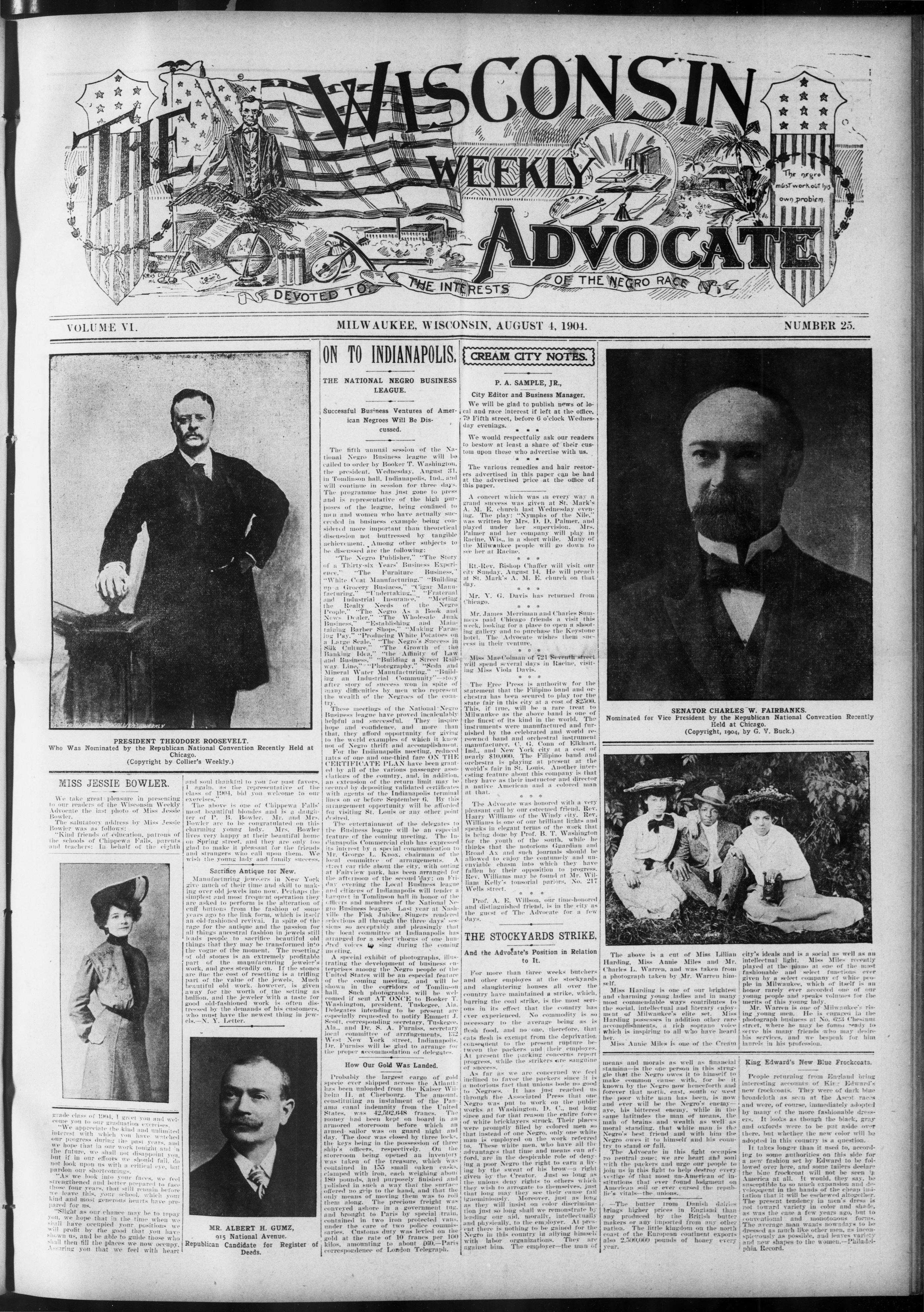
Page text (machine-generated)
WISCONSIN
WEEKLY
ADVOCATE
DEVOTED TO THE INTERESTS OF THE NEGRO RACE
THE PRESIDENT OF THE UNION.
PRESIDENT THEODORE ROOSEVELT. Who Was Nominated by the Republican National Convention Recently Held at Chicago. (Copyright by Collier's Weekly.)
MISS JESSIE BOWLER.
We take great pleasure in presenting to our readers of the Wisconsin Weekly Advocate the last photo of Miss Jessie Bowler.
The salutatory address by Miss Jessie Bowler was as follows:
"Kind friends of education, patrons of the schools of Chippewa Falls, parents and teachers: In behalf of the eighth
A.
grade class of 1994, I greet you and welcome you to our graduation ceremony.
come you to our graduation exercises.
"We appreciate the kind and unlimited interest with which you have watched our progress during the past years, and we hope that in our work tonight and in the future, we shall not disappoint you, but if in our efforts we should fail, do not look upon us with a critical eye, but pardon our shortcomings.
"As we look into your faces, we feel strengthened and better prepared to face those four years, that still remain before we leave this, your school, which your kind and most generous hearts have prepared for us.
"Slight as our chance may be to repay you, we hope that in the time when we shall have occupied your positions we will profit by the good that you have shown us, and be able to guide those who shall then fill the places we now occupy. Assuring you that we feel with heart
and soul thankful to you for past favors. I again, as the representative of the class of 1904, bid you welcome to our exercises."
The above is one of Chippewa Falls' most beautiful blondes and is a daughter of P. B. Bowler. Mr. and Mrs. Bowler are to be congratulated on this charming young lady. Mrs. Bowler lives very happy at their beautiful home on Spring street, and they are only too glad to make it pleasant for the friends and strangers who call upon them. We wish the young lady and family success.
Sacrifice Antique for New.
Manufacturing jewelers in New York give much of their time and skill to making over old jewels into now. Perhaps the simplest and most frequent operation they are asked to perform is the alteration of cuff buttons from the fashion of some years ago to the link form, which is itself an old-fashioned revival. In spite of the rage for the antique and the passion for all things ancestral fashion in jewels still leads people to sacrifice beautiful old things that they may be transformed into the vogue of the moment. The resetting of old stones is an extremely profitable part of the manufacturing jeweler's work, and goes steadily on. If the stones are fine the cost of resetting is a trifling part of the value of the jewels. Much beautiful old work, however, is given away for the worth of the setting as bullion, and the jeweler with a taste for good old-fashioned work is often distressed by the demands of his customers, who must have the newest thing in jewels.—N. Y. Letter.
[Image of a man with a mustache and a suit and tie].
MR. ALBERT H. GUMZ, 915 National Avenue. Republican Candidate for Register of Deeds
ON TO INDIANAPOLIS.
The fifth annual session of the National Negro Business league will be called to order by Booker T. Washington, the president, Wednesday, August 31, in Tomlinson hall, Indianapolis, Ind., and will continue in session for three days. The programme has just gone to press and is representative of the high purposes of the league, being confined to men and women who have actually succeeded in business example being considered more important than theoretical discussion not buttressed by tangible achievement. Among other subjects to be discussed are the following:
"The Negro Publisher," "The Story of a Thirty-six Years' Business Experience," "The Furniture Business," "White Coat Manufacturing," "Building up a Grocery Business," "Cigar Manufacturing," "Undertaking," "Fraternal and Industrial Insurance," "Meeting the Realty Needs of the Negro People," "The Negro As a Book and News Dealer," "The Wholesale Junk Business," "Establishing and Maintaining Barber Shops," "Making Farming Pay," "Producing White Potatoes on a Large Scale," "The Negro's Success in Silk Culture," "The Growth of the Banking Idea," "the Affinity of Law and Business," "Building a Street Railway Line," "Photography," "Seda and Mineral Water Manufacturing," "Building an Industrial Community"—story after story of success won in spite of many difficulties by men who represent the wealth of the Negroes of the country.
These meetings of the National Negro Business league have proved incalculably helpful and successful. They inspire hope and confidence, and more than that, they afford opportunity for giving to the world examples of which it knew not of Negro thrift and accomplishment. For the Indianapolis meeting, reduced rates of one and one-third fare ON THE CERTIFICATE PLAN have been granted by all of the various passenger associations of the country, and, in addition, an extension of the return limit may be secured by depositing validated certificates with agents of the Indianapolis terminal lines on or before September 6. By this arrangement opportunity will be afforded for visiting St. Louis or any other point desired.
The entertainment of the delegates to the Business league will be an especial feature of the coming meeting. The Indianapolis Commercial club has expressed its interest by a special communication to Mr. George L. Knox, chairman of the local committee of arrangements. A street car ride about the city, with outing at Fairview park, has been arranged for the afternoon of the second day: on Friday evening the Local Business league and citizens of Indianapolis will tender a banquet in Tomlinson hall in honor of the officers and members of the National Negro Business league. Last year at Nashville the Fisk Jubilee Singers rendered selections all through the three days' sessions so acceptably and pleasingly that the local committee at Indianapolis has arranged for a select chorus of one hundred voices sing during the coming meeting.
A special exhibit of photographs, illustrating the development of business enterprises among the Negro people of the United States will be an especial feature of the coming meeting, and will be shown in the corridors of Tomlinson hall. Such photographs will be welcomed if sent AT ONCE to Booker T. Washington, president, Tuskegee, Ala. Delegates intending to be present are especially requested to notify Emmett J. Scott, corresponding secretary, Tuskegee, Ala., and Dr. S. A. Furniss, secretary local committee of arrangements, 132 West New York street, Indianapolis. Dr. Furniss will be glad to arrange for the proper accommodation of delegates.
How Our Gold Was Landed
Probably the largest cargo of gold specie ever shipped across the Atlantic has been unloaded from the Kaiser Wilhelm II. at Cherbourg. The amount, constituting an instalment of the Panama canal indemnity from the United States, was 42,592,648 francs. The money had been kept on board in an armored storeroom before which an armed sailor was on guard night and day. The door was closed by three locks, the keys being in the possession of three ship's officers, respectively. On the storeroom being opened an inventory was taken of the treasure, which was contained in 155 small oaken casks, clamped with iron, each weighing about 180 pounds, and purposely finished and polished in such a way that the surface offered no grip to the hand, and that the only means of moving them was to roll them along. The precious freight was conveyed ashore in a government tug, and brought to Paris by special train, contained in two iron protected vans, under the care of two police commissaries. Customs duty was levied on the gold at the rate of 10 francs per 100 kilos, amounting to about £60.—Paris correspondence of London Telegraph.
CREAM CITY NOTES.
P. A. SAMPLE, JR..
City Editor and Business Manager
We will be glad to publish news of local and race interest if left at the office, 79 Fifth street, before 6 o'clock Wednesday evenings.
We would respectfully ask our readers to bestow at least a share of their custom upon those who advertise with us.
The various remedies and hair restorers advertised in this paper can be had at the advertised price at the office of this paper.
A concert which was in every way a grand success was given at St. Mark's A. M. E. church last Wednesday evening. The play: "Nymphs of the Nile," was written by Mrs. D. D. Palmer, and played under her supervision. Mrs. Palmer and her company will play in Racine, Wis., in a short while. Many of the Milwaukee people will go down to see her at Racine.
* * *
Rt.-Rev. Bishop Chaffer will visit our city Sunday, August 14. He will preach at St. Mark's A. M. E. church on that day.
* * *
Mr. V. G. Davis has returned from Chicago.
Mr. James Merriman and Charles Summers paid Chicago friends a visit this week, looking for a place to open a shooting gallery and to purchase the Keystone hotel. The Advocate wishes them success in their venture.
* * *
Miss Mae Colman of 721 Seventh street will spend several days in Racine, visiting Miss Viola Davis.
The Free Press is authorityw for the statement that the Filipino band and orchestra has been secured to play tor the state fair in this city at a cost of $2500. This, if true, will be a rare treat to Milwaukee as the above band is one of the finest of its kind in the world. The instruments were manufactured and furnished by the celebrated and world renowned band and orchestral instrument manufacturer, C. G. Conn of Elkhart, Ind., and New York city at a cost of nearly $10,000. The Filipino band and orchestra is playing at present at the world's fair in St. Louis. Another interesting feature about this company is that they have as their instructor and director a native American and a colored man at that.
The Advocate was honored with a very pleasant call by our esteemed friend, Rev. Harry Williams of the Windy city. Rev. Williams is one of our brilliant lights and speaks in elegant terms of the work that is being done by Prof. B. T. Washington for the youth of the south, while he thinks that the notorious Guardian and Broad Ax and such journals should be allowed to enjoy the contumely and unenviable chasm into which they have fallen by their opposition to progress. Rev. Williams may be found at Mr. William Kelly's tonsorial parlors. No. 217 Wells street.
Prof. A. E. Willson, our time-honored and distinguished friend, is in the city as the guest of The Advocate for a few days.
THE STOCKYARDS STRIKE
And the Advocate's Position in Relation to It.
For more than three weeks butchers and other employees at the stockyards and slaughtering houses all over the country have maintained a strike, which, barring the coal strike, is the most serious in its effect that the country has ever experienced. No commodity is so necessary to the average being as is flesh food, and no one, therefore, that cats flesh is exempt from the deprivation consequent to the present rupture between the packers and their employees. At present the packing concerns report progress, while the strikers are sanguine of success.
As far as we are concerned we feel inclined to favor the packers since it is a notorious fact that unions bode no good to Negroes. It has just reached us through the Associated Press that one Negro was put to work on the public works at Washington. D. C., not long since and for that reason the entire force of white bricklayers struck. Their places were promptly filled by colored men so that instead of one Negro, only one white man is employed on the work referred to. These white men, who have all the advantages that time and means can afford, are in the despicable role of denying a poor Negro the right to earn a living by the sweat of his brow—a right given by the Creator. Just so long as the unions deny rights to others which they wish to arrogate to themselves, just that long may they see their cause fail ignominiously. Moreover, just as long as they will insist on color discrimination just so long shall we demonstrate by lending our aid, morally, intellectually and physically, to the employer. At present there is nothing to be gained for the Negro in this country in allying himself with labor organizations. They are against him. The employer—the man of
SENATOR CHARLES W. FAIRBANKS.
Nominated for Vice President by the Republican National Convention Recently Held at Chicago.
(Copyright, 1904, by G. V. Buck.)
OK JEWELY
The above is a cut of Miss Lillian Harding, Miss Annie Miles and Mr. Charles L. Warren, and was taken from a photograph taken by Mr. Warren himself.
Miss Harding is one of our brightest and charming young ladies and in many most commendable ways contributes to the social, intellectual and literary enjoyment of Milwaukee's elite set. Miss Harding possesses in addition other rare accomplishments, a rich soprano voice which is inspiring to all who have heard her.
Miss Annie Miles is one of the Cream
means and morals as well as financial stamina—is the one person in this struggle that the Negro owes it to himself to make common cause with, for be it known by the Negro now henceforth and forever that north, east, south or west the poor white man has been, is now and ever will be the Negro's enemy—aye, his bitterest enemy, while in the same latitudes the man of means, the man of brains and wealth as well as moral standing, that white man is the Negro's best friend and with him the Negro owes it to himself and his country to stand or fall.
The Advocate in this fight occupies no neutral zone; we are heart and soul with the packers and urge our people to join us in this fight to help destroy every vestige of that most un-American of institutions that ever found lodgment on American soil or ever cursed the republic's vitals—the unions.
The butter from Danish dairies brings higher prices in England than any produced by the British butter makers or any imported from any other nation. The little kingdom on the north coast of the European continent exports also 2,500,000 pounds of honey every year.
NUMBER 25.
S. W. FAIRBANKS.
Republican National Convention Recently
Chicago.
(by G. V. Buck.)
city's ideals and is a social as well as an intellectual light. Miss Miles recently played at the piano at one of the most fashionable and select functions ever given by a select company of white people in Milwaukee, which of itself is an honor rarely ever accorded one of our young people and speaks volumes for the merits of this young lady.
Mr. Warren is one of Milwaukee's rising young men. He is engaged in the photograph business at No. 623 Chesnut street, where he may be found ready to serve his many friends who may desire his services, and we bespeak for him laurels in his profession.
King Edward's New Blue Freckcoats.
People returning from England bring interesting accounts of King Edward's new frockcoats. They were of dark blue broadcloth as seen at the Ascot races and were, of course, immediately adopted by many of the more fashionable dressers. It looks as though the black, gray and oxfords were to be put aside over there, but whether the new color will be adopted in this country is a question.
It takes longer than it used to, according to some authorities on this side for a new fashion set by Edward to be followed over here, and some tailers declare the blue frockcoat will not be seen in America at all. It would, they say, be susceptible to so much expansion and development in the hands of the cheap imitation that it will be eschewed altogether. The present tendency in men's dress is not toward variety in color and shade, as was the case a few years ago, but to conventional and monotonous forms. The average man wants nowadays to be dressed as much like other men, as inconspicuously as possible, and leaves variety and new shapes to the women.—Philadelphia Record.
```markdown
```
Cavalry of the west coast of Madagascar ride oxen.
Sanitary crusaders are now after ownerless city pigeons.
Gunnery practice at Newport has frightened away the fish.
-Egypt imports annually about $150, 000 worth of "cigarette paper."
-The most expensive lace manufactured today is valued at $5000 a yard.
-In New York the trade of horseshoeing is almost monopolized by Irishmen.
-The easiest legal way of becoming a Japanese subject is to marry a Japanese woman.
-Experiments prove that the presence of intestinal bacteria is necessary to digestion.
-The Thibetan postage stamp is merely a native character impressed in red sealing wax.
-Salicylic acid is an ingredient of strawberries, and to a less degree of most other fruits.
—Gregorio Aglipay claims to have 3,000,000 followers in his independent church movement in the Philippines.
—Endorsed by Queen Alexandra rouge is used as openly in England nowadays as in the unregenerate period of Louis XV. After the wicked French days paint fell into discredit and Victorian respectability placed a ban on rouge.
—When the Spanish officials wish to show visiting foreigners what they really can accomplish in the way of rapidity, they offer express trains which dash madly across the landscape at an average rate of 15 or 18 miles an hour.
—Icebergs are the product of the Greenland glaciers and are formed by the thousand in the far northern flords. As the glaciers sweep into the sea they "calve" or throw off mighty blocks, and these are what we know as icebergs.
-Plants so highly charged with essential oil that fragments of their leaves move about on water in a mysterious fashion, owing to capillary action, due to the spreading of the oil on the surface, are described by M. Virgile Brandicourt.
-The chief medical examiner of the Royal Arcanum reports that 103 members committed suicide during 1903. Among the supposed causes were: Domestic trouble, 16; financial difficulties, 26; ill health, 31; loss of employment, 10.
-The United States fish commission has contracted the small boys' habit of tagging fishes. Metal tags are fastened to marine fishes, which are let loose in the ocean with the idea of identifying them in case they are caught at any future time.
-It is only since the invention in 1866 of Foyn's destructive bomb harpoon, an explosive projectile which bursts within the carcass of the animal, that the Norwegian whalers have dared to attack the formidable blaahvel, Sibbald's rorqual, or blue whale.
-The use of saccharin, a product of coal tar, instead of sugar is growing. It is not only used to sweeten beer, but it is now also employed in the manufacture of syrups, jams, lemonades, wines (especially champagne), cider, brandy, pastry and chocolate.
A pianist has to cultivate the eye to see about 1500 signs in one minute, the fingers to make about 2000 movements and the brain to receive and understand separately the 1500 signs while it issues 2000 orders. In playing Weber's "Moto Perpetuo" a pianist has to read 4541 notes in a little under four minutes.
Yerba mate is a tea prepared from the roasted and pulverized leaves of an evergreen forest tree found in southern Brazil and the neighboring region. It is said to have all the best qualities of coffee and tea as a stimulating health beverage, without the disadvantages of either. It is much used in Paris hospitals.
Last March the San Francisco mint turned out coin to the amount of $32,000,000. This broke the record of the outputs of this mint for one month. On March 31 the mint was able to turn over to the government $53,000,000 in gold, all of which had been coined since February 1. This established a world record. The treatment of hay fever by an antipollen serum has been successful in a number of cases, and in a list of 285 patients to which it had been given under different circumstances and in different countries, recently compiled in Germany, 60 per cent. are reported as comparatively relieved, 29 per cent. partial cures and 11 per cent. failures.
The first bell that ever called a congregation to worship in St. Louis; the first bell, in fact, that ever rang in all the Louisiana purchase north of New Orleans, is on exhibition in the Missouri Historical society's exhibit at the Louisiana Purchase exposition. The giver of the bell was Benito Vasquez, who came to the new world from Galicia, Spain.
The great field of crystalized salt at Salton, Cal., in the middle of the Colorado desert, is 264 feet below the level of the sea and is more than a thousand acres in extent. Its surface is as white as snow, and, when the sun is shining, its brilliance is too dazzling for the eye. The field is constantly supplied by the many salt springs in the adjacent foothills.
Among the red dots on the map denoting the British empire is a group of islands south of Australia bearing the name of the Royal Company islands. Now the admiralty has issued a "notice to mariners," headed "Royal Company islands—non-existence of." The original report of their discovery cannot be traced, nor have they apparently been seen by passing vessels.
Dr. Weiis, a London physician, in 1818, in his published essay on dew, was the first to draw attention to the curious artificial production of ice in India. Shallow pits are dug, which are partially filled with perfectly dry straw, on the straw board, flat pans containing water are exposed to the clear sky. The water, being a powerful radiant, sends off its heat abundantly into space.
There are many log cabins in the Adirondacks that cost their owners over $100,000 apiece. One of the most sumptuous, near Saranac lake, is weatherboarded and shingled outside, but has the log effect within. All the interior furnishing are of logs. Even the piano is made of logs, a most unique, beautiful and costly instrument. Seasoned birch logs were used for its outer frame, or case.
In 1902 this country produced more than a quarter of a billion tons of bituminous coal, valued at nearly $300,000,000; anthracite coal worth more than $76,000,000; copper, with a valuation above $71,000,000, gold of a coining value exceeding $67,000,000; iron ore reached a total of nearly $67,500,000; silver at coming figures surpassed $70,000,000, and the petroleum total was more than $71,000,000.
Dunstanburg castle is about to be offered for sale by auction. It was first a British stronghold, then a Roman fortress and at a much later period was garrisoned for Queen Margaret, after the battle of Hexham, when it was besieged and taken after an assault lasting three days. The legend of "Sir Guy, the Seeker," told in a ballad by M. G. Lewis, is connected with the castle. "Dunstan diamonds" are crystals found in the neighborhood. A deep chasm in the rock at the east of the castle is known as the "Rumble Churn."
CAPTAIN PINK OF THE PEPPER MINT.
Old Capting Pink of the Peppermint,
Though kindly at heart and good,
Had a blunt, bluff way of a-gittin' 'is say
That we all of us understood.
When he brained a man with a pingle spike,
Or piastered a seaman flat.
We should 'a been blowed, but we all of us
knowed
That he didn't mean nothin' by that.
Sometimes he'd stroll from the' ostrich
hatch,
Jest a-feelin' a trifle rum.
Then he'd hang us tars to the masts and
spars
By a heel or an ear or a thumb.
When he had done like that, as he oft-
times did,
We winked at each other and smole.
And we snickered in glee and says, says we,
"Ain't that like the dear old soul!"
Old Capting Pink of the Peppermint,
We all of us loved 'em so.
That we waited one night till the tide was
right
right And the funnels was set for blow.
And he understood (as we knew he would)
That we done what we did as a joke.
Then we roguishly tumbled 'im over the
side,
And quickly reversin' the screws,
We hurried away to Mehitabel Bay
For a jolly piratical cruise.
In this here degenerate day.
-By Wallace Irwin in Leslie's Monthly Magazine.
THE UNATTAINABLE.
Singers, dancers, conjurers, equilibrists, had had their "turn," and now the Japanese dancer of American and Parisian fame was to make her first appearance.
The conductor lifted his baton, and the curtain rose as a languorous melody filled the theater. People craned their necks and took up their glasses, for there was a stir on the stage, and Sairki was fluttering to the footlights, smilingly acknowledging the applause.
Then she receded a little and began to dance; a shimmering symphony in mauves, from the faintest pink to the deepest violet.
Her kimono was embroidered with fantastic irises, and the same flower nestled with a mass of golden pins in her brilliant hair.
Her lips were colored a rich crimson, forming a startling contrast to the faintly tinted cheeks and glowing eyes.
Sairki was the thorough Geisha; an artist every inch of her dainty self, and irresistibly seductive. She had tripped her weird dance but a few minutes, and her audience was already enraptured.
When she subsided on a purple mat, the great theater throbbed with applause, and flowers, snatched from bodice and buttonhole, fell in a shower on the stage. Sairki smiled and laughed, taking it all as a matter of course, and with an imperious gesture toward the conductor, she once more began to bend and sway in time with the lilting melody.
Finally, after many encores, the little witch vanished, and the house rose to the strains of "God Save the King."
In one box there lingered a party of very smart women and men.
"Do you really mean to have her sit for you, Mr. Ainlie?" one of the ladies asked.
"I do," the man answered emphatically. "She is the most perfect living picture I have ever seen."
"And you wish to immortalize her in oils?" laughed one of the men.
"Why, Ainlie, you're as excited as a boy at his first race meeting!" added another.
The painter laughed, and, having bade them all good night, descended to the box office, and requested that his card should be taken in to Mle. Sairki. On it he wrote:
"Mr. Ainlie would be much indebted to Mle. Sairki if she would allow him to see her, as he is very desirous of painting mademoiselle's portrait."
In five minutes came the answer: "Would Mr. Ainslie come to Sairki's dressing room?" Ainlie followed the page behind the stage and down to the dancer's dressing room. She was there, already divested of her finery, and was being muffled into a fur coat by a French maid: near her stood a small Jap, who introduced himself as her manager, Mr. Godoshi. Sairki welcomed Ainlie with her smile of frank coquetry, and asked, in a small, musical voice:
"Monsieur see me dance?"
"Indeed, mademoiselle, I have, and to see you but for those few minutes made me long to have you sit for me."
"Sit?" Sairki's brow was puekered.
"Qu'est-ce-que-c'est sit? Ah! You mean paint me?"
"Yes, mademoiselle," replied the artist, delighted with her naif-French, half-English prattle.
Then Mr. Godoshi came forward rubbing his hands, for he was highly gratified at his dancer's complete success, such a success that a painter wished her to sit for him!
He made all the arrangements. Sairki would be at Ainlie's studio not later than 11 o'clock on the morrow, and she was to be painted in the costume she had just discarded.
Ainlie had already thought out a Japanese background.
He hailed a hansom and drove away, full of eagerness for the first sitting, and fully determined to go and see Sairki dance every evening, until he became master of her every expression, every subtle grace.
The painting was all but finished, a revelation of Ainlee's talent. Sairki seemed to be dancing out of the picture, her figure swaying, her smile radiant, the sunlight bringing out the brown tints in her hair.
"Tiens! There is two Sairkis now!" the girl had one day exclaimed, as she stood worshipping her own image.
"My! Your head screwed on right!" she would often say, and Ainlie would laugh merrily, for he never tired of her overflowing vivacity, her quaint language, the slang which, coming from her little mouth, never jarred.
He admired her very sincerely, and liked her, too, and he treated her with grave courtesy.
And she. She admired his art, and she loved him. She had fought against that love, for something told her it could not be; but despite Godoshi's pleadings—he had wooed her steadily for months, years—Sairki felt almost cold toward him, while her whole being thrilled when
Ainlie was near. She was passionate, this Asiatic coquette, and yet she had such self-control that he never suspected her adoration.
One day he laid down his brush, and helped his model from the throne. "No more sittings, most charming of models!" he said, with kindly gayety. "See, it is finished!" Sainki gazed at the work.
Sairki gazed at the work.
"Yes; all over," she breathed. "Telle est la vie!"
"Do you mean to say you are sorry?" laughed Ainlie. "Will you not prefer going to the academy and hearing people say, 'That is Sairki, the prettiest, greatest dancer we have even seen!'" He spoke the last words rather abruptly, for she was staring, staring at him, and her eyes were full of anguish.
"Yes; you can speak laik-a-that, mon ami!" she said. "Sairki, she just a subject for you, one inspiration; but she got a heart, too, and praise not all she wants from you!"
The tenderness in her voice and eyes cut Ainlie like steel. He had been blind. "Little friend" he began.
"Sh! You only make it worse!" replied Sairki. "Don' you blame yourself," she went on gently. "Not fault of yours: all mine; but we all the same 'bout that one ting. Can't help it!" She took up her cloak, and he moved forward to help her. He was courteous, but he was no longer gay, and his hands were unsteady.
"Sairki, I cannot—"
"Sh!" she repeated. "Goodbye," as he opened the door for her. "And—dear, for my sake, don' come see me dance any more, eh?" "No, no!" said the man, brokenly.
"I'll go academy," she said, and she had forced a smile to her lips. "And— I marry that poor fellow, Godoshi." London Onlooker.
Hornet Stings for Drunkenness.
The jail at Whiting is an old box building that is seldom used. On July 4, however, a young man imbibed too freely of some tonic that not only toned him up but made him unduly fractious, and the city marshal was compelled to gather him in and place him in this little-used jail.
Just after they left him the most horrible cries of pain and shouts for help were heard issuing from the wooden box, but it was supposed that these were only the ravings of a drunken man, who desired to attract attention. Some time later it was discovered that a nest of hornets had been disturbed by the prisoner's entrance and immediately commenced to punish him for disturbance of their peace, as wel has drunkenness. The treatment sobered him and the police judge deemed further penance unnecessary.—Holton (Kan.) Record.
New Sachets Expensive
Whether or not the use of perfume is vugar is a question that will probably remain to vex the soul feminine and engage the curious interest of man. For the present season perfumes will be in favor, so, for the time, the question is settled in the negative. The toting about of concealed sachet bags containing a powder that may cost all the way from $10 to $20 an ounce is now considered correct. These powders must be so delicate that they will suggest fragrance rather than enforce it upon the senses. The fact that the powders cost so much is pointed out as an evidence that the fad will not spread to members of the lady boilermakers' union, and this gives it quite a shove in the estimation of exclusive young women who like to be different.—New York Letter.
Getting Rich Off Grasshoppers in Utah.
Farmers of central Utah have organized to rid their fields of grasshoppers and are exterminating the insects by the ton. The grasshoppers are particularly numerous in San Pete county and have become so great a menace to the agricultural interests that the state has placed a bounty of 1 cent a pound on them. The county clerk of San Pete county has during the last week paid bounties on over 8000 pounds of grasshoppers captured in the neighborhood of the town of Ephraim alone. Dozens of men and boys have dropped their farm labors and are devoting their attention to catching grasshoppers.—Utah State Journal.
A Trace of Corn
The "trace" of corn is properly a tress of corn. The word is of French origin, and has kept its French pronunciations. It is from the verb tresser, to braid, and it applies to braiding the two or three busks which are left attached to each ear of corn that is reserved for special care in drying. Had our rustic population kept closer touch with polite society, they would have called such a string of ears of corn a tress of corn as we speak of a tress of hair. In the one instance, they kept the pronunciation and changed the spelling in the other, they kept the spelling and changed the pronunciation.—Boston Transcript.
His Character
An Irishman was charged with a petty offense.
"Have you any one in court who will vouch for your good character?" queried the judge.
"Yes, sorr; there is the chief constable, yonder," answered Pat.
The chief constable was amazed.
"Why, your honor. I don't even know the man," protested he.
"Now, sorr," broke in Pat. "I have lived in the borough for nearly twenty years, and if the chief constable doesn't know me yet, isn't that a character for ve?"—Tit-Bits.
The Little Woman's Retort
The mild business man was calmly reading his paper in the crowded trolley car. In front of him stood a little woman hanging by a strap. Her arm was being slowly torn out of her body, her eyes were flashing at him, but she constrained herself to silence.
Finally, after he had endured it for twenty minutes, he touched her arm and said:
"Madame, you are standing on my foot."
"Oh, am I?" she savagely retorted. "I thought is was a valise."—Kansas City Independent.
A Safeguard.
Here is a story which The Argonaut tells and which illustrates the estimate the German citizen places on sauerkraut as a food staple. A German was speaking last fall about the high price of cabbage. "I tell you, dese kabbages is awful high, dis year," he said; "me und me vife put up six, seven, eight barrels of sauerkraut every year—but ve can't dis year. Dem kabbages dey cost too much." "You put up some sauerkraut, didn't you, Chris?" he was asked. "Oh, yes—two or t'ree barrels—just to haf in de house in case of sickness."
Narrow Satin Plaitings.
Narrow plaitings of satin adorn many of the silk gowns. In black this gives a very French touch on a gown of black taffeta. A pretty model of the kind seen recently had a further finish of large hand-worked buttons in black silk.—New York Globe.
IS IT YOU?
New York Every Day.
Reginald C. Vanderbilt presented his new Mercedes automobile, costing in cash $15,000, to his wife.
Virginia Harned (Mrs. E. H. Sothern) and her friend, Miss Eleanor Morett, have returned from a two months' stay abroad. Most of their time was spent in France and England.
Former Attorney General P. C. Knox of Pennsylvania and Mrs. Knox, Marshall Field of Chicago and Oscar G. Murray, president of the Baltimore & Ohio railroad, were among the passengers who sailed on the White Star line steamer Oceanic.
Word has been received that Victor Kloepfer, basso of the Metropolitan opera house last winter, had died suddenly in Munich, where he was taking part in the performances at the Prinz Regent's theater. Herr Kloepfer had been engaged by Mr. Conried for next season.
John A. Benson, the California millionaire, under indictment in Washington on a charge of conspiracy to defraud the United States in the acquisition of school lands, known as forest reserve lieu lands, in Oregon and California, was discharged in the United States circuit court by Judge Lacombe.
William Coleman, who is said by the police to have an extensive prison record, is under arrest on suspicion of being the man who stole $60,000 worth of jewelry from Mrs. Clark, daughter-in-law of Mrs. Henry Codman Potter, at Cooperstown, N. Y., about four weeks ago. None of the jewels have been recovered.
John Rogers, sculptor and designer of the famous "Rogers groups" of statuary, died, after a long illness from creeping paralysis, at his summer home at New Canaan, Conn. Mr. Rogers was born in Salem, Mass., October 30, 1829, but it was not until 1860 that he began modeling. His first efforts were statuette groups, mostly war subjects. Later came the famous groups of social subjects and the large statues of Gen. Reynolds and Abraham Lincoln.
"Little Jack" Bostwick, the 3-year-old son of Lieut. Lucius Allyn Bostwick, U. S. N., who for nearly three years has been attached to the battleship Iowa in the east, died on the North German Lloyd steamer Bremen while on the way to this country with his mother and a maid to meet his father, who had not seen him since he was six weeks old. Lieut. Bostwick is about due from the east, and the boy had looked forward to the reunion with impatient anticipation.
The New York Central railroad is reported to be negotiating for the purchase of 476 miles of trolley lines, including the Albany and Hudson valley, the Schenectady, the Utica and Mohawk Valley, the Syracuse Rapid Transit, and the Buffalo International railways. The Syracuse Rapid Transit and the Utica and Mohawk Valley lines are the only ones bought so far, but there is already a tentative arrangement as a basis for the ultimate purchase of the Schenectady railway.
A farm settlement for immigrant Jews from Roumania and Russia is contemplated by the Jewish Agricultural and Industrial Aid society. The plan originated with A. W. Rich of Milwaukee, who proposes to purchase a tract of land in Wisconsin or Michigan of from 1000 to 1500 acres. This will be divided into farms of forty acres each and sufficient money will be loaned to settlers to buy implements and stock. The land may be bought by installments after the loan is repaid.
Sam Schubert, the theatrical manager, received a cablegram from his brother, Lee Schubert, stating that the latter was being held by the authorities of Aix-la-Chapelle, Germany, for having military plans in his possession. The cablegram added that Mr. Schubert had called upon United States Consul Frank H. Brundage for assistance, and had explained to him that the photographic plates which were responsible for his arrest and detention were merely for use in a new play which he proposed to produce.
A man about 70 years old, who says he is John Almond, but, because of weakness, is unable to give any account of himself, is in the hospital at Montelair, N. J., hovering between life and death, as the result of exposure to storm and the attacks of mosquitoes. He was found in the dense woods near the Passaic line. Apparently Almond had been in the woods for several days. He was extremely emaciated and his face and hands were swollen out of shape from thousands of bites by mosquitoes and other insects.
A letter has been received in New York city from former Judge Daniel McKoon, who mysteriously disappeared three weeks ago, stating that he was in El Paso, Tex. The letter was rambling and incoherent, and indicated that the writer's mind was affected. It was reported at the time of Judge McKoon's disappearance that he had been kidnapped and was being held for ransom, but this view was not accepted by the police. Since that time the missing man's son has received several letters from widely separated parts of the country.
"Tony" Fisher stood in the dock in court to await sentence on a charge of burglary after having traveled 3000 miles to surrender himself. The prisoner was convicted five years ago as being the ringleader of a gang of boy burglars. He escaped from the reform school and made his way to California and enlisted
in the navy. He was reformed through the good offices of the ship's chaplain and then a desire to return and atone for his misdeeds possessed him, and at the expiration of his term of enlistment he made his way back. He was released in care of the probation officer.
Every ship in Hoboken was decorated in honor of the arrival of the North German Lloyd liner Bremen, for the berthing of the steamer marked the conclusion of the 199th trip of Capt. Richard Nierich, her commander, across the ocean, and when the ship shall have returned to Bremen, the jolly captain will have made 100 round trips across the Atlantic. The captain entered the service of the North German Lloyd line in 1869 when 15. He has commanded various ships, and received several decorations for saving lives and has never had an accident. His friends in Hoboken and New York city are to give him a complimentary dinner.
Waist deep in the water of an engine tank and asleep, a man was discovered by cleaners on a "dead" train which arrived from Albany over the New York Central. He was suffering from a severe scalp wound. When aroused he gave his name as Thomas Mowbray, saying he was homeless. How Mowbray got into his unusual resting place and whence he came are equally mysterious to him. He says he remembers being in Albany recently, but all afterwards is blank.
The water tank of the engine is usually kept securely covered and the aperture through which the man must have passed is barely wide enough to admit a body. The case is one of the most unusual ever brought to the attention of railroad men here.
William Preston Harrison, brother of Mayor Harrison of Chicago; Col. Albert A. Pope of the Pope Manufacturing company, and Banker C. H. Rollins of Boston are named as co-respondents in a counter suit brought by Andrew P. Carter against his former wife, who recently secured a divorce from him in South Dakota. The suit is the result of an application by Mrs. Carter to Justice Scott for allowance of alimony and counsel fees pending the termination of a new suit for absolute divorce filed by her in the supreme court in New York city. Mrs. Carter also names three co-respondents and denies the charges made by her husband, who in his suit insists that since obtaining her South Dakota decree she is not his wife and consequently has no claim to alimony.
The rumor of the engagement of Miss Louise A. Benedict, daughter of Commodore and Mrs. E. C. Benedict, of Indian harbor, Greenwich, Conn., to Clifford B. Harmon, a wealthy dealer in suburban real estate, is confirmed. Miss Benedict is the youngest daughter and was born in New York, though she has spent much of her time in Greenwich, owing to her mother's ill health. She is an expert whip, pretty and a social favorite. Mr. Harmon is about ten years her senior and lives in Philadelphia. He met Miss Benedict in New York last April. Since then he has been a frequent visitor at the Benedict mansion. Mr. Harmon is the son of the late Capt. W. R. Harmon, U. S. A. The wedding will take place in the fall, it is understood.
The members of the state constitutional convention which met in Albany in 1894 marked the tenth anniversary of their labors with a two days' celebration in New York city. Eighty-five of the original 175 opened the festivities with a dinner at Delmonico's. Edward Lauterbach, the chairman and toastmaster, reviewed the work of the convention which adopted thirty-three amendments to the state constitution, all of which, he said, had met entire commendation. He told how he had helped make a state law which deprived him of railway passes. He sent a sorrowful letter containing an annual pass for himself and wife over the New York Central road. Mr. Lauterbach said he never got a reply from Mr. Depew, but Mrs. Lauterbach got a letter which said: Dear Madam: Here is an annual pass for you. There is no reason why you should suffer because your husband is a damn fool.
Mounted police to patrol the downtown streets of New York city, and to assist in regulating traffic on the crowded corners is the extraordinary innovation to be seen in Broadway and Fifth avenue. As far as known the experiment has never before been tried in any American city, or for that matter, in Europe. Mounted policemen will be on both sides of these streets and regulate traffic north and south. There will be two policemen on each side and their duty will be to prohibit heavy trucks from driving on the car tracks and to keep them as near the curb as possible. A sergeant, a roundsman, and four plain clothes men will be assigned to the work, and they will aid in the betterment of the city's traffic Commissioner McAdoo has been dissatisfied with traffic regulation and has appointed the men in the hope that the situation would be changed. The scheme is the plan of ex-Deputy Commissioner Piper.
One man, who controls the public slot machines in many of the Coney Island resorts, makes a profit of more than $600 a week after the cost of concessions, attendance and maintenance has been deducted. He has more than $28,000 invested in his plant. the machines costing anywhere from $25 to $300 each, though few styles pass the $100 mark. There are between 300 and 400 styles of slot machines, ranging all the way from the automatic distributor to the complicated mutoscope with its motion pictures. One of the best posted slot machine men estimated the other day that exclusive of the gambling machines, which still flourish in the west, more than a half million pennies are dropped into slot machines each day, while on a holiday a million would be nearer the mark. The business has grown to such proportions that he is seriously considering the establishment of a slot machine trade journal.
Two passengers on the steamer Deutschland were brought to port prisoners in their staterooms after a fight over a young French woman. She is Miss Marente Fouchier, a handsome brunette, and is said to be the sister-in-law of J. Lynch, a Californian and a six footer. Lynch and the young woman were constantly in each other's company during the voyage. While a concert was in progress one night Miss Fouchier was missing from the side of the Californian, who appeared nervous. While he was walking about the deck he passed the woman leaning on the arm of a passenger whose name appears on the list as Senor Luiz Urybe, a dashing young Spaniard. The officers of the boat declare Senor Urybe would have fared badly had not the stewards interfered. Both Lynch and his alleged rival were placed under arrest and locked up in their staterooms until the ship arrived in port, when they were released.
Bass That Weighed 401 Pounds
C. W. Heineman had a narrow escape today from again holding the season's record for the largest black sea bass. When H. E. Smith a few days ago wrested the honor from him he quietly remarked that he would have a try again. He did so this morning, going out with "Chappie." He caught a bass weighing 401 pounds, just one pound short of tipping Smith's record. It required an hour and fifty-five minutes to land the huge creature.—Los Angeles Times.
IN A HOSPITAL FORTY-TWO YEARS.
Strange Story of an Unknown Waif of the Civil War.
Left leaf and dumb after a severe attack of scarlet fever when she was a child 12 years of age, Miss Eliza Adams has passed forty-two years in the Louisville City hospital in complete ignorance of the place of her birth, her proper name or who her parents were. This peculiar character arrived in Louisville in the fail of 1862 from Nashville, Tenn. She had been deported with the crowds of women and children the United States government sent out of that state when the armies of the north and the south were making its green pastures gory with the blood of the Civil war, and in the deportation she became separated from her parents and family.
In Nashville a great camp was prepared for protection of these people and for several weeks Eliza Adams was confined in this place. Finally she became ill of scarlet fever, and owing to her age she was soon sent north. Raving in delirium, reached Louisville and was taken to the city hospital.
She had no friends and no one who arrived in the same train with her knew her name or anything of her parentage. Finally, under the care of Mrs. Garey, the superintendent, she began to improve, and within five months after she reached Louisville became perfectly well so far as mind and body were concerned, but the ravages of the disease had destroyed her hearing and power of speech. Owing to her tender years her memory was also partially impaired, and after she learned to talk by the sign language used by deaf mutes she was unable to throw any light upon her history. Shortly after she became well Mrs. Garey took compassion upon the afflicted orphan and adopted her as her daughter, giving her the name she now bears.
Many efforts have been made to learn something of her history and parentage, formerly by Mrs. Garey before she died, two years ago, and later by friends connected with the hospital. These have been entirely unsuccessful owing to the meager information which can be gleaned from her memories of her younger days, and in all probability her parents have long since passed away.—Louisville Courier-Journal.
Just for Show
An easterner on his way to California was delayed by the floods in Kansas and was obliged to spend the night in a humble hotel—the best in the town. The bill of fare at dinner time was not very elaborate but the traveler noticed with joy that at the bottom of the card, printed with pen and ink, was a startling variety of pies.
He liked pies, and here were custard, lemon, squash, rhubarb, Washington, chocolate, mince, apple and berry pies and several other varieties. He called the waitress to him.
"Please get me some rhubarb pie," said he.
"I'm afraid we ain't got any rhubarb pie," she drawled.
He took another glance at the list, "Well, get me some squash pie, please."
"We haven't got that either."
"Lemon pie?"
"No."
"Chocolate pie?"
"I'm sorry, we——"
"Well, what on earth are they all written down here for? On today's bill of fare, too?"
"Well, I'll tell you," said the girl apologetically. "That list is always written down there for show when we have mince pie, because when we have mince pie no one asks for anything else."—Youth's Companion.
Made It Clear.
Years ago there was a member of an eastern Legislature, named Murphy, a good politician, but hardly a statesman. Indeed, his notions of parliamentary order and debate were crude, according to The Youth's Companion. He was so frequently out of order that the speaker got into the habit of crying as soon as Mr. Murphy rose, "The gentleman is out of order!"
Once, in the midst of an important and exciting debate, he leaped to his feet. The House murmured, and the speaker brushed him aside with the usual remark, "The gentleman is out of order."
Murphy sat down, but presently he was on his feet again
"Mr. Prisident, I rise to a point of order. In justice I must explain that the thing I intended to say just now when you called me to order had nothing to do with what I did not say."
Cotton Seed Oil Has New Value
W. W. Wells, a citizen of Vicksburg, has made a discovery, which, if it stands the test of practical experiments, will revolutionize paint manufacturing in the south. Mr. Wells has been making a study of the pigments and oils used in the manufacture of paint, and has discovered that cotton seed oil may be used as a substitute for linseed oil. He has found that cotton seed oil gives a gloss and luster as good as that obtained by the use of linseed oil. The former appears to be more durable, but the great difficulty encountered is the fact that paint mixed with cotton seed oil is slow to dry. He believes, however, that this can be remedied by the use of chemicals which will quicken the drying process. Mr. Wells has been conducting his experiments for ten years.
Decreasing Price of Cut Glass.
"American cut glass has become the best article in the market," said W. L. Rice of Corning, N. Y.
"The day is coming, and is almost here now, when we can all have cut glass on our tables, and it will no longer be confined to the wealthy classes as a luxury. The price is decreasing all the time, and it is only the handsomest and most intricate designs of cutting that demand fancy prices in these days. Imported glass used to be the thing, but the American industry has made rapid strides in the last few years, and now the coloring and the style of domestic production surpasses that which is brought in from foreign countries."—Louisville Courier-Journal.
The Only Way.
The Mikado of Japan has, or rather bad, just one fad. He longed to create, by means of a more carnivorous diet, a taller race of soldiers. Small boys in government schools were fed for six or seven years in the European way. They never became reconciled to it, and it disagreed with them. Nor did they grow any taller than vegetarian children. The doctors charged to look after the experimental diet sent in their report last year. They could think of no better way, for securing tall soldiers than by encouraging Japanese to marry Europeans.
Magpie Gloves
The latest honeycomb fabric gloves have embroidery of black or white with little turnover cuffs of black. This color arrangement is reversed in gloves of the same style.New York Globe.
Dr. Allan Macfayden, director of the Jenner Institute in London, has obtained an anti-typhoid serum by expressing the juice from typhoid bacilli, first rendering them brittle by freezing them with liquid air.
GOSSIP FOR THE LADIES.
On the Level Plain.
On the Level Plain.
I dreamed of heights of worldliness.
Of rainbow paths my feet might press;
Joy beckoned, and Hope led me on.
But Love, with dew-wet kisses, won.
Beside Love's steps my own are stayed,
On level plain my tent is made.
With round of tasks from day to day
And wee hands crowding in my way.
The distant heights I may not see
While these small hands reach up to me;
Nor look I to the arching skies.—
My stars are in my baby's eyes.
But when, at night, beside the bed,
I lean above each sleeping head,
I thank God that my feet may press
The Mother road to Happiness.
From National Magazine.
When Visiting Is Pleasure.
After all is said and done, visiting friends must always be the most delicate of pleasures. Of all forms of social enjoyment, a well-chosen house party is perhaps the most complete and satisfactory. It is only during such short vacations (and on board ship) that the galling harness of every day routine drops completely from one's weary shoulders; it is there only that we escape entirely from the myriad little cares and worries that lie in wait for us outside. On looking back, many of us will be surprised to find how most of our truest friendships date from the occasion offered by a visit. One may go on meeting people for a decade at formal entertainments, and at the end of that time know less of their real selves than is revealed by one short "week-end" passed together under a congenial roof—especially if it be a home where the welcome is sincere and the liberty is complete, and wher ethe host and hostess have taken the trouble to sleep from time to time in their guest-chambers.—Eliot Gregory in Century Magazine.
Be Willing to Be Nervous.
To argue with nervous anxiety, either in ourselves or in others, is never helpful. Arguing with nervous excitement of any kind is like rubbing a sore. It only irritates it. It does not take long to argue excited or tired nerves into inflammation, but it is a long and difficult process to allay the inflammation. It is a sad fact that many people have been argued into long nervous illnesses by would-be kind friends, whose only intention was to argue them out of illness. Even the kindest and most disinterested friends are apt to lose patience when they argue, and that, to the tired brain which they are trying to relieve, is a greater irritant than they realize. The radical cure for nervous fears is to drop resistance to painful circumstances or conditions. Resistance is unwillingness to endure, and to drop the resistance is to be strongly willing. This vigorous "willingness" is so absolutely certain in its happy effect, and it is so impossible that it should fail, that the resistant impulses seem to oppose themselves to it with extreme energy. It is as if the resistances were conscious imps, and as if their certainty of defeat—in the sense of their victim's entire "willingness"—aroused them to do their worst, and to hold on to their only possible means of power with all the more determination. But every sharp attack, if met with quiet "willingness," brings a defeat for the assailants, until, finally, the resistant imps are conquered and disappear. Annie Payson Call in Leslie's Monthly.
For Summer Afternoons.
Five o'clock tea is an important feature of porch life, and some of the new porch furniture is designed especially for this purpose.
Few people nowadays make tea before their guests, preferring to have it brought in on a tray.
Wooden trays with brass handles are excellent, and so are those old-fashioned ones of japanned tin painted in impossible roses.
The gay Britanny china fits in well here.
It goes well with cotton prints and the like—and if a cup and saucer, or by chance a half dozen fall to the floor it would not be a family calamity.
Another useful piece is the Ancaster muffin tray of Sheraton pattern. While this is really a breakfast property, it can be made a useful adjunct to the porch tea table. It suggests muffins and scones and other things that combine so well with the steaming tea pot.
When it comes to cushions and pillows there is a bewitching choice. Silks and satins do not belong to the porch. These are as much out of place as gingham and calico would be in a Louis XV. drawing room. They upset the fitness of things. There are, first of all, the Morris cottons, which ought to be as well known as the Morris papers; next, English glazed chintzes, French cretonnes, Java prints, India and Japanese cottons, Chinese linens, American prints, denims, home-spun, pina and khaki cloths, canvases and ginghams. There are all sorts and conditions of stuffs, and they range in price from 5 cents to $2 the yard.—Philadelphia North American.
Bachelor Girls in New York.
For 40 cents the girl bachelor can get a table d'hote dinner in a little French restaurant with a bottle of wine thrown in. And for twenty-five cents she can get a very good course breakfast at the same place. Or, if she has a coffee outfit, perhaps she will get her own breakfast. Her lunch she takes a-field wherever 12 o'clock and an enterprising appetite happen to find her.
A girl bachelor can live nicely in New York on $10 a week. But she cannot live grandly. For $20 a week she can live exceedingly well and pay $40 for a pretty apartment in a fashionable sky scraper. Her apartment will be heated and lighted, and, if she is wide-a-wake, she will select one in which all service is supplied. Thus her room is cared for and she has the privilege of doing a little cooking upon the gas stove which she will snuggle into her bathroom.
For her incidentals the girl bachelor will want to allow $3 a week and this will include her car fares and a trip to the matinee or a seat in the balcony at an evening performance. This will also include her lunches, for she will find plenty of 15-cent lunch houses waiting for girl bachelors at noon and it will supply enough money for the little "treats" which the girl bachelor learns to expect and to enjoy.
The bachelor girl in New York does well if she is independent and if she is of the right caliber. But the girl who comes to New York to be homesick better stay away!
And here are the don'ts. Don't come if you have no money, for you will be wretched. Don't come if you are in love, for you will be worse than wretched, homesick. Don't come if you are of the crying, clinging variety of girl! Don't come unless you are prepared to rough it a little.
And don't come unless there is something you can do a great deal better than the girl next door!—Chicago Chronicle.
Hints for Seashore Visitors
It is generally considered wise to take dresses out of the trunks and hang them in a closet when going away from home. But if you are going to the seashore, take the advice of one who has had experience and—don't do it.
The damp sea air takes all the stiffness out of things, anyway, and if the gowns are folded smoothly and laid in a drawer or back in the trunk, they look almost as if they had been ironed by the time they are worn again.
Do not be alarmed if the stiffness comes out of organdies; it will return to it again when once more in a dry air; but at best muslins are unsatisfactory things at the shore. In spite of the best of care, they always get crumpled.
A crepe is the most serviceable gown for afternoon wear at the shore. A wool or a silk crepe never musses or loses its shape, and in light tints is dressy and expensive looking for evening.
A white serge or pongee is also a useful gown for the same reasons, and in cheaper materials the albatross and cotton voile are both attractive and serviceable, while a China silk is almost indispensable.
Sea air is also very hard on chiffon veils, but if ironed carefully the innumerable creases smooth out, and the apparently ruined article is made as good as new.
The most expensive artificial flowers will fade, and it is well to remember this in choosing a hat for summer wear. Choose a darker shade or else get pure white if you can not afford two or three hats; but above all things avoid ostrich feathers. Nothing looks more forlorn than an ostrich feather out of curl, and that is the way it gets almost immediately.
Clothes rarely soil at the shore, but in time they become yellow and have a generally crumpled appearance, which is worse than absolute dirt, and makes it advisable for them to be laundered.—Public Ledger.
Keep Still and Be a Force.
When trouble is brewing, keep still. When slander is getting on his legs, keep still. When your feelings are hurt, keep still, till you recover from your excitement, at any rate. Things look different through an unagitated eye. "In a commotion once," says one. "I wrote a letter and sent it, and wished I had not. In my later years I had another commotion, and wrote a long letter; but life rubbed a little sense into me and I kept that letter in my pocket against the day when I could look it over without agitation and without tears. I was glad I did. Less and less it seemed necessary to send it. I was not sure it would do any hurt, but in my doubtfulness I leaned to reticence, and eventually it was destroyed."
Time works wonders. Wait till you can speak calmly, and then maybe you will not need to speak at all.
When you have petty little worries and vexations, don't whine about them. Keep still.
At some later day you may come to know what real trouble is.
There was once a woman who never possessed real serenity of mind, until a great sorrow came into her life, then she said: "I never knew until now what a real trouble meant; it has thrown all the sham worries and make-believe unhappiness into the background."
It is a rough and tumble world, where everyone has his own private little battle ground, and he is not much of a soldier who runs over and tells his neighbor about every little scratch.
Even when the great hurt comes—the real sorrow which shall transform the world for you, keep still.
But you will keep still then. As the depths of the river rush on more silently than a shallow, chattering brook, so the real grief sweeps noiselessly over the heart, numbing its cries to silence.
Silence is a massive thing. It is strength. It is grandeur.
Do not be a shallow, babbling brook. Be the silent, onward rushing force of a mighty river. Be the calm, serene and silent depths of ocean. Keep still!—Philadelphia Evening Bulletin.
A Passing Fancy.
Girls who take pretty pictures have a brand-new fad just now. They are having their daguerreotypes taken. There never was anything much better in the way of a portrait, and there is something fascinating in the way they are mounted. Take a pretty girl today, wearing one of the 1830 gowns, which are the style of the hour, and then put her into one of the old-time pictures, and she looks like a second edition of her grandmother, usually on a larger scale, for the Twentieth century girl is nothing if not tall and well-developed.
It is not everyone who can indulge in the fad, for it is not inexpensive. A single picture will cost at least $4. Then everyone does not know where the daguerreotype can be taken, and the girls who will not always tell. It is a Boston photographer who does the work, and it was a Boston girl who first discovered that the old style pictures wcye not only pretty, but convenient for a young man to carry in his left side waistcoat pocket.
Girls who are not having daguerreotypes made of themselves are having old ones furbished up. It is eminently respectable to have ancestors and ancestresses these days. It has been said that a Philadelphia girl isn't really worth knowing unless she can rattle off at a moments notice the names of her four great-grandmothers, and if they are great-great-grandmothers, so much the better. However, there have been nice Philadelphia girls who have had society weddings who could not be positively sure of more than two great ancestors. It is better to have them, however, and if one can produce the daguerreotype, why, so much the better.
Great-grandmothers are not as entirely necessary for the New York girl, but she likes to show as many as possible, and for this reason she is bringing out the old daguerreotypes when the subjects are sufficiently attractive to do her credit. A film or spots form over these in time, and to have them presentable they must have them treated. With a silver surface or gold, as they usually are, they scratch with the slightest touch when the glass is removed, and to be cleaned they must be treated with acid and water which is flushed over them. It is not necessary to go to Boston for this; a New York man makes a specialty of it. The treatment costs only 50 cents a picture and they come out as good as new. Next to having one's relatives on hand-painted ivory miniatures, there is nothing like the daguerreotype.—New York Times.
Would You Carry Youth into Age?
Expect a good long, useful life.
Hold young thoughts persistently.
Simply refuse to grow old by counting your years or anticipating old age.
Refrain from all kinds of stimulants and sedatives; they will shorten your life.
One of the best preventives of age is enthusiasm and interest in affairs of the day.
Keep in the sunlight; nothing beautiful or sweet grows or ripens in the darkness.
Avoid fear in all its varied forms of expression; it is the greatest enemy of the human race.
Nature is the great rejuvenator; her spirit is ever young. Live with her; study her; love her.
Avoid excesses of all kinds; they are injurious. The long life must be a temperate, regular life.
Contemplate beauty in all its forms and you will drive everything that is ugly out of your life. Keep mental cobwebs, dust and brain ashes brushed off by frequent trips to the country, or by travel. Don't allow yourself to think, on your birthday, that you are a year older, and so much nearer the end.
Never look on the dark side; take sunny views of everything; a sunny thought drives away the shadows.
Be a child; live simply and naturally and keep clear of entangling alliances and complications of all kinds.
Cultivate the spirit of contentment; all discontent and dissatisfaction bring age-furrows prematurely to the face.
Keep your mind young by fresh, vigorous thinking and your heart sound by cultivating a cheerful, optimistic disposition.
Don't live to eat, but eat to live. Many of our ills are due to overeating, to eating the wrong things and to irregular eating.
Don't be too ambitious; the canker of an over-vaulting ambition has eaten up the happiness of many a life and shortened its years.
Throw aside your dignity, and romp and play with children; make them love you by loving them, and you will add years to your life.
Think beautiful thoughts,—harmony thoughts, beauty thoughts, truth thoughts, thoughts of innocence, of beauty, of love, and of kindness.
Associate a great deal with young people; take a lively interest in their hopes and ambitions, and enter into their sports with enthusiasm.
Cultivate placidity, serenity, and poise—mental and physical. Do not allow anything to throw you off your balance. A centered life is a long life.
Don't let anything interfere with your regular hours of work and rest, but get plenty of sleep, especially what is called "beauty sleep," before midnight
Keep busy; idleness is a great friend of age, but an enemy of youth. Regular employment and mental occupation are marvelous youth preservers. Put some beauty into your life every day by seeing beautiful works of art, beautiful bits of scenery, or by reading some noble poem or prose selection. Never compare yourself with others of the same age, or think that you must appear as old as they because you have marked the same number of years.
Love is the great healer of all life's ills, the great strengthener and beautifier. If you would drink at the fountain of perpetual youth fill your life with it.
Eat plenty of fruit and fresh vegetables in summer, and cut down your meat diet. Drink a liberal allowance of pure water at all times, but not ice water.
Pure air both indoors and outdoors is absolutely essential to health and longevity. Never allow yourself to remain in a poisoned or vitiated atmosphere.
Avoid anger, discord, hurry, or anything else that exhausts vitality or overstimulates; whatever frets, worries, or robs you of peace or sleep will make you prematurely old.
Refuse to allow the mind to stiffen the muscles by the suggestion of age limitation. Age is a mental state, brought about by mental conviction. You are only as old as you feel.
Form a habit of throwing off, before going to bed at night, all the cares and anxieties of the day—everything which can possibly cause mental wear and tear or deprive you of rest.
Age is conservative. Keep your mind open to truth and receptive to all that is broadening and ennobling by reading and thinking, and your sympathies alive and generous by taking a warm interest in the lives and welfare of others.—Orison Swett Marden in Success.
A Few Qualities
Which Go to Make a Good Wife
Tucked away in the depths of every girl's heart is the thought that some day she will marry the man of her choice and live happy ever after.
There is nothing to be ashamed of in this—a woman's thoughts turn to love and marriage as naturally as a flower to the sun.
But even though it is so often in a girl's mind, one has a doubt if she begins to realize what it all means.
Even at the altar the solemnity of the vows she makes weighs but lightly on her mind.
She loves the man and means to make him a good wife, but her ideas of the duties of a wife are of the vague.
In marrying a man it is not alone his love you accept; you are indebted to him, in most cases, for your actual support.
The only way in which you can repay this obligation is by making him a good wife.
The woman who is a good wife and mother is filling the highest vocation that is granted to woman. There is no career equal to it.
We do best that which we are most naturally fitted for, and every true woman should be at her best when fulfilling the duties of wife and motherhood.
The good wife should be her husband's comfort, strengthening him when he is weak, softening him when he is hard, walking proudly by him in success, giving him tenderest love and sympathy in adversity.
She should spend his money wisely, remembering that every cent represents work and thought on his part.
His good name she should hold more precious than gold.
Many a man has lost heart and courage simply because he could not keep pace with the demands of his wife. The young wife finds it hard to realize that she cannot have all the luxuries she had in her father's house.
Even if she does not actually complain, she looks hurt and surprised when the husband hints that expenses are running a little too high.
He loves her and wants her to have as many pretty clothes and comforts as she has been accustomed to, and that is the beginning of the trouble.
Try and remember, girls, that if you wish to help your husbands to success you must be content with small beginnings.
You can either be the guiding star and helpmate of a man's life or you can be a clog and drawback, dragging him to failure.
So, when you are building your castles in the air, add a practical touch to your day dreams by asking yourselves "How am I preparing myself for this happy dream should it come true? Am I training myself to fit this vocation properly, or am I just frittering away my time, an idle butterfly with no practical attainments—a mere parlor ornament?
If you want to make good wives you must know something about the practical side of life.
Married life is not all romance, you know; after the first glamor has worn off there will be many hours when the sordid side of life is uppermost and love seems perilously near flitting.
Your husband, absorbed by business cares, will not always remember to kiss you and tell you he loves you and that you keep house beautifully.
Then is your chance to prove the stuff of which you are made.
Don't cry and neglect your duties because your efforts are not sufficiently appreciated.
Just bear in mind that business worries are worries that cannot be pushed aside. It is because he has loved you and married you that his cares are so engrossing. He has promised to provide for you, and must do so, even at the risk
YOUNG FOLKS' COLUMN.
And those who wish can always find
A chance to journey down.
Tis customary for the trip
To choose a rainy day—
When weather's fine one's not so apt
To care to go that way.
Just keep down Fretful Lane until
And then cross over Ponting Bridge,
Where Don't Care Brook flows down,
And just a little way beyond
You come to Grumbletown.
From what I learn, this Grumbletown
Is not a pleasant place;
One never hears a cheerful word,
Or sees a smiling face:
The children there are badly spoiled
And sure to fret and tease.
And all the grown-up people, too,
Seem cross and hard to please.
The weather rarely is just right
And so I've taken pains, my dears,
The easiest road to show,
That you may al bе very sure
You never, never go!
—Ellen Manly in St. Nicholas.
Troubles of the Hermit Crab.
The most disconsolate fellow that walks the beach is the hermit crab whose shell has become too snug for comfort, says Country Life in America. If it were his own, as the clam's is, it would grow with his growth, and always be a perfect fit, but to the hermit there comes often a "moving day," when a new house must be sought. Discouraging work it is too. Most of the doors at which he knocks are slammed in his face. A tweak from a larger pincer than his own will often satisfy him that the shell he considers "distinctly possible," and hopefully ventures to explore, is already occupied by a near but coldly unsympathetic relative.
Finding no empty shell of suitable size, the hermit may be driven to ask a brother hermit to vacate in his favor. The proposition is spurned indignantly, and a fight ensues. The battle is to the stronger. Often the attacking party has considerable trouble in cleaning out the shell, having to pick his adversary out in bits. A penwinkle or a whelk may be attacked in a like manner by a hermit who is hard pressed and has taken a fancy to that particular shell. If the householder be feeble, the conquest is easy. If lusty, he holds the fort. At last the search is over. The shell is cleaned and ready.
"Yes, this will do! But how my back does ache! I mustn't delay a minute! Is anybody looking? Here goes, then; and may I never have to move again!"
In the twinkling of an eyes, the caudal hooks let go their hold deep in the spiral of the old shell, and have safely anchored the weak and flaccid body to the inner convolutions of the new one.
It is all over, an empty shell lies on the sand, and a larger one is near it with a sleepy-looking hermit crab in it. Poke him, and he leans languidly out over his pearly balcony, as if to say, "If this deadly monotony is not broken soon, I shall die!"
But beyond this "society mask," the cramped muscles are stretching out and adjusting themselves in absolute contentment to the roomy spaces offered them.
Good Deeds of Two Flies.
A persistent fly was irritating one of the two men on the lawn bench. He kept slapping at the fly, and growling. Although the fly was impartially addressing its stinging attentions to both of them, the other man on the lawn bench never made a move toward annihilating the busy winged pest.
"How do you stand having that confounded malicious fly boring into your nose that way without making a wallop at it?" inquired the irritated man, petulantly.
"Don't mind it at all," replied the calm man. "Flies are pals and side partners of mine. I haven't slapped at a fly for a good many years now. Just let 'em gnaw and gouge all they want to. The reason? None, except that flies have saved me from a heap of trouble on two occasions since I began to shave.
"First time was when I was soldiering on the rock of Alcatraz, in the harbor of San Francisco.
"One night—the night following pay day, by the way, and as there had been much stud-pokerishness and things on pay day night, I wasn't any too wide awake—I was on guard, humping Alcatraz's No. 1 post in the black dark. No. 1 post at Alcatraz is the dock, far below the looming citadel and barracks at which the government boat lands.
"The corporal of the guard jarred me awake on my guardhouse bunk at mid-
of insulting that most imperative of all gods, Cupid.
But see that you propitiate the little tyrant by burning all the incense possible at his shrine.
Don't be cross—nothing kills love like a cross wife; make home comfortable and attractive, and then your husband, will be loath to leave it and glad to return to it.
If you don't make him welcome some other woman will, and that is the beginning of the end.
For all of this devotion you naturally expect to be well repaid and so you will be by the love and devotion of your husband.
The husband owes his wife just as much love and attention as she does him.
—Philadelphia Evening Bulletin.
The Dangers in Dust.
Whether the bacilli that cause tuberculosis in the human being are the same as those which cause it in other warm blooded animals, and even fish, or whether they merely change their appearance with their environment, is a question for the bacteriological expert. That we may become infected from other animals has not the vital interest that the undoubted fact has that we can, and do, become infected by the germs that other men carry about, and that the home, the place where we take refuge from the ills of life, is precisely where this dread disease attacks us. Inside of four walls of our houses is where these deadly germs are implanted, are nurtured and bring forth their harvest. It is at home we must begin to defend ourselves. It is the part of wisdom to do away with dust catching draperies and carpets. Have the rugs shaken and beaten out of doors. If you must have carpets, sweep them with wet tea leaves sprinkled on them. Whipe the furniture with a moist cloth, not flirt the dust about with a bunch of feathers on a stick. Dust is dangerous. Remember that. Better to have some critic write "Sloven" in the dust upon the mantelpiece than cloud the air with it and poison your whole family.—Everybody's Magazine.
night, and escorted me down to the dock to pound the dock post for my little two hours.
"I walked up and down the dock for about twenty minutes, thinking it over. Wondered a good deal what the deuce I was doing swinging up and down with a gun on my shoulder in the middle of the night, when there really had never been any necessity for me to do anything of the sort.
"The harbor waters, tidebound out through the Golden Gate, brushed purlingly past the dock. That was soothing. So was the resiny breeze blowing over from Berkeley and Oakland way, miles distant. Mighty soothing breeze.
"I decided to sit down just for a minute or so. At the end of the dock there was a pile of bags of coal that had been unloaded from the government boat, the General McDowell, the afternoon before. I sat on one of the bags of coal, resting my gun between my legs.
"It was, as I say, the night after pay day, and I should never have taken a chance on sitting down at all when on guard. I nodded and fell asleep, of course.
"At 1 o'clock in the morning, or about half an hour after I had done that unforgivable thing, from the military point of view of falling asleep while on guard, the corporal of the guard had stood at the prison railing, and, making a funnel of his hands, called down to me:
"'One o'clock, and all's well.'
"It was up to me, then, of course, to reply:
"No. 1, I o clock, and all's well.
"But how could I have done that, when, being sound asleep on a bag of coal. I didn't hear the corporal of the guard?
"All of a sudden I was awakened with a start, and was brushing at my nose. A barrel of molasses had been landed on the dock the afternoon before, and some of the treacle had leaked. That had attracted a swarm of flies from the barracks to the dock. One of those flies had awakened me by biting my nose.
"And maybe that fly hadn't awakened me in the very nick of time! I had no sooner slapped at the fly than I heard the even tread of quick footsteps advancing in the pithy darkness from the direction of the guardhouse. The footsteps were perilously close, too. But I was on my feet, and as stiff as a ramrod, and giving the 'Who goes there?'
"It was the sergeant of the guard—wha happened to be a man who had it in for me—come with my relief. The corporal of the guard had reported to the sergeant that No. 1 sentry hadn't responded to the 1 o'clock 'All's well' call. The sergeant of the guard had hurriedly awakened my redief and come after me, confidently expecting to find me asleep on post. If he had found me asleep, you know what would have happened—my gun and belt would have been grabbed I'd have been put in the clink and then would have followed the general courmartial with all of the rosmal consequences. But the fly had stung me awoke just in the instant of time. The only thing the sergeant who had it in for me could do was to growlingly inquire why I hadn't replied to the corporal's 1 o'clock call. I told him that the wind had carried the corporal's hail in the other direction. The sergeant returned to the guardhouse with my relief, grievously disappointed that he hadn't been able to clink me. That was the first time a fly helped me out nobly.
"Next time a fly came along and handed me a sting at the psychological moment I was on a ship of war. I was working at some books in a logroom on the berth deck, when the officer of the deck—he was on the main deck—called down the after companionway for me. I bustled out of the logroom and rushed around the companionway to respond to the summons. It was dark on the berth side. I had forgotten for a moment that the gun crews were overhauling the magazines that forenoon. At the bottom of the after ladder up which I intended to vault to make the main deck, a magazine hatch was wide open and yawning. I didn't notice that open hatch. I had a foot raised to take the step that would have landed me, a mere mangled mess, at the bottom of the magazine, when a fly lit right under my left eye and gave me a bite that I can feel yet. I drew back suddenly to feel of the bitten place, so that my foot didn't come down in that open hatch. It wasn't until after I had drawn back that I noticed the open hatch, through which I had all but tossed myself when the fly gouged me; and when I saw it and perceived what a narrow shave I'd had, I was so weak that I had to sit down on the bottom ladder step and fan myself with my cap for a minute before going above to see what the officer of the deck wanted of me.
"I'm not overly sentimental, but I've never made a pass at a fly since one of them so opportunely saved me from plunging down that open hatch."
Slap went the palm of the irritated man against his trousers leg, and the mashed fly that had been annoying him slipped off onto the grass.
"I hope that cuss isn't any kin to either of the two flies that helped you out, pal," said the irritated man, "but I'm blooming glad that I got him, anyway."
-Washington Star.
CINEMATOGRAPH OF HORRORS.
Russian Doctor's Story of Scenes in the Field Hospital.
The parents of Dr. Samoiloff, who was with the field hospital after the battle of Kuilencheng, have just received (at Moscow) a letter from their son, giving an appalling description of his work.
"It was not a hospital, but a shambles, and after the first hour's work it seemed to us that we were not ministers of mercy but demons of blood, working frantically, recklessly, callous to pain and life.
"The stream of pierced and shattered bodies poured in so fast that we handled them as indifferently as sacks of flour. As we hacked and sawed—for it was not surgery, but hurried bungling—I counted the writhing row on the floor, praying that it might get less, but for every one maimed and bandaged man borne to his couch two were carried in and cast on the ground. At last my brain, dizzy in a mist of blood, pictured the whole universe as nothing but a string of clotted bodies stretching to infinity.
"Yes, I admit that we were callous. So pertifying to the sensibilities is this hurried work of blood that some of us joked like fiends over our atrocious task. The hospital servants who carried out the baskets of amputated limbs bantered one another. 'That is Petrusha's leg,' said one. 'I know his toenails.' 'That's no Christian leg,' replied his companion, 'it's a Jew's.' "One of these clumsy fellows slipped in the blood and sent a streaming arm in the face of a boy lieutenant, who screamed with fright. But at the time even this seemed humorous, not horrible.
"Sometimes the shells fell near our tent, and we wondered if we too would be laid in that eternally growing row, and whether some one, callous as ourselves, would remove our amputated limbs and speculate as to their ownership.
"What made things worse was the deficiency of anaesthetics and bandages. Before we were half way through we had torn up our shirts. Luckily more bandages arrived before the end."—London News of the World.
It Is Hard to Pick Out Any That Were Really Such When Nominated.
Polk was the first "dark horse" to be chosen; but neither Hayes nor Benjamin Harrison can fairly be regarded as having won a nomination by any conspicuous acts of statesmanship.
Doubtless Pierce's reputation has suffered by the disputes over slavery which did so much to wreck his administration. Yet even so he was a candidate for renomination, and received 122 votes to Buchanan's 135 votes on the first ballot in the Democratic convention of 1856. His nomination four years earlier had been very well received—much better than that of his opponent, Gen. Scott.
Pierce had entered politics within two years after his admission to the bar, had served in the New Hampshire Legislature, had been sent to Congress at the age of 29, and at 33 had been chosen United States senator, being then the youngest member of that body. Resigning his seat after five years, he returned to the practice of law. But he certainly did not relapse into obscurity; for in the interval between 1842 and 1856 he had declined a nomination for governor of New Hampshire, had refused an appointment to the Senate and the offer of a place in Polk's cabinet as attorney general, and had won considerable military reputation as a brigadier general in the Mexican war.
Hayes was unquestionably less well known than Pierce when he was nominated to the presidency. He had been in Congress two years and he had a good war record. But at the time of his nomination he was governor of Ohio, and he was no more prominent nationally than a dozen governors of states are at aay time.
Benjamin Harrison, too, was by no means one of the most eminent of public men at the time of his nomination. His name was in his favor, and the caricaturists of the day represented him as almost hidden under "grandfather's hat." He, too, had seen service in the war, had been in both houses of Congress, and had declined a cabinet appointment; but he had been defeated for re-election to the Senate and had returned to the practice of law. He was a compromise candidate for the presidency and was chosen in the convention of 1888 after the success of Sherman or Gresham was seen to be impossible. Indeed, there are several points of comparison between Pierce and Harrison, and it would be hard to snow that one was more obscure than the other.—Providence Journal.
One Way to Foretell Weather.
There were weather prophets before the weather bureau. Once when Dudley Leavitt, for many years the maker of the New Hampshire Almanac, was driving northward through Nottingham, he encountered a farmer hoeing by the roadside.
"A fine morning," said Leavitt.
"Yes," was the answer, "but it's going to rain before long."
There was no hint of rain in the summer sky; but before Leavitt had got through Northwood Narrows a heavy shower came down upon him. Wishing to find out how the farmer could predict so exactly, he turned back, and found him out in the field again, after the rain.
"I should like to know," said the astronomer of Winnepesaukee, "how you could tell so exactly what the weather was going to be."
"Well," said the sage, "when my old ram scratches his ear with his left hind foot in the morning, I'm certain 'twill rain before night. Besides, if that old fool of a Dud Leavitt says in his almanac, 'Fair weather may be expected,' I know 'twill be just the contrary."—Springfield Republican.
Feared a Separation.
Her father had read her the parable of the sheep and the goats at the day of judgment. She made no comment, but that night a sound of weeping came from her room. Her mother went as consoler.
"Why are you crying, dear?"
"About the goats! Oh, I'm so afraid I'm a goat!"
"Why, no, dearie, you are a sweet little lamb, and if you should die tonight you would go straight to heaven." With this and like assurances she was finally pacified.
The next night the same performance was repeated, and again her mother inquired the reason.
"It's the goats; I'm 'fraid about the goats!"
"Didn't I tell you, dear, that you were a little lamb?"
"Oh," she sobbed, "I'm not crying about myself, but I'm 'fraid you may be a goat."—E. H. B. in Town and Country.
Causes of Death.
Only 900 persons in every million die from old age.
Of the 42,500 cases of smallpox reported by the forty-four states in 1903, 1642 were fatal.
Europe loses 86,592 live a year by accidents.
Fifty-nine per cent. of the deaths from consumption are between the ages of forty-five and sixty years, while only twelve per cent. of such deaths are of persons over sixty years of age.
Anti-toxin treatment for diptheria has reduced the death rate of that disease from 35 to 7 per cent.
In the United States the annual mortality for railroads is one person killed for every 1052 employees; coal miners, one person in every 744 employees; seamen in merchant vessels, one person in every 33.
St. Louis Post-Dispatch.
The Poison of the Cobra.
The venom of the cobra contains an ingredient not well known that acts upon the nerves. Its effects are rapid and difficult to counteract. This ingredient exists in the cobra's venom to a greater extent than the other substances that make up the poison. The poison of the viperine are crotaline snakes (the rattlesnakes, copperhead, moccasin, etc.) contains but a small percentage of this nerve-destroying (or paralyzing) element. The poison of these snakes acts principally upon the blood, and in consequence its action is slower.—St. Nicholas.
Ornamental Nest of Golden Eagles.
In Scotland a naturalist has found a golden eagle's nest that contained a rubber ring, carried thither by the birds as an adornment. An observer in California has reported that a pair of golden eagles there decorated their nest with sacks. "When the kite builds look to lesser linen, says Shakespeare, alluding to the robberies committed by those birds from the hedges where linen was put to dry. The late Mr. Booth described a kind of bower made by some aesthetic eagles in Scotland.—Chicago News.
If you would see the latest electrical novelties, you must board an ocean grey-bound. The automatic egg-boilers, like those on the Oceanic, are designed to cook 200 eggs at once, a clock arrangement causing the basket containing the eggs to hop out of the water at any half minute up to six minutes. Another novelty is a self-dumping oyster cooker for stews. At the termination of a given time the cooker pours its contents into a soup plate and automatically shuts off the electricity. —Tit-Bits.
THE WISCONSIN WEEKLY ADVOCATE.
R. B. Montgomery, Editor and Publisher.
P. A. Sample, Associate Editor and Business Manager.
Published Every Thursday at No. 79 Fifth Street.
A Representative Journal Devoted to the Interest of All the People.
ADVERTISING RATES.
One inch, one year.....$15.00
Two inches, one year.....25.00
Three inches, one year.....35.00
Four inches, one year.....42.00
For larger space, special rates.
Locals 10 cents per line.
One year ..... $2.00
Six months ..... 1.00
Three months ..... .50
Direct all communications to
R. B. MONTGOMERY.
79 Fifth Street.
HOW TO SEND MONEY.—Post Office
Order, Express Order, Draft or Registered
Letter. R. B. Montgomery will not be re-
sponsible for loss when sent in any other
way.
All communications must be sent with the name and address of the sender as an evidence of good faith, but not necessarily for publication. No manuscript returned if not accepted, unless accompanied by stamps.
One insertion, per inch..... $ .25
One month, per inch..... .75
Three months, per inch..... 2.00
Six months, per inch..... 3.50
One year, per inch..... 5.00
Paragraph advertisements, per line. .05
EDITORIAL PARAGRAPHS.
"I know of the bravery and character of the Negro soldier. He saved my life at Santiago, and I have had occasion to say so in many articles and speeches. The Rough Riders were in a bad position when the Ninth and Tenth cavalry came rushing up the hill carrying everything before them. The Negro soldier has the faculty of coming to the front when he is needed most. In the Civil war he came 400,000 strong, and I believe he saved the Union."—President Roosevelt.
Regular
Republican
Convention
From the report of the Committee on Credentials to the REPUBLICAN NATIONAL CONVEN- TION, which was unanimously adopted by that convention, June 22d, 1904.
Your committee report it to be their final judgment that the convention which elected said John C. Spooner, J. V. Quaries, J. W. Babcock and Emil Baensch as delegates at large, and their alternates at large, to this convention from the state of Wisconsin WAS THE REGULAR CONVENTION OF THE REPUBLICAN PARTY IN WISGONSIN, and that the delegates elected by it are the regular elected delegates at large from the state of Wisconsin to the republican convention, and, as such, are entitled to seats in this convention.
NATIONAL REPUBLICAN TICKET
For President of the United States— THEODORE ROOSEVELT of New York For Vice President— CHARLES W. FAIRBANKS of Indiana.
At Large—A. R. HALL, Dunn.
First—JOHN L. SHERON, Green.
Second—J. M. BUSHNELL, Columbia.
Third—JAMES H. CABONNIS, Grant.
Fourth—FRED W. LORENZ, Milwaukee.
Fifth—FRED W. CORDES, Milwaukee.
Sixth—C. S. PORTER, Dodge.
Seventh—H. A. BRIGHT, Jackson.
Eighth—E. M'GLACHLIN, Portage.
Ninth—GEORGE BEYER, Oconto.
Tenth—M. D. KEITH, Forest.
Eleventh—EDWARD L. PEET, Burnett
STATE REPUBLICAN TICKET.
Governor—
SAMUEL A. COOK of Neenah.
Lieutenant-Governor—
GEORGE H. RAY of La Crosse.
Secretary of Stae—
NELS P. HOLMAN of Dane.
State Treasurer—
GUSTAVE WOLLAEGER, JR., of
Milwaukee.
Attorney General—
D. G. CLASSON of Oconto.
Railroad Commissioner—
F. O. TARBOX of Ashland.
Insurance Commissioner—
WILLIAM C. ROENITZ of Sheboygan.
ARE YOU GOING?
ARE YOU GOING
To the fifth annual convention of the National Negro Business league at Indianapolis, Ind., Aug. 31, Sept. 1 and 2? If you are TAKE THE MONON ROUTE. It is the safest, quickest and best.
One of Milwaukee's airship inventors has again announced that fly-time has arrived. This is getting to be an old story.
A quaint feature of Samoan life is kava drinking. This beverage is made from the root of the angona shrub, which being pounded and mixed with water ferments and forms a mild intoxicant. It tastes like soap suds and ginger ale mixed and the relish for it has to be acquired.
---
At West Point it has been decided that no fat cadet may go into the cavalry, because he must lack the agility of the ideal horseman and must prove a burden to his steed. "Excessive weight," says Gen. Burton (inspector), "is ruinous to a horse, is cumbersome to a rider and weakens the endurance of the individual."
The local telephone company at St. Johns, Mich., which handles an extensive rural service, is seeking to make its service indispensable by furnishing subscribers with the government daily weather reports and other important news of the day. Signals are rung each morning on all farm lines, and all who desire may get this report.
An advertisement in the Athenaeum of London calls for two assistant mistresses in a botanical school, one of whom must be "well qualified in botany, hygiene and physiology." The salary is $500, or, if the successful applicant has a university degree, $537. Ia would seem to follow that a university degree is worth exactly $37 per annum.
An English inventor has replaced the ordinary grooving of a rifle barrel with lines of small ball bearings, along which the hard steel projectile slips. The inventor claims that he gets 40 per cent. greater average velocity, penetration and range than can be obtained with the same weight of projectile and charge guns made on the old system.
Mrs. Hester Trudow of Le Sueur, Minn., whose age is 98 years, and who, until lately, had been entirely toothless for thirty years, began six months ago to cut her third set of teeth, and has now a complete outfit of new, natural teeth, both uppers and lowers. She claims that she has acquired her new teeth by eating each day $ \gamma $ teaspoonful of powdered oyster shells.
The largest tree in the Yosemite valley is slowly dying, and there seems to be no way in which it can be saved. It has long been known to tourists at Grizzly King and is over 264 feet high, having a circumference of 91 feet at its base. Already it leans 18 feet out of the perpendicular, and arrangements are being made to hold it up by means of cables and stout props.
The Swiss government has decided no longer to permit parents to baptize their offspring by fantastic names. This law has just been exercised at St. Gall with regard to two children, one of whom was baptized May 1, while the other had been named by its Italian progenitors "Ribello," rebel or revolutionary. The names were condemned and the children have been legally rebaptized.
The tallest inhabited building in the world is the Park Row building in New York. It covers about 15,000 square feet of ground and is thirty stories high. The distance from the curbing to the cornice is 336 feet, to the top of the towers, 390 feet; to the top of the flagstaff, 447; the depth of the foundations below curbing is 75 feet, making a total distance from the foundation to the top of the flagstaff 552 feet.
A full-blooded Indian court of three justices sits every Saturday at White Eagle, I. T., to hear misdemeanor cases and publish offending members of the Ponca and Otoe tribes. Little Soldier is chief justice, and he is assisted by Justice Big Goose and Justice Rough Face. They never speak English while on the bench, and they have a high idea of the dignity which belongs to their position. Each is paid $10 a month.
In the country districts of the south, excluding 242 cities that had a population of 2500 inhabitants or more, the negro population increased 16 per cent. between 1890 and 1900 and in the cities 21.7 per cent. In the five southern cities having at least 100,000 inhabitants their increase was 25.8 per cent. in that period. In the country districts their increase was about two-thirds as rapid as that of the whites and in the cities five-sixths.
There were many forums in Rome, but the oldest and most famous was not created like a building, at a certain time. The "Forum Romanum" was originally the lowlands between the Palatine, Capitoline and Quirinal hills, used as a meeting place for barter and politics by the tribes living on the hills named, and on other hills nearby. The development of this crude trading place and neutral ground into the Roman Forum of later times was very gradual and irregular.
The city of Manila contains 219,028 inhabitants, which includes 15,901 who reside on vessels in the harbor, while 11,460 live in the limits of the city walls. Gen. Sanger says the aborigines of the Philippines are believed to be the Negritos, of which 23,000 still remain. They are very short in stature, the males averaging only four feet ten inches, and the females even less. Their color is black, their hair woolly and bushy, and their toes are remarkably prehensile, they using them almost as well as fingers.
Nearly eighty years ago, when the presidential struggle between Clay and Jackson was at its height, it is related that a band of emigrants from Kentucky and the then other western states commenced to settle on the north side of the Missouri river and called their county Clay and the county seat Liberty. At the same time, says the Oak Grove (Mo.) Banner, another lot of emigrants from Virginia and other southern states pitched their tent on the south side of the Big Muddy and called their county Jackson and the capital Independence.
Paderewski, the famous pianist, says that his fingers are as precious to him as life, for he could never play if he lost any of them. He makes insurance from time to time to cover special risks, as when he is going on a long journey by land or sea, but apart from these his two hands are regularly underwritten from year to year. He pays $4000 annually in this way, with the result that if anything went wrong with one of his precious hands at any time so that he could no longer earn an income by his playing he would be paid $50,000 cash down by the underwriters.
SENATOR G. F. HOAR ILL
Denied at Home That Condition Is Serious, Although Alarming Reports Are in Circulation.
Worcester, Mass., Aug. 4.—Reports in circulation that Senator George F. Hoar is seriously ill were denied at the senator's residence today. He has been troubled with lumbago all summer, but is no confined to his room, and it is stated in improving daily.
Worcester, Mass., Aug. 4.—Senator George F. Hoar, who is in his seventy-ninth year, has been taken suddenly ill at his home in Oak avenue. His unexpected illness has greatly alarmed the household, and his condition is considered serious.
The senator's daughter, Miss Mary Hoar, who has been at Pigeon Cove, was summoned home by wire. At the senator's home Miss Hoar refused to give out anything concerning her father, further than the fact that he was holding his own.
DID NOT FIND ZEIGLER
Relief Party Fails to Discover Where abouts of Missing Arctic Explorer.
Copenhagen, Denmark, Aug. 4.—The Zeigler relief expedition arrived at Vardo, Norway, on board the Frithjof, July 3, on its return from the north. Owing to ice and fog the Frithjof did not succeed in reaching the America, having on board the Zeigler arctic expedition. The Frithjof will sail north again as soon as possible with coal for the America. The America sailed from Trondjem for Franz Josef land July 13, 1903.
LATEST MARKET REPORTS
MILWAUKEE, AUGUST 4, 1904.
EGG AND DAIRY MARKETS.
MILWAUKEE—Eggs—Market firm. Strictly fresh laid, loss off, cases returned, 16c dirties and seconds, 12c; checks, 11c.
Butter—Steady; fine goods is meeting with a very good demand; creamery, extra, lbs 17c; prints, 18c; firsts, 15@15%c; seconds 14@15c; renovated, 14c; fancy dairy, 14@15c; prints, 11@12c; lines, 12c; packing stock, 11c whey, 8c.
Cheese—Steady; American full cream, new goods, twins, 8½@8%c; Young Americans, 8½@9c; daisies, 8½@9c; Long Horns, 8½@9c; Limbars, per lb, new, 8½@8c; off grade 7@8c; fancy new Brick, 8@8%c; low grades 7@8c; imported Swiss, 24c; fancy Block, 11c new round Swiss, 12c; Sapsago, 18c.
MINERAL POINT, Wis., Aug. 3.—Cheese board sales: 627 twins, 7 11-16c; 986 daisies, 8.5-16c.
SHEBOYGAN, Wis., Aug. 3.—Offers and sales were 2510 boxes of cheese, as follows: 720 boxes daisies, 8%c; 357 cases Young Americans, 8%c; 253 do, 8%c; 87 do, 8%c; 357 cases longhorus, 8%c; 687 do, 8%c; 40 boxes twins, 7%c.
MANITOWOC, Wis., Aug. 3.—Offers and sales were: 250 boxes twins at 7%c, 600 Young Americans at 8c, 1200 single daisies at 8%c and 200 double daisies at 8c.
CUBA, N. Y., Aug. 3.—Sales, 4000 small white and colored cheese at 7¾@8½c, ruling 7¾c.
NEW YORK, Aug. 4.—Butter-Receipts, 9892. Cheese—Steady; receipts, 3269; state full cream, small colored fancy, 8c; fair to good, 7¾@8c; small white fancy, 7½c; fair to good, 7¾@7¼c; do poor, 6¼@6¾c; large colored fancy, 7½c; fair to good, 7¾@7¼c; large fancy, 7½c; fair to good, 7¾@7¼c; do poor, 6¼@6¾c; skims, full to light, 1@6c Eggs—Firmer; receipts, 8464; state and Pennsylvania and nearby fancy selected white, 24@25c; firsts, 19@20c; western extra fine, 20@21c; do firsts, average best 19@19½c; southern, 15@17c.
MILWAUKEE LIVE STOCK MARKET.
HOGS—Receipts, 13 cars; market steady light mixed, 5.15@4.10; fair to choice mei diums, 5.15@5.45; packers, 4.75@5.10; plugs 80 to 110 lbs, 4.75@5.00; coarse stags, 4.00.
SHEEP—Receipts, 1 car; dull; 2.50@
3.00; bucks, 2.00@2.50; lambs, 3.00@3.50
spring lambs, 4.00@5.25.
Timothy, steady; carlots, choice timothy.
12.00@12.50; No. 1 timothy, 11.00@11.25; No.
2 timothy, 8.50@9.50; clover and clover
mixed, 7.00@8.00; new timothy hay about
1.00 less.
Prairie hay steady; choice Kansas, 10.50
@11.00; No. 1 Kansas, 9.50@10.00; No. 2,
8.50@9.00.
Straw, steady; rye, 9.00@9.50; oats, 7.50
@8.50; wheat, 6.50; packing hay, 6.50@7.00
MARKETS BY TELEGRAPH
MARKETS IN ELEGANT
MILWAUKEE, Aug. 4.—Close—Wheat—
Firmer; No. 1 northern on track, 1.05; No. 2
northern, on track, 1.04. Corn—Firm; No.
3 on track, 53c. Oats—Firm; No. 2 white
on track, 42½c; No. 3 white, on track, 39@
42½c. Barley—Dull; No. 2 on track, 55c
sample on track, 36@5c. Rye—Steady; No.
1 on track, 68c. Provisions—Steady; pork
12.97; lard, 7.02.
Flour quotations are: hard spring wheat
patents, in wood, 5.35, 0.45; straight, ir
wood, 5.20@5.30; export patents, in sacks
4.05@4.75; first clear, in sacks, 4.05@4.15
rye flour, country pure, in sacks, 3.45@3.55
city pure, in wood, 3.65@3.75.
Millstuffs are quoted at 16.00@16.25 for
bran, 19.25@19.50 for standard middlings and
20.75@21.00 for Milwaukee flour middlings
in 100-lb sacks; red dock, 22.00@23.00; de
delivered at country points, 50c extra.
CHICAGO, Aug. 4.—Close—Wheat—Sep
tember, 97%; old, 98%; December, 97%;
May, 99%; Corn—August, 52%; September
ber, 52%@52%; December, 49%; May
48%; Oats—August, 34%; September
34%; December, 35%@55%; May, 36%; Pork
—September, 12.95; October, 12.97%;
January, 12.80; Lard—September, 6.97%@7.00
October, 7.05@7.01%; December, 6.85; Jan
uary, 6.90; Ribs—September, 7.70; October
7.70; January, 6.75; Rye—August, 65%; Sep
tember, 65%. Flax—Cash N. W., 1.24; S. W.
1.17; September, 1.16%; Timothy—August
3.05; September, 3.20@3.25; Clover—August
11.25; Barley—Cash, 28@58%.
NEW YORK, Aug. 4.—Close—Wheat—Sep
tember, 1.01%; December, 1.01%; May
1.02%; Corn—September, 57%; December
55%.
KANSAS CITY, Mo., Aug. 4. —Close-Wheat—Higher; September, 86%; December, 87%;c; May, 89¼@89%;c; cash No. 1 hard, 87@89;c; No. 3, 86@88;c; No. 4, 83½;c; No. 2 red, 92@93;c; No. 3, 89@90;c; Corn—Firm; September, 48¼%;c; December, 44¼%;c; May, 43½@44%;c; cash No. 2 mixed, 43@49½;c; No. 3, 48½;c; No. 2 white, 49½@50;c; No. 3, 48½@49;c; Oats—Steady; No. 2 white, 43@45%;c; No. 2 mixed, 37@38;c.
ST. LOUIS, Mo., Aug. 4. —Close-Wheat—Excited on higher, heavy speculative buying. No. 2 red cash elevator, 93½%;c; track 97@98;c; September, 96%;c; December, 98%;c No. 2 hard, 94@95;c. Corn—Higher; No. 1 cash nominal; track, 53%;c; September, 52½%;c; December, 46¼@46½%;c. Oats—Higher; No 2 cash, 37½%;c; track, 35½@36½%;c; September, 33½%;c. No. 2 white, 37½%;c.
SOUTH OMAHA, Neb, Aug. 4.—Cattle-
Receipts, 1550; market active, strong to 100
higher; native steers, 4.00@6.00; cows and
helters, 2.75@4.25; calves, 2.00@5.00. Hogs—
Receipts, 4350; market 5@100 higher; light,
5.05@5.15; plugs, 4.50@5.00; bulk of sales,
5.00@5.10. Sheep—Receipts, 2500; market
steady; sheep, 2.00@3.40; lambs, 4.75@5.75.
ST. LOUIS, Mo., Aug. 4.—Cattle—Recipels, 1600, including 1200 Texans; market steady to 10c higher for natives; beef steers, 3.50@5.60; cows and heifers, 2.25@4.50. Hogs—Recipels, 2000; marllet 5c higher; plgs and lights, 4.50@5.45; butchers' and best heavy, 5.00@5.35. Sheep—Recipels, 1000; market steady to strong; natives, 3.50@3.75; lambs, 4.50@5.50.
Horseshoe
WAUSAU LUMBER
ARE VIRTUES VANISHING?
President of Bryn Mawr College Thinks Higher Education Is Uplifting.
Miss Thomas of Bryn Mawr, the ablest and wisest of the women presidents of women's colleges, admits that the secluded life of women in the past has developed in them priceless virtues, but she thinks that the college education and the emergence of women into the life and activity of the world are going to supply to the whole race many advantages which will take the place of any virtues of the fireside that may be lost. She specifies the working of men and women together for purposes of civilization, and the loyalty of women to one another.
To men, these new advantages are likely to seem a poor return for family affection, for modest purity, for religious devotion which may be lost. But Miss Thomas might answer—we do not know that she will—that what has passed for women's virtues has often been but men's notion of women's virtues. The best woman, to most men's thinking, is the woman who is best for a man.
The question of the advantage or disadvantage that lies in woman's higher education and in her complete emergence from seclusion can only be answered by the effect of these thigs on men and women both. Probably our children, when they are grown, can tell better than any man or woman of the present day whether woman has done well to put on the armor and fight by man's side. As yet the doubt persists, though the confidence of such women as President Thomas helps to dispel it.—New York Maji.
Trees Growing in Crater of Kilauea.
A peculiar condition in the crater of Kilauea is reported by returning passengers of the steamer Mauna Loa, which arrived this morning from her run to Maui and Hawaii ports. Trees, lantana and other stuff are sprouting inside the crater. This is unusual. It is taken as an indication that the subterranean activity is decreasing, and that the sulphur and other poisonous gases are not being emitted in such quantity as previously. There are various steam cracks about the immense floor of the crater, and steam is always coming out of these, the heat in some of them being very great. Many of these cracks are reported now to be dead. This report would account for the growth of trees and shrubbery in the crater.
On the other hand, smoke has been coming out of the inner crater of Kilauea during the last few days. The volcano had shown little activity recently, but there appears to be renewed quantities of smoke coming forth every morning. Hawaiiian Star. Quality."—Harper's Weekly.
Quality."—Harper's Weekly.
The American Steam Laundry
173 SECOND STREET
HELLO, MAIN 1524.
Our wagons speed all over town,
All hours of every day,
Depositing and picking up
Big bundles on the way.
We've got the best machinery,
And expert help galore;
We make your linen glisten and gleam
Like sea-foam on the shore!
We do not slight an article,
However coarse or fine;
Oh, everything's immaculate
On The American Laundry Line.
And so we bid for patronage,
At least a wholesome share
Of collars, cuffs and shirts and gowns,
And rumpled underwear.
We set the pace and from our point
Our banner shall not fall,
We fling it to the breeze and reach
Going higher than them all.
Laundry left before 8 a. m. can be
called for at 6:30 p. m. same
day, Saturdays excepted.
The New Well Street Store
which was formerly called the Boston Grocery, has changed hands. The grocery was formerly conducted by Mr. McMossure. Mr. Saudek, proprietor, has remodeled the store and he wishes the patronage of the public. And the above is a true friend of our race.
GIVE HIM A CALL
M. MOSER
WANTED—NURSE GIRL FOR FAMILY of two. Children attend kindergarten during the forenoon. Apply office of Advocate, 79 Fifth street.
While in city visit . . .
STEPHENS'
HOTEL and RESTAURANT
First-Class Accommodations
Home Cooking a Specialty...
No. 2832 State St.. CHICAGO, ILL.
Don'tTrusttoLuck
Don'tTrusttoLuck
when you go to buy lumber and building material, but come where you know the grades and prices are right. AND COAL CO.
IMS TO RENT
and secure a better class of tenants, if fin-
SULAR
RIOR
DEL
paint in many ways—having a smooth, hard, fine finish, which may be easily kept clean by easily with a damp cloth.
MORE THAN ORDINARY PAINT, is easily worn are most artistic.
more about it.
e Paint & Varnish Co.
193 THIRD STREET.
S TAILORING CO.
POLACHECK, Prop.
Order $15.00
This Week
FOR SUITS AT HALF PRICE.
Man Needs Refreshing Call at
ANNEX CAFE
A. MOTLEY, Proprietor.
OPEN ALL NIGHT
STREET. CHICAGO.
Telephone Douglas 8472.
North Milwaukee. Wis.
ROOMS TO RENT
Bring better prices and secure a better class of tenants, if finished with
It is superior to paint in many ways—having a smooth, hard, lustrous and durable finish, which may be easily kept clean by wiping off occasionally with a damp cloth. IT COSTS NO MORE THAN ORDINARY PAINT, is easily applied and the colors are most artistic. Let us tell you more about it.
PEOPLE'S TAILORING CO.
JOS. POLACHECK, Prop. Suits to Order $15.00 Leaders for This Week UNCALLED FOR SUITS AT HALF PRICE.
VALUABLE OFFER!
The Wisconsin Weekly Advocate Furnishes Free Reliable Colored Help to Its Subscribers.
Male and Female Cooks and Waiters, Nurse Girls, Barbers, Porters, Elevator Men and General Servants can be supplied on short notice by applying personally or by letter to
R. B. MONTGOMERY, Proprietor.
P. A. SAMPLE, Business Manager.
A. M. PALMER, Sec.
Office, 79 Fifth St., Milwaukee, Wis.
WANTED--AGENTS
mission (Formerly Mt. Olive) 221 Seventh St., Milwaukee.
Evening service. 7:45 p. m.
Wednesday evening service, 7:45 p. m.
Friday prayer meeting, 7:45 p. m.
B. P. ROBINSON, Pastor.
"Be ye busy till I come."
Ceo. Burroughs & Sons MANUFACTURERS OF PREMIUM TRUNKS
ES, Etc.
Milwaukee
G. J. CHARLESTON, Mgr.
63 E. Sixth Street,
ST. PAUL, MINN.
124 1 426 East Water St. Milwaukee.
We want 100 agents in every city, town and hamlet in the U. S. for the Wisconsin Weekly Advocate. It will be devoted to the interest of the Negro race and will contain the news of their sayings and doings throughout the world.
WISCONSIN WEEKLY ADVOCATE MILWAUKEE, WIS.
Before Starting on Your Travels CALL ON
VALISES, SAMPLE CASES, Etc.
The "Turf" Cafe. DINNER BILL. Regular Dinner 35 Cents
11:30 to 2 p. m., 5 to 8 p. m.
Lettuce, 10c. Radishes, 10c.
Cucumbers, 10c. Green Onions, 10c.
S. Tomatoes, 10c. Celery Hearts.
SOUP.
Mock Turtle.
Baked Trout, Egg and Parsley Sauce,
25c.
Baked Chicken and Dressing, 25c.
Boiled Ox Tongue and Tartar Sauce, 25c.
Prime Roast Beef.
ENTREES.
Veal Loaf, 25c. Apple Salad, 15c.
Asparagus.
Boiled and Mashed Potatoes.
DESSERT.
Lemon and Strawberry Pie.
Cottage Pudding.
Ice Cream, 10c. Strawberries and Cream.
Anything Ordered Not Mentioned on
This Bill Will Be Charged for Extra.
MONROE BROS., Props. 194 THIRD STREET.
Calvary Baptist Church
Morning Service, 11 a. m.
Sunday School, 1 p. m.
A. M. PALMER, Supt.
ELK EXPRESS CO.
SPECIAL NOTICE
THE "TURF" CAFE
DINNER BILL
Regular Dinner 25c
Dinner 11:30 to 2 p. m. and 5 to 8 p. m.
Dinner 11:30 to 2 p. m. and 9 to 10 p.
Sliced Tomatoes, 10c. Radishes, 10c.
Cucumbers, 10c. Green Onions, 10c.
Lettuce, 10c.
BEAN SOUP.
Boiled Trout and Mint Sauce, 25c.
Boiled Leg of Mutton, Egg Sauce, 25c.
Roast Pork and Apple Sauce, 25c.
Short Ribs of Beef with Brown Potatoes, 25c.
Fricasseed Chicken, 25c.
ENTREES.
String Beans. Green Peas.
Boiled and Mashed Potatoes.
Apple and Lemon and Custard Pie.
Rice Pudding.
Coffee and Tea and Milk.
Anything ordered not mentioned on this bill will be charged for extra.
MONROE BROS., Prop's.
194 THIRD ST.
MONON ROUTE
NORTH OR SOUTH
Always ask for tickets
via the
MONON ROUTE
THE SHORT LINE BETWEEN
Chicago,
Indianapolis,
Cincinnati,
Louisville
Six trains daily between Chicago and the Ohio river.
For folders, rates, etc., call at any Monon ticket office or address
FRANK J. REED,
Gen'l Pass. Agent, Chicago.
S. B. JONES,
C. P. Agent, 232 Clark St., Chicago.
MILWAUKEE...
GAS STOVE CO.,
MANUFACTURERS OF
PERFECTION
FOR THE USE OF
THE MASTER OF MACHINE
WASHINGTON, D.C.
PERFECTION GAS RANGES
AND SPECIALTIES
Instantaneous Cleanable Star Burners,
Adjustable Needle Valve,
For Natural, Artificial or Gasoline Gas.
139 Burrell St.. Milwaukee, WI.
50 YEARS' EXPERIENCE
PATENTS
TRADE MARKS
DESIGNS
Anyone sending a sketch and description may quickly ascertain our opinion whether an invention is probably patentable. Communications strictly confidential. Handbook on Patents sent free. Oldest agency for securing patents. Patents taken through Munn & Co. receive special notice, without charge, in the
A handsomely illustrated weekly. Largest exhibition of any scientific journal. Terns, $3 a year, four months, $1. Sold by all newsdealers.
MUNN & Co. 361 Broadway. New York
Branch Office, 155 E. St. Washington D.C.
WONDERFUL
DISCOVERY
Curly Hair Made Straight By
TAKEN FROM LIFE:
BEFORE AND AFTER TREATMENT.
ORIGINAL
OZONIZED OX MARROW
(Copyrighted.)
This wonderful hair pomade is the only safe preparation in the world that makes kinky or curly hair straight as shown above. It nourishes the scalp, prevents the hair from falling out or breaking off, cures dandruff and makes the hair grow long and silky. Sold over many years and used by thousands. Warranted hardware. It was the first preparation ever sold for straightening kinky hair. Beware of imitations. Original Ozonized Ox Marrow as the genuine never fails to keep the hair straight, and beautiful, giving it that healthy, life-like appearance so much desired. A toilet necessary, and beautiful, gentlemen and children. Elegantly perfumed, bringing to its superior and lasting qualities it is the best way to produce a preparation equal to it. Full directions with every bottle. 50 only cents. Sold by druggists and dealers or send us 50 cents for one bottle or $1.40 for three bottles. We may all express charges. Send postal or email order. Please mention name of this paper when ordering. Write your name and address plainly to
OZONIZED OX MARROW CO.,
76 Wabash Ave., Chicago, Illinois.
S. F. PEACOCK & SON
Funeral Directors
AND
EMBALMERS
431 Broadway, MILWAUKEE, WIS.
---
OCCUPY HAI CHENG CITY.
The Mikado's Armies Closing in on Gen. Kuropatkin.
Goal of the Japanese Is Not Port Arthur but to Annihilate Gen. Kuropatkin's Command.
London, Aug. 4.—A dispatch to a news agency from Anshanshan (halfway between Hai Cheng and Liao Yang) says: "The Japanese advance is being continued with great energy against the southern army. The Russian main forces continue their retirement northward, but the cavalry has checked the Japanese threatening flank movement."
St. Petersburg, Aug. 4.—A rumor is current that a battle is in progress north of Hai Cheng.
Tokio, Aug. 4.—2 p. m.—The Russians began abandoning Haichang August 2, the Japanese entering without resistance at noon yesterday. The Japanese occupied New Chwang the same day.
New Chwang, Aug. 4.—Field Marshal Oyama, commander-in-chief of the Japanese forces in Manchuria, and Gen. Kodama, chief of staff, left Kaichou yesterday and have established headquarters in the field with the army.
Washington, D. C., Aug. 4.—The Japanese legation today received the following telegram from Tokio:
"Gen. Oku reports that the enemy is retreating northward continually since August 2. On August 3 our army occupied Haicheng and New Chwang, situated thirty miles northeast of the open port of the same name."
New Chwang, Aug. 4.—French Consular Agent Albert Kreutler was arrested last night in a Russian house, where he was mistaken for a spy. After a short detention he was released.
Tokio, Thursday, Aug. 4.—Noon.—The Japanese, victors at the battle of Simoucheng, have advanced and occupied Hai Cheng.
New Chwang, Wednesday, Aug. 3. (Delayed in transmission.)—Gen. Kuroki with 100,000 men is now behind the Russian forces. Gen. Oku, with an army of 50,000 men, is on their front, while flanking them on the left is Gen. Nodzu with his division of 50,000 men.
Gen. Kuropatkin's Fix.
If Gen. Kuropatkin is defeated in this battle, he must either move westward or surrender. The foreign military attaches are with the second army en route for the front to witness the battle. Japanese troop ships are expected here tomorrow.
Port Arthur Not the Goal
St. Petersburg, Aug. 4.—The army organ makes no effort to foreshadow events of the immediate future in the far east and gives no clue to Gen. Kuropatkin's intentions, but it declares that events of the last ten days demonstrate conclusively that the Japanese objective, since the beginning of the war, had been to strike the main army of the Russians and not, as popularly supposed, to take Port Arthur.
Japs' Plan of Campaign.
The paper says the Japanese general advance began July 23, the taking of Ta Che Kiao being a signal for the final struggle in the valley of the Liao river. On July 31, after six days' preparation, the armies of Gens. Oku and Nodzu moved against Hai Cheng. The same day Gen. Kuroki began his advance upon Liao Yang. Pushing the position of the Russian eastern army at Yengze pass and that of Gen. Herschelmann at Yushu pass equivalent to the Japanese "Yshulintzi."
Japanese Have Strength.
This paper estimates the strength of Kuroki's army, at 120,000 men, of which number 50,000 are on the high road to Liao Yang, 30,000 on the Sainatsza-Liao Yang road, 30,000 on the roads to Mukden and 10,000 in reserve. The paper does not give the figures of Gens. Oku's and Nodzu's armies, which are believed to bring the total close to 200,000.
Baltic Fleet Again Delayed.
The sailing of the cruiser division of the Baltic squadron has been postponed for a fortnight. The cruiser Oleg and the transport Kanutchatka are ready to go into commission. The vessels now commissioned are the battleship Alexander II., the battleship Sorodiro, the armored cruiser Admiral Nakhimoff, the battleship Navarin, the battleship Osliabia, the protected cruiser Aurora, the battleship Sonvaroff, the battleship Orel and two other cruisers, with quite a flotilla of torpedo boats and torpedo boat destroyers.
Kuropatkin's Report.
St. Petersburg, Aug. 4.—3:20 p.m.—Gen. Kuropatkin's official details of the fighting July 31 at Simoucheng say that only a division and a half were engaged. The report does not mention the loss of guns, neither was Lieut.-Gen. Alexieff in command, as stated in the dispatch from Tokio yesterday. Gen. Alexieff, who commands the Fifth East Siberian division of Gen. Stakelberg's corps, was posted on the near side of Haichang July 31.
The war office does not intend to publish the name of the actual commander at Simoucheng for reasons of military expediency.
Thinks Japs Will Rest
The war office does not expect the Japanese to resume their advance for several days. They are always slow and cautious and make the most careful preparations before striking. Now they are probably again preparing for a flanking movement on a large scale, and possibly awaiting the marching up of a strong column from New Chwang.
The failure of the Japanese to follow up their success is evidently the cause of great satisfaction to the general staff here. Whether this feeling is due to the fact that the delay will give Gen. Kuropatkin breathing space and enable him to arrange his concentrated dispositions for the coming battle, or because it will allow him the requisite time to effect his withdrawal northward, is of course unknown, the general staff not even admitting that the commander-in-chief is contemplating escape. In either event, however, the Russians will profit by the declination of the Japanese to pursue their advantage.
AMERICAN YACHT WINS.
Ingomar Captures Town Prize of $500 by Defeating the Kaiser's
Coves, Isle of Wight, Aug. 4.—The American yacht Ingomar won the Town prize of $500 over the Queen course today, defeating Emperor William's Meteor, the scratch boat, and six others. King Edward sailed on board the Meteor.
GERMANY STARTS AN INVESTIGATION
Government Decides to Find Out About Sinking of Ship by the Russians.
Berlin, Aug. 4.—The German government has instituted an investigation into all the circumstances connected with the sinking of the German steamer Thea by the Vladivostok squadron off the coast of Japan, preparatory to making representations at St. Petersburg. Among the questions subject to the inquiry is the amount of coal on board, whether it was too little to enable her to steam to Vladivostok, and also the proportion of provisions of her cargo, whether it exceeded half the cargo, thus subjecting the vessel to capture under the Russian prize regulations. The owner of the Thea, Herr Diedrichsen, of Kiel, will arrive in Berlin tomorrow for the purpose of having an interview with the foreign office, which relies on him chiefly in clearing up the status of the Thea. The German government admits that Vice Admiral Skrydloff acted within the Russian prize regulations in capturing the Thea, but the officials intimate that the foreign office questions the right of capture when provisions are consigned to private firms instead of to a hostile government. The foreign office, however, says no serious complications will grow out of the case.
TAGGART CHOOSES
CAMPAIGN AIDS.
Delancey Nicoll Is Vice Chairman and Tim Ryan of Wisconsin Is on Executive Committee.
Indianapolis, Ind., Aug. 4.—Chairman Taggart of the Democratic national committee this evening announced the following officers of the Democratic national committee and the following members of the national executive committee:
National committee—Delancey Nicoll, vice chairman, New York; eGorge Foster Peabody, treasurer, New York.
Executive committee—W. F. Sheehan, chairman, New York; August Belmont, New York; John R. McLean, Ohio; United States Senator Thomas S. Martin, Scottville, Va. Col. J. M. Guffey, Pittsburg, Pa.; former United States Senator James Smith, Jr., Newark, N. J.; Timothy E. Ryan, Waukesha, Wis.
Following the announcement of the appointments, Chairman Taggart made the following statement:
The campaign, executive committee will have the advice of Senator Gorman's judgment and experience in the campaign, he agreeing to keep in close touch with the management at all times. Such other committees as are deemed necessary will be appointed later. The executive committee will meet at the Hoffman house, New York city, Monday morning, August 8, at 11:30 o'clock.
Concerning the work outlined at the meeting of the executive committee at New York Monday next, Chairman Taggart said:
The committee will discuss matters relating to the campaign and also will consider the location in New York city of the eastern headquarters and the location of the western headquarters, and any other headquarters that may be decided upon.
FOREST FIRES ARE RAGING IN MONTANA.
Conflagration Has Spread to Several Villages Along Line of Northern Pacific.
Kalispell, Mont., Aug. 4.—Fourteen distinct forest fires are raging in this vicinity and property valued at thousands of dollars is being eaten up by the flames which have spread to several small towns along the Great Northern railroad. Whitefish and Colorado Falls, two villages west of here, are entirely cut off from telephonic communication and the wagon road to Whitefish has been made impassable by the flames which are raging on both sides of it. Another large fire is raging near Dayton Creek, a heavily timbered section, and the pine forests of that section will be almost destroyed. The whole country is covered with a dense smoke which makes sunlight almost a novelty. In some places along the road the smoke has totally obscured the sun's rays for several weeks past.
One ranchman and his family near Whitefish narrowly escaped being burned to death and when they reached that town reported that his home and farm buildings together with all his crops had been destroyed. Forest Supervisor Maines and a large force of men are fighting the flames, but they can do little until helped by a good downpour of rain. The entire side of a large mountain west of here is one mass of flames.
FATHER OF ASSASSIN CRUELLY TREATED.
People of Finland Are Indignant at Mode of Revenge Chosen by Czar.
Helsingfors, Aug. 4.—Gen. Schaumann, father of the assassin of Gen. Bobrikoff, governor general of Finland, who was taken to St. Petersburg on July 29, is incarcerated in the dungeons of the St. Peter and St. Paul fortress. There is profound indignation in Finland at this cruel treatment of the general, whom nobody credits with complicity in his son's deed.
WHEAT MAY GO TO $1.25.
New York Bulls Predict Very High Price
Anticipating Big European Demand.
New York, Aug. 4.—A stampede of shorts at midday carried wheat in the New York market well above the dollar mark today. It was the culmination of a long bull campaign, based on European shortage and damage to domestic crops. Bulls now predict $1.25 before the season ends, anticipating a big European demand. At the close, which was the high point of the session, September wheat touched $1.01%.
DOUBLE HILL'S TAXES.
Railway Magnate Files Schedule of $200 in Bank, but St. Paul Assessors Find $139,570 in Personalty.
St. Paul, Minn., Aug. 4.—Although James J. Hill's assessment return declared he has only $200 in the bank, his personal property assessment has been more than doubled this year. In 1903 Hill paid taxes on an assessment of $65,000 on his home.
This year he will pay an assessment on $139,570. He will pay on $6287 for personal property and livestock at his North Oaks farm and on about $700 for property on his White Bear farm.
He has bank credits worth $11,000 and owns $94,350 worth of stocks and bonds. All other of his personal property is valued at $11,000.
MANY PERSONS ARE HURT.
MANY PERSONS ARE HURT.
A Bad Wreck on the Louisville & Nashville Railway.
Engineer Was Either Asleep at His Post or Disobeyed Orders—He Was Seriously Injured.
Louisville, Ky., Aug. 4.—A southbound passenger train on the Louisville & Nashville, which left Cincinnati at 6 o'clock last night, collided at 1 o'clock this morning near Horse Cave, Ky., with northbound passenger No. 2, which left Nashville about 8:30. Thirty-three passengers and four trainmen were injured, but none, it is thought, will die.
Engineer May Have Slept.
The condition of Engineer Behm on No. 1 is serious. According to the information here, Behm either disregarded orders or was sound asleep, as his train was going at a forty-mile clip when it struck the northbound passenger. The baggage car on No. 1 was destroyed and the postal car damaged, but none of the coaches left the track.
The Injured.
The injured on train No. 1
Joseph Linchinger, commercial traveler, Cincinnati, left leg hurt; Mrs. E. L. Hamilton, McCrory, Ark., back hurt; B. P. Gilligan, Louisville, side injured; Mrs. B. P. Gilligan, Louisville, back hurt; L. M. Flesh, Piqua, O., bruised about head; Mrs. Ellis Levy, Chicago, nose damaged; Thomas F. Bannon, Jeffersonville, Ind., head scratched; Zebelde Jones, colored, Memphis, shoulder hurt; Jas. A. Bell, Nashville, Tenn., leg hurt; George Collins, colored, Roseview, Tenn., leg hurt; Mary A. Kinshner, Nashville, Tenn., injuries to head; Joseph E. E. Rehm, engineer, Louisville, condition serious; Zan Murphy, fireman, slight wounds.
All the postal clerks were badly shaken up, but not seriously hurt.
The injured on train No. 2:
A. W. Davis, Georgetown, Ind., head hurt; Mrs. Margaret Connor, Birmingham, Ala., head bruised; Mrs. G. Courthagin, Columbia, Tenn., body bruised; Julia Brown, colored, Atlanta, Ga., head hurt; Jas. Hudson, colored, Madisonville, Ky., breast bruised; Ernest Bonner, Indianapolis, Ind., colored, head hurt; Marino Dilino, Pittsburg, Pa., arm hurt; Dominic Tismudo, Pittsburg, Pa., foot crushed; Emma Bellmer, Annison, Ala., back injured; Jas. Roller, Crowley, Ia., shoulder injured; Madame Bertinatta, en route to Italy, shoulder wrenched; Mra. J. A. Thornton, Wichita, Kan., suffering from shock; Mrs. S. L. Muncy, Shdell, Texas, body bruised; Geo. Wilhite, colored, Pullman porter, head cut; A. S. Davis, Greenville, Ky., arm bruised; Chas. Herring, Chattanooga, head bruised; J. M. Hurt, postal clerk, body bruised; T. M. Johnson, postal clerk, leg injured; J. T. Owens, postal clerk, feet hurt; R. C. Sharley, Louisville, leg bruised; C. T. Bon (foreigner), bound to Cincinnati, cut on head; Emma Fitzgerald, Burnsville, Miss., head cut; J. J. Harper, Horse Cave, Ky., cut by glass; Mrs. A. S. Davis, Horse Cave, Ky., bruised.
Vinita, I. T., Aug. 4.—The Meteor, a fast passenger train on the St. Louis & San Francisco railway (the Frisco system), from Dallas and Fort Worth for St. Louis, was derailed near here today. The engine, baggage car, mail car and two chair cars left the track. Several persons were injured, but no one was killed.
SURVIVORS AT CHE FOO.
Twenty-one from Hipsang, Sunk by Russians, Rescued by Torpedo Boat and Confined at Port Arthur.
Chefoo, Aug. 4.—10 p. m.—Twenty-one survivors of the British steamer Hipsang, which was sunk by a Russian torpedo boat in Pigeon bay on July 18, arrived here today on board the German steamer Sulberg. Among the survivors are three Europeans. They state that Wolf hill first was taken by the Japanese army before Port Arthur on July 28. When the Hipsang sank the Chinese on board rushed for the boats and the Europeans were compelled to swim. Finally they were rescued by the torpedo boat and were confined until August 2 at Port Arthur, when they were ordered to leave in a junk which was provided for them. After embarking on August 2 the junk was picked up by a Japanese torpedo boat, which offered to tow them to Chefoo. Admiral Togo's flagship, however, signalled a refusal and the junk proceeded alone. Later the refugees were taken on board the German steamer Sulberg, which reached port today.
She Is Accused of Giving Young Woman Poison and Then Forging Note Telling of Suicide.
Hartford City, Ind., Aug. 4.—Mrs. William R. Krauss, wife of a druggist, was arrested on the charge of killing her stepdaughter, Christina Krauss, 18 years old, who died Tuesday from strychnine poisoning. The girl was supposed to have committed suicide, and Mrs. Krauss produced a note purporting to have been written by her, saying she could not live without her lover, whose attentions had been forbidden. It is now said that Mrs. Krauss sent a boy with a note to the store for strychnine, and that both notes were written by the same person.
PACKERS IMPORT MANY IMMIGRANTS.
Trainload of Foreigners Direct from Ellis Island Is Rushed from New York.
Chicago, Ill., Aug. 4.—The packers today introduced a distinct novelty in strike breaking—a trainload of immigrants, said to be direct from Ellis island. The immigrants were unloaded at obscure spots about the yards and were smuggled in groups of ten or twelve to the various departments, where the newcomers were put to work. The recruits were loaded down with boxes, bags and bundles wrapped in cloths, all speaking eloquently of Mediterranean points. Private police and packing house officials accompanied each group and saw the members started at work.
TEN UNDER ARREST.
Suspects Taken in Connection with the Robbery of Illinois Central Train.
Chicago, Ill., Aug. 4.—In their efforts to run down the four bandits who on Monday night robbed the passengers of an Illinois Central express train near Harvey, Ill., the Chicago police have ten men under arrest. So far as known none of the prisoners has been identified by any of the victims of the robbers and all are being held pending developments.
BARGAIN HUNTERS
Clothing to fit without being measured for. Prices less than you ever bought them for. Our specialty is misfit and uncalled-for custom tailormade clothing. Tailors' prices for full dress or Tuxedo Suits from $30 to $50; our price from $15 to $18. English Walking or good Business Suits made to measure by best of tailors from $18.00 to $35.00. Our price $8.00 to $18.00. Every suit bears our guarantee label. All garments bought of us are kept repaired and pressed free of charge for one year. To be convinced see our window display.
MILLER BROS.
213-15-17 West Water St., Milwaukee, Wis. Open Evenings Till 9 P.M. Sundays Till 12 M.
A. CLARK. J. CLARK.
When You Need Anything in Our Line Call on
CLARK BROS.
DEALERS IN
GROCERIES, SALT MEATS,
FRESH EGGS AND BUTTER
Cigars, Tobacco and Candies.
Tel. Douglas 2474. 3233 STATE ST., CHICAGO.
C. J. DEWEY Lowest Price Jeweler Watches, Jewelry, Clocks, Cutlery, Optical Goods, Silverware, Etc. AT A SAVING OF ONE-THIRD. 234 West Water Street.
R. S
THE UP-T
Telephone Clark 965
Suit made-to
Pants to orc
S. M. MINOR, President
LA MODE
PARISIA
Suite 6
155 MASON STR
Gents, in Need of
able Pr
LOUI
Men's Fur
Ha
Tel. Black 8974.
WALD
R. SAVITZKY THE UP-TO-DATE TAILOR
Telephone Clark 9652 703 GRAND AVENUE Suit made-to-order from $18 and up Pants to order $4 and up.
Suite 6, Bradley Building 155 MASON STREET, - - MILWAUKEE.
Gents, in Need of First-Class Goods at a Reasonable Price Should Call on LOUIS COHEN Men's Furnishing Goods Hats and Caps. Tel. Black 8974. 213-217 West Water St., MILWAUKEE
WALDORF CAFE
ALEX STEPHENS, Proprietor. Where Booker T. Washington Was Banqueted.
3027 State Street
OPEN ALL NIGHT
ate Street. CHIC
'PHONE 360 DOUGLAS.
TIMBER PARK
MILWAUKEE, WI
6 7
---
---
12
N ALL NIGHT CHICAGO. IONE 360 DOUGLAS.
J. MUNKO
PRACTICAL SHOEMAKER
126 2nd Street, Milwaukee.
...REPAIRS NEATLY DONE...
Milwaukee
Rubber Heels 50c
a pair a Specialty.
Orders Promptly
Attended
Open the door, let in the air;
The winds are sweet, and the flowers are
fair.
Joy is abroad in the world to-day;
If our door is wide it may come this way.
Open the door!
Open the door of the soul; let in Strong, pure thoughts which shall banish sin; They shall grow and bloom with a grace divine
Open the door of the heart; let in Sympathy sweet for stranger and kin. It will make the halls of the heart so fair That angels may enter unaware. Open the door! —British Weekly.
Breaking It Gently
THE messenger boy waited while Jack Powers wrote his answer to Her note. She might have telephoned, but it was Her way to send messengers with her missives.
"Very well, Kathleen," wrote Jack, "I'll be there. You say for the last time. I wonder why?" He sent a boy with this note and an order on a florist for a box of violets, as the message's accompaniment, and then he turned to his work again. But his eyes failed to do more than stare at the figures before him. His brain could not grasp their meaning. Kathleen's face persisted in dancing about the inkwell, in a two-step that played havoc with Business.
"I'm a beastly cad," cogitated Jack, "and that's what. But it must be done. For the last time, she said. Perhaps she's heard. It would help things a lot if she had."
He looked meditatively at a photograph which he fished from a dark pigeonhole in his desk.
"She's a mighty nice little thing," he said to himself, "but—"
And then he took another photograph from an inner pocket of his coat and kissed it tenderly.
* * * * * * * *
"Violets!" Kathleen buried her nez retrousse in the purple fragrance and sniffed with satisfaction.
"Jack always sends violets," she said, to no one in particular, though her maid sat near by sewing some lace on the dinner frock her mistress had bade her lay out for her to wear. Kathleen looked gloomily upon a tall vase of long-stemmed American Beauties that stood on the table.
"That's the difference in men. Lawrence sends big Beauties, because they cost money, and Jack sends violets because they're my favorite flower. Poor Jack! How can I break his heart—for I suppose it will. You say for the last time. I wonder why? Heigho! We must take our medicine, Marie. Because I prefer millions to love in a cottage—that's why. Hurry with the waist, Marie; I must not be late at my last dinner with Jack."
"No, I didn't think we needed a chaperon to-night, Jack."
"Why not to-night?"
"Because well—"
"Life is too short to quarrel,
Life is too short to sigh—"
"I'll tell you by and by, Jack-after the fish, perhaps."
"I, too, have something to tell you, Kathleen."
For the space of ten minutes, while the garcon placed the soup before them, Jack felt uncomfortable. Everybody hates to attack a disagreeable duty. When the duty involves a pretty woman, it is doubly distasteful. However, he took a surreptitious peep at the photograph in his breast pocket, and it nerved him to his task. Nevertheless, there was no hurry about it.
"Isn't it absurd, Jack, to say that love makes the world go round?" asked Kathleen.
In her diplomatic, feminine way she had wished to lead up to the subject she had come to discuss.
"Of course it is," he answered, "when champagne—if one has enough of it—will do the same thing."
"Salmon—oh, Jack, do you remember how we trolled for salmon at Del Monte last summer?"
Did he remember? He had to pat the photograph in his pocket to forget.
"I read the other day," Kathleen was saying, "that a girl who couldn't make up her mind between two lovers hasn't a mind worth making up."
She looked at him from the corners of her eyes.
Jack's face lighted up. She knew, then, and that was the meaning of her desire for a farewell dinner. How easy it would be now to explain.
But Kathleen was not waiting for an answer.
"They say there's no skill in winning a game where one holds all the trumps. But in the game of hearts, Jack, suppose one held just two. Don't you think it would be hard to know which to discard?"
Bravo! thought Jack. What a clever little diplomat Kathleen is!
But she veered to the other side.
"Isn't it nice, Jack, just we two sitting here like this?" oh, so tenderly.
"Isn't it like old times?"
He really couldn't help it—one little kiss was nothing.
There was a pause of some minutes, and then Kathleen sprang to her feet.
Hushnell
"Don't, Jack, or I won't be able to brace myself to the ordeal. Don't look like that."
He put his hand in his coat pocket. Yes, the photograph was there. Had he been untrue to Her?
"I'm engaged—engaged, Jack," said Kathleen, excitedly. "I'm going to marry Lawrence Smith, the millionaire. Oh, Jack, I never really thought you cared—why didn't you ask me years ago—when I was a bud. It's too late now—too late. It's going to be a grand church wedding. He wanted it to be a quiet affair, but I—"
"Thought it would be the last quiet day he'd have, no doubt."
"Why, Jack, I never knew you to make such a wretched joke before. High noon—at St. Luke's—June 8. You'll be there?"
"I'm afraid not, Kathleen—I—"
"Oh, we can still be friends. This is the twentieth century, you know, and jealousy is out of date."
"I know, but—"
"Oh, say we can be friends still, Jack. I never could bear these stuffy little apartments, the modern love in a cottage. It's much better this way, dear."
"I know, Kathleen. But—"
"Oh, don't think I meant anything horrid. I'm not that kind of a woman, Jack. But Lawrence likes you—I think he wants you to be best man. Will you?" "I'm awfully sorry, but I couldn't, really." The tension, drawn so tight a moment since, was ready to snap. Had it done so, the man would have laughed, the relief was so great. But his duty was still undone, and doubly repugnant after her confession. "Oh, you 'must,' pleaded Kathleen, "else you must know what people will say." She looked at her watch.
'I must go now,' she said, "for we are going to a ball to-night. Promise me, Jack, that if Lawrence asks you, you will be his best man at our wedding. Do it for me, dear, won't you?' She gave him a good-by kiss, to make her plea more profound.
"Oh, the mischief, I can't, Kathleen," he said, squeezing her little hands warmly. "I would if I could, you know, but it's impossible."
"Why, dear?"
The words were warm, but the tone was cold.
"Well, I'll tell you—I've tried to tell you all the evening, but you didn't give me a chance. I'm going to be married myself that same day."—San Francisco Town Talk.
DEATH IN THE FIELDS.
Some Poisonous Plants in North Carolina Threaten Animals. Each recurring spring brings to the North Carolina Department of Agriculture specimens of plants which have poisoned animals or children. The last case of such poisoning occurred near Warsaw, a child having eaten as "spring greens" the bulbous roots of a plant locally called "stagger grass," and which is botanically known as glabberimus. This plant belongs to the colchicum tribe of the lily family, and is not a true grass. It bears large
NEW CABINET MEMBERS.
Paul Morrow
Supremary of the Mary
Attorney General W.H. Moody
Victor Hercas
Secretary of Commerce and Labor
Cincinnati Post.
white flowers in June. Stagger grass is a common native plant of wet meadows and savannas in the eastern part of the State, and is probably the cause of much sickness among grazing animals in early spring.
Other common and poisonous plants liable to be eaten by stock are the calico and wicky laurels (kalmia latifolia and k. angustifolia). The leaves of the wild black cherry and those of the common buckeye are poisonous. The leaves and seeds of the jimson weed are very poisonous. The flowers of the yellow jessamine and the larkspur are poisonous. The two sneeze weeds common in that State are injurious to stock. The roots of the Indian poke (veratrum viride), the Indian turnip (arisamae triphyllum) and the common poke (phytolacca decandra) are all poisonous. The nightshades and sumachs are poisonous. The wild and garden spurges are poisonous to the skin of many persons. The water hemlock (cicuta maculata), a common weed, has a very poisonous root which is often eaten by children under the impression that it is sassafras.
For animals not much can be done by way of remedy. A draft of warm melted lard poured down the throat of the animal from a long-necked bottle will generally relieve the pain, and in most cases when used soon after the effect of the poison becomes visible will save the animal's life. In cases of children a prompt emetic should be the first thing. Sulphate of zinc, from twenty to thirty grains in a cupful of warm water, is effective, as is a teaspoonful of mustard in a cupful of warm water. After the emetic has acted, give some sweet oil, cream or milk. If the patient becomes drowsy, give strong coffee in small, repeated doses, and keep patient walking.
Children should be taught to avoid eating strange plants, and stock should not be turned out too early when hunger forces them to eat plants they instinctively avoid at other times. Gerald McCarthy, Biologist N. C. Dept. of Agriculture.
Motto for Manicures.
A very pretty manicure in Liverpool recently was attending upon an officer of the Scottish Volunteers, and as she added the finishing touches she looked up with limpid eyes and said:
"We are always so glad to have testimonials from our customers. Do you mind?"
"Delighted!" responded the gallant warrior. Whereupon he wrote upon his card. "There is a divinity that shapes our ends."
Fish Diet Bad for the Voice
Fine voices, it is said, are seldom found in a country where fish or meat diet prevails. Those Italians who eat the most fish (those of Naples and Genoa) have few fine singers among them. The sweet voices are found in the Irish women of the country and not of the towns. Norway is not a country of singers, because they eat too much fish, but Sweden is a country of grain and song. The carnivorous birds croak; grain-eating birds sing.
When the opportunity arrives for a man to break into the hero class he is usually taking a nap.
A HISTORIC CHURCH.
York State Edifice Where Settlers Sought Refuge from Savages.
The trolley cars which fly between the cities and villages of the Mohawk valley, New York, have made more convenient of access and thus opened up for more general inspection the many historic places of interest in this locality. One of those perhaps least visited and yet possessing rare points of interest is located about fifteen miles east of Utica. Where the Kayahoora joins the Mohawk, between Herkimer and Little Falls, one may catch a glimpse of the old stone church of Kouari, familiarly known as Fort Herkimer Church, which was originally a stockade.
From the river side one cannot see it clearly, for it is almost hidden by tangles of wild grape. But from the highway there is nothing to obstruct the view, and it stands out conspicuously—simple, strong and impressive. In the shadow of the gray walls, where the sweet briar climbs and clings, lie tombstones whose inscriptions are almost obliterated, but among which one may decipher fragments of names which recall the personalities and the deeds of long ago, and which awaken many tender memories among the people of the valley. The churchyard is kept in good order, and among the fallen stones stand shafts of marble of modern design. Likewise there have crept into the interior of the church modern comforts. It is now a haven of peace to the villagers. In the days when the whites were few and the savages many in these parts, it was a haven of refuge for the former when they were assailed by the murderous red men.
The church looks able to weather the storms of another 100 years. Yet it is in the neighborhood of its 150th brth
THE CAFE
WAS ONCE A FORT.
day. It was built for the Palatines, who come to German Flats in 1722, and for whose protection Sir William Johnson erected a fort in 1756. This church was erected at the same time, and is the only one of the buildings remaining. Here was raised, in 1775, the first liberty pole ever put up in the valley. During the revolution the church was a place of refuge while Brant and the Butlers were escorting bands of scalpers through this region, killing women and children. In 1812 the old church, where Gen. Herkimer and the valiant defenders of the settlement sang songs of praise and taught their children the faith of their fathers, and which at the same time was a shelter against a dangerous foe, was transformed. The pulpit with the high sounding board was put in, and it stands to this day—unique among the platforms of the State from which the gospel is preached.
SUMMER HOME OF PRESIDENT
Sagamore Hill, where President Roosevelt received official notification of his nomination for President, is a typical American summer home. The many-gabled cottage is two stories and a half in height, gay in red and yellow plants, surrounded by broad piazzas and surmounted by three massive red
THE HOME OF THE MAYOR
ROOSEVELT'S SUMMER HOME.
chimneys. The house is perched on the crest of a hill two miles from Oyster Bay, and commands a view of Long Island Sound. The lawn immediately around the house is free from trees except for a willow that shades a corner of the front piazza. Climbing vines have been trained up the sides of the house in various places and flowers of brilliant hue are scattered in artistic beds about the lawn. The President's home is not more pretentious than any man of reasonable means and good taste would be likely to choose for his home. Throughout the house are the antlers of deer and moose and skins of bear and elk, trophies of the President's rifle.
Not a Good Operator
Not a Good Operator.
Gunner—Now, there is Dr. Quiller.
Is he a good appendicitis physician?
Guyer—Good? Why, say, I wouldn't let him remove the appendix from my dictionary.—Philadelphia Record.
The attention of the proud young men is called to the pictures of Atlas; no one who really carries an important burden can strut.
Stanley, Chippewa County, A Center of Development.
BY ELLIS B. USHER.
Within sight of Withee to the eastward, is the town of Owen, the site of the mill and lumbering plant of the John S. Owen Lumber company of Eau Claire. This concern has had a logging railroad running northeast into Taylor county, and another to the southwest into the timber on the Popple river, a branch of the Black. This land is now nearly stripped, and the company will move its logging road to Lombard, and expects to construct seventeen miles of road into the northwest corner of Clark county, southward from that point.
This sort of logging and lumbering is indicative of the complete change that has come over all this timber region of northern Wisconsin, since first the pine logger began to reach the end of his product. In the early days, even the splendid white pine of Clark county would not tempt the logger more than a mile from the bank of a driving stream. Later he learned to dam the creeks and flood logs out of them with the aid of spring freshets, and finally he dammed the main rivers and held back their waters to help out the drives from the creeks as well as that of the main streams.
It was within a comparatively recent time that the handling of logs by rail was first thought of, the railways concerned themselves for many earlier years only with the sawed product. Today they haul millions of feet of wood pulp timber and hardwood logs, and for long hauls of hundreds of miles. Now they have fully waked up, as have the lumbermen, to the importance of building into the timber, not for the timber alone, but for the settler who will follow the logger and plant seeds for new and permanent traffic by cultivating the soil. The Wisconsin Central was jeered, in 1873, for building into the wilderness, but it was one of the real and potent pioneers in the advancement of northern Wisconsin. I have before me a plea to Congress for an extension of the St. Croix land grant, made in 1872, in which is to be found the following interesting paragraph, stating the advantages and desirability of such a renewal:
It would insure the speedy settlement of a vast region, which must without it remain for many years thinly settled, and non-productive.
Then there was not a mile of railroad in Wisconsin north of a line drawn through Hudson, Eau Claire, Stevens Point and Green Bay. The state then
The image provided is too blurry and low-resolution to accurately recognize any text or graphics. It appears to be a blank or heavily pixelated area with no discernible content.
The image provided is too blurry to accurately recognize any text or details. It appears to be a grayscale photograph of a landscape with a field in the foreground and a forested area in the background.
CHIPPEWA COUNTY CLOVER
had but 1,975.41 miles of railway, all told, yet it was but thirty-two years ago. Look at your map of Wisconsin and realize what this "vast region" was. It has within its borders today some of the most thriving of our agricultural counties, with populations bigger than most of the southern counties had in 1872. The ride on the Wisconsin Central from Withee to Stanley passes Lombard, Thorp and Ensold, three small centers for trade, and the evidences of agricultural thrift are all about to account for them.
Stanley and Its Railroad.
Stanley is a city. It has 2,500 population, with good schools, churches and a library, beautifully housed, of 2,000 volumes. This building and its books were the gift of Mrs. Sallie F. Moon, as a memorial to her husband, the late D. K. Moon, formerly president of the Northwestern Lumber company, whose large lumbering operations gave Stanley its first real impulse. But I am not writing of cities and will dismiss this one, flourishing as it is, with the remark that as the center for radiating rural and interurban telephone lines, and rural mail routes, and the southern terminus of the Stanley, Merrill & Phillips railway, it is exerting an important influence that extends far beyond its corporate boundaries.
This railroad, started as a logging road, now intersects, at a new station called Hannibal, in Taylor county, twenty-four miles from here, with the Eau Claire, Chippewa Falls & Northeastern, another embryo trunk line that is already completed some miles to the eastward of that junction. The Stanley road is being straightened, made permanent and will be extended northward to Glen Flora, Gates county, this season. I mention these details of railway advancement to emphasize striking contrasts with thirty years ago.
Stanley is, as I have remarked, a thriving little city. It is "The Second City" of Chippewa county. All about it are beautiful, thrifty farms, well stocked with cattle. There are many improvements in progress upon these farms and the creameries and cheese factories to the south, in Chippewa county, and to the southeast, in Clark county, are the monuments by which to read of the progressive, successful farmer. But a few miles northeast of Stanley the new railway enters Taylor county, and the settlements look newer. The frame house is succeeded by the tidy log house as you go on a few miles further, but even here there is a nice little frame schoolhouse, set upon a slightly hillside. A few more miles and the train is in the wilderness, among logging camps and skidways, logs and hemlock bark. But it is all good land.
Telephoning Train Reports
Telephoning Train Reports.
One little innovation in railroading that I noticed here shows how these regions pioneer in science, even while the woodsman's axe is resounding in the unsubdued forest. At a sidetrack junction, about half way to Hannibal, really the midway station, and called "Ballinger" on the map—for aught I know it may some day be a second Altoona—the train stopped, the conductor alighted, unlocked a box attached to a telephone pole and proceeded to report his train by telephone to the general office at Stanley. I make no jest. There was scientific significance in this proceeding. Some of the great railroads are making experiments in sending train orders by word of mouth over telephone wires. It perhaps forbodes changes of great importance, especially to the telegraph operator, who can be dispensed with under this system, and even if an operator is required
---
it will be unnecessary to employ skilled labor
About Hannibal the land is very level and the character of the timber indicates good soil, as good as anything in Clark or Chippewa counties. One can stand on the station platform there and look to the west down an almost level railway grade for eleven miles and eastward for two or three, to a gentle rise that shuts off the view. Now, you must look either way through aisles of serried timber. In a few years the visitor will be able to range his eyes for miles in all directions over improved farms and thrifty farm houses. About Stanley I was shown some very fine farms. There are some real show places in this neighborhood, owned and operated by agriculturists of state and interstate reputation, but, as I have before said, I was looking for the average farmer, whose measure of success would be attainable by anybody of thrift and the capacity and disposition to work.
Creameries and Cheese Factories.
There are a number of creameries and cheese factories about Stanley, of which the one in the illustration published last week is a fair example. The incentive to diversified farming that is found in these little factories and creameries is one of the secrets of growth and progress in this newer Wisconsin. They encourage the raising of better stock and more of it, and they furnish cash, monthly, to help the farmer in establishing himself. He does not buy everything nowadays on credit, at high prices, to be paid for "after harvest." He can pay as he goes and when "harvest" comes he does not have a single crop of wheat on which he must realize at once, at any price offered, to relieve the pressing demands of his creditors. It is a great change and a valuable one to the individual and to the country at large, for it makes the good farmer more independent and helps to make him a better manager and a more useful citizen.
Speaking of the creameries, reminds me that in no one respect is the change in living, even in the newest regions of northern Wisconsin, more marked than in the quality of the butter. Twenty years ago good butter was a luxury to which the traveler bade adien when he left his own table, or the tables of a few of the best hotels in the state. When he started into northern Wisconsin he ceased to eat the stuff put upon
THE FIELD
the tables under the much-abused name of butter. Today one finds delicious butter at many of the country hotels of northern Wisconsin, and is safe in expecting a better average of good butter than of good cooking. Even the oleomargarine of some of the hotels, and of the lumber camps, is far more palatable and appetizing than the butter of twenty years ago.
Closely following the wake of the creamery with all its blessings to the enterprising and industrious farmer in a new country, I found about Stanley a new crop that will help him still more to diversify his industry and to increase his certain cash receipts. I refer to sugar beets. In driving about the country I noticed on so many farms an acre or two of plants that from the carriage, at a distance, looked as if they might be young tobacco plants, that I inquired and found they were sugar beets, planted to supply the new factory of the Chippewa Sugar company that is to be completed at Chippewa Falls within a few months. My informant was careful to say, also, in answering my question: "We are raising tobacco, too, in Chippewa and in others of our northern counties."
This new beet raising industry set me making inquiries, and I discovered that it is not only an interesting subject, but that the crop is one that, if properly handled, promises many benefits to the farmers. It seems that the greatest difficulty the beet sugar men have to contend with is that the farmers have to be coaxed into raising beets, then taught how to do it. I have been told that Wisconsin has enough land, suitable for beet culture, to raise beets to supply fifty large beet sugar factories, and the men who told me this, and who professed to know what he was talking about, said that it was easier to get the capital to build the factories than to get the farmers to raise the beets. But I can see that that complaint is already losing its force, for beets will be a considerable crop hereabout this season. I am going to make closer observations as to this industry and its possibilities before I conclude this series of articles.
Strawberries and Gout.
The common medical condemnation of strawberries as bad for rheumatism is opposed by the London Lancet, which thinks that gouty patients may derive benefit from their use, "seeing that the berries' richness in certain salts tends to render the blood alkaline and to lower the acidity of the excretions." According to analysis recently made by the Lancet, the average composition of the 1904 strawberry is as follows:
Per cent.
Water ..... 89.500
Soluble salts (including free acid) ..... 1.146
Lime and iron salts ..... 0.137
Proteid ..... 0.800
Sugar ..... 5.800
Oily matter ..... 0.154
Cellulose and seeds ..... 2.403
A strawberry contains a greater proportion of water than does milk, which on the face of it may seem odd, since the strawberry appears to be solid as compared with milk. As to nutritive value the strawberry can count for little unless we regard the sugar, which amounts to one-half the total solid matter, as valuable in this respect. The mineral salts of the strawberry contain quite a large proportion of potassium, phosphoric acid and iron, so that the view that an abundant diet of strawberries may have the effect of a tonic is not without some reasonable basis. Tannic acid has little or no action upon the fruit, so that the "strawberry tea" is justifiable dietetically.
```markdown
```
Sugar Beets.
THIS IS THE NORTH WISCONSIN CLOVER BELT
DOUGLAS
BAYFIELD
TILAND
VILLS
BURNETT
WESTHAM
SLAWYER
PRUCE
ONEIDGE
POLK
BARBON
LINCOLN
LANGLADE
ST CROIX
CHIPPEA
DUNN
PIERCE
EAU CLAIBE
MARATHON
CHAWANO
In some day, be the Paradise of Dairy Farming. If you want choice, cheap lands, on your own terms, write, at once, to "Department B. U.," of any or all of the concerns whose names and addresses follow. If you say "Department B. U.," you will get the kind of information that will fit your case: Northwestern Lumber Co., Eau Claire, Wis.; J. L. Gates Land Co., Milwaukee, Wis.; John S. Owen Lumber Co., Owen, Wis.; Daniel Shaw Lumber Co., Eau Claire, Wis.; Land Department, Wisconsin Central R'y, Milwaukee, Wis.; Chippewa Lumber & Boom Co., Chippewa Falls, Wis.; Chippewa Farm Land Co., Chippewa Falls, Wis.; Thornapple Land Co., Hudson, Wis.
WINNIPEG EXHIBITION.
A PRIZE LIST OF ONE HUNDRED THOUSAND DOLLARS.
Everything Promises to Be Most Successful-A Number of Distinguished Statesmen Will Be Among the Visitors.
Winnipeg, July 7.—The Dominion of Canada exhibition, to be held in Winnipeg from July 25 to Aug. 6, this year, promises to be one of the best ever held in the Dominion. One hundred thousand dollars will be expended in prizes and attractions. This of itself will give an idea of the magnitude of the undertaking.
Winnipeg believes in doing everything on a big scale. There is nothing half-hearted about it. Since it held its first exhibition in 1891 it has learned the lesson of "push." Every year has added to the interest, the prize money and an important factor, the gate.
The prize list comprises about 120 pages, a story of the wonderful development of the province tersely told. The exhibits will include everything, grown, bred, painted or manufactured in Canada, from the fine art to the motherly sow. The speed program will undoubtedly be a great attraction. It will include boys' and men's races, horse races, trotting, speeding, etc. etc. The prizes in this class alone will amount to $19,760, the highest being $2,500 for a "free-for-all," others ranging from $1,200 down to $150. Among the entries so far received are the speediest horses on the continent.
The Canadian Manufacturers' Association have secured control of two buildings, and the Secretary, Mr. Young, says there will be such a display of Canadian manufactures as has never been shown before in the Dominion.
A noiseless electro-magnetic gun has been successfully tested in Norway.
DO YOU COUGH DON'T DELAY TAKE KEMP'S BALSAM THE BEST COUGH CURE
It Cures Cold, Cough, Sore Throat, Croup, Influenza, Whooping Cough, Bronchitis and Asthma. A certain cure for Consumption in first stages, and a sure relief in advanced stages. Use at once. You will see the excellent effect after taking the first dose. Sold by dealers everywhere. Large bottles 25 cents and 50 cents.
A SKIN OF BEAUTY IS A JOY FOREVER.
DR. T. FELIX GOURAUD'S ORIENTAL CREAM, OR MAGICAL BEAUTIFIER
PURIFIES AS WELL AS Gearifies the Skin. No other cosmetic will do it.
Removes Tan, Pimples, Freckles, Moth Patches, Rash, and Skin diseases, and every blemish on beauty, and denies detection. It has stood the test of 66 years, and is so harmless we taste it to be sure it is properly made. Accept no counter-citic of similar name. Dr. L. A. Sayre said to a lady of the haunt (a patient): "As you ladies will use them, I recommend 'Gouraud's Cream' as the least harmful of all the skin preparations." For sale by all Druggists and Fancy Goods Dealers in the U. S., Canada, and Europe.
FERD. T. HOPKINS, Prep'r, 37 Great Jones St., N. N.
SAY
The Modern Brotherhood of America -The fastest selling Fraternal Insurance on earth. Life and Accident.
ORGANIZERS are making money with us. Write for our contract to deputies.
Address FRANK LIGHTHOUSE, State Mgr..
309 Matthews Bldg., Milwaukee
SALESLADIES We want introduced a stand-
ard remedy for all troubles of the Stomach. We will pay 50 per cent. on all sales made. If you want to make from $2.00 to $4.00 per day, we can show you how to do it. Our remedy is a ready seller and one that any lady can sell without hesitancy. Write us and send reference. We will start you out at once. No money required in advance.
J. H. CAMP REMEDY CO..
228 Michigan St..
Milwaukee, Wis.
BAYLEY HEATING COMPANY
Modern Steam and Hot Water Heating
For All Classes of Buildings
MILWAUKEE, WIS.
CAT SAVED WITH A LARIAT
After Two Years' Imprisonment, Feline Is Rescued from Narrow Prison. After nearly two years' imprisonment between brick walls four stories high and only a little more than three inches apart, a cat has been rescued by means of a lariat. The feline dropped into the crevice when it was only a few weeks old and has ben there ever since-fed and card for by families residing in the buildings.
The prison which it occupied so long is between two buildings in East Fourth street, New York city. The crevice is closed front and back, and even closed partly on the top by tin roofing. Efforts which the kitten made again and again during the early days of its imprisonment to climb up the slippery walls only to fall back, were watched with sympathy by the neighbors and they became divided into two factions—those who thought that the kitten ought to be killed and relieved of its misery and those who held that while there was life there was hope. The latter fed the cat and gave it water by means of a long string. Discontented neighbors many times threw in chunks of poisoned liver, but the animal never touched it. Meanwhile the cat grew and every effort was made to release it, but without success. A few days ago the story became generally known and came to the notice of an ex-cowboy, who, with an old lariat, soon dragged the cat from its prison, thus removing a source of much worry to the society for prevention of cruelty to animals.
Arriving at a Verdict.
Kushequa, Pa., Aug. 1.—(Special.)—In this section of Pennsylvania there is a growing belief that for such Kidney Diseases as Rheumatism and Lame Back there is only one sure cure and that is Dodd's Kidney Pills. This belief grows from such cases as that of Mrs. M. L. Davison of this place. She tells the story herself as follows:
"I have suffered from Rheumatism for thirty years and find that Dodd's Kidney Pills have done me more good than any medicine I have ever taken. I was also bothered with Lame Back and I can only say that my back hasn't bothered me since I took Dodd's Kidney Pills."
Considering that Mrs. Davison only took two boxes of Dodd's Kidney Pills, the result would be considered wonderful if it were not that others are reporting similar results daily. Kushequa is fast arriving at a verdict that "Dodd's Kidney Pills are the one sure cure for Rheumatism."
Moscow's Magic Grove
The cyclone which raged around Moscow on June 29, causing great loss of life and tremendous damage to property, was a storm such as is seldom seen in Russia. At intervals hail of unusual size fell—some stones as large as a hen's egg—and the wind blew with terrific force.
Almost the first that suffered was the historical Annenhoffsky Grove, which eye-witnesses say was leveled to the ground as if by word of command. This grove was called into being by the Empress Anna. One day from her balcony she remarked, "What a beautiful spot—if only there was a grove here!"
Next morning on going to her window she beheld a grove. The Duke of Biron had given orders that in the night all the trees in the neighborhood should be transplanted there.
So, in a single night the Annenhoffsky Grove was planted. Last week it was destroyed in a second.—London Mail.
Chief of Police Saved.
Newberry, S. C.—W. H. Harris, Chief of Police, of Newberry, says: "I suffered for a number of years with kidney complaint. There was a dull aching across the small of my back that was worse at night and made me feel miserable all the time. The kidney secretions were dark and full of sediment, and lack of control compelled me to rise a number of times during the night. Between this annoyance and the backache it was impossible for me to get much sleep and my health was being undermined. I tried a number of remedies, but nothing helped me until I got Doan's Kidney Pills. The use of this remedy according to directions promptly brought about a change for the better. After using two boxes the backache all left me, the kidney secretions cleared up and the action of the kidneys became normal."
A FREE TRIAL of this great kidney medicine which cured Chief Harris will be mailed to any part of the United States. Address Foster-Milburn Co., Buffalo, N. Y. Sold by all dealers; price fifty cents per box.
Golden Leather.
Gold stamped leather is coming in rapidly. It is used for some very handsome belts, as wel las for handbags and pocketbooks. Dark blue and black, and occasionally white, are seen stamped with gilt or silver.—New York Globe.
—A Pennsylvania fisherman has discovered that bullfrogs act as sentries to fish, and that it is useless to try to catch bass when a deep-voiced, bellowing frog is watching.
THE MULE AND THE MAN.
A man there was once who was badly addicted
To language not bad, but far worse.
His verbal perversions were quite unrestricted—
To put it quite plainly he'd curse
With richness of diction and great animation
At any old place and on slight provocation.
One day something happened, annoying extremely—
The limit to short it appeared—
A mule, very likely—and language unseemly
By all the spectators was feared.
But there stood the man open mouthed and
But there stood the man open mouthed and blank gazing. His silence was eloquent, also amazing.
Some moments he stood there and no word he uttered.
"Just wait; it's a-comin', I know."
Another short pause and the silence was broken
And these were the words by that reprobate spoken:
bate spoken:
"I can't do it justice," he said with a sigh,
Then added, alas! "But—it, I'll try."
And he made a fairly good attempt.
—Kennett Harris in Leslie's Monthly Magazine.
A Death-Bed Repentance.
The cliffs were crowned with vineyards and oliveyards. An indolent blue sea crept up the reddish sand. In an hour the tide would turn.
In his cave dwelling in the cliffs, with his eyes on the beautiful scene before him. an aged philosopher lay dying. Farther back in the cave stood his disciples, ready at a word or sign to minister to him.
He had been a man of great sanctity and an ascetic life. All had been given to the service of his gods and of his fellows. He had passed from a youth without pleasure to an old age without regret. For all the years that he had lived in the world, and in spite of all the work he had done for the world, he had never been of it. On summer nights as he crouched in his cave and listened to the sea's unending elegy visions had come to him that are not given to the youths or to the aged that belong wholly to the world. These visions he had recorded, and on them he had based his teaching; and his repute was so great that young men came long journeys to see him and to learn from him.
He beckoned with one hand, and his disciples came forward.
"Seat yourselves near to my bed," he said. "My voice already grows weak, and I think that I speak to you for the last time. And, firstly, do you," he said, turning to the youngest there, "tell me how men speak of me up in the town where all my long life I have been known."
"They say," said the youth in a clear voice, "that you have never been as others, but always above them, and that with you the body has ever been the slave of the spirit—that you have never known the love of women, that you drink no wine, that you fast often. They say that in the night watches you have spoken with the gods themselves, and that your wisdom is more than mortal, and that your teaching is as pure gold. So too, say we all."
"For the most part," said the old man dreamily, "it is true. But of the wisdom and of the sanctity of my life I now doubt, for I pass from it, and I know not whither I am going. And I feel as one who has left a banquet—tasted and may not return to it again. Everywhere there is beauty—in the young tendrils of the vine and in the wrenched and twisted trunks of the olive trees; wherever there is sunlight and wherever there is water; in the scent of the violets and in the scent of the newly turned earth; and in starry nights; and in women that are meet to be loved. Of my own will I have put the love of women from me, hoping for other and higher rewards. And now at the end of my life these rewards grow pale and faint, and there is no savor in them. And that which I have missed is vivid and warm and near."
He paused and closed his eyes so that for a moment his disciples thought that he had fallen asleep, and then he went on in a weak and drowsy voice, "I wonder where she is now. Such eyes. They burned one; they would not let one sleep. And it might have been. That one evening when we two together brought back the stray sheep from the mountains I knew that it might have been."
His disciples looked at him in silent wonder, for it was not after this manner that he had been accustomed to teach them.
"For me," he went on, "the vines have been laden in vain, and women have been fair in vain; and now must I come before the gods as a surly fellow, a very churl, one that refuses their gifts. Be warned by me," he said, opening his eyes and fixing them on his disciples. "Let the words that I speak dying blot out from your memory the teaching of my lifetime. Who am I that I should say what is high and what is lowly? Have not the same hands that gave the one given the other? I repent most bitterly. If it were to be done again it should be done differently. Be warned by me."
And now he closed his eyes and lay quite still, and as the disciples gazed at one another the eldest of them, a singularly austere young man, tapped his forehead significantly. Undoubtedly their reverend teacher no longer knew what he was saying. It was inexpressibly sad, but it should be forgotten. Other disciples nodded assent, but not the youngest. He made no sign whatever, but stepping gently to the bedside saw that the old man was now dead. And everywhere there was great lamentation.
Up in the town they said that there was none to come after him except it might be the eldest of his diciples. And they buried him with great honor in a marble tomb on the cliffs above his cavern home.
And one stary night the youngest of his disciples went out on to the mountains to find stray sheep. And there went with him a brown-skinned maiden. —Barry Pain in the Sphere.
How Lenses Are Made
When a popular camera was first under consideration it became necessary to secure a good lens at a popular price. This was possible only by the devising and making of special machinery and tools, and by buying the raw glass and manufacturing in large quantities. Lens glass, as all the world knows, or will after this story is published, is made principally in Germany, France and England. Brought to the manufacturer in small slabs, it is cut by revolving saws into the different sizes and then subjected to a series of grindings and polishings that must eventually enable the tester to fit the lens over an absolute form of the
shape and size required so perfectly that a deviation of one two-millionth of an inch is instantly detected. The cement used for building up lenses from single glasses is a preparation so delicate that it cannot alter this perfection. The making of lenses for photographic work has now become an immense industry, and in many cases the shutters are also made in conjunction. Highest skill is employed to perfect this first requisite of the apparatus, but careful as these makers are to prove their work, the lenses are also always thoroughly tested by the camera experts. This does not mean that they are subjected to anything like the different tests the amateur will apply later on, but they are ascertained to be of correct finish, focus and mount, and the focal scale is tested by objects at the stated distances; the finder is brought into alignment, and then the camera needs only the final touching up of rubbed spots to be ready for the market.—Outing.
FACTS AND FANCIES.
Emeline—Sarah and I can hardly understand each other over the telephone.
Edgar—Well, talk one at a time!—Tit-Bits.
"Quick, mother! Baby brother has fallen down the well!"
"Oh! Oh! And the well hasn't been sterilized!"—Town Topics.
"Do you think that the governor's remarks were spontaneous, grandma?"
"Worse! They were positively scand'lous!"—Detroit Free Press.
First Moth—Have you anything on hand tonight?
Second Moth-Yes, I'm invited to a camphor ball.-Philadelphia Record.
The Color of Them.
Grass widows may, of course, be blue, But I have never seen (No more has any one of you)
Jaggle—How is it you see so many men in black suits at the ball games?
men in black suits at the ball games?
Waggles—Those are fellows who get off by saying they had to go to funerals.
"And so you've got an automobile, eh?"
"No, indeed! My wife's been cleaning my clothes with gasolene, that's all!"—Indianapolis Sentinel.
The Pigeon.
The eagle is a noble bird,
And wings its flight on high,
The pigeon is of lowlier mold,
But makes a better pie.
—Browning's Magazine.
Mollie—We are goin' to have taters for dinner!
Mollie's mother—I'm astonished that you should use such language. It isn't "taters" but "pertaters."
In Summer Time.
In the happy summer time
De smile is on my face;
W'en de blacksnake tell de melon vine,
"I'll run you fer a race!"
—Atlanta Constitution.
The Judge—How can you expect,
madam, to receive twice as much alim-
mony as your husband's income?
The Grieved One—But that's what I
spent when we were married.—Smart
Set.
He—Yes, I inherited all my rich uncle's
money, thanks to his passion for travel.
She—But what had that to do with it?
He—Everything. He crossed the ocean
nineteen and a half times.—Woman's
Home Companion.
"Is there anything you don't need that I might take?" asked the slovenly old junk man, watching Subbubs packing his goods on the moving van.
"Yes," snapped Subbubs, "a bath."—Philadelphia Ledger.
Mrs. A—I bought some of that mixture the agent said would cure my husband of drinking if I dropped it in ms coffee.
Mrs. Z—Did it cure him of drinking?
Mrs. A—Yes—of drinking coffee.—Philadelphia Record.
"Baby carringes? Yes, sir," said the dealer. "What sort of one did you want?"
"Well," said Nupop proudly, "you'd better give me a 6-months' size. He's only 6 weeks old but large for his age."—Philadelphia Press.
In the principal paper of Altreich, in Alsace, appears the following advertisement "The commune of Hirsinger requires a 'capable man to wind and look after the village clock. No salary to begin with, but this will soon be doubled if services are satisfactory."
Mrs. Dearborn—Were you married in June?
Mrs. Wabash—Yes, once on the 5th, once on the 8th, once on the 10th, and another time on the 16th; but I've switched off to October; that's my marrying month now.—Yankers Statesman.
Misses No Tricks.
Though prudes may cry out "Fie!" and
"Oh!"
Her bathing suit's a poem;
The maiden who has charms to show,
Will find a way to show 'em.
—New York Herald.
"Who's the preacher here?" asked the
summer visitor.
"Rev. Mr. Gassaway," replied the sexton, who was busy in the country churchyard.
"Has he preached here long?"
"Why, he always does."—Catholic
Standard and Times.
Experience.
Man of twenty, women plenty;
Wine and wit galore.
Man of thirty, still quite flirty,
Drinking; women more!
Man of forty, would be naughty,
If he had the vim.
Mamma—Oh, Johnny, you naughty boy! Don't you know it is cruel and wicked to torment that poor kitty? Johnny—'Tisn't our kitty. It belongs to Mrs. Snyder across the street. Mamma—Oh, does it? But I wouldn't tease is on our steps, dear; people might think it was our cat—Boston Transcript.
Glass Houses.
The Igorrotes, who eat dogs
And live in Filipino isles.
It is decreed must now don togs
Cut in the fierce St. Louis styles.
Oh, exposition prudes, who bare
Your bosoms to the gaze of us,
Small wonder that the savage stare,
And marvel wherefore all this fuss.
—Town Topics.
"I hear the Gauderlys have been divorced."
"Yes; Mrs. Gauderly brought suit
three weeks ago and it was granted two
days after her petition was filed."
"What was the trouble?"
"Oh, there wasn't any trouble. Mrs.
Gauderly wished to return to the stage."
Baltimore World.
Baltimore World
W.
Women who work, whether in the house, store, office or factory, very rarely have the ability to stand the strain. The case of Miss Frankie Orser, of Boston, Mass., is interesting to all women, and adds further proof that woman's great friend in need is Lydia E. Pinkham's Vegetable Compound.
"DEAR MRS. PINKHAM:—I suffered misery for several years. My back ached and I had bearing down pains, and frequent headaches. I would often wake from a restful sleep in such pain and misery that it would be hours before I could close my eyes again. I dreaded the long nights and weary days. I could do no work. I consulted different physicians hoping to get relief, but, finding that their medicines did not cure me, I tried Lydia E. Pinkham's Vegetable Compound, as it was highly recommended to me. I am glad that I did so, for I soon found that it was the medicine for my case. Very soon I was rid of every ache and pain and restored to perfect health. I feel splendid, have a fine appetite, and have gained in weight a lot."—MISS FRANKIE ORSER, 14 Warrenton St., Boston, Mass.
Surely you cannot wish to remain weak, sick and discouraged, and exhausted with each day's work. Some derangement of the feminine organs is responsible for this exhaustion, following any kind of work or effort. Lydia E. Pinkham's Vegetable Compound will help you just as it has thousands of other women.
The case of Mrs. Lennox, which follows, proves this.
I had for years. I gratefully acknowledge its merits. Very sincerely yours, MRS. BERT E. LENNOX, 120 East 4th St., Dixon, Ill."
$5000 FORFEIT if we cannot forthwith produce the original letters and signatures of above testimonials, which will prove their absolute genuineness.
Lydia E. Pinkham Med. Co., Lynn, Mass.
Sale Ten Million Boxes a Year.
THE FAMILY'S FAVORITE MEDICINE
Cascarets
CANDY CATHARTIC
10c,
25c, 50c.
THEY WORK WHILE YOU SLEEP
590
All
Druggists
BEST FOR THE BOWELS
I
I had for years. I gratefully acknowl
Mrs. BERT E. LENNOX, 120 East 4th St.
$5000 FORFEIT if we cannot forthw
above testimonials, which will pro
Sale Ten Million
THE FAMILY'S FA
CANDY CA
10c,
25c, 50c.
THEY WORK WH
BEST FOR T
A trolley representing the latest type of modern car building embodies the semi-convertible idea; that is, the windows when not in use disappear in receptacles in the roof.
To the Readers of Daily Newspapers.
This year will be an eventful one in the history of our country. The presidential and state campaigns will create a specially interesting news feature. The Evening Wisconsin is the one paper of the state that can keep you posted on all national and state news. Terms, $1.00 for three months by mail. Subscribe for it by addressing the Evening Wisconsin Company, Milwaukee, Wis.
A boat large enough to carry six persons may be carried in a trunk or valise. This is because the principle of the pneumatic tire has been applied with much success to boat building.
Ask Your Dealer for Allen's Foot Ease. A powder to shake into your shoes. 11 rests the feet. Cures Corns, Binions Swollen, Sore, Hot, Callous, Aching, Sweating feet and Ingrowing Nails. Allen's Foot-Ease makes new or tight shoes easy. Sold by all druggists and shoe stores, 25c. Sample mailed FREE. Address Allen S. Olmsted, Le Roy, N. Y.
—British Columbia has more Buddhists than Baptists, more Confucians than Congregationalists, and nearly as many pagans as Lutherans.
Have used Piso's Cure for Consumption nearly two years, and find nothing to compare with it.—Mrs. Morgan, Berkeley, Cal., Sept. 2. 1901.
A company has recently been organized at Rendsburg, Prussia, to distil alcohol from peat.
MRS. WINSLOW'S SOOTHING SYRUP for Children teething; softens the gums, reduces inflammation, always pain, cures wind colic. 25 cents a bottle.
Oysters abound in the Inland Sea of Japan.
"DEAR MRS. PINKHAM: — Last winter I broke down suddenly and had to seek the advice of a doctor. I felt sore all over, with a pounding in my head, and a dizziness which I had never experienced before. I had a miserable appetite, nothing tasted good, and gradually my health broke down completely. The doctor said I had female weakness, but, although I took his medicine faithfully, I found no relief.
"After two months I decided to try what a change would do for me, and as Lydia E. Pinkham's Vegetable Compound was strongly recommended to me I decided to try it. Within three days I felt better, my appetite returned, and I could sleep. In another week I was able to sit up part of the day, and in ten days more I was well. My strength had returned, I gained fourteen pounds, and felt better and stronger than knowledge its merits. Very sincerely yours,
with St., Dixon, Ill."
forthwith produce the original letters and signatures of
will prove their absolute genuineness.
Lydia E. Pinkham Med. Co., Lynn, Mass.
Million Boxes a Year.
'S FAVORITE MEDICINE
carets
BY CATHARTIC
WHILE YOU SLEEP
All
Druggists
R THE BOWELS
Cole's Carbolisalve
Instantly stops the pain of
Burns and Scalds.
Always heals without scars.
25 and 50c by druggists, or mailed on receipt of
price by J.W. Cole & Co., Black River Falls, Wis
KEEP A BOX HANDY
RIPPACKS
TABULES
Ripans Tabules are the best dyspepsia medicine, ever made. A hundred millions of them have been sold in the United States in a single year. Constipation, heartburn, sick headache, dizziness, bad breath, sore throat and every other illness arising from a disordered stomach are relieved or cured by Ripans Tabules. One will generally give relief within twenty minutes. The five-cent package is enough for ordinary occasions. All druggists sell them.
FOR SALE A good paying, first-class livery business, or will trade for a place in the country of about twenty acres. Poor health of family account of selling. Apply to F. SOUTHCOTT, 191 16th Street, Milwaukee, Wis.
PENSION JOHN W. MOHRIS, Washington, D.C. Successfully Prosecutes Claims. Late Principal Examiner U.S. Pension Bureau, 3 yrs in civil war, 15 adjudicating claims, atty since
PATENTS
48-page book FREE
highest references.
FITZGERALD & CO., Dept C., Washington, D.C.
I Will Pay Good Prices for INDIAN
RELICS of Copper & Stone. Address
H. P. HAMILTON, Two Rivers, WI.
LAND SCRIP
Safe, quick, economical method, acquiring
Government Land. Hago Seaberg, Raton, N.M.
M. N. U. No. 32, 1904.
WHEN WRITING TO ADVERTISERS
please say you saw the Advertisement
in this paper.
PISO'S CURE FOR
GURES WHERE ALL ELSE FAILS.
Best Cough Syrup. Tastes Good. Use
in time. Sold by druggists.
CONSUMPTION
---
Beware of Impostors
ot different professions soliciting money in Wisconsin for purposes unknown to any person in that state and for use elsewhere. Driven out of other states they are overrunning this. We think it an imperative duty on us as being the only negro paper in the state, to protect its generous philanthropists. From now on, we shall warn the mayor and chief of police of every city in Wisconsin against such adventurers.
The Oliver Typewriter . .
The Standard Visible Writer
GOLD MEDALS AND FIRST AWARDS.
Philadelphia, 1899. Eurls Court, London, 1899. Omuha, 1899. Paris 1900
Venice, 1901. Lille (France), 1901
Ruffalo, 1901.
It is displacing old style machiner everywhere, and holds first place in the estimation of the majority of leading representative business and professional men. Write for Catalogue.
Wm. C. Kreul
434-434 Broadway, Corner Mason Street
MILWAUKEE
RAILWAYS.
WISCONSIN CENTRAL RAILWAY.
TICKET OFFICE, 400 EAST WATER ST. Tel. 624.
TO AND FROM LEAVE ARRIVE
St. Paul, Minneapolis, Iron
Towns, Ashland, Superior.
Dniuth, Pacific Coast ..... *5:00 am *7:15 am
*8:45 pm *8:00 pm
Marshfield, Chippewa Falls.
Eau Claire ..... *5:00 am *7:15 am
†12:01 pm *3:20 pm
*8:45 pm *8:00 pm
*5:00 am *7:15 am
*7:35 am *10:15 am
†12:01 pm *3:20 pm
*4:35 pm *8:15 pm
*8:45 pm *8:00 pm
EX-GOV. LEWIS IS DEAD.
Executive of Wisconsin During Civil War Passes Away.
LAST OF WAR GOVERNORS.
During Rebellion He Was Indefatigable in His Labors in Behalf of
Columbus, Wis., Aug. 4.—[Special.]—Former Gov. James T. Lewis died at 10:25 this morning at his home in this city.
Gov. Lewis had been ill for many weeks and it was known that there was no chance for his recovery. For a week he had been unable to swallow even a drop of water, his throat being paralyzed.
James T. Lewis was born in Clarendon, N. Y., October 30, 1819. His father was Shubael Lewis, a respected member of a family which was among the early settlers of New England. After receiving a liberal education James T. Lewis, in 1842, began the study of law with Gov. Selden of Clarkson, N. Y. Subsequently he removed to Columbus, Wis., which had since been his home.
In 1845 he was admitted to the bar. The same year he married Miss Orlena M. Sturgis, daughter of a prominent merchant of Clarendon, N. Y.
Holds Public Offices.
Mr. Lewis was soon recognized as a fit man for public station, and was successively chosen district attorney, county judge and member of the second consti-
9
EX-GOV. JAMES T. LEWIS. tutional convention. In 1852 he was elected to the Assembly, and in the following year was a member of the state Senate, as such taking part in the historic Hubbell impeachment trial.
Wisconsin's War Governor.
For two years from January, 1854, he was lieutenant governor; in 1862-3 he was secretary of state, and for the two years beginning with January, 1864, he was governor. It was the time of the Civil war. The principle which governed his administration is embodied in a declaration which he made at the time: "He who is not a faithful friend to the government of his country in this trying hour is no friend of mine."
Gov. Lewis' Great Work.
Gov. Lewis was indefatigable in forwarding troops to the front and in contributing to their welfare after they got there. He visited the Wisconsin soldiers in their camps and at the hospitals, and finally secured from the surgeon general an order transferring Wisconsin soldiers to hospitals within the state. This hastened the recovery of many a languishing sufferer and saved the lives of not a few who would otherwise have died. He was active in establishing a home for soldiers' orphans. He secured the correction of an error by which the quota of soldiers necessary to be furnished by Wisconsin was reduced 4000. He successfully prosecuted claims against the general government by which half a million of dollars was restored to the state. He declined the usual appropriation for a governor's contingent fund, and in many other ways economized the expenditure of public money.
Declines Renomination.
When his term drew to a close he declined to accept a renomination. The convention finding his decision unalterable, adopted a resolution expressing its regret and declaring its deep sense of the great efficiency and excellence of his administration.
Ex-Gov. Lewis has always enjoyed in a high degree the confidence of his fellow citizens irrespective of party. When he was a candidate for secretary of state he received every vote cast in the city of Columbus. His majority when he ran for the governorship—23,064—was the largest which up to that time had ever been accorded to any candidate for any office in this state, and was never equaled until 1890.
Lawrence Confers Degree.
His interest in the cause of education has manifested itself in many ways, and Lawrence university, in recognition of this, as well as his personal culture, some years ago bestowed upon him the degree of LL. D.
Makes Tour of World.
After retirement from the executive office, January, 1866, Gov. Lewis devoted his attention to private business, the education of his children, the upbuilding of his home city and the promotion of educational and church enterprises. He also traveled extensively abroad and throughout the United States. A few years ago he made a tour of the world, visiting all parts of the Orient and Europe. Since quitting the governorship he had never sought, but had often declined, public office, but, meanwhile, he has maintained a keen interest in public affairs, abating nothing within reason that would promote the success of the Republican party, to which organization he has persistently adhered since the great war between the states.
Life-Span Covers Wonderful Period.
His life-span has covered the most wonderful period in the annals of the world and is almost co-extensive with that of the republic itself. Gov. Lewis was born in the same year with Victoria, and during the first term of President Monroe. At his birth Washington had been in his grave scarcely twenty years. He has lived under the rule of twenty-two Presidents and enjoyed a personal acquaintance with most of them. He was seven years old when Adams and Jefferson died. In his youth he knew many of the heroes of the Revolution and taust have known some of the signers of the Declaration of Independence, as youth of today knows him, or as they know the surviving leaders of the Civil war.
GIRL WANDERS ALL NIGHT IN A FOREST.
Two Hundred Bayfield People Search for Many Hours for Missing Maid—Exhausted When Found.
Bayfield, Wis., Aug. 4.—[Special.]—Miss Lilly Swanson, aged 17, became lost in the woods yesterday while out picking berries and was found today after a constant search of many hours by a party of the town's people numbering nearly 200. The girl was in the woods all night and walked nearly seven miles before coming out into familiar country. Striking a traveled road in the early morning she walked in the opposite direction from town and finally came upon a farmer's house. The girl was nearly exhausted when found.
WISCONSIN PENSIONS.
Washington, D. C., Aug. 4.—[Special.]
—The following pensions have been granted to Wisconsin people during the past week:
Lawrence A. Lane, $12; John McCann, $12; Christian Tesch, $12; Thomas Cross, $12; Lewis H. Trowbridge, $10; August Stark, $8; Charles C. Packard, $12; Chester C. Richhe, $30; Stephen Ruedi, $8; Michael Flaherty, $8; Peter Goelz, $12; John Bridenback, $12; John Hollon, $6; Michael P. Walsh, $10; Simon W. Bunce, $8; Charles Dunham, $12; Ole A. Steensrud, $12; Appollinia Cline, $8; Clara Gilbert, $8; Ella Halverson, $8.
John Koerber, $12; William E. Wood, $12; Henry Miller, Jr., $10; Robert Mutch, $12; Robert Eckhart, $12; Reuben Clark, $12; Joseph Spaine, $10; John Schefer, $8; Ceryden L. Clark, $12; Milton L. Chicester, $12; Jacob Wlpf, $10; John B. O'Neal, $6; Eilie Barnhart, $12; Elizabeth Graef, $8.
Martin Page, $8; Hans Madison, $12
Frank Nolden, $12; Martin Kahn, $12; Jacob
Tautges, $10; John Herrick, $12; John 10
Stowell, $12; John Harper, $17; John 10
Webster, $12; Charles Vassaw, $12; Vine
Wales, $12; James H. Van Meter, $12
Freizee Miller, $10; Nicholas L. Sweet, $12
Lewis Barry, $24; John M. Coleman, $10
Ira W. Hunt, $12; Henry Gilbert, $10
John T. Rice, $8; Henry Rutzen, $10; Amos
H. Hitecock, Jr., $8; Jacob Wagner, $12
James M. Quinn, $2; John M. South, $8
John G. White, $12; Walter I. Besant, $12
Elizabeth R. Pattee, $8; Lillie B. Carpenter, $8; minor of John C. Jones, $10; Anna
Chestelson, $8; Kathatine Kobl, $8.
James W. Lyon, $12; Wm. H. Carnaghan, $8; Victor Noel, $8; Abel F. Maybee, $12
Robert F. McGonigal, $10; Annie Olson, $12
Levi S. Avery, $12; Julius Retz, $8; August
Bretschneider, $8; Jas. McCall, $10; John
Ryan, $10; Friedrick Friedland, $10; Autor
Thiele, $8; Ole Lewison, $12; John Denkler, $12; John Olson, $10; Benonil N.
way, $12; Joseph Vassaw, $10; Chase
Hunt, $6; John Bruckner, $8; Edward
Ruger, $10; Herman Kalk, $6; James R.
Miller, $12; William McFall, $10; Ellen
Scott, $8; Wilhelme Zaine, $8.
William A. Morris, $10; William Hank
$10; Thomas G. Feegles, $12; Philip Coroan, $12; Herman Denmer, $12; Nathan
N. Miner, $12; William P. VauOrman, $12
Jacob Stoffels, $8; William Barbean, $8
Henry Wagner, $10; Arnold Stapleton, $12
Wendelin Rottler, $10; Andrew J. Hadley
$12; John Gossink, $12; Watson C. Mol
throp, $12; William H. Denham, $12; Jacol
Dall, $10; James Henry Elwood, $12; John
Harrison, $6; John Crunie, $10; Edward
Vincent, $12; Patrick Doyle, $10; Thomas
Stewart, $10; Matthew Dooley, $8; George
W. West, $8; William H. Bolles, $8; Caro
line Clark, $8; Wilhelmina Hunnel, $8
minor of James D. Davis, $10; Harriett
Elliott, $8.
OLD MAIDS MUST WED.
Girls Admitted to Mysteries of Club Promise to Use All Means to Get Husbands.
Kenosha, Wis., Aug. 4.—At the annual meeting of the Old Maids' league of Bristol, held last night, four of the leading young women of the village were elected to membership. Before they were admitted to the mysteries of the organization each of the girls was forced to take an oath that she would use all honorable means to become a wife during the next twelve months. The girls initiated under this original obligation were Misses Lulu Rowbottom, Lydia Curtis, and Jessie and Jennie Garland. It is claimed that none of the girls is engaged to be married, but the work of the league has been so successful in the past that wagers of two to one are made that all the girls will be married before the end of the year.
WRECK NEAR SPOONER
Local Train and Switch Engine Collide and Several Persons Are Hurt.
Shell Lake, Wis., Aug. 4.—[Special.]—The Spooner-St. Paul local passenger train and a switch engine returning from Ritan's spur, near Barronette, collided four miles south of here this morning at 6 o'clock. Both engines were demolished and the front end of the baggage car was smashed. The baggageman was injured and several crates of blueberries were jammed up. The injured:
Capt. W. R. Bourne, Shell Lake; deep gash over eye.
W. E. Cadahy, Spooner, right arm fractured and bruised.
Two women from Spooner bruised. The wreck was caused by Engineer L. Gray running the switch engine on the main line against the time of the passenger train. Traffic was delayed five hours.
COMPLAINS TO HOST
Kenosha Man Says He Cannot Collect Insurance on Property Destroved by Fire.
Madison, Wis., Aug. 4.—[Special.]—Commissioner Host has received a complaint from Keenosha that property belonging to Leonard Durehas, insured for $1600, was totally destroyed by fire and that the Security Fire Underwriters and the Underwriters' Alliance, both of Chicago, had not paid the loss. Mr. Host says no such companies are licensed in Wisconsin and that he cannot find the names in the Illinois list of companies. He considers it a case of "wildcat" and does not believe the insured will collect a cent. There is nothing the Wisconsin department can do.
LOST IN THE WOODS.
Searching Parties Try to Find Mrs. Richard Ehrecke, Who Wandered Away While Picking Berries.
Wausau, Wis., Aug. 4.—[Special.]—Mrs. Richard Ehrecke, a middle-aged woman, started out yesterday to pick berries east of this city. She has not been seen since and searching parties are today looking for her. The territory in which she went is heavily timbered and fears are entertained that she has strayed away.
HER INJURIES PROVED FATAL.
Death of Mrs. Alex Obey, Who Was Burned at Tomahawk.
Tomahawk, Wis., Aug. 4.—[Special.]—Mrs. Alex Obey, who was burned Tuesday in a fire which destroyed the tailor shop of F. H. Epp and restaurant of C. H. Durnell, died of her injuries. She was lighting a gasoline stove when it exploded.
A MURDER AND SUICIDE.
Family Trouble Leads to Double Crime at Laucaster.
SHOOTS BROTHER-IN-LAW.
Peter Henkel Slays Rudolph Wieland and Then Ends His Own
Lancaster, Wis., Aug. 3.—Peter Henkel of Hurricane shot and killed his brother-in-law, Rudolph Wieland, in the bar-room of the Phillips house in this city at 7 o'clock last night. The murderer fled, but was overtaken by City Marshal Al Budworth in an oats field about a mile and a half from the city. Seeing that escape was impossible, Henkel shot himself through the head. He was alive when brought to Lancaster, but died soon afterward. Family troubles of long standing are given as the cause for the tragedy. Both of the men were farmers and Wieland was highly respected.
About eight years ago Henkel was sent to the penitentiary for killing Dr. Ayers of Little Grant. Both men were working on the road, and after an altercation Henkel struck Ayers on the head with a shovel, killing him. He served a term of two and a half years in the penitentiary. The murderer is survived by a wife, a sister of Mrs. Wieland, and several children.
REAL DAUGHTER OF REVOLUTOIN DIES.
Mrs. Harriet H. Allen of Marinette, Whose Father Fought Under Washington, Passes Away.
Marinette, Wis., Aug. 3.—Mrs. Harriet H. Allen, probably the oldest resident of Marinette and a Daughter of the Revolution, died at the home of her son, Joseph Allen. She was struck by a bicyclist while walking on Stanton street and knocked down. It resulted in a partial fracture of the femur, from which she was never able to fully rally.
Mrs. Allen was the daughter of Capt. David Hamilton, who fought in Washington's army during the Revolution. She was born in Auburn, N. Y., and had resided in Marinette for twenty years.
She is survived by her two sons, Joseph Allen of this city and James Allen, an engineer on the North-Western railway, and two daughters.
FATALLY INJURED ON HIS HONEYMOON.
Racine Man Will Probably Die as Result of Runaway Accident in Denver.
Racine, Wis., Aug. 3.—A telegram from Denver, Colo., announces that S. Irving Clope, one of the best known chemists in the state, had been probably fatally injured in a runaway accident there yesterday. The injured man's mother left at once for Denver. Mr. Clope had been the chemist for the Case Threshing Machine company, American Skein and Iron works. A few days ago he accepted a position with a Denver company and went there with his bride of a few weeks.
THREE BADLY HURT BY AN EXPLOSION.
President Hirshheimer of La Crosse Plow Works at First Thought to Have Lost Sight.
La Crosse, Wis., Aug. 3.—[Special.]—A. Hirshheimer, president of the La Crosse Plow company, and two laborers, were badly burned by an explosion of metal while making a casting. Mr. Hirshheimer's sight was at first thought to be gone, but his eyes will be saved.
FAST HORSE DROPS DEAD
John G. A. of Elkhart Lake Dies on Track While Being Exercised
Elkhart Lake, Wis., Aug. 3.—[Special.]—John G. A., the fast horse owned by Dr. Pelton of Waupaca, valued at $2000, dropped dead here this morning while being exercised upon the track. Death is supposed to be due to an affection of the heart. The horse was being trained here for the fall races throughout the state and had won all the races held here for his class.
BLEW DAM TO ATOMS.
Unknown Persons Seek Revenge in a Dastardly Way at Cirkel, Wis.
Chippewa Falls, Wis., Aug. 3.—[Special.]—The Cirkel dam at Cirkel City, on the Yellow river, near here, was blown up yesterday by unknown persons supposed to have had a grudge against the Cirkel Manufacturing company. The damage amounts to about $2000.
SCHOOL FOR MILITIA OFFICERS
Government Gives Notice of Examination at Fort Leavenworth.
Appleton, Wis., Aug. 3.—[Special.] Orders have just been issued from the war department notifying all militia officers who desire to attend the infantry and cavalry schools that they must report at Fort Leavenworth for examination August 16. This will consist of questions in infantry drill regulations, administration, manual of guard duty, firing regulations for small arms practice, field service regulations, tactics, military law, international law and military hygiene. Each student will be allowed travel allowance.
GALBRAITHS WIN PRIZES
Have Fine Exhibit of Horses at Canadian Fair.
Janesville, Wis., Aug. 3.—Alexander Gaibraith & Sons have an exhibit of twelve imported horses from their Janesville stables on exhibition at the Canadian fair held at Winnipeg. They have won eleven prizes with the animals thus far.
Soo Railroad Will Build a New Railway.
Shell Lake, Wis., Aug. 3.—[Special.]—The Soo Railway company is making a survey for a new road to run from Lady-smith to Superior. The new line, when constructed, will cross the Omaha a few miles from Minong.
WE CONTINUE TO WARN THE BENEVOLENT PUBLIC AGAINST THE NUMEROUS BEGGARS FOR ALLEGED CHARITABLE INSTITUTIONS IN BEHALF OF THE NEGRO RACE. LOOK WELL TO THE CREDENTIALS OF SUCH MENDICANTS AND INQUIRE OF SOME REPUTABLE NEGRO CITIZEN REGARDING THE TRUTHFULNESS OF THEIR STATEMENTS.
ELEGANT NEW TONSORIAL PARLORS
ELEGANT NEW TONSORIAL PARLORS
The Turf Cafe Oysters, Game, Fish, Steaks, Chops and Every Delicacy the Seasons Afford.
Banquet Rooms for Dinner Parties, Etc. Cuisine Par Excellent Table D'Hote.
NOTE- We have neither private rooms, nor "private" people, but cater to the general public.
194 Third Street, Milwaukee, Wis.
FREE
Why Suffer from Disease? Robinson's Alfalfa-Nutrient
Positively cures Rheumatism, Locomotor-Ataxia, all Stomach, Liver and Kidney Troubles and all Nerve and Blood Diseases. Send us your name and address and we will mail you absolutely free a ten days' trial treatment of this wonderful medicine together with a scientific booklet, "How to Secure Perfect Physical Health." Address
ALFALFA-NUTRIENT CO.
Room 8, 59 Dearborn St., Chicago.
If You Need Anything in Our Line Give Us a Call
WM. LOGAN
Cash Feed Store Coal, Wood and Ice
EXPRESSING AND MOVING
2807 State Street, CHICAGO, ILL.
PHONE GREEN 976.
ELEGANT NEW
TONSORIAL PARLORS,
Second to None in the World.
Visitors to the city and those who appreciate
Cleanliness, Elegance and Comfort should
patronize
Slaughter's Turf Hotel Tonsorial Parlors,
217 Wells Street, Milwaukee.
Hot and Cold Baths in Connection. Franklin A. Hackley, Mgr.
Packing House & Freezers, Foot of N. Jefferson St
```markdown
```
Hot and Cold Baths in Connection.
Open Day and Night.
The Tu
Oysters, Game, Fish, Delicacy the
Banquet Rooms for Dinner Part
Table
NOTE—We have neither private room
gener
DINNER FROM 5
MONROE B
194 Third Street, Milwaukee
Why Suffer Robinson's
Second to None in the World
Visitors to the city and those who appreciate Cleanliness, Elegance and Comfort should patronize
Slaughter's Turf Hotel
Tonsorial Parlors
WILLIAM KELLEY, Mgr.
For Ladies and Gentlemen