Wisconsin Weekly Advocate
Thursday, August 11, 1904
Milwaukee, Wisconsin
Page text (machine-generated)
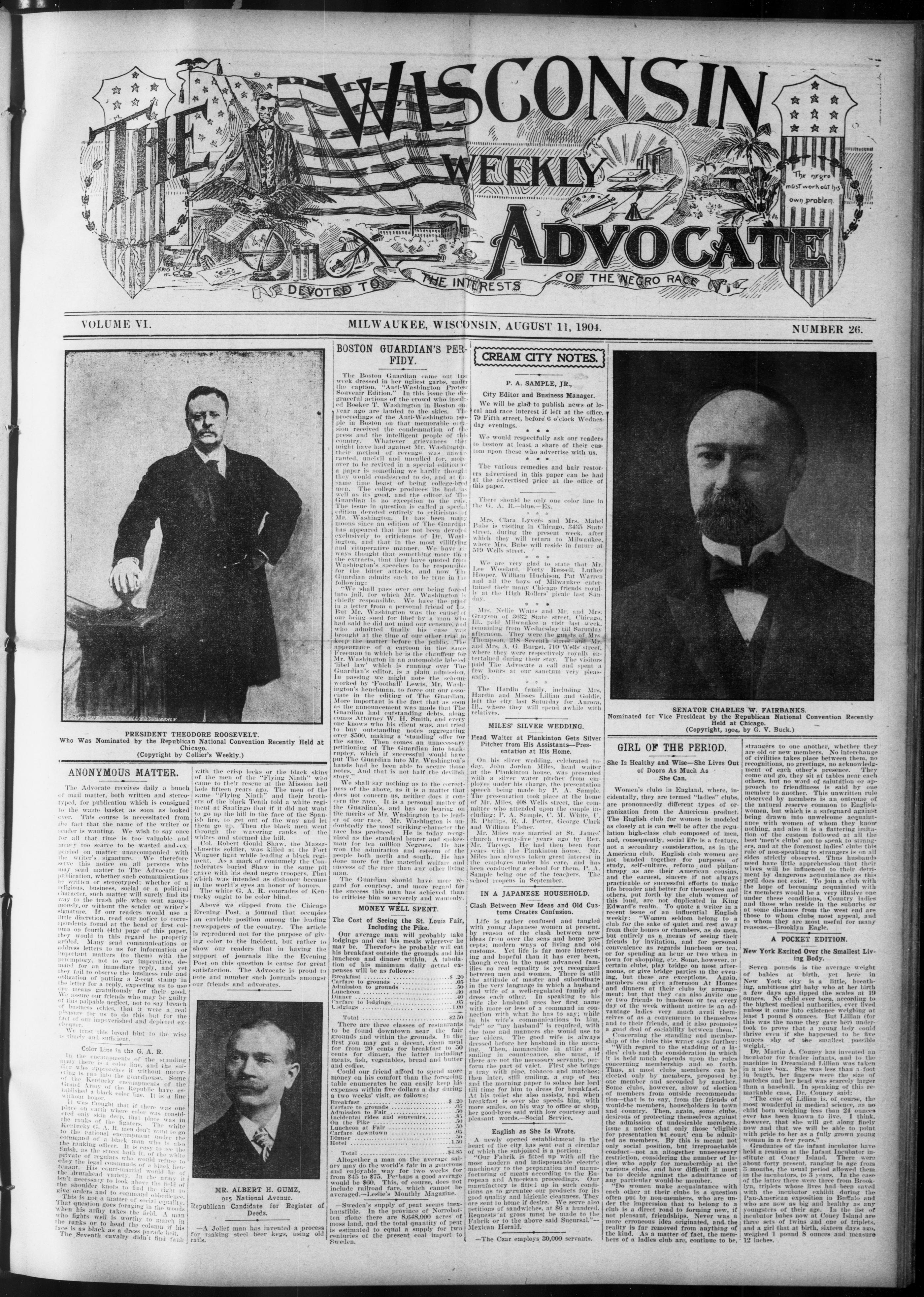
WISCONSIN
WEEKLY
ADVOCATE
DEVOTED TO THE INTERESTS OF THE NEGRO RACE
VIRGHE MESSER GROLDT WEEKLY
PRESIDENT THEODORE ROOSEVELT.
Who Was Nominated by the Republican National Convention Recently Held at Chicago.
(Copyright by Collier's Weekly.)
VOLUME VI.
PRESIDENT THE
Who Was Nominated by the Republic
(Copyright by
ANONYMOUS MATTER.
The Advocate receives daily a bunch of mail matter, both written and stereotyped, for publication which is consigned to the waste basket as soon as looked over. This course is necessitated from the fact that the name of the writer on sender is wanting. We wish to say once for all that time is too valuable and money too scarce to be wasted and expended on matter unaccompanied with the writer's signature. We therefore serve this notice on all persons who may send matter to The Advocate for publication, whether such communications be written or stereotyped; whether of a religious, business, social or a political character, such matter will surely find its way to the trash pile when sent anonymously, or without the sender or writer's signature. If our readers would use a little discretion, read our notice to correspondents found at the head of first column on fourth (4th) page of this paper, they would in this regard be properly guided. Many send communications or address letters to us for information or important matters (to them) with the peremptory, not to say imperative, demand for an immediate reply, and yet they fail to observe the business rule and obligation of putting a 2-cent stamp in the letter for a reply, expecting us to use our means gratuitously for their good. We assure our friends who may be guilty of this palpable neglect, not to say breach of business ethics, that it were a real pleasure for us to do this but for the fact of our impoverished and depleted exchequer.
We trust this broad hint to the wise is timely and sufficient
Color Line in the G A B
In the encampments of the standing army there is a color line, and the soldier who approaches it without uncovering is run into the guardhouse. Some of the Kentucky encampments of the Grand Army of the Republic have established a black color line. It is a line without honor.
It was thought that if there was one place on earth where color was considered only skin deep, that place was in the ranks of the fighters. The white Kentucky (G. A. R. men don't want to go to the national encampment under the command of a black man who is also the ranking officer. It is easy to see the finish, as the street hath it, of the white private of regulars who would refuse to obey the legal commands of a black lieutenant. His court-martial would be of the drunhead variety. In the army it isn't necessary to look above the field of the shoulder knots to find the right to give orders and to command obedience. This is not a matter of social equality. That question goes foraging in the woods when his army takes the field. A man who fights well is worthy to march in the ranks or to head the column if his face is as black as a dress parade.
The Seventh cavalry didn't find fault
with the crisp locks or the black skins of the men of the "Flying Ninth" who came to their rescue at the Mission hell hole fifteen years ago. The men of the same "Flying Ninth" and their brothers of the black Tenth told a white regiment at Santiago that if it did not want to go up the hill in the face of the Spanish fire, to get out of the way and let them go up. Then the black men went through the wavering ranks of the whites and stormed the hill. Col. Robert Gould Shaw, the Massachusetts soldier, was killed at the Fort Wagner fight while leading a black regiment. As a mark of contumely the Confederates buried Shaw in the same pit grave with his dead negro troopers. That which was intended as dishonor became in the world's eyes an honor of honors. The white G. A. R. comrades of Kentucky ought to be color blind.
Above we clipped from the Chicago Evening Post, a journal that occupies an enviable position among the leading newspapers of the country. The article is reproduced not for the purpose of giving color to the incident, but rather to show our readers that in having the support of journals like the Evening Post on this question is cause for great satisfaction. The Advocate is proud to note and number such journals amongst our friends and advocates.
[Image of a man with a mustache and a suit and tie].
A Joliet man has invented a process for making steel beer kegs, using old rails.
BOSTON GUARDIAN'S PER FIDY.
The Boston Guardian came out last week dressed in her ugliest garbs, under the caption, "Anti-Washington Protest, Souvenir Edition." In this issue the disgraceful actions of the crowd who insulted Booker T. Washington in Boston one year ago are lauded to the skies. The proceedings of the Anti-Washington people in Boston on that memorable occasion received the condemnation of the press and the intelligent people of this country. Whatever grievances they might have had against Mr. Washington their method of revenge was unwarranted, uncivil and uncalled for, moreover to be revived in a special edition of a paper is something we hardly thought they would condescend to do, and at the same time boast of being college-bred men. The college produces its bad, as well as its good, and the editor of The Guardian is no exception to the rule. The issue in question is called a special edition devoted entirely to criticisms of Mr. Washington. It has been many moons since an edition of The Guardian has appeared that has not been devoted exclusively to criticisms of Dr. Washington, and that in the most villifying and vituperative manner. We have always thought that something more than the extracts, that they have quoted from Washington's speeches to be responsible for the bitter attacks, and now The Guardian admits such to be true in the following:
"We shall pass over our being forced into jail, for which Mr. Washington is chiefly responsible. We have the proof in a letter from a personal friend of his. But Mr. Washington was the cause of our being sued for libel by a man who had said he did not mind our censure, and who admitted finally his case was brought at the time of our other trial to keep the matter before the public. 'The appearance of a cartoon in the same Freeman in which he is the chauffeur for Mr. Washington in an automobile labeled 'libel law' which is running over The Guardian's editor, is a plain admission. In passing we might note the scheme worked by 'Football' Lewis, Mr. Washington's hechman, to force out our associate in the editing of The Guardian. More important is the fact that as soon as the announcement was made that The Guardian had outstanding debts, along comes Attorney W. H. Smith, and every one knows who his client was, and tried to buy outstanding notes aggregating over $500, making a 'standing' offer for the same. Then comes an unnecessary petitioning of The Guardian into bankruptcy, which if successful would have put The Guardian into Mr. Washington's hands had he been able to secure those notes. And that is not half the devilish story."
We shall say nothing as to the correctness of the above, as it is a matter that does not concern us, neither does it concern the race. It is a personal matter of the Guardian's, and has no bearing on the merits of Mr. Washington to be leader of our race. Mr. Washington is undoubtedly the most striking character the race has produced. He is today recognized as the standard bearer and spokesman for ten million Negroes. He has won the admiration and esteem of the people both north and south. He has done more for the material welfare and success of the race than any other living man. The Guardian should have more regard for courtesy, and more regard for the success this man has achieved, than to criticise him so severely and wantonly.
MONEY WELL SPENT
The Cost of Seeing the St. Louis Fair, Including the Pike.
Altogether a man on the average salary may do the world's fair in a generous and enjoyable way for two weeks for from $45 to $75. Perhaps a good average would be $60. This, of course, does not include railroad fare, which cannot be averaged.—Leslie's Monthly Magazine.
—Sweden's supply of peat seems inexhaustible. In the province of Norroboroten alone there are 8,648,000 acres of moss land, and the total quantity of peat is estimated to equal a supply for two centuries of the present coal import to Sweden.
CREAM CITY NOTES.
P. A. SAMPLE, JR.
We will be glad to publish news of local and race interest if left at the office. 79 Fifth street, before 6 o'clock Wednesday evenings.
We would respectfully ask our readers to bestow at least a share of their custom upon those who advertise with us.
The various remedies and hair restorers advertised in this paper can be had at the advertised price at the office of this paper.
There should be only one color line in the G. A. R.—blue.—Ex.
Mrs. Clara Lyvers and Mrs. Mabel Bube is visiting in Chicago. 3435 State street, during the present week, after which they will return to Milwaukee, where Mrs. Bube will reside in future at 519 Wells street.
* * *
We are very glad to state that Mr. Lee Woodard, Forty Russell, Luther Hooper, William Huchison, Pat Warren and all the boys of Milwaukee entertained their many Chicago friends royally at the High Rollers' picnic last Sunday.
Mrs. Nellie Watts and Mr. and Mrs. Grayson of 3632 State street, Chicago, Ill., paid Milwaukee a visit last week, remaining from Wednesday till Saturday afternoon. They were the guests of Mrs. Thompson, 218 Seventh street and Mr. and Mrs. A. G. Burget, 710 Wells street, where they were respectively royally entertained during their stay. The visitors paid The Advocate a call and spent a few hours at our sanctum very pleasantly.
The Hardin family, including Mrs. Hardin and Misses Lillian and Goldie, left the city last Saturday for Aurora, Ill., where they will spend awhile with relatives.
MILES' SILVER WEDDING
Head Waiter at Plankinton Gets Silver Pitcher from His Assistants—Presentation at His Home.
On his silver wedding, celebrated today. John Jordan Miles, head waiter at the Plankinton house, was presented with a silver water pitcher from employees under his charge, the presentation speech being made by P. A. Sample. The presentation took place at the home of Mr. Miles, 408 Wells street, the committee who attended upon the couple including: P. A. Sample, C. M. White, U. B. Phillips, E. J. Porter, George Clark and William Fisher. Mr. Miles was married at St. James' church twenty-five years ago by Rev. Mr. Throop. He had then been four years with the Plankinton house. Mr. Miles has always taken great interest in the employees under his care, and has been conducting a school for them, P. A. Sample being one of the teachers. The school reopens in September.
IN A JAPANESE HOUSEHOLD.
Clash Between New Ideas and Old Customs Creates Confusion.
Life is rather confused and tangled with young Japanese women at present, by reason of the clash between new ideas from over the seas and home precepts; modern ways of living and old customs. Yet life is far more interesting and hopeful than it has ever been, though even in the most advanced families no real equality is yet recognized between men and women. There is still the attitude of master and subordinate in the very language in which a husband and wife of a well-regulated family address each other. In speaking to his wife the husband uses her first name with more or less of a command in connection with what he has to say; while in his wife's communications to him, "sir" or "my husband" is required, with the tone and manners she would use to her elders. The good wife is always dressed before her husband in the morning. Then, immaculate in attire and smiling in countenance, she must, if there are not the necessary servants, perform the part of valet. First she brings a tray with pipe, tobacco and matches; then later, still smiling, a cup of tea and the morning paper to solace her lord till time for him to dress for breakfast. At his toilet she also assists, and when breakfast is over she speeds him, with more smiles, on his way to office or shop, her good-byes said with low courtesy and pleasant words.—Social Service.
English as She Is Wrote.
A newly opened establishment in the heart of the city has sent out a circular of which the subjoined is a portion: "Our Fabrik is fitted up with all the most modern and indispensable electric machinery to the preparation and manufacturing of meats according to the European and American proceedings. Our manufactory is fitted up in such conditions as to guarantee our products for its good quality and hygienic cleanness. They are sent to home if desire. We serve also petitions of sandwiches, at $6 a hundred. Requests at gross must be made to the Fabrik or to the above said Sucursal."—Mexican Herald.
—The Czar employs 30,000 servants.
[Name]
SENATOR CHARLES W. FAIRBANKS. Nominated for Vice President by the Republican National Convention Recently Held at Chicago. (Copyright, 1904, by G. V. Buck.)
GIRL OF THE PERIOD.
She Is Healthy and Wise—She Lives Out of Doors As Much As She Can.
Women's clubs in England, where, incidentally, they are termed "ladies" clubs, are pronouncedly different types of organization from the American product. The English club for women is modeled as closely at is can well be after the regulation high-class club composed of men, and, consequently, social life is a feature, not a secondary consideration, as in the American club. English club women are not banded together for purposes of study, self-culture, reform and philanthropy as are their American cousins, and the earnest, sincere if not always practicable or successful efforts to make life broader and better for themselves and others, put forth by the club women of this land, are not duplicated in King Edward's realm. To quote a writer in a recent issue of an influential English weekly: "Women seldom belong to a club for the sake of quiet and rest away from their homes or chambers, as do men, but entirely as a means of seeing their friends by invitation, and for personal convenience as regards luncheon or tea, or for spending an hour or two when in town for shopping, etc. Some, however, at certain clubs, play bridge on most afternoons, or give bridge parties in the evening, but these are exceptions. Again, members can give afternoon At Homes and dinners at their clubs by arrangement; but that they can also invite one or two friends to luncheon or tea every day of the week without notice is an advantage ladies very much avail themselves of as a convenience to themselves and to their friends, and it also promotes a good deal of sociability between them." Concerning the standing and member-
ship of the clubs this writer says further: "With regard to the standing of a ladies' club and the consideration in which it is held much depends upon the rules concerning membership and so forth. Thus, at most clubs members can be elected only by members, proposed by one member and seconded by another. Some clubs, however, allow of election of members from outside recommendation—that is to say, from the friends of would-be members, householders in town and country. Then, again, some clubs, desirous of protecting themselves against the admission of undesirable members, issue a notice that only those 'eligible for presentation at court' can be admitted as members. By this is meant not only social position, but irreproachable conduct—not an altogether unnecessary restriction, considering the number of ladies who apply for membership at the various clubs, and how difficult it must be to decide against the admittance of any particular would-be member.
"Do women make acquaintance with each other at their clubs is a question often put by non-members, who are under the impression that to belong to a club is a direct road to forming new, if not pleasant, friendships. Never was a more erroneous idea originated, and the reality is far removed from anything of the kind. As a matter of fact, the members of a ladies club are continue to be
NUMBER 26.
S W. FAIRBANKS.
Republican National Convention Recently
Chicago.
by G. V. Buck.)
strangers to one another, whether they are old or new members. No interchange of civilities takes place between them, no recognitions, no greetings, no acknowledgment of each other's presence. They come and go, they sit at tables near each others, but no word of salutation or approach to friendliness is said by one member to another. This unwritten rule observed by members is an outcome of the natural reserve common to Englishwomen, but which is a safeguard against being drawn into unwelcome acquaintance with women of whom they know nothing, and also it is a flattering imitation of the custom followed at all the best 'men's clubs' not to speak to strangers, and at the foremost ladies' clubs this rule of non-speaking to strangers is on all sides strictly observed. Thus husbands need have little apprehension that their wives will be influenced to their detriment by dangerous acquaintance as this peril does not exist. To join a club with the hope of becoming acquainted with its members would be a very illusive one under these conditions. Country ladies and those who reside in the suburbs or at some distance from the west end are those to whom clubs most appeal, and to whom they are most useful for many reasons.—Brooklyn Eagle.
New York Excited Over the Smallest Living Body.
Seven pounds is the average weight of babies at birth, yet here in New York city is a little, breathing, ambitious girl baby who at her birth a few days ago tipped the scales at 19 ounces. No child ever born, according to the highest medical authorities, ever lived unless it came into existence weighing at least 1 pound 8 ounces. But Lillian (for this was the name they gave her) undertook to prove that a young lady could thrive even if she happened to be five ounces shy of the smallest possible weight.
Dr. Martin A. Couney has invented an incubator for tender infants, and to the machine in Dreamland Lillian was taken in a shoe box. She was less than a foot in length, her fingers were the size of matches and her head was scarcely larger than a baseball. In speaking of this remarkable case, Dr. Couney said:
"The case of Lillian is, of course, the most wonderful in medical science, as no child born weighing less than 24 ounces ever has been known to live. I think, however, that she will get along finely now and that we will be able to point with pride to her as a fully grown young woman in a few years."
Graduates of the infant incubator have held a reunion at the Infant Incubator institute at Coney Island. There were about forty present, ranging in age from 3 months, the usual period allowed them in the incubators, to 3 years. In the case of the latter there were three from Brooklyn, triplets whose lives had been saved with the incubator exhibit during the Pan-American exposition in Buffalo and who are now as big and healthy as any youngsters of their age. In the list of incubator babes now at Coney Island are three sets of twins and one of triplets, and a girl that at birth, sixteen days ago, weighed 1 pound 8 ounces and measure 12 inches.
---
Miscellaneous Items.
The first successful flour mill was erected in London in 1764.
As far back as 4000 B. C., Egypt had works on medicine and anatomy.
- The most expensive lace manufactured today is valued at $5000 a yard.
- The Orangemen of Ireland have pronounced in favor of Chamberlain's tariff scheme.
- A map of Jerusalem in Mosaic has been found in Palestine and is said to be over 1500 years old.
- Our best thinking is done in the back of our brains, say scientists, as the result of recent experiments.
- Thirteen life insurance companies in Great Britain refuse to accept risks on unvaccinated persons.
- Paris has the biggest debt of any city in the world. It amounts to $400,000,000.
The good results of administering potatoes in certain forms of diabetes are affirmed by a French physician, Dr. Mosse, who states that he has effected cures by this means.
Aduiterants highly injurious to the health have been found in innocent looking cakes, cheap caramels and other sweet stuffs sold freely to children in New York city.
In the coat pocket of a workman who was discovered horribly mutilated at Vincennes, near Paris, were found manuscripts of poems written by him in Latin, Greek and Hebrew.
Native drug stores in Japan are still largely stocked with dried snakes, toads, lizards, crabs, etc., infusions of which are the popular household remedies throughout the country.
The snake stone is the center of half the superstitions of South African natives, although its supposed power of extracting venom inflicted by snakes has been shown to be a myth.
Regulations have been made in Vienna that all electric lights must be raised to sixteen feet above the pavement as otherwise they are likely to injure the eyesight of pedestrians.
Mary Cann, who personally saved the lives of six helpless passengers of the Gen. Slocum, is to get a gold medal and a purse. She is scarcely 17, and at the time had been out of the hospital only a few days.
At an Irish wedding recently a London firm supplied the best man to the order of the bridegroom, whose friends, disapproving of the marriage, had refused to take any part whatever in the function.
The London Express gives the following complete list of Lebaudy's titles: Jacques L. Najin-al-Den, Emperor of the Sahara, Commander of the Faithful King of Tarfaia, Duke of Arleuf, Prince of Chai-Huin.
There are 252,436 miles of ocean cable in operation today and only 38,797 miles are owned by governments. The British cables, which connect London with all parts of the world, have a total mileage of 154,099.
Hamond cites the case of a woman who always gave out an odor or pineapple when she was in a temper, and another who smelt of violets when suffering from a hysterical attack. Certain odors are inherited.
We should never have had the Panama hat but for the quick-fingered Indians of the Isthmus of Panama. Even today their secret process of seasoning the grass blades used in weaving these hats remains unrivaled.
Telegraph lines in the Kongo Free State usually run along the banks of rivers. A track is cut through the forest, and the living trees are lopped as poles, where suitable, or else wrought iron poles are employed.
The supreme court of Germany has rendered an opinion that the title of doctor conferred by American dental colleges is not to be recognized to Germany, constituting a violation of the German law against unfair competition.
An elderly Brixton gentleman claims to be the "record" omnibus rider of England. For the last twenty-five years, with the exception of Sundays and holidays, he has journeyed each day to the city on the same bus and occupied exactly the same seat.
The Japanese Red Cross society is able to supply through its various branches 3000 female nurses and 2000 male nurses. Female nurses are not sent to the front, but undertake duty in Japan in the military and Red Cross hospitals in various parts of the country.
After conquering Burma the British undertook to carry the great Rangoon bell, the third largest in the world, to Calcutta as a trophy, but dropped it overboard in the Rangoon river, where it defied all efforts of the engineers to raise it. Recently the Burmese lifted the mass of metal from its muddy bed and triumphantly restored it to its place.
A Berlin chemist has secured a patent on a compound for animal food which has sawdust for its chief ingredient. The inventor argues that as many animals have a liking for the roots and leaves of trees and shrubs and apparently find plenty of sustenance in such articles of diet, such animals should subsist equally as well as upon sawdust when properly prepared.
At Warthenstein, Germany, there is a unique botanical library. Outwardly the books present the common appearance of a block of wood, but a careful examination reveals that each is a complete history of the particular tree which it represents. At the back of the book the bark has been removed for a space which allows the scientific and common names of the tree to be placed as a title.
Mortar was made by the people of Tahiti when our ancestors were shivering in holes in the rocks. They dived into the sea, brought up lumps of coral, burned them in pits, using wood as fuel, and mixed the lime they get in this fashion with sharp sand and water. With this mixture the ingenious savage plastered the walls and floor of his house, and a better mortar could not be obtained.
The word "vaudeville," which now means a play in which songs are introduced, is a corruption of Vaux de Vire, the names of two valleys in Normandy. A fuller in Vire, in the fifteenth century, composed some humorous and satirical drinking songs which were very popular throughout France, under the name of their native place, "Vaux de Vire." The terms seem to have been corrupted into voix de ville.
In response to a general desire of the party the officers of the Porto Rican teachers' expedition at Harvard are making arrangements to have the Porto Rican coffee served regularly to them, as this is one of the things they have missed the most since leaving their homes. Special instructions are to be given the dealers by a member of the party as to the exact method of roasting as Porto Rican coffee, to be satisfactory to the natives, must be roasted perfectly black.
The wonderful insect killing capacity of the toad is known in a general way to the enlightened few, says Country Life in America. An important colony of toads may be the salvation of a flower garden. Many gardeners give their children a cent apiece for every cutworm destroyed. From May 1 to August 1 a toad may destroy 2160 cutworms, which it would cost $21.60 to destroy by hand. English gardeners are said to pay as much as $25 a hundred for toads for colonizing purposes.
THE 20TH CENTURY MOTHER GOOSE
Little Miss Muffet
Set on a tuffet
Sat on a tuffet,
Eating of curds and whey;
But a trust—such is fate—
Wanted what the child ate
And forcibly took it away.
Old Mother Hubbard
Went to the cupboard
To get the poor dog a bone;
But the meat trust said "Nit!
We have raised the price—glt!"
And so the poor dog had none.
A Picture of a Shepherdess.
The cottage beside the sea was in ruinous condition. The wind had stripped off the slates winter after winter, and no one had thought of repairing the damage. There were long streaks of damp on all the walls, over which a fur of mildew had grown. The carpets had rotted, the doors had warped and left gaps at top and bottom, the windows had had their broken panes mended with sheets of brown paper at the front of the house where the spray of the sea drove furiously in a west wind storm. At the back the broken panes were left as they were. To be sure, The Cottage, a big place for all its unpretentious name, had a dozen rooms unoccupied. As its owner, Miss Marcella O'Sullivan-Beare, would say, it was no use, wasting time in mending windows of rooms where people never slept.
The Cottage was like a museum. Old furniture of the best Sheraton and Chippendale period, French mirrors, high old brass fenders, Waterford glass, old colored engravings, old pictures, old plate, old jewelry, old silver.
A mere glance round the room made Hilary L'Estrange's bright eyes brighter, his glance more eager, for he was a born collecter. He had money, too, to gratify his tastes, and he would have traveled any distance and taken any pains to add to his collection something that was really good.
He had a letter of introduction to Miss Marcella from the rector, Mr. Vandeleur, whose pupil he had been once upon a time.
"My dear fellow, she won't sell," Mr. Vandeleur had assured him, "so you will only be able to look and long. The worst of it is that the things are going to rack and ruin. Between the damp and the rats, everything that can spoil will spoil. There won't be much left for Cecilia when the time comes.
Miss O'Sullivan Beare was gracious to the rector's friends. He drank his tea—oddly fragrant tea—from Chinese cups and saucers worth a small fortune. Miss O'Sullivan Beare's niece, Cecilia, poured out the tea. She was a tall, pale girl, with serious brown eyes, and would have been pretty if she had had a little more color and animation. Her hands, under her sleeves of Limerick lace, moved with a certain grace among the teacups. It was a wild, wintry day, and the sea lashed against the panes. The room was full of portentous shadows, amid which Cecilia, in her gray gown, glided like a ghost. L'Estrange spared her a thought of pity, remembering what the rector had said—
"There is no young society within ten miles, and the last thing that would occur to Marcella would be the possibility of Cecilia's requiring young society. She is too much alone."
Hearing that Mr. L'Estrange was interested in the old things, Miss Marcella was graciously pleased to display them. For a couple of hours L'Estrange sat, his head bent toward the lamp which Cecilia had brought, inspecting lace, silver, china, portfolios. Why, there was a fortune in the place, at the mercy of the damp and the rats and clumsy peasant girls, such as the one barefoot who had opened the door to him.
He talked about the things calmly, with expert knowledge, even while his heart was beating furiously. Once he spoke in a diffident, small voice of the value of the things, of what they would fetch in a London salesroom. Miss Marcella immediately became cold, and said, loftily, that the O'Sullivan Beares had not come, she hoped never would come, to selling their possessions.
"For the matter of that," she said, "they go after the manner of mortal things. There have been a good many things lost and broken and destroyed by rats in my time."
"They should be kept more carefully, in glass cases under lock and key," L'Estrange protested, but without effect. Presently there was something Miss Marcella desired to show him, a picture which hung on a bedroom wall, and was too big to be carried down. Asking L'Estrange to take the lamp, she preceded him up the few steps from the hall, which led to a long corridor, with rooms going off it at one side. She forgot in which room the picture was, and went from one to another. Everywhere there was a damp and mouldering smell. Everywhere beautiful things revealed themselves out of the shadows, rotting to their end.
After all, when the picture was found, L'Estrange was not much impressed. He had noticed downstairs that Miss Marcella did not seem to discriminate between the treasures and lesser things.
"My grandfather, Sir Hercules O'Sullivan," she said, "ran Col. O'Flaherty through the right arm because the colonel said that this was not a genuine Rembrandt, but a copy."
L'Estrange had wiped the dust and damp off the picture with his big silk handkerchief—which, truth to say, was in a desperate condition, having dusted so many things this afternoon—and inspected it closely.
"Nevertheless," he said, "Col. O'Flaherty was right. It is but a copy, and not a good one at that."
He replaced the picture, not noticing the old lady's offended air, and, taking the lamp in his hand, he looked about the room. In a corner there was a pile of books. He could see the tooled edges of some catching the lamplight like a jewel, and his heart bled at the murder of beautiful things.
"What is this?" he asked, picking up a small canvas out of its frame which leant against the discolored wall. Again
he had recourse to his handkerchief, bringing it out of the pocket of the long brown overcoat which he had not been asked to remove. The picture was covered with clinging mould.
"That has no value at all," the old lady said. "Unlike the Rembrandt."
"The rats have been gnawing it," he said, in a tone of bitter reproach. "Look at this corner!"
"It is a poor, rubbishing thing," said Miss Marcella, taking it from him with something like temper and putting it back against the wall. "We will return, if you please, sir, to the parlor. I am obliged for your interest in my family heirlooms."
As she opened the door for him to precede her with the lamp, the wind rushed up the stairs with a shriek and the light went out. He fumbled in his pocket and there were no matches.
"Excuse me, sir. I will fetch a light," Miss Marcella said, and went out, leaving him in the dark.
There was a green glimmer in the room; the moon was breaking through the stormy clouds and was reflected on the crests of the waves. Miss Marcella was gone a few minutes. When she returned she found L'Estrange standing as she had left him.
He hardly seemed to notice that his opinion against the genuineness of the Rembrandt had offended her. Indeed, when they had reached the hall again, and she would have led the way to the sitting room, empty now, since Cecilia was washing up the precious china cups in the housemaid's pantry—she cared for the things, at all events—he bowed himself out instead.
"I was deceived in the young man, Cecilia," Miss Marcella said, afterward. "The young men of the present day have no modesty."
So she put L'Estrange out of her head. Not so Cecilia, who had hardly ever met a gentleman of her own age. Poring over her romances and her poetry through the wild winter, the clean shaven, wholesome face, with its bright eyes and eager air, looked at her from between the pages of her book. She became more absent minded than ever, and Miss Marcella was more snappish with her than ever. Miss Marcella had her cronies, who came and played cards with her on a Chippendale card table, with candles in silver candlesticks, flanked by silver snuffers on their trays, at each corner.
Cecilia, watching the lined, greedy old faces, and the shaking hands drawing in the small stakes or putting them out, or picking up the cards, wondered if she would grow to be like the old ladies. It seemed a poor idea of pleasure to her. Once or twice she had met Mr. Vandeleur, and her mouth had parted to ask him a question, and closed again. He noticed and wondered about it. The last thing he would have thought of would be that Cecilia wanted to know about L'Estrange. He had almost forgotten about L'Estrange's visit to The Cottage.
L'Estrange had found bad news awaiting him in a telegram at the rectory. His little half-sister, Effie, the one creature he loved greatly, was suddenly ill—had to undergo an operation immediately. He was at her side as fast as express trains could carry him. For days the chances inclined rather to death than life. Then there was the faintest hope, which grew so imperceptibly that one doubted if it grew at all. Even when the operation was long left behind there was terrible weakness.
The days of late winter and early spring passed, and L'Estrange thought of nothing but Effie. What would life be worth to him without Effie? She was half his age, fifteen years to his 30; and she had been his for ten years, years during which she was his little star of home, to which he always returned with happy speed.
He took Effie away to Madeira before May had time to show her treacherous side. As the seasons changed he took her hither and thither, following now the coolness and again the warmth. till he was rewarded by seeing a robust Effie once again.
Then, after nearly a year of absence, they returned home, and L'Estrange, with an arm around Effie's shoulder, as they visited their gardens, now all one riot of leaf and blossom, shouted, "Oh, to be in England now that April's there!" and was reminded by Effie, who was a matter-of-fact little person, that it wasn't England, but Ireland.
He left Effie in the care of the old servants, enjoying herself hugely because she was not to go back to school, but was to have a governess as soon as Hilary could find the perfect lady. He had business in London. After that he was going down to see Mr. Vandeleur.
He had hardly arrived at the rectory when he asked Mr. Vandeleur about Miss O'Sullivan Beare.
"Ah," said the rector. "Are you still hankering after the collection? It's no good, my boy. All the things are gone to Davy's locker. The old lady and her niece very nearly went with them. An uncommonly narrow escape they had." "What do you mean?"
"Only that in the big February storm the house came down, collapsed like a house of cards. Went on fire, too, when it had collapsed. You'd have thought it was too damp to burn, but it burned all the same. The girl, Cecilia, had heard a chimney-stack fall in one of the unoccupied rooms and had dragged the old lady out of the house, much against her will and only just in time. They found a refuge in the stable, which was hewn out of the solid rock. None of us knew till morning. We were too busy saving our own lives and property. When we knew it was too late."
"Where are they—Miss Marcella and her niece?"
"They have left here. Gone to Dublin to live. They are as poor as church mice. Was it really true that the things were so valuable?"
"They were very valuable," said L'Estrange.
He was off the next morning, although he had come for a week, on an insufficient excuse which did not deceive his old master.
"The boy seems rather distracted." Mr. Vandeleur said to himself. "I wonder if he's in love. Yes, I suppose that must be it. Unless, indeed, he's heard of something he must acquire somewhere. Cold blooded creatures, these collectors. Friends don't count against a precious find."
Dublin was not so big, Hilary L'Estrange was saying to himself next day, as he walked down Dawson street, to the educational and scholastic agency of Mrs. Drummond Dunlop, who had promised to find him the governess for Effie; one who should have tact as well as knowledge; who would not disturb the relationship between him and Effie; who would not
assert herself too much, nor mistake the order of things in which Effle reigned as mistress of the house, with Mrs. O'Kelly, the housekeeper, as her prime minister. Dublin was not so big that people could disappear in it. Not like London at all. Thank heaven, not at all like London. As he went up the steps he met a young lady coming down at whom he glanced casually. Then he stood still and stared in his surprise. "I was just thinking of you. Miss O'Sullivan," he said, holding out his hand. "Do you suppose my thinking of you brought me just here, where I should meet you? I have come from the south. Mr. Vandeleur told me of your misfortunes."
Cecilia O'Sullivan blushed hotly for an instant; but he had seen a certain delight in her face. Then she was pale again, and he saw that she looked ill; there were dark shadows about her eyes, which reminded him, now he could see them in broad daylight, of brown pansies; the soft roses of her mouth were pale and had a depressed droop.
"Ah, yes," she said, and her soft southern brogue was like a wail. He remembered now that he had not heard her speak at The Cottage. "It made a great difference to us, that storm. It made a great difference to a good many people." He looked at her with a sudden illumination in his face.
"Forgive me," he said, still holding her hand. "You were * * * I find you here, where I also have business?" * * *
"I want employment as a governess, a companion—anything," she answered. "But, alas, there is not much hope for u.e. I have no accomplishments of any kind. I might go out as a parlor maid, but I am not strong enough."
"Good heavens!" said L'Estrange. "A parlor maid! I should think not. Do you think, by any chance, you could look after one little girl of 15—the sweetest thing alive? She is my little half-sister. I don't think she wants any accomplishments. She won't learn anything she doesn't like, and she learns anything she does like naturally and easily. She wants a lady to be with her. She has left school because she has been ill. Why—if you will come—heaven has sent you. Come in and see Mrs. Drummond Dunlop. I want to tell her that we have settled it up."
A little later he walked home with Cecilia to her aunt's lodgings. They were in a namelessly depressing street at the north side of the city—a moribund street which had housed nobility and gentry in the Eighteenth century. The afternoon had ended in rain, and the dark parlor, with its dreary, lodging house furniture, where Miss O'Sullivan Beare received him, was full of shadows.
As she talked with him the old lady held a handkerchief to her eyes.
"You remember The Cottage," she said; "and now" * * * She waved a hand round the dingy room.
He had a ridiculous impulse to implore her to take up her residence in Clooney, as his old house was called. Clooney was so much too big for him and little Effie; and it was full of beautiful things, housed befittingly, as those at The Cottage had not been. But he controlled himself. However, it was settled about Cecilia, Cecilia was to go down to Clooney at once. The salary L'Estrange mentioned with blushes, was ridiculously large. However, Miss O'Sullivan Beare saw nothing remarkable about it. When one of her blood stooped to a menial occupation she did not therefore come on the plane of common folk.
L'Estrange left Miss O'Sullivan and Effie together for a few weeks. When he joined them he found, as he had anticipated, the happiest understanding between the two—nay, more than that, for Effie adored her new governess to that extent that L'Estrange complained with secret delight that Miss O'Sullivan had cispossessed him with Effie.
Late in the summer Miss O'Sullivan Beare came to visit Clooney, and found a new Cecilia. Delicate wild roses in Cecilia's cheeks, a shy light in Cecilia's eyes, a straight carriage, a springing step, a ready laughter that had never been Cecilia's before. With her opinion of the O'Sullivan Beares, the old lady was not unduly elated when she discovered the state of affairs between her niece and L'Estrange. In fact, she made a secret inquiry among her cronies into the history of the L'Estrange family before she consented to be satisfied.
Then, when all was happily settled, D.strange led her one day into the picture gallery and toward a picture which stood upon an easel. He was cddly pale for a happy lover. Miss O'Sullivan Beare was an oddity; one could not be sure of her point of view.
"I want you to look at this," he said, and his voice shook.
She had to get out her lorgnette be fore she could see the picture.
"That!" she cried. "The old Shepherdess picture. How did you come by it? It is not a copy, surely."
He became paler than before.
"Not to put too fine a point upon it," he said, "I stole it. I told Cecilia I would confess everything. I said to myself at the time that I was only taking it away to verify my own suspicions about it. I should have sent you the full value of it. How could I leave it to the rats and the dump? You know you would not believe me."
"Dear me!" said Miss Marcella, rather in wonder at his agitation. "I've always heard a collector would do anything. In fact, my revered grandfather, Sir Hercules, always justified it. You know he stole the grand duke's snuffbox. Alas, it perished in the flames. But why did you not take the Rembrandt, rather than this?"
"The Rembrandt? The Rembrandt was only a copy. 'The Old Shepherdess,' as you call it, is by Anthony Watteau. You know you wouldn't let me make sure that day. My dear aunt, if you'll let me add it to my collection. I'll give you six thousand pounds for it."
"Why, it would have come to you in the natural order of things. But * * * six thousand pounds! You are very generous, nephew, I can live in Dublin, and see my friends, and have my little card parties, as I was accustomed to. To be sure, life at Clooney is a little monotonous."
"And come to Clooney whenever you are tired of town." L'Estrange said, "and bring your friends with you, aunt. There is plenty of room at Clooney."
"I won't say it wasn't providential," said the old lady; "your picking and stealing. I mean. Still, I can't help thinking that providence meant you to take the Embrandt."—The Sketch.
—German beet sugar culture is a little more than fifty years old.
USED ONE PEN FOURTEEN YEARS.
Louisville Man Carried a Knife Eighteen Years and a Pencil Five Years.
The constant use of a pen point for fourteen years, a penknife eighteen years, an ordinary indelible lead pencil five years and a key ring nineteen years to the ordinary person sounds incredible, but such is the case with Cad Burba, a clerk in the general customs office here.
Mr. Burba, who was in the drug business at New Hope for more than ten years, is now using constantly a pen point he secured, second hand, while in the drug business, and since he has been at work for Uncle Sam he has continued to use it, preferring it to any other. During that time he has worn out two penholders, but the point is still in the prime of condition, kept so by the care bestowed upon it by its owner.
A fellow clerk was discussing the matter of care of pens yesterday, when Mr. Burba remarked that any pen, or article of any kind, would last for years if given the proper care. To prove his claim he drew from his pocket a knife which he had carried eighteen years. The blades gave evidence of numerous whettings, but not a gap or break could be seen. The knife, Mr. Burba said, had done a full share of work since he had owned it, and is good for many years yet.
After exhibiting the knife, Mr. Burba drew forth a gey ring bearing the date of 1885. It is a souvenir of the Louisville exposition, was purchased as such by Mr. Burba during the festal occasion, and has since done constant service. Mr. Burba has a special pocket for all these articles, and they may always be found there. He says he never breaks the point from a pencil, never loans it but that he watches it closely and sees to it that it does not get away; never leaves the pencil, key, ring or knife lying on his desk, but replaces them in their respective pockets when not in use, and by such inviolate system and care he always has them about him.—Louisville Courier-Journal.
Montezuma's Ticasure.
Whether the report of the discovery of the Incas treasure at Chayaltaya, Bolivia, is true or not, it is certain that the conquistadores did not get all the gold of the last Inca of Peru, nor all the gold and precious jewels of the Mexican monarch. The story is that the Incas treasure, withheld from Pizarro and now discovered in Bolivia, is worth $16,000,000, and that the Indians believe there is still much more hidden away. Pizarro received a great sum from the Inca whom he so cruelly treated and then killed him, but in so doing he missed a greater amount, which the Inca, hoping to save his life, promised his tormentor.
In this country one sometimes hears talk of a great golden sun and other treasure hidden securely from the early Spaniards. One gentleman who has the blood of Montezuma in his veins, and in whose family the traditions of the times of the conquest have been preserved, has said that probably fully $80,000,000 worth of treasure escaped the hands of Cortes and his followers. Where is this treasure hidden? Some have said that it was thrown into Lake Texcoco, and not many years back a company, well provided with funds, made extensive excavations in the Pedregal, near Coyoacan, on a spot indicated by tradition. A series of subterranean chambers was found, but no golden sun.
Both in Mexico and Peru gold was hidden away from the greedy conquistadores by the Indians, who cherished the hope of making a successful rising against their conquerors. That hope has long died away, though much of the hatred for the race of the conquistadores remains in the breast of the aborigine.
It is quite probable that some fine day much of Montezuma's hidden treasure may be found here, by a lucky hit. Perhaps it is concealed in an idol cave in the southwestern part of the sierra surrounding this valley, a cave of which stories have been told among the Indians. Whence has come the gold that the Indians living in these mountains, so close to the city, have brought here and sold to their legal representative? There is a mystery in all this, and a greater mystery in the whereabouts of Montezuma's treasure which remains untouched.—Mexican Herald.
Coloring Meerschaums
"With the growth of the hobby of smoking meerschaum pipes," said Ike Hafendorfer of Philadelphia, at the Fifth Avenue hotel last night, "there have sprung up concerns which make a business of coloring these pipes.
"How do they do it? Well, in the most natural way imaginable. By smoking them. In Paris there are two firms which employ about a thousand men to do nothing but smoke. They are paid 20 cents an hour. They smoke mild tobacco, in order that they can smoke a great length of time without getting a headache.
"I have seen these men at work. They are a queer set. Some of them are persons of high educational attainments, who, being out of other employment, do not object to sitting in a cool spot, reading and smoking. It's a snap for them.
"Others of these hired smokers are ignorant fellows, who have never achieved success in anything but smoking.
"A few women are in the gathering, but they are all sorry looking wrecks.
"Some of the smokers are diseased. Many of them have consumption. But this does not endanger the person who buys the fine meerschaum pipe later on, for the pipes are boiled and baked to eliminate all germs.
"The officers in Paris are trying to break up this business, declaring that it endangers the health of the hirelings."—Lolisville Herald.
Swiss Travel Novelties
Consul Washington, at Geneva, calls the attention of American travelers to the very inexpensive tickets which permit the holder to travel throughout Switzerland upon most of its railways and lake steamers at will for periods of from fifteen to thirty days. These tickets are obtainable at all large railway and boat stations in Switzerland. They may be ordered through any station. A delay of from one to two days is usual, and a photograph is required. The tickets permit continuous and unlimited travel at will during the period of their validity upon most of the railways and lakes in Switzerland, and upon some fifteen of the small roads not embraced in the ticket privilege (usually funicular roads) a reduction of from 20 to 50 per cent. upon usual fares is extended.
It is a useful point of information for travelers that trunks may be sent by post throughout the country and thus may be delivered at hotels to wait the arrival of owners. This is a practical plan for medium-sized and small trunks and valises. The trunks must be sent to the postoffice, but are delivered on their arrival.
His Inquiry.
"The wife of that feller that just sung the sailor song," whispered the landlord of the Prunytown tavern to the drummer who had accompanied him to the home talent entertainment in the village theater, "is suing him for divorce."
"That so," was the reply. "Has she any other grievance besides his singing?"
—Woman's Home Companion.
PROFIT IN TEXAS ONIONS.
That State Finds a New Source of Wealth to Hitherto Worthless Land.
More fortunes are being made in growing Bermuda onions in Texas than in the oil business. Some capital is required to operate in the Texas oil fields, while in the onion growing business an investment of a few hundred dollars is reasonably certain of bringing a profit of several thousand.
The area of the state in which onions can be grown is limited, but it covers many hundred thousand acres. This land is situated in the extreme southwestern part of the state. The artesian water belt, which extends from Carrizo Springs southeast to near Brownsville, a distance of about 300 miles, is well adapted to onion growing; and very little of it has been developed.
The valley of the Rio Grande, from Laredo down to Brownsville, is also a good onion region. In this valley the irrigating is done by pumping the water from the Rio Grande, while in the artesian water belt flowing wells are bored at depths of 400 to 600 feet. One of these wells furnishes sufficient water supply to irrigate a good-sized farm.
The profits made in growing onions in this region, which was formerly considered worthless except for grazing, are bringing many new settlers into the country. The raw land is selling for $5 to $15 per acre. It costs about $7 per acre to clear it, but when this is done and a water supply is obtained the net yearly income is from $250 to $750
The onion shipping season for this year is about over, and the yield will be not far from 25,000,000 pounds. The range of prices is from 1% to 3 cents per pound. At an average price of 2 cents the gross receipts this year amount to $500,000, which is distributed among fewer than fifty men.
The pioneer onion grower of Texas is T. C. Nye of Laredo. Three years ago he marketed 289,000 pounds of onions from five and a half acres of land, which netted him a little over $1000 per acre. This year Mr. Nye had thirteen acres in onions, from which he harvested 456,000 pounds, worth 2 cents per pound, an aggregate of $9120 gross receipts.—New York Sun.
Marriage Trust Magnate.
Judge William Hill, who dispenses justice—and then some—at Sunnyside when not engaged in pursuing the festive dollar while arrayed in the fine raimant or common garb of a dozen other callings, is pretty much the whole thing when it comes to outfitting folks for the married state. A few days ago a love sick swain called on the judge and solicited his services to unite him in holy bonds, ete.
"By the way, judge," said the young man, "ain't you the proprietor of the dance hall?" "I am," replied the justice.
"Well, I want it for a dance. How about the music?" "Well, I can supply that," said the judge.
"Then I must give a supper," said the soon-to-be Benedict. "Well, I am a professional cook," replied his honor, "and can serve you nicely in that line."
"All right," said the young man; "now I must see a photographer and make arrangements for photos of the wedding party." "Hold on," said the limb of the law, as the fellow was about to slip out the door. "That is my line, too. Photography is where I shine, and if you don't want to go to Price for the marriage license I can fix that, too."
"Well, I'll be—," gasped the lover, as he planked down a yellow piece of money as part payment for all the proposed service. "Do you also sell cradles and baby buggies?"—Emery County (Utah) Progress.
The Best Story Teller.
J. W. McNeal of Guthrie has the reputation of being the best story teller of Oklahoma. That this reputation is deserved witness the following story:
"As I was coming to town this morning and looked out over this beautiful landscape with its panorama of groves, prairie, bluffs, and valleys, I was reminded of a story told me while at Washington, about ex-Gov. Seay of Oklahoma. The governor was raised down in southern Missouri and had seen but little of the world when he went into the army. He was elected colonel and participated in the battles from 'Atlanta to the sea.' At the close of the war, you know, the troops were all assembled at Washington for a grand review and final discharge. It was the first city of prominence the governor had ever seen. Some of the boys took him to the top of Washington monument and there he viewed the capitol building, white house, the various department buildings, and other historic places that can be seen from the top of that monument. The tears began flowing down the governor's cheeks when some of his comrades said: 'Colonel, what is the trouble?' His reply was: 'Dann a man who doesn't love his country.' So I say, a man who doesn't feel a pride in this country, with all its beautiful landscape, richness of soil, healthy climate, handsome women, and sturdy men, is no patriot."—Kansas City Journal.
Sausages for Soldiers.
Army commissary officers are interested in a report just received at the state department from United States Consular Agent Warner, who writes that the Prussian war department has decided to establish a sausage factory at Spandau, an important Prussian fortress near the city of Berlin, in order to supply the garrisons of Spandau and Doeberitz with sausages. The buildings which are necessary in connection therewith will be erected near the Spandau city slaughter house. The sausage factory will be in charge of the commissary office of the war department, which is also contemplating establishing other such factories in those cities where large bodies of troops are quartered. By manufacturing the sausages itself the war department will be able to see that only the most wholesome meat is used in their manufacture, thus taking another precaution to insure the best possible physical condition of the soldiers.
Unfavorable Criticism
Two artists were regarding, in a Fifth avenue gallery, a print of Millais' "Chill October." One of them said:
"Sir John Millais once showed me the original of 'Chill October,' and at the same time he told me a story about it.
"He said that as he sat painting one gray afternoon among the reeds and rushes of the Tay a voice from behind a hedge asked:
"Man, did ye ever try photography?
"No, never,' said Sir John, and he continued to paint slowly.
"It's a hantle quicker,' said the voice.
"Yes, I suppose so,' the painter agreed.
"Then the voice said, bitingly:
"An' it's mair like the place."—New York Tribune.
Route of the Bobolink
The amount of traveling done by some of our birds is astonishing. Dr. Cooke says that the common nighthawk spends the summer in Alaska and the winter in Patagonia. The bobolink, which is the reed bird of the middle states and the rice bird of the south, winters on the waving pampas of southern Brazil. It covers 700 miles from Cuba to the South American coast in a single flight, following a track not popular with other birds, which might be called the bobolink route.—Saturday Evening Post
GOSSIP FOR THE LADIES.
be trimmed, a gown made or a collar or fancy stock gotten up quickly. In another box, stout and closely covered, are kept the articles most people keep in a work basket.
"There is, you see, on the back of the door, a 'catch all,' in which I keep the work I pick up from time to time for a few stitches. In the small pockets are dainty handkerchiefs in all stages of finishing, bits of embroidery, a collar or stock, and articles of like nature. In the pocket at the bottom, rather larger than the rest, are kept the stockings which are to be mended; this work is kept for rainy days, when going out seems impossible, but I never allow too many to accumulate. In a small bag, having a round pasteboard bottom, and kept hanging on the wall at all times, are buttons and all little odds and ends that are usually found in button bags.
"On the inside of the closet door, below the work bag 'catch all,' is a soiled clothese receptacle, wonderfully easy in its construction. A large section of denim was lined with oilcloth (white), made with a box pleat at the top and a few tucks at the bottom to give sufficient fullness, and then fastened to the door with brass headed tacks.
"As you know, I get two of my meals right here in my room, yet you see no trace of housekeeping, save the china plates on the top shelf of the desk. The desk is really my kitchen." And with these words the girl in the light green voile lowered the lid of a narrow desk, spread an embroidered tray cloth and prepared to make a cup of tea. The alcohol lamp was filled by means of a can with a long spout, cups and saucers were placed on the tray cloth, which was spread on the desk lid itself, and soon some slices of buttered bread, spread with a layer of pink chopped ham, and some raspberry jam sandwiches appeared. On the top shelf of the desk the china was placed, where it was useful as well as ornamental. On the shelf, under the desk lid, and hidden by it, and in the pigeonholes, were the knives, forks and spoons and such cooking articles as are necessary for the chafing dish. With these was the tiniest toy chopping machine, which had been bought for 10 cents, and which made delicious peanut butter, chopped meat for salads or sandwiches, and prepared the cheese for the dish of macaroni and tomato sauce which is occasionally the chief luncheon dish. On the three shelves underneath the desk are kept the tin bread and cake boxes, which are long, narrow cracker boxes.
"Oh, I must tell you about my coffee," said the hostess. "I ask the clerk to powder the coffee when I buy it, and I get only a quarter of a pound at a time, preferring to have it fresh. This powder does not need to be boiled, but is used exactly like tea. It must not, however, be stirred or moved about much, or it will be muddy. Simply put two dessert spoonfuls of coffee in the small coffee pot, pour over it two and a half cups of boiling water—really boiling, you know—and then set it aside for twenty minutes, covering it with a tea cosey. With a little unsweetened condensed cream you will find your morning cup of coffee far superior to any that is to be had at restaurants. So many articles of food can be bought already cooked at the delicatessen store, and it is so easy, when one once begins to cook a little in this way, to go on to larger achievements, that I feel like recommending it to other girls who have grown tired of the commonplace boarding house food. The best arrangement of all, I think, is the 'refrigerator,' which is a small sized tin bread box, with a few holes in the bottom. Under this is placed an oblong enamel dripping pan, and a 5-cent piece of ice, from earliest spring to latest fall, is kept in that box, after being wrapped in a piece of white flannel. A bit of charcoal done up in cloth keeps the little icebox sweet and clean, and the enamel dripping pan is emptied twice a day, regularly. Meat and anything that is likely to communicate an odor to other food are wrapped in pieces of paraffin paper, and butter and milk are always covered with this to prevent contamination."
Near the window, at one side of the room, was placed the bureau; at the other was the bed, which folded into a couch during the day, with a Bagdad cover and bright pillows. On the same side as the bureau was the desk, with its hidden goodies; the little cosey tea table next it, with only a hint of possible afternoon tea and an occasional chafing dish treat, and then, near that, an East India chair, with pockets of wicker at the side of each arm, where writing materials or a few magazines could be tucked away. A plate rack with extra plates and cups and saucers seemed only a part of the decorations. Pictures of all sorts hung on the walls. Two shelves made of rough boards covered with green denim and with ends finished in burnt work board were filled with books. A fair sized table, holding a typewriter, by means of which the owner earns her living as a writer, stood in one corner.—New York Sun.
Braiding Rags.
Rag carpet parties are the fad of the summer guests at the various watering places this season and threaten to take precedence of the much beloved bridge. To the initiated this all sounds very simple, but to those who aren't "in the swim" it may be well to state that this floor covering, now termed "rag style," is quite the proper thing today, and women have all gone back to the old-fashioned sewing bees to get them made.
For, as a matter of fact, the "rag style" rugs are nothing more nor less than the old-fashioned rag carpet of our grandmothers' time. More artistic, perhaps, as to coloring and design, less of the "hit or miss" pattern, but still bearing the carmarks of the old-time favorite
Almost any morning, if one should take a peep behind the vine covered trellis or beneath the gay striped awning of the summer hotel porch, you may see gathered together groups of women, old and young, sewing industriously on strips of bright colored textiles, which are afterward wound into big, hard balls. Even the children are pressed into service and assist in winding the long, narrow strips of gay cloth. It all emphasizes the revival of the old, simple industries of our grandmothers' time, and is in line with the modern manufacture of the pretty old blue and white counterpanes, rush seated chairs and the delft embroidered linen. But is is, perhaps, the rug, most of all, that has caught the popular modern fancy and upon which women today are expending so much time and strength.
It is perhaps because these rugs are so extremely pretty for summer cottages, bed chambers in the town house or bathrooms that women have taken to making them. But more than all else, it is presumably the "something old" which fascinates as much as anything.
One advantage about this style of rug is that it can be made up of from almost any material—denim, gingham, cretonne, silesia, corduroy, velvet, and even awning cloth.
In fact, rugs of awning cloth have been just the thing for the porch or veranda this season, and the rug woman has been overwhelmed with orders for the purpose. On the face of it no one would dream that the homely fabric of which awnings are made would ever
Old Fashioned Garden.
The Old-Fashioned Garden.
A sweet, old-fashioned garden, by the dusty road it grew.
With tiger files nodding in the sun.
And poppies, dressed in scarlet, bending o'er forget-me-nots.
Whose pilgrimage had only just begun.
The phlox was running riot with the gay
hasturtiums bloom.
And the aster whispered to the marigold,
While the hollyhock a-tremble wooed the morning glory gay,
Where chrysanthemums had shivered in
the cold. A stately old sunnower that had leaned the wall.
And laid her head upon the window sill. Stepped over the flowering almond and lis-
tened to the nymph
That was singing through the pines upon
the hill.
Beside the porch, a fuchsia crept, to breathe
the infant's breath.
And cockscombs set the bluebells all a-
And the velvet-hooded dahlia stopped her singing.
Then the autumn plants grew silent to sweet william's glad delight.
sweet winnam's glad dinging. And geraniums clasped the castor beans in fear.
While daylight, softly dying, from her chalice spilled the dew, Till it glittered on the rosebud like a tear. But the magic moonbeams shining silvered all the sleeping flowers.
And the garden old grew wondrous strange and white.
said. Good night.
Seattle. —Agnes Lockhart Hughes.
Living in One Room.
"For years," remarked the girl in the light green voile, who presented a charmingly well groomed appearance, "I have lived in a hall bedroom. The first two years were misery, but at the end of that time I was so fortunate as to be invited to make one of a yachting party, and ever since then my belongings and I have lived happily in this very room. Although I went on the yacht in a humble capacity, this did not prevent me from making an especial study of the ingenious arrangements on board, for accommodating all the paraphernalia that goes with civilized living. The cook's quarters were a marvel, and the American maid of the woman who owned the yacht had come originally from New England, where women have what is called 'faculty' or 'gumption,' and had employed this wonderful quality in making a place for all the small belongings necessary to the toilet of the hostess, who, even on board the yacht, dressed carefully every night for dinner.
"There must be system for everything,' the maid from New England used to say, 'so I have two rules, which are in themselves very simple, yet they are together, the very cornerstone of orderliness. The first: Make a place for every last thing, and, second, keep everything in its given place.' "After struggling for weeks, for I am very careless naturally, I found it gradually became a sort of second nature to put things in their places, and easier than to put them somewhere else.
"First, I hunted until I found this room that has a fair sized closet, at one of which are hot and cold water. I have to climb three flights of stairs, but they are short flights, and you see over there in the corner, between the bureau and the window, the coil of rope—my fire escape. In case of fire I have merely to place the best of my clothes and belongings in the bedspread, which is new and stout, and, tying them securely, fasten the hook at the end of the rope to the window sill, tie myself in the rope seat, and let my self swing off the ledge with my bundle.
"Having found the room with the closet, one should arrange it after this fashion. At one end have two or three shelves, placed one above the other, laying them over cleats at each end, nailed to the wall. Into the under side of the bottom shelf fasten a row of the sort of hooks that have two rounded prongs at each side; these may be bought three for 5 cents in the 5 and 10 cent stores. Buy also as many wire skirt forms or coat forms as one has coats and bodices, and then buy for the skirts the skirt hangers that are also used for men's trousers and that fasten on the skirt with two wooden clothespins at the end of the wire. On the ordinary hooks that are run along the end and sides of every closet hang underskirts, petticoats, dressing sacks, lounging robes and similar soft articles.
"Then put all the skirts and waists and jackets on the forms, tie little sachet bags to the wires of each, and hang all the garments on the hooks in the shelf, pacing them sideways, just as the long lines of garments are hung in the clothing departments; this way of hanging permits one to dispose of a large number. Across the wardrobe end of the closet hang a light cheesecloth dust curtain, for one cannot take too good care of one's clothes. When I come in from the street I thoroughly shake my skirt in the large hall, near the open window, and sometimes out of the window, then I fasten it on the skirt hanger and it is put away in as good condition as possible. I always keep on the small hanging cushion of my bureau a needleful of white thread and one of black silk, and any small rents or rips are mended at once, so that the proverbial nine stitches will not be necessary.
"At the other end of the wardrobe is the sink, and over this you see I have two narrow shelves, on which are kept, in a single row, all the bottles of medicine or toilet articles, and as many of the necessaries of the toilet as I can, in order to keep the top of the bureau free for other things. On board the yacht the little 'catch-alls' of linen were much in demand, since the rolling of the ship did not affect their contents. This one I have made from white oilcloth bound with blue braid, and the pockets I made especially to fit the articles they contain. The curling tongs, toothbrush, wash cloth, sponge, bathbrusn, shoebrush and soft polishing cloth, hairbrush, combs and extra hairpins all have pockets of their own, while the larger pocket is for a miscellaneous collection—soft bits of gauze, wormout handkerchiefs for daubing the face or wiping off cold cream, bits of absorbent cotton for use in manicuring, and other necessary but homely things. The contents of each bag are written in blue ink upon the front, so that it is a simple matter to keep things in their places.
In the closet under the sink is a shelf on which I pack my soap, for I am a good enough housekeeper to know that soap should be bought in quantities and packed away after being taken from the wrappers. Under here is also kept the large bottle of ammonia, the gasolene and wood alcohol bottles where they are safe from explosions or being spilled. Blueing and starch for the little laundry work I often do in my room are kept in here and the small washboard that fits into the bowl, the flatiron and the little gas stove which connects with the gas jet by means of a tube.
"On the shelves over the clothes end of the closet are kept flat boxes in which are elaborate or dainty waists which would be crushed or soiled if kept out of the boxes in which they came. Hat boxes, too, are kept here in place of under the bed, where they are sure to be filled with dust; then in a certain box are kept all the little bits of silk and lace and other things which are usually put in a rag bag, and this piece box generally yields something whenever a hat is to
TO WED IN OCTOBER.
MISS REBEKAH
KNOK.
transform itself into something really artistic and pleasing to look upon.
But such is the case. Of brown and white, brown and yellow, blue and white, and green and white, with the warp matching the color in the material, they are extremely pretty and make the most serviceable and inexpensive of porch coverings. Above all, they enjoy the advantage of not being damaged by dampness or rain.
Perhaps the prettiest of all are the rugs made from denim, and they are by far the most popular.—New York Evening Telegram.
or two, is one of the best methods to banish blues.
It is just as much of a "duty" to get yourself into a cheerful frame of mind as it is merely to do things commonly known as "duties."—Philadelphia Evening Bulletin.
Some Ways of the World.
"My top bureau drawer and my letters are the two ends of my duties that are oftenest neglected," wrote a clever busy woman to a long suffering correspondent "the reason being, I suppose, that they are the two things that I would not
Girl Was a Wallflower.
The two old ladies on the hotel piazza hitched their rockers a little nearer, and sighed sympathetically as they noticed that the pretty little girl in the dotted Swiss was still left to play wallflower.
"I wonder what ails the men, anyway," said the one with the snow-white puffs. "There's that dear little creature, looking just like a wild flower, simple, sweet, and yet she hasn't had a dance tonight."
"Men are beginning to know too much about women and their clothes," chimed in the sharp old maid opposite, who sometimes contributed "Summer Resort Sallies" to the Sunday papers.
"Half the men in the ballrooms are dry goods clerks or suit drummers. They know at a glance that the dotted Swiss cost 40 cents early in the season, and was probably bought at a "marked down" sale after the middle of July for 19 cents. Too many of them have cut and handled skirts not to spot that one instantly as a 'home-grown' article, while that bodice proclaims aloud to them the wearisome hours of consultation over paper patterns and the eudless miles of stitching on the sewing machine. Now, when you two dear old things were young, you could run up seams in book muslin, twist a ribbon scarf about your waists (which I'll bet did not require more than half as much ribbon as they would now), and put a rose in your curls, go to a ball and dance every dance, couldn't you?"
"Of course, we could and did," chirped both the old ladies, with reminiscent gurgles. "There was James Thompson and William Renfrew and Herbert Winter, and they almost came to blows because both wanted the same polka and ____"
"Oh, yes, I suppose so," interrupted the spinster, flippantly. "But you see your Williams and Jameses and Herberts didn't know an imported frock from a hole in the fence. They were looking for bright eyes and rosy lips and sunny curls and all the rest of it. Today 'style' and 'swell dresses' have the floor. Sweet simplicity can go and hang her harp on the willow tree, or herself, for that matter. No one will miss her out of the swim. Good tailoring and fine laces are hall marks of financial ease and comfortable incomes. Nowadays, when a girl makes her own clothes, she does so because she cannot afford modiste charges and wants to economize on goods, so as to get hats and boots and gloves and things that she cannot possibly make at home, be she ever so skillful with her needle. And the men, mean things, are quite well aware she does not do it for recreation."
"Oh," said both old dames in a breath. —New York Evening Mail.
The Maid of Moods
When a woman has the blues she adopts various methods of self-affliction. One gets out the mending basket and settles down with a countenance of awful gloom, to darn stockings.
Another retires to the sanctuary of her room and proceeds to turn bureau drawer upside down under pretence of "straightening up." This is an unfailing refuge for the troubled soul of woman. It is true that the spasm of clearing up generally leaves her by the time the contents of the top drawer are dumped in a hopeless heap on the bed, and that said contents are often pitched back indiscriminately when this reaction arrives, so that their last state is worse than their first. Nevertheless, where is there a woman who does not fly to this proceeding in the hope of finding some relief from a melancholy state of mind. Another will drag herself to her desk and set to work on duty letters which have been accumulating for months. Woe unto the recipients of epistles inscribed under these circumstances! They are likely to prove cheerless reading.
A fourth will attack some absturse and melancholy book which only heightens her gloom. And a fifth, maybe, will retire into solitude to meditate on her miseries and wish she were dead. Some women can do that at no more provocation than a bad spell of blues.
The methods by which a sixth pamper herself back to complacency are most agreeable. She takes a congenial friend off for a long drive. Or she sets out on a long walk with a definite goal in view. Or she hunts out the most exciting novel she can find and gives herself up to it. Or she flies to the piano, which is not only a trusty safety valve, but often helps her to play herself in tune again. Or she goes to the most amusing show she knows of. Anything to put her out of the ordinary dull routine and make her forget herself.
Hers is a wise method. For the blues is most often due to sameness, routine, the dullness of doing the same thing over and over.
To break the routine, to do some of the things you have been scolding yourself into thinking you haven't time for—in short, to turn your back for a while on all stern "duties" and become an irresponsible pleasure seeker for an hour
or two, is one of the best methods to banish blues. It is just as much of a "duty" to get yourself into a cheerful frame of mind as it is merely to do things commonly known as "duties."—Philadelphia Evening Bulletin.
Some Ways of the World.
"My top bureau drawer and my letters are the two ends of my duties that are oftenest neglected," wrote a clever busy woman to a long suffering correspondent, "the reason being, I suppose, that they are the two things that I would not turn over to any one else."
One of the many excellent Victorian traditions which a more forward and careless generation is beginning to disregard is the sacredness of correspondence, it having always been one of the shibboleths of every well born, well bred British female that she should sit down at her "Davenport" directly after breakfast for an hour or so and answer her notes and letters. Victoria the Good certainly had her young womankind in good training, an influence which extended itself to the leisure class of America, and it is a great pity to see so many of the excellent precepts and habits which used to be an integral part of the best development of a young woman of the better class falling into disuse. It is rather the fashion to say nowadays that the strict conventionality of the Victorian era that keeps everything within its direct bounds was narrowing in its effects; but it is greatly to be questioned whether the "go as you please" latter day methods produce as desirable results.—New York Tribune.
Bit of Advice to Women.
Don't pick out a man for a husband simply because you love him. The most important thing is whether he loves you. A woman who loves her husband better than he does her is a doormat on which he treads. If he loves her better than she does him, he looks up to her as a goddess and spends his life trying to win her favor. A too adoring wife bores a man with her affection, but no woman ever had enough love given to her to satisfy her, and the more affection the man lavishes upon her the stronger the claim he establishes. After marriage a thousand things draw a woman's heart to her husband; a thousand things estrange him from her.—Woman's World.
Storms and the Health.
Physicians have for many years recognized the fact that atmospheric electricity disseminated by thunderstorms keenly affects human beings, and investigators have shown that positive electricity produces vigor and a feeling of general good health, while, on the contrary, negative electricity has a depressing effect. We are submitted to these contrary effects according to the state of the atmosphere, sometimes negative electricity dominating, at others the positive element, it being possible to determine the electrical condition by means of delicate instruments.
A German meteorologist, Dr. Schliep, claims that it is possible to determine approximately the condition of the atmosphere by comparing the curves of the registering barometer, on one hand, with those of the thermometer and the hygrometer, on the other. Dr. Schliep states that when the barometer and hygrometer ascend the atmosphere is charged with electricity, while the electricity of the air is positive when the barometer ascends and the thermometer lowers.
A naval physician, Dr. Jolly, has applied the Schliep rule in Madagascar, and by comparing the instruments he has been able to fix the changes of the electrical conditions, changes which vary during the day and night. During the dry season there was an excess of positive electricity, Dr. Jolly observing that both in his own case and that of other subjects the best condition of health corresponded to the positive discharges, while during the periods of negative dominance there was weakness and lassitude. These changes also have their echo in the state of general health, notably in fevers.-Baltimore American.
An Age of Coarseness?
It is an age of coarse effects, an age of advertisement. A poet could not conscientiously sing now about a rose left to bloom unseen, for excursion trains would be sure to be arranged there at reduced rates. It is a confidential age, and we demand a confidant as much as a matter of course as the heroine of the old-fashioned Italian opera—in fact, we demand the undivided attention of the whole world. We sing our songs and listen greedily for the applause of the gallery; we meet with domestic misfortune and we weep on the bosom of the divorce court, and the daily papers weep with us. We do not do good by stealth, but rather in such a way that we get a baronetcy or a decoration. So when you see a man all tinkly with little stars and things you will know that he is always a very great and charitable man indeed, and charity is not only alms bestowed on the poor. It is the beauty of charity that it is not bigoted.—Blackwood's Magazine.
Postage Stamp Diet
Put all fear behind you when you lick a postage stamp nowadays. There is no danger of poison whatever. You will be as safe as when at home you are engaged in licking your spoon after a dish of ice cream. For word comes from Washington that cassava starch, more popularly known as tapioca, is the chief element of the gum on the back of all postage stamps—San Francisco Call.
YOUNG FOLKS' COLUMN.
Guessing Song.
A captive in a cage, through my prison bars I blink;
Now I wave my plumes on high, now I let them softly slink.
A slave at your command, I can lead you to and fro;
Where there's neither sun nor moon, I can guide you where to go.
Yet be careful what you do when you free me from the cage.
Or your humble slave may turn to a tyrant in a rage:
For I'm sometimes meek and tame, and I'm sometimes fierce and wild.
Now a terror to a man, now a comfort to a child.
But if you watch me well you will find in me a friend.
Ever rejoey to oblige and a helping hand to lend:
I will make your kettle boil under skies of Angust blue.
Or on frosty nights at home I will warm your toes for you.
—Henry Johnson in St. Nicholas.
Raiko, the Miser.
Once in a little village in Japan there was a rich man named Raiko. His possessions and wealth increased every year. But although his girdle was always filled with money, no beggar ever succeeded in getting one rin (mill) out of him. Few, indeed, dared ask him, and those who did never asked a second time. On account of his wealth his neighbors treated him with great respect; yet Raiko was not happy. The older he grew, the greater grew him stinginess and the more he worried over his expenditures. One morning Raiko was too ill to rise. A violent fever had attacked him, and unable even to think of his affairs, he tossed from side to side, moaning and reproaching his faithful servants, who watched beside him and did everything possible for his comfort.
No remedy was of any avail, and for days the fever raged until recovery seemed impossible. On the tenth night, when he happened to be alone for a few minutes, he heard a strange step in the room, and, opening his eyes, saw a bozu (Buddhist priest) leaning over his pillow. "Well, Raiko," said the priest in a stern voice, "you are no better, are you? It looks as if the oni would soon have possession of you."
"What do you mean by daring to come into my room?" cried the sick man, angrily. "I am sure I have let the bozu and their temples alone all my life. The oni are no worse than you are! You need not come here to frighten me with threats of torment. You won't succeed in getting any of my money!"
"I do not wish any of your money, Raiko," laughed the bozu. "Do you imagine other people are always thinking of money the way you are? We bozu live to do good, not to hoard up wealth." "What do you want, then?" demanded the miser surlily. "Keep your temper," answered his visitor, pleasantly. "I have come to see if you wish to be cured of this fever which is rapidly sapping your life." "What do you know about illness?"
"What do you know about illness?" asked Raiko, contemptuously.
"Oh, I know a great deal. For instance, I know a positive cure for your ailment."
"Indeed! And if you should succeed in curing me then you would demand pay."
"Not even a rin," answered the bozu.
"I tell you I don't want any of your ill-gotten gains. Do you wish to know the cure or not? Will you live or die?"
"If you'll promise me solemnly," said the dying man, "not to ask for pay, I'll hear what you have to say."
"My cure is this," said the bozu, gently.
"It is your money that is weighing down your life. Stretch out your full hands to the needy, loosen your girdle which is heavy with gold and let others have a share of your wealth."
"You miserable wretch!" screamed the miser, beside himself with rage. "I knew you meant no good in coming here. As if I would give away my money! Bozu though you are, I will have your life!" and snatching a dagger from his bosom, he tried to stab the priest, but fell back exhausted on his pillow.
The bozu retreated a few steps and regarded him calmly. "You are even meaner than I thought you, Raiko," he said at last. "I will now tell you the truth. I have noticed your stinginess for some time, so I have come here every night and drawn the life blood from your veins. Now I shall have to kill you, for you are too mean to live!"
So saying, he blew out the light, and Raiko's hair stood on end as he felt some horrible creature grapple with him in the darkness. Defending himself with his dagger as well as he could, he screamed for help.
The servants rushed to the room, but found it in darkness.
"Bring lanterns quick!" cried their master. "I have been attacked by a murderous robber in the guise of a booz! You have no business to leave me here alone."
When lights were brought, to the surprise of all, a monstrous, hairy claw was found by the sick man's bed.
"I have wounded that creature, what-
Embroidered Belts; Attractive Buckles.
Pretty fancy shirtwaists of China silk are embroidered in a fine design in black and white, showing storks and flowers.
A silver dragon, twisted, forms one belt buckle. This is the same dragon which is familiar in Japanese silver, on tea sets, trinket caskets, etc.
Linen suit patterns are embroidered in cords and the centers of the flowers in the designs have stamens formed of large French knots. The linen is of natural color, and the embroidery white.
Many of those fancy buckles which came very early in the season last year in bats, owls and l'art nouveau designs of various kinds, done in colors and with jewels, were imported to sell for several dollars.
Decorated Japanese leathers are made up with interesting designs for clasps and ornaments. Little carved ivory heads are used on purses and card cases. A single chrysanthemum blossom in silver finishes another purse and a family of green frogs disport upon still another.
A broad belt made entirely of eastern embroidery in white has a gold buckle set with turquois matrix. This is a solid buckle, with a square center and two smaller squares on either side. In each of these squares is set a large cabochon of the turquois, the largest in the center.
Already hats show warnings of cooler weather. Some of these hats are toques of feathers. One is in gold brown, and is trimmed with wings of a deep orange shade. The milliners are showing more of the warm hues than are seen on hats now worn. Orange will be more satisfactory in the cooler weather.
In the Holland Dutch-worked leather there are pretty color effects. The body of the different articles made of it is in green, while the designs, quaint Dutch figures and scenes, are done in tones of brown. All sorts of things are to be found in the leather—purses, card cases.
ever it may be," said Raiko. "Run after it quickly and kill it!"
Guided by the drops of blood shed by the wounded monster, the servants followed it to the door and out into the garden, until at the farther end they came upon a hole dug in an ornamental mound. As they stooped down to look, an enormous spider appeared at the entrance and said: "My friends, do not commit sacrilege my attacking the gods! But return to your master and try to show him his error, and to persuade him to change his way of life and overcome the terrible avariciousness that has nearly caused his death." The servants then knew that it was none other than the powerful and beneficent god Inari, who had appeared as a bozu, and was now, in the form of a gigantic spider, condescending to address them.
Trembling with fear, they prostrated themselves and promised to obey him.
When Raiko realized the real truth of the matter he felt great remorse for his conduct and resolved that, if his life were spared, he would be as generous as he had been covetous and grasping.
Time fully proved the sincerity of his repentance, and, giving away large sums of money to the poor and unfortunate, he lived to a good old age, respected and beloved by all who knew him.—Boston Traveler.
Clever Little Bullfinch
Don was very unhappy when I was cut of sight. His cage was hung at first in a glass conservatory, where he had sunshine, flowers and two canary birds for company. But he did not care for them. He wanted something else. He was silent and moping. So the loving little bird was made happy by being placed in my room upstairs.
It was wonderful how soon he learned to distinguish my step. Often his clear, sweet tune could be heard pouring from his dainty throat. Or perhaps he was silent. It was all the same. The instant my step sounded in the hall below or on the stairs, the whistle ceased, or the silence was broken. "Come he-ere, come he-ere, come he-ere!" was the eager cry. Of course I always did "come he-ere." And then the delight of the deal little fellow was touching. Down he jumped to the door of his cage post-haste. Then, puffing out like a ball, he bowed right and left, dancing to and fro as if wound up to run for hours. And such a sweet piping as there was, too!
But he never played about the room when I was away. He was too sorrowful for that. His favorite haunt, next to my head or shoulders, was my bureau. He loved to hop all over it; but he loved best of all to mount the big, fat pin-cushion. It was such fine fun to pull out the pins and drop them on the bureau scarf. Sometimes he carried them to the edge of the bureau and dropped them on the floor.
One day I bent the point of a large pin and twisted it well into the cushion. It was rather naughty, to be sure, but I wished to see what Don would do about it. The other pins came out and were dropped as usual. Then came the "tug of war." The poor little bird pulled and pulled, and tugged and tugged. The big pin moved but did not come out. He put his head on one side and eyed it severely. He was not one of the "give up" sort. He had made up his mind to conquer that pin. He worked very hard for at least ten minutes. Then the plaintive "Come he-ere, come he-ere!" rang out.
I waited to see what he would do next. And what do you think? He thought a little, then mounted the cushion again, and whistled and danced to that obstinate pin. But it stayed right where it was. Then he seized it once more, and tugged so hard that his tiny feet slipped and he sat right down. Next he got up and started at it, then hopped to the edge of the bureau and called again, "Come here, come he-ere!"
I could not tease him any longer and went to the rescue. The moment that pin was loose, Don seized it with a happy chuckle. Hopping to the back part of the bureau, he dropped the pin down between it and the wall. It was in disgrace, you know.
One day the dear little fellow had been very busy indeed. The cushion had been freshly filled with pins. That gave him a great deal of work to do, of course. The pins had all to be carried to the edge of the bureau and dropped overboard. That task finished, he went into his house to get his dinner.
I went to work to pick up the pins, telling Don that he was a naughty bird to make me so much trouble. It seemed as if he understood every word. At once he stopped eating his seeds, came out and peeped at me over the edge of the bureau. Then down he came, making steps of my head, shoulder and arm until he reached the floor. And there the dear little bird hurried around with all his might, picking up the pins. He flew up to the cushion, laid them down and came back for more, until they were all gathered up. Then he sat on my chair, whistled his tune and finally went to sleep.
bags, articles for the writing table, cigar cases, etc.
Another buckle on one of these embroidered belts is made with square corners, and is twice as long as it is wide, like one of the solid military or naval belts. In the center of this is set a single cabochon of the turquois matrix, and in the metal surrounding it are cut oriental characters, Chinese or Japanese.
Very pretty in a stock is one made of gold embroidery and gold braid with a soft shade of green. The center of the stock is formed of the embroidery outlined on either edge with a narrow line of the green. There is one end in front made of the embroidery, gold braid and lace stitches, and this is also outlined with a fold of the green.
An attractive linen suit is in the natural color and made with short jacket and corsage belt. The skirt is box plaited, the plaits stitched to the knees; there they are let out to give the desired fullness around the lower part of the skirt. The jacket is simple, short enough to show the belt, and with short bell sleeves. It is finished with bands of the same material. There is a little plait on either side of the front to give a bit of additional fullness. The corsage belt is pointed, fits trimly, and is trimmed with bands of the material stitched and giving something of the effect of plaits.
A good feature in one of the small enameled beds for a child is the sides. These are rather ornamental pieces, which are set on at the upper end. They are rather high where they join the headpiece and taper down to the point where they finish, half the length down. They are high enough to prevent a restless child from rolling out, but not high enough to turn the bed into a crib.—New York Times.
Napoleon's Horse.
The stuffed horse of Napoleon L., formerly preserved in the Imperial museum but long since lost sight of, has been found hidden away in the national storerooms. The coat is white, with brown spots here and there, and on the thigh is branded the letter "N" surmounted with the imperial crown.
THE WISCONSIN WEEKLY ADVOCATE.
R. B. Montgomery, Editor and Publisher.
P. A. Sample, Associate Editor and Business Manager.
Published Every Thursday at No. 79 Fifth Street.
A Representative Journal Devoted to the Interest of All the People.
ADVERTISING RATES
One inch, one year.....$15.00
Two inches, one year.....25.00
Three inches, one year.....35.00
Four inches, one year.....42.00
For larger space, special rates.
Locals, 10 cents per line.
TERMS OF SUBSCRIPTION.
One year ..... 82.00
Six months ..... 1.60
Three months ..... 50
Direct all communications to
R. B. MONTGOMERY,
79 Fifth Street.
HOW TO SEND MONEY.—Post Office
Order, Express Order, Draft or Registered
Letter. R. B. Montgomery will not be re-
sponsible for loss when sent in any other
way.
All communications must be sent with the name and address of the sender as an evidence of good faith, but not necessarily for publication. No manuscript returned if not accepted, unless accompanied by stamps.
EDITORIAL PARAGRAPHS.
"I know of the bravery and character of the Negro soldier. He saved my life at Santiago, and I have had occasion to say so in many articles and speeches. The Rough Riders were in a bad position when the Ninth and Tenth cavalry came rushing up the hill carrying everything before them. The Negro soldier has the faculty of coming to the front when he is needed most. In the Civil war he came 400,000 strong, and I believe he saved the Union."—President Roosevelt.
Regular
Republican
Convention
From the report of the Committee on Credentials to the REPUBLICAN NATIONAL CONVENTION, which was unanimously adopted by that convention, June 22d, 1904.
Your committee report it to be their final judgment that the convention which elected said John G. Spooner, J. V. Quarles, J. W. Babcock and Emil Baensch as delegates at large, and their alternates at large, to this convention from the state of Wisconsin WAS THE REGULAR CONVENTION OF THE REPUBLICAN PARTY IN WISCONSIN, and that the delegates elected by it are the regular elected delegates at large from the state of Wisconsin to the republican convention, and, as such, are entitled to seats in this convention.
NATIONAL REPUBLICAN TICKET.
For President of the United States— THEODORE ROOSEVELT of New York F Vice President— CHARLES W. FAIRBANKS of Indiana.
Presidential Electors.
At Large—A. R. HALL, Dunn.
First—JOHN L. SHERON, Green.
Second—J. M. BUSHNELL, Columbia.
Third—JAMES H. CABONNIS, Grant.
Fourth—FRED W. LORENZ, Milwaukee.
Fifth—FRED W. CORDES, Milwaukee.
Sixth—C. S. PORTER, Dodge.
Seventh—H. A. BRIGHT, Jackson.
Eighth—E. M'GLACHLIN, Portage.
Ninth—GEORGE BEYER, Oconto.
Tenth—M. D. KEITH, Forest.
Eleventh—EDWARD L. PEET, Burnett.
STATE REPUBLICAN TICKET.
Governor—
SAMUEL A. COOK of Neenah.
Lieutenant-Governor—
GEORGE H. RAY of La Crosse.
GUSTAVE WOLLAEGER, JR., of Milwaukee.
Attorney General—
D. G. CLASSON of Oconto.
Railroad Commissioner—
F. O. TARBOX of Ashland.
Insurance Commissioner—
WILLIAM C. ROENITZ of Sheboygan.
ARE YOU GOING?
ARE YOU GOING
To the fifth annual convention of the National Negro Business league at Indianapolis, Ind., Aug. 31, Sept. 1 and 2? If you are TAKE THE MONON ROUTE. It is the safest, quickest and best.
The Jew's ear fungus, which grows on stumps of the elder, is so named from its unmistakable likeness to a human ear.
A manufacturer of pyrotechnics in Nagasaki, Japan, makes a rocket from which, when it explodes in the air, there flies away a large bird which resembles a homing bird in its movements. It is said that the secret of this wonderful production has been in the possession of the eldest child of the family for more than 400 years.
Before Chinese bandits are executed in Mukden they are suspended for a week or ten days by their thumbs and great toes, so that their knees just touch the ground. Just before the torture would kill them their heads are cut off. All this is done by the Chinese courts, to which the Cossacks turn over the bandits, or alleged bandits, after arrest.
Italian industry spreads itself over the world. It makes in large measure the world's roads and tunnels. It built the great dam across the Nile, and it is boring the Simplon tunnel.
American residents at London are considering the idea of placing a memorial window to John Harvard in the Church of St. Savior's at Southwark, in which town he was born.
Electricity brought overland by wire some distance is being used in Oregon to pump water in irrigating farms. If the experiment proves successful the system will be developed further.
Actors belonging to the Court theater, Vienna, are not allowed to perform for charitable purposes except in payment of a certain fixed fee, which is handed over to the pension fund of their theater.
Science has discovered no antidote for the venom of the Gila monster. Death follows bite sometimes in 20 minutes. Hualipi Indians are said to have a cure the secret of which they carefully guard.
A recent estimate of numbers adhering to the great religions of the world is as follows: Christians, 549,017,341; Mohammedans, 202,048,240; Jews, 11,037,000; Confucians, 253,000,000; Taoists, 32,000,000; Shintoists, 17,000,000.
The archbishop of Westminster has become a total abstainer. Like Cardinal Manning, he has recognized the havoc made among his flock by drunkenness, and as he must preach teetotalism to those who need it he has decided to practice it as well.
Oakland, California, has an airship that actually sails, and its performances are hailed with the surprise which marks the happening of the unexpected. This indicates that public belief in the predictions of airship inventors is very close to the level of things that do not fly.
C. A. Parsons, now famous as the inventor of the turbine, which is revolutionizing the steamship, has recently amused himself by devising a little valve called the auxetophone, which promises similarly to advance the phonograph, which it endows with extraordinary power and purity of tone.
In Ireland there is a car line upon which the cars run on a single rail. If this one-legged gait could be assumed temporarily by the cars on the conventional railways, there would be some hope of escape when two trains find themselves approaching each other on the same track.
---
If the claim of Health Officer Doty of New York can be established, relative to the efficacy of Bordeaux mixture as a destroyer of mosquitoes, the state of New Jersey will be able to emerge from the shadow of a reputation that has been satisfactory only to the manufacturer of mosquito netting.
There are at present between 13,000 and 14,600 cabmen in London. No fewer than 47,400 articles have been left in cabs and conveyed to the lost property office. Among them were 21,608 umbrellas, 4552 bags, 855 pairs of gloves, several bicycles and a long list of articles of clothing.
Instead of glass the Philippine islanders use windows made of plates of the shells of a kind of oyster. These windows do not let in a bright light, nor floods of sunshine, but when they are shaken by the frequent earthquakes of that country they do not break as easily as glass windows would.
It will surprise most readers to learn from a recent Japanese writer that there was a university in Japan in the Eighth century, with schools of ethics, mathematics and history, and that text books were employed dealing with such specialties as the diseases of women, veterinary surgery and materia medica.
In 1644 it was enacted in England that persons assembling on Sundays for 'bear-baiting, bull-baiting, enterludes and common playes," should be fined or in default, "set publikely in the stocks by the space of three hours." And another act of the same year forbade Sunday "wrestling, shooting, bowling, ringing of bells for pleasure or pastime, masques, wakes, churchales, dancing, games, sports and all pastimes whatsoever."
A startling increase in occasional verse may be looked for shortly, for a new "Rhyming Dictionary" is on the point of publication; and the rhyme often suggests the idea. Lorin Lathrop, the deviser of the work, is well known in Bristol as a popular and efficient United States consul. But there are few who know the industry of his leisure, which has resulted in pseudonymous stories in newspapers and in cloth-covered novels. His own name is a Yorkshire one—of more than a century ago.
Dr. Cook, the discoverer of the Guatemala ant as an exterminator of the boll weevil, has written from Victoria, Texas to the Agricultural Department, reporting upon the result of his experiments up to date. He says the ant is proving its efficiency as a destroyer of the boll weevil and the boll worm, and that it burrows into the ground so deeply that its nests will not be turned up by the plow. If the ant can survive the Texas winter, it will be a permanent benefit to the cotton planters, and the depth of its nests affords encouragement in this regard.
The most remarkable and striking feature of the new Liverpool cathedral will be the height of the vaulting of the nave and choir-measured in the barrel vaulting 116 feet and in the high transepts 140 feet—which cannot fail to produce a very magnificent effect. No cathedral in England approaches its height. The nearest is Westminster, the nave of which has a height of 102 feet, while York measures 89 feet, Salisbury 84 feet and Lincoln 82 feet. Chester reaches only 78 feet. The "whispering gallery" of St. Paul's cathedral is 100 feet from the floor.
SHORT TEMPERANCE SERMONS.
The chief cause of our industrial decay, the real ghost in the cupboard, is, without any doubt whatever, our great national hobby, drunkenness the one national and universal panacea for the ills of men and women, old and young, high and low, rich and poor, says the London Contemporary Review.
On this hobby our direct expenditure last year was £180,000,000, about £25 a family ($125), plus the cost in poor rates, homes, refuges, police, prisons, hospitals and asylums for the devotees of the habit. But what is the cost to the country, from an industrial standpoint, in brain and muscle, in the deadened mind, the blunted intellect, the unsteady hand, the unreliability and unpunctuality of a habit invincibly established behind centuries of tradition, and winked at by employer as well as by employe.
Men at the head of our large industries may drink if they will. No temperance crusade invades their sacred precincts. But in an industrial competition which is rapidly becoming an industrial warfare this weak point in their armor is the first to reveal itself. The two generations from shirt sleeves to shirt sleeves are already telling their tale. The middle classes, speaking industrially and not socially, follow the example with which they have become so familiar.
The artisan, the backbone of the country, is in a plight still worse, for in addition to his general ignorance, his narrow horizon, his antiquated tools and methods, his unalterable conviction that he has nothing to learn, he must meet the brunt of the warfare handicapped by his intemperance.
And worst of all, we are in very actual possession of 12,000,000, about one in four of our population, who are in abject poverty, too incapable for anything, even for anarchy; men and women who stand around the streets of our large cities by the hundred thousands, bold, bloated, dissolute, black-eyed, sinful, dishonest, degraded, debauched, never sober except by accident, incapable of self-respect and content to dwell in filth and rags indescribable.
When a man spends childhood, youth and manhood in refining surroundings we anticipate a certain result—the natural outgrowth of such conditions. When a man passes his entire life in an atmosphere more debasing than pen can portray, we are surprised at the natural outgrowth of the conditions. We expect a miracle, and in our chagrin we organize a rigorous crusade against the man—not against the conditions—and we maintain the crusade until we secure philanthropic relief by sweeping the man up into a statistic and arranging him alphabetically in a blue-book for reference.
In common with humanity this man has cravings. So have we all. I do not believe that these 12,000,000 crave for whisky. They crave for something they do not possess. So do we all. But their hunger must be for something evil and ours for good.
It may, instead, be for food, clothing, rest, warmth, three square meals a day, a warm sleep, a cozy fire, some human joy, the charm of a home, the true delight of work, the glory of independence, the full manhood of useful citizenship. Instead of an incubus, the man may be a commercial asset, and the thought is enough to haunt our philanthropy for the rest of its life.
The First Spree.
"Never was drunk but once in my life," said a man in my hearing; "never mean to be again. The street seemed to be very steep, and I lifted my legs at every step as if I was getting upstairs. Several cart wheels were making convulsions in my brain, and at one time I fancied that my head was a large carving and turning establishment, the lathes of which I was keeping in motion with my own feet. I couldn't conceive what was the reason that the town had turned into such an enormous hill, and what made it worse, was that it seemed all the while growing higher, and threatened to pitch over on me. Stop, stop, thought I, and I'll head this old hill yet, or at least it shan't head me. So I turned round to go down and get at the bottom—but hang me if the town did not turn round with me, heading me all the time, and presenting the bluff in front of me. Well, sure enough, the ground soon flew up and struck me in the forehead, and as soon as the stars cleared away I commenced climbing with my hands and knees. The next thing I saw was a big brick house coming full split around the corner, and I believe it run right over me, for I don't remember any more!"
Banquets Must be "Dry."
The marshal of Indian Territory has surprised the whole community by announcing that banquets in his district must hereafter be "dry" and that any attempt to introduce liquor on these festal occasions will be immediately followed by prosecutions. The statement with its implied threat has caused considerable interest in certain circles, notably in the bar association, which has been accustomed heretofore to give an annual banquet at which there was wine in abundance. It is said that until recently the judges of the Territory declined to attend these festivities for fear they would learn too much regarding the inside means of introducing spirituous liquor into the Territory.
HORSE
WISH
FOOT
WAUSAU LUMBER
HUMAN AFFECTION FOR TEN. Reason for Mankind's Preference for This Numeral. We have to go very far back, indeed, to trace the genesis of the human affection for the figure ten, which is apparently about to receive official recognition in England. We count in tens, of course, because each of our limbs terminates in a pentadigitate arrangement. If we inquire into the origin of this we must retrace many genealogical steps. We find it in the apes and all other mammals, terrestrial and marine.
We find it in the bird, though the adult possesses only three and a half fingers in its arm, no more being desirable under the present modification of that limb for flight. But the developing chick, in accordance with the great law of Von Baer, that the history of the individual is a recapitulation of the history of the race, possesses five fingers in each of its fore limbs, indicating its descent from a pentadigitate reptilian ancestor. But not even in the reptile do we find the beginning of this arrangement. His progenitor, the amphibian, has ten fingers and ten toes, as may be seen any day in the frog. This arrangement is, indeed, typical of the limbs of a vertebrate animal.
We might inquire why the number of digits was not greater—six, for example—and probably the answer would be that five was the largest number which could be controlled by the vertebrate brain when the type was being, so to speak, decided upon. Had the number been six, there would have been certain ultimate advantages, not merely to the pianist, the violinist, and possibly the typewriter, but to all of us.
These advantages were well pointed out by Herbert Spencer in his article on the metric system, which his executors are now, I presume, reprinting in accordance with the terms of his will, and distributing among the members of both houses. Had six, instead of five, been the vertebrate verdict, man would not not now need any arguments—valid, indeed, but some millions of years belated—in favor of a duodecimal system. True it is that the number twelve is divisible by four figures, whereas ten is divisible by only two, and that twelve also represents approximately the relation of the months of the year; but the morphological arrangement has pronounced against the duodecimal and in favor of the decimal, so that decimal it must be. But it is interesting to reflect how many years ago this present arrangement was fore-ordained—Pall Mall Gazette.
LACE MAKING IN BELGIUM.
Old and Young Engaged in the Dainty Thread Work.
Belgium has indeed become the great lacemaking center of the world. With its 1000 lace schools and 150,000 workers—chiefly women, though tiny children and even grown-up boys are by no means exempt from this dainty duty—it is turning out millions of dollars' worth of hand-made lace each year. The women lacemakers are called dentelleieres.
Though the shop in the Belgian city is the mecca of the fair purchaser, it is the little town with its horde of lacemakers that also interests the tourist. It is common all over Belgium, in fact, to see the humble lacemaker working away in front of her cottage door. Unusually there is a row of them—probably a score—who have gathered from one street before one particular house, where all day long "the needle plies its busy task." Betweenens turns of the needle or twists of the bobbin the worker sings a song commending Saint Anne, patron saint of the dentellieres, which concludes, after declaring work a burden, with the wish that "every day was the fete of Saint Anne." It is as natural for these poorer women in Belgium to make lace as to eat, and even the babies are brought up on the bobbin, as it were. The little ones are placed in a low chair at one end of the row of lacemakers, and given a simple pattern to do, that perhaps another frane may be secured for the family pocketbook.
There they work day after day, at exceedingly low pay. From 7 in the morning until 7 at night the toiler bends over the pattern, usually receiving daily 1 franc and 25 centimes—the whole amount equal to about 25 cents in American money—or even less, only 50 centimes a day, or 10 cents, being not uncommon remuneration.—Woman's Home Companion.
MODEL JAPANESE HOUSE.
How Symbolism and Rare Good Taste Are Combined at the St. Louis Fair.
In his article on "Japan's Extraordinary Exhibit," in the World's Fair number of the World's Work, Isaac F. Marcosson describes a model Japanese house in the Palace of Varied Industries as follows: Down the center aisle of this section, and past row after row of stately vases and impressive bronzes, you suddenly come upon a model Japanese house standing amid the many wares. It is near a door, and the breezes make the bamboo hangings rustle. Like the whole Japanese section, it is cool and comfortable. It is the Kioto salon, and is the exhibit of the Kioto chamber of commerce. It is built of wood and bamboo, with the simple lines of the conventional Japanese architecture. There are two rooms, whose decorations reflect the peculiar symbolism of the people. The east room is the spring room, and the paintings and hangings have the very breath of the springtime about them. The crepe hangings are embroidered with cherry blossoms, and the tapestry shows the snow-capped mountain of Fuji gleaming through a spring mist. In the picture corner (for in a Japanese room only one picture is hung) there is a graceful spring landscape. Instead of chairs, there are low stools with green upholstery. On the shelves are Satsuma vases with spring blossoms. Sliding bamboo doors separate this apartment from the autumn room, where the decorations are in harmony with the fall season. Maple leaves in the richest of red autumnal tints are worked in the matting on the floor and in the hangings. The screens and walls show white and yellow chrysanthemums. The upholstery is brown. The whole effect is quiet and restful.
Don't Trust to Luck
when you go to buy lumber and building material, but come where you know the grades and prices are right. AND COAL CO.
IMS TO RENT
and secure a better class of tenants, if fin-
VISULAR
RIOR
DEL
paint in many ways—having a smooth, hard,
be finish, which may be easily kept clean by
nally with a damp cloth.
MORE THAN ORDINARY PAINT, is easily
doors are most artistic.
more about it.
e Paint & Varnish Co.
-193 THIRD STREET.
Man Needs Refreshing Call at
ANNEX CAFE
A. MOTLEY, Proprietor.
OPEN ALL NIGHT
STREET. CHICAGO.
Telephone Douglas 8472.
VALUABLE OFFER!
Take Advantage of It Today.
North Milwaukee, Wis.
ROOMS TO RENT
The British ship Mohician while making for the Delaware breakwater recently encountered a strange phenomenon. A cloud of phosphoric appearance enveloped the vessel, magnetizing everything on board. Capt. Urquhart says the vessel and crew had a fiery coating.
"When the sailors saw it," said the captain, "they rushed along the deck in consternation. I looked at the needle and it was flying around like an electric fan. I ordered several of the crew to move some iron chains that were lying on the deck, thinking to distract their attention. The sailors could not budge the chains, although they did not weigh more than 75 pounds each.
"Everything was magnetized, and chains, bolts, spikes and bars were as tight on the deck as if they had been riveted there. The cloud was so dense that it was impossible for the vessel to proceed. I could not see beyond the decks. It appeared as if the whole world was a mass of glowing fire. The sailors fell on the decks and prayed. Suddenly the cloud began to lift. The phosphorescent glow on the ship and the crew began to fade. In a few minutes the cloud passed over the vessel and we saw it moving off over the sea."
—In England the other day a woman wanted her baby named "Port Arthur," but the officiating clergyman refused and finally the "Port" was stricken out.
The American Steam Laundry
173 SECOND STREET
HELLO, MAIN 1524.
Ceo. Burroughs & Sons MANUFACTURERS OF PREMIUM TRUNKS VALISES, SAMPLE CASES, Etc.
We've got the best machinery,
And expert help galore;
We make your linen glisten and gleam
Like sea-foam on the shore!
While in city visit . . .
STEPHENS'
HOTEL and RESTAURANT
Laundry left before 8 a. m. can be called for at 6:30 p. m. same day, Saturdays excepted.
WANTED—NURSE GIRL FOR FAMILY of two. Children attend kindergarten during the forenoon. Apply office of Advocate. 79 Fifth street.
ELK EXPRESS CO.
G. J. CHARLESTON, Mgr.
63 E. Sixth Street,
ST. PAUL, MINN.
---
---
Enveloped in Phosphorescence.
Our wagons speed all over town. All hours of every day. Depositing and picking up Big bundles on the way.
We do not slight an article,
However coarse or fine;
Oh, everything's immaculate
On The American Laundry Line.
And so we bld for patronage,
At least a wholesome share
Of collars, cuffs and shirts and gowns,
And rumpled underwear.
We set the pace and from our point
Our banner shall not fall,
We fling it to the breeze and reach
Going higher than them all.
CHICAGO.
The Wisconsin Weekly Advocate Furnishes Free Reliable Colored Help to Its Subscribers.
Male and Female Cooks and Waiters, Nurse Girls, Barbers, Porters, Elevator Men and General Servants can be supplied on short notice by applying personally or by letter to
R. B. MONTGOMERY, Proprietor.
P. A. SAMPLE, Business Manager.
A. M. PALMER, Sec.
Office, 79 Fifth St., Milwaukee, Wis.
WANTED--AGENTS
We want 100 agents in every city, town and hamlet in the U. S. for the Wisconsin Weekly Advocate. It will be devoted to the interest of the Negro race and will contain the news of their sayings and doings throughout the world.
WISCONSIN WEEKLY ADVOCATE MILWAUKEE, WIS. Before Starting on Your Travels CALL ON
424 1 426 East Water St.. Milwaukee.
First-Class Accommodations Home Cooking a Specialty...
No. 2832 State St., CHICAGO, ILL.
—Germany exported last year over $30,000,000 worth of books and works of art. England and the United States were her best customers.
“ogre gl IMOSITS
co: different professions So”
ining money in Wisconsin for
purposes unknown to any per
con in that state and for use
elsewhere. Driven out of
other states they are overrun-
ning this. We think it an im-
perative duty on us as being
the only negro paper in the
state, to protect its generous
yhilanthropists. From now
on, we shail warn the mayor
and chief of police of every
city in Wisconsin against such
adventurers.
z e
fhe Oliver
i ©
fypewriter Ss
a eN\cshi lk
A a eked
Ele he ae A
ana eee
; mi RRS Sz
: Le ar S
RL eel
The Standard Visible Writer
GOLD MEDALS AND FIRST AWARDS.
Philadelphia, 1899. Eurls Court, Lom
don, 1899. Omaha, 1899. Paris 1990
Venice, 1901, Lille (France), 1901
Buffalo, 1901.
It is displacing old style machine:
everywhere, and holds first place in
the estimation of the majority of lead
ing representative business and pro
fessional men. Write for Catalogue.
Wm. C. Kreul
434-436 Broadway, - Corner Mason Street
MILWAUKEE
_
CHICAGO & NORTH-WESTERN RY,
Office 99 Wisconsin St. Station Foot of Wisconsin St.
“Dally. tex. Set. zMon. only. SS UEES
tex. Suu. §3un. only. I cgaeat jpakatrs
oT *5:00am| 45:00 am
tyiben| Wigan
*7:doam| fp:
siasesliaies
Chicago, Racine, Kenosha and } |*11:00 au ie
‘ 245 pm| +45
WAGKOGAR...cseeeeennseeeee gee 143078
fore atayes
eee 719380 om
Racine, Cudahy and wer “7145 am*11:
pecial...se... 1 /*11:35am/ *1:55 pm
Milwaukee 8p le 18:38 9m speagnm
°7:20p: 3
Duluth and Saperon. eee f gape Bae
athe (| $9:40am/ 47:50 am
Cjormwet suse yz90m Uso am
#E55em| $7380 am
46:20 am| 46:05 am
Madison and Waukesha. ..... "$9 /40'am. +10 :50 am
¥o300m {8:53pm
; Natte| ees
TOCDOTE.. 200+. ssecsereses ones conven 10:55 am
Bela scnecereeeseeeese 4] 9:80 aun] 49:98 pm
feist “4iss am
55 aM... s.s00
45 am
Yond du Lac, Oshkosh, Neo- {rseam TOS on
nan, “Appleton and ‘Green ||"42:1o0m| 09:38 pan
BaF <sscovscueseensvencasceo) ttn ieee fpro3 pm
#10715 pin 1458m
12:40am)... sss.c0e
Appleton only via Fond du f}-i.2 2.0.0. "Sgce ana
Lac and Oshkosh......6+00+ ieasam sai5s am
Marinette and Menominee, }:l+f9 106 am Hrashe
MIU cosscosecpeecresieicce 00 pmn|akai4s
9:43 ba tia eseena
240 am|scercce esse
Marquette, Houghton and jagagen $4itim
Calumel,..s,sscssesseacate Bt om oa186 an
Nogaunee and Ishpeming... { | O8pm a
LaCrosse, Winona, Minnesota 20am] 19:58 pm
‘nd South Dakota..ssseee-- 20pm Bis
§| t5:15am| 7:35 am
‘rosvbad uanyéer tom |) Te is0pm| 48:80 pm
roa Mountain and Florence. }|"t3.fe e's) 47108 pik
710 atp| *7:35 am
Port Washington, Sheboygan 8:55 am |t10:56 am
ad ManitOWOC. seeeeeerense :55 am| ¢8:50 pm
1:50 pm| °6:40 pm
7:30pm] 18:30 pm
Ripon, Green Lake and “$7: am |f10:45 am
Princeton: ssscrsseserscesed | 48:00pIn| F708 pin
CHICAGO, MILWAUKEE& ST, PAULRY
Dally, ‘Sun. ony. {Ex Sun.) MILWAUKER
tx, Sat, : eee
tat ouly.“OMom only. | Umavm ) amaiva
ras 19:40 am|*12:20 am
1aCrome, Winona, St Paul }|» 4:50 aml* 4:95 am
and Minneapolis,......c0c00 eB 80 ale eS
“Ther: y.|* B: o 72
ThePioncer Limited’ fa0 als 433m
on. Mi es 106 amiq 6:1
S50. Minn. Potnta..essseree j Tag pa 7:00am
Tows and Dakota Potnts.....,..|t 7:18 pmig 6:
PralHe ¢a Onion, tows’ aud /t11:80amiy 6:80 aut
Minnesota ...-seosssessseeoe {Uf U226 BID 10934
M neral POI Line .sessesseee Ht Gg pull F009 ba
$269 m|e19:00 bes
Re raat
re seeceeeeeeeee4 HLL :80 amn|
Janesville... HP atopmie 7:10 ben
TO 9Mlesapeous es
181g nmi 8310 05
2, & B. W. Div... scccccoseee ES pmit 8:10 pm
Rae Se giao pmit grag om
Counc.! Bluffs, Omaha and EF eao nate
MADBABCIY. ....ececeeessees 0p) us
sioad S 4:45 sma|*12:30 am
js 7:20 am|* 4:45 am
29:99 am 711200 am
"11:00 am| cE mn
CNN cvsssesssnscoesnnseeen TE TIGB BME aoe Dee
* 4:00pm|* 7:10pm
* 7:29 pm)* 8:40 pm
adlson (via Watertown ......i¢ 7:48 ain}f1U:60 an
Yo frie Pr du ©. D135 7°15 7:60 amle 6:50 ann
< viePr. au ©) Dly.)°.#11:30 amleyg-00 an
% (tia Watertown). 1lt s:0upinly 3:49 pm
= (er duc. Div)!" Ti5pinit 1:00 pan
“(vie Pr. au G. Div.).07). 000 --.|* 7:10 pm
Rorthern Division... {1 Siusmit siege
{ft 7:35 \n/§ 6:50 am
$ 7:50 walt 2:50 aan |
v9.33 4 nig19,00 amy
4741230 aulb10-80 a:
WARRRN ose ecscccesseeiense A Te uit 1:00 put
jf 4:09 om8 3:40 pr
(i Bt9 om\¢ 710 pm
{i* 4:50am} Sad ate
it 7:45 als 7:00 am
} tt aoa 8:40 am
fT 1:55pmiti0:50
Oconomowoc and Watertown | f 4.45 pinlt 3:45 ym
{ 5:00pm! 6:45 pm
Us 8:50 pinis 7-00 bo
Green Bay......................¢ 5 05 piny10:35 am
Houghton “aid” (+12 4 anf: 4:15am
Lake Superior rotate... 1H 7:15 aml> Gagne
a ee...
WISCONSIN CENTRAL RAILWAY,
eer ene
TICKET OFFICE, 400 EAST WATER ST. Tet, 624,
To axp Frox [ tRave | anKiva
Paul, Minneapolis, Iron (| «5 OO an) $7:15 am
Towns, faniand?'Saperiar, { °8:45 pin! *$:00 yin
Duluth, Pactte Coast’...... raa'ci) wits ss
Musnfcld, Chippewa Falls, {|,75:00 80) 43:20 54
Eau Claire sss bewe, Palle raga bn] 18:2090
ec 3 om
Fond ¢n Lac, Oshkosh, Nee- || °7:35 an /T1O:15 aio
#12:01 pon} 43:20 5
Bab, MeDAMDB...seecceseeee $4.35 bin! “O18 pa
58:45 pm) 0:00 3.0
“Daly” Qbauy eicepr Sande
STOPS ESCAPE OF FLEET.
Tozo Deals Crushing Blow to Port
Arthur £quadron.
DASH FOR OPEN SEA.
Believed at ae pay a Most of
Warships Escaped and Are on
Way to Viadivostck.
ga
Londen, Aug. 11.—A dispatch to a
news agency from Tokio anounces deti-
nitely that Admiral Togo has frustrated
the attempt of the Port Arthur squadron
to escape and adds that the Port Arthur
forts participated with the warships in
the engagement, indicating, if true, that
the fighting occurred close to the port.
Only One Ship Escaped.
The afternoon papers here today, while
adinitting that the result of the engage-
ment off Port Arthur is not clear, gea-
eraily interpret the conflicting reports
trou: Tokio and Chefoo as meaning that
the bulk of the Kussian squadron at
Port Arthur made a sortie iu the hope
vf escaping, but that only the torpedo
boat destroyer Kyeshitelui, which reached
Chefoo, succeeded in- getting away and
that the commander of (ue Ryeshitemi, be-
lieves, that the rest of the squadron
woula be equally successful.
Fall of Port Arthur.
‘The papers recall Admiral Ceryera’s
dash from Santiago, followed by the
speedy surrender of the town, and gon-
sider that the sortie from Port ‘Arthur
imdtentes the impending fall of the fort-
Tess, tee
Official Reports.
Washington, Do C., Aug. 11—The
state department has received the foliow-
ing cabiegram from the American lega-
tion at ‘Pokio, dated today:
“Yesterday the Russiitn fleet which
has been harboring at Port Arthur came
out and there ensued a battle which con-
timued throughout the day with the com-
bined Japanese fleet. ‘Khe result is uot
yet olficially announced.”
From Chefoo Consul Generai Fowle:
telegraphs under today’s date as follows:
"A ussian’ torpedo gunboat has ar-
rived from Porc Arthur, Fierce naval
engagement yesterday.”
Fight Lasts All Day.
The Japanese legation has received the
following cablegram, dated Tokio, today:
“Various reports trom alien bay say
that the Russian squadron emerged from
Port Arthur on the morning of August
10. A’ severe battie ehsued continuing
uutil sunset. In the night our torpedo
flotilla seemed to have attacked the ene-
mys squadron, for at dawn on August
11 the Retvizan and another battleship
of the Pobieda type appeared to be tak-
ing flight toward Port Arthur.”
Driven from Port Arthur.
Yokio, Aug. 11.—11 a. m.—Evidently
driven to sea by the fire of the Japanese
land batteries, the Russian fleet emerged
from Port Arthur yesterday morning.
Admiral ‘Togo immediately closed _ in
| und opened a severe engagement, which
lasted until nightfall, Afterwards the
Japanese destroyers aud torpedo “fotillas
delivered a series of attacks, The Japa-
ucse Heet withdrew during the night.
Go Back to Port Arthur.
A guardship stationed off the harbor
reportéd -vhat she saw at dawn. today
the battleships Retvizan and Pobieda
steaming toward the harbor of Port Ar
thur. Admiral Togo las not yet report
sd the results of yesterday's engagement
Port Arthur Is Too Hot.
It is thought here that the Russians
attempted to escape seaward from i
base which is no longer tenable, but that
they again refused to force Admira
‘Yogo’s line. Details are expected hourly
Chefoo, Aug. 11.—11:50 p. m—
Wednesday is said to have been choset
for the esxeape of the Russian warship:
at Port Arthur, because the Japanese
fleet was then exhausted by the constant
bombardment of the two previous nights
Takushan mountain, near Port Arthur
which was taken by the Japanese Mow
day night, was recaptured by the Rus
sians the next day.
Russians Think Fleet Escaped.
St. Petersburg, Aug. 11—1:53 p. m.—
‘The apparent escape of the Port Arthw
squadron is arousing the most mtense in
terest here. No otticial news on the sub
ject had reached the admiralty when :
correspondent showed the Associated
Press dispateh from Chefoo.to Adimira'
Avellan, chief of the admiralty, but he
expressed no surprise, and on the cou
trary did not conceal his satisfaction
He explained that Capt. Rostchavosk
probably had reported direct to View Ad
wiral Skrydiof€& aud Viceroy Alexieff
While the destination of the squadron is
not admitied, there is no doubt that ii
it succeeds in shaking off Admiral Tox:
its purpose is to effect a juncture wit!
the Vladivostok squadren,
Big Russian Fleet Seen.
Chefoo, Ang. 11.—An official soure
here reports the sighting of sixteen Rus
sian warships last night in the vicinity
of Chiefoo.
It is alleged that the Russian hospita
ship Mongolia, carrying women and chil
dren, which left Port Arthur with the
squadron, will go to Shanghai.
The Russiau battleship: Retvizan was
hit seventeen times during the récen
bombardment off Port Arthur, but was
enly slightly damaged.
The Japanese flect has been directins
its fire against the dockyards at Por
Arthur. One hundred shells dropped or
a spot from which a powder magazine
had recently been removed.
The Japaness are reported to be lack
ing in sufficient large guns. The present
supply is mostly from the fleet.
Japanese Lose Warship.
Capt. Shestakovsky of the Russian tor
pedo boat destroyer, which arrived here
this morning, reports that a Japanese
SEES NO HOPE FOR
END OF THE STRIKE.
— +
Union Leader Says That the Fight Has
Only Begun—Both Sides
Stubborn.
Qhicago, Il., Aug. 11.—President
Michael Donnelly of the Butchers’ union
today said he had little faith in the re-
tailers peace negotiations to settle the
Packing house strike.
“It looks to me as though this is only
the beginning of the fight,” he said. “I
will not stand now for the first agree-
thent, The matter is now beyond me.
The allied trades conference board will
Ave to approve of any terms offered. I
& not think the packers will agree to
rms that I would insist upon now, and,
set the strike can not be settled
less satisfactory to all the unions in
i allies Wrage oe
ron Jem Fort Arthur 10 response to im-
terre orders from Vice Admiral Skryd-
Olt.
A_semi-official telegram reports that
the Russian battleships Pobieda and Ret-:
vizan have returned, damaged, to Port
Arthur. ‘
Wait for Ryeshitelni.
Three Japanese torpedo boat destroyers
are now outside this harbor watching the
Russian torpedo boat destroyer Ryeshitel-
| ni, which still flies the Russian flag. She
has been dismantled by the removal of the
breeches of her guns.
The Russian ships before leaving Port
Arthur took on board heavy stores, ma-
chinery and materials for ship repairing.
Viceroy Alexieff Reports.
St. Petersburg, Aug. 11.—6:08 p. m.—
The admiralty has just received from
Viceroy Alexieff a brief dispatch official-
ly announcing the departure of the Port
Arthur squadron. It does not give de-
tails and doubtless was the news com-
municated to the admiralty by captain
of the torpedo boat destroyer Ryeshitelm
from Chefoo.
Chefoo, Aug. 11.—The Russian flect
emerged from Port Arthur at 7 a. m.
Wednesday. It is stated that only the
smaller Japanese vessels engaged and
pursued it. The pursuit lasted two hours
and a half. The hospital ship Mongolia,
carrying women and children, is said to
have accompanied the fleet.
Jap Shells Do Much Damage,
The refugees from Port Arthur state
that during the last five days Japanese
shells from Wolf's hill have been drop-
ping into the town, causing much dam-
age. Several civilians have been hurt.
One shell hit an oil storehouse under
Golden hill. Five hundred sailors vainly
cease extinguish the fire, it caused.
~~ Russian Ship Escapes,
Capt. Rostchavoski of the Russian tor-
peco destroyer Ritsitetini, which emerged
from Port Arthur with the fleet Wednes-
day morning and which arrived here ear-
ly this morning, states that his engines
broke down when he was midway be-
tween Chefoo and Port Arthur. He
proceeded at a speed of twelve knots to
this port. He says he saw no Japanese
vessels.
To Join Vladivostok Fleet.
He confirms previous statements that
the large Russian warships had left Port
Arthur, but refused to say directly that
the fleet had gone on an extended cruise,
but left the inference, in the course of a
long interview, that the warships expect
to join the Vladivostok squadron, which,
he said, had been recruited by the pur-
chase of ships from the Argentine re-
public.
Capt. Rostchayoski said further that
_| the Russian torpedo boats, gunboats and
small craft generaliy remained at Port
Arthur. Some came out to perform their
usual duties in the vicinity, but they did
not follow the big ships.
Japanese Waste Life.
, Capt. Rostchavoski stated that the re-
leent firing heard at Chefoo evidently
| came from Port Arthur, where thé Japa-
nese continue to attack daily with searce-
ly less energy.than they manifested dur-
ing the severe three days’ fighting the
‘latter part of July. ‘The Japanese line,
'/he said now extends from the north
shore of Louisa bay to a point immediate-
‘jy east of Taiche hay, about seven miles
/}east of Port Arthur. The Japanese are,
| ite alleges, wasting lives with reckless
-}courage. ‘Pheir positions are frequently
-| lost, retaken, then lost and retaken again.
Kuropatkin Has Met with Defeat.
St. Petersburg, Aug. 11.—It is reported
| that Gen. Kuropatkin has withdrawn the
| bulk of his army from Liao Yang, leay-
.}ing only a rear guard, and that he is
-| moving toward Mukden,
- Liao Yang, Tuesday, Aug. 9.—(De-
.|layed in transmissionj—It is officially
{stated that no importaht fighting Irs oc-
| curred in the vicmity of Mukden. The
>| nearest Japanese outposts are forty miies
|| away, and only skirmishes have occurred
| | there,
1] St. Petersburg, Aug. 11.—5:45 p. m.—
.| Belated advices from Anshanshan say
| the Japanese opposite Gen. Mistchenko's
| ferces withdrew castward and when the
| dispatch was tiled were moving up ov the
‘i other side of the mountain range, two
» divisions strong, toward Taitse river,
| which the Japanese were reported to be
., bridging at Benitzu, twenty-eight miles
» northeast of Liao Yang.
-; Anshanshan, Aug. 11-1249 p. m.—
-| (Half way between Hai Cheng and Lino
| Yang.) A reconnaissance in force Au-
jsust 7, proved that the Japanese are
i making a wide detour of the Liao valley
| towards Mukden,
‘| Gen. Kuroki’s Headquarters in the
| Field (Undated) via Pusan, Korea, Aug.
| 11.— The Russians recently have been
1 | strenghtening defenses aronnd Liao Yang.
| Lino Yang, Aug. 11.—While no fight
l}ing has occurred on the eastern front a
‘| remarkably heavy movement of Japanese
‘| northward hax been reported. The Japa-
: | hese seem to be trying a turning move-
‘}ment on Yantai or Mukden,
‘| ‘Phe Chinese bandits are becoming ex-
-jcecdingly bold. They attacked a party
‘lof Russian scouts from a joss house
i j wear the Yantai mines and 100 of them
’} fell upon the military telegraph station.
| but were driven off. The daring of the
| bandits is attributed to the proximity of
‘the Japanese.
‘ Viceroy Yuan Shi Kai is reported to
‘|be moving north with his army, but he
-{ has not yet made a hostile move.
| Begs China to Save Torpedo Boat.
1] Washington, D. C., Aug. 11.—Advices
"| have been received here that a Russian
*| torpedo-boat destreyer, which put into
_| Chefoo, has made a request of the Chi-
; nese admiralty to be permitted to dis-
(arm and remain, and that the request is
, | under consideration.
; The news is taken here as an indica-
‘| tion that the Russian fleet has decided
t/ permanently to abandon Port Arthur for
'| otherwise the torpedo boat could have
‘| obtained a supply of coal at Chefoo suf-
ficient to have returned her to that for-
-| tress,
; The boat, it is believed, is destined for
no further service during the present
war, for that would be the only condi-
tion under which the Chinese government
| could allow her to take shelter at Che-
‘|foo. Another small Russian gunboat is
‘| Jaid up at a Chinese port under similar
FUNERAL OF 4G. G. VEST.
Sevator Is Laid at Rest in St. Louis—
Business Suspended for
Two Hours.
St. Louis, Mo., Aug. 11.—All the mu-
nicipal offices were closed for two hours
today and the flags on city institutions
were placed at half-mast during the fu-
neral of fofmer Senator George Graham
Vest, who died Tuesday at Sweet Springs,
Mo., and whose remains were laid to rest
in Bellefontaine cemetery in this city.
‘The services, which were very simple,
were performed by Rev. John C. Schale-
ford of Sweet Springs, at the grave.
The funeral train bearing the remains
from Sweet Springs arrived early and
was met at Union station by the commit-
tee of 100 representative Missourians ap-
inted by Gov. Dockery and escorted to
Bellefontaine cemetery. World’s fair of-
ficials with those of the municipality of
St. Louis attended the funeral in large
pumbers - Bi ea ans
DRIVERS TO QUIT.
Un'ess Meat Reta lers Intervene
in Packers’ Trouble They
Will Strike.
Chieago, ML, Ayg. 11.—The business
agent of the Grocery and Market Driv-
ers’ union. today notified the meat retail-
ers’ committee that if their intervention
in faver of peace had not accomplished
the desired end by Sunday, a strike of
the 360 members of his organization
would take place. With a view to bring-
ing about a peace conference between the
opposing forces in the strike, C. WW. Fos-
ter, 2 Lienber of the committee appointed
by the Retail Butchers and Grocers’ as-
sociation, met Louis E. Swift of the
packing firm of Swift & Co., today.
Can Makers Step In.
bt the plant of the American Can com-
pany it was declared today that the man-
agement had agreed not to furnish any
cans to the packers. By this means the
calling of a strike at the plant will be
ayerte!. Should a strike of the can
workers’ union he called it would affect
the can workers in the three plants of the
American Can company. Tecmiediately
following the visit of C. W. Foster to the
yards, tepresentatives of the packers went
into conference,
Shippers Are Apprehensive.
Not in a long time has there been so
much apprehension of loss among shi,
pers and commission men as there was b
the yards today. The livestock receipts
today consisted of 7000 cattle, 34,000
hogs and 12,000 sheep, and to Sis was
added more than half of yesterday's re-
eeipts. There was little buying yester-
day rr less today and as a result prices
fell lower s&s
-- Cha3e Negro Strike Breaker.
A negro strike breaker was mobbed to-
day inside the stockyards. He was stand-
ing ou a passenger coach platform while
a train was passing chutes where a
crowd of cattle handlers were assem-
bled. The handlers, who are union men,
but not on strike, began yelling. The
negro drew a revolver and fired four
shots. Instantly a hundred stock han-
dlers bexan chasing the train. The ne-
gro jumped off and the maddened cat-
tlemen turned in pursuit of him, yelling,
“Lynch him.”
The negro now ran in the open for
about a hundred yards, and then under
a freight car, The mob searched every
nook and corner, but the negro had made
good his escape. No one was hurt.
Non-union Quarters Condemned.
Building Commissioner Williams in-
spected the Schwarzschild & Sulzberser
plant at the stockyards today and found
that 469 of the firm's non-union work-
men were housed on three floors of the’
cooling building and that there was no
ventilation, except through two smail
doors. Mr. Williains ordered every cot
taken out of the building.
Ald. Peter Wendling and John Joyee,
business agent of the butchers’ union,
made an effort to accompany the city offi-
cials shrough Armour & Co.'s plant.
They were refused admittance, as were
als@ newspaper men,
The investigators visited first an oid
storage house of Armgur & Co., where
they found GOO beds on the third ana
fourth floors. When the investigators
emerged Commissioner Williams intimat-
ed that the quarters were crowded and
that the fire-tighting apparatus was not
adequate to protect life.
WILL BE SEVERE IF
TURKEY PLAYS FALSE.
America Is Waiting Report from Its Am.
bassador Before Taking“Serious
Action.
Washington, PD. C., Aug. 11.—The state
department has heard nothing from Min-
ister Leishman at Constantinople since
last Monday, when he cabled that the
Porte had promised to see that he re-
ceived by today the Sultan's answer to
his representations touching the rights of
American citizens in Turkey. If today’
engagement is not kept the department
probably will send additional instractions
to Minister Leishman as soon as he offi-
cially reports the additional breach of
faith. In that event he is expected to go
to Smyrna to communicate personaliy
with Admiral Jewell, commanding the
European squadron, and perhaps to take
up his quarters aboard the flagship Olym-
pia, thus marking a diplomatic crisis.
London, Aug. 11.—Beyoud general symi-
pathy the British government is evincing
ho interest in the naval demonstration of
the United States in’ Turkish waters.
The government here believes the ques-
tions between the United States and Tur-
key will be promptly settled.
——<$_<$__+____—_
NIXON’S VISIT WITH
RUSSIANS REQUESTED.
Subject of Negotiations with St. Peters-
burg Authorities Not Explained
»~—Bound for Black Sea.
St. Petersburg Aug. 11.—Lewis Nixon
of New York, who has been in St. Pe-
tersburg for several days, came here at
the request of the Russian admiralty and
that negotiations are progressing between
the admiralty and Mr, Nixon, but wheth-
er for the sale of ships, machinery or
what is not ascertainable. Mr, Nixon is
going to Sebastapol on Friday to confer
with the commander of the Black sea
fleet.
Commission Has Returned to Washing-
ton and Is Preparing to Give
Its Opinion.
Washington, D. C., Aug. 11.--The com-
mission appointed to select a site on the
Great Lakes for a naval training station
returned here ihe after a tour of the
lake region and will formulate a report
recommending @ site.
Destruction of the Southern Ferests.
The Norfolk Virginian-Pilot makes the
point that while’ millions of dollars have
heen provided for the conversion of the
arid lands of the west into fertile farms,
not one cent has been given to prevent
the creation of arid lands in the south.
The destruction of our forests goes on
apace, and in a little while the Appala-
chian region will be denuded of its for-
ests and desolation will reign where there
is now beauty and life. The south is
immensely rich in its forests, but it will
only be a few years, at the rate of prog-
ress the lumbering plants are now mak-
ing, before the forests of the south will
be destroyed. At the next session of
Congress an earnest and united effort
ought to be made for the establishment
of the Appalachian reservation, which
has failed heretofore because a Repub-
lican Congress could not be impressed
with the immportsnee of the measure.—
Charleston (8. C.) News and Courier.
WE CONTINUE TO WARN THE BENEVOLENT PUBLIC AGAINST
THE NUMEROUS BEGGARS FOR ALLEGED CHARITABLE INSTITU-
TIONS IN BEHALF OF THE NEGRO RACE. LOOK WELL TO THE CRE-
DENTIALS OF SUCH MENDICANTS AND INQUIRE OF SOME REPUTA-
BLE NEGRO CITIZEN REGARDING THE TRUTHFULNESS OF THEIR
STATEMENTS.
ELEGANT
#28 NEW
______~ __ $g¢ond to None in the World
5 é | Visitors to the city and those
® > ae =| who appreciate Cleanliness,
| Polmerrs. | Elegance and Comfort should
ney ‘i
ees ees) patronize
oe | — Slaughter’s Turf Hotel
eT eee Tonsorial Parlarsye
217 WELLS STREET, MILWAUKEE.
Hot and Cold Baths in Coanection. WILLIAM KELLEY, Mgr.
‘Open Day and Night. For Ladies and Gentlemen,
The Turf Cafe
Oysters, Game, Fish, Steaks, Chops and Every
| Delicacy the Seasons Afford.
| Banquet Rooms for Dinner Parties, Etc. Cuisine Par Excellent.
| Table D’Hote.
NOTE-— We have neither private rooms, nor “‘private’’ people, but cater to the
general public.
| DINNER FROM 5:30 TO 8:00; 35¢. tte
MONROE BROS., Prop’s.
194 Third Street, Milwaukee, Wis.
Why Suffer from Disease?
s s
Robinson's Alfalfa-Nutrient
Positively cures Rheumatism, Locomotor-Ataxia, all Stomach,
Liver and Kidney Troubles and all Nerve and Blood Dis-
eases. Send us your name and address and we will mail
you absolutely free a ten days’ trial treatment of this wonder-
ful medicine together with a scientific booklet, “How to
Secure Perfect Physical Health.” Address
ALFALFA-NUTRIENT CO.
Room 8, 59 Dearborn St., Chicago.
| If You Need Anything in Our Line Give Us a Call
WM. LOGAN
Cash Feed Store “ona ce"
| EXPRESSING AND MOVING
| 2807 State Street, Sion BREEN OTe: CHICAGO, ILL.
; = ELEGANT NEW a
: r
| TONSORIAL PARLORS, =
oo eee ean ea
Second to None in the World. =
Visitors to the city and those who appreciate us
: Cleanliness, Elegance and Comfort should a
i patronize —— =
J : i
| Slaughter’s Turf Hotel Tonsorial Parlors, =
: 217 Wells Street, Milwaukee. =
? Hot and Cold Baths in Connection. Franklin A. Hackley, Mgr. 5
G. Schiller, Jr. (=== |
... WHOLESALE... Si
Distance
Fish and Oysters | Phone 80
Green Bay, Wis. fee
Packing House & Freezers, Foot of N. Jefferson St
Not
ina
Trust
THE BOY.
A heedless boy he was and troublesome
Beyond compare. Vexatious, wilful, wild.
He hated books—a boorish, untaught
child.
I looked upon his face; no good can come.
I said, for nothing innocent is there.
One day I came upon the truant lad
Asleep beside the water, where the g'ad,
Bright sunlight warmed the hazy Autumn
air.
The vicious brow was smooth and fair, no trace.
Of sullenness about the lips that smiled As if a vision holy held the child. In awe I looked upon that angel face. Josephine E. Toal in National Magazine.
A bear at the Philadelphia Zoo so mangled the leg of an inquisitive boy that the member will be amputated.
Mrs. Gilbert has written Charles Frohman, saying that she is full of health, eager to begin her work, and has asked for her part in her new play, "Granny."
John Hyams is putting on a new dance to accompany the popular song, "I Don't Want Any Wurtzburger," sung by Fred W. Mace and chorus in "Piff, Paff, Pouf."
In order to ascertain the numbers of automobiles traversing the streets of New York city in comparison with other vehicles arrangements were made to take a count recently at six widely separated points. The figures showed that the carriages still largely outnumber the horseless vehicles, but the policemen stationed at the designated points reported that the automobiles are rapidly increasing in number.
The rattlesnake waistcoat of the Johnnies has gone to the shades, but a new infliction in the form of a white kidskin vest for evening wear is threatened. The idea is from London. The new waistcoat will cost between $25 and $35, according to the buttons used. A plain white china button will make the vest stand you $25, but if you prefer decorated buttons up goes the price to meet your vanity.
Pony jars of milk, each holding one glass and selling for 5 cents, are a novelty of the season in the drug stores that have a rush trade at the soda water fountains and at many bars. There is just enough milk in each jar for one drink, or for a milk punch. The advantage is that each customer obtains an even grade of milk, for in selling by the glass from the ordinary quart bottle the last buyer is apt to secure a bluish fluid.
Capt. H. St. G. Lindsay, Royal Naval reserve, makes his last ocean voyage as commander when the Celtic sails on its voyage for Liverpool. For thirty-two years Capt. Lindsay has followed the sea, and for twenty-two years has been in the service of the White Star line, entering as a junior officer. Capt. Lindsay has been in command of the Celtic since it first was put in commission in August, 1901. Before that he commanded the Cymric.
Jacob H. Studer, an author and authority on ornithology, was found dead in his office in Fifth avenue, New York. Death was evidently due to heart failure. Mr. Studer was president of the Natural Science Association of America and a member of the American Ornithologists' union. He was born in Columbus, O., was educated in the public schools there and in 1872 founded the board of trade of Columbus. He was 64 years old.
The first rehearsal of one of Henry W. Savage's companies came to an abrupt ending when a careless scene painter working on the paint bridge of Wallack's theater painting scenes for George Ade's "College Widow" overturned a bucket of paint. The contents, sky blue paint and heavy oil, fell directly upon the millinery and tresses of about a dozen chorus girls. The young women were taken to their homes in cabs. Several new summer gowns were damaged beyond all hope of repair.
An inspector who made a partial examination of the excursion steamer Grand Republic told the federal commission which is investigating the Gen. Slocum disaster that the lifesaving and firefighting apparatus on the Grand Republic is practically worthless. This steamer is a sister ship to the Gen. Slocum, which was burned in East river several weeks ago with a loss of nearly a thousand lives. It is owned by the Knickerbocker Steamship company, which also owned the Slocum.
With a view to ascertaining the capacity of subway trains during "rush hours" statisticians have been at work for some time studying the maximum schedules that may be put in operation in safety. Their conclusions are that it will be possible for the new road to handle at the outside 43,200 persons an hour going in one direction on both express and local trains. It probably will be some time after the subway is opened before anything like the number of passengers mentioned can be carried.
A pocket roulette wheel built like an open-face stem-winding watch has appeared on the market. The dial is a reproduction of the surface of a roulette wheel. On a pivot in the center is a thin hand, steel colored. The mechanism is controlled by a spring which is wound by the stem, like a watch. Pressure on the stem releases the spring, which sends the wheel spinning around the face of the dial with a motion so rapid that the hand becomes invisible. When the pressure is released the hand stops instantly.
Plans for the Rockefeller institute of medical research, the largest institution of its kind in the world, for which John D. Rockefeller has already contributed $1,200,000, has been filed in the department of public buildings, and work on the site has been begun. The plans embrace the main building, together with two auxiliary buildings. They will occupy a section of old Schermerhorn farm, bounded by East river, Avenue A, Sixty-fourth street and Sixty-seventh street, and will be imposing in appearance.
Having jilted Antonio Scotti, a baritone of the Metropolitan Opera company, Miss Mary Britton Leavy, daughter of a wealthy Brooklyn brewer, has been quietly married here to Juan de Jara Almonte, the Marquis de Casa Jara. Miss Leavy, who is beautiful and accomplished, met the singer in this city four years ago, and their subsequent engagement was kept a secret. She and Scotti were members of a party that toured in Europe last year, and in the course of their rambles the Marquis de Casa Jara was encountered. Miss Leavy encouraged the suit of the ardent Spaniard, the result being a break with Scotti. In a word, the singer was jilted. Engagement of Miss Leavy and the marquis was announced last December, he having followed her to America.
When Livingston Roe, Jr., of London, England, took Miss Marion Griffith, his intended bride, late of the "Piff, Paff, Pouf" company, aboard the steamship Teutonic, the entire chorus and some of the principals of the "Piff, Paff, Pouf"
A BISHOP OPENS A SALOON.
BISHOP BENR Y C. POTTER.
Bishop Henry C. Potter made the principal address in New York recently at the formal opening of a saloon and the audience concluded the exercises by singing "Praise God, from Whom All Blessings Flow." Joseph Johnson, Jr., an ex-newspaper man, is the active director of the new enterprise. The Subway tavern, as it is to be called, is founded on Earl Grey's English idea, and on the Norwegian system of governmental control, whereby the number and profits of the saloons are required to come within certain limits set by the government. The site of the saloon is at the corner of Mulberry and Bleeker streets, near police headquarters.
Outside and inside, the tavern looks much like other saloons, except that its appointments are conceived in a more sprightly vein. The wide front door opens into a room occupied by a soda water fountain and a cigar stand. This is as far as women or girls are allowed. Behind it is the barroom. Every drink known to the saloon world, intoxicating or otherwise, is on sale at the bar. Lunch tables occupy part of the room, and there is a free lunch counter, from which food is served at noon without charge with every glass of beer. At another table the daily papers and a number of current magazines are to be found.
company were at the White Star pier to extend best wishes and farewells to Miss Griffith. "Come With Me" was sung by the "Piff, Paff, Pouf" chorus. Miss Griffith was one of the Easter girls in "Piff, Paff, Pouf." Mr. Roe and Miss Griffith are to be married shortly after arriving in London.
Two more stories have been added to the twenty-five story International Banking building under construction at 63 Pine street and through to 64 Wall street. The completed structure will be 370 feet high. It will be the tallest office building in the world, omitting cupolas. The Wall street frontage will not rise higher than twenty stories. The frame of the new structure towers above the entire pile of downtown sky scrapers. It is owned by the International Banking and Trust company. The builder, Charles T. Wild, says it will be finished next February.
Capt. "Jack" Ponavita was all but torn to pieces by the big African lion Baltimore in Coney Island before a Sunday crowd rooted to seats in terror. The big lion sank its teeth into Bonavita's left shoulder and, dragging him to the center of the cage, it tore the muscles from his arm from the top of the shoulder to the elbow. Frank C. Bostock sprang through the cage door into the center of the den and snatched the limp form of the trainer from beneath the body of the lion. A fusillade of revolvers from twenty attendants checked the beast a second and in that second Bostock carried Bonavita to safety.
B. Frank Butler, writer, bohemian and nephew of General Benjamin Butler, was taken to a sanitarium pronounced incurably insane. While preparations were being made for a home celebration of the fourth month of his marriage to Alice Johnstone, an actress, Mr. Butler was suddenly seized with the delusion that he was Nebuchanezar, the ancient Babylon king, and rushing into the green grocery commanded the Italian proprietor to render homage, at the same time attacking the stock. Later he was found in Central Park attempting to indulge in the Biblical menu of the ruler, and there he was taken in custody by his friends.
There has often been complaint against the London custom of charging for theater programmes, and the long distance effects of this habit are certainly as bad as they were exemplified in one case. An Englishman on a roof garden the other night handed 10 cents to an usher of whom he had requested a programme. The boy pocketed it, but not until the keen eye of the head usher had seen the money. He was accused of asking the Englishman for money and discharged. He met this fate even after the stranger, who was asked why he had given him the money, said that he had meant to pay for the programme as he had always done in his own country.
Saved by George Washington a century and a quarter ago, no friend arose to intercede for the historic elm which for more than 175 years stood at the corner of Elm and Morris streets, Morristown, N. J., and it was cut down. Washington had his headquarters here in the winter of 1779-1780, and at that time there was talk of felling the tree. Because of its age and beauty, Washington himself interposed and prevailed upon the owner to leave it standing. Since then it has been famous as the Washington elm. Lafayette, when he visited Morristown early in the Nineteenth century, made an address beneath its spreading branches. The tree was removed to permit of public improvements.
After trying to take a hansom cab into the lobby of the Grand hotel, push a Broadway car from the track and whip half a dozen policemen rectly, a man who said he was "Billy Jones, the strongest man in the world," but who is thought to be William Howard, a travelig salesman, staying at the Imperial hotel, was locked up in the Tenderloin station, charged with being drunk and disorderly. The strong man weighs nearly 300 pounds, and is 6 feet or more tall. He began by throwing off his coat and hat, picking up the rear end of a hansom cab which was standing in front
Large numbers of original drawings by newspaper artists, both cartoons and news pictures. Have been contributed for decorations. Boxes of plants line the window ledges. At the same time, the surroundings are not so elegant as to frighten the bowery "hobo" away. The tavern has been open to business for two weeks, and is already paying its way.
"The people who are interested in this," said Mr. Johnson, "have it in mind to provide a poor man's club. The idea is, if people must drink, to reduce the evils connected with it to the minimum. In this saloon there are no back rooms. No women are allowed in the barroom, and no minors or intoxicated persons are served. The rules in regard to hours are strictly observed, and we try to give our patrons more for their money than they get at any other saloon in town.
"We are selling what the saloons call 'private stock' at 10 cents, where every other saloon charges at least 15. All our goods are absolutely pure."
The saloon is owned by a stock company, whose principal contributors were Robert Fulton Cutting, president of the Citizens' union; W. Bayard Cutting, his brother; E. R. L. Gould, ex-city chamberlain; Herbert Parsons, V. Everitt Macy, Acosta Nichols, and Mr. Johnson. The company has a capital stock of $10,000. The enterprise will not be a money making one, but proposes to pay 5 per cent. on its capital stock.
of the Grand hotel, and attempted to drag it into the corridor. He was succeeding fairly well when the cabman and several of his friends interfered.
The Hamburg-American line has completed arrangements for a special train service between Berlin and Hamburg in connection with the sailings of the Deutschland, Moltke, Blucher, and Hamburg. It is no longer necessary for the passenger to arrive in Hamburg on the day before sailing to purchase his passage or exchange his return ticket and check his baggage. This may all be attended to at the Berlin office of the company. The train leaves the Lehrtrahbhof on the morning of sailing and goes through to Hamburg, where it is coupled to the special train leaving there for Cuxhaven. The steamer sails as soon as the passengers and their baggage are aboard. This new arrangement practically saves the passenger a day.
If the report of ex-Judge Abraham R. Lawrence as referee is confirmed, Burnett Y. Tiffany, the youngest son of Charles L. Tiffany, who died on February 18, 1902, will not get more than the $18,000 a year out of his father's estate which the executors have lately been allowing him. His demand for an increase of his allowance to $50,000 a year was rejected by the executors, and Mr. Lawrence finds that they acted within their rights. Burnett Y. Tiffany, who is 43 years old, married against his father's wishes, and his father made a will in 1887 leaving but $3000 a year to Burnett, the rest going to the other children. He vested power, however, in the executors to increase Burnett's yearly allowance at their discretion, provided they were satisfied that he had reformed.
Miss Clara Baker of Jersey City has been the bride of Joseph Meyers since July 17. Miss Baker was employed in a phonograph supply store. Meyers lived over the store. Melodies from the records placed in the phonographs by Miss Baker were the source of great pleasure to Meyers. "I'm Wearing My Heart Away for You" was a favorite. He sought Miss Baker, told her how happy she made him feel by the music, and popped the question. Miss Baker answered with a "Lohengrin Wedding March" on the phonograph. The answer was satisfactory and the young couple were married.
Miss Baker resigned her position and made known her reasons. The phonograph that was responsible for bringing together Meyers and Miss Baker occupies a prominent place in the parlor of their new home. It was presented to them by the bride's employer.
After spending $10,000 and considerable time in experimenting, John D. Rockefeller has decided that, so far as he is concerned, the operation of a private electric light plant at his Tarrytown estate is a failure. He has signed a contract with a local lighting company to light his immense estate, consisting of about 5000 acres, at Pocantico hills. As soon as the new service is begun the oil king's private plant, which cost about $10,000, will be ror saie at a bargain price. It requires 800 large incandescent lights to light the mansion, grounds and private park, and they will be installed at once. The millionaire put in a private lighting plant about a year ago, when he thought his bills were becoming too large. The dynamos were set up in one end of the barn. After operating a short time Mr. Rockefeller discovered the new system was costing more than the electricity formerly supplied by the lighting company.
The new Astor Hotel in Times Square is now on the verge of throwing open its 1000 rooms for guests. This place will have a hundred little new tricks for the comfort and convenience of its patrons, not the least of which is a device for eliminating all possible odors through the new incinerating plant installed in the sub-basement. This will convert into ashes all the empty boxes, papers and garbage. Bad odors are to be an evil unknown, it is asserted, as a result of the crematory, and in the early morning there are to be none of those unpleasant noises attendant upon the removal of garbage cans from most large hotels.
The ice machinery of the building has a capacity of 120 tons. Brine pipes circulate throughout the building, and instead of the old-time ice water pitchers the guests will receive frozen triple-distilled water in caraffes. Overlooking the underground engine room will be a glass-inclosed observatory, from which guests may look at the elaborate machinery without feeling the heat.
It has developed that Miss Julia Langdon of New York, who was thrown from her horse and injured by a trolley car in South Lee, is Miss Jane Clemens, daughter of Samuel L. Clemens (Mark Twain). Her companion, reported as being "Joseph Drake of New York," was Rodman Gilder, son of Richard Watson Gilder. Miss Clemens had a remarkable escape from death. Her horse became frightened at the headlight and bolted directly in front of the trolley car, which was going at a slow rate of speed. The young woman was thrown and suffered, a severe fracture of the right ankle, besides several bruises on her right side. The horse was so severely injured that he had to be shot. Miss Clemens has practically recovered from the shock and is suffering now only from her ankle. Mr. Gilder said the reason his son gave out the fictitious names was to prevent Miss Clemens' sister, Miss Clara Clemens, who is in New York, and other relatives from being unduly alarmed over newspaper reports. The name given by Miss Clemens was that of her mother, who died recently in Florence, Italy.
The west has recently contributed one of her young sons to the effete and degenerate east, in the person of one Lancisco Hill, who has recently accepted a position with a life insurance company of New York city. Lancisco came under the notice of General Manager Robert H. McCurdy of the Mutual Life during his recent trip through the west. Mr. McCurdy offered him a position in the company after his graduation from the Phoenix Indian school in Arizona; the offer was accepted, and now Lancisco has left his people and his father, "Red Milkv Way," by name, and has journeyed far away to engage in the commercial life of the white man. Lancisco received a good English education at Phoenix, played football on the school eleven, was a prominent member of the band, and altogether took kindly to the ways of the white man. He is well pleased with the east. Special appropriateness is added to his employment by the Mutual Life, in view of the fact that this company's emblem is the well known Indian head, with its characteristic motto, "The First American Life Insurance Company."
Seven hotel structures are under way along Broadway's mile of Rialto. Their aggregate cost is estimated at $7,550,000. The new hotels rise majestically along the great thoroughfare, from the Hoffman house, at Twenty-fifth street, to the Hotel Astor, at Forty-fifth street. All are under construction except that which is to replace the older section of the Hoffman house. The new structure will add 1850 rooms to the hotel capacity of the immediate Broadway Rialto. With estimated cost and number of rooms, they are:
Rooms. Cost.
Hoffman, addition 300 $ 800,000
Sturtevant site 250 1,000,000
Grand, annex 100 350,000
Imperial, addition 350 700,000
Kuilekerbocker 350 2,500,000
Astor 350 2,000,000
Cadillac, addition 150 200,000
Real estate development, like commercial prosperity, is measured largely by hotel construction, and the completion of Broadway's string of new hotels is regarded by real estate interests as an unanswerable argument of prosperity.
一
A naval board is investigating reports that certain petty officers on the receiving ship Hancock stationed at the Brooklyn navy yard, have been selling ratings or promotions to sailors for cash. The reports were started by bluejackets who talked freely of the matter ashore. When the commissioned officers on the ship and in the yard heard of these reports they reported to the navy department, and a board was detailed to investigate the rumors. A new bluejacket recently appeared on the Hancock. It was said that he had been transferred from the Washington navy yard. On the Hancock, it is alleged, he had a talk with a petty officer about his rating and paid $25 for an advancement. Not long afterwards he was jumped from landsman to second class fireman. He enjoyed his honors only forty-eight hours, disappearing suddenly. It now turns out that he was a secret service man who had been sent on to get evidence. Three petty officers have been summoned as witnesses to Washington. The bluejackets at the yards say that grafting has been going on for a long time, unknown to the commissioned officers, however, until recently.
Hashish Smoking in Egypt
The total amount of hashish seized in Egypt during the past year amounted to 24,340 kilograms, an increase of 7700 kilograms over any previous year. About one-half of the total crop is said to have been seized. The price of hashish stands higher than it has ever stood before. This appears to have slightly affected the consumer. In each "goza," or pipe, is placed a piece of hashish weighing about two grains, and valued at less than 5 milliemes, with some charcoal. This is passed around to eight consumers, each of whom pays $2\frac{1}{2}$ milliemes for a long pull. It is said that formerly each pipe was required to serve twelve consumers. The profits of the retail traders have certainly been reduced, but they are still enormous. Twenty-two cafes belonging to Europeans, and 1681 belonging to natives, were ordered to be finally closed by the tribunals in 1903, as against seventeen and 1325 in 1902.—Paris Daily Messenger.
Quay and Smith.
Charles Emory Smith, editor, diplomat and man of affairs, was a political enemy of the late Senator Quay. After Quay had successfully conducted the Harrison campaign he was consulted by President Harrison when the latter began to think of appointments for the diplomatic service. He wanted to give Smith a post, so he had Secretary Blaine sound Quay for his opinion in the matter.
"Senator," said the secretary, "you know Charles Emory Smith?"
"Yes," was the reply, "very well."
"Would you care if he received a foreign appointment?"
"No," was the quick answer; "the foreigner the better."
So Mr. Smith went to St. Petersburg.
A Mammoth Cheese.
One of the largest cheeses, if not the largest, ever made was manufactured at Altamont, in Daviess county, Mo., recently at the factory of R. T. McCaskey. "The cheese factories at Mabel and Pattonsburg sent their curd to Mr. McCaskey's factory, where it was reworked and placed in a proper condition for dressing," says the Gallatin North Missouri. "Milk from Winston and Brownsdale and the surrounding country was also received at Mr. McCaskey's factory, where it was transformed into curd. The curd was hauled to a car near the depot, and placed into the moulds of the cheese and pressed. The cheese weighs 2100 pounds."
THE NEW LOVE.
Content beneath a lulling tree
That I and erickets know.
To keep awake, I count the birds;
They twitter to and fro.
You think no girl could ever love
So dull a lad as this?
You never saw a neater g'rl
Than one I us'd to kiss.
And yet I did not dally long,
Nor want her here with me:
The sun and I are keeping tryst,
And she would make us three!
—Witter Bynner in McClure's.
Darby Mca And The Lunatic.
I went to the south of Ireland for my last holiday on a short visit to a near relative, the resident medical superintendent of the K—— asylum.
The train dropped me at a small country station, two miles or so from my destination, and about four from the nearest town. There were several postcars waiting. I entered into satisfactory negotiations with a man named Darby Mac and took my seat.
"Where to, surr?" inquired Darby.
"The asylum."
"Which wan, surr? Is it the owld min's or the deaf and dumb?"
"No, no!" said I, "neither. The lunatic asylum."
"Wisha now, an' is it there you're goin'?"
"It is," said I.
"Glory be to God!" he ejaculated, thoughtfully, and quite to himself. Possibly he might be a recovered patient, I surmised. The idea awakened a special interest in him.
"You know the place," I remarked, tentatively.
Bedad, I do—know it well—and good raison I have to know it. 'Tis quare experience some people gets when they'd sooner be without it, if they had any choice; an' that's the way it was with me, your honor. I'd as soon see the devil as go near it; but sure a poor man has to live whatever happens."
"There's time to turn back if you have any objection. I can easily get another car."
The response was a "Wha-up, Polly!" and three or four flicks of the whip, which set the willing animal off at a brisk trot.
"With the help o' God we'll keep the job this time, anyhow," said Darby.
"Were you put into the place against your will?" I inquired. No, surr; I druv up of my own free will."
Strange, I thought.
"And did they treat you badly when they got you inside the walls?"
"I never was behind the doors, your honor, thank heaven! It was bad enough without that."
Clearly there was something wrong with him—or had been. It would be better for me not to rouse him, or awaken old memories. It would manifestly be most inconvenient if he went out of his mind before I got to the end of my journey. I beat about for something comforting to say to him.
"Of course, all I want you to do is to drop me at the door," I said.
"That's how I got let into it all once before, surr."
"But nobody expects you this time?"
"They didn't expect me the time before, neither."
"But you say you weren't locked up?"
"I wasn't; but I have no taste for madmin. There's always a lot of 'em walking about."
I laughed.
"You foolish man," I said. "Don't you know very well that Dr. M——wouldn't let them out and about if they were dangerous?"
"That's right enough, surr, but wait till I tell you what happened to me, and maybe you won't wonder why I'd be nervous. This very day, three years ago, heaven between us and harm, I druv another jintleman—it might be yourself—up to see the doctor.
"‘Wait for me,’ says he, jumpin' off the sate before we got to the door, an' runnin' up the steps, 'I won't be more than half an hour.'"
"I pulled up, an' settled the nose-bag on the mare, the way she'd be aitin' a bit; and then I sot up fair and aisy on the sate. There was some madmin scratchin' the walks wid rakes, an' weedin' flower beds, an' diggin' here an' there; but I never took much notice of 'em till all of a sudden they began to gether up into one clump, an' to chatter, an' they threw down the spades an' rakes an' shovels an' had a regular set-to wid fists—one man strikin' another that was the nearest to him—an' so they kept peggin' away.
"Beger, all at once, after a divil of a big scrimmage between 'em, they scattered just while you'd be sayin' Jack Robinson, lavin' one hairy owld fellow that forgot himself an' seemed bothered a bit after gettin' struck on the side of his head. Well, your honor, I'm telling no lie when I say I could see his eyes shinin' in the distance, like you'd see the windeys on a lonesome house about sunset.
"But, faith, he wasn't long coming round; and when he did, he let a shout out of him and made straight for me at top speed. With that, spinnin' myself round on the sate, I took a jump right off the car, and got landed on the other side safe and sound."
"Thinkin' to see what he'd be at, I looked round cautiously, but faith, he gve me no time for contemplation, I promise you. The heart riz up in me mouth when I see him full tilt skiru round after me. I gve myself up for lost.
"Away with me then, round and round the mare, and the car, at top speed and be after me, puffin' and blowin' and shoutin'—the Lord save us—like a grampus, and me short-winded after the influenza.
"Well, sur, to make a long story short, he was gainin' on me every minnit. His big fist was just within a foot of me, when I made a last dive for a short cut, under the mare's belly, thinkin' I'd make straight for the hall door. The right foot went clane from under me, and down I came head foremost, dead bate. With that he hit me a kick that broke two of my ribs.
"I'm kilt,' says I.
"What matter?' says he, 'that's tig for you, anyhow, and be ____ to you, for all the trouble you gave me.'
"Away with him, then, as hard as he could lay leg to ground, and I never set eyes on him from that day to this—the divil fly away with him! When the doctor came out he brought me to Jae hospital, and I wasn't the better of the kick and the fright for over three months. That's the whole story, surr." What did the fellow moan by shout
ing 'tig?'” I inquired when he had recovered himself a bit.
"Mane by it, is it? Shure it's a game that boys do be always playin' at school. Wan boy tips the nearest to him, says 'tig,' and the man that gets tig has to pass it on to another, and that's what the lunatics were at when I thought they were fighting. The last fellow that got 'tig' was the hairy owld man, and when his companions made off he made for the car and never stopped till he 'tigged' me.
"I tell you what, surr, it was the savagest game that ever I played before or since. It's anshint and common enough, too. I often see flies playin' it flyin' about under the ceiling when there's nothing for 'em to ait and nothin' to do."
The remark was apt. I, too, had often seen flies play "tig" without specially noticing the fact; and since Darby brought the matter under my notice, I have watched them with added interest from my easy chair vigorously playing the game.
"Tig" has now for me a permanent interest.
"Well, Darby," I said, when we arrived at the lodge gate, "perhaps under the circumstances, you'd rather not go up."
"If it's all the same to your honor," he replied, touching his hat, "I'd rather not."—J. F. Fuller in Illustrated Bits.
THE BEAUTIFYING ONION.
It Stands First Among Vegetables as a Cleanser of the System.
Properly manipulated during its preparation and followed by ordinary toilet expedients to avoid taint, the odor of the onion—its one objection—may be easily overcome, leaving the scarlet lips of youth and beauty quite as kissable, possibly more so than before.
As a beautifier the onion stands first among vegetables, clearing the complexion, brightening the eyes, smoothing out tired nerves that bring the wrinkles and wooing refreshing sleep without leaving the injurious after-effects of drugs.
Italian, French, Spanish and German vocalists are partial to onion and garlic in their diet, believing that their free use tends to clear the tone and preserve the vocal organs.
For whooping cough a syrup that the children like is made by slicing onions fine, sprinkling plentifully with brown sugar, then allowing the onion to stand between hot plates under a heavy weight until all the juice is extracted. As a cure for insomnia the onion is excellent sliced raw and eaten just before retiring, while as a blood purifier it surpasses most of the so-called "skin cures."
Much of the prejudice against onions is due to the ignorance of the one who prepares them. If those who think they cannot eat onions raw will try this method of treatment they will find that they are not nearly so difficult of digestion as they supposed:
Select Bermuda, Spanish or young home-grown onions. Peel, slice, cover with hot water and let them stand covered for half an hour. Turn off the water and pour on as much more cold and leave another half hour to crisp. Drain, dress with salt and vinegar or a French dressing with oil and serve. It must be borne in mind that there is a great difference in onions. Old ones are naturally much stronger than new and red ones than the white. Both the Spanish and Bermuda onions are more delicate than the home-grown ones, and therefore preferable for eating raw.
While the ordinary fried onions are a delusion and a snare, onions cooked in the Kenilworth ranch way will be found firm and thoroughly delicious. Cut in slices, soak in milk ten minutes, dip in flour and immerse in boiling fat, hot enough to crisp them instantly. Haste is necessary, as you cannot keep the slices whole after they have been cooked six or seven minutes. Take out with a skimmer and put on brown paper just long enough to absorb the least suspicion of grease and serve at once.—Boston Traveler.
NATURAL BRIDGE IN UTAH
Solid Arch of Sandstone Over 300 Feet Wide That Spans a Canyon.
Here, across a canyon measuring 335 feet 7 inches from wall to wall, nature has thrown a splendid arch of solid sandstone, sixty feet thick in the central part and forty feet wide, leaving underneath it a clear opening 357 feet in perpendicular height. The lateral walls of the arch rise perpendicularly nearly to the top of the bridge, when they flare suddenly outward, giving the effect to an immense coping or cornice overhanging the main structure fifteen or twenty feet on each side, and extending with the greatest regularity and symmetry the whole length of the bridge. A large rounded butte at the edge of the canyon wall seems partly to obstruct the approach to the bridge at one end.
Here again the curving walls of the canyon and the impossibility of bringing the whole of the great structure into the narrow field of the camera, except from distant points of view, render the photographs unsatisfactory. But the lightness and grace of the arch is brought out by the partial view which Long obtained by climbing far up the canyon wall and at some risk crawling out on an overhanging shelf.
The majestic proportions of this bridge, however, may be partly realized by a few comparisons. Thus its height is more than twice and its span more than three times as great as those of the famous Natural Bridge of Virginia. Its buttresses are 118 feet further apart than those of the celebrated masonry arch in the District of Columbia, known as Calin John Bridge, a few miles from Washington city, which has the greatest span of any masonry bridge on this continent. This bridge would overspan the capital at Washington and clear the top of the dome by fifty-one feet. And if the loftiest tree in the Calaveras grove of giant sequoias in California stood in the bottom of the canyon, its topmost bough would lack thirty-two feet of reaching the under side of the arch.
This bridge is of white or very light sandstone, and, as in the case of the Caroline, filaments of green and orange-tinted lichens run here and there over the mighty buttresses and along the sheltered crevices under the lofty cornice, giving warmth and color to the wonderful picture.—Century.
An Up-State Dog Story.
A clever little story came to our ears this week about one of the canine residents of the town. It seems that a certain gentleman in the town has a beautiful and intelligent dog who, in some way, missed his master and after making the rounds of places in which he might be found finally went to the house where his master was most likely to stop on his way out to his home.
In the meantime the gentleman had reached home, and missing his dog, telephoned back to the house where the dog was patiently awaiting him. On being informed that the dog was there he requested that the receiver be placed to the dog's ear. This was accordingly done and when the animal recognized the familiar whistle, he at first started and looked all around and then as the call was repeated, he darted for the door and, unhindered, made his way to his home in the country.—Cazenovia Republican.
Used Pe-ru-na For Dyspepsia With Great Benefit.
HON. M. C. BUTLER,
HON. M. C. BUTLER,
Ex-United States Senator From South
Carolina.
EX-U. S. Senator M. C. Butler from
South Carolina, was Senator from
that State for two terms. In a re-
cent letter from Washington, D. C., he
says:
"I can recommend Peruna for dyspepsia and stomach trouble." I have been using your medicine for a short period and I feel very much relieved. It is indeed a wonderful medicine besides a good tonic"--M. C. Butler.
Peruna is not simply a remedy for dyspepsia. Peruna is a catarrh remedy. Peruna cures dyspepsia because it is generally dependent upon catarrh of the stomach.
If you do not derive prompt and satisfactory results from the use of Peruna, write af once to Dr. Hartman, giving a full statement of your case, and he will be pleased to give you his valuable advice gratis.
Address Dr. Hartman, President of The Hartman Sanitarium, Columbus, O.
The Passion of the Collector.
The Rev. A. B. Simpson, president of the Christian and Missionary Alliance, recently entertained a missionary from Burmah.
"I addressed a boys' school last month," the missionary said. "I told the boys everything interesting and uplifting that I could think of about the Burmese. They were appreciative and attentive.
"'Perhaps,' I said at the end, 'there are some things I have not made clear. Are there any questions you would like to ask?'"
"No one interrogated me, but after the meeting was over an intelligent looking boy approached timidly as I was leaving the platform.
"‘I—I would like’— he began, and then hesitated. "‘Gon on, my lad,’ said I. ‘There is some question you would like to ask, I suppose?’ "‘Yes, sir,’ said the boy. ‘I want to know if you have any foreign stamps that you could give a fellow.”—New York Tribune.
Care of the Hair.
It is now generally agreed that many of the shampoos in use are injurious to the hair. The best treatment is frequent brushing and absolute cleanliness. Wash the hair in a lather of Ivory Soap and rinse thoroughly. Let the last water be cool, as it closes the pores of the skin and prevents colds.
ELEANOR R. PARKER.
A man to be hanged at Naples for murder wants his body sold to pay some debts.
National in reputation as the leading Business and Shorthand School of Wisconsin and Northwest. Day School all the year. Night School, October to April. Students placed. Send for prospectus and illustrated booklet. Enter at any time. Spencerian Business College, Cor. Wisconsin St. and Broadway, R. C. Spencer, Pres. E. W. Spencer, Sec'y. MILWAUKEE, WIS.
BECOME A TRAINED NURSE
The Milwaukee Co. Hospital Training School for Nurses, (Incorporated under the laws of the State of Wisconsin) Offers a Superior Course of training to bright, ambitious women who desire to enter the profession of Nursing; instruction in hospital wards (400 beds), lectures by eminent physicians. The nurses' home building, separated from the hospital, is large, commodious and affords all modern sanitary improvements. Monthly Cash Allowance. For booklet and application write Secretary M. C. H. Training School for Nurses, Wauwatosa, Wisconsin.
Lemke's Sabine World's Relief Cure Company Offers at 25c
per bottle a remedy of excellent merit for all troubles of the stomach, such as Cramps, Choiera, Dysentary and Diarrhoea. The genuine has the name LEMKE on each label. Beware of imitations. For sale at all druggists. Address, F. A. Sabine Medicine Company, 300 Twelfth Street, Milwaukee, Wis. AGENTS WANTED.
FOR SALE A good paying, first-class livery business, or will trade for a place in the country of about twenty acres. Poor health of family account of selling. Apply to F. SOUTHCOTT, 191 18th Street, Milwaukee, Wis.
INVENTORS bring your patented or unpatented articles to PHILIPP & CO., 1281 Wright St., Milwaukee, Wis., Pattern Makers and Machinists. We help you work out your ideas.
WHEN WRITING TO ADVERTISERS please say you saw the Advertisement in this paper.
FISO'S CURE FOR CURES WHERE ALL ELSE FAILS.
Best Dough Bread. Tastes Good. Use in time. Sold by droglists.
CONSUMPTION
RED ANTS' FAITHFUL SERVICE.
What They Did When the Big Black Ones Were Imprisoned.
On the stone steps of a house on the "Hill" are two wooden pillars, a foot and a half apart, among the supports of the porch. Recently big black ants have been so abundant and aggressive about one of these posts, in which they made their home, that all its cracks and crevices were puttied up and it was deluged with an ant-killing fluid.
Four days ago a tiny snake-like line was noticed between the two pillars. It crooked and curved and looked as if some thing had crawled through a light coating of dust, leaving its trail there. On close examination it proved to be a line of life. It was made up of countless minute red ants, rushing madly, some in one direction and as many in the other, some turning to the right and others to the left, but all of them all the time holding close to the circuitous route from one post to the other and making the snake line or worm line on the stone step.
During all these four days those little bugs have been uninterruptedly busy whenever they were looked at, night or day. Once the stream was swept off with a broom, but in a few minutes the gap was closed and everything looked just as it had before. Apparently these creatures are carrying out of the disinfected pillar the dismembered remains of the black ants and depositing them in the pillar that has not been subjected to treatment.
These small ants are so minute that they are scarcely perceptible except in the mass, and they can readily slip in under the base of the pillars where the black ones could not go. None of the red ones have been seen thereabouts until this remarkable procession began its unceasing to and fro march. Are they slaves of the black ones? And, if so who gave them their orders to clean house? Nothing interrupts them; they even refuse to be tempted with sugar or scared by water. When a little pool was put in the path they filled it up with their bodies and the next marched on.—Harrford Courant.
Mac's Liniment.
Mr. Mac is a tall, slender gentleman with a taste for racing and all kinds of horse sports. Lately he has been training so hard with his "mount" that he has complained several times to his spouse about having "backache." One evening he came in late and woke the lady with a request that she rub his back.
"All right—sure, Mac," she replied sleepily; "wait just a minute until I get awake."
Straightway she fell asleep again. Next day, remembering the incident, she apologized to her husband.
"It doesn't matter," he replied, "I rubbed some stuff on myself and I think it's done me good."
Mr. Mac continued each night thereafter to rub the "stuff" on himself, until one evening Mrs. Mac, chancing to wake, observed him.
"Mac," she demanded, "what is that you are using?"
"Why, it's just crackerjack liniment," he replied. "Found it in the drawer there."
A peal of laughter from his wife made him pause. "Oh, Mac," she cried, "that's a bottle of stuff I got to remove grease spots. Don't use another drop, on your life, or there'll be nothing left of you but a bone."—Portland Oregonian.
Still More Evidence.
Bay City, Ill., Aug. 8.—(Special.) Mr. K. F. Henley of this city adds his evidence to that published almost daily that a sure cure for Rheumatism is now before the American people and that that cure is Dodd's Kidney Pills. Mr. Henley had Acute Rheumatism. He has used Dodd's Kidney Pills. He says of the result: "After suffering for sixteen years with Rheumatism and using numerous medicines for Rheumatism and more medicines prescribed by doctors, I at last tried Dodd's Kidney Pills with the result that I got more benefit from them than all the others put together.
"Dodd's Kidney Pills were the only thing to give me relief, and I recommend them to all suffering from Acute Rheumatism."
Rheumatism is caused by Uric Acid in the blood. Healthy kidneys take all the Uric Acid out of the blood. Dodd's Kidney Pills make healthy kidneys.
The Print of the Springs.
A politician, upon his arrival at one of the small towns in North Dakota, where he was to make a speech the following day, found that the two so-called hotels were crowded to the doors.
Not having telegraphed for accommodations, the politician discovered that he would have to make shift as best he could.
He was compelled for that night to sleep on a wire cot which had only some blankets and a sheet on it. As the statesman is a fat man, he found his improvised bed anything but comfortable.
"Well," asked a friend, when the politician appeared in the dining room in the morning, "how did you sleep?"
"Oh, fairly well," replied the statesman, nonchalantly, "but I looked like a waffle when I got up."—Youth's Companion.
AN OLD MAN'S TRIBUTE.
An Ohio Fruit Raiser, 78 Years Old, Cured of a Terrible Case After Ten Years of Suffering.
Sidney Justus, fruit dealer, of Mentor, O., says: "I was cured by Doan's Kidney Pills of a severe case of kidney trouble, of eight or ten years' standing. I suffered the most severe backache and other pains in the region of the kidneys.
SIDNEY JUSTUS.
SIDNEY JUSTUS.
These were especially severe when stooping to lift anything and often I could hardly straighten my back. The aching was bad in the day time, but just as bad at night, and I was always lame in the morning. I was bothered with rheumatic pains and dropsical swelling of the feet. The urinary passages were painful and the secretions were discolored and so free that often I had to rise at night. I felt tired all day. Half a box served to relieve me, and three boxes effected a permanent cure."
A FREE TRIAL—Address Foster-Milburn Co., Buffalo, N. Y. For sale by all dealers: price 50 cents.
Man's Gorgeous Garters.
Mere man has a few foibles when it comes to dress. His latest whim, as shown in the department store, is for stunning silk garters, made in the every day sort of way, but mounted with solid gold buckles. Some of these are embellished with precious stones, and even the plainest are costly.—New York Sun.
HUMOROUS ITEMS.
HUMOROUS ITEMS.
"Pa, what is the wanderlust?"
"Something cooks have."—Cleveland Leader.
She—An apple never produces intoxication unless it is squeezed.
He—The same thing, I suppose, might be said of a girl.—Yonkers Statesman.
The average woman suffers much more from fear that she is going to be struck by lightning than she ever would if she were killed that way.—Somerville Journal.
"What does Roster think of his new auto?"
"He says it's one of the finest systems of plumbing on wheels he has ever seen."—Life.
An All Rounder.
How Biggs could all the maidens charm
Was very hard, indeed, to trace,
Till found he had a tennis arm,
Golf leg and auto face.
—New York Herald.
Teacher—Willie, give me a sentence in
which the term hook-and-eye is used.
Willie—Me an' pa went fishin'. Pa
told me t' bait m' hook an' I did.—Balti-
more American.
Yaleton—Did you read my article on
the Hudson river, professor?
Prof. Flippe—Well, I just waded
through it—it wasn't very deep, you
know.—Woman's Home Companion.
No Cause for Alarm.
Has any one thought
This fact to disclose:
Esopus spelled backward
Is merely su'pose?
—Yonkers Statesman.
Miss Askerman—Mr. Nuptal, the widower, has been married twelve times.
Miss Hopeser—Why don't he marry again?
Miss Askerman—Probably he is superstitious.—Woman's Home Companion.
Thespis—When were you a leading man?
Foyer—When the company had to walk back from Chicago and they selected me to show the way.—Town Topics.
Cheat.
A horse trotted five thousand ft.,
And broke at that stage of the ht.,
The driver, 't was plain,
Had yanked on the rein.
Being paid to let other nags bt.
—New York Times.
"Do you think that music is of any practical benefit in life?"
"Well," answered Miss Cayenne, "judging from the photographs of eminent violinists, it must keep the hair from falling out."—Washington Star.
The Inquisitive Passenger—Pardon me, but have you any children?
The Grizzly-Whiskered Man—Yape, I have two living, two dead and one married to the landlady of a select boarding house.—Woman's Home Companion.
"It's all nonsense about a man's being able to make a name for himself. Only a woman can do that."
"How do you make that out?"
"She can select for husband a man whose name she fancies."—Town Topics.
The Hero.
He sat beneath a rain of shells
And didn't filch a bit;
Twas peanut-shells
That fell by spees
From gallows to plt
The Hero.
"In some respects rats are much wiser than human beings. They—" Really he did not look it; but then, you know, you can never tell when some people are loaded, "—always gnaw a good thing when they see it."—Woman's Home Companion.
Pleasure Before Business.
The gas man once loved a man's daughter: He came around evenings to caughter; "Keep the gas high," said Duty; "Turn it down," said his Beauty; So he lets business slide—and he aught. —J. M. Flagg in Tomfoolery.
"Whew! hasn't it been hot today?"
"Awful! I was just reading Shakespeare, and he simply made me snort."
"What were you reading?"
"That part where he speaks of 'the winter of our discontent.'"—Philadelphia Ledger.
"I declare," remarked the Arctic explorer, "it can hardly be said that you people live on the fat of the land." "That's so," replied the intelligent Eskimo, "we live on the fat of the sea mostly—whale blubber and such things." —Philadelphia Ledger.
Mrs. Delancey—Men are so apt to jump at conclusions. Last night my husband acted awfully because he imagined he had stepped on a tack.
Mrs. Mackenzie—What was it?
Mrs. Delancey—Only a hatpin.—Woman's Home Companion.
Friend—Tell me. Doctor, who is the best physician in this town?
Young Dr. Smart (pompously)—I am.
Friend—But—er, h'm!—how will you prove it?
Young Dr. Smart (in surprise)—Prove it? Why, I admit it!—Woman's Home Companion.
Diogenes had just been asked why he carried around his tub.
"Because," he answered savagely, "I'm paying an election bet."
Later he was still further soured by having to add a lantern, in order to see where his candidate came out.—New York Tribune.
Squire (to rural lad)—Now, my boy, tell me how do you know an old partridge from a young one.
Boy—By teeth, sir.
Squire—Nonsense, boy. You ought to know better. A partridge hasn't got any teeth."
Boy—No, sir; but I have."—London Tit-Bits.
Patience—You say they quarreled?
Patrice—Yes; and she returned all his gifts. And what do you suppose he did?
Patience—Can't guess.
Patrice—Sent her half a dozen boxes of face powder, with a note explaining that he thought he had taken at least that much home on his coat since he first knew her.—London Tit-Bits.
"Here's where we keep the chickens," said Elsie's Uncle Henry, showing her about. "This is the hennery."
"Oh! I see," exclaimed the little girl. "If Uncle Rob had chickens it would be a 'robbery,' wouldn't it?"
Considering her Uncle Rob's reputation in the countryside, that wasn't far wrong.—Philadelphia Ledger.
Mrs. Greene—You had your husband's sister at dinner last Sunday, as usual. I should think she'd be ashamed of herself, allowing you to slave all day Sunday for her.
Mrs. Black—Oh, she is very conscientious about it. After she has eaten her dinner and is ready to go she always lectures me upon my disregard of the Lord's Day.—Boston Transcript.
Unwearied in "Well-Doing."
"Perhaps you wouldn't mind going into the study, sir," said the maid servant, politely, "which is being plumbed. But Mr. Dixon says he'll be down directly. My!" she added, as she opened the study door, "he have made a mess!" She tossed her head at the plumber, disgustedly.
I said it was of no consequence, which—as far as I was concerned—it was not. Personally, I rather like to watch plumbers, and the man who was engaged in maing havoc of Dixon's study rather interested me. I had never seen a plumber quite so busy before. He was an honest-looking, red-faced fellow, with brawny arms and that gift for whistling out of tune which seems to characterize some Londoners. He had already torn up the boarding of a great part of the floor, which lay about him in splinters; and some ten feet of wainscoting had been beaten in as with a sledge hammer, laying bare a pipe which had evidently been designed to carry water to the bathroom. It was on this pipe that the man was now engaged; and having nothing else to Jo while I waited for Dixon, I watched him at his work. That consisted to all appearances of making holes in the pipe with a large nail which he hammered in at intervals of an inch with the utmost regularity. As I have said, it was of no consequence to me, but out of regard for Dixon I thought that to engage the man in conversation would perhaps be doing no harm, all things considered. "You're making a good job of it," I said, referring to the pipe.
The man looked at me in a gratified way.
"That's the seventeenth hole in that ther' pipe," he said proudly. "I thought as twenty 'ud about do it."
"I should think twenty would," I replied. "Is it Mr. Dixon's idea to have a shower bath arranged in this room?"
"No, sir," said the man. "Mr. Dixon he wanted a hole as there was in that pipe mended, he did. But I ain't working for Mr. Dixon. I'm working for Mr. Prebbles, an' I reckon I've got 'im a three days' job."
"Who is Mr. Prebbles?" I asked.
"He's the plumber, sir. I ain't a plumber myself; I'm what they calls a plumber's assistant. P'raps you ain't heard of me afore?"
I confessed that, though I know the old proverb which says "a plumber in time brings nine," I had never before known of the assistant referred to. "What is your business?" I asked.
"Well, sir," said the man—ne put down his tools and seated himself in Dixon's favorite armchair, across the polished wood of which he now drew a match preparatory to lighting a short clay pipe. "Well, sir, I dessay you know as plumbers are a independent lot, as don't care to work for nothing. That's why it wouldn't beworth Mr. Prebbles' while to come here an' solder a small hole like what there was in that there pipe afore I come. What 'e comes for is a job, and you won't never get a plumber onless 'e smells a good job. 'E sends along a assistant to git 'im a good job, like as I've been sent 'ere by Mr. Prebbles. Some of 'em comes theirselves to git the job going, but most on 'em keeps assistants. It's hard working making a job like what I've made with that there pipe, an' plumbers, they don't hold with hard work."
"You mean to tell me, then," I said, as he paused, "that plumbers employ men like you simply to create work?" "That's it," he said. "Mr. Dixon, he come in to Mr. Prebbles, and,' says he, 'Ther's a hole in one o' my pipes as I want mended.' 'Right y'are,' says Prebbles. 'I'll send up d'reckly. And as soon at Mr. Dixon's gone, e' tips me the wink to come up to this here house an' make a job on it. That's what I done, mister."
"You certainly have." I said.
"All except the three last holes," said the man, getting up from his chair and tipping the ashes of his pipe on to the carpet. "I'd best finish them off now." It was at the very moment that he had gone down on his hands and knees to complete the work—leaving me in a state of helpless astonishment over his revelations—that Dixon burst into the room, followed by a short, stout man carrying a bag of tools. Dixon nodded to me, blanched at the sight of the destruction which had been wrought in his absence, and hurriedly turned to the short, stout man.
"Is that the fellow, Mr. Prebbles?" he inquired.
"That's 'im," said the plumber. "Wright's his name; an' lor, he hev done it an' no mistake."
"Right y'are, Mr. Prebbles," said my friend, the plumber's assistant, beaming genially upon each of us in turn. "I been an' got you a nice job. Right y'are."
Mr. Prebbles paid no attention, but continued in a shocked recitative: "Wright's his name, an' I had to sack im more'n a month ago. Took to drink, that's what 'e did, an' went off 'is head. Magined as how it was his business to go gettin' me jobs. Couldn't be mader'n that. First time I caught him at it up at Maj. Penworthy's, I sacked 'im, but 'e's been ahanging round my place since then, an' I spose 'e 'eard your instructions, Mr. Dixon, an' started up 'ere straight to play 'is little game."
"That's what I done." said Wright, affably. "'E tipped me the wink an up I come."
Mr. Prebbles groaned.
"Maddern a March hare," he said.
"But —— it!" said Dixon, irritably,
"you ought to have informed the police
that he was a dangerous lunatic. Look
at what the fellow's done! How long is
that going to take to repair?"
Mr. Prebbles glanced around the room
sympathetically.
"Three-days' job, sir, I'm afraid. It
might be four, but not less than three,
sir."
"That's what I told the gentilman,"
said my friend, triumphantly, "didn't I?"
"Hold your tongue!" said Dixon,
furiously; and he turned to me: "D'you
mind going and getting a policeman?
The fellow's off his head. Not his fault,
of course, poor chap! but I wish I
hadn't to suffer by it."
"All right," I said. I was not at all sure, then, that the man was mad, and though I believe he was sent to an asylum in the end I am not sure of it now. I have seen so many plumbers' assistants at work lately; the spring seems to be their great season, poor fellows!"—Black and White.
Thomas B. Reed's Monument
A massive and handsomely designed granite monument has been erected in Evergreen cemetery, Portland, over the grave of Thomas Brackett Reed. The monument is cut from white Hallowell granite and rests upon a broad base stone of the same material, in the form of a parallelogram. The monument itself, which is about ten feet high, tapers slightly as it rises and its rugged simplicity is relieved only upon the side bearing the inscription. Here is carved in relief a laurel wreath, after the design of St. Gaudens, as seen upon the Shaw monument in Boston. Beneath the wreath is this inscription:
THOMAS BRACKETT REED.
1839-1902.
and beneath this inscription these lines: His record is with the Faithful, the Brave and the True of All Nations and All Ages.
900 DROPS
CASTORIA
A Vegetable Preparation for Assimilating the Food and Regulating the Stomachs and Bowels of
INFANTS & CHILDREN
Promotes Digestion, Cheerfulness and Rest. Contains neither Opium, Morphine nor Mineral.
NOT NARCOTIC.
Recipe of Old Dr. SAMUEL PITCHER
Pumpkin Seed -
Alk. Senna +
Rochelle Salts -
Anise Seed +
Peppermint -
Bit Carbonate Soda +
Worm Seed -
Clarified Sugar
Wintergreen Flavor.
A perfect Remedy for Constipation, Sour Stomach, Diarrhoea, Worms, Convulsions, Feverishness and Loss of SLEEP.
Fac Simile Signature of
Char. H. Flitcher.
NEW YORK.
At 6 months old
35 Doses - 35 CENTS
EXACT COPY OF WRAPPER.
CASTORIA
For Infants and Children.
The Kind You Have Always Bought
Bears the Signature of
Char. H. Flitcher.
In Use
For Over Thirty Years
CASTORIA
THE CENTAUR COMPANY, NEW YORK CITY.
"LEADER" AND "REPEATER" SHOTGUN SHELLS The proof of the shell is its shooting. Because they shoot so well, Winchester Factory Loaded "Leader" and "Repeater" Smokeless Powder Shotgun Shells have won almost every important prize shot for in years. Good shots shoot them because they give better results, shoot stronger and more uniformly and are more reliable than any other make ALWAYS SPECIFY WINCHESTER MAKE OF SHELLS
Sale Ten Million Boxes a Year.
THE FAMILY'S FAVORITE MEDICINE
Cascarets
CANDY CATHARTIC
10c.
25c, 50c.
THEY WORK WHILE YOU SLEEP
All
Druggists
BEST FOR THE BOWELS
Church With Features of a Club.
A Christian church which will be erected here shortly will be an innovation in church edifices. It will resemble a modern residence more than an orthodox house of worship. The building will be a plain, square structure, consisting of two stories and a basement, with a large veranda on one side the entire length of the building. The main auditorium will be on the first floor, and part of the second floor will be utilized as a gallery. The remaining part of the second story will be taken up with parlors, reading rooms and Sunday school class rooms. In the basement will be a kitchen, dining room and social rooms, also a bowling alley, gymnasium and a room for other games.
The church will be open seven days in the week and twenty-four hours a day. Concordia Correspondence Topeka Capital.
Country Shippers.
The attention of produce shippers is called to the character of the commercial reports published in the Evening Wisconsin. They embrace the complete Milwaukee and Chicago quotations on produce, livestock and provisions and the closing figures on the New York stock exchange each day. In order to keep posted daily subscribe for the Evening Wisconsin. Terms, $1.00 for three months by mail.
THE EVENING WISCONSIN CO.,
Milwaukee, Wis
Denmark's Chief Industry
Among the lands flowing with milk and honey in modern days Denmark holds a proud distinction. The butter from her dairies bring higher prices in England than any produced by the British buttermakers or any imported from any other nation. The little kingdom on the north coast of the European continent exports also 2,500,000 pounds of honey every year. Truly a busy hive of industry.
Do Your Feet Ache and Burn?
Shake into your shoes Allen's Foot-Ease, a powder for the feet. It makes tight or New Shoes feel Easy. Cures Corns, Bunlons, Swollen, Hot and Sweating Feet. At all Druggists and Shoe Stores, 25c. Sample sent FREE. Address Allen S. Olmsted, Le Roy, N. Y.
—The Tien Tsu Husi, or society for natural feet, is making many converts in China. In some regions young men sign a pledge not to marry girls with artificially crippled feet.
Piso's Cure for Consumption promptly relieves my little 5-year-old sister of croup.—Miss L. A. Pearce, 23 Pilling street, Brooklyn, N. Y., Oct. 2, 1901.
The negro model town of Buxton, Canada, founded during the days of the "underground railroad," is now almost abandoned.
MRS. WINSLOW'S SOOTHING SYRUP for Children teething; softens the gums, reduces inflammation, allays pain, cures wind colic. 25 cents a bottle.
The largest Bible class in Great Britain is that connected with All Saints' church, Sheffield. The average Sunday attendance is 1600.
900 DROPS
CASTORIA
A Vegetable Preparation for Assimilating the Food and Regulating the Stomachs and Bowels of
INFANTS, CHILDREN
Promotes Digestion, Cheerfulness and Rest. Contains neither Opium, Morphine nor Mineral.
NOT NARCOTIC.
Recipe of Old Dr. SAMUEL PITCHER
Pumpkin Seed -
Alx. Senna +
Rockelle Salts -
Anise Seed +
Papermint -
Bit Carbonate Salts +
Worm Seed -
Clarified Sugar
Wintergreen Flavor.
Aperfect Remedy for Constipation, Sour Stomach, Diarrhoea, Worms, Convulsions, Feverishness and LOSS OF SLEEP.
Fac Simile Signature of
Chas. H. Pitcher.
NEW YORK.
At 16 months old
35 Doses - 35 CENTS
EXACT COPY OF WRAPPER.
飞
Sale Ten Million
THE FAMILY'S FA
CANDY CA
10c,
25c, 50c
THEY WORK WH
BEST FOR T
X
To be a successful wife, to retain the love and admiration of her husband should be a woman's constant study. If she would be all that she may, she must guard well against the signs of ill health. Mrs. Brown tells her story for the benefit of all wives and mothers.
"DEAR MRS. PINKHAM: — Lydia E. Pinkham's Vegetable Compound will make every mother well, strong, healthy and happy. I dragged through nine years of miserable existence, worn out with pain and weariness. I then noticed a statement of a woman troubled as I was; and the wonderful results she had had from your Vegetable Compound, and decided to try what it would do for me, and used it for three months. At the end of that time, I was a different woman, the neighbors remarked it, and my husband fell in love with me all over again. It seemed like a new existence. I had been suffering with inflammation and falling of the womb, but your medicine cured that, and built up my entire system, till I was indeed like a new woman. — Sincerely yours, Mrs. CHAS. F. BROWN, 21 Cedar Terrace, Hot Springs, Ark., Vice President Mothers Club. — $5000 forfeit if original of above letter proving genuineness cannot be produced.
Cole's Carbolisalve
Instantly stops the pain of
Burns and Scalds.
Always heals without scars.
25 and 50c by druggists, or mailed on receipt of
price by J. W. Cole & Co., Black River Falls, Wis
KEEP A BOX HANDY
If afflicted with Thompson's Eye Water
sore Eyes, use
SPECIAL NOTICE
THE "TURF" CAFE
DINNER BILL
Regular Dinner 25c
Dinner 11:30 to 2 p. m. and 5 to 8 p. m.
Sliced Tomatoes, 10c. Radishes, 10c.
Cucumbers, 10c. Green Onions, 10c.
Lettuce, 10c.
Boiled Trout and Mint Sauce, 25c.
Boiled Leg of Mutton, Egg Sauce, 25c.
Roast Pork and Apple Sauce, 25c.
Short Ribs of Beef with Brown Potatoes, 25c.
Fricasseed Chicken, 25c.
ENTREES.
String Beans. Green Peas.
Boiled and Mashed Potatoes.
Apple and Lemon and Custard Pie.
Rice Pudding.
Coffee and Tea and Milk.
Anything ordered not mentioned on this bill will be charged for extra.
MONROE BROS., Prop's.
194 THIRD ST.
MONON ROUTE
NORTH OR SOUTH
Always ask for tickets
via the
MONON ROUTE
THE SHORT LINE BETWEEN
Chicago,
Indianapolis,
Cincinnati,
Louisville
Six trains daily between Chicago and
the Ohio river.
For folders, rates, etc., call at any
Monon ticket office or address
FRANK J. REED,
Gen'l Pass. Agent, Chicago.
S. B. JONES,
C. P. Agent, 232 Clark St., Chicago.
MILWAUKEE...
GAS STOVE CO.,
MANUFACTURERS OF
PERFECTION
THE WORK OF THE
MACHINE
AND SPECIALTIES Instantaneous Cleanable Star Burners, Adjustable Needle Valve. Por Natural, Artificial or Gasoline Gas.
60 YEARS EXPERIENCE
PATENTS
TRADE MARKS
DESIGNS
COPYRIGHTS & C.
Anyone sending a sketch and description may quickly ascertain our opinion free whetie, an limitation is probably patented. Communities (except in the United States) do not publish such an opinion free. Oldest agency for securing patents, Patents taken through Munn & Co. receive special notice, without charge, in the Scientific American.
A handsomely illustrated weekly. Largest circulation of any scientific journal. Terms, $3 n year, four months, $1. Sold by all newsdealers. MUNN & Co., 361 Broadway. New York Branch Office, 65 E. St., Washington D. C.
WONDERFUL DISCOVERY Curly Hair Made Straight By
TAKEN FROM LIFE:
BEFORE AND AFTER TREATMENT.
ORIGINAL
OZONIZED OX MARROW
(Copyrighted.)
This wonderful hair pomade is the only safe preparation in the world that makes kinky or curly hair straight as shown above. It nourishes the scalp, prevents the hair from falling out or breaking off, cures dandruff and makes the hair grow long and silky. Sold over forty years and used by thousands. Warranted harmless. It was the first preparation ever sold for straightening kinky hair. Beware of imitations. Get the Original Ozonized Hair Conditioner. Keep the hair straight, soft and beautiful, giving it that healthy, life-like appearance so much desired. A toilet necessity for ladies, gentlemen and children. Elegantly perfumed. Owing to its superior and lasting qualities it is the best and most economical. It is not possible for anybody to produce a preparation equal to it. Full directions with every bottle. Only 50 cents. Sold by druggists only. Offer us 50 cents for one bottle or the $1.40 for three bottles. We pay all express charges. Send postal or express money order. Please mention name of this paper when ordering. Write your name and address plainly to
OZONIZED OX MARROW CO.,
75 Wabash Ave., Chicago, Illinois.
S. F. PEACOCK & SON
Funeral Directors
AND
EMBALMERS
431 Broadway. MILWAUKEE, WIS
---
Noted Abolitionist Identified with Early Wisconsin History.
ANTI-SLAVERY EDITOR.
Sherman M. Booth, one of the last of the abolitionists whose activities were identified with the history of a half century ago, died at his home in Chicago Wednesday at the age of 92 years. He came to Wisconsin in 1848, ten days before the admission of the state to the Union, and took charge of the Wisconsin Freeman, in whose columns he exploited his anti-slavery views. He was among the most cordially hated of the abolition party. He is survived by a widow and six children, Mary Ellen Booth, Mrs. Robert Stanley, Mrs. C. R. Perry, Sherman M. Booth, Jr., F. Blanche Booth and Laura V. Booth. The body will be brought to Milwaukee for burial tomorrow.
Sherman M. Booth, one of the last of the great abolitionists, and a contemporary of William Lloyd Garrison, Charles Sumner and other men of pronounced views during the ante-bellum days, is dead. News of his passing, at the age of 92 years, at his home, 38 North Campbell avenue, Chicago, on Wednesday, was received in Milwaukee last night. The body of Mr. Booth will be brought to this city on Friday for burial.
The venerable abolitionist, editor and speaker fainted away while sitting in his yard in Chicago, and the end came soon after he was removed to his house. He is survived by his wife, Augusta M. Booth, and six children. Mary Ella Booth, Mrs. Robert Stanley, Mrs. Chesley R. Perry, Sherman M. Booth, Jr., F. Blanche and Laura V. Booth.
Mr. Booth was a native of New York, where he early partook of those strong lessons in our early national life which paved the way for one of his pronounced character to take the subsequent prominent stand as an intense hater of slavery which he did take and which placed him alongside of such men as Garrison and Sumner in the intensity of his feelings against that which Lincoln declared to be "the greatest curse of our national existence."
As he grew up his feelings became more and more pronounced, until his writings and speeches did much to fire the northern heart, as did his historic ride through the streets of Milwaukee, in March, 1854, when he learned of the imprisonment in the jail here of the fugitive slave, Glover, who had been arrested and brought here by United States officers under the fugitive slave law. As he rode through the streets calling to freemen to turn out to the public meeting, the very soul of peaceful Milwaukee was stirred to its depths by his deep earnestness and the result of the attitude upon that occasion of Sherman M. Booth was, perhaps, more than to any other direct incident, the forcible liberation and carrying off of the slave, who was passed by the "underground railroad" to Waukesha and thence escaped to Canada.
Mr. Booth came to Milwaukee on May 19, 1848, or, as he himself stated in his address before the Editorial association at Madison in 1897, just ten days before Wisconsin was admitted as a state of the Union. He came for the purpose of editing the American Freeman, owned at the time by C. C. Olin, which had just been moved here from Waukesha. He bought a half interest in the paper and changed its name to the Wisconsin Freeman. His single purpose, he declared, was to aid to the fullest extent of his powers in making this a free country to all people, black and white. His whole heart was in the effort, and if any man ever stood firm for the brotherhood of man, that advocate was Sherman M. Booth. Every fiber of his intense being was afire in the cause. To this he added a strong intellectual being and a good deal of observation. He had but one set of principles, and he always wrote just what he himself believed, not what some one else told him.
Of the great questions preceding the war he said in a famous speech forty years ago:
"There was something deeper in the struggle in which I was engaged than questions of technical law. There was something higher than decisions of courts on the constitutionality or unconstitutionality of the fugitive slave act. It was the old battle—not yet ended—between freedom and slavery; between the rights of the toiling many and the special privileges of the aristocratic few. It was outlawed right against despotic power; it was divine mercy against infernal cruelty; it was the reforming spirit of humanity against the boldest robbery of national freedom and honor and personal liberty ever dignified by the name of law in the annals of modern times. It was Magna Charta against unmitigated despotism."
When Mr. Booth assumed editorial duty in Wisconsin there were twenty-five acting editors located in the various towns of the state, of whom, he said in his Madison address (1897), "there are but five now living, William E. Cramer, H. A. Tenney, Beriah Brown, H. W. Gunnison and Sam Ryan."
Incidents of the Glover Rescue.
Since for his activity in the Glover rescue Mr. Booth became a prisoner of the United States, and his case was dragged in weary lengths through the courts, incidents of his part in that historic Milwaukee episode form perhaps the most interesting event with which he was actively identified. Of that event he himself declared:
"In riding through the streets of Milwaukee to call a public meeting, I did not cry, as was reported and sworn to, 'Freemen to the rescue.' A forcible rescue was never my purpose. I aimed simply to secure for Glover a fair trial and competent counsel. And in calling the meeting I used but two forms of speech, viz., 'All freemen,' or 'All free citizens who are opposed to being made slaves or slave-catchers, turn out to a meeting in the courthouse square at 2 o'clock,' the only variation being that I
Colored Man Narrowly Escapes Death in Illinois State Camp—Painted White by Angry Men.
Springfield, Ill., Aug. 11.—Half dead from terror and the beating he had received at the hands of angry soldiers John Hawkins, a negro, was rescued by officers and a squad of men of the Third regiment today from probable lynching. The negro, who had invaded Camp Lincoln, was charged with a serious crime. The angry soldiers discovered him in hiding after a search of an hour, and in lieu of tar and feathers a bucket of white paint was procured and the captive painted from head to foot.
sometimes used the word 'men' and sometimes 'citizens.' There was so much said at the time about the rescue that it is not strange that my enemies should attribute what others said to me. The immediate cause of the rescue was the speech and report of C. K. Watkins, chairman of the committee to wait on Judge Miller and inquire if the writ of liberty would be obeyed. He reported that Judge Milier said, 'No power on earth could take from him his jurisdiction.' Watkins expatiated upon the tyranny of the judge and the hardships in imprisoning Glover over the Sabbath. I had invited the Racine delegation to meet our committee at the American house (where the Plankinton house now stands), and was about to start when I heard a shout and saw a rush for the jail, and anticipated the result. I went up to Dr. Wolcott and Byron Paine, standing on the courthouse steps, and said to them, as the crowd was bringing Glover out, that I 'regretted the act; that it was a bad precedent, and that people would not discriminate against this case and one in which a prisoner was rightfully held.' To the personal appeals of Democrats before the meeting opened, 'Mr. Booth, let us take him out,' I said, 'No; we must use legal and peaceful methods.' During the entire scene I counseled against violence, publically and privately. Yet in all publications, histories and newspapers, I am quoted as having shouted as I rode through the streets, 'Freemen to the rescue.'
"In my speech, on my examination before United States Commissioner, Winfield Smith, I said: 'The warrant charges me—so the legal fiction runs—with unlawfully aiding and abetting' the escape of a human being from bondage. My answer to that charge is that it is not true. Whatever 'aid and comfort' I may have rendered the hunted and battered fugitive it was only such aid and comfort as the laws permit, as humanity dictates and as the plainest precepts of the Christian religion required of me on peril of my soul. So far, therefore, from having to reproach myself with what I have done, I ought, perhaps, to blame myself for not having done more. Instead of keeping, as I have done, strictly within the letter of the law, perhaps I ought to have braved the penalty of those who broke open the jail, and set an example of resistance to this fugitive slave law by aiding in the forcible rescue of Glover. But I am frank to say—and the prosecution may make the most of it—that I sympathize with the rescuers of Glover and rejoice at his escape. I rejoice that in the first attempt of the slave-hunters to convert our jail into a slavepen, and our citizens into slave-catchers, they have signally failed, and that it has been decided, by the spontaneous uprising and sovereign voice of the people, that no human being can be dragged into bondage from Milwaukee. And I am bold to say, that, rather than have the great constitutional rights and safeguards of the people—the writ of habeas corpus and the right of trial by jury—stricken down by this fugitive law. I would prefer to see every federal officer in Wisconsin hanged on a gallows, fifty cubits higher than Haman's."
Active Along Various Lines.
While anti-slavery was the keynote to the actions and eloquence of Mr. Booth previous and during the War of the Rebellion, he took pronounced part in nearly every public question of the day. That his feelings upon various great questions were always intense and his mind active, is shown by the following quotation from his editorial address at Madison in 1897:
His Opinion of Trusts.
Gentlemen. I have already occupied too much of your time. I meant to have appealed to you against trusts and unrestricted monopolies. Corporate wealth, rightfully regulated by law and public opinion, is an unmixed blessing. But unrestricted trusts—vast aggregations of wealth which are simply conspiracies to rob the people under the forms of law, are an unmitigated curse. Watch them! Warn all of the present and coming danger. Insist that the powerful agencies, into which the law has breathed the breath of life, shall be the servants and not the masters of the people. The officers of the state are just what the people make them. The stream can rise no higher than the foundation. If the people are wise and honest their rulers will be just. Despite all lamentations, the people are improved and improving in health, wealth and morals. There is less wickedness now but more exposure of vice than ever before in our history. The distinguishing characteristic of today is light—light in the valleys and dark places of the earth, as well as on the mountain top. The world is wiser and better, and it is your province, my brothers, to further improve it."
Here at the Semi-Centennial.
One of Mr. Booth's last public appearances in Milwaukee was during the celebration of Wisconsin's semi-centennial, May 31, 1897, when he was invited to deliver an address. This speech was made from the south steps of the courthouse, the spot upon which he stood being nearly the identical place occupied by him when he spoke upon the Glover rescue matter at Milwaukee's great public gathering in the old courthouse square, in 1854. At that time the venerable abolitionist seemed as vigorous mentally and of as pronounced views upon leading questions of the hour, as when he kindled the fires of patriotism in the hearts of hesitating citizens at the dawn of the nation's greatest struggle.
It was noted upon this latter-day occasion that Mr. Booth spoke with much earnestness and feeling, and he seemed to be living over again, to a degree, those trying times during which he was the central figure as one of the few outspoken and pronounced anti-slavery orators of the day.
Several times since the semi-centennial he visited among his numerous Milwaukee friends. In recent years, however, he confined himself closely to his home in Chicago, as a result of the weight of advancing years. But those of his Milwaukee friends who knew him best and longest have at various times attested the fact that the venerable patriot turned frequently in recollection to his life and the stirring events in Milwaukee, in which events he took so keen an interest and acted so noble a part. That his body should rest here is the result of compliance by loving hands with a fond and long-known wish upon the part of Sherman M. Booth.
To Be Buried in Forest Home Cemetery. It was the wish of Mr. Booth that his body be laid away in Forest Home cemetery where he has a family lot purchased many years ago.
NORTHWESTERN PROSPERS
Net Earnings of Railway Shown in Annual Report Just Issued Is $16,107,524.
Chicago, Ill., Aug. 11.—The annual report of the Chicago & North-Western Railway company for the twelve months ended June 30, was issued today. The report shows gross earnings of $53,334.633; net earnings, $16,107,524; net income, $9,399,741.
INSANE PEOPLE IN PERIL
St. Johns, N. F., Aug. 11.-The ravages of forest fires along the outskirts of St. Johns continue this evening and threaten the section in which the asylum for the insane contains 200 inmates.
FOR CARE OF THE INSANE.
Milwaukee County Has a Credit of $17,274.17—Marathon Heads the List with $23,000.
Madison, Wis., Aug. 11.—The state board of control has audited the bills for the care of the insane people in the county asylums for the last fiscal year, and the total amount determined to be due the county asylums for this service is $416.150.15. Of this amount the state pays $314,476.59, and the counties not operating county asylums pay $101,673.56. Of the amount paid by the state $314,476.59) the sum of $46,599.13 is for what are known as state patients, that is, patients who are found in the state at large, but who have no legal residence in any county within the state. During the fiscal year the counties operating asylums have received in addition to the above the sum of $17,771.03 for the maintenance of private or paid patients, whose care is paid for by friends or relatives.
The county to share largest in the auditing is Marathon county, to which the sum of $23,081.64 is credited. The next in the list in respect to amounts due are Winnebago and Manitowoc counties, with $21,157.13 and $20,904.28, respectively. Milwaukee county is accredited with $17.274.17, being sixth. The county to have the smallest sum coming is Wankesha, where a new asylum has recently been built and placed in operation.
The board of control has also audited and certified to the state bills against counties for the care of inmates in the various institutions, as follows:
For care of inmates at the home for the feeble minded at Chippewa Falls $63,934.53
For care of inmates at the northern hospital for the insane at Winnebago 55,041.03
All these adjustments of charges are governed by statutes provided for that purpose. The county asylums charges are based on a charge of $3 a week for all patients belonging to counties not operating asylums, and $1.50 a week for all patients belonging to the counties operating asylums and cared for in their own asylums. Of the $3 a week the state pays $1.50 and the counties not operating asylums pay the other $1.50 and the clothing bill.
The charges at the home for the feeble minded, the state and northern hospitals for the insane are based on a charge of $1.50 a week and clothing bill. The charge at the industrial school for boys is $1 a week.
Following is the summary of the amounts due county asylums for the care of chronic insane, for the fiscal year ending June 30, 1904:
Brown, $12,578.73; Chippewa, $17,449.78;
Columbia, $10,233.88; Dane, $11,111.41;
Dodge, $10,252.86; Dunn, $15,001.60; Eau Claire, $16,005.45; Fond du Lac, $10,904.05;
Grant, $11,951.66; Green, $12,411.86; Iowa, $13,547.56; Jefferson, $12,286.99; La Crossa, $14,232.28; Manitowoc, $20,934.28; Marathon, $23,081.64; Milwaukee, $17,274.17;
Monroe, $4232.31; Outagamie, $15,775.43;
Racine, $1331.14; Richland, $15,834.29; Rock, $14,232.63; Sauk, $11,326.70; St. Croly, $17,437.12; Sheboygan, $9690.69; Trenapealeau, $13,174.94; Vernon, $15,101.88; Walworth, $12,396.39; Washington, $16,617.62; Wanpaca, $11,807.68; Waukesha, $19,582.62; Winnebago, $21,157.13; total, $116,150.15.
HE SCORES SERMONS.
Oshkosh, Wis., Aug. 11.—[Special.]— Parts of a speech made by Dr. W. A. Gordon, superintendent of the Northern State Hospital for the Insane, at the morning session of the Wisconsin Funeral Directors' association convention here, is as follows:
"The occupation of the undertaker is without exception the most cheerless in the world. The ideal undertaker is artistic, appreciative, discreet and delicate. He is witness to the acutest misery and last poignant grief. In every community there are block heads whose feeble mind jests relative to doctors and undertakers can but make the judicious grieve. These witty people seem to think that an undertaker asks after the health of a friend, or sends a posy to a slick neighbor, with a view to looking for a job. The men in the undertaking business are devoid of all humane attribute in the estimation of these ghastly babblers."
Dr. Gordon does not fancy some of the customs of the present day at funerals.
"The hiring of carriages for all comers at funerals is what is left of the old method of employing mourning women, who were skillful at lamentation. One relic of barbarism which still occasionally is encountered is the funeral sermon long drawn out, when ecclesiasticle stupidity seeks to harrow the emotion of the mourners for the benefit of the ungodly.
The rambling, unpolished and extemporaneous funeral sermon never soothes a sufferer or converts a sinner. This species of oratory resembles the old custom of killing wives and slaves upon the grave.
"If the customs of having friends and neighbors view the remains in the presence of the family, after other exercises are over, were abolished, as it should be, a protracted period of pitiful tension could be saved to those already overwrought."
The funeral directors today decided to meet in Oshkosh next year. Milwaukee had sent an invitation.
Officers were elected this morning as follows:
President, George M. White, Oakfield; first vice president, W. F. Saecker, Appleton; second vice president, E. D. Phillips, Menasha; treasurer, S. F. Truesdell, Milwaukee; secretary, C. L. Truesdell, Milwaukee.
About seventy-five applicants will take the examination tomorrow for state licenses as embalmers.
RACINE IS SELECTED.
League of Wisconsin Municipalities Decides Upon Its Next Place of Meeting.
Appleton, Wis., Aug. 11.—[Special.]—At a meeting of the League of Wisconsin Municipalities this morning, Racine was selected as the next meeting place, receiving 14 votes, Ashland 9, La Crosse 3 and Hudson 1.
The following officers were elected: President, H. C. Truesdell of Berlin; first vice president, E. B. Nelson, Racine; secretary and treasurer, S. T. Scarling.
District vice presidents: First, A. S. Douglass, Monroe; second, O. J. Schendal, Columbus; third, E. J. Marriott, Baraboo; fourth, C. R. Godfrey, Wauwatosa; fifth, M. Snyder, Waukesha; sixth, Charles A. Miller, Port Washington; seventh, William Lerramie of La Crosse; eighth, W. G. Kemper of Manitowoc; ninth, W. R. Hoy of Sturgeon Bay; tenth, Bert Williams of Ashland; eleventh, P. M. Parker of Rice Lake. The executive board is as follows: Mayor W. M. Bossland, Viroqua; M. J. Wallric, Shawano; R. Minnehan, Green Bay; E. McGuire, Hudson; H. S. Gilmore, Beaver Dam; John Mulba, Oshkosh, and Nat Stapleton, Rhinelander.
BARGAIN HUNTERS
Clothing to fit without being measured for. Prices less than you ever bought them for. Our specialty is misfit and uncalled-for custom tailormade clothing. Tailors' prices for full dress or Tuxedo Suits from $30 to $50; our price from $15 to $18. English Walking or good Business Suits made to measure by best of tailors from $18.00 to $35.00. Our price $8.00 to $18.00. Every suit bears our guarantee label. All garments bought of us are kept repaired and pressed free of charge for one year. To be convinced see our window display.
213-15-17 West Water St., Milwaukee, Wis. Open Evenings Till 9 P.M. Sundays Till 12 M.
A. CLARK. J. CLARK.
When You Need Anything in Our Line Call on
CLARK BROS.
DEALERS IN
GROCERIES, SALT MEATS,
FRESH EGGS AND BUTTER
Cigars, Tobacco and Candies.
Tel. Douglas 2474. 3233 STATE ST., CHICAGO.
C. J. DEWEY
Lowest Price Jeweler
Watches, Jewelry, Clocks, Cutlery,
Optical Goods, Silverware, Etc.
AT A SAVING OF ONE-THIRD.
234 West Water Street.
R. S
THE UP-T
Telephone Clark 965
Suit made-to
Pants to ord
S. M. MINOR, President
LA MODE
PARISIA
Suite 6
155 MASON STR
Gents, in Need of
able Pr
LOUI
Men's Fur
Hat
Tel. Black 8974.
PEOPLE'S
R. SAVITZKY THE UP-TO-DATE TAILOR
Telephone Clark 9652 703 GRAND AVENUE. Suit made-to-order from $18 and up Pants to order $4 and up.
Suite 6, Bradley Building 155 MASON STREET, - - MILWAUKEE.
Gents, in Need of First-Class Goods at a Reasonable Price Should Call on LOUIS COHEN Men's Furnishing Goods Hats and Caps. Tel. Black 8974. 213-217 West Water St., MILWAUKEE
PEOPLE'S TAILORING CO.
JOS. POLACHECK, Prop.
Suits to Leaders for THE UNCALLED FO
to Order $15 s for This Week LED FOR SUITS AT HAL
Suits to Order $15.00 Leaders for This Week UNCALLED FOR SUITS AT HALF PRICE.
M
TRADE TAX
MINAUREE, WIS
6
7
---
---
Warranted Keeping
Order $15.00 is Week OR SUITS AT HALF PRICE.
J. MUNKO
PRACTICAL SHOEMAKER
126 2nd Street, Milwaukee.
...REPAIRS NEATLY DONE...
Milwaukee
Rubber Heels 50c
a pair a Specialty. Orders Promptly
Attended