Wisconsin Weekly Advocate
Thursday, August 18, 1904
Milwaukee, Wisconsin
Page text (machine-generated)
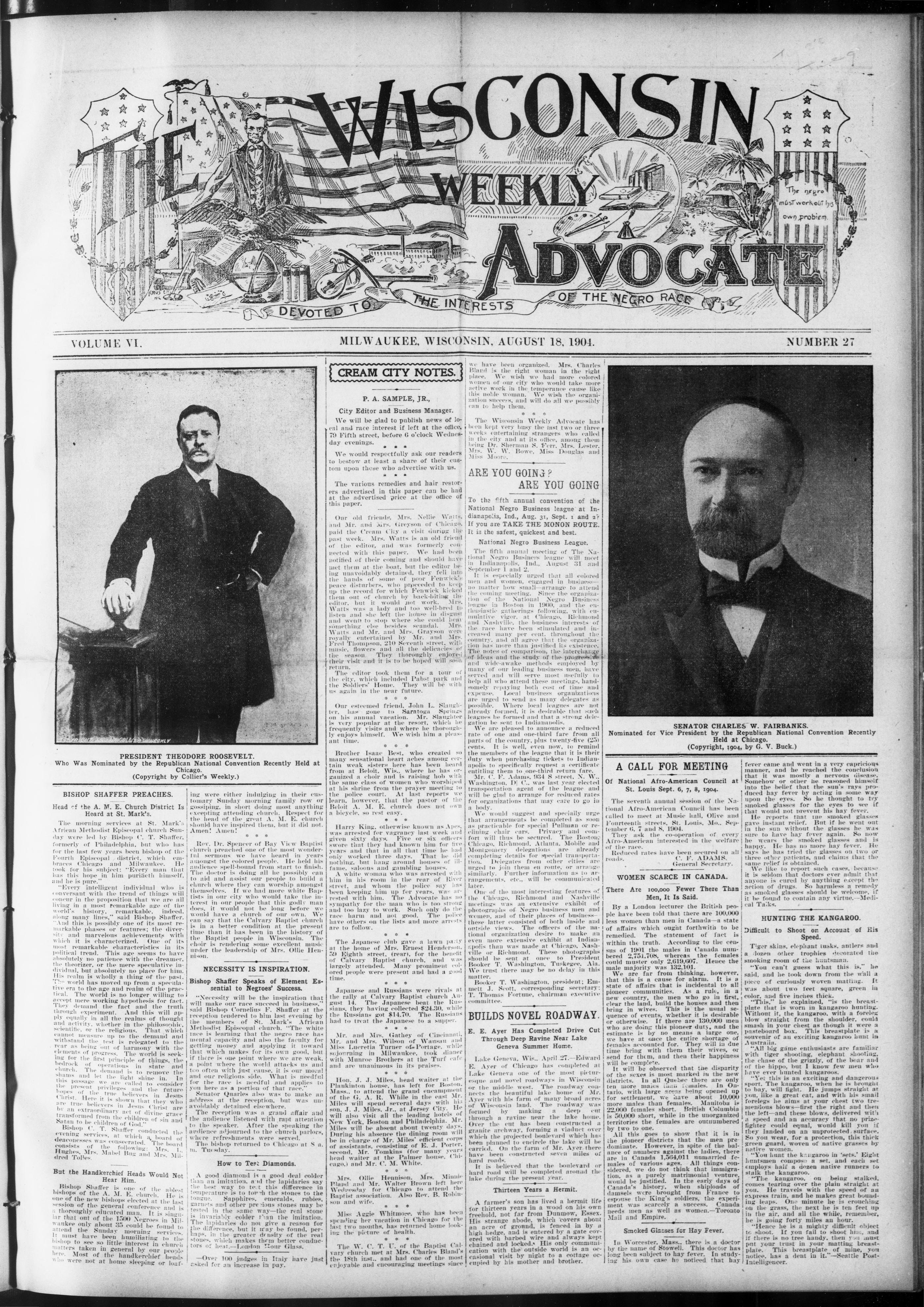
WISCONSIN
WEEKLY
ADVOCATE
DEVOTED TO THE INTERESTS OF THE NEGRO RACE
WEEKLY
PRESIDENT THEODORE ROOSEVELT. Who Was Nominated by the Republican National Convention Recently Held at Chicago. (Copyright by Collier's Weekly.)
VOLUME VI.
PRESIDENT THEC
Who Was Nominated by the Republica
(Copyright by C
BISHOP SHAFFER PREACHES.
Head of the A. M. E. Church District Is Heard at St. Mark's.
The morning services at St. Mark's African Methodist Episcopal church Sunday were led by Bishop C. T. Shaffer, formerly of Philadelphia, but who has for the last few years been bishop of the Fourth Episcopal district, which embraces Chicago and Milwaukee. He took for his subject: "Every man that has this hope in him purifieth himself, and he is pure."
"Every intelligent individual who is conversant with the trend of things will concur in the proposition that we are all living in a most remarkable age of the world's history, remarkable, indeed, along many lines," said Bishop Shaffer. "And this is possibly one of its most remarkable phases or features; the diversity and marvelous achievements with which it is characterized. One of its most remarkable characteristics in its political trend. This age seems to have absolutely no patience with the dreamer, the theorizer, or the mere speculative individual, but absolutely no place for him. His realm is wholly a thing of the past. The world has moved up from a speculative era to the age and realm of the practical. The world is no longer willing to accept mere working hypothesis for fact. They demand the fact and the truth through experiment. And this will apply equally in all the realms of thought and activity, whether in the philosophic, scientific, or the religious. That which cannot measure up to the demand and withstand the test is relegated to the rear as being out of harmony with the elements of progress. The world is seeking for the first principle of things, the bedrock of operations in state and church. The demand is to remove the shams and let the light shine in. In this passage we are called to consider the present privileges and the future hopes of the true believers in Jesus Christ. Here it is shown that they who are true believers in Jesus Christ are by an extraordinary act of divine grace transformed from the children of sin and Satan to be children of God."
Bishop C. T. Shaffer conducted the evening services, at which a board of deaconesses was consecrated. The board consists of the following: Mrs. L. Hughes, Mrs. Mabel Bug and Mrs. Milidred Tolles.
But the Handkerchief Heads Would Not Hear Him.
Bishop Shaffer is one of the ablest bishops of the A. M. E. church. He is one of the new bishops elected at the last session of the general conference and is a thoroughly educated man. It is singular that out of the 1500 Negroes in Milwaukee only about 35 could be found to attend the Sunday morning services. It must have been humiliating to the bishop to see so little interest in church matters taken in general by our people here. Most of the handkerchief heads who were not at home sleeping or loaf-
ing were either indulging in their customary Sunday morning family row or gossiping, in short doing most anything excepting attending church. Respect for the head of the great A. M. E. church should have inspired them, but it did not. Amen! Amen!
Rev. Dr. Spencer of Bay View Baptist church preached one of the most wonderful sermons we have heard in years amongst the colored people. He held his audience spell-bound from start to finish. The doctor is doing all he possibly can to aid and assist our people to build a church where they can worship amongst themselves. If we had more white Baptists in our city who would take the interest in our people that this godly man does, it would not be long before we would have a church of our own. We can say that the Calvary Baptist church is in a better condition at the present time than it has been in the history of the Baptist people in Wisconsin. The choir is rendering some excellent music under the leadership of Mrs. Ollie Hennison.
NECESSITY IS INSPIRATION. Bishop Shaffer Speaks of Element Essential to Negroes' Success.
"Necessity will be the inspiration that will make our race succeed in business," said Bishop Cornelius F. Shaffer at the reception tendered to him last evening by the members of St. Mark's African Methodist Episcopal church. "The white race is learning that the negro race has mental capacity and also the faculty for getting money and applying it toward that which makes for its own good, but if there is one point where we are weak, a point where the world attacks us and too often with just cause, it is our moral and our religious side. What is needful for the race is needful and applies to you here as a portion of that race."
Senator Quarles also was to make an address at the reception, but was unavoidably detained elsewhere.
The reception was a grand affair and the audience listened with rapt attention to the speaker. After the speaking the audience adjourned to the church parlors, where refreshments were served. The bishop returned to Chicago at 8 a. m. Tuesday.
How to Test Diamonds.
A good diamond is a good deal colder than an imitation, and the lapidaries say the best way to test this difference in temperature is to touch the stones to the tongue. Sapphires, emeralds, rubies, garnets and other precious stones may be tested in the same way—the real stone is invariably colder than the imitation. The lapidaries do not give a reason for the difference, but it may be found, perhaps, in the greater density of the real stones, which makes them better conductors of heat.—London Hour Glass.
Over 100 judges in Italy have just asked for an increase in pay.
CREAM CITY NOTES.
P. A. SAMPLE, JR..
City Editor and Business Manager.
We will be glad to publish news of local and race interest if left at the office, 79 Fifth street, before 6 o'clock Wednesday evenings.
We would respectfully ask our readers to bestow at least a share of their custom upon those who advertise with us.
The various remedies and hair restorers advertised in this paper can be had at the advertised price at the office of this paper.
Our old friends, Mrs. Nellie Watts, and Mr. and Mrs. Greyson of Chicago, paid the Cream City a visit during the past week. Mrs. Watts is an old friend of the editor, and was formerly connected with this paper. We had been notified of their coming and should have met them at the boat, but the editor being unavoidably detained, they fell into the hands of some of poor Fenwick's peace disturbers, who proceeded to keep up the record for which Fenwick kicked them out of church by back-biting the editor, but it would not work. Mrs. Watts was a lady and too well-bred to listen and she left the house in disgust and went to stop where she could hear something else besides scandal. Mrs. Watts and Mr. and Mrs. Grayson were royally entertained by Mr. and Mrs. Fred Thompson, 210 Seventh street, with music, flowers and all the delicacies of the season. They thoroughly enjoyed their visit and it is to be hoped will soon return.
The editor took them for a tour of the city, which included Pabst park and the Soldiers' Home. They will be with us again in the near future.
```markdown
```
Our esteemed friend, John L. Slaughter, has gone to Saratoga Springs on his annual vacation. Mr. Slaughter is very popular at the resort, which he frequently visits and where he thoroughly enjoys himself. We wish him a pleasant time.
* * *
Brother Isaac Best, who created so many sensational heart aches among certain weak sisters here has been heard from at Beloit, Wis., where he has organized a choir and is raising hob with the same class of women who worshiped at his shrine from the prayer meeting to the police court. At last reports we learn, however, that the pastor of the Beloit A. M. E. church does not own a bicycle, so rest easy.
* * *
Harry King, otherwise known as Apes, was arrested for vagrancy last week and given sixty days. Five or six officers swore that they had known him for five years and that in all that time he had only worked three days. That he did nothing, but hang around houses of ill-fame, saloons and gambling houses. A white woman who was arrested with him in his room in the rear of River street, and whom the police say has been keeping him up for years, was arrested with him. The Advocate has no sympathy for the man who is too strong and too lazy to work. Such only do the race harm and not good. The police have others on the lists and more arrests are to follow.
* * *
The Japanese club gave a lawn party at the home of Mrs. Ernest Henderson, 59 Eighth street, (rear), for the benefit of Calvary Baptist church, and was largely attended. Many prominent colored people were present and had a good time.
* * *
Japanese and Russians were rivals at the rally at Calvary Baptist church August 14. The Japanese beat the Russians, they having collected $24.30, while the Russians got $14.70. The Russians had to treat the Japanese to a supper.
```markdown
```
Mr. and Mrs. Gathey of Cincinnati, Mr. and Mrs. Wilson of Wausau and Miss Lucretia Turner of Portage, while sojourning in Milwaukee, took dinner with Munroe Brothers at the Turf cafe and are unanimous in its praises.
* * *
Hon. J. J. Miles, head waiter at the Plankinton house, has left for Boston, Mass., to attend the grand encampment of the G. A. R. While in the east Mr. Miles will spend several days with his son, J. J. Miles, Jr., at Jersey City. He will also visit all the leading hotels of New York, Boston and Philadelphia. Mr. Miles will be absent about twenty days. During his absence the dining room will be in charge of Mr. Miles' efficient corps of assistants, consisting of E. J. Porter, second, Mr. Tomkins (for many years head waiter at the Palmer house, Chicago.) and Mr. C. M. White.
Mrs. Ollie Hennison, Mrs. Minnie Pland and Mr. Walter Brown left here Wednesday for Chicago to attend the Baptist association. Also Rev. B. Robinson and wife.
* * *
Miss Aggie Whitmore, who has been spending her vacation in Chicago for the last two months, has returned home looking the picture of health.
* * *
The W. C. T. U. of the Baptist Calvary church met at Mrs. Charles Bland's the 18th inst., and had one of the most enjoyable and encouraging meetings since
we have been organized. Mrs. Charles Bland is the right woman in the right place. We wish we had more colored women of our city who would take more active work in the temperance cause like this noble woman. We wish the organization success, and will do all we possibly can to help them.
The Wisconsin Weekly Advocate has been kept very busy the last two or three weeks entertaining strangers who called in the city and at its office, among them being Dr. Sherman S. Ferr, Mrs. Lester, Mrs. W. W. Bowe, Miss Douglas and Miss Moore.
ARE YOU GOING?
ARE YOU GOING
To the fifth annual convention of the National Negro Business league at Indianapolis, Ind., Aug. 31, Sept. 1 and 2? If you are TAKE THE MONON ROUTE. It is the safest, quickest and best.
National Negro Business League.
The fifth annual meeting of The National Negro Business league will meet in Indianapolis, Ind., August 31 and September 1 and 2.
It is especially urged that all colored men and women, engaged in business—no matter how small—arrange to attend the coming meeting. Since the organization of the National Negro Business league in Boston in 1900, and the enthusiastic gatherings following, with cumulative vigor, at Chicago, Richmond and Nashville, the business interests of the race have been stimulated and increased many per cent, throughout the country, and all agree that the organization has more than justified its existence. The notes of comparison, the interchange of ideas and the study of the progressive and wide-awake methods employed by many of our leading business men, have served and will serve most usefully to help all who attend these meetings, handsomely repaying both cost of time and expense. Local business organizations are urged to send as many delegates as possible. Where local leagues are not already formed, it is desirable that such leagues be formed and that a strong delegation be sent to Indianapolis.
We are pleased to announce a reduced rate of one and one-third fare from all parts of the country, plus twenty-five (25) cents. It is well, even now, to remind the members of the league that it is their duty when purchasing tickets to Indianapolis to specifically request a certificate entitling them to one-third return fare. Mr. C. F. Adams, 934 S street, N. W., Washington, D| C., was last year elected transportation agent of the league and will be glad to arrange for reduced rates for organizations that may care to go in a body.
We would suggest and specially urge that arrangements be completed as soon as practicable for special Pullman or reclining chair cars. Privacy and comfort will thus be secured. The Boston, Chicago, Richmond, Atlanta, Mobile and Montgomery delegations are already completing details for special transportation. Delegates from other cities are urged to join them en route, or arrange similarly. Further information as to arrangements, etc., will be communicated later.
One of the most interesting features of the Chicago, Richmond and Nashville meetings was an extensive exhibit of photographs of Negro business men and women, and of their places of business—the latter consisted of both inside and outside views. The officers of the national organization desire to make an even more extensive exhibit at Indianapolis than was made at Chicago, Nashville or Richmond. These photographs should be sent at once to President Booker T. Washington, Tuskegee, Ala. We trust there may be no delay in this matter. Booker T. Washington, president; Emmett J. Scott, corresponding secretary; T. Thomas Fortune, chairman executive committee.
BUILDS NOVEL ROADWAY
E. E. Ayer Has Completed Drive Cut Through Deep Ravine Near Lake Geneva Summer Home.
Lake Geneva, Wis., April 27.—Edward E. Ayer of Chicago has completed at Lake Geneva one of the most picturesque and novel roadways in Wisconsin or the middle west. The roadway connects the beautiful lake home of Mr. Ayer with his farm of many broad acres of Wisconsin land. The roadway was formed by making a deep cut through a ravine near the lake home. Over the cut has been constructed a granite archway, forming a viaduct over which the projected boulevard which has been planned to encircle the lake will be carried. On the farm of Mr. Ayer there have been constructed seven miles of hard roads. It is believed that the boulevard or hard road will be completed around the lake during the present year.
Thirteen Years a Hermit
A farmer's son has lived a hermit life for thirteen years in a wood on his own freechick, not far from Dunmow, Essex. His strange abode, which covers about an acre of ground, is fenced in by a high hedge, and is entered by a gate covered with barbed wire and always kept chained and locked. His only communication with the outside world is an occasional visit by night to a cottage occupied by his mother and brother.
[Portrait of a man in formal attire, with a full beard and mustache, wearing a suit and bow tie. The background is plain and dark, emphasizing the subject.]
SENATOR CHARLES W. FAIRBANKS.
Nominated for Vice President by the Republican National Convention Recently
Held at Chicago.
(Copyright, 1904, by G. V. Buck.)
A CALL FOR MEETING
Of National Afro-American Council at St. Louis Sept. 6, 7, 8, 1904.
The seventh annual session of the National Afro-American Council has been called to meet at Music hall, Olive and Fourteenth streets, St. Louis, Mo., September 6, 7 and 8, 1904. They ask the co-operation of every Afro-American interested in the welfare of the race. Reduced rates have been secured on all roads. C. F. ADAMS. General Secretary
WOMEN SCARCE IN CANADA.
There Are 100,000 Fewer There Than Men. It Is Said.
By a London lecturer the British people have been told that there are 100,000 less women than men in Canada—a state of affairs which ought forthwith to be remedied. The statement of fact is within the truth. According to the census of 1901 the males in Canada numbered 2,751,708, whereas the females could muster only 2,619,607. Hence the male majority was 132,101.
We are far from thinking, however, that this is a cause for alarm. It is a state of affairs that is incidental to all pioneer communities. As a rule, in a new country, the men who go in first, clear the land, build the houses and then bring in wives. This is the usual sequence of events, whether it is desirable or otherwise. If there are 130,000 men who are doing this pioneer duty, and the estimate is by no means a large one, we have at once the entire shortage of females accounted for. They will in due time bring with them their wives, or send for them, and then their happiness will be complete.
It will be observed that the disparity of the sexes is most marked in the new districts. In all Quebec there are only ten more males than females. In Ontario, with large areas being opened up for settlement, we have about 10,000 more males than females. Manitoba is 22,000 females short. British Columbia is 50,000 short, while in the unorganized territories the females are outnumbered by two to one.
All this goes to show that it is in the pioneer districts that the men predominate. However, in spite of the balance of numbers against the ladies, there are in Canada 1,564,011 unmarried females of various ages. All things considered, we do not think that immigration, as a purely matrimonial venture, would be justified. In the early days of Canada's history, when shiplords of damsels were brought from France to espouse the King's soldiers, the experiment was scarcely a success. Canada needs men as well as women.—Toronto Mail and Empire.
Smoked Glasses for Hay Fever.
In Worcester, Mass., there is a doctor by the name of Stowell. This doctor has long been subject to hay fever. In studying his own case he noticed that hay
NUMBER 27
S. W. FAIRBANKS.
Republican National Convention Recently
Chicago.
by G. V. Buck.)
fever came and went in a very capricious manner, and he reached the conclusion that it was mostly a nervous disease. Somehow or other he reasoned himself into the belief that the sun's rays produced hay fever by acting in some way upon the eyes. So he thought to try smoked glasses for the eyes to see if that would not prevent his hay fever. He reports that the smoked glasses gave instant relief. But if he went out in the sun without the glasses he was sure to have hay fever again. So now he wears the smoked glasses and is happy. He has no more hay fever. He says he has tried the glasses on two or three other patients, and claims that the same relief is obtained.
We like to report such cases, because it is seldom that doctors ever admit that anyone is cured by anything except the action of drugs. So harmless a remedy as smoked glasses should be welcome, if it be found to contain any virtue.—Medical Talks.
HUNTING THE KANGAROO
Difficult to Shoot on Account of His Speed.
Tiger skins, elephant tusks, antlers and a dozen other trophies decorated the smoking room of the huntsman.
"You can't guess what this is," he said, and he took down from the wall a piece of curiously woven matting. It was about two feet square, green in color, and five inches thick.
"This," he explained, "is the breastplate that is worn in kangaroo hunting. Without it, the kangaroo, with a foreleg blow straight from the shoulder, could smash in your chest as though it were a pasteboard box. This breastplate is a souvenir of an exciting kangaroo hunt in Australia.
"All big game enthusiasts are familiar with tiger shooting, elephant shooting, the chase of the grizzly, of the boar and of the hippo, but I know few men who have ever hunted kangarooos.
"Yet this is an exciting and dangerous sport. The kangaroo, when he is brought to bay, will fight. He jumps straight at you, like a great cat, and with his small forelegs he aims at your chest two tremendous blows—first the right and then the left—and these blows, delivered with a speed and an accuracy that no prizefighter could equal, would kill you if they landed on an unprotected surface. So you wear, for a protection, this thick green guard, woven of native grasses by native women.
"You hunt the kangaroo in 'sets.' Eight huntsmen compose a set, and each set employs half a dozen native runners to stalk the kangaroo."
"The kangaroo, on being stalked, comes tearing over the plain straight at you. He travels with the speed of an express train, and he makes great bounding leaps. One minute he is crouching on the grass, the next he is ten feet up in the air, and all the while, remember, he is going forty miles an hour.
"Hence he is a mighty difficult object to shoot. If you fail to shoot him, and if there is no tree handy, then you must put your trust in your matting breast-plate. This breastplate of mine, you notice, has a dent in it."—Seattle Post-Intelligencer.
Iron mountain, the highest elevation in Missouri, is but 1800 feet above the level of the sea.
Within the last thirty years the trade of the United States with South America has increased only 5 per cent.
The Dublin corporation is said to have passed a resolution "prohibiting soldiers walking in the main streets."
A married couple of Lienz, Austria, celebrated their silver wedding by filing a petition for divorce on the ground of "unconquerable mutual antipathy."
The new city directory for Chicago has been given to the public. Based on the number of names it gives Chicago a population for 1904 of 2,241,000.
Gold-bearing quartz has been found in Ceylon, but it remains to be seen whether it is present in sufficient quantity to be commercially successful.
- There is a board of guardians in the south of London that allows inmates who have seen better days to don the silk hat when they go out for a holiday.
- There are four ranches in Texas with an area of over 1,000,000 acres apiece, and there are a number of ranches with areas of 500,000 acres, or a little less.
- By a curious anomaly, although a man can now be converted to New York for $10, it costs a bullick $12.50 to book his passage from Canada to Liverpool.
- It is said that the Czar of Russia is dominated by his mother, the Dowager Empress Marie Feodorovna, sister of Queen Alexandra.
- Football and many other outdoor games are played by the blind, certain changes being made so that in each game the sense of hearing takes the place of sight.
A caterpillar in a month will devour 6000 times its own weight. It will take an average man three months before he eats a quantity of food equal to his own weight.
There is a legend that the first lace was made by a girl who preserved a beautiful bit of seaweed by attaching all the dainty parts of leaves and stems to a piece of linen with fine thread.
In fasting feasts the sect known as the Jains, in India, is far ahead of all rivals. Fasts of from thirty to forty days are very common, and once a year the people abstain from food for seventy-five days.
Governor General Tsen of Canton is said to have urged the Empress of China five times to declare war against Russia, and to have sent telegraphic messages to all leading Mandarins in the empire to support him.
-From Bombay Presidency a native petition has been forwarded to the government of India, praying that the sale of feathered caps, etc., throughout British India may be prohibited by law on account of the cruelty involved.
-Certain spiders can be transported by the wind, owing to a very light silken thread that they emit from the spinneret which is blown along by an ascending current of air. A thread a yard long can sustain the weight of a young spider.
-William A. Appleby of Georgetown, Md., is the inventor of an ingenious means of capturing mail on the fly and a number of small mail stations are being erected along the Baltimore & Ohio for the purpose of testing the new invention.
Among the latest fads of the summer girls are sunburned initials on their arms. Short sleeves, initials cut from black court plaster and affixed to the arm, and the sun will do the rest, leaving the letters in pink and white on the sunburned skin.
In Russia the native insurance companies, which do the major portion of the country's business, insure the lives of single women and widows, but at a higher rate than those of men, and married women are only accepted in case their husbands are also insured.
Prof. Assmann, one of the German government meteorological experts, has risen to explain that lightning seldom strikes in a forest where the trees are dense and of about the same height. Danger exists only where isolated trees rise above their surroundings.
—It is announced in a scientific journal that Prince Albert of Monaco has taken the lead in the movement for another North Pole expedition on a plan suggested by Ensign Charles Benard, late of the French navy. The cost of the expedition is set down at $300,000, two ships to be employed.
—Robert Womack, the discoverer of Cripple Creek and the gold deposits there, which have yielded others more than $150,000,000, is believed to be dying at Colorado Springs in a sanitarium. He did not benefit by his discovery, and for several years has been a street laborer in Colorado Springs.
—The detective force in China is a secret body second to none in the world in point of organization. From one end of the celestial land to the other a very wide-open eye is kept upon every man, woman and child, whether foreign or native, and, for that matter, the detectives watch one another most vigilantly.
—Advices from St. Petersburg tell of a service of wireless telegraphy at Lake Baikal, which is almost complete, and will be in working order soon. It will consist of three stations, one of which will be on board the ice breaker, which will be enabled to communicate with both shores during its passage across the lake.
Burns from Roentgen rays have some curious features. Dr. E. A. Codman, citing nearly 200 cases, notes that the burns resemble sunburn, but they may extend much deeper, the body being transparent to these rays. The burns do not usually appear immediately, most often developing in about ten days, though sometimes delayed for months.
Old-timers boast that Bret Harte once taught school at Tuttletown, Cal., and in that way acquired knowledge of the localities in the vicinity that he afterward worked into his writings. Mark Twain clerked in the only store in the town at the same time. The town itself is a small village nesting at the foot of Jackson hill, the latter being a veritable quarry of gold. Nearly all of this hill is owned by James Gillis, the original "Truthful James," and is covered by parties working small pocket mines "on shares."
A curious means of moving boats is employed on the River Elbe. A chain 290 miles long lies at the bottom of the stream, which is too swift to navigate in the usual way. The boats are 180 feet long and provided with 200-horse power steam engines which turn a drum fastened on the deck. The chain comes in over the bow, passes along on rollers to the drum, around which it is wound three times. The chain is then carried to the stern, where it drops back into the water. It is the longest chain in the world.
Insulting the Kaiser.
A curious case of lese majeste is reported from Colmar, where an impoverished bookbinder named Decker, a cripple, was sentenced to two months' imprisonment for this crime. He entered the police office, asked for a piece of paper and wrote some remarks on it which were regarded as an insult to the Kaiser. Decker had been already charged with nine different offenses of a similar character, for four of which he had suffered long periods of imprisonment. His object in nearly every case was to secure board and lodging.—Berlin Correspondence of the London Telegraph.
THE MAID AND THE HUSBAND.
Her supinator longus and
Her biceps flexor cubiti
Were just the finest in the land,
And, if you'd know the reason why,
She exercised them day by day
By briskly sweeping every room
About the house. There was, she'd say,
No "apparatus" like a broom.
The washboard her latissimus
Dorset developed very well:
Her gastrocnemeus likewise
(The truth is always best, I've found.)
Attained its perfect shape and size
Because the damsel "hustled round."
No Delsarte movements did she know
She married, sad to say, the grocery man,
A kitchen of her own was her ambition.
Our own, unquestioned, she completely ran.
We held a quite subordinate position.
And now a surly husband is her boss.
Pays her no wages, and is always kick-
ing—
About the worst you ever ran across
And to that place, contented, she is stick
ing.
-Kennett Harris in Leslie's Monthly.
A LOST LEADER.
Miss Julia Deacon was tall, thin and 45, with dark brown hair drawn tightly away from her forehead and fastened in a very small knot at the back, and, although the parish of All Saints' stood in the midst of a large, busy town, she might have lived in Eden for all she knew of the practical affairs of the twentieth century.
She still occupied the house where her father had died fifteen years ago and her only brother eight, and it might have been a more comfortable abiding place but for the charity which induced her to engage servants only of the most hopeless "character." Finding Miss Julia's (her surname was seldom used) daily round unendurably dull, her proteges usually ran away at the beginning of their second week.
She had, indeed, a few acquaintances, of course among the congregation of All Saints', and one friend in the vicar Miss Julia had never quite liked his wife. But the vicar could do no wrong; he had known her as a rather pretty girl; he understood her soft heart, made allowances for her weaknesses, and even tried sometimes to enlighten her concerning current affairs.
Once every year Miss Julia took a fortnight's holiday at the seaside town of Sandbay, always at the same time as the vicar went to Scotland; for many years she had not been further from home. But she took in "The Parish Magazine" and a religious journal which contained a serial story; for the rest, her chief purpose in life was to attend every service at All Saints' and to accomplish her round of district visiting.
So Miss Julia's life ambled on, until one day a bolt fell out of the blue sky. It was half past 10 in the morning, and she had told Selina she could "fancy a little fish for dinner." A man in a blue jersey stood with a barrow of plaice and haddock before the door, while Selina bargained and Miss Julia looked on from the hall. Seeing little Miss Samson approach, she drew further into the background, for Miss Julia was not dressed as yet for the reception of a visitor, and she considered it a little thoughtless of Miss Samson to stop.
"I thought I saw you, Miss Julia!" she exclaimed.
"I am afraid I am scarely fit to be seen." was the reproachful answer.
"Of course," said Miss Samson, "you have heard the news?"
"Very little news comes to my ears," cried Miss Julia, with anxious eyes on Selina as she paid the fishmonger.
"Then you didn't know that the dear vicar"——
"He is not ill?" exclaimed Miss Julia, forgetting all about the change in her perturbation.
"The vicar is going away"——
The view is going away "Going—going to leave All Saints'" muraured Miss Julia. "He has been offered a much better living," said Miss Samson, "and he has decided to accept it."
On her most dismal days—and Miss Julia often felt dismal during the long evenings—she had never anticipated anything quite so revolutionary. She bade Miss Samson "good morning," and, shutting the door, left her drawing room half dusted in her preoccupation. Even at her father's death she had not experienced such a desolating sense of loneliness, and when the viar himself came to the house at 4 o'clock that afternoon he observed the signs of tears on her thin, white face. He had hoped, he said, to be the first to tell her of the good fortune which was removing him to a wider sphere of usefulness; he could speak of it as "good fortune!" He should leave All Saints' immediately on the appointment of his successor; and one day, about three weeks later, the viar came again to say that Mr. Worsfeld had accepted the living.
"I sincerely hope he is sound." said Miss Julia, but the vicar pursed his lips. "Well, well!" he answered; "we cannot expect all men to think exactly alike. You must be prepared for one or two alterations. Mr. Worsfeld is young, you know." "Ah!" said Miss Julia. "I love the old fashions." "I believe," continued the vicar, "there is some idea of moving the organ to the chancel and of instituting a surpliced choir."
All Saints' was the only church in the town with an organ at the west end and a mixed choir. But Mr. Reynolds had allowed things to remain as he found them on his arrival twenty-two years ago. His words now intensified Miss Julia's sense of desolation, and it was fortunate that she soon became too busy to dwell upon the dreaded future. There was, to begin with, the excitement of collecting for the vicar's testimonial; there were farewell meetings to attend, besides extra services; the presentation of the "handsome ormolu clock and pair of candelabra," together with a purse of gold, and, last of all, Mr. Reynolds came to pay his farewell visit.
Miss Julia had very little to say about his own future, but a great deal concerning the days in store for herself.
"Let us hope there will be no violent changes," said the vicar.
"But a surpliced choir!" Miss Julia prote-ted; and he shook his head.
A few days later Mr. Reynolds went away and Mr. Worsfeld arrived in his stead. In the first place, he had the disadvantage of youth; he was also unmarried—and, indeed, Miss Samson explained that she did not approve of a married
clergy - his coat was far too long, and his handsome face was shaven.
Now, Mr. Reynolds had commended Miss Julia especially to his attention, with the result that he paid her house one of his first visits, at 4:30 o'clock, on Saturday, just as she was sitting down to tea—a cosey meal which Mr. Reynolds often shared with her. But the new vicar declared that he did not drink tea, a circumstance which in itself threatened to render impossible all real community of feeling. After this, she experienced little surprise to see him turn toward the east during the next morning's service, and that evening she absented herself from All Saints'. Still, Miss Julia went again the next three Sunday mornings, by which time the continual innovations made it impossible to go any more with a clear conscience.
She could not understand the ease with which the members of the congregation permitted themselves to be led. nor how they could wax enthusiastic over a vicar who was in every respect so different from dear Mr. Reynolds. There seemed to be a sudden access of interest among the younger women, one of whom, a pretty girl of 19, was appointed to help Miss Julia with her class. A deaconess, who also was young, was engaged for the district visiting, and Miss Julia's occupation was gone.
Miss Julia became an altered woman. Her face, always thin and pale, grew thinner and paler; she seemed to be outgrown by her small world, and people began to speak of her as "poor Miss Julia."
Nobody felt more sincerely sorry for her than the cause of all her troubles, and in the goodness of his heart Mr. Worsfeld took a journey to Castleton expressly to speak to Mr. Reynolds on her behalf. It happened, however, that the vicar was in bed with an attack of influenza, so that the visitor took Mrs. Reynolds into his confidence. Now, Mrs. Reynolds was a sympathetic woman, and she conceived the bold idea that Miss Julia should leave the town in which she had lived so long and take up her abode in Mr. Reynolds' new parish.
Mrs. Reynolds perceived, however, that such a serious migration would require great consideration and discussion, and, without troubling her husband, she sat down after Mr. Worsfeld's departure and wrote to Miss Julia a long letter. By Saturday week she hoped the vicar would be perfectly recovered, and would Miss Julia please him by coming to stay at the vicarage for a week from that day?
Miss Julia had probably never felt more excited than when she read the letter the following morning at breakfast time. The temptation was far too great to be resisted. Miss Julia began already to look forward to a return for a few days at least to the former state of affairs. The edifice, it was true, would be different, but everything else would be the same as that which she had been for many years accustomed to.
Eleven days would be none too many for her preparations. She determined to order a new dress, to say nothing of a bonnet and a jacket. Moreover, the actual journey had its necessary perils, and there was also the momentous question concerning what should be done with her house. On the previous Wednesday she ordered a carriage to take her to the station, where she arrived half an hour before the departure of the train, with a trunk, a holdall, and a cardboard hatbox. She gave the guard a shilling and asked him to reserve her compartment for "ladies only," and at last she took her seat and the train started. Mrs. Reynolds met her at the station, and nothing could have been more cordial than the welcome of the five children. But the vicar was much less talkative than usual; indeed, there was something in the nature of embarrassment in his manner. With sensations approaching alarm, she perceived that he wore a coat almost as long as Mr. Worsfeld's. Nevertheless, she spent a very enjoyable evening, playing draughts, for the most part, with the two youngest girls. After they had gone to bed Mrs. Reynolds ventured to hint at the possibility of Miss Julia's removing from her present house to another in Castleton, and, although the suggestion naturally filled her with alarm, in her room that night the prospect appeared extremely tempting.
On Sunday morning she set forth with the pleasantest anticipations. In a corner of the vicarage pew she took her seat with happy serenity; but from the moment the vicar entered, heading a procession of two curates and twelve choristers, Miss Julia's disillusioning began.
Mr. Reynolds, in fact, had, as on his first coming to All Saints', accepted the established order of things. He was a man averse to changes of any kind, while Miss Julia was agast at what she esteemed the immense alteration in himself. This was the depth of her misery, and on the way back to the vicarage she heard little Lucy Reynolds ask her mother why Miss Julia cried whenever she knelt.
The vicar understood why she had no appetite and no conversation during dinner. With perfect truth, she pleaded a headache and stayed away from the evening service, and the next morning Miss Julia experienced an intense longing to be at home again. Her lares and penates seemed to be the only gods which had not fallen.
She did not feel well, she explained after breakfast, and, although Mrs. Reynolds opposed her departure, the vicar remained silent.
"I am afraid your visit has not proved an unqualified blessing," he remarked, when a fly had stopped at the door. But Miss Julia only sighed and shook her head. Her heart was far too full for words, and the vicar stood at the door staring gravely at the fly as she was driven toward the railway station. He understood that the world had rolled on and left her behind, very forlorn and solitary.—Thomas Cobb in The Sketch.
How to Boil Roasting Ears.
There is but one way to boil roasting ears. Put on a pot of boiling water and "break" it with a little soda, skim the water, and put in another vessel in order to get all the lime out of it. Add a teaspoonful of granulated sugar, several pinches of salt, and, when the water comes to a boil, put in the roasting ears, cover tightly and boil furiously till thoroughly heated through—from fifteen to twenty minutes—and serve hot. It will be cooked in a way that one can eat three or four ears—my husband can and often does eat six ears and asks for more.—El Dorado (Kan.) Republican.
One frequent sight in the tobacco districts of Connecticut is the uncovered framework for the tents where the shade-growing experiments were conducted last year. A field of tent tobacco in Connecticut this year is rare.
THE ASPIRANTS.
It may be true that Theodore Is somewhat overhasty;
It may be true that Alton B.
Is negative and pasty.
It may be true that Theodore Is fond of union pow-wows;
It may be true that Alton B.
Would send us to the bow-wows.
But if you watch the banners swing,
Though wholly unacquainted,
You must admit that neither is As bad as he is painted.
McLandburgh Wilson in New York Sun.
Joe Johnson, proprietor of the Subway Tavern, is now going to open a rathskelier, and he hopes to have Bishop Potter come down from his Hudson river summer home and dedicate that, too. The tavern is doing a fine business. The gross one day was $410.
It is reported that Madame Janauschek, the aged actress, who has been ill at the Actors' Fund home at Staten Island, has suffered a relapse and been removed to a sanitarium at Amityville, L. I., for special treatment. She is a victim of paralysis.
The four Methodist Episcopal missionary bishops for southern Asia—Bishops James M. Thoburn, Frank W. Warne, John E. Robinson and William F. Oldham, have just concluded a conference in New York city.
The board of United States general appraisers has decided that chickens are not household effects. In so doing, the board overruled a claim of Mrs. Folamarre of Port Townsend, Wash., for free entry for a coop of chickens as "effects of an immigrant which had been in use abroad more than a year."
Godfrey Bloch, who fled from the federal authorities nearly two years ago rather than tell of his connection with the alleged silk frauds which involved the firm of A. S. Rosenthal & Co., is reported to have become insane and is now an inmate of a sanitarium in this state. His condition is said to be hopeless.
Cardinal Francesco Satolli sailed for Naples on the Italian liner Sardinia. He was accompanied by Rev. Giovanni Giotoni, Rev. Guiseppe Maruchi, his secretary, and Rev. Ercole Satolli, his nephew, "My trip here," said Cardinal Satolli, "has been pleasant and interesting. I have been treated with the utmost kindness, and every courtesy has been shown me. I go now with feellings of sorrow that I must go so soon." He said he hardly would return to dedicate the cathedral to be erected in St. Paul, as he would be too old then. He is 55.
Mrs. W. E. Woodend, formerly Miss Jane Howard, daughter of the former president of the Fourteenth Street bank, and wife of Dr. Woodend, the broker, who failed recently, will make her debut on the stage as a member of the "Checkers" company.
Mrs. Woodend says it is not notoriety, but money she is after, and there are as many reasons for her going on the stage as there are cents in a dollar. This is sensible talk and inspires the notion that she may become an actress.
An extensive system of forgery through which the road has lost thousands of dollars has recently been unearthed by the New York Central. The company has been accustomed to issue tickets on account of advertising, these tickets in many cases being made out in the name of persons designed by the firms and newspapers entitled to the transportation. Tickets of this sort, it is learned, have been sold by some of the holders to certain scalpers, and have come back to the railroad company with the color changed, new destination marks, and in some cases as many as five persons designated to receive transportation, the ticket having originally borne only one person's name. It is understood that the road has a clue to the forgers.
The street fakirs are offering a new attraction. It is called the "Pope's Cross" and is modeled on the pigs in clover invention. The game is a pill box shaped affair with a glass top, through which is seen a picture of Pope Pius X. The Pope is shown in his white zuchetto and mantelletto, with which he always wears his emerald cross hung high on the breast. The pectoral cross is indicated in the pill box toy by six little indentures, while beneath the glass cover six green stones not much bigger than a grain of sand roll around after the fashion of the pigs in clover. The aim of the player is to balance the pill box and wiggle the six green stones into the holes of the cross.
The new Times building in Longacre Square has now reached a point of completion which enables the New Yorker to form an opinion as to its beauty. It was first thought that it would be another nightmare like the Flatiron building, but this is not the case. The Times is the first really beautiful skyscraper of the new era. Its position at the bend of the street gives the eye a grand sweep from the north and the south and sets off its monumental proportions to the best advantage. Indeed, many people think that it is a monument, so tall and stately and narrow does it appear.
Following the abolition of the lockstep and the cropped head in the New York state prisons, stripes on the clothing of first term convicts will be a thing of the past after October 1. Three thousand suits of dark gray, without stripes, and of a semi-military cut, are now being made by prison workmen from cloth woven in the Auburn institution. The cap of the same material is patterned after the French military kepi.
Samual Gaty, 24 years old, who has an income of $3000 a year, has been sentenced to the Elmira reformatory for receiving stolen jewelry. Gaty declared himself innocent, but said he pleaded guilty on advice of his counsel. His grandfather was mayor of St. Louis in 1850. His father, who was mayor of Santa Barbara, Cal., died while serving his third term in 1893.
The reward for the return of Antonio Mannino, who has been missing since the night of August 9, has been raised from $500 to $10,000 by the boy's father. The police have increased their efforts to ferret out the alleged kidnapping gang, and upon information furnished by Angelo Cucozza, the first man arrested, a number of warrants have been issued. Antonio Galeta, arrested recently, was held in $300.0 bail by Magistrate Tighe, who said to the detectives: "You are authorized by this court to bring in these prisoners dead or alive. The kidnapping and blackmailing outrages must be stamped out."
Without a novelty of some sort the Newport season would not have been complete. This was offered at one of the great houses on the Ocean drive, where a large dinner company was entertained. After dinner the guests assembled in the ballroom, where a miniature circus ring had been arranged. In this was given a performance by a troupe of trained animals, now performing at Freebody park. There was a Shetland
pony, mounted by a good sized monkey, that leaped over hurdles; a milk white goat that walked a tight rope, and several dogs that did all sorts of tricks. The pony, a most intelligent beast, answered all sorts of questions by pawing its hoofs. When asked the age of the hostess the pony gallantly placed it at 25 years. It had been hoped the famous parrot belonging to one of the cottagers would also appear, but with the monkey and parrot tale in mind that was dispensed with. It is needless to say there never before was seen a better behaved lot of animals in polite society.
With three openings at as many playhouse the early part of last week the messenger boys along that section of Broadway known as the Rialto were hard worked. The custom of sending good wishes or congratulations in telegraphic form has taken such a firm hold on the theatrical world that only those on the inside have any idea of the money spent in this way. The composer of one musical production which had its Broadway opening carried home a roll of telegrams as thick as a man's wrist. They rain on managers so thick and fast that in many cases they are not perused until the next day, while the walls of the star's dressing room are literally plastered with them. Even the little chorus girls are not forgotten, for telegrams come with flowers on the opening night. Most of this expression of good will is merely perfunctory, and the custom, like many others, is being overworked. For instance, one successful publishing concern which believes firmly in advertising in all shapes and forms sends congratulatory telegrams to every soloist in a musical production, to the composer, the manager and the stage director.
The sale of fraudulent naturalization papers has netted $600,000 in the last year, according to a statement given out by George W. Morgan, state superintendent of elections. He estimates that 100,000 fraudulent papers have been sold in New York state, about one-third of these having been issued in this city. The illicit business shows a large decrease in New York city as a result of the activity of the elections department. It is found that the Italians are by far the greater offenders in this matter, although many instances have been discovered among Greeks and Armenians, and a lesser number among the Germans. It has been estimated that fully 30 per cent. of the Italian citizens in New York city and vicinity hold fraudulent naturalization papers. The courts, as a result of this scandal, have become particularly rigid in the enforcement of the regulations governing naturalization.
Tea has been added to the drinks furnished the patrons of the Bishop Potter temperance saloon. The tea drinker sits down at a table and makes it himself. There is no rule against taking one's knitting or needlework along, but the practice is not encouraged. The new feature had added much to the hilarity of the unregenerate of Bleecker street and the Bowery. One saloon nearby has this sign: "Pure whisky and beer. If you want pink tea, go to the next block." A dry goods merchant on Broadway who took part in the opening, in the belief that he was aiding a moral agency that would do good, has confessed that results had not been what he had hoped.
"I took a look in there," he said, "at the luncheon hour and was surprised to see two of my young men whom I never supposed set foot in a drinking place. Perhaps my endorsement of the move sent them there on the ground that it had been approved as a good thing. If that is so I am sorry I ever touched it."
Taking Cold.
How careful we ought to be to prevent taking cold and how anxious we ought to be to get rid of it, is a matter for serious reflection.
Colds may be contracted by temporary exposure, such as sitting in a draft, wearing insufficient clothing, insufficiently protected feet, going from a warm room into a cold one, slight exposure while perspiring, getting feet wet. The trouble may manifest itself in any part of the body, but generally affects the head.
The symptoms of cold in the head are too well known to need description, as few of us have not experienced them, such as a disagreeable feeling in the nose (a burning or prickly sensation), a fullness in the head, sneezing, a partial if not complete stoppage of the nasal tract, frontal headache, deafness, ringing in the ears, and a temporary loss of the sense of taste and smell.
The principal diseases arising from taking cold are pneumonia, consumption, chronic catarrh, and are as a rule brought on by inhaling the disease germs into the head, where they lodge until a cold is contracted, the mucous membrane then becomes a splendid field to propagate the germ, and consequently the disease has its foothold. To prevent this has been the study of Mr. S. H. Meadows, a drugist of Milwaukee, since 1882, who has given much time and attention in preparing a scientific combination of antiseptic and Germicidal drugs which, applied to the nasal tract each day will keep the mucous membrane of the nose in a perfectly healthy condition, thereby preventing the development of the disease germ, if not killing it outright. This preparation also has a remarkable effect on the diseased mucous membrane of the nose and head. It permeates and penetrates the air passages, causing them to regain their normal condition within a short time. The success of this preparation has been so marked as to attract the attention of some of our leading physicians, who not only endorse it, but are using it themselves as a prophylactic and giving it to their patients.
We congratulate Mr. Meadows on his success in procuring this wonderful combination, which cannot help but prove a benefit to mankind.—Church Times.
Honors Were Easy.
A young woman but recently married was the victim of a good joke on one of the uptown streets a few days since. She is extremely youthful looking, and at the time she was sweeping the sidewalk she did not look to be over 15 years old. A fussy old lady came along and smiled sweetly on the young woman, and then said:
"Lovely day, isn't it?"
"Beautiful," was the reply.
"Do you know where I could get a good girl?"
"Not exactly, but there is an employment agency just above here."
"Do you like your position here?" oueried the old lady.
"He's my husband."
"Good morning!"
"Good morning."—Albany Journal.
Clock in the Form of an Old Church.
The latest novelty in clocks has just made its appearance in France. It consists of a perfect representation, in antique silver, of an old church, transparent enamel forming the stained windows.
The clock dial is 1 inch in diameter and is placed in the belfry, where tiny bells chime every hour. The roof of the church proper can be raised, disclosing a gold lined reception for matches.—Jewelers' Circular Weekly.
Cassava starch, more popularly known as tapioca, is the chief element of the gum on the back of all postage stamps.
HOOPSKIRTS CHOKED RIVER.
Thousands of Them Were Thrown Into Stream at Kalamazoo.
The Kalamazoo council has under consideration the dredging of Kalamazoo river from the city of Cooper, a distance of several miles, for the deepening of the bed in some places and the removal of sandbars in others. The estimated cost of a thorough job is $30,000, and for half the money, it is believed, the situation can be materially improved and the damage by floods greatly lessened.
If the dredging is undertaken, particular attention should be paid to that portion of the river within the corporation, which has never recovered, even with time's help, from the choking of the channel received during the hoopskirt era of forty years ago, when every cast-off crinoline found its way to as near the middle of the stream as a wounded and outraged male member of the household could throw it. These old hoopskirts are there yet, save the comparatively few—which are many—raised out by fishermen with hook and line. They are there by the thousands, a plague and pestilence breeder. They have dammed the river and been dammed by riversiders.
The merits of these ancient skeleton balloons beat brushwood blind for straining water and retaining residuum. All sorts of floating wood trash found a foothold and lodged in them. They became shallows, and the shallows of pestilence for which the hoopskirts were responsible. All these antique memories of the maids and mothers of many years ago should be scooped out of Kalamazoo and something done to put them out of action, though heaven knows how it can be done. Possibly a deep pit in some sccluded place would hold them. They should be planted as near the center of the earth as possible, lest some scientific researcher for prehistoric remains find and exploit them as the bones of pre Adamistic Kalazumooloos.—Detroit Tribune.
ENGINEER'S LAST RUN.
His Story of How He Lived His Life All Over in a Flash.
"Drowning is not the only experience that causes a man to read his own biography in the flash of a second," said F. C. Roberts, a locomotive engineer.
"I was running on the passenger trains between Atlanta and Macon several years ago, and I was to meet the northbound train at a certain station on the road. Well, it was all my fault. I hadn't slept any for five nights, and the only rest I had was in my cab. The last stop that we made before this experience of which I speak, the fireman had to wake me up when the signal to go ahead was received. I had gone to sleep in my cab.
"As we approached the next station the conductor may have signaled me, as he claimed he did, but we dashed through the town at about forty miles an hour before I heard the down brakes signal. The minute I heard it I saw the headlight of the northbound train less than 300 yards away coming around a curve. I threw on the air brakes and reversed, but it all looked too late. The fireman jumped, but I was paralyzed. The two great engines, one bearing a special train, rushed together like angry bulls, and I was frozen there, and while those trains rushed together, I saw every incident of my life just as plainly as the day it happened. That's all I know about it.
"They took me to the hospital, and nine days later I woke up after a spell of brain fever. The trains stopped so close together that the pilots were sprung out of place, but otherwise there was no damage. They had to get a new engineer before my train pulled out, though, and that was the last time I ever pulled a throttle."—Louisville Courier-Journal.
Forming an Impression
An old lawyer tells this story of one of his experiences, years ago, in cross-examination. The witness seemed to be disposed to dodge his questions.
"Sir," said the lawyer, sternly, "you need not state your impressions. We want the facts. We are competent to form our own impressions. Now, sir, answer me categorically."
From that time on he could get little more than "yes" or "no" out of the witness. Presently the lawyer said:
"You say you live next door to the defendant?"
"Yes."
"To the north of him?"
"No."
"To the south?"
"No."
"Well, to the west, then?"
"No."
"Ah," said the lawyer, sarcastically, "we are likely at last to get down to the one real fact. You live to the east of him, do you?"
"No."
"How is that, sir?" the astonished attorney asked. "You say you live next door to him; yet he lives neither to the north, south, east nor west of you. What do you mean by that, sir?"
"I thought perhaps you were competent to form the impression that we live in a flat," said the witness, calmly, "but I see I must inform you that he lives next door above me."—Pittsburg Gazette.
The Guidance of Reason.
The villagers were all gathered round the little store, talking about Sam Jones' lost colt. It was a 2-year-old and had strayed out of the pasture lot the day before. Sam was worried about it, the neighbors had all been out looking for it without success, and no one seemed to know where to look for it.
Jim stood there, looking on and listening. Jim was a tall, lank young fellow, regarded as half-witted by some persons and as foolish by others.
"I think I could find your h-horse," he said to Sam Jones.
"You? Why, Jim, how do you think you could find him when we have had the best men in town out looking for him?"
"Wal," said Jim, "I could try, couldn't I?"
"Yes," answered the owner, "you can try, and if you find him I'll give you a dollar."
"All right," said Jim, and walked away on his search. To the surprise of all, he returned in less than half an hour, leading the missing horse by a rope tied round his neck.
"Well, well!" said Jones, as he took the horse and paid Jim the dollar, "how in the world did you find him so quick?"
Jim answered, in his long drawn out words, "Why, I thought, 'Now if I was a horse, where would I go?' And so I went there, and he had."—Youth's Companion.
Sword 276 Years Old.
Dr. J. W. Peek of Amoret, Mo., in Kansas City recently, has an an heirloom in the form of a sword 276 years old. Dr. Peek declares it is the oldest sword in the United States. It was brought to this country by his great-grandfather more than 100 years ago, and has been handed down in his family through the succeeding generations.
The sword bears the date 1629, during the time when Christian. King of Denmark, was carrying on his thirty years' war with Sweden. It bears a picture of the warrior monarch. On one side is an inscription in German as follows: "I am a good blade if you use me well." Another inscription on the reverse side says: "He who hath no love for the beautiful, hath no heart in his body."—Kansas City Times.
GOSSIP FOR THE LADIES.
The Precious Bloom.
Only a life of barren pain.
Wet with sorrowful tears of rain;
Warmed sometimes by a wandering gleam.
Of joy that seemed but a happy dream.
A life as common and brown and bare
As the box of earth in the window there;
Yet it bore at last the precious bloom
Of a perfect soul in a narrow room—
Pure as the snowy leaves that fold
Over the flower's heart of gold.
Over the flower's heart of gold Dr. Henry Van Dyke In Madame.
With the Children.
You may have been justified during the winter months in giving little time to Jack, aged anywhere from six to twelve and Jane of the same age—that is to their individual amusements—for, of course, you have looked well to their bodily comfort. Now, with their summer clothes provided for, pay some attention to that neglected part of their education. You will be a wiser, healthier and jollier woman than you've been in years if you will make this a religious duty during the long summer days. Go out in the garden or the orchard—if you have neither of these goodly possessions, go to the park if you can't reach a woods easily—and let Jack and Jane show you snails, bees, ants, and other living things along with the wild flowers and weeds. If they have a competent, up-to-date school teacher, they will be able to tell you many interesting facts you scarcely know of unless, indeed, you may yourself have been one of the afore-mentioned teachers. Be interested in the cave or tent which Jack is making in the backyard; and give Jane her sewing lessons on the back porch or under the trees. The sewing may not be swiftly done, but you'll hear the birds sing and the bees drone, and may be a butterfly or gorgeous humming bird will sip the honey from the flowers beside you, provided you sit very still. Do not let Mrs. Jones' superior smile exasperate you when she tells you how many beautiful dolllies she is making for Christmas these long summer days; nor how many of the latest novels she is reading. Your mother and sisters would rather have a holder and an apron from the church bazaar with the knowledge of the hours of companionship given your young folks, than the most elaborate doily you could make. And, really, you've no idea how beneficial it is to dawdle out of doors a bit every day doing nothing.—The Pilgrim.
Makes You a Better Wife.
She has been married six years and it is an open secret that she is an exceptionally happy wife and her husband a thoroughly contented man.
For this reason it was meet that every woman in the little circle should listen with close attention when she opened her mouth and spake on the subject of domestic felicity:
"What do I regard as essentials on the wife's part to happy married life? Well, first, I think I should say independence. No woman can hold a man's love by groveling.
"Second, sympathy. Have sympathy for him in all things and let him know that you have his welfare at heart; that in you he has his stanchest friend and most faithful counsellor.
"Third, common sense. Men have no patience with a silly, giggling, senseless woman. If you let him see that you have brains he will soon recognize that fact, and it will make him think of you as actually an equal, quite worthy of his confidence. In theory the Twentieth century man has to regard his wife as an equal, of course; but in his secret heart he often retains the feeling that she isn't. Nothing but brains on the woman's part will bring that theory into every-day practice and make them comrades.
"A wife who has trained herself in those three requirements will find that the smaller things in married life will shape themselves accordingly. Gain your husband's admiration. Independence, sympathy and brains will do it. Then if your natures are at all congenial, you will be happy.
"One thing," she added, with a little smile, "don't make your husband think that he and his likes and dislikes are of more importance than yours, for they are not."-Philadelphia Evening Bulletin.
Pleasure on Conditions.
"I see too late," remarked a clever woman the other day, "that I left pleasure behind when I took to comforts. I can no longer be enraptured by scenery and sunsets unless I also am sure of hot and cold water and first-class beds; and the finest play does not attract me unless I can get a good seat. I have to be comfortable before I can enjoy myself; and that is fatal to true pleasure. I enjoy conditionally—not absolutely, as I used to, when I stood three hours to hear Irving and Terry, and went home and was tired for two days, and yet had no misgivings as to the good time I had had. You needn't smile—that was pleasure pure and simple, without conditions."
She understood what she was talking about. In this age of luxury and careful comfort, joy becomes correspondingly rarer. The poor have a better chance of it than the rich. Children enjoy without conditions naturally, but they soon lose the habit, as any observer of the spoiled American boy or girl knows. Many women make it rather a mark of superiority to require complete comfort before pleasure can be thought of; whereas the true superiority is to demand nothing, to grasp the unadorned joy of life. insomnia from a crumpled rose-leaf may be the height of luxurious refinement, but it promises few chances for happiness in this uneven world of ours. The primal joys are all simple, while the comforts of life grow increasingly complex as civilization advances. The modern housewife tends especially to luxury and comfort in the home; and that the result is not joy, but a discontented craving for more luxuries still, is known to her by sad experience. The gospel of the simple life is what many American households need—not to be made more luxurious, but less so, that they may be made not less happy, but more so. The child trained to simple foods, clothes, and amusements will bring an unspoiled and unexacting taste to the natural pleasures of life, and meet its natural discomforts without complaint. Happy the mother who thus gives her children the heritage of an unconditioned joy, wholesome in its simplicity, and possessing what luxury misses in its very effort to condition.—Harper's Bazar.
Birthflower Pins
The younger the girl, the more apt she is to count her measure of popularity by the number of dance favors which she receives. As one result, the cotillon hostess tries to collect things as new and charming as possible to give originality to her dance.
One of the new favor fads is birthflower pins, with due regard to the superstition for wearing the birth flower as a little fetich to bring good luck. These pins are made in gold enamel with little sprays of small bands of the flowers.
January exhibits a wild rose, and to February is given the carnation. The girl who gets a March flower will wear a violet pin, and she who was born in April sticks an Easter lily in her collar. The maiden of May wears lilies-of-the-valley, and the June girl a rose. There is something distinctly appropriate in
having a daisy as the flower for July and the pond lily for August, while the September girl is crowned with poppies. To the October girl falls the golden cosmos flower, the November maiden is born under the influence of the chrysanthemum, while holly goes with the girl who flutters into this world amid the December snows.
A hostess who wanted to follow this fad and could not afford to purchase the pins decided upon a novel home-made device that produced a charming effect upon the favor table. She bought a lot of small, flat, circular pincushions, and covered each with a bit of cloth, and then with ribbon the color of the flower. A few small artificial violets were sewed around the lower part of the cushion, leaving the top uncovered and bow tied under them. Another bow of the violet ribbon was tied at the end of the ribbon stem and a little bunch of violets with a cushion nettled among them. These little favors from pretty decorations upon the dressing table, are both useful and ornamental, and can be procured for all blooms.
Birthstones set in hatpins, rings and stickpins are also popular, but not so new, while for a farewell dance before breaking up for the summer girls like to give each other something for the writing table as a reminder that letters are welcome visitors.
A girl who can paint made a lot of small square boxes out of stiff water color paper, and tinted them. The corners were merely tied together with little ribbon bows, and the top was a cut-out bit of the paper just big enough to cover the small box. One top was a clever leaf painted in natural colors and the box was in pink, with a wild rose top; and so on through the dainty list of boxes for stamps.
At one farewell dance the favors were planned to form decorations for the rooms of travelers who would like some such dainty ornamentation in strange quarters to remind them of loving thoughts of friends at home. There were small, stained and cut-out leather mats, decorated in flowers, upon which to stand flower pots; little candle and lamp shades in Japanese panels upon a frame that folded up flat for packing in a trunk; pretty sewing and laundry bags of thin, flowered silk and Japanese crepe, decorated with ribbons and so thin that they would not take up any room in the trunk; and little nests of bags for tucking away the small things that a traveler finds so useful.
Each nest consisted of four silk bags, each the size of a child's hand, curved rounding at the bottom and in a sharp point at the top. The outer part of the bags was of green brocaded silk and the lining of white satin, and as a little brass rod ran through the gathering band of each and terminated at each end with ribbon bows in white and green, the double bag points with their white linings looked like a dainty row of leaves standing up along the twig.
Favors of another dance consisted of clusters of corsage bouquets made of silk and chiffon flowers for the girls, and for the men there were little jewel cases for their scarfpins. One hostess with consideration for the veil fad of this summer, had a veil roll for each guest who could wear a veil. The roll was simply a mailing tube covered with cotton and sachet powder, then with satin or silk drawn together at the ends of the tube, and tied in hows of ribbon.
These, in many delicate colors, both in plain and flowered silk, formed a bright pile in pretty contrast to the odd little box favors for the men. The latter were small, round boxes covered with a striped pink collar just big enough for the neck of a good sized doll, and quite high, made in minstrel fashion, with turned down points in front and a ribbon tie for a cravat. Into this circle fitted a round top decorated with small painted flowers and having a collar button tied with a tiny bow for a knob in the middle.—Kansas City Star.
To Cure a Case
Of Nerves Try Fresh Air.
I am so nervous I can hardly keep stili, and I jump at the slightest sound." So complained a woman to a friend. "Have you tried a dose of fresh air?" asked the friend, with a twinkle in her eye. "I had a case of nerves and went to a sanitarium with them. I was cured in the open air, but it cost me a thousand dollars. You can take the same cure at home without paying out one cent.
"Fresh air." continued this woman, "is not always easy to get. At home we have very little of it. Our house faces a row of red brick dwellings and the back overlooks a tall factory. We are pretty well shut in. But I go up on the roof now and then, once a day, anyway, and get the fresh air. And, then, I get air in the parks.
"Look at me," continued she, "not a nerve in my body. I am well. I feel strong and active and when I get up in the morning I am glad to be alive.
"I used to be terribly sickly. I rose in the morning without appetite or ambition and went to sleep in the same manner. I used to get up worn and tired, and by the time I was dressed I wanted to go back to bed again. Sometimes the perspiration poured off me like rain. Even my hair was wet and clammy with moisture. I was weak and the weakness was all nervousness.
"Then, in the matter of eating I had trouble. Nothing would digest. It was a bad case of plain nerves. I was so nervous nothing would go down comfortably. You never saw such a wreck.
"My worst hours came at night, for then I woke up and worried. I worried and I worried and I worried. I did not know what it was to sleep a whole night. Finally, I went to the sanitarium. And this is what they did for me.
"They made me sleep with the windows open, not partly, but wide open. I could feel the breeze blow across me. They would not let me go to bed at night until I was terribly drowsy and oftentimes I have been so sleepy that I could not keep my head up while undressing. I was both sleepy and tired.
"And no wonder. I rose in the morning, and was compelled to dress with the breeze blowing through the room. I was not allowed a morning bath, as I was not strong enough physically for that. Then I had breakfast, and such a breakfast. It was a lesson in food values."
"I ate cereals and green things and celery and watercress and everything nice I wanted in the way of fruit. I also ate all the hot breads I desired and I had plenty of good butter. I also had a hot drink which was as good as coffee.
"All the morning I walked in the open. I was sent out in the shade so that I would not get a headache and I walked and I walked, stopping only occasionally to rest.
"My! what an appetite it gives you to walk if you are dressed for your walk. I wore large shoes with perfectly flat heels. I wore a short skirt with a loose belt. I wore a comfortable waist with corsets that supported but did not press upon the back. And in this garb I could walk forever."
"For luncheon such a meal. There were stewed fruits in plenty. There was cooked spinach. There were toasted breads and muffins and there was breast of chicken, plenty of it, but no red meats. "I may say that I was afflicted with obesity and the diet was an obesity diet.
We had no starchy things to eat and no pastry. In place of pie and cake we were given stewed fruits and in place of the rich creams, which turned to acids in the stomach, we ate green things, such as lettuce, celery and the many palatable green leaves which are served up on the table.
"The drink question came up often, for where people exercise a great deal or are inclined to be stout, there is always a great thirst. I had been in the habit of taking a good glass of water every hour. But this was forbidden. One small glass had to suffice from meal to meal. But, in its place, there was substituted ripe fresh fruit slightly tart, such as apples and oranges, and after taking a bite of these, no further drink was needed. It is astonishing to find how soon you can overcome the habit of drinking all times of day. I weaned myself from the drink proposition in a week. I now feel no thirst at all.
"Dieting is terribly difficult. The trouble is that you and your stomach want the very thing which you are told will not do you any good. You are instructed not to eat all you want, yet your stomach protests vehemently against such privation. The solution is to eat all you want, fill up, but try to get the right food.
"Don't try to reform your diet suddenly. You cannot break off all at once. You must do so by degrees. If you stop eating all your accustomed foods the result will be very disastrous indeed. Make the change gradually."
"But about the fresh air treatment. In the afternoon get out and do stunts. If you cannot get in a gymnasium why go up on the housetop. In Washington there is a house with a flat roof. All around this there is built a tall fence which is screened off so that no inquisitive eye can penetrate. And upon that roof a party of young women frequently practice gymnastics. They run and jump and make typical athletes of themselves.
"If there is no roof and no gymnasium a vacant room will do. You must exercise until you are tired. It is the greatest cure for weak and tired nerves that ever was."
And the woman who was nervous herself, and who had succeeded in curing herself, tripped away to indulge in her well beloved athletics.
Some Uses for Kerosene
Kerosene is of great use in washing white clothes. One or two tablespoonfuls, put into the boiler while the water is cold, and gradually heated to make an emulsion, will do away with much rubbing and consequent wear and tear on the clothes. If one doesn't care to use the oil for the entire washing, soiled pieces, like towels, may be put to soak in cool water over night, with a spoonful of oil; they will come white much more easily in the morning.
Nothing makes windows, mirrors and picture glasses so bright and clear as very hot water, to which a spoonful of kerosene has been added. Use a small clean cloth; wring dry, and rub it over the glass, after the framework has been washed or wiped down with an oiled cloth. Go to the next window and wash in the same way, inside and out, and then go back to the first window and wipe it dry with a large clean cloth. All the windows in a room can be made clean and sparkling in half an hour by this method, for no real polishing is necessary. The wiping dry seems to impart a shine with no extra rubbing.
Paint that has been washed in the spring, or woodwork of a natural finish, can be made bright and clean in the fall by merely rubbing it down with a cloth dipped in kerosene. Always use clean flannel or wool rags, and discard one every few moments, for there is no use rubbing with soiled rags. These cloths, if washed out at once, will be clean with very little work, for the oil helps make them white. When the kitchen sink is rusty, and the set tubs, from neglect, become coated with accumulations of wash waters, rub them over with kerosene.
When, in the spring, the zinc lining of the refrigerator is found to be covered with small white spots, rub the zinc with kerosene. Leave the refrigerator open for several hours, and then wash with hot water, soap and a little ammonia. The spots will have disappeared and the refrigerator will be clean and sweet. The zinc underneath a range or stove should never be wet with a drop of water, unless the water is wiped up with a dry cloth at once. If water spills on the zinc accidentally, wipe it up at once. Wet a cloth with kerosene, and go over the zinc every other day, and it will have the peculiar white shine that a clean zinc always has. If it has been neglected for a long time, or improperly cared for, wash first with ammonia and ashes, then wipe these up with soap and water, and wash the zinc with kerosene, as if the oil were water.
When a sewing machine runs hard, on it all over with kerosene, and then sew awhile, or run the machine without sewing, to allow the oil to reach every crevice. Wipe away all the kerosene and oil again with some good machine oil. The machine will seem like a new one; it will run so much easier. When boots are squeaky, soak in kerosene, placing in a flat pan, just enough to reach the tops of the soles, but not touch the leather. This will remove the squeak, and make the boots less likely to leak for awhile. When a kitchen range looks rather bad, but one hasn't time to black it, wet a cloth in kerosene, and rub on some yellow soap. Go over the stove with this, then rub with the usual blacking rag until it is rather shiny, and finish off with a newspaper.
Kerosene oil will remove the dirt from one's hands, after blacking the stove, more quickly than soap and water. Pour a little in the water, and wash the hands with it, then wash in luke warm water, then in hot with plenty of soap and a stiff nailbrush. Finish off the hands with lemon and then rub in any good lotion.
After handling a paint brush, kerosene will remove the sticky feeling better than anything else.
Ironing is smoother and clothes more glossy if a few drops of kerosene are added to the boiled starch.
An enameled bathtub or one of zine can be cleaned in a few moments by rubbing with kerosene; nothing makes the same impression on accumulation from hard water, with so little work, as this oil, and not only is the oil good for taking rust from iron sinks, but if the sinks are wiped out once a week, at night, with kerosene, they will never rust, the accumulations of the week are eaten away, and the sink kept clean. In the morning pour hot water, containing a handful of soda, down the spout, or trap, and it will unite with the grease, making soap, and cleanse out the entire pipe. Use about a gallon of hot water. Do this once a week and no germs from the sink, at least, will bring the doctor's gig to the house. Not only will kerosene clean rusty knife blades, but it preserves the keenness of their edges. Soak a very rusty knife in kerosene, and it will soon be bright.—What To Eat.
Unbridled Luxury.
Pat—Ef I lived at the Walledoff-Astoria I'd order boiled bacon for dinner.
Mike—You're a fool! Yez gets boiled bacon for dinner now.
Pat—Ef I lived at the Walledoff-Astoria I'd order boiled bacon for dinner, and when they brought it I'd trow it away, and I'd say: "Tell wid the beef trust! Bring me a fried porterhouse steak, with smothered onions."
Mike—Tis a king yez ought to be.
Pat: yez has such moighty grand ideas!—Town Topics.
YOUNG FOLKS' COLUMN.
Baby's Sand Pile.
In a great big wooden box,
Nice and smooth, to save her frocks,
Is the baby's sand pile, where all day she
plays.
And the things she thinks she makes,
From a house and barn to cakes.
Would keep, I think, her family all their
days.
Once she said she'd make a ple—
Or, at least, she'd like to try—
So up she straightway rolled each tiny
sleeve;
For her plums she used some stones. Made a üre of cedar cones—
Not a real fire, you know, but make-be-
kye.
Next she baked some buns and bread.
*for her dollie, go on she sold*
Tragedy her host was only sand,
Dolls, she knew, would understand,
And excuse her if her batch of dough
should fall.
Sometimes cook will miss a pan,
Or a bowl, or spoon, or can;
But I think she's very sure where they can't be found;
be found:
For she knows it's just such things
Raby uses when she brings
All her dollies to her sand pile on the ground. -F. C. M. in St. Nicholas.
The Reward of Gladiola. BY FRANCES HARMER.
In the first place, her name wasn't Gladiola at all—it was just Gladys Brown—a common name enough, especially Brown. It was that ridiculous Miss Graham, the history teacher, who called her Gladiola, just to make her more conceited. And she hadn't anything to be conceited about, either. We all knew she didn't pay any fees, but that Mrs. Peel, the principal, let her come for nothing, just because she used to go to school with her mother. (I mean Mrs. Peel used to, of course.) (Gladiola thought a whole lot of her hair. Of course she did, or why did she brush it so long every night? I wouldn't have had it as a gift if it did reach below her waist. It was red!
Then we all knew she thought herself smart. What was the use of her pretending she didn't when she took good care to get all the prizes Mrs. Peel ever let one girl get? You could only get three at that school. If you got three, that disqualified you from trying for any more. It always seemed to me it was better not to get any, and then you weren't disqualified. And if you weren't disqualified, what was to hinder you from trying for the whole lot? Elsie—she's my roommate—says I don't see it because I haven't got a mathmetacil—I mean mathematical—mind. Well, I don't want one.
But I don't seem to be getting on very fast, and what I want to write about is the reward Gladys (I'm not going to call her Gladiola) got for not trying for that third prize. Now that was one of the oddest things that ever happened in that school, and it just shows what a crank Mrs. Peel was. She and Miss Graham used to urge us to try—used to say how pleased our parents would be. If you'd a nice, exciting book, and hadn't read your history over nor worked your examples they were sure to say: "Think how pleased your dear mother would be if you were to win the so and so prize." They called it "stimulating their ambition" when they talked us over. Elsie told me this, for she'd heard them say it one day.
I forget where I left off—oh, I know. About the prize they gave Gladys for not trying—for not trying! As Elsie said, what did they want to go and do that for, when there were three or four of us who had never tried for any? But none of us got any reward. I believe they wrote "Does not apply" on our reports home.
It was about ten weeks before the summer holidays when she came—Lottie, I mean, of course, because the rest of us had been there all the year. She was 13, and that was younger than any other girl in the school. She was slow, too, and didn't know—well. I think it was nearly everything she didn't know. Just one thing she was up in, and that was one of Mrs. Peel's fads, too. Mrs. Peel had a good many, but mythology was the first. She used to give us an oral examination in it every other Wednesday. Oh, how we hated it! She didn't give you any time to think, and if you couldn't answer—and they were generally such silly questions that you couldn't—well, she looked at you! So did Miss Graham. So did some of the girls—the studying set. Elsie and I weren't in that. It was at these examinations that we saw how conceited Gladys was. She always made a point of answering every question. As Elsie said, it was too monotonous. I didn't even listen to
WEIRD STORY FROM IRELAND
Man Disinterts the Body of Young Woman Whom He Loved.
Quite recently, at Waterford, a pretty and fascinating young lady, who was very popular in the town, fell ill and died. Her death occasioned general regret. She had many friends, and a large number followed her remains to the cemetery. The last rites were said and all returned to their homes, saddened at the loss of one who had been so dear to them.
An extraordinary sequel occurred. A peasant farmer, living in the vicinity of the cemetery, rose early next morning to go to his work. Happening to look over the wall of the cemetery, he was astonished to see a man on his knees beside the newly filled in grave. The peasant watched and saw him feverishly scraping away the earth with his hands, not looking aside for one moment.
The onlooker remained with his eyes fixed on the strange sight. To his amazement the mysterious visitor continued his grewsome task with unabated vigor until presently the coffin was laid bare. Then, with the aid of an iron implement, the man forcibly wrenched off the lid.
The climax in the weird drama had been reached. Bending down over the open shell the stranger who had so wantonly disregarded the sacredness of the spot, gazed long and earnestly upon the face of the dead girl. Then, imprinting one passionate kiss upon her forehead, he raised himself and readjusted the lid, afterward proceeding to fill in the earth over the coffin again.
Meanwhile, however, the authorities had been informed and arrested the extraordinary intruder. He was taken to the police station and formally charged.
In his possession was found a telegram, handed in at Waterford, and delivered to him at Bristol, telling him of the death of the young lady. It appeared that on receipt of the news he took his passage immediately for Waterford and, on arriving, repaired to the graveside.
When arrested he said: "They thought they could prevent me seeing her, but they were mistaken." He was taken before the magistrate, who committed him to an asylum.—London Mirror.
Was on Hand.
Frederick Knowles, visiting surgeon of the Presbyterian hospital, who is also physical director of the Harlem Young
them. I don't think it's right to be studying about things that haven't any sense. As Elsie says, we all know these gods never existed at all, and if you learn about them you are learning nothing. That's not what our parents send us to school for! So, when Mrs. Peel asked about Baldur and Aphrodite and Fricka and Penelope and Persephone, and things like that, I plan out my next new hat.
I was doing that this day, and had just decided upon snowy ostrich tips and palest pink velvet, done into little shells, when Elsie whispered: "Say! She doesn't know! Gladys doesn't know!"
Of course, I left the hat and came back to earth. It was true. Mrs. Peel stood up at her desk, spectacles on nose, and Gladys stood up at hers, and she didn't know. I hadn't heard the question, but I know the answer. For that shabby little Lottie piped up:
"I know, Mrs. Peel. Wotan made her so's she wasn't a goddess any more—I mean a Walkyrie—any more, 'cos he got so mad at her'
Gladys smiled at her. I call that so hypocritical. No one can like to have anyone else know more than you do. Mrs. Peel smiled, too, and asked the child some more questions. It turned out that she's been shut up with a lot of old books on mythology, and had read them till she knew them backward. I believe she could have puzzled Mrs. Peel herself. But that was all she knew, though. Her writing and spelling were simply awful. The prizes were generally books and stupid ones, too. But this Easter Mrs. Peel had offered for her beloved mythology a pin, a fine cameo—lovely, it was, the head cut in white, on pale, soft tan.
I almost wished that my conscience would have let me study mythology, that pin was a duck. I own I should have liked to have it. Of course, it would go to Gladys. She was pretty safe to have the history of the French as well. We wondered if Lottie would try.
Yes, she did. She sent in a note, asking to be a "compettytawr!" She knew as much or more than Gladys, but the way she pronounced the names! I did a little studying, so as to see what Mrs. Peel and Miss Graham laughed at. She called "Wotan" (which you ought to call "Votahn." you know). "What oon," and all her words were like that. Mrs. Peel used to put her handkerchief on the desk whenever it was Lottie's turn to answer, and she put it over her mouth to hide her smiles. Elsie says teachers always do that—it's traditional with them, she says. One day the question was, how Romulus died. (Isn't it silly, to make you learn how a person died, who wasn't even born?) And Lottie said: "Why, he never died; he didn't! His Paw took him right up to heaven in a buggy!" Mrs. Peel snatched up her handkerchief. But we laughed right out. Elsie heard that Mrs. Peel had said Lottie's spelling and writing would spoil her chances for the prize, and that Glady's was sure of it. We took care to let Gladys know. We thought it might make her a little less stuck-up, if she knew that only her writing and spelling got her the prize. And they wouldn't have got it, either, only that the papers were to go to an outside examiner. We thought, maybe, she'd withdraw, and give the poor little thing a chance. You see, Lottie's knowledge was away ahead of every one's except Gladys's. Her paper would only be about as good as Lottie's, plus writing and spelling. Elsie said she'd have withdrawn, in a minute, and I said I was glad I hadn't entered. But Miss Graham's precious Gladiola kept right on. She wanted that pin of course.
Well, she didn't get it! The examiner wrote back. Elsie heard Miss Graham tell one of the other teachers that Miss Brown's facts were "utterly erroneous," her answers were upside down. I suppose she'd muddled herself studying. I've done that, so I can feel for her. But you never saw any one as odd as Mrs. Peel was, or Miss Graham, for the matter of that. Elsie says, that when the letter came (she didn't know what was in it, of course, but she found out later). Mrs. Peel put her arms round Gladys and said, "My dear, generous child."
Wasn't that silly? But Gladys got served out for being so conceited, and thinking she knew more than we did. She only got two prizes (such a come down for her, who'd always had three) and little, shabby Lottie got the beautiful pin! But what surprised us was that Mrs. Peel gave Gladys a smaller one, with the same pattern on it, and Miss Graham had it set as a ring for her. I said, well, if they meant to give consolation prizes, why not begin with those who hadn't any at all, and who had purposely kept out of little Lottie's way? But Mrs. Peel's a crank, as I told you, and I'm going to another school—New York Tribune.
Men's Christian association, was performing an operation the other day. Absorbed in his work, sleeves rolled up over his arms, the athletic surgeon had no thought for the ambiguities of language nor recalled specifically that a probationary nurse is known as a "probe." Desiring an instrument, he said: "Where is the probe?" "Here I am," responded a meek little voice. It was difficult to finish the job with a steady hand.—New York Tribune.
Miser's Trap for Burglars.
Over in West Philadelphia lives an old man who is reputed to be a miser and the hoarder of vast sums in his little house, where he lives alone with a spinster daughter
The old fellow has been visited by burglar four times in the last couple of years, but on each occasion the intruders have beer, frightened off without securing any plumber. Disgusted with the failure of the police to catch the men who have visited his house so often, the West Philadelphia has set a neat little trap of his own. Every night, before going to bed he leaves a decanter half filled with wine and several glasses upon the dining room table. The gas is left burning, so that the wine will not be overlooked. The old fellow has carefully drugged the wine with a quick-working opiate and is anxiously awaiting another burglarious visit.—Philadelphia Record.
The Spindrift.
The spindrift spun and the surf dashed madly against a sandy coast. Suddenly a woman's scream pierced the air. Terrified, horrified, it sounded and resounded with an awful shuddering clearness and then a sickening quiet fell, "She's wet her feet again!" chuckled the lifesaver, winking at us humorously and slapping his hand against his thigh. As for us, we smiled appreciatively, but said nothing. We had never seen quite such a fashionable bathing suit before and had no time for talk.—New York Sun.
Bulbs for Winter Flowering.
In August I order my bulbs for winter flowering in the house and for outdoor planting in beds. Get two or three hundred different colored crocuses this fall and make holes about three inches deep in the grass on the lawn and drop in a crocus bulb. Cover each with fine earth and tamp down. It will be a pleasure to
see the lawn studded with their brigat faces in the early springtime. Of all the bulbs for winter flowering, the sweetest and most satisfactory is the freesia. The yellow flowers are beautiful, and this winter I am going to revel in the white and yellow freesia.—National Magazine.
FACTS AND FANCIES.
Seabright—There goes my hat.
Seabright—There goes my hat.
Long Branch—Yes, straws show which way the wind blows.—New York Herald.
Willie—Ma, what is an "affair"?
Ma—It all depends, my son. To me it means a social function; to your father it means a flirtation.—Philadelphia Press.
"Now, boys," said the teacher, "how many months have twenty-eight days?"
"All of 'em," promptly replied the youngster at the foot of the class.—Chicago News.
Mr. Benedict—Do you know, my dear, I think we have a pretty good cook? How does she strike you?
Mrs. Benedict—For more wages about once a week.—Illustrated Bits.
Ethel—How funny your brother's voice sounds now!
Edith—Yes, papa says he's outgrown all his clothes, and now he's outgrowing his voice, I guess.—Yonkers Statesman.
The Baby's Fate.
Oh. Mr. Stork,
In pity, wait.
They'll name it for
The candidate!
—New York Sun.
Agricultural statistics show that the crops are almost a total failure in Hungary, so we may soon look for a renewal of those familiar reports of trouble in the Hungarian Diet.—Augusta (Ga.) Herald.
Algernon—Have you any idea, darling, what your father would say if I asked him for your hand?
Arabella—No, I haven't. He never uses that kind of language before his family.—Collier's Weekly.
Discriminating
There was a young man at Bar Harbor
Who worked as a journeyman barber.
He looked like a count,
But he didn't amount
To a lot with the "Best" at Bar Harbor.
—W. J. L. in New York Herald.
"What day of the week do you think is
the luckiest to get married on?" queried
the soft and sweet young thing.
"The eighth," replied the confirmed
bachelor, refusing to be sentimental even
for a minute.—Cincinnati Commercial-
Tribune.
"A member of the stock exchange has
just paid $80,000 for a seat," said the
husband of the primadonna.
"Gracious, dear, I should think you
could afford to give him a box for that!"
said the primadonna, languidly.—Yonkers
Statesman.
Jiggins—The last time I saw you your neighbor wasn't well. You remember you were telling me about his illness.
Berriam (the undertaker)—Yes, it terminated favora—er—as I was saying, alas! it terminated fatally.—Catholic Standard Times.
"You?" snorted Miss Sharpe. "Marry you? Why, you're only an apology for a man."
"But," protested Mr. Small, "you will not—"
"No; I will not accept the apology."—Philadelphia Ledger.
They were watching the bathers at a fashionable seaside resort.
"This would have been a snap for the prodigal son," he remarked.
"What's the answer?" she queried.
"So many fatted calves in sight," he replied.—Nashville American.
Cleopatra clasped the reptile to her bosom.
"I may live ahead of the cash register," she exclaimed, "but at least I have a patent adder."
And with this final effort, the Lily of the Nile passed over the Great Divide.—New York Tribune.
Uncle 'Rastus took another pull at the deadly looking flask of "forty-rod" he usually wears in his hip pocket.
"No, chile!" said he. "Water mought a' be'n fit to drink once upon a time, but sence de big flood hit do taste so pow'ful strong o' drownded sinners, Ah cain't stomach it, nohow!"—New York Times.
"Anything for an old soldier, mum?"
"Have you ever been in action?"
"Yes'm; the hottest action in the campaign."
"And were you hurt then or wounded?"
"No, mum, but I was on the list of the missing."
"Poor fellow!"—Indianapolis Sentinel.
A Bad Quarter Hour.
When low lights are gleaming
O'er beach, dunes and wave,
When faces are beaming—
The fair and the brave,
How jars it to harken
That deep wall of sorrow—
"Sweetheart, my vacation
Is over tomorrow!"
—New York Herald.
Sunday School Teacher—Henry, do you
know the tenth commandment?
Henry—Yes, ma'am.
Teacher—Then you may repeat it.
Henry—Can't.
Teacher—Why, I thought you said you knew it.
Henry—Oh, I only know it by sight.-
Pittsburg Bulletin.
Happy Outlook on the Farm
"I—I've bought a farm about ten miles out of town," said the man with the black eye, as he entered a lawyer's office. "Exactly—exactly. You've bought a farm and you've discovered that one of the line fences takes in four or five feet of your land. You attempted to discuss the matter with the farmer, and he resorted to arms."
"Well, don't worry. You can first sue him for assault. Then for battery. Then for personal damages. Then we'll take up the matter of the fence and I promise you that even if we don't beat him we can keep the case in court for at least twenty-five years. Meanwhile, he'll probably hamstring your cows, poison your calves and set fire to your barn and you can begin a new suit almost every week. My dear man, you've got what they call a pudding and you can have fun from now on to the day you die of old age."—Chicago News.
Cold Baths vs. Drunkenness
In the course of a discussion at the sanitary congress Mr. Weaver declared that it was almost impossible for any one taking a cold bath every morning to become an habitual drunkard.—London Telegraph.
—Prof. Hussey of California, by diligent scrutiny of the heavens for more than a year, has discovered 100 new stars.
THE WISCONSIN WEEKLY ADVOCATE.
R. B. Montgomery, Editor and Publisher.
P. A. Sample, Associate Editor and Business Manager.
Published Every Thursday at No. 79 Fifth Street.
A Representative Journal Devoted to the Interest of All the People.
ADVERTISING RATES.
One inch, one year.....$15.00
Two inches, one year.....25.00
Three inches, one year.....35.00
Four inches, one year.....42.00
For larger space, special rates.
Locals, 10 cents per line.
TERMS OF SUBSCRIPTION.
One year ..... $2.00
Six months ..... 1.00
Three months ..... 50
Direct all communications to
R. B. MONTGOMERY,
79 Fifth Street.
HOW TO SEND MONEY.—Post Office
Order, Express Order, Draft or Registered
Letter. R. B. Montgomery will not be re-
sponsible for loss when sent in any other
way.
TO CONTRIBUTORS
All communications must be sent with the name and address of the sender as an evidence of good faith, but not necessarily for publication. No manuscript returned if not accepted, unless accompanied by stamps.
EDITORIAL PARAGRAPHS.
"I know of the bravery and character of the Negro soldier. He saved my life at Santiago, and I have had occasion to say so in many articles and speeches. The Rough Riders were in a bad position when the Ninth and Tenth cavalry came rushing up the hill carrying everything before them. The Negro soldier has the faculty of coming to the front when he is needed most. In the Civil war he came 400,000 strong, and I believe he saved the Union."—President Roosevelt.
Regular Republican Convention
From the report of the Committee on Credentials to the REPUBLICAN NATIONAL CONVENTION, which was unanimously adopted by that convention, June 22d, 1904.
Your committee report it to be their final judgment that the convention which elected said John C. Spooner, J. V. Quarles, J. W. Babcock and Emil Baensch as delegates at large, and their alternates at large, to this convention from the state of Wisconsin WAS THE REGULAR CONVENTION OF THE REPUBLICAN PARTY IN WISCONSIN, and that the delegates elected by it are the regular elected delegates at large from the state of Wisconsin to the republican convention, and, as such, are entitled to seats in this convention.
NATIONAL REPUBLICAN TICKET.
For President of the United States— THEODORE ROOSEVELT of New York For Vice President— CHARLES W. FAIRBANKS of Indiana.
At Large—A. R. HALL, Dunn.
First—JOHN L. SHERON, Green.
Second—J. M. BUSHNELL, Columbia.
Third—JAMES H. CABONNIS, Grant.
Fourth—FRED W. LORENZ, Milwaukee.
Fifth—FRED W. CORDES, Milwaukee.
Sixth—C. S. PORTER, Dodge.
Seventh—H. A. BRIGHT, Jackson.
Eighth—E. M'GLACHLIN, Portage.
Ninth—GEORGE BEYER, Oconto.
Tenth—M. D. KEITH, Forest.
Eleventh—EDWARD L. PEET, Burnett
STATE REPUBLICAN TICKET.
Governor—
SAMUEL A. COOK of Neenah.
Lieutenant-Governor—
GEORGE H. RAY of La Crosse.
Secretary of Stae—
NELS P. HOLMAN of Dane.
State Treasurer—
GUSTAVE WOLLAEGER, JR., of
Milwaukee
Attorney General—
D. G. CLASSON of Oconto.
Railroad Commissioner—
F. O. TARBOX of Ashland.
Insurance Commissioner—
WILLIAM C. ROENITZ of Sheboygan
Is There Prejudice Against Us at the Exposition?
Are we wanted at the Exposition? I am not sure that we are. I have referred to the lack of recognition on the part of the United States government, and on the part of the Exposition officials. A rather close investigation among reputable citizens of color of St. Louis and among visitors from all parts of the country, convinces me that the spirit of color-prejudice has wide sway on the Exposition grounds. Story after story of denial of the simplest courtesies has been told me. I have seen numbers of colored people turned away by concessionaires, sometimes courteously, sometimes with the brutal statement, "We do not serve 'niggers' here." A young man, a graduate of a western university of high rank who carried off the honors of his class in scholarship and oratory, told me of his experiences extending over a period of six weeks, during which time he was diligently studying the exposition. In all that time he was able to get service of no character. As a memento of his trials, he has entered in a specially bound volume the record of each place visited, the day and date and hour of his rebuff, and the language employed by the concessionaire in refusing him. It is an interesting
---
memorial to the intensity of color prejudice at the Exposition. Personally, I have suffered no such treatment. I have stood afar off, however, while others were being so received, and have heard from their lips the story of the reception accorded them. I profited by their experiences, and went to none of these objectable places. The black man who desires refreshment on the Exposition grounds, if what I saw and heard, continues to obtain, had better carry his knapsack and canteen with him. Fortunate were I to command, unasked, the friendly interest and favor of the secretary of one of the great state buildings, who presented me with a "season card," admitting me to all of the courtesies of that splendidly appointed building. Here, then, I was safe from hunger and thirst, but without it I should have been like unto my fellows, a wanderer, nowhere wanted everywhere spurned.
Early in June so intense became the prescription to which I have referred, that it became necessary for the exposition management to issue an official, or semi-official, statement defining its position and its relation to the concessionaires. I have not detailed the petitness of much of the treatment met with. Some of it is laughable and some of it was pathetic. For example, a woman known from one end of the country to the other as a cooking expert, has a number of eating "pavilions." She hails from the north, the land of freedom and opportunity, and makes loud affirmation of her interest in the uplift of the Negro people, but at St. Louis her "pavilions" are closed to the brother of ebon hue. This is true, as I learned, of many others who have concessions on the grounds and who come from the section beyond the sectional line.
I do not feel called upon here to declare that Negroes who get hungry and thirsty and would cure their hunger and shake their thirst while visiting the exposition are not seeking any particular kind of equality with anybody. They are simply seeking to refresh famished bodies. At Chicago, at Atlanta, at Nashville and at Charleston the weary visitor could find some place to satisfy his needs, but at St. Louis—"grandest and best"—there is no such place for him.
What Shall We Do?
What shall we do? Shall we boycott the exposition because of these things? Everyone must decide for himself.
If he overlooks the things to which reference has been made, he will find abundant warrant for the expenditure of time and money. The exposition is the crowning glory of the Nineteenth century, the glorious promise of the Twentieth. This cannot be forgotten or questioned. There will hardly be another on so large and comprehensive a scale during the next generation.
Shall the prejudices of the exposition be ignored, then, for the larger good? I do not know. I do not counsel.
Again I answer: Everyone must decide for himself!
We clip the above article from pages of "The Voice of the Negro," a magazine devoted to the interest of the Negro race. It is from the pen of Emmett J. Scott, one of the editorial staff of the Voice who was commissioned by that paper to attend the fair at St. Louis and prepare an article on the exposition. That Mr. Scott has done his work well, and when read as it will be by thousands and copied by leading papers of the country, will open the eyes of the country to the true state of affairs at the exposition and the special hardship it entails to the Negro taxpayer who is a silent supporter of and contributor to his own defamation.
Other contributors to the August number are W. S. Scarborough, W. P. Burrell, J. H. Adams, Dr. Crum, J. R. E. Lee, F. Thomas Fortune, William H. Weaver and Silas X. Floyd. A copy should be in everybody's home.
FEARLESS IAPS.
A Milwaukeean's Observation in the Far East.
A Milwaukeean who has traveled extensively in the far east tells the following remarkable story, which illustrates the reckless daring of the Japanese and their coolness and indifference in the face of impending death. During the war between China and Japan, while the Japanese were trying to effect an entrance to one-of-the walled cities, a non-commissioned officer was instructed to place a lighted bomb at the gate leading to the objective point, with a view to blowing it up. When he had carried out his instructions and retired to a place of safety, he noticed that a Chinaman, who had evidently been watching him through a loop-hole in one of the towers which flanked the gate, emerged from the latter and removed the fuse from the bomb, after which he returned to his place of concealment and observation. The Jap inserted another fuse in the bomb and again retired. Again the Chinaman stepped down from his perch and removed the fuse.
After inserting the fuse a third time, the Jap posted himself near the gate and awaited the coming of the Chinaman with drawn sword. The next time the Chinaman opened the gate and tried to come forth, the Jap made a thrust at him with his saber. Each time he attempted to step out, the Jap jabbed at him. Heedless of the danger, which was momentarily becoming greater, the Jap bravely stood his ground, his only thought, apparently, being to thwart the efforts of the Chinaman to prevent the destruction of the gate. Meanwhile the fuse was slowly burning away, the fire creeping closer and closer to the instrument of destruction.
Presently there was an explosion; the gate was blown up and the wished-for opening in the wall effected, but the intrepid little Jam was torn into shreds.—Evening Wisconsin.
Injury to Teeth from Biting Thread.
A practicing dentist says this is the season of the year when his business is given a slight boom by the women who bite their threads. Only professional dressmakers and seamstresses may be relied upon to eschew this practice, and all other women who make any of their own clothes are more or less addicted to it.
The incisors are used for the purpose, but it makes the edges of several of the front teeth as uneven as a saw, and at a time, as now, when there is much sewing on summer dresses, produces a state of affairs that no dentist can remedy with any satisfaction to himself or his patron, so that the boom is nowhere welcomed. Most women, when shown the evil effects of thread biting, are horrified and make all sorts of promises of reform, but nearly all of them are backsliders.—Philadelphia Record.
Fond du Lac, Wis., Aug. 18.—[Special.]—Carl Marschke, aged 17, who has been sought by the Fond du Lac police department since August 11, on a charge of stealing of three bicycles from local parties, was captured by the chief of police at Neenah last night, and immediately brought to this city. He was taken before Justice Blewett this morning, and his trial continued until Saturday, owing to the absence from the city of District Attorney Morse. Marschke is said to have confessed to Chief Nolan to the larceny of seven wheels in Neenah, Oshkosh and Fond du Lac, which he sold to dealers in the different cities, for sums ranging from $1.50 to $3. Marschke, although young, is said to be an old offender in this locality. About three years ago he broke into Longden & Bruger's gun store, after which he was sent to Waukesha. Later his parole was secured, through strenuous efforts on the part of his father, Fred Marschke, a stone mason, but no sooner had he secured his freedom than he robbed a traveling man's trunk in the Lewis house, and was again given a Waukesha sentence. He has only been out one month and has devoted himself energetically to stealing wheels. He took his arrest calmly and faced the police this morning with a hardened air as if he did not care what became of him.
MR. ADAMS TALKS
TO POSTMASTERS
Congressman Addresses Convention in Advovacy of Goed Roads—Next Meeting at La Crosse.
Madison, Wis., Aug. 18.—[Special.]—The postmasters today listened to an address by Congressman Adams in advocacy of good roads. La Crosse was selected as the next place of meeting, and the following officers were elected:
President, E. W. Keyes, Madison; first vice president, George M. Smith, Eau Claire; second vice president, E. M. Crane, Oshkosh; third vice president, F. M. Griswold, Lake Mills; fourth vice president, Mrs. Etta F. Cowan, Almond; secretary, W. B. Rucharner, La Crosse.
After adjournment the delegates spent the afternoon on the lakes.
GOOD SCORES FIRST DAY
Rifle Competition at Camp Douglas Set:
Highest Mark for Season of 1904
—Special Prizes.
Camp Douglas, Wis., Aug. 18.—In the first day of the rifle competition the highest scores of the season of 1904 were made. Previous high score of 380, made by G. A. Huntzicker, Co. A, Third regiment, at the encampment, was beaten by a score of 387, made by R. A. Holderidge, Co. D, Tenth battalion. The high twelve for places on the state team, first day, are:
Balleey, 385; Mueller, 375; Schneller, 359; Field, 349; Field, 348; Kloepfel, 348; Aulet strocke, 348; Bailey, 335; Scherman, 343; Marion, 339; Whitney, 339; Rick, 338.
Special prizes for fixed distance scores were awarded to L. L. Bailey, sergeant, Co. C, Third regiment, 174; R. L. Schlick, color sergeant, staff, First regiment, 173; P. J. Comer, sergeant, Co. D, Third regiment, 172; C. H. Williams, sergeant, Co. F, Third regiment, 171.
Higher scores at 200 yards:
S. Sewerson, sergeant, Co. C, First regiment, 44; G. F. Mueller, private, Co. M, Third regiment, 44.
MAY HAVE BEEN ROBBED.
Money and Valuables of Austrian Nobleman Killed at La Crosse Are Missing - Suspicions Aroused.
La Crosse, Wis., Aug. 18.—Florient Kraal, the exiled Austrian nobleman who was killed by a train Tuesday, is said to have had $17,000 in United States gold bonds and an equal amount of cash and other securities in his possession shortly before his death. These are missing. Two handsome rings and a diamond pin worn only on state occasions cannot be found.
Other articles of value are also missing, and the suspicions of the authorities are aroused. A thorough investigation of the case is to be made by Administrator W. J. Hickish. Wounds on the body which could not well have been caused by the train striking him tend to strengthen the theory that Kraal did not meet death by accident.
DR. PHILLIPS GETS BOND.
President of Co-operative Lumber Company on Charge of Falsifying Oath —Partner Still in Jail.
Appleton, Wis., Aug. 18.—[Special.]—Dr. J. M. Phillips of Black Creek, president of the Co-operative Lumber company, was arrested yesterday by Deputy Marshal E. H. Glantz of Milwaukee on a warrant issued by the United States court on complaint of George P. Noble of Milwaukee, charging Philipps with making false oath before Referee Paul V. Cary in the bankruptcy case of the Co-operative Lumber company. Philipps was released on $1000 bond to appear before Court Commissioner Kellogg September 1. His partner, W. F. Thompson, who was arrested Saturday, charged with obtaining goods under false pretenses, is still in jail in default of $1000 bail.
WON'T AWARD CONTRACT.
Dane County Refuses to Accept Bid of Supervisor of Assessments to Supply Coal.
Madison, Wis., Aug. 18.—[Special.]—W. F. Pierstorff, supervisor of assessments, was the lowest bidder to supply the coal to Dane county institutions, but the committee has decided that as he is a county officer he has no right to bid. Another advertisement for bids is ordered. In the city it is different, the common council having just voted to pay an alderman for plumbing done on the city hospital.
HORSE
WAUSAU LUMBER AND COAL CO.
CULTIVATE THE VOICE. American Woman Renowned for Her Nasal Twang. Her voice was ever soft, gentle and low—an excellent thing in woman—so writes Shakespeare, and yet how few women realize that in a voice there is more power perhaps than in any beauty of feature! A strident voice is enough to spoil any woman, and yet this is a fault which can perhaps be more easily remedied than any other human defect. Of course it may be impossible to render a voice absolutely perfect, but even the harshest accents can be improved by a little care on the part of the unfortunate possessor.
The American woman is renowned in Europe for her nasal twang. And not only this, but there is another fault to be overcome. Whether it is a result of the everlasting hurry that the modern woman seems to be doomed to endure, or from some cause unknown to science, the average woman talks as rapidly as she does other things. Her words are apt to fall over each other in their eagerness to convey what she wishes to express, until it is a wonder that the listener is able to understand their import.
If women could only be brought to understand how much import is gained by deliberate, quiet speech—by this is not meant a hesitating, halting delivery; but a quiet, gentle voice—the words well chosen, the accents clear but soft. The possessor of such a gift will keep a whole roomful of people hanging on her accents, whereas a hasty speaker, whose conversation loses its good points by a jumble of indistinct sentences, will soon tire the most good-natured listener.
Watch next time you attend some entertainment when the guests gather in groups. It is not the greatest talker or the loudest who is the object of attention. Yonder in one corner will be a group of young people who, with occasional outbursts of laughter and a murmur of general conversation, are doing what? Gathered about the smallest, most insignificant girl of the lot who, in a soft, droll, little voice, is relating some tale or bit of gossip.
Then again a group of women are listening to a dignified matron who in a deliberate but (if the two terms could be synonymous) concise manner is detailing a plan for some charitable organization. Every now and then an important little woman with a loud, fast utterance attempts an interruption, but is invariably silenced by a "Wait; let us hear what Mrs. X is saying."
And so it is. Watch growing children; do not let them shout and scream at each other; do not allow them all to talk at once, each one thinking by dint of noise to drown what the others are saying, and, above all, do not let them pour out their words at railroad speed.
As for older women, let them remember that sentence of Holmes: "She may not have youth or beauty, or even manners, but she must have something in her voice or expression which makes you feel better disposed toward your race to look at or listen to."—Philadelphia Public Ledger.
Would Take No Chance.
At one of the hotels the other night a traveling man well known for his connection with the sale of divers wares to the merchants of North Texas gave his views on and experiences with the superstitions of the colored race.
It appears that up in that neighborhood east of Greenville he had occasion to hire a buggy to go across the country, and with the buggy there was thrown in by the livery stable a negro, who, the traveling man says, was about the color of anthracite. The two traveled across the muddy roads for miles upon miles, and all was going well when suddenly the negro rose in the buggy.
"Look a-dah!" he shouted.
The drummer looked barely in time to see an ordinary cotton-tail rabbit cross the road like a streak of gray. The negro prepared to get out.
"What are you doing?" demanded the drummer, catching at the lines as they fell. The negro got out. Then he carefully turned every one of his ragged pockets inside out, backed up to the place which the cotton tail had crossed and walked across the imaginary line backward. Then he climbed into the buggy again. "Dah." he said. "Ain' gwine let no rabbit gib me no bad luck dis trip. No, sah""-Galveston Tribune.
Stonewall Jackson's Death.
A Federal soldier in Maine lately claimed that Stonewall Jackson was killed by a bullet from his gun. His death followed shortly afterward, but that was probably only a coincident. Possibly the keeping of such a secret so long was too great a strain on him. He could have readily been relieved of this by the knowledge that the great soldier was shot by three balls, none of which was necessarily fatal, although one of them made the amputation of his left arm necessary. Pneumonia followed and death ensued about a week after he was wounded. As the wounds were inflicted by a volley fire while Gen. Jackson was reconnoitering in the dark, every man in the company who fired a shot might have put in an equal claim. It is hardly probable that any one would now wish to boast of having taken such a life.—Louisville Courier-Journal.
An odd story of Emerson was told the other day by a Cambridge men.
"A New York woman," he said, "called on Emerson one morning. The philosopher was reading in his study and near him, on a plate, there lay a little heap of cherry stones. The visitor slipped one of these stones into her glove.
"Some months later she met Emerson again at a reception in Boston. She recalled her visit to him, and then she pointed to the brooch she wore—a brooch of gold and brilliants, with the cherry stone set in the center.
"I took this stone from the plate of your elbow on the morning of my call," she said.
"Ah," said Emerson. "I'll tell my amanueisus of that. He will be pleased. The young man loves cherries, but I never touch them myself."—Cincinnati Enquirer.
when you go to buy lumber and building material, but come where you know the grades and prices are right.
North Milwaukee, Wis.
ROOMS TO RENT
Bring better prices and secure a better class of tenants, if finished with
PENINSULAR INTERIOR ENAMEL
It is superior to paint in many ways—having a smooth, hard, lustrous and durable finish, which may be easily kept clean by wiping off occasionally with a damp cloth.
IT COSTS NO MORE THAN ORDINARY PAINT, is easily applied and the colors are most artistic.
Let us tell you more about it.
Milwaukee Paint & Varnish Co.
191-193 THIRD STREET.
A Flykiller.
W. W. Jacobs, the English humorist, is as modest as he is brilliant.
"The things that people laugh at most in my stories," he said to an American, "are nearly always things that I have heard and noted down. They are not original with me.
"On that account, wherever I go, I keep my ears open, and thus I get hold of many a good thing.
"I got hold of a good thing last week in Margate. I was looking at a butcher shop's display when the butcher came out and said to an old man:
No More
Charles Neigenta, had George Briggs moniously a published in The Nelson was in her flight and ing him a big Nelson is a S both his trou expense philoso.
"Let's you tively suggest door neighbor
'Henry, I want you.'
'What do you want?' the old man asked.
'Why,' said the butcher, 'I'll give you a shilling and a joint of meat if you'll kill all the flies in my shop.'
'All right,' said the old man, 'Give me the shilling first and the meat afterward.'
'The butcher handed out the shilling. Then the old man asked for a stick about a yard long. This was brought to him. He gripped it firmly, went to the doorway, and said:
'Now, turn 'em out, one at a time.''
—New York Tribune.
ARE YOU GOING?
ARE YOU GOING
To the fifth annual convention of the National Negro Business league at Indianapolis, Ind., Aug. 31, Sept. 1 and 2?
If you are TAKE THE MONON ROUTE.
It is the safest, quickest and best.
—Bridgton, Me., has an "Acteylene Laundry," located on Acetylene Square. The proprietor claims that better night work can be done by the use of this illuminant than any other.
The American Steam Laundry
173 SECOND STREET
HELLO, MAIN 1524.
Our wagons speed all over town,
All hours of every day,
Depositing and picking up
Big bundles on the way.
We've got the best machinery,
And expert help galore;
We make your linen glisten and gleam
Like sea-foam on the shore!
We do not slight an article,
However coarse or fine;
Oh, everything's immaculate
On The American Laundry Line.
And so we bid for patronage,
At least a wholesome share
Of collars, cuffs and shirts and gowns,
And rumpled underwear.
We set the pace and from our point
Our banner shall not fall,
We fling it to the breeze and reach
Going higher than them all.
Laundry left before 8 a. m. can be called for at 6:30 p. m. same day, Saturdays excepted.
WANTED—NURSE GIRL FOR FAMILY of two. Children attend kindergarten during the forenoon. Apply office of Advocate, 79 Fifth street.
No More Partners Wanted.
Charles Nelson of Newton avenue, Argenta, had until recently a partner, George Briggs, who left rather unceremoniously a week or two ago, as published in The Gazette at the time. Mr. Nelson was not the gainer by his partner's flight and the boys have been teasing him a bit at odd times since. Mr. Nelson is a Swede by birth and he takes both his troubles and the jokes at his expense philosophically and good naturedly.
"Let's you and me go partners," tentatively suggested Fred Hoopes, his next-door neighbor, and this is the answer Mr. Hoopes says he got:
"Pardners, eh? No, I guess me not; no pardner for me. I tank enough of pardners have hat yet. I tell you story. A Irisher trank blenty visky. He trank all der time py der Dutch saloon. He spend all his money py dat one place. One night he git platy trunk, and nax mornin' he was broke und dirsty—oh my! He goes py der Dutch saloon tanking he gat trank on credit.
"Mein credit ban goot?" he say.
"Nein, say der Dutchman.
"For yust one trank? say der Irisher.
"Not for ein leetle trank. I no credit gife. I credit not mine own fader,' say der Dutchman.
"The Irisher look at him a while, und say, slow: 'Not gredit you fader? I blames you not. Not nobody would gredit dot old loafer.'"—Arkansas Gazette.
Wireless Messages Across Baikal.
A French scientific journal states that a wireless telegraph is now working across Lake Raikal. There are stations on the east and west banks, and another on the ferryship which carries the trains and breaks the ice in winter, thus enabling her to keep in communication with both banks during her passage. London Globe.
The Czar of Russia, with 90,000,000 acres, is the biggest landowner in the world.
WANTED--AGENTS
We want 100 agents in every city, town and hamlet in the U. S. for the Wisconsin Weekly Advocate. It will be devoted to the interest of the Negro race and will contain the news of their sayings and doings throughout the world.
50 Per Cent. Commission
ADDRESS
WISCONSIN WEEKLY ADVOCATE
MILWAUKEE, WIS.
Before Starting on Your Travels
CALL ON
CHICAGO.
Dinner 11:30 to 2 p. m. and 5 to 8 p. m.
Sliced Tomatoes, 10c. Radishes, 10c.
Cucumbers, 10c. Green Onions, 10c.
Lettuce, 10c.
BEAN SOUP.
Boiled Trout and Mint Sauce, 25c.
Boiled Leg of Mutton, Egg Sauce, 25c.
Roast Pork and Apple Sauce, 25c.
Short Ribs of Beef with Brown Potatoe
String Beans. Green Peas.
Boiled and Mashed Potatoes.
Apple and Lemon and Custard Pie.
Rice Pudding.
Coffee and Tea and Milk.
Anything ordered not mentioned on this bill will be charged for extra.
MONROE BROS., Prop's.
194 THIRD ST.
MONON ROUTE
NORTH OR SOUTH
Always ask for tickets
via the
MONON ROUTE
THE SHORT LINE BETWEEN
Chicago,
Indianapolis,
Cincinnati,
Louisville
Six trains daily between Chicago and the Ohio river.
the Ohio River. For folders, rates, etc., call at any Monon ticket office or address
Gen'l Pass. Agent, Chicago. S. B. JONES, C. P. Agent, 232 Clark St., Chicago. MILWAUKEE... GAS STOVE CO., MANUFACTURERS OF
PERRECTION
INCORPORATED BY
THE MAYOR OF BOSTON
PERFECTION GAS RANGES
AND SPECIALITIES
Instantaneous Cleanable Star Burners,
Adjustable Needle Valve,
For Natural, Artificial or Gasoline Gas
50 YEARS' EXPERIENCE
PATENTS
TRADE MARKS
DESIGNS
COPYRIGHTS & C.
Anone sending a sketch and description may quickly ascertain our opinion free whether an invention is probably patentable. Communications strictly confidential. Handbook on Patents sent free. Oldest agency for securing patents.
Patents Talon through Mnm & Co. receive social notice, without charge in the
A handsomely illustrated weekly. Largest circulation of any scientific journal. Terms, $3 a year, four months, $1. Sold by all newsdealers.
MUNN & Co. 361 Broadway. New York
Branch Office, 125 E. St., Washington, D. C.
WONDERFUL
DISCOVERY
Curly Hair Made Straight By
TAKEN FROM LIFE:
BEFORE AND AFTER TREATMENT.
ORIGINAL
OZONIZED OX MARROW
(Copyrighted.)
This wonderful hair pomade is the only safe preparation in the world that makes kinky or curly hair straight and smooth. It nourishes the scalp, prevents the hair from falling out or breaking off, cures dandruff and makes the hair grow long and silky. Sold over forty years and used by thousands. Warranted harmless. It was the first preparation ever used for straightening kinky hair. Beware of it! Get the Original Ozonized Ox Marrow hair, genuine never fails to keep the hair straight and beautiful, giving it that healthy, life-like appearance so much desired. A toilet necessity for gentlemen and children. Elegantly perfumed. Owing to its superior and lasting qualities it is the best and most economical. It is not possible for anybody to produce a preparation in any directions with every bottle. Only 50 cents. Sold by druggists and dealers or send us $1.40 for three bottles. We pay all express charges. Send postal or money order. Please mention name of this paper when ordering. Write your name and address plainly to
OZONIZED OX MARROW CO.,
76 Wabash Ave., Chicago, Illinois.
S. F. PEACOCK & SON
Funeral Directors
AND
EMBALMERS
431 Broadway. MILWAUKEE, WIS
---
STOESSEL WON'T GIVE UP.
Port Arthur Will Not Give Up Without Desperate Battle—Noncom-
Chefoo, Aug. 18.—7:30 p. m.—Russians and Chinese who left Port Arthur last night and arrived here today declare that Lieut. Gen. Stoessel, in command at Port Arthur, refuses to surrender to the Japanese and that the Russians began firing again at the time set for replying to the Japanese demand.
They confirm also previous reports that there are seven Russian ships in Port Arthur harbor, in addition to torpedo boats and torpedo boat destroyers, and aver that the Japanese have lost 20,000 men before Port Arthur during the last ten days.
Tokio, Aug. 18.—Noon.—Lieut. Gen. Stoessel, in command at Port Arthur, has refused to surrender and has declined the offer made by the Japanese of the removal of non-combatants there. Reasons for this latter action are not given, but is is probable that the non-combatants are unwilling to accept a favor at the hands of the Japanese. They confess, however, that necessity for their removal exists. It is expected that the Japanese attack will be resumed immediately. It now enters upon its final stage.
London, Aug. 18.—A dispatch to the Japanese legation from Tokio announces that a reply was received from the commander of the Russian forces at Port Arthur yesterday, refusing either to surrender to the besieging force of Japanese or to send out the non-combatants.
Stoessel Still Confident.
Gen. Stoessel's refusal to surrender the stronghold causes no surprise. His refusal to send non-combatants to a place of safety indicates a confidence in his ability to hold out that is not shared elsewhere.
General Assault Expected.
begin a general assault at once in an effort to take the place by storm. Reports brought by Chinese refugees who arrived at Chefoo yesterday declare that the Japanese have advanced their lines to within two miles of Port Arthur.
Fires Rage in Port Arthur.
According to the correspondent of The Daily Telegraph at Chefoo refugees arriving there say that Japanese shells have ignited lighters in the docks which contained supplies of coal, resulting in a terrible conflagration. Many of the buildings have been demolished by shells, and the hospitals are crowded. At St. Petersburg all hopes of Port Arthur holding out have been abandoned. All day yesterday the Russian capital was filled with rumors that the stronghold already had surrendered.
Great Land Battle Near.
So much of public interest is centered on Port Arthur that the land campaign has for the time been forgotten. Dispatches to the war office at St. Petersburg yesterday, however, indicate that the Japanese armies have begun a general advance to flank Liao Yang. Kuropatkin himself refers to the coming battle as a decisive one.
American Attache Leaves.
The correspondent of the Standard at Tien Tsin says that Lieut. Newton A. McCully of the United States navy, and Lieut. De Cuerville of the French navy, the only two naval attaches at Port Arthur, have left that port.
Stoessel Expected to Fight.
St. Petersburg, Aug. 18.—12:20 p. m. The report that Gen. Stoessel, the Russian commander at Port Arthur, declined to capitulate in response to the Japanese summons, creates no surprise. The war office would have been amazed if he had yielded.
Jap Line Drawn Tighter.
Chefoo, Aug. 18.—According to news received here the Japanese line has been drawn still closer around beleaguered Port Arthur. The right wing of the Japanese line has penetrated to the vicinity of Pigeon bay, while the center has moved forward from Palingching, which is south of Shushiyen and two miles north of the town. Chinese are authority for the above outline of the new Japanese positions.
Furious Bombardment Described.
Passengers on board the steamer Decima, which anchored off Port Arthur Tuesday night, witnessed the bombardment from Pigeon bay. The Japanese shells were visible during the whole course. They circled comet-like to the town and their explosions were marked by great splashes of fire which shot up into the sky. The bombardment from this and other points began at midnight and lasted until morning. The Russians did not reply to the Japanese fire.
Spectacle Is Awe Inspiring.
Maj. Seaman, formerly a surgeon in the American army, was a passenger on the Decima. He says the spectacle was most brilliant and awe inspiring. The Decima weighed anchor from Port Arthur at 5 o'clock this morning. At some distance out those on board the Decima saw five Japanese warships guarding the harbor.
American Leaves Port Arthur.
Tsingtau, Aug. 18.—An American named Noitts, who has been working as a carpenter in the docks at Port Arthur, has arrived here. He says that a four funneled cruiser has been badly damaged, but was repaired and has left. The supply of ammunition is moderate, but that of food is small and depends on contraband which is extensively smuggled in by land and sea. All the people there, he says, are obliged to take the oath of loyalty and compelled to work, but not to fight. Compensation is given for wounds and wages of 10 rubles a day ($5) are paid in gold. The land mines have caused great slaughter, thousands of men being blown to pieces and these mines, says Noitts, are solely responsible for the maintenance of the defense.
MURDERED BY NEGRO.
White Farmer Residing Near Charleston, S. C., Is Shot to Death by a Black.
Charleston, S. C., Aug. 18.—Allen Heathington, a prominent and prosperous young white farmer and sawmill owner of Cotton county, was shot and killed today at his sawmill at Meggett's station, on the Atlantic Coast line, by a negro, Sam Brown. The neighborhood is much excited and a large posse of citizens is hunting the negro. Bloodhounds have been sent from Charleston to assist in the chase.
BLACKMAR NAMED.
Boston, Mass., Aug. 18.—Gen. Wilmon W. Blackmar of Massachusetts was elected commander-in-chief of the G. A. R. today by acclamation.
John R. King of Washington, D. C., former commander of the department of Maryland, was chosen senior vice commander-in-chief.
George W. Cook, past department commander of Colorado, also was nominated for the office, but withdrew. The election of Mr. King was then made by acclamation.
George W. Patten of Chattanooga, Tenn., past commander of the department of Tennessee, was elected junior vice commander-in-chief by acclamation, after Mr. Cook had been nominated for the office and had again withdrawn.
Dr. Warren R. King of Indiana was elected surgeon general.
Rev. J. H. Bradford of Washington, D. C., was chosen chaplain-in-chief. Denver, Colo., was unanimously chosen as the place for holding the next national encampment. Denver, Colo., was chosen as the next place for holding the national G. A. R. encampment. The election of officers was the first business. Massachusetts presented the name of Gen. Blackmar. The nomination was seconded by states. Corp. James Tanner of the New York department had been chosen to represent the name of Col. Shotts, but instead of making the nomination he said that because it was apparent that Gen. Blackmar was the choice of the majority of the encampment he had urged Col. Shotts to withdraw and he then formally announced the withdrawal. The name of Col. Bakewell was not presented.
On motion of Past Commander-in-Chief Wagner of Pennsylvania, the nomination of Gen. Blackmar was made unanimous amid a tumultuous demonstration. Col. Shotts headed the committee which escorted Gen. Blackmar to the platform and the new commander-in-chief was loudly cheered. Gen. Blackmar accepted his office in a brief speech.
Blackmar's First Order.
The first general order of Gen. Blackmar was issued shortly after his election. It announced the following appointments:
To be adjutant general—Past Department Commander John E. Gilman of Massachusetts.
To be quartemaster general—Charles Burrows of New Jersey. The order announced that the headquarters of the commander-in-chief will be at 95 Milk street, Boston.
Sympathy for Miles.
A resolution of sympathy with Gen. Nelson A. Miles on the death of his wife was passed and a resolution was adopted asking the President of the United States to instruct the civil service commission that the veterans of the Civil war or widows of such veterans in the employ of the government, who may have been discharged without just cause or proper charge against them, be restored to the highest grade held by them at the time of their discharge.
The national encampment of the G. A. R. adjourned sine die at 3:44 p. m.
Wisconsin Woman Elected.
The Ladies' Auxiliary of the G. A. R. elected the following officers: President, Mrs. Robert Henderson, Baraboo, Wis.; vice president, Mrs. T. F. Keene, Hilburn. N. Y.; secretary-treasurer, Miss Elizabeth Lindsay, Evansville, Ind.
FOUP. KILLED IN WRECK.
Train Runs Down an Electric Car on Grade Crossing at Chi-
Chicago, Ill., Aug. 18.—Four persons were killed in a collision between a Chicago Great Western passenger train and a train of electric cars at the grade crossing at Colorado and West Forty-eighth avenues yesterday afternoon. Scores were injured, some so severely that their recovery is considered doubtful, and officers so slightly that they refused to give their names to the police and went to their homes unassisted. An inefficient brake in charge of an untrained motorman, whose devotion to duty will cost him his life, caused the accident. The testimony of witnesses gathered by the police soon after the collision all goes to prove that the motorman, Michael Ryan, made desperate efforts to stop his train and was tugging at the brake when the crash came and hurled him in the air.
The crews of both trains and the crossing flagman were arrested at once, charged with manslaughter. The street car men were held, awaiting the filing of bonds of $10,000 each. The dead:
MRS. FRANCES RAUTMAN.
WILLIAM IRVING, Oak Park.
MRS. JEREMIAH SHUCKROW, Louis-
ville, Ill.
UNIDENTIFIED WOMAN, about 30 years old.
The fatally injured:
Michael J. Ryan, motorman; skull fractured and righthand crushed; will die.
The missing:
Albert Gunsaulius, passenger on first car, could not be found by friends.
STRIKE STUDENTS BEATEN.
Harvard Men Are Roughly Handled by Chicago Stockyards Pickets—Mistaken for Strike Breakers.
Chicago, Ill., Aug. 18.—Because they wanted to study the strike situation, two Harvard students, William Paster and Blaine Evans, were nearly killed. They were mistaken for strike breakers and a mob gathered. They tried to board a passing car, but it started up at full speed. David Nole's wagon was upset and he was thrown into the street and his right arm was broken.
The students escaped, but were overtaken and beaten by strike pickets. They said they were not willing to be deterred by the rough handling from prosecuting their investigations.
Could Eat Until He Starved
Congressman Wade of the Second Iowa district, and the only Democrat in the House from that state, tells a story about a young man who took a sack of grain to an old-fashioned mill to have it ground into meal.
The ponderous wheels revolved so slowly that only a tiny stream of meal trickled feebly, while the young man patiently waited. Finally his patience was exhausted and he complained to the miller: "Do you know," he asid, "I could eat that meal faster than your old mill can grind it." "Yes," replied the miller: "but how long could you keep on eating it?" "I could keep on eating it until I starved." was the conclusive answer of the young man.—Denver Republican.
Snakes seem to have a very poot sense of sight. The boa, for example, does not see at more than a quarter or a third of its own length; different species are limited to one-fifth or one-eighth of their length.
RUSSIA GIVES IN TO SECRETARY HAY.
The Czar Will Meet the Views of America Regarding Contraband of War.
St. Petersburg, Aug. 18.—4:55 p. m.—It becomes more and more probable that Russia will meet the views of Great Britain and the United States regarding contraband of war by agreeing that foodstuffs bound to a belligerent's unblockaded ports and consigned to private firms or individuals, when the ship's papers leave no room for suspicion, be not regarded as contraband. The subject is now under consideration.
The Emperor's government appears to be desirous of adjusting the question of the flour on board the Arabia, confiscated by the Vladivostok prize court, but it is pointed out that the decision of the court makes it difficult to adjust it diplomatically, and it is suggested that the case should be appealed to the admiralty court here.
WILL KICK IF THE SULTAN BACKSLIDES.
America Is Determined to Have Its Own Way Regarding Schools in Turkey.
Constantinople, Aug. 18.—The American legation will acknowledge the receipt of the Porte's note confirming its undertaking to accord the same treatment to American schools and kindred institutions as is granted to the most favored nation, subject to the usual departmental formalities. The verbal assurances given Minister Leishman by Izzet Pasha, secretary of the palace, and Nedjib Melhame, assistant minister of public works, that the list of American schools will be immediately recognized, which Mr. Leishman subsequently embodied in a note to the Porte with the intention of obtaining the Porte's official confirmation, are understood to have been disapproved at the palace, hence the Porte's reservation that instead of immediate recognition, as in the case of France and the other powers, the American list must be submitted to the scrutiny of the ministry of public instruction and the necessary permits obtained before it will be officially recognized. It is anticipated that objections will be raised to some of the schools. The legation, however, declares it is satisfied, but at the same time points out that undue delay in the execution of the undertaking would surely be followed by fresh trouble.
It is understood that the $25,000 compensation due to an American citizen at Smyrna for land illegally taken has been deposited in the Ottoman bank.
THE REVOLUTION IN PARAGUAY GROWING.
Conditions at Capital Serious—Gen. Ferreira May Be Declared President.
Buenos Ayres, Aug. 18.—Refugees from Asuncion, the capital of Paraguay, declare that the conditions there are serious. All business has been suspended, the streets are deserted, and only the patrols are visible. The refugees say that the revolution is spreading. Gen. Ferreira, the leader of the revolution, probably will be declared President. Cannonading was heard last night near Asuncion, but there is no definite news that the capital is being bombarded.
Buenos Ayres, Aug. 18.—Dispatches received here today from Formosa, Argentina, confirm the reports that Asunción, the capital of Paraguay, was bombarded yesterday by the insurgents. The steamers Sajenia and Villa Rica fired on the city for twenty minutes, after which the diplomatic corps intervened and obtained an armistice of twenty-four hours, to permit the non-combatants to leave Asunción.
RUSSIA CLAIMS TO HAVE PLENTY OF COAL.
New Bond Issue Is Only Made to Insure a Full Treasury During Troublesome Times.
St. Petersburg, Aug. 48.—Referring to the issue of a new loan in the form of state rente-notes, amounting to $50,000,-000, the realization of which, it says, is already provided for, the Official Messenger points out that the official return issued May 13 showed that upwards of $150,000,000 was available for military purposes at the beginning of the war. Up to August 16 the military expenditure had absorbed only $128,725,000 and therefore the money obtained by the recent loan of $160,000,000 taken up by France is not yet touched.
The Official Messenger adds that the new issue is explained by the fact that in time of war the punctual replenishment of cash on hand is especially important and, rente-notes are a popular form of security, enjoying a wide circulation and not being liable to fluctuation.
MRS. FULLER IS DEAD.
Wife of the Chief Justice of the United Staes Supreme Court Passes Away.
Sorrento, Me., Aug. 18.—Mrs. Mary E. Fuller, wife of Chief Justice Fuller of the United States supreme court, died suddenly yesterday afternoon. Mrs. Fuller was the daughter of William F. and Jane Brown Coolbaugh and was born in Burlington, Ia., August 19, 1845. She is survived by her husband and seven daughters and one son.
The death of Mrs. Fuller occurred while she was sitting on the piazza of her summer cottage, "Mainstay," at Sorrento. Death was caused by heart disease.
Arrangements were made for a funeral service this afternoon at the Sorrento chapel. Right Rev. A. McKay-Smith, bishop coadjutor of the Episcopal diocese of Pennsylvania, formerly of Washington, D. C., will officiate. The body will be interred at Chicago.
MAY FOUND A COLLEGE.
Evangelical Lutheran Synodical Conference of North America Discusses Institution for Negro Students.
Winona, Minn., Aug. 18.—The Evangelical Lutheran synodical conference of North America discussed the establishment of a college for the education of negroes for the ministry. Such a college will probably be founded.
The financial report shows that, for the purpose of conducting missionary work among the freedmen of the south, $41,778.86 has been received and $37,767.56 expended.
The first paper of the conference, presented by Rev. J. Harders of Milwaukee on "Church Communion." aroused considerable discussion.
BARGAIN HUNTERS
Clothing to fit without being measured for. Prices less than you ever bought them for. Our specialty is misfit and uncalled-for custom tailormade clothing. Tailors' prices for full dress or Tuxedo Suits from $30 to $50; our price from $15 to $18. English Walking or good Business Suits made to measure by best of tailors from $18.00 to $35.00. Our price $8.00 to $18.00. Every suit bears our guarantee label. All garments bought of us are kept repaired and pressed free of charge for one year. To be convinced see our window display.
213-15-17 West Water St., Milwaukee, Wis. Open Evenings Till 9 P.M. Sundays Till 12 M.
A. CLARK. J. CLARK.
When You Need Anything in Our Line Call on
CLARK BROS.
DEALERS IN
GROCERIES, SALT MEATS,
FRESH EGGS AND BUTTER
Cigars, Tobacco and Candies.
Tel. Douglas 2474. 3233 STATE ST., CHICAGO.
C. J. DEWEY Lowest Price Jeweler Watches, Jewelry, Clocks, Cutlery, Optical Goods, Silverware, Etc. AT A SAVING OF ONE-THIRD. 234 West Water Street.
R. SAVITZKY THE UP-TO-DATE TAILOR
Telephone Clark 9652 703 GRAND AVENUE. Suit made-to-order from $18 and up Pants to order $4 and up.
Suite 6, Bradley Building 155 MASON STREET, - - MILWAUKEE.
Gents, in Need of First-Class Goods at a Reasonable Price Should Call on LOUIS COHEN Men's Furnishing Goods Hats and Caps. Tel. Black 8974. 213-217 West Water St., MILWAUKEE
PEOPLE'S TAILORING CO.
JOS. POLACHECK, Prop. Suits to Order $15.00 Leaders for This Week UNCALLED FOR SUITS AT HALF PRICE.
W
R. S.
THE UP-T
Telephone Clark 965
Suit made-to
Pants to orc
S. M. MINOR, President
LA MODE
PARISIA
Suite 6
155 MASON STR
Gents, in Need of
able P
LOUI
Men's Fur
Ha
Tel. Black 8974.
PEOPLE'S
JOS. P
Suits to
Leaders for TH
UNCALLED FO
M
TRADE MARK
MILWAUKEE WIS
6 7
---
125 2nd Street, Milwaukee.
...REPAIRS NEATLY DONE...
Milwaukee
Rubber Heels 50c
a pair a Specialty.
Orders Promptly
Attended
JAPANESE CARRYING THE RUSSIAN POSITION AT KIN-CHAU, WHICH HAD BEEN DEEMED IMPREGNABLE.
THE BATTLE OF THE BAY OF BAY
One of the most splendid feats of arms in the present war in the East was the battle of Kin-Chau, in which the Japanese charged and captured the heights held by the Russians, thereby establishing their place among the foremost military people of the world. The heights were strongly fortified and were deemed practically impregnable. Nevertheless the Japanese, after silencing artillery fire, carried them by the bayonet, driving the Russians from the trenches and sending them in quick retreat toward Port Arthur. Our illustration is from the Illustrated London News.
SAILING.
Wind and wave and gold-washed weather,
Wind fling loose and wave set free;
She and I alone together
Sailing on a sapphire sea.
Clang and clamor of the crowded
City street is heard no more;
Only billows, foam enshrouded
Freighting music to the shore!
Sail full blown and sloop prow flinging
Floods of song on either side;
White gulls in the wide blue winging—
Gipsies of the roving tide!
Peaks afar that know the splendor Of the sunset's waste of wine; Twilight sky grown strangely tender Like the eyes that look in mine. Leslie's Monthly.
JACK BERENSON caught sight of her as he was going to the office after lunch. He frequently caught sight of her, but this was the extent of their acquaintance. He had groaned more than once to think conventionality forbade a more extended one. She was not the kind of a girl with whom one might scrape up a bowing recognition, to be later elaborated into an interchange of commonplaces that might culminate in permission to call. Indeed, if she had been, it is safe to conclude Berensen would not have troubled his head about her, for he had a social position to maintain, a good deal of personal pride and more than the average sense of exclusiveness.
"Hallo!" he said, suddenly, and stopped short.
The girl ahead had paused. She was evidently in some predicament, for she stooped as though to extricate herself or to pick up an article dropped. Almost at the same instant, however, a tremendous dray, piled with boxes, bore down upon her, and at the shout of the driver, who was striving to rein in his huge Percherons, she sprang toward safety and reached the sidewalk.
Berenson let the dray pass. Looking down directly on the spot where the girl had hesitated, he saw that which had arrested her, and bending quickly, he pulled out of the thick, black, sticky mud an absurdly small rubber, with its wrinkles holding the arch of a high little instep.
"Well!" he ejaculated, "here's luck!"
He felt ridiculously elated. So pleased did he look, in fact, that a friend jostling him as he reached the opposite sidewalk remarked his satisfaction.
"Wheat gone up. Berenson?"
"No—rubber!" laughed Berenson. And his friend walked off, wondering what there was in fishing footwear out of the mire to make a fellow look so idiotically pleased.
"It was mighty muddy, too!" he commented disgustedly.
This accusation could not be made against it an hour later, cleansed and polished to the highest possible degree by the man who kept the shoestand in the office building where Berenson had a suite. He took his prize upstairs, and deposited it, wrapped in tissue paper, on the top of his desk.
Then he sauntered to the window to look over at the skyscraper across the way, where at a certain window, in a certain tier, he had often seen a certain head. It was a shapely head, ringled as close as a baby's with sunny brown curls. Indeed, so frequently of late had he gone to his own casement to discover if that particular bonnie head and rose-leaf face were within range of his vision that his business began to suffer from such erratic absences.
Not that Jack Berenson was bothering himself about business. During those minutes he stood, absorbed in day dreams, staring apparently at the uninteresting wall of an uninteresting
A SPLENDID FEAT OF ARMS.
building, he was thinking for the most part how strange it was that he, who had come gaily up the road of life, heart whole and fancy free, until he had reached his thirtieth milestone, should all at once be beset by the most chimerical hopes, the most futile desires, the most glorious of chaotic imaginings.
It was lunacy, he told himself—stark, staring lunacy—that he should go on his way with a bounding heart and a feeling of the most senseless exhilaration, just because he had passed a girlish figure on the sidewalk, met the indifferent glance of violet, black-lashed eyes, looking forth from beneath a white brow, or caught the faint, elusive perfume of her demure garments. And the worst of it was that he could not bring himself to be indignant with himself for being such a fool!
"You like to be a fool!" he told himself angrily, "You're hugging your folly! And much good it will do you! You've not got enough sense, Jack Berenson, to last a crazy man till breakfast time!"
With which final shot he was apt to break away from his vigil, return sternly to his desk and plunge into work until—until he began to wonder if she might have returned to her chair in the window, or by any chance be going out. Though whether out or in, there had seemed slight chance of making her acquaintance before Fate, in the guise of a treacherous street crossing, had placed a belonging of hers in his possession.
But when he had sallied forth with his prize his courage almost failed him. And when the elevator man let him off at the eighth floor, as bidden, it was an insane desire to make his immediate escape by way of the staircase that overwhelmed him. But he pulled himself together and went toward the suite of doctor's offices, which he knew occupied that particular angle of the big building. Some of the physicians whose names were inscribed on the tablet in the corridor were friends of his.
"Hope I don't run into Norton, or Schriener, or MacIntyre," he said. "Hope I don't."
But he did—all three of them. They and a few of their professional associates had met in the reception room previous to attending a medical convention in a body. It seemed to poor Berenson, standing helplessly in the doorway with his package in his hand, that the place was packed with eyes—curious, inquisitive, mocking eyes! But a few voices called out pleasantly enough, 'mallo—how dye do, Berenson?' And MacIntyre came forward with a smile that made his ugly countenance quite charming.
"Your—the young lady—" stammered Jack. He held out the package much as though it were a letter of introduction. "She lost this, and—"
"Oh, I see!!" The doctor turned hastily. "Miss Meredith!" he called.
A girl—the girl—came from an adjoining room. She looked lovelier than ever without her hat and coat. Her soft, green gown fitted her as its sheath fits a flower. And the pretty, bewildered look in her eyes made them look more than ever like violet stars.
Berenson knew then how a man felt who performs a deed of daring in the cannon's mouth.
"I was behind you this noon," he began, "and when you lost this"—— "Oh, thank you!" she interrupted, comprehending at once, and taking the offered bundle. "You were very kind to bring it to me!" "Vera," MacIntire said, "let me introduce to you Mr. Berenson. You have often heard Alice mention him, I am sure. Jack—this is Miss Meredith, my wife's sister!" And then as they bowed he went by way of explanation. "Vera has been looking after callers at the offices here during the last six months. She would work—you know what girls are!"
Jack didn't know, but he mentally decided to remain ignorant no longer.
He would remedy his deficiencies in this respect as soon as possible, at least as far as this one bewitching maiden was concerned. And he vowed that he had never before guessed what a thoroughly delightful chap MacIntyre was until he heard the latter saying before he went off with his friends: "Oh, I say, Berenson! Come to dinner to-morrow night—quite informal, you know. Six o'clock. Alice will be mighty glad to see you!" Jack looked doubtfully into the violet eyes. There was a smile in them, though the lips were sweetly serious.
"I'll come!" promised Jack fervently. He wrung his friend's hand vigorously in the ardor of his friendship. "Lord, yes, I'll come!" And he said to himself as he strode back to the office, with his head in a whirl, that it might not be quite so romantic to find a rubber in Chicago mud as a slipper on a ballroom floor, but that it has its—possibilities! It would serve!—San Francisco Call.
WOMEN MAKE PAPER MONEY.
Even Guides at Bureau of Engraving and Printing are Girls.
The government and the banks, and even the postoffices, would be in a hole for a time if all the women in the bureau of engraving and printing should drop dead all at once. That shop would have to close up pretty quick. Why, you can't even go over there and look around without a woman to show you. All the guides to the bureau for the benefit of tourists and other ignorant people—which includes all Washington people, for Washington people are the most ignorant people on earth about Washington institutions—all the guides, and there are seven of them, are women, young women and pretty women at that.
And how the people do visit there! Three thousand a week, said a guide. That's 500 a day. And that's one a minute for every working hour of the day. Pretty constant stream of callers that.
Not so many years ago three decrepit old men were the guides. Now the seven are women, which is significant, and one that typifies the work done in the bureau, for here, of the 3,000 employees, more than half are of the feminine persuasion.
These young and good-looking guides will explain how American money is printed on the back, then put in cold storage, where it goes through a drying process; then sorted and the imperfect sheets thrown out; then printed on the face, and then perforated and put up in packages to be sent to the treasury for the government seal.
They generally tell how useless it would be for any one to try to rob the wagon containing this money. In the first place, because six guards always accompany it; and, in the second place, because the money at this stage of its manufacture wouldn't be any good, anyway.
"It is seven days after a bill is printed on its back before it is printed on the face," said this visitor's guide. "It takes thirty days to make a silver dollar bill, and forty to make a gold one. The gold one is printed three times, twice on one side, because it has to have the word 'gold' and a little splotch of gold on this side before the face can be printed."
Then she led the visitor to the framed dollar bills fastened to one of the walls in the hall, and showed these bills, calling special attention to the gold certificate, and then led the way back to the front door and said adieu. It was all over in ten minutes.—Washington Post.
Bullfrogs as Sentries.
A Pennsylvania fisherman has discovered that bullfrogs act as sentries to fish, and that it is useless to try to catch bass when a deep-voiced bellowing frog is watching.
Women live longer than men because they have no one to talk them to death.
PREDICTS MAN WILL FLY.
Machines Now Building by Which it is to be Assembled
In less than five years, according to John P. Holland, of Newark, N. J., the inventor of the submarine boat, man will spread his wings and fly like a bird. Without any more exertion than is required by the act of ordinary walking he will make flights at the rate of from fifty to 100 miles an hour. He will fly from
M. B.
JOHN P. HOLLAND. New York to Chicago in a day. He will make a short light to Washington to see his friends and will fly back home in time for supper, and without more trouble or energy than would be expended in the same time at walking; probably without as much exertion.
He will take a course with or against the wind or at any angle he wishes, at any height above the surface he may find convenient or desirable. He will beat his wings vigorously, just as any bird does, and then, settling in a fixed course, will ride the air without any more effort than does he swallow that skims and dips. He will use no airship or other device to attain buoyancy, but will simply mount to the height sought by the same means as do creatures endowed by nature with feathers.
Flying machines, or more properly improved aeroplanes, are now being constructed after designs by Mr. Holland, and the practicability of flight by them will be demonstrated as soon as Mr. Holland is sufficiently protected by patents. The machine will consist of four wings. Those with which the first trials soon will be conducted will be in two sizes, one pair 7 and the other 10 feet long. This will give a spread of from 15 to 20 feet from tip to tip. They will be applied directly to the person in such a manner that appropriate muscles will manipulate them without more exertion than is necessary for ordinary walking.
Thirty-four years ago Mr. Holland constructed his first flying machine. It did not suit him and he turned his attention to submarine boats, which he developed to success. At first the plans for his submarine boats were scoffed at by scientists and experts, but to-day almost every navy in the world is building or preparing to build such vessels.
"I expect," he says, "that people will laugh at my flying machine just the same, and I expect the theorists and scientists to tell me a man can't go up in the air without a balloon to lift him, because he is so much heavier than air. When the skeptics see a man flying around the skyscrapers and hopping to the ground as lightly as a sparrow, maybe they'll believe he can do it, too. I don't care what they think. I waited before. I can wait now."
JAPANESE RED CROSS OFFICIALS CARING FOR THE WOUNDED.
A
The Red Cross service, which has become so indispensable a department of every modern army, has been carrier to the highest point of efficiency with the Japanese. In fact, development of the hospital corps and the means for caring for the sick and injured have been made important features in the military training of Japan.
American Display in the Orient.
In the Orient, where strength, social status, in fact, everything that counts in favor of a man or a country, is estimated by exterior show. it is certainly shortsighted of our government not to provide adequate display for its representatives. A few American soldiers suitably mounted and equipped as a special legation escort would go far to impress American prestige upon the minds of these Orientals. This may be avowedly opposed to Jeffersonian simplicity and our democratic ideas, but it is an established fact which other countries quickly recognize and act upon, thus securing favors for their representatives that are hesitatingly granted to people less well provided for.—Century.
Mrs. Schoppen—I'd rather have this wall paper than the other for our rooms, but unfortunately it's so much thicker.
Dealer—Goodness! What difference does that make?
Mrs. Schoppen—A great deal of difference; we live in a flat.—Philadelphia Press.
Hewitt—His words moved me.
Jewett—Whose?
Hewitt—My landlord's.—Smart Set.
Colored Bank Officers.
All the officers and stockholders of a bank in the Creek Nation are negroes.
Many a strong-headed man is weak-minded.
WESTERN CANADA
```markdown
```
SCHOOLHOUSE AND FARMS, MORDEN, MANITOBA
Special correspondence:
The old Romans used to say that Gaul was divided into three parts; so is the Canadian Northwest. Gaul's divisions were political; those of the Western Canada's prairies are created by the unerring hand of nature.
Chiefly because of the elevation of the country, the absence of large lakes and rivers, and the operations of the "Chinook" or Pacific ocean winds, which readily cross the Rocky Mountains in Southern Alberta through gaps and passes, the southwestern portion of the Canadian provinces is regarded as somewhat arid, and less fertile than other portions of the country. Although this has been a prevailing idea in the past, it has been left for American settlers, who have invaded this district within the past two or three years, to prove that splendid crops of grain can be grown on the land, which had hitherto been the feeding ground for the herds of cattle and bands of horses that ranged there.
That ranching is carried on most successfully in other portions of the prairies West, just as agriculture is to a limited extent conducted successfully within this boundary is fully established, but taken as a whole it constitutes a territory above all others most admirably adapted to this particular industry. The buffalo, bunch and other grasses that grow in profusion in this district and retain their nutritive properties the year round, and the moderate climate of mid-winter rendered such by the Chinook winds preventing any considerable depth of snow at any time, especially fit the district for the peculiar methods of the ranchers—raising his herds the year round in the open country.
While there are no large lakes or rivers in this whole country, there are numerous fast running streams fed the year round by melting snow in the mountains, furnishing an abundance of the coolest and purest water, the best for beast as well as man. The country has at once an abundance of the best of food and drink the year round, a clear sky, but little wet or stormy weather and a favorable climate the year through. This makes Southern Alberta more especially the most favorable ranching country in the known world, and the enterprise is making most unprecedented headway. Ranchers, however, as well as others, learn that it pays best to raise thoroughbred stock and accordingly the wild herds of scrub horses and cattle are fast giving way to better animals through the importation of thoroughbred males. Just how many ranchers, ranches and horses, cattle and sheep
SCHOOLHOUSE AND FAR
there are in this district of country at the present time, it is hard to say, as there are no positive statistics available. It is known, however, that the country is settling up fast.
Englishmen and Americans in the western territories are bringing in their herds as fast as they can and leasing or purchasing land in lots from 1,000 to 20,000 acres from the Dominion Government. An idea of the growth of the industry will, however, be gathered from the fact that in 1899 there were but 41,471 head of cattle shipped and sold from the ranches, these figures ran to 55,129 in 1900, and to 160,000 in 1903, averaging $40 per head for the owners. But it takes a great many ranchers and a large number of cattle to cover an area of 200,000,000 acres, the area available for ranching in the Canadian Northwest.
It is not at all necessary that large investments should be made at the outset. Many men commenced with small capital and small herds, and have worked themselves into large herds and great
CORN CUTTING IN CANADA.
wealth. There is still in the country plenty of room for those who desire to go and do likewise.
The Second Part.
The second part of the Canadian prairies embrace the great wheat growing belt of the country, which is easily a half larger than any other in the world. It includes about 150,000,000 acres. As it is comparatively free of broken land, large lakes and rivers about 125,000,000 acres of it can be brought under the plow. Placing a farmer on every half section (320 acres) it can comfortably locate 800,000 farmers or 4,000,000 of an agricultural community. A glance now at what the farmers of the territories are doing will give the reader a better idea of what can be done in this great wheat growing zone. The territorial government reports show that in 1903 there were raised 16,629,149 bus
---
els of spring wheat off 837,234 acres, an average of 19.04 bushels per acre; off 440,662 acres of oats there were grown 14,179,705 bushels, an average of 32.17 bushels per acre: 69,667 acres produced 1,741,209 bushels of barley, 24.65 to the acre, and 32,341 acres produced 292,853 bushels of flaxseed, 9.03 to the acre. As but 1,383,434 acres, or a little better than one per cent of the entire wheat growing area of the territories, was under crop, a little figuring shows 13 per cent of the entire country under wheat will raise the 200,000,000 that Great Britain annually requires from outside countries. It is a fairly safe statement to make that in 12 or 15 years the Canadian prairies will be supplying the entire demands of the mother country.
In this part of the country wheat is king, and here it is raised in the greatest possible perfection by a combination of soil and climate in its favor, and the tendency has been to neglect the more laborious branches of husbandry for which the country is equally well adapted.
Free Homestead Lands.
There is yet a large quantity of government land for homesteading in this
TYPICAL WESTERN CANADA TOWN.
country and as in everything else, "the early bird catches the worm." Those who come first are first served. When it is preferred to purchase railway or other company lands they can be got at from $5 per acre up. This section cannot be better closed than by showing practically what is made by wheat growing in this district. The average from the first of operations is 20 bushels per acre. Breaking the prairie, as first plowing is called, is, of course, an exceptional expenditure, as when it is once done it is done for all time. This costs about $3.50 per acre. After the breaking, plowing and seeding, harvesting threshing and marketing all expenses combined amount to about $5.25 per acre, that is, if a man likes everything done it will cost him $5.25 per acre. If he does the work himself
MS, MORDEN, MANITOBA.
he is earning wages while producing at that figure, now as the average yield is 20 bushels, and the average price 60 cents—$12 per acre—the difference between the result and cost, $6.75, is the profit of grain growing year in and year out in the great wheat belt of the Canadian prairie country. If a man has a half section of land and puts half of it, 160 acres, under wheat, which is a very common occurrence, he makes $1,080 on wheat alone, and should make, if he is a capable farmer enough, out of other crops, sale of cattle, dairy and other products, to keep himself and family the year round besides.
The Third Division.
The third division of this great country lies to the north of the wheat belt, between it and what is known as the forest country. As wheat growing implies the raising of all cereals, that can profitably be raised in the country, the remaining branches of mixed farming are dairying and the raising of farm stock. It must not be supposed that dividing the prairies in this way is saying that any one portion of the country possesses better soil than another, for such is not the case—all districts are equally fertile, but the topography and climatic influences, etc., differ, as well as the conditions for production. Ranching and grain growing are carried on quite successfully in this northern zone; but it is found more profitable to combine all the features of the industry. On account of the land being more broken than in the southern district, though the soil is equally fertile, there are not the same opportunities for extensive operations; and while cattle raising is as profitable here as elsewhere, different methods have to be adopted for their protection, especially in the winter season.
An authority on the subject has stated that agriculture in any country never reaches the minimum of development until the farmers engage at least proportionately in dairying, though the surroundings must always determine the extent to which any feature of the industry may be prosecuted. It is a certainty then that of the agricultural possibilities of this portion of the prairie country be estimated by its adaptability to dairy farming, even the most skeptical must acknowledge they are unsurpassed in any country in the world. As intimated above, even dairying may be successfully carried on in any corner of the territories, but this zone has everything to recommend it as the ideal spot for this branch of the business.
---
A Huge Cableway.
A huge cableway, which when completed will be the longest in the world, is to be constructed on the Argentine side of the Andes mountains by the engineering firm of Adolf Bleichert & Co. of Leipsic, Germany. This cableway is to extend from the Chilecito station of the Argentine Northern railroad for a distance of thirty-two miles. Its termination at this end will be 14,933 feet above sea level, and the engine station that will be erected at this point of the cableway will be the highest in the world. No less than eighty-seven miles of rope will be required for the cableway. The project will necessitate many remarkable engineering difficulties being surmounted, since at one or two points the cableway will have to span gorges 2800 feet wide by 650 feet deep. The cableway is to have a carrying capacity of forty-four tons of ore an hour, and cars each containing 1100 pounds of ore are to be dispatched at intervals of forty-five seconds.—Scientific American.
Voice from Arkansas.
Cleveland, Ark., Aug. 15.—(Special.)
Nearly every newspaper tells of some wonderful cure of some form of Kidney Disease by the Great American Remedy, Dodd's Kidney Pills, and this part of Arkansas is not without its share of evidence that no case is too deeply rooted for Dodd's Kidney Pills to cure.
Mr. A. E. Carlile, well known and highly respected here, tells of his cure after nearly a quarter of a century's suffering. Mr. Carlile says:
"I want to let the public know what I think of Dodd's Kidney Pills. I think they are the best remedy for sick kidnows ever made.
"I had Kidney Trouble for 23 years and never found anything that did me so much good as Dodd's Kidney Pills. I recommend them to all sufferers." There is no uncertain sound about Mr. Carlile's statement. He knows that Dodd's Kidney Pills rescued him from a life of suffering and he wants the public to know it. Dodd's Kidney Pills cure all Kidney ills from Backache to Bright's Disease.
Undignified but Cool Official
A humble French official who was sent to one of the hottest departments of France found his bureau a perfect furnace, until he had a brilliant idea. He improvised a cistern and sat in it all day. The public came into his office and panted, but he was up to his armpits in water, cool and comfortable. Nobody minded; it was thought very clever of him, and he grew in the local esteem. But one day there came an inspector whose business it was to maintain the dignity of the public service. He stood aghast. What! A registrar sitting in a cistern? It was a stigma on the republic. The case was reported to Paris, and the offender was on the point of being dismissed when a cynic suggested a more humorous punishment. "Send him to Algeria." Even the cisterns are hot in that climate.—London Chronicle.
ACHED IN EVERY BONE.
Chicago Society Woman Who Was So Sick She Could Not Sleep or Eat, Cured by Doan's Kidney Pills.
Marion Knight, of 33 N. Ashland ave., Chicago, Orator of the West Side Wednesday Club, says:
10
"This winter when I started to use Doan's Kidney Pills I ached in every bone and had intense pains in the kidneys and pelvic organs. The
urine was thick and cloudy and I could barely eat enough food to live. I felt a change for the better within a week. The second week I began eating heartily. I began to improve generally and before seven weeks had passed I was well. I had spent hundreds of dollars for medicine that did not help me, but $6 worth of Doan's Kidney Pills restored me to perfect health." A FREE TRIAL—Address Foster-Milburn Co., Buffalo, N. Y. For sale by all dealers; price 50 cents.
Odorless Flowers.
The majority of flowers have no perfume whatever. A chemist who has for some time been making researches into the subject declares that, out of 4110 varieties known and cultivated in Europe, scarcely 400 have any odor, and of these nearly 50 have an odor which is, if anything, disagreeable.
We are never without a bottle of Piso's Cure for Consumption in our house.—Mrs. E. M. Swayze, Wakita, Okla., April 17, 1901.
—There are said to be 3000 lepers in the Transvaal.
DO YOU
COUGH
DON'T DELAY
TAKE
KEMP'S
BALSAM
THE BEST COUGH CURE
It Cures Colds, Conghs, Sore Throat, Croup, Influenza, Whooping Cough, Bronchitis and Asthma. A certain cure for Consumption in first stages, and a sure relief in advanced stages. Use at once. You will see the excellent effect after taking the first dose. Sold by dealers everywhere. Large bottles 25 cents and 50 cents.
as the least harmful of all the skin preparations." For sale by all Druggists and Fancy Goods Dealers in the U. S., Canada, and Europe. FERD. T. HOPKINS, Prop'r, 37 Great Jones St., N. L.
I Will Pay Good Prices for INDIAN RELICS of Copper & Stone. Address H. P. HAMILTON, Two Rivers, W.
BUCKWHEAT CAKES
When the air grows shrewd and nipping,
When the days are drawing in
Daily
Light as thistle tuft that over Hill and dale, wind-driven flies. Fragrant as a field of clover, Brown as Evelina's eyes! At the true poetic rapture
I, perhaps, am no great shakes. But it isn't hard to capture Me with Evelina's cakes.
"PINK CHINA."
"Silliest fool I ever met in my innocent career," drawled Tarpen, "was a fellow called Pink China."
As the rest of us had been discussing "Chivalry" in our youthful and rather inflated manner, for what, probably, had been to Tarpen a very dull half hour, we looked up a little surprised at the irrelevance.
"Tell," said Denny laconically. The rest of us roused ourselves sufficiently to gape with something which in a lower temperature might have been expectancy.
We were lounging, five civil servants of his majesty's government, on five indifferently comfortable chairs, in what are bombastically termed the "government offices" in Roujee. The heat outside was visible—quivering; so was the thick dust on the ridgey road. The atmosphere—well, we didn't talk about it, especially at meal times. Inside the "office" we seemed to be the heat itself—concrete, and thirst personified. We deprecated the blood in us which raised the temperature, and a lighted cigar would have been a crime, before sundown.
And here we had to lounge till the (probably unimportant) message, which had checked three of us on our journeys further into the country should be followed by the message which should start us again.
To us youngsters, brought together for a few days, with the chance that we might never come across one another again, as, indeed, we never had before; it at once seemed better to listen to the story of a fool from a comparative veteran of some standing than to reveal our own barren little pasts. So that which stands for an eager expression in this land where languor checks much facial exercise stole over our placid features.
"They shouldn't send out plain girls to India," complained Tarpen, in slow, absent tones.
In the pause which followed I suddenly remembered a man's gossiping to me one day about Tarpen's wife. How ever one wondered at the time why Tarpen—the fastidious—had chosen such a plain girl out of all the lot who seemed ready to die for him; how amused they all were when Tarpen came back from his honeymoon absolutely devoted to his bride; how the plain girl, devoted to match took it all as quite a matter of course, and never guessed that nobody else took it so; how Tarpen, as time went on, became a regular dog for fidelity, and was always restless and moped when he had to leave the woman who, was, everyone agreed, "plain as a pikestaff." It was funny after this to hear Tarpen himself on the subject of plain girls.
"Just as I always have the notion," drawled on Tarpen, "that a fellow who wears glasses must be deaf. I always had a sort of vague idea that plain girls didn't fall in love."
"Good idea, too." remarked Denny.
"H'm;" ejaculated Tarpen.
"Well, but where does Pink China come in?" I asked. "And what's it to do with plain girls?"
"Pink China," said Tarpen, "came out. So did a plain girl. And Pink China loved the plain girl."
"Well, then," I protested, "in that case
"But the plain girl," continued Tarpen, "didn't love Pink China—and a good many of us were amused by these facts." "A 'good many' usually are in such cases." remarked Denny, with the bitterness of experience.
"And we smiled rather heartlessly at Pink China."
"I can believe it," said Denny.
"But Pink China was quite indifferent."
"Good."
"Then one day, being in a jocular mood, I thought I'd try another tack. I flirted with the plain girl for all I was worth."
"And Pink China?"
"Was no longer indifferent."
"Ah!"
"Nor—was the plain girl." Tarpen's face grew less nonchalant. "Silly fool," he muttered. (We hoped he meant Pink China.) Then he fell thoughtful.
"Well?" asked Sieveright.
Tarpen did not answer for a minute; he languidly swirled the seltzer at the bottom of his glass, and looked at it absently.
"I didn't think he'd take it that way," he said at last. "One evening he came to my bungalow, and he might have been rechristened 'White China,' for all the color there was on him. I thought he'd probably been overdoing it at the dance the night before, and I began charfing him! 'Well,' I asked him, with a sort of sepulchral solemnity, 'does she love you, Pink China?'"
"'No,' he declared fiercely, 'she doesn't."
"'Oh,' I said, with mock earnestness, 'better ask her and be sure.'
better ask her and be sure.
"I have asked her," he thundered, "and I am sure. I'm sure of something else, too; she loves you. And I'm sure of something more: you shall marry her, or I'll kill you. She's broken my heart—she couldn't help it. But you shan't break hers. You shall swear to me here and now that you'll ask her to marry you; or, I swear, here and now, I'll kill you." A bit sudden; but, by Jove, he meant it."
"Well?" we asked. "Well," said Tarpen, slowly, "there were only corkscrews in the room, and Pink China had locked the door and thrown away the key. So—it was corkscrews at first." Tarpen tilted over his chair, helped himself to some more tepid liquor, drank it, and again fell to swirling the remains round the bottom of the glass as he recalled the scene.
"Good heavens!" he exclaimed at last, and we could see his hand shake. "I wonder if any of you kids can imagine what it's like to face a mad boy—and a corkscrew. At first I wanted to laugh; but the beastly twisting thing looked to hideous—it wasn't a laugh that came when it sounded. I declare to you as I passed round that bare little hole of a room, I kept seeing my own heart with a corkscrew twisted in it. It made me sick. When we'd danced round one another till I couldn't stand it a moment longer, I cried 'Stop!' and we stopped. "Will you swear?" he demanded. "No,' I said, 'I won't; but if you will play little games of this sort, we'll have penknives, please."
"So we got out our penknives, and as mine was the bigger, we drew them with our eyes shut—and I drew my own."
"Then you went at it again?" I asked, eager to know the end.
"Then we went at it again. Poor little Pink China! It was rather ghastly. He'd always been a decent little sort; good boy, too; pious little chap, really. And there he was just lusting for blood. He meant to kill me. He meant it dead on, no mistake. His very eyes were red with the blood he saw. But my knife was the longer."
"Well?" we demanded, wrought up now past caring for heat, or drinks, or dust, or delay. "Go on!"
"Ugh!" said Tarpen impatiently. "Sorry I remembered the old business again. It was rather ghastly."
"So I should think. But what became of Pink China?"
"Pink China, rather thinner, and with no complexion to speak of," replied Tarpen reflectively, "is at—well, he is at present in the most God-forsaken station in India, working like ten niggers at ennobling the native in his hair—during the short intervals between his fevers and agues."
"And you?"
Tarpen swirled the last mouthful of seltzer out across the dust ridges, where it dropped "pat," and didn't show. Then he rose and yawned.
"I?" he said, nonchalantly. "Oh, I married the girl."—London Onlooker.
KILLING PRAIRIE WOLVES.
Indian Boy, Imitating Their Cry, Brings Them in Range of Rife.
We struck out acrossthe sandy bed of the lower end of Death Valley toward a low range of blue-gray hills, where Bob said there were lots of coyotes and foxes. It was at least three miles over to the hills and the shadows of night were falling when we dropped down behind a huge lava covered boulder in the head of a little draw down which the wild hogs were said to come.
Midway down the shallow canyon was a patch of green grass, fed, I suppose, by some thermal spring that rose almost to the surface and then sank away again into the myriad underground streams that sap this whole section. Perhaps fifteen minutes passed and there came, windborne and weak, from far across the valley, the call of a wandering coyote—and then happened one of the most utterly novel things I have ever known. Putting his hands to his lips, Bob let go a perfect imitation of the coyote's cry; a moment passed, and from some closer point than the last one another little wolf answered him. Again and again he called, and again and again came the answer; then another and yet another joined in, until a perfect circle of the wild dogs were crying around us, and still they did not discover the deception.
I began to fear it was some trick to decoy me into the hands of a band of Pitutes, but just then a shadow, only the least bit less black than the surrounding night, swung suddenly around a huge stone some thirty feet beyond Bob, and, neither seeing nor smelling us, the timid little wolf stood for an instant as if carved in stone. Silent as a snake in the desert grass, yet with a deadly certainty of his prey that made me shiver, the half-breed turned over so as to get his right arm free to act. For a moment's space there was a silence, then ever so light a sound, and, although I saw nothing, heard next to nothing, the coyote leaped into the air with a wild cry, turned over once and fell to lie silent in his tracks.
Attracted by the cry, another of the band trotted out into a little patch of light cast by the now rising moon, just in time to stop the bullet from my rifle. Of course, the report of the gun stopped the sport for the night in that locality, and so we moved over nearer to camp, where Bob, with his bow, killed another coyote, and I, with the rifle, a fox.—Field and Stream.
CHIP OF THE OLD BLOCK.
A Palmist's Estimate of the President's Eldest Son.
Prof. Leon Kendall, a palmist at the St. Louis world's fair, read the palm of Theodore Roosevelt, Jr., and as a result of what was impressed thereon says that, while the youth may not prove to be as strenuous as his father, yet his impetuosity will carry him for ahead. He says:
"The eldest son of the President has a square conic hand. This is significant of an ordinarily practical and artistic nature. The headline, however, would cause him to be of an impressionable temperament, given at times to indulging in mild speculation. He is enthusiastic, determined and generous, but careful, and would speak unhesitatingly, clearly, and to the point.
"There is much honesty and frankness in this hand. The bluntness of the heart line shows a deep and lasting love, and, once having placed his affections, he will be devoted and loyal.
"There is love of adventure and excitement dominating the hand, and Theodore, Jr., although apparently restrained now, gives every evidence of following the footsteps of his strenuous parent in this particular when the leash is relaxed and he attains the freedom of manhood."
Cougar Hidden in a Chimney.
W. H. H. Samson and Earl McAdam, who returned this morning from Dodge, in the Clackamas county foothills, report an experience, the most pleasant part of which was the distance that separated themselves from a mountain cougar to which they were unexpectedly introduced. Having driven a herd of cattle to the ranch of Frank Busch at Dodge, Samson and McAdam repaired to a deserted log cabin, where they passed the night without incident, having taken the precaution securely to barricade the doors and windows.
In the morning an attempt was made to start a fire, but the chimney refused to expel the smoke. A hasty investigation revealed a large mountain cougar secluded in the mouth of the chimney. Being without guns and ammunition, the Oregon Cityites did not argue the question, but decamped, leaving the quadruped the sole occupant of the cabin. Cougars are more plentiful in the foothills this year than ever before and the settlers have suffered great loss to their herds on this account.—Portland Oregonian.
More Water for Irrigation in Egypt.
Owing to the complete success that has attended the irrigation of land by the erection of the barrage at Assuan on the Nile, a scheme is being formulated for increasing the height of the dam by 19 feet 6 inches. The realization of such a project will enable the irrigation department to retain behind the barrage an additional 1,000,000,000 cubic metres of water, which will suffice for an increase to the perennially irrigated area of 500,000 acres and add $75,000,000 to the wealth of Egypt. The cost of raising the barrage will involve an expenditure approximating $2,500,000, which sum will be defrayed out of the public debt surplus.—Scientific American.
Bridge of Coffins.
One of the most curious bridges ever built was that made by the British troops in 1860. They were marching on Pekin, but found their progress barred by a flooded river of considerable width and depth. A timber party was formed, but found nothing to cut down or borrow suitable for a bridge. At last a huge store of coffins was discovered in the village, and with these the soldiers built their bridge and crossed alive over the receptacles for the dead.
KNOWLEDGE IN SMALL DOSES.
Mercury is the only liquid metal.
Half the world's coffee comes from Brazil.
Asparagus is the oldest plant used for food.
There are 25,000 pores in the hands of a man. Earwigs are hatched from eggs, like chickens.
Every town in Mexico has a public bathhouse.
Torpedoes were invented by an American in 1777. Horseshoes of cowhide are now made in Australia. Iquique, in Peru, has never, seen a shower of rain. Scarlet flowers stand drought better than any other. Serpents will live six months or longer without food. Colliers were slaves in England up to the year 1775. By using a microphone it is possible to bear a fly walk.
The finest human hair is golden, and red is the coarsest. The expored area of Canada is 1,000,-000 square miles. The white poplar can be used as a natural lightning rod.
The olive will live longer under water than any other tree.
pany than when left alone.
There is neither thunder nor lightning within the Arctic circle.
England makes $20,000,000 a year profit out of its postoffices.
The hair of the head grows faster in summer than in winter.
Hayti devotes almost one-sixth of its revenues in free schools.
In an ordinary white shirt there are no fewer than 21,000 stiches.
Chinese will work nineteen hours a day without complaining.
The skeleton alone of on average whale weights twenty-five tons.
There are forests of leafless trees in some parts of Australia.
The Paris sowers are the largest and most complete in the world.
One-third of the land surface of the globe is covered with trees.
A man should weigh 26 pounds for every foot of his height.
The only animal besides man found all over the world is the dog.
The hide of a cow makes twice as much leather as that of a horse.
England's bill for sugar to make into sweets is $2,000,000 every week.
Heather will last longer out of water than almost any other flower.
Paris has 115 inhabitants to the acre, while London has only 51.
Silver money 250 years old is still in circulation in some parts of Spain.
The Sandwich islanders estimate the beauty of women by their weight.
One of the most poisonous substances known is an extract from peach stones. The feathers of the mirasol, an Argentine bird, fetch $1020 per pound. The finest shops in a Chinese city are those devoted to the sale of coffins. The British isles comprise no fewer than 1000 separate islands and islets. Twenty-five per cent, of the population of England have their lives insured. Four pounds of fresh leaves are required to make one pound of dried tea. Land in England is worth 300 times as much as it was 200 years ago. One acre of land will comfortably support four persons on a vegetable diet. A cord tree is 50 years old before it produces bark of a commercial value. British colonies are seventy times as large as the area of the United Kingdom.
The average amount of sickness in human life is nine days out of the year.—Detroit News-Tribune.
SHORTAGE OF CANARY SEED.
Crop Failure in Turkey Sends Prices Up to Famine Rates.
A canary seed famine is imminent, and the importers predict that values will be advanced beyond all former records. The principal supplies are obtained from Turkey, and the crop there is reported to have been ruined by drought and to be about one-sixth of the average yield. The estimated output for the year is placed at between 25,000 and 40,000 bags, while the normal production is about 175,000 bags.
The importers have been looking over the other producing countries of the world in the hope that supplies might be available elsewhere, but they have failed to find offerings. Morocco and Sicily, which next to Turkey produce the largest portion of the world's canary seed supply, have had only light yields, and it is said will have very small supplies available for export. In addition to this, the stocks in hand in the principal markets of the world are light, and the combination of circumstances presents a situation which this trade has never before been called upon to contend with, and which is believed will bring about exorbitant prices. The holders in Turkey have already taken advantage of the situation, and are holding their stocks at figures which are higher than the importers here are willing to pay.—New York Times.
The German Emperor's English.
The recent visit of King Edward to Kiel once again brought into notice the admirable English spoken by the German Emperor. Apropos of this, I have the following interesting little detail sent by a reader of M. A. P., who last summer was a guest aboard the Meteor: "At the luncheon table," says the correspondent, "the Emperor was in the happiest of moods, and made everyone feel at his ease. Prince Henry, referring to a speech made by an Englishman at a garden party he had given a few days before, said: 'What a beautiful language English is.' 'Well, sir,' said I, 'you speak it so perfectly no one would know you were not an Englishman.' 'Yes, we were taught well,' he replied. 'Until I was 5 years old I spoke no other language, so also the Emperor, and he and I both follow the same rule with our children.' This no doubt accounts for the very perfect English of Emperor William."—M. A. P.
Wisdom of the Cat.
We may like cats or we may not like cats, but we must all confess that the cat is our superior. He uses us, in his eyes we exist for his delectation, we provide warmth and milk, we are a hearth rug to be jumped on and sat own, a curry comb to tifillate him. In this aspect the cat is vastly superior to the dog, which is faithful to those who maltreat him, while a cat's fidelity takes the form of gracious adherence to those who serve him. He has proof of his philosophy. We knew an old lady, lodging in the suburbs, who spread bread on the lawn every morning for the sparrows. Every morning as the sparrows ate, the kind old lady's cat, ready behind the box brush took his toll. How could he doubt that his mistress, his servant, was at the normal task of doing him a service?—Saturday Review.
per bottle a remedy of excellent merit for all troubles of the stomach, such as Cramps, Cholera, Dysentery and Diarrhoea. The genuine has the name LEMKE on each label. Beware of imitations. For sale at all druggists. Address, F. A. Sabine Medicine Company, 300 Twelfth Street, Milwaukee, Wis.
AGENTS WANTED.
Mrs. Hughson of Chicago, whose
letter follows, is another woman in high position who owes her health to the use of Lydia E. Pinkham's Vegetable Compound.
"DEAR MRS. PINKHAM:—I suffered for several years with general weakness and bearing-down pains, caused by womb trouble. My appetite was fitful, and I would lie awake for hours, and could not sleep, until I seemed more weary in the morning than when I retired. After reading one of your advertisements I decided to try the merits of Lydia E. Pinkham's Vegetable Compound, and I am so glad I did. No one can describe the good it did me. I took three bottles faithfully, and besides building up my general health, it drove all disease and poison out of my body, and made me feel as spry and active as a young girl. Mrs. Pinkham's medicines are certainly all they are claimed to be." Mrs. M. E. HUGHSON, 347 East Ohio St., Chicago, Ill.
Mrs. Pinkham Tells How Ordinary Tasks Produce Displacements.
Apparently trifling incidents in woman's daily life frequently produce displacements of the womb. A slip on the stairs, lifting during menstruation, standing at a counter, running a sewing machine, or attending to the most ordinary tasks may result in displacement, and a train of serious evils is started.
The first indication of such trouble should be the signal for quick action. Don't let the condition become chronic through neglect or a mistaken idea
More than a million women have regained health by the use of Lydia E. Pinkham's Vegetable Compound.
If the slightest trouble appears which you do not understand write to Mrs. Pinkham, at Lynn, Mass., for her advice, and a few timely words from her will show you the right thing to do. This advice costs you nothing, but it may mean life or happiness or both.
Mrs. Lelah Stowell, 177 Wellington
St., Kingston, Ont., writes: "DEAR MRS. PINKHAM:—You are indeed a godsend to women, and if they all knew what you could do for them, there would be no need of their dragging out miserable lives in agony.
"I suffered for years with bearing-down pains, womb trouble, nervousness, and excruciating headache, but a few bottles of Lydia E. Pinkham's Vegetable Compound made life look new and promising to me. I am light and happy, and I do not know what sickness is, and I now enjoy the best of health."
Lydia E. Pinkham's Vegetable Compound can always be relied upon to restore health to women who thus suffer. It is a sovereign cure for the worst forms of female complaints,—that bearing-down feeling, weak back, falling and displacement of the womb, inflammation of the ovaries, and all troubles of the uterus or womb. It dissolves and expels tumors from the uterus in the early stage of development, and checks any tendency to cancerous humors. It subdues excitability, nervous prostration, and tones up the entire female system. Its record of cures is the greatest in the world, and should be relied upon with confidence.
$5000 FORFEIT if we cannot forthwith produce the original letters and signatures of above testimonials, which will prove their absolute genuineness.
Lydia E. Pinkham Medicine Co., Lynn, Mass.
Sale Ten Million Boxes a Year.
THE FAMILY'S FAVORITE MEDICINE
ascarets
CANDY CATHARTIC
10c.
25c, 50c.
THEY WORK WHILE YOU SLEEP
600
All
Druggists
BEST FOR THE BOWELS
good you of wO ach
the worst forms of female complaint
back, falling and displacement of the w
all troubles of the uterus or womb. It
uterus in the early stage of developme
entire female system. Its record of o
should be relied upon with confidence.
$5000 FORFEIT if we cannot forthw
above testimonials, which will pro
Sale Ten Million
THE FAMILY'S FA
CANDY CA
10c,
25c, 50c.
THEY WORK WH
BEST FOR T
Proof Against Microbe.
A Yokohama doctor has built a house so as to be proof against microbes and earthquakes. Its walls are of blocks of glass, the interstices being filled with a solution of salts of soda to regulate the temperature of the interior. The windows are hermetically closed, and air is only admitted after passing through filters.
The Daily Newspaper.
Are you a reader of daily newspapers? If so the Evening Wisconsin is noted for its interesting special features which have anchored it in the homes of Milwaukee and the state at large: The "Spinning Wheel," a department of humorou stories and witticisms; the "Woman's World," a page devoted to the interests of women; a review of books and periodicals, and Sunshine and Christian Endeavor news. A daily short story is also a strong attraction. If you are not already reading the Evening Wisconsin you should do so. Terms, $1.00 for three months by mail.
THE EVENING WISCONSIN CO. Milwaukee, Wis. The number of eggs, fry, fingerlings and adult fish distributed by the United States bureau of fisheries in 1902 aggregated 1,500,000.
For Your Perfect Comfort
At the St. Louis Exposition, which is very severe upon the feet, remember to take along a box or two of ALLEN'S FOOT-EASE, a powder for Hot, Tired, Aching, Swollen, Sweating Feet. 30,000 testimonials. Sold by all Druggists, 25c. DON'T ACCEPT A SUBSTITUTE. Trial package FREE. Address Allen S. Olmsted. Le Roy, N. Y.
—The wages of the common laborer in Ireland are now nearly double those of twelve years ago.
MRS. WINSLOW'S SOOTHING SYRUP for Children teething; softens the gums, reduces inflammation, allays pain, cures wind colic. 25 cents a bottle.
—The heliotrope is recommended as a fever cure.
---
BECOME A TRAINED NURSE
The Milwaukee Co. Hospital Training School for Nurses. (Incorporated under the laws of the State of Wisconsin) Offers a Superior Course of Training to bright, ambitious women who desire to enter the profession of Nursing; instruction in hospital wards (400 beds) lectures by eminent physicians. The nurses' home building, separated from the hospital, is large, commodious and affords all modern sanitary improvements. Monthly Cash Allowance. For booklet and application write Secretary M. C. H. Training School for Nurses, Wauwatosa, Wisconsin.
SAY The Modern Brotherhood of America—The fastest selling Fraternal Insurance on earth. Life and Accident. ORGANIZERS are making money with us. Write for our contract to deputies. Address FRANK LIGHTHOUSE, State Mgr., 309 Matthews Bldg., Milwaukee.
Beware of Impostor's
Beware of Impostor's
ot different professions soliciting money in Wisconsin for purposes unknown to any person in that state and for use elsewhere. Driven out of other states they are overrunning this. We think it an imperative duty on us as being the only negro paper in the state, to protect its generous philanthropists. From now on, we shall warn the mayor and chief of police of every city in Wisconsin against such adventurers.
The Oliver Typewriter ..
The Standard Visible Writer
GOLD MEDALS AND FIRST AWARDS.
Philadelphia, 1899. Earls Court, London, 1899. Omaha, 1899. Paris 1900.
Venice, 1901. Lille (France), 1901.
Ruffalo, 1901.
It is displacing old style machines everywhere, and holds first place in the estimation of the majority of leading representative business and professional men. Write for Catalogue.
Wm. C. Kreul
RAILWAYS.
CHICAGO,MILWAUKEE&ST.PAULRY
*Daily, §Sun. only. †Ex. Sun.
†Ex. Sat. †Ex. Mon.
†Sat. only. †Mon. only.
MILWAUKEE
LEAVE ARRIVE.
LaCrosse, Winona, St. Paul and Minneapolis
"ThePioneer Limited"
Son. Minn. Points
Iowa and Dakota Points
Prairie du Chien, Iowa and Minnesota
Mineral Point Line
Janesville
Rac. & S. W. Div.
Council Bluffs, Omaha and Kansas City
Calicago
adison (via Watertown
" (via Pr. du C. Div.)
" (via Watertown)
" (via Pr. du C. Div.)
" (via Pr. du C. Div.)
Northern Division
Wankesha
Oconomowee and Watertown
Green Bay
Marquette, Houghton and Lake Superior Points
*12:40 am
*4:50 am
*11:05 am
*8:50 pm
*4:50 am
*11:05 am
*7:18 pm
*7:18 pm
*11:30 am
*7:58 pm
*4:10 pm
*7:55 pm
*7:50 am
*4:10 pm
*7:15 pm
*9:00 am
*12:15 pm
*8:20 pm
*7:20 pm
*4:45 pm
*7:20 am
*9:00 am
*11:00 am
*1:45 pm
*1:45 pm
*4:00 pm
*7:20 pm
*7:45 am
*7:50 am
*11:30 am
*5:00 pm
*7:15 pm
*7:40 am
*5:10 pm
*7:55 am
*7:50 am
*8:35 am
*11:30 am
*1:35 pm
*4:10 pm
*6:10 pm
*7:15 pm
*4:50 am
*7:45 am
*11:05 am
*1:55 am
*4:45 am
*5:00 pm
*8:50 pm
*5:05 am
*12:45 am
*7:15 am
*8:40 am
*8:10 pm
*8:40 pm
*11:00 am
*1:45 pm
*4:55 pm
*7:10 pm
*8:40 am
*10:50 am
*6:50 am
*10:00 am
*3:45 am
*1:00 am
*7:10 am
*10:45 am
*7:15 pm
*6:50 am
*7:50 am
*10:00 am
b10:50 am
1:00 am
*3:40 pm
*7:10 pm
*4:05 am
*7:00 am
*8:40 am
*10:50 am
*3:45 am
*6:45 am
*7:00 am
*10:35 am
*4:15 am
*6:55 am
TICKET OFFICE, 400 EAST WATER ST. Tel. 624.
TO AND FROM LEAVE ARRIVE
St. Paul, Minneapolis, Iron Towns, Ashland, Superior. Duluth, Pacific Coast. *8:50 am *8:45 pm *8:00 pm
Marshfield, Chippewa Falls. Eau Claire. *8:00 am +12:01 pm *8:45 pm *8:00 pm *8:15 am
Fond du Lac, Oshkosh, Necan, Menasha. *8:00 am +12:01 pm +12:01 pm *8:45 pm *8:00 pm
JAPANHOLDSRYESHITELNI
England Informed That It Will Not Give Up the Ship.
SEND FLEET TO SHANGHAI.
Port Arthur Will Not Give Up Without Desperate Battle—Noncom-
batants Stay.
London, Aug. 18. Japan has officially notified Great Britain that she does not propose to give up the Russian torpedo boat destroyer Ryeshiteli, captured in the harbor of Chefoo August 12.
Fleet May Go to Shanghai.
Shanghai, Aug. 18.—A Japanese squadron is expected here today. Japan is determined, it is stated, that the protected cruiser Askold and the torpedo boat destroyer Grozovoi shall leave port promptly or dismantle.
China Appeals to Hay.
Washington, D. C., Aug. 18.—Cheng Tung Lian Cheng, the Chinese minister, called at the state department today for a conference with Mr. Hay, which lasted some time. Although the minister said he called primarily on another matter, he admitted that the question of China's neutrality was under discussion and occupied the major portion of the conference. The minister did not attempt to conceal his belief that the problems presented to China in the last few days by the presence of Russian ships in Chinese waters were exceedingly serious, nor did he attempt to deny that the situation might lead to serious consequences. The real object of the minister's presentations of this subject to Secretary Hay was to secure the latter's counsel for transmission to Pekin. The Chinese authorities have the greatest confidence in the disinterested advice of the secretary and have appealed to him repeatedly when the Pekin government was in trouble.
England Sympathizes with Japs.
London, Aug. 18.—Beyond representing to China the importance of preserving the neutrality of her territory, Great Britain has taken no action in regard to the Russian cruiser Askold and the torpedo boat destroyer Grosovoi, now at Shanghai. Sympathy is felt for the efforts of Japan to prevent the two vessels from again participating in the war. If Russia maintains her purpose to dismantle them it is expected that Japanese naval officers will be permitted to examine the vessels and assure themselves that they are really disarmed and dismantled.
China Frightened
Information received by the officials here indicates that China is deeply concerned about her position and is earnestly urging the diplomatic representatives of the powers at Pekin to induce the governments to give assistance in preserving the limits originally declared to be the zone of hostilities.
No Alarm in France.
Paris, Aug. 18.—The news that Japan has practically sent an ultimatum to China concerning the enforcement of her neutrality in the case of the protected cruiser Askold and the torpedo boat destroyer Grozovoi, causes surprise, but no alarm, here, the impression prevailing that China will be only too willing to carry out her neutrality obligations, especially when such a course favors Japan.
Strong Pressure on China.
Well informed circles consider that China's refusal to comply with the Japanese demand is most improbable, unless under strong pressure by foreign consuls, but it is not denied here that China's refusal, followed by violent action on Japan's part, would entail serious complications.
German Sees Japan's Rights.
Berlin, Aug. 18.—The foreign office, taking note of the possible rupture between China and Japan in connection with the repairs to Russian war vessels at Shanghai, expresses the view that Japan may send a small warship into the harbor to ascertain whether the disarmment of the Russian ships has occurred. But, the officials here do not believe that the matter has reached a critical stage, or that a serious situation will result. The German view, naturally, is that China should take the same course toward the Russian vessels at Shanghai as Germany did towards those which sought refuge at Tsing Tau.
ADMIRAL JESSEN'S NARROW ESCAPE.
Commander of Russian Vladivostok Fleet Nearly Meets with Same Fate as Withoft.
St. Petersburg, Aug. 18.—6:05 p. m.—A later official dispatch from Vladivostok shows that every officer on the Rossia and Gromoboi was either killed or wounded. Rear Admiral Jessen narrowly escaped the fate of Admiral Withoft. He was standing on the bridge of the Rossia when it was wrecked by a shell. The two Russian cruisers were literally riddled, their guns and engines being partially dismantled.
The escape of the Russian vessels from Admiral Kamimura's four armored cruisers is regarded as a wonderful piece of luck.
It is presumed that the pursuers of the Russian ships did not dare go far north, fearing that some of the vessels of the Port Arthur squadron would break through the straits of Korea.
St. Petersburg, Aug. 18.—11:10 a. m. It is learned from official sources by the Associated Press that the cruisers Gromboi and Rossia have reached Vladivostok after the battle with Admiral Urius' squadron off Tsu island. Both ships were considerably damaged. The Rossia lost two officers killed.
There is no confirmation of the report that the cruisers Pallada and Diana have reached Vladivostok, and the admiralty had no news this morning bearing on the whereabouts of the other vessels of the late Rear Admiral Withoft's squadron.
SHIVELY HEADS PYTHIANS
Richmond, Ind., Man Elected Supreme Chancellor, Succeeding Tracy R. Bangs of Grand Forks, N. D.
Louisville, Ky., Aug. 18.—The supreme lodge, Knights of Pythias, today took up the election of officers. Charles E. Shively of Richmond, Ind., was elected supreme chancellor, in succession to Tracy R. Bangs of Grand Forks, N. D. Supreme vice chancellor went to Charles A. Barnes of Jacksonville, Ill.
The exodus of knights, which began after the parade on Tuesday, has continued almost steadily. St. Louis gets the majority of the visiting members.
The prize drills were continued today in a drizzling rain.
PRESIDENT OF STATE MUNICIPAL LEAGUE.
PRESIDENT OF STATE MUNICIPAL LEAGUE.
Mayor H. C. Truesdell of Berlin Was Elected at Convention Held in Appleton. Berlin. Wis.. Aug. 16.—[Special.]— Mayor H. C. Truesdell of this city was elected president of the Wisconsin League of Municipalities at the annual conven-
M.
H. C. TRUESDELL. tion held last week at Appleton. He is an energetic business man and works hard to carry out the desires of the league. Some important legislation will be asked for next winter.
PRESIDENT OF THE FUNERAL DIRECTORS.
George W. White of Fond du Lac Is Head of Undertakers' Association of Wisconsin. Fond du Lac, Wis., Aug. 16.—[Special.]—George W. White, the newly elected president of the Funeral Directors' Association of Wisconsin, is a resident of Oakfield, where he has been en-
M.
gaged in the undertaking business for more than forty years. He was born in Montpelier, Vta., April 15, 1839, and moved to Oakfield in 1865. In writing the Wisconsin bureau, he says that he considers his election as the head of the funeral directors the happiest event of his life and intends to do all in his power to advance the association and make its scope one of great value.
COL. DE GROAT DIES.
Prominent Retired Merchant of Fond du Lac Passes Away—Fought in Many Battles.
Fond du Lac, Wis., Aug. 16.—[Special.]—Col. Charles Henry De Groat died at 10 o'clock last night. He was born in the state of New York in 1839 and came to Fond du Lac in 1862. He enlisted September 1, 1861, in Co. H, First Wisconsin Volunteer infantry, and was mustered into the United States service at Camp Scott, Milwaukee. The regiment was assigned to the Seventh brigade, McCook's division, and was engaged at Nashville, Tenn., March 9, 1862. Mr. De Groat became orderly sergeant May 26, 1862. He was promoted to captain September 2, 1862, and having recruited Co. A, Thirty-second regiment, he was made major April 2, 1863. He became lieutenant-colonel June 26, 1864, and colonel June 27, 1864. He was brevetted brigadier-general, United States volunteers, on March 13, 1865.
The following are some of the sieges he was engaged in: Holly Spring, Moscow, Genesee, Courtland, Ala., and Atlanta. He was with Sherman in his march to the sea and in the siege of Savannah. Col. De Groat was county clerk from 1866 until 1870 and in 1870 he went to Salt Lake city, returning to Fond du Lac in 1874 and becoming a member of the De Groat & Giddings firm, which is now the Giddings & Lewis Manufacturing company.
He continued in business until ten years ago, when he retired. He has been sick for about one year. In 1862 he was married to Miss Josephine Allen of Fond du Lac. He leaves three sons, Charles H. De Groat, Jr., of Toledo, O.; Grant C. of Atlanta, Ga.; George P. of Marquette, Mich. He leaves two sisters, Mrs. H. C. Moore of Fond du Lac and Mrs. Lucy Rowland of Kansas City, Kan.
He was a member of the Knights of Pythias and a member of the Loyal Legion. He became a member of the latter order in 1891 and his certificate of membership is signed by Rutherford B. Hayes, who was president and at the time was commander and chief of the society. He was also a member of the G. A. R.
The funeral will be held on Wednesday afternoon at 2 o'clock from the house. Rev. E. Talbot Rogers will officiate at the house and the Knights of Pythias will officiate at the grave. Interment will be at Rienzi cemetery. The members of the G. A. R. will attend in a body.
Gypsies Try to Fire Barn.
A band of Servian Gypsies, who came in from Milwaukee yesterday morning and were driven from the city by the police in the afternoon, created considerable excitement that evening near North Fond du Lac by trying to set fire to a barn belonging to a farmer who had refused them fodder. By the free use of pitchforks and a display of guns, the party was forced to move on. There were six children, three women and two men in the band, all as dirty as dirt could make them.
TEMPERANCE TOPICS
HOMES ARE RUINED BY STRONG DRINK.
Thousands of Lives, Characters and Fortunes Are Annually Wrecked Along the Gilded Pathway, Having Its Beginning in the Wine Room.
For some years a decided inclination has been apparent all over the country to give up the use of whisky and other strong alcohols, using as a substitute beer and other compounds. This is evidently founded on the idea that beer is not harmful and contains a large amount of nutriment; also that bitters may have some medical quality which will neutralize the alcohol it conceals. These theories are without confirmation in the observation of physicians. The use of beer is found to produce a species of degeneration of all the organs; profound and deceptive fatty deposits diminished circulation, conditions of congestion and perversion of functional activities, local inflammations of both the liver and kidneys are constantly present.
Intellectually, a stupor, amounting to almost paralysis, arrests the reason, changing all the higher faculties into a mere animalism, sensual, selfish, sluggish, varied only with paroxysms of anger that are senseless and brutal. In appearance the beer drinker may be the picture of health, but in reality he is most incapable of resisting disease. A slight injury, a severe cold or a shock to the body or mind will commonly provoke acute disease, ending fatally. Compared with inebriates who use different kinds of alcohol, he is more incurable, and more generally diseased. The constant use of beer every day gives the system no recuperation, but steadily lowers the vital forces. It is our observation that beer drinking in this country produces the very lowest kind of inebriety, closely allied to criminal insanity. The most dangerous ruffians in our large cities are beer drinkers. Recourse to beer as a substitute for other form of alcohol merely increases the danger and fatality.—Scientific American.
The Old Civilization and the New. One hundred years ago total abstinence was scarcely respectable; fifty years ago, Prohibition was a dream. But now these ideas are organizing themselves into the fibers of men and communities, and it is only a question of time when they will become universal.
We are in the midst of a conflict between an old civilization and a new civilization. In the old civilization drink customs and drink shops are allowed. In the new civilization total abstinence and Prohibition are transcendent ideas. The old civilization must go. Whenever the old and the new have come in conflict, and there has been divinity in the new, the old has gone to the wall; this is the history of the past and the history of the past is a prophecy of the future. We may give ourselves to the perishing civilization and hinder to the limit of our puny strength the incoming civilization, but may we have the clear vision to see the nature of the conflict and the consecration to give our citizenship to the new civilization that is coming with healing for the nation.
The Voice of Science.
The relation of the drink habit to health may well be considered by all who care for the welfare of the people. Too long has this phase of the temperance question been ignored, but some striking testimony is now being furnished. The medical officer of health of Leicester, England, in his annual report issued not long ago, says: "Speaking as a medical officer of health, I can say that if I were given the choice of the abolition on the one hand of the evil of drink, and on the other of all the various preventable influences adversely affecting a public on which medical officers are at present concentrating their efforts, I would choose, unhesitatingly, the abolition of drink, as being greater by far than all the others combined."
Temperance Notes.
The Woman's Christian Temperance Union of Fall River, Mass., supports a deaconess who devotes her time to police-station work and conducts a Christian culture club for girls. University Place, the seat of the Nebraska Wesleyan University, not only prohibits saloons, billiard tables, dance halls and questionable amusements, but no cigar or cigarette store is allowed.
The four Common Pleas judges of Franklin County, Ohio, in joint session declared the Brannock local option law constitutional. The decision covers almost every possible question that might be raised. Temperance workers have taken up the question of keeping liquors out of the Panama canal zone, and are actively at work in an effort to persuade the President and the Commission to forbid the liquor traffic there.
A recent official report shows that more alcohol per capita is consumed in France than in any other country. Last year the French drank 4.81 gallons of alcohol per head, as against 2.44 in Germany. 2.35 in Great Britain, 3.30 in Switzerland and 1.37 in the United States. In France there is a saloon to every eighty-three persons, or 464,556 saloons in the whole country. It is shown, also, that the evil effects of drinking are due not to adulteration, as is so commonly affirmed, but to the alcohol consumed.
WE CONTINUE TO WARN THE BENEVOLENT PUBLIC AGAINST THE NUMEROUS BEGGARS FOR ALLEGED CHARITABLE INSTITUTIONS IN BEHALF OF THE NEGRO RAGE. LOOK WELL TO THE CREDENTIALS OF SUCH MENDICANTS AND INQUIRE OF SOME REPUTABLE NEGRO CITIZEN REGARDING THE TRUTHFULNESS OF THEIR STATEMENTS.
Open Day and Night.
The Tu
Oysters, Game, Fish, Delicacy the
Banquet Rooms for Dinner Part
Table
NOTE—We have neither private room
gener
DINNER FROM 5
MONROE B
194 Third Street, Milwaukee
ne Turf Café
me, Fish, Steaks, Chop
elicacy the Seasons Affor
for Dinner Parties, Etc. Cuisin
Table D'Hote.
either private rooms, nor "private" peo
general public.
DINNER FROM 5:30 TO 8:00; 35c.
NROE BROS., Pr
reet, Milwaukee, Wis.
FRE
y Suffer from Disease
Jason's Alfalfa-N
Rheumatism, Locomotor-Atax
ney Troubles and all Nerve
s your name and address an
free a ten days' trial treatment
together with a scientific boo
Physical Health." Address
LFA-NUTRIEN
n 8, 59 Dearborn St., Chi
d Anything in Our Line Giv
WM. LOGA
Feed Store Co
EXPRESSING AND MOVIN
street,
PHONE GREEN 976.
ELEGANT NEW
SORIAL PARL
Second to None in the World
rs to the city and those who ap
liness, Elegance and Comfort
size
r's Turf Hotel Tonsoria
217 Wells Street, Milwaukee.
Baths in Connection. Franklin A
The Turf Cafe Oysters, Game, Fish, Steaks, Chops and Every Delicacy the Seasons Afford.
Banquet Rooms for Dinner Parties, Etc. Cuisine Par Excellent. Table D'Hote.
NOTE-We have neither private rooms, nor "private" people, but cater to the general public.
DINNER FROM 5:30 TO 8:00; 35c.
Why Suffer the
Robinson's A
Positively cures Rheumatism, Liver and Kidney Troubles and eases. Send us your name you absolutely free a ten day ful medicine together with Secure Perfect Physical Health
ALFALFA-NU
Room 8, 59 Dea
If You Need Anything in
WM. L
Cash Feed
EXPRESSING
2807 State Street,
PHONE
ELEGANT
TONSORIAL
Second to No
Visitors to the city a Cleanliness, Elegant patronize
Slaughter's Turf H
217 Wells St
Hot and Cold Baths in Connec
Positively cures Rheumatism, Locomotor-Ataxia, all Stomach, Liver and Kidney Troubles and all Nerve and Blood Diseases. Send us your name and address and we will mail you absolutely free a ten days' trial treatment of this wonderful medicine together with a scientific booklet, "How to Secure Perfect Physical Health." Address
ALFALFA-NUTRIENT CO.
Room 8, 59 Dearborn St., Chicago.
If You Need Anything in Our Line Give Us a Call
WM. LOGAN
Cash Feed Store Coal, Wood and Ice
EXPRESSING AND MOVING
2807 State Street, CHICAGO, ILL.
PHONE GREEN 976.
Visitors to the city and those who appreciate Cleanliness, Elegance and Comfort should patronize
G. Schiller, Jr.
Not in a Trust
...WHO
Fish and
Green
Packing House
While in city visit . . .
STEPHENS'
HOTEL and RESTAURANT
...WHOLESALE...
Fish and Oysters
Green Bay, Wis.
Packing House & Freezers, Foot
HENS'
ESTAURANT
VALUABL
Take Advanta
Packing House & Freezers, Foot of N. Jefferson St
First-Class Accommodations
Home Cooking a Specialty...
No. 2832 State St., CHICAGO, ILL
ELK EXPRESS CO
G. J. CHARLESTON, Mgr.
63 E. Sixth Street,
ST. PAUL, MINN
MINN.
A.
For Ladies and Gentlemen
Cafe
breaks, Chops and Every
seasons Afford.
s, Etc. Cuisine Par Excellent.
'Hote.
nor "private" people, but cater to the
public.
TO 8:00; 35c.
ROS., Prop's.
ee, Wis.
FREE
from Disease?
Malfalfa-Nutrient
Docomotor-Ataxia, all Stomach,
and all Nerve and Blood Dis-
and address and we will mail
trial treatment of this wonder-
scientific booklet, "How to
" Address
NUTRIENT CO.
born St., Chicago.
Our Line Give Us a Call
OGAN
Store Coal, Wood
and Ice
AND MOVING
CHICAGO, ILL.
EEN 976.
NT NEW
PARLORS,
e in the World.
and those who appreciate
and Comfort should
el Tonsorial Parlors,
et, Milwaukee.
n. Franklin A. Hackley, Mgr.
SALE...
Oysters
ay, Wis.
Long
Distance
Phone 80
Freezers, Foot of N. Jefferson St
VALUABLE OFFER!
Take Advantage of It Today.
The Wisconsin Weekly Advocate Furnishes Free Reliable Colored Help to Its Subscribers.
Male and Female Cooks and Waiters, Nurse Girls, Barbers, Porters, Elevator Men and General Servants can be supplied on short notice by applying personally or by letter to
R. B. MONTGOMERY, Proprietor.
P. A. SAMPLE, Business Manager.
A. M. PALMER, Sec.
Office, 79 Fifth St., Milwaukee, Wis.