Wisconsin Weekly Advocate
Thursday, August 25, 1904
Milwaukee, Wisconsin
Page text (machine-generated)
WISCONSIN
WEEKLY
ADVOCATE
DEVOTED TO THE INTERESTS OF THE NEGRO RACE
19
P.
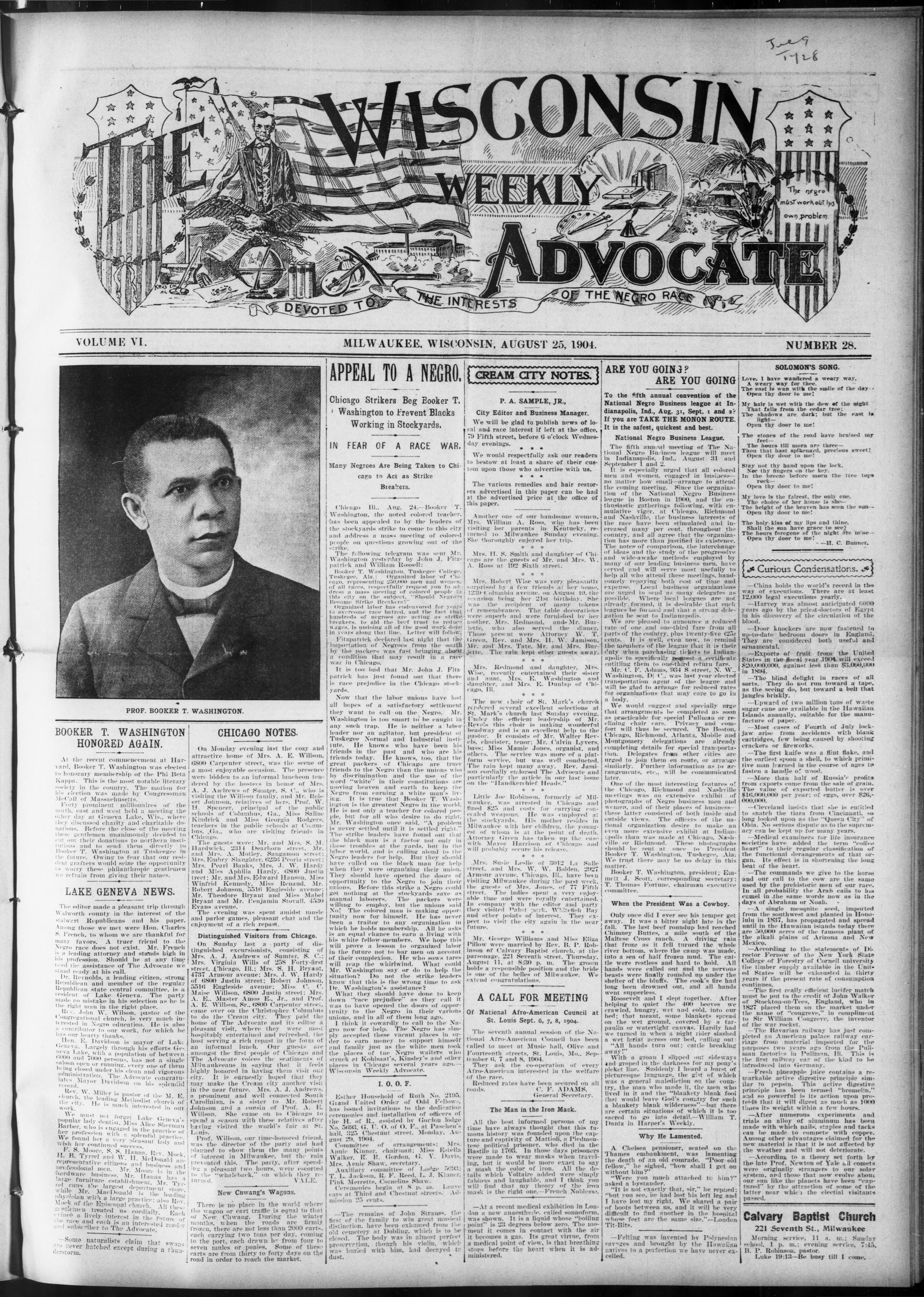
PROF. BOOKER T. WASHINGTON
BOOKER T. WASHINGTON HONORED AGAIN.
At the recent commencement at Harvard, Booker T. Washington was elected to honorary membership of the Phi Beta Kappa. This is the most notable literary society in the country. The motion for his election was made by Congressman McCail of Massachusetts. Forty prominent millionaires of the north, east and west held a meeting the other day at Geneva Lake, Wis., where they discussed charity and charitable donations. Before the close of the meeting these gentlemen unanimously decided to cut out their donations to northern institutions and to send them directly to Booker T. Washington at Tuskegee in the future. Owing to fear that our resident grafters would seize the opportunity to worry these philanthropic gentlemen we refrain from giving their names.
LAKE GENEVA NEWS.
The editor made a pleasant trip through Walworth county in the interest of the stalwart Republicans and his paper. Among those we met were Hon. Charles S. French, to whom we are thankful for many favors. A truer friend to the Negro race does not exist. Mr. French is a leading attorney and stands high in his profession. Should he at any time need the assistance of The Advocate we stand ready at his call. Dr. Reynolds, a leading citizen, strong Republican and member of the regular Republican state central committee, is a resident of Lake Geneva. The party made no mistake in his selection as he is the right man in the right place.
Rev. John W. Wilson, pastor of the Congregational church, is very much interested in Negro education. He is also a contributor to our work, for which he has our hearty thanks.
Hon. E. Davidson is mayor of Lake Geneva. Largely through his efforts Geneva Lake, with a population of between 6000 and 7000 persons, has not a single saloon open or running, every one of them being closed under his clean and vigorous administration. The Advocate congratulates Mayor Davidson on his splendid record.
Rev. W. Miller is pastor of the M. E. church, the leading Methodist church of the city. He is much interested in our work.
We must not forget Lake Geneva's popular lady dentist, Miss Alice Sherman Barber, who is engaged in the practice of her profession with a splendid practice. We found her a very pleasant lady and wish her continued success. F. S. Moore, S. S. Hanna, Rev. Mock, H. B. Tyrrel and W. H. McDonald are representative citizens and business and professional men. Mr. Moore is in the hardware business. Mr. Hanna has a large furniture establishment, Mr. Tyrrel runs the largest department store, while Mr. MacDonald is the leading physician with a large practice; also Rev. Mock of the Episcopal church. All these gentlemen treated us cordially. Each evince a lively interest in the future of the race and each is an interested reader and subscriber to The Advocate.
Some naturalists claim that swans are never hatched except during a thunderstorm.
VOLUME VI.
CHICAGO NOTES
On Monday evening last the cozy and attractive home of Mrs. A. E. Willson, 6800 Carpenter street, was the scene of a most enjoyable occasion. The presence were bidden to an informal luncheon tendered by the hostess in honor of Mrs. A. J. Andrews of Sumter, S. C., who is visiting the Willson family, and Mr. Robert Johnson, relatives of hers, Prof. W. H. Spencer, principal of the public schools of Columbus, Ga., Miss Saline Kindrick and Miss Georgia Rodgers, teachers in the public schools at Columbus, Ga., who are visiting friends in Chicago.
The guests were; Mr. and Mrs. S. M. Hardwick, 2314 Dearborn street, Mr. and Mrs. A. Motley, Sangamon street; Mrs. Embry Slaughter, 6236 Peoria street; Mrs. Pearl Banks, Mrs. J. W. Hardy and Miss Aphilia Hardy, 6800 Justin treet; Mr. and Mrs. Edward Hanson, Miss Winfrid Kennedy, Miss Renaud. Mr. Robert Johnson, 5516 Engleside avenue; Mr. Theodore Bryant and Miss Mabel Bryant and Mr. Benjamin Stovall, 4530 Evans avenue.
The evening was spent amidst music and parlor games, pleasant chat and the enjoyment of a rich repast.
Distinguished Visitors from Chicago.
On Sunday last a party of distinguished excursionists, consisting of Mrs. A. J. Andrews of Sumter, S. C.; Mrs. Virginia Wills of 258 Forty-first street, Chicago, Ill.; Mrs. S. H. Bryant, 4737 Armour avenue; Mrs. J. W. Hardy of 6800 Justin street; Robert Johnson, 5516 Engleside avenue; Miss C. C. Maise Willson, 6800 Justin street; Mrs. A. E., Master Amos E., Jr., and Prof. A. E. Willson, Sr., 6800 Carpenter street, came over on the Christopher Columbus to do the Cream city. They paid the home of The Advocate and its editor a pleasant visit, where they were most hospitably entertained and refreshed, the host serving a rich repast in the form of an informal lunch. Our guests are amongst the first people of Chicago and The Advocate voices the seatiments of Milwaukeeans in saying that it feels highly honored in having them visit our city. It is earnestly hoped that they may make the Cream city another visit in the near future. Mrs. A. J. Andrews, a prominent and well connected South Carolinian, is a sister to Mr. Robert Johnson and a cousin of Prof. A. E. Willson. She came on to Chicago to spend a season with these relatives after having visited the world's fair at St. Louis.
Prof. Willson, our time-honored friend, was the director of the party and had planned to show them the many points of interest in Milwaukee, but the rain prevented this. The party, after spending a pleasant two hours, were escorted to the "whaleback," on which they returned. VALE.
New Chwang's Wagons.
There is no place in the world where the wagon or cart traffic is equal to that of New Chwang. During the winter months, when the roads are firmly frozen, there are not less than 2000 carts, each carrying two tons per day, coming to the port, each drawn by from four to seven mules or ponies. Some of these carts are from thirty to forty days on the road in order to reach the market.
APPEAL TO A NEGRO.
APPEAL TO A NEGRO.
Many Negroes Are Being Taken to Chicago to Act as Strike
Chicago Ill., Aug. 24.—Booker T. Washington, the noted colored teacher, has been appealed to by the leaders of the stockyards strike to come to this city and address a mass meeting of colored people on questions growing out of the strike.
The following telegram was sent Mr. Washington yesterday by John J. Fitzpatrick and William Rossell:
Booker T. Washington, Tuskegee College, Tuskegee, Ala.: Organized labor of Chicago, representing 250,000 men and women, of all races, respectfully request you to address a mass meeting of colored people in this city on the subject, "Should Negroes Become Strike Breakers."
Organized labor has endeavored for years to overcome race hatred, and the fact that hundreds of negroes are acting as strike breakers, to aid the beef trust to reduce wages, is undoing all of the good work done in years along that line. Letter will follow.
Fitzpatrick declared last night that the importation of Negroes from the south by the packers was fast bringing about a condition that may result in a race war in Chicago.
It is too bad that Mr. John J. Fitzpatrick has just found out that there is race prejudice in the Chicago stockyards.
Now that the labor unions have lost all hopes of a satisfactory settlement they want to call on the Negro. Mr. Washington is too smart to be caught in any such trap. He is neither a labor leader nor an agitator, but president of Tuskegee Normal and Industrial institute. He knows who have been his friends in the past and who are his friends today. He knows, too, that the great packers of Chicago are truer friends to the Negro than the unions who by discrimination and the use of the word "white" in their constitutions are moving heaven and earth to keep the Negro from earning a white man's living. It is true that Booker T. Washington is the greatest Negro in the world. He is not only a teacher for colored people, but for all who desire to do right. Mr. Washington once said, "A problem is never settled until it is settled right." The strike leaders have found out that the black man is a factor not only in these troubles at the yards, but in the labor world, and is calling aloud to the Negro leaders for help. But they should have called on the black man for help when they were organizing their union. They should have opened the doors of opportunity to the Negro to join their unions. Before this strike a Negro could get nothing at the stockyards save as manual laborers. The packers were willing to employ, but the unions said No! The colored man is making opportunity now for himself. He has never been a traitor to any organization in which he holds membership. All he asks is an equal chance to earn a living with his white fellow-members. We hope this will prove a lesson to organized labor in the future not to bar men on account of their complexion. He who sows tares will reap the whirlwind. What could Mr. Washington say or do to help the situation? Do not the strike leaders know that this is the wrong time to ask Dr. Washington's assistance?
What they should have done to keep down "race prejudice" as they call it was to have opened the doors of opportunity to the Negro in their various unions, and in all of them long ago.
I think it cowardly to call to the Negro now for help. The Negro has simply accepted these vacant places in order to earn money to support himself and family just as the white men took the places of the Negro waiters who struck at Kohlsaat's, Kinsley's and other places in Chicago several years ago.—Wisconsin Weekly Advocate.
I. O. O. F.
Esther Household of Ruth No. 2195.
Grand United Order of Odd Fellows,
has issued invitations to the dedication
ceremonies and installation of officers of
the H. of R., assisted by Gordon lodge
No. 5693, G. U. of O. F., at Paschen's
hall, 325 Chestnut street, Monday,
August 29, 1904.
Committee of arrangements: Mrs.
Aunie Kinner, chairman; Miss Estella
Walker, R. R. Gordon, G. V. Davis,
Mrs. Annie Shaw, secretary.
Auxiliary committee of Lodge 5693;
T. L. Jackson, R. F. Reed, L. J. Kinner,
Pink Merette, Cornelius Shaw.
Ceremonies begin at 8 p. m. Leave
cars at Third and Chestnut streets. Adm
mission 25 cents.
The remains of John Strauss, the first of the family to win great musical distinction, have been exhumed from the old cemetery at Dobling, which is to be closed. The body was in almost perfect preservation, though his violin, which was buried with him, had decayed to dust.
CREAM CITY NOTES.
P. A. SAMPLE, JR.,
City Editor and Business Manager.
We will be glad to publish news of local and race interest if left at the office, 79 Fifth street, before 6 o'clock Wednesday evenings.
We would respectfully ask our readers to bestow at least a share of their custom upon those who advertise with us.
The various remedies and hair restorers advertised in this paper can be had at the advertised price at the office of this paper.
Another one of our handsome women,
Mrs. William A. Ross, who has been
visiting her parents in Kentueky, returned to Milwaukee Sunday evening.
She thoroughly enjoyed her trip.
* * *
Mrs. H. S. Smith and daughter of Chicago are the guests of Mr. and Mrs. W. A. Ross at 192 Sixth street.
---
Mrs. Robert Wise was very pleasantly surprised by a few friends at her home. 1239 Columbia avenue, on August 19, the occasion being her 21st birthday. She was the recipient of many tokens of remembrance. The table decorations were superb and were furnished by her mother. Mrs. Redmond, and Mr. Burjette, who also served the dinner. Those present were Attorney W. T. Green, Rev. and Mrs. H. W. Jamison, Mr. and Mrs. Tate, Mr. and Mrs. Burjette. The rain kept other guests away.
---
Mrs. Redmond and daughter, Mrs. Wise, recently entertained their sister and aunt, Mrs. E. Washington and daughter, and Mrs. E. Dunlap of Chicago, Ill.
* * *
The new choir of St. Mark's church rendered several excellent selections at St. Mark's church last Sunday evening. Under the efficient leadership of Mr. Revels this choir is making wonderful headway and is an excellent help to the pastor. It consists of Mr. Walter Revels, chorister, tenor; Mr. Calvin Lyvers, bass; Miss Mamie Jones, organist, and others. The service was more of a platform service, but was well conducted. The rain kept many away. Rev. Jamison cordially endorsed The Advocate and particularly the article in our last issue on the "Handkerchief Heads."
☆ ☆ ☆
Little Joe Robinson, formerly of Milwaukee, was arrested in Chicago and fined $25 and costs for carrying concealed weapons. He was employed at the stockyards. His mother resides in Milwaukee with her children, the youngest of whom is at the point of death. Attorney Green has taken up the case with Mayor Harrison of Chicago and will probably secure his release.
Mrs. Susie Leslie of 3012 La Salle street, and Mrs. W. W. Bolden, 2927 Armour avenue, Chicago, Ill., have been visiting Milwaukee during the past week, the guests of Mrs. Jones, of 77 Fifth street. The ladies spent a very enjoyable time and were royally entertained. In company with the editor and party they visited Pabst park, Whitefish Bay and other points of interest. They expect to visit the city again in the near future.
Mr. George Williams and Miss Eliza Pillow were married by Rev. B. P. Robinson of Calvary Baptist church, at the parsonage, 221 Seventh street. Thursday, August 11, at 8:30 p. m. The groom holds a responsible position and the bride is one of the belles of Milwaukee. We extend congratulations.
A CALL FOR MEETING
Of National Afro-American Council at St. Louis Sept. 6, 7, 8, 1904.
The seventh annual session of the National Afro-American Council has been called to meet at Music hall, Olive and Fourteenth streets, St. Louis, Mo., September 6, 7 and 8, 1904.
They ask the co-operation of every Afro-American interested in the welfare of the race.
Reduced rates have been secured on all roads.
C. F. ADAMS.
General Secretary
The Man in the Iron Mask.
All the best informed persons of my time have always thought that this famous history was founded upon the capture and captivity of Mattioli, a Piedmontese political prisoner, who died in the Bastile in 1703. In those days prisoners were made to wear masks when traveling, but it would be more exact to say a mask the color of iron. All the details which Voltaire added were simply fabulous and laughable, and I think you will find that my theory of the iron mask is the right one.—French Noblesse.
At a recent medical exhibition in London a new anaesthetic, called sonnoform, was shown. It is a liquid whose "boiling point" is 23 degrees below zero. The moment it comes in contact with the air it becomes a gas. Its great virtue, from a medical point of view, is that breathing stops before the heart when it is administered.
ARE YOU GOING?
ARE YOU GOING
To the fifth annual convention of the National Negro Business league at Indianapolis, Ind., Aug. 31, Sept. 1 and 2: If you are TAKE THE MONQN ROUTE. It is the safest, quickest and best.
The fifth annual meeting of The National Negro Business league will meet in Indianapolis, Ind., August 31 and September 1 and 2.
It is especially urged that all colored men and women, engaged in business—no matter how small—arrange to attend the coming meeting. Since the organization of the National Negro Business league in Boston in 1900, and the enthusiastic gatherings following, with cumulative vigor, at Chicago, Richmond and Nashville, the business interests of the race have been stimulated and increased many per cent, throughout the country, and all agree that the organization has more than justified its existence. The notes of comparison, the interchange of ideas and the study of the progressive and wide-awake methods employed by many of our leading business men, have served and will serve most usefully to help all who attend these meetings, handsomely repaying both cost of time and expense. Local business organizations are urged to send as many delegates as possible. Where local leagues are not already formed, it is desirable that such leagues be formed and that a strong delegation be sent to Indianapolis.
We are pleased to announce a reduced rate of one and one-third fare from all parts of the country, plus twenty-five (25) cents. It is well, even now, to remind the members of the league that it is their duty when purchasing tickets to Indianapolis to specifically request a certificate entitling them to one-third return fare. Mr. C. F. Adams, 934 S street, N. W., Washington, D| C., was last year elected transportation agent of the league and will be glad to arrange for reduced rates for organizations that may care to go in a body.
We would suggest and specially urge that arrangements be completed as soon as practicable for special Pullman or reclining chair cars. Privacy and comfort will thus be secured. The Boston, Chicago, Richmond, Atlanta, Mobile and Montgomery delegations are already completing details for special transportation. Delegates from other cities are urged to join them en route, or arrange similarly. Further information as to arrangements, etc., will be communicated later.
One of the most interesting features of the Chicago, Richmond and Nashville meetings was an extensive exhibit of photographs of Negro business men and women, and of their places of business—the latter consisted of both inside and outside views. The officers of the national organization desire to make an even more extensive exhibit at Indianapolis than was made at Chicago, Nashville or Richmond. These photographs should be sent at once to President Booker T. Washington, Tuskegee, Ala. We trust there may be no delay in this matter.
Booker T. Washington, president; Emmett J. Scott, corresponding secretary; T. Thomas Fortune, chairman executive committee.
When the President Was a Cowboy.
Only once did I ever see his temper get away. It was a bitter night late in the fall. The last beef roundup had reached Chimney Buttes, a mile south of the Maltese Cross ranch. A driving rain that froze as it fell turned the whole river bottom, where the camp was made, into a sea of half frozen mud. The cattle were restless and hard to hold. All hands were called out and the nervous beasts were finally rounded up under the shelter of the bluffs. The cook's fire had long been drowned out, and all hands went supperless.
Roosevelt and I slept together. After helping to quiet the 400 beeves we crawled, hungry, wet and cold, into our bed; that meant, some blankets spread on the wet ground, covered by a tarpaulin or watertight canvas. Hardly had we turned in when a night rider slashed a wet lariat across our bed, calling out: "All hands turn out; cattle breaking away!"
With a groan I slipped out sideways and groped in the darkness for my pony's picket line. Suddenly I heard a burst of picturesque language, the gist of which was a general malediction on the country, the man who made it, the men who lived in it and the "blankety blank fool that would leave God's country for such a blankety blank wilderness"—but there are certain situations of which it is too sacred to go into detail.—William T. Dantz in Harper's Weekly.
Why He Lamented.
A Chelsea pensioner, seated on the Thames embankment, was lamenting the death of an old comrade. "Poor old fellow," he sighed, "how shall I get on without him?"
"Were you much attached to him?" asked a bystander.
"It is not exactly that, sir," he repined; "but you see, he had lost his left leg and I have lost my right. We shared a pair of boots between us, and it will be very difficult to find another in the hospital whose feet are the same size."—London Tit-Bits.
—Felting was invented by Polynesian savages and brought by the Hawaiian natives to a perfection we have never excelled.
NUMBER 28.
SOLOMON'S SONG.
Love, I have wandered a weary way,
A weary way for thee.
The east is wan with the smile of the day
Open thy door to me!
My hair is wet with the dew of the night
That falls from the cedar tree;
The shadows are dark; but the east is
light
Open thy door to me!
The stones of the road have bruised my
feet
The hours till morn are three
Thou that hast spikenard, precious sweet!
Open thy door to me!
In the breeze before morn the tree tops rock—
My love is the fairest, the only one,
The choice of her house is she
The height of the heaven has seen the sun
Open thy door to me!
The holy kiss of my lips and thine,
Shall the sun have grace to see?
The hours foregone of the night are mine
Open thy door to me!
Curious Condensations.
China holds the world's record in the way of executions. There are at least 12,000 legal executions yearly.
Harvey was almost anticipated 6000 years ago by the priest-doctors of Egypt in his discovery of the circulation of the blood.
Door knockers are now fastened to up-to-date bedroom doors in England. They are considered both useful and ornamental.
Exports of fruit from the United States in the fiscal year 1904 will exceed $20,000,000, against less than $3,000,000 in 1894.
The blind delight in races of all sorts. They do not run toward a tape, as the seeing do, but toward a bell that jangles briskly.
Upward of two million tons of waste sugar cane are available in the Hawaiian Islands annually, suitable for the manufacture of paper.
Most cases of Fourth of July lock-jaw arise from accidents with blank cartridges, few being caused by shooting crackers or fireworks.
The first knife was a flint flake, and the earliest spoon a shell, to which primitive man learned in the course of ages to fasten a handle of wood.
More than half of Russia's profits from exports come from the sale of grain. The value of exported butter is over $16,000,000 per year; of eggs, over $26,-000,000.
—Cleveland insists that she is entitled to snatch the tiara from Cincinnati, so long looked upon as the "Queen City" of Ohio. No serious dispute as to the supremacy can be kept up for many years.
—Medical examiners for life insurance societies have added the term "coffee heart" to their regular classification of the functional derangements of that organ. Its effect is in shortening the long beat of the heart.
—The commands we give to the horse and our call to the cow are the same used by the prehistoric men of our race. In all probability the Arab calls to his camel in the same words now as in the days of Abraham or Noah.
A single mesquite seed, imported from the southwest and planted in Honolulu in 1837, has propagated and spread until in the Hawaiian islands today there are 50,000 acres of the famous plant of the alkali plains of Arizona and New Mexico.
According to the statements of Director Fernow of the New York State College of Forestry of Cornell university the timber supply available in the United States will be exhausted in thirty years if the present rate of consumption continues.
The first really efficient lucifer match must be put to the credit of John Walker of Stockton-on-Tees, England, who in 1827 placed them on the market under the name of "congreve," in compliment to Sir William Congreve, the inventor of the war rocket.
The Bavarian railway has just completed an American palace railway carriage from material imported for the purposes two years ago from the Pullman factories in Pullman, Ill. This is the first railway car of the kind to be introduced into Germany.
Fresh pineapple juice contains a remarkable active digestive principle similar to pepsin. This active digestive principle has been termed "bromelin," and so powerful is its action upon proteins that it will digest as much as 1000 times its weight within a few hours.
After numerous experiments and trials an alloy of aluminum has been made with which nails, staples and tacks can be made to compete with copper. Among other advantages claimed for the new material is that it is not affected by the weather and will not deteriorate.
According to a theory set forth by the late Prof. Newton of Yale all comets were originally strangers to our solar system, and those that now evolve about our sun like the planets have been "captured" by the attraction of some of the latter near which the ectial visitants passed.
Calvary Baptist Church
Calvary Baptist Church
221 Seventh St., Milwaukee
Morning service, 11 a. m.; Sunday
school, 1 p. m.; evening service, 7:45.
B. P. Robinson, pastor.
Luke 19:13—Be busy till I come.
Miscellaneous Items.
—Webster City, Ia., carries the municipal ownership idea to the extent of owning the town's newspaper.
—Two rival railways up Mont Blanc, one going to the very summit, the other to within 800 feet, are projected.
—The number of outdoor and indoor paupers in London on the last day of the third week of June was 108,428.
—A company with a capital of $200,000 has been chartered in Massachusetts to manufacture a non-refillable bottle.
—A newly discovered cotton tree in Mexico promises to rival in production the cotton plant of the United States.
A newly invented microscope is said to magnify the eye of a house fly so that it covers an apparent area of 312 feet.
It is believed that French prune growers use glycerine to give their dried fruit its peculiar glistening appearance.
British India has the swiftest river in the world. It is the Sutlej, which, in 180 miles, has a descent of 12,000 feet.
The annual catch of fish in American waters is 1,696,000,000 pounds, which represents a money value of $47,180,000.
The cleanest town in the United States is said to be Shakertown, Ky., inhabited by Shakers. It has a large brick hotel, but no business houses.
In Burma and Brittany yellow is the color of mourning, in Persia pale brown, in Ethiopia grayish brown, in Syria and Armenia blue, in China white.
In 1882 there were 10,921 breweries in Germany, while in 1901, although the production of beer increased, the number of breweries decreased to 6674.
Only one "public writer" is left in Paris. In former years one could be found every few blocks. Her business is to write letters for the illiterate.
The house in Raleigh, N. C., where Andrew Johnson was born, has been purchased by the Colonial Dames. It will be a museum.
For some maladies physicians recommend yawning. They say that muscles are brought into play during a yawn that would otherwise never get any exercise at all.
The race of Todas, in India, who practice polyandry (one wife having two or more husbands), which was 100,000 strong a century ago, has dwindled to 101 persons.
The 250th anniversary of the coming of Father Le Moyne, the Jesuit missionary, to Onondaga county, New York, will be celebrated in an elaborate manner at Pompey Hill on August 15.
The clocks and watches of savage and semi-civilized people come mostly from Connecticut and Birmingham, England. Connecticut having a practical monopoly in supplying the watches.
After seventy-five years of captivity a female eagle owl has just died in an aviary in England. Brought from Norway in 1820, this bird within the last thirty years has reared ninety young.
- Successful experiments have been made in various forests of France in cutting trees by means of electricity. A platinum wire is heated to a white heat by an electric current and used like a saw.
- One of the queer industries of the Italian quarter is the manufacture of wax models of various parts of the human body to be used as votive offerings to saints in gratitude for cures effected.
- When the orginator of the genuine can de cologne died, aged 80, he gave his secret to his nephew and heir. Since 1700 only ten persons have seen the recipe, which is kept in a box trebly locked.
The average cost of food per family in 1890 was $318.20. In 1896, the year of lowest prices, it fell to $296.76; in 1902 it reached the highest point of the period, being $344.61; while in 1903 it fell slightly, to $342.75.
The Berlin Cremation society has sent a petition containing 9500 signatures to the Pope, praying that the last rites of the Roman Catholic church shall no longer be denied to persons wishing their remains to be cremated.
Nearly nine-tenths (89.7 per cent.) of the negroes living in continental United States are found in the southern (South Atlantic and South Central) states, and three-tenths (31.4 per cent.) in Georgia, Mississippi and Alabama.
There are some 400,000 German settlers in Brazil, most of whom are Brazilian subjects, but who send their children to German schools, which are maintained for the purpose of training them in German habits and a love of Germany.
Koryak women of northwestern Siberia, having no carriages in which to convey their offspring, resort to the ingenious method of dropping the tiny creatures into blanket bags which are tightly strapped about the mothers' necks.
Of the 37,692 students enrolled in the German universities for the term now drawing to a close 3093 were foreigners, of whom 986 were Russians and 324 Americans. Female students to the number of 1314 were enrolled for the term.
A strongly radio-active earth consisting chiefly of lanthanum has been obtained from pitchblende by Giesel, a German chemist. He finds that the behavior of the material is different from that of radium, and believes that he has obtained a new element which he calls emanium and which he hopes to separate from lanthanum.
England has for many years given prizes for the destruction of venomous serpents and dangerous wild beasts in India, but it does not seem to diminish the annual number of victims. In 1903 over 23,000 persons were killed by snake bites, over 1000 by tigers and almost a thousand by bears, leopards and panthers, together a total of over 25,000 victims.
American railroads carry more freight than do all the other railroads of the world. It is only when it comes to passengers that the American roads, from handling 675,000,000 in a year, take a back place compared with the 3,120,000,000 passengers that are carried by the world's other lines. Of these foreign passengers, the European roads alone carry 2,800,000,000 a year.
An Italian engineer now residing at Brussels had, it is said, invented an instrument which he calls the telescriptograph, and which will produce in print all conversations held over the telephone. If he has really done this the doom of the typewriter has been sealed, since one would then have only to talk into a machine which would grind out the typewritten letters as fast as they were dictated.
Today in a country of 80,000,000 population transcontinental trains are running across desert stretches where water is worth almost its weight in wine; where no freight save the water and coal hauled for the railroad is ever dumped; where only the coyote, the rattlesnake, the prairie dog, and the cactus and the sage brush thrive. But over these stretches of waste hands trains that are palaces in their makeup and appointments run east and west in daylight and in dark
A lady in Belfast, Me., recently was caught out in a shower in the evening, and as the kitchen stove was only partially cooled off when she got home she placed her hat in the oven and then forgot all about it. Her husband built the fire next morning and the oven was not used for getting the breakfast. When the lady remembered her hat she hastened to the oven only to find the charred remains of that once handsome specimen of millinery.
THE SONG OF THE COMMON PEOPLE
We are the common people, the hewers of wood and stone. The dwellers in common places, mighty of brawn and bone. Bearing the common burden that only the shirkers shun.
And doing the common duty that others have left undone.
Dubbed, by the few, plebeian, rabble or proletaire.
Ours is the hand that feeds them, ours is the prize they share.
the prize they share,
And ours is the common blessing, free to
use.
the tolters all.
To win from the lowly valley unto the summits tall.
Common, and only common—
This by the might of birth—
Yet the world in its need leans on us—
We are the kings of the earth.
We are the common people, and ours is the common clay.
That a God deemed fit for using, when, in that olden day.
He took the dust of the Garden, the dust that His will obeyed.
Fashioned and formed and shaped it, and man in His image made;
And, seeing that God selected such clay for the human test.
And deeming His wisdom suffices to choose but the surely best.
but the surely is. We, who are common people and made of man.
We, who are common people and made of the common cay. We are common to impress
Leave to the proud uncommon to improve on the Maker's way.
Common, and only common—
Tattered, sometimes, and frayed—
We still are content with the pattern
That God in His wisdom made.
We are the common people, yet of our might is wrought,
Ever, by God's own fiat, masters of mighty thought,
Men of that grand republic whose rulers walk alone.
walk a
Piercing the future shadows, knowing what
seers have known;
And, measured by these, the unco' are
petty and wee and small,
Playing with gilded baubles, chattering,
wubble all.
voluble all,
And these, our sons, surpass them as the
hils o'ertop the glen,
For their great hearts throb to the world's
long sob, and they are the saviors of
men.
Common, and only common,
Hopelessly commonplace.
Yet out of our loins still issue
The saviors of the race.
—Alfred J. Waterhouse in Success.
HER CHRISTIAN NAME.
Silence was—to quote from Jimmie
Spoorer—Henry Walcot's "long suit."
Spencer—Henry Walcot's "long suit."
There was a great bond of friendship between the two; perhaps they followed in this the law that opposites attract each other. For Jimmie Spencer was the reverse of Henry Walcot in almost every particular. Where Henry was tall and dark, Jimmie was rather the medium height, and so inclined to rotundity of figure that his face, beaming always with good humor, inevitably suggested to an observer the qualifying adjective "ishubby."
"Why do I like Henry so well?" said Jimmie one day in reply to a question. "Because he is suicn a jolly fellow and knows how to keep his mouth shut. Say, do you know," growing suddenly enthusiastic, "Henry can speak English, German and Spanish, but, by Jove! he knows how to keep quiet about fourteen other languages, not counting dialects and slang."
"Why do I like Jimmie?" said Henry, musingly. "Because he is a jolly good fellow and knows how to talk, I suppose."
So they sat now in front of a cheerful fire in Walcot's rooms, smoking and talking. Jimmie was enchanting away as usual, but there was something a bit distraught in his manner which did not escape the keen eye of his friend. By and by, even Jimmie's fund of small talk seemed exhausted, and each sat smoking and musing.
It was Henry who broke the silence. "Sit up, Jimmie, and talk out like a man," said he, with a laugh. "You know you never tramped all the way up here in the snow and then climbed three flights of stairs just to have a chat. Out with it, man. What have you got on your mind?"
Jimmie looked up queerly, god, catching the friendly gleam in the other's eye, he laughed himself and replied: "No dodging you, you sly dog! I believe you are a mind reader, anyhow."
"Perhaps I do a bit in that line now and then," answered Henry, with an assumption of great mystery, "and to prove it to you, I will tell you that you came up here for no other purpose than to tell me that you have gone and got yourself engaged."
"Now, how in thunder did you know that?" asked Jimmie, sitting up in astonishment.
"You look guilty," answered Henry, with one of his peculiar, almost inaudible chuckles.
"But I never told you that I was even paying attention to the girl whom I am to have the honor of marrying," declared Jimmie, protestingly. "You could not have had any idea of it."
"Now, Jimmie, my boy, do give me credit for using my powers of observation occasionally," protested Henry.
"So!" said Jimme, "then maybe you have used them far enough to tell me the name of the girl."
"I mudoubtedly can," averred Henry, solemnly. "Stunted as my powers of observation may be, they have been sufficiently powerful to enable me to declare that the young lady in question is none other than Miss Preston."
This prescience was too much for Jimie, who simply stared open-mouthed at his chuckling tormentor.
"That's the worst of you close-mouthed people," said he presently, with an air of deep disgust. "You sit around and don't say a word, and all the while you are keeping close tab on everything and everybody. Then when a fellow comes around to tell you a piece of important news you take the wind all out of his sails with your air of world-wide knowledge and consciousness of his most intimate thoughts. I must say that I think you might have pretended ignorance. Now, I'll just keep quiet about the matter." And Jimmie resolutely shut his mouth and turned again to his cigar. "Now, Jimmie," said Walcot, with dignity, "don't be any more of a chump than usual. You know you are so full of the subject that you have just got to talk. So fire away."
And Jimmie did fire away presently, the subject having got the better of his resolve.
But, Henry, all natural prejudice aside, I just can't believe my good luck. To think that she should accept me, when she might have had any man—why, she might have married you, old chap, couldn't she?
"Did she tell you so?"
"Nope," said Jimmie, cheerfully, "but I can't see how it is that you haven't fallen in love with her."
There was something in his tone that made Jimmie look up quickly.
Walcot was gazing into the cheerful fire and there was such a smile upon his face as Jimmie had never seen. The mercurial youngster was on his feet in an instant and rushed over to Walcot.
"By Jove, old chap, so you have been indulging in a love affair and didn't even take me, your best friend, into your confidence! I call that shameful of you, but I am deuced glad to know that you are in love, after all. Take my word for it, old chap, there's nothing like it in all the world."
"Easy, boy, easy," said Walcot, with
a quiet smile that may have concealed some embarrassment. "I haven't confessed to any love affair yet. And as for confidence, remember that you told me nothing of yours until you were actually engaged. Even good friends like you and me don't talk over such affairs. However I may have—I hope to have—some good news to tell you soon." "How soon?" "Who can say?" "Have you proposed to her?" "No, but I intend to do so." "Good boy! Go in and win. If you want a certificate of good character, call on me. I am always ready to tell a lie in the sacred cause of friendship." And Jimmie's infections laugh took all sting away from the remark.
Once more fell a period of silence and
I couldn't take it with.
Jimmie broke it with:
"Did you ever notice the color of her
eyes, Henry?"
"Yes," answered Henry with an air of
amusement. "They are blue, aren't
they?"
"No, indeed," said Jimmie, somewhat indignantly, "They are a wonderful deep gray; almost black."
"Is that so?" was the somewhat indifferent reply. "Then she has the same color of eyes as her cousin. I know that she has wonderful, deep gray eyes—wonderful eyes." This last was very soft.
"Not at all, stupid," said Jimmie, vexed at so much stupidity. "Her cousin's eyes are blue. I'll be blessed if you ever observe anything."
Jimmie himself was not observing anything, but was sitting with his gaze fixed on the heart of the flames and his mind lost in a happy reverie. He did not see his companion look up with a quick terror in his eyes and a face drawn with emotion. Nor did he hear a question addressed to him. Indeed, Walecot's voice was very thick, and he hardly knew himself whether he had spoken the question aloud or merely in his anguish voiced it to himself.
"Then you are engaged to Kate Preston?" he finally managed to say, loud enough to make his companion hear.
"Certainly," said Jimmy, in astonishment. "Who did you think I was engaged to—certainly not to Annie Preston?"
"I didn't know," said Walcot, weakly. "So your mind reading wasn't so good, after all!" exclaimed Jimmie in triumph. "Well, I must be going—so long."
And he was gone.
For a long time Walcot sat before the fire, though his cigar went out unnoticed and was not relit.
Then he slowly walked to his desk and took out a letter, addressed in his own firm handwriting. Opening it, he stood in front of the fire and read it through twice. It was a proposal of marriage, simple, straightforward and winning in its declaration of great love.
The letter fluttered first to the fire and the envelope followed it. Walcot standing quietly to watch them burn. One might have read the address on the envelope, even after it was caught by the flames, and that address was;
"Miss Kate Preston"—Beverly Smith in San Francisco Call.
GIRL MAIL CARRIER'S ROUTE.
Miss Colby Drives Sixty Miles a Day and Cuts Wire Fences.
Lena McBride, 17 years old, who makes a sixty-mile drive three times a week carrying the mail from Colby to this postoffice, is Kansas' youngest girl mail carrier. She uses two horses on the long journey, driving one fifteen miles out from Colby and then changing for another, which she drives the remainder of the distance. She eats dinner at the ranch, then returns over the thirty mile course, changing horses again at the halfway station. Her buggy has become one of the familiar sights along the way and cattle herders and farmers all know her.
A few days ago she found that the owner of a big ranch that lies between here and Colby had run a barbed wire fence across the trail over which she usually drove. To go around the ranch was out of the question, and she did not intend to go back to her starting point. She took from her buggy a pair of wire cutters and clipped the four barbed strands that barred her progress. The next trip she found the fence repaired and again cut the wires and left the gap open. The owner of the ranch demanded to know why she did it. "I am carrying the United States mail," was the smiling reply, "and I am going through if I can get through."
The owner threatened arrest, but she was not frightened. On the next trip a new gate was found across the road and she still uses the familiar trail on her tri-weekly journey.—Oak Ranch (Kan). Correspondence Kansas City Star.
Hog Thirty-two Days in a Well.
Howard C. Garrison, a prominent farmer of this county, was in town yesterday and had a remarkable incident to relate. On the night of the 18th of June he lost a fine 300-pound hog. He searched high and low, but could find no trace of the animal. He finally gave up the hunt, coupling the disappearance of the hog with some Emancipation day barbecue. Wednesday some one had occasion to look in an old dry well, ten or twelve feet deep and only 100 or 200 yards from his house. At the bottom he discovered the hog, apparently unhurt. It had been in the well thirty-two days without food or water.
Mr. Garrison threw down an ear of corn, but the hog would not eat. He then lowered a bucket of milk and bran mixture, which proved to be more to his hogship's taste. Mr. Garrison has decided to feed the hog down in the well for a day or two, and then raise it out by filling in the well.—Belton Correspondence Galveston News.
A Flow of Language
Twelve hundreds wires are now enclosed in a telephone cable two and one half inches in diameter. Until recently 800 was the largest number of wires placed in a single cable. Through one of the new cables words spoken into 600 telephones may flash simultaneously to be heard by the persons at 600 other telephones, each message undisturbed by the hundreds of others with which the wires are alive. The cable looks like a lead pipe intended for carrying water, but should water enter it the cable would at once become worthless. Each of the 1200 wires in the cable is wrapped in paper to secure insulation, but the paper is not the insulating medium. Dry air in the folds of the wrappings and in the paper itself prevents the wandering of words from one wire to another. To counteract various electrical influences that would impede transmission, the wires are twisted and transposed at frequent intervals.—Saturday Evening Post.
The Fate of a Play.
The dearth of plays I scarcely dare to mention because it provokes lively correspondence in the newspapers. Authors write to say that they have masterpieces in abundance which the selfishness of actor-managers will not allow to see the light. But every manager is not an actor yearning for the middle of the stage. Charles Frohman searches the highways and byways of Britain and America, and I have never heard him complain that he has more masterpieces than he knows what to do with. In the success or failure of a play there is often an element of mystery. It springs from some unknown quality in the public mind with which the longest experience cannot reckon.—Speech by Henry Irving at Manchester.
New York Every Day.
At a sale of abandoned goods the other day the government realized 35 cents. Two bushels of live snails brought 15 cents, and a barrel of yams 20 cents. The auctioneer waived Ls commission.
F. Flaxington Harker, Vanderbilt's organist at Biltmore, N. C., who was brought to this country several years ago, causing a protest in musical circles, has resigned and will become organist in the First Presbyterian church in Jersey City.
Demurrers to the indictments found against them in connection with the Slocum disaster were filed by former Inspectors Henry Lundberg and John T. Fleming, who allege that the facts as stated in the indictments do not constitute a crime.
Riggers are busy hoisting into position an immense flagpole for the front of the New York Stock Exchange building. The pole is of steel and is fully 50 feet long. When the flag is hoisted upon it the stars and stripes will be swung for the first time from the top of the building.
Leaders of the United Irish league in New York city were notified that the Irish parliamentary party, which is to attend the convention of the league, sailed for New York. The party is composed of John P. Redmond, Conor O'Kelly, Capt. A. J. C. Douelan and Patrick O'Brien.
Judge Newburger denied the motion of counsel for "Nan" Patterson asking for the discharge of the actress indicted for the murder of "Caesar" Young on her own recognizance, because a term of the court had passed since she was indicted. As a result of this decision the prisoner will be obliged to stay in the tombs until her case is called to trial, which will probably not be before the October term.
In inner banking circles the topic of greatest interest is the most recently financing connected with the Cincinnati, Hamilton and Dayton system. This deal involved the advancement of about $8,000,000 by a syndicate headed by H. B. Hollins & Co. for the purchase of the railroad company's 5 per cent, preferred stock. Bankers who learned the details of the scheme calculated that H. B. Hollins & Co.'s one-year loan had cost the company between 17 and 18 per cent. It includes a commission of $100,000 to $200,000.
A movement has been instituted among the members of New York's police force to form an association for the purpose of assiting families of officers killed in the performance of their duties. Numerous deaths of this kind have occurred recently in fires and battles with burglars. It is now proposed that an organization shall be formed, with its affairs administered by trustees, and that each member of the force shall contribute 50 cents as an assessment in cases of death. In this way $3500 would be raised.
William O. Smith, who lives in a big house at Anthony avenue and Oune Hundred and Seventy-eighth street, has nearly finished building a block away, at Anthony avenue and Echo place, a six-story flat house, which will be adapted especially for children. On the top floor is a huge playroom for the little folks, and large back yard has been equipped with swings and other things that appeal to children. Mr. Smith says that the parents of any baby born in his flat house will get a month's rent free; twins, two months; triplets, from three to six.
That, notwithstanding the alleged careful scrutiny by election inspectors at the polls, naturalized Chinamen have been permitted to vote at elections in New York city, was the discovery made by Assistant United States District Attorney J. L. Mark. As a result three Chinese, one of them the "Mayor of Chinatown," were arrested and arraigned before United States Commissioner Shields, where they furnished $500 bail for their appearance at the next term of the United States circuit court in October.
Despite assertions that Manhattan has enough playhouses, it has become known that it is planned to transform the Sherman Square hotel, at Broadway, Amsterdam avenue and Seventy-first street, into a first-class playhouse. Report said that Oscar Hammerstein had been asked to take charge of the enterprise by a wealthy syndicate, and was to have carte blanche in plans, alterations and in the conduct of the house. Mr. Hammerstein admitted the story, but said he had to decline the offer on account of his own business.
About ten new and gorgeous lunch wagons have made their appearance at the busy corners of New York city. The lunch wagon is a night bird, and is not permitted to alight until the streets are cleared of traffic. This is usually about 10 o'clock. Like the Pullman Car company, the owners like to have fancy names for their wagons. At Madison square "The Wayside Inn" makes its anchorage; at Union square "The Good Cheer" dispenses hospitality; "The Smiling Face" beams on midnight wanderers at Greeley square, and so they go.
Charles Blasure, an electrician residing in Long Island City for ten years, asserts that he is one of three heirs to an estate in California valued at $500,000. The fact that lawyers were making a search for him became known through a visit paid to California in the latter part of the winter by a brother of Borough President Joseph Cassidy of Queens. The visitor heard that Charles Blasure, son of a Californian recently deceased, was being searched for, so that an estate might be settled. Upon his return he jokingly referred to the matter and the electrician at once announced himself as the missing son.
Miss Helen Gould has decided to aid in fighting the mosquito and also to drive out the sparrow, which bird, naturalists believe, is one cause of the prevalence of the insect. For some days Miss Gould has had among her guests at her country home at Roxbury, N. Y., Col. Isaac W. Brown. Col. Brown is known throughout the west as "the bird and bee man" of Indiana. For a number of years he has been a recognized authority on the habits of birds, bees and insects. Miss Gould has become interested in Col. Brown's work, and he is giving her and her friends instruction in natural history, giving particular attention to the mosquito.
John D. Rockefeller, Jr., was mad clear through when he had to pay a dollar which the Western Union messenger boy collected from his valet a few days ago. He came all the way down from Pacantico hills, where he lives, three miles from the telegraph station here, to register a stiff protest. Young John had left orders that all messages be telephoned, but his 'phone was out of order when a message came which the superintendent believed to be important. A messenger boy was accordingly dispatched and charged the valet $1, the regular toll. John D., Jr., was indignant. When he reached the telegraph office he
said: "Why. I can get a man to work all day for $1.25. The charges are excessive."
Habor J. Aflak, a wealthy Syrian merchant of Hayti, was arrested in connection with the alleged naturalization frauds. According to the officials the papers were secured by wealthy residents of Hayti and other South American republics for protection purposes. Well-to-do men there learned that they could escape the exorbitant taxations of the little republic if naturalized citizens of this country. In some way a band of men, chiefly foreigners, who have made their headquarters in Waterbury, Conn., have been engaged supplying citizenship papers to natives of Hayti. The name of the applicant would be forwarded to the leader, who would promptly have a man apply for citizenship papers under that name. Aflak pleaded not guilty and was held in $2500 bail.
Five-year-old Elsie Gellert, the heroine of an alleged international kidnapping episode, started for her home in Denmark on the steamship United States. She was placed on board the steamship by Acting Consul George Bech, who has represented the Danish consul general in the negotiations pending the child's recapture and return to her parents. Since the child was taken from William and Mary Jenson in Chicago she has been kept in the closest seclusion by the Danish authorities for fear that she might be stolen from them, in which event they would have been powerless to act against the kidnapers until power of attorney had been obtained from her parents. For two years, at the solicitation of the parents of the child, the Danish government has been employing every means for her recovery.
William P. Dewey of New York city is advertising for persons who lost money in the Colorado Fuel and Iron through tips received from John W. Gates to join in the suit against Mr. Gates. Dewey alleges that one of his clients lost $170,000 in the transaction through Gates' tips when about two years ago Gates attempted to get control of the Colorado Fuel and Iron company. A close friend of Mr. Gates said today: "Mr. Dewey's suit will have no standing in court. John W. Gates did not deceive anybody. He was thoroughly honest in his belief that Colorado Fuel and Iron was a fine property, was himself greatly deceived and lost a whole pile of money through the drop in the stock."
For the purpose of establishing a test power has been turned on in the rapid transit subway, and trains were run over the line from downtown stations to Harlem. The climax of the test was made by a picked crew with four cars, run at high speed over the entire route. Some of the turns were made at a dizzy gait, precautions having been taken to have the track clear for the one great effort of the night. The experiment was a complete success, and Harlem was reached well within the time allowance of fifteen minutes. To those on the train the stations appeared and melted away as in a picture. The greatest secrecy was maintained by the officials of the road. One of the objects of the experiment was to familiarize the men at the controllers with the twists and turns of the road.
The final act in a bit of litigation which has lasted since January, 1898, and which involved the right of the United States government to sell copyrighted or patented goods which had been smuggled, has developed through two men turning over to the appraisers' stores 29., 050 grains of phenacetine, to be destroyed. The drug, which is worth $1 an ounce, was smuggled into the country, seized and sold. The purchasers, two local agents, began preparations to sell it, but were halted by an injunction procured by the German manufacturers. The latter claimed to have sole right to the name of the drug, having procured a copyright on the word, and were upheld. The men who bought the drug from the government have now been compelled to turn it back, and can only recover through a special act of Congress.
George W. Vanderbilt proposes to take things in his own hands when he comes back to Biltmore in the autumn. He will personally look after the management of his estate, which consists of a quarter of a million of acres of land and a hundred or more different departments, including a dairy, a truck garden, etc. When Mr. Vanderbilt left Biltmore last spring he was much dissatisfied with the way things were going. He dismissed several of the head employees who had been coming up short in their accounts, and ordered that some changes be made. Recently Col. McNamee, his manager, went to Seattle to look after some of the Vanderbilt affairs there. It is understood that Mr. McNamee will remain in Seattle and that Mr. Vanderbilt will look after his own affairs at Biltmore. Mr. and Mrs. Vanderbilt are expected soon for the winter.
Announcement that the Interborough Rapid Transit company would begin to hand out application blanks to those desiring jobs in the rapid transit tunnel attracted several thousand persons to 16 Dey street long before the hour set. In the first twenty minutes more than 1000 blanks were given out and twenty were returned filled in. Then the applications began to come in rapidly and the clerks were kept busy all day The applicants must be over 21 and under 40 years of age; must be at least 5 feet 7 inches in height; must purchase a standard uniform; must be able to read and write the English language; must be of good health and in full possession of every faculty; must pass medical examination by the company's surgeon; must be familiar with the streets and street car and ferry lines and points of interest in New York city.
The leading social event of the Newport season was given recently, it being the "bal blance," given by Mrs. Hermann Oelrichs at her villa, Rosecliff, and was attended by nearly all the cottagers. It was the most elaborate affair of the season, and must have cost Mrs. Oelrichs a small fortune, so elaborate were the decorations. The display of gowns and jewels was the most striking ever seen at Newport. The scene at the height of the ball reminded one of court gatherings. The women appeared in white costumes with powdered hair, while the men, as a rule, wore pink hunting coats, white satin breeches with rhinestone buckles, and white stockings and slippers, while even the attendants were dressed in white. Preceding the ball there were several large dinners given by cottagers, the largest being that given by Mrs. Stuyvesant Fish at Crossways, at which the guest of honor was Mrs. Oelrichs. Other large dinners were given. The ball was in the famous ballroom, which was decorated in the style of Louis XIV. Diuner was served on the terrace facing the cliffs. Following the dinner there was a cotillon, which was led by Harry S. Lehr, dancing with Mrs. William K. Vanderbilt, Jr. Favors for the cotillon were costly, and were imported for the occasion by Mrs. Oelrichs. The decorations of the grounds were striking. The driveway leading from the avenue to the villa was lined on each side with tiny white lights, the trees were studded with electric lights, and the flower beds about the lawn were similarly treated. Inside the villa the decorations were entirely in white. Among the guests was Miss Alice Roosevelt, daughter of President Roosevelt, who is the guest of the Misses Mills.
Lincoln's Inaugural Hat.
When Lincoln was inaugurated the first time there was one little incident that impressed those who saw it. The President-elect came forward on the platform prepared at the east front of the capitol, with his natural awkwardness increased by the momentous circumstances of the occasion and by a gorgeous wardrobe in which it was evident he felt exceedingly uncomfortable. The stiff dress coat, waistcoat and pantaloons of black broadcloth were enough of themselves to disturb his mental and physical equanimity, but to these were added other incumbrances in the shape of a brand-new silk hat and a ponderous gold-headed cane.
The cane he managed to put away in a corner, but the disposition of the hat perplexed him greatly. It was too good to throw away, too fine, as he thought, to rest upon the rough boards, so, for a minute at least, poor Lincoln stood there in the gaze of assembled thousands, grasping the hat desperately and seeking in vain for a safe place to deposit it. Douglas, who sat immediately in the rear, saw the embarrassment of his rival and, rising, took the shining beaver from its sorely bothered owner and held it during the delivery of the inaugural address.
Probably had Stephen E. Douglas been told, five years before, that he was destined to hold the hat of Abraham Lincoln while that individual was appearing for the first time as President of the United States, the "Little Giant" would have laughed at the very idea.—Chicago News.
Japanese Paper Plant in America
The cultivation of paper plants in Japan is a very important industry. As is well known, Japanese paper of various kinds is in demand throughout the world. Recently American and European manufacturers have been giving some attention to the possibility of producing from Japanese paper pulp some of the numberless useful articles and toys similar to those in vogue in the island empire. To that end, Japanese paper shrubs are to be planted in America and in the country of southern Europe.
The United States department of agriculture, which recently sent experts to secure seeds of the mitsumata plants, is to make extensive experiments in growing this particular valuable variety. It is believed that this shrub will thrive in Florida, Louisiana, in irrigated parts of Texas and the Colorado desert, and in some sections of the Sacramento and San Joaquin valleys in California. The yield of the Mitsumata paper plant in Japan frequently amounts to 2000 pounds of raw bark to the acre. The crude pulp is readily sold at 32 sen (16 cents) the pound. The seed alone are sometimes quoted at 3 yen ($1.50) the gallon, as many as 24,000 shrubs are grown on an acre.—Booklovers' Magazine.
Cost of Rare Elements
Boron in powder made by the Moissan process in Germany is worth $142.80 per kilogram (2.2 pounds); germanium fused by elestrolysis, sells at $59.50 per gram; lanthanum in bales, $9.04 per gram; tellurium, $106.10 and $107.10 a kilogram; uranium, $190.40 per kilogram, and zirconium, $95.20 per kilogram. Most of the rare metals are used in the laboratory for experimental purposes, but a few, like iridium, quoted at $9.52 and $10.71 per 10 grams in Germany; osmium, $17.14 per 10 grams; magnesium, $3.81 and $7.62 per kilogram; manganese, commercial (94 and 97 per cent.), $2.75 per pound in New York; molybdenum, commercial, $4.05 and $6.66 per kilogram in Germany, and tungsten powder, 88 cents per pound in New York, find employment as an individual metal or as alloys for special manufactures. There is an increasing market, however, for the nitrates, especially cerium, $10 per pound, and thorium, $4.50 per pound, which are utilized in the manufacture of incandescent gaslight mantles. Radium and polonium, recent discoveries, have a purely speculative value.—Engineering and Mining Journal.
Climbed Three Stories.
A big draught horse climbed three flights of stairs of his own accord in a box factory in Boston this afternoon. The animal was being shod in a blacksmith's shop nearby. While the smith was working the bellows the horse quietly walked out and up into the factory. It seems that the animal was accustomed to reach his own stable by climbing a short runway. So when he saw an open door in the box factory and a flight of steps he entered the door and climbed the stairs. After an hour's unsuccessful effort to drag the beast downstairs, D. Callahan, its owner, obtained a stout coil of rope. With the assistance of many men, who pulled with Callahan, the animal was finally persuaded to go down the three stairs without a stumble.—Boston Herald.
Nesting Among Bullets.
Surely one of the strangest nesting places ever recorded is that of a thrush, which in 1902 built its nest in a hollow in one of the stop-butts on the shooting range used by Marlborough college, opposite the back of the canvas target. Strange to say, the hollow forming the nesting site (probably excavated in part by the action of rifle bullets) was almost in a line with the "bull." It would seem inconceivable that such a nest could escape destruction; in point of fact, however, the bird hatched off her young in safety, but must have experienced some hair-breadth escapes with her eggs and young during target practice, which was carried on twice every week.—Field.
The Pyramid Limp.
The pyramid limp is a disease that usually attacks the tourist the second or third day after his arrival in Cairo.
To many visitors the pyramids are all there is to see in Egypt, and once arrived there they proceed to make the ascent.
It is not an easy climb, as these steps are so high that no one can reach the top without help from before and behind, and the result is strained and lamed muscles.
Residents and habitues recognize the pyramid limp in an instant, and the sufferer is greeted with jeers whenever he makes reference to his sufferings.—New York Times.
Washing Ostrich Feathers
Hundreds of men and women stop in front of a wholesale millinery supply house on Broadway, near Bond street, New York, only to see workmen scrubbing ostrich feathers. The laundry work is done on a board that rests on an old-fashioned tub in the cellar. The uninitiated would think the value of huge ostrich feathers would be impaired by such vigorous application of elbow grease and soap as is applied, but this is not the case. The suds are said to improve the luster.
Nose Pulling a New Remedy
Nose pulling is not necessarily an objectionable and hostile proceeding. It has recently been shown by Dr. Panyrek of Prague, says The Lancet, to be an effective method of treating loss of consciousness. "Rythmical and very energetic" movements of the nose upward and downward repeated several times will, says the Bohemian physician, revive asphyxiated persons in one or two minutes.
Hoke Smith's Lament
Shirtwaists are not so peek-a-boo this season, are they?—Atlanta Journal.
A Paradox.
It is possible to move in political circles and still be square.
GOSSIP FOR THE LADIES.
The Simple Desire.
O Master, let me walk with Thee,
In lowly paths of service free;
Tell me Thy secret, help me bear
The strain of toil, the fret of care.
Help me the slow of heart to move
By some clear, winning word of love;
Teach me the wayward feet to stay,
And guide them in the homeward way.
Teach me Thy patience, still with Thee
In closer, dearer company,
In work that keeps faith sweet and strong,
In trust that triumphs over wrong.
In hope that sends a shining ray
Far down the future's broadening way.
In peace, that only Thou canst give,
With Thee, O Master, let me live.
Why 18 Is Too Young to Marry.
The governor of Maryland has created a great hue and cry by declaring that no woman ought to marry under the age of 24. Girls who are certain at 18 that they have met the one man in the world for them, disapprove of his theory. They object to waiting six long years for the consummation of happiness. But these impatient fledgelings are the exceptions. Everybody else agrees with Gov. Warfield.
A woman has no right to marry until she realizes the grave responsibilities of married life. It's the silly little kittens who walk into matrimony with their eyes shut and wake up some day to find life unbearable who are responsible for much of the notion that marriage is a failure. So their marriage is a failure—as any other career would be into which they walked blindly with no knowledge of its requirements and no fitness to meet them. Marriage is a career, and a pretty serious one. Yet a girl who wouldn't apply for a $6-a-week position as typewriter without qualifying for the place, will walk airily into matrimony with no more preparation than is involved in the making of doilies and fudge and sweet speeches. It is amazing!
A girl needs time, after leaving school, to prepare herself for the big business of housekeeping and home-making. Her mother's home is the best school for this. She needs time to give her parents at least a few years of bright companionship before leaving them for good. She needs to enjoy a few years of the care-free happiness of young womanhood, which never can be wholly hers after assuming the duties of wife and mother.
More than all, she needs time to grow into a sense of what it means to be the intimate, life-long comrade of one man. It is not play. It takes staying powers and unselfishness, and a character that close companionship will reveal as more lovely, not less lovely. Otherwise, the game will soon be over and the little blind god of love lie slain on the ground. An immature girl does not realize these things. At 24 she is ten times better able to look at marriage with clear eyes and a same understanding and consequently ten times better prepared to make it a success.
The consensus of opinion is steadily pushing in favor of a later marriage age. Philadelphia Evening Bulletin.
As to Child Training
Teach your children to generously share their sweetmeats and toys with others, and, if you would not have them grow into selfish men and women, teach them to consider the pleasures and likes and dislikes of others, says the Portland Express. Do not allow your youngest child to become a tyrant, by insisting that his brothers and sisters give up their own rights continually and defer to his wishes; neither do so yourself. The foundation for a generous nature must be laid as early in life as possible. Begin, when a child is old enough to understand, such an act, to teach him to share his sweetmeats with others; and, if it should be against his will, insist upon it until the continued practice makes it spontaneous and natural
Show no favoritism among your children unless you wish to cultivate jealousy and envy in them. Children apparently free from these faults have been known to acquire them through the foolish partiality of parents.
Should one child be given the preference in all things and permitted to do what the other is not allowed to do, and given the most or best of everything, however free from sensitiveness the child who is thus ill treated may be, the unfairness of it will at last be brought so forcibly to his notice that his resentment will be roused to its full extent and his disposition, which might have been under different circumstances gentle and lovable, will be ruined; and he may be led to feel actual hatred toward the brother or sister to whom such favoritism has been shown.
Should a child show a tendency to morbidness and jealousy, complaining that he is not loved so much as his brother or sister, great care should be exercised to keep such a feeling in check and nothing should be permitted to rouse it into activity.
Such a child should be constantly shown that he is loved equally as well as his brothers and sisters; and, while no preference should be shown him extreme care should be taken that he should have no cause to feel that he is not treated as well as his brothers and sisters at all times.
With this care children with such tendencies will, in nine cases out of ten, come to entirely free from jealous inclinations when they attain manhood or womanhood.
If you wish your children to be truthful, never tell them a falsehood. To tell a child that the rats or bears will come and get him if he does not mind, is almost a sure way of teaching him to lie. He soon learns that this is false, and children are such imitators of their olders that in a short time he will himself tell that which is not true.—New York News.
Betty's Twilight Chat
There probably are men who object to business women as wives, preferring the old-fashioned kind that knows little outside the four walls of home, but they are in the hopeless minority. Sensible men know that the woman who has been used to earning her own money, and spending it, believe with reason that as a wife she will be just as careful of her husband's money, appreciating a dollar at its full value.
Expect a stated sum of her own to spend as she peases she does, of course. Asking for carfare every time she needs it would be unbearable. Every woman feels ashamed and annoyed to be obliged to beg for what they feel is their right, but many lack the courage to take a decided stand in the matter. I have heard so many wives say, "If I could only earn money as you do and not have to go to my husband for every cent, I would be the happiest woman in the world." I think husbands would hardly feel flattered if they overheard such remarks, for no matter how stingy a man may be he likes to pose as a model of generosity, particularly as regards his wife. Men need to have their eyes opened to a few facts. One is that no woman can
be contented without pocket money if she knows her husband can afford to give it to her. She will wish herself single a dozen times a day and back in her old place of business if she used to be a wage-earner. Spending money is not the favorite amusement of all women, but it is a necessity without a single exception. Life makes certain demands upon us which can only be met with money, and if the money-making opportunity is taken from us we must look to somebody to supply our needs. If that somebody is a husband whose comfort is our continual thought we have the best of reasons for expecting a prompt response.
I have heard men confess that by passing over their wages to the wife and giving her full power to use it as she pleases the money goes twice as far as in their bachelor days. I know one woman who surrpised her husband with the deed of two houses when he did not know that she had saved a cent. He was comfortable in the thought that he lived well and had no debts but how she used the money he gave her each week he did not know. He was quite sure that he could never have saved enough to buy part of a home.
Women, as a sex, may not have shown anything brilliant in business capacity, but they have an instinct that enables them to be shrewd in the management of their own money. They do foolish things, like giving away their money blindly, through affection, but the errors of judgment are not many. A desire to get rich quickly has swamped some of them, but the extravagant women are generally those who spend other people's money. Their own they guard pretty closely.
Give a girl an allowance, small at first, and see how she treats it. The first week or two she will probably make reckless purchases through pure inexperience, but gradually she will come to consider well before each investment. I am reasoning from my own experience in this matter, for I was of the fortunate ones who, for certain little household duties, received a weekly allowance, beginning at 10 cents and increasing every six months till it reached 75 cents. As I look back it seems to me that I did incredible things with that money, for I always had change in my purse and a full supply of pretty hair ribbons, handkerchiefs and such small articles.
The lessons I learned then were good for me, I realize that. On account of them I advocate spending money for every child and adult. I believe that if children are taught to keep well within their allowances they will come to save and that habit once established, is likely to stick to one. We can learn it late in life, but it comes hard and we lose its best results. I know that there is a wide difference between sensible thrift and miserly accumulation.
I have said these things so often that I fear the subject is threadbare. But there is just as much need for them as ever. On all sides we see fretting, fuming women anxious to leave comfortable homes for the wear and tear of a business life because of their lack of ready money. We see workers living up to every cent of their incomes and far beyond, sometimes, without a thought of the future and what it can bring them in sickness and misfortune. To meet both money is needed, in good, generous sums very often, and unless they save it there is likely to be trouble in getting along in any sort of fashion. An attack of sickness can be comfortably met with a bank account of even modest proportions. The Lord pity the friendless man or woman who cannot produce ready money for their needs! The world is not so generously disposed that we can afford to take chances like that.—Boston Traveler.
Remedies for Seasickness.
"I'm on the lookout for remedies for seasickness," said a young woman who expects to take a sea trip in a few days, and who invariably suffers from the dolorous mal de mer.
"So far I've had so many suggestions that I could make a voyage around the world and use a different remedy every day. But will they hold? That's the question.
"Some one told me to take plenty of raisins along and nibble them constantly. Sure preventative, they said, although it sounds to me like a certain producer of disquieting symptoms.
"Number two advised me to hang a mirror where I could face it constantly. The theory is that if you don't see the rise and fall of the boat and the general liveliness of things on board, you'll be all right. Honestly, I don't take kindly to the idea of gaping at my own yellow visage all the way over.
"The same person told me that blind men are never seasick; that if I didn't like the mirror I could keep my eyes shut, and it would have the same result.
"'Pshaw'' said the next adviser. 'That's sheer nonsense. Seasickness is largely a question of imagination. If you lie around with your eyes shut, inviting the malady, of course, you'll be ill. You need to exercise your will power. Say to yourself, 'I won't be seasick,' and then get up and prance around, and don't be.
"All that sounds very nice. It is, in fact, the theory on which I sailed last time. Did it work?" The young woman made a wry face. "I went aboard weighed down with theories and carrying a tremendous load of will power. But my experience was that of the ocean traveler who felt pretty bad the first hour, the next hour was afraid she would die, and after that was afraid she wouldn't. No, sir, it's not a question of will power or theories.
"Another hint I got was to take along a lot of peanuts and salted almonds and munch continually between meals, the jaw action being supposed to aid digestion. That sounds worse than the raisins. Besides, I won't have anything to digest if I don't eat any more meals than I did last time."
"But you mustn't start on an empty stomach," cautioned the next wise one. 'That's the very worst thing. Get a good square meal of dry bread, cold meat and mustard before you start. But don't eat soup, vegetables, nor sweets.' "Somebody else says to put an ice bag to my spine; and several strongly recommended the drinking of dry champagne, iced; and another advises the inhalation of nitrate of amyl; and another seriously recommends the 'humming of a tune with regular and rather prolonged cadences;' while someone else urges the repeated recital of the Twenty-third psalm, 'forwards and backwards, with eyes shut and mind concentrated on the recital.'
"Dear, dear," laughed the young woman, "I should need to be fifty different persons, with fifty different constitutions to try all those remedies, shouldn't I? "About the most sensible suggestion I have heard is to get a berth in which one can lie, facing the bow of the ship, and to get the system in good order before starting. I have just heard of a physician who always prescribes for his daughters before they sail. They are never sick, so someone asked for his prescription.
"Well,' said the physician, 'I give them a good dose of calomel, lift up their liver, and bid their soul "good morning" and send them off, and they're never sick a day. Calomel is like a ray of sunshine on a dark day. First—perhaps three or four days before sailing—I advise an aperiod of some sort every morning. Then the night before take the calomel,
and there you are, in good condition for the trip."
"Now," finished the prospective voyager, "I shall begin with the old doctor's advice, and if that isn't any good I can go on from one to the other remedy. But I really think I'll leave the peanuts and raisins until last—if I haven't died of remedies before getting that far.
"Oh, yes, when I come back I'll let you know which worked the best."—Philadelphia Evening Bulletin.
The Best Confidante for Girls.
A girl's first and best confidante should be her mother, and yet it is seldom that this proves to be the case. Sometimes the repression arises from a curious shyness on the girl's part, which renders it easier for her to whisper her hopes and fears in any other car than the one that has the best right to hear them; more often it is the natural outcome of unwon childish confidences, a relationship which has left mother and daughter, in all essential things, complete strangers to each other.
Childish impressions are ever the most lasting. The baby girl who has rushed to tell her mother every innocent secret, secure of sympathy, and certain of its safe keeping, will just as certainly go on doing so when secrets assume another and more complicated character. The child who has heard her childish confidences laughed at and discussed is certain to hug her grown-up thoughts and feelings to herself.
A girl who has been taught to respect the confidence of others, learns at the same time how safe her own will be in her mother's loving care, and therein lies a very important point of the subject. In the desire for complete confidence between mother and daughter, neither should forget that a due reserve is both necessary and desirable in regard to the confidence of other people.
No girl should repeat, no mother listen to, anything which has been obviously said to the girl alone. Besides, a desire for unlimited confidences is a sign of weakness on both sides. A certain amount of reserve is the hall-mark of all strong characters.
If mothers would gain the. confidences of their girls by an ever-ready and understanding sympathy, and the knowledge that the story tremblingly told will be held sacred, and that neither sisters nor brothers, aunts, nor even father, will ever be the wiser, there would be fewer spoiled lives, and an appreciable difference in the number of happy marriages.
Did the majority of girls realize how impossible it is for their welfare and future happiness to be half so dear to any one as it is to their own mothers, they would be less likely to withhold their confidence from the only person in the world who has the most right to expect it. New York Globe and Commercial Advertiser.
Wedding Presents.
A writer in the House Beautiful has many sensible things to say on the subject of wedding presents. Every married woman remembers a number of absolutely useless or worse than useless presents, sent her by her well-meaning friends. One bride recently received no less than eight clocks. Her modest little apartment boasting only six rooms, kitchen included, she had to put away some of them, and this is embarrassing when the donors call. In the articles mentioned, it is wisely suggested that some account be taken of the plans of the prospective bride. If she is not going to keep house, refrain from sending her cut glass and china. Furniture will be a nuisance in a boarding house. Make the gift a personal one, a bit of old jewelry, a piece of lace, books, etc., Russian brass jars, candle sticks, or a samovar are sure to be appreciated. There are many delightful bits of porcelain to be had. If silver is sent, better let it be knives and forks, for the simple reason that nearly everyone else will send spoons. Best of all choose odd pieces, little pitchers and sugar bowls, tea caddies, strainers, nut and bonbon dishes. Lovely bits of old Dutch silver are to be found in the fascinating little shops in which New York is so rich. Avoid sending pictures unless you know the taste of the recipients. Linen is sure to be appreciated. No bride ever has too much.
Conversation on Lost Art.
On the Lost Art of Conversation, an essay of length might be written. The majority of us, when we meet in social intercourse, instead of entertaining ourselves by exchanging ideas, clothed in choice and expressive words, chatter on the trivialities of life, with as much animation, and as little sense, as a company of monkeys in an African jungle. We talk a little of the latest book, statue or painting, and a great deal on the latest fashion, accident or scandal. Even this sort of conversation is dying out, and the hostess engages a musician to amuse her guests, or, more frequently, has recourse to the gaming table for their entertainment.
It is true, that the attempt of the average American to speak clearly, critically and at length, on works of art, social on political situations, or the important events of the day, is generally attended by dissatisfaction to his hearers and, occasionally, to himself. We are too indolent, or too occupied with the attaining of material things, to study out a problem for ourselves; hence, our opinions are mainly second hand, and the cleverest editorial writer is our oracle. "Come easy, go easy," says the ancient proverb, and its wisdom may be applied to our unearned ideas as well as to our unearned wealth. Appearances to the contrary notwithstanding, the only possession we can truly call our own is the one that we have gained by hard and constant effort; and we have seen even these slip from our hands like water from steel. Do not imagine that a hurried examination of the results of the toiler in any field of intellectual effort, gives you the fruit of his endeavors. There is no injustice in the court of knowledge. She ordains that each shall delve and toil for her treasures, and he who will not work, shall not know.
An aid to increase a person's conversational powers, is association with those who are versed in the art. This is possible for but few, yet if he is deeply in earnest, he need not despair. Let him train himself to think accurately and clearly, and strive to express his thoughts in well-chosen words, but devoid of every appearance of affectation or effort. This is not readily done, as he will find after a trial, and when an occasion for the test of his ability offers, and he finds himself apparently deprived of speech, he will think his effort has been wasted. Let him not despair. He has set his feet toward a difficult height, but one that is not unattainable.—Men and Women.
Points for the Homely Girl.
It is up to the homely girl to cultivate a disposition which will so irradiate her ugliness that it is transformed into seeming beauty. She must possess lovely traits of character to compete with her beautiful sister. She must pay an attention to details that may not be necessary for the other.
that may not be necessary for the other. Her dress should be modest and becoming in fashion and color.
Her carriage must be erect and graceful. She, more than all others, must have a care to keep her voice well modulated. Her manners must be gentle and unobtrusive. She must be beautiful at heart. She must read elevating thoughts, look
at good pictures,s liten to uplifting utterances.
She must forget how to frown, and learn to smile.
She must repress the angry or fretful word and discover the delight of bestowing an unexpected endearment.
She must not expect attentions, but he eager to render them.
eager to render them.
Above all, she must be interested in something, heart and soul, brain and body. Forget, as far as may be, herself in some congenial employment, whether it be a duty or a pastime. There is no beautifier which is equal to a genuine interest in something—anything. It lends the sparkle of eagerness to the most lackluster eye; it puts vivacity into the most listless expression, and makes the ugliest features interesting.
So let the homely girl have her hobby and if it be a noble or inspiring one, it will only make her more attractive.
Truly the efforts the homely girl must put forth are many, but in the long run they will pay a hundredfold.—Exchange.
We Mean Well.
Heaven send that no friend with a pocketful of pebbles be tempted by the shine and glimmer of our glass houses;—for, indeed, we meant well!
Here it is—knowledge in which imagination must take root, if stone-throwing is ever to go out of fashion and the world become a pleasant place to live in, namely, that 'most everybody else means well, too.
The creed of the imaginative and kindly heart, which will not throw stones, is brief:
There is so much good in the worst of us, There is so much bad in the best of us, That it ill becomes any one of us To talk about the rest of us, unless we can do it with truth and sympathy; in other words, with imagination!
—Margaret Deland in Harper's Bazar.
THE AMERICAN RICE CROP.
Great Possibilities of Its Cultivation in the Southwest.
During 1902 about 10,000 railway cars of the average capacity were required to haul the product of the southwestern rice fields to market. The crop at present averages about 2,000,000 barrels annually and could supply two-thirds of the present consumption in the United States. When it is remembered this is merely what has been accomplished on a tenth of the area that is available for cultivation in Louisiana and Texas, an idea of the possibilities of the region can be gained.
The agricultural and social development resulting from the influx of people and capital into the section referred to has progressed far beyond the experimental stage and can be said to exist on a permanent basis. It has actually resulted in the formation of a new group or community that is well worth studying. The residents of the towns and cities are as dependent upon the soil as are the rice growers themselves. Prior to the division of this prairie land into fields, intersected by a network of canals reaching from one end of the cultivated district to the other, there was no incentive for town building, and had it not been for the efforts of the little group of Iowa farmers who first began growing rice by modern methods, the country would probably still be as poor and as sparsely settled as a half century ago.
As the growers have prospered, those depending on them have prospered also, and the money into which the harvests have been converted has been distributed in a variety of ways. While the farmers have taken advantage of science and invention to aid them by employing laborsaving machinery, they have not neglected public improvements. Their profits have established banks and aided in the growth of these communities in other ways.
In a tour of southwestern Louisiana and eastern Texas it is easy for one to imagine himself in a Kansas or Nebraska town, for everywhere prevails the hustle and bustle of the west.
The belief is prevalent that the consumption of rice in the United States has but begun. Apparently rice is considered an occasional rather than a staple food, served merely to vary a menu; although a very large quantity is used annually by the southerners, both white and negroes, with whom it is a regular article of diet. It is unnecessary to refer to the opinion of chemists who class the cereal as among the most beneficial of foods and cite the vigor and hardihood of the Japanese and other eastern races who subsist so largely upon it, as illustrations of its good properties.
The southwestern rice grower is looking to the future; and although he has good reason to be content with the results already attained, he is far from being satisfied. He desires to compete with the Japanese and Chinese in the markets of the world—to send his rice to the Asiatic market, for he believes that a quality equal if not superior to the home grown cereal can be sold in eastern Asia at a profit yet lower than the native can sell it. He argues that the construction of the Panama canal means an incentive to a further development of the rice territory that will cause the present activity to seem small in comparison; for the canal means a direct route not only to the great market of the east, but to the Pacific coast of both Americas.—Gunton's Magazine.
Hunting Wild Cattle
Such a hunt as would have delighted the heart of Fenimore Cooper's doughtiest hero has just concluded within three miles of the center of Belfast city, a herd of wild cattle being exterminated on the slopes of Cave Hill, which frowns majestically over Belfast Lough. Some years ago Mr. Stafford McLean, a farmer, put some polled cattle on the hill, and a young bull reverted to savagery and induced some members of the herd to follow his lead.
In the course of time they multiplied, and the younger members were wilder than the old. They broke hedges and fences, and foraged anywhere and everywhere.
Mr. McLean was held responsible for their depredations. Claim followed claim, for fences broken and hayricks demolished, until the farmer, in despair, invited everyone to join in a grand hunt and put a stop once and for all to their work. Men climbed the hill armed with every class of weapon to be found in the district—pistols, old blunderbusses, fowling pieces, sticks and knives and a sprinkling of modern rifles. They warily stalked their prey, but the animals were quick, leaping hedges and ditches in a manner which no hunter could equail One or two men got within range, but their small shot whistled off the animals, hides like hail on pavement. The hunt on the first night was a failure, but the men came better prepared, and as a result, most of the animals have been accounted for, and there is not likely to be another such hunt in Ireland for some time to come.—London Mail.
Carnegie Pays an Old Debt
An American firm doing business in London recently asked its patrons to suggest ideas for the distribution of Andrew Carnegie's wealth. Henry D. Lennox of Glasgow advised that the millionaire repay a loan of 11 shillings made by his aunt to aid the Carnegies to emigrate from Dunfermline in 1847. Mr. Lennox computed that at compound interests, £9 was due. Mr. Carnegie has investigated the matter and found that Mr. Lennox was quite right in his claim. The debt will not only be paid, but the children of
"
A brook and a little tree once went to school
To a bullfrog that lived in a puddle: They tried to learn all of the grammar by rule
Which left both of their heads in a muddle.
Of nouns and of pronouns they soon had enough;
Prepositions they found most unbearable stuff While auxiliary verbs, they declared, were too tough To be taught by a toad in a puddle.
"I may, can, or must, might—i could, would, or, should."
Cried the brook—"what nonsensical twad
dle!"
"Quite right," said the tree; "and I can't see the good
Of one's stuffing such things in one's noddle!"
"And I vow," cried the brook, "I shall not learn a thing!"
"You mean will not, my dear," said the tree, with a swing.
"I said shall not," retorted the brook; with a fling;
"Surely you do not pose as a model?"
"But will is correct," cried the tree, with a look.
"So is shall," said the brook, with another.
"It is will," said the tree. "It is shall," said the brook.
As they both turned their backs on each other.
Thus a quarrel arose 'twixt the brook and the tree,
For neither one knew enough grammar to see
That perhaps right or wrong both or either might be
In the usage of one or the other.
—John Bennett in St. Nicholas.
A Walk With a Tame Bear.
When I called him "Johnny" I had forgotten for the moment that already there was a celebrated bear cub of that name, well known to all readers of Mr. Seton's 'Lives of the Hunted,' and as soon as I recalled this fact my hopeful was rechristened "Jimmy." At first he seemed to resent the change of name, and when I called "Jimmy," in a tone of authority, the cub would saunter off with a sort of "hands-in-his-pockets" air and a rather tough, sidelong look which seemed to say, "Who are you talking to, anyhow? My name ain't Jimmy." But he got used to it in the course of a few days, and now he answers to the new name as often as he did to the old one, which is about once in ten times.
Yesterday Jimmy and I went out for a walk, and before we returned we had some rather exciting experiences. But before he would take one step out of the garden, the cub insisted on having his breakfast, which, as usual, consisted of a large pan of crackers and milk. He was hungry after his all-night's fast, and he rushed at the pan like a—well, like a hungry bear. His nose went down and touched the food, but with a disgusted jook he raised his head without taking a mouthful. He walked up the steps to the piazza, and, as the door was locked, he began to weave back and forth as bears and other wild animals will do when caged. Wondering why he refused his food, I made inquiries, thinking that perhaps the milk was a little sour. It was perfectly fresh, but I found that it was last night's milk, while Jimmy usually had that which was fresh from the cow. We made a change and gave him the morning's milk, and with a hungry growl he fairly wallowed in it. After licking the pan clean he was given a bowl of water, in which he washed his face with his forepaws, and then he was ready for his walk.
Along the country road we went, Jimmy galloping along, now in front, now behind, and making frequent excursions into the woods on either hand to satisfy his curiosity, or to pick wild raspberries, of which he is very fond. When he came to a raspberry bush, he would first eat those which hung near the ground, and then, standing on his hind legs, he would pull the tall branches down to him with his fore paws. The amount of energy he displayed was remarkable; he never seemed to know what it was to be tired, even after the most violent exertion. After galloping perhaps a hundred yards to
Mrs. Lennox will be endowed with a sum sufficient to keep them in comfort as long as they live Mr. Lennox said in his letter:
"When the Carnegies left Dunfermline they were so poor that the mother had to borrow money to take them to the United States. My aunt, though a poor woman herself, helped them out to the extent of 11 shillings, but the promise to return the loan evidently escaped the memory of the beneficiaries, because they never repaid the sum borrowed. My aunt is dead, but she left two daughters, one of whom is the wife of a humble joiner in Dunfermline, while the other is a maiden lady engaged in a small drapery business in Edinburgh. Don't you think that if Mr. Carnegie knew this he would be willing to do handsomely by his mother's friends?"
Mr. Carnegie called in person on the children of his benefactors and thanked them for the generosity of their mother. From minus 11 shillings to plus $70,000.-000 is a financial transformation that would have staggered the good genie of Aladdin's lamp, but Mr. Carnegie found it not overhard.—The American Boy.
Turpentine a Moth Preventive
"It is foolish for people to pack clothing and furs away in cedar chests, in moth bags or encased with clusters of moth balls or camphor," Mrs. R. D. Johnson said to me, "for these things are poor expedients at the best. Moths will never settle where there are fresh air and plenty of light, so that clothing which is kept right in the closets and frequently exposed to the air and sunshine will be freer from the destroying moths than those garments which are kept packed carefully with a lot of compounds which will do little for the clothing save impart a disagreeable odor to it.
"It is not always possible, however, to keep winter clothing, for example, around the house during the summer—closets are generally so small that it is apt to be very much in the way. It has to be packed, but for this purpose a trunk is better than anything else. Brush the garments carefully, even turning the pockets inside out and treating them to the brush, and then place the clothing in the trunk, putting sheets of newspaper between the garments. Moths do not like this paper, and it is sufficient to induce any moth fly that may have found lodgment on the cloth to turn up its wings and die; but if one wants to make assurance doubly sure, a trifling quantity of turpentine sprinkled on the sides and bottom of the trunk will absolutely prevent any moths living on the garments that are packed there.
"It may even be sprinkled on the clothing, if one desires, for turpentine will not injure the most delicate fabrics or colors, and the odor vanishes almost as soon as they are exposed to the air. I know these things are facts, for I've had them in successful use for over fifteen years."
A Paris dentist who committed suicide left instructions that his body was to be stuffed.
catch up with me, he would make a playful run at me, biking at my legs and giving me a vigorous hug and shake with his fore paws, breaking away only to dash up a tree to a point perhaps 50 feet from the ground, without so much as a twig to aid him in his ascent. Here he would probably chew the green leaves a moment, and then turning round, he would come sliding down, tail first, at once breaking into a gallop to make up for the ground he had lost. He would march boldly along the tops of stone walls, walk slowly and cautiously on wabby rail fences, and rush up the trunks of trees when there was nothing more exciting on hand. Sometimes he would remain up a tree so long that I got far ahead of him on the road, or sometimes I would hide in the long grass and call him to see what he would do. Apparently he never followed my trail by scent, as a dog would have done, but relied on his ears and eyes, and chiefly on the latter. At the sound of my voice he would stand straight up on his hind legs, and I would see him peering in my direction, over the tops of the grass blades. If I called again, or if he caught sight of me, down he would drop, and, taking the general direction, he would gallop toward me. Then, as soon as he was in doubt, up on his hind legs he would go to get his bearing again. When at last he found me, he seemed satisfied, but showed not the least sign of affection, such as a fox or even a wolf would have shown, but simply ran along as before.
By and by we struck into the fields, and had not gone far when we encountered a cow with her last year's calf. She was interested in Jimmy at once, and started after him at a very business-like pace. But Jimmy was attending to business, too, and before the cow was near enough to be dangerous, the little bear was looking at her from a safe position in the crotch of a wild-cherry tree. The cow was a sensible creature and did not make any useless threats, but kept her gaze on the impudent cub, who stared at her with a devil-may-care expression on his naughty little face. Presently he seemed possessed of a desire to find out what she would do if he faced her, so he slid down the trunk, and went boldly to meet her as she advanced with lowered head. Just as she neared him, Jimmy stood bolt upright on his little hind legs, and "squaring off" like a prizefighter, swung for the jaw with "left" and "right" in rapid succession, and landed twice. It was plainly a surprise for the cow, for she stepped back in a hurry, and before she could recover, Jimmy, with that peculiar sneering look of his, turned and bolted up the tree again. I drove the cow away, and we continued our walk.
Soon we came out upon another road, and here we met a carriage with several occupants, including a little girl, who, seeing Jimmy walking quietly along behind me, at once jumped out to embrace him. The little girl had on white stockings, and for some reason Jimmy took a great fancy to these. Ignoring the little girl's efforts to make friends, he rushed at her ankles, and soon it was hard to tell what was bear and what was girl, they were so mixed up. But the cub was only, playing, and the child was not afraid, so I let them albeu until the little girl was out of breath, and her stockings much nearer the shade of Jimmy's coat than they were when she arrived.
But the next incident of the walk was not quite so amusing. A neighbor came driving along with a mettlesome young horse, and, seeing the bear, drew up to have a better look at him. But the horse went suddenly wild with fear, and leaping sidewise, crossed his forelegs and fell heavily to the ground. With the nimbleness of a cat the man sprang clear and seized the horse by the head, and a moment later he had the animal on its feet, and I was relieved to find that not a hair had been injured. But the man requested me to bring the bear close up, as he wished his horse to see and smell it, and I turned round to look for Jimmy. He was sitting at the very top of a nearby tree, calmly munching a cluster of green wild cherries, and it was fifteen minutes before he saw fit to come down and be introduced to the horse.—Ernest Harold Baynes in New York Evening Post.
TUSK BROUGHT FORTUNE
An Alaskan Millionaire's Start on Road to Wealth
Harry Hill: the millionaire lumberman of Alaska, who found his fortune when he discovered the tusk of a mastodon, is in this city, says a writer in the Denver Post.
Although a young man, Mr. Hill is reputed to have a fortune large enough to make ever Russell Sage sit up and take notice, and he made it all out of lumber. Nome City, from which he hails, was practically built of lumber furnished by him.
The story of the mastodon tusk and Hill's rise to prosperity through it is common property in the northwest territory.
Seven years ago he went to Alaska as a prospector. He failed to make a strike and was about to return to the states. When traveling north of Nome he saw great forests there and knew that a fortune greater than any gold mine existed in them. Putting a knowledge of the lumber industry to work. Hill soon acquired the right to cut unlimited timber, but he lacked the means to do it. He had no money to pay the enormous cost of a saw mill in that territory and he saw no chance of getting it until one day the mastodon's tusk appeared on the scene.
In the heart of a dense forest through which the young man was wandering and making vain plans for the future, but at the same time keeping his eyes open for new species of timber, he leaned to rest for a moment, against what he thought was an enormous boulder. As he did so there was a crash, he felt himself falling in a cloud of dust and when much surprised he picked himself up again, it was to find that the boulder was in realty the skull of an antediluvian monster. Investigating further, he discovered that it was the skull of a mastodon with its tusks buried in the ground, just as it had fallen thousands of years ago in some great battle with its kind. Securing tools he dug downward and uncarted one perfect tusk and the broken half of another.
To make a long story short, he sold the great tusk to the Canadian government for $8000, and through this sale met people who financed him in his lumber project. From the broken half he has had different small objects made for use as presents, and Edward VII. of England plays billiards with the only ivory ball ever made from the tusk of a mastodon.
Good Sale for Complexion Bleachers.
"The desperate efforts which negroes make to change their complexion cannot be realized, except by a man in my business," said F. E. Kirby. "I am the salesman of a preparation which the negroes have discovered will lighten their complexion from one to five shades, and you have no idea how much of it they buy. Kentucky is the star state for the sale of the ointment, and Louisville and Lexington negroes use several gross of it each month."—Louisville Courier-Journal.
THE WISCONSIN WEEKLY ADVOCATE.
R. B. Mentgomery, Editor and Publisher.
P. A. Sample, Associate Editor and Business Manager.
Published Every Thursday at No. 79 Fifth Street.
A Representative Journal Devoted to the Interest of All the People.
ADVERTISING RATES.
One inch, one year.....$15.00
Two inches, one year.....25.00
Three inches, one year.....35.00
Four inches, one year.....42.00
For larger space, special rates.
TERMS OF SUBSCRIPTION.
One year ..... $2.00
Six months ..... 1.60
Three months ..... .50
Direct all communications to
R. B. MONTGOMERY.
79 Fifth Street.
HOW TO SEND MONEY.—Post Office
Order, Express Order, Draft or Registered
Letter. R. B. Montgomery will not be
responsible for loss when sent in any other
way.
TO CONTRIBUTORS
All communications must be sent with the name and address of the sender as an evidence of good faith, but not necessarily for publication. No manuscript returned if not accepted, unless accompanied by stamps.
EDITORIAL PARAGRAPHS.
"I know of the bravery and character of the Negro soldier. He saved my life at Santiago, and I have had occasion to say so in many articles and speeches. The Rough Riders were in a bad position when the Ninth and Tenth cavalry came rushing up the hill carrying everything before them. The Negro soldier has the faculty of coming to the front when he is needed most. In the Civil war he came 400,000 strong, and I believe he saved the Union."—President Roosevelt.
Regular
Republican
Convention
From the report of the Committee on Credentials to the REPUBLICAN NATIONAL CONVENTION, which was unanimously adopted by that convention, June 22d, 1904.
Your committee report it to be their final judgment that the convention which elected said John C. Spooner, J. V. Quaries, J. W. Babcock and Emil Baensch as delegates at large, and their alternates at large, to this convention from the state of Wisconsin WAS THE REGULAR CONVENTION OF THE REPUBLICAN PARTY IN WISCONSIN, and that the delegates elected by it are the regular elected delegates at large from the state of Wisconsin to the republican convention, and, as such, are entitled to seats in this convention.
NATIONAL REPUBLICAN TICKET
For President of the United States—
THEODORE ROOSEVELT of New York.
For Vice President—
CHARLES W. FAIRBANKS of Indiana.
Presidential Electors.
At Large—CHAS. E. ILSLEY,
Milwaukee.
At Large—A. R. HALL, Dunn.
First—JOHN L. SHERON, Green.
Second—J. M. BUSHNELL, Columbia.
Third—JAMES H. CABONNIS, Grant.
Fourth—FRED W. LORENZ, Milwaukee.
Fifth—FRED W. CORDES, Milwaukee.
Sixth—C. S. PORTER, Dodge.
Seventh—H. A. BRIGHT, Jackson.
Eighth—E. M'GLACHLIN, Portage.
Ninth—GEORGE BEYER, Oconto.
Tenth—M. D. KEITH, Forest.
Eleventh—EDWARD L. PEET, Burnett.
Governor—
SAMUEL A. COOK of Neenah.
Lieutenant-Governor—
GEORGE H. RAY of La Crosse.
Secretary of Stae—
NELS P. HOLMAN of Dane.
State Treasurer—
GUSTAVE WOLLAEGER, JR., of
Milwaukee
Attorney General—
D. G. CLASSON of Oconto.
Railroad Commissioner—
F. O. TARBOX of Ashland.
Insurance Commissioner—
WILLIAM C. ROENITZ of Sheboygan
A 16-year old brigand has arisen to fame in the neighborhood of Trieste, Austria. He has already committed several murders and has organized an "intelligence bureau" that has enabled him to defy the officers of the law so far.
Spencer Charrington, member of the British Parliament, 82 years old, has received a silver cup from admiring fellow members because he sat through a 25-hour session on July 19-20 and participated in that time in nineteen divisions.
Because of unusual success attending recent efforts to prevent the annual outbreak of yellow fever in Texas and Mexico, Dr. Walter Wyman, surgeon of the Marine hospital service, hopes confidently that the disease will be stamped out of North America.
The latest novelty in clocks has just made its appearance in France. It consists of a perfect representation, in antique silver, of an old church, transparent enamel forming the stained windows. The clock dial is one inch in diameter and is placed in the belfry, where tiny bells clime every hour. The roof of the church prop. can be raised, disclosing a gold-lined receptacle for matches.
---
Birmingham (England) authorities are alarmed over the spread of consumption among the factory employees of the city. Eleven hundred deaths occurred last year. The city council has issued a circular to physicians of the city offering a reward of $2\frac{1}{2}$ shillings for every case of consumption reported, that the health department may take preventive steps.
Some Armada relies, which have been recovered from the bottom of the sea, were sold the other day at a London auction. A breech-loading cannon, with wad and ball still in position, brought $275, coins realized from 50 cents to $1 a pair, stone cannon balls brought something under $5 apiece, and two iron shot sold for $10.
The latest polar expedition curio is a gigantic air bag, in which Peter Nissen of Chicago intends to roll to the pole, being blown by the wind over water and ice, rough traveling and smooth, as a thistle is blown across a field. Nissen says he was driven to adopt this device by his endeavor to plan pneumatic tires for an Arctic automobile.
The Germans are encroaching on what has been for many years almost an English monopoly—the hotel business in the island of Maderia. They have obtained from Portugal a concession for the establishment of sanitariums there, the company to be exempt from payment of duties for many years, and now the Germans are likely to get a concession to supply Funchal with water next winter.
A new fuel successfully tested at Muncie, Ind., has been invented by Jacob Smith, a glassblower. It is said to possess more heat units per pound than either coal or wood; it can be manufactured and sold at a profit for half the cost of coal, and it does not smoke except when a strong draft is used. The fuel is made largely from the refuse of pulp mills.
It is remarked by the London Chronicle that most of the children taken to the hospitals there need milk rather than medicine and that "milk dispensaries" would be a useful branch of hospital service. Semi-starvation, complicated in many cases by alcohol and tobacco, is at the bottom of most of the physical ills of the poorer classes of the English people, 30 per cent. of whom, an authority has said, "never know what it is to have a full stomach.
The English newspapers report a new application in Australia of the principle of the coin-in-the-slot machine, stating that if a stamp cannot be purchased conveniently it will be possible in the future to drop a letter into one orifice of a postal box and a penny into a second orifice, and the words "one penny paid" will be found impressed on the envelope when the box is opened by the postoffice authorities, thereby securing the transmission of the letter.
A London firm recently received from a miner in Alaska this letter: "Gentlemen—Enclosed you will find an envelope, which you will tear up in small pieces and place in a glass of water. Let it stand for an hour, then stir and drain off slowly; add more water and drain, and you will find 30 grains of gold, for which you will send me stylographic pen wrapped up in late newspaper." The gold thus obtained sold for $1.25 and the pen was duly forwarded.
---
In London there are some quaint street names. In Bermondsey a road running by the side of the river is called Pickle Herring street. In Chelsea there is a World's End passage, near Gray's inn: a Cold Bath square, and everyone knows Poultry. Paternoster row, Amen corner and Ave Maria lane have all kept their names since Roman Catholic times, hundreds of years ago, when the processions used to pass along chanting orisons. The principal street in Edinburgh is the famous Cowgate.
There has just died in Stockerau, Bavaria, at the age of 28 years, a dwarf, Maria Schumann, who passed her whole life in the cradle where she slept her first sleep twenty-eight years ago. Up to the day of her death this strange creature preserved the height and general appearance of an infant of a few months, but her intellect was normally developed, and nothing could have been odder than to hear this tiny baby in the cradle talk like an adult, with much vivacity and intelligence!
In 1881 an incessantly and heavily traveled bit of street at the entrance to Euston station in London was experimentally paved with India rubber, vulcanized for the purpose. A concrete foundation, finished with cement to make it smooth, was covered with two inches of this preparation, and, when ready, the wheels of traffic were turned upon it. They continued to roll over it without interruption until May, 1902, a period of twenty-one years, and in all that time the rubber had not worn through at any spot.
---
At a meeting of the Society of Hypnology and Psychology in Paris the other day report was read from Dr. Korovine of the Moscow Asylum for Inebriates, where experiments for the cure of drunkenness by hypnotic suggestion have been carried out for three years. Dr. Korovine claims 22 per cent. of radical cures out of some 300 patients. He says that out of 323 patients hypnotized 84.4 per cent. did not drink any alcohol for a week, 33.8 per cent. for three weeks, 27.7 per cent. for more than a month, but only 3.1 per cent. for the whole time of the treatment—that is to say, for six months.
The grouse has a hundred tricks of defense. It will lie still until the hunter is within a yard of it, then soar straight upward in his front, towering like a woodcock; again, it will rise 40 yards away, and the sound of its wings is his only notice of its presence. It will cower upon a branch under which he passes, and his cap will not be more than a foot below it as he goes, and though it has seen him approaching it will remain quiescent in fear until his back is turned. It will rush then, and when he has slew himself hurriedly around he will catch only a glimpse of a brown, broad wing far away.
KILLED BY"BLACK HAND."
Young Italian Shot to Death in a New York Restaurant.
HAD DISCLOSED SECRETS
Mob Attacks Police Station in Attempt to Get Possession of the Murderer.
New York, Aug. 24.—Salvatore Bossoto, 18 years old, was shot to death in his father's restaurant in Park street by Carlo Rossati, 35 years old, today because he had disclosed to the police secrets of the alleged "Black Hand." The father was knocked down and choked into insensibility by the slayer, who then ran down the street, followed by a great mob.
Attack Police Station.
Italians to the number of 1000 later attacked the Elizabeth street police station, hurled missiles at the police and prisoner, hurting two detectives and one policeman. They would have torn the murderer limb from limb had not it been for the arrival of the reserve police from two station houses who were forced to use clubs and fists and threaten to shoot.
Plot by Secret Society.
According to the police the murder was deliberately planned by an organized gang and this gang is alleged to have sent to Toronto for Rossati, who arrived here last night. After his arrival he was seen about Mulberry Bend with the Italians and because of his immense stature attracted attention. Bossoto is an enemy of these organized gangs and his son inherited the father's opposition to the lawless element of their countrymen. When not studying music, young Bossoto helped about the restaurant. Several weeks ago he learned that the murderous gang about Mulberry Bend had planned to rob a number of miners who were coming through New York and who had engaged board in the lodging house over the Bossoto restaurant.
Gave Away Secrets.
Young Bossoto went to the police and asked protection for the men and soon an Italian detective had arrested twelve suspicious characters who were held until the miners had taken a ship for their homes. Once out of jail it is said the gang determined upon Bossoto's death. Early today Rossati entered the restaurant and when approached by the elder Bossoto said he wanted nothing. As Bossoto was about to close the place he asked Rossati to leave. The latter became insolent and refused
Shoots Lad Dead.
Young Bossoto, who was in the kitchen, heard his father and the man in an argument. He came out and up to this time the man had made no demonstration of violence, but the instant he saw young Bossoto, Rossati took a pistol from his pocket, leveled it at the youth and fired. The bullet struck the boy between the eyes and he fell, dying instantly. Rossati then, according to the police, struck the elder Bossoto with his fist, knocking him down, and started to run, but was captured before he had gone two blocks. On Sunday the Bossotos found on their door the "Bridge of Death," a caballistic sign of the Sicilians which is said to be a threat of death. At the police station Rossati said little beyond declaring he shot in self-defense. The Deadly "Black Hand."
The Deadly "Black Hand."
The "Black Hand" is an Italian secret society which the police in the leading American cities have been trying to break up for some months. The society has committed several murders and has held several children, kidnapped from their parents, for heavy ransom. Lately the New York police have come into possession of facts which will probably lead to the arrest of all of the members of the bloody organization.
WHEAT RUST SLIGHT.
Exaggerated and Purposeful Reports Laid Low and Prices Go
Chicago, Ill., Aug. 24.—This was bargain day on the Chicago board of trade. Wheat for the September delivery was marked down from $1.08½, where it was at the close of the session Tuesday, to $1.03¾. There was an even greater cut for December delivery, which sold down to $1.04¾, as compared with $1.09¾ to $1.09¾ at the previous close. May wheat that was bringing $1.11¾ yesterday could be had in lots to suit at $1.06¾.
The reason for the bearish attitude of traders today as compared with four or five days ago was that the reports from the northwest that all the spring wheat had been eaten up with the rust were believed to have been grossly exaggerated for speculative purpose. Instead of an almost total failure it is now believed by many to be well assured there will be as much spring wheat raised this year as last. The close in all deliveries was very weak at $ \frac{1}{8} $ to $ \frac{3}{8} $ cents above the bottom prices for the day.
New York, Aug. 24.—The public's vision of big profits in New York wheat market was disturbed today by one of the most serious declines the market has had in weeks, amounting to more than 4 cents a bushel here and 7½ cents in Minneapolis. The break was caused apparently by a rush to sell on the part of the longs who were overloaded. The market constantly met fresh stop loss selling orders until at the close it was little short of demoralized and at the low point of the day. December sold at $1.08¼, against $1.12½ last night, representing about 8½ cents break from the top price of the season.
PAYMASTER HELD UP BY FOUR MASKED MEN
American and Three Italians Relieve Mr. White of $5000 in Cash Near Paterson, N. J.
Paterson, N. J., Aug. 24.—Four masked men held up the paymaster of the O'Rourke Construction company, a Mr. White, on the ridge road near here today and robbed him of $5000.
The paymaster, accompanied by two men, was on his way to the office of the company, driving in a buggy when an American, masked completely, and three Italians wearing blue goggles, came out of the woods. The American shot the horse. The robbers covered the three occupants of the buggy with guns and got away with the bay of money, which was in the bottom of the buggy.
HORSE
WAUSAU LUMBER AND COAL CO.
THE QUEEN'S THOUGHTFULNESS. Alexandra's Character Revealed by a Simple Act. In the Strand Magazine Helene Vaccaresco tells an incident of Queen Alexandra happening at Balmoral at a Highland dance, when the present Queen was Princess of Wales:
"A lady, enveloped in a plain gray woollen mantle, was standing by the side of our Queen (of Roumania). In the darkness, when the red streaks of the trembling torches traced long furrows of flames, I could scarcely discern her form, and her face was hidden by a gray cap which descended low on her forehead. The cold was bitter, but we scarcely felt how sharply the night breeze blew, penetrating the thin tissue of our evening dresses. We should indeed have felt our light summer cioaks unable to protect us from the biting atmosphere had we bestowed a thought upon ourselves, instead of remaining entranced, with eyes and ears intent on losing not a movement or a sound. Presently that silent lady in gray, whose form mingled with the rising mist, glided softly away, and I had forgotten her when the slender figure again appeared by the side of our Queen, and, raising her arm to the shoulders of the royal guest, wrapped round her a white fleecy shawl, which I guessed to be welcome, and which I almost envied. But I had barely time to do so before the graceful apparition had done me the same silent kindness. I lifted up my eyes and recognized the Princess of Wales. She had no leisure to listen to my grateful thanks, as her arms were laden with shawls, which one by one she deposited on the shoulders of the ladies present. Then quietly the gentle benefactress resumed her place, which she left only now and again in order to explain to us the different meanings of the words and dances. The tartan flew, the bagpipes moaned and twittered, the torches spread their flames abroad in the dark night air, and the humid scent of the heather mingled with the smell of the river and the trees. That moment will remain alive in my memory for ever."
Lightning Circled Wedding Ring.
Flashing around her wedding ring, a long, lean lance of lightning burned the finger of Mrs. R. S. Wolfe of Nealton so badly that it was swollen almost to twice its size, yet inflicted no other injury upon her and did not melt the metal. The same stroke hurled a pair of scissors from the hand of Mrs. Adelbert Angus half way across a porch in front of Mrs. Wolfe's home, on which the women were sitting, and dashed Byron Wolfe, a young son of the hostess, from a rocking chair over the rail to a flower bed. None of the three were hurt dangerously. The bolt issued from a big black cloud that hung over the house as the forerunner of a sudden storm. Mrs. Wolfe and Mrs. Angus were watching the phenomenon when what looked like a great ball of fire fell from the cloud and burst a few feet from the ground. A tongue of flame sprang from the center of the explosion to the veranda and played the pranks that frightened the women and the boy. When the fireball broke it shattered a flagstaff on the lawn in front of the house.—Kingston Leader.
Abashed by the Inquisitive Small Boy.
She is of the nouvelle riche, the wife of a Philadelphia contractor who has made a great deal of money in a very short time. She has a passion for jewels, and her red fingers are covered with rings. She sat on the porch of an Atlantic City hotel with her hands extended stiffly in order the better to display her treasures, when she was approached by a little boy, the son of a woman of moderate circumstances, but of good social connections, who was staying at the same hotel. The boy gazed wonderingly at the rings with their sparkling stones, and then with his big blue eyes wide open he asked. "Mrs. Blank, is your husband a burglar?" Mrs. Blank shrugged her shoulders coldly and said: "No, he ain't." "Well, I just thought I'd ask," remarked the enfant terrible. "I never saw a lady with so many rings, and mamma used to have one just like that green one, but a burglar got into the house one night and stole it."—Philadelphia Record.
A Butterfly Expert.
In New York the politicians at city hall have found a new way to get around the civil service laws. The heads of departments apply to the commissioners for civil service employees in a certain grade, for which no examinations have ever been held. Then, when examinations are held, they have their candidate all primed to answer the questions and prove himself an "expert" in this particular line. The last request of this kind was for a bee culture foreman for the five sets of bee hives in each of three parks. Bees in a public park might be of doubtful value, we should think; at least from the point of view of the general public, and particularly for those who are not sting proof. Possibly the next move will be a copying of the London idea of raising butterflies for the parks. In that case a new position might be created for a faithful tribesman as butterfly expert.—Boston Herald.
Training School for Cabmen.
The Austrian government has sanctioned the proposed system of training cabmen by which the Vienna Cab Proprietors' association hopes to produce the ideal driver.
Every cabman seeking a license will be obliged to pass an examination on the following subjects: The horse and how to treat it; harnessing and driving; topography of Vienna and description of interesting buildings. etc.; politeness. These subjects will be taught in a three months' course of lessons.
Not only will the professor of politeness give instructions in good behavior, but he will teach short phrases and descriptions of objects of interest in foreign languages. The hope is expressed in some quarters that the driver be taught to ask for his exact legal fare and to accept it with a pleasant face.—Washington Star.
Don't Trust to Luck
when you go to buy lumber and building material, but come where you know the grades and prices are right.
North Milwaukee, Wis.
STEP BY STEP
Step by Step a ladder is mounted, each rung being called upon in turn to bear the whole weight of the climber and his burden. Like the proverbial chain, a ladder is no "stronger than its weakest rung," and the defective one is liable to be near the top where the fall will be the most disastrous. Moral—bly good
LADDERS
Our ladders are just as good timber—every piece has been tested. Our U. S. Extension Ladders are Elm rungs and Malleable Iron FF strength. They can be operated danger.
Our Step Ladders are thorough stability and sturdy strength. None of our ladders are painted the wood is open for inspection. Our prices appeal to people with cheapness. There may be cheaper However, we can sell you a 6 ft.
6 tf. STEP LA
Milwaukee Pain
193 THIR
All SICK and DESPONDENT CORNS, BUNIONS and SO
Sherman's Foot- that is prepared and sent that can't reach his office
$1.00 or a
Send all money orders
SHERMAN
Chiropodist and
207 GRAND AVE. Second
Sherman's I for the Skin removes PIM WRINKLES and leaves the beautiful. Price,
25 cts. per box, or
Send all
SHERMAN
When the Inner Man N THE ANN
T. A. MOTLE
OPEN A
2965 STATE STREET.
Telephone D
are just as good as they can be. He has been tested thoroughly, and the tension Ladders are made of Norwegian malleable Iron Fixtures and will still be operated easily far from the holders are thoroughly braced and hardy strength. Ladders are painted to cover defects for inspection. Real to people who desire quality they may be cheaper ones but there are sell you a 6 ft.
STEP LADDERS
Keee Paint & Varnish
193 THIRD STREET
DESPONDENT People of DONS and SORE FEET shave's Foot-Ease Trunk and sent to any address in his office for $1.00 or six treatments are sent for $500 money orders or registered let.
RMAN S. F. Podist and Foot Specialist. Second Floor Milwaukee.
Man's Magic moves PIMPLES, BUMMER leaves the hands and face.
er box, or 6 boxes to Send all orders to
RMAN 393 THIRD Milwaukee
Ser Man Needs Refresher ANNEX CA
T. A. MOTLEY, Proprietor.
OPEN ALL NIGHT=STREET.
Telephone Douglas 8472.
Our ladders are just as good as they can be. Built of selected timber—eyery piece has been tested thoroughly, and they hold you up. Our U. S. Extension Ladders are made of Norway Pine with Rock Elm rungs and Malleable Iron Fixtures and will stand any test for strength. They can be operated easily far from the ground without danger.
Milwaukee Paint & Varnish Co. 193 THIRD STREET
All SICK and DESPONDENT People Suffering with CORNS, BUNIONS and SORE FEET should try one of
Sherman's Foot-Ease Treatments
that is prepared and sent to any address to those
that can't reach his office for
$1.00 or six treatments
are sent for $5.00
Send all money orders or registered letters to
SHERMAN S. FURR
Chiropodist and Foot Specialist
207 GRAND AVE. Second Floor Milwaukee, Wis.
Sherman's Magic Cream
for the Skin removes PIMPLES, BUMPS, TAN and WRINKLES and leaves the hands and face soft, smooth and beautiful. Price, 25 cts. per box, or 6 boxes for $1.00
T. A. MOTLEY, Proprietor.
OPEN ALL NIGHT
2965 STATE STREET. CHICAGO.
Telephone Douglas 8472.
The American Steam Laundry
173 SECOND STREET
HELLO, MAIN 1524.
Our wagons speed all over town,
All hours of every day,
Depositing and picking up
Big bundles on the way.
We've got the best machinery,
And expert help galore;
We make your linen glisten and gleam
Like sea-foam on the shore!
We do not slight an article,
However coarse or fine;
Oh, everything's immaculate
On The American Laundry Line.
And so we bid for patronage,
At least a wholesome share
Of collars, cuffs and shirts and gowns,
And rumpled underwear.
We set the pace and from our point
Our banner shall not fall,
We fling it to the breeze and reach
Going higher than them all.
Laundry left before 8 a. m. can be called for at 6:30 p. m. same day, Saturdays excepted.
Oysters Object to Sugar
A schooner, laden with sugar, grounded off the coast of New Jersey, and the cargo was thrown overboard. The proprietor of an oyster bed in the vicinity is suing for damages, because sugar does not agree with oysters.
Fine voices, it is said, are seidom found in a country where fish or meat diet prevails.
---
as they can be. Built of selected
and thoroughly, and they hold you up.
are made of Norway Pine with Rock
tatures and will stand any test for
easily far from the ground without
only braced and have no equals for
and to cover defects. Every grain of
no desire quality in preference to
ones but there are none better.
DDERS for 60c
nt & Varnish Co.
D STREET
NT People Suffering with
RE FEET should try one of
Ease Treatments
to any address to those
for
six treatments
e sent for $5.00
or registered letters to
N S. FURR
Foot Specialist
D Floor Milwaukee, Wis.
Magic Cream
PLES, BUMPS, TAN and
lands and face soft, smooth and
6 boxes for $1.00
orders to
393 THIRD STREET
Milwaukee, Wis.
Needs Refreshing Call at
EX CAFE
, Proprietor.
L NIGHT
CHICAGO.
douglas 8472.
WANTED--AGENTS
We want 100 agents in every city, town and hamlet in the U. S. for the Wisconsin Weekly Advocate. It will be devoted to the interest of the Negro race and will contain the news of their sayings and doings throughout the world.
WISCONSIN WEEKLY ADVOCATE
MILWAUKEE, WIS.
Before Starting on Your Travels
CALL ON
Ceo. Burroughs & Sons
MANUFACTURERS OF
PREMIUM TRUNKS
VALISES, SAMPLE CASES, Etc.
424 7 426 East Water St.. Milwaukee
WANTED—NURSE GIRL FOR FAMILY of two. Children attend kindergarten during the forenoon. Apply office of Advocate. 79 Fifth street
—Miss Millie Holmes, English, has after twelve years' residence, taken out naturalization papers in order to be eligible for a position at the Philadelphia mint
---
Regular Dinner 25c
Dinner 11:30 to 2 p. m. and 5 to 8 p. m.
Sliced Tomatoes, 10c. Radishes, 10c.
Cucumbers, 10c. Green Onions, 10c.
Lettuce, 10c.
BEAN SOUP.
Boiled Trout and Mint Sauce, 25c.
Boiled Leg of Mutton, Egg Sauce, 25c.
Roast Pork and Apple Sauce, 25c.
Short Ribs of Beef with Brown Potatoes, 25c.
Fricasseed Chicken, 25c.
ENTREES.
String Beans. Green Peas.
Boiled and Mashed Potatoes.
Apple and Lemon and Custard Pie.
Rice Pudding.
Coffee and Tea and Milk.
Anything ordered not mentioned on this bill will be charged for extra.
MONROE BROS., Prop's.
194 THIRD ST.
MONON ROUTE
NORTH OR SOUTH
Always ask for tickets
via the
MONON ROUTE
THE SHORT LINE BETWEEN
Chicago,
Indianapolis,
Cincinnati,
Louisville
Six trains daily between Chicago and
the Ohio river.
For folders, rates, etc., call at any
Monon ticket office or address
FRANK J. REED,
Gen'l Pass. Agent, Chicago.
S. B. JONES,
C. P. Agent, 232 Clark St., Chicago.
MILWAUKEE...
GAS STOVE CO.,
PERFECTION
MADE IN CALIFORNIA
PERFECTION GAS RANGES
AND SPECIALTIES
Instantaneous Cleanable Star Burners,
Adjustable Needle Valve,
For Natural, Artificial or Gasoline Oils.
139 Burrell St.. Milwaukee, WI
50 YEARS
EXPERIENCE
PATENTS
TRADE MARKS
DESIGNS
Anyone sending a sketch and description may quickly ascertain our opinion free whether an invitation is probably patentable. Communications strictly confidential. Handbook on Patents sent free. Oldest agency for securing patents. Patents taken through Munn & Co. receive special notice, without charge, in the Scientific American. A handsomely illustrated weekly. Largest circulation of any scientific journal. Terms, $3 a year four months, $1. Sold by all newsdealers. MUNN & Co. 361 Broadway. New York Branch Office, 625 F St., Washington, D.C.
WONDERFUL DISCOVERY Curly Hair Made Straight By
TAKEN FROM LIFE:
BEFORE AND AFTER TREATMENT.
ORIGINAL
OZONIZED OX MARROW
(Copyrighted.)
This wonderful hair pomade is the only safe preparation in the world that makes kinky or curly hair straight as shown above. It nourishes the scalp, prevents the hair from falling out or breaking off, cures dandruff and makes the hair grow long and silky. Sold over forty years and used by thousands. Warranted harmless. It was the first preparation ever sold for straightening kinky hair. Beware of Get the Original Ozonized Ox Marrow. Once premature never fails to keep the hair straight, soft and beautiful, it makes it that healthy, life-like, appearance so much desired. A toilet necessity for ladies, gentlemen and children. Elegantly perfumed. Owing to its superior and lasting qualities it is the best and most economical. It is not for anybody to produce a preparation equal to Full directions with every bottle. Only 50 entries. Sold for one bottle or $1.40 for three bottles. We pay all express charges. Send postal or mass money order. Please mention name of this paper when ordering. Write your name and address plainly to
OZONIZED OX MARROW CO.,
76 Wabash Ave., Chicago, Illinois.
S. F. PEACOCK & SON
Funeral Directors
AND
EMBALMERS
431 Broadway, MILWAUKEE, WIS
---
MUST RAISE BONDS.
La Follette Again Prods Kempf and Refers to Irregular Bank Loans.
MAY VACATE THE OFFICE.
Security Company Refuses to Take Further Risk, Though No Deficit Was Found.
Madison, Wis., Aug. 25.—[Special.]— The office of state treasurer in Wisconsin may yet be declared vacant. Gov. La Follette sprang a sensation last night by reiterating the demand that Treasurer Kempf increase his bond from $250,000 to $600,000. Time is extended to noon of August 30. The governor uses strong language, saying the demand is based "on the fact that you had wrongfully appropriated for your own use funds of the state intrusted to your keeping by virtue of your office."
Tells of Bank Loans.
The letter states that a surety company has informed the governor that the money in the state treasury has been found intact, but that the additional bond desired cannot be furnished. The governor further states as reasons for the demand for an increased bond, that the treasurer has made personal loans from banks acting as state depositories, and that it is apparent that these banks made the loans, contrary to regular and approved banking methods, because of fear that should they not make the loans desired, the state treasurer would withdraw state money deposited in those banks. The governor states in his letter that the fact that monies of the state are intact does not in any way meet the reasons for requiring additional bond. The governor continues:
Thinks Law Inadequate.
"While there is no statute imposing a penalty for such a transaction, the interests of the state are as greatly jeopardized by such conduct as in cases directly prohibited by statute, and provision should be made by the Legislature, now that necessity for the same is disclosed, for protection of the state's interest against such reprehensible and dangerous practices."
As it is customary among bonding companies not to go surety where another has declined, Mr. Kempf will have to look to friends for a personal bond, and it is said one of such magnitude cannot be raised.
On the first disclosures of irregularities Treasurer Kempf made good his shortage of $3400 and immediately resigned from the Republican ticket, the resignation being accepted.
TROUBLE IN PAPER MILLS.
Wisconsin River Concerns Are Advertising for Help in Fox River Valley Towns.
Appleton, Wis., Aug. 25.—[Special.]—There appears to be trouble in the paper mill situation on the Wisconsin river, although the exact nature of it is not known here. It is thought that if the mills were well enough organized to go on a strike that they would have done it in conjunction with the stand taken by the Fox river mills and thereby cripple the output in Wisconsin. Whatever the nature of the trouble may be, it appears that the understanding which existed between the manufacturers on the Fox and Wisconsin rivers, that any papermaker who was refused work here on account of the strike would be refused all over the state, is broken as the Wausau mills are advertising in the local papers today for machine tenders, back tenders and third hands.
M. B. HUBBARD ELECTED.
Eau Claire Man Named as Executive of Wisconsin League of Building and Loan Associations.
Oshkosh, Wis., Aug. 25.—[Special.]—At the annual meeting of the Wisconsin League of Building and Loan associations today officers were elected as follows:
President, M. B. Hubbard, Eau Claire; vice president, Judge Emil Baensch, Manitowoc; secretary, Frank Armitage, Milwaukee; treasurer, Elizabeth McGill, Appleton.
Eau Claire was selected as the place of the next meeting in 1906.
DANE SENDS DELEGATES.
No Instructions Are Adopted, but Geo. W. Peck Is Favored—Vilas Heads the Delegation.
Madison, Wis., Aug. 25.—[Special.]—Dane county Democrats today elected twenty-six delegates to the Oshkosh convention. The delegation is headed by W. F. Vilas, George W. Bird, John A. Ayward and M. J. Regan. No instructions were adopted, but it is understood that the delegation looks on George W. Peck as the most available candidate for governor. Burr W. Jones goes as an alternate.
GENERAL POSTOFFICE ORDERS.
Rural Free Delivery Routes, Carriers and New Postmaster.
Washington, D. C., Aug. 25.—[Special.]—Rural free delivery was ordered established in Wisconsin, October 1, at Neshkoro, Marquette county, one carrier, area covered 19 square miles, population served 605; Red Granite, Waushara county, one carrier, area covered 19 square miles, population served 560; Wautoma, Waushara county, two additional carriers, area covered 42 square miles, population served 1060.
Rural carriers appointed in Wisconsin: Cato, Souell J. Brennon and Eugene F. Harris, regulars; James Brennon and Margaret Harris, substitutes. Cazenovia, Albert J. Adellman, regular; Joseph Adellman, substitute. Cleveland, Fred A. Hengiss and Hubert Rossen, regulars; Rober Beliz and Dennis Whyte, substitutes. Grimms, Luckey L. Murphy, regular; John Schwetz, substitute. Kellnersville, Joseph A. Kellner, regular; Wenzel Hynek, substitute. Kiel, Frank J. Kretsch, regular; Peter Kretsch, substitute. Keil, George Maurer, regular; William Petzold, substitute. Manitowoc, George Craite, Edward G. Heiz, Edwin H. Rand, Jr., and Olaf A. Hansen, regulars; Charles Schumacker, Gustave Pantz, Elizabeth Rand and Oscar Landerson, substitutes. Mishicott, William Samz, William F. Blum, Jr., and Robert D. Seltzer, regulars; Oscar Samz and F. A. Hall and George Levenhagen, substitutes. Reedsville, Theodore A. Breer, Charles E. Cary and John P. Hease, regulars; William Berkholtz, Margaret M. Cary and Adolph Haesuk, substitutes. James R. Porter was appointed postmaster at Ranny, Kenosha county, Wis., vice Thomas L. Carpenter, resigned.
The Thomas in Carpenter, Tennessee
LIGHTNING'S BOLT DEALS OUT DEATH.
Rhinelander Man Killed Instantly by Stroke—Two Others Hurt, One Fatally, by Same Flash.
Rhinelander, Wis., Aug. 25.—[Special.]—During a heavy thunderstorm last evening Henry A. Swan, an engineer and machinist, was instantly killed by a stroke of lightning while sitting in front of the grocery store of George Robertson. R. R. Powers, who was sitting near, was fatally injured, while another man sitting on the other side of Swan was hurt.
STATE FAIR FEATURES.
Preliminary Draft of the Programme Shows Plenty to Interest the Visitors to Mliwaukee.
Milwaukee, Wis., Aug. 22.—[Special.]
—The programme of the state fair as thus far arranged is as follows:
MONDAY AFTERNOON, SEPT. 5.
Military and soldiers' day. Sham battle.
Exhibition miles by Dan Patch, world's champion pacer.
Afternoon concert by Philippine Constabulary band.
"Daredevil" Tilden with bicycle high diving act.
Marlons in flying ring act and comedy aerial ladder act.
Mile. Zoar in slack wire specialty. Belmont sisters, balloon ascensions. Horse racing.
Philippine Constabulary band concert.
Tilden, Marions, Zoar and Belmont sisters in specialties.
TUESDAY AFTERNOON.
Parade of stock for judging.
Philippine Constabulary band concert.
Exhibition miles by Dan Patch.
Horse racing.
"Daredevil" Tilden in bicycle high dive.
Marlon in flying ring and comedy aerial ladder act.
Mile. Zoar in slack wire specialty.
Belmont sisters, balloon ascensions.
TUESDAY EVENING.
Electric illumination of grounds.
Philippine Constabulary band concert.
Horse races by searchlight.
Tilden, Marions, Zoar and Belmont sisters in specialties.
Speeches by Gov. La Follette and others.
Mile race against time by Dan Patch,
with runner.
Harness and running races.
Special music.
"Daredevil" Tilden in bicycle high dive.
Belmont sisters, balloon ascension.
Marions in flying rings and comedy aerial
ladder act.
Mile. Zoar in siack wire specialty.
WEDNESDAY EVENING.
Electric illumination of grounds.
Horse races by electric light.
Tilden, Zoar, Marions and Belmont sisters
in specialties.
Music.
THURSDAY AFTERNOON.
Milwaukee day.
Speeches by Mayor David S. Rose and
others.
Harness and running races.
Automobile, motorcycle and bicycle races.
Music.
Marions in two aerial acts, one a comedy.
Belmont sisters, balloon ascension.
THURSDAY EVENING.
Illumination of grounds by electricity.
Music.
Horse races by searchlight.
Tilden, Zoar, Marions and Belmont sisters
In specialties.
Tilden, Zoar, Marions and Belmont sisters in thrilling specialties. Automobile, motorcycle and bicycle races.
ALL PROMISE TO BEHAVE.
Students at Lawrence University Required to Sign Pledge to Refrain from Rushes and Scraps.
Appleton, Wis., Aug. 25.—[Special.] At Lawrence university the coming year every student will find that it will be necessary to sign a slip reading, "No student will be admitted this year who does not sign the following agreement: I hereby state that if admitted to Lawrence university, I will not this year participate in any class rush, or scrap between classes, and that I will not mar or deface the buildings or grounds." An effort was made to enforce this rule last year, although there were several fights between the sophomores and freshmen. President Plantz returned yesterday from a month's absence from the city and when asked regarding the signing this year said he had not thought much about the matter, but that he did not anticipate any change in the requirements from last year.
For the first time in the history of the institution the dividing of the school year into terms will be done away with and the semester system adopted.
CAN'T FIND THE DESIRED LAW.
Appleton City Attorney Says Saloon Can Be Put Next a Church
Appleton, Wis., Aug. 25.—[Special.]—The citizens of Appleton were somewhat surprised yesterday to learn that after looking for half a day, City Attorney Spencer was unable to find a law preventing a saloon from carrying on the sale of liquor next to a church. It was supposed that there was a statute prohibiting the sale within 150 feet of a church or school house, but the attorney has looked for it without success. The search arose from a protest made by the members of the Presbyterian church, against the issuing of a license to a saloon within the 150 foot limit. The granting of the license has been suspended during the investigation, which is still on.
MAGAZINE WRITER RUN OVER
Daniel Howard, Author, Killed by Train at Beaver Dam.
Beaver Dam, Wis., Aug. 25.—Daniel Howard, an old resident of this city, was run over by a Milwaukee road passenger train, receiving injuries from which he died last night. He was about 85 years old. In his younger days Mr. Howard traveled extensively in foreign countries and was a contributor to several magazines.
RACINE BELLE IS INJURED.
Miss Alschuler Falls on Stairs at Reception—Will Recover.
Racine, Wis., Aug. 25.—Miss Laura Alschuler, one of the best known young women of the city, tripped and fell down a flight of stairs at the residence of Mrs. John Dixon, where a reception was in progress. She was rendered unconscious, but the attending physicians, however, do not believe that the injury is serious.
PLEAD GUILTY, BUT GO FREE.
Two Lads at Green Bay Committed
Burglary—Sentences Suspended.
Green Bay, Wis., Aug. 25.—Wilfred Pire and Henry Servaes pleaded guilty to charges of burglary in municipal court, but were released on account of their youth. Sentences of from three to five years were suspended.
Packer Terminates Vacation and Visits Chicago Stockyards.
NO DEMONSTRATION MADE.
Though Recognized, He Passes in Safety Through Big Crowds of Strikers and Their Pickets.
Chicago, Ill., Aug. 25.—J. Ogden Armour reappeared at the stockyards today, having suddenly returned from his vacation in the east. In proceeding to the packing center he drove through a throng of strikers and pickets who were resentfully falling back before an attack by the police. When Mr. Armour and a companion arrived at the Exchange avenue entrance to the yards fully 150 strikers had stopped there on their way to a meeting. A number of pickets were about. The police were in the act of dispersing the gathering when Mr. Armour arrived and drove through the crowd. There was no demonstration, although he was recognized.
Donnelly to See Mayor
Referring to the appointment of a peace committee by the city council, President Donnelly of the striking butchers said today that he would not see the mayor and the council committee before tomorrow.
When President Edward Tilden of Libby, McNeil & Libby, arrived at his office today, he found a communication from the council committee inviting him to meet that body at 12 o'clock tomorrow. Mr. Tilden has been one of the chief spokesmen for the packers. He said that no action would be taken regarding the communication until after the packers had conferred.
Another Effort for Peace.
In connection with the unexpected return of J. Ogden Armour, reports of another effort to bring about peace, independent of the council's effort were circulated. Strike leaders called a meeting and unusual activity was manifested. Fifty strike breakers at the plant of Nelson Morris & Co. went on strike today, because the company refused to discharge a special policeman whom the strike breakers said had beaten Frank Norice, one of their number. Last night Norice was arrested, but not before he had resisted an attempt to eject him from the strike breakers' lodgings at the yards, for smoking a pipe in barracks, contrary to rules, precautionary against
Cattle Raisers Protest.
Gen. N. W. Shease, a cattle-raiser of Waterman, S. D., announced today that the cattle raisers of his section were about to appeal to President Roosevelt to save them from bankruptcy, by intervening to bring the strike to a close. Shease brought 520 head of cattle to the stockyards here rather than face the loss of feeding them longer, after having had them in prime condition for some time. He declares they sold at a loss of $8 a head, considering their normal value. According to Gen. Shease, the cattle raisers of the Dakotas are desperate. "President Roosevelt did so well in settling the coal strike that I should like very much to see him take a hand in this," said Gen. Shease. "Here are millions of persons suffering because a few packers and a lot of laboring men are at outs."
JAPAN CAN'T ESCAPE.
Russia Says Ryeshitelni Affair Is a Clear Case Against the Mikado.
St. Petersburg, Aug. 25. 6:58 p. m. The Russian authorities decline to formally reply to the statement presenting the Japanese side of the Ryeshitchi affair given to the Associated Press, August 21. A Russian official, however, declared that the statement was an attempt to cloud and distract attention from the issue raised by the Russian protest; namely, that Japan had directly violated the neutrality of China by entering the harbor of Chefoo and in contempt of every principle of international law.
Says Japan Stands Convicted.
That, in a nut shell, the official declared, was the issue, which Japan could not escape by unsupported counter-charges that Russia was first responsible for the violation of Chinese neutrality. The Japanese assertion that a Russian wireless station had been erected on the territory of the Russian consulate at Chefoo was not admitted, but, assuming it to be true, the foreign office official contended that the establishment of such communication in neutral territory was no more a violation of China's neutrality than Japanese cable communication with Shanghai.
In the case of the Gen. Armstrong in the harbor of Fayal, cited by Japan in palliation, she had not been disarmed by the Portuguese authorities, so that upon opening fire upon the English boats instead of appealing to the Portuguese for protection, the United States itself disregarded Portuguese neutrality and freed the Portuguese from an obligation to protect the ship.
Cite Case in Contrast.
In the case of the Ryeshitelni, on the contrary, the Russian ship was disarmed and the protection of the Chinese was asked when the Japanese approached. It was only then. China having failed in her duty to protect and the Japanese having violently boarded the Ryeshitelni, that her captain and sailors being without arms, tried to repel them as best they could with their fists. The Japanese, instead of applying to China for any redress, claimed that the Ryeshitelni had disregarded Chinese sovereignty and then took the law into their own hands.
AMBUSHED IN THE ISLAND OF LEYTE.
Detail of Filipino Constabulary Shot Down by Superior Force of Bandits.
Manila, Aug. 25.—A detail of native constabulary has been ambushed on the island of Leyte by a superior force of bandits. Capt. H. Barrett, of the constabulary, was killed in the fighting.
There has been trouble in the province of Misamis, Island of Mindanao, where bandits have looted several towns. The native authorities were defied and Pablo Mercado and his family were kidnapped. Mercado was accused of being too friendly with the Americans. Three Chinese stores were burned. Four natives were murdered, the rest of them being buried alive. Col. Harbord, of the constabulary, is now on the trail of the bandits.
Lieut. Thornton, of the constabulary, has met death by drowning near Dagupan, Island of Luzon.
WE CONTINUE TO WARN THE BENEVOLENT PUBLIC AGAINST THE NUMEROUS BEGGARS FOR ALLEGED CHARITABLE INSTITUTIONS IN BEHALF OF THE NEGRO RACE. LOOK WELL TO THE CREDENTIALS OF SUCH MENDICANTS AND INQUIRE OF SOME REPUTABLE NEGRO CITIZEN REGARDING THE TRUTHFULNESS OF THEIR STATEMENTS.
Banquet Rooms for Dinner Parties, Etc. Cuisine Par Excellent. Table D'Hote. NOTE- We have neither private rooms, nor "private" people, but cater to the general public.
Why Suffer from Disease? Robinson's Alfalfa-Nutrient
Positively cures Rheumatism, Locomotor-Ataxia, all Stomach, Liver and Kidney Troubles and all Nerve and Blood Diseases. Send us your name and address and we will mail you absolutely free a ten days' trial treatment of this wonderful medicine together with a scientific booklet, "How to Secure Perfect Physical Health." Address
ALFALFA-NUTRIENT CO.
Room 8, 59 Dearborn St., Chicago.
If You Need Anything in Our Line Give Us a Call
WM. LOGAN
Cash Feed Store Coal, Wood and Ice
EXPRESSING AND MOVING
2807 State Street,
PHONE GREEN 976.
CHICAGO, ILL.
Visitors to the city and those who appreciate Cleanliness, Elegance and Comfort should patronize
Packing House & Freezers, Foot of N. Jefferson St
Open Day and Night.
The Tu
Oysters, Game, Fish, S
Delicacy the S
Banquet Rooms for Dinner Part
Table
NOTE—We have neither private room
gener
DINNER FROM 5
MONROE B
194 Third Street, Milwaukee
WILLIAM H.
Why Suffer from Robinson's Ail
Positively cures Rheumatism, Liver and Kidney Troubles eases. Send us your name you absolutely free a ten days ful medicine together with Secure Perfect Physical Health
ALFALFA-NU
Room 8, 59 Dea
If You Need Anything in
WM. L
Cash Feed
EXPRESSING
2807 State Street,
PHONE
ELEGANT
TONSORIAL
Second to No
Visitors to the city a Cleanliness, Elegant patronize
Slaughter's Turf H
217 Wells St
Hot and Cold Baths in Connect
Not in a Trust
G. Schi
...WHOL
Fish and
Green B
Packing House
VALUABLE OFFER!
Take Advantage of It Today.
The Wisconsin Weekly Advocate Furnishes Free Reliable Colored Help to Its Subscribers.
Male and Female Cooks and Waiters, Nurse Girls, Barbers, Porters, Elevator Men and General Servants can be supplied on short notice by applying personally or by letter to
R. B. MONTGOMERY, Proprietor.
P. A. SAMPLE, Business Manager.
A. M. PALMER, Sec.
Office, 79 Fifth St., Milwaukee, Wis.
For Ladies and Gentlemen
Surf Cafe
Steaks, Chops and Every
Seasons Afford.
Cuisine Par Excellent.
D'Hote.
nor "private" people, but cater to the
public.
3:30 TO 8:00; 35c.
ROS., Prop's.
Kee, Wis.
FREE
From Disease?
Alfalfa-Nutrient
Locomotor-Ataxia, all Stomach,
and all Nerve and Blood Dis-
and address and we will mail
trial treatment of this wonder-
a scientific booklet, "How to
n." Address
NUTRIENT CO.
Harborn St., Chicago.
On Our Line Give Us a Call
LOGAN
Store Coal, Wood
and Ice
AND MOVING
CHICAGO, ILL.
CREEN 976.
NT NEW
L. PARLORS,
one in the World.
and those who appreciate
ce and Comfort should
Hotel Tonsorial Parlors,
Street, Milwaukee.
Franklin A. Hackley, Mgr.
Miller, Jr.
Long Distance Phone 80
ay, Wis.
Freezers, Foot of N. Jefferson St
While in city visit . . .
STEPHENS'
HOTEL and RESTAURANT
First-Class Accommodations
Home Cooking a Specialty...
No. 2832 State St., CHICAGO, ILL.
ELK EXPRESS CO.
G. J. CHARLESTON, Mgr.
63 E. Sixth Street,
ST. PAUL, MINN.
---
JAPANESE AND COSSACKS BATTLE WHILE THE ARTILLERY OF HEAVEN MINGLED WITH THAT OF EARTH.
The battle of Wa-Fang-kau was one of the bloodiest in the Russo-Japanese war, with the possible exception of that which raged around Nanshan hill, in which 4,000 Japanese fell, and was one of the most terrorizing which the mind of man can well conceive. When the engagement was at its height and the Cossacks and Japanese were in deadly and desperate struggle a tremendous thunderstorm broke over the scene, and for a time the artillery of heaven mingled with that of earth in deafening and demoralizing confusion. The heavens seemed to be rent asunder with the awful reverberations and the play of lightning was vivid and blinding.
Give me the strength and height
Of glorious life—
The dazzling light,
The straining and the strife,
Love, passion, hope,
In their divinest scope.
High winds on mighty seas,
Not sheltered bay;
The storm that frees
Wild torrents, great and gay
With sudden power,
Not the soft spring-time shower.
And if the storm should kill,
The torrent drown—
So be it still.
Still let me snatch the crown
Life has to give,
And cry, but once, I live!
Harper's Magazine.
TIRZAH'S CHIMNEY.
IVE years before, when Solomon Green had asked Tirzah Hitchcock to become the second Mrs. Green, she had tartly refused the honor. "I ain't much of a beauty," she had told him, "but no warmed-over affection fur me, thank you, Solomon Green."
Solomon had reasoned all in vain.
"Why, Tirzah," he pleaded, "it ain't no ways natural fur wimmen to live alone. Every mornin' your chimbly is the furst thing I look at, an' if I wasn't to see the smoke a-comin' out of it, I'd be scared to death thinkin' you was robbed, or killed, or sunthin'.
"What's the us in us keepin' up two houses, when one would do jest as well?"
Since that time the two had hardly exchanged a dozen words. Solomon had not married, neither had Tirzah, and now, on the night before her fortieth birthday, she sat looking around her orderly little home with the most desolate feeling at her heart she had known for years.
To-morrow would be her birthday. Mechanically she had gone through a few preparations for that rather dubious festival. The smallest hen from her flock was curled up ready for roasting inside the same pan in which her hens had been roasted for the last fifteen years. A green apple pie sat on the pantry shelf beside a sour cream spice cake, while a plate of mealy tarts was waiting patiently the filling of grape jelly to be theirs on the morrow. Never before, at that season of the year, had Tirzah's hens been laying so well.
Her cow had never been known to give so large a yield of milk. There were three new kittens in the basket behind the kitchen stove, and her canary bird was the loudest singer in all the village. But for all this Tirzah was not satisfied.
She had heard that day that the widowed cousin, who usually kept house for Solomon Green, had unexpectedly married.
Of course, this was nothing to Tirzah, but still—here she sniffed two or three times, and then, without a particle of explanation to the astonished cat, who had come forth demanding her allowance of milk, sat down in her cane-seated rocker and burst out crying.
For five minutes she cried, and then she dropped her apron and looked guiltily about.
A thought intruded itself upon her which she considered in the light of a secret crime. Over and over again, despite herself, she rehearsed Solomon's's proposal; each word as it had been spoken, until, suddenly, like the handwriting upon the wall, there stood forth these words: "Every morning your chimbly is the first thing I look at—"
Had he meant it? Did he still turn his eyes with the coming of the morn-
BATTLE IN A THUNDERSTORM.
BATTLE WHILE THE ARTILLERY OF HEAVY OF EARTH.
was one of the bloodiest in the Russo-Japanese warshan hill, in which 4,000 Japanese fell, and we conceive. When the engagement was at its perilate struggle a tremendous thunderstorm broke with that of earth in deafening and deniable reverberations and the play of light.
ing light down the little hill which lay between them? Did her lonely chimney still claim his thoughtful care? Five minutes later the dark plot was formed, and Miss Tirzah was hurrying about her preparations for the night with cheeks that burned with fires she had thought long since gone out forever. The following morning more astonished creatures there could not be than were the kittens, cat, cow, hens and canary of Miss Tirzah Hitchcock. Something, certainly, had gone wrong.
Six o'clock came, and the stable door was not opened by the brisk mistress. Half-past six, and still no fire in the kitchen stove. Seven o'clock, and no breakfast yet for the mistress and her indignant dependents.
Loud and angry rose the protest of Brindle from her snug stall, while the old cat and canary did their best to stir things up inside.
Meanwhile, hidden by the parlor curtains, crouched Miss Tirzah, wrapped in a huge red and green shawl, her heart fluttering between shame and dread, while her eyes watched with fevered anxiety the house just up the hill.
Oh, how pitifully foolish now looked her deep-laid scheme, when faced in the broad light of day.
Of course, he had forgotten, years ago, to watch her chimney. What was it to him now, whether she had a fire or not? She would go this very minute and build it. She—
Why, what was that? Some one was coming out of Solomon's front door. Some one—why, it was Solomon himself, creeping forth as if he had just been engaged in stealing his own spoons and was now making off with them to a place of hiding.
The heart of Tirzah stood still for one long and nerve-destroying second, then it went on again with such a hammering and commotion beneath the red and green shawl that a less plucky woman would have fled for the camphor bottle on the instant.
Solomon was coming down the hill straight toward her tiny home. Coming, it is true, not as the conquerors come, with bold and martial tread, but after a timid, slinky fashion of a man who had had his last timid advances in that direction scorned.
When it was certain past all shadow of a doubt that he was coming into the house, Tirzah, the crafty creature, betook herself to the cane-seated rocker, where, wrapped to the chin in the big shawl, she waited with palpitating heart for the timid knock which at length sounded on the door.
"Come in," she then called, feebly, at which the door was opened cautiously, inch by inch, until the entire figure of the middle-aged lover was disclosed to view.
At the sight of Tirzah, bundled up and in the armchair, all of his hesitation vanished.
"Why, Tirzah, are you took sick?" came in the loud, cheery voice which had not sounded in the room for five years past. "An' it's cold enough in here to freeze the hair off a dog's back. Let me fix you a fire."
In a few moments a cheerful fire was roaring up the chimney. To be sure, there were more chips on the floor than Miss Tirzah would have scattered in a twelvemonth, and the cat was spitting out her indignation in a remote corner over an injury done her sleek tail by the heavy boot of Miss Tirzah's new fireman.
Tirzah, however, noticed neither the chips nor the anger of her cat. Not redder than her cheeks was the blazing fire, for Solomon had taken courage and was sitting beside her, inquiring kindly when she "was took," and if he shouldn't go and "fetch the doctor?"
"You see, Tirzah," he said, with a guilty laugh, "I allers look at your chimbly the fust thing in the mornin'—I've kinder got into the habit. I know you don't like it, but—eh—why, Tirzah, woman, whatever ails ye?"
---
"Solomon," chied Tirzah, and she almost screamed it in her excitement, "I-I do like it. I—oh, Solomon—I didn't build a fire a purpose."
And Solomon—
He rose then and there and kissed her!—Housekeeper.
TONS OF BRIGHT GEMS
The World's Supply of Diamonds Weights 5,000,000 Carats.
It is estimated that the total world production of diamonds up to date approximates 5,000,000 carats, says the Baltimore American. As we are not in the habit of weighing our diamonds by the ton, we are in some doubt concerning the proper system of computation, whether troy or avoirdupois, long ton or short ton. According to the system used by those who do weigh their diamonds in ton quantities, the result would be in the neighborhood of twenty or twenty-five tons of sparklers now appearing as factors in the joys and miseries of a world which has substituted diamonds for the beads and wampum of its ancestors.
The regions contributing to this supply and the percentage of their contribution appear as follows: South Africa, 81.5 per cent; Brazil, 18 per cent, and the remaining .5 per cent divided among Borneo, India, New South Wales and British Guiana, with North America and Russia supplying specimens. The last two of these countries have furnished just about enough to equip an opera box for a single evening. The deep obligation of society to South Africa is fully apparent. The price of diamonds has been heavily advanced during the last year or two, but it is simply appalling to think what the price would have been without the South African supply. Society, American, English and continental, should daily thank heaven for Kimberley and Jagersfontein.
We are unable to give the cubic measurement of the total collection, but, so far as weight is concerned, it would make a load for a medium-sized freight car.
GERMAN ELEMENT IN LEAD.
Numerically It Holds First Place Among American People. A German writer says that in 1790 German blood ran in the veins of about one-fifth of the population of the United States. In 1830 the Anglo- Saxon-Puritan element numbered 2,964,717, the German element 2,695,-167 and the American population, in which the several European strains had already become so thoroughly blended as to be no longer easily distinguishable. 4,852,717.
At the century's end he finds in the United States 25,477,583 Germans, as compared with 12,713,036 descendants of the "American" inhabitants in 1830, and 12,118,640 Anglo-Saxons. The Teutonic element (Germans, Scandinavians, Dutch and Belgians) is given as 43 per cent of the total white population. But very little reflection upon the foregoing figures will be required to convince our readers that in the course of a century a large part of the German element—which was important at first and has been increasing so rapidly that it now holds the first position numerically and is indeed twice as strong as the Anglo-Saxon in that sense—must have become by intermarriage thoroughly amalgamated with the descendants of British colonists and the nineteenth century immigrants from Great Britain.
It is a fair presumption that the influence of German blood—the inheritance of "the best of the German nationality"—may be traced in the more or less useful careers of very many of the prominent Americans whose names give no uncertain indication of their German origin or of German blood derived through some ancestress.—Harper's Weekly.
A doctor is a wise guy with spectacles who charges you $2 for advising you to eat less and exercise more.
THE BAY OF THE TALLETS
GRAND BASIN DURING THE GREAT WATER PARADE.
SIGHTS AT THE FAIR.
LEADING FEATURES OF THE BIG ST. LOUIS SHOW.
Lonisiana Purchase Exposition Is a Soul - Awakening Spectacle and a Monument to Human Progress - Whole World Marvels at Its Greatness
St. Louis correspondence:
What the world has been looking forward to for half a dozen years and what all civilization will be talking about for generations to come is the Louisiana Purchase Exposition, now seen in all its glory, at St. Louis. It is a soul-awakening spectacle, a monument to human progress, an epoch in industrial history and an achievement, par excellence, of art.
Over seven million persons visited the World's Fair in the first half of its existence, and not one visitor went away but who proclaimed the wonders of the sights beheld. Those who come later and again will have more to see for the grandeur of the enterprise grows as its age matures.
Late summer, autumn and fall are the seasons that will bring many millions more of visitors and when the gates of the exposition close on Dec. 1 the world will have gotten its full share of the benefits accruing from the expenditure of the enormous sum of $50,000,000 and the employment of the best artists and artisans in the entire world.
Covering 1,240 acres, nearly a third of which is woodland, the Louisiana Purchase Exposition extends from the western limits of St. Louis city into St. Louis county, occupying a site which is one-
MARICOPA
half level plain and the other hill and valley. Could one look into this World's Fair city from a great height the effect would be that of many glistening white stones set within a border of emeralds. Chicago boasted of the lake that formed the background of the Columbian picture, St. Louis points to the soft verdure tint that rests the eye when turned from the decorative works.
In these grounds are over 300 buildings. Among them are thirteen main exhibit palaces and several lesser ones, fifty buildings erected by States, a score constructed by foreign governments, ten large stone structures leased from Washington University, perhaps a hundred unique structures in which concessionaires give entertainment, several villages, inhabited by Filipinos and other representatives from beyond the seas; fire engine houses, hospitals, booths almost without number, camping grounds and a large athletic field on which the famous Olympic games are held. Visitors to the site are carried from one point to another by several different methods. Chief of these is the intramural railroad, with electricity as the
GRAND BASIN DURING TH
motive power, which winds in and out, stations being placed near all points of interest. Another form is the gondolas and electric launches which patrol the lagoons. Jinrikshas and roller chairs comprise the third form and a miniature railroad is a fourth.
In constructing this World's Fair especial attention has been given to the health of visitors. All water is filtered
POPULAR VOTE IN NOVEMBER.
It Is Expected to Reach Well Above 15,000,000 Mark.
In 1884 the popular vote of the United States at a presidential election crossed the ten million mark for the first time. This fall the total vote may be expected to reach well above 15,000,000. Just how much beyond that figure it will go would be hard to say, at least until the campaign has developed, and the extent of popular interest in the election can be better gauged. It is a well-remembered fact that the
---
THE BANK OF THE UNITED STATES
and comes from the taps as clear as crystal. The hospital service has been arranged so that emergency cases can be treated within a very few minutes after a call is sent in. As a precaution that persons may not be overcome by fatigue, hundreds of retreats and resting places have been provided, so that no matter where a visitor may be he can find a place to sit down and recuperate at any hour. All food supplied to restaurants is rigorously inspected and supervision is also maintained over the liquid refreshments.
is the primitive appliances of years ago. A central exhibit mense locomotive upon a turn slowly revolves. The whee giant turn at a rate which, comotive on a level track with a speed of eighty miles an hour and aerial navigation are The largest of all the exh is the home of agriculture, w over twenty-three acres. T is in the western portion of and forms the center of a se being surrounded by immor
Transportation to the grounds is furnished by two street railroad systems, two steam railroad systems and several automobile lines. The traffic arrangements are such that no matter how large the crowd there is no difficulty in handling them. The enterprise of St. Louisians solved the hotel problem by erecting a number of commodious and attractive hostelries and the World's Fair management supplanted these by constructing the Inside Inn, which, as its name implies, is within the site. Here 6,000 persons can be accommodated without crowding, and the rates, which are supervised by the Exposition, are within the reach of all.
Many visitors to the grounds declare the Palace of Education the most artistic of all the exhibit buildings.. It covers over nine acres, and the entire field of education has been covered. Congress appropriated $100,000 especially for this exhibit.
The central art palace, which is a permanent fireproof structure built of gray stone, is supplemented by two side pavilions and a hall of sculpture built of brick and staff. The three larger buildings cover more than five acres. Almost every civilized country in the world has space in the art buildings. The Liberal Arts palace contains the treasures of art, science and industry as applied to the every-day needs of mankind. The building is the same size as the Palace of Education and presents an imposing architectural appearance. From many countries are exhibits sent to rival those produced in the United States.
Two buildings are occupied by the department of manufactures, the Palace of Varied Industries and the Palace of Manufactures; each of these buildings is 1,200 feet long by 525 feet wide. The word "Manufactures" represents a regiment of the industrial arts and crafts. This department is especially noticeable for its representative foreign exhibits and in this respect greatly surpasses the great exhibit at Paris in 1900.
Force and power have a home in the Palace of Machinery, which covers ten acres, and is one thousand feet long by 525 feet wide. Here are shown the methods of developing and transmitting power, and the methods of constructing every variety of machinery. Forty thousand horses pulling together represent the power used on the World's Fair grounds. Such lines of engines and dynamos have never been seen. Included in the group is a modern steam turbine of 8,000 horse power and a gas motor of 3,000 horse power.
In a palace of Corinthian Architecture, a part of the main picture, Electricity has its home. The structure is the same size as the home of Education and costs $415,000. All classes of machinery for the generation and utilization of electrical
E GREAT WATER PARADE.
energy are here exhibited, the majority of them in motion. Fifteen and six-tenths acres are covered by the Palace of Transportation which is 1,300 feet long by 559 feet wide. In this great structure the modern methods of transportation that have revolutionized the commercial world are shown, and in marked contrast with the wonderful machine used for locomotion to-day.
total vote in 1900 was only a few thousand larger than the vote in 1896, the figures having been respectively 13,959,653 and 13,923,102. The last election was a very tame one, of course, while the one four years earlier had been the most hotly fought since the war. Between 1884 and 1892 there was an increase of just about 2,000,000 votes, and between 1892 and 1900 there was practically the same increase. At the rate of a million votes normal increase every four years we could expect a vote of approximately 15,000,000 this fall, providing that the
---
is the primitive appliances of a hundred years ago. A central exhibit is an immense locomotive upon a turntable, which slowly revolves. The wheels of this giant turn at a rate which, were the locomotive on a level track would give it a speed of eighty miles an hour. Marine and aerial navigation are features.
The largest of all the exhibit palaces is the home of agriculture, which covers over twenty-three acres. This building is in the western portion of the grounds and forms the center of a second picture, being surrounded by immense beds of flowers, one of which, devoted to roses alone, occupies six acres. Special features are the crops of the United States, which have never before been demonstrated at any exposition. In the Palace of Horticulture the rivalry among States is so keen that the horticultural display has been made the finest ever witnessed in the world's history. An extensive outdoor display supplements that within the walls.
The Mines and Metallurgy Palace covers about nine acres and is the largest structure provided for mines and mining by any exposition. Like other buildings it teems with life. Methods of delving beneath the surface are exhibited as well as the ores and metals that are found. A supplemental exhibit, out of doors shows the manner in which oil derricks are operated, how machines are used for crushing ore and an underground mine in operation. The United States government building occupies an elevated site just south of
THE FOUR MEN
the main picture of the Exposition. The great central dome of the government building is visible from the very center of the Fair, looking across the picturesque sunken garden that lies between the Palaces of Mines and Metallurgy and Liberal Arts. This government building is the largest structure ever provided at an exposition by the Federal government. In this building are installed the exhibits of all the executive departments of the government, and space is also devoted to the Library of Congress, the Smithsonian Institute and the Bureau of American Republics. The building is a vast storehouse of an endless variety of treasures dear to the heart of every true American.
Passing out at an end of the government building one sees the Government Fisheries edifice, which is devoted exclusively to the display and exploitation of the United States Fish Commission's enterprises and the exhibition of food fishes and shellfish. Specimens of fishes from river and sea, lake and brook, from far and near, are displayed here, swimming in huge tanks which are supplies with fresh or salt water to suit the habits of the species which they contain. Hatching apparatus of various kinds is on exhibition. JOHN C. SMALL.
Origin of "Tip."
Apropos of the question whether it were better "to tip or not to tip" waiters, the origin of the odd little word, which so greatly influences the treatment of man in public dining houses, goes back a couple of centuries to the coffee houses of England.
At the doors of the eating rooms a brass-bound box with lock and key was hung up, and into the slit at the top customers were expected to drop a coin for the waiter "To Insure Promptness," according to the phrase engraved upon it. Hence the word "Tip" spelled from the initial letters of the three words on the box, and ever since used to express the fee of waiters.
interest in the outcome is at the same pitch as it was four years ago. That the interest will be less this year than it was then can hardly be anticipated.
Strenuous for the Sheriff.
"What are you grinning about, Uncle Jeff?"
"Can't help it, sah. De sheriff has seized all my belongin's."
"And are you going to kick?"
"No, but de belongin's will. All I own is a mule."
AUTOMOBILE STRIKES A HACK.
Bridal Couple Have a Narrow Escape in a Collision.
An automobile going at a smashing pace rammed a hack on Martin street near Market Friday night and nearly caused injury to a bridal couple inside. The hack horses turned right about and began running east on Martin street, but were stopped two blocks away. The hack was occupied by Mr. and Mrs. H. T. Liebert of Hancock, Mich., and Gertrude Liebert, 90 Reservoir avenue, a sister of Mr. Liebert. The Lieberts had been visiting at the home of his father on the bridal tour and were on their way to the Milwaukee station when the accident occurred. Near the foot of the Martin street hill an auto came swinging around the Market street corner and, turning east, hit the one of the two men in the auto was thrown out. The Lieberts changed hacks and proceeded on their way.
The driver is said to have given the name of Arthur C. Best, 721 Central avenue, to the police. Mr. Best is assistant teller of the Germania National bank. He said that it was not his auto, that he was not the driver, that he was out at Whitefish Bay and that some of his friends must have given his name as a joke.
TORTURING PAIN.
Half This Man's Sufferings Would Have Killed Many a Person, but Doan's Cured Him.
A. C. Sprague, stock dealer, of Normal, Ill., writes: "For two whole years I was doing nothing but buying medicines to cure my kidneys. I do not think that any man ever suffered as I did and lived. The pain in my back was so bad that I could not sleep at night. I could not ride a
A. C. SPRAGUE.
A. C. SPRAGUE.
horse, and sometimes was unable even to ride in a car. My condition was critical when I sent for Doan's Kidney Pills. I used three boxes and they cured me. Now I can go anywhere and do as much as anybody. I sleep well and feel no discomfort at all." A FREE TRIAL—Address Foster-Milburn Co., Buffalo. N. Y. For sale by all dealers; price 50 cents.
HYBRID BERRY A NOVELTY.
Large Fruit Shaped Like a Blackberry Has Raspberry Flavor.
A very remarkable new berry is on exhibition in the office of Mrs. Martha Shute. It is a cross between a blackberry and a raspberry and possesses many peculiarities. While the fruit has the flavor of a raspberry it has the size and shape of a blackberry. It is $3\frac{1}{4}$ inches in circumference. It is of a beautiful wine color, darker than that of a raspberry. It is the second year's growth and the first year's bearing. The root was obtained from J. C. McPherson, Cambria, Cal. The berry is called the Logan, as propagated by Mr. Logan of Santa Rosa, Cal. The berry is a poor one for shipment and can only be used for quick consumption.—Denver Post.
"Tony" Biddle.
Anthony J. Drexel Biddle, the Philadelphia millionaire, is by far the most democratic of all the rich people at Atlantic City this year. Nearly everyone calls him "Tony Biddle" and he seems to like it. One day an overzealous New York newspaper photographer took aim at Mr. Biddle with a camera. The millionaire yelled: "Cut that out, young fellow, or I'll hand you one that you won't forget in a hurry." As the millionaire is well known to be "very handy with the gloves" the photographer obeyed and hastily departed. Mr. Biddle insists that he can have a much better time in Atlantic City than in Newport or in any of the European seaside resorts.
Politeness in Horses.
While showing some pictures of Mexican animals the other day, a lecturer was humorously challenged by a member of his audience to explain his strongly expressed antipathy to the Mexican donkey and his whole-hearted admiration of the Mexican horse. He explained that when the pedestrian or horseman met a Mexican donkey on a pass or path abutting on a sheer precipice of some 500 feet, the donkey always took the inside path and gave you the outside, with all its attendant risks. On the other hand, the Mexican horse invariably gave you the inside berth and took for himself the outer path.
AS EASY
Needs Only a Little Thinking.
The food of childhood often decides whether one is to grow up well nourished and healthy or weak and sickly from improper food. It's just as easy to be one as the other, provided we get a proper start. A wise physician like the Denver doctor who knew about food can accomplish wonders, provided the patient is willing to help and will eat only proper food.
Speaking of this case, the mother said her little four-year-old boy was suffering from a peculiar derangement of the stomach, liver and kidneys, and his feet became so swollen he couldn't take a step. "We called a doctor, who said at once we must be very careful as to his diet, as improper food was the only cause of his sickness. Sugar, especially, he forbid.
"So the doctor made up a diet, and the principal food he prescribed was Grape-Nuts, and the boy, who was very fond of sweet things, took the Grape-Nuts readily, without adding any sugar. (Doctor explained that the sweet in Grape-Nuts is not at all like cane or beet sugar, but is the natural sweet of the grains.) "We saw big improvement inside a few days, and now Grape-Nuts are almost his only food, and he is once more a healthy, happy, rosy-cheeked youngster, with every prospect to grow up into a strong, healthy man." Name given by Postum Cereal Co., Battle Creek, Mich.
The sweet in Grape-Nuts is the Nature-sweet known as Post Sugar, not digested in the liver like ordinary sugar, but predigested. Feed the youngsters a handful of Grape-Nuts when Nature demands sweet and prompts them to call for sugar.
There's a reason.
Get the little book "The Road to Wellville" in each package
DOWN THE WAYS OF DREAM
Whither down the ways of dream
Went my starry-eyed—
Wayward laughter at her lips
And longing at her side?
Went the joy of day with her
From the golden lands,
All the wonder of the night
In her unheeding hands.
Wind o' June has gone with her
From the tosising tree,
Dove-neck marvel from the mists
Of the morning sea.
Flowers she forgot to take
Smell no longer sweet;
Earth has no more pleasantness
Save where fell her feet.
So I seek that place of dream
Where waits my starry-eyed,
All the happy things of earth
A-crowding at her side.
—Charles G. D. Roberts in Century.
SUSIE'S MISTAKE
"Come, Susie, be a good girl, now, and tell me you'll go with me to the picnic tomorrow! The trap has all been painted up, and I've got the prettiest new apron, all bright pink and gray stripes. Say yes, Susie, do!"
Jack Horton looked pleadingly at the blue-eyed, golden-haired, crimson-lipped little lady leaning against the honey-suckle trellis.
"I don't think I care to go, Jack," she said, reflectively.
"What! You'd rather stay at home? And all the young folks going?"
"Yes, I would. I'd rather stay at home and read," she answered, briefly.
And then Jack's big brown eyes sud-
And then Jack's big brown eyes suddenly dilated.
"To read? O-oh, I see! To suit Fairfax Hamilton?"
And then Susie flashed a defiant look from those lovely blue eyes that Jack Horton thought, and thought truly, were the very loveliest in the world.
"Mr. Hamilton is a very educated, cultivated gentleman," she retorted.
"Whom you have known exactly three weeks. Isn't it three weeks, Susie?"
"Yes, it is."
"And you've known me seventeen years—all your life!"
"You are so ridiculous, Jack. What if I have?"
"Oh, nothing," he answered, stifly. "And I don't doubt that Mr. Fairfax Hamilton considers our rustic amusements so much beneath his refined taste that he has persuaded——"
"Jack!" Susie interrupted, coloring with vexation. "I did not say so, nor—"
She did not finish her indignant protest, for at that very minute Topsey opened the sitting room door and ushered in, with a giggle, the identical gentlen an under consideration
"Well." Jack remarked, after a cold exchange of bows, "I'll not detain you any longer, Miss Lane. Good-night."
"Good evening!" Susie said, demurely, and she never gave honest Jack Horton another thought during that delightful evening, when she and Mr. Hamilton sat in the August moonlight, on the honey-suckle-trellised balcony, a cool westerly wind playing refreshingly around them.
When Mr. Hamilton took his leave, at 10 o'clock that evening, promising to call for Susie and take her for a ride at 4 the next afternoon, Mr. Lane called Susie into the kitchen, where he sat sweetening a huge bowl of buttermilk for his special delectation.
"So you ain't a-goin' to the picnic with Jack, eh?" he observed.
"No, father. I—I've changed my mind."
And Susie made unusual haste in lighting her bedroom candle.
"You needn't be in sich a hurry, Susan. 'I've got a word to say, and I be a-goin' to say it.'
Poor Susie winced at the contrast between the rough, honest speech and the musical accents to which she had lately listened.
"I don't like this here way you've been a-doin' lately, Susan—a-playin' fast and loose with Jack Horton, the likeliest fellow to be found in these parts. You hadn't ort to fool with him—he's wuth a dozen o' them London chaps, and you'll find it out some day. Don't you kerry it too far, Susan, mind."
And Susie, with scarlet cheeks, on which her mother had sympathetic compassion, had to stand and listen to it all.
Susie was not down to breakfast until nearly 7 o'clock the next morning, and the very first sound she heard was the inconsolable wailing of Topsy, sitting on the kitchen stairs, her apron thrown over her head, her figure rocking back and forth.
"I didn't took it, Miss Sus'n, 'deed and 'deed, and double 'deed I never seed it, nor knowed nothin' 'bout it! And Mrs. Lane don't b'leeve me, and I jest wish I'd get drowned or deaded, or somethin'!"
By degrees Susie learned the story that Mrs. Lane's two articles of personal adornment, a heavy, old-fashioned, solid gold watch chain, and the equally massive brooch, had disappeared from the box in the wardrobe drawer, where they had lain in their nest of cotton—except when worn on grand occasions—ever since Susie could remember.
"I don't believe she did take them, mother!" Susan said, eagerly; "because there is a burglar in the village. Don't you remember, the night of Janey Morris' birthday party, how the silver spoons and some money were stolen?"
And when the picnic party rode by—an almost interminable stream of carriages and traps—two hours later, Susie, watching them from the front-room windows, made the discovery that Jack Horton's conveyance and Jack Horton himself were not of the party.
For, disappointed, and too jealous to be capable of enjoying the outing, Jack had concluded to run up to London on a little matter of business that needed attending to, never imagining his presiding destiny ruled and overruled his going.
But the very first person he saw as he reached the station, was Mr. Fairfax Hamilton! And, strange to relate, that elegant gentleman went straight into a dawnbroker's shop.
"Upon my word! What business would such a fine gentleman have in such a place? By Jupiter, if Susie knew it! And I'll find out and enlighten her—yes, I will!" So Jack quietly entered the shop of the sign of the three balls, and, with a friendly Venetian screen completely concealing him, he deliberately, and with nalice aforethought, listened. "Only a sovereign!" he heard Mr. Hamilton explain. "Why, man, they are worth fifty pounds, if a penny! Examine yourself—they're such gold as you won't come across nowadays!" "Y-as, good—pooty good. I gif you twenty-two shilling. Oh, who is dish?" It was no wonder the pawnbroker's
whining voice suddenly changed to intense alarm and amazement, for two strong, relentless hands fell on Fairfax Hamilton's shoulder, and a savage voice thundered in his ear:
"So it was you, was it, who stole Mrs. Lane's jewelry, and Mrs. Morris' silver spoons? Thief, villain, impostor! You are caught in your own trap at last, though. Officer arrest him."
And the owner of the other cruelly heavy hand, the police officer, whom Jack had silently signaled as he passed the shop, the same minute Jack had caught a glimpse of the chain and pin he had known all his life, snapped the bracelets on elegant Mr. Hamilton's wrists, and led him away to the police station.
Jack made a bee line back to Farming-dale.
"You must not cry and grieve so, Susie," he coaxed, tenderly. "The rascal's isn't worth one of those tears from your sweet blue eyes. Don't waste 'em on him. Susie, don't."
"It isn't for him." Susie sobbed, piteously. "He may go to prison for all I care for him; but—but I have been awful cross and cruel to you, Jack, and I don't dare say I will be engaged to you! I am not half good—good e-e-nough!"
And her sobs were so pitiful, and humble, and repertant, that somehow just the very thing to do seemed for Jack to gather her up in his strong loving arms.
"I am the best judge of that, girlie! You will make me the proudest, happiest man in the world if you will only say yes, darling. Say it, won't you, Susie?" He lifted the sweet, flushed, tear-stained face to his, and waited—just a second; and then a faint little sound came to his ears that thrilled him from head to foot. And then he kissed her until she laughed and begged for mercy.—Pauline Montague in New York Daily News.
TEA TIPPLERS OF THIBET.
The Native Method of Preparing the Delicacy Not Approved.
Tea forms one of the principal articles of commerce throughout Thibet and Mongolia. The native is miserable without it, and when it cannot be obtained is willing to cheat himself by various expedients, such as boiling dried onion heads, herbs, or even an infusion of chips of wood in water, in order that he may not be, at least without a suggestion of his favorite beverage. The tea imported from China is pressed into small oblong-shaped bricks, made up into cases of nine bricks, securely sewn in rawhide, and not only is used as a beverage, but in fact forms a staple of currency as negotiable as Bank of England notes or American paper currency.
The native method of preparing this delicacy is not appetizing. The tea is first ground to a fine powder by vigorously pounding it in a mortar until no splints of wood or other impurities are visible to the eye; it is then put into the kettle, when the water is hot, to boil ten or fifteen minutes. By way of giving increased flavor, salt or soda is added, and, this part of the operation being completed, the all-important business of drinking it commences. The family being gathered round the fire of yak-dung, in order that atmosphere, as the painters would say, should not be lacking, each one draws from some hidden recess in the folds of his voluminous sheepskin coat a little wooden bowl, and with a satisfaction which must be seen to be appreciated, fills his private dish with the liquid. All this, however, is by way of preliminary. From a skin full of butter, placed within convenient range, each person takes a piece of oleaginous compound and lets it melt into his bowl of steaming tea. Then, oh joy! Oh rapture! with furtive grasp he draws the nectar to his lips and "heaven is opened unto him." The bowl is again filled, into the steaming liquid he throws a handful of tsamba (parched barley meal), and drawing forth the soden lump works it into a ball of brown dough with a deft movement of his left hand, and successively bites off pieces of his delicacy and drinks his buttered tea until the visible supply has vanished, when, in order that his table etiquette may not be impugned, he licks his bowl clean, wipes what superfluous fat he has not got on his face on his books, and eagerly looks forward to the moment when gods and fate shall again become propitions.—Outing.
Monotonous, but a Home.
The color and stir of the port and the austere beauty of the sea are the sole charms of Canso. Turning landward, one sees a motley assemblage of wooden buildings—the high school, the hotel, the churches of three or four Protestant denominations and a huge Roman Catholic church on the hilltop, overlooking all. Sprinkled over the stony hills, as if flung down by a petulant young giant, are little wooden houses like the toy ones "made in Germany."
"They are all alike," says the visitor from afar, "and they are all ugly." "As monotonous and as ugly as the life of these fisher people. It is just as animal struggle for the things the body needs, and, added to this effort, sordid and ceaseless, there is an element of keen danger."
And yet—in this cottage with its white wooden walls and its brown shingled roof, looking in every detail like a hundred others, a flickering light in the window beside the little porch, gives evidence of the household fireside, where the children are gathered and where father's supper is spread. And under the eaves is a steady glow where the lamp gleams while a sleepy baby is put to bed.
The fisherman labors at the oars through lumpy seas in windy dawns; he is on deck pulling at icy ropes in bitter nights, and all that the little lasses and lads at home may have the comfort of this roof and fire.—Cor. Boston Transcript.
Most Miserable of Men.
Entombed in a grim castle on the outskirts of Lisbon are some of the most miserable men on earth. These are the inmates of Portugal's prison of silence. In this building everything that human ingenuity can suggest to render the lives of its prisoners a horrible, maddening torture is done. The corridors, piled tier on tier five stories high, extend from a common center like the spokes of a huge wheel.
The cells are narrow—tomblike—and within each stands a coffin. The attendants creep about in felt slippers. No one is allowed to utter a word. The silence is that of the grave. Once a day the cell doors are unlocked and the half a thousand wretches march out, clothed in shrouds and with faces covered by masks, for it is a part of this hideous punishment that none may look upon the countenances of his fellow-prisoners. Few of them endure this torture for more than ten years.—Tit-Bits.
Andrew Jackson's Native State.
The repeated declarations of Jackson himself that South Carolina was his native state, the report of a legislative committee on the subject, the official surveys showing that Jackson was born on the South Carolina side of the state line, and the deeds conveying the McKemy property prove that Jackson was born in South Carolina.—Charleston (S. C.) News and Courier.
LENSLESS PHOTOGRAPHY.
Good Pictures, with Softness of Tons, Taken with Pinhole Camera.
The taking of a photograph, and a good one, too, with a camera without a lens may seen to many utterly incredulous. Nevertheless, it is done, and this innovation in photography has become an interesting feature with many lovers of the photographic art.
A piece of tinfoil, through which was pierced a fine needle hole, to serve the purpose of a lens in admitting the light to the sensitive plate, was secured to the front piece of the camera, in place of a lens, and the exposure made in the regular manner. Pictures thus made are now popularly known as pinhole photographs. The pictures, however, were not wholly satisfactory, owing to the difficulty of getting a perfectly round and smooth hole through this soft, flexible metal, for in this lay the main principle of success. But this has led to the bringing out of a new invention called the "radioscope," which consists of a very thin piece of hammered brass plate, through which is bored an accurately round and smooth hole, and so mounted that it can be quickly adjusted to any camera, or any light-tight box that fancy may dictate. There is a lack of that extreme sharpness produced by a regular photographic lens; but, as has been wisely said, this is more than compensated for by a softness of tone equaled only by the brush of an artist.
The interest manifested in this new objective is due to the fact that it is of universal focus—the rays focusing in the stop; the perspective is true, no part of the picture being out of focus, while the interior and architectural photographs are rectilinear, that is, without distortion of any kind, for the rays of light fall directly upon the plate without interference of any kind.
Nor is the work of the pinhole objective confined to any one subject, for with it most pleasing portraits can be made. And it is said that work requiring the sharpest definition, such as copies, reproductions of documents, etc., can be often betted done by the pinhole objective than it can with a fine lens. The reason is obvious. A lens focuses often sharper than the eye, giving a staring, unnatural effect to the resulting print.
Another singular feature in connection with the pinhole objective is that any size camera may be used. For instance, it will take a picture upon a plate three inches long or twenty inches long. Therefore, it will be seen that all one has to do is to arrange his camera for a small or large plate, and, with the latter interesting panoramic views could be secured. There is no doubt that a very cheap and satisfactory folding camera, in which to use any of the present series of roll films, could be made for special panoramic work. Of course, it should be understood that owing to the small amount of light admitted through a pinhole objective, the time of exposure will naturally be longer than with a lens; and while it is possible to over-expose, there is less liability than with a lens.—Scientific American.
Dog Had Enough.
W. II. Hughes, who lives in the Goshen vicinity, says he was along the public road in a two-horse wagon several days ago reverently singing a hymn tune, and that when passing the residence of Scott Medley, Mrs. Fannie Medley, his wife, came out on the front porch and took a shot at him with a pistol, at the same time hurling an opprobrious epithet at him, but he kept on singing and drove on. He accordingly had her arrested and she was tried before 'Squire Hunter. Mrs. Medley denied shooting at Hughes, but says she shot at a "yellow" dog that had been sucking eggs all summer.
She also stated that she had a good dog once that sucked eggs, but she broke him and did not kill him. County Attorney Thomas became interested at once, for he has a bird dog which may at some time contract the habit, and he said to the witness:
"Mrs. Medley, how did you break your dog from sucking eggs?
"Why," she said, "I fixed up a couple of eggs with cayenne pepper and tobacco in 'em, and made him eat 'em, and he had a distaste for eggs ever since." Mrs. Medley was dismissed—Bowling Green (Ky.) Times-Journal.
Melted Sugar for Humming Birds
Any person who loves birds should sit for a while on the back piazza at Mrs. Warren Willard's house in Putney and see the humming birds fed on melted sugar that is supplied for them.
The little feathered beauties come from the woods west of the house regularly every day after their arrival in the spring, and remain from morning to night throughout the summer. At first, several years ago, there were but two; now the number has increased to twelve, most of them being young birds, and they are very tame.
The feeding places consist of conical vessels of metal, made in imitation of some flower, fastened at the top of pieces of wire a foot or more in length. The wires represent the stems of flowers. There are several of these receptacles on the piazza and in the flower garden nearby. The birds will take a sip of the syrup and then fly to the trees in the yard, returning in a moment for another sip, all but one of them remaining poised in the air while feeding. This one is a male parent bird, and he almost always alights on the edge of the receptacle and surveys the surroundings, affording an excellent view of his beautifully tinted plumage.—St. Albans Messenger.
Midwinter Salad from Japan.
One of the products of Japanese farms which may become popular and its cultivation profitable among the nations of the west is moyashi udo, a remarkable salad plant, which is crisper than celery, possesses the combined flavor of pineapple and young lettuce, is devoid of fibers and comes into outdoor maturity in midwinter. It is predicted by American scientific agriculturalists who have been in Japan and noted the flavor, popularity and growing habits of the udo plant, that it is destined to become as famous and as important a table delicacy in Europe and America as asparagus or celery.
The udo plant has been grown in the United States purely as a rare ornamental, as it was not supposed to be edible. Now that it is known to possess a value which promises to give it an honorable place with asparagus and similar dishes, its cultivation by American truck farmers may prove decidedly profitable. It is to be remembered that what gives the udo distinctive value is that it matures in the winter time. When served udo salad is as white as snow, and lustrous like silk.—Booklovers Magazine.
Enterprise
A well-known novelist told the following story the other evening at an authors' dinner:
An Irishman who had been out of a job many weeks found in the river that flowed through his town the body of the keeper of the railroad drawbridge. He immediately betook himself to the superintendent of the division and applied for the vacated job, saying that he had seen the body of the former keeper in the river.
"Sorry," said the superintendent, briefly, "the place has been filled. We gave it to the man who saw him fall in."—Harner's Weekly.
Sale Ten Million Boxes a Year.
THE FAMILY'S FAVORITE MEDICINE
Cascarets
CANDY CATHARTIC
10c.
25c. 50c.
THEY WORK WHILE YOU SLEEP
All
Druggists
BEST FOR THE BOWELS
OLD GUNS ON A MISSOURI FARM.
Obsolete Weapons Buried in Civil War Recovered.
W. D. Short, who lives near Rutledge, has recently dug up on his farm sixty-four old muskets which have been buried since the spring of 1863. The farm where Mr. Short lives was once owned by his father in the time of the Civil war, and the story of the guns is an interesting one.
Col. Glover, with a force of Union soldiers, had camped near the Short homestead and was preparing supper when a troop of Confederate cavalry dashed upon them and captured the company. Col. Glover's soldiers were equipped with "fuse" guns, an army musket superseded throughout the army by more modern weapons long before the war closed. The Confederate troopers took the guns, but, finding they had no ammunition for the old style weapons left them on the farm of Mr. Short.
The possession of so formidable a display of arms at that period, when even a squirrel rifle was on the prohibited list, very much alarmed Mr. Short and his family, and that night a trench was dug, the guns piled in and covered over. There the weapons have rested until one day last week, when W. D. Short by accident found the resting place of the old firelocks and brought them to light.
The stocks are all rotted off and the iron barrels, rods and bayonets eaten with rust, but they show plainly the style of the gun, and locks and bands are all intact. Since his find has become known Mr. Short has been besieged by relic hunters for the old guns and he has given them out to all applicants as souvenirs until all but two or three of the guns are gone. — Salisbury (Mo.) Press-Spectator.
Sunday Bear Hunt in North Carolina.
Some of the citizens of the Ashland section had a novel experience in killing a big black bear Sunday. He was discovered passing across the bottoms of the Bushnell plantation about noon by Alfred Jones, a colored tenant on the place, who notified all the farmers in the neighborhood. A number of men came with their dogs and their guns and proceeded to locate the beast.
The dogs soon struck the track and several of the hunters got within close range at 2 o'clock. Five or six loads were fired into him before he had apparently noticed any onslaught. Firing continued for several hours with slight effect, and several fierce fights between the dogs and the bear occurred, but he apparently made no effort to attack any of the huntsmen. Late in the afternoon, after considerable dodging in a thick swamp, he climbed a large tree. Several shots were fired at him from below, and he went out on a limb which was so small it broke under his weight
When he fell to the ground Ed Harrill was at very close range and got a good aim at a point just below the heart which ended the conflict. Mr. Summers, who sent for his wagon, carried the bear to the nearest scales and found that he weighed 267 pounds.—Charlotte Observer.
Shouting Their Praises.
Friarpoint, Miss., Aug. 22.—Special.)
—Cured of Bladder and Kidney Trouble after 26 years of suffering, Rev. H. H. Hatch, of this place, is telling the public the good news and shouting the praises of the remedy that cured him—Dodd's Kidney Pills. Rev. Mr. Hatch says:
"I have been suffering from Bladder and Kidney Trouble for 26 years and I have tried everything that people said would do me good. But nothing did me any good except Dodd's Kidney Pills.
"I haven't felt a pain since I took Dodd's Kidney Pills. They gave me health and I feel like a new man altogether. Dodd's Kidney Pills are the best I ever had."
All Urinary and Bladder Troubles are caused by diseased kidneys. The natural way to cure them is to cure the kidneys. Dodd's Kidney Pills never fail to cure diseased kidneys in any stage or place. They always cure Backache and they are the only remedy that ever cured Bright's Disease.
Cableway in Andes 32 Miles Long.
A huge cableway, which when completed will be the longest in the world, is to be constructed on the Argentine side of the Andes mountains by the engineering firm of Adolf Bleichert & Co. of Leipsic.
This cableway is to extend from the C.ilecito station of the Argentine Northern railroad for a total distance of thirty-two miles. Its termination at this end will be 14,933 feet above the sea level, and the engine station that will be erected at this point of the cableway will be the highest in the world.
No less than eighty-seven miles of ropes will be required for the cable way. The project will necessitate many remarkable engineering difficulties, for at one or two points the cableway will have to span gorges 2800 feet wide by 650 feet deep.
The cableway is to have a carrying capacity of 44 tons of ore per hour, and cars, each containing 1100 pounds of ore, are to be dispatched at intervals of 45 seconds.—Scientific American.
To the Readers of Daily Newspapers.
This year will be an eventful one in the history of our country. The presidential and state campaigns will create a especially interesting news feature. The Evening Wisconsin is the one paper of the state that can keep you posted on all national and state news. Terms, $1.00 for three months by mail. Subscribe for it by addressing the Evening Wisconsin Company, Milwaukee, Wis.
Mose of the black hair used in wigs and "switches" comes from the convents of Italy and Spain, while the fair and red hair comes mainly from the heads of Russian, Swedish, German and Danish peasant girls.
CASTORIA
For Infants and Children.
The Kind You Have Always Bought
Bears the
Signature of
Charles H. Fletcher.
For Your Perfect Comfort
At the St. Louis Exposition, which is very severe upon the feet, remember to take along a box or two of ALLEN'S FOOT-EASE, a powder for Hot, Tired, Aching, Swollen, Sweating Feet. 30,000 testimonials. Sold by all Druggists, 25c, DON'T ACCEPT A SUBSTITUTE. Trial package FREE. Address Allen S. Olmsted, Le Roy, N. Y.
Singing Floors.
Japanese ladies sometimes have the floors of their boudoirs, underneath the mats, so arranged that by the movement of the boards when trodden upon sounds something like the chirping of birds are emitted.
Meadows' Nasal Cream positively cures cold in the head and all catarrhal troubles. Sent by mail upon receipt of 25c to S. H. Meadows, cor. Biddle and Van Buren Sts., Milwaukee, Wis.
—Webster City, Ia., carries the idea of municipal ownership to the extent of the municipality owning the town's daily newspaper.
Piso's Cure for Consumption is the best medicine I have ever found for coughs and colds.—Mrs. Oscar Tripp, Big Rock, Ill., March 20, 1901.
Shellfish were responsible for nine cases of typhoid fever in London last year.
MRS. WINSLOW'S SOOTHING SYRUP for Children teething; softens the gums, reduces inflammation, allays pain, cures wind colic. 25 cents a bottle.
On American railroads annually 675,000,000 pasengers are carried 21,500,000,000 miles.
M.
Mrs. Elizabeth H. Thompson, of Lillydale, N.Y., Grand Worthy Wise Templar, and Member of W.C.T.U., tells how she recovered by the use of Lydia E. Pinkham's Vegetable Compound.
"DEAR MRS. PINKHAM:—I am one of the many of your grateful friends who have been cured through the use of Lydia E. Pinkham's Vegetable Compound, and who can to-day thank you for the fine health I enjoy. When I was thirty-five years old, I suffered severe backache and frequent bearing-down pains; in fact, I had womb trouble I was very anxious to get well, and reading of the cures your Compound had made, I decided to try it. I took only six bottles, but it built me up and cured me entirely of my troubles.
"My family and relatives were naturally as gratified as I was. My niece had heart trouble and nervous prostration, and was considered incurable. She took your Vegetable Compound and it cured her in a short time, and she became well and strong, and her home to her great joy and her husband's delight was blessed with a baby. I know of a number of others who have been cured of different kinds of female trouble, and am satisfied that your Compound is the best medicine for sick women."—MRS. ELIZABETH H. THOMPSON, Box 105, Lillydale, N.Y. $5000 forfeit if original of above letter proving genuineness cannot be produced.
BECOME A TRAINED NURSE
The Milwaukee Co. Hospital Training School for Nurses, (Incorporated under the laws of the State of Wisconsin) Offers a Superior Course of Training to bright, ambitious women who desire to enter the profession of Nursing; instruction in hospital wards (400 beds), lectures by eminent physicians. The nurses' home building, separated from the hospital, is large, commodious and affords all modern sanitary improvements. Monthly Cash Allowance. For booklet and application write Secretary M. C. H. Training School for Nurses, Wauwatosa, Wisconsin.
Cole's Carbolisalve
Instantly stops the pain of
Burns and Scalds.
Always heals without scars.
25 and 50g by druggists, or mailed on receipt of
price by J.W. Cole & Co., Black River Falls, Wis
KEEP A BOX HANDY
per bottle a remedy of excellent merit for all troubles of the stomach, such as Cramps, Cholera, Dysentery and Diarrhoea. The genuine has the name LEMKE on each label. Be aware of imitations. For sale at all druggists. Address, F. A. Sabine Medicine Company, 300 Twelfth Street, Milwaukee, Wis. AGENTS WANTED.
INVENTORS bring your patented or unpatented articles to PHILIPP & CO., 1231 Wright St., Milwaukee, Wis., Pattern Makers and Machinists. We help you work out your ideas.
WHEN WRITING TO ADVERTISERS please say you saw the Advertisement in this paper.
FISO'S CURE FOR CURES WHERE ALL USE FAILS.
Best Oough Syrup. Fastest Good. Use in time. Sold by drugstores.
CONSUMPTION
Beware of Impostors
Beware of Impostors
or different professions soliciting money in Wisconsin for purposes unknown to any person in that state and for use elsewhere. Driven out of other states they are overrunning this. We think it an imperative duty on us as being the only negro paper in the state, to protect its generous philanthropists. From now on, we shall warn the mayor and chief of police of every city in Wisconsin against such adventurers.
The Oliver Typewriter ..
GUYER
VINESA
The Standard Visible Writer
Philadelphia, 1899. Eurls Court, London, 1899. Omaha, 1899. Paris 1900 Venice, 1901. Lille (France), 1901 Buffalo, 1901.
It is displacing old style machines everywhere, and holds first place in the estimation of the majority of leading representative business and professional men. Write for Catalogue.
Wm. C. Kreul
434-436 Broadway, Corner Mason Street
MILWAUKEE
CHICAGO,MILWAUKEE& ST.PAULRY
TICKET OFFICE, 400 EAST WATER ST. Tel. 624.
TO AND FROM LEAVE ARRIVE
St. Paul, Minneapolis, Iron
Towns, Ashland, Superior.
Duluth, Pacific Coast ... *5:00 am *7:15 am
*8:45 pm *8:00 pm
Marshfield, Chippewa Falls.
Eau Claire ... *5:00 am *7:15 am
+12:01 pm +3:20 pm
*8:45 pm *8:00 pm
*5:00 am *7:15 am
*7:35 am +10:15 pm
+12:01 pm +3:20 pm
*8:45 pm *8:15 pm
*8:45 pm *8:00 pm
THE PO
THE REALITY OF GOD.
By Rev. W. Hanson Pulstford.
The theological entity we often refer to as God lacks reality. The old useless arguments for his existence bring that home. He is as unpractical as he in intellectually unsatisfactory. The complaint that he "does nothing" is well founded. But when we forsake theological speculation and come down to the concrete world we live in we are face to face with definite facts. Nothing is so real as the infinite energy the myriad forms of which constitute the actual world of our experience. It is obvious that on our relation to it in our environment and latent in ourselves everything that gives value to life depends. That reality is the reality of God.
Moreover, we are coming to know a good deal about it. It is inexorable order. There is no room for changing purpose or caprice there. Play your game as you will, but the universe yields you neither pity nor blame when you face the exact results of your play. There is no need of a faroff heaven or hell to enforce its law. The hell or the heaven of what you have chosen to make of life is enough. And there is no chance about it. The absolute inevitable accuracy according to which seed bears fruit after its kind is characteristic of the real God of experience.
We find, too, that the process of the whole, whether it expresses itself in crystal or flower or in human life, is one which makes for stronger and more fully developed forms. The life which allies itself with it survives, the stars in their courses fight for it. The life which does not fails. The real God about and within us unceasingly in every lesson of human experience is making for more perfect life.
Now we ourselves are the offsprings of this eternal energy. The great life is not only everywhere about us, but within us too. Turn our faces from the little half-savage life of the fears and desires which enslave us to the larger strength and mastery which are latent in us, and there at once works with us and behind us the swing of the centuries and of the stars. God is no unreality, but the life energy we find everywhere around and within us. To claim it as our own is religion.
THE CURSE OF THE TIMES.
Overweening desire for bigness is the curse of the age. The lust for big things has led many men and nations far out into the desert to perish, forgetting tenderness and looking only to the accomplishment of the ambition for greatness.
In our life, military and civic, we are cursed with an overwhelming desire for bigness. May God call us back from our following after this mirage that has led so many men and nations far out into the desert to perish, simply of their own lust for big things. It is still true that the victories of peace are greater than the victories of war. We must attune our ears afresh to hear the voice of truth and tenderness, which is only too faint, because of the Niagara roar in which we live.
In the bitter competitions and deadly strifes by which society is beset we have come to emphasize power, might and magnitude, forgetting that the race is not always to the swift nor the battle to the strong. Have men come to believe that God is always on the side of the largest navies and strongest armies? Do we, like Napoleon, see as important only cavalry, infantry and artillery?
The true disciple of Christ will learn from his Master, who found in a cup of cold water a ministry, tender and sweet, to human thirst. Sad is that heart to which want and suffering make no appeal, and sadder is that life that gives out none of itself in tenderness for the benefit of its kind.
The church to fulfill her mission to men must not allow herself to be led into the riotous assembly that thunders in the theater at Ephesus, but must rather go to the upper room in Jerusalem, where she may for a time be alone with her Lord to gain power for her ministry of tenderness.
PATIENCE WILL BRING VICTORY
Life at best is a struggle. The sea over which we sail to the "morning land" is swept by many a fierce storm. It is certain that each heart knoweth its own bitterness. There are stubborn enemies with whom we have to contend; tempests of temptation that sweep our path with all but irresistible fury; nights of darkness, when every star is hidden from our longing eyes; times of shipwreck that leave us with empty hands on the sad shore. We must climb with weary feet many a rugged path. But in spite of all this life is not a losing fight to the soul that will have the victory.
The text brings before us a great hope that shines like the north star in the darkest night. We may reach the perfect. If we will we may be "complete and entire," wanting nothing. Life is forever a struggling to reach the perfect. Patience will have her perfect work
when we are able to work on without worry and fret. It is friction that takes the power out of life. The mightiest forces are noiseless. There is soul friction as well as friction in any other realm. Wherever it is found it makes impossible the best. Patience can have her perfect work only when there is persistent endurance to the end. Patience, born of faith, ripened by endurance, working in calmness, looking forward with hope, mellowed by sacrifices, steadied by the touch of a divine hand will lead to the goal and sanctify life at the last.
MANY TALENTS WASTED.
There are a great many people who are always longing for the talents of eminent people that they may serve God on a large scale. They want to be a Luther or a Paul and have the same chance for service. But all the time they are neglecting to use the talent or talents that they do possess. What a lot of wasted talents!
All great work is done by serving God with what we have in hand. What is that in thine hand, Moses? A rod. With this thou shalt save Israel. And Moses did so. What is that in thine hand, disciple? Only some loaves and fishes. Give them to God and the multitude is fed. What is that in thine hand, Dorcas? A needle. Use it for God, and those clothes are covering the naked still.
What is that in thine hand, Samson? Only the jaw bone of an ass. Use it for God and 1,000 Philistines are slain.
Illustrations are without number. This is God's way of working. God never asks us to serve him with what we have not, but with what we have. Are you a millionaire, a gentleman of leisure, a manufacturer, a poor working man, have you a college education, or have you never had the privilege of an education? Have you only one talent in your hand? Do not bury it. Use it for God. Do the best with what you have. What wonders may not God work with man's best.
SERMONETTES
Divine Laws.—The man or woman who does not glorify God owes the present an apology and the future an answer. God has followed us with loving interest through many steps and stages. Down through the whole mysterious realm of origin it was divinity that shaped our end. All laws are divine in origin; all gifts of genius are divine; all measures or degrees of talent are divine. There is a chapter in each one's history that is never opened, but no man can ever approach the everlasting concealments of the human origin.—Rev. W. A. Pampert, Methodist, Pasadena, Cal.
In God's Image.—Man was made in God's image in the beginning and now, however degraded, he carries that likeness with him. Yea, he is God's likeness, both in his faculties and the possibilities of eternal realization he may possess through these. He is an heir of immortality; a possible saint of light. Created a little lower than the angels in the beginning, and though trailing his garments in the filth of an accursed worldliness, he shall yet be so exalted by and by that the angels will be pleased to do him honor.—Rev. Robert McDonald, Baptist, Brooklyn, N. Y.
Faith.—We must have faith in our mission in the work we are called to do. We must have faith in humanity, faith in the possibilities of an imperfect race, which has been in the process of training all these centuries and which is still very imperfect, but capable of growth and development. We must also have faith in the existence, wisdom, power and love of God.—Rev. U. S. Kriebel, Lutheran, Pennsburg, Pa.
The Negro Race.—The most helpful aid given to the negro race in this country, a race yet in the infancy of its development, has been the negro church. In this connection has gone a Christian educational work where the necessity of character building as well as the dignity of labor has been paramount.—Rev. J. S. Caldwell, Methodist, Philadelphia, Pa.
Short Meter Sermons.
Greatness comes only by growth.
Making money unmakes many men.
Gloom is never dispersed by growling.
Good cheer goes farther than cold cash.
There is nothing Satan hates like happiness.
The man who is indispensable never knows it.
The snake with gold rattles has something besides honey in the other end.
HOUSEHOLD DEPARTMENT Tomato Jam.
Take tomatoes which are not quite ripe (the green ones are best), wipe with a cloth and take off the stems; put into a preserving kettle, allowing half a pound of white sugar for every pound of fruit; slice one lemon for each two pounds of fruit and add; boil until thoroughly done and the syrup is thick; do not put much water at first, as it can easily be added if necessary. This is a most excellent preserve and tastes a little like figs.
Asparagus Soup.
Slice the stalks crosswise, cook in salted water with a few green onions or a slice or two of old onion, a little spinach or parsley, if at hand, and add butter the size of a small egg; rub, when tender, through a colander and return to the liquor; thicken with a scant tablespoonful of flour stirred into two-thirds teacupful of cream and add a teaspoonful of sugar, if liked. Serve with tiny crackers, hot and crisp from the oven.
Strawberry Cup.
Prepare a quart of hulled strawberries by cutting them in two, carefully saving any of the juice that may come from them. Sprinkle thickly with powdered sugar and the juice of two oranges; add a small cupful of grated pineapple and half a teaspoonful of lemon juice. Place directly on the ice for two hours before using. Serve in slender sherbet glasses, garnished with a star of sweetened whipped cream
Imperatrice Frozen Pudding.
Boil a scant half cupful of rice in milk and water, so that each grain will be separate. This will make a cupful of rice when boiled soft; then add half a cupful of chopped preserved pineapple. Whip half a pint of thick cream with four tablespoonfuls of powdered sugar, and when very stiff stir in lightly the rice and pineapple. Turn into a mold and quickly pack in ice and salt for three hours.
Escalloped Cheese.
Butter a porcelain baking dish, put in the bottom a layer of bread cut in very small pieces, then a layer of cheese cut up equally small, dust with salt and paprika (a mild red pepper), add another layer of bread and cheese and seasoning; beat two eggs light and add to a pint of milk, pour this over the bread and cheese; bake for half an hour in a moderate-oven.
Rice Ice Cream.
Boil a tablespoonful of rice in half a pint of milk, but do not mash; put a pint of milk on to boil, add the rice, the beaten yolk of an egg and sugar to taste; this makes a nice custard, when nearly cool, flavor to suit, freeze in a mold and serve with a compote of fruit, oranges, berries, etc., around. A half cupful of shelled and blanched almonds, pounded to a paste, gives a delicate flavor.
Buttered Crabs.
Remove the meat from large hardshell crabs, cut it up small and mix with bread crumbs in equal quantity, a little minced parsley, and season to taste with salt and cayenne; pack into the shells that have been well cleaned; squeeze a little lemon juice over them, cover with bread crumbs and bits of butter and bake in a moderate oven until nicely browned.
Citron Cheesecakes.
Boil near a quart of cream; when cold, add the yolks of four eggs, well beaten; boil this to a curd; blanch and beat two ounces of almonds, about half a dozen bitter; beat them with a little rosewater; put all together, with three or four Naples biscuits, some citron, shred fine; sugar to taste; puff paste.
Olive Sandwiches.
Butter the bread lightly, spread over one slice a thick layer of olives cut in small pieces with a little mayonnaise dressing spread over. Lay the other slice of bread upon it and press the slices firmly together. Trim off the crusts and cut the sandwich into squares.
Short Suggestions.
A bed which creaks with every movement of the sleeper may be silenced by removing the slats and wrapping their ends in newspaper before replacing them.
Seven pounds of fruit, three and one-half of sugar and a pint of vinegar is the standard proportion for all manner of sweet pickling. The spicing may be varied to suit the taste.
Strong alum water is efficacious as a vermin destroyer. Closets, wooden bedsteads and loose wainscoting in old houses which prove troublesome should be brushed with this solution.
When a floor is washed it should be allowed to get perfectly dry before the carpet is put down again. Carelessness in this matter has much to do with the prevalence of moths in some houses. When stewing prunes add one or two spoonfuls of red currant jelly to the water in which the prunes are stewed. A tinned saucepan should never be used for cooking spinach. Neither should this vegetable be passed through a wire sieve.
Ammonia and powdered borax in warm water should be used frequently in washing toilet sponges. A sponge should never be used unless it be sweet and clean. After washing it dry in the air and sunshine.
BARGAIN HUNTERS
Clothing to fit without being measured for. Prices less than you ever bought them for. Our specialty is misfit and uncalled-for custom tailormade clothing. Tailors' prices for full dress or Tuxedo Suits from $30 to $50; our price from $15 to $18. English Walking or good Business Suits made to measure by best of tailors from $18.00 to $35.00. Our price $8.00 to $18.00. Every suit bears our guarantee label. All garments bought of us are kept repaired and pressed free of charge for one year. To be convinced see our window display.
213-15-17 West Water St., Milwaukee, Wis. Open Evenings Till 9 P.M. Sundays Till 12 M.
GROCERIES, SALT MEATS, FRESH EGGS AND BUTTER Cigars, Tobacco and Candies. Tel. Douglas 2474. 3233 STATE ST., CHICAGO.
One-Third Saving Sale
Warranted Watches, Jewelry, Silverware, Clocks, Opera Glasses, Cutlery, etc.
R. S
THE UP-T
Telephone Clark 965
Suit made-to
Pants to orc
S. M. MINOR, President
LA MODE
PARISIA
Suite 6
155 MASON STR
Gents, in Need of
able Pr
LOUI
Men's Fur
Ha
Tel. Black 8974.
PEOPLE'S
C. J. DEWEY. 234 WEST WATER ST.
R. SAVITZKY THE UP-TO-DATE TAILOR
Telephone Clark 9652 703 GRAND AVENUE. Suit made-to-order from $18 and up Pants to order $4 and up.
Suite 6, Bradley Building 155 MASON STREET, - - MILWAUKEE.
Gents, in Need of First-Class Goods at a Reasonable Price Should Call on LOUIS COHEN Men's Furnishing Goods Hats and Caps. Tel. Black 8974. 213-217 West Water St., MILWAUKEE
PEOPLE'S TAILORING CO.
JOS. POLACHECK, Prop.
Suits to Leaders for UNCALLED F
to Order $15
s for This Week
LED FOR SUITS AT HAL
Suits to Order $15.00 Leaders for This Week UNCALLED FOR SUITS AT HALF PRICE.
M
TRAPE BANK
MINWAUKEE, WIS.
6
7
---
---
```markdown
```
Order $15.00 is Week OR SUITS AT HALF PRICE.
J. MUNKO
PRACTICAL SHOEMAKER
126 2nd Street, Milwaukee.
...REPAIRS NEATLY DONE...
Milwaukee
Rubber Heels 50c
a pair a Specialty.
Orders Promptly
Attended