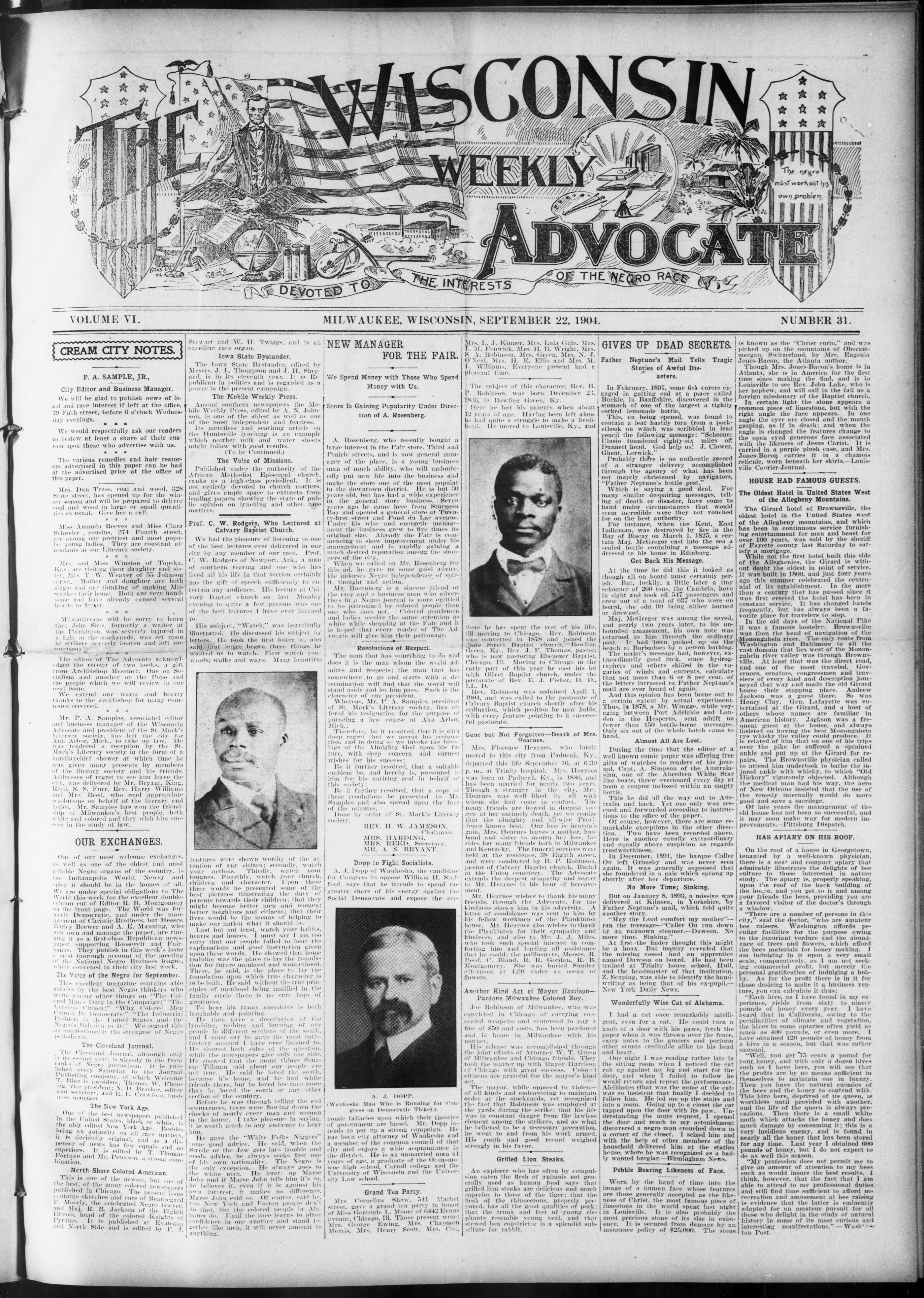
Wisconsin Weekly Advocate
Thursday, September 22, 1904
Milwaukee, Wisconsin
Page text (machine-generated)
WISCONSIN
WEEKLY
ADVOCATE
DEVOTED TO THE INTERESTS OF THE NEGRO RACE
VOLUME VI.
P. A. SAMPLE. JR..
City Editor and Business Manager
We will be glad to publish news of local and race interest if left at the office, 79 Fifth street, before 6 o'clock Wednesday evenings.
We would respectfully ask our readers to bestow at least a share of their custom upon those who advertise with us.
The various remedies and hair restorers advertised in this paper can be had at the advertised price at the office of this paper.
Mrs. Dan Truss, coal and wood, 328 State street, has opened up for the winter season and will be prepared to deliver coal and wood in large or small quantities as usual. Give her a call.
Miss Amanda Reeves and Miss Clara Schroder , cousins, 274 Fourth street, are among our prettiest and most popular young ladies. They are constant attendants at our Literary society.
* * *
Mrs. and Miss Winston of Topeka, Kas., are visiting their daughter and sister. Mrs. T. W. Weaver of 55 Johnson street. Mother and daughter are both single and are thinking of making Milwaukee their home. Both are very handsome and have already caused several hearts to flutter.
☆ ☆ ☆
Milwaukeeans will be sorry to learn that John Sims, formerly a waiter at the Plankinton, was severely injured in a fight at the stockyards, was set upon by strikers, severely beaten and left unconscious.
The editor of The Advocate acknowledges the receipt of two books, a gift from Archbishop Messmer. One on Socialism and another on the Pope and the people which we will review in our next issue.
We extend our warm and hearty thanks to the archbishop for many courtesies received.
Mr. P. A. Samples, associated editor and business manager of the Wisconsin Advocate and president of the St. Mark's Literary society, has left the city for Ann Arbor, Mich., to take up law. He was tendered a reception by the St. Mark's Literary society in the form of a handkerchief shower at which time he was given many presents by members of the literary society and his friends. Addresses of regret to see him leave the city, was delivered by Mr. Bryant, King, Reed, S. S. Furr, Rev. Harry Williams and Mrs. Reed, who read appropriate resolutions on behalf of the literary and bodies. Mr. Samples has won the friendship of Milwaukee's best people, both white and colored and they wish him success in the study of law.
OUR EXCHANGES
One of our most welcome exchanges, as well as one of the oldest and most reliable Negro organs of the country, is the Indianapolis World. Newsy and spicy it should be in the homes of all. We are under special obligations to The World this week for the excellent double-column cut of Editor R. B. Montgomery on the front page. The World was formerly Democratic, and under the management of Christie Brothers, but Messrs Barley Brewer and A. E. Manning, who now own and manage the paper, are running it as a first-class Republican newspaper, supporting Roosevelt and Fairbanks. They publish in this week's issue a most thorough account of the meeting of the National Negro Business league, which convened in their city last week. The Voice of the Negro for September.
This excellent magazine contains able articles by the best Negro thinkers who write among other things on "The Colored Man's Duty in the Campaign;" "The Voteless Citizen;" "Why Colored Men Cannot Be Democrats;" "The Industrial Problem in the United States and the Negro's Relation to It." We regard this as unquestionably the strongest of Negro periodicals.
The Cleveland Journal
The Cleveland Journal, although only in its second year, is already in the front ranks of Negro journalism. It is published every Saturday by the Journal Publishing company, of which Welcome T. Blue is president, Thomas W. Fleaing, vice president; N. D. Brasher, editor and secretary, and E. L. Crawford, business manager.
The New York Age
One of the best newspapers published in the United States, black or white, is the ably edited New York Age. Besides being an authority on all race matters it is decidedly original, and as a dispenser of news has few equals and no superiors. It is edited by T. Thomas Fortune and Mr. Peterson, a strong combination.
North Shore Colored American
This is one of the newest, but one of the best, of the many colored newspapers published in Chicago. The present issue contains sketches and cuts of Beauregard F. Mosely, the celebrated Negro lawyer, and Maj. R. R. Jackson of the Eighth Illinois, head of the colored Knights of Pythias. It is published at Evanston and North Side and is edited by F. U.
Stewart and W. H. Twiggs, and is an excellent race organ.
Iowa State Bystander.
The Iowa State Bystander, edited by Messrs. J. L. Thompson and J. H. Shepard, is in its eleventh year. It is Republican in politics and is regarded as a power in the present campaign.
The Mobile Weekly Press.
Among southern newspapers the Mobile Weekly Press, edited by A. N. Johnson, is one of the ablest as well as one of the most independent and fearless. Its merciless and scathing article on the Huntsville lynching is an example which norther milk and water sheets might follow with good results.
The Voice of Missions
Published under the authority of the African Methodist Episcopal church, ranks as a high-class periodical. It is not entirely devoted to church matters, and gives ample space to extracts from leading papers showing the state of public opinion on lynching and other race matters.
Prof. C. W. Rodgei, Who Lectured at Calvary Baptist Church.
We had the pleasure of listening to one of the best lectures ever delivered in our city by any member of our race. Prof. C. W. Rodgers of Newport, Ark., a man of southern rearing and one who has lived all his life in that section certainly has the gift of speech sufficiently to entertain any audience. His lecture at Calvary Baptist church on last Monday evening to quite a few persons was one of the best lectures I have ever listened to.
His subject, "Watch," was beautifully illustrated. He discussed his subject by letters. He took the first letter w. and said that letter began three things he wanted us to watch. First watch your words walks and ways. Many beautiful
[Picture of a man in a suit and tie].
features were shown worthy of the attention of any citizen; secondly, watch your actions. Thirdly, watch your tongues. Fourthly, watch your church, children and character. Upon these three words he presented some of the best pictures illustrating the duty of parents towards their children; that they might become better men and women; better neighbors and citizens; that their lives would be the means of helping to make our nation what it should be.
Last but not least, watch your habits, hearts and homes. I must say I am too sorry that our people failed to hear the explanations and good instruction given upon these words. He showed that home training was the place to lay the foundation for future manhood and womanhood. There, he said, is the place to lay the foundation upon which true character is to be built. He said without the true principles of manhood being instilled in the family circle there is no sure hope of greatness. To hear his funny anecdotes is both laughable and pointing.
He then gave a description of the lynching, mobbing and burning of our people in different sections of the south, and I must say he gave the most satisfactory account I have ever listened to. He showed both sides of the question, while the newspapers give only one side. He showed that the many things Senator Tillman said about our people are not true. He said he loved the south, because it's home, and he had white friends there, but he loved his race more than he loved the south or any other section of the country.
Before he was through telling the sad occurrences, tears were flowing down the checks of nearly every man and woman in the house. I take pleasure in saying, it is worth much to any audience to hear him
He gave the "White Folks Niggers" some good advice. He said, when the Swede or the Jew gets into trouble and needs advice, he always seeks first one of his own nationality. The Negro is the only exception. He always goes to the white man. He hunts up Marse John and if Marse John tells him it's so, he believes it, even if it is against his own interest, it makes no difference. Marse John said so. Of course, said he, you New York and Poston people don't do that, but the colored people in Alabama do. Until the race learns to place confidence in one another and stand together like men, it will never amount to anything.
We Spend Money with Those Who Spend Money with Us.
Store Is Gaining Popularity Under Direction of A. Rosenberg.
A. Rosenberg, who recently bought a large interest in the Fair store. Third and Prairie streets, and is now general manager of the place, is a young business man of much ability, who will undoubtedly put new life into the business and make the store one of the most popular in the downtown district. He is but 30 years old, but has had a wide experience in the general store business. Seven years ago he came here from Sturgeon Bay and opened a general store at Twenty-first street and Fond du Lac avenue. Under his wise and energetic management the business grew to five times its original size. Already the Fair is commencing to show improvement under his management and is rapidly gaining a much desired reputation among the shoppers of the city.
When we called on Mr. Rosenberg for this ad, he gave us some good advice. He inderses Negro independence of spirit, thought and action. Mr. Rosenberg is a sincere friend of the race and a business man who advertises in a Negro journal is more entitled to be patronized by colored people than one who does not. Colored gentlemen and ladies receive the same attention as white while shopping at the Fair and it is hoped that every reader of The Advocate will give him their patronage.
Resolutions of Respect.
The man that has something to do and does it is the man whom the world admires and respects: the man that has somewhere to go and starts with a determination will find that the world will stand aside and let him pass. Such is the character of our president.
Whereas, Mr. P. A. Samples, president of St. Mark's Literary society, has offered his resignation for the purpose of pursuing a law course at Ann Arbor, Mich.:
Therefore, be it resolved, that it is with deep regret that we accept his resignation, and in doing so we invoke the blessings of the Almighty God upon his future, with deep concern and earnest wishes for his success:
Be it further resolved, that a suitable emblem be, and hereby is, presented to him for his untiring zeal in behalf of this society;
Be it further resolved, that a copy of these resolutions be presented to Mr. Samples and also spread upon the face of the minutes.
Done by order of St. Mark's Literary society.
REV. H. W. JAMESON.
Chairman.
MRS. HARDING.
MRS. REED. Secretary.
MR. A. S. BRYANT.
Dopp to Fight Socialists
A. J. Dopp of Waukesha, the candidate for Congress to oppose William H. Stafford, says that he intends to spend the greater share of his energy against the Social Democrats and expose the eco-
[Name]
(Waukesha Man Who is Running for Congress on Democratic Ticket.) nomic fallacies upon which their theories of government are based. Mr. Dopp intends to put up a strong campaign. He has been city attorney of Waukesha and a member of the common council of that city and enjoys a wide acquaintance in the district. He is an unmarried man 44 years of age, a graduate of the Oconomowoc high school. Carroll college and the University of Wisconsin and the University Law school.
Grand Tea Party.
Mrs. Cornelius Shaw, 541 Market street, gave a grand tea party in honor of Miss Gertrude L. Moore of 6442 Evaus avenue, Chicago, Ill. Those present were: Mrs. George Ewing, Mrs. Chapman Morris, Mrs. Henry Scott, Mrs. Cox,
Mrs. L. J. Kinner, Mrs. Lula Gale, Mrs. L. M. Fenwick, Mrs. H. B. Wright, Mrs. S. A. Robinson, Mrs. Green, Mrs. N. J. O'Neal, Mrs. H. E. Ellis and Mrs. M. L. Williams, Everyone present had a pleasant time.
The subject of this character, Rev. B. P. Robinson, was born December 25, 1836, in Bowling Green, Ky.
Here he lost his parents when about 12 years of age. Having been left alone he had quite a struggle to make a livelihood. He moved to Louisville, Ky., and
[Name]
there he has spent the rest of his life, till moving to Chicago. Rev. Robinson was converted in 1878 and joined the State Street Baptist church, Bowling Green, Ky., Rev. J. F. Thomas, pastor, who is now pastoring Ebenezer Baptist, Chicago, Ill. Moving to Chicago in the early part of this year he cast his lot with Olivet Baptist church, under the pastorate of Rev. E. J. Fisher, D. D., LL. D.
Rev. Robinson was ordained April 1, 1904, and was called to the pastorate of Calvary Baptist church shortly after his ordination, which position he now holds, with every feature pointing to a successful pastorate.
Gone but Not Forgotten—Death of Mrs.
Hearnes.
Mrs. Florence Hearnes, who lately moved to this city from Paducah, Ky., departed this life September 16, at 6:30 p. m., at Trinity hospital. Mrs. Hearnes was born at Paducah, Ky., in 1886, and has been married for nearly two years. Though a stranger in the city, Mrs. Hearnes was well liked by all with whom she had come in contact. The many friends are bowed in deepest sorrow at her untimely death, yet we realize that the almighty and all-wise Providence knows best. Our loss is heaven's gain. Mrs. Hearnes leaves a mother, husband and sister to mourn her loss, besides her many friends both in Milwaukee and Kentucky. The funeral services were held at the residence, 38 Eighth street, and were conducted by B. P. Robinson, pastor of Calvary Baptist church. Burial at the Union cemetery. The Advocate extends the deepest sympathy and regret to Mr. Hearnes in his hour of bereavement.
Mr. Hearnes wishes to thank his many friends, through the Advocate, for the kindness shown him in his adversity. A letter of condolence was sent to him by his fellow workmen of the Plankinton house. Mr. Hearnes also wishes to thank the Plankinton for their sympathy and kindness, and also to Mr. J. J. Miles, who took such special interest in comforting him and lending all assistance that he could; the pallbearers, Messrs. R. Reed, C. Bland, R. R. Gordan, R. B. Montgomery. She was buried Sunday afternoon at 4:30 under an ocean of flowers.
Another Kind Act of Mayor Harrison Pardons Milwaukee Colored Boy.
Joe Robinson of Milwaukee, who was convicted in Chicago of carrying coarseled weapons and sentenced to pay a fine of $50 and costs, has been pardoned and is home in Milwaukee with his mother. His release was accomplished through the joint efforts of Attorney W. T. Green of Milwaukee and Chicago friends. They took the matter up with Mayor Harrison of Chicago with great success. Color of citizens are grateful for the mayor's kind act.
The mayor, while opposed to violence of all kinds and endeavoring to maintain order at the stockyards, yet recognized the fact that Robinson was employed at the yards during the strike; that his life was in constant danger from the lawless element among the strikers, and as what he believed to be a necessary precaution, he went to and from his work armed. His youth and good record weighed strongly in his favor.
Grilled Lion Steaks.
An explorer who has often by compulsion eaten the flesh of animals not generally used as human food says that grilled lion steaks are delicious and much superior to those of the tiger; that the flesh of the rhinoceros, properly prepared, has all the good qualities of pork; that the trunk and feet of young elephants resemble young veal, and that stewed boa constrictor is a splendid substitute for rabbit.
GIVES UP DEAD SECRETS.
asters.
In February, 1897, some fish curers engaged in gutting cod at a pace called Buckie, in Banffshire, discovered in the stomach of one of the largest a tightly corked lemonade bottle.
This, on being opened, was found to contain a leaf hastily torn from a pocketbook on which was scribbled in lead pencil the following message: "Schooner Ulusio foundered eighty-six miles off Dunnett head. God help us! J. Clower, Ghent, Lerwick."
Probably there is no authentic record of a stranger delivery accomplished through the agency of what has been not inaptly christened by navigators, "Father Neptune's bottle post."
Which is saying a good deal. For many similar despairing messages, telling of death or disaster, have come to hand under circumstances that would seem incredible were they not vouched for on the best authority. For instance, when the Kent, East Indiaman, was destroyed by fire in the Bay of Biscay on March 1, 1825, a certain Maj. McGregor cast into the sea a sealed bottle containing a message addressed to his home in Edinburg.
Got Back His Message.
At the time he did this it looked as though all on board must certainly perish. But, luckily, a little later a tiny schooner of 200 tons, the Cambria, hove in sight and took off 547 passengers and crew out of a total of 637 who were on board, the odd 90 being either burned or drowned.
Maj. McGregor was among the saved, and nearly two years later, to his unbounded amazement, his own note was returned to him through the ordinary post. It had been picked up on the beach at Barbadoes by a person bathing. The major's message had, however, extraordinarily good luck, since hydrographers and others skilled in the vagaries of winds and currents, calculate that not more than 6 or 8 per cent. of the letters intrusted to Father Neptune's mail are ever heard of again.
And this opinion has been borne out to a certain extent by actual experiment. Thus, in 1878, a Mr. Wragge, while voyaging between Port Adelaide and London in the Hesperus, sent adrift no fewer than 150 bottle-borne messages. Only six out of the whole batch came to hand.
Almost All Are Lost.
During the time that the editor of a well known comic paper was offering free gifts of watches to readers of his journal, Capt. A. Simpson of the Australasian, one of the Aberdeen White Star line boats, threw overboard every day at noon a coupon inclosed within an empty bottle.
This he did all the way out to Australia and back. Yet one only was rescued and forwarded according to instructions to the office of the paper.
Of course, however, there are some remarkable exceptions in the other direction. Two have been recorded above. Here is another equally extraordinary and equally above suspicion as regards trustworthiness.
In December, 1891, the barque Caller Ou left Grimsby and was never seen again. It was generally supposed that she foundered in a gale which sprang up shortly after her departure.
No More Time: Sinking.
But on January 8, 1893, a missive was delivered at Kilnsea, in Yorkshire, by Father Neptune's mail, which told quite another story.
"May the Lord comfort my mother"—ran the message—"Caller Ou run down by an unknown steamer.—Dawson. No more time. Sinking."
At first the finder thought this might be a hoax. But inquiry revealed that the missing vessel had an apprentice named Dawson on board. He had been trained at Trinity house school, Huil, and the headmaster of that institution, Z. Scaping, was able to identify the hand-writing as being that of his ex-pupil.—New York Daily News.
Wonderfully Wise Cat of Alabama
I had a cat once remarkably intelligent, even for a cat. He could turn a knob of a door with his paws, fetch the paper when it was thrown over the fence, carry notes to the grocers and perform other stunts creditable alike to his head and heart.
One night I was reading rather late in the sitting room when I noticed the cat rub up against my leg and start for the door, and when I failed to follow he would return and repeat the performance. Alcibiades (that was the name of the cat) was so insistent that finally I decided to follow him. He led me up the stairs and into a room. Going up to a closet the cat tapped upon the door with its paw. Understanding the mute request, I opened the door and much to my astonishment discovered a negro man crouched down in a corner of the closet. I seized him and with the help of other members of the household delivered him at the station house, where he was recognized as a badly wanted burglar.—Birmingham News.
Pebble Bearing Likeness of Face
Worn by the hand of time into the image of a human face whose features are those generally accepted as the likeness of Christ, the most famous piece of limestone in the world spent last night in Louisville. It is also probably the most precious stone of its size in existence. It is secured from damage by an insurance policy of $25,000. The stone
is known as the "Christ curio," and was picked up on the mountains of Oberammergau, Switzerland, by Mrs. Eugenia Jones-Bacon, the Atlanta author.
Though Mrs. Jones-Bacon's home is in Atlanta, she is in America for the first time since making the find, and is in Louisville to see Rev. John Lake, who is her nephew, and will sail in the fall as a foreign missionary of the Baptist church.
In certain light the stone appears a common piece of limestone, but with the right angle the face appears. In one angle the eyer are closed and the mouth gasping, as if in death; and when the angle is changed the features change to the open eyed generous face associated with the likeness of Jesus Christ. It is carried in a purple plush case, and Mrs. Jones-Bacon carries it in a chamois reticule, worn beneath her skirts.—Louisville Courier-Journal.
HOUSE HAD FAMOUS GUESTS.
The Oldest Hotel in United States West of the Allegheny Mountains.
The Girard hotel of Brownsville, the oldest hotel in the United States west of the Allegheny mountains, and which has been in continuous service furnishing entertainment for man and beast for over 100 years, was sold by the sheriff of Fayette county last Saturday to satisfy a mortgage. While not the first hotel built this side of the Alleghenies, the Girard is without doubt the oldest in point of service. It was built in 1800, and just four years ago this summer celebrated the centennial of its establishment. In the more than a century that has passed since it was first erected the hotel has been in constant service. It has changed hands frequently, but has always been a favorite place for travelers to stop.
In the old days of the National Pike it was a famous hostelry. Brownsville was then the head of navigation of the Monongahela river. The only route from Washington and Baltimore to all the vast domain that lies west of the Monongahela river valley was through Brownsville. At least that was the direct road, and one of the most traveled. Governors, senators, congressmen and travelers of every kind and description journeyed that way and made the old Girard house their stopping place. Andrew Jackson was a guest there. So was Henry Clay. Gen. Lafayette was entertained at the Girard, and a host of others whose names are familiar in American history. Jackson was a frequent guest at the house, and always insisted on having the best Monongahela rye whisky the valley could produce. It is related of him that on one of his trips over the pike he suffered a sprained ankle and put up at the Girard for repairs. The Brownsville physician called to attend him undertook to bathe the injured ankle with whisky, to which "Old Hickory" vigorously objected. Although the medical man had his way, the hero of New Orleans insisted that the use of the remedy internally would do more good and save a sacrilege.
Of late years the management of the old house has not been so successful, and it may soon make way for modern improvements. -Pittsburg Dispatch.
HAS APIARY ON HIS ROOF.
On the roof of a house in Georgetown, tenanted by a well-known physician, there is a neat and compact apiary that admirably illustrates the delights of bee culture to those interested in nature study. The apiary is, properly speaking, upon the roof of the back building of the house, and you get to it and among your friends the bees, providing you are a favored visitor of the doctor's through a window.
"There are a number of persons in this city," said the doctor, "who are amateur bee raisers. Washington affords peculiar facilities for the purpose owing to the luxuriant verdure and the abundance of trees and flowers, which afford the bees materials for honey making. I am indulging in it upon a very small scale, comparatively, as I am not seeking commercial profit, but merely the personal gratification of indulging a hobby. As for the profit there is in it for those desiring to make it a business venture, you can calculate it thus:
"Each hive, as I have found in my experience, yields from sixty to ninety pounds of honey every year. I have heard that in California, owing to the peculiarities of climate and vegetation, the hives in some apiaries often yield as much as 400 pounds, or even more. I have obtained 120 pounds of honey from a hive in a season, but that was rather unusual.
"Well, you get 15 cents a pound for your honey, and with only a dozen hives such as I have here, you will see that the profits are by no means sufficient in themselves to maintain one in luxury. Then you have the natural enemies of the bees and the honey to contend with. This hive here, deprived of its queen, is worthless until provided with another, and the life of the queen is always precarious. Then there is a small white moth which attacks the honey and does much damage by consuming it; this is a very insidious enemy, and is found in nearly all the honey that has been stored for any time. Last year I obtained 600 pounds of honey, but I do not expect to do as well this season.
"My profession does not permit me to give an amount of attention to my bees such as would insure the best results. I think, however, that the fact that I am able to attend to my professional duties and still find time sufficient to afford me recreation and amusement at bee raising is evidence that the latter is eminently adapted for an amateur pursuit for all those who delight in the study of natural history in some of its most curious and interesting manifestations." — Wash ton Post
A TOUCH OF WINTER.
The melancholy days have come,
Just as they did last year
And year before and still will come
As long as time is here.
And we're confronted with the truth,
Wherever we are at.
That every man who wears one ought
To shoot his old straw hat.
Among the hurrying Autumn crowds
That throng the city's streets,
Or walk in quiet village ways,
Or countryside retreats,
We catch a glimpse at intervals
Of ancient rulns that
Remind us strongly it is time
To shoot the old straw hat.
The Summer sun, which erstwhile poured
Its fervid fever down.
Has let up on its fiery zeal
In city, field, and town.
And every man who has a head
Which isn't p.d. flat.
Has put it where it ought to be
And shot his old straw hat.
What was is not, the times have changed,
Our love, that once was warm.
Has got the shivers down its back
And gone in for reform,
And East and West and North and South
The sentiment stands pat
To shoot the man who still declines
To shoot his old straw hat.
— William J. Lampton in New York Times.
Curious Condensations.
—More than 75,000 people are in St. Louis now, directly dependent on the world's fair.
—More cider is produced in the United States in a single year than in all the rest of the world in five years.
—The Cheyto pugoda in Burmah is built on a huge rocking stone poised on another at a height of 2000 feet.
—A Poughkeepsie man has been carrying the same pocket knife for forty-five years, and it is still in good condition.
—In 1896 American immigration into Canada amounted to only forty-four people, and in 1903 it amounted to 47,780 people.
—Some Japanese historians aver that Genghis Khan, the Asiatic conqueror in the Thirteenth century, was a Japanese by birth.
Mexican capitalists are on the lookout for a man who can invent some process or machinery for making soap from the castor beam.
Russian soldiers now prisoners of war in Japan include Jews and Poles, and these men are said to be desirous of staying in Japan after the war and becoming citizens of that country.
An expedition sent by Amherst college to the fossil-bearing districts of Wyoming has brought back specimens of monkeys, squirrels and pigs said to be fully four million years old.
The treasurer of the United States on May 6, 1903, redeemed two half-cent pieces. This is the first time in the history of the country that any such coins have been presented for redemption.
—Rise in the temperature is the great obstacle in sinking mines deeper. Sufficient progress has been made so that engineers expect to mine coal and metal 7500 feet below the surface before long.
—Complete combustion of coal is accomplished by burning it in a chamber surrounded by a water jacket separated from the boiler. The gases do not come in contact with the boiler until all solid matter is completely burned; thus there is greater heat and no smoke.
—The table on which the Declaration of Independence was drafted is exhibited in the Virginia building at the world's fair. The chair in which Jefferson sat when vice president is also exhibited in this building, which is a reproduction of Monticello, Jefferson's home.
Dr. William Rice Pryor, a noted physician, died a few days ago in New York from "pernicious anemia," one of the rarest known morbid conditions of the circulatory system. No man who has ever suffered from this disease has recovered, as no means have been discovered to create new red corpuscles.
One difference between the giant redwood trees of the United States and the giant eucalyptus of Australia is that the redwoods require almost a century to attain any really remarkable growth, while the eucalyptus actually shoots up, growing with a speed that is more typical of a weed than of a tree.
Among the personal effects of Thomas Jefferson exhibited in the Virginia building at the world's fair, a reproduction of Monticello, Jefferson's old home, is a clock which was in the Jefferson home for years previous to the revolution. The timepiece is of Carrara marble and is 150 years old.
There have been innumerable plans for preventing seasickness, but perhaps the most remarkable of any is a device by which a German navy engineer would obviate the malady by overcoming the motion which brings it about. He is O. Schlick of Hamburg. His apparatus is designed to increase considerably the period of oscillation in the rolling of a vessel, and at the some time diminish the amplitude of oscillation.
How to Be Happy.
Many of use miss the joys that might be ours by keeping our eyes fixed on those of other people. No one can enjoy his own opportunities for happiness while he is envious of another's. We lose a great deal of the joy of living by not cheerfully accepting the small pleasures that come to us every day, instead of longing and wishing for what belongs to others. We do not take any pleasure in our own modest horse and carriage, because we long for the automobile or victoria that some one else owns. The edge is taken off the enjoyment of our own little home because we are watching the palatial residence of our neighbor. We can get no satisfaction out of a trolley ride into the country or a sail on a river steamer, because some one else can enjoy the luxury of his own carriage or yacht. Life has its full measure of happiness for every one of us, if we would only make up our minds to make the most of every opportunity that comes our way, instead of longing for the things that come our neighbor's way.—Success.
His Ready Excuse
A good story is told of a peppery old officer who plays over links on the south coast. When he foozles a stroke he is in the habit of falling upon one of the spectators and blaming him for putting him off his stroke, so the other day, when he was badly bunkered, all his companions held their breath and never moved an eyelid. The colonel made his stroke, but only dug up a fine piece of turf, and looked round for some one to blame. No one had stirred, so, baulked in that direction, he glared round the horizon, and finally burst out. "How the deuce do you expect a man to play decent golf on these rotten links with all those beastly ships passing up and down the channel?"—London Sketch.
Want to Feel It.
The well known fact that clocks made for the African trade must be powerful loud tickers reminds someone of the old Scotchman who decided to buy a new family buggy. He went to a carriage builder and described in detail the kind of a vehicle he desired to have. "Now, I suppose you want rubber tires, of course?" asked the carriage builder. "No, sir," replied the old fellow, resentfully. "My folks ain't that kind. When they're riding they want to know it."
THE SOUTHERN HONEY LOCUST.
bear in the city park, Leaving the dust and heat and noise of the city
Wandering through narrow byways. Sudden my senses thrilled to an odor afar off: An odor just wafted, delicate, subtle, elusive. Breath of the Southland fanning the brow of the North.
creasing.
Engulging me now with billow on billow of fragrance.
Uncertain I wandered. I thought I smelled harder.
the sweet brier,
The wild honeysuckle, but no, 'twas the
locust! the locust!
Beautiful, shaking its millionfold sweets to
the wind.
Oh locust tree of the South!
On locusts the sun
You blesses of honeyed snow full of termites motion!
Were you gladdened to see me there in the fresh May morning
That you leaned to me so and beckoned with joyous insistence?
Luminous, delicate plumes, I believe that you knew me.
And were joyed to the heart to greet an old lover and friend.
Down on the soft, cool earth.
Down at the foot, 'neath the boughs of the white honey-icoust,
Pensive there in the sunlight and shade ever changing,
Mused I, dreaming again the dreams of my childhood.
Musing and dreaming so lay I until the white locust
Hushed its low murmur and curtained itself for the night.
—Lilian C. B. McAllister in Lippincott's.
ROBBERS
I got to begin by unfolding the remark that Holy Cross is the biggest house in Arizona—which it derives its name from being a sort of mongrel proposition, cross betwixt a palace and a fortress. The house was built by a Mexican, by name El Senor Don Luis Barrios. Afterward he sold it to Lord Balshannon. a tenderfoot and a British colonel, but a dead shot and therefore respected on the stock range.
Now, this Balshannon person hired me—which my name is Chalkeye Davies—to superintend his cow works, educate him in cows, and teach him the natural history of us cowboys; the same being unexpected and prickly. My Patrone used to trust me complete, being mostly engaged himself in studying the local breeds of whisky at Tombstone City, and bucking up against faro bank, the poker game and other crooked layouts. He sowed liberal, and the dealers reaped.
One day he came from Tombstone and tracked me to my round-up camp at Laguna, where I had twenty Mexican vaqueros branding and cutting the spring crop of salves. The Patrone found us all at supper, so while we ate he told me the local gossip; how the Tombstone stranglers had gathered in three bad men and stretched their necks by way of encouraging virtue; how Low-Lived Joe had shot up another Mexican, and how Mr. Ryan, the richest man in Arizona, was putting in big developments on the Jim Crow mine. Then he passed me a big rim-fire cigar of the special breed I like, which is pretty nearly strong enough to buck.
"Lr—Chalkeye," says he, "give your men all the sleep you can. At midnight you'll pull out for Wolf Gap, and at streak of dawn gather the whole of our horses. Run them as hard as you can to Holy Cross and throw them into the house." "Indians?" says I.
"No, horse-rustlers. They've heard of our half-bred ponies, and Sheriff Bryant warned me. We mustn't let these poor robbers fall into er—temptation, don't you know. So mount a guard at the house, and see that the men have plenty of ammunition."
"Yes, sir."
"A friend of mine has turned this gang loose on my stock. There's been crooked work."
"Kyan work?"
"Haw—yes. What makes you think of Ryan?"
"Wall, I dumno, boss; but seems to me this Ryan has made bad medicine again you before. It was plumb kind and polite of him to send glandered horses to drink at yo' water holes, and hire Apache Indians to murder you, not to mention other little plays I heard of since. He's got wealth enough to charter this outfit of robbers; he's mean as snakes; he's sworn to wipe you out. What's the matter with me goin' to the Jim Crow mine and shooting this yere Ryan by way of precaution!"
"Indeed, ah! You'll do no such thing. I—haw—fact is, I promised Lady Balshannon not to shoot Mr. Ryan." He reared up to leave me, and grabbed my paw. "Well, Chalkeye," says he, "I think I must be off to see that my wife is not alarmed by this new game of Ivan's. You'll find me at the house."
By noon next day I brought our herd of ponies to Holy Cross and watered them at the dam, which held some two or three acres of water just under the western wall of the haecienda. A few old trees sheltered the pool, one of which had lately been struck down by lightning. So it happened that, turning the herd up from water, my riders got a little mare snarled in the fallen branches in which she broke her leg and had to be shot. I gave orders to have the body hauled away at sundown, then threw the herd into the stable court, mounted a guard on the northwest bastion, sent a servant with my compliments to the Patrone, and went to my quarters mighty wishful to catch up lost sleeps.
I had not slept an hour when the sentry fired, and a man from the guardhouse came running. I jumped into my boots, grabbed my gun, and bolted to the gates, where Balshannon joined me at the spy hole.
"Who's coming" he asked.
"A white man, Patrone, and a boy on the dead run."
I swung the gates wide open, and we stood watching the riders, a middle-aged stockman and a young cowboy, burning the trail from the north. As they came swinging up the approach I reckon their horses smelt a whiff of blood from that dead mare beside the water hole. Horses go crazy at the smell of blood, and though the man held straight on at a plunging run for the gates, the boy lacked strength to control his mare. When she swerved he spurred, and then she reared and began to buck. The saddle came drift, and the youngster went over with it, caught by the stirrup, unable to get clear. When the mare felt him dragging, more terrified than ever, she lashed out, and would surely have kicked him to glory but for Balshannon. My boss was a quick shooter and deadly accurate, so that his first bullet caught the mare full between the eyes, and dropped her dead in her tracks. I raised the long veil for
my men, as we rushed to get the boy from under her body.
It seemed to me at the time that the elder man never reined, but made a clear spring from his galloping horse to the ground, reaching the mare with a single jump before she had time to drop. Grabbing her head, he swung his full weight, and threw her falling body clear of the boy. When we reached the spot he was kneeling beside him in the sand.
"Stunned," he said. "That's all, sir," he looked up at the Patrone, and I saw that tears were starting from his eyes.
"Sis, you've saved my son's life with that shot, I reckon," his voice broke with a sob; "you've made me yo' friend."
"Nothing broken, I hone?" said Bal-
"Nothing broken, I hope?" said Balshannon.
"No, seh. The stirrup seems to have twisted this foot."
I sent some men for a ground sheet in which the boy could be carried without pain. Balshannon sent for brandy.
Still kneeling beside his son, the stranger looked up into the Patrone's face.
"You are Lord Balshannon?" he asked.
"At your service, my good fellow—well?"
"Do any of yo' greasers speak our language?"
"I fancy not."
"Then I have to tell you, seh, that I am Capt. McCalmont, and my outfit is the Robbers' Roost gang of outlaws." He was bending down over his son.
"I asked no question, my friend," said Balshannon. "We never question a guest."
"You make me ashamed, seh. I came with a passel of lies to prospect around with a view to doing you dirt."
Balshannon chuckled, and I saw by the glint in his eye that he was enjoying this robber. "You'll dine with me?" said he.
Capt. McCalmont looked up sharp to see what game the Patrone was playing. "You will notice, captain," said my boss, "that my house is like a deadfall trap. Indeed—ah, yes—only one door, eh?"
For answer the robber unbuckled his belt and let it fall to the ground.
"Take my gun," he said; "do you sup pose I daren't trust you, seh?"
A servant had brought the brandy, and McCalmont rubbed a little on his son's face, then poured a few drops between his teeth. Presently the lad stirred, moaning a little.
"Let's take him to the house," said I. "No, Mistah Chalkeye Davies," answered the robber, "not until this gentleman knows who he's asking to dinner. Here, Curly," he whispered, "wake up."
The lad opened his eyes, clear blue like the sky, and smiled at his father. "Air you safe, dad?" he whispered.
"Sure safe."
Curly closed his eyes and lay peaceful. The hold-up was quattring back on his heels, looking out across the desert.
"Lord Balshannon," said he, "I had a warning sent to Sheriff Eryant that I was coming down to lift all yo' hawsss. My wolves tracked Bryant's rider to Lordsburgh, where he wired to you. You was coming down to lift all yo' hawsss, rounded up convenient for me in the stable yard of this house. I thank you, sch."
"My good man, I'll bet you an even thousand dollars," said the Patrone, "that you don't lift a hoof of my—haw—remuda."
"It's a sporting offer, and tempts me hard," answered the outlaw. "Oblige me by taking my gun from the ground here, and firing three shots in the air."
The Patrone took the gun, and at his third shot I saw a man ride out from behind the bastion on our right. McCalmont waved to him, and he came, pulling his hat down over his face as he rode, then halted in front of us, shy as a wolf. "Young man," said McCalmont, "please repeat to these gentlemen here the whole of yo' awdehs fo' the day. Leave out the names of the men."
"You're giving us dead away!" said the rider, threatening McCalmont with his revolver. "You mean that?"
"I mean what I say."
"Ah!—excuse me, McCalmont," said the Patrone, "your—er—pistol, I think."
"Thanks, seh." McCalmont accepted the gun. "Repeat the awdehs!" he said. "These gentlemen are our friends."
"Well, you knows best." came the surly voice behind the hat. "Three men to cover your approach to Holy Cross, and, if there's trouble, to shoot Balshannon and Chalkeye at sight. They're covered now. The wall of the stable court by the southwest bastion to be mined with dynamite, and touched off at 10 p. m. prompt. Ten riders to get in through the breach in the wall, and drive out the bunch of horses. One man with an axe to split all the saddles in the harness room, then join the herders."
"Leave out," said McCalmont, "all detail for pointing, swinging and driving the herd. Go on."
"At one minute to 10, before the wall is blown away, ten riders are to make a bluff at attacking the main gate, and keep on amusing the garrison until the men with the naphtha cans have fired the private house. Rendezvous for all hands at Laguna by midnight, where we catch remounts, and sleep until daybreak, with a night herd of two, and one camp guard. At dawn we begin to gather cattle, while the horse wrangler and two men drive the remuda east. Rendezvous at Wolf Gap."
"And how about poor old Bryant's posse of men?" asked Balshannon.
"Sheriff Bryant." says the captain, "allows that he's to catch us in a fine trap, five miles due west of Lordsburgh. And now," he called to the mounted robber, "tell the boys that all awdehs are canceled, that I'm dining tonight at Holy Crawss, and that the boys will wait for me at the place fixed in case of accidents."
The man rode off, hostile and growling aloud, while Balshannon stood watching to see which way he went.
"McCalmont," he said, and I took note of just one small quiver in his voice, "may I venture to ask one question? You seem to know the arrangement of my house—its military weakness. How did you learn that?"
The outlaw stood up facing him, and took from the breast of his shirt a folded paper. Balshannon and I spread it open, and found a carefully drawn plan of Holy Cross. At the foot of the paper there was a memorandum signed "George Ryan."
"I may tell you," said the robber, "that if I succeeded in burning yo' home, stealing yo' hawsses, and running yo' cattle. George Ryan proposed to pay my wolves the sum of $10,000."
"Carry out your plans," said the Patrone. "I'd love to fight your wolves. I've got some dynamite, too. Think of what you lose!"
"Lose nothing!" said the robber. "I'll collect $50,000 compensation from Ryan!" He stooped down and gathered his son in his arms. "And now, will you have us for guests in yo' home?"
Balshannon lifted his hat and made a little bow, much polite.
"My house," he answered in Spanish, "is yours, senor!"—Roger Pocock in Black and White.
GETS $5000 FOR FOX FLEAS.
Man Taking Them from Siberia to Chas. Rothschild in London. For two Siberian fleas, which he found on the body of a live arctic fox, A. M. Raber will receive $5000 from Charles Rothschild of London, one of the world-famous financiers whose combined wealth is said to be in excess of £400,000,000. Raber is the East Cape agent of the Northwestern Siberian company. Spurred on by Mr. Rothschild's remarkable offer, he made a long and perilous journey into the wilds of Siberia for the express purpose of finding a peculiar flea which dwells only on the arctic fox.
He succeeded in finding not only one but two, and it is possible that his reward may be doubled. With the two tiny fleas in a glass jar, Baber turned his face toward civilization, and he has now got this far.
In St. Louis he will stop a day or two to look at the exhibit of fleas there and then he will continue on to London.
Mr. Rothschild's pet hobby is collecting fleas, and at the Tring Park museum are to be seen cabinets containing over 10,000 specimens.
Every mammal and bird is said to have a particular kind of flea and very many have several different kinds. The cat flea, for instance, is different from the dog flea and the dog flea from the sparrow flea and each in turn is different from the "pulex irritans," the scientist's pet name for the flea which is such a source of trouble to human beings.
This collection of fleas is probably the most complete of its kind, but there was one flea missing, which Mr. Rothschild most coveted, and that was the flea of the arctic fox.
Only two perfect specimens were known to exist in collections, and with a view to finding a third Mr. Rothschild two years ago commissioned the captain of the Forget-Me-Not, an arctic trawler, to hunt for the specimens.
But the captain returned fleasless and in August last Mr. Rothschild offered a reward of $5000 for an arctic fox flea.
The fleas of Tring park have been collected through agents, and whenever an expedition is about to start for a protracted journey through a foreign land Mr. Rothschild usually engages one of the party to collect specimens of the insects from any species of mammal or bird encountered.
He supplies phials, chloroform and labels and the specimens reach Tring labeled with the name of the creature on which they were found. They are then classified, hermetically sealed and packed away in their proper cases.
MONTEZUMA'S HIDDEN TREASURE.
Traditions Preserved in Family Say Its Value Is $80,000,000.
Whether the report of the discovery of the Incas' treasure at Chayaltaya, Bolivia, is true or not, it is certain that the conquistadoers did not get all the gold of the last Inca of Peru, nor all the gold and precious jewels of the Mexican monarch. The story is that the Incas' treasure, withheld from Pizarro and now discovered in Bolivia, is worth $16,000,000, and that the Indians believe there is still much more hidden away. Pizarro received a great sum from the Inca, whom he cruelly treated and then killed, but in so doing he missed a greater amount, which the Inca, hoping to save his life, promised his tormentor.
In this country one sometimes hears talk of a great golden sun and other treasure hidden secretly from the early Spaniards. One gentleman who has the blood of Montezuma in his veins, and in whose family the traditions of the times of the conquest have been preserved, has said that probably fully $80,000,000 worth of treasure escaped the hands of Cortes and his followers. Where is this treasure hidden? Some have said that it was thrown into Lake Texcoco, and not many years back a company well provided with funds made extensive excavations in the Pedregal, near Coyoacan, on a spot indicated by tradition. A series of subterranean chambers was found, but no golden sun.
Both in Mexico and Peru gold was hidden away from the greedy conquistadores by the Indians, who enriched the hope of making a successful rising against their conquerors. That hope has long died away, though much of the hatred for the race of the conquistadores remains in the breast of the aborigines.
It is quite probable that some fine day much of Montezuna's hidden treasure may be found here by a lucky hit. Perhaps it is concealed in an idol cave in the southwestern part of the Sierra surrounding this valley, a cave of which stories have been told among the Indians. Whence has come the gold that the Indians living in these mountains so close to the city have brought here and sold to their legal representative? There is a mystery in all this, and a greater mystery in the whereabouts of Montezuna's treasure, which remains untouched. -Mexican Herald.
Needless Exertion.
Phil Thompson was telling a party of friends at the Waldorf about his suit against the street car company for throwing him from a car in front of the hotel some two years ago and breaking his leg.
"Before those fellows finished with me," he said, "they had brought reliable witnesses to prove that the cars were all blocked that day I said I broke my leg; that they were not running at all; that if they had been running they wouldn't have run fast enough to hurt anybody; that I had never been on a car in front of the Waldorf, anyway, and was in Washington at the time I declared the accident occurred."
"But you seem to be walking better than you did, Phil," remarked one of the party as he got up to leave.
"What's the use of walking lame any longer?" retorted he indignantly, "now that the case has gone against me?"—New York Times.
Lost in the Woods.
For a man who is lost, the three great dangers, in order of importance, are fear, cold and hunger, writes Ernest Thompson Seton in Country Life in America. He may endure extreme cold for a day, but extreme fear may undo him in an hour. There is no way of guarding against this greatest danger except by assuring him that he is fortified against the other two. In a previous article was described the way of making a fire without matches, a method simple and sure once it has been learned; and if to this we can add the knowledge of available foods that will sustain life for a time, there is little doubt of the wanderer's winning a victory over the relentless forces about him. Starvation is rare in warm regions, and I suppose that no one ever starved during the late summer and early autumn. The woods then are full of roots, nuts and berries, that, as a rule, are wholesome and palatable, and usually there is a large amount of small game at this season.
Why She Wanted to Sing.
Gustave Luders, the composer, has a friend, a teacher of singing, to whom there came a few days ago a woman somewhat advanced in years to make arrangements for vocal instruction. She was accepted as a pupil, but at the second lesson the conscientious instructor felt it his duty to inform the lady that her ear was far from true. She received the remark, however, without the slightest resentment, said she knew she had slight vocal ability, but that she was determined to pursue her course to its harmonious end.
"It is hopeless, Madam," protested the musician at the conclusion of the third lesson. "You will never learn to sing in tune. You are simply wasting your time."
"It doesn't matter," was the reply. "I care nothing about music, but my physician said that singing would help my dyspepsia immensely, so I determined to take the lessons. Let us continue."—New York Times.
What Could Have Frightened Him?
Marshall P. Wilder, the humorist, enjoys telling of his first call upon a President of the United States. This occurred during the administration of President Harrison, and according to Mr. Wilder, the interview, quite different from what he had imagined it would be, took place about like this:
"Taken in by Mr. Halford, the President's secretary. Were introduced—'Mr. President, Mr. Wilder; Mr. Wilder, Mr. President.'
"How do you do, Mr. Wilder.'
"How do you do, Mr. President.'
"Then we looked at each other for perhaps thirty seconds, during which time I totally forgot the fine speech I had prepared to give the President.
"Finally I gasped out, 'Er—good-day, Mr. President.'
"Good-day, Mr. Wilder,' was the polite response."
"When once outside, I turned, and said, 'Mr. Halford, will you please kick me?'—Woman's Home Companion.
Through Mill Wheel Alive.
While playing upon a wall of a mill canal at Southbridge, Mass., Parmelia St. John, 8 years old, fell 10 feet into the water. The child was carried by the swift current through a flume under the street, beneath the mill for forty yards, and through a big wheel, but escaped without injury.
Fred Blanchard, who saw the little one fall, tried to reach her from a bridge, but was too late. He then tried to have the big wheel stopped, fearing the girl either would be drowned or mangled.
Before this could be done the child emerged from the sluice and was rescued from the dirty water. After a little of the water was forced from her body, Parmelia revived.
"I'm all right," she said, jumping to her feet, and ran home to get some dry clothes.
A. Terpsichorean Feast.
Make a complete waltz turn, a chasse step and a glide. Do the same thing over again in the opposite direction. Now you have achieved the "Trio Waltz," guaranteed by its originator, Prof. Oscar Duenweg of Terre Haute, Ind., to be a terpsichorean feast. He calls it a creation. The new dance was shown recently in the beginning of the twenty-seventh annual convention of the American Society of Professors of Dancing. Another "creation" shown was the "Goudolier Two-step," invented and shown by Prof. Henry J. Kramer of Los Angeles. It is a glide, a running step and two-step nicely interwoven, and its creator's claim is that it gives variation to the two-step.
Farming on a Large Scale.
At Faringdon, Berkshire, farming has been raised to a science. George Adams of the Royal Prize farm, Wadley House, farms some 4000 acres, of which about half is arable and half pasture. He employs from 200 to 250 laborers, milks 500 cows daily, keeps about forty Shire broad mares, a score of breeding sows, and from 3000 to 4000 laying hens, grows about 1000 acres of grain, besides attending to other multifarious items in the ordinary course of farm practice. About 1000 acres of meadow hay are harvested annually. All the work, cutting, carrying and ricking is done by piecework.—London Tit-Bits.
How Elephants Get Their Sleep.
"That elephant," said the circus man, "has slept standing up for a year. He is 90, and what little sleep he requires he takes on his feet.
"An elephant in his prime only sleeps five hours a night, and the older he grows the less sleep he needs. This good fellow here practically needs no sleep at all. At whatever hour of the day on night I come to him, he stands patiently in his place, rocking from side to side. I know he sleeps a little, but for years now his naps have been so short that he hasn't bothered to lie down for them. Nearly all old elephants are like this." — Louisville Courier-Journal.
No Disputing Tastes
"Speaking of Channel swimming," said Mrs. Slipshod, always to the fore in the discussion of events of the moment, "I see that Mr. Greasley retired because the water was too cold. People's views in this matter differ so much. Some bathe with perfect impurity in water as cold as Greenland's icy mountains and India's coral strand; but for my part, I prefer to have the water a little torpid."—London Globe.
Drunken Man's Mistake.
The other night a Joplin woman heard a strange noise that seemed to come from the sidewalk behind the kitchen of her home. Raising a back window she saw her husband and asked: "John, why don't you come in the house?" "I'm comin', dear," he replied in husky tones, "shoon 'z I kin get up zese stairsh." He was trying to climb the woodpile.—Kansas City Journal.
Proper Enough
"I see the trainer of men is called a 'coach,'" said the woman who had been reading the sporting page.
"Yes," replied the husband; "that's right."
"Then we might say that a kindergarten teacher is a 'baby coach,'"—Philadelphia Ledger.
What Land Yields.
It is estimated that twenty-two acres of land are necessary to sustain one man on fresh meat. The same space of land if devoted to wheat culture, would feed forty-two people, if to oats, eighty-eight; potatoes, Indian corn and rice, 176; and if to the plantain or bread tree, over 6000 people.
More Encouraging.
A scientist claims to have discovered an electro-chemical process whereby radium can be manufactured at less than $500,000 a pound. At present prices, radium fetches $15,200,000 a pound.
You Foolish Man
Now we are in the month of Sept.
Now we are in the month of Sept.
And soon it will be Oct.
O! then you'll wish that you had kept
That overcoat you hoet.
—Cathoile Standard and Times.
—Take a tunning fork of large size
and set it vibrating, and one in the same
key across the room will soon give out
the same sound.
REFLECTIONS OF A BACHELOR
Even a bathing suit can't look a peek-a-aboo shirt waist in the face.
A girl doesn't have to have common sense if she has beauty or money.
Some men are born troubled, some hunt for trouble and some marry into it.
It takes a mighty trusting woman to believe that loving her is a better test than making love to her.
Generally when you kiss a girl she is so busy getting up a feeling of surprise she forgets to be indignant.
A girl has to be mighty pretty to be able to feel indifference about the clothes some other girl has.
It's just like a woman to wish she had curly hair when she hasn't even got enough of the kind she has.
A woman would rather go shopping and not get something she wants than to get it without going shopping.
It's mighty funny how a woman's hair can begin to turn red about the time you think it is ready to turn gray.
A woman wouldn't get any satisfaction out of having children if she could not brag about how well brought up they are.
No matter how blue a man is over his business his wife knows it will be all right when the baby's new tooth comes through.
There are very few rows in the family where the man always says the only coffee he can drink without getting indigestion is at home.
When she can't find anything else to worry about a woman can do it over the fact that when she is a widow she will get very tired wearing dark clothes so long.
INDIAN DICIPLINE
Red Men Are Possessed of Much Natural Politeness.
No people are possessed of a greater share of natural politeness than the Indians, wrote Isaac Weld in 1799; they will never interrupt while another is speaking! nor, if one has told them anything which they think to be false, will they bluntly contradict him. They deem it highly becoming in a warrior to accommodate his manners to those of the people with whom he may happen to be. The following anecdote is told by Mr. Weld in "How Our Grandfathers Lived":
Our friend Nekig, The Little Otter, had been invited to dine with us at the house of a gentleman at Detroit, and he came accordingly, accompanied by his little son, a boy of nine or ten years.
After dinner a variety of fruits was served, and among the rest were some peaches, a dish of which was handed to the young Indian.
He helped himself to one with becoming propriety; but immediately afterward he put the fruit to his mouth and bit a piece out of it.
The father eyed him with indignation, and spoke some words to him in a low voice, which I could not understand, but which, on being interpreted by one of the company, proved to be a warm reprimand for his having been so deficient in observation as not to peel his peach, as he saw the gentleman opposite him had done.
The little fellow was extremely ashamed of himself; but he quickly retrieved his error by drawing a plate toward him and peeling the fruit with the greatest neatness.
Some drink to which he was afterward helped, not being by any means agreeable to his palate, the little fellow made a wry face, as a child might naturally do. This called forth another reprimand from the father, who told him that he despaired of ever seeing him a great man or a good warrior if he appeared thus to dislike what his host had kindly given him. The boy took the rest of his drink with seeming pleasure.
No Time Lost.
A mother, after days of preparation for a week's absence from home, suddenly remembered, after the train was well under way, that she had left a bottle of a certain well-known remedy within reach of the meddlesome little fingers of her 3-year-old son. She remembered, too, that there was nothing that the child loved better than the aromatic contents of that particular bottle.
Hurriedly calling the porter, the anxious mother prepared a message to be telegraphed from the first station. It read:
"Hide bottle of Robbie's medicine. Left it on table in my room."
An hour later she received this not altogether soothing message from the boy's father: "Too late. Bobbie got there first."
Mally—What makes you so haughty when you meet George? Why don't you make up with him?
Polly—Because I should have to demand an explanation and I can't remember what it is I'm supposed to be offended about.—Detroit Free Press.
When a old-fashioned woman goes away on a trip her last words are: "I just know something terrible will happen here at home while I am gone."
GOSSIP FOR THE LADIES.
Sister When I'm down in my mouth, an' my
runnin' low.
There's a place in this town where I never do go.
For a word to encourage—a smile that'll cheer.
No: I tell you in trouble I steer pretty clear of old Sister Jones and her daughter.
For. "Why didn't you do as you'd oughether?"
"I'd never done this or done that in your place!"
place:
Sister Jones she would say, an' she'd argy
the case.
Then Mehtabel Jane, she'd put in her oar:
An' I'd leave feelin' angry an' tired an'
sore.
Miss Jones she'd then say to her daughter,
"She surely hain't done as she'd oughter!"
-Della A. Heywood in National Magazine.
A. Happy Bedtime.
It is very desirable to bear in mind the fact that children should go to bed happy; tired, it may be, but with something pleasant lingering in the brain, the little one should nestle into the bed clothes and fall asleep.
Just picture what is likely to happen in the reverse case. The bairn, its mind filled with the haunting recollection of a severe scolding, or a promise that a punishment of some kind will be meted out to it in the morning, is not likely to have refreshing slumber to build up the waste of material which has occurred during the day. Its sleep is uneasy, the brain does not obtain the required repose; the child talks in its semiconscious state, and awakes in the morning with its nervous system impaired (more or less) by shock. That is absolutely a wrong condition of things.
A fault should not be allowed to go without correction, or a misdeed without punishment, but by all means avoid scolding or whipping just before bedtime. In the case of a child who has been scolded earlier in the afternoon and is still suffering mentally from it, the mother should improve the occasion by gentle forgiveness and soft words that will make the little one feel happy and look forward to being still happier on the morrow. It is unwise to excite the child by romping games; undoubtedly the games will make it happy, but they will have the undesirable effect of inducing an exalted mental condition that will deprive slumber of much of its benefit.
Make the children happy at bedtime! Even when they are growing up, the "tucking-in" by mother, the assurance that she will have another look at the bairn before herself retiring, and the simple joke of father that amuses the child—these things have an advantage not easy to set down in words. There is no need to descend to the stage of foolish coding: let the actions be simple and loving, and your children will be all the better for these little attentions.
Envy in Children Is Easily Eradicated.
Children sometimes fancy that they have awfully hard times, and go about wishing they were someone else, fancying that then they would have great fun. Even children in the same family will often declare that their brothers or sisters have much easier times than they do and want to change places regarding their little tasks. If a child sees any of his little playmates enjoying some special occasion, the result is often a case of envy and some such remark as:
"I wish I was Jimmy Brown. He has everything nice, and can ride in an automobile and have lots of fun, and I have to ride in the street cars, or go afoot." When a child makes some such a complaint as this it might be well to call his attention to the fact that there are children who not only have no automobiles, but who are sick, or crippled, and cannot go out and play or have any outdoor pleasure. Or perhaps Jimmy Brown may not be situated happily in every way and many times, if a child is shown the full situation, he would not wish to be Jimmy Brown at all. A little story illustrative of the habit of thinking that every other child is better off "than me" is told of a brother and sister.
"Girls don't have to do anything," declared Robbie, as he sat down with a thump on the nearest chair in auntie's room. "They don't have to carry coal, nor feed chickens, nor—nor—nothing. I wish I had a girl's work to do—just no work at all. So there!"
"Well, well," said auntie, looking at Robbie's flushed face. "Girls don't have to do anything, did you say? Come with me and we will see."
Robbie followed his aunt to the sitting room, where they joined Bess mending stockings, and weeping.
"I wish I was a boy," she burst out as soon as they appeared. Boys don't have to mend or dust, nor do much of anything." Auntie looked at the two gravelly then said:
"Suppose you change places today. Let Robbie do your work, and you do his." But to her surprise Robbie shook his head. "I'll feed the hens myself," he muttered. And Bess added, "Girls don't have to carry coal anyway." Then they both laughed, and that was the end of their grumbling, for that day at least. The facts placed before them had worked the charm of making each better contented with things as they were. There is nothing like a little tact, sometimes, to bring about a change of mind.—The Traveler.
Housewife.
Homemaker & Co. Limited
The practicability of having the sewing, baking, laundry work and fruit-canning done in the home is a question frequently debated by women's clubs, but it will never be settled by them. Since no two homes have precisely the same conditions, each should be a law unto itself, and instead of trying to follow the decision the majority of her club sisters may reach, each woman should sit down alone and as calmly plan her business as her husband plans his.
It is for lack of this planning and systematic persistence in carrying it out, that so many women make failures of their housekeeping and their personal lives. It is hit and miss; one day attempting this, the next day something else; one fad and then another; a feast or a famine in the pantry; cleaning spasmodically; aiming at nothing in particular, yet trying to do a little of everything. A man living after this fashion would be quickly and aptly termed "Jack at all trades."
"But, protests one in a weary voice, "there are many things that must be done." Yes, if we are going to follow the fashion, our neighbors' theories and all the advice in the magazines we read. There are certainly many things that may be done, a thousand we wish we could do, but the must-be's are fewer than we think. It is because the field is vast and the variety it offers so distracting that women must choose and limit themselves to the choice, or succumb on masse to nervous prostration. Those whose sad lives are governed by poverty must, perforce, attempt to do their own sewing, baking and washing. (The fruit canning part of the question disposes of itself: there is no fruit to can, and no cans.) In homes where there is wealth and plenty of help, everything can and should be done upon the premises
where it can be supervised. But the great majority of households belong to neither of these classes.
What she shall herself undertake, and what she shall delegate to others is, therefore, a common question, and to decide it wisely each housewife must consult her own gifts as well as her finances and surroundings—not as her neighbor does, nor even as her own mother has chosen, perhaps, but according to her individual tastes and previous training.
If she loves needlework and has an antitude for it, let her elect to do the family sewing and hire the heavier work. Her best suits should be purchased tailormade if possible, but many garments, particularly those of children, can be made better, of better material and at much less cost than they can be bought. A sewing machine is still a money saver if its owner be a neat, tasteful seamstress. If she cannot sew and loves to bake, by all means let her put the machine money into a good range and elect that branch. The whole matter of home baking hinges upon the quality of that obtainable outside. In our cities the best and cleanest of bread, cakes and pies can be bought at such low prices (because produced in quantities) that a woman is foolish to spend time, strength and materials in trying to compete with them. But if the best to be had is bad, it is a different matter. Health demands pure, well cooked food, and the health of the family is her first care, above everything else except the spiritual health of its individual members. So, if good bread is not to be bought, she must learn to make it and make it well.
To send the washing away from home is the easiest course, but a woman should know into what kind of place the garments go. It is not simply a question of "Are they all here?" or "Are they white?" but "Are they free from disease?" By far the safest plan is to have a woman come to the house and do the work under the supervision of the mistress; then, if economy is necessary, the ironing may be done at leisure.
Fruit-canning in the home must be settled by the answers to three questions: "Does the housewife love the work and succeed in it?" If the fruit cheap?" "Has she the time?" Because our grandmothers or even our mothers filled their shelves with home-made jellies and preserves is no reason of itself why we should labor to do likewise. When one has the fruit upon her own trees, or lives where it is abundant, then by all means let her imitate the aunts and ants and store up sweets for the wintry weather. Under such conditions it is economy and wisdom to do it, but when fruit must be purchased at a high-priced city market, it is a very different matter; especially since there are so many good brands of preserved fruits to be had at reasonable prices, most of them better than the average woman can put up for herself. The cheap, glutinous preparations labeled jelly are not to be considered; but, fortunately, we are no longer limited to them in the stores. A right estimate must take into account a woman's time and strength, as well as the cost of all materials. To include this department in her business, or to exclude it, requires wisdom. It should not be a matter of wishes; nor is it a matter of necessity now as in days gone. We must narrow our groove if we would fill it. An engine attains its speed because its track is sure and straight, its destination definite. Yet the engineer's vision is not limited to the track; he sees much on every side and is familiar with hills he never climbs, and plains over which he never tries to wander. So we need not become narrow-minded when we join the firm of Housewife, Homemaker & Co., Limited.—New Idea Woman's Magazine.
Betty's Twilight Chat.
In a world so full of beautiful, interesting things it seems strange that any woman can find pleasure in being disagreeable, in seeking quarrels and nursing grievances. But that she is very numerous we all can testify, and the majority of us class her with the other pests of life against which we have to wage the warfare of extermination, if we are to have any peace and comfort. A selfish lot we are, as a general thing. We do a generous act or two and puff ourselves up with the belief that we are thoroughly unselfish. But somebody interferes with our pet projects or objects to our opinions and behavior and we immediately set up a grievance that we nurse with tenderest care and take means to make our displeasure felt. That is the essence of selfishness. I do not care how many generous acts we may perform, they will not wipe out stain of that line of conduct.
Quarreling is low-bred and vulgar, and should be left to those who know no better. Those with the advantages of education should be above it, as they are above other vulgar habits. Courtesy should be a strong feature of everyday life and not the parlor ornament we trot out on state occasions. We may make the excuse of supersensitive feelings for our distress at the acts and words of others, but we cannot possibly shift to them the burden of spite and malice we bear towards those who do not agree with us in every particular.
Opposition is a benefit to mankind and argument of the cool, impersonal kind is a sharpener of wits. Wherever there is opposition and competition there is brisk business, a quickened life and it is a recognized wholsome business fact. But the opposition must be square and free from malice, and the argument good-natured enough to leave no sting. I have heard men and women depreciate cool-blooded persons, but they are the really happy ones and the only comfortable ones to have about. The most distressing companions are those who find offence where it was never intended, who twist and turn chance remarks into pin pricks and we find them in every neighborhood. Every woman who lives has quite enough to keep her busy in attending to her own affairs. Whatever time is given to the affairs of others detracts from her own well-being, and there is no excuse for it, unless it is spent in good work, like relieving distress. Meddling, in the strict sense of the word, is about the worst occupation for a self-respecting woman, as it lowers her own moral plane. Have you any conception of the harm meddlers do? Fully two-thirds of the trouble in this life is due to the interference of outside parties, connected by ties of blood, which gives them the shadow of a right, and so far outside the life which they seek to stir up as to have not even the excuse of friendship. Mind you, friendship does not permit such liberties, even though they are taken. Friendship aids, not hinders happiness, else are we many times better off without friends.
A foe to the peace of neighborhoods is the woman who boasts that nobody can walk over her, that she knows how to protect herself. She backs up her boast by a line of conduct that rasps the nerves and disgusts the sensibilities. Such a woman carries a perpetual chip upon her shoulder and dares anybody to knock it off. She reminds one of the venders of plaster figures who used to go about the streets with their wares so uncertainly balanced that even careful persons got into trouble and had to pay for damage they did not really do. Peace- loving persons pay handsomely for immunity from punishment by clip-bearing women.
and the claim is unjust. They weigh every word before speaking it and view every contemplated act from all sides. I leave it to you—how can anybody take a grain of comfort in the neighborhood of such persons?
We have to put up with crooks and turns of dispositions belonging to our own family. But there is no law, no obligation that binds us to accept burdens from mere acquaintances. If we are wise we steer clear of them, treating them with all courtesy when we come face to face with them, because it is the only well-bred thing to do, but avoiding unnecessary connection with them and their affairs. Some of us make it a rule to avoid all unpleasant things and thus get more satisfaction in living. We do not have much sympathy with the wiman who would not change the position of the furniture in her home because her mother used to be annoyed when it was done during her lifetime. She was making life unnecessarily uncomfortable, for she sacrificed her own tastes and desires when there was nobody to be benefitted by it. Few believe that the spirit takes much interest in trivial earthly affairs. I reckon—surely one who has left all that is mortal behind can have no possible interest in mere furniture, so the foolishness of the woman is unmistakable. But do we not act just as silly in other ways? Is it wise or self-respecting to be eternally ready to prove one's rights by force? Think it over, my friends, particularly if you are given to cherishing little pet grievances that ought to be forgotten.—Boston Transcript.
Against Love at First Sight
Love at first sight, when genuine, is rare, and few people with any experience believe in it. Girls in their 'teens, just enamored from the schoolroom, with their ideas of love and marriage drawn from the too often impossible characters portrayed in the few works of fiction they have had the opportunity of reading, may do so, for the inexperienced girl is ever ready to fancy herself in love with the first moderately good looking man who pays her any little attention, and to believe in the truth and sincerity of the first "sweet nothings" whispered into her willing ear.
The older and wiser woman knows better. Experience has taught her that the couples who risk their chance in the lottery of marriage on the passing fancy which they call love at first sight too often discover that they have made a grave mistake, and seldom find any permanent happiness.
Lasting love comes far more slowly, and is the growth of time, intimate acquaintance, and friendship ripening into love, kindred tastes, and sympathies. A thorough understanding of each other's faults and weaknesses, as well as each other's married life; and all these things are learned much more easily before than after marriage.
In a wife a man needs far more than the pretty face or elegant figure which would attract his fancy at a first glance. He needs a woman who can be to him not only a "housewife," but a sweetheart, confidante, and "pal." How can he know that she is fitted for even one of these roles at his very first meeting? She may be ever so pretty, and yet very selfish, very unsympathetic, very spoilt. None of those will show up in ten minutes perhaps; but in three months, unless he is very blind, he will have discovered most of her characteristics, both good and bad.
Women do not fall in love at first sight half so easily as men; in fact, they very seldom do, for they are not half so easily influenced by appearances. A handsome man does not attract a woman as a pretty woman does a man; she looks for something better than mere externals, and consequently her love is more lasting when once it is won.
The reason so many marriages turn out unhappily is not that there is any lack of love at the start, but because couples so often delude themselves, setting up ideals which it is impossible to reach; then one day comes the inevitable, disillusion, the discovery of the feet of clay, and the broken idol falls.
All this is very, very foolish. Absolute perfection can never be attained on earth, and it is the capacity to give and take in little things which constitutes a happy married life. It is the thousand and one little drawbacks, the constant disagreements and frequent bickering, which make the "little rift in the lute." Love which could and would survive great misfortunes will wither up under petty miseries.
Little disagreements are sometimes necessary before people thoroughly understand each other, and it is far better that they should occur before than after marriage. Often two people who have quarreled cheerfully all through an engagement, and caused their friends to shake their heads ominously over them, will settle down to an exceedingly pleasant life.—New York News.
About the Girl Who Has Had.
As a general thing the sophisticated woman appeals to a man as more enjoyable as a companion than desirable as a wife. He may like to spend his leisure hours in the society of a woman who knows her world, but when he marries he is apt to pick out some gentle creature who has, at least, the illusion of artless ignorance about her, for there is no gain-saying the fact that an impression prevails among men that the less a wife knows the better.
This explains the fascination of the debutante, and the reason why men so often pass by the cultured, elegant, socially experienced woman of their own set to fall in love with some rustic maiden with whom their marriages are as incongruous as the union of the Sevres jar and the earthen pot. To men, ignorance in woman still means innocence and absence of opportunity, lack of desire, when, in reality, they are as far apart as the poles.
Still, this is a mistake that men almost universally make, and, strangely enough, the older they are and the less excuse there is for their making such an error, the more apt they are to fall into it. If an old bachelor marries, for instance, he almost invariably picks out some little girl just out of the schoolroom, with the aroma of bread and butter still about her, instead of some woman of his own age who has arrived at his own cocktail state of experience, so to speak.
The average man's ideal of woman is still Eve before she ate the apple, not the Eves who refrain from eating apples because the fruit is bad for their digestion, so when his delighted gaze falls upon the ingenuhe he says to himself: "Here is the modest little flowerlet I have been looking for! She doesn't know anything about admiration and adulation, like the splendid big roses that bloom in the conservatories, and so I will transplant her to the secluded shade of my own home, where she will be perfectly satislied just to shed her perfume for me. Heaven defend me from acquiring for my own pleasure one of the prizewinning flowers that every man that comes along has admired, for I apprehend that that kind of a woman can't live except in an atmosphere of perpetual adulation and I do not care for any married belle in mine."
Thereupon the wise man marries a young girl during her first season in society, firmly convinced that because he is the first and only man who has ever made love to her, that he will be the last and only. This depends on circumstances. The girl may be sufficiently in love with him to never crave the admiration of any other man, or she may be so situated as to be cut off from it, and so safe, but the path to the divorce court
is kept hot by wives who were married when they were mere children, and before they found out how intoxicating is the draught of admiration and flatter and lovemaking that man offers to woman's lips. If a woman acquires a taste for this after marriage, God help her husband, for there is no cure for the married flirt. She may not be a bad woman, or an actually immoral one, but her craving for admiration is like the hunger for opium. It grows by what it feeds on, and there is no limit to the depth of imbecility into which it will not lead its victim.
If you will trace back the stories of the infidelity of wives, half of the time you will find that the woman was married when she was very young, before she had experienced the thrilling delight of listening to a man's vows of deathless devotion, or had known the subtle sense of power with which a woman finds out that she can sway men by her beauty or her charm. Few husbands ever make love to their wives, and so it is the woman's natural desire for this courtship and this adulation that she has missed that leads her into seeking it away from home.
An old negro woman once put this matter pithily to me when, in speaking of a frivolous matron, she made this excuse for the flighty lady: "You see, honey," said the dusky philosopher, "Miss Ma'y done married before she had any gal time. Ef it don't come while she's young, it's got to come when she is old. Miss Ma'y is just getting her gal time now." A profound truth is wrapped up in this homely axiom.
In the end the question of a choice between the girl who has had the things she desired, and the girl who has never had them, narrows itself down to the old one of human experience, and the reason that men make so many mistakes in deciding this important question is because they have never yet learned that a woman is a human being.—Dorothy Dix.
IN AN ANTARCTIC SQUALL
Experience with the Temperature at 72 Degrees of Frost.
Suddenly the mist lifted, and the temperature, which generally rose during a gale, by this time had fallen to 72 degrees of frost. The first squall brought drift snow, and we suffered greatly from frost bites while securing our little camp. Our reindeer sleeping bags, which, while warm from previous use, had been packed on the sledge, where they became quite flat and frozen hard, so that when the gale surprised us we had to thaw ourselves gradually into the bags. Later on we used the dogs to thaw out the bags for us. They always liked to roll upon anything that was not snow or ice, even were it but a thrown-away mitten; and they would turn round and round over it, imagining that they were warmer there than on the snow. When later we threw our frozen bags on the snow, the dogs generally clustered together on them at once, and soon after we could get into them.
By this time the gale was over us in earnest, and we took refuge in our sleeping bags in the tent, from which we were not able to extricate ourselves for the next three nights and days, in which time we expected the icy floor beneath us to break up at any moment. Our silk tent rapidly filled with a dense fog, fog from our breath and from the heat given out by the lantern; a thick layer of frost soon covered the inner walls of the tent, and beautiful snow crystals shone down on us through the ventilation hole in the bag. The drift snow buried the tent, and the snow pressure left us just enough space for our sleeping bags. The dark little spot which we formed on those vast white fields was blotted out. Men, dogs and sledges all disappeared, and the antarctic gale as it raged over us found nothing but cold white solitude.
For three nights and three days we had to take turns in standing on all fours to prevent being smothered by the pressure of the snow. From time to time the Laps joined in melancholy native hymns, the monotony of which seemed in a remarkable degree to harmonize with the rage of the blizzard over our heads. We had brought a small aluminium cooking stove with us into the tent, and with difficulty we prepared a warm meal. But in the cold the metal stuck to our fingers, and it was not pleasant to have one's turn at cooking. We roasted the heart of a seal, but other parts we ate raw. The dogs were completely snowed under. Some of them had eaten the straps of their harness in order to free themselves; but they were still unable to move, being frozen to the ice.—C. E. Borchgrevink's "Antarctic Experiences" in the Century.
One Tomato for Nine Persons.
To supply nine persons possessed of healthy appetites with sufficient sliced tomatoes from one tomato was the feat performed by Mrs. Joshua J. W. Shockley, the wife of one of the round sergeants of the Western district, last Sunday at her home, 1937 Harlem avenue. And the tomato which assisted so materially in appearing the appetites of Sergt, and Mrs. Shockley, their family and guests was plucked from a vine in their yard. It weighed just twenty-two and one-half ounces and measured a little over eighteen inches in circumference. The slices numbered about thirty and filled two good-sized bowls.
The vine from which the remarkable vegetable was plucked was set out on June 22 by Mrs. Shockley and was one of a number that had been cultivated earlier in the season by her husband.
There are still sixteen tomatoes on the vine, most of them unusually large, but none as large as the one used last Sunday, which was the first to be picked from that vine.—Baltimore Sun.
He Knew.
Since the engagement of pretty Miss Brant has been an announced fact her small brother has been puzzling his head to understand what it means.
"Why." explained his mother. "Mr. Skaggs has asked sister to marry him. That means that she will live in his house afterward, and he'll take care of her."
"Buy her things?" asked the boy.
"Yes."
"Hats and dinners and everything?" he persisted.
"Yes." was the answer.
The boy thought it all over for a moment, and then he said: "Well, ain't that man got pluck, though?"—London Tit- Bits.
More Beer Made Here
Germany having been for so many generations looked up on in every quarter of the globe as the special realm of Gambrinus, the drinkers of beer must be astonished to learn that in 1903 the Teutonic brewers made only 1,787,615,000 gallons of malt beverages, or 133,085,230 gallons less than the quantity produced in the United States. Of course, it is not to be forgotten that the population of this republic is much larger than that of the dominions of Kaiser Wilhelm, yet, nevertheless, it cannot be disputed that those are suggestive figures.
Excuses.
Dealer—Yes, prices are high, that's a fact. You see, that strike——
Customer—See here, the last time I bought of you you said prices were high because of the threatened strike. The strike never materialized and yet prices are still high.
Dealer—Well, we've got to have some compensation for the wear and tear on our nerves while we were worrying about the threatened strike. — Philadelphia Press
Young Folks' Column.
A Crustacean Carol
Down beneath the rolling ocean,
At the bottom of the sea,
Lived a Shrimp who had a notion
That a perfect shrimp was be.
He was bright and he was pretty,
Clever, too, and rather witty;
He was jimp, distinctly jimp,
Was this pleasing little Shrimp;
So, of course, as you may see.
He was all a shrimp should be.
He was all a shrimp should be.
As the Shrimp one day was flitting,
Here and there and all around.
He beheld a Cockle sitting
On a little sandy mound,
And he said, "O Cockle deary,
You look rather sad and weary;
I will sing to you a song,
Not too short and not too long;
And I'm sure you will agree
It is all a song should be.
It is all a song should be.
Then the Shrimp, with smiles of please,
Took his banjo on his knee.
And he played a merry measure
Like a Carol or a Glee;
And he sang a catch so jolly.
All of frolic, fun, and folly,
All of merriment and play.
All of mirth and laughter gay;
And I'm sure you'll all agree
That is all a catch should be,
That is all a catch should be.
Carolyn Wells in St. Nicholas.
A Story of Starfish
Little men and women who spend the summer at the seashore ought to try to see all the interesting things they can while they are there, and if they have never looked for them, they will be surprised to find how many treasures there are in the sea. There is the starfish, or sea-star, for instance. All the little folks who know anything about the seashore have seen them, or at least his empty coat, but not many, probably, have taken the trouble to get acquainted with him. Yet he is a very interesting little fellow, and worth knowing. His morals are not very good, it is true, in spite of his pretty name and pretty clothes, but it is not necessary to imitate him.
The worst fault of the starfish is that he is a terrible glutton, and will do anything for the sake of a good meal. He is, in fact, simply a walking stomach, or rather a collection of stomachs, for he has several of these organs, one in the middle of his body and others in his arms. He is always hungry—and no wonder!—and sometimes he is in such a hurry for his dinner that he can't take time to eat it properly, but just shoves his main stomach out of his mouth and wraps it around the food.
The starfish will eat anything that comes in his way, and for that reason has been called the scavenger of the sea, but he likes oysters better than almost anything else, and he makes a great deal of trouble for the oystermen.
How he gets at the oyster has long been a puzzle to naturalists, for an oyster shell is not easy to open, and it isn't likely that the oyster would unlock his front door and ask Mr. Starfish to walk in. However, the thing turns out to be quite simple, and any little man or woman who wants to visit the Children's museum in Brooklyn can see just how it is done. The starfish places his body directly over the oyster's front door and spreads his arms down over the two halves of the shell. Then he glues his feet firmly to the shell and tries to straighten out his arms. Then comes a tug-of-war between the oyster and the starfish, the starfish trying to pull the shell open and the oyster trying to keep shut. The oyster gets tired first, and then the game is up. The starfish opens the shell far enough to get his stomach inside and proceeds to digest the unhappy oyster.
Starfish go into the oyster business in a thoroughly systematic way. They travel in shoals from one oyster bed to another, and often destroy a farm in a short time. To get rid of them the oyster men drag the water above the beds with bars of iron to which bunches of raveled rope are fastened. The spines of the starfish catch in the rope and they are brought up by the hundreds. They are then killed by steaming, or are thrown on the beach above the high water mark. Formerly the oyster men used to break them in pieces and throw them back into the sea, but they know better now, for each one of those pieces probably grew into a new starfish. A starfish doesn't mind having its arms pulled off a bit. It can easily grow new ones, and the arms can grow into complete animals. Sometimes the starfish throws its arms off of its own accord, and there is one variety, known as the brittle star, which drops all to pieces when it is frightened or put out about anything. There is no use trying to catch it, for whenever it scents danger the arms just swim off in different directions.
But it is not fair to the starfish to talk only of their vices. They have virtues, too, and one of these is a very uncommon one among the inhabitants of the water. Fish and other animals of the sea care very little about their young. They just drop their eggs into the water and let them shift for themselves; but the starfish are most careful and tender parents. They hatch the eggs in a little basket which they make with their own bodies, by turning over on their backs and stretching their arms upward. In this position they can neither walk nor eat, a terrible deprivation to such hungry creatures; yet they remain so for ten days, until the baby starfish are hatched.
Of course, the little folks know that the starfish is not really a fish. A fish has a backbone and the starfish has none. It belongs to the family of radiates; that is, its body is arranged in rays. The common starfish, which the little folks are most likely to see, has only five of these rays, but some of them have as many as forty. On each of these five rays the common starfish has about 400 feet. Running through the center of each ray, on the under side is a little groove, and the feet are arranged in two rows on each side of it, like an avenue of trees. For this reason the groove is called the ambulacrum, which is Latin for avenue.
As the starfish moves about on the rocks and sand it does not appear to have any feet at all, but they can easily be seen if a live starfish can be caught and put into a glass pan or jar. When the animal begins to march about lift the pan and look at the bottom. The feet will be distinctly seen, waving like a field of grain.
The starfish works these numerous feet by means of water power, and nature has provided it with an elaborate system of water works. The water enters the body through a little sieve on the back, and passes into a tube filled with sand, which is known as the "stone canal," and acts as a filter, so that the water is perfectly pure by the time it reaches the circular canal around the mouth. From this circular canal branches extend through each of the arms, and from the arms smaller branches go to each of the feet.
The eyes of the starfish are at the ends of the arms, so that it can see in all directions and walk backward or forward just as it likes. In fact, there is no backward or forward for the starfish. It is all forward. Sometimes these eyes are covered by a lid which opens and closes just as other eyelids do, and an English naturalist tells a funny story of how a brittle star, which he was trying to capture, winked at him. As he was trying to lift the animal out of the water it fell to pieces, as brittle stars always
do, and the eyelid at the end of one of the arms opened and closed with something like a wink of triumph, as though the star was trying to say. "Did you ever get left?"—New York Tribune.
VERMONT'S MARBLE
Great Holes Dug in Green Mountains by Those Who Extract It.
The Green mountains contain some of the largest artificial holes in the world, says the Springfield (Mass.) Republican. They are really vast chambers which have been excavated underground in working the great marble deposits. While marble is quarried in Vermont, it is also actually mined, as some openings are in the form of channels extending hundreds of feet underground. A visitor to one of these openings gets an idea of the magnitude of this industry when he realizes that from this space has been extracted nothing but marble. The Sheldon quarry, as it is called, on the property of the Vermont Marble company, is the deepest quarry of its kind in the world. The bottom is nearly 300 feet from the surface. This quarry contains chambers more than 200 feet in height, and spacious enough to seat 5000 people without crowding. They form vast amphitheaters, whose walls and ceilings, as well as floors, are solid marble, for none of these quarries have been worked out, in spite of the enormous quantities that have been taken from them.
While marble was known to exist in the Green mountains a century ago, the quarrying of it is one of the new industries of New England, but so rapidly has it developed that Rutland county produces more marble than all of the other beds in this country combined. From it comes material for not only banks, office buildings, postoffices and courthouses, but also for statuary, slabs and other interior work for buildings and cemetery decorations. Such is the variety which has been discovered that it is being used for every purpose for which marble was formerly imported, and has been put to new uses besides. The beds contain varieties similar to the Pentelic marble, from which the buildings of ancient Athens were constructed. Another variety is almost identical with the famous marble of Carrara. From this the tints range all the way to black, including blue, red and green, with tints intermingled. Experts believe that the beds are practically inexhaustible. They have been traced more than fifty miles, and all the indications points to the existence of a deposit almost continuous for twenty-five miles. Although nearly 70,000 tons a year are being quarried, only an insignificant portion of the beds have been removed.
FIETH AVENUE HOTEL OPENED
John J. Astor Designed It, the Most Luxurious in America.
Col. John Jacob Astor's new hotel, the St. Regis, at Fifth avenue and Fifty-fifth street, in New York city, was opened the other day. Col. Astor designed to have it the most luxurious hotel in America. The hotel and its stationary decorations cost $4,000,000. The furniture and fittings cost $1,500,000. Landlord R. M. Haan, an expert, personally sought and bought all over Europe, under commission from Mr. Astor, pictures, carving, statuary, rare fabrics and other works of art. Among them are two Sevres vases bought from a niece of Queen Maria Christina. "She needed the money and I had the credit," says Mr. Haan.
The main doors are of bronze, and cost $20,000 each. In every room there is a $75 electric French clock. There are fifty pianos in the house. There is a library of 2150 volumes, in charge of a professional librarian.
The dining room, in shape of a letter L on the Fifth avenue corner, is furnished in dull, deep red. The walls are of various marbles, carved and surmounted by an arched ceiling of gold bronze, with festoon of bronze along the sides, in which are set small electric lights.
"Mr. Astor told me he wanted this hotel to be a place where people who have good homes could come and feel at home," said Mr. Haan. "I have tried to carry out that idea, and when Mr. Astor looked over the house recently he said he was satisfied."
From the single room with bath at $8 a day to the royal suite of five rooms, including the use of a $10,000 bed, at $125 a day, each apartment is a study in harmonious luxury.
"Our prices may not fairly be called high," said Mr. Haan. "We charge $14 a day for a salon, bedchamber and bath, whereas other expensive hotels get $12. Each of our ordinary rooms cost from $2000 to $5000 to furnish, where in other hotels the cost is $800 to $1200. Our restaurant prices will not be higher than those of other restaurants of the highest class."
Virginia Girl and Her Aged Suitor
A story of Machiavellian diplomacy on the part of a 16-year-old Virginia girl in dealing with a too arden suitor of 60 years of age was brought up by passengers on the Weems line steamer from Carter's Creek, Lancaster county, Va., several days ago.
As the story was told to Mason L. Williams, vice president of the Weems Steamboat company, the venerable suitor for the girl's hand invited her to go rowing, and while out in the stream asked a promise of marriage, but was refused. Driven to desperation, he threw the girl into the stream. "A thoughtless thing to do," said Mr. Williams, "for every Carter's Creek girl can swim like a fish." The young woman with steady stroke made for shore, but in being thrown from the boat she had struck her leg against the side, receiving painful injuries, and soon grew exhausted. The man, seeing the danger of her position, sprang into the water and assisted her to the boat, but before doing so renewed his suit and demanded a promise of marriage.
With a smile such as only the Carter's Creek girls know, and "I was only funn ing when I said no," he was accepted. The boat was then rowed to the shore, when the girl had her suitor arrested for assault.—Baltimore Herald.
Elephants Dying from India Pjague
Human beings are not alone in suffering from plague in India. The disease has been bad of late in the Mysore state, where it is reported, writes our Simla correspondent, that one of the palace elephants has succumbed after developing what seemed to be typical plague swellings.
A Mysore correspondent writes to a Bombay paper that elephants and deer are also dying in the Heggaddevankot forests of what is believed, locally, to be nothing else than the plague, which has been prevalent among the human inhabitants of some of the villages in the neighborhood.—London Daily Mail.
Knew the Brand.
Officious Waiter—Have some "Faked Wheat" for breakfast, sir?
Prosperous Guest—Nope.
Officious Waiter—Better try some, sir.
It's McFlake's, sir.
Prosperous Guest—Don't want it.
Officious Waiter—It's very time, sir.
It's McFlake's, you know.
Prosperous Guest—Don't want any, I tell you.
Officious Waiter—Beg pardon, but might I ask why not, sir?
Prosperous Guest—Because I'm McFlake, that's why—Pittsburg Post.
THE WISCONSIN WEEKLY ADVOCATE.
R. B. Montgomery, Editor and Publisher,
P. A. Sample, Associate Editor and Business
Manager.
Published Every Thursday at No. 79 Fifth
Street.
A Representative Journal Devoted to the
Interest of All the People.
ADVERTISING RATES.
One inch, one year.....$15.00
Two inches, one year.....25.00
Three inches, one year.....35.00
Four inches, one year.....42.00
For larger space, special rates.
Locals, 10 cents per line.
One year ..... $2.00
Six months ..... 1.00
Three months ..... .50
Direct all communications to
R. B. MONTGOMERY.
79 Fifth Street.
HOW TO SEND MONEY.—Post Office
Order, Express Order, Draft or Registered
Letter. R. B. Montgomery will not be re-
sponsible for loss when sent in any other
way.
All communications must be sent with the name and address of the sender as an evidence of good faith, but not necessarily for publication. No manuscript returned if not accepted, unless accompanied by stamps.
EDITORIAL PARAGRAPHS.
"I know of the bravery and character of the Negro soldier. He saved my life at Santiago, and I have had occasion to say so in many articles and speeches. The Rough Riders were in a bad position when the Ninth and Tenth cavalry came rushing up the hill carrying everything before them. The Negro soldier has the faculty of coming to the front when he is needed most. In the Civil war he came 400,000 strong, and I believe he saved the Union."—President Roosevelt.
Regular
Republican
Convention
From the report of the Committee on Credentials to the REPUBLICAN NATIONAL CONVEN-TION, which was unanimously adopted by that convention, June 22d, 1904.
Your committee report it to be their final judgment that the convention which elected said John C. Spooner, J. V. Quaries, J. W. Babcock and Emil Baensch as delegates at large, and their alternates at large, to this convention from the state of Wisconsin WAS THE REGULAR CONVENTION OF THE REPUBLICAN PARTY IN WISCONSIN, and that the delegates elected by it are the regular elected delegates at large from the state of Wisconsin to the republican convention, and, as such, are entitled to seats in this convention.
NATIONAL REPUBLICAN TICKET.
For President of the United States—
THEODORE ROOSEVELT of New York.
For Vice President—
CHARLES W. FAIRBANKS of Indiana.
Presidential Electors.
At Large—CHAS. E. ILSLEY,
Milwaukee
At Large—A. R. HALL, Dunn.
First—JOHN L. SHERON, Green.
Second—J. M. BUSHNELL, Columbia.
Third—JAMES H. CABONNIS, Grant.
Fourth—FRED W. LORENZ, Milwaukee.
Fifth—FRED W. CORDES, Milwaukee.
Sixth—C. S. PORTER, Dodge.
Seventh—H. A. BRIGHT, Jackson.
Eighth—E. M'GLACHLIN, Portage.
Ninth—GEORGE BEYER, Oconto.
Tenth—M. D. KEITH, Forest.
Eleventh—EDWARD L. PEET, Burnett.
STATE REPUBLICAN TICKET.
Governor—
SAMUEL A. COOK of Neenah.
Lieutenant-Governor—
GEORGE H. RAY of La Crosse.
Secretary of Stae—
NELS P. HOLMAN of Dane.
State Treasurer—
GUSTAVE WOLLAEGER, JR., of
Milwaukee.
Attorney General—
D. G. CLASSON of Oconto.
Railroad Commissioner—
F. O. TARBOX of Ashland.
Insurance Commissioner—
WILLIAM C. ROENITZ of Sheboygan.
Calvary Baptist Church
221 Seventh St., Milwaukee
Morning service, 11 a. m.; Sunday
school, 1 p. m.; evening service, 7:45.
B. P. Robinson, pastor.
Luke 19:13—Be busy till I come.
During the war between Spain and Holland those powers acted with so much rigor toward ships of every nationality conveying goods to the belligerents that England felt bound to protest. The resistance provoked by England led to the first use of the term contraband of war when the treaty of Southampton was drawn up between that country and Spain in 1625.
The chief claim of Diebler, the deceased Paris executioner, was that with all the agitation which usually attenuas guillotinings only the condemned lost their heads
To avenge his defeat in the municipal elections for the provincial council at Tra los Montes the Marquis de Xanos cornered the entire stock of the butchers and poulterers of the town. The inhabitants had to subsist without meat for a week.
The immediate cause of sleep is diminished circulation of blood in the brain. During natural sleep the nerve cells are gradually restored to their normal condition.
The American Society of Professors of Dancing has voted to abolish the two-step, but it is doubtful whether dancers will permit any organization to thus decide things for them with a hop, skip and jump.
The present plague of locusts in Egypt is very serious. Within ten days the young insects, though still wingless, advance in a solid phalanx, sometimes two or three feet deep and several miles in length.
Divorces are secured in Japan on very slight grounds, but have decreased in number during the last few years. But even now they occur in the ratio of one to every three marriages. In 1902 there were 349,489 marriages and 113,498 di-
---
Is it possible that kleptomania is becoming fashionable at Newport? If so, and the fashion should spread, people will have to limit their wearing of jewelry to the time they spend in the safety deposit vaults looking over their earthly treasures.
Sixty springs of the clearest crystal water, pronounced by government chemists absolutely pure, bubble forth in the city limits of Tahlequah, I. T. Also there is an iron spring of exactly the same analysis as the famous Eureka springs fluid.
The best and healthiest trade in the world is that of dye making from coal tar. Tar and the smell of it is the best of all tonics and tissue builders. The average life of a tar worker is 86 years. The mortality is 80 per cent. lower than in any other factory trade.
Tests of trolley lines without rails, which have been made in Germany and France, show that while the initial cost of such electric roads is small the operating expenses are very heavy. With such highways as those of the United States the trackless trolley can have no chance in this country.
The sword makers of Toledo and Damascus have been reputed to be the world's most famous artisans in this industry, but in Japan the swordsmiths turn out weapons whose blades are fully as keen and as hard and composed of metal of as fine quality as those of the old swordsmiths.
The arrival of the football season makes prominent as heretofore the proneness of colleges and universities to coax good athletic material from other institutions. If this coaxing were simply on academic grounds there could be no criticism; but unfortunately it is not, although indirect purchase is difficult to prove in any case because of the method by which the transactions are carried on.
The hardest fare that six young men and a boy of 15 ever kept alive on was the daily menu of the Windover's survivors, who were cast up on the Irish coast, near Kilsegg. They lived for sixteen days on stewed rope yarn, without a crumb of anything else to help digest it except water, and though it made them ill they kept alive on it and did not waste away very much.
The pernicious insect, supposed heretofore to be a woodtick, that is responsible for the disease common in certain parts of Montana and Idaho in the spring, known as spotted fever, is, according to medical experts, an animal parasite. It is found particularly upon the gopher, the pest of farmers in many localities.
The amount of money in circulation in the United States is now greater than at any other time in the history of the country, the aggregate being $2,558,279,984, which is $169,377,806 more than on September 1, 1903. Based on the estimates of the treasury experts of a population of 82,098,000, the amount in circulation, if equally distributed, would give each man, woman and child in the United States $31.16.
Both Russia and Germany display two-headed eagles on their standards. Yet this symbol is considered by some heralds to be merely the result of the heraldic practice of "dimidiation." This was simply a child's way of impaling two coats of arms on the same shield by the primitive method of cutting each in half and taking the dexter half of one and the sinister half of the other and placing them back to back, as it were.
The street boys of New York have developed another way of earning money. In the hot weather the rush for the free baths that are moored in the rivers alongside of the piers is so great that the people have to form lines to wait turns to enter. The boys get there early and stand in line watching the people till some of them show signs of impatience. Then they sell out their places for sums ranging from 5 to 15 cents, according to the wealth of the impatient one.
At Hamilton, O., James Gill of Toledo has married a girl whose father insisted on having her full name of Missouri Arkansas Napoleon Four Hundred Miles Below the Mouth of the Ohio Absher" placed on the records when the marriage license was obtained. Henry Absher, the man guilty of inflicting such a dreadful combination of words upon his daughter, explained that she was named in honor of an aunt who lived at Napoleon on the Mississippi river, in Arkansas, 400 miles below the mouth of the Ohio.
Since a French engineer named Gamond planned a submarine tunnel in 1857, various projects have been advanced for connecting England with the continent. The latest is the suggestion of Bunau-Varilla, who wants to build a tunnel to within three kilometers of England, and thence a bridge, which England (which has not favored a tunnel) could destroy at any time in case of danger of a foreign invasion, thus rendering the tunnel useless.
173 SECOND STREET
HELLO, MAIN 1524.
Our wagons speed all over town,
All hours of every day,
Depositing and picking up
Big bundles on the way.
We've got the best machinery,
And expert help galore;
We make your linen glisten and gleam
Like sea-foam on the shore!
We do not slight an article,
However coarse or fine;
Oh, everything's immaculate
On The American Laundry Line.
And so we bid for patronage,
At least a wholesome share
Of collars, cuffs and shirts and gowns,
And rumpled underwear.
We set the pace and from our point Our banner shall not fall. We fling it to the breeze and reach Going higher than them all.
Laundry left before 8 a. m. can be called for at 6:30 p. m. same day. Saturdays excepted.
A Queen's Preferences
Queens are just like other women in having their decided preferences and the world at large is naturally more interested in hearing these royal fancies. Queen Alexandra some time ago wrote a few of hers in an album reserved for the purpose, her favorite king being Richard Coeur de Lion; her queen, Dagmar of Denmark; her hero, Marlborough; her poet, Shakespeare; her painter, Rubens; her writer, Dickens; her color, skyblue; her flower, the forget-me-not; her favorite name, Edward, her favorite dish, Yorkshire pudding; her favorite spot, England, and her ambition. "Never to interfere with the business of other people."
$2.85 $2.85
WEAR
J. E. SCHMIDT
Famous SHOES
20 STYLES
307 Third Street.
$3.50 $3.50
WEAR
ALL AMERICA
SHOES
J. E. SCHMIDT
307 THIRD STREET.
WANTED--AGENTS
We want 100 agents in every city, town and hamlet in the U. S. for the Wisconsin Weekly Advocate. It will be devoted to the interest of the Negro race and will contain the news of their sayings and doings throughout the world.
60 Per Cent. Commission
ADDRESS
WISCONSIN WEEKLY ADVOCATE
MILWAUKEE, WIS.
Before Starting on Your Travels
CALL ON
Ceo. Burroughs & Sons
MANUFACTURERS OF
PREMIUM TRUNKS
VALISES, SAMPLE CASES, Etc.
424 Y 426 East Water St., Milwaukee
COAL! COAL! COAL!
Get Your Coal from
B. M. GLASPY,
2609-13 State St.,
CHICAGO.
Best in the City.
House Renting Agency.
JUNEAU AVE. NEWS AND TOILET STORE
J. D. COOK & CO., Props.
Cigars, Tobaccos, and all of the Best
Journals and Magazines. Soaps,
Perfumes and Hair Tonics.
26 Juneau Ave. Milwaukee, Wis.
Ws have for sale the following Magazines and weekly Papers: The Advocate, Chicago Conservator, The Freeman, Boston Colored Citizen, The Voice of the Negro, McGrt's Magazine, Worlds Work, Cosmopolitan.
We can furnish any Paper or Magazine published in the world.
WANTED—NURSE GIRL FOR FAMILY of two. Children attend kindergarten during the forenoon. Apply office of Advocate, 79 Fifth street.
The Last Call to the Cleaning-up of Stock carried previous to this new management. Although we have been successful above our own expectations in cleaning out this stock, however, we desire to see a Clean Sweep of the entire stock. Fall Goods are coming in daily, and this stock must leave to make room for the many new arrivals.
HORSE
WAUSAU LUMBER AND COAL CO.
Gold Trading Stamps with Every Purchase.
The Last Call to the C
management. Although
tations in cleaning our
Sweep of the entire sto
must leave to make room
WAUSAU
'Phone North 60.
HOW TO ADDRESS PARENTS.
"Father" and "Mother" Are Rapidly Becoming Obsolete Expressions.
Why is it that "father" and "mother" and even "pa" and "ma," are rapidly becoming obsolete forms of address to parents on the part of their children? "Papa" and "mamma" are also dying out, and we now find that at best "pater" and "mater" are substituted by schoolboys.
Even the greatest and best educated of our public men seem to shirk the terms "father" and "mother." Instances can be quoted by the score to prove this assertion.
Dickens in his writings made many of his characters use every other expression than "father" or "mother" when addressing their parents. Thus we find Sam Weller is a notorious defaulter in this respect, having addressed Weller senior at different times as "the old 'un," "the ancient," "parent," "my old particular," and "his nibs."
Mr. Jonas Chuzzlewit called his father a "ghost" to his face, and also "you precious old flint." Mr. Wemmick, in "Great Expectations," habitually referred to his father as "The Aged P.," meaning parent, of course.
"Sir" and "madam" used as terms of address to parents have long gone out of use. Yet there was a very respectful ring about them nevertheless.
"Dad" and "mumsie" have a lovable sound, and if a substitute for "father" and "mother" must be used are far and away the best terms of address for a son or daughter to employ.
In many families the girls habitually refer to their father as "poor pa," as though that individual were to be pitied, either on the score of worldly wealth or happiness, or because he was suffering from ill-health.
Many a man of 40 has a son of 18 or so. Now, why that son should invariably allude to or address his father as "the old" this or that surpasses comprehension. Yet in many families where I have from time to time been a guest the sons address their father to his face as "old chap," "boss," "governor," "old gentleman," and even "old buffer."
Nearly all modes of address other than "father" and "mother" are bad and all children, from the youngest age, should be taught to call their parents "father" and "mother" only.-New York News.
ENDORSES SUBWAY SALOON.
Noted Temperance Advocate Thinks Bishop Potter Did Right.
"Bishop Potter's saloon is a movement to elevate the liquor selling business and therefore in the right direction. Bishop Potter is a good, sincere, courageous, intelligent man," said Francis Murphy, the well known temperance advocate, at the Auditorium Annex in Chicago recently. "To ostracize the man who sells liquor is to demoralize the trade without helping temperance one iota," he continued. "We frown on the liquor seller and his children are persecuted at schools. We should consider him a man and a brother, dine with him as Jesus Christ did with the publican. The man who sells liquor is not a pariah, but the man who will not speak to him is a pharisee. Let us have done with phariseeism and scribeism.
"Temperance is not prohibition, alcohol has its place in food economy. No man has the right to say to another that he shall not drink. Men are drinking less and less, abusing a good thing less and less. The law to be enforced is the self law the individual enforces. A man should say to another, 'Come, brother, you have had enough, more will not be good for you.' Moral suasion and the elevation of the liquor traffic is the solution. "Purity in the manufacture of liquors should be required, just as it should be in the composition of foods and the like. If all drinks sold were bound to be up to a governmental standard of purity very much of the evil of drink would be lopped off. Purity is practical; prohibition is fanatical. These reformers, some of them, should first of all reform themselves."
The Chinese have a method of hatching the spawn of fish, and thus protecting it from those accidents which generally destroy a large portion of it. The fishermen collect from the margin and surface of water all those gelatinous masses which contain the spawn of fish, and after they have found a sufficient quantity they fill with it the shell of a fresh hen's egg, which they have previously emptied, stop up the hole and put it under a sitting fowl. At the expiration of a certain number of days they break the shell in water warmed by the sun. The young fry are presently hatched, and are kept in pure fresh water till they are large enough to be thrown into the pond with the old fish.
An airship inventor confesses to a decidedly human weakness when he declares that he could be a high flyer if he had money.
Don't Trust to Luck
when you go to buy lumber and building material, but come where you know the grades and prices are right.
North Milwaukee, Wis.
The mark of superiority—borne by every can of our paint—the paint that stays.
It's made right of the right stuff it can't help but stay.
Sherman's Foot-
that is prepared and sent
that can't reach his office
$1.00 or an
Send all money orders
SHERMAN
Chiropodist and
207 GRAND AVE. Second
Sherman's M
for the Skin removes PIMM
WRINKLES and leaves the
beautiful. Price,
25 cts. per box, or
Send all
SHERMAN
When the Inner Man N
THE ANN
T. A. MOTLE
OPEN ALL
2965 STATE STREET.
Telephone D
DESPONDENT People
ONS and SORE FEET
's Foot-Ease T
ed and sent to any a
ch his office for
1.00 or six treatm
are sent for
all money orders or registered
ERMAN S. B
oodist and Foot Sp
AVE. Second Floor
Man's Magic
removes PIMPLES, BU
d leaves the hands and fa
paper box, or 6 boxes
Send all orders to
ERMAN 393 TH
Milwa
ner Man Needs Refr
ANNEX C
T. A. MOTLEY, Proprietor
=OPEN ALL NIGHT
STREET.
Telephone Douglas 8472
All SICK and DESPONDENT People Suffering with CORNS, BUNIONS and SORE FEET should try one of
Sherman's Foot-Ease Treatments
that is prepared and sent to any address to those that can't reach his office for
$1.00 or six treatments are sent for $5.00
Send all money orders or registered letters to
SHERMAN S. FURR
Chiropodist and Foot Specialist
207 GRAND AVE. Second Floor Milwaukee, Wis.
Sherman's Magic Cream
for the Skin removes PIMPLES, BUMPS, TAN and
WRINKLES and leaves the hands and face soft, smooth and
beautiful. Price,
25 cts. per box, or 6 boxes for $1.00
Send all orders to
SHERMAN 393 THIRD STREET
Milwaukee, Wis.
When the Inner Man Needs Refreshing Call at THE ANNEX CAFE
Unfortunately the largest diamond in the world is not the crystalline sort used as a gem. If it were its value would be fabulous, for it is seventeen times larger than the famous Victoria diamond, the largest of modern finds, which was sold for $1,500,000. Its value depends upon the use it can be put when broken up, for it is of the amorphous kind, known technically as carbon.
---
d previous to this new
all above our own expec-
desire to see a Clean
g in daily, and this stock
s.
Don't Trust to Luck
in you go to buy
mer and building
material, but come
e you know the
s and prices are right.
COAL CO.
Milwaukee, Wis.
P.Y.
MARK
superiority—borne
our paint—the
NT People Suffering with
RE FEET should try one of
Ease Treatments
to any address to those
for
six treatments
e sent for $5.00
or registered letters to
N S. FURR
Foot Specialist
Floor Milwaukee, Wis.
Magic Cream
PLES, BUMPS, TAN and
hands and face soft, smooth and
6 boxes for $1.00
orders to
393 THIRD STREET
Milwaukee, Wis.
Needs Refreshing Call at
EX CAFE
Y, Proprietor.
L NIGHT
An imported colony of toads may be the salvation of a flower garden. Many gardeners give their children a cent apiece for every cutworm destroyed. From May 1 to August 1 a toad may destroy 2160 cutworms, which it would cost $21.60 to destroy by hand. English gardeners are said to pay as much as $25 a hundred for toads for colonizing purposes.
---
Gold Trading Stamps with Every Purchase.
CHICAGO.
THE "TURF" CAFE
DINNER BILL
Regular Dinner 25c
Dinner 11:30 to 2 p. m. and 5 to 8 p. m.
Sliced Tomatoes, 10c. Radishes, 10c.
Cucumbers, 10c. Green Onions, 10c.
Lettuce, 10c.
BEAN SOUP.
Boiled Trout and Mint Sauce, 25c.
Boiled Leg of Mutton, Egg Sauce, 25c.
Roast Pork and Apple Sauce, 25c.
Short Ribs of Beef with Brown Potatoes, 25c.
Fricasseed Chicken, 25c.
ENTREES.
String Beans. Green Peas.
Boiled and Mashed Potatoes.
Apple and Lemon and Custard Pie.
Rice Pudding.
Coffee and Tea and Milk.
Anything ordered not mentioned on this bill will be charged for extra.
MONROE BROS., Prop's.
194 THIRD ST.
MONON ROUTE
NORTH OR SOUTH
Always ask for tickets
via the
MONON ROUTE
THE SHORT LINE BETWEEN
Chicago,
Indianapolis, Cincinnati, Louisville Six trains daily between Chicago and the Ohio river. For folders, rates, etc., call at any Mon ticket office or address
Gen'l Pass. Agent, Chicago. S. B. JONES,
MILWAUKEE...
GAS STOVE CO.,
MANUFACTURERS OF
PERFECTION
CAST IRON
PERFECTION GAS RANGES
Instantaneous Cleanable Star Burners,
Adjustable Needle Valve,
Por Natural, Artificial or Gasoline Gas.
139 Burrell St., Milwaukee, WI
50 YEARS
EXPERIENCE
PATENTS
TRADE MARKS
DESIGNS
COPYRIGHTS & C.
Anyone sending a sketch and description may quickly ascertain our opinion free whether an invitation is probably patentable. Communications strictly confidential. Handbook on Patents grant old. Oldest agency for securing patents. Patents taken through Mann & Co. receive special notice, without charge, in the
A handsomely illustrated weekly. Largest circulation of any scientific journal. Terns, $3 a year. Four months, $1. Sold by all newsdealers. MUNN & Co., 301 Broadway. New York French Office, 635 E. St., Washington, D.C.
WONDERFUL DISCOVERY
Curly Hair Made Straight By
TAKEN FROM LIFE:
BEFORE AND AFTER TREATMENT.
ORIGINAL
OZONIZED OX MARROW
(Copyrighted.)
This wonderful hair pomade is the only safe preparation in the world that makes kinky or curly hair straight as shown above. It nourishes the scalp, prevents the hair from falling out or breaking off, cures dandruff and makes the hair grow long and silky. Sold over forty years and used by thousands. Warranted harmless. It was the first preparation ever made for straightening kinky hair. Beware of imitations. Original Ozonized Ox Marrow as the correct product. Keep the hair straight, soft and beautiful, giving it that healthy, life-like appearance so much desired. A toilet necessity for ladies, gentlemen and children. Elegantly perfumed, the superior and lasting qualities it is the best and most economical. It is not possible for anyone to produce a preparation equal to it. Full dressings with every bottle. Only 50 cents. Sold by druggists and dealers or send as 50 cents for one bottle or $1.40 for three bottles. We all express charges. Send postal or express order. Please mention name of this paper when ordering. Write your name and address plainly to
OZONIZED OX MARROW CO.,
76 Wabash Ave., Chicago, Illinois.
S. F. PEACOCK & SON
Funeral Directors
AND
EMBALMERS
431 Broadway. MILWAUKEE, WI
---
BLOWS NINE TO SHREDS.
Forty More Injured as Street Car Hits Box of Dynamite.
HORROR NEAR BOSTON.
Box of Explosives Accidentally Dropped on Rails from Express Wagon Deafening to Scores.
Melrose, Mass., Sept. 22.—An outbound Boston electric street car struck a 50-pound box of dynamite that had fallen on the tracks from an express wagon, last night; as a result the car was blown to shreds, nine persons were killed inside and torty injured. Glass for blocks about were shattered.
While the dead, many of which were terribly dismembered, are being gathered and disposed of, and while frantic relatives are searching morgues and hospitals, identifying dead and injured one after the other, the authorities of Melrose and of Massachusetts are making an inquiry into the accident. Roy Fenton, driver of the express wagon which dropped the fatal explosive, is held by the police.
Roll of the Victims.
ly identified, is as follows:
M'CLELLAN, DR. MALCOLM E., Melrose
Highlands.
HAYNES, E. B., Melrose.
HAYNES, E. B., wife.
MARION, 4-year-old daughter of Mr. and
Mrs. Haynes.
CROUCH, MRS. ADA. Stoneham.
TEACKLES, MISS LOUISE, Malden.
MARSHAL, DR. FRED D. Danvers.
STOWE, E. A., South Buton.
ROWE, WINFIELD, Saugus, motorman
of the car.
Many Are Badly Injured.
Of the injured at the hospitals here those whose condition was the most serious this forenoon, were: Mrs. John Conway, Melrose, compound fracture of one ankle bad scalp wound and left foot amputated. Miss Annie Flaherty, Malden, compound fracture of both ankies. J. D. Patten, Melrose Highlands, legs broken. Edward A. Waterhouse, Melrose, severely cut and bruised. One of his legs was so seriously injured that amputation was necessary.
Conditions Are Critical.
All these are in a critical condition. Many others are still at the Melrose hospital receiving treatment for minor injuries, including severe bruises of face and body, dislocated limbs and burns. The patients at the Sunnyside hospital include, besides Mrs. Conway and Miss Flaherty, Henry C. Perry, a veterinary surgeon of Wakefield, who has a compound fracture of both legs, and Rachael Schenck of Boston, who was badly bruised and shocked.
Injured Are Deafened
The more seriously injured are almost deaf as a result of the concussion when the car struck the dynamite, although physicians think it probable in the majority of cases hearing will return.
Fearful Spectacle Presented.
The immediate vicinity presented a fearful spectacle, the ground being strewed with portions of the bodies of those who had been killed. So great was the force of the explosion that two men standing in the door of a store fifty feet away were severely injured by the flying wreck, while every window within a radius of a quarter of a mile was broken. The car was filled with workingmen on their way to their homes in the city, but among the dead was one woman and her babe. All the doctors in the city were summoned and others were called from Medford, Everett and Malden, as well as from Boston. Those of the injured who seemed likely to survive their injuries were taken to the hospitals at Melrose and Malden.
The car was of the closed pattern, equipped with vestibules. It left the subway in Boston at 7 o'clock and was making the usual time to this city. That the front wheel of the car must have struck an explosive was shown by the fact that it was the front portion of the car that was damaged most, and it was in that part those were seated who were killed.
Conductor Escapes.
The conductor, who stood on the rear platform, was not injured in the least, and about ten feet of rear end remained intact.
The express wagon from which the dynamite fell was driven by Roy Fenton, who discovered that the box had dropped off and rushed back to find it, but before he got within a hundred yards of the box the car came along and was blown up.
STRIKERS GO TO JAIL
Indianapolis Judge Rebukes Violence in Labor's Contests for Their Causes.
Causes.
Indianapolis, Ind., Sept. 22.—In sentencing two union strikers for assaulting and injuring two non-unionists today, Judge Alford said:
I want to say with all the emphasis in my power that it is time organizations and individuals understood that violations of law, deliberate and willful, cannot go unnoticed and unpunished.
Workingmen undoubtedly have the right to organized for their own uplifting and benefit, but they have no right to interfere with any one else.
Six months' imprisonment and $300 fine were the penalties for each. The Indianapolis Manufacturers' association has pushed the prosecution.
HER CONDITION SERIOUS. Lady Curzon Much More Ill Than Was at First Reported from Her Home.
Home.
London, Sept. 22.—A bulletin issued this morning by the physicians attending Lady Curzon of Keddleston, formerly Miss Leiter of Chicago and Washington, wife of the viceroy of India, says her ladyship's condition is serious.
GREAT BOTANIST PASSES AWAY.
Benjamin Matlack Everhart Expires, Leaving Large Fortune to Charity. West Chester, Pa., Sept. 22.—Benjamin Matlack Everhart died here, aged 87 years. He was one of the most expert botanists in the world. It is stated that fifteen different plants have been given his name. His works are regarded as authority. His fortune of $1,500,000 will go largely to charity, as he was the last of his family.
HER INJURIES EXAGGERATED.
Mrs. Richard Mansfield Less Seriously Hurt Than at First Supposed.
New London, Conn., Sept. 22.—Mrs. Richard Mansfield, who leaped from her frightened saddle horse yesterday, was less seriously injured than at first supposed. She sustained several severe bruises, and is suffering from the shock.
REPAIR CRUISERS.
nese.
St. Petersburg, Sept. 22.—The latest advices received here from Vladivostok announce that the repairs to the Russian cruisers Bogatyr, Rossia and Gromoboi have been completed.
St. Petersburg, Sept. 22.—11:57 a. m.—Capt. Cladot, Vice Admiral Skrydloff's chief of staff, has arrived here from Vladivostok with important dispatches for the Emperor. In an interview Capt. Cladot informed the correspondent of the Associated Press that the repairs to the protected cruiser Bogatyr had been completed, that the damages to the armored cruisers Gromoboi and Rossia did not necessitate their going into drydock, and that both the chief mission of these vessels is to prey upon commerce, but says they had a hard fight with Vice Admiral Kaminura's ships when the latter attempted to cut off their retreat. Cladot says the Russians will be unable to recapture Port Arthur, in the event of its fall, without having the mastery of the sea, and he urges the dispatch of every available ship to the far east, including the Black sea fleet.
Ordered to the Front.
Admiral Birileff, the Russian naval commander at Cronstadt, has ordered the battleship Orel, the cruisers Oleg and Jemtchug, and the transport Kamchatka to be ready for sea September 25, and the cruiser Izumrud on September 29. They will then proceed to join Vice Admiral Roisteventsky's squadron.
By the Cape Horn Route.
The correspondent of the Associated Press is informed on good authority that Grand Duke Alexis, the high admiral, favors sending out the Baltic fleet to the far east by way of Cape Horn, but it is still undecided whether the fleet will start this year. The Russ admits that Russia is greatly handicapped by the distance of her army from headquarters here and urges doubling the Siberian railroad line.
Wounded Russians Recover
Tsing Tau, Sept. 22.—3 p. m.—Capt. Metozvitch has recovered sufficiently to leave the hospital, and the other wounded Russians here are convalescing. The majority of the officers of the Russian battleship Czarevitch and the three torpedo boat destroyers dismantled here have left their ships and are living at hotels.
NEW YORK IS SHIVERING.
Temperature Drops Suddenly—Below Average for Twenty-five Years Past at Similar Time.
New York, Sept. 22.—Unusually cold weather for the season has been recorded during the past twenty-four hours in this city. A fall of 15 degrees carried the temperature down to 42 at midnight and it continued to fall slowly. The average was nine degrees lower than it was last year on the same day, and ten degrees lower than the average temperature for the past twenty-five years. Philadelphia, Pa., Sept. 22.—This was the coldest September day on record in Philadelphia, according to the weather bureau officials. At 6 a. m. the official thermometer recorded 40 degrees above zero and two hours later it was 42. Saratoga, N. Y., Sept. 22.—The temperature in this city fell to 20 degrees above zero today.
Lancaster, Pa., Sept. 22.—Heavy frost is reported from all sections of Lancaster county today, the thermometer dropping in some sections to 32 degrees. A large quantity of tobacco which was still uncut is ruined and the loss will run into many thousands of dollars. Middletown, N. Y., Sept. 22.—Heavy frosts accompanied a marked drop in temperature in this section during the night and it is feared that much damage was done to crops and fruits. Wilkesbarre, Pa., Sept. 22.—The Wyoming valley was visited by a heavy frost last night. At Harveys Lake this morning the temperature was 28 degrees.
Boston, Mass., Sept. 22.—The thermometer, under the influences of a chilling north wind, early today dropped to 35 in Boston, the lowest point recorded in September since the weather bureau was opened here in 1871, with one exception. At Northfield, Vt., the mercury dropped to 26, the lowest official temperature reached in New England. New Haven, Conn., Sept. 22.—Frost fell over Connecticut, except on the sound shore last night, doing damage to crops to a noticeable extent.
FOREIGNERS IN DANGER.
Manchus Again Demand Manchuria for China Unconditionally-Threaten to Make Trouble.
Shanghai, Sept. 22.—It continues to be reported here that the Manchus at Pekin are anxious to secure the assistance of foreign powers to compel Japan to restore Manchuria to China without conditions. They are still urging that a special mission be sent to the European courts. It is added that if these representations are not successful, a renewal of the anti-foreign agitation is not impossible.
ONE DEAD; FOUR DYING.
Denver Acid Explosion Fatal to Fireman Oxygen Keeps Others Alive, but May Not Save Them. Denver, Colo., Sept. 22.—One fireman is dead, four are being kept alive by administration of oxygen, and thirteen others are critically ill today from the effects of nitric acid fumes which they inhaled in the Post fire yesterday. Lieut. Charles W. Dolloff died yesterday afternoon.
WANTS TO DIE ON GALLOWS
Man Under Death Sentence Refuses Chance of Gaining Reprieve.
Philadelphia, Pa., Sept. 22.—With every prospect of gaining a reprieve and eventually a commutation to a short term of imprisonment, James Webb, under death sentence for the murder of his wife and mother-in-law, has declared in his cell at Moyamensing prison that he wishes to die, and by his own act has cut off his one chance of escaping the gallows.
When his attorney went to the prison with the documents needing the convicted man's signature Webb refused to sign, and said he wanted to die on the gallows.
MURDER OF TWO IS SUSPECTED.
Authorities Believe That Mary and Lizzie Kaher Were Slain by Robbers.
Bucyrus, O., Sept. 22.—Citizens of New Winchester, near here, are investigating the death of Miss Mary and Lizzie Kaher, who were found lifeless on the Ohio Central railroad tracks. They were supposed to have committed suicide, but investigation shows no wounds on the body of Mary Kaher, and no injuries were found on the body of the other sister, except that her legs had been cut off. It is now believed that they were murdered by robbers and their bodies placed on the track.
AGRICULTURAL
O
Fighting Roadside Weeds. In some States there are county laws which make it obligatory for those in charge of the roads to see that roadside weeds are cut twice during the growing season, first before July and the second time before the first of September. It would be well if such a law was in force in all sections, and yet the fighting of obnoxious weeds seems to be one of those things for which no law should be required. Farmers ought to be more than willing to combine among themselves for mutual protection, even going so far as to cut the weeds in front of the farm of any man who will not do the work himself. This would not need to be done very often, for shame would soon compel such a man to do his duty.
The main trouble with weeds, however, is with such as are allowed to grow inside the fence line, for few farmers are willing to spend the time necessary to rid their farms of these. Combine with each other to rid the roadside of weeds, and then let every man take care of those inside the fence and elsewhere on his farm. If this weed fighting was done systematically instead of spasmodically, it would not require many years to decidedly lessen the weed crop and materially increase the valuable crops as well as save much labor.—Exchange.
Gray African Geese.
Gray African geese are advancing in popularity and are now considered among the most profitable geese to raise. They grow rapidly and attain a
GRAY AFRICAN GEESE.
weight of over eight pounds in ten weeks. They are good layers, averaging forty eggs in a season. Their flesh is fine and nicely flavored, which makes them very acceptable for the table. The standard weight of the gander is twenty pounds and of the goose eighteen pounds.
Artichokes for Hogs.
Artichokes are naturally more suited for the use of the hog than for the use of any other stock, for the reason that the hog will do his own digging. The crop is usually ready for the digging about September. The porkers can continue the good work till frost hardens the ground. The freezing does not injure the artichokes, and if they have not been well dug out in the fall the hogs may be again turned in in the spring. One beauty about the growing of this crop is that it does not have to be planted each spring, but comes up of itself. The exercise the hogs receive when digging the tubers is a benefit to them.
New Milk Process.
A new French process of sterilizing milk, the fat of the milk is thoroughly broken up after heating, thus avoiding the lumpiness of the cream which consumers have found so objectionable. It is said that when cream is treated by this machine, it is rendered quite homogeneous, and the fact that the fat globules are broken up makes the cream look thicker and become more uniform. When milk and cream are treated by a homogenizing machine, they mix more thoroughly with tea and coffee. Having seen the advantages of the process, some of the largest dairy companies in London have ordered machines.—New England Homestead.
Dog for the Farm:
If a farmer stands in need of a dog he should have a good one. The farm dog, to be a profitable adjunct of the farm, should have duties to perform, and should possess certain valuable qualities that will enable him to do his duties well. He should be a faithful watcher of persons and property, and at the same time of a kind disposition. He should be gentle to the live stock of the farm and, above all, obedient to his master. A good farm dog is a very knowing animal.
Increasing the Protein.
Beyond doubt there can be much more digestible protein saved for the use of the stock during the winter if more care is used in harvesting the various grains and the hay crop as well. If one stops to think it is evident that there is more of the protein saved in the hay if it is cut before it is fully ripe. This same state exists in oats and other grains fed to stock and
also in corn grown for the silo. True, in the case of the hay it is a little more difficult to cure, perhaps, but the added value more than compensates one for this trouble. Try the plan this season and, if carefully done it will work out as indicated.
To Protect the Horse from Flies.
Horses suffer from flies during the summer, but seem to be able to rid themselves of them to some extent
everywhere but from their faces. A fly net for the face can be easily made, using heavy cord or rope of small size, if one can afford it, the strands of leather. These are fastened in a
```markdown
```
band and the band fastened to the headgear so that they will fall over the face of the horse. These strands may be knotted together over the forehead and at the sides of the face, so that they will not fall over the eyes of the horse. One can have no idea how these nets will keep the files off until they drive a horse with and without the net. The cost is trifling compared with the comfort such a contrivance will give the horse. The illustration will give one an idea of how this net is constructed and how applied to the bridle.
Profit in Hand Separator:
Hand separators average about $100 each, but this cost can be saved in a year in any dairy where ten or more cows are kept; this has been demonstrated time and again, so there is no doubt about it. Manufacturers of separators claim that the saving is about ten dollars a cow per year and is based on the fact that the cream is taken from the milk while it is sweet, hence there is no danger of it becoming sour, and because of this almost perfect condition the cream ripens more evenly and, therefore, makes a better quality of butter. Again, as the separating is done soon after milking the value of the skim milk for feeding purposes is greater, as it is usually given to young stock while it still retains the animal warmth. There is everything in favor of the hand separator and nothing against it, so that any man with a dairy of proper size, who does not have a separator is cheating himself out of just so much good profit.
Suggestions to Shepherds.
Sheep require a variety of food to form flesh and fat.
With sheep, rather more than with any other class of stock, care must be taken not to overfeed.
Overstocking is usually injurious to the sheep and ruinous to the farmer.
Dryness is one of the requirements in the production of the finest grades of wool.
Sheep are naturally gregarious. When one is seen by itself something is evidently wrong.
No sheep should be allowed to die of old age, but all should be fattened and sent to market before their vitality has been impaired.
In commencing to fatten sheep, the feeding should not be crowded at first, but gradually increase the amount of the ration.
A small, fat sheep will always bring better prices than a large, poor one.
To have good-sized sheep, they must be grown rapidly while young, and it is important to give them a good start.
Handy Grain Bag Holder.
This can be made by the farmer himself, and at no expense. It is nothing more than a hopper, with
I
GOOD BAG HOLDER.
hooks upon which to hang the bag. fastened to a firm standard. This arrangement will enable a single person to fill the bag quickly and easily.
Farm Chat.
Shallow, level culture is the thing for corn if it is done in the right manner and at the right time.
Judgment is the outgrowth of experience, yet a man may have a wide experience and yet lack in judgment.
The profitable mutton breeds of sheep are those of early maturity, rapid growth and necessarily short-lived.
It is very important that a brood sow should be gentle, so that she may be handled at farrowing time if necessary.
Grass cannot always take the place of corn and corn cannot take the place of grass, but there can be a combination of both so as to be a great aid in the production of live stock.
Beware of Impostors
of different professions soliciting money in Wisconsin for purposes unknown to any person in that state and for use elsewhere. Driven out of other states they are overrunning this. We think it an imperative duty on us as being the only negro paper in the state, to protect its generous philanthropists. From now on, we shall warn the mayor and chief of police of every city in Wisconsin against such adventurers.
The Oliver Typewriter ..
BUTTER
TONKA
Philadelphia, 1899. Earls Court, London, 1899. Omaha, 1899. Paris 1900 Venice, 1901. Lille (France), 1901 Buffalo, 1901. It is displacing old style machines everywhere, and holds first place in the estimation of the majority of leading representative business and professional men. Write for Catalogue.
434-434 Broadway, Corner Mason Street MILWAUKEE
CHICAGO,MILWAUKEE&ST.PAULRY
TICKET OFFICE, 400 EAST WATER ST. Tel. 624.
TO AND FROM LEAVE ARRIVE
St. Paul, Minneapolis, Iron
Towns, Ashland, Superior,
Duluth, Pacific Coast ... *5:00 am *7:15 am
*8:45 pm *8:00 pm
... *5:00 am *7:15 am
Marshfield, Chippewa Falls,
Man Cairie ... *12:01 pm *13:20 am
*8:45 pm *8:00 pm
*5:00 am *7:15 am
Fond du Lac, Oshkosh, Neen-
nah, Menash ... *7:35 am *10:15 am
*12:01 pm *13:20 am
*14:35 pm *6:15 pm
*8:45 pm *8:00 am
"WILSON THE HERMIT."
Strange Story of Man Who Lived Among Indians.
Home on Madeline Island Undisturbed, as Reds Feared His Strange
Few people who visit Bayfield, Wis., are familiar with the history that connects it with the Indian tribe of Chippewas and the fur traders that once conducted a station on the isle of Madeline, that is now a widely known summer resort. There is a story arising from early dates, concerning Wilson island, in which the visitor to this section will be greatly interested, owing to the fact that the scene of the story remains unchanged. The scene is a picture of desolation, framed in evergreen. Back of and all around lie the great pine forests, stretching away inland until it meets the dull-leaden horizon. Before us lies the great inland ocean of the north, covered with snow-capped ice as far as the eye can reach.
When the summer's sun lights up this picture it is different. The white-capped waves glisten and sparkle as though they bore upon their bosom, clusters of diamonds and pearls. Then the islands are amberalds casting ravishingly beautiful shadows upon the wavelets. The channels and inlets are peaceful and charming vistas, dotted with the white sails of the fisherman's boats, and pleasure yachts. Out upon the wide sea there is to be seen the long trail of smoke from the passing steamer, or the white wings of the ships that are bearing the golden grain of the new northwest to the eastern graneries.
As you gaze upon the scene below, you can hardly imagine that there ever lived a human being who could find in the death-like silence of the frozen sea an asylum, where, shut out from all the world, he could remain content, in perfect solitude, undisturbed by man. But it is true. There he dwelt in a rude log cabin, surrounded and hidden by the sighing pines, winter and summer, for sixteen years.
"Wilson, the Hermit."
"Wilson, the Hermit," he was called by the people who lived at ancient La Pointe and Bayfield. Strange stories were told of him, and of a wild and adventurous career, before he built his cabin and retired. Once or twice a year he took his rudely built boat or birch canoe and visited the settlements to replenish his exhausted stores, and then silently stole away to his island home. The Indians were afraid of him and seldom visited his island. They called him "Muji Manito" (the Evil One.) He was a terror to the boldest of their warriors and upon one or two occasions, when intruded upon by adventurious braves he punished them severely.
His cabin was built of pine logs and contained but one room. Two large iron-bound chests, a rude, home-made easy chair, a rough board bunk, a broken looking glass, one or two cheap, colored prints taked on the mud-lined walls, a few books, and pegs for his rifle and shotgun, completed the furnishings. A rude mud and cobble stone chimney and fireplace furnished him warmth in winter and a chance to cook his plain and scanty meals. This was the "Hermit's" home.
"Hermit Wilson" was a man of medium height, powerfully built, with keen, black eyes and heavy iron gray beard and hair. He seldom held conversation with any one, when on his semi-annual visits to the settlements, except with one or two of his old friends.
Was Born in Canada.
He was born of Scotch parents in Canada, and in 1810, when but 18 years of age, he ran away from home and was shipped by John Jacob Astor around Cape Horn to Astoria, the then famous trading post on the Pacific coast. But he could not forget his Canadian home, his aged parents and a dark-eyed French lassie, and he longed to return to civilization once more. His term of service expired in 1817 and he joined a party of six and started for Columbia, overland, across the Rocky mountains, and after a fearful journey, occupying nearly three years, he and his companions managed to reach Lake Superior alive, but terribly worn and weary. After a short rest he joined an expedition bound for Sault Ste. Marie and finally, after a long and tedious journey, reached his old home again after an absence of nearly twenty years. But there were none to greet him there. His parents were dead and his sweetheart the mother of a large family and the wife of a well-to-do farmer. His parents had left him a large amount of property and a neat sum in gold, but he could not down the adventurous spirit that arose within him, and soon he was back to wild life on the border.
Returned to Wisconsin in 1821.
He returned to Lake Superior in 1821 and enlisted in the service of the Hudson Bay Fur company, and then entered the employ of the American Fur company and was stationed at La Pointe. He remained in this service until the affairs were wound up in 1847 and then retired to his island home and began his lonely life.
Late in October, 1863, Articho, a Chippewa chief, returning from the fishing grounds in his birch bark canoe, decided to stop at the hermit's home and propitiate him with a mess of fresh fish. He went to the cabin and knocked at the door. Receiving no answer, he lifted the latch, entered cautiously and searched the room. He tiptoed to the bedside of the noted hermit and there, stretched upon his back with his rifle in his hands, lay Wilson, dead. A purse filled with gold and silver coin was found in one of the iron chests. This is the only thing of value discovered, but it is still believed by many of the old settlers that a large amount of money lays hidden beneath the old bark covered cottage. Wilson's body was taken to La Pointe, Madeline island, and there given a decent burial in the Old Mission cemetery.
Production of Metals in United States.
In the year 1902 the total value of the metalliferous product of the United States was $642,258,584. Iron is easily first, the output being valued at $372,775,000. Next in importance comes gold, with a production valued at $80,000,000, closely followed by copper at $76,563,954, this value being less than that of the preceding year, although the tonnage was greater. The value of silver produced in 1902 was $29,415,000. of lead $22,140,000, and of zinc $14,625,506. The United States leads the world in the production of iron, copper and lead.
The United States now furnishes about 28 per cent, of the lead of the world and 26 per cent, of the spelter, besides a considerable amount of zinc oxide.
Over one-third of all the gold mined in the United States comes from the southern division of the Rocky mountains, chiefly from Colorado, which produces more gold than any other state. Alaska supplies about 10 per cent. of the total gold output of the United States. Mining Magazine.
THE ISLAND
HERMIT WILSON AND HIS ISLAND HOME
THE GET-RICH-QUICK MAN.
Some men live by climbing steepies,
Some by looping deadly loops,
Some by training savage lions,
Some by charging with their troops,
Some men live by walking wires,
Some by searching after whales.
Some by diving, some by running
Engines over slender rails,
As for me, I much prefer to
Hang my bait out and permit
People offering their savings
To crowd up to where I sit.
Miss Alice Frances Seligman, daughter of the late Jesse Seligman, died at the Hermann cottage at Long Branch. She had been ill for two years, and suffered from a complication of troubles following a stroke of paralysis.
While reading over the "help wanted" advertisements in a newspaper office, John Livingston, a millwright, 60 years old, dropped dead of heart disease. The old man had been out of work ever since he came here from Chicago several months ago.
Collars are lower, and the man who wears a high one nowadays must realize that he is at war with the fashions for men. Few of the shops that cater to the most particular clientele are offering any high collars, and haberdashers are urging their customers to buy collars of medium height.
About $38,000 remains of the Slocum fund, according to the report handed to the mayor. A committee consisting of Herman Ridder, H. B. Scharmann and Gustav Straubenmiller, was appointed by the mayor to take charge of this balance, which will be used to educate the children left penniless.
The fall girl is going to be a very formidable person, according to the dictum of the Dressmakers' association. She must have wide shoulders and narrow hips—just like a prize fighter. The effect is accomplished by leg-o-mutton sleeves and a total absence of outrigging below the waist line, or the belt, as they say in the squared circle.
Formal announcement has been made by Mr. and Mrs. James B. Oliver of Pittsburg of the engagement of their daughter, Edith, to the Marquis Alfred Dusmet de Smours of Paris. The party has just arrived here from Europe and the wedding will occur in this country this fall. The marquis is said to be descended from an ancient Italian family.
Judge Sherman, who heard the petition of Capt. John P. Nowell, a millionaire clubman and militian of Boston, granted him an absolute divorce from his wife, Elizabeth B. Nowell, who is known on the stage as Lizzie B. Raymond. The grounds were cruel and abusive treatment and gross and confirmed habits of intoxication. Miss Raymond is now starring in Australia.
The most antiquated institution in New York is responsible for the latest Tenderloin slang word. This is "Toprider." It means a curious, sight seeing stranger or tourist—a rubber neck. It comes from the drivers of the Fifth avenue stages. They call the people who travel on the outside seats "topriders." As those who ride thus are usually taking the trip just to see things, the word has passed into its present use.
J. S. Bache & Co., a brokerage house which, it is alleged, sent out the government figures on the cotton crop in advance of their issuance by the government, sent a telegram to Secretary Wilson denying that they had advance information on the government report, as charged by the Savannah cotton exchange, and asserting that their estimate was based on advices from their own sources. They offer to help the secretary in any way they can to prove that there is no leak.
The heroic statue of Justice which caps the dome of the city hall, is minus its scales. They have fallen ignominiously from the hand of the figure to the roof below. Investigation showed that the soldering which held the scales to the statue had worn away so that the strong wind had caused them to fall. The figure of Justice is about eight feet tall, and the scales are a little over two feet in length. The statue was put in position about fifteen years ago, and this is the first accident it has had.
Two Germans, one of whom had been in America only a few weeks, fought a street duel in Brooklyn. One of them is now in the hospital, seriously wounded in the shoulder. The other was arrested. There had been an argument between the men, and they stopped near a small park filled with women and children. Taking positions, both drew revolvers and fired several shots. The late arrival from the fatherland was the better marksmans and himself escaped the bullets. Panic stricken cries from the park brought several policemen.
A valuable collection of souvenirs of Count de Lesseps and relics connected
with the early history of the Panama canal has been presented to the American Geographical society by Capt. Nathan Appleton of this city. The collection includes a portrait of De Lesseps, many maps, photographs, letters, newspaper articles, caricatures, and official announcements, besides books and pamphlets relating both to Suez and Panama, San Blas, and Nicaragua. There are also papers dealing with Darien as a canal route.
The will of Harry G. Cox, a glove manufacturer's agent, who died on the steamer Kaiser Wilhelm H. when returning from Europe on July 31, has been filed. The most interesting provision of the will is one which bequeaths $10,000 to "my dear friend, Stella B. Hilbron, of 3 West Ninety-second street, in appreciation of years of devotion and service rendered to me by her. Attorney Hitchings, who presented the will for probate, said: "Mrs. Hilbron is a pretty French widow, to whom Mr. Cox was engaged to be married, probably."
Forty years in Wall street and rated twenty-five years ago as worth $1,000,000. Theodore Kent died of a fractured skull in the Hudson Street hospital. Kent, who was a well known curb broker, lived in a Park Row hotel and was a character in Broad street. After the close of the curb market recently Kent and two or three other brokers went to a saloon and had several drinks. On leaving, Kent stumbled over a low step and fell heavily. He was unconscious, and as he did not regain consciousness an ambulance from the hospital was summoned.
Liners which arrived recently found the first half of their voyage a ferment of lashing and heavy westerly gales. Even the towering steamship Cedric could not scornfully toss off the combers. On the first day of the storm it covered only 380 miles, and the second and worst, it staggered through lambasting seas, averaging only a trifle more than eleven knots an hour for the nautical day, and sometimes going at quarter speed. The Cedric landed at Ellis island 1162 steerage passengers, the largest number ever brought over in one ship from a British port.
Nothing better illustrates the summer flight of the smart New Yorkers than the palm garden of the Waldorf-Astoria on a Sunday evening. In the winter season the garden is gay with handsomely dressed women, men in evening dress, the babble of voices, the crashing and blaring of the band and the frequent but decorous popping of champagne corks. The Sunday night crowd of the winter months is never the same as on other nights, for society deserts the palm garden Sunday and leaves it free to men about town, actresses and those who make up the night life of the city of pleasure.
In a quarrel provoked by jealousy on his part, Warren J. Ferguson, 38 years old, a theatrical advance agent, was shot and perhaps fatally wounded by a woman known as Mrs. Gertrude Roberts, in her room at the Metropolitan hotel, Twenty-seventh street and Broadway. Mrs. Roberts, who is 24 years old, made no attempt to escape and was locked up. Ferguson is well known in theatrical circles. He was at one time business manager of "The Fortune Teller" company, press agent for "Paris by Night" and for the last few weeks has been advance agent for Nellie McHenry. Ferguson met the woman at the Buffalo exposition, and she said she had been separated from her husband in Detroit.
The governors of the stock exchange are determined to break up the "Little Stock exchange," as the cafe of the Waldorf-Astoria is now known. They think the members ought to be able to do all their trading on the floor of the exchange between 10 o'clock a. m. and 3 o'clock p. m. In late years, and especially since the western crowd has become prominent in Wall street, the so-called Waldorf crowd is in the habit of meeting in the cafe of the hotel and buying and selling stocks till late at night. Some of them even wait up till the London stock exchange opens to place their orders there, so strongly does the passion, for gambling possess them. Notice has been sent out that the practice is detrimental to the exchange.
The fashionable stationers have again made it necessary for all who want to be in the last mode to change their card plates. The old English type has been superseded by a new design in lettering, known as "French script." It is not so distinguished as either the old English or the plain script that preceded it, but the new style has been used several times at Newport, and plates have been made for several hostesses there. In contrast to this eagerness to adopt new fashions is the invitation that has been used for years by the hostess whose annual ball is the most exclusive in New York. That plate has already begun to show signs of wear and no change in the fashions has ever dissatisfied its owner with its simple design.
Highwaymen, burglars and toughs are responsible for a reign of terror in New York that rivals the criminal record of a mining camp. There have been twenty-two murders since August 1, with fewer than half a dozen arrests. There have
also been seventy-two cases of felonious assault in that period and no arrests. It is learned from authentic records outside the police department that within the same period there have been fifty-four cases of burglary and highway robbery in Manhattan and the Bronx without a single arrest. This does not include many other cases in which arrests have been made. In many of these cases serious assaults have been made, several houses have been set ablaze and two deaths have occurred as a result of the assaults.
A recent real estate transaction reported contains some indication that John W. Gates may make New York city his permanent home. Acting through John N. Golding, Mr. Gates bought a large stable at 103 West Fifty-second street. The seller of this property is the Gurnee estate, which has been holding it at $80.000, but Mr. Gates got it for less than $70,000. The stable is a large three-story brick building, $37½ feet wide and 100 feet deep. Among the owners of stables in this block are D. O. Mills, Elmore F. Cox, C. O'D. Iselin, Charles W. Harkness and Chester W. Chapin. Mr. Gates usually stops at the Waldorf-Astoria when living in New York city. It is presumed, however, that his purchase of a stable is the forerunner of the purchase of a private dwelling here.
One of the most interesting foreign arrivals in New York city of late is a young woman from Germany. She is Miss Lilly L. Shoebe and is the first German woman holding a degree of doctor of philosophy granted by her native country who has come here to settle. Miss Shoebe was graduated from the University of Heidelberg last March with her degree, which she prefixes to her name in this style: "Dr. Phil." She is bright and brimming over with vivacity. She comes here to teach and expects the distinction her degree will give her over other teachers will help in putting her in the front ranks. She is a clergyman's daughter from Ilenau, a little town in the southern part of Germany. She was seen at the Invermere hotel. She speaks excellent English with a slight German accent.
"New York is wonderful," said Miss Shoebe: "but how do people thrive here on so little sleep?"
One way to account for the predominance of women over men in the theater audiences this season may be found in the extraordinary effort the managers are making to dress the actresses in the most stunning and up-to-date fashion. The mere announcement that any show is particularly noted for the number of smartly dressed women is a guarantee of good attendance, especially on matinee days. Such a sartorial feast as the New York theatrical productions offer probably never has been equaled. Every design the most artistic minds in the world of modistes could conceive and the nimblest fingers execute is now represented. Dazzling variations of centuries now gone, rich brocades, flounces, laces, all weaved into poetic creations, are now to be seen. The cost of these gowns, it has been estimated, would pay the yearly expenses of a multi-millionaire.
Mrs. Safford Barstow, the New York woman who spends her entire time simply designing on paper new creations in the garb of lovely American womanhood, was asked it the statement made in the dressmakers' convention that some women spent as much as $25,000 on their clothes in a year was an exaggeration. "That is merely a fair average," she said. "Far from being distorted the figure named is very conservative. Mrs. John Jacob Astor, I think, is admitted to be the best dressed woman in New York. I am certain that she spends all of $50,000 a year on her dresses.
"Mrs. Cornelius Vanderbilt is a close second. Her dressmaking bill certainly runs over $40,000, while Mrs. Stuyvesant Fish and Mrs. Joseph Widener, for instance, are in a big class that easily part their husbands from upward of $35,000 each year for the benefit of the dressmakers, shoemakers, glovers, etc."
When Joseph Weiss was arrested in Fifth street, and taken to Union Market police station he was followed by a score of intoxicated cats that turned somersaults and did other peculiar stunts in the dust and on the sidewalk. In the Essex Market police court Special Policeman Levy told Magistrate Ommen that while he was walking through Fifth street, near Avenue B, his attention was attracted by a large crowd of men, women and children.
He said he found the cause to be a score of cats and some catnip powder, with which Weiss had strewn the sidewalk. The cats were acting in a most disorderly manner, tumbling and rolling over and over and playing a tug of war with four on one side and six on the other. Weiss thereupon was arrested. When arrested he had some of the powder in his pockets and the cats followed him. Weiss asked for mercy, saying he did not know of the effects the powder would have on cats. He was fined $5.
In a box which arrived recently on a French steamer the customs officials have found a magnificent trousseau, estimated to be worth $20,500. The box was seized, but there has been no claimant and considerable mystery surrounds the affair. Discovery of the valuable nature of the shipment came about in a peculiar manner. A woman called at the dock Monday and said she expected to receive by the French steamer a case containing furniture. She described the box and one was selected. The customs officials opened it enough to show that the contents were fine wearing apparel. The woman declared it was not her property and left the pier.
The box was taken to the seizure room and upon being examined later a wealth of finery was found within. It comprised a complete wedding outfit of the most elaborate description, but nothing to show the owner's identity. Suspicion was aroused by the find and it is said further examinations of boxes which had arrived on the steamer disclosed durable and undeclared articles, the value of which exceeded even that of the trousseau. All the undeclared articles were seized.
A young Episcopal clergyman of western Pennsylvania went recently to see what progress had been made on the Cathedral of St. John the Divine. He was disappointed, of course, for there has been little change. Yet he declared that he would live to see this wonderful structure completed. When pressed for an explanation he said that there were three men of great wealth in New York who had made provisions in their wills for sums ranging from $1,000,000 to $10,000,000 to be devoted to the upbuilding of the cathedral. He gave no names and was careful not to commit himself, but it is certain that August Belmont is one of them, and, strange to say, Russell Sage is probably another. J. P. Morgan has already given a million and his will will no doubt make provision for a much larger sum. Bishop Potter's wife is sure to give a part of her great fortune to help the cathedral along. Nothing short of $60,000,000 will complete the job. The site of this noble enterprise is the best in the world. Not even St. Peter's at Rome has so many natural advantages. When completed, forty or fifty years hence, it will take its place as the eighth wonder of the world. The foundations were laid fourteen years ago, and it has been creeping upward toward the sky ever since.
It is now revealed that Andrew J.
Cobe, president of the Corporation Liquidating company was the purchaser of the great tract of land adjoining the Harlem ship canal from the Dyckman estate and the American Realty company, the former owners. On this tract it is proposed to establish an amusement park of greater proportions even than the two enterprises of a similar nature now at Coney Island. Cobe represents, it is said, a syndicate of wealthy men who are about to form a new amusement corporation with a capital stock of $3,000,000.
The new park probably will be opened next June. It is expected that it will eclipse Earl's court, the famous amusement resort of London. The park will be situated on Broadway, running back to the ship canal at Kingsbridge, and will comprise a tract of fifty acres which now possesses much natural beauty. The massive entrance will open directly on the main concourse, which will be 100 feet wide and 1800 feet long. It is planned to run a lagoon, interspersed with rocky islets, down the center of the concourse, with bridges at convenient points. The principal amusements will face the concourse, and the water of the lagoon will form a cascade, which will be illuminated with concealed electrical effects. A waterway will be built around the entire property.
A floral garden, which will be filled with roses, rare shrubs and foliage, is now being laid out on John D. Rockefeller's estate at Pocantico hills at a cost of $50,000. The plans of the gardens there really are three gardens, connected by a terrace and odd stone steps—were drawn by John D. Rockefeller, Jr., for his father, after ideas furnished by the latter, and when they are completed there will be nothing like them on any private estate in the country, with the possible exception of those on George J. Gould's Georgian court. The gardens are about 300 feet square, and each is sunk below the level of the main drive leading to the stables. Surrounding them are walls made of cobble-stones arranged in artistic slant.
Mrs. John D. Rockefeller, Sr., and her daughter-in-law, who is the daughter of Senator Aldrich of Rhode Island, have a mania for Jack roses and American Beauties, and Mr. Rockefeller has arranged for the purchase of some of the finest of these in this country as well as in Europe.
All the servants have been instructed to give out no information concerning the new mansion on Kybuit mountain, and even the lips of the stable help are sealed. It is reported, however, that Mr. Rockefeller will spend $1,000,000 on the new residence, which will be the most magnificent country seat in this country.
A fairly well dressed man, 50 years old, stopped in front of a restaurant on the Bowery the other evening and stood looking in. Not a muscle did he move, but he stood rigidly, looking almost blankly into the restaurant. At midnight, when M. Miner, the proprietor, was leaving, he thought that the man might be hungry, and told him if such was the case he was welcome to go in and get a meal. The man mumbled a few unintelligible words and Mr. Miner went away and left him standing there. When the proprietor came back the following morning the man was in the same position, and the night clerk at the Planters' hotel next door said he had not moved a particle all night, although at one time it was raining. At noon Mr. Miner called the attention of a policeman to the man, but the patroi- man said he had no right to interfere.
The man kept standing still. Finally, shortly before midnight the following night, Mr. Miner told a policeman of the man's peculiar lack of action and an ambulance was summoned from St. Vincent's hospital.
The ambulance surgeon said his opinion was the man was suffering from muscular catalepsy, a malady which, he said, was not often encountered by the medical profession. In such cases it is not unusual for an afflicted person's muscles to remain rigid ten days or two weeks, but that it was unusual for the person to remain on his feet more than twenty-four hours. The man was sent to Bellevue hospital.
ADVANTAGES OF CO-EDUCATION
Man Is Not Truly a Man Without a Touch of Feminine in Make-up.
One of the best masculine writers of today, who, at times, gives vent to critical reviews of the foibles and failings of both sexes, says a man is not truly a man, is not of the highest type, without a touch of the feminine in his make-up. And how can it be otherwise when the common meeting ground of the nation is the domestic hearthstone?
All too much and too often are the finer feelings and emotions confined to the weaker sex; all too much and too often, do those quiet, unspoken tragedies look from the faces of disappointed wives and mothers. And why should the permanency of devotion and affection devolve so solely on women? Surely it is not concomitant with the intention of an all-wise Providence that woman be endowed with thirsts and hungers which are not to be gratified except in the Tantalus-like interval of early wedded bliss and the proverbial honeymoon, although one-sided education, one-sided training, apparently has developed her emotional nature at the expense of her reason to such extent that it tires a man sooner or later and all the romance in him dies out with a sudden thump.
If co-education is at all equalizing in its effect it is badly needed. Allow co-education to add a little dash of masculinity to woman's over-tense sensibility instead of depriving her of it. We have had enough Ophelias, shrinking Aramintas and weeping Sophronias. We have need of those qualities belonging to human character which will bear the strains and harsh truths of existence as well as the ones capable of allowing enjoyment of the froths and syllabubs. Women should be taught the truths of life.
Take from woman all the strength of masculine mentality and give her but the emotions on which to feed and see the pigmies made of the next generation of men. Women are already sufficiently ordinary. We have few enough great men without relegating her to the attic to feed again on high-colored visions of knight-errantry and then come out into the blazing sun of facts and try wage-earning.
There is no legitimate call for woman going any farther away from man and being kept away. Let them see each other as nearly as possible for what each really stands rather than have so enchanting a distance and later so disenchanting a nearness. We have drifted away from much of the "clinging vine" notion about woman. Woman has learned to stand alone and is no more Amazonian-like than the creedless man is like a criminal. Love and home is no more, in the long run, a necessary adjunct to woman's happiness than to man's, provided both have the proper training, the requisite refinement, for civilized conditions. It cannot be otherwise than that a different training, different teaching makes the difference, and that alone, in an ethical moral sense.—Mary E. Wilkinson in Boston Traveler.
Among the many strangely named streets in Strassburg perhaps the most singular is that called "Where the Fox Preaches to the Ducks." There are also Water Coup street (Soupe a l'Eau), Lung street, Heaven street and a host of others.
Forgive me, but I cannot rest:
My feet grow eager for the street;
The God of roads and stars knew best,
And wanted we should meet:—
But not to tarry, else why made,
Good friend, the endless road is fair;
Chequered his days with light and shade
And cast them everywhere?
Why on each other's faces pore,
And die but midway of our kind;
While yet so much lies spread before,
so little, friend, behind?
Farewell! One pleasant halt is o'er:
One spell more hast thou on me cast;
I must go knock at every door
To find mine own at last.
CRISPE'S COMPANION
Death of Rosalia Montmasson, a Remarkable Woman, in Rome.
Rosalia Montmasson, the companion of Crispi in his eary wanderings, has just died in Rome at the age of 81.
She had a remarkable career. Her father was a sexton and the only education she received was in the duties of a household. When 31 years of age, while employed in laundry work in the prison of Palazzo Madama, Turin, she met among the political prisoners the man who was to be several times prime minister of Italy, Francesco Crispi.
A strong affection sprang up between them, and when Crispi was released and went into exile Rosalia followed him, first to Genoa and then to Malta. It was in Malta, while struggling with poverty, that Crispi resolved to legalize their union, and a Jesuit priest performed the ceremony.
Called by his fellow exiles to London, Crispi was accompanied by his wife, who, gifted with great talent, acted as intermediary between the Italian refugees and Mazzini. In Garibaldi's daring feat, which made Sicily and the whole of the south part of the new Italy, Rosalia was still with Crispi. She was present at all the actions fought, and at the end of the campaign was decorated with a diamond star. Then began Crispi's rapid ascent, but his faithful companion, who had bravely faced poverty and danger, proved unequal to the new prosperity. She became strange in her ways, developed a taste for costly ridiculous dresses and began to show an inordinate love for animals.
Dozens of dogs, cats, birds, and animals of all kinds invaded the apartments of the no longer happy pair, and it is said that Crispi's slumbers were often disturbed by the colony of white mice Rosalia would keep.
One day the crisis came. Returning home after delivering a great speech at the Chamber, Crispi found six new green dresses lying about the rooms, and dragging them about were the numerous pets of Rosalia. He left the house never to return.
Crispi married again in 1870, and was charged with bigamy, but the courts held that his first marriage was not valid. He allowed Rosalia an annuity, and successive governments helped her up to the time of her death.—London Express.
A ROMAN "MANAGER'S" WOES
Spent $400,000 on a Gladiatorial "Production" and All Went Wrong.
Symmachus, last of the great nobles of Rome, who, blinded by tradition, thought to revive the glories of his beloved city by reviving its shams, graphically describes the anxieties of the preparations for one of these colossal shows on which he is said to have spent what would be about £80,000 of our money.
He began a year in advance. Horses, bears, lions, Scotch dogs, crocodiles, chariot drivers, hunters, actors and the best gladiators were recruited from all parts. But when the time drew near nothing was ready. Only a few of the animals had come, and there were half dead of hunger and fatigue. The bears had not arrived and there was no news of the lions. At the eleventh hour the crocodiles reached Rome, but they refused to eat and had to be killed all at once in order that they might not die of hunger.
It was even worse with the gladiators who were intended to provide, as in all these beast shows, the crowning entertainment. Twenty-nine of the Saxon captives, whom Symmachus had chosen on account of the well known valor of their race, strangled one another in prison rather than fight to the death for the amusement of their conquerors.
And Symmachus, with all his real elevation of mind, was moved to nothing but disgust by their sublime choice! Rome in her greatest days gloried in these shows. How could a man be a patriot who set his face against customs which followed the Roman eagles round the world?—Countess Martinengo Cesaresco in Contemporary Review.
Gloveless English Women.
Not without regret is the fashion of going gloveless to be observed. The thin end of this sartorial wedge was inserted some time since at the theaters, and now the mode has been pushed further, and, one finds women who at one time would never have ventured out of doors ungloved appearing in public places, both by night and day, with bare hands. It has been urged that gloves and rings do not agree. Better, it is argued, to show well-kept manicured fingers sparkling with gems than to encase them in gloves, which must necessarily make them appear much larger, since it is an open secret that gloves at least one size larger must be worn by women who wear rings, as compared with those who do not. Again, it is pleaded that in hot weather women suffer much discomfort from gloves, whereas man is freed from it. But all such arguments are weak.
The glove is one of the daintiest adjuncts of a woman's toilet. It possesses romantic associations, it is always characteristic of its wearer, it has an undoubted air of refinement about it, and, moreover, it is cleanly and hygienic. To say that without it a woman does not look finished, that she appears less dainty and less dignified, is perhaps a trifle exaggerated, but at least it is a fact that inattention to such trifles as gloves marks deterioration in a woman. Anything that has this effect is to be sternly discouraged.—Lady's Pictorial.
Bombastic Eloquence?
The late James T. Lewis, war governor of Wisconsin, took a deep interest in bombastic hifalutin rhetoric. He knew by heart a number of political speeches of the absurdest kind, and to hear him quote these speeches was amusing, for he injected into their delivery not a little mock fire and fury.
One of the speeches in Mr. Lewis' collection was made in the Lincoln campaign. Its climax ran.
"Build a worm-fence around a winter's supply of summer weather; skim the clouds from the sky with a teaspoon; catch a thunderbolt in a bladder; break a hurricane to harness; ground-slice an earthquake; lasso an avalanche; pin a lid on the crater of an active volcano; hide all the stars in a nail keg; hang the ocean on a grapevine to dry; put the sky to soak in a gourd; nail up eternity in a woodshed, and paste 'To let' signs on the sun and moon; but never—never for a moment, sir—delude yourself with the idea that any ticket or party can beat ourn."—Philadelphia Bulletin.
FEW TOP BOOTS WORN.
Even the Miner and the Cowboy Wear
Laced Boots at Present.
The old-time top boot is fast disappearing from the face of the earth. Even the miners of the west, among whom a pair of ordinary shoes used to be as rare as sombreros on Broadway, are abandoning them.
Eight or ten years ago the young mining experts, fresh from the eastern colleges, used to come into camp with hobnailed laced boots. This style of footwear was at first scorned as the mark of the tenderfoot and dude.
Then a few miners tried laced boots just for fun, and found the fashion a sensible one. Laced boots brace the ankles for climbing and can be taken off without a bootjack. They fit more snugly all round and are less likely to chafe.
So the miners began to take them up. Now the old-time boots is rare in the mining regions.
Even the few cowboys left in the west are taking to laced boots. There was a time, in the heyday of the cow country, when a special grade of fine, high-heeled, thin-soled boot was manufactured solely for the cowboy trade, since cowboys were always very vain about their footwear. But with the decadence of their trade the cattlemen have lost their small vanities, and a full half of them ride in the more comfortable laced boots. So is the old top boot, once worn by most city men, vanquished in its last stronghold.—New York Times.
A QUICK RECOVERY.
Mrs. C. E. Bumgardner, a Rebecca Leader, Writes to Thank Doan's Kidney Pills for It. Mrs. C. E. Bumgardner, a local officer of the Rebeccas of Topeka, Kan.,
Room 10, 812 Kansas avenue, writes: "I used Doan's Kidney Pills during the past year for kidney trouble and kindred ailments. I was suffering from pains in the back and headaches, but found after the use of one box of the remedy that the troubles gradually disappeared so that before I had finished a second package I was well. I therefore heartily endorse your remedy."
```markdown
```
-Address Foster-Milburn Co., Buffalo, N. Y. For sale by all dealers. Price 50 cents.
An Age of Short Men
"This is an age when men of short stature seems to predominate in high places," said J. H. Downs of London.
"The German Emperor is not so tall by two inches as his uncle, King Edward, who is also superior in height to the Czar. M. Loubet and the Mikado are extremely short, and the victorious Japanese looke like pygmies alongside English or American soldiers.
"M. Combes, the French minister who has become famous by his war against the religious orders, has a big head, strongly marked features, sloping shoulders and a bent back. Delcasse is almost a dwarf. Another sawed off specimen is Berthelot, the illustrious chemist, who is to preside at the congress of Free Thinkers in Rome next October."—Washington Post.
$85,500 in Gold Coin
Will be paid in prizes to those coming nearest at, estimating the paid attendance at the St. Louis World's Fair. The above amount is deposited with the Missouri Trust Company, as per the official receipt of the treasurer of that financial institution and published in the schedule of prizes announced elsewhere in this paper. The World's Fair Contest Company, Delmar and Adelaide avenues, St. Louis, Mo., are offering these prizes and there is no doubt of the cash being in bank to pay the lucky winners. The contest closes October 15th.
Perfume Their Dogs.
One of the affectations among fashionable women nowadays is to have some distinctive note about their dress or coifure or little accessories of wardrobe, even if it be only some special perfume which they endeavor to associate with their note paper, their visiting cards, or their carriages, as well as their dress. One would fain think this is enough, but, according to the latest advices, some women even perfume their pet dogs; and their aim is to discover some unique perfume and guard its name as a jealous secret.
Largest Book.
The largest book in the world is in the British museum It is an atlas, measuring 5 feet 10 inches by 3 feet 2 inches, and weighing close upon 200 weight.
CASTORIA
For Infants and Children.
The Kind You Have Always Bought
Bears the
Signature of
Cha H. Hitchner.
BEST BY TEST
"I have tried all kinds of waterproof clothing and have never found anything at any price to compare with your Fish Brand for protection from all kinds of weather."
(The name and address of the writer of this unsolicited letter may be had upon application.)
A. J. TOWER CO. The Sign of the Fish
Boston, U.S.A.
TOWER CANADIAN CO., LIMITED
Toronto, Canada
Makers of Warranted Wet Weather Clothing
If afflicted with Thompson's Eye Water more Eyes, use
M. N. U. No. 39, 1904
WHEN WRITING TO ADVERTISERS please say you saw the Advertisement in this paper.
PISO'S CURE FOR
CURES WHERE ALL ELSE FAILS
Best Cough Byrup. Tastes Good. Use in time. Sold by druggists.
THOUGHTS OF THE OTHER SIDE.
I've been thinkin' o' meetin', an' lovin', there—by the jasper sea.
But I'd ruther the woman—Jenny, than the
Than the harp of the handiest angel, back o' the bendin' blue!
I make no doubt, when it's over—this life, with its songs an' sighs.
We'll change the green o' the clover for the gold o' the glistenin' skies:
But give me a little cabin, where the dear, earthlights I see
An' there, with the roses round her, Jenny to welcome me!
We'll all be changed in a twinklin', but I'll say, when I reach that shore:
"Don't want no change in Jenny forever an' evermore!"
To think of her as a spirit—all made out of' the mist—
The smile that made my heaven—the red lips I have kissed!
Let 'em take the sh'nln' palaces, an' keep the harps o' gold!
An' stead of a thousand' angels, Jenny to welcome me!
Frank L. Stanton in Atlanta Constitution.
A Day in a Soldier's Life.
"The surgeon major says that you may get up."
Andre Freuil smiled at Sister Jeanne when she announced this good news. She was already far away; her white cap fluttering like a bird, a messenger of mercy, hovering over this room full of sick and protecting it. In this hospital, in a small town in Normandy, Sister Jeanne was in charge of the wards reserved for the military. She was no longer young, and certainly she had never been beautiful. But she was tender-hearted, caring for the fate of the poor young soldiers, and she cooled their brows with her gentle motherly hands. She was happy in supporting the first steps of the convalescent round the little garden, where the paths were carefully raked, and the evergreen box edges always neatly clipped, were a perpetual reminder of crisp Easter Sundays. Andre Freuil put on the convalescent's loose overcoat with white metal buttons. He toottered on his feet as he dressed, and his head felt empty. He scarcely heard his neighbor, an old gendarme, who congratulated him on his recovery and bewailed his own fate because he had yet to spend some weeks in bed. A corporal hummed an old Breton tune, as in a dream. Sister Jeanne offered Andre the support of her arm and spoke to him kindly.
She led him to a bench in the sunshine. Two young soldiers wer there already, warming themselves with a shiver, in the April gleam. They, too, were pale and emotional. "Good morning, Freuil; so you are better? Good day, Gosset. All right again? Good day, Cathelin; feeling pretty well now?" They shook hands and looked at each other, pathetic from weakness. Sister Jeanne was knitting, and by her side Sister Marie, the youngest and prettiest in the hospital, was finishing a little garment for a baby. The plain of Normandy spread away into the distance; men were plowing near and encouraging the horses with harsh, loud voices. In an orchard close by, apple trees, with twisted, guarled trunks, displayed their garlands of flowers.
"Fine weather for field work," said Gosset. "We should be poor laborers." remarked Cathelin, feeling the muscles of his still feeble arms. They were quite melancholy; and then by the way of jest they said to Freuil: "You are the lucky one, Scholar. You need no strength for reading." Andre shook his head; a strain of artless music was heard from the neighboring chapel; the voice of women and children singing.
The soldiers were silent, thinking of their past lives and of the future. Gosset and Cathelin looked back on their farm homesteads—a house full of old furniture, a bright kitchen, a yard where fowls clucked and crowed, dewy meadows where huge cattle pastured, fields golden with ripe corn. Freuil was dreaming of the rooms in Paris where his father and mother were anxiously thinking of him in hospital; every chair was remembered as an old friend impatiently awaiting his return. He could see the old Sorbonne and the terrace of the Luxembourg. Oh! what long delightful bours he had spent under the trees near the Medicis fountain! The eager discussions! The bright dreams when some elegantly dressed woman left a wake of perfume as she passed! The three young fellows gazed out at the distance. Sister Marie murmured a hullaby as if she were singing the baby to sleep for which she was making the little bodice. A light air brought the scent of the orchards to the convalescents, and tossed some white petals on to their knees, exhaling the sweet breath of spring.
Under the blossoming apple trees came a strong healthy girl. She carried a pail of foaming milk. Her sleeves were rolled up above her white arms. Then she set down her pail, looked at the trees and lazily stretched herself. She bent her head and shut her eyes, for a snowy bough caught in the hair at the back of her neck. Suddenly she saw the soldiers and the sisters, and hastily went on her way. She colored slightly; nevertheless, before disappearing from view she turned round and blew a kiss to the young men. Gosset and Cathelin agreed that she was like a girl in their village. Freuil was reminded of the blue eyes of a little singer he had adored. How miserable he had been at having to join his regiment! He remembered the first nights in the barrack dormitory; he could not sleep. Men lay dreaming and uttering incoherent sentences in a far-away tone. Others snored noisily. He listened for the chimes of a clock near at hand. At half past 10 he had reflected: "She is just going on to the stage." And he had actually wept. His illness had effaced that bitter grief. His heart was as fresh as the young spring.
Sister Jeanne rolled up her knitting. "Now," said she, "we must go in." The soldiers obediently rose, but Sister Marie did not move, and tears dropped from her lowered eyes down her thin cheeks. She had finished her work and looked at it sadly. As Sister Jeanne affectionately questioned her: "Oh, it is nothing," she murmured. "I was only thinking of a baby's helpless movements, and its mother's happiness."
FACTS AND FANCIES.
Convalescing Patient—This bill is very high.
Doctor—So was your fever.—New Yorker.
The Japs can beat the Russians, And Jeffries beat Him.
Binks—They say that Bishop Potter's model saloon is a low-down place.
Jinks—Wonder if that's why they call it the Subway.—Cincinnati Commercial-Tribune.
Mrs. Jones—Tell me, dear, why you named your daughter Arabella?
Mrs. Brown—Because Mr. Brown wanted to name her something else.—Boston Transcript.
It has recently become the custom for officers in public libraries to erase all betting information from the evening papers. Heuce the phrase, "Official Scratchings."—London Punch.
End of Mary.
Mary had a little oil
To help the fire to mount.
And everywhere that Mary went
Would be quite hard to count.
—New York Times.
"And are they really so rich?"
"Well, they can afford the three C's."
"What three C's?"
"Chauffeur, connoisseur and chef."—Minneapolis Times.
Harker—I see they are advertising automobiles that can climb mountains.
Kivoter—Experience is a great teacher, sure enough.
Wise—Yes, but the average man never lives long enough to graduate in that school.—Philadelphia Ledger.
Noggs—My little girl is 2 years old and cannot talk yet.
Beggs—Don't be alarmed. My wife was 3 years old before she could say a word, and now—! Stray Stories.
Hiller—So you think Mrs. Styles is no sort of a cook? Have you ever eaten anything of her cooking?
Lane—No, but I know she is always reading cook books.—Boston Transcript.
Got the Title.
He married for a title— But you must understand He specified as vital The title to her land.
Little Willie—Say, pa, is the pen mightier than the sword?
Pa—So some people claim, my son.
Little Willie—Then why don't the Russians arm themselves with fountain pens?
—Minneapolis Times.
"The cable dispatches say that the Bey of Tunis went to Paris and was filled with enthusiasm."
"I obtained the same result," replied Soakly, "by just spending a few hours downtown."—Detroit Free Press.
Thirsty Murphy—Please, colonel, gimme a dime. Honest, I hain't had a drink for t'ree days.
Col. Nosepaint (deeply moved)—My poor man! Heh's the money; but don't go and squandah it fo' food.—Judge.
Autumn.
Hark! Hark! The dogs do bark.
The frankfurter's coming to town;
Not in rags and not in tags.
But all in a skin-tight gown.
—New York Times.
First Spellbinder—I understand that Gassalong's audience was simply carried away.
Second Spellbinder—Yes; he was speaking on a steamboat, and it pulled out before they could get ashore.—Houston Chronicle.
He was a man they had both met at different times.
"And what did you say he was?" asked the one.
"A taxidermist," answered the other.
"Oh!" was the rejoinder. "I always took him for a European."—London Judy.
The cow had just jumped over the moon. "You see," she explained, "the honest farmer was about to tie me to the railroad track."
In her simple bovine fashion she chuckled over the damages he had lost.—New York Sun.
Green—My wife sent $2 in answer to an advertisement of a sure method of getting rid of superfluous fat.
Brown—And did she get the desired information?
Green—Well, she got a reply telling her to sell it to the soap man.—Kennebec (Me.) Journal.
"Of course," said the legislator, "the arguments offered by the bill's opponents were good, but those of its supporters were better."
"How much better?" asked the plain citizen.
"Well, at least a thousand dollars."—Philadelphia Ledger.
"Wasn't that young Sapington I saw Marian Fisher out with this evening? What on earth did she go out with him for?" "Why not? Haven't you heard of the fortune his uncle left him?" "Oh! I see, she's simply out to get the heir."—Philadelphia Press.
Mrs. Suburb—I don't see what's the matter with out hens. They don't lay at all.
Farmer Meadow—You don't feed 'em right, mum. Just you give 'em about $2 worth of corn every week, and they'll lay you a dollar's worth of eggs every seven days.—New York Weekly.
"If Crabbe ever comes around your place borrowing anything," said Sub-buhs, "don't let him have it."
"You've spoken too late," replied Newcomer; "he was around this morning." "You're easy. What was he borrowing?" "Trouble. He's in the hospital now." —Philadelphia Ledger.
Teacher—Have you looked up the meaning of the word "imbibes," Fanny? Fanny—Yes, my am.
"Yes. Now give a sentence using the word."
"My aunt imbibes boarders."—Woman's Home Companion.
"I wish I was an angel!" little Johnny Blair astonished his mother by exclaiming.
Wondering what holy thoughts were filling his young mind, she waited for the reason.
"Then I could fly up higher than the fence and see all the ball games."—Cincinnati Commercial Tribune.
---
Marked Kansas-Nebraska Boundary.
An iron column marking the southeastern corner of Nebraska has been found after its location and even its existence had been forgotten, by John Wright. The column was set by surveyors about 1854 and its site is now overgrown with briers and weeds and was only located after a diligent search. The position of the monument discloses that the Missouri river has changed its course almost three miles since the time the surveyors did the work.
Mr. Wright was sent out to locate it and by following the state line he finally found it. It is set in a rock base, which, though badly weathered, is still above ground. In raised letters on the south side of the column is the word Kansas. on the north side Nebraska, on the west 1854, on the east 48 degrees north latitude. While it was set about three miles from the river it is now only about forty yards away. It is about eight miles southeast of Rulo.
The field notes show that its weight is 800 pounds, and that it was carried across the river in a skiff by an old Indian who ran a ferry at that early day.—Nebraska State Journal.
The Reason Why.
Drummond, Wis., Sept. 19.—(Special.)—Whole families in Bayfield County are singing the praises of Dodd's Kidney Pills and the reason why is given in experiences such as that of Mr. T. T. Wold, a well-known citizen here.
"I had such pains in my back that I did not know what to do," says Mr. Wold, "and as I came across an advertisement of Dodd's Kidney Pills I sent for a box. That one box relieved me of all my pains. My wife also used them and found them just what she needed. I recommend Dodd's Kidney Pills as a sure cure for Backache and other Kidney Troubles."
Backache is one of the earliest symptoms of Kidney Disease. Dodd's Kidney Pills cure it promptly and permanently and prevent it developing into Rheumatism, Dropsy, Diabetes or Bright's Disease.
Height of Thunder Clouds.
A great cumulous thunderhead cloud, towering up on the horizon like a huge flamboyant iceberg, is often higher than the highest Alps would be if they were piled on top of the Himalayas. It is not unusual for these clouds to measure five, six and even eight miles from their flat, dark base, hovering a mile or two above the world, to their rounded, glistening summit, splendid in the sunlight. And in these eight miles the changes of temperature are as great as those over many thousand miles of the earth's surface. These clouds contain strata of temperature, narrow belts of freezing cold alternating with large distances of rainy mist and frozen snow and ice particles. Hailstones, which are formed from a snow particle that falls from the upper strata and is frozen hard in the freezing belt and coated with added ice on the wet belt, are often found with a series of layers in their formation, showing that they have passed through this succession of cloud strata more than once on their way from the upper air to the earth. Philadelphia Inquirer.
Nathaniel P. Banks' Memory.
"One of the most remarkable men in our state of Massachusetts," recently said ex-Congressman Harris of Bridgewater, "considering his equipment, was Banks, the man of many possibilities and some actualities. Banks once spoke at Harvard college extemporaneously, and his speech abounded in references to all kinds of subjects, the memorization of which was little short of marvelous. Then again, the Waltham man of destiny once delivered a Plymouth oration without notes, only such as he had written the previous day, and resorting to dates and references in such numbers that the ordinary speaker would have broken down without his manuscript, and again showing his wonderful capacity to memorize." Boston Globe.
Hotel Lacking in Felicities
Half the profound truths one hears are spoken entirely by mistake. Up in the Virginia hills is a small hotel, or large boarding house, whichever you like to call it, where the air and scenry are supposed to make up for the lack of modern conveniences. A pitiful foot tub and a pint of water greet you every morning, and you pine for your home tub as Moses's followers hankered for the fleshpots. A Washington woman, who is own sister to Mrs. Partington, is staying up there. She sat on the gallery one day last week, and this is what she said. "It's a lovely place, but it has one drawback—there are no felicities for bathing here."—Washington Post.
—Among the incidentals to modern methods of big-gun firing at sea nausea, vertigo, violent shock and "gun deafness" have received little attention.
CHANGE FOOD
Some Very Fine Results Follow.
The wrong kind of food will put the body in such a diseased condition that no medicines will cure it. There is no way but to change food. A man in Missouri says:
"For two years I was troubled so with my nerves that sometimes I was prostrated and could hardly ever get in a full month at my work.
"My stomach, back and head would throb so I could get no rest at night except by fits and starts, and always had distressing pains.
"I was quite certain the trouble came from my stomach, but two physicians could not help me and all the tonics failed, and so finally I turned to food.
"When I had studied up on food and learned what might be expected from leaving off meat and the regular food I had been living on, I felt that a change to Grape-Nuts would be just what was required, so I went to eating it.
"From the start I got stronger and better until I was well again, and from that time I haven't used a bit of medicine for I haven't needed any.
"I am so much better in every way, sleep soundly nowadays, and am free from the bad dreams. Indeed this food has made such a great change in me that my wife and daughter have taken it up and we are never without Grape-Nuts on our table nowadays. It is a wonderful sustainer, and we frequently have nothing else at all but a saucer of Grape-Nuts and cream for breakfast or supper." Name given by Postum Co., Battle Creek, Mich.
Good food and good rest. These are the tonics that succeed where all the bottled tonics and drugs fail. Ten days' trial of Grape-Nuts will show one the road to health, strength and vigor. "There's a reason." Look in each pkg. for the famous little book. "The Road to Wellville."
HARD WORK MAKES STIFF JOINTS
RUB WITH MEXICAN
MUSTANG LINIMENT
GOOD FOR ANY ACHE OR INJURY TO MAN OR BEAST
THAT IS CURABLE BY A LINIMENT
RUB IT IN HARD
CONTEST CLOSES OCTOBER 15th
We will pay $85,500.00 in prizes to those who can estimate nearest to the total paid attendance at the Great S. Louis World's Fair. This Fair opened April 30, 1904, and will close December 1, 1904. The paid attendance on opening day was 125,754 people, during May the paid attendance was 542,028, during June 1, 1882, 863, during July 1, 1514, 758. Can you estimate the
OCTOBER 15TH positively LAST DAY. Not a penny will be accepted or an estimate counted after that date.
ONLY A FEW DAYS REMAIN. Don't subject yourself to a life-long regret by failing to enter this remarkable contest. Only a small amount invested in our estimating certificates may mean that an independent fortune is yours. Write Today. Remit by express order, postal note or registered letter. Don't send personal checks.
THE WORLD'S FAIR CONTEST CO., Delmar and Adelaide Aves., ST. LOUIS, MO. OCTOBER 15TH LAST DAY. Don't forget that you must enter the contest before that date or not at all.
Sale Ten Million Boxes a Year.
THE FAMILY'S FAVORITE MEDICINE
Candarets
CANDY CATHARTIC
10c.
25c. 50c.
THEY WORK WHILE YOU SLEEP
500
All
Druggists
BEST FOR THE BOWELS
Use of Dynamite on Oregon Farms.
At Pendleton, Ore., and on several farms in the eastern part of the state of Washington, dynamite is used to break up the "hard pan" stratum just underneath the surface. Good soil and moisture are under the "hard pan." In the sagebrush and alkali regions this stratum of "hard pan" will not let the moisture come to the surface, nor can tree roots and alfalfa roots reach the moisture. So the surface is dry alkali, the mother of sagebrush and nothing else. The dynamiters believe that by smashing this barren and rebellious stratum they can make the moisture come up and the roots go down. Crops have been planted over a considerable tract of dynamited ground. In the fall we shall know how good a farmer dynamite is.—Everybody's Magazine.
Country Shippers.
The attention of produce shippers is called to the character of the commercial reports published in the Evening Wisconsin. They embrace the complete Milwaukee and Chicago quotations on produce, livestock and provisions and the closing figures on the New York stock exchange each day. In order to keep posted daily subscribe for the Evening Wisconsin. Terms, $1.00 for three months by mail.
THE EVENING WISCONSIN CO.
High Flyers.
Eagles have been known to fly to a height of 6000 feet, and storks and buzzards to 2000 feet. A lark will rise to the same height and so will crows. As a rule, however, birds do not fly at a greater height than 1000 feet.
Do you want to earn a little extra money? Five to fifteen dollars per week. Every household needs my preparations. Good profits, easy sellers. Write S. H. MEADOWS. Milwaukee. Wis.
An English physician declares that "to be forced to get up early grinds the soul, curdles the blood, swells the spleen, destroys all good intentions and disturbs all day the mental activities." He winds up by declaring that criminals are recruited from the early rising class.
Japan's National Remedy, "Ucturae," cures Disease, like water cures thirst. Nerves! Blood! Kidneys! Skin! Piles! Catarrh! Urinary! Nervous Debility! Cheap, simple, certain cure. Book free. Japanese Chem. Co., Milwaukee, Wis.
The half-cent piece was a coin of the smallest denomination ever made by this country. It enjoys the distinction also of being the first coin issued, and also the first whose denomination was discontinued.
We use Piso's Cure for Consumption in preference to any other cough medicine. Mrs. S. E. Borden, 442 P street, Washington, D. C., May 25, 1901.
All of the five new satellites discovered since the satellite of Neptune was found by Lassell in 1846 have been discovered in this country.
MRS. WINSLOW'S SOOTHING SYRUP for Children teething; softens the gums, reduces inflammation, allays pain, cures wind colic. 25 cents a bottle.
The German telegraph department is successfully using in its cables artificial gutta percha.
H. W. W.
Miss Whittaker, a prominent club woman of Savannah, Ga., tells how she was entirely cured of ovarian troubles by the use of Lydia E. Pinkham's Vegetable Compound.
DEAR MRS. PINKHAM:—I heartily recommend Lydia E. Pinkham's Vegetable Compound as a Uterine Tonic and Regulator. I suffered for four years with irregularities and Uterine troubles. No one but those who have experienced this dreadful agony can form any idea of the physical and mental misery those endure who are thus afflicted. Your Vegetable Compound cured me within three months. I was fully restored to health and strength, and now my periods are regular and painless. What a blessing it is to be able to obtain such a remedy when so many doctors fail to help you. Lydia E. Pinkham's Vegetable Compound is better than any doctor or medicine I ever had. Very truly yours, Miss EASY WHITTAKER, 604 39th St., W. Savannah, Ga." — $5000 forfeit if original of above letter prouing genuineness cannot be produced.
The testimonials which we are constantly publishing from grateful women prove beyond a doubt the power of Lydia E. Pinkham's Vegetable Compound to conquer female diseases.
FREE TO THE PEOPLE!
VALUABLE MERCHANDISE
We Pay the Freight
THE KOSMOS CO.—
Send Postal Today for Our
FREE ILLUSTRATED CATALOGUE
Milwaukee, Wis., U. S. A.
Cole's Carbolisalve
Instantly stops the pain of
Burns and Scalds.
Always heals without scar.
25 and 500 by druggists, or mailed on receipt of
price by J.W. Cole & Co., Black River Falls, Wis
KEEP A BOX HANDY
OLD VIRGINIA FARMS Good land, low prices. Very
mild climate. Write for new
catalogue. Hockaday, Gasselman & Co., Richmond, Va.
MKES STIFFJOINTS
MEXICAN
LINIMENT
INJURY TO MAN OR BEAST
E BY A LINIMENT
IN HARD
S OCTOBER 15th
remote nearest to the total paid attendance at the Great St. Louis
being December 1, 1904. The paid attendance on opening day was
being June 1, 1822, 863, during July 1, 514, 758. Can you estimate the
TO THOSE WHO
COME NEAREST
PRIZE $10,000.00 THIRD PRIZE $5,000.00
are divided as follows:
MONEY NOW DEPOSITED
We can not touch this prize money. It is held by the Missouri Trust Co. for no other purpose than to pay these prizes as soon as the committee on awards declare the successful contestants. This committee has no interest whatever in the contest, and is made up of prominent business men who have agreed to award the prizes, and your estimates are turned over to this committee before the Fair closes, insuring absolute fairness to every one interested.
nny will be accepted or an estimate counted after that date.
yourself to a life-long regret by falling to enter this remarkable
dates may mean that an independent fortune is yours. Write
r. Don't send personal checks.
Delmar and Adelaide Aves., ST. LOUIS, MO.
you must enter the contest before that date or not at all.
In Boxes a Year.
Favorite Medicine
ATHARTIC
WILE YOU SLEEP
500
All
Druggists
THE BOWELS
WE CONTINUE TO WARN THE BENEVOLENT PUBLIC AGAINST THE NUMEROUS BEGGARS FOR ALLEGED CHARITABLE INSTITUTIONS IN BEHALF OF THE NEGRO RACE. LOOK WELL TO THE CREDENTIALS OF SUCH MENDICANTS AND INQUIRE OF SOME REPUTABLE NEGRO CITIZEN REGARDING THE TRUTHFULNESS OF THEIR STATEMENTS.
Open Day and Night.
ne Turf C
me, Fish, Steaks, Ch
elicacy the Seasons Af
for Dinner Parties, Etc. C
Table D'Hote.
ither private rooms, nor "private"
general public.
The Tu
Oysters, Game, Fish, S
Delicacy the S
Banquet Rooms for Dinner Part
Table
NOTE-We have neither private room
The Turf Cafe Oysters, Game, Fish, Steaks, Chops and Every Delicacy the Seasons Afford.
Banquet Rooms for Dinner Parties, Etc. Cuisine Par Excellent. Table D'Hote.
NOTE—We have neither private rooms, nor "private" people, but cater to the general public.
DINNER FROM 5:30 TO 8:00; 35c.
MONROE BROS., Prop's.
194 Third Street, Milwaukee, Wis.
FREE
Suffer from Disc
ion's Alfalfa-
Rheumatism, Locomotor-A
ey Troubles and all Ner-
your name and address
free a ten days' trial treatme
together with a scientific
physical Health." Address
LFA-NUTRIEN
8, 59 Dearborn St., C
Anything in Our Line C
M. LOGA
Feed Store
EXPRESSING AND MOVING
street,
PHONE GREEN 976.
ELEGANT NEW
SORIAL PAR
Second to None in the W
s to the city and those who
ness, Elegance and Com
ze
's Turf Hotel Tonson
217 Wells Street, Milwaukee
Baths in Connection. Franklin
G. Schiller, Jr
194 Third Street, Milwaukee, Wis.
Why Suffer for Robinson's Ail
Positively cures Rheumatism, Liver and Kidney Troubles and eases. Send us your name and you absolutely free a ten days' ful medicine together with a Secure Perfect Physical Health
ALFALFA-NU
Room 8, 59 Dear
If You Need Anything in
WM. L.
Cash Feed S
EXPRESSING
2807 State Street,
PHONE G
ELEGANT
TONSORIAL
Second to No
Visitors to the city and Cleanliness, Elegance patronize
Slaughter's Turf H
217 Wells St
Hot and Cold Baths in Connecti
Positively cures Rheumatism, Locomotor-Ataxia, all Stomach, Liver and Kidney Troubles and all Nerve and Blood Diseases. Send us your name and address and we will mail you absolutely free a ten days' trial treatment of this wonderful medicine together with a scientific booklet, "How to Secure Perfect Physical Health." Address
ALFALFA-NUTRIENT CO.
Room 8, 59 Dearborn St., Chicago.
If You Need Anything in Our Line Give Us a Call
ELEGANT NEW
TONSORIAL PARLORS,
Second to None in the World.
Visitors to the city and those who appreciate
Cleanliness, Elegance and Comfort should
patronize
Slaughter's Turf Hotel Tonsorial Parlors,
217 Wells Street, Milwaukee.
Hot and Cold Baths in Connection. Franklin A. Hackley, Mgr.
...WHOLESALE...
Fish and Oyster
Green Bay, Wis.
Packing House & Freezers, Fo
Packing House & Freezers, Foot of N. Jefferson St
VALUABLE OFFER!
Take Advantage of It Today.
Take Advantage of It Today.
The Wisconsin Weekly Advocate Furnishes Free Reliable Colored Help to Its Subscribers.
Male and Female Cooks and Waiters, Nurse Girls, Barbers, Porters, Elevator Men and General Servants can be supplied on short notice by applying personally or by letter to
R. B. MONTGOMERY, Proprietor.
P. A. SAMPLE, Business Manager.
Office, 79 Fifth St., Milwaukee, Wis.
ST. PAUL,
A.
Not in a Trust
For Ladies and Gentlemen. rf Cafe Steaks, Chops and Every Season's Afford. es, Etc. Cuisine Par Excellent. D'Hote. nor "private" people, but cater to the public.
FROM Disease?
Balfalfa-Nutrient
Locomotor-Ataxia, all Stomach, and all Nerve and Blood Disorder address and we will mail trial treatment of this wonder-scientific booklet, "How to Address
NUTRIENT CO.
born St., Chicago.
Our Line Give Us a Call
OGAN
Store Coal, Wood and Ice
AND MOVING
CHICAGO, ILL.
NT NEW
PARLORS,
in the World.
and those who appreciate ease and Comfort should
Tonsorial Parlors,
bet, Milwaukee.
Franklin A. Hackley, Mgr.
ler, Jr.
ay, Wis.
Freezers, Foot of N. Jefferson St
While in city visit . . .
STEPHENS'
HOTEL and RESTAURANT
First-Class Accommodations Home Cooking a Specialty...
No. 2832 State St., CHICAGO, ILL.
ELK EXPRESS CO.
G. J. CHARLESTON, Mgr.
63 E. Sixth Street,
ST. PAUL, MINN.
Long Distance Phone 80
JAPANESE TAKE A FORT.
Mikado's Forces New Hold Key to Port Arthur.
BIG BATTLE AT FUSHUN.
Mukden, Sept. 21.—(Delayed.)—A battle is hourly expected to occur in the vicinity of Fushun, thirty miles east of here. At present all is quiet. The weather is turning cold.
Japs Try to Turn Russian Left.
St. Petersburg, Sept. 22.—1:30 p. m.—Gen. Kuropatkin telegraphs under yesterday's date that the Japanese continue their attempts to turn the Russian left, but without success.
According to the latest information received by the war office, Field Marshal Oyama's advance forces are still thirty miles south and southeast of Fushun. The war office does not expect a battle at Fushun until after a series of rear-guard engagements.
Japs Possess Fort.
Tokio, Sept. 22. 23 p. m.—While official confirmation is lacking, it seems certain that the Japanese possess a fort on another height westward of Itzshan, which they carried by desperate assault and have since resisted all attempts to recapture by the Russians. Both these heights overlook Port Arthur, offering excellent gun positions, which materially weaken the Russian defense.
Fleet Ready to Leave.
Chefoo, Sept. 22.—With steam up and their decks cleared for action, the remaining vessels of the Russian fleet in Port Arthur are stationed at the mouth of the harbor awaiting a favorable opportunity to dash to the open sea. The news is brought by reliable Chinamen who ran the blockade of the port and arrived here last night.
Harbor Is Untenable.
They declare that the incessant bombardment from both land and sea has made the harbor untenable, and that the Russian fleet is determined to make a sortie at the first opportunity and make a desperate effort to reach Tsingtau, the German port on the Shantung peninsula.
Bombard Yentai.
Gen. Kuroki's Headquarters in the Field, Sept. 17, Via Fushun, Sept. 22. The Russians are reconnoitering along the Japanese frontier with a large force of cavalry, supported by guns. With three guns they appeared yesterday evening within 6000 yards of Yentai station and threw a few shells at the station. They continued the cannonading at intervals all today. The Russian force on the Mukden road extends from Shulihio, eight miles north of Yentai, to Tsaototau, five miles northeast.
Coal for Port Arthur.
Tsing Tau, Sept. 22.—3 p. m.—Several colliers arrived here within the last ten days. It is believed the cargoes are intended for Port Arthur. The British collier Foxton Hall has transferred her cargo of Cardiff coal to the German steamer Ericka, which the local authorities would not allow to leave until given assurance that no attempt would be made to enter Port Arthur. The Ericka sails at daylight and Japan is given as her destination, but it is believed that she will ultimately make for Port Arthur, where the Russians are offering stupendous inducements for the delivery of coal.
Famine in Besieged City.
S. Davidson, an American merchant, who had a Russian coal contract and was ordered to leave Port Arthur on February 15 last, is now at Tsing Tau. He tells the Associated Press correspondent that when he left there was less than 200,000 tons of coal there.
On account of the Russian warships having been compelled to keep up full steam day and night for nearly eight months and the enormous quantities of fuel required for the water condensing plant, there must be a coal famine there now unless more coal has arrived.
The Japanese have since cut off the water supply, when the garrison would have to depend entirely upon the condenser. If a coal famine prevails the town must be getting water from impure water wells, which would also have to be served to the sick and wounded iceless.
Had Hoped to Hold City.
Tokio, Sept. 22.—3 p. m.—Gen. Oku has written an extended report of the operations preceding the capture of Liao Yang and in conclusion he expressed the opinion that Gen. Kuropatkin had determined to hold Liao Yang, his plan being, first, to attack and defeat Gen. Kuroki, and then to assail the Japanese center and left armies. Oku declares that the stubborn resistance of the Russians at Liao Yang proves that their retreat was not prearranged.
Russ Capture Arms and Men.
St. Petersburg, Sept. 22.--During the repulse of the recent Japanese attack on Da pass Gen. Peteroff took several prisoners and captured a quantity of arms and ammunition. The Russians lost a captain and three men killed and had forty-five men wounded.
Losses at Liao Yang.
The general staff has issued a revised list of the Russian casualties at Liao Yang, showing that 1810 men were killed, that 10,811 were wounded and that 1222 were left on the field. Fifty-four regimental officers were killed and 252 were wounded, two generals were killed and three were wounded. Five officers were left on the field.
Of those wounded at Liao Yang 1344 men and 34 officers have already returned to duty. Those reported to be missing are probably dead.
Russians Stubborn.
St. Petersburg, Sept. 22, 6 p. m. The Japanese operations against Mukden are rapidly developing. Gen. Kuropatkin announces that the Japanese army at Rentsiaputze is beginning to advance northward. The outposts yesterday tried to capture Kaouton pass, commanding the road to Fushun. The Russians are offering a stubborn resistance, which is likely to retard decisive operations. Kuropatkin has placed strong forces astride the Mukden and Fushun roads to Bentsiaputze. The Russians are also holding all the passes of the Da range, eastward of Bentsiaputze. A dispatch from Harbin announces that another Japanese regiment is moving further eastward, but it is regarded as improbable that the Japanese will move in considerable force from Dziantchan along the roads leading to Mukden, Fushun and Sintsintin.
Severe fighting is probable before the Japanese succeed in reaching the Hum river. There is no further news from Port Arthur, but the anxiety as to the fate of its gallant defenders has been relieved by foreign telegrams received here announcing the Japanese have not captured any important positions.
RUSSIA PROTESTS.
Terms of Anglo-Thibetan Treaty Cause Formal Remonstrance on Part of St. Petersburg.
St. Petersburg, Sept. 22.—The Russian protest against the Anglo-Thibetan treaty has been presented at Pekin. M. Lessar, the Russian minister, is understood to have called the attention of the Chinese foreign board to the fact that China would abandon her suzerainty over Thibet if she ratified the treaty, thus creating a British protectorate. The fact that China is not willing to ratify the treaty is believed to be the direct outcome of Russia's protest.
Charge Violation of Promises.
Russia's representation to Great Britain is based on the apparent difference in the assurances given the Russian ambassador to Great Britain June 2 and the published terms of the Anglo-Thibetan treaty. These assurances stated specifically that Great Britain would not maintain a military occupation of Thibet, would not establish a protectorate over the region and would respect the integrity of China. Russia has learned that the published version of the treaty is practically that signed at Lhassa, so Russia contends that as it depends on permanent occupation of the Chumbi valley, it may be considered to be a violation of the British assurances. Moreover, it makes British authority in Thibet practically displace that of China. Great Britain claims that the Chumbi valley is not really part of Thibet, though subject to its jurisdiction, and that she has no intention to permanently nold it.
Complications Not Anticipated.
It is not expected that the incident will precipitate grave complications, as Russia's interest in Thibet is to a large extent academic. But it is important to her that Great Britain shall not have such control over Chinese territory as to practically enable her to dictate dealings with foreign nations or their citizens.
F. B. NOYES PRESIDENT.
Chicagoan Heads Associated Press—Of ficers and Directors, but One, Are Re-elected.
New York, Sept. 22.—At the annual meeting of the Associated Press William R. Nelson of the Kansas City Star was elected a director to succeed William D. Brickell, resigned, and the five members of the board of directors whose terms expired were unanimously re-elected. The board of directors as at present constituted is as follows:
Whitelaw Reid, New York Tribune; Clark Howell, Atlanta Constitution; W. L. McLean, Philadelphia Bulletin; Albert J. Barr, Pittsburg Post; George Thompson, St. Paul Dispatch; Charles W. Knapp, St. Louis Republic; Victor F. Lawson, Chicago Daily News; H. W. Scott, Portland Oregonian; Frank B. Noyes, Chicago Record-Herald; Thomas W. Rapler, New Orleans Picayune; Herman Ridden, New York Staats-Zeltung; M. H. De Young, San Francisco Chronicle; Charles H. Grasty, Baltimore Evening News; A. P. Langry, Springfield (Mass.) Union; William R. Nelson, Kansas City Star.
The officers elected are
President, Frank B. Noyes; first vice president, Gen. Charles H. Taylor, Boston Globe; second vice president, H. H. Cabaniss, Augusta (Ga.) Chronicle; secretary, Melville E. Stone; assistant secretary, Charles S. Diehl; treasurer, Valentine P. Snyder.
The following directors were elected to serve as members of the executive committee; Whitelaw Reid, Victor F. Lawson, Charles W. Knapp, Frank B. Noyes and Charles H. Grasty.
PANAMA FREE BY PLOT.
Well-known Editor Says Cromwell Offered Him Presidency to Start Revolution.
New York, Sept. 22.—"William Nelson Cromwell, counsel of the Panama canal commission, offered me the presidency of the new republic of Panama if I would start the revolution." Such is the extraordinary statement made by J. Gabriel Duque, editor of the Panama Star and Herald, who has just arrived here.
"But I did not accept," Mr. Duque continued, "and Mr. Cromwell did not pay one cent to bring about the revolution. It has been said that I had an agreement with Secretary Hay. This is false. But we knew that the United States would not allow Colombians to enter Panama if we seized the reins of government.
"The revolution was accomplished by a liberal use of money. We bought this general and that one, $3000 here, $4000 there."
ALVA ADAMS NAMED.
Heads Colorado Democrats' Ticket—Administration Condemned and Rest of Ticket Chosen.
Denver, Colo., Sept. 22.—Having nominated Alva Adams by acclamation last night for a third term as governor and adopted a platform condemning the alleged lawlessness of the present state administration, the Democratic state convention today nominated E. M. Ammons of Douglas county, former speaker of the House of Representatives, for lieutenant governor, and Horace W. Havens of Leadville for secretary of state.
EXPLOSION; FIRE LOSS $100,000.
Peoria Hardware Store and Neighboring Buildings Badly Damaged.
Peoria, Ill., Sept. 22.—A $100,000 fire caused by a mysterious explosion in the hardware store of H. Sandmeyer & Co., at 5 o'clock this morning, gutted the place and partially destroyed the stock of B. Sehradski and the Grand Union Tea company adjoining.
MILWAUKEEANS GET CONTRACT.
Northern Construction Company to Build Postoffice at Grand Haven, Mich.
Washington, D. C., Sept. 22.—[Special.]—The acting secretary of the treasury has awarded the contract to the Northern Construction company of Milwaukee for the erection of the new public building at Grand Haven, Mich., at $39,647.
DIES EN ROUTE TO CHEYENNE.
Secretary of National Livestock Dealers Succumbs to Hemorrhage.
Denver, Colo., Sept. 22.—Charles F. Martin, secretary of the National Livestock association, on his way to Cheyenne, Wyo., from this city, had a hemorrhage of the lungs and died after being removed from the train at Greeley, Colo. ANOTHER $5 RATE INCREASE.
American Lines Raise Southampton-New York Passage Price to $15.
London, Sept. 22. The American line, which yesterday announced an increase from $7.50 to $12.50 in the case of steerage rates to Philadelphia, today raised its steerage rates to the United States by way of Southampton from $10 to $15.
BARGAIN HUNTERS
Clothing to fit without being measured for. Prices less than you ever bought them for. Our specialty is misfit and uncalled-for custom tailormade clothing. 'Tailors' prices for full dress or Tuxedo Suits from $30 to $50; our price from $15 to $18. English Walking or good Business Suits made to measure by best of tailors from $18.00 to $35.00. Our price $8.00 to $18.00. Every suit bears our guarantee label. All garments bought of us are kept repaired and pressed free of charge for one year. To be convinced see our window display.
MILLER BROS.
213=15=17 West Water St., Milwaukee, Wis. Open Evenings Till 9 P.M. Sundays Till 12 M.
One-Third Saving Sale
Warranted Watches, Jewelry, Silverware, Clocks, Opera Glasses, Cutlery, etc.
A. CLARK.
When You Need Anything
CLARK
GROCERIES
FRESH
Cigars,
Tel. Douglas 2474.
R. SA
THE UP-T
Telephone Clark 965
Suit made-to
Pants to ord
S. M. MINOR, President
LA MODE
PARISIA
Suite 6
155 MASON STRE
Gents, in Need of H
able Pr
LOUI
Men's Fur
Hat
Tel. Black 8974.
C. J. DEWEY. 234 WEST WATER ST.
A. CLARK. J. CLARK.
When You Need Anything in Our Line Call on
CLARK BROS.
DEALERS IN
GROCERIES, SALT MEATS,
FRESH EGGS AND BUTTER
Cigars, Tobacco and Candies.
Tel. Douglas 2474. 3233 STATE ST., CHICAGO.
Telephone Clark 9652 703 GRAND AVENUE. Suit made-to-order from $18 and up Pants to order $4 and up.
Suite 6, Bradley Building 155 MASON STREET, - - MILWAUKEE.
Gents, in Need of First-Class Goods at a Reasonable Price Should Call on
PEOPLE'S TAILORING CO.
JOS. POLACHECK, Prop.
Suits to Leaders for UNCALLED FO
to Order $15
s for This Week
LED FOR SUITS AT HALI
Suits to Order $15.00 Leaders for This Week UNCALLED FOR SUITS AT HALF PRICE.
M
TRADE PARK
MINNABEE WIS
6 7
---
---
禾
Order $15.00 is Week OR SUITS AT HALF PRICE.
J. MUNKO
PRACTICAL SHOEMAKER
125 2nd Street, Milwaukee.
...REPAIRS NEATLY DONE...
Milwaukee
Rubber Heels 50c
a pair a Specialty.
Orders Promptly
Attended