Wisconsin Weekly Advocate
Thursday, December 22, 1904
Milwaukee, Wisconsin
Page text (machine-generated)
State Historical Society
Madison
WISCONSIN
WEEKLY
ADVOCATE
DEVOTED TO THE INTERESTS OF THE NEGRO RACE
EDITORIAL PARAGRAPHS.
"I know of the bravery and character of the Negro soldier. He saved my life at Santiago, and I have had occasion to say so in many articles and speeches. The Rough Riders were in a bad position when the Ninth and Tenth cavalry came rushing up the hill carrying everything before them. The Negro soldier has the faculty of coming to the front when he is needed most. In the Civil war he came 400,000 strong, and I believe he saved the Union."—President Roosevelt.
CHRISTMAS GREETING.
From the pagan, who in the dark ages celebrated by feast and song in honor of the sun god, down to the birth of Christ the feast of the Incarnation—the world has held annual festival at this season of the year.
Time was, in the ante-bellum days, when the slave looked forward to Christmas with the eagerness of a child as the one event of the year at which time he was unrestrained in the pursuit of enjoyment and was made the subject of his owner's personal benefaction in the form of edibles, wearing apparel, ornaments, and respite from labor. Few, if any, really understood the full significance of the great Christmas festival. By the ignorant it was regarded as a license for over-indulgence in things material, such as food and drink, which satisfied the stomach only, just as a good master would feed an obedient and faithful dog an extra bone in appreciation of the animal's services. With such an idea of Christmas it was no wonder that the poor slave looked forward in anticipation of the joys and pleasures the holiday season would afford—the right to intermingle with slaves from other plantations; to spend a day with the mother that gave him birth and from whose breast he had been torn and separated in infancy; to greet the object of his heart's affection—his sweetheart—and exchange felicitations of both soul and heart; to meet his own flesh and blood once more—his child, that he might impart a few words of parental devotion and advice—the latter gleaned from years of experience and given in the hope that it may prove profitable.
These wore some of the rights and privileges enjoyed by our ancestors who were won't to relate their happy reminiscences of those recurring events when this present generation was unsophisticated and young. But as the revolution of civilization has changed the worship of the world—the pagan to the Christian—from the idoltry of sun-worship, with its feast of material enjoyment to the worship of God through His son Jesus Christ, so has the Negro advanced relatively in the same scale since his emancipation.
To the enlightened Negro, perhaps, owing to his comparatively recent transmission, he more fully realizes and appreciates the importance of Christmas than may be credited to him. He has outgrown the childhood stage of personal selfishness and become imbued with the spirituality of the higher order. He realizes that as the Heavenly Father sent his only begotten son into the world to uplift and save humanity, it is but fitting that on the occasion of His natal anniversary mankind should emulate, at least in a small way, the virtues and teachings of the lowly Nazarene; and as Christ visited the sick and the poverty stricken, giving cheer and alms to the unfortunate, he in turn does his part toward the alleviation of the world's woes.
"Suffer little children to come unto me," saith the Lord, "for such is the kingdom of heaven." Essentially, aside from the religious observance, Christmas is a children's festival.
To those whom Providence has benefited with health, happiness and prosperity, will devolve the duty of giving something to the less fortunate and to the little helpless and innocent children. Real happiness comes from the heart and conscience by the practice of that old proverb: "It is more blessed to give than to receive." Make somebody, your fellow passenger through the short transition of life's span upon eternity's sea, happy by your generosity. None are there too poor to carry out this injunction. If you, yourself, through adverse circumstances, should not be permitted to give the costly or useful presents that heretofore characterized your Christmas giving, remember that you need not despair, that riches sometimes takes wings and that poverty is not a disgrace and give in accordance to your means—even though the latter may be limited indeed.
Avoid the thought of yourself for one
day and look upon the world with a feeling of plenty. None are so poor but what they may be grateful because they are not any worse off than they are. If you do not possess the wherewith to purchase a small toy or trinket for some poor child then say a kind word of encouragement to it. Call upon the sick and afflicted and exchange the compliments of the season. Your presence would be appreciated and your words would add cheer without the expenditure of a single cent. The Christmas spirit should pervade the atmosphere generally and the better nature of mankind should prevail. We should forgive those who have trespassed against us and unfoster grudges and hatred. We will not enjoy ourselves unless on this great day we extend beneficence to others through the doctrine of charity.
Again admonishing you not to forget the children—you were once a child yourself—make some poor child happy if by only teiling it the story of the star of Bethelehem and the Christ child. The Wisconsin Weekly Advocate extends to its large family of subscribers the wish and hope that all will have "a merry Christmas and a happy New Year."
20
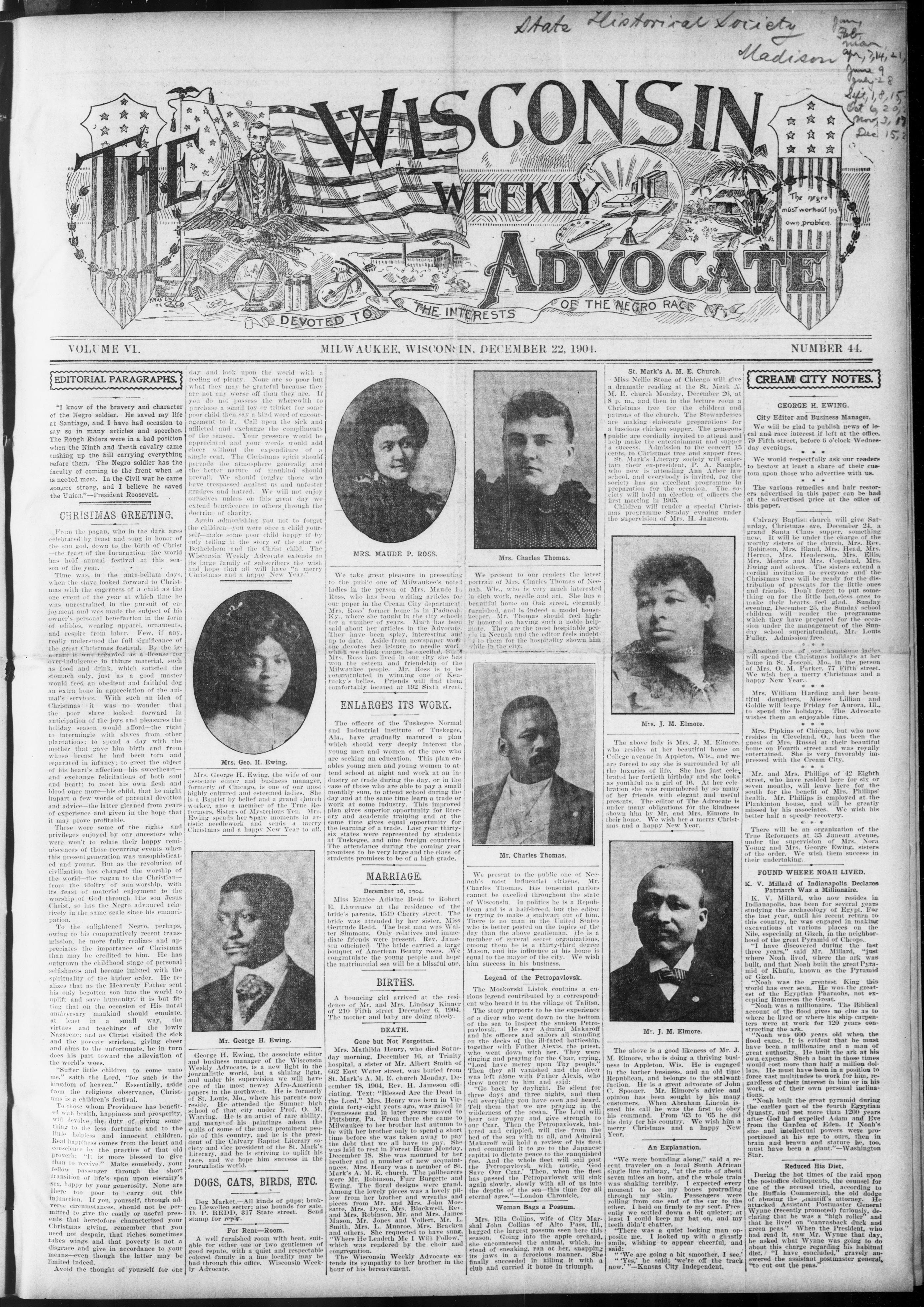
Mrs. Geo. H. Ewing. Mrs. George H. Ewing, the wife of our associate editor and business manager, formerly of Chicago, is one of our most highly cultured and esteemed ladies. She is a Baptist by belief and a grand church worker, also a member of the True Reformers, Sisters of Mysterious Ten. Mrs. Ewing spends her spare moments in artistic needlework and sends a merry Christmas and a happy New Year to all.
[Picture of a man in a suit and tie].
Mr. George H. Ewing.
George H. Ewing, the associate editor and business manager of the Wisconsin Weekly Advocate, is a new light in the journalistic world, but a shining light, and under his supervision we will have one of the most newsy Afro-American papers in the northwest. He is formerly of St. Louis, Mo., where his parents now reside. He attended the Sumner high school of that city under Prof. O. M. Warring. He is an artist of rare ability, and many of his paintings adorn the walls of some of the most prominent people of this country, and he is the president of the Calvary Baptist Literary society and vice president of the St. Mark's Literary, and he is striving to uplift his race, and we hope him success in the journalistis world.
DOGS, CATS, BIRDS, ETC.
DOGS, CATS, BIRDS, ETC.
Dog Market.—All kinds of pups; broken Llewellen setter; also hounds for sale. D. P. REDD. 317 State street. Send stamp for reply.
For Rent—Room.
A well furnished room with heat, suitable for either one or two gentlemen of good repute, with a quiet and respectable colored family in a fine locality may be had through this office. Wisconsin Weekly Advocate.
[Picture of a woman with dark hair, wearing a dark dress with a high collar.]
MRS. MAUDE P. ROSS
We take great pleasure in presenting to the public one of Milwaukee's noted ladies in the person of Mrs. Maude I. Ross, who has been writing articles for our paper in the Cream City department. Mrs. Ross' former home is in Paducah, Ky., where she taught in the city school for a number of years. Much has been said about her articles in the Advocate. They have been spicy, interesting and up to date. Aside from newspaper work she devotes her leisure to needle work which we think cannot be excelled. Since Mrs. Ross has lived in our city she has won the esteem and friendship of the Milwaukee people. Mr. Ross is to be congratulated in winning one of Kentucky's belles. Friends will find them comfortably located at 192 Sixth street.
ENLARGES ITS WORK.
The officers of the Tuskegee Normal and Industrial institute of Tuskegee, Ala., have gradually matured a plan which should very deeply interest the young men and women of the race who are seeking an education. This plan enables young men and young women to attend school at night and work at an industry or trade during the day, or in the case of those who are able to pay a small monthly sum, to attend school during the day and at the same time learn a trade or work at some industry. This improved plan gives superior opportunity for literary and academic training and at the same time gives equal opportunity for the learning of a trade. Last year thirty-six states were represented by students at Tuskegee, and nine foreign countries. The attendance during the coming year promises to be very large and the class of students promises to be of a high grade.
MARRIAGE
December 16, 1904.
Miss Eunice Adlaine Redd to Robert E. Lawrence at the residence of the bride's parents, 1519 Cherry street. The bride was attended by her sister, Miss Gertrude Redd. The best man was Walter Simmons. Only relatives and immediate friends were present. Rev. Jameson officiated. The bride carried a large bouquet of American Beauty roses. We congratulate the young people and hope the matrimonial sea will be a blissful one.
BIRTHS.
A bouncing girl arrived at the residence of Mr. and Mrs. Lindsay Kinner of 210 Fifth street December 6, 1904. The mother and baby are doing nicely.
DEATH.
Gone but Not Forgotten
Mrs. Mathilda Henry, who died Saturday morning, December 16, at Trinity hospital, a sister of Mr. Albert Smith of 662 East Water street, was buried from St. Mark's A. M. E. church Monday, December 18, 1904, Rev. H. Jameson officiating. Text: "Blessed Are the Dead in the Lord." Mrs. Henry was born in Virginia forty-eight years ago, was raised in Tennessee and in later years moved to Pittsburg, Pa. From there she came to Milwaukee to her brother last autumn to be with her brother only to spend a short time before she was taken away to pay the debt that we all have to pay. She was laid to rest in Forest Home Monday, December 18. She was mourned by her brother and a number of new acquaintances. Mrs. Henry was a member of St. Mark's A. M. E. church. The pallbearers were Mr. Robinson, Furr Burgette and Ewing. The floral designs were grand. Among the lovely pieces was a lovely pillow from her brother and wreaths and pieces from Mr. and Mrs. John Mossatte, Mrs. Dyer, Mrs. Blackwell, Rev. and Mrs. Robinson, Mr. and Mrs. James Mason, Mr. Jones and Vollert, Mr. L. Smith, Mrs. L. Munroe, Mrs. Bracken and others. She requested to have sung, "Where He Leadeth Me I Will Follow," which was rendered by the choir and congregation.
The Wisconsin Weekly Advocate extends its sympathy to her brother in the hour of his bereavement.
M.
Mrs. Charles Thomas.
We present to our readers the latest portrait of Mrs. Charles Thomas of Neenah. Wis., who is very much interested in club work, needle and art. She has a beautiful home on Oak street, elegantly furnished, and is indeed a model housekeeper. Mr. Thomas should feel highly honored on having such a noble helpmate. They are the most hospitable people in Neenah and the editor feels indebted to them for the hospitality shown him while in the city.
[Name]
Mr. Charles Thomas.
We present to the public one of Neenah's most influential citizens, Mr. Charles Thomas. His tonsorial parlors cannot be excelled throughout the state of Wisconsin. In politics he is a Republican and is a half-breed, but the editor is trying to make a stalwart out of him. There is no man in the United States who is better posted on the topics of the day than the above gentleman. He is a member of several secret organizations, among them he is a thirty-third degree Mason, and his influence at his home is equal to the mayor of the city. We wish him success in his business.
Legend of the Petropavlovsk.
The Moskovski Listok contains a curious legend contributed by a correspondent who heard it in the village of Talitsa.
The story purports to be the experience of a diver who went down to the bottom of the sea to inspect the sunken Petropavlovsk. He saw Admiral Makaroff and his officers and sailors all standing on the decks of the ill-fated battleship, together with Father Alexis, the priest, who went down with her. They were singing and praying for the Czar, crying, "Lord have mercy upon Thy people." Then they all vanished and the diver was left alone with Father Alexis, who drew nearer to him and said:
"Go back by daylight. Be silent for three days and three nights, and then tell everything you have seen and heard. Tell them that we are praying in the wilderness of the ocean. The Lord will hear our prayer and give strength to our Czar. Then the Petropavlovsk, battered and crippled, will rise from the bed of the sea with us all, and Admiral Makaroff will hold a review of his fleet and command it to go to the Japanese capital to dictate peace to the vanquished foe. And the whole fleet will sail past the Petropavlovsk with music, 'God Save Our Czar.' Then, when the fleet has passed the Petropavlovsk will sink again slowly, slowly with all of us into the depths of the sea—this time for all eternal ages."—London Chronicle.
Woman Bags a Possum.
Mrs. Ella Collins, wife of City Marshal John Collins of Alto Pass, Ill., bagged the largest possum seen here this season. Going into the apple orchard, she encountered the animal, which, instead of sneaking, ran at her, snapping its jaws in a ferocious manner. She finally succeeded in killing it with a club and carried it home in triumph.
St. Mark's A. M. E. Church.
Miss Nellie Stone of Chicago will give a dramatic reading at the St. Mark A. M. E. church Monday, December 26, at 8 p. m., and then in the lecture room a Christmas tree for the children and patrons of the church. The Stewardesses are making elaborate preparations for a luscious chicken supper. The generous public are cordially invited to attend and help make the entertainment and supper a success. Admission to the concert 15 cents, to Christmas tree and supper free. St. Mark's Literary society will entertain their ex-president, P. A. Sample, who now is attending Ann Arbor law school, and everybody is invited, for the society has an excellent programme in preparation for the occasion. The society will hold an election of officers the first meeting in 1905.
Children will render a special Christmas programme Sunday evening under the supervision of Mrs. H. Jameson.
A. E.
Mrs. I. M. Elmore
The above lady is Mrs. J. M. Elmore, who resides at her beautiful home on College avenue in Appleton, Wis., and we are forced to say she is surrounded by all the luxuries of life. She has just celebrated her fortieth birthday and she looks as youthful as a girl of 16. At her celebration she was remembered by so many of her friends with elegant and useful presents. The editor of The Advocate is under many obligations for the kindness shown him by Mr. and Mrs. Elmore in their home. We wish her a merry Christmas and a happy New Year.
[Name not visible in the image]
Mr. J. M. Elmore.
The above is a good likeness of Mr. J. M. Elmore, who is doing a thriving business in Appleton, Wis. He is engaged in the barber business, and an old time Republican, and belongs to the stalwart faction. He is a great advocate of John C. Spooner. Mr. Elmore's advice and opinion has been sought by his many customers. When Abraham Lincoln issued his call he was the first to obey his command. From '63 to '65 he did his duty for his country. We wish him a merry Christmas and a happy New Year.
An Explanation.
"We were bounding along," said a recent traveler on a local South African single line railway, "at the rate of about seven miles an hour, and the whole train was shaking terribly. I expected every moment to see my bones protruding through my skin. Passengers were rolling from one end of the car to the other. I held on firmly to my seat. Presently we settled down a bit quieter; at least I could keep my hat on, and my teeth didn't chatter.
"There was a quiet looking man opposite me. I looked up with a ghastly smile, wishing to appear cheerful, and said:
"We are going a bit smoother, I see."
"Yes," he said: 'we're off the track now.'"—Kansas City Independent,
GEORGE H. EWING.
City Editor and Business Manager.
We will be glad to publish news of local and race interest if left at the office. 79 Fifth street, before 6 o'clock Wednesday evenings.
We would respectfully ask our readers to bestow at least a share of their custom upon those who advertise with us.
The various remedies and hair restorers advertised in this paper can be had at the advertised price at the office of this paper.
Calvary Baptist church will give Saturday, Christmas eve, December 24, a grand Santa Claus supper, something new. It will be under the charge of the worthy sisters of the church, Mrs. Rev. Robinson, Mrs. Bland, Mrs. Head, Mrs. Herron, Mrs. Henderson, Mrs. Ellis, Mrs. Morris and Mrs. Copeland, Mrs. Ewing and others. The sisters extend a cordial invitation to everyone and the Christmas tree will be ready for the distribution of presents for the little ones and friends. Don't forget to put something on for the little honest ones to make their hearts feel glad. Sunday evening, December 25, the Sunday school children will render the programme which they have prepared for the occasion under the management of the Sunday school superintendent, Mr. Louis Fuller. Admission free.
Another one of our handsome ladies will spend the Christmas holidays at her home in St. Joseph, Mo., in the person of Mrs. O. M. Parker, 77 Fifth street. We wish her a merry Christmas and a happy New Year.
赤 赤 赤
Mrs. William Harding and her beautiful daughters, Misses Lillian and Goldie will leave Friday for Aurora. Ill., to spend the holidays. The Advocate wishes them an enjoyable time.
* * *
Mrs. Pipkins of Chicago, but who now resides in Cleveland, O., has been the guest of Mrs. Russel at their beautiful home on Fourth street and was royally entertained. She is very favorably impressed with the Cream City.
* * *
Mr. and Mrs. Phillips of 42 Eighth street, who have resided here for six or seven months, will leave here for the south for the benefit of Mrs. Phillips' health. Mr. Phillips is employed at the Plankinton house, and will be greatly missed by his associates. We wish his better half a speedy recovery.
* * *
There will be an organization of the True Reformers at 35 Juneau avenue, under the supervision of Mrs. Nora Young and Mrs. George Ewing, sisters of the order. We wish them success in their undertaking.
FOUND WHERE NOAH LIVED.
K. V. Millard of Indianapolis Declares Patriarch Was a Millionaire.
K. V. Millard, who now resides in Indianapolis, has been for several years studying the archaeology of Egypt. For the last year, until his recent return to this country, he was engaged in making excavations at various places on the Nile, especially at Gizeh, in the neighborhood of the great Pyramid of Cheops.
"I have discovered during the last three years," said Mr. Millard, "just where Noah lived, where the ark was built, and that Noah built the great Pyramid of Khufu, known as the Pyramid of Gizeh.
"Noah was the greatest King this world has ever seen. He was the greatest of the Egyptian Pharaohs, not excepting Ramesses the Great.
"Noah was a millionaire. The Biblical account of the flood gives no clue as to where he lived or where his ship carpenters were at work for 120 years constructing the ark.
"Noah was 600 years old when the flood came. It is evident that he must have been a millionaire and a man of great authority. He built the ark at his own expense. Such a boat in those times would cost more than half a million dollars. He must have been in a position to force vast multitudes to work for him, regardless of their interest in him or in his work, or of their own personal inclinations.
"Noah built the great pyramid during the earlier part of the fourth Egyptian dynasty, and not more than 1200 years after God had expelled Adam and Eve from the Garden of Eden. If Noah's size and intellectual powers were proportioned at his age to ours, then in brain and brawn and stature he, too, must have been a giant."—Washington Star.
Reduced His Diet.
During the hot times of the raid upon the postoffice delinquents, the counsel for one of the accused tried, according to the Buffalo Commercial, the old dodge of abusing theaintiff's attorney. He attacked Assistant Postmaster General Wynne (recently promoted) furiously, declaring that he was a "high roller" and that he lived on "canvasback duck and green peas." When the President, who had read it, saw Mr. Wynne that day, he asked what Wynne was going to do about this charge regarding his habitual diet. "I have concluded," gravely answered the assistant postmaster general, "to cut out the peas."
THE MODERATE RESOLVER.
Resolved: That after Nineteen four
Vil _keep my conselence clear;
I'll flirt with highballs never more—
But nestle close to beer.
I'll save my automobile hire
And travel in a car,
And not a single Wall street “flyer”
Shall tempt my wealth afar.
I'l never raise the “ante” just
To monkey with my fate;
And Vil never, never, never bust
A pair to fll a straight!
—Lurana W. She!don in New York Sun.
& Miscellaneous Items.
—Dnuring the twelve months ended with
last March there were in London 4%)
known cases of infants suffocated in bed.
—A Cape Town sergeant of police, con-
victed of accepting brifes from women,
has been sentenced to sixteen months’ im-
prisonment.
—Au Austrian railway mechanie_has
discovered a process, says the Paris Rap-
pel, by which the smoke of warships can
be entirely concealed from view.
—Among the marriages recorded in
Berlin last year there were 121 of blood
relations. One hundred and eight of
these were marriages of cousins.
—For a baby show in Plaistow, Eng-
land, a mean old bachelor offered a yal-
uable prize for the homeliest baby, but
the managers were wise enough to de-
cline. it.
—Oxtail soup was first made by the
very poor Huguenot refugees from
France after the revocation of the edict
of Nantes, because ox tails then had no
market yalue.
—The tobacco farm at Randalstown,
Treland, is proving a success. Fourteen
thousand pounds’ weight of leaf, the
product of twenty acres, is being pre-
pared for the factory.
—Ten years ago Japan exported $650
worth of cotton crape to the United
States, but now the figure is $30,000
yearly. Japan’s total export of crape is
worth $235,000 yearly.
—in the district about Gridley, Eng-
land, twenty women work as blacksmiths
to every man following the trade. For
many generations this work has been
n'most entirely in feminine hands.
—Two men were charged with stealing
slippers from a chureh at Clontara, Ire-
land, and the slippers were found on the
premises. Later it was discovered that
a sacrilegious dog had stolen the slippers.
—The largest sailing vessel in the world
has nearly been finished at Bremenhaven,
Germany. It will be 1000 tons larger
than the Preussen, which is now the larg-
est and fastest sailing vessel in the
world,
—A French physician, Dr. Foucault,
has found that_in 11,048 deaths investi-
gated by him, 759, or 7 per cent., result-
ed from cancer. He could not find that
heredity was a factor in the cause of the
disease.
—A London jeweler has made a collec-
tion of ancient forks used in England,
which show some little known facts
about the table manners of a few cen-
turies ago. The forks, which are of solid
silver, date from the Sixteenth century.
In many cases the designs in all this time
have scarcely varied in any detail and
the forks look like those which might be
bought today. The old forks were a
great luxury in their time and were only
used by the aristocracy.
—Recently printed extracts from the
diary of Adolf Pichiers show that that.
‘Tyrolean poet did not endorse the popu
lar notion that traveling ‘has an educa-
tional value. Most tourists are, in his
opinion, guided chiefly by the desire to
get good things to eat in the hotels and
to flirt with the foreign girls, and in the
end they are surprised to find them-
selves as much bore as at home. He
commends the sincerity of a party of
Bavarians who played cards on top of a.
high peak to pass away the time.
—It has long been a mooted question
whether insects are attracted to flowers
by the bright hues of the petals or by
the odor of the flowers, and recent experi-
ments carried out on quite an extensive
scale seem to indicate that the perfume is
the essential directive agent. It is con-
cluded that insects are guided from a dis-
tant to masses of flowers by their per-
fume alone, but that where flowers are
grown singly, insects are attracted gen-
erally by color, and where the distance
is small the odor doubtless assists in at-
tracting and directing the movements of
the flying insects.
STAY AT HOME MISSOURIANS.
Natives of That State Don’t Seem to Care
to Leave It.
Missouri is one of the largest states in
the country and the most populous of the
states beyond the Mississippi. Into it
have gone by thousands each year immi-
grants from other states, but from it few
emigrants go and a “man from Missouri”
is therefore a rarity in most parts of the
country, particularly in the east and
along the Atlantic seaboard.
There are only 3300 natives of Mis-
souri in the state of New York, a
smaller number than there are patives of
either Georgia, Michigan, California,
North Carolina, Rhode Island, South
Carolina, Illinois of the District of Co-
lumbia,
Small as is the Missouri colony in New
York, it is larger than the Missouri col-
ony in any other city of the country,
with the single exception of Quincy, IIL,
which is near enough to the Missouri
boundary line to get frequent accessions
trom that state. Missouri people do not
come east except for brief visits, and
few go to the northwest, though that is
largely made up of newcomers, not only
from European countries but from othez
American states. Moreover, by the last
census there were only 400 natives of
Missouri in Galveston and only 1200 in
New Orleans. In the latter city there
were 2000 natives of Virginia.
The people of Missouri have not much
of the migratory disposition which char-
acterizes the natives of most other states.
They are satisfied to stay at home or to
moye from one part of Missouri to_an-
ether. The Missouri society of New
York has in recent years been recruited
by many men distinguished in profes-
sional or literary life, yet while the col-
ovy has become important its member-
ship continues smaller than is the case
from most other large states——New York
Son.
Club for Servant Girls.
A thoroughly up-to-date club for serv-
ant girls has been opened in the heart of
the aristocratic Back Bay district of Bos-
ton. The object is to promote mutuai re-
spect between employers and einployes, to
impress on master and mistress that the
hired girls have certain rights and must
be treated with due respect; also remind-
ing girls of the rights and interests of
their employers.
ee
Thackeray Lock Brings $16.50.
At a sale of Thackeray first editions
and other literature pertaining to_ the
life of the English_novelist, a book of
poems by Charles Tennyson, brother of
the late Lord Tennyson, brought S600.
Its value was enhanced by the fact that
on one of the fly leaves is an unpub-
lished twelve-line poem by Thackeray.
Not the least interesting, although not
the most expensive, Thackeray item was
a leck of his hair, which sold for $16.50.
A CHRISTMAS FOLKSONG.
De win’ is blowin’ wabmah,
An’ hit's blowin’ f'om de bay;
Dey's a so't o’ mist a-risin’
All erlong de meddah way,
Dey ain't a hint 0” frostin”
On de groun’ ner in de sky,
An’ dey ain't no use in hopin’
Dat de snow'll ’mence to flay.
It's goin’ to be a Figo Christmas,
An’ sad de day fu me.
I wish dis was de las’ ove
Dat evah I should see.
Dey’s dancin’ in de cabin,
Dey’s spakkin’ by de tree:
But dancin’ times and spabkis’
Are all done pas’ fur me.
Dey's feastin’ in de big house,
‘Mid all de windahs wide—
Is dat de way fu’ people
To meet de Christmus-tide?
it’s goin’ to be a green Christmas,
No mattah what you say.
Dey’s us dat will remembah
An’ grieve de comin’ day.
Dey's des a bref o° dampness
A-clingin’ to my cheek;
De aih’s been dahk an’ heavy
Aw threatenin’ fu’ a week,
But net wid signs o’ wintah,
Dough wintah’d seem so deab—
De Wintah’s out o° season,
An’ Christmas eve is bean.
It's goin’ te be a green Christmas,
An’ oh, how sad de day!
Go ax de hungry chn'chya'd,
An’ see what bit will say.
Dey's Allen on de hitiside,
An’ Marfy in de ag
Fu’ Christmas was like springtime,
An’ come wid sun an’ rain.
Dey’s Ca'line, John, an’ Susie,
Wid only dis one lef";
An’ now de curse is comin’
Wid murder in hits bref,
It’s goin’ to be a green Christmas—
Des hyeah my words an’ see:
Befo’ de summah beckons
Dey’s many"ll weep wid me.
—Paul Laurence Dunvar in the Century.
Snowed Up on the “Hojack.”
“°Tain’t much of a story,” apologized
tlie old engineer, 2s he got his pipe going
and leaned back in the big chair, “but
you fellows talkin’ about that little blow
we had back in ’88 reminded me of a real
blizzard I happened to know somethin
about once, and-how Jim Peters got his
wife. You know Jim? He’s takin’ things
ersy now, as I am, and is a big man over
in the Pennsylvania offices. But Tm
gettin’ ahead of that Christmas story 1
was: goin’ to tell you.
“At that time I was rannin’ an old
eight-wheeler that .pulled the Hojack ex-
press over the Boston & Albany. Peters,
who had just got promoted, was conduc-
tor, and Matty Stiles—‘Old. Matty,’ the
boys all called him—was the express mes-
senger and baggage man.
“The Hojack wasn’t much of a train,
as trains go nowadays. We was the only
trein, though, that made all the stops
between Springfield and Albany, about
102 miles, and if we got through in ten
hours we were pretty near on time. If
we didn’t, nobody ever found any fault.
Queer name for a train? Well, it wasn’t
that on the timetable. but Jack Horton,
who used to run the engine, until he fell
underneath when she went into a ditch
one night, and I got his job, was about
the most accommodatin’ feller that ever
sat on the right of a cab. He knew
everybody along the road and they knew
him, and if anybody wanted to go or
send to town and didn’t have time to get
to the depot they just waited until they
seen the train comin’ and then stood out
in front and yelled, ‘Ho, Jack!’ and most
always Horton would stop for ‘em. I
wasn’t quite so obligin’, but the name
stuck to the train just the same.
_ “Winter used to set in earlier in that
section than it does here, and we always
carried some beddin’ and made sure to
have somethin’ to eat aboard in case of
gettin’ caught in a drift between stations,
for there wasn’t any sleepin’ or dinin’
cars on the Hojack. When we did get
caught we all used to turn in, passengers
and crew, and live together until the
company sent a crew to dig us out. That
is, all of us but ‘Old Matty,’ who didn’t
like company, and had a little stove and
kept a cot in his own car. Matty wasn’t
exactly morose, but he didn’t seem to like
people around. He’d come from out west
somewhere, and there was a yarn some
of us had heard about a daughter who
had run away from home and disap-
pointed him. We thought mebbe it was
that that had made him kinder sore on
things generally, but he never talked
much, and none of us ever felt like askin’
questions.
“If there was anything that Matty
hated it was deadhead or cheap freight.
A frank or a half-rate bill of ladin’ al-
ways set him to cussin’, and as the holi-
days approached and his car began to
take in mission stuff—Christmas boxes
going out west, and such things—the old
man got more cantankerous every day.
“When we pulled out of Springfield at
neon, the day before Christmas, Matty’s
car was pretty well filled, and when |
saw a big dry goods case out on the plat-
form as we pulled into Chester, and a
half-dozen women standin’ around it, 1
spotted it for a mission box in a minute.
and called to Ben Eckman, who fired fot
me, to come over on my side and see
Matty throw a fit. Sure enough it was
a lot of things some sewin’ circle wa:
sendin’ off to Albany for some missior
school’s Christmas, and the whole eirck
had come down to the station to see it
off.
“The presence of the women, who right
away began askin’ all sorts of questions
kinder handicapped Matty, but I heard
him growlin’ sometuin’ about ‘half-raters
and ‘Christmas nonsense.’ Then Peters
eame up to the women, who turned on
him.
“Oh, that’s all right, ladies,’ he ex:
plained. ‘You mustn’t mind Mr. Stiles
The trouble is, his car’s gettin’ so full
he’s afraid there won't be room to han;
up his stockin’. Anything good to eat ir
that box? ‘Cause if there is we may
want it for our own Christmas, if the
snow gets much deeper. z
“Yes, there’s a whole lot of gooc
things in it, replied one of the women
“but T guess you woi’t want them as bac
as the poor folks they're goin’ to.’
“Then Jim called ‘All aboard, and we
pulled out. It had been snowing before
we left Springfield, and by the time we
got away at Chester, the snow was fom
or five inches deep. It was good ‘packin’
snow, as the boys call it, and was comin
down in flakes almost as big as sparrows
We kept goin’ all right to Delhi, where
are Gordineer, who lived there, got intc
jthe cab with me.
“*Looks as if I’d have to work tomor.
rer. said Jake. ‘so I run down te eat
Christmas dinner with mother and th
children a day ahead, to make sure oi
gettin’ turkey.”
“Jake’s engine was layin’ up at Pitts:
field, and before we got there the old ma-
chine was wadin’ through twenty inche:
of snow and puffin’ like a wind-broken
horse.
“Worst of it is,’ said Jake, lookin’ out
ee ee re a ee
trces than what there is on the ground,
an’ when that begins to blow off there’s
in’ to be trouble.’
ercrhere wasn't a breath of wind then,
an’ when Jake hitched on ahead at Pitts-
field and we started up over the hills it
was hard pullin’, It’s a seventeen-mile
pull up to the top of the hills at Wash-
ington, and the road used to zigzag
around like a snake, with the Agnan
eveek zigzaggin’ the other way, 50 that
we ercased it just seventeen times before
we got to the top; but that day the snow
was so heavy we couldn’t see where the
creek was more than half the time.
“Jake cut off when we got to Washing-
ton, aud we went on down the hill alone
after makin’ the stop. Just then the
wind hit us. and, smokes, how she did
blow. Ben couldn’t find his sliein’ bar
afterward, an’ he always swore it had
bluwed out of the cab.
“Phere was fifty inches of stiow en the
level at State Line. We built up a snow
plow over the front of the engine with
boards and started for Canaan, thinkin’
if we could make the tunnel maybe the
road would be cleaver on the other side.
Jut it was like swimmin’ in mud to push
through that snow, and about 6 o'clock
we got stuck in a big drift about half a
mire from the tunnel, and couldn’t get
out forward or backward. When we seen
we,was fast, Ben banked the fire and we
went back to the passenger coach, where
Feters had a big wood fire goin’—that
was before they began to heat the cars
with steam—and sat down to talk it
over and wait.
“It was the first chance I'd had_to
know anythin’ about the passengers. We
sad five in the car, two drummers goin’
to Albany, and a good-lookin’ but rather
shabbily dressed young woman with two
of the brightest youngsters you ever saw.
The little girl wasn’t more than 4 years
old, and the boy was about 2 years older.
‘The woman looked as though she might
have seen a lot of trouble, but she'd kept
ther good looks, which even her black
dress didn’t spoil.
“Peters had got in something to cat
at the last station, and had a bottle of
milk for the baby, and the mother could
hardly thank him enough. He played
with the youngsters awhile an’ then came
back to where I was sittin’, and we sat
there watchin’ those babies and listenin’
to their prattle.
“Mamma, is tomorrow Christmas?
asked the boy.
“Yes, dear, said the mother.
“*And will Santa Claus come tonight
and bring presents for the good girls and
boys :
‘Maybe, dear,’
““Santy Claus bwing me big dollie?
lisped the little girl.
“And T want a drum and a pair of
boots and red mittens,’ added the boy.
‘Wiil he eome here in the train, mamma?
“‘Santy Claus come in twain, mamma,’
repcated the baby.
‘Hush, dears,’ said the woman, look-
ing out of the window and wiping her
eyes. ‘You are mamma‘s good children,
but we are so far off in the snow that
maybe Santa Claus won’t 2e able to find
us this year,’
““Put he came last year, mamma,’ per-
sisted the boy. ‘Don’t you remember how
he brought us a big Christmas tree, and
how paps rode me on my new sled? Will
we have nice things again when we ge
to grandpapa’s??
“Maybe, dear,’ murmured the woman,
tryin’ not to show she was crying.
“And will we find papa again, when
we det to drandpapa’s?’ put in the baby.
“Oh, don’t, dariing, sobbed the
mother, hidin’ her face in the baby’s cur]s,
while the youngsters clung to her and
begged her not to ery.
“Peters tiptoed out of the car, and
bevkoned to me to follow.
““Rill” he said, ‘those youngsters have
got to lave some Christmas.’
“im, 1 said, ‘’d walk twenty miles
to get a drwn for that boy, if walkin’
was possible, but it ain’t, and unless you
happen to be runnin’ a little Christmas
shop of your own somewhere on the
train, | can’t just exactly see where we're
going to raise many Christmas jinks on
the Lojack.’
“The oniy answer Peters made me wes
to go through into the baggage car, where
old Matty sat by his little stove.
““Matty,’ he said, ‘what’s in that Sew-
ing «.rcle’s box you took on at Chester?’
“Christmas presents for some mission
kids,” growled Matty, rather surlily.
“*Clothes, mittens, slippers, mince pies,
et cetera?’ suggested Peters.
“"T suppose so, assented Matty, with
little show of interest.
“‘Well, Matty, you've got to open that
box.”
‘Guess nev. remarked the old fellow.
“It ain’t ever been my habit to bust up
‘other folks’ belongings?
| ‘But it’s got to be done, now, Matty)
urged Peiers, ‘there’s two blessed kids
back there that expect Santa Claus to
come tonight. {t's Christmas eve, and
you end that box have got to do the
Santa Claus act.
“It’s agin’ the law to take other peo-
ple’s things,’ grumbled Matty, ‘but if you
want to break the law, go ahead? ~
“Peters found a hatehet and had the
box open in a few minutes. That was
surely the greates: Christmas box ever
packed. There were pies and crutiers,
all home-made, apples, oranges, nuts,
candy, several pairs of red mittens, hoods,
gaps, two pairs of boots, one pair just
about the right size; a collection of toys
and a layout of clothes for a whole fam-
ily. Deters fairly danced with joy.
“We Gidn’t say anythin’ about our find
to anybo.'y in the car, and we couldn't
get Matty to even go back to look at the
RR en ae Ree RS | oe eens eae
provided a little celebration for the
youngsters.’
“*T dont understand, stammered the
mother. ‘It’s so good of you. I don’t
know what to say, but God bless all of
you.’ Then she broke down.
“For a bachelor and a shy man Peters
had done pretty well up to then, but
when she began to ery he was up in the
air.
. “Now, see here, ma’am, there ain’t no
use in that,’ he urged. ‘Besides, it ain’t
us that’s to be thanked, but Old Matty—
er, that is, Santa Claus.”
“Then it all came out about the box,
only Peters left cut how Matty hadn’t
exactly entered into the spirit of the
thing, and gave him most of the credit
for the job. At that, nothin’ would do
but the woman and children must go and
thank old Matty. So they all three went
out into the baggage car, where the old
man was boilin’ coffee. Matty turned as
they eame in, and both he and the girl
locked as if they’d seen a ghost.
“*Father!’ cried the young woman, as
she ran and fell down on her knees in
front of him. ‘Oh, father!’
“‘Gracie, my little girl,” sobbed Matty,
holdin’ her up. ‘But I don’t understand,
Gracie.
~*Bill’ whispered Peters, ‘that’s our
ene to sneak. There’s more in this than
we know about, and it isn’t any of our
business to crowd in on family affairs.’
“So we went out into the other car and
waited, and after a while Matty and the
woman and the kids came out. We hard-
ly knew it was Matty. He was carryin’
the kids, and they were pullin’ his whis-
kers, and he was laughin’, and the girl
was sort of laughin’ and cryin’ at once.
You see, she was Matty’s daughter. They
had lived out west, and she had got
married, soon after her mother’s death, to
some young fellow her father didn’t care
much about. Matty had been pretty sore
over the match; told her she could go
where she pleased: that she had disgraced
him, and a whole lot of other things he
was sorry for afterward when she took
him at his word and went away with her
husband. Then Matty tried to find her,
but couldn’t, and it was that which had
made him so cantankerous. The girl’s
husband had died in Boston, a few
months before, and she had had a hard
job to get along. She wrote to her father
finally, but didn’t get any answer, be-
cause he didn’t get the letter, and she
and the children were going out west to
try to find him, when we run into the
bhizzard.
“You can bet we had a jolly Christmas
in the snow that way. We didn’t have a
turkey, but Matty had some dressed
young pigs in his car, and we cut up one
of them and broiled it, and, with the
stuff from the box, made up a feast that
beat anythin’ I ever tasted, even if it
was served on a car seat turned over for
a table. Along in the afternoon the snow
plow got through the tunnei, and we
made Albany. the next day.
“That’s about all there is to the story,
exceptin’ that Peters had had so much
fun playing Santa Ciaus for those young-
sters unat a few months later he asked
tieir mother if he could have the job reg-
ular, and she said yes. They all live in
Brooklyn now. ‘The girl is grown up, and
is goin’ to be married soon, and the boy
is studyin’ law at Commbia. Matty just
takes things easy. Mrs. Peters is some
stouter than she was then, but Jim de-
clares she gets better lcokin’ every year.
{’m goin’ over to eat Christmas dinner
with them next Thursday.—Herman
Bartlett Walker in Newark News.
CHARCOAL BURNING.
The Industry Has Been Hurt by Use of
Coal and Coke.
‘Time was when the entire annual yieid
of many European forests was devoted
to no worthier purpose than the making
of charcoal for use as fuel in iron or
glass smelting works. But nowadays
good forest timber can be put to better
‘purpose, and, although in some places
charcoal burning still flourishes on a
large scale, the industry, strangled by
‘goal and coke, has been steadily dimin-
ishing in importance.
The best site for a kiln is one that has
been used before—the ground is thor-
oughly dry and is covered with absorp-
tive charcoal dust. ,
The kiln usually consists of two tiers
of wood, one upon the otker, placed as
straight up as possible, the smaller pieces
inside, the thicker pieces in the center
and the smaller pieces again toward the
outside. When two stories have been
piled up in this way more wood is laid
horizontally across the narrow top. This
kiln is gradually shaped like a dome. All
openings are then carefully filled in, iv
order to prevent unnecessary drafts, aud
the whole is made as firm as possible.
A passage is now constructed from the
outside of the kiln to the flue in the cen-
ter, or a log of wood which has been
placed previously in position is drawn
from under the bottom tier, leaving a
hollow kindling passage, in which, when
the kiln is completed, a torch may be
inserted to set fire to the shavings.
Now the important work of covering
the kiln is commenced. Supports of vavi-
ous kinds are placed in position to save
a collapse under the weight of the cover-
ings, of which there is both an inner and
an outer. The kiln. is first tiled, as it
were, with thin sods, overlapping each
other. Then the outer covering is ap-
plied, consisting of loamy forest soil and
charcoal dust, well mixed, and firm
enough to exclude air and retain the heat,
and at the same time soft enough to al-
low steam to escape, and to yield with-
out cracking, as the kiln gradually sinks
during the burning.
Nothing remains but to erect a wind
break, if necessary, before burning the
kiln.
Farly in the morning, when the air is
still, a torch of pine is inserted in the
passage before mentioned, and the flames
seize hold of the dry twigs and shavings
in the flue. .
At first. when the dome becomes hot,
steam and thick smoke issue from the
top: if all is well, the smoke should give
way to flame, and a not unpleasant, pun-
gent odor should be noticeable. This is a
sign that carbonization is in progress.
After a few hours charcoal will form in
the-dome, which will gradually sink in,
Should the sinking be irregular, it is a
sien to the charcoal burner that the kila
is burning unevenly. There is too much
draft from one quarter, or too little in
another; or some of the wood in the
kiln is burning quicker than other pieces.
This state of affairs must be remedied hy
boring draft holes or applying water, as
the case may require.
On the second day after kindling, the
first vent-holes are made. These holes,
bored through both coverings dewn to the
wood, in two rows to leeward, help to
regulate the burning, and also give indi-
eation when the carbonizing process nears
completion. At first. smoke and steam
issue through them—and after a while
the smoke turns bine, which is a sure
and certain sign that the charcoal is burn-
ing, and this, of course, is the last thing
the charcoal-burners desire. The holes
inust be closed immediately with soil or
turf, end a fresh row opened lower down
the side,
THE MORNING RUSH.
Johnny, run and wake your father!
Dorothy, be still!
His other sock? Now, let me see!
Look on the window sill.
I have not seen your father’s boots.
His razor? Run and find it!
And tell the cook to hurry up—
Well, Charles, do look behind it.
Not there? Well, here's another pair,
Are those eggs finished? Wait!
He wants them fried—yes, on one side-
Good gracious! half-past eight!
Another cup? Yes, dear. there's lots.
More eggs? Run ‘tell the cook.
Your paper? Who has had it?
Well, everybody look.
Bobby, bring your father's coat;
Find his hat, Down, Rover!
Come, children, kiss papa good-by!
Thank goodness, that Is over!
—New York Press
Remembered Him.
An amusing story is told at the ex
pense of a magistrate.
One day the man of law had occasior
to go to a town some twenty-four mile:
from his court, and when, having tran
sacted his business, he went to the rail
way station, he was amazed to find that
there was uo train for seme hours. As
he was due to take his seat on the bench
within an hour and a half, he sought the
nearest cycle agent and inquired how
long a motor car would take to cover the
twenty-four miles.
“Two and a half hours,” was the reply,
to which the magistrate ‘expressed aston-
ishment, stating that he thought it might
be done in an hour.
“No doubt it could,” replied the agent:
“but last time I saw you you fined mé
40 shillings and costs for furious driv-
ing.”
However, the journey was done, an‘
no summons has yet been issued.—Lou-
dou Tid-Bits.
—————
How Bovs Botanized Teacher’s Hat.
Miss Johnson was an excellent teacher,
but her taste in dress, especially head-
dress, was so peculiar that even her ador.
ing pupils could not fail to notice it. The
verdure which appeared upon Miss John-
son’s hat one season was so gaudy that
several wondering comments were made
by the boys.
“l’m going to ask her what the green
stuff is,” said one boy, valiantly, in spite
of the vigorous objections of his com-
panions. “She won't mind, and next na-
ture study class ('m going to ask her, and
see who's right.”
So, red in the face, but stubborn, he
rose at the end of a lesson on_ wayside
flowers, in response to Miss Johnson's
general request for any questions which
might have come up since the last lesson.
“I'd like to know about that green stuf
on your hat,” he said, bluntly. “John
Aken, he say's it's beach grass, but T say
it's onion sprouts.”—Youth’s Companion.
eae
Her Vital Organs All Mixed Up.
A condition of affairs in a human heing
absolutely pew to physicians of New York
city was revealed the other day by an
autopsy on the body of a woman who
died in the Presbyterian hospital from a
disorder the exact nature of which_has
not yet been determined. Coroner's Phy-
sician O'Hanlon called at the hospital to
make an autopsy because the physicians
there were utterly at sea as to the wom-
an’s ailment. He found the blood in the
body, instead of being red, was of a
dark chocolate color, and that every or-
gan of the body had been stained a sim-
ilar hue. So remarkabie was this condi-
tion regarded by medical men that doc-
tors were summoned from different parts
of the city to see if they could furnish an
explanation. No one had ever seen or
heard of such a condition before.
if date
Coast Spy Lichts.
In the joint army and navy maneu.
vers in Chesapeake bay next spring it is
probable that there will be a test of a
searchlight of the portable type. This
will be possible by mounting the search-
light, its dynamo, boiler, ete.—the entire
plant, in fact—on a railroad car, There
is a movable light now used by the siz:
nal corps, but the light only is mountec
on a cart, propelled by horses, the gener-
ating plant being in a protected place
and connected with the light by wire.
There is some doubt whether the entire
searchlight plant mounted on a railroad
ear will serve the purpose desired, onc
question being that its mobility is con.
fined to a railroad track, and another ob:
jection is that it will serve as a target
for the enemy, who might attack and de
stroy the entire plant.
pense Saar
Were Married in Butcher Shop.
In his butcher shop in Brooklyn a few
hours after he had disposed of his las!
Thanksgiving turkey and cut his las
pound of meat for the day Albert Tim
mermann, attired in evening clothes
wedded Meta Poelk, tali, fair and blush
ing. The wedding was the outcome o!
a romantic courtship which had _ it:
dawning twelve months ago, when, s«
the story goes, the butcher met for th
first time the soft glances from_ fai.
Meta’s eyes when waiting on shop. Whex
the day was finally fixed it was decide
to have the wedding ceremonies pe.
formed in the butcher shop because
was conyenient to have it so. Then fol
lowed a good old-fashioned wedding re
ception.
=
Not to Re Onutdone_
Housekeeper—‘Have you any Mocha
coffee, Mr. Sands?"
Small Dealer—"Yes, mum.”
“Genuine Mocha?”
“Just imported, mum.”
“Import it yourself?”
“Oh, yes, mum. I send my order di-
rect to the—the Sultan, mum.”
“Humph! How much have you on
hand?”
“Bout sixty pounds, mum.”
“You have, eh, sixty pounds? I read in
the paper this very morning that not
aver fifty pounds of genuine Mocha
reached this country annually.”
“Yes, mum, that’s true. I had ten
pounds over from last year.”—London
Tit-Bits.
Rabin inet Sa
Odd Habits of Men Who Shave.
One finds odd little habits—such as Dr.
Johnson's touching of the posts in Fleet
street—when one interrogates conscious-
ness or acquaintances, says the London
Chronicle. Yesterday a business man
with the aspect of a brass-headed nail
denied indignantly that he had any such
ridiculous habits. “Well, for example,”
said the questioner, “when you shave in
the morning, how do you dispose of yom
razor case?” He had to admit that he
invariably placed the two portions care-
fully, the smaller level and true upon the
top of the other. Then the questioner
confessed that he himself could not shave
unless the two portions of his razor cas«
were—as they say in Kent—‘“cater,” that
is, side by side, and askew.
—$_—$_._—
Mrs. Blank’s Garments.
Talking about the “barker,” there is no
one so great as to be reverenced by him.
His business is to point out the sights ot
the capital to his passenger, and it isn't
his fault if anything passes unnoticed.
On a Monday not long ago a touring ear
rolled along a quiet street where lives the
famous widow of a great general.
“On your right,” roared the megaphone
man, “is the residence of Mrs. Gen.
Blank. The garments on the clothes linc
are those worn by Mrs. Blank.”
, And a wild-looking little woman on the
front seat murmured, with great interest:
“My; but ain’t they plain!”—Washing-
‘ton Post.
COST OF ABSENT-MINDEDNESs.
through fthoughtlessness,
“The Absent-Minded Beggar’ has
plenty of counterparts in New York,
as the Interborough Rapid Transit
Company and the subtreasury officials
have cause to know. Perhaps the com-
monest form such absent-mindedness
takes is the dropping of coins into the
ticket chopper's box on “L” stations.
The amount of money thus inadver-
tently thrown away in a year, say the
Interborough officials, is tremendous,
aggregating, it is estimated, about $35
a week, That means an average of
about 36,400 nickels per annum ab-
sent-mindedly tossed into the ticket
machine,
The usual method of procedure is
this: A man hurrying to catch a train
slams down a coin at the ticket win-
dow, gathers up his change in one
hand and his ticket in the other and
hastens on in pursuit of the “gates
ajar.” Forgetting in which hand the
\ticket is, he dumps his handful of
change into the chopping machine. A
fierk of the lever and it vanishes from
jview.
* By making proper application the
‘man with the absentee thinking appa-
jratus can, of course, recover his
money, but he will find it sadly
[enangea since he last saw it, for the
interior of the box is fitted up with a
powerful apparatus for mutilating tick-
‘ets. The teeth of the machine are so
‘sharp that they readily bite through
nickel or silver coins.
! ‘Thus, whenever a large enough heap
of these mutilated coins is collected an
official of the company is forced to
make a trip to the subtreasury to have
them redeemed. A goodly percentage
of the money is never demanded by
the people who dropped it in the box,
ithe outlay being presumably set down
‘by them to profit and loss and sub-
mitted to as one of the countless penal-
ies attached to the Gotham vice of
eo rereince York World.
REPLECTENS 22
ese 4 f, p
ashy f) a Was
| CA Senge OR
s & eas
C=,
OES FF 0.0!
' One girl is company; two a breach
pf promise suit.
Every’ woman is always doing some-
thing either to get fatter or thinner.
; No woman is so blind as to suppose
a eyes are made only to see
with,
The kind of mittens that keep a
irl’s hands warm are a man’s fin-
e
‘ For every one way there is to make
E friend there are several thousand to
imake an enemy.
( A woman would like to be rich so
; he could give pennies to the poor and
pase necklaces to herself.
It must be awful lonesome for a
fyald woman not to be able to wash
{her hair with her best friend.
A man could stand his wife telling
him all the gossip if she didn’t ex-
ect him to take sides about it.
/ When a girl has had the nightmare
You can generally tell it by the way
he says she eats no more than a bird.
A man could always afford to give
his wife furs and pearl necklaces if
being married weren't so expensive in
other ways.
The kindest thing a woman ever does
to a young man is to have him fall in
love with her, but not marry her be-
cause she is already.
When a man squeezes his wife’s
hand she can tell the way he does it
whether he is absent minded and
thinks it is somebody else,
The cleverest thing is the way a
girl with a bad attack of indigestion
ean just love to have her sweetheart
read sentimental poetry to her.
A woman considers herself a natural
born financier when she goes over her
bank balance again and finds it is a
dollar more than she made it the first
time,
When a man has been engaged to a
girl and meets her twenty years later
he never knows whether to treat her
as if she were his grandmother or his
school teacher,
Her Only Chance.
“Why does Mr. Creeper come bere
so often, Maud?”
“He comes to see me.”
“What are his intentions?”
“I don’t know, ma.”
_ “Well, doesn’t he know that he is
keeping other young men from paying
you attentions?”
“I don’t think he does, ma.”
“Well, you know it, don’t you?”
“No, ma. I haven't enough imag-
ination to think out a fairy tale like
that.”—Cleveland Plain Dealer.
As High as He Went.
| Governor Heyward of South Caro-
lina tells a joke about a young Bos-
tonian who was visiting New York
City and had occasion to go into the
Park Row building. On reaching the
twenty-sixth story, which is the high-
Frets everybody except the Bostonian
left the car.
“Is this as high as you go?” asked
the young man.
“Yes, sir, unless the elevator fal!s,”
answered the truthful elevator map.—
New York Times.
What Worried Him.
She—But, pa, he says he can't live
without me. Pa—But the question is
whether he can live without me.—
New York Press.
GOSSIP FOR THE LADIES.
---
One man had riches for his gift and knew The emptiness thereof:
Another, where fame's topmost summits left All pigmy peaks above.
Felt the keen pangs of lifty loneliness;
And one had love.
Down in the lowly valley-paths of life
His years were spent;
Where, far removed from molling din and
strife,
Brook song and bird song blent
Babbed of quiet things, of resting peace,
And deep content.
Yet there was something in his cup of days
Ineffably more sweet
Than e'er he knew who in the glddy maze
Of fortune set his feet
Or quaffed fame's goblet, wreathed with rue and bays,
Troubles of the Bashful Girl.
There is one little lesson in good manners that is omitted from the code of many a parent, and that is the subtle art of self-forgetfulness.
Perhaps you, Miss Merry Tom-Boy, or you, Miss Lady Wise, fail to understand exactly what is meant by this self-forgetfulness; but the demure Miss Shy painfully tucked away in the darkest corner of the room, understands it to the utmost, for her very soul has been tried in her vain endeavor to get away from herself and everything pertaining to her.
There are afflictions and afflictions, one more or less worse than the other, but if bashfulness is not one of the worst curses that can be bestowed upon a person I would like to know what it is.
Really, truly, bashfulness does not mean diffidence, quietness or even shyness, but that all-enveloping something that settles down like a gentle cloud and bereaves one of every power save that of blushing frantically and furiously time and time again.
Perhaps this affliction is helped on its way not a little by the delightfully frank fashion which so-called polite society has of scrutinizing everybody and everything that chances its way. Many times if lorgnettes were leveled the effect could not be more startling or more insolent, and it takes a woman possessed of a goodly share of worldly wisdom to present that I-don't-know-you're-looking expression and go serenely and evenly upon her way.
Just why people imagine they are entitled to stare at others as though they were little short of curiosities is quite beyond me. Yet every day—in fact, if one will but take the trouble to notice in every car—there is that close, neighborly scrutiny which makes one fairly bristle with indignation. Not so very long ago I chanced to meet a girl of 16 or thereabout, flying along the street with flaming cheeks and angry, suspicious eyes.
"Where are you going in such a tremendous rush?" I asked her, as she swept along. "Home, where people don't think I'm a walking advertisement for a gold mine," she answered in a quivering voice. "I'm so embarrassed I can't see straight."
And the cause of her woes was nothing more or less than a few gold bands. In other words, she was having her teeth straightened and was being tortured both mentally and physically by the protruding glitter that refused to permit her to close her mouth in peace.
Doubtless it never occurred to those who glanced at her so curiously that they were committing a breach of etiquette, and it was very evident by her nervous flurry that my little friend failed to realize that she was not making the best of a bad situation.
She was embarrassed most woefully, and her one idea in life was to fly home and hide her head in her mother's skirts and have a good cry.
She imagined that every man, woman and child—yes, even the yellow curs on the street—was looking at her, ready to break into a gentle grin that is so delightfully expressive. Instead of walking along ordinarily and gazing into the shop windows she couldn't think of anything but self, and in her eagerness to efface herself she succeeded only in being awkward and decidedly conspicuous.
The conscious man or woman imagines a host of things and magnifies them until they are absolute bugbears. In fact, mountains are immediately constructed from the tiniest of mole hills. A lowered voice, a laugh or even a gesture will set them off in a fit of bitterness, for they are positive that their own shortcomings are the sole and absorbing topic of conversation.
Such may be the case, but it occurs about as often as we have a blue moon. In a way, this everlasting thinking of self is horribly conceited, for the average person has something more interesting to amuse him. Of course, if one wiggles and squirms about in a painful manner it cannot help but attract attention and the glance that would have been passing becomes fixed. Contortions are not pretty, nor are they reassuring, and they certainly are entirely uncalled for at all times and places.
The bashful man is not placed in half as many annoying predicaments as the bashful girl. When he finds that life is somewhat of a burden to him on account of his general awkwardness and his ability to say and do the wrong thing at the wrong time, he crawls into his shell, as it were, and takes refuge in silence. His movements are abrupt, his voice harsh and his conversation short and sharp. To be sure, he is rather a forbidding sort of creature, for only those who know him well understand that this gruffness is merely a bluff put up to hide a shyness that he is positively ashamed and afraid of.
But this self-same abrupt mannerism that covers such a multitude of sins has, unfortunately, been denied the timid girl. These days there are too many jolly comrades, always amiable and ready for fun, to make it an object to put up with the girl who is snappy, surly and cross, and even the one who is distressingly quiet comes in for her share of playing the animated wall flower.
And really, after all, it is only what one might expect. People rescue a pretty girl once, twice, or maybe, three times, but if she persists in losing herself in the dark shadows and taking no part in the gaiety, she will soon discover to her sorrow that she may remain there just as long as she pleases, and entirely forgotten and neglected in the bargain.
Each and every one should be possessed with a certain amount of self-assertion. This does not necessarily mean that one should push one's self forward on every possible occasion, but there are times when an act of thoughtfulness will suddenly place one easily and gracefully within the charmed circle. Once there, it is easy to find some means of keeping busy, for "doing nothing" is the stumbling block that is the undoing of many a lad and lassie.
It is a real pleasure to see a well-poised woman. She may enter a room filled with merry chatterers and be utterly oblivious to the fact that anyone but her hostess is within a hundred miles of her. She does not stammer or wiggle, her hands and feet are not possessed with an insane desire to make themselves prominent, and she doesn't eye every corner in a shifty fashion, as though she were debating how many strides would take her to it and freedom. No. That is not the well-bred woman.
Her mind is not on her own behavior, but upon her hostess and her interests, and for this simple reason she is delightfully natural and charming.—Madge Moore in Pittsburg Dispatch.
The Too Good Wife
Every now and then a world weary and folly weary man marries an innocent, unworldly and "good woman."
He wants the sweet home life he has not found in the paths of pleasure, nor in the byways of license. He wants the unmercenary devotion of a loving woman, and he wants to walk forth in the broad light of day, unashamed, with his wife by his side.
It is the inevitable goal of every worth while man.
The world approves of such marriages, and the woman feels that she is filling woman's highest mission in reclaiming a lost sheep. But how few such women know the wise middle course to walk with such a man.
It is all very well to listen and believe when he tells you he is happier than he has ever been in his life before, and that his home is dearer to him than any club on earth. But it is far from very well if you fall upon his neck and weep the first time he intimates that he would like to drop in at the club and talk with the old chums for an hour. This is the poorest method you could adopt to convince him of the greater joys of home. There is a certain fascination in club life to most men. There is danger in this fascination to some men. When a man sickens of it and wants a home it is because he has had nothing but his club, and because there is a worthy element in his nature which calls for something better.
The fact that he should want to visit the old scene now and then is not an indication that he is sick of home or that he is wandering from the fold again.
If the pasture is sweet and the shepherdess kind and wise the sheep will not wander far.
If you have married a man who has been overfond of the fair sex, and if he is kind and true and loving, do not be forever upon the alert lest he stray from you.
Constant surveillance never yet kept a man true. It has made many a man unfaithful.
Although your husband may have told you over and over again that you are tenfold more pleasing to him than any woman he ever knew before he met you, that does not signify that he might not like to sit by some other at a dinner party, dance with some other at a cotillon. It does not signify that he would not enjoy talking with others whom he regards less highly than you. In the association with the women he does not love a man often most appreciates the woman he does love. Should he take a seat by some other woman and converse with her in your presence, do not act sulky, distrait or injured. That only makes you ridiculous and unlovable.
Although your innocence and unworldliness won your husband from the paths of folly, those qualities will not keep him at your side unless you mingle common sense and tact with them.
It is easy for many women to be brilliant, and it is easy for others to be good. But it seems the most difficult thing in the world for a woman to be sensible.
Genius and virtue are everywhere, but we must search for common sense. Woman is called a composite creature, but man is tenfold more composite. When a man has the whole world catering to everything in his makeup, except his love of virtue, he is not to be made abidingly happy with nothing but that quality satisfied.
He cannot suddenly and permanently change his whole mental structure.
Be satisfied then if your husband gives up the liberties and vices which the world allows a bachelor, but do not ask him to reliquish the courtesies and recreations which are every man's privilege. Drive suspicion from your door, and install confidence in its place. Cultivate self esteem and self confidence, and think, act, talk and live so sweetly and lovingly that rivalry is impossible. Make the new life a holiday, not a term of imprisonment. A very good woman who has human weakness in her nature is sometimes the devil's tool to drive men to drink.
Absolute loyalty, absolute morality, absolute honor and cleanliness of life every woman has the right to ask of her husband. The best of his devotion and the larger portion of his leisure should be given her voluntarily. But to make him a willing captive should be woman's art, not to make him a life prisoner, and the home a reformatory, and the wife a suspicious warden, always imagining that the prisoner is planning escape. The good wife must possess other qualities besides goodness to make her marriage with a mere man successful.
Common sense and tact must be two strands of the rope to make it strong enough to act as an anchor for the domestic ship. The too good wife relies wholly upon one strand and the ship breaks anchor.—Ella Wheeler Wilcox in Spokane Spokesman-Review.
The Healthfulness of Forgetting.
Much is said and written nowadays about cultivating the memory. Schools have been established for the purpose of teaching memory culture. Individuals are taught how to train the memory so that they may be able to retain impressions, remember the names of people, the date of different events, recall past experiences, and so on, and so on.
All a very good thing. A good memory is necessary to success, business and social. A well trained memory is a very useful faculty to possess. It not only makes smooth the way of its possessor, but it is so much capital stock to his credit.
But with all our memory training we should also learn the art of forgetting. Perhaps more of us need to learn how to forget than to learn how to remember. Forgetting can be learned just as easily as remembering, but it requires exactly the opposite kind of training. Even learning how to forget the things we should forget will help us to remember the things we should remember.
The things that are unpleasant, the things that irritate, the things that make us feel bitter and unkind—these are the things we should forget, the things we should discard and banish to absolute forgetfulness.
The health of the body, as well as of the mind, depends upon forgetting. To let the memory of a wrong, of angry words, of petty meanness, linger and rankle in your memory will not only dissipate your mental energy but it will react upon the body. The secretions will be diminished, digestion impaired, sleep disturbed, and the general health suffer in consequence. Forgetting is a splendid mental calisthenic, and a good medicine for the body.
If any one has been mean to you, has wronged you, heaped siander upon you, treated you contemptuously or discourteously, forget it. Remembering it will not undo it, but will only make you irritable, bitter and angry. Will react upon you harmfully, both
physically and mentally. Cast it out of your memory and let it return to the one who sent it. It is sure to do so without any effort on your part, for it is a law, that that which is sent out will return again unto the sender.
If your friends prove false and cast you off, do not hold it in anger against them, but rather pity them. Keep a clear conscience and forget the little jealousies, the petty meannesses, that may be bestowed upon you. By casting it out of your mind, you can go on serenely and happily, while the ones who have done the mean things will be the only ones to suffer.
Forget the peculiarities of your friends, forget their faults. Remember only their good qualities. Forget your disappointments, forget your annoyances, forget all the disagreeable things.
By forgetting you will develop for yourself a sunny disposition, a good-natured temper, a cheerful manner, a healthful body. Forgetting keeps at bay wrinkles and old age. It beautifies the countenance with a beauty all its own—peace, contentment, health. It strengthens the memory, keeps young and virile the faculties of the mind, elastic and agile the muscles of the body.
How shall you forget? By turning your mind to happier things. When the remembrance of unpleasant things crowd into your mind, use your will power and deny them a foothold there. Turn your thoughts immediately to the happy moments that have been yours. Deny the disagreeable things any place in your thoughts. Pick up a book and read, or go some place. Get out in the fresh air and walk or ride. Fill the mind so full of other matters that there will be no room for the disagreeable memories.
Every night as the sun goes down let all the disagreeable happenings of the day slip out of your mind and sink into oblivion. Blot them out, annihilate them, and permit no resurrection. Go to sleep with the thought of pleasant things in your mind, and begin the next day as though it was the first day of all your life, the last day, the only day. And make this day a record of sweet memories. If anything disagreeable intrudes, at nightfall blot it out. Then if another day is given you, make it better than the one before, remembering only the things that are lovely and lovable.
To forget—that is what we need. Just to forget. All the petty annoyances, all the vexing irritations, all the mean words, all the unkind acts, the deep wrongs, the bitter disappointments,—just let them go, don't hang on to them.
Learn to forget. Make a study of it. Practice it. Become an expert at forgetting. Train this faculty of the mind until it is strong and virile. Then the memory will have fewer things to remember and it will become quick and alert in remembering the things that are worth remembering. It will not be cumbered with the disagreeable things and all its attention will be given to the beautiful things to the worth-while things. No matter what business you are pursuing, no matter what literary subjects you may be studying, no matter what scientific problems you are trying to solve, take up the study of forgetting. The art of forgetting will give added luster to all your literary, business, or scientific attainments and it will add immeasurably to health of mind and body. E. P. in Medical Talk.
When There Won't
Be Any Women in the World.
Every now and then I am forcibly reminded of the fact that the millennium will have arrived when we learn to mind our own business.
But it will be an Eveless Eden, without a single woman in it.
No woman has yet arrived, or shows signs of arriving, at the point of grace when she can behold another person making a pie without putting her finger in it. It has always been that way. And it has always been her bane. She has broken her heart over other people's sorrows. She has lain awake nights, and lost sleep, over other people's worries. She has brought on more nervous prostration trying to run other people's affairs, and stirred up more heartburnings and jealousy, and bitterness and strife, than all other causes combined, just because she would not mind her own business.
It is a distinctly feminine mania, the end whereof is trouble and tribulation. The average man feels he has got about all he can manage with his own affairs and trouble enough of his own without borrowing his neighbor's. The average woman attends to her business in the intervals she isn't speculating about why the Browns don't send their children to the public school when Brown is only on a salary, and how the Smiths, across the street, can afford new carpets this season. And the queerest part of it all is that by some quirk of feminine logic this unwarranted meddling with other people's affairs is accounted a virtue. A woman's definition of another woman who was a selfish creature would be one who attended strictly to her own business and didn't interfere with some remedy of her own when the children next door had the croup.
This inability to attend to her own business, and leave other people to run theirs without any assistance from her, goes a long way towards explaining many of woman's failures. It is one reason why so many women break down. They try to carry the universe on their shoulders. They could manage well enough with their own work and bear with sufficient fortitude their own troubles, but when they add to that the accumulated afflictions of everybody in the neighborhood, they collapse under the nervous strain. It is doubtless a pity that Mrs. Jones should be such a poor manager and so wasteful and extravagant; it is much to be regretted that young Blank does not go to work and support his widowed mother; possibly it is a crying shame that the Gray baby should be fed on sauerkraut and beer instead of sterilized milk; but after all we are not responsible for these affairs, and there isn't a blessed thing we can do about them. The Joneses, and the Blanks, and the Grays of our respective neighborhoods don't want our advice and wouldn't take it at any price, and we merely wear ourselves into frazzles with unavailing worry over something that doesn't in the least concern us.
Of course, when there is any real need for a Solomon we all feel capable of speaking right up, but it is well to occasionally reflect that other people are almost as capable of running their own affairs as we would be. This is always a surprise to us. There was probably never a marriage when everybody in the community didn't feel that they could have made a much more judicious selection for both parties than they made for themselves, yet divorce is comparatively rare. Every one of us is dead sure that we could bring up everybody else's children much better than they are doing it, yet the children go along turning out all right in spite of our predictions to the contrary.
We really afflict ourselves about these matters. We are reduced to tears because Sally So-and-So is going to marry the man she wants instead of the man we think would suit her, and we aggravate our souls in vain because little Mrs. Somebody else lets her babies play in the back yard with the cat instead of folding paper mats at the kindergarten. If the sympathy we lavish on people who don't want it and don't need it, and the amount of wasted energy we expend on other people's affairs, could be applied to some useful purpose it would revolutionize the world.
Of course we shall have no more gossip when we learn to attend to our own business. We shall be occupied in pay-
ing our own bills, instead of wondering how other people can pay theirs. If Mr. Clubman is out of nights, we shan't spend the time in pitying his poor wife and speculating if her cooking or temper drove him to drink. We shall merely presume the clubman knew his own business, and, at any rate, it isn't any of our affair. We shall be able to come and go as we please, without taking the neighborhood into our confidence, or offering explanation or apology, for so long as we infringe on nobody else's rights, no one will trouble themselves about our movements. And what a peaceful, easy, restful time we shall have, if only we can learn to mind our own business and let other people's alone.—Dorothy Dix in Chicago Tribune.
Taking Care of Your Clothes.
In considering your winter wardrobe do not lay too much stress upon the money-saving qualities of the general-utility gown. It's economy in the end not to overwork one frock. Keep your street costume exclusively for the purpose for which it was designed. Don't wear it in the house. Don't be tempted to make it serve duty for both street and home wear. If you do, before the season is over you will surely find that your skirt is worn and shabby, while your coat has still kept much of its original freshness. This just means that the whole smart effect of your street frock is lost. No matter how well the coat looks, a shabby skirt provides the touch that makes the costume as a whole appear worn.
On the other hand, by saving the street costume for outdoor wear exclusively, being careful to brush it, air it and to keep both the coat and skirt on their own special hangers, there are nine chances out of ten that the costume will not only keep its original good looks straight to the end of the season, but will be in fair condition to put on next year.—Woman's Home Companion.
"I have just returned from a few weeks' business trip in Mexico," says Charles B. Weil.
"It so happened that during my visit two matters of political importance occurred," continued Mr. Weil. "The secretary of the treasury, Limantour, submitted to the Mexican Congress a bill providing for a stable system of currency, i. e., there is to be ascribed to the peso or dollar the definite value of 50 cents in gold. The importance of this step can scarcely be estimated by us who know nothing of the evils and annoyances of a fluctuating currency. I can best explain this by saying that during my earlier acquaintance with the republic of Mexico I have known our dollar to be equivalent to $2.78 in Mexican money. During the last visit I found the rate $2.14 on the day I entered the country and $2.03 on the day I left. You can form an idea of how trying such fluctuations must be to a merchant. The fall in the rate of exchange, which I just mentioned, was due to the anticipated legislation tending to a stable currency.
Inaugurating President Diaz.
"The other political matter I noted while there was the inauguration of President Diaz for a new term of six years. There does not seem to be any possibility of a successor to him in the presidency so long as this able gentleman retains his faculties. That he is wide awake and in close touch with every quarter of his country is evidenced by the conversation which an acquaintance of mine recently had with him. The gentleman asked the President whether there were any well-defined deposits of iron or coal in the country. Without a moment's hesitation the President named certain definite but very remote localities where these minerals were to be found. President Diaz went on to say 'There are also considerable deposits of galena near the little town of _____ for I remember meeting it during my campaign against the French. I had ordered trenches dug and recall distinctly a difficulty my men had in working in these deposits.' Diaz imbibed his geological knowledge through a saber.
U. S. Well Represented by Consul.
"We are well represented now in a consular way in Mexico. I do not wish to place too much emphasis on the, 'now,' for you know what Mrs. Malaprop said about comparisons. I gave myself the pleasure of a visit with Consul General Parsons, and I found him a gentleman of culture and refinement, well able to conduct the duties of his office. I understand he is a personal appointee of President Roosevelt, and that this is one of the President's most recent steps in trying to reform our consular service in Mexico. All prominent Americans in Mexico seem to agree that he has greatly benefited the interests of the United States there.
$520,000,000 of U. S. Money Invested.
"In the course of my talk with Mr. Parsons he mentioned the fact that there is now invested in Mexico $520,000,000 of American capital. I think I have the figures accurately; they were so large as to impress me. It is evident to even the most casual observer that a large part of this sum has been invested in an agricultural way. The Germans are the shop-keepers in Mexico; the English are the builders of railroads and harbor works, and we are the agriculturists. There are, of course, marked exceptions, for American capital has built at least two great railways in Mexico, and has also done much in the field of mining.
"What crops are raised? Principally, I should say, rubber, coffee and sugarcane. It would be talking shop if I told you what I thought of these crops. I can only say that I have great faith in them."
The Guest of a Planter.
"I am reminded of one of the most delightful evenings I spent in Mexico. I visited some eleven plantations, and in a new country, such as that part of Mexico devoted to plantations, there are no wayside inns. I was compelled, one evening, to thrust myself upon the hospitality of a planter in the state of Vera Cruz, by name James Harvey. He is perhaps the most ardent botanist I know. He was born in England; has traveled the world over, and is thoroughly well educated, and yet, with all this polish, he has settled in the tropics, where he may plant a rare specimen in the open, as opposed to a hothouse, and see it mature in a comparatively brief period. Will you believe it when I tell you that down there they plant radish seeds one day and see the green leaflets appear above ground the next day? I told a friend of mine that story and he said he would have to take my radish story with a grain of salt. But it is true, nevertheless. Mr. Harvey is in touch with such botanical centers as Kew gardens, and often re-
YOUNG FOLKS' COLUMN.
"
The True Reason.
Santa Claus, the dear old stupid,
Paid a call last night to Cupid,
Brought him posies, gay old giver!
Silver arrows and a quiver.
Then the wakeful boy, upstarting.
Saw the saint in haste departing—
Seized an arrow, thankless Cupid,
Winged it straight at "dear Old Stupid."
This the way, and that the reason,
Merry maids, this Christmas season,
Find his bounty overflowing—
Revel in its rich bestowing.
This is why, the country over.
Morning smiled on lass and lover.
This is why the dear old stupid.
Claims tonight that he is Cupid.
—Harner's Razar
The Pumpkins' Fate.
Farmer Brown, Mrs. Brown, and five little Browns, were at dinner. It was a few days before Christmas and the question which was disturbing all their minds was what to have for dinner on Christmas day.
A great deal of the talking was being done by the five little brownies, as they were called. They chattered and laughed, and quarreled, too, I fear. Sometimes their father and mother got a word in edgeways.
"Of course, we must have a turkey," said Mrs. Brown.
"Have one with lots of white meat on him," interrupted the eldest Brownie.
"And one with lots of wish bones," cried Brownie No. 2, "so we can all wish."
"Ain't we gone to have any pie?" chimed in the youngest.
"Make some cranberry."
"No, apple."
"Mince for me."
"I want pumpkin," cried the little fellow who had suggested the matter.
"Be quiet, all of you," shouted Mr. Brown. "we can't have all. We'll leave it to mother. Now, Mrs. Brown, what do you think? Shall it be apple, or mince, or cranberry, or pumpkin?" "It's all the same to me," replied Mrs. Brown, "whatever you say."
"Oh pa, say cranberry.'
"Can't we have pumpkin?" cried one.
"If you don't behave and be quiet you'll have none at all," exclaimed Mr. Brown, banging the table with his fist.
At this all was still. "Now, my dear, what do you say?" again asked Mrs. Brown.
"Well," said Mr. Brown, "I think pumpkin will do. It is the healthiest." This with a smack of his lips.
"There's a big pumpkin in the barn, that will make a dozen pies," said Mrs. Brown, "besides, three smaller ones."
"Yes," replied Mr. Brown, "I know. As soon as dinner is over we'll go out to the barn, and see which one we will need. That big one is too large, I think, but we will see."
As son as the meal was over the whole family, Mr. Brown and Mrs. Brown, and the five small Brownies, all troped out to the barn, to pick out the pumpkin that was to be converted into pies for the Christmas dinner. Up the stairs they went to the hay loft, where lay the four big, yellow pumpkins, all ripe and mellow.
"Take this one," cried the smallest boy, pointing to the biggest and fattest melon.
"No: this one," said Brownie No. 3, the one who had asked for cranberry pie, pointing to the smallest pumpkin of the lot, that seemed to be trying to hide itself behind the others in a dark corner.
After a long discussion as to the needs of the family in the pie line, Mr. and Mrs. Brown decided to use the biggest one, so Mr. Brown picked it up and set it at the head of the stairs, where it would be ready to be brought to the kitchen when wanted.
Then all the Browns, Mr. Brown and Mrs. Brown and the five little Brownies, solemnly filed downstairs—Mr. Brown to see to the chickens, Mrs. Brown to her sewing and the five small Brownies to play.
* * * * *
As soon as the family had gone the big pumpkin which had been chosen began to tremble all over, "like a bowlful of jelly," as the poem says of Santa Claus when he laughed.
Did you ever see a pumpkin tremble? No? Nor I, but this one was different from the kinds that grow now, for he trembled and shook like a leaf.
The medium sized pumpkins said to the big one:
"I told you so. You were so proud at being the biggest. Now you see what will happen. You'll be made into pies, like your brother was on Thanksgiving day."
All the smaller pumpkins laughed at this and the big fellow grew white through his yellow skin.
"Well, I'll make more pies than any of you will," he replied, "and better ones, too; that is, if I don't escape."
"Escape!" exclaimed all the others in a breath. "Why," continued one fellow with a lump on the side of his head. "Why, you're so fat that you can't even walk, let alone run."
ceives new and rare plants from that and other sources. But all this is simply play for him. He devotes only his Sundays to his rare plants and during the week looks after his plantation. He is also a great orchid hunter, which jaunts he makes with a native Indian named Antonio, a professional collector of orchids. Mr. Harvey says that upon his first visit to Antonio he was almost floored with surprise. While they were planning a trip for the following day, several of Antonio's assistants appeared for orders when the old man exclaimed: 'Ouiero dos cien habenaria orbiculata y tres cien orchis spectabilis y dos cien calypsa borealis.' Now, all this meant 'I wish 200 of habernaria orbiculata and 300 of orchis spectabilis and 200 of calypsa borealis.' Antonio explained that the natives called them all 'paracitis,' without distinguishing the varieties, and since he had to teach them the various varieties he thought it as simple to give them the Latin names as to invent a new Spanish terminology.
Opportunities for American Investors.
"Yes; there are many opportunities for American investors in Mexico. There are some good and some otherwise, as in every country. There are timber lands, and some of these consist of mahogany and Spanish cedar; but it is not always easy to buy these lands. The Mexicans who own lands are not anxious to part with them, nor do they seem ready to develop them on their own account. It is only when they need funds that they will sell off a few thousand acres of their vast estates. I know of one tract which I am sure contains much mahogany, but there is little chance of being able to purchase it, unless the owner should feel the need of replenishing his exchequer. They desire to hold on to their lands.
Milwaukee Products—No Beer.
"Milwaukee products are to be found in Mexico. They are there in many forms. Our machinery and our boots
"Well, I can roll," replied the big one, "and that is more than you can do, any of you. You're all so thin that if you had any bones they'd be sticking out all over you."
This settled matters for a few moments, till a sound was heard on the floor below. This set the big fellow all a-tremble again, for he was sure it was the farmer come to make him into pies. But it was a false alarm. It was John, the hired man, talking to his brother Jim, the gardener. "Yes," he was saying, "we must have some fun on Christmas eve. "Let's make a jack o' lantern." The pumpkins were all attention.
"The very thing," exclaimed Jim, "and there's half a dozen pumpkins or so upstairs in the loft. I saw them the other day when I was looking for a rake."
"That's so," replied John; "one is a big one, I remember. He'll make a fine lantern."
"Well. I'll go get a knife." said Jim, "and you hunt up a pole to put it on. We'll scare the whole village; that's what we'll do," and they ran out into the yard. Upstairs all was still as a mouse, while the men were talking, but as soon as they left a great commotion sprang up.
"A jack-o-'lantern," exclaimed the medium sized pumpkin to the big one, "not even a decent pie. Ha, ha, ha."
The others all joined in the laugh, while the poor doomed one could hardly contain himself. In fact, he almost split with rage, jumping up and down and shaking his fist at the others till the little one hid himself timidly behind a larger brother for protection.
"And what will become of all of you?" shouted the big one, "if they make a jack-o'-lantern of me?" The laughing stopped.
"Why, two of you will be taken to make pies, and you'll be boiled and mashed and baked and then eaten, while I will enjoy myself scaring people, just as I am scaring you now." In spite of what he said, he didn't look as though he would enjoy it much, but he continued:
"Yes, if they make a lantern out of me, I'll just grin and bear it, and the more I grin the more folks will be scared and the more folks are scared the more I will grin."
"If you grin too much," put in the one with the lump, "your mouth will meet at the back of your neck and the top of your head will come off."
The big one-only frowned at this and the piping voice of the littlest one was heard from his hiding place in the corner.
"And it won't do you much good to grin if they cut your heart out and stick you up on a pole."
"What's that you said?" demanded the big fellow, looking over toward where the little one was hiding.
The little one shook with fright and clung to his larger brother with fear. But the big fellow groaned at the idea of having his insides scooped out.
"Well, if you intend to run away," said the medium sized pumpkin, "why don't you begin? We would like to see you run, and beside they will be back in a moment to——"
"Silence!" shouted the big fellow, jumping up and down. "Silence, all of you. I hear some one coming."
Voices were indeed heard and the farmer entered the barn, talking to himself.
"Why don't you run," piped the little pumpkin, becoming brave as he heard the farmer preparing to mount the stairs.
"Yes, hurry and escape," said the lumpy one, "why don't you run or roll, as you say you can do so gracefully."
This was too much for the big one, who was in a towering rage, and was jumping up and down like a rubber ball. He was close to the head of the stairs, and as he heard the farmer coming up he gave a big leap and, missing his balance, down he rolled.
Bump—bump—bumpety—thump! Right onto the farmer's head he went, and then fell with a crash on the floor, where he was dashed into a thousand pieces.
The farmer was stunned by the blow for a moment and couldn't think what it was that had hit him. But he turned and saw the wreck of the big pumpkin that was to have served for the Christmas dinner, lying about the floor.
"Dear me! dear me!" he exclaimed, "there goes that biggest pumpkin all to smithereens. This barn is getting so old and rickety. I ought to have known better than to have put that pumpkin at the top of the stairs, where it could be jarred down."
"Well, then, there's nothing to do but to take two of the smaller ones," and suiting the action to the word he walked up stairs and carried off the two bigger pumpkins, leaving the little fellow all alone, trembling with fear, yet thanking his stars at his escape.
His joy, however, was short lived. An instant later the hired man came up stairs.
When he saw only the one small pumpkin he scratched his head a moment and then said:
"Well! well! So the old man has left only the little one after all. He must like pies! There were four here this morning." So picking up the little pumpkin, who was fainting from fright, he carried him off.
The next day all that remained of the four pumpkins were a dozen pies, a jacko'-lantern and a lot of smashed pumpkin on the ash heap.—Mortimer Forsythe in Brooklyn Eagle.
and shoes and many other familiar articles are there to greet the eyes of a Milwaukeean. There is no Milwaukee beer in Mexico—strange as it may seem. But the Mexicans have their own breweries. They use Milwaukee malt, however. I read an item in a Mexican paper that our fellow townsman, Bruno Fink, sells almost all the malt used in Mexico; and, if general qualities count, I should say that he had received his just deserts."—Evening Wisconsin.
Remembered His Case
On a trip to California Claus Spreckels was induced by a friend to indorse a well-known Kentuckian's note for $1500. Going afterward to Harrodsburg, the man's home, he discovered the fact that all of his property was in his wife's name and therefore exempt from the debt of $1500. Some months later Spreckels was sitting in the lobby of the Ebbitt house at Washington, reading his paper, when the same friend came up and accosted him. "Do you know what's the matter with Elank?" asked he.
"No." said Spreckels. "What?"
"He's got rheumatism," answered the friend. Mr. Spreckels returned to the perusal of his paper. "Has he got it in his wife's name?" he asked casually.—New York Times.
An Embarrassing Inquiry.
"I don't see anything the matter with your elbow, Mr. Chaser," asid Bobby, who had forgotten his mother's injunction to keep still at the dinner table.
"There isn't anything the matter with it, Bobbie," innocently replied the guest.
"What made you think there was?"
"Why, I heard papa say that you were a nice fellow, except that you crooked your elbow too much; but it looks all right to me."
Then Bobbie retired, but not in good order.—Cincinnati Commercial Tribune.
THE WISCONSIN
R. B. Montgomery, Kditor aad Pubilsher. |
George H. Ewing, Associate Editor and |
-Business Manager.
The Wisconsin Weekly Advocate after three
years’ residence at 79 Fifth street, has
moved Its headquarters to 729 St.
Paul Ave. where we will re-
ceive otr guests and traus-
act our busiess in
future.
A Representative Jovrnal Devoted to the
Interest of All the Pecple.
ADVERTISING RATES.
One inch, one year........+.+++0+++ $15.00
Two inches, one year.......-2-2-2+ ++ 25.00
Three inches, one year.......-..-.--- 35.00
Four inches, oue year........+..-+--- 42.09
For larger space, special rates.
Locals, 10 cents per line.
TERMS OF SUBSCRIPTION.
ORE YORE. coin. 5c. teevgcosiccene sosasns GeO
HE NOUS: 29.0 sass nnd ogee apdunin ene ax! D00
Three months .....-...cecsereceereses 0
Direct all communications to
R. B. MONTGOMERY,
79 Fifth Street.
HOW TO SEND MONEY.—Post Office
Order. Express Order, Draft or Registered
Letter. R. B. Rete will not be re-
sponsible for loss when sent in any other
way.
TO CONTRIBUTORS:
All communications must be sent with the
name and address of the sender as an eyi-
fence of good faith, but not necessarily for
publication. No manuscript returned if not
aecepted, unless accompanied by stamps.
—_—_—_—_——X—__*
‘A sarcophagus dating from the year
1000 and coutaining human remains has
been discovered by some workmen while
digging a well in the Rue des Gobelins,
Paris.
—___——
Thirty years ago the cost of shipping
a ton of grain from Chieago by railway
to New York and then by steamer to
Liverpool was about $16. The same
service is now performed for about $4.50.
The “wild and woolly” west is usually
supposed to have a monopoly of queer
names for its towns, but England has a
Dirtear, Hangman Hill, Deadman’s
Green, Friends’ Fell and Hungry Bent-
ley, among others.
ed
Thomas T. Kelly, state treasurer of
Kansas, has placed his resignation in
escrow, pending an inquiry by experts
and judges into his administration of his
ofice. Should they decide against him
the resignation will be sent to the gov-
ernor.
The first order for lumber for the Pan-
ema canal construction has been received
‘yy Bellingham (Wasb.) mills. A little
more than 2,080,900 feet will be supplied
in the first consignment, intended for
construction of houses along the canal
route,
Miss Violet Elliott is London's latest
musical wonder. She is known as the
“lady bass” and takes the lowest D in
singing. Miss Paley could sing the FB
dat. D is half a tone lower. Contraltos
are usually asked to take no note lower
than G.
Twenty-one countries market goods in
Bahia, Brazil, the more important being
England, Germany, Uruguay, United
States, France, Portugal, Argentina,
Belgium, Austria, Italy, Spain, ete..
named in the order of the importance of
their trade.
Physicians iive longer tnan other pro-
fessional men, their average lease of life
being over 60. Only 7 per cent. die of
tuberculosis, which shows that they
guard carefully against infection. Over
40 per cent. die of neryous breakdown or
heart trouble.
‘The development of railroads in Argen-
tina is progressing without cessation,
both in building new lines end extendine
old ones. ‘The value of the old lines is
being increased by the use of stone bal-
last, better rails, heavier sleepers and
faster trains.
The ancient pagodas in Manchuria of
which one hears so much nowadays are
built according to the custom of cen-
turies. A first-class pagoda has either
seven, nine or thirteen stories, while a
second-class las either three or five. Bat
few are built now.
The Bavarian railway has just com-
pleted an American palace railway car-
riage from material imported for the
purpose two years ago from the Pullman
factories at Pullman, Il, This is the
first railway car of the kind to be in-
troduced into Germany.
A tailor of Boston, England, has in his
window a number of small tortoises, each
bearing on its back one of the seven
letters of his name. He gives a prize
of $10 ts anyone who finds that the
turtles have arrangcd themselves so as
to spell the name correctly.
The keeper of the lighthouse near
Crescent City, Cal., reports a battle be-
tween a sea lion and an octopus. The
octopus wound its tentacles around the
lion's body, but the lion bit off one of
them after the other and ate it. Others
then helped to dispose of the sea lion's
carcass.
Great interest has been aroused in
Pueblo, Colo., over the announcement
that a gold mine has been discovered al-
most within the city limits. Pueblo is
noted as a great manufacturing city, be-
ing called the “Pittsburg of the West,”
and now is, bidding for fame in the min-
jng world.
The house at 10 Downing street,
London, is the official residence of the
English premier, and is always kept
ready for his oceupaney. Mr. Balfour
stayed there while in London last week,
and an open fire is always kept burning
in his bedroom, whether he is in Lon-
don or not.
A man injured in a railroad accident in
England, who died in a hospital without
recovering consciousness, was identified
by the way he counted in delirium. He
never went beyond the number of nails
in a horse’s shoe, and the doctors decided
that he was a horseshoer. That led to
the discovery of his name.
ee
The congress of naturalists and physi-
cians which recently met et Bresiau
‘strongly condemned the *“goose-step.””
which is used in the German and Acts-
‘trian armies. One physician says tat
| this ridiculous manner of marching is to
blame for the great amount of knee and
foct trouble in the two armies.
—
The San Francisco poiice have a difti-
cult problem on hand. Mrs. Emil Hirsch-
feld gave a party at which were present
eleven of her closest friends, all ladies.
When they had gone Mrs. Hirschfeld
missed under the mattress in a room that
had served as a dressing room a baz
containing over $2000 worth of jewelry.
The poverty of the Russian peasants is
instanced by recent figures showing that,
notwithstanding the long nights, the av-
erage use of the cheapest kind of crude
petroleum is only four or five quarts for
each family in a year. Much time for
work is thus wasted. Many peasants re-
main in bed from 4 in the afternoon till 8
in the morning.
This advertisement in a San Francisco
paper resulted in a happy reunion and 2
wedding at the Japanese mission:
“Wanted—Rridegroom Mototaro Hirasa-
wa of San Francisco by his forsaken
bride, who waits him in Victoria in the
hands of foreigners.” Mototaro, etc.,
had thought his bride would come direct
to San Franciseo.
| Eeuador has given the nuns in the
country the option of retiring to public
noopteatas where they wil! be cared for
at the expense of the cities and towns,
or of leaving the country. In the event
that they decide to leave the country they
will receive an indemnity of about $2400
in gold each. The conyents and other
| property are being confiscated.
_
- Staff Captain El Senor Leib, the so-
cial superintendent of the Salvation
“Army of Jamaica, commissioned by the
headquarters in London, has arrived at
Panama to arrange for the running of
cheap food and shelter depots for the
canal laborers and poor, combined with
efforts to raise the spiritual and morat
tone of the men.
| ‘The Russian board ef merchant snip-
ping intends to build a new purt at Suk-
lian, in Transeaneasia, on the Black sea.
and at Temruk, on the soather coast
of the sea of Azov. Tee port of Reval
en the Balti, whence the te-¢ for the
east $9997 soe” tine arte, will alto he
considerably enlarged. It is said that
over 10,006,060 rubles will be spent on
‘the new Reyal harbor.
. See ‘
Justice in Borneo is administered in a
most primitive manner. One way of de-
ciding between two disputants is to give
each a large Immp of salt. These lumps
are a, taba water, amd he owhvs-
lump ia) ‘cet d*ssalvel is deciled to be
in the wow. Cx tro tive twill fish are
placed o2. °° j2ate au] Ene juice squeeze7
over them ‘Zl valk is given neeurd-
ing to whicth pects tie’) moves first. :
The announcement from Paris that an
eminent physician of that city, Dr. Albert
Robin has found gold and silver solutions
made by electricity beneficial in the treat-
ment of pneumonia will arouse interest
among medical men all over the world.
Pneumonia has become a winter scourge
in lorge cities everywhere, and especiaily
in the United States. Anything believed
to be useful in its treatinent is werthy
of careful investigation.
Beware of These Flowers.
It is claimed chat the tulip is a danger-
ous flower. Take a tulip of a deep crim-
son color and inhale it with profound in-
spirations and it will be apt to make you
light-headed. You will say and do queer
things—dance, sing, fight, swear, and so
on. For two hours you wil) cut up in
this way. Afterward you will be de-
pressed.
The poppy is another flower supposed
to be dangerous, A young woman of a
nervous temperament, if she lingers
among a bed of poppies, will grow drow-
‘sy, the same as if she had smoked a pipe
or two of opium,
| In Asian Minor, where the opium manu-
facturers cultivate vast ficlds of poppies,
tourists inspecting the beautiful flowers
often become altogether incapacitated.
They set so sleepy they can hardly talk.
‘They ree} in their gait. In some cases
they have to be put to bed.—Kansas City
Journal.
ee
| Absent-Minded.
Dr. Edward Everett Hale says that at
one time, when there was a vacancy in
the Massachusetts bishopric, Dr. Phillips
Brooks was the most likely candidate.
‘The dean cf the theological school in
Cambrige, Dr. Lawrence, during _ the
course of a walk with Dr. Eliot of Har-
yard began a discussion of the situation.
“Don't you think Brooks will be elect.
ed?” asked he,
“Well, no,” said Dr. Eliot; “a second
or third rate man would do just as well.
We need Brooks right here in Boston.”
Phillips Brooks was elected, and_
short time thereafter Dr. Eliot and Dr,
Lawrence were again talking of the mat’
ter.
“Aren't you glad Brooks was elected?
said the dean.
“Yes, I suppose so,* replied the ab:
sent-minded Eliot, “if he wanted it; bu
to tell the truth, Lawrence, you were m}
man.’—Woman’s Home Companion.
; Why He Wouldn’t Help Her.
Representative Clayton of Alabama
has a brother-in-law, Capt. Wiley Wii-
liams, who is chief of police of Columbus,
Ga., and he says that Williams recently
told him about a woman who applied to
him to use every effort to, get a ‘‘delin-
quent” sweetheart to marr$ her.
“f cannot assist you,” said Chief Wil-
liams, “it is beyond the power of my. of-
fice to make the fellow marry you.”
- “Can't you?” urged the woman.
“It is out of the question.”
“Barney White and a heap of folks
told me you could.”
“White and others have misrepresented
the powers of my office.”
“Are you a married man yourself?”
“Yes, madam,”
“Then I don’t wonder you won't help
me.”"—Nashville Banner,
—
—The Japan Society for the Prevention
of Crvelty to Animals is about to build
a number of pnblie drinking fountains
for horses in memory of those that have
suffered and died in the war with Rus-
sia.
GEN. WEYLER INTERVIEWED.
American Correspondent in Madrid Calis
on the Former Governor of Cuba.
‘Then [ went to see Gen. Weyier, He
lives in a splendid mansion in the fash-
jonable part of the capital. Georgeous
servants ushered me into his presence,
He was alert, youthful in appearance,
and full of what an American would eall
“busincss.? Last year he was minister
of way, but today he is to the army
about what Gen. Corb:n lately was to the
United States army. He is rich, has no
end of business interests, and is a_poli-
tician from head to toe. By the Span-
iards, writes Gilson Willets in| Leslie's
Weekly, he is credited with much energy
and couimon sense, and they say he made
an excellent minisier ef war, undertaking
a thorough reform of the army and pash-
ing his reform measures as far as he
could during his incumbency. \
“Now, what is it you want?” he said.
“What possible interest can your Yankee
paper have in printing what 1 have to
say. I didn't know. your people even
knew my naw>. Polities? In what way
ean our poiitics interest Americans? Ev-
ery man in Spaiu is now a_ politician,
We have orators in every cafe, and the
whole place is ful! of cligues. Those oi
each clique hate those of every other
clique. So our first business is to wipe
out the cliques and weld the parties to-
gether. The hardest people we have to
deal with are the very people whom the
new liberties most benetit—the peasants,
You can talx a peasant deaf, dumb and
blind, but you can’t make him understand
that he really has a part in-the govern-
ment of this country. Teil him to vote—
he looks at you in amazement and ‘says
such matters are ior the grandees and
the dons. Tell him that he can better his
own condition by voting, and he looks at
you with incredulity. So that is our see-
ond task—to teach the peasant that gov-
ernment js himself, and thet he need no
longer blame any one but himself if the
government doesn’t suit him.
“Conscription? Yes! We still get our
soldiers by that method—simply because
our young men won't volunteer. But we
have cut the army down to less than
160,000 on a peace footing, though our
war footing is over 1,000,000 men. Edu-
extion? That's free everywhere—but 1
admit it is inetficicnt. We have some
reforms to effect in that field. Now, sup-
posing I were to come to the United
States to study your public school sys-
tem. What would happen?’ The general
fired this question at me in a way that
told me that he had kept It up his
sleeve to test my readiness. What pos-
sible answer was there under the cir-
cumstances, excepting to say that he
would ineet with a courteous welcome.
“That's net the truth, and you know
it.’ he blurted out. “Your papers would
print biz headlines reading: ‘The Butcher
fias Arrived.’ And then they would pic-
ture me as a man with 9 burning fire-
brand in ene hand, 2 dripping dagger in
the other. and 2 Mephistophetian expres-
sion on my face.”
Missouri Banquet for “Bil!s.”
The city directory of Excelsior Springs
shows that forty-nine of the leading citi-
zens of that thriving town were christ-
ened William. Each of these forty-nine
naturally enough, is known as “Bill.”
Not very long ago one of the “Bills,”
“Bill? Thompson, formerly mayor of Ex-
celsior Springs, conceived the idea of or-
ganizing a “Bill” club. The plan met
with the favor of the other “Bills.” and
the elub was formed after the manner of
all clubs. In the constitution and by-
laws there were many rules and reguia-
tions, but none more stringent than the
tirst, which stated that no applicant fox
membership would be eligible unless he
was entitled to be called “Bill.”
So successful have been the “Bills”
that they have decided to give a banquet
at the Newton hotel on the mght of De-
cember 8. There will be many inyited
enests, but none who is not a “Bill.”
“Bil” Bryan, “Bill” Walker, “Bill”
Stone and “Bill” Fowler are among the
“Bills” who will be asked to attend and
to speak.
“The Bill club,” said » member this
morning, “has but one object—jollitica-
tion. Our banquet will be one of_ the
most entertaining ever given in Excelsior
Springs. In attendanee will. be big
‘Bills,’ small ‘Bills,’ short ‘Bills.’ tall
‘Bills.’ and, in fact, all sorts of ‘Bills.’
“Then, too,” he added, “there will be
an aftermath of bills not quite so wel-
come.’—Ikansas City Star.
Coyotes Got Away with Cats.
The wildeats are no longer an attrac-
tion at Urbita Springs, unless enough of
the pelts can be found to exhibit as a
relic, and even that is deubttul. For the
coyotes, which have been ancient ene-
‘mies of the felines ever since the mena-
gerie was established at the spriags,
Yought a one-round engagement with
them on Wednesday night, and when the
keepers appeared yesterday morning the
coyotes were master of all they could
hold, which includes most of the afore-
said kitties.
The cages of the animals have joined
each other, and the three coyotes have
long been noticed making efforts now and
then to break through inte the rival pen,
where the two wildcats flonrished. Hut
the bars always held until this fatal
night. and nobody was there to witness
the fierce encounter which marked the
demise of the wildeats at the fangs of the
victorious coyotes. But that it was a
wild and bloody struggle there was abun-
dant evidence, and there is an empty
cage among the list of former attractions
in the animal line-—San Bernardino Sun.
—_+——_—__
An Author Interviewed.
“No particular time. I've been trying
to rise ali my life, but never got any
higher than the housetops, when the
bailiff was at the door.”
“What is:your morning exercise?”
“To keep one mile ahead of the bil
collectors and climb a tree when I see
‘em _comin’.”
“I understand you are known all over
the country?”
“Yes, everywhere they would give me
credit.”
“hat do vou think of the outlook for
American literature?”
“I never look out. It isn’t always
safe.”
“Did you ever write a popular novel?”
“No—thank heayen!"—Atianta Consti-
tution.
————-+—___
Child’s Lone Journey Alone.
_ After being separated by thousands of
miles from her family, 8-year-oid Maria
tmajunsz met her mother for the first
‘time in four years at Union station yes-
terday. A tag, labelled witn the tot’s
name and the Pittsburg address of her
family, S02 Shelby avenue, was her only
identification on her long journey by sea
‘and land from the interior of Hungary
to the arms of her mother in Pittsburg.
- Passengers and employes were affected
at the scene between mother and daugh-
ter, and, although none could understand
their Hungarian exclamations of joy, all
knew the English equivalents. “ Seven
years ago the father came to America,
and after three years of hard work sent
for his wifé. Both worked hard to bring
the child across the water, and about
three months ago the money for her
passage was sent her. Officialdom met
the child more than half way, and het
pats wes paved with kipdness.—Pitts-
burg Dispatch.
CEERI 7
O goa /\| MOLUITUSHOLUC
: ee ye when you go to by:
Ce lumber and buildin;
aa Ca ee ff material, but com
LPO ee F where you know th
< ee grades and prices are right
WAUSAU LUMBER AND COAL CO.
‘Phone North 69. North Milwaukee, Wis
Open Day and Night. For Ladies and Gentlemen,
The Turf Cafe
Oysters, Game, Fish, Steaks, Chops and Every
Delicacy the Seasons Afford,
Banquet Rooms for Dinner Parties, Etc. Cuisine Par Excellent.
Table D’Hote.
-NOTE—We have neither private rooms, nor ‘‘private’’ people, but cater to the
general public.
DINNER FROM 5:30 TO 8:00; 35¢.
MONROE BROS., Prop’s.
194 Third Street, Milwaukee, Wis. Ee
NOTICE!
We are making a specialty of hauling Trunks to
and from all depots for 25c. Three trips daily,
MANE OM. and.b B, Moe Special rips 35¢:
We Aico Handle HARD) AND SOFT COAL &i% «
Ws A A 2807 STATE STREET.
Ww i. Cc. LOGA al 226 E. 28th STREET.
—ees §=6 PHONE GREEN 010 ee
S. SCOFIELD FURR
Painless Ghiropodist
Ce RETR A PATTIE OP TRO TEE
Secoad Flocr 207 GRAND AVz,
Miiwaukee, Wis.
Who desires to core any man or woman
on earth suffering with corns. bunions
and sore feet and teach how to keep the
feet in good condition.
Treatment and full directions at office
or sent to any address, $1.00. Call on
or send all orders to
Ss. S. FURR,
Secoid Fleor 207 Grand Ave.
MILWAUKEE, WIS.
HATES MAINE SQUIRRELS.
fT Es a et Naa Se
| at Every Opportunity.
| The oldest man who attended the
Thanksgiving day hunt near Greenbush,
| Me., was Noah Ellingwood, who is also
the wealthiest man in town and the own-
er of much timber land in various coun-
ties. lis bag for the day was eighteen
red squirrels, and it counted him only
180 in the score.
‘As every participant in the hunt had
made a better showing, and as he was
known to be un expert shot, the com-
pany asked the old man why he had dene
so pooriy.
| Pet had killed that number of squir-
rels when I was a_ boy,” said he, “I
should have saved the state more than
$100,000, ‘Phe red squirrels have dam-
aged my little property many thousand
dollars, and the amount of injury they
ido to woodland generally is more than
all other harmful agencies combined.
“TP have made some calculations and
have learned with reasonable certainty
that every red squirrel that ‘lives eats
up more than 10,000,000 feet of timber
during its stay on earth. When I was
a boy I could go through the woods and
find the ground covered deeply with pine
and spruce cones. Now I can walk ali
day and not see a single cone that has
not been eaten and spores by the squir-
relg. The result is that no new spruces
and pines are coming up in the choppings
to take the place of the growth that has
been cut away. Our soft wood timbers
are doomed to destruction, and the squir-
rels have wrought all the harm.
“Out in the woods today I have seer
partridges, rabbits and other things that
would have given me a fat score, bur 1
hate the squirrels so that I could think
of nothing else. and shot nothing else.”
Helpless.
H. C. Barnabee, the veteran actor, lay,
disabled from a fall, and listened to the
condolences of a dramatic critic.
“For years and years,” the writer said,
“you haven't missed’ a performance.
Now here you lie, helpless as a corpse.”
“As helpless as a corpse,” said Mr.
Barnabee, “or as helpless as two in-
ebriates of whom I heard the other day.
“These two men had dined together,
and after dinner had set too long over
their coffee, their liquor, their brandy,
and so on. When it came time for them
to go home, they were in a very bad
way. Helpless, in fact. They leaned on
one another, going with linked arms, but
each, as a reed to Jean on, was rotten.
“Finally they fell, and, with a loud
splash, they rolled into a full gutter. A
police officer appeared and grabbed the
upper man by the collar.
“‘No, no. Save my friend. Never
mind me. I can swim.’”’—San Antonio
Express.
—
' Modern.
Up-to-date Pastor—The collection will tl
now be taken, and those who contribnte in
10 cents or more will receive trading t
stamps from the | ushers.—Woman's tt
j Home Compan‘on. nee
Don’t Trust to Luek
GEE ~
SNS
oe >
ae N
ers N
Sore: Dita \
ay a bee
2 SS itn
eee
a.
be eas
WIN SUC
we wy CEsg
oe,
at eee
¥ Deservinc *
Christmas Presents
@ We make these two statements
—and the statements are backed
ty in ~ store:
1) Qualities being
DIAMONDS BO equal, we sell at
WATCHES infinitely lower
SILVERWARE prices than does
STATIONERY Bil or vbody else in our
SEWELRY line; (2) Our big
NOVELTIES “] HOLIDAY STOCK
was never so complete, and never
so satisfactory, as it is this season.
@ Ask us to send to you our new
Booklet and Price-List. It's free.
Bunde & Upmeyer Co.
MILWAUKEE, WISCONSIN.
CHR.RITTER FRED.RITTER
Christian Ritter & Son
UNDERTAKERS
EMBALMERS
276 Fifth St. Milwaukee, Wis.
The Horn Saved His Life.
John Schroeder, aged 2, miraculously
escaped death when he fell from
an upper window of his home at Ho-
boken, N. J., into the big bass horn car-
ried by a musician in a wandering band
playing below. His parents, horrified by
the accident, rushed to the window, ex-
pecting to see the boy dashed to pieces
on the pavement. But they were told
that just as the big bass horn was giv-
ing a terrifie toot Johnny plumped into
the muzzle and wedged fast. When ex-
tricated he gleefully ran into the arms
of his nother.
! American Steam Laundry
Our wagons speed all over town,
All houra of every day,
Depositing and picking up
Big bundles on the way.
We've got the best machinery,
And expert help galore;
We make your linen ee and gleam
Like sea-foam on the shore!
We do not slight an article,
However coarse or fine;
Oh, everything’s immaculate
On The American Laundry Line.
And so we bid for patronage,
At least a wholesome share
Of collars, cuffs and shirts and gowns,
And rumpled underwear.
We set the pace and from our point
Our banner shall not fall,
We fling it to the breeze and reach
Going higher than them all.
Laundry left before 8 a. m. can be
called for at 6:30 p. m. same
day, Saturdays excepted.
We Spend Money With Those
Who Spend Money With Us.
L. DEUSTER & CO.
—DEALERS IN—
Fancy Groceries and Mcats
GAME A SPECIALTY.
Tel. Black 8692 46 Martin Street.
50 YEARS
: a7, EXPERIENCE
© ns Trape Marks
: Desicns
CopynicHts &c.
Anyone sending a sketch and description may
quickly ascertain our opinion free whethe: an
invention is probeoy Pee Communica-
tions: sixiorls connnene lal. Handbook on Patents
sent free. Oldest Spares, for securing patorits.
Patents taken through Munn & Co. receive
"Se notice, tific charge, in the
A handsomely illustrated weekly. Largest clr-
culation of any scientific journai, Terms. $3 a
year four months, $1. Sdld byall newsdealers.
MUNN & G0,2¢12~s0was. New York
‘Branch Office, 625 F St., Washmgton, D. C.
COAL! COAL! COAL!
Get Your Coal from
B. M. GLASPY,
260813 State St.,
| CHICAGO.
| Best in the City.
WANTED-- AGENTS
We want 100 agents in every
city, town and hamlet in the
U. 8. for the Wisconsin Week-
ly Advocate. It will be do-
voted to the interest of the
Negro race and will contain the
news of their sayings and
doings throughout the world.
50 Per Cent. Commission
——-ADpREss———
WISCONSIN WEEKLY ADVOCATE
1g MILWAUKEE, Wis, e,
/ Betore Starting on Your Travels
Ceo, Burroughs & Sons
PREMIUM TRUNKS
| VALISES, SAMPLE CASES, Ete.
4 1408 Bast Water St... Milwaukee
ELK EXPRESS CO,
G. u. eepinoapiansl Mgr.
Calvary Baptist Church
221 Seventh St., Milwaukee
Morning service, 11 a. m.; Sunday
school, 1 p. m.; evening service, 7:45.
B. P. Robinson, pastor.
Luke 19:18—Be busy till I come.
WANTED-NURSR GIRL FOR FAMILY
ef two. Children attend kindergar?
during the forenesn. Apply office of *#l-
vocate, 79 Fifth sireet.
Beware of Impostors
ot different professions soliciting money in Wisconsin for purposes unknown to any person in that state and for use elsewhere. Driven out of other states they are overrunning this. We think it an imperative duty on us as being the only negro paper in the state, to protect its generous philanthropists. From now on, we shall warn the mayor and chief of police of every city in Wisconsin against such adventurers.
The Oliver Typewriter ..
GUTTER
VOLUME 2
Philadelphia, 1899. Earls Court, London, 1899. Omaha, 1899. Paris 1900 Venice, 1901. Lille (France), 1901 Buffalo, 1901. It is displacing old style machines everywhere, and holds first place in the estimation of the majority of leading representative business and professional men. Write for Catalogue.
Wm. C. Kreul
434-436 Broadway, Corner Mason Street
MJLWAUKEE
RAILWAYS
CHICAGO,MILWAUKEE& ST. PAULRY
TICKET OFFICE, 400 EAST WATER ST. Tel. 624.
TO AND FROM LEAVE ARRIVE
St. Paul, Minneapolis, Iron
Towns, Ashland, Superior,
Duluth, Pacific Coast
*5:00 am
*8:45 am
*7:15 am
*8:00 am
*5:00 am
*7:15 am
Marshfield, Chippewa Falls,
Eau Claire
*12:01 pm
*8:45 pm
*8:00 pm
*7:15 am
*5:00 am
*7:35 am
*10:15 am
*3:20 am
*7:35 am
*8:15 am
Fond An Lac, Oshkosh, Nee-
nah, Menaah
*12:01 pm
*4:35 pm
*8:15 am
*8:45 am
FARM AND GARDEN
Here is a plan for a combined corncrib, granary and wagon shed as given in the Ohio Farmer. It is 32x20 and 10 feet high to eaves, and has a tight floor, which is reached by means of a movable platform, D. The building is set up on short wooden posts, B, standing on a flat stone, C, and a galvanized iron pan inverted over the top, A. This makes it rat and mouse proof, if the platform D is pulled away from
COMBINATION FARM BUILDING.
the building when not in use. The plan is shown in the second picture. The grain bins are arranged with sliding boards in front, same as in any granary. The attic can be used for storing tools or anything else desired. In that case there should be a window in each gable end. The center or driving floor makes a good wagon and buggy shed. The platform D can be made stationary by covering the lower part of the door, and the door sill, with sheet iron and extending the sheet iron strip out toward corner of building a foot or so on each side. Such an approach can be provided at each end, so that the team can be driven through the building. Instead of posts
GRAIN BINS.
DRIVEWAY.
CORN CRIB
FLOOR PLAN.
and inverted pans, it is cheaper to set
the building on 8-inch sewer pipe 2
feet long. Rats and mice can't climb
the glazed pipe.
Hogs for Next Season.
Hardly two men will agree in all respects as to what constitutes the best sow for breeding purposes, although the most successful hog raisers are coming around to the belief that the medium animal gives the best returns, so that the old idea that the brood sow should be of large size is being abandoned. Size determined on, then other characteristics should be sought. If the sow has had one litter it is easy to know if she is fitted to continue the work. If she was not a good mother, if she did not have the proper amount of milk (provided she was properly fed) then she will not prove a profitable mother for other seasons. When the sow is bred for the first time, then one is taking some chances, but it ought not to be hard, after the first year, to get together a fine lot of sows simply by remembering how they acted in previous years.
Home-Made Plank Drag.
I have a home-made plank leveler and clod crusher which I think an improvement upon those made by overlapping planks, writes a correspondent of the Rural New Yorker. It does exceedingly good work, leveling so a field may be made as even as a floor. Mine is about eight feet wide and six
A B C D E F G H I J K L M N O P Q R S T U V W X Y Z
feet long. I have tried to show how it is made in the cut. Two planks are set on edge, and a series of planks notched into their lower edges, sloping backward at an angle of about 45 degrees. I have tried to present a view of one plank on edge, showing how the cross planks are inserted. I make the forward cross planks shorter than those in rear, as it leaves smoother work made thus. Board may be nailed on top to stand upon when it is desired to do extra heavy scraping.
American Fig Culture.
Successful fig raising began in the vicinity of Fresno, Cal. Success dates from the introduction of the tiny wasp which secured the pollenization of the blossoms, and without which the trees had failed to set fruit. The first commercial crops were grown in 1900, the figs being of the Smyrna variety, which is a distinguished sort of re-
markably fine quality and appearance As grown in California, the variety is superior in sweetness to the imported kind, and is as much superior to ordinary figs as the Washington Navel orange is to the common oranges. Four or five years are required from setting the trees before good-sized crops are produced, but the industry is making rapid progress and likely to supply soon an important part of the fig trade of this country.
Prices for Horses Are High.
All the large horse markets report high prices this year. The demand was never better in all parts of the country, particularly for the best animals. Some very fine drafters have sold for as much as $500 to $600 in the Chicago market. These, of course, are exceptional prices, and have certainly been very remunerative to the growers.
In the financial depression that followed 1893 values dropped to so low a figure that breeders restricted their operations to such an extent that breeding stock went away down below the numbers kept in previous years. In fact in some localities that were more or less distinguished for their industry, it went almost entirely out of existence.
Fortunately with the revival of prices a marked revival is manifesting itself in breeding. Of course, there is a possibility that breeding may be overdone, but the probability that such will be the case is not very strong. The depletion of this class of horses has been so great that unless depression should come and should be severe those who are rearing draft horses may expect to find a good market for them providing they have been properly reared.
Grain Led by Cotton.
The exports of grain and flour from the United States for the ten months ending October were less than one-half in value of those of the corresponding period in 1903 or 1902, and only one-third as much as those of the corresponding period of 1901 or 1899. Yet the total volume of exports for the ten months was $60,000,000 greater than for the same period of last year, indicating that the shortage of grain products was more than offset in other ways. Manufactured goods seem to have made up the bulk of increase, the gain being over $50,000,000 as compared with last year. Shipments of raw cotton also show a gain of $22, 000,000, suggesting that for the time, at least, cotton, rather than wheat, is king of the agricultural export trade.
Farm Fences.
The legal fence should be of wire with a rail at the top so as not to obstruct snow, or to be affected by winds. The neighborhood could get along without any fences if suitable laws were passed. The coming age will know no farm fences. If the farmers could lay by all they spend on fences they would get rich. Farm fences and common pastures will both die a natural death soon. Both belong to a pioneer period which we have outgrown.
Nursing Grass Lands.
When one has a meadow that has yielded good crops for a long time, but the yield is smaller with each passing season, there should be some let up in the cropping of such meadows. While many of them will be the better for reseeding, many of them will respond well to a top dressing of fertilizer and less cropping; that is, not cutting too close or gathering the second crop at all.
Orange Vinegar.
California orange growers have discovered a new use for over-ripe oranges, which have heretofore been of almost no value at the orchards. They have succeeded in making a high grade of vinegar from the juice, the product being claimed superior to apple vinegar.
Poultry Pickings
No success can be achieved with poultry without cleanliness!
It's a poor plan to wash eggs for keeping. Don't do it, unless eggs are to be used right away.
Whatever you do, unless you fatten for market, don't give an exclusive corn diet, and better not even then.
The cry now is for winter eggs. The poultry keeper smart enough to get them is the one who is successful financially.
For sweeping the hen houses, perches, etc., what better do you want than an old broom which the good woman has cast aside as too much worn?
Hens, in order to be able to lay well, must have a free supply of good drinking water, and the poultry keeper who wants and expects even a fair yield of eggs in cold weather must take all possible pains to furnish it. Place a heated soapstone wrapped in cloth, into a box of proper size, and upon this put the dish containing fresh drinking water, with a cover over the dish which leaves only a small part of the surface of the water exposed. Do this and the water will not freeze.
Barns, outbuildings, back porches, etc., are poor places for poultry. Have the poultry house or houses, even on farms, in a sheltered place at some distance from house or barns, or so located that the hens will not be liable to make a nuisance of themselves.
To cure the chick upon whose throat gape worms have got a firm foothold, various methods of treatment are recommended. One is to remove the worms by means of a small feather stripped to near the point, then dipped in turpentine and sweet oil, and inserted carefully into the windpipe, twisting it and finally removing it again together with the gape worms that were loosened from the windpipe in the process.
MR. JAMES EDWARDS, of 1622 Gav St., St. Louis, Mo., would like to find his niece, MISS PHOEBE THOMAS, who belonged to Bob. Thomas, of Lynchburg Va., Halifax County, during slavery. The last account of her is that she left St. Louis, Mo., and went west. Any information concerning her will be rewarded. Please write us
WE CONTINUE TO WARN THE BENEVOLENT PUBLIC AGAINST THE NUMEROUS BEGGARS FOR ALLEGED CHARITABLE INSTITUTIONS IN BEHALF OF THE NEGRO RACE. LOOK WELL TO THE CREDENTIALS OF SUCH MENDICANTS AND INQUIRE OF SOME REPUTABLE NEGRO CITIZEN REGARDING THE TRUTHFULNESS OF THEIR STATEMENTS.
To preserve and beautify your home, of course.
But if the paint you use comes off, it affords no protection and the ugliness would appeal to a blind man.
Why not use paint that won't come off?
It's cheaper in the end, it certainly looks better, and the first cost is only a trifle more.
W. T. GREEN
LAWYER
NOTARY PUBLIC
Rooms 216=217=218 Empire Building
TELEPHONE BLACK 8633
14 Grand Ave., Milwaukee, Wis.
Why Suffer from Disease? Robinson's Alfalfa-Nutrient
Positively cures Rheumatism, Locomotor-Ataxia, all Stomach, Liver and Kidney Troubles and all Nerve and Blood Diseases. Send us your name and address and we will mail you absolutely free a ten days' trial treatment of this wonderful medicine together with a scientific booklet, "How to Secure Perfect Physical Health." Address
ALFALFA-NUTRIENT CO.
Cures Chronic Ulcers, Scrofulous Ulcers, Indolent Ulcers, Fever Sores, Piles, Cuts, Burns, Bruises and all old sores of long standing. No failures.
P. O. BOX 134 MILWAUKEE, WIS.
PRICE 50c, SENT BY MAIL ON RECEIPT OF PRICE.
PLEASE MENTION THIS PAPER.
TEMPERANCE TALKS.
THE RUM TRAFFIC SHOULD BE SUPPRESSED.
Dangere that Always Lurk in the Flowing Bowl-How Bright and Influential Men Have Been Dragged Down by the Demon Drink.
A striking sign of the progress that the temperance cause is making is the attitude now being shown towards it by the public press. Until within comparatively recent times most metropolitan newspapers usually avoided discussing the temperance question in their editorial columns, doubtless because of an unwillingness to offend those of their readers who habitually used intoxicants or who were financially interested in the liquor traffic. Now, however, many of the leading papers of the country show no hesitation in discussing the subject freely and in endorsing the views of those who are engaged in promoting the cause of total abstinence. For example here is an article from a recent issue of the Chicago Journal, which might almost have appeared in an organ of the temperance party:
It is a notable fact that there is at present a great wave of sentiment against the abuse of alcohol in the United States, and that scientists and medical men are largely responsible for the creation of that feeling. Recent statistics show that there has been a marked falling off in the consumption of spirits within the last few years. This has been caused not so much by legislation as by the work of men who have taken a practical view of the evil.
A recent writer on this subject says that the members of the medical profession are working harder than ever to check the evil of intemperance. They not only talk plainly to their patients on the subject, but avail themselves of every opportunity to lecture and print their views upon the subject for the benefit of coming generations. The literature they are adding to the alcoholic question is exceedingly valuable.
Most physiicans believe that the evil of alcoholism cannot be to other-ously explained. Acting on this theory, they are working along educational lines. The best remedy, they believe- is to raise the standard of living, to provide hygienic substitutes for alcohol, and to educate the masses.
To show that effective temperance work is being accomplished it is only necessary to say that in most of the Southern States advantage has been taken of the local option laws to do away with the saloon, and in most of them there are more prohibition than license counties. In the Northern and Western States license generally prevails, but in all of them the confirmed drinking habit is becoming so unpopular that the number of saloons is on the decrease.
Physicians maintain, however, that laws will not deter persons from drinking. Environment has much to do with the prevention of drinking to excess. In other words, good associates and proper food do better temperance work than drugs or statutes.
M.
Do You See It?
A laboring man leaving a large saloon saw a costly carriage and pair of horses standing in front, occupied by two ladies, elegantly attired, conversing with the proprietor.
As it rolled away, he said to the dealer:
"Whose carriage is that?"
"It is mine," replied the dealer, complacently. "It cost $1,000. My wife and daughter cannot do without it."
The mechanic bowed his head a moment in deep thought, and looked sad. Then, with the energy of a man suddenly aroused, he said:
"I see it! I see it!"
"See what?" said the dealer.
"See where for years my wages have gone. I helped to pay for that carriage and horses and that gold-mounted harness, for the silk and laces and jewelry of your family. The money I earned, that should have given my wife and family a home of their own and good clothing, I have spent at your bar. My wages, and others like me, have supported you and your family in luxury. Hereafter my wife and family will have the benefit of my wages, and by the help of God I will never spend another coin for drink. I see the mistake—and a cure for it."—National Advocate.
Temperance Notes.
The temperance people of Helsingfors, Finland, are giving a course of scientific lectures every year and certificates are given to those who pass examinations.
During August, 2,495 persons were sent to prison from Glasgow for minor and major crimes. Glasgow is the city where "municipalization" is said to have settled the liquor problem.
The French Government is having put up in all army barracks an illuminated poster with the legend, "Alcohol is your enemy." Similar diagrams are being displayed in the schools.
For twenty-five dollars the United States Government will sell a tax-receipt, even in prohibition territory, which gives the purchaser permission of the United States Government to retail liquor—which he does so frequently in direct defiance of the State or county law. It is true that the United States tax-receipt does not protect the holder from any action which the State or county may take, but it sanctions him as far as the nation is concerned.
SPECIAL NOTICE
SPECIAL NOTICE
R. JAMES EDWARDS, of 1622 Gav St., St. Louis, would like to find his niece, MISS PHOEBE THOMAS, estranged to Bob. Thomas, of Lynchburg Va., Hall, arising slavery. The last account of her is that he mis, Mo., and went west. Any information concerning her will be rewarded. Please write us
WISCONSIN WEEKLY ADVOCATE
729 ST. PAUL AVENUE.
WE CONTINUE TO WARN THE BENEVOLENT PUBLIC NUMEROUS BEGGARS FOR ALLEGED CHARITABLE MENS IN BEHALF OF THE NEGRO RACE. LOOK WELL WITHIN TIALS OF SUCH MENDICANTS AND INQUIRE OF SOME NEGRO CITIZEN REGARDING THE TRUTHFULNESS OF STATEMENTS.
WISCONSIN WEEKLY ADVOCATE 729 ST. PAUL AVENUE.
Why do you use paint?
To preserve and beautify your life course.
But if the paint you use comes offords no protection and the ugliness appeal to a blind man.
Why not use paint that won't cure? It's cheaper in the end, it certain better, and the first cost is only a trifle.
M. P. V. Paint Won't Come
Milwaukee Paint & Varnish
W. T. GREEN
LAWYER
NOTARY PUBLIC
Rooms 216-217-218 Empire Build
TELEPHONE BLACK 8633
14 Grand Ave., Milwaukee
FREE
Why Suffer from Disease
Robinson's Alfalfa-Nutrients
Vely cures Rheumatism, Locomotor-Ataxia and Kidney Troubles and all Nerve ailments. Send us your name and address and absolutely free a ten days' trial treatment of medicine together with a scientific book on Perfect Physical Health." Address
LFALFA-NUTRIENTS
Room 8, 59 Dearborn St., Chicago
Old Sores and Piles OINTMEDICATIONS
Chronic Ulcers, Scrofulous Ulcers, Fever Sores, Piles, Cutaneous Bruises and all old sores of long term failures.
M. P. V. Paint Won't Come Off
Milwaukee Paint & Varnish Co.
FREE
Room 8, 59 Dearborn St., Chicago.
Address all orders to
C. D. RONES
O. BOX 134 MILWAUKEE
PRICE 50c, SENT BY MAIL ON RECEIPT OR
PLEASE MENTION THIS PAPER.
SCOTLAND {$ PROSPEROUS
Wiilicm Curr’e Tel's 0: Fusiness
Situation There,
RET!REON COMPETENCE
Hace ae tien Re-
tire Early with a Modest Fortune
to Enjoy Life Quietly.
fiam Currie, who returned home recentiy,
accompanied by his wife, from a pleas-
are visit to his native land, and, although,
as he says, he was delighted to get back
howe again, as there is no place to him
like America, he was greatly benefited by
his sojourn abroad.
A Good Place to Rest.
“You see, in Scotland, a man can find
toupanions of about his own age, who
are always ready and willing to enjoy
themselves,” suggested Mr. Currie. “Now
ia this country a man can't rest—they
won't let him, and he doesn’t care to,
because every one of his age and means
is busy daily. 1n my native country it
ts entirely different. They are not so
determined there to get ho.d of the dol-
lar as we are in America. In fact, the
people. of Scotland do not care about
immense weaith, and they do not work
for wealth until they drop down and are
out of the race. ‘The business men of
Scotland are satisfied to make a good
living during their lives, up to the age
et 50, 55 or 60, at the oldest, and then
they are likely to retire from business
perfectly contented.
Sports Are Less Costly.
“When a man over there has accumu-
fated $100,000 to $200,000, he quits and
gives somecne else a chance. Vast_for-
tunes are not what they are after. Busi-
ucss men enjoy themselves, too, and in
every city, village and hamlet they have
their curling clubs. their golf clubs and
ether sports, and they all turn out and
enjoy them. They do not put so much
money into taem as we do here, either.
Where it costs a man in this country $12
to $25 a year for curling club dues, there
they pay about $4. for dues. They pay
about $6 for golf, while we pay $50 to
$100 a year, and so on. Yet they have
just_as much sport as we do. When the
ice is in condition for curling, they start
in right after breakfast, in Scotland, and
play until dark. Farmers and all indulge
w the spert,
Couatry Is Prosperous.
“I do not mean by this that there is
ot much business done in Scotland. On
the contrary, everything is prosperous
and busy. The manufacturing towns aze
always busy; the merchants are doing
well everywhere, and there is a general
air of activity and prosperity. But they
do not work all the time tu the exelu-
xion of recreation and fun, and they eu-
Joy life there much more, I think, than
we can claim to be doing here, where we
ure always at work. Agriculture, too,
has been very prosperous in Scotland.
Prices are, as a rule, lower for the neces-
sities than we pay. I saw good Ameri-
can apples sold there at auction for 7 and
8 shillings a barrel. They buy American
tlour 2s cheaply as we do at home,
while foodstuffs generally are about as
cheap. Meats and the like are slightly
bigher,
forie Scottish Industries.
*The manufacturing centers were ali
busy when 1 was there. At Maybole
there is a great shoe manufacturing in-
dustry, doing a large buisness; at the
town of Ayr is found a carpet mating
factory, and Turkish rug and lace racy
tories are running. Aberdeen is, of
course, celebrated for its great granite
quarries, which are never idle. Kilmar-
nock is also a carpet making town, and
has the railway shops of the Glasgow &
Southwestern railroad, where they make
locomotives, govacnes, freight cars, ete.
Glasgow is, of course, famed for her
shipbuilding institutions and also for the
bridge manufacturing works of Sir Wil-
liam Aroll, who rebuilt the bridge of Tay
and Forth bridge. The works employ a
great number of skilled workmen. And
aear Glasgow the Singer Sewing Ma-
chine company has a factory employing
more than 9000 people. The agricultural
sections are prosperous, and near Glas-
gow is the section where the early pota-
toes for the Glasgow and London mar-
kets’ are raised. Wheat is also raised in
that section, the average output being 70
tv 80 bushels to the acre.
Retire from Business Early.
“I found a number of the men who
were boys with me, and who are now
among those who have retired from busi-
mess to enjoy the fruits of their labors.
They are among those who do not be-
lieve in working to the end as we do in
this country. Instead, they are satisfied
with what they have made and mean to
enjoy it as long as they can.
“As to the tariff policy urged by Cham-
berlain: He presented the idea in Scot-
land, but the people there are not in
favor of it, not yet at least. They think
they do not need a tariff system; but, in-
stead, still strongly favor free trade.
"They would like to have more trade with
America, but they are, well pleased with
eonditions here, rnd are especially grati-
fied over the national election in the
United States. The people of Scotland
regard Roosevelt as the greatest man
who has occupied the presidential chair
in this country since Lincoln.
Whisky by the Carload.
“Speaking of the business progress of
Scotland. At the town of Ayr is to be
seen the great warehouse for the storage
ef the celebrated Highland whisky which
took the medal and grand prize at the
St. Louis exposition. It is kept there
by the carload. Ayr is, by the way, one
ef the historic places of the country. It
is one of the oldest boroughs in Scotland,
and sti!l has a fort in good preservation
that was built by Cromwell. Near by it
is the old castie of Robert the Bruce,
known as Turnberry castle. - And, great-
er perhaps than ali relics, two and one-
half miles from Ayr is the ae where
Burns was born and Spent is boyhood
days, and his home is located in one of
the most beautiful spots of country that
I have ever seen, From Carrick hill,
close by his birthplace, as magnificent a
scene as can be imagined is to be viewed,
and upon a clear day the visitor can be-
hold Ber Lomond, sixty miles away:
also the island of Arran and the Firth of
Clyde, forming the most wonderful pano-
ramie view I think possible to see in the
world. s Syilie
Trade in Curling Stones,
“I found that my own native town,
Girbam, has become a famous health re-
sort and watering place, and it is now
known as the Brighton of Scotland. The
sea air is. bracing and salubrious, inyig-
YOUNG FOLKS’ COLUMN.
$
The Modern Samson.
Santa Claus must be a Samson,
Else he'd surely break his back
Bearing up the migty burden
Of bis ponderous Christmas pack.
When I think of all the presents
‘That he hung upon our tree,
And the many, many children—
What a giant he must be!
Blocks, 2nd animals, and candles.
Fruit and toys he seattered here—
What a heayy, awkward bundle
For the driver and the deer!
Why, the good old saint must have a
Hundred arms where’er he goes,
And a half a hundred pockets
In bis furry Christmas clothes!
In the olden days, when children
Numbered but a very few,
Santa’s pack was light and easy,
And he hadn't much to do;
Now the land is full of chimneys
And around each cheery hearth
Merry children wait his coming,
Over all the joyful earth.
Atlas, In the ancient fable,
Bore the world upon his neck:
Samson turned the marble temple
Of his foemen to a wreck—— .
But the gants that we read of—
‘All of them have passed away,
Leaving Santa, only Santa,
Never stronger than today!
Does he spend the year in training
For his great December feat?
Does his burden seem the lighter
Just because it is so sweet?
Ah, I cannot give an answer,
But I know that once a year
Some immortal ghost of Samson
Empties out his bundles here!
loystus Coll in New York Commerctal
hited
Why Santa Claus Never Forgets th
Children,
One winter, when the snow was deep
est 2nd the wind of the north was keen:
est, Santa Claus grew impatient in his
ttle home in the Arctic regions. The
good was in his heart. He felt its in
fiuence, and it seemed to him, and cor
rectly, too, that he was doing little for
his fellow man, Afar off he knew that
there were millions of homes which he
had never visited, and never dreamed of
yisiting. For Santa Claus, while a bene.
factor in the little patch of his boreal
realm, had never gone forth to gladdex
the hearts of all the people and all. the
lands. And as he thought, that bitter
morn, he turned to his good little wife
and said:
“How selfish I seem. I feel that it has
been given to me to be the giver of all
that is good in the world, and yet here I
stick and stay the whole year through,
forgetful of my flock beyond the nn
of this litiie region of perpetual win-
ter. The snow elves tell me they have
gone south till their wings began to melt
and their jackets cast dewdrops on the
trail, and they say, tco, that the land is
teeming with men and women and chil-
dren. These I have never visited.
“No, that is true,” said the good wife,
with a tinge of sadness in her voice.
You see she wished Santa to do all ho
could in the world, but she didn’t want
him to go very far away from home and
her, because she loved him dearly.
“It is true,” repeated Santa. “It is
true. Now it is December, and far south
the snows have fallen on the ground.
My faithful deer can haul me like the
waft of the wind hither and thither, and
this Christmas shall see me the St. Nich-
olas of the whole world, not one little
spot on the world.”
“Away so soon?’ asked Mrs. Santa,
and she moyed her chair closer to him,
for she now knew that his resolve was
made, and she was jeaious of every little
moment that went by ull the parting.
Christmas eve Santa packed his sleigh
full of the finest toys and candies and
sweets and all the goodies he carries to
this day, and with a pitter and a patter
the dashaway deer went down the way of
ice and snow.
Santa never doubted that he would be
received eyerywhere with outstretched
hands. First he came to a church.
“Ah!” he said. ‘It is well that I come
first to the church. It is a good sign.
Besides, the priest should be a man_ to
desire gifts and graces, if not for him-
self, for his flock.”
The full sleigh drew up at the door of
the parsonage. The priest came to meet
the quaint little figure. But when Santa
Claus had offered to bestow the gifts
upon him the priest smiled and shook
his head.
“All gifts come from God,” he sai¢
piously, “or from Him through the holy
souls who were His friends on earth.
These trivial trinkets and these tempta-
tions of the appetite I cannot recommend
to my flock, nor, in my oe spirit.
can I accept them myself. You speak of
Christmas jey. Yes, there should be ¢
Christmas joy. The angels did sing, ‘Ho.
sannah!’ But this joy is of the spiel
not the temporal nature. It should be it
‘the soul, not the body.”
Disappointed, Santa Claus hopped bac}
into his sleigh and with a smart crack
‘of the whip and a flurry of the feet of
the deer he was off. By and by he came
to a doctor.
“Surely the doctor will be glad to lool
upon my_ visit with rejoicing,” hi
thought. But the doctor said: “Strang
little man that you are! How far hav
you driven in the snow?”
“Never mind my discomfiture,” saic
Santa, for he resented the solicitude o:
the man of medicine, thinking to himself
“He'll ask for a fee after prescribing les:
fresh air for me.”
“But you forget,” continued the doctor
after Santa had explained his mission
“that Lam a sort of St. Nicholas. Go t
the homes around this place and see th
gifts I have aia he of little babies
not dolls, but real live babies that cr;
and coo and after a while get spanke«
sea to a height of 1100 feet, and is two
miles in circumference. By the way,
from this rock are taken and manufact-
ured the famous Aisle Craig curling
‘stuns’ so much in demand in the United
States. The little town of Mauchline,
near there, hus a curling stone manu-
facturing house which received an or-
der from America while I was there for
450 pairs of stones. These are worth
from £2, 10 shilling to £3, 10 shillings.
So that you may imagine that curling in
this country is not losing any ground.
A number of stones are also made for
curlers in Scotland. They do not have
ice as early or as long, as a rule, as we
do here.”—Evening Wisconsin.
fee Seg tears
Dog Digs Up $500.
The pet Great Dane dog of Lake Shore
Engiveer Henry Flynn at Elkhart, Ind..
scratched up in the cellar $500 in $50
biiis, which had been buried by the fam-
ily, and proceeded to tear them up and
make a meal of them. It was found
necessary to kill the splendid animal ix
order to get at the mutilated bills. The
bills were truned over to the First Na-
tional bank. to be forwarded to the Unit-
ed States treasury at Washington. The
family held a council to decide whether
or not to kill the animal, and finally’ de-
cided he was not worth $500.
a :
—All British _publie men have popular
nicknames. The recent arrival of Dr.
Jameson at.Cape Town was announced
as the “return of Sunny Jim.”
Oe ee ee aes ee ae ee eee
“I have baubles for the babies and
dolls for the children, and furs for your-
self on your long drives out into the
country,” pleaded Santa. Be
“The furs might do some good,
laughed the doctor, “if I were to take
seriously to the sleigh, as you in your
role of Santa Claus do, but, you see, I
have little faith in the deer. I leave it
all to the stork!” Then the doctor
laughed. iz
What could Santa Claus do? Noth-
ing, except to fly away with all haste to
the architect. Santa showed him how he
could descend the chimney without even
breaking the corner of a window pane or
lifting a shingle from the roof. “Would
you not, O architect, delight- to awake
and find my gifts here at the fireside?
Can I leave nothing to make you happy
this happy time?”
“Why, I would have to make a special
arrangement in all the houses [ build, if
I were to encourage your visits,” said
the architect, derisively. “You couldn't
get down any modern chimney with that
pack of stuff. We make chimneys now
that would grip you at the first foot
down, and there you'd stick and smoke
everybody oat. No, sir; I can’t encourage
your visits.” The architect turned to
the design for a noble church. Santa
was too angry to explain his trick of
coming down any chimney, be it ever so
narrow, and with a tossing of antlers the
deer were off and away!
By and by, he had cleared the town,
and was gliding over the country when
he met the Farmer. It was nearly night
now, and he feared that he could not
dispose of » single gift before the Christ-
mas dawn. Santa was desperate. He
stopped the Farmer.
“Wal, I don’t know that there's any-
thing thet I want. I haye the finest pigs
in the whul county. My boy’s jist as
smart as ‘tother chaps hereabouts, L reck-
on, and my ‘Liza jist as han’som. Struck
the wrong man, neighbor,” and the inde-
pendence of the Farmer stuck out in his
puffed bosom. and bulged in his cheeks.
Surely Sauta Claus had found the world
ungrateful, or oyerfed, or spoiled with tov
many good things already.
“Back, Donner! Home, Blitzen!” he
yelled at the deer. But the poor little
deer had been on their longest journey.
They were weary indeed. Their little
feet left tracks of blood on the white
snow, like the shoeless feet of a hard-
pressed and hard-pursued army. Their
speed was as a wind died out, and their
breath as the breath of a summer rose
passed away.
_ When Santa reached the house where
lived tae Farmer, he decided to make a
stealthy lodging for the night there. He
drove up onto the roof and down into the
chimney. He found an open fireplace in
the flue leading into one of the little
rooms upstairs. ‘There, he thought, he
would make his night’s rest, disappointed
and sore-hearted. With scarce a tinkle
of their bells, the deer slept. Not a soul
in the house knew of that quaint visitor
slumbering there, with his deer and his
-unaccepted gifts.
| Slumbering, did I say?
_ Good deeds cannot slumber, neither
ean the good rest in well doing. Old
Santa awoke from his dream. He
thought he heard merry voices, but all
was still! He crept from his hiding, and |
down the chimney went he. All was
till there, too, but children slept there.
The farmer had plenty for hungry chil-
dren’s mouths—and he had plenty of chil-|
dren, too. The rosy lips pouted from.
pillow after pillow—the little pout of
sleep. Good old Santa, he had been wor-
ried and weary and fretful after his un-
fruitful journey, but he could no more
remain angry with the world than could
the world do without him today. And so
he planned a little surprise for the chil-
dren that slept—the children of the Farm-
er, and their city cousins, their visitors.
Softly he gathered his pack into the
sleigh in the room above the chien.
pea: he himself had dozed and dreifined
in rest. Softly the deer were driven
down the chimney. Softly the gifts—the
toys and the candies, the doils and the
monkey-jacks, and the tops and the little
arks and the painted beasts for it, and
the tin horns and the tight drums, and
the wooden soidier and the miniature
train and cannon and engines—all he ar-
ranged before the fireplace, or tucked
into the stockings of the children as they
slept. The stockings he hung in the fire-
place.
Out in the yard of the house he spied
a green tree. This he brought in, and its
branches he loaded with toys and bau-
bles and_ trinkets—with hefe and there
the sparkles of the snow upon it, too.
And he set a great tinsel star at the tip
tov of the trembling tree, and he lighted
tiny candles in myriad flames. Then te
turned to go.
But in the light the deer frightened.
Their bells tinkled. The children awoke!
Santa was seen! There was a hubbub
and a roar—first of fright, then of de-
light! Out danced the children, little
ones and big ones, rubbing their eyes at
the wonderful dream.
Every tiny gift was to them a_boon.
Every little trinket had-its place in the
affections of the children. And Santa!
They clung to his coat—they called him
good names and dear names. They hailed
him as their patron saint forever.
At first Santa was completely bewil-
dered by the joy of the children. Then
he recoyered from his surprise, and with
a “Merry Christmas!” he was gone.
And as he sped over Jake and river and
upland and lea to his home he remem-
bered how all men had rejected him—the
priest, the doctor, the architect, the
farmer—and only the children had wel-
comed him.
Now do you wonder, children, that he
never forgets you on the glad Christmas
morn ?—Pittsburg Dispatch.
—_—
A HOLIDAY RHYME.
Christmas in de kitchen,
Christmas in de air,
Christmas in de dinin’ room,
Christmas everywhere.
Christmas in de grocery sto’,
Got aroun’ at las’:
Christmas in de pocket book,
But goin’ mighty fas’.
Washington Star.
Specific.
Bilmore always resents having to put
on his evening clothes. Whenever his
wife makes him do it he tries to make
her sorry for it.
The other night they occupied a box
at the Orpheum theater. Mrs. Bilmore
had insisted that he be suitably attired,
and he was, but he spoiled all by talk-
ing so much about it.
“TI knew it. I was sure of it.”
“Sure of what, my dear?” his wife
asked.
“I am catching my death of cold in
these clothes. I knew I should.”
Mrs. Bilmore began to regret. as
usual, that she had made him wear them.
“You ought to take something right
away,” said she, solicitous!.
“fT am taking something,” Bilmore
snapped. Z
“What are you taking, dear?”
“Cold.”
Thus we see demonstrated once more
not only the ingenuity of vengeful man,
‘but the useful elasticity of our language.
—Boston Traveller.
A TOUCH OF ENVY.
Snowbird — in de tree,
Jes’ as pert as he kin be,
Says he got de bes’ o’ jokes
Os us no ‘count human folks.
Roos’ awhile an’ fly away,
Hasn’ got no rent to pay;
Needn’ buy no coal nor wood,
Foh to keep a-feelin’ good.
Doesn’ want no overcoat,
Nor no collar roun’ bis throat;
Snowbird swingin’ on de limb—
Sometimes wish dat I was him.
—Washington Star.
New York Every Day.
Oresti Vessella, conductir of the Royal
Italian band, who on May 4 last married
Miss Edna ange, daughter of Thomas
Egan, a wealthy wool merchant of Cin-
cinnati, has been suee for $25,000 for
breach of promise of marriage by Gaete-
nina Lombari, a sweetheart of his youth-
ful days in Italy.
William K, Vanderbilt, Jr., has sub-
scribed $15,000 for the purchase of ap-
paratus for the Vigilant Engine and
Hook and Ladder company of Thomas:
ton, L. 1. A committee from the com-
pany called at his resident last night,
when he donated the sum named.
The Gilsey house, at Broadway and
Twenty-ninth street, closed its doors for
the first time since its opening, nearly
thity-five years ago. ‘Ihe closing is the
result of a dispute between the Gilsey
estate and the management of the house,
. “President Roosevelt likes to order the
people about, and particularly to tell
women what they ought to do. He's
like Emperor William, wanting to run
everything,’ was a woman’s comment to
| the Equal Suffrage league at Hotel Astor,
| Mrs, Harriet Stanton Blatch, who stood
| sponsor for this accusation, is particular-
ly disturbed by the President’s sugges-
tion in his message that married women
should not work outside their homes,
“What are married women to do?” she
asked. “Women with little children to
support; women who have worthless,
shiftless husbands, or drunkards, beastly
ones?
_ “Every hour seven children are born,
50,000 a year, and of these 20,000 women
are without medical attendance or care.
Has President Roosevelt no sense of
honor that in face of these facts he
should demand that women bring more
children into the world?”
The New York section of the Social
Democratic party has issued a statemeut
to the effect that it has laid plans for
establishing a school of socialism. There
will be five courses, beginning with a
course on the history of socialism and
ending with “the future state.”
Almost a prisoner in her beautiful home
at 291 Garfield place, Brooklyn, Mrs.
Catherine Louise Boyer, wife of Frank
Woodruff Boyer, millionaire clubman
and yachtsman, is having trouble with
‘three detectives employed by her hus-
band. They pushed their way into the
house and behaved so badly that she
lashed them with a dog whip and asked
for warrants for their arrest. Boyer and
his wife have not been on Penny terms
since he was sued for $50,000 in 1898 by
George E. Shepard, a wealthy printer,
who alleged Boyer alienated the affee-
tions of Mrs. Shepard, Mrs. Boyer told
Magistrate Naumer that the detectives
answered her door bell and telephones,
observed her callers, and, worst of all,
drew pipes from their pockets and filled
the house with the fumes of cheap to-
bacco,
The raging of the wiitry seas could
not drown the melody of 2000 birds, most-
ly canaries, that arrived aboard the
steamship Hanover from Bremen. None
of the little musicians, including some of
the most expensive and talented finches
‘that ever whistled, had a chance to see
what the weather without looked like,
‘for they were in cages in the steam heat-
ed compartments of the ship. All that
they saw was pleasant, and they had
plenty to eat and drink on the fourteen
‘days of tumult that made most of the
‘steerage passengers unhappy. Several
hundreds of the vocalists died, which is
‘about the normal mortality in so large a
‘bird population, but that did not lend a
bit of sadness to the notes of the multi-
tude of suryivors. They were sent over
for the Christmas sales.
| Commissioner George Kilbey_ of the
‘Salvation Army arrived on the Lucania,
‘accompanied by his wife and seven chil-
dren. He was greeted at the pier by
officers of the army and taken to head-
quarters, where he met Eva Booth, the
new commander of the army in Amer-
ica. Commissioner Kilbey will take
charge of the department of the west.
He has spent the last five years in Souti
‘Africa and has been a member of the
army twenty-five years. He landed at.
Cape Town two days before the Boer
war began. He says he had special per-
mits and passes and was permitted to xo
anywhere that army officers could go.
During the war all the Salvationist sta-
tions in the Transvaal were closed and
the furniture and other possessions com-
mandeered. The Cape Town government
recognized the good the army had done
end was doing for refugees and folks
made homeless by the war, and officially
helped in its work by giving it $3000 a
year. The municipality of Johannes-
burg gives the army $1500 a year. Com-
missioner Kilbey was once second in
command of the army in Great Britain.
Broken by overwork, Rev. Dr. William
S. Rainsford, rector of St. George's
church, sailed on the Blucher for an in-
definite rest in Europe. Dr. Rainsford
made no anfouncement of his going and
it was greatly against his will that he
decided to obey the orders of his phy-
sician.
With one exception the largest collee-
tion for the poor ever taken up in St.
‘Thomas’ Protestant Episcopai_ church
was announced by the rector, Rey. Dr.
Ernest M. Stires, on Sunday. It reached
the sum of $20,000, or $7000 less than
the amount raised two years ago, when
a similar call for funds was made. In
conformity with his usual custom the
rector made an appeal two weeks ago
for a definite amount, $20,000. The
money is to be used for extending the
mission work of the church on the east
side of New York city. The sum of $12,-
000 was given Sunday two weeks ago,
mostly in cash, and prominent members
of the church who were out of the city
sent their checks for the balance.
Bringing reports of heavy seas and
continued stormy weather, the eight
ocean liners detained outside the bar by
the snowstorm came into port. They in-
cluded the New York, Lucania, Hanover
and Belgravia, and delayed on board
them were 521 cabin and 4934 steerage
ee A Ee ee
Ex-Mayor Hugh J. Grant has bought
the Libbey castle at the northerly end
of Washington heights and will make it
his residence. Libbey castle gained its
name through having been for many
years the residence of the late William
Ne
Ee eed eae eg ere ge
Libbey, at one time partner of A. T.
Stewart. Subsequent to his retirement
from active life in the late "70s, Mr. Lib-
bey lived in the castle until his sudden
death in 1895. On election day of that
year he was stricken with heart disease
while on his way to the polling place.
Although not formally declared as such,
an American entry for the Gordon Ben-
nett cup race practically has been made
with the Automobile Club of America.
Secretary S. M. Butler of the club has
received a letter from Dr. H. E. Thomas
of Chicago, announcing the entry of his
car and asking how a check for $600,
the required entrance fee, should be made
ont. De Thomas’ check is expected by
the end cf the week and then his entry
will become bona fide.
The financial district was interested in
the announcement that 40,000 bushels of
Oregon wheat, which is now at Antwerp,
had been sold by the grain firm of Me-
Laren & Muir to flour mills in New York
city, to be brought back from Antwerp
fer manufacture into fiour. This is the
trade that exported wheat has been
brought back for any other purpose than
to meet exigencies caused by a corner in
that commodity. The reimportation this
time is due to the small crop of wheat
in this country this year and the high
priges now obtaining for it.
Commander Eva Booth of the Salva-
tion Army was welcomed to this country
at an enthusiastic meeting that filled Car-
negie hall. In the course of a brief ad-
dress she said: “To follow two such lead-
ers as your former commanéer and my
sister, our glorified consul, is no easy
task. When I came here before, I came
to go; now I come te stay. Before you
received me probationally; now you have
taken me for better or for worse. I need
your help. You must hold my hands and
I know you will.”
Fred Stone. who plays the Searecrow
‘in “The Wizard of Oz," and has made
‘that part famous everywhere the ex-
‘travaganza has been, is of a statistical
turn of mind. In the two years he has
amused the public by his athletic antics
he has kept “tabs” on himself and his
equipment, with the following results:
When he began in the role he weighed
165 pounds; now he weighs 148. Taking
the width of the proscenium arch and the
depth of the stage, he has figured that
every night he traverses a distance of
5300 feet, or about a mile. As he has
appeared as the Scareercw over 900
times he has just about daiced his way
to Chicago. At the rate of three bales of
straw a week, he has used in his make-up
300 tons of straw; he has also used up
200 cans of powder, 500 sticks of grease
pant four wigs and 200 pairs of gloves.
But he is, still wearing the same hat and
shoes as on the opening night. Mr. Stone
keeps in as strict training as a prize fight-
er or a football player—if the opponents
of the latter game will admit there is a
difference!—and is always in the best of
health,
Paul MacCormick, a broker, said to be
the son of a Poughkeepsie millionaire,
was fined $25 for speeding his automo-
bile. After the fine was announced he
handed Court Clerk Fuller a_ $100 bili
and asked him to give him $75 change.
“You'll have to wait for an hour or so,
until the judge signs the papers,” said
Faller. “Well, I don’t think I'll wait.
My time is more valuable. You can keep
the money,” said MacCormick. “I’ve
already made $16,000 on_a cotton deal
and I can afford to lose $75.”
R. Dickinson Jewett, a rich man who
is well known in New York city and in
Washington, has been sued for $25,000
damages by /Willett G. Smith, a young
man who alleges thit he was falsely ar-
rested upon the accusation of Mrs. Jew-
ett. Mr. Jewett is a lawyer and is prom-
inent in the militia of the state. Both
Mr. Jewett and his wife inherited for-
tunes. The suit for damages is based
upon an oceurrence shortly before Christ-
mas of 1903, when the Jewetts were liy-
ing at Eagle Rest, their estate in Nyack,
N. Y¥. Mrs. Jewett claims she discovered
Smith cuttmg bushes on her place.
Through his attorney Smith recently in-
stituted suit for $25,000 damages. It is
alleged by Smith that the young man
Mrs. Jewett found on her property gave
the name of “Willie Smith” to escape de-
tection himself. Despite the action of
the justice in acquitting Smith, Mrs.
Jewett maintained that she was not mis-
taken and refused to apologize to him.
The four seats on the cotton exchange
held by Daniel J. Sully & Co. were auc-
tioned off on the floor of the exchange
for $40,100. The three seats held in the
name of Daniel J. Sully were sold for
$10,000 each.
Great South bay, Long Island, the.
home of the blue point oysters, is frozen
over. The recent mild weather af- |
forded immense shipments of oysters,
both to European and American houses,
but the sudden freeze-up has stopped ali
traffic and tied up many boats. The life-
savers on South beach are cut off from
the mainland by five miles of treacherous
ice.
Magistrate Cornell proposes to urge the
passage of a law to clear New York city
of all suspicious characters, similar to
the law in vogue in Boston and Akron,
O. According to the Akron law any sus-
picious character who cannot give a rea-
sonable account of himself can be fined
$50 and imprisoned for thirty days un-
der the first offense.
According to the exact figures, the sub-
way in New York city is now averaging
200,600 passengers daily. The gurtace
lines claim to have fallen off onl¥ about
40,000 and the elevated lines suffer a
loss of about 50,000. This means that
at least 100,000 more passengers are be-
poate ed 6-5 tee weagh A Laeagt On,.cage ge ai
Rev. Dr. Samuel T. Carter, dean of the
Nassau presbytery, whose recent writings
have been held to be disloyal to funda-
mental Presbyterian doctrine, triumphed
when he appeared before the presbytery
to explain his utterances. The commit-
tee appointed te confer with hin absolved
him from the charge of disloyalty and
quested that he coatinue with the Don.
‘byterian church for their mutual bencti;
Dr. Carter had admitted that he ente;.
tained such theories as these:
“Lhe whole scholastic theology aud the
Calvinistie system that is bailt upon ic js
untrue from the base upward.”
“The doctrine of the fall of man in
Adam, vpon which the whole sehviastic
theology depends, is a blunder fraught
with the most disastrous consequences.”
Dr. Carter unqualifiedly maintained his
ardent allegiance to the brief statement
of the general assembly as the reni aad
practical creed of the Presbyterian
| chureh, and the committee knew of no
other test of regularity.
Mrs. Fiske and her company—with sev-
eral new faces in the cast—produced (,
M. S. McClellan's play, “Leah Kleschna,*
at the Manhattan theater recently.
Mrs. Fiske was graciously received bya
large audience. The story of “Leah
Kleschna” is laid in France. It involves
a young girl brought up by a convict fa-
ther to a lawless life.
The day of reckoning has come for the
big corporations in New York city whici
have been dodging the Ford franchise
tax law ever since it was put into opera-
tion in 1900. Comptroller Grout has
directed the collector of assessments and
arrears to prepare for a tax sale, which
is to include property in arrears for real
estate taxes and water rents and also all
property of corporations which is in ar-
rears in franchise tax. The franchise
taxes for 1901 will also be due on Janu-
ary 1, 1905, and will be included in the
amount owed the city at the time of the
sale, aggregating - $7,468,000. — Chiet
among the delinquents is the Manhattan
Elevated Railway company, which owes
the city $1,955,597.60. From the gas
trust alone there will be overdue fran-
chise taxes for 1900 and 1901 aggregat-
ing $1,200,000. The coming tax sale will
also include $17,000,000 in realty for ac-
crued taxes for 1901 and prior year.
The state court of appeals has upheld
the Ford franchise tax law and_ th»
United States supreme court will, it 1
thought, pass finally on the law by the
close of the present year.
Escorted to the Grand Central depot
by a squad of police, and cheered by tho
“banzais” of his countrymen, Prince
Sadanura Fushimi_of Japan left New
York for home. He started on a New
York Central train and will proceed by
way of Chicago, Denver and San Fran-
cisco.
As the result of a decision by the court
of appeals the city of New York may
have to defend scores of suits for dam-
ages for personal injuries growing out of
an explosion at a public display of fice-
works November 4, 1902. The court re-
versed the lower courts and grants a new
trial to Solomon Landau, who appealed
from affirmance of a judgment dismiss-
ing his Some aN in an action to recover
for the death of George Landau, his son.
The Landau suit is the test case, upon
which many others depend. His admin-
istrator sued for $25,000 damages.
Although he vowed he would never
part with his 40-acre farm at Lakeville,
L. I.. George W. Payne of Great Neck
has sold it to William K. Vanderbilt, Jr.,
for $60,000. The price was so good that
the farmer could not resist it. The
Payne farm is about all the land re-
quired to permit the completion of Deep-
dale, and young ‘Vanderbilt had long tried
to buy it. The only explanation Payne
would make. was that Vanderbilt had
paid $1500 an acre for the land.
The court of appeals affirmed the con-
viction of Lawrence Summerfield, who
was found guilty of conspiring with oth-
ers to defraud the public in the sale of a
mining steck. Former Senator David b.
Hill was Summerfield’s counsel before
this court. Upon recetving notice of the
decision District Attorney Jerome caused
the arrest of Lawrence Summerfield,
who was under $35,000 bail. He was
committed to the Tombs.
A certificate of reasonable doubt has
been granted in the case of Philip Wein-
seimer, the former labor legder, convicted
of extortion and senteaced to a term in
state prison some time ago. Weinseimer
was convicted of extorting money from
a master plumber to settle a strike while
he was president of the Building Trades
alliance. Justice Miller fixed Wein-
seimer’s bail at $10,000.
One of the largest public schools in the
world has been opened at East Houston,
Lewis and East Third streets, New York
city. The building is entirely completed
and the classes are in working order.
There are 5184 pupils and 111 teachers.
On the opening day the girl students
copked luncheon in the cooking schovl.
All literature of the Society of Medical
Jurisprudence of New York will here-
after appear with the title physician sub-
stituted for that of doctor. A resolution
to that effect was adopted at the 149th
annual meeting of the society, which has
just been held,
Proprietors of several well known ho-
tels, restaurants and cafes in Broadway,
especially in the theater district, have
adopted a rule of excluding women of
the Salvation Army and Volunteers of
America, who seek contributions from
patrons. At some of the hostelries it was
stated that there had been no objection to
the women when they came singly, but
that recently half a dozen were seeking
donations at the same time and guests
have been annoyed to such an extent that
it had been decided to adopt the new rule
excluding them entirely. Many leading
hotels have not, however, made a ruling
on the subject.
William E. Mason, who has recently
returned from a western campaign trip,
is telling a story about two country mer-
chants he met during his travels. The
men were brothers, weil along in years,
and among the most prosperous citizens
of their county. One of the brothers was
moved not long ago to believe that he
should join the church. Neither had ever
paid attention to religious affairs, but a
stirring evangelist had finally aroused the
elder man to feel that the church was
where he belonged. He endeavored to
persuade his brother to join the church
with him, but whenever the subject was
mentioned the brother always waived the
subject by and would not discuss the
matter. Finally the elder brother said
one day: “John, why don’t you join the
church if I do?” “Well, Bill, I might as
well tell you. You go ahead and join the
church, but if een it too, who's going to
weigh the wool?’—Chicago Chronicle.
ae
Saved by His Teeth.
It’s a good thing for Thomas Quinlan
of Waterbury, Conn., that he has good
front teeth. He and another young man,
Ray Bates, were skating on 2 pond
when they struck thin ice over a 12-foot
channel. Both went down. — Bates
grasped the edge of the stronger ice and
dragged himself out. Quinlan fioundered
about for a few minutes, and_ finally
someone threw him an end of a long
tourist coat. He tried to grasp it with
his hands, but they were so cold that he
could not hold om. However, he sank his
teeth into the garment and held on. The
coat ripped in two places while he wis
being dragged out, but his teeth wet?
strong and he was saved.
Sale Ten Million Boxes a Year.
THE FAMILY'S FAVORITE MEDICINE
Cascarets
CANDY CATHARTIC
THEY WORK WHILE YOU SLEEP
10g
25g 50g
All
Druggists
BEST FOR THE BOWELS
HOPE FOR THE SICK.
PERUNA THE ORDER
TONTE
MRS.
HENRIETTA
MARSH.
Mrs. Henrietta A. S. Marsh, 769 W. 16th St., Los Angeles, Cal., President Woman's Benevolent Ass'n, writes:
"I suffered with la grippe for seven weeks, and nothing I could do or take helped me until I tried Peruna.
"I felt at once that I had at last secured the right medicine and I kept steadily improving. Within three weeks I was fully restored, and I am glad that I gave that truly great remedy a trial. I will never be without it again."
In a letter dated August 31, 1904, Mrs. Marsh says: "I have never yet heard the efficiency of Peruna questioned. We still use it. I traveled through Kentucky and Tennessee three years ago, where I found Peruna doing its good work. Much of it is being used here also."—Henrietta A. S. Marsh
Address Dr. Hartman, President of The Hartman Sanitarium, Columbus, Ohio.
Ask your druggist for a free Peruna Almanac for 1905.
THE MEDICATED CUSHION SOLE
RHEUMATISM
DON'T TAKE MEDICINE.
Your feet kept warm, the greatest comfort and luxury of modern days. Will absolutely prevent RHEUMATISM, GRIP, PNEUMONIA, and other cold weather diseases. Immediate relief to the sufferer of RHEUMATISM, CHILBLAINS, STIFF LIMBS, PERSPIRING and SORE FEET. Our medicated sole are the wonder of the 20th century.
TO ADVERTISE THIS VALUABLE REMEDY FOR THE NEXT SIXTY DAYS, ON RECEIPT OF 50 CENTS, MONEY OR POSTAL ORDER, WE WILL SEND YOU A PAIR POSTPAID. Mention size of shoe, and if for gent or lady.
THE CUSHION SOLE CO.
34 Cawker Building
Agents Wanted
Milwaukee, Wis.
FARMS IN
WESTERN
CANADA
FREE
IMPORTING CANADA WHEAT IS NOW A FACT
GET A FREE HOMESTEAD IN WESTERN CANADA
or buy some of the best wheat lands on the continent, and become a producer. The average yield of wheat this year will be about TWENTY BUSHELS TO THE ACRE.
The oat and barley crop will also yield abundantly. Splendid climate, good schools and churches, excellent marketing facilities
Apply for information to Superintendent of Immigration, Ottawa, Canada, or to T. O. Currie, Room 12, B. Callahan Block, Milwaukee, Wia., Authorized Government Agents.
Please say where you saw this advertisement.
Milwaukee Newsp Union & Madison Lists.
DO YOU COUGH DON'T DELAY TAKE KEMP'S BALSAM THE BEST COUGH CURE
It Cures Colds, Coughs, Sore Throat, Group, Influenza, Whooping Cough, Bronchitis and Asthma. A certain cure for Consumption in first stages, and a sure relief in advanced stages. Use at once. You will see the excellent effect after taking the first dose. Sold by dealers everywhere. Large bottles 25 cents and 50 cents.
A Sneeze, a Cough. My, I have caught a cold, Sarah, run to the drug store and get a bottle of Sabine's Cough Balsam, but be sure and get the genuine with the name "LEMKE" on label. For sale by all druggists.
-Efforts are being made by the Canadian government to secure control of the wireless telegraph stations there.
Sale Ten Million
THE FAMILY'S FA
CANDY C
10c
25c 50c
THEY WORK WH
BEST FOR T
HOW TO FIND GROUSE.
Uncertain Birds, to Which Rules Do Not Always Apply.
The ruffed grouse is one of the uncertain birds to which no hard and fast rules will apply, yet he has a few small peculiarities of which advantage may be taken. In wild, heavy woodland, his original haunt, he has a weakness for two things—an old tote road, or any seldom-used road, and the bank of a stream. A man trying a bit of woods with which he is unacquainted probably will see more grouse near an old road than anywhere else. In hilly country, the lower slopes of the ravines are apt to be the best of ground. In level country, the long strips of thicket bordering large blocks of standing timber are ideal places, and if the thicket happens to mark the edge of a clover field so much the better. Never pass even a small thicket which stands out in a clover field with a wood upon any side. Grouse are fond of clover, and until winter sets in are apt to be in any fair shelter near the field. Later, in snowtime, the borders and interior of large woodland swamps are the chosen places. If there be a region of thick, low-lying forest, having close grown beech ridges here and there, these surely will repay the labor of beating them, for they are almost certain to be the strongholds of all the ruffed grouse of the neighborhood. Old windfalls and slashings are good, because they afford acres of the sort of shelter the birds prefer in cold weather. Should a single bird flush, proceed warily and ready for instant action, for a second, and perhaps three or four, stragglers may be within gunshot of the spot. Ground good for one bird may be as attractive to three or four, although each individual remains some slight distance from the others. When beating border thickets with a comrade, I prefer to work in the cover about along the line where thicket and forest join. Most men will choose the outside, but ruffer grouse almost invariably dash for the wood, hence across the line of fire of the inside man. Such shots are none too easy, and trees have a knack of getting in the way, yet as a general thing the inside position means the most fun.—Outing.
Availed Themselves of Leap Year.
The young women of Kenosha, Wis., took every advantage of the leap year and the opportunities which it offered them to become wives, as the report of the marriages in that county for the past twelve months shows an increase of thirty-seven over the previous twelve months. During the year ending on December 1 there were 292 weddings. There is one interesting fact in connection with the records and that is that 138 of these marriages were performed on orders or special permits issued by the county judge. The Kenosha brides and grooms have not as yet been able to get away from the old lax Wisconsin marriage laws and many of them have sought to have the marriage performed by the county judge, as in this way the weddings were carried out without any publicity.
Doing Great Work.
Florisant, Mo., Dec. 19.—(Special.) That Dodd's Kidney Pills are doing a great work in curing the more terrible forms of Kidney Disease, such as Bright's Disease, Dropsy and Diabetes, everybody knows. But it must also be noted that they are doing a still greater work in wiping out thousands of cases of the earlier stages of Kidney Disease. Take, for instance, Mrs. Peter Barteau of this place. She says: "I have been subject to pains in my back and knees for about three years, but since I have been taking Dodd's Kidney Pills I have been entirely cured."
Others here tell similar stories. In fact, in this part of Missouri there are scores of people who have cured the early symptoms, of Kidney Diseas with Dodd's Kidney Pills. The use of the Great American Kidney Remedy thus saved not only the lives of Kidney Disease victims, but thousands of other Americans from years of sufferings.
Has Ancient Stonecutter's Maul
Rev. William E. Barton of Chicago has received a box of valuable curios from Luxor, Egypt. One is a stone-cutter's maul dating from a century before Moses. It was found last summer in the ruins of an ancient temple at Dier-el-Bahri. Another is a Ushabti image from the tomb of Nefretari, wife of Rameses the Great.
Deafness Cannot Be Cured
by local applications, as they cannot reach the diseased portion of the ear. There is only one way to cure Deafness, and that is by constitutional remedies. Deafness is caused by an inflamed condition of the mucous lining of the Eustachian Tube. When this tube gets infamed you have a rumbling sound or imperfect hearing, and when it is entirely closed Deafness is the result, and unless the inflammation can be taken out and this tube restored to its normal condition, hearing will be destroyed forever; nine cases out of ten are caused by Catarrh, which is nothing but an inflamed condition of the mucous surfaces.
We will give One, Hundred Dollars for any case of Deafness (caused by catarrh) that cannot be cured by Hall's Catarrh Cure. Send for circulars, free.
F. J. CHENEY & CO., Toledo, O.
Sold by Druggists, 75c.
Hall's Family Pills are the best.
The wells of farms visited in summer by city folk are now regarded as perhaps the chief source of typhoid fever.
A GUARANTEED CURE FOR PILES. Itching, Blind, Bleeding or Protruding Piles. Your druggist will refund money if PAZO OINTMENT fails to cure you in 6 to 14 days. 50c.
Women have been doing some of the scene painting at the Imperial theater, London, lately.
MRS. WINSLOW'S SOOTHING SYRUP for Children teething; softens the gums, reduces inflammation, allays pain, cures wind colic. 25 cents a bottle.
Thus far England has imported more oranges than any other fruit from Spain.
SELL AUTO-GUITARS $10.00.
Special prices to Agents and Clubs
$21 Cedar St., Milwaukee, Wis.
Send stamp for Catalogue.
A XMAS BIRTHDAY.
Last night, when the yule-log sparkled,
Not even a prowling mouse
Sped over the velvet carpet
To startle the silent house.
The night wore into the morning—
And never a prancing hoof
I heard by the warm old chimney,
Nor a sleigh-bell on the roof!
By morn the yule-log smouldered,
And the Christmas stars were gone--
I heard a tiny outery,
Lkle a bird awake at dawn!
Ah, Santa, the unforgetful!—
Though busy, or sick in bed,
Himself to come unable,
Had sent the stork instead!
-Aloysius Coll in Lippincott's Magazine.
A PERIPATETIC CHRISTMAS GIFT
Some years ago a Christmas gift
Was sent me, but alas!
It was a thing no use to me,
And so it came to pass,
On thrifty thoughts intent, I laid
It carefully away,
And sent it to a bosom friend
Of mine next Christmas day.
Since then as surely as the snows
In fleecy beauty fall,
And mistletoe and holly wreaths
Are hung upon the wall,
By mail, express or messenger,
Each second year, alack!
When Christmas gifts are going round
I get that present back.
—Minna Irving in Town Topics.
WAXING GRANT'S TOMB.
Weather Was Harming the Granite and It Had to Be Treated to Protect It.
Fresh evidence that a man's own name is the most indestructible monument a man can raise is to be found in Gen. Grant's tomb, on Riverside Drive. Built of the stoutest granite at a cost of nearly $600,000, it has been found advisable to coat a portion of the solid stone roofs of the portico and gallery with paraffine wax, as was done with the Obelisk nineteen years ago in order to protect the stone from disintegration and to stop the leaks which have developed. The same persons who coated the Obelisk so effectively are doing the work. The tomb, which was the testimonial of the more than ninety thousand persons who contributed to its construction, will not be permitted to suffer injury if it is possible to prevent it. The tomb was dedicated less than eight years ago, and is one of the most costly tombs ever erected.
The possibility of damage resulting from leaks was discovered by George D. Burnside, the custodian of the mausoleum. He noticed that the plaster on the ceiling on the north side of the gallery around the dome was beginning to flake off and that the under side of the portico over the entrance was turning white from the deposit of salts called efflorescence. These deposits were due to the percolation of the rain through the thick stone of the roof. As the moisture came through it brought with it certain of the mineral constituents of the granite. When it evaporated from the under part of the stone it left the mineral on the surface. It is said that if this is permitted to accumulate for a long enough time it will appreciably decrease the strength of the stone. About 780 pounds of stone flaked off from the Obelisk in Central park under the influence of the storms of this climate before it was protected from the elements by the application of a waterproof coat of paraffine. There appears to be no stone into which water will not work its way. The stones through which the water percolated in Grant's tomb were over two feet in thickness.
When the work of repairing the tomb was begun it was found that a considerable quantity of the cement in the joints between the stones had disintegrated also, permitting water to enter between the stones. In some places it was possible to drive a tool three inches into the joint. Wherever the jointing has shown disintegration, it is being done over. Apparently, this is not due to any carelessness in the construction of the tomb. Gen. Horace Porter, through whose efforts, in a large measure, the funds for its completion were raised, gave a great deal of his time to watching the work.
In the work now being done, the stone is warmed by means of a flat stove before the wax is applied. This stove is a simple affair, being practically nothing more than a sheet iron box, about two feet square and six inches deep. One side of the box is a wire screen. This retains the charcoal which is burned in the stove and at the same time permits the free radiation of the heat upon the stone. The stove is suspended against the stone whose pores are to be filled. It almost touches the stone, and is held there for two or three minutes. That is sufficient time to heat the stone to a depth of perhaps a quarter of an inch. Then melted paraffine wax is painted on the heated surface with a brush. It soaks into the stone to the depth to which the stone has been heated, filling all the interstices between the crystals of the rock. Great care has to be taken not to heat the stone unnecessarily, as only a small portion of it can be heated at one time. Uneven expansion of the stone might cause it to crack.—New York Tribune.
RUSSIAN "GRAF1."
Instances of Corruption in High Official Circles.
For what is Russian blood now sacrificed and billions of rubles wrung from the starving Russian people, wasted on the fields of Manchuria? Does the Russian people need Manchuria? Not in the least. Even such expansionist and nationalistic papers as Suvorin's Novoe Vremya and Prince Ukhtomski's St. Petersburgskia Vedmosti were bitterly opposed to it. But who cares for national interests when personal are at stake? In Korea a company formed by a couple or more of grand dukes and some higher bureaucrats has obtained valuable lumber and mining concessions—a sufficient cause for declaring northern Korea under the Russian sphere of influence. As to the Manchurian adventure, everybody in Russia knew perfectly well and talked freely about this new promised land for official thieves.
Already in the beginning of 1902 Prof. Migulin of the University of Kharkoff, a very conservative man and an expert in railroad finance, called attention to what was going on in Manchuria. The railroad afforded no technical difficulties whatsoever, the Chinese coolie labor used on the railroad was the cheapest in the world, the material used was imported duty free; and yet the laying of rails alone (not counting equipment, cost of stations, platforms, etc.) cost the government more than 152,000 rubles proverst i.e., about 230,000 rubles a mile.
Prince Ukhtomski, the president of the Russo-Chinese bank and formerly an intimate friend of Nicholas II., in an interview granted to the correspondent of the Frankfurter Zeitung, did not hesitate to acknowledge that the cause of this war is "graft."—International Quarterly.
Duchess Raises Chickens.
The Duchess of Manchester is to become a chicken raiser and supply the market with poultry and eggs. The duke and his wife went to the McLaughlin farm at Lancaster, O., to obtain pointers on the business. The venture will be made at the Kylemore home of the duchess.
900 DROPS
CASTORIA
A Vegetable Preparation for Assimilating the Food and Regulating the Stomachs and Bowels of
INFANTS & CHILDREN
Promotes Digestion, Cheerfulness and Rest. Contains neither Opium, Morphine nor Mineral. NOT NARCOTIC.
Recipe of Old Dr. SAMUEL PITCHER
Pumpkin Seed
Alx. Sativa
Roselle Salic
Amine Sweet
Peppermint
Bit Carbureate Salic
Worm Seed
Clarified Sugar
Wildgrey Pearl.
A perfect Remedy for Constipation, Sour Stomach, Diarrhoea Worms, Convulsions, Feverishness and LOSS OF SLEEP.
Fac Simile Signature of
Charles H. Flitcher
NEW YORK.
Abb. months old
35 Doses—35 CENTS
EXACT COPY OF WRAPPER.
CASTORIA
The Kind You Have Always Bought, and which has been in use for over 30 years, has borne the signature of Charles H. Flitcher. It has been made under his personal supervision since its infancy. Allow no one to deceive you in this.
All Counterfeits, Imitations and "Just-as-good" are but Experiments that trifle with and endanger the health of Infants and Children—Experience against Experiment.
What is CASTORIA
Castoria is a harmless substitute for Castor Oil, Paracoric, Drops and Soothing Syrups. It is Pleasant. It contains neither Opium, Morphine nor other Narcotic substance. Its age is its guarantee. It destroys Worms and allays Feverishness. It cures Diarrhoea and Wind Colic. It relieves Teething Troubles, cures Constipation and Flatulency. It assimilates the Food, regulates the Stomach and Bowels, giving healthy and natural sleep. The Children's Panacea—The Mother's Friend.
GENUINE CASTORIA ALWAYS
Bears the Signature of
Charles H. Flitcher.
The Kind You Have Always Bought
In Use For Over 30 Years.
THE CENTAUR COMPANY, 77 MUBRAY STREET, NEW YORK CITY.
WATCH OF MARY QUEEN OF SCOTS.
Heirloom Treasured by Descendants of Mary Setoun, Favorite Maid.
The descendants of Mary Setoun, one of the four maids of honor to Mary Queen of Scots, have in their possession a curious watch, which was given by that queen to her favorite. The watch, which is in the shape of a miniature skull, is about two inches and a half in diameter. It is supposed to have been purchased by Mary herself when on a visit to Blois with her husband, the dauphin of France, as it has the name of a celebrated Blois manufacturer engraved on it.
The entire skull is curiously engraved. On the forehead there is a picture of death, with the usual scythe and hour glass. He is depicted as standing between a palace and a hovel, to show that he is no respecter of persons, and underneath is the familiar quotation from Horace: "Pallida mors aequo pulsat pede pauperum tabernas Regumque turres."
At the back of the skull is another representation, this one being of time devouring everything. Time also carries a scythe and beside him is the emblem of eternity—the serpent with its tail in its mouth.
The upper section of the skull is divided into two pictures. On one side is the crucifixion with the Marys kneeling at the foot of the cross, and on the other side are Adam and Eve surrounded by animals in the garden of Eden.
Below these pictures, running right round the skull, there is an openwork band, to allow the sound of the striking of the watch to be heard. The openwork is a series of designs cut to represent the various emblems of the crucifixion, such as scourges, the cross, swords, spears, the lantern used in the garden, and so forth. All of the carvings have appropriate Latin quotations.
By reversing the skull and holding the upper part in the palm of the hand and lifting the under jaw on its hinges the watch may be opened and on the plate inside is a representation of the stable at Bethlehem, with the shepherds and their flocks in the distance.
The works of the watch are in the brains of the skull, the dial plate being where the roof of the mouth would be in a real skull. This is of silver and gold, with elaborate scrolls, while the hours are marked in large Roman letters. The works are remarkably complete, even in a large silver bell with a musical sound, which holds the works in the skull when the watch is closed.
This curious old watch is still in perfect order and when wound every day keeps accurate time. It is too large to be worn and was probably intended for a desk or private altar.—Tit-Bits.
CUTICURA SOAP.
The World's Greatest Skin Soap—The Standard of Every Nation of the Earth.
Millions of the world's best people use Cuticura Soap, assisted by Cuticura Ointment, the purest and sweetest of emollient skin cures, for preserving, purifying and beautifying the skin, for cleansing the scalp of crusts, scales and dandruff, and the stopping of falling hair, for softening, whitening and soothing red, rough and sore hands, for baby rashes, itchings and chafings, and many sanative, antiseptic purposes which readily suggest themselves to women, especially mothers, as well as for all the purposes of the toilet, bath and nursery.
Fine Cafe Cars
The Pennsylvania company has just received a number of very handsome cafe cars which it will place in service on its principal trains in and out of Chicago.
"A Book of Songs for Motor-Cyclists" is being complied by the German Motor-Cycle club. Prizes are offered for the six best songs submitted.
Most Japanese officers and many of the men can speak Russian. There has been a professorship of the Russian language at the school of war in Tokio ever since 1882. There is another at the University of Tokio, where the professor of late years has been a Muscovite by birth, named Kerder, who is now a naturalized Japanese.
Two bottles of Piso's Cure for Consumption cured me of a terrible cough. Fred Hermann, 209 Box avenue, Buffalo, N. Y., Sept. 24, 1901.
The latest returns show that in 1902 the local indebtedness in the United Kingdom was $1,717,082,910, an increase of $1,252,982,410 in twenty-eight years.
TO CURE A COLD IN ONE DAY
Take Laxative Bromo Quinine Tablets. All drugists refund the money if it fails to cure.
E. W. Grove's signature is on each box. 250.
Fifty women students at Gottingen recently held a "Commers," a feast of song and lager beer, at which several professors were present.
Miriam H.
Miss Rose Hennessy, well known as a poetess and elocutionist, of Lexington, Ky., tells how she was cured of uterine inflammation and ovaritis by the use of Lydia E. Pinkham's Vegetable Compound.
"DEAR MRS. PINKHAM: I have been so blessedly helped through the use of Lydia E. Pinkham's Vegetable Compound that I feel it but just to acknowledge it, hoping that it may help some other woman suffering as I did.
"For years I enjoyed the best of health and thought that I would always do so. I attended parties and receptions thinly clad, and would be suddenly chilled, but I did not think of the results. I caught a bad cold eighteen months ago while menstruating, and this caused inflammation of the womb and congested ovaries. I suffered excruciating pains and kept getting worse. My attention was called to your Vegetable Compound and the wonderful cures it had performed, and I made up my mind to try it for two months and see what it would do for me. Within one month I felt much better, and at the close of the second I was entirely well.
"I have advised a number of my lady friends to use it, and all express themselves as well satisfied with the results as I was."—MISS ROSE NORA HENNESSY, 410 S. Broadway, Lexington, Ky.
The experience and testimony of some of the most noted women of America go to prove beyond a question that Lydia E. Pinkham's Vegetable Compound will correct all such trouble and at once, by removing the cause, and restoring the organs to a normal and healthy condition.
"DEAR MRS. PINKHAM:—About two years ago I consulted a physician about my health which had become so wretched that I was no longer able to be about. I had severe backache, bearing-down pains, pains across the abdomen, was very nervous and irritable, and this trouble grew worse each month. The physician prescribed for me, but I soon discovered that he was unable to help me, and I then decided to try Lydia E. Pinkham's Vegetable Compound, and soon found that it was doing me good. My appetite was returning, the pains disappearing, and the general benefits were well marked.
"You cannot realize how pleased I was, and after taking the medicine for only three months, I found that I was completely cured of my trouble, and have been well and hearty ever since, and no more fear the monthly period, as it now passes without pain to me. Yours very truly, Miss Pearl Ackers, 327 North Summer St., Nashville, Tenn."
When a medicine has been successful in restoring to health more than a million women, you cannot well say without trying it "I do not believe it will help me." If you are ill, do not hesitate to get a bottle of Lydia E. Pinkham's Vegetable Compound and write Mrs. Pinkham at Lynn, Mass., for special advice. Her advice is free and helpful. Write to-day. Delay may be fatal.
$5000 FORFEIT if we cannot forthwith produce the original letters and signatures of above testimonials, which will prove their absolute genuineness.
Lydia E. Pinkham Med. Co., Lynn, Mass.
FITS
cured to stay cured. Eminent judges, ministers, congressmen and the medical press declare my cures permanent. I cure after others fail. WRITE TODAY FOR FREE BOOKLET.
Address, Dr. W. Towns, Fond du Lac, Wis.
FREE
THE GREAT KIDNEY AND LUKE CURE
BRODID KENNEDY'S FAMOIR
REMEDY World Famous. Write for free
briefs to DR. KENNEDY'S SONS BONDOUT, N.Y.