Wisconsin Weekly Advocate
Thursday, January 5, 1905
Milwaukee, Wisconsin
Page text (machine-generated)
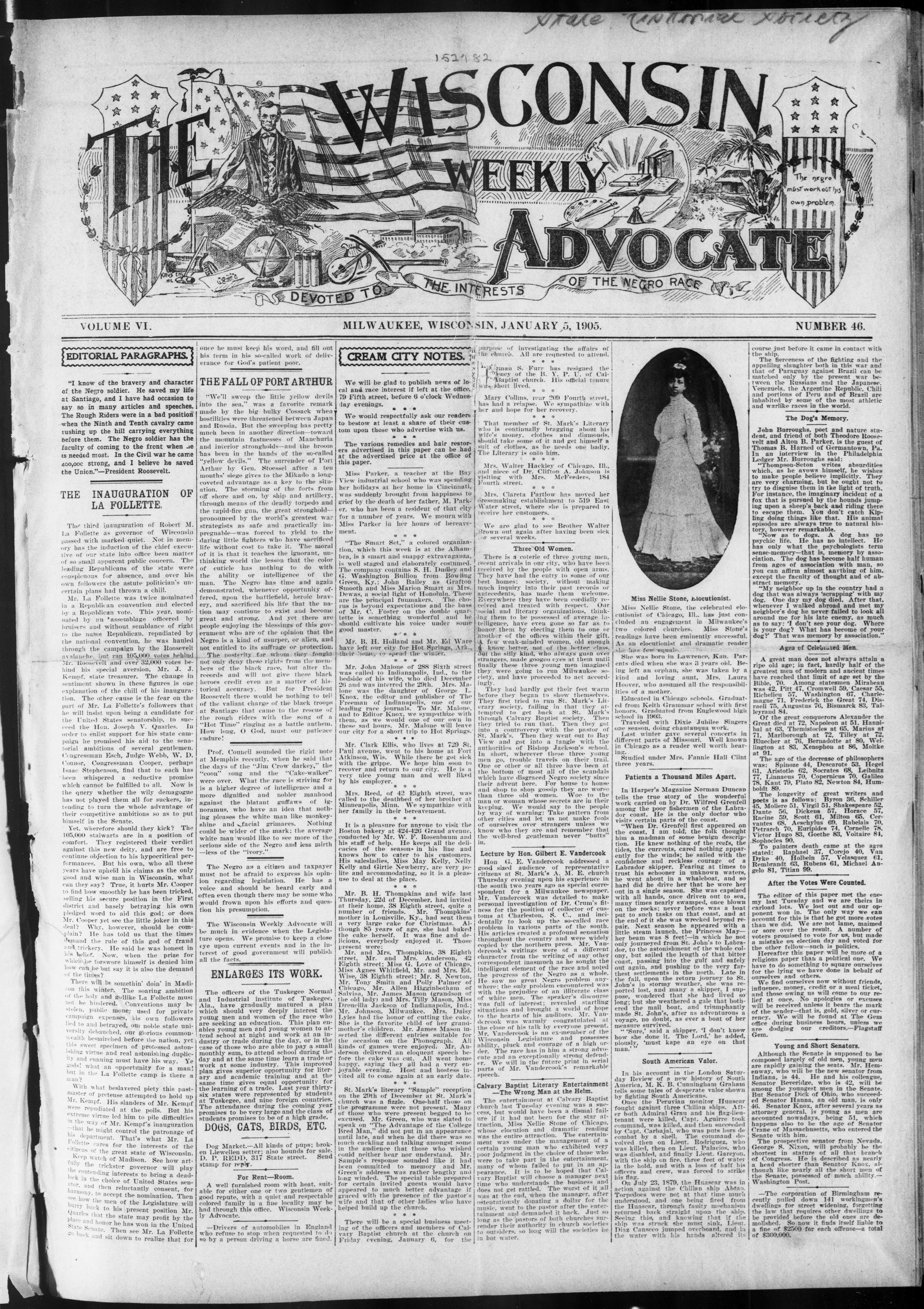
WISCONSIN
WEEKLY
ADVOCATE
DEVOTED TO THE INTERESTS OF THE NEGRO RACE
EDITORIAL PARAGRAPHS.
"I know of the bravery and character of the Negro soldier. He saved my life at Santiago, and I have had occasion to say so in many articles and speeches. The Rough Riders were in a bad position when the Ninth and Tenth cavalry came rushing up the hill carrying everything before them. The Negro soldier has the faculty of coming to the front when he is needed most. In the Civil war he came 400,000 strong, and I believe he saved the Union."—President Roosevelt.
THE INAUGURATION OF LA FOLLETTE.
The third inauguration of Robert M. La Follette as governor of Wisconsin passed with marked quiet. Not in memory has the induction of the chief executive of our state into office been matter of so small apparent public concern. The leading Republicans of the state were conspicuous for absence, and over his own followers the astute politician's uncertain plans had thrown a chill.
Mr. La Follette was twice nominated in a Republican convention and elected by a Republican vote. This year, nominated by an assemblage officer by bruisers and without semblance of right to the name Republican, repudiated by the national convention, he was hauled through the campaign by the Roosevelt avalanche, but ran 105,000 votes behind Mr. Roosevelt and over 32,000 votes behind his special aversion, Mr. J. J. Kempf, state treasurer. The change in sentiment shown in these figures is one explanation of the chill of his inauguration. The other cause is the fear on the part of Mr. La Follette's followers that he will insist upon being a candidate for the United States senatorship, to succeed the Hon. Joseph V. Quarles. In order to enlist support for his state campaign he promised his aid to the senatorial ambitions of several gentlemen. Congressman Esch, Judge Webb, W. D. Connor, Congressman Cooper, perhaps Isaac Stephenson, find that to each has been whispered a seductive promise which cannot be fulfilled to all. Now is the query whether the wily demagogue has not played them all for suckers, intending to turn the whole advantage of their competitive ambitions so as to put himself in the Senate.
Yet, wherefore should they kick? The 105,000 stalwarts are in a position of comfort. They registered their verdict against this new deity, and are free to continue objection to his hypocritical performances. But his own, who all these years have upheld his claims as the only good and wise man in Wisconsin, what can they say? True, it hurts Mr. Cooper to find how smoothly he has been tricked, selling his secure position in the First district and basely betraying his own pledged word to aid this god; or does Mr. Cooper yet see the little joker in this deal? Why, however, should he complain? He has told us that the times demand the rule of this god of fraud and trickery. He said he was honest in his belief. Now, when the prize for which he forswore himself is denied him how can he but say it is also the demand of the times?
There will be somethin' doin' in Madison this winter. The soaring ambition of the holy and godlike La Follette must not be hindered. Conventions may be stolen, public money used for private campaign expenses, his own followers lied to and betrayed, our noble state university debauched, our glorious commonwealth besmirched before the nation, yet this sweet specimen of professed astonishing virtue and real astonishing duplicity and cunning must have his way. Ye gods! what an opportunity for a man! but in the La Follette camp is there a man?
With what beslavered piety this pastmaster of pretense attempted to hold up Mr. Kempf. His slanders of Mr. Kempf were repudiated at the polls. But his extreme virtue led him to pile difficulties in the way of Mr. Kempf's inauguration—that he might control the patronage of his department. That's what Mr. La Follette cares for the interests of the citizens of the
Keep watch of Madison. See how artfully the trickster governor will play the contending interests to bring a deadlock in the choice of United States senator, and then reluctantly consent, for harmony, to accept the nomination. Then see how the men of the Legislature will hurry back to his present position Mr. Quarles that the state may profit by the place and honor he has won in the United State Senate. Then see Mr. La Follette go back and sit down to realize that for
once he must keep his word, and fill out his term in his so-called work of deliverance for God's patient poor.
THE FALL OF PORT ARTHUR
"We'll sweep the little yellow devils into the sea," was a favorite remark made by the big bulky Cossack when hostilities were threatened between Japan and Russia. But the sweeping has pretty much been in another direction—toward the mountain fastnesses of Manchuria and interior strongholds—and the broom has been in the hands of the so-called "yellow devils." The surrender of Port Arthur by Gen. Stoessel after a ten months' siege gives to the Mikado a long-coveted advantage as a key to the situation. The storming of the forts from off shore and on, by ship and artillery, through means of the deadly torpedo and the rapid-fire gun, the great stronghold—pronounced by the world's greatest war strategists as safe and practically impregnable—was forced to yield to the daring little fighters who have sacrificed life without cost to take it. The moral of it is that it teaches the ignorant, unthinking world the lesson that the color of cuticle has nothing to do with the ability or intelligence of the man. The Negro has time and again demonstrated, whenever opportunity offered, upon the battlefield, heroic bravery, and sacrificed his life that the nation may continue to exist and become great and strong. And yet there are people enjoying the blessings of this government who are of the opinion that the Negro is a kind of usurper, or alien, and not entitled to its suffrage or protection.
The posterity for whom they fought not only deny these rights from the members of the black race, but alter the records and will not give these black heroes credit even as a matter of historical accuracy. But for President Roosevelt there would be nothing to tell of the valiant charge of the black troops at Santiago that came to the rescue of the rough riders with the song of a "Hot Time" ringing as a battle anthem. How long, O God, must our patience endure!
Prof. Council sounded the right note at Memphis recently, when he said that the days of the "Jim Crow darkey," the "coon" song and the "Cake-walker" were over. What the race is striving for is a higher degree of intelligence and a more dignified and nobler manhood against the blatant guffaws of ignoramus, who have an idea that nothing pleases the white man like monkey-shine and facial grimaces. Nothing could be wider of the mark; the average white man would like to see more of the serious side of the Negro and less mirth—less of the "ivory."
The Negro as a citizen and taxpayer must not be afraid to express his opinion regarding legislation. He has a voice and should be heard early and often even though there may be some who would frown upon his efforts and question his presumption.
The Wisconsin Weekly Advocate will be much in evidence when the Legislature opens. We promise to keep a close eye upon current events and in the interest of good government will publish all the facts.
ENLARGES ITS WORK.
The officers of the Tuskegee Normal and Industrial institute of Tuskegee, Ala., have gradually matured a plan which should very deeply interest the young men and women of the race who are seeking an education. This plan enables young men and young women to attend school at night and work at an industry or trade during the day, or in the case of those who are able to pay a small monthly sum, to attend school during the day and at the same time learn a trade or work at some industry. This improved plan gives superior opportunity for literary and academic training and at the same time gives equal opportunity for the learning of a trade. Last year thirty-six states were represented by students at Tuskegee, and nine foreign countries. The attendance during the coming year promises to be very large and the class of students promises to be of a high grade. DOGS. GATS. BIRDS. ETC.
---
Dog Market.—All kinds of pups; broken Llewellen setter; also hounds for sale. D. P. REDD, 317 State street. Send stamp for reply.
For Rent—Room.
A well furnished room with heat, suitable for either one or two gentlemen of good repute, with a quiet and respectable colored family in a fine locality may be had through this office. Wisconsin Weekly Advocate.
Drivers of automobiles in England who refuse to stop when requested to do so by a person driving a horse are fined.
MILWAUKEE, WISCONSIN. JANUARY 5. 1905
CREAM CITY NOTES.
We will be glad to publish news of local and race interest if left at the office, 79 Fifth street, before 6 o'clock Wednesday evenings.
We would respectfully ask our readers to bestow at least a share of their custom upon those who advertise with us.
The various remedies and hair restorers advertised in this paper can be had at the advertised price at the office of this paper.
Miss Parker, a teacher at the Bay View industrial school who was spending her holidays at her home in Cincinnati, was suddenly brought from happiness to grief by the death of her father, M. Parker, who has been a resident of that city for a number of years. We mourn with Miss Parker in her hours of bereavement.
"The Smart Set," a colored organization, which this week is at the Alhambra, is a smart and snappy extravaganza, is well staged and elaborately costumed. The company contains S. H. Dudley and G. Washington Bullion from Bowling Green, Ky.; John Bailey as Grafton Smooth and Miss Marion Smart as Mrs. Dewas, a social light of Honolulu. These are the principal funmakers. The chorus is beyond expectations and the bass of Mr. C. Foster on the double quartette is something wonderful and he should cultivate his voice under some good master.
Mr. B. H. Holland and Mr. Ed Ware have left our city for Hot Springs, Ark., their home, to spend the winter.
Mr. John Malone of 288 Sixth street was called to Indianapolis, Ind., to the bedside of his wife, who died December 26 and was interred the 29th. Mrs. Malone was the daughter of George L. Knox, the editor and publisher of The Freeman of Indianapolis, one of our leading race journals. To Mr. Malone, and to Editor Knox, we sympathize with them, as we would one of our own in these sad hours. Mr. Malone will leave our city for a short trip to Hot Springs.
Mr. Clark Ellis, who lives at 729 St. Paul avenue, went to his home at Fort Atkinson, Wis. While there he got sick with the grippe. We hope him soon to recover and return to our city. He is a very nice young man and well liked by his employer.
Mrs. Reed, of 42 Eighth street, was called to the deathbed of her brother at Minneapolis, Minn. We sympathize with her family in their bereavement.
* * *
It is a pleasure for anyone to visit the Boston bakery at 424-426 Grand avenue, conducted by Mr. W. F. Rosenbaum and his staff of help. He keeps all the delicacies of the season in his line and knows how to cater to his customers. His salesadies, Miss May Kelly, Nelly Kelly and Girtie Newberry, are very polite and accommodating, so it is a pleas- use to deal at the place.
```markdown
```
Mr. B. H. Thompkins and wife last Thursday, 22d of December, had invited at their home, 38 Eighth street, quite a number of friends. Mr. Thompkins' mother in Louisville, Ky., had sent them a very large cake for Christmas. Although 85 years of age, she had baked the cake herself. It was fine and delicious, everybody enjoyed it. Those present were:
Mr. and Mrs. Thompkins, 38 Eighth street, Mr. and Mrs. Anderson, 42 Eighth street; Miss G. Love of Chicago, Miss Agnes Whitfield, Mr. and Mrs. Ed. Wise, 38 Eighth street; Mr. S. Newton, Mr. Tony Smith and Polly Palmer of Chicago, Mr. Allen Higginbotham of Salvisa, Mr. James Mason (grandson of the old lady) and Mrs. Tilly Mason, Miss Dreucilla Jackson of Indianapolis, Ind.; Mr. Johnson, Milwaukee. Mrs. Daisy Lyles had the honor of cutting the cake. She is the favorite child of her grandmother's children. Mr. James Mason inserted the different entries suitable for the occasion on the Phonograph. All kinds of games were enjoyed. Mr. Anderson delivered an eloquent speech before the cake was cut. All went home happy, saying they all had a very enjoyable evening. Host and hostess invited all to come again at an early date.
St. Mark's literary "Sample" reception on the 29th of December at St. Mark's church was a fizzle. One-half those on the programme were not present. Many of those who were present begged to be excused. Mr. Green, who was slated to speak on "The Advantage of the College Bred Man," did not put in an appearance until late, and when he did there was so much cackling and talking amongst some in the audience that those who wished could neither hear nor understand. Mr. Sample's response sounded like it had been committed to memory and Mr. Green's address was rather lengthy and long winded. The special table prepared for certain invited guests would have appeared to much better advantage if graced with the presence of the pastor's wife and that of other ladies who have helped build up the church.
There will be a special business meeting of the officers and members of Calvary Baptist church at the church on Friday evening. January 6. for the
purpose of investigating the affairs of
the church. All are requested to attend.
* * *
Lerman S. Furr has resigned the
ency of the B. Y. P. U. of Cal-
Baptist church. His official tenure
was short lived.
* * *
Mary Collins, rear 209 Fourth street,
has had a relapse. We sympathize with
her and hope for her recovery.
* * *
That member of St. Mark's Literary
who is continually bragging about his
wife's money, clothes and diamonds,
should take some of it and get himself a
suit of clothes, as he needs one badly.
The Literary is onto him.
Mrs. Walter Hackley of Chicago, Ill., and niece of Dr. Clifton A. Johnson is visiting with Mrs. McFeeders, 184 Fourth street.
Mrs. Clareta Partlow has moved her dressmaking establishment to 519 East Water street, where she is prepared to receive her customers.
We are glad to see Brother Walter Brown out again after having been sick for several weeks.
Three Old Women.
There is a coterie of three young men, recent arrivals in our city, who have been received by the people with open arms. They have had the entry to some of our best homes; society, without making much inquiry into their past records or antecedents, has made them welcome. Everywhere they have been cordially received and treated with respect. Our social and literary organizations, thinking them to be possessed of average intelligence, have even gone so far as to honor them by electing them to one or another of the offices within their gift. A few weak-minded women, old enough to know better, not of the better class, but the silly kind, who always gush over strangers, made googoo eyes at them until finally these three young men imagined they were going to run Milwaukee society, and have proceeded to act accordingly.
They had hardly got their feet warm before they began to show themselves. They first tried to run St. Mark's Literary society, failing in that they attempted to get back at St. Mark's through Calvary Baptist society. Then they tried to run that. Then they got into a controversy with the pastor of St. Mark's. Then they went out to Bay View and got into a tangle with the authorities of Bishop Jackson's school. In short, wherever these three young men go, trouble travels on their trail. One or other or all three have been at the bottom of most all of the scandals which have disgraced Negro society since their advent here. For house to house and shop to shop gossip they are worse than three old women. Woe to the man or woman whose secrets are in their keeping. We would say to the people by way of warning: Take pattern from other cities and let us not make fools of ourselves over strangers unless we know who they are and remember that the well-bred gentleman never "butts" in.
Lecture by Hon. Gilbert E. Vandercook
Hon G. E. Vandercook addressed a good sized audience of representative citizens at St. Mark's A. M. E. church Thursday evening upon his experience in the south two years ago as special correspondent for a Milwaukee newspaper. Mr. Vandercock was detailed to make personal investigation of Dr. Crum's fitness for the position of collector of customs at Charleston, S. C., and incidentally to look up the so-called race problem in various parts of the south. His articles created a profound sensation throughout the country and were widely copied by the northern press. Mr. Vandercook's writings were of a different character from the writing of any other correspondent inasmuch as he sought the intelligent element of the race and noted the progress of the Negro as a whole. He saw no great Negro problem anywhere; the only problem encountered was with the prejudice of an illiterate class of white men. The speaker's discourse was full of interest; revealed startling situations and brought a world of hope to the hearts of his auditors. Mr. Vandercook was warmly congratulated at the close of his talk by everyone present. Mr. Vandercook is an ex-member of the Wisconsin Legislature and possesses ability, pluck and courage of a high order. The race has in him a strong advocate and an exceptionally strong defender. We will in the future print in serial parts of Mr. Vandercook's remarkable speech.
Calvary Baptist Literary Entertainment
The Wrong Man at the Helm.
The entertainment at Calvary Baptist church last Tuesday evening was a success, but would have been a dismal failure if it had not been for the star attraction, Miss Nellie Stone of Chicago, whose elocution and dramatic reading was the entire attraction. The entertainment was under the management of a certain young man who exhibited very poor judgment in the choice of those who were to take part in the entertainment, many of whom failed to put in an appearance. It is to be hoped that Calvary Baptist will choose a manager next time who understands the business and does not get rattled. The worst of it all was at the end, when the manager, after ostentationally donating a dollar for the music, went to the pastor after the entertainment and demanded it back. Just so as the pastors of both churches surrender their authority in church societies to outsiders, so long will the societies be in hot water.
Miss Nellie Stone, Elocutionist.
Miss Nellie Stone, the celebrated elocutionist of Chicago, Ill., has just concluded an engagement in Milwaukee's two colored churches. Miss Stone's readings have been eminently successful. As an elocutionist and dramatic reader she has few equals.
She was born in Lawrence, Kan. Parents died when she was 3 years old. Being left an orphan, she was taken by a kind and loving aunt, Mrs. Laura Hoover, who assumed all the responsibilities of a mother.
Educated in Chicago schools. Graduated from Keith Grammar school with first honors. Graduated from Englewood high school in 1903.
Traveled with Dixie Jubilee Singers one season, doing chautauqua work.
one season, doing chaundaqula work. Last winter gave several concerts in different parts of Missouri. Well known in Chicago as a reader well worth hearing. Studied under Mrs. Fannie Hall Clint three years.
Patients a Thousand Miles Apart.
In Harper's Magazine Norman Duncan tells the true story of the wonderful work carried on by Dr. Wilfred Grenfell among the poor fishermen of the Labrador coast. He is the only doctor who visits certain parts of the coast.
"When Dr. Grenfell first appeared on the coast, I am told, the folk thought him a madman of some benign description. He knew nothing of the reefs, the tides, the currents, cared nothing apparently for the winds; he sailed with the confidence and reckless courage of a Labrador skipper. Fearing at times to trust his schooner in unknown waters, he went about in a whaleboat, and so hard did he drive her that he wore her out in a single season. She was capsized with all hands, once driven out to sea, many times nearly swamped, once blown on the rocks; never before was a boat put to such tasks on that coast, and at the end of it she was wrecked beyond repair. Next season he appeared with a little steam launch, the Princess May—her beam was 8 feet!—in which he not only journeyed from St. John's to Labrador, to the astonishment of the whole colony, but sailed the length of that bitter coast, passing into the gulf and safely out again, and pushing to the very farthest settlements in the north. Late in the fall, upon the return journey to St. John's in stormy weather, she was reported lost, and many a skipper. I suppose, wondered that she had lived so long; but she weathered a gale that bothered the mail boat, and triumphantly made St. John's, after as adventurous a voyage, no doubt, as ever a boat of her measure survived.
"Sure,' said a skipper, 'I don't know how she done it. The Lord,' he added, piously, 'must kape an eye on that man.'"
South American Valor.
In his account in the London Saturday Review of a new history of South America, M. K. B. Cunningham Graham tells some tales of desperate valor shown by fighting South Americans.
Once the Peruvian monitor Huascar fought against three Chilian ships. After both Admiral Grau and his flag-lien-ttenant were killed, Capt. Aguirre took command, was killed, and then succeeded by Capt. Carbajal, who was puts hors de combat by a shell. The command devolved then on Lieut. Rodriguez, who was killed, then on Lieut. Palacios, who was disabled, and finally Lieut. Gareyon, with the ship on fire, three feet of water in the hold, and with a loss of half his officers and crew, was forced to strike his flag.
On July 23, 1879, the Huascar was in action against the Chilian ship Abtao. Torpedoes were not at that time much understood, and one being fired from the Huascar, through faulty mechanism returned back straight upon the ship. Seeing this, and knowing that if the ship was struck she must sink, Lieut. Diaz Canseco jumped overboard, and in the water with his hands altered its
course just before it came in contact with the ship.
The fierceness of the fighting and the appalling slaughter both in this war and that of Paraguay against Brazil can be matched only by the present war between the Russians and the Japanese, Venezuela, the Argentine Republic, Chili and portions of Peru and of Brazil are inhabited by some of the most athletic and warlike races in the world.
The Dog's Memory.
John Burroughs, poet and nature student, and friend of both Theodore Roosevelt and Alton B. Parker, is the guest of Thomas B. Harned of Germantown, Pa. In an interview in the Philadelphia Ledger Mr. Burroughs said: "Thompson-Seton writes absurdities which, as he avows himself, he wishes to make people believe implicitly. They are very charming, but he ought not to try to disguise them in the light of truth. For instance, the imaginary incident of a fox that is pursued by the hounds jumping upon a sheep's back and riding there to escape them. You don't catch Kipling doing things like that. His animal episodes are always true to natural history, however remarkable.
"Now as to dogs. A dog has no psychic life. He has no intellect. He has only what the psychologists term sense-memory—that is, memory by association. The dog has become half human from ages of association with man, so you can affirm almost anything of him, except the faculty of thought and of abstract memory.
"My neighbor up in the country had a dog that was always 'scrapping' with my dog. One day my dog died. After that, whenever I walked abroad and met my neighbor's dog he never failed to look all around me for his late enemy, as much as to say: 'I don't see your dog. Where is your dog? What has become of your dog?' That was memory by association."
Ages of Celebrated Men.
A great man does not always attain a ripe old age; in fact, hardly half of the greatest men of modern and ancient times have reached that limit of age set by the Bible, 70. Among statesmen Mirabeau was 42, Pitt 47, Cromwell 59, Caesar 55, Richelieu 57, Washington 67, Charlemagne 71, Frederick the Great 74, Disraeli 75, Augustus 76, Bismarck 83, Talleyrand 84.
Of the great conquerors Alexander the Great died at 72, Napoleon at 51. Hannibal at 63, Themistocles at 65, Marius at 71, Marlborough at 72, Tilley at 72, Bluecher at 76, Bernadotte at 80, Wellington at 83, Xenophon at 86, Moltke at 91.
The age of the decrease of philosophers was: Spinoze 44, Descarots 53, Hegel 61, Aristotle 62, Socrates 68, Leibnitz 77, Linnaeus 70, Copernicus 70, Galileo 78, Kant 79, Plato 82, Newton 84, Humboldt 89.
The longevity of great writers and poets is as follows: Byron 36, Schiller 45, Moliere 51, Virgil 51, Shakespeare 52, Dante 56, Dickens 57, Horace 57, Racine 59, Scott 61, Milton 65, Cervantes 68, Aeschylus 69, Rabelais 70, Petrarch 70, Euripides 74, Cornelle 78, Victor Hugo 80, Goethe 83, Voitaire 84, Sophocles 90.
To painters death came at the ages stated: Raphael 37, Corejo 40, Van Dyke 40, Holbein 57, Velasquez 61, Rembrandt 63, Rubens 61, Michael Angelo 81, Titian 99.
After the Votes Were Counted.
The editor of this paper met the enemy last Tuesday and we are theirs in carload lots. We lost out and our opponent won in. The only way we can account for this is that he got more votes than we did. We are not lame, maimed or sore over the result. A number of voters promised to vote for us, but made a mistake on election day and voted for the other fellow—such is politics.
Hereafter this paper will be more of a religious paper than a political one. We have to do something to square ourselves for the lying we have done in behalf of ourselves and others.
We find ourselves now without friends, influence, money, credit or a meal ticket, and those owing us will come to our relief at once. No apologies or excuses will be received unless it bears the mark of the sender—that is, gold, silver or currency. We will be found at The Gem office during business hours, unless we are dodging our creditors.—Flagstaff Gem.
Young and Short Senators
Although the Senate is supposed to be composed largely of old men, young men are rapidly gaining the seats. Mr. Hemenway, who will be the new senator from Indiana, is 44. He and his colleague, Senator Beveridge, who is 42, will be among the youngest men in the Senate. But Senator Dick of Ohio, who succeeded Senator Hanna, an old man, is only 46. Senator Knox, after several years as attorney general, is young as men are accounted nowadays, being 51, which happens also to be the age of Senator Crane of Massachusetts, who entered the Senate with him.
The prospective senator from Nevada, George S. Nixon, will probably be the shortest in stature of all that branch of Congress. He is described as nearly a head shorter than Senator Knox, although like nearly all the short men of the Senate, possessed of much ability. Washington Post.
The corporation of Birmingham recently pulled down 141 workingmen's dwellings for street widening, forgetting the law that requires other dwellings to be provided before the old ones are demolished. So now it finds itself liable to a fine of $2500 for each offense—a total of $260,000.
RED HAIR IS NOW POPULAR.
Woman with Auburn Tresses Comments on the Change in Taste.
"If I had waited twenty years about getting myself born, I'd have saved myself innumerable heartaches," said a Georgetown woman. "My hair, as you see, is a warm Titian shade. When I was a child it was plain red, and I was commonly called 'brick top' and 'carrots.' What misery I endured on account of that flaming hair of mine! I washed it in sage tea, I soaked it in iron rust water, and I shed tears enough because of its color to float a battleship. I used to long for something to frighten me enough to turn it white. My only grain of comfort was the hope that it would darken as I grew older. Nobody considered red hair anything but a horror in those days. It's so different now. I didn't realize how different till I took my little niece downtown the other day to buy her a doll. She passed rows of black and blond haired dolls disdainfully. At length we came to a case full of dolls whose hair was exactly the shade mine used to be. "Oh, I want one of these" said she.
Look at their lovely, lovely red hair. "The toy man who showed red haired dolls in my day would have been considered mad, but now they tell me the red haired doll is the most popular novelty of the season. What that means as to the attitude of modern children toward red hair only one who was a red haired child twenty years ago can tell. It was thoughtless of me to be born so soon." Washington Post.
Seizures by Secret Service Men
One of the messengers in the rooms of Chief Wilkie of the secret service sat pulling scarf pins out of papers. There were several hundred loose pins, and more than that remained to be taken out of the papers.
"Those are pins that were seized a few days ago by some of our men," said Chief Wilkie. "They probably appear to be harmless, but if you will observe you will see that the mounting of the pins is a representation of one side of a gold dollar. This is a violation of the laws of the United States. These plainly say that there shall be no fac simile of any coin or obligation of the United States, and these pins were made in imitation of one dollar gold pieces. It is true that no attempt was made to pass them as money, but the law was violated, nevertheless, when they were turned out, and we seized them so as to prevent them going into circulation."
In past years the secret service has seized many advertising schemes that bore fae similes of United States notes. Nothing of that kind is allowed to be put into circulation. Newspapers are not allowed to print a fae simile of a note or coin at any time. The secret service has many facsimiles of Confederate notes that have likewise been seized. They resemble United States bills to a certain extent, and for that reason are seized whenever they are found.—Washington Star
Oil on the Black Coffee.
The cup of black coffee had on its surface a little oil. This oil shimmered, it gave forth delicate, changing colors, like oil on water. The man who was about to drink the coffee gazed at it with delight.
"The oil," he said, "teils me all I want to know about the coffee. Now, without tasting it, I am sure it is superb.
"The whole secret of coffee making," he went on, "lies in extracting and retaining this oil. This oil it is which gives coffee its aromatic and delicious taste. This oil it is also which stimulates you, which makes you feel, after you have drunk it strong and gay.
"Good coffee—the kind with oil affloat on it—can only be made by excellent cooks. In millionaires' houses, or in hotels where they employ French chefs, you are likely to get it. But the average American housewife does not know how to make this oily kind of coffee at all."—Philadelphia Bulletin.
Richest Girl in the World
Undoubtedly the richest girl in the world is Miss Krupp, who on the death of her father became chief proprietor of the world-famed Krupp works at Essen, Germany. This girl holds the fate of almost all nations, except our own, in her hand, for if the Krupp works refused to supply any country with guns, that country would be in a bad way as a military power. A great deal of the artillery of Russia, Japan, France, Germany and Italy was manufactured at the Krupp works, and during the South African war England had to apply to the Krupp works to supply urgently needed weapons.—Leslie's Weekly.
Whales on Their Holidays
Prof. Goldlob has been telling the Christiania Academy of Science the results of his investigations into the migrations of whales. These creatures hang about the coast of Norway and Finland until the spring is well advanced, and then they go away on their travels. Some go to the Azores, others to Bermuda and the Antilles, and they cover these enormous distances in an incredibly short time. Some of them bring back harpoons which bear the names of ships and other evidences of where these migrants have been for their summer holidays.
Prosperity in Oklahoma.
A man living near this city last spring was clear down on his uppers—he was broke. He didn't have a cent. But he was honest and his credit was good. He rented a piece of ground, borrowed $100 and bought his groceries on credit. On October 1 he owed $125 for groceries, besides the $100 he borrowed. Today he owes no man a cent; he has bought a good team, harness and wagon, has between $400 and $500 in the bank and his crop is not nearly all marketed yet. How did he do it? One word tells the whole story—cotton.—Apache Review.
Great Timber Waste.
The annual consumption of ties on the 263,132 miles of railroad track in this country is 114,000,000. Every year finds it harder for the railroads to get their supply. Granite, metal and concrete ties have been experimented with, but now permanently adopted. In Europe the railroads have for a long time been treating their ties by various chemical processes, which have more than trebled their lives. The bureau of forestry at Washington has been conducting experiments along these lines for some time.
Remembers His Benefactor.
Prompted by a desire to help a penisless young man struggling against adversity among strangers, Claude E. Reynolds, a business man of St. Peter, Minn., years ago befriended Miles S. Thompson of Peru, Ind. Now he is rewarded with a tidy legacy. Thompson died this week in Peru and bequathed his estate of $6000 to his benefactor.
The elephant of Ceylon is going the way of the American buffalo. It is estimated that only 2000 elephants are left on that island.
The Evening Wisconsin is mailed regularly to subscribers at 1686 different postoffices in the state of Wisconsin.
New electric street cars, controlled by Denes, run at a fast pace over an 11-mile route in and about Bangkok.
THE OLD AND NEW.
1904 is down and out,
1904 is put to rout.
1904
Is no more—
1904 is up the spout.
1904 is quite upwound,
1905 is rapture-crowned,
Like a gay,
Blue-eyed fay,
Blushing, gushing, hatward bound.
1904 is now a wreck,
1905 is now on deck,
May it bring
On the wing
Golden blessings by the peck.
May the goods for which we strive
During this new year arrive,
Till we may
Shout "Hooray!
Hip-hooray for 1905!" —Judge,
LIZ
Liz had been nine and a half ever since her seventh birthday. This was in tribute to the efficacy of a rule in force at various art schools to meet any possible interference from philanthropic societies. It was a well meaning rule, and as potent as many excellent things. Liz herself regarded it with favor; it restricted competition. When occasionally conscientious persons asked her age, she replied with a glibness rendered perfect by four years' habit.
She knew the ways of every art school in the city, and her small, attenuated body, her red hair and greenish eyes were as familiar to students as the plaster casts in the antique gallery. She had almost the dignity of a classic. Her freckled, unchildlike face held the old fashioned look which comes early to children who have been at hand-grips with circumstance. There was at times something uneanny in her gaze. It was furtive, derisive, infinitely experienced. It had the appalling solemnity of the ages.
She posed for the night classes at a suburban art school. Every evening, from 7 to 10, she sat perched on the model throne, a thin little figure, all lengths and angles, shivering under the glare of the electric light. She had all the tricks of the child model—the perpetually hitching and wriggling, the pathetic glances toward the clock which bung just out of sight on the wall behind her. She resembled a small beetle stuck on a pin.
Before her the floor of the big ugly room was a forest of casels, obstructing heads held in various positions of intentness. Green shaded electric bulbs hung like tropical blossoms from swaying stems. Eyes were turned upon her with a fixed impersonal regard, comparing and criticising. She returned their gaze wit' a stolid antagonism, almost a contempt. To her these twenty students were things as wooden and unimportant as the casels behind which they worked. Seated aloft, she had the supreme pride of the indispensable.
The atmosphere of the classroom was that of a hothouse, close and vitiated, and filled with the mingled smell of varnish and hot air pipes and turpentine. It was a part of Liz's pride that she had never been known to faint. She had a profound contempt for models who fainted. She held her post doggedly, even when the room seemed to fill with a soft black mist, and the easels rocked and wavered, and voices and the scratching of palette knives were remote sounds in a vast engulfing stillness. She could feel the stillness like a drowsy tide, lapping closer till it crept up and touched her limbs, and she knew that if she shut her eyes she would be swept away. She set her teeth and blinked back at the electric light, beating down on her like a fierce white sunshine. The clock ticked away interminable minutes, while she fixed her gaze upon one bulb and outstared it resolutely, til her eyes smarted and she could see only that writhing white-hot thread against a dissolving background. It shrank and expanded, changed to a hundred menacing shapes, drew to sudden huge proportions and swam close to her * * * and then from the other side of a black world the monitor's voice said reluctantly, "Rest," and she roused with a jerk and slid down unsteadily to the unsteady floor.
The students were kind to her after a fashion—the girls of the costume class particularly. They petted her, buttoned her frocks, occasionally gave her candy. She met their overtures with an unresponsive gravity, the attitude of the worker toward the dilettante. They were an impulsive and youthful set, and she had the effect at times of making them appear infantine. When they clustered about her in the rest hour she regarded them stolidly. They tried to involve her in confidence about her home life, but without success. Liz was the sixth of an improvident Irish family, and she knew that her home life did not bear mentioning.
There was only one student in whom she took a personal interest. He was senior student of the night class. The night class had on the whole had a reputation for taking itself seriously, and this student in particular emphasized the tendency. He was a tall young man with an untidy brown head and a trick of whistling reflectively over his work. He was generally the first to come and the last to leave. Three out of four nights a week, when Liz arrived, he was there, his easel adjusted to the chalk marks on the floor, working over the efforts of the night before. He always nodded to her as she came in, a quaint, shabby little figure, and passed across to the screen which was her improvised dressing room. Liz came to look for this greeting, which established between them a tacit friendship.
His easel stood among those nearest to the model throne, and from her post of vantage Liz could watch him as he worked. When her cramped childish muscles refused obedience, and the other students complained indignantly that she had moved, she would catch his brown eyes lifted to her with a kindly smile. He was the only one of the class who ever seemed to realize how tired she got. Once or twice he had noticed the forlorn airoop of her head as the clock toiled slowly to the half-hour, and had called the rest two minutes too soon. The second time this happened there was indignant altercation, in which the tall student held his ground unmoved. Liz, listening, felt her heart swell with the first real gratitude she had ever known. Gradually she came to have for the tall student a sort of distant hero worship, the idolizing attachment of the very small girl for the grown-up man.
She lived solely for those three hours of the night class, and their routine became a joy of service. She would hold the pose, unwavering, to the last minute, so long as his brush hovered before the canvas. If he smiled at her she dwelt in
paradise; if, as more often happened, absorbed in his work, he took no notice of her beyond the impersonal regard of the artist, she sat sullen and abandoned of the gods. She nursed her adoration in secret as a miser nurses gold; her small, unnoticed soul thrilled to strange depths. It was a quaint little drama, and it was natural that the only person in the classroom who remained unconscious was the tall student himself. Dismissed at the end of the class, she used to hang about the big, echoing hall, with its marble staircase and big plaster statues, on the chance of seeing him as he went out. He passed hurriedly by, sometimes alone, sometimes in company with others, laughing and chatting, and never saw her. She came early, and lingered near his easel, watching him put out his colors. She stood by his shoulder while he put in reflective touches here and there, his brows knitted and his head held critically on one side. Sometimes he scarcely knew she was there. If he spoke to her, beyond the habitual mechanical greeting, she stood confused and tonguetied; a small, guilty criminal, convicted of her guilt. Sometimes other students came early, too, and then she hated them with a deep and jealous hatred. She recognized in their chance intervention between herself and her idol a conspiracy of the universe.
It drew near the end of her series of sittings, and Liz counted the evenings one by one. There were two lost and desolate nights when the tall student never came at all. Another student took his place, and Liz had no heart in her work. She posed like a rag doll, and bitter complaint rose from various quarters of the classroom. She heard them and her greenish eyes hardened to sullenness. She was all but openly rebellious. Her grievance against fate expended.
on the unoffending class; she hated them.
On the last evening he was there when she arrived, already in position, making up for lost time. It was a cold, snowy night, and as Liz halted by his easel, the wet snow which had clung to her small clumsy boots melted into little pools on the classroom floor. The student looked up and smiled at her.
"Well, it's a cold night!" he said.
"Aren't you wet? Why don't you go over by the stove and get warm?"
She smiled back at him, the half bashful smile that sat so oddly on her grave, unchildish face. Something in her look appealed to him; in his suburban home he had a small sister just Liz's age. He put his arm round her and pulled her close to his chair.
"Well, do you think that's like you?" he said.
Liz looked at the canvas, then back at him, flushing to the roots of her red hair. "I dunno," she said.
He picked up a tube from the open paintbox at his feet, and began to squeeze out color on his palette. She still hung near, wistful, expectant. But he went on with his work, and presently other students came in; there was a clatter of tongues, a scraping of casels. The clock hands ticked to 7, and Liz crept disappointed away.
One of the newcomers lounged across the room, pulling on a linen painting coat. "That kid's taken a fancy to you, Guild!" "Eats!" said the tall student.
There was a smaller attendance than usual, owing to the stormy night. The evening had never seemed so short to Liz. The approaching disorganization of holiday time had affected the class; they joked and chatted across their easels. Even the visitor fell under the spell of geniality. He had arrived late, wearing a dress suit under his overcoat. He forgot for once to be sarcastic, and he even smiled at Liz as he crossed the floor. The spirit of the last night of the session remained unchecked.
"How long before my call?" she said absently, gazing with satisfaction at her lovely form in the long mirror, around which her dresser had switched on a circle of cunningly arranged lights.
"Ten minutes yet, mademoiselle, the boy has just passed."
"Very well, you may go. I shan't want you again. I suppose I look all right."
"Mademoiselle is superb, the gown is exquisite, ravissante. Mademoiselle will create the usual sensation." Bonat gave a last admiring glance and softly left the room.
Now that she was alone the girl bit her lips, necessitating a fresh application of rouge. Then she picked up the letter and carefully dropped it into the fire. With one small hand on the mantelpiece she watched it slowly reduced to black ashes. Gazing into the blue flames, which flickered and twisted above the charred fragments, she seemed to see a small farmhouse with whitewashed walls and an ugly slate roof. There was a grass patch in front, on which three girls and a small boy in shabby clothes were playing together. A man was lifting a crate of fowls into a dealer's cart, and in the doorway a woman, with her sleeves rolled up and a coarse linen apron round her waist, was watching the scene.
Yes, times had altered since then. How mean and squalid it all seemed! To think that she was one of those children, and that the man with an armful of cackling poultry was her father! It seemed absurd, and her eyes sought the many signs of luxury which now surrounded her. For five years the thought of these simple folk, living their dull and stupid lives in the country, had never come to her, and until this moment she had forgotten her kith and kin almost as completely as though they had never existed.
To think, then, at the hour of her triumph, when half London would be at her feet, one of these people should come and claim her as a relation. The idea was absurd, she would be the laughing stock of the place. For a moment she felt a bitter hatred for them all—how dare he come? She had shown by ignoring them for years that they were nothing to her. Of course she would not see him, and if * * *
Her thoughts were interrupted by the voice of the callboy; it was time to go on. Hastily glancing at herself in the glass and touching the corner of her eyebrow with a pencil, she drew on her wrap and was about to leave when she saw the package still flying on the table. It was a diamond bracelet from Binkle, and she fastened it on her wrist as she passed down the stairs toward the stage.
Never before had Coralie Fanchon received such a reception as she did from the crowded house that night. Her appearance was always the signal for tumultuous applause. Even the staid occupants of the stalls forgot their usual dignity, and at the end of the act threw their flowers at the beautiful young actress, who, flushed with triumph, caught the admiring gaze of Amsterley as he leaned forward in the stage box. It was
indeed a brilliant gathering, in which wealth and fashion combined to make a display of which even the first city in the world might be proud. But far up in the darkness of the gallery, packed in among a crowd of hot, struggling human beings, was a little, gray-haired man, whose pride and happiness knew no bounds. It is true he saw but little of the stage, for, as the weakest must go to the wall, he had been pushed behind a pillar which almost blocked the view. But every now and then he would catch sight of a glorious figure, dressed in soft, silvery garments, and he felt a lump in his throat as he heard the whispered name.
Could it really be his Mary, his own flesh and blood? The little man was appalled, and tears of gratitude and joy filled his eyes, and trickled down the furrows of his cheeks. He felt he must tell those around him, not that she was his daughter, but that by some wonderful ordering of Providence he had been permitted to be her father. But no one would believe him, no one indeed noticed the insignificant little figure whose heart was beating wildly at the thought of speaking to, perhaps even kissing, the girl whose every movement they watched with breathless interest.
When it was all over, and Coralie had been led forward again and again, amidst the pile of flowers which were handed up, John Cobb stumbled down the gallery steps, and took his stand in the cold, close against the stage door. Quite a crowd had assembled there already, kept in check by several burly policemen. It was weary waiting in the draughty street, but at last the actors and actresses, one by one, and in little groups, began to leave. A flutter of excitement ran through the crowd as a smartly quipped carriage and pair stopped before the door, and the police pushed the people back to make a passage. There was a little burst of cheering as Coralie, wrapped in furs, came out from the doorway and passed quickly to the carriage.
Only once did she raise her eyes, but in that moment she saw a face she remembered since a child. The old man scanned her closely, even wistfully, until suddenly the light of recognition broke in his eyes and he gave a little cry, which sounded like "Mary." The policeman pushed him roughly back, and in another moment she was being driven swiftly away.
Within the next two hours she had forgotten all in Amsterley's company. The gay restaurant was crowded, she was the center of attraction, and for the second time that evening Corane tasted the sweets of success. Afterward, as her carriage bore her through the empty streets, and she was alone once more, the future Countess of Betchworth thought of what might have been, and shuddered. Charles Thonger in the Bystander.
FORCING FLOWERS BY FIRE
Remarkable Result of a Conflagration in a French Town.
That flowers can be forced by heat such as is usually supplied to glass houses, is, of course, an old story; but that the direction action of fire heat can have any effect in hastening the blooming of plants is a fresh suggestion, but one that in these days, when flowers are demanded in season, out of season, at all times and of every kind and country, is worth consideration. Great events have frequently sprung from the smallest or the most apparently indirect causes, and a serious fire that broke out last September at Chansee-sur-Marne, between Chalons and Vitry-ie-Francois, in France, while it destroyed the greater part of a populous village, ruining many of its inhabitants, may yet have as a result the even greater development of an industry that gives employment to thousands of people.
The fire, which raged on one side of the village, made a clean sweep of everything before it in the way of buildings, and only paused when there was nothing to lick up except the orchards that once formed a hedge between the homesteads and the open country. Even then it was hardly satiated, for it greedily devoured the two first ranks of apple and pear trees, leaving nothing but cinders; the next three rows, though very scorched, were not quite destroyed, the farthest away being naturally the least affected. Some of the boughs escaped all hurt, and it was with these that the very curious phenomenon was observed which merits attention. A second nowering commenced at once, and by the end of October all the trees farthest from the scene of the fire were in full bloom, as though called to renewed life by the fresh voice of May, instead of hushing to slumber with the lullaby of October. At another point the flames had swept close to a large lilac tree, and this, as well as some plum trees, bewildered by what must have seemed to it a sudden return of summer, put on once more its bridal robes.
It must be mentioned that the fire only lasted four hours. It will be noticed, therefore, that there was no resemblance between this sudden blast of heat and the ordinary gradual forcing to which plants are submitted.—Chambers' Journal.
A Houseboat on Oil Barrels
A recent story about a houseboat built by an engineer at Watertown set four Hubbardston boys at work on a similar pleasure craft. The float, which is 12x18 feet, rests on twelve oil barrels. The house on the float is 8x9 feet, bolted in four sections so it can be readily taken to pieces. The room, which is extended to make a piazza on one end, is also built in four sections. The builders and owners of this somewhat novel craft are James F. and Fred A. McWilliams, John F. Cunningham and Charles H. Smith.
J. F. McWilliams, the oldest of the quartette, is associated in business with his father, and has unusual talent for getting up new ideas. He invented the chemical fire extinguisher system with which his father's mill is equipped. The manufacture of this fire extinguisher is rapidly growing to be the largest part of the firm's business, although it was started only a year ago as an experiment. The young man has also invented a bootjack which, when placed on the market, bids fair to be a great boon to fat men. This winter the houseboat is to be hauled up on the shore of Brigham Pond as a rest house for skating parties. Next spring the owners purpose installing a 3-horse power gasoline engine and paddlewheel on their craft for pleasure trips up and down the pond. They find paddling and poling too slow work.
The craft represents an outlay of $25, half of which was for the oil barrels.—Poston Globe.
Bear Among Shoppers.
Three men were bitten and several thousand shoppers thrown into a panic at Cleveland, O.. when a recently captured bear, brought here for sale, broke away from its captors and fan through the heart of the shopping district. Men and women scattered in every direction, fighting for entrance to the various nearby buildings. The animal sought refuge in an alley. It was tackled by a negro wrestler, who threw the animal and put a bag over its head.
New York Every Day.
Justice Olmsted handed down an opinion in the court of special sessions, holding that the law against the selling or giving away of street railway transfers is constitutional.
An old house in Sunset park, one of the landmarks of Brooklyn, has burned. It always has been thought the house was used as a hiding place for "Charley" Ross, after he was kidnapped in Philadelphia. The house was a relic of revolutionary times. Mischievous boys set it on five.
Vice Chancellor Stevenson, in Jersey City, signed an order dissolving the National Salt company of New Jersey. The motion for dissolution was made by counsel for receivers, who reported they had sold all the property of the company, and there was no reason for its further existence.
Wild scenes were enacted recently when the ferry boat Chicago of the Pennsylvania line, crowded with passengers, was run down by the steam transport Maryland. Shortly after the ferry boats Bergen and Musconetcong collided in the fog, and the panic scenes were reenacted. In neither accident was anyone injured. None of the vessels was badly damaged.
The Earl of Suffolk and his bride, formerly Miss Daisy Leiter, and Col. Colin Campbell and his bride, who was Miss Nancy Leiter, sailed for Europe on the steamer Baltic. They had the finest suites of rooms in the ship, and, despite the early hour of sailing, a number of friends were at the pier to see "the Leiter girls," as they called them, leave. There was no rice throwing.
Yves Guyot, formerly French minister of public works, was guest of honor at a dinner at the Waldorf-Astoria. Theodore Stanton of the American Chamber of Commerce of Paris presided. Among the speakers were Mr. Guyot, former Vice President Levi P. Morton, Whitelaw Reid, former ambassador to France, and Oscar S. Strauss, former minister to Turkey. Both Mr. Guyot and Mr. Stanton have sailed for Europe.
Charges of conspiracy, false pretence and forgery, involving $150,000, are made against John Bough, alias Baker, who was committed to prison at Philadelphia to await a requisition from the New York authorities. New York detectives arrested Bough as he was leaving the county prison at Philadelphia, where he had served six months for swindling operations. The charges grew out of the operations of an insurance company.
James F. Secor, builder of the Mare Island navy yard in San Francisco, the Pensacola navy yard and many of the monitors, ironclads and drydocks which contributed so largely toward putting an end to the Civil war, is dead at his country home in Pelham manor. He was 80 years old, and, until within a few hours of his death, he retained the mental clearness and physical vigor which had been the marvel of his friends for many years.
George McCullough Miller, secretary of the trustees of the Cathedral of St. John the Divine, announced recently that the sum of $600,000 has been subscribed by an anonymous donor for the completion of the choir of the cathedral. This is in addition to the sums of $100,000 and $50,000 previously announced, making $750,000 in all. Mr. Miller also announced that he has information that when $900,000 of the $1,000,000 required are subscribed another donor is prepared to furnish the remaining $100,000.
The board of education adopted by a vote of 22 to 15 a committee report which opposes the reintroduction of corporal punishment in the public schools of this city. Commissioner McGowan said: "We have enough corporal punishment in our schools now without this board placing its approval upon the custom. Numbers of cases of this nature come before the local boards every week. Where they are found to be justifiable the teachers are exonerated; where they are found not jutifiable the teachers are punished."
Heirs to the estate of Jacob Lawson, a manufacturer, who died recently from accidental asphyxiation at his home in Brooklyn, are seeking to locate his son, Edward J., supposed to be somewhere in the west. Lawson, who was supposed to be only fairly well off, was found to have left an estate amounting to $1,500,000 to be divided among three sons and a daughter. The missing son, Edward, is said to have gone to California some years ago after a disagreement with the father, but recently was heard from in St. Louis.
The United States played Santa Claus to the world at large, according to reports secured from General Superintendent Joseph Elliott of the money order division of the New York postoffice. From December 1 to December 24, 334,084 international money orders were forwarded to other lands from this city. These orders called for $4,677,628.90. "The remittances," said Elliott, "were the largest in the history of the postoffice." Of the total $1,490,200 went to Great Britain, $560,568 to Germany, and $940,000 to Italy. Other nations got proportionately large amounts.
A head tax of $2 on aliens entering the United States from Canada to cross to some Atlantic port on their way to Europe was proposed at a meeting of the Atlantic steamship conference with the Trunk Line Passenger association. This plan, which was proposed by the steamship association, is similar to that used by the steamship companies for taking care of the tax upon immigrants arriving at United States ports and intending to go through to Canadian or Mexican territory. The trunk line roads received the suggestion with favor, but there will be further conferences before the question is finally settled.
"I firmly believe that the day of the strike is over," said T. V. Powderly, former head of the Knights of Labor. "I don't mean that there is never to be another strike" he continued. "but I do mean that each year will see fewer causes for strikes, and that, as a natural result, the strike will be a thing of the past as a means of bringing employers and workingmen to amicable relations. I know of nothing so encouraging as the recent conferences between capitalists and laboring men. They have talked things over in many controversies in the last year or so, and with the invariable result of a peaceful solution of the problem."
Miss Edith M. Jones, daughter of the late Henry T. Jones, who was one of the pioneer brick manufacturers of Chicago, was married recently in New York city to Frank Tuttle, superintendent of the Standard Watch company of Jersey City. Miss Jones lived in Jersey City several years, but formerly in Elgin, Ill., where her mother lives. Miss Jones' mother opposed the match, her wish being that the young people wait a year. They came here, where a license is not required, and were married by a Methodist Episcopal clergyman, Mr. and Mrs. Tuttle have gone to Belfast, Me., the home of the bridegroom's parents, to spend their honeymoon.
NEW NAMES FOR OLD SHIPS
War Vessels Past Their Usefulness to Be Rechristened.
New names have been selected for four old warships which have outlived their usefulness as fighting machines. The New Hampshire, built in 1818 and now used by the naval militia of New York, will be named the Granite State, in order that New Hampshire may be used as the name of one of the new warships. The Dale, which was anchored at the Washington navy yard for many years and is now used by the naval militia of Maryland at Baltimore, will be renamed the Oriole. The old sloop of war St. Louis, built in this city in 1828 and now used by the naval militia of Pennsylvania at Philadelphia, will be named the Keystone State. The cruiser Iroquois, which is to be transferred to the marine hospital service, will be rechristened the Ionie.—Washington Star.
A UNIQUE INDUSTRY.
Firm at Snowflake Gathers Seeds of Jack Pine.
Johnson Brothers of Snowflake, a little town on the Pere Marquette railroad south of Charlevoix, Mich., are perhaps the only men in this region commercially engaged in extracting the seeds from the cone of the jack pine. During November and December the cones are gathered by Indians on the jack pine plains of Kalkaska county and are shipped by rail to Snowflake, where they are sorted carefully by hand and stemmed. They are then subjected to heat sufficiently to cause them to open. The seeds are taken out and "winged" by being rubbed between the palms and then are sorted, packed, weighed and shipped to nurserymen in various parts of the country. The seeds bring from $7 to $10 a pound.
Shouting Their Praises.
Kirkland, Ill., Jan. 2.—(Special.)—Cured of the terrible Rheumatic pains that made him a cripple for years, Mr. Richard R. Greenhon, an old and respected resident of this place, is shouting the praises of the remedy that cured him, Dodd's Kidney Pilis. "I had the rheumatism in my left limb so that I could not walk over ten to fifteen rods at a time and that by the use of two canes," Mr. Greenhon says. "I would have to sit or lie down on the ground when I was out trying to walk and the sweat would run down my face, with so much pain. I could not sleep at night for about five or six weeks.
"I tried different doctors' medicines, but they were all no good. Then I sent for Dodd's Kidney Pills and almost from the first they brought relief. By the time I had taken fourteen boxes of them my rheumatism was all gone and I can truly say I feel better than I have in the last twenty-five years."
ALLIGATORS IN VENEZUELA.
Killing Them Would Be a Very Profit able Business.
Among the recent interesting reports received by the department of state was one on the subject of "Alligators in Venezuela," from United States Consul E. H. Plumacher at Maracaibo. He says "though but few alligator skins are sent abroad from here, it is not on account of the scarcity of alligators. It is strange that nobody has taken up the hunting of these reptiles. They are here in the lakes and lagoons and rivers in untold numbers and of all sizes.
"The skins are well worth securing, and alligator oil brings a high price, being used for medical purposes. In the Rio de Oro and Rio Tara I have seen thousands of large alligators, which come up to deposit their eggs on the sand banks during the dry season. It is the same in all the hundreds of streams which flow into the Lake of Maracaibo. Alligator hunting is fine sport, and, in my opinion, would be a paying business."
The Rainy Day in Billyville.
The mortgage never comes due so fast as on a rainy day, an' it's then a feller's afraid to open the door, expectin' to hear the sheriff say "Good mornin'."
Only the women like the rainy day. It's then the old lady goes to readin' old love letters, an' wonderin' why she didn't take the other feller—when she had the chance.
Another thing about the rainy day is—a feller's conscience comes, an' takes a chair 'longside of him, an' he gits so uncomfortable he feels like he'd rather be a fishin'.
Well, the Lord sends the rain on the just an' the unjust—the only trouble is, there's never quite enough to drown the unjust from the face of the earth.—Atlanta Constitution.
Hobo Had Valuable Deeds
Having in his possession deeds to real estate in Chicago and nearby towns exceeding $50,000 in value, a hobo was taken from the Old Comfort lodging house at Boston, Mass., to the city hospital and died there the other afternoon. The name of Marian Fougere was the only clue the police could find either in his old black leather valise or on the papers he carried. The Chicago authorities were notified.
HABIT'S CHAIN.
Certain Habits Unconsciously Formed and Hard to Break.
An ingenious philosopher estimates that the amount of will power necessary to break a lifelong habit would, if it could be transformed, lift a weight of many tons. It sometimes requires a higher degree of heroism to break the chains of a pernicious habit than to lead a forlorn hope in a bloody battle. A lady writes from an Indiana town: "From my earliest childhood I was a lover of coffee. Before I was out of my teens I was a miserable dyspeptic, suffering terribly at times with my stomach.
"I was convinced that it was coffee that was causing the trouble and yet I could not deny myself a cup for breakfast. At the age of 36 I was in very poor health, indeed. My sister told me I was in danger of becoming a coffee drunkard.
"But I never could give up drinking coffee for breakfast although it kept me constantly ill, until I tried Postum. I learned to make it properly according to directions, and now we can hardly do without Postum for breakfast, and care nothing at all for coffee.
"I am no longer troubled with dyspepsia, do not have spells of suffering with my stomach that used to trouble me so when I drank coffee." Name given by Postum Co., Battle Creek, Mich.
Look in each pkg. for the famous little book. "The Road to Wellville."
THE WISCONSIN WEEKLY ADVOCATE.
R. B. Montgomery, Editor and Publisher.
The Wisconsin Weekly Advocate after three years' residence at 79 Fifth street, has moved its headquarters to 729 St.
Paul Ave., where we will receive our guests and transact our business in future.
A Representative Journal Devoted to the Interest of All the People.
One inch, one year..... $15.00
Two inches, one year..... 25.00
Three inches, one year..... 35.00
Four inches, one year..... 42.00
For larger space, special rates.
Locals, 10 cents per line.
TERMS OF SUBSCRIPTION.
One year ..... $2.00
Six months ..... 1.00
Three months ..... .50
Direct all communications to
R. B. MONTGOMERY,
79 Fifth Street.
HOW TO SEND MONEY.—Post Office
Order, Express Order, Draft or Registered
Letter. R. B. Montgomery will not be re-
sponsible for loss when sent in any other
way.
TO CONTRIBUTORS:
All communications must be sent with the name and address of the sender as an evidence of good faith, but not necessarily for publication. No manuscript returned if not accepted, unless accompanied by stamps.
Exports from the United States to China were valued at $13,311,488 in 1903 and $20,557,184 in 1904. The latter aggregate is half a million in excess of any previous record.
The number of foreign students, especially of these coming from Russia, has steadily grown, but a careful study of the attendance at the German universities seems to show that Americans have not been adding to this increase.
---
The municipality of Spezia, Italy, has voted a sum of $1930 to be awarded as a premium to the competitor who presents the best drainage scheme for Spezia and its suburbs. The competition remains open until December 31, 1965.
The Wisconsin university instructor who is reported to have jumped from the roof of his home, into a snowdrift, while in a state of nudity, simply because he couldn't take a "dare," might be promoted to a chair of applied foolishness.
The people of North Melbourne, Australia, decided at a recent local option poll that they had thirty-seven superfluous hotels. These have row been closed, and compensation awarded to their owners and dwellers by an arbitration court.
---
Nature as well as necessity mothered the invention of the lathe, the first of machine tools. It was built originally between two adjacent large trees near which grew a springy sapling. Lathes like it are used today in some of the Asiatic countries.
Indian fishermen to the number of 500 on the Skeena river, British Columbia, are on strike for 10 cents a fish, the canneries refusing to give more than 50 cents. Indian women have also refused to work in the canneries unless the demand of the strikers is met.
A boy of 11, who lives at Hamilton, Ont., wrote to the Czar, asking for some Russian postage stamps. Recently he received from the Czar a complete collection of Russian postal, departmental and local stamps in a magnificently bound album. The collection is said to be worth several thousand dollars.
The county clerk of Gleen county, Cal., invalidated the whole vote of the county by accidentally transposing the names of the Republican and Democratic candidates on the ballots. But it is not likely that any action will be taken, as throwing out the vote would make no change in the results of the election.
---
Tulare lake, in California, once navigable by steamers, is now perfectly dry. A man on foot can cross it safely at any point and in some places the ground is hard enough for a man to drive over. The cause of th' edition is the draining of Kern and King rivers of their waters by irrigation canals.
An English warship recently arrived at Puerto Arenitas and saluted the flag of Costa Rica with twenty-one guns. It took the gunners of Costa Rica two hours to answer the salute. They had only one old muzzle-loader, which had to be allowed to cool after each round. But the salute was got through in the course of the day.
For some time astronomers have tried to adapt the stereoscope to astronomy, says Cosmos, Paris, and very satisfactory relief photographs of the moon have been obtained by taking views at sufficiently long intervals and utilizing the slight swinging of the moon to and fro in space. The moon appears in exaggerated relief.
Egypt's importation is constantly increasing and the country offers a good market for American manufacturers. The imports of metal wares (machinery, cutlery, tools, ironware, etc.) into Egypt in 1903 amounted to $11,213,885. About half of these imports came from England, but Germany, Belgium and France also participated in the trade to a considerable extent.
The preparation of artificial butterflies mainly consists in spreading with a camel's hair brush very thin mucilage or paste over the wings of ordinary butterflies and then sprinkling over this certain delicate metallic powders of various colors. By this process a very common butterfly can be transformed into one that is extremely rare. The fraud came to light, says the Liverpool Post, through an alleged specimen of a red admiral, the fly so widely noted for its brilliant red and white hues.
TRAIL OF BLOOD IN SNOW GIVES CLUE
TRAIL OF BLOOD IN SNOW GIVES CLUE
CONVICT ARRESTED IN CHICAGO AFTER FOUR MEN HAD BEEN SHOT DOWN.
Harry Feinberg Kills Policeman and Starts Battle When Attempt Is Made to Arrest Him.
Chicago, Ill., Jan. 5.—One officer was killed, an ex-convict mortally wounded and another officer and convict were wounded less seriously today during an attempt by the police to capture Harry Feinberg, a brother of former pugillist, "Kid Farmer," now in the penitentiary. Harry Feinberg was wanted in connection with the shooting of a policeman several months ago, and also in connection with a number of recent robberies. Policemen James Keefe and Richard Birmingham encountered Feinberg today at Twenty-fifth place and Wallace street. Without warning Feinberg fired twice at his would-be captors. The police promptly returned the fire. During the fusillade Birmingham was struck and slightly wounded.
Feinberg ran entering a saloon, the policeman closely following. In the house three more shots were fired by Feinberg, one lodging in Keefe's abdomen. Keefe fell to the floor, dying almost instantly. Saloon Keeper Frank Gagan was also wounded.
In the excitement Feinberg escaped from the house, but was captured later, being trailed by blood in the snow. He was taken in a dying condition to a hospital and the wounded saloon keeper, Gagan, was put under arrest. Both Feinberg and Gagan were convicts together at Joliet penitentiary.
TO COURT-MARTIAL
GEN. STOESSEL
Russian Government Orders Brave Commander of Port Arthur to Be Tried.
St. Petersburg, Jan. 5.—Few incidents of the whole war have aroused more bitter criticism than the blunt announcement, officially issued by the general staff, that Gen. Stoessel will have to come home and stand court martial for surrendering the fortress of Port Arthur.
While this is an ancient regulation and quite according to law, it is bitterly resented on all sides that such an announcement should have been made in the same bulletin containing Gen. Stoessel's appeal to the Emperor for "lenient judgment on a garrison reduced to shadows, who have done all that was possible for human beings to uphold the honor of Russia in the face of her enemies."
Locate the Guilty.
The Novoe Vremya despite the example made by the suspension of the Russ yesterday, says:
"By all means, let us have a court martial and make it, if possible, severe. The cruel judge will, perhaps, deal leniently with those who have given their blood and lives for their country. Perhaps, also, the court will determine why a fortress known to be threatened with blockade is not supplied with necessary food and munitions to enable it to hold out. Perhaps such a court will bring to light many dark, hidden things and expose the creeping, underground enemies of Russia who are infinitely more dangerous to the nation than the foe who fights in the open."
A further batch of dispatches from Gen. Stoessel was given out today. He reports the killing of Gen. Kondratenko and eight other officers and the wounding of seven officers December 15 by an eleven inch shell, which exploded in the casemate of fort No. 3. He says he lost 200 men December 12 and December 19. A dispatch of December 11 from Gen. Stoessel settles the question of who sank the Russian warships, saying that all those in the inner harbor were sunk by 11-inch Japanese shells, with the exception of the Sevastopol, which was removed to the outer harbor and for four nights repulsed Japanese torpedo boat attacks.
One Officer Tried to Die.
Many interesting incidents in connection with Port Arthur, heretofore carefully concealed, are now common property. When the protected cruiser Boyarin was lost by going on the rocks its captain, Sarytchoff, was subjected to considerable criticism. He appealed personally to Emperor Nicholas for mercy, saying that if forgiven he would sacrifice his life for his country.
Thereafter Capt. Sarytchoff volunteered on every occasion for dangerous duty. He commanded the gunboat Giliak in Kinchow, and later a shore battery at Tiger's Tail. Afterward the captain engaged in frequent sorties from the fortifications, but seemed to bear a charmed life and received not so much as a scratch.
DODGE JEWELS ARE SOLD.
Bring Less Than 50 Per Cent. of Their Value—Were Seized by the Government.
New York, Jan. 5.—The famous Dodge jewels, seized by the customs inspectors from Mrs. Phyllis Dodge five years ago, because their owner failed to declare them, were sold today at public auction. The average purchase price was generally less than 50 per cent. of their appraised value. A pearl necklace worth $56,096 was sold for $21,000. A ruby and diamond charm and pendant brought $525 and a diamond dog collar valued at $7200 was sold for $3525.
ATTACK CONSUL'S HOUSE
British Representative at Tangier, Morocco, Stormed by Insurgents— Guards Drive Them Away.
Tangier, Morocco, Jan. 5.—The British consul's residence outside this city, was attacked by insurgents during the night of January 4. Guards drove the attackers away.
BELLE COLE PASSES AWAY.
Noted American Singer Dies in London— Friend of Thomas.
London, Jan. 5.—Belle Cole, the American singer (whose illness was reported yesterday), died this morning at half past 5 o'clock.
Miss Cole toured America with the late Theodore Thomas some years ago.
ANOTHER CUT IN OIL PRICES.
Standard Company Makes Third Reduction in Three Weeks.
Pittsburg, Pa., Jan. 5.—The Standard Oil company made another cut of 5 cents today in all grades of crude oil except Raglan. This is the third 5-cent reduction within three weeks.
PROTRACTED DROUTH INJURED THE CROPS
Washington Weather Bureau Issues Monthly Report Showing Damage Done.
Washington, D. C., Jan. 5.—[Special.] The weather bureau monthly crop report states that the severe and protracted drouth which prevailed in October and November and during the greater part of December, caused considerable injury to crops. The greater part of the winter wheat belt is now protected by snow, but was exposed during the cold snap on December 27 to 29. The unfavorable effects of the drouth are now less marked, a general improvement being indicated, especially in portions of the Ohio valley. A decided improvement in the condition of winter wheat is generally reported throughout the middle Atlantic states. The weather outlook is much improved.
PRESERVE FOREST.
President Roosevelt Plead for Conservation of Timber Reserves in America
Washington, D. C., Jan. 5.—The American forest congress today held the most important of its five days' sessions. The afternoon proceedings consisted of a special session marked by addresses by President Roosevelt, the French ambassador, President Hill of the Great Northern railroad, members of both houses of Congress and representatives of educational institutions, lumber and livestock interests. President Howard Elliott of the Northern Pacific presided. The repeal of the timber and stone land sale act was urged and one speaker said the demand for railroad ties required the product of 200,000 acres of wooded land annually.
A Step Toward Solution.
In the course of his remarks the President said:
This meeting may well be called a "congress of forest users," for that you are users of the forest, come together to consider how best to combine use with conservation, is to me full of the most hopeful promise for our forests. Your coming is a very great step toward the solution of the forest problem, which cannot be settled right until it elicits the active interest of the men to whom the forest is important.
Attitude of Industries Important
The attitude of the industries of the country will, more than anything else, determine whether or not our forests are to be preserved. The greater part of all our forests must eventually pass into the hands of forest users.
Important to Civilization.
Wood is an indispensable part of the material structure upon which civilization rests, and civilized life makes continually greater demands upon the forest. Thus, the consumption of wood in shipbuilding is far larger than it was before the discovery of art of building iron ships, because vastly more ships are built. We cannot afford to forget that our country is only at the beginning of its growth. Unless the forests of the United States can be made ready to meet the vast demands which this growth will inevitably bring, commercial disaster is inevitable.
Destruction Is Rapid.
If the present rate of forest destruction is allowed to continue a timber famine is obviously inevitable. Fire, wasteful and destructive forms of lumber and legitimate use, are together destroying our forest resources far more rapidly than they are being replaced. What such a famine would mean to each of the industries of the United States it is scarcely possible to imagine. It is the purpose of the department of agriculture in forest work to enlist the cooperation of the users of wood and grass to introduce conservative methods.
Look to Men of the West.
Unless the men from the west believe in forest preservation, the western forest cannot be preserved. The policy under which President creates these national forests is a part of the general policy of the administration, to give every part of the public lands their highest use. That policy can be given effect in the long run only through the willing assistance of the western people. Much remains to be done, but the future is bright and the permanence of our timber supplies is far more nearly assured than at any previous time in our history.
MOVE TO OUST SENATORS.
Colorado Senate Names Committee of Four Republicans and One Democrat to Consider Fraud.
Denver, Colo., Jan. 5.—At the opening of the Senate today Senator Drake introduced a resolution providing for the appointment of a committee of five to inquire into the right of Senators Born and Healy to hold their seats, and report later to the Senate. The resolution was passed and Lieut. Gov. Haggott appointed the four Republican senators as members of the committee and one Democrat.
TITTONI IS STRICKEN.
Italian Foreign Minister Suffers from Apoplexy While with the American Ambassador.
Rome, Jan. 5.—Foreign Minister Titoni, while attending a shooting party with Ambassador Meyer, at Magione near Perguia, today, was stricken with apoplexy. His condition is reported grave.
STOESSEL HAS A CANCER.
Reported That Brave Commander of Port Arthur Is Doomed by Terrible Disease.
St. Petersburg, Jan. 5.—There is no definite information here regarding Gen. Stoessel's condition, but it has been current gossip for some time that he is suffering from cancer.
ON ERRAND OF MERCY.
British Steamer Takes Hospital Supplies to Port Arthur.
Weihaiwei, Jan. 4.—9 a. m.—The British steamer Andromeda sailed for Port Arthur this (Wednesday) morning, carrying a large quantity of medical supplies, appliances and comforts for the Russian sick and wounded.
The Andromeda had on board two surgeons, nearly the entire staff of the government hospital, and 800 tons of stores, including 350 beds and 100,000 pounds of provisions.
The cargo was shipped aboard last night, following the receipt of official permission to sail on the errand of mercy.
Miss Mary Abbott Made Chairman of General Federation Committee
Denver, Colo., Jan. 5.—The appointment of Miss Mary Abbott of Watertown, Conn., as chairman of the educational committee of the General Federation of Women's Clubs, has been made by Mrs. Sarah Platt Decker, president of the federation. "This committee," said Mrs. Decker, "will formulate plans with a view to introducing domestic science, manual training and the like, into our colleges."
HORSE
'Phone North 69.
Open Day and Night.
The Tu
Oysters, Game, Fish, S
Delicacy the S
Banquet Rooms for Dinner Parti
Table I
NOTE—We have neither private rooms
The Turf Cafe Oysters, Game, Fish, Steaks, Chops and Every Delicacy the Seasons Afford.
Banquet Rooms for Dinner Parties, Etc. Cuisine Par Excellent. Table D'Hote. NOTE-We have neither private rooms, nor "private" people, but cater to the general public. DINNER FROM 5:30 TO 8:00; 35c.
MONROE B
194 Third Street, Milwauk
NOT
We are making a special
and from all depots for
9 A. M., 1 P. M. and 5 I.
We Also Handle
All Kinds of HARD AN
WM. C. LOO
'PHONE
THE POLITICAL WOMAN.
Her Success in Australia Speaks Well for
Her Ultimate Complete Emancipation.
194 Third Street, Milwaukee, Wis.
We are making a specialty of hauling Trunks to and from all depots for 25c. Three trips daily, 9 A. M., 1 P. M. and 5 P. M. Special trips 35c.
We Also Handle All Kinds of HARD AND SOFT COAL Sold by the Ton or Basket.
WM. C. LOGAN 2807 STATE STREET. 226 E. 28th STREET.
The Australian constitution has no sex limitations whatever; women vote on equal terms with men, they are eligible for membership in our National Parliament, they may even ascend to the dignity of office, writes Vida Goldstein in the Nineteenth Century. The political incentive is now the possession of the women of Australia, and its influence was a potent factor in the recent federal elections. The women of South Australia and West Australia have had the suffrage for some years, so that they are accustomed to voting, but to the women of other states the whole business was new; nevertheless, they voted in as large numbers proportionally as the men in a majority of the constituencies, while in some they cast a heavier vote than the men. The entire vote was only 52 percent of the voting strength, the low percentage being due to the fact that the people as a body have not yet grasped the federal idea.
During the election campaign, it was most evident that a very large section of the women favored those candidates who urged economy in public expenditure. Individual women, with no idea of the value of money, may be extravagant, but most women are compelled by circumstances to be economical and have a horror of wasteful expenditure. Therefore the growing demand for less expensive legislative machinery will find devoted adherents among the women voters. As a candidate at the recent elections, I attribute to a great degree the large measure or support I received to my strong advocacy of economy in administration (by the abolition of the state Parliaments, dividing the work now done by them between the federal Parliament and the municipal councils), and the cessation of borrowing except for reproductive works.
The elections had an added interest in the appearance of four women candidates in the field—Mrs. Martell, Mrs. Moore (New South Wales), myself (Victoria), standing for the Senate; and Miss Selina Anderson (New South Wales) for the House of Representatives. All were defeated, but the defeat was not unexpected, as we were well aware that it would be altogether phenomenal if woman were to succeed in their first attempt to enter a national Parliament. I was nominated by the Women's Federal Political association of Victoria, of which I am the president, and I accepted the nomination because I saw at once what a splendid educational value the campaign would have. There were eighteen candidates in the field and while unsuccessful, my record of 51,197 votes, when 85,387 were sufficient to secure election, is most gratifying. I polled more heavily than one candidate who has been premier of Victoria, and than another who had been for twenty-six years a member of the state Legislature.
Miss Goldstein claims that it is primarily due to the labor party that woman suffrage is such a live question in Australia.' The labor party in each state placed woman suffrage first and fought hard for it in and out of Parliament. Consequently the labor candidates received large support from women voters. The "ticket" system has been strongly opposed by the women of New South Wales and Victoria, and it is expected that an organized movement against it will be generally supported by women.
"At the next federal elections," concludes the writer, "we may hope to see those who would foist 'machine' politics upon Australia even more decisively disconfirmed than they were in December. In the gain or loss of one race all the rest have equal claim,' and we rejoice to know that our great suffrage gain is helping other women in their struggle for liberty. Our Australia is a baby nation as yet, but she begins life as no other nation has begun it; she begins with equal rights for men and women."—Brooklyn Eagle.
—Thorium nitrate to the amount of 64,520 pounds, valued at $232,155, was imported into the United States last year, for use principally in the manufacture of incandescent gaslight mantles.
---
For Ladies and Gentlemen
urf Cafe
steaks, Chops and Every
seasons Afford.
es, Etc. Cuisine Par Excellent.
'O'Hote.
nor "private" people, but cater to the
public.
ICE!
city of hauling Trunks to
25c. Three trips daily,
P. M. Special trips 35c.
D SOFT COAL Sold by the Ton or Basket.
GAN 2807 STATE STREET.
226 E. 28th STREET.
GREEN 91
CHR. RITTER FRED. RITTER
Christian Ritter & Son
UNDERTAKERS
AND
EMBALMERS
276 Fifth St. Milwaukee, Wis.
Telephone 1631 Main.
FLOWERS COLORED TO ORDER.
By a Simple Method Beautiful Effects
Have Been Obtained.
We know that horticulturists create almost at will flowers of varied colors by practicing forced culture, artificial selection and hybridization, in this way obtaining a very extended scale of colors. Still, in any case, the color of the flower, although it is possible to give birth to millions of varieties, can only be modified within certain limits. With reference to this fact the colors of flowers have been divided into two great categories, the xanthic series—yellow, yellowish green, orange, red—and the cyanic series—blue, indigo and violet. Never has a flower of the first series passed into the second, nor has the reverse taken place; never has a gardener, no matter how clever he may be, been able to obtain blue roses.
The florists, however, obtain this color. The method of the florists is that classic one which has long been employed in the case of violets, for example, making them green with ammonia, white with vapors of sulphuric acid, etc. In this case, however, it is the coloring matter of the flower itself which is modified, although in the production of green carnations the method adopted is that of artificially introducing coloring matter into the tissues of the plant, the coloring matter then being incorporated into the petals.
When the first green carnations appeared in Paris the city was seized with astonishment and many persons willingly paid as much as 2 francs apiece for the flowers. The municipal authorities instituted an investigation and soon discovered how the flowers were colored. It appeared that a young girl had accidentally poured into the water of the vase containing carnations coloring matter with which she was painting a rose leaf green. What was her astonishment to see the carnations lose their white color and assume a beautiful green tint; from this to the regular manufacture of the flowers was only a step.
All plants, however, do not lend themselves in an equal manner to these vagaries. The carnation, hyacinth, orange flower, gilly flower, iris, chrysanthemum and camelia are the most easily colored, and in this respect it is amusing to experiment with the many hues that can be obtained. It is only necessary to prepare a coloring solution, then cut the stem of the flower and place it in the solution. The plant draws up the water and little by little the coloring matter is distributed throughout the plant's tissue. A common gilly flower placed in a solution of light green aniline dye is quickly transformed, at the end of twenty minutes the white parts being blue, the yellows green and the reds violet. Many other effects may be produced in the same way.—Cosmos.
Whales on Their Holidays
Prof. Goldlob has been telling the Christiania Academy of Science the results of his investigations into the migrations of whales. These creatures hang about the coast of Norway and Finland until the spring is well advanced, and then they go away on their travels. Some go to the Azores, others to Bermuda and the Antilles, and they cover these enormous distances in an incredibly short time. Some of them bring back harpons which bear the names of ships and other evidences of where these migrants have been for their summer holidays.
---
Don't Trust to Luck
when you go to buy lumber and building material, but come where you know the grades and prices are right. AND COAL CO. North Milwaukee, Wis.
when you go to buy lumber and building material, but come where you know the grades and prices are right.
North Milwaukee, Wis.
173 SECOND STREET HELLO, MAIN 1524.
50 YEARS' EXPERIENCE
PATENTS
TRADE MARKS DESIGNS COPYRIGHTS & C.
Anyone sending a sketch and description may quickly ascertain our opinion free whether an invention is probably patentable. Communications strictly confidential. Handbook on Patents sent free. Oldest agency for securing patents.
Patents taken through Munn & Co. receive special notice, without charge, in the Scientific American.
A handsomely illustrated weekly. Largest circulation of any scientific journal. Terms, $3 a year four months, $1. Sold by all newsdealers.
MUNN & Co. 361 Broadway. New York
Branch Office, 625 F St., Washington, D. C.
Get Your Coal from
Best in the City. WANTED--AGENTS
50 Per Cent. Commission
ADDRESS
WISCONSIN WEEKLY ADVOCATE
MILWAUKEE, WIS.
Before Starting on Your Travels
CALL ON
Geo. Burroughs & Sons
MANUFACTURERS OF
424 7 426 East Water St.. Milwaukee
ELK EXPRESS CO.
G. J. CHARLESTON, Mgr.
63 E. Sixth Street,
ST. PAUL, MINN.
---
The American Steam Laundry
Our wagons speed all over town,
All hours of every day,
Depositing and picking up
Big bundles on the way.
We've got the best machinery,
And expert help galore;
We make your linen glisten and gleam
Like sea-foam on the shore!
We do not slight an article,
However coarse or fine;
Oh, everything's immaculate
On The American Laundry Line.
And so we bid for patronage,
At least a wholesome share
Of collars, cuffs and shirts and gowns,
And rumpled underwear.
We set the pace and from our point Our banner shall not fall. We fling it to the breeze and reach Going higher than them all.
Laundry left before 8 a. m. can be called for at 6:30 p. m. same day, Saturdays excepted.
We Spend Money With Those Who Spend Money With Us.
L. DEUSTER & CO.
—DEALERS IN—
Fancy Groceries and Meats
GAME A SPECIALTY.
Tel. Black 8692 46 Martin Street.
COAL! COAL! COAL!
B. M. GLASPY,
2609----13 State St.,
CHICAGO.
We want 100 agents in every city, town and hamlet in the U. S. for the Wisconsin Weekly Advocate. It will be devoted to the interest of the Negro race and will contain the news of their sayings and doings throughout the world.
PREMIUM TRUNKS YALISES, SAMPLE CASES, Etc.
Calvary Baptist Church
221 Seventh St., Milwaukee
Morning service, 11 a. m.; Sunday
school, 1 p. m.; evening service, 7:45.
B. P. Robinson, pastor.
Luke 10:13—Be busy till I come.
WANTED—NURSE GIRL FOR FAMILY
of two. Children attend kindergarten
during the forenoon. Apply office of Ad-
vocate, 79 Fifth street.
FARM AND GARDEN
Ravages of the Brown-Tail Moth. The ravages of the brown-tail moth have become so great in different parts of the country that some concerted effort should be made to exterminate the pest. The eggs of the female are laid on the leaves of the tree, and are hatched in midsummer, and the pest of the moth in the caterpillar state begins its ravages on the tender foliage. On the approach of winter the caterpillars construct heavy webs, in which
Moth
MOTH, CATERPILLAR AND WEB. they live until spring, when they come out to feast on the buds, blossoms and leaves. It is at this season of the year, and later, while the trees are devoid of foliage that the main work to exterminate them must be done.
While the moth is in winter quarters he and she can be readily reached. Obtain a pruning shears mounted on a long handle and operated by a wire in the hands, go through the trees of the orchard and anywhere on the grounds and cut off the twigs on which the mass of web hangs. Lay them in piles carefully, then gather them, and, after taking them out of the orchard, burn them. Only in this way can one be certain of their destruction. The plan of fastening a bunch of cotton waste to a pole, setting fire to it and holding the lighted torch to the web until it is consumed is also a good one. Better get at this work during the winter and do it thoroughly.
The illustration will give the reader some idea of this pest. The female moth is shown, as well as the caterpillar, and also a twig of a tree showing the web attached. As this latter has been accurately drawn it will not be difficult to identify the web of the brown-tail moth.—Indianapolis News.
Practical Poultry House Idea.
The cut shows the result of mature experience in housing fowls. This house has a small roosting and laying room and one very small window. This insures a warm roosting place in winter (a slat outside door can be used in summer) and a dark place for laying, which gives an ideal condition. Instead of an open shed scratching room (which will fill with snow in a Northern climate), a large room with two large sliding windows is provided. Wire netting can be placed over these to keep the fowls in and the windows can be opened to any width, permitted by the prevailing weather conditions. This gives the benefits of the open scratching shed plan without its decided disadvantages. The nests should have closed (hinged) fronts and should
AN UP-TO-DATE POULTRY HOUSE.
be entered from the rear, which will keep them very dark. For a farm poultry-house, this design leaves nothing to be desired.
Cowpeas for the Soil.
The plan of sowing cowpeas to occupy the soil after harvesting fall wheat or oats is as good now as ever, says Rural New Yorker. With a favorable season the cowpeas make a large growth and can be plowed under in time for another crop of grain or grass seeding. The soil is left in much better shape than it would be if left in stubble and weeds. The trouble about the plan this year is the difficulty in obtaining cowpea seed. There seems to be little if any left in the country. We are thinking of using white beans in place of the peas.
Clearing Up Brush Land.
The use of Angora goats in clearing up the cut over lands in northern Michigan has been tried now for several years and apparently with satisfactory results to those who have invested in them. The lands have been lumbered, the pine cut out and then left to grow up into brush. Upon these lands the Angora has proved a very efficient aid in clearing them of brush and putting them in shape for cultivation or to grow into grass. Neither sheep nor cattle would do this work as well as the Angor.
Covering the Sile
Various ways have been tried of covering the silage after the silo was filled to prevent the spoiling of the silage on top, but it has been found that nothing is better or less expensive than to put on water enough to
thoroughly wet the top of the silage and have enough so that it runs down between the silage and the sides of the silo. Many avoid all loss from damage on top by beginning to feed immediately after filling, thus giving it no time to damage. The feeding should always be done from the top, taking about two inches from the entire top each day. If the feeding is done too slowly, and part of the surface is left exposed to the air for two or three or more days, then the stock will have partially damaged silage all the time.—C. P. Goodrich before Wisconsin Farmers' Institute.
Food for the Stock.
Those who have tested the use of cooked and uncooked foods for stock, more particularly for swine, agree that the uncooked foods are by far the most digestible. This opinion would delight the vegetarians who urge uncooked fruits and vegetables as being more wholesome. Yet there are two sides to the story as usual. There seems to be no denying the value of the uncooked food, with animals at any rate, but we all know that a quantity of raw fruits and vegetables eaten by humans during the summer is apt to create a disturbance of the digestive organs. Not always does it cause a looseness of the bowels, but acidity of the stomach, which is very painful. Is it not fair to assume that if uncooked food has this effect on the human stomach that it must have some bad effect on the stomach of the farm animal.
This may be a little far-fetched, but experience has taught the writer that, without exception, one warm meal a day during the winter is beneficial to the animals. Even our horses have a warm bran mash, and it has been wellcooked, too. The poultry have the warm cooked mash and the hot corn at night every other day, and thrive on it. This being our experience, our argument is that animals should have cooked food occasionally, but that most of their meals should consist of food not cooked.
Helps Handling Hogs.
For a catching yard or pen, instead of having regular rectangular shape, have at one corner a sharp triangular extension, as shown in the cut. Into this extension the hogs will rush, when they may be easily caught.
For loading hogs, back the wagon, with cage on, up to the pen fence, dig under the hind wheels a few inches to bring the rear end and upper side of the wagon bed even with some plank or rail of the pen fence. Cut out this plank or rail, leaving a space large enough for your largest hog to pass through. Place an inclined floor of
YARD FOR LOADING HOGS.
plank from the ground of the pen to the lower side of the wagon opening, as shown by the cut, up which to drive the hogs. Then scatter a little corn on the floor of the incline and also on the floor of the wagon, start the hogs and they will go up and in. No fuss, no torn or soiled clothes and a lot of quiet hogs.—H. T. Vose, in Farm and Home.
Agriculture in Japan.
A report prepared by the American Consul-General at Yokohama gives some particulars as to agriculture in Japan. He states that only 14,995,272 acres, or 15.7 per cent, of the total area of the country, exclusive of Formosa, are in arable cultivation. About 55 per cent of the agricultural families cultivate less than two acres each; 30 per cent, two acres to less than three and three-fourth acres, and 15 per cent, three and three-fourths acres to more. It is not clear whether the small holders have grass land in addition to their arable land. As to how families can be supported on such minute farms, it is pointed out that the Japanese standard of living is comparatively low; that the small farmer usually earns wages apart from his land, or engages in some such industry as silk-producing or spinning; that he cultivates and manures his land very thoroughly; and that he often raises two or more crops in a season on the same land. In the warmer parts of Japan, it is stated, barley, indigo, beans and rape are grown in succession on one piece of land in twelve months.
How Much Pork to Acre?
It may be unusual to estimate the amount of pork that can be produced from an acre of certain crops, but it is claimed that an acre of land in clover will produce 800 pounds of pork; peas, 375 pounds; corn, 650 pounds; oats, 320 pounds; barley, 420 pounds, and wheat 225 pounds.
The value of each crop on one acre, when converted into pork, is as follows: Clover, $32; corn, $22.40; peas, $15; barley, $16.80; oats, $13.20, and wheat 9, estimating the pork at 4 cents per pound.
Of course something depends on the prices rulling for the crops. The amount of produce per acre required to give the pork mentioned on an acre is 900 pounds of wheat, 1,680 pounds of barley, 1,320 pounds of oats, 2,240 pounds of corn, 1,500 pounds of peas, and 12,000 pounds of green clover.
In Fly Time.
Among the various anti-switch devices, one of the latest is that of a Maine farmer's boy, who places an old bicycle tire over the cow's back so that it holds the tail closely enough to prevent any vigorous activity. A temporary blanket of old bagging is another good tail restrainer which keeps away the flies besides, and these encourage quiet behavior on the part of the cow.
THE HOUSEHOLD
Mix together a cup each of graham flour, wheat flour and cornmeal and a teaspoonful of salt. Warm a cup of milk to blood heat, dissolve in it a scant teaspoonful of baking soda and stir in a teacupful of New Orleans molasses. Make a hole in the middle of the meal and flour, pour in a half pint of boling water, then add the warm milk and molasses. Beat all very hard and turn into a greased mold with a tightly fitting top. Steam in an outer vessel of boiling water for three hours. Take out of the water, turn out the bread and set in the oven for five minutes before serving.
Pumpkin Dodgers.
Mix one teaspoonful of salt in one-half cupful of cornmeal, and scald it with just enough boiling water to dampen; then add one-half cupful of stewed pumpkin, one tablespoonful of lard or good drippings, one cupful of buttermilk, one-half teaspoonful of soda. Stir well together and add about a cupful of cornmeal, enough to form it into thick oblong cakes, one tablespoonful of dough in each. Bake in hot oven twenty-five minutes. Serve with chocolate or cocoa.
Poor Man's Pudding.
About six stale biscuits (or three biscuits and three corn muffins) grated fine, add a handful of stoned raisins, some washed currants, a good handful of brown sugar, and one cupful of flour. Chop fine with the flour one-quarter of a pound of beef suet and one teaspoonful of good baking powder. Mix all together with sufficient milk to make a paste; steam in greased and sugared dish about two hours. Add a little nutmeg or mace.
Medlar Jelly.
Take the medlars when quite ripe, wash them, and put into a preserving pan with just sufficient water to cover. Let them simmer very slowly till they become pulp. Pass through a jelly bag, but do not press the pulp through. To every pint of liquor add one pound of loaf sugar, bring to the boil, and boil for twenty minutes, or until quite clear, and it will jelly.
Medeira Cake.
Two eggs, a teaspoonful of baking powder, two and one-half ounces of castor sugar, two and one-half ounces of butter, four ounces of flour, a little grated lemon rind. Cream butter and sugar together, add grated lemon rind, beat the eggs thoroughly, add by degrees sifted flour; also baking powder. Bake in a moderate over forty minutes.
Mock Mince Pie.
Soak a cup of breadcrumbs in a cup of boiling water until very soft. Add a cup of sugar, one of raisins, a half-cup of currants, a half-cup, each, of molasses and vinegar, two tablespoonfuls of butter and a teaspoonful of cinnamon, cloves and nutmeg, mixed. Put into a saucepan and cook until thick.
Cream Toast.
Cut the crust from bread and toast each slice to a golden brown, then dip in hot salted milk. Pack in a deep dish, cover with a mixture of two parts cream to one park milk, to which a pinch of soda has been added. Sprinkle each slice of toast lightly with salt and bits of butter. Set in the oven and bake for ten or fifteen minutes.
Snow Eggs and Stewed Fruit.
This is a delicious dish for hot weather. Divide the whites from the yolks of three eggs, and whisk the former to a very stiff froth with a teaspoonful of castor sugar. Put rather more than a pint of milk, sweetened to taste, in a stewpan, and when it boils drop in the white of egg in dessertspoonfuls.
Squash Custard.
Boil one summer squash until tender, thirty to forty minutes; drain it very dry and press it through a strainer; add to it two eggs well beaten, one-fourth cupful sugar and four tablespoonfuls of milk; flavor with lemon rind or vanilla; line a pie dish with a good plain paste, pour in the custard and bake thirty minutes.
Egg Salad.
Six hard boiled eggs, a small bunch of parsley cut fine, or one-half teaspoonful celery seed; chop the whites and yolks separately, then mix with this dressing: Yolk of one egg; stir in oil! till it is thick; add one-half tea, teaspoonful of dry mustard, one teaspoonful vinegar, little salt.
Table Mustard.
One teaspoonful of English mustard, two teaspoonfuls of flour, one teaspoonful of sugar, one-quarter teaspoonful of salt. Mix thoroughly; add enough boiling water to a thick mixture, then enough vinegar to thin it to the right consistency for table use.
Beef Soup.
Eight pounds beef—boil five hours, five onions, five carrots, three potatoes, one quart of tomatoes, two turnips, one teaspoonful thyme, cinnamon and cloves, one teaspoonful of celery seed, salt and pepper. Boil vegetables one-half hour.
Baked Hash.
Take any kind of cold meat and chop fine with a little cold ham or salt pork; mix in one or two eggs and a little butter, and season with salt and pepper; with this, mix bread or rusk crumbs, moisten a very little and bake like a pudding.
MR. JAMES EDWARDS, of 1622 Gav St., St. Louis, Mo., would like to find his niece, MISS PHOEBE THOMAS, who belonged to Bob. Thomas, of Lynchburg Va., Halifax County, during slavery. The last account of her is that she left St. Louis, Mo., and went west. Any information concerning her will be rewarded. Please write us WISCONSIN WEEKLY ADVOCATE
WE CONTINUE TO WARN THE BENEVOLENT PUBLIC AGAINST THE NUMEROUS BEGGARS FOR ALLEGED CHARITABLE INSTITUTIONS IN BEHALF OF THE NEGRO RACE. LOOK WELL TO THE CREDENTIALS OF SUCH MENDICANTS AND INQUIRE OF SOME REPUTABLE NEGRO CITIZEN REGARDING THE TRUTHFULNESS OF THEIR STATEMENTS.
The highest possible grade of Floor Varnish—tough, durable, elastic—containing stains which imitate expensive woods perfectly.
Suitable for any interior decoration—but "fine for floors," because it wears so well.
Anyone can apply it.
Why Suffer from Disease? Robinson's Alfalfa-Nutrient
Positively cures Rheumatism, Locomotor-Ataxia, all Stomach, Liver and Kidney Troubles and all Nerve and Blood Diseases. Send us your name and address and we will mail you absolutely free a ten days' trial treatment of this wonderful medicine together with a scientific booklet, "How to Secure Perfect Physical Health." Address
Room 8, 59 Dearborn St., Chicago.
Cures Chronic Ulcers, Scrofulous Ulcers, Indolent Ulcers, Fever Sores, Piles, Cuts, Burns, Bruises and all old sores of long standing. No failures.
P. O. BOX 134 MILWAUKEE, WIS.
PRICE 50c, SENT BY MAIL ON RECEIPT OF PRICE.
PLEASE MENTION THIS PAPER.
A.
SPECIAL NOTICE
EDWARDS, of 1622 Gav St., St. Louis, find his niece, MISS PHOEBE THE BOB. Thomas, of Lynchburg Va., Halton. The last account of her is that she went west. Any information considered. Please write us.
WISCONSIN WEEKLY ADVOCATE
729 ST. PAUL AVENUE.
INUE TO WARN THE BENEVOLENT PURSUIT US BEGGARS FOR ALLEGED CHARITARY ALF OF THE NEGRO RACE. LOOK WELL SUCH MENDICANTS AND INQUIRIE OF THE CITIZEN REGARDING THE TRUTHFULNESS.
"You can jump on it."
PENINSULARY LAC-STAIN
FINE FOR FLOORS
The best possible grade of Floor Varnish is elastic—containing stains which the woods perfectly.
Unable for any interior decoration—because it wears so well.
One can apply it.
PENINSULAR LAC-STAIN
"It will bend—
but not break."
ukee Paint and Varni
191-193 THIRD STREET.
FREE
ot different professions soliciting money in Wisconsin for purposes unknown to any person in that state and for use elsewhere. Driven out of other states they are overrunning this. We think it an imperative duty on us as being the only negro paper in the state, to protect its generous philanthropists. From now on, we shall warn the mayor and chief of police of every city in Wisconsin against such adventurers.
The Oliver Typewriter ..
GILVER
ROMA
Philadelphia, 1899. Earls Court, London, 1899. Omaha, 1899. Paris 1900 Venice, 1901. Lille (France), 1901 Buffalo, 1901. It is displacing old style machines everywhere, and holds first place in the estimation of the majority of leading representative business and professional men. Write for Catalogue.
+84-430 Broadway, Corner Mason Street
MILWAUKEE
*Dally. §Sun. only. †Ex. Sun. ‡Ex. Sat. §Ex. Mon. §Sat. only. §Mon. only.
| LEAVE | ARRIVE |
| :--- | :--- |
| *12:40 am* | *2:20 am* |
| *4:50 am* | *4:25 am* |
| *11:05 am* | *7:00 pm* |
| *8:50 pm* | *7:00 pm* |
| *4:50 am* | *4:25 am* |
| *7:15 pm* | *7:00 pm* |
| *7:15 pm* | *7:00 pm* |
| *11:30 am* | *6:50 am* |
| *7:15 pm* | *1:00 pm* |
| *7:55 pm* | *1:00 pm* |
| *4:10 pm* | *7:10 pm* |
| *7:55 am* | *10:00 am* |
| *7:50 am* | *1:00 pm* |
| *11:20 am* | *7:10 pm* |
| *4:10 pm* | *7:10 pm* |
| *7:15 pm* | *7:10 pm* |
| *8:00 am* | *8:40 am* |
| *12:15 am* | *8:10 am* |
| *3:20 am* | *8:40 am* |
| *4:00 pm* | *11:00 am* |
| *7:20 am* | *1:45 pm* |
| *4:45 am* | *12:30 am* |
| *7:20 am* | *4:45 am* |
| *9:00 am* | *11:00 am* |
| *11:00 am* | *1:45 pm* |
| *1:45 pm* | *4:55 pm* |
| *4:00 pm* | *7:10 pm* |
| *7:20 am* | *8:40 pm* |
Rac. & S. W. Div.
Council Bluffs, Omaha and Kansas City.
Chicago.
Adison (via Watertown) ... (*via Pr. du C. Div.*) ... (*via Pr. du C. Div.*) ... (*via Watertown*) ... (*via Pr. du C. Div.*) ... (*via Pr. du C. Div.*)
Northern Division.
Waukesha.
Oconomowoc and Watertown
Green Bay.
Marquette, Houghton and Lake Superior Points.
TICKET OFFICE, 400 EAST WATER ST. Tel. 624.
TO AND FROM LEAVE ARRIVE
St. Paul, Minneapolis, Iron
Towns, Ashland, Superior,
Duluth, Pacific Coast ... *5:00 am *7:15 am
*8:45 pm *8:00 pm
Marshfield, Chippewa Falls,
Eau Claire ... *5:00 am *7:15 am
*12:01 pm *13:20 pm
*8:45 pm *8:00 pm
*5:00 am *7:15 am
Fond du Lac, Oshkosh, Nee-
nah, Menasha ... *7:35 am *10:15 am
*12:01 pm *13:20 pm
*4:35 pm *6:15 pm
*8:45 pm *8:00 am
PAPERS BY THE PEOPLE
FRIENDSHIP ALL IMPORTANT IN BUSINESS.
The old principle still holds true that business is obtained by friendship or favor. One of Chicago's most brilliant lawyers asserted a few days ago that any average lawyer had ability enough to handle nine-tenths of the cases tried in any court, and the reason some men starved at the law and some grew rich was simply because some did not know how to make friends and the successful ones did.
Many business men join certain expensive other reason than to have a place to entertain men from whom they expect to get business men who have out of town customers whom good excuse for entertaining do this. Otherness is more narrowly restricted consider the leges a part of their business capital, for a man at one's club seems much less crudely to entertain him at some public place. Somether and do not hesitate to use their social relation to further their business interests. In tha a single introduction is sometimes the fave business is bought.
Men who get business by direct solicitation many others make use of the belief that and to a man's business is the most valuable to offer him in increasing their own business deliberately study up on the other man's try to get his point of view, to see what he his means for securing that aim, and the deor failure. They think up suggestions for the can, for the purpose of getting his business realize that if they can give a man the lea that will help him in his business they have man's favorable attention to whatever they to him on their own account.
Many business men join certain expensive clubs for no other reason than to have a place to entertain handsomely men from whom they expect to get business. Nearly all men who have out of town customers whom they have a good excuse for entertaining do this. Others whose business is more narrowly restricted consider their club privileges a part of their business capital, for to entertain a man at one's club seems much less crudely obvious than to entertain him at some public place. Some men go further and do not hesitate to use their social or family position to further their business interests. In the social world a single introduction is sometimes the favor with which business is bought.
Men who get business by direct solicitation as well as many others make use of the belief that an idea pertinent to a man's business is the most valuable thing you can offer him in increasing their own business. Such men deliberately study up on the other man's business. They try to get his point of view, to see what he is aiming at, his means for securing that aim, and the degree of success or failure. They think up suggestions for that man if they can, for the purpose of getting his business. For they realize that if they can give a man the least suggestion that will help him in his business they have attracted that man's favorable attention to whatever they wish to say to him on their own account.
EVERY AGE HAS KNOWN ITS "PROPHET."
"Companies fail," says the swindler in "Robert Macaire," "but dupes never fail; let us invent a religion." And the promotion of a religion has this advantage over the promotion of a company, that its dividends are distributable in the next world. In every age since the beginning of the Christian era there has been in one corner or another of Christendom a Prince a Pigcott or a South
cott to draw upon the immense amount of la waiting to be evoked by any audacious char year 999 especially the number of pilgrims Jerusalem to await the coming of the Mes time to judge the earth was so great as to be desolating army. They sold all their goods a in Europe, to live upon the proceeds in Jena in Europe lands went out of cultivation, he ruin, or were even, in an access of enthusiast
cott to draw upon the immense amount of latent credulity waiting to be evoked by any audacious charlatan. In the year 999 especially the number of pilgrims proceeding to Jerusalem to await the coming of the Messiah a second time to judge the earth was so great as to be compared to a desolating army. They sold all their goods and possessions in Europe, to live upon the proceeds in Jerusalem; while in Europe lands went out of cultivation, houses fell into ruin, or were even, in an access of enthusiastic faith, pulled
BY-LOW, BY-LOW.
As she held me on her knee,
Long ago, long ago.
Oh, the years between are long.
And their haunting specters throng,
Yet I hear her olden song:
By-low, by-low
And the sunset is but gray.
Well I know, well I know,
Yet, my mother, through the stress
Comes your song, my heart to bless;
Comes your song, like a caress—
By-low, by-low.
Hold me, mother, as of old—
By-low, by-low—
Let your song of love untold
Ebb and flow, ebb and flow;
Hold me to your loving breast—
Sing the songs of songs the best;
By-low, by-low.
---
On the Island
On the Island
MIGHT swim for it," suggested Tucker with the accent of one who knows the impracticability of what he suggests.
"You might fly for it," retorted Nan Carroll, "for all the good it would do. You should have tied the boat."
"You forget," he pleaded, "that I only came last night, and have not yet had opportunity to become familiar with the tide here. How was I to know that you had a regular Bay of Fundy tide here?"
"If you knew as much about geography as you do about some things," she hinted darkly. "you would know that this is the Bay of Fundy tide. It doesn't come in a tidal wave, but it rises as high."
He glanced ruefully at the canoe fast disappearing on the tide, and scanned the shore to see if it offered any hope. Apparently they were as thoroughly lost as though they were on an island in the Pacific instead of three miles from a summer resort. It was Tucker's first experience with a land where they built steamship docks two stories high because of the fall of the tide from the Bay of Fundy, and he supposed that when he had drawn the canoe well up on the shelving bank the long rope in the bow could not possibly be needed.
He threw himself down beside her.
"Nan, dear," he cried. "Don't take it to heart. It will come out all right if I have to swim over to the mainland and steal a boat."
She rose in all her five feet of injured dignity. "I do not see, Mr. Tucker," she said coldly, "that the situation should permit the levity you assume. It may be all right for you, but a woman's fair name——" Her sobbing broke forth afresh at the thought of what might be said.
"What's the use of taking on so?" he demanded. "You told me last win-
---
I
I
expensive clubs for no entertain handsomely business. Nearly all whom they have a Others whose busi-der their club privi- for to entertain a crudely obvious than Some men go fur- social or family posi- In the social world be favor with which licitation as well as at an idea pertinent was to be paid to torted from Polyphia first, vast multitum Oct. 13 to see its de of Islington and H Twenty-five ye Guards, rushed ab destruction of Lord by so many thousands emptied for two Islington, Highgate were overcrowded could not pay the these cities of refu fields or took refug
business. Such men
in's business. They
that he is aiming at,
the degree of success
for that man if they
business. For they
the least suggestion
have attracted that
or they wish to say
ET."
By T. P. O'Connor.
biggest, or a south- at of latent credulity is charlatan. In the grims proceeding to the Messiah a second to be compared to a gods and possessions in Jerusalem; while on, houses fell into usiastic faith, pulled
The semi-developed family a religious been able Loyalty to men has been unk neldom been able evils of our civiliz what is involved in
ter that at the end of the season you thought—"
"Do you suppose I thought then that I'd think what I think now?" she cried hysterically. "Do you suppose that I imagined that you would abduct me to a desert island to force me to marry you? Never."
For want of better occupation he searched along the shore for clams, finding a few, but deciding after one taste that it would be better to look for berries. It was too late for berries apparently, and there was another pause and reflection. He had just decided that it was as well that Nan Carroll would not marry him, when that changeable young woman plumped herself down upon the moss beside him.
"Why don't you talk?" she asked cheerfully. "It's awfully lonesome around here."
Tucker gasped, but for a moment he did not dare speak. When he found words it was of casual affairs he spoke, not of himself nor of their predicament, and presently they were chatting as merrily as though there had been none of the stormy scenes of the afternoon.
They were still talking when suddenly they heard footsteps behind them and they sprang to their feet.
Just behind them was a tall clerical man in blue overalls and checked calico jumper.
"I hope I don't intrude," he said, quizzically.
"Are you Man Friday?" demanded Nan. "You see we are Mr. and Mrs. Robinson Crusoe, and our boat is wrecked—or at least I hope it is," she amended viciously.
"I am sorry, Mrs. Crusoe," he said, falling in with her humor. "I am Rev. Philip Hardman of Boston, summering on this island with my family."
Nan gasped. "Why didn't you think of looking to see if there was any one living there?" she demanded of Dave.
"You told me it was deserted," he said, defensively, "and I supposed you knew. I only came last night," he added in explanation to the clergyman. "Mrs. Crusoe forgot to tell me about the tide and the boat floated away."
"Come over and have tea," suggested the clergyman, hospitably, "and I have a boat that will take you over to the hotel."
He strode off, leading the way, and Nan and Dave followed. Once or twice she hummed softly to herself, and Dave could have sworn it was the wedding music from "Lohengrin." At last, as he was helping her over a rock which barred her path, she held his hand in hers as she lightly dropped beside him.
"Dave," she whispered. "didn't he say he was a clergyman?"
Dave nodded. "The Rev. Philip Hardman," he affirmed.
Hardman," he affirmed.
"We could fool that gossiping crowd, pretending we did it on purpose."
More than ever Dave marveled at the ways of woman, but they were married before supper, for Dave explained to the clergyman that he was afraid she might change her mind again.—George Winthrop, in San Francisco Call.
down, because the year 1000 would see the end of the dispensation, if not of the world.
And this belief that the end of the world was at hand was almost as universal and as paralyzing in the years of the great plague which ravaged Europe between 1345 and 1350. London has had its special prophets and panics, as we know from "A True and Faithful Account of What Passed in London on a Rumor of the Day of Judgment," to be found in "Swift's Miscellanies." It was the famous Whiston who created this panic by his prophecy that the world would be destroyed on Oct. 13, 1736; and, as London was to be paid the compliment—the reverse of that extorted from Polyphemus by Ulysses—of being destroyed the first, vast multitudes rushed out of it on the morning of Oct. 13 to see its destruction from the safe vantage ground of Islington and Hampstead.
Twenty-five years later Bell, a soldier of the Life Guards, rushed about the streets of London predicting the destruction of London on April 5, 1761, and was believed by so many thousands of citizens that London was almost emptied for two or three days before that dread date Islington, Highgate, Hempstead, Harrow and Blackheath were overcrowded with these fugitives; and those who could not pay the exorbitant rents demanded for shelter in these cities of refuge either camped out in the surrounding fields or took refuge in the shipping in the Thames.
PEOPLE WILL ALL BECOME ONE RACE·
It is undeniable that the race was once one. Within a few generations it will be one again. This statement may shock some prejudices, but it is true, nevertheless. All races are in progress of amalgamation, one with the other. There were four great epochal movements during the last century, which were almost evenly divided into four periods. These correspond with the verse in the New Testament which says: "There is neither Jew nor Greek; there is neither bond nor free, there is neither male nor female, for ye are all one in Jesus Christ." The first twenty-five years of the last century saw the finding of the great missionary cities, which, when analyzed, really showed the unity of the race.
A COLLEGE EDUCATION FOR WOMEN.
By Miss Thomas, President or Bryn Mawr.
Apart from the pure joy of it and the profit to the girl herself, all social life will be profoundly influenced by the college education of women. The semi-cloistered life of women in the past has developed many priceless virtues, such as purity, family affection, unspoiled enthusiasm, devoted religious belief. But in the past women have not been able to work together for a common end. Loyalty to one another as it is understood among men has been unknown. Good women and good men have seldom been able to stand side by side to fight the worst evils of our civilization because of women's ignorance of what is involved in most social questions.
SANG SIXTY-SEVEN YEARS.
Woman Holds World's Record for Faithful Service in Church Choir. When every Sunday morning and evening the opening tones of the processional hymn sound out in the Epis
copai Church of the Annunciation, Auburn Park, Chicago, a gray-haired, pleasant-faced woman marches out with the cap and gown clad girls and white robed men who comprise the choir and takes her seat next the organ.
MRS. JENNINGS.
MRS. JENNINGS. This is Mrs. Cella E. Jennings, of English birth, but fifty-four years' residence in America, who holds the world's record for devoted, faithful service as a church singer.
Mrs. Jennings, who is now 79 years old, was born in 1825. Almost as soon as she could lisp she began singing and always in church she sang heartily. When, in 1837, public funeral services for King George IV. were held in London, Mrs. Jennings, then a child of 12, and taught by her father, sang Pope's ode, "O. Vital Spark," with the adult choir singers. And when, in 1898, the jubilee of Queen Victoria was celebrated, Mrs. Jennings received a special invitation from the director of the Chicago Apollo Club to sing with his trained vocalists in the jubilee concert. In England, as a young girl, Mrs. Jennings learned and sang all the famous oratories and much of the finest church music, in connection with various choirs and singing societies.
Mrs. Jennings' voice, always a deep, full alto, still does fine service in giving body to the choir tone of the Church of the Annunciation, where she has worshiped and sung steadily for over ten years.
Almost Wrecked.
A clergman who was totally devoid of knowledge of seamanship once preached to a congregation of sailors. Thinking to impress his lesson upon his hearers more distinctly, he pictured a ship trying to enter a harbor against a head wind. Unfortunately for the success of his metaphor, his ignorance of seamanship placed the ship in several singular positions.
"What shall we do next?" he cried.
"Come down off the bridge," cried an old tar in disgust, "an' lemme take command, or ye'll 'ave us all on the rocks in another arf a second!!"—Spare Moments.
Fruit in South Africa.
South Africa is probably destined in the near future to become a formidable rival to California and Australia as a competitor for the English market in the supply of fruit.
Not for Him.
She—Do you believe that money carries disease?
He—Not much! It's the lack of it that makes me ill!—Detroit Free Press.
"Let our object be our country, our whole country, and nothing but our country."—Daniel Webster. The type of character that distinguished Zachary Taylor in his own times from his contemporaries was
that of the oldest heroes of the revolution, Schuyler and Moultrie and Pinckney. He was content with the mere performance of his duty, asking no reward other than his ability to be of service.
that of the oldest heroes of the revolution, Schuyler and Moultrie and Pinckney. He was content with the mere performance of his duty, asking no reward other than his ability to be of service.
Taylor's defense
ZACHARY TAYLOR of Fort Harrison in the war of 1812 against an attack of the Miamis is one of the most memorable incidents of the struggle.
Although himself almost disabled with fever and with a force of only fifteen competent men, he saved the fort by his amazing courage and pluck.
In the Black Hawk war of 1832 and in the Florida war of 1836 Taylor distinguished himself for his valor under the most trying circumstances.
When the Mexican war broke out it found him in command of the frontier. From Palo Alto to Reseca de la Palma, from Monterey to Buena Vista, Taylor was ever in the thick of the conflict.
Two years after the battle of Buena Vista the brave commander of the American forces was installed as President of the United States, the first President elected on a reputation purely military. His death came so soon afterward that it is difficult to estimate what his administration would have been. It is not too much to say, however, that a man who had shown his patriotism as had Zachary Taylor upon the field of battle would not have failed in the executive department of the government.
ROPED A CALIFORNIA LION
Novel Manaer in Which a Seven-Foot Animal Was Killed by Cowboy.
A fight worthy of being recounted in any tale of thrilling adventure was enacted last week on the Morrow ranch, which lies on the Mount Hamilton range extending from the observatory south for many miles. During the last month E. F. Robinson, foreman of the ranch, had noticed that their young colts were decreasing in numbers with alarming rapidity. Almost every morning the mangled carcass of a colt would be found. Tracks around the slaughtered animals told the story of the mountain lion. A close watch was kept, but the depredations continued as before and the lion evaded all efforts to kill him or drive him away.
One morning Robinson, with a bunch of cowboys, was rounding up some stock in a remote section of the ranch when the dog with them started a large animal in a thicket. They tried to send the dog into the bushes, but he cowered away. Suddenly an immense California lion left the cover and ran up a large oak tree near by. There were no weapons in the crowd and Robinson was afraid to send one of the men to the wagon for a rifle lest they lose sight entirely of the animal.
Accordingly they formed a cordon around the tree and let out their riatas at the lion. The animal stood at bay and warded off the rawhides with his paws. The men had almost despaired of accomplishing anything when Selby Trimble, the crack rider of the Morrow ranch, volunteered to leave the circle and climb a nearby tree to endeavor to cast the rope in a different manner. He did this at the risk of his life. After repeated failures he succeeded when the lion's head was turned the opposite way. The other riatas fell quickly one after the other and the animal was hanged then and there.
The skin is in beautiful condition and measures over seven feet from tip to tip. It is at present at the Santa Clara tannery.—San Jose Daily Mercury.
Athletics and Consumption.
There must be no exercise as exercise for the consumption patient. If you are able to feel like it, amuse yourself, but don't take exercise to build your system up. I know. I, too, have heard those stories about men given up to die, who began work in a gymnasium, and by violent exercise entirely recovered their health. You mustn't believe all the physical culture people tell you, any more than all the patent medicine people tell you. They're both in the miracle business. When the lung tissue is attacked by tuberculosis it heals, if it heals at all, by this fibrous scar-material filling in the cavity. No new lung tissue is formed to replace what has been lost, and this scar material is useless for breathing. Suppose you had a deep cut in your hand and you kept working that hand violently, how long do you think it would take the cut to heal? When exercise is taken or you "expand the lungs," you have to work the lung tissue just as you work your hand, and if it is wounded there will be a much larger proportion of scar material useless for breathing when it does get well.—Everybody's Magazine.
In this age of fairness, a man who is being abused need only keep still.
Miss Rose Peterson. Secretary
Miss Rose. Peterson, Secretary Parkdale Tennis Club, Chicago, from experience advises all young girls who have pains and sickness peculiar to their sex, to use Lydia E. Pinkham's Vegetable Compound.
How many beautiful young girls develop into worn, listless and hopeless women, simply because sufficient attention has not been paid to their physical development. No woman is exempt from physical weakness and periodic pain, and young girls just budding into womanhood should be carefully guided physically as well as morally.
If you know of any young lady who is sick, and needs motherly advice, ask her to write to Mrs. Pinkham at Lynn, Mass., who will give her advice free, from a source of knowledge which is unequalled in the country. Do not hesitate about stating details which one may not like to talk about, and which are essential for a full understanding of the case.
Miss Hannah E. Mershon, Collingswood, N. J., says:
"I thought I would write and tell you that, by following your kind advice, I feel like a new person. I was always thin and delicate, and so weak that I could hardly do anything. Menstruation was irregular.
"I tried a bottle of your Vegetable Compound and began to feel better right away. I continued its use, and am now well and strong, and menstruate regularly. I cannot say enough for what your medicine did for me."
"DEAR MRS. W.
write and tell you of the benefit I have
the use of Lydia E. Pinkham's W
in my back and womb have all left
corrected. I am very thankful for the
shall recommend your medicine to all
— Miss Fannie Kumpe, 1922 Chester
Lydia E. Pinkham's Vegetable
woman in the land who suffers a
tion of the ovaries, kidney trouble,
prostration, and all forms of worm
$5000 FORFEIT if we cannot forthw
above testimonials, which will pro
HARD WORK MASTER
RUB WITH MIST
MUSTANG
GOOD FOR ANY ACHE OR IT
THAT IS CURABLE
RUB IT
"DEAR MRS. PINKHAM:—I feel it is my duty to
write and tell you of the benefit I have derived from your advice and the use of Lydia E. Pinkham's Vegetable Compound. The pains in my back and womb have all left me, and my menstrual trouble is corrected. I am very thankful for the good advice you gave me, and I shall recommend your medicine to all who suffer from female weakness." — Miss FANNIE KUMPE, 1922 Chester St., Little Rock, Ark. (Dec. 16, 1900.)
Lydia E. Pinkham's Vegetable Compound will cure any woman in the land who suffers from womb troubles, inflammation of the ovaries, kidney troubles, nervous excitability, nervous prostration, and all forms of woman's special ills.
$5000 FORFEIT if we cannot forthwith produce the original letters and signatures of above testimonials, which will prove their absolute genuineness.
Lydia E. Pinkham Med. Co., Lynn, Mass.
HARD WORK MAKES STIFF JOINTS
RUB WITH MEXICAN
MUSTANG LINIMENT
GOOD FOR ANY ACHE OR INJURY TO MAN OR BEAST
THAT IS CURABLE BY A LINIMENT
RUB IT IN HARD
A two-horned African rhinoceros is on its way from Hamburg to this country. It is the first to be captured in many years. There is only one other specimen of the kind in captivity, animal men say, and that is Old Smiles, the cranky old lady in the Central park menagerie, who tries occasionally to kill her keeper.
It has been reported by African explorers that the two-horned variety had become extinct. Carl Hagenbeck of Hamburg didn't think so and sent men to South Africa to get a few of the beasts, if possible. For a long time, on account of a native war, they could not get near the home of the rare animals, whose market price is more than $5000 apiece. They finally captured a two-horned rhino, however, and sent it to Germany. This country wanted it because it is rare and valuable and it is coming here after a short stay in Europe. It is a young male.—New York Sun.
Mr. B. (from the south)—What was the reason the audience coughed so much last night.
Mr. A. (from the north)—Why, during this time of year people always take cold up here.
Mr. B.—Well, is there no way of preventing it?
Mr. A.—Surely, we never are bothered; we always use the genuine Lemke's Sabine Cough Balsam, which is for sale by all druggists.
—At Tretyre, Hertfordshire, a cake is made on Christmas eve with a hole in it. This is hung on the horn of an ox to insure a good crop.
---
po
ti
m
A Two-Horned Rhinoceros.
How Mrs. Pinkham Helped Fannie Kumpe.
MRS. PINKHAM:—I feel it is my duty to benefit I have derived from your advice and Adam's Vegetable Compound. The pains all left me, and my menstrual trouble is real for the good advice you gave me, and I am to all who suffer from female weakness."chester St., Little Rock, Ark. (Dec. 16, 1900.)
Vegetable Compound will cure any suffers from womb troubles, inflammation, nervous excitability, nervous of woman's special ills.
forthwith produce the original letters and signatures of will prove their absolute genuineness.
Lydia E. Pinkham Med. Co., Lynn, Macs.
MAKES STIFFJOINTS
MEXICAN
G LINIMENT
0R INJURY 10 MAN 0R BEAST
ABLE BY A LINIMENT
IT IN HARD
In London the unusual heat of the last summer gave a further vogue to the straw hat and made silk hats so unpopular that the factories dismissed many of their workmen.
TO CURE A COLD IN ONE DAY
Take Laxative Bromo Quinine Tablets. All druggists refund the money if it fails to cure.
E. W. Grove's signature is on each box. 250.
It is estimated that the total wages lost in the recent beef strike reached the enormous total of $3,375,000.
Sir Jervoise Clarke of Australia owns the largest sheep ranch in the world. It contains 50,000,000 head.
DO YOU COUGH DON'T DELAY TAKE KEMP'S BALSAM THE BEST COUGH CURE
It Cures Colds, Coughs, Sore Throat, Croup, Infienza, Whooping Cough, Bronchitis and Asthma. A certain cure for Consumption in first stages, and a sure relief in advanced stages. Use at once. You will see the excellent effect after taking the first dose. Sold by dealers everywhere. Large bottles 25 cents and 50 cents.
Difficult Work Done by a Parisian Jeweler.
Diamonds can be engraved in a very artistic manner. This development of the diamond cutting art brings into existence a new class of jewelry, for which a considerable demand is expected. It was long believed that the diamond could not be engraved with safe or satisfactory results. A few stones roughly engraved were found in India, and a diamond was exhibited at the Paris exposition in 1878 on which a portrait of the King of Holland was scratched. But the work was imperfect, and the stones were rather depolished than engraved. Some of the finest specimens of engraving on diamonds are the work of Bordinet, a Paris jeweler. One is a scarfpin representing a yatghan, of which the blade is a slender diamond and the handle a ruby. Another is a large circular stone, on which a penny with its foliage is engraved. In another case the design is a knife made with two diamonds. An elaborate piece of work is a bicycle, of which the wheels are two circular diamonds. The spokes are represented by lines engraved on the diamonds. A small hole is pierced at each axle. Another diamond is carved like a fish. A handsome brooch is a scarabens, surrounded by sapphires and billions.
brilliant. The most remarkable is a ring made of one diamond, the interior surface being polished and the exterior elaborately engraved. Other examples are brooches, representing flies, of which the wings are thin engraved diamonds, and two diamonds engraved with armorial bearings, the imperial arms of Russia being used in one instance on shirt and cuff buttons. Formerly it was only possible to produce the polish on flat surfaces, but Bordinet has been able to do this on concave portions, as on the body and tail of a fish and the interior of the ring. His tools produce not only straight lines, as in the wheel, the racquet and the flies' wings, but a free modeling, as in the pansy, the Russian arms and the scarabeus. He has invented these tools himself, and intends that his son alone shall have the use of them. They are exceedingly delicate and difficult to handle. He has spent thirty-five years bringing them to perfection. It is comparatively but a few years since it was possible to pierce holes in diamonds. This feat made possible the placing of diamonds on a string, alternating with pearls. This work now is done generally in diamond cutting establishments—Kansas City Star.
THREE YEARS AFTER.
Eugene E. Lario, of 751 Twentieth avenue, ticket seller in the Union Station, Denver, Colo., says: "You are at
Eugene E. Lario, of 75 avenue, ticket seller in the tion, Denver, Colo., says: liberty to repeat what I first stated through our Denver papers about Donn's Kidney Pills in the summer of 1899, for I have had no reason in the interim to change my opinion of the remedy. I was subject to se re attacks of backache, always aggravated if I sat long at a desk. Doan's Kidney Pills absolutely stopped my backache. I have never had a pain or a twinge since."
CHAINE
Foster-Milburn Co..
Buffalo, N. Y. For sale
by all druggists. Price 50 cents per
box.
Rules Didn't Exclude the Pig
The rules of the Metropolitan Elevated railroad in New York city say, "No dogs allowed," but they say nothing about pigs. That is why a passenger with a pig rode triumphantly from Eighteenth street to Ninety-third street. The little shoat was pink and clean looking, and if the man who had smuggled him under his coat into a Sixth avenue "L" car had not fallen asleep and let his hand fall heavily on the piglet the passengers would not have been aware of the porcine presence.
"Unk, queek, unk, queek queek," said piggy.
"Here, you," said the guard, "you can't keep that thing on the car. It ain't allowed."
"You don't tell me," said the man with the pig. "Your rules say, 'No dogs allowed, but they don't say anything about pigs or lions or elephants or pet alligators."
"This is no hogpen," growled the guard.
"Well, what are you doing here, then?" asked the man with the pig. He went to sleep again with piggy held in the hollow of his arm and the pig went to sleep also.
TORTURING. DISFIGURING
Humors, Eczema, Ischings, Inflammations, Burnings, Scalings and Chafings Cured by Cuticura.
The agonizing itching and burning of the skin, as in eczema; the frightful scaling, as in psoriasis; the loss of hair and crusting of the scalp, as in scalled head; the facial disfigurements as in pimple and ringworm; the awful suffering of infants, and anxiety of worn-out parents, as in milk crust, tetter and salt rheuni—all demand a remedy of almost superhuman virtues to successfully cope with them. That Cuticura Soap, Ointment and Pills are such stands proven beyond all doubt by the testimony of the civilized world.
Bill's Gray Colt.
Bill Langan has a steel gray colt that he believes is threatened with speed. Next thing Bill will buy a sulky, and drive the colt around the racetrack every Sunday morning. Then he will hire a man to "train" the colt at the track. Then he will enter it at races, and lose his money. Then he will throw away the knee pads, and hitch the colt to the grocery wagon with a mule, where he belongs. The colt has been pampered so much that it is already necessary to drive him with a kicking strap.—Atchison Globe.
$100 Reward. $100.
The readers of this paper will be pleased to learn that there is at least one dreaded disease that science has been able to cure in all its stages, and that is Catarrch. Hall's Catarrch Cure is the only positive cure now known to the medical fraternity. Catarrch being a constitutional disease, requires a constitutional treatment. Hall's Catarrch Cure is taken internally, acting directly upon the blood and mucous surfaces of the system, thereby destroying the foundation of the disease, and giving the patient strength by building up the constitution and assisting nature in doing its work. The proprietors have so much faith in its curative powers that they offer One Hundred Dollars for any case that it fails to cure. Send for list of Testimonials.
J. CHENEY & CO., Toledo, O.
Sold by Dr. Duggan
75c.
Hall's Family, Frank
Proverbial French Thrift
French thrift is proverbial, but it can be pushed too far. An old couple invested their entire savings, $25,000, in shares of various companies. They placed the securities in a dilapidated box likely to escape the attention of burglars. At the last periodical counting of their wealth they discovered that rats had devoured almost every scrap of paper in the old-fashioned box.
AN ACCIDENTAL MEETING.
Above New York one wintry night
Appeared an angry cloud,
Whence came a tash, and then the crash
Of an explosion loud.
And many a spark fell through the dark—
Some red, some white, and blue—
And some I wot that earthward shot
Were of a copper hue.
It shook all Wall Street to the curb
And rattled through the town.
And some one yelled, "It's going up!"
And some, "It's coming down!"
And still the black cloud crashed and blazed,
Bellike the crack o' doom.
And now it cried, "You liar—bang!"
And now, "You swindler—boom!"
In pallid dread the people said,
"Oh, dear! what can it be?
And is it so a foreign foe
Bombards us from the sea?"
Some cried, "Too late!" Some cried, "Too soon!"
All through that hideous night:
It seemed as though the very moon
Were full of dynamite.
They tore their hair, they rent their clothes,
And were distracted near.
Until, to still their panic, rose
A thoughtful financier.
"Be calm, my friends," he coolly said,
"I know what's wrong up there—
A Lawsongram and Greenogram
Are meeting in the air."
—Wallace Irwin in New York Globe.
FACTS AND FANCIES.
Obsequious Clerk—Of course, madam,
I can't sell you a tail like the one you
have on at the same price."—Woman's
Home Companion.
Yeast—Is he going to advertise his new
song in the subway?
Crimsonbeak—No; they say it's filled
with a bad air now.—Yonkers Statesman.
"No man is as much of a hero as his
bride thinks him."
"No, nor as little of one as his wife
believes him to be."—Woman's Home
Companion.
"Mrs. Symes always reminds me of a
gardener."
"Don't be unkind; she's a widow now."
"Just so—and trying to get rid of her weeds!"—London Tit-Bits.
She—Has your wife improved since she began to have her voice cultivated?
He—Yes, considerably. When she calls we down I notice that it is in a more musical tone than it used to be.—Detroit Free Press.
The Yacht and the Auto.
A yacht may run about all day Upon all kinds of tacks; And that's a rare accomplishment That every auto lacks. —Cleveland Plain Dealer. Mrs. Tom Codd—Have you an engagement after the show?
Gay Fellows—Yes; I am going with a large party to Sherry's.
Mrs. Tom Codd—I hope she's respectable.—Town Topics.
Snobleigh—At the opera last night Cholly Softleigh was very conspicuous. Of a brilliant box party given by the Van Pushers he was the center.
Grumpleigh—Yes, I dare say—the thirty-center.—Town Topics.
Crusce's Dilemma.
Said a maid to old Robinson Crusoe,
"My darling. I truly love you so!"
Butt Robinson said.
"You know I can't wed.
'Cause, honest, I ain't got no trousseau."
—New Yorker.
He had lent her his stylographic pen to direct an envelope.
She—Oh, it writes beautifully. I declare I'm in love with this pen.
He—I'm in love with the holder.
She saw the point.—Tit-Bits.
President of the Vegetarian Association (to candidate for membership)—Before you are admitted as a member to our society I must ask you one serious question—"What is the cause of that large grease spot on your necktie?"—Answers.
Fortunate Mr. Gough.
A penniless fellow named Gough Contracted a very bad cough. Now, he hadn't the dough
"Do you believe there is honor among thieves?" said the grocer to the customer.
"Well, I can't tell yet," replied the man; "you see, sir, I've only been in this town a week."—Yonkers Statesman.
"About this time of year I always regret that I wasn't trained to the priesthood," said the pompous butler.
"Why?" meekly inquired the chef.
"Well, nobody gives priests green, pink and yellow neckties for Christmas presents."—Town Topics.
Jester's Nursery Rhymes.
O Gee, this can't last!
We're running too fast
In trying all records to break.
The farmers all laughed
To see the sport.
To see the sport
As the auto jumped into the lake.
—Columbia Jester.
"Say, old man. I want to sell you a ticket for our social club's private theatricals."
"Not me. I haven't time to go to those things. I——"
"Nobody asked you to go. I merely want to sell you a ticket."—Philadelphia Press.
The Sunday school teacher was telling her scholars about the fall of Jericho.
"And the people marched around and around," she said, "singing songs and blowing trumpets, until all of a sudden down came the walls and—"
"If they sung like my sister does," interrupted the littlest chap, "it ain't no wonder they fell down."—Lippincott.
Indoor Snowballs.
The snowballs for the Christmas tree are easy of construction. They are made of emptied round candy boxes—the left-overs of a wholesale candy store—and are covered with cotton wool, with a string attached. The effect is of a fluffy white-ness, more realistic than life.
The five or six lines of white pellets for the five or six contestant are finished off at each starting point by a Christmas tree—a 5-foot evergreen. It is the duty of each entry, as he stumbles in with his woolly snowball, to hang it on his individual tree. The final victory goes, not to the fire man who is hung up, but to the first man that completes his tree artistically. The snowballs must be hung symmetrically, making the tree balance.—Life in America.
No Executions in Belgium.
In Belgium there is no capital punishment. The death sentence is often pronounced, but it is never executed. The statutes prescribe an extreme penalty, but it is only carried out constructively, the condemned person being regarded in the eyes of the law as dead, but is permitted to life, serving a life sentence in
imprisonment. The reason for this strange state of affairs is that King Leopold promised his mother when she was dying that he would never sign his name to a death warrant. Death has been pronounced upon many a criminal since that time, but the death warrant has remained unsigned by the King. A great many efforts have been made to persuade King Leopold to make an exception to his promise. This was especially urged upon him in the case of the three Anarchists who had been condemned by the law to die, and although petitions signed by thousands of his subjects were presented he would not yield, but remained faithful to the promise made to his dying mother.—Medical Talk for the Home.
DREAMS AS WARNINGS
Periodicity of Impressions an Explanation of Premonitions.
Dr. Herman Swoboda of Vienna has recently provided us with some very interesting data in reference to dreams, data which may do a great deal in explaining many phenomena which up to the present have been looked upon as the work of mysterious agencies. This scientist believes that impressions and events are again brought into the field of consciousness after certain specified intervals, in the case of men after twenty-three days and in the case of women after twenty-eight days. Thoughts and recollections, on the other hand, have a periodicity which is apparently not explained in any way by examination of the customary train of ideas. The reproduction of impressions and recollections is so regular that Dr. Swoboda has frequently succeeded in predicting the appearance of certain dreams at specific times.
He himself always has the well known "flying dream" twenty-three days after he has been skating, and it is probable that continual use of our arms and legs in other than in a normal manner, as in dancing, skating, bicycling, etc., will, after a period of twenty-three or twenty-eight days, produce the "flying dream." This form of dream is doubtless the result of the so-called muscular sense, for we possess a feeling not only of the position of our muscles, but also of the changes which these muscles undergo in movement.
However, the most remarkable part of Dr. Swoboda's work is its bearing on premonitions and the key it gives to the explanation of a large mass of this phenomena. Again we will resort to the cases mentioned by the author, which will indicate his meaning clearly and briefly. Dr. Swoboda tells of the case of a physician who dreams that he is called upon to see a sick child. On January 3 the physician made a visit to the child under discussion, and the night of March 27 and 28 he had his dream. During his visit of January 3 he had received his impressions, which after the triple lapse of the period of twenty-eight days were again presented in the dream. At the same time the physician had his dream the mother of the child had a dream which represented the former visit of the physician, in the case of the physician the dream creating a premonition that he would be called to see the child, while with the mother there was suggested the advisability of calling in the physician.—Public Opinion.
COURTESIES OF CIGAR SMOKERS
How a Carriage Was Several Times Needlessly Fumigated.
Some time ago Bishop Potter came to Hartford to address the Workingmen's club, under John Gunshanan's invitation. The bishop was to stay at Bishop Brewster's home, and at the meeting was to be introduced by Judge Prentice.
Gunshanan took a carriage and rode out for Judge Prentice, so that they two might take the two bishops to the meeting. On the way out Gunshanan lit his inseparable cigar. When he reached the judge's home he threw his cigar away and opened the hack doors and let the cold air blow through a bit before venturing to ask the eminent gentlemen to enter such a cloud of smoke. He was expected, and when the doorbell rang Judge Prentice approached, having just risen from the dinner table, cigar in his mouth. Handing one to Gunshanan he said they might as well smoke on the way over. So they did.
As they neared the bishop's home they both decided it would be well to fumigate the carriage and not ask the two churchmen into such a nicotinic atmosphere. When they thought the carriage was sufficiently purified they threw their cigars away and went to the door and were ushered in. Bishop Brewster had a cigar in his mouth when they entered and as Bishop Potter came downstairs he declined one, explaining that he had just finished one in his room. Bishop Brewster, however, persuaded Messrs. Prentice and Gunshanan to accept and to smoke on the way to the hall. The review of the ride showed that Mr. Gunshanan had started three cigars and thrown away two. Judge Prentice had started two and thrown away one and the whole four had been smoking and knew a good thing when they smelt it, and there was no need of throwing away any cigar at all.—Hartford Courant.
The Panama Canal and Health.
There is a widespread belief that the climate of Panama is so fatal that the construction of the canal can only be accomplished at an enormous sacrifice of human life. Both malaria and yellow fever may be said to be today practically under control, and there are the two diseases which are most to be dreaded when the great construction camps are assembled and work is in full swing throughout the whole length of the canal. According to Gen. Abbott, the records of the hospital of the old Panama Canal company show that the total death rate among the laborers was far less than is commonly supposed, being in fact from 44 to 67 per 1000.
It seems, moreover, that the rainfall has been the subject of as gross exaggeration as the diseases. It varies from about 130 inches on the Atlantic to 65 inches on the Pacific, a record that can be duplicated in the United States, where the average rainfall on the Atlantic coast is about 50 inches and the fall on portions of the Pacific coast compares in total precipitation with that of the Atlantic terminus of the canal. Furthermore, it will be news to many residents of our more northerly latitude to learn that the temperature ranges at Panama from 70 degrees to 85 degrees Fahrenheit, and that it is very rarely that the thermometer reaches the high temperature which is experienced when a hot wave passes over the United States.—Scientific American.
Alake an Epicure.
When we said good-bye to the Alake of Abeouta some months ago, we wondered what would be the next tidings that we should hear of him after he had arrived in his own far country, says the London Telegraph. As soon as he had quietly settled down again in his own swamp—or is it a prairie?—which would linger most gratefully in his memory of all the sights he had seen in happy England? What would he miss most; what most desire? Well, the answer has come. His highness has sent to London for twenty-five cases of plum pudding and vast quantities of tinned soups and fish, and has paid for them in good palm oil and solid mahogany logs. Are these the modern equivalents of what to another primitive people were the "fleshpots of Egypt?"
900 DROPS
CASTORIA
A Vegetable Preparation for Assimilating the Food and Regulating the Stomachs and Bowels of Infants and Children.
Promotes Digestion, Cheerfulness and Rest. Contains neither Opium, Morphine nor Mineral. NOT NARCOTIC.
Purge of Old Dr. Samuel Pitcher
Pumpkin Seed
Aix Sainte- Marie
Raspberry Salad
Apple Seed
Peppermint
Cinnamon Sugar
Mint Seed
Witch Hazel
Vanilla Bean
Powder
A perfect Remedy for Constipation, Sour Stomach, Diarrhoea Worms, Convulsions, Feverishness and LOSS OF SLEEP.
Fac Simile Signature of
Charles H. Flitcher
NEW YORK.
45 Months old
35 Doses - 35 CENTS
EXACT COPY OF WRAPPER.
CASTORIA
For Infants and Children.
The Kind You Have Always Bought
Bears the Signature of
Charles H. Flitcher
In Use For Over Thirty Years CASTORIA
THE CENTAUR COMPANY, NEW YORK CITY.
HAND-MADE PAPER
Only One Man in This Country Said to Be Skilled in Its Manufacture.
Ninety per cent. of the writing papers made in the United States are produced in Massachusetts. It is said that at Adams, Berkshire county, Mass., is the only mill in the whole country where hand-made paper is a product. The reason why paper is not made by hand is simple. A modern paper making machine will produce a sheet of ordinary newspaper from 60 to 120 inches wide at the rate of from 150 to 400 feet a minute, or a sheet more than forty miles long in a working day of ten hours. It requires the services of five persons to make three reams of hand-made paper in a day. There is a large demand for these hand-made papers for drawing, water-color painting, correspondence and special book editions. The difference between hand and machine made papers lies in the manipulations of the sheets.
In making a sheet of paper by hand the pulp made from rags by the usual process of washing and beating is enptied into an open vat along with a considerable quantity of water. Into this vat the workman dips a mould or framed piece of wire cloth at an inclination of about 65 degrees, and taking up a sufficient quantity of pulp raises it horizontally, the frame or deckle holding it upon the wire cloth.
A double oscillating motion or jog is imparted to it and distributes the pulp with beautiful uniformity over the entire surface of the mould, intertwining the fibers. Gradnally the water drains through and the pulp solidifies and assumes a peculiar shiny look, which indicates to the experienced eye the completion of the first process.
The frame or deckle is then removed and the mould laid upon a woolen felt or blanket to which the wet sheet adheres as the mould is lifted from it. Another felt is spread over this, upon which the next sheet, made by a repetition of the same process, is laid. This is continued with alternating layers of felt and paper until a sufficient number have been laid down to form a gost, after which the whole is carried to a press and subjected to varying degrees of pressure suitable to the purpose and finish of the sheet made. After this come the sizing, drying, etc., to complete the product. Prior to 1816 the manufacture of paper in the United States was confined entirely to making by hand. By this slow, laborious process was each sheet of paper produced, only a few reams a day being the output of the mill.
With the introduction of machinery for forming rag pulp into sheets, making by hand was practically abandoned, and the deckle-edged paper disappeared from the market and skilled artisans who could give the old time shake to the mould, thereby forming a sheet of paper, passed away. In 1870 an Adams manufacturer of paper resolved to re-establish that branch of paper making in this country, and a representative was sent to England for machinery and help. The year following the mill, which is the only one of its kind, was producing paper after the earlier method.
William Norman, an English paper maker, and his wife and family were the paper makers secured to go to Adams. The elder Norman was a skilled hand at the mould. Only one of his sous has been able to acquire the art. The elder Norman died a few years ago, and his son William is the only man in Massachusetts who is able to turn out paper by the method of 100 years ago.—New York Sun.
Country Shippers.
The attention of produce shippers is called to the character of the commercial reports published in The Evening Wisconsin. They embrace the complete Milwaukee and Chicago quotations on produce, livestock and provisions and the closing figures on the New York stock exchange each day. In order to keep posted daily subscribe for The Evening Wisconsin. Terms, $1.00 for three months by mail. THE EVENING WISCONSIN CO
THE EVENING WISCONSIN CO.,
Mules' Brains
The Paris correspondent of the London Mail says that mules' brains make very good eating, and are frequently used instead of calves' brains in Parisian restaurants.
A GUARANTEED CURE FOR PILES. Itching, Blind, Bleeding or Protruding Piles. Your druggist will refund money if PAZO OINTMENT fails to cure you in 6 to 14 days. 50c.
—A leaf from Christmas decorations is preserved in Yorkshire as a remedy against toothache.
—Opium smoking has reached immense porportions in the French Mediterranean ports.
—Carrots' make an excellent cheap substitute for eggs in plum pudding.
SISTERS OF CHARITY
Uses Pe-ru-na for Coughs, Colds, Grip and Catarrh---A Congressman's Letter.
Saint Margaret of the Cross
---
Sale Ten Million Boxes a Year.
THE FAMILY'S FAVORITE MEDICINE
Cascarets
CANDY CATHARTIC
10c.
25c. 50c.
THEY WORK WHILE YOU SLEEP
All
Druggists
BEST FOR THE BOWELS
In every country of the civilized world Sisters of Charity are known. Not only do they minister to the spiritual and intellectual needs of the charges committed to their care, but they also minister to their bodily needs. With so many children to take care of and to protect from climate and disease, these wise and prudent Sisters have found Peruna a never failing safeguard. Dr. Hartman receives many letters from Catholic Sisters from all over the United States. A recommend recently received from a Catholic institution in Detroit, Mich., reads as follows:
Dr. S. B. Hartman, Columbus, Ohio;
Dear Sir: "The young girl who used the Peruna was suffering from laryngitis and loss of voice. The result of the treatment was most satisfactory. She found great relief, and after further use of the medicine we hope to be able to say she is entirely cnred." ---Sisters of Charity.
The young girl was under the care of the Sisters of Charity and used Peruna for catarrh of the throat with good results as the above letter testifies.
Send to The Peruna Medicine Co., Columbus, Ohio, for a free book written by Dr. Hartman.
Sale Ten Million
THE FAMILY'S FA
CANDY CA
10c.
25c. 50c.
THEY WORK WH
BEST FOR T
Phones "Good-bye" and Dies.
Harry B. Masters had been talking over the telephone at Brocton, Mass., and had just said "good-bye" to his daughter, when he fell dead. An electric light wire had broken and fallen across the telephone wire, Masters receiving the full current.
Piso's Cure for Consumption cured me of a tenacious and persistent cough. Wm. H. Harrison, 227 W. 121st street, New York, March 25, 1901.
After a juror in a Sydney (Australia) court had been fined $10 for two days in succession for absence it was discovered that he was dead.
CASTORIA
The following letter is from Congressman Meekison, of Napoleon, Ohio: The Peruna Medicine Co., Columbus, O.: Gentlemen: "I have used several bottles of Peruna and feel greatly benefited thereby from my catarrh of the head, and feel encouraged to believe that its con-
David Meekison.
Gentlemen: "I have used several bottles of Peruna and feel greatly benefited thereby from my catarrh of the head, and feel encouraged to believe that its continued use will fully eradicate a disease of thirty years' standing."—David Meekison.
Dr. Hartman, one of the best known physicians and surgeons in the United States, was the first man to formulate Peruna. It was through his genius and perseverance that it was introduced to the medical profession of this country.
If you do not derive prompt and satisfactory results from the use of Peruna, write at once to Dr. Hartman, giving a full statement of your case, and he will be pleased to give you his valuable advice gratis.
Address Dr. Hartman, President of The Hartman Sanitarium, Columbus, O.
In Boxes a Year.
Favorite Medicine
Bowels
ATHARTIC
WHILE YOU SLEEP
AD
Druggists
THE BOWELS
FARMS IN WESTERN CANADA
FREE HOMESTEAD LANDS
OF WESTERN CANADA
Magnificent climate—farmers plowing in their shirt sleeves in the middle of November. "All are bound to be more than pleased with the final results of the past season's harvests."—Extract. Coal, Wood, Water, Hay in abundance, schools, churches, markets convenient. Apply for information to Superintendent of Immigration, Ottawa, Canada, or to T. O. Currie, Room I2, B. Callahan Block, Milwaukee, Wis., Authorized Government Agents.
Please say where you saw this advertisement.
Milwaukee Newspun Union & Madison Lists.
Col. Anthony's Religion.
The death of Col. D. R. Anthony has awakened a keen interest in his religious beliefs. The following article written by his son, published in the Leavenworth Times, sets forth his final religious convictions:
"One night last week during one of his few conscious moments he called one of the members of his family to his bedside and dictated the following statement relative to his religious ideas:
"I die in full confidence of a divine power, who made and controls the universe—that there have been no changes of control so far as we know.
"Whatever was made by that divine power is perfect and remains perfect.
"So far as the other world is concerned we do not know. Divine is for good and not for evil. We believe that we should do unto others as we would be done by.
"I don't believe God ever created a devil. I don't believe that devil exists anywhere except in the heart of man or beast.
"Col. Anthony never professed any religion, but always exhibited a deep interest in any discussion of biblical matters. The teachings of Buddha appealed to him strongly, and he many times during life had expressed admiration for the wonderful power and great influence for good of the Roman Catholic church."
$1 A YEAR PAYS FOR THE DAILY REVIEW.
A Delightful Daily Newspaper
for the American Home
ALL important news: a brilliant magazine feature
every day; departments devoted to literature,
poetry, art, science, education, religion, hygiene, domestic economy, fashions, travels, recreations, business, markets, etc. Nothing admitted to reading or advertising columns which parents cannot read to their children. Subscription price $1 a year; 2c for $5 mo.; 5c for 3 mo. Subscribe today. Chicago Review (o., 1828-B Wabash Avenue, Chicago, Illinois)
FITS
cured to stay cured. Eminent judges, ministers, congressmen and the medical press declare more important. I am not after others fall. WRITE TODAY FOR FREE BOOKLET.
Address, Dr. W. Towns, Fond du Lac, Wla.
FREE
THE GREAT KIDNEY AND LIVER CURE DR. DAVID KENNEDY'S FAVORITE REMEDY. World Panorama. Write for free sample bottle to Dr. KENNEDY'S BONS BOUNDOUT, M. K.
SPECIAL NOTICE THE "TURF" CAFE
DINNER BILL
Regular Dinner 25c
Dinner 11:30 to 2 p. m. and 5 to 8 p. m.
Sliced Tomatoes, 10c. Radishes, 10c.
Cucumbers, 10c. Green Onions, 10c.
Lettuce, 10c.
BEAN SOUP.
Boiled Trout and Mint Sauce, 25c.
Boiled Leg of Mutton, Egg Sauce, 25c.
Roast Pork and Apple Sauce, 25c.
Short Ribs of Beef with Brown Potatoes, 25c.
Fricasseed Chicken, 25c.
ENTREES.
String Beans. Green Peas.
Boiled and Mashed Potatoes.
Apple and Lemon and Custard Pie.
Rice Pudding.
Coffee and Tea and Milk.
Anything ordered not mentioned on this bill will be charged for extra.
MONROE BROS., Prop's.
194 THIRD ST.
MONON ROUTE
NORTH OR SOUTH
Always ask for tickets
via the
MONON ROUTE
THE SHORT LINE BETWEEN
Chicago,
Indianapolis,
Cincinnati,
Louisville
Six trains daily between Chicago and
the Ohio river.
For folders, rates, etc., call at any
Monon ticket office or address
FRANK J. REED,
Gen'l Pass. Agent, Chicago.
S. B. JONES,
C. P. Agent, 232 Clark St., Chicago.
MILWAUKEE...
GAS STOVE CO.,
MANUFACTURERS OF
PERFECTION
MEASUREMENT DEFECT
AND SPECIALTIES
Instantaneous Cleanable Star Burners,
Adjustable Needle Valve,
For Natural, Artificial or Gasoline Gas.
139 Burrell St., Milwaukee, WI.
While in city visit . . .
STEPHENS'
HOTEL and RESTAURANT
First-Class Accommodations Home Cooking a Specialty...
No. 2832 State St., CHICAGO, ILL.
S. F. PEACOCK & SON
Funeral Directors
AND
EMBALMERS
431 Broadway. MILWAUKEE, WIS
WONDERFUL DISCOVERY Curly Hair Made Straight By
TAKEN FROM LIFE
BEFORE AND AFTER TREATMENT.
ORIGINAL
OZONIZED OX MARROW
(Copyrighted.)
This wonderful hair pomade is the only safe preparation in that makes kinky or curly the scalp, prevents the hair from falling out or breaking off, cures dandruff and makes the hair grow long and silky. Sold over forty-five years and used by thousands. Warranted harmless. It was the first preparation ever sold for straightening kinky hair. Beware of imitations. Remember that the Original Ozonized Ox Marrow is put up only in fifty cent size. Do not be misled by substitutes that claim to be just as good—but always insist upon getting the genuine, as it never falls to keep the hair straight, soft and beautiful, giving the hair its soft appearance so much desired. A toilet necessity for ladies' gentlemen and children. Elegantly performed. Owing to its superior and lasting qualities it is the best and most economical. It is not possible for anybody to produce a preparation equal to it. Full directions with every bottle. Only 50 cents. Sold by drugstores and dealers, or send us 50 cents for one bottle, postpaid, or $1.40 for three bottles, express paid. We pay all postage and express charges. Send postal or express money order. Please mention name of this paper when ordering. Write your name and address plainly to OZONIZED OX MARROW CO., 76 Wabash Ave., Chicago, Illinois. Agents wanted everywhere.
---
THE POR
By Rev. J. T. M. Johnston. No one can be better than his best thoughts, and good thoughts as well as bad ones have a physical basis. Hence my subject, the human body. Back of all vice is a physical basis, behind all virtue is a physical basis. All character has a bodily basis, hence Scripture puts emphasis on giving to the human body.
When Christ was on earth he gave much attention to the body. He was constantly opening blind eyes, straightening crooked limbs, unstopping deaf ears and removing leprosy spots. When those eyes of our Savior caught sight of a diseased or deformed body his first thought was to make it whole. Sin, either by heredity or by actual commission, he well know caused all deformities in body and he came to combat sin. We should be glad that we live in an age when church is beginning to realize that the gospel is to make men happy and useful in this world.
There was a period even in the Christian church when the body was held in contempt, a time when it was supposed that there was an antipathy, an enmity, between the body and the spirit.
This early depreciation of the body arose from a misunderstanding of the word flesh; like the pagans around them Christians began to think of the body as sinful in itself, and the cause and occasion of all sin. An enlightened philosophy and a pure Christianity regard the body of man as the masterpiece of God's creative power, as far above the body of the brute as human speech is above the grunt, or reason above instinct. It requires more skill to construct a man's body than a planet. To the eye of its Maker the body of man is more beautiful and resplendent than any star in the firmament.
When our Lord dignified human nature by assuming man's body, he glorified it. "Know ye not that your body is the temple of the Holy Ghost? Therefore, glorify God in your body." In every age men have lavished treasure, time and toil upon temples, upon buildings where they supposed God dwelt, but, says the apostle, it is a far nobler ambition and a more acceptable service to perfect the human body, God's living, breathing, throbbing, thinking, conscious temple.
The Greeks developed the intellect and the body. Their civilization failed because they ignored the spiritual. But the Christian should develop the entire man, body, mind, and spirit. Man should glorify God with his body as truly as his spirit, for they are both God's, "Glorify God in your body, which is his." Are we doing this?
Are we keeping our bodies clean with water and sweet with purity?
These hearts, hands, feet, eyes, ears and tongues of ours are put parts of our bodies, which should be used only in acts, deeds and words that will glorify God.
The tongue is one of the most unruly parts of our bodies, and perhaps it is harder to glorify God at all times with it than with any other member. If there had been a stenographer for every one of us for the last month and he had taken down every word that escaped our lips, all that we have said, either in earnest, jest, joke, insinuation or oath, and it should be read out here to-night before this congregation, would not some things be heard which would not make your Savior and mine appear glorious?
Again, there are other sins which so degrade and defile the body as to make it a theme too painful for children of God, of refinement and culture and delicate sensibilities to dwell upon. To speak on this theme from the pulpit surely requires the most infinite reverence. I have always hesitated here lest my rebukes should be like the lights of ancient Pharos, which at times occasioned the loss of the very ships they were meant to save. But, friends, young and old, I would persuade you with tears in soul, if not in eyes, that there is no enemy so dangerous, degrading and destructive to the human body as the sin of unchastity.
If you will not be wooed by persuasive appeals, I beseech you in the name of Jesus, who died for your body as well as your soul, to be aroused by those awful words of inspiration, "Him that defileth the body God will destroy."
Remember that the vicious and virtuous life has a physical basis; that little by little you are establishing in your bodies trunk lines of virtue or trunk lines of vice; that every voluntary act, whether good or evil, beats its own path a little smoother for another of like character, and renders it just that much more difficult for one of the opposite nature to get the right way.
So every day we follow any sin, whatever it may be, we are voluntarily strengthening with our own blood meshes of our own physical organism, which shall soon bind us body and soul, wretched slaves to the passions and appetites of our own nurturing. All character has a physical basis, and
character determines destiny, both in this world and in the world to come. Life is no fiction, neither is the judgment a fiction. We shall all be judged for what we were and what we are in body and in spirit. Heaven is no dead level, but the eternities for us depend upon what we are in this world in body and soul.
Our character! Our real self! What we are through and through in body and in spirit, that alone determines what we are to be in the world to come. And what we are here and now depends solely on what we do with Jesus.
THE CITY OF GOD.
By Rev. Canon Brameld.
We are not to wait for a holy city hereafter; we are to build one up now and here upon earth. Now, look at this for a moment. Could there, do you think, be anything more unlike a city of God than this city of ours at the present time? There is much that is good in it, for which I am thankful, and I would not ignore it on any account; but, O! the unspeakable evils!
A Mahommedan in days gone by, converted to Christianity, paid a visit to Rome, the holy city of Christendom. On his return he was asked to give his impressions of what he saw. Said he: "Yes, I have been to Rome, and yet I am still a Christian." What an indictment!
"The holy city, new Jerusalem," will be a city pure and sweet, wholesome and clean, full of light, and love, and joy; its streets as streets of gold, with white robed citizens, full of tenderness and unselfishness and devotion, worshiping God in heart and life, and doing service every day for those who are co-heirs of salvation. In the new Jerusalem the officers are Peace and the exactors Righteousness. Violence is not heard in the land, nor wasting nor destruction within its borders; "but its walls are called salvation and its gates praise."
Is that a true picture of our city to-day? Go through the streets and markets and places of public resort and see. Think of the temptations to go wrong, the unfair dealing, the selfishness, the degradation, the wickedness. A holy city! A city of God! Why. the thought of it makes one shiver, and say with the late Dean Farrar that one can only "marvel that the lightnings of God do not begin already to flicker on the horizon of the city" that is like unto that.
What, then, let me earnestly ask, are we doing? Standing with clasped hands and uplifted eyes and crying, "O, my sweet home, Jerusalem, would God I were in thee?" When shall I flee away and be at rest? When shall I leave a world of sin and sorrow and reach the haven where I would be?
Is that your supreme desire? Well, then, let me tell you such a thing is utterly unworthy of Christian men and Christian women. Rest comes after toll. I earnestly entreat our best men—and every man and woman, too—to come to the help of the Lord against the mighty.
In God's name try to realize the greatness of your responsibility. Grapple with evil wherever you find it. Use your best influence to help to make the lives of the people sweet and wholesome, their burdens more easily to be borne, and the faintest desire they may have not to be led into temptation but delivered from evil more vigorous, made more effective, and day by day more successful. So will you be acting as Christian men and Christian women. So will you be hastening the coming of that day when it may be truly said, "Lo, the tabernacle of God is with men."
Thus in the only true sense will you be looking for and hastening unto the coming of the great city of God that is to be, when at last in all its beauty and in all its glory "Jerusalem the Golden" shall be the dwelling place of the saints— "A lovely city in a lovely land, Whose citizens are lovely, and whose King
Is very Love, to whom all angels sing. And thither thou, beloved, and thither I May set our hearts, and set our face, and go.
'Falnt yet pursuing,' home on tireless feet"
Borrowed trouble always comes to abide.
When a man has fame he does not know it.
The cynic gets his opinions before the mirror.
A little cant can spoil a whole lot of consecration.
No soul was ever saved by a scheme of salvation.
The crudest truth is better than the most cultured lie.
Trickery in the pulpit does not make truth in the pews.
He who will not pray for others cannot pray for himself.
No man gains anything until he is willing to lose everything.
It will take more than gold-loving hearts to make the golden age.
The first step toward curing a crooked world will be to straighten your own glasses.
TEMPERANCE TOPICS
HOMES ARE RUINED BY STRONG DRINK.
Thousands of Lives, Characters and Fortunes Are Annually Wrecked Along the Gilded Pathway, Having Its Beginning in the Wine Room.
The New York Tribune says: The big life insurance companies are about to give special low rates for life insurance to those who are total abstainers in the matter of spirituous and malt liquors. As is well known, it has always been a moot question whether or not a small amount of spirituous or malt liquors was wholesome as a food. There have been strong partisans on both sides of the question, and not a great while ago an article was published in one of the leading magazines and republished in various other periodicals urging strongly that a moderate amount of alcohol was wholesome as a food. In fact, the authorities contending that moderate drinkers as a class lived longer than the total abstainers seem to have been in the majority, and the total abstainers generally have been considered extremists.
The total abstainers, it would seem, are about to secure an important piece of evidence in favor of their contention in the action which a number of the large life insurance companies are about to take. This consists of the issuance of life insurance policies to those who are total abstainers at premiums which are considerably below those charged to moderate drinkers of the same age. The companies do not issue policies at all to immoderate drinkers when they are acquainted with the facts.
The companies have approached this subject without prejudice, as it is merely a matter of dollars and cents with them. A number of actuaries and medical directors have been working on the statistics for several years, and from the records of the experience of a large number of life companies several of the authorities have come to the conclusion that the total abstainers as a class live longer by from 20 to 50 per cent than the moderate drinkers as a class.
The views of some of these authorities have been published recently, and it is known in life insurance circles that a number of the companies are now working on the figures, and expect shortly to offer a policy to total abstainers at a considerable reduction in cost.
Prohibition Movement in Switzerland.
The temperance reform has entered upon a new stage in Switzerland. Hitherto it has consisted in efforts to persuade people not to drink; now the temperance workers declare themselves in favor of working for the prohibition of this liquor traffic.
This declaration which was made at the fifth annual temperance convention of Switzerland is in part as follows:
"The temperance workers of Switzerland assembled in Berne regard local option as a thoroughly democratic measure and one of recognized efficacy in opposing intemperance.
"They request the National Executive Council of Switzerland, in the report of temperance legislation which the National Legislature in 1900 directed it to prepare, to give special and detailed attention to local option.
"Without withdrawing their interest from other measures or ceasing their campaign for total abstinence, they pledge themselves to make every effort, by their individual and collective influence to bring this important reform to pass."
Great mining corporations are coming to realize what railroad companies have already learned—that sober men are the only employes to be fully trusted.
The Troy-Manhattan Company operating at Troy, Arizona, is one of these. Two years ago, when they employed about 125 workmen, their camp included four saloons and on pay-day was the scene of riot and drunkenness. Although these men were making such improper use of their hard earned money, they asked for higher wages.
The company saw an opportunity not only to better the men, but to secure better services, and offered an increase of 50 cents per day with Sunday for a holiday, if in a local option election the miners would prohibit the sale of liquor. Not one miner in the camp voted for the saloon. There is not a saloon in that precinct now, and Troy is an enterprising, peaceful camp.
Notes.
The sale of liquor is prohibited by law now over a great portion of the area of the United States than at any previous time since the Maine law went into effect on June 2, 1851.
In the Transvaal, the English authorities have made a regulation by which any negro caught with a bottle of liquor in his possession is sent to prison for six months. The same punishment is meted out to the man who sold the liquor.
Our boys, as well as their fathers and mothers, may well give serious thought to the question asked on a placard posted among the advertisements in street cars of some of our large cities. The placard reads as follows: "A saloon can no more be run without using up boys than a flouring mill without wheat or a saw mill without logs. The only question is, 'Whose boys? yours or mine? Our boys or our neighbors'?"
MR. JAMES EDWARDS, 1622 Gay St., St. Louis, Mo., would like to find his niece, MISS PHOEBE THOMAS, who belonged to Bob Thomas during slavery in Lynchburg, Va., Halifax county. The last account of her that she left St. Louis, Mo., aad went west. Any information concerning her, please write to us WISCONSIN WEEKLY ADVOCATE 729 ST. PAUL AVENUE.
LA MODE IMPORTING CO. PARISIAN MILLINERY 573 Fourth St. MILWAUKEE, WIS.
BARGAIN HUNTERS
BARGAIN HUNTERS
Clothing to fit without being measured for. Prices less than you ever bought them for. Our specialty is misfit and uncalled-for custom tailormade clothing. Tailors' prices for full dress or Tuxedo Suits from $30 to $50; our price from $15 to $18. English Walking or good Business Suits made to measure by best of tailors from $18.00 to $35.00. Our price $8.00 to $18.00. Every suit bears our guarantee label. All garments bought of us are kept repaired and pressed free of charge for one year. To be convinced see our window display.
213-15-17 West Water St., Milwaukee, Wis. Open Evenings Till 9 P.M. Sundays Till 12 M.
One-Third Saving Sale
Warranted Watches, Jewelry, Silverware, Clocks, Opera Glasses, Cutlery, etc.
C. J. DEWEY, 234 WEST WATER ST.
A. CLARK. J. CLARK.
When You Need Anything in Our Line Call on
CLARK BROS.
DEALERS IN
GROCERIES, SALT MEATS,
FRESH EGGS AND BUTTER
Cigars, Tobacco and Candies.
Tel. Douglas 2474. 3233 STATE ST., CHICAGO.
Packing House & Freezers, Foot of N. Jefferson St
Suits to Order $15.00 Leaders for This Week UNCALLED FOR SUITS AT HALF PRICE.
S. M. MINOR, President.
LA MODE
PARISIA
573 Fourth St.
BARGAIN
Clothing to fit w
Prices less than yo
specialty is misfit a
made clothing. T
or Tuxedo Suits fro
$15 to $18. English
Suits made to mea
$18.00 to $35.00.
Every suit bears o
ments bought of us
free of charge for
see our window dis
MILLE
213-15-17 West Wa
Open Evenings Till
One-Third
```markdown
```
A. CLARK.
When You Need Anything
CLARK
GROCERIES,
FRESH EG
Cigars, Tob
Tel. Douglas 2474.
Not in a Trust
G. Sc
...W
Fish a
Gree
Packing Ho
PEOPLE'S
JOS. POP
Suits to O
Leaders for This
UNCALLED FOR
M
TRAP MAIN
MINNABEE, MIS
6 7
---
Long Distance Phone 80
Green Bay, Wis.
House & Freezers, Foot of N. Jefferson S
TAILORING CO.
OLACHECK, Prop.
Order $15.00
is Week
FOR SUITS AT HALF PRICE.
J. MUNKO
PRACTICAL SHOEMAKER
126 2nd Street, Milwaukee.
...REPAIRS NEATLY DONE...
Milwaukee
Rubber Heels 50c
a pair a Specialty.
Orders Promptly
Attended
---