Wisconsin Weekly Advocate
Thursday, January 19, 1905
Milwaukee, Wisconsin
Page text (machine-generated)
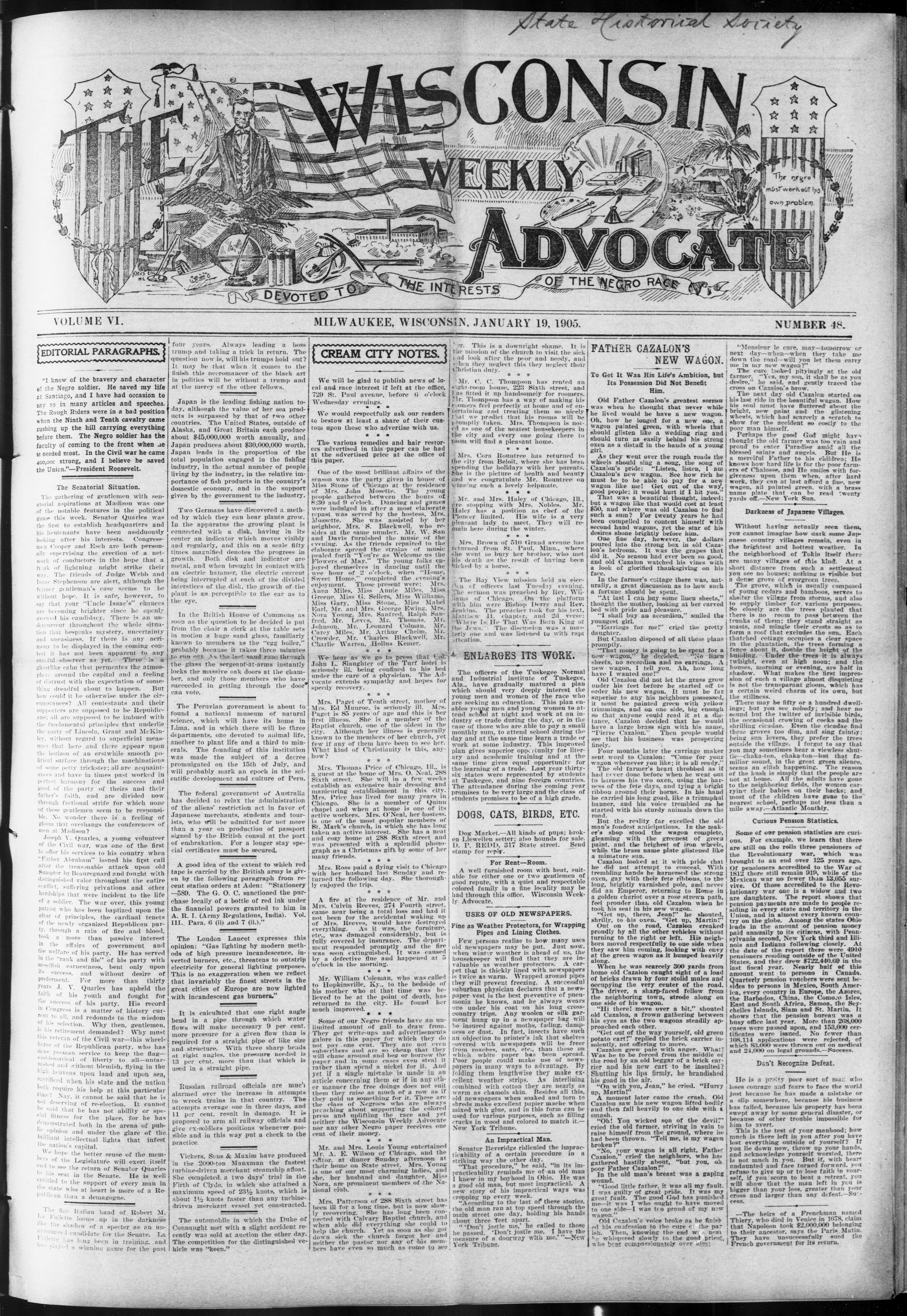
WISCONSIN
WEEKLY
ADVOCATE
DEVOTED TO THE INTERESTS OF THE NEGRO RACE
EDITORIAL PARAGRAPHS.
"I know of the bravery and character of the Negro soldier. He saved my life at Santiago, and I have had occasion to say so in many articles and speeches. The Rough Riders were in a bad position when the Ninth and Tenth cavalry came rushing up the hill carrying everything before them. The Negro soldier has the faculty of coming to the front when he is needed most. In the Civil war he came 400,000 strong, and I believe he saved the Union."—President Roosevelt.
The Senatorial Situation
The gathering of gentlemen with senatorial aspirations at Madison was one of the notable features in the political game this week. Senator Quarles was the first to establish headquarters and his heutenants have been assiduously looking after his interests. Congressmen Cooper and Esch are both personally supervising the erection of a network of conductors in the hope that a freak of lightning might strike their way. The friends of Judge Webb and Isaac Stephenson are alert, although the former gentleman's case seems to be without hope. It is safe, however, to say that your "Uncle Isaac's" chances are becoming brighter since he openly avowed his candidacy. There is an undercurrent throughout the whole situation that bespeaks mystery, uncertainty and uneasiness. If there is any acrimony to be displayed in the coming contest it has not been apparent to any careful observer as yet. There is a ghostlike calm that permeates the atmosphere around the capital and a feeling of distrust with the expectation of something dreadful about to happen. But how could it be otherwise under the circumstances? All contestants and their supporters are supposed to be Republicans; all are supposed to be imbued with the fundamental principles that underlie the party of Lincoln, Grant and McKinley, without regard to superficial measures that here and there appear upon the horizon of an erstwhile smooth political surface through the machinations of some petty trickster; all are acquaintances and have in times past worked in perfect harmony for the success and good of the party of theirs and their father's faith, and are divided now through factional strife for which none of these gentlemen seem to be responsible. No wonder there is a feeling of gloom that overhangs the conferences of men at Madison?
Joseph V. Quarles, a young volunteer of the Civil war, was one of the first to offer his services to his country when "Father Abraham" issued his first call after the treasonable attack upon old Sumpter by Beaureguard and fought with distinguished valor throughout the entire conflict, suffering privations and other hardships that were incident to the life of a soldier. The war over, this young patriot who has been baptized upon the altar of principles, the cardinal tenets of the newly organized Republican party, through a rain of fire and blood, took a more than passive interest in the affairs of government and the welfare of his party. He has served in the "rank and file" of his party with unselfish earnestness, bent only upon its success, and without desire of preferment. For more than thirty years J. V. Quarles has upheld the faith of his youth and fought for the success of his party. His record in Congress is a matter of history current to all, and redounds to the wisdom of his selection. Why then, gentlemen, is his retirement demanded? Why must this veteran of the Civil war—this wheelhorse of the Republican party, who has done yeoman service to keep the flag—emblematical of liberty to all—untarnished and without blemish, flying in the high heavens upon land and upon sea, sacrificed when his state and the nation both require his help at this particular time? Nay, it cannot be said that he is not deserving of re-election. It cannot be said that he has not ability or special fitness for the place, for he has demonstrated both in the arena of public opinion and under the glare of the brilliant intellectual lights that infest the nation's capital.
We hope the better sense of the members of the Legislature will exert itself and to see the return of Senator Quarles to his seat in the Senate. He is well entitled to the support of every man in the state who at heart is more of a Republican than a demagogue.
The fine Italian hand of Robert M. La Follette looms up in the darkness like the shadow of a specter as an unannounced candidate for the Senate. La Follette has long been in training, and has played a winning game for the past
four years. Always leading a boss trump and taking a trick in return. The question now is, will his trumps hold out? It may be that when it comes to the finish this necromancer of the black art in politics will be without a trump and at the mercy of the other fellows.
Japan is the leading fishing nation today, although the value of her sea products is surpassed by that of two other countries. The United States, outside of Alaska, and Great Britain each produce about $45,000,000 worth annually, and Japan produces about $30,000,000 worth. Japan leads in the proportion of the total population engaged in the fishing industry, in the actual number of people living by the industry, in the relative importance of fish products in the country's domestic economy, and in the support given by the government to the industry.
Two Germans have discovered a method by which they can hear plants grow. In the apparatus the growing plant is connected with a disk, having in its center an indicator which moves visibly and regularly, and this on a scale fifty times magnified denotes the progress in growth. Both disk and indicator are metal, and when brought in contact with an electric hammer, the electric current being interrupted at each of the divided interstices of the disk, the growth of the plant is as perceptible to the ear as to the eye.
In the British House of Commons as soon as the question to be decided is put from the chair a clerk at the table sets in motion a huge sand glass, familiarly known to members as the "egg boiler," probably because it takes three minutes to run out. As the last sand runs through the glass the sergeant-at-arms instantly locks the massive oak doors at the chamber, and only those members who have succeeded in getting through the door can vote.
---
The Peruvian government is about to found a national museum of natural science, which will have its home in Lima, and in which there will be three departments, one devoted to animal life, another to plant life and a third to minerals. The founding of this institution was made the subject of a decree promulgated on the 15th of July, and will probably mark an epoch in the scientific development and culture of Peru.
The federal government of Australia has decided to relax the administration of the aliens' restriction act in favor of Japanese merchants, students and tourists, who will be admitted for not more than a year on production of passport signed by the British consul at the port of embrakation. For a longer stay special certificates must be secured.
A good idea of the extent to which red tape is carried by the British army is given by the following paragraph from recent station orders at Aden: "Stationery
-589. The G. O. C. sanctioned the purchase locally of a bottle of red ink under the financial powers granted to him in A. R. I. (Army Regulations, India). Vol. III. Para. 6 (ii) and 7 (ii.)."
The London Lancet expresses this opinion: "Gas lighting by modern methods of high pressure incandescence, inverted burners, etc., threatens to outstrip electricity for general lighting purposes. This is no exaggeration when we reflect that invariably the finest streets in the great cities of Europe are now lighted with incandescent gas burners."
It is calculated that one right angle bend in a pipe through which water flows will make necessary 9 per cent. more pressure for a given flow than is required for a straight pipe of like size and structure. With three sharp beads at right angles, the pressure needed is 13 per cent. more than that which is used in a straight pipe.
Russian railroad officials are much alarmed over the increase in attempts to wreck trains in that country. The attempts average one in three days, and 11 per cent. result in damage. It is proposed to arm all railway officials and give cx-soldiers positions whenever possible and in this way put a check to the practice.
Vickers, Sons & Maxim have produced in the 2000-ton Manxman the fastest turbine-driven merchant steamship afloat. She completed, a two days' trial in the Firth of Clyde, in which she attained a maximum speed of $23\frac{1}{2}$ knots, which is about $1\frac{1}{2}$ knots faster than any turbine-driven merchant vessel yet constructed.
The automobile in which the Duke of Connaught met with a slight accident recently was sold at auction the other day. The competition for the distinguished vehicle was "keen."
CREAM CITY NOTES.
We will be glad to publish news of local and race interest if left at the office, 729 St. Paul avenue, before 6 o'clock Wednesday evenings.
We would respectfully ask our readers to bestow at least a share of their custom upon those who advertise with us.
业 业 业
The various remedies and hair restorers advertised in this paper can be had at the advertised price at the office of this paper.
One of the most brilliant affairs of the season was the party given in honor of Miss Stone of Chicago at the residence of Mrs. John Mosette. The young people gathered between the hours of 8:30 and 9 o'clock. Dancing and games were indulged in after a most elaborate repast was served by the hostess, Mrs. Mosette. She was assisted by her neighbor, Mrs. S. Blackwell, who resides at the same number. Mr. W. San and Davis furnished the music of the evening. As the friends repaired to the elaborate spread the strains of music pealed forth "You're as Welcome as the Flowers of May." The young folks enjoyed themselves in dancing until the wee hour of 2 o'clock, when "Home, Sweet Home," completed the evening's enjoyment. Those present were: Mrs. Anna Miles, Miss Annie Miles, Miss Greene, Miss G. Sellers, Miss Williams, Miss Gary, Miss Stone, Miss Mabel Earl, Mr. and Mrs. George Ewing. Mrs. Nora Young, Mrs. Sanfred, Ralph Sanfred, Mr. Leves, Mr. Thomas, Mr. Johnson, Mr. Leonard Colman, Mr. Carey Miles, Mr. Arthur Cheim, Mr. Crowder, Mr. Charles Blackwell, Mr. Charlie Warren, Hollus Kemer.
***
We hear as we go to press that Col. John L. Slaughter of the Turf hotel is seriously ill, being confined to his bed under the care of a physician. The Advocate extends sympathy and hopes for speedy recovery.
\* \* \*
Mrs. Paget of Tenth street, mother of Mrs. Ed Munroe, is seriously ill. Mrs. Paget is 85 years of age and this is her first illness. She is a member of the Baptist church, one of the oldest in the city. Although her illness is generally known to the members of her church, yet few if any of them have been to see her. What kind of Christianity is this, anyhow?
* * *
Mrs. Thomas Price of Chicago, Ill., is a guest at the home of Mrs. O. Neal, 288 Sixth street. She will in a few weeks establish an extensive hair dressing and manicuring establishment in this city. Mrs. Price has lived for many years in Chicago. She is a member of Quinn chapel and when at home is one of its active workers. Mrs. O'Neal, her hostess, is one of the most popular members of St. Mark's church, in which she has long taken an active interest. She has a neat and cozy home at 288 Sixth street and was presented with a splendid phonograph as a Christmas gift by some of her many friends.
Mrs. Ross paid a flying visit to Chicago with her husband last Sunday and returned the following day. She thoroughly enjoyed the trip.
```markdown
```
A fire at the residence of Mr. and Mrs. Calvin Reeves, 274 Fourth street, came near being a total loss and had it not been for the accidental waking up of Mrs. Reeves, would have destroyed everything. As it was, the furniture, etc., was damaged considerably, but is fully covered by insurance. The department responded promptly and the fire was soon extinguished. It was caused by a defective flue and happened at 5 o'clock in the morning.
Mr. William Coleman, who was called to Hopkinsville, Ky., to the bedside of his mother who at that time was believed to be at the point of death, has returned to the city. He found her much improved.
***
Some of our Negro friends have an unlimited amount of gall to draw from. They get write-ups and advertisements galore in this paper for which they do not pay one cent. They are not even subscribers and are so cheap that they will chase around and beg or borrow the paper and in some cases even steal it rather than spend a nickel for it. And yet if a single mistake is made in an article concerning them or if in any other manner the free doings does not suit them they raise as much of a row as if they paid us something for it. These are the class of Negroes who are always preaching about supporting the colored press and uplifting the race and yet neither the Wisconsin Weekly Advocate nor any other Negro paper receives one cent of their money.
* * *
Mr. and Mrs. Louis Young entertained Mr. A. E. Wilson of Chicago, and the editor, at dinner Sunday afternoon at their home on State street. Mrs. Young is one of our most charming ladies, and she, her husband and daughter. Miss Nora, are prominent members of the National club.
Mrs. Patterson of 288 Sixth street has been ill for a long time, but is now slowly recovering. She has long been connected with Calvary Baptist church, and when able did everything she could to help the church. Yet as soon as she got down sick the church forgot her and neither the pastor nor any of his members have even so much as come to see
er. This is a downright shame. It is the mission of the church to visit the sick and look after the poor and needy, and when they neglect this they neglect their Christian duty. * * *
Mr. C. C. Thompson has rented an eight-room house, 223 Sixth street, and has fitted it up handsomely for roomers. Mr. Thompson has a way of making his roomers feel perfectly at home and of entertaining and treating them so nicely that we predict that his rooms will be promptly taken. Mrs. Thompson is noted as one of the neatest housekeepers in the city and every one going there to room will find a pleasant home.
***
Mrs. Cora Rountree has returned to the city from Beloit, where she has been spending the holidays with her parents. She is the picture of health and beauty and we congratulate Mr. Rountree on winning such a lovely helpmate.
***
Mr. and Mrs. Haley of Chicago, Ill., are stopping with Mrs. Nobles. Mr. Haley has a position as chef of the Pioneer limited. His wife is a very pleasant lady to meet. They will remain here during the winter.
***
Mrs. Brown of 510 Grand avenue has returned from St. Paul, Minn., where she went to bury her brother, who met his death as the result of having been kicked by a horse.
* * *
The Bay View mission held an election of officers last Tuesday evening. The sermon was preached by Rev. Williams of Chicago. On the platform with him were Bishop Derry and Rev. Jenkins. The preacher took for his text, Matthew H. chapter, and 2d verse: "Where Is He That Was Born King of the Jews." The discussion was a masterly one and was listened to with rapt attention.
ENLARGES ITS WORK.
The officers of the Tuskegee Normal and Industrial institute of Tuskegee, Ala., have gradually matured a plan which should very deeply interest the young men and women of the race who are seeking an education. This plan enables young men and young women to attend school at night and work at an industry or trade during the day, or in the case of those who are able to pay a small monthly sum, to attend school during the day and at the same time learn a trade or work at some industry. This improved plan gives superior opportunity for literary and academic training and at the same time gives equal opportunity for the learning of a trade. Last year thirty-six states were represented by students at Tuskegee, and nine foreign countries. The attendance during the coming year promises to be very large and the class of students promises to be of a high grade.
DOGS. CATS. BIRDS. ETC.
Dog Market.—All kinds of pups; broken Llewellen setter; also hounds for sale. D. P. REDD, 317 State street. Send stamp for reply.
For Rent—Room.
A well furnished room with heat, suitable for either one or two gentlemen of good repute, with a quiet and respectable colored family in a fine locality may be had through this office. Wisconsin Weekly Advocate.
USES OF OLD NEWSPAPERS.
Fine as Weather Protectors, for Wrapping Pipes and Lining Clothes.
Few persons realize to how many uses old newspapers may be put. Just now, when winter weather is ahead of us, the housekeeper will find that they are invaluable as weather protectors. A carpet that is thickly lined with newspapers is twice as warm. Wrapped around pipes they will prevent freezing. A successful suburban physician declares that a newspaper vest is the best preventive of pneumonia he knows, and he always wears one under his coat on his long crosscountry trips. Any woolen or silk garment hung up in a newspaper bag will be insured against moths, fading, dampness or dust. In fact, insects have such an objection to printer's ink that shelves covered with newspapers will be free from roaches, ants, etc., than those on which white paper has been spread. Poor people could make use of newspapers in many ways to advantage. By folding them lengthwise they make excellent weather strips. As interlining combined with cotton they are nearly as warm as chamois skin. Besides all this, old newspapers when soaked and torn to shreds make excellent papier mache when mixed with glue, and in this form can be used for various purposes, such as filling cracks in wood and colored to match it.—New York Tribune.
An Impractical Man.
Senator Beveridge ridiculed the impracticability of a certain procedure in a striking way the other day.
"That procedure," he said. "in its impracticability reminds me of an old man I knew in my boyhood in Ohio. He was a good old man, but most impractical. A new story of his impractical ways was cropping up every week.
"According to the last of these stories, the old man ran at top speed through the main street one day, holding his hands about three feet apart.
"Don't jostle me,' he called to those he passed. 'Don't jostle me. I have the measure of a doorway with me.'"—New York Tribune.
FATHER CAZALON'S NEW WAGON.
To Get It Was His Life's Ambition, but Its Possession Did Not Benefit
Old Father Cazalon's greatest sorrow was when he thought that never while he lived would he have a new wagon. Oh, how he longed for a new one, a wagon painted green, with wheels that should glisten like a wedding ring and should turn as easily behind his strong oxen as a distaff in the hands of a young girl.
As they went over the rough roads the wheels should sing a song, the song of Cazalon's pride: "Listen, listen, I am Cazalon's new wagon. See how rich he must be to be able to pay for a new wagon like me! Get out of the way, good people; it would hurt if I hit you."
That was a beautiful thought, indeed; but a wagon like that would cost at least $50, and where was old Cazalon to find such a sum? For twenty years he had been compelled to content himself with second hand wagons, yet the star of his desires shone brightly before him.
One fine day, however, the dollars poured into the strong box in old Cazalon's bedroom. It was the grapes that did it. No season had ever been so good, and old Cazalon watched his vines with a look of glorified thanksgiving on his face.
In the farmer's cottage there was, naturally, a great discussion as to how such a fortune should be spent.
"At last I can buy some linen sheets," thought the mother, looking at her carved bed with pride and pleasure.
"I shall buy an accordion," smiled the youngest girl.
"Earrings for me!" cried the pretty daughter.
But Cazalon disposed of all these plans promptly.
"That money is going to be spent for a new wagon," he decided. "No linen sheets, no accordion and no earrings. A new wagon, I tell you. Ah, how long have I wanted one!"
Old Cazalon did not let the grass grow under his feet before he started off to order his new wagon. It must be far superior to any his neighbors possessed, it must be painted green with yellow trimmings, and on one side, big enough so that anyone could read it at a distance, Cazalon decided that he would have a large brass sign with his name, "Pierre Cazalon." Then people would see that his business was prospering finely.
Four months later the carriage maker sent word to Cazalon: "Come for your wagon whenever you like; it is all ready." The old farmer's heart throbbed as if had never done before when he went out to harness his two oxen, using the harness of the fete days, and tying a bright ribbon around their horns. In his hand he carried his long goad, like a triumphal banner, and his voice trembled as he started with his sturdy animals down the road.
But the reality far excelled the old man's fondest anticipations. In the maker's shop stood the wagon complete, gleaming with the greenest of green paint, and the brighest of iron wheels, while the brass name plate glistened like a miniature sun.
Cazalon looked at it with pride that he did not attempt to conceal. With trembling hands he harnessed the strong oxen, gay with their fete ribbons, to the long, brightly varnished pole, and never did an Emperor, returning to Rome in a golden chariot over a rose strewn path, feel prouder than old Cazalon when he took his seat in his new wagon.
"Get up, there, Jean!" he shouted, shrilly, to his oxen. "Get up, Martin!"
Out on the road, Cazalon creaked proudly by all the other vehicles without turning to the right or left. His neighbors moved respectfully to one side when they saw him coming, looking with envy at the green wagon as it bumped heavily along.
When he was scarcely 300 yards from home old Cazalon caught sight of a load of bricks drawn by four stolid mules and occupying the very center of the road. The driver, a sharp-faced fellow from the neighboring town, strode along on one side of his wagon.
"Hi there! move over a bit," shouted old Cazalon, a frown gathering between his eyes as the two wagons steadily approached each other.
"Get out of the way yourself, old green potato cart!" replied the brick carrier insolently, not offering to move.
Cazalon grew pale with anger. What! Was he to be forced from the middle of the road by an old beggar of a brick carrier and his new cart to be insulted? Shutting his lips firmly, he brandished his goad in the air.
"On with you, Jean," he cried. "Hurry up, Martin!"
A moment later came the crash. Old Cazalon saw his new wagon lifted bodily and then fall heavily to one side with a smash.
"Oh! You wicked son of the devil!" cried the old farmer, striving in vain to raise himself from the ground, where he had been thrown. "Tell me, is my wagon broken?"
"No, your wagon is all right, Father Cazalon," cried the neighbors, who had gathered hastily about, "but you, oh poor Father Cazalon!"
In the old man's breast was a gaping wound.
"Good little father, it was all my fault. I was guilty of great pride. It was my great fault. The good God has punished me—it was I who ought to have moved to one side—I was too proud of my new wagon."
Old Cazalen's voice broke as he finished his confession to the cure of the parish. Then, knowing the end was near, he whispered slowly to the good priest who bent compassionately over him;
"Monsieur le cure, may—tomorrow or next day—when—when they take me down the road—will you let them carry me in my new wagon?"
The cure looked pityingly at the old farmer. "Yes, my son, it shall be as you desire," he said, and gently traced the cross on Cazalon's brow.
The next day old Cazalon started on his last ride in the beautiful wagon. How his soul must have fluttered about the bright, new paint and the glistening wheels, which had scarcely a scratch to show for the accident so costly to the poor man himself.
Perhaps the good God might have thought the old farmer was too vain and proud to enter Paradise amid all the blessed saints and angels. But He is a merciful Father to his children; He knows how hard life is for the poor farmers of Chalosse, and He smiles with forgiveness upon them when, after hard work, they can at last afford a fine, new wagon, all painted green, with a brass name plate that can be read twenty yards off.—New York Sun.
Darkness of Japanese Villages
Without having actually seen them, you cannot imagine how dark some Japanese country villages remain, even in the brightest and hottest weather. In the neighborhood of Tokio itself there are many villages of this kind. At a short distance from such a settlement you see no houses: nothing is visible but a dense grove of evergreen trees.
The grove, which is usually composed of young cedars and bamboos, serves to shelter the village from storms, and also to supply timber for various purposes. So closely are the trees planted that there is no room to pass between the trunks of them; they stand straight as masts, and mingle their crests so as to form a roof that excludes the sun. Each thatched cottage occupies a clear space in the plantation, the trees forming a fence about it, double the height of the building. Under the trees it is always twilight, even at high noon; and the houses, morning or evening, are half in shadow. What makes the first impression of such a village almost disquieting is not the transparent gloom, which has a certain weird charm of its own, but the stillness.
There may be fifty or a hundred dwellings; but you see nobody; and hear no sound but the twitter of invisible birds, the occasional crowing of cocks and the shrilling cicadae. Even the cicadae find these groves too dim, and sing faintly; being sun lovers, they prefer the trees outside the village. I forgot to say that you may sometimes hear a viewless shuttle—chaka-ton, chaka-ton—but that familiar sound, in the great green silence, seems an elfish happening. The reason of the hush is simply that the people are not at home. All the adults have gone to the neighboring fields, the women carrying their babies on their backs; and most of the children have gone to the nearest school, perhaps not less than a mile away.—Atlantic Monthly.
Curious Pension Statistics
Some of our pension statistics are curious. For example, we learn that there are still on the rolls three pensioners of the Revolutionary war, which was brought to an end over 125 years ago. Of pensioners accredited to the War of 1812 there still remain 919, while of the Mexican war no fewer than 13,055 survive. Of those accredited to the Revolutionary war one is a widow and two are daughters. The report shows that pension payments are made to people residing in every state and territory in the Union, and in almost every known country on the globe. Among the states Ohio leads in the amount of pension money paid annually to its citizens, with Pennsylvania second, New York third and Illinois and Indiana following closely. At the date of the report there were 4910 pensioners residing outside of the United States, and they drew $722,440.69 in the last fiscal year. Nearly half of this amount went to persons in Canada. Quarterly pension vouchers were sent besides to persons in Mexico, South America, every country in Europe, the Azores, the Barbados, China, the Comoros Isles, East and South Africa, Samoa, the Seychelles Islands, Siam and St. Martin. It shows that the pension bureau was a busy office last year. More than 268,000 cases were passed upon, and 153,000 certificates were issued. No fewer than 108,114 applications were rejected, of which 83,000 were thrown out on medical and 24,000 on legal grounds.—Success.
Don't Recognize Defeat.
He is a pretty poor sort of man who loses courage and fears to face the world just because he has made a mistake or a slip somewhere, because his business has failed, because his property has been swept away by some general disaster, or because of other trouble impossible for him to avert.
This is the test of your manhood; how much is there left in you after you have lost everything outside of yourself? If you lie down now, throw up your hands, and acknowledge yourself worsted, there is not much in you. But if, with heart undaunted and face turned forward, you refuse to give up or to lose faith in yourself, if you scorn to beat a retreat, you will show that the man left in you is bigger than your loss, greater than your cross and larger than any defeat.—Suc-
---
—The heirs of a Frenchman named Thierry, who died in Venice in 1678, claim that Napoleon took $2,000,000 belonging to their ancestor, says the Paris Matin. They have unsuccessfully sued the French government for its return.
& Miscellaneous Items.
—The best aid to See it is assert-
ed, is to whistle for half an hour after
meals.
~The Congo is one of the widest wa-
terways in the globe, if net the finest.
It is twenty-five miles across in parts, so
that vessels may pass one another and
yet be out of sight.
—Dnuring the year 1903 Australia im:
ported from all countries goods yalued at
$185,009,524. Of this amount®goods to:
the value of $30,544,101 were imported
trom the United States.
—Finding a long rusty nail in his morn-
ing voll a Viennese citizen charged bis
baker with endangering the public safety.
The haker was fined $4.
Pennies are soon to be introduced
into South Africa. Heretofore the
“tieckey” has been the smallest coin and
it is worth about 6 cents. The penny
will be of copper and worth 2 cents.
—According to a German authority the
world’s silk production in 1903 amount-
ed to 39,897,000 avoirdupois pounds, not
including what was produced and_con-
sumed in the home markets of China
and Japan.
—The German town of Bilbrich has a
law which calls for a special tax an all
householders whe have baiconies attached
to their houses. They are considered a
Inxury. The tax money is used for the
improvement of the streets.
—On account of the abolition of his
office as returning officer of the school
board elections H. List_of Penge, Eng-
land, has been allowed 50 cents per an-
unm as compensation. Bach quarter he
will receive a cheek for 12% cents. ,
According to a lecture given by Very
Rev. Dr, Coffey of Maynooth in a Coun-
ty Roscommon Roman Catholic church,
there ave now more than 26,000 licensed
drinking places in Ireland, or one for
every 170 members of the population.
—Barhados business men have offered
to supply 30,060 negroes for labor in the
Transvaal and to agree to deliver them
at Lourenco-Margques within | twelve
months at $100 per head, provided the
wages should be not less than $12.50 per
month, with beard and ledging.
—In the last five years New South
Wales has received §208,111,872.25 for
her weel clip, or only $2,965,946.82 les:
than during the previous five years.
thovsh the sheep then numbered 238,
107.048 in the aggregate, against ouly
173.306.0444 for the last five years.
Among the natural curiosities of Ja
pan are its singing insects. The mosi
prized of these tiny musicians is a black
Leetle named “susumushi,”” which means
“insect. bell.” The sound that it. emits
resembles that of a little silver bell o!
the sweetest and most delicate tone.
—At present patents are granted i
Great Britain at inventor's risk; but 2
new act provides for a search of the pat-
ent office for fifty years back to se
whether the applicant for a patent has
heen forestalled in his ideas. This wil
make British patents werth a good deal
more than they have been.
—The natives of India take more anc
more to beer. Formerly the consumption
was very small; there are now, however
iany large breweries and last year thei
combined preduction aggregated nearly
9,060,000 gallons. It is said that about
40 per cent. of this production is com
snmed by the army. Rost of tle. brew:
cries are in the Himalaya mountain dis
tricts, on the railroad line between thé
stations of Murree and Darjeling.
Taking advantage of the fact thai
eiters addressed to the President of the
french republic, to the presidents ot
re Senate und Chamber of the Prefect
Sf Police do not require to be stampec
the Matin, a Paris newspaper, has or
sxanized a new system of petitioning ir
tauvor of 2-cent postage. With every pa
per sold a post eard is enclosed ad.
dressed to the president of the Chamber
of Deputies, The readers are asked tc
sign it and drop it into the nearest post
The Mvsteries of Knowledce.
A Bostonian was praising the othe:
day the astronomical work of Perciva
Lowell.
“Before the last total eclipse of th
sun,” he said, smiling, “Mr. Loweli ob.
served to an old colored man whom he
liked:
“George, if you'll watch the chicken:
out at your place tomorrow morning about
11 o'clock, you'll see them all go te
roost.’
“Hi, hi!’ George laughted. ‘Hi, hi
Dat's a good joke.
“He thought, you see, that Mr. Lowel
was fooling him. But when at about 11
o'clock the next morning the sun dark
ened and the chiekens did go to roost
George was amazed and somewhat horri
fied. He sought Mr, Lowell out anc
said:
“Wot you dons tole me wuz true, sah
Mah chickens went to roost, sah, jist lai
yon said dey would.”
“*Yes, George, I suppose they did,
the astronomer returned,
“ ‘tow Jong, sah, did you know ‘bout
dis?’ said George,
*-Oh, a long time.”
“Did you Know dey would go to roos'
a year ago?
“Yes: fully a year ago.”
“Well, dat beats all,’ said George, iz
an awed voive. ‘Dem ehickens wazn’
hatched a_year ago. “"—New York Trib
phe. e
Overdoing It.
“Twenty years ago when ra‘lroad
passes were us thick in Kansas as wild
sunflowers, a draft was made on a road
«ence which took away. the breath of
even the hardened officials,” said a “for-
merly of Kansas man” last night. “*At
the Republican state cohvention in 1882
Tew Hanback, vow dead, was nominat-
ed for Congress, as one of the ‘big four’
Congressmen-at-Large to which the state
became entitled under the new appor-
tionment.
“Hanback was peor. In those days
nobody paid railroad fare if he had any
kind of a drag on a politician of influ-
ence. Consequently when several of the
men Who had helped nominate Hanback
asked him for passes home from Topeka
he had to do something. He went. te
Archie Williams, attorney for the Union
Pacific, and asked for help. Williams
ransacked his office and found a book of
passes containing three blanks, He
signed these and gave them to Hanback,
“Several days afterward Williams re-
ceived a scorching letter from the gen-
eval management, asking him what in
blazes he meant’ by issuing passes to
carry men by the trainload. The letter
said:
“We are willing to stand for anything
reasonnble, but when_a pass reads, “Pass
John Doe and forty-five others,” it is go-
ing teo strong.”
“Williams found on investigation that
Hanback had passed about 125 men on
those three blunks.”—Seattle Post In
tehigencer.
Fashion Fooled.
Thomas Fogarty, the illustrator, was
talking about modern fashions in dress.
“# is hard to keep up with the fash-
jons,” he said. “They are certainly con-
fusing. The other night at the theater
a man in a rear seat all of a sudden
jumped up excitedly.
“"Down with that red umbrella’ in
front! he cried.
“But his wife pulled him back into his
chair.
“*FPor merey’s sake, hush! she whis-
pered. ‘That isn’t an umbreila: its a
new winter hat.” ""—New York Tribune.
THE CALL OF THE WANDER-SPIRIT.
“Come out to the open, brothers,
The oe plain of the sea!
Leave children, and wives, and mothers,
And range afar with me.
Afar where the winds are giving
Their souls to wander free,
Where life’s for the lusty living.—
Come brothers, come with me.
‘The spray of the salted surges
Cuts sharp with tonic pain,
The spume of the billow merges
In ice, and stings again.
But down long ocean reaches
Your course will lie to the calm
And silver of tropic beaches,
"The green of the fruited palm.”
‘Thus day and night I call them,
In spring, In winter drear;
Whatever the fates befall them
‘They cannot, wiil not hear. 3
They toil and bear in sadness
The ancient yoke of Need—
The guerdon of all their madness—
Nor pause, nor hope, nor heed.
They soothe a mother’s sorrow,
They guard a wife's repose,
For marveling children borrow
Its fragrance from the rose.
Content with bribe and barter,
And-counterplot of care,
Half sinner and half a martyr,
‘They Gare, and fear to dare.
Yet sometimes To my calling
They turn with wistful eyes,
And under the laughter falling
I hear their smothered sighs.
_Loulse Morgan Sill in Harper's Weet:ty
AND AN AFFAIN Ur The TUNE,
“The Hearl’s very sweet on Miss Doris.”
“Ho! 7E- is, is 7¢?”
“Yes, I over’eatd ‘im say so last even-
ing, when——” :
Here Thomas the foctman broke off
with a cough, noticing my presenee in the
breakfast room.
Of course, i gave no indication that I
had overheard the remark. I merely
opened the paper and scanned it with an
apparent indifference that I was very far
from feeling. “
What Thomas had remarked to the
gardener did not exactly surprise me, but
I had hoped and deceived myself into be-
lieving that such was not the case. The
Earl was undeniabiy a good looking man,
in spite of his forty-odd years, and with
his title and cool fifty thousand a year
Was a husband that any girl might be
provd to win. It might be really true
that Doris cared more fer Lord Ewell
than she did for—some one else, but
nevertheless the thought stung me with
a sense of jealous rage.
Just then the Earl entered the room.
“Nice day,” said he, looking up from a
pile of letters in his hand. “Sorry {
cannot join you shooting this morning,”
he went on, smiling easily.
“Why, are you going away?” I en-
quired, hoping that ne was.
“Yes, beastly nuisance. Oh! Good
morning, Mrs. Blackstone.” as Doris’
mother entered the room. “i was just
telling Varleigh that I shall be obliged
to leave yon today. 1 shall return by
Thursday, however, if you will allow
me.
“You know you are always free to do
as you like hege.” said the lady. smiling
agreenbly.
My heart sank lower than ever, and T
did not know which I hated most, the
Earl of Ewell or the lady who so eyi-
dently desired to become his mother-in-
Taw.
One by one the rest of the party came
down, and we began breakfast. Doris
looked adorable, as usual, but she seemed
rather absent-minded, and paid almost no
attention to my remarks.
Presently [ caught her in the act of ex-
changing glances across the table with
Lord Ewell. Evidently their understand-
ing was complete. I was so agitated that
1 could scareely sit still, but, alas! when
I left the table and strolled into the
billiard room to find my cigar case, I
found Doris and Lord Ewell alone to-
gether. I heard her say:
“You'll write?”
“Of course, Doris,” he replied, and
then, aware of my presence, they both
looked guilty and confused.
It did not require and superhuman in-
genuity to see that they had been spoon-
ing. The sunlight suddenly grew dark
as I realized that the light of happiness
in my life had been quenched forever.
Hiow I got threugh the next few days
L carmot clearly remember. 1 suppose it
was the recklessness of despair that kept
me going in the daytime, as it certainly
was whisky and soda at night.
| Indeed, | imbibed so much of that con-
‘soling fluid on the evening of the second
day that I challenged all the people in the
snioking room to a game of bridge at
shinca points, to the great seandal of my
host, who held very straitlaced views on
the subject of gambling. The next morn-
ing he talked to me, in-a grieved, father-
ly sort of way, telling me that it would
certainly grieve him to see the ship of
my Vie wreeked on the rock that had
proved fatal to so many.
I apologized and thanked him for his
kind adviee, but I did not tell him that
my life had been already wrecked by his
own daughter and I didn’t care twopence
how soon I went to pieces.
The next morning the post was late.
We were at breakfast when a letter was
handed to Doris.
She epened it eagerly, and soon her face
was wreathed in smiles. I had recognized
the handwriting; it was Lord Ewell’s.
For the rest of the day Doris seemed per-
fectly happy.
‘The Earl himself arrived in time for
immer. Twas present when he came into
the drawing room, and L saw the elo-
quent look that passed between Doris
and him. Then L made up my mind T
would go home. [could not stand it any
ionger.
When T announced my unexpected and
immediate departure, both my host and
hostess showed themselves sincerely dis-
appoited. Eyen Doris did me the honor
to say she was sorry.
“It oceasions me great regret to leave,”
{ said coldly, “but the circumstances
necessitating my departure are entirely
beyond my control,
“Is your business so serious?” Doris
enquired with a mock gravity that struck
me as the worst possible taste. “Per-
haps it is the same as Lord Ewell’s——
But, no, it is too late in the week for
that,” she continued, her eyes sparkling
with mischief.
“You are more in his lordship’s con-
fideuces than I,” I said sarcastically.
“Why, Lord Ewell really went ‘to sec
that St. Leger races.” said Doris, laugh-
ing. “bul, remember, it is a dead seeret.
Tather is so strict about such matters.”
“I had no idea his lordship was inter-
ested in racing,” I said, coldly. “Before I
go, you must allow me to congratulate
you, Miss Blackstone, upon your extreme
goud Inck.” .
“But how did you know?” cried the
girl, her eyes opening wide in wonder.
“I have a pair of eyes,” I retorted
stiffly. “Besides, his lordship has made
no secret of his admiration for you.”
“His what?” ejaculated Doris, flushing
angrily.
“¥ven the servants know it,” I went
on, crucliy. “I heard Thomas, the other
day, seying that the ‘Hearl was very
sweet on Doris.”
Her eyes flashed. Then suddenly the
young lady’s face changed and she burst
out iaughing.
“You are amused ?” I stammered.
“tamnensely .” she replied, as soon as
she could speak. Mr. Varleigh, the Field
has just arrived. You will find it in the
library. Do me the favor, please, to look
over last Wednesday’s racing intelli-
gence.”
| She turned and left me. Naturally, 3
| Happened to the library. This is what I
read. ,
| “st. Leger Stakes—After a_magnifi-
cent finish, Mr, Chrispy’s dark filly, Doris,
gainel a sensational victory over the
favorite by a neck.”
The carriage which was to have taken
ine te the strtion was countermanded,
and instead of spencing the morning in
the train, 1 spent it in 1 secluded summer
house atone with Boris We had a good
deal to say to each other, and Doris ex-
plxined tc me how, after execeding her
alléwauce, she had a large debt doe her
dressmaker which she was afraid to tell
to her striet parent.
Lord Elwell had told her of his ex:
| pected suceess on the turf with the mare
which he had named for her, and the twe
had eniered into a little conspiracy. But
now Doris has promised never to indulg:
Jin any more speculation unless I baek ii
tor her.
| poris, the filly, won by a neek, as 1
told you, but Doris in the summer hous
scored a far easier vietory. She walke¢
| over for the Varleigh stakes in a commer
trot.—New York Sun.
SEA-GAZING IN BERMUDA.
Wonderful Life of Crystal Depths Are
Revealed to the Observer.
| Tt was a little parrot fish who started
| out so briskly on this summer morning.
Whether be was cager to keep an ap-
pointment or had been unexpectedly sum-
moned to a distant part of his world one
will never know, but one may be certain
that the matter was of the greatest con-
sequence so far as the little fish was
concerned. Keeping his bright eyes
fixed straight ahead, he passed a corner
of the reef where the coral was incrust-
ed with mollusks and_ sea-urchins and
where a pair ef beautiful squirrel fish,
deeply engrossed in sentimental affairs,
turned to look after him wonderingly
through their enormous eyes. Below, in
4a deep poo!, a school of spotted trunk-
fish played heedlessly, while under a
projecting plate of staghorn coral a huge
grouper waited expectantly, but as the
parrot fish, warned of his danger, turned
quickly away, he gave his attention to a
pair of gray snappers--great, quiet,
ghostly figures that seemed like two
shadows drifting slowly along, far down
thruugh the green waters.
A few feet further on and the hurry-
ing parrot. fish passed a tall sea fan
around which three dainty butterfly fish,
clad brilliantly in yellow, were peering
into each nook and corner in their search
for small prey, while a sober cowfish,
with his two conspicuous horns, looked
on sedately. Suddenly the parrot fis
turned sharply aside to avoid: a spot
where the reef was broken by jutting
rocks covered with green ulva: around
this a school of bright little zebra striped
sergeant majors were sporting, while just
to the right an angel fish, whose blue
body tipped with gold first attracted the
attention of the mariners so many cen-
tnries ago, sailed from under & purple
gorgonia with a disdainful air—Metro-
politan Magazine.
The Missing Golf Ball.
Slitting open his left forearm with a
razor, Holmes was about to inject a bi-
cycle pumpful of cocaine, ether, water
and local option dope, when the light of
battle gleamed in his eyes and caused
the cat to think dawn had come, “Some
one is coming up stairs, Watson,” he said.
“IT heard footsteps on the stairs, but
You wonder how I know our visitor is
coming up instead of going down,” in-
terrupted Holmes, reading my thoughts.
“It’s childishly simple,” he coniinued. “I
fixed the second step from the top se
that anyone treading on it is shei down
the whole flight. The stranger hasn't
fallen yet, and must therefore be cour
ing up.”
At that moment there was a crash.
Holmes opened the door and stepped out,
“Try again, my dear sir,” he called out
to the man who Jay in a tumbled heap aé
the hottom of the stairs. This time our
visitor was more successful. He entered
the room and took a seat opposite the
window.
“Did you have a good game?” asked
Holmes.
“How did you guess——"
“Nothing, my dear sir.” answered
Hotes. “Your mouth hav certain lines
brought on by saying a vigorous word
begianing with ‘d, and the transfer in
your pocket tells me you are a golfer.”
“Yes, [ play goif. My name is Me-
Stingo,” said our visitor. “L have come
fo ask you to solye the mystery of the
lost. golf ball.”
Holmes brightened up. The old sleuth-
hound instincts awoke. In a few mo-
menis he had the story from MeStingo,
Four thousand golf balls had been lost
in two weeks.
“Are you prepared for a long trip, Wat-
son?” asked Holmes, placing a revolver
in his pocket. “Better take a Scotch
glossary,” he added.
I compromised on a flash of it.
Reaching the ground, Holmes drew out
a microscope and examined each blade of
grass. “A cow has been here lately,” he
muitered.
“How did you know?”
He showed me a cowslip,
Inquiries ia the neighborhood showed
ihat there was indeed a cow. She was
the picture of health.
“That cow,” said Holmes, “has swal-
lowed the golf balls. You see that big
ad. over there, ‘Pills for the Pale.’ Sie
has taken the golf balls for pills, and the
influence of mind over matter has caused
her to grow well and give lots of milk.”
On our return to the house Holmes
turned the case over to Detective Night
with the advice to get ont a search war-
reni.—VPertland Oregonian.
Curious Sequel to a Wake.
The London Times relates this: An
extraordinary chapter of accidents has
happened in cornection with the death of
a young man in South Tipperary. One
man was drowned while returning from
the wake, another was hurt through his
horse bolting *when returning from the
same function. On the day of the inte
ment the funeral passed a party bringing
home the drowned man’s body, while the
driver of the hearse fel! off the box and
injured himself. Soon afterward one of
the mourning coaches broke down, and
the mourners were obliged to proceed in
another vehicle.
FEMININE FIGURES.
Arithmetic ‘tls well to shun,
Of puzzles it has plenty;
For instance, I was twenty-one
When Madge was sweet and twenty.
Oid Time, as fast the seasons flow,
Worked on me with bis leayen;
I felt the weight of thirty-two
When Madge was twenty-seven.
The marvel grew to huge estate,
Madge proved of time so thrifty,
Remaining slinple thirty-eight
Long after I'd turned fifty.
aly bra‘p is plunged in awful whirls
By mathematics’ rigors,
And who shail now maintain that girls
Have no control of tigures?
—London Pune.
——<$—$<$<$<———
ROPES AND HAWSERS.
Points About Measuring Them That Most
: Landsmen Don’t Understand.
“Pipes,” said a dealer in ship supplies,
“are measured by their diameter. ‘Thus
when we speak of a G-inch pipe we mean
a pipe 6 inches in diameter. ‘
“But hawsers are measured by their
circumference; and so when we speak of
a G-inch hawser we do not mean a haw-
ser 6 inches in diameter, but one 6 inches
around, or 2 inches in diameter. All
nantical men so understand bhawser
measurements aud never think of them
‘in any other way.
“The Jandsman, now. when he hears
of big hawsers in use, is likely to think
of them as he would of pipe, as being of
the measurements described, in diameter.
For instance: He reads of a seagoing
tug picking up a_ disabled ship at sea
and passing an S8-inch hawser to her,
and of how they got a strain on it, in
the heavy sea running, that ponderous
hawser parted like a packthread. So he
wonders how a hawser of that size could
part even under such a strain.
“But the nautical man wonders at it
Tess for he knows that the hawser de-
scribed as an 8-inch was one of 8 inches
in cireuference, or of aboout 25% inches
in diameter and not 8 inches in diameter,
or bigger than a stovepipe.
“An S-inch hawser is, nevertheless, 2
big and powerful hawser. A Manila
Hhawser of this size will stand a strain
of 50,000 pounds; and a coil of 200 fath-
oms of 8 inch Manila rope will weigh
| 2300 pounds, or considerably more than
i ton.
“Rope used to be made in coils of a
thousand feet in length, but now a stand-
ard coil is of 200 fathoms, or 1200 feet.
Lengths of a hundred fathoms or less
are, however, commonty used in tow-
ing.
“By cordage men and noutical men ali
ropes down to and including ropes meas-
wing an inch ond a quarter round are
measured in the same manner. Ropes of
less than an inch and a quarter in civ
cuipference are described and ordered by
threads,
A rope is made up of a number of
strands, each strand comprising a wumber
of threads, which are composed of the
fiber nraterial. The number of threads
in a rope varies according to its size.
“The rop2 next smaller than that
known as inch and a quarter is a rope of
fifteen threads, and having a cirewmfer-
ence of a shade more than 2n inch dnd
an eighth and a diameter of three-eighths
of au inch full. A coil of 200 fathoms of
fifteen thread Manila rope weighs fitty
pounds, and such rope when new will
bear a strain of 1600 pounds.
| “Six thread rope has a diameter of one-
‘quarter of an inch; 200 fathoms of Ma-
nila six thread weights twenty-two
pounds, and new six thread Manila will
stand a strain ef 620 pounds.
“Tt takes sixty feet of six thread Ma-
miia to make a pound; three and three-
quarter inches in length of a ten inch
Manila hawser will weigh as much.
“The hawser most commonly used for
ordinary towing is a six inch, having a
diameter of two inches. Two hundred
| fathoms of six inch weighs about 1300
pounds, and a new Manila rope of this
sie will stand a strain of 30,000 pounds.
‘Sea-going tugs, handling heavy vessels
or tows outside, carry seven and eight
inck, and it may be ten inch hawwsers:
though eight inch would be about as
heavy as would be carried by most sea-
going tugs.
“A ten inch hawser has a diameter of
three and a quarter inches, and a coil of
200 fathoms will weigh 3000 pounds, and
a new Manila bawser of this size will
stand a strain of 75,000 pounds. Such
a hawser might be used for towing a
string of big and heavy coal barges at
sea, and for such towing a twelve inch
hawser might be used, but the twelve
inch, as well as some still larger, fifteen
inch hawsers, which have sometimes
been made, would be more likely to be
put to some special use, as for wrecking
purposes.”—New York Sun.
Talking Tree of Kentucky.
Out on the farin of Will Albert. near
Heath, this county, the people of that
section are yet wrought up over the
“talking tree that has been there for
some time. Enormous crowds continue
to congregate there almost every Sunday
to hear the strange noises that emanite
from the tree. The voice can be dis-
tinctly heard and says: ‘There are
treasures buried at my roots.” A party
consisting of the most reliable citizens of
the country visited the tree not long since
to make 2 thorough investigation for
themselves as to the noises being heard.
‘They listened patienUy for several hours
and were preparing to leave for home
when a sudden crash, which has leen
given many times before the marvelous
production of a human voice, came. The
mystery yet remains unsolved, and so
great has the number of people been who
have gone there in the past several months
that the tree is now dead, caused hy the
continnous tramping on the earth sur-
rounding the tree. The oniy theory that
has been suggested is that 2 man was
killed under the tree in 1862, and while
many do not believe in “spirits,” the facts
are so plain and the voice can be so dis-
tinctly heard that they cannot dispute
the fact. A family of people who lived
there many years ago became so fright-
ened from the voice that they sold their
farm at a sacrifice and went west and
are now living in Texas.—Paduenh News
Democrat.
Whites of Eggs.
The manufacturers of albumen, a new
and important industry in this vicinity,
think that the tariff needs revision be-
cause they are at a loss to know why
the inside of an egg, from which aibu-
men is made, should pay two different
rates of duty, Thirty-three barrels of
yolks and whites of Belgian eggs were
Janded at Puaeiphie last week by the
Ted Star liner Belgenland from“ Ant-
werp. The shipment is for the manufac-
ture of albumen.
The appraiser decided that, while both
eame from the same egg, the whites
must pay 20 per cent. at valorem and
the yoiks 25 per cent. Eggs not broken
pay 5 cents a dozen duty. As the Bel-
gian eggs are best adapted for the pur-
pase intended and the risk of transpor-
tation in crates on a long voyage great
they were broken and separated at Ant-
werp and put in different barrels, with
the above result. It is likely that an
appeal will be taken to the board of
seneral appraisers, or that President
Roosevelt's attention will be called to it,
sa that he can have Congress remedy this
end other ridiculous sections of the tariff
law.—Philadelphia Record.
—The international committee of An-
arehists, which recently met at Barce-
lena, decided to establish a new center of
Anarchists at Tangier, where the cause
of the reds can be carried on openly.
BOERS’ BURIED TREASURE.
Romantic Story of a Futile Search and of
Ultimate Recovery.
News was received at Krnegersdorp re-
cently of the discovery in the bushyeld
beyond Louis Trichardt’s drift and the
Spelonken of the famous buried treasure
which was secretly removed from the
Pretoria mint just before Lord Roberts’
forces entered the capital, and which
formed the romantic issue in the tragedy
culminating in the execution of ex-Police-
man Swartz. ‘The treasure, which con-
sists of bar gold and coin, approximately
amounts to 60,000 ounces, and is valued
nt_a quarter of a million sterling.
The story of its burial and recovery is
sensational in the extreme. It is a_his-
tory of blood and crime, no less than six
men having lost their lives in the burial
and the subsequent search for the. gold,
which has lasted since the declaration of
peace. Of the original party which was
dispatched to hide the gold, not a single
soul is alive today. It appears that some
twenty-four hours before the occupation
of Pretoria by the imperial forces, orders
were received at the mint from the late
President Krueger and Mr. Reitz, the
then state secretary, to remove the great-
er portion of the gold, which was ex-
tracted from the Robinson, Rose Deep,
Ferreira and other mines, to a secluded
spot in the bushveld, beyond Pietersburg.
It was known by the old Transvaal
officials that @ wegen, with four mules,
anecompanied by six specially selected
burghers, left Pretoria at midnight with
the gold, and vanished into the veld.
The ex-policoman, Swartz,.and the man
whom he murdered, and for whieh he
suffered the last penalty, were among
the party. After burying the gold, four
of the wardens of the treasure rejoined
the commandos; but a luckless fate
seemed to have pursued them, and they
were all killed she ** cterward. For
some time the sea: . appeared to have
died out, and it was ynly through second
or third hand knowledge that a Kruegers-
dorp syndicate of six. including ex-Gens.
Kemp and Celiiers, ex-Police Lieutenant
Van. Zyl, W. D. Smith and 8. J. Kemp,
cousin of the ex-general, found out that
there was state treasure buried iu the
bushveld,
The party made repeated exploring
trips into the low country in the bad
season to escape observation, and most
of them were stricken with malarial fe-
ver. Each member took a different @irec-
tion. with the understanding that if any
found the treasure it was_to be split up
into equal proportions. Ouly one mem-
her, however, found the burial place, and
he was ex-Gen. Celliers. The site was
between two peculiar trees. A red flag,
as a sign, was stuck up on one of the
trees, with a carcass of a mule in be-
tween. one of the ribs of the mule being
imbedded in the ground where the gold
was buried. On returning to Pietersburg
ex-Gen. Celliers was prostrated with ma-
larial fever in the hospital, and while he
was hovering between life and death he
divulged part of his secret to the other
members of the syndicate, who, however,
after repeated searchings, failed to find
the spot. Some differences of opinion
followed, and ultimately the syndicate
broke up, deciding severally to go their
own way.
The government authorities, getting
wind of the whole affair, approached an
ex-state official residing at Kruegersdorp,
aud he supplied them with certain infor-
mation and a plan of the supposed site.
While the government was acting on this
information 8S. J, Kemp, cousin of the ex-
general, had revived a systematic search,
with the result of the discovery.—South
Africa.
ANIMALS’ WANDERINGS.
Rats the Most Migratory—Lemmings’
Race with Death.
The fable of the country mouse and
the town mouse has a foundation in
fact. Mice occasionally migrate in large
e@umbers when food grows scarce, and
travel considerable distances to fresii
houses. Farmers in a part of Perthshire
had a good reason to become aware of
this fact when, a couple of years ago,
vast swarms of mice invaded their corn-
fields at harvest time,
But the mouse only travels when it has
to. The rat, on the contrary, seems 0
take a yearly outing, in very much tive
same fashion as do human beings. Rats
are the most migratory creatures in the
world. Whole troops of rats leave the
fowns at the end of summer and spend
a month or two in the country, appar-
ently in order to enjoy the change of
food which the country affords at that
time of the year in the way of fresi:
fruit and grain. Before the cold weather
sets in they are all back in their old
quarters.
Reindeer migrate with the same regu-
larity as swallows. They move south
when winter sets in, but as seon as ever
the snow begins to melt they travel
steadily north, sometimes for as much as
a thonsand miles,
To end a holiday by deberate suicide
is so strange a phenomenon that for a
long time naturalists looked upon the
stories of the migration of the lemmings
as an improbable fiction. Yet the facts
are beyond dispute. At irregular inter-
vals these rat-like creatures start out
from their homes in the fastnesses of
northern Scandinavia in huge droves,
uumbering tens of thousands, and travel
steadily southward. Death pursues them
in a hundred forms. Hawks and_ other
birds of prey hovet above them. Foxes,
wolves and man decimate them. Thou-
sands are drowned in rivers. Yet the
rest struggle on wntil they reach the sea.
They do not stop, they plunge in, swim
out and struggle on, until at last their
strength fails and they drown. Not one
ever returns from this journey of death.
—QDLondon Answers.
Which Was Right?
Just before the election old Patrich:
McGibben, an enthusiastic Democrat,
took it upon himself to see that his neigh
bors voted the right ticket. His effort
with one of them brings out clearly an
important difference in the way two fov-
eign-born men may consider the race
question.
“All us Trish is for Parker,” be said tc
Mike Flaherty’s son, who had declares
his intention of casting a Republica
ballot.
“You are,” replied Flaherty. “But [im
an American.”
“You're an Irishman!” thundered Pat.
“Your father and mother were both born
in Ireland.”
“And T was bern in America.”
“What difference does that make,
then? If them kittens there was born in
the even would you call them biscuits?”
—Youth’s Companion.
———_-____
Strength in Numbers.
Fuddy—The Widow Jinks has four
marriageable daughters, and every one
of them is engaged. What do you think
of that? :
Duddy—That a woman who has to be
mother-in-law to four men can’t be very
objectionable to any one of them. Her
duties will be too diffuse, don't you know.
to be rigidly discharged.”—-Boston Tran-
script.
a rs
Winter Quarters of Circuses.
A dramatic paper gives the names and
addresses of 118 circuses and other road
[shows which have gone into winter quar-
ters. Of these eighteen make their
homes in Pennsylvania, fourteen in
Maryland, eleven in Missouri and ten in
Indiana, these being the most popular
States as winter quarters.—Chicago Trib-
une.
ALL CROPS GOOD IN WESTERN
CANADA.
“Potatoes the Finest I Ever Saw.”
* Owing to the great amount of inter-
est that is being taken in Western
Canada, it is well to be informed of
some of the facts that are bringing
about the great emigration from peor-
tions of the United States,
‘The Canadian government have au-
thorized agents at different points, and
the facts related in the following may
be corroborated on application. At the
same time they will be able to quote
you rates and give you certificates en-
titling you to low rates on the differ-
ent lines of railway. The following
letter, copied from the North Bend
(Neb.) Eagle, is an unsolicited testimo-
nial, and the experience of Mr. Austen
_is that of hundreds of other Americans
who have made Canada their home
during the past seven or eight years,
“I presume some may be interested
to know how we have progressed this
year in the Canadian Northwest. We
have no complaint to offer. We have
had a good year; crops were good and
we have had a delightful season, [
threshed from my place 8,650 bushels
of grain. My oats made 65 bushels
per acre and weighed 4214 pounds per
bushel. My wheat made 3114 bushels
per acre and is No. 1 quality. My bar-
ley made about 30 bushels of good
quality, My crop is a fair average of
the crops in the Edmonton district,
| “All erops were good here this sea-
Son. Potatoes the finest I ever saw,
| and all vegetables adapted to the eli-
mate. We have had a very fine fall,
but no exception to the rule, as the
fall season is, I think, the most pleas-
ant of the year, We have had no snow
yet (Noy. 9), and have been plowing
and working the land preparing fer an
‘early seeding next spring. Last night
the mercury dropped lower than any
previous night this fall, and this morn-
ing there is a crust of frost on the
fields sufficient to prevent field work.
.No doubt many would imagine that Al-
berta had put on her winter overcoat
before this, and that the people were
wrapped in furs, but it is only a ques-
tion of time when this country will not
be looked upon as an iceberg, but a
country fit for the best of mankind to
| live in,
We are now assured of a transcontl-
nental railway, which is to be built to
the-Pacitic during the next five years.
‘The Canadian Northern Road is graded
to within seventy-five miles of Edmon-
ton. It comes from Winnipeg, and
will reach us next summer, so with
one railroad already at hand, the sec-
ond to reach us in less than a year,
and the third to penetrate our city.
and Open up this country to the west
acress the Rockies to the coast within
five years, we surely have reason to
‘believe that the country is progress-
Ing. Very respectfully,
L. J. AUSTEN,
__ Queen Brega’s Marginal Notes.
It is said that just before she was
murdered Queen Draga had been reading
a book 6f Stendhal’s “De l'Amour.” | One
of the assassins, not well acquainted with
French literature, picked up the volume
‘and said to a comrade: “Just the sort
of thing a shameless woman would read!”
The other worthy had some literary
taste, and, examining the book, was very
much struck by the notes in the Queen's
hand on the margin of many a page.
According to a German paper, he wrote
to a friend this interesting confession:
“What moved me most deeply was not
my share of that horrible drama, not the
sight of the mutilated corpses, not the
ferocity of that bloody night, but the
revelation in this little book of a certain
nobility in the soul of this ambitious
Queen, whom hatred and fanaticism had
caused me to misjudge.”—London Chron-
icle.
a
al € CC oar |
is Pg ne "a ii
bg Sone iS AS
ti LASTING RELIEF.
H J. W. Walls, Su-
0 perintendent of
ai Streets of Lebanon,
ied Ky., says:
= “My nightly rest
was broken, owing to irregular action
of the kidneys. I was suffering in-
tensely from severe pains in the sinall
of my back and through the kidneys
and annoyed by painful passages of
abnormal secretions, No amount of
doctoring relieved this condition. I
took Doan’s Kidney Pills and exper!-
enced quick and tasting relief. Doan’s
Kidney Pills will prove a blessing to
all sufferers from kidney disorders
who will give them a fair trial.”
Foster-Milburn Co., Buffalo, N. Y.,
proprietors. For sale by all druggists.
Price 50 cents per box.
ae
He Corrected Himself.
A down town teacher was having the
boys of her room take the different words
in a sentence and compose a sentence of
their own containing one of the words.
Every one had succeeded in making his
sentence correct in every manner save
one boy, who had the word “driving” to
operate on. ‘This is what he said:
“The little boy was ‘drivin’’ the horse
to the water trough.
At this point the teacher said:
“Sammie, don’t forget your g's.”
“Gee,” said Sammie, “‘the little boy
was drivin’ the horse to the water
trough!”—Philadelphia Press.
8, UNITED
a ere
p TG
gq STATES
GET A FREE HOMESTEAD
IN WESTERN CANADA
gz buy some of the baat wheat lands, on the continen’ and
re cer erage ‘of wheat thie
wee SE WiTY BUSHELS To THE ACKE,
The eat and barley crop will also yield abundantly. Splendid
elimste, good schools and churehes,excetlent marketing tacliisies
Apply for information to Soperintendent of Immigre-
tiv, , Ottawa, Canada, orto 1. O. Currie, Room 1, B.
Callahan Block, Milwaukee, Wis., Authorized Govera-
ment Agents.
Plehso say where yon saw this advertisement.
ND
S37" Milwankee Newsp Union & Madison Liste
GOSSIP FOR THE LADIES.
Sue Se
Were uwins—an’ my name’s Lucy Brown
\u’ her name's Lula; I'm called “Lov,
an everbody ia ‘is town
iy eal my sister ‘at name, too.
1 folks, “ey come to se us here,
Ate wells have th’ mostes’ fun
cause everbody say: “Oh, dear!
\\"y, ‘is one Is th’ nuther one!”
jie pape sometimes look at me,
An’ say. “Well, Lulu, how you grow!”
a “ycn T laugh, an’ nea, w’y, he
Avo Soodness sakes! he'll never know
\iieh ong Is which, An’ nen I say
one ean tell us twins apart
coos: we're together anyway.
‘i nen he holier, “Bsess your heart!”
Me amma never gets us mixed;
Sl hlways knows my twin fum me,
Aw papa. say she’s got us tixed—
Gar clo’es, or hair, sos she can see.
gap nanuaat hugs us bofe up tight
‘\n’ hisses us, an’ pate our curls,
aie says a muvver’s always wite
|u always knows her preshus girls.
per muther folks "ey ist can’t tell—
‘an oncet When Lulu clumb a tree
Ai couldn't hold, w'y, when she fell
4° doctor thonght ‘at she was me.
Xen we all laugh, an" he ist say
irs wi! in how th’ notions strike,
Ai bofe o' us looks Ist one way,
pat ‘at I look th’ most alike!
W. D. Nesbit in Harper's Magazine.
College Women
Jn the Commercial World.
“It is a theory of mine,” said Florence
Kelley, secretary of the National Con-
sumers’ league, “that the trained woman
would work a revolution in business
methods for the benefit of the employe.
j ni thinking especially of college wom-
on, but not entirely. Any woman with
the brains to beeome the manager of a
pusiness, either her own or anybody
cise’s, DAS an opportunity for benefiting
her own sex today not to be equalled in
any other line of work. %
“{ am sorry to see two tendencies
ameng women today in regard to busi-
ness. In the first place, every industrial
school, every mission school, every
church sewing class is training girls to
enter the needle trades—the most over-
crowded, poorly paid and health destroy-
iny of all trades—in whieh they all tread
npor each other's heels, often with no
chance to earn a living wage.
“On the other hand, great classes of
young women are being graduated from
college every year with the intention of
enieiing one or two lines of work, either
teaching or philanthropy. These are the
two ladylike, respectable things for col-
lege women to do, Fortunately philan-
thropy has been added as a profession for
college Women in recent years, so that
they do not all now ponr into the oyer-
crowded profession of teaching.
“Now, L woulé not say one word
against the college woman in philan-
thropy. She is a blessing there, and
great good is going to come out of her
presence there. But I do say. that any
college graduate having her living to
earn, and desiring also to do something
ter social betterment, would become a
ilousand times more valuable to the
couse of struggling, untrained woman-
hood hy going behind a counter and
working her way to be head of a depart-
nent than she would, for instance, as
agent of a charity organization,
“Asin example, I have im mind Mrs.
‘Taylor, who has a large store for the
vale of the cheaper grades of goods in
Cleveland. When the Cleveland women
organized their consumers’ league they
never thought of her. »'They examined
conditions in. the fashionable — stores,
where they were accustomed to do their
own shopping, and finally met to frame
their white list. Mrs. Taylor eame into
the meeting, a stranger to all, and when
the question came up rose and said that
if there was to be a white list in Cleve-
land she was the oniy person who could
be on it. On investigation they found
this quite true. Her regulations with re-
gard to her help were far in advance to
those of any of the men merchants of
the city, in respect to hours and con-
veniences, while the wages were not be-
low. She had put in chairs for her sales-
women of her own metion long before
there was a law to that effect anywhere
in the west. She had convenient lunch-
eon and rest rooms for the girls, and
served a luncheon at noon for her em-
pleyes, where splendidly cooked food
could be had at extra cost. She kept the
strictest oversight ef the morals of the
girls in her employ.
“Recently a side door into business has
been opened to college women in the po-
sition of social secretary. ‘The most
roiable success in this line, I think, is
that of Miss Hirschler, in a large Boston
store. When Miss Hirschler went in
she sid she could do nothing until she
learned the business of each department.
She took the cloak department first, and
stayed with it until she learned just what
Was necessary to sell a cloak. She
learned the stock and the methods. Then
she took another department, and so went
through the store. At the end of her ap-
prenticeship, if a complaint was made
either by or against a woman or girl in
that store she knew the rights of both
sides. It has come to the point that no
Woman or girl is either discharged or em-
ployed at that store without Miss Hirsch-
ler having the last word. Her employers
have impleit confidence in her judgment
and sense of justice, by reason of the add-
ed smoothness of the running gear of the
Stove since her advent, ‘The standard
of help employed has risen so high that
they do hot take on any girl now who
has not finished the grades, 1 know two
siddy girls who went to night school all
oue winter in order to finish the grades
and get taken on at this stor2.
: Now this is a fine thing, but why
should the trained woman be confined to
this one position in stores? I want to see
n college graduates at the headof de-
partments in our great store. I think it
would work x revolution in methods. For
ane thing, there is bitter complaint among
ich girls as to partiality and favoritism
qi ius bart of male heads of departments.
sok e “a subject into which it is peters
ith “wa to probe too deeply; but it would
heat ote away with “under women
a ~ of departments. Any institution in
A rule, all the youngest and
‘et foolish employes are girls, and all
aes responsible and well paid_ positions
alc sttually closed to women, is sure to
aa ‘) a low standard of competence
. d sumbitic non the sart of the women.
Tha ee is there for them to rise?
alway. Write axiom of business, ‘there’s
Vauss oom at the top,’ is not true of
“wen in the commercial world. But so
ae AS Ag hen women went into the educa-
wn world, No responsible or well paid
{eye was open to them, When women
sais wed intelligence begin to make their
Miake shoe’ Commercial world, they will
BN ‘heir way to the top. wie
who hee the daughters of rich men
whe Rete and there are devoting them-
through to social betterment, or who
os en a desire for independence are fO-
bi oe maa oes earning careers, I think
th ithe aaa a a ae
boar oe et eee
from that class coul ae
avy dogit, Cltss could do more good than
ere, pt Ordinary philanthropie work-
would take ne do good, because they
Maulicean a eals with them; and ideals
eS he business world. The suc-
ae Maes who have held them, proves
aia ier such women, with social
quit lis backing behind ‘them, could
‘vo. Sbuses and demand reforms in a
» ordinary working women ennid
‘I knew the daughter of a wealthy banker
once, who took the kindergarten training
and became a kindergarten teacher. I
was sorry, That field is won, both as a
feature of the public schools and as a
place for the woman teacher. With her
‘deals, and the power of money and posi-
tion behind her, I would like to have had
her strike out in some new line, carve out
some new career for women. Such a
woman, exquisitely bred and possessing
the highest ideals of service, could have
become a moral power in any depart-
ment store she might have entered.”—
New York Tribune.
At What Age Should She Marry?
“Even if the marriage offered does not
veach her ideal, she will probably find
great happiness with the man who wishes
to marry her, It is a matter in which the
judgment of affectionate relatives and
friends often gives considerable assur-
ance and encouragement to the modern
girl who stands on the brink and yet
fears to take the plunge.”
Mrs. Earle thus seems to arrive at the
epinion that it is better for a girl to seek
bappiness even with a poor man befcre
she is 30 than take the chance of a rich
marriage after she has passed that age.
It would be interesting to learn if Mrs.
Earle has many supporters in this view.
Introducing the Debutante.
_How to introduce a daughter into so-
ciety is by no means a simpie problem
in these days of complex living. Miss
America must needs make her debut in
most correct fashion in this year of 1905;
must needs wear the very latest style of
gowns; her hair must be coiffed in latest
fushion; she must receive more bouquets
Bea any other debutante of the season
or of any other season, past or future.
‘Her debut must be on the conventional
ines laid down by the latest society dic-
tates, and yet there must be something
absolutely original in the form of et-
tertainment given to mark her entrance
into the gay world.
| The afternoon reception, for so many
years the accepted form of introdue-
‘tion, is still fashionable, and by the con-
‘servative element in society still consid-
ered the only correct manner of intro-
‘ducing one’s daughter to one’s entire
visiting list, regardless of any age limit.
It is under these circumstances that the
greater proportion of young girls make
‘their debut, and, after all, the fashion
has its marked advantages, for in no
other way is it possible for a girl to make
the personal acquaintance of the friends
of the family. It is somewhat of an
ordeal on meeting all of the friends and
‘aequaintances who come to do honor to
the debutante and her proud mamma
‘for the young girl to be told she is “just
‘the image of what your mother was at
your age, my dear’ (mother in the mean-
time having lost every. semblance of
‘good looks, not to mention waist line,
ete.). All the charming things that are
said to young peapis to put them at their
ease from the old friend of the family’s
pout of view are not an unmingled de-
ight.
‘The schedule of events at the after-
noon reception varies little. The daugh-
ter and her mother stand by the door
that leads into the drawing room, the
mother being nearer the door.
Six, eight or ten, as the case may be,
of the very intimate friends, also debu-
tantes, assist in receiving and are sta-
tioned at different places in the rooms,
in turn officiating in the dining room, in
eharge of tea or chocolate. At the door
is the man who announces the name of
the guest as he or she enters, and who
for some unknown reason, is called “the
roster.” ‘This announcing of names is
one of the most sensible fashions of
the day, for in numberless cases guests
and hostess are quite unknown to one
another by sight and the name pro-
nounced in stentorian, tone helps immense-
ly in locating the individual.
Flowers and debutantes! Somehow the
two seem inseparable, and the more bou-
quets a girl receives when she comes
out the more popular is she considered.
The number of bouquets is often aston-
ishing, and the most costly of blossoms
are considered none too expensive. All
day long the flowers keep arriving and
excitement runs high, while the choice
of which bouquet to carry involves much
thovght.. ‘here is a great outcry made
by enthusiastic flower lovers over the
thought of flowers being wired, but by
far the most beautiful boquets are all
on wires, and the reason given is certain-
ly most sensible, that if the stems were
left is would be impossible to hold the
boquet of fashionable size.
Two bouquets are generally _ held,
orchids and lilies of the valiey combined,
or entire bouquets of either flower in
the so-called showed style, with the blos-
soms tied with long ribbon streamers.
All debutante bouquets are gay with
satin ribbons, and the masses of them,
heaped upon tables and mantels, present
a. gorgeous background of color. Pale
pink roses are universally fashionable
for debutantes, and the long-stemmed
American Beauty roses, but in bunches,
not bouquets, are fayorite gifts. :
The floral decorations vary with indi-
vidual taste, but the most popular form
of arrangement consists in banking the
fiowers together so they will show to
best advantage. When there is a mantel
mirror strings stretched across and fas-
tened to the frame at either side and
then bouquets pat behind the strings
make a mest effective decoration. At a
reception gtven in the Christmas holi-
days one cliarming and most effective
decoration was carried out in a large
Christmas tree placed as a background
te the debutante and then the branches
held the myriads of bouquets, the colors
showing to greatest effect against the
green. o>.
The sum total éxpended on flowers
seems incredible and in many instances
most inconsistent. For a girl none too
well blessed with this world’s goods,
from the possible income of today’s
standpoint, to receive flowers the cost of
which will’amount to hundreds of dollars
seems scarcely practical, and yet that
girl will probably be mapDics all her life
from the very satisfaction given by the
knowledge that on her “coming out day’
she received as many if not more bou-
quets than did her most intimate friend
who has double her income.
At many of the afternoon receptions
there is music—a stringed orchestra sta-
tioned, as a rule, in the hall. But music
is not an indispensable factor of the en-
tertainment, and at many of the smartet
affairs of this kind music is omitted en
tirely. i
‘A dance, an informal one, often follows
er this order of things will become uni-
versally popular. <A girl is apt to be
tired out after standing all the afternoon,
and the dance given another evening will
have far more swing and go to it than if
given immediately after the reception.
Even in the best regulated honseholds do
the family and intimate friends gather
around the supper table and partake of
suclr luscious food as sandwiches, cake
and chocoijate that has been left.
It is not considered necessary to have
an elaborate collation served at an after-
noon reception. In fact, it is the excep-
tion rather than the rule to haye salads
ices, ete., and instead tea, chocolate, cake
end sandwiches of every known, and
many unknown varieties, with sometimes
bouillon and punch, are considered sufti-
cient. Five o'clock tea now being such
an institution in even the simplest house-
holds, it is thought more consistent to
serve it, rather than to go in for a hearty
meal at 5 o’clock in the afternoon, as
was formerly the fashion at receptions.—
Seattle Times.
~ ee ees
An Old Lady’s Story.
No) eS ee eas a
Although in my seyenty-third year, I
am still studying and still earning my
education.
That L married at 15 will prove my
need of an education. That, with my
husband and children, I experienced all
the hardships attending a pioneer’s life in
the mines of California will explain the
difficulty of obtaining one. For years I
saw no woman, and uo children but, my
own. Books were my only companions,
and these I had to obtain from New
York or San Francisco, after earning the
money to pay for them. This I accom-
plished in various ways in spite of hav-
ing less strength than was needed for my
own home duties. Fortunately, I never
lost courage. Happily, I had no time te
worry.
I had been told that it was impossible
to make butter in California, but I made
and sold at $1 a pound butter that would
not have disgraced any of my Puritan
foremothers. Moreover, I could dispose
at my own price of ali the pies I could
make,
We were then living on the beautiful
Klamath river, a part we had to reach by
traveling nine miles over a narrow trail
along the Siskiyon mountains. Lonely
as seemed the situation, busy miners were
working river and creeks near by. These
good-hearted fellows formed a class in
English for me to teach, pleading they
desired some polish before returning to
civilization, Then I was unsophisticated
enough to believe them, and honestly
worked to render the lessons easy for
their rusty minds. Now I Go not doubt
they took that kindly method to add to
my small income, while they had the sat-
isfaction of passing the day decently in
memory of their own mothers. At this
time I also began a very small literary
career, being accepted as a contributor to
various magazines.
All life was an education to me. The
rapid flow of the clear, cold waters of the
Klamath, the towering height of the
mountains against which the waters
dashed, the fragrance of the wild roses
end the fruits in the canons running
back from the river's narrow bluffs, the
cries of the wild animals, the necessary
pistol practice for my protection during
my husband's absence, the work of the
miners in building mighty’ wing-dams,
long sluices and in cleaning up the rich
yellow gold—these were all educative and
such an education as the ordinary wom-
an seldom obtains. Yet my books were
my greatest comfort as well as my chief
educators. Through them I was _ pre-
pared to successfully compete with those
having much greater advantages, when,
after seven years in the mines, we were
able to make our home in San Francisco.
Looking back through my long life, I
wonder at the manner in which I at once
succeeded in obtaining a certificate to
teach in the public schools, and that, hav-
ing the coveted certificate, I was fortu-
nate enough to obtain a position as a
principal teacher in the well-organized
schools of San Francisco, which I en-
tered in June, 1864, and from which I
resigned in August, 1900, making an un-
broken record of over thirty-six years of
most delightful work. During all those
years my education continued.—A. C. G.,
California, in Woman's Home Com-
panion.
How to Keep Young.
“I shall never be able to anderstand,”
said the one who took things seriously,
“how actresses keep their youth. You
say their lives are very hard; rehearsals
every day, learning one part while acting
another, late hours, and interrupted rest.
Surely ‘they transgress all the laws of
hygiene and beauty.”
“You are wrong there,” said she who
liked to explain. “Every law of hygiene
says one should work, have some aim,
while that ‘early to bed and early to
rise theory’ was knocked in the head long
ago. Women on the stage have diversion,
interest, change, everything that is youth
giving. Do you know what 4s ageing? A
rut; nothing else in the world. It’s the
drudge that grows old. Look at these
women who spend their lives on farms
or in little town kitchens; they are old
at 40. It’s monotony that kills. Mo-
notony is a close second to worry in
bringing pin wrinkles. “However,” she
continued, somewhat irrelevantly, “you
know there really isn’t any old age now-
adays. Dress, of course, has much to do
with it. Why, my mother wears white
wool gowns, stocks and hats, just like I
do, and is as pretty and stylish as if she
were 80, Yet her mother had taken te
caps at her_age. ‘The woman of the day
is artful. I should say the instruments
to girlishness, this winter, for instance,
were baby waists and blue hats. An
actress who is noted for being 60 and
looking 30—more than that, she can act-—
sat in a box at the theater recently. She
had on a i waist of point d’esprit,
buttoned simply down the back, and
large baby blue hat, worn far over the
eyes. And as one woman nudged an-
other in the audience and said, ‘Just look
how clever she is about dressing. She
even has perfectly plain set-in pieces
across the shoulders and down the back
of her waist, for it is there she, is losing
her figure and becoming too fat.” And by
the way, have you noticed the prevailing
‘New York hat is round in shape, and
worn to shade the eyes? That is just one
of artful woman’s ways of looking
young. That actress of perennial youth,
though, doesn’t attribute it to hats, di-
| version or work, but to Christian Science.
If that be so, how many devotees there'll
be to the new faith.”—New York Globe
and Commercial-Advertiser.
A Woman’s Alphabet.
I will be:
Amiable always.
Beautiful as possible.
Charitable to everybody.
Dutiful to myself.
Earnest in the right things.
Friendly in sep
Generous to all need.
Hopeful in spite of everything.
Intelligent, but not pedantic.
Joyful as a_ bird.
Kind even in thought.
Longsuffering with the stupid.
Merry for the sake of others.
Necessary to a few. i
Optimistic, though the skies fall.
Prudent in my pleasures.
eee rather than hard.
eady to own up.
Self-respecting to the right limit.
‘True to my best.
- Unselfish, short of martyrdom.
Valiant for the absent,
yas to believe the best.
Xemplary in conduct.
~ Young and fresh in beart.
Zealous to make the best of life.
YOUNG FOLKS’ COLUMN.
A Question.
¥ ‘
Little Luey Locket
. She hasn't any pocket—
No place to. carry anything at all;
Whtie Lucy's brother Benny
He has so very many,
In which to put his marbles, top, or ball
Phat when he's in a hurry
“Tis sometimes quite a worry
To find the one he wants among them all.
It.
Now why should Lucey Locket
Not have a little pocket—
A handy little pocket in her dress?
And why should brother Benny,
Who doesn’t need so many,
Be favored with a dozen, mfore or less?
‘The reason, if you know it,
Be kind enough to show it,
For really ‘tis a puzzle, 1 confess!
—Ellen Manly in St. Nicholas.
A Strange Pocketbook.
Ty ae EE aoe ne ea
Sarah Caldwell was a little girl 13
years old, when, toward the close of the
Civil war, she had a perilous drive, and
yet one which 1 am sure any of you boys
and girls would envy her. One night,
after she had prepared her lessons for
the next day and had little thought of
any adventure it might hold in store for
her, her father asked, “Well, little wom-
an, how would you like to drive with
me tomororw to Louisville?’
Now, Louisville was thirty miles from
the little Kentucky town in which they
lived, and there was at that time no raii-
road between the two places. The drive
Was one full of danger, Sarah knew, for
the guerrillas, a desperate band of plun-
derers and highwaymen, who did so
much harm during the war, were con-
stantly waylaying travelers, robbing
banks and raiding the little towns. So
when her father proposed the drive her
feelings were a mixture of surprise,
doubt and delight. Our little heroine
was always ready for adventure; and
having the greatest confidence in her
father's ability to defend her, if neces-
sary, she seized the chance to go to the
city with him, She cared not to know
his errand, but felt instinctively that it
Was an important one, for he was a busy
lawyer, a judge and president of the
bank of their town,
So, unquestioningly, Sarah prepared
that night to start early the next morn-
ing. She noticed her mother was un-
usualiy busy sewing on the dress she
Was to wear, although she knew of no
stiches necessary to be made on it. Yet
she did not wonder, but with childish
confidence went to bed, radiant and ex-
age tent of the coming day’s pleasure.
ou children who travel so frequently
these days, in which trains run every-
where at all times, cannot appreciate the
keen delight of a bey or girl forty years
ago, whose trips from home were red-
letter days.
The next morning found Sarah up for
an early start. It was late spring and
the day a glorious one. The drive lay
over the “State Tike,” and led past
grassy fields and woods full of great
beech and oak trees, whose tender green
Jeaves were peeping forth. The country
is so exquisitely rolling that often at the
top of a gently.sloping but high hill a
great panorama of beauty lay before
them. Along the roadside ran gray stone
fences, and now and then a tiny chip-
munk would bob up from a crevice be-
tween the stones, and, scurrying along,
disappear as if by magic. The noisy blue
jsys were discordantiy crying in the
trees, and the busy woodpeckers indus-
triously hammering, while from time to
ume a gorgeous redbird would fly by,
and all the birds seemed inspired by the
splendor of the morning to sing their
sweetest.
Watching eagerly all this, and unheed-
ing any danger that might lie in their
way, our trayelers reached Boston Tav-
ern, midway between their town and
Louisville. It still stands at the foot of
Boston Hill, and is a long, low, rambling
structure, closely resembling the inns of
old England. There excitement reigned.
The stage coach stood at the door, and
its passengers were telling of an attack
made on them a few miles back by a
band of guerrillas who had stolen their
money, watches and the mail carried by
the coach. Here Sarah's courage wav-
ered, for she had heard so much of these
terrible men. But on her father’s reas-
suring her that they would be too busy
escaping after this robbery to molest
them, she was eager to start again. He
must have felt great uneasiness, but his
daughter felt that her father was all
bravery and that nothing could harm her
under his care.
And nothing did harm them, although
along the path through a big woods lay
mail strewn by the eseaping guerrillas.
They reached Louisviile in safety. In
spite of the fact that they were to be
there but for the day, Sarah’s father took
her to a hotel. On reaching their room,
he gravely told her to take off her dress;
and not being accustomed to questioning
him, she wonderingly obeyed. Reaching
out his hand for the dress and opening
his knife, he began to rip the skirt from
its lining; and to our little lady’s aston-
ished eyes appeared bank note after bank
note, amounting to thousands of dollars.
Her mother had carefully sewed them in
her skirt the night before, that the money
which her father had to take from his
bank for deposit in the city might be car-
ried in safety from the guerrillas.
This was the end of an adventure, but
And by this time, if I haven't wings,
I ought to have!—Selected.
Careless Women.
Women take a lot better care of their
evening gowns than those in which they
are seen daily. Isn't it strange how
many women will wear a tailor-made day
after day, every time they go out, yet
never think of having it pressed? Yet a
man always has the suit he isn’t wearing
in the hands of his tailor, being cleaned
and pressed. Women’s tailor-mades are
a good deal like men’s clothes nowadays;
that is, the cloths of which they are
made. They are almost as liable to being
kneed or wrinkled; and there’s nothing
freshens a gown like a good brushing and
pressing. 4
Hen Changes Color.
Henry Milching, a patrolman attached
to the Canton police station, claims that
le has the only hen known to change its
feathers from the snowiest white to
raven black Rempiarty once a year.
Mr. Milching has had the hen about a
year and a half. Last. fall, he says,
when the other chickens in-his barnyard
began to lose their feathers, as all good
chickens do in preparation for the new
winter coat, this hen shed all of hers
with unusual completeness. When the
feathers began to grow, he was sur-
prised to find they were of a dark hue,
and as they continued to lengthen his
erstwhile white hen wore a raven coat.
In the spring she returned to her white
garb, and now has donned the black
again.—Baltimore Sun.
————_—
—It costs $1.25 to telephone from Ber-
fin to Paris. It would cost nearly $2 to
ase the wire for_a few minutes between
Berlin. and St. Petersburg, and this is
given as the reason why the line pro-
jected five years ago was never built,
4
Oe ge ee en ee, ee ee ee
end worth a good husband and many
years of happiness.—St. Nicholas.
; Little Wallie.
It was during ‘the last terrible Indian
famine, and little naked starving chul-
dren were swarming by the dozens about
the mission school begging to be taker
in. But the school was full, running
foe and even those in it had nothing
to eat every day but a very little rice.
| Stik they were not starving, and at night
| when the doors were shut the dreadful,
ae dogs were on the outside.
_ But dh, outside with the dogs was poor
little Wallie. Only four years cid. no
father or mother, no sister er brother.
The pitiful little skeleton, naked both in
the heat of the day and the cold of the
night, would peep in through the door
every night, the deep black wonderful
eyes so wistful, but as cheery asa
cricket, and ask,
“Any one to stand for Wallie?”
That meant that the news had gone
ainong the orphans that over beyond
the western ocean were kind men and
women who sometimes wrote to the mis-
sion teacher to say, “Here are $15 more,
feo another litthe orphan and feed
im.’
But these letters had not been coming
so often as they used to—just a few
weeks ago. Every night Wallie ran up
at the gate-closing with the same cheery
little query, and every night the teacher
would say, so sadly, “No, dear,” and
| again Wallie would slip eff iuto the
darkness,
At last, one night, the teacher said,
“I canot stand it; if Wallie comes to-
night [ shall have to take her in.”
“But we cannot, dear,” the other
teacher would say, “you know we have
not enough rice for those we have.”
And night after night would come and
so, and every night was heard the same
wistful pleading, “Any one to stand for
Wallie yet.” The tone was so cheery
at times and oh, se wistful. And the lit-
tle ribs stood out higher under the browu
skin, wMile the littie arms and legs were
like “reeling sticks,” and the big eyes
in the skull-like face shone like stars.
“I do net care,” exclaimed the teacher
at last, “if that child comes tomorrow
night I shall take her in; I simply must.
I know the Lord will feed her if L do,
and the dogs will get her if I dont—I
can’t stand it, I must.”
| For the dogs did get them, you know.
The dogs were starving just as the ehil-
dren were, and many a little one was
found asleep by the roadside with toes
cr fingers gnawed off.
“Any one to stand for Wallie?”
The face was thinner still, the next
night, the big eyes brighter, and hew
they danced at the teacher’s answer.
So in Wallie danced to the bathroom,
and the dirty little rack-of-bones was
washed and the matted hair was combed,
and Wallie slept that night as if she
had not slept fer months.
In the morning what lots and lots of
children there were in that mission com-
/ponnd—every one was clean and tidy,
.and, as they sat in rews, each one’s mug
}was full of delicious rice—every one but
| Wallie’s. |
{ “Children,” said the teacher, “Jesus is
' going to send some one to stand for Wal-
j lie soon, but he has not come yet. And
;she has no rice in her mug yet. Till
jhe comes, will you each give her a little
jor yours? You have only a little, 1
| know. but could you each spare her just
fa pinch?” =
| So up one line and down another Wal-
lie’s mug went, and when it came back to
her it was brimming over. i
Now at that very time, away over in
| Canada, an Ottawa lady with a litttle
j bow of white ribbon on her breast was
| holding meetings, telling big crowds of
people how Jesus loved them, and beg-
ging them to love him.
One evening a great many men and
women had stood up to let everybody see
i that they, too, loved Jesus, and at night
| after the lady went home, her host said:
“Well, those hard men have _ been
| reached, but you have not touched Nellie
yet.” Nellie was the maid of all work.
“Don't be too sure,” said the lady,
“you cannot always tell, you know.”
“I can in this case. The girl is as hard
| 28 stone.”
Late that night, the lady was roused
by a faint tap on her door. She slipeed
out of bed and quietly opened the door.
| There stood Nellie in her dressing gown.
“[ knew at once by her face that it
was all right with her,” said Mrs. ——-,
“her face was all alight.”
“Can you tell me something to do for
Jesus?’ she asked. “I loye him so f
must do something for him.”
“What would you like to do, dear?—
think.” a
“Well, I've got ten dollars here; I in-
tended it for a new coat, but now I want
to use it for him. If I put five dollars to
it would it feed a little orphan in India
for_a while?” -
“It would, dear, it would feed and care
for one for a whole year!”
“Then take it and send it for me, will
ou?”
z “And do you know,” said the evangel-
ist, “just on that very day the mission
teacher had taken little Wallie in from
the dark and the dogs, and prayed the
Lord to send some one to “stand for
her.’’"—Delia White Samuel in Congrega-
tionalist.
—_
PAINTING WITH THE NEEDLE.
Prof. Takahashi, at the Boston Store, Is
Showing How to Do It.
Some beautiful specimens of the art of
embroidery are now exhibited in the win-
dows of the Boston Store, and in some
instances have even been mistaken for
paintings. They are the work of Prof.
‘Tuseno Takahashi, a member of the
Japanese nobility and a graduate of Co-
lumbia university, who is devoting him-
self to demonstrating the artistic results
which may be obtained by a skillful ap-
plication of the needle. The examples
now shown at the Boston Store were ex-
hibited at the St. Louis fair last sum-
mer by the Richardson Silk Company,
and consist of two framed panels, one
representing corn and the other roses,
besides some elaborate piters, center-
pieces, doilies, etc. The panels are
valued at $600 each.
Prof. Takahashi will remain at the
Boston Store the remainder of the week,
giving free instruction to all who desire
to learn the new art of “painting with
the needle.” He has visited Milwaukee
a nuinber of times in the last three —
and has organized several “Taka clubs”
whose members are perfecting them-
selves in the art of embroidery. Mrs.
‘HL. Allinger, 594 Ellen street, is president
iv one of the most active of these.
ee
; Wot Water from the Sun.
At Los Angeles, Cal., the experiment
has been tried of using the rays of the
sun to create power and to heat water for
domestic purposes. At an ostrich farm
near the city a solar motor is in operation
every sunny day, or about 300 in a year,
and pumps 1400 gallons in a minute.
Solar heaters are placed on the roofs of
houses and connected with water pipes:
One heater will supply water for domes-
tic purposes for an ordinary family. ~-
BEST OF ALL.
In my youth, I longed to hear
Trumpet measures breathing clear
To the theme my heart should rea‘;
In my youth, I longed to see
Shades Pierian ope for me—
Laurel boughs float down my weed!
In my mid-age, nought I care
For the trumpet’s hollow blare—
Nesting wrens its throat may stop!
In my mid-age, I require
Peace and shelter, household fire,
Ere their leaves the forest drop!
in my winter, ehall I still
Seek abroad with fretful witl,
Wanting all that I have not? z
Let me swift that chance forestall,
Say “What's mine is best of all,
Else it were not in my tot!”
~Edith M, Thomas tr Lippincott’s.
PAINTERS IN THE HUUSE-
BY WINIFRED DOLAN.
Before we went away for our holidays
my wife said to me, “John, don't you
think that while we are away the land-
lord might paint the house?’
Certainly the form of speech was a
query, but the tone in which it was ut-
tered was that Maria always assumes
when she has settled a matter already in
her own mind beyond the possibility of
dispute. I am a close observer of human
nature, and I have lived with Maria seven
years.
Therefore I answered “Yes.”
But Maria knows me better even than
I know her. I tried to sneak out of the
house an hour later unobserved, but she
was too quick for me. When { sloped
down the stairs on my way to the Rat
stand there she was in the hall holding
my coat for me with a seraphie smile
upon her innocent face. Now I hate a
woman to help me on with my coat; a
woman never makes the collar set nicely
at the back or pulls down the undercoat
behind; besides, I noticed she had been
brushing my new top hat the wrong wa;
before she discovered the right one. 1
knew what was coming. Maria is always
solicitous on these occasions. We walked
round the subject for a minute or two and
then just at the last she said with an ad-
mirable burst of recoliection, *“Then you
will see Mr. Murgatroyd about that little
affair, darling? Good-bye.”
No one can shut a door im your face as
Maria can—she is so delightfully uncon-
scious of any intention to be rude.
I saw Murgatroyd during the day, used
the usual arguments, met with the fa-
miliar rebuffs. Finally, I agreed to pay
half the cost and was able to tell Maria
triumphantly at dinner that we should
return from Margate te a green vilia
picked out with Indian red and a white
matchwood balcony upon which we never
dare sit. She was enchanted, bless her!
and seemed to expect me to consider it
both clever and good ef her to have
thought of it.
We went away. The ceok was left in
charge on board wages and harrewed us
with details (by post) eencerning the
ways of the British workman. Life be-
came a perfect burden with letters and
telegrams. At last, after we had been
at Margate five weeks instead of four,
Maria said: “I see what it is, John,
you'll have to go home first; they'll never
finish the job unless you are there.
Cherub and IL will follow in a week when
the smell’s worn off.”
I left the seaside in a pouring rain,
and found London in a blaze of August
stuffiness, The ladders were up againsc
the house, the paint pots in perilous and
unexpected places, buckets of water Ou
the landings and stairs to “take up the
smnell,” as cook expressed it; but the
men hed gone for a drink. Presently
they came back.
He is a joyous animal, the house paint-
er; he sings at his work like a bird and
has a fund of dry humor at the expense
of Ins neighbor. As I sat in our little
drawing room behind the blinds among
the dust-seated chairs and mournful ta-
bles whose legs still pointed to the eter-
nal stars I ‘heard an agreeable tenor
voice launch into the melody punctuated
| with dabs from a skilfully handled brush.
“*Un-derthe de-o-daaar, lit by the even-
ing stanar’—pass us that turpsy rag,
mate, or I shan't be able to go to the
fancy dress ball ternight with these ‘ere
fingers—‘With yer ’ead at—rest Up-on ‘is
breast—Under the de-o-dar.’" (Then
like an afterthought, probably to point
the cornice) “*Af-fanarrr! ”
Slop! Down went something into the
area below.
“What ko, she bumps!” cried the artist
on the ladder, and I heard the cook come
out.
“You clumsy fellers,” she exclaimed,
“whatever are you doing?’
“All right, darling,” came the answer
pat as a drum, “he did it o’ purpose just
to catch a sight o’ yer sweet face; and
he ought ter know better, too, than go
droppin’ ‘is tools about—'e’s been at the
job donkey’s years, ‘ayen’t you, mate?”
The mate muttered something; he was
a meek man.
“Wot's that?” cried the other. “No
grumblin” now—you needn't think a lot
of yerself though ver are up a ladder. A
man on a stick that’s. wot you are. Wot
did yer ’ave for breakfast?”
“Tuppeny waterproof,” came the an-
swer sullenly.
“Wot’s that?”
“Haddicks.”
“Yer should teach yer missus better,
Now if it weren't such thirsty eatin’
there ain't nothing like a bloater. Say,
1 don't think much o’ the bloke’s taste
who owns this ‘ouse, do you?”
1 coughed, but it was superfluous. The
artistic mind flits from subject to sub-
ject with amazing rapidity, and here the
‘spirit of song again assumed the upper
hand. “The wild flowers scattered o'er
the plain,” rang out on the sultry air.
But the mate was unimpressed. His was
a slow and lumbering perception, but it
worked steadily on given lines and was
capable of arriving (in time) at definite
conclusions.
“I wouldn't eat a bloater,” said the
sullen voice slowly and deliberately, “not
if anybod: gave it to me—not now that
mackerel is in—too dangerous. Herrin's
yery dangerous at this season when
mackerel is in—lay yer out in no time.”
“Well, yer couldn't choose a_ better
month to be planted in,” responded the
other cheerily. ‘“Dyin's fashionable just
now; they'll ‘ave to trot the funerals soon.
“The wild flowers scatterrred—— ”
“I wouldn't eat a bloater——”
“Then den't talk of one; you make me
thirsty. Come and ‘ave another drink;
yer owes me one.” Z
At this juncture I thought it time to
appear and remonstrate. I was sorry aft-
erward; it was like chiding little children.
They ceased to talk and they worked
gloomily, but they finished the job next
day. Maria kept the cherub “out of the
way of the horrid paint,” however, for
rather more than the full extent of that
extra week at Margate, and I paid the
bills.—London Tatler.
————
| Knew Papa. aa
Teacher—Now, Fommie, what is the
meaning of the word “purchase?”
Tommie—Don't know, ma’am.
“Well, if your papa gave your mother
$10 to go and buy a new hat, what woulé
your mother do?”
“Have a fit, I guess.”—Yonkers Statee
man.
Si
Was He Irish or German?
‘Thirty-two years ago John Hyland
took out his first papers at Appleton,
Wis., which stated he was born in Ire-
land and ended. with saying he “forever
renounced allegiance to the Emperor of
Geemsesy-” The mistake was discovered
when the former son of the Emeraid
Isle applied-for second. papers.
THE WISCONSIN WEEKLY ADVOCATE.
R. B. Montgomery, Editor and Publisher. The Wisconsin Weekly Advocate after three years' residence at 79 Fifth street, has moved its headquarters to 729 St.
1 Representative Journal Devoted to the Interest of All the People.
ADVERTISING RATES.
One inch, one year.....$15.00
Two inches, one year.....25.00
Three inches, one year.....35.00
Four inches, one year.....42.00
For larger space, special rates.
TERMS OF SUBSCRIPTION.
One year ..... $2.00
Six months ..... 1.00
Three months ..... .50
Direct all communications to
R. B. MONTGOMERY,
729 St. Paul Avenue.
HOW TO SEND MONEY.—Post Office
Order, Express Order, Draft or Registered
Letter. R. B. Montgomery will not be
responsible for loss when sent in any other
way.
TO CONTRIBUTORS:
All communications must be sent with the name and address of the sender as an evidence of good faith, but not necessarily for publication. No manuscript returned if not accepted, unless accompanied by stamps.
The country which seils most to Japan is British India, Great Britain coming next, with China third, the United States fourth and Germany fifth.
A member of the American Flag society calls attention to the fact that 100 years ago December 20 the first American flag was raised in New Orleans.
Mrs. W. H. C. Keough, a member of the Chicago board of education, is making a vigorous campaign in that city against the sale of dime novels to children.
The only newspaper in England that can prove an unbroken publication for 184 years—the Northampton Mercury, which was founded in 1720—was sold the other day.
In a mass of meteoric stone Prof. Moissan, the celebrated French physicist, has discovered a number of diamonds of microscopic dimensions, but of regular octahedral form and perfect water.
The London fire department is engaged in testing an apparatus that comprises in one machine a chemical engine, a powerful fire pump, a fire escape and a hose tender, motor driven and worked. Medals are cheap in England. The nurse who attended the Duke of Connaught, when he had some skin scraped off in an automobile accident recently, has received the Victorian medal from King Edward.
In spite of the great increase in the number of trains run there were fewer railroad accidents in Germany in 1903 than in any previous year. There were only 2000 casualties, which is 40 per cent. less than during the preceding year.
Like Lieut. Ellis of the Russian Baltic fleet there are many descendants of Scottish or English families in the Russian service, but most of them have Russianized their names, as in the case of the Hamilton whose name is now Humaroff.
In this country, which contains the largest wheat producing section of the world, it is a fact borne out by government statisticians that less wheat is planted every year of late. The farmer turns to more profitable and less hazardous crops.
Belgium is making preparations to celebrate next year its diamond jubilee, the seventy-fifth anniversary of its independence from the Netherlands. Local committees are being organized everywhere and the government is expected to make an appropriation of $600,000.
A hotel is to be built at Cannes, France, for the use of motorists. Attached to the hotel there will be garages and repair shops, and M. Charley, who is one of the promoters, says that no one will be accepted at the hotel who cannot give evidence of being a bona fide motorist.
```markdown
```
Out of 139 decoy prescriptions sent out by the Illinois board of pharmacy to Chicago druggists to be filled, 23 contained no trace of the drug called for, 66 were 80 per cent. impure, 10 were 20 per cent. impure, and only 31 pure. The board will prosecute 100 druggists for selling impure drugs.
A bill is before the Austrian Reichsrath under the terms of which a motorist is held to be responsible for all accidents in which he is concerned, unless he can prove that they are directly caused by the fault of another party. Cars which cannot be driven at more than 12½ miles an hour are exempt.
Snakes may almost be said to have glass eyes, inasmuch as their eyes never close. They are without lids and each is covered with a transparent scale, much resembling glass. When the reptile casts its outer skin the eye scales come off with the rest of the transparent envelope out of which the snake slips.
A curious sight on the coast of Java is a long stretch of shore, about twenty nine miles in length, where the sand is filled with particles of magnetic iron. In some places it is said that the surface sand contains 80 per cent. of iron. It can be smelted and a company has been formed to exploit the deposits.
The development of the dairy industry in the United States is scarcely realized by business men. In 1898 the butter haul over the Minneapolis & St. Louis railroad was 400,000 pounds. Last year it was nearly 14,000,000.
HOUSEHOLD DEPARTMENT
In the beginning have just mashed potatoes, but have them very mealy and light. If there are eight potatoes, whip into them two eggs, the whites and yolks beaten separately. When the eggs are thoroughly incorporated add some rich cream and beat with the egg beater. Season with salt and white pepper, put in a dish, round the top brush lightly with beaten egg and brown in a quick oven. Of course, the dish must be hot, and if anything has chanced to cool it before getting ready for the oven warm it through slowly before allowing it to brown.
Fruit Cake.
Cream a half pound of butter with a half pound of sugar and when light stir in six beaten eggs. Now beat in a teaspoonful each of powdered nutmeg, cloves and cinnamon, a cup of flour, a half pound each of seeded raisins, stemmed and cleaned currants and a quarter of a pound of shredded citron—all well dredged with flour. Last of all, add a tablespoonful of rose water. Turn into a deep tin well greased and bake it in a steady oven until done.
Apple Butter.
Boil cider down to two-thirds of its original quantity. Peel and slice apples and stir into the cider as many of these as it will cover. Simmer, stirring often, until very soft. When tender all through strain out the apples, add more and cook in the same way until all the cider is absorbed. Take from the fire, put all into a stone crock and set aside for twelve hours, then return to the fire and boll to a soft brown mass. Take from the fire and pack in jars.
Canned Fruit.
After the fruit is peeled weigh it and allow two pounds of sugar to eight of the fruit. Put the fruit into a preserving kettle with barely enough water to cover it and cook gently until tender all through. While this is cooking make a syrup by cooking the sugar with water—a cup of this to every pound of sugar—and boil for four minutes. Take the fruit from the water, lay it in the syrup, simmer for a minute and, while very hot, can and seal.
Italian Song.
Cut a raw chicken into small pieces till you have about a pint of the meat; add to it half the quantity of raw ham; a chopped green pepper, a slice of onion and three pints of white stock. Put in a tablespoonful of rice and let cook for two hours. When taking up, scatter Parmesan cheese over it.
Currled Pigeon.
Cut the pigeons in halves and cook till quite tender. Have in a frying pan two ounces of butter in which have been fried a sliced onion; take out the onion, put in the pigeons to fry till brown. Moisten them with a very little stock, stirring into this salt, paprika and a tablespoonful of curry powder.
Broiled Egg Plant.
Peel the egg plant, cut in half inch slices, dip each slice in oil, dust with salt and pepper and broil over a clear fire. Just a suspicion of chopped green pepper sprinkled over the broiled egg plant may prove to make it more attractive.
Honeycomb Pudding.
Three cups of flour, one cup of chipper suet or butter, one cup of raisins, one cup of sour milk, one-half cup of molasses, one teaspoonful of soda and a pinch of salt. Steam for three hours in a buttered pudding dish.
Dried Apples.
These are an excellent breakfast ash. Wash, quarter and core good tart apples. Put into a frying-pan with a little water added, boil until nearly tender, then add sugar and butter, and cook until tender and brown.
Erled Parsnips.
Boil the parsnips tender in salted water, then scrape and slice. When cold sprinkle with pepper and salt; dredge with flour and fry in hot drippings to a light brown. Drain and serve.
Short Suggestions
Flour thrown on burning paraffin will instantly extinguish it.
Linoleum and oilcloth can be restored to their original polish by washing them with milk.
If milk is kept in a large shallow basin it will remain sweet for a longer time than if kept in a deep jug.
If new boots won't polish rub over with half a lemon and leave till thoroughly dry. Repeat once or twice is necessary.
Soap, before being used, should be kept for some time in a dry place, as new soap lathers too much and runs to waste.
Lamp wicks soaked in vinegar some twenty-four hours before used will give a clearer flame and a steadier light than those not so treated. Milk tins should occasionally be well scrubbed with a little salt, and afterward well rinsed and scalded. Insufficient washing of the utensils in which it is kept is frequent cause of sour milk.
FLASHES OF FUN
Binks—Are you going to get a new suit? Jinks—No, my tailor says he can't afford it.—Cincinnati Tribune.
A Compromise: Miranda—No, Fred, I won't take the armchair; you take it. Fred—Er—suppose we both take it?—Life.
"Young Dr. Swift calls every day on the little widow." "Dear me! Is she as ill as all that?" "No, but she is as pretty as all that."—Ex.
Foodle—My dear girl, I have a little more sense than you give me credit for. Mrs. Foodle—I am glad of that—for your sake!—Illustrated Bits.
"De only thing dat some people gits out of education," said Uncle Eben, "is de ability to talk so's people can't understand 'em."—Washington Star.
Binks—Skinnem tells me he is going into Catchemi's law office as a partner. Jinks—Doesn't he mean as an accomplice?—Cinnati Commercial-Tribune.
She—Is skin grafting a very late discovery? He—No, it is only a new branch of a very old art; all grafting is a skin process.—Detroit Free Press.
Knicker—So the Newriches are getting culture? Bocker—Yes, they have learned to speak of a house beautiful instead of a beautiful house.—New York Sun.
Broker—No more margin to put up? Why, when the account was opened you told me you were well off. Lambley—So I was, but I didn't know it.—Town Topics.
She—Did you ever take your automobile apart to see how it worked? He—Well, not exactly. I have taken it apart to see how it didn't work.—Yonkers Statesman.
Mayme—What a gossip Mrs. Gadby is! Edith—Yes, indeed. I never tell her anything without finding out that she has already told it herself.—Philadelphia Bulletin.
Mr. Jones—My daughter is only 18. You had better wait until she is older. The Lover—Well, I've waited two years for her to get older, but she still stays at 18.—Judge.
After the Wake: Mrs. Cassidy—'Twas very natural he looked. Mrs. Casey—Aye! shure he looked fur all the wuld loike a loive man layin' there dead.—Illustrated Bits.
Giles—So you've got a place in that banking house? I suppose it was because you knew the president? Harris—Partly that, and partly because he didn't know me.—Boston Transcript.
Aunt Hannah—Have you told any one of your engagement to Mr. Sweeter? Edith—No; I haven't told a soul—except Bessie Miller, who thought he was going to ask her.—Boston Transcript.
Johnny Geehaw—Paw, what's the law of gravitation? Farmer Geehaw—I dunno. I hain't got time to keep up with all the fool statoots the durn legislatur' passes.—Louisville Courier-Journal.
Highwayman—How much money have you got? Heldup—I couldn't guess. Highwayman—You can't guess the amount? Heldup—No. Highwayman—Then give it up.—Cleveland Plain Dealer.
Neighbors—I heard your dog howling last night. If he howls three nights in succession it's a sure sign of death. Nextdoor—Indeed! And who do you think will die? Neighbors—The dog. Chicago News. Seedy Stranger—Excuse me, sir, but can you change a dollar for me? Humanitarian—Why, yes. Seedy Stranger—Thanks. And now will kindly tell me where I can get the dollar?—Cleveland Plain Dealer.
"That Mrs. Snaggs is too much of a aristycrat fur me to mingle wid." "How's that?" "She was knocked down by a push cart and she had it put into de paper dat she was hit by an autermobile."—Detroit Free Press.
Tommy—Smokin' cigarettes is dead sure to hurt yer. Jimmy—G'on! Where did yer git dat notion? "From pop." "Aw! he wuz jist stringin' yer." "No, he wasn't stringin' me; he wuz strappin' me. Dat's how I knows it hurts."—Catholic Standard and Times.
"How do you account for the fact," asked the doctor, "as shown by actual investigation, that thirty-two out of every hundred criminals in the country are left-handed?" "That's easily accounted for," said the professor; "the other sixty-eight are right handed."—London Tit-Bits.
"Say," said the girl's dear little brother, "are you a baseball player?" "No," replied young Mr. Slowton, "what made you ask that?" "Oh, nothing, only when ma was askin' sis, the other day, whether you was ever goin' to come to bat, she said it looked to her as though you was playin' for your release."—Ex.
Mrs. Tittle—Wasn't it disgraceful the way these women talked during the play last night? Mrs. Tattle—Well, I should say so. Sarah Smookins was trying to tell me the fuss in the Brindles family, and those two women made such a clatter I couldn't hear more than half she said.—Boston Transcript.
"You are an hour late this morning, Sam." "Yes, sah, I know it, sah." "Well, what excuse have you?" "I was kicked by a mule on my way here, sah." "That ought not to have detained you an hour, Sam." "Well, you see, boss, it wouldn't have if he'd only have kicked me in dis direction, but he kicked me de other way!"—Youkers Statesman.
HORSE
'Phone North 69.
"A Wife for
Old M
Conve
AUSPIC
Advance For
At True Ref
JEFFERSON
THURSDAY EVENING
A PRIZE FOR
1ST GRAND PRIZE—Highest num-
Gold.
2ND GRAND PRIZE—Second highest
Gold.
TO EVERY ONE—Selling twenty-f
For tickets, apply to A. C. CAS
formers' Hall.
ST.LOUIS NEWS The American Steam Laundry
"A Wife for Every Man"
Old Maids' Convention
AUSPICES OF
Advance Fountain, 1361
At True Reformers' Hall
JEFFERSON AND PINE.
THURSDAY EVENING FEBRUARY 2 1905
THURSDAY EVENING FEBRUARY 2, 1905.
ARRANGEMENT COMMITTEE
Mesdames Joicy A. Baker, Hattie Misses Willie B. Porter, Marina W. Ella West.
Messrs. Henry Wilson, John B. MRS. JOSEPHINE BAKER, Cha
Music by Great Western
E CORD
NOTE
We are making a special and from all depots for 9 A. M., 1 P. M. and 5 P.
We Also Handle All Kinds of HARD AN
WM. C. LOO
'PHONE
Open Day and Night.
The Tu
Oysters, Game, Fish, S
Delicacy the S
Banquet Rooms for Dinner Part
Table
NOTE—We have neither private rooms
general
DINNER FROM 5:
MONROE B
194 Third Street, Milwauk
NOTICE!
Making a specialty of hauling Trunks to fill depots for 25c. Three trips daily, P. M. and 5 P. M. Special trips 35c.
HARD AND SOFT COAL Sold by the Ton or Basket.
C. LOGAN
'PHONE GREEN 91
2807 STATE STREET.
226 E. 28th STREET.
Night. For Ladies and Gentlemen
The Turf Cafe
Time, Fish, Steaks, Chops and Everyday便利 the Seasons Afford.
For Dinner Parties, Etc. Cuisine Par Excellent Table D'Hote.
Other private rooms, nor "private" people, but cater to the general public.
DINNER FROM 5:30 TO 8:00; 35c.
INROE BROS., Prop's.
Street, Milwaukee, Wis.
Mesdames Joicy A. Baker, Hattie B. Morgan, Leonora C. Hammond, Misses Willie B. Porter, Marina Wimberley, Ella Perkins, Bessie Clarke, Ella West.
Messrs. Henry Wilson, John B. Vashon, Jas. W. Grant, Thos. Erwin. MRS. JOSEPHINE BAKER, Chairman. ISAAC MURPHY, Secretary.
Music by Great Western Band. Tickets 25c
NOTICE!
We are making a specialty of hauling Trunks to and from all depots for 25c. Three trips daily, 9 A. M., 1 P. M. and 5 P. M. Special trips 35c.
We Also Handle All Kinds of HARD AND SOFT COAL Sold by the Ton or Basket.
WM. C. LOGAN 2807 STATE STREET. 226 E. 28th STREET. PHONE GREEN 91
Banquet Rooms for Dinner Parties, Etc. Cuisine Par Excellent. Table D'Hote.
MR. C. C. THOMPSON, has rented the 8-room house, 223 Sixth St., beautifully furnished for roomers.
Give him a call.
a call. Tel. White 9343 in Bale of Hay.
His Purse Buried in Bale of Hay.
Frank Heeter, residing at North Manchester, Ind., has just recovered $42 he lost three months ago. Heeter was employed as a hay baler on the farm of John Hoover, in Wabash county. He discovered his purse was gone and searched for it unsuccessfully. One day he received a check from Plymouth, Mass., for the amount lost. His purse had fallen into a bale of hay, which was shipped to J. H. Mort of North Manchester, and finally to Chandler & Son of Plymouth, Mass., who, when notified of the loss, gave instructions to employees to look out for the pocket book. Heeter is a poor man, and could not easily afford the loss. The bale of hay in which the purse was secreted was part of three carloads constituting a shipment.
---
---
ROOMS
CHR. RITTER FRED. RITTER
Christian Ritter & Son
UNDERTAKERS
AND
EMBALMERS
276 Fifth St. Milwaukee, Wis.
Telephone 1631 Main.
when you go to buy lumber and building material, but come where you know the grades and prices are right.
North Milwaukee, Wis.
VS The American Steam Laundry
173 SECOND STREET
HELLO, MAIN 1524.
Our wagons speed all over town,
All hours of every day,
Depositing and picking up
Big bundles on the way.
We've got the best machinery,
And expert help galore;
We make your linen glisten and gleam
Like sea-foam on the shore!
We do not slight an article,
However coarse or fine;
Oh, everything's immaculate
On The American Laundry Line.
And so we bid for patronage,
At least a wholesome share
Of collars, cuffs and shirts and gowns,
And rumpled underwear.
We set the pace and from our point
Our banner shall not fall,
We fling it to the breeze and reach
Going higher than them all.
Laundry left before 8 a. m. can be called for at 6:30 p. m. same day, Saturdays excepted.
We Spend Money With Those Who Spend Money With Us.
L. DEUSTER & CO.
—DEALERS IN—
Fancy Groceries and Meats
GAME A SPECIALTY.
Tel. Black 8692 46 Martin Street.
50 YEARS EXPERIENCE
PATENTS
TRADE MARKS
DESIGNS
COPYRIGHTS & C.
Anyone sending a sketch and description may quickly ascertain our opinion free whether an invention is probably patentable. Communications strictly confidential. Handbook on Patents sent free. Oldest agency for securing patents.
Patents taken through Munn & Co. receive special notice, without charge, in the
Scientific American.
A handsomely illustrated weekly. Largest circulation of any scientific journal. Terms, $3 a year four months, $L. Sold by all newsdealers.
MUNN & Co. 361 Broadway. New York
Branch Office. 625 F St., Washington. D. C.
COAL! COAL! COAL!
Get Your Coal from
B. M. GLASPY,
2609-13 State St.,
CHICAGO.
Best in the City.
WANTED--AGENTS
We want 100 agents, in every city, town and hamlet in the U. S. for the Wisconsin Weekly Advocate. It will be devoted to the interest of the Negro race and will contain the news of their sayings and doings throughout the world.
WISCONSIN WEEKLY ADVOCATE MILWAUKEE, WIS.
Before Starting on Your Travals
CALL ON
Ceo. Burroughs & Sons
MANUFACTURERS OF
PREMIUM TRUNKS
VALISES, SAMPLE CASES, Etc.
424 1 426 East Water St., Milwaukee.
ELK EXPRESS CO.
G. J. CHARLESTON, Mgr.
63 E. Sixth Street,
ST. PAUL. MINN.
Calvary Baptist Church
221 Seventh St., Milwaukee
Morning service, 11 a. m.; Sunday school, 1 p. m.; evening service, 7:45. R. P. Robinson, pastor.
Luke 19:13—Be busy till I come.
WANTED—NURSE GIRL FOR FAMILY of two. Children attend kindergarten during the forenoon. Apply office of Advocate, 79 Fifth street.
Sliced Tomatoes, 10c. Radishes, 10c.
Cucumbers, 10c. Green Onions, 10c.
Lettuce, 10c.
BEAN SOUP.
Boiled Trout and Mint Sauce, 25c.
Boiled Leg of Mutton, Egg Sauce, 25c.
Roast Pork and Apple Sauce, 25c.
Short Ribs of Beef with Brown Potatoes, 25c.
Fricasseed Chicken, 25c.
ENTREES.
String Beans. Green Peas.
Boiled and Mashed Potatoes.
Apple and Lemon and Custard Pie.
Rice Pudding.
Coffee and Tea and Milk.
Anything ordered not mentioned on this bill will be charged for extra.
MONROE BROS., Prop's.
194 THIRD ST.
MONON ROUTE
NORTH OR SOUTH
Always ask for tickets
via the
MONON ROUTE
THE SHORT LINE BETWEEN
Chicago,
Indianapolis,
Cincinnati,
Louisville
Six trains daily between Chicago and the Ohio river.
For folders, rates, etc., call at any Monon ticket office or address
FRANK J. REED,
Gen'l Pass. Agent, Chicago.
S. B. JONES,
C. P. Agent, 232 Clark St., Chicago.
MILWAUKEE...
GAS STOVE CO.,
MANUFACTURERS OF
PERFECTION
DESIGNED BY
J. H. H. H.
PERFECTION GAS RANGES
AND SPECIALTIES
Instantaneous Cleanable Star Burners,
Adjustable Needle Valve,
For Natural. Artificial or Gasoline Gas.
139 Burrell St., Milwaukee, WI
While in city visit . . .
STEPHENS'
HOTEL and RESTAURANT
First-Class Accommodations Home Cooking a Specialty...
No. 2832 State St., CHICAGO, ILL.
S. F. PEACOCK & SON
Funeral Directors
AND
EMBALMERS
431 Broadway. MILWAUKEE, WIS
WONDERFUL DISCOVERY Curly Hair Made Straight By
TAKEN FROM LIFE
BEFORE AND AFTER TREATMENT.
ORIGINAL
OZONIZED OX MARROW
This wonderful hair pomade is the only safe preparation in the world that makes kinky or oily hair straight as shown above. It nourishes scalp, prevents the hair from falling out or breaking off, cures dandruff and makes the hair growing and silky. Sold over forty-five years and is hard to find. It was the first preparation ever sold for straightening kinky hair. Beware of limitations. Remember that the Original Ozonized Ox Marrow is put up only in very small size. Do not be misled by substitutes that claim to be just as good—but always upon getting the genuine, as it never fails to keep the hair straight, soft and beautiful. It is that healthy, life-like appearance so desired. A toilet necessity for ladies, gentlemen and children. Elegantly performed. Ovarianitis is its main qualification it is the best and most economical. It is not possible for anybody to produce a preparation equal to it. Full directions with dry bottle. Only 50 cents. Sold by drugstore and dealers, or send us 50 cents for one bottle, postpaid, or $1.40 for three bottles, express paid. We pay all postage and express charges. Send postal or express money order. Please mention name of this groom when ordering. Write your name and address plainly to OZONIZED OX MARROW CO., Wabash Ave., Chicago, Illinois. Agents wanted everywhere.
---
PAPERS BY THE PEOPLE
WHY THE HUSBAND SHOULD RULE.
There is a strong tendency among women who call them to protest against a man's a household. Women, they say men in common sense, judgment opportunity is afforded for itsitive ability. To this question answer—viz.: every governmental head, and custom and to the fact that it is the duty of the man family, as his superior physical strength as a rule, assign him that place in his regulated couples never quarrel over the
Much pernicious nonsense is talked who ought to know better, about men their own houses," of wives who "do no souls their own." Not long since a woman counts its circulation by tens of thousands of a wife whose husband bought family marketing, etc.; a woman who, she turned at last, told her oppressor to leave him because she never had 20 buy a postage stamp. "Can such the other hand, much poor wit has been held in which "the gray mare is the bodily the home, where the wife rules amits to her sway for the sake of peace, be a little less miserable than the one, is a tyrant and the wife a spiritless are usually pleasant when they have to it is the mistress of the house who make can be no peace where there is content can exist only where there is the perfect out fear, and which implies perfect anxious to please the other, and their w conflict.
The hand of steel in a glove of so ideal thing; strength behind, but all stress to the front. There are some with and no velvet; which may compel submake it willing; that a willing obedience over worth that which is paid as a haul of good government which it behooves household to learn ere he takes the rei
By Helen Oldfield.
There is a strong tendency in the present day among women who call themselves "advanced" to protest against a man's authority in his own household. Women, they say, are fully equal to men in common sense, judgment, and, when the opportunity is afforded for its exercise, in executive ability. To this question there is but one answer—viz.: every government requires a nominal head, and custom and tradition, as well as that it is the duty of the man to provide for his wife his superior physical strength enables him to do, assign him that place in his household. Well, a couple never quarrel over this.
The pernicious nonsense is talked, often by people not to know better, about men being "masters in houses," of wives who "do not dare to call their own." Not long since a woman's paper, which is circulation by tens of thousands, published a wife whose husband bought her clothes, did the marketing, etc.; a woman who, when, like a worm, died at last, told her oppressor that she intended him because she never had 2 cents wherewith to postage stamp. "Can such things be?" On the hand, much poor wit has been leveled at the house which "the gray mare is the better horse." Possi-home, where the wife rules and the husband subterr sway for the sake of peace and quietness, may be less miserable than the one where the husband rent and the wife a spiritless slave; since women are less pleasant when they have their own way, and mistress of the house who makes it a home. There is peace where there is contention, and happiness only where there is the perfect love which casteth and which implies perfect equality; where each is to please the other, and their wills never come into hand of steel in a glove of softest velvet is the long; strength behind, but all softness and gentle front. There are some with whom it is all steel velvet; which may compel submission, but does not willing; that a willing obedience is many times that which is paid as a hated tax is a secret government which it behooves every master of a skill to learn ere he takes the reins.
TOUGH HIDE ESSEX
The man is the most swerved in success toward an ability to shrink and dispense on faith in yourself and soldier: I care not the enemy." This is everybody thinks of That depends on wives or sawdust; the result will be he make a success the result.
Keep your eyes have set yourself, cism upon your eff and distinction even to be stung by bitter and don't worry all are too sensitive to the fate of the man his son to help him him that was the to please everybody for his pains.
RESPECT THAT IS
As a most p fare. For the sages keen con justice, he construct people w
There is a strong tendency in the present day among women who call themselves "advanced" to protest against a man's authority in his own household. Women, they say, are fully equal to men in common sense, judgment, and, when the opportunity is afforded for its exercise, in executive ability To this question there is but one answer-viz.: every government requires a nominal head, and custom and tradition, as well as the fact that it is the duty of the man to provide for his family, as his superior physical strength enables him to do, as a rule, assign him that place in his household. Well regulated couples never quarrel over this.
Much pernicious nonsense is talked, often by people who ought to know better, about men being "masters in their own houses," of wives who "do not dare to call their souls their own." Not long since a woman's paper, which counts its circulation by tens of thousands, published a story of a wife whose husband bought her clothes, did the family marketing, etc.; a woman who, when, like a worm, she turned at last, told her oppressor that she intended to leave him because she never had 2 cents wherewith to buy a postage stamp. "Can such things be?" On the other hand, much poor wilt has been leveled at the household in which "the gray mare is the better horse." Possibly the home, where the wife rules and the husband submits to her sway for the sake of peace and quietness, may be a little less miserable than the one where the husband is a tyrant and the wife a spiritless slave; since women are usually pleasant when they have their own way, and it is the mistress of the house who makes it a home. There can be no peace where there is contention, and happiness can exist only where there is the perfect love which casteth out fear, and which implies perfect equality; where each is anxious to please the other, and their wills never come into conflict.
The hand of steel in a glove of softest velvet is the ideal thing; strength behind, but all softness and gentleness to the front. There are some with whom it is all steel and no velvet; which may compel submission, but does not make it willing; that a willing obedience is many times over worth that which is paid as a hated tax is a secret of good government which it behooves every master of a household to learn ere he takes the reins.
IDEAL AND REAL LOVE.
By Mrs. Desmond Humphreys.
Most women set out in life with an ideal of manhood, knowing little of the nature of a man. A girl's love is only too often a romantic longing for the impossible; a desire for impassioned adoration, such as she has read of in books—such as few men are capable of giving; the reason being that while the girl is going through an initial stage of comprehension, the man has long passed it. He knows a great deal more about her than she knows about him, and while she regards marriage as a revel of exactions and petty tyrannies he begins to assert himself after the first captivity of courtship. A love founded on mutual sympathy and appreciation is the only love that can stand the severe tests of time, of human infirmities, and human weakness.
than she knows about him, and while she as a revel of exactions and petty tyrans assert himself after the first captivity love founded on mutual sympathy and only love that can stand the severe to man infirmities, and human weakness.
To idealize the lover is often a girl of idealizing love. But there is a wide feeling and the author or inspirer of may be, and often is, the reverse of insists on imagined perfections instead of good qualities he may possess. Then of disillusion; the discovery of the feet broken reed, and all the other sadly scared by women on their fallen idols.
Marriage may be the institution of sity. But love is a demand. And con the wonder is that the demand is so readily assured. The call of heart to soul to kindred soul is no light thing.
knows about him, and while she regards marriage
of exactions and petty tyrannies he begins to
himself after the first captivity of courtship. A
ided on mutual sympathy and appreciation is the
that can stand the severe tests of time, of humiliies, and human weakness.
realize the lover is often a girl's mistaken method of love. But there is a wide gulf between the
and the author or inspirer of that feeling. He
and often is, the reverse of the ideal. But she
imagined perfections instead of testing the actual
ilities he may possess. Then comes the inevitable
in; the discovery of the feet of clay, and the
need, and all the other sadly sentimental reproaches
by women on their fallen idols.
age may be the institution of reason and neces-
t love is a demand. And considering it as such
is that the demand is so lightly answered, so
assured. The call of heart to heart, of kindred
kindred soul is no light thing. On the contrary, it
which affect proper
personal greed. Unlaw
stroying competition
property of others,
of corporate proper
foreclosures and s
corrupt acts of bov
large stockholders
holders are violat
of strenuous comm
what is popularly
excepting violence
reprehensible as th
In times of pea
nor the officer of th
for the law and it
laborer can furnis
more for the advan
by teaching, by pr
law and the means
To idealize the lover is often a girl's mistaken method of idealizing love. But there is a wide gulf between the feeling and the author or inspirer of that feeling. He may be, and often is, the reverse of the ideal. But she insists on imagined perfections instead of testing the actual good qualities he may possess. Then comes the inevitable disillusion; the discovery of the feet of clay, and the broken reed, and all the other sadly sentimental reproaches heaped by women on their fallen idols.
Marriage may be the institution of reason and necessity. But love is a demand. And considering it as such the wonder is that the demand is so lightly answered, so readily assured. The call of heart to heart, of kindred soul to kindred soul is no light thing. On the contrary, it
THE GIRL OF 1905.
She Wears Wide Skirts and Is Called the "Gold Field Girl."
"Looks like a 49er," said an old fellow from the coast.
"An' she is a 49er," said another.
And a 49er she certainly is. The girl of 1905 who stepped across the threshold of the New Year, all blushingly, brought to the mind, not the days of 1830, nor the days of 1860. She is not an empire girl, not a girl of the Victorian era, not a girl of the 1880 days, but a "49er," true and unmistakable.
The girl of 1905 wears round skirts, all ruffled and made to stand out. She will carry a reticule. And her ornament will be a little fan. Upon her
Mary
hands there will be long black gloves, and she will wear a poke bonnet and the sweet smile which goes with every poke. The girl of 1905 does not look at all like the girl of a year ago. Never was there so radical a change wrought in an individual in one year. She has stepped out of her clinging skirts into full ones, and she has thrown aside
---
!
is serious, solemn, and often—tragic. It seems a strange thing that out of a world of millions one individual is positively confident that his or her life choice is the one perfectly suitable, sympathetic, and eternal.
TOUGH HIDE ESSENTIAL TO BUSINESS SUCCESS.
faith in yourself and march on. Consider the motto of the soldier: I care nothing for wounds; I care only to defeat the enemy." This man who marches on regardless of what everybody thinks of him may be little or he may be great. That depends on what there is inside his thick envelop—brains or sawdust. But whether he comes out well or ill the result will be something definite, clear cut. Whether he make a success or failure he will learn something from the result.
Keep your eyes fixed unwaveringly upon the mark you have set yourself, without taking too much heed of criticism upon your efforts. Remember that no man of force and distinction ever yet failed to make some enemies and to be stung by bitter criticisms. Only be sure you are right and don't worry about what people think of you. If you are too sensitive to the other man's opinion, you may meet the fate of the man who, from riding the ass, commanded his son to help him carry the beast, because somebody told him that was the right thing to do. The man who tries to please everybody, pleases nobody, and becomes a fool for his pains.
faith in yourself and march on. Consider the motto of the soldier: I care nothing for wounds; I care only to defeat the enemy." This man who marches on regardless of what everybody thinks of him may be little or he may be great. That depends on what there is inside his thick envelop—brains or sawdust. But whether he comes out well or ill the result will be something definite, clear cut. Whether he make a success or failure he will learn something from the result.
Keep your eyes fixed unwaveringly upon the mark you have set yourself, without taking too much heed of criticism upon your efforts. Remember that no man of force and distinction ever yet failed to make some enemies and to be stung by bitter criticisms. Only be sure you are right and don't worry about what people think of you. If you are too sensitive to the other man's opinion, you may meet the fate of the man who, from riding the ass, commanded his son to help him carry the beast, because somebody told him that was the right thing to do. The man who tries to please everybody, pleases nobody, and becomes a fool for his pains.
RESPECT THAT IS DUE TO THE LAW.
ministration, are quick to denounce it as utterly inadequate to effectuate justice between man and man. They lose sight of the fact that we live in security of rights of person and property because there is law; that because of its stable and beneficent principles and a general belief that when violated those principles will be vindicated we are permitted to enjoy the fruits of our labors.
There is another class of people who profess to recognize the rules of law as right and proper, but who consciously violate them. The violations are usually those which affect property rights. They are prompted by personal greed. Unlawful combinations for the purpose of destroying competition, unlicensed encroachments upon the property of others, reckless and extravagant management of corporate property for the purpose of inviting mortgage foreclosures and securing the appointment of receivers, corrupt acts of boards of directors under the dictation of large stockholders for the purpose of squeezing out small holders are violations of frequent occurrence in this day of strenuous commercialism. These men do not belong to what is popularly designated as the criminal class, but, excepting violence and intimidation, their acts are about as reprehensible as those of the footpad.
In times of peace the ordinary citizen, not the lawyer, nor the officer of the law—whose sworn duty it is to stand for the law and its execution—but the business man and laborer can furnish no higher proof of patriotism nor do more for the advancement and happiness of humanity than by teaching, by precept and example, high respect for the law and the means by which it may be vindicated.
ERNAL COMBINATION LOCOMOTIVE.
Pacific Railroad Company is experimenting with a loco-expected to revolutionize the transportation system of the city a power house on wheels and is designed to cover 100 miles. It is fireless, smokeless and waterless. Its builders claim of hauling a 2,000 ton train from New York to San Francisco. The locomotive is propelled by a combination of coal power and electricity. It has long been realized by engineers has been practically reached in the construction of steam trains, it is believed by those best qualified to form an opinion that trains are destined to supersede all steam propelling devices, at no railway uses.
ministration, are quick to denounce it as utterly inadequate to effectuate justice between man and man. They lose sight of the fact that we live in security of rights of person and property because there is law; that because of its stable and beneficent principles and a general belief that when violated those principles will be vindicated we are permitted to enjoy the fruits of our labors.
There is another class of people who profess to recognize the rules of law as right and proper, but who consciously violate them. The violations are usually those which affect property rights. They are prompted by personal greed. Unlawful combinations for the purpose of destroying competition, unlicensed encroachments upon the property of others, reckless and extravagant management of corporate property for the purpose of inviting mortgage foreclosures and securing the appointment of receivers, corrupt acts of boards of directors under the dictation of large stockholders for the purpose of squeezing out small holders are violations of frequent occurrence in this day of strenuous commercialism. These men do not belong to what is popularly designated as the criminal class, but, excepting violence and intimidation, their acts are about as reprehensible as those of the footpad.
In times of peace the ordinary citizen, not the lawyer, nor the officer of the law—whose sworn duty it is to stand for the law and its execution—but the business man and laborer can furnish no higher proof of patriotism nor do more for the advancement and happiness of humanity than by teaching, by precept and example, high respect for the law and the means by which it may be vindicated.
NEW INTERNAL COMBINATION LOCOMOTIVE.
12
The Southern Pacific Railroad Company is experimenting with a locomotive that is expected to revolutionize the transportation system of the world. It is literally a power house on wheels and is designed to cover 100 miles in an hour. It is fireless, smokeless and waterless. Its builders claim that it is capable of hauling a 2,000 ton train from New York to San Francisco without a stop. The locomotive is propelled by a combination of compressed air, fuel oil power and electricity. It has long been realized by engineers that the limit has been practically reached in the construction of steam locomotives, and it is believed by those best qualified to form an opinion that this new invention is destined to supersede all steam propelling devices, at least as applied to railway uses.
her picture hat for another one still more picturesque. Her clothes are all picture clothes, and she will be fashionable like a doll and destined to do nothing more useful than to look pretty. In 1849 yellow was the color. And the new girl of 1905 wears yellow a great deal, gold and ivory and yellow colored lace. She is called "the gold field girl."
The somewhat startling statement has been made that the blue-eyed, golden-haired, and light-complexioned variety of the human race is in the course of extinction, and that, within a few more generations, blondes are likely to become so rare in the world's population that they may be looked upon as curiosities, somewhat as albinos are to-day. The blonde type has been so often chosen by artists and poets to represent their noblest conceptions of human beauty that no one can regard even the bare suggestion of its extinction without dismay. Moreover, some of the world's greatest races and many of its most masterful personalities have belonged to this type, and its admirers have sometimes gone so far as to aver that light complexions, and in particular light-
---
By Helen Oldfield.
1
X
Are Blondes to Disappear?
“You can jump on it.”
PENINSULAR
LAC-STAIN
FINE FOR FLOORS
The highest possible grade of Floor Varnish—tough, durable, elastic—containing stains which imitate expensive woods perfectly.
Suitable for any interior decoration—but “fine for floors,” because it wears so well.
Anyone can apply it.
“It will bend—but not break.”
Milwaukee Paint and Varnish Co.
191-193 THIRD STREET.
A.
Positively cures Rheumatism, Locomotor-Ataxia, all Stomach, Liver and Kidney Troubles and all Nerve and Blood Diseases. Send us your name and address and we will mail you absolutely free a ten days' trial treatment of this wonderful medicine together with a scientific booklet, "How to Secure Perfect Physical Health." Address
The man who can stand criticism unmoved is the man who cannot be interfered with, swerved aside from his purpose, and the idea of success implies this marching straight forward toward a definite end. You believe you have the ability to gain the object of your ambition; don't shrink and waver then because of the criticism and disparaging attitude of others. Ignore strictures on yourself and your methods: hold to your
As a branch of social science law has been a most potent factor in promoting human welfare. For eight centuries of continuous growth the sages of the bench and wise legislators, with keen conception of private right and distributive justice, have given the best of their lives to its construction. And yet there are well meaning people who profess a contempt for the law, and, on an occasional miscarriage of justice in its ad-
colored eyes, are the favored livery of the highest genius. This is undoubtedly an extreme and untenable claim, yet it cannot be denied that history shows an extraordinary number of men and women of the first rank in all the higher fields of intellect who possessed the characteristic marks of the blonde, and this not only in countries where the light type prevails, but also in lands like Italy, where the general complexion of the population is dark.—Garrett P. Serviss, in Success Magazine.
The Annual Vacation.
The annual vacation is one of the most efficient weapons against breakdown for those who live in the intense modern life. A well-known New York physician used to say that he could do a year's work in eleven months, but not in twelve.
Whizzer—Every man ought to divide his time between work and play. Joshem—Yea. Your friend Toucher over there certainly does that. When he isn't playing the races he is working his friends.—Chicago News.
While a man is using his fingers to measure drinks, opportunities slip through them.
SPECIAL NOTICE
MR. JAMES EDWARDS, of WISCONSIN WEST, would like to find his niece, M. Longed to Bob. Thomas, of L. Spring slavery. The last account Louis, Mo., and went west. All will be rewarded. Please write to WISCONSIN WEST, 729 ST. PAU.
WE CONTINUE TO WARN THE NUMEROUS BEGGARS FOR THE ONS IN BEHALF OF THE NEGRO INTEGRALS OF SUCH MENDICANTS THE NEGRO CITIZEN REGARDING STATEMENTS.
"You can on PENING LAC-S FINE FOR
The highest possible grade durable, elastic—contains expensive woods perfectly Suitable for any interior for floors," because it wears Anyone can apply it.
"It will but not Milwaukee Painter
191-193 THIRD
W. T. C
LAW
NOTARY
Rooms 216-217-21
TELEPHONE
14 Grand Ave.,
EDWARDS, of 1622 Gay St., St. Louis, find his niece, MISS PHOEBE THOMAS, Bob. Thomas, of Lynchburg Va., Hall, Ky. The last account of her is that she went west. Any information concerned. Please write us at WISCONSIN WEEKLY ADVOCATE, 729 ST. PAUL AVENUE.
NUE TO WARN THE BENEVOLENT PUBLIC BEGGARS FOR ALLEGED CHARITABLE ALF OF THE NEGRO RACE. LOOK WELCOME SUCH MENDICANTS AND INQUIRE OF SMITHIZEN REGARDING THE TRUTHFULNESS.
“You can jump on it.”
PENINSULARY ALFALFA-STAIN
FINE FOR FLOORS
Best possible grade of Floor Varnish, elastic—containing stains which woods perfectly.
ible for any interior decoration—because it wears so well.
ne can apply it.
“It will bend—but not break.”
Milwaukee Paint and Varnish
191-193 THIRD STREET.
Y. T. GREEN
LAWYER
NOTARY PUBLIC
Emps 216-217-218 Empire Build
TELEPHONE BLACK 8633
and Ave., Milwaukee
FRE
any Suffer from Disease
Jason’s Alfalfa-Nutrients Rheumatism, Locomotor-Ataxia, kidney Troubles and all Nerve ailments your name and address and free a ten days’ trial treatment of together with a scientific book on Physical Health.” Address
ALFFA-NUTRIENTS
Emps 8, 59 Dearborn St., Chicago
Sores and Piles OINTMER
Chronic Ulcers, Scrofulous Ulcers, Fever Sores, Piles, Cuts and all old sores of long leses.
MR. JAMES EDWARDS, of 1622 Gav St., St. Louis, Mo., would like to find his niece, MISS PHOEBE THOMAS, who belonged to Bob. Thomas, of Lynchburg Va., Halifax County, during slavery. The last account of her is that she left St. Louis, Mo., and went west. Any information concerning her will be rewarded. Please write us WISCONSIN WEEKLY ADVOCATE 729 ST. PAUL AVENUE.
WE CONTINUE TO WARN THE BENEVOLENT PUBLIC AGAINST THE NUMEROUS BEGGARS FOR ALLEGED CHARITABLE INSTITUTIONS IN BEHALF OF THE NEGRO RACE. LOOK WELL TO THE CREDENTIALS OF SUCH MENDICANTS AND INQUIRE OF SOME REPUTABLE NEGRO CITIZEN REGARDING THE TRUTHFULNESS OF THEIR STATEMENTS.
14 Grand Ave., Milwaukee, Wis.
Why Suffer for
Robinson's Ail
relatively cures Rheumatism,
r and Kidney Troubles
s. Send us your name
absolutely free a ten days'
medicine together with
are Perfect Physical Health
ALFALFA-NU
Room 8, 59 Dear
Old Sores and
RONES O
ures Chronic Ulcers,
solent Ulcers, Fever So
ruises and all old s
no failures.
ALFALFA-NUTRIENT CO.
Room 8, 59 Dearborn St., Chicago.
Cures Chronic Ulcers, Scrofulous Ulcers, Indolent Ulcers, Fever Sores, Piles, Cuts, Burns, Bruises and all old sores of long standing. No failures.
Address all orders to
C. D.
O. BOX 134
PRICE 50c, SENT BY MAIL
PLEASE MENTION
C. D. RONES
134 MILWAU
Oc, SENT BY MAIL ON RECEIPT OF
PLEASE MENTION THIS PAPER.
P. O. BOX 134 MILWAUKEE, WIS.
PRICE 50c, SENT BY MAIL ON RECEIPT OF PRICE.
PLEASE MENTION THIS PAPER.
HORSES ON A MOLASSES RIET.
‘Explanatian of the Fine Teams of a
Brooklyn Sugar Refinery.
‘The erocking horses used by a big
sugar pepeing rm in Brooklyn are such
fine, big, sleek-looking animals that their
(esrnee through the streets attracts at-
itention and horsemen generally believe
ithat the cost of keeping them in such
‘condition must be considerably above the
average.
That is not the case, however, for, in
‘the stable of the firm an experiment of
mixing molasses with the feed has been
made and the plan has been found to be
not only extremely economical but also of
exceptional value in producing nourish-
apent. It costs only 34 cents a day to
feed these fine horses which range from
1700 to 1800 pounds in weight. This, ac-
cording to experts, is from 20 to 27 per
cent. cheaper than the old system of
maintaining the stock on oats aud hay
entirely.
This is what the sugar refiuery horses
cai: In the morning they get a quart and
a half of,Indian cornmeal, a quart of
wheat bran, seven pounds of, cuit Hay and
na quart and a half of sugar house syrup
which remains after all possible erystal-
lization of sugar has taken place.
At noon each horse one four or five
quarts of oats and the night ration is the
same as that in the morning, except that
tive pounds-of loose hay is placed in the
stall in addition,
The hygienic value of the molasses
feed formula is proyed by an experiment
which was made on two runfown horses
that had been sere upon ordinary ra-
tions. Their weights were 890 and 923
pounds when they were put on the mo-
lasses system and both soon showed im-
provement in weight and health. At the
end of six weeks the smaller had gained
200 Ea and the other was 181
pounds heavier.—New York Sun.
CAUSE AND CURE OF. RHEU.
MATISM.
Shown by Numerous Cures Made by
Dodd’s Kidney Pills—They Cure the
Kidneys and the Rheumatism Cures
Itself—Remarkable Case of Maggie
E, Deckert,
Eagle River, Wis., Jan. 16th.—(Spe-
cia!.)\—That rheumatism is caused by
disordered kidneys is proved by the
cures Dodd’s Kidney Pills are making
in every state in the Union. They cure
the Kidneys and the Rheumatism
cures itself. A cure that has caused
deep interest in this neighborhood is
that of Maggie E. Deckert. In speak-
ing of it she says:
“{ had kidney trouble and rheuma-
tism and was so lame I could not walk.
I could not sleep, for I ached all over.
I was in a terrible state and firmly
believe that if I had not used Dodd’s
Kidney Pills I would be dead. I took
nine boxes of them and they have done
me more good than all the other med-
icines I ever took. Now my aches are
all gone, I can eat and sleep and I am
feeling good. I want all the world to
know that Dodd’s Kidney Pills cured
me’?
| WATCH IS MARKED B. H.
Question as to Whether It Belonged to
f Benjamin or Britton Harrison.
{ The old-fashioned gold watch found
many feet below the bed of the Wabash
river by workmen on the Big Four
pride at Terre Haute, Ind., and which
ears the engraved name of “B. Harri-
son” and is sapere to have been the
Droperty originally of Benjamin Harrison
of Virginia, signer of the Deelaration of
Independence and father of Gen. Wil-
liam Henry Harrison, who was supposed
to havo inherited the watch and lost it,
is now believed to have been owned by
Britton Harrison, second mayor of Terre
Haute. It was found by the men in the
aisson by the side of an Indian toma-
hawk. Near the site of the bridge was
‘ort Harrison, built by Gen. Harrison
when he was moving up the arateee
river in his campaign against Tecumse!
in 1881. Gen. Harrison was at the fort
for a year and was succeeded by Maj.
Zachary Taylor. The fort thus had the
singular distinction of having been under
ts command of two men who afterward
came Presidents of the United States.
It the watch was lost by Britton Harri-
son it was lost not less than sixty years
‘ago. Relatives are trying to ascertain
4t he ownedisuch a watch. A son in Du-
luth has been written to for information.
—
BEAUTIFUL SKIN,
Soft White Hands and Luxnriant Hair
Produced by Cuticura Soap.
_. Millions of Women Use Cuticura
Soap, assisted by Cuticura Ointment,
the great skin cure, for preserving,
purifying and beautifying the skin, for
cleansing the scalp of crusts, scales
and dandruff, and the stopping of fall-
ing hair, for softening, whitening and
soothing red, rough and sore hands,
for baby rashes, itchings and chaf-
ings, for annoying irritations and ul-
cerative weaknesses, and many anti-
septic purposes which readily suggest
themselves, as well as for all the pur-
jposes of the toilet, bath and nursery.
Seen
' TLoasine Beer Championship.
| Munich has long been considered the
orld’s. ene oe eo town.
ecording to Consul General Wright it
losing that honor.
' The consumption of beer per head per
mmnum of the population shows a stead,
ecrease; from 123 gallons in 1885 to 100
alions in 1895, 94 gallons in 1900 and
.3 gallons in 1903.
Still, even this latter rate of consump-
jon amounts to four glasses a day for
very inhabitant every day in the year.
The beer consumption of the United
tates is about nineteen gallons a year
er head.
Oo
imiutean Caamet Mea Qavek
Dy local applications, as they cannot h the
Recased portion of the ear.” There ls only one
way to cure deafness, and that bon ob cage ll
remedies. Deafness is cat by an in-
lamed condition of the mucous lining of th
ustachian Tube. When this tube 1s Inflamed
fou have @ rumbling sound a teen
and when it bs a , Deafness is
the result, and unless the Inflammation ean be
taken out and this tube restored to its normal
‘condition, or will Soave forever; _
mine cases out of ten are by Cai
which is nothing but an inflamed condition
the mucous surfaces.
We will Five One Hundred ‘Dollars for any
‘case of 088 ene, Dy catarrh) that can-
Inot be cured by ’s Catarrh Cure. Send for
circulars, free.
F. J. CHENEY & CO., Toledo, 0.
Sold by Druggists, 75c.
| Hall's Family Pills are the best.
——-———__
'
—The rubber exported from _ the
river in the season of 1903-04
unted to 67,314,116 pounds.
CASTORIA
The Kind You Have Always Bough
soni Lar llt
THE POET TO DIVES.
You dine in state, from silver plate—
Your wines are rich and red;
I, in a garret, fight with fate
And munch a crust of bread!
Bright chandeliers
Above you gleam;
I dwell in darkness,
With a dream! .
Slaves at your bidding come and go—
Your wayward will they wait;
I eonld not cringe and grovel so,
And hence, I starve in state!
Starve for a dream
That ever flies,
Yet dies it not—
Though the dreamer dies!
Yet, for that dream, still wearing now
The livery of a slave,
Full oft the unlaureled head would bow
The Lazarus crumb to crave!
To you—earth’s gold,
Of dying gleam;
God gives to me
An immortal dream!
—Atlanta Constitution.
HIS MONOMANIA.
POs
—. your loving son. Got that?’ he
asked, ‘
Miss Murphy nodded.
“Well, Vil sign it now,” he said, as
he tilted back the typewriter carriage
and penciled his initials upon the
sheet. “I must get the rest of this
stuff up to the postoftice to catch the
New York mail sure. Then when I
come back we'll go out on the lake.”
“You forget,” interrupted Miss Mur-
phy, “that I have those letters to get
off for that Chicago man.”
“That Chicago man is altogether too
communicative,” growled Livingston.
“I ean't say that I blame him. I used
to write lots of letters I didn’t have to
when I first came.”
“I kuow,” said Miss Murphy, wick-
edly. “I felt like urging you to dictate
from some book when I saw you cudg-
eling your brains for things to say in
your letters.”
Then she went back to her work.
Livingston Spencer was by no
means as happy as he pretended to be.
It was no pleasant task for a chap to
compose a letter telling his mother
that he is about to upset all her cher-
ished plans, even when he has the
valuable assistance of the sweetest
little woman in the world.
When he had come to Glenyale in
the early summer, he had been won-
derfully attracted to the public sten-
ographer. He had written scores of
unnecessary letters that he might have
a chance to study her, and in the end
he asked her to be his wife, and she
had said “yes” very prettily and
sweetly.
Then he had begun to think what
his mother and sisters would say. It
would make no difference so far as
the engagement was concerned, but
they would make It very unpleasant
for Edna, and he was determined to
protect her feelings.
The letter to his mother was fol-
jJowed by one to his elder sister Grace.
She had always stood by him, and he
knew just how to word the letter to
her. Grace was abroad with her moth-
er, and he needed her moral hacking
and persuasive powers at this critical
| moment. x
| For a week he lived on in his dream
| of happiness, and then came Dr, Pren-
tiss, their family physician, who was
clearly ill at ease, but alert and watcb-
ful.
For several days the doctor inter
fered with Spencer's plans, insisting
upon going everywhere with him and
watching him. narrowly, until finally
Livingston, irritated beyond passive-
ness, broke ‘all bounds.
“See here, doctor,’ he said stoutly,
“T want to know what this all means?
You follow me about as though I were
under your care, and sometimes you
treat me almost like a child. What's
the matter?”
“It's nothing, Livingston,” protested
'} the physician stoutly. “I needed a lit-
tle rest, and came down here to get it
| with you.”
“Nonsense,” _—_—replied Livingston.
| “Did my mother send you down here
| to prevent my marriage?”
“Which one?’ asked the doctor ab-
| sently.
‘| “Which one?” shrieked Spencer.
‘| “What in time do you mean?”
“Why, the typewriter or the other?”
“There isn’t any other,” protested
Spencer.
“Oh, yes, there is,” retorted Prentiss.
“You see, my boy, you are suffering
from a rare form of dementia. You
have a belief that you are going to
| marry both Miss Murphy and Miss
| Carruthers.”
“But I don’t even know Miss Car-
ie: insisted Livingston.
_| The physician drew from his pocket
1a cable form. “Read that,” he said
| shortly. It ran:
“Please see Livingston, Glenvale. He
thinks he is going to marry a Miss
| Carruthers and a typewriter. Must be
| insane.”
: It was signed with his mother’s
} name.
“See here, doctor,” he said as quietly
‘| as he could. “I am going to marry
Edna Murphy, just ker! Nobody else!’
_ “Well,” said the physician, “I am
gind that you have come to your senses
at last.”
}| Livingston flung himself out of the
room and went in search of, Edna, tc
| whom he poured otit all his trouble.
‘To his dismay, instead of sympathiz-
_[ing-with him, she laughed till the tears
rah down her cheeks. es
THE SPIRIT OF WINTER.
OD Wf oe Gi.
Bo” ae ea
eg ee Ih Co) Pe Hl i | i “al i ; i
Ha gt oe = Wie TH a
yp Liyy Ny ay lhF 2 om ll hd
ee his i 1 (
Ka de ea ml i ito Mi
oY ‘ i) il as ‘ a ci ul )
<7 ST e oe oe al lh
2 ne Q re mn <
mem CO :
eo il. 5 2 O, +S
: Pd ES O * 2
ye
- “It's too funny,” she panted, as her
laughter died down for a moment.
Then, catching sight of his expression
of mingled surprise and injury, the
laughter started afresh.
“It's too bad, dear,” she said finally,
as she stopped laughing from sheer
“exhaustion. “It was all my fault.
Edna Murphy was one of the girls I
‘met while taking a business course.
Father insisted on my having a profes-
sion or trade, and I learned typewriting
and shorthand.
“When Edna was ill, after having
secured this place, I persuaded hii
that it would be good practice and ex-
perience for me to take her name and
position. I pay her the money I get,
and I’ve been having a lovely time.
“When I wrote to your mother I did
not take your dictation literally, but
substituted my own name for the one
under which I have passed all summer.
You wrote your sister ‘Edna Murphy’
and did not tell me. Can you blame
them for being upset?”
“And to think,” he said with twink-
ling eyes, “that I am engaged to be
married to Edna Murphy when I want
you. I’ve always said I'd never marry
for money and if you’re John Carruth-
er’s daughter, you're worth two of
me——”
“Very well, then; I'll remain Enda
Murphy——”
“Until you become Mrs. Spencer.”
Then he went to send the doctor
home.—Indianapolis Sun.
A FAMOUS MUSICIAN.
Theodore Thomas, Who Died Recently
in Chicago.
FR i a
The death in Chicago of Theodore
Thomas removed one of the foremost
musicians of the world. For fourteen
years he had been at the head of the
Chicago Orchestra, and had recently
erected an orchestra hall costing near-
ly $1,000,000. He was son of a Ger-
See L> Ain
we hee
1% de be ||)
a) i ! ih
SD Va Hi
rs yy, ii
al
(i | a i
W Ra q
Ke ; Bas
4 SO
wy
S335 SS
d x) ee H
SS pies BY 5
OOF = ©
“ORR, Sle SS
THEODORE THOMAS. ~
man violinist, born at Essen, Ger-
many, in 1835. He came to this coun-
try when 10 years old. As a youth he
created a sensation as a violinist and
played for Jenny Lind and other stars.
He gave concerts in New York, finally
went west and since 1891 had made
his home permanently in Chicago.
WHAT THE SEA YIELDS.
aradce.
The total value of the annual prod-
uct of such things as furs and leath-
ers, bones apd ivories, glue and sea-
weeds, roughly approximates through-
out the world $45,000,000, to which
sum the United States contributes
$11,000,000, So Charles H. Stevenson
writes in two monographs published
by the fish commission.
It is known that some twenty kinds
of products issue from erude petro-
leum, running all the way down from
benzine to chewing gum. But it may
‘be a surprise to learn that in refining
sperm oil, the spermaceti which is ob-
tained is used in candle making, as an
ointment for medicinal purposes, as a
polish on linen in laundering and for
‘lubricating cartridges.
‘Take ambergris, a valuable sub-
stance, found at rare intervals but
sometimes in large quantities, ip the
intestines of the whale or afloat or
cast upon the shore, A single whale
has yielded $50,000 wortli of amber-
gris, which is used as an incense, in
cookery, as a medicine and as a per-
fume. The aquatic fertilizers pro-
duced in the United States approxi-
mate at present 420,000 tons and are
worth about $2,210,000,
Writing in a general way, Mr. Ste-
yenson says that 50 per cent of the
world’s stock of furs is obtained from
aquatic animals. He says this per-
centage was formerly greater, but it
bas been reduced by the decrease in
the product of beaver, fur seal, otter
and the large increase in quantity of
certain land fur bearers, Yet 73 per
cent. of all the furs produced In the
United States comes from aquatic ani-
mals and the value of the annual out-
put is close upon $2,500,000 in the raw
or undressed state.
There is the leather, aside from the
fur, and it is made from the skins of
nearly all the aquatic mammals and
of many of the species of fish.. Then
there are the hard substances existing
in the form of shells, bones and scales.
Almost 1,600,000 tons are yearly se-
cured in the United States, the supply
consisting of the shelis of oysters,
clams and mussels. A fair valuation
of these, with the pearls found, is
placed at about $2,000,000. The yield
of whalebone in our fisheries is less
by 5 per cent than it was half a cen-
tury ago, but the value has correspond-
ingly increased, To quote: “The prod-
uct in the American fisheries now ap-
proximates 120,000 pounds each year,
worth $500,000 and about $150,000
worth is obtained in all other parts
of the world.” The total value of
whalebone secured in the United
States fisheries since 1850 is estimated
at about $200,000,000.
Again there is tortoise shell, of which
we produce annually about $12,000
worth, as compared to the South Amer-
ican, West and East Indian and Pa-
cific Island products valued at about
$500,000 a year, Elsewhere the profits
we derive from our aquatic animals
are to be noted in a sentence or two:
The annual yield in ivory, in the form
of walrus tusks, sperm-whale teeth,
‘ete., amounts to about $25,000; the
sponge output of Florida approximate
$500,000 yearly, about a tenth of the
world’s product; commercia) albumen
is made from the eggs of ¢od and
other species; the uses of seaweeds
are numerous, not only for fertilizers
and chemicals, but for food; isinglass,
made from the “sounds” or swimming
bladders of sturgeon or hake, is now
profitably used for clarifying ferment-
ed liquors, and glue manufacture pro-
vides an outlet for the economical use
of much waste in dressing codfish.
The Heart Muscies.
It is generally supposed that the
heart is an organ which never takes a
rest. But this is not so. The muscles
of the heart are not incessantly work-
ing. The heart contains four cham-
bers—two upper, called the auricles,
and two lower, the ventricles. In the
beating of the heart the auricles first
contract and force the blood into the
ventricles; they then relax while the
ventricles repeat the process. Then
follows a pause, during which the
heart is perfectly at rest.
‘The contraction of the auricles takes
one-fifth of the time between one beat
and the next, the contraction of the
ventricles two-fifths and the pause
two-fifths, so that the heart is really
resting two-fifths of its time. Sleep
also aids in relieving the muscles of
the heart, as it considerably diminish-
es the rapidity of its action.
This alternation of rest and activity
endows the heart muscles with their
eapacity for untiring work.
Increase of Imports.
‘The increase in the imports of Man-
churia-in ten years has been in the
various commodities, 100 to 500 per
eent. The customs revenue in 1902
was $910,000. The great growth in
trade has resulted from the free ex.
portation of beans, bean cake and bean
rare
' “How much will you give me for a
novel of 40,000 words?”
“Let me see,’ replied the editor.
“You ought to get six months for
that!”"—Atlanta Constitution.
Thea Limit.
A BRUTAL EXHIBITION.
Columbia College Students Engage ia
a Fierce Encounter.
Kingdon Gould, son of George
Gould, enrolled as a student in Colum-
bia University, New York City, has
avoided the freshman’s experience of
hazing. The sophomores attempted to
kidnap him and take bim to their ban-
qguet, which the victim is not permit-
ted to enjoy, for only empty plates are
served him, and later he was to be
subjected to rough treatment. Young
Gould was pursued by sophomores
and ran to one of the chapter houses
of the university. Overtaken by his
pursuers he whipped out a reyolyer
and threatened to shoot if hands were
laid upon him. Then backing his way
into the house with the upraised re-
volver in hand he discharged it over
the heads of his would-be captors. He
gained the inside, barred entrance to
the same, summoned police protection
and with his father was taken home in
a cab,
Enraged at the failure to secure
Gould the sophomores and the fresh-
men classes met around the subway
station at 106th street and for half an
hour 300 men fought each other with
fists and wrestled as well. It was a
brutal scene. The police were power-
less to quell the mob and those who
ee : = Ae :
TO ee | 4 x
- Ye ae
f fo By
iz Ape ce Gat
ce
De ee ies
ers er Saneeeg
did siart in to interfere were tossed
around like pigmies in the hands of
a giant. Finally they concluded to let
the students fight it eut themselves.
Once the freshmen formed a flying
wedge and rushed the sophomore cen-
ter and then the air was filled with
flying legs and arms and whirling
bodies. The rival classes fought in
battalions, syuads, companies and sin-
gly. Two and three men would pick
out a nice snowbank and argue it out
there, in the majority of the cases dis-
appearing benenth the snow. They
fought for half a mile within the col-
lege grounds and the street looked as
if struggling men were having a roll
over and battle for their lives. All
the glass in the subway station was
smashed where the quarrel began and
tern clothing and hair in handfuls
from the scalps of the fighters were
scattered over the half mile of the
ground contested.
GROWTH IN CHURCH
MEMBERSHIP DURING YEAP.
> esomenun oanen 5%
PRESENT SCRAP LET II
2 ZLISOULIAN GAINED 5%
PREGEYT ERM BOP ISN.
Fie RE BLES OMIT CHMED 2% Fo
Sees PRESENT EPOERUP LESS IBF
ers) . PRESLYTERIUN, NORTE. GHIMED 2B
As PRESENT BSEEARP LOVES
Beare ee 5ST. OUT. GMD 2 %
2 eG! PEON] MELE MP 252888.
ma 6 ETRAWST, SOUT GHINED 178 %
Seiraaed sO MEAN PEER LTSS VOR
Beil ANG) «7. MINDS.” GUD 1113 So
Fi a PRESENT SRERESAL TIS
mre |S 8.AVTY ASIN CARY E/N 12%
. f PRESENT SPUSHINP MEEBO
i 9. CONGREGATIONN!. GAINED 1%
acer hid PRESET (NOSERSIL 608 $2.
eotiien a
cranes SP o
¥ a gp
lla ee
i a pt
"i 3) m
rien Baa A AWG
anes Vee
118 @@) =
) i i me
. i | Thecets
ile A | [eee
ee
ee le ‘nl
p74 ‘sae he }
OGY SHOWN GRBNTH 1 PRESIBSER SE 1A THE PROTES ANE
OMRCAES Dubtve THE Yee OF (90.
From statistics coming from a reli-
able source the above diagrams have
been made up showing the compara-
tive growth in membership of nine de-
nominations. As will be seen, the Lu-
therans lead, while the Congregation-
alists are last on the list. The Bap-
tists, who have grown largely during
the past year, were not taken into ac-
count in the figures.—Brooklyn Eagle.
RQame London Streets.
In some of the older and narrower
streets and alleys of London may be
seen at each end two upright posts.
At first it might be supposed that
they served no more useful purpose
than affording material for children to
swing on. But they are used to indi-
cate that the streets which are gnard-
ed by the posts are closed to wheeled
traffic. Some of the thoroughfares in
the poorer parts of London are so
narrow that a large vehicle would do
serious damage if it were driven along
them,‘and as they are generally short
cuts would be much used were they
not protected.
| That Was Different.
_ Intended Tenant—Why, this room
is perfectly bare. I thought you ad-
vertised “furnished rooms.”
- Landiady—I did. But I didn’t say
anything about furnishing the furni.
ture —Baltimore American.
Mrs. Chadwick doesn't, owe us a
cent, and never tried to borrow mon-
ey from us. Isn’t this being distin-
guished?
No, Cordelia, the railway tie is not
a four-in-hand,
PROVES GREAT POWER
When Regular Medical Treatment
Failed, Dr. Williams’ Pink Piils
Cured Her Rheumatism
Hundreds of people afflicted with rhen-
matism have spent years under the cara
of excellent physicians in yain, Then
they have settled down to the conviction
that it is fastened on them for life, Mrs.
Dinsmore was not willing to join tho
ranks of the hopeless merely because her
doctor did not know how to help her.
Here is her story :
“Four years ago I snffered greatly
with rheumatism in my hands and
knees. After I had been sitting a while
my limbs seemed so heavy I could hardly
walk on the first attempt. So long as I
kept moving I was all right, but just as
soon as I stopped, something seemed to
settle in my knees and make them ache,
My hands were so bad I couldn’t touch
the palms of them ona flat surface; they
were swollen and pained so,”
“Did you call in a physician?”
“I doctored steadily for over a year;
then one doctor said: ‘You have taken
medicine strong enough to kiil almost
anything.’’ Still, it did not kill me yor
the rheumatism.”
“How, then, did you get rid of it?" |
“At different times I had read in yari-
ous pubiications about Dr. Williams’
wonderful Pink Pills for Pale People,
and I finally decided totrythem. I took
them steadily for four months in ac-
cordance with the directions. By that
time I was completely cured.”
**Have you be free from it ever
since?’’
“Since then I have had but one slight
return of my trouble, aud a box or two of
the same pills made me allright again.”
Mrs. F. A. Dinsmore lives ia hearty
enjoyment of her recovered health at
‘Woburn, Mass., entirely freed from the
grave anxieties that rheumatism always
brings. When it appearsin bata single
joint it shows that the blood isina faulty
state in the whole body. It may at any
moment break out elsewhere, and one of
the dangers is that it may break out in
the heart and then the result must be
fatal. The only security is to keep the
blood all the time in a perfectly sound
condition.
Dr. Williams’ Pink Pills make eae
blood. All other relief is superficial.
This is thorough. These pills are sold
by all druggists.
Hobbies Good for Health.
The best thing in the world for nerves
is sleep, the next proper food, the third
proper dress. But as good as any one
of these is a hobby.
How often does one hear the expres-
sion, “Oh, that is So-and-So’s_ hobby,”
spoken rather disparagingly. It is the
tendency of the average mind to regard
a person who has a pronounced enthu-
siasm as a species of harmless lunatic,
rather to be pitied. The truth of the
matter is that any one who has any espe-
cial fad is greatly to be envied, as it
probably provides more interest and
amusement for its Dopasenr than any-
thing else. gt decided interest in life,
whether it is dignified by the name of
an occupation or is simply an enthusi-
asm, or even mentioned slightingly as a
fad, is eminently desirable.
“I have never seen a genuine collector
that is not happy when he is allowed by
circumstances to gratify his tastes,” re-
marked a student of human nature, “and
a bent in that direction should always be
encouraged. It is a cvrious phase of our
humanity that we will work diligently to
make provision for our material eneds
when we are old, and quite neglect to
store up mental resources that will inter-
est and amuse us until we are called
hence.”
Hobbies help one to forget sorrow and:
give us pleasure in the present. They
are among the best things in life—pro-
moters of health, peace and happiness.—
Detroit News-Tribune.
The U. S&S. Dept. of Agriculture
ives to Salzer’s Oats its heartiest en-
Soreement. Salzer’s New National Oats
yielded in 1904 from 150 to 300 bu. gE
acre in 30 different States, and you, Mr.
Farmer, can beat this in 1005, if you will.
GEESE PEE
| LEE.
<= = ePe ae
Speltz or Emmer, above illustrated,
ives 80 bushels grain and four tons hay
Gesides per acre. It’s wonderful. Salzer’s
seeds are pedigree seeds, bred up through
careful selection to big yields.
. Per Acre.
Salzer’s Beardless Barley ees 121 bu.
Salzer’s Home Builder Corn... 300 bu.
Speltz and Macaroni Wheat.... 80 bu.
Salzer’s Victoria Rape......... 60,000 Ibs.
Salzer’s Teosinte Fodder. +++ +++160,000 Ibs.
Salzer’s Billion Dollar Grass... 50,000 lbs.
Salzer’s Pedigree Potatoes..... 1,000 bu.
Now such yields pay and you can have
them, Mr. Farmer, in 1905.
sEND 100 IN STAMPS
and this notice to the John A. Salzer Seed
Co., La Crosse, Wis., and you will get
their, big ‘catalog and lots of farm seed
samples free. [C. N. U.}
od
A Richt Roval Luncheon.
For the luncheon the lord mayor of
London give in honor of the ea and
Queen of Bosmness in the Guild hall No-
vember 17 sone ies as follows had to be
laid: One hundred tureens of soup, 90
dishes of sole, 90 dishes of lobster, 90
dishes f partridge, 80 dishes of cutlets,
60 fillets of pheasants, 40 dishes of raised
pie, 60 dishes of roast chicken, two bar-
ons of beef (each weighing 140 pounds),
5O jellies, 50 creams, 136 dishes of pas-
try, 6000 plates, 1600 knives, 3000 forks,
2860 glasses.—St. James’ Gazette. 2
———
Very Long Names.
A directory issued in Honolulu contains
what is believed to be the longest uame
appearing in any such Cocoa It is
that of Miss Annie K. Keohoanaakalain-
hueakaweloaikanaka, which means sub-
stantially “Jack and the Bean Stalk.”
Fanine Nabuchodonozowiszowna, a resi-
lent of Milwaukee, is er cham-
pion of America, though Salvatore Schii-
anoditonnariello of Providence, R. I., and
Bernard G. Ahrenhoersterbaumer of St.
Louis may be regarded as entitled to bon-
erable mention.
A GUARANTEED CURE FOR PILES.
Ttehing, Blind, Bleeding or Protruding Piles.
Logrdrecgioe wal refund money if PAZO OINT-
MENT fails to cure you in 6 to 14 days. S0c.
oo
—The present London price of an ounce
of radium would be $400,000, according
to Dr. Hampson in a recent lecture at
Leeds. f
Ce aa
—The Swiss military authorities are
aiont to adopt khaki for soidiers’ uni-
forms.
Mary
Mrs. Fairbanks tells how neglect of warning symptoms will soon prostrate a woman. She thinks woman's safeguard is Lydia E. Pinkham's Vegetable Compound.
"DEAR MRS. PINKHAM:—Ignorance and neglect are the cause of untold female suffering, not only with the laws of health but with the chance of a cure. I did not heed the warnings of headaches, organic pains, and general weariness, until I was well nigh prostrated. I knew I had to do something. Happily I did the right thing. I took Lydia E. Pinkham's Vegetable Compound faithfully, according to directions, and was rewarded in a few weeks to find that my aches and pains disappeared, and I again felt the glow of health through my body. Since I have been well I have been more careful, I have also advised a number of my sick friends to take Lydia E. Pinkham's Vegetable Compound, and they have never had reason to be sorry. Yours very truly, Mrs. MAY FAIRBANKS, 216 South 7th St., Minneapolis, Minn." (Mrs. Fairbanks is one of the most successful and highest salaried travelling saleswomen in the West.)
When women are troubled with irregular, suppressed or painful menstruation, weakness, leucorrhoea, displacement or ulceration of the womb, that bearing-down feeling, inflammation of the ovaries, backache, bloating (or flatulence), general debility, indigestion, and nervous prostration, or are beset with such symptoms as dizziness, faintness, lassitude, excitability, irritability, nervousness, sleeplessness, melancholy, "all-gone" and "want-to-be-left-alone" feelings, blues, and hopelessness, they should remember there is one tried and true remedy. Lydia E. Pinkham's Vegetable Compound at once removes such troubles. Refuse to buy any other medicine, for you need the best.
"DEAR MRS. PINKHAM:—For over two years I suffered more than tongue can express with kidney and bladder trouble. My physician pronounced my trouble catarrh of the bladder, caused by displacement of the womb. I had a frequent desire to urinate, and it was very painful, and lumps of blood would pass with the urine. Also had backache very often.
"After writing to you, and receiving your reply to my letter, I followed your advice, and feel that you and Lydia E. Pinkham's Vegetable Compound have cured me. The medicine drew my womb into its proper place, and then I was well. I never feel any pain now, and can do my housework with ease." — Mrs. Alice Lamon, Kincaid, Miss.
No other medicine for female ills in the world has received such widespread and unqualified endorsement.
Mrs. Pinkham invites all sick women to write her for advice. She has guided thousands to health. Address, Lynn, Mass.
$5000 FORFEIT if we cannot forthwith produce the original letters and signatures of above testimonials, which will prove their absolute genuineness.
Lydia E. Pinkham Medicine Co., Lynn, Mass.
with
No other medicine for female such widespread and unqualified Mrs. Pinkham invites all sick She has guided thousands to hear $5000 FORFEIT if we cannot forthw above testimonials, which will pro Lydi Minister Uses His Fists.
With a vigorous right-hand swing to the point of the jaw, Rev. C. P. Conly, pastor of the Methodist church at Union City, Ind., brought to his knees an irate husband who was seeking to drag his wife from the mourners' bench during evangelistic services recently. The husband rallied and invited the pastor outside. The challenge was accepted, but the husband fled. Rev. Conly resumed the service as though nothing had happened.
DO YOU
COUGH
DON'T DELAY
TAKE
KEMP'S
BALSAM
THE BEST COUGH CURE
It Cures Cold, Coughs, Sore Throat, Croup, Influenza, Whooping Cough, Bronchitis and Asthma. A certain cure for Consumption in first stages, and a sure relief in advanced stages. Use at once. You will see the excellent effect after taking the first dose. Sold by dealers everywhere. Large bottles 25 cents and 50 cents.
MEXICAN
Mustang Liniment
cures Sprains and Strains.
50,000 bottles in Wisconsin alone. How is that for Lemke's Sabine Cough Balsam. Cures other people's colds and coughs, why not yours. Get the genuine with the name Lemke on each label. For sale at all druggists. F. A. SABINE MEDICINE CO. 300 12th Street, Milwaukee.
LEARN TELEGRAPHY and RAILROAD ACCOUNTING Endorsed by all railroads. Est. 20 years. Positions guaranteed; terms easy; write for cat. MORSE COLLEGE, Clinton, O. La Crosse, Wis. $600 to $1,200 a year
Who Owns a Woman's Hair?
There is nowadays virtually nothing that a wife can do for which she cannot make her husband pecuniarily responsible. Whatever happens he has always got to pay her costs. And though he leaves her at his peril, she can always leave him at her pleasure; and the law she can put in force to compel his return to her is of no use whatever to compel her to return to him.
"When," a benedict had occasion to plead lately—"when I married her I became in a sense part proprietor of her hair." Now she had brought him before the cadi on a charge of stealing that same hair. If it had been the hair of her head and he had exercised it in the course of business the charge of stealing might perhaps have been unsustained. But she had bought the hair with her own money and had been at charges for making it up. The husband had, as the cadi pointed out, no claim to the hair under the circumstances; there was no part ownership, as there might once have been considered to be, in the product, and no right to raise money on it. In point of fact, the relation between husband and wife had come to be such that there was only a committal for trial.—Pall Mall Gazette.
Folly of Growing Old.
We grow old because we do not know enough to keep young, just as we become sick and diseased because we do not know enough to keep well. Sickness is a result of ignorance and wrong thinking. The time will come when a man will no more harbor thoughts that will make him sick or weak than he would think of putting his hands into fire. No man can be sick if he always has right thoughts and takes ordinary care of his body. If he will think only youthful thoughts he can maintain his youth far beyond the usual period.
If you would "be young when old," adopt the sundial's motto—"I record none but hours of sunshine." Never mind the dark or shadowed hours. Forget the unpleasant, unhappy days. Remember only the days of rich experiences; let the others drop into oblivion.
It is said that "long livers are great hopers." If you keep your hope bright in spite of discouragements, and meet all difficulties with a cheerful face, it will be very difficult for age to trace its furrows on your brow. There is longevity in cheerfulness.—Success.
The Women of Kentucky.
The Kentucky woman is simply the Venus of Milo in warm, healthy flesh, with grace in all her motions, and when in love heaven in her eye. She has the American capacity to adapt herself to fresh conditions. Her nerves have not been set on an edge by Atlantic east winds, and she has a broad and sympathetic nature.—London Truth.
J. H. Hanan and wife gave a housewarming party in their new residence, a $12,000 dinner being the feature.
George Edwardes, the theatrical manager, was a passenger on the steamer Majestic, which arrived from Liverpool. Mr. Edwardes brought several members of his theatrical company who will appear in "The Duchess of Dantzic," in this city.
Harvey Grosvenor Forbes Curtis, a well known character comedian, who two years ago married Louisa Cutier Francis, niece of Ward McAllister, is dead at St. Luke's hospital in New York city from heart trouble. He had been on the stage twenty-three years and had appeared in support of many well known stars.
John Matthews, an actor who for a time was held as a suspect in connection with the assassination of President Lincoln, died at his boarding house in this city. Matthews was Wilkes Booth's room-mate and one of his closest friends, and was on the stage in the Washington theater when the fatal shot was fired. His innocence was established.
Henry Phipps, the former Pittsburg steel manufacturer, will give $1,000,000 for the erection in New York city of model tenement houses for the working classes. This fact was made known last night by Robert W. de Forest, former tenement house commissioner of New York. The tenements will be conducted on a business basis, and the earnings are to accumulate and to be used in building more houses.
The theatrical managers have decided to bar Mr. Metcalfe, editor of Life, from all theaters of New York. They have passed a resolution not to let him in, even if he buys tickets. This is done because Mr. Metcalfe won the libel suit brought against his publication by Klaw & Erlanger, who sought $100,000 damages on account of a cartoon printed on the Iroquois theater disaster. Mr. Metcalfe also has been publicly threatened with violence by the men he defeated in court.
Edward M. Shepard made a $2,000,000 speech before the board of estimate and apportionment. He wanted that amount of money, he said, to complete the work of the new college of the City of New York. The board voted the money to Mr. Shepard, not a dissenting vote being recorded. It is now understood that, with the exception of a few "extras," which may cost the city a paltry million or so more, the great college building has been placed independent of future financial favors from the city. It already has cost $6,000,000.
Efforts are being made to organize a union of butlers, valets and second men employed in New York's homes of wealth. These statuesque gentlemen, while not exactly dissatisfied with their jobs, are taking drastic, though secret, measures to safeguard their professional dignity. There are about 5000 men in the city eligible to membership.
It is proposed by the promoters to furnish legal aid for members, build a clubhouse, and establish an employment bureau in which the characters of would-be employers will be carefully scrutinized.
Work on the cathedral of St. John the Divine was begun in 1893, and with the completion of the choir, which Levi P. Morton's gift of $600,000 now makes possible, will be about 20 per cent. completed, exclusive of the bishop's house. the synod house, the deaconesses' house and other buildings connected with the cathedral. Choir, crossing and chapel will represent, when finished, an expenditure of more than $20,000,000. The organ is to be the joint gift of Mr. and Mrs. Morton and will be a memorial for their daughter, who died in Paris last June.
The Gaelic league of New York is making great strides among the young American born of Irish parents in the matter of developing pride in the old country. There are over a hundred pupils studying the language in the St. Brenden branch of the league, hardly one of whom ever set foot on Irish soil. Up to a few years ago a Gaelic scholar in New York was as rare as a white blackbird, but now it is unsafe to exploit a few specially studied phrases in a mixed group, as someone is sure to open up a conversation in the Gaelic tongue.
Mrs. Cornelia Baxter Tevis, formerly of Denver, Colo., and daughter of former Gov. and Mrs. G. W. Baxter of Tennessee, was married at the Hotel Walton, Philadelphia, Pa., to Andrew Martupce McKee of Pittsburg. The ceremony, which was performed by Rev. E. Yates Hill of the First Presbyterian church, was witnessed by the parents of the bride and also by Mr. and Mrs. H. Sellers McKee, parents of the bridegroom. Mrs. McKee was the widow of Hugh Tevis of California. Mr. McKee's former wife was granted a divorce in Pittsburg.
The body of Mrs. John H. Seager, wife of the secretary to Chief Engineer Wallace of the canal zone, who died at Panama of yellow fever, was brought here. Mr. Seager, who accompanied the body, was ill when the steamer arrived here, and although the case has been diagnosed as malaria he was sent to the observation hospital at Hoffman island.
In view of the recent death of Mrs. Seager and the fact that he is returning from the locality where she died, together with his symptoms, Dr. Doty said, Mr. Seager's condition might well be regarded as suspicious.
Kingdon Gould treated his fellow students at Columbia to another surprise. He walked into the university commons for his luncheon. Hitherto he always has gone to his fraternity house for his midday meal, but it was too wet today to go away from the university. The students, however, took this as a step in the "acclimating" of young Gould. This is the first day he has eaten in the hall, where more than 500 men eat luncheon. Young Gould rode up on the college subway train today instead of using his automobile. He also is not carrying his revolver these days, according to what his friends say.
An ancient tradition of the New York stock exchange was overturned when the United States court of appeals held that the seat of a bankrupt is a common asset, the returns from the sale of which must be divided among all creditors. The decision was made in the case of Hurlbutt, Hatch & Co., a stock exchange firm that failed over a year ago. Mr. Hatch declined to turn his seat over to the receiver, pleading that a seat on the New York stock exchange is simply a membership with certain privileges, given only to those approved by a membership committee, and cannot be bought and sold.
During the trial before Supreme Court Justice Martin J. Keogh at White Plains of an action for separation, brought by Mrs. Addie W. Silleck against her husband, James W. Silleck, a rich real estate speculator of Manhattan, Attorney G. C. Andrews, counsel for Silleck,
On a Plain Subject in Plain Language.
The coming winter will cause at least one-half of the women to have catarrh, colds, coughs, pneumonia or consumption. Thousands of women will lose their lives and tens of thousands will acquire some chronic ailment from which they will never recover. Unless you take the necessary precautions, the chances are that you (who read this) will be one of the unfortunate ones. Little or no risk need be run if Peruna is kept in the house and at the first appearance of any symptom of catarrh taken as directed on the bottle. Peruna is a safeguard, a preventative, a specific, a cure for all cases of catarrh, acute and chronic, coughs, colds, consumption, etc.
For free medical advice, address Dr. S. B. Hartman, President of The Hartman Sanitarium, Columbus, Ohio.
Mayer WO
Meet the spec
Miner, Lumb
who need strong, well made sh
Made from the best upper lea
heavy tough soles. Will not grow
Ask for Mayer shoes and look for th
For a Sunday or dress shoe wear
F. MAYER BOOT
MILWAUKEE
Sale Ten Million
THE FAMILY'S FA
CANDY CA
10c,
25c, 50c.
THEY WORK WH
BEST FOR T
English Earl to Sell Irish Town.
Sale Ten Million Boxes a Year.
THE FAMILY'S FAVORITE MEDICINE
Cascarets
CANDY CATHARTIC
THEY WORK WHILE YOU SLEEP
10c,
25c, 50c.
590
All
Druggists
BEST FOR THE BOWELS
The Earl of Essex, who is the head landlord of the town of Roscommon, in Connaught, has notified the Town Tenants' league of that place that he has instructed his agent to open negotiations for the sale of the houses to the occupiers.—London Daily Mail.
This year will be an eventful one in the history of our country. The presidential and state campaigns will create a specially interesting news feature. The Evening Wisconsin is the one paper of the state that can keep you posted on all national and state news. Terms, $1.00 for three months by mail. Subscribe for it by addressing the Evening Wisconsin Company, Milwaukee, Wis.
One of the engine drivers on the Paris Metropolitan railway is the son of a vice president of the French Senate, who was formerly minister of finance.
TO CURE A COLD IN ONE DAY
Take Laxative Bromo Quinine Tablets. All druggists refund the money if it fails to cure. E. W. Grove's signature is on each box. 25c.
—Traced by the impression of his teeth left in a half-eaten apple in a house at Basle, Switzerland, a burglar confessed to breaking into the building.
Have used Piso's Cure for Consumption nearly two years, and find nothing to compare with it.—Mrs. Morgan, Berkeley, Cal., Sept. 2, 1901.
—Germany exported 34,717 tons of toys, valued at £2,786,274, in 1903.
```markdown
```
brought out from the husband that his wife on half a dozen occasions had gone to bed with her corsets and boots on because, he said, his wife was afraid of the house getting on fire and she wanted to be ready to get out quickly. The testimony brought laughter from all the spectators, while Judge Keogh tried to suppress a smile, too.
Gov. Higgins said that before any further action was taken on the bargain contracts Attorney General Mayer would submit an opinion as to the constitutionality of the law, which provides for an expenditure of $110,000,000 for the canal improvements. The governor said he understood that an opinion against the validity of the canal improvement act had been prepared for presentation to the attorney general, but that this phase of the situation had not been brought to his official notice. Whether the law will be tested by suit or not will not be determined until after the attorney general submits his opinion.
Judge F. L. Schofield heard testimony in the Mutual Life Insurance company's suit against the estate of the late James L. Blair. The company is suing to have a $200,000 life insurance policy concealed, the grounds being "forgery." Evans R. Dick testified to transactions between Blair and the Philadelphia office of the Dick banking house, including the issue by Blair of $369,000 in fictitious mortgages. Herbert Wadsworth testified to fictitious securities being placed in the safety deposit vaults to replace the Blair estate securities, causing a loss of between $63,000 and $70,000.
With the acquisition of a $900,000 site at the corner of Fifth avenue and Forty-fourth street, a district of fashionable restaurants and hotels, the directors of the First Night and Day bank have completed plans for opening that unique institution, probably within a few months. The bank, which will be open, together with its safety deposit vaults, day and night, will have a capital of $200,000 and surplus of $500,000. In connection with the purchase of a site for the bank it is related that the property has changed hands twice within a year, netting a profit to the sellers, in that short period, of $300,000.
Before George Ade sailed for a trip to Porto Rico and Mexico he signed a contract with Henry W. Savage agreeing to write a play to be called "The Second Time on Earth." The piece will be a comedy on modern life and will be strictly American. The principal character will represent a millionaire, who has a wayward son. The son, in order to get possession of his father's fortune, has the old gentleman committed to a sanitarium. After a time the father secures his freedom and it develops he has been so benefited by his sojourn in the sanitarium that he returns to the outside world younger in his actions than his son.
Following District Attorney Jerome's raid on the gambling house of "Honest John" Kelly, Mr. Jerome secured a statement, similar to that made by Kelly, from "Lou" Ludlam, which resulted in the seizure of gambling apparatus in a house which Ludlam admitted had been conducted by him. The two raids, followed by the report that District Attorney Jerome was prepared to carry on an unrelenting warfare on gambling, created a general panic among gamblers, especially in the tenderloin district, and during the day many van loads of gambling furniture were removed from reputed gambling houses and hurried across the ferries to Jersey City for security.
Two hundred thousand Russian Quakers are coming to this country to establish a permanent colony near Los Angeles, Cal., according to P. A. Deamens, who claims to have been at one time a captain in one of the regiments composing the Russian imperial guard. Deamens says he was banished from Russia several years ago after he had become a member of the sect known as Molokanys and refused to bear arms. He came to this country and settled in Los Angeles, where he set about arranging for the permanent establishment of the colony of Molokanys. These arrangements have now been completed, he says, and the first party from Russia already has arrived here.
Frederick S. Pinkus, of the firm of Jaffe & Pinkus, linen importers of New York, was arrested by a deputy United States marshal on a warrant issued by Judge Thomas in the United States circuit court, based on two indictments which charged Mr. Pinkus with smuggling and with attempted bribery of United States revenue officers. He is a member of the chamber of commerce. According to the indictments Mr. Pinkus returned from Europe last June, bringing with him clothing, jewelry, liquor and glassware worth $2100 foreign value. It also alleged that he attempted to bribe Calder J. Walcott, customs inspector, offering him money to pass the valuable articles he had brought.
It is not likely that New York will ever boast of a genuine artistic quarter like those of London and Paris, or other cities of Europe, for interests here are too complex, the city too crowded to permit any one particular district being entirely given over to painters and sculptors. Yet little colonies that are in their way distinctive are springing up here and there. Of these none is more interesting than MacDougal alley, between Eighth street and Washington square. If the entire alley were given over to the men who make the beautiful out of marble there would be room for forty studios. As it is the majority of the little buildings on either side are stables, as their half dozen studio neighbors used to be.
The official records at Ellis island show that for the first month of the new year immigration to this country is likely to exceed all records. From the 1st to the 10th of January the arrivals numbered over 14,000. For the whole month of January, 1904, the arrivals were only 19,000. Deportations for the same period are also record breaking. For the first ten days of the new year 478 persons have been deported from Ellis island, against 70 for the same period of time in 1904. Of the arrivals during this ten day period 9195 were Jews. Of the deportations 65 per cent. were Jews. The arrival of the Russian and Hungarian Jews in such large numbers is largely due to aversion to serving in the army in Russia.
William Schmidt, known to two generations in New York as "The Only William," an expert mixer of drinks, author of "The Flowing Bowl" and an authority on the subject of liquid refreshment, is dead. Schmidt was born in Germany, came to this country when a youth and for forty years had concocted drinks in establishments in or near Park row. He denied that he was a bartender and insisted that he was an artist and had raised his calling to a profession. Some of his famous creations were "the brain duster, "maiden's kiss." "heart's content," "L'Angelus" and "the dream of a thousand angels." His book contained recipes for a new drink for each day in the year and half a dozen for each holiday. He was 60 years old and unmarried.
One of the recent incidents of the Welsh religious revival was the ceremonious cremation of a ball by the members of the Aberamen Football club, to show that they were done with such trivolities as football games.
MRS.
H.E. ADAMS.
who need strong, well made shoes. Made from the best upper leather obtainable for the purpose and heavy tough soles. Will not grow hard or crack with ordinary care. Ask for Mayer shoes and look for the trade-mark on the sole. For a Sunday or dress shoe wear the "Honorbilt" for men.
KEEP
PERUNA
IN THE
HOUSE
To the Readers of Daily Newspapers.
A COLD ON THE LUNGS THREATENS TO BECOME SERIOUS.
Pe-ru-na Brings Speedy Relief.
Mrs. H. E. Adams, ex-President Palmetto Club, of New Orleans, La., writes from 110 Gafield court, South Bend, Ind., as follows:
"I am pleased to endorse Peruna, as I took it about a year ago and it soon brought me relief from a cold on my lungs which threatened to be serious.
"The lungs were sore and inflamed. I coughed a couple of hours every night, and I felt that something must be done before my lungs became affected.
"Peruna was suggested by some of my friends who had used it, and acting upon their advice I tried it and found that it was able to bring about a speedy cure. You have my highest endorsement and thanks for the good it did me."
Sounding the Praises of Peruna.
Mrs. Frances Wilson, 32 Nelson St.,
Clinton, Mass., writes:
"Had you seen me at the time of my
illness and now, you would not wonder
that I take delight in sounding the
praises of Peruna.
"My ailment was a severe cold which attacked the bronchial tubes and lungs. "I followed your special directions and after using six bottles of Peruna, I was on my feet again. I think Peruna a wonderful medicine."
Working Shoes
Special requirements of the Farmer,
German and other working men
shoes.
Another obtainable for the purpose and
new hard or crack with ordinary care.
The trade-mark on the sole.
For the "Honorbilt" for men.
T & SHOE CO.
E, W19.
In Boxes a Year.
Favorite Medicine
HAVETS
ATHARTIC
WHILE YOU SLEEP
590
All
Druggists
THE BOWELS
UNIVERSITY OF
MICHIGAN
SCHOOL OF
SOCIAL SCIENCE
10,000 Plants for 16c.
More gardens and farms are planted to Salzer's Seeds than any other in America. The reason for this. We export 1,000 acres for the production of our warranted seeds. In order to induce you to try them, we make you the following unprecedented offer:
For 16 Cents Postpaid
1000 Early, Medium and Lote Cabbages,
2000 Flare Juicy Turalsip,
2000 Hianching Celery,
2000 Hick Nutty Lettuce,
1000 Splendid Onions,
1000 Kare Luscious Radishes,
1000 Gloriously Brilliant Flowers.
Above seven packages contain sufficient seeds to grow 10,000 plants, furnishing bushels of brilliant flowers and lots and lots of choice vegetables, together with our great catalog, telling all about Flowers, Roses, Small Fruits, etc., all for 16c in stamps and this notice.
Big 160-page catalog alone, to.
JOHN A. SALZER SEED CO.
CNU. La Croese, Wis.
BIG, BONY, PURE-BRED
Percheron, Clyde and Shire Stud Colts
Bays, browns and blacks, at one-half usual
prices. Write GEO. KLEIN, Fort Atkinson, Wis.
PENSION JOHN W. MORRIS,
Washington, D.C.
Successfully Prosecutes Claims.
Late Principal Examiner U.S. Pension Bureau.
3 yrs in civil war. Is admiracing claims, atty since
FREE THE GREAT KIDNEY AND LIVER CURS
DR. DAVID KENNEDY'S FAVORITE
REMEDY. Commencement of the
bottle to Dr. KENNEDY'S SONS BONDOUT, N.Y.
M. N. U. No. 3, 1905.
WHEN WRITING TO ADVERTISERS
please say you saw the Advertisement
in this paper.
---
MOTE GT IMAI
ot different professions solic-
iting money in Wisconsin for
purposes unknown to any per-
son in that state and for use
esewhere. Driven out of
other states they are overrun-
ning this. We think it an im-
perative duty on us as being
the only negro paper in the
state, to protect its generous
philanthropists. From now
oa, we shall warn the mayor
and chief of police of every
<ty in Wisconsin against such
adventurers.
The Oliver
r .
Typewriter...
2) fi
os bee B
oA
eS ine heres pet oY
SWE a4
The Standard Visible Writer
GOI D MEDALS AND FIRST AWARDS.
Poilsdeiphia, 1899. Evrls Court, Lom
don, 1899, Omha, 1899. Paris 1990
Vente, 1901, Lille (France), 1991
Paifilo, 1991,
I. is d's facing ofd style machine:
+vers where, and hotds first place hi
tee e tition of the mijority of lead
ins rep-e entative business and pro
fessivaa men. Write fer Catalogue.
Vim. C. Kreul .
335-45) Ero daay, - Corner Mason Street
M LWAUKER
RAILWAYS.
CHICAGO & NORTH-WESTERN AY,
Office 99 Wisconsin St. Station Foot of Wisconsin St
aes os eS |
__fex-Gun. “s8un only. |Teava | anniva
*5:00 200 a=
$715 am| Je:99 am
27:40 am| 49:45 ama
a] |eti:oo an 4:
Ohicagn, Racine, Kenosha an 200 s
WaUkoganeceresceneseceesee Hea i
*7:16 pm Pi 53
‘ auacett "90 ama
Cudahy and South 97:450m |*11:!
Mifltwaukoe Specials .cccssee 11:95 a iigtpa
Ghia ee
Dulathant Superior. seeenee4 12:89 bm {7:50 am
®t, Paul, Minneapolis and the qe:40 am 4 a}
MOrthwest......scerereeeeees ohi00 ban 9:00 pm
tee 7:50 am
120 am) 48:05 am
Madison and Waukesha...... "$6 :40'amn 410:60 am
Resp
pegsen yai88 pm
FOOpOrt...p.0--ceesereseny eee” 0 of
Resktord, ‘Saneeviiis and apenas oe
cteceeeceecenceenesnes $] $9240 smn] 18:06 Dm
75:15 am| 4155 ain
82am ces ae
Fond du Lac, Oshkosh, Neo- Acai "Hh:38 pa
"ab, “Appiston and Green {2 Aon] 28:38 bm
Bay ssenornoecenseree || 'G:00 pun] 12108 bm
- 12:40 8M |. ..ecenee
Appleton only via Fond @uf{-cc.o0 0, Seiko aa
Pos'and Oukoubs.rsceseses iets “a a
155 ain
Inette, Me ines, e 77:05 pm
sagt Mecomines | ef hen 1208
eet
Taitgan] sd i88 aia
™. tte, Houghton and £ os
ioasnetth Sreenten $29 ie ite 4 ts
Megaunce and Ishpeming .... pas soto
Crosse, Winona, Minnesota f am} 18:58pm
“itn bole ‘339m $8380 pm
acne, Tuzelanter, Tron-j] T7:30 pm] 18:80 pm
sasssaniee | Sai88 ass
fron Mountain and Florence. 34g om trios pe
7:10 am! e
Washington, Shoboygan || $0:55 am |t10:86 am
Silanes re ets 10 pa
30pm 8:30 pm
Green Lake "$7205 aim |t16:45 am
MBrinoeton esssscoesrsecesed | 40:00 pin 17:08 pi
UHIGAGU, MILWAURECS OL. FAULAT
“Dally, (Sun. only, +Ex.Sun,) MILWAUKER
; Seat tek ike, Ee | eee
Bat. only. Mon, only. LEAVE ARRIVE.
91.2 :40 am|*i2:20 am
LaCrogwe, Winona, St Paul {| 4:59 ail
sod Minneapols. >. (e108 9p $3532
~ThePioneer Limitea”..|* 8:50 %ia|* 7:00 am
4:30 amie 4.35 am
Gow, Minn. Poimts......s00-+- a8 i 8:60am
7116 pmig 7:00am
Towa and Dakota Polots.....,..|1 7:16 pm|q 6:50 am
Prairie du Chien, Iowa’ and {|#11:30am/t 6:50 au
AUDREHOER sssssevcseeeeesone {ff TE Dm 1:00 pas
368 amit 1:00 pat
Mineral Point Line ....ese.e0 Ut G29 pi 230 pm
7:65 am|°10:00 am
7:60 am|t 1:00 pm
Sanesville ...ceceeseeeeees-ee-4 {2D :B0 ain|* 7:10 pm
4:10 pmit 7:10 pm
7:15 pm)...+.....-+.
8:00 am|* 8:40 am
Bac, & 8. W. Div...ceeccesees } [18:15 rmlt 8:10 pm
8:20 pmlt 8140 pm
Council Bini, Omaha and {|* 4:00 pm/*11:00 am
KARSAa Citys seccseessorseese $2 7:20 0001 1:45 pm
4:45 amm|*19:30 au
7:20 am|* 4:45 am
eae oe ainiet 1100 am
00 amit 1:45
BICATO. -eceeeesesesereererees | Ht 145 pile 4:05 pin
+ 4:00pm)> 7:10pm
+ 7:29 pmle 8:40 pm
edison (via Watertown .......|t 7:45 am/ti0:50 am
” Pr. du 0. Diy.j.1§ 7:50 smig 6:50am
* — QviaPr. da ©. Dly.)..{}712:80 am|*10:00 am
~ — tvia Watertown).....:/t 5:00 pin} 4:43 pm
® trie Pr. du. Div.)..{|* 7:15pm}} 1:00 pm
° a aaa 7:10 pm
7:40 am/ti0:45 em
Bretharn Division. ceseeesss. {if 310 matt 7213 pm
7:55 am/? 6:50 am
§ 7:50 amit 7:50 am
Etepeepibaean
350 anz[b10:30 am
WaaKOens ...ccseeeeeeeeeseeee ) 1:55pm it 1:00 pm
it 4:10 pmjt 3:40 pm
it 6:10 pmj" 7:10 pm
It 7:15 pml,....c.+.00
4:50 am/* 4:05 am
it 7:45 am/* 7:00 am
f21:05am}t 8:40 am
1:55 pmit10:50 aim
Oconomowoc and Watertown .45 pm|t 8:45 pin
5:00 pm|* 6:45 pm
8:50 pm|* 7:00 pm
OE iasencps sven seaca ss —- Pree.
jnstte, to °12:45 am)" 4:15am
Siergost, sgh "ahd" 7:15 am|t 6:55pm
WISCONSIN CENTRAL RAILWAY.
TIOKET OFFICE, 400 EAST WATER 87, Tel, 624,
To aD im LEAVE | auaive
ia Meera] Sabea] Sass
am tan, Oshiouh, Nee- || *7:B8amn)ti0:15 ain
Fan, Mooaahacerecscoeeses} [*2:93 Dun) 13:20 0%
*8:45 pm! *8:00 pin
“Sally. Dally except Sunday,
HIE, ORUIFAIR
>» : {
y te A
| i entnvzee, (2) RUE
H, Ugh A ag SS
| AM VAS ‘ $ \ s
Bt) 7? \ Ae ey a ee
i jae: \ i sh KA soul-winner. Men are waiting for th
in jee i Ai NY \\ little lift. More men have been wi
ae i ww to the higher life through a true har
en ‘ 4 s clasp than by songs and sermons.
SS ey eae
Lisrp WHY MEN SHUN THE CHURCH.
r By Rev. W. A, Philly
SS There is a great misunderstandt
PEACE THROUGH GOOD WILL. | *mong men about the church—its o
| By Rev. £. J. Gleeson, ~. “-
| Whe birth of Christ ushered in a
new era of the world’s history. The
_canticle of the angels on that occasion
| suggests the manner of beginning the
new year appropriate to the Christian.
| They sang of peace to men; peace
‘with God, friendship, freedom from
sin by innocence or repentance; peace
with self by control of the passions;
peace with our fellow men by the
practice of the virtues, of justice and
charity.
| But this peace is offered on the con-
“dition of “good will.” The text is
sometimes perverted into “peace, good
| will to men.” This is not a harmless
\inversion. It suppresses the condi-
_ tlon; 1t seems to release man from all
| obligation; it is more acceptable to
human nature that shrinks from obil-
| gation; it misrepresents God’s good-
ness at the expense of his justice and
sanctity which cannot be indifferent
to man’s dispositions. The sunlight
_ would, of itself, penetrate every nook
| and corner; but to illuminate this room
windows or apertures are an indis-
pensable condition. So the peace of
| God is offered to all men on the condi-
tion of “good will.”
In what does this good will con-
sist? By the crib of Bethlehem were
the Virgin mother, Mary, and the fos-
ter father, St. Joseph. Their devoted-
_ness to the Divine Child, their oblivion
| of self and of every temporal con-
sideration that might diminish their
attention to him, will answer our ques-
tion. The shepherds said one to an-
other, “let us go over to Bethlehem
| and let us see this word that is come
to pass.” They desired to know the
truth, were open to conviction, were
| of good will. The magi left their pos-
sessions to follow the star that led
them to the manger. They, too, were
of good will. ~
| When the angel appeared to the
shepherds “the brightness of God
shone round about them.” This
brightness was probably observed by
the people of Bethlehem, but they
made no further inquiry; they were in-
different. The chief priests and
scribes of Jerusalem were able to tell
Herod and the wise men the time
and place of the Messiah's birth, but
they themselves were too absorbed in
worldly cares and ambitions to seek
him out themselves or offer him their
homage. They were not of good will.
Herod inquired through fear for his
throne, and, in his eagerness to de-
stroy the child, slaughtered the babes
of Bethlehem. He was not of good
will. In what does good will, that
condition for the peace of God, con-
sist? Desire to know the truth, open-
ness to conviction when it is sufficient
ly presented, readiness to apply it tc
the regulation of our lives.
| Christ came into the world to offe!
peace to men on condition of theil
good will. He established his churct
to continue his mission. From his day
down to the present his church has
found men disposed to her as they
were to him. Many seek her destruc
‘tion, as Herod sought his. Others
like the chief priests and scribes, aré
too given up to the pursuit of wealth
or power, or pleasure to heed his of
| fer of peace. Yet Mary and Joseph
the shepherds, and the magi will al
| ways have many imitators ready t
sacrifice every temporal consideratior
to secure the peace of God. The an
| gel’s new year’s message is: Be 0!
| good will, if you would share tha
peace.
TOO MUCH “MACHINERY.”
By Rev. E. H. Libby.
Cverorganization of the church and
too much faith in church “machinery”
are defects found in Christian work.
There should be more faith in individ-
uals and in the divine commission of
the church than in its complicated
“machinery.”
Nothing is simple service any more.
Everything must be done through
committees. We are overorganized.
Many of our churches are like huge
mills with machinery of the latest pat-
tern, with wheels and cogs and belts
and shafts all in motion, with the
machinery well oiled and running in
perfect order, but turning out no re-
sults because there is no grain in the
hopper. There are no “machine-made”
conversions. We must have faith in
ourselves and in our divine commis-
sion. The work of disctples is to make
disciples.
We must believe in the gospel so
thoroughly that we will take no sub-
stitute. There is no substitute. So-
cial reform is no substitute. Ethical
culture is no substitute. Jesus did not
hold out the rewards of heaven ot
the punishment of hell as an incentive
for men to come to Him. He just pre-
sented Himself, and the power and
beauty of His life attracted men.
Jesus did not drag or drive to him:
self; He drew them.
| When we speak to men they must
feel that we have a true and personal
interest in them, When we look Inte
men’s eyes they must see sympathy,
sincerity cnd the magnetism of broth-
_erhood.
Take men by the hand and lift
| them up. The hand is a wonderfu!
soul-winner. Men are waiting for that
little lift. More men have been won
to the higher life through a true hand-
clasp than by songs and sermons.
a ee ee ae a, ae eee ee
By Rev. W. A, Phillips.
There is a great misunderstanding
among men about the chureh—its ob
ject, spirit, aims, advantages. They
aver it is not interested in them—
has no desire or way of helping them.
There are other organizations—lodges,
labor unions and such—where there {s
a fellowship, sympathy and friendship
the church does not afford and they be.
long to these.
Now, without offering any criticism
on the social features, often so pop-
ular with lodyes, as dances and cards,
or the banquet and cigars, think you
not that gatherings where the mind
and heart are exercised and warmed
by thought and conversation, music
and addresses on themes which add to
one’s knowledge are vastly more en-
nobling? And if these are objected
to, can the eriticism justly be laid at
the door of the church?
It, too, is shunned because they say
it is not a financial help. It does not
give to them, but rather exacts of
them. They have a struggling time
—rent, fuel, food—everything is high
and pay is poor, and the church does
not help them. It is not on their side.
It is the rich man’s institution and so
on.
This is not the fact. Christianity
has always been the unfailing friend
of the man of toil. So, in Christian
lands, the pay, hours, comfort and
blessings have been a thousandfold
more bountiful and blessed than any-
where else. The charges against the
church from laboring men are as un-
founded as they are ungracious.
Another hindrance is the question
of amusement. But most of all, the
church seems to stand in the mind of
many for something visionary and im,
practical. Some way, as thoughtful
as they are, they do not see what is
so obvious that “godliness 1s profitable
for this world as well as for the next.”
There, too, is the supposed difficulty
of getting out of one crowd and con-
dition into another so widely differ-
ent. You know there Is what is called
vulgarly the gang instinct.
LIBERALISM IN RELIGION.
Bs aca emt ak eee
The value of liberalism les in the
new life it has brought into the world.
In its religious aspect it was born out
of a changing order of thought. Under
the old ree of the universe a
system of religion with its resulting
morals had been built up consistent
with known facts and the’ science of
that day, but with the destruction of
old theories by new knowledge there
came a need for an entire readjust-
ment of religion and morals.
The everlasting religious spirit that
springs eternal in the human breast
has drawn to itself the framework of
the new thought for a body with
which to go forth to conquer the
world. And this new spirit has done
much for our new humanity. The
basis of all change is thought. An
enlarged intellectual conception makes
a new and higher form of morals nec-
essary. Good morals spring from the
intellectual power to conceive of right
relations and the good will with which
to enforce action under the knowledge
attained. The realm of morals in some
lives is very restricted, not because
of a bad will, but because of imper-
fect perception and limited scope. It
has been liberalism that has adapted
new knowledge to the needs of the
religious life.
Our traditions all point one way,
and that is to progress through lib-
erty. The world needs this influence,
this pioneering spirit. We were not
formed to conserve, but made free to
explore the realms of God, think his
thoughts and his life.
MAN ALONE NEEDS RESTRAINT.O
By Rev. D. F. Fox.
Man is the least rational of all ant-
mals. He is intemperate and extrava-
gant and therefore needs what no oth-
er creature needs—moral restraint.
No other creature needs moral re-
straint. Man needs something he can
respect and obey higher than his own
will.
I have watched the finer sentiment
deteriorate—I have noticed spiritual
decay—and in every case the misery
began when the man ceased to live in
the spirlt of true devotion.
Man must give his soul a chance.
He has a great work to do, and al-
ways fails when he ceases to be de-
yout. It is devoutness that gives
strength to character, produces hero-
ism and fits a man for the highest
service he can render his race. Peo:
ple ask why he has failed. The an-
swer comes back, He has lost the
quality of devoutness.
Short Meter Sermons.
Good cheer is half of good courage.
The cynic get his opinions before the
mirror.
When a man has fame he does no’!
know it.
No soul was ever saved by a scheme
of salvation.
A man’s ascent amongst the living
counts for more than his descent from
the dead.
Religion has nothing at all to dec
with life when it has not something
to do with all life.
TEMPERANCE TALKS.
MR. JAMES EDWARDS, 1622 Gay St., Sst. Louis,
Mo., would like to find his niece, MISS PHOEBE
THOMAS,who belonged to Bob Thomas daring slavery
in Lynchburg, Va., Halifax county. The last account of
her that she left St. Louis, Mo., aad went west. Any
information concerning her, please write to us
WISCONSIN WEEKLY ADVOCATE
729 ST. PAUL AVENUE.
THE RUM TRAFFIC SHOULD BE
SUPPRESSED.
Dangers that Always Lurk in the
Flowing Bowl-—How Bright and
Infinential Men Have Been Dragged
Dowa by the Demoz Drink.
| A striking discourse on the evils of
intemperanee was preached in St.
‘Luke's Church, Waterloo, Que., by
the Rey. Rural Dean Jenkins, who
took as his text Heb. xii, 1: “Let us
lay aside every weight, and the sin
pwaich doth so easily beset us.” In the
course of his sermon the preacher said:
| One of man’s fiercest foes is unques-
tionably intemperance. If any one
should doubt this statement let him
analyze the columns of the daily press,
jor let him acquaint himself with the
wretched condition of the poor; vr let
him look into the history of the bank-
ruptey court; or again let him study
the statements of some of the most
eminent of the medical profession,
and if the painful and pitiful facts
that will surely be thrust upon his at-
tention do not convince him, nothing
in the whole world will. It goes
without saying that intemperance is
responsible for most of the crime com-
Initted in our land to-day. It is a
huge blot upon society; it bas been
the means of ruining tens of thou-
sands of homes; it has precipitated
countless numbers to destruction; it
has ever been the hinderer of prog-
ress, the plunderer of fortune, the
propagator of ignorance, the fellow of
lust, the devourer of virtue, the pre-
cursor of crime—in a word, the cham-
pion of man's arch-enemy, who is
now, if ever, transformed into an
angel of light.
In the presence of this great and
terrible evil, what can we do but seek
the wisdom and power of him who
“was manifested that he might de-
stroy the works of the devil.” The
man who leads an intemperate life
does so because he wills to indulge
in strong drink. If a rogue steals his
neighbor's property, it is because he
has determined in his own mind be-
forehand so to do. He first exercises
the faculty of willing before he per-
forms the act of stealing. The true
man will oppose the inroads of intem-
perance, even as a man would oppose
the burglar who would plunder his
home. Force of will should be as real
as force of arm. It is said of Pitt that
he pressed on every expedition with a
calculated and = sagacious audacity,
and his imperious will broke down
every obstacle. What Pitt did in poli-
ties, we can do in ethics. The writer
to the Hebrews did not intend to mock
men when he said: “Let us lay aside
every weight, and the sin which doth
so easily beset us.”
Let us, then, be true to our best
and highest interests; true to the coun-
try in which we live, true to our chil-
dren, true to our weaker brethren,
true to our friends and neighbors, true
to our church, and, above all, true to
‘our triumphant Redeemer, by prac-
‘ticing abstinence from intoxicating
liquors as a beverage, and by praying
more fervently that God himself will
“stir up the wills of his faithful peo-
ple” that they may be fruitful in pro->
moting the cause of temperance. Let
‘each and every one strive, more and
‘more, to “lay aside every weight, and
the sin which doth so easily beset us,
‘and let us run with patience the race
‘that is set before us, looking unto
Jesus,” who is on man’s side “at the
right hand of the throne of God.”
LA MODE IMPORTING 00.
PARISIAN MILLINERY
? Clothing to fit without being measured for.
Prices less than you ever bought them for. Our
specialty is misfit and uncalled-for custom tailor-
made clothing. Tailors’ prices for full dress
or Tuxedo Suits from $30 to $50; our price from
$15 to $18. English Walking or good Business
Suits made to measure by best of tailors from
$18.00 to $35.00. Our price $6.00 to $18.00.
Every suit bears our guarantee label. All gar-
ments bought of usare kept repaired and pressed
free of charge for one year. To be convinced
see our window display.
MILLER BROS.
213-15-17 West Water St., Milwaukee, Wis.
Open Evenings Till9 P. M. Sundays Till 12 M.
One-Third Saving Sale
dé Varranted Watches, Fewelry,
TE OraSGeS Silverware, Clocks, Opera Glasses,
Ce Cutlery, etc.
Cc. J. DEWEY, 234 WEST WATER ST.
A. CLARK. J. CLARK. :
When You Need Anything in Our Line Call on
e LARK BR © S 2
GROCERIES, SALT MEATS, )
FRESH EGGS AND BUTTER |
Cigars, Tobacco and Candies. |
Te!. Douglas 2474. : 3233 STATE ST., CHICAGO.
Alcoholism in German Schools,
An interesting investigation on the
prevalence of alcoholism among school
children in Germany has recently been
published. Its author, Dr. Goldfeid,
is medical officer of the public schools
of Schoenberg, a suburb of Berlin, . 4
his examination included 947 children,
470 of whom were in a boys’ school
and 497 in a girls’ school. Of these,
496, or 51.3 per cent were accustomed
to drink from one to two glasses of
beer daily, while 229, or 30.9 per cent,
took spirits more or less frequently.
The favorite beverage was malt bee,
but all kinds of beer and various
kinds of spirits were taken, the sweet-
er liquors being preferred by the girls.
Dr. Goldfeld was informed by th
teachers that the children addicted to
the use of spirits were especially lazy,
absent-minded and inclined to lying.—
-Harper’s Weekly.
===] G. Schiller, Jr. ===
Not |~ gs Long
: .- WHOLESALE... Ristance |
fa | Fish and Oysters | Phone 5°
sss |
Trust Green Bay, Wis. oe
—— | Packing House & Freezers, Foot of N. Jefferson St
PEOPLE’S TAILORING CO.
Suits to, Order $15.00
The Table that Liquor Spreads.
The story is told, by the Montreal
Witness, of a poor woman who went
recently to a saloon in search of her
husband,
She found him there, and, setting a
covered dish, which she had brought
with her, upon the table, she said,
“Thinking that you are too busy to
come home to dinner, I have brought
you yours,” and departed.
With a laugh the man invited his
friends to dine with him; but on re
moving the cover from the dish he
found only a slip of paper, on which
was written: “I hope you will enjoy
your meal. It is the same as your fan-
ily have at home.”
— EE en ee ee
css J. MUNKO
eae PRACTICAL SHOEMAKER
ae oer 126 2nd Street, Milwaukee.
ey ...REPAIRS NEATLY DONE...
4 BI aster cay soe Ottenaed
Ee Ee
Be on the Safe Side.
There is no brain so brilliant that
alcohol cannot master it. There is no
body so strong that it is impossible
for poison to affect it. There is no will
‘so powerful that it can say to a bad
habit, “Thus far and no farther.” The
only safe course is to keep from form-
ing habits that degrade, to let poison
alone, to refuse to give alcohol the
chance to cloud and confuse the brain.
| Why not be on the safe side?