Wisconsin Weekly Advocate
Thursday, January 26, 1905
Milwaukee, Wisconsin
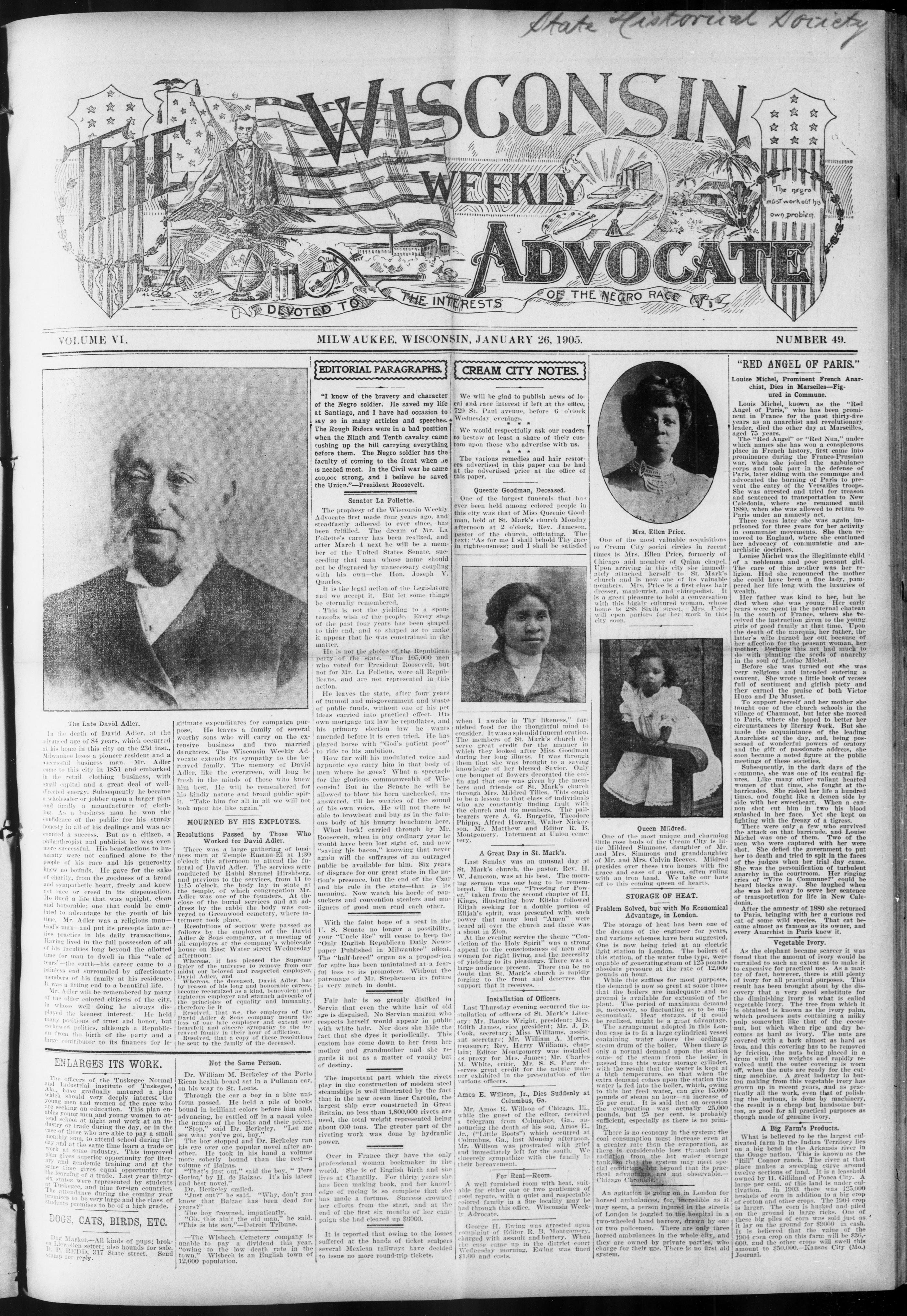
Page text (machine-generated)
WISCONSIN
WEEKLY
ADVOCATE
DEVOTED TO
THE INTERESTS
OF THE NEGRO RACE
VOLUME VI.
[Image of a man with a full white beard and mustache, wearing a dark suit with a white shirt and a bow tie. The background is plain white.]
[No text or additional information is present in the image.]
The Late David Adler.
In the death of David Adler, at the advanced age of 84 years, which occurred at his home in this city on the 23d inst., Milwaukee loses a pioneer resident and a successful business man. Mr. Adler came to this city in 1851 and embarked in the retail clothing business, with small capital and a great deal of well-directed energy. Subsequently he became a wholesaler or jobber upon a larger plan and finally a manufacturer of clothing. As a business man he won the confidence of the public for his sturdy honesty in all of his dealings and was accounted a success. But as a citizen, a philanthropist and publicist he was even more successful. His benefactions to humanity were not confined alone to the people of his race and his generosity knew no bounds. He gave for the sake of charity, from the goodness of a broad and sympathetic heart, freely and knew not race or creed in its dispensation. He lived a life that was upright, clean and honorable; one that could be emulated to advantage by the youth of his time. Mr. Adler was a religious man—God's man—and put its precepts into active practice in his daily transactions. Having lived in the full possession of all of his faculties long beyond the allotted time for man to dwell in this "vale of tears"—the earth—his career came to a painless end surrounded by affectionate members of his family at his residence. It was a fitting end to a beautiful life.
Mr. Adler will be remembered by many of the older colored citizens of the city, in whose well doing he always displayed the keenest interest. He held many positions of trust and honor, but eschewed politics, although a Republican from the birth of the party and a large contributor to its finances for le-
ENLARGES ITS WORK.
ENLARGES ITS WORK.
The officers of the Tuskegee Normal and Industrial institute of Tuskegee, Ala., have gradually matured a plan which should very deeply interest the young men and women of the race who are seeking an education. This plan enables young men and young women to attend school at night and work at an industry or trade during the day, or in the case of those who are able to pay a small monthly sum, to attend school during the day and at the same time learn a trade or work at some industry. This improved plan gives superior opportunity for literary and academic training and at the same time gives equal opportunity for the learning of a trade. Last year thirty-six states were represented by students at Tuskegee, and nine foreign countries. The attendance during the coming year promises to be very large and the class of students promises to be of a high grade.
DOGS, CATS, BIRDS, ETC.
DOGS, CATS, BIRDS, ETC.
Dog Market.—All kinds of pups; brok en Llewellen setter; also hounds for sale. D. P. REDD, 317 State street. Send stamp for reply.
gitimate expenditures for campaign purpose. He leaves a family of several worthy sons who will carry on the extensive business and two married daughters. The Wisconsin Weekly Advocate extends its sympathy to the bereaved family. The memory of David Adler, like the evergreen, will long be fresh in the minds of those who knew him best. He will be remembered for his kindly nature and broad public spirit. "Take him for all in all we will not look upon his like again."
MOURNED BY HIS EMPLOYES.
Resolutions Passed by Those Who Worked for David Adler.
There was a large gathering of business men at Temple Emanu-El at 1:30 o'clock this afternoon to attend the funeral of David Adler. The services were conducted by Rabbi Samuel Hirshberg, and previous to the services, from 11 to 1:15 o'clock, the body lay in state at the temple, of which congregation Mr. Adler was one of the founders. At the close of the burial services and an address by the rabbi the body was conveyed to Greenwood cemetery, where interment took place.
Resolutions of sorrow were passed as follows by the employees of the David Adler & Sons company, at a meeting of all employees at the company's whoiesale house on East Water street Wednesday afternoon:
Whereas, it has pleased the Supreme Ruler of the universe to remove from our midst our beloved and respected employer, David Adler, and Whereas, the deceased, David Adler, has by reason of his long and honorable career, become recognized as a kind, benevolent and righteous employer and staunch advocate of the principles of equality and humanity, therefore be it Resolved, that we, the employees of the David Adler & Sons company mourn the loss of our late employer and extend our heartfelt and sincere sympathy to the bereaved family in their hour of affliction. Resolved, that a copy of these resolutions be sent to the family of the deceased.
Not the Same Person
Dr. William M. Berkeley of the Porto Rican health board sat in a Pullman car, on his way to St. Louis.
Through the car a boy in a blue uniform passed. He held a pile of books bound in brilliant colors before him and, advancing, he rattled off in a nasal voice the names of the books and their prices.
"Stop," said Dr. Berkeley. "Let me see what you've got, boy."
The boy stopped and Dr. Berkeley ran his eye over one popular novel after another. He took in his hand a volume more soberly bound than the rest—a volume of Balzas.
"That's just out," said the boy. "Pere Goriot,' by H. de Balzae. It's his latest and best novel."
Dr. Berkeley smiled.
"Just out?" he said. "Why, don't you know that Balzac has been dead for years?"
The boy frowned, impatiently.
"Oh, this ain't the old man," he said.
"This is his son."—Detroit Tribune.
—The Wisbech Cemetery company is unable to pay a dividend this year, "owing to the low death rate in the town." Wisbech is an English town of 12,000 population.
EDITORIAL PARAGRAPHS.
"I know of the bravery and character of the Negro soldier. He saved my life at Santiago, and I have had occasion to say so in many articles and speeches. The Rough Riders were in a bad position when the Ninth and Tenth cavalry came rushing up the hill carrying everything before them. The Negro soldier has the faculty of coming to the front when he is needed most. In the Civil war he came 400,000 strong, and I believe he saved the Union."—President Roosevelt.
Senator La Follette.
The prophesy of the Wisconsin Weekly Advocate first made four years ago, and steadfastly adhered to ever since, has been fulfilled. The dream of Mr. La Follette's career has been realized, and after March 4 next he will be a member of the United States Senate, succeeding that man whose name should not be disgraced by unnecessary coupling with his own—the Hon. Joseph V. Quarles.
It is the legal action of the Legislature and we accept it. But let some things be eternally remembered.
This is not the yielding to a spontaneous wish of the people. Every step of the past four years has been shaped to this end, and so shaped as to make it appear that he was constrained in the matter.
He is not the choice of the Republican party of the state. The 105,000 men who voted for President Roosevelt, but not for Mr. La Follette, were all Republicans, and are not represented in this action.
He leaves the state, after four years of turmoil and misgovernment and waste of public funds, without one of his pet ideas carried into practical effect. His own mortgage tax law he repudiates, and his primary election law he wants amended before it is even tried. He has played horse with "God's patient poor" to ride to his ambition.
How far will his modulated voice and hypnotic eye carry him in that body of men where he goes? What a spectacle for the glorious commonwealth of Wisconsin! But in the Senate he will be allowed to blow his horn unchecked, unanswered, till he wearies of the sound of his own voice. He will not there be able to browbeat and buy as in the fatuous body of his hungry henchmen here,
What luck! carried through by Mr. Roosevelt, when in any ordinary year he would have been lost sight of, and now "saving his bacon," knowing that never again will the suffrages of an outraged public be available for him. Six years of disgrace for our great state in the nation's presence, but the end of the Czar and his rule in the state—that is its meaning. Now watch his horde of papsuckers and convention stealers and maligners of good men rend each other.
With the faint hope of a seat in the U. S. Senate no longer a possibility, your "Uncle Ike" will cease to keep the "Only English Republican Daily Newspaper Published in Milwaukee" afloat. The "half-breed" organ as a proposition for spite has been maintained at a fearful loss to its promoters. Without the patronage of Mr. Stephenson its future is very much in doubt.
Fair hair is so greatly disliked in Servia that even the white hair of old age is disguised. No Servian matron who respects herself would appear in public with white hair. Nor does she hide the fact that she dyes it periodically. This custom has come down to her from her mother and grandmother and she regards it not as a matter of vanity but of destiny.
The important part which the rivets play in the construction of modern steel steamships is well illustrated by the fact that in the new ocean liner Caronia, the largest ship ever constructed in Great Britain, no less than 1,800,000 rivets are used, the total weight represented being about 600 tons. The greater part of the riveting work was done by hydraulic power.
Over in France they have the only professional woman bookmaker in the world. She is of English birth and she lives at Chantilly. For thirty years she has been making book, and her knowledge of racing is so complete that she has made a fortune. Success crowned her efforts from the start, and at the end of the first six months of her campaign she had cleared up $6000.
It is reported that owing to the losses suffered at the hands of ticket scalpers several Mexican railways have decided to issue no more round-trip tickets.
CREAM CITY NOTES.
We will be glad to publish news of local and race interest if left at the office, 729 St. Paul avenue, before 6 o'clock Wednesday evenings.
We would respectfully ask our readers to bestow at least a share of their custom upon those who advertise with us.
The various remedies and hair restorers advertised in this paper can be had at the advertised price at the office of this paper.
Queenie Goodman Deceased
One of the largest funerals that has ever been held among colored people in this city was that of Miss Queenie Goodman, held at St. Mark's church Monday afternoon at 2 o'clock, Rev. Jameson, pastor of the church, officiating. The text: "As for me I shall behold Thy face in righteousness; and I shall be satisfied
W. H.
when I awake in Thy likeness," furnished food for the thoughtful mind to consider. It was a splendid funeral oration. The members of St. Mark's church deserve great credit for the manner in which they looked after Miss Goodman during her long illness. It was through them that she was brought to a saving knowledge of her blessed Savior. Only one bouquet of flowers decorated the coffin and that one was given by the members and friends of St. Mark's church through Mrs. Mildred Tilles. This ought to be a lesson to that class of individuals who are constantly finding fault with the church and its members. The pall bearers were A. G. Burgette, Theodore Phipps, Alfred Howard, Walter Nickerson, Mr. Matthew and Editor R. B. Montgomery. Interment at Union cemetery.
A Great Day in St. Mark's.
Last Sunday was an unusual day at St. Mark's church, the pastor, Rev. H. W. Jameson, was at his best. The morning sermon was one long to be remembered. The theme, "Pressing for Power," taken from the second chapter of H. Kings, illustrating how Elisha followed Elijah seeking for a double portion of Elijah's spirit, was presented with such power that many loud "Amen" were heard all over the church and there was a shout in Zion.
At the evening service the theme "Conviction of the Holy Spirit" was a strong appeal to the consciousness of men and women for right living, and the necessity of yielding to its pleadings. There was a large audience present. There can be no doubt that St. Mark's church is rapidly forging to the front and deserves the support that it receives.
Installation of Officers.
Last Thursday evening occurred the installation of officers of St. Mark's Literary: Mr. Banks Wright, president; Mrs. Edith James, vice president; Mr. J. D. Cook, secretary; Miss Williams, assistant secretary; Mr. William A. Morris, treasurer; Rev. Harry Williams, chapain; Editor Montgomery was installed as proxy for Mrs. James; Mr. Charles M. White, critic. Mr. S. S. Furr deserves great credit for the astute maner exhibited in the presentation of the various officers.
Amcs E. Willson, Jr., Dies Suddenly at Columbus, Ga.
Mr. Amos E. Willson of Chicago, Ill., while the guest of the editor, received a telegram from Columbus, Ga., announcing the death of his son, Amos E., Jr., ("Little Boots") which occurred at Columbus, Ga., last Monday afternoon. Mr. Willson was prostrated with grief and immediately left for the south. We sincerely sympathize with the family in their bereavement.
For Rent—Room.
A well furnished room with heat, suitable for either one or two gentlemen of good repute, with a quiet and respectable colored family in a fine locality may be had through this office. Wisconsin Weekly Advocate.
George H. Ewing was arrested upon complaint of Editor R. B. Montgomery, charged with assault and battery. When the case came up in the district court Wednesday morning, Ewing was fined $1.90 and casts.
[Name]
Mrs. Ellen Price. One of the most valuable acquisitions to Cream City social circles in recent times is Mrs. Ellen Price, formerly of Chicago and member of Quinn chapel. Upon arriving in this city she immediately attached herself to St. Mark's church and is now one of its valuable members. Mrs. Price is a first class hair dresser, manicurist, and chiropodist. It is a great pleasure to hold a conversation with this highly cultured woman, whose home is 288 Sixth street. Mrs. Price will open parlors for her work in this city soon.
THE BABY
Queen Middred.
One of the most unique and charming little rose buds of the Cream City is little Mildred Simmons, daughter of Mr. and Mrs. Simmons and granddaughter of Mr. and Mrs. Calvin Reeves. Mildred presides over these two homes with the grace and ease of a queen, often ruling with an iron hand. We take our hats off to this coming queen of hearts.
STORAGE OF HEAT.
Problem Solved, but with No Economical Advantage, in London.
The storage of heat has been one of the dreams of the engineer for years, and various schemes have been suggested. One is now being tried at an electric light station in London. The boilers of this station, of the water tube type, were capable of generating steam of 125 pounds absolute pressure at the rate of 12,000 pounds an hour. While this suffices for most purposes, the demand is now so great at some times that the boilers are inadequate and no ground is available for extension of the plant. The period of maximum demand is, moreover, so fluctuating as to be uneconomical. Heat storage, if it could be realized, might be a great advantage.
The arrangement adopted in this London case is to fit a large cylindrical vessel containing water above the ordinary steam drum of the boiler. When there is only a normal demand upon the station some of the steam from the boiler is passed into this water storage cylinder, with the result that the water is kept at a high temperature, so that when the extra demand comes upon the station this water is fed into the boiler, which, owing to this hot feed water, can give 15,000 pounds of steam an hour—an increase of 25 per cent. It is said that on occasion the evaporation was actually 25,000 pounds, but 25 per cent. is probably sufficient, especially as there is no priming.
There is no economy in the system; the coal consumption must increase even at a greater rate than the evaporation, as there is considerable loss through heat radiation from the hot water storage tank, so that the system may meet special conditions, but beyond that its practical advantages are not observable. Chicago Chronicle.
An agitation is going on in London for horsed ambulances, for, incredible as it may seem, a person injured in the streets of London is jogged to the hospital in a two-wheeled hand barrow, drawn by one or two policemen. There are only three horsed ambulances in the whole city, and they are owned by private parties, who charge for their use. There is no first aid system.
"RED ANGEL OF PARIS."
Louise Michel, Prominent French Anarchist, Dies in Marseilles—Figured in Commune.
Louis Michel, known as the "Red Angel of Paris," who has been prominent in France for the past thirty-five years as an anarchist and revolutionary leader, died the other day at Marseilles, aged 75 years.
The "Red Angel" or "Red Nun," under which names she has won a conspicuous place in French history, first came into prominence during the Franco-Prussian war, when she joined the ambulance corps and took part in the defense of Paris, later siding with the commune and advocated the burning of Paris to prevent the entry of the Versailles troops. She was arrested and tried for treason and sentenced to transportation to New Caledonia, where she remained until 1880, when she was allowed to return to Paris under an amnesty act.
Three years later she was again imprisoned for three years for her activity in communist movements. She then removed to England, where she continued her advocacy of communistic and anarchistic doctrines. Louise Michel was the illegitimate child of a nobleman and poor peasant girl. The care of this mother was her religion. Had she renounced the mother she could have been a fine lady, pampered her life long with the luxuries of wealth.
Her father was kind to her, but he died when she was young. Her early years were spent in the paternal chateau in the south of France, where she received the instruction given to the young girls of good family at that time. Upon the death of the marquis, her father, the latter's wife turned her out because of her affection for the peasant woman, her mother. Perhaps this act had much to do with planting the seeds of anarchy in the soul of Louise Michel. Before she was turned out she was very religious and intended entering a convent. She wrote a little book of verses full of sentiment and girlish piety and they earned the praise of both Victor Hugo and De Musset.
To support herself and her mother she taught one of the church schools in the village of Chaumont, but later she moved to Paris, where she hoped to better her circumstances by literary work. But she made the acquaintance of the leading Anarchists of the day, and, being possessed of wonderful powers of oratory and the gift of passionate address, she soon became a noted figure at the public meetings of these societies.
Subsequently, in the dark days of the commune, she was one of its central figures. Like many other valiant hearted women of that time, she fought at the barricades. She risked her life a hundred times, and fought like a demon side by side with her sweetheart. When a cannon shot cut him in two his blood splashed in her face. Yet she kept on fighting with the frenzy of a tigress.
There were only a few who survived the attack on that barricade, and Louise Michel was one of them. Two of the men who were captured with her were shot. She defied the government to put her to death and tried to spit in the faces of the judges when her trial day came. She was the personification of turbulent anarchy in the courtroom. Her ringing cries of "Vive la Commune!" could be heard blocks away. She laughed when she was led away to serve her sentence of transportation for life in New Caledonia.
After the amnesty of 1880 she returned to Paris, bringing with her a curious red cat of some wild species. That cat became almost as famous as its owner, and every Anarchist in Paris knew it.
Vegetable Ivory.
As the elephant became scarcer it was found that the amount of ivory would be curtailed to such an extent as to make it to expensive for practical use. As a matter of fact, however, there is still plenty of ivory for all practical purposes. This result has been brought about by the discovery that a very good substitute for the diminishing ivory is what is called vegetable ivory. The tree from which it is obtained is known as the ivory palm, which produces nuts containing a milky pulp somewhat like that of the cocoa nut, but which when ripe and dry becomes as hard as ivory. The nuts are covered with a bark almost as hard as iron, and this covering has to be removed by friction, the nuts being placed in a drum with iron weights and rapidly revolved until the outer covering is worn off, when the nuts are ready for the cutting machine. A great industry in button making from this vegetable ivory has grown up in recent years, and as practically all the work, even that of polishing the buttons, is done by machinery, the result is a cheap but handsome button, as good for all practical purposes as though made of genuine ivory.
A Big Farm's Products.
What is believed to be the largest cultivated farm in the Indian Territory lies on a big bend in the Arkansas river in the Osage nation. This is known as the "Bill" Connor ranch. The river at that place makes a sweeping curve around twelve sections of land. It is a leasehold owned by H. Gilliland of Ponca City. A large per cent. of this land is under cultivation. In 1903 there was 125,000 bushels of corn in addition to a big crop of cotton and other crops. The 1904 crop is larger. The corn is husked and piled on the ground in large ricks. One of these big piles of corn was sold just as it lay on the ground for $9000 in cash. It is believed that the value of the 1904 corn crop on this farm will be $36,000. and the other crops will swell this amount to $50,000.—Kansas City (Mo.) Journal.
A. Celluloid Danger.
A correspondent writes to the London Times as follows:
"By way of 'glazing' their photographs amateur photographers frequently press the damp pictures, half a dozen at a time, face downward on a specially prepared metal sheet about the size of a school slate. To hasten the tedious process of drying the sheet is often put near the fire. A day or two ago I found my wife bending over the fender with a batch of South African photographs on a patient glazier which she imagined to be tale. She remarked that it was supposed to 'do' them quickly, but that, though otherwise good, it was a slow drier. As the supposed tale looked to me suspiciously like celluloid, I begged her to keep it away from the fire until I should have communicated with the manufacturers. I now enclose their reply. You will see that they state that 'the glaze is made of celluloid, and would be dangerous near the fire.' As knowledge of the fact may save someone a ghastly accident, I think it right to call attention to it. But what shall be thought of people who, with a full knowledge of its highly dangerous qualities, supply such an article for the use of ladies and children without one word of warning?"
The Plight of Russia
Autocrat among autocrats, and grand beneficiary of a tremendous system of oppression, is the Czar Nicholas II. Fearing for his life, he is like clay in the hands of the grand dukes. Diminutive and insignificant, when he stands at full height he must peer up to see the eyes of a woman. He has an inborn weakness that approaches effemacy. His voice squeaks in a high falsetto. His education has been grievously neglected, for he has been bred entirely by women. The Czar of All the Russias is weak and vacillating, frightened by signs and dreams.
To sum up: Russia stands at a great crisis in an evil plight. Its aristocracy is rotten and tyrannous. Its people sodden in ignorance, without moral sense, dull and brutish; its priestcraft often degraded, extortionate, and sensual; its land of natural resources wasted and consumed; its imperial line counting human souls and bodies as bullion for its coining; and its Czar a grotesque weakling.—John Foster Carr in World's Work.
Make Your Food Your Medicine.
The garden is a great medicine chest. Be your own doctor and look to your own slight ailments.
If you are wakeful, eat lettuce.
For affections of the skin and for yellow skin eat onions. Onions are also good for colds, coughs, scrofula. For a torpid liver, eat freely of asparagus. For malaria and general breakdown, eat cranberries.
If nervous and irritable, eat plenty of celery. For constipation, eat fruits, ripe and healthy fruits. Fresh fruits are good; so are figs and dates. Raisins are beneficial. When the body is in good condition keep it in good condition by denying the appetite what has once injured the body. One can do everything for himself by eating the right thing and not too much of it, and by leaving alone the wrong thing and all of it. He can do more than the doctors can do for him when he is flat on his back in bed.—Philadelphia Inquirer.
Dangerous Curiosity.
An Irish judge once had a case in which the accused man understood only Irish. An interpreter was accordingly sworn. The prisoner said something to the interpreter.
"What does he say?" demanded his lordship.
"Nothing, my lord." was the reply.
"How dare you say that when we all heard him? Come, sir, what was it?"
"My lord," said the interpreter, beginning to tremble, "it had nothing to do with the case."
"If you don't answer I'll commit you, sir!" roared the judge. "Now, what did he say?"
"Well, my lord, you'll excuse me, but he said. 'Who's that old woman with the red bed curtain round her sitting up there?'
"And what did you say?" asked the judge, looking a little uncomfortable.
"I said, 'Whist, ye spalpeen! That's the ould boy that's goin' to hang yez.'"—London Tit-Bits.
Bracelet Returns to Favor.
Bracelets have returned to fashion with a bound. They promise to be the paramount choice for Christmas gifts and have already assumed the lead once in possession of the long chain, now obsolete, or soon will be if the bracelet knows itself.
The restoration of this ornament to favor is due to the change in the style of dress. Sleeves are much shorter, and beautiful arms are in demand. If you haven't beautiful moulded wrists and arms, get them; for, of course, with these string of bracelets they are essential. A string of solitaires makes a sweet bracelet, and it will cost $10,000, or even $20,000, if necessary to the wearer's happiness. There are others less costly, composed of matched stones and pearls, set in links of gold, and there are serpents to wind around the upper arm, having blazing diamonds in their flat heads; but, whatever form the bracelet takes, it has a very bequiling and expensive expression.—Boston Herald.
Convictions Valuable
Nobody who is endowed with a good mind and wants to live to his satisfaction can afford to neglect the acquirement of convictions. What are they? They ought to be opinions based on knowledge and definitely thought out. Practically they come in various ways—often by inheritance, or as the result of early training; sometimes by association, sometimes from the automatic working of the mind during long periods when it is acquiring and sifting knowledge and experience. Sometimes again convictions seem to come suddenly, especially religious convictions, though there is usually a long process of preparatory thought behind them, and it is really only the final conclusion that is sudden. Deep convictions on any subject don't come ready made. One has to work for them; to earn them. If they are to hold and to influence conduct, they must be planted deep.—Metropolitan Magazine.
War Slaughter of a Century
The death roll due to wars during the last century, Prof. C. Richet of the Faculty of Medicine in Paris sums up in a grand total of 14,000,000. He divides this as follows: Napoleonic wars, 8,000., 000; Crimean wars, 300,000; Italian wars, 300,000; American Civil war, 500., 000; ranco-German war, 800,000; Russo-Turkish war, 400,000; civil wars in South America, 500,000; various colonial expeditions in India, Mexico, Tonquin, South Africa, etc., 3,000,000.
Specialists.
To be specialistic is not human. All animals are specialists. A cat wants only one or two things all life long; so does a camel.-Fortnightly Review.
Asylums and Playing Cards.
Moscow's orphan asylum, founded by Catherine U., is supported by a tax on playing cards.
AT THE INNER GATE.
Love is not blind. Love's eyes are clear and bright. Wherein each imaged imperfection lies. Like dreamy cloudlets bosomed in blue skies.
Love is not blind; for love hath perfect sight.
But ever doth a warden, armor-dight.
Stand at the gate of thought, unchanging, wise,
To bid the poisoned message of the eyes
Back from the portal of the inner light.
There in me myriad-millionth moment space
The holy guardian of that inner place
Hath banished sight, that knowledge may
not know.
So doth love see with open eyes, and yet
Shall Love's forgiveness need not to forget.
—George H. Maitland in Booklovers' Magazine.
AN UNCONVENTIONAL ENDING
"Confound it all!" muttered Leslie Conyers as he rumpled his aggressive-looking hair and stared wildly at the huge mass of letters and manuscripts that glared back at him uncompromisingly from his desk. "Confound it all! I must really get somebody to assist me with my work. Commissions are pouring in from the magazines and I don't know which way to turn."
Then a voice seemed to whisper in his ears: "Get a girl typist and dictate to her. Her presence may inspire you and her machine will undoubtedly prove useful." He obeyed the whisper and next morning the following advertisement appeared in the Daily Telephone:
"Wanted—An efficient and rapid young lady typist, with own machine, to assist author in literary work and correspondence. Apply to Leslie Conyers, 27x, Clifford's Inn, W. C." Throughout the day a long procession of women, whose ages varied from 17 to 57, filed slowly up the stairs that led to the dingy rooms where Conyers toiled toward fame and £5 per 1000 words. One by one he interviewed the applicants, the majority of whom appeared hopeless. In all sixty-five ladies applied. When at length they had departed he sat down and summed up their qualifications tablewise thus:
Too elderly and severe.....20 applicants
Hopeless spellers.....25 "
Utter imbeciles.....10 "
Too "flirtatious"(apparently) 9 "
Clever, competent—suitable. 1 "
To the "1 ditto" he accordingly wrote
next morning asking her to consider her
self engaged and to appear with her
Remington at Clifford's Inn on the
following Monday at 10 a. m. precisely.
The Monday arrived and there came also
Miss Daisy Bolton, a tall, slim young
woman with pretty hair and humorous
eyes.
"Er—good morning," said the author,
feeling a trifle nervous as he surveyed
his new assistant. "Have you brought
your typewriter?"
"Yes. The porter is bringing it up." A moment later the machine made its appearance. Miss Bolton removed the cover in a businesslike fashion and then sat down at the table indicated by Conyers. She ran her fingers lightly over the keys of the typewriter, and this action pleased Conyers, for in all the stories he had ever read or written concerning lady typists they invariably began operations in this fashion.
"Now, be kind enough to copy this manuscript," he said timidly, as he placed on the table a formidable-looking mass of foolscap, "and when you have finished I will get you to write some letters."
She nodded and smiled. Two hours later the work was ended and Conyers was delighted.
"Er—this is excellent, quite excellent," he murmured. "I never dreamed that the typewriter could achieve such wonders."
"Didn't you?" replied the girl quietly.
At 1 o'clock she went out to lunch and the author felt lonely. Already he was beginning to appreciate that graceful presence in his dingy room, and he looked anxiously at the clock.
"I told her to take an hour," he reflected, "but I wish I had made it forty-five minutes."
In order to fill the weary interval he went and had some luncheon himself, and when he returned Miss Bolton was already at work.
"I thought you might want this short tale typed," she said, as she pointed to a manuscript, "so I started on it directly I came in."
"Quite right," he murmured, and then told himself that the girl was as industrious as she was pretty.
In the days that followed this view was confirmed. Miss Bolton was everything that the most exacting author could wish. She arrived each morning as the clock struck 10, worked with rigid persistence till 1, took exactly sixty minutes for lunch, and never desired to leave before the appointed hour of 5. Altogether she was admirable, and a hundred times a day did he bless the happy inspiration which had led to her instalment in Clifford's Inn. One evening he approached the girl's table and said with a touch of diffidence in his voice, "Er—Miss Bolto... I have just received a couple of stalls for the Gaiety—and—and——"
"Yes," she exclaimed, looking up with a bright smile of encouragement. "yes."
"Er—I want to know whether you would give me the pleasure of your company. The seats are for tomorrow night, and I should be so delighted if you would come."
The girl hesitated. "I—I don't know if mother would like it," she faltered.
"Why not ask her? Surely she can have no objection, for remember that we are no longer strangers, and that you have been with me several months."
"Very well, I'll see."
Next morning he met her with the question. "Well, and what did your autocratic mother say in reference to the theater?"
"She said I might go, but that I must not be home later than 12."
His face grew red with delight. "By Jove! that's good," he exclaimed, "we shall just have time for a morsel of supper after the performance and then I can drive you home."
"That will be delightful."
Then perceiving that some remark was trembling on her lips, he added, "Is there anything you want to say?"
"Just this," she faltered, "I—I haven't a theater dress, so will it matter if I go in my ordinary things?"
"Matter? Not a little bit. It is only at the opera, you know, that they insist upon the conventional outfit. The things you are wearing now will do capitally."
And so it came to pass that the evening found the author and his pretty typist in the stalls of the Gaiety theater.
and Conyers discovered for the first time that musical comedy did not necessarily mean weariness. Perhaps the presence of Miss Bolton at his side accounted for his new discovery. After the performance they had some supper, and then the author hailed a hansom and handed the girl in side.
He thought that the time had now come when he might venture to squeeze her hand, but he was sorry for his boldness an instant later. The girl drew her hand away with a cry of annoyance and said hastily. "Don't, please don't."
"I—I'm awfully sorry if I've annoyed you," he hastened to say, "but your hand was so close that somehow I couldn't help touching it."
He was a trifle disappointed at her behavior, but the snub served to deepen his admiration.
Until the coming of Miss Bolton into his office Leslie Convers had not looked upon matrimony with any marked favor, but now his views were in a state of transition. He began to think that it would be very pleasant to be able to retain the girl after 5 o'clock, to have her beside him for the remainder of his life.
"The only objection to my proposing to her is the horrible and obvious conventionality of the business," he reflected, "for in every story the author has invariably proposed to the typist in the last chapter."
Now Leslie Conyers prided himself on the unconventionality of his fictional personages, and was never happier than when devising an utterly unexpected ending to a story. It therefore galled him to think that he, the apostle of the unconventional, should humiliate himself to the level of the author of fiction, but there seemed no help for it. He was in love with Daisy Bolton and wanted to make her his wife. At length there came the day when he could no longer restrain his impulse. She was sitting at her table busily engaged in typing, looking divinely pretty the while.
"Miss Bolton," he said nervously. "do you mind stopping your work for a little, because I want to speak to you?"
"Yes," she replied with an upward inflection, "yes?"
"I want to know if you will be my wife. I think you are the sweetest woman on earth, and I believe I could make you happy."
She rose and surveyed him with a curious smile. "I am very much afraid, Mr. Conyers," she replied slowly, "I am very much afraid that I must say no."
He swayed toward her with a look of entreaty. "You—you say no," he cried. "But—but you don't feel—no—do you?"
"I do, indeed. What you ask is impossible."
"Impossible?"
"Yes, quite out of the question."
"Don't you like me? Don't you care for me?"
"Yes, I like you very much indeed, but if you knew the truth concerning me I feel sure you would never have asked me to be your wife."
The truth! What did she mean? Was it possible that her past held some guilty secret and that her innocent face was but a mask which concealed lurid things?
"Daisy," he said, hoarsely, "don't play with me, tell me the truth. Is there any other man who means aught to you?"
"There are several," she replied, calmly.
"Several? Good heavens!" he exclaimed, "are you speaking in jest?"
"Hardly. I went to Hastings last year with one, to Margate the year before with another, and to Ramsgate the year previous to that with the third."
"Heavens! Are you cynical enough to stand there and make such a shameful confession?"
"There is nothing shameful whatever about it," replied the young lady calmly. "And if you knew the whole truth instead of only a section of it you would agree with me."
There was a long pause. At the end of it he controlled his excitement with an effort and burst out, "I care not a straw what your past has been. Marry me and begin a fresh life."
"I refuse, I refuse." she laughed.
"I will make you the happiest woman in England."
"You cannot do that, Mr. Conyers."
"Cannot? Try me and see."
"You cannot do it, because even you cannot change a boy into a girl."
"A boy!" he echoed stupidly; and then, stricken with amazement, he beheld Daisy wrench off a wig. An instant later she stood before him, a slim, good-looking youth of 16 or thereabouts.
"Great Scott!" he yelled, "what does this mean?
"Simply that I was in want of a berth, Mr. Conyers, but I knew that the market value of boys of 16 was about five shillings a week while a girl of 20 might claim a sovereign, so I made up as Daisy Bolton and took the situation and the £1 a week that went with it."
For several minutes Conyers could not speak a word. Then he said slowly, "You young rascal, I have half a mind to give you the sack for this."
"I don't think you will," replied the boy saucily. "What would the press association give me for a story of the kind, do you think? Just fancy what a headline it would make for the half-penny papers: Well-Known Author and His Lady Typist; a Proposal of Marriage That Did Not Come Off.'"
Conyers could not help laughing. "Fr—I never thought of that," he murmured, "You can remain."
"Thank you, sir," said the boy.
"And to think," pondered Conyers that evening, "to think that I actually wanted to squeeze that young scoundrel's hand."
He felt exceedingly disgusted, but the one redeeming point of the affair was the fact that his romance had had an unconventional ending indeed.—Ethel Carruthers in the Tattler.
Responsibility of the Jug
"Yes, sun—de snake wuz twelve foot long—"
"Come, now!" "En had sixty rattles----"
"Well, suh, maybe I is; but dar's one thing I wuzn't mistook in, en maybe you'll doubt dat."
"Go ahead and tell it." Then the old man straightened himself, smacked his mouth, and said:
"De jug helt two gallons, en only had one handle!"—Atlanta Constitution.
Dreadful Thought
Miss Ascum—Your poems are beginning to attract wide attention, aren't they? I should think it would scare you.
Miss Passay—Scare me? Why?
Miss Ascum—Because if you get famous they'll be wanting a biographical sketch of you for some anthology, and then you'll have to tell the year of your birth.—Philadelphia Press.
The Old Man's Troubles.
Yeh see th' frost is bound ter cum,
An' folks that fixes things raound hum,
When sundoanun gives yer shivers.
Will fence up things where ol' Jack treads,
An' worry over poey beds,
Pertectin' em with kivers.
Yeh ketch a cold yerself some night,
A-foolin' raound by lantern light,
A-blowin' an' a-sneezin'.
An' when yer gits ter bed at last
Yer wife ain't sure th' trouble's past,
Dead set thet "somethin's freezin."
Confaound this thing of hide an' seek,
Of movin' pots nine times a week,
Th' palms an' ferns an' mosses:
It's on th' porch—back in th' sun—
Jest keeps a feller on th' run
Insurin' 'gainst his losses.
Them prickly things! Dad burn them plants
Thet rips an' tears yer cont er pants!
I wisht th' frost would bite 'em.
Them cactuses is jest a fad
Ter make men folks so bloomin' mad
They'd like ter cuss er fight 'em.
Wal, wimmin dote on sech affairs.
Ain't happy 'thout their needless cares,
But it don't seem ter faize 'em;
Still I allow this world of ours
Would be some plainer 'thout its flowers,
An' wimmin's hands ter raise 'em.
—Lippincott's Magazine.
New York Every Day.
Norman Rockefeller, a prosperous farmer and an uncle of John D. Rockefeller, died at Phelps, N. Y., aged 92.
The application for the appointment of a commission on the person and estate of Brodie L. Duke has been put over for one week.
Patrolman Eugene L. Devanna was convicted of manslaughter in the first degree for killing George Dorwick in November. The maximum penalty is twenty years.
Dr. Livingston Farrand, professor of anthropology at Columbia university, has been named as head of the National Association for the Study of Prevention of Tuberculosis.
Gessler Rosseau, charged with sending an infernal machine to the Cunard dock a year ago last May, was indicted by the grand jury. It is expected he will be extradited from Philadelphia.
President Charles W. Eliot of Harvard university and Mrs. Eliot sailed for Europe on the steamer Blucher. Another passenger on the Blucher was Mrs. Robert S. McCormick, wife of the American ambassador to Russia.
President Woodrow Wilson of Princeton university, who was operated on in the Presbyterian hospital several weeks ago, has just been discharged from that institution. It is stated that the operation was entirely successful.
Dr. S. R. Beckwith, who was President Garfield's family physician at the time of his assassination, is dead at his cottage in Atlantic City, after a long illness. He practiced some years ago in Cleveland and Cincinnati.
J. M. W. Geist, Lancaster, Pa., one of the best known newspaper men in Pennsylvania, and one of the founders and until recently at the head of the editorial department of The New Era, died from infirmities incident to old age. He was in his eighty-first year.
Police activity continues in the campaign against gambling houses and illegal resorts. Raids are made on drinking resorts and wagon loads of habitues arrested. Two or three "slumming parties" got into the police net and the women members became hysterical over the situation. They were liberated.
Edward Fletcher, for many years identified with the financial side of the theatrical business, is dead at his home in New York city from a complication of diseases. He founded and was acting secretary of the Treasurers' Association of America, an organization numbering several thousand members.
Twenty members of the Chicago Woman's club now resident in New York city, have formed themselves into the New York branch. Their intention, it was stated, is "to keep alive the western spirit." Mrs. Caroline Brown, formerly president of the mother organization, inaugurated the movement here.
The attitude of Speaker Cannon toward tariff revision was indorsed by the American Protective Tariff league at its annual meeting. Charles A. Moore was elected president, and Wilbur F. Wakeman treasurer and general secretary. D. M. Ferry of Michigan was elected a member of the board of managers.
Mrs. Lewis Cass Ledyard of New York City and Newport is dead at her residence in New York from heart disease. She was the wife of the former commodore of the New York Yacht club. Mrs. Ledyard was a leader in society. She was the daughter of Col. William E. Prince and niece of former Mayor Prince of Boston.
一
In a case involving a check of William G. Rockefeller for $1,300,518 to pay the balance of an indebtedness of $2,000,000 to the late Marcus Daly, the appellate division of the supreme court handed down a decision holding that under the circumstances cited the check was taxable. The Daly estate objected to the payment of a tax.
A joint report of the five borough presidents, recommending the purchase of land for more than a score of new parks in Greater New York, to cost $13,000,000, was presented to the board of estimate. The largest project is for a park to connect Morningside and Riverside parks, from 121st to 123d streets. The land is estimated worth $5,000,000.
Moses J. Jackson, a member of the New York city board of coroners, was arrested, charged with attempting to bribe Deputy Assistant District Attorney Charles Chadwick, by offering him $200 to fail to produce evidence against a physician who was arrested on a manslaughter charge. Coroner Jackson was taken before Recorder Goff and released on $250 bail.
---
Plans are now being drawn up for the erection of a twenty-two-story hotel in Battery place, overlooking the upper bay. A syndicate has purchased the block for more than $2,000,000, and it is planned to expend $2,000,000 more in constructing the hotel. Seventeen floors will be devoted to bedrooms, the remainder to dining rooms, etc. A roof garden will overlook the entire bay.
Through Chancellor Whitelaw Reid a petition has been presented to the regents of the University of the State of New York asking for the removal, of Melvil Dewey, state librarian. It demands his removal on the ground that, as president of the Lake Placid company, he has enforced rules rigidly excluding Jews from the Lake Placid club, which is one of the departments of the Lake Placid company.
Maj. Jacob Ridgway Wright of
Wilkesbarre, Pa., a graduate from Princeton and well known throughout Pennsylvania on account of his work in the coal strike in forming the Citizens' alliance, died at the New York hospital from the effects of having shot himself in his room at the Imperial hotel. Friends believe it was an accident and so does the coroner, but the police think it was suicide.
President Roosevelt, who is stated to have accepted the invitation of Williams college to attend the commencement in June, will receive the degree of LL. D. The President will reach Williamstown on June 20 or 21, and remain a day or two as the guest of President Henry Hopkins. He will then go to Cambridge to attend commencement at Harvard and the twenty-fifth anniversary of the graduation of his class.
In fighting her husband's attempt to take from her their little daughter Olivia, Mrs. Ella V. Herkimer of Brooklyn, N. Y., makes charges counter to those of her husband, one being that he had been attentive to two young women, and his devotion to one going so far as to send her pink silk stockings. Dr. Robert H. Herkimer, her husband, is chief sanitary inspector of the health department of the borough of Brooklyn.
On the rear platform of a crowded Thirty-fourth street cross-town car, when the streets were thronged with people and while opposite the Waldorf-Astoria, Charles E. Van Der Bogart was held up and robbed of $25 in cash, a gold watch and chain worth $250, a check and a number of valuable papers. The conductor had seen the scuffle and he and many passengers tried to reach the rear platform, but could not force the door.
一
William Henry Bishop, the young English boilermaker and Socialist who was detained on his arrival here by the customs inspectors because they do not know the difference between a Socialist and an Anarchist, was released this afternoon on a telegraphic order from Secretary Metcalfe of the department of commerce and labor, on the strength of a long brief and an affidavit filed with Commissioner of Immigration Williams by his counsel.
Two New York afternoon papers claim that there are 100,000 unemployed men in Greater New York, a number larger than any heretofore recorded. Strikes and lockouts account for only one-fourth of this number, and the statement is made that the rest are not connected with labor of any kind. Evictions have been numerous during the last month and the hardships of the unemployed have been further augmented by the general increase in the price of all foodstuffs.
Following the fire at the home of William Mason, a lawyer at 133 West 130th street, at which he, his wife, Clare, their two children and a servant lost their lives, it has been learned that thieves looted the house and robbed the dead, stripping from the fingers of Mrs. Mason four rings valued in the neighborhood of $1000. Besides this, the thieves got $50 in cash from a pocketbook, a gold watch and chain and other jewelry bringing the amount of the robbery as far as known up to at least $1500.
Seven alleged members of a black hand band which for months has been terrorizing Italian tradesmen and merchants of Williamsburg, have been arrested by Brooklyn detectives, after two desperate fights with knives. Nearly all the numerous letters threatening merchants with destruction of property or death unless money were forthcoming are said to have been traced to the men just captured. Their leader was found to be a powerful man speaking excellent English. He is said to have left a criminal record in Sicily.
---
Mrs. Stuyvesant Fish is to give a dinner reception at her residence, 25 East Seventy-eighth street, on the evening of January 27. She arranged today with Sam Shubert, the theatrical manager, to have Lillian Russell and her company in the second act of "Lady Teazle" appear at her house. Mrs. Fish will have a stage built for the performance. Gustave Kerker and thirty-eight musicians will go with the company. This will be after the performance at the Casino. Mrs. Fish will pay Manager Shubert $2500 for the services of his players for an hour.
---
J. J. Van Alen is still disbursing large sums of money on his home in Northamptonshire, Eng., although he has only been able to secure the property on a forty-three years lease. Should anything happen to him meanwhile it would revert at once to the owner. In spite of this he is expending something like $500,000. He is having all the garden ornaments, fountains, leaden figures, even the sun dials, sent from abroad. One of the anomalies of the place will be a negro cook, who is said to be quite an artist of the kitchen, surpassing any French chef yet born.
The substitution of all-steel cars for the present copper-sheathed wooden coaches will soon begin and go on steadily until 600 steel cars have been installed in the subway. The wooden cars will be turned over to the elevated road. The steel cars, of which 500 have been ordered, are more or less of an experiment. All-steel cars have never been used before, and there is some doubt as to their wearing qualities. It may be that after a few years' constant service they will rattle like a string of kettles. If, on the contrary, they prove satisfactory, nothing but steel cars will be used on the underground road.
Sir Charles Wyndham, the English actor, was badly injured by a trolley car. His right shoulder was dislocated and he was unable to appear in "The Case of Rebellious Susan" at the Lyceum theater. Sir Wyndham was going to the theater about 8 o'clock from the Majestic hotel and took an Eighth avenue car. At Columbus circle he decided to transfer to a Broadway car. He left the car and was walking behind it when he was struck by a northbound car. "Lady Garringe's Necklace," with Frank Atherly in the leading role, was substituted for "Rebellious Susan," with Sir Charles out of the cast.
One of the many curious and interesting things connected with "The Little Church Around the Corner" is the lich gate. It is stated, though not with positive authority, that it is the only one in the United States. The lich gate is a sort of pagoda, open on all sides, under which the corpse is laid to await the arrival of the clergyman. It stands just inside the curb, and is removed from the church door by about eighty feet. Even if there was a disposition to revive the old English funeral custom in New York there are only a few churches with ground enough in front of them to make the lich gate possible.
Unique.
We observed on the street of Indianapolis a middle-aged man, about whom an immense crowd of excited Hoosiers had collected.
"And who is this?" we asked our guide.
"That, sir," he told us, "is Silas Swamproot."
"And what has he done?"
"Done? Why, he's the only man in Indiana who is not a candidate to succeed Fairbanks."—Cleveland Leader
HASN'T DREAMED IN FIFTY YEARS
That, Says Rev. Dr. Starr, Is Why Five Hours of Sleep Suffices Him
Rev. W. G. Starr, D. D., pastor of Washington Street Methodist Episcopal church in Petersburg, Va., has never had a headache in his life. Hard work simply carries him to the line of exhaustion, when sleep naturally provides needed rest. Then after five hours of uninterrupted slumber he is ready for work again. He believes that the reason why he gets out of five hours of sleep as much as other people obtain from eight is that he never dreams. He has not had a dream in fifty years. His brain is absolutely in a state of repose after the closed eyes shut out the light. He always eats a hearty supper before retiring, because, as he says, it draws the blood from the brain cells to the gastronomic territory. He always sleeps soundly from midnight until 3 a.m. Then he turns over on the left side and finishes up the remaining two hours of the night. As has been said, Dr. Starr gives five hours to sleep. He gives two hours to food and exercise, and the remaining seventeen to his ministerial work.
HIS EXPERIENCE TEACHES THEM
That Dodd's Kidney Pills Will Cure Bright's Disease—Remarkable Case of George J. Barber—Quick Recovery After Years of Suffering. Estherville, Iowa, Jan. 23d.—(Special.)—The experience of Mr. George J. Barber, a well known citizen of this place, justifies his friends in making the announcement to the world "Bright's Disease can be cured." Mr. Barber had kidney trouble and it developed into Bright's Disease. He treated it with Dodd's Kidney Pills and to-day he is a well man. In an interview he says:
"I can't say too much for Dodd's Kidney Pills. I had Kidney Disease for fifteen years and though I doctored for it with the best doctors here and in Chicago, it developed into Bright's Disease. Then I started to use Dodd's Kidney Pills and two boxes cured me completely. I think Dodd's Kidney Pills are the best in the world."
A remedy that will cure Bright's Disease will cure any other form of Kidney Disease. Dodd's Kidney Pills never fail to cure Bright's Disease.
WASHINGTON DRANK FROM IT.
G. A. R. Post Has a Keg Which the General Used in War.
The Ezra Griffin G. A. R. post of Scranton, Pa., has just come into possession of a water keg which went through the Revolutionary war and from which Gen. Washington frequently drank. The keg was presented by Horace H. House. It was made by Maurice T. Bennett of Orange county, N. Y., about 1770 and is 1 foot in diameter, 6 inches high and holds about a gallon. The keg was presented by its maker to his brother, Justice Bennett, who was an officer under Washington, and it was in his kit throughout the war.
It was in possession of Abraham Bennett, son of the officer, for many years and when he died in 1879 at Hamburg. Mich., aged 115 years, he presented it to his niece, Clarissa Ruey, who in turn presented it to Mr. House, her nephew, a short time ago.
ULCERS FOR THIRTY YEARS.
Painful Eruptions from Knees to Feet Seemed Incurable Until He Used Cuticura.
Another of those remarkable cures by Cuticura, after doctors and all else had failed, is testified to by Mr. M. C. Moss, of Gainesville, Texas, in the following letter: "For over thirty years I suffered from painful ulcers and an eruption from my knees to feet, and could find neither doctors nor medicine to help me, until I used Cuticura Soap, Ointment, and Pills, which cured me in six months. They helped me the very first time I used them, and I am very glad to write this so that others suffering as I did may be saved from misery."
What a "Block" Is Worth.
According to figures printed by the Insurance Press, there are blocks in New York city in which $25,000,000 worth of property would be destroyed if swept by fire. Chicago, Philadelphia and Newark come next with blocks valued at $8,000,000 each. Boston and St. Louis have blocks worth $7,000,000, and nearly two score other cities can show similar properties at values ranging from $1,000,000 to $6,000,000.
In a table showing the rank of states as buyers of fire insurance, New York easily leads with more than $4,000,000,000 a year, while Illinois, Pennsylvania and Massachusetts buy protection for more than $1,000,000,000 worth of property.
A GUARANTEED CURE FOR PILES. Itching, Blind, Bleeding or Protruding Piles. Your druggist will refund money if PAZO OINTMENT fails to cure you in 6 to 14 days. 500.
—Horses killed for food in France yield on an average 450 pounds of meat each.
—In the Vatican library at Rome is a Bible that weighs 520 pounds.
TRADE MARK.
THERE IS NOTHING
more painful than
Rheumatism
and
Neuralgia
but there is nothing surer to
cure than
St. Jacobs Oil
The old monk cure. It is penetrating, prompt and unfailing.
Price 25c, and 50c.
PISO'S CURE FOR
GURES WHERE ALL ELSE FAILS.
Best Cough Syrup, Tastes Good. Use in time. Sold by druggists.
CONSUMPTION.
GOSSIP FOR THE LADIES.
The Mountains.
The Peace of the Mountains.
I wish I could get the peace of the mount-
talms into it.
The mountatus of God are ever still, full
of rest;
the quiet;
they say, and life their thoughts
hear.
up to heaven;
The lark with the wings as he rises brush-
ing on crest.
or their creak.
They gather the rose of dawn, the glory of
The night with her stars leans on them,
breast to her breast.
I wish I could get the peace of the mountains into me.
And not to have all the world a trouble to me.
I am full of frets and fatigues, angers and fears;
I wish the mountains would tell me their secrets of peace.
secret of peace.
They have seen men born and die, all the
works of their hands Pass like the leaves of autumn; increase and decrease
and de-
fore natural things, and the years, like a
fruitful of sands.
must
run out and be done, and the nations
threaten and cease.
wither and cease.
They have looked to God through all the
wishery.
days and the years.
I wish I were still like the mountains, not
vexed, full of fears.
The wind roars over them, singing up from
the sea.
talks into me,
And not of have all the world a trouble to
me. —Pall Mall Gazette.
Betty's Twilight Chat.
New Year's resolutions! How many of us make them and how few end the twelve months with fragments hardly large enough for identification purposes! Still it is good to make them—it shows a proper sense of our shortcomings and a desire to correct them. A day's improvement in grace is something worth considering, and we all hold out longer then that.
There are, probably, a few cases on record where lasting reforms have sprung from New Year's resolutions. I know one, and you could, undoubtedly, tell me others. This was the case of an unpopular girl who sighed for the attention bestowed upon other girls who lacked some of her good points. Obviously there were defects which she must find and correct, and she decided that the best way to do was to study and imitate the popular girls of her circle. It was a difficult task she set herself, but she possessed the necessary pluck to carry through to the end any undertaking she began. By New Year's day she had a collection of valuable notes, representing the qualities that made her girl friends popular.
I believe that she never found more than one in each person. She determined to combine them and test the result. Three months passed away and the entire feminine portion of the best part of that city in which the incident took place, woke up one day to the fact that they were being pushed into the background by a hitherto unobtrusive member of society, that they were dividing masculine attentions with her and giving her the lion's share at that. Things continually grew better for her and worse for them, but I am sure they never guessed the reason.
It is not every woman who is willing to admit faults or shortcomings—that is where men have an advantage. Most masculine creatures glory in their faults and chuckle over their sins. Perhaps that is why women like even the worst of them. Wherever you find a man frankly confessing his enormous distance from sailthood you will find adoring women in flocks, regular flocks. Men make New Year's resolutions, yes, but they have economy as an object or something personal. They announce their intentions with the blare of trumpets and to some over their failure to keep them. There is this to be said. The world is not as observing as we imagine and we are likely to escape unnoticed unless we do something big or loud enough to attract its attention. I fancy our self-esteem would receive a severe shock did we really know how insignificant we are, of how very little interest our small doings are to the general public. I thought that today when the postman who has been delivering for months all kinds of queer mail in several names at a house on his route and never appeared to take the slightest interest in the affair beyond getting the packages to their destination. Today one name attracted him by its familiarity and he ventured to ask a question and express an admiration for the articles to which he had often seen it appended. And all the time the family had been picturing him devoured with curiosity and talking them over with his crones.
Well, if we do not talk nobody pauses to listen, and almost anything is better than indifference. I would rather be adversely criticized than ignored and there are many like me. An occasional rap is wholesome, like the bitters we take to stimulate a failing appetite. Continuel mugging is like a wasting sickness that saps the vitality. So you are all at liberty to rap me on the knuckles when you feel that you have cause, and if I cannot justify myself I will be meek. I certainly shall not be foolish enough to feel other than interested in whatever impression I make.
If we are going to hold to the time-honored custom of making resolutions at the beginning of the new year—and pray let us keep a bit of old-time flavor in our life—let us pick out ones worth considering. It was not worth while for my friend, who dotes on chocolates, to forswear them because she never ate enough to harm her, and cutting them out of her life was cultivating unnecessary misery. She might better have resolved to take more interest in the unfortunate and be more forbearing with those who loved her. There is a deal of charity in the world, but not a fractional part of what is needed. Thousands of men and women are doing a tremendous work in that direction and tens of thousands are doing nothing at all. You know to which side you belong and you also know that you can do a little something if no more than giving away a loaf of bread.
I have heard of people who spent so much time in trying to be good that they found no time to do good. I don't care how much we differ in creed; there is a common ground on which we may agree with a clear conscience—the simple Christian doctrine of being good and doing good. How can beliefs affect that? Being good is infinitely harder than doing good, and that is why it comes first. One does not have to wait for the new year to put reforms into working order, but there can never be a better time of the year to think of others. Christmas thoughts soften up our natures, that is if we are worth much, and in such a frame of mind we are ready to promise a good deal. So you see there is a reason for this excellent old custom, after all—Boston Traveler.
making the Farmhouse Attractive
What is it that makes farm life attractive to me? It is the opportunity it
offers a young woman to live an individual life; to make the best of her every talent; to fit herself to successfully cope with every position with which she may be confronted. First, it flings at her feet health if she will but heed. It gives her a firm hand, warm, rich blood and unclouded brain power. By brook, meadow or hillside she is ever near her God and a realization of this makes her more akin to Him. Away from the unreasonable rush, the dazzling glare, the "flashes in the pan" of the city, she may lead an unruffled, placid life with all of the true pleasures at her command—her loved ones, her duties, her recreations.
Country girls often hold a mistaken estimate of "hard work." They think it is a "soft snap" to work in the city. They do not take into consideration the routine which grinds; the set hours which are mercilessly maintained; the impure atmosphere which draws the richness from their cheeks and dims the brightness of their eyes, the unnatural stimulus of excitement and activity which ages prematurely.
Here we have a young woman just through her schooling. It has taken some sacrifice and endeavor on the part of her parents to give her this. Now they want her company and help. She feels that it is just like being buried alive to go back to the old farm. She goes. She fills the house with a new light. Her parents are so proud and happy in their accomplished daughter. Now is she going to fret because she is out of her sphere? She should not, because she is strictly "in" her sphere.
On the part of the parents, if they have recalled her from the possibilities of a wage-earning position, she should be given an allowance, be it ever so small, that she may be independent. Good periodicals should be admitted to the home. If she is musical, an instrument should be furnished, if that can be afforded. She should not be asked to do tasks beyond her strength. Because she is on a farm she is not possessor of a man's strength. Many farmer's wives I know do a man's share in the fields. The evil effects will be surely reaped by some one.
But the girl, to be happy, must work outdoors as well as in. There are many light outdoor tasks which may well fall to her lot, such as caring for the poultry, gathering fruit and husking corn. And right here comes in the joy of living, the closer communion with nature. To all the village undertakings she should contribute of her ability. She should find some interest and pleasure in every gathering, for the person who feels herself to be out of her place and keeps looking forward to sometime, some place, where she will be recognized for her worth and will find just what she wants in the line of sympathy and endeavor, will never see it. If one makes the best of what they have before long it will become the best.
A girl should make it a part of her creed to care for her health, and her looks. The fresh air, plenty of exercise, sound sleep, good water and plain food will do wonders. She has every chance to learn everything that will make her "a perfect woman, nobly planned." She may become an excellent cook, she may make her own dresses in becoming fashion, she may become an adept at needlework, she has all outdoors to practice singing in, she may try her hand at journalism, she can trim her own hats, she has time to become well versed in standard and current literature, she may learn to be patient with the little annoyances of daily life and cheerfully hopeful when trouble and sorrow overwhelm, and she may be as charming, as well mannered, as self-contained as any society leader.
Every year she should have an outing somewhere, to enlarge her practical education, to let her see more of life. Send her to the city and see if she doesn't come back, gladly, to her country life. Though congenial friends may be scarce, they would be still more so in the city. So, girls, don't desert God's country for man's city.—Mary Alice Moyle in New England Homestead.
Beauty of French Women.
The French women, says the Brooklyn Eagle, are the most beautiful in the world, not by grace of feature, for there are other nations that are just as well gifted as to features, but because of other traits. They know how to dress and how not to dress. They understand how to show off their own good points. And they know how to conceal their defects.
A French woman never displays her forehead fully.
A Franch woman never destroys the oval of her face.
A French woman never bundles her neck up high unless she be an old woman. A French woman seldom wears jewels near her eyes. And a French woman takes very good care to keep her figure very near classic. If one were to sum up the graces of the French woman one would say that she knows how to use her eyes; that she understands the art of lifting up her chin; that she has the trick of tilting her head at the right angle and that she has brought vivacity down to a fine art.
Then one would say, also, that she makes the most of her best feature. If her eyes are her strong point she drapes her hair in Grecian waves across her temples so as to bring out the beauty of her eyes and she shades them delicately and makes her eyebrows grow long and dark and she coaxes her lashes to curl.
The French woman is sometimes accused of making up but, if she makes up, she does so cleverly. She never overdoes it and she never makes up so that it is visible. Her little touch of rouge here and there is put on with the very greatest skill.
The French woman, for she must be considered as a class, dresses very peculiarly and different from any woman in the world. She dresses for the back. She takes care to dress well, considered from a front point of view. But she dresses with a special regard for those who shall see her from the rear. The French woman takes great pride in her shoulder blades. "Let them get fat and you are lost, she says. And so it is. "Let your shoulder blades become stooping and you are ruined," she declares. "Let your shoulder blades get sharp and none of your gowns will fit you. Let your shoulder blades grow ungraceful and you might as well give up the beauty quest."
The beautiful French woman of society never has a back cushioned in fat. She never has a back that is narrow at the shoulders and wide at the waist line. The broadest part of her back is right at her shoulders, and even her hips are narrower while her waist can almost be spanned.
The French beauty does not cover her back with irritating woolens for she knows that they injure the skin. Her back is protected with fine silk, or with wool that is as soft as down. She is very fond of silk underwear, and she has a great fad for wearing it underneath her heavy garments, even in the coldest of weather.
When it comes to the display of her back and neck and arms the French woman excels. She shrugs with them. She says yes and no. She expresses sur-
prise, joy, disdain and sorrow, all by the gestures of her back and arms. She laces her waist so tight that it seems as though she would break in two. But her bust is free and her breathing space is full. She would not think of cramping her lungs. She pulls the laces tight below the ribs and below the lung space, and below the bust line, in order that the beautiful figure may have plenty of room in which to breathe and expand and be graceful.
"I think." said a woman, "that a French woman's secret lies in her diet. She keeps her figure all her life and her complexion until she is an old woman. At 60, though her skin may be wrinkled a little, her eyes are still bright, and when she gets to be 70, she has all the charming little arts which she had at 40.
"The French woman has a certain diet to which she clings rigidly all her life and her beauty and her chic are her reward.
"For one thing she eats no breakfast. Her morning meal, which is taken early, consists of a cup of black coffee and a very small roll, with no butter at all.
"The American woman at that time is eating fruit and cereals, rolls and coffee with milk, and like as not a chop, and maybe an egg. She is taking one of the heartiest meals of the day.
"But the French woman gets up, takes her cup of black coffee, nibbles her roll, and she has had her breakfast. It is all she wants.
"The French woman does not grow stout on this breakfast and she comes to the luncheon table at 12 o'clock with an appetite. She has not overloaded her stomach. She has no sick headache. She is trim and healthy. She has given her system a chance.
"The French woman, besides the art of diet, has acquired the art also of dressing her hair. There is something beautiful in the way the French woman waves her locks. Straight hair is unknown in Paris and the French wave is famous in beauty's annals.
"To get this wave requires every art of the hair dresser and the latest curling process is employed. The best wave is obtained by dampening the hair with alcohol. It is then dried. And, finally, it is held in the tongs while one counts sixty. The tongs, by the way, should be only moderately hot.
"Whatever may be the secret of the French woman's charm it is certain that she is charming. And, perhaps, that is enough to know."
Young Persons' Opinions.
Very few young persons have the courage of their convictions or appear to be able to make up their minds for themselves as to whom and what they like, and to act accordingly. They are so much influenced by each other's views that one wonders sometimes where the original starter of an opinion can be, they all seem so supinely resting on each other.
"It is a great pity," remarked an older woman recently, "that girls will let such little things prejudice them against some excellent young man who, properly appreciated, might make an excellent husband. Some derogatory remark made by a companion—some absolutely unfounded prejudice started by a clique of youthful critics—and a girl who, left to herself, would have discovered nothing to criticise absolutely does not dare to encourage him even to the extent of having him for a cotillon partner. It goes without saying that it is never their elders who wield this influence—not their parents or teachers. It is their own contemporaries whose opinions are all powerful."
A. Great-Grandmother's Prognostic.
What will my little great-grandchild see if she lives to be as old as I am?
Prophecies of the future are dangerous to the reputation of the prophet.
Sully, the great minister of Henry IV. of France, tells us that his master had devised a settlement of jurisdiction among European states which, if adopted, would render all future wars between them superfluous, if not impossible.
The plan of this novel arrangement may have been discussed between these two men, but its details have never been made public.
Louis XV., ruling the same country with a careless hand, said: "After me, the deluge."
Did he prove that it would be a deluge of blood, preceding a baptism of fire?
Strange that the downfall of his house should have built a stable republic on the ruins of empire in the country of his love and adoption.
Yet Napoleon truly foresaw that Europe would be the field for the great and perhaps final conflict between despotic rule and the freedom of peoples.
This struggle is still in progress, and will go on until the eternal principles or right toward which human society gravitates shall prevail in its ordinances.
But what will the blue eyes of my little pet see when she attains the age of 85 years?
I hope that she will see a world of states held together by the bond of Christian charity, a society in which the crown of merit shall really be awarded to the most deserving, to those who hold their individual gifts, whether of person or of fortune, as advantages by which others, as well as themselves, should profit.
She will see her own country honored among the nations as a power standing steadfastly for the diffusion of knowledge and the prevalence of justice.
She will, I hope, find in her own sex at large a standard of feeling and action which shall put to shame the pettiness of past ages.
She will find a wide agreement among people of earnest mind to watch over the administration of public affairs, permitting no invasion of the rights of the people.
She will find Christendom still entertaining its varieties of speculative opinion, but united by a deep and devout sympathy which shall include all who endeavor and aspire in a truly religious spirit.
Europe will surely not be Russian in feeling or in principle, but Russia will have become European in education and intelligence.
Republics may not have multiplied, but the principle of Republicanism, representation sustained by popular education, will have come to prevail.
The fools of the world, the people who live for objects merely personal, involving neither use nor service to the community, will have greatly diminished in number. Wherever existing at that time, they will form little groups which reasonable people will regard with sincere compassion.—Julia Ward Howe in Detroit Free Press.
Guests and the Host
The cranky bachelor of "Sans Souci," as Guy Wetmore Carryl invented him in "Far from the Maddening Girls," discourses thus upon the duties and privileges of guest and host:
"It is to be presumed that a man would always be gratified to act as host to angels, but as for ordinary mortals, if their visits are to be really desirable they must be 'like those of angels, short and far between.'"
"As a rule, the man you invite with pleasure because he appreciates your wit you dismiss with pleasure because he takes exception to your politics. There is not one in a hundred who leaves your house as admirable in your eyes as when he entered it. Little eccentricities crop
out to annoy you little tricks of manner or speech manifest themselves, and, in general, you are disappointed in him. You can't resent them—that's the worst of it. There is only one situation more trying than entertaining, and that is being entertained. Yes, although it is said that to be an ideal host is hard, I think that to be an ideal guest is harder. The host end of the problem is comparatively simple, after all. You have only to find out what your guest wants to do, and let him do it. But as a guest you must first find out what your host is accustomed to and then do it yourself."
It Doesn't Pay.
There are many things in this world that it doesn't pay to do.
It doesn't pay to try to pass yourself off for more than you are worth; it tends to depress your market quotation.
It doesn't pay to lie, for your lies must all be kept on file mentally and in the course of time some of them are pretty certain to get on the wrong book. A liar needs a better memory than any one is apt to possess.
It doesn't pay to try to get a living without work. You will work harder and get a poorer living than if you did honest work.
It doesn't pay to rest when you ought to be at work; if you do, you are apt to have to work when you ought to be resting.
It doesn't pay to cry over spilled milk, neither does it pay to spill the milk.—Dr. S. A. Stelle.
SPIDER BITES.
They Are Said to Be Far Less Dangerous Than Is Supposed.
When in doubt, charge it to a spider. That slight creature has been held responsible for deaths and illnesses wherewith she had nothing more to do than the United States has to do with brigandage in Morocco. Yet the familiar newspaper announcement, "Killed by a spider," is before us again, and we read how the suffering Mrs. Wilson of Knoxville died in twenty-four hours as a result of a spider bite, her body being swollen to twice its normal size before she resigned consciousness. If we are to believe the entomological authorities in Washington, who are paid by the government to know, we have only one kind of spider that is really poisonous enough to hurt, and that is a little fellow, marked with red and black, and not all black, as the Knoxville alarmists declare. Until last year the total number of deaths actually traceable to spider bites in this country was one. Possibly it may now be enlarged to two.
We cling to our superstitions, and that of the deadliness of spider venom is one of them. A spider has enough of this acrid chemical to kill a fly, when the web is not strong enough to hold it, but the human subject has on various occasions—sometimes without knowing it—been subject to her surgery without other result than an irritation considerably less than is inflicted by a mosquito. When death results from so slight a cause it does not signify that the spider is dangerous. It means that the subject was in so perilous a condition of health that a pin scratch would have served as well to end life as the spider's trifling wound has done. Not many years ago the tarantula was regarded as sure and sudden death. The southwestern miner who turned in without his boots and who found that half a dozen of these giant spiders had got into bed before him made his will on becoming cognizant of this fact. Now he merely brushes them off, uses a little language and goes to sleep again. Even the rattlesnake has his apologists.
And it is well to know these facts, not merely because we permit some useful animals to live who are doing their share to rid us of insect pests, but because we can amble about the world with a freer mind than our fathers could who suspected death in every moving form to which they were not accustomed. The spider has killed, we will say, two out of the many millions of human creatures that have inhabited this country, and has destroyed countless hosts of flies and mosquitoes, bearers of germs, which, but for her interference, might have poisoned 100,000 of us. Observe the spider, then, with equanimity. She will not harm enough to hurt.—Brooklyn Eagle.
How an African Black Becomes Rich
A British cruiser swooped down on a slaver off the west coast of Africa, the human cargo was set ashore, and among the "pickanninies" saved was a little boy whom the missionaries christened Richard Blaize. This happened many years ago, and yesterday R. B. Blaize died at Lagos, a millionaire, a great philanthropist and an honored citizen of the empire. It was to Sierra Leone that the released child was taken, and a missionary society adopting him, he was educated in the Christian faith, and later entered the printing department at Lagos, in which he rose to be head printer.
But the great Manchester trade that is done on the west coast claimed him, and beginning in a small way he very soon established a good business. His knowledge of printing was useful, for, carefully noting the designs which were mostly affected by the natives in their own weaving sheds, he registered the native patterns, and soon secured a large trade in Manchester goods bearing the favorite designs.
"I have never met a keener man of business," said a West African trader who had intimate business relations with the native magnate. "His business methods were excellent and up to date; his correspondence was always couched in the most perfect English, and looking at the handwriting one would have imagined he was a hard headed unimaginative merchant who had never left his Liverpool or London office."
Mr. Blaize was several times offered a seat on the legislative council, but declined, owing to an unfortunate impediment in his speech which he thought would prevent him taking part in the debates.—London Daily Mail.
Gen. Sherman a Benefactor.
My uncle, Gen. Sherman, was very fond of attending the theater. He also objected strongly, along with the rest of us lesser mortals who dare not express our real thoughts, to having bibulous, selfish men stumble and push over his knees to get out between the acts. One evening a young man with the clothes and voice of a gentleman began to crowd his way to the aisle from the end of a row in which Gen. Sherman was sitting.
"I beg a thousand pardons, general," he said as he reached my uncle, "but may I get by you?"
"Yes," said my uncle coolly, as he straightened his knees behind the young man, "if you don't come back."
The general enjoyed the rest of the play in peace, and received the heartfelt if unspoken thanks of everyone in the row.—Helen Sherman Griffith in Lippincott's.
Forty-two Pearls in an Oyster.
James McLain found forty-two pearls in one oyster Wednesday evening. He started to eat the mollusk raw when he found his mouth full of small hard pellets.
Taking them out he found them to be pearls from the size of a pinhead to that of a grain of rice. He counted forty-two of them, and does not know how many he swallowed in his surprise. They are white, pink and black.—Winfield Courier.
Young Folks' Column.
Thirteen.
They're glad to give up their dolls. But I Can't see any possible reason why We shouldn't play with them one more year— (And my Angelina is such a dear!) Well, at last I know what people mean When they say it's unlucky to be thirteen.
When I told mamma she shook her head And kissed me tenderly as she said; "You're standing with very reluctant feet. Dear May, where the brook and river meet; And yet, perhaps, 'tis a golden mean "Twixt childhood and girlhood when one's thirteen." — Lucy Foster in St. Nicholas.
White Spirit.
Violet was a child of the mountains. Her mother had been brought an invalid from a luxurious home in the east with a hope that the mountain air would restore the fading life. Baby Violet was too small to understand it all, and when she was left an orphan it was her sunny nature gave the grief-stricken father his only comfort. He had not the heart to go back to his home. There they lived, with one servant, at the foot of a canyon in the Rocky mountains.
And that was the only home Violet had ever known. In summer she lived almost entirely out or doors. When she was 2 years old she began to make little run-away trips among the trees and along the small brook that babbled down the canyon.
On one of these little escapades she toddled so far that she grew weary and lay down in a grassy spot to sleep. Here an old Indian found her. He was an Apache, and a warrior, and none too friendly to the pale faces. Why should he not jump at a chance like this to do them an injury? He could carry off the little one, who would be any wiser? He sat down to think of it and to watch. One baby hand clasped some flowers it had gathered; the other lay with fingers partly spread over the eyes, as if she might be playing peep with the birds among the treetops. Such a picture old Wa-bo had never seen before. It is not likely that his stern face showed any of his emotions, but even an Apache warrior: could hardly think evil in such a presence.
One thing is certain—when Violet opened her eyes and showed no more surprise than if she had seen her father sitting there, the war-scarred Apache was amazed. He held his hands toward her, and she ran to him, giving him her own chubby hands with a laugh, and showing him the flowers. Wa-bo took her up in his arms and started up the canyon. Perhaps he knew her father was ten miles away, in the settlement, and would not be home until night. Perhaps he tried not to think at all. Anyway, Violet seemed pleased, and chattered away in her own fashion to her dusky new-found friend.
In spite of himself. Wa-bo did think. He pictured to himself the sadness of the little one's father when he should return and find she was gone. It was already late afternoon, and the warrior had placed at least three miles between himself and the white man's cabin, arguing to himself all the while that it was good fortune and not any wrong intention that had thrown the child in his way. Violet kept laughing and cooing and at last began to say "papa." Then Wa-bo's heart was touched. He turned squarely about and started down the canyon. "Yes, little blue-eyes," he said, "we find papa."
They did find him, almost frantic, searching up and down the little mountain stream. With gratitude on his lips and still more in his heart, he took his baby from the old warrior. Wa-bo did not stop to explain, but stalked away up the canyon. All he said was, "Me come again. No hurt Blue Eyes."
Wa-bo kept his word. He came again. All the years that Violet was growing up, the happy, beautiful child of the mountains, Wa-bo was an occasional visitor at the cabin, always bringing some trinket to please his little "Blue Eyes," as he had named her. He brought her bows and arrows and taught her how to shoot with the skill of an Indian. He showed her how to weave, and how to arrange the beads and how to make baskets. More than all, though many an uprising brought danger and even injury to the white mountaineers, the cabin where Violet and her father lived was always passed by.
But Wa-bo grew old. Finally his visits ceased, and Violet rightly guessed that her old friend was gone. How she missed him. There came a feeling, too, that they were less secure than they had been. Her father had presented her with a 'fleet-footed broncho, black as the thunder clouds that sometimes rolled over the mountains and shook the canyon from end to end. Violet often rode to the village now with her father, and there she heard that there was great discontent and uneasiness among the Apaches far up the canyon.
One afternoon she returned alone, and it was dusk before she reached the cabin. Her father would not be home until midnight. She had noticed an unusual smoke up the mountain side and had wondered at its meaning. But the clouds were gathering as if for one of those hard, though brief, showers, so Violet stabled her broncho and entered the cabin. Her long ride and the evening meal did not bring her the usual restful calm. She felt oppressed. Going out into the night she saw that the spiral of smoke on the mountain was now a tongue of flame. It blazed like a beacon light. Once before Violet had seen it, when Wa-bo was yet alive, and he had told her it was the signal for battle.
So the villages had good reasons for their fear. She must warn them without delay. Even then, she thought, the valley might be swarming with them. Her warning might come too late. If this was the night for the attack her father would be exposed on his way up the canyon late at night.
Snatching up a large white shawl, because it happened to be nearest, she threw it over her head, drew the corners about her, pinned them, mounted her faithful broncho and galloped away toward the village. The storm was gathering. There were yet five miles to cover before she could reach the town.
Suddenly the rain began. It was too dark to see the trail, and of his own accord the broncho turned to higher ground up the steep hillside. There were stunted trees and shelving rocks there, and Violet knew it was dangerous traveling. On an abrupt point she halted. Far below she could see the village lights. Then the lightning began to play, and to her dismay she saw here and there in the valley squads of Apache warriors. She was too late. The rain stopped as abruptly as it had begun, and with a heavy heart Violet rode back to the cabin. Her father returned in safety and reported all quiet.
He did not know, nor did Violet know, that the lurking Indians had seen the maid, like a statue, gazing down upon them and that in their superstition the word had passed quickly among them. "The White Spirit is angry with us. Let us go back to our wigwams."—Washington Star.
One time I read of accidents
With a certain degree of pleasure;
But now I have no joy in them.
I really do not care for them,
When not beyond all measure!
One time I took my oyster soup
Without of doubt a particle;
But now I do not care for it
Unles an oyster shows in it
To identify the article!
One time of parti-colored drinks
I really took too many!
Their lovely hues attracted me,
But now I think, in spite of them,
A "straight's" as good as any!
One time I loved all girls alike;
But now I'm sadly calloused;
I like a little wit in them,
A little cold, hard sense in them,
To give the creatures ballast!
—New Orleans Times-Democrat.
WINE FOR THE SURVIVOR.
Which of These Mexican Veterans May Drink It Will Soon Be Decided
A wager between wine and death, made fifty-five years ago, may soon be paid. In the vault of a bank at Covington, Ind., reposes a bottle of ancient vintage, the contents of which will be drunk by the single survivor of a little band of twenty soldiers of the Mexican war. The wager is the most unique of the kind on record. After the close of hostilities with Mexico twenty of the veterans who went to the front from Fountain county, Ind., met in reunion. This was in 1849. It was voted to assemble yearly thereafter on Thanksgiving day.
At the first dinner a bottle of wine was presented to the little company and in a half joking manner one suggested that the bottle remain uncorked until but one survivor remained, this one to quaff the wine to the memory of those gone before. The idea met with instant favor, and it was so agreed. Each year the annual dinner has been held and each one more closely cemented the ties of comradeship formed on the plains of Mexico. For years at the annual gatherings the bottle has occupied a place of honor at the head of the table and was annually the subject of merry jests and predictions as to who would be the survivor to drink its contents. As the years passed and the little band became reduced in number the jests ceased, and instead the old soldiers who were left looked with awe and veneration upon the flask, regarding it as a link that bound them to the memory of those who had gone before.
Now there are seventeen who have crossed the dark river, leaving three who will likely assemble on next Thanksgiving day. Of the three who are left all are past 80 years of age and all know full well that soon the strange compact made in 1849 must end. Each wonders to whom the lot will fall. In the yearly interval between Thanksgiving day reunions the bottle of wine is kept safely under guard in the bank vault, but before many years it will be removed from its place of deposit for the last time. For fifty-five years it has been preserved, a pathetic memory of the shadowy past, but it will not be long until its mission will be fulfilled.—Chicago Tribune.
Bridging the Zambesi.
All the materials for the great bridge which is to be thrown across the Zambesi immediately below Victoria Falls have now been transported from Darlington to the scene of operations. But many difficulties have still to be faced and overcome. The nearest drift is six miles distant, and all communication between the banks of the river is dependent upon a wire rope and a "bo'sun's" chair. It was hoped that foundations on solid rock on each side would have been found six months ago, but the desired result has only just been attained. It is expected, however, that the bridge will be completed by May, 1905.
By that time the men employed on the bridge will have been working for more than twelve months at their task. During eight of these months they will be exposed to the spray of the falls—a moisture more penetrating than rain, and converting the ground on each bank into a veritable slough of despond. The fever-season is reckoned in the district at five months, and every white man employed on the bridge has already had a foretaste of it; a few have been invalided home, and all cherish a lively recollection of it.
The bridge in itself is a comparatively simple structure, as it consists of a single span of 500 feet, the actual distance from bank to bank being something over 600 feet. The bridge will owe its celebrity partly to the fact that it will be 400 feet above the river, and partly to its romantic surroundings.-Engineering.
How Ants Sleep.
During sleep the ant's body is quite still. Occasionally may be noted a regular lifting up and setting down of the fore feet, one leg after another, with almost rhythmic motion. The antennae also have a gentle quivering, apparently involuntary, movement, almost like breathing. The soundness of slumber was frequently proved by applying the feather end of a quill. The feather tip is lightly drawn along the back, stroking "with the fur." There is no motion. Again and again this action is repeated, the stroke being made gradually heavier. Still there is no change. The strokes are directed upon the head, with the same result. Then the feather is applied to the neck with a waving motion intended to tickle it. The ant remains motionless.
Finally the sleeper is aroused by a sharp touch of the quill. She stretches out her head; then her legs, which she shakes also; steps nearer to the light, yawns, and begins to comb her antennae and brush her head and mouth. Then she clambers over her sleeping comrades, dives into an open gangway, and soon has said "Good morning" to another tour of duty. Be it well noted, however, that she has gone to work, as she and all her fellows always do, not only rested, but with her person perfectly clean.—Harper's Magazine.
How Westinghouse Solved It.
Here is an incident illustrating how business problems pursue the inventor of the air brake.
A few years ago a game of whist was progressing smoothly, when, after one of the deals, Mr. Westinghouse did not pick up the cards, but kept drawing on a piece of paper before him. The others watched him curiously, remarked that they were ready to proceed, and then waited, unable to understand why he should pay no attention to them.
Suddenly, with a flash of triumph in his eye and exultation in his voice, he cried out: "Brown, I've got that natural gas meter fixed—here it is; it cannot fail to work successfully," and picking up his cards he asked: "Whose turn is it to play?"—World's Work.
Open Confession.
"How did you come to make the acquaintance that led up to marriage with your wife?"
"It was highly romantic."
"Yes?"
"Yes, she had inadvertently remained on a rock at the seashore until the rising tide cut her off from shore."
"A dangerous situation."
"Indeed, yes; I saw her from afar off and approached in my boat unseen; she was crying with her face in her hands, and as I approached the rock I heard her sob: 'Am I to get no succor?'"
"And you were her sucker?"
"I was"—Houston Post.
THE WISCONSIN WEEKLY ADVOCATE.
R. B. Montgomery, Editor and Publisher.
The Wisconsin Weekly Advocate after three years' residence at 79 Fifth street, has moved its headquarters to 729 St.
Paul Ave., where we will receive our guests and transact our business in future.
A Representative Journal Devoted to the Interest of All the People.
ADVERTISING RATES.
One inch, one year.....$15.00
Two inches, one year.....25.00
Three inches, one year.....35.00
Four inches, one year.....42.00
For larger space, special rates.
Locals, 10 cents per line.
One year $2.00
Six months 1.00
Three months .50
Direct all communications to
R. B. MONTGOMERY.
729 St. Paul Avenue.
HOW TO SEND MONEY.—Post Office
Order. Express Order, Draft or Registered
Letter. R. B. Montgomery will not be responsible for loss when sent in any other way.
TO CONTRIBUTORS:
All communications must be sent with the name and address of the sender as an evidence of good faith, but not necessarily for publication. No manuscript returned if not accepted, unless accompanied by stamps.
There are all sorts of wireless messages concerning Marconi's matrimonial intentions.
It is supposed by a scientist of eminence that the average man's eyelids open and shut 4,000,000 times during the year.
Women of the Spanish aristocracy have given jewels valued at £15,000 to make a new crown for the reputedly wonderworking silver image of the virgin in Seville cathedral.
Fir will grow at as great an altitude as 6700 feet above sea level, yellow pine at 6200 feet, ash at 4800 feet and oak at 3350 feet. The vine ceases to grow at about 2300 feet.
A fir tree was cut in Oregon recently which made nine sawings, averaging 14 feet in length, scaling 21,483 feet board measure. The product of this one tree will bring more than $1000.
The Sonoma County (Cal.) Medical society has decided that after January 1 it will exclude "lodge doctors." The society objects to the system of attending lodge members at so much a month.
The Rue de la Republique at Lyons is paved with glass blocks eight inches square and placed so close together that water cannot enter between them. The paving is said to be quite satisfactory.
The Australian government has organized an expedition to explore the region between Lake Eyre and the boundary of Queensland. This section is said to be one of the worst desert tracts in the world.
The worst insect-infested neighborhood in the world is the coast of Borneo. The streams of that region are, at certain seasons, unnavigable because of the clouds of insects which fill the air and make life unbearable.
Along the Adriatic sea swallows and other migratory birds are caught every year by the hundreds of thousands and eaten by the Italians, who spread nets, in which as many as 300 to 500 of the birds are caught at once.
An English firm has received the contract to erect the tower and spire of the American church in the Avenue de Alma, Paris. The spire will rise to a height of 246 feet and will be higher than any other spire or tower in the city.
A Japanese statistical pamphlet states that a Japanese may divorce his wife for talking too much. The latest annual figures show that, with fewer than 300,000 Japanese marriages reported in the year, there were more than 60,000 divorces.
It has been discovered that the wild silkworm produces a silk with more luster than does the pampered worm of captivity. Those who are up on silk culture claim that the tame worm has lost most of its power because it is taken care of so well.
It may be noticed as something unique in the history of periodical publications that during the eighty-seven years of the Blackwood's existence the magazine has been edited and owned by the Blackwood family, father and son, through four generations.
Prosperity among Wall street brokers has caused a general movement for larger offices. It is estimated that the leases signed within the past month by bankers and brokers intending to move into new offices will aggregate an annual rental of over $2,000,000.
A gold toothpick and case given by Charles I to Col. Tomlinson (who had charge of the King in prison until he went to his execution), and the blue ribbon worn by Charles at the time of going to his execution, were sold at auction the other day in London for $2900.
There is an establishment in Brussels for teaching the lugubrious art of grave digging. It was founded by a cemetery company and was so successful that it received official approbation. All candidates for the post of sexton in Belgium must have been graduated at this unique academy.
There has been practically no demand for American agricultural implements in China up to date, and present indications are that it will be a long time, except in Manchuria and North China, before the conditions will be such that modern farm machinery will be useful to the Chinese with their small garden farms and cheap labor.
ACCEPTS CONDITIONALLY.
La Follette Will Become Senator If Legislature Passes Bill.
OUARLES RECEIVES TWO VOTES.
Madison, Wis., Jan. 25.—[Special.] Gov. Robert M. La Follette today accepted the nomination for United States senator, conditionally upon the passage of the reforms which he has advocated the past few years.
Must Adopt Reforms.
The occasion was dramatic in the extreme. In a carefully worded address, which he read from manuscript, he acknowledged the high honor and signified his acceptance as a response to the call of duty, but said that unless the Legislature enacted into laws the measures for which so many contests have been fought he would tender back to them the nomination and they would have to choose some other mau.
The Joint Session.
A joint session of the two houses was held at noon to formally declare the vote of each body on United States senator. The Assembly had been rearranged, the members' desks crowded to the sides of the chamber and the space in the middle being left for the senators, the justices of the supreme court, the state officers and other guests of honor. In the wings on either side of the chamber there were crowds of capitol employees, people of Madison and a number of women. After a bit of routine work the Assembly waited patiently for a few minutes. Then the state officers appeared and took the seats reserved for them directly in front of the chief clerk's desk. John Kempf sat well satisfied between Secretary of State Houser and Attorney General Sturdevant.
Then the sergeant-at-arms of the Senate appeared and formally announced that the lieutenant governor and members of the Senate were outside. "Let them be admitted," said Speaker Lenroot and the senators filed in with great dignity and took seats behind the state officers. The supreme court justices were not present.
Lieut.-Gov. Davidson Presides.
Lieut.-Gov. Davidson then read a formal announcement of the formalities to be gone through and Chief Clerk Eaton of the Senate read the record of the meeting of the Senate at which the nomination was made Tuesday and Chief Clerk Marsh of the Assembly read the minutes of the session of that house. Then the roll of all the members of both houses was called by Mr. Marsh, the senators first and assemblymen later. There was a ripple of scornful laughter, when Whitehead arose and said, "Robert M. La Follette," and a sprinkling of applause when Senators Wright and Wolff voted for Joseph V. Quarles. Senators Bird, Eaton, Hagemeister and Johnson and Wipperman were absent.
Assemblyman Cleary started a laugh when he voted for Martin LaFollette Lueck. Aside from the two senators all Republicans voted for La Follette all Democrats for Martin Lueck and all Social Democrats for Victor L. Berger. The announcement was read, La Follette, 101; Lueck, 15; Berger, 5; Quarles, 2.
Roll Call Vote.
Following was the full roll call on election of senator:
SENATE.
La Follette—Beach, Burns, Frear, Froeming, Hatten, Hudnall, Kreutzer, Martin McGillivray, Morris, Munson, Noble, Rogers, Roehr, Sanborn, Stevens, Stondall Stout, Whitehead, Wilcox and Wylie—21.
Wolf and Wright voted for Quarles and Rummel for Berger; Martin L. Lueck received 10 votes, North, Randolph and Smith, Martin L. Lueck, Bauer, Cleary Coffland, Crowley, Hannifin, Fred Peterson Pickart, Potter, Racek, Ramsey and Szy mareck—10.
Victor L. Berger—Aldrich, Berner, Brock hausen, Strehlow—4.
La Follette—Alnsworth, Andrew, Beedle Beer, Bell, Bletcher, Braddock, Brennan Brooks, Burdeau, Carpenter, Chandler Clausen, Curtin, Curtis, Dahl, Dietrich Dinsdale, Donald, Durland, Ekern, Eldridge Evans, Everett, Fridd, Gordon, Greenwood Hagen, Hagerty, Hamm, Hanson, Helnecke Henry, Holle, Huber, Hurlburt, Irvine Jerdee, Frank Johnson, Thomas Johnson an Henry Johnson, Kinney, Ledvina, Leloy McGregor, McKenzie, Marquardt, Metzler Meyers, Miller, Nelson, Norcross, Oltman Perry, Fred Peterson, P. H. Peterson, Pieron, Powell, Prehn, Rhamsey, Reynolds, Roycraft, Saugen, Schwauer, Geo, E. Scott John Scott, Slight, Smetker, Stevens, Storm Sevenholt, Tarrell, Thayer, Thlem, Thomas Ties, Turner, Warner, Wehrweln, Westfahl Winch and Lenroot—80.
Declares La Follette Elected.
Lieut. Gov. Davidson declared Robert M. La Follette duly and legally elected senator in Congress to succeed Joseph V. Quarles, whose term expires March 4, 1905. The announcement was the signal for applause.
Senator Noble moved that a committee of eight be appointed to wait on the governor and escort him before the joint session. The committee named was Senators Stondall, Kreutzer, Morris, Rummel, Assemblyman Thomas, Carpenter, Hannafin, Leroy. The committee withdrew at 12:20 o'clock.
The Governor Appears.
Mrs. La Follette and Miss Jennie Nelson appeared and were escorted to seat in the center of the chamber. At 12:37 the sergeant-at-arms announced "the governor of Wisconsin and United States Senator-elect, Robert M. La Follette," and Mr. LaFollette appeared and was greeted with a burst of applause, the members of the Legislature and the audience rising and the university yell was given. Lieut.-Gov. Davidson read a speech of welcome and introduced Mr. La Follette and there was another burst of applause and the university yell was given again.
Keeps Them Guessing.
Until almost the close of his address, the senator-elect kept his hearers guessing as to whether he was going to accept or decline. Finally they learned that he would accept, conditional on passage of his reforms before March 4.
At the conclusion of his speech he held an informal reception with Lieut-Gov. Davidson and Senator McGillivray, and the senators and assemblymen and citizens and students filed past him for half an hour, each giving a hearty handshake and whispering a few words of congratulation or blessing.
Kreutzer Congratulates Him.
Senator Kreutzer cordially congratulated the senator-elect. He was the only stalwart who took part in the function. Senators Whitehead, Beach, Rogers and others passing directly out of the hall at the conclusion of the governor's speech. Assemblyman Powell, when he tried to speak to the governor, broke down and sobbed and there were many others whose lips trembled as they greeted their idol.
WISCONSIN'S PLEA FOR TARIFF REFORM.
Legislature Sends a Memorial to President Roosevelt and Members of Congress.
Madison, Wis., Jan. 26.—[Special.]—The Noble resolution endorsing the stand taken by the Wisconsin delegation in Congress on the subject of tariff revision passed the Assembly this morning and will now be sent to President Roosevelt, the speaker of the House and president of the Senate and to all members of the Senate and House of Representatives. The resolution passed the Senate Tuesday afternoon and was adopted without discussion by the Assembly this morning.
JUSTICE IS CRITICISED.
Magistrate at Sheboygan Is Accused of Having Sent Man to Jail Ulegally
Sheboygan, Wis., Jan. 26.—[Special.]— In sentencing Charles Kroner to the county jail for thirty days for attempting to cut his wife's throat. Justice of the Peace Osthelder is alleged to have committed an illegal act. Kroner was arrested by Constable Kiefer on a warrant charging assault with intent to do great bodily harm. The offense is one over which a justice of the peace, it is alleged, has no jurisdiction and it is said that Justice Osthelder had no other legal right than to examine him and bind him over to the circuit court. District Attorney Voigt, it is asserted, was also not notified by the justice of the peace, Kroner is still in jail, but attorneys state that he can be released at any time under the circumstances.
TRIED TO KILL WIFE.
Manitowoc Man, Found Guilty of Assault, Says He Shot at His Father-in-Law.
Manitowoc, Wis., Jan. 26.—[Special.]
—Stephen Sczepanski, on trial for four days, on a charge of assault with intent to murder his wife, was found guilty. The penalty is a fine not to exceed $100 or imprisonment of not more than six months. Sczepanski claimed that his wife was injured by accident when he fired at her father, who was interfering in family affairs.
WISCONSIN PENSIONS.
Washington, D. C., Jan. 25.—[Special.]—The following pensions have been granted to Wisconsin people during the past week:
John W. Robson, $55; Richard C. Laird,
$40; Edward Downie, $12; John J. Oswald,
$10; Isaac M. Thompson, $10; William
Noel, $18; Peter Peterson, $8; John S.
Emerson, $12; Dennis Hayes, $8; Henry G.
Jason, $6; Mary Eggers, $8; Catharine A.
McDonald, $12; Allen Adams, $25; Gottlieb
Rhein, $24; Andrew J. Wood, $12; Charles
Mattison, $12; Christlan Cline, $8; William
M. McGuire, $6; John J. Caspary, $6; Anna
Benson, $8; Alvey P. Howard, $10; Johanna
Halverson, $8; Mary Sunnet, $8; Alonzo E.
Ricker, $10; William G. Pitman, $12; Alen
Johns, $6; William H. Whetstone, $6;
Byron L. Rolfe, $10; Thomas Fetterley, $
Andrew J. Shank, $12; Edward Perbody,
$12; William Noble, $10; Charles Rockabrand,
$12; Charles A. Cotton, $8; Perry
Albee, $8; William J. Rogers, $8; John
Whitbeck, $10; Edward Winch, $8; Thomas
O. Dr.inkall, $17; Isaac C. Payne, $12
John Callahan, $8; Andrew Mueller, $12
Charles Clark, $10; George R. Lallin, $12
John B. Rush, $10; Christlan Zindmueller,
$12; Elisha P. Sowards, $8; Betsy B. Johnson,
$8; Marle Ana Wetheofer, $8.
MANY PATENTS FROM WISCONSIN.
This State Furnishes 572 Out of 27,539 According to Report.
Washington, D. C., Jan. 26. [Special.]
The commissioner of patents today made his annual report to Congress as to the operations of the patent office. There were 27,539 patents issued to citizens of the United States during the past year and 3585 to citizens residing in foreign countries. There were 572 patents issued to residents of Wisconsin during the year, or a ratio of one patent to every 3555 of the state's population.
GIVES NOSE TO SAVE EYES
Appleton Man's Glasses Caused Permanent Injury to Nasal Bone
Appleton, Wis., Jan. 26.—[Special.] To save his eyes, A. G. Cate will have his nose removed. He left yesterday for Chicago to undergo the operation. For several years the victim has worn glasses, and the nose rests caused an irritation which resulted in a permanent injury to the nasal bone. Part of it was removed some time ago and the balance of the nose is now about to be taken off.
STERN CAME FROM WISCONSIN
Dowie's Attendant, Recently Deceased, Once Lived in Calumet County.
Hayton, Wis.. Jan. 26.—[Special.]—Carn Stern, John Alexander Dowie's right hand man, who died at Miami, Fla., yesterday, was at one time a resident of Calumet county. He lived at Wells, a hamlet not far from here. His wife, also from Calumet county, performs the same duties for Mrs. Dowie that Stern did for the prophet, being a sort of privileged personal attendant.
RURAL CARRIERS NAMED
Appointees Designated for Cashton, Ellis worth, Lloyd and Elsewhere.
Washington, D. C., Jan. 26.—[Special.]—Rural carriers appointed: Cashton, regular; Charles C. Boehmer, Ellsworth, regular, Lyle H. Brown; substitute, Frank Huber. Ellsworth, regular; Cleve H. Ames; substitute, Carlyle Ames. Loyd, regular, Fred J. Railton; substitute, Harry Railton. Twin Bluffs, Edward C. Schauf; substitute, John Schauf.
INDUCED GIRL TO FALSIFY
Janesville Man Sent to Jail for Subnation of Perjury.
Janesville, Wis., Jan. 26.—[Special.]—Thomas J. Mulearins was found guilty of having induced 13-year-old Rose Dulin to commit perjury, and he will be sent to the state's prison for a term of not less than two, nor more than five years. He attempted to aid two friends by securing a lying witness.
SLEEP WALKER FOUND IN SNOW.
Marinette Man Jumped from High Window Without Serious Injury. Marinette, Wis., Jan. 26.—[Special.] Arthur Edwin, while walking in his sleep recently, jumped from a second story window, and execlpting having his feet frost bitten, he suffered no injury. He was found later by members of his
PORTER-SMITH WEDDING.
Wausau Young Woman Becomes Bride of Crandon Physician.
Wausau, Wis., Jan. 26.—[Special.] The marriage of Miss Elizabeth Porter of this city and Dr. S. M. B. Smith of Crandon, Wis., took place last evening. Several Milwaukee friends attended the ceremony.
HORSE
WAUSAU LUMBER AND COAL CO.
HOW TO CULTIVATE MEMORY.
Repetition Is Recommended as a Means of Aiding Recollection
Many people complain of having a poor memory, and yet that faculty can be developed as easily as can the biceps muscle. Nor is it necessary to go to any professor of memory or to master any elaborate system in order to accomplish this result. One does not have to go to a gymnasium to strengthen the arm or back. Chopping wood or rowing a boat will do it. Similarly, memory may be cultivated by an effort and amid ordinary pursuits.
One man made the Sunday service of his church serve as a memory exercise. After the service he would endeavor to call the numbers of all the hymns sung, the chapters and verses of the lessons, words of the anthem, the text and points of the sermon. This required paying close attention and a conscious effort to impress these things upon his mind. By this means he developed a memory that was absolutely at his command.
Famous speakers who have memorized their speeches have adopted various simple devices to aid them. One noted orator fixed in mind the different points in his speeches by first drawing little figures or pictorial representations. If part of his speech had to do with a bridge he would make a little sketch of such a structure, or, if with Cuba or the Philippines, he would sketch a small map of these islands. He could remember these little figures or pictures. When he rose to his feet he could see them one by one as he proceeded from point to point in the address, not having any note or manuscript by him at all. That was the method best suited to him.
Certain people possess what may be called the bump of location. If they remember a passage in a book they can tell you which side of the page it is on and on what part of the page. There are students with that kind of a memory who prepare their recitations by taking a large sheet of paper and writing different parts of the lesson in different places on the paper. They then rely on their sense of location to call to mind whatever they wish to remember. Again, there are people who have a keen eye for color. They will make their memoranda on slips of paper of different colors. Then simply calling to mind a particular color will enable them to remember the memorandum associated with that color. Of course, all this is based on what is known as the faculty of association of ideas.
Some people who can remember words and phrases find difficulty in remembering figures or numbers. In such cases a curious expedient has sometimes been resorted to. A phase will be devised, the initial letters of which suggest the figures sought to be remembered. For example, suppose some one's street number to be 182. The suggestive phrase might be "I Seek Him." This letter I will suggest the figure 1; the letter S somewhat resembles an 8, and the two perpendicular strokes of the H suggest the Roman numeral II. A roundabout method this may be, but it has served to fasten figures in the memory of people who had previously found them troublesome.
But perhaps the most wholesome way in the long run is simply by repetition and effort to fix the thing in the memory directly without tricks of memory or artificial methods. By memorizing each day one sentence or verse from the best literature the mind will soon have a fine treasury of beautiful thoughts and an enriched vocabulary.
For question purposes it is necessary to remember verbatim, and though this is the hardest task of memory, it well repays the effort. Once trained, the memory will be able to recall the exact words of conversations, sermons and passages in books without having made any conscious effort to commit them.—Commercial Tribune.
LITTLE MONGOOSE COULD FIGHT.
It Saved the Life of a Man Who Had Treated It Kindly.
One sultry afternoon a man who was staying in India was lying in a hammock swung on the veranda of his bungalow. He was whiling away the time eating fruit and biscuits, when all at once he saw a little, sharp-nosed, bright-eyed creature, all covered with smooth fur and looking something like a bandicoot rat and something like a squirrel, come creeping slyly along the floor. He threw it a bit of banana, which at first startled it, and it acted as though it was going to run; but pretty soon it seemed to think better of it, and turned back and snapped up the morsel. The man grew interested and gave it some biscuit crumbs, which it ate, by degrees becoming more familiar and inclined to make friends. Just then someone approached and the creature ran away.
Then the man was taken very ill with a fever, and one day when he was just beginning to recover he sent his servant away and composed himself to take a nap. Just as he was about to doze off into dreamland he saw a horrible sight. Describing it, he says:
"Creeping into the room from the veranda, coil after coil, was a huge hooded cobra, the deadliest snake in all India, more than seven feet long and as thick as a man's arm. For a moment I was fairly dumb with horror, and then, although I knew it was no use, I instinctively called for help; but my voice was so weak that it couldn't even have been heard in the next room.
"On came the snake, rearing up its horrid spotted head angrily, and blowing out its hood, as it does when it means mischief. It had already got to the foot of the bed and was just preparing to crawl up when I heard a skirr of tiny feet across the floor and I saw my squirrel-rat friend, little Tommy. The brave little fellow never hesitated for a moment, but went right at the cobra, like a tiger, and gave it a bite that drew blood like the cut of a knife."
The upshot of the matter was that Tommy and the snake fought a duel, and upon its victory depended the life of the sick man. Again and again the rat-squirrel attacked the reptile, biting and biting, and always escaping the enemy's blows, until at last the rat-squirrel actually bit off the snake's head. But just as this happened the snake, in its floppings, knocked some glass off a table, and
when you go to buy lumber and building material, but come where you know the grades and prices are right. ER AND COAL CO. North Milwaukee. Wis.
NUE TO WARN THE BENEVOLENT PUBLIC AGAINST US BEGGARS FOR ALLEGED CHARITABLE INSTITUALF OF THE NEGRO RACE. LOOK WELL TO THE CRESUCH MENDICANTS AND INQUIRE OF SOME REPUTAITIZEN REGARDING THE TRUTHFULNESS OF THEIR
WE CONTINUE TO WARN THE BENEVOLENT PUBLIC AGAINST THE NUMEROUS BEGGARS FOR ALLEGED CHARITABLE INSTITUTIONS IN BEHALF OF THE NEGRO RACE. LOOK WELL TO THE CREDENTIALS OF SUCH MENDICANTS AND INQUIRE OF SOME REPUTABLE NEGRO CITIZEN REGARDING THE TRUTHFULNESS OF THEIR STATEMENTS.
MR. C. C. THOMPSON, has rented the 8-room house, 223 Sixth St., beautifully furnished for roomers.
LOUIS NEWS
Wife for Every Man"
Old Maids'
Convention
AUSPICES OF
ance Fountain, 1361
True Reformers' Hall
JEFFERSON AND PINE.
DAY EVENING. FEBRUARY 2, 1905.
Give him a call.
ST. LOU
"A Wife for
Old M
Conve
AUSPI
Advance Fo
At True Ref
JEFFERSON
THURSDAY EVENING.
A PRIZE FOR EVERY ONE
1ST GRAND PRIZE—Highest num
Gold.
2ND GRAND PRIZE—Second high
Gold.
TO EVERY ONE—Selling twenty-
For tickets, apply to A. C. CAS
formers' Hall.
PRIZE—Highest number of tickets over twenty-five, $5 in
PRIZE—Second highest number over twenty-five, $2.50 in
ONE—Selling twenty-five tickets, $1 in Gold.
apply to A. C. CASH. Ticket Commissioner, True Re-
1ST GRAND PRIZE—Highest number of tickets over twenty-five, $5 in Gold.
2ND GRAND PRIZE—Second highest number over twenty-five, $2.50 in Gold.
TO EVERY ONE—Selling twenty-five tickets, $1 in Gold.
For tickets, apply to A. C. CASH, Ticket Commissioner, True Reformers' Hall.
ARRANGEMENT COMMITTEE
Mesdames Joicy A. Baker, Hatti Misses Willie B. Porter, Marina W Ella West.
Messrs. Henry Wilson, John B.
MRS. JOSEPHINE BAKER, Cha
Music by Great Wester
Joicy A. Baker, Hattie B. Morgan, Leonora C. Hammond. B. Porter, Marina Wimberley, Ella Perkins, Bessie Clarke, nry Wilson, John B. Vashon, Jas. W. Grant, Thos. Erwin. HINE BAKER, Chairman. ISAAC MURPHY, Secretary. Great Western Band. Tickets 25c
Mesdames Joicy A. Baker, Hattie B. Morgan, Leonora C. Hammond. Misses Willie B. Porter, Marina Wimberley, Ella Perkins, Bessie Clarke, Ella West. Messrs. Henry Wilson, John B. Vashon, Jas. W. Grant, Thos. Erwin. MRS. JOSEPHINE BAKER, Chairman. ISAAC MURPHY, Secretary. Music by Great Western Band. Tickets 25c ALL ARE CORD!ALLY INVITED.
the attendants in the house, hearing the crash, came rushing in. As it turned out, the little rat-squirrel was what is known as a "mongoose." These creatures are the greatest serpent killers in the world. Thus this man, by making a pet of the little mongoose, had found a friend that actually saved his life. - Pearson's Weekly.
New Meaning for Some Old Words.
"The Foolish Dictionary," lately published in London, gives these definitions:
Adversity—A bottomless lake surrounded by near-sighted friends.
Appendicitis—A modern pain costing £40 more than the old-fashioned stomach ache.
Benedict—A married male.
Benedictine—A married female.
Benediction—Their children.
Champagne—The stuff that makes the world go round.
Critic—A wet blanket that soaks everything it touches.
Engagement—In war, a battle. In love, the salubrious calm that precedes the real hostilities.
Home—Where the mortgage is.
Hosiery—Woman's excuse for walking in the wet.
Man-About-Town—One who is on speaking terms with the head waiter
Pain—A sensation experienced on receiving a Punch, particularly the London one. Telegram—A form of correspondence sent by a man in a hurry, and carried by a boy in sleep.
Twins—Insult added to injury.
"People who live in glass houses should dress in the dark," is another extract from this little volume, which is published at 3s 6d, and at this time of the year may be considered worth the money.
It was ordered that during the passage of the Russian Baltic fleet through the Suez canal captains of other ships must "refrain from throwing anything into the canal while the fleet is passing." The authorities were afraid that in case a pan of ashes should be thrown through a porthole the Russians might think they were being torpedoed and open fire.
—A full-dress uniform for a British cabinet minister costs about $600.
---
---
ROOMS
Benedict—A married male.
Tel. White 9343
WANTED--AGENTS
We want 100 agents in every city, town and hamlet in the U. S. for the Wisconsin Weekly Advocate. It will be devoted to the interest of the Negro race and will contain the news of their sayings and doings throughout the world.
WISCONSIN WEEKLY ADVOCATE MILWAUKEE, WIS.
PREMIUM TRUNKS VALISES, SAMPLE CASES, Etc.
Calvary Baptist Church
221 Seventh St., Milwaukee
Morning service, 11 a. m.; Sunday
school, 1 p. m.; evening service, 7:45.
B. P. Robinson, pastor.
Luke 19:13—Be busy till I come.
THE FIELD OF BATTLE
—_——_——-
\NcIDENTS AND ANECDOTES OF
THE WAR.
qghe Veterans of the Rebellion Tell of
whistling Bullets, Bright Bayoneta,
pursting Bombs, Bloody Battles
Camp Fire, Festive Bugs, Etc., Ete.
Christmas Os: Se det eet ae
jy Warren County, Ohio, and in a
neighborhood of well-to-do people, and
jere is what 1 received from my par-
ents as a Christmas gift: One big red
apple, a liile sack of choice hickory
puts, one pair of knit mittens, and a
homemade knit comforter to wear
round the neck.
“In addition, myself and brothers
were given jointly 1 cent’s worth of
powder, which was inserted in a corn-
‘op and exploded, or in a hole bored in
a log. In the latter case other boys
joined with their allowance of pow-
‘er to have a greater explosion. For
eandy we had maple sugar, and for a
special treat the young people of the
neighborhood climbed the hills near our
jouse to hear the boom of cannon fired
jn Cincinnatl, fifteen miles away.”
“[ was that sort of a Buckeye boy
myself,” said the Sergeant, “but of a
jeter date. I wore a red or a red
and white comforter as late as the year
pefore the war, and my Christmas
gift from home in 1862 was a pair of
closely knit red and black mittens. We
were then in camp at Nashville and
the mittens were a great comfort, but
were regarded as a standing joke by
the boys. We were rather cozily quar-
tered, and we began to prepare for
Christmas 2 week in advance.
“Some of the boys went ten and
fourteen miles east and south from
camp looking for geese or turkeys,
chickens or rabbits. Those who went
outside our lines came back excited
and anxious. They found everywhere
indications of a general advance on
Christmas day, and they didn’t like it.
On Dec, 24 we knew that we would
spend Christmas in camp, but that we
would advance in battle order on the
morning of Dec. 26. Knowing this,
and knowing that three days’ rations
were to be cocked and carried in haver-
sacks, the boys were not as merry on
Christmas day, 1862, as they had ex-
pected to be.
“The whole army moved toward
Murfreesboro on the morning of the
26th, and as we passed waiting regi-
ments I saw several pairs of mittens
not unlike my own, and I knew that
the good mothers at home had thought
of our cold hands. One man I saw
wearing a red comforter such as I had
worn as a boy, and I wondered if he
eame from the old home neighborhood.
Five days after that, as our brigade
emerged from the cedars at Stone riv-
er, pursue@l by the rebels, I saw in
the rebel line two men wearing red
comforters,
“One of those wore the comforter
around his neck, with ends crossed on
his breast and carried down to his
helt. The other wore the comforter
around his neck, with ends flying. I
wondered if these were, like my mit-
jens, Christmas gifts from old-fash-
joned homes, I knew later, because
the rebel of the red comforter fell, not
five steps from where I went down,
with two wounds. It was very cold
that night, and the wounded in blue
and gray began to creep toward the
little depression in which I was lying
and snuggled close to keep from freez-
ing.
“Some one took my mittens out of
my pockets and put them on my al-
mest heipless hands, and some one else
able to use his hands lifted my head
to his lap as he sat on the ground, and
I felt the ends of a knit comforter
brush across my face. It was fresh
and new, and he said it was a Christ-
nas gift, and he had worn it in battle
because his mother had sent it. ‘That
Jed the freezing men, huddled together
lke shivering hogs, to talk of Christ-
thas and their people at home, and I
found that my man of the red comfort-
«r was of the same stock as myself,
see settling in Tennessee, mine
in Ohio.
“He had a pair of mittens like my
own, and the customs of the two
homes were not unlike. We did not
freeze that night, and were carried off
the fiekl next day, but in such condi-
tion that I never knew how we were
removed nor what became of the men
‘ho came to me that night. Some of
the tm did not recover, 1 was told in
‘he hospital, but I was informed that
hot one of the dead wore a red comfort-
"All this came back to me yes-
terday when I came across a white
‘my hospital blanket with my initials
Worked in red in one corner. It was
ty blanket, and I remembered that
eo went into shape forty-
See te ago a tear fell from my
mother’s eyes for every sliteh taken,
ved. however, to carry that blanket
through the war.”
the Sane of geese and rabbits,” said
i tees reminds me that I had
iver camper ones on that Stone
Chr: stu aere A few days before
and aynale George sel Happy Jack
Tack cae ent foraging to the front.
Gere. ae 2X goose for Christmas,
_ 5° Wanted a turkey or a rabbit,
they were in the four-mile woods at.
home, and that he was not going to
camp until he had at least two. He
didn’t get in until the next morning,
when he told an exciting story about
shooting six rabbits, being chased by
the rebs, and forced to drop his rab-
bits to save his bacon. The boys
laughed at him, offered to bet him a
month’s pay that there were not a
dozen rabbits between our camp and
Murfreesboro, and the orderly put him
on double duty for being absent at
two roll calls. George confided to me
| that he had had a great time and that
rabbits were thick in the woods beyond
-Lavergne, but that rebs were thicker
than flies in Sam Johnson’s butcher
shop at home.
“On the 31st of December we were
lying in line at Stone river awaiting an
order to charge and listening to the
roar of musketry and the rebel yell
on our right. The sound came nearer
and nearer, but changed constantly to
the rear, and George remarked that
‘we uns were gettin’ licked.’ Suddenly
there came from the woods and fields
on our right and to our rear a wave
of terrified animals. Rabbits, squir-
reds, weasels and all the wild things of
the woods swept over us in a frenzy
of fear. Many of the squirrels sought
refuge among us, not a few burrowing
into the men’s pockets, but the rabbits,
scores of them, ran on blindly with
larger animals, a deer leading the wild
chase.
“It was an uncanny thing to look
at, and the men in the ranks were
quiet as death. Not a single hand
was raised to catch a rabbit or a
squirrel. All were awed except
George, who said, conversationally:
‘The man who says there are no rab-
bits between Nashville and Murfrees-
boro is a Har. Holy smoke, see them
run! This relieved the nerve tension
that bade fair to breed a panic, and
the boys turned hystericaly to badger
George about his escapade of a few
days before. He insisted that what
scared him was the absence of rebs
in our front, and if he had a million
dollars he would buy a brigade of rebs
and order it to charge us. Scarcely
had he said the words when a charg-
ing line in gray swept down upon us.
The men sprang up with a cheer, and
I said to George: ‘Here is your bri-
gade.’ He, immensely relieved, said,
jocularly: ‘It’s a little sudden, but it’s
worth the money. Ten minutes more
with the scared rabbits and I would
have been a dead man. This is some-
thing like.’ And I belleve every man
in the regiment was glad that the time
had come for us to charge.’”—Chicago
Inter Ocean.
Relic of the Albermarle,
Perhaps the most remarkable of all
the relics of the civil war which North
Carolina has in its museums at
Raleigh is the smokestack of the Albe-
marle, a vessel which had a unique
history and a_ senastional ending.
There are, as well as can be picked
out, 100 holes in the smokestack, those
made by 6, 10 and 12-inch guns be-
ing yawning ones.
The vessel was built of white oak
and pine in a corn field belonging to
Peter E. Smith, of Scotland Neck, and
when completed was launched in the
Roanoke river.
Mrs, Smith says the Albemarle was
built under a contract made by Gil-
bert Elliott & Co., of Elizabeth City,
N. C., with the Confederate Navy De-
partment. >
The vessel was hastily built, but the
work was substantially done. The can-
non for her armament was sent from
the Norfolk Navy Yard, which the
Confederates had taken in June, 1861,
upon its abandonment by the Fed-
eral forces. The iron used in plating
the vessel was rolled at the Tredegar
Iron works at Richmond, the material
used being railroad iron, which was
taken from the sidetracks of a road or
two in North Carolina and sent to
Richmond for this purpose.
The vessel was relied upon to drive
the Federal forces from Northeastern
North Carclina, where they had taken
possession.
The Albemarle sank, disabled or
captured several Federal vessels, but
was finally sunk at her wharf at
Plymouth by the daring Lieut. Cush-
ing, the boy officer of the United States
navy, who, after weeks of watching,
lying in the marshes, succeeded one
night in getting a torpedo over her
boom and under her. The explosive
did the work, and the vessel sank, to
remain in the mud.
Statistics of population seem to
show that after long and severe wars,
in which many men are killed and the
male part of a country’s population is
greatly decreased, there is for several
years a preponderating birth of maie
children, until the normal proportion
between the sexes is restored. This
seems to have been noted after the
‘Thirty Years’ War in Germany, after
the Napoleonic wars in France, and
even in more recent times after the
siege of Paris.
Don’t discuss dress; the lady whose
short evening gown you are scoring
may have come direct from Paris,
wearing the newest thing, and the
whole subject is a hopeless one, any-
way. Generations must pass before
mortals will have the courage to wear
anything beautiful or simple or use-
ful or healthful.
Among the Alps there are several
postoffices at a height of 6,000 or
7,000 feet. One letter box, from which
the postman makes four collections
daily, is nearly 10,000 feet above the
sea level.
A great deal of knowledge, which is
not capable of making a man wise, has
a natural tendency to make him vain
and arrest-t.—Addison.
Pe crete
So HO) ft
Caramels.
One and a half pounds of sugar, one
cup of cream, one tablespoonful of but-
ter, half a cake of Baker's chocoiate.
Mix all together in a stewpan and let
it cook, stirring frequently until done.
You can find this out by dropping 2
little in a tumbler of water—if done,
it hardens at once. Just before pour-
ing it out of the pan flavor with va-
nilla or lemon. Pour into a buttered
dish, and before it gets perfectly cold
cut into squares by running a knife up
and down the dish, about an inch big.
It will break nicely when cold.
Roast Duck with Peanut Dressing.
Prepare your duck for roasting. and
stuff with a dressing made by Just
slightly moistening slices of white
bread with hot water, taking care not
to bet the bread so wet that it becomes
soggy; then add a “stalk”—two or
three good-sized pleces—of chopped cel-
ery, a small grated onion, half of the
finely chopped giblets, season with salt
and pepper and add half a cupful of
roasted peanuts rolled fine; stuff and
truss your duck and put in the oven to
roast.
Cookies.
Cream a cup of butter with two cup-
fuls of powdered sugar, add the yolks
of three beaten eggs, a teaspoonful of
nutmeg and a_ half-teaspvonful of
cloves. Sift a pint of flour with a half
teaspoonful of baking powder and add
this to the batter alternately with the
stiffened whites of the eggs. If not
stiff enough add a little more flour.
Roll into a sheet about a quarter-inch
thick, cut into rounds and bake in a
good oven.
Egg Toast.
The fortunate housekeeper has an
egg poacher in which the eggs can be
steamed. If not, they will have to be
dropped into hot water. Toast good
bread. Dip the crust into hot salted
wuter, butter and place a dropped egg
on each slice. Season with salt, pep-
per and butter, or dip the toasted bread
into hot salted milk and pour a good
cream sauce over each slice and then
lay the nicely cooked egg upon it.
Serve hot.
| Graham Bread.
| Three ounces of compressed yeast,
| seven quarts of lukewarm water, one
and one-half pints of the darkest Porto
Rico molasses, three ounces of salt,
| three and one-half pounds of graham
flour, and sufficient wheat flour to
make medium dough. Let it stand
over night; in the morning throw it on
the board, cut in pieces and mold up
cat once. Let it raise well in the tins
and bake slow.
| Rich Pie Crust.
Have al) ingredients very cold. Chop
three-quarters of a pound of firm but-
ter into a pound of chilled flour. When
| like a coarse powder add a teacupful
of iced water and mix with a spoon to
a paste. Turn upon a floured board,
roll out and fold and roll again three
times, then set on the ice for two hours
before making into pies.
Cranberry Marmalade.
_ Take one and one-half pints cranber
ries, one-half pound English walnuts
one pound sugar; boil together till ver)
thick and pour in a mould; when cold
lice in thin slices and serve.
/ Short Guesecstions.
| A little sugar added to the water
used for basting the roast, especially
if it be veal, improves its flavor.
_ Fish, particularly the salt-water
kind, is better if when it is bolled a
-cupful of good cider vinegar is mixed
with the water.
Half a lemon placed in the water in
nies dish towels and kitchen cloths
are soaked is said to sweeten them
wonderfully.
| For prime corned-beef hash moisten
the mixture of meat and potatoes with
| a rich stock and season with salt and
| paprika. Some persons add a trace of
sugar.
| Insist upon your laundress putting
a tablespoonful of borax into the water
| in which flannels are washed and there
will be no danger of their not being
soft and white.
If a bow! or deep plate of quicklime
is kept in a damp closet it will prevent
clothes that are hung there from be-
coming mildewed. ‘The lime should be
renewed when it becomes slack.
You can’t have a tender piece of
corned beef unless you put it into cold
water when it goes on to the stove and
this water must be changed at least
three times, else the meat will be toc
salty.
Very few housekeepers know how
easily and thoroughly kerosene oil wil!
clean the kitchen sink. If you rub the
sink with this oil twice a week, wash-
ing it out afterward with hot soapy
water, every particle of grease and
dirt will be removed.
Josh Biilings’ Philosophy.
Advice iz very cheap in market just
now; the supply haz killed the demand.
I hav seen men whom the only
safety in dealing with waz to implicit:
ly trust.
Thare isn’t a more thankless task
in this world than trieing to help the
improvident.
I would az soon think ov pulling the
tale feathers out ov a peakok az to in-
terfere with the innosent vanity ov a
msn.
Luv iz a diffikult sensashun to de-
fine. About all we kan say abont it iz
its viktims feel phoolish and akt phool-
ish, too.
=o =
THE “TURP” CAFE
Regular Dinner 25c
Dinner 11:30 to 2 p. m. and 5 to 8 Pp. m.
Sliced Tomatoes, 10c. Radishes, 10¢
Cucumbers, 10c. Green Onions, 10c.
Lettuce, 10c.
BEAN SOUP.
Boiled Trout and Mint Sauce, 25e.
Boiled Leg of Mutton, Egg Sauce, 25c.
Roast Pork and Apple Rance. 25e.
Short Ribs of Beef with Brown Pota-
toes, 25e.
Fricasseed Chicken, 25c.
ENTREES.
String Beans. Green Peas.
Boiled and Mashed Potatoes.
Apple and Lemon and Custard Pie.
Rice Pudding.
Coffee and Tea and Milk.
Anything ordered not mentioned on this
bill will be charged for extra.
MONROE BROS., Prop’s.
194 THIRD ST.
48 ARTS
MONON ROUTE
NORTH OR SOUTH
Always ask for tickets
via the
RM ¢ Lo
“.QNON ROUTE
f HE SHORT LINE BETWEEN
Chicago,
Indianapolis,
Cincinnati,
Louisville
Six trains daily between Chicago and
he Ohio river.
Por folders, rates, etc., call at any
Monon ticket office or address
FRANK J. REED,
Gen’l Pass. Agent, Chicago.
8. Lb. JONES,
©. P. Agent, 232 Clark St., Chieago.
MILWAUKEE...
GAS STOVE CO.,
MANUFACTURERS OF
ee oe ee AO
PERFECTION GAS RANGES
AND SPECIALTIES
Instantancous Cleanab‘e Star Burners,
Adjustable Needle Valve,
Por Natural, Artificial or Gasoline Gas.
139 Burrell St., mitwaukee, Wis
™ STEPHENS
HOTEL On RESTAURANT
ee ee
5. F PEACOGK & SON
Funeral Directors
EMBALMERS
o
gece
2 808:
. 1o'
4 96o
BS N }O@o:
1!
; D DERE
2 C 1
. ‘uP See:
: ly Hi U ee
; a air Mi ER Li
: — ade S Y :
bad i traigh §
_ 7 x { aight By @
A = "Re es Ka é
° ay ee. ne y 3
> ee ‘ es @
> Ga aD 7 @
2 = je 8 z &
3 ¢ 24% a :
> BEI Ti a 8
S me 2 $
S 0: AREM FRO! Ge =
7 ZON ao 2 "4 +4 :
Si Bo ae oe
e eee 0 [AL a
. isles ratio sents X 7. $
aS Corres MAI &
ee ane R :
> ime oak ee ) RO ‘
2 “eS Hess, posers Ww 6
@ imitatio ys aeees ene
: is care own ab s theon
3 tutes nized ghee tre Sate 17,
oi: ifsiat¢ a
o> ie fe em ieee cakes €
Si ul ik a De Bs arepe or ile §
i nce gi oth Soin or th siedaree ¢@
Pe Tas ——- bat, air. eras $
@ ¢ ea ae eke rte the gs
eS Beare th eS eis Ber. nved g
a pr sien eee str en misied meaoe 6
9 tier fon it temen & BEwieht, a ginal s
ae bis nen ed. right, ne ‘by‘eubet $
So plate eee = thor Prere ah 6! rete pelea e
a: eee — ways ®
2 i et i eae ss never g
Bs ae sige 2
2 0 a
@ 76 70. ite y aiposta a a se ees :
9 om ote ? fees s
i abas EI fa a cen by ico 4g
ous® A nga 2 tenia ago a cae e
eco Aven. ee ener a ete 6
ate casa rs 2 =eeal
026 ax PARRO) Baha ¢
oeke at ps e
3 eee c der. §
access feet e
eoees 0 8
nese ‘2 8
20 $
eos
3
MR. JAMES EDWARDS, 1622 Gay St., St. Louis,
Mo., would like to find his niece, MISS PHOEBE
THOMAS,who belonged to Bob Thomas during slavery
in Lynchburg, Va., Halifax county. The last account of
her that she left St. Louis, Mo., aad went west. Any
information concerning her, please write to us
WISCONSIN WEEKLY ADVOCATE
729 ST. PAUL AVENUE.
LA MODE IMPORTING 60.
PARISIAN MILLINERY
Clothing to fit without being measured for.
Prices less than you ever bought them for. Our
specialty is misfit and uncalled-for custom tailor-
made clothing. Tailors’ prices for full dress
or Tuxedo Suits from $30 to $50; our price from
$15 to $18. English Walking or good Business
Suits made to measure by best of tailors from
$18.00 to $35.00. Our price $6.00 to $18.00.
Every suit bears our guarantee label. All gar- |
ments bought of usare kept repaired and pressed '
free of charge for one year. To be convinced '
see our window display.
MILLER BROS.
213-15-17 West Water St., Milwaukee, Wis.
Open Evenings Tili9 P.M. Sundays Till 12 M.
SET PE RIE BNE Or CUE TT RCS IT TT RT OT SN
One-Third Saving Sale
——————————————— On —————
Gee, Warranted Watches, Sewelry,
Silverware, Clocks, Opera Glasses,
& ee Cutlery, etc.
Cc. J. DEWEY, 234 WEST WATER ST.
A. CLARK. J. CLARK. |
When You Need Anything in Our Line Call on
CLARK BROS.
GROCERIES, SALT MEATS,
FRESH EGGS AND BUTTER
Cigars, Tobacco and Candies.
Tel, Douglas 2474. 3233 STATE ST., CHICAGO.
G. Schiller, Jr. ee
.: WHOLESALE... on
Distance
Fish and Oysters | Phone 80
Green Bay, Wis. er
Packing House & Freezers, Foot of N. Jefferson St
Not
ina
Trust
PEOPLE’S TAILORING CO. |
Suits to Order $15 00
| eimai FOR cae AT HALF eink
Bak J. MUNKO
7 eee PRACTICAL SHOEMAKER
hore : 125 2nd Street, Milwaukee.
OWE OCO OSMAN Ale ’
ae REPAIRS NEATLY DONE...
“a Sanne E
A GREAT SUFFERER
LAY HELPLESS AND SPEECHLESS FOR HOURS AT A TIME.
Sinking Spells, Headaches, Rheumatism,
All Caused by Poor Blood—Cured by
Dr. Williams' Pink Pills.
When Mrs. Williams was asked for
some details of the fearful illness from
which she had so long suffered, she spoke
Ever since I had nervous prostration about thirteen years ago, I have had periodical spells of complete exhaustion. Any excitement or unusual activity would throw me into a state of lifelessness. At the beginning my strength would come back in a moderate time, but the period of weakness kept lengthening until at last I would lie helpless as many as three hours at a stretch." You were under medical treatment, of course?
Yes, when I became so bad that I had to give up my housework, in May of 1903. I was being treated for kidney trouble, and later the doctor thought my difficulties came from change of life. I was not only weak, but I had dizzy feelings, palpitation of the heart, misery after eating, hot flashes, nervous headaches, rheumatic pains in the back and hips. The doctor did me so little good that I gave up his treatment, and really feared that my case was incurable."
"What saved you from your state of hopelessness?"
"In July of 1903 I had a very bad spell, and my husband came in one day with a little book which told of remarkable cures effected by a remedy for the blood and the nerves, Dr. Williams' Pink Pills. He bought a box for me, and that was the beginning of my return to health. My appetite grew keen, my food no longer distressed me, my nerves were quieted, and my strength began to revive."
"How long did you take this remedy?"
"For two months only. At the end of that time I had regained my health and cheerfulness, and my friends say that I am looking better than I have done for the past fifteen years."
Mrs. Lizzie Williams is now living at No. 416 Cedar street. Quincy, Illinois. The pills which she praises so highly, cure all diseases that come from impoverished blood. If your system is all run down, Dr. Williams' Pink Pills are the very best remedy to take. Any drug-gist can supply them.
Czarevitch's Perambulator Sleigh
The Czarevitch has just taken his first sledge ride. His perambulator sledge is a miracle of ingenious and dainty constructive art. In order to maintain its resemblance to a horse sledge it is fitted with tiny silver bells which Russians call "bubentchikl."
The panels are painted sky-blue, adorned with the monogram "A. N.," standing for the heir's name, Alexei Nicolaievitch, and inside is soft upholstery of blue silk. The child is kept warm by a priceless ermine perambulator rug. The handles are of ivory, and all the fittings silver.
Sometimes the perambulator is pushed, not by the nurse, but by the gigantic veteran Zimin, whose office is to protect the precious infant from intrusive curiosity or possible treason.
CONSTANT ACHING
Back aches all the time. Spoils your appetite, wearies the body, worries the mind. Kidneys cause it all and Doan's
Aches White
you Eat
H. B. McCarver, of 201 Cherry St., Portland, Ore., inspector of freight for the Trans-Continental Co., says: "I used Doan's Kidney Pills for back ache and other symptoms of kidney trouble which had annoyed me for months. I think a gold was responsible for the whole trouble. It seemed
to settle in my kidneys. Doan's Kidney Pills rooted it out. It is several months since I used them, and up to date there has been no recurrence of the trouble."
Doan's Kidney Pills for sale by all dealers. Price 50 cents per box. Foster-Milburn Co. Buffalo N. Y.
Bad Effect of Bitters
Luckily absinthe is not much drunk in this country, but other bitters are—some that are only less injurious. Your readers should know that all bitter tonics, habitually indulged in, are apt to do harm—to depress, not exhilarate. Such tonics should be taken rather as medicines than as everyday drinks. You could bring yourself to melancholy by means of gentian, quassia or columba, as well as by wormwood.—A Doctor in London Mall.
Millions of Vegetables
When the Editor read 10,000 plants for 16c, he could hardly believe it, but upon second reading finds that the John A. Salzer Seed Co., La Crosse, Wis., than whom there are no more reliable and extensive seed growers in the world, makes
this offer which is made to get you to test Salzer's Warranted Vegetable Seeds. They will send you their big plant and seed catalog, together with enough seed to grow
providing you will return this notice, and if you will send them 20c in postage, they will add to the above a package of famous Berliner Cauliflower. [C. N. II.]
Value of Fresh Air
Every hygienist knows and preaches that almost the sole cause of tuberculosis and pneumonia is the ill-ventilation and impure air of our houses. They are house diseases. Many others are in part or indirectly due to the same cause. Uncleanliness is also a contributing source of morbid mischief, against which even the most enlightened nations must still fight a long war.—Philadelphia Telegraph.
BALLAD OF TWO SAINTS.
There are two saints in paradise
Who spake of little earth.
And wonderful they are and wise,
And know their wisdom's worth.
Though the years they lived are cold
blown
Like ashes from a hearth.
And one: "Within a market place
I spake a certain word,
And hatred shone on every face,
And they reviled who heard;
Yet spake I but on earth today,
How earth were thrilled and stirred!"
And one: "Unto a crowned king
I spake a word of fear,
And I was broken for this thing—
Yea, scourged with scorn and jeer;
Yet spake I upon earth today,
How men would weep to hear!"
There are two saints in paradise—
Now if they came again
To walk before the careless eyes
And listless heed of men.
I wonder if myself would go
To kneel before them then.
Mrs. Mansfield's Clever Plan.
"I have made a discovery, John," said Mrs. Mansfield, looking up from her knitting.
John Mansfield, retired merchant, alderman and mayor of Brooktown, looked up from his paper.
"A discovery, my dear?" he said, assuming his best magisterial manner.
"Pray what is the nature of this remarkable occurrence?"
"What do you mean, my dear?" exclaimed Mr. Mansfield.
"If you think my eyes deceived me, perhaps you will believe your own! It is in the first drawer of her dressing table, if you wish to satisfy your curiosity."
"Mrs. Mansfield, do you think that I am going to steal into a lady's room and pry into her private affairs?" cried the magistrate, rising. "You forget yourself, madam!"
Mr. Mansfield went upstairs in high dudgeon to make some alteration in his dress preparatory to going out.
Having dressed himself to his satisfaction, Mr. Mansfield left the room.
the sight of Miss Ansom's wide-open door.
With a cautious look round, he noiselessly entered the room, partially closing the door behind him. He opened the drawer boldly, and—yes, there it was—the very first thing that caught his eye—his own photograph!
Horror! Somebody was coming!
A light step on the stairs, and a sweet voice humming the refrain of a song, heralded the approach of Miss Ansom herself!
"Don't be alarmed, Miss Ansom. I beg!" he cried, seeing that that lady looked dangerously like shrieking. "Er—my unexpected and ignominious appearance fills you with amazement, no doubt."
"Mr. Mansfield!" she ejaculated, in tones of incredulous astonishment.
"Er—I must, of course, explain and humbly apologize for my despicable conduct!"
His worship then proceeded, with abrupt and jerky sentences, quite devoid of their usual flowery trimmings, to explain his presence in her room.
Greatly to his relief, she did not look very angry when he had finished. She said nothing at first, but, opening the fatal drawer, produced somewhere from its depths two more photographs, which she put into his hands, saying:
"You see, I have photographs of other members of the family as well."
Mr. Mansfield gazed at them in astonishment. They were pictures of his wife and son!
"Why, who gave you these, Miss An-som?"
"Jack," she replied, simply, with lowered eyelids and a pretty flush on her face.
"Jack!" he replied. "My son?"
"Yes," she whispered.
"But I—I do not understand! I was not aware that you had ever met him! He is in South Africa!" "It was for my sake he went there," she replied, softly. There was silence for a few minutes. "Then you are the young—er—lady whom my son wished to marry in opposition to my wishes?" "Yes," she murmured. Mr. Mansfield thought deeply for the next few minutes. After all, he liked Miss Ansum immensely; and if he still proved obstinate, she would, of course, leave the house, and perhaps this morning's ridiculous adventure might be mentioned, and—yes, he would be merciful.
"Well, Miss Ansom, I need hardly say that your story has astonished me beyond measure. But I will not disguise from you the fact that, during the time you have been with us you have won my highest esteem, and, in fact, I regard you with feelings of paternal affection. We must write to that young scamp and have him home. Meanwhile——"
With a cry of joy Miss Ansom flung her arms around his neck and implanted a kiss on his nose.
At that moment the door opened and Mrs. Mansfield stood on the threshold with hands uplifted in horror.
"My dear," he cried nervously, "I am going to write to tell Jack to come home. This young ady has promised to be his wife. She is, in fact, the young lady about whom we had that foolish quarrel."
Mr. Mansfield at length managed to slip away, congratulating himself on the success with which he had extricated himself from an unpleasant position. After all, he was glad of an excuse to welcome his boy home again.
But perhaps if he had heard what passed between his wife and future daughter-in-law when they heard the hall door close behind him he would have realized that they had scored on all points.
"Dear, darling Mrs. Mansfield!" cried Miss Ansom, embracing Mrs. Mansfield afresh, "how good of you to have me here as your companion, and then to devise this clever plot. Why, it was quite a drama!"
"In which you played your part very well, my dear!" replied the old lady, patting the girl's cheek affectionately.—New York Daily News.
Llamas for the West
A visitor to the Central Park menagerie yesterday made inquiries about the condition of the llamas confined there and explained that he proposed to stock a western ranch with the animals. He said that he could buy the animals in South America for about $12 each and intended to bring several hundred to this country as an experiment in the wool raising business. He said he
thought there would be more profit in a flock of llamas than in a flock of sheep, that they were easier to maintain and that the yield of wool from a single llama far exceeded that of a single sheep. A llama chop, he asserted, was better than a mutton chop, and there would be a greater yield of meat from the former animal. In his opinion the animal's fleece is as good as that of its cousin, the alpaca, and is much superior to that of the camel for manufacturing purposes. The llama is used in South America chiefly as a pack animal.-New York Sun.
DEATH IN THE SIPHON
Nor Is It The Only Innocent Looking Thing That Ends Life.
Thousands of people are handling certain articles daily without any idea of their dangerous nature. The ordinary soda water siphon, for instance, is a bomb, and an exceedingly powerful one to boot, charged, as it frequently is, up to a pressure of between 130 and 160 pounds. A child who dropped one of these dangerous contrivances in the street the other day was almost as shockingly mangled by the resultant explosion as was M. de Plchve, the recently assassinated Russian minister of the interior, by the dynamite bomb thrown by the Anarchist Porzonef.
The large celluloid combs, again, which ladies are so fond nowadays of wearing in their hair will, if accidentally brought into contact with a naked light, burst into flame of explosive violence. Nor is this to be greatly wondered at, seeing that one of the ingredients of celluloid is gun cotton, while another is camphor, than which is no more inflammable substance known to chemists. Iodide of nitrogen, for instance, which is frequently prescribed in combination with other drugs, is a highly explosive chemical, and accidents have happened over and over again through its incautious handling by persons ignorant of its dangerous properties.
Tincture of iron and dilutel aqua regia, again, a mixture often prescribed as a tonic, gives off an explosive gas, which has been known to shatter the strongest vessels. Chloride of potash lozenges are highly dangerous if accidentally brought into contact with an unlighted phosphorous match. Chloral hydrate and sal volatile, the favorite nerve tonic, become, under certain conditions, as deadly as dynamite.
The spontaneous explosive combustion of a box of oxide of silver pills has ere now caused fatal injury to their unfortunate possessor. Bicorbonate of potash, a common remedy for flatulence, will cause a dangerous explosion if accidentally mixed with subnitrate of bismuth.
Ordinary spirits of wine is a substance possessing tremendous perils. A pint of it, if suddenly ignited, will produce the very same destructive effects as three or four pounds' weight of gunpowder. This has been proved on many different occasions.
Once, at the Royal Surrey County hospital, a clergyman rashly threw a small quantity on to a "snapdragon" dish, around which a number of choir boys were gathered. The resultant explosion killed one unfortunate lad and severely injured several others.—Pearson's Weekly Magazine.
The Girl That Laughs.
Girls spend considerable time trying to find out how to be popular. It is natural that a girl should seek approval and admiration. Her popularity means a good time, boxes of candy, theaters, dances, flowers—everything that the hearts of the young delight in.
The girl that is popular is the girl who laughs. Not the girl that simpers and puckers or giggles, but the girl that laughs and means it. The girl that laughs can have candy and flowers and theaters every day in the week.
Men flock about her. They adore her. She laughs herself straight into the hearts of beaux and admirers and straight into all the good times that a girl can dream of.
She laughs, but she is careful when she laughs. She laughs with her beaux, but never at them. She laughs at what they say when they say it, but never afterward. She laughs at their jokes, but never about them. She never laughs at any one's blunders or misfortunes. Women forget to worry when they hear the cheerful girl's laugh. Old men are warmed at the sound of it. Young men listen and follow it, pay court to it, marry it. For it is the laugh that keeps the heart young, the laugh that keeps the face bright.—Kansas City World.
Help!
This magic square can be read upward of 5000 different ways by starting with the center letter R and taking the most zigzag course to any of the four corners. Over 80,000,000 of American people will read this in 5000 different ways; therefore the sentence will be repeated over 400,000,000,000 times. A poor blind man made this "magic square," it was so d—d easy, don't you know?—Walter Beverley Crane in New York Herald.
Wise Provision
It concerns a woman who entered a London shop and, displaying a prosperous-looking pocketbook, said, "I want a good pianny for me daughter."
"What style of instrument do you prefer?" asked the salesman, leading the way to an upright.
"Niver a happorth do I care about shytle, so long as it's a strong case. Have yez any wid iron cases?"
"No, ma'am, but all our cases are made extra strong."
"How much is this pianny on the hire system?"
The price of this piano is £40," answered the clerk. "The installment would be a pound a month."
"Insure the planny, and I'll take it."
"Well, really, ma'am, the purchaser usually insures the instrument; but, to close the bargain, we'll insure this piano and agree to take all risks."
"Ye see, betwane me and you," the purchaser explained, as she deposited the receipt for the first installment in her pocket, "I'm glad to be aisy about the insurance, because I want to get the better of我 ould man. He said that if I brought a planny into the house he'd smash it wid an axe—and, faith, he's the b'y to do it!"—Smith's Weekly.
The Safety Hatpin
Extra long safety pins come in French jewelry for fastening the back of a hat. They are gold or silver, set with all the semi-precious stones.—New York Globe.
PUTNAM FADELESS DYES Color more goods brighter and faster colors than any other dye. One 10c package colors silk, wool and cotton equally well and is guaranteed to give perfect results. Ask dealer or wo will send post paid at 10c a package. Write for free booklet--How to Dye, Bleach and Mix Colors. MONROE DRUG CO., Unionville, Missouri
LOST AT CARDS
How Historic London Mansion Was Garrled Away.
Conspicuous among the stately home of England, and especially of London, is Harcourt house, Cavendish square, the one-time magnificent residence of the Dukes of Portland. One night a card party took place there. The players were the present Duke of Portland's grandfather and the Earl of Harcourt. Stakes were high and luck went against the duke. At last the mansion was the stake, and it became the property of the earl. But when the transfer came to be made it was found that there were legal difficulties in the way of alienating the house from the estate of which it formed a part. The difficulty was gotten over by the duke taking a ninety-nine years' lease from the Earl of Harcourt on favorable terms.
The card-playing duke's heir was the nobleman who became notorious as the eccentric Duke of Portland, who built the underground palace at Welbeck abbey. It was this duke who erected an enormous screen of ground glass, 80 feet high and 200 feet long, an either side of the garden, so that the tenants of the Portland estate on Henrietta and Wigmore streets should not be able to intrude on his privacy. These screens are still standing.
Coming down to later times, the leasehold interest in the house was purchased by the Earl of Breadalbane, while the freehold interest passed into the possession of Aubrey Horcourt. A few months ago a gentleman, acting on behalf of a syndicate, approached Mr. Harcourt and Lord Breadalbane and induced them to sell their interests in the property. Very soon after the signing of the contract Aubery Harcourt, died and the check was handed to his uncle and heir, Sir William Harcourt, who had to pay the death duty which he had himself imposed when chancellor of the exchequer.
In the meantime the postoffice authorities had cast eyes on that portion of the property which abuts on Wimpole street. The work of Vera street postoffice has of late grown enormously, owing to the activity of the great drapery houses in the neighborhood, and the postoffice has bought the whole of the garden of Harcourt house, including the stables and the screens. The entrance will be on Wimpole street. A portion of the house itself, comprising, among other departments, the principal drawing room and the ballroom, is included in the scheme, and in the near future prosaic letters will be sorted and stamped and countles circulars relating to extraordinary bargains will be dealt with on a site which for generations has been associated with the fashionable life of London.—London Mail.
Purposely Lost His Leg.
A remarkable case has been brought to the attention of the manager of the Texas and Pacific railroad by a letter which he has received from W. L. Maring of Marceline, who lost a leg by being run over by a train while employed on that road as a brakeman.
He was paid $3000 by the company in settlement of the injury. Maring's letter reads: "Four years ago I worked for the Texas and Pacific, and at that time I was a bad man, reckless, careless and had no respect for God or man. While under the influence of liquor I purposely lost my leg. But recently God has saved me, and my hope of heaven is sure. I want to make this confession, as the Good Book requires us to do. I have spent this money that I have received from you and am willing to submit to anything that you should think just."—Kansas City Journal.
A Well-Deserved Tribute.
The awarding of the Grand Prize to the Winchester Repeating Arms Co., New Haven, Conn., at the St. Louis Exposition, confers upon this company the highest mark of distinction attained by any manufacturer of guns or ammunition in the world. Although a great number of medals were given to this class of manufacturers, the only award of a Grand Prize was to the Winchester Repeating Arms Co.; and given as it was in competition with the leading manufacturers of all countries, it testifies in a most decided way to the superiority of Winchester rifles, shotguns and ammunition over all other makes. The success attained by the Winchester Repeating Arms Co. at this exposition is simply in line with the honors received in the past. At the Paris Exposition, Winchester arms and ammunition received the Grand Prix; and wherever they have been exhibited they have always been given the highest possible prizes. This latest recognition of superiority is the natural result of thirty years of careful and successful endeavor in maintaining the high quality of Winchester rifles, shotguns and ammunition.
Ewisicasa.
America has retaliated upon Sir Edward Clarke and his proposal to call the Great Republic "Usona." "You're another," says the United States of America to the United Kingdom of Great Britain and Ireland, and all the British dominions Beyond the Seas. "Ewisicasal Yah!" For we are England, Wales, Ireland, Scotland, India, Canada, Australia, and South Africa, though, we may not all approve of the order of the initials. But if we address our letters to "Usona" the reply will come to "Ewisicasa."—London Chronicle.
Country Shippers.
The attention of produce shippers is called to the character of the commercial reports published in The Evening Wisconsin. They embrace the complete Milwaukee and Chicago quotations on produce, livestock and provisions and the closing figures on the New York stock exchange each day. In order to keep posted daily subscribe for The Evening Wisconsin. Terms, $1.00 for three months by mail.
THE EVENING WISCONSIN CO. Milwankee Wis
Full Directions for Use.
The inventor of a new feeding bottle for infants sent out the following among his direction for using: "When the baby is done drinking it must be unscrewed and laid in a cool place under the hydrant. If the baby does not thrive on fresh milk it should be boiled."—Collier's Weekly.
Among those who have received the highest award—the Grand Prize—at St. Louis World's Fair, was the A. J. Tower Co., the makers of the FISH BRAND SLICKERS. Many of our readers who went to the Fair will recall their fine exhibit in which waterproof garments were shown adapted to so many uses that almost every department of the world's work was suggested. The Grand Prize was a deserved tribute to one of the oldest manufacturing concerns in the country.
—The first Japanese ever brought back under the extradition treaty was sentenced at Honolulu on December 5 to imprisonment for perjury.
—In Formosa a man must have a license before he is allowed to smoke opium.
CAUGHT BY THE GRIP-- RELEASED BY PE-RU-NA.
"The World of Medicine Recognizes Grip as Epidemic Catarrh."—Medical Talk.
Sale Ten Million Boxes a Year.
THE FAMILY'S FAVORITE MEDIOINE
Cascarets
CANDY CATHARTIC
10c.
25c, 50c.
THEY WORK WHILE YOU SLEEP
600
All
Druggists
BEST FOR THE BOWELS
I spares no class or nationality. The cultured and the ignorant, the aristocrat and the pauper, the masses and the classes are alike subject to la grippe. None are exempt—all are liable.
Grip is well named. The original French term, la grippe, has been shortened by the busy American to read "grip."
Without intending to do so, a new word has been coined that exactly describes the case. As if some hideous giant with awful grip had clutched us in its fatal clasp.
Men, women, children, whole towns and cities are caught in the baneful grip of a terrible monster.
Have you the grip? Or, rather, has the grip got you? If so, read the following letters.
These testimonials speak for themselves as to the efficacy of Peruna in cases of la grippe or its after-effects:
A Southern Judge Cured
Judge Horatio J. Goss, Hartwell, Ga., writes:
"Some five or six years ago I had a very severe spell of grip, which left me with systemic catarrh.
Sale Ten Millio
THE FAMILY'S FA
CANDY C
10c.
25c, 50c.
THEY WORK WH
BEST FOR T
Largest Cat in Indiana.
Harry Gwinnup of this city owns a 2-year-old cat which weighs eighteen pounds. The cat is named Jim Kiley, in honor of a citizen of Covington. The cat is supposed to be the largest in the state of Indiana.—Covington Cor. Indianapolis Star.
Many School Children Are Sickly.
Mother Gray's Sweet Powders for Children, used by Mother Gray, a nurse in Children's Home, New York, Break up Colds in 24 hours, cure Constipation, Feverishness, Headache, Stomach Troubles, Teething Disorders, move and regulate the bowels and Destroy Worms. Sold by all druggists or by mail, 25c. Sample mailed FREE. Address ALLEN S. OLMSTED, Le Roy, N. Y.
—The quantity of water discharged into the sea by all the rivers of the world is about 86 cubic miles in a day.
Piso's Cure for Consumption promptly relieves my little 5-year-old sister of croup.—Miss L. A. Pearce, 23 Pilling street, Brooklyn, N. Y., Oct. 2, 1901.
—Electricity travels at the rate of 288,-000 miles per second.
160 ACRES IN FARMS IN WESTERN CANADA FREE
THE FARMERS ON THE FREE HOMESTEAD LANDS
OF WESTERN CANADA
carry the banner for yields of Wheat and other grains for 1904. 100,000 FARMERS receive $55,000,000 as a result of their Wheat Crop alone. The returns from this crop, as well as cattle crop and, considerably to this.
at once, or purchase from some reliable dealer while lands are selling at present low prices. Apply for information to Superintendent of Immigration, Ottawa, Canada, or to T. O. Currie, Room 12, B. Callahan Block, Milwaukee, Wis., Authorized Government Agent. Please say where you saw this advertisement.
Milwaukee Newsp Union & Madison Lists.
Cut Prices in Sheet Music
We offer greater inducements in Sheet Music than can be found elsewhere—we sell 10,000 sheets of music where other dealers would not sell 50 copies.
Our Prices: 10c, 15c, 17c
The following 4 Big Hits for 50c postpaid—Teasing, Blue Bell, Robin's Sweet Song, Baby's Broken Toys.
Complete Catalogues Free. Address
JOSEPH FLANNER
Dealer and Publisher. Milwaukee, Wis.
FADELE
other dye. One 10c package colors silk, wool and cotton. Write, for free booklet--How to Dye, Bleach and Mix Colo
"A friend advised me to try your Peruna, which I did, and was immediately benefited and cured. The third bottle completed the cure."—H. J. Goss.
Cured in a Few Weeks.
Miss Jean Cowgill, Griswold Opera House, Troy, N. Y., is the leading lady with the Aubrey Stock Co. She writes the following:
"During the past winter of 1901, I suffered for several weeks from a severe attack of grip, which left a serious catarrhal condition of the throat and head,
"Some one suggested Peruna. As a last resort, after wasting much time and money on physicians, I tried the remedy faithfully, and in a few weeks was as well as ever."—Jean Cowgill.
Saved by Pe-ru-na.
Hon. James R. Guill is one of the oldest and most esteemed men of Omaha, Neb. He has done much to make it what it is, serving on public boards a number of times. He endorses Peruna in the following words:
"I am 68 years old, am hale and hearty and Peruna has helped me attain it. Two years ago I had la grippe—my life was despaired of. Peruna saved me."—J. R. Guill.
on Boxes a Year.
FAVORITE MEDIOINE
wets
ATHARTIC
TILE YOU SLEEP
600
All
Druggists
THE BOWELS
ALWAYS
CALL FOR A CIGAR
BY ITS NAME
"CREMO"
MEANS MORE THAN
ANY OTHER NAME
BROWN BANDS GOOD FOR PRESENTS
"Largest Seller in the World."
Salzer's National Oats
Greatest oat of the century.
Yielded in Ohio 157, in Mileh,
241, in Mo. 265, and in N. Dakota
319 bus. per acre.
You can beat that record in 1905.
For 10c and this notice
we mail you free lots of farm seed
samples and our big catalog, tell-
ing all about this oat wonder and
thousands of other seeds.
JOHN A. SALZER SEED CO.
LA Crosse,
Wis.
SAVE A THIRD OF YOUR FEED BILL
MUELLER'S
MOLASSES GRAINS
Makes more milk
and costs less money
than any other
DAIRY FEED.
Let us tell you
about it. Drop us a
post-card and we'll
send you samples
and process with
MUELLER'S MOLASSES GRAINS Makes more milk and costs less money than any other DAIRY FEED.
some new printed matter that you'll
find interesting. We want agents.
E. P. MUELLER, Milwaukee, Wis.
FREE THE GREAT KIDNEY AND LIVER CURS
DR. DAVID KENNEDY FOR WRITE
WORK. Not for profit. Write for first
author to Dr. KENNEDY'S SONS RONDOUT, M. J.
SS DYES
ten equally well and is guaranteed to give perfect results.
Mr. MONROE DRUG CO., Unionville, Missouri
Our wagons speed all over town,
All hours of every day,
Depositing and picking up
Big bundles on the way.
We've got the best machinery,
And expert help galore;
We make your linen glisten and gleam
Like sea-foam on the shore!
We do not slight an article,
However coarse or fine;
Oh, everything's immaculate
On The American Laundry Line.
And so we bid for patronage,
At least a wholesome share
Of collars, cuffs and shirts and gowns,
And rumpled underwear.
We set the pace and from our point Our banner shall not fall. We fling it to the breeze and reach Going higher than them all.
Laundry left before 8 a. m. can be called for at 6:30 p. m. same day, Saturdays excepted.
Beware of Impostors
Beware of Impostors
of different professions soliciting money in Wisconsin for purposes unknown to any person in that state and for use elsewhere. Driven out of other states they are overrunning this. We think it an imperative duty on us as being the only negro paper in the state, to protect its generous philanthropists. From now on, we shall warn the mayor and chief of police of every city in Wisconsin against such adventurers.
The Oliver Typewriter ..
The Standard Visible Writer
GOLD MEDALS AND FIRST AWARDS.
Philadelphia, 1899. Earls Court, London, 1899. Omaha, 1899. Paris 1900
Venice, 1901. Lille (France), 1901
Buffalo, 1901.
It is displacing old style machiner everywhere, and holds first place in the estimation of the majority of leading representative business and professional men. Write for Catalogue.
434-436 Broadway, Corner Mason Street
MILWAUKEE
We Spend Money With Those
Who Spend Money With Us.
L. DEUSTER & CO.
—DEALERS IN—
Fancy Groceries and Meats
GAME A SPECIALTY.
Tel. Black 8692 46 Martin Street.
COAL! COAL! COAL!
Get Your Coal from
B. M. GLASPY,
2609-13 State St.,
CHICAGO.
Best in the City.
CHR. RITTER FRED. RITTER
Christian Ritter & Son
UNDERTAKERS
AND
EMBALMERS
276 Fifth St. Milwaukee, Wis.
Telephone 1631 Main.
50 YEARS
EXPERIENCE
PATENTS
TRADE MARKS
DESIGNS
COPYRIGHTS & C.
Anyone sending a sketch and description may
quickly ascertain our opinion free whether an
invention is probably patentable. Communications
actively confidential. Handbook on Patents
sunt free. Oblest agency for securing patents.
Patents taken through Munn & Co. receive
special notice, without charge, in the
Scientific American.
A handsomely illustrated weekly. Largest circulation of any scientific journal. Terms, $3 a year, four months, $L. Sold by all newsdealers.
MUNN & Co., 301 Broadway. New York
Branch Office. (25) F. St., Washington, D. C.
THE PO
ROOM FOR THE SOUL.
By Rev. Willard Brown Thorp. What shall a man give in exchange for his soul?—Matt xvi., 26.
The human soul is a vastly greater, more subtle, and at the same time more substantial thing than we commonly think. The part of it that can be put into words or deeds is but the smallest fraction of that elusive, incomprehensible being which is the real man. The world is only beginning to discover the soul, and to see how great and vital a thing it was when Jesus spoke of the losing and saving of the soul. Many of the things we are wont to dismiss as mere sentiment, emotion, imagination, as if they were but the froth upon the surface, are really not of the surface at all but of the depths.
It has been truly said that the prose of the world becomes obsolete, while the poetry abides forever. The reason is that the one is dealing with external facts which are constantly changing, while the other deals with the inner reality, which is changeless and eternal. The poem, the picture, the music, which really succeeds in expressing the soul to-day, expresses it for all time.
There are two lines of attack against which the human soul must maintain its integrity and its paramount importance to-day.
The first is from the so-called practical man, who cheapens everything that cannot be coined into dollars. He sets at naught the man of feeling and sentiment and ideals, calls him a dreamer, rates him lower than yonder hard-headed trader who has shut up his soul and salted away his thousands. Yet the real aristocracy of earth is to be found among these dreamers. Few of them achieve worldly success, and even those who do sustain a certain loss of simplicity and fineness of nature which seems inseparable from the business of marketing the products of one's soul. Most of them are making a humble living by the sweat of hand or brain. There may be men working for you at a mere pittance who are far greater souls than you. But their real life is not in what you are paying them for. Their real life is in the soul, its loves, its joys, its sympathies, its ideals, its hopes.
The laws by which they live are the great laws of the soul, the laws of sincerity and faith and love, the laws of joy and of growth. These are the people who are getting the richest and most satisfying returns out of this life, and I am sure they are also the ones who are best preparing themselves for the life that is to come.
The other attack is from the rationalist, who in his pride of intellect makes light of that world of feeling which we call the soul. To him nothing is knowledge that cannot be reduced to the language of the logical mind. This overvaluation of argument is one of the fallacies of our time. Some of the smallest minds are among the acutest logicians. We need to learn that there are more sources of knowledge than the five senses, and more kinds of knowledge than can be put into words. The soul also has its senses. There are indefinable ways in which, as it were, it puts forth its spiritual antennae and tries the quality of other souls.
The great ideals of life, the moral intuitions that are the same in all, the sense of truth and justice and spiritual worth—no one has been able to explain how these things come to us. Who shall say that the soul does not, by processes of its own, reach out and dimly but truly apprehend the world of spiritual reality in which we live and have our being? And is it not the essence of religion thus to apprehend God, feeling after him if haply we may find him?
Let us then make room for the soul! Room for its rich and beautiful inner life in the midst of that battle for gain whose uproar fills our streets. Room for its intuitions of things unseen, in the midst of that battle of human creeds which fills the outer court of the temple of true religion.
MORE SOCIAL LIFE.
The churches beat the theaters in getting audiences, all things considered. Theaters change plays and performers and spend thousands of dollars in advertising. See our large audiences, and also in other churches, with same preacher and one gospel message, and no money spent in advertising. The church is not failing. Ministers and church people whine too much. Theater managers are wiser in this than we are. They only announce crowds and successes. But the church can do more. The church must broaden her message and her work, and win the largest success in this age.
The church of Christ has not failed, but she must do more. Never, never till churches realize that dance halls and saloons meet a social want and then do more to meet that want can we successfully deal with them. The social life of the Young Men's Christian Association is a benediction to
thousands of young men. The church must recognize that God has made humanity with social as well as religious needs, and she must broaden her messages and her work to meet these needs if she is to fulfill her fullest mission. Clubs and fraternal societies do this, so must the church make more of social and not less of religious culture.
OUR MODERN HERODS.
We can thus personify impure air, impure milk, impure water, and the noxious sewer gases as the modern
Herods of our civilization. Along with them are impure foods and medicines. These Herods are almost countless in number. A test was recently made in the case of an important medicine, and it was found that 315 out of 373 druggists in New
PETER B.
York City were selling a substitute or an adulterated drug in its place. The special agent of the Department of Agriculture at Washington states that the adulteration of food practiced means an annual stealing from the people of at least $1,125,000,000. The consequent loss or deterioration of life, especially of children, cannot be estimated. The adulterations of medicines are still worse than that of foods in their pernicious effects, both upon the child and adult nature.
There are Herods among us who are sending out their executioners to take the moral and spiritual life of our children. Their work is in the windows of news dealers, in the prints which are exposed for sale, in the flashing pictures and posters of low theaters, and in the literature full of all the demoralizing crimes and vices of depraved beings.
One of the brightest lads in our Illinois State reformatory was before its board of managers last week for parole consideration. What brought you here? was asked. He said: "The 5-cent and 10-cent story papers of boy and men bandits."
Another Herod, not known when the Herod of the text lived to curse the world, is the deadly cigarette. Loaded with its pleasant poison, it loosens the muscles, weakens the nerves, clogs the brain, dulls the eye, emasculates the nascent manhood, and dims and destroys the moral sense. There are nearly 1,100 boys in the State reformatory to-day, and a large majority of them were inveterate cigarette smokers before committal.
TRUE BIBLE INSPIRATION
The Bible has suffered much at the hands of its friends. When they claimed that all of it was the infallible word of God they did not indeed "damn it with faith praise," but did it the worse injury of claiming for it an impossible and unreal authority. The splendid inspiration of its highest vision has been buried beneath the literalism of its defects.
One ought to claim for a book of religion what one claims for the poet or the man. Judge by the highest attainment. We do not judge Wordsworth by his ecclesiastical sonnets, but by the Miltonic majesty and insight or the unspeakable charm and naturalness of his best work. It should be so with the Bible.
The doctrines which are fettering the thought of the church to-day and lessening her hold on thoughtful men are all of them buttressed by texts of scripture. While on the other hand, those things in the Bible which are full of the widest insight into experience and modern in their profound truth to fact pass almost unnoticed.
POWER OF THE DAUGHTER.
By Dr. A. H. Steele
The tenderest product of the home is the daughter. No flower is so fragile, yet so beautiful, none that holds in its petals so large possibilities for human weal or woe, the development of which is guarded with deeper solicitude.
Our daughters are the corner stones of the social fabric and the determining factor in the religious tone of the home and the community. "She should early seek the companionship of good books. This places at her command a resource of safety, of self-entertainment and of self-culture upon which she can ever make large and constant demands. From this companionship will come that other and more blessed companionship, that of good thoughts, which must give character to the inner life.
Short Meter Sermons.
Love is life's interpreter.
Some pain is the price of any power.
The driest religion is the gushing kind.
He cannot be a saint who will not be a servant.
"Time to burn" keeps the devil's furnace going.
When hypocrites meet the devil has time to eat.
Every man owes every other man a happy face.
You soon lose the religion you try to keep yourself.
SHORT TEMPERANCE SERMONS.
In a lecture to workingmen, recently delivered at Manchester on the subject of labor and drink, John Burns, the English labor member of Parliament, spoke in part as follows:
In all countries, at every period, amongst all sections of people, over every class in varying grades of population, drink and drunkenness have been alternately an active cause of social degradation, moral decadence, or political decline. No section of society has escaped its greater ravages or avoided its minor evils. Its physical, moral and mental disorders have affected peasant and merchant, serf and emperor, soldier and statesman, rich and poor. The scholar has sunk beneath it, the priest, politician, artist and craftsman have sacrificed efficiency or probity, character or capacity, in the vitiating allurements that drink offers them in its demoralizing yet fascinating charms. Through all the ages it has evoked the greatest condemnation where it has been most extensively used.
I say here, as a labor representative, that but for drink being the mistaken medium of hospitality, the deluisve sign of personal generosity, it would have been as much denounced, abandoned or tabooed as surfeit gluttony and abuse in other things have been in the minds and at the hands of cultured people.
The drinking habits of the poorer classes have everywhere contributed to their political dependence, industrial bondage, personal debasement, civic inferiority and domestic misery. The tavern throughout the centuries has been the ante-chamber to the workhouse, the chapel of ease to the asylum, the recruiting station for the hospital, the rendezvous of the gambler, the gathering ground for the jail. There is no class in ancient, nor any section of modern society on which the evil of drink or the scourge of drunkenness has so mischievously impressed its destructive effect and sterilizing influence as on the class who can least resist it—the industrious poor, the working classes, on whom the lot of manual labor falls.
A TERRIBLE INDICTMENT. It excites, where it does not divert their best faculties and qualities. It irritates, where it does not brutalize, and makes for discord, strife and bitterness, where calmness, sobriety, kindness and decency should prevail. It is an aid to laziness, as it often is an incentive to the most exhausting and reckless work; it is the most insidious foe to independence of character, it undermines manhood, enervates maternity, and dissipates the best elements of human nature as no other form of surfeit does. It stimulates all the lusts of the flesh as no other form of excess is capable of doing, as the records of human deprivity, misery and brutality too often reveal. As was said of it by Lord Brougham, it is the mother of want and the nurse of crime.
The outstanding feature of its evil influence is that it yields no compensation for the transient debauch, the evanescent stimulant, the forced and ludicrous gaiety that it excites in or inflicts upon its victim votaries and his associates. "The vine bears three clusters, the first of pleasure, the second of intoxication, the third of outrage." Or, as Cassio says of it: "To be now a sensible man, by and by a fool, and presently a beast." Thus was drinking described by Epictetus in the long ago, and by Shakspeare in more recent days, when life was simpler, drink was purer, and the claims upon mankind were neither physically nor mentally so great as they now are in this age of competition and exacting industry.
And the evil that they attributed to drink has through the ages increased as the years have grown. Heredity has enlarged the area of its subtle force, and time, tradition and custom have strengthened or extended its evil and transmitted effects over wider areas and larger populations. The result of this time-worn incubus, this sensuous heritage, this ancient folly that blights modern mankind, is that all rational people and thoughtful minds are bent upon checking its ravages, confining its area, reducing its power, and substituting for its evil charms and degrading influence a more excellent alternative as diet, drink, pleasure or diversion than alcoholic liquors afford.
On Temperance Sunday 124 Sunday school scholars in one church in Omaha signed the temperance pledge.
The law prohibiting saloons within 500 feet of a public park is being enforced against a number of places in Indianapolis.
An anti-treating movement is making considerable headway in Montreal, Quebec. Members of the league pledge themselves not to accept from nor to offer to others intoxicating liquors in any public bar, hotel or club.
Speaking at a temperance meeting at Norwich, England, the Bishop of Ipswich said that whatever legislation was joyously received by the trade must be, from the temperance reformer's standpoint, nothing short of a calamity. Iowa drunkards will be forced to work in coal mines, according to present plans of the State Board of Control. It is planned to buy extensive coal land at the new inebriate hospital near Knoxville and put the men sent to the institution at work with fuel at actual cost of production.
MR. JAMES EDWARDS, of 1622 Gav St., St. Louis, Mo., would like to find his niece, MISS PHOEBE THOMAS, who belonged to Bob. Thomas, of Lynchburg Va., Halifax County, during slavery. The last account of her is that she left St. Louis, Mo., and went west. Any information concerning her will be rewarded. Please write us WISCONSIN WEEKLY ADVOCATE 729 ST. PAUL AVENUE.
PENINSULAR FLOOR PAINT
It's the kind that makes you rfloors the envy of your neighbors.
Robinson's Alfalfa-Nutrient
Positively cures Rheumatism, Locomotor-Ataxia, all Stomach, Liver and Kidney Troubles and all Nerve and Blood Diseases. Send us your name and address and we will mail you absolutely free a ten days' trial treatment of this wonderful medicine together with a scientific booklet, "How to Secure Perfect Physical Health." Address
ALFALFA-NUTRIENT CO.
Room 8, 59 Dearborn St., Chicago.
Banquet Rooms for Dinner Parties, Etc. Cuisine Par Excellent. Table D'Hote. NOTE-We have neither private rooms, nor "private" people, but cater to the general public.
MONROE BROS., Prop's. 194 Third Street, Milwaukee, Wis.
We are making a specialty of hauling Trunks to and from all depots for 25c. Three trips daily, 9 A. M., 1 P. M. and 5 P. M. Special trips 35c. We Also Handle All Kinds of HARD AND SOFT COAL Sold by the Ton or Basket.
A.
SPECIAL NOTICE
MES EDWARDS, of 1622 Gav St., St. Louis, to find his niece, MISS PHOEBE THE
Bob. Thomas. of Lynchburg Va., Hall
ery. The last account of her is that
and went west. Any information com
rded. Please write us
WISCONSIN WEEKLY ADVOCA
729 ST. PAUL AVENUE.
Made to Walk on—
ENINSUL
FLOOR
PAINT
2 Gav St., St. Louis, Mo.,
PHOEBE THOMAS, who
burg Va., Halifax County,
of her is that she left St.
information concerning her
LY ADVOCATE
AVENUE.
Anyone can spread it— Dries hard as iron— Looks well till gone— Nine beautiful shades.
kind that makes you rfloors
neighbors.
Milwaukee Paint and Varnish
191-193 THIRD STREET.
FRE
Hy Suffer from Disease
Jason's Alfalfa-Nut
res Rheumatism, Locomotor-Ataxia
idney Troubles and all Nerve ail
us your name and address and
y free a ten days' trial treatment o
together with a scientific book
t Physical Health." Address
ALFFA-NUTRIENT
from 8, 59 Dearborn St., Chicago
you rfloors the envy
and Varnish Co.
STREET.
REE
from Disease?
alfa-Nutrient
omotor-Ataxia, all Stomach,
all Nerve and Blood Dis-
address and we will mail
treatment of this wonder-
cientific booklet, "How to
Address
RIENT CO.
n St., Chicago.
FREE
For Ladies and Gentlemen
The Turf Caf Game, Fish, Steaks, Chops Delicacy the Seasons Afford s for Dinner Parties, Etc. Cuisine Table D'Hote.
of Cafe
kks, Chops and Every
sons Afford.
Etc. Cuisine Par Excellent.
ote.